Question 1archived
Select the option that is related to the fifth number in the same way as the second number is related to the first number and the fourth number is related to the third number.
19 : 34 :: 5 : 6 :: 27 : ?
- A
50
- B
67
- C
52
- D
63
Show answer
A. 50Solving the Number Analogy Problem: Finding the Pattern
The question asks us to find the number that completes the analogy based on the relationship between the given pairs. The analogy is presented as 19 : 34 :: 5 : 6 :: 27 : ?
This means the relationship between 19 and 34 is the same as the relationship between 5 and 6, and this same relationship should apply between 27 and the missing number.
Analyzing the Given Number Pairs
Let's look closely at the first two pairs provided:
Pair 1: 19 : 34
We need to figure out how 34 is related to 19. Let's try common arithmetic operations.
Pair 2: 5 : 6
Similarly, let's find the relationship between 5 and 6.
Identifying the Numerical Reasoning Pattern
Let's test a few potential patterns for the second pair, as it involves smaller numbers and might be simpler:
Addition: \(5 + 1 = 6\).
Multiplication: \(5 \times 1 + 1 = 6\).
Now let's see if either of these simple patterns works for the first pair, 19 : 34.
If we use simple addition (+1): \(19 + 1 = 20\). This is not 34.
Let's consider other relationships for 19 and 34. How about multiplying 19 by a small number and adding or subtracting?
Try multiplying 19 by 2: \(19 \times 2 = 38\). From 38, how do we get 34? \(38 - 4 = 34\).
So, the potential pattern for the first pair is \(N \times 2 - 4\). Let's test this pattern on the second pair (5 : 6).
Apply \(N \times 2 - 4\) to 5: \(5 \times 2 - 4 = 10 - 4 = 6\).
This pattern, \(N \times 2 - 4\), works for both the first pair (19 to 34) and the second pair (5 to 6). This confirms that this is likely the underlying numerical reasoning rule for this analogy.
Applying the Pattern to Find the Missing Number
Now we need to apply the same pattern, \(N \times 2 - 4\), to the fifth number, 27, to find the sixth number (the missing number).
Let the missing number be \(X\). According to the pattern:
\(27 \times 2 - 4 = X\)
Step-by-Step Calculation:
1. Multiply 27 by 2: \(27 \times 2 = 54\)
2. Subtract 4 from the result: \(54 - 4 = 50\)
So, the missing number is 50.
Comparing with the Options
Let's check our calculated missing number against the given options:
50
67
52
63
Our calculated number, 50, matches option 1.
Therefore, the complete analogy is 19 : 34 :: 5 : 6 :: 27 : 50.
Revision Table: Number Analogy Pattern
Pair
First Number (N)
Operation
Second Number (\(N \times 2 - 4\))
First Pair
19
\(19 \times 2 - 4\)
\(38 - 4 = 34\)
Second Pair
5
\(5 \times 2 - 4\)
\(10 - 4 = 6\)
Third Pair
27
\(27 \times 2 - 4\)
\(54 - 4 = 50\)
Additional Information: Number Analogy Tips
Number analogy questions test your ability to identify the relationship between pairs of numbers and apply that relationship to a new pair. Here are some common patterns to look for:
Arithmetic Operations: Addition, subtraction, multiplication, division.
Squaring/Cubing: The second number might be the square or cube of the first, or related to the square/cube.
Number Series Logic: Look for patterns involving consecutive numbers, prime numbers, composite numbers, etc.
Digit Operations: Sometimes the pattern involves the sum, difference, or product of the digits of the number.
Combinations: The pattern might be a combination of the above, like \(N^2 + C\) or \(N \times A + B\).
Practice analyzing different types of number relationships to improve your pattern identification skills in logical reasoning problems.
Paper & answer key PDF ↗ Question 2archived
Select the set in which the numbers are related in the same way as are the numbers of the following set.
(NOTE: Operations should be performed on the whole numbers, without breaking down the numbers into its constituent digits.)
(4, 3, 16)
(6, 4, 28)
- A
(5, 2, 49)
- B
(8, 2, 20)
- C
(8, 1, 18)
- D
(3, 2, 12)
Show answer
B. (8, 2, 20)This problem requires identifying a numerical pattern common to two given sets and then applying that pattern to find the correct option among the choices provided. The constraint is that operations must be performed on the whole numbers.
Analyzing the Number Sets for a Pattern
Let's denote the numbers in each set as $(a, b, c)$. We need to find a relationship between $a$, $b$, and $c$ that holds true for the given examples.
Given Set 1: (4, 3, 16)
Here, $a=4$, $b=3$, and $c=16$.
Given Set 2: (6, 4, 28)
Here, $a=6$, $b=4$, and $c=28$.
We look for a consistent mathematical operation linking $a$ and $b$ to produce $c$. Let's explore possible operations:
Consider multiplication of the first two numbers: $a \times b$.
For Set 1: $4 \times 3 = 12$.
For Set 2: $6 \times 4 = 24$.
Now, let's see how $c$ relates to $a \times b$.
For Set 1: $c = 16$. The difference is $16 - 12 = 4$.
For Set 2: $c = 28$. The difference is $28 - 24 = 4$.
In both cases, the difference between $c$ and the product $a \times b$ is 4. This suggests the relationship might be $c = (a \times b) + 4$.
Verifying the Identified Pattern
Let's verify if the relationship $c = a \times b + 4$ holds true for both given sets:
Set 1: $(4, 3, 16)$
Using the formula: $4 \times 3 + 4 = 12 + 4 = 16$. This matches the third number ($c=16$).
Set 2: $(6, 4, 28)$
Using the formula: $6 \times 4 + 4 = 24 + 4 = 28$. This matches the third number ($c=28$).
The relationship $c = a \times b + 4$ is consistent across both provided sets.
Testing the Pattern Against the Options
Now, we apply the confirmed relationship $c = a \times b + 4$ to each of the given options:
Option 1: (5, 2, 49)
$a=5$, $b=2$.
Calculation: $5 \times 2 + 4 = 10 + 4 = 14$.
The result (14) does not match the third number (49).
Option 2: (8, 2, 20)
$a=8$, $b=2$.
Calculation: $8 \times 2 + 4 = 16 + 4 = 20$.
The result (20) matches the third number (20).
Option 3: (8, 1, 18)
$a=8$, $b=1$.
Calculation: $8 \times 1 + 4 = 8 + 4 = 12$.
The result (12) does not match the third number (18).
Option 4: (3, 2, 12)
$a=3$, $b=2$.
Calculation: $3 \times 2 + 4 = 6 + 4 = 10$.
The result (10) does not match the third number (12).
Conclusion on the Correct Number Set
Based on the analysis, the set (8, 2, 20) is the only option that follows the pattern $c = a \times b + 4$, which is consistent with the given examples (4, 3, 16) and (6, 4, 28).
Therefore, the set in which the numbers are related in the same way is (8, 2, 20).
Paper & answer key PDF ↗ Question 3archived
Which two signs should be interchanged to make the given equation correct?
171 ÷ 3 – 16 + 72 × 412 = 572
- A
× and –
- B
÷ and –
- C
÷ and +
- D
– and +
Show answer
A. × and –Understanding the Sign Interchange Problem
The problem asks us to identify which two mathematical signs in the given equation need to be swapped to make the equation mathematically correct. The original equation is: \( 171 \div 3 – 16 + 72 \times 412 = 572 \). Currently, the left side of the equation does not equal the right side (572).
Method for Testing Sign Interchanges
To solve this, we need to test each option provided. For each option, we will interchange the specified signs in the original equation and then evaluate the left side of the new equation using the BODMAS or PEMDAS rule to see if it equals 572.
Testing Option 1: Interchanging × and –
Let's swap the multiplication sign (\( \times \)) and the subtraction sign (\( – \)) in the original equation.
Original Equation: \( 171 \div 3 – 16 + 72 \times 412 = 572 \)
After interchanging \( \times \) and \( – \), the equation becomes:
\( 171 \div 3 \times 16 + 72 – 412 \)
Now, let's evaluate the left side step-by-step following the BODMAS/PEMDAS order (Division and Multiplication first, then Addition and Subtraction):
First, perform the division: \( 171 \div 3 = 57 \)
Next, perform the multiplication: \( 57 \times 16 = 912 \)
Then, perform the addition: \( 912 + 72 = 984 \)
Finally, perform the subtraction: \( 984 – 412 = 572 \)
So, the left side evaluates to 572. The equation becomes \( 572 = 572 \). This is a correct equality.
Testing Other Options (for completeness)
Although we found the correct interchange in Option 1, let's quickly consider why other options would not yield the correct result.
Testing Option 2: Interchanging ÷ and –
Swap \( \div \) and \( – \): \( 171 – 3 \div 16 + 72 \times 412 \). Evaluating this would involve \( 3 \div 16 \) which is a fraction/decimal, and a large multiplication \( 72 \times 412 \). The result would not be the integer 572.
Testing Option 3: Interchanging ÷ and +
Swap \( \div \) and \( +\): \( 171 + 3 – 16 \div 72 \times 412 \). This involves \( 16 \div 72 \) which is a fraction/decimal, making the final result unlikely to be 572.
Testing Option 4: Interchanging – and +
Swap \( – \) and \( +\): \( 171 \div 3 + 16 – 72 \times 412 \). Evaluating this gives \( 57 + 16 – 29664 \), which is a large negative number, not 572.
Conclusion
Based on the step-by-step evaluation of the equation after interchanging signs, we find that only interchanging the \( \times \) and \( – \) signs results in a correct mathematical equation.
Revision Table: Understanding Arithmetic Operators
OperatorMeaningBODMAS/PEMDAS Priority
\( \div \)DivisionHigh (with Multiplication)
\( \times \)MultiplicationHigh (with Division)
\( +\)AdditionLow (with Subtraction)
\( – \)SubtractionLow (with Addition)
Additional Information: Importance of BODMAS/PEMDAS
The order of operations is a fundamental concept in arithmetic. It ensures that any mathematical expression is evaluated consistently, leading to a single correct answer. The acronyms BODMAS (Brackets, Orders, Division and Multiplication, Addition and Subtraction) or PEMDAS (Parentheses, Exponents, Multiplication and Division, Addition and Subtraction) help remember this order.
Operations within brackets or parentheses are always performed first.
Next come powers or exponents, and roots.
Then, multiplication and division are performed from left to right as they appear.
Finally, addition and subtraction are performed from left to right as they appear.
Understanding and applying this rule is critical for solving equations and expressions correctly, especially in problems that involve rearranging parts of the equation like sign interchanging.
Paper & answer key PDF ↗ Question 4archived
Three of the following four letter-clusters are alike in a certain way and one is different. Pick the odd one out.
- A
EBV
- B
GET
- C
BYY
- D
JGQ
Show answer
B. GETIdentifying the Odd Letter Cluster Out
This question asks us to find the letter cluster that does not follow the same pattern as the other three. We are given four letter clusters: EBV, GET, BYY, and JGQ.
To solve this type of reasoning question, we often look for patterns related to the position of letters in the English alphabet. Let's assign numerical values to each letter based on its position (A=1, B=2, ..., Z=26).
Letter
Position
A
1
B
2
C
3
D
4
E
5
F
6
G
7
H
8
I
9
J
10
K
11
L
12
M
13
N
14
O
15
P
16
Q
17
R
18
S
19
T
20
U
21
V
22
W
23
X
24
Y
25
Z
26
Let's find the positions of the letters in each cluster:
EBV: E is 5th, B is 2nd, V is 22nd. Positions: 5, 2, 22.
GET: G is 7th, E is 5th, T is 20th. Positions: 7, 5, 20.
BYY: B is 2nd, Y is 25th, Y is 25th. Positions: 2, 25, 25.
JGQ: J is 10th, G is 7th, Q is 17th. Positions: 10, 7, 17.
Analyzing the Pattern in Letter Positions
Let's look at the relationship between the letter positions within each cluster. A common pattern involves the difference between consecutive letters.
EBV:
Difference between 1st and 2nd letter: Position of E - Position of B = \(5 - 2 = 3\).
Difference between 2nd and 3rd letter: Position of B - Position of V = \(2 - 22 = -20\). Considering cyclic order (A follows Z), this is \(2 - 22 + 26 = 6\).
The differences are 3 and 6 (or -20).
GET:
Difference between 1st and 2nd letter: Position of G - Position of E = \(7 - 5 = 2\).
Difference between 2nd and 3rd letter: Position of E - Position of T = \(5 - 20 = -15\). Considering cyclic order, this is \(5 - 20 + 26 = 11\).
The differences are 2 and 11 (or -15).
BYY:
Difference between 1st and 2nd letter: Position of B - Position of Y = \(2 - 25 = -23\). Considering cyclic order, this is \(2 - 25 + 26 = 3\).
Difference between 2nd and 3rd letter: Position of Y - Position of Y = \(25 - 25 = 0\).
The differences are 3 and 0 (or -23).
JGQ:
Difference between 1st and 2nd letter: Position of J - Position of G = \(10 - 7 = 3\).
Difference between 2nd and 3rd letter: Position of G - Position of Q = \(7 - 17 = -10\). Considering cyclic order, this is \(7 - 17 + 26 = 16\).
The differences are 3 and 16 (or -10).
Identifying the Odd One Out
Let's summarize the difference between the positions of the first and second letters for each cluster:
EBV: \(5 - 2 = 3\)
GET: \(7 - 5 = 2\)
BYY: \(2 - 25 = -23 \Rightarrow 2 - 25 + 26 = 3\) (Cyclic)
JGQ: \(10 - 7 = 3\)
We can see that in EBV, BYY, and JGQ, the difference between the position of the first letter and the second letter is 3 (considering cyclic order where necessary). However, in GET, the difference is 2.
The pattern followed by three of the letter clusters is that the second letter's position is 3 less than the first letter's position (or equivalent in cyclic order). The cluster GET does not follow this pattern.
Conclusion
Based on the pattern observed in the differences between the positions of the first and second letters, GET is the odd one out.
The final answer is GET.
Revision Table: Letter Cluster Analysis
Cluster
Letter Positions
Difference (1st to 2nd)
Difference (2nd to 3rd)
Pattern Match (1st to 2nd diff = 3?)
EBV
5, 2, 22
\(5 - 2 = 3\)
\(2 - 22 = -20 \equiv 6\)
Yes
GET
7, 5, 20
\(7 - 5 = 2\)
\(5 - 20 = -15 \equiv 11\)
No
BYY
2, 25, 25
\(2 - 25 = -23 \equiv 3\)
\(25 - 25 = 0\)
Yes
JGQ
10, 7, 17
\(10 - 7 = 3\)
\(7 - 17 = -10 \equiv 16\)
Yes
Additional Information: Solving Letter Reasoning Questions
Letter reasoning questions, including odd one out puzzles, often rely on understanding the structure and properties of the English alphabet. Here are some common patterns to look for:
Alphabetical Position: The most frequent pattern involves the numerical position of letters (A=1, B=2, ...). Look for sums, differences, products, or sequences based on these numbers.
Vowels and Consonants: The pattern might distinguish between vowels (A, E, I, O, U) and consonants.
Reverse Alphabetical Order: Sometimes letters are assigned positions in reverse order (Z=1, Y=2, ...).
Opposite Letters: Pairs of letters whose positions sum to 27 (A and Z, B and Y, C and X, etc.).
Skipping Letters: Patterns might involve skipping a fixed number of letters between consecutive letters in the cluster (e.g., +2, +3, -1, etc., applied consistently).
Symmetry or Repetition: Some patterns might involve repeated letters or a symmetrical arrangement of letters.
When tackling these problems, it's helpful to write down the letter positions and calculate differences, sums, or other simple mathematical relationships to see if a consistent rule emerges among most options, while one option deviates.
Paper & answer key PDF ↗ Question 5archived
Which two signs should be interchanged to make the given equation correct?
17 × 4 + 6 ÷ 2 – 27 = 92
- A
+ and ×
- B
÷ and ×
- C
+ and -
- D
÷ and +
Show answer
C. + and -Finding the Correct Sign Interchange for the Equation
The problem asks us to identify which pair of arithmetic signs, when swapped in the given equation, will make the equation mathematically correct. The given equation is:
\(17 \times 4 + 6 \div 2 - 27 = 92\)
We need to test each option by interchanging the specified signs and then evaluating the resulting expression using the BODMAS/PEMDAS rule (Brackets/Parentheses, Orders/Exponents, Division and Multiplication (from left to right), Addition and Subtraction (from left to right)).
Analyzing Option 1: Interchanging + and ×
If we interchange + and ×, the equation becomes:
\(17 + 4 \times 6 \div 2 - 27\)
Let's evaluate this expression:
Division first: \(6 \div 2 = 3\)
Multiplication next: \(4 \times 3 = 12\)
Now, Addition and Subtraction from left to right: \(17 + 12 - 27 = 29 - 27 = 2\)
The result is 2, which is not equal to 92. So, interchanging + and × is not the correct solution.
Analyzing Option 2: Interchanging ÷ and ×
If we interchange ÷ and ×, the equation becomes:
\(17 \div 4 + 6 \times 2 - 27\)
Let's evaluate this expression:
Division first: \(17 \div 4 = 4.25\)
Multiplication next: \(6 \times 2 = 12\)
Now, Addition and Subtraction from left to right: \(4.25 + 12 - 27 = 16.25 - 27 = -10.75\)
The result is -10.75, which is not equal to 92. So, interchanging ÷ and × is not the correct solution.
Analyzing Option 3: Interchanging + and -
If we interchange + and -, the equation becomes:
\(17 \times 4 - 6 \div 2 + 27\)
Let's evaluate this expression:
Multiplication first: \(17 \times 4 = 68\)
Division next: \(6 \div 2 = 3\)
Now, Subtraction and Addition from left to right: \(68 - 3 + 27 = 65 + 27 = 92\)
The result is 92, which is equal to the right side of the given equation. So, interchanging + and - makes the equation correct.
Analyzing Option 4: Interchanging ÷ and +
If we interchange ÷ and +, the equation becomes:
\(17 \times 4 \div 6 + 2 - 27\)
Let's evaluate this expression:
Multiplication/Division from left to right: \(17 \times 4 = 68\), then \(68 \div 6 = 11.33... (\text{approximately})\)
Now, Addition and Subtraction from left to right: \(11.33... + 2 - 27 = 13.33... - 27 = -13.67... (\text{approximately})\)
The result is approximately -13.67, which is not equal to 92. So, interchanging ÷ and + is not the correct solution.
Conclusion
Based on the analysis of each option, interchanging the signs + and - makes the given equation correct.
The corrected equation is: \(17 \times 4 - 6 \div 2 + 27 = 92\)
Original Equation
Signs Interchanged
New Equation
Evaluation
Result
\(17 \times 4 + 6 \div 2 - 27 = 92\)
+ and ×
\(17 + 4 \times 6 \div 2 - 27\)
\(17 + 12 - 27\)
2
\(17 \times 4 + 6 \div 2 - 27 = 92\)
÷ and ×
\(17 \div 4 + 6 \times 2 - 27\)
\(4.25 + 12 - 27\)
-10.75
\(17 \times 4 + 6 \div 2 - 27 = 92\)
+ and -
\(17 \times 4 - 6 \div 2 + 27\)
\(68 - 3 + 27\)
92
\(17 \times 4 + 6 \div 2 - 27 = 92\)
÷ and +
\(17 \times 4 \div 6 + 2 - 27\)
\(11.33... + 2 - 27\)
-13.67...
Revision Table: Key Concepts for Sign Interchange Problems
When solving problems involving interchanging signs in equations, remember these points:
Always follow the order of operations (BODMAS/PEMDAS) strictly after interchanging signs.
Test each option systematically.
Be careful with division, especially if it results in fractions or decimals early in the calculation, as it might indicate that option is less likely unless the final answer is not a whole number.
Double-check your calculations for each step.
Additional Information: Understanding BODMAS/PEMDAS
BODMAS (or PEMDAS) is an acronym used to remember the correct order in which mathematical operations should be performed:
Brackets (Parentheses)
Orders (Exponents, Powers, Roots)
Division and Multiplication (from left to right)
Addition and Subtraction (from left to right)
Applying this rule consistently is crucial for correctly evaluating mathematical expressions, especially when signs are interchanged.
Paper & answer key PDF ↗ Question 6archived
Which letter-cluster will replace the question mark (?) to complete the given series?
PQST, TOVS, ?, BKBQ, FIEP
- A
XMYR
- B
XYRM
- C
YNZQ
- D
XNYQ
Show answer
A. XMYRUnderstanding Letter Series Patterns
This question asks us to find the missing letter cluster in a given series: PQST, TOVS, ?, BKBQ, FIEP. To solve this type of question, we need to identify the pattern or rule that transforms one letter cluster into the next in the sequence.
Let's analyze the position of each letter in the English alphabet (A=1, B=2, ..., Z=26) for each cluster:
Cluster
1st Letter
2nd Letter
3rd Letter
4th Letter
PQST
P(16)
Q(17)
S(19)
T(20)
TOVS
T(20)
O(15)
V(22)
S(19)
BKBQ
B(2)
K(11)
B(2)
Q(17)
FIEP
F(6)
I(9)
E(5)
P(16)
Identifying the Pattern Between Clusters
Now let's compare the letter positions of consecutive clusters to find the pattern in the shifts:
From PQST to TOVS:
1st letter: P(16) to T(20). Change: \(20 - 16 = +4\)
2nd letter: Q(17) to O(15). Change: \(15 - 17 = -2\)
3rd letter: S(19) to V(22). Change: \(22 - 19 = +3\)
4th letter: T(20) to S(19). Change: \(19 - 20 = -1\)
The pattern of changes in letter positions is +4, -2, +3, -1.
Applying the Pattern to Find the Missing Cluster
Let's apply this pattern to the second cluster, TOVS, to find the third cluster (the missing one). The letter positions for TOVS are T(20), O(15), V(22), S(19).
1st letter: T(20). Apply +4: \(20 + 4 = 24\). The 24th letter is X.
2nd letter: O(15). Apply -2: \(15 - 2 = 13\). The 13th letter is M.
3rd letter: V(22). Apply +3: \(22 + 3 = 25\). The 25th letter is Y.
4th letter: S(19). Apply -1: \(19 - 1 = 18\). The 18th letter is R.
So, the missing letter cluster is XMYR.
Verifying the Pattern with Subsequent Clusters
Let's check if applying the same pattern (+4, -2, +3, -1) from XMYR leads to BKBQ, and from BKBQ leads to FIEP. Remember that after Z (26), the alphabet wraps around to A (1).
From XMYR (X=24, M=13, Y=25, R=18) to BKBQ (B=2, K=11, B=2, Q=17):
1st letter: X(24). Apply +4: \(24 + 4 = 28\). Wrapped position: \(28 - 26 = 2\). The 2nd letter is B. (Correct)
2nd letter: M(13). Apply -2: \(13 - 2 = 11\). The 11th letter is K. (Correct)
3rd letter: Y(25). Apply +3: \(25 + 3 = 28\). Wrapped position: \(28 - 26 = 2\). The 2nd letter is B. (Correct)
4th letter: R(18). Apply -1: \(18 - 1 = 17\). The 17th letter is Q. (Correct)
From BKBQ (B=2, K=11, B=2, Q=17) to FIEP (F=6, I=9, E=5, P=16):
1st letter: B(2). Apply +4: \(2 + 4 = 6\). The 6th letter is F. (Correct)
2nd letter: K(11). Apply -2: \(11 - 2 = 9\). The 9th letter is I. (Correct)
3rd letter: B(2). Apply +3: \(2 + 3 = 5\). The 5th letter is E. (Correct)
4th letter: Q(17). Apply -1: \(17 - 1 = 16\). The 16th letter is P. (Correct)
The pattern (+4, -2, +3, -1) holds true for the entire series. Therefore, the missing letter cluster is indeed XMYR.
Revision Table: Letter Series Analysis
Cluster
Letters (Positions)
Pattern Applied
Resulting Positions
Resulting Letters
PQST
P(16), Q(17), S(19), T(20)
+4, -2, +3, -1
16+4=20, 17-2=15, 19+3=22, 20-1=19
T(20), O(15), V(22), S(19)
TOVS
T(20), O(15), V(22), S(19)
+4, -2, +3, -1
20+4=24, 15-2=13, 22+3=25, 19-1=18
X(24), M(13), Y(25), R(18)
XMYR
X(24), M(13), Y(25), R(18)
+4, -2, +3, -1
24+4=28 (>26, 2), 13-2=11, 25+3=28 (>26, 2), 18-1=17
B(2), K(11), B(2), Q(17)
BKBQ
B(2), K(11), B(2), Q(17)
+4, -2, +3, -1
2+4=6, 11-2=9, 2+3=5, 17-1=16
F(6), I(9), E(5), P(16)
FIEP
F(6), I(9), E(5), P(16)
-
-
-
Additional Information on Letter Series Reasoning
Letter series questions are common in reasoning tests. They require you to observe the sequence of letters and deduce the underlying rule. The rule can be based on:
Positional changes: Adding or subtracting a fixed or varying number to the alphabetical position of letters.
Alphabetical order: Skipping letters or using alternate letters.
Reverse order: Using the alphabet in reverse (Z, Y, X...).
Combinations: Mixing different types of patterns within the same series or even within the same cluster.
Specific sequences: Using vowels, consonants, prime numbered positions, etc.
Solving these questions often involves writing down the alphabetical positions, looking for differences or ratios, and testing potential patterns against all elements of the series.
Paper & answer key PDF ↗ Question 7archived
‘E + B’ means ‘E is the husband of B’
‘E – B’ means ‘E is the daughter of B’
‘E $ B’ means ‘E is the father of B’
‘E # B’ means ‘E is the mother of B’
If ‘N + D # Z $ B’, then how is N related to B?
- A
N is the paternal grandfather of B
- B
N is the mother-in-law of B
- C
N is the paternal grandmother of B
- D
N is the maternal grandmother of B
Show answer
A. N is the paternal grandfather of BUnderstanding Blood Relations from Codes
This question asks us to determine the relationship between two individuals, N and B, based on a coded expression representing family relationships. We are given specific codes for different relationships:
‘E + B’ means ‘E is the husband of B’
‘E – B’ means ‘E is the daughter of B’
‘E $ B’ means ‘E is the father of B’
‘E # B’ means ‘E is the mother of B’
We need to analyze the expression ‘N + D # Z $ B’ step-by-step to build the family tree.
Analyzing the Coded Relationship Expression
Let's break down the expression ‘N + D # Z $ B’ from left to right:
N + D: Using the code ‘+’, which means ‘is the husband of’, this part means ‘N is the husband of D’.
This tells us N is male.
It also tells us D is female.
N and D are a married couple.
D # Z: Moving to the next part, ‘D # Z’ uses the code ‘#’, which means ‘is the mother of’. This means ‘D is the mother of Z’.
We already know D is female, which fits.
Z is the child of D.
Since N is the husband of D, N is the father of Z.
Z $ B: Finally, ‘Z $ B’ uses the code ‘$’, which means ‘is the father of’. This means ‘Z is the father of B’.
This tells us Z is male.
B is the child of Z.
Establishing the Relationship between N and B
From our analysis, we have the following chain of relationships:
N is the father of Z (from N + D and D # Z).
Z is the father of B (from Z $ B).
So, N is the father of Z, and Z is the father of B. This means N is the father of B's father.
The father of your father is your paternal grandfather.
Therefore, N is the paternal grandfather of B.
Verifying the Relationship with Options
Let's look at the given options and see which one matches our conclusion:
Option 1: N is the paternal grandfather of B. This matches our finding.
Option 2: N is the mother-in-law of B. This is incorrect; N is male and two generations above B.
Option 3: N is the paternal grandmother of B. This is incorrect; N is male.
Option 4: N is the maternal grandmother of B. This is incorrect; N is male and related through B's father's side.
The relationship N is the paternal grandfather of B is consistent with our derivation from the coded expression.
Blood Relation Code Table
Here is a summary of the codes used in this question:
Code
Meaning (E Relation to B)
E's Gender Implied
B's Gender Implied
+
Husband
Male
Female
-
Daughter
Female
Unknown
$
Father
Male
Unknown
#
Mother
Female
Unknown
Additional Information on Blood Relations
Blood relation problems often involve deciphering relationships based on symbols or words. Key concepts to remember include:
Generations: Identifying whether a person is in an older, younger, or the same generation helps narrow down possibilities (e.g., parent is one generation up, child is one down, sibling is same generation).
Gender: Determining the gender of individuals is crucial for distinguishing between male and female relationships (e.g., grandfather vs. grandmother, uncle vs. aunt).
Paternal vs. Maternal: Relationships traced through the father's side are paternal (paternal grandfather, paternal uncle), while those traced through the mother's side are maternal (maternal grandmother, maternal aunt).
In-laws: Relationships gained through marriage (e.g., husband's father is father-in-law, wife's mother is mother-in-law).
Drawing a simple family tree diagram as you decode the expression can be very helpful in visualizing the relationships and avoiding errors.
Paper & answer key PDF ↗ Question 8archived
In this question, three statements are given, followed by two conclusions numbered I and II. Assuming the statements to be true, even if they seem to be at variance with commonly known facts, decide which of the conclusions logically follows/follow from the statements.
Statements:
I. Some rings are fingers.
II. Some fingers are toes.
III. No toe is an earring.
Conclusions:
I. No earring is a ring.
II. Some toes are rings.
- A
Neither conclusion I nor II follows
- B
Only conclusion II follows
- C
Only conclusion I follows
- D
Both conclusions I and II follow
Show answer
A. Neither conclusion I nor II followsThe correct answer is Neither conclusion I nor II follows.
Similarly, indirect connections via a negative statement (like 'No T is E') don't automatically define the relationship between the first term (Rings) and the last term (Earrings). Visualizing with Venn diagrams can be helpful, but one must consider all possible valid diagram configurations to ensure a holds true in every case. If a is false in even one valid configuration, it does not logically follow.
Paper & answer key PDF ↗ Question 9archived
Select the option that represents the letters that, when placed from left to right in the following blanks, will complete the letter-series.
S _ U C T S R _ _ T _ R U E _ S R _ _ T
- A
R U E S T V G
- B
R V D S T U F
- C
R U D S T U F
- D
R V E S T U F
Show answer
C. R U D S T U FSolving the Letter Series Completion Problem
This type of question requires identifying a repeating pattern within a sequence of letters. We are given a letter series with some blanks and need to find the set of letters that correctly fills these blanks to complete the pattern.
The given letter series is:
S _ U C T S R _ _ T _ R U E _ S R _ _ T
There are 7 blanks in the series. We need to find which of the given options provides the correct sequence of 7 letters to fill these blanks.
Analyzing the Correct Option
Let's take the sequence of letters from the correct option, which is R U D S T U F, and place them into the blanks from left to right.
The blanks are at positions 2, 8, 9, 11, 15, 18, and 19 in the series.
Original Series with blank positions:
S(1) _(2) U(3) C(4) T(5) S(6) R(7) _(8) _(9) T(10) _(11) R(12) U(13) E(14) _(15) S(16) R(17) _(18) _(19) T(20)
Filling the blanks with R U D S T U F:
Blank 2 gets 'R'
Blank 8 gets 'U'
Blank 9 gets 'D'
Blank 11 gets 'S'
Blank 15 gets 'T'
Blank 18 gets 'U'
Blank 19 gets 'F'
The completed letter series becomes:
S R U C T S R U D T S R U E T S R U F T
Identifying the Pattern
Now let's examine the completed series to find a repeating pattern. The total length of the series is 20 characters. Let's try dividing it into equal segments to see if a pattern emerges.
Let's try dividing the series into segments of length 5:
Segment 1: S R U C T (Positions 1-5)
Segment 2: S R U D T (Positions 6-10)
Segment 3: S R U E T (Positions 11-15)
Segment 4: S R U F T (Positions 16-20)
Looking at these segments, we can see a clear pattern:
Each segment starts with SRU.
Each segment ends with T.
The fourth letter in each segment follows an alphabetical sequence: C, D, E, F.
So, the pattern is a sequence of 5 letters in the form SRU(Letter)T, where the 'Letter' is C in the first segment, D in the second, E in the third, and F in the fourth.
Verifying the Filled Letters
Let's confirm that the letters from the option R U D S T U F correctly filled the blanks to create this pattern:
Original Blanks and Expected Characters based on pattern:
Blank Position
Original Character / Blank
Expected Character from Pattern
Character from Option 'RUDSTUF'
Match?
2
_
R (from SRUCT)
R (1st letter)
Yes
8
_
U (from SRUDT)
U (2nd letter)
Yes
9
_
D (from SRUDT)
D (3rd letter)
Yes
11
_
S (from SRUET)
S (4th letter)
Yes
15
_
T (from SRUET)
T (5th letter)
Yes
18
_
U (from SRUFT)
U (6th letter)
Yes
19
_
F (from SRUFT)
F (7th letter)
Yes
As shown in the table, placing the letters R U D S T U F into the blanks perfectly completes the series according to the identified SRU(Letter)T pattern where the letter progresses alphabetically (C, D, E, F).
Therefore, the sequence of letters that completes the series is R U D S T U F.
Revision Table: Key Concepts in Letter Series
Concept
Description
How it applies here
Letter Series
A sequence of letters following a specific pattern.
The given problem is a letter series to be completed.
Pattern Identification
The process of finding the rule governing the sequence (repetition, alphabetical progression, skipping letters, etc.).
We identified a repeating block pattern with an embedded alphabetical progression (C, D, E, F).
Block Pattern
A pattern where a sequence repeats, possibly with slight variations.
The pattern SRU_T repeats with a changing fourth letter.
Alphabetical Progression
Using letters in their standard alphabetical order (A, B, C, ...).
The fourth letter of the repeating block (C, D, E, F) follows alphabetical progression.
Additional Information: Tips for Solving Letter Series
Solving letter series problems often involves looking for various types of patterns. Here are some common ones:
Alphabetical Position: Look at the position of letters in the alphabet (A=1, B=2, etc.). Patterns might involve adding or subtracting numbers from these positions.
Skipping Letters: The pattern might involve skipping a fixed number of letters between consecutive letters in the series (e.g., A, C, E, G skips one letter each time).
Repeating Blocks: A specific sequence of letters might repeat, like in this problem. The repeating block itself might have an internal pattern or change slightly each time it repeats.
Reverse Alphabetical Order: The pattern might involve letters moving backward through the alphabet.
Combination of Patterns: More complex series might combine different types of patterns.
When attempting to solve a letter series, it's helpful to:
Write down the series clearly.
Note the positions of the blanks.
Look for repeating segments or sequences.
Consider the alphabetical order and positions of the letters.
Test each option by filling the blanks and checking if a logical pattern emerges.
Paper & answer key PDF ↗ Question 10archived
Select the figure that will come in place of the question mark (?) in the following figure series.
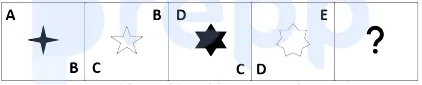
- A
Option A (shown in image)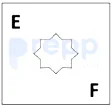
- B
Option B (shown in image)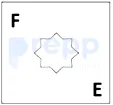
- C
Option C (shown in image)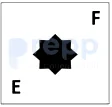
- D
Option D (shown in image)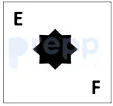
Show answer
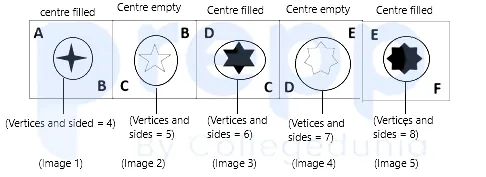
D. Option D (shown in image)The logic followed here is:
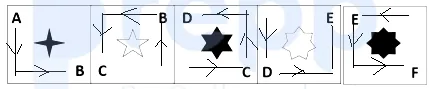
Step 1: The letters in each image is shifting +1 in their positional values in English Alphabetical series and in anticlockwise direction.
Step 2: The image in centre is filled and empty alternatively and its sides and vertices are by increasing +1.
So, Image 5 will replace the question mark in the series.
Hence, the correct answer is 'Option 4'.
 Paper & answer key PDF ↗
 Question 11archived
Select the option that is related to the third word in the same way as the second word is related to the first word.
(The words must be considered as meaningful English words and must not be related to each other based on the number of letters/number of consonants/vowels in the word.)
India : Royal Bengal Tiger :: Australia : ?
- A
Horse
- B
Dragon
- C
Kangaroo
- D
Elephant
Show answer
C. KangarooSolving the India-Australia Analogy Question
The question asks us to find the word that completes the analogy: India : Royal Bengal Tiger :: Australia : ?.
This is a verbal analogy question where we need to identify the relationship between the first pair of words (India and Royal Bengal Tiger) and then apply the same relationship to the third word (Australia) to find the fourth word from the given options.
Understanding the Relationship: India and Royal Bengal Tiger
In the first pair, India and Royal Bengal Tiger, the relationship is that the Royal Bengal Tiger is the national animal of India. This is a well-known fact related to the national symbols of India.
Applying the Relationship to Australia
Now, we need to find an animal from the options that has a similar relationship with Australia. We are looking for an animal that is strongly associated with Australia, ideally its national animal or a widely recognised iconic animal.
Analyzing the Options
Let's examine each option provided:
Horse: Horses are present in Australia, but they are not considered the national animal or a primary iconic symbol of the country.
Dragon: Dragons are mythical creatures and are not real animals native to or symbolic of Australia.
Kangaroo: Kangaroos are native to Australia and are one of the country's most famous symbols. The kangaroo is prominently featured on the Australian coat of arms and is often considered a national symbol, sometimes informally referred to as a national animal.
Elephant: Elephants are not native to Australia and are not associated with it as a national animal or symbol.
Identifying the Correct Analogy
Comparing the relationship (Country : National/Iconic Animal) applied to Australia, the Kangaroo fits this description best among the given options. Just as the Royal Bengal Tiger is strongly associated with India as its national animal, the Kangaroo is strongly associated with Australia as a national symbol and iconic animal.
Conclusion
Therefore, the correct word to complete the analogy India : Royal Bengal Tiger :: Australia : ? is Kangaroo, based on the relationship of a country to its national or iconic animal.
Country
Iconic/National Animal
India
Royal Bengal Tiger
Australia
Kangaroo
Revision Table: Key Concepts in Analogies
Concept
Description
Example (from this question)
Verbal Analogy
A comparison between two pairs of words, where the relationship between the words in the first pair is similar to the relationship between the words in the second pair.
India : Royal Bengal Tiger :: Australia : Kangaroo
Identifying Relationship
Determining how the first two words are connected (e.g., part-whole, cause-effect, country-national symbol).
India is related to Royal Bengal Tiger as Country is to National Animal.
Applying Relationship
Applying the same relationship to the third word to find the correct fourth word.
Find the National Animal of Australia.
Additional Information on National Symbols
National symbols are often chosen to represent a country's identity, culture, history, and biodiversity. They can include national animals, birds, flowers, flags, anthems, and emblems. The choice of a national animal often reflects an animal native to the country that holds cultural significance or represents qualities valued by the nation.
The Royal Bengal Tiger (\(\text{Panthera tigris tigris}\)) is a majestic animal found in India, Bangladesh, Nepal, and Bhutan. It was declared India's national animal in 1973, replacing the lion, to highlight the need for tiger conservation.
The Kangaroo is a marsupial native to Australia. Along with the Emu, it appears on the Australian coat of arms because neither animal can walk backward, symbolising progress. Kangaroos are iconic Australian wildlife.
Other countries also have national animals, such as the Bald Eagle for the United States, the Lion for England, and the Giant Panda for China.
Understanding common relationships like Country-National Animal is useful for solving analogy questions and general knowledge tests.
Paper & answer key PDF ↗ Question 12archived
Select the figure that will come next in the following figure series.

- A
Option A (shown in image)
- B
Option B (shown in image)
- C
Option C (shown in image)
- D
Option D (shown in image)
Show answer
Question 13archived
Which of the following numbers will replace the question mark (?) in the given series?
11, 36, ?, 121, 185, 266
- A
68
- B
72
- C
70
- D
63
Show answer
B. 72Analysing the Number Series Problem
The question asks us to find the missing number in the given number series: 11, 36, ?, 121, 185, 266.
To solve number series problems, we usually look for a pattern between consecutive terms. This pattern could involve addition, subtraction, multiplication, division, squares, cubes, or a combination of these operations.
Step-by-Step Solution to Find the Missing Number
Let's examine the differences between the consecutive terms where we know both numbers:
Difference between the second and first term: $36 - 11 = 25$
Difference between the fifth and fourth term: $185 - 121 = 64$
Difference between the sixth and fifth term: $266 - 185 = 81$
The differences we have found are 25, 64, and 81. Let's look closely at these numbers to see if they form a pattern:
$25 = 5^2$
$64 = 8^2$
$81 = 9^2$
We see that these differences are squares of numbers. The bases of the squares are 5, 8, and 9.
The differences occur between:
Term 1 and Term 2: $5^2$
Term 4 and Term 5: $8^2$
Term 5 and Term 6: $9^2$
The pattern of the bases (5, ?, ?, 8, 9) seems to be a sequence of consecutive integers starting from 5. Let's assume the bases are 5, 6, 7, 8, 9.
If this is the case, the differences between consecutive terms should be the squares of these numbers: $5^2, 6^2, 7^2, 8^2, 9^2$.
These differences would be 25, 36, 49, 64, 81.
Verifying the Number Series Pattern
Let's test this pattern with the given series starting from the first term:
First term: 11
Second term: $11 + 5^2 = 11 + 25 = 36$. This matches the given second term.
Third term (the missing number): $36 + 6^2 = 36 + 36 = 72$.
Fourth term: $72 + 7^2 = 72 + 49 = 121$. This matches the given fourth term.
Fifth term: $121 + 8^2 = 121 + 64 = 185$. This matches the given fifth term.
Sixth term: $185 + 9^2 = 185 + 81 = 266$. This matches the given sixth term.
The pattern fits perfectly. The missing number is 72.
Summary of the Number Series and Pattern
Term
Value
Difference from previous term
Pattern of Difference
1
11
-
-
2
36
$36 - 11 = 25$
$5^2$
3
? (72)
$72 - 36 = 36$
$6^2$
4
121
$121 - 72 = 49$
$7^2$
5
185
$185 - 121 = 64$
$8^2$
6
266
$266 - 185 = 81$
$9^2$
The missing number in the series is 72.
Revision Table for Number Series Patterns
Here are some common types of number series patterns you might encounter in aptitude questions:
Arithmetic Series: The difference between consecutive terms is constant (e.g., 2, 5, 8, 11...).
Geometric Series: Each term is found by multiplying the previous term by a constant ratio (e.g., 3, 6, 12, 24...).
Difference Series: The differences between consecutive terms form a pattern (e.g., increasing by a constant, squares, cubes, prime numbers). This is the type of pattern found in this problem.
Double Difference Series: The differences between the differences form a pattern.
Squares or Cubes Series: Terms are squares or cubes, sometimes with an addition or subtraction (e.g., $1^2+1, 2^2+1, 3^2+1...$ or $1^3, 2^3, 3^3...$).
Fibonacci Series: Each term is the sum of the two preceding ones (e.g., 0, 1, 1, 2, 3, 5...).
Mixed Series: A combination of two or more patterns.
Additional Information on Solving Number Series
Solving number series problems requires careful observation and trying out different possible patterns. Here are some tips:
Calculate the differences between consecutive terms first. If there's no clear pattern, calculate the differences of these differences.
Look for ratios if the terms are increasing or decreasing rapidly, suggesting multiplication or division.
Check if the terms are related to squares, cubes, or prime numbers.
Sometimes, the pattern might alternate between two different operations.
Practicing various types of series helps in quickly recognizing patterns.
Paper & answer key PDF ↗ Question 14archived
In a certain code language, ‘FARM’ is coded as HDTP and ‘EGGS’ is coded as GJIV. How will ‘FOOD’ be coded in the same language?
- A
HQQG
- B
GRQH
- C
HRQG
- D
HQRG
Show answer
C. HRQGUnderstanding Letter Coding and Decoding
This question involves a common type of reasoning problem called letter coding. In these problems, words are coded based on a specific rule or pattern applied to the letters. We need to identify this pattern by looking at the given examples and then apply it to the word we need to code.
Analyzing the Given Coding Examples
Let's look at the first example provided:
Word 1: FARM
Coded 1: HDTP
Let's examine the position of each letter in the English alphabet and compare the original word with its coded form:
Letter
Position
Coded Letter
Position
Difference
F
6
H
8
\(8 - 6 = +2\)
A
1
D
4
\(4 - 1 = +3\)
R
18
T
20
\(20 - 18 = +2\)
M
13
P
16
\(16 - 13 = +3\)
From this analysis, we can see a pattern: the letters are shifted by +2, +3, +2, +3 positions respectively.
Now, let's verify this pattern with the second example:
Word 2: EGGS
Coded 2: GJIV
Let's apply the same analysis:
Letter
Position
Coded Letter
Position
Difference
E
5
G
7
\(7 - 5 = +2\)
G
7
J
10
\(10 - 7 = +3\)
G
7
I
9
\(9 - 7 = +2\)
S
19
V
22
\(22 - 19 = +3\)
The pattern +2, +3, +2, +3 is consistent in both examples.
Applying the Pattern to 'FOOD'
Now we will apply the identified pattern (+2, +3, +2, +3) to the word 'FOOD' to find its code.
Letter
Position
Pattern
Calculation
Coded Position
Coded Letter
F
6
+2
\(6 + 2 = 8\)
8
H
O
15
+3
\(15 + 3 = 18\)
18
R
O
15
+2
\(15 + 2 = 17\)
17
Q
D
4
+3
\(4 + 3 = 7\)
7
G
Following the pattern, the letters of 'FOOD' are coded as H, R, Q, and G.
Therefore, 'FOOD' is coded as HRQG.
Revision Table: Letter Coding Summary
Original Word
Coded Word
Pattern
FARM
HDTP
+2, +3, +2, +3
EGGS
GJIV
+2, +3, +2, +3
FOOD
HRQG
+2, +3, +2, +3
Additional Information: Types of Coding
Letter coding is a part of the broader topic of coding-decoding in reasoning ability tests. Understanding different types of coding can help solve similar problems quickly.
Common types of coding include:
Letter Coding: Letters are replaced by other letters based on a specific rule (like the shift pattern in this problem).
Number Coding: Words are assigned numerical values based on letter positions or other calculations.
Symbol Coding: Letters or words are represented by symbols.
Mixed Coding: A combination of letters, numbers, and symbols is used.
Substitution Coding: Words are directly substituted with other words (e.g., 'blue is called green', 'green is called red').
To excel in coding-decoding, it is helpful to memorize the position of each letter in the alphabet and practice identifying various patterns like shifting, reversing, or skipping letters.
Paper & answer key PDF ↗ Question 15archived
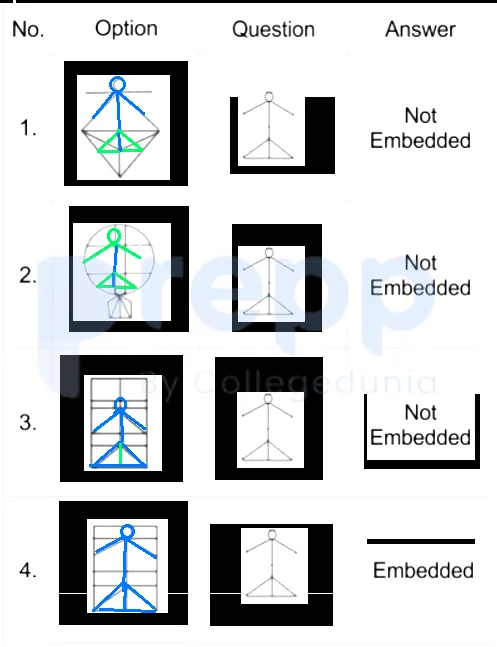
Select the option in which the given figure is embedded (rotation is NOT allowed).

- A
Option A (shown in image)
- B
Option B (shown in image)
- C
Option C (shown in image)
- D
Option D (shown in image)
Show answer
D. Option D (shown in image)The image embedded in given figure is as shown below :
∴ Here, Option figure 4 is embedded in given figure.
Hence, the correct answer is "Option-(4)".
 Paper & answer key PDF ↗
 Question 16archived
Select the set in which the numbers are related in the same way as are the numbers of the given set.
(NOTE: Operations should be performed on the whole numbers, without breaking down the numbers into its constituent digits. E.g. 13 – Operations on 13 such as adding /subtracting /multiplying etc. to 13 can be performed. Breaking down 13 into 1 and 3 and then performing mathematical operations on 1 and 3 is not allowed.)
(13, 17, 23)
(8, 12, 18)
- A
(17, 21, 15)
- B
(18, 22, 28)
- C
(11, 15, 23)
- D
(5, 9, 16)
Show answer
B. (18, 22, 28)Understanding Number Analogy Problems
Number analogy problems require identifying the relationship or pattern between numbers in a given set and then finding another set that follows the same relationship. The problem specifies that operations must be performed on the whole numbers themselves, not on their individual digits.
Analyzing the Given Number Sets
We are given two sets: (13, 17, 23) and (8, 12, 18). Let's analyze the relationship between the numbers in each set.
Analysis of Set 1: (13, 17, 23)
First number to second number: \(17 - 13 = 4\). The second number is 4 more than the first.
Second number to third number: \(23 - 17 = 6\). The third number is 6 more than the second.
So, the pattern in the first set is (+4, +6).
Analysis of Set 2: (8, 12, 18)
First number to second number: \(12 - 8 = 4\). The second number is 4 more than the first.
Second number to third number: \(18 - 12 = 6\). The third number is 6 more than the second.
The pattern in the second set is also (+4, +6). Both given sets share the same relationship.
Checking the Options for the Same Relationship
Now, we will check each option set to see which one follows the (+4, +6) pattern.
Option 1: (17, 21, 15)
Difference between the first and second number: \(21 - 17 = 4\). (Matches +4)
Difference between the second and third number: \(15 - 21 = -6\). (Does not match +6)
This set does not follow the (+4, +6) pattern.
Option 2: (18, 22, 28)
Difference between the first and second number: \(22 - 18 = 4\). (Matches +4)
Difference between the second and third number: \(28 - 22 = 6\). (Matches +6)
This set follows the (+4, +6) pattern.
Option 3: (11, 15, 23)
Difference between the first and second number: \(15 - 11 = 4\). (Matches +4)
Difference between the second and third number: \(23 - 15 = 8\). (Does not match +6)
This set does not follow the (+4, +6) pattern.
Option 4: (5, 9, 16)
Difference between the first and second number: \(9 - 5 = 4\). (Matches +4)
Difference between the second and third number: \(16 - 9 = 7\). (Does not match +6)
This set does not follow the (+4, +6) pattern.
Conclusion
Based on the analysis, only the set (18, 22, 28) exhibits the same (+4, +6) relationship as the given sets (13, 17, 23) and (8, 12, 18).
Set
Difference 1 to 2
Difference 2 to 3
Pattern
(13, 17, 23)
\(17 - 13 = 4\)
\(23 - 17 = 6\)
(+4, +6)
(8, 12, 18)
\(12 - 8 = 4\)
\(18 - 12 = 6\)
(+4, +6)
(17, 21, 15)
\(21 - 17 = 4\)
\(15 - 21 = -6\)
(+4, -6)
(18, 22, 28)
\(22 - 18 = 4\)
\(28 - 22 = 6\)
(+4, +6)
(11, 15, 23)
\(15 - 11 = 4\)
\(23 - 15 = 8\)
(+4, +8)
(5, 9, 16)
\(9 - 5 = 4\)
\(16 - 9 = 7\)
(+4, +7)
Revision Table: Number Analogy Key Points
Concept
Description
How it applies here
Number Analogy
Identifying relationships between numbers in a set.
We found the differences (+4, +6) in the given sets.
Whole Number Operation
Perform operations on the numbers as a whole, not on digits.
We used 13, 17, 23 etc. as single units in calculations.
Pattern Matching
Applying the identified pattern to the options.
We checked which option set also had the (+4, +6) pattern.
Additional Information: Types of Number Relationships
Number analogy questions can have various types of relationships. Some common ones include:
Arithmetic Progressions (constant difference)
Geometric Progressions (constant ratio)
Differences increasing or decreasing by a pattern (like +4, +6, +8...)
Squares or cubes of numbers
Combinations of arithmetic operations (addition, subtraction, multiplication, division)
Relationships based on prime numbers, composite numbers, odd/even numbers.
Sum or product of numbers in the set having a specific property.
Solving these problems requires careful observation and testing different possible relationships.
Paper & answer key PDF ↗ Question 17archived
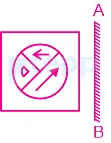
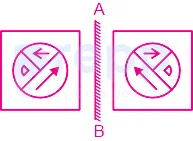
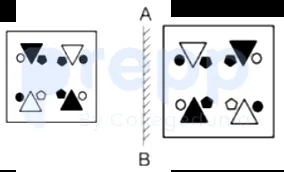
Select the correct mirror image of the given figure when the mirror is placed at AB.
- A
Option A (shown in image)
- B
Option B (shown in image)
- C
Option C (shown in image)
- D
Option D (shown in image)
Show answer
A. Option A (shown in image)The correct mirror image of the given figure when mirror is placed at AB is as shown below:
Hence, the correct answer is "Option - (1)".
 Paper & answer key PDF ↗
 Question 18archived
Select the correct combination of mathematical signs to sequentially replace the * signs and balance the given equation.
7 * 5 * 4 * 2 * 3 * 7
- A
÷, −, +, ×, =
- B
+, −, ÷, −, =
- C
÷, +, ÷, +, =
- D
−, ÷, +, ×, =
Show answer
B. +, −, ÷, −, =Balancing Mathematical Equations
The question asks us to find the correct sequence of mathematical signs that, when placed sequentially in the blank spaces marked by asterisks (*), will make the equation true.
The given expression is 7 * 5 * 4 * 2 * 3 * 7.
We need to replace the five asterisks with operators from the options and the final number with the result of the calculation, essentially forming an equation of the form:
`$\text{7 \text{[op1]} 5 \text{[op2]} 4 \text{[op3]} 2 \text{[op4]} 3 = 7}$`
Let's examine the options and test them.
Testing Option 2: +, −, ÷, −, =
Substituting the operators from Option 2 into the expression, the equation becomes:
`$\text{7 + 5 - 4 ÷ 2 - 3 = 7}$`
Now, we evaluate the left side of the equation according to the standard order of operations (BODMAS/PEMDAS):
Division and Multiplication (from left to right)
Addition and Subtraction (from left to right)
Let's evaluate the expression `$\text{7 + 5 - 4 ÷ 2 - 3}$` step by step:
First, perform the division: `$\text{4 ÷ 2 = 2}$`
The equation is now:
`$\text{7 + 5 - 2 - 3 = 7}$`
Next, perform addition and subtraction from left to right.
`$\text{7 + 5 = 12}$`
The equation becomes:
`$\text{12 - 2 - 3 = 7}$`
Continue with subtraction: `$\text{12 - 2 = 10}$`
The equation becomes:
`$\text{10 - 3 = 7}$`
Finally, perform the last subtraction: `$\text{10 - 3 = 7}$`
The equation is:
`$\text{7 = 7}$`
The left side of the equation equals the right side. Thus, the equation is balanced with the signs `+`, `−`, `÷`, `−`, and the result `= 7`.
Other options would not balance the equation. For example, Option 1 includes `7 ÷ 5` which does not result in a whole number, making it difficult to reach 7 with subsequent integer operations.
Therefore, the correct combination of mathematical signs is `+`, `−`, `÷`, `−`, which makes the equation `7 + 5 - 4 ÷ 2 - 3 = 7` true.
Revision Table: Order of Operations
Priority Level
Operation Type
Examples
1
Parentheses/Brackets
( ), [ ], { }
2
Exponents/Orders
Powers, Roots
3
Multiplication and Division
`$\times$`, `$\div$` (from left to right)
4
Addition and Subtraction
`$+$`, `$-$` (from left to right)
Additional Information: Solving Equation Balancing Problems
Equation balancing problems require systematic testing of the given options. When testing an option, it is crucial to correctly apply the order of operations (BODMAS/PEMDAS) to evaluate the expression. Perform calculations involving division or multiplication before addition or subtraction. If multiple operations of the same priority level exist (like multiplication and division, or addition and subtraction), solve them from left to right.
Careful calculation is key to accurately determining which sequence of signs balances the equation.
Paper & answer key PDF ↗ Question 19archived
Select the option that is related to the fifth letter-cluster in the same way as the second letter-cluster is related to the first letter-cluster and the fourth letter-cluster is related to the third letter cluster.
COMFORT : FMOCTRO :: DIGNITY : NGIDYTI :: FOREIGN : ?
- A
EROFNGI
- B
ROFNGIE
- C
EROFIGN
- D
EFORNGI
Show answer
A. EROFNGIDecoding the Letter Rearrangement Pattern
The question asks us to find the relationship between the first pair of letter clusters (COMFORT : FMOCTRO) and the second pair (DIGNITY : NGIDYTI) and apply the same logic to the third pair (FOREIGN : ?). This is a letter coding problem based on positional rearrangement.
Step 1: Analyzing the COMFORT to FMOCTRO Transformation
First, let's identify the positional changes involved in transforming 'COMFORT' into 'FMOCTRO'.
Number the letters of the original word 'COMFORT':
C1 O2 M3 F4 O5 R6 T7
Now, examine the resulting word 'FMOCTRO' and map its letters back to their original positions in 'COMFORT':
The first letter 'F' in 'FMOCTRO' is the 4th letter of 'COMFORT'.
The second letter 'M' in 'FMOCTRO' is the 3rd letter of 'COMFORT'.
The third letter 'O' in 'FMOCTRO' is the 2nd letter of 'COMFORT'.
The fourth letter 'C' in 'FMOCTRO' is the 1st letter of 'COMFORT'.
The fifth letter 'T' in 'FMOCTRO' is the 7th letter of 'COMFORT'.
The sixth letter 'R' in 'FMOCTRO' is the 6th letter of 'COMFORT'.
The seventh letter 'O' in 'FMOCTRO' is the 5th letter of 'COMFORT'.
This reveals a specific positional rearrangement pattern: 4, 3, 2, 1, 7, 6, 5. The letters are rearranged from their original positions (1 to 7) into this new order.
Step 2: Verifying the Pattern with DIGNITY : NGIDYTI
Let's check if this pattern holds true for the second example, 'DIGNITY' transforming into 'NGIDYTI'.
Number the letters of 'DIGNITY':
D1 I2 G3 N4 I5 T6 Y7
Apply the identified pattern (4, 3, 2, 1, 7, 6, 5) to these positions:
4th position gives 'N'.
3rd position gives 'G'.
2nd position gives 'I'.
1st position gives 'D'.
7th position gives 'Y'.
6th position gives 'T'.
5th position gives 'I'.
Combining these letters yields 'NGIDYTI'.
This matches the result given in the question, confirming that the 4, 3, 2, 1, 7, 6, 5 positional rearrangement pattern is correct.
Step 3: Applying the Pattern to FOREIGN
Now, we apply the confirmed pattern to the word 'FOREIGN'.
First, number the letters of 'FOREIGN':
F1 O2 R3 E4 I5 G6 N7
Rearrange the letters using the pattern 4, 3, 2, 1, 7, 6, 5:
4th letter: E
3rd letter: R
2nd letter: O
1st letter: F
7th letter: N
6th letter: G
5th letter: I
Combining these letters in the new order gives the result: EROFNGI.
Step 4: Matching the Result with the Options
Let's compare our result 'EROFNGI' with the provided options:
Option 1: EROFNGI
Option 2: ROFNGIE
Option 3: EROFIGN
Option 4: EFORNGI
Our calculated result, 'EROFNGI', perfectly matches Option 1.
Final Answer Explanation
The core logic is a positional swap. The word is treated as a sequence of 7 letters. The transformation follows the rule of picking letters from positions 4, 3, 2, 1, 7, 6, 5 in that order. Applying this rule consistently to 'COMFORT' and 'DIGNITY' yields the given results. When applied to 'FOREIGN', it correctly produces 'EROFNGI', which is Option 1.
Paper & answer key PDF ↗ Question 20archived
Select the option that represents the letters that, when sequentially placed from left to right in the blanks below, will complete the letter series.
L _ _ RALMT _ _ _ _ TRALM_ R _
- A
TRMALMTA
- B
MRTLAMTA
- C
MTRALMTA
- D
MTRLAMTA
Show answer
C. MTRALMTAUnderstanding Letter Series and Patterns
Letter series questions are a common type of logical reasoning problem. They involve a sequence of letters that follow a specific pattern. To solve these questions, you need to identify the underlying rule or pattern governing the arrangement of the letters. The pattern can involve repetition, skipping letters, alphabetical order, or a combination of these.
The given letter series is:
L _ _ RALMT _ _ _ _ TRALM_ R _
We need to find the sequence of letters that fills the blanks to complete the pattern.
Analyzing the Given Letter Series
Let's look closely at the structure of the series:
L _ _ RALMT _ _ _ _ TRALM_ R _
There are 8 blanks to fill.
Testing the Options to Find the Pattern
We are provided with multiple options. A good strategy is to try placing the letters from each option sequentially into the blanks and see if a discernible pattern emerges. Let's use the sequence from the correct option, which is MTRALMTA.
Placing MTRALMTA into the blanks:
The first blank gets 'M'.
The second blank gets 'T'.
The third blank gets 'R'.
The fourth blank gets 'A'.
The fifth blank gets 'L'.
The sixth blank gets 'M'.
The seventh blank gets 'T'.
The eighth blank gets 'A'.
Let's write out the series with these letters filled in:
L M T R A L M T R A L M T R A L M T R A
Identifying the Repeating Pattern
Now observe the completed series:
L M T R A L M T R A L M T R A L M T R A
By grouping the letters, we can clearly see a repeating block:
LMTRA LMTRA LMTRA LMTRA
The sequence LMTRA is repeated continuously.
Confirming the Solution
The complete series consists of the block 'LMTRA' repeated 4 times. Let's verify that filling the blanks with 'MTRALMTA' produces this repeating pattern, matching the original series structure.
Original series: L _ _ RALMT _ _ _ _ TRALM_ R _
Completed series: L M T R A L M T R A L M T R A L M T R A
Comparing positions:
Position 1: L (Matches original)
Position 2: M (Fills 1st blank)
Position 3: T (Fills 2nd blank)
Position 4: R (Matches original)
Position 5: A (Matches original)
Position 6: L (Matches original)
Position 7: M (Matches original)
Position 8: T (Matches original)
Position 9: R (Fills 3rd blank)
Position 10: A (Fills 4th blank)
Position 11: L (Fills 5th blank)
Position 12: M (Fills 6th blank)
Position 13: T (Matches original)
Position 14: R (Matches original)
Position 15: A (Matches original)
Position 16: L (Matches original)
Position 17: M (Matches original)
Position 18: T (Fills 7th blank)
Position 19: R (Matches original)
Position 20: A (Fills 8th blank)
The letters M, T, R, A, L, M, T, A are indeed the letters required to fill the blanks sequentially from left to right to complete the series with the repeating pattern 'LMTRA'.
Blank Position
Letter from Option
1st
M
2nd
T
3rd
R
4th
A
5th
L
6th
M
7th
T
8th
A
Thus, the sequence of letters MTRALMTA correctly completes the given letter series following a repeating pattern.
Revision Table: Key Concepts in Letter Series
Concept
Description
Identifying Pattern
Look for repetition, alphabetical sequence, skipping letters, or other logical rules.
Block Formation
Try to break the series into repeating blocks of letters.
Gap Analysis
Examine the gaps between known letters to find clues about the pattern.
Option Testing
Use the given options to fill the blanks and check for a valid pattern.
Additional Information: Tips for Solving Letter Series
Count the total number of letters and blanks to determine the possible length of the repeating block. For example, if there are 20 positions in total (including blanks) and a pattern of length 5 repeats, the total length will be a multiple of 5. In this case, 20 is divisible by 5 (20/5 = 4 repetitions).
Look for segments of the series where letters are already filled in, as these provide strong clues about the potential pattern.
Sometimes, the pattern might involve a combination of letters and symbols, or a numerical relationship alongside letters (though not in this specific question).
Practice different types of series to become familiar with various pattern types.
Paper & answer key PDF ↗ Question 21archived
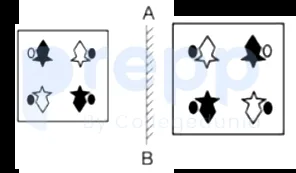
Which of the answer figures is the exact mirror image of the given problem figure when the mirror is held at the right side?
Problem figure:

- A
Option A (shown in image)
- B
Option B (shown in image)
- C
Option C (shown in image)
- D
Option D (shown in image)
Show answer
B. Option B (shown in image)The correct mirror image of the given figure when mirror is placed at AB is as shown below:
Hence, the correct answer is "Option - (2)".
 Paper & answer key PDF ↗
 Question 22archived
In this question, three statements are given, followed by two conclusions numbered I and II. Assuming the statements to be true, even if they seem to be at variance with commonly known facts, decide which of the conclusions logically follows/follow from the statements.
Statements:
I. No streak is a line.
II. Some lines are bands.
III. All bands are flashes.
Conclusions:
I. Some flashes are streaks.
II. No flash is a line.
- A
Only conclusion I follows
- B
Both conclusions I and II follow
- C
Only conclusion II follows
- D
Neither conclusion I nor II follows
Show answer
D. Neither conclusion I nor II followsDetailed Syllogism Solution: Analyzing Statements and Conclusions
This question asks us to analyze given statements and determine which of the provided conclusions logically follow from them. We must assume the statements are true, regardless of whether they align with real-world knowledge. This type of problem tests our ability in logical deduction, a key part of syllogism.
Understanding the Statements
Let's break down the given statements:
Statement I: No streak is a line. This establishes a complete separation between the category 'streak' and the category 'line'. If something is a streak, it cannot be a line, and vice versa.
Statement II: Some lines are bands. This indicates an overlap or intersection between the category 'line' and the category 'band'. There exists at least one entity that is both a line and a band.
Statement III: All bands are flashes. This means the entire category of 'bands' is contained within the category of 'flashes'. If something is a band, it must also be a flash.
Evaluating the Conclusions
Now, let's evaluate each conclusion based on the statements.
Conclusion I: Some flashes are streaks.
To see if this conclusion follows, we need to find a connection between 'flashes' and 'streaks' based on the statements.
From Statement I, we know 'streaks' and 'lines' are completely separate.
From Statements II and III, we know that 'some lines are bands' and 'all bands are flashes'. Combining these, if some lines are bands, and all bands are flashes, then it logically follows that some lines are flashes.
We have a relationship between 'lines' and 'flashes' ('Some lines are flashes'), and a relationship between 'streaks' and 'lines' ('No streak is a line'). However, we have no direct link between 'streaks' and 'flashes'. The statements don't provide information about whether the 'flashes' that are *not* lines have any overlap with 'streaks'. It's possible that flashes only overlap with lines, or with things that are neither lines nor streaks. Therefore, we cannot definitively conclude that some flashes are streaks.
Conclusion II: No flash is a line.
To evaluate this conclusion, let's again look at the connections between 'flashes' and 'lines'.
Statement II says: Some lines are bands. (Some L are B)
Statement III says: All bands are flashes. (All B are F)
Using these two statements, we can deduce a relationship between Lines and Flashes. If there are some lines that are bands (Statement II), and everything that is a band is also a flash (Statement III), then those 'some lines' that are bands must also be flashes. Therefore, it logically follows that some lines are flashes.
Conclusion II states that "No flash is a line", which means 'flashes' and 'lines' are completely separate. However, our deduction from statements II and III shows that there is an overlap; some lines *are* flashes (and therefore, some flashes are lines). Since Conclusion II contradicts the logical deduction from the statements, it does not follow.
Summary of Evaluation
Conclusion I: Some flashes are streaks. — Does not follow.
Conclusion II: No flash is a line. — Does not follow (contradicts 'Some lines are flashes').
Based on the analysis, neither conclusion logically follows from the given statements.
Revision Table: Key Syllogism Concepts
Statement Type
Notation Example
Relationship
All A are B
\(A \subset B\)
A is a subset of B
No A is B
\(A \cap B = \emptyset\)
A and B are mutually exclusive
Some A are B
\(A \cap B \neq \emptyset\)
There is an overlap between A and B
Some A are not B
\(A \setminus B \neq \emptyset\)
There are elements in A that are not in B
Additional Information: Solving Syllogism Problems
Syllogism problems require careful logical reasoning. Here are some tips:
Assume Statements are True: Treat the statements as absolute facts within the context of the problem, even if they seem illogical in the real world.
Visualize Relationships: Using Venn diagrams can be very helpful. Draw circles representing the categories (streak, line, band, flash) and show the relationships described by the statements (separation, overlap, containment).
Combine Statements: Look for ways to combine two statements to deduce a relationship between categories that weren't directly linked initially (like how we combined Statements II and III to link lines and flashes).
Avoid Outside Knowledge: Do not use any information or common knowledge outside of the provided statements.
Test Each Conclusion: Rigorously check if each conclusion is *necessarily* true based *only* on the statements. If there is any possibility, however remote, that the conclusion could be false given the statements, then it does not follow.
This structured approach helps ensure you rely purely on the given logic to solve syllogism questions.
Paper & answer key PDF ↗ Question 23archived
Select the set in which the numbers are related in the same way as are the numbers of the following sets.
(NOTE: Operations should be performed on the whole numbers, without breaking down the numbers into its constituent digits. E.g. 13 – Operations on 13 such as adding/subtracting/multiplying etc. to 13 can be performed. Breaking down 13 into 1 and 3 and then performing mathematical operations on 1 and 3 is not allowed.)
(239, 127, 212)
(96, 64, 132)
- A
(262, 132, 240)
- B
(140, 76, 181)
- C
(167, 89, 178)
- D
(110, 91, 159)
Show answer
C. (167, 89, 178)The correct answer is (167, 89, 178).
Consider Ratios or Products: Although less common in basic problems, look for multiplicative or divisive relationships, squares, cubes, etc. Test Identified Patterns: Once a possible rule is found using the example sets, test it on all the given options to confirm its validity. Follow Constraints: Pay close attention to any specific rules mentioned in the question, such as performing operations only on whole numbers, not digits. Practicing different types of number set problems helps in recognizing common patterns more quickly.
Paper & answer key PDF ↗ Question 24archived
Which of the answer figures is the exact mirror image of the given problem figure when the mirror is held at the right side?
Problem figure:

- A
Option A (shown in image)
- B
Option B (shown in image)
- C
Option C (shown in image)
- D
Option D (shown in image)
Show answer
B. Option B (shown in image)The correct mirror image of the given figure when mirror is placed at AB is as shown below:
Hence, the correct answer is "Option - (2)".
 Paper & answer key PDF ↗
 Question 25archived
Select the option that is related to the fifth letter-cluster in the same way as the second letter-cluster is related to the first letter-cluster and the fourth letter-cluster is related to the third letter-cluster.
HEROES : LBVLBW :: INVEST : FRZBWX :: KIDNAP : ?
- A
MUTYRS
- B
AWSLPO
- C
LOBCSA
- D
OFHRXT
Show answer
D. OFHRXTSolving Letter-Cluster Analogy Problems
This question asks us to identify the relationship between letter-clusters and apply that same relationship to a new cluster. We are given two pairs of related letter-clusters: HEROES is related to LBVLBW, and INVEST is related to FRZBWX. We need to find the cluster related to KIDNAP in the same way.
Let's analyze the relationship by looking at the alphabetical position of each letter in the original word and the resulting cluster.
We can assign a numerical value to each letter based on its position in the English alphabet (A=1, B=2, ..., Z=26).
Analyzing the First Letter-Cluster Pair: HEROES and LBVLBW
Let's compare the letters in HEROES and LBVLBW:
Position
HEROES
Alphabetical Position
LBVLBW
Alphabetical Position
Difference/Shift
Type
1
H
8
L
12
$+12 - 8 = +4$
Consonant
2
E
5
B
2
$+2 - 5 = -3$
Vowel
3
R
18
V
22
$+22 - 18 = +4$
Consonant
4
O
15
L
12
$+12 - 15 = -3$
Vowel
5
E
5
B
2
$+2 - 5 = -3$
Vowel
6
S
19
W
23
$+23 - 19 = +4$
Consonant
Looking at the differences, we see a pattern based on whether the letter is a consonant or a vowel (A, E, I, O, U).
If the letter in HEROES is a consonant (H, R, S), the shift is $+4$.
If the letter in HEROES is a vowel (E, O, E), the shift is $-3$.
Analyzing the Second Letter-Cluster Pair: INVEST and FRZBWX
Let's check if the same rule applies to the second pair:
Position
INVEST
Alphabetical Position
FRZBWX
Alphabetical Position
Difference/Shift
Type
1
I
9
F
6
$+6 - 9 = -3$
Vowel
2
N
14
R
18
$+18 - 14 = +4$
Consonant
3
V
22
Z
26
$+26 - 22 = +4$
Consonant
4
E
5
B
2
$+2 - 5 = -3$
Vowel
5
S
19
W
23
$+23 - 19 = +4$
Consonant
6
T
20
X
24
$+24 - 20 = +4$
Consonant
The pattern holds true for the second pair as well:
If the letter in INVEST is a vowel (I, E), the shift is $-3$.
If the letter in INVEST is a consonant (N, V, S, T), the shift is $+4$.
The established rule is: Consonants shift $+4$ positions forward, and Vowels shift $-3$ positions backward.
Applying the Rule to the Fifth Letter-Cluster: KIDNAP
Now, let's apply this rule to KIDNAP to find the related letter-cluster.
Position
KIDNAP
Alphabetical Position
Type
Shift
Calculation
New Position
Resulting Letter
1
K
11
Consonant
$+4$
$11 + 4 = 15$
15
O
2
I
9
Vowel
$-3$
$9 - 3 = 6$
6
F
3
D
4
Consonant
$+4$
$4 + 4 = 8$
8
H
4
N
14
Consonant
$+4$
$14 + 4 = 18$
18
R
5
A
1
Vowel
$-3$
$1 - 3 = -2$ (wrap around $26 - 2$)
24
X
6
P
16
Consonant
$+4$
$16 + 4 = 20$
20
T
The resulting letter-cluster for KIDNAP is OFHRXT.
Conclusion
Based on the pattern where consonants shift $+4$ and vowels shift $-3$, the letter-cluster related to KIDNAP is OFHRXT. This matches option 4.
Revision Table: Letter-Cluster Analogy
Understanding the type of transformation (shift, reversal, substitution) and the basis of the rule (position, vowel/consonant, numeric value) is key to solving letter-cluster analogy problems.
Original Letter
Type
Rule Applied
Resulting Letter
K
Consonant
$+4$ shift
O
I
Vowel
$-3$ shift
F
D
Consonant
$+4$ shift
H
N
Consonant
$+4$ shift
R
A
Vowel
$-3$ shift (with wrap-around)
X
P
Consonant
$+4$ shift
T
Additional Information: Alphabetical Reasoning Concepts
Letter-based reasoning questions often involve:
Alphabetical Position: Using A=1, B=2, etc.
Letter Shifting: Moving a certain number of positions forward or backward in the alphabet. This can include wrapping around from Z to A or A to Z.
Vowel/Consonant Rules: Applying different rules based on whether a letter is a vowel or a consonant.
Reverse Alphabetical Order: Using Z=1, Y=2, etc.
Skipping Letters: Rules based on skipping a fixed number of letters.
Combination of Rules: Sometimes multiple rules are combined or applied alternately.
Practice with different types of letter patterns helps in quickly identifying the underlying logic during exams.
Paper & answer key PDF ↗ Question 26archived
The Shevaroy Hills are located in which state of India?
- A
Chhattisgarh
- B
Odisha
- C
Rajasthan
- D
Tamil Nadu
Show answer
D. Tamil NaduLocating the Shevaroy Hills in India
The question asks us to identify the state in India where the Shevaroy Hills are situated. Knowing the geographical location of prominent hill ranges in India is important for general knowledge and geography studies.
The Shevaroy Hills are a major range of hills located in the state of Tamil Nadu. They are part of the Eastern Ghats, a discontinuous range of mountains along India's eastern coast. The highest point in the Shevaroy Hills is Solaikaradu, which is also the highest point in the entire Eastern Ghats.
Yercaud, a popular hill station, is located in the Shevaroy Hills. The area is known for its coffee plantations and pleasant climate, making it a significant spot within the Salem district of Tamil Nadu.
Analyzing the Options for Shevaroy Hills Location
Let's examine the given options to confirm the location of the Shevaroy Hills:
Chhattisgarh: Chhattisgarh is located in central India. It is known for its forests and tribal population, but the Shevaroy Hills are not located here.
Odisha: Odisha is situated on the eastern coast of India, north of Andhra Pradesh and Tamil Nadu. While it has parts of the Eastern Ghats, the Shevaroy Hills are specifically in Tamil Nadu.
Rajasthan: Rajasthan is a state in northern India, known for the Thar Desert and the Aravalli Range. The Shevaroy Hills are not in Rajasthan.
Tamil Nadu: Tamil Nadu is located in the southern part of India. The Shevaroy Hills are a well-known hill range situated in the Salem district of Tamil Nadu.
Based on geographical facts, the Shevaroy Hills are indeed located in Tamil Nadu.
Confirmation of Shevaroy Hills Location
The Shevaroy Hills are an important part of the geography of Tamil Nadu. They are situated near the city of Salem and serve as a popular tourist destination due to the hill station of Yercaud.
Therefore, the correct state for the location of the Shevaroy Hills is Tamil Nadu.
Revision Table: Key Facts about Shevaroy Hills
Feature
Detail
Location
Tamil Nadu, India
Part of
Eastern Ghats
District
Salem District
Famous Town
Yercaud (Hill Station)
Highest Point
Solaikaradu
Additional Information on Indian Hill Ranges
India is home to several significant hill ranges, each with unique geographical features and ecological importance. Understanding their locations helps in grasping India's diverse topography.
Himalayas: Located in the north, these are the world's highest mountains.
Aravalli Range: One of the oldest fold mountains in the world, located in Rajasthan and extending into neighboring states.
Western Ghats: A mountain range running parallel to the western coast of India, known for its biodiversity.
Eastern Ghats: A discontinuous range along India's eastern coast, where the Shevaroy Hills are located.
Satpura Range: Located in central India, running east-west.
Vindhya Range: Also in central India, north of the Satpura Range.
These ranges play crucial roles in influencing climate, drainage patterns, and supporting diverse ecosystems across India.
Paper & answer key PDF ↗ Question 27archived
In India Who among the following has the power to pardon, reprieve or commute the punishment of any criminal?
- A
President
- B
Vice-President
- C
Attorney General of India
- D
Prime Minister
Show answer
A. PresidentThe question asks to identify the constitutional authority in India that holds the power to grant pardon, reprieve, or commute sentences for any criminal offense. This power is a significant aspect of the executive branch's functions related to the justice system.
President's Power to Pardon Under the Indian Constitution
In India, the constitutional authority vested with the power to grant pardon, reprieve, respite, or commutation of punishment is the President. This power is explicitly granted under Article 72 of the Constitution of India. Let's break down what these terms mean:
Pardon: It frees the offender completely from guilt and disqualifies him from receiving punishment. It is an act of grace and mercy.
Reprieve: It means suspension of the sentence, usually to allow the condemned person time to seek a pardon or commutation.
Respite: It involves awarding a lesser sentence instead of the prescribed punishment (e.g., a shorter jail term), often due to special circumstances like pregnancy of a woman offender.
Commutation: It means substituting one form of punishment for another, lighter form (e.g., commuting a death sentence to life imprisonment).
The President can exercise this power in all cases where the punishment or sentence is for an offense against any law relating to a matter to which the executive power of the Union extends, in cases of all sentences passed by a court-martial, and in all cases where the sentence is a sentence of death.
It is important to note that the President exercises this power typically on the advice of the Council of Ministers, headed by the Prime Minister. However, the power itself resides constitutionally with the President.
Analysis of Other Options Regarding Pardoning Power
Let's examine why the other options are not correct:
Vice-President: The Vice-President of India acts as the Chairman of the Rajya Sabha and can act as President during the President's absence or inability to discharge duties. However, the Vice-President does not possess the constitutional power of pardon.
Attorney General of India: The Attorney General is the principal legal advisor to the Government of India. Their role involves advising the government on legal matters but does not include the power to pardon criminals.
Prime Minister: The Prime Minister is the head of the executive government. While the government (Council of Ministers) advises the President on the exercise of pardoning powers, the Prime Minister, individually, does not hold this specific constitutional authority. The power is vested in the office of the President.
Conclusion
Based on the constitutional provisions, specifically Article 72, the President is the sole authority in India empowered to grant pardon, reprieve, respite, or commutation of punishment.
Paper & answer key PDF ↗ Question 28archived
The “Nalacharitam” play is associated with which Indian dance form?
- A
Odissi
- B
Kathakali
- C
Sattriya
- D
Kathak
Show answer
B. KathakaliThe question asks us to identify the Indian dance form associated with the play called “Nalacharitam”. To answer this, we need to know which classical Indian dance forms are known for performing specific dramatic plays or narratives.
Understanding “Nalacharitam”
“Nalacharitam” refers to the story of King Nala and Damayanti, a famous episode from the epic Mahabharata. This story is a popular theme for dramatic performances in certain traditional art forms.
Kathakali: The Associated Dance Form
Kathakali is a major classical Indian dance form that originated in Kerala. It is renowned for its elaborate costumes, vibrant makeup, detailed gestures (mudras), and well-defined body movements. Kathakali performances are essentially dance-dramas that tell stories, primarily from Indian epics like the Ramayana, the Mahabharata, and the Puranas.
The narrative is sung by vocalists, and the dancers use expressive movements and hand gestures to convey the meaning. “Nalacharitam” is one of the most famous and frequently performed plays in the Kathakali repertoire. It is considered a masterpiece written by Unnayi Variyar in the 17th-18th century, specifically for Kathakali performance.
Analysis of Other Options
Odissi: This classical dance form from Odisha is known for its fluidity, grace, and sculpturesque poses, often inspired by temple sculptures. While it tells stories, its primary focus and repertoire differ significantly from the dramatic plays characteristic of Kathakali.
Sattriya: Originating from Assam, this dance form is associated with the Vaishnavite monasteries (Sattras). Its repertoire is primarily linked to the stories of Lord Krishna and Vishnu. It is a distinct tradition separate from Kathakali.
Kathak: This dance form from North India is characterized by intricate footwork, spins, and expressive storytelling. While it tells stories, it evolved in different cultural contexts and its typical repertoire does not include the full-fledged dramatic plays like “Nalacharitam” in the same way Kathakali does.
Based on the strong association of the play “Nalacharitam” with its dramatic presentation style and narrative depth, it is most famously performed as a Kathakali play.
Revision Table: Dance Forms and Associations
Dance Form
Origin
Typical Repertoire/Style
Association with “Nalacharitam”
Odissi
Odisha
Graceful, temple-inspired, mythological stories
None strongly associated
Kathakali
Kerala
Dance-drama, epic stories (Mahabharata, Ramayana), elaborate costumes
Strongly Associated
Sattriya
Assam
Vaishnavite themes, stories of Krishna/Vishnu
None strongly associated
Kathak
North India
Footwork, spins, storytelling, often historical or devotional
None strongly associated
Additional Information on Kathakali Plays
Kathakali plays are written texts called Attakathas. These Attakathas provide the story, dialogues (which are sung), and instructions for the performers. “Nalacharitam” is an example of a complete Attakatha that can be performed over several nights due to its detailed narrative. The performance involves not just dance, but also acting, music (vocals and percussion), and elaborate stagecraft involving costumes and makeup. This strong tradition of performing specific plays is a defining feature of Kathakali.
Paper & answer key PDF ↗ Question 29archived
The President of which country attended the first Republic Day celebrations of India as its chief guest?
- A
Bhutan
- B
Japan
- C
Indonesia
- D
China
Show answer
C. IndonesiaUnderstanding India's First Republic Day Chief Guest
India's Republic Day is a significant national holiday celebrated every year on January 26th. It marks the date when the Constitution of India came into effect in 1950, replacing the Government of India Act (1935) as the governing document and thus completing the country's transition to becoming an independent republic.
A key tradition of the Republic Day parade in New Delhi is inviting a Head of State or Government from another country as the chief guest. The question asks about the President of which country attended the very first Republic Day celebrations of India as the chief guest.
Analyzing the First Republic Day Chief Guest
For the first Republic Day on January 26, 1950, India invited a prominent leader from a fellow Asian nation. This choice reflected India's foreign policy priorities at the time, emphasizing solidarity with newly independent countries and promoting Asian unity.
Let's look at the options provided:
Bhutan
Japan
Indonesia
China
Historical records show that the chief guest for India's inaugural Republic Day parade was the President of Indonesia.
The President of Indonesia at that time was Dr. Sukarno. His presence as the chief guest underscored the close relationship between India and Indonesia, both of which had recently gained independence and were prominent members of the non-aligned movement in the following years.
Evaluating the Options
Based on historical facts regarding the chief guest at the first Republic Day celebration:
Bhutan: While India shares close ties with Bhutan, its leader was not the chief guest at the first Republic Day.
Japan: Japan was undergoing significant changes after World War II in 1950 and its leader was not the chief guest.
Indonesia: The President of Indonesia, Dr. Sukarno, was indeed the chief guest at India's first Republic Day on January 26, 1950.
China: Relations with China were different in 1950, and its leader was not invited as the chief guest for the first Republic Day.
Conclusion on the First Republic Day Chief Guest
Therefore, the President of Indonesia was the chief guest at the first Republic Day celebrations of India in 1950.
Revision Table: Key Details about India's First Republic Day
Event
Date
Significance
Chief Guest Country
Chief Guest Name
First Republic Day of India
January 26, 1950
Constitution of India came into effect
Indonesia
Dr. Sukarno (President)
Additional Information on Republic Day Chief Guests
Inviting a chief guest for the Republic Day parade is a tradition that began in 1950 and continues to this day. The choice of the chief guest often reflects India's diplomatic priorities, strategic relationships, and geopolitical considerations of the time. Over the years, chief guests have included monarchs, presidents, and prime ministers from various countries across the globe, representing diverse regions and political systems.
Paper & answer key PDF ↗ Question 30archived
Which of the following pair of compound – melting point is correct?
I. Acetic acid – 290K
II. Ethanol – 156K
- A
Only I
- B
Both I and II
- C
Neither I nor II
- D
Only II
Show answer
B. Both I and IIAnalyzing Melting Points of Acetic Acid and Ethanol
The question asks to identify which pair of compound and its corresponding melting point in Kelvin is correct among the given options. We need to examine each statement individually and compare the given melting point with accepted values.
Statement I: Acetic Acid – 290K
Statement I proposes that the melting point of Acetic Acid is 290K. Let's check the known melting point of Acetic Acid. The melting point of pure Acetic Acid is approximately 16.6 °C.
To convert temperature from Celsius (°C) to Kelvin (K), we use the formula:
\( \text{Temperature in K} = \text{Temperature in } ^\circ\text{C} + 273.15 \)
Converting 16.6 °C to Kelvin:
\( 16.6 \, ^\circ\text{C} + 273.15 = 289.75 \, \text{K} \)
The value 289.75 K is very close to 290 K. Therefore, stating the melting point of Acetic Acid as 290K is considered correct for this type of question.
Statement II: Ethanol – 156K
Statement II suggests that the melting point of Ethanol is 156K. Let's look up the melting point of Ethanol. The melting point of pure Ethanol is approximately -114.1 °C.
Converting -114.1 °C to Kelvin:
\( -114.1 \, ^\circ\text{C} + 273.15 = 159.05 \, \text{K} \)
Different sources might give slightly varying values for melting points. Some sources list the melting point of Ethanol around -114 °C or 159 K, while others might cite values like -114.5 °C, which converts to approximately 158.65 K. The value 156K is close to this range and is sometimes cited or used as an approximate value in educational contexts. Considering the nature of MCQs and potential rounding, 156K is acceptable as the melting point of Ethanol in this context.
Conclusion on Melting Point Pairs
Based on our analysis:
Statement I (Acetic Acid – 290K) is correct, as 290K is very close to the actual melting point (289.75 K).
Statement II (Ethanol – 156K) is also considered correct, as 156K is reasonably close to the actual melting point (around 159 K), allowing for typical variations or simplified values used in questions.
Since both statements are correct, the correct option is the one that indicates both I and II are correct.
Summary of Findings
We evaluated the given melting points for Acetic Acid and Ethanol:
Acetic Acid melting point: Given as 290K. Actual value is approximately 289.75K (16.6 °C). The given value is correct.
Ethanol melting point: Given as 156K. Actual value is approximately 159.05K (-114.1 °C). The given value is correct within an acceptable range.
Therefore, both pairs of compound and melting point provided in statements I and II are considered correct.
Melting Points Comparison
Compound
Given Melting Point (K)
Approximate Actual Melting Point (°C)
Approximate Actual Melting Point (K)
Correctness
Acetic Acid
290
16.6
289.75
Correct
Ethanol
156
-114.1
159.05
Correct
The option that states "Both I and II" is the correct answer.
Revision Table: Chemical Properties
Important Melting Points
Compound
Formula
Melting Point (°C)
Melting Point (K)
Water
H<sub>2</sub>O
0
273.15
Acetic Acid
CH<sub>3</sub>COOH
16.6
289.75
Ethanol
C<sub>2</sub>H<sub>5</sub>OH
-114.1
159.05
Additional Information on Melting Points and Kelvin Scale
The melting point of a substance is the temperature at which it changes state from solid to liquid at a standard atmospheric pressure. This is a characteristic physical property of a pure substance.
Phase Transition: Melting is a type of phase transition. It occurs when the thermal energy of the solid becomes high enough to overcome the intermolecular forces holding the molecules in a fixed structure.
Kelvin Scale: The Kelvin scale is an absolute thermodynamic temperature scale, meaning zero Kelvin (0 K) is the point where particles have minimum thermal motion (absolute zero). It is commonly used in scientific contexts. The interval of the Kelvin scale is equal to the interval of the Celsius scale (1 K = 1 °C difference).
Factors Affecting Melting Point: While melting point is characteristic for pure substances, it can be affected by impurities (usually lowers the melting point) and pressure (though the effect is less significant for solids compared to liquids and gases).
Understanding melting points is crucial in chemistry for identifying substances, predicting their state at a given temperature, and understanding intermolecular forces.
Paper & answer key PDF ↗ Question 31archived
In India, what type of unemployment is created due to lack of employable skills among the educated youths in India?
- A
Technological unemployment
- B
Cyclical unemployment
- C
Structural unemployment
- D
Educated unemployment
Show answer
D. Educated unemploymentUnderstanding Unemployment Among Educated Youth in India
Unemployment is a significant economic challenge, especially in countries like India. When we talk about educated young people who have completed their education but are unable to find jobs, or jobs that match their skills and qualifications, several factors can be at play. One major reason is often a mismatch between the skills gained during education and the skills demanded by the job market. This specific situation has led to the identification of different types of unemployment.
Analysing the Types of Unemployment
Let's look at the options provided and understand what each type of unemployment means:
Technological unemployment: This occurs when advancements in technology lead to job losses, as machines or automated systems replace human workers. For example, automation in manufacturing or the use of AI in customer service can lead to technological unemployment.
Cyclical unemployment: This type of unemployment is tied to the business cycle. It rises during economic downturns or recessions when demand for goods and services falls, leading companies to cut back on production and lay off workers. It falls during economic expansions.
Structural unemployment: This happens when there is a mismatch between the skills that workers have and the skills that employers need. This can be due to shifts in the economy, technological changes, or geographical location mismatches. It's a longer-term type of unemployment compared to cyclical unemployment.
Educated unemployment: This term specifically refers to the situation where people who have received formal education (like a degree or diploma) are unable to find suitable jobs. This is often attributed to factors like the large number of graduates competing for limited jobs, or more critically, a lack of employable or industry-relevant skills among the educated population despite their degrees.
Identifying the Correct Type of Unemployment
The question specifically asks about the type of unemployment created due to a "lack of employable skills among the educated youths in India". Let's evaluate how well each option fits this description:
Technological unemployment focuses on job displacement by technology, not directly the skill gap among educated youth.
Cyclical unemployment relates to economic cycles, not specifically the skills of educated individuals.
Structural unemployment involves a skill mismatch, which is related. However, the term "Educated unemployment" is a more specific category often used in the context of developing countries like India to describe the unemployment problem among degree holders, particularly highlighting the issue of skill relevance and market demand for educated individuals. The question pinpoints the issue to "educated youths" and their "lack of employable skills".
Educated unemployment directly addresses the problem of educated individuals being unemployed, and a primary cause for this, especially in India, is the lack of employable skills that align with industry needs.
Therefore, the type of unemployment that most precisely describes the situation of educated youths being unemployed due to a lack of employable skills in India is Educated unemployment.
Revision Table: Types of Unemployment
Type of Unemployment
Description
Key Cause
Technological
Jobs lost due to automation or new technology.
Technological advancements
Cyclical
Unemployment due to economic recession or downturn.
Phase of business cycle
Structural
Mismatch between worker skills and employer needs, often long-term.
Economic shifts, skill gaps, location
Educated
Educated individuals unable to find suitable jobs.
Lack of employable skills, oversupply of graduates, limited job creation
Additional Information on Educated Unemployment in India
Educated unemployment is a complex issue in India. While enrollment in higher education has increased significantly, concerns remain about the quality and relevance of the education provided. Many graduates find that their academic qualifications do not equip them with the practical or soft skills required by employers. This leads to a situation where, despite having degrees, they are not considered 'employable'. Efforts to address this include reforming curriculum, promoting vocational training alongside traditional education, and fostering better industry-academia collaboration.
Paper & answer key PDF ↗ Question 32archived
Indian boxers _________ won gold medals at the 73rd Strandja Memorial Boxing Tournament, held in Sofia, Bulgaria in February 2022.
- A
Nikhat Zareen (52 kg) and Pooja Rani (48 kg)
- B
Manju Rani (52 kg) and Pooja Rani (48 kg)
- C
Nikhat Zareen (52 kg) and Nitu (48 kg)
- D
Manju Rani (52 kg) and Nitu (48 kg)
Show answer
C. Nikhat Zareen (52 kg) and Nitu (48 kg)Indian Boxers Shine at Strandja Memorial Tournament 2022
The question asks about the Indian boxers who secured gold medals at the 73rd edition of the Strandja Memorial Boxing Tournament held in February 2022 in Sofia, Bulgaria. This tournament is a significant international event in the boxing calendar.
Gold Medal Winners at 73rd Strandja Tournament
Based on the tournament results from February 2022, two Indian boxers achieved gold medals:
Nikhat Zareen in the 52 kg category.
Nitu in the 48 kg category.
Their victories were notable performances for India at the international boxing event.
Analysis of the Options
Let's examine the given options in light of the actual results of the 73rd Strandja Memorial Boxing Tournament:
Option 1: Nikhat Zareen (52 kg) and Pooja Rani (48 kg). Nikhat Zareen did win gold, but Pooja Rani did not win gold in the 48 kg category at this specific tournament edition. Pooja Rani competes in higher weight categories (like 75 kg).
Option 2: Manju Rani (52 kg) and Pooja Rani (48 kg). Neither Manju Rani nor Pooja Rani won gold medals in these specific weight categories at the 73rd Strandja Tournament.
Option 3: Nikhat Zareen (52 kg) and Nitu (48 kg). This option correctly identifies both Nikhat Zareen and Nitu as gold medalists in their respective weight categories at the tournament.
Option 4: Manju Rani (52 kg) and Nitu (48 kg). Nitu won gold, but Manju Rani did not win gold in the 52 kg category at this event.
Therefore, the pair of Indian boxers who won gold medals at the 73rd Strandja Memorial Boxing Tournament were Nikhat Zareen (52 kg) and Nitu (48 kg).
Significance of the Wins
Winning gold medals at the Strandja Memorial Boxing Tournament is a significant achievement, as it is one of the oldest and most prestigious amateur boxing tournaments in Europe. Performances here are often indicators of a boxer's form and potential for major championships like World Championships or Olympic Games.
Boxer
Weight Category
Medal at 73rd Strandja 2022
Nikhat Zareen
52 kg
Gold
Nitu
48 kg
Gold
Pooja Rani
75 kg (usual)
Did not win gold at 48 kg in this event
Manju Rani
48 kg (usual)
Did not win gold at 52 kg in this event
Revision Table: Strandja Memorial Boxing Tournament
Tournament
Edition
Year
Location
Key Indian Gold Medalists (Feb 2022)
Strandja Memorial Boxing Tournament
73rd
2022
Sofia, Bulgaria
Nikhat Zareen (52 kg), Nitu (48 kg)
Additional Information: Indian Boxing Achievements
Indian boxers have consistently performed well in various international tournaments. These achievements are results of dedicated training and support structures. Some key points about Indian boxing:
India has a strong presence in both men's and women's international boxing.
Tournaments like the Strandja Memorial provide crucial exposure and ranking points.
Success at these events helps build confidence for major championships such as World Championships and Olympic Games.
Other prominent Indian boxers include Mary Kom, Lovlina Borgohain, Amit Panghal, and Shiva Thapa.
Paper & answer key PDF ↗ Question 33archived
Who was associated with the foundation of the Fergusson College?
- A
Dadabhai Naoroji
- B
Gopal Krishna Gokhale
- C
Lajpat Rai
- D
Bal Gangadhar Tilak
Show answer
D. Bal Gangadhar TilakUnderstanding the Foundation of Fergusson College
Fergusson College, located in Pune, Maharashtra, is one of India's oldest and most prestigious educational institutions. Its establishment was a significant step in the history of modern education in India, driven by nationalist leaders aiming to provide quality education on their own terms.
Key Figures Behind Fergusson College Foundation
The foundation of Fergusson College is primarily associated with the Deccan Education Society. This society was founded by a group of nationalist leaders and educators who believed in the power of education for national awakening and social reform. Several prominent personalities were instrumental in the establishment of the college and the society.
The key individuals associated with the foundation include:
Bal Gangadhar Tilak
Gopal Ganesh Agarkar
Vishnushastri Chiplunkar
Mahadev Ballal Namjoshi
V. S. Apte
V. B. Kelkar
M. S. Gole
Gopal Krishna Gokhale (joined slightly later but became a key figure)
These individuals worked together to establish the New English School in Pune in 1880, which was the first step towards their larger goal. Following the success of the school, they founded the Deccan Education Society in 1884. Fergusson College was then established under the umbrella of the Deccan Education Society in 1885.
Bal Gangadhar Tilak's Role
Bal Gangadhar Tilak was one of the principal founders of the Deccan Education Society and played a crucial role in the establishment and early years of both the New English School and Fergusson College. He was deeply committed to providing modern education to Indians, believing it was essential for their progress and national liberation. His association with the foundation of Fergusson College is well-documented.
Gopal Krishna Gokhale's Role
Gopal Krishna Gokhale, while also a pivotal figure in Indian history and education, joined the Deccan Education Society and taught at Fergusson College from 1886. He became a close associate of Tilak and other founders and played a vital role in the college's development, though he joined slightly after its initial foundation in 1885. However, he is very much considered one of the prominent figures associated with the institution's growth.
Comparing the Options
Let's look at the options provided in the question:
Option
Association with Fergusson College Foundation
Dadabhai Naoroji
A prominent nationalist leader and economist, but not directly associated with the foundation of Fergusson College in Pune.
Gopal Krishna Gokhale
A key figure in the Deccan Education Society and Fergusson College, but joined slightly after the initial foundation in 1885. Considered a significant associate.
Lajpat Rai
Another prominent nationalist leader (part of the 'Lal-Bal-Pal' trio), but not directly associated with the foundation of Fergusson College.
Bal Gangadhar Tilak
One of the principal founders of the Deccan Education Society and instrumental in the establishment of Fergusson College in 1885.
Based on the historical records, Bal Gangadhar Tilak was undeniably one of the primary figures associated with the foundation of Fergusson College.
Revision Table: Fergusson College Foundation Facts
Aspect
Detail
Institution Name
Fergusson College
Location
Pune, Maharashtra
Year of Foundation
1885
Parent Society
Deccan Education Society (founded 1884)
Key Founders/Associates
Bal Gangadhar Tilak, Gopal Ganesh Agarkar, Vishnushastri Chiplunkar, Gopal Krishna Gokhale, etc.
Purpose
Provide modern education under Indian control
Additional Information: The Deccan Education Society
The Deccan Education Society was a pioneering organization in the field of Indian education. It was founded by nationalist leaders with the vision of providing education that combined Western learning with Indian values. The society aimed to be self-reliant and independent of government aid initially, although it later accepted grants. The establishment of the New English School and later Fergusson College were landmark achievements of this society, contributing significantly to the educational landscape and the nationalist movement in India. The society's founders dedicated their lives to the cause of education, often working with minimal remuneration.
Paper & answer key PDF ↗ Question 34archived
Name the Bhakti Saint from South India who was initially a Jaina and a minister in the court of a Chalukya king in the twelfth century.
- A
Eknath
- B
Tallapaka Annamacharya
- C
Basavanna
- D
Karaikkal Ammaiyar
Show answer
C. BasavannaUnderstanding the Bhakti Movement in South India
The Bhakti movement was a significant religious movement in medieval India that emphasized devotion (bhakti) to God. It originated in South India around the 6th century with the Alvars (devotees of Vishnu) and Nayanars (devotees of Shiva) and later spread to North India.
The question asks to identify a specific Bhakti saint from South India who was active in the twelfth century, was initially associated with the Jaina faith, and served as a minister in the court of a Chalukya king.
Analyzing the Options
Let's examine each option based on the criteria provided in the question:
Eknath: Eknath was a prominent saint from Maharashtra (Western India) in the 16th century. He was a devotee of Vithoba (a form of Vishnu). He was not from South India, not from the 12th century, and not associated with the Jaina faith or Chalukya kings.
Tallapaka Annamacharya: Annamacharya was a prolific poet and musician from Andhra Pradesh (South India) in the 15th century. He is considered the Andhra Pada Kavita Pitamaha (Grandfather of Telugu Song-Poetry). He was a devotee of Venkateswara. He was not from the 12th century, not associated with the Jaina faith or Chalukya kings.
Basavanna: Basavanna (also known as Basaveshwara) was a 12th-century philosopher, statesman, and social reformer from Karnataka (South India). Historical accounts indicate he was initially associated with the Jaina tradition in his early life before becoming a staunch devotee of Lord Shiva. He served as a minister (specifically, the chief treasurer, or Bhandari) in the court of King Bijjala II of the Kalachuri dynasty, who ruled from Kalyan in the mid-12th century. The Kalachuri dynasty of Kalyan ruled over parts of the erstwhile Chalukya territory and had close ties and conflicts with the Kalyani Chalukyas, sometimes considered successors or contemporaries in the region. His life and work fall squarely within the twelfth century in South India, his background connects him to Jainism, and he held a high position as a minister in a kingdom ruling over areas formerly part of or contiguous with Chalukya domains. He founded the Lingayat or Virashaiva tradition.
Karaikkal Ammaiyar: Karaikkal Ammaiyar was one of the earliest Tamil Nayanars (Shaivite saints) from Tamil Nadu (South India), belonging to the 5th-6th century CE. She was a fervent devotee of Lord Shiva. She was not from the 12th century, not associated with the Jaina faith or Chalukya kings.
Comparing the options with the question's requirements, Basavanna is the only saint who fits all the descriptions: he was from South India, active in the 12th century, had an initial association with the Jaina tradition, and served as a minister in a court ruling over Chalukya territories.
Basavanna's Life and Contributions
Basavanna was a pivotal figure in the 12th century. Born near Bagewadi in present-day Karnataka, he moved to Kalyan, the capital of the Kalachuri kingdom under King Bijjala II. As a minister, he used his position to advocate for social reforms. He strongly opposed the caste system and promoted equality among all people, regardless of birth or gender. His teachings are primarily found in his Vachanas (short prose poems), which are central to the Virashaiva philosophy. He established the Anubhava Mantapa, an academy of spiritual and social discussion.
Saint
Region
Period
Initial Background/Key Association
Ministerial Role?
Associated Kingdom/Dynasty
Eknath
Western India (Maharashtra)
16th Century
Brahmin, Devotee of Vithoba
No
-
Tallapaka Annamacharya
South India (Andhra Pradesh)
15th Century
Devotee of Venkateswara
No
Vijayanagara Empire (later part)
Basavanna
South India (Karnataka)
12th Century
Initial association with Jainism, later Shaivite (Virashaiva)
Yes (Minister)
Kalachuri of Kalyan (ruled over former Chalukya areas)
Karaikkal Ammaiyar
South India (Tamil Nadu)
5th-6th Century
Shaivite (Nayanar)
No
-
Based on the detailed analysis, Basavanna is the only saint among the given options who fits all the criteria mentioned in the question: South Indian, 12th century, initially Jaina, and a minister in a court ruling over relevant territory.
Revision Table: Key Details about Basavanna
Detail
Information
Name
Basavanna (Basaveshwara)
Century
12th Century CE
Region
South India (Karnataka)
Initial Religious Association
Jainism
Later Religious Movement
Virashaiva (Lingayat)
Role in Court
Minister (Chief Treasurer)
King/Dynasty Served
King Bijjala II (Kalachuri of Kalyan)
Key Contribution
Founder of Virashaiva movement, social reformer, Vachana literature
Additional Information on South Indian Bhakti Saints
South India has a rich history of Bhakti traditions. The early Bhakti movement in South India saw the rise of the Alvars and Nayanars, whose devotional hymns in Tamil are compiled in texts like the Divya Prabandham (Alvars) and the Tevaram and Tirumurai (Nayanars). These saints emphasized personal devotion to Vishnu and Shiva, respectively, often challenging orthodox rituals and the caste system through their inclusive approach to devotion.
Later centuries saw other significant figures like Ramanujacharya, a philosopher who propounded Vishishtadvaita philosophy and emphasized devotion to Vishnu, and Madhvacharya, who advocated Dvaita philosophy and devotion to Vishnu. Basavanna's Virashaiva movement, focused on intense devotion to Shiva (as Linga), also significantly impacted the religious and social landscape of Karnataka in the 12th century.
Understanding the regional and temporal context of these saints is crucial for studying the diverse expressions of the Bhakti movement across India.
Paper & answer key PDF ↗ Question 35archived
Which amendment of Indian Constitution removed the right to property from the list of fundamental rights?
- A
44th
- B
43rd
- C
42nd
- D
41st
Show answer
A. 44thUnderstanding the Right to Property in the Indian Constitution
The Indian Constitution, when it was originally adopted, included the right to property as a fundamental right. Fundamental rights are considered essential human rights guaranteed to citizens by the Constitution, enforceable by the courts. However, this right underwent significant changes over time, particularly through constitutional amendments.
The 44th Constitutional Amendment Act
The question asks about the specific amendment that removed the right to property from the list of fundamental rights. This crucial change was brought about by the 44th Constitutional Amendment Act.
Prior to the 44th Amendment in 1978, the right to property was guaranteed under Article 19(1)(f) and Article 31 of the Constitution. These articles protected the right to acquire, hold, and dispose of property and provided for compensation in case of compulsory acquisition of property by the state.
Changes Made by the 44th Amendment (1978)
The 44th Amendment Act, 1978, enacted several important changes to the Indian Constitution, particularly in response to issues that arose during the Emergency period. Regarding the right to property, the amendment took the following key steps:
It repealed Article 19(1)(f), thereby removing the right to property as a fundamental right under Article 19.
It repealed Article 31, which dealt with compulsory acquisition of property and provided for compensation.
It inserted a new chapter, Chapter IV, in Part XII of the Constitution.
It inserted a new article, Article 300A, in this new chapter.
Article 300A states that "No person shall be deprived of his property save by authority of law." This effectively changed the status of the right to property from a fundamental right to a legal right or a constitutional right (but not a fundamental right).
Significance of the Change
By making the right to property a legal right under Article 300A, the Constitution made it subject to ordinary law rather than the stricter protections afforded to fundamental rights. While the state cannot arbitrarily deprive a person of their property, such deprivation can occur according to the procedure established by law. This change reduced the difficulties faced by the government in land reforms and other socio-economic legislation that required the acquisition of private property.
Analysis of Other Options
41st Amendment Act, 1976: This amendment raised the age of retirement of the Chairman and members of a State Public Service Commission and Joint Public Service Commission from 60 to 62 years. It did not concern the right to property.
42nd Amendment Act, 1976: Known as the 'Mini-Constitution', this was one of the most comprehensive amendments. It made significant changes, including adding 'socialist', 'secular', and 'integrity' to the Preamble, adding Fundamental Duties, making the President bound by the advice of the Cabinet, and limiting judicial review powers. While very significant, it did not remove the right to property from fundamental rights.
43rd Amendment Act, 1977: This amendment repealed some provisions of the 42nd Amendment Act, mainly related to limiting the power of courts to review laws and the power to make anti-national activities laws. It did not deal with the right to property.
Based on the constitutional changes, the 44th Amendment Act is the correct answer for removing the right to property from the list of fundamental rights.
Amendment
Year
Key Action Regarding Property
44th Amendment
1978
Removed Right to Property from Fundamental Rights (Article 19(1)(f) and 31) and made it a Legal Right (Article 300A).
41st Amendment
1976
Related to retirement age of Public Service Commission members, not property.
42nd Amendment
1976
Wide-ranging changes ('Mini-Constitution'), but did not remove fundamental right to property.
43rd Amendment
1977
Repealed some 42nd Amendment provisions, not related to property.
Revision Table: Right to Property Status Change
Status
Articles
Period
Reason for Change
Fundamental Right
Article 19(1)(f) & Article 31
Original Constitution (1950) to 1978
Included as a basic individual liberty.
Legal Right (Constitutional Right)
Article 300A
From 1978 onwards
Difficulties in implementing land reforms and development projects led to its removal from fundamental rights by the 44th Amendment Act.
Additional Information: Property Rights and Amendments
Several amendments before the 44th Amendment also touched upon property rights, primarily to facilitate land reforms and acquisition. Some notable ones include:
1st Amendment Act, 1951: Added Article 31A and 31B and the Ninth Schedule to protect land reform laws from judicial review based on fundamental rights, including the right to property.
4th Amendment Act, 1955: Further limited the scope of judicial review regarding the adequacy of compensation for compulsory acquisition of property.
17th Amendment Act, 1964: Included more land reform laws in the Ninth Schedule.
25th Amendment Act, 1971: Added Article 31C, which protected laws giving effect to Directive Principles (specifically Article 39(b) and (c)) from challenge based on violation of Article 14, 19, and 31 (including the right to property). It also added that compensation for property acquisition did not need to be market value but an amount fixed by law.
26th Amendment Act, 1971: Abolished privy purses and privileges of former Indian states' rulers, removing their property rights in this context.
These earlier amendments show a trend towards limiting the scope of the fundamental right to property to allow the state to pursue socio-economic goals. The 44th Amendment was the culmination of this process, changing its fundamental status altogether.
Paper & answer key PDF ↗ Question 36archived
Who was the founder of Benaras Gharana of Kathak?
- A
Shambhu Maharaj
- B
Raja Chakradhar Singh
- C
Ishwari Prasad
- D
Janaki Prasad
Show answer
D. Janaki PrasadUnderstanding Kathak Gharanas and Their Founders
Kathak is one of the major classical dance forms of India. It originated from the storytelling tradition and evolved over time, incorporating elements of Persian and Mughal influence. Like many classical arts, Kathak developed different regional styles, known as 'Gharanas'. Each Gharana has its distinct characteristics, techniques, and emphasis, though they share a common root.
The major Gharanas of Kathak include:
Lucknow Gharana
Jaipur Gharana
Benaras Gharana
Raigarh Gharana (often considered a synthesis)
The question specifically asks about the founder of the Benaras Gharana of Kathak.
Exploring the Benaras Gharana of Kathak
The Benaras Gharana of Kathak originated in the holy city of Varanasi (Benaras). This Gharana is known for its emphasis on rhythmic variations, intricate footwork (tatkar), and graceful movements. It maintains a strong connection to the devotional aspect of Kathak, often incorporating elements from Hindu epics and mythology.
Let's look at the options provided:
Shambhu Maharaj: A renowned exponent of the Lucknow Gharana, not the Benaras Gharana.
Raja Chakradhar Singh: A patron of Kathak and a skilled musician and dancer, associated with the development of the Raigarh style, which synthesizes elements from various Gharanas. He was not the founder of the Benaras Gharana.
Ishwari Prasad: Considered a pivotal figure in the lineage that led to the development of the Lucknow Gharana style, often credited as the ancestor or early guru of the Lucknow tradition, but not the founder of the Benaras Gharana.
Janaki Prasad: He is widely credited as the founder of the Benaras Gharana of Kathak. He is believed to have come from Bikaner and settled in Varanasi, establishing this distinct style characterized by its unique tatkar and rhythmic patterns.
Based on historical information and the traditions of Kathak, Janaki Prasad is recognized as the founder of the Benaras Gharana.
Founder of Benaras Kathak Gharana
The Benaras Gharana's distinct style was systematized and popularized by Pt. Janaki Prasad. His contributions laid the foundation for the rhythmic complexity and devotional expression characteristic of this school of Kathak.
Revision Table: Key Kathak Gharanas and Associated Figures
Gharana
Prominent Feature Emphasis
Associated Founder / Key Figure
Lucknow
Grace, expression (Gat Bhaav), Tihai, rhythmic improvisation
Ishwari Prasad (ancestor), Kalka Prasad, Binda Din Maharaj
Jaipur
Complex footwork (Tatkar), rhythmic patterns (Bol-taal), acrobatics
Bhanuji
Benaras
Rhythmic variations, intricate Tatkar, devotional aspect
Janaki Prasad
Raigarh
Synthesis of other Gharanas, unique compositions (Tukra, Tihai)
Raja Chakradhar Singh (Patron/Developer)
Additional Information on Kathak Gharanas
The development of different Kathak Gharanas reflects the regional influences, patronage, and the creative genius of individual masters. While each Gharana has its unique flavour, artists often learn from gurus of different Gharanas, leading to a cross-pollination of techniques and styles in contemporary Kathak performances.
Gharana Concept: Refers to a school or lineage of musicians or dancers sharing a particular style, technique, and repertoire, passed down through generations.
Patronage: Historically, Gharanas flourished under the patronage of kings, nawabs, and wealthy individuals who supported artists and provided them with opportunities to perform and teach.
Evolution: Kathak continues to evolve, with contemporary artists exploring new themes and incorporating modern elements while respecting the foundational principles of their respective Gharanas.
Paper & answer key PDF ↗ Question 37archived
What happens to the guard cells when water flows into them?
- A
The guard cells close.
- B
Stomatal pores open.
- C
Stomatal pores shrink.
- D
Stomatal pores close.
Show answer
B. Stomatal pores open.Understanding Guard Cell Function and Stomatal Opening
The question asks what happens to the guard cells when water flows into them. To answer this, we need to understand the structure and function of guard cells and stomatal pores.
What are Guard Cells and Stomatal Pores?
Guard cells are specialized plant cells found in the epidermis of leaves, stems, and other organs.
They surround tiny pores called stomatal pores (or stomata, singular stoma).
These stomatal pores regulate gas exchange (like carbon dioxide uptake for photosynthesis and oxygen release) and transpiration (water vapor release) between the plant and the atmosphere.
The opening and closing of the stomatal pores are controlled by the guard cells.
Water Movement into Guard Cells
Water moves into cells through a process called osmosis. Guard cells can accumulate solutes, such as potassium ions ($K^+$) or sugars, which lowers their water potential compared to the surrounding cells. This difference in water potential causes water to move from the surrounding epidermal cells into the guard cells.
Effect of Water Influx on Guard Cells
When water flows into the guard cells, they absorb the water and swell. This swelling is due to the increase in turgor pressure inside the cells. The cells become turgid.
How Turgidity Affects Stomatal Pores
The structure of guard cells is unique and allows them to control the stomatal pore size. Guard cells have unevenly thickened cell walls:
The cell wall area adjacent to the stomatal pore (the inner wall) is thicker and less elastic.
The cell wall area away from the stomatal pore (the outer wall) is thinner and more elastic.
When water enters the guard cells and they become turgid, the thinner, more elastic outer walls bulge outwards significantly more than the thicker inner walls. Because the guard cells are attached at their ends, this bulging of the outer walls pulls the thicker inner walls apart, causing the stomatal pore to open.
Conversely, when guard cells lose water, they become flaccid, the outer walls relax inwards, and the inner walls move closer together, causing the stomatal pore to close.
Analysis of Options:
Let's evaluate the given options based on our understanding:
The guard cells close: Guard cells are cells, they don't 'close' in this context. They change shape. This option is incorrect.
Stomatal pores open: When guard cells become turgid due to water influx, their shape changes and the stomatal pore opens. This aligns with our understanding.
Stomatal pores shrink: Shrinking implies the pore gets smaller, which is the opposite of opening. This is incorrect.
Stomatal pores close: Closing means the pore size reduces or is eliminated, which happens when guard cells lose water and become flaccid, not when they gain water and become turgid. This is incorrect.
Therefore, when water flows into the guard cells, the stomatal pores open.
Condition of Guard Cells
Water Content
Turgor Pressure
Shape Change
Stomatal Pore
Turgid
High (Water Influx)
High
Outer walls bulge, pulling inner walls apart
Open
Flaccid
Low (Water Efflux)
Low
Outer walls relax inwards
Closed
Revision Table: Guard Cells and Stomata
Key points about the relationship between guard cells, water, and stomata:
Guard cells control stomatal pore size.
Water potential difference drives water movement into/out of guard cells.
Water entering guard cells makes them turgid.
Turgid guard cells, due to uneven wall thickness, open the stomatal pore.
Water leaving guard cells makes them flaccid.
Flaccid guard cells close the stomatal pore.
Additional Information: Factors Affecting Stomatal Opening
While water availability is crucial for guard cell turgidity and stomatal opening, other factors also influence stomatal behavior:
Light: Stomata generally open in the presence of light, which is required for photosynthesis (and thus CO<sub>2</sub> uptake). Light triggers mechanisms that increase solute concentration in guard cells.
Carbon Dioxide Concentration: Low CO<sub>2</sub> levels inside the leaf often lead to stomatal opening to allow more CO<sub>2</sub> uptake. High CO<sub>2</sub> levels tend to cause closing.
Temperature: Stomata may close at very high temperatures to reduce water loss through transpiration.
Humidity: Low humidity increases the rate of transpiration, which can lead to water stress and cause stomata to close.
Paper & answer key PDF ↗ Question 38archived
The question consists of two statements, namely, Assertion (A) and Reason (R). Use them to choose the correct alternative.
Assertion (A): During the British rule, India’s exports exceeded the imports leading to surplus of balance of trade.
Reason (R): The surplus of balance of trade was used for growth and development of India.
- A
Both A and R are true, and R is the correct explanation of A
- B
Both A and R are true, but R is not the correct explanation of A
- C
A is false but R is true
- D
A is true and R is false
Show answer
D. A is true and R is falseAnalyzing India's Trade Balance During British Rule
This question asks us to evaluate two statements, an Assertion (A) and a Reason (R), concerning India's economic situation during the period of British rule.
Examining Assertion (A): India's Trade Surplus
Assertion (A) states: During the British rule, India’s exports exceeded the imports leading to surplus of balance of trade.
Let's consider the economic conditions during British rule in India. India was primarily an exporter of raw materials and agricultural products such as raw silk, cotton, indigo, jute, tea, and wheat. It was an importer of finished consumer goods manufactured in Britain, like cotton textiles, silk and woollen fabrics, and capital goods like railway equipment.
Historically, the value of India's exports during this period was significantly higher than the value of its imports. This situation, where the value of visible exports is more than the value of visible imports, is known as a surplus in the balance of visible trade. So, the statement that India's exports exceeded imports leading to a trade surplus is accurate for the British period.
Therefore, Assertion (A) is true.
Examining Reason (R): Utilisation of Trade Surplus
Reason (R) states: The surplus of balance of trade was used for growth and development of India.
Now let's look at how the trade surplus generated during British rule was utilized. Did this surplus benefit the Indian economy and contribute to its growth and development?
Historical accounts and economic analyses show that this trade surplus did not flow back to India to finance its development or growth. Instead, the surplus revenue from trade was used by the British for various purposes:
To cover expenses incurred by the British administration in India.
To pay for the expenses of wars fought by the British.
To pay for the import of invisible items (like services) into British India.
To pay pensions of British officials retired from India.
To make payments related to investments made by Britishers in India.
This transfer of economic value from India to Britain without any equivalent return is known as the 'drain of wealth'. Prominent economists and nationalists like Dadabhai Naoroji highlighted how this drain impoverished India. The trade surplus, therefore, served the interests of Britain and did not contribute to the growth and development of the Indian economy.
Therefore, Reason (R) is false.
Conclusion on Assertion and Reason
Based on our analysis, Assertion (A) is true because India did experience a trade surplus during British rule due to exports exceeding imports. However, Reason (R) is false because this surplus was used for purposes that benefited Britain and did not contribute to the growth and development of India; it was part of the economic drain.
Revision Table: Key Points on British Era Trade
Statement
Analysis
Validity
Assertion (A): India's exports exceeded imports leading to trade surplus during British rule.
India was a net exporter of raw materials, importing finished goods. Export value > Import value.
True
Reason (R): The trade surplus was used for growth and development of India.
Surplus was used for British administrative costs, war expenses, invisible imports, drain of wealth. Not for India's development.
False
Additional Information: Drain of Wealth Concept
The concept of 'drain of wealth' is central to understanding the economic impact of British rule on India. It refers to the part of India's national product that was not available for consumption or capital formation within India but was drained away to England. The surplus from India's foreign trade was a significant component of this drain.
Dadabhai Naoroji, in his book "Poverty and Un-British Rule in India," was one of the first to systematically articulate this theory. He argued that this economic drain was a major reason for India's poverty under British rule. The mechanisms of drain included:
Salaries, pensions, and allowances of British civil and military personnel.
Profits of British capital invested in India.
Payments for stores purchased in Britain for the Indian administration.
Interest charges on public debt incurred by the East India Company and later the British Indian government.
Remittances by British individuals in India to their families in Britain.
The export surplus was the means through which this drain of wealth was facilitated. India essentially paid for these 'invisible' charges through its positive balance of visible trade.
Paper & answer key PDF ↗ Question 39archived
The Mauryan pillar capital found at ________ is popularly known as the Lion Capital.
- A
Bhabru
- B
Bairat
- C
Sanchi
- D
Sarnath
Show answer
D. SarnathUnderstanding Mauryan Pillars and Capitals
The Mauryan Empire, particularly during the reign of Emperor Ashoka (c. 268 to 232 BCE), is known for its monumental art and architecture. Among the most significant examples are the Ashoka pillars, spread across the Indian subcontinent. These monolithic pillars were often topped with elaborate sculpted capitals, frequently featuring animal motifs.
These pillar capitals served various purposes, including marking important sites related to Buddhism, proclaiming Ashoka's edicts, and showcasing the grandeur of the Mauryan Empire. The most famous of these capitals is the one featuring lions.
The Famous Lion Capital and Its Discovery Site
The question asks about the location where the most popular Lion Capital of the Mauryan period was found. This specific Lion Capital is highly significant as it serves as the basis for the National Emblem of India. This iconic sculpture depicts four lions standing back to back on an abacus, which features carvings of animals and a Dharma Chakra (wheel of law).
Let's look at the options provided:
Bhabru: This site is known for a Minor Rock Edict of Ashoka, not primarily for a pillar capital.
Bairat: Similar to Bhabru, Bairat has significant Ashokan rock edicts, but it is not the site of the famous Lion Capital.
Sanchi: Sanchi is renowned for its Great Stupa and also has a Mauryan pillar with a capital featuring four lions, but the Lion Capital found at Sarnath is the most celebrated and the one used as the National Emblem.
Sarnath: Sarnath is a crucial Buddhist site near Varanasi. It is where Buddha gave his first sermon. Emperor Ashoka erected a pillar here, and the capital topping this pillar is the famous Lion Capital that is widely recognized and adapted as India's National Emblem.
Sarnath: Home of the Celebrated Lion Capital
Based on historical and archaeological evidence, the Mauryan pillar capital popularly known as the Lion Capital, which is now the National Emblem of India, was discovered at Sarnath. The original pillar is still at the site, while the capital is preserved in the Sarnath Museum.
Therefore, the correct location for the discovery of this famous Lion Capital is Sarnath.
Revision Table: Mauryan Sites and Discoveries
Mauryan Site
Significant Discoveries/Features
Sarnath
Famous Lion Capital (National Emblem basis), Ashoka Pillar, Buddha's First Sermon site
Sanchi
Great Stupa, Ashoka Pillar, Lion Capital (different from Sarnath's)
Bhabru
Minor Rock Edict of Ashoka
Bairat
Major and Minor Rock Edicts of Ashoka, Buddhist remains
Additional Information: Ashoka Pillars and Art
Ashoka's pillars are noted for their engineering precision, polished surfaces, and sophisticated sculpture. They were quarried primarily from Chunar sandstone and transported over long distances. The capitals often featured single animals (like a lion, elephant, or bull) or groups of animals. The Sarnath Lion Capital is considered one of the finest examples of Mauryan art, showcasing a high level of craftsmanship and symbolic depth.
The Dharma Chakra on the abacus and at the top of the Sarnath Lion Capital symbolizes the Dharma, or the path taught by the Buddha. The animals depicted (lion, elephant, bull, horse) are often interpreted as symbols associated with significant events in Buddha's life or as representing different directions or aspects of the universe.
Paper & answer key PDF ↗ Question 40archived
How many engines drive ‘PM Gati Shakti’, a project launched by the central government with an aim to revolutionise infrastructure in India?
- A
Seven
- B
Two
- C
Nine
- D
Four
Show answer
A. SevenUnderstanding PM Gati Shakti and its Objectives
PM Gati Shakti is a national Master Plan launched by the Central Government of India. Its main goal is to provide a comprehensive and integrated approach to infrastructure development in the country. The plan aims to break down silos between different ministries and departments involved in infrastructure projects, ensuring better planning, execution, and coordination.
The initiative focuses on building world-class infrastructure in India, which is essential for boosting economic growth, improving logistics efficiency, reducing costs, and creating employment opportunities.
The Seven Engines Driving PM Gati Shakti
The PM Gati Shakti Master Plan is driven by what are referred to as 'Seven Engines'. These engines represent the key sectors or modes of connectivity and infrastructure development that are prioritized under the plan. These seven engines work together to create a seamless, multimodal transportation network and boost logistics efficiency across India.
The question asks how many engines drive PM Gati Shakti. The answer is seven. These seven engines are:
Roads: Focuses on expanding and improving the national highway network and other road infrastructure to ensure smooth movement of goods and people.
Railways: Aims to modernize and expand the railway network, including freight corridors and passenger lines, to enhance capacity and speed.
Airports: Involves developing new airports and expanding existing ones to improve air connectivity for both passengers and cargo.
Ports: Works on upgrading and expanding port infrastructure to facilitate efficient import and export trade.
Mass Transport: Includes developing and improving public transportation systems like metro rail, bus services, etc., especially in urban areas.
Waterways: Focuses on developing and utilizing inland waterways for transportation, which can be a cost-effective mode for certain types of cargo.
Logistics Infrastructure: Encompasses the development of essential supporting infrastructure like multi-modal logistics parks, warehouses, cold chains, etc., to streamline logistics operations.
These seven engines are integrated and coordinated through a digital platform, the PM Gati Shakti National Master Plan platform, which provides a unified view of infrastructure projects across different ministries.
Connecting the Engines for Integrated Infrastructure
The core idea behind the PM Gati Shakti initiative is the synergistic working of these seven engines. Instead of developing each mode of transport in isolation, the plan ensures that they are planned and executed in a coordinated manner. This integration helps in:
Reducing delays in project execution.
Optimizing resource utilization.
Minimizing disruptions caused by uncoordinated construction.
Creating seamless multi-modal connectivity.
Improving the overall efficiency of logistics and supply chains in India.
By focusing on these seven key areas, PM Gati Shakti aims to provide a strong foundation for India's economic growth and development.
Engine
Focus Area
Roads
Highway expansion and improvement
Railways
Network modernization and expansion
Airports
Air connectivity development
Ports
Maritime trade infrastructure
Mass Transport
Urban and public transit
Waterways
Inland water navigation
Logistics Infrastructure
Warehousing, parks, etc.
Revision Table: Key Aspects of PM Gati Shakti
Aspect
Description
Project Name
PM Gati Shakti - National Master Plan for Multi-modal Connectivity
Launched By
Central Government of India
Primary Aim
Revolutionize infrastructure, improve logistics efficiency
Number of Engines
Seven
Core Principle
Integrated and coordinated planning/execution
Additional Information: Benefits of Integrated Infrastructure Planning
The integrated planning approach adopted by PM Gati Shakti offers several benefits:
Reduced Logistics Costs: Efficient multi-modal connectivity lowers the cost and time involved in transporting goods.
Increased Economic Activity: Better infrastructure attracts investment and facilitates easier movement of raw materials and finished goods, boosting manufacturing and trade.
Job Creation: Large-scale infrastructure projects generate significant employment opportunities.
Improved Competitiveness: A robust infrastructure network enhances India's competitiveness in the global market.
Environmental Benefits: Planning together can potentially lead to more sustainable infrastructure choices and reduce overall fuel consumption in logistics.
The PM Gati Shakti platform serves as a digital tool to enable this integrated planning by providing data and visualization capabilities to all stakeholders.
Paper & answer key PDF ↗ Question 41archived
Where is the National Dope Testing Laboratory located?
- A
New Delhi
- B
Punjab
- C
Mumbai
- D
Bangalore
Show answer
A. New DelhiThe question asks about the location of the National Dope Testing Laboratory (NDTL). This laboratory plays a crucial role in sports by testing samples from athletes for prohibited substances as defined by the World Anti-Doping Agency (WADA).
Let's look at the options provided:
New Delhi
Punjab
Mumbai
Bangalore
Understanding the National Dope Testing Laboratory (NDTL)
The National Dope Testing Laboratory (NDTL) is India's premier laboratory for testing dope samples in sports. Its main function is to ensure fair play by detecting the use of performance-enhancing drugs by athletes.
The NDTL is accredited by the World Anti-Doping Agency (WADA), which signifies that it meets the stringent international standards required for anti-doping analysis.
Locating the National Dope Testing Laboratory
Based on available information and common knowledge regarding major national institutions in India, the National Dope Testing Laboratory is situated in the capital city.
Considering the options given, the correct location is New Delhi.
Importance of NDTL in Anti-Doping
The presence of a WADA-accredited laboratory like NDTL in India is vital for conducting reliable and internationally recognised dope tests. This helps in:
Promoting clean sports.
Protecting the health of athletes.
Ensuring a level playing field for all competitors.
Upholding the integrity of sporting events.
Therefore, the National Dope Testing Laboratory is located in New Delhi.
Revision Table: NDTL Location
Institution
Location
Primary Function
National Dope Testing Laboratory (NDTL)
New Delhi
Anti-doping testing for sports
Additional Information on Dope Testing
Dope testing involves collecting samples (usually urine or blood) from athletes and analysing them in accredited laboratories for the presence of prohibited substances or methods. The list of prohibited substances and methods is updated annually by WADA. Laboratories like NDTL use sophisticated analytical techniques to detect these substances. A positive test can lead to sanctions against the athlete, including bans from competition.
Paper & answer key PDF ↗ Question 42archived
Pandit Ram Narayan was associated with which of the following instruments?
- A
Ghatam
- B
Tabla
- C
Bansuri
- D
Sarangi
Show answer
D. SarangiUnderstanding Pandit Ram Narayan and His Instrument
The question asks about the musical instrument Pandit Ram Narayan was associated with. Pandit Ram Narayan was a highly respected figure in Indian classical music.
Analyzing the Options
Let's look at the instruments provided in the options:
Ghatam: The Ghatam is a percussion instrument, an earthen pot. It is typically associated with Carnatic music.
Tabla: The Tabla is another well-known percussion instrument in Indian classical music, commonly used in Hindustani music.
Bansuri: The Bansuri is a classical flute made from bamboo, used in both Hindustani and Carnatic music.
Sarangi: The Sarangi is a bowed string instrument used in Hindustani classical music.
Pandit Ram Narayan and the Sarangi
Pandit Ram Narayan (1927-2024) was a world-renowned Indian musician who played the Sarangi. He is credited with popularizing the Sarangi as a solo concert instrument internationally. Historically, the Sarangi was often used to accompany vocalists, but Pandit Ram Narayan elevated its status, showcasing its rich melodic capabilities as a standalone instrument.
His contribution significantly impacted the perception and performance of the Sarangi in Indian classical music.
Conclusion
Based on his illustrious career and significant contributions to Indian classical music, Pandit Ram Narayan is famously associated with the Sarangi.
Instrument Association Summary
Musician
Associated Instrument
Pandit Ram Narayan
Sarangi
Revision Table: Key Instruments
Overview of Indian Musical Instruments
Instrument
Type
Common Music Style
Ghatam
Percussion (Clay Pot)
Carnatic
Tabla
Percussion (Drums)
Hindustani
Bansuri
Wind (Flute)
Hindustani and Carnatic
Sarangi
String (Bowed)
Hindustani
Additional Information on the Sarangi and Pandit Ram Narayan
The Sarangi is a complex instrument, often described as the instrument closest to the human voice due to its ability to produce a wide range of nuances and glides (meend). It typically has three main playing strings and numerous sympathetic strings (usually 35 to 40) that resonate when the main strings are played, adding a rich, resonant quality to the sound.
Pandit Ram Narayan was a disciple of Ustad Abdul Karim Khan and Ustad Amir Khan, key figures in Indian classical music. His dedication helped bring the Sarangi into the mainstream classical music scene globally. He received numerous accolades, including the Padma Vibhushan, one of India's highest civilian awards.
Understanding the association of prominent musicians with their instruments is important for appreciating the diverse landscape of Indian classical music.
Paper & answer key PDF ↗ Question 43archived
In January 2022, the Supreme Court conferred daughters with equal right to the father’s property even prior to codification of Hindu Personal Laws and enactment of the Hindu Succession Act in ______.
- A
1956
- B
1947
- C
1952
- D
1959
Show answer
A. 1956Understanding Daughters' Property Rights and the Hindu Succession Act
The question pertains to a significant ruling by the Supreme Court of India regarding the property rights of daughters in Hindu Undivided Families (HUF). The ruling clarified the position of daughters concerning inheritance, specifically in the context of the period before the codification of Hindu Personal Laws and the enactment of the Hindu Succession Act.
The Supreme Court, in a judgment delivered in January 2022, reinforced the equal rights of daughters to inherit their father's property, stating that this right exists by birth and is not dependent on whether the father was alive when the Hindu Succession (Amendment) Act, 2005 came into force. Crucially, the court also clarified the position regarding the period *prior* to the enactment of the principal Act.
The Hindu Succession Act and its Enactment Year
The Hindu Succession Act is a key piece of legislation in India that governs the distribution of property among Hindus, Buddhists, Jains, and Sikhs. It codified the laws of succession and inheritance, bringing about significant changes, including granting certain rights to women that they previously did not possess under uncodified Hindu law.
The Hindu Succession Act was enacted by the Parliament of India in the year 1956.
The Supreme Court's 2022 ruling essentially confirmed that a daughter’s right to be a coparcener (a person who has a birthright to joint property) in a Hindu Undivided Family property is by birth and that this right is applicable even to instances predating the 1956 Act, provided the property partition had not already taken place before the 2005 amendment.
Significance of the 2022 Supreme Court Ruling
The January 2022 Supreme Court judgment was significant because it settled ambiguities regarding the retrospective application of the Hindu Succession Act, particularly concerning the rights of daughters. It reaffirmed the principle of daughters as coparceners by birth, equal to sons, irrespective of the period before or after the 2005 amendment, making it clear that the right accrues from birth.
Based on the historical facts and the context of the Supreme Court's ruling, the Hindu Succession Act was enacted in 1956.
Revision Table: Key Legislation Dates
Legislation
Year of Enactment
Key Impact (on Succession)
Hindu Succession Act
1956
Codified Hindu law of succession, introduced changes including limited rights for women.
Hindu Succession (Amendment) Act
2005
Granted daughters equal coparcenary rights in HUF property by birth, equal to sons.
Additional Information: Daughters' Rights Evolution
Historically, under traditional Hindu law systems like Mitakshara, only male descendants could be coparceners and inherit ancestral property by birth.
The Hindu Succession Act 1956 granted daughters inheritance rights but did not initially make them coparceners equal to sons in ancestral property.
The 2005 amendment corrected this inequality, explicitly recognizing daughters as coparceners by birth, giving them the same rights and liabilities as sons in HUF property.
The Supreme Court rulings, like the one in 2020 (Vineeta Sharma vs Rakesh Sharma) and reinforcing judgments like the one in 2022, have consistently upheld the retrospective nature of the 2005 amendment and the inherent right of daughters as coparceners from birth.
Paper & answer key PDF ↗ Question 44archived
Who coined the term ‘zeroth law of thermodynamics’ in 1931, which asserts that two bodies in equilibrium with a third are in equilibrium with each other?
- A
James Clerk Maxwell
- B
Josiah Willard Gibbs
- C
Max Planck
- D
Ralph H Fowler
Show answer
D. Ralph H FowlerUnderstanding the Zeroth Law of Thermodynamics
The question asks who coined the term 'zeroth law of thermodynamics' and describes the law's core principle: two bodies in equilibrium with a third are in equilibrium with each other. This law is fundamental to the concept of temperature.
Let's look at the options provided, who are all prominent figures in physics and thermodynamics:
James Clerk Maxwell: Known for his equations of electromagnetism and contributions to the kinetic theory of gases.
Josiah Willard Gibbs: A founder of chemical thermodynamics, known for concepts like Gibbs free energy.
Max Planck: Considered the founder of quantum theory, also made significant contributions to thermodynamics, particularly regarding blackbody radiation.
Ralph H Fowler: An English physicist known for his work in thermodynamics and statistical mechanics.
While the principle described by the Zeroth Law was understood before, it was not formally recognized as a law until later. It was Ralph H Fowler who explicitly formulated this statement and named it the "Zeroth Law" because its importance in defining temperature makes it logically precede the First and Second Laws of Thermodynamics, even though it was stated later chronologically.
The Zeroth Law can be stated as:
If body A is in thermal equilibrium with body C, and body B is also in thermal equilibrium with body C, then body A is in thermal equilibrium with body B.
This allows us to define temperature: objects in thermal equilibrium with each other have the same temperature.
Analysis of the Options and the Correct Answer
Based on the history of thermodynamics, the physicist credited with coining the term 'zeroth law of thermodynamics' is Ralph H Fowler.
The law was proposed in 1931, after the First and Second Laws had already been established, but its foundational nature led Fowler to number it "zero".
Let's confirm why the other options are incorrect:
James Clerk Maxwell contributed significantly to thermal physics but is not credited with coining the Zeroth Law.
Josiah Willard Gibbs developed much of the theoretical framework for chemical thermodynamics but did not coin the Zeroth Law.
Max Planck's work in thermodynamics was crucial, especially concerning entropy and energy quanta, but he is not associated with naming the Zeroth Law.
Ralph H Fowler, working with Edward A. Guggenheim, formalized this principle and gave it its now-famous name.
Therefore, the correct answer is Ralph H Fowler.
Revision Table: Key Thermodynamic Laws
Law of Thermodynamics
Core Principle
Also Known As
Zeroth Law
If two systems are in thermal equilibrium with a third system, they are in thermal equilibrium with each other.
Law of Thermal Equilibrium
First Law
Energy cannot be created or destroyed, only transformed. (Conservation of Energy)
Law of Conservation of Energy
Second Law
The total entropy of an isolated system can only increase over time. Spontaneous processes increase disorder.
Law of Increased Entropy
Third Law
The entropy of a system approaches a constant value as the temperature approaches absolute zero.
Nernst's Postulate
Additional Information on the Zeroth Law and Temperature
The Zeroth Law of Thermodynamics is crucial because it provides the basis for the concept of temperature and the use of thermometers. A thermometer works by coming into thermal equilibrium with the object whose temperature is being measured. If two objects register the same temperature on the same thermometer, the Zeroth Law tells us they are in thermal equilibrium with each other, meaning they have the same temperature.
Before the Zeroth Law was formally stated, the concept of thermal equilibrium was used, but defining temperature rigorously proved challenging. The Zeroth Law provides that rigorous foundation.
The principle of the Zeroth Law is intuitively understood from everyday experience. For example, if a cup of hot tea is placed in a room, it eventually cools down to the room's temperature (thermal equilibrium with the room). If another object, like a book, is also in the same room for a long time, it is also at room temperature. If the tea and the book are then brought into contact (assuming no heat transfer with the surroundings), no further change in temperature occurs between them because they were already in thermal equilibrium with the room, and thus with each other, according to the Zeroth Law.
Paper & answer key PDF ↗ Question 45archived
Which of the following is NOT included in capital receipts?
- A
Borrowings
- B
Foreign aid
- C
Taxes
- D
Recovery of loans
Show answer
C. TaxesUnderstanding Government Budget Receipts: Capital vs. Revenue
Government receipts are broadly classified into two categories: Revenue Receipts and Capital Receipts. This classification is crucial for understanding the nature and implications of government income.
What are Capital Receipts?
Capital receipts are those receipts of the government which either create a liability or lead to a reduction in financial assets. These are generally non-recurring in nature.
Create a liability: When the government borrows money, it creates an obligation to repay that money in the future. This borrowing is a capital receipt because it increases the government's liability.
Reduce financial assets: When the government recovers a loan it had previously given out, the asset (the outstanding loan receivable) is reduced. This recovery is a capital receipt because it decreases the government's financial assets. Similarly, selling shares in public sector undertakings (disinvestment) reduces the government's assets and is a capital receipt.
Examples of Capital Receipts include:
Borrowings (internal and external)
Recovery of loans and advances
Disinvestment receipts
Small savings collections
What are Revenue Receipts?
Revenue receipts are those receipts of the government which neither create a liability nor lead to a reduction in financial assets. These are regular, recurring income sources for the government.
Examples of Revenue Receipts include:
Tax Revenue: Income from various taxes like Income Tax, Corporate Tax, Goods and Services Tax (GST), Customs Duty, Excise Duty, etc. Taxes are compulsory payments that are regular income for the government and don't create a liability or reduce assets.
Non-Tax Revenue: Income from sources other than taxes, such as fees, fines, penalties, interest receipts on loans given, dividends from public sector undertakings, profits from government enterprises, and external grants (like foreign aid in the form of grants).
Analyzing the Given Options
Let's look at each option provided in the question:
Borrowings: When the government borrows, it incurs a debt, which is a liability. Therefore, borrowings are Capital Receipts.
Foreign aid: Foreign aid often comes in the form of grants (which do not need to be repaid). Grants are a regular source of income for some governments and do not create a liability or reduce assets. Therefore, foreign aid (specifically grants) is generally treated as a Revenue Receipt.
Taxes: Taxes are the government's primary source of regular income. They are compulsory payments and do not create a liability or reduce assets. Therefore, taxes are Revenue Receipts.
Recovery of loans: When the government recovers loans it had given to states or other entities, it reduces its financial assets (the outstanding loans). Therefore, recovery of loans is a Capital Receipt.
Identifying What is NOT Included in Capital Receipts
Based on our analysis:
Borrowings are Capital Receipts.
Foreign aid (grants) is typically Revenue Receipt.
Taxes are Revenue Receipts.
Recovery of loans is Capital Receipt.
The question asks which item is NOT included in capital receipts. Both Taxes and Foreign aid are revenue receipts. However, Taxes are the most definitive example of a revenue receipt among the options. Therefore, Taxes are not included in capital receipts.
Revision Table: Capital vs. Revenue Receipts Summary
Type of Receipt
Definition
Examples
Capital Receipts
Create liability OR Reduce financial assets
Borrowings, Recovery of loans, Disinvestment
Revenue Receipts
Neither create liability NOR Reduce assets; Regular income
Taxes (Income Tax, GST, etc.), Non-Tax Revenue (Fees, fines, grants, interest, dividends)
Additional Information on Government Budgeting
Understanding the distinction between capital and revenue receipts is vital for analyzing the government's fiscal position. The budget also includes capital expenditures and revenue expenditures, which follow a similar logic:
Capital Expenditure: Leads to the creation of assets or reduction in liabilities (e.g., building infrastructure, repaying loans).
Revenue Expenditure: Does not create assets or reduce liabilities; it is for the normal running of government departments and provision of services (e.g., salaries, interest payments, subsidies).
The balance between these receipts and expenditures determines whether the government has a revenue deficit, fiscal deficit, or primary deficit.
Paper & answer key PDF ↗ Question 46archived
What is the name of the portal launched by the Government in 2022 that aims to ease the loan application and disbursement process by the applicant?
- A
Swayatta
- B
Jan Samarth
- C
E- Shram
- D
Yukti
Show answer
B. Jan SamarthUnderstanding the Government Loan Portal 2022
The question asks for the name of a specific government portal launched in 2022 designed to simplify the application and disbursement process for loans. This initiative aimed to make various government credit schemes more accessible to citizens.
Let's look at the options provided:
Swayatta
Jan Samarth
E-Shram
Yukti
Analyzing the Government Portal for Loan Applications
The Government of India launched a national portal in 2022 to link government credit schemes on a single platform. The main objective was to provide a digital platform where applicants can check eligibility for different schemes, apply for loans, and get them sanctioned and disbursed easily. This streamlines the entire loan application process, reducing hassle for the applicant.
Identifying the Correct Government Portal Name
Based on government records and public announcements from 2022, the portal launched with the aim of easing the loan application and disbursement process across various government schemes is named Jan Samarth.
The Jan Samarth portal integrates multiple loan schemes, making it a single window for potential beneficiaries. It covers schemes related to:
Education Loans
Agriculture Infrastructure Loans
Business Activity Loans
Livelihood Loans
Applicants can register on the portal, check their eligibility for relevant schemes, and apply online. This digital approach significantly improves the speed and transparency of the loan process.
Evaluating Other Options
Let's consider the other options provided to understand why they are not the correct answer for a loan application portal launched in 2022:
Swayatta: This term is not widely recognized as a major government portal specifically for loan applications launched in 2022. Government portals often have specific, well-publicized names related to their function.
E-Shram: The E-Shram portal is a national database for unorganised workers. While important, its primary function is registration and providing social security benefits, not facilitating loan applications for various schemes. It was launched before 2022.
Yukti: YUKTI (Young India Combating COVID with Knowledge, Technology and Innovation) portal was launched earlier (in 2020) by the Ministry of Human Resource Development to monitor and record the efforts related to COVID-19 by higher education institutions. It is not a loan application portal.
Therefore, among the given options, Jan Samarth is the portal launched by the Government in 2022 to ease the loan application and disbursement process.
Conclusion on the Government Loan Portal
The portal that fulfills the description of being launched by the government in 2022 to simplify loan applications and disbursement is Jan Samarth.
Revision Table: Government Portals
Portal Name
Launch Year (Approx.)
Primary Function
Jan Samarth
2022
Ease loan application and disbursement for various government schemes
E-Shram
2021
National database for unorganised workers; social security benefits
Yukti
2020
Monitor higher education institutions' COVID-19 efforts
Swayatta
Not widely known as a specific loan portal
-
Additional Information: Jan Samarth Portal Benefits
The Jan Samarth portal offers several benefits to applicants seeking financial assistance through government schemes:
Single Platform: It brings multiple schemes under one roof, saving the applicant from visiting different websites.
Eligibility Check: Users can easily check their eligibility for various schemes based on their profile and requirements.
Simplified Application: The online application process is designed to be user-friendly.
Transparency: The digital platform provides a clear view of the application status.
Direct Disbursement: Aims to facilitate direct disbursement of loans.
This initiative is a significant step towards leveraging technology to enhance financial inclusion and support various sectors through accessible credit.
Paper & answer key PDF ↗ Question 47archived
In which year did Narendra Modi propose to celebrate a day for yoga as ‘International Day of Yoga’ while speaking at the United Nations General Assembly?
- A
2013
- B
2016
- C
2015
- D
2014
Show answer
D. 2014Understanding the International Day of Yoga Proposal
The question asks about the specific year Narendra Modi proposed the idea of an 'International Day of Yoga' during his address at the United Nations General Assembly.
Narendra Modi's Address at the UN
Narendra Modi, the Prime Minister of India, addressed the 69th session of the United Nations General Assembly (UNGA) in New York. During this significant speech, he highlighted the benefits of yoga and suggested that the world celebrate an international day dedicated to yoga.
The Year of the Proposal
The proposal for the International Day of Yoga was made by Narendra Modi during his speech at the UN General Assembly on September 27, 2014.
Following this proposal, the United Nations General Assembly adopted a resolution on December 11, 2014, establishing June 21st as the International Day of Yoga. The first International Day of Yoga was then celebrated globally on June 21, 2015.
Analyzing the Options
Let's look at the given years:
2013: Narendra Modi had not become Prime Minister by this year.
2016: The International Day of Yoga was already being celebrated by this year (since 2015).
2015: The first International Day of Yoga was celebrated in this year, but the proposal was made earlier.
2014: Narendra Modi made the proposal during his UN General Assembly speech in this year.
Based on historical records, the proposal was indeed made in 2014.
Key Dates related to International Day of Yoga
Event
Date
Narendra Modi proposes International Day of Yoga at UNGA
September 27, 2014
UN General Assembly adopts resolution
December 11, 2014
First International Day of Yoga celebrated
June 21, 2015
Therefore, the year in which Narendra Modi proposed celebrating a day for yoga as ‘International Day of Yoga’ while speaking at the United Nations General Assembly was 2014.
Revision Table: International Yoga Day Key Facts
Detail
Information
Proponent
Narendra Modi
Forum for Proposal
UN General Assembly
Year of Proposal
2014
Date of Proposal
September 27, 2014
Date of UN Resolution
December 11, 2014
Designated Day
June 21
Year of First Celebration
2015
Additional Information on International Yoga Day
The idea behind proposing an International Day of Yoga was to raise global awareness about the many benefits of practicing yoga. Yoga is an ancient physical, mental and spiritual practice that originated in India. The word 'yoga' derives from Sanskrit and means to join or to unite, symbolizing the union of body and consciousness. Recognizing a specific day for yoga on the international calendar helps promote health, well-being, and harmony among people worldwide.
Paper & answer key PDF ↗ Question 48archived
What would happen if the difference in pressure in Tahiti was negative?
- A
Above average late monsoon
- B
Drought
- C
Below average and late monsoon
- D
Above average and early monsoon
Show answer
C. Below average and late monsoonUnderstanding Pressure Differences and Monsoon Patterns
The question asks what happens if there is a negative difference in pressure in Tahiti and its effect on monsoon. This relates to a significant climate phenomenon known as the Southern Oscillation, which involves fluctuations in the air pressure difference between the tropical eastern Pacific (like Tahiti) and the western Pacific (like Darwin, Australia).
The Southern Oscillation Index (SOI)
The Southern Oscillation Index (SOI) is a measure used to track the strength and phase of the Southern Oscillation. It is calculated based on the difference in sea-level pressure between Tahiti and Darwin. Specifically, it's usually the standardized difference between the monthly mean sea-level pressure anomaly at Tahiti and Darwin.
Positive SOI: Generally indicates higher pressure in Tahiti and lower pressure in Darwin. This is associated with La Niña conditions.
Negative SOI: Generally indicates lower pressure in Tahiti and higher pressure in Darwin. This is associated with El Niño conditions.
A "negative difference in pressure in Tahiti" in the context of the Southern Oscillation often implies that the pressure in Tahiti is lower than average, especially compared to Darwin. This situation contributes to a negative SOI, which is characteristic of El Niño.
El Niño and its Impact on Monsoons
El Niño is a climate pattern that describes the unusual warming of surface waters in the eastern tropical Pacific Ocean. It is linked to the negative phase of the Southern Oscillation (negative SOI). El Niño has widespread impacts on weather patterns across the globe, including affecting monsoon systems in various regions, particularly in parts of Asia.
During an El Niño event (associated with a negative pressure difference pattern involving low pressure in Tahiti relative to Darwin):
The typical atmospheric circulation patterns are disrupted.
Rainfall shifts away from the western Pacific towards the central and eastern Pacific.
This often leads to droughts or significantly reduced rainfall in regions that typically receive rain from monsoon systems, such as parts of Southeast Asia, Australia, and notably, the Indian subcontinent.
The monsoon season in these affected areas tends to be weaker (below average rainfall) and sometimes starts later than usual (late monsoon).
Conversely, during La Niña (associated with a positive SOI), the pattern is often reversed, leading to stronger monsoons and above-average rainfall in many of these regions.
Analysing the Options
Given that a negative pressure difference in Tahiti (contributing to a negative SOI and El Niño) is associated with disruptions to typical monsoon patterns, let's look at the options:
Above average late monsoon: El Niño usually means below-average rainfall, so "above average" is unlikely.
Drought: El Niño often causes drought conditions in monsoon-dependent regions due to reduced rainfall. This is a possible outcome.
Below average and late monsoon: This precisely matches the typical impact of El Niño on many monsoon systems – less rain than usual and a delayed start.
Above average and early monsoon: El Niño is associated with weaker and later monsoons, not stronger and earlier ones. This option describes conditions more typical of La Niña.
Based on the well-documented effects of El Niño on monsoons, a negative pressure difference pattern in Tahiti is strongly linked to a below-average and late monsoon.
Condition
SOI
Pressure in Tahiti (Relative to Darwin/Average)
Typical Monsoon Impact (e.g., Indian Monsoon)
El Niño
Negative
Lower pressure in Tahiti (relative to Darwin or average)
Below average rainfall, late onset
La Niña
Positive
Higher pressure in Tahiti (relative to Darwin or average)
Above average rainfall, sometimes early onset
Neutral
Near Zero
Near average pressure difference
Normal monsoon patterns
Conclusion
A scenario involving a negative difference in pressure in Tahiti, particularly when considered in the context of the pressure difference with Darwin (contributing to a negative SOI), points towards El Niño conditions. El Niño is known to negatively impact many monsoon systems, typically resulting in less rainfall (below average) and a delayed start to the monsoon season (late monsoon).
Therefore, if the difference in pressure in Tahiti is negative (implying conditions leading to a negative SOI/El Niño), the likely consequence for a monsoon system sensitive to these patterns is a below average and late monsoon.
Revision Table: Southern Oscillation and Monsoon
Phenomenon
Pressure Pattern (Tahiti vs. Darwin)
Associated Condition
Impact on Monsoon
Negative pressure diff in Tahiti (relative to Darwin/average)
Low pressure in Tahiti, High pressure in Darwin
El Niño (Negative SOI)
Weak, Late Monsoon
Positive pressure diff in Tahiti (relative to Darwin/average)
High pressure in Tahiti, Low pressure in Darwin
La Niña (Positive SOI)
Strong, Early Monsoon
Additional Information: ENSO Cycle
The Southern Oscillation is part of a larger climate phenomenon called the El Niño-Southern Oscillation (ENSO) cycle. ENSO has three phases:
El Niño: Characterized by warmer-than-average sea surface temperatures in the eastern and central tropical Pacific Ocean and a negative SOI.
La Niña: Characterized by cooler-than-average sea surface temperatures in the eastern and central tropical Pacific Ocean and a positive SOI.
Neutral: Conditions are near average.
The ENSO cycle is a major driver of global climate variability and significantly influences temperature and precipitation patterns worldwide, including the strength and timing of monsoon seasons in many parts of the world.
Paper & answer key PDF ↗ Question 49archived
In which year was an approach and program named Joint Forest Management (JFM) launched in the context of National Forest Policy?
- A
1947
- B
1965
- C
1996
- D
1988
Show answer
D. 1988Understanding Joint Forest Management (JFM) and the National Forest Policy
Joint Forest Management (JFM) is a concept of sustainable forest management where local communities are involved in the management and protection of forest resources alongside the forest department. This approach recognizes the dependence of local people on forests and aims to create a partnership for mutual benefit and ecological conservation.
The idea of involving local communities gained significant traction and was formally incorporated into India's forestry strategy following a major policy shift.
The National Forest Policy of 1988 and JFM
India's National Forest Policy, which was revised in 1988, marked a significant departure from previous policies that primarily focused on timber production. The 1988 policy emphasized the need for environmental stability, ecological balance, and the conservation of natural heritage. Crucially, it recognized the rights and needs of local communities and advocated for their active involvement in forest protection and management.
It was in the context of this forward-thinking 1988 National Forest Policy that the approach and program of Joint Forest Management (JFM) began to take shape and was subsequently launched. While the formal guidelines from the central government for JFM came slightly later in 1990, the year 1988 is recognized as the policy landmark that paved the way and initiated the movement towards this collaborative management model.
States like Odisha were pioneers, issuing resolutions in 1988 to involve communities in managing degraded forests, effectively beginning the implementation of the JFM philosophy based on the principles outlined in the 1988 National Forest Policy.
Analysing the Options
1947: This year marks India's independence but is not related to the launch of JFM or the 1988 National Forest Policy.
1965: This year falls between earlier forest policies and the 1988 policy. JFM was not launched in 1965.
1996: This year is well after the launch of JFM and the 1988 policy. By 1996, JFM was being implemented in many states.
1988: This is the year the significant National Forest Policy was enacted, which fundamentally shifted the approach towards community involvement, leading directly to the Joint Forest Management program. Although central guidelines followed later, the policy foundation and initial state-level actions aligning with the JFM approach originated in 1988.
Considering the question asks about the launch of JFM in the context of the National Forest Policy, the year the pivotal policy was enacted, which directly led to the JFM approach, is the most appropriate answer.
Conclusion
The Joint Forest Management (JFM) approach and program were conceptualized and launched in the context of the transformative National Forest Policy of 1988, which advocated for people's participation in forest management for conservation and sustainable use.
Key Events in Indian Forest Policy Context
Year
Event/Policy
Significance to JFM
1988
National Forest Policy
Paved the way for JFM by emphasizing conservation and community participation. First state resolutions (e.g., Odisha) in line with JFM principles initiated.
1990
Central Government Guidelines for JFM
Formalized the JFM program across the country.
Revision Table: Joint Forest Management Keywords
Keyword
Brief Explanation
Joint Forest Management (JFM)
Partnership between local communities and forest department for forest protection and management.
National Forest Policy, 1988
Key policy document that shifted focus to conservation and people's participation, leading to JFM.
Community Participation
Involvement of local people in decision-making and implementation of forest management activities.
Additional Information: Impact of Joint Forest Management
Joint Forest Management (JFM) has been implemented across various states in India and has shown significant impact on forest conservation and the livelihoods of forest-dependent communities. Key aspects include:
Improved forest cover and biodiversity in JFM areas.
Empowerment of local communities, particularly through Forest Protection Committees (FPCs) or Village Forest Committees (VFCs).
Sharing of usufruct benefits (like non-timber forest produce) and sometimes timber revenue with participating communities.
Increased awareness about the importance of forest conservation among local people.
JFM represents a paradigm shift from a state-controlled approach to a more participatory and community-centric model of forest governance in India.
Paper & answer key PDF ↗ Question 50archived
Which Session of Congress and Muslim League reached an understanding of creating a joint front against the British regime?
- A
Bombay
- B
Allahabad
- C
Lucknow
- D
Delhi
Show answer
C. LucknowLucknow
Therefore, based on the historical events, the Lucknow Session of 1916 is the correct answer where the Indian National Congress and the All India Muslim League reached an understanding of creating a joint front against the British regime.
Paper & answer key PDF ↗ Question 51archived
If the measure of one angle of a right triangle is 30° more than the measure of the smallest angle, then the measure of the smallest angle is:
- A
30°
- B
60°
- C
90°
- D
75°
Show answer
A. 30°Understanding the Right Triangle Problem
The question asks us to find the measure of the smallest angle in a right triangle. We are given a relationship between the smallest angle and one of the other angles in the triangle.
A right triangle is a triangle that has one angle measuring exactly \(90^\circ\).
Let the three angles of the right triangle be \(A\), \(B\), and \(C\).
We know one angle is \(90^\circ\). Let's assume \(C = 90^\circ\).
The sum of the angles in any triangle is always \(180^\circ\). So, \(A + B + C = 180^\circ\).
Substituting \(C = 90^\circ\), we get \(A + B + 90^\circ = 180^\circ\). This simplifies to \(A + B = 180^\circ - 90^\circ\), which means \(A + B = 90^\circ\). The two acute angles in a right triangle are complementary.
Setting Up the Equation for Triangle Angles
The question states that "the measure of one angle of a right triangle is \(30^\circ\) more than the measure of the smallest angle".
In a right triangle, the \(90^\circ\) angle is the largest angle (or equal to the largest if the other two are \(45^\circ\)). Therefore, the smallest angle must be one of the two acute angles (\(A\) or \(B\)), and it must be less than \(90^\circ\).
Let the measure of the smallest angle be \(x\). Since it's an acute angle in a right triangle, \(x \lt 90^\circ\).
The other acute angle is \(90^\circ - x\).
Since \(x\) is the smallest angle, \(x \le 90^\circ - x\), which implies \(2x \le 90^\circ\), or \(x \le 45^\circ\). So, the smallest angle \(x\) must be less than or equal to \(45^\circ\).
The problem says one angle is \(30^\circ\) more than the smallest angle (\(x\)). This 'one angle' cannot be the smallest angle itself (as \(x \ne x + 30^\circ\)). It also cannot be the \(90^\circ\) angle unless \(90^\circ = x + 30^\circ\), which would mean \(x = 60^\circ\). But \(x\) must be the smallest angle and \(x \le 45^\circ\), so \(x\) cannot be \(60^\circ\).
Therefore, the angle that is \(30^\circ\) more than the smallest angle \(x\) must be the other acute angle, which is \(90^\circ - x\).
So, we can write the equation:
\[90^\circ - x = x + 30^\circ\]
Solving for the Smallest Angle
Now we need to solve the equation for \(x\):
\[90^\circ - x = x + 30^\circ\]
Add \(x\) to both sides of the equation:
\[90^\circ - x + x = x + 30^\circ + x\]
\[90^\circ = 2x + 30^\circ\]
Subtract \(30^\circ\) from both sides:
\[90^\circ - 30^\circ = 2x + 30^\circ - 30^\circ\]
\[60^\circ = 2x\]
Divide both sides by 2:
\[\frac{60^\circ}{2} = \frac{2x}{2}\]
\[x = 30^\circ\]
So, the measure of the smallest angle is \(30^\circ\).
Verifying the Triangle Angles
If the smallest angle is \(30^\circ\), the other acute angle is \(90^\circ - 30^\circ = 60^\circ\).
The three angles of the triangle are \(30^\circ\), \(60^\circ\), and \(90^\circ\).
Let's check the condition from the question: "the measure of one angle is \(30^\circ\) more than the measure of the smallest angle".
The smallest angle is \(30^\circ\).
Is \(60^\circ\) equal to \(30^\circ + 30^\circ\)? Yes, \(60^\circ = 60^\circ\). This condition holds true.
Is \(90^\circ\) equal to \(30^\circ + 30^\circ\)? No, \(90^\circ \ne 60^\circ\).
The angles are \(30^\circ\), \(60^\circ\), and \(90^\circ\). The smallest is \(30^\circ\).
Thus, our calculated value for the smallest angle is correct.
Revision Table: Key Concepts for Right Triangles
Concept
Description
Property/Formula
Right Triangle
A triangle with one \(90^\circ\) angle.
Contains one angle of \(90^\circ\).
Sum of Angles
The total measure of the interior angles in any triangle.
Sum = \(180^\circ\).
Acute Angles in a Right Triangle
The two angles that are less than \(90^\circ\).
They are complementary (sum up to \(90^\circ\)).
Smallest Angle
The angle with the minimum measure.
In a right triangle, it must be one of the acute angles (\(\le 45^\circ\)).
Additional Information: Exploring Triangle Properties
Understanding triangle properties is crucial for solving geometry problems involving angles. Here are some additional points:
An equilateral triangle has all three sides equal in length and all three angles equal in measure (\(60^\circ\) each).
An isosceles triangle has at least two sides equal in length and the two angles opposite those sides are equal in measure.
A scalene triangle has all three sides of different lengths and all three angles of different measures.
The relationship between the sides and angles in any triangle is that the longest side is always opposite the largest angle, and the shortest side is always opposite the smallest angle. In our right triangle example with angles \(30^\circ\), \(60^\circ\), \(90^\circ\), the side opposite the \(30^\circ\) angle is the shortest, the side opposite the \(60^\circ\) angle is the medium length, and the side opposite the \(90^\circ\) angle (the hypotenuse) is the longest.
The sum of the exterior angles of any convex polygon, including a triangle, is always \(360^\circ\).
Paper & answer key PDF ↗ Question 52archived
How many of the following numbers are divisible by 3 but NOT by 9?
5826, 5964, 6039, 6336, 6489, 6564, 6867 and 6960
- A
3
- B
4
- C
6
- D
5
Show answer
B. 4Understanding Divisibility by 3 and 9
To solve this problem, we need to understand the divisibility rules for 3 and 9.
A number is divisible by 3 if the sum of its digits is divisible by 3.
A number is divisible by 9 if the sum of its digits is divisible by 9.
A key point is that any number divisible by 9 is also divisible by 3, because 9 is a multiple of 3. We are looking for numbers that are divisible by 3 BUT NOT by 9. This means we need to find numbers where the sum of the digits is divisible by 3, but the sum of the digits is not divisible by 9.
Checking Each Number
Let's check each number in the given list: 5826, 5964, 6039, 6336, 6489, 6564, 6867, and 6960.
Number
Sum of Digits
Divisible by 3? (Sum / 3)
Divisible by 9? (Sum / 9)
Divisible by 3 but not by 9?
5826
\(5+8+2+6 = 21\)
Yes (\(21 \div 3 = 7\))
No (\(21 \div 9\) is not an integer)
Yes
5964
\(5+9+6+4 = 24\)
Yes (\(24 \div 3 = 8\))
No (\(24 \div 9\) is not an integer)
Yes
6039
\(6+0+3+9 = 18\)
Yes (\(18 \div 3 = 6\))
Yes (\(18 \div 9 = 2\))
No
6336
\(6+3+3+6 = 18\)
Yes (\(18 \div 3 = 6\))
Yes (\(18 \div 9 = 2\))
No
6489
\(6+4+8+9 = 27\)
Yes (\(27 \div 3 = 9\))
Yes (\(27 \div 9 = 3\))
No
6564
\(6+5+6+4 = 21\)
Yes (\(21 \div 3 = 7\))
No (\(21 \div 9\) is not an integer)
Yes
6867
\(6+8+6+7 = 27\)
Yes (\(27 \div 3 = 9\))
Yes (\(27 \div 9 = 3\))
No
6960
\(6+9+6+0 = 21\)
Yes (\(21 \div 3 = 7\))
No (\(21 \div 9\) is not an integer)
Yes
Based on the checks above, the numbers that are divisible by 3 but NOT by 9 are those marked "Yes" in the last column.
5826
5964
6564
6960
There are 4 such numbers in the list.
Revision Table: Divisibility Rules in Math
Here is a quick summary of the common divisibility rules:
Divisible by
Rule
Example
2
The last digit is even (0, 2, 4, 6, or 8).
458 (ends in 8)
3
The sum of the digits is divisible by 3.
123 (1+2+3=6, 6 is divisible by 3)
4
The last two digits form a number divisible by 4.
1736 (36 is divisible by 4)
5
The last digit is 0 or 5.
250 (ends in 0)
6
The number is divisible by both 2 and 3.
48 (even, 4+8=12, 12 is divisible by 3)
9
The sum of the digits is divisible by 9.
549 (5+4+9=18, 18 is divisible by 9)
10
The last digit is 0.
780 (ends in 0)
Additional Information on Number Properties
Understanding divisibility rules is a fundamental part of number theory and arithmetic. These rules help us quickly determine if one number can be evenly divided by another without performing long division.
Divisibility rules are useful for simplifying fractions, finding factors, and understanding the structure of numbers.
For instance, knowing the divisibility rule for 3 helps in identifying multiples of 3 quickly.
Similarly, the rule for 9 is a specific case related to the sum of digits property that applies to numbers based on their base-10 representation. Any number modulo 9 is congruent to the sum of its digits modulo 9.
These simple rules can make working with numbers much faster and easier, especially in tests or quizzes where time is limited.
Paper & answer key PDF ↗ Question 53archived
The distribution of monthly expenditure of Ramesh on various items is shown in the following pie chart.
If the monthly income of Ramesh is ₹45,000, then find his total monthly expenditure (in ₹) on housing and transportation.
- A
16,800
- B
15,750
- C
11,250
- D
13,500
Show answer
B. 15,750Given:
The monthly income of Ramesh = Rs. 45000
The monthly expenditure on housing = 25%
The monthly expenditure on transportation = 10%
Concept:
\(X\%={X\over 100}\)
Calculation:
Let the total monthly expenditure of Ramesh on housing and transportation together be X
⇒ X = (25% + 10%) of 45000
⇒ X = 35% of 45000
⇒ X = \({35\over 100}\times 45000={35\ \times 450}=15750\)
∴ The required result will be 15750.
Paper & answer key PDF ↗ Question 54archived
The sum of the cubes of two given natural numbers is 9728, while the sum of the two given numbers is 32. What is the positive difference between the cubes of the two given numbers?
- A
5832
- B
7904
- C
4662
- D
6272
Show answer
D. 6272Finding the Positive Difference Between Cubes of Two Numbers
This problem involves finding the positive difference between the cubes of two natural numbers, given their sum and the sum of their cubes. Let the two natural numbers be \(x\) and \(y\).
Given Information
Sum of the two numbers: \(x + y = 32\)
Sum of the cubes of the two numbers: \(x^3 + y^3 = 9728\)
Goal
We need to find the positive difference between the cubes of the two numbers, which is \(|x^3 - y^3|\).
Step-by-Step Solution to Find the Numbers
We can use algebraic identities to solve this problem. The identity for the sum of cubes is:
\[x^3 + y^3 = (x+y)(x^2 - xy + y^2)\]
Substitute the given values into this identity:
\[9728 = (32)(x^2 - xy + y^2)\]
Now, we can find the value of \(x^2 - xy + y^2\):
\[x^2 - xy + y^2 = \frac{9728}{32}\]
Performing the division:
Calculation
Result
\(9728 \div 32\)
304
So, we have our first equation involving \(x\) and \(y\):
Equation 1: \(x^2 - xy + y^2 = 304\)
Next, we use the identity for the square of the sum of two numbers:
\[(x+y)^2 = x^2 + 2xy + y^2\]
Substitute the given value of \(x+y\):
\[(32)^2 = x^2 + 2xy + y^2\]
Calculate \((32)^2\):
Calculation
Result
\(32^2\)
1024
So, we have our second equation:
Equation 2: \(x^2 + 2xy + y^2 = 1024\)
Now we have two equations:
\(x^2 - xy + y^2 = 304\)
\(x^2 + 2xy + y^2 = 1024\)
Subtract Equation 1 from Equation 2 to eliminate \(x^2\) and \(y^2\) and solve for \(xy\):
\[(x^2 + 2xy + y^2) - (x^2 - xy + y^2) = 1024 - 304\]
\[x^2 + 2xy + y^2 - x^2 + xy - y^2 = 720\]
\[3xy = 720\]
Now, solve for \(xy\):
\[xy = \frac{720}{3}\]
Calculation
Result
\(720 \div 3\)
240
So, the product of the two numbers is \(xy = 240\).
We now know the sum (\(x+y = 32\)) and the product (\(xy = 240\)) of the two numbers. We can find the numbers by forming a quadratic equation where \(x\) and \(y\) are the roots:
\[t^2 - (x+y)t + xy = 0\]
Substitute the values:
\[t^2 - 32t + 240 = 0\]
We can solve this quadratic equation by factoring or using the quadratic formula. By factoring, we look for two numbers that add up to -32 and multiply to 240. These numbers are -12 and -20. So, the equation can be factored as:
\[(t - 12)(t - 20) = 0\]
The roots are \(t = 12\) and \(t = 20\).
Thus, the two natural numbers are 12 and 20.
Verifying the Numbers
Sum: \(12 + 20 = 32\) (Matches the given sum)
Sum of cubes: \(12^3 + 20^3 = 1728 + 8000 = 9728\) (Matches the given sum of cubes)
The numbers 12 and 20 satisfy the given conditions.
Calculating the Positive Difference Between the Cubes
We need to find \(|x^3 - y^3|\). The cubes are \(12^3 = 1728\) and \(20^3 = 8000\).
The difference is \(20^3 - 12^3\) (to ensure positive difference).
\[20^3 - 12^3 = 8000 - 1728\]
Calculation
Result
\(8000 - 1728\)
6272
The positive difference between the cubes of the two numbers is 6272.
Revision Table: Key Concepts for Sum and Difference of Cubes
Concept
Identity
Use in Problem
Sum of Cubes
\(a^3 + b^3 = (a+b)(a^2 - ab + b^2)\)
Used to find \(x^2 - xy + y^2\)
Square of Sum
\((a+b)^2 = a^2 + 2ab + b^2\)
Used to find \(x^2 + 2xy + y^2\) and subsequently \(xy\)
Quadratic Equation Roots
\(t^2 - (a+b)t + ab = 0\) has roots \(a, b\)
Used to find the actual numbers \(x\) and \(y\)
Difference of Cubes (Optional method)
\(a^3 - b^3 = (a-b)(a^2 + ab + b^2)\)
Could be used after finding \(x, y\) or \(x-y\) and \(x^2+xy+y^2\)
Additional Information on Algebraic Identities
Algebraic identities are powerful tools for simplifying expressions and solving equations involving variables. In this problem, we heavily relied on identities related to sums and products of numbers and their powers.
The identity \(a^3 + b^3 = (a+b)(a^2 - ab + b^2)\) is derived from polynomial factorization. It helps break down the sum of cubes into factors involving the sum of the base numbers and a quadratic term.
The identity \((a+b)^2 = a^2 + 2ab + b^2\) is fundamental and relates the square of a sum to the sum of squares and twice the product.
By combining these identities, we were able to find the product \(xy\) when the sum \(x+y\) and sum of cubes \(x^3+y^3\) were known. Knowing both the sum and product of two numbers allows us to treat them as roots of a quadratic equation, which is a standard technique in algebra to find the numbers themselves.
The difference of cubes identity \(a^3 - b^3 = (a-b)(a^2 + ab + b^2)\) could also be used directly to calculate the difference once \(x\) and \(y\) are found, or if \(x-y\) and \(x^2+xy+y^2\) were calculated separately. Since we found \(x=20\) and \(y=12\), we calculated \(20^3 - 12^3\). Alternatively, \(x-y = 20-12 = 8\). Also, \(x^2+xy+y^2 = 20^2 + 20 \times 12 + 12^2 = 400 + 240 + 144 = 784\). Then \( (x-y)(x^2+xy+y^2) = 8 \times 784 = 6272\), confirming the result.
Paper & answer key PDF ↗ Question 55archived
A circular arc whose radius is 4 cm makes an angle 45° at the centre. Find the perimeter of the sector formed.
(Take π = \(\frac{22}{7}\))
- A
\(\frac{74}{7}\) cm
- B
\(\frac{78}{7}\) cm
- C
\(\frac{72}{7}\) cm
- D
\(\frac{76}{7}\) cm
Show answer
B. \(\frac{78}{7}\) cmCalculating the Perimeter of a Circular Sector
This problem asks us to find the perimeter of a sector formed by a circular arc. We are given the radius of the circle and the angle subtended by the arc at the centre.
Here are the given details:
Radius of the circle (\(r\)) = 4 cm
Angle subtended at the centre (\(\theta\)) = 45°
Value of \(\pi\) to use = \(\frac{22}{7}\)
The perimeter of a sector is the total length of its boundary. The boundary consists of the circular arc and the two radii connecting the endpoints of the arc to the centre. Therefore, the formula for the perimeter of a sector is:
\(\text{Perimeter of Sector} = \text{Length of Arc} + 2 \times \text{Radius}\)
Step 1: Find the Length of the Arc
The length of a circular arc is a fraction of the circle's circumference. The fraction is determined by the ratio of the central angle to the total angle in a circle (360°).
The formula for the length of an arc is:
\(\text{Arc Length} = \frac{\theta}{360^\circ} \times 2\pi r\)
Let's plug in the given values:
\(\text{Arc Length} = \frac{45^\circ}{360^\circ} \times 2 \times \frac{22}{7} \times 4\)
Simplify the fraction \(\frac{45^\circ}{360^\circ}\):
\(\frac{45}{360} = \frac{45}{45 \times 8} = \frac{1}{8}\)
Now substitute this back into the arc length formula:
\(\text{Arc Length} = \frac{1}{8} \times 2 \times \frac{22}{7} \times 4\)
Combine the terms:
\(\text{Arc Length} = \frac{1}{8} \times 8 \times \frac{22}{7}\)
\(\text{Arc Length} = \frac{22}{7}\) cm
Step 2: Calculate the Perimeter of the Sector
Now that we have the arc length, we can find the perimeter of the sector using the formula:
\(\text{Perimeter of Sector} = \text{Arc Length} + 2 \times \text{Radius}\)
Substitute the calculated arc length and the given radius:
\(\text{Perimeter of Sector} = \frac{22}{7} + 2 \times 4\)
\(\text{Perimeter of Sector} = \frac{22}{7} + 8\)
To add these values, we need a common denominator. Convert 8 into a fraction with denominator 7:
\(8 = 8 \times \frac{7}{7} = \frac{56}{7}\)
Now add the fractions:
\(\text{Perimeter of Sector} = \frac{22}{7} + \frac{56}{7}\)
\(\text{Perimeter of Sector} = \frac{22 + 56}{7}\)
\(\text{Perimeter of Sector} = \frac{78}{7}\) cm
The perimeter of the sector formed is \(\frac{78}{7}\) cm.
Revision Table: Circular Sector Formulas
Concept
Formula (using radius \(r\), angle \(\theta\) in degrees)
Arc Length
\(\frac{\theta}{360^\circ} \times 2\pi r\)
Perimeter of Sector
\(\frac{\theta}{360^\circ} \times 2\pi r + 2r\)
Area of Sector
\(\frac{\theta}{360^\circ} \times \pi r^2\)
Additional Information on Circular Sectors
A circular sector is a portion of a disk (a circle plus its interior) enclosed by two radii and a circular arc. It looks like a slice of pizza or pie.
The angle \(\theta\) at the centre is called the central angle of the sector.
When the central angle is 360°, the sector is the entire circle.
When the central angle is 180°, the sector is a semicircle.
The units for perimeter and arc length are units of length (like cm, m, inches).
The units for area of a sector are square units (like cm², m², square inches).
Understanding the relationship between the central angle and the full circle is key to calculating arc length and sector area.
Paper & answer key PDF ↗ Question 56archived
Which number among 11368, 11638, 11863 and 12638 is divisible by 11?
- A
11863
- B
11368
- C
12638
- D
11638
Show answer
D. 11638Finding a Number Divisible by 11
To determine which number among 11368, 11638, 11863, and 12638 is divisible by 11, we can use the divisibility rule for 11. This rule is a quick way to check divisibility without performing long division.
The Divisibility Rule for 11
A number is divisible by 11 if the difference between the sum of its digits at odd places (from the right) and the sum of its digits at even places (from the right) is either 0 or a multiple of 11 (such as 11, 22, -11, etc.).
Let's apply this rule to each of the given numbers:
Checking Divisibility for Each Number
Number 1: 11368
Digits from right at odd places (1st, 3rd, 5th): 8, 3, 1
Sum of digits at odd places: $\small 8 + 3 + 1 = 12$
Digits from right at even places (2nd, 4th): 6, 1
Sum of digits at even places: $\small 6 + 1 = 7$
Difference: $\small 12 - 7 = 5$
Since the difference, 5, is not 0 or a multiple of 11, the number 11368 is not divisible by 11.
Number 2: 11638
Digits from right at odd places (1st, 3rd, 5th): 8, 6, 1
Sum of digits at odd places: $\small 8 + 6 + 1 = 15$
Digits from right at even places (2nd, 4th): 3, 1
Sum of digits at even places: $\small 3 + 1 = 4$
Difference: $\small 15 - 4 = 11$
Since the difference, 11, is a multiple of 11, the number 11638 is divisible by 11.
Number 3: 11863
Digits from right at odd places (1st, 3rd, 5th): 3, 8, 1
Sum of digits at odd places: $\small 3 + 8 + 1 = 12$
Digits from right at even places (2nd, 4th): 6, 1
Sum of digits at even places: $\small 6 + 1 = 7$
Difference: $\small 12 - 7 = 5$
Since the difference, 5, is not 0 or a multiple of 11, the number 11863 is not divisible by 11.
Number 4: 12638
Digits from right at odd places (1st, 3rd, 5th): 8, 6, 2
Sum of digits at odd places: $\small 8 + 6 + 2 = 16$
Digits from right at even places (2nd, 4th): 3, 1
Sum of digits at even places: $\small 3 + 1 = 4$
Difference: $\small 16 - 4 = 12$
Since the difference, 12, is not 0 or a multiple of 11, the number 12638 is not divisible by 11.
Based on the application of the divisibility rule for 11, only the number 11638 resulted in a difference that is a multiple of 11 (which is 11 itself).
Therefore, the number divisible by 11 among the given options is 11638.
Revision Table: Divisibility by 11 Checks
Number
Sum of Odd Place Digits (from right)
Sum of Even Place Digits (from right)
Difference
Divisible by 11?
11368
$\small 8+3+1 = 12$
$\small 6+1 = 7$
$\small 12-7 = 5$
No
11638
$\small 8+6+1 = 15$
$\small 3+1 = 4$
$\small 15-4 = 11$
Yes
11863
$\small 3+8+1 = 12$
$\small 6+1 = 7$
$\small 12-7 = 5$
No
12638
$\small 8+6+2 = 16$
$\small 3+1 = 4$
$\small 16-4 = 12$
No
Additional Information on Divisibility Rules
Divisibility rules are shortcuts for determining if a number is evenly divisible by another number without performing the division. Knowing these rules can save time in calculations and help understand number properties.
Divisibility by 2: A number is divisible by 2 if its last digit is even (0, 2, 4, 6, 8).
Divisibility by 3: A number is divisible by 3 if the sum of its digits is divisible by 3.
Divisibility by 4: A number is divisible by 4 if the number formed by its last two digits is divisible by 4.
Divisibility by 5: A number is divisible by 5 if its last digit is 0 or 5.
Divisibility by 6: A number is divisible by 6 if it is divisible by both 2 and 3.
Divisibility by 10: A number is divisible by 10 if its last digit is 0.
The divisibility rule for 11, as demonstrated above, is particularly useful for larger numbers.
Paper & answer key PDF ↗ Question 57archived
The curved surface area of a right circular cylinder of height 56 cm is 1408 cm2. Find the diameter of the base of the cylinder.
- A
8 m
- B
0.04 m
- C
0.08 m
- D
0.008 m
Show answer
C. 0.08 mUnderstanding the Problem: Cylinder Curved Surface Area
The question asks us to find the diameter of the base of a right circular cylinder given its height and its curved surface area. We are provided with the height \(h = 56\) cm and the curved surface area (CSA) \( = 1408\) cm\(^2\). The final answer is expected in meters.
Key Formula for Cylinder Curved Surface Area
The curved surface area of a right circular cylinder is the area of the side surface, excluding the top and bottom circular bases. The formula for the curved surface area (CSA) is:
\[ \text{CSA} = 2 \pi r h \]where:
\(r\) is the radius of the base of the cylinder
\(h\) is the height of the cylinder
\(\pi\) is a mathematical constant, approximately \(\frac{22}{7}\) or \(3.14159\)
We are given CSA and \(h\), and we need to find the diameter, which is \(d = 2r\). So, our first step is to find the radius \(r\) using the CSA formula, and then calculate the diameter \(d\).
Calculating the Radius of the Cylinder Base
We have the formula: \( \text{CSA} = 2 \pi r h \)
Substitute the given values:
CSA = \(1408\) cm\(^2\)
\(h = 56\) cm
Let's use \( \pi = \frac{22}{7} \)
\[ 1408 = 2 \times \frac{22}{7} \times r \times 56 \]
Now, let's simplify the equation to solve for \(r\):
\[ 1408 = 2 \times 22 \times r \times \frac{56}{7} \]
\[ 1408 = 44 \times r \times 8 \]
\[ 1408 = 352 \times r \]
To find \(r\), divide both sides by \(352\):
\[ r = \frac{1408}{352} \]
Let's perform the division:
\[ 1408 \div 352 = 4 \]
So, the radius of the base of the cylinder is \(r = 4\) cm.
Calculating the Diameter of the Cylinder Base
The diameter \(d\) is twice the radius \(r\):
\[ d = 2r \]
Substitute the value of \(r = 4\) cm:
\[ d = 2 \times 4 \text{ cm} \]
\[ d = 8 \text{ cm} \]
Converting Diameter from Centimeters to Meters
The options are given in meters. We need to convert the diameter from centimeters to meters.
We know that \(1 \text{ meter} = 100 \text{ centimeters}\).
Therefore, \(1 \text{ centimeter} = \frac{1}{100} \text{ meters} = 0.01 \text{ meters}\).
To convert 8 cm to meters, we multiply by the conversion factor:
\[ d = 8 \text{ cm} \times 0.01 \frac{\text{m}}{\text{cm}} \]
\[ d = 0.08 \text{ meters} \]
Final Answer
The diameter of the base of the right circular cylinder is \(0.08\) meters.
Given Information
Value
Height (\(h\))
56 cm
Curved Surface Area (CSA)
1408 cm\(^2\)
Calculation Steps
Result
Formula used
CSA = \(2 \pi r h\)
Equation with values
\(1408 = 2 \times \frac{22}{7} \times r \times 56\)
Solving for radius (\(r\))
\(r = \frac{1408 \times 7}{2 \times 22 \times 56} = \frac{1408}{44 \times 8} = \frac{1408}{352} = 4\) cm
Calculating diameter (\(d = 2r\))
\(d = 2 \times 4 = 8\) cm
Converting diameter to meters
\(d = 8 \times 0.01 = 0.08\) m
Revision Table: Cylinder Calculations
Concept
Formula
Units
Radius (\(r\))
\(r\)
Length (cm, m, etc.)
Diameter (\(d\))
\(d = 2r\)
Length (cm, m, etc.)
Height (\(h\))
\(h\)
Length (cm, m, etc.)
Curved Surface Area (CSA)
\(2 \pi r h\) or \( \pi d h \)
Area (cm\(^2\), m\(^2\), etc.)
Base Area
\( \pi r^2 \)
Area (cm\(^2\), m\(^2\), etc.)
Total Surface Area (TSA)
\(2 \pi r h + 2 \pi r^2\) or \(2 \pi r (h + r)\)
Area (cm\(^2\), m\(^2\), etc.)
Volume (V)
\( \pi r^2 h \)
Volume (cm\(^3\), m\(^3\), etc.)
Additional Information: Right Circular Cylinder Properties
A right circular cylinder is a 3D solid object with two parallel circular bases connected by a curved surface. The word "right" means that the axis connecting the centers of the two bases is perpendicular to the bases. The word "circular" means the bases are circles.
The distance between the centers of the bases is the height (\(h\)) of the cylinder.
The radius of the circular bases is the radius (\(r\)) of the cylinder.
The curved surface, when unrolled, forms a rectangle with a width equal to the height of the cylinder (\(h\)) and a length equal to the circumference of the base (\(2 \pi r\)). This is why the CSA formula is \(2 \pi r h\).
Units are very important in geometry problems. Always ensure units are consistent throughout calculations or perform necessary conversions at the beginning or end as required by the question or options. In this problem, converting from cm to meters was crucial because the options were in meters.
Paper & answer key PDF ↗ Question 58archived
Select the correct statement about the properties of a triangle.
- A
The sum of two sides is always less than the third side.
- B
The sum of two sides is always equal to the third side.
- C
The sum of two sides may be equal to the third side.
- D
The sum of two sides is always greater than the third side.
Show answer
D. The sum of two sides is always greater than the third side.Understanding Triangle Properties and the Triangle Inequality
A triangle is a fundamental shape in geometry, defined by three straight sides and three angles. For any three line segments to form a triangle, they must satisfy a specific condition related to their lengths. This condition is known as the Triangle Inequality Theorem.
The Triangle Inequality Theorem Explained
The Triangle Inequality Theorem states that the sum of the lengths of any two sides of a triangle is always greater than the length of the third side. Let the sides of a triangle be denoted by lengths $a$, $b$, and $c$. According to the theorem, the following three inequalities must hold true:
$a + b > c$
$a + c > b$
$b + c > a$
If any of these conditions are not met, it is impossible for the three segments to form a closed triangle. Imagine trying to form a triangle where two sides are very short and the third side is very long; the two short sides wouldn't meet if their sum is less than or equal to the long side.
Analyzing the Given Statements
Let's evaluate each statement based on the Triangle Inequality Theorem:
The sum of two sides is always less than the third side.
This statement contradicts the Triangle Inequality Theorem. If the sum of two sides were less than or equal to the third side, the three sides could not connect to form a triangle.
The sum of two sides is always equal to the third side.
This statement also contradicts the Triangle Inequality Theorem. If the sum of two sides were equal to the third side, the three points would lie on a straight line, not form a triangle. For instance, if sides $a$ and $b$ sum up to $c$ ($a+b=c$), then sides $a$ and $b$ laid end-to-end would perfectly match the length of side $c$, resulting in a degenerate triangle, which is essentially a straight line segment.
The sum of two sides may be equal to the third side.
Similar to the previous point, if the sum of two sides is equal to the third side ($a+b=c$), it forms a degenerate triangle (a straight line). While this is a limiting case, standard geometry typically defines a triangle as a non-degenerate form. The property for a true triangle is that the sum must be strictly greater.
The sum of two sides is always greater than the third side.
This statement accurately describes the Triangle Inequality Theorem, which is a fundamental property that must be satisfied by the side lengths of any non-degenerate triangle.
Conclusion on Triangle Side Properties
Based on the analysis, the correct statement about the properties of a triangle's sides is that the sum of any two sides is always greater than the third side. This principle ensures that the three segments can meet at three distinct points to form the vertices of a triangle.
Statement
Validity based on Triangle Inequality ($a, b, c$ are side lengths)
$a+b < c$
False (cannot form a triangle)
$a+b = c$
False (forms a degenerate triangle/straight line)
$a+b \le c$
False (cannot form a triangle)
$a+b > c$
True (must hold for any two sides of a triangle)
Revision Table: Key Triangle Side Property
Triangle Property
Description
Condition
Triangle Inequality Theorem
The sum of the lengths of any two sides of a triangle must be greater than the length of the third side.
$a+b > c$
$a+c > b$
$b+c > a$
Additional Information on Triangle Properties
Besides the properties of its sides, a triangle also has properties related to its angles:
Sum of Angles: The sum of the interior angles of any triangle is always $180^\circ$. If the angles are $\alpha$, $\beta$, and $\gamma$, then $\alpha + \beta + \gamma = 180^\circ$.
Exterior Angle Property: An exterior angle of a triangle is equal to the sum of the two opposite interior angles.
Side-Angle Relationship: The angle opposite the longest side is the largest angle, and the angle opposite the shortest side is the smallest angle.
Understanding these properties is crucial for solving various geometry problems involving triangles.
Paper & answer key PDF ↗ Question 59archived
Sara can finish a work in 18 days and Tara can complete the same work in 15 days. Tara worked for 10 days and left the job. In how many days can Sara finish the remaining work alone?
- A
6
- B
8
- C
7
- D
5
Show answer
A. 6Solving Work and Time Problems: Sara and Tara
This problem involves calculating the time taken by individuals to complete a certain amount of work. We are given the time taken by Sara and Tara to complete the entire work individually and how long Tara worked before leaving. We need to find how many days Sara will take to finish the remaining work.
Understanding Individual Work Rates
In work and time problems, it's helpful to think in terms of the fraction of work done per day. If a person can complete a work in 'n' days, their work rate is \( \frac{1}{n} \) of the work per day.
Sara finishes the work in 18 days. So, Sara's work rate is \( \frac{1}{18} \) of the work per day.
Tara completes the same work in 15 days. So, Tara's work rate is \( \frac{1}{15} \) of the work per day.
Calculating Work Done by Tara
Tara worked for 10 days and then left. To find the amount of work Tara completed, we multiply her daily work rate by the number of days she worked.
Work done by Tara = Tara's daily work rate \( \times \) Number of days Tara worked
Work done by Tara = \( \frac{1}{15} \times 10 \)
Work done by Tara = \( \frac{10}{15} \)
Simplifying the fraction:
Work done by Tara = \( \frac{2}{3} \)
So, Tara completed \( \frac{2}{3} \) of the total work.
Calculating Remaining Work
The total work is considered as 1 (or a whole). After Tara left, the remaining work is the total work minus the work done by Tara.
Remaining Work = Total Work - Work done by Tara
Remaining Work = \( 1 - \frac{2}{3} \)
To subtract the fractions, find a common denominator:
Remaining Work = \( \frac{3}{3} - \frac{2}{3} \)
Remaining Work = \( \frac{1}{3} \)
So, \( \frac{1}{3} \) of the work is remaining to be completed.
Calculating Days Sara Takes for Remaining Work
Now, Sara needs to finish the remaining \( \frac{1}{3} \) of the work alone. We know Sara's daily work rate is \( \frac{1}{18} \).
The time taken to complete a certain amount of work is given by:
Time = \( \frac{\text{Amount of Work}}{\text{Work Rate}} \)
Days Sara takes to finish remaining work = \( \frac{\text{Remaining Work}}{\text{Sara's daily work rate}} \)
Days Sara takes = \( \frac{\frac{1}{3}}{\frac{1}{18}} \)
To divide by a fraction, multiply by its reciprocal:
Days Sara takes = \( \frac{1}{3} \times \frac{18}{1} \)
Days Sara takes = \( \frac{18}{3} \)
Days Sara takes = 6
Therefore, Sara can finish the remaining work alone in 6 days.
Step-by-Step Solution Summary
Here is a summary of the steps followed to solve the problem:
Determine the daily work rate for Sara (\( \frac{1}{18} \)) and Tara (\( \frac{1}{15} \)).
Calculate the total work done by Tara in 10 days (\( 10 \times \frac{1}{15} = \frac{2}{3} \)).
Calculate the remaining work (\( 1 - \frac{2}{3} = \frac{1}{3} \)).
Calculate the time Sara takes to complete the remaining work (\( \frac{\text{Remaining Work}}{\text{Sara's Rate}} = \frac{1/3}{1/18} \)).
Simplify the calculation to find the number of days (6 days).
Person
Time to Complete Work (Days)
Daily Work Rate (Work/Day)
Sara
18
\( \frac{1}{18} \)
Tara
15
\( \frac{1}{15} \)
Activity
Calculation
Result
Tara's Work in 10 Days
\( 10 \times \frac{1}{15} \)
\( \frac{10}{15} = \frac{2}{3} \) work
Remaining Work
\( 1 - \frac{2}{3} \)
\( \frac{1}{3} \) work
Days Sara Takes for Remaining Work
\( \frac{1/3}{1/18} \)
\( \frac{1}{3} \times 18 = 6 \) days
Revision Table: Work and Time Concepts
Let's quickly review the key concepts used in this Sara and Tara work problem.
Concept
Explanation
Formula/Example
Individual Work Rate
The fraction of work a person completes in one unit of time (usually a day).
If a person takes 'n' days for a work, rate = \( \frac{1}{n} \) work/day.
Work Done
The total amount of work completed by a person or group over a period.
Work Done = Rate \( \times \) Time
Remaining Work
The portion of work left to be completed.
Remaining Work = Total Work - Work Done
Time Taken (for a specific amount of work)
How long it takes to finish a given amount of work at a certain rate.
Time = \( \frac{\text{Amount of Work}}{\text{Rate}} \)
Additional Information: Solving Work Problems
Work and time problems often involve people working together or sequentially, like in the case of Sara and Tara. Here are some points to keep in mind:
Total Work: The total work is always considered as 1 whole unit or can be represented by the Least Common Multiple (LCM) of the individual days. Using LCM can sometimes help avoid fractions in intermediate steps, but the fraction method (\( \frac{1}{n} \)) is universally applicable.
Combined Work Rate: If two people work together, their daily work rates are added. For example, if Sara and Tara worked together, their combined rate would be \( \frac{1}{18} + \frac{1}{15} \).
Partial Work: When someone works for only a few days, calculate the fraction of work they complete during that time.
Sequential Work: As seen in this Sara and Tara problem, one person might start the work, and another might finish it. Calculate the work done by the first person, find the remaining work, and then calculate the time for the second person based on their rate and the remaining work.
Mastering the concept of daily work rate is key to solving most work and time problems efficiently.
Paper & answer key PDF ↗ Question 60archived
If (x + \(\frac{1}{x}\)) = 6, and x > 1, find the value of (x2 - \(\frac{1}{x^2}\)).
- A
\(18\sqrt2\)
- B
\(30\sqrt2\)
- C
\(24\sqrt2\)
- D
\(12\sqrt{10}\)
Show answer
C. \(24\sqrt2\)Solving the Algebraic Equation: Finding \(x^2 - \frac{1}{x^2}\)
The problem asks us to find the value of \(x^2 - \frac{1}{x^2}\) given the equation \(x + \frac{1}{x} = 6\) and the condition \(x > 1\).
Understanding the Expression \(x^2 - \frac{1}{x^2}\)
The expression \(x^2 - \frac{1}{x^2}\) is in the form of a difference of squares, \(a^2 - b^2\), where \(a = x\) and \(b = \frac{1}{x}\). We know the difference of squares formula:
\(a^2 - b^2 = (a - b)(a + b)\)
Applying this to our expression:
\(x^2 - \frac{1}{x^2} = (x - \frac{1}{x})(x + \frac{1}{x})\)
We are already given the value of \(x + \frac{1}{x}\), which is 6. To find the value of \(x^2 - \frac{1}{x^2}\), we first need to find the value of \(x - \frac{1}{x}\).
Finding the Value of \(x - \frac{1}{x}\)
We can find the value of \(x - \frac{1}{x}\) using the relationship between \((x + \frac{1}{x})^2\) and \((x - \frac{1}{x})^2\).
Let's expand both squares:
\((x + \frac{1}{x})^2 = x^2 + 2 \cdot x \cdot \frac{1}{x} + (\frac{1}{x})^2 = x^2 + 2 + \frac{1}{x^2}\)
\((x - \frac{1}{x})^2 = x^2 - 2 \cdot x \cdot \frac{1}{x} + (\frac{1}{x})^2 = x^2 - 2 + \frac{1}{x^2}\)
Subtracting the second equation from the first gives us a useful identity:
\((x + \frac{1}{x})^2 - (x - \frac{1}{x})^2 = (x^2 + 2 + \frac{1}{x^2}) - (x^2 - 2 + \frac{1}{x^2})\)
\((x + \frac{1}{x})^2 - (x - \frac{1}{x})^2 = x^2 + 2 + \frac{1}{x^2} - x^2 + 2 - \frac{1}{x^2}\)
\((x + \frac{1}{x})^2 - (x - \frac{1}{x})^2 = 4\)
We are given \(x + \frac{1}{x} = 6\). Substituting this value into the identity:
\(6^2 - (x - \frac{1}{x})^2 = 4\)
\(36 - (x - \frac{1}{x})^2 = 4\)
Now, we can solve for \((x - \frac{1}{x})^2\):
\((x - \frac{1}{x})^2 = 36 - 4\)
\((x - \frac{1}{x})^2 = 32\)
Taking the square root of both sides:
\(x - \frac{1}{x} = \pm \sqrt{32}\)
\(x - \frac{1}{x} = \pm \sqrt{16 \times 2}\)
\(x - \frac{1}{x} = \pm 4\sqrt{2}\)
Using the Condition \(x > 1\)
The problem states that \(x > 1\). If \(x\) is greater than 1, then \(\frac{1}{x}\) will be less than 1 (and positive). Specifically, if \(x > 1\), then \(0 < \frac{1}{x} < 1\). In this case, \(x\) is definitely greater than \(\frac{1}{x}\), so the difference \(x - \frac{1}{x}\) must be positive.
Therefore, we take the positive value for \(x - \frac{1}{x}\):
\(x - \frac{1}{x} = 4\sqrt{2}\)
Calculating the Final Value of \(x^2 - \frac{1}{x^2}\)
Now we have both parts needed for the expression \(x^2 - \frac{1}{x^2} = (x - \frac{1}{x})(x + \frac{1}{x})\):
\(x + \frac{1}{x} = 6\) (Given)
\(x - \frac{1}{x} = 4\sqrt{2}\) (Calculated)
Substitute these values into the formula:
\(x^2 - \frac{1}{x^2} = (4\sqrt{2})(6)\)
\(x^2 - \frac{1}{x^2} = 24\sqrt{2}\)
Thus, the value of \(x^2 - \frac{1}{x^2}\) is \(24\sqrt{2}\).
Step
Description
Calculation
1
Identify the target expression and formula
\(x^2 - \frac{1}{x^2} = (x - \frac{1}{x})(x + \frac{1}{x})\)
2
Use the identity for \((x - \frac{1}{x})^2\)
\((x - \frac{1}{x})^2 = (x + \frac{1}{x})^2 - 4\)
3
Substitute the given value of \(x + \frac{1}{x}\)
\((x - \frac{1}{x})^2 = 6^2 - 4 = 36 - 4 = 32\)
4
Solve for \(x - \frac{1}{x}\) and apply condition \(x > 1\)
\(x - \frac{1}{x} = \sqrt{32} = 4\sqrt{2}\)
5
Substitute values back into the target expression
\(x^2 - \frac{1}{x^2} = (4\sqrt{2})(6) = 24\sqrt{2}\)
Revision Table: Key Algebraic Identities
Identity
Formula
Difference of Squares
\(a^2 - b^2 = (a - b)(a + b)\)
Square of Sum
\((a + b)^2 = a^2 + 2ab + b^2\)
Square of Difference
\((a - b)^2 = a^2 - 2ab + b^2\)
Relationship between squares of sum/difference
\((a + b)^2 - (a - b)^2 = 4ab\)
Additional Information: Handling the Constraint \(x > 1\)
The condition \(x > 1\) is crucial in determining the sign of \(x - \frac{1}{x}\). Let's consider why.
If \(x > 1\), then when we take the reciprocal, \(\frac{1}{x}\), the value will be between 0 and 1. For example, if \(x=2\), \(\frac{1}{x} = 0.5\). If \(x=10\), \(\frac{1}{x} = 0.1\).
In general, for positive numbers, if \(a > b\), then \(a - b\) is positive. Since \(x > 1\) and \(0 < \frac{1}{x} < 1\), it means \(x > \frac{1}{x}\). Therefore, the difference \(x - \frac{1}{x}\) must be a positive value.
If the question had given \(0 < x < 1\), then \(x\) would be less than \(\frac{1}{x}\) (e.g., if \(x=0.5\), \(\frac{1}{x}=2\)), and \(x - \frac{1}{x}\) would be negative. In that case, we would choose the negative root, \(-4\sqrt{2}\).
The condition \(x > 1\) ensures that we select the positive value for \(x - \frac{1}{x}\) from the \(\pm 4\sqrt{2}\) options obtained after taking the square root.
Paper & answer key PDF ↗ Question 61archived
The third proportional to 7 and 63 is:
- A
576
- B
567
- C
441
- D
625
Show answer
B. 567Understanding the Third Proportional
The question asks for the third proportional to 7 and 63. Let's first understand what a third proportional is. If three quantities, say \(a\), \(b\), and \(c\), are in continued proportion, it means that the ratio of the first to the second is equal to the ratio of the second to the third. This is written as \(a : b :: b : c\).
In this continued proportion, \(c\) is called the third proportional to \(a\) and \(b\). The relationship can be expressed as a fraction:
\( \frac{a}{b} = \frac{b}{c} \)
Here, \(a\) and \(b\) are the two given numbers, and we need to find \(c\).
Calculating the Third Proportional to 7 and 63
Given the two numbers are 7 and 63, we can set up the proportion using the definition of the third proportional. Let \(a = 7\) and \(b = 63\). Let the third proportional be \(c\). The proportion is:
\( \frac{7}{63} = \frac{63}{c} \)
To find the value of \(c\), we can cross-multiply:
\( 7 \times c = 63 \times 63 \)
Now, we need to isolate \(c\) by dividing both sides of the equation by 7:
\( c = \frac{63 \times 63}{7} \)
We can simplify this calculation by dividing 63 by 7 first:
\( \frac{63}{7} = 9 \)
So, the equation becomes:
\( c = 9 \times 63 \)
Now, we perform the multiplication:
\( 9 \times 63 = 567 \)
Therefore, the third proportional to 7 and 63 is 567.
Step-by-Step Calculation
Here are the steps to find the third proportional:
Identify the given numbers: \(a = 7\), \(b = 63\).
Set up the proportion for the third proportional: \( \frac{a}{b} = \frac{b}{c} \).
Substitute the values: \( \frac{7}{63} = \frac{63}{c} \).
Cross-multiply: \( 7c = 63 \times 63 \).
Solve for \(c\): \( c = \frac{63 \times 63}{7} \).
Simplify: \( c = 9 \times 63 \).
Calculate the final value: \( c = 567 \).
The third proportional is 567.
Term
Value
First Term (a)
7
Second Term (b)
63
Third Proportional (c)
567
Revision Table: Key Concepts in Proportion
Concept
Definition
Formula (for a, b)
Mean Proportional
The number \(m\) such that \(a:m :: m:b\)
\( m = \sqrt{ab} \)
Third Proportional
The number \(c\) such that \(a:b :: b:c\)
\( c = \frac{b^2}{a} \)
Fourth Proportional
The number \(d\) such that \(a:b :: c:d\)
\( d = \frac{bc}{a} \)
Additional Information on Proportions
A proportion is a statement that two ratios are equal. For example, \(a:b = c:d\) or \( \frac{a}{b} = \frac{c}{d} \). In this proportion, \(a\) and \(d\) are called the extremes, and \(b\) and \(c\) are called the means. A fundamental property of proportion is that the product of the extremes is equal to the product of the means (cross-multiplication property): \(ad = bc\).
When a proportion is in the form \(a:b :: b:c\), it is called a continued proportion. In a continued proportion, the middle term (b) is the mean proportional between \(a\) and \(c\), and \(c\) is the third proportional to \(a\) and \(b\).
Understanding different types of proportionals (mean, third, fourth) is crucial for solving various problems in ratios and proportions. The method involves setting up the correct proportional relationship based on the definition and then using algebraic techniques to solve for the unknown term.
Paper & answer key PDF ↗ Question 62archived
40 men can complete a work in 30 days. However, if 10 men leave the group, how many days will the group take to complete the work?
- A
40
- B
45
- C
35
- D
50
Show answer
A. 40Solving Work and Time Problems
This problem involves the concept of work, which is directly proportional to the number of workers and the time they take to complete the work. The total work done remains constant regardless of the number of men involved, as long as they complete the same task.
Understanding the Relationship: Men and Days
When the number of men doing a specific amount of work decreases, the time taken to complete that same amount of work will increase. This is an inverse relationship. We can express this relationship using the formula:
Total Work = Number of Men × Time (in days)
Since the total work is constant in both scenarios (40 men working vs. a reduced group of men working), we can set up an equation.
Step-by-Step Calculation
Let's identify the given information:
Initial number of men: 40
Initial time taken: 30 days
Number of men who leave: 10
New number of men: \(40 - 10 = 30\) men
New time taken: Let this be \(D\) days
Using the formula Total Work = Men × Time, we can write the equation:
\( \text{Initial Work} = \text{New Work} \)
\( 40 \text{ men} \times 30 \text{ days} = 30 \text{ men} \times D \text{ days} \)
\( 40 \times 30 = 30 \times D \)
Now, we need to solve for \(D\).
\( D = \frac{40 \times 30}{30} \)
We can cancel out the 30 from the numerator and the denominator:
\( D = 40 \)
So, the group of 30 men will take 40 days to complete the work.
Summary of the Calculation
Scenario
Number of Men
Time Taken (Days)
Total Work (Men × Days)
Initial
40
30
\(40 \times 30 = 1200\)
New
30
\(D\)
\(30 \times D\)
Since Total Work is constant:
\( 1200 = 30 \times D \)
\( D = \frac{1200}{30} \)
\( D = 40 \)
Therefore, it will take 40 days for the group of 30 men to complete the work.
Revision Table: Work and Time Concepts
Concept
Explanation
Relationship
Work
The total task to be completed. Often considered constant for a given problem.
Men/Workers
The individuals or units performing the work.
Time
The duration taken to complete the work (e.g., days, hours).
Men-Days/Men-Hours
A unit representing the total amount of work done. Calculated as Men × Time.
Work = Men × Time
Inverse Proportion
If Work is constant, as Men increase, Time decreases proportionally, and vice versa.
\( M_1 \times T_1 = M_2 \times T_2 \)
Additional Information: Direct vs. Inverse Proportion in Work Problems
Understanding proportionality is key in solving work and time problems. There are two main types of proportionality:
Direct Proportion: Two quantities are directly proportional if an increase in one quantity leads to a proportional increase in the other, and a decrease leads to a proportional decrease. For example, if one man can build 1 wall in a day, 2 men can build 2 walls in a day (assuming constant efficiency). Work and Time are directly proportional if the number of men is constant.
Inverse Proportion: Two quantities are inversely proportional if an increase in one quantity leads to a proportional decrease in the other, and a decrease leads to a proportional increase. In our problem, the number of men and the time taken to complete a fixed amount of work are inversely proportional. If you have fewer men, it will take more time to do the same work. This is represented by \( M_1 \times T_1 = M_2 \times T_2 \).
Identifying the correct type of proportionality is the first step to setting up the correct equation for these problems.
Paper & answer key PDF ↗ Question 63archived
If the cost price of 28 oranges is equal to selling price of 24 oranges, then the profit percentage is:
- A
16\(\frac{2}{3}\)%
- B
16\(\frac{1}{3}\) %
- C
18\(\frac{2}{3}\) %
- D
18\(\frac{1}{3}\) %
Show answer
A. 16\(\frac{2}{3}\)%Calculating Profit Percentage: Cost Price vs Selling Price of Oranges
This problem involves a classic scenario where the cost price of a certain number of items is equal to the selling price of a different number of items. We need to determine the resulting profit percentage.
Let's denote:
\(\text{CP}\) = Cost Price of one orange
\(\text{SP}\) = Selling Price of one orange
According to the problem statement, the cost price of 28 oranges is equal to the selling price of 24 oranges. We can write this relationship as an equation:
Cost Price of 28 oranges = Selling Price of 24 oranges
\(28 \times \text{CP} = 24 \times \text{SP}\)
To find the profit percentage, we first need to establish a relationship between the Selling Price (\(\text{SP}\)) and the Cost Price (\(\text{CP}\)). Let's rearrange the equation to express \(\text{SP}\) in terms of \(\text{CP}\):
\(\text{SP} = \frac{28}{24} \times \text{CP}\)
Simplify the fraction \(\frac{28}{24}\) by dividing both the numerator and denominator by their greatest common divisor, which is 4:
\(\text{SP} = \frac{7}{6} \times \text{CP}\)
So, the selling price of one orange is \(\frac{7}{6}\) times the cost price of one orange. Since \(\frac{7}{6} > 1\), the selling price is greater than the cost price, which indicates a profit.
The profit made on selling one orange is the difference between its selling price and cost price:
Profit per orange = \(\text{SP} - \text{CP}\)
Substitute the expression for \(\text{SP}\) we found:
Profit per orange = \(\frac{7}{6} \text{CP} - \text{CP}\)
To subtract \(\text{CP}\) (which is \(1 \text{ CP}\) or \(\frac{6}{6} \text{ CP}\)), we find a common denominator:
Profit per orange = \(\left(\frac{7}{6} - 1\right) \text{CP} = \left(\frac{7}{6} - \frac{6}{6}\right) \text{CP}\)
Profit per orange = \(\frac{7-6}{6} \text{CP} = \frac{1}{6} \text{CP}\)
The profit made on one orange is \(\frac{1}{6}\) of its cost price.
Now, we can calculate the profit percentage. The profit percentage is calculated with respect to the cost price using the formula:
Profit Percentage = \(\left(\frac{\text{Profit}}{\text{CP}}\right) \times 100\%\)
Substitute the profit per orange (\(\frac{1}{6} \text{CP}\)) into the formula:
Profit Percentage = \(\left(\frac{\frac{1}{6} \text{CP}}{\text{CP}}\right) \times 100\%\)
The \(\text{CP}\) terms cancel out:
Profit Percentage = \(\frac{1}{6} \times 100\%\)
Calculate the value:
Profit Percentage = \(\frac{100}{6}\%\)
Simplify the fraction \(\frac{100}{6}\):
Profit Percentage = \(\frac{50}{3}\%\)
To express this as a mixed number, divide 50 by 3:
\(50 \div 3 = 16\) with a remainder of \(2\).
So, \(\frac{50}{3}\) can be written as \(16 \frac{2}{3}\).
Therefore, the profit percentage is \(16 \frac{2}{3}\%\).
Let's look at the options provided:
Option
Value
1
\(16\frac{2}{3}\%\)
2
\(16\frac{1}{3}\%\)
3
\(18\frac{2}{3}\%\)
4
\(18\frac{1}{3}\%\)
Our calculated profit percentage, \(16 \frac{2}{3}\%\), matches Option 1.
Revision Table: Key Concepts for Profit and Loss
Understanding the basic formulas is crucial for solving profit and loss problems involving cost price and selling price.
Concept
Formula
Notes
Cost Price (CP)
Price at which an article is purchased.
Selling Price (SP)
Price at which an article is sold.
Profit
SP - CP
Occurs when SP > CP.
Loss
CP - SP
Occurs when CP > SP.
Profit Percentage
\(\left(\frac{\text{Profit}}{\text{CP}}\right) \times 100\)
Always calculated on CP.
Loss Percentage
\(\left(\frac{\text{Loss}}{\text{CP}}\right) \times 100\)
Always calculated on CP.
Additional Information: Solving CP and SP Problems
Problems like the one discussed, where the CP of 'x' items equals the SP of 'y' items, are common in quantitative aptitude.
If CP of x items = SP of y items:
The ratio \(\frac{\text{SP}}{\text{CP}} = \frac{x}{y}\).
If \(x > y\), then \(\frac{x}{y} > 1\), so \(\text{SP} > \text{CP}\). This means there is a profit.
Profit = \(\text{SP} - \text{CP} = \left(\frac{x}{y} - 1\right) \text{CP} = \left(\frac{x-y}{y}\right) \text{CP}\).
Profit Percentage = \(\left(\frac{\text{Profit}}{\text{CP}}\right) \times 100 = \left(\frac{\frac{x-y}{y} \text{CP}}{\text{CP}}\right) \times 100 = \left(\frac{x-y}{y}\right) \times 100\%\).
In our case, x = 28 and y = 24.
Profit Percentage = \(\left(\frac{28-24}{24}\right) \times 100\% = \left(\frac{4}{24}\right) \times 100\% = \frac{1}{6} \times 100\% = \frac{100}{6}\% = 16\frac{2}{3}\%\).
If \(x < y\), then \(\frac{x}{y} < 1\), so \(\text{SP} < \text{CP}\). This means there is a loss.
Loss = \(\text{CP} - \text{SP} = \text{CP} - \frac{x}{y} \text{CP} = \left(1 - \frac{x}{y}\right) \text{CP} = \left(\frac{y-x}{y}\right) \text{CP}\).
Loss Percentage = \(\left(\frac{\text{Loss}}{\text{CP}}\right) \times 100 = \left(\frac{\frac{y-x}{y} \text{CP}}{\text{CP}}\right) \times 100 = \left(\frac{y-x}{y}\right) \times 100\%\).
Using this general formula for our specific problem (where x=28, y=24, and \(x > y\)), the profit percentage is \(\left(\frac{28-24}{24}\right) \times 100 = \frac{4}{24} \times 100 = \frac{1}{6} \times 100 = 16\frac{2}{3}\%\), which confirms our step-by-step calculation.
Paper & answer key PDF ↗ Question 64archived
A 252 m long train is running at a speed of 125 km/h. What is the time (in seconds) in which it will pass a man who starts from the engine running at the speed of 17 km/h in the same direction as that of the train?
- A
7.6
- B
8
- C
8.4
- D
6.4
Show answer
C. 8.4Calculating Time for Train to Pass a Man Running in Same Direction
This problem involves calculating the time taken by a train to pass a man running in the same direction. The key concept here is relative speed. When two objects move in the same direction, their relative speed is the difference between their individual speeds.
Understanding Relative Speed
When the train and the man are moving in the same direction, the speed at which the train approaches or moves away from the man is the difference between the train's speed and the man's speed. This is their relative speed.
Relative speed \( = \text{Speed of Train} - \text{Speed of Man} \) (since train is faster and moving in the same direction).
Given Information:
Length of the train \( L = 252 \) m
Speed of the train \( V_T = 125 \) km/h
Speed of the man \( V_M = 17 \) km/h
Direction: Train and man are moving in the same direction.
Step-by-Step Solution:
Step 1: Calculate the relative speed of the train with respect to the man.
Since they are moving in the same direction, the relative speed is:
\( V_{rel} = V_T - V_M \)
\( V_{rel} = 125 \text{ km/h} - 17 \text{ km/h} \)
\( V_{rel} = 108 \text{ km/h} \)
Step 2: Convert the relative speed from km/h to m/s.
To convert speed from km/h to m/s, we multiply by the factor \( \frac{5}{18} \).
\( V_{rel} = 108 \times \frac{5}{18} \text{ m/s} \)
\( V_{rel} = \frac{108}{18} \times 5 \text{ m/s} \)
\( V_{rel} = 6 \times 5 \text{ m/s} \)
\( V_{rel} = 30 \text{ m/s} \)
Step 3: Determine the distance the train needs to cover to pass the man.
For the train to completely pass the man, the train must cover a distance equal to its own length relative to the man's position.
Distance \( D = \) Length of the train \( = 252 \) m.
Step 4: Calculate the time taken using the formula Time = Distance / Speed.
Using the distance covered (train length) and the relative speed:
\( \text{Time} = \frac{\text{Distance}}{\text{Relative Speed}} \)
\( t = \frac{D}{V_{rel}} \)
\( t = \frac{252 \text{ m}}{30 \text{ m/s}} \)
\( t = \frac{252}{30} \) seconds
\( t = \frac{25.2}{3} \) seconds
\( t = 8.4 \) seconds
Thus, the time taken by the train to pass the man is 8.4 seconds.
Quantity
Value
Units
Train Length
252
m
Train Speed
125
km/h
Man Speed
17
km/h
Relative Speed (km/h)
108
km/h
Relative Speed (m/s)
30
m/s
Time Taken
8.4
seconds
Revision Table: Train and Man Problem
Here is a quick summary of the formulas and conversions used:
Relative Speed (Same Direction) = Speed of Faster Object - Speed of Slower Object
Relative Speed (Opposite Direction) = Speed of Object 1 + Speed of Object 2
Conversion: 1 km/h \( = \frac{5}{18} \) m/s
Time \( = \frac{\text{Distance}}{\text{Speed}} \)
Distance (for passing a point object/man) = Length of the Train
Additional Information: Relative Motion Concepts
Understanding relative motion is crucial for solving problems involving moving objects like trains, cars, or boats.
When two objects move in the same direction, their relative speed reduces the effective speed at which they approach or separate from each other. This reduced speed is used to calculate the time taken to cover a certain distance between them (or the length of one object relative to the other).
When two objects move in opposite directions, their relative speed increases the effective speed at which they approach or separate from each other. The sum of their speeds is used in calculations.
Passing a point object (like a man or a pole): The distance covered by the train is equal to its own length.
Passing a platform or another train: The distance covered by the train is equal to its own length plus the length of the platform or the other train.
Paper & answer key PDF ↗ Question 65archived
If tan4θ + tan2θ = 1, what is the value of 11 (cos4θ + cos2θ)?
- A
8
- B
11
- C
0
- D
-11
Show answer
B. 11Trigonometric Identity Problem Solution
This problem requires us to use trigonometric identities to simplify the given equation and then evaluate the target expression. We are given an equation involving $\tan\theta$ and asked to find the value of an expression involving $\cos\theta$. The key is to find a relationship that connects these trigonometric functions.
Analyzing the Given Trigonometric Equation
We are given the equation:
$\tan^4\theta + \tan^2\theta = 1$
Our goal is to transform this equation to involve $\cos\theta$. Let's look for ways to simplify or use known identities.
Applying Trigonometric Identities
The equation has terms $\tan^4\theta$ and $\tan^2\theta$. We can factor out $\tan^2\theta$:
$\tan^2\theta (\tan^2\theta + 1) = 1$
We know a fundamental trigonometric identity relating tangent and secant:
$\tan^2\theta + 1 = \sec^2\theta$
Substitute this identity into our factored equation:
$\tan^2\theta \cdot \sec^2\theta = 1$
Now, let's express tangent and secant in terms of sine and cosine. We know:
$\tan\theta = \frac{\sin\theta}{\cos\theta}$, so $\tan^2\theta = \frac{\sin^2\theta}{\cos^2\theta}$
$\sec\theta = \frac{1}{\cos\theta}$, so $\sec^2\theta = \frac{1}{\cos^2\theta}$
Substitute these into the equation $\tan^2\theta \cdot \sec^2\theta = 1$:
$\left(\frac{\sin^2\theta}{\cos^2\theta}\right) \cdot \left(\frac{1}{\cos^2\theta}\right) = 1$
Multiply the terms on the left side:
$\frac{\sin^2\theta}{\cos^4\theta} = 1$
Now, we can multiply both sides by $\cos^4\theta$ to get rid of the denominator:
$\sin^2\theta = \cos^4\theta$
We have successfully related $\sin^2\theta$ and $\cos^4\theta$. We need to involve $\cos^2\theta$. We use another fundamental identity:
$\sin^2\theta + \cos^2\theta = 1$
From this, we can express $\sin^2\theta$ as:
$\sin^2\theta = 1 - \cos^2\theta$
Substitute this expression for $\sin^2\theta$ into the equation $\sin^2\theta = \cos^4\theta$:
$1 - \cos^2\theta = \cos^4\theta$
Rearrange this equation to bring all terms involving cosine to one side:
$\cos^4\theta + \cos^2\theta = 1$
Evaluating the Target Expression
We are asked to find the value of $11 (\cos^4\theta + \cos^2\theta)$.
From our work above, we found that $\cos^4\theta + \cos^2\theta = 1$.
Substitute this value into the expression:
$11 (\cos^4\theta + \cos^2\theta) = 11 \times (1)$
$11 (\cos^4\theta + \cos^2\theta) = 11$
Summary of Steps
Start with the given equation: $\tan^4\theta + \tan^2\theta = 1$.
Factor out $\tan^2\theta$: $\tan^2\theta (\tan^2\theta + 1) = 1$.
Use the identity $\tan^2\theta + 1 = \sec^2\theta$: $\tan^2\theta \sec^2\theta = 1$.
Convert tangent and secant to sine and cosine: $\frac{\sin^2\theta}{\cos^2\theta} \cdot \frac{1}{\cos^2\theta} = 1$.
Simplify to get $\frac{\sin^2\theta}{\cos^4\theta} = 1$, which leads to $\sin^2\theta = \cos^4\theta$.
Use the identity $\sin^2\theta = 1 - \cos^2\theta$: $1 - \cos^2\theta = \cos^4\theta$.
Rearrange to find the relationship: $\cos^4\theta + \cos^2\theta = 1$.
Substitute this relationship into the expression $11 (\cos^4\theta + \cos^2\theta)$.
Calculate the final value: $11 \times 1 = 11$.
Step
Equation/Expression
Identity Used
1
$\tan^4\theta + \tan^2\theta = 1$
Given
2
$\tan^2\theta (\tan^2\theta + 1) = 1$
Factoring
3
$\tan^2\theta \sec^2\theta = 1$
$\tan^2\theta + 1 = \sec^2\theta$
4
$\frac{\sin^2\theta}{\cos^2\theta} \cdot \frac{1}{\cos^2\theta} = 1$
$\tan\theta = \sin\theta/\cos\theta$, $\sec\theta = 1/\cos\theta$
5
$\frac{\sin^2\theta}{\cos^4\theta} = 1 \implies \sin^2\theta = \cos^4\theta$
Simplification
6
$1 - \cos^2\theta = \cos^4\theta$
$\sin^2\theta = 1 - \cos^2\theta$
7
$\cos^4\theta + \cos^2\theta = 1$
Rearrangement
8
$11(\cos^4\theta + \cos^2\theta) = 11(1)$
Substitution
9
$11$
Final Value
Revision Table: Key Trigonometric Identities
Identity
Formula
Pythagorean Identity
$\sin^2\theta + \cos^2\theta = 1$
Tangent in terms of Sine/Cosine
$\tan\theta = \frac{\sin\theta}{\cos\theta}$
Secant in terms of Cosine
$\sec\theta = \frac{1}{\cos\theta}$
Tangent and Secant Identity
$\tan^2\theta + 1 = \sec^2\theta$
Additional Information: Solving Trigonometric Equations
Solving trigonometric equations often involves using identities to simplify the equation or express different trigonometric functions in terms of a single function or variable. In this problem, we transformed the equation from tangent to sine and cosine. Sometimes, you might need to use double angle identities, half angle identities, or sum/difference identities depending on the complexity of the angles involved. Always look for opportunities to apply the fundamental identities first, as they can significantly simplify the problem, as seen in this case where $\tan^2\theta + 1 = \sec^2\theta$ was a key step.
Paper & answer key PDF ↗ Question 66archived
Evaluate the following:
\(\sqrt{2+\sqrt{2+\sqrt{2+2cos8\theta}}}\)
- A
sin 2 θ
- B
2cos θ
- C
2cos 2 θ
- D
cos 2 θ
Show answer
B. 2cos θTo evaluate the given mathematical expression, we will simplify it from the inside out using trigonometric identities. The expression is:
\(\sqrt{2+\sqrt{2+\sqrt{2+2cos8\theta}}}\)
Simplifying the Trigonometric Expression
The key to solving this problem is the trigonometric identity \(1 + \cos 2A = 2 \cos^2 A\). We can rewrite this as \(2(1 + \cos 2A) = 4 \cos^2 A\). Taking the square root of both sides, we get \(\sqrt{2(1 + \cos 2A)} = \sqrt{4 \cos^2 A} = 2|\cos A|\).
We will apply this identity repeatedly to simplify the nested square roots.
Step-by-Step Evaluation
Let's evaluate the expression layer by layer, starting with the innermost square root.
Innermost Expression: \(\sqrt{2+2cos8\theta}\)
We begin with the innermost part:
\(\sqrt{2+2\cos 8\theta}\)
Factor out 2:
\(\sqrt{2(1+\cos 8\theta)}\)
Using the identity \(1+\cos 2A = 2 \cos^2 A\) with \(2A = 8\theta\), which means \(A = 4\theta\), we substitute:
\(\sqrt{2(2\cos^2 4\theta)} = \sqrt{4\cos^2 4\theta}\)
Taking the square root, we get:
\(2|\cos 4\theta|\)
For typical problems of this nature, we assume the angle is such that the cosine values under the square roots are positive, allowing us to remove the absolute value. So, this simplifies to \(2\cos 4\theta\).
Next Expression: \(\sqrt{2+\sqrt{2+2\cos4\theta}}\)
Now substitute the result from the innermost part into the next layer of the expression:
\(\sqrt{2+2\cos 4\theta}\)
Factor out 2:
\(\sqrt{2(1+\cos 4\theta)}\)
Using the identity \(1+\cos 2A = 2 \cos^2 A\) with \(2A = 4\theta\), which means \(A = 2\theta\), we substitute:
\(\sqrt{2(2\cos^2 2\theta)} = \sqrt{4\cos^2 2\theta}\)
Taking the square root and assuming \(\cos 2\theta\) is positive:
\(2|\cos 2\theta| = 2\cos 2\theta\)
Outermost Expression: \(\sqrt{2+\sqrt{2+2\cos2\theta}}\)
Finally, substitute the result from the previous step into the outermost square root:
\(\sqrt{2+2\cos 2\theta}\)
Factor out 2:
\(\sqrt{2(1+\cos 2\theta)}\)
Using the identity \(1+\cos 2A = 2 \cos^2 A\) with \(2A = 2\theta\), which means \(A = \theta\), we substitute:
\(\sqrt{2(2\cos^2 \theta)} = \sqrt{4\cos^2 \theta}\)
Taking the square root and assuming \(\cos \theta\) is positive:
\(2|\cos \theta| = 2\cos \theta\)
Final Simplified Expression
After simplifying the expression step by step, the final result is \(2\cos \theta\).
Revision Table: Useful Trigonometric Identities
Identity
Description
\(1+\cos 2A = 2 \cos^2 A\)
Power reduction formula for cosine, or double angle identity variation.
\(1-\cos 2A = 2 \sin^2 A\)
Similar identity for sine.
\(\sqrt{x^2} = |x|\)
The square root of a square is the absolute value.
Additional Information: Handling Absolute Values
In this solution, we assumed that \(\cos 4\theta\), \(\cos 2\theta\), and \(\cos \theta\) were positive whenever they appeared under a square root. This allows us to remove the absolute value sign (\(|\cdot|\)). If the problem specified a range for \(\theta\) where these cosine values could be negative, the absolute values would need to be kept, leading to a result with absolute value signs.
For example, if \(\theta\) was in a range where \(\cos \theta\) is negative, the final step would result in \(2|\cos \theta| = -2\cos \theta\).
However, in standard multiple-choice questions of this type, the implied context often assumes the simplest positive result unless otherwise specified.
Paper & answer key PDF ↗ Question 67archived
Simplify the following expression.
\(\frac{7.35\times7.35-2.25\times2.25}{0.24}\)
- A
320
- B
225
- C
204
- D
304
Show answer
C. 204Simplify Expression: Detailed Solution
To simplify the given mathematical expression, we need to evaluate the numerator and the denominator separately and then perform the division. The expression is:
\( \frac{7.35 \times 7.35 - 2.25 \times 2.25}{0.24} \)
Let's look at the numerator: \( 7.35 \times 7.35 - 2.25 \times 2.25 \). This can be written as \( (7.35)^2 - (2.25)^2 \). This is in the form of a difference of squares, \( a^2 - b^2 \), where \( a = 7.35 \) and \( b = 2.25 \).
The difference of squares formula states that \( a^2 - b^2 = (a+b)(a-b) \).
Using this formula for the numerator:
\( (7.35)^2 - (2.25)^2 = (7.35 + 2.25)(7.35 - 2.25) \)
First, calculate the sum \( (7.35 + 2.25) \):
\( 7.35 + 2.25 = 9.60 \)
Next, calculate the difference \( (7.35 - 2.25) \):
\( 7.35 - 2.25 = 5.10 \)
Now, substitute these values back into the factored numerator:
\( (9.60) \times (5.10) = 9.6 \times 5.1 \)
Let's multiply \( 9.6 \) by \( 5.1 \):
9
.
6
×
5
.
1
9
6
4
8
0
4
8
.
9
6
So, \( 9.6 \times 5.1 = 48.96 \).
The numerator simplifies to \( 48.96 \).
Now, the expression becomes:
\( \frac{48.96}{0.24} \)
To perform this division, we can remove the decimal points by multiplying both the numerator and the denominator by 100:
\( \frac{48.96 \times 100}{0.24 \times 100} = \frac{4896}{24} \)
Now we need to divide 4896 by 24. We can do this using long division or by breaking down the numbers.
Using long division:
204
____
24|4896
-48
---
09
-0
---
96
-96
---
0
Alternatively, we can see that \( 4800 \div 24 = 200 \) and \( 96 \div 24 = 4 \).
So, \( \frac{4896}{24} = \frac{4800 + 96}{24} = \frac{4800}{24} + \frac{96}{24} = 200 + 4 = 204 \).
Therefore, the simplified value of the expression is 204.
Let's check the options:
Option 1: 320
Option 2: 225
Option 3: 204
Option 4: 304
Our calculated value, 204, matches Option 3.
Revision Table: Key Steps for Simplifying Expressions
Step
Description
Applied to Expression
1
Identify the structure of the expression. Look for common algebraic identities.
The numerator is in the form \( a^2 - b^2 \).
2
Apply relevant algebraic identities (like difference of squares).
\( a^2 - b^2 = (a+b)(a-b) \)
3
Calculate the terms within the factored expression.
Calculate \( 7.35 + 2.25 \) and \( 7.35 - 2.25 \).
4
Perform multiplication in the numerator.
Multiply \( (9.60) \times (5.10) \).
5
Perform the division. Adjust decimals if necessary.
Divide \( 48.96 \) by \( 0.24 \), which is equivalent to \( 4896 \div 24 \).
6
Final calculation.
Result is 204.
Additional Information: Difference of Squares Identity
The difference of squares is a fundamental algebraic identity used to factor expressions. It states that the difference between the squares of two terms is equal to the product of the sum of the terms and the difference of the terms.
The formula is: \( a^2 - b^2 = (a+b)(a-b) \)
This identity is very useful in simplifying expressions, solving equations, and factoring polynomials. It allows us to break down a complex expression into simpler factors, which can make calculations easier, especially when dealing with decimals or fractions.
In this problem, applying the difference of squares formula simplified the numerator into a product of two numbers that were easier to work with than the original squares.
Paper & answer key PDF ↗ Question 68archived
Avinash’s monthly salary is ₹50,000 and his monthly expenditure is ₹18,000. Radha’s monthly salary is ₹60,000 and her monthly expenditure is ₹24,000. Find the ratio of Radha’s savings to Avinash’s saving’s.
- A
9 ∶ 7
- B
6 ∶ 5
- C
8 ∶ 7
- D
9 ∶ 8
Show answer
D. 9 ∶ 8Calculating Savings and Ratios
This problem requires us to first calculate the monthly savings for both Avinash and Radha and then find the ratio of Radha's savings to Avinash's savings.
Understanding Savings and Expenditure
Savings is the amount of money left after deducting expenditure from income or salary. The formula for calculating savings is:
Savings = Salary - Expenditure
Calculating Avinash's Savings
Avinash's monthly salary is given as ₹50,000.
Avinash's monthly expenditure is given as ₹18,000.
Using the formula:
Avinash's Savings = ₹50,000 - ₹18,000
Avinash's Savings = ₹32,000
So, Avinash saves ₹32,000 per month.
Calculating Radha's Savings
Radha's monthly salary is given as ₹60,000.
Radha's monthly expenditure is given as ₹24,000.
Using the formula:
Radha's Savings = ₹60,000 - ₹24,000
Radha's Savings = ₹36,000
So, Radha saves ₹36,000 per month.
Finding the Ratio of Radha's Savings to Avinash's Savings
We need to find the ratio of Radha's savings to Avinash's savings. This is expressed as:
Ratio = $\frac{\text{Radha's Savings}}{\text{Avinash's Savings}}$
Substituting the calculated savings amounts:
Ratio = $\frac{₹36,000}{₹32,000}$
Simplifying the Savings Ratio
To simplify the ratio, we can divide both the numerator and the denominator by their greatest common divisor (GCD). First, cancel out the trailing zeros:
Ratio = $\frac{36}{32}$
Now, find the GCD of 36 and 32. Both numbers are divisible by 4.
$36 \div 4 = 9$
$32 \div 4 = 8$
So, the simplified ratio is $\frac{9}{8}$.
This ratio can be written as 9 : 8.
Conclusion
The ratio of Radha's savings to Avinash's savings is 9 : 8.
Revision Table: Key Financial Terms
Term
Definition
Salary / Income
The total amount of money earned.
Expenditure
The total amount of money spent.
Savings
Income minus Expenditure.
Ratio
A comparison of two quantities of the same unit.
Additional Information on Ratios and Savings
Understanding ratios and savings is fundamental in personal finance. A ratio like 9:8 means that for every 8 rupees Avinash saves, Radha saves 9 rupees. Calculating savings helps individuals manage their finances effectively and plan for future goals.
Ratios can be used to compare various quantities, not just financial ones. They provide a simple way to show the relationship between two numbers.
In financial contexts, calculating savings helps in budgeting and understanding spending habits. If expenditure is higher than income, it results in a deficit, not savings.
The ratio calculation process involves division and simplification to its simplest form.
Paper & answer key PDF ↗ Question 69archived
A can finish a job in 8 hours and B can finish the same job in 12 hours independently. If they work simultaneously, in how many hours can they do the same job?
- A
3.2
- B
3.7
- C
4.8
- D
4.5
Show answer
C. 4.8Calculating Combined Work Time for A and B
This problem involves calculating the time it takes for two individuals, A and B, to complete a job when working together, given their individual completion times. This is a classic problem in the Time and Work topic in quantitative aptitude.
Understanding Work Rate
The key concept here is the work rate. The work rate of an individual is the amount of work they can complete in a unit of time (in this case, one hour). If a person can complete a job in 't' hours, their work rate per hour is \( \frac{1}{t} \) of the job.
A finishes the job in 8 hours.
B finishes the job in 12 hours.
Calculating Individual Work Rates
Using the concept of work rate:
Work rate of A per hour = \( \frac{1}{\text{Time taken by A}} = \frac{1}{8} \) of the job.
Work rate of B per hour = \( \frac{1}{\text{Time taken by B}} = \frac{1}{12} \) of the job.
Calculating Combined Work Rate
When A and B work simultaneously, their work rates add up. Their combined work rate per hour is the sum of their individual work rates.
Combined work rate per hour = Work rate of A + Work rate of B
Combined work rate per hour = \( \frac{1}{8} + \frac{1}{12} \)
To add these fractions, we find a common denominator, which is the least common multiple (LCM) of 8 and 12. The LCM of 8 and 12 is 24.
\( \frac{1}{8} = \frac{1 \times 3}{8 \times 3} = \frac{3}{24} \)
\( \frac{1}{12} = \frac{1 \times 2}{12 \times 2} = \frac{2}{24} \)
Combined work rate per hour = \( \frac{3}{24} + \frac{2}{24} = \frac{3 + 2}{24} = \frac{5}{24} \) of the job.
This means that working together, A and B can complete \( \frac{5}{24} \) of the job in one hour.
Calculating Time Taken Together
If the combined work rate is \( \frac{5}{24} \) of the job per hour, then the time taken to complete the entire job (which is 1 whole job) is the reciprocal of the combined work rate.
Time taken together = \( \frac{1}{\text{Combined work rate per hour}} = \frac{1}{\frac{5}{24}} \)
\( \frac{1}{\frac{5}{24}} = 1 \times \frac{24}{5} = \frac{24}{5} \)
Now, we convert this fraction to a decimal:
\( \frac{24}{5} = 4.8 \)
So, A and B working simultaneously can complete the same job in 4.8 hours.
Comparing with Options
Let's check the given options:
3.2 hours
3.7 hours
4.8 hours
4.5 hours
Our calculated time is 4.8 hours, which matches one of the options.
Individual
Time (hours)
Work Rate (Job/hour)
A
8
\( \frac{1}{8} \)
B
12
\( \frac{1}{12} \)
A and B together
\( \frac{24}{5} \) or 4.8
\( \frac{1}{8} + \frac{1}{12} = \frac{5}{24} \)
Conclusion
When working simultaneously, A and B can finish the job in 4.8 hours.
Revision Table: Time and Work Concepts
Concept
Explanation
Formula
Work Rate
Amount of work done per unit of time.
Work Rate = \( \frac{\text{Total Work}}{\text{Time Taken}} \)
Time Taken
Total time required to complete the work.
Time Taken = \( \frac{\text{Total Work}}{\text{Work Rate}} \)
Combined Work Rate
Sum of individual work rates when multiple people work together.
Rate\(_{combined}\) = Rate\(_{1}\) + Rate\(_{2}\) + ...
Total Work (often assumed as 1 unit)
The entire task to be completed.
Usually taken as 1 or LCM of times.
Additional Information: Variations in Time and Work Problems
Time and Work problems can have several variations, such as:
Working for different durations: Individuals might work for different periods or start/stop at different times.
Efficiency differences: Problems might involve ratios of efficiency between workers.
Men, Women, and Children working together: Problems can involve different groups with varying work rates.
Pipe and Cistern problems: These are similar to Time and Work, where pipes fill or empty a tank, analogous to doing work.
The core principle of calculating individual and combined work rates remains fundamental to solving most Time and Work problems.
Paper & answer key PDF ↗ Question 70archived
The following pie charts show the data of the number of appeared and passed students of class 12 in sections A, B, C, D and E.
How many students failed in Section C?
- A
250
- B
200
- C
300
- D
400
Show answer
C. 300Given:
The total number of students appeared = 1800
The total number of students passed = 800
The students appeared from section C = 100°
The percentage of students passed from section C = 25%
Concept:
\(X\%={X\over100}\)
A circle has total = 360°
Calculation:
Let the total failed students from section C be X
The total appeared students from section C = \({{100\over360}\times {1800}}={100\times 5}=500\)
The total passed students from section C = \({{25\over100}\times 800}=200\)
The total failed students from section C = X = 500 - 200 = 300
∴ The required result will be 300.
Paper & answer key PDF ↗ Question 71archived
In a circular path of 600 m, Pankaj and Rohit start walking in opposite directions from the same point at the speeds of 2.85 m/s and 5.4 km/h, respectively. After how many minutes will they meet for the first time? (Rounded off to one decimal point)
- A
2.3
- B
2.7
- C
4.7
- D
3.2
Show answer
A. 2.3Solving the Circular Track Meeting Time Problem
This problem asks for the time it takes for two people, Pankaj and Rohit, starting from the same point and walking in opposite directions on a circular path, to meet for the first time. We are given their speeds and the length of the circular path.
Given Information on Speeds and Track Length
Circular path length: 600 m
Pankaj's speed: 2.85 m/s
Rohit's speed: 5.4 km/h
Direction of movement: Opposite directions
Converting Units for Consistent Calculation
Pankaj's speed is given in meters per second (m/s), while Rohit's speed is in kilometers per hour (km/h). To calculate the time accurately, we need to use consistent units. We will convert Rohit's speed from km/h to m/s.
The conversion factor from km/h to m/s is $\frac{5}{18}$ because $1 \text{ km} = 1000 \text{ m}$ and $1 \text{ hour} = 3600 \text{ s}$. Thus, $1 \text{ km/h} = \frac{1000}{3600} \text{ m/s} = \frac{5}{18} \text{ m/s}$.
Now, let's convert Rohit's speed:
$\text{Rohit's speed} = 5.4 \text{ km/h} \times \frac{5}{18} \text{ m/s per km/h}$
$\text{Rohit's speed} = 5.4 \times \frac{5}{18} \text{ m/s}$
$\text{Rohit's speed} = \frac{54}{10} \times \frac{5}{18} \text{ m/s}$
$\text{Rohit's speed} = \frac{54 \times 5}{10 \times 18} \text{ m/s}$
$\text{Rohit's speed} = \frac{270}{180} \text{ m/s}$
$\text{Rohit's speed} = \frac{27}{18} \text{ m/s}$
$\text{Rohit's speed} = \frac{3}{2} \text{ m/s}$
$\text{Rohit's speed} = 1.5 \text{ m/s}$
Calculating Relative Speed in Opposite Directions
When two objects move in opposite directions towards each other on a track, their relative speed is the sum of their individual speeds. This relative speed determines how quickly the distance between them decreases, or how quickly they cover the total track length together to meet.
Relative speed = Pankaj's speed + Rohit's speed
Relative speed = $2.85 \text{ m/s} + 1.50 \text{ m/s}$
Relative speed = $4.35 \text{ m/s}$
Calculating Time to Meet for the First Time
When they meet for the first time, they have collectively covered the entire length of the circular path (600 m). The time taken to meet is calculated using the formula:
Time = $\frac{\text{Total Distance}}{\text{Relative Speed}}$
Time (in seconds) = $\frac{600 \text{ m}}{4.35 \text{ m/s}}$
Time (in seconds) = $\frac{600}{4.35} \text{ s}$
Time (in seconds) = $\frac{60000}{435} \text{ s}$
To simplify the fraction $\frac{60000}{435}$, we can divide the numerator and denominator by 5:
$\frac{60000 \div 5}{435 \div 5} = \frac{12000}{87}$
Now, we convert this time from seconds to minutes. There are 60 seconds in a minute.
Time (in minutes) = $\frac{12000 \text{ s}}{87} \div 60 \text{ s/min}$
Time (in minutes) = $\frac{12000}{87 \times 60} \text{ minutes}$
Time (in minutes) = $\frac{12000}{5220} \text{ minutes}$
Time (in minutes) = $\frac{1200}{522} \text{ minutes}$
Time (in minutes) = $\frac{600}{261} \text{ minutes}$
Time (in minutes) = $\frac{200}{87} \text{ minutes}$
Now, we perform the division to get the decimal value:
$\frac{200}{87} \approx 2.2988...$ minutes
Rounding Off to One Decimal Point
The question asks us to round the time to one decimal point. The value we calculated is approximately 2.2988 minutes. Looking at the second decimal digit (9), which is 5 or greater, we round up the first decimal digit (2).
2.2988... minutes rounded to one decimal point is 2.3 minutes.
Thus, Pankaj and Rohit will meet for the first time after approximately 2.3 minutes.
Comparing with Options
The calculated time, rounded to one decimal point, is 2.3 minutes, which corresponds to Option 1.
Revision Table: Circular Motion Calculation
Parameter
Pankaj
Rohit
Relative (Opposite Direction)
Speed (m/s)
2.85
$5.4 \text{ km/h} = 1.5 \text{ m/s}$
$2.85 + 1.5 = 4.35 \text{ m/s}$
Distance to cover for 1st meeting
600 m (Full track length)
Time to meet
$\frac{\text{Distance}}{\text{Relative Speed}} = \frac{600 \text{ m}}{4.35 \text{ m/s}} \approx 137.93 \text{ seconds}$
Time in minutes
$\frac{137.93 \text{ s}}{60 \text{ s/min}} \approx 2.2988 \text{ minutes}$
Rounded Time (1 decimal)
2.3 minutes
Additional Information: Relative Speed on a Circular Track
When two objects move on a circular track, their relative speed and the distance they need to cover to meet depend on their directions:
Opposite Directions: The relative speed is the sum of their speeds. They meet for the first time when their combined distance covers the track length. They meet subsequently after covering the track length again collectively.
Same Direction: The relative speed is the absolute difference between their speeds (faster speed minus slower speed). They meet for the first time when the faster person gains a full lap (one track length) on the slower person. They meet subsequently each time the faster person gains another lap.
The distance for the first meeting is always the length of the track when starting from the same point, regardless of direction. Subsequent meetings involve covering the track length again based on relative speed.
Paper & answer key PDF ↗ Question 72archived
The average of all prime numbers between 32 and 69 is:
- A
52.5
- B
60
- C
51
- D
56.5
Show answer
C. 51Understanding the Question: Average of Prime Numbers
The question asks for the average of all prime numbers that fall strictly between the numbers 32 and 69. To find the average, we need to:
Identify all the prime numbers in the specified range (greater than 32 and less than 69).
Sum up these prime numbers.
Count how many prime numbers are in this list.
Divide the sum by the count.
Identifying Prime Numbers Between 32 and 69
A prime number is a natural number greater than 1 that has no positive divisors other than 1 and itself. We need to check the numbers starting from 33 up to 68.
Let's list the numbers and check if they are prime:
33: Divisible by 3 and 11. Not prime.
34: Divisible by 2. Not prime.
35: Divisible by 5 and 7. Not prime.
36: Divisible by 2. Not prime.
37: Only divisible by 1 and 37. Prime.
38: Divisible by 2. Not prime.
39: Divisible by 3 and 13. Not prime.
40: Divisible by 2. Not prime.
41: Only divisible by 1 and 41. Prime.
42: Divisible by 2. Not prime.
43: Only divisible by 1 and 43. Prime.
44: Divisible by 2. Not prime.
45: Divisible by 5. Not prime.
46: Divisible by 2. Not prime.
47: Only divisible by 1 and 47. Prime.
48: Divisible by 2. Not prime.
49: Divisible by 7. Not prime.
50: Divisible by 2. Not prime.
51: Divisible by 3 and 17. Not prime.
52: Divisible by 2. Not prime.
53: Only divisible by 1 and 53. Prime.
54: Divisible by 2. Not prime.
55: Divisible by 5 and 11. Not prime.
56: Divisible by 2. Not prime.
57: Divisible by 3 and 19. Not prime.
58: Divisible by 2. Not prime.
59: Only divisible by 1 and 59. Prime.
60: Divisible by 2. Not prime.
61: Only divisible by 1 and 61. Prime.
62: Divisible by 2. Not prime.
63: Divisible by 3, 7, 9, 21. Not prime.
64: Divisible by 2. Not prime.
65: Divisible by 5. Not prime.
66: Divisible by 2. Not prime.
67: Only divisible by 1 and 67. Prime.
68: Divisible by 2. Not prime.
The prime numbers between 32 and 69 are: 37, 41, 43, 47, 53, 59, 61, 67.
Calculating the Sum and Count of Prime Numbers
Now, we sum these identified prime numbers:
\[ \text{Sum} = 37 + 41 + 43 + 47 + 53 + 59 + 61 + 67 \]
\[ \text{Sum} = 78 + 43 + 47 + 53 + 59 + 61 + 67 \]
\[ \text{Sum} = 121 + 47 + 53 + 59 + 61 + 67 \]
\[ \text{Sum} = 168 + 53 + 59 + 61 + 67 \]
\[ \text{Sum} = 221 + 59 + 61 + 67 \]
\[ \text{Sum} = 280 + 61 + 67 \]
\[ \text{Sum} = 341 + 67 \]
\[ \text{Sum} = 408 \]
The sum of the prime numbers between 32 and 69 is 408.
Next, we count how many prime numbers are in our list (37, 41, 43, 47, 53, 59, 61, 67). There are 8 prime numbers.
\[ \text{Count} = 8 \]
Computing the Average
The average is calculated by dividing the sum by the count:
\[ \text{Average} = \frac{\text{Sum}}{\text{Count}} \]
\[ \text{Average} = \frac{408}{8} \]
\[ \text{Average} = 51 \]
The average of all prime numbers between 32 and 69 is 51.
Verification of the Average Calculation
Prime Number
Sum So Far
37
37
41
37 + 41 = 78
43
78 + 43 = 121
47
121 + 47 = 168
53
168 + 53 = 221
59
221 + 59 = 280
61
280 + 61 = 341
67
341 + 67 = 408
Total sum = 408
Number of primes = 8
Average = 408 / 8 = 51.
Final Answer
The calculated average of the prime numbers between 32 and 69 is 51.
Revision Table: Average and Prime Numbers
Concept
Definition
How it Applies Here
Prime Number
A natural number > 1 with exactly two distinct positive divisors: 1 and itself.
Identifying these numbers between 32 and 69 is the first step.
Average (Arithmetic Mean)
The sum of a set of numbers divided by the count of the numbers.
The final calculation required: \( \frac{\text{Sum of Primes}}{\text{Count of Primes}} \).
Range (Between 32 and 69)
Numbers greater than 32 and less than 69 (i.e., 33, 34, ..., 68).
Specifies the set of numbers to check for primality.
Additional Information: Properties of Prime Numbers
Prime numbers are fundamental in number theory. Here are a few interesting facts:
The number 2 is the only even prime number. All other prime numbers are odd.
There are infinitely many prime numbers (proven by Euclid).
Prime numbers become less frequent as numbers get larger, but they never stop appearing.
Checking for primality can be computationally intensive for very large numbers. Methods like the Sieve of Eratosthenes can find primes up to a certain limit efficiently.
Prime numbers are used in many areas, including cryptography, for secure communication.
Paper & answer key PDF ↗ Question 73archived
If 7 cot P = 24, then find sin P.
- A
\(\frac{625}{7}\)
- B
\(\frac{7}{25}\)
- C
\(\frac{24}{25}\)
- D
\(\frac{49}{625}\)
Show answer
B. \(\frac{7}{25}\)Solving for sin P given 7 cot P = 24
The problem provides the relationship between the trigonometric ratio cot P and a constant, specifically \(7 \cot P = 24\), and asks us to find the value of another trigonometric ratio, sin P.
First, let's isolate cot P from the given equation:
\[ 7 \cot P = 24 \] \[ \cot P = \frac{24}{7} \]
In a right-angled triangle with angle P, the cotangent of angle P is defined as the ratio of the length of the side adjacent to angle P to the length of the side opposite to angle P.
\[ \cot P = \frac{\text{Adjacent Side}}{\text{Opposite Side}} \]
From \(\cot P = \frac{24}{7}\), we can infer that the ratio of the adjacent side to the opposite side is 24:7. Let the length of the side adjacent to angle P be \(24k\) and the length of the side opposite to angle P be \(7k\), where \(k\) is a positive constant representing the common ratio.
Now, we need to find the length of the hypotenuse. In a right-angled triangle, the Pythagorean theorem states that the square of the hypotenuse is equal to the sum of the squares of the other two sides (opposite and adjacent sides).
\[ \text{Hypotenuse}^2 = \text{Opposite Side}^2 + \text{Adjacent Side}^2 \]
Substitute the values we have:
\[ \text{Hypotenuse}^2 = (7k)^2 + (24k)^2 \]
\[ \text{Hypotenuse}^2 = 49k^2 + 576k^2 \]
\[ \text{Hypotenuse}^2 = (49 + 576)k^2 \]
\[ \text{Hypotenuse}^2 = 625k^2 \]
To find the hypotenuse, take the square root of both sides:
\[ \text{Hypotenuse} = \sqrt{625k^2} \]
\[ \text{Hypotenuse} = 25k \]
Now that we have the lengths of all three sides in terms of \(k\), we can find the value of sin P.
The sine of angle P is defined as the ratio of the length of the side opposite to angle P to the length of the hypotenuse.
\[ \sin P = \frac{\text{Opposite Side}}{\text{Hypotenuse}} \]
Substitute the values we found:
\[ \sin P = \frac{7k}{25k} \]
The constant \(k\) cancels out:
\[ \sin P = \frac{7}{25} \]
Therefore, if \(7 \cot P = 24\), then \(\sin P = \frac{7}{25}\).
Comparing with Options
Let's compare our calculated value of sin P with the given options:
Option 1: \(\frac{625}{7}\)
Option 2: \(\frac{7}{25}\)
Option 3: \(\frac{24}{25}\)
Option 4: \(\frac{49}{625}\)
Our calculated value, \(\frac{7}{25}\), matches Option 2.
Revision Table: Trigonometric Ratios
Trigonometric Ratio
Definition (in a right-angled triangle)
Relationship with other ratios
sin \(\theta\)
Opposite Side / Hypotenuse
1 / csc \(\theta\)
cos \(\theta\)
Adjacent Side / Hypotenuse
1 / sec \(\theta\)
tan \(\theta\)
Opposite Side / Adjacent Side
sin \(\theta\) / cos \(\theta\), 1 / cot \(\theta\)
cot \(\theta\)
Adjacent Side / Opposite Side
cos \(\theta\) / sin \(\theta\), 1 / tan \(\theta\)
sec \(\theta\)
Hypotenuse / Adjacent Side
1 / cos \(\theta\)
csc \(\theta\)
Hypotenuse / Opposite Side
1 / sin \(\theta\)
Additional Information: Pythagorean Theorem and Trigonometry
The Pythagorean theorem is fundamental in trigonometry as it relates the sides of a right-angled triangle, which are used to define the trigonometric ratios. For any right-angled triangle with sides a, b (legs), and c (hypotenuse), the theorem states:
\[ a^2 + b^2 = c^2 \]
In our problem, the opposite side (7k) and adjacent side (24k) are the legs, and the hypotenuse (25k) is related by this theorem. We used this theorem to find the length of the hypotenuse after determining the lengths of the opposite and adjacent sides from the given cot P value. This is a common method to find all side lengths when one trigonometric ratio is given, allowing you to then find any other trigonometric ratio for the same angle.
Paper & answer key PDF ↗ Question 74archived
In what time will ₹3,720 amount to ₹5,282.4 at 12% simple interest per annum?
- A
5\(\frac{1}{2}\)years
- B
3\(\frac{1}{2}\)years
- C
3 years
- D
5 years
Show answer
B. 3\(\frac{1}{2}\)yearsCalculating Time for Simple Interest Growth
This question asks us to find the time it takes for a principal amount to grow to a specific amount under a given simple interest rate per annum. We are given the principal amount, the final amount, and the simple interest rate.
Understanding the Concepts: Simple Interest
Simple interest is calculated only on the principal amount, or on the portion of the principal amount that remains unpaid. It is a fixed percentage of the principal that is paid over a certain period.
The key formulas for simple interest are:
Simple Interest (SI) = \(\frac{\text{Principal (P)} \times \text{Rate (R)} \times \text{Time (T)}}{100}\)
Amount (A) = Principal (P) + Simple Interest (SI)
From the second formula, we can also find the Simple Interest if we know the Amount and the Principal:
Simple Interest (SI) = Amount (A) - Principal (P)
Step-by-Step Calculation of Time
Let's identify the given values from the question:
Principal (P) = ₹3,720
Amount (A) = ₹5,282.4
Rate of Interest (R) = 12% per annum
Time (T) = Unknown (what we need to find)
Step 1: Calculate the Simple Interest (SI) earned.
The simple interest is the difference between the final amount and the initial principal.
SI = A - P
SI = ₹5,282.4 - ₹3,720
SI = ₹1,562.4
Step 2: Use the Simple Interest formula to find the Time (T).
We know that \(SI = \frac{P \times R \times T}{100}\). We can rearrange this formula to solve for T:
\(T = \frac{SI \times 100}{P \times R}\)
Now, substitute the values we know:
SI = ₹1,562.4
P = ₹3,720
R = 12
\(T = \frac{1562.4 \times 100}{3720 \times 12}\)
Step 3: Perform the calculation.
\(T = \frac{156240}{44640}\)
Let's simplify the fraction. We can divide both the numerator and the denominator by common factors. Dividing by 10 removes a zero from each:
\(T = \frac{15624}{4464}\)
We can perform the division:
\(15624 \div 4464 \approx 3.5\)
To confirm, let's multiply 4464 by 3.5:
\(4464 \times 3.5 = 4464 \times (3 + 0.5) = (4464 \times 3) + (4464 \times 0.5)\)
\(4464 \times 3 = 13392\)
\(4464 \times 0.5 = 2232\)
\(13392 + 2232 = 15624\)
So, the time T is exactly 3.5 years.
3.5 years can be written as \(3\frac{1}{2}\) years.
Therefore, the time taken is \(3\frac{1}{2}\) years.
Summary of Calculation Steps
Description
Formula/Calculation
Value
Principal (P)
Given
₹3,720
Amount (A)
Given
₹5,282.4
Rate (R)
Given
12% p.a.
Simple Interest (SI)
A - P
₹5,282.4 - ₹3,720 = ₹1,562.4
Time (T)
\(\frac{SI \times 100}{P \times R}\)
\(\frac{1562.4 \times 100}{3720 \times 12} = \frac{156240}{44640} = 3.5\)
The calculated time is 3.5 years, which is \(3\frac{1}{2}\) years.
Revision Table: Simple Interest Concepts
Term
Definition
Symbol
Principal
The initial amount of money borrowed or invested.
P
Amount
The total sum at the end of the period, including principal and interest.
A
Simple Interest
Interest calculated only on the principal amount.
SI
Rate of Interest
The percentage at which interest is charged or earned per period (usually per annum).
R
Time
The duration for which the money is borrowed or invested.
T
Additional Information on Simple vs. Compound Interest
It's important to distinguish simple interest from compound interest.
Simple Interest: Interest is calculated only on the original principal. The interest earned in previous periods does not earn interest itself.
Compound Interest: Interest is calculated on the initial principal and also on the accumulated interest from previous periods. This means that interest earns interest, leading to faster growth of the amount over time compared to simple interest at the same rate.
The formula for compound interest is \(A = P(1 + \frac{R}{100})^T\).
This question specifically deals with simple interest, so we used the simple interest formulas.
Paper & answer key PDF ↗ Question 75archived
Ram can complete a piece work in 15 days, Rohan in 25 days, and Rohit in 30 days. Rohan and Rohit worked together for 2 days and then Rohit was replaced by Ram. In how many days altogether was the work completed?
- A
10 days
- B
8 days
- C
12 days
- D
7 days
Show answer
A. 10 daysUnderstanding the Work and Time Problem
This question involves a classic work and time scenario where multiple people work at different rates, and the team composition changes over time. To solve this, we first need to determine the individual work rate or efficiency of each person. We can do this by assuming a total amount of work, which is typically the least common multiple (LCM) of the number of days each person takes to complete the work individually.
Calculating Total Work and Individual Efficiencies
The given times to complete the work are:
Ram: 15 days
Rohan: 25 days
Rohit: 30 days
Let's find the LCM of 15, 25, and 30. The LCM of these numbers is 150. We assume the total work is 150 units.
Now, we can calculate the efficiency (units of work per day) for each person:
Ram's efficiency = Total work / Days taken by Ram = $150 \text{ units} / 15 \text{ days} = 10 \text{ units/day}$
Rohan's efficiency = Total work / Days taken by Rohan = $150 \text{ units} / 25 \text{ days} = 6 \text{ units/day}$
Rohit's efficiency = Total work / Days taken by Rohit = $150 \text{ units} / 30 \text{ days} = 5 \text{ units/day}$
Work Done in the First Phase (Rohan and Rohit)
Rohan and Rohit worked together for the first 2 days. We need to calculate their combined efficiency and the total work done during this period.
Combined efficiency of Rohan and Rohit = Rohan's efficiency + Rohit's efficiency = $6 \text{ units/day} + 5 \text{ units/day} = 11 \text{ units/day}$
Work done in the first 2 days = Combined efficiency $\times$ Number of days = $11 \text{ units/day} \times 2 \text{ days} = 22 \text{ units}$
Remaining Work After the First Phase
The total work is 150 units, and 22 units have been completed. The remaining work is:
Remaining work = Total work - Work done in first phase = $150 \text{ units} - 22 \text{ units} = 128 \text{ units}$
Work Done in the Second Phase (Rohan and Ram)
After 2 days, Rohit is replaced by Ram. Now, Rohan and Ram work together to complete the remaining work. We calculate their combined efficiency.
Combined efficiency of Rohan and Ram = Rohan's efficiency + Ram's efficiency = $6 \text{ units/day} + 10 \text{ units/day} = 16 \text{ units/day}$
The time taken by Rohan and Ram to complete the remaining 128 units of work is:
Time taken by Rohan and Ram = Remaining work / Combined efficiency of Rohan and Ram = $128 \text{ units} / 16 \text{ units/day} = 8 \text{ days}$
Total Time to Complete the Work
The work was done in two phases. The first phase lasted 2 days, and the second phase lasted 8 days. The total time taken to complete the work is the sum of the durations of these two phases.
Total time = Time in first phase + Time in second phase = $2 \text{ days} + 8 \text{ days} = 10 \text{ days}$
Summary of Calculations
Worker
Days to complete alone
Efficiency (Units/day)
Ram
15
10
Rohan
25
6
Rohit
30
5
Phase
Workers
Combined Efficiency (Units/day)
Days worked
Work done (Units)
Phase 1
Rohan & Rohit
11
2
$11 \times 2 = 22$
Phase 2
Rohan & Ram
16
Calculated below
Remaining work = $150 - 22 = 128$
Time taken in Phase 2 = Remaining Work / Combined Efficiency of Rohan & Ram = $128 / 16 = 8$ days.
Total time = Time in Phase 1 + Time in Phase 2 = $2 + 8 = 10$ days.
Therefore, the work was completed in a total of 10 days.
Revision Table: Work and Time Concepts
Concept
Explanation
Individual Efficiency
The amount of work a person can do in one unit of time (e.g., one day). It's calculated as Total Work / Time taken.
Total Work (Assumed)
Often taken as the LCM of the individual times to complete the work. This makes calculations with efficiencies easier as they become integers.
Combined Efficiency
When multiple people work together, their efficiencies are added to find their combined efficiency per unit of time.
Time Taken
Calculated as Total Work / Combined Efficiency. If work is done in phases, calculate time for each phase and sum them up for total time.
Additional Information: Work and Time Problems
Work and time problems often involve understanding inverse proportionality. If a person takes more time, their work rate (efficiency) is lower, and vice versa. When solving these problems, consistency in units (e.g., units of work per day) is crucial. Problems can include scenarios with varying numbers of workers, workers leaving or joining, or workers working for different durations. The key is to break down the problem into steps, calculate the work done in each phase, find the remaining work, and then calculate the time needed for subsequent phases based on the new team's efficiency. Remember to always account for the time already spent when calculating the total time for the project.
Paper & answer key PDF ↗ Question 76archived
Direction: Select the most appropriate option that can substitute the underlined segment in the given sentence.
Polyethylene terephthalate, one of the most often recycled plastics and the material used in the majority of water and soda bottles, can be transformed into everything from polyester fabric to automotive parts.
- A
might be placed
- B
might be evolved
- C
may be converted
- D
may be devaluated
Show answer
C. may be convertedUnderstanding Sentence Substitution and Vocabulary
The question asks us to find the most appropriate phrase to replace the underlined segment "can be transformed into" in the given sentence:
"Polyethylene terephthalate, one of the most often recycled plastics and the material used in the majority of water and soda bottles, can be transformed into everything from polyester fabric to automotive parts."
The original sentence describes the capability of Polyethylene terephthalate (PET) to be changed or converted into other useful materials. The phrase "can be transformed into" indicates the possibility and the process of changing the form or nature of PET.
We need to select an option that maintains or improves the meaning of the original sentence in this context.
Analyzing the Options for Substitution
Let's examine each option:
Option 1: might be placed
The word 'placed' means to put something in a particular position or location. Substituting "can be transformed into" with "might be placed" would change the sentence to:
"Polyethylene terephthalate ... might be placed everything from polyester fabric to automotive parts."
This makes no grammatical or contextual sense. Placing PET does not mean turning it into other materials.
Option 2: might be evolved
'Evolved' typically refers to a gradual development, often in a biological or complex system sense. While transformation is a type of change, 'evolved' is not the standard term used for changing one material into manufactured products like fabric or automotive parts. Substituting it gives:
"Polyethylene terephthalate ... might be evolved everything from polyester fabric to automotive parts."
This phrasing is awkward and doesn't accurately convey the chemical or physical process of turning PET into other materials.
Option 3: may be converted
'Converted' means to change the form, character, or property of something. This aligns well with the idea of changing PET plastic into different materials like polyester fabric or automotive parts. 'May be' is also a modal verb indicating possibility, similar in function to 'can be' in this context. Substituting this gives:
"Polyethylene terephthalate ... may be converted into everything from polyester fabric to automotive parts."
This sentence is grammatically correct and accurately reflects that PET plastic has the potential to be changed into these other materials through a conversion process.
Option 4: may be devaluated
'Devaluated' means to reduce the value of something. The sentence describes turning recycled PET into valuable products like fabric and car parts, which increases its utility and potentially its economic value, rather than decreasing it. Substituting this gives:
"Polyethylene terephthalate ... may be devaluated everything from polyester fabric to automotive parts."
This is incorrect both grammatically and contextually. It completely changes the meaning of the sentence to the opposite of what is intended.
Selecting the Most Appropriate Option
Comparing the options, "may be converted" is the most suitable substitute for "can be transformed into". Both phrases express the possibility of changing PET into other forms, and "converted" is an accurate term for the process of changing one material into another through recycling and manufacturing processes.
Revision Table: Vocabulary in Context
Phrase
Meaning in Context
Suitability for Substitution
can be transformed into
Has the ability to be changed into a different form or product.
Original phrase to be replaced.
might be placed
Could be put in a location.
Incorrect meaning.
might be evolved
Could develop gradually (less suitable for material processing).
Awkward phrasing, less accurate term.
may be converted
Could be changed into a different form or state.
Correct meaning, appropriate term.
may be devaluated
Could have its value reduced.
Incorrect meaning, opposite of context.
Additional Information: Understanding PET Recycling and Transformation
Polyethylene terephthalate (PET) is a type of plastic resin and a form of polyester. It is widely used for packaging foods and beverages, especially carbonated soft drinks and water. Its popularity is due to its strength, thermo-stability, and transparency. One of its key features is that it is highly recyclable.
Recycling Process: Recycled PET (RPET) is produced by collecting, sorting, cleaning, and processing post-consumer PET bottles and containers. The collected plastic is typically shredded into flakes.
Transformation/Conversion: These PET flakes can then be processed further. They can be melted down and spun into fibers (e.g., for polyester fabric used in clothing or carpets) or processed into pellets that are used to mold new products, including new bottles, strapping, automotive parts, and other consumer goods. This process is accurately described as 'conversion' or 'transformation'.
Environmental Impact: Recycling PET reduces the need for virgin plastic production, saving energy and resources, and decreasing landfill waste.
Understanding the process of how recycled PET is turned into other products helps clarify why terms like 'transformed' or 'converted' are appropriate descriptions.
Paper & answer key PDF ↗ Question 77archived
Direction: Select the most appropriate synonym of the underlined word.
I have thus far sketched the events of my life, but I have not shown how much I have depended on books not only for pleasure and for the wisdom they bring to all who read, but also for that knowledge which comes to others through their eyes and their ears.
- A
clarity
- B
folly
- C
insight
- D
emotion
Show answer
C. insightFinding the Synonym for 'Wisdom'
The question asks us to find the most appropriate synonym for the underlined word "wisdom" in the given sentence:
"I have thus far sketched the events of my life, but I have not shown how much I have depended on books not only for pleasure and for the wisdom they bring to all who read, but also for that knowledge which comes to others through their eyes and their ears."
Let's analyze the meaning of the word "wisdom" in this context and examine the provided options.
Understanding the Meaning of 'Wisdom'
In the sentence, "wisdom" refers to the deep understanding, knowledge, and good judgment gained from reading books. It's about the quality of having experience and applying knowledge intelligently.
Analyzing the Options
We need to find the word among the options that is closest in meaning to "wisdom".
Clarity: This means the quality of being clear or easy to understand. While wisdom can lead to clarity, clarity itself is not a synonym for wisdom.
Folly: This means lack of good sense or foolishness. This is essentially the opposite of wisdom.
Insight: This means the capacity to gain an accurate and deep understanding of someone or something. Gaining deep understanding is a key component of acquiring wisdom. Books can provide insights that contribute to a person's wisdom.
Emotion: This refers to a strong feeling deriving from one's circumstances, mood, or relationships. This is unrelated to the intellectual quality of wisdom derived from reading.
Comparing 'Wisdom' and 'Insight'
Wisdom is often the result of accumulating knowledge, experience, and insights over time, leading to good judgment. Insight is a moment or act of deep understanding. While not perfect synonyms, "insight" is the closest option because books provide the reader with new perspectives and deep understandings (insights) that contribute to their overall wisdom.
Word
Meaning
Relevance to 'Wisdom'
Wisdom
Quality of having experience, knowledge, and good judgment.
The target word.
Clarity
Quality of being clear.
A potential result of wisdom, but not a synonym.
Folly
Foolishness; lack of good sense.
An antonym of wisdom.
Insight
Capacity to gain deep understanding.
Books provide insights, which contribute to wisdom. Closest meaning among options.
Emotion
A strong feeling.
Unrelated to intellectual wisdom from reading.
Step-by-Step Synonym Identification
Read the sentence carefully and identify the word whose synonym is needed: "wisdom".
Understand the context in which "wisdom" is used in the sentence (what books bring to the reader).
Consider the general meaning of "wisdom" (knowledge, experience, good judgment).
Evaluate each option against the meaning of "wisdom".
Choose the option that is the closest synonym.
Based on the analysis, "insight" is the most appropriate synonym for "wisdom" among the given options, referring to the deep understanding gained from reading.
Revision Table: Understanding Synonyms and Vocabulary
Concept
Description
Example/Keywords
Synonym
A word or phrase that means exactly or nearly the same as another word or phrase in the same language.
Happy - Joyful, Big - Large
Context
The circumstances that form the setting for an event, statement, or idea, and in terms of which it can be fully understood. Essential for choosing the best synonym.
Word meaning changes based on sentence context.
Vocabulary
The body of words used in a particular language. Expanding vocabulary improves reading comprehension and writing.
Learning new words and their meanings.
Additional Information: The Value of Reading for Knowledge and Wisdom
The sentence highlights the importance of books for various reasons, including pleasure, wisdom, and general knowledge. This reflects a common understanding that reading exposes individuals to new ideas, experiences, and perspectives that they might not encounter otherwise. This exposure contributes significantly to a person's understanding of the world and their ability to make informed judgments – the core of wisdom. The distinction made in the sentence between the "knowledge which comes to others through their eyes and their ears" and the "wisdom" from books suggests that books offer a deeper, perhaps more reflective, kind of understanding than mere sensory perception.
Paper & answer key PDF ↗ Question 78archived
Direction: Select the option that expresses the given sentence in active voice.
The deer was killed by the boar.
- A
The deer killed the boar.
- B
The boar was killing the deer.
- C
The boar was killed by the deer.
- D
The boar killed the deer.
Show answer
D. The boar killed the deer.Converting Passive Voice to Active Voice Explained
The question asks us to transform a sentence from passive voice to active voice. Understanding the difference between these two voices is key to correctly answering this type of question.
What are Active and Passive Voices?
Active Voice: The subject of the sentence performs the action. The structure is typically Subject + Verb + Object. Example: The boy threw the ball. (The boy is the subject performing the action of throwing).
Passive Voice: The subject of the sentence receives the action. The structure is typically Subject + form of 'be' + past participle + (by + agent). Example: The ball was thrown by the boy. (The ball is the subject receiving the action).
Analyzing the Given Sentence
The given sentence is: "The deer was killed by the boar."
Let's break it down:
Subject: The deer (the one receiving the action)
Verb: was killed (passive form of the verb 'kill' in Past Simple tense)
Agent: the boar (the one performing the action, introduced by 'by')
This sentence is in passive voice because the subject ("The deer") is receiving the action ("was killed"). The agent performing the action is "the boar".
Converting from Passive to Active Voice
To convert a passive voice sentence to active voice, we need to:
Identify the agent (the doer of the action). This will become the new subject.
Identify the passive verb and determine its tense. Convert it to the corresponding active verb form in the same tense.
Identify the original subject (the receiver of the action). This will become the new object.
Rearrange the sentence into the active voice structure: New Subject + Active Verb + New Object.
Applying these steps to "The deer was killed by the boar":
Agent: "the boar". This becomes the new subject.
Passive Verb: "was killed". This is Past Simple Passive. The active form in Past Simple is "killed".
Original Subject: "The deer". This becomes the new object.
New Sentence: "The boar killed the deer."
Evaluating the Options
Let's examine each option to see which one correctly expresses the sentence in active voice while maintaining the original meaning and tense:
Option
Sentence
Analysis
Voice and Tense
1
The deer killed the boar.
This sentence is in active voice, but it changes who performed the action. Here, the deer is the killer, which is opposite to the original sentence.
Active Voice, Past Simple
2
The boar was killing the deer.
This sentence is in active voice (the boar is the subject performing the action), but the tense is Past Continuous ('was killing') instead of Past Simple ('killed'), which was implied by 'was killed' in the passive sentence.
Active Voice, Past Continuous
3
The boar was killed by the deer.
This sentence is in passive voice ('was killed by'). It also changes who performed the action, stating the boar was killed by the deer.
Passive Voice, Past Simple
4
The boar killed the deer.
This sentence is in active voice. The boar is the subject performing the action ('killed') on the deer (the object). The tense is Past Simple, matching the original sentence. This correctly transforms the sentence while keeping the original meaning and tense.
Active Voice, Past Simple
Based on the analysis, option 4 correctly converts the sentence "The deer was killed by the boar" into active voice, stating that "The boar killed the deer".
Revision Table: Key Voice Transformation Points
Feature
Passive Voice
Active Voice
Subject
Receiver of action
Performer of action (Agent)
Verb Form
Form of 'be' + Past Participle
Main verb (matches tense)
Agent (Doer)
Often introduced by 'by' (optional)
Becomes the subject
Original Subject
The main subject
Becomes the object
Tense
Must be maintained during transformation
Must match the original sentence's tense
Additional Information on Voice Change
Changing voice involves rearranging the sentence elements and adjusting the verb form. It is crucial to identify the doer and receiver of the action correctly. Not all passive sentences include the agent (e.g., "The road was repaired"). In such cases, the active voice sentence might have a general subject like "Someone" or "They" (e.g., "Someone repaired the road"). However, when the agent is present ("by + noun"), that noun typically becomes the subject of the active sentence. Pay close attention to verb tense when changing voice; the tense should remain consistent between the passive and active forms.
Paper & answer key PDF ↗ Question 79archived
Direction: Select the most appropriate option to fill in the blank.
She could easily eat the ______ biryani by herself.
- A
haul
- B
whole
- C
hall
- D
hole
Show answer
B. wholeUnderstanding the Sentence and the Blank
The sentence "She could easily eat the ______ biryani by herself" describes someone's ability to consume a quantity of biryani. The blank requires a word that specifies the amount or type of biryani being eaten. We need to choose a word that makes sense in this context.
Analyzing the Options for the Biryani Sentence
Let's look at each option provided:
haul: This word usually refers to pulling or transporting something heavy, or a quantity of something acquired (like a large catch of fish). It doesn't fit grammatically or contextually with eating a biryani.
whole: This word means the complete, entire, or full amount of something. Eating the 'whole' biryani means eating the entire portion. This makes sense in the context of someone being able to eat a large quantity of biryani by themselves.
hall: This word refers to a large room or building. It has no relevance to eating biryani.
hole: This word refers to an opening or gap. It has no relevance to eating biryani.
Determining the Correct Word for the Biryani Sentence
Based on the analysis, the word that logically fits the blank to describe eating the entire quantity of biryani is "whole". The sentence then means that she has the capacity to eat the complete portion of biryani without help.
Completing the Sentence
When we insert the word "whole" into the blank, the sentence becomes:
"She could easily eat the whole biryani by herself."
This sentence is grammatically correct and makes perfect sense, indicating the person's significant appetite or ability to finish a large serving of biryani alone.
Conclusion on the Biryani Question
The most appropriate option to fill the blank is "whole". It correctly completes the sentence to indicate the consumption of the entire quantity of biryani.
Revision Table: Words and Meanings
Word
Meaning
Fits in Sentence?
haul
Pulling/transporting, or a quantity acquired
No
whole
Entire, complete amount
Yes
hall
Large room/building
No
hole
Opening or gap
No
Additional Information: Homophones and Context
This question tests your understanding of common homophones (words that sound alike but have different meanings and spellings) and how to use the correct word based on the sentence's context. 'Whole' and 'hole' are classic examples of homophones. Always consider the overall meaning of the sentence to pick the right word.
Whole: Relates to completeness or entirety (e.g., a whole apple, the whole story).
Hole: Relates to an opening (e.g., a hole in the wall, a golf hole).
Haul: Relates to carrying or a quantity (e.g., haul goods, a large haul).
Hall: Relates to a building space (e.g., a town hall, a dining hall).
Paying attention to spelling and meaning is crucial for choosing the correct word in sentences.
Paper & answer key PDF ↗ Question 80archived
Direction: Select the option that can be used as a one-word substitute for the given group of words.
A place where airplanes are kept for maintenance
- A
Hanger
- B
Scullery
- C
Hangar
- D
Aviary
Show answer
C. HangarUnderstanding the Term for Airplane Maintenance Places
The question asks for a one-word substitute for the phrase "A place where airplanes are kept for maintenance". This requires identifying the specific term used for a building designed to house aircraft for storage, repair, and maintenance.
Analyzing the Options Provided
Let's examine each option to determine its meaning and suitability as a substitute:
Hanger: This word typically refers to a shaped piece of wood, wire, or plastic from which clothes may be hung. It is also used for other hanging devices. This is clearly not a place for airplanes.
Scullery: A scullery is a small kitchen or room at the back of a house used for washing dishes and other dirty household work. It is related to domestic chores, not aviation.
Hangar: A hangar is a large building in which aircraft are kept. These buildings are used for storage, protection from the weather, maintenance, and repair of airplanes. This definition closely matches the description provided in the question.
Aviary: An aviary is a large cage, enclosure, or building in which birds are kept. It is related to birds, not airplanes.
Identifying the Correct One-Word Substitute
Based on the analysis of the meanings, the word that correctly substitutes "A place where airplanes are kept for maintenance" is "Hangar". This term specifically designates the type of structure used for housing and maintaining aircraft.
Summary of Option Meanings
Hanger: Device for hanging clothes or objects.
Scullery: Room for washing dishes/laundry.
Hangar: Building for housing and maintaining aircraft.
Aviary: Enclosure for keeping birds.
Therefore, the term that fits the description of a place where airplanes are kept for maintenance is Hangar.
Revision Table: Key Terms
Term
Definition Related to Question
Airplane Maintenance Place
A building or area where aircraft are serviced and repaired.
Hangar
A large building used to house aircraft, often for maintenance.
Hanger
A device for hanging things.
Scullery
A room for washing dishes.
Aviary
An enclosure for birds.
Additional Information on Aviation Terms
Understanding specific vocabulary is crucial in various fields, including aviation. Here are a few related terms:
Tarmac: An area on an airport surface, typically made of asphalt, used for parking, loading, and unloading aircraft.
Runway: A strip of ground at an airport where aircraft take off and land.
Apron: The area of an airport where aircraft are parked, unloaded or loaded, refueled, and boarded. It's often called the "ramp" in the U.S.
Control Tower: A building at an airport from which air traffic controllers manage aircraft movements.
Knowing the difference between words like 'Hangar' and 'Hanger' is important for precise communication.
Paper & answer key PDF ↗ Question 81archived
Direction: The following sentence has been split into four segments. Identify the segment that contains a grammatical error.
It can / get extreme cold / during / the winters.
- A
the winters
- B
during
- C
It can
- D
get extreme cold
Show answer
D. get extreme coldAnalyzing the Sentence for Grammatical Errors
The given sentence is broken down into four segments to identify any grammatical errors. Let's examine each segment carefully in the context of the full sentence: "It can get extreme cold during the winters."
Breaking Down the Sentence Segments
Segment 1: It can
Segment 2: get extreme cold
Segment 3: during
Segment 4: the winters
Identifying the Grammatical Error Segment
We need to find the segment that contains a mistake in grammar or usage.
Let's look at each segment:
It can: This segment contains the subject "It" and the modal verb "can". This is grammatically correct. "Can" is used to express possibility or capability.
get extreme cold: This segment contains the verb "get" followed by the phrase "extreme cold". Let's analyze this phrase. "Cold" in this context is likely an adjective describing the state of the weather. "Extreme" is intended to modify "cold" to indicate the degree of coldness.
during: This is a preposition used to indicate a period of time. Its usage here is correct in the phrase "during the winters".
the winters: This phrase refers to a specific period of the year, pluralized. This is grammatically acceptable in this context.
Detailed Analysis of the Error in "get extreme cold"
The error lies in the phrase "extreme cold". Here, "cold" functions as an adjective modifying an implied state (how "It" is). The word "extreme" is intended to intensify the adjective "cold". However, an adjective modifies a noun or pronoun, while an adverb modifies a verb, an adjective, or another adverb.
Since "extreme" is modifying the adjective "cold", it needs to be in its adverbial form. The adverbial form of "extreme" is "extremely".
Therefore, the correct phrase should be "get extremely cold".
Incorrect Phrase
Correct Phrase
Reason
extreme cold
extremely cold
"Extreme" is an adjective; it should be the adverb "extremely" to modify the adjective "cold".
The correct sentence would be: "It can get extremely cold during the winters."
Based on this analysis, the segment containing the grammatical error is "get extreme cold".
Revision Table: Common Grammatical Errors
Error Type
Description
Example (Incorrect)
Example (Correct)
Adjective vs. Adverb
Using an adjective where an adverb is needed to modify a verb, adjective, or another adverb.
He drives careful.
He drives carefully.
Subject-Verb Agreement
The verb doesn't agree in number with its subject.
She walk to school.
She walks to school.
Pronoun Agreement
A pronoun does not agree in number or gender with the noun it replaces.
Each student submitted their work.
Each student submitted his or her work. (Or rephrase: All students submitted their work.)
Additional Information: Adjectives and Adverbs
Understanding the difference between adjectives and adverbs is key to avoiding errors like the one in the question.
Adjectives: These words describe or modify nouns or pronouns. They tell us more about the characteristics of a person, place, thing, or idea. Examples: happy, blue, large, extreme.
Adverbs: These words describe or modify verbs, adjectives, or other adverbs. They often tell us how, when, where, or to what extent something happens or is. Many adverbs are formed by adding "-ly" to an adjective, but not all (e.g., fast, well, very). Examples: happily, quickly, very, extremely.
In the sentence "It can get extreme cold during the winters," "cold" is an adjective describing the state, and "extreme" needs to describe the degree of "cold," thus requiring the adverbial form "extremely."
Paper & answer key PDF ↗ Question 82archived
Direction: Select the INCORRECTLY spelt word.
- A
Dearth
- B
Acceptible
- C
Corrupt
- D
Barely
Show answer
B. AcceptibleIdentifying Incorrect Spelling in English Words
The question asks us to find the word among the given options that is spelt incorrectly. To do this, we need to examine each word and check its standard English spelling.
Let's look at each option:
Dearth: This word is a noun meaning a scarcity or lack of something. Its spelling is standard and correct.
Acceptible: This word is likely intended to be an adjective related to 'accept'. However, the spelling 'acceptible' is not standard. The correct spelling for the adjective meaning capable or worthy of being accepted is 'Acceptable'.
Corrupt: This word can be an adjective or a verb, relating to dishonesty or decay. Its spelling is standard and correct.
Barely: This word is an adverb meaning scarcely or hardly. Its spelling is standard and correct.
Comparing the options to their correct spellings, we find that 'Acceptible' is spelt incorrectly. The correct spelling is 'Acceptable'.
Therefore, the INCORRECTLY spelt word is 'Acceptible'.
Revision Table: Correct vs. Incorrect Spellings
Word as Given
Standard Spelling
Status
Dearth
Dearth
Correct
Acceptible
Acceptable
Incorrect
Corrupt
Corrupt
Correct
Barely
Barely
Correct
Additional Information on Common Misspellings
Misspellings are frequent in English due to its complex rules and origins. Often, errors occur with common suffixes like -able, -ible, -ance, -ence, -ary, -ery. Pay close attention to these patterns.
For example, words ending in -able and -ible often follow certain rules, but there are many exceptions. Common words ending in -able include 'acceptable', 'believable', 'manageable'. Common words ending in -ible include 'responsible', 'possible', 'incredible'. There isn't a simple rule that covers all cases, so checking the spelling of unfamiliar words is always a good practice.
Regular practice and exposure to correct spellings through reading are effective ways to improve spelling accuracy.
Paper & answer key PDF ↗ Question 83archived
Direction: Select the INCORRECTLY spelt word.
- A
Sufficeint
- B
Syrup
- C
Superior
- D
Shrubbery
Show answer
A. SufficeintIdentifying the Incorrectly Spelt Word
The question asks us to find the word that is spelt wrong among the given options. This is a common type of question that tests your knowledge of English spelling.
Analyzing Each Option for Correct Spelling
Let's look at each word provided and check its spelling:
Sufficeint: Let's consider this word. Does it look correct? The common spelling for this word is "sufficient". The ending "-eint" is usually incorrect in English words of this type.
Syrup: This word is commonly used to refer to a thick, sweet liquid. The spelling "syrup" is correct.
Superior: This word means higher in rank, status, or quality. The spelling "superior" is correct.
Shrubbery: This word refers to an area planted with shrubs. The spelling "shrubbery" is correct.
Identifying the Misspelt Word
Based on our analysis, the word "Sufficeint" is not spelt correctly. The correct spelling is sufficient, meaning 'enough' or 'adequate'. The other words – Syrup, Superior, and Shrubbery – are all spelt correctly.
Therefore, the incorrectly spelt word is "Sufficeint".
Revision Table: Correct and Incorrect Spellings
Word from Option
Spelling Check
Status
Correct Spelling (if applicable)
Sufficeint
Contains "-eint" ending, which is unusual for this word.
Incorrectly Spelt
Sufficient
Syrup
Standard English spelling.
Correctly Spelt
Syrup
Superior
Standard English spelling.
Correctly Spelt
Superior
Shrubbery
Standard English spelling.
Correctly Spelt
Shrubbery
Additional Information on Common Spelling Errors
Identifying incorrectly spelt words often involves recognizing common patterns or tricky letter combinations. Here are some tips for improving your spelling:
Learn Common Patterns: Pay attention to common letter combinations and endings, like -ent vs. -ant, -able vs. -ible, -ei vs. -ie.
Practice Regularly: The more you read and write, the more familiar you become with correct spellings.
Use a Dictionary: If you are unsure about a spelling, look it up.
Proofread Carefully: Always review your writing for spelling mistakes. Reading backwards word by word can sometimes help catch errors.
Understand Root Words: Knowing the origin or root of a word can sometimes help with spelling.
In this question, recognizing that "sufficeint" deviates from the common spelling of "sufficient" was key.
Paper & answer key PDF ↗ Question 84archived
Direction: Select the most appropriate ANTONYM of the underlined word.
My niece is an amateur artist. I hope she becomes famous one day.
- A
Boring
- B
Freelancing
- C
Expert
- D
Decent
Show answer
C. ExpertUnderstanding the Antonym of Amateur
The question asks for the antonym of the word "amateur" in the context of an artist. An antonym is a word that means the opposite of another word.
The word "amateur" typically describes someone who pursues an activity for pleasure rather than for financial reward or as a profession. It often implies a lack of extensive experience or high professional skill compared to someone who does it professionally or is highly skilled.
Let's look at the options provided to find the word that is most opposite in meaning to "amateur".
Analyzing the Options for the Antonym of Amateur
Boring: This word describes something that is not interesting or exciting. It is not related to a person's skill level or professionalism in an activity. Therefore, "boring" is not an antonym for "amateur".
Freelancing: This describes a person who works for different companies at different times rather than being permanently employed by one company. While freelancers are often professionals, the term "freelancing" itself describes a mode of work, not necessarily the skill level or whether the activity is done for pleasure or profession. An amateur could potentially do some freelance work on the side, or a professional might choose to freelance. It is not a direct opposite of "amateur".
Expert: An expert is a person who has a comprehensive and authoritative knowledge of or skill in a particular area. This word implies a high level of skill, experience, and knowledge, which is the opposite of the common implication of "amateur" (lack of high skill or experience compared to professionals). In the context of an "artist", an expert artist would be highly skilled and accomplished.
Decent: This word means satisfactory or acceptable. A decent artist is reasonably good. While better than being completely unskilled, "decent" doesn't represent the high level of skill and professionalism that is the opposite of an amateur's typical skill level and non-professional status. An expert is far beyond merely "decent".
Determining the Most Appropriate Antonym
Comparing the options, "expert" stands out as the word that most directly represents the opposite of "amateur" in terms of skill level, experience, and potentially professional status. An amateur artist is someone who does art for pleasure and may not have advanced skills, whereas an expert artist has highly developed skills and deep knowledge.
Therefore, the most appropriate antonym for "amateur" in this context is "expert".
Word Antonym Analysis: Amateur Artist
Word
Meaning in Context
Relationship to "Amateur"
Amateur
Does art for pleasure, likely not highly skilled or professional
Original word
Boring
Not interesting
Not related to skill/profession
Freelancing
Works independently
Mode of work, not direct skill/professionalism opposite
Expert
Highly skilled, knowledgeable, accomplished
Opposite in skill and professionalism
Decent
Satisfactory, reasonably good
Better than unskilled, but not the opposite of amateur's skill/status
Based on the analysis, "Expert" is the antonym that best contrasts with "amateur".
Revision Table: Key Vocabulary
Vocabulary from Antonym Question
Word
Type
Meaning
Amateur
Noun/Adjective
A person who engages in a pursuit, especially a sport, on an unpaid rather than a professional basis; having little or no skill in a particular pursuit.
Antonym
Noun
A word opposite in meaning to another (e.g., bad and good).
Artist
Noun
A person who produces works in any of the arts that are primarily subject to aesthetic criteria; a person who practices one of the fine arts, especially painting, sculpture, or printmaking.
Expert
Noun/Adjective
A person who has a comprehensive and authoritative knowledge of or skill in a particular area; having or involving such knowledge or skill.
Additional Information: Understanding Antonyms and Synonyms
Antonyms and synonyms are important concepts in vocabulary. Understanding them helps improve reading comprehension and writing skills.
Antonym: A word that has the opposite meaning of another word. Examples: hot <> cold, up <> down, happy <> sad, amateur <> expert (in skill/professionalism).
Synonym: A word that has the same or a similar meaning as another word. Examples: big = large, quick = fast, happy = joyful, amateur = beginner, novice, non-professional.
When finding an antonym, it's crucial to consider the specific context in which the word is used, as a word can have multiple meanings or shades of meaning depending on the sentence.
Paper & answer key PDF ↗ Question 85archived
Direction: Select the most appropriate option to substitute the underlined segment in the given sentence.
The secretary to my boss is very efficient as he not only gives him the required information and also handles correspondence independently.
- A
yet also handles
- B
but also handles
- C
along with also handles
- D
not also handles
Show answer
B. but also handlesUnderstanding Correlative Conjunctions for Sentence Improvement
The question asks us to find the most appropriate phrase to replace the underlined segment "and also handles" in the sentence: "The secretary to my boss is very efficient as he not only gives him the required information and also handles correspondence independently."
To correctly answer this, we need to understand correlative conjunctions. Correlative conjunctions are pairs of words that work together to connect two equal grammatical elements in a sentence. Some common pairs include:
both... and
either... or
neither... nor
not only... but also
whether... or
In the given sentence, the phrase "not only" is used. When "not only" is used, it must be followed by "but also" to form the correct correlative conjunction pair. This pair connects two elements that are equally important or related. In this case, "not only" is followed by "gives him the required information," and it should be paired with "but also" followed by the second element, which is related to handling correspondence.
Analyzing the Original Sentence Structure
The original sentence uses "not only... and also". The phrase "and also" is incorrectly used here as the second part of the "not only" construction. The sentence structure implies that the secretary performs two efficient actions:
gives him the required information
handles correspondence independently
These two actions should be linked by the correct correlative conjunction pair "not only... but also".
Evaluating the Options for Correct Substitution
Let's look at the given options and see which one correctly completes the "not only" structure:
Option
Phrase
Analysis
Correct?
1
yet also handles
"not only... yet also" is not a standard or grammatically correct correlative conjunction pair.
No
2
but also handles
"not only... but also" is the correct correlative conjunction pair. This fits the structure needed to connect the two actions performed by the secretary.
Yes
3
along with also handles
"not only... along with also" is grammatically incorrect and creates an awkward structure. "Along with" is a prepositional phrase, not part of a correlative conjunction.
No
4
not also handles
Using "not also" here doesn't form a correct structure with "not only" and changes the intended meaning entirely.
No
Selecting the Correct Substitution
Based on the analysis of correlative conjunctions, the correct pair to use with "not only" is "but also". Therefore, the phrase "and also handles" must be replaced with "but also handles".
The corrected sentence reads: "The secretary to my boss is very efficient as he not only gives him the required information but also handles correspondence independently."
This sentence correctly uses the correlative conjunction "not only... but also" to link the two efficient actions of the secretary: giving information and handling correspondence.
Revision Table: Correlative Conjunctions
Conjunction Pair
Usage
Example
not only... but also
Connects two equally important words or phrases.
She is not only smart but also kind.
either... or
Connects two alternatives.
You can either stay or leave.
neither... nor
Connects two negative alternatives.
He likes neither tea nor coffee.
both... and
Connects two items together.
Both John and Mary attended the meeting.
Additional Information on Sentence Structure
When using correlative conjunctions like "not only... but also", it's important to ensure that the grammatical structure following "not only" is parallel to the grammatical structure following "but also". This means if a verb phrase follows "not only", a verb phrase should follow "but also". In our sentence:
Not only gives him the required information (verb phrase)
But also handles correspondence independently (verb phrase)
The parallel structure is maintained, making the sentence grammatically correct and clear after the substitution.
Paper & answer key PDF ↗ Question 86archived
Direction: Sentences of a paragraph are given below in jumbled order. Arrange the sentences in the correct order to form a meaningful and coherent paragraph.
A. My grandmother always went to school with me because the school was attached to the temple.
B. When we both finished, we would be back together.
C. While the children sat in rows on either side of the verandah singing the alphabet or prayer in chorus, my grandmother sat inside reading the scriptures.
D. The priest taught us the alphabet and the morning prayer.
- A
ACBD
- B
ABDC
- C
ADCB
- D
ADBC
Show answer
C. ADCBUnderstanding Jumbled Sentences: Arranging a Paragraph
This question asks us to arrange four jumbled sentences (A, B, C, and D) into a coherent and meaningful paragraph. To do this, we need to read each sentence carefully and figure out the logical flow of ideas, identifying the beginning, middle, and end of the narrative.
Analysing Each Sentence for Paragraph Order
Sentence A: "My grandmother always went to school with me because the school was attached to the temple." This sentence introduces the main characters (narrator and grandmother) and sets the scene – going to school, mentioning its connection to a temple. This feels like a good starting point for the paragraph, establishing the context.
Sentence B: "When we both finished, we would be back together." This sentence describes the conclusion of an activity, indicating that both individuals were involved in something that had a distinct end point. It logically follows the description of the activity itself.
Sentence C: "While the children sat in rows on either side of the verandah singing the alphabet or prayer in chorus, my grandmother sat inside reading the scriptures." This sentence provides details about what the people, specifically the children and the grandmother, were doing at the location mentioned in sentence A (the school/temple). It describes simultaneous activities.
Sentence D: "The priest taught us the alphabet and the morning prayer." This sentence describes the primary activity taking place at the school (mentioned in A) from the perspective of the narrator ("us"). It explains what was being taught.
Finding the Correct Paragraph Flow
Let's try to piece the sentences together based on the logical connections:
We need to start by setting the scene and introducing the main idea. Sentence A does this by explaining why the grandmother went to school with the narrator. (A)
Next, we should describe what happened at the school. Sentence D introduces the activity – the priest teaching the alphabet and prayer. (D)
Following the introduction of the activity, sentence C provides more detail about what both the children (narrator included, implied by "us" in D) and the grandmother were doing simultaneously during this time at the school/temple. The children are learning, the grandmother is reading scriptures. (C)
Finally, sentence B provides the conclusion – what happens after the activity finishes. They both finish and go back together. (B)
This step-by-step arrangement gives us the order A → D → C → B.
Checking the Arranged Paragraph
Let's read the sentences in the order ADCB:
My grandmother always went to school with me because the school was attached to the temple. The priest taught us the alphabet and the morning prayer. While the children sat in rows on either side of the verandah singing the alphabet or prayer in chorus, my grandmother sat inside reading the scriptures. When we both finished, we would be back together.
This sequence forms a clear, coherent, and meaningful paragraph. It starts with the premise, describes the activities at the location, details what individuals were doing during the activity, and concludes with what happened afterward.
Comparing with Options
Let's look at the given options:
Option
Arrangement
Logical Flow?
1
ACBD
Starts well (A), jumps to simultaneous activity (C), then conclusion (B), then the teaching activity (D) - illogical order of events.
2
ABDC
Starts well (A), jumps to conclusion (B) before describing activities (D, C) - illogical timing.
3
ADCB
Starts with premise (A), introduces teaching activity (D), describes simultaneous actions during activity (C), ends with conclusion (B) - logical flow.
4
ADBC
Starts with premise (A), introduces teaching activity (D), jumps to conclusion (B) before describing simultaneous actions (C) - illogical timing.
The analysis confirms that the arrangement ADCB follows the most logical progression of events and ideas described in the sentences.
Conclusion
Based on the logical flow and analysis of each sentence's role in describing the sequence of events at the school attached to the temple, the correct arrangement of the jumbled sentences is ADCB. This order creates a cohesive and easy-to-understand paragraph about the narrator and their grandmother's routine related to the school and temple.
Revision Table: Paragraph Arrangement Skills
Skill
Application in this Question
Importance
Identifying the Topic Sentence
Sentence A introduces the main subject (grandmother going to school/temple).
Often the first sentence, sets the stage.
Recognizing Chronological Order
Events happen in sequence: going > teaching > activities during teaching > finishing.
Essential for narratives or processes.
Identifying Supporting Details
Sentences C and D provide specific information about what happened at the school.
Adds substance to the main idea.
Recognizing Concluding Sentences
Sentence B wraps up the specific episode described.
Provides closure to the paragraph's idea.
Using Transition Words/Phrases (Implicit)
Phrases like "While the children..." (C) or "When we both finished..." (B) indicate relationships between ideas.
Helps sentences flow smoothly.
Additional Information: Improving Paragraph Construction
Arranging jumbled sentences is a great way to practice paragraph construction. A well-constructed paragraph typically focuses on a single main idea, introduced by a topic sentence. The sentences that follow provide supporting details, examples, or explanations related to that main idea. Finally, a concluding sentence may summarize the point or transition to the next paragraph.
Cohesion: Sentences should link together logically, using pronouns, transition words, or repetition of key ideas to create smooth flow.
Coherence: The paragraph as a whole should make sense and be easy to understand, with all sentences contributing to the main point.
Unity: All sentences in the paragraph should relate to the central topic.
Practicing with jumbled sentences helps build skills in identifying these elements and understanding how they work together to form a meaningful piece of writing.
Paper & answer key PDF ↗ Question 87archived
Direction: Select the most appropriate synonym to substitute for the underlined word.
The weather forecast mentioned that there would be a cloud burst this afternoon.
- A
rainstorm
- B
sandstorm
- C
famine
- D
snowfall
Show answer
A. rainstormLet's find the most appropriate synonym for the underlined word "cloud burst" in the sentence: "The weather forecast mentioned that there would be a cloud burst this afternoon."
Understanding the meaning of "cloud burst" is key to finding the correct synonym.
A cloud burst is a sudden, very heavy rainfall, usually over a small area and for a short period. It's an extreme form of rainstorm.
Analyzing Synonym Options for Cloud Burst
Let's examine each option provided:
rainstorm: A rainstorm is a storm with heavy rain. A cloud burst is essentially a very intense type of rainstorm. This seems like a very close synonym.
sandstorm: A sandstorm is a strong wind that carries clouds of sand, typically in a desert region. This involves sand and wind, not rain.
famine: Famine is an extreme scarcity of food. This is unrelated to weather events like a cloud burst.
snowfall: Snowfall is the falling of snow. A cloud burst involves rain, not snow.
Finding the Best Synonym for Cloud Burst
Based on the analysis, a cloud burst is characterized by extremely heavy rain. Among the options, "rainstorm" is the term that describes an event involving heavy rain. While a cloud burst is more severe than a typical rainstorm, "rainstorm" is the closest and most appropriate synonym from the choices given.
Term
Meaning
Related to Cloud Burst?
Cloud burst
Sudden, very heavy rainfall
Core concept
Rainstorm
Storm with heavy rain
Yes, a cloud burst is an intense form
Sandstorm
Storm with sand and wind
No
Famine
Extreme food scarcity
No
Snowfall
Falling snow
No
Therefore, the most appropriate synonym for cloud burst among the given options is rainstorm.
Revision Table: Understanding Weather Terms
Weather Event
Key Characteristics
Cloud Burst
Sudden, intense, heavy rain, often short-lived and localized.
Rainstorm
Heavy rain, often accompanied by thunder/lightning.
Sandstorm
Strong winds carrying large amounts of sand.
Snowfall
Precipitation in the form of snow.
Additional Information on Cloud Bursts and Rainstorms
Cloud bursts are extreme weather phenomena. They are often associated with cumulonimbus clouds, which are also responsible for thunderstorms. The intensity of rain during a cloud burst can be very high, leading to sudden flash floods in affected areas. While "rainstorm" is a broader term for any storm with significant rain, a cloud burst is specifically about the sudden, extreme intensity of the rainfall.
Understanding synonyms helps improve vocabulary and comprehension in English.
Paper & answer key PDF ↗ Question 88archived
Direction: Select the most appropriate option to fill in the blank.
Keats and Shelly were poets of the same period; in other words, they were _______.
- A
contemporaries
- B
co-writers
- C
colleagues
- D
associates
Show answer
A. contemporariesUnderstanding the Question: Keats and Shelley
The question asks for a single word to describe two poets, Keats and Shelley, based on the fact that they lived during the same historical period. The phrase "in other words, they were _______" indicates that we need a synonym or a term that specifically refers to people who are alive or active during the same time.
Analyzing the Options
Let's look at each option and see if it fits the description of people living and working in the same era:
contemporaries: This word means 'persons living at the same time'. If Keats and Shelley lived in the same period, they were indeed contemporaries.
co-writers: This term means that they wrote together on the same works. The question only states they were poets of the same period, not that they collaborated on their writing.
colleagues: This term typically refers to people who work together in the same profession, often within the same organization or team. While poets are in the same profession, "colleague" doesn't specifically convey the idea of living in the same time period without implying a closer working relationship.
associates: Similar to colleagues, 'associates' implies a connection or partnership, which is not necessarily true just because two people lived during the same era.
Identifying the Correct Term for Poets of the Same Period
The word that precisely defines people, like poets Keats and Shelley, who were living and active during the same historical time is "contemporaries". They shared the same period, experiencing similar historical and cultural influences, even if they didn't necessarily work together closely.
Detailed Explanation of the Correct Option
The term 'contemporaries' is derived from Latin, combining 'con-' (meaning 'together with') and 'tempus' (meaning 'time'). Therefore, contemporaries are individuals who exist or occur at the same time. For historical figures, especially artists or writers like Keats and Shelley, being contemporaries means they were active during the same era, influencing or being influenced by the cultural landscape of that period.
Considering that John Keats lived from 1795 to 1821 and Percy Bysshe Shelley lived from 1792 to 1822, their lives significantly overlapped. Both were prominent figures in the Romantic movement of English poetry during the early 19th century. Thus, they were contemporaries.
Term
Meaning
Fits Keats and Shelley as "of the same period"?
Contemporaries
People living at the same time
Yes
Co-writers
People who write together
No
Colleagues
People working in the same profession (often together)
Less specific; implies working together
Associates
Partners or colleagues
Less specific; implies a relationship
Based on the analysis, the most appropriate option to fill in the blank is 'contemporaries'.
Revision Table: Understanding Vocabulary
Word
Meaning in Context
Example Usage
Contemporaries
People existing at the same time period.
Shakespeare and Marlowe were contemporaries.
Co-writers
People who collaborate on writing.
They were co-writers on the screenplay.
Colleagues
People working in the same profession or company.
My colleagues in the literature department.
Associates
Partners or fellow workers; connected individuals.
Business associates met for lunch.
Additional Information on Literary Periods and Contemporaries
Understanding literary periods is important in the study of literature. A literary period is a span of time often characterized by shared styles, themes, and historical context. Poets and writers who are contemporaries within a specific period, like Keats and Shelley during the Romantic era, often share common influences, explore similar ideas, and may even interact with each other's work. Being contemporaries doesn't necessarily mean they were close friends or collaborators, but rather that they were part of the same cultural and historical landscape.
For example, other contemporaries of Keats and Shelley in the Romantic period included Lord Byron, William Wordsworth, and Samuel Taylor Coleridge.
Paper & answer key PDF ↗ Question 89archived
Direction: Select the most appropriate meaning of the given idiom.
Get up on the wrong side of the bed
- A
Someone who is having a horrible day
- B
Destroy or ruin a plan
- C
Someone who is having a good day
- D
Go to bed or go to sleep
Show answer
A. Someone who is having a horrible dayUnderstanding the Idiom: Get Up on the Wrong Side of the Bed
Idioms are phrases or expressions that have a figurative meaning different from the literal meaning of the words. The idiom "Get up on the wrong side of the bed" is commonly used in English.
Let's break down the meaning of this particular idiom. When someone "gets up on the wrong side of the bed," it implies that their day started badly, and they are in a bad mood because of it. It suggests a general feeling of grumpiness, irritability, or dissatisfaction that persists throughout the day.
Analyzing the Options
We are given four options and need to select the one that best explains the meaning of the idiom "Get up on the wrong side of the bed". Let's look at each option:
Someone who is having a horrible day
Destroy or ruin a plan
Someone who is having a good day
Go to bed or go to sleep
Let's evaluate how well each option matches the typical meaning of the idiom:
Option 1: Someone who is having a horrible day. This option directly aligns with the common understanding of the idiom. When someone is described as having "gotten up on the wrong side of the bed," it means they are irritable, unhappy, and likely to have a difficult or unpleasant day. This fits the idea of a "horrible day," perhaps not in the sense of terrible events happening, but certainly a day characterized by a bad mood and negative outlook.
Option 2: Destroy or ruin a plan. This meaning does not relate to the idiom at all. There are other idioms like "throw a spanner in the works" or "scotch a plan" that relate to ruining plans. "Get up on the wrong side of the bed" is about a person's mood and disposition, not their actions regarding a plan.
Option 3: Someone who is having a good day. This is the opposite of the idiom's meaning. The idiom implies a bad start and a bad mood, which is inconsistent with having a good day.
Option 4: Go to bed or go to sleep. This option literally describes the action of going to bed, which is part of the words used in the idiom, but it completely misses the figurative meaning. The idiom is not about the physical act of sleeping or going to bed.
Determining the Correct Meaning
Based on the analysis, the idiom "Get up on the wrong side of the bed" is used to describe a person who is in a bad mood or irritable, often for no apparent reason, suggesting their day started poorly. Option 1, "Someone who is having a horrible day," is the best fit among the given choices as it captures the negative mood and difficult experience implied by the idiom.
Idiom Meaning Comparison
Option
Meaning
Fit with Idiom?
1
Someone who is having a horrible day
Best fit (describes bad mood/disposition)
2
Destroy or ruin a plan
No fit
3
Someone who is having a good day
Opposite meaning
4
Go to bed or go to sleep
Literal interpretation, no fit with figurative meaning
Therefore, the most appropriate meaning of the idiom "Get up on the wrong side of the bed" is that someone is having a horrible day (implying they are in a bad mood or irritable).
Revision Table: Idiom Analysis
This table helps summarise the key points about the idiom "Get up on the wrong side of the bed":
Summary of Idiom Meaning
Idiom
Common Meaning
Context
Get up on the wrong side of the bed
Being in a bad mood, irritable, or grumpy from the start of the day.
Used to explain why someone is behaving negatively or seems unhappy.
Additional Information: More About Idioms
Understanding idioms is crucial for mastering a language because they are frequently used in everyday conversation. Here are a few points about idioms:
Figurative Language: Idioms use figurative language, meaning the phrase's overall meaning cannot be deduced from the literal meaning of its individual words.
Cultural Specificity: Idioms are often culturally specific. An idiom in one language or culture might not exist or have the same meaning in another.
Common Usage: Mastering common idioms helps improve fluency and comprehension of native speakers.
Examples: Some other common idioms include:
"Break a leg" (Good luck)
"Bite the bullet" (Face a difficult situation)
"Let the cat out of the bag" (Reveal a secret)
Learning idioms like "Get up on the wrong side of the bed" enriches your vocabulary and helps you understand nuances in communication.
Paper & answer key PDF ↗ Question 90archived
Direction: Identify the option that can be substituted as the correct idiom for the underlined part of the given sentence.
My cousin sister Neetu had an aerial view of the trade fair from the top of the giant wheel.
- A
A bird in the gilded cage
- B
Bird’s eye view
- C
Birds of same feather
- D
Bird brain
Show answer
B. Bird’s eye viewUnderstanding the Idiom "Aerial View"
The question asks us to find an idiom that can replace the phrase "an aerial view" in the sentence: "My cousin sister Neetu had an aerial view of the trade fair from the top of the giant wheel."
"An aerial view" means a view of something from above, as if you were flying or at a high elevation looking down. In the given sentence, Neetu gets this view from the top of a giant wheel, which is a high point.
Analyzing the Idiom Options
Let's examine each idiom provided in the options to see which one best matches the meaning of "an aerial view".
Option 1: A bird in the gilded cage
This idiom describes someone who is in a luxurious environment but lacks freedom. It has nothing to do with looking at something from above.
Option 2: Bird’s eye view
This idiom means a view from a high place looking down. It describes seeing something from an elevated position, similar to how a bird sees the ground when flying. This perfectly matches the concept of an "aerial view" obtained from the top of a giant wheel.
Option 3: Birds of same feather
This is part of the proverb "birds of a feather flock together," which means that people with similar characteristics, interests, or backgrounds tend to gather together. It is unrelated to a physical view.
Option 4: Bird brain
This is a derogatory term used to describe someone who is foolish or unintelligent. It has no connection to a physical view.
Identifying the Correct Idiom Substitution
Based on the analysis, the idiom that means a view from a high place looking down is "Bird’s eye view". This accurately captures the sense of having an "aerial view" of the trade fair from the elevated position on the giant wheel.
Substituting the idiom into the original sentence gives:
My cousin sister Neetu had a bird’s eye view of the trade fair from the top of the giant wheel.
This substituted sentence retains the original meaning.
Revision Table: Understanding Idioms
Idiom
Meaning
Relevance to "Aerial View"
A bird in the gilded cage
Luxuriously trapped
Not relevant
Bird’s eye view
View from high above
Relevant - matches meaning
Birds of same feather
People with similar traits
Not relevant
Bird brain
Foolish person
Not relevant
Additional Information on Common View Idioms
Idioms related to different types of views or perspectives are common in English. Understanding these can help improve vocabulary and comprehension.
Worm’s eye view: A view from a low perspective, close to the ground, looking upwards. This is the opposite of a "bird’s eye view".
Cat’s eye view: Sometimes used metaphorically, implying a focused, narrow perspective or a view from a low angle.
Panoramic view: A wide, sweeping view, usually from a high point, showing a large area. While often from a high point, the focus is on the breadth of the view rather than just being from above.
In the context of seeing something from the top of a tall structure like a giant wheel, "Bird’s eye view" is the most fitting idiom to describe "an aerial view".
Paper & answer key PDF ↗ Question 91archived
Direction: Sentences of a paragraph are given below in jumbled order. Arrange the sentences in the correct order to form a meaningful and coherent paragraph.
A. He later tried to franchise his restaurant.
B. Colonel Harland Sanders' real-life story of being disappointed numerous times in his life and still making his ambition come true late in life is truly motivating.
C. He began selling chicken at the age of 40, but his dream of opening a restaurant was repeatedly denied owing to conflicts and wars.
D. He is a seventh-grade dropout who tried many things in life but found them bitter.
- A
BCDA
- B
BDCA
- C
BDAC
- D
BACD
Show answer
B. BDCAUnderstanding Sentence Arrangement and Paragraph Cohesion
The question asks us to arrange four jumbled sentences (A, B, C, and D) into a logical and coherent paragraph. This task requires understanding the flow of ideas and identifying connecting points between sentences. We need to find the sentence that introduces the topic, followed by sentences that develop the narrative in a logical sequence, usually chronological or cause-and-effect.
Step-by-Step Analysis for Sentence Ordering
Let's examine each sentence to understand its content and potential placement:
Sentence A: "He later tried to franchise his restaurant." This sentence talks about franchising a restaurant, suggesting a successful stage after establishing a restaurant. The word "later" indicates it comes after earlier events.
Sentence B: "Colonel Harland Sanders' real-life story of being disappointed numerous times in his life and still making his ambition come true late in life is truly motivating." This sentence introduces the subject, Colonel Harland Sanders, and sets the stage for his story, highlighting its motivating aspect. This is a strong candidate for the opening sentence.
Sentence C: "He began selling chicken at the age of 40, but his dream of opening a restaurant was repeatedly denied owing to conflicts and wars." This sentence details a specific period in his life (starting at 40) and discusses his initial efforts and obstacles related to opening a restaurant. This seems to follow a general introduction and background.
Sentence D: "He is a seventh-grade dropout who tried many things in life but found them bitter." This sentence provides background information about Colonel Sanders' early life and struggles before starting his venture. It fits well after the initial introduction (B) and before discussing his specific career path (C).
Determining the Logical Sequence
Based on the analysis, let's build the paragraph:
Sentence B is the most suitable opening sentence as it introduces Colonel Harland Sanders and the theme of his story.
After introducing the person, it makes sense to provide some background about his early life and challenges. Sentence D does this by mentioning his dropout status and early difficulties ("tried many things... found them bitter"). So, B is followed by D.
Next, the story should move to his specific career path related to chicken and his dream of a restaurant. Sentence C describes his start in selling chicken at 40 and the obstacles faced in opening a restaurant. This logically follows his general early struggles (D). So, D is followed by C.
Finally, Sentence A talks about franchising his restaurant, which is a development that happens after successfully establishing a restaurant (as mentioned or implied in C). This represents a later stage of his career. So, C is followed by A.
Thus, the logical sequence is BDCA.
Forming the Coherent Paragraph
Let's read the sentences in the BDCA order:
B. Colonel Harland Sanders' real-life story of being disappointed numerous times in his life and still making his ambition come true late in life is truly motivating.
D. He is a seventh-grade dropout who tried many things in life but found them bitter.
C. He began selling chicken at the age of 40, but his dream of opening a restaurant was repeatedly denied owing to conflicts and wars.
A. He later tried to franchise his restaurant.
This order forms a smooth and logical narrative about Colonel Sanders' life journey.
Conclusion on Sentence Ordering
The correct and coherent arrangement of the given jumbled sentences is BDCA.
Sentence
Content
Logical Placement
B
Introduces Colonel Sanders and his motivating story.
Opening sentence.
D
Provides background on his early life struggles.
Follows the introduction (B).
C
Details his start in the chicken business and initial restaurant challenges.
Follows his early struggles (D).
A
Discusses franchising the restaurant (a later development).
Follows the earlier challenges/establishment (C).
Revision Table: Key Concepts in Sentence Arrangement
Concept
Explanation
Application in this Question
Identifying the Topic Sentence
Look for a sentence that introduces the main subject or theme of the paragraph.
Sentence B introduces Colonel Harland Sanders' story.
Chronological Order
Arranging events in the sequence they happened over time.
The story follows Sanders' life: early struggles (D), starting business (C), later success (A).
Pronoun Reference
Identifying what pronouns (like "He") refer to helps link sentences.
"He" in D, C, and A refers back to "Colonel Harland Sanders" in B.
Transition Words/Phrases
Words like "later," "but," "also," etc., can indicate connections and sequence.
"later" in Sentence A signals it comes after previous events. "but" in C indicates a contrast or challenge.
Logical Flow
Ensuring each sentence naturally follows the previous one and leads to the next.
The BDCA order shows a smooth transition from introduction to background, initial struggles, and later success.
Additional Information: Mastering Paragraph Formation
Paragraph formation from jumbled sentences is a common question type in English language and reasoning tests. Success in this task relies on your ability to understand context, identify the main idea, and recognize the logical links between sentences. Here are some tips:
Read all sentences first: Get a general idea of the topic and the points being made.
Spot the opener: Look for a sentence that introduces a person, concept, or situation without referring to something previous. Often, this is a general statement or definition.
Look for closers: Sometimes, a sentence summarizes, concludes, or presents a final outcome.
Identify links: Pay attention to pronouns (he, she, it, they), demonstrative adjectives (this, that, these, those), transition words (however, therefore, moreover, initially, finally, later), and repeated keywords. These act as clues to connect sentences.
Follow the narrative: If the sentences tell a story or describe a process, arrange them chronologically or sequentially.
Check for cause and effect: Some sentences might describe a cause, and others an effect. Arrange them accordingly.
Form tentative sequences: Try arranging a couple of sentences that seem to fit together and see if you can build outwards.
Read the formed paragraph: Once you have an arrangement, read the complete paragraph to see if it makes sense and flows smoothly.
Practicing with different types of paragraphs, such as descriptive, narrative, expository, and persuasive, can improve your sentence arrangement skills.
Paper & answer key PDF ↗ Question 92archived
Direction: Select the option that expresses the given sentence in passive voice.
We are organising the charity function tomorrow.
- A
The charity function is been organised tomorrow.
- B
The charity function is being organised tomorrow.
- C
The charity function is being organise tomorrow.
- D
The charity function is organised tomorrow.
Show answer
B. The charity function is being organised tomorrow.Understanding Active and Passive Voice Conversion
The question asks us to convert a sentence from active voice to passive voice. The given sentence is: "We are organising the charity function tomorrow."
Identifying the Voice and Tense
The original sentence "We are organising the charity function tomorrow" is in the active voice. The subject "We" performs the action "are organising". The tense is the present continuous tense (subject + am/is/are + verb-ing).
Converting Present Continuous Active to Passive
To convert a sentence from active voice (present continuous) to passive voice, we follow a specific structure:
Active: Subject + am/is/are + verb-ing + Object + (optional time/place information)
Passive: Object + am/is/are + being + past participle of the verb + (by + Subject - usually optional) + (optional time/place information)
In the given sentence:
Subject: We
Verb phrase: are organising
Object: the charity function
Time information: tomorrow
Applying the passive voice structure:
New subject (original object): The charity function
Verb phrase: Since "The charity function" is singular, we use "is". The passive form for present continuous is "is being" + past participle. The past participle of "organising" is "organised". So the verb phrase becomes "is being organised".
Original subject ("We") can be omitted or included as "by us". In the given options, it is omitted.
Time information: tomorrow (remains in place).
So, the passive voice sentence is "The charity function is being organised tomorrow."
Analysing the Options
Let's examine each option based on the correct passive voice structure for the present continuous tense:
The charity function is been organised tomorrow.
This option uses "is been", which is incorrect for the present continuous passive. The correct form is "is being".
The charity function is being organised tomorrow.
This option follows the correct structure: Object ("The charity function") + is + being + past participle ("organised") + time ("tomorrow").
The charity function is being organise tomorrow.
This option uses the base form "organise" instead of the past participle "organised". This is incorrect.
The charity function is organised tomorrow.
This option uses the structure for the simple present passive (is/am/are + past participle), not the present continuous passive.
Based on the analysis, only option 2 correctly converts the sentence into the passive voice using the present continuous tense structure.
Revision Table: Present Continuous Voice Transformation
Aspect
Active Voice Structure
Passive Voice Structure
Example (Active → Passive)
Present Continuous
Subject + am/is/are + verb-ing + Object
Object + am/is/are + being + past participle + (by Subject)
We are organising → is being organised
Additional Information: Purpose of Passive Voice
The passive voice is often used when:
The action is more important than the doer of the action.
The doer of the action (subject in active voice) is unknown, unimportant, or obvious from the context.
We want to avoid mentioning the doer of the action.
In this sentence, "The charity function is being organised tomorrow," the focus is on the event ("the charity function") and its status (being organised), rather than specifically on who is doing the organising ("We").
Paper & answer key PDF ↗ Question 93archived
Direction: Identify the option that arranges the given parts in the correct order to form a meaningful and coherent paragraph.
a) In Shakespeare’s hands, English drama
b) that first shone forth in his early history plays
c) William Shakespeare is considered as the greatest dramatist and poet of English language.
d) achieved a matchless brilliance
- A
d, b, a, c
- B
a, b, c, d
- C
c, a, d, b
- D
b, c, a, d
Show answer
C. c, a, d, bUnderstanding Paragraph Jumble Questions
Paragraph jumble questions, also known as sentence reordering or paragraph formation questions, test your ability to arrange a set of jumbled sentences into a meaningful and coherent paragraph. The key is to identify the logical flow of ideas, connections between sentences, and often, the opening and concluding sentences.
Analyzing the Given Sentences
We are given four parts of a paragraph about William Shakespeare and his impact on English drama:
a) In Shakespeare’s hands, English drama
b) that first shone forth in his early history plays
c) William Shakespeare is considered as the greatest dramatist and poet of English language.
d) achieved a matchless brilliance
Step-by-Step Sentence Arrangement
To arrange these sentences, let's look for clues:
Finding the opening sentence: A good opening sentence usually introduces the main topic or person. Sentence (c) introduces William Shakespeare, who is the subject of the paragraph. This makes (c) a strong candidate for the starting sentence.
Identifying connections:
Sentence (c) introduces Shakespeare.
Sentence (a) talks about "In Shakespeare's hands, English drama...". This directly relates to the subject introduced in (c). So, (a) likely follows (c).
Sentence (d) says "...achieved a matchless brilliance". What achieved brilliance? English drama, which is mentioned in (a). So, (d) likely follows (a).
Sentence (b) says "...that first shone forth in his early history plays". The word "that" usually refers to something mentioned just before. What shone forth? The "matchless brilliance" mentioned in (d). Also, "his early history plays" connects back to Shakespeare (his). So, (b) likely follows (d).
Putting it together: Following the connections we found, the potential order is c → a → d → b. Let's read the paragraph in this order:
c) William Shakespeare is considered as the greatest dramatist and poet of English language.
a) In Shakespeare’s hands, English drama
d) achieved a matchless brilliance
b) that first shone forth in his early history plays.
When combined, the full paragraph is: "William Shakespeare is considered as the greatest dramatist and poet of English language. In Shakespeare’s hands, English drama achieved a matchless brilliance that first shone forth in his early history plays."
This sequence forms a logical and coherent paragraph:
It starts by introducing William Shakespeare (c).
Then, it explains his impact on English drama (a).
It states the result of his work on drama (d).
Finally, it specifies where this brilliance was first seen (b).
The Correct Paragraph Order
Based on our analysis, the correct and coherent arrangement of the sentences is c, a, d, b.
Revision Table: Key Aspects of Paragraph Jumble
Concept
Description
How it Helps
Identifying the Subject
Find the sentence that introduces the main person, place, or idea.
Often the first sentence of the paragraph.
Connecting Words/Phrases
Look for pronouns (he, she, it, they), demonstratives (this, that, these, those), conjunctions (and, but, so), and transition words (however, therefore).
Show relationships between sentences.
Cause and Effect
Identify if one sentence describes a cause and another describes its effect.
Helps establish a logical flow.
Chronological Order
Check if the sentences describe events happening over time.
Establishes sequence, especially with time indicators.
General to Specific
Often, a paragraph starts with a general statement and moves to specific details or examples.
Helps determine the flow from broad to narrow focus.
Additional Information: William Shakespeare's Impact
William Shakespeare (1564–1616) is widely regarded as the greatest writer in the English language and the world's greatest dramatist. His works, including plays like Romeo and Juliet, Hamlet, Macbeth, and Othello, continue to be performed and studied globally. He significantly influenced the development of English literature and theatre. The mention of "early history plays" in the jumbled sentences refers to works like Henry IV, Henry V, and Richard III, where his dramatic genius began to fully emerge.
Paper & answer key PDF ↗ Question 94archived
Direction: Select the most appropriate ANTONYM of the word ‘Naïve’ from the given sentence.
After years of working in politics, she had become cynical and jaded, convinced that all politicians were corrupt and that the system was rigged against the people.
- A
Jaded
- B
Corrupt
- C
Cynical
- D
Convinced
Show answer
C. CynicalUnderstanding Antonyms: Finding the Opposite of Naïve
The question asks us to identify the most appropriate antonym for the word 'Naïve' based on the provided sentence. An antonym is a word that means the opposite of another word.
Defining Naïve
The word 'Naïve' typically describes someone who lacks experience, wisdom, or judgement. A person who is naive is often innocent, trusting, and may have an unrealistic belief in the goodness of people and situations because they haven't encountered enough of the world's complexities or harsh realities.
Analyzing the Sentence and Context
The sentence provided is: "After years of working in politics, she had become cynical and jaded, convinced that all politicians were corrupt and that the system was rigged against the people." This sentence describes a person who started perhaps with a more trusting or innocent view (the opposite of cynical and jaded) and, through experience, developed a distrustful and weary outlook. The words 'cynical' and 'jaded' are presented as the result of losing a potentially naive perspective.
Examining the Options and Their Meanings
Let's look at the meanings of the words given in the options:
Jaded: Tired, bored, or lacking enthusiasm, typically after having had too much of something. It often implies being weary or disillusioned. While related to losing naivety, it focuses more on weariness and lack of enthusiasm rather than a specific opposite belief system.
Corrupt: Having or showing a willingness to act dishonestly in return for money or personal gain. This describes a moral state or action, not the opposite of being naive.
Cynical: Believing that people are motivated purely by self-interest; distrustful of human sincerity or integrity. A cynical person expects the worst in people and situations, directly opposing the trusting, optimistic view often associated with being naive.
Convinced: Completely certain about something. This describes a state of belief or certainty, but the belief itself can be about anything, not necessarily the opposite of a naive belief.
Finding the Antonym for Naïve
Comparing the meanings, 'Naïve' implies a trusting, innocent view, often lacking suspicion. 'Cynical' implies a deep distrust, believing in the worst motivations of others. Therefore, 'Cynical' is the word that most directly represents the opposite state of mind to being 'Naïve' in this context. Someone who is naive trusts easily; someone who is cynical trusts with difficulty, if at all.
The sentence itself uses 'cynical and jaded' as a transformation from a likely less cynical state. The progression from naive (trusting, inexperienced) to cynical (distrustful, suspicious based on negative experience) is a common one.
Comparison of Naïve and Cynical
Characteristic
Naïve
Cynical
Trust in others
High, trusting
Low, distrustful
View of human nature
Often optimistic/innocent
Believes in self-interest/bad motives
Experience
Lacking experience or judgment
Often experienced negative situations
Based on the definitions and the context of the sentence, 'Cynical' is the most fitting antonym for 'Naïve' among the given options.
Revision Table: Antonyms Explained
Word
Meaning
Possible Antonyms
Naïve
Lacking experience, wisdom, or judgement; innocent and trusting.
Sophisticated, experienced, cynical, worldly.
Cynical
Distrustful of human sincerity or integrity; believing people are motivated by self-interest.
Optimistic, trusting, idealistic, naive.
Additional Information: Words Related to Naivety and Cynicism
Understanding related vocabulary can help distinguish between similar concepts:
Idealistic: Believing in or pursuing something perfect or highly desirable, often unrealistically so. An idealistic person might also be seen as naive.
Skeptic: A person inclined to question or doubt all accepted opinions. Skepticism is a form of doubt, similar to cynicism, but can be more about questioning evidence than assuming negative motives.
Pessimist: A person who tends to see the worst aspect of things or believe that the worst will happen. Pessimism aligns with cynicism in expecting negative outcomes.
Paper & answer key PDF ↗ Question 95archived
Direction: Select the most appropriate phrasal verb to fill in the blank.
The driver very subtly ______ the traffic violation he committed.
- A
ironed through
- B
ironed in
- C
ironed out
- D
ironed aside
Show answer
C. ironed outUnderstanding Phrasal Verbs in English
Phrasal verbs are combinations of a verb and an adverb or a preposition, or sometimes both, that create a new meaning distinct from the original verb. Choosing the correct phrasal verb is essential for conveying the intended meaning in a sentence.
Analyzing the Sentence and Options for Traffic Violation Context
The sentence is: "The driver very subtly ______ the traffic violation he committed." This sentence describes how the driver reacted to or handled the traffic violation. We need a phrasal verb that fits the idea of dealing with or trying to resolve the issue caused by the violation.
Let's examine the options provided:
ironed through: This is not a standard phrasal verb in English with a common meaning related to resolving issues.
ironed in: This is not a standard phrasal verb in English with a common meaning related to resolving issues.
ironed out: The phrasal verb 'iron out' means to resolve difficulties, problems, or disagreements; to smooth out or settle something. This meaning perfectly fits the context of the driver trying to subtly resolve or deal with the consequences of the traffic violation. For example, they might try to talk their way out of it or downplay the issue.
ironed aside: This is not a standard phrasal verb in English with a common meaning related to resolving issues.
Why 'Ironed Out' is the Correct Phrasal Verb
Based on the meanings, 'ironed out' is the only phrasal verb among the options that signifies resolving or smoothing over a problem or difficulty, which is what the driver would likely be trying to do subtly after committing a traffic violation. The word 'subtly' reinforces this idea, suggesting the driver was trying to deal with the issue in a delicate or indirect way.
Step-by-Step Verification
Let's substitute 'ironed out' into the sentence:
"The driver very subtly ironed out the traffic violation he committed."
This sentence makes grammatical and semantic sense. The driver attempted to subtly resolve or mitigate the situation arising from the traffic violation.
Comparing Phrasal Verb Meanings
Phrasal Verb
Common Meaning(s)
Fits the Sentence?
ironed through
Not a standard phrasal verb
No
ironed in
Not a standard phrasal verb
No
ironed out
To resolve problems/difficulties, smooth out
Yes
ironed aside
Not a standard phrasal verb
No
Conclusion on the Phrasal Verb for Traffic Violation
The phrasal verb 'ironed out' is the most appropriate choice to complete the sentence, indicating the driver's subtle attempt to resolve the issue created by the traffic violation.
Revision Table: Phrasal Verbs for Resolution
Phrasal Verb
Example Usage
Meaning
Iron out
We need to iron out the details before the meeting.
Resolve difficulties or problems
Sort out
Let's sort out this misunderstanding.
Resolve a problem or difficulty
Work out
They finally worked out a deal.
Solve a problem or reach an agreement
Clear up
We need to clear up the confusion.
Resolve a misunderstanding or problem
Additional Information on Phrasal Verbs
Phrasal verbs are common in English and can be tricky because their meaning is often idiomatic and cannot be guessed from the individual words. Learning phrasal verbs usually requires memorization and practice in context.
Many phrasal verbs have multiple meanings.
Some phrasal verbs are separable (the object can go between the verb and the particle) and some are inseparable. 'Iron out' is typically separable when it has an object (e.g., iron the problem out), but often used intransitively or with the object following when referring to resolving issues in general. In our sentence, 'the traffic violation' is the object.
Context is crucial in understanding the correct meaning of a phrasal verb.
Paper & answer key PDF ↗ Question 96archived
Select the most appropriate option to fill in blank number 1.
- A
caught
- B
understood
- C
subjugated
- D
raised
Show answer
C. subjugatedUnderstanding the Impact of Colonialism: Filling Blank 1
The passage discusses the significant impact of colonialism on the aboriginal Australians. It describes how they were affected by the arrival of white colonizers who took control and privilege.
The sentence we need to complete is: "Colonialism had a great impact on the lives of the aboriginal Australians who were eventually ______ (1) ______ by the whites with all power and privilege."
We need to choose a word for blank (1) that describes what happened to the aboriginal Australians in relation to the white colonizers gaining "all power and privilege."
Analyzing the Options for Blank 1
Let's look at the provided options:
caught: This word typically means captured or trapped. While aboriginal Australians were negatively impacted, "caught" doesn't fully capture the idea of losing overall power and control in a societal sense.
understood: This means comprehended or known. Being understood by the colonizers doesn't fit the context of losing power and privilege; in fact, it's largely irrelevant to the power dynamics described.
subjugated: This word means brought under domination or control, especially by conquest. It implies that one group has been defeated or brought into submission by another, losing their autonomy, power, and rights. This aligns directly with the description of the whites gaining "all power and privilege" over the aboriginal Australians.
raised: This means lifted to a higher position or increased in rank or status. This is the opposite of what happened to the aboriginal Australians' status and power during colonialism as described in the passage.
Determining the Most Appropriate Word
The sentence explains that the whites ended up with "all power and privilege," and the aboriginal Australians were "eventually ______ by" them. The word that best describes being brought under the control and authority of another group, leading to the loss of one's own power and privilege, is "subjugated."
Therefore, "subjugated" correctly fills the blank, conveying that the aboriginal Australians were brought under the control and dominance of the white colonizers.
Correct Sentence with Blank 1 Filled
The completed part of the sentence reads: "Colonialism had a great impact on the lives of the aboriginal Australians who were eventually subjugated by the whites with all power and privilege."
Option
Meaning
Fit in Sentence
caught
Captured; trapped
Poor fit - doesn't describe loss of societal power/privilege
understood
Comprehended; known
Irrelevant fit - not related to power dynamics
subjugated
Brought under control/domination
Excellent fit - describes being controlled by those gaining power
raised
Lifted to higher status
Incorrect fit - opposite of what happened
Revision Table: Key Vocabulary
Understanding the meaning of key words helps in cloze tests.
Word
Meaning in Context
Colonialism
The policy or practice of acquiring full or partial political control over another country, occupying it with settlers, and exploiting it economically.
Aboriginal Australians
Indigenous peoples of mainland Australia and many of its islands.
Subjugated
Brought under domination or control; made subservient.
Privilege
A special right, advantage, or immunity granted or available only to a particular person or group.
Additional Information: The History of Colonialism in Australia
The colonization of Australia by Europeans, starting in 1788, had devastating effects on the aboriginal populations. This period involved:
Dispossession from traditional lands.
Introduction of diseases that decimated populations.
Violence and conflict.
Imposition of European laws, customs, and social structures.
Loss of cultural practices and languages.
The term "subjugated" accurately reflects the outcome for the aboriginal Australians, who lost their sovereignty and control over their lives and land as the colonizers established dominance.
Paper & answer key PDF ↗ Question 97archived
Select the most appropriate option to fill in blank number 2.
- A
dating
- B
construction
- C
halting
- D
recreation
Show answer
B. constructionUnderstanding the Passage on Colonialism and Aboriginal Australians
The passage discusses the significant negative impact of colonialism on the indigenous people of Australia, known as the aboriginal Australians. It highlights how the colonisers took over their land, leading to displacement and destruction.
The question asks us to fill in blank number 2, which is part of the sentence describing how the colonisers used the land:
"The colonisers turned their land into rubbish pits and ______ (2) ______ sites for their own betterment."
Analyzing Blank 2 in Context
We need to find a word that fits grammatically and contextually with "rubbish pits and ______ sites for their own betterment". The phrase describes how the colonisers altered the land for their benefit. "Rubbish pits" indicate places for waste disposal. The blank needs a word that describes another type of site created or used by the colonisers for their advantage.
Evaluating the Options
Let's look at the given options for blank number 2:
dating
construction
halting
recreation
Option 1: dating sites
The word 'dating' in this context refers to social meetings, usually romantic. "Dating sites" are places where people might meet. This doesn't fit the idea of repurposing land for development or utility for the colonisers' betterment in an economic or structural sense. It's completely out of context with "rubbish pits".
Option 2: construction sites
A 'construction site' is a place where building or construction work is carried out. This fits very well with the idea of the colonisers using the land for their "own betterment". They would build houses, infrastructure, or other facilities on the land they took. This purpose aligns with modifying the land, much like turning parts into "rubbish pits".
Option 3: halting sites
'Halting' means stopping or pausing. "Halting sites" could refer to temporary stopping places. While colonisers might have needed places to stop, it doesn't strongly convey the sense of permanent land use for "betterment" in the way building or development does. It also doesn't pair as logically with "rubbish pits" which imply a more permanent modification of the land.
Option 4: recreation sites
'Recreation' refers to leisure activities. "Recreation sites" are places for sports, parks, or other leisure pursuits. Colonisers might have created such sites for their betterment (enjoyment), but "construction sites" provides a more fundamental reason for altering the land, especially when paired with "rubbish pits", suggesting development and infrastructure changes.
Determining the Most Appropriate Word
Considering the options and the context of the sentence which talks about how colonisers used the land for their "betterment", the word that best describes a type of site created or used alongside "rubbish pits" for development purposes is "construction". Turning land into areas for building and discarding waste represents a clear transformation of the original landscape for the colonisers' practical needs and growth.
Therefore, "construction" is the most appropriate word to fill blank number 2.
Completing the Sentence
When we insert 'construction' into the blank, the sentence reads:
"The colonisers turned their land into rubbish pits and construction sites for their own betterment."
This sentence makes logical sense within the context of the passage describing the impact of colonialism and the transformation of land for the colonisers' use.
Revision Table: Key Terms from the Passage
Understanding the key terms helps in comprehending the passage and choosing the correct words for the blanks.
Term
Meaning in Context
Relevance to Passage
Colonialism
Control by one power over a dependent area or people.
The central theme of the passage, explaining the historical context.
Aboriginal Australians
Indigenous people of Australia.
The group most impacted by the colonialism described.
Displaced
Forced out of one's home or homeland.
Describes what happened to the aboriginal tribes.
Betterment
Improvement or progress.
Refers to the colonisers' goal in using the land.
Rubbish pits
Places for discarding waste.
Example of how land was transformed.
Construction sites
Places where buildings are erected.
Example of how land was transformed for development.
Additional Information: Impact of Colonialism on Indigenous Lands
Colonialism often involved the seizure of indigenous lands for various purposes beneficial to the colonising power. These purposes typically included:
Resource extraction (mining, logging, agriculture).
Settlement and urban development (leading to construction sites).
Infrastructure development (roads, railways, ports).
Establishment of military or administrative centres.
Disposal of waste generated by new settlements and industries (rubbish pits).
The transformation of the land into sites like rubbish pits and construction areas directly contributed to the destruction of the natural environment and traditional hunting grounds, impacting wildlife and disrupting the traditional way of life of indigenous populations, as mentioned in the latter part of the passage.
Paper & answer key PDF ↗ Question 98archived
Select the most appropriate option to fill in blank number 3.
- A
created
- B
perceived
- C
received
- D
led
Show answer
B. perceivedThe question asks us to select the most appropriate word to fill in blank number 3 in the given passage. Let's look at the sentence containing the blank:
"The aborigines were often ______ (3) ______ as sub-humans with low status and dirty habits."
This sentence describes how the aboriginal Australians were viewed or regarded by the colonizers. We need a word that means 'seen', 'considered', or 'regarded' in a particular way.
Analysing the Options for Blank 3
Let's examine each option to see which one best fits the context of the sentence and the overall passage about the treatment of aboriginal Australians during colonialism.
Option 1: created
The word 'created' means to bring something into existence. The sentence is talking about how the aborigines were thought of, not how they were brought into existence. Therefore, 'created' does not fit the meaning of the sentence.
Option 2: perceived
The word 'perceived' means to understand or interpret something in a particular way; to regard someone or something as. If someone is 'perceived as sub-human', it means they are viewed or regarded as sub-human. This meaning perfectly matches the context of the sentence, describing how the colonizers saw the aboriginal people.
Option 3: received
The word 'received' means to be given something or to accept something. The sentence is not about the aborigines receiving something; it's about how they were characterized by others. Therefore, 'received' is not appropriate here.
Option 4: led
The word 'led' means to guide or be in charge of, or to cause something to happen. It does not fit the context of describing how someone is viewed or thought of by others. The aborigines were not 'led as sub-humans'.
Determining the Best Fit for Blank 3
Based on the analysis of the options, the word that means 'regarded as' or 'viewed as' is 'perceived'. The sentence explains how the colonizers saw or perceived the aborigines – as sub-humans with low status and dirty habits. Therefore, 'perceived' is the most appropriate word to fill blank number 3.
Let's read the sentence with 'perceived' filled in:
"The aborigines were often perceived as sub-humans with low status and dirty habits."
This makes complete sense in the context of the passage describing the negative impact of colonialism on aboriginal Australians.
Option Analysis for Blank 3
Option
Meaning
Fit in Sentence
Reasoning
created
Brought into existence
Does not fit
Sentence is about perception, not creation.
perceived
Regarded as; viewed as
Fits well
Describes how aborigines were seen by colonizers.
received
Given; accepted
Does not fit
Sentence is about characterization by others.
led
Guided; caused
Does not fit
Not related to how they were viewed.
Revision Table: Understanding Vocabulary in Context
Key Terms from the Passage
Term
Meaning in Context
Colonialism
Control by one power over a dependent area or people.
Aboriginal Australians
Indigenous people of mainland Australia and Tasmania.
Perceived
Understood or interpreted in a particular way; regarded as.
Sub-humans
A term used to describe people considered to be less than fully human.
Displaced
Forced to leave their home or area.
Dwindle
Diminish gradually in size, amount, or strength.
Additional Information: Impact of Colonialism on Indigenous Peoples
The passage highlights some devastating effects of colonialism on indigenous populations, using the example of aboriginal Australians. These impacts often included:
Loss of Land: Indigenous peoples were often forcibly removed from their ancestral lands, which were then used for colonial purposes (like agriculture, mining, or settlement).
Social and Cultural Disruption: Traditional ways of life, social structures, languages, and cultural practices were suppressed or destroyed. Indigenous people were often treated as inferior.
Economic Exploitation: Indigenous labor and resources were often exploited for the benefit of the colonizers.
Environmental Damage: Colonial practices often led to significant environmental degradation, impacting traditional hunting grounds, water sources, and ecosystems that indigenous peoples depended on.
Health Impacts: Introduction of new diseases, changes in diet, and harsh living conditions often led to decline in the indigenous population.
Loss of Power and Privilege: As mentioned in the passage, indigenous people were disempowered and denied rights and privileges enjoyed by the colonizers.
Understanding the historical context of colonialism helps in interpreting the language used in the passage, such as describing aborigines as 'perceived as sub-humans'.
Paper & answer key PDF ↗ Question 99archived
Select the most appropriate option to fill in blank number 4.
- A
destroyed
- B
climbed
- C
utilized
- D
fed
Show answer
A. destroyedUnderstanding the Passage and Blank 4
The passage discusses the significant negative effects of colonialism on the aboriginal people of Australia and their environment. It highlights how the arrival of white colonisers led to the displacement of the indigenous population, loss of their land, and degradation of the natural world.
We need to select the most appropriate word to fill in blank number 4. Let's look at the sentence containing blank 4:
"The whites not only displaced the tribes off their homeland but also ______ (4) ______ the beauty and balance of the natural world."
The sentence is describing the negative impact the colonisers had on the environment, specifically "the beauty and balance of the natural world." The word needed should convey the idea of causing harm or ruin to this natural state.
Analyzing Options for Blank 4
Let's examine each option provided for blank 4:
destroyed: This word means to ruin or annihilate something. This aligns well with the idea of harming the beauty and balance of the natural world.
climbed: This word means to ascend something, typically using hands or feet. This makes no sense in the context of affecting "the beauty and balance of the natural world."
utilized: This word means to make practical and effective use of something. While colonisers did 'utilize' the land, the sentence specifically refers to affecting the 'beauty and balance', and 'destroyed' captures the negative consequence better than 'utilized' in this context, especially given the following sentence talks about 'deforestation and destruction'.
fed: This word means to give food to a person or animal. This word is completely irrelevant in the context of affecting "the beauty and balance of the natural world."
Choosing the Best Fit for Blank 4
Based on the analysis, the word that best fits the context of negatively impacting "the beauty and balance of the natural world" is "destroyed". The subsequent sentence reinforces this by mentioning "deforestation and destruction of traditional land," which are examples of destroying the natural world.
Therefore, the most appropriate option to fill blank number 4 is "destroyed".
Revision Table: Key Terms and Meanings
Term from Passage
Meaning in Context
Relevance to Blank 4
Colonialism
Control by one power over a dependent area or people.
The overarching theme causing the negative impacts described.
Aboriginal Australians
Indigenous people of Australia.
The group primarily affected by colonialism in this passage.
Displaced
Forced to leave their home or area.
An action taken by colonisers against aboriginal people.
Natural world
The environment, including land, plants, and animals.
The object of the action described in blank 4.
Deforestation
Clearing of forests.
Example of the destruction mentioned.
Additional Information: Environmental Impact of Colonialism
Colonialism often had severe negative impacts on the environment in colonised regions. Some common effects included:
Resource Exploitation: Natural resources like timber, minerals, and land were often exploited unsustainably for the benefit of the colonising power.
Habitat Destruction: Clearing land for agriculture, settlements, or resource extraction led to loss of habitats for native plants and animals.
Introduction of Invasive Species: Colonisers often brought new plants, animals, or diseases that disrupted local ecosystems and outcompeted native species.
Changes in Land Use: Traditional land management practices, which were often sustainable, were replaced by new methods that could be damaging to the environment.
Pollution: Industrial activities and new forms of waste disposal introduced pollution to previously pristine areas.
These actions collectively led to a loss of biodiversity, degradation of ecosystems, and disruption of the natural balance, as suggested by the passage.
Paper & answer key PDF ↗ Question 100archived
Select the most appropriate option to fill in blank number 5.
- A
fauna
- B
pets
- C
thugs
- D
homies
Show answer
A. faunaUnderstanding the Passage and Blank 5
The passage describes the negative impact of colonialism on the aboriginal Australians and their environment. It discusses how the indigenous people were displaced and how their land was damaged. Blank number 5 is part of a sentence explaining the consequence of environmental destruction:
"An increase in deforestation and destruction of traditional land led ______ (5) ______ like emu, eagle, and kangaroo, among many others to dwindle over time."
We need to find a word that collectively refers to animals such as emu, eagle, and kangaroo, whose populations decreased (dwindled) as a result of habitat loss caused by deforestation and land destruction.
Analyzing the Options for Blank 5
Let's look at the meanings of the given options:
fauna: This refers to the animals of a particular region, habitat, or geological period.
pets: This refers to domesticated animals kept for companionship or pleasure.
thugs: This refers to violent criminals or ruffians.
homies: This is an informal term for friends or associates.
Determining the Most Appropriate Word
The sentence specifically mentions emu, eagle, and kangaroo. These are types of animals. The impact described is the dwindling (decreasing in number) of these creatures due to environmental damage (deforestation, destruction of land). We need a word that describes these animals as a group.
'Pets' is incorrect because emus, eagles, and kangaroos in the wild are not pets.
'Thugs' is incorrect as this refers to violent people, not animals.
'Homies' is incorrect as this refers to friends, not animals.
'Fauna' is the correct term for animals living in a particular area or habitat. Emu, eagle, and kangaroo are part of the Australian fauna.
Therefore, the destruction of land led to the fauna, such as emu, eagle, and kangaroo, to dwindle.
Explanation of the Answer
The context of the sentence requires a word that groups together the animals listed (emu, eagle, kangaroo) and explains why their numbers decreased. The term 'fauna' is the scientific and general word used to describe all the animals of a specific region. Since the passage is discussing the impact on the natural world and its inhabitants due to deforestation and land destruction, 'fauna' fits perfectly to describe the collective group of animals affected, leading to their decline.
Revision Table: Passage Blanks Context
Blank Number
Context in Passage
Type of Word Needed
(1)
aboriginal Australians who were eventually ______ by the whites
Verb describing how indigenous people were treated/overtaken
(2)
rubbish pits and ______ sites for their own betterment
Noun describing another type of undesirable site created on the land
(3)
aborgines were often ______ as sub-humans
Verb describing how the indigenous people were regarded/treated
(4)
whites not only displaced the tribes...but also ______ the beauty and balance of the natural world
Verb describing the negative action taken upon nature
(5)
led ______ like emu, eagle, and kangaroo...to dwindle
Collective noun for animals
Additional Information: Impact of Habitat Loss on Fauna
Habitat loss is a major threat to biodiversity globally. When natural habitats like forests, grasslands, and wetlands are destroyed or degraded, the animals (fauna) that depend on these areas lose their food sources, shelter, and breeding grounds. This can lead to a decrease in population size, fragmentation of animal populations, and ultimately, an increased risk of extinction for many species. Conservation efforts often focus on protecting and restoring habitats to help preserve the native fauna.
Paper & answer key PDF ↗ Browser storage is unavailable. You can still browse and practise; progress will last for this visit.