Question 1archived
Select the figure that will come in place of the question mark (?) in the following figure series.

- A
Option A (shown in image)
- B
Option B (shown in image)
- C
Option C (shown in image)
- D
Option D (shown in image)
Show answer
Question 2archived
Select the set in which the numbers are related in the same way as are the numbers of the following sets.
(NOTE: Operations should be performed on the whole numbers, without breaking down the numbers into its constituent digits. For e.g. 13 – Operations on 13 such as adding/subtracting/multiplying etc. to 13 can be performed. Breaking down 13 into 1 and 3 and then performing mathematical operations on 1 and 3 is not allowed.)
(3, 6, 54)
(4, 2, 24)
- A
(9, 6, 60)
- B
(5, 3, 30)
- C
(3, 4, 36)
- D
(2, 6, 48)
Show answer
C. (3, 4, 36)The correct answer is (3, 4, 36).
Digit Operations: Although explicitly disallowed in this specific question, sometimes patterns involve sums or products of digits within the numbers. Position-Based Operations: The operation might depend on the position of the number in the set (e.g., multiplying the first number by 2, the second by 3, etc.). Practice with various types of number pattern problems helps in quickly identifying the potential relationship and applying it correctly.
Paper & answer key PDF ↗ Question 3archived
Pointing to a man, Rocky (a man) said, “He is the father of the daughter of my daughter-in-law.” How Rocky is related to that man?
- A
Uncle
- B
Son
- C
Father
- D
Brother-in-law
Show answer
C. FatherThe correct answer is Father.
Who is being pointed to? Determine the linking person: Find the individual who connects the speaker to the other person. In this specific problem, the linking person is Rocky's granddaughter, whose father is the man being pointed to. By identifying the granddaughter's father as Rocky's son, the direct relationship between Rocky and the man becomes clear.
Paper & answer key PDF ↗ Question 4archived
Select the option that represents the letters that, when placed from left to right in the blanks below, will complete the letter series.
_ T M _ P T _ R _ _ M R P _ _ R
- A
M P T R M T T
- B
P R M P T T M
- C
P M T R R M T
- D
M T P R T M R
Show answer
B. P R M P T T MThe correct answer is P R M P T T M.
Analyze the differences or relationships between consecutive letters or blocks. Test the options by filling in the blanks and checking if a consistent pattern emerges. Even when there are inconsistencies in the problem statement (like the number of blanks vs. the number of letters in the options), the goal is often to find the option that creates the most logical or common type of pattern.
Paper & answer key PDF ↗ Question 5archived
The sequence of folding a piece of paper and the manner in which the folded paper has been cut is shown below. Choose the figure that would most closely resemble the unfolded form of the paper.

- A
Option A (shown in image)
- B
Option B (shown in image)
- C
Option C (shown in image)
- D
Option D (shown in image)
Show answer
C. Option C (shown in image)The paper when unfolded will appear as shown below:
Hence, the correct answer is 'Option 3'.
 Paper & answer key PDF ↗
 Question 6archived
Three statements are given followed by three conclusions numbered I, II and III. Assuming the statements to be true, even if they seem to be at variance with commonly known facts, decide which of the conclusions logically follow(s) from the statements.
Statements:
Some teachers are scientists.
All scientists are doctors.
All doctors are engineers.
Conclusions:
I. Some doctors are teachers.
II. Some engineers are teachers.
III. Some doctors are scientists.
- A
Only conclusions I and II follow
- B
All conclusions follow
- C
Only conclusions I and III follow
- D
Only conclusions II and III follow
Show answer
B. All conclusions followSolving Syllogism Problems: Teachers, Scientists, Doctors, and Engineers
This question asks us to analyze three statements and determine which of the given conclusions logically follow based on those statements, even if they seem different from what we know in the real world. Syllogism problems test your ability to deduce information strictly from the given premises.
Understanding the Statements and Conclusions
Let's break down the given information:
Statements:
Some teachers are scientists.
All scientists are doctors.
All doctors are engineers.
Conclusions:
Some doctors are teachers.
Some engineers are teachers.
Some doctors are scientists.
We need to check each conclusion to see if it must be true based on the statements.
Analyzing Each Conclusion
Let's examine each conclusion one by one using the information provided in the statements about teachers, scientists, doctors, and engineers.
Conclusion I: Some doctors are teachers.
Look at the first two statements:
Statement 1: Some teachers are scientists. This means there is at least one teacher who is also a scientist.
Statement 2: All scientists are doctors. This means everyone who is a scientist is also a doctor.
If there are some teachers who are scientists (from Statement 1), and all scientists are doctors (from Statement 2), then those specific teachers who are scientists must also be doctors. Therefore, there are some individuals who are both teachers and doctors. This logically means "Some doctors are teachers" is true.
In set notation: Let T be the set of teachers, S the set of scientists, and D the set of doctors. Statement 1 is \(T \cap S \neq \emptyset\). Statement 2 is \(S \subseteq D\). If the intersection of T and S is not empty, and S is a subset of D, then the intersection of T and D must also not be empty (\(T \cap D \neq \emptyset\)). \(T \cap D \neq \emptyset\) is equivalent to "Some teachers are doctors" or "Some doctors are teachers". Conclusion I follows.
Conclusion II: Some engineers are teachers.
Now let's use all three statements:
Statement 1: Some teachers are scientists. (Some T are S)
Statement 2: All scientists are doctors. (All S are D)
Statement 3: All doctors are engineers. (All D are E)
We know from Conclusion I analysis that some teachers are doctors (Some T are D). From Statement 3, we know that all doctors are engineers. If some teachers are doctors, and all doctors are engineers, then those specific teachers who are doctors must also be engineers. Therefore, there are some individuals who are both teachers and engineers. This logically means "Some engineers are teachers" is true.
Using the chain: Some Teachers → Scientists, All Scientists → Doctors, All Doctors → Engineers. This implies Some Teachers → Doctors, and further Some Teachers → Engineers. If some teachers are engineers, then some engineers are teachers. Conclusion II follows.
In set notation: We derived \(T \cap D \neq \emptyset\). Statement 3 is \(D \subseteq E\). If the intersection of T and D is not empty, and D is a subset of E, then the intersection of T and E must also not be empty (\(T \cap E \neq \emptyset\)). \(T \cap E \neq \emptyset\) is equivalent to "Some teachers are engineers" or "Some engineers are teachers". Conclusion II follows.
Conclusion III: Some doctors are scientists.
Consider only the second statement:
Statement 2: All scientists are doctors. This means every single scientist is also a member of the set of doctors.
If all scientists are doctors, this directly implies that the set of scientists is contained within the set of doctors. As long as there is at least one scientist (which is a standard assumption in these problems unless specified), then there are individuals within the set of doctors who are scientists. Therefore, "Some doctors are scientists" is true.
In set notation: Statement 2 is \(S \subseteq D\). This means that the set S is a subset of the set D. The intersection of D and S (\(D \cap S\)) is simply the set S. If S is not empty (which is implied by "Some teachers are scientists" from Statement 1, as the intersection is non-empty), then \(D \cap S\) is not empty. \(D \cap S \neq \emptyset\) is equivalent to "Some doctors are scientists". Conclusion III follows.
Summary of Conclusions
Based on our analysis, all three conclusions logically follow from the given statements.
Conclusion
Analysis
Follows?
I. Some doctors are teachers.
From "Some teachers are scientists" and "All scientists are doctors".
Yes
II. Some engineers are teachers.
From "Some teachers are scientists", "All scientists are doctors", and "All doctors are engineers".
Yes
III. Some doctors are scientists.
From "All scientists are doctors".
Yes
Therefore, all conclusions I, II, and III follow from the given statements.
Revision Table: Syllogism Rules Recap
Here's a quick look at the rules of syllogism and how statements connect:
If "All A are B", then "Some A are B" and "Some B are A" (assuming A is not empty).
If "Some A are B", then "Some B are A".
If "All A are B" and "All B are C", then "All A are C" and "Some A are C" (if A is not empty) and "Some C are A" (if A is not empty) and "Some B are C" and "Some C are B" (if B is not empty).
If "Some A are B" and "All B are C", then "Some A are C" and "Some C are A".
In our case, the chain Teachers ↔ Scientists → Doctors → Engineers allows us to deduce connections between non-adjacent categories.
Additional Information: Syllogism and Logical Deduction
Syllogism is a type of logical argument that applies deductive reasoning to arrive at a conclusion based on two or more propositions that are asserted or assumed to be true. In a typical syllogism, there are three parts: a major premise, a minor premise, and a conclusion.
While this problem has three statements, the principles are the same. You deduce conclusions by finding connections between the categories (Teachers, Scientists, Doctors, Engineers) described in the statements.
Visual aids like Venn diagrams can also be very helpful for solving syllogism problems. For example, you could draw overlapping circles representing the sets of Teachers, Scientists, Doctors, and Engineers based on the statements and then see which regions overlap or are contained within others, checking if the conclusions are supported by the diagram.
Paper & answer key PDF ↗ Question 7archived
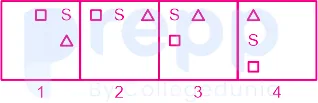
Which of the given figures when placed in the 5th position would continue the series that is established by the first four figures?
- A
Option A (shown in image)
- B
Option B (shown in image)
- C
Option C (shown in image)
- D
Option D (shown in image)
Show answer
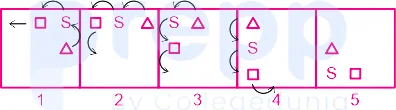
B. Option B (shown in image)The logic followed here is: All the three Elements of images are moving in anticlockwise direction.
Here, image 5 will continue the series.
Hence, the correct answer is 'Option 2'.
 Paper & answer key PDF ↗
 Question 8archived
Which of the following numbers will replace the question mark (?) in the given series?
232, 221, 199, ?, 122, 67
- A
155
- B
165
- C
177
- D
166
Show answer
D. 166Solving the Number Series Problem
The question asks us to find the missing number in the given series: 232, 221, 199, ?, 122, 67.
To solve this type of number series problem, we usually look for a pattern in the differences between consecutive terms.
Finding the Pattern in the Series
Let's calculate the difference between each consecutive pair of numbers:
Difference between the 1st and 2nd term: \(221 - 232 = -11\)
Difference between the 2nd and 3rd term: \(199 - 221 = -22\)
Difference between the 5th and 6th term: \(67 - 122 = -55\)
We have the differences: -11, -22, ?, ?, -55.
Let's examine these differences: -11, -22, ..., -55.
We can see a pattern emerging in these differences. The first difference is \(-11 \times 1\). The second difference is \(-11 \times 2\). The last known difference is \(-11 \times 5\).
This suggests that the differences between consecutive terms are multiples of 11, increasing by 11 each time.
Identifying the Missing Differences
Based on the pattern (-11, -22, ..., -55), the sequence of differences should be:
\(-11 \times 1 = -11\)
\(-11 \times 2 = -22\)
\(-11 \times 3 = -33\) (This should be the difference between the 3rd and 4th term)
\(-11 \times 4 = -44\) (This should be the difference between the 4th and 5th term)
\(-11 \times 5 = -55\) (This is the difference between the 5th and 6th term, which matches)
So, the missing differences are -33 and -44.
Calculating the Missing Number
The missing number is the 4th term in the series.
The difference between the 3rd term (199) and the 4th term is -33.
Let the missing number be \(x\). Then, \(x - 199 = -33\).
Solving for \(x\):
\(x = 199 + (-33)\)
\(x = 199 - 33\)
\(x = 166\)
Let's verify this by checking the next difference. The difference between the 4th term (166) and the 5th term (122) should be -44.
\(122 - 166 = -44\)
This matches the pattern we identified (-11, -22, -33, -44, -55).
Therefore, the missing number is 166.
Series and Differences
Term
Value
Difference from Previous
1st
232
-
2nd
221
\(221 - 232 = -11\)
3rd
199
\(199 - 221 = -22\)
4th
? (166)
\(166 - 199 = -33\)
5th
122
\(122 - 166 = -44\)
6th
67
\(67 - 122 = -55\)
Conclusion
The pattern involves subtracting consecutive multiples of 11. The missing number that fits this pattern is 166.
Revision Table: Number Series Pattern
Key Concepts for Number Series
Concept
Description
Arithmetic Series
Series where the difference between consecutive terms is constant.
Geometric Series
Series where the ratio between consecutive terms is constant.
Difference Method
Calculating the differences between consecutive terms to find a pattern. Sometimes, the pattern is in the differences themselves or in the differences of the differences (double difference series).
Mixed Series
Series that combine different patterns (e.g., arithmetic and geometric, or alternate terms following different patterns).
Additional Information: Approaches to Solving Series
When tackling a number series question, consider these common approaches:
Calculate Differences: Find the difference between consecutive terms. Look for a constant difference, an arithmetic progression in differences, or another recognizable pattern.
Calculate Ratios: Find the ratio between consecutive terms. Look for a constant ratio (geometric series).
Check Alternate Terms: Sometimes, the pattern involves only alternate terms.
Look for Squares/Cubes: Terms might be related to squares or cubes of numbers (\(1^2, 2^2, 3^2, ...\) or \(1^3, 2^3, 3^3, ...\)) or these plus/minus a constant or a sequence.
Combination of Operations: The pattern might involve a combination of multiplication/division and addition/subtraction (e.g., multiply by 2 and add 1).
Prime Numbers/Specific Sequences: The series might follow a sequence of prime numbers, Fibonacci numbers, etc.
Always test the identified pattern across the entire given series to ensure consistency before determining the missing term.
Paper & answer key PDF ↗ Question 9archived
If ‘<’ means ‘−’, ‘!’ means ‘×’, ‘>’ means ‘+’ and ‘$’ means ‘÷’, then what is the value of the following expression?
205 > 210 $ 15 ! 2 < 19
- A
242
- B
238
- C
214
- D
226
Show answer
C. 214Understanding Symbol to Operation Mapping
The question provides a specific set of rules where certain symbols represent standard arithmetic operations. We need to use these rules to convert a given expression involving these symbols into a standard mathematical expression and then evaluate it.
The given mapping is:
'<' means '−' (Subtraction)
'!' means '×' (Multiplication)
'>' means '+' (Addition)
'$' means '÷' (Division)
The expression we need to evaluate is: 205 > 210 $ 15 ! 2 < 19
Converting the Expression to Standard Operators
Let's replace each symbol in the expression with its corresponding arithmetic operator based on the given mapping:
Original Expression: 205 > 210 $ 15 ! 2 < 19
Replacing symbols:
'>' becomes '+'
'$' becomes '÷'
'!' becomes '×'
'<' becomes '-'
The converted mathematical expression is: 205 + 210 ÷ 15 × 2 - 19
Evaluating the Expression using Order of Operations
To find the value of the expression 205 + 210 ÷ 15 × 2 - 19, we must follow the standard order of operations (BODMAS/PEDMAS), which dictates the sequence of calculations: Brackets/Parentheses, Orders/Exponents, Division and Multiplication (from left to right), Addition and Subtraction (from left to right).
Let's evaluate step-by-step:
Division: First, perform the division operation.
$$ 210 \div 15 = 14 $$
The expression becomes: 205 + 14 × 2 - 19
Multiplication: Next, perform the multiplication operation.
$$ 14 \times 2 = 28 $$
The expression becomes: 205 + 28 - 19
Addition: Now, perform the addition operation.
$$ 205 + 28 = 233 $$
The expression becomes: 233 - 19
Subtraction: Finally, perform the subtraction operation.
$$ 233 - 19 = 214 $$
The final value of the expression is 214.
Final Answer Derivation
By correctly mapping the symbols to their respective arithmetic operations and applying the order of operations (BODMAS/PEDMAS), we evaluated the given expression step-by-step:
205 > 210 $ 15 ! 2 < 19
becomes
205 + 210 ÷ 15 × 2 - 19
Calculation:
$210 \div 15 = 14$
$14 \times 2 = 28$
$205 + 28 = 233$
$233 - 19 = 214$
The value of the expression is 214.
Symbol
Operation
<
− (Subtraction)
!
× (Multiplication)
>
+ (Addition)
$
÷ (Division)
Revision Table: Key Concepts
Concept
Description
Symbolic Operations
Assigning standard mathematical operations (+, −, ×, ÷) to specific symbols.
Order of Operations
Rules (like BODMAS/PEDMAS) that dictate the sequence in which mathematical operations should be performed to ensure a unique result. Division and Multiplication are done before Addition and Subtraction.
Additional Information: BODMAS/PEDMAS Rule
The BODMAS or PEDMAS rule is crucial for evaluating expressions correctly. It stands for:
Brackets (or Parentheses)
Orders (or Exponents/Indices)
Division and Multiplication (from left to right)
Addition and Subtraction (from left to right)
When both division and multiplication are present, you work from left to right. Similarly, when both addition and subtraction are present, you also work from left to right.
Paper & answer key PDF ↗ Question 10archived
In a certain code language, 'PLIERS' is coded as MMAFJO and 'SHOVEL' is coded as FZRLFR. How will 'WRENCH' be coded in the same language?
- A
CXJBQU
- B
BXJBPV
- C
BXJBQU
- D
CXIBPV
Show answer
B. BXJBPVThe correct answer is BXJBPV.
Once a potential pattern is found using one example, test it rigorously with any other provided examples. Apply the verified pattern to the word you need to code. Be mindful of alphabetical wrap-around (e.g., shifting before A or after Z). Practicing various types of coding-decoding problems helps in quickly identifying the underlying logic.
Paper & answer key PDF ↗ Question 11archived
In a certain code language, 'SPIT' is coded as ‘USKW’ and 'COPY' is coded as ‘ERRB’. How will 'MOCK' be coded in that language?
- A
OQEN
- B
PREN
- C
PQEN
- D
OREN
Show answer
D. ORENUnderstanding the Coding Rule for 'SPIT' and 'COPY'
This problem involves decoding a specific pattern used to transform one word into another. We are given two examples: 'SPIT' is coded as 'USKW', and 'COPY' is coded as 'ERRB'. Our goal is to find the rule governing this transformation and apply it to the word 'MOCK'.
Analyzing the Given Examples
Let's examine the first example, 'SPIT' $\rightarrow$ 'USKW', by looking at the position of each letter in the English alphabet:
S is the 19th letter, U is the 21st letter. The shift is $21 - 19 = +2$.
P is the 16th letter, S is the 19th letter. The shift is $19 - 16 = +3$.
I is the 9th letter, K is the 11th letter. The shift is $11 - 9 = +2$.
T is the 20th letter, W is the 23rd letter. The shift is $23 - 20 = +3$.
The pattern observed is a shift of $+2, +3, +2, +3$ for the successive letters.
Now, let's verify this pattern with the second example, 'COPY' $\rightarrow$ 'ERRB':
C is the 3rd letter, E is the 5th letter. The shift is $5 - 3 = +2$.
O is the 15th letter, R is the 18th letter. The shift is $18 - 15 = +3$.
P is the 16th letter, R is the 18th letter. The shift is $18 - 16 = +2$.
Y is the 25th letter, B is the 2nd letter. The shift is $2 + 26 - 25 = +3$ (considering the alphabet wraps around after Z).
The pattern of $+2, +3, +2, +3$ is consistent across both examples.
Applying the Rule to 'MOCK'
We will now apply the established $+2, +3, +2, +3$ shift pattern to the letters of 'MOCK'.
M: The first letter is M. Applying a $+2$ shift: M (13th) $\rightarrow$ 13 + 2 = 15th letter, which is O.
O: The second letter is O. Applying a $+3$ shift: O (15th) $\rightarrow$ 15 + 3 = 18th letter, which is R.
C: The third letter is C. Applying a $+2$ shift: C (3rd) $\rightarrow$ 3 + 2 = 5th letter, which is E.
K: The fourth letter is K. Applying a $+3$ shift: K (11th) $\rightarrow$ 11 + 3 = 14th letter, which is N.
Combining the resulting letters, MOCK is coded as OREN.
Coding of MOCK
Original Letter
Position
Shift
New Position
Coded Letter
M
13
+2
15
O
O
15
+3
18
R
C
3
+2
5
E
K
11
+3
14
N
Therefore, 'MOCK' is coded as 'OREN' in this language.
Revision Table: Letter Coding Principles
Concept
Description
Example
Letter Position
Assigning numerical value based on the letter's order in the alphabet (A=1, B=2, ..., Z=26).
J = 10, Q = 17, Z = 26
Shift/Pattern
The consistent rule (addition, subtraction, skipping letters, etc.) applied to each letter.
+2 shift: A $\rightarrow$ C, B $\rightarrow$ D
Wrap Around
When a shift goes beyond Z, returning to the start of the alphabet (A).
+3 shift from Y: Y(25) $\rightarrow$ Z(26) $\rightarrow$ A(1) $\rightarrow$ B(2). Result is B.
Additional Information: Types of Coding-Decoding
Coding-decoding questions test your ability to identify patterns and rules. Besides the letter shift pattern seen here, other common types include:
Letter Coding: Letters are replaced by other letters based on a specific rule (shift, reverse order, etc.). This question is an example of letter coding.
Number/Symbol Coding: Words are coded into numbers or symbols. Each letter might correspond to a number or symbol, or the word as a whole might be coded.
Mixed Coding: A mix of words, numbers, and symbols are used. Often, sentences are given and codes for specific words need to be deduced.
Substitution Coding: Where a word is given a substitute name (e.g., 'red' is called 'blue', 'blue' is called 'green').
Practice with different types helps in quickly identifying the pattern during exams.
Paper & answer key PDF ↗ Question 12archived
Three of the following four letter-clusters are alike in a certain way and one is different. Pick the odd one out.
- A
ADZV
- B
MPNK
- C
FIUR
- D
TWGD
Show answer
A. ADZVThe correct answer is ADZV.
Checking differences or sums of positions between letters. Looking for patterns involving vowels/consonants. Breaking down complex series into simpler sub-series. Regular practice with different types of patterns will improve your speed and accuracy in identifying the correct logic.
Paper & answer key PDF ↗ Question 13archived
Select the set in which the numbers are related in the same way as are the numbers of the given sets.
(NOTE : Operations should be performed on the whole numbers, without breaking down the numbers into its constituent digits. E.g. 13 – Operations on 13 such as adding /subtracting /multiplying etc. to 13 can be performed. Breaking down 13 into 1 and 3 and then performing mathematical operations on 1 and 3 is not allowed.)
(12, 8, 20)
(7, 3, 15)
- A
(9, 4, 19)
- B
(10, 5, 45)
- C
(8, 5, 12)
- D
(11, 7, 17)
Show answer
A. (9, 4, 19)Analyze the Given Number Sets
The problem asks us to find the relationship between the numbers in two given sets and then identify which of the options follows the same relationship. The given sets are (12, 8, 20) and (7, 3, 15).
Let's denote the numbers in a set as A, B, and C, where A is the first number, B is the second number, and C is the third number.
Set 1: (12, 8, 20) $\implies$ A = 12, B = 8, C = 20
Set 2: (7, 3, 15) $\implies$ A = 7, B = 3, C = 15
We are also given the constraint that operations must be performed on the whole numbers as they are, without breaking them down into individual digits (e.g., treating 13 as '1' and '3' is not allowed).
Discovering the Relationship Pattern
We need to find a mathematical relationship between A, B, and C that holds true for both given sets. Let's explore potential operations like addition, subtraction, multiplication, and combinations thereof.
Consider Set 1 (12, 8, 20):
A + B = 12 + 8 = 20. This equals C.
Now, let's test this simple relationship with Set 2 (7, 3, 15):
A + B = 7 + 3 = 10. This does not equal C (which is 15).
So, the relationship is not simply A + B = C.
Let's try other combinations or more complex relationships. How about a linear combination of A and B resulting in C, like $mA + nB = C$?
Using Set 1:
$12m + 8n = 20$
Using Set 2:
$7m + 3n = 15$}
We have a system of two linear equations with two variables (m and n). Let's solve for m and n.
From the second equation, $3n = 15 - 7m \implies n = \frac{15 - 7m}{3}$.
Substitute this into the first equation:
$12m + 8\left(\frac{15 - 7m}{3}\right) = 20$
$12m + \frac{120 - 56m}{3} = 20$
Multiply by 3 to clear the denominator:
$36m + 120 - 56m = 60$
$-20m = 60 - 120$
$-20m = -60$
$m = \frac{-60}{-20} = 3$
Now substitute the value of m back into the equation for n:
$n = \frac{15 - 7(3)}{3} = \frac{15 - 21}{3} = \frac{-6}{3} = -2$
So, the relationship seems to be $3A - 2B = C$. Let's verify this rule with the given sets.
For Set 1 (12, 8, 20): $3(12) - 2(8) = 36 - 16 = 20$. This matches C.
For Set 2 (7, 3, 15): $3(7) - 2(3) = 21 - 6 = 15$. This matches C.
The rule $3A - 2B = C$ is consistent with both given sets.
Testing the Options
Now we apply the discovered rule $3A - 2B = C$ to each of the given options to find the set that follows the same pattern.
Option Set (A, B, C)
Apply Rule $3A - 2B$
Result
Matches C?
(9, 4, 19)
$3(9) - 2(4) = 27 - 8$
19
Yes (19 = 19)
(10, 5, 45)
$3(10) - 2(5) = 30 - 10$
20
No (20 $\neq$ 45)
(8, 5, 12)
$3(8) - 2(5) = 24 - 10$
14
No (14 $\neq$ 12)
(11, 7, 17)
$3(11) - 2(7) = 33 - 14$
19
No (19 $\neq$ 17)
Identifying the Correct Set
Based on the application of the rule $3A - 2B = C$ to each option, we find that only the set (9, 4, 19) satisfies the relationship where three times the first number minus two times the second number equals the third number.
Revision Table: Key Concepts in Number Analogy
Concept
Description
Relevance to Problem
Pattern Recognition
Identifying underlying rules or sequences in numbers or objects.
Crucial for finding the relationship in the given number sets.
Arithmetic Operations
Basic operations: addition, subtraction, multiplication, division.
Form the basis of the relationships found in number analogy problems.
Algebraic Representation
Expressing relationships using variables and equations.
Helps in formulating and testing the rule consistently.
Systematic Testing
Applying potential rules methodically to the given sets and options.
Ensures the correct pattern is identified and validated.
Additional Information: Types of Number Patterns
Number analogy and pattern questions can involve various types of relationships. Understanding common patterns can help in solving such problems faster.
Arithmetic Progression: Numbers increase or decrease by a constant difference (e.g., 2, 4, 6, 8...).
Geometric Progression: Numbers are multiplied or divided by a constant ratio (e.g., 3, 6, 12, 24...).
Series involving Squares/Cubes: Patterns related to squares ($1^2, 2^2, 3^2,...$) or cubes ($1^3, 2^3, 3^3,...$) of numbers, or operations involving them.
Combined Operations: Relationships involving a mix of arithmetic operations, often applied to the numbers in a set in a specific order. The pattern $3A - 2B = C$ found in this problem is an example of a combined operation.
Digit-based Operations: Although explicitly disallowed in this specific question, some problems involve operations on the individual digits of the numbers.
Successfully solving number analogy problems requires careful observation, systematic testing of potential relationships, and familiarity with common mathematical patterns.
Paper & answer key PDF ↗ Question 14archived
The second number in the given number pairs is obtained by performing certain mathematical operation(s) on the first number. The same operation(s) are followed in all the number pairs, EXCEPT one. Find that odd number pair.
- A
(6, 108)
- B
(5, 100)
- C
(11, 968)
- D
(8, 320)
Show answer
B. (5, 100)Correct Answer: 5, 100
Explanation:
The relationship followed by the numbers in the pairs is:
(First Number)2 × (First Number - 3) = Second Number
Verifying the options:
Option 1: 62 × (6 - 3) = 36 × 3 = 108 (Follows the pattern)
Option 3: 112 × (11 - 3) = 121 × 8 = 968 (Follows the pattern)
Option 4: 82 × (8 - 3) = 64 × 5 = 320 (Follows the pattern)
Checking the odd pair:
Option 2: 52 × (5 - 3) = 25 × 2 = 50
Since the given value is 100 instead of 50, (5, 100) is the odd pair.
Paper & answer key PDF ↗ Question 15archived
Which two signs should be interchanged to make the given equation correct?
312 – 13 × 14 + 207 ÷ 4 = 539
- A
÷ and –
- B
– and +
- C
÷ and +
- D
+ and ×
Show answer
A. ÷ and –How to Solve Sign Interchange Problems in Equations
The problem asks us to find which pair of mathematical signs, when swapped in the given equation, makes the equation correct. The original equation is:
\(312 \text{ – } 13 \text{ × } 14 + 207 \text{ ÷ } 4 = 539\)
First, let's evaluate the original equation using the BODMAS/PEMDAS rule (Brackets, Orders/Exponents, Division and Multiplication (from left to right), Addition and Subtraction (from left to right)).
\(312 - (13 \times 14) + (207 \div 4)\)
\(312 - 182 + 51.75\)
\(130 + 51.75 = 181.75\)
Since \(181.75 \neq 539\), the original equation is incorrect. We need to test each option by interchanging the specified signs and re-evaluating the equation.
Analyzing Each Option by Swapping Signs
Let's systematically test each given option:
Option 1: Interchange ÷ and –
Swap the ÷ and – signs in the original equation. The new equation becomes:
\(312 \text{ ÷ } 13 \text{ × } 14 + 207 \text{ – } 4\)
Now, evaluate this equation using BODMAS/PEMDAS:
Perform Division: \(312 \div 13 = 24\)
The equation is now: \(24 \text{ × } 14 + 207 \text{ – } 4\)
Perform Multiplication: \(24 \times 14 = 336\)
The equation is now: \(336 + 207 \text{ – } 4\)
Perform Addition and Subtraction from left to right:
\(336 + 207 = 543\)
The equation is now: \(543 \text{ – } 4\)
Perform Subtraction: \(543 - 4 = 539\)
The result is 539, which matches the right side of the original equation. Therefore, interchanging the ÷ and – signs makes the equation correct.
Let's quickly look at other options to confirm they don't yield the correct result, even though we found the solution in Option 1.
Option 2: Interchange – and +
Swap the – and + signs: \(312 + 13 \text{ × } 14 \text{ – } 207 \text{ ÷ } 4\)
Evaluate:
\(312 + (13 \times 14) \text{ – } (207 \div 4)\)
\(312 + 182 \text{ – } 51.75\)
\(494 \text{ – } 51.75 = 442.25\)
\(442.25 \neq 539\).
Option 3: Interchange ÷ and +
Swap the ÷ and + signs: \(312 \text{ – } 13 \text{ × } 14 \text{ ÷ } 207 + 4\)
Evaluate:
\(312 \text{ – } (13 \times 14 \div 207) + 4\)
\(312 \text{ – } (182 \div 207) + 4\)
\(312 \text{ – } 0.879... + 4 \approx 311.12 + 4 = 315.12\)
\(315.12 \neq 539\).
Option 4: Interchange + and ×
Swap the + and × signs: \(312 \text{ – } 13 + 14 \text{ × } 207 \text{ ÷ } 4\)
Evaluate:
\(312 \text{ – } 13 + (14 \times 207 \div 4)\)
\(312 \text{ – } 13 + (2898 \div 4)\)
\(312 \text{ – } 13 + 724.5\)
\(299 + 724.5 = 1023.5\)
\(1023.5 \neq 539\).
Correct Signs to Interchange
Based on the evaluation, interchanging the ÷ and – signs results in the correct equation.
Option
Signs Interchanged
New Equation
Result
Correct?
Original
None
\(312 \text{ – } 13 \text{ × } 14 + 207 \text{ ÷ } 4\)
181.75
No
1
÷ and –
\(312 \text{ ÷ } 13 \text{ × } 14 + 207 \text{ – } 4\)
539
Yes
2
– and +
\(312 + 13 \text{ × } 14 \text{ – } 207 \text{ ÷ } 4\)
442.25
No
3
÷ and +
\(312 \text{ – } 13 \text{ × } 14 \text{ ÷ } 207 + 4\)
~315.12
No
4
+ and ×
\(312 \text{ – } 13 + 14 \text{ × } 207 \text{ ÷ } 4\)
1023.5
No
Revision Table: Summary of Sign Swaps
The analysis confirms that only swapping ÷ and – yields the target value of 539.
Additional Information: Understanding BODMAS/PEMDAS
To solve equations involving multiple operations, we follow a specific order. This order is commonly known as BODMAS or PEMDAS.
BODMAS: Brackets, Orders (powers and square roots), Division and Multiplication (from left to right), Addition and Subtraction (from left to right).
PEMDAS: Parentheses, Exponents, Multiplication and Division (from left to right), Addition and Subtraction (from left to right).
Both acronyms represent the same order of operations. It's crucial to follow this order to get the correct result. For example, in \(10 + 2 \times 5\), you must do the multiplication first (\(2 \times 5 = 10\)), then the addition (\(10 + 10 = 20\)), not \(10 + 2 = 12\) then \(12 \times 5 = 60\).
Paper & answer key PDF ↗ Question 16archived
Select the option that represents the correct order of the given words as they would appear in an English dictionary.
1. Appear
2. Approach
3. Approximate
4. Apparition
5. Apparel
- A
4,5,1,2,3
- B
4,1,5,2,3
- C
5,4,1,2,3
- D
5,1,4,2,3
Show answer
C. 5,4,1,2,3Understanding Alphabetical Order for Dictionary Arrangement
To determine the correct order of words as they would appear in an English dictionary, we need to arrange them alphabetically. This involves comparing the words letter by letter from left to right. When letters are the same, we move to the next letter until a difference is found.
Let's look at the given words and their corresponding numbers:
Appear
Approach
Approximate
Apparition
Apparel
All the words begin with the letters "App". We need to look at the fourth letter of each word:
Appear: 4th letter is 'e'
Approach: 4th letter is 'r'
Approximate: 4th letter is 'r'
Apparition: 4th letter is 'a'
Apparel: 4th letter is 'a'
According to alphabetical order, 'a' comes before 'e', and 'e' comes before 'r'. So, the words starting with "Appa" will come first, followed by the word starting with "Appe", and then the words starting with "Appro".
Let's order the words starting with "Appa": Apparition and Apparel.
Apparition: Apparition
Apparel: Apparel
Both have 'r' as the fifth letter. Let's look at the sixth letter:
Apparition: Apparition
Apparel: Apparel
'e' comes before 'i'. Therefore, "Apparel" comes before "Apparition". So, the order for these two is 5, 4.
Next is the word starting with "Appe": Appear (number 1).
Finally, let's order the words starting with "Appro": Approach and Approximate.
Approach: Approach
Approximate: Approximate
'a' comes before 'x'. Therefore, "Approach" comes before "Approximate". So, the order for these two is 2, 3.
Combining the ordered groups, the complete alphabetical order is:
Words starting with "Appa": Apparel (5), Apparition (4)
Word starting with "Appe": Appear (1)
Words starting with "Appro": Approach (2), Approximate (3)
The final order of the numbers is 5, 4, 1, 2, 3.
Let's summarize the comparison steps:
Word
Number
Letters Compared
Order Reason
Apparel
5
Appare...
'e' in 6th position comes before 'i' in 'Apparition'
Apparition
4
Appari...
'i' in 6th position comes after 'e' in 'Apparel'
Appear
1
Appe...
'e' in 4th position comes after 'a' in 'Apparel', 'Apparition'
Approach
2
Approa...
'a' in 6th position comes before 'x' in 'Approximate'
Approximate
3
Approx...
'x' in 6th position comes after 'a' in 'Approach'
Thus, the correct order of the given words as they would appear in an English dictionary is Apparel, Apparition, Appear, Approach, Approximate, which corresponds to the numbers 5, 4, 1, 2, 3.
Revision Table: Alphabetical Word Ordering
Word
Number
Step-by-Step Comparison
Apparel
5
Apparel ('e' comes before 'i' in Apparition)
Apparition
4
Apparition ('i' comes after 'e' in Apparel)
Appear
1
Appear ('e' comes after 'a' in Apparition/Apparel, before 'r' in Approach/Approximate)
Approach
2
Approach ('a' comes before 'x' in Approximate)
Approximate
3
Approximate ('x' comes after 'a' in Approach)
Additional Information on Dictionary Order
Dictionary order, also known as lexicographical order, is the standard method for arranging words and phrases alphabetically. Here are some key points about how it works:
Letter by Letter: Words are compared one letter at a time from the beginning.
Alphabetical Value: The standard English alphabet (A-Z) determines the order of letters. 'a' comes before 'b', 'b' before 'c', and so on.
Shorter Words: If two words are identical up to the length of the shorter word, the shorter word comes first. For example, "cat" comes before "catalog". (Not applicable in this specific question as all words are distinct).
Case Sensitivity: Standard dictionary order is usually case-insensitive, but specific sorting algorithms might treat uppercase and lowercase letters differently. For general purposes like this question, we assume case-insensitivity.
Spaces and Symbols: While not in this question, sorting can also involve rules for spaces, hyphens, and other symbols, though these rules can vary.
Mastering alphabetical order is crucial for using dictionaries, indexes, and sorting data efficiently.
Paper & answer key PDF ↗ Question 17archived
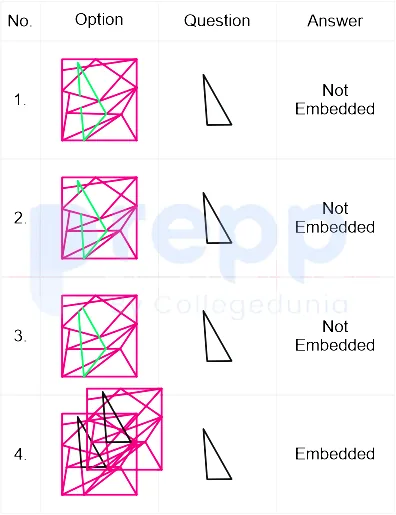
Select the option figure in which the given figure is embedded (rotation is NOT allowed).

- A
Option A (shown in image)
- B
Option B (shown in image)
- C
Option C (shown in image)
- D
Option D (shown in image)
Show answer
D. Option D (shown in image)The image embedded in given figure is as shown below:
Hence the correct answer is 'Option 4'.
 Paper & answer key PDF ↗
 Question 18archived
Select the option that represents the letters that, when sequentially placed from left to right in the blanks below, will complete the letter series.
M_ _ KS _ ON _ SMO _ K _ _ _ NKS
- A
ONMNKOMS
- B
ONMKNSMO
- C
ONMMMMMO
- D
NMOKNSMO
Show answer
B. ONMKNSMOSolving Letter Series Completion Problems
Letter series problems require identifying a specific pattern or sequence among the letters. This pattern can be based on repetition, alphabetical order, skipped letters, or a combination of rules. To solve a completion problem like this, we need to find the set of letters that fits into the blanks to reveal the hidden pattern.
Analyzing the Given Letter Series
The given letter series is: M_ _ KS _ ON _ SMO _ K _ _ _ NKS
There are several blanks that need to be filled. We are given four options, each providing a sequence of letters. We need to test each option by placing its letters sequentially into the blanks from left to right and see which one creates a discernible pattern in the complete series.
Testing the Options to Find the Pattern
Let's examine the correct option, which provides the letters ONMKNSMO. We will place these letters into the blanks in the original series.
Original series with blanks:
M _ _ KS _ ON _ SMO _ K _ _ _ NKS
Let's identify the positions of the blanks:
Position 2, 3, 6, 8, 12, 14, 15, 16
The letters from the correct option are (in order): O, N, M, K, N, S, M, O.
Now, let's fill the blanks with these letters:
Blank at position 2 gets 'O'
Blank at position 3 gets 'N'
Blank at position 6 gets 'M'
Blank at position 8 gets 'K'
Blank at position 12 gets 'N'
Blank at position 14 gets 'S'
Blank at position 15 gets 'M'
Blank at position 16 gets 'O'
Filling the blanks with ONMKNSMO gives us the complete letter series:
M O N K S M O N K S M O N K S M O N K S
Let's rewrite the completed series clearly:
MONKSMONKSMONKSMONKS
Identifying the Repeating Pattern in the Completed Series
Looking at the complete series MONKSMONKSMONKSMONKS, we can clearly see a repeating block of letters.
The series can be broken down into equal segments:
MONKS | MONKS | MONKS | MONKS
The repeating unit or pattern is "MONKS". This block repeats exactly 4 times to form the complete series.
The letters from the option ONMKNSMO successfully filled the blanks to create this consistent, repeating pattern of "MONKS". Therefore, these are the correct letters to complete the series.
Conclusion
By placing the letters ONMKNSMO sequentially into the blanks of the given letter series M_ _ KS _ ON _ SMO _ K _ _ _ NKS, we obtained the complete series MONKSMONKSMONKSMONKS. This complete series follows a clear repeating pattern of the block 'MONKS'. Thus, the option containing ONMKNSMO is the correct choice for completing the letter series.
Revision Table: Key Steps for Letter Series
Step
Action
Purpose
1
Examine the series
Understand the structure and blank positions.
2
Look at options
Identify the possible letters to fill the blanks.
3
Try an option
Fill the blanks sequentially with letters from one option.
4
Analyze completed series
Look for repeating patterns, alphabetical progression, or other rules.
5
Confirm the pattern
Ensure the chosen letters consistently form the identified pattern throughout the series.
Additional Information on Series Completion
Series completion questions are common in logical reasoning tests. They can involve numbers, letters, or symbols. For letter series, common patterns include:
Repeating Blocks: A specific sequence of letters repeats multiple times. (Like the 'MONKS' pattern here).
Alphabetical Progression: Letters follow the alphabet, often skipping a fixed number of letters (e.g., A, C, E, G...).
Skipping Letters: The number of skipped letters between terms follows a pattern (e.g., skipping 1, then 2, then 3 letters).
Reverse Alphabetical Order: Letters follow the alphabet backward.
Combination of Patterns: The pattern might combine different rules or even alternate between different types of sequences.
Position-Based Patterns: The position of letters in the alphabet (A=1, B=2, etc.) might be used in calculations or sequences.
Practicing with different types of letter series helps improve your ability to quickly identify the underlying rule or pattern.
Paper & answer key PDF ↗ Question 19archived
Select the option that is related to the third word in the same way as the second word is related to the first word. (The words must be considered as meaningful English words and must not be related to each other based on the number of letters/number of consonants/vowels in the word)
Vacant : Empty :: Enormous : ?
- A
Sufficient
- B
Ample
- C
Huge
- D
Small
Show answer
C. HugeUnderstanding Word Analogies: Finding Relationships
The question asks us to find a word that has the same relationship with 'Enormous' as 'Empty' has with 'Vacant'. This type of question tests our understanding of word meanings and the relationships between them, specifically focusing on word analogies.
Analyzing the Relationship: Vacant and Empty
Let's look at the first pair of words: Vacant and Empty.
Vacant means not occupied, holding, or containing anything; empty.
Empty means containing nothing; not filled or occupied.
Based on these definitions, Vacant and Empty are synonyms. They have essentially the same meaning.
Applying the Relationship to Enormous
The relationship between the first two words is that they are synonyms. Therefore, we need to find a word among the options that is a synonym for Enormous.
What does Enormous mean? It means extremely large or immense.
Evaluating the Options
Now let's examine the given options to see which one is a synonym for Enormous:
Sufficient: Means enough or adequate. This is not a synonym for enormous.
Ample: Means enough or more than enough; plentiful. While it can imply a large quantity, it's not a direct synonym for enormous size.
Huge: Means extremely large. This is a direct synonym for enormous.
Small: Means of limited size, amount, or intensity. This is an antonym (opposite) of enormous.
Identifying the Correct Related Word
Comparing the options, Huge is the word that means the same or very similar to Enormous. Just as Vacant is a synonym for Empty, Enormous is a synonym for Huge.
Revision Table: Key Vocabulary Relationships
Word 1
Word 2
Relationship Type
Example Pair
Vacant
Empty
Synonyms (Same Meaning)
Vacant : Empty
Enormous
Huge
Synonyms (Same Meaning)
Enormous : Huge
Hot
Cold
Antonyms (Opposite Meaning)
Hot : Cold
Finger
Hand
Part to Whole
Finger : Hand
Additional Information: Exploring Different Analogy Types
Word analogies can show many different types of relationships between word pairs. Understanding these relationships helps in solving analogy questions. Besides synonym relationships, some common types include:
Antonym: Words with opposite meanings (e.g., Day : Night)
Part to Whole: One word is a part of the other (e.g., Wheel : Car)
Cause and Effect: One word is the cause and the other is the effect (e.g., Rain : Flood)
Worker and Tool: One word is a person who uses the other (e.g., Carpenter : Hammer)
Action and Object: One word is an action performed on the other (e.g., Read : Book)
Category and Item: One word is a category, and the other is an item in that category (e.g., Fruit : Apple)
Practicing with different types of word analogies helps improve vocabulary and logical reasoning skills.
Paper & answer key PDF ↗ Question 20archived
Select the correct combination of mathematical signs to sequentially replace the * signs and balance the given equation.
32 * 14 * 18 * 9 * 12 * 22
- A
−, +, ÷, ×, =
- B
+, −, ÷, ×, =
- C
×, +, ÷, −, =
- D
÷, −, +, ×, =
Show answer
B. +, −, ÷, ×, =Balancing Mathematical Equations with Signs
The problem asks us to find the correct sequence of mathematical signs (−, +, ÷, ×, =) to replace the asterisks (*) in the given expression so that the equation becomes balanced. The expression is:
\(32 * 14 * 18 * 9 * 12 * 22\)
We need to test the options provided to see which sequence of signs makes the left side of the equation equal to the right side (which will be the number after the '=' sign).
Testing the Options to Balance the Equation
Let's evaluate each option by substituting the signs into the equation and following the order of operations (BODMAS/PEMDAS: Brackets, Orders/Exponents, Division and Multiplication (from left to right), Addition and Subtraction (from left to right)).
Option 1: −, +, ÷, ×, =
Substituting these signs, the equation becomes:
\(32 - 14 + 18 \div 9 \times 12 = 22\)
Let's calculate the left side:
Perform Division: \(18 \div 9 = 2\)
The expression becomes: \(32 - 14 + 2 \times 12 = 22\)
Perform Multiplication: \(2 \times 12 = 24\)
The expression becomes: \(32 - 14 + 24 = 22\)
Perform Subtraction and Addition from left to right: \(32 - 14 = 18\)
The expression becomes: \(18 + 24 = 22\)
Perform Addition: \(18 + 24 = 42\)
So, the equation becomes \(42 = 22\), which is false. Option 1 is incorrect.
Option 2: +, −, ÷, ×, =
Substituting these signs, the equation becomes:
\(32 + 14 - 18 \div 9 \times 12 = 22\)
Let's calculate the left side following the order of operations:
Perform Division: \(18 \div 9 = 2\)
The expression becomes: \(32 + 14 - 2 \times 12 = 22\)
Perform Multiplication: \(2 \times 12 = 24\)
The expression becomes: \(32 + 14 - 24 = 22\)
Perform Addition and Subtraction from left to right: \(32 + 14 = 46\)
The expression becomes: \(46 - 24 = 22\)
Perform Subtraction: \(46 - 24 = 22\)
So, the equation becomes \(22 = 22\), which is true. Option 2 balances the equation.
Option 3: ×, +, ÷, −, =
Substituting these signs, the equation becomes:
\(32 \times 14 + 18 \div 9 - 12 = 22\)
Let's calculate the left side:
Perform Division: \(18 \div 9 = 2\)
The expression becomes: \(32 \times 14 + 2 - 12 = 22\)
Perform Multiplication: \(32 \times 14 = 448\)
The expression becomes: \(448 + 2 - 12 = 22\)
Perform Addition and Subtraction from left to right: \(448 + 2 = 450\)
The expression becomes: \(450 - 12 = 22\)
Perform Subtraction: \(450 - 12 = 438\)
So, the equation becomes \(438 = 22\), which is false. Option 3 is incorrect.
Option 4: ÷, −, +, ×, =
Substituting these signs, the equation becomes:
\(32 \div 14 - 18 + 9 \times 12 = 22\)
Let's calculate the left side:
Perform Division: \(32 \div 14\). This does not result in an integer, suggesting this option is unlikely to balance to a whole number like 22. \(32 \div 14 = \frac{32}{14} = \frac{16}{7}\)
The expression becomes: \(\frac{16}{7} - 18 + 9 \times 12 = 22\)
Perform Multiplication: \(9 \times 12 = 108\)
The expression becomes: \(\frac{16}{7} - 18 + 108 = 22\)
Combine integers: \( - 18 + 108 = 90\)
The expression becomes: \(\frac{16}{7} + 90 = 22\)
Perform Addition: \(\frac{16}{7} + \frac{90 \times 7}{7} = \frac{16 + 630}{7} = \frac{646}{7}\)
So, the equation becomes \(\frac{646}{7} = 22\), which is false (\(\frac{646}{7} \approx 92.28\)). Option 4 is incorrect.
Conclusion for Balancing Equation
Option 2 is the only combination of mathematical signs that correctly balances the given equation.
The correct sequence of signs is +, −, ÷, ×, =.
Revision Table: Mathematical Signs and Order of Operations
Sign
Meaning
Order of Operation
+
Addition
Evaluated after Division and Multiplication
−
Subtraction
Evaluated after Division and Multiplication
×
Multiplication
Evaluated after Division (if present), before Addition and Subtraction
÷
Division
Evaluated before Multiplication, Addition, and Subtraction
=
Equals
Indicates that the expression on the left has the same value as the expression on the right
Additional Information: Solving Mathematical Sign Puzzles
Mathematical sign puzzles test your ability to apply the correct order of operations (BODMAS/PEMDAS) when different arithmetic operations are present in an expression. Here are some tips for solving these puzzles:
Understand the Order of Operations: Remember BODMAS/PEMDAS (Brackets, Orders/Exponents, Division and Multiplication (left-to-right), Addition and Subtraction (left-to-right)).
Substitute and Calculate: Replace the placeholders (*) with the given signs for each option and evaluate the expression carefully.
Work Step-by-Step: Perform operations in the correct order. First division and multiplication, then addition and subtraction. If there are multiple operations of the same level (like division and multiplication), perform them from left to right.
Check for Integer Results: If the numbers in the puzzle are integers and the target result is an integer, look for division operations that result in whole numbers early in the process, as this can sometimes quickly eliminate options.
Be Careful with Signs: Pay close attention to negative signs, especially when subtracting or multiplying/dividing negative numbers.
Practicing different types of these puzzles helps improve speed and accuracy in applying mathematical operations.
Paper & answer key PDF ↗ Question 21archived
Study the given pattern carefully and select the number that can replace the question mark (?) in it.
(3, 9, 2)
(8, 6, 8)
(5, 3, ?)
(NOTE: Operations should be performed on the whole numbers, without breaking down the numbers into its constituent digits. E.g. 13 – Operations on 13 such as adding/subtracting/multiplying etc. to 13 can be performed. Breaking down 13 into 1 and 3 and then performing mathematical operations on 1 and 3 is not allowed)
- A
22
- B
13
- C
10
- D
5
Show answer
C. 10The correct answer is 10.
Formulating hypotheses and testing them against all given data points. In this particular problem, the pattern was a linear combination of the first two numbers plus a constant, represented by the formula k_1 \times \text{First} + k_2 \times \text{Second} + c = \text{Third}. Such patterns can be found by setting up and solving systems of linear equations if enough examples (sets) are provided to determine the constants.
Paper & answer key PDF ↗ Question 22archived
Azad points towards a picture and says it’s the picture of his mother’s father’s only granddaughter’s only brother. How is Azad related to the person in the picture?
- A
Sister
- B
Son
- C
Father
- D
Azad himself
Show answer
D. Azad himselfSolving Blood Relations: Understanding Azad's Picture Connection
This question asks us to determine how Azad is related to the person in a picture, based on a descriptive statement given by Azad. We need to carefully break down the statement step by step to trace the relationship.
Azad says the picture is of his mother's father's only granddaughter's only brother.
Step-by-Step Breakdown of the Relation
"Azad's mother's father": The father of Azad's mother is Azad's maternal grandfather.
"His mother's father's only granddaughter": This refers to the only granddaughter of Azad's maternal grandfather. A granddaughter of the maternal grandfather could be a daughter of Azad's mother or a daughter of Azad's mother's sibling (Azad's aunt or uncle). The term "only granddaughter" is key. If Azad's maternal grandfather has other children (Azad's aunts/uncles) who also have daughters, then this statement is ambiguous or implies a specific line. However, in typical blood relation puzzles, "only granddaughter" in this context most commonly refers to the only female grandchild born to the maternal grandfather's child who is directly related to the speaker's generation through the stated path (Azad's mother). Thus, it refers to the only daughter of Azad's mother, which is Azad's sister. (Assuming Azad's mother is the only child with a daughter, or is the only child of her father, and has only one daughter). Let's proceed with the most likely interpretation that the 'only granddaughter' refers to Azad's sister.
"His mother's father's only granddaughter's only brother": This is the only brother of the person identified in step 2 (Azad's sister). The only brother of one's sister is oneself.
Tracing the Path
Part of Statement
Relation to Azad
Azad's mother
Mother
Azad's mother's father
Maternal Grandfather
Azad's mother's father's only granddaughter
Azad's Sister (most likely interpretation)
Azad's mother's father's only granddaughter's only brother
Azad Himself
Following this chain of relationships, the person in the picture, described as the only brother of Azad's sister (who is the only granddaughter of his maternal grandfather), turns out to be Azad himself.
Conclusion
Based on the breakdown of the statement, the person in the picture is Azad himself.
Revision Table: Key Blood Relation Terms
Term
Definition
Maternal Grandfather
Father of one's mother.
Paternal Grandfather
Father of one's father.
Granddaughter
Daughter of one's son or daughter.
Brother
A male sibling.
Sister
A female sibling.
Additional Information: Approaches to Solving Blood Relation Puzzles
Blood relation questions test your ability to understand and interpret complex relationship statements. Here are some common approaches to solve them:
Drawing a Family Tree: For more complex relations, sketching a simple family tree diagram can be very helpful in visualizing the connections between individuals.
Backward Approach: Start from the end of the statement and work backward towards the person making the statement. For example, "only brother" → "only granddaughter" → "mother's father" → "mother".
Keyword Analysis: Identify key relationship terms like father, mother, son, daughter, brother, sister, uncle, aunt, grandfather, grandmother, etc., and understand their meanings in relation to the speaker.
Break Down Complex Statements: Split a long, complex statement into smaller, manageable parts as demonstrated in the solution above.
Consider "Only" Carefully: Words like "only" are crucial and can limit possibilities significantly. "Only son", "only daughter", "only child", "only brother", "only sister", "only granddaughter", "only grandson" all provide specific constraints.
Practicing various types of blood relation puzzles will improve your speed and accuracy in solving them.
Paper & answer key PDF ↗ Question 23archived
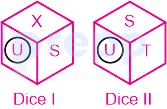
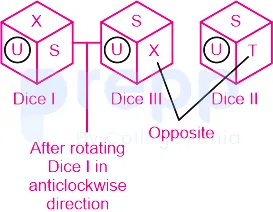
Two different positions of the same dice are shown. Identify the letter on the face opposite the face showing 'X'.

- A
W
- B
S
- C
V
- D
T
Show answer
D. TTo find the face opposite the face showing 'X', we need to compare the common surface in the given dices,
Now, from the given dice,
'U' is the common surface in both the dice, S, T and X are the faces adjacent to it.
If we rotate Dice I, in anticlockwise direction it becomes Dice III
Then, if we compare the two adjacent faces of S, X and T, they are opposite to each other.
So, 'T' is the face opposite to 'X'.
Hence, the correct answer is 'Option 4'.
 Paper & answer key PDF ↗
 Question 24archived
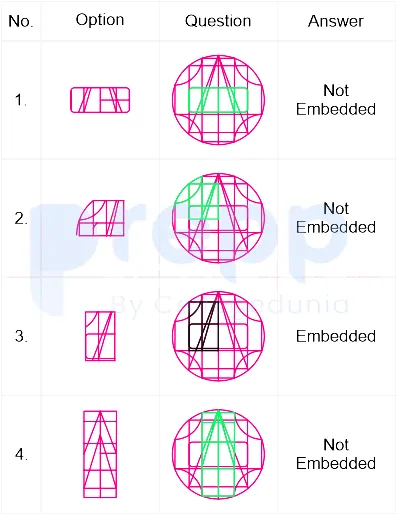
Select the option figure which is embedded in the given figure (Rotation is NOT allowed).

- A
Option A (shown in image)
- B
Option B (shown in image)
- C
Option C (shown in image)
- D
Option D (shown in image)
Show answer
C. Option C (shown in image)The image embedded in given figure is as shown below:
Hence, the correct answer is 'Option 3'.
 Paper & answer key PDF ↗
 Question 25archived
Which of the following terms will replace the question mark (?) in the given series?
CM, EP, GO, IS, KQ, MV, OS, ?
- A
PY
- B
QY
- C
QZ
- D
QX
Show answer
B. QYUnderstanding the Letter Series Pattern
The given problem asks us to identify the pattern in a letter series and determine the term that replaces the question mark (?). The series is: CM, EP, GO, IS, KQ, MV, OS, ?
Each term in the series consists of two letters. We need to analyze the pattern for the first letter and the second letter separately.
Analyzing the First Letter Pattern
Let's look at the first letter of each term in the sequence:
C (from CM)
E (from EP)
G (from GO)
I (from IS)
K (from KQ)
M (from MV)
O (from OS)
? (the first letter of the next term)
Let's consider the alphabetical position of each of these letters:
Letter
Alphabetical Position
C
3
E
5
G
7
I
9
K
11
M
13
O
15
Now let's look at the difference in the alphabetical positions between consecutive letters:
E - C: $5 - 3 = 2$
G - E: $7 - 5 = 2$
I - G: $9 - 7 = 2$
K - I: $11 - 9 = 2$
M - K: $13 - 11 = 2$
O - M: $15 - 13 = 2$
The pattern for the first letter is consistent: each subsequent letter's alphabetical position increases by 2. Following this pattern, the alphabetical position of the next first letter should be $15 + 2 = 17$. The letter at the 17th position in the alphabet is Q.
Analyzing the Second Letter Pattern
Now let's examine the second letter of each term in the series:
M (from CM)
P (from EP)
O (from GO)
S (from IS)
Q (from KQ)
V (from MV)
S (from OS)
? (the second letter of the next term)
Let's consider the alphabetical position of each of these letters:
Letter
Alphabetical Position
M
13
P
16
O
15
S
19
Q
17
V
22
S
19
Now let's look at the difference in the alphabetical positions between consecutive letters:
P - M: $16 - 13 = +3$
O - P: $15 - 16 = -1$
S - O: $19 - 15 = +4$
Q - S: $17 - 19 = -2$
V - Q: $22 - 17 = +5$
S - V: $19 - 22 = -3$
The pattern for the second letter differences appears to be an alternating sequence of increasing positive numbers and decreasing negative numbers: $+3, -1, +4, -2, +5, -3$. Following this pattern, the next difference should be $+6$.
The last second letter was S, which has an alphabetical position of 19. Applying the next step in the pattern, we add 6 to its position: $19 + 6 = 25$. The letter at the 25th position in the alphabet is Y.
Finding the Next Term in the Letter Series
Based on our analysis:
The next first letter in the series is Q.
The next second letter in the series is Y.
Combining these, the next term in the given letter series is QY.
Checking the Options
Let's compare our derived term with the given options:
PY: First letter P (16), Second letter Y (25). Does not match QY.
QY: First letter Q (17), Second letter Y (25). Matches QY.
QZ: First letter Q (17), Second letter Z (26). Does not match QY.
QX: First letter Q (17), Second letter X (24). Does not match QY.
The term QY matches one of the given options.
Revision Table: Letter Series Reasoning
Term
First Letter (Position)
First Letter Pattern
Second Letter (Position)
Second Letter Pattern
CM
C (3)
-
M (13)
-
EP
E (5)
$+2$
P (16)
$+3$
GO
G (7)
$+2$
O (15)
$-1$
IS
I (9)
$+2$
S (19)
$+4$
KQ
K (11)
$+2$
Q (17)
$-2$
MV
M (13)
$+2$
V (22)
$+5$
OS
O (15)
$+2$
S (19)
$-3$
?
Q (17)
$+2$
Y (25)
$+6$
Additional Information: Letter Series Analysis
Letter series questions are common in logical reasoning and verbal ability tests. They require identifying the underlying rule or pattern that connects consecutive terms. Patterns can involve:
Adding or subtracting a constant number to the alphabetical position.
Adding or subtracting a varying number based on a sequence (e.g., increasing/decreasing arithmetic progression, Fibonacci sequence, etc.).
Alternating patterns (like the second letter pattern in this problem).
Skipping letters in the alphabet.
Reversing alphabetical order.
Combinations of the above patterns for multi-letter terms.
To solve such problems, it is helpful to write down the alphabetical positions of the letters involved and look for numerical patterns. Always check if the identified pattern holds true for all given terms before predicting the next one.
Paper & answer key PDF ↗ Question 26archived
Which committee recommended the formation of a new category of NBFC i.e., Non-Banking Financial Company-Micro Finance Institution?
- A
Shah Committee
- B
Malegam Committee
- C
Kamath Committee
- D
Hussain Committee
Show answer
B. Malegam CommitteeUnderstanding the NBFC-MFI Recommendation Committee
The question asks to identify the specific committee that played a crucial role in the evolution of the regulatory framework for microfinance institutions operating as Non-Banking Financial Companies (NBFCs) in India. This involved recommending the creation of a distinct category for these entities known as NBFC-Micro Finance Institutions (NBFC-MFI).
In the context of financial sector regulation, particularly concerning microfinance, various committees are constituted by the Reserve Bank of India (RBI) or the government to review existing norms and suggest necessary changes. These recommendations often shape future policies and regulations.
The Malegam Committee and NBFC-MFI Classification
Following certain issues and concerns raised in the microfinance sector, particularly in Andhra Pradesh around 2010, the Reserve Bank of India (RBI) formed a Sub-Committee of the Central Board of Directors to study the issues and make recommendations. This committee was chaired by Mr. Y. H. Malegam.
The mandate of the Malegam Committee included:
Studying the issues concerning the microfinance sector.
Examining the regulatory framework for MFIs.
Suggesting necessary legislative and regulatory changes.
A key recommendation of the Malegam Committee was the creation of a separate category of NBFCs specifically for microfinance activities. This new category, NBFC-MFI, was proposed to address regulatory gaps and provide a clear framework for entities primarily engaged in microfinance. The committee also recommended guidelines regarding interest rates, margins, and lending practices for these institutions.
The recommendations of the Malegam Committee were largely accepted by the RBI and formed the basis for the comprehensive regulatory framework for NBFC-MFIs introduced in December 2011.
Let's briefly look at the other options:
Shah Committee: While committees chaired by Mr. U. K. Shah have been involved in financial matters (e.g., related to stock exchanges), they are not primarily associated with the NBFC-MFI categorization.
Kamath Committee: Committees chaired by Mr. K. V. Kamath have often dealt with banking sector issues, stressed assets, etc., but not specifically the NBFC-MFI regulatory framework.
Hussain Committee: Committees chaired by Mr. Tarun Ramadorai (sometimes referred to based on other members or topics) or similar names might exist, but none are prominently linked to the specific recommendation for the NBFC-MFI category.
Based on the historical context and regulatory developments, the committee that recommended the formation of the new category of NBFC i.e., Non-Banking Financial Company-Micro Finance Institution, was the Malegam Committee.
Therefore, the correct option is the Malegam Committee.
Key Committee Recommendations (Illustrative)
Committee
Key Focus Area(s)
Relevant Recommendation (if applicable)
Malegam Committee (2010)
Microfinance Sector Issues & Regulation
Recommended separate NBFC-MFI category; guidelines on pricing, lending practices.
Nachiket Mor Committee (2013)
Financial Inclusion
Recommendations on banking licenses, payment banks, etc. (Not NBFC-MFI specific formation).
Narasimham Committee (Various)
Banking Sector Reforms
Broader reforms in the banking and financial sector. (Not NBFC-MFI specific formation).
Additional Information on NBFCs and MFIs
NBFCs (Non-Banking Financial Companies): These are companies registered under the Companies Act, 1956/2013, engaged in the business of loans and advances, acquisition of shares/stocks/bonds/debentures/securities issued by Government or local authority or other marketable securities of a like nature, leasing, hire-purchase, insurance business, chit business. They are regulated by the RBI.
MFIs (Micro Finance Institutions): These are entities that provide financial services, typically small loans, to low-income individuals or groups who traditionally lack access to banking and related services. MFIs can be structured in various ways, including as NGOs, societies, trusts, or companies.
The formation of the NBFC-MFI category was important to bring MFIs operating as companies under a clear and specific regulatory umbrella of the RBI, ensuring better oversight, transparency, and consumer protection in the microfinance sector.
Revision Table: Financial Committees Overview
Selected Financial Committees in India
Committee Chairman
Year(s)
Primary Focus
Y. H. Malegam
2010
Microfinance sector regulation
M. Narasimham
1991, 1998
Banking sector reforms
Nachiket Mor
2013
Financial inclusion
Raghuram Rajan
2007-08
Financial sector reforms (broader)
Paper & answer key PDF ↗ Question 27archived
Harrod Domar growth model is known for highlighting the role of savings and investments. Which Five-Year Plan in India was based on this model?
- A
First
- B
Second
- C
Fourth
- D
Third
Show answer
A. FirstUnderstanding the Harrod-Domar Growth Model and India's Five-Year Plans
The question asks which Five-Year Plan in India was primarily based on the Harrod-Domar growth model. This model is significant for highlighting the crucial roles that savings and investments play in driving economic growth.
The Harrod-Domar Growth Model Explained
The Harrod-Domar model is a foundational economic model used in development economics to explain an economy's growth rate in terms of the level of saving and the capital-output ratio. It suggests that the growth rate is directly related to the proportion of national income saved and invested, and inversely related to the capital needed to produce one unit of output.
The core equation of the model is often represented as:
\( g = s / v \)
\( g \) represents the rate of economic growth (change in output/income).
\( s \) represents the national saving rate (proportion of income saved).
\( v \) represents the capital-output ratio (the amount of capital needed to produce a unit of output).
In simple terms, the model implies that to achieve a certain growth rate, a country needs to save and invest a specific proportion of its income, depending on how efficiently capital is used (the capital-output ratio). A higher saving rate or a lower capital-output ratio leads to a higher growth rate.
Application in India's Five-Year Plans
India adopted a path of planned economic development after independence, utilizing Five-Year Plans to guide its economic policies and investments. These plans often drew upon various economic theories and models.
The First Five-Year Plan (1951-1956)
The First Five-Year Plan, launched in 1951, was largely based on the Harrod-Domar growth model. The primary focus of this plan was on agriculture, irrigation, and power projects, aiming to build up the basic infrastructure necessary for future growth. The model's emphasis on savings and investment was central to the plan's strategy.
The plan aimed to increase national income by encouraging savings and channeling them into productive investments. It estimated the required investment based on a targeted growth rate and an assumed capital-output ratio. The plan focused on mobilizing resources for capital formation, particularly in the public sector, to achieve the desired economic growth.
Key features reflecting the Harrod-Domar model in the First Five-Year Plan:
Emphasis on increasing the national saving rate.
Prioritization of investment, especially in infrastructure and agriculture.
Targeting a specific growth rate based on estimated savings and capital requirements.
Other Five-Year Plans
While the Harrod-Domar model influenced the initial approach, subsequent plans incorporated other models and priorities:
Second Five-Year Plan (1956-1961): Based on the Mahalanobis model, focusing heavily on rapid industrialization and the development of heavy industries.
Third Five-Year Plan (1961-1966): Aimed for self-reliance and self-sufficiency in food grains, while continuing industrial growth, facing significant challenges.
Fourth Five-Year Plan (1969-1974): Focused on growth with stability and progressive achievement of self-reliance.
Therefore, the First Five-Year Plan is the one explicitly known for being based on the Harrod-Domar growth model.
Five-Year Plan
Period
Primary Focus / Model Influence
First Plan
1951-1956
Agriculture, Irrigation, Power; Influenced by Harrod-Domar Model
Second Plan
1956-1961
Rapid Industrialization, Heavy Industry; Based on Mahalanobis Model
Third Plan
1961-1966
Self-reliance, Agriculture, Industry
Fourth Plan
1969-1974
Growth with Stability, Self-reliance
Conclusion
The Harrod-Domar growth model, with its focus on the relationship between savings, investment, and economic growth, provided the theoretical underpinning for India's initial attempt at planned development. The First Five-Year Plan explicitly used this framework to set growth targets and prioritize investment strategies.
Revision Table: Harrod-Domar Model & First Plan
Concept
Description
Relevance to First Plan
Harrod-Domar Model
Growth rate \( g = s / v \). Links growth to saving rate (s) and capital-output ratio (v).
Provided the theoretical basis for growth target and investment strategy.
Saving Rate (\( s \))
Proportion of national income saved.
Plan aimed to increase saving and investment.
Capital-Output Ratio (\( v \))
Amount of capital needed to produce one unit of output.
Assumed value used to estimate required investment for growth target.
First Five-Year Plan
India's first attempt at planned development (1951-1956).
Primary plan influenced by the Harrod-Domar model, focusing on basic infrastructure.
Additional Information: Economic Planning in India
Economic planning in India was initiated to address poverty, inequality, and lack of infrastructure after independence. The Planning Commission was established in 1950 to formulate these plans.
The Five-Year Plans aimed to set broad goals and allocate resources for balanced regional and sectoral development.
Early plans focused on capital accumulation and industrialization, drawing on various growth models.
Over time, the focus shifted to include social justice, poverty alleviation, and self-reliance.
The Planning Commission was replaced by NITI Aayog in 2015, marking a shift towards a more consultative and decentralized approach to planning.
Understanding the models behind the early plans, like the Harrod-Domar model in the First Five-Year Plan and the Mahalanobis model in the Second, is crucial for understanding India's economic history and development trajectory.
Paper & answer key PDF ↗ Question 28archived
Fundamental duties are ________ and not enforceable by law but are taken into account by the courts while adjudicating any matter.
- A
regulatory
- B
non-statutory
- C
statutory
- D
common
Show answer
C. statutoryUnderstanding Fundamental Duties in India
Fundamental Duties are an important part of the Indian Constitution. They are listed in Part IV-A, Article 51A. These duties were added to the Constitution much later than the Fundamental Rights and Directive Principles of State Policy.
The question states that Fundamental duties are ______ and not enforceable by law but are taken into account by the courts while adjudicating any matter. Let's analyze the characteristics mentioned in the statement:
They are ______ (this is the blank to fill).
They are not enforceable by law.
They are taken into account by the courts while adjudicating any matter.
We need to determine the term that fits the description based on the options provided.
Analyzing the Options for Fundamental Duties
Let's look at the options:
regulatory
non-statutory
statutory
common
Fundamental duties are not exactly 'regulatory' in the sense of prescribing specific actions with immediate penalties. They are also not 'common' in the sense of common law duties derived from judicial decisions.
The terms 'statutory' and 'non-statutory' relate to whether something is established or defined by a statute (an Act of legislature).
Why Fundamental Duties are Considered Statutory
Fundamental Duties were not part of the original Constitution of India adopted in 1950. They were added by the 42nd Amendment Act, 1976. An amendment act passed by the Parliament is a statute (or legislation). Therefore, the Fundamental Duties, being incorporated into the Constitution through a statutory process (an amendment act), are considered statutory provisions of the Constitution.
Although they are statutory, the Constitution itself does not provide for their direct enforcement through courts, unlike Fundamental Rights. This is what is meant by "not enforceable by law". However, courts can and do refer to Fundamental Duties while interpreting laws or determining the constitutionality of laws, especially those laws that aim to promote the spirit of these duties. This aligns with the part of the statement that says they "are taken into account by the courts while adjudicating any matter".
Let's summarize:
Characteristic
Description
Origin
Added by 42nd Amendment Act, 1976 (a statute)
Nature
Statutory provision within the Constitution
Enforceability
Not directly enforceable by courts
Judicial Consideration
Courts consider them during interpretation and adjudication
Considering that Fundamental Duties were added by an Act of Parliament (a statute), the most appropriate term from the options to describe their origin and nature within the constitutional framework is 'statutory'.
Conclusion on Fundamental Duties
Based on their introduction into the Constitution via a statutory amendment and their nature as provisions defined by this statute, Fundamental Duties are best described as statutory in this context. While not directly enforceable, their statutory status allows courts to consider them as important guidelines.
Revision Table: Key Facts about Fundamental Duties
Aspect
Details
Part of Constitution
Part IV-A
Article
Article 51A
Added by
42nd Amendment Act, 1976
Recommended by
Swaran Singh Committee
Enforceability
Non-enforceable by courts directly, but can be enforced by specific laws enacted by Parliament.
Judicial Role
Used by courts to interpret laws, especially in favor of constitutionality of statutes that seek to promote duties.
Additional Information on Fundamental Duties
The idea of including Fundamental Duties was inspired by the constitutions of other countries, particularly socialist nations. The Swaran Singh Committee recommended their inclusion during the Emergency period.
Initially, 10 Fundamental Duties were added. Later, the 11th Fundamental Duty, concerning education of children, was added by the 86th Amendment Act, 2002.
Examples of Fundamental Duties include:
To abide by the Constitution and respect its ideals and institutions, the National Flag, and the National Anthem.
To cherish and follow the noble ideals that inspired the national struggle for freedom.
To uphold and protect the sovereignty, unity, and integrity of India.
To promote harmony and the spirit of common brotherhood amongst all the people of India.
To protect and improve the natural environment.
While not directly enforceable, the concept behind Fundamental Duties is to remind citizens of their responsibilities towards the nation and society, balancing the rights guaranteed by the Constitution.
Paper & answer key PDF ↗ Question 29archived
When did Dmitri Mendeleev invent the periodic table, ordering the symbols of the chemical elements according to their atomic weights?
- A
1869
- B
1779
- C
1890
- D
1794
Show answer
A. 1869Understanding Dmitri Mendeleev's Periodic Table
Dmitri Mendeleev was a brilliant Russian chemist who is best known for creating the first widely accepted version of the periodic table of elements. His work organized the known chemical elements in a way that revealed patterns and helped predict the existence and properties of elements that hadn't been discovered yet.
The question asks about the specific year when Dmitri Mendeleev invented his periodic table, ordering the symbols of the chemical elements according to their atomic weights.
Mendeleev's Key Contribution: Ordering by Atomic Weights
Mendeleev arranged the elements primarily based on their atomic weights. He noticed that when arranged in this manner, certain properties of the elements repeated periodically. This led him to formulate the periodic law and construct his periodic table. What made his table particularly powerful was that he left gaps for undiscovered elements and even predicted their properties based on the location of these gaps in his table.
Key Dates in Periodic Table History
Let's consider the options provided:
1869
1779
1890
1794
Historical records show that Dmitri Mendeleev published his periodic table in a paper presented to the Russian Chemical Society. This significant event took place in a specific year among the options.
Mendeleev presented his first periodic table in 1869. This is the year widely recognized as the invention of the periodic table by Mendeleev.
Let's briefly look at why the other dates are incorrect in this context:
1779: This date is too early. Chemistry was developing rapidly in the late 18th century, with discoveries of elements like oxygen (Priestley, Scheele) and the concept of conservation of mass (Lavoisier), but the idea of a comprehensive periodic system based on atomic weights came much later.
1890: While the periodic table was refined and expanded after Mendeleev's initial work, 1890 is not the year of its invention by him.
1794: Similar to 1779, this date predates Mendeleev's work by several decades.
Therefore, the year Dmitri Mendeleev invented the periodic table, ordering elements by atomic weights, was 1869.
Key Figure
Major Contribution
Year
Dmitri Mendeleev
Published first widely accepted Periodic Table
1869
Revision Table: Periodic Table Invention
Concept
Details
Inventor
Dmitri Mendeleev
Basis of Ordering (initial)
Atomic Weights
Year of Publication
1869
Significance
Organized elements, predicted new ones
Additional Information: Evolution of the Periodic Table
While Mendeleev's 1869 periodic table was groundbreaking, it's important to note that it wasn't the first attempt to organize elements. Scientists like Johann Wolfgang Döbereiner (Triads) and John Newlands (Law of Octaves) made earlier attempts to find patterns. However, Mendeleev's table was more comprehensive and predictive.
Later, with the discovery of isotopes and the understanding of atomic structure, the basis for the periodic table was refined. Today, the elements are ordered by atomic number (the number of protons), which is a more fundamental property than atomic weight. However, Mendeleev's original arrangement by atomic weight largely corresponded to the order by atomic number, and his predictive power remains a testament to his genius.
Understanding the history of the periodic table, including Mendeleev's contribution in 1869, is crucial for studying chemistry.
Paper & answer key PDF ↗ Question 30archived
The FIFA World Cup 2026 will be hosted by _______.
- A
Argentina, Brazil and USA
- B
Canada, USA and Mexico
- C
Canada, USA and Brazil
- D
USA, Brazil and Chili
Show answer
B. Canada, USA and MexicoUnderstanding the FIFA World Cup 2026 Hosts
The FIFA World Cup is the most prestigious international football tournament, held every four years. The location of the tournament is decided through a bidding process by FIFA member associations. For the upcoming tournament in 2026, the hosting rights were awarded to a joint bid from three countries.
Identifying the FIFA World Cup 2026 Host Countries
The question asks which countries will host the FIFA World Cup in 2026. Let's examine the options provided:
Argentina, Brazil and USA
Canada, USA and Mexico
Canada, USA and Brazil
USA, Brazil and Chili
Based on the official announcement from FIFA, the hosting rights for the 2026 FIFA World Cup were granted to a combined bid from countries in North America. This marked a significant decision, as it is the first time the tournament will be co-hosted by three nations.
The successful joint bid came from Canada, Mexico, and the United States.
FIFA World Cup 2026 Host Countries
Continent
Country
North America
Canada
North America
Mexico
North America
United States
This means that football matches for the FIFA World Cup 2026 will be played across multiple cities in these three countries.
Analyzing the Options
Option 1: Argentina, Brazil and USA - While USA is a host, Argentina and Brazil are not co-hosting the 2026 tournament. Both Argentina and Brazil are prominent football nations, with Brazil having hosted the World Cup in the past (most recently in 2014).
Option 2: Canada, USA and Mexico - This combination correctly lists the three countries that won the bid to host the FIFA World Cup 2026.
Option 3: Canada, USA and Brazil - Similar to option 1, Brazil is not a host country for the 2026 tournament.
Option 4: USA, Brazil and Chili - Neither Brazil nor Chile are among the hosts for the 2026 FIFA World Cup.
Therefore, the only option that correctly identifies the host nations for the FIFA World Cup 2026 is Canada, USA, and Mexico.
Revision Table: FIFA World Cup Quick Facts
Key Information about FIFA World Cup
Aspect
Detail
Governing Body
FIFA (Fédération Internationale de Football Association)
Frequency
Every four years
First Tournament
1930 (Uruguay)
Most Titles
Brazil (5 titles)
Current Champions (Men's)
Argentina (2022)
2026 Host Countries
Canada, Mexico, United States
Additional Information on FIFA World Cup 2026
The FIFA World Cup 2026 is set to be historic for several reasons:
Expanded Format: It will be the first World Cup to feature 48 participating teams, an increase from the 32 teams in previous tournaments.
Multiple Hosts: This is the first time three countries will jointly host the event.
Host Cities: A total of 16 cities across the three countries have been selected to host matches. These include cities like Vancouver, Toronto, Mexico City, Guadalajara, Monterrey, Seattle, San Francisco Bay Area, Los Angeles, Dallas, Houston, Kansas City, Atlanta, Miami, Philadelphia, New York/New Jersey, and Boston.
Geographical Spread: The tournament will cover a vast geographical area across North America.
Understanding the hosts is key knowledge for anyone following international football or preparing for general knowledge exams.
Paper & answer key PDF ↗ Question 31archived
Ethanoic acid is a synonym for which acidic liquid is used in kitchens around the world as a basic seasoning in the preparation and cooking of certain foods?
- A
Apple Juice
- B
Vanillin
- C
Caustic Soda
- D
Vinegar
Show answer
D. VinegarUnderstanding Ethanoic Acid and Kitchen Seasoning
The question asks us to identify the common kitchen ingredient that is synonymous with ethanoic acid and used as a basic seasoning.
Let's break down the key terms:
Ethanoic acid: This is the chemical name for acetic acid. It's a carboxylic acid with the chemical formula \( \text{CH}_3\text{COOH} \).
Acidic liquid: This tells us the substance in question has a low pH.
Kitchen seasoning: This refers to substances commonly used to add flavor to food during preparation or cooking.
Now let's examine the options provided:
Apple Juice: Apple juice is a sweet liquid obtained from apples. While it is slightly acidic due to fruit acids (like malic acid), its primary use is as a beverage, not typically a basic seasoning in the way ethanoic acid/vinegar is used for acidity and preservation in cooking.
Vanillin: Vanillin is the primary component of vanilla extract and is responsible for the characteristic flavor and aroma of vanilla. It is an aldehyde, not an acidic liquid seasoning.
Caustic Soda: Caustic soda is the common name for sodium hydroxide (\( \text{NaOH} \)). It is a very strong base, not an acid, and is highly corrosive. It is used in various industrial processes but is not a food seasoning and is dangerous to ingest.
Vinegar: Vinegar is an aqueous solution of ethanoic acid (acetic acid) and trace compounds that may include flavorings. Typically, household vinegar contains 5–8% ethanoic acid by volume. Vinegar is widely used as a condiment, marinade, and cleaning agent. In kitchens globally, vinegar is a fundamental seasoning, used in salad dressings, pickles, sauces, and many other dishes specifically for its acidic taste and properties.
Based on the analysis, vinegar is the acidic liquid used as a basic seasoning in kitchens around the world, and its primary active ingredient is ethanoic acid. Therefore, ethanoic acid is a synonym for the active component found in vinegar.
Analyzing the Options in Detail
Option
Substance
Chemical Nature
Common Kitchen Use
Matches Description?
1. Apple Juice
Primarily water, sugars, fruit acids
Slightly acidic liquid (due to malic acid etc.)
Beverage, sometimes used in recipes for sweetness/flavor
No (Not primarily ethanoic acid, not a 'basic' seasoning in this context)
2. Vanillin
4-hydroxy-3-methoxybenzaldehyde
Aldehyde, Aromatic compound
Flavoring agent (vanilla extract)
No (Not an acidic liquid, not ethanoic acid)
3. Caustic Soda
Sodium hydroxide (\( \text{NaOH} \))
Strong Base
Not a food seasoning (Highly corrosive)
No (Not acidic, not a seasoning)
4. Vinegar
Aqueous solution of Ethanoic acid
Acidic Liquid
Basic seasoning, condiment, preservative (salad dressings, pickles, sauces)
Yes (Contains ethanoic acid, used as acidic liquid seasoning)
This comparison clearly shows that vinegar is the correct answer as it directly relates ethanoic acid to a widely used acidic liquid seasoning in kitchens.
Conclusion on Ethanoic Acid and Vinegar
The question accurately describes vinegar. Vinegar is essentially a diluted solution of ethanoic acid (acetic acid). Its characteristic sour taste and preservative properties come from this acid. Its widespread use in cooking, pickling, and as a condiment makes it a fundamental kitchen ingredient.
Revision Table: Key Concepts
Term
Definition/Relation
Relevance to Question
Ethanoic Acid
Chemical name for Acetic Acid (\( \text{CH}_3\text{COOH} \))
Primary component of vinegar
Vinegar
Aqueous solution of ethanoic acid (typically 5-8%)
Common kitchen acidic liquid seasoning
Acidic Liquid
Liquid with pH < 7
Property of vinegar (due to ethanoic acid)
Kitchen Seasoning
Substance added to food for flavor
Vinegar's role in cooking and food preparation
Additional Information: Uses of Vinegar
Beyond its role as a seasoning, vinegar has many other uses, highlighting the versatility of ethanoic acid in dilute form:
Preservation: Its acidity inhibits the growth of many bacteria, making it useful for pickling vegetables.
Cleaning: Diluted vinegar can be used as a mild, non-toxic cleaning agent for surfaces.
Medicine (Traditional): Historically used for various ailments, although modern medicine relies on different treatments.
Horticulture: Can be used to adjust soil pH for acid-loving plants.
Understanding the link between ethanoic acid and vinegar is key to answering this question correctly. Vinegar is the common kitchen term for the acidic solution containing ethanoic acid used in cooking.
Paper & answer key PDF ↗ Question 32archived
Who among the following devised a policy that came to be known as the Doctrine of Lapse?
- A
The Lord Ellenborough
- B
Lord William Bentinck
- C
Lord Dalhousie
- D
Lord Canning
Show answer
C. Lord DalhousieUnderstanding the Doctrine of Lapse Policy
The question asks about the individual responsible for devising the policy known as the Doctrine of Lapse. This was a significant annexation policy widely implemented by the British East India Company in India.
The Doctrine of Lapse was a policy stating that if a ruler of a princely state died without a natural male heir, the state would 'lapse' or revert to the British territory. This departed from the established Indian tradition where a ruler without a natural heir could adopt one who would then inherit the throne.
Under the Doctrine of Lapse, the British disallowed adoption as a valid means of succession for princely states dependent on the British paramountcy. This policy was used to annex several Indian states, significantly expanding British control over the subcontinent.
The policy was aggressively implemented during the tenure of a particular Governor-General, leading to resentment and contributing to the unrest that culminated in the Indian Mutiny of 1857.
Let's examine the options provided to identify the correct person:
The Lord Ellenborough: Served as Governor-General before the major implementation of the Doctrine of Lapse.
Lord William Bentinck: Known for social reforms like the abolition of Sati; his tenure was much earlier than the period when the Doctrine of Lapse was prominently used.
Lord Dalhousie: Served as Governor-General from 1848 to 1856. He is widely credited with devising and implementing the Doctrine of Lapse policy on a large scale. States like Satara (1848), Sambalpur (1849), Udaipur (1852), Nagpur (1853), Jhansi (1854), and potentially others were annexed using this doctrine during his time.
Lord Canning: Became Governor-General in 1856, just before the Mutiny. He was involved in the events following the widespread application of the Doctrine of Lapse, but he did not devise the policy itself.
Based on historical records, Lord Dalhousie is the Governor-General who devised and systematically applied the Doctrine of Lapse policy.
Revision Table: Key Governors-General and Policies
Governor-General
Period
Notable Policies/Events
Lord William Bentinck
1828-1835
Abolition of Sati, Suppression of Thuggee
The Lord Ellenborough
1842-1844
Annexation of Sindh
Lord Dalhousie
1848-1856
Doctrine of Lapse, Introduction of Railways, Telegraph, Postal System
Lord Canning
1856-1862
Governor-General during the Mutiny of 1857, First Viceroy of India
Additional Information on Doctrine of Lapse
The Doctrine of Lapse was one of the controversial policies that expanded British control significantly. It was based on the premise that the British East India Company was the supreme power in India, and dependent states could not pass on their sovereignty without British approval, especially in the absence of a natural heir.
The states were often classified based on their relationship with the paramount power (the British):
States that were created by the British.
States that were loyal to the British.
States that were independent of the British.
The Doctrine was primarily applied to the first two categories, but its application was often arbitrary and caused significant discontent among Indian rulers and the population, ultimately contributing to the build-up of the Mutiny of 1857.
Paper & answer key PDF ↗ Question 33archived
Sonal Mansingh, Padma Bhushan and Padma Vibhushan awardee, is an accomplished dancer of which of the following dances in addition to the Bharatanatyam?
- A
Kathak
- B
Sattriya
- C
Kathakali
- D
Odissi
Show answer
D. OdissiSonal Mansingh: Dance Expertise Beyond Bharatanatyam
Sonal Mansingh is a highly renowned Indian classical dancer and choreographer, celebrated globally for her contributions to Indian performing arts. She is a distinguished artist who has received significant national honors, including the prestigious Padma Bhushan and Padma Vibhushan awards.
Exploring Sonal Mansingh's Classical Dance Repertoire
The question asks to identify another classical dance form in which Sonal Mansingh is accomplished, besides Bharatanatyam. Let's examine her known specializations:
Bharatanatyam: Sonal Mansingh is indeed a very accomplished performer of Bharatanatyam, a major classical dance form originating from Tamil Nadu in South India.
Odissi: Sonal Mansingh is also widely recognized as a master practitioner and proponent of Odissi. This classical dance form originates from the eastern Indian state of Odisha. Odissi is known for its fluid movements, sculptural poses (bandhas), and expressive storytelling, often inspired by temple carvings and the Jagannath temple traditions. Mansingh's dedication to Odissi has greatly enhanced its visibility and appreciation both in India and internationally.
Contextualizing Other Dance Forms
While Sonal Mansingh's primary classical dance training and performance focus lies in Bharatanatyam and Odissi, it's useful to understand the other options provided:
Kathak: This is a classical dance form from North India, characterized by intricate footwork (tatkar), pirouettes (chakkars), and expressive storytelling (hastak).
Sattriya: Originating from the Vaishnavite monasteries (Sattras) of Assam, Sattriya is known for its devotional themes and distinct repertoire.
Kathakali: A classical Indian dance-drama known for its elaborate costumes, makeup, and dramatic character portrayal, originating from Kerala.
While classical dancers may sometimes explore or be influenced by other forms, Sonal Mansingh's established identity and acclaimed performances are strongly associated with Bharatanatyam and Odissi.
Conclusion on Sonal Mansingh's Dance Accomplishments
Based on her prominent artistic career and recognized contributions, Sonal Mansingh is celebrated as an accomplished dancer of Odissi in addition to Bharatanatyam.
Paper & answer key PDF ↗ Question 34archived
In which of the following cities is the Quwwat al-Islam mosque situated?
- A
Lahore
- B
Delhi
- C
Panipat
- D
Ajmer
Show answer
B. DelhiLocating the Quwwat al-Islam Mosque
The question asks about the city where the famous Quwwat al-Islam mosque is located. This mosque is one of the earliest mosques built in Delhi after the Mamluk dynasty (also known as the Slave dynasty) established their rule in northern India.
Let's analyze the options provided:
Lahore: While Lahore was an important city during parts of the Delhi Sultanate period, the Quwwat al-Islam mosque is not located there.
Delhi: Delhi became the capital of the Delhi Sultanate and houses numerous historical monuments from that era. The Quwwat al-Islam mosque is a key structure within the Qutb Complex in Delhi. It was commissioned by Qutb-ud-din Aibak, the founder of the Mamluk dynasty.
Panipat: Panipat is historically significant for several battles fought there, but it is not known as the location of the Quwwat al-Islam mosque.
Ajmer: Ajmer also has historical significance and monuments from the Delhi Sultanate period, such as the Arhai Din Ka Jhonpra, which was also built by Qutb-ud-din Aibak and shares similarities with the Quwwat al-Islam mosque in terms of construction using dismantled temple materials. However, the Quwwat al-Islam mosque itself is in Delhi.
Based on historical records and the location of the Qutb Complex, the Quwwat al-Islam mosque is situated in Delhi.
Key Information about Quwwat al-Islam Mosque
Meaning: 'Might of Islam'.
Builder: Qutb-ud-din Aibak.
Construction Started: Around 1192 CE.
Location: Within the Qutb Complex, Mehrauli, Delhi.
Significance: Considered one of the oldest surviving mosques in northern India and represents early Indo-Islamic architecture. It was built using materials from demolished Hindu and Jain temples.
Revision Table: Cities and Related Historical Structures
City
Known for (relevant period examples)
Quwwat al-Islam Mosque
Lahore
Lahore Fort, Badshahi Mosque (later periods)
Not located here
Delhi
Qutb Complex, Red Fort, Jama Masjid
Located here
Panipat
Battlefields (First, Second, Third Battles of Panipat)
Not located here
Ajmer
Ajmer Sharif Dargah, Arhai Din Ka Jhonpra
Not located here
Therefore, the city where the Quwwat al-Islam mosque is situated is Delhi.
Additional Information: The Qutb Complex, Delhi
The Quwwat al-Islam mosque is part of the larger Qutb Complex in Delhi, which is a UNESCO World Heritage Site. The complex includes several significant structures:
Qutb Minar: A towering minaret, started by Qutb-ud-din Aibak and completed by his successor Iltutmish. It is the tallest brick minaret in the world.
Alai Darwaza: A magnificent gate built by Alauddin Khilji.
Iron Pillar of Delhi: A metallurgical marvel from the Gupta period (4th century CE) that predates the other structures in the complex and has not rusted significantly over centuries.
Alauddin's Madrasa and Tomb: Remains of a college and the tomb of Alauddin Khilji.
Imam Zamin's Tomb: A tomb built during the Mughal period.
The Quwwat al-Islam mosque itself underwent expansions by subsequent rulers like Iltutmish and Alauddin Khilji, who added screens, extensions to the prayer hall, and arcades around the courtyard.
Paper & answer key PDF ↗ Question 35archived
‘Mati-Akhora’ is associated with which of the following classical dances of India?
- A
Kathakali
- B
Kathak
- C
Sattriya
- D
Odissi
Show answer
C. SattriyaUnderstanding Mati-Akhora in Indian Classical Dance
The question asks about the association of 'Mati-Akhora' with a specific classical dance form of India. To answer this, we need to understand what 'Mati-Akhora' refers to and its origin.
'Mati-Akhora' are fundamental exercises or preliminary training techniques. The term literally translates to 'ground exercises' or 'earth exercises', where 'Mati' means earth/ground and 'Akhora' refers to practice or exercise space/techniques. These exercises are crucial for building the dancer's body strength, flexibility, and foundational movements required for the dance form.
Mati-Akhora and Sattriya Dance
'Mati-Akhora' is specifically associated with the Sattriya classical dance of India. Sattriya originated in the monasteries (Sattras) of Assam, India, introduced by the great Vaishnava saint and reformer Srimanta Sankardeva in the 15th-16th century.
The Mati-Akhoras are the basic units of training for Sattriya dancers. They prepare the body for the complex movements, postures, and expressions characteristic of Sattriya. There are several types of Mati-Akhoras, each focusing on different aspects of physical conditioning and movement foundation. Mastering these exercises is a crucial part of a Sattriya dancer's training.
Analyzing the Options
Let's look at why the other options are not associated with 'Mati-Akhora':
Kathakali: This is a classical dance-drama from Kerala. While it has rigorous physical training, its specific foundational exercises are not referred to as 'Mati-Akhora'.
Kathak: This classical dance form from North India (Uttar Pradesh) has its own set of preparatory exercises focusing on footwork (tatkar) and hand movements, but the term 'Mati-Akhora' is not used.
Odissi: This classical dance from Odisha has its own unique body postures (like Tribhangi and Chowk) and preparatory exercises, distinct from 'Mati-Akhora'.
Based on the specific terminology and training methods, 'Mati-Akhora' is uniquely linked to Sattriya dance.
Significance of Mati-Akhora
The Mati-Akhoras are more than just physical exercises; they are deeply integrated into the training philosophy of Sattriya dance. They help students develop:
Body alignment and posture
Strength and stamina
Control over movements
Understanding of basic rhythmic patterns (bols)
They form the bedrock upon which the entire repertoire of Sattriya dance is built.
Classical Dance
Associated Foundational Training Terminology
Sattriya
Mati-Akhora
Kathakali
Kalari Payattu (traditional martial art, influences training), specific dance exercises
Kathak
Tatkar (footwork), basic hand and body movements
Odissi
Chowk & Tribhangi positions, specific exercises
Therefore, the term 'Mati-Akhora' is correctly associated with Sattriya dance.
Revision Table: Mati-Akhora and Sattriya Dance
Term
Description
Associated Dance
Mati-Akhora
Fundamental ground exercises/preliminary training
Sattriya
Additional Information: Indian Classical Dance Forms
India has several recognized classical dance forms, each with unique characteristics, origins, and training methodologies. Sattriya is one of the eight major classical dance forms recognized by the Sangeet Natak Akademi.
Key aspects of classical dance forms include:
Strict rules and grammar regarding postures, hand gestures (mudras), facial expressions (abhinaya), and footwork.
Performance based on classical texts like the Natya Shastra.
Association with mythology, philosophy, and spiritual themes.
Rigorous training under a guru.
Understanding the specific terminology, like 'Mati-Akhora' for Sattriya, helps in appreciating the distinctiveness of each classical dance tradition.
Paper & answer key PDF ↗ Question 36archived
Which of the following schemes is available to people in the age group of 18 to 50 years and provides risk coverage of ₹2 lakh in case of death of the insured, due to any reason, at an annual premium of ₹436?
- A
Pradhan Mantri Jeevan Jyoti Bima Yojana (PMJJY)
- B
Pradhan Mantri Shram Yogi Maan-Dhan Yojana (PM-SYM)
- C
Pradhan Mantri Vaya Vandana Yojana (PMVVY)
- D
Pradhan Mantri Suraksha Bima Yojana (PMSBY)
Show answer
A. Pradhan Mantri Jeevan Jyoti Bima Yojana (PMJJY)Understanding the Insurance Scheme Features
The question asks us to identify a specific insurance scheme based on its features: an age group of 18 to 50 years, a risk coverage of \(\text{\textuncia{₹}}\)2 lakh in case of death due to any reason, and an annual premium of \(\text{\textuncia{₹}}\)436. We need to examine the provided options to see which scheme aligns with all these characteristics.
Analyzing the Scheme Options
Let's briefly look at each of the options provided:
Pradhan Mantri Jeevan Jyoti Bima Yojana (PMJJY): This scheme is a life insurance plan. It typically covers death due to any reason. We need to check its age limit, coverage amount, and premium to see if it matches the question's description.
Pradhan Mantri Shram Yogi Maan-Dhan Yojana (PM-SYM): This scheme is a pension plan aimed at unorganized workers. It provides a monthly pension after attaining a certain age. This does not match the description of a life insurance scheme covering death risk.
Pradhan Mantri Vaya Vandana Yojana (PMVVY): This scheme is a pension scheme for senior citizens. It provides assured pension payments. This also does not match the description of a life insurance scheme for the specified age group covering death risk.
Pradhan Mantri Suraksha Bima Yojana (PMSBY): This scheme is an accident insurance plan. It covers death or disability due to accidents, not death due to any reason. The coverage and premium structure are also different from the question's description.
Matching Features with Pradhan Mantri Jeevan Jyoti Bima Yojana (PMJJY)
Let's compare the features of the Pradhan Mantri Jeevan Jyoti Bima Yojana (PMJJY) with the details given in the question:
Age Group: The question specifies 18 to 50 years. PMJJY is available to people in the age group of 18 to 50 years. This matches.
Risk Coverage: The question states \(\text{\textuncia{₹}}\)2 lakh in case of death due to any reason. PMJJY provides a life cover of \(\text{\textuncia{₹}}\)2 lakh in case of death of the insured person due to any reason. This matches.
Annual Premium: The question mentions an annual premium of \(\text{\textuncia{₹}}\)436. PMJJY requires an annual premium payment (the premium amount has been revised over time, but \(\text{\textuncia{₹}}\)436 was the applicable premium for this scheme corresponding to the coverage and age bracket mentioned in the question). This matches.
Based on the comparison, the Pradhan Mantri Jeevan Jyoti Bima Yojana (PMJJY) perfectly matches all the features described in the question: age group 18-50 years, death cover of \(\text{\textuncia{₹}}\)2 lakh for any reason, and an annual premium of \(\text{\textuncia{₹}}\)436.
Therefore, the scheme being referred to is the Pradhan Mantri Jeevan Jyoti Bima Yojana (PMJJY).
Revision Table: Comparing Schemes
Scheme Name
Scheme Type
Age Group
Coverage/Benefit
Premium/Contribution
Matches Question?
Pradhan Mantri Jeevan Jyoti Bima Yojana (PMJJY)
Life Insurance
18 - 50 years
\(\text{\textuncia{₹}}\)2 lakh (death any reason)
\(\text{\textuncia{₹}}\)436 (annual, as per question)
Yes
Pradhan Mantri Shram Yogi Maan-Dhan Yojana (PM-SYM)
Pension Scheme
18 - 40 years
\(\text{\textuncia{₹}}\)3000/month pension (after 60)
Age-specific contribution
No
Pradhan Mantri Vaya Vandana Yojana (PMVVY)
Pension Scheme
60 years & above
Assured pension
One-time investment
No
Pradhan Mantri Suraksha Bima Yojana (PMSBY)
Accident Insurance
18 - 70 years
\(\text{\textuncia{₹}}\)2 lakh (accidental death/disability)
\(\text{\textuncia{₹}}\)20 (annual, revised)
No
Additional Information on Social Security Schemes
The schemes discussed, including Pradhan Mantri Jeevan Jyoti Bima Yojana (PMJJY) and Pradhan Mantri Suraksha Bima Yojana (PMSBY), are part of the Indian government's initiative to provide affordable insurance and pension coverage to the masses, especially the economically weaker sections. These schemes aim to enhance financial inclusion and social security.
PMJJY offers a simple and accessible way for individuals to get life insurance coverage, providing financial security to their families in case of the policyholder's unfortunate death. The enrollment process is typically linked to bank accounts.
Paper & answer key PDF ↗ Question 37archived
Chittaranjan Das along with ________ set up the Swaraj Party in 1923 to contest the elections.
- A
Vallabhbhai Patel
- B
Rajendra Prasad
- C
Motilal Nehru
- D
Jawahar Lal Nehru
Show answer
C. Motilal NehruFounding the Swaraj Party with Chittaranjan Das
The question asks to identify the leader who, along with Chittaranjan Das, established the Swaraj Party in 1923. The Swaraj Party was a significant political party formed during India's struggle for independence, aiming to achieve self-rule.
Historical Context of the Swaraj Party
The Swaraj Party, officially known as the Congress-Khilafat Swaraj Party, was established in 1923. This party emerged from a divergence of opinions within the Indian National Congress regarding participation in the legislative councils created by the British government under the Government of India Act 1919. The proponents of the Swaraj Party believed that entering these councils would allow them to obstruct the government's functioning and push for greater Indian representation and control.
Key Founders of the Swaraj Party
Chittaranjan Das, a prominent lawyer and a key figure in the nationalist movement, was instrumental in the formation of the Swaraj Party. He served as the President of the party.
The other crucial leader who co-founded the Swaraj Party alongside Chittaranjan Das was Motilal Nehru. Motilal Nehru took on the role of the party's Secretary, working closely with Das to shape its strategy and organization.
Analysis of Options Provided
Let's examine the options given in the question:
Vallabhbhai Patel: While Sardar Vallabhbhai Patel was a very important leader in the Indian independence movement, he was not one of the founding members of the Swaraj Party in 1923.
Rajendra Prasad: Dr. Rajendra Prasad was another significant leader of the Congress, who later became the first President of India. However, he did not co-found the Swaraj Party with Chittaranjan Das.
Motilal Nehru: This option is correct. Motilal Nehru was the principal co-founder of the Swaraj Party along with Chittaranjan Das.
Jawaharlal Nehru: Jawaharlal Nehru, the son of Motilal Nehru, was also a vital leader in the independence movement, but he was initially not aligned with the Swaraj Party's strategy of council entry and joined the party later.
Conclusion
Based on historical records, Chittaranjan Das and Motilal Nehru were the key figures who jointly established the Swaraj Party in 1923. Their aim was to contest elections and use the legislative platforms to challenge British rule and advance the cause of Indian self-governance.
Paper & answer key PDF ↗ Question 38archived
Who among the following became the first Indian to be invited to perform at the prestigious Lincoln Centre Hall in the United States of America?
- A
Ravi Shankar
- B
Bismillah Khan
- C
Zakir Hussain
- D
M.S.Subbalakshmi
Show answer
B. Bismillah KhanUnderstanding the Question: First Indian at Lincoln Centre Hall
The question asks to identify the first Indian artist who received an invitation to perform at the renowned Lincoln Centre Hall in the United States of America. This requires knowledge of Indian classical music history and the international performances of famous Indian musicians.
Analyzing the Options and the First Indian Performer
Let's look at the options provided, all of whom are highly celebrated figures in Indian music:
Ravi Shankar: A legendary sitarist, known for his collaborations with Western musicians and performances globally.
Bismillah Khan: A maestro of the Shehnai, credited with popularizing the instrument worldwide.
Zakir Hussain: A celebrated tabla player, known for his versatility and collaborations across genres.
M.S. Subbalakshmi: An iconic Carnatic vocalist, renowned for her devotional music and performances on international stages.
Among these distinguished artists, Ustad Bismillah Khan holds the distinction of being the first Indian invited to perform at the prestigious Lincoln Centre Hall in the United States.
Bismillah Khan's Historic Performance at Lincoln Centre
Ustad Bismillah Khan's invitation to perform at the Lincoln Centre Hall was a significant moment for Indian classical music on the global stage. His mesmerizing shehnai performance captivated audiences, introducing the beauty and richness of Indian instrumental music to new listeners in the USA. This invitation highlighted the growing international recognition and appreciation for Indian classical arts.
Significance of Lincoln Centre Hall
Lincoln Centre for the Performing Arts is one of the world's leading cultural institutions located in New York City. It hosts performances by renowned artists and companies from around the globe. Performing at Lincoln Centre is a major accomplishment and a mark of international acclaim for any artist. Bismillah Khan's performance there underscores his stature as a global musical icon.
Comparison with Other Artists
While all other artists listed, Ravi Shankar, Zakir Hussain, and M.S. Subbalakshmi, have also performed extensively on international platforms, including in the United States, historical records indicate that Ustad Bismillah Khan was the first among these specific options to receive an invitation to perform at the Lincoln Centre Hall. Ravi Shankar, for instance, had a massive impact in the West through events like the Monterey Pop Festival and Woodstock, but Bismillah Khan's Lincoln Centre performance precedes many of these defining moments for other artists at that specific venue.
Therefore, based on historical information about performances at this specific venue, Bismillah Khan was the first Indian artist from this list to perform there.
Revision Table: Key Information
Artist
Instrument/Genre
Key Achievement (Context)
Ravi Shankar
Sitar
Popularized Indian music in the West
Bismillah Khan
Shehnai
First Indian invited to Lincoln Centre Hall (among options)
Zakir Hussain
Tabla
Internationally acclaimed percussionist
M.S. Subbalakshmi
Carnatic Vocal
Performed at the UN General Assembly
Additional Information on Indian Classical Music and International Stages
Indian classical music has gained immense popularity and respect worldwide over the decades, largely due to the efforts of maestros like those mentioned in the options. Performances at international venues like the Lincoln Centre, Carnegie Hall, and global festivals have played a crucial role in this recognition.
Indian classical music has two main traditions: Hindustani (North Indian) and Carnatic (South Indian).
Artists often serve as cultural ambassadors, bridging cultural gaps through music.
International collaborations between Indian and Western musicians have led to innovative musical fusions.
Understanding the history of these performances helps appreciate the journey of Indian arts on the global stage.
Paper & answer key PDF ↗ Question 39archived
Identify the sealed glass vacuum tube containing an electron beam that is focused on a phosphor-coated glass screen when light is emitted.
- A
Light Emitting Diode tube
- B
Cathode ray tube
- C
Flat array tube
- D
Liquid Crystal Display tube
Show answer
B. Cathode ray tubeUnderstanding the Cathode Ray Tube (CRT)
The question asks us to identify a specific type of sealed glass vacuum tube that uses an electron beam directed at a phosphor screen to produce light. Let's break down the key characteristics mentioned:
It is a sealed glass vacuum tube. This means it's a glass enclosure with the air removed.
It contains an electron beam. Electrons are accelerated and focused within the tube.
The electron beam is focused on a phosphor-coated glass screen. The inside surface of the front glass is covered with a material that glows when struck by electrons.
Light is emitted when the electron beam hits the screen. This glowing effect creates visible light.
We need to find the device among the options that fits this detailed description.
Analyzing the Options
Let's look at each option provided:
Light Emitting Diode tube: A Light Emitting Diode (LED) is a semiconductor device that emits light when an electric current passes through it. LED displays use arrays of these diodes, but they do not involve a sealed glass vacuum tube, electron beams, or phosphor screens in the way described.
Cathode ray tube: A Cathode Ray Tube (CRT) is exactly the technology described. It is a vacuum tube where an electron gun emits an electron beam (cathode rays). This beam is accelerated, focused, and deflected towards the front screen, which is coated with phosphors. When the electrons strike the phosphor, it glows, producing visible light. CRTs were commonly used in older televisions and computer monitors.
Flat array tube: This is not a standard term used to describe a common display technology. Modern flat-panel displays use technologies like LCD, LED, or Plasma.
Liquid Crystal Display tube: A Liquid Crystal Display (LCD) works by using liquid crystals to control the passage of light from a separate backlight source. LCDs do not use electron beams hitting a phosphor screen in a vacuum tube to create images.
Identifying the Correct Device: Cathode Ray Tube
Based on the analysis, the description perfectly matches the characteristics and working principle of a Cathode Ray Tube (CRT). The electron gun generates the electron beam, which is then focused and steered (deflected) by magnetic or electric fields to scan across the phosphor-coated screen. The energy of the electron beam striking the phosphor excites the phosphor atoms, causing them to emit photons, which is the visible light we see as an image.
Comparison of Display Technologies
Feature
Cathode Ray Tube (CRT)
Light Emitting Diode (LED)
Liquid Crystal Display (LCD)
Structure
Sealed glass vacuum tube
Semiconductor diode
Liquid crystals between glass/plastic layers, backlight
Light Generation
Electron beam strikes phosphor screen
Electric current through semiconductor
Controls backlight (doesn't generate light itself)
Key Components
Electron gun, deflection coils, phosphor screen
LED array
Liquid crystal layer, polarizers, backlight
Therefore, the sealed glass vacuum tube containing an electron beam focused on a phosphor-coated glass screen to emit light is the Cathode Ray Tube.
Revision Table: Comparing Display Types
Option
Description Match?
Why / Why Not
Light Emitting Diode tube
No
Uses semiconductors, not vacuum tube with electron beam & phosphor.
Cathode ray tube
Yes
Exactly matches sealed vacuum tube, electron beam, phosphor screen, light emission.
Flat array tube
Not a standard term
Doesn't describe the technology given.
Liquid Crystal Display tube
No
Uses liquid crystals to control light from a backlight, not electron beam & phosphor.
Additional Information on Cathode Ray Tubes
The Cathode Ray Tube, or CRT, was a foundational technology for electronic displays for many decades. Here are a few more details:
The "cathode ray" is simply the electron beam originating from the cathode (negative electrode) inside the vacuum tube.
The beam is steered using magnetic deflection coils or electrostatic deflection plates to draw images or text on the screen. This scanning happens very quickly, creating the illusion of a continuous image.
Color CRTs use three electron beams (one for red, one for green, and one for blue) and a screen with red, green, and blue phosphor dots arranged in a pattern. A metal mask (like a shadow mask or aperture grille) helps ensure each electron beam hits only the correct color phosphor dot.
CRTs are relatively bulky and consume more power compared to modern flat-panel displays.
Paper & answer key PDF ↗ Question 40archived
Which is the oldest aluminium refinery plant in India?
- A
The Muri Alumina Plant
- B
The Mettur Plant
- C
The Belgaum Plant
- D
The Damanjodi Plant
Show answer
A. The Muri Alumina PlantUnderstanding India's Oldest Aluminium Refinery Plant
The question asks to identify the oldest aluminium refinery plant operating in India from the given options. Aluminium refining is a crucial process in the production of aluminium, where bauxite ore is processed to produce alumina, which is then smelted to produce aluminium metal.
Identifying the Oldest Aluminium Plant
Let's examine the options provided to determine which one is the oldest aluminium refinery plant in India.
The Muri Alumina Plant
The Mettur Plant
The Belgaum Plant
The Damanjodi Plant
Based on historical records of the Indian aluminium industry, the establishment dates of these plants are key to identifying the oldest one.
The Muri Alumina Plant: India's Pioneer
The Muri Alumina Plant, located in Muri, Jharkhand, holds the distinction of being the oldest alumina refinery in India. It was established way back in 1938 by the Indian Aluminium Company (Indal), which is now part of Hindalco Industries Ltd. This plant has played a foundational role in the development of the aluminium industry in the country.
Over the years, the Muri Alumina Plant has undergone modernization and expansion to keep up with the growing demands and technological advancements in aluminium refining.
Comparison with Other Aluminium Plants
Let's briefly look at the other options:
The Mettur Plant: This plant, operated by Madras Aluminium Company (MALCO), was established later than the Muri plant. It is located in Mettur, Tamil Nadu.
The Belgaum Plant: Also part of Hindalco Industries, the Belgaum plant in Karnataka was commissioned in the early 1960s, making it significantly younger than the Muri plant.
The Damanjodi Plant: This is the Alumina Refinery of National Aluminium Company Limited (NALCO), located in Damanjodi, Odisha. NALCO was established much later, in 1981, and its Damanjodi plant started production in the mid-1980s.
Comparing the establishment dates, it is clear that the Muri Alumina Plant precedes the others mentioned, making it the oldest aluminium refinery plant in India among the given choices.
Conclusion on the Oldest Aluminium Refinery
Based on the history of aluminium refining facilities in India, The Muri Alumina Plant is indeed the oldest one among the provided options.
Revision Table: Aluminium Plants in India
Plant Name
Location
Parent Company (Current/Historical)
Approx. Establishment Period
The Muri Alumina Plant
Muri, Jharkhand
Indal (now Hindalco)
1938
The Mettur Plant
Mettur, Tamil Nadu
MALCO (Vedanta Group)
Early 1960s
The Belgaum Plant
Belgaum, Karnataka
Hindalco
Early 1960s
The Damanjodi Plant
Damanjodi, Odisha
NALCO
Mid-1980s
Additional Information on India's Aluminium Industry
India has significant reserves of bauxite, the primary ore for aluminium production. The aluminium industry is considered a core sector due to its importance in various other industries like construction, automotive, electrical, and packaging. The process involves mining bauxite, refining it into alumina (aluminium oxide) through the Bayer process, and then smelting alumina into primary aluminium metal using the Hall-Héroult process.
Major players in the Indian aluminium industry include Hindalco, NALCO, Vedanta Aluminium, and BALCO. These companies operate integrated facilities involving bauxite mines, alumina refineries, aluminium smelters, and sometimes downstream processing units.
Paper & answer key PDF ↗ Question 41archived
The Rajgir Zoo is located in which of the following states?
- A
Tamil Nadu
- B
Madhya Pradesh
- C
Gujarat
- D
Bihar
Show answer
D. BiharUnderstanding the Question: Locating Rajgir Zoo
The question asks for the state where the Rajgir Zoo is situated. To answer this correctly, we need to identify the geographical location of the Rajgir Zoo.
The Rajgir Zoo, officially known as the Rajgir Zoo Safari, is a prominent attraction located in the town of Rajgir.
Identifying the Location of Rajgir Zoo Safari
Rajgir is a historical city located in the Nalanda district of Bihar. The Rajgir Zoo Safari is a relatively new wildlife park and safari attraction built in this region.
Based on the location of Rajgir town, we can determine the state where the Rajgir Zoo Safari is located.
Analyzing the Options
Let's look at the given options:
Tamil Nadu: A southern state of India. Major zoos include Arignar Anna Zoological Park near Chennai. Rajgir is not located in Tamil Nadu.
Madhya Pradesh: A central state of India. It is known for national parks like Kanha and Bandhavgarh. Rajgir is not located in Madhya Pradesh.
Gujarat: A western state of India. It is home to the Gir National Park and the Sardar Patel Zoological Park. Rajgir is not located in Gujarat.
Bihar: An eastern state of India. Rajgir is a well-known historical and tourist destination within Bihar. The Rajgir Zoo Safari is located in Rajgir, Bihar.
Therefore, the state where the Rajgir Zoo is located is Bihar.
Confirmation of Rajgir Zoo Location
The Rajgir Zoo Safari is situated near the city of Rajgir in the state of Bihar, India. It is a significant tourist attraction developed in the region to promote wildlife conservation and tourism.
Conclusion
The Rajgir Zoo Safari is located in Rajgir, which is in the state of Bihar.
Revision Table: Rajgir Zoo Facts
Feature
Detail
Name
Rajgir Zoo Safari
Location
Rajgir, Nalanda District
State
Bihar
Country
India
Additional Information about Rajgir and Bihar Tourism
Rajgir is a historic city with strong connections to Buddhism and Jainism. Besides the Rajgir Zoo Safari, other popular attractions in Rajgir include the Vishwa Shanti Stupa (World Peace Pagoda), Griddhakuta Hill (Vulture Peak), and the hot springs. Bihar itself is a state with a rich history and culture, featuring sites like Bodh Gaya, Nalanda University ruins, and Patna.
The development of the Rajgir Zoo Safari is part of efforts to boost tourism in Bihar, particularly in the Rajgir region, by offering a new kind of visitor experience centered around wildlife.
Paper & answer key PDF ↗ Question 42archived
The word 'direct free kick' is related to which of the following sports?
- A
Football
- B
Baseball
- C
Volleyball
- D
Basketball
Show answer
A. FootballUnderstanding the Direct Free Kick in Sports
The question asks which sport uses the term 'direct free kick'. This is a specific term related to how play is restarted after certain rule infringements.
Let's examine the options provided:
Football
Baseball
Volleyball
Basketball
Exploring the Term 'Direct Free Kick'
In the sport of Football (also known as Soccer), a 'direct free kick' is a method of restarting play. It is awarded to the opposing team when a player commits certain fouls, such as:
Handling the ball deliberately
Tripping or pushing an opponent
Tackling an opponent carelessly, recklessly, or using excessive force
When a direct free kick is awarded, the player taking the kick can score a goal directly from that kick without the ball touching another player first.
This is different from an 'indirect free kick', where a goal can only be scored if the ball touches at least one other player (from either team) after the kick is taken but before it enters the goal.
Comparing with Other Sports
Now let's consider the other sports mentioned:
Baseball: Baseball involves pitching, batting, running bases, and fielding. Fouls exist (like foul balls), but the concept of a 'free kick' does not apply. Play restarts based on the specific situation, like hitting a foul ball or striking out.
Volleyball: Volleyball involves serving, passing, setting, attacking (spiking), and blocking. Fouls result in the opposing team gaining a point and the right to serve. There is no concept of a 'free kick'.
Basketball: Basketball involves dribbling, passing, shooting, and rebounding. Fouls result in penalties such as turnovers or 'free throws'. Free throws are shots taken from the free-throw line without defensive pressure, but they are not referred to as 'free kicks'.
Conclusion on Direct Free Kick Sport
Based on the terminology and rules of the sports, the term 'direct free kick' is specifically used in Football.
Sport
Related Term for Restart/Penalty after Foul
Football
Direct Free Kick, Indirect Free Kick, Penalty Kick
Baseball
(Various ways to restart, e.g., next pitch)
Volleyball
Point and Serve awarded to opposition
Basketball
Free Throw, Turnover
Revision Table: Key Sports Terminology
Here is a quick review of terms used in the sports mentioned:
Football: Direct free kick, indirect free kick, penalty kick, corner kick, goal kick, throw-in.
Baseball: Pitch, bat, base, home run, strikeout, walk, foul ball, error.
Volleyball: Serve, pass, set, spike, block, dig, net violation.
Basketball: Dribble, pass, shoot, rebound, free throw, foul, turnover, slam dunk.
Additional Information: Types of Free Kicks in Football
In Football, free kicks are awarded for infringements of the Laws of the Game. As mentioned, there are two types:
1. Direct Free Kick:
Awarded for more serious fouls, primarily physical fouls or deliberate handball.
A goal can be scored directly against the opposing team from the kick.
If a direct free kick is kicked directly into the team's own goal, a corner kick is awarded to the opposing team.
2. Indirect Free Kick:
Awarded for less serious offences, such as offside, impeding an opponent without contact, or certain fouls committed by the goalkeeper.
A goal cannot be scored unless the ball has touched another player (of either team) before entering the goal.
The referee signals an indirect free kick by holding one arm above their head until the kick is taken and the ball has touched another player or goes out of play.
Understanding the difference between these types of free kicks is crucial for understanding Football rules.
Paper & answer key PDF ↗ Question 43archived
'Padhe Bharat’ reading campaign, launched by the Department of School Education and Literacy to support and encourage children to read for a joyful learning experience started on January 1, 2022, for a period of ________ days.
- A
150
- B
100
- C
50
- D
200
Show answer
B. 100Understanding the 'Padhe Bharat' Reading Campaign Duration
The 'Padhe Bharat' reading campaign is an initiative launched by the Department of School Education and Literacy. Its main objective is to promote reading among children and foster a joyful learning experience. The campaign commenced on January 1, 2022.
According to the details of the 'Padhe Bharat' campaign, it was designed to run for a specific period from its launch date.
Let's look at the duration of the campaign:
The campaign started on January 1, 2022.
The purpose was to support and encourage children to read.
It aimed for a joyful learning experience through reading.
The duration was fixed for a certain number of days.
The question asks for the exact number of days the 'Padhe Bharat' reading campaign was planned to last.
Based on the official information regarding the 'Padhe Bharat' campaign, the duration set for this initiative was 100 days.
Therefore, the 'Padhe Bharat' reading campaign, which started on January 1, 2022, was intended to run for a period of 100 days.
Key Details of 'Padhe Bharat' Campaign
Here's a summary of the important facts about the campaign:
Aspect
Detail
Campaign Name
'Padhe Bharat'
Launched by
Department of School Education and Literacy
Purpose
Support and encourage children to read for joyful learning
Start Date
January 1, 2022
Duration
100 days
Revision Table: 'Padhe Bharat' Campaign Facts
Fact
Information
Campaign Title
'Padhe Bharat'
Initiating Department
Department of School Education and Literacy
Goal
Promoting reading among children for joyful learning
Launch Date
January 1, 2022
Campaign Length
100 days
Additional Information: Reading Promotion Initiatives
Reading is a fundamental skill that impacts a child's overall learning and development. Initiatives like 'Padhe Bharat' play a crucial role in building a strong reading culture from a young age.
Such campaigns often involve various activities like reading aloud, storytelling, and encouraging access to diverse reading materials.
Promoting reading helps improve language skills, comprehension, imagination, and critical thinking among students.
The National Education Policy (NEP) 2020 also emphasizes the importance of foundational literacy and numeracy, recognizing reading as a core component.
Government departments regularly launch targeted programs to address specific educational needs and promote essential skills like reading.
The 'Padhe Bharat' campaign was a specific effort towards achieving better reading outcomes for children across the country over a defined period.
Paper & answer key PDF ↗ Question 44archived
'Swachh Bharat Mission’ is associated with which public figure?
- A
Jawaharlal Nehru
- B
Mahatma Gandhi
- C
Vallabhbhai Patel
- D
Lal Bahadur Shastri
Show answer
B. Mahatma GandhiUnderstanding the Swachh Bharat Mission Association
The question asks about the public figure associated with the 'Swachh Bharat Mission'. This mission, launched by the Government of India, aims to achieve universal sanitation coverage and promote cleanliness across the country.
The mission holds a strong symbolic connection to a particular historical figure whose principles greatly emphasized cleanliness, sanitation, and hygiene as crucial aspects of personal and public life.
Mahatma Gandhi and Cleanliness
Mahatma Gandhi, often referred to as the 'Father of the Nation' in India, strongly believed that cleanliness was next to godliness. He viewed sanitation not just as a physical activity but also as a path to spiritual and social reform. He actively participated in cleaning activities and encouraged others to do the same, even in challenging conditions.
Gandhi ji often spoke about the importance of clean villages and cities.
He emphasized individual responsibility for maintaining cleanliness.
His ashrams placed a high priority on sanitation and hygiene practices.
He saw cleanliness as essential for the health and dignity of the poor.
Connecting Swachh Bharat Mission and Mahatma Gandhi
The Swachh Bharat Mission was officially launched on October 2, 2014, a date significant because it is the birth anniversary of Mahatma Gandhi. This choice of date was deliberate, intended to link the nationwide cleanliness drive with Gandhi ji's ideals and vision for a clean India. The mission is often described as a tribute to Mahatma Gandhi and an effort to fulfill his dream of a clean nation.
Therefore, the 'Swachh Bharat Mission' is strongly associated with Mahatma Gandhi due to his lifelong advocacy for cleanliness and the mission's launch date coinciding with his birth anniversary, symbolizing alignment with his principles.
Analyzing the Options
Let's briefly look at the other options provided:
Jawaharlal Nehru: India's first Prime Minister, significant figure in modern Indian history and nation-building, but not specifically linked as the primary inspiration for the Swachh Bharat Mission's focus on cleanliness.
Vallabhbhai Patel: A key leader in India's freedom struggle and integration of princely states, important historical figure, but the Swachh Bharat Mission's inspiration is not directly attributed to him.
Lal Bahadur Shastri: India's second Prime Minister, known for the slogan 'Jai Jawan Jai Kisan', important figure, but not the figure most prominently associated with the mission's cleanliness theme.
Based on the historical context and the stated objectives and launch date of the Swachh Bharat Mission, the association is clearly with Mahatma Gandhi.
Public Figure
Association with Swachh Bharat Mission
Jawaharlal Nehru
Not the primary associated figure.
Mahatma Gandhi
Primary associated figure due to emphasis on cleanliness and mission launch date (Oct 2nd).
Vallabhbhai Patel
Not the primary associated figure.
Lal Bahadur Shastri
Not the primary associated figure.
Revision Table: Key Facts on Swachh Bharat Mission
Feature
Detail
Mission Name
Swachh Bharat Mission (Clean India Mission)
Launch Date
October 2, 2014
Inspired By
Mahatma Gandhi's vision of cleanliness
Primary Goal
Achieve universal sanitation and cleanliness
Additional Information: Mahatma Gandhi's Philosophy on Sanitation
Mahatma Gandhi viewed sanitation not just as a public health issue but also as a moral and social one. He believed that true independence (Swaraj) also meant freedom from filth and disease. He often linked external cleanliness to internal purity. He even stated that he considered sanitation work as important as political work. His approach was holistic, emphasizing both individual responsibility and community participation in maintaining a clean environment.
Paper & answer key PDF ↗ Question 45archived
In December 2021, the ________ approved a $500 million loan to the Government of India to help improve the quality of the country’s school education and mitigate the impact of the Covid-19 pandemic on the students’ learning.
- A
European Central Bank
- B
Asian Development Bank
- C
Central Bank of Bahrain
- D
National Development Bank
Show answer
B. Asian Development BankUnderstanding the $500 Million Loan for India's School Education
The question asks about a significant loan provided in December 2021 to the Government of India. This loan was specifically aimed at improving the quality of school education across the country and helping students overcome the learning challenges caused by the COVID-19 pandemic.
Identifying the financial institution behind such a large loan requires understanding the roles of various international and regional development banks or financial bodies. Let's look at the options provided:
European Central Bank
Asian Development Bank
Central Bank of Bahrain
National Development Bank
The loan was for $500 million and targeted India's school education system. We need to determine which of these institutions is known for providing development loans to countries in Asia, specifically for sectors like education.
Analyzing the Options for India's Education Loan
European Central Bank: This is the central bank of the Eurozone countries. Its primary role is monetary policy for countries using the Euro currency. It does not typically provide development loans to countries outside the Eurozone, like India, for education projects.
Asian Development Bank: The Asian Development Bank (ADB) is a regional development bank established to promote social and economic development in Asia. India is a member country of the ADB and frequently receives loans and grants from it for various infrastructure and development projects, including education, health, and connectivity. A loan of $500 million for education development and mitigating the impact of the pandemic aligns perfectly with the mission and activities of the ADB in its member countries like India.
Central Bank of Bahrain: This is the central bank of the Kingdom of Bahrain. Its functions are focused on the monetary policy and financial regulation within Bahrain. It would not typically provide a large development loan to the Government of India for education.
National Development Bank: This term is very generic and could refer to a bank within a specific country (like India's National Bank for Agriculture and Rural Development - NABARD, or a proposed National Development Bank). However, the context of a $500 million international loan to the Government of India for a nationwide program points towards an international or regional development financial institution rather than a national one, unless specified which national bank it is. Among the options, ADB is clearly a regional development bank known for such large loans.
Conclusion on the Loan Provider
Based on the nature of the loan (developmental, large sum, targeting education in India) and the typical activities of the institutions listed, the Asian Development Bank is the most likely provider of such a loan. The Asian Development Bank has a history of supporting India's development goals through significant financing.
Therefore, the institution that approved the $500 million loan to the Government of India in December 2021 to help improve the quality of the country’s school education and mitigate the impact of the Covid-19 pandemic on the students’ learning was the Asian Development Bank.
Revision Table: Key Facts about the Loan
Detail
Information
Recipient Country
Government of India
Loan Amount
$500 million
Approval Month/Year
December 2021
Purpose 1
Improve quality of school education
Purpose 2
Mitigate impact of Covid-19 pandemic on learning
Lending Institution
Asian Development Bank
Additional Information: The Asian Development Bank (ADB)
The Asian Development Bank (ADB) is headquartered in Manila, Philippines. It was founded in 1966. The ADB aims to reduce poverty in Asia and the Pacific through inclusive economic growth, environmentally sustainable growth, and regional integration. It provides loans, technical assistance, grants, and equity investments to its member countries. India is a founding member and a major shareholder of the ADB, participating actively in its operations and receiving significant development assistance.
Paper & answer key PDF ↗ Question 46archived
Till which year did the High Court of Delhi continue to exercise jurisdiction over Himachal Pradesh?
- A
1967
- B
1971
- C
1969
- D
1968
Show answer
B. 1971Understanding Delhi High Court Jurisdiction over Himachal Pradesh
The question asks about the duration for which the High Court of Delhi exercised authority and jurisdiction over the territory of Himachal Pradesh.
Historical Context of Jurisdiction
To answer this question, we need to look at the administrative and judicial history of these regions.
The High Court of Delhi was established on 31st October 1966.
At the time of its establishment, the jurisdiction of the Delhi High Court extended to the Union Territory of Delhi and the Union Territory of Himachal Pradesh.
Himachal Pradesh was a Union Territory from 1st November 1956 until 24th January 1971.
On 25th January 1971, Himachal Pradesh attained full statehood.
Upon becoming a full state, Himachal Pradesh got its own High Court, which is the High Court of Himachal Pradesh, situated in Shimla.
Jurisdiction Transfer
The jurisdiction of the Delhi High Court over a territory typically ceases when that territory becomes a state and gets its own High Court, or when judicial authority is transferred by law.
In the case of Himachal Pradesh:
The Delhi High Court exercised jurisdiction over HP while it was a Union Territory after 1966.
When Himachal Pradesh became a state on 25th January 1971, the need for the Delhi High Court's jurisdiction over HP ended, as a separate High Court for Himachal Pradesh was established.
Therefore, the jurisdiction of the High Court of Delhi over Himachal Pradesh continued until Himachal Pradesh became a state and got its own High Court.
This transition happened in the year 1971.
Analysing the Options
Let's look at the given options in light of the historical facts:
1967: The Delhi High Court was established in late 1966 and definitely had jurisdiction over HP in 1967. So, its jurisdiction continued beyond 1967. This option is incorrect.
1971: Himachal Pradesh became a full state and got its own High Court in 1971. This marks the end of the Delhi High Court's jurisdiction over HP. This option aligns with the historical facts.
1969: The Delhi High Court had jurisdiction over HP in 1969, as HP was still a Union Territory under its purview. So, the jurisdiction continued beyond 1969. This option is incorrect.
1968: Similar to 1967 and 1969, the Delhi High Court exercised jurisdiction over HP in 1968. So, the jurisdiction continued beyond 1968. This option is incorrect.
Based on the historical events, the High Court of Delhi continued to exercise jurisdiction over Himachal Pradesh until 1971.
Year
Himachal Pradesh Status
Delhi High Court Jurisdiction over HP
Before 1966
Union Territory (under Punjab High Court jurisdiction)
No (Delhi HC not established)
Oct 1966 - Jan 1971
Union Territory
Yes
Jan 1971 onwards
State
No (HP got its own High Court)
Conclusion on Delhi High Court Jurisdiction
The jurisdiction of the High Court of Delhi over Himachal Pradesh lasted from its establishment in 1966 until Himachal Pradesh became a full state with its own High Court in 1971.
Revision Table: Key Events
Event
Date/Year
Himachal Pradesh becomes Union Territory
1956
Delhi High Court established
1966
Himachal Pradesh attains Statehood
1971
Himachal Pradesh High Court established
1971
Additional Information: High Courts in India
High Courts are the principal civil courts of original jurisdiction in each state and union territory or group of territories. They are the highest courts in a state. Articles 214 to 231 of the Constitution of India deal with the High Courts. While each state is supposed to have a High Court, the Constitution allows for a common High Court for two or more states or a state and a Union Territory. The Judges of a High Court are appointed by the President of India in consultation with the Chief Justice of India and the Governor of the state.
Every state has a High Court.
Union Territories may fall under the jurisdiction of a neighbouring state's High Court or have their own.
The Delhi High Court is unique as it is one of the few High Courts established for a Union Territory that later gained limited statehood status.
The establishment of separate High Courts often coincides with changes in the administrative status of a region, such as gaining statehood.
Paper & answer key PDF ↗ Question 47archived
Which ecologist is famous for studying plant life in the Indiana Dunes in 1896?
- A
Aldo Leopold
- B
Henry Chandler Cowles
- C
G Evelyn Hutchinson
- D
Robert MacArthur
Show answer
B. Henry Chandler CowlesUnderstanding the Question: Ecologists and the Indiana Dunes
The question asks to identify the ecologist well-known for their research on plant life in the Indiana Dunes area conducted specifically in the year 1896. This points to a foundational figure in the study of ecological succession.
Analyzing the Ecologists
Let's look at the ecologists provided in the options and their primary contributions:
Aldo Leopold: A highly influential conservationist, forester, and ecologist. He is best known for his work on wildlife management, wilderness ethics, and the concept of the "land ethic," famously described in his book *A Sand County Almanac*. His main period of influential work came later than 1896.
Henry Chandler Cowles: A pioneering American botanist and ecologist. He conducted extensive studies on ecological succession, particularly focusing on the dynamic plant communities of the Indiana Dunes around the late 19th and early 20th centuries. His work in the Indiana Dunes, starting notably in 1896, laid crucial groundwork for the understanding of how ecosystems change over time.
G Evelyn Hutchinson: A prominent British-American zoologist and ecologist. He is considered the "father of modern ecology." His work significantly advanced concepts like the ecological niche, limnology (study of inland waters), and biogeochemistry. His key contributions were made in the mid to late 20th century, much later than 1896.
Robert MacArthur: An influential American ecologist known for his work on theoretical ecology, island biogeography (with E.O. Wilson), and population ecology. His research was primarily conducted in the mid to late 20th century, long after 1896.
Identifying the Ecologist Famous for Indiana Dunes Study in 1896
Based on the analysis, Henry Chandler Cowles is the ecologist specifically famous for initiating detailed studies of plant succession in the Indiana Dunes around 1896. His observations of different plant communities on dunes of varying ages provided strong evidence for the concept of ecological succession — the process by which the structure of a biological community evolves over time.
His seminal work, "The Ecological Relations of the Vegetation on the Sand Dunes of Lake Michigan," published in 1899, was a direct result of this early research and became a classic text in ecology, using the Indiana Dunes as a prime example of dynamic ecosystem development.
Conclusion
Therefore, the ecologist famous for studying plant life in the Indiana Dunes in 1896 is Henry Chandler Cowles.
Comparison of Ecologists and Their Focus
Ecologist
Key Areas of Study
Time Period of Major Work
Connection to Indiana Dunes in 1896
Aldo Leopold
Conservation, Land Ethic, Wildlife Management
Mid-20th Century
None specific to early Dunes plant studies in 1896
Henry Chandler Cowles
Ecological Succession, Plant Ecology
Late 19th - Early 20th Century
Pioneering studies on plant succession starting ~1896
G Evelyn Hutchinson
Ecological Niche, Limnology, Biogeochemistry
Mid-Late 20th Century
None specific to early Dunes plant studies in 1896
Robert MacArthur
Island Biogeography, Theoretical Ecology
Mid-Late 20th Century
None specific to early Dunes plant studies in 1896
Revision Table: Key Ecology Concepts
Important Terms in Ecology
Term
Definition
Relevance
Ecology
The study of the relationships between living organisms, including humans, and their physical environment.
The overarching field the question belongs to.
Ecological Succession
The process of change in the species structure of an ecological community over time.
The specific process studied by Cowles in the Indiana Dunes.
Plant Life / Vegetation
The plant species present in a particular area; the flora of a region.
The focus of Cowles' study in the Dunes.
Habitat
The natural home or environment of an animal, plant, or other organism.
The Indiana Dunes served as the unique habitat for Cowles' study.
Additional Information: Henry Chandler Cowles and Succession
Henry Chandler Cowles is often regarded as one of the founders of plant ecology in North America. His work in the Indiana Dunes was groundbreaking because he used the distinct, age-structured dune ridges (formed by the receding Lake Michigan) as a natural laboratory to observe different stages of vegetation development simultaneously. This allowed him to infer the temporal process of succession.
He described primary succession — the colonization of newly formed land, like the bare sand dunes — from pioneer species to climax communities (though the concept of a stable 'climax' has evolved in modern ecology). His methodology involved studying transects across the dune system, documenting plant species composition and soil characteristics in different zones. This empirical approach significantly influenced subsequent ecological research.
The Indiana Dunes National Park and surrounding areas are still studied today as a valuable site for understanding ecological processes, partly due to the foundational work done by Cowles over a century ago.
Paper & answer key PDF ↗ Question 48archived
The layer of earth that separates the crust from the core is:
- A
magma layer
- B
Mantle
- C
country
- D
Stratosphere
Show answer
B. MantleUnderstanding Earth's Internal Layers
The Earth is structured in several distinct layers, much like an onion. From the outside moving inwards, these main layers are the crust, the mantle, and the core.
Let's examine the options provided to identify the layer that lies between the Earth's crust and its core.
Analyzing the Options
magma layer: Magma is molten rock material found beneath the Earth's surface. While magma originates from melting within the crust or mantle, it is not a distinct global layer that separates the crust from the core.
Mantle: The mantle is a highly significant layer located directly below the Earth's crust. It extends down to the Earth's core. This layer makes up the largest volume of the Earth.
country: A country is a political division of land and has no relevance to the physical internal structure of the Earth.
Stratosphere: The stratosphere is a layer of the Earth's atmosphere, located above the troposphere and below the mesosphere. It is part of the gaseous envelope surrounding the Earth, not its solid or molten interior structure.
Identifying the Separating Layer
Based on the composition and location of Earth's layers, the mantle is the layer situated between the crust (the outermost solid shell) and the core (the innermost region, consisting of an outer liquid core and an inner solid core).
Main Layers of the Earth
Layer
Location
Key Characteristics
Crust
Outermost solid shell
Thin, brittle; Continental and Oceanic types
Mantle
Below the crust, above the core
Largest layer, mostly solid rock (peridotite); convection currents occur here
Core
Innermost region
Outer core (liquid iron/nickel), Inner core (solid iron/nickel); extremely hot
Therefore, the layer of Earth that separates the crust from the core is the Mantle.
Revision Table: Earth Layers and Structure
Summary of Earth's Internal Structure
Layer
Approximate Depth Range
State
Composition (Primary)
Crust
0 - 70 km
Solid
Silicates (rocks)
Mantle
70 - 2900 km
Mostly Solid (Upper part partially molten)
Silicates (rich in Iron, Magnesium)
Outer Core
2900 - 5150 km
Liquid
Iron, Nickel
Inner Core
5150 - 6371 km
Solid
Iron, Nickel
Additional Information: Earth's Interior Structure
Beyond the main compositional layers (crust, mantle, core), the Earth's interior is also described by its physical properties (mechanical layers):
Lithosphere: This includes the crust and the uppermost rigid part of the mantle. This rigid layer is broken into tectonic plates.
Asthenosphere: Located below the lithosphere, this is a highly viscous, mechanically weak and ductile region of the upper mantle. It is not molten, but behaves plastically, allowing the tectonic plates of the lithosphere to move over it.
Mesosphere: This is the lower part of the mantle, which is more rigid than the asthenosphere but still hotter and under higher pressure than the lithosphere.
Understanding these layers, both compositional and mechanical, helps explain phenomena like plate tectonics, earthquakes, and volcanic activity.
Paper & answer key PDF ↗ Question 49archived
Iron age is so named because during this time iron mostly replaced _________ in implements and weapons, beginning in the Middle East and South-eastern Europe.
- A
stone
- B
wood
- C
brass
- D
bronze
Show answer
D. bronzeUnderstanding the Material Replaced During the Iron Age
The Iron Age marks a significant period in human history characterized by the widespread adoption and use of iron technology. This era, which began in the Middle East and South-eastern Europe, is named specifically because iron became the primary material for crafting implements and weapons, taking over from a previously dominant material.
Analyzing the Transition in Material Usage
To understand what iron replaced, let's look at the materials commonly used before and during the transition:
Stone: Stone tools were used extensively during the prehistoric Stone Age, which preceded both the Bronze Age and the Iron Age. While stone was eventually superseded by metals, it wasn't the material directly replaced by iron in the context of the defining technological shift of the Iron Age.
Wood: Wood has always been a useful material, but it lacks the durability and hardness required for effective tools and weapons compared to metals. It was certainly used alongside other materials but was not the primary metal replaced by iron.
Brass: Brass is an alloy, typically made from copper and zinc. While historically significant, it was not the main material that characterized the era before the widespread use of iron for tools and weapons.
Bronze: Bronze is an alloy of copper and usually tin. The historical period immediately preceding the Iron Age is known as the Bronze Age. During the Bronze Age, bronze was the advanced material used for making tools, weapons, and other implements because it was harder than pure copper.
Why Iron Replaced Bronze
The transition to the Iron Age occurred because iron, despite initial difficulties in processing, offered several advantages over bronze:
Abundance: Iron ore is far more abundant and widely available across the globe than the copper and tin needed to make bronze.
Properties: Once smelting and forging techniques improved, iron could be made harder and more durable than bronze, especially when turned into steel (an alloy of iron and carbon).
Cost-Effectiveness: Due to its abundance, iron eventually became a cheaper material than bronze.
Therefore, the key material that iron largely replaced in the manufacture of implements and weapons, marking the beginning of the Iron Age, was bronze.
Paper & answer key PDF ↗ Question 50archived
Which country celebrates one of the famous festivals known as Paro Tschechu?
- A
Bhutan
- B
Burma
- C
Japan
- D
Thailand
Show answer
A. BhutanIdentifying the Country Celebrating Paro Tschechu
The question asks us to identify the country that celebrates the famous festival known as Paro Tschechu. This is a question about cultural festivals and their associated countries.
Let's look at the provided options:
Bhutan
Burma
Japan
Thailand
To answer this, we need to know which of these countries hosts the Paro Tschechu festival.
The Paro Tsechu (often spelled Tschechu) is a very popular and significant religious festival. It is known for its vibrant mask dances (Cham), traditional music, and cultural performances. These festivals are held annually in different districts of Bhutan to honor Guru Rinpoche, who introduced Buddhism to Bhutan in the 8th century.
The Paro Tsechu specifically takes place at the Paro Dzong in the Paro district of Bhutan.
Considering this information, the country that celebrates the Paro Tschechu festival is Bhutan.
Let's briefly consider the other options:
Burma (Myanmar): While Burma has rich cultural traditions and festivals like Thingyan (Water Festival), the Paro Tschechu is not celebrated there.
Japan: Japan has many unique festivals (Matsuri) such as Gion Matsuri or Snow Festival, but Paro Tschechu is not a Japanese festival.
Thailand: Thailand is famous for festivals like Songkran (Thai New Year Water Festival) and Loy Krathong, but Paro Tschechu is not celebrated in Thailand.
Therefore, based on the location and nature of the Paro Tschechu festival, the correct country is Bhutan.
Understanding Paro Tschechu
The Paro Tsechu is one of the biggest and most popular tsechus in Bhutan. It is held in the spring and attracts many tourists and locals. Key events during the festival include:
Various mask dances performed by monks and laymen.
Dances that reenact historical and religious events.
The unfurling of a giant thangka (religious scroll painting) called a "Thongdrel" on the last day, believed to cleanse the sins of those who view it.
These tsechus are important social and religious gatherings, providing blessings and spiritual merit to attendees.
Festival Name
Country Celebrated
Notes
Paro Tschechu
Bhutan
Major religious festival, known for mask dances.
Thingyan
Burma (Myanmar)
Water Festival celebrating the New Year.
Gion Matsuri
Japan
Famous festival in Kyoto.
Songkran
Thailand
Traditional New Year festival, involves water fights.
Conclusion
The Paro Tschechu festival is a significant cultural and religious event celebrated exclusively in Bhutan. Understanding the origin and location of such famous festivals is key to answering this type of geography and culture question.
Revision Table: Festivals and Countries
Festival
Country
Paro Tschechu
Bhutan
Thingyan
Burma (Myanmar)
Gion Matsuri
Japan
Songkran
Thailand
Loy Krathong
Thailand
Sapporo Snow Festival
Japan
Additional Information: Bhutanese Festivals
Bhutanese festivals, known as Tsechus, are annual religious events held in each district (dzongkhag) of Bhutan. They are usually celebrated on the tenth day of a month of the lunisolar Tibetan calendar, the birthday of Guru Rinpoche (Padmasambhava). The dates vary from one district to another and from one year to the next.
Tsechus are community gatherings that provide an opportunity for people to socialize, receive blessings, and witness colorful and dramatic performances. The central feature is the Cham dance, performed by monks and laymen wearing elaborate costumes and masks. Each dance has a specific meaning, often depicting moral teachings, historical events, or stories from the life of Guru Rinpoche.
Some other famous Tsechus in Bhutan include:
Thimphu Tsechu
Punakha Tsechu
Jakar (Bumthang) Tsechu
These festivals play a vital role in preserving Bhutan's unique cultural and religious heritage.
Paper & answer key PDF ↗ Question 51archived
The simple interest on an amount for 6 years at 4% p.a. is ₹7,500 less than the simple interest on the same amount for 11 years. Find the amount.
- A
₹38,000
- B
₹37,000
- C
₹38,500
- D
₹37,500
Show answer
D. ₹37,500Understanding the Simple Interest Problem
This question asks us to find the original amount (principal) based on the difference in simple interest earned over two different time periods at the same interest rate. Simple interest is a fundamental concept in finance, calculated only on the principal amount.
Simple Interest Calculation Basics
The formula for calculating Simple Interest (SI) is:
\( SI = \frac{P \times R \times T}{100} \)
Where:
\(P\) is the Principal amount (the initial amount).
\(R\) is the Rate of interest per annum.
\(T\) is the Time period in years.
Applying the Simple Interest Formula
Let the Principal amount be \(P\).
The interest rate is given as 4% per annum (\(R = 4\)).
We have two scenarios:
Scenario 1: Time period \(T_1 = 6\) years.
Scenario 2: Time period \(T_2 = 11\) years.
Calculate the simple interest for each scenario:
Simple Interest for 6 years (\(SI_1\)):
\( SI_1 = \frac{P \times 4 \times 6}{100} = \frac{24P}{100} \)
Simple Interest for 11 years (\(SI_2\)):
\( SI_2 = \frac{P \times 4 \times 11}{100} = \frac{44P}{100} \)
Setting Up the Equation from the Given Information
The question states that the simple interest for 6 years is ₹7,500 less than the simple interest for 11 years. This can be written as an equation:
\( SI_2 - SI_1 = 7500 \)
Substitute the expressions for \(SI_1\) and \(SI_2\) into the equation:
\( \frac{44P}{100} - \frac{24P}{100} = 7500 \)
Solving for the Principal Amount
Now, we solve the equation to find the value of \(P\):
\( \frac{(44 - 24)P}{100} = 7500 \)
\( \frac{20P}{100} = 7500 \)
\( \frac{P}{5} = 7500 \)
To isolate \(P\), multiply both sides of the equation by 5:
\( P = 7500 \times 5 \)
\( P = 37500 \)
So, the principal amount is ₹37,500.
Verifying the Solution
Let's check if this principal amount gives the stated difference in simple interest:
\(SI_1\) for \(P = 37500\), \(R = 4\%\), \(T = 6\) years:
\( SI_1 = \frac{37500 \times 4 \times 6}{100} = \frac{375 \times 4 \times 6}{1} = 1500 \times 6 = 9000 \)
\(SI_1 = \text{₹}9,000\)
\(SI_2\) for \(P = 37500\), \(R = 4\%\), \(T = 11\) years:
\( SI_2 = \frac{37500 \times 4 \times 11}{100} = \frac{375 \times 4 \times 11}{1} = 1500 \times 11 = 16500 \)
\(SI_2 = \text{₹}16,500\)
Difference in simple interest:
\( SI_2 - SI_1 = 16500 - 9000 = 7500 \)
The calculated difference is ₹7,500, which matches the condition given in the question. Thus, the principal amount of ₹37,500 is correct.
The final answer is ₹37,500.
Revision Table: Simple Interest Problem
Concept
Description
Formula
Principal (P)
The initial amount of money
Rate (R)
Percentage of interest charged per year
Time (T)
Duration for which the money is borrowed/lent in years
Simple Interest (SI)
Interest calculated only on the principal amount
\( SI = \frac{P \times R \times T}{100} \)
Additional Information: Key Concepts
Understanding simple interest is crucial for basic financial calculations. Here are some related concepts:
Annual Rate: The interest rate is typically given as a percentage per year. Always ensure the time period \(T\) is also in years or convert it appropriately.
Difference Method: When dealing with the difference in simple interest over different time periods (but same principal and rate), you can calculate the interest difference per year and use that to find the principal. In this problem, the difference in time is \(11 - 6 = 5\) years. The interest rate is 4%. So the interest difference over 5 years is equivalent to the simple interest on the principal for 5 years at 4%.
Interest difference = \( \frac{P \times R \times \text{Time Difference}}{100} \)
\( 7500 = \frac{P \times 4 \times 5}{100} \)
\( 7500 = \frac{20P}{100} \)
\( 7500 = \frac{P}{5} \)
\( P = 37500 \)
This method provides an alternative way to solve the problem more quickly.
Compound Interest: Unlike simple interest, compound interest is calculated on the initial principal and also on the accumulated interest from previous periods. This leads to faster growth of the investment or debt.
Paper & answer key PDF ↗ Question 52archived
A laptop is sold for ₹54,000 after giving a discount of 20%. What is the list price (in ₹) of the laptop?
- A
70000
- B
69500
- C
67500
- D
64800
Show answer
C. 67500Calculating Laptop List Price After Discount
This question asks us to find the original list price of a laptop given its selling price after a percentage discount has been applied. Understanding the relationship between list price, selling price, and discount is key to solving this type of problem.
Key Terms Defined
List Price (LP): This is the price at which the product is listed or marked. It's the original price before any discount.
Selling Price (SP): This is the price at which the product is actually sold after the discount.
Discount: This is the reduction offered on the list price, usually expressed as a percentage.
Understanding the Discount Calculation
When a discount is given, it is always calculated on the List Price (unless otherwise specified). The Selling Price is obtained by subtracting the discount amount from the List Price.
Mathematically, this can be expressed as:
Discount Amount = Discount Percentage of List Price
Selling Price = List Price - Discount Amount
Substituting the first equation into the second gives:
Selling Price = List Price - (Discount Percentage / 100) × List Price
We can factor out the List Price:
Selling Price = List Price × (1 - Discount Percentage / 100)
Applying the Formula to Find the List Price
We are given:
Selling Price (SP) = ₹54,000
Discount Percentage = 20%
We need to find the List Price (LP).
Using the formula: $SP = LP \times (1 - \text{Discount Percentage} / 100)$
Substitute the given values:
$\text{₹}54000 = LP \times (1 - 20 / 100)$
$\text{₹}54000 = LP \times (1 - 0.20)$
$\text{₹}54000 = LP \times (0.80)$
Now, to find LP, we need to divide the Selling Price by 0.80:
$LP = \frac{\text{₹}54000}{0.80}$
To simplify the division, we can write 0.80 as 80/100 or 4/5:
$LP = \frac{\text{₹}54000}{80/100}$
$LP = \text{₹}54000 \times \frac{100}{80}$
$LP = \text{₹}54000 \times \frac{10}{8}$
$LP = \text{₹}5400 \times \frac{10}{0.8}$
$LP = \text{₹}5400 \times 1.25$
Alternatively, continuing from $\text{₹}54000 \times \frac{10}{8}$:
$LP = \text{₹}\frac{540000}{8}$
Divide 540000 by 8:
$540000 \div 8 = 67500$
So, the List Price is ₹67,500.
Step-by-Step Calculation Summary
Identify the given values: Selling Price (SP) = ₹54,000, Discount Percentage = 20%.
Recall or derive the formula relating SP, LP, and Discount Percentage: $SP = LP \times (1 - \text{Discount Percentage} / 100)$.
Substitute the known values into the formula: $54000 = LP \times (1 - 20/100)$.
Simplify the expression: $54000 = LP \times (1 - 0.20) = LP \times 0.80$.
Solve for LP: $LP = 54000 / 0.80$.
Perform the division: $LP = 67500$.
The list price of the laptop is ₹67,500.
Given Information
Value
Selling Price (SP)
₹54,000
Discount Percentage
20%
Calculation Step
Detail
Formula Used
$SP = LP \times (1 - \text{Discount} \%)$
Substitute Values
$54000 = LP \times (1 - 20/100)$
Simplify Percentage
$54000 = LP \times (1 - 0.20)$
Calculate Factor
$54000 = LP \times 0.80$
Solve for LP
$LP = 54000 / 0.80$
Result
$LP = \text{₹}67500$
Revision Table: Key Concepts
Concept
Explanation
Formula
Discount Amount
Reduction in price from List Price
Discount % of LP
Selling Price
Price after discount
LP - Discount Amount
Relationship
Connecting LP, SP, and Discount
$SP = LP \times (1 - \text{Discount} \%)$ or $LP = SP / (1 - \text{Discount} \%)$
Additional Information: Marked Price and Discount
The List Price is also commonly referred to as the Marked Price (MP). So, you might see similar problems using the term Marked Price instead of List Price. The principle remains the same: discount is usually calculated on the marked price.
Understanding percentages is crucial for these problems. A 20% discount means the customer pays $(100 - 20)\% = 80\%$ of the original price. So, if the selling price is ₹54,000, this ₹54,000 represents 80% of the original list price. To find the original price (100%), you can set up a proportion or use the division method shown above.
For example, if 80% of LP = ₹54,000, then:
1% of LP = ₹$54000 / 80$
100% of LP = (₹$54000 / 80) \times 100$
$LP = \text{₹}675 \times 100 = \text{₹}67500$
This confirms the result obtained using the formula.
Paper & answer key PDF ↗ Question 53archived
If x2 - \(\frac{1}{x^2}\) = 4 \(\sqrt2\), what is the value of x4 - \(\frac{1}{x^4}\)?
- A
16\(\sqrt2\)
- B
8\(\sqrt2\)
- C
24\(\sqrt2\)
- D
32\(\sqrt2\)
Show answer
C. 24\(\sqrt2\)Solving Algebraic Expressions with Exponents
The problem asks us to find the value of \(x^4 - \frac{1}{x^4}\) given the equation \(x^2 - \frac{1}{x^2} = 4\sqrt{2}\).
We need to evaluate the expression \(x^4 - \frac{1}{x^4}\). Let's first look at the structure of this expression. It is a difference of squares, specifically \((x^2)^2 - (\frac{1}{x^2})^2\).
Using the algebraic identity for the difference of squares, \(a^2 - b^2 = (a-b)(a+b)\), we can factor \(x^4 - \frac{1}{x^4}\) where \(a = x^2\) and \(b = \frac{1}{x^2}\):
\[x^4 - \frac{1}{x^4} = \left(x^2 - \frac{1}{x^2}\right)\left(x^2 + \frac{1}{x^2}\right)\]
We are given the value of the first factor, \(x^2 - \frac{1}{x^2} = 4\sqrt{2}\). However, we still need to find the value of the second factor, \(x^2 + \frac{1}{x^2}\).
We can find \(x^2 + \frac{1}{x^2}\) from the given equation \(x^2 - \frac{1}{x^2} = 4\sqrt{2}\) using another algebraic identity that relates the square of a sum and the square of a difference:
\[(a+b)^2 = (a-b)^2 + 4ab\]
Let \(a = x^2\) and \(b = \frac{1}{x^2}\). Then \(ab = x^2 \times \frac{1}{x^2} = 1\). Substituting these into the identity:
\[\left(x^2 + \frac{1}{x^2}\right)^2 = \left(x^2 - \frac{1}{x^2}\right)^2 + 4\left(x^2\right)\left(\frac{1}{x^2}\right)\]
Substitute the given value \(x^2 - \frac{1}{x^2} = 4\sqrt{2}\) into the equation:
\[\left(x^2 + \frac{1}{x^2}\right)^2 = \left(4\sqrt{2}\right)^2 + 4(1)\]
\[\left(x^2 + \frac{1}{x^2}\right)^2 = (4^2 \times (\sqrt{2})^2) + 4\]
\[\left(x^2 + \frac{1}{x^2}\right)^2 = (16 \times 2) + 4\]
\[\left(x^2 + \frac{1}{x^2}\right)^2 = 32 + 4\]
\[\left(x^2 + \frac{1}{x^2}\right)^2 = 36\]
Taking the square root of both sides (assuming \(x^2 + \frac{1}{x^2}\) is positive, which is true for real \(x \neq 0\)):
\[x^2 + \frac{1}{x^2} = \sqrt{36} = 6\]
Now we have the values for both factors in the expression for \(x^4 - \frac{1}{x^4}\):
\(x^2 - \frac{1}{x^2} = 4\sqrt{2}\) (given)
\(x^2 + \frac{1}{x^2} = 6\) (calculated)
Substitute these values back into the factored expression:
\[x^4 - \frac{1}{x^4} = \left(x^2 - \frac{1}{x^2}\right)\left(x^2 + \frac{1}{x^2}\right)\]
\[x^4 - \frac{1}{x^4} = (4\sqrt{2})(6)\]
\[x^4 - \frac{1}{x^4} = 24\sqrt{2}\]
Thus, the value of \(x^4 - \frac{1}{x^4}\) is \(24\sqrt{2}\).
Revision Table: Key Concepts
Let's quickly summarize the main algebraic concepts used:
Difference of Squares: \(a^2 - b^2 = (a-b)(a+b)\)
Relationship between Squares of Sum and Difference: \((a+b)^2 = (a-b)^2 + 4ab\)
Additional Information: Algebraic Identities
Algebraic identities are equations that are true for all possible values of the variables involved. They are fundamental tools for simplifying expressions and solving equations. Here are a few common identities:
\((a+b)^2 = a^2 + 2ab + b^2\)
\((a-b)^2 = a^2 - 2ab + b^2\)
\(a^2 - b^2 = (a-b)(a+b)\)
\((a+b)^3 = a^3 + 3a^2b + 3ab^2 + b^3\)
\((a-b)^3 = a^3 - 3a^2b + 3ab^2 - b^3\)
\(a^3 + b^3 = (a+b)(a^2 - ab + b^2)\)
\(a^3 - b^3 = (a-b)(a^2 + ab + b^2)\)
In this problem, recognizing \(x^4 - \frac{1}{x^4}\) as a difference of squares and knowing how to find \(x^2 + \frac{1}{x^2}\) from \(x^2 - \frac{1}{x^2}\) using the relationship between \((a+b)^2\) and \((a-b)^2\) were crucial steps.
Paper & answer key PDF ↗ Question 54archived
P, Q and R can complete a piece of work in 9, 12 and 18 days, respectively. Working together, how much work can they complete in one day?
- A
\(\frac{2}{3}\)
- B
\(\frac{1}{2}\)
- C
\(\frac{1}{3}\)
- D
\(\frac{1}{4}\)
Show answer
D. \(\frac{1}{4}\)Understanding Work and Time Problems
Work and time problems involve calculating how much work individuals or groups can complete in a certain period, or how long it takes them to finish a task. A key concept is the work rate, which is the amount of work done per unit of time (usually one day).
Calculating Individual Work Rates
If a person can complete a piece of work in 'n' days, their one day's work rate is $\frac{1}{n}$ of the total work.
P completes the work in 9 days.
P's one day's work is $\frac{1}{9}$ of the total work.
Q completes the work in 12 days.
Q's one day's work is $\frac{1}{12}$ of the total work.
R completes the work in 18 days.
R's one day's work is $\frac{1}{18}$ of the total work.
Combined Work Rate Calculation
To find out how much work P, Q, and R can complete together in one day, we add their individual one day's work rates.
Combined one day's work = P's one day's work + Q's one day's work + R's one day's work
Combined one day's work = $\frac{1}{9} + \frac{1}{12} + \frac{1}{18}$
Adding Fractions
To add these fractions, we need to find a common denominator. The least common multiple (LCM) of 9, 12, and 18 is 36.
Convert each fraction to have a denominator of 36:
$\frac{1}{9} = \frac{1 \times 4}{9 \times 4} = \frac{4}{36}$
$\frac{1}{12} = \frac{1 \times 3}{12 \times 3} = \frac{3}{36}$
$\frac{1}{18} = \frac{1 \times 2}{18 \times 2} = \frac{2}{36}$
Now, add the converted fractions:
Combined one day's work = $\frac{4}{36} + \frac{3}{36} + \frac{2}{36} = \frac{4 + 3 + 2}{36} = \frac{9}{36}$
Simplifying the Result
The fraction $\frac{9}{36}$ can be simplified by dividing both the numerator and the denominator by their greatest common divisor, which is 9.
$\frac{9}{36} = \frac{9 \div 9}{36 \div 9} = \frac{1}{4}$
So, working together, P, Q, and R can complete $\frac{1}{4}$ of the total work in one day.
Individual
Time to Complete Work (days)
One Day's Work
P
9
$\frac{1}{9}$
Q
12
$\frac{1}{12}$
R
18
$\frac{1}{18}$
Combined One Day's Work = $\frac{1}{9} + \frac{1}{12} + \frac{1}{18} = \frac{4}{36} + \frac{3}{36} + \frac{2}{36} = \frac{9}{36} = \frac{1}{4}$
Conclusion
When P, Q, and R work together, they can complete $\frac{1}{4}$ of the piece of work in one day.
Revision Table: Work and Time Concepts
Concept
Explanation
Formula/Relation
Work Rate
Amount of work done per unit of time.
Work Rate = $\frac{\text{Total Work}}{\text{Time Taken}}$
Time Taken
Total time required to complete the work.
Time Taken = $\frac{\text{Total Work}}{\text{Work Rate}}$
Total Work
Often considered as 1 unit when comparing rates.
Total Work = Work Rate $\times$ Time Taken
Combined Work Rate
Sum of individual work rates when working together.
Combined Rate = Rate$_1$ + Rate$_2$ + ...
Additional Information: Solving Work Problems Together
Work and time problems often involve people working together or separately. The fundamental principle is that work rates are additive when people work together. If person A does work at rate $R_A$ and person B at rate $R_B$, their combined rate is $R_A + R_B$. The total time taken when working together is 1 divided by the combined rate (assuming total work is 1).
For example, if P takes 9 days and Q takes 12 days:
P's rate = $\frac{1}{9}$ per day.
Q's rate = $\frac{1}{12}$ per day.
Combined rate = $\frac{1}{9} + \frac{1}{12} = \frac{4+3}{36} = \frac{7}{36}$ per day.
Time taken together = $\frac{1}{\text{Combined Rate}} = \frac{1}{\frac{7}{36}} = \frac{36}{7}$ days.
This problem specifically asked for the amount of work done in one day, which is simply the combined work rate.
Paper & answer key PDF ↗ Question 55archived
Ram and Ramesh can do a work in 12 days, Ramesh and Somesh in 15 days and Somesh and Ram in 10 days. If Ram, Ramesh and Somesh work together, in how many days will they complete the work?
- A
8
- B
6
- C
10
- D
12
Show answer
A. 8Understanding the Work and Time Problem
This problem involves three individuals, Ram, Ramesh, and Somesh, working together in pairs. We are given the time it takes for each pair to complete a certain work, and we need to find the time it takes for all three to complete the same work when working together.
The fundamental concept here is the relationship between work, time, and the rate of work. If a person or a group can complete a work in 'd' days, their rate of work per day is \( \frac{1}{d} \). When multiple individuals or groups work together, their rates of work are added.
Calculating Combined Daily Work Rates
Let's denote the daily work rates of Ram, Ramesh, and Somesh as \( R \), \( M \), and \( S \) respectively.
According to the problem statement:
Ram and Ramesh can do the work in 12 days. Their combined daily rate is \( R + M = \frac{1}{12} \).
Ramesh and Somesh can do the work in 15 days. Their combined daily rate is \( M + S = \frac{1}{15} \).
Somesh and Ram can do the work in 10 days. Their combined daily rate is \( S + R = \frac{1}{10} \).
Partners
Time Taken (days)
Combined Daily Rate
Ram + Ramesh
12
\( \frac{1}{12} \)
Ramesh + Somesh
15
\( \frac{1}{15} \)
Somesh + Ram
10
\( \frac{1}{10} \)
Finding the Combined Daily Rate of Ram, Ramesh, and Somesh
If we add the combined daily rates of all three pairs, we get:
\( (R + M) + (M + S) + (S + R) = \frac{1}{12} + \frac{1}{15} + \frac{1}{10} \)
This simplifies to:
\( 2R + 2M + 2S = \frac{1}{12} + \frac{1}{15} + \frac{1}{10} \)
\( 2(R + M + S) = \frac{1}{12} + \frac{1}{15} + \frac{1}{10} \)
To add the fractions on the right side, we find the least common multiple (LCM) of 12, 15, and 10. The LCM is 60.
\( \frac{1}{12} = \frac{1 \times 5}{12 \times 5} = \frac{5}{60} \)
\( \frac{1}{15} = \frac{1 \times 4}{15 \times 4} = \frac{4}{60} \)
\( \frac{1}{10} = \frac{1 \times 6}{10 \times 6} = \frac{6}{60} \)
So, \( 2(R + M + S) = \frac{5}{60} + \frac{4}{60} + \frac{6}{60} = \frac{5 + 4 + 6}{60} = \frac{15}{60} \)
\( 2(R + M + S) = \frac{15}{60} = \frac{1}{4} \)
Now, we can find the combined daily rate of Ram, Ramesh, and Somesh working together (\( R + M + S \)):
\( R + M + S = \frac{1}{4} \div 2 = \frac{1}{4} \times \frac{1}{2} = \frac{1}{8} \)
Calculating Time Taken When Working Together
The combined daily work rate of Ram, Ramesh, and Somesh is \( \frac{1}{8} \). This means that together they can complete \( \frac{1}{8} \)th of the work in one day.
The total time taken to complete the entire work is the reciprocal of their combined daily rate.
Time taken by Ram, Ramesh, and Somesh together = \( \frac{1}{\text{Combined Daily Rate}} = \frac{1}{\frac{1}{8}} = 8 \) days.
Conclusion
If Ram, Ramesh, and Somesh work together, they will complete the work in 8 days.
Revision Table: Work and Time Concepts
Concept
Description
Formula/Relation
Daily Work Rate
The amount of work done by a person or group in one day.
\( \text{Rate} = \frac{1}{\text{Time Taken}} \)
Total Work
Considered as 1 unit or the LCM of times.
Total Work = Rate \( \times \) Time
Combined Rate
When multiple people work together, their individual rates are added.
Rate\( _{A+B} \) = Rate\( _A \) + Rate\( _B \)
Time for Combined Work
The reciprocal of the combined daily rate.
Time\( _{A+B} \) = \( \frac{1}{\text{Rate}_{A+B}} \)
Additional Information: Solving Work and Time Problems
Always convert the given time into a daily work rate.
When people work together, add their daily rates.
If some people work for a specific number of days and then leave, calculate the work done by them and the remaining work.
The total work is often taken as 1 unit. Alternatively, for problems involving fractions of work or multiple people, taking the total work as the LCM of the individual times can simplify calculations by avoiding fractions until the final step.
Ensure units are consistent (e.g., all times in days, rates per day).
Paper & answer key PDF ↗ Question 56archived
A certain distance is covered by a person at a certain speed. If another person covers 25% of the distance in triple the time, the ratio of the speed of the first person to that of the second person is:
- A
1 ∶ 6
- B
12 ∶ 1
- C
6 ∶ 1
- D
1 ∶ 12
Show answer
B. 12 ∶ 1Understanding the Speed, Distance, and Time Problem
This question involves calculating the ratio of the speeds of two different persons. We are given information about the distance covered and the time taken by each person, relative to each other.
Let's break down the information given:
Person 1: Covers a certain distance at a certain speed in a certain time.
Person 2: Covers 25% of the distance covered by Person 1.
Person 2: Takes triple the time taken by Person 1.
We need to find the ratio of the speed of the first person to the speed of the second person.
Defining Variables for Speed and Motion
To solve this speed and motion problem, let's define variables for the first person:
Let the distance covered by the first person be \(D_1\).
Let the speed of the first person be \(S_1\).
Let the time taken by the first person be \(T_1\).
The relationship between distance, speed, and time is given by the formula:
\( \text{Distance} = \text{Speed} \times \text{Time} \)
So, for the first person, we have:
\( D_1 = S_1 \times T_1 \)
From this, the speed of the first person is \(S_1 = \frac{D_1}{T_1}\).
Analyzing the Second Person's Speed and Motion
Now, let's look at the second person's details:
The distance covered by the second person, \(D_2\), is 25% of \(D_1\).
\( D_2 = 25\% \text{ of } D_1 \)
\( D_2 = \frac{25}{100} \times D_1 \)
\( D_2 = 0.25 \times D_1 \)
The time taken by the second person, \(T_2\), is triple the time taken by the first person.
\( T_2 = 3 \times T_1 \)
Let the speed of the second person be \(S_2\).
Using the distance, speed, time formula for the second person:
\( D_2 = S_2 \times T_2 \)
Substitute the expressions for \(D_2\) and \(T_2\) in terms of \(D_1\) and \(T_1\):
\( 0.25 \times D_1 = S_2 \times (3 \times T_1) \)
Calculating the Speed of the Second Person
We can now solve for the speed of the second person, \(S_2\):
\( S_2 = \frac{0.25 \times D_1}{3 \times T_1} \)
\( S_2 = \frac{1/4 \times D_1}{3 \times T_1} \)
\( S_2 = \frac{1}{4 \times 3} \times \frac{D_1}{T_1} \)
\( S_2 = \frac{1}{12} \times \frac{D_1}{T_1} \)
Finding the Ratio of Speeds
We need to find the ratio of the speed of the first person to that of the second person, which is \(S_1 : S_2\).
We have:
\( S_1 = \frac{D_1}{T_1} \)
\( S_2 = \frac{1}{12} \times \frac{D_1}{T_1} \)
The ratio is:
\( S_1 : S_2 = \frac{D_1}{T_1} : \left( \frac{1}{12} \times \frac{D_1}{T_1} \right) \)
Assuming \(D_1 \neq 0\) and \(T_1 \neq 0\), we can divide both sides of the ratio by the common term \( \frac{D_1}{T_1} \):
\( S_1 : S_2 = 1 : \frac{1}{12} \)
To express this ratio as a ratio of integers, multiply both sides by 12:
\( S_1 : S_2 = 1 \times 12 : \frac{1}{12} \times 12 \)
\( S_1 : S_2 = 12 : 1 \)
Thus, the ratio of the speed of the first person to that of the second person is 12 : 1.
Summary of Speed Calculation
Person
Distance
Time
Speed (Speed = Distance / Time)
Person 1
\(D_1\)
\(T_1\)
\(S_1 = \frac{D_1}{T_1}\)
Person 2
\(D_2 = 0.25 D_1\)
\(T_2 = 3 T_1\)
\(S_2 = \frac{0.25 D_1}{3 T_1} = \frac{1}{12} \frac{D_1}{T_1}\)
Ratio \( S_1 : S_2 = \frac{D_1}{T_1} : \frac{1}{12} \frac{D_1}{T_1} = 1 : \frac{1}{12} = 12 : 1 \).
Revision Table: Key Concepts in Speed, Distance, Time
Concept
Formula
Notes
Speed
\( \text{Speed} = \frac{\text{Distance}}{\text{Time}} \)
Rate of covering distance.
Distance
\( \text{Distance} = \text{Speed} \times \text{Time} \)
Total path covered.
Time
\( \text{Time} = \frac{\text{Distance}}{\text{Speed}} \)
Duration of travel.
Ratio
\( a : b = \frac{a}{b} \)
Comparison of two quantities.
Additional Information: Relative Speed Concepts
While this problem focuses on individual speeds, understanding relative speed is also important in motion problems. Relative speed comes into play when two or more objects are moving. The relative speed depends on whether the objects are moving in the same direction or opposite directions.
When objects move in the same direction, their relative speed is the difference between their speeds (\(|S_A - S_B|\)).
When objects move in opposite directions, their relative speed is the sum of their speeds (\(S_A + S_B\)).
These concepts help in solving problems involving meeting points or the time taken to overtake.
Paper & answer key PDF ↗ Question 57archived
A dishonest dealer sells articles at 15% loss on cost price but uses the weight of 20 g instead of 25 g. What is his profit or loss percentage?
- A
6.25% Profit
- B
6.50% Profit
- C
7.55% Loss
- D
5.25% Loss
Show answer
A. 6.25% ProfitUnderstanding Dishonest Dealer Calculations
This question involves a classic scenario of a dishonest dealer who uses a false weight while also claiming to sell at a loss. To determine the actual profit or loss percentage, we need to consider both the claimed loss on the cost price and the gain made by using a lesser weight.
Analyzing the Question: False Weight and Claimed Loss
The dealer makes two statements/actions:
Claims to sell at a 15% loss on the cost price.
Uses a weight of 20 g instead of the promised 25 g.
This means the customer pays for 25 g, based on a price calculation that includes a 15% loss on the cost of 25 g. However, the dealer only provides 20 g of goods. The dealer's actual cost is only for the 20 g supplied, not the 25 g the customer is charged for.
Step-by-Step Calculation of Profit/Loss Percentage
Let's assume a convenient cost price per gram to make the calculation easy. Suppose the cost price of 1 gram is & रुपया;1.
Calculate the Cost Price of the Claimed Weight:
The dealer claims to sell 25 g. The cost price of 25 g would be \(25 \times \text{& रुपया;1} = \text{& रुपया;25}\).
Calculate the Selling Price based on Claimed Loss:
The dealer claims a 15% loss on the cost price of 25 g.
Selling Price = Cost Price of 25 g - 15% of Cost Price of 25 g
Selling Price = \(\text{& रुपया;25} - 0.15 \times \text{& रुपया;25}\)
Selling Price = \(\text{& रुपया;25} (1 - 0.15)\)
Selling Price = \(\text{& रुपया;25} \times 0.85\)
Selling Price = \(\text{& रुपया;}21.25\)
So, the customer pays & रुपया;21.25 for what they believe is 25 g.
Calculate the Actual Cost Price of the Goods Sold:
The dealer actually provides only 20 g of goods.
Actual Cost Price = Cost price of 20 g
Actual Cost Price = \(20 \times \text{& रुपया;1} = \text{& रुपया;20}\).
Determine the Profit or Loss:
The dealer sells goods that cost & रुपया;20 for & रुपया;21.25.
Since the Selling Price (& रुपया;21.25) is greater than the Actual Cost Price (& रुपया;20), the dealer makes a profit.
Profit = Selling Price - Actual Cost Price
Profit = \(\text{& रुपया;}21.25 - \text{& रुपया;}20\)
Profit = \(\text{& रुपया;}1.25\)
Calculate the Profit Percentage:
The profit percentage is calculated on the actual cost price.
Profit Percentage = \(\left( \frac{\text{Profit}}{\text{Actual Cost Price}} \right) \times 100 \%\)
Profit Percentage = \(\left( \frac{\text{& रुपया;}1.25}{\text{& रुपया;}20} \right) \times 100 \%\)
Profit Percentage = \(\left( \frac{1.25}{20} \right) \times 100 \%\)
Profit Percentage = \(\left( \frac{5/4}{20} \right) \times 100 \%\)
Profit Percentage = \(\left( \frac{5}{4 \times 20} \right) \times 100 \%\)
Profit Percentage = \(\left( \frac{5}{80} \right) \times 100 \%\)
Profit Percentage = \(\left( \frac{1}{16} \right) \times 100 \%\)
Profit Percentage = \(\frac{100}{16} \%\)
Profit Percentage = \(\frac{25}{4} \%\)
Profit Percentage = \(6.25 \%\)
Summary of Calculations
Item
Value (assuming & रुपया;1/g CP)
Claimed Weight
25 g
Actual Weight Delivered
20 g
Cost Price of Claimed Weight (25g)
& रुपया;25
Selling Price (after 15% loss on CP of 25g)
& रुपया;21.25
Actual Cost Price of Goods Delivered (20g)
& रुपया;20
Profit (SP - Actual CP)
& रुपया;1.25
Profit Percentage
6.25 %
Conclusion on Profit or Loss
Based on the calculations, the dishonest dealer makes a profit of 6.25%. The gain from using a false weight outweighs the claimed loss on the cost price.
Revision Table: Dishonest Dealer Problems & Concepts
Key Concepts for False Weight Problems
Concept
Explanation
Claimed Weight
The weight the dealer claims to sell or the customer pays for (e.g., 25g in this case).
Actual Weight
The actual quantity/weight of goods the dealer provides (e.g., 20g in this case).
Claimed Profit/Loss
The percentage profit or loss the dealer states they are making on the cost price, usually based on the claimed weight.
Actual Cost Price
The dealer's cost is based on the actual weight of goods supplied.
Selling Price
The amount the customer pays, usually determined by the claimed weight and the claimed profit/loss percentage.
Actual Profit/Loss
Calculated based on the difference between the Selling Price and the Actual Cost Price of goods delivered.
Actual Profit/Loss Percentage
Calculated as \(\left( \frac{\text{Actual Profit or Loss}}{\text{Actual Cost Price}} \right) \times 100\).
Additional Information: Solving False Weight Questions
Problems involving dishonest dealers and false weights are common in competitive exams. The key is to always differentiate between what the dealer claims and what they actually do.
Assume a base value (like cost per gram) or use variables to represent costs. This simplifies the calculation.
Clearly identify the actual quantity of goods sold versus the quantity claimed.
Calculate the selling price based on the *claimed* quantity and *claimed* profit/loss.
Calculate the *actual* cost price based on the *actual* quantity delivered.
Compare the selling price and actual cost price to find the true profit or loss.
Always calculate the profit or loss percentage on the actual cost price.
These steps help in systematically approaching such problems and avoiding confusion between claimed and actual values.
Paper & answer key PDF ↗ Question 58archived
If in acute-angled triangle ABC, AL, BM, and CN are the three altitudes of triangle ABC, then which of the following statements will be true?
- A
AL + BM + CN = AB + BC + CA
- B
AL + BM + CN < AB + BC + CA
- C
AL + BM + CN > AB + BC + CA
- D
AL + BM = AB + BC
Show answer
B. AL + BM + CN < AB + BC + CAUnderstanding the Problem: Altitudes in an Acute Triangle
The question asks us to compare the sum of the lengths of the altitudes of an acute-angled triangle ABC with the sum of the lengths of its sides. We are given that AL, BM, and CN are the altitudes from vertices A, B, and C respectively.
Let the lengths of the sides opposite to vertices A, B, and C be denoted by $a, b, c$ respectively. So, BC = $a$, AC = $b$, and AB = $c$. The lengths of the altitudes AL, BM, and CN are commonly denoted by $h_a, h_b, h_c$. We need to find the correct relationship between $(h_a + h_b + h_c)$ and $(a + b + c)$.
Analysing Altitudes in an Acute-Angled Triangle
An acute-angled triangle is a triangle where all three interior angles are less than 90 degrees. A key property of acute-angled triangles is that the foot of each altitude lies inside the opposite side (strictly between the two vertices of that side).
Consider the altitude AL from vertex A to the side BC. Since L lies between B and C, the altitude AL forms two right-angled triangles: $\triangle ABL$ (right-angled at L) and $\triangle ACL$ (right-angled at L).
In the right-angled triangle $\triangle ABL$, AL is one leg and AB is the hypotenuse. In any right-angled triangle, the hypotenuse is the longest side. Therefore, the length of the leg AL must be less than the length of the hypotenuse AB.
This gives us the inequality: $AL < AB$, or $h_a < c$.
Similarly, in the right-angled triangle $\triangle ACL$, AL is one leg and AC is the hypotenuse. Thus, the length of the leg AL must be less than the length of the hypotenuse AC.
This gives us the inequality: $AL < AC$, or $h_a < b$.
Applying the Principle to All Altitudes
We can apply the same reasoning to the other two altitudes:
For the altitude BM from vertex B to side AC, M lies between A and C. BM forms right triangles $\triangle BMA$ (right-angled at M) and $\triangle BMC$ (right-angled at M).
In $\triangle BMA$, BM is a leg and AB is the hypotenuse. So, $BM < AB$, or $h_b < c$.
In $\triangle BMC$, BM is a leg and BC is the hypotenuse. So, $BM < BC$, or $h_b < a$.
For the altitude CN from vertex C to side AB, N lies between A and B. CN forms right triangles $\triangle CNA$ (right-angled at N) and $\triangle CNB$ (right-angled at N).
In $\triangle CNA$, CN is a leg and AC is the hypotenuse. So, $CN < AC$, or $h_c < b$.
In $\triangle CNB$, CN is a leg and BC is the hypotenuse. So, $CN < BC$, or $h_c < a$.
Comparing Sum of Altitudes and Sum of Sides
Now we have several inequalities involving the altitude lengths and side lengths:
$h_a < b$
$h_b < c$
$h_c < a$
Let's add these three inequalities together:
$$h_a + h_b + h_c < b + c + a$$
Rearranging the terms on the right side, we get:
$$h_a + h_b + h_c < a + b + c$$
Substituting the notation from the question:
$$AL + BM + CN < AB + BC + CA$$
This inequality shows that the sum of the lengths of the altitudes of an acute-angled triangle is less than the sum of the lengths of its sides.
Evaluating the Options
Let's compare our derived inequality with the given options:
$AL + BM + CN = AB + BC + CA$
$AL + BM + CN < AB + BC + CA$
$AL + BM + CN > AB + BC + CA$
$AL + BM = AB + BC$
Our result, $AL + BM + CN < AB + BC + CA$, matches option 2.
Conclusion
Based on the geometric properties of altitudes in an acute-angled triangle, the sum of the lengths of the altitudes is always less than the sum of the lengths of the sides.
Geometric Element
Notation
Description
Sides
AB, BC, CA or $c, a, b$
The three boundary segments of the triangle.
Altitudes
AL, BM, CN or $h_a, h_b, h_c$
Perpendicular segments from a vertex to the opposite side.
Acute Triangle Property
Foot of altitude is internal
The point where the altitude meets the side lies between the endpoints of that side.
Revision Table: Triangle Altitudes and Sides Inequality
Triangle Type
Relationship between $\Sigma h$ and $\Sigma s$
Acute-angled Triangle
$\Sigma h < \Sigma s$ (Sum of altitudes < Sum of sides)
Right-angled Triangle
$\Sigma h < \Sigma s$ (Equality $h_a=c$ or $h_b=a$ etc. is not part of $\Sigma h < \Sigma s$ proof; e.g., for a 3-4-5 triangle, $3+4+2.4 = 9.4 < 3+4+5=12$)
Obtuse-angled Triangle
$\Sigma h < \Sigma s$ (Foot of altitude can be external, but inequality still holds)
Additional Information: Properties of Altitudes
Altitudes are important lines in a triangle. Here are a few more facts about them:
The three altitudes of a triangle are concurrent, meaning they intersect at a single point.
The point of intersection of the altitudes is called the orthocenter.
In an acute-angled triangle, the orthocenter lies inside the triangle.
In a right-angled triangle, the orthocenter is at the vertex with the right angle.
In an obtuse-angled triangle, the orthocenter lies outside the triangle.
The lengths of the altitudes are inversely proportional to the lengths of the corresponding sides. That is, $a h_a = b h_b = c h_c = 2 \times Area$. This means the longest altitude is perpendicular to the shortest side, and the shortest altitude is perpendicular to the longest side.
Paper & answer key PDF ↗ Question 59archived
Study the given pie-chart carefully and answer the following question. What amount (in Rs.) of the fund is acquired by the school from internal sources?
The entire fund that school gets form different sources is equal to Rs.10 lakh
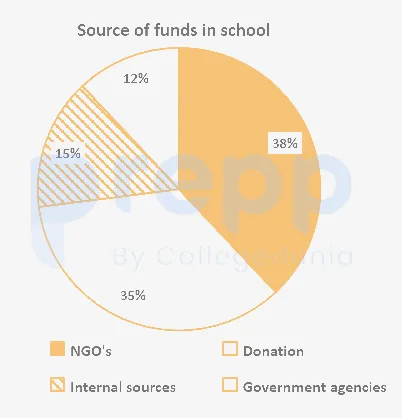
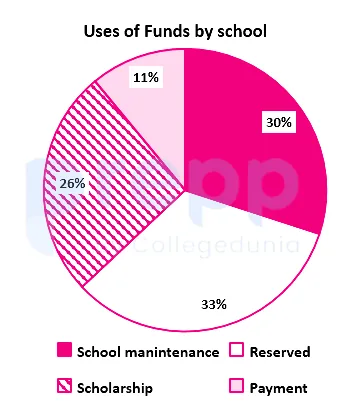
- A
1,45,000
- B
1,50,000
- C
1,60,000
- D
1,32,000
Show answer
B. 1,50,000Given:
The total fund received by school from different sources = 10 lakh
The school received fund from internal source = 15%
Concept:
\(X\%={X\over100}\)
Calculation:
Let the fund received by internal source is X
⇒ X = 15% of 10 lakh
⇒ X = \({15\over100}\times{1000000}=150000\)
∴ The required result will be 150000.
Paper & answer key PDF ↗ Question 60archived
If 3x = sec A and \(\frac{3}{x}\) = tan A then 9 (x2 - \(\frac{1}{x^2}\)) is ______.
- A
3
- B
1
- C
\(\frac{1}{9}\)
- D
9
Show answer
B. 1Solving Trigonometric Equations for Algebraic Expressions
The problem asks us to find the value of a specific algebraic expression involving 'x', given two equations that relate 'x' to trigonometric functions of angle A. The given equations are:
\(3x = \sec A\)
\(\frac{3}{x} = \tan A\)
We need to find the value of \(9 \left(x^2 - \frac{1}{x^2}\right)\).
To connect the given equations with the expression we need to evaluate, we should look for a trigonometric identity that relates secant (sec A) and tangent (tan A). The fundamental trigonometric identity is:
\[ \sec^2 A - \tan^2 A = 1 \]
Let's square the given equations to get expressions for \(\sec^2 A\) and \(\tan^2 A\) in terms of 'x'.
Squaring equation (1):
\[ (3x)^2 = (\sec A)^2 \]\[ 9x^2 = \sec^2 A \]
Squaring equation (2):
\[ \left(\frac{3}{x}\right)^2 = (\tan A)^2 \]\[ \frac{9}{x^2} = \tan^2 A \]
Now, substitute these expressions for \(\sec^2 A\) and \(\tan^2 A\) into the trigonometric identity \(\sec^2 A - \tan^2 A = 1\).
\[ 9x^2 - \frac{9}{x^2} = 1 \]
The expression we need to find the value of is \(9 \left(x^2 - \frac{1}{x^2}\right)\). Let's look at the equation we just derived: \(9x^2 - \frac{9}{x^2} = 1\). We can factor out 9 from the left side of this equation:
\[ 9 \left(x^2 - \frac{1}{x^2}\right) = 1 \]
This is exactly the expression we were asked to evaluate. Therefore, the value of \(9 \left(x^2 - \frac{1}{x^2}\right)\) is 1.
Step-by-Step Solution Summary
Identify the given equations: \(3x = \sec A\) and \(\frac{3}{x} = \tan A\).
Identify the expression to be evaluated: \(9 \left(x^2 - \frac{1}{x^2}\right)\).
Recall the trigonometric identity relating sec A and tan A: \(\sec^2 A - \tan^2 A = 1\).
Square the given equations: \((3x)^2 = 9x^2 = \sec^2 A\) and \(\left(\frac{3}{x}\right)^2 = \frac{9}{x^2} = \tan^2 A\).
Substitute the squared expressions into the identity: \(9x^2 - \frac{9}{x^2} = 1\).
Factor out 9 from the left side: \(9 \left(x^2 - \frac{1}{x^2}\right) = 1\).
The value of the expression is 1.
Analysis of Options
Let's compare our calculated value with the given options:
Option
Value
Matches Calculation?
1
3
No
2
1
Yes
3
\(\frac{1}{9}\)
No
4
9
No
The calculated value, 1, matches Option 2.
Revision Table: Key Trigonometric Identities
Identity
Formula
Pythagorean Identity 1
\(\sin^2 \theta + \cos^2 \theta = 1\)
Pythagorean Identity 2
\(\sec^2 \theta - \tan^2 \theta = 1\)
Pythagorean Identity 3
\(\csc^2 \theta - \cot^2 \theta = 1\)
Reciprocal Identity
\(\sec \theta = \frac{1}{\cos \theta}\), \(\csc \theta = \frac{1}{\sin \theta}\), \(\cot \theta = \frac{1}{\tan \theta}\)
Quotient Identity
\(\tan \theta = \frac{\sin \theta}{\cos \theta}\), \(\cot \theta = \frac{\cos \theta}{\sin \theta}\)
Additional Information: Connecting Algebra and Trigonometry
This problem is a good example of how algebraic manipulation and trigonometric identities can be used together to solve problems. By squaring the given equations, we were able to generate terms (\(\sec^2 A\) and \(\tan^2 A\)) that fit into a known trigonometric identity. This allowed us to eliminate the trigonometric functions and find a direct relationship between the algebraic expressions involving 'x'. Problems like these reinforce the importance of recognizing algebraic patterns (like factoring) and knowing fundamental mathematical identities.
The expression \(x^2 - \frac{1}{x^2}\) is also related to the difference of squares pattern if we consider \(x^2 - \frac{1}{x^2} = \left(x - \frac{1}{x}\right)\left(x + \frac{1}{x}\right)\). However, in this specific problem, the direct substitution into the trigonometric identity \(\sec^2 A - \tan^2 A = 1\) was the most straightforward path to the solution because it yielded \(9x^2 - \frac{9}{x^2}\) directly.
Paper & answer key PDF ↗ Question 61archived
Angle subtended by the largest chord of the circle to a point on the same circle measures:
- A
< 90°
- B
180°
- C
> 90°
- D
90°
Show answer
D. 90°Understanding the Angle Subtended by the Largest Chord
The question asks about the measure of the angle formed when the endpoints of the largest chord of a circle are connected to a point on the circle's circumference. Let's break this down:
What is the Largest Chord?
In any circle, the chord that passes through the center is the longest possible chord. This special chord is called the diameter.
So, the question is essentially asking for the angle subtended by the diameter at any point on the circle.
Circle Theorem: Angle in a Semicircle
There is a fundamental theorem in geometry related to circles that directly addresses this scenario. This theorem states:
The angle subtended by a diameter at any point on the circumference of the circle is a right angle.
A right angle measures 90 degrees.
Applying the Theorem
Since the largest chord is the diameter, and the angle is subtended at a point on the circle, according to the theorem, the angle must be 90 degrees.
Consider a circle with center O and diameter AB. Let P be any point on the circumference of the circle. The angle subtended by the diameter AB at point P is the angle ∠APB.
According to the theorem (often referred to as the Angle in a Semicircle Theorem because a diameter divides the circle into two semicircles, and the point P lies on the arc of a semicircle), ∠APB = 90°.
Analyzing the Options
Let's look at the given options:
< 90°
180°
> 90°
90°
Based on the Angle in a Semicircle theorem, the angle subtended by the diameter (the largest chord) at any point on the circumference is 90°.
Conclusion
The measure of the angle subtended by the largest chord of the circle to a point on the same circle is 90°.
Angle Subtended by Diameter Summary
Chord Type
Angle Subtended on Circumference
Diameter (Largest Chord)
90° (Right Angle)
Any other chord
Varies depending on the chord length and position, but not always 90°
Revision Table: Circle Theorems
Key Circle Theorems for Revision
Theorem
Description
Relevant to Question?
Angle at the Center Theorem
The angle subtended by an arc at the center is double the angle subtended by the same arc at any point on the remaining part of the circle.
Yes (Diameter subtends 180° at center, so 180°/2 = 90° on circumference)
Angle in a Semicircle Theorem
The angle subtended by a diameter at any point on the circumference is 90°.
Yes (Directly answers the question)
Angles in the Same Segment
Angles subtended by the same arc in the same segment of a circle are equal.
No
Cyclic Quadrilateral Opposite Angles
Opposite angles of a cyclic quadrilateral are supplementary (sum to 180°).
No
Additional Information: Why 90 Degrees?
The Angle in a Semicircle Theorem is a special case of the Angle at the Center Theorem. The diameter is a chord that subtends a straight angle (180°) at the center of the circle. According to the Angle at the Center Theorem, the angle subtended by the same chord (the diameter) at any point on the circumference is half the angle subtended at the center.
So, Angle on Circumference = (1/2) × Angle at Center
Angle on Circumference = (1/2) × 180°
Angle on Circumference = 90°
This explains why the angle subtended by the largest chord (diameter) at any point on the circle is always 90°.
Paper & answer key PDF ↗ Question 62archived
Simplify the given expression.
\(\frac{[120\times120\times120-100\times100\times100]}{[120\times120+120\times100+100\times100]}\)
- A
15
- B
20
- C
25
- D
10
Show answer
B. 20Simplifying Algebraic Expressions: Using the Difference of Cubes Identity
The problem asks us to simplify a given mathematical expression. The expression is:
\[ \frac{120 \times 120 \times 120 - 100 \times 100 \times 100}{120 \times 120 + 120 \times 100 + 100 \times 100} \]
Let's analyze the structure of the expression. We can notice a pattern related to cubes and squares of two numbers, 120 and 100.
Let \(a = 120\) and \(b = 100\).
The expression can be rewritten using \(a\) and \(b\) as:
\[ \frac{a \times a \times a - b \times b \times b}{a \times a + a \times b + b \times b} = \frac{a^3 - b^3}{a^2 + ab + b^2} \]
Applying the Difference of Cubes Formula
We need to simplify the fraction \(\frac{a^3 - b^3}{a^2 + ab + b^2}\). This involves recognizing a common algebraic identity.
The difference of cubes formula states that for any two numbers \(a\) and \(b\):
\[ a^3 - b^3 = (a - b)(a^2 + ab + b^2) \]
Now, substitute this identity into the numerator of our expression:
\[ \frac{(a - b)(a^2 + ab + b^2)}{a^2 + ab + b^2} \]
Cancelling Terms and Final Calculation
Assuming that the denominator \(a^2 + ab + b^2\) is not equal to zero, we can cancel the common term \(a^2 + ab + b^2\) from both the numerator and the denominator.
Let's check if the denominator is zero with \(a=120\) and \(b=100\):
\[ a^2 + ab + b^2 = 120^2 + (120)(100) + 100^2 = 14400 + 12000 + 10000 = 36400 \]
Since \(36400 \neq 0\), we can cancel the term.
The expression simplifies to:
\[ a - b \]
Now, substitute the original values back for \(a\) and \(b\):
\[ a - b = 120 - 100 \]
\[ 120 - 100 = 20 \]
Therefore, the simplified value of the given expression is 20.
Step-by-Step Simplification
Identify the pattern in the numerator and denominator. Recognize the expression as \(\frac{a^3 - b^3}{a^2 + ab + b^2}\) with \(a = 120\) and \(b = 100\).
Recall the difference of cubes identity: \(a^3 - b^3 = (a - b)(a^2 + ab + b^2)\).
Substitute the identity into the numerator of the expression.
Cancel the common term \(a^2 + ab + b^2\) from the numerator and denominator, assuming it's not zero.
Calculate the remaining expression \(a - b\) using the values of \(a\) and \(b\).
Expression Part
Representation
Value with a=120, b=100
Numerator
\(a^3 - b^3\)
\(120^3 - 100^3\)
Denominator
\(a^2 + ab + b^2\)
\(120^2 + 120 \times 100 + 100^2\)
Simplified Expression
\(a - b\)
\(120 - 100\)
Revision Table: Key Concepts for Simplification
Concept
Description
Relevance to Problem
Algebraic Identity
An equation that is true for all values of the variables involved.
Used the difference of cubes identity.
Difference of Cubes
The identity \(a^3 - b^3 = (a - b)(a^2 + ab + b^2)\).
Crucial for simplifying the numerator.
Fraction Simplification
Dividing both numerator and denominator by a common factor.
Allowed us to cancel the \(a^2 + ab + b^2\) term.
Additional Information: Related Algebraic Identities
Understanding algebraic identities is key to simplifying expressions quickly. Here are a few other important identities:
Sum of Cubes: \(a^3 + b^3 = (a + b)(a^2 - ab + b^2)\)
Difference of Squares: \(a^2 - b^2 = (a - b)(a + b)\)
Perfect Square Trinomials:
\((a + b)^2 = a^2 + 2ab + b^2\)
\((a - b)^2 = a^2 - 2ab + b^2\)
Cube of a Binomial:
\((a + b)^3 = a^3 + 3a^2b + 3ab^2 + b^3\)
\((a - b)^3 = a^3 - 3a^2b + 3ab^2 - b^3\)
Recognizing these patterns can significantly speed up solving problems involving algebraic expressions.
Paper & answer key PDF ↗ Question 63archived
A, B and C can do a piece of work in 20, 30 and 60 days, respectively. In how many days can A do the work if he is assisted by both B and C on every third day?
- A
10
- B
15
- C
12
- D
18
Show answer
B. 15Understanding the Work and Time Problem
This problem involves calculating the total time taken to complete a piece of work when individuals with different efficiencies work together, but with a specific pattern of assistance. We are given the time A, B, and C take individually to complete the work. A works alone for two days, and then A is assisted by both B and C on the third day. This cycle repeats until the work is finished.
Calculating Individual Work Rates
First, let's determine the amount of work each person can do in a single day. This is their daily work rate, calculated as the reciprocal of the number of days they take to complete the work individually.
A completes the work in 20 days. So, A's daily work rate is $\frac{1}{20}$ of the work.
B completes the work in 30 days. So, B's daily work rate is $\frac{1}{30}$ of the work.
C completes the work in 60 days. So, C's daily work rate is $\frac{1}{60}$ of the work.
Analyzing the Work Pattern
The work pattern is a cycle of three days:
Day 1: A works alone.
Day 2: A works alone.
Day 3: A, B, and C work together.
This 3-day period constitutes one complete cycle of work. We need to calculate the total work done in one such cycle.
Calculating Work Done in One Cycle (3 Days)
Let's sum the work done on each day within one cycle:
Work done on Day 1 (by A) = $\frac{1}{20}$
Work done on Day 2 (by A) = $\frac{1}{20}$
Work done on Day 3 (by A, B, and C together) = A's rate + B's rate + C's rate
Work done by A, B, and C together on Day 3:
$\frac{1}{20} + \frac{1}{30} + \frac{1}{60}$
To add these fractions, find a common denominator, which is 60.
$\frac{3}{60} + \frac{2}{60} + \frac{1}{60} = \frac{3+2+1}{60} = \frac{6}{60} = \frac{1}{10}$
So, work done by A, B, and C together on Day 3 is $\frac{1}{10}$ of the total work.
Now, let's find the total work done in one 3-day cycle:
Work in one cycle = (Work on Day 1) + (Work on Day 2) + (Work on Day 3)
Work in one cycle = $\frac{1}{20} + \frac{1}{20} + \frac{1}{10}$
Work in one cycle = $\frac{2}{20} + \frac{1}{10}$
Work in one cycle = $\frac{1}{10} + \frac{1}{10}$
Work in one cycle = $\frac{2}{10} = \frac{1}{5}$
So, $\frac{1}{5}$ of the total work is completed in every 3-day cycle.
Determining the Number of Cycles Needed
The total work to be done is considered as 1 unit. Since $\frac{1}{5}$ of the work is done in each cycle, we need to find how many cycles are required to complete the entire work (1 unit).
Number of cycles = Total Work / Work per cycle
Number of cycles = $1 \div \frac{1}{5}$
Number of cycles = $1 \times 5 = 5$ cycles.
Therefore, 5 such 3-day cycles are needed to finish the work.
Calculating Total Time
Each cycle takes 3 days. Since 5 cycles are needed to complete the work, the total number of days is:
Total days = Number of cycles $\times$ Days per cycle
Total days = $5 \times 3 = 15$ days.
Thus, A can do the work in 15 days if he is assisted by both B and C on every third day.
Day
Workers
Work Done on the Day
Day 1
A
$\frac{1}{20}$
Day 2
A
$\frac{1}{20}$
Day 3
A, B, C
$\frac{1}{20} + \frac{1}{30} + \frac{1}{60} = \frac{6}{60} = \frac{1}{10}$
Total in 3-Day Cycle
$\frac{1}{20} + \frac{1}{20} + \frac{1}{10} = \frac{1}{10} + \frac{1}{10} = \frac{2}{10} = \frac{1}{5}$
Since $\frac{1}{5}$ work is done in 3 days, to complete the full work (1 unit), the time taken will be $5 \times 3 = 15$ days.
Conclusion
Following the pattern where A works alone for two days and is assisted by B and C on the third day, the total time taken to complete the work is 15 days.
Revision Table: Key Concepts for Work and Time Problems
Concept
Explanation
Formula/Relation
Work Rate
The amount of work done by a person in a unit of time (e.g., per day, per hour).
Work Rate = $\frac{1}{\text{Time taken to complete work}}$
Total Work
Often considered as 1 unit or the LCM of individual times.
Total Work = Work Rate $\times$ Time
Combined Work Rate
Sum of individual work rates when multiple people work together.
Rate$_{A+B}$ = Rate$_A$ + Rate$_B$
Work Done in 'n' days
Work Rate $\times$ n
Work Done = Rate $\times$ Days
Finding Total Time
Total Time = $\frac{\text{Total Work}}{\text{Combined Work Rate}}$
Time = $\frac{1}{\text{Rate}}$ (if Total Work = 1)
Work with Variable Workers
Calculate work done in a repeating cycle, then find the number of cycles.
Total Time = Cycles $\times$ Days per Cycle (+ remaining work time)
Additional Information: Work and Time Calculation Tips
Always convert individual times into daily (or hourly) work rates first. This makes calculations easier.
If workers work in shifts or patterns, identify the repeating cycle and calculate the work done within that cycle.
Find the total number of cycles needed to complete the work.
Multiply the number of cycles by the duration of each cycle to get the total time.
Be careful if the work is not completed perfectly within a number of cycles; calculate the remaining work and the time taken by the relevant worker(s) to finish it. In this specific problem, the work completes exactly at the end of a cycle.
The total work can sometimes be assumed as the Least Common Multiple (LCM) of the individual times. Using LCM often simplifies fraction calculations by turning them into integer units of work. For this problem, LCM of 20, 30, 60 is 60 units. A's rate = 3 units/day, B's rate = 2 units/day, C's rate = 1 unit/day.
Day 1: A = 3 units
Day 2: A = 3 units
Day 3: A+B+C = 3+2+1 = 6 units
Total in 3-day cycle = 3 + 3 + 6 = 12 units.
Total work = 60 units.
Number of cycles = $60 / 12 = 5$ cycles.
Total days = $5 \times 3 = 15$ days. (This confirms the fractional method).
Paper & answer key PDF ↗ Question 64archived
Soham’s initial expenditure and savings were in the ratio of 5 ∶ 3. His income increases by 25%. If his initial savings were ₹4,500, find his income (in ₹) after the increment.
- A
16000
- B
15000
- C
9375
- D
12000
Show answer
B. 15000Understanding Income, Expenditure, and Savings Ratios
This problem involves understanding the relationship between income, expenditure, and savings, and how changes in income affect the total amount. The key is to use the initial ratio and the given initial savings to find the initial expenditure and income. Then, we can calculate the income after the percentage increase.
Step-by-Step Solution for Soham's Income
Let's break down the problem into manageable steps to find Soham's income after the increment.
Given Information:
Ratio of initial expenditure to savings = 5 ∶ 3
Initial savings = ₹4,500
Income increases by 25%
Step 1: Find the value of one ratio unit.
The initial expenditure and savings are in the ratio 5:3. This means for every 3 units of savings, there are 5 units of expenditure. We are given that the initial savings represent 3 units and are equal to ₹4,500.
Let the value of one ratio unit be $x$.
So, Initial Savings = $3x = \text{₹}4,500$
To find the value of one unit ($x$), we divide the initial savings by 3:
$x = \frac{\text{₹}4,500}{3} = \text{₹}1,500$
The value of one ratio unit is ₹1,500.
Step 2: Calculate the initial expenditure.
The initial expenditure is represented by 5 units in the ratio.
Initial Expenditure = $5x = 5 \times \text{₹}1,500$
Initial Expenditure = $\text{₹}7,500$
Step 3: Calculate the initial income.
Income is the sum of expenditure and savings.
Initial Income = Initial Expenditure + Initial Savings
Initial Income = $\text{₹}7,500 + \text{₹}4,500$
Initial Income = $\text{₹}12,000$
Soham's initial income was ₹12,000.
Step 4: Calculate the income increase.
His income increases by 25%. We need to find 25% of the initial income.
Income Increase = 25% of Initial Income
Income Increase = $0.25 \times \text{₹}12,000$
Income Increase = $\frac{25}{100} \times \text{₹}12,000$
Income Increase = $\frac{1}{4} \times \text{₹}12,000$
Income Increase = $\text{₹}3,000$
Step 5: Calculate the income after the increment.
The income after the increment is the initial income plus the income increase.
Income after Increment = Initial Income + Income Increase
Income after Increment = $\text{₹}12,000 + \text{₹}3,000$
Income after Increment = $\text{₹}15,000$
Soham's income after the 25% increment is ₹15,000.
Summary of Calculations
Item
Calculation
Amount (₹)
Initial Savings (3 units)
Given
4,500
Value of 1 unit
4500 ÷ 3
1,500
Initial Expenditure (5 units)
5 × 1500
7,500
Initial Income
7500 + 4500
12,000
Income Increase (25%)
25% of 12000
3,000
Income after Increment
12000 + 3000
15,000
The final income after the increment is ₹15,000.
Revision Table: Key Concepts
Concept
Definition/Relation
Example
Income
Money received (Expenditure + Savings)
If Exp = 100, Sav = 50, Income = 150
Expenditure
Money spent
Cost of goods, bills, etc.
Savings
Income not spent
Money kept aside for future
Ratio
Comparison of two quantities by division
5:3 means the first quantity is 5/3 times the second
Percentage Increase
$(\frac{\text{New Value - Original Value}}{\text{Original Value}}) \times 100\%$
25% increase on 100 is 125
Additional Information on Income Calculations
When dealing with problems involving income, expenditure, and savings, it's important to remember the fundamental relationship:
$\text{Income} = \text{Expenditure} + \text{Savings}$
This equation holds true in all scenarios unless stated otherwise. Ratios provide a proportional relationship between expenditure and savings. If the income changes, either the expenditure, savings, or both must change to maintain the relationship.
In this specific problem, we assumed the expenditure-to-savings ratio was for the initial amounts. The income increase is applied to the initial income to find the new income. The problem does not specify how the new income is distributed between expenditure and savings, and we were only asked for the new income value itself.
Percentage increase can also be calculated by multiplying the original value by $(1 + \text{percentage increase as decimal})$. For example, a 25% increase on ₹12,000 is $\text{₹}12,000 \times (1 + 0.25) = \text{₹}12,000 \times 1.25 = \text{₹}15,000$. This is a quicker way to get the final value directly after an increase.
Paper & answer key PDF ↗ Question 65archived
If (a + b + c) = 14, and (a3 + b3 + c3 - 3abc) = 98, find the value of (a2 + b2 + c2).
- A
70
- B
64
- C
68
- D
72
Show answer
A. 70The correct answer is 70.
This term can also be related to the sum of squares and the sum of pairwise products (ab + bc + ca) , as shown by the square of a sum identity. Recognizing which identities to use based on the form of the given expressions and the required expression is key to efficiently solving such algebraic problems. Practice with various problems helps in quickly identifying the relevant identities.
Paper & answer key PDF ↗ Question 66archived
ABC is a triangle and D is a point on the side BC. If BC = 16 cm, BD = 11 cm and ∠ADC = ∠BAC, then the length of AC is equal to:
- A
4\(\sqrt5\) cm
- B
4 cm
- C
3\(\sqrt5\) cm
- D
5 cm
Show answer
A. 4\(\sqrt5\) cmFinding the Length of AC in Triangle ABC
The problem asks us to find the length of the side AC in a triangle ABC, given some specific conditions about a point D on side BC.
Understanding the Given Information
We are given the following details:
Triangle ABC.
Point D is located on the side BC.
The total length of BC is 16 cm.
The length of the segment BD is 11 cm.
The angle $\angle \text{ADC}$ is equal to the angle $\angle \text{BAC}$. This is a key piece of information.
Calculating the Length of DC
Since D is on the side BC, the length of BC is the sum of the lengths of BD and DC.
BC = BD + DC
We know BC = 16 cm and BD = 11 cm.
$16 \text{ cm} = 11 \text{ cm} + \text{DC}$
Subtracting 11 cm from both sides gives us the length of DC:
$\text{DC} = 16 \text{ cm} - 11 \text{ cm} = 5 \text{ cm}$
Identifying Similar Triangles
We are given that $\angle \text{ADC} = \angle \text{BAC}$. Let's look at the angles in triangles ABC and DAC.
Angle $\angle \text{BAC}$ (in $\Delta \text{ABC}$) is equal to Angle $\angle \text{ADC}$ (in $\Delta \text{DAC}$) - This is given in the problem.
Angle $\angle \text{C}$ is common to both triangles. It is $\angle \text{ACB}$ in $\Delta \text{ABC}$ and $\angle \text{ACD}$ in $\Delta \text{DAC}$.
Since two angles of $\Delta \text{ABC}$ are equal to two angles of $\Delta \text{DAC}$, the third angle must also be equal. This means $\Delta \text{ABC}$ is similar to $\Delta \text{DAC}$ by the Angle-Angle-Angle (AAA) similarity criterion.
Setting up Proportions for Similar Triangles
When two triangles are similar, the ratio of their corresponding sides is equal. For $\Delta \text{ABC} \sim \Delta \text{DAC}$, the corresponding sides are:
The side opposite $\angle \text{C}$ in $\Delta \text{ABC}$ (AB) corresponds to the side opposite $\angle \text{C}$ in $\Delta \text{DAC}$ (DA).
The side opposite $\angle \text{BAC}$ in $\Delta \text{ABC}$ (BC) corresponds to the side opposite $\angle \text{ADC}$ in $\Delta \text{DAC}$ (AC).
The side opposite $\angle \text{ABC}$ in $\Delta \text{ABC}$ (AC) corresponds to the side opposite $\angle \text{DAC}$ in $\Delta \text{DAC}$ (DC).
So, the proportions are:
$\frac{\text{AB}}{\text{DA}} = \frac{\text{BC}}{\text{AC}} = \frac{\text{AC}}{\text{DC}}$
Solving for the Length of AC
We are looking for the length of AC. We can use the part of the proportion that involves AC and the lengths we know (BC and DC):
$\frac{\text{BC}}{\text{AC}} = \frac{\text{AC}}{\text{DC}}$
Substitute the known values: BC = 16 cm and DC = 5 cm.
$\frac{16}{\text{AC}} = \frac{\text{AC}}{5}$
Now, cross-multiply to solve for AC:
$\text{AC} \times \text{AC} = 16 \times 5$
$\text{AC}^2 = 80$
To find AC, take the square root of both sides:
$\text{AC} = \sqrt{80}$
Simplifying the Square Root
We need to simplify $\sqrt{80}$. We can find the largest perfect square that divides 80.
$80 = 16 \times 5$
Since 16 is a perfect square ($4^2 = 16$), we can write:
$\sqrt{80} = \sqrt{16 \times 5} = \sqrt{16} \times \sqrt{5} = 4 \times \sqrt{5} = 4\sqrt{5}$
So, the length of AC is $4\sqrt{5}$ cm.
The length of AC is $4\sqrt{5}$ cm.
Given Information
Calculated Information
BC = 16 cm
DC = 5 cm
BD = 11 cm
AC = $4\sqrt{5}$ cm (Result)
$\angle \text{ADC} = \angle \text{BAC}$
$\Delta \text{ABC} \sim \Delta \text{DAC}$
Revision Table: Triangle Similarity and Length Calculation
Concept
Description
Application in this Problem
Point on a Line Segment
If point D is on segment BC, then BC = BD + DC.
Used to find DC = BC - BD = 16 - 11 = 5 cm.
Angle-Angle-Angle (AAA) Similarity
If two angles of one triangle are equal to two angles of another triangle, then the triangles are similar. The third angles must also be equal.
$\angle \text{BAC} = \angle \text{ADC}$ (Given) and $\angle \text{C}$ is common. Therefore, $\Delta \text{ABC} \sim \Delta \text{DAC}$.
Properties of Similar Triangles
Corresponding sides of similar triangles are proportional.
Set up the proportion $\frac{\text{BC}}{\text{AC}} = \frac{\text{AC}}{\text{DC}}$.
Solving for an Unknown Length
Using algebraic manipulation (like cross-multiplication and square roots) with the proportion to find the unknown side length.
$\text{AC}^2 = \text{BC} \times \text{DC} = 16 \times 5 = 80$, so $\text{AC} = \sqrt{80}$.
Simplifying Radicals
Writing a square root in the form $a\sqrt{b}$ where b is the smallest possible integer. Find the largest perfect square factor of the number under the root.
$\sqrt{80} = \sqrt{16 \times 5} = \sqrt{16} \times \sqrt{5} = 4\sqrt{5}$.
Additional Information: Applications of Triangle Similarity
Triangle similarity is a fundamental concept in geometry with many practical applications. Understanding how to identify similar triangles and use the properties of proportional sides is crucial for solving various geometry problems.
Indirect Measurement: Similar triangles can be used to measure lengths or heights that are difficult to access directly, such as the height of a tall building or a tree, by comparing shadows or using reflections.
Scale Models and Maps: Maps and scale models are based on the principle of similarity, where every dimension is reduced or enlarged by a constant scale factor.
Trigonometry: The ratios used in trigonometry (sine, cosine, tangent) are based on the ratios of sides in right-angled triangles. Similar right-angled triangles will have the same trigonometric ratios for corresponding angles.
Geometry Proofs: Similarity is often used as a tool in geometric proofs to establish relationships between angles and sides of figures.
Computer Graphics and Vision: Similarity transformations are used in computer graphics for scaling objects. In computer vision, identifying similar shapes helps in object recognition.
The problem we solved is a classic example of using angle properties to establish similarity and then using side proportionality to find an unknown length. The condition $\angle \text{ADC} = \angle \text{BAC}$ is specifically designed to create similar triangles $\Delta \text{ABC}$ and $\Delta \text{DAC}$ because they share a common angle $\angle \text{C}$.
Paper & answer key PDF ↗ Question 67archived
A 6-digit number has digits as consecutive natural numbers. The number is always divisible by _____.
- A
2
- B
4
- C
5
- D
3
Show answer
D. 3Analyzing 6-Digit Numbers with Consecutive Digits
Let's investigate a 6-digit number where the digits are consecutive natural numbers. This means the digits follow each other in counting order, like 1, 2, 3, 4, 5, 6.
Understanding the properties of such a number will help us determine which number it is always divisible by.
Understanding Consecutive Natural Numbers
Consecutive natural numbers are integers that follow one another in sequence with a difference of 1. For example, 1, 2, 3, 4, 5, 6 are consecutive natural numbers. If the digits of a 6-digit number are consecutive natural numbers, they would be of the form:
a, a+1, a+2, a+3, a+4, a+5
where 'a' is the first digit, and it must be a natural number.
Examples of Such 6-Digit Numbers
Since it's a 6-digit number, the digits must be from 0 to 9. The digits must also be consecutive natural numbers. Let's list the possible sequences of 6 consecutive natural numbers (as digits):
1, 2, 3, 4, 5, 6 (Forms the number 123456)
2, 3, 4, 5, 6, 7 (Forms the number 234567)
3, 4, 5, 6, 7, 8 (Forms the number 345678)
4, 5, 6, 7, 8, 9 (Forms the number 456789)
These are the only possible sequences of 6 consecutive natural numbers that can form the digits of a 6-digit number using digits 1 through 9.
Checking Divisibility Rules
We need to find a number from the options (2, 4, 5, 3) that divides all numbers formed this way.
Divisibility by 2 Check
A number is divisible by 2 if its last digit is even (0, 2, 4, 6, 8).
123456 ends in 6 (even). Divisible by 2.
234567 ends in 7 (odd). Not divisible by 2.
Since 234567 is not divisible by 2, the number is not always divisible by 2.
Divisibility by 4 Check
A number is divisible by 4 if the number formed by its last two digits is divisible by 4.
123456 ends in 56. $56 \div 4 = 14$. Divisible by 4.
234567 ends in 67. $67 \div 4 = 16$ with a remainder of 3. Not divisible by 4.
Since 234567 is not divisible by 4, the number is not always divisible by 4.
Divisibility by 5 Check
A number is divisible by 5 if its last digit is 0 or 5.
123456 ends in 6. Not divisible by 5.
234567 ends in 7. Not divisible by 5.
345678 ends in 8. Not divisible by 5.
456789 ends in 9. Not divisible by 5.
None of the possible numbers end in 0 or 5, so the number is not always divisible by 5.
Divisibility by 3 Check
A number is divisible by 3 if the sum of its digits is divisible by 3.
Let the six consecutive natural digits be $a, a+1, a+2, a+3, a+4, a+5$. The sum of these digits is:
$S = a + (a+1) + (a+2) + (a+3) + (a+4) + (a+5)$
$S = 6a + (1 + 2 + 3 + 4 + 5)$
$S = 6a + 15$
Now, let's check if $S = 6a + 15$ is always divisible by 3. We can factor out 3:
$S = 3 \times (2a + 5)$
Since $S$ can be written as 3 multiplied by an integer $(2a+5)$, the sum of the digits is always a multiple of 3. By the divisibility rule of 3, any number with a sum of digits divisible by 3 is itself divisible by 3.
Let's verify this with our examples:
123456: Sum of digits = $1+2+3+4+5+6 = 21$. $21 \div 3 = 7$. Divisible by 3.
234567: Sum of digits = $2+3+4+5+6+7 = 27$. $27 \div 3 = 9$. Divisible by 3.
345678: Sum of digits = $3+4+5+6+7+8 = 33$. $33 \div 3 = 11$. Divisible by 3.
456789: Sum of digits = $4+5+6+7+8+9 = 39$. $39 \div 3 = 13$. Divisible by 3.
In all possible cases for a 6-digit number with consecutive natural number digits, the sum of the digits is divisible by 3. Therefore, the number itself is always divisible by 3.
Conclusion on Divisibility
Based on testing the divisibility rules for 2, 4, 5, and 3, we found that only divisibility by 3 holds true for all possible 6-digit numbers formed by consecutive natural number digits.
Revision Table: Common Divisibility Rules
Divisible by
Rule Summary
2
Ends in an even digit (0, 2, 4, 6, 8).
3
Sum of the digits is divisible by 3.
4
The number formed by the last two digits is divisible by 4.
5
Ends in 0 or 5.
6
Is divisible by both 2 and 3.
9
Sum of the digits is divisible by 9.
10
Ends in 0.
Additional Information: Consecutive Integer Properties
The sum of any set of k consecutive integers is always divisible by k if k is odd. If k is even, the sum is divisible by k/2, but not necessarily k. In this problem, we have 6 consecutive digits (k=6, which is even). The sum of these 6 consecutive digits $a, a+1, ..., a+5$ is $6a+15$. This sum is divisible by $6/2 = 3$. It is also divisible by 6 if and only if 15 is divisible by 6, which is not true. This aligns with our finding that the sum is always divisible by 3 but not always by 6.
The fact that the sum of any 6 consecutive integers is always divisible by 3 is a specific case of this general property.
Paper & answer key PDF ↗ Question 68archived
Benny can do a piece of work in 24 days. Chethan and David can do the same work individually in 36 and 48 days, respectively. All of them begin the work together. However, Benny leaves the work 4 days before the completion of work and Chethan leaves the work 10 days before the completion of the work. David worked till the end and completed the work. Find the number of days in which the work was completed.
- A
16
- B
20
- C
18
- D
15
Show answer
A. 16Given:
Benny can do a piece of work in 24 days
Chetan can do the same work in 36 days
David can do the same work in 48 days
Formula used:
Work = Efficiency × Time
Calculation:
Let the work be completed in X days.
Benny's one day's work = \({1\over24}\)
Chetan's one day's work = \({1\over36}\)
David's one day's work = \({1\over48}\)
According to the question
⇒ \({{X-4\over24}+{X-10\over36}+{X\over 48}}=1\)
⇒ \({{6\ \times (X-4)}+{4\times (X-10)+3X}\over144}=1\)
⇒ 6X - 24 + 4X - 40 + 3X = 144
⇒ 13X - 64 = 144
⇒ 13X = 208
⇒ X = 16
∴ The required result will be 16.
Paper & answer key PDF ↗ Question 69archived
A thief robs precious metals from a store which is 1150 m away from the police. The thief starts running at 6 km/h and the police starts chasing at 11 km/h at the same time. How much distance (in m) will the thief run before being caught?
- A
1125
- B
1485
- C
1280
- D
1380
Show answer
D. 1380Solving the Police and Thief Distance Problem
This problem involves calculating the distance a thief covers before being caught by the police. It's a classic example of a relative speed problem, where one object (the police) is gaining on another object (the thief).
Understanding the Scenario and Given Information
We are given the following key pieces of information:
Initial distance between the police and the thief.
The speed at which the thief is running.
The speed at which the police are chasing.
Both start moving simultaneously.
Let's list the given values:
Initial distance = 1150 m
Thief's speed = 6 km/h
Police's speed = 11 km/h
We need to find the distance (in meters) the thief runs before being caught.
Parameter
Value
Unit
Initial Distance
1150
m
Thief's Speed
6
km/h
Police's Speed
11
km/h
Applying Relative Speed Concept for Catching Problems
When the police chase the thief in the same direction, the police reduce the distance between them at a rate equal to the difference in their speeds. This is known as the relative speed of the police with respect to the thief.
Relative Speed \( = \) Speed of Police \( - \) Speed of Thief
Relative Speed \( = 11 \, \text{km/h} - 6 \, \text{km/h} = 5 \, \text{km/h}\)
This means the police close the initial gap of 1150 m at a speed of 5 km/h.
Calculating the Time Until the Thief is Caught
The time it takes for the police to catch the thief is the time required to cover the initial distance at the relative speed.
We use the formula:
Time \( = \frac{\text{Distance}}{\text{Speed}}\)
The initial distance is 1150 m, which is \(1150 / 1000 = 1.15 \, \text{km}\). The relative speed is 5 km/h.
Time \( = \frac{1.15 \, \text{km}}{5 \, \text{km/h}}\)
Time \( = 0.23\) hours
So, it takes 0.23 hours for the police to catch the thief.
Calculating the Distance Run by the Thief
The thief runs for the same amount of time as the police chase, which is 0.23 hours. To find the distance the thief runs, we use the thief's speed and the calculated time.
Distance Run by Thief \( = \) Thief's Speed \( \times \) Time
Distance Run by Thief \( = 6 \, \text{km/h} \times 0.23 \, \text{h}\)
Distance Run by Thief \( = 1.38 \, \text{km}\)
Converting the Distance to Meters
The question asks for the distance in meters. We need to convert 1.38 km to meters.
\(1 \, \text{km} = 1000 \, \text{m}\)
Distance in meters \( = 1.38 \, \text{km} \times 1000 \, \text{m/km}\)
Distance in meters \( = 1380 \, \text{m}\)
Thus, the thief will run 1380 meters before being caught by the police.
Revision Table: Police and Thief Problem Key Steps
Step
Description
Calculation/Concept
1
Identify given values & units.
Distance = 1150 m, \(S_t = 6\) km/h, \(S_p = 11\) km/h
2
Convert distance to km.
\(1150 \, \text{m} = 1.15 \, \text{km}\)
3
Calculate relative speed.
\(S_{rel} = S_p - S_t = 11 - 6 = 5 \, \text{km/h}\)
4
Calculate time to catch.
\(T = \text{Distance} / S_{rel} = 1.15 / 5 = 0.23\) hours
5
Calculate distance run by thief.
\(D_t = S_t \times T = 6 \times 0.23 = 1.38 \, \text{km}\)
6
Convert thief's distance to meters.
\(1.38 \, \text{km} = 1380 \, \text{m}\)
Additional Information: Relative Speed Concepts
The concept of relative speed is fundamental in solving problems involving the motion of two objects. Here's a little more about it:
Objects moving in the same direction: The relative speed is the difference between their speeds. The faster object gains on the slower object at this rate. This is used when one object is chasing another.
Objects moving in opposite directions: The relative speed is the sum of their speeds. The distance between them decreases (or increases) at this combined rate. This is used when two objects are moving towards each other or away from each other.
Catching Up: In a catching-up scenario (like the police chasing the thief), the time taken to catch up is always the initial distance between the objects divided by the relative speed (difference in speeds).
Meeting: If two objects start at a certain distance apart and move towards each other, the time taken to meet is the initial distance divided by the relative speed (sum of speeds).
Understanding these concepts helps in solving various types of time, speed, and distance problems encountered in competitive exams and general quantitative aptitude tests.
Paper & answer key PDF ↗ Question 70archived
The value of 1\(\frac{3}{4}\) + 1\(\frac{5}{7}\) ÷ 2\(\frac{3}{7}\) × 2\(\frac{3}{7}\) = ?
- A
1\(\frac{11}{28}\)
- B
2\(\frac{13}{28}\)
- C
3\(\frac{13}{28}\)
- D
4\(\frac{23}{28}\)
Show answer
C. 3\(\frac{13}{28}\)Solving the Mixed Number Expression
To find the value of the given expression, we need to follow the order of operations, often remembered by the acronyms BODMAS or PEMDAS. This means we handle operations in the following order: Brackets/Parentheses, Orders/Exponents, Division and Multiplication (from left to right), and Addition and Subtraction (from left to right).
The expression is: \(1\frac{3}{4} + 1\frac{5}{7} \div 2\frac{3}{7} \times 2\frac{3}{7}\)
Step 1: Convert Mixed Numbers to Improper Fractions
First, let's convert all the mixed numbers into improper fractions. A mixed number \(a\frac{b}{c}\) is converted to an improper fraction using the formula \(\frac{(a \times c) + b}{c}\).
\(1\frac{3}{4} = \frac{(1 \times 4) + 3}{4} = \frac{4 + 3}{4} = \frac{7}{4}\)
\(1\frac{5}{7} = \frac{(1 \times 7) + 5}{7} = \frac{7 + 5}{7} = \frac{12}{7}\)
\(2\frac{3}{7} = \frac{(2 \times 7) + 3}{7} = \frac{14 + 3}{7} = \frac{17}{7}\)
The expression now becomes: \(\frac{7}{4} + \frac{12}{7} \div \frac{17}{7} \times \frac{17}{7}\)
Step 2: Perform Division and Multiplication (from left to right)
According to BODMAS/PEMDAS, division and multiplication are performed next, from left to right.
The first operation from the left involving division or multiplication is the division:
\(\frac{12}{7} \div \frac{17}{7}\)
Dividing by a fraction is the same as multiplying by its reciprocal. The reciprocal of \(\frac{17}{7}\) is \(\frac{7}{17}\).
So, \(\frac{12}{7} \div \frac{17}{7} = \frac{12}{7} \times \frac{7}{17}\)
Multiplying the fractions:
\(\frac{12}{7} \times \frac{7}{17} = \frac{12 \times 7}{7 \times 17}\)
We can cancel out the common factor of 7:
\(\frac{12 \times \cancel{7}}{\cancel{7} \times 17} = \frac{12}{17}\)
Now, the expression is: \(\frac{7}{4} + \frac{12}{17} \times \frac{17}{7}\)
Next, we perform the multiplication:
\(\frac{12}{17} \times \frac{17}{7}\)
Multiplying the fractions:
\(\frac{12}{17} \times \frac{17}{7} = \frac{12 \times 17}{17 \times 7}\)
We can cancel out the common factor of 17:
\(\frac{12 \times \cancel{17}}{\cancel{17} \times 7} = \frac{12}{7}\)
The expression is now simplified to: \(\frac{7}{4} + \frac{12}{7}\)
Step 3: Perform Addition
Finally, we perform the addition of the two fractions. To add fractions, they must have a common denominator. The least common multiple (LCM) of 4 and 7 is 28.
Convert each fraction to an equivalent fraction with a denominator of 28:
\(\frac{7}{4} = \frac{7 \times 7}{4 \times 7} = \frac{49}{28}\)
\(\frac{12}{7} = \frac{12 \times 4}{7 \times 4} = \frac{48}{28}\)
Now, add the fractions:
\(\frac{49}{28} + \frac{48}{28} = \frac{49 + 48}{28} = \frac{97}{28}\)
Step 4: Convert Improper Fraction to Mixed Number
The result is an improper fraction \(\frac{97}{28}\). Let's convert it back to a mixed number by dividing the numerator by the denominator.
\(97 \div 28\)
28 goes into 97 three times (\(28 \times 3 = 84\)) with a remainder of \(97 - 84 = 13\).
So, \(\frac{97}{28} = 3\frac{13}{28}\).
The value of the expression \(1\frac{3}{4} + 1\frac{5}{7} \div 2\frac{3}{7} \times 2\frac{3}{7}\) is \(3\frac{13}{28}\).
Revision Table: Key Steps
Step
Operation
Explanation
Result
1
Convert Mixed Numbers
Change \(1\frac{3}{4}, 1\frac{5}{7}, 2\frac{3}{7}\) to improper fractions.
\(\frac{7}{4}, \frac{12}{7}, \frac{17}{7}\)
2
Division
Calculate \(\frac{12}{7} \div \frac{17}{7}\).
\(\frac{12}{17}\)
3
Multiplication
Calculate \(\frac{12}{17} \times \frac{17}{7}\).
\(\frac{12}{7}\)
4
Addition
Calculate \(\frac{7}{4} + \frac{12}{7}\) (LCM=28).
\(\frac{49}{28} + \frac{48}{28} = \frac{97}{28}\)
5
Convert to Mixed Number
Change \(\frac{97}{28}\) back to a mixed number.
\(3\frac{13}{28}\)
Additional Information: Understanding Order of Operations
The order of operations (BODMAS/PEMDAS) is crucial for solving mathematical expressions correctly. It ensures that everyone gets the same answer for the same expression.
B/P: Brackets or Parentheses - Solve anything inside brackets first.
O/E: Orders or Exponents - Calculate powers and square roots next.
DM: Division and Multiplication - These are done from left to right. If division comes before multiplication in the expression, do division first. If multiplication comes first, do multiplication first.
AS: Addition and Subtraction - These are also done from left to right. Perform whichever comes first when reading the expression from left to right.
In the given problem, we had division and multiplication next to each other. The division \(\div 2\frac{3}{7}\) appeared before the multiplication \(\times 2\frac{3}{7}\), so we performed the division first, then the multiplication.
Paper & answer key PDF ↗ Question 71archived
If the third proportional of 3x2 and 4xy is 48, then find the positive value of y.
- A
3
- B
5
- C
2
- D
4
Show answer
A. 3Calculating the Third Proportional and Finding a Value
The question asks us to find the positive value of \(y\), given that the third proportional of \(3x^2\) and \(4xy\) is 48.
Let's first understand what the third proportional is. If we have two numbers, say \(a\) and \(b\), their third proportional, say \(c\), is a number such that \(a, b, c\) are in continuous proportion. This means the ratio of the first to the second is equal to the ratio of the second to the third. Mathematically, this is expressed as:
\(\frac{a}{b} = \frac{b}{c}\)
In this problem, the first number is \(a = 3x^2\), the second number is \(b = 4xy\), and the third proportional is \(c = 48\). We can set up the proportion using the formula:
\(\frac{3x^2}{4xy} = \frac{4xy}{48}\)
Now, we need to solve this equation for \(y\). We can cross-multiply to eliminate the denominators:
\((3x^2) \times 48 = (4xy) \times (4xy)\)
Let's simplify both sides of the equation:
Left side: \(3x^2 \times 48 = 144x^2\)
Right side: \(4xy \times 4xy = 16x^2y^2\)
So the equation becomes:
\(144x^2 = 16x^2y^2\)
Assuming \(x \neq 0\) (as if \(x=0\), both original numbers are 0, and the concept of a non-zero third proportional doesn't typically apply), we can divide both sides of the equation by \(16x^2\) to isolate \(y^2\):
\(\frac{144x^2}{16x^2} = y^2\)
Simplify the left side:
\(\frac{144}{16} = y^2\)
\(9 = y^2\)
To find the value of \(y\), we take the square root of both sides:
\(y = \pm\sqrt{9}\)
\(y = \pm 3\)
The possible values for \(y\) are 3 and -3. The question specifically asks for the positive value of \(y\).
Therefore, the positive value of \(y\) is 3.
Revision Table: Third Proportional Concepts
Concept
Definition/Formula
Application in this Problem
Ratio
Comparison of two quantities by division (\(a:b\) or \(\frac{a}{b}\)).
Used to set up the proportion \(\frac{3x^2}{4xy} = \frac{4xy}{48}\).
Proportion
Equality of two ratios (\(\frac{a}{b} = \frac{c}{d}\)).
The relationship \(\frac{3x^2}{4xy} = \frac{4xy}{48}\) is a proportion.
Third Proportional
For \(a\) and \(b\), the number \(c\) such that \(a, b, c\) are in continuous proportion (\(\frac{a}{b} = \frac{b}{c}\)).
Given as 48 for \(3x^2\) and \(4xy\).
Additional Information on Proportions
Besides the third proportional, there are other related concepts in proportions:
Mean Proportional: For two numbers \(a\) and \(c\), the mean proportional (or geometric mean) is the number \(b\) such that \(a, b, c\) are in continuous proportion (\(\frac{a}{b} = \frac{b}{c}\)). This simplifies to \(b^2 = ac\), so \(b = \pm\sqrt{ac}\).
Fourth Proportional: For three numbers \(a, b, c\), the fourth proportional is the number \(d\) such that \(a, b, c, d\) are in proportion (\(\frac{a}{b} = \frac{c}{d}\)). This can be solved for \(d\) as \(d = \frac{bc}{a}\).
Understanding these different types of proportionals is important for solving various problems involving ratios and proportions.
Paper & answer key PDF ↗ Question 72archived
The distance between the centres of two circles having radii 22 cm and 18 cm, is 32 cm. The length (in cm) of the direct common tangent of the two circles is:
- A
2\(\sqrt{252}\) cm
- B
2\(\sqrt{152}\) cm
- C
3\(\sqrt{242}\) cm
- D
3\(\sqrt{252}\) cm
Show answer
A. 2\(\sqrt{252}\) cmCalculating Direct Common Tangent Length
This problem requires us to find the length of the direct common tangent between two circles, given their radii and the distance between their centers. A direct common tangent is a line segment that is tangent to both circles and lies on the same side of the line connecting the centers.
Formula for Direct Common Tangent Length
The formula for the length of a direct common tangent, denoted by \(L\), between two circles with radii \(r_1\) and \(r_2\) and the distance between their centers \(d\) is given by:
\(L = \sqrt{d^2 - (r_1 - r_2)^2}\)
This formula is derived using the Pythagorean theorem. Imagine drawing a line parallel to the common tangent through the center of the smaller circle. This line, along with a radius of the larger circle perpendicular to the tangent and the segment connecting the centers, forms a right-angled triangle.
Applying the Formula to the Given Circles
We are given the following values:
Radius of the first circle, \(r_1 = 22\) cm
Radius of the second circle, \(r_2 = 18\) cm
Distance between the centers, \(d = 32\) cm
Now, let's substitute these values into the formula:
First, calculate the difference in radii:
\(r_1 - r_2 = 22 \text{ cm} - 18 \text{ cm} = 4 \text{ cm}\)
Next, substitute \(d = 32\) cm and \((r_1 - r_2) = 4\) cm into the formula for \(L\):
\(L = \sqrt{32^2 - (4)^2}\)
Calculate the squares:
\(32^2 = 1024\)
\(4^2 = 16\)
Substitute these values back into the equation:
\(L = \sqrt{1024 - 16}\)
Perform the subtraction under the square root:
\(L = \sqrt{1008}\)
Simplifying the Radical
We need to simplify \(\sqrt{1008}\). We look for perfect square factors of 1008.
Divide 1008 by 4: \(1008 = 4 \times 252\)
So, \(\sqrt{1008} = \sqrt{4 \times 252} = \sqrt{4} \times \sqrt{252} = 2\sqrt{252}\).
The length of the direct common tangent is \(2\sqrt{252}\) cm.
Let's check if the options match our simplified result. Option 1 is \(2\sqrt{252}\) cm, which matches our calculation.
Summary of Calculation Steps
Identify the given values: radii (\(r_1, r_2\)) and distance between centers (\(d\)).
Calculate the difference between the radii: \((r_1 - r_2)\).
Square the distance between centers (\(d^2\)) and the difference in radii \((r_1 - r_2)^2\).
Subtract \((r_1 - r_2)^2\) from \(d^2\).
Take the square root of the result to find the length of the direct common tangent.
Simplify the square root if possible to match the format of the options.
Using \(r_1 = 22\), \(r_2 = 18\), \(d = 32\):
\(r_1 - r_2 = 22 - 18 = 4\)
\(d^2 = 32^2 = 1024\)
\((r_1 - r_2)^2 = 4^2 = 16\)
\(d^2 - (r_1 - r_2)^2 = 1024 - 16 = 1008\)
\(L = \sqrt{1008} = \sqrt{4 \times 252} = 2\sqrt{252}\)
The length of the direct common tangent is \(2\sqrt{252}\) cm.
Revision Table: Circle Tangents
Understanding the different types of common tangents is important.
Tangent Type
Description
Length Formula (d > r1 + r2)
Direct Common Tangent
Lies on the same side of the line connecting the centers.
\(\sqrt{d^2 - (r_1 - r_2)^2}\)
Transverse Common Tangent
Crosses the line connecting the centers.
\(\sqrt{d^2 - (r_1 + r_2)^2}\)
Note: The formulas assume the circles do not intersect or touch and are external to each other (\(d > r_1 + r_2\)). In this problem, \(d = 32\), \(r_1 + r_2 = 22 + 18 = 40\). Since \(d < r_1 + r_2\), the circles intersect. However, the formula for the direct common tangent is still applicable as long as the circles are not concentric and \(d > |r_1 - r_2|\) (\(32 > |22-18|=4\)), which they are.
Additional Information: Geometry of Circles
Circles are fundamental shapes in geometry, and understanding their properties, especially tangency, is crucial. A tangent line to a circle touches the circle at exactly one point. The radius drawn to the point of tangency is always perpendicular to the tangent line.
Common tangents are lines that are tangent to two circles simultaneously. There can be up to four common tangents to two distinct circles: two direct (or external) common tangents and two transverse (or internal) common tangents. The number of common tangents depends on the relative positions of the two circles (e.g., whether they are separate, touch externally, intersect, touch internally, or one is inside the other).
In this problem, since \(d=32\) cm and \(r_1+r_2=40\) cm, the circles intersect at two distinct points. When circles intersect, they have two direct common tangents, but no transverse common tangents.
Paper & answer key PDF ↗ Question 73archived
The following table shows the number of delivery partners (in thousands) who joined five different companies during six different years.
YearCompanies
EmazonClipkartTwiggyTomatoPyntra
20162.44.51.20.94.2
20171.85.41.51.25.6
20183.27.22.42.16.3
20193.95.62.82.76.5
20204.26.43.23.37.0
20215.07.23.63.67.2
Find the ratio of the number of delivery partners who joined Clipkart (in 2019 and 2020) to the number of delivery partners who joined Tomato (in 2019 and 2020).
- A
3 ∶ 2
- B
4 ∶ 3
- C
1 ∶ 2
- D
2 ∶ 1
Show answer
D. 2 ∶ 1Solving Data Interpretation: Delivery Partners Ratio
This problem requires us to analyze the provided table which shows the number of delivery partners joining five different companies over six years. We need to find the ratio of the combined number of delivery partners who joined Clipkart in 2019 and 2020 to the combined number of delivery partners who joined Tomato in 2019 and 2020.
Let's first look at the given data table:
Year
Companies
Emazon
Clipkart
Twiggy
Tomato
Pyntra
2016
2.4
4.5
1.2
0.9
4.2
2017
1.8
5.4
1.5
1.2
5.6
2018
3.2
7.2
2.4
2.1
6.3
2019
3.9
5.6
2.8
2.7
6.5
2020
4.2
6.4
3.2
3.3
7.0
2021
5.0
7.2
3.6
3.6
7.2
Calculating Total Delivery Partners for Clipkart
We need to find the total number of delivery partners who joined Clipkart in the years 2019 and 2020. From the table:
Delivery partners in Clipkart (2019) = 5.6 thousand
Delivery partners in Clipkart (2020) = 6.4 thousand
Total delivery partners in Clipkart in 2019 and 2020 = Number in 2019 + Number in 2020
Total Clipkart (2019 & 2020) $= 5.6 + 6.4$ thousand
Total Clipkart (2019 & 2020) $= 12.0$ thousand
Calculating Total Delivery Partners for Tomato
Next, we need to find the total number of delivery partners who joined Tomato in the years 2019 and 2020. From the table:
Delivery partners in Tomato (2019) = 2.7 thousand
Delivery partners in Tomato (2020) = 3.3 thousand
Total delivery partners in Tomato in 2019 and 2020 = Number in 2019 + Number in 2020
Total Tomato (2019 & 2020) $= 2.7 + 3.3$ thousand
Total Tomato (2019 & 2020) $= 6.0$ thousand
Determining the Required Ratio
The question asks for the ratio of the number of delivery partners who joined Clipkart (in 2019 and 2020) to the number of delivery partners who joined Tomato (in 2019 and 2020).
Ratio $= \frac{\text{Total Clipkart (2019 & 2020)}}{\text{Total Tomato (2019 & 2020)}}$
Ratio $= \frac{12.0 \text{ thousand}}{6.0 \text{ thousand}}$
Ratio $= \frac{12.0}{6.0} = \frac{12}{6}$
Simplifying the fraction:
Ratio $= \frac{12 \div 6}{6 \div 6} = \frac{2}{1}$
The ratio is $2 : 1$.
Revision Table: Key Values
Company
Year
Delivery Partners (Thousands)
Clipkart
2019
5.6
Clipkart
2020
6.4
Clipkart Total (2019+2020)
12.0
Tomato
2019
2.7
Tomato
2020
3.3
Tomato Total (2019+2020)
6.0
Additional Information: Understanding Ratios
A ratio is a way to compare two quantities. It shows how many times one quantity contains another. Ratios can be written in different ways, such as $a:b$, $a/b$, or "a to b". In this problem, we compared the total number of delivery partners for two different companies over the same time period.
Ratios help in comparing values in a standardized way.
They can be simplified by dividing both parts by their greatest common divisor (GCD). For example, the ratio $12:6$ is simplified to $2:1$ by dividing both 12 and 6 by their GCD, which is 6.
Ratios are dimensionless if the quantities being compared have the same units (like 'thousands of delivery partners' in this case).
Understanding how to extract specific data points from tables and perform calculations like summing and finding ratios is crucial for data interpretation questions.
Paper & answer key PDF ↗ Question 74archived
The length of a hall is 21 m and the width is 14 m. The sum of the areas of the floor and the flat roof is equal to the sum of the areas of the four walls. Find the height of the hall.
- A
8.4 m
- B
8.2 m
- C
8.6 m
- D
8.8 m
Show answer
A. 8.4 mCalculating Hall Height Based on Area Equality
This problem involves finding the height of a rectangular hall given its length and width, and a specific condition relating the areas of different surfaces of the hall.
Understanding the Hall as a Cuboid
A rectangular hall can be modeled as a cuboid. A cuboid has 6 faces: a floor, a roof, and four walls. The dimensions are length (l), width (w), and height (h).
Given Information
Length of the hall (l) = 21 m
Width of the hall (w) = 14 m
Condition: Sum of the areas of the floor and the flat roof is equal to the sum of the areas of the four walls.
Finding the Areas
Let's calculate the areas of the different parts of the hall:
Area of the floor = length × width = \(l \times w\)
Area of the roof = length × width = \(l \times w\) (since it's a flat roof, same dimensions as the floor)
Area of the two walls with length and height = \(2 \times (l \times h)\)
Area of the two walls with width and height = \(2 \times (w \times h)\)
Sum of the areas of the four walls = \(2lh + 2wh = 2h(l + w)\)
Setting up the Equation
The problem states that the sum of the areas of the floor and the roof is equal to the sum of the areas of the four walls. We can write this as an equation:
Area of Floor + Area of Roof = Area of Four Walls
\((l \times w) + (l \times w) = 2h(l + w)\)
\(2lw = 2h(l + w)\)
We can simplify this equation by dividing both sides by 2:
\(lw = h(l + w)\)
Solving for the Height (h)
We need to find the value of \(h\). We can rearrange the equation to solve for \(h\):
\(h = \frac{lw}{l + w}\)
Substituting the Given Values
Now, substitute the given values of length (l = 21 m) and width (w = 14 m) into the formula for \(h\):
\(h = \frac{21 \times 14}{21 + 14}\)
\(h = \frac{294}{35}\)
Calculating the Height
Now, we perform the division:
\(h = 294 \div 35\)
We can simplify the fraction by dividing the numerator and the denominator by their greatest common divisor, which is 7:
\(294 \div 7 = 42\)
\(35 \div 7 = 5\)
So, \(h = \frac{42}{5}\)
\(h = 8.4\)
The height of the hall is 8.4 meters.
Conclusion
Based on the given dimensions and the condition that the sum of the floor and roof areas equals the sum of the four wall areas, the calculated height of the hall is 8.4 m.
Dimension
Value
Length (l)
21 m
Width (w)
14 m
Height (h)
?
Area of Floor/Roof
\(l \times w\)
Area of Four Walls
\(2h(l + w)\)
Revision Table: Hall Dimensions and Areas
Component
Formula
Calculation
Area (m2)
Floor Area
\(l \times w\)
\(21 \times 14\)
294
Roof Area
\(l \times w\)
\(21 \times 14\)
294
Sum of Floor & Roof Areas
\(2lw\)
\(2 \times 294\)
588
Area of Walls (Formula)
\(2h(l+w)\)
\(2h(21+14)\)
\(2h(35) = 70h\)
According to the problem condition: Sum of Floor & Roof Areas = Area of Walls
\(588 = 70h\)
\(h = \frac{588}{70}\)
\(h = \frac{58.8}{7}\)
\(h = 8.4\)
The height is 8.4 m.
Additional Information: Properties of a Cuboid
A cuboid is a three-dimensional shape with six rectangular faces, twelve edges, and eight vertices. Opposite faces are identical in shape and size. A hall is typically a cuboid.
Surface Area: The total surface area of a cuboid with length l, width w, and height h is given by \(2(lw + lh + wh)\). This includes the areas of the floor, roof, and all four walls.
Lateral Surface Area: The sum of the areas of the four vertical walls (excluding floor and roof) is the lateral surface area, given by \(2lh + 2wh = 2h(l+w)\).
Volume: The volume of a cuboid is given by \(l \times w \times h\).
In this problem, the condition relates the areas of specific surfaces, allowing us to solve for one of the dimensions when others are known.
Paper & answer key PDF ↗ Question 75archived
If sec A + tan A = 5,then sin A is equal to:
- A
\(\frac{13}{12}\)
- B
\(\frac{5}{13}\)
- C
\(\frac{5}{12}\)
- D
\(\frac{12}{13}\)
Show answer
D. \(\frac{12}{13}\)Finding sin A when sec A + tan A is Given
This question asks us to find the value of \( \sin A \) given the relationship \( \sec A + \tan A = 5 \). We can solve this trigonometric problem by using fundamental trigonometric identities and solving a system of equations.
Using Fundamental Trigonometric Identities
A key trigonometric identity relates secant and tangent: \( \sec^2 A - \tan^2 A = 1 \). This identity is derived from the Pythagorean identity \( 1 + \tan^2 A = \sec^2 A \).
The identity \( \sec^2 A - \tan^2 A = 1 \) can be factored as a difference of squares:
\( (\sec A - \tan A)(\sec A + \tan A) = 1 \)
We are given that \( \sec A + \tan A = 5 \). Substituting this into the factored identity:
\( (\sec A - \tan A)(5) = 1 \)
Dividing both sides by 5, we get a second relationship between \( \sec A \) and \( \tan A \):
\( \sec A - \tan A = \frac{1}{5} \)
Solving for sec A and tan A
Now we have a system of two linear equations involving \( \sec A \) and \( \tan A \):
\( \sec A + \tan A = 5 \)
\( \sec A - \tan A = \frac{1}{5} \)
We can solve this system by adding or subtracting the equations.
Adding the two equations:
\( (\sec A + \tan A) + (\sec A - \tan A) = 5 + \frac{1}{5} \)
\( 2 \sec A = \frac{25}{5} + \frac{1}{5} \)
\( 2 \sec A = \frac{26}{5} \)
Divide by 2 to find \( \sec A \):
\( \sec A = \frac{26}{5} \times \frac{1}{2} = \frac{13}{5} \)
Subtracting the second equation from the first:
\( (\sec A + \tan A) - (\sec A - \tan A) = 5 - \frac{1}{5} \)
\( \sec A + \tan A - \sec A + \tan A = \frac{25}{5} - \frac{1}{5} \)
\( 2 \tan A = \frac{24}{5} \)
Divide by 2 to find \( \tan A \):
\( \tan A = \frac{24}{5} \times \frac{1}{2} = \frac{12}{5} \)
Finding sin A
We have found \( \sec A = \frac{13}{5} \) and \( \tan A = \frac{12}{5} \). We need to find \( \sin A \).
We know that \( \tan A = \frac{\sin A}{\cos A} \). Also, \( \sec A = \frac{1}{\cos A} \). From \( \sec A = \frac{13}{5} \), we can find \( \cos A \):
\( \cos A = \frac{1}{\sec A} = \frac{1}{13/5} = \frac{5}{13} \)
Now we can use the relationship \( \tan A = \frac{\sin A}{\cos A} \) to find \( \sin A \):
\( \sin A = \tan A \times \cos A \)
Substitute the values of \( \tan A \) and \( \cos A \):
\( \sin A = \frac{12}{5} \times \frac{5}{13} \)
\( \sin A = \frac{12 \times 5}{5 \times 13} \)
\( \sin A = \frac{12}{13} \)
Alternatively, since we have \( \tan A = \frac{12}{5} \), which is the ratio of the opposite side to the adjacent side in a right-angled triangle, we can construct a right triangle. If the opposite side is 12k and the adjacent side is 5k for some constant k (we can assume k=1 for simplicity in ratios), the hypotenuse would be calculated using the Pythagorean theorem:
\( \text{Hypotenuse} = \sqrt{(\text{Opposite})^2 + (\text{Adjacent})^2} = \sqrt{12^2 + 5^2} = \sqrt{144 + 25} = \sqrt{169} = 13 \)
So, in this right triangle, the sides are 12, 5, and 13. Now we can find \( \sin A \), which is the ratio of the opposite side to the hypotenuse:
\( \sin A = \frac{\text{Opposite}}{\text{Hypotenuse}} = \frac{12}{13} \)
We can also check if \( \sec A + \tan A = 5 \) holds with these values:
\( \cos A = \frac{5}{13} \implies \sec A = \frac{13}{5} \)
\( \sec A + \tan A = \frac{13}{5} + \frac{12}{5} = \frac{13+12}{5} = \frac{25}{5} = 5 \)
This confirms our values for \( \sec A \), \( \tan A \), and \( \sin A \) are consistent with the given information.
Therefore, \( \sin A \) is equal to \( \frac{12}{13} \).
Revision Table: Trigonometric Ratios and Identities
Trigonometric Ratio
Definition (Right Triangle)
Relationship
\( \sin A \)
Opposite / Hypotenuse
\( \frac{1}{\csc A} \)
\( \cos A \)
Adjacent / Hypotenuse
\( \frac{1}{\sec A} \)
\( \tan A \)
Opposite / Adjacent
\( \frac{1}{\cot A}, \frac{\sin A}{\cos A} \)
\( \sec A \)
Hypotenuse / Adjacent
\( \frac{1}{\cos A} \)
Additional Information: Important Trigonometric Identities
Beyond \( \sec^2 A - \tan^2 A = 1 \), several other identities are crucial for solving trigonometry problems:
Pythagorean Identities:
\( \sin^2 A + \cos^2 A = 1 \)
\( 1 + \tan^2 A = \sec^2 A \)
\( 1 + \cot^2 A = \csc^2 A \)
Reciprocal Identities:
\( \sec A = \frac{1}{\cos A} \)
\( \csc A = \frac{1}{\sin A} \)
\( \cot A = \frac{1}{\tan A} \)
Quotient Identities:
\( \tan A = \frac{\sin A}{\cos A} \)
\( \cot A = \frac{\cos A}{\sin A} \)
Understanding and applying these identities is key to simplifying expressions and solving equations in trigonometry. The identity \( \sec^2 A - \tan^2 A = 1 \) is particularly useful when dealing with sums or differences of secant and tangent, as shown in this problem.
Paper & answer key PDF ↗ Question 76archived
Direction: Select the most appropriate option that can substitute the underlined words in the given sentence.
He did not stop until it was remarked that he was speaking at length about trivial things.
- A
twittering
- B
writing
- C
rambling
- D
littering
Show answer
C. ramblingUnderstanding the Phrase to Substitute
The question asks us to find a single word that can replace the phrase "speaking at length about trivial things" in the given sentence: "He did not stop until it was remarked that he was speaking at length about trivial things."
The phrase "speaking at length about trivial things" means talking for a long time about matters that are not important or serious. We need to find a word that concisely expresses this idea.
Analyzing the Options
Let's look at the meaning of each option provided:
twittering: This usually refers to the sounds made by birds. It can also metaphorically mean talking in a light, rapid, and often inconsequential way, but it doesn't strongly convey the idea of speaking "at length" about "trivial things" specifically.
writing: This means putting words on paper or a screen. The original phrase is about speaking, not writing. So, this option is incorrect.
rambling: This means talking or writing at length in a confused or inconsequential way. It perfectly captures the idea of speaking for a long time about unimportant or trivial topics.
littering: This means dropping trash in a public place. This is completely unrelated to speaking. So, this option is incorrect.
Selecting the Most Appropriate Substitute
Based on the analysis of the options, the word that best fits the meaning of "speaking at length about trivial things" is "rambling". When someone is rambling, they are talking for a long time, often jumping from one topic to another or focusing on unimportant details, just like speaking at length about trivial things.
Replacing the underlined phrase with "rambling" gives us: "He did not stop until it was remarked that he was rambling." This revised sentence maintains the original meaning clearly and concisely.
Revision Table: Word Meanings
Word
Meaning
Relevance to "Speaking at Length About Trivial Things"
twittering
Light, rapid talk or bird sounds
Some overlap in triviality, but not specifically about length or the type of trivial topics.
writing
Putting words on paper/screen
Incorrect; the phrase is about speaking.
rambling
Talking at length confusedly or about unimportant things
Strong fit; includes both "at length" and "trivial things".
littering
Dropping trash
Incorrect; unrelated to speaking.
Additional Information: Understanding Vocabulary in Context
Choosing the correct word to substitute a phrase often depends heavily on understanding the context of the sentence and the precise meaning of both the original phrase and the potential substitute words. Vocabulary questions test your ability to identify synonyms or words that capture the essence of a more extended description.
In this case, the context makes it clear that the speaking was lengthy and focused on trivial matters, leading to the conclusion that "rambling" is the most suitable replacement. Understanding common idioms and idiomatic phrases is also crucial for these types of questions.
Paper & answer key PDF ↗ Question 77archived
Direction: Select the nearest homonym of the given word.
Accept
- A
Accent
- B
Expect
- C
Except
- D
Expert
Show answer
C. ExceptUnderstanding Homonyms: Finding the Nearest Match for 'Accept'
The question asks us to find the nearest homonym for the word 'Accept'. Let's break down what a homonym is and look at the meaning and sound of 'Accept' and each of the options.
What is a Homonym?
A homonym is generally defined as a word that sounds the same as another word but has a different meaning and spelling. These are also often called homophones. Finding the nearest homonym means looking for the word that sounds most similar to 'Accept' among the choices provided.
Analyzing the Word 'Accept'
The word 'Accept' means to receive something or to agree to something offered. For example, "I accept your offer," or "Please accept this gift."
Evaluating the Options
Now let's look at each option and see how it compares to 'Accept' in terms of sound and meaning.
Option 1: Accent
The word 'Accent' refers to a distinctive way of pronouncing a language, or emphasis placed on a syllable or word. It sounds different from 'Accept', particularly the first syllable ('Ac-' vs 'Ac-'). Also, the meaning is completely different.
Option 2: Expect
The word 'Expect' means to look forward to or anticipate something. For example, "I expect you will do well." This word sounds quite different from 'Accept' and has a different meaning.
Option 3: Except
The word 'Except' means not including; other than. For example, "Everyone is here except John." This word sounds very similar to 'Accept'. The main difference in pronunciation is often subtle, relating to the first syllable's vowel sound and the final consonant sound ('-ept'). Critically, 'Except' is a classic homophone (and therefore a homonym in the broader sense) of 'Accept'.
Option 4: Expert
The word 'Expert' refers to a person who has comprehensive and authoritative knowledge of or skill in a particular area. This word sounds noticeably different from 'Accept' and has a different meaning.
Comparing Sounds and Meanings
Let's put the words side-by-side for clarity:
Word
Approximate Pronunciation (English)
Meaning
Accept
ak-SEPT
To receive or agree to
Accent
AK-sent
Pronunciation style or emphasis
Expect
ek-SPEKT
To look forward to or anticipate
Except
ek-SEPT
Not including; other than
Expert
EK-spert
A person with great knowledge/skill
Looking at the pronunciations, 'Accept' (ak-SEPT) and 'Except' (ek-SEPT) sound the most alike among the options. While their spellings and meanings are distinct, their auditory similarity makes them homophones, and thus the nearest homonyms in this context.
Conclusion
Based on the analysis of pronunciation and meaning, the word that is the nearest homonym to 'Accept' is 'Except'. They sound very similar despite having different spellings and entirely different meanings.
Revision Table: Key Word Meanings
Word
Meaning
Accept
To receive or agree to something.
Except
Not including; other than.
Accent
A way of speaking; emphasis.
Expect
To anticipate or look forward to.
Expert
A person with high skill or knowledge.
Additional Information: Understanding Homophones and Homonyms
It's helpful to understand the different terms for words that are similar in sound or spelling.
Homonyms: This is an umbrella term. It can refer to words that sound the same OR are spelled the same, but have different meanings.
Homophones: Words that sound the same but are spelled differently and have different meanings (like 'accept' and 'except', 'to', 'too', and 'two', 'there', 'their', and 'they're').
Homographs: Words that are spelled the same but may sound different and have different meanings (like 'bow' - to bend at the waist, and 'bow' - a knot with loops).
In questions asking for the "nearest homonym" from a list of options, especially when dealing with common confusing pairs, it often refers to finding the homophone – the word that sounds the same or very nearly the same. 'Accept' and 'Except' are frequently confused homophones in English.
Paper & answer key PDF ↗ Question 78archived
Direction: The following sentence has been divided into parts. One of them may contain an error. Select the part that contains the error from the given options. If you don’t find any error, mark ‘No error’ as your answer.
They usually allege that there is / a delay in procuring stationery / due to the faulty purchase orders.
- A
due to the faulty purchase orders
- B
a delay in procuring stationery
- C
They usually allege that there is
- D
No error
Show answer
D. No errorUnderstanding the Sentence Structure and Identifying Errors
Let's carefully examine the given sentence to find any potential errors in grammar, syntax, or usage. The sentence is divided into three parts:
Part 1: They usually allege that there is
Part 2: a delay in procuring stationery
Part 3: due to the faulty purchase orders.
Analyzing Each Part for Grammatical Correctness
We will now break down each part of the sentence and analyze its grammatical structure and word usage.
Part 1: They usually allege that there is
"They" is a pronoun, acting as the subject of the main clause. It is plural.
"usually" is an adverb of frequency, modifying the verb "allege". Its position between the subject and the verb is standard.
"allege" is a verb meaning to claim or assert that someone has done something illegal or wrong, typically without proof. It is in the base form, agreeing with the plural subject "They". This is correct subject-verb agreement.
"that" is a conjunction introducing a subordinate clause.
"there is" is an expletive construction. The verb 'is' agrees with the subject of the following clause, which is "a delay". Since "a delay" is singular, "there is" is the correct form.
This part appears to be grammatically correct.
Part 2: a delay in procuring stationery
"a delay" is a noun phrase acting as the subject of the clause introduced by "that". It is singular, which correctly follows "there is".
"in procuring stationery" is a prepositional phrase modifying "a delay", explaining the nature of the delay.
"in" is a preposition.
"procuring" is a gerund (verb ending in -ing used as a noun), functioning as the object of the preposition "in".
"stationery" is a noun, the object of the gerund "procuring".
This part is grammatically correct and fits well with the preceding part.
Part 3: due to the faulty purchase orders
"due to" is a compound preposition used to indicate the reason or cause for something. It correctly modifies the preceding part of the sentence, explaining the reason for the delay.
"the faulty purchase orders" is a noun phrase acting as the object of the preposition "due to".
"faulty" is an adjective modifying "purchase orders".
"purchase orders" is a plural noun.
This part is grammatically correct and appropriately explains the cause of the delay mentioned earlier.
Conclusion on Sentence Error Identification
After analyzing each part of the sentence – "They usually allege that there is", "a delay in procuring stationery", and "due to the faulty purchase orders" – no grammatical errors, usage errors, or structural issues were found in any of the parts. The subject-verb agreement is correct, the conjunction and prepositions are used appropriately, and the phrasing is clear.
Therefore, the sentence is grammatically correct as it stands.
Part of the Sentence
Analysis
Error Found?
They usually allege that there is
Subject-verb agreement (They allege), Usage of 'usually', 'there is' with singular subject ('a delay'). All correct.
No
a delay in procuring stationery
Noun phrase 'a delay' is singular. Prepositional phrase 'in procuring stationery' is correctly structured.
No
due to the faulty purchase orders
'due to' indicates reason. Object 'the faulty purchase orders' is correctly structured.
No
Common Pitfalls in Sentence Error Questions
When tackling sentence error identification questions, be mindful of common areas where errors occur:
Subject-Verb Agreement: Ensure singular subjects have singular verbs and plural subjects have plural verbs. Pay special attention to sentences starting with "There is" or "There are".
Pronoun Agreement: Pronouns must agree in number and gender with the nouns they replace.
Parallelism: Ensure items in a list or comparison are in the same grammatical form.
Correct Word Usage: Confusing similar-sounding words (e.g., affect vs effect, principal vs principle).
Preposition Usage: Using the correct preposition for the context.
Tense Consistency: Maintaining a consistent verb tense throughout the sentence unless there's a reason for change.
Modifier Placement: Ensuring adjectives and adverbs are placed correctly to avoid ambiguity.
Revision Table: Key Concepts
Grammar Concept
Brief Explanation
Example
Subject-Verb Agreement
Verb must match the number (singular/plural) of the subject.
She runs (singular). They run (plural). There is a book (singular subject after 'is'). There are books (plural subject after 'are').
Usage of 'Due to'
Typically used to introduce a reason or cause. Can sometimes be replaced by 'because of'.
The game was cancelled due to heavy rain.
Gerunds
-ing form of a verb used as a noun. Can be the object of a preposition.
She is good at swimming. (swimming is the object of 'at')
Additional Information on Sentence Analysis
When you encounter a sentence error question, it's helpful to break the sentence down into clauses and phrases. Identify the main subject and verb, then look at subordinate clauses and modifying phrases. Check each component for internal consistency and how it connects to the rest of the sentence. Paying attention to punctuation can also sometimes reveal errors, though not in this particular example.
For instance, in the clause "that there is a delay in procuring stationery", "a delay" is the logical subject of "is". The phrase "in procuring stationery" functions adjectivally, describing the type of delay. Similarly, "due to the faulty purchase orders" functions adverbially, explaining the cause of the main action (allege) or the state (there is a delay).
Paper & answer key PDF ↗ Question 79archived
Direction: Select the correct sentence in active voice from the following options.
- A
The neighbours have called the police.
- B
The police are being called by the neighbours.
- C
The Police said to me, “I will call the neighbours.”
- D
The police have been called by the neighbours.
Show answer
A. The neighbours have called the police.Understanding Active and Passive Voice in English Grammar
In English grammar, sentences can be structured in either active voice or passive voice. Understanding the difference is crucial for clear and effective communication.
The active voice is used when the subject of the sentence performs the action of the verb. The structure is typically: Subject + Verb + Object.
The passive voice is used when the action of the verb is performed on the subject. The subject receives the action. The structure is typically: Object + Verb (usually a form of 'to be' + past participle) + (optional) by + Agent (the one performing the action).
Analyzing the Options for Active Voice
Let's examine each given sentence option to determine if it is in the active voice.
Option 1: The neighbours have called the police.
In this sentence, the subject is "The neighbours". The verb is "have called". The object is "the police". The neighbours are performing the action of calling. This structure fits the definition of active voice.
Option 2: The police are being called by the neighbours.
In this sentence, the subject is "The police". The verb phrase is "are being called". The action of calling is being performed on the police. The phrase "by the neighbours" indicates who is performing the action (the agent). This sentence structure (Subject + form of 'be' + past participle + by + agent) is characteristic of the passive voice.
Option 3: The Police said to me, “I will call the neighbours.”
This sentence contains both reported and direct speech. The first part, "The Police said to me," is in the active voice (The Police performed the action of saying). The direct speech, "“I will call the neighbours.”", is also in the active voice (I will perform the action of calling). However, the question asks for a sentence in active voice from the options, and option 1 presents a single, clear clause entirely in the active voice, which is often the intended focus in such questions contrasting simple active and passive structures like options 2 and 4.
Option 4: The police have been called by the neighbours.
In this sentence, the subject is "The police". The verb phrase is "have been called". The action of calling has been performed on the police. The phrase "by the neighbours" identifies the agent. This sentence structure (Subject + form of 'have' + 'been' + past participle + by + agent) is also characteristic of the passive voice (specifically, the present perfect passive).
Identifying the Correct Active Voice Sentence
Based on the analysis, Option 1 is the only sentence that clearly and entirely follows the structure of the active voice, where the subject ("The neighbours") performs the action ("have called") directly on the object ("the police").
Revision Table: Active vs. Passive Voice
Feature
Active Voice
Passive Voice
Focus
On the subject performing the action.
On the action and the recipient of the action (the subject).
Structure
Subject + Verb + Object
Subject (recipient) + form of 'be' + Past Participle (+ by + agent)
Verb Form
Varies depending on tense.
Form of 'be' + Past Participle.
Agent (Doer)
Is the subject.
Often in a 'by' phrase, or can be omitted if unknown or unimportant.
Example
The dog chased the ball.
The ball was chased by the dog.
Additional Information on Voice in Sentences
Choosing between active and passive voice depends on what you want to emphasize. Active voice is generally more direct, clear, and concise. It makes it clear who is performing the action.
Passive voice is useful when:
The doer of the action is unknown or unimportant (e.g., "The window was broken").
You want to emphasize the action or the recipient of the action rather than the doer (e.g., "The experiment was conducted successfully").
You want to sound more formal or objective, which is common in scientific or academic writing.
However, overuse of the passive voice can make writing sound awkward, unclear, and less engaging. For general writing, the active voice is often preferred.
Paper & answer key PDF ↗ Question 80archived
Direction: Select the most appropriate synonym of the given word.
Connote
- A
Comment
- B
Criticize
- C
Care
- D
Convey
Show answer
D. ConveyUnderstanding the Word Connote and Its Synonyms
The question asks for the most appropriate synonym for the word "Connote". To answer this, let's first understand the meaning of "Connote".
The word Connote means to imply or suggest something in addition to the literal or primary meaning. It's about what a word or expression makes you think of, beyond its explicit definition. It often involves associations, ideas, or feelings that are evoked.
Now let's look at the given options and their meanings:
Comment: To express an opinion or reaction.
Criticize: To indicate the faults of someone or something in a disapproving way.
Care: To feel concern or interest; to look after someone or something.
Convey: To make an idea, impression, or feeling known or understandable to someone; to communicate a message or information.
We are looking for a word that means to suggest or imply a meaning or feeling. Comparing the meanings:
"Comment" is about giving an opinion, which is different from suggesting an implied meaning.
"Criticize" is specifically about finding fault.
"Care" is about feeling concern or looking after someone/something.
"Convey" means to make something known or understandable. While it can mean communicating a direct message, it can also mean communicating an idea, feeling, or impression, which closely aligns with how "Connote" suggests or implies meaning or feeling.
Let's consider an example. The word "home" literally means a place where one lives. But it can connote feelings of warmth, security, and belonging. In this sense, the word "home" can convey these feelings of warmth and security.
Based on the meanings, "Convey" is the closest synonym among the given options for "Connote", as it involves making an idea or feeling known, which is the purpose of the implied meaning that "Connote" refers to.
Comparing Connote and Synonym Options
Word
Meaning
Relation to Connote
Connote
To imply or suggest a meaning or feeling in addition to the literal one.
Target word
Comment
Express an opinion or observation.
Different meaning (direct statement vs. implied suggestion)
Criticize
Find fault.
Different meaning (negative evaluation vs. suggestion of meaning)
Care
Feel concern or look after.
Different meaning (feeling/action vs. suggestion of meaning)
Convey
Make an idea, impression, or feeling known or understandable.
Closest meaning (making an idea/feeling known aligns with suggesting/implying it)
Therefore, the most appropriate synonym for Connote is Convey.
Revision Table: Key Vocabulary
Word
Definition
Connote
To suggest or imply an additional meaning or feeling.
Synonym
A word or phrase that means exactly or nearly the same as another word or phrase in the same language.
Comment
To express an opinion or remark.
Criticize
To evaluate negatively or find fault with.
Care
To feel or show concern; to protect.
Convey
To make known or understandable (an idea, impression, or feeling).
Additional Information: Denotation vs. Connotation
Understanding Connote is easier when contrasted with Denote.
Denote: This refers to the literal, explicit, or primary meaning of a word, independent of any associated feelings or ideas. It's the dictionary definition.
Connote: This refers to the implied or secondary meaning of a word, including the feelings, associations, or ideas that it evokes in addition to its literal meaning.
For example, the word "snake" denotes a legless reptile. However, it can connote danger, evil, or treachery due to cultural associations.
Words often have both a denotation and a connotation, and understanding both helps in using language precisely and interpreting texts effectively. The question asks for a synonym of Connote, focusing on the aspect of suggesting or implying these additional meanings or feelings.
Paper & answer key PDF ↗ Question 81archived
Direction: Select the most appropriate homonym to fill in the blank.
The children enjoyed the ______ very much.
- A
feer
- B
fear
- C
fere
- D
fair
Show answer
D. fairUnderstanding Homonyms and Context
This question asks us to choose the correct word to fill in the blank from a set of options. The options are all homonyms or words that sound similar. Homonyms are words that sound alike but have different meanings and often different spellings. To choose the correct word, we need to understand the meaning of each option and how it fits the context of the sentence: "The children enjoyed the ______ very much."
Analyzing the Options
Let's look at each option:
feer: This is not a commonly recognized English word with a standard meaning that fits this context.
fear: This word means an unpleasant emotion caused by the threat of danger, pain, or harm. While some people might enjoy thrilling or scary experiences, it's not typical for children to "enjoy fear very much" in a general sense; the phrase implies enjoyment of an event or place.
fere: This is an archaic word meaning a companion or mate. It does not fit the context of something children enjoy visiting or experiencing.
fair: This word has multiple meanings. One meaning is an event or festival, usually held outdoors, with rides, games, food stalls, and exhibitions. Children commonly enjoy visiting a fair. Another meaning relates to appearance (attractive) or impartiality (just), which don't fit the sentence structure.
Determining the Correct Word
Based on the analysis of the meanings, the word that fits the context of something children would "enjoy very much" is 'fair', referring to a festival or event.
Let's compare the relevant meanings:
Word
Relevant Meaning
Fits the Sentence?
fear
Unpleasant emotion due to perceived danger
Unlikely for general enjoyment
fair
A public event with entertainment and stalls
Yes, children typically enjoy this
Therefore, the most appropriate homonym to fill in the blank is 'fair'. The completed sentence is: "The children enjoyed the fair very much."
Revision Table: Homonyms
Understanding homonyms is key to mastering English vocabulary and usage. Here are a few common examples:
Word 1
Word 2
Example Sentence 1
Example Sentence 2
Affect (verb)
Effect (noun)
The weather will affect our plans.
The weather had a strange effect.
Their
There
They left their bags there.
Go over there.
To
Too
I want to go too.
That is too expensive.
Additional Information: Word Choice in Context
Choosing the correct word in a sentence often depends heavily on the context provided. Even if words sound similar, their meanings can be vastly different, leading to confusion if the wrong one is used. Always consider the overall meaning of the sentence and the specific meaning of each word option. For this question, understanding that a 'fair' is an event children enjoy helps select the right homonym.
Paper & answer key PDF ↗ Question 82archived
Direction: Select the most appropriate idiom or phrase to fill in the blank in the given sentence.
He is rich and famous and expects everyone to ______ on him.
- A
tap dance like mad
- B
dead duck
- C
give a song and dance
- D
dance attendance
Show answer
D. dance attendanceUnderstanding Idioms and Phrases: "Dance Attendance"
The question asks us to select the most appropriate idiom or phrase to complete the sentence: "He is rich and famous and expects everyone to ______ on him." The sentence describes a rich and famous person who has expectations about how others should behave towards him. We need an idiom that reflects this expectation of others catering to him or serving him.
Let's analyze the given options:
Option 1: tap dance like mad
This idiom means to act frantically or excitedly, often in an exaggerated or over-the-top manner. This does not fit the context of someone expecting others to serve them.
Option 2: dead duck
This idiom refers to a person or thing that is doomed to fail or is no longer functioning effectively. This meaning is completely irrelevant to the sentence.
Option 3: give a song and dance
This idiom means to make a fuss or give a complicated or insincere explanation, often to avoid doing something or as an excuse. This does not fit the context of someone expecting service or attention from others.
Option 4: dance attendance
This idiom means to be constantly available to someone, eager to please them, and catering to their needs or wishes. This phrase perfectly captures the idea of someone rich and famous expecting others to wait on them, serve them, or cater to their demands.
Comparing the meanings of the idioms with the context of the sentence, the idiom "dance attendance" is the most suitable choice. It describes the behaviour expected by the rich and famous person from others – a constant readiness to serve and please.
Therefore, the completed sentence reads: "He is rich and famous and expects everyone to dance attendance on him."
Revision Table: Key Idioms Analyzed
Idiom/Phrase
Meaning
Relevance to Sentence
tap dance like mad
Act frantically/excitedly
Not relevant
dead duck
Doomed to fail
Not relevant
give a song and dance
Give elaborate excuse/explanation
Not relevant
dance attendance
Constantly cater to someone, eager to please
Highly relevant
Additional Information: Understanding Idioms
Idioms are phrases or expressions whose meaning cannot be deduced from the literal meanings of the individual words. They are a crucial part of mastering any language, including English, as they add richness and nuance to communication. Using appropriate idioms can make your language sound more natural and fluent.
Some common idioms and their meanings:
Break a leg: Good luck (used especially before a performance).
Bite the bullet: To face a difficult or unpleasant situation with courage.
Let the cat out of the bag: To reveal a secret.
Cost an arm and a leg: Very expensive.
Understanding the context in which an idiom is used is key to choosing the correct one to fill in blanks in sentences.
Paper & answer key PDF ↗ Question 83archived
Direction: Select the word that is INCORRECTLY spelt in the given sentence.
Traditional people are used to using a calender for their routine activities in rural households.
- A
Traditional
- B
Households
- C
Calender
- D
Activities
Show answer
C. CalenderIdentifying the Incorrectly Spelled Word in a Sentence
The question asks us to find the word that is spelled incorrectly in the given sentence:
"Traditional people are used to using a calender for their routine activities in rural households."
Let's examine each of the options provided and check their spelling within the context of standard English.
Analyzing Each Word Spelling
Traditional: This word is spelled correctly. It means following or belonging to the customs or ways of behaviour that have existed for a long time.
Households: This word is the plural form of 'household' and is spelled correctly. A household is a house and its occupants regarded as a unit.
Calender: This word appears in the sentence and is listed as an option. Let's think about the device used to track days, weeks, and months. The correct spelling for this word is 'calendar'. Therefore, 'calender' is misspelled.
Activities: This word is the plural form of 'activity' and is spelled correctly. Activities are things that a group or person does.
Identifying the Spelling Error
Based on our analysis, the word "calender" is not spelled correctly. The correct spelling is "calendar". The other words, "Traditional", "Households", and "Activities", are all spelled correctly in the sentence.
Thus, the incorrectly spelled word in the sentence is "calender".
Correcting the Sentence
With the correct spelling, the sentence would read:
"Traditional people are used to using a calendar for their routine activities in rural households."
Conclusion on Incorrect Spelling
The word that is INCORRECTLY spelt in the sentence is 'Calender'.
Revision Table: Common Spelling Errors
Incorrect Spelling
Correct Spelling
Notes
Calender
Calendar
A system for fixing the beginning, length, and divisions of the year and for arranging days and larger divisions of time.
Accomodate
Accommodate
Double 'c' and double 'm'.
Seperate
Separate
'a' before 'r'.
Definately
Definitely
'i' before 't'.
Priviledge
Privilege
'i' before 'l'.
Additional Information: Importance of Correct Spelling
Correct spelling is crucial for clear and effective communication in English. Misspellings, even small ones, can change the meaning of a word or make your writing difficult to understand. In formal contexts like exams or professional communication, poor spelling can negatively impact credibility.
Clarity: Ensures your intended message is received correctly.
Credibility: Shows attention to detail and competence.
Understanding: Helps readers easily process your writing without confusion.
Learning common spelling rules and practicing regularly can significantly improve spelling accuracy.
Paper & answer key PDF ↗ Question 84archived
Direction: Select the option that can be used as a one-word substitute for the given group of words.
Outer protective layer of a tree.
- A
Bark
- B
Shrub
- C
Rind
- D
Peel
Show answer
A. BarkUnderstanding the Outer Protective Layer of a Tree
The question asks for a single word that describes the outer protective layer of a tree. This is a vocabulary question testing knowledge of terms related to plants and trees. Let's analyze the options provided.
Analyzing the Options
We are given four options:
Bark
Shrub
Rind
Peel
Let's define each term to understand which one fits the description "outer protective layer of a tree".
Bark: This is the outermost layer of the stems and roots of woody plants, including trees. It acts as a protective barrier against insects, disease, fire, and weather.
Shrub: A shrub is a woody plant that is smaller than a tree and typically has multiple stems arising from the base. It refers to the entire plant form, not a specific layer.
Rind: This term usually refers to the hard outer layer of certain fruits (like citrus fruits, watermelons) or cheeses. It is not typically used for the outer layer of a tree trunk.
Peel: This term generally refers to the skin or outer covering of fruits and vegetables that can be easily removed. While bark can sometimes peel off, "peel" itself is not the specific botanical term for the protective layer of a tree.
Comparing the definitions, it is clear that "Bark" is the term specifically used to describe the outer protective layer of a tree.
Term
Definition / Usage
Fits "Outer protective layer of a tree"?
Bark
Outermost layer of tree stems and roots.
Yes
Shrub
A type of woody plant (smaller than a tree).
No
Rind
Hard outer layer of some fruits or cheeses.
No
Peel
Skin of fruits/vegetables; outer layer that can be removed.
No (not the specific botanical term for a tree trunk)
Based on the analysis, "Bark" is the correct one-word substitute for the given group of words.
Revision Table: Key Vocabulary for Tree Parts
Term
Description
Function
Bark
Outermost layer of trunk and branches
Protection from elements, pests, disease
Cambium
Thin layer beneath the bark
Produces new wood (xylem) and bark (phloem)
Xylem
Wood tissue inside the cambium
Transports water and nutrients from roots; provides structural support
Phloem
Tissue layer inside the bark
Transports sugars (food) from leaves to other parts of the plant
Pith
In the center of young stems/roots
Storage of nutrients
Additional Information on Tree Bark and Layers
Tree bark is actually composed of several layers. The innermost layer, next to the wood, is the living phloem (also called inner bark). The outer bark consists of dead cells and varies greatly in texture, thickness, and appearance depending on the tree species (e.g., smooth, rough, furrowed, scaly). Bark is essential for the survival of a tree, providing insulation, preventing water loss, and protecting the inner, vital tissues like the cambium and phloem.
Understanding these basic parts of a tree helps in biology and environmental studies. While terms like "rind" and "peel" describe outer layers, they are typically used for fruits and vegetables, not the woody stems of trees.
Paper & answer key PDF ↗ Question 85archived
Direction: Select the most appropriate option that can substitute the underlined segment in the given sentence.
The question was raised for discussion before the members during the assembly session.
- A
came up
- B
came off
- C
came round
- D
came out
Show answer
A. came upUnderstanding Phrasal Verbs for Substitution Questions
This question asks us to find the most appropriate phrasal verb to replace the underlined segment, "raised for discussion," in the sentence:
"The question was raised for discussion before the members during the assembly session."
The phrase "raised for discussion" means that the question was introduced or presented so that it could be discussed by the members present at the assembly session. We need a phrasal verb that conveys this meaning of being introduced, mentioned, or appearing, especially in the context of a meeting or discussion.
Analyzing the Options
Let's look at the meanings of the phrasal verbs provided as options:
came up: This phrasal verb has several meanings. One common meaning is "to be mentioned or discussed." Another is "to appear or arise (as a problem or issue)." This fits the context of a question being brought forward for discussion.
came off: This phrasal verb typically means "to succeed" (e.g., The plan came off) or "to become detached" (e.g., The handle came off). It doesn't fit the meaning of a question being presented for discussion.
came round: This phrasal verb can mean "to recover consciousness," "to visit someone's house," or "to change one's opinion." None of these meanings are relevant to a question being raised for discussion.
came out: This phrasal verb can mean "to be revealed or published" (e.g., The truth came out, The book came out). While a question might be revealed, "came out" doesn't capture the specific action of being presented for discussion in a formal setting like an assembly session as well as another option.
Comparing the options, "came up" is the most suitable phrasal verb to substitute "raised for discussion" because it means the question was mentioned or brought forward for discussion.
Phrasal Verb
Common Meaning(s)
Fit in Sentence Context?
came up
Be mentioned or discussed; appear; arise
Yes, a question being mentioned or discussed.
came off
Succeed; become detached
No.
came round
Recover consciousness; visit; change opinion
No.
came out
Be revealed/published; leave
Less suitable; doesn't specifically imply being presented for discussion.
Determining the Correct Substitution
The sentence "The question was raised for discussion before the members during the assembly session" can be accurately and concisely rewritten using "came up". The substituted sentence would be:
"The question came up before the members during the assembly session."
This sentence perfectly conveys that the question was mentioned or arose and was subsequently discussed by the members during the assembly session.
Conclusion on Phrasal Verb Choice
Based on the meanings of the phrasal verbs, "came up" is the best fit to replace "raised for discussion" in the given sentence. It effectively communicates that the question was presented for the members to consider and discuss during the assembly session.
Revision Table: Phrasal Verbs in Context
Original Phrase
Sentence Context
Correct Phrasal Verb Substitute
raised for discussion
A question presented to members during an assembly session.
came up
Additional Information on Phrasal Verbs
Phrasal verbs are combinations of a verb and an adverb or a preposition, or sometimes both, that function as a single unit and often have a meaning different from the individual words.
Understanding phrasal verbs is crucial for mastering English vocabulary and comprehension. Here are a few more examples related to discussion or appearance:
Bring up: (similar to 'raise for discussion') to mention a subject or start to talk about it. Example: Don't bring up the issue during dinner.
Come across: to find something by chance; to meet someone by chance. Example: I came across an old photo album.
Talk over: to discuss something thoroughly. Example: Let's talk over the proposal before deciding.
Look into: to investigate or examine something. Example: The police are looking into the matter.
Paying attention to the specific context of a sentence is key to choosing the correct phrasal verb.
Paper & answer key PDF ↗ Question 86archived
Direction: The following sentence has been divided into three segments, A, B, C. One of them may contain a grammatical error. Select the segment that contains the error, from the given options. If you don’t find any error, mark ‘No error’ as your answer.
He is not rich (A) / so he cannot afford (B) / to buy a expensive car (C).
- A
C
- B
A
- C
No error
- D
B
Show answer
A. CIdentifying Grammatical Errors in Sentences
The question asks us to identify the segment of the given sentence that contains a grammatical error. The sentence is divided into three parts:
(A) He is not rich
(B) so he cannot afford
(C) to buy a expensive car
We need to examine each segment for any grammatical mistakes, such as errors in tense, subject-verb agreement, articles, prepositions, etc.
Analyzing Segment (A): He is not rich
This segment "He is not rich" is grammatically correct. 'He' is a third-person singular subject, and 'is' is the correct form of the verb 'to be' for this subject in the present tense. 'Not' is used correctly for negation, and 'rich' is an adjective modifying 'He'.
Analyzing Segment (B): so he cannot afford
This segment "so he cannot afford" is also grammatically correct. 'So' is used here as a conjunction connecting the reason (not being rich) to the consequence (cannot afford). 'He' is the subject, and 'cannot afford' is the correct verb phrase. 'Cannot' is a modal verb followed by the base form of the main verb 'afford'.
Analyzing Segment (C): to buy a expensive car
Let's examine segment (C): "to buy a expensive car". The phrase is "a expensive car". Here, we have the indefinite article 'a' followed by the adjective 'expensive'. The rule for using the indefinite articles 'a' and 'an' depends on the sound that begins the word immediately following the article.
Use 'a' before words that start with a consonant sound (e.g., a book, a car, a house).
Use 'an' before words that start with a vowel sound (e.g., an apple, an hour, an expensive car).
The word "expensive" starts with the vowel sound /ɪ/. Therefore, the correct indefinite article to use before "expensive" is 'an', not 'a'. The phrase should be "an expensive car".
Thus, segment (C) contains a grammatical error related to the use of the indefinite article.
Identifying the Error Segment
Based on our analysis, segment (C) "to buy a expensive car" contains the grammatical error. The article 'a' should be 'an' because 'expensive' starts with a vowel sound.
Corrected Sentence
The corrected sentence would be:
He is not rich so he cannot afford to buy an expensive car.
Segment
Content
Analysis
Error
A
He is not rich
Subject-verb agreement and structure are correct.
No error
B
so he cannot afford
Conjunction and verb phrase usage are correct.
No error
C
to buy a expensive car
Incorrect article 'a' used before a word starting with a vowel sound ('expensive').
Error
Therefore, the segment containing the error is C.
Revision Table: Understanding Article Usage (a vs an)
Article
Usage Rule
Examples
a
Used before words that begin with a consonant sound.
a cat, a dog, a university (sounds like 'yoo-ni-versity'), a European country (sounds like 'yoo-ro-pean')
an
Used before words that begin with a vowel sound.
an apple, an elephant, an hour (the 'h' is silent), an umbrella, an honest person (the 'h' is silent)
Additional Information: Types of Articles
Articles are words that modify nouns. They indicate whether a noun is specific or unspecific. There are two main types of articles in English:
Indefinite Articles: 'a' and 'an'. They are used before singular, countable nouns when the noun is unspecific, generic, or being mentioned for the first time. As seen in the solution, the choice between 'a' and 'an' depends on the initial sound of the word following the article.
Definite Article: 'the'. It is used before singular or plural, countable or uncountable nouns when the noun is specific, already known to the listener or reader, unique, or part of a specific group.
Understanding the correct use of articles is crucial for accurate sentence construction in English grammar.
Paper & answer key PDF ↗ Question 87archived
Direction: Select the most appropriate meaning of the given idiom.
Treading on thin ice
- A
Playing with a sharp icicle
- B
To be in a dangerous risky position
- C
Skating on ice fallen in a hailstorm
- D
Making a thin ice sculpture
Show answer
B. To be in a dangerous risky positionLet's analyze the meaning of the idiom "Treading on thin ice". Idioms are phrases where the meaning is not obvious from the individual words themselves. They have a figurative meaning that is understood through common usage.
Understanding the Idiom: Treading on Thin Ice
The idiom "Treading on thin ice" creates an image of someone walking on a frozen surface that is not thick enough to support their weight. If the ice breaks, they will fall into cold water, which is dangerous.
Therefore, "Treading on thin ice" figuratively means being in a situation that is precarious, risky, or could easily lead to trouble or failure. It implies that one is doing or saying something that could have serious negative consequences.
Analyzing the Options
Let's look at the given options and see which one best fits the figurative meaning of "Treading on thin ice".
Option 1: Playing with a sharp icicle. This describes a literal action involving ice, but it doesn't capture the sense of being in a dangerous situation due to one's actions or circumstances in a broader sense.
Option 2: To be in a dangerous risky position. This option perfectly aligns with the figurative meaning of the idiom. Just as walking on thin ice is physically dangerous, being in a "dangerous risky position" is metaphorically dangerous, implying potential negative outcomes.
Option 3: Skating on ice fallen in a hailstorm. This describes another literal scenario involving ice and potentially uneven surfaces, but it doesn't convey the specific idiom's meaning of being in a generally risky or precarious situation due to vulnerability.
Option 4: Making a thin ice sculpture. This describes a creative activity involving ice, which has no connection to the idiom's meaning of being in a dangerous situation.
Conclusion on Idiom Meaning
Based on the analysis, the most appropriate meaning of the idiom "Treading on thin ice" is to be in a dangerous risky position. This reflects the core idea of being in a vulnerable state where negative consequences are likely if careful steps are not taken.
Revision Table: Key Idiom Concepts
Idiom
Meaning
Context/Usage
Treading on thin ice
Being in a dangerous or risky situation; taking a chance that could easily lead to trouble.
Used when someone is doing or saying something potentially harmful or problematic.
Additional Information: Understanding Idioms
Idioms are a fascinating part of language. They add color and nuance to communication. Learning common idioms helps improve comprehension and fluency. "Treading on thin ice" is just one example of how everyday concepts (like ice) are used to create figurative meanings about complex situations (like risk).
Remember, the meaning of an idiom is not the sum of its individual words. Always learn idioms as complete phrases.
Paper & answer key PDF ↗ Question 88archived
Direction: The sentences of a paragraph are given below in jumbled order. Arrange the sentences in the correct order to form a meaningful and coherent paragraph.
A. The other half had been sued at least twice, and Levinson found that just on the basis of those conversations, she could find clear differences between the two groups.
B. Recently the medical researcher Wendy Levinson recorded hundreds of conversations between a group of physicians and their patients.
C. The surgeons who had never been sued spent more than three minutes longer with each patient than those who had been sued did.
D. Roughly half of the doctors had never been sued.
- A
BDAC
- B
CABD
- C
ABCD
- D
BCAD
Show answer
A. BDACUnderstanding Jumbled Sentences and Paragraph Coherence
The question asks us to arrange four jumbled sentences (A, B, C, and D) into a meaningful and coherent paragraph. To do this, we need to identify the topic, the introductory sentence, the supporting sentences, and the concluding or detailing sentences.
Let's analyze each sentence:
Sentence A: "The other half had been sued at least twice, and Levinson found that just on the basis of those conversations, she could find clear differences between the two groups." This sentence refers to "The other half" and mentions "two groups" and differences found by "Levinson." It seems to follow a sentence that introduces Levinson and divides a group into two halves.
Sentence B: "Recently the medical researcher Wendy Levinson recorded hundreds of conversations between a group of physicians and their patients." This sentence introduces the main subject: Wendy Levinson, her research, and the focus (conversations between physicians and patients). This is a strong candidate for the opening sentence.
Sentence C: "The surgeons who had never been sued spent more than three minutes longer with each patient than those who had been sued did." This sentence provides a specific detail comparing two groups of surgeons based on whether they were sued and how long they spent with patients. This sounds like a specific finding from the research, likely following a mention of comparing groups based on being sued.
Sentence D: "Roughly half of the doctors had never been sued." This sentence takes the "group of physicians" mentioned in B and divides them based on whether they had been sued. This logically follows B.
Let's try to connect the sentences based on the flow of information:
Sentence B introduces the researcher and the study (Levinson recording conversations).
Sentence D follows logically by classifying the doctors in the study into two groups based on lawsuits.
Sentence A then talks about "The other half" (the ones who *were* sued) and mentions that Levinson found "clear differences between the two groups" based on the conversations. This directly follows D, which established the two groups.
Sentence C provides a specific example of the "clear differences" mentioned in A – the time spent with patients differed between the two groups of surgeons (a type of physician). This sentence offers detail supporting the general statement in A.
The most logical flow is B then D then A then C.
Let's put them together:
B. Recently the medical researcher Wendy Levinson recorded hundreds of conversations between a group of physicians and their patients.
D. Roughly half of the doctors had never been sued.
A. The other half had been sued at least twice, and Levinson found that just on the basis of those conversations, she could find clear differences between the two groups.
C. The surgeons who had never been sued spent more than three minutes longer with each patient than those who had been sued did.
This sequence forms a coherent paragraph, starting with the study's introduction, classifying the subjects, stating a general finding, and then providing a specific example of that finding.
Therefore, the correct order is BDAC.
Revision Table: Arranging Jumbled Sentences
Sentence
Role in Paragraph
Connection
B
Introduction
Introduces the researcher and the study.
D
Classification
Divides the subjects (doctors) introduced in B into two groups.
A
General Finding
Refers to one of the groups (the 'other half') from D and states that differences were found between the two groups based on conversations.
C
Specific Detail
Provides a concrete example of the differences mentioned in A (time spent with patients).
Additional Information: Paragraph Coherence and Structure
Arranging jumbled sentences requires understanding paragraph coherence, which means ensuring that all parts of the paragraph fit together logically and that the ideas flow smoothly from one sentence to the next. Key strategies include:
Identify the Topic Sentence: This sentence usually introduces the main idea of the paragraph. It often contains keywords that are elaborated upon in subsequent sentences. In this case, sentence B introduces the study topic.
Look for Connecting Words and Phrases: Words like "also," "furthermore," "however," "therefore," "this," "those," "the other half," etc., often indicate a relationship to a previous sentence. Sentence A uses "The other half" connecting it clearly to a sentence that must have defined a group and maybe "one half".
Follow Pronoun References: Pronouns (he, she, it, they, this, those) refer back to nouns mentioned earlier. Identifying what a pronoun refers to helps determine sentence order.
Trace the Flow of Ideas: Understand the sequence of events, cause and effect, general to specific, or comparison being made. This paragraph moves from introducing a study to classifying subjects, stating a general finding, and then giving a specific example.
By applying these techniques, we can successfully arrange jumbled sentences to form a coherent paragraph.
Paper & answer key PDF ↗ Question 89archived
Direction: Select the most appropriate synonym of the underlined word.
A wide-ranging effort is being made to safeguard lives and livelihoods by addressing the devastating near-term socio-economic, humanitarian, and human rights aspects of the crisis with attention to those hit the hardest.
- A
flourishing
- B
destructive
- C
emerging
- D
fortunate
Show answer
B. destructiveUnderstanding the Question: Finding the Synonym for Devastating
The question asks us to identify the most appropriate synonym for the underlined word "devastating" within the given sentence. A synonym is a word or phrase that means exactly or nearly the same as another word or phrase in the same language.
Analyzing the Word "Devastating" in Context
The sentence describes a crisis with "devastating near-term socio-economic, humanitarian, and human rights aspects". The word "devastating" is used to describe the severe negative impact of the crisis on various aspects of life and society. This implies that the crisis causes great harm, damage, or destruction.
Evaluating the Options
Let's look at the meanings of the given options and see which one is closest in meaning to "devastating" in this context:
Flourishing: This word means growing or developing successfully, thriving, or prospering. This is the opposite of causing harm or damage. So, "flourishing" is an antonym, not a synonym.
Destructive: This word means causing great damage or destruction. This aligns directly with the meaning of "devastating" as something that causes severe negative effects, harm, or ruin.
Emerging: This word means becoming apparent or prominent, coming into being, or starting to develop. While a crisis might be emerging, the word "devastating" describes the *effect* of the crisis, not its stage of development. So, "emerging" is not a synonym for "devastating".
Fortunate: This word means favored by or involving good luck or fortune; lucky. This word has a positive connotation and is completely unrelated to the negative impact described by "devastating".
Conclusion: Identifying the Correct Synonym
Based on the analysis of the options, the word "destructive" is the most appropriate synonym for "devastating" in the context of the sentence. Both words convey the idea of causing great harm, damage, or ruin.
The sentence describes a crisis whose socio-economic, humanitarian, and human rights aspects are severely harmful. "Destructive" accurately captures this severe negative impact.
Word
Meaning
Relationship to "Devastating"
Devastating
Causing severe damage or destruction; highly destructive.
Underlined word
Flourishing
Growing or developing successfully; thriving.
Antonym
Destructive
Causing great damage or destruction.
Synonym
Emerging
Becoming apparent or prominent.
Unrelated in meaning
Fortunate
Favored by good luck; lucky.
Antonym/Unrelated
Revision Table: Key Vocabulary
Here is a quick review of the key terms discussed:
Synonym: A word that has the same or nearly the same meaning as another word.
Devastating: Causing great damage or destruction.
Destructive: Causing great damage or destruction.
Crisis: A time of intense difficulty, trouble, or danger.
Additional Information: Understanding Word Meanings in Context
It's important to understand the context in which a word is used to find the most accurate synonym. The same word can sometimes have slightly different shades of meaning depending on the surrounding words and the overall topic. In this case, "devastating" clearly relates to the negative impact of a crisis, making "destructive" the fitting choice.
Paper & answer key PDF ↗ Question 90archived
Direction: Select the correct spelling for the INCORRECTLY spelt word in the given sentence.
Education plays a crucal role in breaking the cycle of poverty and child labour.
- A
proverty
- B
crucial
- C
braking
- D
edukation
Show answer
B. crucialUnderstanding the Question
The question asks us to find the word that is incorrectly spelled in the given sentence and then select its correct spelling from the provided options. The sentence is: "Education plays a crucal role in breaking the cycle of poverty and child labour."
Identifying the Misspelled Word
Let's look closely at each word in the sentence:
Education: This word is spelled correctly.
plays: This word is spelled correctly.
a: This word is spelled correctly.
crucal: This word looks incorrect. The correct spelling is typically crucial, meaning extremely important.
role: This word is spelled correctly.
in: This word is spelled correctly.
breaking: This word is spelled correctly in the context of stopping or ending a cycle. The word 'braking' refers to slowing down a vehicle.
the: This word is spelled correctly.
cycle: This word is spelled correctly.
of: This word is spelled correctly.
poverty: This word is spelled correctly.
and: This word is spelled correctly.
child: This word is spelled correctly.
labour: This word is spelled correctly (using the UK spelling).
Based on this analysis, the incorrectly spelled word in the sentence is crucal.
Analyzing the Options for Correct Spelling
Now, let's examine the options to find the correct spelling of the word crucal:
proverty: This is a misspelling of the word poverty, which is spelled correctly in the original sentence.
crucial: This is the correct spelling of the word crucal, which we identified as the misspelling in the original sentence.
braking: This is a correct word, but it is not the correct spelling of any misspelled word in the sentence. The word used in the sentence is breaking, which is spelled correctly in context.
edukation: This is a misspelling of the word education, which is spelled correctly in the original sentence.
The question asks for the correct spelling of the incorrectly spelt word in the given sentence. The incorrectly spelt word is crucal. The correct spelling provided in the options is crucial.
Conclusion: Correcting the Spelling Error
The word crucal in the sentence is a misspelling. Its correct spelling is crucial. Option 2 provides this correct spelling.
Word in Sentence
Spelling Correct?
Potential Misspelling in Options
Correct Spelling
Education
Yes
edukation
Education
crucal
No
-
crucial
breaking
Yes
braking
Breaking
poverty
Yes
proverty
Poverty
Therefore, the correct spelling for the incorrectly spelt word "crucal" is "crucial".
Revision Table: Common Spelling Errors
Common Misspelling
Correct Spelling
Example Usage
ignorance (often misspelled)
ignorance
Lack of knowledge is called ignorance.
conveniance (often misspelled)
convenience
The shop offers great convenience.
recieve (often misspelled)
receive
Did you receive the letter?
neccesary (often misspelled)
necessary
It is necessary to study for exams.
Additional Information: Importance of Correct Spelling
Correct spelling is very important for clear communication. Misspellings can change the meaning of a sentence or make it difficult for others to understand what you are trying to say. For example, confusing 'their', 'there', and 'they're' is a common error that affects clarity.
Tips for improving spelling:
Read regularly to see correct spellings.
Use a dictionary or spell checker.
Learn common spelling rules (e.g., 'i before e except after c').
Practice writing and review your work.
Make a list of words you often misspell and practice them.
Understanding root words, prefixes, and suffixes can also help in spelling more complex words.
Paper & answer key PDF ↗ Question 91archived
Direction: The sentences of a paragraph are given below in jumbled order. Arrange the sentences in the correct order to form a meaningful and coherent paragraph.
A. In a study sponsored by World Health Organisation and carried out by Harvard School of Public Health, the global burden and injury indicated that stress diseases and accidents are going to be the killers in 2020.
B. Road traffic accidents are going to be the third largest killers.
C. These accidents are also an indicator of psycho-social stress in a fast-moving society.
D. The heart disease and depression - both stress diseases - are going to rank first and second in 2020.
- A
BCDA
- B
CBAD
- C
DACB
- D
ADBC
Show answer
D. ADBCArranging Jumbled Sentences into a Coherent Paragraph
The question asks us to arrange four jumbled sentences (A, B, C, and D) into a meaningful and coherent paragraph. To do this, we need to identify the logical connections between the sentences and determine the correct flow of ideas.
Analyzing the Jumbled Sentences
Sentence A: Introduces a study by the World Health Organisation (WHO) and Harvard School of Public Health, stating that stress diseases and accidents will be the major killers in 2020. This sentence sets the overall context of future health burdens.
Sentence B: States that road traffic accidents will be the third largest killers. This gives a specific ranking for one type of accident mentioned generally in A.
Sentence C: Links these accidents (road traffic accidents) to psycho-social stress in a fast-moving society. This sentence provides a reason or context for the accidents mentioned in B.
Sentence D: Specifically names heart disease and depression as stress diseases and states they will rank first and second in 2020. This elaborates on the "stress diseases" mentioned in A and provides specific rankings.
Determining the Logical Order
Let's examine how the sentences can connect logically:
Sentence A provides the main topic: a study on major killers in 2020, mentioning stress diseases and accidents.
Sentence D follows logically from A because it elaborates on the "stress diseases" mentioned in A, giving specific examples (heart disease, depression) and their high rankings (first and second). So, A is likely followed by D.
Sentence B introduces road traffic accidents and their specific ranking (third largest killers). This relates to the "accidents" mentioned in A. After discussing the top two stress diseases (D), introducing the third largest killer (an accident) fits well. So, D could be followed by B.
Sentence C explains the reason or context for the road traffic accidents mentioned in B, linking them to psycho-social stress. This provides a concluding thought related to the accidents and ties back to the broader theme of stress discussed earlier. So, B is likely followed by C.
Following this logic, the sequence ADBC emerges as the most coherent order for the paragraph.
Verifying the Order (ADBC)
Let's read the sentences in the order ADBC:
A. In a study sponsored by World Health Organisation and carried out by Harvard School of Public Health, the global burden and injury indicated that stress diseases and accidents are going to be the killers in 2020.
D. The heart disease and depression - both stress diseases - are going to rank first and second in 2020.
B. Road traffic accidents are going to be the third largest killers.
C. These accidents are also an indicator of psycho-social stress in a fast-moving society.
This arrangement forms a smooth flow of ideas: starting with the general finding (A), detailing the top stress-related causes (D), introducing the next major cause (accidents) and its rank (B), and finally providing a reason for the prevalence of these accidents (C), linking it back to stress.
Correct Sentence Order
Order
Sentence
1
A
2
D
3
B
4
C
Conclusion
Based on the logical flow and connections between the sentences, the correct arrangement of the jumbled sentences is ADBC.
Revision Table: Paragraph Arrangement Concepts
Paragraph Arrangement and Coherence
Concept
Description
Importance
Topic Sentence
Often introduces the main idea of the paragraph.
Provides focus and direction.
Supporting Sentences
Provide details, examples, or explanations for the main idea.
Develop the topic and add substance.
Concluding Sentence (Optional)
Summarizes the main points or provides a final thought.
Brings closure to the paragraph.
Transitions
Words or phrases that connect ideas smoothly between sentences or paragraphs (e.g., "also," "however," "therefore").
Ensure logical flow and coherence.
Coherence
The logical connection and flow of ideas within a paragraph, making it easy to understand.
Ensures the paragraph makes sense as a whole.
Unity
All sentences in the paragraph relate to the main idea or topic.
Prevents the paragraph from going off-topic.
Additional Information: Understanding Paragraph Structure and Flow
Arranging jumbled sentences is a common exercise to test reading comprehension and logical reasoning skills. A well-structured paragraph typically follows a logical flow, moving from a general statement to specific details, cause to effect, problem to solution, or chronological order.
In this specific paragraph arrangement question, the flow moves from a general study finding (A) to specific details about different categories of killers (D and B), and then provides an explanation for one of the specific categories (C). Identifying keywords like "stress diseases," "accidents," and the ranking numbers helps in establishing these connections. Recognizing that sentence D elaborates on "stress diseases" from A, and sentence C explains "accidents" mentioned in B (which is a specific type of accident related to A) is key to solving this type of question.
Practicing with different types of jumbled sentences helps in developing an intuition for logical connections and common paragraph structures.
Paper & answer key PDF ↗ Question 92archived
Direction: Select the synonym of the word ‘reproduce’ from the sentence.
Many scientific researches have proved that DNA replicates itself in the human body and is an enzyme based catalyst reaction.
- A
Replicates
- B
Reaction
- C
Proved
- D
Researches
Show answer
A. ReplicatesFinding the Synonym for ‘Reproduce’ in the Sentence
The question asks us to identify the word in the given sentence that is a synonym for ‘reproduce’. The sentence is: “Many scientific researches have proved that DNA replicates itself in the human body and is an enzyme based catalyst reaction.”
Let’s look at the meaning of ‘reproduce’.
Reproduce: To produce offspring or new individuals of the same kind. In a broader sense, it can mean to make a copy of something or create something similar again.
Now, let’s examine the options provided and their meanings in the context of the sentence.
Replicates: This word comes from ‘replicate’, which means to make an exact copy of. In biology, DNA replication is the process by which DNA makes a copy of itself. This aligns closely with the idea of producing something new that is the same as the original.
Reaction: A reaction is a response to something or a process in which substances change. This word describes a process but is not related to making copies or producing new versions.
Proved: To prove means to demonstrate the truth or existence of something by evidence or argument. This word describes establishing a fact, not making a copy or producing something new.
Researches: Researches refers to the systematic investigation into and study of materials and sources in order to establish facts and reach new conclusions. This word refers to studies or investigations, not the act of making copies or producing new versions.
Comparing the meaning of ‘reproduce’ with the options, ‘replicates’ is the word that means to make a copy of itself, which is a form of reproduction or creating a new version. In the context of DNA, replication is the biological process by which DNA ‘reproduces’ itself.
Therefore, ‘replicates’ is the synonym for ‘reproduce’ in this specific sentence.
Understanding Synonyms in Context
Synonyms are words that have similar meanings. However, the best synonym often depends on the context in which the word is used. In this sentence, ‘reproduce’ is used in a biological context related to DNA making copies of itself. The word ‘replicates’ specifically describes this biological process of making a copy, making it the most accurate synonym here.
Analysis of Sentence Components
Let's break down the key words in the sentence:
Word
Meaning in Sentence Context
Related to 'Reproduce'?
Researches
Scientific studies/investigations
No
Proved
Showed to be true
No
DNA
Deoxyribonucleic acid (genetic material)
The substance being replicated
Replicates
Makes copies of itself
Yes (Synonym)
Enzyme based catalyst reaction
A chemical process facilitated by enzymes
Describes the mechanism, not the act of producing copies
From this analysis, it is clear that ‘replicates’ is the only word that aligns with the meaning of ‘reproduce’ in the context of DNA making copies of itself.
Revision Table: Key Vocabulary
Word
Meaning
Synonyms (Context Dependent)
Reproduce
To make a copy or new version of something; to create offspring
Replicate, copy, duplicate, propagate
Replicates
Makes an exact copy of (used for DNA, viruses, etc.)
Copies, duplicates, reproduces
Reaction
An action performed or feeling experienced in response to a situation; a chemical process
Response, effect, process, change
Proved
Demonstrated to be true
Confirmed, verified, established
Researches
Systematic studies to establish facts
Studies, investigations, analyses
Additional Information on Synonyms and Context
Choosing the correct synonym is important for clear communication. While words might have similar meanings, they often have slightly different connotations or are used in specific contexts. For example, ‘copy’ is a synonym for ‘reproduce’ in some contexts (like copying a document), but ‘replicate’ is a more precise synonym when discussing biological processes like DNA copying itself.
Understanding the subject matter of the sentence (in this case, biology and DNA) helps in identifying the most appropriate synonym. In scientific contexts, specific terms like ‘replicate’ are used for precision.
Paper & answer key PDF ↗ Question 93archived
Direction: Select the most appropriate option to fill in the blank.
A _________ is a female horse.
- A
vixen
- B
doe
- C
mare
- D
rooster
Show answer
C. mareUnderstanding Animal Gender Names
The question asks to identify the correct term for a female horse from the given options. Knowing the specific names for male and female animals is important vocabulary.
Analyzing the Options for Female Horse
Let's look at each option provided:
vixen: A vixen is the term used for a female fox.
doe: A doe is the term used for a female deer, antelope, rabbit, hare, or kangaroo.
mare: A mare is the specific term used for a female horse.
rooster: A rooster is the term used for a male chicken.
Based on these definitions, the word that describes a female horse is 'mare'. The other options describe female or male animals of different species.
Detailed Explanation of Animal Terms
Here is a brief explanation of the terms from the options:
Vixen: This term is commonly associated with the female fox. Foxes are small-to-medium-sized omnivorous mammals belonging to the Canidae family.
Doe: This is a more general term used for the female of several species, particularly mammals like deer, but also includes others such as rabbits or hares.
Mare: This is the correct and specific term for an adult female horse. A young female horse is often called a filly.
Rooster: This term refers to an adult male chicken. The female chicken is called a hen.
Therefore, to correctly fill the blank "A _________ is a female horse," the word 'mare' is required.
Term
Animal
Gender
Vixen
Fox
Female
Doe
Deer (and others)
Female
Mare
Horse
Female
Rooster
Chicken
Male
The correct option is the one that provides the term 'mare'.
Revision Table: Common Animal Gender Names
Animal
Male
Female
Young
Horse
Stallion
Mare
Foal (Colt - male, Filly - female)
Cattle
Bull
Cow
Calf
Sheep
Ram
Ewe
Lamb
Chicken
Rooster
Hen
Chick
Fox
Dog
Vixen
Kit
Deer
Buck (or Stag)
Doe
Fawn
Additional Information on Animal Terminology
Understanding animal terminology involves learning the names for males, females, young, and sometimes groups of animals. These terms are part of general vocabulary and can appear in various contexts, including literature, biology, and general knowledge tests. While some animal terms are widely known (like cow, bull), others are more specific (like mare, stallion). Expanding your knowledge of these terms can improve your understanding and communication.
For instance, knowing that a 'mare' is a female horse helps differentiate it from a male horse ('stallion' or 'stud') or a young horse ('foal'). Similarly, recognizing 'vixen' as a female fox distinguishes it from a male fox ('dog fox').
This question specifically tests the term for a female horse, which is 'mare'.
Paper & answer key PDF ↗ Question 94archived
Direction: Select the option that expresses the given sentence in passive voice.
We compelled the teacher to finish the class sooner.
- A
The teacher was compelled to finish the class sooner.
- B
The teacher finished the class compelled by us.
- C
Finishing the class sooner was what the teacher was compelled to do.
- D
The teacher compelled us to finish the class sooner.
Show answer
A. The teacher was compelled to finish the class sooner.Understanding Active and Passive Voice Transformation
The question asks us to convert a sentence from active voice to passive voice. In an active sentence, the subject performs the action. In a passive sentence, the subject receives the action, and the original subject (the doer of the action) is often mentioned using 'by'.
Analyzing the Active Sentence
The given sentence in the active voice is: "We compelled the teacher to finish the class sooner."
Let's identify the key components:
Subject: We (the ones performing the action of compelling)
Verb: compelled (the action performed)
Object: the teacher (the one receiving the action of compelling)
Infinitive phrase: to finish the class sooner (tells what the teacher was compelled to do)
The structure is Subject + Verb + Object + Infinitive.
Converting to Passive Voice
To convert an active sentence to passive voice, follow these steps:
Make the object of the active sentence the subject of the passive sentence.
Change the verb to a form of "be" + the past participle of the main verb. The tense should remain the same. The active verb is "compelled", which is in the simple past tense. The passive form for simple past is "was/were" + past participle. Since the new subject "the teacher" is singular, we use "was compelled".
The original subject ("We") can be included as the object of the preposition "by" ("by us"), but it is often omitted if it is clear from the context or not important.
The rest of the sentence, including the infinitive phrase, usually follows the passive verb.
Applying these steps:
New subject: "The teacher"
Passive verb: "was compelled" (simple past passive of "compelled")
Infinitive phrase: "to finish the class sooner"
Optional phrase for original subject: "by us"
Combining these, the passive sentence is: "The teacher was compelled to finish the class sooner." The phrase "by us" can be added at the end if needed, but the sentence is complete and grammatically correct without it.
Evaluating the Options
Let's look at the given options:
The teacher was compelled to finish the class sooner.
This matches the passive sentence we constructed by following the rules. The object "the teacher" becomes the subject, and the verb "compelled" (simple past) becomes "was compelled" (simple past passive). The infinitive phrase "to finish the class sooner" follows correctly.
The teacher finished the class compelled by us.
This sentence is not a direct passive transformation of the original sentence. It uses "compelled by us" as a descriptive phrase after "finished the class," rather than as the main passive verb transforming the original sentence's action.
Finishing the class sooner was what the teacher was compelled to do.
This is a rephrasing of the idea using a gerund phrase ("Finishing the class sooner") as the subject, followed by a relative clause. While it conveys a similar meaning, it is not a standard passive voice transformation of the original sentence structure.
The teacher compelled us to finish the class sooner.
This sentence changes the subject and object completely and keeps it in the active voice ("The teacher" is the subject, "compelled" is the verb, "us" is the object). This is not the passive voice of the original sentence.
Based on the analysis, option 1 is the correct passive voice transformation of the sentence "We compelled the teacher to finish the class sooner."
Original Active Sentence Component
Transformed Passive Sentence Component
Subject: We
Optional Agent: by us (often omitted)
Verb: compelled (Simple Past)
Passive Verb: was compelled (Simple Past Passive)
Object: the teacher
Subject: The teacher
Infinitive Phrase: to finish the class sooner
Remains after passive verb
Revision Table: Active vs. Passive Voice
Feature
Active Voice
Passive Voice
Focus
On the performer of the action (Subject)
On the receiver of the action (New Subject)
Structure
Subject + Verb + Object
Object (becomes Subject) + form of 'be' + Past Participle (+ by + Original Subject)
Example (Simple Past)
We compelled the teacher.
The teacher was compelled (by us).
Use Case
When the doer is important or clear
When the action or receiver is more important, or the doer is unknown/unimportant
Additional Information on Passive Voice with Infinitives
When an active sentence contains an infinitive phrase after the verb, like "We compelled the teacher to finish...", the infinitive phrase usually remains unchanged after the passive verb.
Another common structure is when the verb is followed by an object and then an infinitive (Verb + Object + Infinitive). In the passive voice, the object becomes the subject, the verb becomes passive, and the infinitive follows the passive verb.
Example:
Active: They asked him to leave.
Passive: He was asked to leave (by them).
This matches the structure seen in the question: compelled + the teacher (object) + to finish (infinitive).
Paper & answer key PDF ↗ Question 95archived
Direction: Select the most appropriate ANTONYM of the underlined word.
I don’t like to work with people who are not flexible.
- A
Capable
- B
Malleable
- C
Open-ended
- D
Rigid
Show answer
D. RigidUnderstanding the Question: Finding the Antonym of Flexible
The question asks us to find the most appropriate antonym (opposite word) for the underlined word "flexible" as used in the sentence: "I don’t like to work with people who are not flexible."
In this context, "flexible" describes a quality of people, meaning they are willing to change their plans, ideas, or methods easily to suit different conditions or situations. They are adaptable and open to compromise.
Analyzing the Options
Let's look at the meaning of each option provided:
Capable: This means having the ability or quality necessary to do or achieve a specified thing. It describes competence, not willingness to adapt.
Malleable: When describing people, this means easily influenced or pliable. This is closer to a synonym of flexible than an antonym.
Open-ended: This means having no previously determined constraints or limits; able to be modified. This also suggests adaptability, similar to flexible.
Rigid: When describing people, this means unwilling to change their beliefs or behavior. They are set in their ways and not easily adaptable. This is the opposite of being flexible.
Determining the Antonym of Flexible
We are looking for the word that means the opposite of being "flexible" (adaptable, willing to change) in the context of people. Based on our analysis of the options:
Capable is unrelated.
Malleable is a synonym or related concept.
Open-ended is a synonym or related concept.
Rigid means the opposite – unwilling to change or adapt.
Therefore, the most appropriate antonym for "flexible" in this sentence is "Rigid".
Final Answer Explanation
The sentence talks about working with people who are "not flexible". The opposite of not being flexible is being rigid. Rigid people are difficult to work with because they are unwilling to change or compromise, which aligns with the negative sentiment expressed in the sentence about people who are "not flexible". Thus, "Rigid" is the best antonym for "flexible" among the given options.
Word
Meaning (in context of people)
Relationship to "Flexible"
Flexible
Willing to change or adapt easily
Original word
Capable
Having ability or competence
Unrelated
Malleable
Easily influenced or shaped
Synonym/Similar
Open-ended
Not fixed, open to change
Synonym/Similar
Rigid
Unwilling to change or adapt
Antonym
Revision Table: Key Vocabulary for Antonyms
Word
Antonym
Example Usage
Flexible
Rigid
She has a very flexible schedule. vs. He is very rigid in his beliefs.
Adaptable
Inflexible
An adaptable person handles change well. vs. An inflexible person struggles with new situations.
Yielding
Stubborn
He is yielding on small matters. vs. She is stubborn about her opinions.
Additional Information: Understanding Antonyms and Synonyms
Antonyms are words that have opposite meanings. Synonyms are words that have similar meanings. Understanding synonyms and antonyms is a key part of building vocabulary and improving comprehension.
When finding an antonym, it's important to consider the context in which the word is used. A word can have multiple meanings, and its opposite might change depending on the meaning being used.
For example, "light" can mean the opposite of "dark" (referring to illumination) or the opposite of "heavy" (referring to weight).
In this question, "flexible" refers to personality or attitude, not physical flexibility. Therefore, we needed to find the opposite of being adaptable or willing to change, which is being rigid or unwilling to change.
Paper & answer key PDF ↗ Question 96archived
Select the most appropriate option to fill in blank no. 1.
- A
have
- B
were
- C
had
- D
is
Show answer
D. isUnderstanding Subject-Verb Agreement for Blank 1
The question asks us to fill in the first blank in the provided passage. To do this correctly, we need to look at the sentence containing the blank and determine the subject and the required verb form.
The sentence with blank 1 is: "The challenge in Madras high court to the Emergency-era shifting of education from state list to concurrent list ______ (1) ______ a futile exercise in turning back the clock."
Let's identify the subject of this sentence. The main subject is "The challenge". The phrase "in Madras high court to the Emergency-era shifting of education from state list to concurrent list" modifies "The challenge" but does not change the subject's number (singular or plural).
Since "The challenge" is a singular subject, the verb filling blank (1) must also be in a singular form to agree with the subject. The sentence describes the nature of this challenge, suggesting a linking verb is needed.
Analyzing the Options for Blank 1
Let's examine the given options:
have: This is a plural verb form. It does not agree with the singular subject "The challenge".
were: This is a plural past tense verb form. It does not agree with the singular subject "The challenge".
had: This is a past tense auxiliary or main verb. While grammatically possible in some contexts, "had a futile exercise" doesn't fit the structure or meaning needed here, which is describing what the challenge is.
is: This is a singular present tense verb form. It agrees with the singular subject "The challenge" and functions correctly as a linking verb to describe the challenge as "a futile exercise".
Based on subject-verb agreement and the context of the sentence, the singular present tense verb "is" is the most appropriate choice for blank (1).
Step-by-Step Selection Process
1. Read the sentence containing the blank to understand its meaning and structure.
2. Identify the subject of the sentence: "The challenge".
3. Determine the number of the subject: "The challenge" is singular.
4. Recognize that the verb must agree with the singular subject.
5. Evaluate each option:
"have" is plural - Incorrect.
"were" is plural - Incorrect.
"had" doesn't fit the descriptive context - Incorrect.
"is" is singular and fits the descriptive context - Correct.
6. Select the option that fits the grammar and meaning: "is".
Therefore, the completed sentence fragment is: "The challenge ... is a futile exercise..."
Option
Verb Form
Subject-Verb Agreement with "The challenge"
Fits Sentence Meaning
Appropriateness
have
Plural Present
No
No
Incorrect
were
Plural Past
No
No
Incorrect
had
Past Tense
Yes (as auxiliary or main)
No (doesn't describe what it 'is')
Incorrect
is
Singular Present
Yes
Yes
Correct
Revision Table: Key Concepts Revisited
Concept
Explanation
Relevance to Question
Subject-Verb Agreement
A singular subject requires a singular verb form; a plural subject requires a plural verb form.
Crucial for selecting the correct verb ("is") to match the singular subject ("The challenge").
Identifying the Subject
The noun or pronoun performing the action or being described in the sentence. Modifying phrases do not change the subject's number.
Helps determine that "The challenge" is the singular subject, despite the long modifying phrase.
Linking Verbs
Verbs (like 'is', 'am', 'are', 'was', 'were', 'be') that connect the subject to a word or phrase that describes or identifies the subject.
"is" functions as a linking verb here, connecting "The challenge" to the description "a futile exercise".
Additional Information on English Grammar for MCQs
Mastering subject-verb agreement is fundamental for many grammar-based questions in tests. Always find the true subject of the sentence, ignoring intervening phrases (like prepositional phrases or relative clauses), to determine if a singular or plural verb is needed.
Common singular subjects include singular nouns (e.g., book, student, challenge), singular pronouns (e.g., he, she, it, this, that), and collective nouns treated as a single unit (e.g., team, committee - though these can be plural depending on context, usually treated as singular). Common plural subjects include plural nouns (e.g., books, students, challenges) and plural pronouns (e.g., they, we, these, those).
Understanding the tense of the sentence is also important. The passage describes the challenge in the present context ("has passed", "has seen", "allows", "enjoy", "is restructuring", "goes on"), indicating that a present tense verb ("is") is appropriate for describing the current nature of the challenge.
Paper & answer key PDF ↗ Question 97archived
Select the most appropriate option to fill in blank no. 2.
- A
from
- B
for
- C
as
- D
since
Show answer
D. sinceAnalyzing the Passage and Blank 2
The question asks us to fill in blank number 2 in the given passage. Let's look at the sentence containing the blank:
"Forty-six years have passed ______ (2) ______ the 42 Constitution Amendment Act."
This sentence talks about a duration of time ("Forty-six years") that has elapsed since a specific event ("the 42 Constitution Amendment Act"). We need a word that connects this duration to the past event from which it is measured.
Evaluating the Options for Blank 2
Let's examine each option to see which one fits grammatically and contextually in the blank:
from: The phrase "Forty-six years have passed from..." is not standard English usage when referring to time elapsed since an event. "From" is usually used to indicate a starting point in space or time, but not typically with "passed" in this way.
for: The word "for" is used to indicate the duration itself (e.g., "He lived there for forty-six years") or a purpose, but not the starting point from which time has passed. "Forty-six years have passed for the Act" does not make sense in this context.
as: The word "as" is used for comparison, role, or simultaneously occurring events. It does not fit grammatically or logically to indicate the starting point of a duration that has passed. "Forty-six years have passed as the Act" is incorrect.
since: The word "since" is used to indicate a point in the past from which a period of time extends up to the present. The structure "X years have passed since [event]" is a common and correct way to express the duration elapsed from that event. For example, "Ten years have passed since I last saw her."
Determining the Correct Word for Blank 2
Based on the analysis, the word that correctly indicates the past event from which the forty-six years have passed is "since". The phrase "Forty-six years have passed since the 42 Constitution Amendment Act" means that the Act happened forty-six years ago, and that much time has elapsed since then.
Conclusion: Filling Blank 2
Therefore, the most appropriate option to fill in blank number 2 is "since".
The completed sentence is: "Forty-six years have passed since the 42 Constitution Amendment Act."
Revision Table: Understanding Time Connectors
Word
Common Usage with Time
Example
Fits Blank 2?
from
Starting point (e.g., from Monday to Friday, from 1990)
The store is open from 9 am.
No
for
Duration (e.g., for three hours, for a week)
He studied for five hours.
No
as
Role, comparison, simultaneous events (e.g., as a teacher, as he walked)
He worked as a waiter.
No
since
Point in the past from which time is measured (often with present perfect or past perfect)
It has rained since morning. / Forty years have passed since the event.
Yes
Additional Information: The 42nd Constitution Amendment Act
The 42nd Constitution Amendment Act, enacted in 1976 during the Emergency period, is a significant amendment in Indian constitutional history. One of its key changes was shifting the subject of 'education' from the State List to the Concurrent List of the Constitution of India. This change allowed both the central government and the state governments to legislate on education. The passage discusses the implications and the current state of the education sector decades after this amendment.
Understanding the context of the 42nd Amendment helps appreciate why the passage mentions the 'Emergency-era shifting of education' and the time elapsed 'since' this event.
Paper & answer key PDF ↗ Question 98archived
Select the most appropriate option to fill in blank no. 3.
- A
turned
- B
backed
- C
returned
- D
reversed
Show answer
D. reversedUnderstanding the Passage and the Question
The passage discusses the historical context of education being moved from the State List to the Concurrent List in the Indian Constitution during the Emergency era via the 42nd Amendment Act. It reflects on the changes that have occurred in the education sector over the 46 years since this amendment. The question asks us to select the most appropriate word to fill in blank number 3, which is part of the sentence: "In this period, the education sector has seen far too many changes, and most can’t be ______ (3) ______."
Analyzing Blank Number 3
The sentence indicates that many changes have happened in the education sector since the 42nd Amendment. The phrase "most can't be ______" suggests that these changes are largely permanent or difficult to undo. We need a word that fits this meaning.
Evaluating the Options for Blank 3
Let's look at the given options:
turned
backed
returned
reversed
Consider how each word fits into the sentence "most can't be ______".
turned: Changes can be 'turned around' (changed direction) or 'turned back' (reverted), but 'turned' alone doesn't convey the idea of undoing a change in this context.
backed: 'Backed' usually relates to support (e.g., 'backed by evidence') or movement (e.g., 'backed up'). It doesn't fit the context of undoing a change in the education sector.
returned: One might 'return to' an old system or method, but changes themselves aren't typically 'returned'. This word doesn't naturally complete the phrase "most can't be returned".
reversed: To reverse something means to change it back to its previous state or condition, or to make it the opposite. Significant changes, like the introduction of a common national medical test mentioned as an example in the passage, are often difficult to 'reverse' or undo. The phrase "most can't be reversed" perfectly captures the idea that the changes are deep-seated and largely irreversible.
Determining the Most Appropriate Word
Based on the analysis, the word "reversed" is the most suitable option to describe changes in the education sector that are difficult to undo after decades. The sentence "most can’t be reversed" logically follows the idea that many significant changes have taken place over 46 years.
Conclusion
The phrase "most can't be reversed" accurately conveys that the many changes in the education sector since the 42nd Amendment are largely permanent or cannot be undone. Therefore, 'reversed' is the correct word for blank number 3.
Revision Table: Key Concepts
Term
Explanation in Context
Emergency-era
Refers to the period in India (1975-1977) when a state of emergency was declared.
State List
Subjects on which state governments have exclusive power to make laws.
Concurrent List
Subjects on which both central and state governments can make laws. Education was moved to this list.
42nd Constitution Amendment Act
Passed in 1976 during the Emergency; among other changes, it moved education from the State List to the Concurrent List.
Reversed
Changed back to a previous state or condition; undone.
Additional Information: Education and the Concurrent List
Before the 42nd Amendment in 1976, education was primarily a State subject. This meant that state governments had the main authority over educational policies and administration within their states.
The 42nd Amendment moved education, along with forests, weights and measures, protection of wild animals and birds, and administration of justice, from the State List to the Concurrent List. This change was significant because it allowed the central government to play a more active role in shaping education policy across the country.
Being on the Concurrent List means both the central government and state governments can legislate on education. If there is a conflict between a central law and a state law on a subject in the Concurrent List, the central law generally prevails.
The passage notes that despite this change, states still retain considerable autonomy in operating their own universities, schools, and setting syllabi. However, the move to the Concurrent List has facilitated nationwide initiatives like common entrance tests (e.g., for medical admissions) and national policy frameworks, leading to widespread changes over the past four decades that, as the passage states, are difficult to reverse.
Paper & answer key PDF ↗ Question 99archived
Select the most appropriate option to fill in blank no. 4.
- A
flexible
- B
flexibility
- C
suitable
- D
suitability
Show answer
B. flexibilityAnalyzing Blank 4: States' Autonomy in Education
The question asks to fill in the fourth blank in the passage: "States still enjoy ______ (4) ______ to operate their own universities, schools and education syllabus." We need to determine the most suitable word from the given options to complete this sentence accurately.
Understanding the Context of the Sentence
This sentence describes the current status of states in managing education after the shift from the state list to the concurrent list during the Emergency era. It highlights that states continue to have a certain degree of control or freedom regarding their universities, schools, and curriculum.
Grammatical Requirements for Blank 4
The phrase "States still enjoy ______ (4) ______" requires a noun to function as the object of the verb "enjoy". Let's look at the options:
Option 1: flexible - This is an adjective. It cannot directly follow "enjoy" in this structure.
Option 2: flexibility - This is a noun. It means the quality of bending easily without breaking, or the ability to adapt or be adapted to various conditions. This fits grammatically as the object of "enjoy".
Option 3: suitable - This is an adjective. Similar to flexible, it doesn't fit grammatically here.
Option 4: suitability - This is a noun. It means the quality of having the right characteristics for a purpose. While states operate schools, "suitability" doesn't convey the sense of retained freedom or autonomy as well as "flexibility" does.
Evaluating Options Based on Context
The passage contrasts the past (Emergency-era changes) with the present, noting that states still retain rights regarding their educational systems. The word flexibility accurately reflects this retained freedom or autonomy that states possess in operating their universities, schools, and setting educational syllabuses. It suggests they have the capacity and freedom to manage these aspects according to their needs, despite the broader constitutional changes.
The word suitability would imply that operating their own systems is appropriate, but it doesn't capture the essence of the freedom or power states still hold. Therefore, flexibility is the better choice contextually.
Final Selection for Blank 4
Based on both grammatical structure and contextual meaning within the passage, the noun flexibility is the most appropriate word to fill in blank number 4. It correctly describes the continuing freedom states have in managing their educational institutions.
Paper & answer key PDF ↗ Question 100archived
Select the most appropriate option to fill in blank no. 5.
- A
irrevocably
- B
irrevocable
- C
irrelevant
- D
suddenly
Show answer
A. irrevocablyLet's analyze the provided passage and the question to determine the most appropriate word to fill in blank number 5.
Understanding the Passage Context
The passage discusses the shift of education from the state list to the concurrent list in India, the changes in the education sector over the past 46 years, and the current state of affairs, including policies related to national tests, state universities, private education, curriculum changes, and language of instruction.
The sentence containing blank 5 is: "Instruction in English seems to have lost favour at the Centre, even though society is ______ (5) ______ headed in the opposite direction." This sentence highlights a contrast between the central government's stance on English instruction and the direction society is moving in.
Analyzing Blank No. 5
The phrase is "society is ______ headed in the opposite direction". The word needed for the blank should modify the verb phrase "is headed". This indicates that we need an adverb.
Evaluating the Options
Let's examine each option:
irrevocably: This is an adverb meaning "in a way that cannot be changed, reversed, or recovered". It grammatically fits the requirement for an adverb. Semantically, it suggests that society's movement towards English instruction is a trend that cannot be easily reversed. This provides a strong contrast to the Centre's position.
irrevocable: This is an adjective meaning "not able to be changed, reversed, or recovered". It cannot be used to modify the verb phrase "is headed". Grammatically incorrect.
irrelevant: This is an adjective meaning "not connected with or relevant to something". It cannot be used to modify the verb phrase "is headed". Grammatically incorrect. Also, semantically, society's direction is directly relevant to the discussion about language policy.
suddenly: This is an adverb meaning "quickly and unexpectedly". It grammatically fits the requirement for an adverb. Semantically, while society could suddenly head in a direction, the passage seems to imply a more ongoing trend contrasting with policy. "Irrevocably" fits the idea of a deeply ingrained societal trend better than "suddenly".
Determining the Most Appropriate Option
Based on the grammatical requirement (an adverb is needed) and the semantic context (describing a strong, potentially irreversible societal trend contrasting with policy), the word "irrevocably" is the most appropriate choice.
The sentence "Instruction in English seems to have lost favour at the Centre, even though society is irrevocably headed in the opposite direction" makes grammatical sense and conveys the intended contrast between the Centre's policy and societal trends.
Option
Word Type
Fit (Grammar)
Fit (Semantics)
Appropriateness
irrevocably
Adverb
Yes
Yes (describes irreversible trend)
Most Appropriate
irrevocable
Adjective
No
N/A
Incorrect
irrelevant
Adjective
No
N/A
Incorrect
suddenly
Adverb
Yes
Less fitting (implies quick, not necessarily irreversible)
Less Appropriate
Conclusion
The most appropriate word to fill in blank number 5 is "irrevocably" as it is the only adverb that fits the grammatical context and provides the most fitting semantic meaning, describing society's movement towards English instruction as an irreversible trend that contrasts with the Centre's policy.
Revision Table - Passage Completion Skills
Skill
Description
Application Here
Reading Comprehension
Understanding the overall meaning and context of the passage.
Understanding the discussion about education policy and language trends.
Vocabulary
Knowing the meaning of the given options.
Understanding 'irrevocably', 'irrevocable', 'irrelevant', 'suddenly'.
Grammar (Parts of Speech)
Identifying the type of word needed in the blank.
Recognizing that an adverb is needed to modify the verb phrase 'is headed'.
Contextual Analysis
Choosing the word that best fits the meaning of the specific sentence and the overall passage.
Choosing 'irrevocably' to highlight the irreversible nature of the societal trend contrasting with policy.
Additional Information - Understanding Adverbs
Adverbs are words that modify verbs, adjectives, other adverbs, or entire clauses. They often provide information about:
How (e.g., slowly, quickly, irrevocably)
When (e.g., now, yesterday, suddenly)
Where (e.g., here, there, everywhere)
To what extent (e.g., very, extremely, completely)
In the sentence from the passage, "irrevocably" modifies the verb phrase "is headed", telling us *how* society is headed in that direction – in an irreversible manner.
Paper & answer key PDF ↗ Browser storage is unavailable. You can still browse and practise; progress will last for this visit.


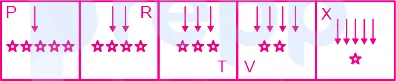
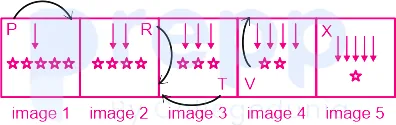 Paper & answer key PDF