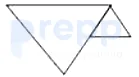
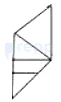
Question 1archived
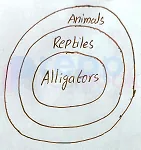
Select the Venn diagram that best illustrates the relationship between the following classes.
Reptiles, Alligators, Animals
- A
Option A (shown in image)
- B
Option B (shown in image)
- C
Option C (shown in image)
- D
Option D (shown in image)
Show answer
C. Option C (shown in image)The least possible Venn diagram for the given relations is as shown below :
All Alligators are Reptiles.
All Reptiles are Animals.
Hence, the correct answer is "Option 3".
 Paper & answer key PDF ↗
 Question 2archived
Which of the following letter-clusters will replace the question mark (?) in the given series?
WTDH, URGK, SPJN, ?, OLPT
- A
QNMQ
- B
QNLP
- C
QMNP
- D
RNMQ
Show answer
A. QNMQFinding the Missing Letter Cluster in the Series
This question asks us to find the letter cluster that completes the given series: WTDH, URGK, SPJN, ?, OLPT. To solve this type of letter series problem, we need to analyze the pattern of change for each letter position across the clusters.
Analyzing the Pattern of Each Letter
Let's look at the position of each letter in the English alphabet (A=1, B=2, ..., Z=26).
First Letter Analysis
W is the 23rd letter.
U is the 21st letter.
S is the 19th letter.
O is the 15th letter.
The sequence for the first letters is 23, 21, 19, ?, 15. We can see a consistent decrease: \(23 - 2 = 21\), \(21 - 2 = 19\). Following this pattern, the next number should be \(19 - 2 = 17\). The 17th letter is Q.
Second Letter Analysis
T is the 20th letter.
R is the 18th letter.
P is the 16th letter.
L is the 12th letter.
The sequence for the second letters is 20, 18, 16, ?, 12. There is a consistent decrease: \(20 - 2 = 18\), \(18 - 2 = 16\). Following this pattern, the next number should be \(16 - 2 = 14\). The 14th letter is N.
Third Letter Analysis
D is the 4th letter.
G is the 7th letter.
J is the 10th letter.
P is the 16th letter.
The sequence for the third letters is 4, 7, 10, ?, 16. There is a consistent increase: \(4 + 3 = 7\), \(7 + 3 = 10\). Following this pattern, the next number should be \(10 + 3 = 13\). The 13th letter is M.
Fourth Letter Analysis
H is the 8th letter.
K is the 11th letter.
N is the 14th letter.
T is the 20th letter.
The sequence for the fourth letters is 8, 11, 14, ?, 20. There is a consistent increase: \(8 + 3 = 11\), \(11 + 3 = 14\). Following this pattern, the next number should be \(14 + 3 = 17\). The 17th letter is Q.
Forming the Missing Cluster
By combining the letters we found for each position, the missing cluster is QNMQ.
Verification
Let's check if QNMQ fits into the series and leads to the next cluster, OLPT, following the established patterns.
First letter: Q (17). The pattern is -2. \(17 - 2 = 15\), which is O. (Matches)
Second letter: N (14). The pattern is -2. \(14 - 2 = 12\), which is L. (Matches)
Third letter: M (13). The pattern is +3. \(13 + 3 = 16\), which is P. (Matches)
Fourth letter: Q (17). The pattern is +3. \(17 + 3 = 20\), which is T. (Matches)
The missing letter cluster QNMQ successfully follows the pattern established by the series.
Summary of the Pattern
Here is a table summarizing the letter positions and the observed pattern:
Cluster
1st Letter
2nd Letter
3rd Letter
4th Letter
WTDH
W (23)
T (20)
D (4)
H (8)
URGK
U (21)
R (18)
G (7)
K (11)
SPJN
S (19)
P (16)
J (10)
N (14)
? (QNMQ)
Q (17)
N (14)
M (13)
Q (17)
OLPT
O (15)
L (12)
P (16)
T (20)
Pattern
-2
-2
+3
+3
The letter cluster that replaces the question mark is QNMQ.
Revision Table: Letter Series Patterns
Understanding letter series is crucial for logical reasoning tests. Here are key points to remember:
Always check the pattern for each position separately.
Patterns can involve addition, subtraction, multiplication, or division of positional values.
Patterns can be constant (like +2, -3) or progressive (like +1, +2, +3...).
Sometimes patterns involve skipping letters or using prime/composite numbers for the increments/decrements.
Write down the letter positions to easily spot numerical patterns.
Additional Information: Types of Reasoning Series
Letter series are a common type of verbal or logical reasoning question. Other types of series include:
Number Series: A sequence of numbers following a specific rule (e.g., arithmetic progression, geometric progression, square numbers, cube numbers, alternating patterns).
Mixed Series: A combination of number and letter series, where the elements alternate or follow interconnected patterns.
Alpha-Numeric Series: Similar to mixed series, involving both letters and numbers in a sequence.
Figure Series: A sequence of figures or diagrams where the shape, position, rotation, or number of elements changes based on a pattern.
Practicing different types of series helps improve analytical and pattern-recognition skills.
Paper & answer key PDF ↗ Question 3archived
Select the set in which the numbers are NOT related in the same way as are the numbers of the following set.
(NOTE: Operations should be performed on the whole numbers, without breaking down the numbers into their constituent digits. E.g. 13 - Operations on 13 such as adding/substracting/multiplying etc. to 13 can be performed. Breaking down 13 into 1 and 3 and then performing mathematical operations on 1 and 3 is not allowed.)
(5, 13, 16)
(4, 11, 14)
- A
(8, 13, 10)
- B
(12, 21, 18)
- C
(7, 17, 20)
- D
(9, 21, 26)
Show answer
D. (9, 21, 26)The question asks us to identify the set of numbers among the given options that is NOT related in the same way as the example sets: (5, 13, 16) and (4, 11, 14).
We need to find the relationship or pattern that connects the three numbers in each set. Let's denote a set as (a, b, c), where 'a' is the first number, 'b' is the second, and 'c' is the third.
Analysing the Pattern in Example Sets
Let's look at the first example set (5, 13, 16):
Relationship between 5 and 13: $13 - 5 = 8$. Or $5 \times 2 + 3 = 13$.
Relationship between 13 and 16: $16 - 13 = 3$.
Let's look at the second example set (4, 11, 14):
Relationship between 4 and 11: $11 - 4 = 7$. Or $4 \times 2 + 3 = 11$.
Relationship between 11 and 14: $14 - 11 = 3$.
We observe a consistent pattern in both example sets:
The second number (b) is obtained by multiplying the first number (a) by 2 and adding 3: $b = 2a + 3$.
The third number (c) is obtained by adding 3 to the second number (b): $c = b + 3$.
Let's verify this pattern with the example sets:
For (5, 13, 16): $b = 2 \times 5 + 3 = 10 + 3 = 13$ (Correct). $c = 13 + 3 = 16$ (Correct). This set follows the pattern.
For (4, 11, 14): $b = 2 \times 4 + 3 = 8 + 3 = 11$ (Correct). $c = 11 + 3 = 14$ (Correct). This set also follows the pattern.
So, the pattern is $b = 2a + 3$ AND $c = b + 3$.
Checking the Options Against the Pattern
Now, let's apply this pattern to each of the given options to find the one that does NOT follow both rules.
Option 1: (8, 13, 10)
Here, $a=8$, $b=13$, $c=10$.
Rule 1: $b = 2a + 3$? $13 = 2 \times 8 + 3 = 16 + 3 = 19$. This is false ($13 \neq 19$).
Rule 2: $c = b + 3$? $10 = 13 + 3 = 16$. This is false ($10 \neq 16$).
This set does NOT follow either rule of the pattern.
Option 2: (12, 21, 18)
Here, $a=12$, $b=21$, $c=18$.
Rule 1: $b = 2a + 3$? $21 = 2 \times 12 + 3 = 24 + 3 = 27$. This is false ($21 \neq 27$).
Rule 2: $c = b + 3$? $18 = 21 + 3 = 24$. This is false ($18 \neq 24$).
This set does NOT follow either rule of the pattern.
Option 3: (7, 17, 20)
Here, $a=7$, $b=17$, $c=20$.
Rule 1: $b = 2a + 3$? $17 = 2 \times 7 + 3 = 14 + 3 = 17$. This is true ($17 = 17$).
Rule 2: $c = b + 3$? $20 = 17 + 3 = 20$. This is true ($20 = 20$).
This set follows both rules of the pattern.
Option 4: (9, 21, 26)
Here, $a=9$, $b=21$, $c=26$.
Rule 1: $b = 2a + 3$? $21 = 2 \times 9 + 3 = 18 + 3 = 21$. This is true ($21 = 21$).
Rule 2: $c = b + 3$? $26 = 21 + 3 = 24$. This is false ($26 \neq 24$).
This set follows the first rule but fails the second rule of the pattern.
Summary of Pattern Check
Let's summarize the findings in a table:
Set (a, b, c)
Rule 1: $b = 2a + 3$
Rule 2: $c = b + 3$
Follows Pattern?
(5, 13, 16)
$13 = 2 \times 5 + 3$ (Yes)
$16 = 13 + 3$ (Yes)
Yes
(4, 11, 14)
$11 = 2 \times 4 + 3$ (Yes)
$14 = 11 + 3$ (Yes)
Yes
(8, 13, 10)
$13 = 2 \times 8 + 3$ (No)
$10 = 13 + 3$ (No)
No
(12, 21, 18)
$21 = 2 \times 12 + 3$ (No)
$18 = 21 + 3$ (No)
No
(7, 17, 20)
$17 = 2 \times 7 + 3$ (Yes)
$20 = 17 + 3$ (Yes)
Yes
(9, 21, 26)
$21 = 2 \times 9 + 3$ (Yes)
$26 = 21 + 3$ (No)
No (Partially)
The example sets and Option 3 follow both rules of the pattern. Options 1 and 2 follow neither rule. Option 4 follows the first rule ($b = 2a + 3$) but not the second rule ($c = b + 3$).
The question asks for the set that is NOT related in the same way as the example sets. While Options 1, 2, and 4 do not fully follow the pattern, Option 4 is uniquely different because it follows one part of the pattern while failing the other, unlike Options 1 and 2 which fail both parts. Therefore, Option 4 is the set that is NOT related in the exact same way as the examples and Option 3.
Conclusion on Number Set Relation
Based on the analysis, the numbers in the sets (5, 13, 16), (4, 11, 14), and (7, 17, 20) share the relationship where the second number is twice the first plus three, and the third number is three more than the second. The set (9, 21, 26) follows the relationship for the second number but not the third, making it the set that is NOT related in the same way.
The final answer is $\boxed{(9, 21, 26)}$.
Revision Table: Number Set Pattern
Review the pattern discovery and application process:
Identify the pattern based on relationships between numbers in the given example sets.
Formulate the rules that define the pattern ($b = 2a + 3$, $c = b + 3$).
Systematically check each option to see if it satisfies both rules.
Identify the option that deviates from the pattern in a unique way compared to others.
Additional Information: Logical Reasoning
Logical reasoning questions involving number sets often require identifying arithmetic or algebraic relationships between the numbers. Common patterns include arithmetic progressions, geometric progressions, differences between consecutive numbers, sums or products of numbers, or rules based on the position of the number in the set (first, second, third). It's important to test simple patterns first and then look for more complex ones if needed. Carefully reading the question to understand exactly what is being asked (e.g., find the one that IS related or the one that is NOT related) is crucial.
Paper & answer key PDF ↗ Question 4archived
If '+' means 'subtraction', '-' means 'multiplication', '÷' means 'addition' and '×' means 'division', then what is the value of the following expression?
26 - 13 + 144 × 18 ÷ 81
- A
292
- B
411
- C
405
- D
144
Show answer
B. 411The correct answer is 411.
The expression now is: 330 + 81 . Addition: Finally, perform the addition: 330 + 81 . Calculation: 330 + 81 = 411 . Final Result The value of the expression after applying the given symbol substitutions and following the order of operations is 411 .
Paper & answer key PDF ↗ Question 5archived
Select the set in which the numbers are related in the same way as are the numbers of the following sets.
(NOTE: Operations should be performed on the whole numbers, without breaking down the numbers into its constituent digits. E.g. 13 - Operations on 13 such as adding/Subtracting/multiplying etc. to 13 can be performed. Breaking down 13 into 1 and 3 and then performing mathematical operations on 1 and 3 is not allowed)
(60, 15, 40)
(100, 50, 20)
- A
(200, 40, 50)
- B
(12, 45, 89)
- C
(10, 5, 30)
- D
(40, 8, 10)
Show answer
A. (200, 40, 50)Analyzing the Relationship in the Given Number Sets
The question asks us to identify the set of numbers among the options that shares the same mathematical relationship as the two given sets: (60, 15, 40) and (100, 50, 20). The rule is that operations must be performed on the whole numbers as they are, without breaking them down into individual digits.
Let's examine the relationship between the numbers in the given sets. Let the three numbers in a set be A, B, and C.
For the first set (60, 15, 40):
A = 60
B = 15
C = 40
Let's look for a pattern:
If we divide the first number (A) by the second number (B): \( \frac{60}{15} = 4 \)
Now, let's see if there is a relationship between this result (4) and the third number (C), which is 40. We notice that \( 4 \times 10 = 40 \).
This suggests a possible rule: \( C = \left( \frac{A}{B} \right) \times 10 \)
Let's verify this rule with the second given set (100, 50, 20):
A = 100
B = 50
C = 20
Applying the proposed rule \( C = \left( \frac{A}{B} \right) \times 10 \):
\( \left( \frac{100}{50} \right) \times 10 = 2 \times 10 = 20 \)
The result, 20, matches the third number (C) in the second set. So, the relationship \( C = \left( \frac{A}{B} \right) \times 10 \) appears to be the pattern for the given number sets.
Applying the Number Set Pattern to Options
Now, we will apply this identified relationship to the numbers in each option to find the set that follows the same rule.
Option Set (A, B, C)
Calculation: \( \left( \frac{A}{B} \right) \times 10 \)
Does it equal C?
(200, 40, 50)
\( \left( \frac{200}{40} \right) \times 10 = 5 \times 10 = 50 \)
Yes, \( 50 = 50 \). This set follows the pattern.
(12, 45, 89)
\( \left( \frac{12}{45} \right) \times 10 = \frac{4}{15} \times 10 = \frac{40}{15} = \frac{8}{3} \)
No, \( \frac{8}{3} \neq 89 \). This set does not follow the pattern.
(10, 5, 30)
\( \left( \frac{10}{5} \right) \times 10 = 2 \times 10 = 20 \)
No, \( 20 \neq 30 \). This set does not follow the pattern.
(40, 8, 10)
\( \left( \frac{40}{8} \right) \times 10 = 5 \times 10 = 50 \)
No, \( 50 \neq 10 \). This set does not follow the pattern.
From the analysis, only the set (200, 40, 50) follows the same relationship \( C = \left( \frac{A}{B} \right) \times 10 \) as the given number sets.
Revision Table: Number Set Analogy
Concept
Description
Key Takeaway
Number Analogy
Identifying the mathematical or logical relationship between numbers in a set or between sets.
Look for consistent patterns (arithmetic operations, ratios, etc.).
Pattern Identification
Analyzing given examples to deduce a rule or formula that connects the elements.
Test the potential rule against all given examples before applying it to options.
Applying the Rule
Using the identified pattern to evaluate the options and find the one that matches.
Be careful with calculations and ensure the rule holds true for the matching option.
Additional Information: Logical Reasoning with Numbers
Logical reasoning questions often involve identifying patterns and relationships. In number-based reasoning, these relationships can be simple arithmetic operations (addition, subtraction, multiplication, division), ratios, squares, cubes, or more complex combinations. The key is to systematically analyze the given examples to find a consistent rule that applies to all of them.
When tackling such problems:
Examine the relationship between pairs of numbers within a set.
Consider relationships involving all numbers in the set.
Test potential rules with all given examples.
Once a rule is confirmed, apply it rigorously to the options.
Pay attention to any specific constraints mentioned, like operating only on whole numbers.
Practice with various types of number series and analogies helps in quickly recognizing common patterns and developing a systematic approach to problem-solving.
Paper & answer key PDF ↗ Question 6archived
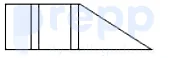
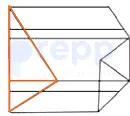
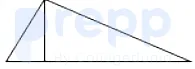
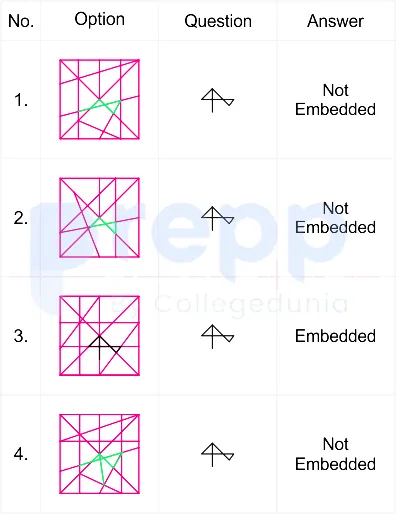
Select the option figure in which the given figure is embedded (rotation is NOT allowed).

- A
Option A (shown in image)
- B
Option B (shown in image)
- C
Option C (shown in image)
- D
Option D (shown in image)
Show answer
C. Option C (shown in image)Hence, the correct answer is "Option 3".
 Paper & answer key PDF ↗
 Question 7archived
'A + B' means 'A is the brother of B'.
'A - B' means 'A is the mother of B'.
'A × B means 'A is the husband of B'.
'A ÷ B means 'A is the sister of B'.
If P ÷ Q - R + S - K × L, then which of the following statements is correct?.
- A
Q is L's mother
- B
R is K's mother's brother
- C
Q is S's sister
- D
R is L's husband's brother
Show answer
B. R is K's mother's brotherThe correct answer is R is K's mother's brother.
Evaluate Options Carefully: Once you have the family structure, go through each option statement by statement and verify its truth based on your diagram. Practice: The more you practice different types of blood relation questions, the faster and more accurate you will become. Understanding the basic family relationships (parent, child, sibling, aunt, uncle, cousin, grandparent, etc.) and their inverses (e.g., if A is B's mother, then B is A's child) is crucial.
Paper & answer key PDF ↗ Question 8archived
Select the number from among the given options that can replace the question mark (?) in the following series.
2, 6, 9, 27, 30, 90, ?
- A
85
- B
88
- C
90
- D
93
Show answer
D. 93The correct answer is 93.
Look for squares or cubes: Sometimes, terms are related to squares, cubes, or their roots. Combine series: The series might be a combination of two interleaved series. Test options: If you're unsure of the pattern, sometimes checking how the given options fit into a potential pattern can help. Practice: Solving many different types of number series problems improves pattern recognition skills.
Paper & answer key PDF ↗ Question 9archived
The second number in the given number-pairs is obtained by performing certain mathematical operation(s) on the first number. The same operation(s) is/are followed in all the number-pairs except one. Find that odd number-pair.
- A
15 ∶ 34
- B
1 ∶ 6
- C
7 ∶ 18
- D
18 ∶ 42
Show answer
D. 18 ∶ 42The correct answer is 18 ∶ 42.
Squaring/Cubing: The pattern involves squaring or cubing the numbers. Prime Numbers, Composite Numbers, etc.: The pattern might be based on properties of numbers. Digit Operations: The pattern might involve sums or products of digits within the numbers. To solve these problems, it's useful to test simple operations first and look for consistency across the given examples.
Paper & answer key PDF ↗ Question 10archived
Select the figure from the options that can replace the question mark (?) and complete the given pattern.

- A
Option A (shown in image)
- B
Option B (shown in image)
- C
Option C (shown in image)
- D
Option D (shown in image)
Show answer
Question 11archived
'Fair' is related to 'Righteous' in the same way as 'Cunning' is related to '__________'.
- A
Person
- B
Personality
- C
Deceit
- D
Character
Show answer
C. DeceitThe correct answer is Deceit.
Pair 1 Relationship Pair 2 Fair Is closely associated with (a positive moral quality) Righteous Cunning Is a method used for / strongly associated with (a negative action/concept) Deceit Based on this analysis, the word that best completes the analogy is 'Deceit'. Problem and Solution (e.g., Hunger : Eat :: Tiredness : Sleep) In this specific analogy, the relationship between 'Fair' and 'Righteous' is close association of positive qualities. The relationship between 'Cunning' and 'Deceit' is also one of strong association, where cunning is often the means to achieve deceit, reflecting a consistent pattern of relationship type.
Paper & answer key PDF ↗ Question 12archived
Select the set in which the numbers are related in the same way as are the numbers of the given sets.
(NOTE: Operations should be performed on the whole numbers, without breaking down the numbers into its constituent digits. E.g. 13 - Operations on 13 such as adding / Subtracting/multiplying etc. to 13 can be performed. Breaking down 13 into 1 and 3 and then performing mathematical operations on 1 and 3 is NOT allowed)
(15, 23, 31)
(33, 41, 49)
- A
(21, 29, 43)
- B
(20, 28, 36)
- C
(20, 33, 28)
- D
(35, 43, 56)
Show answer
B. (20, 28, 36)Understanding the Number Set Relationships
The question asks us to find a set of numbers that shares the same relationship between its elements as the given sets: (15, 23, 31) and (33, 41, 49).
Let's analyze the pattern in the given sets:
Set 1: (15, 23, 31)
Difference between the second and first number: \(23 - 15 = 8\)
Difference between the third and second number: \(31 - 23 = 8\)
The numbers in the first set have a constant difference of 8 between consecutive terms.
Set 2: (33, 41, 49)
Difference between the second and first number: \(41 - 33 = 8\)
Difference between the third and second number: \(49 - 41 = 8\)
Similarly, the numbers in the second set also have a constant difference of 8 between consecutive terms.
This suggests that the relationship between the numbers in the given sets is that they form an arithmetic progression with a common difference of 8.
Analyzing the Options for the Same Pattern
Now, we need to check each option to see which one follows this same rule: the difference between consecutive numbers must be 8.
Option 1: (21, 29, 43)
Difference between the second and first number: \(29 - 21 = 8\)
Difference between the third and second number: \(43 - 29 = 14\)
The differences are 8 and 14. This option does not have a constant difference.
Option 2: (20, 28, 36)
Difference between the second and first number: \(28 - 20 = 8\)
Difference between the third and second number: \(36 - 28 = 8\)
The differences are 8 and 8. This option has a constant difference of 8, matching the pattern in the given sets.
Option 3: (20, 33, 28)
Difference between the second and first number: \(33 - 20 = 13\)
Difference between the third and second number: \(28 - 33 = -5\)
This option does not have a constant difference and is not in increasing order. It does not match the pattern.
Option 4: (35, 43, 56)
Difference between the second and first number: \(43 - 35 = 8\)
Difference between the third and second number: \(56 - 43 = 13\)
The differences are 8 and 13. This option does not have a constant difference.
Based on the analysis, only Option 2 exhibits the same arithmetic progression pattern with a common difference of 8 as the given sets.
Revision Table: Comparing Sets and Options
Set/Option
Numbers
Difference 1 (2nd - 1st)
Difference 2 (3rd - 2nd)
Constant Difference?
Matches Pattern?
Given Set 1
(15, 23, 31)
\(23 - 15 = 8\)
\(31 - 23 = 8\)
Yes (8)
Base Pattern
Given Set 2
(33, 41, 49)
\(41 - 33 = 8\)
\(49 - 41 = 8\)
Yes (8)
Base Pattern
Option 1
(21, 29, 43)
\(29 - 21 = 8\)
\(43 - 29 = 14\)
No
No
Option 2
(20, 28, 36)
\(28 - 20 = 8\)
\(36 - 28 = 8\)
Yes (8)
Yes
Option 3
(20, 33, 28)
\(33 - 20 = 13\)
\(28 - 33 = -5\)
No
No
Option 4
(35, 43, 56)
\(43 - 35 = 8\)
\(56 - 43 = 13\)
No
No
Additional Information: Arithmetic Progressions
An arithmetic progression (AP) is a sequence of numbers such that the difference between the consecutive terms is constant. This constant difference is called the common difference, denoted by \(d\).
In an arithmetic progression, if the first term is \(a_1\), the second term is \(a_2\), the third term is \(a_3\), and so on, then:
\(a_2 - a_1 = d\)
\(a_3 - a_2 = d\)
\(a_n - a_{n-1} = d\) for any term \(n > 1\).
The general form of an AP is \(a, a+d, a+2d, a+3d, \dots\)
In this question, the given sets and the correct option are three-term arithmetic progressions where the common difference \(d = 8\).
Paper & answer key PDF ↗ Question 13archived
Select the set in which the numbers are related in the same way as are the numbers of the following sets.
(NOTE: Operations should be performed on the whole numbers, without breaking down the numbers into its constituent digits. E.g. 13 - Operations on 13 such as adding /Subtracting /multiplying etc. to 13 can be performed. Breaking down 13 into 1 and 3 and then performing mathematical operations on 1 and 3 is NOT allowed)
(7, 65)
(11, 145)
- A
(15, 140)
- B
(8, 82)
- C
(12, 168)
- D
(9, 70)
Show answer
B. (8, 82)Understanding Number Set Analogies and Relationships
In number set analogy questions, you are given a set of numbers that follow a specific rule or relationship. You need to identify this rule and then find another set among the options that follows the same rule.
Let's analyze the given sets:
Set 1: (7, 65)
Set 2: (11, 145)
We need to find the relationship between the first number and the second number in each set. Let the first number be 'n' and the second number be 'm'.
Finding the Relationship in the Given Sets
Let's examine the numbers in the first set (7, 65). How can we get 65 from 7? We can try different operations:
Squaring the first number: $7^2 = 49$. The difference is $65 - 49 = 16$. $16$ is $4^2$. Is there a relationship between 7 and 4? $7 - 3 = 4$. So perhaps the rule is $n^2 + (n-3)^2$. Let's check this rule with the second set.
Let's check the rule $n^2 + (n-3)^2$ with Set 2 (11, 145):
For $n=11$, $11^2 + (11-3)^2 = 11^2 + 8^2 = 121 + 64 = 185$. This is not 145. So, this rule is incorrect.
Let's try other possibilities for (7, 65):
Multiply the first number by a number slightly larger than itself: $7 \times 9 = 63$. $63 + 2 = 65$. Here, 9 is $7 + 2$. So the pattern could be $n \times (n+2) + 2$.
Let's test this potential rule $n \times (n+2) + 2$ with the given sets:
For Set 1 (7, 65): $n=7$. Applying the rule: $7 \times (7+2) + 2 = 7 \times 9 + 2 = 63 + 2 = 65$. This matches the second number.
For Set 2 (11, 145): $n=11$. Applying the rule: $11 \times (11+2) + 2 = 11 \times 13 + 2 = 143 + 2 = 145$. This also matches the second number.
The rule seems to be confirmed: The second number is obtained by multiplying the first number by a number two greater than itself and then adding 2. Mathematically, if the set is $(n, m)$, then $m = n \times (n+2) + 2$.
Applying the Rule to the Options
Now, we will apply the rule $n \times (n+2) + 2$ to the first number of each option set and see if we get the second number.
Option 1: (15, 140)
Here $n = 15$. Applying the rule:
$15 \times (15+2) + 2 = 15 \times 17 + 2$
$15 \times 17 = 255$
$255 + 2 = 257$
The calculated second number is 257, which is not 140. So, this option does not follow the rule.
Option 2: (8, 82)
Here $n = 8$. Applying the rule:
$8 \times (8+2) + 2 = 8 \times 10 + 2$
$8 \times 10 = 80$
$80 + 2 = 82$
The calculated second number is 82, which matches the second number in the option. So, this option follows the rule.
Option 3: (12, 168)
Here $n = 12$. Applying the rule:
$12 \times (12+2) + 2 = 12 \times 14 + 2$
$12 \times 14 = 168$
$168 + 2 = 170$
The calculated second number is 170, which is not 168. So, this option does not follow the rule.
Option 4: (9, 70)
Here $n = 9$. Applying the rule:
$9 \times (9+2) + 2 = 9 \times 11 + 2$
$9 \times 11 = 99$
$99 + 2 = 101$
The calculated second number is 101, which is not 70. So, this option does not follow the rule.
Based on the analysis, only Option 2 follows the established relationship.
Summary of Option Analysis
Option Set
First Number (n)
Calculated Second Number (n × (n+2) + 2)
Given Second Number
Follows Rule?
(15, 140)
15
$15 \times (15+2) + 2 = 15 \times 17 + 2 = 255 + 2 = 257$
140
No
(8, 82)
8
$8 \times (8+2) + 2 = 8 \times 10 + 2 = 80 + 2 = 82$
82
Yes
(12, 168)
12
$12 \times (12+2) + 2 = 12 \times 14 + 2 = 168 + 2 = 170$
168
No
(9, 70)
9
$9 \times (9+2) + 2 = 9 \times 11 + 2 = 99 + 2 = 101$
70
No
Revision Table: Key Concepts in Set Analogies
Concept
Description
Importance in Set Analogies
Number Relationships
How numbers in a set are connected through mathematical operations (addition, subtraction, multiplication, division, squares, cubes, etc.).
Crucial for identifying the underlying rule in the given sets.
Pattern Identification
Recognizing the consistent rule across multiple given sets.
Confirms the discovered relationship before applying it to options.
Testing Options
Applying the identified rule to each option set to find the one that matches.
The final step to verify which set follows the same relationship.
Whole Number Operations
Performing operations on the numbers as a whole, not their individual digits.
A common constraint in these types of questions.
Additional Information: Solving Number Pattern Questions
Number pattern and analogy questions are common in logical reasoning tests. Here are some tips for solving them:
Look for simple relationships first: Start with basic operations like addition, subtraction, multiplication, and division.
Consider squares and cubes: Many patterns involve squares ($n^2$) or cubes ($n^3$) of the first number, often with an added or subtracted constant or multiple of n.
Look for differences and ratios: Calculate the difference or ratio between the numbers in the set. See if there's a pattern in these differences or ratios across the given sets.
Test combinations of operations: Sometimes the rule involves a combination, like multiplication followed by addition ($n \times a + b$).
Check the structure: Does the second number relate to the first number itself ($n^2 + c$), or to a number derived from the first number ($n \times (n+k) + c$), or perhaps the difference or sum of the numbers relates to one of the numbers?
Be mindful of constraints: Pay attention to specific instructions, like operating only on whole numbers provided.
Verify the rule: Always test the potential rule with all the given examples before applying it to the options.
Paper & answer key PDF ↗ Question 14archived
Which of the following interchanges of signs would make the given equation correct?
50 - 25 ÷ 5 × 3 + 6 = 59
- A
+ and ×
- B
÷ and +
- C
× and -
- D
-and +
Show answer
D. -and +The logic followed here is :-
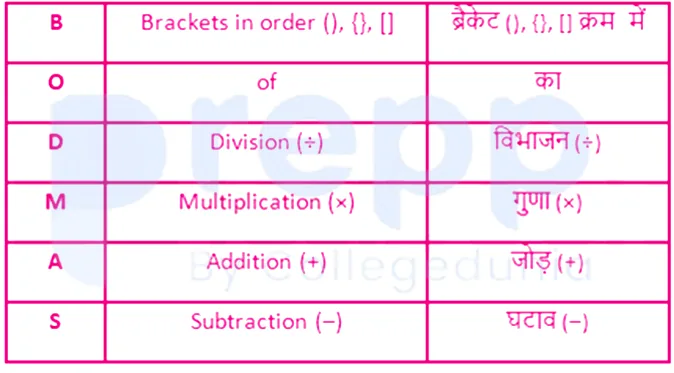
By using BODMAS RULE :
Option 1) : + and ×
Given equation is : 50 - 25 ÷ 5 × 3 + 6 = 59
After interchanging the two signs the equation is as follows : 50 - 25 ÷ 5 + 3 × 6 = 59
⇒ 50 - 25 ÷ 5 + 3 × 6 = 59
⇒ 50 - 5 + 3 × 6 = 59
⇒ 50 - 5 + 18 = 59
⇒ 68 - 5 = 59
⇒ 63 ≠ 59
LHS ≠ RHS
Option 2) : ÷ and +
Given equation is : 50 - 25 ÷ 5 × 3 + 6 = 59
After interchanging the two signs the equation is as follows : 50 - 25 + 5 × 3 ÷ 6 = 59
⇒ 50 - 25 + 5 × 3 ÷ 6 = 59
⇒ 50 - 25 + 5 × 0.5 = 59
⇒ 50 - 25 + 2.5 = 59
⇒ 52.5 - 25 = 59
⇒ 27.5 ≠ 59
LHS ≠ RHS
Option 3) : × and -
Given equation is : 50 - 25 ÷ 5 × 3 + 6 = 59
After interchanging the two signs the equation is as follows : 50 × 25 ÷ 5 - 3 + 6 = 59
⇒ 50 × 25 ÷ 5 - 3 + 6 = 59
⇒ 50 × 5 - 3 + 6 = 59
⇒ 250 - 3 + 6 = 59
⇒ 256 - 3 = 59
⇒ 253 ≠ 59
LHS ≠ RHS
Option 4) : - and +
Given equation is : 50 - 25 ÷ 5 × 3 + 6 = 59
After interchanging the two signs the equation is as follows : 50 + 25 ÷ 5 × 3 - 6 = 59
⇒ 50 + 25 ÷ 5 × 3 - 6 = 59
⇒ 50 + 5 × 3 - 6 = 59
⇒ 50 + 15 - 6 = 59
⇒ 65 - 6 = 59
⇒ 59 = 59
LHS = RHS
Hence, the correct answer is "- and +".
 Paper & answer key PDF ↗
 Question 15archived
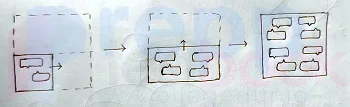
The sequence of folding a piece of paper and the manner in which the folded paper has been cut is shown below. Choose the figure that would most closely resemble the unfolded form of the paper.
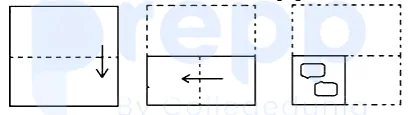
- A
Option A (shown in image)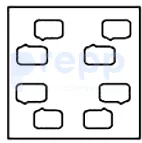
- B
Option B (shown in image)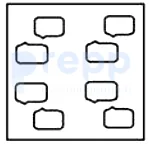
- C
Option C (shown in image)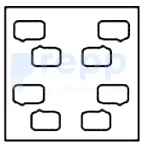
- D
Option D (shown in image)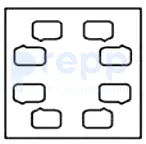
Show answer
D. Option D (shown in image)After unfolding the given paper the figure formed is as shown below :
Hence, the correct answer is "Option 4".
 Paper & answer key PDF ↗
 Question 16archived
Select the option figure which is embedded in the given figure (rotation is NOT allowed).

- A
Option A (shown in image)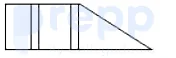
- B
Option B (shown in image)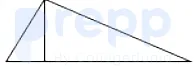
- C
Option C (shown in image)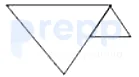
- D
Option D (shown in image)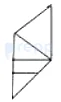
Show answer
Question 17archived
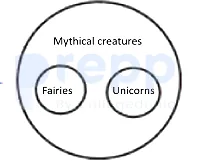
Select the Venn diagram that best represents the relationship between the following classes.
Fairies, Mythical creatures, Unicorns
- A
Option A (shown in image)
- B
Option B (shown in image)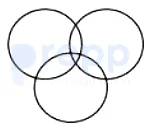
- C
Option C (shown in image)
- D
Option D (shown in image)
Show answer
A. Option A (shown in image)The least possible Venn diagram for the given relations is as shown below :
All Fairies are Mythical creatures.
All Unicorns are Mythical creatures.
Hence, the correct answer is "Option 1".
 Paper & answer key PDF ↗
 Question 18archived
Select the option that represents the correct order of the given words as they would appear in an English dictionary.
1. Dither
2. Defiance
3. Dramatic
4. Dedicated
5. Differentiate
6. Diabolical
- A
4, 2, 6, 5, 1, 3
- B
3, 6, 4, 2, 5, 1
- C
4, 6, 2, 5, 3, 1
- D
3, 2, 4, 6, 5, 1
Show answer
A. 4, 2, 6, 5, 1, 3Determining Dictionary Order for Given Words
To find the correct dictionary order of the given words, we need to compare them letter by letter, starting from the first letter. The words are:
Dither
Defiance
Dramatic
Dedicated
Differentiate
Diabolical
All the words start with the letter 'D'. We move to the second letter:
Dither
Defiance
Dramatic
Dedicated
Differentiate
Diabolical
The second letters are 'i', 'e', 'r', 'e', 'i', 'i'. In alphabetical order, 'e' comes before 'i', and 'i' comes before 'r'. So, the words starting with 'De' will come first, followed by words starting with 'Di', and finally the word starting with 'Dr'.
Comparing words starting with 'De':
Defiance (2)
Dedicated (4)
Comparing 'Defiance' and 'Dedicated', the third letter is 'f' in 'Defiance' and 'd' in 'Dedicated'. Since 'd' comes before 'f', 'Dedicated' comes before 'Defiance'.
Order so far: 4 (Dedicated), 2 (Defiance).
Comparing words starting with 'Di':
Dither (1)
Differentiate (5)
Diabolical (6)
Comparing 'Dither', 'Differentiate', and 'Diabolical', the third letters are 't', 'f', and 'a'. Since 'a' comes first, 'Diabolical' comes first among these.
Words left: Dither (1), Differentiate (5).
Comparing 'Dither' and 'Differentiate', the fourth letters are 'h' and 'f'. Since 'f' comes before 'h', 'Differentiate' comes before 'Dither'.
Order for 'Di' words: 6 (Diabolical), 5 (Differentiate), 1 (Dither).
Placing the word starting with 'Dr':
Dramatic (3)
This word comes after all the 'De' and 'Di' words.
Combining the orders:
Putting all the words in order:
Dedicated (starts with 'De', third letter 'd')
Defiance (starts with 'De', third letter 'f')
Diabolical (starts with 'Di', third letter 'a')
Differentiate (starts with 'Di', third letter 'f')
Dither (starts with 'Di', third letter 't')
Dramatic (starts with 'Dr')
The numerical order is 4, 2, 6, 5, 1, 3.
Let's summarize the comparison process in a table:
Word (Number)
Letter 1
Letter 2
Letter 3
Letter 4
Order by 2nd letter
Order within groups
Final Order
Dither (1)
D
i
t
h
3rd Group ('Di')
3rd in 'Di' group
5th
Defiance (2)
D
e
f
i
1st Group ('De')
2nd in 'De' group
2nd
Dramatic (3)
D
r
a
m
4th Group ('Dr')
1st in 'Dr' group
6th
Dedicated (4)
D
e
d
i
1st Group ('De')
1st in 'De' group
1st
Differentiate (5)
D
i
f
f
3rd Group ('Di')
2nd in 'Di' group
4th
Diabolical (6)
D
i
a
b
3rd Group ('Di')
1st in 'Di' group
3rd
Based on the comparison, the correct dictionary order of the words is Dedicated, Defiance, Diabolical, Differentiate, Dither, Dramatic, which corresponds to the numerical sequence 4, 2, 6, 5, 1, 3.
The correct option representing this order is 4, 2, 6, 5, 1, 3.
Revision Table: English Dictionary Order
Concept
Explanation
Example
Alphabetical Order
Arranging words based on the standard sequence of letters in the alphabet (A-Z).
Apple, Banana, Cherry
Letter-by-Letter Comparison
Comparing words by looking at their letters one at a time from left to right.
Cat vs. Dog: Compare 'C' and 'D'. 'C' comes first.
Comparison at first different letter
The order is determined by the first position where the letters in the words differ.
Car vs. Cat: First two letters 'Ca' are same. Compare 'r' and 't'. 'r' comes first.
Shorter word first (if prefix is same)
If one word is a prefix of another (e.g., 'cat' and 'catalog'), the shorter word comes first.
Act, Action: 'Act' comes before 'Action'.
Additional Information: Vocabulary and Ordering
Understanding dictionary order, also known as alphabetical order, is a fundamental skill for using dictionaries, indexes, encyclopedias, and sorting lists of names or information. It's based purely on the sequence of letters in the alphabet.
When sorting words:
Always start with the first letter. If letters are different, the word with the letter appearing earlier in the alphabet comes first.
If the first letters are the same, move to the second letter and compare them.
Continue this process letter by letter until you find a position where the letters are different. The word with the letter that comes earlier alphabetically at that position is placed first.
If one word runs out of letters while the other still has letters (meaning one is a prefix of the other), the shorter word comes first. For example, 'go' comes before 'going'.
This principle applies to any length of words and is consistent across the English language.
Paper & answer key PDF ↗ Question 19archived
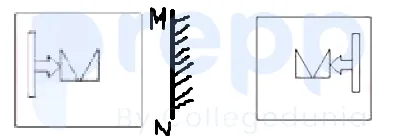
Select the correct mirror image of the given figure when the mirror is placed at the right side of the figure.

- A
Option A (shown in image)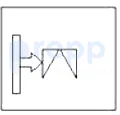
- B
Option B (shown in image)
- C
Option C (shown in image)
- D
Option D (shown in image)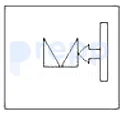
Show answer
D. Option D (shown in image)The correct mirror image from the following options, when the mirror MN is placed on the right side of the given figure :
Hence, the correct answer is "Option 4".
 Paper & answer key PDF ↗
 Question 20archived
In a certain code language, 'PEN' is coded as 9 and 'PAPER' is coded as 25 . How will 'CHAPTER' be coded in the same language?
- A
36
- B
49
- C
24
- D
42
Show answer
B. 49Decoding the Coding Language Pattern
This question asks us to find the coded value for the word 'CHAPTER' based on the given examples 'PEN' coded as 9 and 'PAPER' coded as 25 in a certain code language. To solve this, we need to identify the pattern or rule used for coding the words.
Analyzing the Given Coding Examples
Let's look closely at the words and their corresponding coded values:
Word 1: PEN
Coded Value 1: 9
Word 2: PAPER
Coded Value 2: 25
We need to find a relationship between the word 'PEN' and the number 9, and between the word 'PAPER' and the number 25.
Discovering the Coding Pattern
Observe the coded values 9 and 25. These are perfect squares:
$9 = 3^2$
$25 = 5^2$
Now, let's examine the words 'PEN' and 'PAPER' to see if any property relates to the base numbers 3 and 5.
The word 'PEN' has 3 letters. The coded value is 9, which is $3^2$.
The word 'PAPER' has 5 letters. The coded value is 25, which is $5^2$.
It appears the coding pattern is based on the number of letters in the word. The coded value is the square of the total number of letters in the word.
Word
Number of Letters
Coded Value
Pattern
PEN
3
9
$3^2 = 9$
PAPER
5
25
$5^2 = 25$
Applying the Pattern to 'CHAPTER'
Now we will apply the discovered pattern to the word 'CHAPTER' to find its coded value in the same language.
Let's count the number of letters in the word 'CHAPTER'.
C-H-A-P-T-E-R
There are 7 letters in the word 'CHAPTER'.
According to the pattern, the coded value will be the square of the number of letters.
Coded Value = (Number of letters in CHAPTER)$^2$
Coded Value = $7^2$
Calculate the square of 7:
$7^2 = 7 \times 7 = 49$
Therefore, 'CHAPTER' will be coded as 49 in the same language.
Conclusion: Solving the Coding Puzzle
By analyzing the given examples, we identified the pattern where the coded value is the square of the number of letters in the word. Applying this pattern to 'CHAPTER', which has 7 letters, gives us $7^2 = 49$. This matches one of the options provided.
Revision Table: Coding Language Concepts
Concept
Description
Example (based on question)
Coding Language
A system where words or messages are converted into a different form using a specific rule or pattern.
'PEN' coded as 9
Pattern Recognition
Identifying the underlying rule or logic connecting the original form and the coded form.
Discovering that code is (number of letters)$^2$
Application
Using the identified pattern to code a new word or decode a given code.
Coding 'CHAPTER' based on the pattern
Additional Information on Coding & Decoding
Coding and decoding questions are common in aptitude and reasoning tests. They assess your ability to identify patterns quickly and apply them consistently. These patterns can be based on various aspects:
Letter Position: Using the alphabetical position of letters (A=1, B=2, ...).
Letter Swapping: Rearranging letters within a word or between words.
Mathematical Operations: Applying addition, subtraction, multiplication, division, or squaring to letter values or counts.
Symbol Substitution: Replacing letters with symbols.
Reverse Alphabetical Order: Using Z=1, Y=2, etc.
Solving such problems requires careful observation and systematic analysis of the given examples to deduce the specific rule being used. Practice with different types of coding patterns can significantly improve your speed and accuracy in these questions.
Paper & answer key PDF ↗ Question 21archived
In a certain code language, 'APRIL' is coded as 'CSTLN" and 'MARCH' is coded as "ODTFJ". How will 'JUNE' be coded in that language?
- A
KWPH
- B
KXPH
- C
LXPH
- D
LWPI
Show answer
C. LXPHDecoding the Code Language Pattern
This question asks us to find the code for the word 'JUNE' based on the coding pattern observed in two given examples: 'APRIL' coded as 'CSTLN' and 'MARCH' coded as 'ODTFJ'. We need to analyze the relationship between the letters of the original words and their coded counterparts to uncover the rule used in this code language.
Analyzing the Code for 'APRIL' to 'CSTLN'
Let's look at the position of each letter in the alphabet and the corresponding letter in the code:
Original Word
Letter
Alphabet Position
Coded Word
Coded Letter
Alphabet Position
Shift
APRIL
A
\(1\)
CSTLN
C
\(3\)
\(3 - 1 = +2\)
P
\(16\)
S
\(19\)
\(19 - 16 = +3\)
R
\(18\)
T
\(20\)
\(20 - 18 = +2\)
I
\(9\)
L
\(12\)
\(12 - 9 = +3\)
L
\(12\)
N
\(14\)
\(14 - 12 = +2\)
From the analysis of 'APRIL' and 'CSTLN', we observe a pattern of letter shifts: +2, +3, +2, +3, +2.
Analyzing the Code for 'MARCH' to 'ODTFJ'
Let's apply the same analysis to the second example:
Original Word
Letter
Alphabet Position
Coded Word
Coded Letter
Alphabet Position
Shift
MARCH
M
\(13\)
ODTFJ
O
\(15\)
\(15 - 13 = +2\)
A
\(1\)
D
\(4\)
\(4 - 1 = +3\)
R
\(18\)
T
\(20\)
\(20 - 18 = +2\)
C
\(3\)
F
\(6\)
\(6 - 3 = +3\)
H
\(8\)
J
\(10\)
\(10 - 8 = +2\)
The analysis of 'MARCH' and 'ODTFJ' confirms the pattern: +2, +3, +2, +3, +2.
Applying the Code Pattern to 'JUNE'
Now, let's apply the discovered +2, +3, +2, +3 pattern to the word 'JUNE'.
First letter 'J': Position \(10\). Apply +2 shift: \(10 + 2 = 12\). The 12th letter is 'L'.
Second letter 'U': Position \(21\). Apply +3 shift: \(21 + 3 = 24\). The 24th letter is 'X'.
Third letter 'N': Position \(14\). Apply +2 shift: \(14 + 2 = 16\). The 16th letter is 'P'.
Fourth letter 'E': Position \(5\). Apply +3 shift: \(5 + 3 = 8\). The 8th letter is 'H'.
Combining the coded letters, we get 'LXPH'.
Conclusion: Coded Word for JUNE
Based on the consistent pattern derived from the examples, the word 'JUNE' is coded as 'LXPH' in this code language.
Revision Table: Coding Logic Summary
Word
Original Letter
Shift Pattern Applied
Coded Letter
APRIL
A
+2
C
P
+3
S
R
+2
T
I
+3
L
L
+2
N
MARCH
M
+2
O
A
+3
D
R
+2
T
C
+3
F
H
+2
J
JUNE
J
+2
L
U
+3
X
N
+2
P
E
+3
H
Additional Information: Types of Coding-Decoding
Coding-decoding questions are common in reasoning sections of competitive exams. They test your ability to identify patterns and rules in a given set of examples and apply them to new cases. Common types include:
Letter Coding: Letters are replaced by other letters based on specific rules (like position shifts, reverse order, etc.). This is the type seen in this problem.
Number Coding: Words or letters are coded using numbers.
Symbol Coding: Words are coded using symbols.
Substitution Coding: A specific word is replaced by another word (e.g., 'red' is called 'blue').
Solving these questions requires careful observation, analysis, and systematic application of the identified logic.
Paper & answer key PDF ↗ Question 22archived
Select the option that is related to the third word in the same way as the second word is related to the first word. (The words should be treated as meaningful Hindi words and should not be associated with each other on the basis of number of letters/number of consonants/number of vowels in the word.
Fountain Pen ∶ Waterman ∶∶ Telescope ∶ ?
- A
Galileo
- B
Macmillan
- C
Robert hook
- D
Newton
Show answer
A. GalileoUnderstanding Analogies: Fountain Pen to Waterman, Telescope to...?
This question presents an analogy, where we need to find the relationship between the first two words and then apply that same relationship to the third word to find the fourth word from the given options. The structure is $\text{Word 1} : \text{Word 2} :: \text{Word 3} : \text{?}$.
Analyzing the First Pair: Fountain Pen and Waterman
The first pair provided is Fountain Pen : Waterman. Let's determine the connection between these two.
A Fountain Pen is a specific type of pen that uses liquid ink.
Waterman is a widely recognized and historic brand, famous for manufacturing high-quality fountain pens and other writing instruments.
The relationship here is that the second word (Waterman) is a well-known maker or brand associated with the first word (Fountain Pen).
Applying the Relationship to Telescope
Now we need to apply this same relationship to the third word, which is Telescope. We are looking for a famous person or entity that is associated with the Telescope in a way similar to how Waterman is associated with Fountain Pens. The analogy to solve is:
$\text{Fountain Pen} : \text{Waterman} :: \text{Telescope} : ?$
Evaluating the Options for Telescope Association
Let's examine the given options and consider their relevance to the Telescope:
Galileo: Galileo Galilei was a pioneering astronomer and physicist who greatly improved the design and magnification of the telescope in 1609. He was famously the first to use the telescope systematically for astronomical observations, making discoveries that revolutionized our understanding of the cosmos. His name is very strongly associated with the history and use of the telescope.
Macmillan: This name refers to a prominent publishing house. There is no significant association with the Telescope in the context of manufacturing, invention, or primary use.
Robert Hook: Robert Hooke was a contemporary of Newton and made important contributions to science, including microscopy. While he worked in optics, his most famous instrument association is arguably the microscope, not the telescope in the same prominent way as Galileo.
Newton: Isaac Newton invented the reflecting telescope, which was a significant advancement over the refracting telescopes that came before. While his contribution is immense, Galileo is often more widely associated with the initial use and popularization of the telescope for astronomical discovery in general contexts.
Determining the Best Fit for the Analogy
Comparing the options, Galileo stands out as the figure most famously and widely associated with the Telescope, particularly its early use to make groundbreaking astronomical observations. This association aligns well with the relationship established in the first pair, where Waterman is a famous name linked to Fountain Pens.
Therefore, following the pattern, Telescope is related to Galileo.
Conclusion
Based on the established relationship between Fountain Pen and Waterman, the word that shares a similar relationship with Telescope from the given options is Galileo.
Revision Table: Analogy Components
Item 1
Item 2
Relationship
Fountain Pen
Waterman
Object : Famous Brand/Maker
Telescope
Galileo
Object : Famous Person Associated with Use/Development
Additional Information: Galileo and Early Telescopes
Although the telescope was likely invented in the Netherlands around 1608, Galileo quickly developed his own versions with higher magnification after hearing about the invention. His critical contribution was not just building better telescopes but being the first to aim one at the sky, systematically observing celestial bodies. His observations of the Moon's surface, the phases of Venus, the four largest moons of Jupiter (now called the Galilean moons), and the composition of the Milky Way provided strong evidence supporting the heliocentric model proposed by Copernicus, fundamentally changing astronomy.
Paper & answer key PDF ↗ Question 23archived
Three of the following letter-clusters are alike in some manner and hence form a group. Which letter-cluster does not belong to that group?
- A
OPK
- B
ABY
- C
LMO
- D
IJQ
Show answer
C. LMOThe correct answer is LMO.
Reverse Pairs: Using pairs of letters whose positions sum to 27. Vowel/Consonant Patterns: Patterns based on the arrangement of vowels and consonants. Combinations: A mix of the above patterns. To solve these questions, it is helpful to know the alphabetical position of each letter and practice identifying different types of patterns.
Paper & answer key PDF ↗ Question 24archived
Select the figure from among the given options that can replace the question

- A
Option A (shown in image)
- B
Option B (shown in image)
- C
Option C (shown in image)
- D
Option D (shown in image)
Show answer
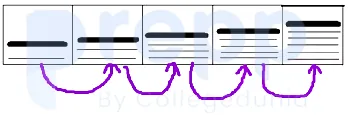
D. Option D (shown in image)The figure from among the given options that can replace the question is as shown below :
Here one horizontal line is added at bottom from figure to figure.
Hence, the correct answer is "Option 4".
 Paper & answer key PDF ↗
 Question 25archived
Select the option that represents the letters that, when placed from left to right in the blanks below, will complete the letter series.
L _ N N N _ _ M N N N N _ M N N N _
- A
L M M N L
- B
M N N L M
- C
M N L L N
- D
L M N N L
Show answer
C. M N L L NSolving the Letter Series Completion Problem
The problem asks us to find the correct sequence of letters from the given options that will complete the letter series: L _ N N N _ _ M N N N N _ M N N N _
There are 5 blanks in the series. We need to test the options provided to see which one fits into the blanks to create a discernible pattern.
Analyzing the Series and Options
Let's write out the series indicating the positions of the blanks (indexed from 1):
L (1) _ (2) N (3) N (4) N (5) _ (6) _ (7) M (8) N (9) N (10) N (11) N (12) _ (13) M (14) N (15) N (16) N (17) _ (18)
The blanks are at positions 2, 6, 7, 13, and 18. We have 5 blanks, and each option provides a sequence of 5 letters.
Testing Option 3: M N L L N
Let's insert the letters from Option 3 (M, N, L, L, N) into the blanks from left to right:
Blank 2 gets 'M'
Blank 6 gets 'N'
Blank 7 gets 'L'
Blank 13 gets 'L'
Blank 18 gets 'N'
The completed series becomes:
L M N N N N L M N N N N L M N N N N
Identifying the Pattern
Let's look at the completed series:
L M N N N N L M N N N N L M N N N N
We can observe a repeating block of letters: L M N N N N. This block is 6 letters long.
Let's see if the completed series is formed by repeating this block:
Block 1: L M N N N N (Positions 1-6)
Block 2: L M N N N N (Positions 7-12)
Block 3: L M N N N N (Positions 13-18)
The total length of the completed series is $6 \times 3 = 18$, which matches the length of the original series with the blanks filled.
Verifying the Pattern against Original Blanks
Now let's check if the letters inserted from Option 3 correctly filled the original blanks to form this pattern:
Original blank at pos 2 was filled with 'M' (correct as per Option 3 and the pattern).
Original blank at pos 6 was filled with 'N' (correct as per Option 3 and the pattern).
Original blank at pos 7 was filled with 'L' (correct as per Option 3 and the pattern).
Original blank at pos 13 was filled with 'L' (correct as per Option 3 and the pattern).
Original blank at pos 18 was filled with 'N' (correct as per Option 3 and the pattern).
Since inserting the letters 'M', 'N', 'L', 'L', 'N' from Option 3 creates a clear and consistent repeating pattern (L M N N N N), Option 3 is the correct answer.
Revision Table: Letter Series Completion
Original Series (with blanks)
Blanks Positions (1-indexed)
Letters from Option 3
Completed Series
Identified Pattern
L _ N N N _ _ M N N N N _ M N N N _
2, 6, 7, 13, 18
M, N, L, L, N
L M N N N N L M N N N N L M N N N N
L M N N N N (repeated 3 times)
Additional Information: Letter Series Patterns
Letter series questions test your ability to identify logical patterns. Common types of patterns include:
Repeating Patterns: A fixed block of letters repeats throughout the series, as seen in this problem.
Alphabetic Order Patterns: Letters follow sequences based on their position in the alphabet (e.g., skipping letters, moving forward or backward).
Skipping Letters: The number of letters skipped between consecutive terms follows a pattern (e.g., 1, 2, 3, ... or alternating skips).
Increasing/Decreasing Elements: The number of a specific letter or a group of letters might increase or decrease systematically.
Combination Patterns: A mix of the above patterns within the same series.
To solve letter series problems, it's helpful to:
Count the total number of characters and blanks.
Look for repeating segments or groups of letters.
Note the positions of specific letters like the first and last letters or any recurring letters.
Test the options systematically by filling in the blanks and observing the resulting series.
Consider the alphabetic positions of the letters if a simple repeating pattern is not obvious.
Paper & answer key PDF ↗ Question 26archived
Who among the following Indian music directors, specially known as a leading drummer of India, was awarded the Padma Shri in 2019?
- A
Nucleya
- B
Naushad
- C
Bappi Lahiri
- D
Sivamani
Show answer
D. SivamaniPadma Shri Recognition for Leading Indian Drummer
The question asks to identify an Indian music director who is particularly recognized as a leading drummer and received the prestigious Padma Shri award in the year 2019. The Padma Shri is India's fourth-highest civilian award, celebrating achievements in various fields, including arts and music.
Evaluating the Candidates: Indian Music Directors and Drummers
Let's examine the provided options to determine who fits the description:
Sivamani: Known widely by his stage name, "Drums" Shivamani, he is a highly acclaimed Indian percussionist and music composer. His exceptional skills on various percussion instruments, including drums, have earned him international recognition. Shivamani was indeed honored with the Padma Shri award in 2019 for his contributions to music. He is celebrated as one of India's leading drummers.
Nucleya: Nucleya (real name Mayur Sharma) is a popular Indian electronic music producer and DJ. While a significant figure in contemporary music, he is not primarily known as a traditional drummer, nor has he received the Padma Shri in 2019.
Naushad: Naushad Ali was a legendary Indian music composer, renowned for his work in Hindi cinema. He passed away in 2006 and received the Padma Vibhushan, not the Padma Shri in 2019. He was not primarily known as a drummer.
Bappi Lahiri: Bappi Lahiri was a celebrated Indian singer, music composer, and record producer. While he made immense contributions to the music industry, he is primarily known as a composer and singer, not specifically as a "leading drummer". He received the Padma Shri award in 2018, not 2019.
Key Contributions and Awards
Comparing the artists based on the criteria mentioned:
Drumming Prowess: Sivamani is distinctly recognized as a leading drummer and percussionist in India.
Padma Shri Award Year: Sivamani received the Padma Shri in 2019, matching the question's requirement.
Field of Recognition: Sivamani's award acknowledges his significant contributions to the field of music through percussion.
Based on this analysis, Sivamani clearly meets all the criteria specified in the question: being an Indian music director, renowned as a leading drummer, and receiving the Padma Shri award in 2019.
Paper & answer key PDF ↗ Question 27archived
The 'Joenpa Legso' is a welcome dance of ______.
- A
Bhutan
- B
Bangladesh
- C
Sri Lanka
- D
Afghanistan
Show answer
A. BhutanUnderstanding the Joenpa Legso Dance
The question asks about the origin of the 'Joenpa Legso' dance. Identifying traditional dances and their associated countries is important for understanding cultural geography and traditions.
The 'Joenpa Legso' is a well-known traditional welcome dance. It is performed to greet guests and during important occasions in a specific country.
Let's examine the options provided:
Bhutan: Bhutan has a rich cultural heritage with many traditional dances performed during festivals and ceremonies.
Bangladesh: Bangladesh also has traditional dances, but they are distinct from Bhutanese forms.
Sri Lanka: Sri Lankan traditional dances, like Kandyan dance, have unique styles and origins.
Afghanistan: Afghanistan has its own traditional dances, which differ significantly from those of the Himalayan region.
Based on cultural studies and information about traditional dances of South Asia and the Himalayan region, the 'Joenpa Legso' is specifically identified as a welcome dance originating from Bhutan.
This dance is characterized by specific movements and music that reflect Bhutanese customs and hospitality. It is often performed as a gesture of respect and welcome to visitors.
Analyzing the Joenpa Legso Origin
The Joenpa Legso dance is deeply rooted in Bhutanese tradition. Its purpose is primarily ceremonial, used to extend a warm welcome ('Joenpa Legso' translates roughly to 'Welcome') and show respect to guests. Understanding the meaning behind the name helps connect the dance to its function as a welcome ritual.
Therefore, the correct association for the 'Joenpa Legso' welcome dance is Bhutan.
Dance Origin Summary
Dance
Origin Country
Purpose (Often)
Joenpa Legso
Bhutan
Welcome Dance
Kandyan Dance
Sri Lanka
Traditional/Religious
Dabke
Levant Region (not listed)
Folk Dance
Considering the options and the known origin of the 'Joenpa Legso', the correct country is Bhutan.
Revision Table: Traditional Dances
Key Traditional Dances and Countries
Dance Name
Country
Notes
Joenpa Legso
Bhutan
Welcome dance
Pha Cham
Bhutan
Hero dance
Mask Dances (various)
Bhutan
Performed during Tshechus (festivals)
Kandyan Dance
Sri Lanka
Major traditional dance form
Baul Dance
Bangladesh
Folk dance by Bauls
Attan
Afghanistan
National dance
Additional Information: Bhutanese Culture and Dances
Bhutanese culture is deeply influenced by Buddhism. Traditional dances play a vital role in religious festivals (Tshechus), ceremonies, and daily life. These dances often tell stories, teach moral lessons, or are performed for blessing and purification.
Tshechu Festivals: These are major annual events in Bhutan featuring elaborate mask dances and traditional performances.
Mask Dances (Cham): Many traditional Bhutanese dances involve dancers wearing intricate masks representing deities, animals, or historical figures.
Folk Dances: Alongside religious dances, there are many folk dances performed during celebrations and social gatherings, often without masks.
'Joenpa Legso' falls under the category of folk or ceremonial dances, highlighting hospitality which is a significant aspect of Bhutanese culture.
Paper & answer key PDF ↗ Question 28archived
Following an order of 16 July 2021 , the Supreme Court of India introduced an electronic system named ________, in November 2021, through which its crucial decisions can be communicated electronically to prison authorities and investigating agencies.
- A
QUICKER
- B
FASTER
- C
RAPID
- D
INSTANT
Show answer
B. FASTERUnderstanding the Supreme Court's Electronic Communication System
The Supreme Court of India, in its continuous effort to modernize the judicial process and ensure timely communication of vital decisions, introduced an electronic system. This system was specifically designed to bridge the gap between the court and the relevant authorities responsible for implementing its orders, such as prison officials and investigative bodies.
The Need for Timely Judicial Communication
Previously, the manual transmission of court orders, especially those related to bail, release, or investigation directives, could sometimes lead to delays. Such delays could have significant implications, potentially affecting the liberty of individuals or the progress of investigations. Recognizing this, the Supreme Court sought a more efficient and reliable method for disseminating its crucial decisions.
Introducing the FASTER System
Following an order issued on 16 July 2021, the Supreme Court of India launched a new electronic system in November 2021. The name of this system is FASTER. The acronym FASTER stands for 'Fast and Secured Transmission of Electronic Records'.
The primary purpose of the FASTER system is to electronically transmit certified copies of court orders. This ensures that the decisions reach prison authorities, police stations, and investigating agencies swiftly and securely.
How FASTER Works
The FASTER system enables the electronic transmission of e-authenticated copies of interim orders, stay orders, bail orders, and other important directions passed by the Supreme Court. These electronic records are accessible almost instantly to the concerned authorities, eliminating the delays associated with physical transmission.
Benefits of the FASTER System
Speed: Ensures court orders, particularly bail orders, are communicated without delay, potentially preventing wrongful or prolonged detention.
Efficiency: Streamlines the process of transmitting decisions to remote locations across the country.
Security: Provides a secure method for sending sensitive judicial documents electronically.
Transparency: Improves accountability in the implementation of court orders.
Comparing the Options
The question asks for the specific name of the electronic system introduced by the Supreme Court in November 2021 following the 16 July 2021 order for electronic communication of decisions to prison authorities and investigating agencies. Based on the details available, the system is named FASTER.
Option
System Name
Match with FASTER?
1
QUICKER
No
2
FASTER
Yes
3
RAPID
No
4
INSTANT
No
The official name of the system, as announced by the Supreme Court, is FASTER (Fast and Secured Transmission of Electronic Records). Therefore, the correct option is FASTER.
Revision Table: Key Details of the FASTER System
Feature
Description
System Name
FASTER (Fast and Secured Transmission of Electronic Records)
Introduced By
Supreme Court of India
Launch Month/Year
November 2021
Order Leading to Launch
16 July 2021
Purpose
Electronic communication of crucial court decisions
Recipients
Prison authorities, Investigating agencies, Police stations
Additional Information on Judicial Technology and e-Governance in India
The introduction of the FASTER system is part of a broader initiative within the Indian judiciary to embrace technology and enhance efficiency. This includes various e-governance projects aimed at digitizing court records, enabling online filing, virtual hearings, and improving the overall administration of justice. Projects like the e-Courts project are central to this modernization drive, seeking to improve access to justice and transparency in the legal system.
The secure electronic transmission of records, as facilitated by FASTER, is crucial for upholding fundamental rights, such as the right to liberty, by ensuring that orders granting bail or release are acted upon without unnecessary delay across the country.
Paper & answer key PDF ↗ Question 29archived
Select the correct statement from the given options.
- A
There is extreme cold in southern India during winter season.
- B
There is plenty of rain observed in central India throughout the year.
- C
There is very little temperature difference between day and night in Rajasthan.
- D
There is very little temperature difference between day and night in the coastal areas of Kerala.
Show answer
D. There is very little temperature difference between day and night in the coastal areas of Kerala.Understanding Temperature Differences Across India
The question asks us to identify the correct statement regarding temperature differences in various parts of India. India's climate is diverse, ranging from tropical in the south to temperate and alpine in the Himalayas, with significant regional variations influenced by location, altitude, and proximity to the sea.
Analyzing the Statements
Let's carefully examine each given statement about temperature and climate patterns in different Indian regions:
Statement 1: There is extreme cold in southern India during winter season.
This statement is generally incorrect. Southern India is located closer to the equator and is largely surrounded by seas (Arabian Sea, Indian Ocean, Bay of Bengal). This geographical location and the moderating influence of the oceans result in a tropical climate. While temperatures might drop slightly during the winter months (December to February) compared to the rest of the year, it does not experience extreme cold like the northern plains or Himalayan regions of India. Winter temperatures in southern India typically remain mild to warm.
Statement 2: There is plenty of rain observed in central India throughout the year.
This statement is also incorrect. Rainfall in India is primarily governed by the monsoon system, which is seasonal. Most parts of central India receive the majority of their rainfall during the Southwest Monsoon season, typically from June to September. While some regions might receive rainfall during other times of the year (e.g., post-monsoon cyclonic activity or Western Disturbances affecting northern parts), it is not consistently "plenty of rain throughout the year." Large parts of central India can be quite dry outside the monsoon season.
Statement 3: There is very little temperature difference between day and night in Rajasthan.
This statement is incorrect. Rajasthan includes the Thar Desert region. Desert climates are characterized by extreme temperatures and a large diurnal temperature range. During the day, the sandy soil heats up quickly, leading to high temperatures. At night, the heat is radiated away quickly due to the lack of moisture and vegetation cover, causing temperatures to drop significantly. Therefore, the temperature difference between day and night in Rajasthan, especially in the desert areas, is often very large, not little.
Statement 4: There is very little temperature difference between day and night in the coastal areas of Kerala.
This statement is correct. Kerala is located on the southwestern coast of India. Coastal regions experience a moderating effect from the sea. Water has a higher specific heat capacity than land, meaning it heats up and cools down more slowly. The presence of the Arabian Sea keeps the temperature along the coast relatively stable throughout the day and night. The daily temperature range (difference between maximum day temperature and minimum night temperature), also known as the diurnal temperature range, is typically low in coastal areas like Kerala compared to inland or desert regions.
Comparing Temperature Differences: Coastal vs. Inland/Desert
The presence of large water bodies significantly impacts the local climate. Here's a brief comparison:
Feature
Coastal Areas (e.g., Kerala)
Inland/Desert Areas (e.g., Rajasthan)
Proximity to Sea
Close proximity
Far from sea
Moderating Effect
High (sea moderates temperature)
Low
Diurnal Temperature Range
Low (small difference between day and night temp)
High (large difference between day and night temp)
Humidity
Generally high
Generally low (especially in deserts)
Based on this understanding, the statement about the coastal areas of Kerala having very little temperature difference between day and night accurately describes the climate characteristic of such regions.
Conclusion on Temperature Differences in India
Analyzing the climate characteristics of different parts of India reveals that coastal regions like Kerala experience a moderated climate with minimal diurnal temperature variation due to the influence of the sea. Inland and desert regions, like Rajasthan, show much larger daily temperature fluctuations. Southern India has mild winters, not extreme cold, and rainfall in central India is seasonal, not consistent throughout the year.
Revision Table: India Climate Facts
Region
Key Climate Feature
Diurnal Temp. Range
Southern India (Coastal)
Tropical, Maritime influence
Low
Rajasthan (Desert)
Arid/Semi-arid, Continental influence
High
Central India
Monsoon dependent, Varied
Moderate to High (seasonal)
Northern Plains (Winter)
Subtropical, Continental influence
Moderate to High
Additional Information: Factors Affecting Temperature in India
Several geographical and atmospheric factors influence temperature distribution and variation across India:
Latitude: Regions closer to the equator (southern India) are generally warmer than those farther north.
Altitude: Temperature decreases with increasing altitude (e.g., Himalayan regions are colder).
Distance from the Sea: Coastal areas have moderate temperatures due to the sea's influence (low diurnal and annual range), while inland areas experience more extreme temperatures (high diurnal and annual range).
Monsoon Winds: These seasonal winds bring rainfall and influence temperature patterns.
Upper Air Circulation: Jet streams and other atmospheric circulations affect weather patterns, including temperature.
Relief/Topography: Mountains can act as barriers to winds, affecting local temperatures and precipitation.
Understanding these factors is key to comprehending the diverse temperature and climate conditions found across India.
Paper & answer key PDF ↗ Question 30archived
By what name did Allauddin Khilji build his capital?
- A
Khijrabad
- B
Siri
- C
Dinpanah
- D
Raj pithora
Show answer
B. SiriAllauddin Khilji's Capital City: Identifying the Name
The question asks about the name of the capital city that Sultan Allauddin Khilji constructed during his reign in the Delhi Sultanate. Allauddin Khilji was a powerful ruler of the Khilji dynasty known for his administrative reforms, market regulations, and military campaigns.
During his rule, the Delhi Sultanate faced repeated invasions from the Mongols. To counter this threat and to provide better security for the capital, Allauddin Khilji decided to build a new city. This new city was designed to be a military stronghold and also served as his capital for a significant period.
Analyzing the Options for Allauddin Khilji's Capital
Let's look at the provided options and evaluate them:
Khijrabad: This was the name given to the fort of Chittor after Allauddin Khilji conquered it in 1303 CE and renamed it in honour of his son, Khizr Khan. It was not his primary capital city.
Siri: Historical sources confirm that Allauddin Khilji ordered the construction of the city of Siri in 1303 CE. This city was built to defend Delhi from the Mongol invasions and eventually served as his capital.
Dinpanah: This city, meaning "Refuge of Faith," was built by the Mughal emperor Humayun in Delhi much later, in the 16th century. It is not associated with Allauddin Khilji.
Raj Pithora: This refers to the old fortress city of Delhi, originally built by Prithviraj Chauhan. While Allauddin Khilji ruled from Delhi, which included parts of the old city, Siri was a distinct new city he constructed as his capital and a military hub.
The Construction and Significance of Siri
The construction of Siri was a direct response to the Mongol incursions that threatened the existing city of Delhi. Allauddin Khilji recognised the need for a fortified city specifically designed for defence. Siri was built with strong walls and fortifications, and its strategic location helped protect the heartland of the Delhi Sultanate.
The city of Siri grew in importance and became the residential and administrative centre for Allauddin Khilji. It was part of the larger area known as Delhi and contributed significantly to the urban landscape of the region during the Sultanate period. Today, the remnants of Siri Fort are located in South Delhi.
Conclusion on Allauddin Khilji's Capital
Based on historical evidence, the city built by Allauddin Khilji to serve as his capital and military base was Siri.
City Name
Associated Ruler/Period
Significance
Siri
Allauddin Khilji
Capital city, built for defence against Mongols
Khijrabad
Allauddin Khilji (renamed Chittor)
Renamed fort after conquest
Dinpanah
Humayun (Mughal)
City built in 16th century
Raj Pithora
Prithviraj Chauhan (Chauhan dynasty)
Original fort of Delhi before Sultanate period
Revision Table: Allauddin Khilji and Capitals
Ruler
Dynasty
Notable Capital/City Built
Purpose
Allauddin Khilji
Khilji Dynasty
Siri
Capital, Defence against Mongols
Additional Information: The Khilji Dynasty
The Khilji dynasty ruled the Delhi Sultanate from 1290 to 1320 CE. Allauddin Khilji (reigned 1296–1316 CE) is considered the most prominent ruler of this dynasty. Apart from building Siri, his reign is notable for:
Introduction of market control regulations to fix prices of goods.
Establishment of a large standing army.
Significant military campaigns, including conquests in Deccan India.
Administrative reforms, including land revenue policies.
Siri was one of the prominent cities that made up the area known as Delhi during the Sultanate period, alongside the older cities like Mehrauli (Lal Kot/Qila Rai Pithora).
Paper & answer key PDF ↗ Question 31archived
Narali Poornima marks the end of monsoon season in which Indian state?
- A
Bihar
- B
West Bengal
- C
Maharashtra
- D
Tamil Nadu
Show answer
C. MaharashtraUnderstanding Narali Poornima and Monsoon's End
The question asks about the Indian state where the festival of Narali Poornima marks the end of the monsoon season. Let's explore what Narali Poornima is and where it is primarily celebrated.
What is Narali Poornima?
Narali Poornima is a significant festival celebrated mainly by the fishing communities and people living near the coastline in western India. 'Naral' means coconut, and 'Poornima' means full moon day. It is celebrated on the full moon day of the Shravana month in the Hindu calendar.
Significance of Narali Poornima
It marks the end of the monsoon season and the beginning of the fishing season.
Fishermen, who refrain from going out to sea during the rough monsoon months, worship the sea god (Varuna) by offering coconuts.
This offering is seen as a way to appease the sea and seek its blessings for safe voyages and a bountiful fishing season ahead.
The festival symbolizes gratitude for the monsoon rains and also marks the transition to a period where sea travel and fishing become safer.
Narali Poornima and the End of Monsoon in Maharashtra
Narali Poornima is widely celebrated in the coastal regions of the Indian state of Maharashtra. The state has a long coastline, and fishing is a significant livelihood for many communities there.
During the monsoon season (typically June to September), the sea is rough, making fishing risky. As the monsoon starts receding towards the end of August (which often coincides with the Shravana full moon), Narali Poornima is celebrated to signal the return of calm seas and the resumption of fishing activities.
Therefore, in Maharashtra, Narali Poornima is indeed the festival that marks the end of the monsoon season and the preparation for the new fishing cycle.
Analysing the Options
Let's look at the provided options:
Bihar: Bihar is a landlocked state in Northern India, far from the coast. Narali Poornima, a coastal festival, is not primarily celebrated here.
West Bengal: West Bengal has a coastline and fishing communities, but Narali Poornima as the specific festival marking the end of the monsoon for fishing communities is most strongly associated with Maharashtra and parts of Goa. Other festivals might hold similar significance.
Maharashtra: As discussed, Narali Poornima is a major festival in the coastal areas of Maharashtra, directly associated with the end of the monsoon and the fishing season.
Tamil Nadu: Tamil Nadu is a southern coastal state. While it has fishing communities and monsoon-related events (like the North-East monsoon), Narali Poornima is not the specific festival marking the end of the South-West monsoon here.
Based on the cultural significance and geographical celebration, Narali Poornima specifically marks the end of the monsoon season for the fishing communities in Maharashtra.
Conclusion
The festival of Narali Poornima, where coconuts are offered to the sea, marks the end of the monsoon season and the beginning of the fishing season in the state of Maharashtra.
Festival
Associated State (for this context)
Significance (in this context)
Narali Poornima
Maharashtra
Marks the end of monsoon, start of fishing season
Revision Table: Key Facts on Narali Poornima
Aspect
Description
What is it?
Full moon day festival (Shravana month)
Meaning
'Coconut Full Moon'
Where celebrated?
Primarily coastal regions of Maharashtra, Goa
Who celebrates?
Fishing communities, coastal residents
Key Ritual
Offering coconuts to the sea
Significance
Marks end of monsoon, start of fishing season, appeasing sea god
Additional Information on Monsoons and Festivals
The monsoon season is crucial for India's agriculture and economy. It is broadly classified into the South-West Monsoon (June to September) and the North-East Monsoon (October to December), affecting different parts of the country at different times.
Festivals often align with seasonal changes and agricultural or occupational cycles. Narali Poornima is a prime example of a festival tied to both the natural cycle (monsoon) and an occupation (fishing). Celebrating the transition from the rough monsoon seas to calmer waters ready for fishing is a vital cultural practice for coastal communities.
Understanding such regional festivals helps appreciate the diverse cultural landscape of India and how traditions are intertwined with geography and livelihood.
Paper & answer key PDF ↗ Question 32archived
Dhalo is a folk dance of which Indian state?
- A
Madhya Pradesh
- B
Uttar Pradesh
- C
Tamil Nadu
- D
Goa
Show answer
D. GoaUnderstanding Dhalo: A Popular Folk Dance
The question asks about the Indian state to which the folk dance 'Dhalo' belongs. Identifying the origin of folk dances helps in understanding the cultural diversity of India.
What is Dhalo Dance?
Dhalo is a popular folk dance performed in the state of Goa, India. It is primarily performed by women during the Hindu festival of Phalgun (usually in February or March). The dance is performed over a period of one week in a village open space, under the moonlit sky. The themes of the songs and dances usually revolve around social life, nature, and mythology.
Identifying the State of Origin
Based on cultural records and common knowledge of Indian folk dances, Dhalo is specifically associated with Goa.
Madhya Pradesh: Known for folk dances like Gaur Maria, Karma, Ahirani, etc.
Uttar Pradesh: Known for folk dances like Kathak (classical), Ramlila, Krishna Lila, Charkula, etc.
Tamil Nadu: Known for folk dances like Bharatanatyam (classical), Karagattam, Kummi, Oppari, etc.
Goa: Known for folk dances like Dhalo, Fugdi, Shigmo, Musal Khel, etc.
Comparing Dhalo with the folk dances of the given states, it is clear that Dhalo is a traditional folk dance of Goa.
Characteristics of Dhalo Dance
Some key characteristics of the Dhalo dance include:
It is performed by women, usually 12 to 24 dancers, forming two rows facing each other.
The songs are sung in Konkani and Marathi.
The dance involves simple steps and movements, often focusing on storytelling through song and gesture.
It is performed during the Phalgun month, often in front of a village deity.
Therefore, the Dhalo folk dance is associated with Goa.
Popular Folk Dances and Their States
State
Folk Dances
Madhya Pradesh
Gaur Maria, Karma, Ahirani
Uttar Pradesh
Ramlila, Krishna Lila, Charkula
Tamil Nadu
Karagattam, Kummi, Oppari
Goa
Dhalo, Fugdi, Shigmo, Musal Khel
Revision Table: Key Folk Dances
Understanding the origin of various folk dances like Dhalo is important for cultural studies and general knowledge.
Additional Information about Goa's Folk Dances
Goa has a rich tradition of folk dances that reflect its unique cultural blend of Indian and Portuguese influences. Besides Dhalo, Fugdi is another popular women's dance, often performed in a fast rhythm during festivals. Shigmo is a spring festival celebrated with various folk performances, including Musal Khel and Ghodemodni. These dances are integral to the cultural identity of Goa.
Paper & answer key PDF ↗ Question 33archived
The policy of dual system of government of Bengal was the brainchild of which Governor-General?
- A
Lord Hastings
- B
Lord Clive
- C
Lord Lytton
- D
Lord Dalhousie
Show answer
B. Lord CliveUnderstanding the Dual System of Government in Bengal
The question asks about the Governor-General who was the mastermind behind the policy known as the dual system of government of Bengal. This system was a significant administrative arrangement implemented in Bengal following a crucial historical event.
What was the Dual System of Government?
The dual system of government, also referred to as 'Diarchy', was put in place in Bengal after the Battle of Buxar in 1764 and the subsequent Treaty of Allahabad in 1765. Under this system, the administration of Bengal was divided into two parts:
Diwani: This referred to the collection of revenue and civil justice. The British East India Company obtained the rights to the Diwani of Bengal, Bihar, and Odisha from the Mughal Emperor Shah Alam II.
Nizamat: This encompassed criminal justice and maintenance of law and order, along with military defence. These responsibilities were theoretically left with the Nawab of Bengal, though his powers were significantly curtailed and he relied heavily on the Company.
In essence, the British East India Company held the real power and control over resources (Diwani), while the responsibility for administration (Nizamat) remained with the Indian ruler (Nawab), who lacked the necessary resources and authority to effectively govern.
Lord Clive and the Implementation of the Dual System
The policy of the dual system of government of Bengal is strongly associated with Lord Clive. Robert Clive, often known as Lord Clive of Plassey, served as the Governor of Bengal for the British East India Company. He was instrumental in securing the Diwani rights after the Battle of Buxar and designed this system to maximize the Company's profits from Bengal while minimizing their direct administrative responsibility and expenditure.
By holding the Diwani, the Company gained control over the vast revenues of Bengal, which it used to purchase Indian goods for export, maintain its army, and manage its affairs, without having to bring large sums of money from England. The Nawab was left with the burden of administration but lacked the financial means or real authority, leading to misgovernance and distress for the people of Bengal.
Features of the Dual System of Government
Here is a summary of the key features of the dual system introduced by Lord Clive in Bengal:
Aspect
Responsibility
Authority Held By
Diwani (Revenue Collection, Civil Justice)
Collection of land revenue and other taxes; dispensing civil justice.
British East India Company (via appointed Indian officials)
Nizamat (Administration, Law & Order, Criminal Justice)
Maintaining law and order; military defence; dispensing criminal justice.
Nawab of Bengal (with limited resources and real power under Company influence)
Impact and Criticism of the Dual System
The dual system of government of Bengal proved highly beneficial for the British East India Company in terms of revenue extraction but was disastrous for the people and economy of Bengal. It led to widespread corruption, exploitation, and neglect of public welfare. The famine of 1770, which devastated Bengal, is often cited as a severe consequence of the administrative breakdown under this system.
The system was eventually abolished by Warren Hastings in 1772, who brought Bengal directly under the Company's administration, appointing Company officials as collectors and taking over the Nizamat functions.
Examining the Options
Let's consider the options provided:
Lord Hastings: There were two prominent Governor-Generals named Hastings. Warren Hastings succeeded Clive and abolished the Dual System, bringing Bengal under direct Company rule. Francis Rawdon-Hastings (Lord Hastings) was Governor-General much later (1813-1823) and was involved in different policies like the Ryotwari system and suppressing the Pindaris. Neither is credited with initiating the Dual System.
Lord Clive: Robert Clive was the Governor of Bengal when the Treaty of Allahabad was signed and the Dual System was introduced. He is widely recognized as the architect of this policy.
Lord Lytton: Lord Lytton was Viceroy of India much later (1876-1880), known for the Vernacular Press Act and the Arms Act. He was not associated with the administration of Bengal in the 1760s.
Lord Dalhousie: Lord Dalhousie was Governor-General from 1848 to 1856, famous for the Doctrine of Lapse and the annexation of various Indian states. He was not connected to the Dual System introduced in the 18th century.
Based on historical facts, the policy of the dual system of government of Bengal was the brainchild of Lord Clive.
Revision Table: Key Events and Governors in Bengal History
Period
Key Event/Policy
Associated Figure
Post-Battle of Plassey (1757)
Early Company influence; Mir Jafar Nawab
Lord Clive
Post-Battle of Buxar (1764) & Treaty of Allahabad (1765)
Grant of Diwani; Implementation of Dual System
Lord Clive
1772
Abolition of Dual System; Direct Company rule
Warren Hastings
Additional Information: Significance of Diwani Rights and Dual System
The acquisition of Diwani rights was a turning point in the history of British rule in India. It transformed the British East India Company from a mere trading entity into a territorial power with control over the revenues of a vast and rich province like Bengal. This financial control provided the Company with the resources needed to expand its political and military influence across India. The revenues collected from Bengal funded the Company's army, its administrative expenses, and the purchase of goods for trade back to Britain. This system allowed the Company to exploit the resources of India without sending wealth from Britain, effectively facilitating the drain of wealth from India. While the Company enjoyed the benefits of revenue, the responsibility of administration and welfare was left to the Nawab, who was powerless and resource-starved, leading to immense suffering and administrative chaos in Bengal. The Dual System highlights the Company's initial strategy of exercising power without assuming direct responsibility.
Paper & answer key PDF ↗ Question 34archived
Identify the ODD one out.
- A
White revolution
- B
Modern agricultural technology
- C
Green revolution
- D
Seed-fertiliser-water technology
Show answer
A. White revolutionUnderstanding Agricultural Revolutions in India
The question asks us to identify the option that is different from the others among terms related to significant developments in Indian agriculture.
Let's look at each option:
White revolution: This refers to a major movement in India aimed at increasing milk production and distribution. It is also known as Operation Flood.
Modern agricultural technology: This is a broad term encompassing new methods, tools, and techniques used in farming to improve productivity, efficiency, and sustainability.
Green revolution: This was a period in India when agriculture saw increased production, especially of food grains, due to the adoption of new technologies and methods.
Seed-fertiliser-water technology: This specific combination of technologies – using High-Yielding Variety (HYV) seeds, increased use of fertilisers, and improved irrigation facilities – was the core of the Green Revolution strategy.
Comparing the Options: Green Revolution vs. White Revolution
The options describe different aspects of agricultural development. We can see a connection between some of the terms:
The Green Revolution specifically utilized modern agricultural technology.
A key component of this modern agricultural technology during the Green Revolution was the use of seed-fertiliser-water technology.
So, 'Modern agricultural technology' and 'Seed-fertiliser-water technology' are integral parts of the 'Green Revolution'. These three options are related to improvements in crop production, particularly food grains.
In contrast, the White Revolution focuses on dairy farming and milk production, which is a different sector of agriculture compared to crop production.
Identifying the ODD One Out
Based on the above analysis, the White Revolution stands out because it deals with increasing milk production, while the other three options are directly related to the improvements in crop production brought about by the Green Revolution and its associated modern agricultural technology like seed-fertiliser-water technology.
Concept
Primary Focus
Relation to Others
Green Revolution
Increased crop production (especially food grains)
Relies on Modern Agricultural Technology; utilizes Seed-fertiliser-water technology
Modern agricultural technology
New methods/tools in farming
Basis for the Green Revolution; includes Seed-fertiliser-water technology
Seed-fertiliser-water technology
Specific combination of HYV seeds, fertilisers, irrigation
Key component of Modern Agricultural Technology; core of Green Revolution strategy
White Revolution
Increased milk production (dairy)
Focuses on a different agricultural sector (livestock)
Therefore, the White revolution is the odd one out as it pertains to dairy, whereas the others relate to technological advancements in crop farming during the Green Revolution.
Revision Table: Key Revolutions in Indian Agriculture
Revolution
Primary Product
Key Aspects
Green Revolution
Food grains (Wheat, Rice)
HYV seeds, fertilisers, irrigation, technology
White Revolution (Operation Flood)
Milk
Dairy development, cooperative structure, marketing
Blue Revolution
Fish/Aquatic products
Fisheries development
Yellow Revolution
Oilseeds
Increased edible oil production
Additional Information on Agricultural Technology
Modern agricultural technology is constantly evolving. While seed-fertiliser-water technology was pivotal for the Green Revolution, current technologies include:
Precision farming (using GPS, sensors)
Biotechnology (GM crops)
Improved machinery
Water management techniques beyond traditional irrigation
Sustainable farming practices
Understanding the specific focus of movements like the Green Revolution and White Revolution helps in categorizing different advancements in agriculture.
Paper & answer key PDF ↗ Question 35archived
In which of the following years did the Indian Premier League begin?
- A
2007
- B
2008
- C
2010
- D
2009
Show answer
B. 2008Understanding the Indian Premier League (IPL) Start Year
The question asks about the year the Indian Premier League (IPL) officially began. The IPL is a professional Twenty20 cricket league in India.
Analysing the Options
Let's look at the options provided for the start year of the Indian Premier League:
Option 1: 2007
Option 2: 2008
Option 3: 2010
Option 4: 2009
Determining the Correct IPL Start Year
The Indian Premier League was founded by the Board of Control for Cricket in India (BCCI). The first season of the IPL was a landmark event in the world of cricket.
Historical records and cricket history confirm that the inaugural season of the Indian Premier League took place in the year 2008. The first match was played on April 18, 2008.
Conclusion
Based on the history of the Indian Premier League, the correct year it began is 2008.
Revision Table: Key IPL Information
Aspect
Detail
League
Indian Premier League (IPL)
Founded By
BCCI (Board of Control for Cricket in India)
Format
Twenty20 (T20) Cricket
Inaugural Season Year
2008
Additional Information on IPL History
The launch of the Indian Premier League in 2008 revolutionised cricket. It brought together international stars and Indian talent, creating a highly popular and commercially successful league. The idea was inspired by the success of other sports leagues around the world and the growing popularity of the T20 format.
Key points about the early IPL:
The league featured eight city-based franchise teams in its first season.
The first match was played between Kolkata Knight Riders and Royal Challengers Bangalore.
Rajasthan Royals won the first IPL title in 2008.
The league follows a double round-robin format followed by playoffs.
Understanding the history of the IPL is important for cricket enthusiasts and for general knowledge about major sports events.
Paper & answer key PDF ↗ Question 36archived
The FIFA U-17 Women's World Cup 2022 was hosted by _______.
- A
Qatar
- B
Indonesia
- C
Bangladesh
- D
India
Show answer
D. IndiaUnderstanding the FIFA U-17 Women's World Cup 2022 Host
The question asks about the host country for the FIFA U-17 Women's World Cup in 2022. This is a significant international football tournament organized by FIFA for female players under the age of 17.
Major sporting events like World Cups are awarded to host countries after a bidding process. The host country is responsible for organizing the event, providing venues, and ensuring the smooth running of the tournament.
Let's look at the options provided and determine which one hosted the FIFA U-17 Women's World Cup in 2022:
Qatar
Indonesia
Bangladesh
India
The FIFA U-17 Women's World Cup 2022 was indeed hosted by one of these nations. Hosting such a tournament is a great honour and opportunity for a country to promote football and showcase its facilities.
Based on official records and news regarding the event, the host nation for the FIFA U-17 Women's World Cup 2022 was India. This marked the first time India hosted a FIFA women's football tournament.
The tournament took place from 11 to 30 October 2022 across three host cities in India: Bhubaneswar, Goa, and Navi Mumbai. Sixteen teams from around the world participated in the competition.
Therefore, among the given options, India was the host country for the FIFA U-17 Women's World Cup 2022.
Key Facts about FIFA U-17 Women's World Cup 2022
Detail
Information
Tournament Name
FIFA U-17 Women's World Cup 2022
Host Country
India
Dates
October 11 - 30, 2022
Host Cities (India)
Bhubaneswar, Goa, Navi Mumbai
Number of Teams
16
Revision Table: Key Information on FIFA U-17 Women's World Cup India 2022
Here is a summary table to help revise the key details:
Aspect
Description
Event
FIFA U-17 Women's World Cup
Year
2022
Host Nation
India
Significance for Host
First FIFA women's tournament hosted by India.
Additional Information: Hosting International Sports Events in India
India has been increasingly active in hosting major international sports events. Besides the FIFA U-17 Women's World Cup, India has previously hosted the FIFA U-17 Men's World Cup in 2017. This demonstrates India's growing infrastructure and capability to organize global sports tournaments.
Hosting such events can have several benefits for the host country, including:
Promoting the sport at the grassroots level.
Boosting tourism and the economy.
Upgrading sports infrastructure.
Enhancing the country's image on the international stage.
Understanding which country hosted which major tournament is often asked in general knowledge sections of exams.
Paper & answer key PDF ↗ Question 37archived
In which state is the Gorumara National Park located?
- A
Assam
- B
West Bengal
- C
Uttarakhand
- D
Bihar
Show answer
B. West BengalLet's look at the location of Gorumara National Park. Identifying the state where important national parks are located is a common type of question in many exams.
Understanding Gorumara National Park Location
Gorumara National Park is a protected area located in the Indian state of West Bengal. It is situated in the Dooars region of the Himalayan foothills. The park is known for its population of Indian rhinoceroses, elephants, and other diverse wildlife.
Let's consider the given options:
Assam: Assam is famous for national parks like Kaziranga National Park (known for rhinos) and Manas National Park. Gorumara National Park is not in Assam.
West Bengal: West Bengal is home to several national parks, including Sundarbans National Park, Neora Valley National Park, Singalila National Park, Buxa Tiger Reserve, and significantly, Gorumara National Park.
Uttarakhand: Uttarakhand is known for parks like Jim Corbett National Park and Rajaji National Park. Gorumara National Park is not located in Uttarakhand.
Bihar: Bihar has Valmiki National Park as its primary tiger reserve and national park. Gorumara National Park is not in Bihar.
Based on geographical information about India's national parks, Gorumara National Park is definitively located in West Bengal.
Key Features of Gorumara National Park
Gorumara National Park covers an area of about 80 square kilometers. It was declared a National Park in 1994. The park is primarily known for:
Indian One-Horned Rhinoceros
Asian Elephant
Indian Bison (Gaur)
Royal Bengal Tiger (though sightings are rare)
Numerous species of deer, birds, and reptiles.
The park's rich biodiversity makes it an important ecological hotspot in West Bengal.
National Park
State
Key Species (Examples)
Gorumara National Park
West Bengal
Indian Rhinoceros, Elephant, Gaur
Kaziranga National Park
Assam
Indian Rhinoceros, Tiger, Elephant
Jim Corbett National Park
Uttarakhand
Tiger, Elephant, Leopard
Valmiki National Park
Bihar
Tiger, Indian Bison, Sloth Bear
Revision Table: National Parks & States
National Park
State
Gorumara National Park
West Bengal
Sundarbans National Park
West Bengal
Kaziranga National Park
Assam
Jim Corbett National Park
Uttarakhand
Valmiki National Park
Bihar
Manas National Park
Assam
Neora Valley National Park
West Bengal
Additional Information on West Bengal National Parks
West Bengal is geographically diverse, ranging from the Himalayas in the north to the Gangetic delta in the south. This diversity is reflected in its national parks:
Sundarbans National Park: A UNESCO World Heritage site, known for its mangrove forests and Royal Bengal Tigers.
Neora Valley National Park: Located in the Kalimpong hills, known for its rich biodiversity and Red Panda.
Singalila National Park: Located in the Darjeeling district, famous for its views and Red Panda.
Buxa Tiger Reserve: Located in the Alipurduar district, part of the Terai-Duar savannah and grasslands.
Gorumara National Park: Located in the Dooars region, known primarily for the Indian Rhinoceros.
Knowing the location of these important parks helps in preparing for geography and environmental science sections of exams.
Paper & answer key PDF ↗ Question 38archived
Mrinalini Vikram Sarabhai, the Bharatanatyam legend, was also recognised for which of the following dance forms?
- A
Odissi
- B
Kuchipudi
- C
Kathak
- D
Kathakali
Show answer
D. KathakaliUnderstanding Mrinalini Sarabhai's Dance Expertise
Mrinalini Vikram Sarabhai was a towering figure in the world of Indian classical dance. While she is perhaps most widely celebrated as a legendary Bharatanatyam dancer and choreographer, her artistic contributions extended beyond this single form. Understanding her full range of talents is key to appreciating her legacy.
Mrinalini Sarabhai: Bharatanatyam and Beyond
Mrinalini Sarabhai received extensive training in Bharatanatyam and played a pivotal role in popularizing it globally through her performances and the Darpana Academy of Performing Arts she founded in Ahmedabad.
However, her artistic exploration was not limited to Bharatanatyam. She was also recognized and trained in another significant classical Indian dance form. Let's examine the options provided:
Odissi: This is a classical dance form from Odisha. While a beautiful and important form, it was not the primary secondary form Mrinalini Sarabhai was recognized for, compared to the correct option.
Kuchipudi: Hailing from Andhra Pradesh, Kuchipudi is another prominent classical dance. Mrinalini Sarabhai's focus was elsewhere for her secondary recognised form.
Kathak: Originating from North India, Kathak is distinct in style and repertoire from the South Indian forms. It is not the dance form Mrinalini Sarabhai was known for beyond Bharatanatyam.
Kathakali: This is a major form of classical Indian dance-drama from Kerala. Mrinalini Sarabhai also received training in Kathakali and was recognised for her proficiency in this form alongside Bharatanatyam. She studied under renowned gurus, demonstrating her deep engagement with this powerful dance tradition.
Therefore, the dance form other than Bharatanatyam for which Mrinalini Vikram Sarabhai was recognised is Kathakali.
Key Dance Forms Associated with Mrinalini Sarabhai
Mrinalini Sarabhai is primarily associated with two classical Indian dance forms:
Bharatanatyam (Her main expertise and focus)
Kathakali (Also trained in and recognised for)
Comparing Dance Forms
Here is a brief comparison of the dance forms listed in the options:
Dance Form
Origin State
Key Characteristics
Bharatanatyam
Tamil Nadu
Solo dance, geometric movements, expressiveabhinaya
Odissi
Odisha
Sensuous tribhangi pose, fluid movements
Kuchipudi
Andhra Pradesh
Blend of Nritta, Nritya, Natya; includes speech/song by dancer
Kathak
North India (UP)
Footwork (tatkar), spins (chakkars), storytelling, influence of Mughal court
Kathakali
Kerala
Dance-drama, elaborate costumes, make-up, mudras, facial expressions
Mrinalini Sarabhai mastered both Bharatanatyam and Kathakali, showcasing her versatility and deep connection to India's rich dance heritage.
Revision Table: Mrinalini Sarabhai's Legacy
Aspect
Detail
Primary Dance Form
Bharatanatyam
Other Recognised Form
Kathakali
Contribution
Performer, Choreographer, Founder of Darpana Academy
Legacy
Promoting Indian classical dance globally, training generations of dancers
Additional Information on Classical Indian Dances
India has several recognised classical dance forms, each with unique origins, costumes, music, and expressive techniques. These forms are rooted in ancient traditions, often tracing back to Sanskrit texts like the Natya Shastra.
Some of the major classical dance forms include:
Bharatanatyam (Tamil Nadu)
Kathakali (Kerala)
Kathak (North India)
Odissi (Odisha)
Kuchipudi (Andhra Pradesh)
Manipuri (Manipur)
Mohiniyattam (Kerala)
Sattriya (Assam)
Mastering more than one classical form, as Mrinalini Sarabhai did, requires immense dedication and versatility. Her ability to excel in both the solo, graceful Bharatanatyam and the dramatic, powerful Kathakali highlights her exceptional talent and contribution to preserving and evolving these art forms.
Paper & answer key PDF ↗ Question 39archived
In which period is the first inscriptional example of the practice of Sati found?
- A
Maukhari
- B
Vardhana
- C
Satavahana
- D
Gupta
Show answer
D. GuptaThe question asks about the historical period during which the first known inscriptional evidence of the practice of Sati appeared.
Sati was a historical practice found among some communities in India where a recently widowed woman would immolate herself, either voluntarily or under coercion, on her husband's funeral pyre. Understanding the timeline of its appearance in historical records is important for studying social history.
Analyzing the First Inscriptional Evidence of Sati
To answer this question, we need to identify which of the given periods is associated with the earliest epigraphic (inscriptional) record mentioning the practice of Sati.
Examining the Historical Periods and Sati Evidence
Maukhari period: The Maukhari dynasty ruled parts of North India during the 6th century CE. While historical records exist for this period, the earliest inscriptional evidence of Sati predates the Maukhari rule.
Vardhana period: The Vardhana dynasty, prominently represented by Harsha, ruled in the 7th century CE. Although Sati might have been present during this time, it was not the period of its *first* inscriptional mention.
Satavahana period: The Satavahanas ruled in the Deccan region primarily between the 1st century BCE and 2nd century CE. Historical evidence from the Satavahana period does not include the first inscriptional record of Sati.
Gupta period: The Gupta Empire existed from roughly the early 4th century CE to the late 6th century CE. The Gupta period is known for significant historical records, including inscriptions. The earliest widely accepted inscriptional evidence of Sati comes from the Gupta era. Specifically, the Eran inscription of Goparāja, dated to 510 CE, mentions the performance of Sati by Goparāja's wife after his death in a battle.
Based on historical and epigraphic studies, the Eran inscription is considered the first inscriptional evidence of Sati. This inscription belongs to the Gupta period.
Conclusion on Sati's Earliest Inscriptional Record
Considering the available historical inscriptions, the practice of Sati is first documented through epigraphic evidence during the Gupta period, as exemplified by the Eran inscription of 510 CE.
Therefore, the period in which the first inscriptional example of the practice of Sati is found is the Gupta period.
Historical Period
Approximate Timeframe
Relevance to First Sati Inscription
Maukhari
6th century CE
Later than the first inscription
Vardhana
7th century CE
Later than the first inscription
Satavahana
1st century BCE - 2nd century CE
No evidence of first Sati inscription
Gupta
Early 4th century CE - Late 6th century CE
Contains the first known inscriptional evidence (Eran inscription, 510 CE)
Revision Table: Sati Practice Evidence
Concept
Details
What is Sati?
Historical practice of a widow immolating herself on her husband's funeral pyre.
Where is the first inscriptional evidence?
Eran inscription, dated 510 CE.
Which period does this inscription belong to?
Gupta period.
Additional Information on Ancient Indian History and Sati
The practice of Sati is a complex topic in Indian social history. While the Eran inscription provides the earliest inscriptional evidence, literary mentions might exist from earlier periods, though their interpretation and dating can be debated. The inscription is significant because it is a direct, dated record of the practice occurring.
The Gupta period is often referred to as a "Golden Age" in terms of art, literature, and science, but social practices like Sati highlight the complexities and varying aspects of the society during that time. Studying inscriptions is crucial for understanding historical events and social customs directly from the past.
Paper & answer key PDF ↗ Question 40archived
Choose the correct set of the names for the organic compounds in the given figure.
- A
a: Furan, b: Toluene, c: Pyridine
- B
a: Furan, b: Pyridine, c: Thiophene
- C
a: Furan, b: Thiophene, c: Aniline
- D
a: Anisole, b: Thiophene, c: Pyridine
Show answer
B. a: Furan, b: Pyridine, c: ThiopheneThe correct answer is a: Furan, b: Pyridine, c: ThiopheneKey Points
Furan is a heterocyclic organic compound containing a five-membered aromatic ring with one oxygen atom.
Toluene is a colorless liquid with a sweet, pungent odor.
It is a common solvent and used as a precursor to many chemicals.
Pyridine is a heterocyclic aromatic compound with a six-membered ring containing five carbon atoms and one nitrogen atom.
It is used as a solvent, catalyst, and precursor to many chemicals.
Additional Information
Thiophene is a heterocyclic compound containing a five-membered aromatic ring with one sulfur atom.
It is used as a solvent and in the production of pharmaceuticals and agrochemicals.
Aniline is an aromatic amine with a benzene ring and a primary amine group.
It is used in the production of dyes, pharmaceuticals, and rubber processing chemicals.
Anisole is an organic compound with a methoxy group (-OCH3) attached to a benzene ring.
It is used as a solvent and in the production of perfumes and flavors.
 Paper & answer key PDF ↗
 Question 41archived
In 1942, the British government sent the _______ mission to India.
- A
Cripps
- B
Cabinet
- C
Linlithgow
- D
Lansdowne
Show answer
A. CrippsUnderstanding the British Mission to India in 1942
The question asks about a specific mission sent by the British government to India in the year 1942. This period was crucial during the Second World War, and Britain sought India's full support for the war effort. Against this backdrop, negotiations regarding India's future constitutional status were attempted.
Let's examine the mission that arrived in India during 1942 from the British government.
The Cripps Mission 1942
In March 1942, amidst the intensifying Second World War and the looming threat of Japanese invasion in Southeast Asia and potentially India, the British government dispatched a mission led by Sir Stafford Cripps, a Labour politician and a member of the War Cabinet, to India. The primary objective of the Cripps Mission was to secure Indian cooperation and support for the British war effort by offering certain proposals regarding India's future.
The proposals offered by the Cripps Mission included:
Granting Dominion Status to India after the war.
Formation of a Constituent Assembly to frame a new Constitution for India after the war. Members of this assembly would be elected by provincial assemblies and nominated by princely states.
Provinces or princely states unwilling to accept the new constitution could retain their existing constitutional position and could later negotiate for a similar status (effectively hinting at partition).
During the war, the Viceroy's Executive Council would be reconstituted with Indian members, but key portfolios like Defence would remain with the British.
The Cripps Mission failed as it was rejected by both the Indian National Congress and the Muslim League, albeit for different reasons. The Congress demanded immediate transfer of power and effective control over defence, while the Muslim League did not find the proposals adequately addressing their demand for Pakistan.
Analyzing Other Options
Cabinet Mission: The Cabinet Mission was sent to India much later, in 1946, after the end of the Second World War. Its main objective was to discuss and finalize plans for the transfer of power to India and the formation of a Constituent Assembly. Therefore, this is not the mission sent in 1942.
Linlithgow: Lord Linlithgow was the Viceroy of India from 1936 to 1943. While he was the head of the British administration in India during 1942, the question refers to a specific 'mission' sent from the British government to India, which was led by Sir Stafford Cripps during his tenure.
Lansdowne: Lord Lansdowne was the Viceroy of India much earlier, from 1888 to 1894. He was not associated with any major mission to India in 1942.
Based on historical facts, the mission sent by the British government to India in 1942 was the Cripps Mission.
Therefore, the correct answer is the Cripps Mission.
Revision Table: Important British Missions and Events in India
Mission/Event
Year
Key Purpose
Key Outcome/Proposals
Cripps Mission
1942
Secure Indian support for WWII; propose post-war constitutional changes.
Offered Dominion Status and Constituent Assembly after war; proposed opt-out clause for provinces. Failed.
Quit India Movement
1942
Mass civil disobedience demanding immediate end of British rule.
Major nationalist uprising; leaders arrested; suppressed by British.
Cabinet Mission
1946
Plan for transfer of power; help form Constituent Assembly.
Proposed a Union of India; grouped provinces; rejected the idea of Pakistan initially (later partition happened based on a different plan). Partially accepted.
Additional Information on India's Independence
The Cripps Mission was a significant event in the timeline leading to India's independence. Its failure highlighted the deadlock between the British, the Congress, and the Muslim League over India's future. Following the failure of the Cripps Mission, the Indian National Congress launched the Quit India Movement in August 1942, demanding the immediate withdrawal of the British.
Other important proposals and plans related to India's constitutional future included the Wavell Plan (1945), the Shimla Conference (1945), and finally, the Cabinet Mission Plan (1946) which laid out a framework for the transfer of power. The Indian Independence Act of 1947 eventually granted independence and partitioned British India into two dominions: India and Pakistan.
Paper & answer key PDF ↗ Question 42archived
Which state ranked first among the 18 large and mid-sized states (with population of over one crore each) in justice delivery in India as per the second edition of the India Justice Report?
- A
Karnataka
- B
Tamil Nadu
- C
West Bengal
- D
Maharashtra
Show answer
D. MaharashtraUnderstanding the India Justice Report Rankings
The India Justice Report is a comprehensive study that evaluates the performance of the justice delivery system across various states in India. The report assesses states based on four key pillars: Police, Judiciary, Prisons, and Legal Aid. It aims to highlight the strengths and areas for improvement in ensuring timely and accessible justice for all citizens.
Second Edition of the India Justice Report
The question refers to the second edition of the India Justice Report. This edition continued to build upon the framework established in the first report, providing an updated assessment of the justice delivery mechanisms across the country.
Ranking of Large and Mid-sized States
The report categorizes states based on population size to allow for more meaningful comparisons. One of the key categories is "large and mid-sized states," which includes states with a population of over one crore (10 million). Within this category, the report provides a ranking based on the states' performance across the four pillars of justice delivery.
According to the findings of the second edition of the India Justice Report, among the 18 large and mid-sized states, one state significantly outperformed others in the overall delivery of justice.
State Ranked First in Justice Delivery
The state that secured the top position among the large and mid-sized states in the second edition of the India Justice Report for its performance in justice delivery was Maharashtra.
Maharashtra's leading position indicates strong performance across the various indicators measured within the Police, Judiciary, Prisons, and Legal Aid pillars compared to other states in the same category.
The ranking is determined by analyzing various quantitative data points related to these four pillars, such as police vacancies, judicial infrastructure, prison overcrowding, and legal aid reach and effectiveness.
Justice Delivery Pillar
Assessment Area
Police
Diversity, resources, workload
Judiciary
Workforce, infrastructure, diversity, workload, disposal of cases
Prisons
Capacity, health facilities, staff, training, overcrowding
Legal Aid
Setup, access, budgets, services
Understanding these rankings helps in identifying best practices and areas needing attention to improve the justice system across India.
Revision Table: India Justice Report Key Points
Report Detail
Information
Report Name
India Justice Report
Edition Referenced
Second Edition
Focus Area
Justice Delivery System
Pillars Assessed
Police, Judiciary, Prisons, Legal Aid
Category Mentioned
Large & Mid-sized States (> 1 Crore Pop.)
State Ranked First
Maharashtra
Additional Information: The Pillars of Justice Delivery
The four pillars assessed by the India Justice Report are interconnected and crucial for the effective functioning of the justice system. Let's look at them briefly:
Police: This pillar examines aspects like police strength, vacancies, representation (including women and SC/ST), infrastructure, and financial resources. An efficient police force is the first point of contact for justice.
Judiciary: This pillar assesses the functioning of courts, including judge vacancies, infrastructure, case pendency, diversity on the bench, and the overall workload and disposal rates. A well-functioning judiciary is essential for timely resolution of disputes.
Prisons: This pillar looks at the conditions of prisons, including overcrowding, availability of staff, health facilities, legal aid access for inmates, and vocational training programs. Humane and effective prison management is a part of the justice chain.
Legal Aid: This pillar evaluates the legal aid infrastructure and services provided, especially to marginalized sections of society, to ensure access to justice for those who cannot afford legal representation. Effective legal aid is key to inclusive justice.
The India Justice Report's ranking reflects the combined performance across these critical components of the justice delivery system.
Paper & answer key PDF ↗ Question 43archived
What is the duty of the Chief Minister, as mentioned under Article 167 of the Indian Constitution?
- A
Communication of all decisions of the Council of Ministers to the Governor.
- B
Appointment and removal of Council of the Ministers.
- C
Appointment of the Speaker of the Legislative Assembly.
- D
Appointment of Advocate General of the state in consultation with Attorney general.
Show answer
A. Communication of all decisions of the Council of Ministers to the Governor.Understanding the Chief Minister's Role and Article 167 Duties
The question asks about a specific duty of the Chief Minister as outlined in Article 167 of the Indian Constitution. Article 167 deals with the duties of the Chief Minister regarding furnishing information to the Governor.
Examining Article 167 of the Constitution
Article 167 specifies three main duties of the Chief Minister:
To communicate to the Governor of the State all decisions of the Council of Ministers relating to the administration of the affairs of the State and proposals for legislation.
To furnish such information relating to the administration of the affairs of the State and proposals for legislation as the Governor may call for.
If the Governor so requires, to submit for the consideration of the Council of Ministers any matter on which a decision has been taken by a Minister but which has not been considered by the Council.
These duties highlight the Chief Minister's role as the link between the Council of Ministers and the Governor.
Analyzing the Given Options
Let's evaluate each option based on the constitutional provisions:
Option 1: Communication of all decisions of the Council of Ministers to the Governor.
This duty is explicitly mentioned in Article 167(a). The Chief Minister is required to keep the Governor informed about all major decisions made by the Council of Ministers concerning state administration and proposed laws.
Option 2: Appointment and removal of Council of the Ministers.
While the Council of Ministers is appointed by the Governor, it is done on the advice of the Chief Minister. Ministers hold office during the pleasure of the Governor, but this pleasure is usually exercised on the advice of the Chief Minister. The power of appointment and removal formally rests with the Governor, though guided by the CM's recommendations, not solely the CM's direct action.
Option 3: Appointment of the Speaker of the Legislative Assembly.
The Speaker of the Legislative Assembly is elected by the members of the Assembly from amongst themselves, not appointed by the Chief Minister or the Governor. This is a function of the legislature, not the executive head of the state government.
Option 4: Appointment of Advocate General of the state in consultation with Attorney general.
The Advocate General of the state is appointed by the Governor of the state. The Attorney General, on the other hand, is the principal legal advisor to the Union Government. There is no constitutional provision requiring the Governor or the Chief Minister to consult the Attorney General regarding the appointment of the state's Advocate General.
Conclusion on Chief Minister's Article 167 Duty
Based on the analysis of Article 167, the duty of communicating all decisions of the Council of Ministers to the Governor is a direct and significant responsibility of the Chief Minister.
Constitutional Role
Key Responsibility
Related Article/Context
Chief Minister
Communicating Council decisions to Governor
Article 167
Governor
Appointing CM and Ministers (on CM's advice), appointing Advocate General
Articles 164, 165
Legislative Assembly
Electing the Speaker
Article 178
Council of Ministers
Aiding and advising the Governor, Collective responsibility to Assembly
Articles 163, 164
Revision Table: Key State Functionaries and Appointments
Official/Body
Appointment/Selection Process
Involved Parties
Chief Minister
Appointed
Governor (appoints leader of majority party)
Council of Ministers
Appointed
Governor (on advice of CM)
Speaker of Legislative Assembly
Elected
Members of Legislative Assembly
Advocate General (State)
Appointed
Governor
Attorney General (Union)
Appointed
President
Additional Information: Chief Minister's Role and Article 167
Article 167 is crucial as it defines the formal channel of communication between the executive government (led by the Chief Minister and the Council of Ministers) and the constitutional head of the state (the Governor). This communication ensures that the Governor is kept informed about the state's administration, fulfilling the Governor's role as a link between the state and the Union, and allowing the Governor to exercise constitutional functions appropriately.
Beyond Article 167 duties, the Chief Minister is the head of the state government, presiding over Council of Ministers meetings, coordinating policies, and acting as the primary advisor to the Governor.
Paper & answer key PDF ↗ Question 44archived
Which water-soluble pigment belonging to a phenolic group is present in pomegranate, eggplant, black carrots and red cabbage?
- A
Betalains
- B
Phycobilins
- C
Phycoerythrin
- D
Anthocyanins
Show answer
D. AnthocyaninsUnderstanding Plant Pigments: Anthocyanins
The question asks about a specific type of water-soluble pigment that belongs to the phenolic group and is commonly found in vibrant fruits and vegetables like pomegranate, eggplant, black carrots, and red cabbage. Let's examine the properties of the pigments listed in the options.
Analyzing the Pigment Options
We need to identify the pigment that matches all the criteria: water-soluble, phenolic group, and present in the given sources.
Betalains: These are water-soluble pigments found in plants like beets, Swiss chard, and some cacti. They are nitrogen-containing compounds derived from tyrosine, but they do not belong to the phenolic group (specifically flavonoids).
Phycobilins: These are water-soluble pigments found in cyanobacteria and red algae. They are light-harvesting pigments linked to proteins (forming phycobiliproteins). They are not part of the phenolic group.
Phycoerythrin: This is a specific type of phycobilin, primarily found in red algae and some cyanobacteria. It absorbs green light and appears red. Like other phycobilins, it's water-soluble but not from the phenolic group.
Anthocyanins: These are water-soluble pigments that produce red, purple, blue, or black colors in fruits, vegetables, and flowers. They are part of the flavonoid group, which is a major class of phenolic compounds. Anthocyanins are widely found in sources mentioned in the question, such as pomegranate, eggplant peel, black carrots, red cabbage, berries, and grapes.
Why Anthocyanins Fit the Description
Based on the analysis:
Anthocyanins are explicitly described as water-soluble pigments.
They belong to the flavonoid class, which is a well-established subgroup of phenolic compounds.
Sources listed in the question (pomegranate, eggplant, black carrots, red cabbage) are well-known for their high content of anthocyanins, which are responsible for their characteristic colors.
Therefore, anthocyanins are the pigments that satisfy all the conditions mentioned in the question.
Summary of Pigment Properties
Pigment Type
Water-Soluble?
Belongs to Phenolic Group?
Common Sources
Betalains
Yes
No
Beets, some cacti
Phycobilins
Yes
No
Cyanobacteria, red algae
Phycoerythrin
Yes
No
Red algae, some cyanobacteria
Anthocyanins
Yes
Yes (as Flavonoids)
Pomegranate, eggplant, black carrots, red cabbage, berries, grapes
Revision Table: Key Pigment Facts
Pigment
Solubility
Chemical Group
Examples of Sources
Anthocyanins
Water-soluble
Phenolic (Flavonoid)
Red cabbage, eggplant, pomegranate, berries
Betalains
Water-soluble
Nitrogenous (not phenolic)
Beetroot, Swiss chard
Phycobilins
Water-soluble
Protein-bound chromophores (not phenolic)
Red algae, cyanobacteria
Additional Information on Anthocyanins and Phenolics
Anthocyanins are glycosides of anthocyanidins. The difference lies in the presence of a sugar molecule. Anthocyanidins are the aglycones (without the sugar), while anthocyanins have sugar(s) attached. The phenolic nature comes from the multiple hydroxyl groups present on the aromatic rings in their chemical structure, which are characteristic of phenolic compounds.
The color of anthocyanins is influenced by pH. They tend to be red in acidic conditions, purple in neutral, and blue or green in alkaline conditions. This is why red cabbage can be used as a natural pH indicator.
Anthocyanins are known for their antioxidant properties and are being studied for potential health benefits.
Paper & answer key PDF ↗ Question 45archived
Match the columns.
Column-A (Disorder)Column-B (Enzyme)
i.Gaucher diseasea.Phenylalanine hydroxylase
iiHunter syndromeb.Hexosaminidase A
iii.Tay-Sachs diseasec.Iduronate-2-sulfatase
iv.Phenylketonuriad.Glucocerebrosidase
- A
i - a, ii - b, iii - c, iv - d
- B
i - b, ii - c, iii - a, iv - d
- C
i - d, ii - c, iii - b, iv - a
- D
i - b, ii - a, iii - d, iv - c
Show answer
C. i - d, ii - c, iii - b, iv - aUnderstanding Genetic Disorders and Enzyme Deficiencies
Genetic disorders are often caused by mutations in genes that code for specific enzymes. When an enzyme is deficient or non-functional, the metabolic pathway it controls can be disrupted, leading to the accumulation of substances that are normally broken down or processed. This accumulation can cause various health problems, manifesting as specific diseases. This question asks us to match common genetic disorders with the specific enzyme whose deficiency is responsible.
Matching Genetic Disorders with Enzyme Deficiencies
Let's analyze each disorder and its associated enzyme based on known biological facts about these conditions:
Gaucher disease: This is a lysosomal storage disease caused by a deficiency of the enzyme glucocerebrosidase. This enzyme is needed to break down glucocerebroside, a type of fatty substance.
Hunter syndrome: Another lysosomal storage disease, Hunter syndrome (also known as MPS II) is caused by a deficiency of the enzyme iduronate-2-sulfatase. This enzyme is involved in breaking down specific types of complex carbohydrates called glycosaminoglycans (GAGs).
Tay-Sachs disease: A severe neurological lysosomal storage disorder caused by a deficiency of the enzyme hexosaminidase A. This enzyme is crucial for breaking down GM2 ganglioside, a fatty substance found in nerve cells.
Phenylketonuria (PKU): This is a metabolic disorder caused by a deficiency of the enzyme phenylalanine hydroxylase. This enzyme converts the amino acid phenylalanine into tyrosine. Without functional phenylalanine hydroxylase, phenylalanine accumulates in the body.
Based on this information, we can create the following matching pairs:
i. Gaucher disease matches with d. Glucocerebrosidase
ii. Hunter syndrome matches with c. Iduronate-2-sulfatase
iii. Tay-Sachs disease matches with b. Hexosaminidase A
iv. Phenylketonuria matches with a. Phenylalanine hydroxylase
This gives us the matching sequence: i - d, ii - c, iii - b, iv - a.
Summary of Disorder and Enzyme Matches
Column A (Disorder)
Column B (Enzyme)
Matching Pair
i. Gaucher disease
a. Phenylalanine hydroxylase
i - d
ii. Hunter syndrome
b. Hexosaminidase A
ii - c
iii. Tay-Sachs disease
c. Iduronate-2-sulfatase
iii - b
iv. Phenylketonuria
d. Glucocerebrosidase
iv - a
Revision Table: Genetic Disorders and Enzyme Deficiencies
Key Genetic Disorders and Corresponding Enzymes
Disorder
Deficient Enzyme
Accumulating Substance
Gaucher disease
Glucocerebrosidase
Glucocerebroside
Hunter syndrome
Iduronate-2-sulfatase
Glycosaminoglycans (GAGs)
Tay-Sachs disease
Hexosaminidase A
GM2 ganglioside
Phenylketonuria (PKU)
Phenylalanine hydroxylase
Phenylalanine
Additional Information: Understanding Metabolic Disorders
The disorders listed are examples of Inborn Errors of Metabolism, which are genetic conditions where the body cannot properly turn food into energy or break down certain substances. These errors are typically caused by defects in specific enzymes. Understanding these pathways and the role of enzymes is crucial in diagnosing and managing such conditions.
Lysosomal Storage Diseases: Gaucher disease, Hunter syndrome, and Tay-Sachs disease fall under this category. Lysosomes are organelles within cells that contain enzymes to break down waste products. In these diseases, a specific lysosomal enzyme is deficient, leading to the buildup of undigested material within the lysosomes.
Amino Acid Metabolism Disorders: Phenylketonuria is an example of a disorder affecting amino acid metabolism. Amino acids are the building blocks of proteins. Enzymes are required to process amino acids correctly. A defect here leads to the accumulation of specific amino acids or their byproducts.
Early diagnosis and intervention, such as dietary restrictions (as in PKU) or enzyme replacement therapy, can significantly impact the outcome for individuals with these genetic disorders.
Paper & answer key PDF ↗ Question 46archived
Which Article of the Indian Constitution prohibits religious instructions in any statefunded educational institution?
- A
Article 28
- B
Article 30
- C
Article 27
- D
Article 29
Show answer
A. Article 28Understanding Religious Instruction in Indian Educational Institutions
The Indian Constitution guarantees various fundamental rights, including the right to freedom of religion. Articles 25 to 28 deal specifically with the freedom of religion. The question asks about the provision that prohibits religious instructions in state-funded educational institutions. Let's examine the relevant articles.
Analysing Article 28 of the Indian Constitution
Article 28 of the Constitution directly addresses the issue of religious instruction in educational institutions. It lays down specific rules depending on how the educational institution is maintained or recognized.
Article 28(1): This clause states that no religious instruction shall be provided in any educational institution wholly maintained out of State funds. This is a direct prohibition on state-run schools providing religious teaching.
Article 28(2): This clause provides an exception. It says that clause (1) shall not apply to an educational institution which is administered by the State but has been established under any endowment or trust which requires that religious instruction shall be imparted in such institution. In this specific case, the state administers the institution but doesn't fund it wholly, and the original trust mandates religious teaching.
Article 28(3): This clause deals with institutions recognized by the State or receiving aid out of State funds. It states that no person attending any such institution shall be required to take part in any religious instruction that may be imparted in such institution or to attend any religious worship that may be conducted in such institution or in any premises attached thereto unless such person or, if such person is a minor, his guardian has given his consent thereto. This means attendance at religious instruction or worship is voluntary in state-recognised or state-aided schools.
Based on Article 28(1), religious instruction is explicitly prohibited in educational institutions wholly maintained out of State funds.
Why Other Options Are Not the Direct Answer
While other articles listed relate to religious or educational rights, they do not contain the specific prohibition mentioned in the question:
Article 27: This article deals with freedom as to payment of taxes for promotion of any particular religion. It prohibits compelling any person to pay taxes for expenses incurred on the promotion or maintenance of any particular religion or religious denomination. It does not deal with religious instruction in educational institutions.
Article 29: This article protects the interests of minorities. It guarantees any section of the citizens having a distinct language, script, or culture the right to conserve the same. It also prohibits discrimination in admission into educational institutions maintained by the State or receiving aid out of State funds on grounds only of religion, race, caste, language, or any of them. While related to education and minority rights, it does not prohibit religious instruction in state-funded institutions.
Article 30: This article grants minorities (based on religion or language) the right to establish and administer educational institutions of their choice. It also states that the State shall not discriminate against any educational institution in granting aid on the ground that it is under the management of a minority, whether based on religion or language. This article deals with minority educational rights, not the prohibition of religious instruction in state-funded institutions generally.
Therefore, Article 28 is the specific provision in the Indian Constitution that prohibits religious instructions in any state-funded educational institution.
Article
Subject Matter
Relevance to Religious Instruction in State-Funded Schools
Article 27
Freedom from taxes for promoting any religion
Not directly related to instruction in schools.
Article 28
Freedom as to attendance at religious instruction or religious worship in certain educational institutions
Directly prohibits religious instruction in institutions wholly maintained by the State.
Article 29
Protection of interests of minorities
Deals with cultural/educational rights of minorities and non-discrimination in admission, not prohibition of religious instruction.
Article 30
Right of minorities to establish and administer educational institutions
Grants rights to minorities regarding their own institutions, not a general prohibition in state-funded schools.
Revision Table: Fundamental Rights and Education
Right
Relevant Articles
Key Aspect Covered
Right to Freedom of Religion
Articles 25-28
Freedom of conscience, practice, propagation; managing religious affairs; freedom from taxes for religious promotion; freedom regarding religious instruction in educational institutions.
Cultural and Educational Rights
Articles 29-30
Protection of minority interests (language, script, culture); Right of minorities to establish and administer educational institutions.
Additional Information: Secularism and Education in India
The prohibition under Article 28(1) is a key aspect of India's secular character as enshrined in the Constitution. Secularism in India means that the State does not identify with any particular religion, and it treats all religions equally. By prohibiting religious instruction in institutions wholly funded by the state, the Constitution ensures that public funds are not used to promote any single religion, thereby upholding the principle of secularism in the educational sphere.
It's important to distinguish between "religious instruction" and "study of religions" or "comparative religion". While Article 28(1) prohibits the former in wholly state-funded institutions, the latter, which involves an academic and objective study of different religions, is generally permissible as part of a broader curriculum aimed at fostering understanding and tolerance among citizens.
Paper & answer key PDF ↗ Question 47archived
Which of the followings is NOT an example of factor payment?
- A
Interest
- B
Wages
- C
Rent
- D
Pension
Show answer
D. PensionUnderstanding Factor Payments in Economics
In economics, factor payments are the income streams earned by the owners of the factors of production for their contribution to the production process. The four main factors of production are typically identified as land, labor, capital, and entrepreneurship.
Let's examine each option provided to determine which one is NOT an example of a factor payment:
Analyzing the Options
Interest: This is the payment made to the owner of capital for its use. Capital can include machinery, buildings, or financial resources used in production. Therefore, interest is a factor payment.
Wages: This is the payment made to labor for their work and skills. Labor refers to the human effort used in production. Wages represent the income earned by workers. Therefore, wages are a factor payment.
Rent: This is the payment made to the owner of land for its use. Land, in economics, includes all natural resources. Rent is the income earned from owning and allowing the use of land or property. Therefore, rent is a factor payment.
Pension: A pension is a regular payment received by a person, typically after retirement from work. Pensions are usually based on past contributions or are provided by the government as a social security measure. A pension is not a payment for current participation in the production process as a factor of production. It is considered a transfer payment, which is a payment for which no goods or services are currently exchanged.
Based on the analysis, pension is the item that does NOT fit the definition of a factor payment as it is not income earned from providing a factor of production to the current production process.
Common Factor Payments
Factor of Production
Factor Payment
Land
Rent
Labor
Wages/Salaries
Capital
Interest
Entrepreneurship
Profit
Identifying the Non-Factor Payment
Comparing the options with the definition of factor payments, we see that interest, wages, and rent are all direct payments for the use of factors of production (capital, labor, and land, respectively). Pension, on the other hand, is a payment received outside of the current production process; it is income transferred from one party to another without any current economic output being provided in return.
Therefore, pension is the item that is NOT an example of a factor payment.
Revision Table: Economic Payments
Type of Payment
Description
Examples
Factor Payment
Income earned from contributing factors of production to current production.
Wages, Rent, Interest, Profit
Transfer Payment
Payment made without any goods or services currently being exchanged. Usually involves redistribution of income.
Pensions, Unemployment Benefits, Social Security Payments, Subsidies
Additional Information: Understanding Factors of Production
Let's briefly elaborate on the factors of production:
Land: Natural resources used in production. Includes actual land, minerals, water, forests, etc. Payment is Rent.
Labor: Human effort (physical and mental) used in production. Payment is Wages or Salaries.
Capital: Man-made resources used in production. Includes machinery, tools, buildings, infrastructure. Payment is Interest.
Entrepreneurship: The human skill and effort to organize the other factors of production, innovate, and take risks. Payment is Profit.
Factor payments are crucial in determining the distribution of national income among the different factors that contributed to producing it.
Paper & answer key PDF ↗ Question 48archived
Which is the largest container port in India?
- A
Jawaharlal Nehru Port
- B
Kolkata Port
- C
Kandla Port
- D
Hazira Port
Show answer
A. Jawaharlal Nehru PortUnderstanding India's Largest Container Port
The question asks to identify the largest container port in India from the given options. Container ports are crucial for international trade as they handle standardized containers, making cargo transport efficient.
Let's look at the options provided:
Jawaharlal Nehru Port
Kolkata Port
Kandla Port
Hazira Port
To determine the largest container port, we need to consider the volume of container traffic handled by each port. Container traffic is typically measured in Twenty-foot Equivalent Units (TEUs).
Analyzing the Options
Here is a brief overview of each port:
Jawaharlal Nehru Port (JNPT): Located near Navi Mumbai, Maharashtra. It is India's premier container handling port.
Kolkata Port: Located in Kolkata, West Bengal. It is a major riverine port and one of the oldest operating ports in India. It handles various types of cargo, including containers, but is not primarily known as the largest container handler.
Kandla Port: Located in Gujarat, also known as Deendayal Port. It is one of India's major ports, primarily handling bulk cargo, crude oil, and refined products. Container handling is also done but not on the scale of the largest container ports.
Hazira Port: Located in Gujarat. It is a privately operated deep-water port that handles various cargo types, including containers. While significant, it is not the largest container port nationally.
Identifying the Largest Container Port
Based on historical and current data regarding container throughput (TEUs), Jawaharlal Nehru Port consistently ranks as the largest container port in India. Its strategic location and dedicated container terminals facilitate a very high volume of container traffic compared to other ports in the country.
Port
Location
Primary Cargo Type
Status (Container Volume)
Jawaharlal Nehru Port (JNPT)
Maharashtra
Containers
Largest Container Port in India
Kolkata Port
West Bengal
General Cargo, Containers, Bulk
Significant, but not the largest container port
Kandla Port (Deendayal Port)
Gujarat
Bulk Cargo, Oil, General Cargo, Containers
Significant, but not the largest container port
Hazira Port
Gujarat
Containers, Bulk, Liquid, General Cargo
Significant private port, but not the largest container port nationally
Therefore, among the given options, Jawaharlal Nehru Port is the largest container port in India.
Conclusion
The question asks for the largest container port in India. By analyzing the primary functions and container handling volumes of the given ports, it is clear that Jawaharlal Nehru Port is the leader in container traffic in India.
Revision Table: Key Indian Ports
Port Name
State
Key Significance
Jawaharlal Nehru Port Trust (JNPT)
Maharashtra
India's Largest Container Port
Deendayal Port (Kandla)
Gujarat
Largest Port by Cargo Volume (overall), handles bulk & oil
Paradip Port
Odisha
Major port for Iron Ore and Coal exports
Visakhapatnam Port
Andhra Pradesh
Deepest landlocked port, handles various cargo
Kolkata Port Trust (Syama Prasad Mookerjee Port)
West Bengal
Major riverine port, handles diverse cargo
Additional Information on Container Ports
Container ports are specialized facilities equipped to handle intermodal containers. They use cranes, reach stackers, and other equipment to load and unload containers from ships, trains, and trucks. The efficiency of a container port is often measured by its container throughput (total TEUs handled in a period) and turnaround time for vessels.
Factors contributing to the success of a major container port like JNPT include:
Strategic location on major shipping routes.
Modern infrastructure and handling equipment.
Efficient logistics and connectivity to the hinterland (road and rail networks).
Multiple terminals operated by different entities to increase capacity and competition.
The growth of container traffic is an indicator of a country's participation in global trade networks for manufactured goods and other non-bulk cargo.
Paper & answer key PDF ↗ Question 49archived
Which sportsperson was named by homegrown pharma major Lupin Ltd as a brand ambassador for its Shakti campaign in 2022?
- A
Rahul Dravid
- B
Mithali Raj
- C
Mary Kom
- D
PV Sindhu
Show answer
C. Mary KomUnderstanding the Lupin Shakti Campaign Ambassador
The question asks about a specific sportsperson chosen by the pharmaceutical company Lupin Ltd. to be the brand ambassador for their 'Shakti' campaign in the year 2022. Brand ambassadors are often selected based on their ability to represent the values or goals of a campaign or product. The 'Shakti' campaign likely focuses on themes of strength, empowerment, or health, particularly for women, given the name "Shakti," which means strength or power in Sanskrit.
We need to identify which of the listed sportspersons was associated with this particular campaign by Lupin in 2022.
Analyzing the Sportspersons and Campaigns
Let's look at the options provided:
Rahul Dravid: Known for his immense contribution to cricket. While a respected figure, his association with Lupin's Shakti campaign needs verification for the specific year 2022.
Mithali Raj: A celebrated figure in Indian women's cricket, known for her leadership and long career. Her profile aligns well with themes of strength and empowerment.
Mary Kom: An iconic boxer and Member of Parliament, known for her incredible resilience, strength, and multiple world titles. Her story is a powerful narrative of overcoming challenges, which strongly resonates with the idea of 'Shakti'.
PV Sindhu: A highly successful badminton player, an Olympic medalist known for her performance and dedication.
Identifying the Correct Lupin Brand Ambassador
Reports from 2022 confirm that Lupin Limited announced the legendary boxer and Rajya Sabha MP, Mary Kom, as the brand ambassador for its 'Shakti' campaign. This campaign was launched to increase awareness about women's health issues.
Mary Kom's image as a symbol of strength, perseverance, and a champion in her field makes her an ideal choice to represent a campaign focused on empowering women through health awareness.
Eliminating Incorrect Options
Rahul Dravid: While a respected sportsperson, he was not the announced brand ambassador for Lupin's Shakti campaign in 2022.
Mithali Raj: A strong sportswoman, but not the one chosen by Lupin for this specific campaign in 2022.
PV Sindhu: Another prominent sportswoman, but the Lupin Shakti campaign ambassador in 2022 was Mary Kom.
Therefore, based on the information, Mary Kom was indeed named the brand ambassador for Lupin Ltd's Shakti campaign in 2022.
Lupin Shakti Campaign 2022 Ambassador
Sportsperson
Associated with Lupin Shakti Campaign (2022)?
Rahul Dravid
No
Mithali Raj
No
Mary Kom
Yes
PV Sindhu
No
Conclusion
The sportsperson who was named by homegrown pharma major Lupin Ltd as a brand ambassador for its Shakti campaign in 2022 was Mary Kom.
Revision Table: Lupin Brand Ambassador 2022
Key Details
Company
Campaign Name
Year
Brand Ambassador
Ambassador's Sport
Lupin Ltd
Shakti Campaign
2022
Mary Kom
Boxing
Additional Information: Brand Ambassadors and Campaigns
Brand ambassadors play a crucial role in marketing. They are chosen to represent a brand or a specific campaign and help build trust, increase visibility, and connect with the target audience. When a company like Lupin, focused on healthcare, launches a campaign like 'Shakti' for women's health, selecting a respected and inspiring figure like Mary Kom helps convey the message effectively and encourages people to take health seriously.
Key aspects of brand ambassadorship:
Visibility: Ambassadors appear in advertisements, events, and promotional materials.
Credibility: A respected ambassador lends credibility to the brand or campaign.
Connection: Ambassadors help create an emotional connection with the target audience.
Alignment: The ambassador's image and values usually align with the brand's identity or the campaign's message.
In the case of the Lupin Shakti campaign, Mary Kom's journey embodies strength, resilience, and achievement, which are powerful themes for a health awareness initiative aimed at women.
Paper & answer key PDF ↗ Question 50archived
Which physical unit is defined as the field intensity that produces one newton (N) of force per ampere (A) per meter of conductor?
- A
Candela
- B
Coulomb
- C
Tesla
- D
Pascal
Show answer
C. TeslaUnderstanding Magnetic Field Intensity and Force
The question asks about a physical unit that defines the intensity of a field based on the force it exerts on a current-carrying conductor. This relates directly to the concept of a magnetic field and the Lorentz force experienced by charges moving within it, which results in a force on a conductor carrying a current.
Force on a Current-Carrying Conductor
When a conductor of length \(L\) carrying a current \(I\) is placed in a magnetic field with magnetic flux density \(B\), it experiences a force. For the specific case where the conductor is perpendicular to the magnetic field, the magnitude of the force \(F\) is given by the formula:
\(F = BIL\)
Here:
\(F\) is the force acting on the conductor (measured in Newtons, N).
\(B\) is the magnetic flux density or magnetic field intensity (the unit we need to find).
\(I\) is the current flowing through the conductor (measured in Amperes, A).
\(L\) is the length of the conductor within the magnetic field (measured in meters, m).
Deriving the Unit of Magnetic Field Intensity
We can rearrange the formula \(F = BIL\) to solve for \(B\):
\(B = \frac{F}{IL}\)
Now, let's substitute the standard SI units for force, current, and length into this equation:
Unit of \(B\) = \(\frac{\text{Unit of } F}{\text{Unit of } I \times \text{Unit of } L} = \frac{\text{Newtons}}{\text{Amperes} \times \text{meters}}\)
So, the unit of magnetic field intensity is \(\frac{\text{N}}{\text{A} \cdot \text{m}}\).
The question describes a field intensity that produces one newton (N) of force per ampere (A) per meter (m) of conductor. This matches the unit \(\frac{\text{N}}{\text{A} \cdot \text{m}}\).
Identifying the Physical Unit
We need to find which of the given options corresponds to the unit \(\frac{\text{N}}{\text{A} \cdot \text{m}}\). Let's look at the options:
Candela (cd): This is the SI base unit of luminous intensity. It is unrelated to magnetic fields or force on conductors.
Coulomb (C): This is the SI unit of electric charge. It is also unrelated to magnetic field intensity.
Tesla (T): The Tesla is the SI derived unit of magnetic flux density (\(B\)). By definition, one Tesla is equal to one Newton per ampere-meter (\(1\text{ T} = 1\frac{\text{N}}{\text{A} \cdot \text{m}}\)). This perfectly matches the description in the question.
Pascal (Pa): This is the SI derived unit of pressure, defined as one Newton per square meter (\(1\text{ Pa} = 1\frac{\text{N}}{\text{m}^2}\)). It is unrelated to magnetic field intensity.
Based on the definition and unit derivation, the physical unit that fits the description is the Tesla.
Summary of Units
Here's a quick look at the units mentioned:
Unit
Symbol
Measures
Relationship (relevant ones)
Candela
cd
Luminous intensity
-
Coulomb
C
Electric charge
\(1\text{ C} = 1\text{ A} \cdot \text{s}\)
Tesla
T
Magnetic flux density
\(1\text{ T} = 1\frac{\text{N}}{\text{A} \cdot \text{m}}\)
Pascal
Pa
Pressure
\(1\text{ Pa} = 1\frac{\text{N}}{\text{m}^2}\)
The description provided in the question, "field intensity that produces one newton (N) of force per ampere (A) per meter of conductor," is the definition of the Tesla.
Revision Table: Electromagnetic Units
Quantity
Symbol
SI Unit
Unit Symbol
Definition/Formula Example
Force
\(F\)
Newton
N
\(F = BIL\)
Current
\(I\)
Ampere
A
\(I = Q/t\)
Length
\(L\)
Meter
m
-
Magnetic Flux Density (Magnetic Field Intensity)
\(B\)
Tesla
T
\(B = F/(IL)\)
Electric Charge
\(Q\)
Coulomb
C
\(Q = It\)
Pressure
\(P\)
Pascal
Pa
\(P = F/A\)
Luminous Intensity
\(I_v\)
Candela
cd
-
Additional Information: Magnetic Field and Force
The magnetic field is a region around a magnetic material or a moving electric charge within which the force of magnetism acts. Magnetic flux density, measured in Teslas, is a measure of the strength of this magnetic field.
The force on a current-carrying conductor in a magnetic field is a fundamental principle behind electric motors. The force causes a torque on a loop of wire carrying current in a magnetic field, leading to rotational motion.
Another unit sometimes used for magnetic flux density, especially in older texts or different unit systems, is the Gauss (G). The relationship between Tesla and Gauss is \(1\text{ T} = 10^4\text{ G}\). The Tesla is a much larger unit than the Gauss.
Paper & answer key PDF ↗ Question 51archived
In 1 km linear race, P beats Q by 120 metres or 30 sec. What is the time taken by P to cover the race?
- A
240 sec
- B
250 sec
- C
220 sec
- D
235 sec
Show answer
C. 220 secUnderstanding the Linear Race Problem
This question involves a linear race between two runners, P and Q, over a distance of 1 km. We are told that P wins the race and beats Q, and this margin of victory is given in two ways: as a distance and as a time difference.
Let's break down the information provided:
The total length of the race is 1 km, which is equal to 1000 metres.
P beats Q by 120 metres. This means that when P crosses the finish line at the 1000-metre mark, Q is still 120 metres behind the finish line. In other words, in the time P takes to run 1000 metres, Q runs \(1000 - 120 = 880\) metres.
P beats Q by 30 seconds. This means P finishes the race 30 seconds earlier than Q. Or, equivalently, Q takes 30 seconds more than P to complete the 1000-metre race.
The key connection here is that the 120-metre distance difference corresponds to the 30-second time difference for runner Q over that specific distance.
Calculating the Speed of Q
Since Q covers 120 metres in the 30 seconds that P is already finished, we can determine the speed of Q using the formula: Speed \( = \frac{\text{Distance}}{\text{Time}} \).
Speed of Q \( = \frac{120 \text{ metres}}{30 \text{ seconds}} \)
Speed of Q \( = 4 \text{ metres/second} \)
Calculating the Time Taken by Q to Finish the Race
Now that we know Q's speed, we can calculate the total time Q takes to complete the entire 1000-metre race using the formula: Time \( = \frac{\text{Distance}}{\text{Speed}} \).
Time taken by Q \( = \frac{1000 \text{ metres}}{4 \text{ metres/second}} \)
Time taken by Q \( = 250 \text{ seconds} \)
Calculating the Time Taken by P to Finish the Race
We are told that P beats Q by 30 seconds. This means P's time is 30 seconds less than Q's time for the 1000-metre race.
Time taken by P = Time taken by Q - 30 seconds
Time taken by P = 250 seconds - 30 seconds
Time taken by P = 220 seconds
Summary of Race Calculations
Detail
Value
Race Distance
1 km (1000 m)
Distance Q covers when P finishes
\(1000 - 120 = 880\) m
Distance equivalent to 30s lead (for Q)
120 m
Speed of Q
\(120 \text{ m} / 30 \text{ s} = 4 \text{ m/s}\)
Time taken by Q for 1000m
\(1000 \text{ m} / 4 \text{ m/s} = 250 \text{ s}\)
Time difference P vs Q
30 s
Time taken by P for 1000m
\(250 \text{ s} - 30 \text{ s} = 220 \text{ s}\)
Therefore, the time taken by P to cover the 1 km linear race is 220 seconds.
Revision Table: Key Race Terms
Term
Explanation
Linear Race
A race on a straight course.
Beats by Distance
The distance the winner is ahead when they finish.
Beats by Time
The time difference between the winner and the next person.
Speed
Rate of covering distance (\(\frac{\text{Distance}}{\text{Time}}\)).
Additional Information: Solving Race Problems
Race problems often test your understanding of the relationship between speed, distance, and time. Key aspects to consider when solving these problems include:
Consistent Units: Ensure all distances are in the same unit (e.g., metres) and all times are in the same unit (e.g., seconds). Convert units if necessary (like converting km to metres).
Relative Speed/Distance: Understand what the difference in distance or time signifies. If A beats B by a certain distance, it means B covers that much less distance than A in the same amount of time A takes to finish. If A beats B by a certain time, it means A takes that much less time than B to finish the race.
Finding Unknowns: Often, you need to find the speed of one participant using the given differences and then use that speed to calculate the time or distance for the entire race.
Practice with different scenarios, such as head starts given or races with more than two participants, to improve your understanding.
Paper & answer key PDF ↗ Question 52archived
Find the value of the given expression 14 ÷ 7 × 1 + 3 - [18 - {15 - (7 - 7 - 2)}]
- A
5
- B
6
- C
4
- D
3
Show answer
C. 4The correct answer is 4.
Without this standard order, an expression could have multiple interpretations and lead to different answers. It's important to remember that division and multiplication have equal priority, as do addition and subtraction. When they appear together, you should work from left to right across the expression. Nested brackets (like parentheses inside curly brackets inside square brackets) are handled by starting with the innermost pair and working outwards.
Paper & answer key PDF ↗ Question 53archived
Triangle ABC is circumscribed around circle D. Segments AQ, BR, and SC measure 13, 10.5, and 6 cm, respectively. The perimeter of triangle ABC is:
- A
59 cm
- B
29 .5 cm
- C
15 cm
- D
108 cm
Show answer
A. 59 cmGiven:-
AQ = 13
BR = 10.5
SC = 6
Concept used:-
The perimeter of a Triangle = Sum of three sides of the triangle
The length of two tangents drawn from the same point to the circle is equal.
Calculation:-
We can say that:
AS = AQ
BQ = BR
CR = CS
Now, substitute the given lengths:
AB = AQ + QB
BC = BR + RC
CA = CS + AS
Now,
Perimeter = AB + BC + CA = 2 (AQ + BR + CS)
Perimeter = 2(13 cm + 10.5 cm + 6 cm)
Perimeter = 59 cm
∴ The perimeter of triangle ABC is 59 cm.
 Paper & answer key PDF ↗
 Question 54archived
Study the graph carefully.
The decrease in imports in 1976 was what percent of the imports in 1975?
- A
48.07%
- B
49%
- C
48%
- D
50%
Show answer
A. 48.07%Given:-
The initial value is the imports in 1975, which is 5200, and
The final value is the imports in 1976, which is 2700.
Formula used:-
Percentage decrease = ((Initial Value - Final Value)/Initial Value) × 100
Calculation:-
Percentage decrease = ((5200 - 2700)/5200) × 100
Percentage decrease = (2500/5200) × 100}
Percentage decrease = 48.07%
∴ The decrease in imports was approximately 48.07%.
Paper & answer key PDF ↗ Question 55archived
If (a + b + c) = 14, and (a3 + b3 + c3 - 3abc) = 98, find the value of (ab + bc + ca)
- A
60
- B
64
- C
65
- D
63
Show answer
D. 63Given:
a + b + c = 14
and
a³ + b³ + c³ − 3abc = 98
Use the identity:
a³ + b³ + c³ − 3abc = (a + b + c)(a² + b² + c² − ab − bc − ca)
So,
98 = 14(a² + b² + c² − ab − bc − ca)
a² + b² + c² − ab − bc − ca = 7
Now use another identity:
(a + b + c)² = a² + b² + c² + 2(ab + bc + ca)
Substitute a + b + c = 14:
14² = a² + b² + c² + 2(ab + bc + ca)
196 = a² + b² + c² + 2(ab + bc + ca)
Also,
a² + b² + c² − ab − bc − ca = 7
Subtracting the two equations:
196 − 7 = 3(ab + bc + ca)
189 = 3(ab + bc + ca)
ab + bc + ca = 63
Therefore, the value of ab + bc + ca is 63.
Paper & answer key PDF ↗ Question 56archived
If A = 22.5°, what is the value of (10√2 sin 2A - 7√2 cos 2A + 9 tan 2A)?
- A
15
- B
6
- C
12
- D
10
Show answer
C. 12Solving the Trigonometry Expression
We are asked to find the value of the expression $(10\sqrt{2} \sin 2A - 7\sqrt{2} \cos 2A + 9 \tan 2A)$ when $A = 22.5^\circ$.
First, let's calculate the value of $2A$.
Given $A = 22.5^\circ$, we have:
$$2A = 2 \times 22.5^\circ = 45^\circ$$
Now, we need to find the values of the trigonometric functions $\sin 2A$, $\cos 2A$, and $\tan 2A$ at $2A = 45^\circ$. These are standard trigonometric values for common angles.
The value of $\sin 45^\circ$ is $\frac{1}{\sqrt{2}}$.
The value of $\cos 45^\circ$ is $\frac{1}{\sqrt{2}}$.
The value of $\tan 45^\circ$ is $1$.
Next, we substitute these values into the given expression:
The expression is: $10\sqrt{2} \sin 2A - 7\sqrt{2} \cos 2A + 9 \tan 2A$
Substitute $2A = 45^\circ$:
$$10\sqrt{2} \sin 45^\circ - 7\sqrt{2} \cos 45^\circ + 9 \tan 45^\circ$$
Substitute the trigonometric values:
$$10\sqrt{2} \left(\frac{1}{\sqrt{2}}\right) - 7\sqrt{2} \left(\frac{1}{\sqrt{2}}\right) + 9 (1)$$
Now, perform the calculations:
$$10 \times 1 - 7 \times 1 + 9 \times 1$$
$$10 - 7 + 9$$
$$3 + 9$$
$$12$$
So, the value of the expression $(10\sqrt{2} \sin 2A - 7\sqrt{2} \cos 2A + 9 \tan 2A)$ when $A = 22.5^\circ$ is $12$.
Key Trigonometric Values for 45°
It's helpful to remember the trigonometric values for common angles like $45^\circ$.
Angle ($\theta$)
$\sin \theta$
$\cos \theta$
$\tan \theta$
$45^\circ$
$\frac{1}{\sqrt{2}}$
$\frac{1}{\sqrt{2}}$
$1$
Step-by-Step Calculation Summary
Here is a summary of the steps taken to evaluate the expression:
Identify the angle $A = 22.5^\circ$.
Calculate $2A = 45^\circ$.
Determine the values of $\sin 45^\circ$, $\cos 45^\circ$, and $\tan 45^\circ$.
Substitute these values into the given expression $(10\sqrt{2} \sin 2A - 7\sqrt{2} \cos 2A + 9 \tan 2A)$.
Simplify the expression to find the final value.
Revision Table: Trigonometric Identities and Values
Understanding standard angles and trigonometric identities is crucial for solving such problems.
Function
$45^\circ$ (or $\frac{\pi}{4}$ radians)
$\sin \theta$
$\frac{1}{\sqrt{2}}$
$\cos \theta$
$\frac{1}{\sqrt{2}}$
$\tan \theta$
$1$
Additional Information: Special Angles in Trigonometry
Certain angles like $0^\circ$, $30^\circ$, $45^\circ$, $60^\circ$, and $90^\circ$ are called special angles because their trigonometric ratios have exact values that are easy to remember. These values are often derived from simple geometric shapes like equilateral triangles or isosceles right-angled triangles.
For example, the values for $45^\circ$ come from an isosceles right-angled triangle with two equal sides of length 1. The hypotenuse is $\sqrt{1^2 + 1^2} = \sqrt{2}$.
$\sin 45^\circ = \frac{\text{Opposite}}{\text{Hypotenuse}} = \frac{1}{\sqrt{2}}$
$\cos 45^\circ = \frac{\text{Adjacent}}{\text{Hypotenuse}} = \frac{1}{\sqrt{2}}$
$\tan 45^\circ = \frac{\text{Opposite}}{\text{Adjacent}} = \frac{1}{1} = 1$
Knowing these special angle values helps quickly evaluate trigonometric expressions.
Paper & answer key PDF ↗ Question 57archived
The sum of the cubes of two given natural numbers is 9728, while the sum of the two given numbers is 32 . What is the product of the two given numbers?
- A
160
- B
320
- C
240
- D
200
Show answer
C. 240Given:-
Sum of the cubes of two numbers: a³ + b³ = 9728
Sum of the two numbers: a + b = 32
Used formula:-
(a + b)³ = a³ + b³ + 3ab(a + b)
Calculation:-
Let us denote the two natural numbers as "a" and "b".
⇒ (32)³ = 9728 + 3ab(32)
⇒ 9728 + 96ab = 32768
⇒ 96ab = 32768 - 9728
⇒ 96ab = 23040
⇒ ab = 23040/96 = 240
∴ The product of the given two numbers is 240.
Paper & answer key PDF ↗ Question 58archived
The force (in pound-force) needed to keep a car from skidding on a curve varies directly with the weight of the car (in pounds) and the square of its speed (in miles per hour [mph]) and inversely with the radius (in feet) of the curve. Suppose 6125 pound force is required to keep a 2750 pound car, travelling at a speed of 35 mph, from skidding on a curve of radius 550 feet. How much pound-force is then required to keep a 3600 pound car, travelling at a speed of 50 mph, from skidding on a curve of radius 750 feet?
- A
12240
- B
11960
- C
12000
- D
12150
Show answer
C. 12000Understanding the Force on a Car on a Curve
The question describes how the force needed to prevent a car from skidding on a curve is related to several factors: the car's weight, its speed, and the radius of the curve. This relationship is given by a variation equation.
We are told that the force (\(F\)) varies directly with the weight (\(W\)) and the square of the speed (\(v^2\)), and inversely with the radius (\(r\)). This can be written as:
\[ F \propto \frac{W v^2}{r} \]
To turn this proportionality into an equation, we introduce a constant of proportionality, let's call it \(k\):
\[ F = k \frac{W v^2}{r} \]
Our goal is to first find the value of this constant \(k\) using the information from the first scenario, and then use \(k\) to calculate the force needed for the second scenario.
Calculating the Proportionality Constant
From the first scenario, we are given:
Force (\(F_1\)) = 6125 pound-force
Weight (\(W_1\)) = 2750 pounds
Speed (\(v_1\)) = 35 mph
Radius (\(r_1\)) = 550 feet
We can plug these values into our equation to solve for \(k\):
\[ 6125 = k \frac{2750 \times 35^2}{550} \]
First, calculate \(35^2\):
\[ 35^2 = 1225 \]
Now substitute this back into the equation:
\[ 6125 = k \frac{2750 \times 1225}{550} \]
Let's simplify the term \(\frac{2750}{550}\). \(2750 \div 550 = 5\).
\[ 6125 = k \times 5 \times 1225 \]
\[ 6125 = k \times (5 \times 1225) \]
\[ 6125 = k \times 6125 \]
Now, solve for \(k\):
\[ k = \frac{6125}{6125} \]
\[ k = 1 \]
The proportionality constant \(k\) is 1.
Finding the Required Force for the Second Scenario
Now we know the relationship is simply \(F = \frac{W v^2}{r}\). For the second scenario, we are given:
Weight (\(W_2\)) = 3600 pounds
Speed (\(v_2\)) = 50 mph
Radius (\(r_2\)) = 750 feet
We need to find the force (\(F_2\)) required to keep this car from skidding. Using the equation with \(k=1\):
\[ F_2 = 1 \times \frac{W_2 v_2^2}{r_2} \]
\[ F_2 = \frac{3600 \times 50^2}{750} \]
First, calculate \(50^2\):
\[ 50^2 = 2500 \]
Substitute this back into the equation:
\[ F_2 = \frac{3600 \times 2500}{750} \]
Now, perform the multiplication in the numerator:
\[ 3600 \times 2500 = 9,000,000 \]
So, the equation becomes:
\[ F_2 = \frac{9,000,000}{750} \]
Finally, divide to find \(F_2\):
\[ F_2 = 12000 \]
The required force is 12000 pound-force.
Summary of Calculations
Variable
Scenario 1
Scenario 2
Force (F)
6125 lbf
?
Weight (W)
2750 lbs
3600 lbs
Speed (v)
35 mph
50 mph
Radius (r)
550 ft
750 ft
Relationship
\(F = k \frac{W v^2}{r}\)
Constant (k) Calculation
\(k = \frac{F_1 r_1}{W_1 v_1^2} = \frac{6125 \times 550}{2750 \times 35^2} = 1\)
Force (F2) Calculation
\(F_2 = k \frac{W_2 v_2^2}{r_2} = 1 \times \frac{3600 \times 50^2}{750} = \frac{3600 \times 2500}{750} = 12000\) lbf
The force required to keep the 3600 pound car, travelling at 50 mph, from skidding on a curve of radius 750 feet is 12000 pound-force.
Revision Table: Understanding Variation Problems
Concept
Description
Mathematical Form
Direct Variation
One variable increases as another increases proportionally.
\(y = kx\)
Inverse Variation
One variable increases as another decreases proportionally.
\(y = k/x\)
Joint Variation
A variable varies directly as the product of two or more other variables.
\(z = kxy\)
Combined Variation
A variable varies directly with one or more variables and inversely with one or more other variables.
\(A = k \frac{BC}{D}\) (Example)
Additional Information: Physics of Skidding on a Curve
The force discussed in this problem is related to the centripetal force required to make the car turn. When a car turns on a flat road, the centripetal force is primarily provided by the static friction force between the tires and the road. The formula \(F = m \frac{v^2}{r}\) is the standard physics formula for centripetal force, where \(m\) is mass and \(v\) is velocity (speed), and \(r\) is the radius. Since weight (\(W\)) is mass (\(m\)) times acceleration due to gravity (\(g\)), \(W = mg\), we can write \(m = W/g\). Substituting this into the centripetal force formula gives \(F = \frac{W}{g} \frac{v^2}{r}\). Comparing this to our variation equation \(F = k \frac{W v^2}{r}\), we see that the proportionality constant \(k\) is related to \(1/g\), scaled by units. Our calculation found \(k=1\), which suggests that the units used in the problem (pound-force, pounds, mph, feet) must incorporate the gravitational constant in such a way that \(k\) becomes 1. In practice, the maximum static friction force depends on the coefficient of static friction and the normal force (which is equal to the weight on a flat road). The car will skid if the required centripetal force exceeds the maximum possible static friction force.
Paper & answer key PDF ↗ Question 59archived
In the figure, PT is a tangent. If TP = 12 cm, PB = x + 7 cm and PA = x cm, then find the value of x.
- A
9
- B
6
- C
7
- D
5
Show answer
A. 9Given:-
TP = 12 cm, PB = x + 7 cm and PA = x cm
Concept used:-
According to the tangent theorem,
PT2 = PA × PB
Calculation:-
PT2 = PA × PB
⇒ 144 = x × (x + 7)
⇒ x × (x + 7) = 9 × (9 + 7)
⇒ x = 9 cm
∴ The required result will be 9.
Paper & answer key PDF ↗ Question 60archived
Study the given table and answer the question that follows.
The table shows the marks distribution among the students in a class.
MarksNo. of Students
Less than 102
Less than 205
Less than 30 6
Less than 408
Less than 5010
How many students scored more than 40 marks?
- A
2
- B
4
- C
5
- D
3
Show answer
A. 2Understanding the Cumulative Frequency Table for Marks Distribution
The table provided shows the cumulative frequency distribution of marks among students in a class. This means that the numbers in the 'No. of Students' column represent the total number of students who scored 'less than' the corresponding mark value.
Let's analyze the data given in the table:
Less than 10 marks: 2 students
Less than 20 marks: 5 students
Less than 30 marks: 6 students
Less than 40 marks: 8 students
Less than 50 marks: 10 students
We are asked to find the number of students who scored more than 40 marks. In this cumulative distribution, 'Less than 50' includes all students who scored up to the maximum limit (which is less than 50), and 'Less than 40' includes all students who scored up to 40 (but less than 40). The students who scored 'more than 40 marks' would be those included in the 'Less than 50' category but not in the 'Less than 40' category.
Converting Cumulative Frequency to Simple Frequency
To better understand the distribution, let's convert the cumulative frequencies into simple frequencies for each mark interval. Assuming the classes are 0-10, 10-20, 20-30, 30-40, 40-50 (exclusive of the upper bound for 'less than'):
Students scoring 0-10 marks (Less than 10): 2
Students scoring 10-20 marks (Less than 20 minus Less than 10): $5 - 2 = 3$
Students scoring 20-30 marks (Less than 30 minus Less than 20): $6 - 5 = 1$
Students scoring 30-40 marks (Less than 40 minus Less than 30): $8 - 6 = 2$
Students scoring 40-50 marks (Less than 50 minus Less than 40): $10 - 8 = 2$
Let's put this into a frequency distribution table:
Marks Interval
No. of Students (Frequency)
Less than 10 (e.g., 0-10)
2
10 to less than 20
3
20 to less than 30
1
30 to less than 40
2
40 to less than 50
2
Total Students
$2 + 3 + 1 + 2 + 2 = 10$
Calculating Students Scoring More Than 40 Marks
We need to find the number of students who scored more than 40 marks. From the simple frequency distribution table we created, the students scoring more than 40 marks are those in the 40 to less than 50 interval.
Alternatively, using the cumulative frequencies directly:
Number of students scoring less than 50 marks = 10
Number of students scoring less than 40 marks = 8
The students who scored more than 40 marks are those who fall into the category 'Less than 50' but not into the category 'Less than 40'.
Number of students scoring > 40 marks = (Number of students scoring < 50 marks) - (Number of students scoring < 40 marks)
Number of students scoring > 40 marks = $10 - 8$
Number of students scoring > 40 marks = $2$
Therefore, 2 students scored more than 40 marks.
Final Answer
The number of students who scored more than 40 marks is 2.
Revision Table - Marks Distribution
Marks Category
Cumulative Frequency
Simple Frequency
Less than 10
2
2
Less than 20
5
$5 - 2 = 3$
Less than 30
6
$6 - 5 = 1$
Less than 40
8
$8 - 6 = 2$
Less than 50
10
$10 - 8 = 2$
Total
10
Students scoring more than 40 are those in the 40 to less than 50 group, which is 2 students.
Additional Information - Cumulative Frequency
A cumulative frequency distribution shows the running total of frequencies. There are two main types:
Less Than Cumulative Frequency: Shows the number of observations less than or equal to the upper limit of a class interval (or less than the value specified, as in this question).
More Than Cumulative Frequency: Shows the number of observations greater than or equal to the lower limit of a class interval.
Cumulative frequencies are useful for determining percentiles, quartiles, and medians, and for understanding the distribution of data values below or above a certain point.
To convert a 'less than' cumulative frequency distribution back to a simple frequency distribution, you subtract the cumulative frequency of the previous class from the cumulative frequency of the current class.
To convert a 'more than' cumulative frequency distribution back to a simple frequency distribution, you subtract the cumulative frequency of the current class from the cumulative frequency of the previous class (or the total frequency). The last category's cumulative frequency in a 'more than' distribution is the frequency of that class interval.
Paper & answer key PDF ↗ Question 61archived
A sum of money at simple interest amounts to ₹1,200 in 3 years and to ₹1,350 in 4 years. The sum is:
- A
₹650
- B
₹750
- C
₹850
- D
₹450
Show answer
B. ₹750Calculating the Principal Sum with Simple Interest
Understanding how simple interest works is key to solving this problem. Simple interest is calculated only on the initial amount, called the principal. This means the amount of interest earned each year remains constant.
We are given the total amount after 3 years and the total amount after 4 years. The difference in these amounts over one year is the simple interest earned in one year, because simple interest accrues at a constant rate on the principal.
Step-by-Step Simple Interest Calculation
Let's break down the steps to find the principal sum:
Step 1: Find the Simple Interest for One Year
The amount increases from ₹1,200 in 3 years to ₹1,350 in 4 years. The difference is the interest earned in the 4th year alone, which is the simple interest for one year.
Simple Interest for 1 year = Amount after 4 years - Amount after 3 years
Simple Interest for 1 year = ₹1,350 - ₹1,200 = ₹150
Step 2: Find the Total Simple Interest for 3 Years
Since the simple interest per year is constant, the total simple interest for 3 years is the annual interest multiplied by the number of years.
Total Simple Interest for 3 years = Simple Interest for 1 year $\times$ 3
Total Simple Interest for 3 years = ₹150 $\times$ 3 = ₹450
Step 3: Find the Principal Sum
The amount after 3 years is the sum of the original principal and the total simple interest earned over 3 years.
Amount after 3 years = Principal + Total Simple Interest for 3 years
₹1,200 = Principal + ₹450
To find the Principal, subtract the total interest from the amount:
Principal = ₹1,200 - ₹450 = ₹750
Therefore, the original principal sum invested was ₹750.
Simple Interest Revision Table
Term
Description
Formula
Principal (P)
The initial amount of money invested or borrowed.
-
Amount (A)
The total sum of principal and interest after a certain period.
A = P + SI
Simple Interest (SI)
The interest calculated only on the principal amount.
SI = $\frac{P \times R \times T}{100}$ (where R is Rate, T is Time)
Rate of Interest (R)
The percentage at which interest is charged per period (usually per annum).
-
Time (T)
The duration for which the money is invested or borrowed.
-
Additional Information on Simple Interest Concepts
Simple interest is one of the most basic forms of calculating interest. It is primarily used for short-term loans or investments. Unlike compound interest, where interest is calculated on the principal plus accumulated interest, simple interest remains constant over time for a fixed principal and interest rate. This makes simple interest calculations straightforward. Problems like this one, where amounts at different time periods are given, highlight the constant nature of annual simple interest, making it easy to find the per-year interest and work backwards to the principal.
Paper & answer key PDF ↗ Question 62archived
What smallest positive number should be subtracted from 2 and 3 so that 4 is the third proportion to them?
- A
1
- B
2
- C
4
- D
3
Show answer
A. 1Understanding the Third Proportion Concept
The question asks for a specific positive number that, when subtracted from 2 and 3, results in two new numbers for which 4 is the third proportion. Let's first understand what 'third proportion' means.
If three numbers, say \(a\), \(b\), and \(c\), are in continued proportion, it means that the ratio of the first to the second is equal to the ratio of the second to the third. This can be written as:
\(a : b :: b : c\)
This proportion can also be expressed as a fraction equality:
\(\frac{a}{b} = \frac{b}{c}\)
From this equality, we can derive a useful relationship by cross-multiplication:
\(b \times b = a \times c\)
\(b^2 = ac\)
In the context of a third proportion, if \(c\) is the third proportion to \(a\) and \(b\), the numbers \(a\), \(b\), and \(c\) are in continued proportion (\(a:b::b:c\)). Here, \(a\) is the first term, \(b\) is the mean proportional (or second term), and \(c\) is the third proportional (or third term).
Setting Up the Problem and Equation
Let the smallest positive number that needs to be subtracted from 2 and 3 be \(x\). Since we are looking for a positive number, we must have \(x > 0\).
When we subtract \(x\) from 2 and 3, the new numbers become:
First number: \(2 - x\)
Second number: \(3 - x\)
According to the problem, 4 is the third proportion to these new numbers. This means the numbers \((2-x)\), \((3-x)\), and 4 are in continued proportion. So, we can write the proportion as:
\((2-x) : (3-x) :: (3-x) : 4\)
Using the property of continued proportion \(b^2 = ac\), where \(a = (2-x)\), \(b = (3-x)\), and \(c = 4\), we can set up the equation:
\((3-x)^2 = (2-x) \times 4\)
Solving the Algebraic Equation
Now, we need to solve this equation for \(x\). Let's expand both sides of the equation:
Left side: \((3-x)^2 = 3^2 - 2(3)(x) + x^2 = 9 - 6x + x^2\)
Right side: \((2-x) \times 4 = 4 \times 2 - 4 \times x = 8 - 4x\)
So, the equation becomes:
\(9 - 6x + x^2 = 8 - 4x\)
To solve this quadratic equation, let's move all terms to one side to set the equation to zero:
\(x^2 - 6x + x^2 - 8 + 4x = 0\) (Incorrect step: \(x^2 - 6x + 9 - 8 + 4x = 0\))
Combining like terms:
\(x^2 + (-6x + 4x) + (9 - 8) = 0\)
\(x^2 - 2x + 1 = 0\)
This is a standard quadratic equation in the form \(ax^2 + bx + c = 0\), where \(a=1\), \(b=-2\), and \(c=1\).
We can solve this by factoring. The expression \(x^2 - 2x + 1\) is a perfect square trinomial, which factors as \((x-1)^2\).
\((x-1)^2 = 0\)
Taking the square root of both sides:
\(\sqrt{(x-1)^2} = \sqrt{0}\)
\(x-1 = 0\)
Solving for \(x\):
\(x = 1\)
Identifying the Smallest Positive Number
The equation gives us a single solution, \(x=1\). The question asks for the smallest positive number. Since \(x=1\) is a positive number and it's the only solution, it must be the smallest (and only) positive number that satisfies the condition.
Verification
Let's verify the result by subtracting \(x=1\) from the original numbers 2 and 3.
New first number: \(2 - 1 = 1\)
New second number: \(3 - 1 = 2\)
We need to check if 4 is the third proportion to 1 and 2. This means checking if 1, 2, and 4 are in continued proportion:
\(1 : 2 :: 2 : 4\)
Let's check the ratio:
\(\frac{1}{2}\)
And the other ratio:
\(\frac{2}{4} = \frac{1}{2}\)
Since \(\frac{1}{2} = \frac{1}{2}\), the proportion holds true. 4 is indeed the third proportion to 1 and 2.
Conclusion
The smallest positive number that should be subtracted from 2 and 3 so that 4 is the third proportion to the resulting numbers is 1.
Original Numbers
Number Subtracted (\(x\))
New Numbers
Third Proportion
Proportion Check \((b^2 = ac)\)
2, 3
1
\(2-1=1\), \(3-1=2\)
4
\(2^2 = 1 \times 4 \Rightarrow 4 = 4\) (True)
Revision Table: Third Proportion Calculations
Concept
Description
Formula
Example
Ratio
Comparison of two quantities
\(a:b\) or \(\frac{a}{b}\)
Ratio of 4 to 8 is \(4:8\) or \(\frac{4}{8} = \frac{1}{2}\)
Proportion
Equality of two ratios
\(a:b :: c:d\) or \(\frac{a}{b} = \frac{c}{d}\)
\(2:4 :: 3:6\) because \(\frac{2}{4} = \frac{1}{2}\) and \(\frac{3}{6} = \frac{1}{2}\)
Continued Proportion
Three numbers \(a, b, c\) where \(a:b :: b:c\)
\(\frac{a}{b} = \frac{b}{c}\) or \(b^2 = ac\)
3, 6, 12 are in continued proportion because \(6^2 = 36\) and \(3 \times 12 = 36\)
Third Proportion
If \(a, b, c\) are in continued proportion, \(c\) is the third proportion to \(a\) and \(b\).
\(c = \frac{b^2}{a}\)
Third proportion to 3 and 6 is \(\frac{6^2}{3} = \frac{36}{3} = 12\)
Additional Information: Solving Quadratic Equations
In this problem, we solved the equation \(x^2 - 2x + 1 = 0\), which turned out to be a perfect square. However, not all quadratic equations are that simple. A general quadratic equation has the form \(ax^2 + bx + c = 0\), where \(a \neq 0\).
There are several methods to solve quadratic equations:
Factoring: If the quadratic expression can be factored into two linear factors, say \((px+q)(rx+s) = 0\), then the solutions are \(x = -\frac{q}{p}\) and \(x = -\frac{s}{r}\). This method works well when the roots are rational. In our case, \(x^2 - 2x + 1 = (x-1)(x-1) = (x-1)^2 = 0\), giving \(x=1\) as a repeated root.
Completing the Square: This method involves manipulating the equation to get a perfect square trinomial on one side. For \(x^2 + bx + c = 0\), it can be rewritten as \(\left(x + \frac{b}{2a}\right)^2 = \frac{b^2 - 4ac}{4a^2}\).
Quadratic Formula: This is a general formula that gives the solutions for any quadratic equation \(ax^2 + bx + c = 0\):
\(x = \frac{-b \pm \sqrt{b^2 - 4ac}}{2a}\)
The term \(b^2 - 4ac\) is called the discriminant (\(\Delta\)). It tells us about the nature of the roots:
If \(\Delta > 0\), there are two distinct real roots.
If \(\Delta = 0\), there is exactly one real root (a repeated root).
If \(\Delta < 0\), there are two complex roots.
For our equation \(x^2 - 2x + 1 = 0\), \(a=1, b=-2, c=1\). The discriminant is \(\Delta = (-2)^2 - 4(1)(1) = 4 - 4 = 0\). Since \(\Delta = 0\), there is exactly one real root, which we found to be \(x=1\).
Understanding these methods is crucial for solving various problems involving quadratic equations that arise from conditions like proportions, geometry, physics, etc.
Paper & answer key PDF ↗ Question 63archived
Find the value of x in the given figure where TF ( tangent on point T) = 15 cm, FB = 2x + 3 cm, FA = 9 cm.
- A
15 cm
- B
18 cm
- C
21 cm
- D
11 cm
Show answer
D. 11 cmGiven:-
TF = 15 cm, FB = 2x + 3 cm and FA = 9 cm
Concept used:-
According to the tangent theorem,
TF2 = FA × FB
Calculation:-
TF2 = FA × FB
⇒ 225 = 9 × (2x + 3)
⇒ (2x + 3) = 25
⇒ x = 11cm
∴ The required result will be 11.
Paper & answer key PDF ↗ Question 64archived
Ram bought a cell phone and paid 30% less than its original price. He sold it at 50% profit on the price he had paid. The percentage of profit earned by Ram on the original price was:
- A
25%
- B
50%
- C
15%
- D
5%
Show answer
D. 5%The correct answer is 5%.
Ram's selling profit was calculated based on his Cost Price (price paid) . The final answer required the profit percentage based on the initial Original Price . Mixing these bases can lead to incorrect results. Calculating step-by-step and clearly identifying OP, CP, and SP is key.
Paper & answer key PDF ↗ Question 65archived
In an examination of 7 papers of 100 marks each, there were 3 mathematics papers, 2 English papers and 2 Hindi papers. D gets average marks of 45, 55 and 60 in mathematics, English and Hindi, respectively. What are the average marks per paper?
- A
56.5
- B
52.1
- C
55.6
- D
54.1
Show answer
B. 52.1Calculating Average Marks in Examination Papers
The question asks us to find the overall average marks per paper obtained by D in an examination consisting of papers in Mathematics, English, and Hindi. We are given the number of papers for each subject and the average marks scored in each subject.
Understanding the Examination Structure and Marks
The examination has a total of 7 papers, each worth 100 marks. The papers are distributed among three subjects:
Mathematics: 3 papers
English: 2 papers
Hindi: 2 papers
The total number of papers is $3 + 2 + 2 = 7$, which matches the information given in the question.
Calculating Total Marks for Each Subject
To find the overall average marks per paper, we first need to calculate the total marks obtained in each subject and then sum them up to get the grand total marks across all papers.
The total marks for a subject are calculated by multiplying the number of papers in that subject by the average marks obtained in that subject.
Mathematics Total Marks: D gets an average of 45 marks in 3 mathematics papers.
Total marks in Mathematics = Number of papers $\times$ Average marks per paper
Total marks in Mathematics = $3 \times 45 = 135$
English Total Marks: D gets an average of 55 marks in 2 English papers.
Total marks in English = Number of papers $\times$ Average marks per paper
Total marks in English = $2 \times 55 = 110$
Hindi Total Marks: D gets an average of 60 marks in 2 Hindi papers.
Total marks in Hindi = Number of papers $\times$ Average marks per paper
Total marks in Hindi = $2 \times 60 = 120$
Calculating Total Marks Across All Subjects
Now, we sum the total marks obtained in Mathematics, English, and Hindi to find the total marks obtained in the entire examination.
Total Marks = Total marks in Mathematics + Total marks in English + Total marks in Hindi
Total Marks = $135 + 110 + 120 = 365$
Calculating Overall Average Marks Per Paper
The overall average marks per paper is calculated by dividing the total marks obtained in the examination by the total number of papers.
Overall Average Marks Per Paper = $\frac{\text{Total Marks}}{\text{Total Number of Papers}}$
Overall Average Marks Per Paper = $\frac{365}{7}$
Performing the Average Calculation
Let's calculate the value of $\frac{365}{7}$:
$\frac{365}{7} \approx 52.1428...$
When rounded to one decimal place, this value is approximately 52.1.
Summary of Marks and Papers
Subject
Number of Papers
Average Marks per Paper
Total Marks
Mathematics
3
45
$3 \times 45 = 135$
English
2
55
$2 \times 55 = 110$
Hindi
2
60
$2 \times 60 = 120$
Total
$3 + 2 + 2 = 7$
-
$135 + 110 + 120 = 365$
Total papers = 7
Total marks = 365
Average marks per paper = $\frac{365}{7} \approx 52.1$
Therefore, the average marks per paper is approximately 52.1.
Revision Table: Average Marks Calculation
Concept
Formula/Method
Application in this Problem
Total Marks for a Subject
Number of Papers $\times$ Average Marks
Math: $3 \times 45$, English: $2 \times 55$, Hindi: $2 \times 60$
Grand Total Marks
Sum of Total Marks for all Subjects
$135 + 110 + 120 = 365$
Total Number of Papers
Sum of Papers for all Subjects
$3 + 2 + 2 = 7$
Overall Average Marks
$\frac{\text{Grand Total Marks}}{\text{Total Number of Papers}}$
$\frac{365}{7} \approx 52.1$
Additional Information: Weighted Average
This problem is an example of calculating a weighted average. When you have different groups (subjects) with different sizes (number of papers) and you want to find the overall average, you use a weighted average.
In this case, the 'weights' are the number of papers for each subject. A subject with more papers has a greater 'weight' on the overall average.
The formula for weighted average is:
Weighted Average = $\frac{\sum (\text{weight}_i \times \text{value}_i)}{\sum (\text{weight}_i)}$
Here, the weights are the number of papers for each subject, and the values are the average marks for each subject.
Weight for Math = 3, Value for Math = 45
Weight for English = 2, Value for English = 55
Weight for Hindi = 2, Value for Hindi = 60
Weighted Average = $\frac{(3 \times 45) + (2 \times 55) + (2 \times 60)}{3 + 2 + 2}$
Weighted Average = $\frac{135 + 110 + 120}{7} = \frac{365}{7} \approx 52.1$
This confirms the result obtained by calculating the total marks and dividing by the total number of papers. Understanding weighted averages is useful for problems where different items contribute differently to an overall average.
Paper & answer key PDF ↗ Question 66archived
What is \(\tan \frac{\theta}{2}\)?
- A
\(\frac{\sin \theta}{1+\cos \theta}\)
- B
\(\frac{\cos \theta}{1-\cos \theta}\)
- C
\(\frac{\cos \theta}{1-\sin \theta} \)
- D
\(\frac{\sin \theta}{1-\cos \theta}\)
Show answer
A. \(\frac{\sin \theta}{1+\cos \theta}\)Understanding Trigonometric Identities: Finding tan(\(\theta\)/2)
The question asks us to find an expression that is equivalent to \(\tan \frac{\theta}{2}\) from the given options. This involves understanding and applying fundamental trigonometric identities, specifically the half-angle identities.
Trigonometric identities are equations that are true for all values of the variables for which both sides of the equation are defined. The half-angle identities relate the trigonometric functions of an angle to the trigonometric functions of half that angle.
Deriving the Formula for tan(\(\theta\)/2)
We can derive one form of the identity for \(\tan \frac{\theta}{2}\) using the double-angle formulas for sine and cosine:
The double angle formula for sine is \(\sin (2x) = 2 \sin x \cos x\). If we let \(2x = \theta\), then \(x = \frac{\theta}{2}\). So, \(\sin \theta = 2 \sin \frac{\theta}{2} \cos \frac{\theta}{2}\).
There are several double angle formulas for cosine. One useful one is \(\cos (2x) = 2 \cos^2 x - 1\). Again, letting \(2x = \theta\), we get \(\cos \theta = 2 \cos^2 \frac{\theta}{2} - 1\). Rearranging this, we get \(1 + \cos \theta = 2 \cos^2 \frac{\theta}{2}\).
Now consider the expression \(\frac{\sin \theta}{1 + \cos \theta}\) from the options. Substitute the expressions we derived:
\[ \frac{\sin \theta}{1 + \cos \theta} = \frac{2 \sin \frac{\theta}{2} \cos \frac{\theta}{2}}{2 \cos^2 \frac{\theta}{2}} \]
We can cancel out the common factors of 2 and \(\cos \frac{\theta}{2}\) from the numerator and the denominator, provided \(\cos \frac{\theta}{2} \neq 0\):
\[ \frac{2 \sin \frac{\theta}{2} \cos \frac{\theta}{2}}{2 \cos^2 \frac{\theta}{2}} = \frac{\sin \frac{\theta}{2}}{\cos \frac{\theta}{2}} \]
By the definition of the tangent function, \(\tan x = \frac{\sin x}{\cos x}\). Therefore, \(\frac{\sin \frac{\theta}{2}}{\cos \frac{\theta}{2}} = \tan \frac{\theta}{2}\).
So, we have shown that \(\tan \frac{\theta}{2} = \frac{\sin \theta}{1 + \cos \theta}\).
Comparing with the Options
Let's compare our result with the given options:
Option 1: \(\frac{\sin \theta}{1+\cos \theta}\) - This matches our derived identity.
Option 2: \(\frac{\cos \theta}{1-\cos \theta}\) - This is not a standard identity for \(\tan \frac{\theta}{2}\).
Option 3: \(\frac{\cos \theta}{1-\sin \theta}\) - This is not a standard identity for \(\tan \frac{\theta}{2}\).
Option 4: \(\frac{\sin \theta}{1-\cos \theta}\) - This expression is actually equal to \(\cot \frac{\theta}{2}\), which is the reciprocal of \(\tan \frac{\theta}{2}\).
Based on the derivation, the expression equivalent to \(\tan \frac{\theta}{2}\) is \(\frac{\sin \theta}{1 + \cos \theta}\).
Revision Table: Key Trigonometric Half-Angle Identities
Identity
Formula
Tangent Half-Angle Identity 1
\(\tan \frac{\theta}{2} = \pm \sqrt{\frac{1 - \cos \theta}{1 + \cos \theta}}\)
Tangent Half-Angle Identity 2
\(\tan \frac{\theta}{2} = \frac{\sin \theta}{1 + \cos \theta}\)
Tangent Half-Angle Identity 3
\(\tan \frac{\theta}{2} = \frac{1 - \cos \theta}{\sin \theta}\)
Cotangent Half-Angle Identity
\(\cot \frac{\theta}{2} = \frac{\sin \theta}{1 - \cos \theta}\) or \(\cot \frac{\theta}{2} = \frac{1 + \cos \theta}{\sin \theta}\)
Additional Information on Half-Angle Formulas
The half-angle formulas are very useful in trigonometry for simplifying expressions or finding exact values of trigonometric functions for angles that are half of common angles (like 15 degrees, which is half of 30 degrees). They are all derived from the double-angle or power-reducing identities.
For example, the identity \(\tan \frac{\theta}{2} = \frac{1 - \cos \theta}{\sin \theta}\) can be derived similarly:
\[ \frac{1 - \cos \theta}{\sin \theta} = \frac{1 - (1 - 2 \sin^2 \frac{\theta}{2})}{2 \sin \frac{\theta}{2} \cos \frac{\theta}{2}} = \frac{2 \sin^2 \frac{\theta}{2}}{2 \sin \frac{\theta}{2} \cos \frac{\theta}{2}} = \frac{\sin \frac{\theta}{2}}{\cos \frac{\theta}{2}} = \tan \frac{\theta}{2} \]
These different forms of the half-angle identities for tangent are often interchangeable, but one form might be more convenient than others depending on the specific problem.
Paper & answer key PDF ↗ Question 67archived
If the volume of a cube is 4096 cm3, then what is the length of the side of the cube?
- A
12 cm
- B
18 cm
- C
16 cm
- D
14 cm
Show answer
C. 16 cmCalculating Cube Side Length from Volume
The question asks us to find the length of the side of a cube when its volume is given as 4096 cm³. To solve this, we need to use the formula for the volume of a cube.
Understanding the Cube Volume Formula
A cube is a three-dimensional solid object bounded by six square faces, facets or sides, with three meeting at each vertex. All sides of a cube are equal in length. The volume of a cube is calculated by multiplying the length of its side by itself three times.
The formula for the volume ($V$) of a cube with side length ($s$) is:
$$V = s \times s \times s = s^3$$
Applying the Formula to Find the Side Length
We are given the volume of the cube, which is 4096 cm³. We can substitute this value into the volume formula:
$$4096 \text{ cm}^3 = s^3$$
To find the side length ($s$), we need to find the cube root of the volume. The cube root of a number is the value that, when multiplied by itself three times, gives the original number.
So, we need to calculate:
$$s = \sqrt[3]{4096 \text{ cm}^3}$$
We are looking for a number that, when cubed, equals 4096. Let's examine the given options or perform the calculation. We can test common cube values or look for prime factors, but for a multiple-choice question, testing the options is often efficient.
Option 1: Side = 12 cm. Volume = $12^3 = 12 \times 12 \times 12 = 144 \times 12 = 1728 \text{ cm}^3$.
Option 2: Side = 18 cm. Volume = $18^3 = 18 \times 18 \times 18 = 324 \times 18 = 5832 \text{ cm}^3$.
Option 3: Side = 16 cm. Volume = $16^3 = 16 \times 16 \times 16 = 256 \times 16 = 4096 \text{ cm}^3$.
Option 4: Side = 14 cm. Volume = $14^3 = 14 \times 14 \times 14 = 196 \times 14 = 2744 \text{ cm}^3$.
From testing the options, we find that $16^3 = 4096$. Therefore, the side length of the cube is 16 cm.
$$s = \sqrt[3]{4096} = 16 \text{ cm}$$
The length of the side of the cube with a volume of 4096 cm³ is 16 cm.
Revision Table: Cube Volume Calculation
Volume ($V$)FormulaSide Length ($s$)
4096 cm³$V = s^3$$s = \sqrt[3]{V}$
4096 cm³$4096 = s^3$$s = \sqrt[3]{4096} = 16$ cm
Additional Information: Cube Roots and Perfect Cubes
A perfect cube is an integer that is the cube of an integer. Finding the side length from the volume involves finding the cube root of the volume. Recognizing perfect cubes or knowing how to calculate cube roots is essential for such problems.
The cube root operation is the inverse of cubing a number.
$\sqrt[3]{x^3} = x$.
Some common perfect cubes: $1^3=1$, $2^3=8$, $3^3=27$, $4^3=64$, $5^3=125$, $10^3=1000$, $16^3=4096$.
For larger numbers like 4096, prime factorization can also be used to find the cube root.
$4096 = 2 \times 2048 = 2^2 \times 1024 = 2^3 \times 512 = 2^4 \times 256 = 2^5 \times 128 = 2^6 \times 64 = 2^6 \times 2^6 = 2^{12}$.
The cube root is $\sqrt[3]{2^{12}} = 2^{12/3} = 2^4 = 16$.
Paper & answer key PDF ↗ Question 68archived
sin 600° cos 750° + sin 150° cos 240° = ?
- A
1
- B
\(\frac{1}{2}\)
- C
\(\frac{2}{3}\)
- D
-1
Show answer
D. -1Evaluating Trigonometric Expressions with Large and Quadrantal Angles
We need to evaluate the given trigonometric expression: \(\sin 600^\circ \cos 750^\circ + \sin 150^\circ \cos 240^\circ\).
To solve this, we will evaluate each term separately by finding the equivalent angle within \(0^\circ\) to \(360^\circ\) (if necessary) and using quadrant rules and reduction formulas.
Step 1: Evaluate \(\sin 600^\circ\)
The angle \(600^\circ\) is greater than \(360^\circ\). We can find the coterminal angle by subtracting multiples of \(360^\circ\).
\(600^\circ = 1 \times 360^\circ + 240^\circ\)
So, \(\sin 600^\circ = \sin (360^\circ + 240^\circ)\). Since trigonometric functions have a period of \(360^\circ\), \(\sin (360^\circ + \theta) = \sin \theta\).
\(\sin 600^\circ = \sin 240^\circ\)
Now, \(240^\circ\) is in the third quadrant. The reference angle is \(240^\circ - 180^\circ = 60^\circ\). In the third quadrant, the sine function is negative.
\(\sin 240^\circ = -\sin 60^\circ = -\frac{\sqrt{3}}{2}\)
Therefore, \(\sin 600^\circ = -\frac{\sqrt{3}}{2}\).
Step 2: Evaluate \(\cos 750^\circ\)
The angle \(750^\circ\) is greater than \(360^\circ\). Find the coterminal angle:
\(750^\circ = 2 \times 360^\circ + 30^\circ\)
So, \(\cos 750^\circ = \cos (2 \times 360^\circ + 30^\circ)\). Since trigonometric functions have a period of \(360^\circ\), \(\cos (2 \times 360^\circ + \theta) = \cos \theta\).
\(\cos 750^\circ = \cos 30^\circ\)
\(\cos 30^\circ\) is a standard angle value in the first quadrant.
\(\cos 30^\circ = \frac{\sqrt{3}}{2}\)
Therefore, \(\cos 750^\circ = \frac{\sqrt{3}}{2}\).
Step 3: Evaluate \(\sin 150^\circ\)
The angle \(150^\circ\) is in the second quadrant. The reference angle is \(180^\circ - 150^\circ = 30^\circ\). In the second quadrant, the sine function is positive.
\(\sin 150^\circ = \sin (180^\circ - 30^\circ) = \sin 30^\circ\)
\(\sin 30^\circ\) is a standard angle value.
\(\sin 30^\circ = \frac{1}{2}\)
Therefore, \(\sin 150^\circ = \frac{1}{2}\).
Step 4: Evaluate \(\cos 240^\circ\)
The angle \(240^\circ\) is in the third quadrant. The reference angle is \(240^\circ - 180^\circ = 60^\circ\). In the third quadrant, the cosine function is negative.
\(\cos 240^\circ = \cos (180^\circ + 60^\circ) = -\cos 60^\circ\)
\(\cos 60^\circ\) is a standard angle value.
\(\cos 60^\circ = \frac{1}{2}\)
Therefore, \(\cos 240^\circ = -\frac{1}{2}\).
Step 5: Substitute and Calculate the Expression
Now substitute the values back into the original expression:
\[\sin 600^\circ \cos 750^\circ + \sin 150^\circ \cos 240^\circ\]
\[= \left(-\frac{\sqrt{3}}{2}\right) \times \left(\frac{\sqrt{3}}{2}\right) + \left(\frac{1}{2}\right) \times \left(-\frac{1}{2}\right)\]
\[= -\frac{(\sqrt{3})^2}{2 \times 2} + \left(-\frac{1 \times 1}{2 \times 2}\right)\]
\[= -\frac{3}{4} - \frac{1}{4}\]
\[= -\frac{3+1}{4}\]
\[= -\frac{4}{4}\]
\[= -1\]
The value of the expression is \(-1\).
Revision Table: Key Trigonometric Values and Rules
Angle \(\theta\)
\(\sin \theta\)
\(\cos \theta\)
\(30^\circ\)
\(\frac{1}{2}\)
\(\frac{\sqrt{3}}{2}\)
\(60^\circ\)
\(\frac{\sqrt{3}}{2}\)
\(\frac{1}{2}\)
Quadrant Rules (ASTC Rule):
Quadrant I (0° - 90°): All trigonometric functions are Positive.
Quadrant II (90° - 180°): Sine (and cosecant) is Positive.
Quadrant III (180° - 270°): Tangent (and cotangent) is Positive.
Quadrant IV (270° - 360°): Cosine (and secant) is Positive.
Additional Information: Angle Reduction Formulas
To find the trigonometric values of angles outside the \(0^\circ\) to \(90^\circ\) range, we use reduction formulas based on the angle's quadrant and reference angle.
For an angle \(\theta\) in different quadrants:
Quadrant II (\(180^\circ - \alpha\)): \(\sin(180^\circ - \alpha) = \sin \alpha\), \(\cos(180^\circ - \alpha) = -\cos \alpha\).
Quadrant III (\(180^\circ + \alpha\)): \(\sin(180^\circ + \alpha) = -\sin \alpha\), \(\cos(180^\circ + \alpha) = -\cos \alpha\).
Quadrant IV (\(360^\circ - \alpha\)): \(\sin(360^\circ - \alpha) = -\sin \alpha\), \(\cos(360^\circ - \alpha) = \cos \alpha\).
For angles greater than \(360^\circ\) or less than \(0^\circ\), we add or subtract multiples of \(360^\circ\) to find a coterminal angle between \(0^\circ\) and \(360^\circ\):
\(\sin(n \times 360^\circ + \theta) = \sin \theta\)
\(\cos(n \times 360^\circ + \theta) = \cos \theta\)
where \(n\) is an integer.
Paper & answer key PDF ↗ Question 69archived
Expand and simplify the algebraic expression:
(x - 5)2 + (x + 3)2 + 4x
- A
2(x2 - 17)
- B
2(x2 + 17)
- C
(x2 + 17)
- D
2(x2 - 5x + 17)
Show answer
B. 2(x2 + 17)Expanding and Simplifying Algebraic Expressions
We are asked to expand and simplify the given algebraic expression: $\LaTeX{(x - 5)^2 + (x + 3)^2 + 4x}$.
To solve this, we need to expand the squared terms using standard algebraic identities and then combine like terms.
Using Algebraic Expansion Formulas
We will use the following two standard formulas for squaring binomials:
Square of a difference: $\LaTeX{(a - b)^2 = a^2 - 2ab + b^2}$
Square of a sum: $\LaTeX{(a + b)^2 = a^2 + 2ab + b^2}$
Step-by-Step Expansion and Simplification Process
Let's expand each part of the expression and then combine them.
Step 1: Expand $\LaTeX{(x - 5)^2}$
Using the formula $\LaTeX{(a - b)^2 = a^2 - 2ab + b^2}$ with $\LaTeX{a=x}$ and $\LaTeX{b=5}$:
$\LaTeX{(x - 5)^2 = x^2 - 2(x)(5) + 5^2}$
$\LaTeX{(x - 5)^2 = x^2 - 10x + 25}$
Step 2: Expand $\LaTeX{(x + 3)^2}$
Using the formula $\LaTeX{(a + b)^2 = a^2 + 2ab + b^2}$ with $\LaTeX{a=x}$ and $\LaTeX{b=3}$:
$\LaTeX{(x + 3)^2 = x^2 + 2(x)(3) + 3^2}$
$\LaTeX{(x + 3)^2 = x^2 + 6x + 9}$
Step 3: Combine the Expanded Forms with the Remaining Term
Now, substitute the results from Step 1 and Step 2 back into the original expression $\LaTeX{(x - 5)^2 + (x + 3)^2 + 4x}$:
Original Expression = $\LaTeX{(x^2 - 10x + 25) + (x^2 + 6x + 9) + 4x}$
Step 4: Combine Like Terms
Group terms that have the same variable and exponent:
Combine $\LaTeX{x^2}$ terms: $\LaTeX{x^2 + x^2 = 2x^2}$
Combine $\LaTeX{x}$ terms: $\LaTeX{-10x + 6x + 4x}$
First combine $\LaTeX{-10x + 6x = -4x}$
Then combine $\LaTeX{-4x + 4x = 0x = 0}$
Combine constant terms: $\LaTeX{25 + 9 = 34}$
Putting these combined terms together:
Simplified Expression = $\LaTeX{2x^2 + 0 + 34}$
Simplified Expression = $\LaTeX{2x^2 + 34}$
Step 5: Factor the Resulting Expression
The expression $\LaTeX{2x^2 + 34}$ has a common factor of 2. We can factor out 2:
$\LaTeX{2x^2 + 34 = 2(x^2 + 17)}$
Final Simplified Algebraic Expression
The fully expanded and simplified expression is $\LaTeX{2(x^2 + 17)}$.
Let's check this against the given options:
Option
Expression
1
$\LaTeX{2(x^2 - 17)}$
2
$\LaTeX{2(x^2 + 17)}$
3
$\LaTeX{(x^2 + 17)}$
4
$\LaTeX{2(x^2 - 5x + 17)}$
Our final simplified expression $\LaTeX{2(x^2 + 17)}$ matches Option 2.
Revision Table: Key Steps for Algebraic Simplification
Step
Action
Purpose
1
Expand squared terms
Remove parentheses using algebraic identities.
`
`
`
`
`2`
`Substitute expansions`
`Write the entire expression without squared terms.`
`
`
`
`
`3`
`Combine like terms`
`Group and add/subtract terms with the same variable power.`
`
`
`
`
`4`
`Factor (if possible)`
`Present the simplified expression in factored form.`
`
`
``
`
`
`
`
`Additional Information: Importance of Algebraic Identities`
`
Algebraic identities are equations that are true for all possible values of the variables involved. They are fundamental tools in algebra for expanding, factoring, and simplifying expressions quickly and accurately.
`
`
Mastering these identities, such as the square of a sum or difference, and the difference of squares, is crucial for solving more complex problems in algebra and calculus.
`
`
Practicing with different expressions helps in recognizing when and how to apply these identities effectively to simplify algebraic expressions.
`
Paper & answer key PDF ↗ Question 70archived
15 men complete a work in 10 days. 15 women complete the same work in 12 days. If all these men and women work together, then the number of days required to complete that work is:
- A
\(6 \frac{4}{11}\)
- B
\(4 \frac{3}{11}\)
- C
\(7 \frac{2}{11}\)
- D
\(5 \frac{5}{11}\)
Show answer
D. \(5 \frac{5}{11}\)Understanding Work and Time Problems
Work and time problems involve calculating how long it takes for individuals or groups to complete a certain task, often based on their individual work rates. The key idea is that the rate of work is inversely proportional to the time taken to complete the work. If someone works faster, they take less time.
In this specific problem, we are given the time taken by a group of men and a group of women to complete the same work. We need to find the time taken when both groups work together.
Calculating Individual Group Work Rates
Let's first determine the amount of work done by each group in a single day.
15 men complete the work in 10 days. This means the total work done by 15 men over 10 days is equal to 1 unit of work (the complete work).
Work done by 15 men in 1 day = \(\frac{1}{10}\) of the total work.
15 women complete the same work in 12 days. This means the total work done by 15 women over 12 days is equal to 1 unit of work.
Work done by 15 women in 1 day = \(\frac{1}{12}\) of the total work.
Calculating Combined Work Rate
When 15 men and 15 women work together, their work rates add up. To find the combined work rate of 15 men and 15 women in 1 day, we add the work done by each group in 1 day:
Combined work done in 1 day = Work done by 15 men in 1 day + Work done by 15 women in 1 day
Combined work done in 1 day = \(\frac{1}{10} + \frac{1}{12}\)
To add these fractions, we need a common denominator. The least common multiple (LCM) of 10 and 12 is 60.
\(\frac{1}{10} = \frac{1 \times 6}{10 \times 6} = \frac{6}{60}\)
\(\frac{1}{12} = \frac{1 \times 5}{12 \times 5} = \frac{5}{60}\)
So, the combined work done by 15 men and 15 women in 1 day is:
\(\frac{6}{60} + \frac{5}{60} = \frac{6+5}{60} = \frac{11}{60}\)
This means that together, 15 men and 15 women complete \(\frac{11}{60}\) of the total work in 1 day.
Calculating Time to Complete the Work Together
If the combined work rate is \(\frac{11}{60}\) of the work per day, the number of days required to complete the total work (which is 1 whole unit) is the reciprocal of the combined work rate.
Time taken = \(\frac{\text{Total Work}}{\text{Work done per day}} = \frac{1}{\frac{11}{60}}\)
Time taken = \(1 \times \frac{60}{11} = \frac{60}{11}\) days.
Converting to Mixed Number
The question options are given in mixed number format. We convert the improper fraction \(\frac{60}{11}\) into a mixed number by dividing 60 by 11.
60 \(\div\) 11 = 5 with a remainder of 5.
So, \(\frac{60}{11} = 5 \frac{5}{11}\) days.
Therefore, it will take \(5 \frac{5}{11}\) days for 15 men and 15 women to complete the work together.
Group
Number
Time to complete work (days)
Work done in 1 day
Men
15
10
\(\frac{1}{10}\)
Women
15
12
\(\frac{1}{12}\)
Men & Women together
15 + 15
?
\(\frac{1}{10} + \frac{1}{12} = \frac{11}{60}\)
Time taken together = \(\frac{1}{\text{Combined Work per day}} = \frac{1}{\frac{11}{60}} = \frac{60}{11} = 5 \frac{5}{11}\) days.
Revision Table: Work and Time Concepts
Concept
Explanation
Formula
Work Rate
The amount of work done per unit of time.
Work Rate = \(\frac{\text{Total Work}}{\text{Time Taken}}\)
Time Taken
The total duration required to complete the work.
Time Taken = \(\frac{\text{Total Work}}{\text{Work Rate}}\)
Combined Work Rate
The sum of individual work rates when multiple entities work together.
Rate\(_\text{total}\) = Rate\(_\text{1}\) + Rate\(_\text{2}\) + ...
Additional Information: Variations in Work and Time Problems
Work and time problems can have several variations:
Individual Rates: Problems giving individual times and asking for combined time, like this one.
Efficiency: Problems where the efficiency of workers differs (e.g., A is twice as efficient as B).
Men, Women, and Children: Problems comparing the work rate of different categories of people.
Alternating Work: Problems where individuals or groups work on alternate days.
Pipes and Cisterns: Similar to work and time, but dealing with filling or emptying tanks using pipes.
Understanding the concept of work rate (\(\frac{1}{\text{Time taken}}\)) is fundamental to solving these types of questions. Always ensure that the work rates are expressed for the same unit of time (e.g., per day, per hour).
Paper & answer key PDF ↗ Question 71archived
Three successive discounts of 10% are available on the sale of a washing machine with a marked price of ₹55,000. Find the final selling price (in ₹) of the washing machine.
- A
40095
- B
44000
- C
40000
- D
42095
Show answer
A. 40095Calculating the Final Selling Price with Successive Discounts
This problem involves calculating the final selling price of a washing machine after three successive discounts are applied to its marked price. Understanding how successive discounts are calculated is key here.
Understanding Successive Discounts
Successive discounts, also known as compound discounts, are applied one after another. Each subsequent discount is calculated on the price remaining after the previous discount has been applied, not on the original marked price.
Given Information
Marked Price (MP) of the washing machine = ₹55,000
First Discount Rate = 10%
Second Discount Rate = 10%
Third Discount Rate = 10%
Step-by-Step Calculation of Final Selling Price
Step 1: Calculate the price after the first 10% discount.
The first discount is 10% of the marked price.
Discount Amount 1 = 10% of ₹55,000
Discount Amount 1 = $\frac{10}{100} \times 55000 = \frac{1}{10} \times 55000 = 5500$
Price after First Discount = Marked Price - Discount Amount 1
Price after First Discount = $55000 - 5500 = 49500$
So, the price after the first 10% discount is ₹49,500.
Step 2: Calculate the price after the second 10% discount.
The second discount is 10% of the price after the first discount (₹49,500).
Discount Amount 2 = 10% of ₹49,500
Discount Amount 2 = $\frac{10}{100} \times 49500 = \frac{1}{10} \times 49500 = 4950$
Price after Second Discount = Price after First Discount - Discount Amount 2
Price after Second Discount = $49500 - 4950 = 44550$
So, the price after the second 10% discount is ₹44,550.
Step 3: Calculate the price after the third 10% discount.
The third discount is 10% of the price after the second discount (₹44,550).
Discount Amount 3 = 10% of ₹44,550
Discount Amount 3 = $\frac{10}{100} \times 44550 = \frac{1}{10} \times 44550 = 4455$
Price after Third Discount = Price after Second Discount - Discount Amount 3
Price after Third Discount = $44550 - 4455 = 40095$
The final selling price of the washing machine after three successive discounts is ₹40,095.
Alternatively, we can calculate the price remaining after each discount as a percentage of the previous price. A 10% discount means the customer pays 90% of the price.
Price after 1st discount = $55000 \times (1 - \frac{10}{100}) = 55000 \times 0.90 = 49500$
Price after 2nd discount = $49500 \times (1 - \frac{10}{100}) = 49500 \times 0.90 = 44550$
Price after 3rd discount = $44550 \times (1 - \frac{10}{100}) = 44550 \times 0.90 = 40095$
Summary of Calculations
Step
Description
Calculation
Price Remaining
Start
Marked Price
-
₹55,000
1
After 1st 10% discount
$55000 \times 0.90$
₹49,500
2
After 2nd 10% discount
$49500 \times 0.90$
₹44,550
3
After 3rd 10% discount
$44550 \times 0.90$
₹40,095
The final selling price of the washing machine is ₹40,095.
Revision Table: Successive Discounts
Here’s a quick recap of the calculation process for successive discounts.
Start with the original marked price.
Apply the first discount rate to the marked price to find the first discount amount.
Subtract the first discount amount from the marked price to get the price after the first discount.
Apply the second discount rate to the price after the first discount to find the second discount amount.
Subtract the second discount amount from the price after the first discount to get the price after the second discount.
Continue this process for all subsequent discounts.
The final price after applying all discounts is the selling price.
Additional Information: Single Equivalent Discount
For a series of successive discounts, it is possible to calculate a single equivalent discount rate that would result in the same final selling price. If the discount rates are $d_1\%, d_2\%, d_3\%$, the price after the discounts is the Marked Price multiplied by $(1 - \frac{d_1}{100}) \times (1 - \frac{d_2}{100}) \times (1 - \frac{d_3}{100})$.
The single equivalent discount rate (D%) is given by:
$1 - \frac{D}{100} = (1 - \frac{d_1}{100}) \times (1 - \frac{d_2}{100}) \times (1 - \frac{d_3}{100})$
Or, $D = [1 - (1 - \frac{d_1}{100}) \times (1 - \frac{d_2}{100}) \times (1 - \frac{d_3}{100})] \times 100\%$
For three successive 10% discounts:
$1 - \frac{D}{100} = (1 - \frac{10}{100}) \times (1 - \frac{10}{100}) \times (1 - \frac{10}{100})$
$1 - \frac{D}{100} = (0.90) \times (0.90) \times (0.90) = 0.729$
$\frac{D}{100} = 1 - 0.729 = 0.271$
$D = 0.271 \times 100\% = 27.1\%$
So, three successive 10% discounts are equivalent to a single discount of 27.1%. Using this single equivalent discount on the marked price:
Final Selling Price = $55000 \times (1 - \frac{27.1}{100}) = 55000 \times (1 - 0.271) = 55000 \times 0.729 = 40095$
This method confirms the previous calculation.
Paper & answer key PDF ↗ Question 72archived
Ramesh alone can complete a work in 24 days. Ramesh and Somesh can complete it in 8 days. How long will Somesh alone take to complete the work?
- A
10 days
- B
15 days
- C
14 days
- D
12 days
Show answer
D. 12 daysSolving Work and Time Problems: Finding Individual Contribution
This problem involves the concept of work and time, specifically how to determine the time taken by an individual to complete a task when given combined work rates and the rate of one individual. We are given the time Ramesh takes alone and the time Ramesh and Somesh take together to complete the same work. We need to find the time Somesh takes alone.
Understanding Work Rate
The key to solving work and time problems is to think in terms of the amount of work done per unit of time, usually one day. This is often called the 'work rate' or 'efficiency'.
If a person can complete a work in 'n' days, then the amount of work done by that person in one day is $\frac{1}{n}$ of the total work.
Step-by-Step Calculation
Let's break down the problem using the work rate concept.
Calculate Ramesh's One Day Work
Ramesh alone can complete the work in 24 days.
Work done by Ramesh in one day = $\frac{1}{\text{Time taken by Ramesh}}$
Work done by Ramesh in one day = $\frac{1}{24}$ of the total work.
Calculate Ramesh and Somesh's Combined One Day Work
Ramesh and Somesh together can complete the work in 8 days.
Work done by Ramesh and Somesh together in one day = $\frac{1}{\text{Time taken by Ramesh and Somesh together}}$
Work done by Ramesh and Somesh together in one day = $\frac{1}{8}$ of the total work.
Calculate Somesh's One Day Work
The work done by Ramesh and Somesh together in one day is the sum of the work done by Ramesh alone and the work done by Somesh alone in one day.
So, Work done by Somesh in one day = (Work done by Ramesh and Somesh in one day) - (Work done by Ramesh in one day)
Work done by Somesh in one day = $\frac{1}{8} - \frac{1}{24}$
To subtract these fractions, we need a common denominator, which is 24.
$\frac{1}{8} = \frac{1 \times 3}{8 \times 3} = \frac{3}{24}$
Work done by Somesh in one day = $\frac{3}{24} - \frac{1}{24} = \frac{3 - 1}{24} = \frac{2}{24}$
Simplifying the fraction:
Work done by Somesh in one day = $\frac{1}{12}$ of the total work.
Calculate Time Taken by Somesh Alone
If Somesh does $\frac{1}{12}$ of the work in one day, then he will take 12 days to complete the entire work.
Time taken by Somesh alone = $\frac{1}{\text{Work done by Somesh in one day}}$
Time taken by Somesh alone = $\frac{1}{\frac{1}{12}} = 12$ days.
Summary of Work Rates
Person(s)
Time Taken (days)
Work Done in 1 Day
Ramesh
24
$\frac{1}{24}$
Ramesh + Somesh
8
$\frac{1}{8}$
Somesh
12
$\frac{1}{12}$
Thus, Somesh alone will take 12 days to complete the work.
Revision Table: Work and Time Concepts
Concept
Description
Formula/Relation
Work Rate
Amount of work done per unit of time (e.g., per day).
Work Rate = $\frac{1}{\text{Time Taken}}$
Total Work
Usually considered as 1 unit or the entire task.
Total Work = Work Rate $\times$ Time Taken
Combined Work Rate
Sum of individual work rates when people work together.
$(\text{Rate}_1 + \text{Rate}_2 + ...)$ = $\frac{1}{\text{Time for Combined Work}}$
Individual Time
Time taken by one person to complete the total work alone.
Individual Time = $\frac{1}{\text{Individual Work Rate}}$
Additional Information: Solving Work and Time Problems
Work and time problems often involve calculating efficiency or the amount of work done in a standard unit of time. Here are some related points:
Efficiency is inversely proportional to the time taken to complete a work. If a person is more efficient, they take less time.
When two or more people work together, their individual work rates are added to find their combined work rate.
If someone leaves or joins mid-way, calculate the work done up to that point and the remaining work, then adjust the rates for the rest of the task.
Sometimes, problems might involve different efficiencies, where one person is stated to be a certain percentage more or less efficient than another.
These problems often appear in competitive exams and require a clear understanding of fractions and ratios.
Paper & answer key PDF ↗ Question 73archived
Simplify the following expression.
120 ÷ 15 of 4 + [11 × 4 ÷ 4 of {4 × 2 - (8 - 11)}]
- A
\(\frac{120}{61}\)
- B
\(\frac{61}{120}\)
- C
3
- D
-3
Show answer
C. 3Simplifying Mathematical Expressions Using BODMAS
To simplify the given expression, we need to follow the order of operations, commonly known as BODMAS or PEDMAS. This rule dictates the sequence in which mathematical operations should be performed:
Brackets (Parentheses) - Evaluate expressions inside brackets first, starting from the innermost ones: (), {}, [].
Orders (Exponents, Roots, 'of') - Calculate powers, roots, and interpret 'of' as multiplication.
Division and Multiplication - Perform these operations from left to right.
Addition and Subtraction - Perform these operations from left to right.
Let's apply the BODMAS rule to the given expression:
Expression: \(120 \div 15 \text{ of } 4 + [11 \times 4 \div 4 \text{ of } \{4 \times 2 - (8 - 11)\}] \)
Step-by-Step Simplification Process
We will break down the simplification process according to the BODMAS rule:
1. Simplify the Innermost Brackets
We start with the expression inside the curly brackets \(\{4 \times 2 - (8 - 11)\}\). Inside this, we first evaluate the parenthesis \((8 - 11)\):
\((8 - 11) = -3\)
Now substitute this value back into the curly brackets:
\(\{4 \times 2 - (-3)\}\)
Evaluate the multiplication inside the brackets: \(4 \times 2 = 8\)
\(\{8 - (-3)\}\)
Simplifying the subtraction with a negative number: \(8 - (-3) = 8 + 3 = 11\)
So, the innermost bracket simplifies to 11. The expression now becomes:
\(120 \div 15 \text{ of } 4 + [11 \times 4 \div 4 \text{ of } 11]\)
2. Evaluate 'of' Operations
According to BODMAS, 'of' comes before division and multiplication. We have two 'of' operations:
\(15 \text{ of } 4\) which means \(15 \times 4 = 60\)
\(4 \text{ of } 11\) (inside the square bracket) which means \(4 \times 11 = 44\)
Substituting these values back into the expression:
\(120 \div 60 + [11 \times 4 \div 44]\)
3. Perform Operations within Square Brackets
Now we evaluate the expression inside the square brackets \([11 \times 4 \div 44]\). According to BODMAS, we perform multiplication and division from left to right:
First, \(11 \times 4 = 44\)
Then, \(44 \div 44 = 1\)
So, the square bracket simplifies to 1. The expression now becomes:
\(120 \div 60 + 1\)
4. Perform Division
Next, we perform the division operation:
\(120 \div 60 = 2\)
The expression is now:
\(2 + 1\)
5. Perform Addition
Finally, perform the addition:
\(2 + 1 = 3\)
The simplified value of the expression is 3.
Result Summary
Step
Operation
Expression
1
Innermost Bracket: \(8 - 11\)
\(120 \div 15 \text{ of } 4 + [11 \times 4 \div 4 \text{ of } \{4 \times 2 - (-3)\}]\)
Innermost Bracket: \(4 \times 2\)
\(120 \div 15 \text{ of } 4 + [11 \times 4 \div 4 \text{ of } \{8 - (-3)\}]\)
Innermost Bracket: \(8 + 3\)
\(120 \div 15 \text{ of } 4 + [11 \times 4 \div 4 \text{ of } 11]\)
2
'of': \(15 \text{ of } 4\); \(4 \text{ of } 11\)
\(120 \div 60 + [11 \times 4 \div 44]\)
3
Square Bracket: \(11 \times 4\)
\(120 \div 60 + [44 \div 44]\)
Square Bracket: \(44 \div 44\)
\(120 \div 60 + 1\)
4
Division: \(120 \div 60\)
\(2 + 1\)
5
Addition: \(2 + 1\)
\(3\)
The final simplified value of the expression is 3.
Revision Table: BODMAS Rules Overview
Order
Category
Operations Included
1st
Brackets
Parentheses (), Curly Braces {}, Square Brackets []
2nd
Orders
Powers, Square Roots, Cube Roots, 'of' (interpreted as multiplication)
3rd
Division and Multiplication
Performed from left to right
4th
Addition and Subtraction
Performed from left to right
Additional Information on Order of Operations
Understanding the correct order of operations is fundamental in mathematics. Without a standard order, the same expression could yield multiple different results, leading to ambiguity. The BODMAS (or PEDMAS, which stands for Parentheses, Exponents, Multiplication and Division, Addition and Subtraction) rule ensures consistency in evaluating mathematical expressions.
The term 'of' often appears in problems and strictly means multiplication, but it must be performed after brackets and before standard multiplication or division. For example, \(2 \text{ of } 3 + 4\) is \(6 + 4 = 10\), not \(2 \text{ of } 7 = 14\).
Multiplication and Division have equal priority and are performed from left to right. Similarly, Addition and Subtraction have equal priority and are performed from left to right.
Incorrectly applying the order of operations is a common source of errors in mathematical calculations. Always break down complex expressions into smaller steps following the BODMAS hierarchy.
Paper & answer key PDF ↗ Question 74archived
A watch is purchased for ₹3,200 and sold for ₹2,700. Calculate the percentage loss up to two places of decimal.
- A
15.62%
- B
16.12%
- C
16.50%
- D
15.18%
Show answer
A. 15.62%Calculating Percentage Loss: A Detailed Explanation
When an item is sold for less than its purchase price, it results in a loss. The loss is the difference between the Cost Price (CP) and the Selling Price (SP). The percentage loss is calculated based on the Cost Price.
Understanding Cost Price (CP) and Selling Price (SP)
Cost Price (CP): The price at which an article is purchased. In this case, the watch was purchased for ₹3,200.
Selling Price (SP): The price at which an article is sold. In this case, the watch was sold for ₹2,700.
Calculating the Loss
Loss occurs when SP < CP.
Loss = CP - SP
Given:
Detail
Amount (₹)
Cost Price (CP)
3,200
Selling Price (SP)
2,700
Calculate the Loss:
Loss = ₹3,200 - ₹2,700
Loss = ₹500
Calculating Percentage Loss
The formula for percentage loss is:
Percentage Loss = $\frac{\text{Loss}}{\text{CP}} \times 100$
Substitute the calculated loss and the given cost price into the formula:
Percentage Loss = $\frac{₹500}{₹3,200} \times 100$
Percentage Loss = $\frac{500}{3200} \times 100$
Percentage Loss = $\frac{5}{32} \times 100$
Percentage Loss = $\frac{500}{32}$
Now, perform the division:
$\frac{500}{32} = \frac{250}{16} = \frac{125}{8}$
Dividing 125 by 8 gives:
$125 \div 8 = 15.625$
So, Percentage Loss = $15.625\%$
The question asks to calculate the percentage loss up to two places of decimal. Expressing $15.625\%$ up to two decimal places gives $15.62\%$.
Summary of Percentage Loss Calculation
Let's summarize the steps to find the percentage loss for the watch sale:
Identify the Cost Price (CP) and Selling Price (SP).
Calculate the Loss by subtracting the Selling Price from the Cost Price (Loss = CP - SP).
Calculate the Percentage Loss using the formula: Percentage Loss = $\frac{\text{Loss}}{\text{CP}} \times 100$.
Express the result up to the required number of decimal places.
Following these steps for the given watch sale:
CP = ₹3,200
SP = ₹2,700
Loss = ₹3,200 - ₹2,700 = ₹500
Percentage Loss = $\frac{500}{3200} \times 100 = 15.625\%$
Percentage Loss (up to two decimal places) = $15.62\%$
Revision Table: Key Concepts
Concept
Definition/Formula
Cost Price (CP)
Purchase price
Selling Price (SP)
Sale price
Loss
CP - SP (when SP < CP)
Percentage Loss
$\frac{\text{Loss}}{\text{CP}} \times 100$
Profit
SP - CP (when SP > CP)
Percentage Profit
$\frac{\text{Profit}}{\text{CP}} \times 100$
Additional Information on Profit and Loss
Profit and Loss are fundamental concepts in commercial arithmetic. They help in determining the financial outcome of a transaction.
If Selling Price (SP) is greater than Cost Price (CP), there is a Profit.
If Selling Price (SP) is less than Cost Price (CP), there is a Loss.
If Selling Price (SP) is equal to Cost Price (CP), there is no profit and no loss.
Percentage profit or loss is always calculated on the Cost Price unless stated otherwise. This is because the cost price represents the initial investment.
Understanding these calculations is crucial for business, accounting, and various competitive exams.
Paper & answer key PDF ↗ Question 75archived
A circular running path is 1452 m in circumference. Two men start from the same point and walk in opposite direction at the speed of 7.5 km/h and 9 km/h, respectively. When will they meet for the first time?
- A
5.17 min
- B
5.82 min
- C
5.71 min
- D
5.28 min
Show answer
D. 5.28 minCalculating Meeting Time on a Circular Running Path
This problem involves two individuals moving in opposite directions on a circular track. To find out when they meet for the first time, we need to consider their relative speed and the total distance they need to cover together before meeting.
Here's the information given:
Circumference of the circular path: 1452 m
Speed of the first man: 7.5 km/h
Speed of the second man: 9 km/h
Starting point: Same
Direction: Opposite
When two objects move towards each other (or in opposite directions on a circular path from the same point), their speeds add up to give their relative speed. This relative speed is the rate at which the distance between them decreases.
Step-by-Step Solution for Meeting Time
First, let's ensure all units are consistent. We have speeds in km/h and distance in meters. It's easiest to convert the speeds to meters per second (m/s).
1 km = 1000 m
1 hour = 3600 seconds
Conversion of speeds:
Speed of first man: $7.5 \text{ km/h} = 7.5 \times \frac{1000 \text{ m}}{3600 \text{ s}} = \frac{7500}{3600} \text{ m/s} = \frac{75}{36} \text{ m/s} = \frac{25}{12} \text{ m/s}$
Speed of second man: $9 \text{ km/h} = 9 \times \frac{1000 \text{ m}}{3600 \text{ s}} = \frac{9000}{3600} \text{ m/s} = \frac{90}{36} \text{ m/s} = \frac{5}{2} \text{ m/s} = \frac{30}{12} \text{ m/s}$
Next, calculate the relative speed when moving in opposite directions:
Relative speed = Speed of first man + Speed of second man
Relative speed $= \frac{25}{12} \text{ m/s} + \frac{30}{12} \text{ m/s} = \frac{25 + 30}{12} \text{ m/s} = \frac{55}{12} \text{ m/s}$
For the two men to meet for the first time after starting from the same point and moving in opposite directions, the sum of the distances they cover must be equal to the circumference of the track. The time taken to meet is given by the total distance (circumference) divided by the relative speed.
Distance to cover = Circumference = 1452 m
Time to meet = $\frac{\text{Distance}}{\text{Relative Speed}}$
Time $= \frac{1452 \text{ m}}{\frac{55}{12} \text{ m/s}} = 1452 \times \frac{12}{55} \text{ seconds}$
Let's calculate the time in seconds:
Time $= \frac{1452 \times 12}{55}$ seconds
We can simplify this expression. Note that 1452 is divisible by 11 ($1452 = 11 \times 132$) and 55 is divisible by 11 ($55 = 5 \times 11$).
Time $= \frac{(11 \times 132) \times 12}{5 \times 11} = \frac{132 \times 12}{5}$ seconds
$132 \times 12 = 1584$
Time $= \frac{1584}{5}$ seconds $= 316.8$ seconds
The question asks for the time in minutes. To convert seconds to minutes, we divide by 60.
Time in minutes $= \frac{316.8}{60}$ minutes
Time in minutes $= 5.28$ minutes
Thus, the two men will meet for the first time after 5.28 minutes.
Summary of Calculation
Parameter
Value
Circumference
1452 m
Speed of Man 1
7.5 km/h ($\frac{25}{12}$ m/s)
Speed of Man 2
9 km/h ($\frac{30}{12}$ m/s)
Relative Speed (Opposite Direction)
$\frac{55}{12}$ m/s
Time to Meet (seconds)
$\frac{1452}{\frac{55}{12}} = 316.8$ s
Time to Meet (minutes)
$\frac{316.8}{60} = 5.28$ min
The calculated time of 5.28 minutes matches one of the given options.
Revision Table: Key Concepts
Concept
Explanation
Relative Speed (Opposite Direction)
When objects move towards each other or in opposite directions, their relative speed is the sum of their individual speeds. This is the rate at which the distance between them decreases.
Meeting Time on Circular Track (Opposite)
For objects starting at the same point and moving in opposite directions on a circular track, they meet for the first time when the sum of the distances covered by them equals the circumference. Time = Circumference / Relative Speed.
Unit Conversion
It is crucial to use consistent units for speed and distance (e.g., meters and seconds, or kilometers and hours) before performing calculations. Convert the final answer to the required unit.
Additional Information on Relative Motion
Understanding relative motion is key to solving problems involving objects moving. When objects move:
In the same direction: If a faster object is chasing a slower object, the relative speed is the difference between their speeds. The distance between them decreases at this rate. If they start at the same point, the faster object gains distance on the slower one at this rate. They would only meet again at the starting point if the ratio of their speeds is a rational number.
In opposite directions: As seen in this problem, when objects move towards each other or away from each other in opposite directions, their relative speed is the sum of their individual speeds. The distance between them changes at this combined rate. On a circular track from the same starting point, they meet when the sum of distances equals the circumference.
These principles apply to various scenarios, including trains crossing each other, boats in rivers, or people running on a track.
Paper & answer key PDF ↗ Question 76archived
Select the option that expresses the given sentence in passive voice.
The teacher is explaining the lesson.
- A
The lesson explained the teacher.
- B
The teacher explained the lesson.
- C
The lesson is being explained by the teacher.
- D
The lesson was explained by the teacher.
Show answer
C. The lesson is being explained by the teacher.Understanding Active and Passive Voice
In English grammar, voice refers to the form of a verb that shows whether the subject of the sentence performs the action (active voice) or is acted upon (passive voice).
Active Voice: The subject performs the action. Structure is typically Subject + Verb + Object.
Passive Voice: The subject receives the action. Structure is typically Object + Be (appropriate form) + Past Participle + by + Subject (optional).
Analyzing the Given Sentence
The sentence provided is: "The teacher is explaining the lesson."
Subject: The teacher (performing the action)
Verb: is explaining (present continuous tense)
Object: the lesson (receiving the action)
Since the subject ("The teacher") is performing the action ("is explaining"), this sentence is in the active voice and specifically in the present continuous tense.
Converting Present Continuous Active to Passive Voice
To change a sentence from active voice in the present continuous tense to passive voice, we follow a specific structure:
Active Voice Structure
Passive Voice Structure
Subject + is/am/are + Verb-ing + Object
Object + is/am/are + being + Past Participle of Verb + (by + Subject)
Let's apply this rule to our sentence "The teacher is explaining the lesson."
Identify the Object of the active sentence: "the lesson". This becomes the Subject of the passive sentence.
Identify the Verb: "is explaining". The tense is present continuous.
Use the appropriate form of 'be' + 'being' + Past Participle. Since the new subject ("The lesson") is singular, we use "is". The past participle of "explaining" is "explained". So, we get "is being explained".
Identify the Subject of the active sentence: "The teacher". This becomes the object of the passive sentence, preceded by "by". So, "by the teacher".
Combining these parts, the passive voice sentence is: "The lesson is being explained by the teacher."
Evaluating the Options
Let's look at the given options and see which one matches our derived passive voice sentence:
The lesson explained the teacher.
This sentence is active voice (Subject: The lesson, Verb: explained) and changes the meaning entirely. Incorrect.
The teacher explained the lesson.
This sentence is active voice and in the simple past tense. The original sentence was present continuous active. Incorrect.
The lesson is being explained by the teacher.
This sentence matches the structure we derived for the passive voice of a present continuous sentence (Subject: The lesson, Verb: is being explained, by + Object: by the teacher). Correct.
The lesson was explained by the teacher.
This sentence is passive voice but in the simple past tense ("was explained"). The original sentence was present continuous. Incorrect.
Conclusion
Based on the rules for converting present continuous active voice to passive voice, the correct transformation of the sentence "The teacher is explaining the lesson" is "The lesson is being explained by the teacher."
Revision Table: Voice Change Summary
Tense
Active Voice Structure
Passive Voice Structure
Simple Present
Subject + Verb(s)/Verb1 + Object
Object + is/am/are + Past Participle + (by + Subject)
Present Continuous
Subject + is/am/are + Verb-ing + Object
Object + is/am/are + being + Past Participle + (by + Subject)
Present Perfect
Subject + has/have + Past Participle + Object
Object + has/have + been + Past Participle + (by + Subject)
Simple Past
Subject + Verb(ed/Verb2) + Object
Object + was/were + Past Participle + (by + Subject)
Past Continuous
Subject + was/were + Verb-ing + Object
Object + was/were + being + Past Participle + (by + Subject)
Past Perfect
Subject + had + Past Participle + Object
Object + had + been + Past Participle + (by + Subject)
Simple Future
Subject + will + Verb1 + Object
Object + will + be + Past Participle + (by + Subject)
Future Perfect
Subject + will + have + Past Participle + Object
Object + will + have + been + Past Participle + (by + Subject)
Additional Information on Passive Voice
Passive voice is often used:
When the doer of the action (the agent) is unknown, unimportant, or obvious from the context. Example: "The window was broken." (We don't know or care who broke it).
When the action itself is more important than the doer. Example: "The new policy was announced yesterday." (The announcement is the key event).
In scientific or technical writing to maintain objectivity. Example: "The samples were heated to 100°C."
To avoid mentioning who is responsible for something. Example: "Mistakes were made."
While passive voice is useful, overuse can make writing sound awkward or unclear. Active voice is generally more direct and energetic.
Paper & answer key PDF ↗ Question 77archived
Some words in the following sentence have been underlined and given as options. Select the option that contains a spelling error.
He is an audacious entrepreneur who started his own business with the bear minimum.
- A
bear
- B
business
- C
entrepreneur
- D
audacious
Show answer
A. bearFinding Spelling Errors in a Sentence
The question asks us to identify the word with a spelling error among the underlined options provided in the sentence: "He is an audacious entrepreneur who started his own business with the bear minimum." We need to examine each underlined word's spelling and usage in the context of the sentence.
Let's look at the options provided:
Option 1: bear
Option 2: business
Option 3: entrepreneur
Option 4: audacious
Now, let's analyze the spelling and context of each word as it appears in the sentence:
audacious: This word means showing a willingness to take surprisingly bold risks. The spelling "audacious" is correct.
entrepreneur: This word refers to a person who sets up a business or businesses, taking on financial risks in the hope of profit. The spelling "entrepreneur" is correct.
business: This word refers to a person's regular occupation, profession, or trade. The spelling "business" is correct.
bear minimum: This phrase is used to describe the lowest acceptable standard or amount. However, the correct spelling for this phrase is "bare minimum". "Bare" means uncovered or just enough, while "bear" relates to the animal or carrying/supporting something. In the context of meaning "just enough", "bare" is the correct word. Therefore, "bear" as used here is a spelling error.
Based on the analysis, the word "bear" is misspelled in the sentence; it should be "bare". This word corresponds to Option 1.
Spelling Analysis Table
Word from Sentence
Spelling
Correct/Incorrect
Notes
audacious
audacious
Correct
Meaning: bold, daring.
entrepreneur
entrepreneur
Correct
Meaning: person who starts a business.
business
business
Correct
Meaning: commercial activity.
bear minimum
bear
Incorrect
Should be 'bare minimum'. 'Bare' means just enough.
The sentence should correctly read: "He is an audacious entrepreneur who started his own business with the bare minimum."
Therefore, the option that contains a spelling error is bear.
Revision Table: Common Homophones and Similar Spellings
Word
Meaning
Example
bear
Animal; to carry or support
The bear hibernates. Please bear with me.
bare
Uncovered; just enough
Bare feet; the bare minimum.
their
Belonging to them
It is their car.
there
In or at that place
The book is over there.
they're
Contraction of "they are"
They're going home.
Additional Information on Common Spelling Errors
Spelling errors are frequent, often involving words that sound alike (homophones) or have similar letter combinations. Recognizing these can significantly improve writing accuracy.
Homophones: Words like 'bear' and 'bare', 'to', 'too', and 'two', 'their', 'there', and 'they're' are common sources of confusion. Pay close attention to the meaning required by the context.
Tricky spellings: Words like 'entrepreneur', 'business', 'audacious', 'receive', 'believe', 'neighbour', and 'foreign' have spellings that don't always follow simple phonetic rules or common patterns. Learning common exceptions and rules (like 'i before e except after c') can help.
Proofreading: Always read through your writing carefully. Sometimes reading aloud can help catch errors you might miss when reading silently.
Using resources: Dictionaries and spell checkers are helpful tools, but be aware that spell checkers don't always catch errors involving homophones if the misspelled word is itself a correctly spelled word (like 'bear' instead of 'bare').
Understanding the meaning and correct spelling of words in context is crucial for clear and effective communication.
Paper & answer key PDF ↗ Question 78archived
Sentences with spelling errors are given. Select the sentence with NO error.
- A
The body produces more saliva under fluorescent illumination which helps prevent cavities.
- B
The body produces more saliva under fluorescent illummination which helps prevent cavaties.
- C
The body produces more saliva under fluorescent illummination which helps prewent cavities.
- D
The body produces more saliva under fluorescent illumination which helps prewent cavaties.
Show answer
A. The body produces more saliva under fluorescent illumination which helps prevent cavities.Identifying the Sentence with No Spelling Errors
The question asks us to find the sentence among the given options that contains no spelling errors. Let's examine each sentence carefully and check the spelling of the words used.
Analyzing Each Sentence for Spelling Errors
Sentence 1: The body produces more saliva under fluorescent illumination which helps prevent cavities.
saliva: Correct spelling.
fluorescent: Correct spelling.
illumination: Correct spelling.
prevent: Correct spelling.
cavities: Correct spelling.
All the words in this sentence are spelled correctly.
Sentence 2: The body produces more saliva under fluorescent illummination which helps prevent cavaties.
saliva: Correct spelling.
fluorescent: Correct spelling.
illummination: Incorrect spelling. The correct spelling is illumination (one 'm').
prevent: Correct spelling.
cavaties: Incorrect spelling. The correct spelling is cavities.
This sentence contains spelling errors in 'illummination' and 'cavaties'.
Sentence 3: The body produces more saliva under fluorescent illummination which helps prewent cavities.
saliva: Correct spelling.
fluorescent: Correct spelling.
illummination: Incorrect spelling. The correct spelling is illumination.
prewent: Incorrect spelling. The correct spelling is prevent.
cavities: Correct spelling.
This sentence contains spelling errors in 'illummination' and 'prewent'.
Sentence 4: The body produces more saliva under fluorescent illumination which helps prewent cavaties.
saliva: Correct spelling.
fluorescent: Correct spelling.
illumination: Correct spelling.
prewent: Incorrect spelling. The correct spelling is prevent.
cavaties: Incorrect spelling. The correct spelling is cavities.
This sentence contains spelling errors in 'prewent' and 'cavaties'.
Conclusion: Identifying the Correct Sentence
Based on the analysis, only the first sentence has all words spelled correctly. The other sentences contain one or more spelling errors, specifically with the words 'illumination', 'prevent', and 'cavities'. Therefore, the sentence with no spelling error is the first one.
Word
Correct Spelling
Common Misspellings Seen in Options
Illumination
illumination
illummination
Prevent
prevent
prewent
Cavities
cavities
cavaties
Revision Table: Common Spelling Errors
Reviewing commonly misspelled words helps improve writing accuracy.
Additional Information: Improving Spelling Skills
Improving spelling involves practice and paying attention to detail. Here are some tips:
Read regularly to see words used in context.
Use a dictionary or spell checker, but don't rely on them completely.
Learn common spelling rules (e.g., 'i before e').
Break down long words into smaller parts.
Practice writing and proofreading your work carefully for spelling errors.
Paper & answer key PDF ↗ Question 79archived
Select the most appropriate option to fill in the blank.
The termites were just the tip of the _________, but the house was near collapsing in reality.
- A
mountain
- B
iceberg
- C
shoe
- D
heel
Show answer
B. icebergUnderstanding the Idiom for Fill in the Blank Questions
The question asks us to complete a sentence using the most appropriate word, which in this case, involves choosing the correct word to form a common idiom. The sentence is: "The termites were just the tip of the _________, but the house was near collapsing in reality."
The sentence describes a situation where an initial problem (termites) seems small but is actually indicative of a much larger, hidden problem (the house collapsing). This structure is typical of a specific English idiom.
Analyzing the Sentence and Options
The phrase "the tip of the _________" is the key part of the sentence. We need to find which option completes this phrase to create an idiom that means a small, visible part of something much larger and often problematic that is hidden.
Option 1: mountain - "The tip of the mountain" refers to the peak. While a tip is a small part, this phrase doesn't carry the idiomatic meaning of a hidden, larger problem.
Option 2: iceberg - "The tip of the iceberg" is a well-known idiom. It means a small, visible part of a much larger, hidden reality or problem. This fits the context of the sentence perfectly: the termites (tip) were just a small indication of the much larger problem (the house collapsing).
Option 3: shoe - "The tip of the shoe" is a literal description of the front part of a shoe. It is not an idiom.
Option 4: heel - "The tip of the heel" is a literal description of the bottom rear part of a heel. It is not an idiom.
Identifying the Correct Idiom: Tip of the Iceberg
The idiom that accurately describes a small, apparent issue being part of a much bigger, concealed problem is "the tip of the iceberg". In the given sentence, the termites are the small, visible problem (the tip), while the house being near collapsing is the massive, hidden problem (the rest of the iceberg). Therefore, "iceberg" is the correct word to complete the idiom and the sentence's meaning.
Step-by-Step Solution
1. Read the sentence carefully and identify the blank: "The termites were just the tip of the _________, but the house was near collapsing in reality."
2. Recognize the phrase "tip of the _________" as likely part of an idiom.
3. Understand the context provided by the rest of the sentence: a small problem (termites) is contrasted with a much larger, real problem (house collapsing).
4. Evaluate the options to see which word completes the phrase "tip of the _________" to form an idiom meaning a small part of a larger hidden issue.
5. Determine that "tip of the iceberg" is the idiom with this meaning.
6. Confirm that "iceberg" is one of the options provided.
7. Select "iceberg" as the appropriate word to fill the blank.
The correct fill-in-the-blank word is 'iceberg'.
Revision Table: Understanding Idioms
Idiom
Meaning
Example
Tip of the iceberg
A small, visible part of a much larger, hidden problem or situation.
His occasional lateness was just the tip of the iceberg; he was actually planning to quit.
Break a leg
Good luck (used especially before a performance).
You have an exam tomorrow? Break a leg!
Let the cat out of the bag
To reveal a secret unintentionally.
She let the cat out of the bag about the surprise party.
Additional Information: Common Idioms and Their Usage
Idioms are phrases or expressions that have a figurative meaning different from the literal meaning of the individual words. Learning idioms is important for understanding and using English fluently. The idiom "tip of the iceberg" is frequently used to describe situations where the apparent problem is only a small fraction of the actual scale of the issue, which is largely concealed.
Understanding the context of a sentence is crucial when identifying the correct idiom or word to fill a blank. The context often provides clues about the intended meaning, helping you choose the option that best fits the overall sense.
Paper & answer key PDF ↗ Question 80archived
Parts of the following sentence have been underlined and given as options. Select the option that contains an error.
I love to read certain stories from a Mahabharata.
- A
a
- B
love
- C
to
- D
certain
Show answer
A. aIdentifying Grammar Errors in Sentences: Article Usage
The question asks us to find the part of the sentence that contains an error. The sentence is: "I love to read certain stories from a Mahabharata." We need to examine each underlined part given as an option.
Let's analyze the sentence and consider the grammatical rules, especially regarding the use of articles (a, an, the) with proper nouns.
Analyzing the Sentence Structure and Article Usage
The sentence "I love to read certain stories from a Mahabharata" discusses the act of reading stories from a specific epic text. The term "Mahabharata" refers to a particular, well-known epic. Names of specific, unique items like holy books, epics, famous buildings, oceans, rivers, etc., usually require the definite article "the".
For example:
the Bible
the Quran
the Ramayana
the Pacific Ocean
the Great Wall of China
In the given sentence, "Mahabharata" is the name of a specific epic. Therefore, it should be preceded by the definite article "the", not the indefinite article "a".
Evaluating the Options for Error Identification
Let's look at the provided options, which are underlined parts of the sentence:
a: This is the article used before "Mahabharata". As discussed, "Mahabharata" is a specific epic and requires "the". Using "a" here is incorrect.
love: The verb "love" is used correctly in the structure "I love to read...". This part is grammatically sound.
to: This is part of the infinitive "to read". The structure "love to + verb" is correct. This part is grammatically sound.
certain: This adjective modifies the noun "stories". "Certain stories" means specific, but not precisely identified, stories. This usage is grammatically correct.
Based on this analysis, the error lies in the use of the article "a" before "Mahabharata". The sentence should correctly read: "I love to read certain stories from the Mahabharata."
Conclusion on the Grammar Error
The option that contains the error is "a". The incorrect use of the indefinite article "a" instead of the definite article "the" before the proper noun "Mahabharata" makes this part of the sentence grammatically incorrect.
Summary of Article Usage with Proper Nouns (Epics)
Noun Type
Article Needed
Example
Specific Epic/Holy Book (Proper Noun)
the
the Mahabharata, the Bible
General Concept
a/an (if countable) or no article
a story, stories
Revision Table: Understanding Articles
Quick Guide to Articles (a, an, the)
Article
Usage
Examples
a
Used before singular, countable nouns that are not specific, starting with a consonant sound.
a book, a car, a dog
an
Used before singular, countable nouns that are not specific, starting with a vowel sound.
an apple, an hour, an idea
the
Used before specific nouns (singular or plural, countable or uncountable), unique items, proper nouns like names of specific rivers, mountains, epics, etc.
the sun, the Earth, the Ganga, the Himalayas, the Mahabharata
Additional Information: Articles with Proper Nouns
Using the correct article with proper nouns can be tricky in English. While most proper nouns (like names of people or cities) do not require an article, names of certain unique geographical features, historical periods, institutions, and significant works often do.
Names of specific epics, religious texts, and famous literary works almost always take "the" (e.g., the Ramayana, the Iliad, the Odyssey, the Vedas).
Names of rivers, oceans, seas, mountain ranges (e.g., the Nile, the Atlantic Ocean, the Alps).
Names of specific historical periods or events (e.g., the Renaissance, the Industrial Revolution).
Understanding these patterns helps in correctly identifying and using articles in English sentences, improving overall grammar accuracy.
Paper & answer key PDF ↗ Question 81archived
Select the most appropriate option to fill in the blank.
_____ in population is a hindrance to a country's growth.
- A
Contract
- B
Decrease
- C
Reduce
- D
Increase
Show answer
D. IncreaseUnderstanding Population Change and Country Growth
The question asks us to identify the population trend that typically acts as a hindrance to a country's growth. Population dynamics have a significant impact on various aspects of a nation, including its economy, resources, environment, and social stability. Different rates of population change can lead to vastly different outcomes for a country's development trajectory.
Analyzing the Impact of Population Trends
Let's consider how different population changes might affect a country's growth:
Population Decrease/Contract/Reduce: A significant decline or reduction in population can also pose challenges. It often leads to an aging population, a smaller workforce, potential labor shortages, reduced consumer demand, and strain on social security and healthcare systems. While it might ease pressure on resources, it can hinder economic growth and innovation in the long run.
Population Increase: A rapid or large increase in population, while potentially offering a larger workforce, can place immense pressure on a country's resources, infrastructure, and social services. It can exacerbate issues like unemployment, poverty, food security, housing shortages, environmental degradation, and strain public health and education systems. This strain can significantly hinder sustainable economic and social development.
Considering the options provided, we need to determine which specific term for population change is most commonly associated with hindering a country's overall growth and development.
Evaluating the Options
Let's look closely at the options:
Option
Meaning Related to Population
Impact on Growth
Contract
To decrease in size or number; shrink.
Usually negative for economic growth in the long term (aging population, labor shortage).
Decrease
Become smaller or fewer in size, amount, or intensity.
Similar impact to 'Contract' – often seen as a long-term challenge for growth.
Reduce
Make smaller or less in amount, degree, or size.
Similar impact to 'Decrease' and 'Contract'.
Increase
Become greater in size, amount, or intensity.
Can be positive with controlled growth, but rapid or unchecked increase heavily burdens resources and infrastructure, hindering growth.
While a population decrease can present long-term economic challenges, a rapid population increase is often cited as a major immediate hindrance, especially for developing nations, due to the strain it places on limited resources, infrastructure, and the ability to create sufficient jobs and maintain a high quality of life for everyone.
Therefore, among the given options, 'Increase' is the most appropriate word to fill the blank, as a substantial increase in population frequently acts as a hindrance to a country's balanced and sustainable growth.
Conclusion
Based on the analysis of how different population trends affect national development, a significant and rapid population increase is widely recognized as a factor that can hinder a country's growth by straining resources, infrastructure, and social systems.
Revision Table: Population and Growth Hindrance
Population Trend
Potential Impact on Growth
Hindrance Factor
Decrease
Can hinder long-term economic growth (labor, aging).
Medium (long-term challenge).
Increase (Rapid)
Significantly strains resources, infrastructure, employment, social services.
High (immediate and widespread challenge).
Additional Information: Population Challenges and Development
The relationship between population change and economic growth is complex. While a growing population can provide a larger workforce and market, the ability of a country to harness this potential depends heavily on factors like:
Investment in education and healthcare.
Creation of sufficient employment opportunities.
Development of adequate infrastructure (housing, transport, utilities).
Sustainable management of natural resources.
Good governance and economic policies.
Without these supporting factors, a large and rapidly growing population can indeed become a significant hindrance, leading to decreased per capita resources, increased poverty, and social instability, thereby slowing down overall country growth and development.
Paper & answer key PDF ↗ Question 82archived
Select the option that can be used as a one-word substitute for the given group of words.
Someone who regards the world as his country
- A
Philanthropist
- B
Cosmopolitan
- C
Metropolitan
- D
Atheist
Show answer
B. CosmopolitanUnderstanding One-Word Substitutes: World as Country
This question asks for a single word that accurately describes someone who views the entire world, rather than just their native country, as their home or country. This concept relates to having a broad, international perspective. Let's examine the given options to find the best fit for this one-word substitute.
Analyzing the Options for "Regards the World as His Country"
Philanthropist: A philanthropist is someone who seeks to promote the welfare of others, especially by the generous donation of money to good causes. While a philanthropist might work on a global scale, the core meaning relates to charity and goodwill towards humanity, not necessarily regarding the world itself as their country. This is not the correct one-word substitute for "someone who regards the world as his country".
Cosmopolitan: A cosmopolitan person is someone familiar with and at ease in many different countries and cultures; a person who regards the world as their country. This definition directly matches the phrase provided in the question. Someone with a cosmopolitan outlook feels comfortable globally and doesn't confine their identity or loyalty to a single nation. This seems like the correct one-word substitute.
Metropolitan: Metropolitan relates to a large city, or is characteristic of a large and busy city. For example, metropolitan areas are major urban centers. This term has nothing to do with regarding the entire world as one's country. This is not the correct one-word substitute.
Atheist: An atheist is a person who disbelieves or lacks belief in the existence of God or gods. This term is related to religious or philosophical belief, not to how someone views their connection to the world as a country. This is not the correct one-word substitute.
Identifying the Correct One-Word Substitute
Based on the definitions, the term that specifically means "someone who regards the world as his country" is 'Cosmopolitan'. It perfectly captures the idea of someone with a global perspective, feeling at home anywhere in the world, and not limited by national boundaries in their sense of belonging.
Therefore, the appropriate one-word substitute for the phrase "Someone who regards the world as his country" is 'Cosmopolitan'.
Revision Table: Understanding Key Terms
Term
Definition
Fits "Regards the world as his country"?
Philanthropist
Promotes welfare of others (e.g., through charity).
No
Cosmopolitan
Familiar with many cultures; regards the world as their country.
Yes
Metropolitan
Relating to a large city.
No
Atheist
Disbelieves in God or gods.
No
Additional Information on Global Perspectives
The concept of someone who "regards the world as his country" relates to broader ideas of global citizenship and internationalism.
Global Citizen: This term describes someone who identifies with being part of an emerging world community and whose actions contribute to building this community's values and practices. A cosmopolitan person often embodies the spirit of a global citizen.
Internationalism: This is a political principle that advocates greater political or economic cooperation among nations and people. While related, it's a broader concept than the personal identity described by 'cosmopolitan'.
Understanding these terms helps clarify the specific meaning of 'cosmopolitan' as a one-word substitute for someone who sees the world as their country. It emphasizes a personal connection and comfort with diverse cultures and nations.
Paper & answer key PDF ↗ Question 83archived
Select the option that can be used as a one-word substitute for the given group of words.
Not informed about or aware of something
- A
Absent
- B
Inconscient
- C
Uneducated
- D
Oblivious
Show answer
D. ObliviousUnderstanding One-Word Substitutions in English
One-word substitution is a common element in English language tests. It requires finding a single word that accurately represents a given phrase or group of words. This task helps test vocabulary and understanding of nuances in word meanings.
Analysing "Not informed about or aware of something"
The phrase "Not informed about or aware of something" describes a state of lacking knowledge or consciousness regarding a particular subject or situation. We need to find a single word that precisely conveys this meaning.
Evaluating the Options
Let's look at each provided option and determine if it fits the meaning of "Not informed about or aware of something".
Absent: This means not present in a place, at an occasion, or in a group. It relates to physical presence, not awareness or information. So, 'Absent' is not the correct substitute.
Inconscient: This word is not standard English. It might be a misspelling or a less common variant. The closest standard English word is 'unconscious', which means not awake or aware of one's surroundings, typically due to a physical state (like sleep, illness, or injury). While it involves a lack of awareness, it's usually related to a general state rather than being uninformed about a specific 'something'. Therefore, 'Inconscient' is not the appropriate substitute.
Uneducated: This term describes someone who has not received formal education or lacks general knowledge. It refers to a broader lack of schooling or knowledge base, not necessarily being unaware of a specific piece of information or situation. Thus, 'Uneducated' is not the best fit.
Oblivious: This word means not aware of or not concerned about what is happening around one. It directly implies being uninformed about or unaware of something specific or the surrounding circumstances. This meaning perfectly matches the given phrase "Not informed about or aware of something".
Identifying the Correct One-Word Substitute
Based on the analysis of each option, the word that most accurately substitutes the phrase "Not informed about or aware of something" is 'Oblivious'.
Option Analysis for One-Word Substitution
Option
Meaning
Fits the Phrase?
Absent
Not present
No
Inconscient (likely Unconscious)
Not awake/aware due to physical state
No (not specifically about being uninformed)
Uneducated
Lacking formal education/general knowledge
No (broader meaning)
Oblivious
Not aware of or concerned about what is happening around one / uninformed or unaware of something
Yes
Therefore, 'Oblivious' is the correct one-word substitute for "Not informed about or aware of something".
Revision Table: Key Vocabulary
Revision: Words Related to Awareness and Knowledge
Word
Meaning
Example Sentence
Absent
Not present
He was absent from the meeting.
Unconscious
Not awake or aware (physical state)
He was knocked unconscious by the fall.
Uneducated
Lacking formal education
Many people in rural areas are uneducated.
Oblivious
Not aware of or concerned about something
She was oblivious to the danger.
Aware
Having knowledge or perception of a situation or fact
Are you aware of the changes?
Informed
Having or showing knowledge of a subject or situation
Stay informed about current events.
Additional Information: Expanding Vocabulary
Learning one-word substitutions is an effective way to improve vocabulary and understand word meanings. It helps in expressing ideas concisely. Pay attention to the subtle differences in meaning between similar words. For instance, while 'unaware' is close to 'oblivious', 'oblivious' often carries a connotation of being particularly heedless or unconcerned about what they are unaware of.
Practicing with different phrases and their substitutes helps in mastering this topic. Look for online resources, vocabulary books, and practice tests focused on one-word substitutions to enhance your preparation.
Paper & answer key PDF ↗ Question 84archived
Select the most appropriate ANTONYM of the given word.
Selective
- A
Planned
- B
Doubtful
- C
Careless
- D
Stimulating
Show answer
C. CarelessFinding the Antonym of Selective
Understanding antonyms is a key part of building vocabulary. An antonym is a word that means the opposite of another word. We need to find the word that is most opposite in meaning to 'Selective'.
Understanding the Word 'Selective'
The word 'Selective' describes someone or something that carefully chooses from a number of options, often based on specific criteria or preferences. A selective person is not willing to take just anything; they make choices with consideration and care.
For example, a selective shopper carefully picks out specific items rather than buying everything. A selective reader chooses books based on genre or author.
Analyzing the Options for Antonym of Selective
Let's look at the given options and see which one represents the opposite meaning of 'Selective':
Planned: This means arranged or thought out in advance. While selective actions might be planned, planning itself is not the opposite of being selective. One can be planned and selective, or unplanned and selective. So, this is not the antonym.
Doubtful: This means feeling uncertain about something. Being doubtful is not related to the act of choosing carefully or carelessly. It describes a state of mind, not a method of selection. Thus, it is not the antonym of selective.
Careless: This means not giving enough attention or thought to something; acting or done without care. A selective person is careful in their choices. A careless person does not put much care into their choices or actions, potentially taking whatever is available without much thought. This seems to be a strong opposite.
Stimulating: This means encouraging interest or enthusiasm. This word is unrelated to the process of selection or the carefulness involved. It describes something that excites or interests you. Therefore, it is not the antonym.
Comparing the options, 'Careless' is the word that best represents the opposite of being 'Selective'. While a selective person takes care in choosing, a careless person does not.
Conclusion: Identifying the Most Appropriate Antonym
Based on the analysis, 'Careless' is the most appropriate antonym for 'Selective'. It directly contrasts the careful, considered approach of someone who is selective with a lack of care or consideration.
Word and Potential Antonyms
Word
Meaning
Option
Relationship to 'Selective'
Selective
Carefully choosing
Planned
Related but not opposite
Selective
Carefully choosing
Doubtful
Unrelated
Selective
Carefully choosing
Careless
Opposite (lack of care in choosing)
Selective
Carefully choosing
Stimulating
Unrelated
Revision Table: Antonyms of Selective
Key Vocabulary
Word
Meaning
Antonym
Selective
Choosing carefully; having specific criteria
Careless
Additional Information: Building Vocabulary with Antonyms
Understanding antonyms helps expand your vocabulary and comprehension. When you learn a new word, try to find its antonyms and synonyms. This helps you understand the nuances of word meanings and how they relate to other words.
Synonyms: Words that have similar meanings (e.g., for Selective: discerning, particular, choosy).
Antonyms: Words that have opposite meanings (e.g., for Selective: indiscriminate, random, careless).
By studying both synonyms and antonyms, you get a more complete picture of a word's place in the language.
Paper & answer key PDF ↗ Question 85archived
Select the option that can be used as a one-word substitute for the given group of words.
Burial ground consisting of graves.
- A
Courtyard
- B
Cemetery
- C
Sanctuary
- D
Auditorium
Show answer
B. CemeteryFinding the One-Word Substitute for Burial Ground
Let's break down the question and the options to find the best one-word substitute for a "Burial ground consisting of graves."
The phrase "Burial ground consisting of graves" describes a place where deceased people are buried, typically marked by graves.
Now let's look at the given options:
Courtyard: A courtyard is an open space surrounded by walls or buildings, usually part of a castle or large house. It is not a place for burial.
Cemetery: A cemetery is defined as a large burial ground, especially one not attached to a churchyard. This fits the description of a "Burial ground consisting of graves" perfectly.
Sanctuary: A sanctuary is a place of safety or refuge, or a sacred place such as a holy building or area. It is not a place specifically for burying the dead.
Auditorium: An auditorium is a large room or building used for public gatherings, such as performances or lectures. It has nothing to do with burial.
Comparing the options with the description, "Cemetery" is the most accurate one-word substitute for a "Burial ground consisting of graves."
Detailed Analysis of Options
Option
Meaning
Fits "Burial ground consisting of graves"?
Courtyard
Open area surrounded by walls/buildings
No
Cemetery
Large burial ground with graves
Yes
Sanctuary
Place of safety or sacred place
No
Auditorium
Room for public gatherings/performances
No
Based on the analysis, the only option that means a "Burial ground consisting of graves" is Cemetery.
Revision Table: Understanding Burial Ground Terms
Term
Definition
Relation to "Burial ground consisting of graves"
Cemetery
A burial ground; a place where dead people are buried.
Direct synonym; specifically a ground with graves.
Graveyard
A burial ground, especially one beside a church.
Similar, often implies church affiliation. Also a burial ground with graves.
Necropolis
A large cemetery, especially one of an ancient city.
A type of large burial ground/cemetery.
Tomb
An excavation in the earth or a structure cut in rock or built of stone, in which a dead person is laid or buried.
Individual grave structure, part of a burial ground.
Additional Information on Burial Sites
Different cultures and religions have various ways of burying the dead and different terms for their burial grounds. While 'cemetery' is a general term for a burial ground with graves, some terms are more specific:
A churchyard is a burial ground located next to a church.
A memorial park might be a cemetery designed to look more like a park, often with flat markers instead of traditional headstones.
Crypts and mausoleums are buildings or underground chambers where bodies are interred, and these structures might be located within a cemetery or burial ground.
Understanding these distinctions helps in selecting the most precise one-word substitute based on the specific context provided in the question. In this case, "Burial ground consisting of graves" perfectly matches the definition of a Cemetery.
Paper & answer key PDF ↗ Question 86archived
Select the most appropriate option that can substitute the underlined words in the given sentence.
The heavy medications and strong drugs at the sanatorium will surely turn a patient completely lifeless and unresponsive.
- A
cadaverous
- B
zonic
- C
tombic
- D
wasted
Show answer
A. cadaverousThe question asks us to find the most appropriate single word that can replace the underlined phrase "completely lifeless and unresponsive" in the given sentence:
The heavy medications and strong drugs at the sanatorium will surely turn a patient completely lifeless and unresponsive.
Understanding the Sentence Context and Phrase Meaning
The sentence describes a patient receiving heavy medications and strong drugs at a sanatorium. The effect of these treatments is described as making the patient "completely lifeless and unresponsive". This phrase implies a state where the patient shows no signs of life or reaction, similar to being dead or in a deep coma-like state induced by the medication.
Lifeless: Without life; appearing dead or inanimate.
Unresponsive: Not reacting to stimulation or external input.
Combined, "completely lifeless and unresponsive" suggests a state of profound inertness, lack of vitality, and inability to react to anything.
Analyzing Vocabulary Options for Substitution
Let's examine the provided options to see which word best fits the meaning of "completely lifeless and unresponsive" in this context.
cadaverous: This word is derived from "cadaver," meaning a dead body. "Cadaverous" means resembling a corpse, typically in being pale, thin, or gaunt. While it often describes physical appearance associated with death or severe illness, it strongly implies a state that is like being dead, fitting the idea of being "lifeless and unresponsive".
zonic: This word relates to a zone. It has no connection to the state of being "lifeless and unresponsive".
tombic: This word is not a standard English term. While it relates to "tomb" (a grave or burial place), "tombic" does not mean "lifeless and unresponsive".
wasted: This word typically describes someone who is thin and weak, especially from illness or lack of nourishment. A "wasted" person is alive but physically diminished. It does not mean "lifeless and unresponsive".
Why 'Cadaverous' Substitutes 'Lifeless and Unresponsive'
Comparing the options, "cadaverous" is the only word that conveys a state resembling death or a corpse, which aligns with the idea of being "completely lifeless and unresponsive". The heavy medications are causing the patient to appear and behave as if dead or nearly dead. Therefore, "cadaverous" is the most appropriate substitute for the underlined phrase.
Here is a summary comparison:
Word
Meaning
Fits "Lifeless and Unresponsive"?
cadaverous
Resembling a corpse; deathly pale or thin.
Yes, strongly implies a state like death.
zonic
Relating to a zone.
No.
tombic
Not a standard word; relates to a tomb.
No (as a direct substitute).
wasted
Thin and weak from illness/lack of food.
No, implies being alive but weak.
Based on the analysis, the word that best substitutes "completely lifeless and unresponsive" is cadaverous.
Revision Table: Vocabulary Focus
Term
Definition
Example Usage
Cadaverous
Resembling a corpse; pale, thin, or gaunt.
After weeks of illness, he looked thin and cadaverous.
Sanatorium
An institution for the medical treatment and recuperation of people with chronic illnesses.
She stayed at the sanatorium to recover from her lung condition.
Medication
A drug or other form of medicine used to treat or prevent disease.
The doctor prescribed strong medication for the pain.
Additional Information: Word Substitution in Context
Word substitution questions test your vocabulary and ability to understand context. To solve them effectively:
Read the sentence carefully and understand its overall meaning.
Identify the exact phrase or word being underlined.
Determine the precise meaning of the underlined part within the sentence's context.
Examine each option provided.
Consider the definition of each option and how well it fits the meaning and tone of the original phrase in the sentence.
Eliminate options that clearly do not fit.
Choose the option that is the closest and most appropriate synonym in the given context.
Sometimes, multiple words might seem similar, but paying close attention to the nuances of meaning and the specific context is crucial for selecting the best substitute word.
Paper & answer key PDF ↗ Question 87archived
Select the most appropriate meaning of the underlined idiom in the following sentence.
I really don't want to pour cold water on your theory but it cannot be applied to real life situations.
- A
To destroy someone's written piece of work
- B
To take revenge on someone by destroying their lives' work under the pretext of bad quality
- C
To be critical or doubtful of a plan that someone is excited about
- D
To give goosebumps by showing a prospect
Show answer
C. To be critical or doubtful of a plan that someone is excited aboutUnderstanding the Idiom: Pour Cold Water On
The question asks for the meaning of the underlined idiom "pour cold water on" in the sentence: "I really don't want to pour cold water on your theory but it cannot be applied to real life situations." Idioms are phrases where the meaning isn't obvious from the individual words. To find the most appropriate meaning of this idiom, we need to understand how it's used metaphorically.
Meaning of "Pour Cold Water On"
The idiom "pour cold water on" is commonly used to describe the act of discouraging or damping someone's enthusiasm for a plan, idea, or project. Imagine someone is excited about something (like a theory). "Pouring cold water" on it means to say something that makes them feel less excited, often by pointing out problems or expressing doubt.
It suggests being critical of an idea.
It implies expressing doubt about its success or feasibility.
It is often done when someone is enthusiastic or optimistic about something.
Analyzing the Sentence Context
In the given sentence, the speaker says they don't want to "pour cold water on" the listener's "theory". They follow this by stating that the theory "cannot be applied to real life situations". This statement is clearly critical and expresses doubt about the practicality or success of the theory. Therefore, "pouring cold water on" the theory means expressing this criticism and doubt, which would naturally reduce the other person's enthusiasm for their theory.
Evaluating the Options
Let's look at the provided options and see which one best matches our understanding of the idiom in the sentence's context:
To destroy someone's written piece of work
To take revenge on someone by destroying their lives' work under the pretext of bad quality
To be critical or doubtful of a plan that someone is excited about
To give goosebumps by showing a prospect
Option Analysis:
Option 1: "To destroy someone's written piece of work". While a theory might be written down, the idiom focuses on criticizing the idea itself, not physically destroying the work. It's too literal and specific to written work.
Option 2: "To take revenge on someone by destroying their lives' work under the pretext of bad quality". This option introduces concepts like "revenge" and "destroying lives' work", which are much stronger and more malicious than the typical use of "pour cold water on". The idiom usually implies simple criticism or doubt, not a grand scheme of revenge.
Option 3: "To be critical or doubtful of a plan that someone is excited about". This aligns perfectly with the idiom's meaning and the sentence's context. A "theory" is an idea or plan, and the speaker is being "critical or doubtful" of it by saying it "cannot be applied to real life situations". This action would naturally dampen the enthusiasm of the person excited about the theory.
Option 4: "To give goosebumps by showing a prospect". This suggests causing excitement or fear about a future possibility. This is completely opposite to the meaning of discouraging or being critical of something.
Based on the analysis, Option 3 is the most appropriate meaning of the idiom "pour cold water on" as used in the sentence.
Revision Table: Key Idiom Meaning
Idiom
Meaning
Contextual Example
Pour cold water on (something)
To express doubt about or criticize an idea, plan, or project, thereby discouraging enthusiasm.
Saying a new theory can't be applied in real life.
Additional Information: Related Phrases
Understanding idioms related to criticism and encouragement can be helpful. Here are a few examples:
Dampen spirits: Similar to "pour cold water on," meaning to reduce enthusiasm or cheerfulness.
Throw cold water on: Another way to phrase the same idiom.
Boost morale: The opposite of discouraging; it means to increase confidence and enthusiasm.
Shot down an idea: To reject or strongly criticize an idea, often quite forcefully.
Recognizing the nuance between these phrases is important for understanding English vocabulary and usage in different situations.
Paper & answer key PDF ↗ Question 88archived
Select the most appropriate synonym of the italicised word in the given sentence.
In most organisations there are predators who take advantage over the meek ones.
- A
benefactors
- B
philanthropists
- C
exploiters
- D
supporters
Show answer
C. exploitersUnderstanding the Meaning of 'Predators'
The question asks us to identify the most appropriate synonym for the word "predators" as used in the given sentence:
"In most organisations there are predators who take advantage over the meek ones."
In this sentence, "predators" refers to individuals within organisations who actively "take advantage over the meek ones". The term "meek ones" suggests individuals who are gentle, quiet, or easily imposed upon. Therefore, the "predators" are people who exploit or harm those who are less assertive or powerful.
Let's look at the provided options:
benefactors
philanthropists
exploiters
supporters
We need to find which of these words best describes someone who takes advantage of weaker individuals in an organisation.
Analysing the Options
Let's examine each option to see if it fits the meaning of "predators" in this context:
Benefactors: A benefactor is a person who gives money or other help to a person or cause. This is the opposite of taking advantage of someone.
Philanthropists: A philanthropist is a person who seeks to promote the welfare of others, especially by the generous donation of money to good causes. This also contradicts the idea of taking advantage.
Exploiters: An exploiter is a person who uses a situation or person in an unfair or selfish way. This meaning strongly aligns with the phrase "take advantage over the meek ones".
Supporters: A supporter is a person who approves of and encourages someone or something. While supporters might interact with people, the term doesn't inherently mean taking advantage of them.
Identifying the Correct Synonym
Based on the analysis, the word that most closely matches the behaviour of taking advantage of weaker individuals is "exploiters". People who exploit others use them unfairly for their own benefit.
Therefore, "exploiters" is the most appropriate synonym for "predators" in the context of the given sentence.
Word
Meaning
Fit with "taking advantage over the meek ones"
Predators (in this context)
Individuals who take unfair advantage of weaker people.
Direct match
Benefactors
People who help or give aid.
No fit (opposite)
Philanthropists
People who promote welfare through generous acts.
No fit (opposite)
Exploiters
People who use others unfairly for their own gain.
Good fit
Supporters
People who provide approval or encouragement.
Partial fit (depends on context, not direct 'taking advantage')
Comparing the options, "exploiters" is the only word that accurately reflects the action of "taking advantage over the meek ones", which is the defining characteristic of the "predators" in this sentence.
Revision Table: Synonym Practice
Word
Synonym Example
Antonym Example
Predator (general)
Hunter
Prey
Predator (figurative)
Exploiter, Swindler
Benefactor, Protector
Exploiter
User, Abuser
Helper, Supporter
Additional Information: Vocabulary Building
Understanding synonyms is a key part of building strong vocabulary for exams. When you encounter an unfamiliar word, especially in a sentence, try to understand its meaning from the surrounding context. This helps you choose the most appropriate synonym among given options, as the best synonym often depends on how the word is used.
Context matters: The meaning of a word can change slightly depending on the sentence it is used in.
Root words and affixes: Knowing common root words, prefixes, and suffixes can sometimes help you guess the meaning of new words.
Practice: Regularly reading and using new words in sentences is the best way to improve your vocabulary.
In this question, the phrase "take advantage over the meek ones" provided crucial context for understanding the specific meaning of "predators" in this organisational setting.
Paper & answer key PDF ↗ Question 89archived
Sentences of a paragraph are given below in jumbled order. Arrange the sentences in the correct order to form a meaningful and coherent paragraph.
A. Nostalgia helps us maintain a positive psychological status when counteracting the negative impact of difficult situations.
B. Nostalgia is a sentimental longing for one's past.
C. The adaptive functions of nostalgia are many, with one effect being pain relief.
D. It is a self-conscious, perhaps bittersweet but predominantly positive social emotion.
- A
CDBA
- B
BDAC
- C
CADB
- D
ABCD
Show answer
B. BDACArranging Jumbled Sentences to Form a Coherent Paragraph
The question asks us to rearrange the given sentences (A, B, C, and D) into a specific order so that they form a logical and meaningful paragraph. To do this effectively, we should look for sentences that introduce the main topic, sentences that provide supporting details or explanations, and sentences that conclude or transition to another idea.
Let's examine each sentence:
Sentence A: Nostalgia helps us maintain a positive psychological status when counteracting the negative impact of difficult situations. This sentence talks about a benefit or function of nostalgia. It seems to build upon the idea of what nostalgia is or what it does.
Sentence B: Nostalgia is a sentimental longing for one's past. This sentence provides a clear definition of nostalgia. It is a good candidate for an opening sentence as it introduces the main subject.
Sentence C: The adaptive functions of nostalgia are many, with one effect being pain relief. This sentence discusses the 'adaptive functions' of nostalgia, suggesting it has beneficial roles. It mentions pain relief as one effect. This seems like a general statement about functions, potentially followed by examples.
Sentence D: It is a self-conscious, perhaps bittersweet but predominantly positive social emotion. This sentence uses "It" to refer to nostalgia and describes its nature and feeling. This logically follows a sentence that defines what "It" is, making it likely to follow sentence B.
Based on this analysis, sentence B, which defines nostalgia, is the most suitable opening sentence. Sentence D describes the nature of nostalgia and uses "It," directly referring to the subject introduced in B. Therefore, BD is a logical starting sequence.
Now we need to place sentences A and C after BD. Sentence C talks about the "adaptive functions" of nostalgia in general, mentioning pain relief as one effect. Sentence A gives a specific way nostalgia helps ("maintain a positive psychological status"). While it might seem logical to introduce the general idea of functions (C) before giving a specific example (A), in the sequence BDAC, sentence A follows the description of nostalgia (D) and gives a specific positive effect. Sentence C then follows, stating that there are *many* such functions, and mentions pain relief as *one* effect, adding another dimension after a specific effect has been mentioned in A. This order (BDAC) creates the following paragraph:
Nostalgia is a sentimental longing for one's past. It is a self-conscious, perhaps bittersweet but predominantly positive social emotion. Nostalgia helps us maintain a positive psychological status when counteracting the negative impact of difficult situations. The adaptive functions of nostalgia are many, with one effect being pain relief.
Let's review the flow:
B defines nostalgia.
D describes the emotion itself, referring back to B.
A states a specific positive impact of nostalgia.
C broadens the scope by mentioning 'many adaptive functions' and providing another effect (pain relief), following up on the positive impact mentioned in A.
This sequence forms a coherent paragraph that introduces nostalgia, describes it, and then elaborates on its positive, adaptive functions.
The correct order is BDAC.
Sequence
Sentence
Role in Paragraph
B
Nostalgia is a sentimental longing for one's past.
Introduces and defines the topic.
D
It is a self-conscious, perhaps bittersweet but predominantly positive social emotion.
Describes the nature of the topic, following the definition.
A
Nostalgia helps us maintain a positive psychological status when counteracting the negative impact of difficult situations.
Provides a specific positive function/benefit.
C
The adaptive functions of nostalgia are many, with one effect being pain relief.
Introduces the general idea of multiple functions and gives another example.
Revision Table: Checking Paragraph Coherence
Let's quickly summarize the logical flow to ensure the paragraph is coherent in the order BDAC:
Start with the definition (B).
Describe the feeling/type of emotion (D), linked to the definition.
Give a specific benefit or function (A).
Discuss the broader category of functions and another example (C), building on the idea of benefits.
This structure moves from definition to description to specific function and then to the general category of functions with another example, creating a logical progression of ideas about nostalgia.
Additional Information on Paragraph Structure and Sentence Arrangement
Arranging jumbled sentences requires understanding how ideas connect in a paragraph. A well-structured paragraph usually follows a pattern:
Topic Sentence: Introduces the main idea (often sentence B in this case).
Supporting Sentences: Provide details, explanations, examples, or evidence related to the topic sentence (D, A, C serve this role).
Concluding Sentence (Optional): Summarizes the main idea or transitions to the next paragraph (not present in this set).
Look for:
Pronoun References: Words like "it," "they," "this," "these" often refer back to a noun mentioned in a previous sentence (e.g., "It" in D refers to "Nostalgia" in B).
Transitional Words/Phrases: Words like "therefore," "however," "in addition," "for example" show relationships between sentences (none are prominent here, but the logical flow acts as the transition).
Cause and Effect: One sentence describes a cause, and the next describes an effect.
General to Specific or Specific to General: A paragraph might start with a general statement and provide specific examples, or vice-versa.
Practicing with different types of paragraphs helps in mastering sentence arrangement skills for logical reasoning and verbal ability tests.
Paper & answer key PDF ↗ Question 90archived
Select the option that expresses the given sentence in passive voice.
They are hitting the ball.
- A
The ball has been hit by them.
- B
The ball is being hitten by them.
- C
The ball is hit by them.
- D
The ball is being hit by them.
Show answer
D. The ball is being hit by them.Understanding Passive Voice Transformation
Converting a sentence from active voice to passive voice changes the focus of the sentence. In the active voice, the subject performs the action. In the passive voice, the subject receives the action.
The given sentence is: "They are hitting the ball."
Analyzing the Active Sentence Structure
Let's break down the active sentence:
Subject: They
Verb: are hitting (Present Continuous Tense)
Object: the ball
The subject "They" is performing the action "hitting" on the object "the ball".
Passive Voice Conversion Rules: Present Continuous Tense
To transform a sentence in the Present Continuous Tense from active to passive voice, we follow specific steps:
The object of the active sentence becomes the subject of the passive sentence.
The verb form changes from 'is/am/are + verb-ing' to 'is/am/are + being + past participle of the verb'. The choice of 'is', 'am', or 'are' depends on the new subject's number and person.
The subject of the active sentence becomes the object of the passive sentence, usually introduced by the preposition 'by'. This part is sometimes omitted if the agent (the performer of the action) is unknown or unimportant.
Applying the Rules to "They are hitting the ball"
Let's apply the conversion steps:
The object of the active sentence is "the ball". This becomes the new subject of the passive sentence.
The verb in the active sentence is "are hitting" (Present Continuous). The new subject is "the ball", which is singular. So, we use "is". The past participle of "hit" is "hit". The passive verb form becomes "is being hit".
The subject of the active sentence is "They". This becomes the object in the passive sentence, introduced by 'by'. So, it becomes "by them".
Combining these parts, the passive voice sentence is: "The ball is being hit by them."
Comparing with the Options
Let's look at the provided options and compare them with our transformed sentence:
Option 1: The ball has been hit by them. (This is Passive Voice of Present Perfect Tense)
Option 2: The ball is being hitten by them. ('hitten' is incorrect; the past participle of hit is 'hit')
Option 3: The ball is hit by them. (This is Passive Voice of Simple Present Tense)
Option 4: The ball is being hit by them. (This matches our transformed sentence)
Therefore, the correct option expressing the given sentence in passive voice is "The ball is being hit by them."
Revision Table: Active vs. Passive Voice - Present Continuous
Aspect
Active Voice (Present Continuous)
Passive Voice (Present Continuous)
Structure
Subject + is/am/are + verb-ing + Object
Object + is/am/are + being + Past Participle + (by + Subject)
Example
They are hitting the ball.
The ball is being hit by them.
Focus
Performer of the action (They)
Receiver of the action (The ball)
Additional Information on Passive Voice
The passive voice is often used when:
The action is more important than the performer of the action.
The performer of the action (the agent) is unknown, unimportant, or obvious from the context.
We want to be more formal or objective.
We want to avoid mentioning the subject who performed the action.
For example, instead of saying "Someone stole my phone," we can say "My phone was stolen." Here, the focus is on the event (the phone being stolen) rather than who stole it.
Paper & answer key PDF ↗ Question 91archived
Select the most appropriate ANTONYM of the underlined word.
The crowd gave an exultant cheer to the football team when they were exiting the airport.
- A
rejoicing
- B
disconsolate
- C
jubilant
- D
elated
Show answer
B. disconsolateFinding the Antonym of Exultant
The question asks us to identify the most appropriate antonym (opposite word) for the word "exultant" based on the given sentence context.
The sentence provided is: "The crowd gave an exultant cheer to the football team when they were exiting the airport."
First, let's understand the meaning of the word "exultant".
Understanding 'Exultant'
The word "exultant" is an adjective used to describe someone who feels or shows great happiness and triumph. It implies a feeling of lively and triumphant joy, often associated with success or victory.
So, an "exultant cheer" is a cheer filled with great joy, excitement, and a sense of victory or achievement.
Analyzing the Options
Now let's examine each option provided to find the word that is most opposite in meaning to "exultant":
rejoicing: This word means feeling or showing great joy and triumph. This is a synonym of "exultant", not an antonym.
disconsolate: This word means without consolation or comfort; unhappy. It describes a state of being cheerless, sad, and dejected. This seems to be the opposite of feeling or showing great joy and triumph.
jubilant: This word means feeling or expressing great joy and triumph. This is also a synonym of "exultant", not an antonym.
elated: This word means ecstatically happy. It describes a state of being in high spirits or overjoyed. This is another synonym of "exultant", not an antonym.
Identifying the Antonym
Comparing the meanings, "disconsolate" which signifies unhappiness and a lack of comfort or cheer, is the direct opposite of "exultant" which signifies great joy and triumph.
Therefore, "disconsolate" is the most appropriate antonym for "exultant".
Conclusion
Based on the analysis of the word and the options, the word that is most opposite in meaning to "exultant" is "disconsolate".
The final answer is disconsolate.
Word Meanings and Relationship to 'Exultant'
Word
Meaning
Relationship to 'Exultant'
Exultant
Feeling or showing great pleasure or triumph; joyful and victorious
Target word
Rejoicing
Feeling or showing great joy and triumph
Synonym
Disconsolate
Without consolation or comfort; unhappy; cheerless
Antonym
Jubilant
Feeling or expressing great joy and triumph
Synonym
Elated
Ecstatically happy; in high spirits
Synonym
Revision Table: Antonyms Practice
Understanding antonyms is crucial for building vocabulary. Let's quickly review the concept.
Vocabulary Building: Antonyms
Term
Definition
Example
Antonym
A word opposite in meaning to another word.
Hot vs. Cold, Big vs. Small, Exultant vs. Disconsolate
Synonym
A word or phrase that means exactly or nearly the same as another word or phrase in the same language.
Happy vs. Joyful, Big vs. Large, Exultant vs. Jubilant
Additional Information: Expanding Vocabulary on Emotions
Words related to emotions often have many synonyms and antonyms. Learning these variations helps express feelings more precisely. For example, words related to 'sadness' can range from mild 'unhappy' to severe 'disconsolate' or 'despondent'. Similarly, 'happiness' can range from 'pleased' to 'exultant' or 'euphoric'. Context is always key when choosing the best word.
Focusing on antonyms like 'exultant' and 'disconsolate' helps highlight the spectrum of human emotions described by language.
Paper & answer key PDF ↗ Question 92archived
Select the most appropriate option to fill in the blank.
The group of travellers were wonderstruck by the ________ of the coin.
- A
wait
- B
white
- C
weight
- D
wide
Show answer
C. weightAnalyzing the Fill-in-the-Blank Sentence
The question asks us to select the most appropriate word to fill in the blank in the sentence: "The group of travellers were wonderstruck by the ________ of the coin." We need to choose a word that makes sense in the context of travelers being "wonderstruck" by a property of a coin.
Evaluating the Options for the Blank
Let's examine each option provided and consider how well it fits the blank and the overall meaning of the sentence:
Option 1: wait
The word "wait" is a verb (meaning to stay or delay) or a noun (meaning a period of waiting). Neither meaning fits grammatically or contextually here. You cannot be wonderstruck by the "wait" of a coin.
Option 2: white
The word "white" is typically an adjective describing color. While a coin could be white (e.g., made of silver or a white alloy), being wonderstruck solely by the color of a coin is less common unless the color is extremely unusual or significant in some way. The sentence structure requires a noun after "the".
Option 3: weight
The word "weight" is a noun referring to how heavy something is. The weight of a coin, especially an old or foreign coin, could certainly make travelers wonderstruck. A surprisingly heavy coin might suggest it's made of a valuable metal like gold or silver, while a surprisingly light coin might indicate it's made of a different material or is a counterfeit. Wonder related to value or material is often linked to weight.
Option 4: wide
The word "wide" is typically an adjective describing width. While a coin could be wide, being wonderstruck solely by the width of a coin is less likely compared to its material or value, which are often inferred from its weight.
Determining the Most Appropriate Word
Comparing the options, "weight" is the most appropriate word to describe a property of a coin that would likely make travelers "wonderstruck". The weight of a coin is closely related to its material and potential value, which are common sources of wonder or surprise when encountering a foreign or unusual coin.
Therefore, the completed sentence is: "The group of travellers were wonderstruck by the weight of the coin."
Conclusion
Based on the analysis of the options and the context of the sentence, the word that best fits the blank is "weight".
Option
Word Type
Fit in Sentence
Reasoning
wait
Verb/Noun
Poor
Grammatically incorrect and no contextual meaning.
white
Adjective
Poor
Grammatically incorrect (noun needed); being wonderstruck by color is less likely in this context.
weight
Noun
Excellent
A property (heaviness) that can cause wonderstruck, often indicating material/value.
wide
Adjective
Poor
Grammatically incorrect (noun needed); less likely to cause wonderstruck compared to weight.
Revision Table: Key Concepts
Understanding parts of speech and context is crucial for filling blanks correctly.
Concept
Explanation
Relevance to Question
Noun
A word that names a person, place, thing, or idea.
The blank requires a noun ("the ______ of the coin").
Adjective
A word that describes a noun.
Options like "white" and "wide" are typically adjectives, making them less suitable here.
Contextual Meaning
Understanding the overall sense of the sentence to choose the most appropriate word.
The phrase "wonderstruck by the ______ of the coin" implies a property that causes surprise or awe, which weight often does.
Additional Information: Properties of Coins
Coins have various physical properties that distinguish them. When travelers encounter old or foreign coins, these properties can be particularly interesting.
Weight: Indicates the mass of the coin. Influenced by the material and thickness.
Material/Composition: What the coin is made of (e.g., gold, silver, copper, nickel, alloy). Heavily impacts weight and value.
Diameter/Width: The size across the coin.
Thickness: How thick the coin is.
Color: Related to the material composition.
Design/Markings: The images, text, and symbols stamped on the coin. Can indicate origin, era, or ruler.
Among these, weight and material are often the most direct indicators of a coin's intrinsic value, which can lead to someone being "wonderstruck".
Paper & answer key PDF ↗ Question 93archived
Select the most appropriate synonym of the given word.
Fragile
- A
Delicate
- B
Firm
- C
Composed
- D
Fanatic
Show answer
A. DelicateUnderstanding the Word 'Fragile'
The question asks for the most appropriate synonym of the word 'Fragile'. A synonym is a word or phrase that means exactly or nearly the same as another word or phrase in the same language.
Let's look at the meaning of 'Fragile'. The word 'Fragile' means something that is easily broken or damaged. Think of glass, a delicate flower, or thin paper; these things are often described as fragile because they can break with little force or handling.
Analyzing the Options
We need to examine the given options and find the one that is closest in meaning to 'Fragile'.
Delicate: This word often describes something that is easily broken or damaged, fine, or intricate. It can also mean requiring careful handling.
Firm: This means having a solid, almost unyielding surface or structure; not easily yielding to pressure or changing shape. It is the opposite of fragile.
Composed: This describes someone who is calm and self-controlled, or something that is made up of various parts. It does not relate to being easily broken.
Fanatic: This describes a person filled with excessive and single-minded zeal, especially for an extreme religious or political cause. It is unrelated to the physical property of being breakable.
Comparing Meanings
Let's compare the core meaning of 'Fragile' (easily broken or damaged) with each option:
Word
Meaning Related to Breakability
Similarity to 'Fragile'
Fragile
Easily broken or damaged
-
Delicate
Easily broken or damaged; requiring careful handling
High
Firm
Not easily broken; solid
Low (Antonym)
Composed
Calm; made of parts
None
Fanatic
Zealous person
None
From the comparison, 'Delicate' is the word whose meaning is most similar to 'Fragile'. Both words imply something that is easily broken or requires gentle handling.
Conclusion: Identifying the Synonym
Based on the analysis of the meanings, the most appropriate synonym for 'Fragile' among the given options is 'Delicate'.
Revision Table: Fragile Synonym
Word
Meaning
Synonym/Antonym/Unrelated
Fragile
Easily broken or damaged
Original word
Delicate
Easily broken or damaged; fine; requiring care
Synonym
Firm
Solid; not easily yielding
Antonym
Composed
Calm; made up of parts
Unrelated
Fanatic
Zealous person
Unrelated
Additional Information: Exploring Fragility and Delicacy
While 'Fragile' and 'Delicate' are often used interchangeably, especially when referring to physical breakability, 'Delicate' can have broader meanings. 'Delicate' can also refer to fineness of structure or texture (like delicate lace), sensitivity (a delicate issue), or requiring skill or care (a delicate negotiation). 'Fragile' primarily focuses on susceptibility to breaking.
For example, a piece of antique china is both fragile (easily broken) and delicate (fine craftsmanship). A political situation might be delicate (sensitive), but not fragile in the sense of being breakable.
Paper & answer key PDF ↗ Question 94archived
Identify the option that rectifies the error in the given sentence.
In 2023, she will has been working in the company for three years.
- A
By 2023
- B
in company
- C
she will have been
- D
since three years
Show answer
C. she will have beenIdentifying and Rectifying Grammar Errors
The question asks us to identify and correct a grammatical error in the sentence: "In 2023, she will has been working in the company for three years." We need to find the option that replaces the incorrect part to make the sentence grammatically sound.
Let's break down the original sentence and identify the potential issues:
"In 2023": This specifies a future point in time.
"she will has been working": This is the verb phrase. The intended tense is likely the future perfect continuous tense, which is used to describe an action that started in the past, continues into the future, and will last for a specified duration until a particular point in the future (2023 in this case). The structure for the future perfect continuous is 'subject + will have been + verb(-ing)'. The form "will has been" is grammatically incorrect. "Has" is a form of 'have', and after 'will', the base form 'have' should be used.
"in the company": This phrase specifies where the action is taking place. It is grammatically correct.
"for three years": This specifies the duration of the action up to the future point (2023). This is correctly used with the future perfect continuous tense.
The primary error lies in the verb phrase "will has been working". It should be "will have been working" to form the correct future perfect continuous tense.
Analyzing the Given Options
Let's look at each option and see if it corrects the error or introduces new ones.
Option
Proposed Change
Analysis
Rectifies Error?
1
By 2023
Changing "In 2023" to "By 2023" can work with the future perfect continuous (e.g., "By 2023, she will have been working..."). However, this option changes the time phrase, not the main verb phrase "will has been working", which is the core grammatical error.
No (doesn't fix the main verb error)
2
in company
Changing "in the company" to "in company" is grammatically incorrect in this context. "Company" used generically might not require "the", but when referring to a specific workplace, "the company" is necessary. This option introduces a new error.
No (introduces a new error)
3
she will have been
This option proposes replacing "she will has been" with "she will have been". Substituting this into the sentence gives: "In 2023, she will have been working in the company for three years." This uses the correct structure for the future perfect continuous tense ('will have been' + 'working').
Yes
4
since three years
Changing "for three years" to "since three years" is grammatically incorrect with a duration. "Since" is used with a specific point in time (e.g., "since 2020"), while "for" is used with a duration (e.g., "for three years"). This option introduces a new error.
No (introduces a new error)
Conclusion on Correcting the Sentence
Based on the analysis, the only option that directly corrects the grammatical error in the verb phrase "will has been" while keeping the rest of the sentence grammatically correct is option 3, which changes "she will has been" to "she will have been".
The rectified sentence is: "In 2023, she will have been working in the company for three years."
Revision Table: Understanding Verb Tenses
Here's a quick look at the formation of the future perfect continuous tense, which is relevant to correcting this sentence:
Tense
Structure
Example
Future Perfect Continuous
Subject + will have been + Verb(-ing) + ...
She will have been working...
Compare this to the incorrect structure in the original sentence: Subject + will + has been + Verb(-ing), which is not a valid tense form in English.
Additional Information: Future Perfect Continuous Use
The future perfect continuous tense is used to talk about an action that starts at some point in the past or present and will continue up to a specific point in the future. It emphasizes the duration of the action until that future point.
For example:
By 5 o'clock, I will have been waiting for an hour. (The waiting started before 5 and continues until 5).
Next month, they will have been living here for ten years. (They started living here ten years ago and will continue until next month).
In our original sentence, the action (working) started in the past and will continue until 2023, at which point the duration will be three years. This is why the future perfect continuous is appropriate, and the incorrect form "will has been" needs to be corrected to "will have been".
Paper & answer key PDF ↗ Question 95archived
Select the option that can be used as a one-word substitute for the given group of words.
Filled with fear or dread
- A
Prudent
- B
Hysterical
- C
Corpulent
- D
Tremulous
Show answer
D. TremulousFinding the One-Word Substitute for 'Filled with Fear or Dread'
Let's break down the meaning of the phrase "Filled with fear or dread" and evaluate the given options to find the most suitable one-word substitute. The phrase describes a state of being overwhelmed by strong feelings of fright or apprehension.
Analyzing the Options
We are given four options:
Prudent
Hysterical
Corpulent
Tremulous
Let's examine the meaning of each word:
Word
Meaning
Relevance to 'Filled with fear or dread'
Prudent
Acting with or showing care and thought for the future; sensible.
Not related to fear or dread.
Hysterical
Deriving from or characteristic of uncontrolled emotion, especially excitement or panic. While panic can involve fear, hysterical often implies a loss of self-control due to intense emotion, not exclusively fear or dread itself, and can include excitement or laughter.
Can involve fear/panic, but the term is broader and less precise for specifically 'filled with fear or dread'.
Corpulent
(of a person) Fat.
Not related to fear or dread.
Tremulous
Shaking or trembling, typically as a the result of fear, excitement, or nervousness; timid; nervous. It directly relates to the physical manifestation or feeling associated with fear or apprehension.
Directly relates to the state of being fearful or nervous, often causing trembling.
Identifying the Best Fit
Based on the meanings, the word that most closely aligns with the state of being "Filled with fear or dread" is 'Tremulous'. Tremulous describes the physical state of trembling or shaking that often accompanies intense fear or nervousness. It can also mean timid or nervous, directly reflecting the feeling of dread or fear.
While 'Hysterical' can involve panic (which includes fear), it is not the most specific term for simply being 'filled with fear or dread'. 'Prudent' and 'Corpulent' are completely unrelated to the feeling of fear.
Therefore, 'Tremulous' is the best one-word substitute.
Revision Table: Understanding Vocabulary for Emotions
Word
Common Use
Example Sentence
Fear
An unpleasant emotion caused by the threat of danger, pain, or harm.
He felt great fear before the presentation.
Dread
Great apprehension or fear. Often involves anticipating something unpleasant.
She felt a sense of dread as the deadline approached.
Tremulous
Shaking from fear or nervousness; timid.
His voice was tremulous with fear.
Prudent
Wise and careful in practical affairs.
It was a prudent decision to save money.
Hysterical
Exhibiting uncontrolled emotion, often extreme excitement, fear, or grief.
She became hysterical when she heard the news.
Corpulent
Having a large, bulky body; fat.
The corpulent man sat heavily in the chair.
Additional Information: Expressing Fear and Dread
The English language has many ways to describe the feeling of being filled with fear or dread. Using precise vocabulary helps to convey the intensity and nature of the emotion.
Words like 'terrified', 'petrified', 'aghast' describe intense fear.
Words like 'apprehensive', 'anxious', 'uneasy' describe milder forms of dread or worry about the future.
'Tremulous', as we've seen, often describes the physical state associated with fear or nervousness. It focuses on the outward manifestation (shaking) caused by the internal feeling (fear/dread).
Understanding these nuances is important for vocabulary building and accurate expression.
Paper & answer key PDF ↗ Question 96archived
Select the most appropriate option to fill in blank no. 1.
- A
that
- B
clearly
- C
how
- D
where
Show answer
A. thatUnderstanding Fill in the Blanks in Passages
This question asks us to fill in the blanks in a passage that discusses how we can observe evidence that the Earth is a globe. We need to choose the most appropriate word for each blank based on the context and grammar.
Analyzing Blank 1 in the Earth Globe Passage
Let's focus on the first blank:
"Can we see (1)_______ the earth is a globe?"
We are given four options for blank (1):
that
clearly
how
where
We need to select the word that best completes the sentence grammatically and makes sense in the context of the passage.
Evaluating the Options for Blank 1
Option 1: that
If we insert 'that', the sentence becomes: "Can we see that the earth is a globe?"
The word 'that' can introduce a noun clause which functions as the object of the verb 'see'. The noun clause "the earth is a globe" states a fact. The sentence asks if we can perceive or find evidence for this fact. This structure is grammatically correct and fits the meaning of the passage, which goes on to provide evidence (the disappearing ship).
Option 2: clearly
If we insert 'clearly', the sentence becomes: "Can we see clearly the earth is a globe?"
'Clearly' is an adverb modifying the verb 'see'. While grammatically possible, the typical structure would be "Can we clearly see that..." or "Can we see clearly that...". Inserting 'clearly' directly before "the earth is a globe" feels awkward and less natural than using 'that' to introduce the object clause.
Option 3: how
If we insert 'how', the sentence becomes: "Can we see how the earth is a globe?"
'How' introduces a clause describing the manner or way something is done or exists. The sentence would then be asking if we can see *the method* or *process* by which the Earth is a globe, which doesn't align with the passage's intent. The passage aims to show evidence *that* it is a globe, not explain *how* it became a globe.
Option 4: where
If we insert 'where', the sentence becomes: "Can we see where the earth is a globe?"
'Where' introduces a clause about location. The Earth being a globe is not a location, but a description of its shape. This option is grammatically incorrect and makes no sense in context.
Conclusion for Blank 1
Comparing the options, 'that' is the most appropriate word to fill blank (1). It introduces a clause stating the fact that the Earth is a globe, and the sentence asks if we can see (evidence for) this fact. The subsequent sentences provide this evidence.
Blank No.
Sentence Part
Options
Most Appropriate Word
Reasoning
1
Can we see _______ the earth is a globe?
that, clearly, how, where
that
Introduces a noun clause as the object of 'see', asking if we can perceive the fact that the Earth is a globe.
Final Answer for Blank 1
The most appropriate option to fill blank no. 1 is that.
Revision Table: Checking Your Understanding
Review these key concepts related to sentence structure and conjunctions.
Term
Explanation
Example
Noun Clause
A dependent clause that functions as a noun. It can be the subject, object, or complement in a sentence. Often introduced by words like 'that', 'what', 'who', 'where', 'when', 'why', 'how'.
I believe that he is honest. ('that he is honest' is the object of 'believe')
Conjunction 'that'
Used to introduce a noun clause, often following verbs of thinking, knowing, saying, believing, seeing, etc.
She knows that the train is late.
Adverb 'clearly'
Modifies a verb, adjective, or another adverb, indicating manner, time, place, or degree.
He speaks clearly.
Conjunction 'how'
Used to introduce a clause about the manner or way something happens.
Show me how you did that.
Additional Information: Observing Earth's Shape
The passage uses the example of a ship disappearing over the horizon as evidence for the Earth's curved surface, indicating it's a globe. Here are other ways the Earth's spherical shape is observed:
Lunar Eclipses: The Earth's shadow on the Moon during a lunar eclipse is always round.
Different Constellations: As you travel North or South, different constellations become visible or disappear below the horizon.
Altitude and View: The higher you go (like in a plane or on a mountain), the farther you can see, and the curvature of the Earth becomes more apparent.
Circumnavigation: It is possible to travel around the Earth and return to your starting point by continuously moving in one general direction.
Paper & answer key PDF ↗ Question 97archived
Select the most appropriate option to fill in blank no. 2.
- A
have disappeared
- B
having disappeared
- C
disappear
- D
being disappeared
Show answer
C. disappearUnderstanding the Passage and Blank 2
The passage describes an observation about how ships appear to sink below the horizon as they sail away, using this phenomenon as evidence that the Earth is a globe. We need to fill in the blanks with the most appropriate words to make the passage grammatically correct and contextually meaningful.
The specific sentence we are focusing on for blank number 2 is: "if we watch closely, we see that the ship begins to (2)_______." This sentence explains what happens as the ship moves further away – it starts to become less visible.
Analyzing Options for Blank 2: Ship Begins to _______
Let's examine each option provided for blank number 2:
have disappeared: This is a perfect infinitive form (to have + past participle). The structure "begins to have disappeared" suggests that the act of disappearing is already completed when it begins, which doesn't make sense. The ship *starts* the process of disappearing, it doesn't start having already disappeared.
having disappeared: This is a gerund or present participle. The phrase "begins to having disappeared" is grammatically incorrect in standard English. Verbs like 'begin' are typically followed by either a 'to' infinitive (to do) or a gerund (doing), but not a 'to' + gerund construction.
disappear: This is the base form of the verb 'disappear'. The structure "begins to disappear" is a correct grammatical construction, where 'begins' is followed by a 'to' infinitive. This means the ship starts the process of disappearing from view. This fits the context perfectly, as the ship gradually becomes less visible over the horizon.
being disappeared: This uses a passive construction. The verb 'disappear' is generally an intransitive verb, meaning it doesn't take a direct object and is rarely used in the passive voice. Something simply 'disappears'; it is not 'being disappeared' by something else in this context.
Determining the Correct Word for Blank 2
Based on the grammatical structure required after "begins to" and the meaning of the sentence, the base form of the verb is needed. The sentence describes the commencement of the ship going out of sight due to the Earth's curvature. The word "disappear" accurately reflects this process.
Therefore, the most appropriate option to fill in blank number 2 is "disappear".
Conclusion
Filling in blank 2 with "disappear" creates the grammatically correct and contextually appropriate sentence: "if we watch closely, we see that the ship begins to disappear." This accurately describes the initial stage of the ship going out of sight over the horizon, which supports the idea of the Earth being a globe.
Blank Number
Contextual Clue
Grammatical Requirement
Most Appropriate Word
2
The ship sailing out to sea starts going out of view.
Follows "begins to", requires base form of verb (infinitive).
disappear
Revision Table: Understanding Verb Forms After 'Begin'
Verb Followed by 'Begin'
Structure
Example (relevant to context)
Explanation
Infinitive
Begin + to + Base Verb
The ship begins to disappear.
Common and standard usage.
Gerund
Begin + Verb-ing
The ship begins disappearing.
Also grammatically correct, often interchangeable with the infinitive. The passage uses the 'to' structure for blank 2.
Additional Information: The Ship Over the Horizon Phenomenon
The observation of a ship disappearing hull-first as it sails away is a classic demonstration of the Earth's curvature. If the Earth were flat, the ship would simply get smaller and smaller until it was too tiny to see, but the entire ship would remain visible.
As the ship moves further away on a curved surface, the curve of the Earth gradually obstructs the view of the lower parts of the ship first.
This creates the effect of the ship sinking below the horizon.
Eventually, only the top of the masts or superstructure is visible before the entire vessel disappears from sight.
This phenomenon is observable from a stationary point, like a shore or harbor.
Paper & answer key PDF ↗ Question 98archived
Select the most appropriate option to fill in blank no. 3.
- A
after
- B
up to
- C
until
- D
since
Show answer
C. untilAnalyzing the Ship Sailing Passage for Word Choice
The question asks us to select the most appropriate word to fill in blank number 3 in the provided passage. Let's look at the relevant sentence:
"The bottom of the ship disappears first, and then the ship seems to sink lower and lower, (3)_______ we can only see the top of the ship, and then we see nothing at all."
This sentence describes the sequence of events as a ship sails away from an observer over the curved surface of the Earth. First, the bottom disappears, then the ship appears to sink gradually, and this sinking continues until a specific point is reached: when only the top of the ship is visible. The blank needs a word that signifies the point in time or the condition that marks the end of the "sinking lower and lower" phase and transitions to the "only see the top" phase.
Evaluating the Options for Blank 3
Let's examine each of the given options to determine which one fits the context and grammatical structure of the sentence:
Option
Word
Analysis
1
after
If we use "after", the sentence would be: "...sinks lower and lower, after we can only see the top of the ship...". This implies the sinking happens *after* we can only see the top, which is chronologically incorrect based on the description of the ship disappearing.
2
up to
If we use "up to", the sentence would be: "...sinks lower and lower, up to we can only see the top of the ship...". "Up to" is typically used for limits in quantity, location, or status, not generally as a conjunction introducing a temporal or conditional endpoint like this. It doesn't fit naturally here.
3
until
If we use "until", the sentence would be: "...sinks lower and lower, until we can only see the top of the ship...". "Until" means 'up to the time that' or 'up to the point that'. This fits perfectly, as it describes the process of sinking continuing up to the point in time when only the top becomes visible.
4
since
If we use "since", the sentence would be: "...sinks lower and lower, since we can only see the top of the ship...". "Since" is used to indicate a reason ('because') or a point in time from which something started. Neither meaning fits the context of describing the endpoint of the sinking process.
Selecting the Correct Word
Based on the analysis, the word "until" is the most appropriate choice. It correctly connects the continuous action of the ship sinking lower and lower with the specific state or point in time when only the top part of the ship remains visible to the observer. This sequence of disappearance (bottom first, then lower and lower, until only the top, then nothing) is a classic example used to demonstrate the curvature of the Earth, supporting the idea that the earth is a globe.
Let's reread the sentence with "until" in place:
"The bottom of the ship disappears first, and then the ship seems to sink lower and lower, until we can only see the top of the ship, and then we see nothing at all."
This sentence flows logically and accurately describes the visual phenomenon.
Conclusion on Blank 3
The word that best completes blank 3 is "until". It functions as a conjunction here, indicating the point in time or condition that marks the end of the preceding action.
Revision Table: Filling Blanks in a Passage
Concept
Description
Relevance to Question
Context Clues
Hints within a passage that help determine the meaning of unfamiliar words or the correct word to fill a blank.
Analyzing the surrounding sentences about the ship's disappearance provides clues that blank 3 needs a word indicating a point in time or condition.
Conjunctions
Words used to connect clauses or sentences (e.g., and, but, until, since, after).
Blank 3 requires a conjunction that logically connects the action ("sinks lower and lower") to the subsequent state ("we can only see the top").
Temporal Conjunctions
Conjunctions related to time (e.g., when, while, before, after, until, since).
"Until" is a temporal conjunction indicating the endpoint of an action, which is exactly what is needed in this sentence.
Additional Information: Demonstrating Earth is a Globe
The passage uses the visual observation of a ship sailing away as evidence that the earth is a globe. Here's why this works:
If the Earth were flat, a ship sailing away would simply become smaller and smaller until it was too far away to see. All parts of the ship would remain visible until it disappeared due to distance and limitations of eyesight.
However, because the Earth is curved, the ship goes over the curve. The lowest parts of the ship (the hull) disappear first, hidden by the curve of the Earth. As the ship moves further away, more and more of the ship is hidden, until only the tallest parts (like the mast or funnel) are visible. Eventually, these disappear too.
The experiment with sticking a pin in an orange and turning it away mimics this phenomenon on a smaller, tangible scale, illustrating how curvature hides objects from view.
This observation provides simple, observable evidence supporting the understanding that the earth is a globe.
Paper & answer key PDF ↗ Question 99archived
Select the most appropriate option to fill in blank no. 4.
- A
accidently
- B
reluctantly
- C
slowly
- D
accordingly
Show answer
C. slowlyThe correct answer is: slowly.
Key Points
The sentence is describing a process of observation and the manner in which one should perform the action for the desired observation.
"Slowly" implies taking time to observe the process carefully, which is appropriate for the context where careful observation is required to notice the pin disappearing.
The adverb "slowly" modifies the verb "turn" to describe the speed at which the action should be taken.
Therefore, the correct answer is : Slowly
Additional Information
"Accidentally" would suggest the action was not done on purpose, which is not implied in the instruction.
"Reluctantly" would imply hesitance or unwillingness, which is not relevant to the action described.
"Accordingly" suggests an action is taken as a result of something, but it does not describe the manner in which the orange should be turned.
Paper & answer key PDF ↗ Question 100archived
Select the most appropriate option to fill in blank no. 5.
- A
alike
- B
unlike
- C
the same
- D
just as
Show answer
D. just asUnderstanding Sentence Completion in English Passages
This question asks us to fill in the fifth blank in a passage that describes how the curvature of the Earth causes distant objects, like ships sailing away, to disappear over the horizon. The passage uses the analogy of a pin disappearing on an orange to help explain this concept. We need to choose the word or phrase that best fits grammatically and logically in the blank.
Analyzing Blank No. 5
The relevant sentence for blank no. 5 is: "You will see the pin disappear, (5)_____ a ship does on the earth."
This sentence compares the way a pin disappears when an orange is turned away to the way a ship disappears on the Earth. The purpose of the comparison is to show that the pin's disappearance serves as an analogy, illustrating the phenomenon observed with the ship. Therefore, the word or phrase needed in the blank should indicate similarity or comparison.
Evaluating the Options for Blank No. 5
Let's look at the provided options and see how each fits into the sentence:
alike: "You will see the pin disappear, alike a ship does on the earth." The word 'alike' is usually used as an adjective (meaning similar) or sometimes as an adverb. Using it directly before the phrase "a ship does on the earth" doesn't form a standard or grammatically correct comparative structure in English.
unlike: "You will see the pin disappear, unlike a ship does on the earth." The word 'unlike' is used to show a difference or contrast. However, the passage uses the orange/pin analogy to demonstrate a similar principle to the ship disappearing on Earth. Therefore, 'unlike' is incorrect because the comparison is meant to show similarity, not difference.
the same: "You will see the pin disappear, the same a ship does on the earth." While 'the same' is used for comparison, it typically requires a connecting word like 'as' to link the two things being compared in this structure (e.g., "the same way as a ship does"). Using 'the same' alone here is grammatically awkward and incorrect.
just as: "You will see the pin disappear, just as a ship does on the earth." The phrase 'just as' is a conjunction that means 'in the same way that'. This perfectly fits the context, indicating that the pin's disappearance is happening in the same manner or for the same reason (due to curvature, in the analogy) as the ship's disappearance on the curved Earth. This phrase creates a clear and grammatically correct comparison.
Conclusion on Blank No. 5
Based on the grammatical rules and the meaning of the sentence within the passage, the phrase 'just as' is the most appropriate choice to fill blank no. 5. It correctly signals that the pin's disappearance is happening in the same way as the ship's disappearance, reinforcing the analogy used to explain the Earth's shape.
The completed sentence reads: "You will see the pin disappear, just as a ship does on the earth."
Blank No.
Sentence Context
Most Appropriate Option
Reasoning
5
You will see the pin disappear, (5)_____ a ship does on the earth.
just as
Compares the pin's disappearance to the ship's disappearance, indicating similarity ("in the same way that"). Other options are grammatically incorrect or convey the wrong meaning.
Revision Table: Key Concepts
Term/Concept
Explanation
Relevance to Passage
Analogy
A comparison between two things for the purpose of explanation or clarification.
The passage uses the orange/pin analogy to explain the ship disappearing phenomenon.
Conjunction
A word used to connect clauses or sentences or to coordinate words in the same clause.
Phrases like 'just as' function as conjunctions or conjunctive adverbs, connecting ideas and showing relationships (here, similarity).
Earth's Curvature
The spherical shape of the Earth, causing its surface to curve.
This is the fundamental concept the passage aims to illustrate using the ship and pin examples.
Additional Information on Comparative Phrases
Phrases used for comparison, like 'just as', 'similarly', 'likewise', 'in the same way', are crucial for connecting ideas and showing relationships between different parts of a text. Understanding how to use them correctly enhances clarity and coherence in writing.
'Just as' is often followed by a clause (subject + verb), as seen in the passage ("just as a ship does").
'Similarly' and 'likewise' are often used at the beginning of a sentence or clause to introduce a point that is similar to the previous one.
'In the same way' is another phrase that can replace 'just as' in many contexts, also often followed by 'as' or a clause.
In the context of the passage, 'just as' serves as an effective tool to link the abstract concept of the Earth's curvature (shown by the ship's disappearance) to a more tangible demonstration (the pin on the orange).
Paper & answer key PDF ↗ Browser storage is unavailable. You can still browse and practise; progress will last for this visit.