Question 1archived
In a certain code language, 'MOBILE' is coded as BJFZLK and 'TABLET' is coded as QCIZXR. How will 'KINDLE' be coded in the same language?
- A
BJALFI
- B
BJBKFI
- C
CIBKGC
- D
CJBLGI
Show answer
A. BJALFIThe correct answer is BJALFI.
A shift of +17 from I(9) gives 9 + 17 = 26, also Z. The shift value can be expressed in different ways modulo 26, but the resulting letter is the same. The sum of shifts pattern we found (\sum S_i = -15) is a direct consequence of working with numerical positions. While individual shifts might wrap around, their sum provides a valuable constraint on the total transformation applied to the word.
Paper & answer key PDF ↗ Question 2archived
Which letter-cluster will replace the question mark (?) to complete the given series?
BAWP, ?, DWCH, EUFD, FSIZ
- A
CYZL
- B
CZYL
- C
CLZY
- D
CYZH
Show answer
A. CYZLThe correct answer is CYZL.
Patterns based on vowels or consonants. Skipping a fixed number of letters. Solving these questions often involves writing down the alphabetical position of each letter and looking for mathematical relationships or sequences in these numbers. Practice with different types of letter series helps in quickly recognizing the underlying pattern.
Paper & answer key PDF ↗ Question 3archived
Which two signs and two numbers should be interchanged to make the following equation correct?
840 ÷ 38 - 7 + 10 × 12 = 462
- A
12 and 10, ÷ and +
- B
12 and 38, × and -
- C
12 and 7, + and ×
- D
840 and 10, + and -
Show answer
B. 12 and 38, × and -Analyzing the Equation for Correctness
The problem asks us to identify two numbers and two signs in the given mathematical expression that need to be swapped to make the equation valid. The original equation presented is:
$$840 \div 38 - 7 + 10 \times 12 = 462$$
To find the correct combination, we need to test each option by applying the suggested interchanges to the original equation and then evaluating the result using the standard order of operations (BODMAS/PEMDAS: Brackets, Orders, Division/Multiplication from left to right, Addition/Subtraction from left to right).
Testing Interchange Option 2
Option 2 proposes interchanging the numbers 12 and 38, along with the signs × and -.
Let's first identify these elements in the original equation:
840 ÷ 38 - 7 + 10 × 12
Now, we apply the swaps indicated by Option 2:
The number 38 is replaced by 12.
The number 12 is replaced by 38.
The sign - is replaced by ×.
The sign × is replaced by -.
After performing these interchanges, the equation becomes:
$$840 \div 12 \times 7 + 10 - 38$$
Step-by-Step Calculation of the Modified Equation
We will now evaluate this new equation step-by-step, adhering strictly to the BODMAS order:
Division: Perform the division first ($840 \div 12$).
$$840 \div 12 = 70$$
The equation simplifies to: $70 \times 7 + 10 - 38$.
Multiplication: Next, perform the multiplication ($70 \times 7$).
$$70 \times 7 = 490$$
The equation now is: $490 + 10 - 38$.
Addition: Carry out the addition ($490 + 10$).
$$490 + 10 = 500$$
The equation becomes: $500 - 38$.
Subtraction: Finally, perform the subtraction ($500 - 38$).
$$500 - 38 = 462$$
The result of evaluating the modified equation is 462.
Conclusion: Verifying Option 2
The calculated value of 462 perfectly matches the value given on the right side of the original equation. This confirms that swapping the numbers 12 and 38 and the signs × and - is the correct operation needed to make the equation true.
Therefore, Option 2 is the correct answer.
Paper & answer key PDF ↗ Question 4archived
Which option represents the correct order of the given words as they would appear in an English dictionary?
1. Typographical
2. Typologically
3. Typifications
4. Typicalness
5. Tyrannosaurus
- A
4, 3, 1, 2, 5
- B
5, 2, 1, 3, 4
- C
2, 3, 5, 1, 4
- D
2, 3, 5, 4, 1
Show answer
A. 4, 3, 1, 2, 5To determine the correct order of words as they would appear in an English dictionary, we need to arrange them alphabetically. Dictionary order is based on comparing words letter by letter from left to right.
Understanding Dictionary Order Principles
The fundamental principle of dictionary order is to compare the first letter of each word. If they are the same, we move to the second letter, then the third, and so on, until we find a letter that is different. The word with the letter that comes earlier in the alphabet is placed first.
Step-by-Step Word Comparison for Dictionary Order
Let's list the given words with their corresponding numbers:
1. Typographical
2. Typologically
3. Typifications
4. Typicalness
5. Tyrannosaurus
Now, we will compare these words letter by letter to find their correct alphabetical sequence.
Step
Words Being Compared
Comparison Details
Observation & Partial Order
1
All five words
All words start with 'Ty'.
Words 1, 2, 3, 4: 'Typ...'
Word 5: 'Tyr...'
The third letter is 'p' for words 1, 2, 3, 4, and 'r' for word 5. Since 'p' comes before 'r' in the alphabet, words 1, 2, 3, and 4 will come before word 5. Word 5 ('Tyrannosaurus') is the last word.
2
Words 1, 2, 3, 4
All start with 'Typ'.
Words 1, 2: 'Typo...'
Words 3, 4: 'Typi...'
The fourth letter is 'o' for words 1, 2 and 'i' for words 3, 4. Since 'i' comes before 'o', words 3 and 4 will come before words 1 and 2. The current order segment is (3, 4 group) followed by (1, 2 group).
3
Words 3 and 4
Both start with 'Typi'.
Word 3: 'Typif...'
Word 4: 'Typic...'
Comparing words 3 ('Typifications') and 4 ('Typicalness'). They share the first four letters 'Typi'. The fifth letter is 'f' for word 3 and 'c' for word 4. Since 'c' comes before 'f', word 4 ('Typicalness') comes before word 3 ('Typifications'). Partial order: 4, 3.
4
Words 1 and 2
Both start with 'Typo'.
Word 1: 'Typog...'
Word 2: 'Typol...'
Comparing words 1 ('Typographical') and 2 ('Typologically'). They share the first four letters 'Typo'. The fifth letter is 'g' for word 1 and 'l' for word 2. Since 'g' comes before 'l', word 1 ('Typographical') comes before word 2 ('Typologically'). Partial order: 1, 2.
5
Combining groups
(4, 3) group, (1, 2) group, then (5)
Putting the sorted groups together. The words sorted alphabetically are 'Typicalness' (4), 'Typifications' (3), 'Typographical' (1), 'Typologically' (2), 'Tyrannosaurus' (5).
Final Dictionary Order
Based on the detailed letter-by-letter comparison, the words are arranged in the following dictionary order:
4. Typicalness
3. Typifications
1. Typographical
2. Typologically
5. Tyrannosaurus
This order corresponds to the numerical sequence: 4, 3, 1, 2, 5.
Revision Table: Key Concepts in Dictionary Order
Concept
Explanation
Alphabetical Sorting
Arranging items (like words) based on the standard order of letters in the alphabet (A through Z).
Letter-by-Letter Comparison
The standard method for dictionary order. Start comparing the first letters. If they are the same, move to the second letters, and continue this process until a difference is found.
Prefix Rule
If one word is an exact match for the beginning of another (e.g., 'bat' and 'batch'), the shorter word (the prefix) comes first in dictionary order. This rule was not needed for the given list, but it's important for dictionary sorting.
Additional Information: Importance of Word Ordering
The ability to order words alphabetically, or in dictionary order, is a fundamental literacy skill. It's crucial for efficiently using reference materials like dictionaries, encyclopedias, and indexes. It's also a basis for sorting data in databases, organizing files on a computer, and creating ordered lists. Understanding this process helps in managing information systematically.
The process always starts from the leftmost letter. If two words are identical up to a certain point, the word with fewer letters is placed first. For example, 'read' comes before 'reader'. In our case, none of the words were prefixes of others, so we only needed to find the first differing letter.
Paper & answer key PDF ↗ Question 5archived
Select the option that represents the letters that, when placed from left to right in the blanks below, will complete the letter series.
N M L _ J N _ L J J _ M L J _ N M _ J J
- A
J M N J L
- B
J N L M J
- C
M N L J M
- D
M N J L N
Show answer
A. J M N J LSolving the Letter Series Completion Problem
The question asks us to find the sequence of letters that will complete the given letter series by filling in the blanks.
The given letter series is:
N M L _ J N _ L J J _ M L J _ N M _ J J
There are 5 blanks in the series.
We need to examine the series carefully to identify a repeating pattern or rule that governs the sequence of letters.
Let's look at the provided options and see if substituting the letters from any option into the blanks reveals a consistent pattern.
Analyzing the Pattern in the Letter Series
Let's try the first option, which is J M N J L. Substituting these letters into the blanks from left to right gives:
N M L J J N M L J J N M L J J N M L J J
Now, let's look at the complete series with the blanks filled using option 1:
N M L J J N M L J J N M L J J N M L J J N M L J J
Observing this filled series, we can see a clear repeating pattern of five letters: N M L J J. This sequence repeats itself 5 times to form the entire series.
Let's verify if this pattern fits the original series structure:
The first five letters are N M L J J. This matches the start of the original series up to the first blank (N M L _ J). The first blank is filled with J.
The next five letters are N M L J J. This matches the original series from the letter 'N' after the first blank up to the second blank (N _ L J J). The second blank is filled with M.
The next five letters are N M L J J. This matches the original series from the letter 'N' after the second blank up to the third blank (_ M L J). The third blank is filled with N. (Note: The original series has J J after the second blank. This chunk should be _ M L J _, but the option filling gives N M L J J). Let's re-check the original series and the filled one carefully.
Original Series with blanks (underscores):
N M L _ J N _ L J J _ M L J _ N M _ J J
Number of characters: 22 letters + 5 blanks = 27 positions.
Let's fill the blanks with option 1 (J M N J L):
N M L J J N M L J J N M L J J N M L J J
Let's segment this filled series into groups of 5:
Group 1: N M L J J (Matches N M L _ J where blank is J)
Group 2: N M L J J (Matches N _ L J J where blank is M)
Group 3: N M L J J (Matches _ M L J J where blank is N)
Group 4: N M L J J (Matches _ M L J _ where blank is J) - No, this doesn't match. The filled series segment is NMLJJ, but the original segment structure is _ M L J _. Let's re-align.
Let's write out the original series with position numbers:
1 2 3 4 5 6 7 8 9 10 11 12 13 14 15 16 17 18 19 20 21 22 23 24 25 26 27
N M L _ J N _ L J J _ M L J _ N M _ J J
Now, let's insert the letters from Option 1 (J, M, N, J, L) into the blank positions (4, 7, 11, 15, 18):
1 2 3 4 5 6 7 8 9 10 11 12 13 14 15 16 17 18 19 20 21 22 23 24 25 26 27
N M L J J N M L J J N M L J J N M L J J
The complete series with option 1 letters filled is:
N M L J J N M L J J N M L J J N M L J J N M L J J
This clearly shows the repeating pattern "NMLJJ". The series is simply "NMLJJ" repeated 5 times.
Verification with the Pattern
Let's check if the blanks align with this repeating NMLJJ pattern:
Position 4 is blank in the original series. In NMLJJ, position 4 is J. Option 1 provides J for the first blank.
Position 7 is blank. The series is NMLJJ | NMLJJ | ... Position 6 is N, Position 7 should be M. Option 1 provides M for the second blank.
Position 11 is blank. NMLJJ | NMLJJ | NMLJJ | ... Position 11 is the first letter of the third NMLJJ block, which is N. Option 1 provides N for the third blank.
Position 15 is blank. NMLJJ | NMLJJ | NMLJJ | NMLJJ | ... Position 15 is the fourth letter of the third NMLJJ block, which is J. Option 1 provides J for the fourth blank. (Correction: Position 15 is the fifth letter of the third block or the fourth letter of the fourth block. Let's count carefully: N M L J J (1-5) N M L J J (6-10) N M L J J (11-15). Position 15 is the 5th letter of the 3rd block, which is J. Option 1 provides J. Let's re-check the original series structure N M L J _ N M _ J J. Original position 15 is after NMLJ. NMLJJ. Yes, the 5th position is J.)
Position 18 is blank. NMLJJ | NMLJJ | NMLJJ | NMLJJ | NMLJJ. Position 16 is N, Position 17 is M, Position 18 should be L. Option 1 provides L for the fifth blank.
Let's map the original series and the filled blanks based on the NMLJJ pattern:
Pattern Block
Position in Block
Original Series
Blank Filled (Option 1)
Pattern Letter
Block 1 (1-5)
1
N
N
N
2
M
M
M
3
L
L
L
4
_ (Pos 4)
J
J
5
J
J
J
Block 2 (6-10)
1
N
N
N
2
_ (Pos 7)
M
M
3
L
L
L
4
J
J
J
5
J
J
J
Block 3 (11-15)
1
_ (Pos 11)
N
N
2
M
M
M
3
L
L
L
4
J
J
J
5
_ (Pos 15)
J
J
Block 4 (16-20)
1
N
N
N
2
M
M
M
3
_ (Pos 18)
L
L
4
J
J
J
5
J
J
J
Block 5 (21-25)
1
J
J
N
2
J
J
M
There seems to be a small discrepancy in the original series structure provided versus how the NMLJJ pattern fits the blanks based on option 1. Let's re-read the original string exactly: `N M L _ J N _ L J J _ M L J _ N M _ J J`. The blanks are at positions 4, 7, 11, 15, 18. The total length of the original string with blanks is 22 letters + 5 blanks = 27 characters.
Let's apply the NMLJJ pattern repeatedly to 27 positions:
N M L J J | N M L J J | N M L J J | N M L J J | N M L J J | N M
This would give 27 characters. Let's compare this with the original series:
Positions 1-3: N M L (Matches)
Position 4: Blank, Pattern is J. Option 1 provides J. (Matches)
Position 5: J (Matches)
Position 6: N (Matches)
Position 7: Blank, Pattern is M. Option 1 provides M. (Matches)
Position 8-10: L J J (Matches)
Position 11: Blank, Pattern is N. Option 1 provides N. (Matches)
Position 12-14: M L J (Matches)
Position 15: Blank, Pattern is J. Option 1 provides J. (Matches)
Position 16-17: N M (Matches)
Position 18: Blank, Pattern is L. Option 1 provides L. (Matches)
Position 19-20: J J (Matches)
The total length of the original series with blanks is 27 characters. The pattern NMLJJ is 5 characters long. $27 \div 5 = 5$ with a remainder of 2. So the pattern repeats 5 times, followed by the first 2 letters of the pattern.
Full predicted series based on pattern NMLJJ repeated 5 times + first 2 letters:
N M L J J N M L J J N M L J J N M L J J N M L J J N M
Original Series with blanks:
N M L _ J N _ L J J _ M L J _ N M _ J J
Comparing these two strings, we can see that the original series given in the question does not fully match the pattern NMLJJ repeated 5 times followed by NM. The original series has J J at the end, making its length 27 characters. NMLJJ repeated 5 times is 25 characters. So the series seems to end with NMLJJ repeated 5 times exactly.
Let's re-count the characters in the original series: N(1) M(2) L(3) _ J(5) N(6) _ L(8) J(9) J(10) _ M(12) L(13) J(14) _ N(16) M(17) _ J(19) J(20). This is 20 given characters + 5 blanks = 25 total positions. Let's assume the series is 25 characters long.
Original series (25 positions): N M L _ J N _ L J J _ M L J _ N M _ J J
Blanks are at positions: 4, 7, 11, 15, 18 (assuming 1-based indexing of the 25 positions).
Applying Option 1 (J M N J L) to these blanks:
N M L J J N M L J J N M L J J N M L J J
Let's divide this into groups of 5:
N M L J J (Positions 1-5)
N M L J J (Positions 6-10)
N M L J J (Positions 11-15)
N M L J J (Positions 16-20)
N M L J J (Positions 21-25)
This sequence NMLJJ repeated 5 times perfectly matches the filled series of length 25. Let's check the blanks against this pattern:
Blank 1 (Pos 4): Pattern position 4 is J. Option 1 provides J. Correct.
Blank 2 (Pos 7): Pattern position 2 of the second block (Pos 5+2=7) is M. Option 1 provides M. Correct.
Blank 3 (Pos 11): Pattern position 1 of the third block (Pos 10+1=11) is N. Option 1 provides N. Correct.
Blank 4 (Pos 15): Pattern position 5 of the third block (Pos 10+5=15) or position 4 of the fourth block (Pos 11+4=15)? Let's see. NMLJJ (1-5), NMLJJ (6-10), NMLJJ (11-15). Position 15 is the 5th character of the 3rd block, which is J. Option 1 provides J. Correct.
Blank 5 (Pos 18): Pattern position 3 of the fourth block (Pos 15+3=18) is L. Option 1 provides L. Correct.
The sequence J M N J L from option 1 successfully completes the series to form the repeating pattern NMLJJ.
The letters that complete the series are J, M, N, J, L.
Summary of the Solution
The given letter series is N M L _ J N _ L J J _ M L J _ N M _ J J. By testing the options, we find that inserting the letters J, M, N, J, L into the blanks creates a series where the sequence NMLJJ repeats 5 times. This indicates that the underlying pattern is NMLJJ.
Revision Table: Letter Series Pattern Analysis
Concept
Description
Relevance to Problem
Letter Series
A sequence of letters arranged in a specific pattern.
The fundamental type of problem presented.
Pattern Recognition
The ability to identify repeating sequences, rules, or structures.
Key skill needed to solve letter series.
Repeating Pattern
A fixed sequence that occurs multiple times in the series.
The specific type of pattern found (NMLJJ).
Blank Filling
Inserting missing letters to complete the series according to the identified pattern.
The objective of the problem.
Additional Information: Types of Letter Series Patterns
Letter series questions can have various types of patterns, including:
Repeating Patterns: A fixed group of letters repeats (e.g., ABCABCABC...). This was the type in our problem (NMLJJNMLJJ...).
Alphabetical Progression: Letters move forward or backward in the alphabet by a fixed number of steps (e.g., A, C, E, G...).
Skipping Letters: Letters are skipped in a sequence (e.g., A, D, G, J... skipping 2 letters each time).
Combination Patterns: A combination of different rules, such as alternating between different step counts, or combining letter positions with numbers.
Reverse Order: Letters appear in reverse alphabetical order.
To solve letter series problems effectively, it is helpful to:
Write down the position of each letter in the alphabet (A=1, B=2, ... Z=26).
Look for differences between consecutive letters.
Look for patterns within blocks of letters.
Check for alternating patterns.
Consider repeating blocks.
Practicing various types of letter series helps improve pattern recognition skills for logical reasoning tests.
Paper & answer key PDF ↗ Question 6archived
Select the correct combination of mathematical signs to sequentially replace the * signs and balance the given equation.
9 * 16 * 64 * 8 * 2 * 9
- A
÷, +, ×, -, =
- B
-, ÷, +, ×, =
- C
+, ÷, ×, -, =
- D
÷, -, +, ×, =
Show answer
C. +, ÷, ×, -, =Understanding the Equation Balancing Problem
The task is to replace the asterisk (*) symbols in the given expression with mathematical signs from the options provided to make the equation true. The expression is:
\(9 \ast 16 \ast 64 \ast 8 \ast 2 \ast 9\)
We need to find the correct sequence of signs that balances the equation, meaning the calculation on the left side equals the value on the right side.
Testing the Sign Combinations for Equation Balancing
Let's consider the option that uses the sequence of signs: +, ÷, ×, -, =.
Replacing the asterisks with these signs in the given order, the expression becomes:
\(9 + 16 \div 64 \times 8 - 2 = 9\)
Now, we need to evaluate the left side of this equation following the standard order of operations (BODMAS/PEMDAS).
Step-by-Step Calculation Following Order of Operations
The order of operations dictates the sequence in which mathematical operations should be performed:
Operations inside Brackets or Parentheses.
Orders or Exponents (powers, roots, etc.).
Division and Multiplication (from left to right).
Addition and Subtraction (from left to right).
Applying this to our equation: \(9 + 16 \div 64 \times 8 - 2 = 9\)
First, perform Division and Multiplication from left to right.
Calculate the Division: \(16 \div 64\)
\(16 \div 64 = \frac{16}{64} = \frac{1}{4} = 0.25\)
The equation is now: \(9 + 0.25 \times 8 - 2 = 9\)
Next, calculate the Multiplication: \(0.25 \times 8\)
\(0.25 \times 8 = \frac{1}{4} \times 8 = \frac{8}{4} = 2\)
The equation is now: \(9 + 2 - 2 = 9\)
Now, perform Addition and Subtraction from left to right.
Calculate the Addition: \(9 + 2\)
\(9 + 2 = 11\)
The equation is now: \(11 - 2 = 9\)
Finally, calculate the Subtraction: \(11 - 2\)
\(11 - 2 = 9\)
The left side of the equation simplifies to 9.
Verification of Equation Balance
We have calculated the left side to be 9, and the right side of the equation is given as 9.
So, \(9 = 9\).
The equation is balanced with the sequence of signs +, ÷, ×, -, =.
Revision Table: Mathematical Operations and Balancing
Term
Meaning
Relevance to Problem
Equation
A statement that two mathematical expressions are equal.
The problem requires balancing an equation.
Balancing
Making sure the value of the left side equals the value of the right side.
The goal is to find signs that achieve this equality.
Order of Operations
Rules specifying the sequence for performing arithmetic operations.
Essential for correctly evaluating the expression after inserting signs.
Operators
Symbols like +, -, ×, ÷ that indicate operations.
We must choose the correct sequence of these operators.
Additional Information: Importance of Order of Operations
Without a universally agreed-upon order of operations, mathematical expressions could have multiple different results depending on the order calculations are performed. The established order ensures consistency and accuracy in mathematical computations.
For example, consider \(3 + 4 \times 2\). If you add first, you get \((3+4) \times 2 = 7 \times 2 = 14\). If you multiply first, you get \(3 + (4 \times 2) = 3 + 8 = 11\). The order of operations tells us to multiply first, so 11 is the correct result.
In this problem, applying the order of operations correctly was key to evaluating \(16 \div 64 \times 8\) before performing addition or subtraction.
Paper & answer key PDF ↗ Question 7archived
A family got split and the children of R were left with R's maternal grandfather's only granddaughter's father. How is the person with whom the children are left with related to R?
- A
R's son
- B
R's paternal grandfather
- C
R's maternal grandfather
- D
R's father
Show answer
D. R's fatherThe correct answer is R's father.
Use diagrams or mental pictures of a family tree if it helps. Pay close attention to possessives ('s) and specific terms like 'only', 'maternal', and 'paternal' as they provide crucial clues. Always verify the final relationship by tracing it back to the original person mentioned. These types of questions test your ability to understand and interpret familial connections based on given information.
Paper & answer key PDF ↗ Question 8archived
In a certain code language, 'BENT' is coded as '3198' and 'DEBT' is coded as '8316'. What is the code for 'N' in the given code language?
- A
1
- B
9
- C
3
- D
8
Show answer
B. 9The correct answer is 9.
Letter Shifting: Each letter is shifted a fixed number of positions forward or backward in the alphabet. Symbol Coding: Letters are coded using symbols. Mixed Coding: A combination of different patterns. Identifying common elements and unique elements, as we did in this problem, is a crucial first step in cracking many coding decoding puzzles.
Paper & answer key PDF ↗ Question 9archived
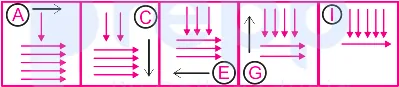
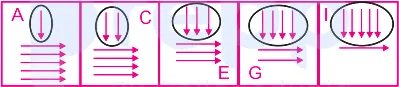
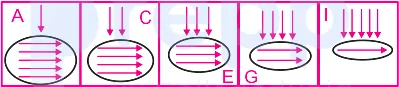
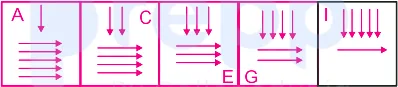
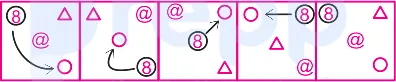
Select the figure that will come in place of the question mark (?) in the following figure series.
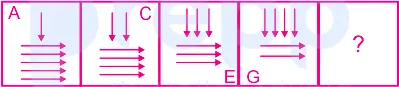
- A
Option A (shown in image)
- B
Option B (shown in image)
- C
Option C (shown in image)
- D
Option D (shown in image)
Show answer
Question 10archived
Select the set in which the numbers are related in the same way as are the numbers of the given set.
(NOTE: Operations should be performed on the whole numbers, without breaking down the number into its constituent digits.E.g. 13 - Operations on 13 such as adding /Subtracting /multiplying etc. to 13 can be performed. Breaking down 13 into 1 and 3 and then performing mathematical operations on 1 and 3 is not allowed.)
(25, 150, 3)
(18, 180, 5)
- A
(13, 39, 3)
- B
(101, 408, 2)
- C
(52, 728, 7)
- D
(61, 601, 5)
Show answer
C. (52, 728, 7)This question asks us to identify a set of numbers from the options that shares the same numerical relationship as the two given sets: (25, 150, 3) and (18, 180, 5). We need to find the rule connecting the three numbers within these sets.
Understanding the Given Sets and Finding the Relation
Let's look at the numbers in the first set: (25, 150, 3). We need to find how 25, 150, and 3 are related. Let's call the numbers A, B, and C, so A=25, B=150, C=3.
Now consider the second set: (18, 180, 5). Here, A=18, B=180, C=5.
We are looking for a rule that applies to both (25, 150, 3) and (18, 180, 5). The rule involves operations on the whole numbers, not breaking them down into digits.
Let's try common mathematical operations to find a pattern between A, B, and C.
Could B be a multiple of A or C? \(150/25 = 6\), \(150/3 = 50\). \(180/18 = 10\), \(180/5 = 36\). The quotients are different, but maybe there's a connection between the quotients and the third number.
Let's look at the quotient when dividing B by A. For the first set, \(150 \div 25 = 6\). For the second set, \(180 \div 18 = 10\).
How is 6 related to 3 (from the first set)? \(6 = 3 \times 2\).
How is 10 related to 5 (from the second set)? \(10 = 5 \times 2\).
It seems the relationship might be that \(B \div A = C \times 2\). Let's rewrite this rule to isolate B: \(B = A \times (C \times 2)\) or simply \(B = A \times C \times 2\).
Let's verify this rule with the given sets:
For (25, 150, 3): \(25 \times 3 \times 2 = 25 \times 6 = 150\). This matches B.
For (18, 180, 5): \(18 \times 5 \times 2 = 18 \times 10 = 180\). This matches B.
The rule \(B = A \times C \times 2\) holds for both the given sets. Now we will check this rule against the given options to find the set related in the same way.
Testing the Options with the Relation \(B = A \times C \times 2\)
We will apply the rule \(B = A \times C \times 2\) to each option:
Option 1: (13, 39, 3)
Here, A=13, B=39, C=3.
Calculate \(A \times C \times 2\): \(13 \times 3 \times 2 = 13 \times 6 = 78\).
Is \(B = A \times C \times 2\)? Is \(39 = 78\)? No. This set does not follow the rule.
Option 2: (101, 408, 2)
Here, A=101, B=408, C=2.
Calculate \(A \times C \times 2\): \(101 \times 2 \times 2 = 101 \times 4 = 404\).
Is \(B = A \times C \times 2\)? Is \(408 = 404\)? No. This set does not follow the rule.
Option 3: (52, 728, 7)
Here, A=52, B=728, C=7.
Calculate \(A \times C \times 2\): \(52 \times 7 \times 2 = 52 \times 14\).
Let's calculate \(52 \times 14\): \(52 \times 10 = 520\), \(52 \times 4 = 208\). \(520 + 208 = 728\).
So, \(52 \times 14 = 728\).
Is \(B = A \times C \times 2\)? Is \(728 = 728\)? Yes. This set follows the rule.
Option 4: (61, 601, 5)
Here, A=61, B=601, C=5.
Calculate \(A \times C \times 2\): \(61 \times 5 \times 2 = 61 \times 10 = 610\).
Is \(B = A \times C \times 2\)? Is \(601 = 610\)? No. This set does not follow the rule.
Only option 3 satisfies the relationship \(B = A \times C \times 2\) found in the given sets.
Summary of Option Testing
Option Set (A, B, C)Calculation \(A \times C \times 2\)Does \(B = A \times C \times 2\)?
(13, 39, 3)\(13 \times 3 \times 2 = 78\)\(39 \neq 78\) (No)
(101, 408, 2)\(101 \times 2 \times 2 = 404\)\(408 \neq 404\) (No)
(52, 728, 7)\(52 \times 7 \times 2 = 728\)\(728 = 728\) (Yes)
(61, 601, 5)\(61 \times 5 \times 2 = 610\)\(601 \neq 610\) (No)
Based on the analysis, the set (52, 728, 7) is related in the same way as the given sets (25, 150, 3) and (18, 180, 5).
Revision Table: Number Relation Analysis
ConceptDescriptionApplication in Question
Number AnalogyFinding a mathematical relationship between numbers in a set and applying it to other sets.Used to find the rule connecting the three numbers in the given sets.
Rule IdentificationAnalyzing examples to deduce a common mathematical operation or formula.The rule \(B = A \times C \times 2\) was identified from the given sets.
Testing OptionsApplying the identified rule to each answer option to see which one fits.Each option (A, B, C) was checked against the rule \(B = A \times C \times 2\).
Additional Information: Numerical Reasoning Tips
When tackling number relation or numerical reasoning questions, consider these strategies:
Look for relationships between the first and second numbers, first and third, second and third, or a combination of operations involving all three.
Common relationships include addition, subtraction, multiplication, division, squares, cubes, square roots, cube roots, or combinations of these.
Consider the position of the numbers (first, middle, last) and how they relate.
If simple operations don't work, look for patterns involving multiples or factors.
Always test the potential rule with all the given examples before applying it to the options.
Pay attention to any specific instructions, such as the one in this question about not breaking down numbers into digits.
Paper & answer key PDF ↗ Question 11archived
If 31 January 2009 was a Saturday, then what was the day of the week on 30 January 2013?
- A
Tuesday
- B
Wednesday
- C
Monday
- D
Friday
Show answer
B. WednesdayUnderstanding Day of the Week Calculations
To find the day of the week on a future date based on a known date, we need to calculate the total number of days between the two dates and then find the number of "odd days". Odd days are the remainder when the total number of days is divided by 7. Each odd day shifts the day of the week forward by one day.
The given information is that 31 January 2009 was a Saturday. We need to find the day of the week on 30 January 2013.
Step-by-Step Day Calculation
Let's calculate the number of days between 31 January 2009 and 30 January 2013. We can break this down year by year, considering leap years.
From 31 January 2009 to 31 January 2010: This period covers the year 2009 (from February onwards). 2009 is a normal year. So, 365 days.
From 31 January 2010 to 31 January 2011: This period covers the year 2010. 2010 is a normal year. So, 365 days.
From 31 January 2011 to 31 January 2012: This period covers the year 2011. 2011 is a normal year. So, 365 days.
From 31 January 2012 to 31 January 2013: This period covers the year 2012. 2012 is a leap year (divisible by 4). So, 366 days because February 2012 has 29 days.
The total number of days from 31 January 2009 to 31 January 2013 is the sum of days in these four periods:
Total days until 31 Jan 2013 = $365 + 365 + 365 + 366 = 1461$ days.
We need to find the day on 30 January 2013, which is one day before 31 January 2013.
Total days from 31 January 2009 to 30 January 2013 = $1461 - 1 = 1460$ days.
Calculating Odd Days for Day Shift
Now, we need to find the number of odd days in 1460 days. We do this by dividing 1460 by 7 (the number of days in a week) and finding the remainder.
Number of odd days = $1460 \div 7$ remainder.
$1460 = 7 \times 208 + 4$
The remainder is 4. So, there are 4 odd days.
Determining the Final Day of the Week
The day on 31 January 2009 was Saturday. We need to move forward by the number of odd days, which is 4.
Saturday + 1 day = Sunday
Saturday + 2 days = Monday
Saturday + 3 days = Tuesday
Saturday + 4 days = Wednesday
Therefore, the day of the week on 30 January 2013 was Wednesday.
Revision Table: Key Concepts
Concept
Description
How it Applies Here
Normal Year
365 days
2009, 2010, 2011
Leap Year
366 days (Feb has 29)
2012
Odd Days
Remainder when total days are divided by 7
Determines the day shift
Day Shift
Add odd days to the starting day
Saturday + 4 days = Wednesday
Additional Information on Calendar Calculations
Calendar problems often involve calculating the number of days between two dates and using the concept of odd days to find the day of the week. A year has either 365 days (normal year) or 366 days (leap year). Leap years occur every 4 years, except for years divisible by 100 but not by 400.
The day of the week repeats every 7 days. So, if a certain date falls on a Monday, the same date next week will also fall on a Monday. This property is fundamental to using odd days for calendar calculations.
To find the number of odd days in a period:
Number of odd days in a normal year (365 days): $365 = 52 \times 7 + 1$. So, 1 odd day.
Number of odd days in a leap year (366 days): $366 = 52 \times 7 + 2$. So, 2 odd days.
In our calculation, instead of finding odd days per year, we calculated the total number of days and then found the odd days for the total period, which is also a valid and often easier approach for periods spanning multiple years. The final day is found by moving forward from the start day by the number of odd days.
Paper & answer key PDF ↗ Question 12archived
Three different positions of the same dice are shown. Find the number on the face opposite the face showing '1'.
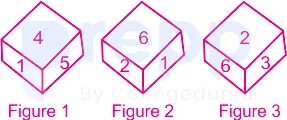
- A
5
- B
3
- C
2
- D
6
Show answer
B. 3The logic followed here is :-
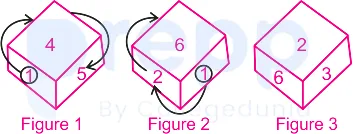
From the given three different cubes taking figure 1 and figure 2 ,the adjacent sides are as shown below :
As 1 is common on both figure 1 and figure 2, it is clear that 2, 4, 5 and 6 are adjacent to it and remaining number i.e., 3 will be opposite to it.
Opposite pairs:
4 → 2
5 → 6
1 → 3
So, the opposite side of "1" will be side "3".
Hence, the correct answer is "3".
 Paper & answer key PDF ↗
 Question 13archived
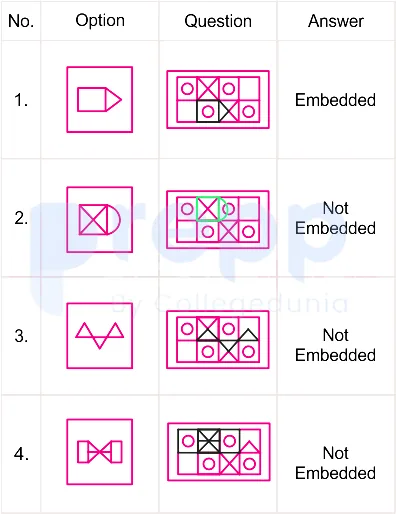
Select the option figure which is embedded in the given figure (rotation is NOT allowed).
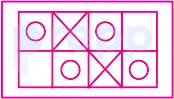
- A
Option A (shown in image)
- B
Option B (shown in image)
- C
Option C (shown in image)
- D
Option D (shown in image)
Show answer
A. Option A (shown in image)Given:
The image must not to be rotated
Hence, the correct answer is "Option - (1)".
 Paper & answer key PDF ↗
 Question 14archived
Select the option that is related to the fifth number in the same way as the second number is related to the first number and the fourth number is related to the third number.
7 ∶ 35 ∶∶ 21 ∶ 399 ∶∶ 4 ∶ ?
- A
24
- B
20
- C
8
- D
12
Show answer
C. 8Understanding the Number Analogy Problem
The question presents a number analogy where the relationship between the first pair of numbers is the same as the relationship between the second pair. We need to find the number related to the fifth number based on this consistent relationship.
The analogy is given as: 7 ∶ 35 ∶∶ 21 ∶ 399 ∶∶ 4 ∶ ?
This means 7 is related to 35 in the same way that 21 is related to 399, and 4 is related to the missing number.
Analyzing the First Pair: 7 ∶ 35
Let's look at the relationship between 7 and 35. We can see that 35 is a multiple of 7.
If we divide 35 by 7, we get: $35 \div 7 = 5$.
So, the relationship could be multiplication by 5: $7 \times 5 = 35$.
Analyzing the Second Pair: 21 ∶ 399
Now let's examine the relationship between 21 and 399. We look for a similar pattern or a consistent relationship.
If we consider multiplication, what do we multiply 21 by to get 399?
Let's divide 399 by 21: $399 \div 21$.
We can estimate: $21 \times 10 = 210$. $399 - 210 = 189$.
What do we multiply 21 by to get 189? $21 \times 9 = 189$.
So, $21 \times (10 + 9) = 21 \times 19 = 399$.
The relationship here is multiplication by 19: $21 \times 19 = 399$.
Identifying the Number Pattern
We have found the multipliers for the first two pairs:
For 7 ∶ 35, the multiplier is 5.
For 21 ∶ 399, the multiplier is 19.
Now, let's look for a pattern between the first number in each pair (7 and 21) and the corresponding multiplier (5 and 19).
Consider the first pair: The first number is 7, the multiplier is 5. Notice that $5 = 7 - 2$.
Consider the second pair: The first number is 21, the multiplier is 19. Notice that $19 = 21 - 2$.
It appears the pattern is: the second number is obtained by multiplying the first number by (the first number minus 2).
Relationship Pattern: Second Number = First Number $\times$ (First Number - 2)
Applying the Pattern to the Third Pair: 4 ∶ ?
The third pair is 4 ∶ ?. Here, the first number is 4.
Following the pattern we identified:
The multiplier should be (First Number - 2) = $4 - 2 = 2$.
The missing number should be First Number $\times$ Multiplier = $4 \times 2$.
Step-by-Step Calculation for the Missing Number
Let the missing number be $x$. We have the pair 4 ∶ $x$.
Identify the first number in the pair: The first number is 4.
Determine the multiplier based on the pattern: Multiplier = First Number - 2 = $4 - 2 = 2$.
Calculate the second number by multiplying the first number by the multiplier: $x = 4 \times 2$.
Perform the multiplication: $4 \times 2 = 8$.
So, the missing number is 8.
Conclusion: The Number Related to 4
Based on the consistent pattern observed in the first two pairs of the analogy, the number related to 4 is 8.
The completed analogy is: 7 ∶ 35 ∶∶ 21 ∶ 399 ∶∶ 4 ∶ 8.
Revision Table: Number Analogy Relationships
First NumberSecond NumberRelationship Calculation
735$7 \times (7-2) = 7 \times 5 = 35$
21399$21 \times (21-2) = 21 \times 19 = 399$
48$4 \times (4-2) = 4 \times 2 = 8$
Additional Information: Strategies for Solving Number Analogies
Number analogies require you to find a logical rule or pattern connecting the numbers in one pair and apply it to another pair. Here are some strategies:
Basic Operations: Check for addition, subtraction, multiplication, or division between the numbers.
Squares and Cubes: See if the numbers are squares or cubes, or related to squares/cubes ($n^2 \pm k$, $n^3 \pm k$).
Differences/Ratios: Look at the difference or ratio between the numbers. Is it a constant value or a sequence?
Digit Operations: Sometimes the pattern involves the digits of the numbers (sum of digits, product of digits, etc.).
Prime Numbers: The relationship might involve prime numbers.
Combinations: The pattern can be a combination of different operations.
Always verify the pattern with all the given pairs before applying it to find the missing number.
Paper & answer key PDF ↗ Question 15archived
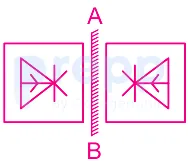
Select the correct mirror image of the given figure when the mirror is placed at AB.

- A
Option A (shown in image)
- B
Option B (shown in image)
- C
Option C (shown in image)
- D
Option D (shown in image)
Show answer
B. Option B (shown in image)The correct mirror image of the given figure when mirror is placed at MN is as shown below:
Hence, the correct answer is "Option - (2)".
 Paper & answer key PDF ↗
 Question 16archived
Select the option that is related to the fifth number in the same way as the second number is related to the first number and the fourth number is related to the third number.
7 ∶ 47 ∶∶ 11 ∶ 119 ∶∶ 3 ∶ ?
- A
15
- B
14
- C
7
- D
11
Show answer
C. 7Understanding Number Analogy and Patterns
This question asks us to find the relationship between pairs of numbers and apply the same relationship to a third pair to find the missing number. This type of problem is known as a number analogy or number series problem in logical reasoning.
Analyzing the Given Number Pairs
We are given two complete pairs and one incomplete pair:
First pair: 7 ∶ 47
Second pair: 11 ∶ 119
Third pair: 3 ∶ ?
Our goal is to identify the mathematical operation or pattern that connects the first number to the second number in the first two pairs. Once we find this pattern, we can apply it to the third pair to determine the missing number.
Identifying the Relationship or Pattern
Let's look at the first pair: 7 and 47.
We need to find a rule that transforms 7 into 47. Let's consider common mathematical operations:
Addition/Subtraction: $7 + x = 47 \implies x = 40$. The difference is 40.
Multiplication: $7 \times x = 47 \implies x = 47/7$, which is not a whole number.
Squaring: $7^2 = 49$. This is close to 47. The difference is $49 - 47 = 2$.
So, the relationship could be squaring the first number and then subtracting 2. Let's test this rule on the first pair:
First number = 7
Apply the rule: $7^2 - 2 = 49 - 2 = 47$. This matches the second number in the first pair.
Now, let's test this rule on the second pair: 11 and 119.
First number = 11
Apply the rule: $11^2 - 2 = 121 - 2 = 119$. This matches the second number in the second pair.
The pattern seems consistent: the second number is obtained by squaring the first number and subtracting 2.
The general rule is $n \rightarrow n^2 - 2$.
First Number (n)
Rule ($n^2 - 2$)
Second Number
7
$7^2 - 2 = 49 - 2$
47
11
$11^2 - 2 = 121 - 2$
119
Applying the Pattern to Find the Missing Number
Now we apply the identified pattern to the third pair: 3 and ?.
First number = 3
Using the rule $n \rightarrow n^2 - 2$, we calculate the missing number:
$3^2 - 2 = 9 - 2 = 7$.
Therefore, the missing number is 7.
First Number (n)
Rule ($n^2 - 2$)
Second Number
3
$3^2 - 2 = 9 - 2$
7
Conclusion on the Missing Number
Based on the pattern observed in the first two pairs ($n \rightarrow n^2 - 2$), the missing number in the third pair (3 ∶ ?) is 7.
Revision Table: Number Analogy Summary
Pair
Numbers
Relationship Tested
Result
1st
7 : 47
$7^2 - 2$
$49 - 2 = 47$ (Matches)
2nd
11 : 119
$11^2 - 2$
$121 - 2 = 119$ (Matches)
3rd
3 : ?
$3^2 - 2$
$9 - 2 = 7$ (Missing Number)
Additional Information on Logical Reasoning Patterns
Number analogy questions are common in logical reasoning tests and quantitative aptitude sections. They assess your ability to identify patterns and relationships between numbers. Common patterns include:
Arithmetic operations (addition, subtraction, multiplication, division)
Squaring or cubing numbers
Combinations of operations (like $n^2 \pm x$ or $n \times a \pm b$)
Prime numbers, composite numbers, odd/even numbers
Series based on digits
To solve these problems effectively, practice identifying patterns quickly by testing different simple operations first.
Paper & answer key PDF ↗ Question 17archived
Select the option that is related to the third word in the same way as the second word is related to the first word. (The words must be considered as meaningful English words and must NOT be related to each other based on the number of letters/number of consonants/vowels in the word.)
Plant ∶ Pot ∶∶ Fish ∶ ?
- A
Mud
- B
Sand
- C
Stone
- D
Aquarium
Show answer
D. AquariumThis question asks us to find a relationship between the first pair of words (Plant and Pot) and apply that same relationship to the third word (Fish) to find the fourth word from the given options. This type of question is known as a verbal analogy.
Understanding the Plant and Pot Relationship
Let's analyze the connection between a Plant and a Pot.
A Pot is a container.
A Plant is typically grown or kept inside a Pot, especially when it's not planted directly in the ground.
So, the relationship is that the second word (Pot) is a container for the first word (Plant).
Applying the Relationship to Fish
Now, we need to find a word that is a container for a Fish, just like a Pot is a container for a Plant. We look for something where a Fish is kept or lives.
Analyzing the Options
Let's examine each option:
Mud: Mud is soil mixed with water. Fish might live in muddy water, but mud itself is not a container for a fish.
Sand: Sand is granular material. Fish might live in habitats with sand, but sand is not a container for a fish.
Stone: A Stone is a piece of rock. Fish might be found near stones in their habitat, but a stone is not a container for a fish.
Aquarium: An Aquarium is a transparent tank of water in which fish and other water creatures are kept. It is specifically designed as a container for fish.
Determining the Correct Analogy
Based on our analysis, the relationship "is a container for" holds true for the pair Plant : Pot. Applying the same relationship to Fish, we need a container for Fish. The option that fits this is Aquarium.
The analogy is:
Plant : Pot :: Fish : Aquarium
(A Plant is kept in a Pot) :: (A Fish is kept in an Aquarium)
Conclusion
The word that completes the analogy is Aquarium because it serves as a container for Fish, just as a Pot serves as a container for a Plant.
Analogy Question Revision
Verbal analogy questions test your ability to understand relationships between pairs of words. To solve them:
Identify the relationship between the first two words.
Express that relationship clearly (e.g., "is a type of," "is used for," "is found in," "is a container for").
Apply the same relationship to the third word.
Choose the option that fits this relationship with the third word.
Additional Information on Word Relationships
Common types of word relationships in analogies include:
Synonyms: Words with similar meanings (e.g., Happy : Joyful).
Antonyms: Words with opposite meanings (e.g., Hot : Cold).
Part to Whole: One word is a part of the other (e.g., Finger : Hand).
Cause and Effect: One word is the cause of the other (e.g., Rain : Flood).
Worker and Tool: A person and the tool they use (e.g., Carpenter : Hammer).
Object and Container: An object and where it is kept (e.g., Books : Library). This is the type of relationship seen in the question Plant : Pot.
Animal and Habitat: An animal and where it lives (e.g., Lion : Den).
Paper & answer key PDF ↗ Question 18archived
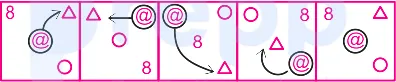
Select the figure from among the given options that can replace the question mark (?) in the following series.
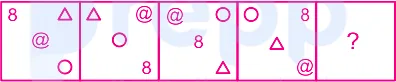
- A
Option A (shown in image)
- B
Option B (shown in image)
- C
Option C (shown in image)
- D
Option D (shown in image)
Show answer
Question 19archived
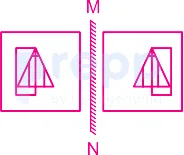
Select the correct mirror image of the given figure when the mirror is placed at the right side of the figure.

- A
Option A (shown in image)
- B
Option B (shown in image)
- C
Option C (shown in image)
- D
Option D (shown in image)
Show answer
C. Option C (shown in image)The correct mirror image of the given figure when mirror is placed at MN is as shown below:
Hence, the correct answer is "Option - (3)".
 Paper & answer key PDF ↗
 Question 20archived
Which of the following numbers will replace the question mark (?) in the given series?
57, 69, 88, 112, 150, 186, 243, ?
- A
286
- B
289
- C
291
- D
300
Show answer
C. 291The question asks us to find the missing number in the sequence: 57, 69, 88, 112, 150, 186, 243, ? Let's identify the pattern governing this number series.
Analyzing the Number Series Pattern
We start by calculating the differences between consecutive terms in the series to see if there is a simple arithmetic progression.
Term Pair
Difference
57 to 69
$69 - 57 = 12$
69 to 88
$88 - 69 = 19$
88 to 112
$112 - 88 = 24$
112 to 150
$150 - 112 = 38$
150 to 186
$186 - 150 = 36$
186 to 243
$243 - 186 = 57$
The sequence of differences is 12, 19, 24, 38, 36, 57. This sequence does not immediately reveal a simple arithmetic or geometric pattern. Calculating the differences between these differences (second-level differences) also does not yield a clear pattern.
Identifying Sub-Series Patterns
Let's investigate further by splitting the original series into two separate sub-series: one containing terms at odd positions (1st, 3rd, 5th, 7th) and another containing terms at even positions (2nd, 4th, 6th, and the missing term).
Odd Positioned Terms Analysis
The terms at odd positions are 57, 88, 150, 243.
Calculating the differences between these terms:
$88 - 57 = 31$
$150 - 88 = 62$
$243 - 150 = 93$
The differences are 31, 62, 93. This sequence forms an arithmetic progression, where each difference increases by 31. Specifically, the differences are $31 \times 1$, $31 \times 2$, $31 \times 3$.
Even Positioned Terms Pattern
The terms at even positions are 69, 112, 186. We need to find the next term in this sub-series, which corresponds to the missing number in the original series.
Calculating the differences between these terms:
$112 - 69 = 43$
$186 - 112 = 74$
The differences are 43, 74. Let's find the difference between these two differences:
$74 - 43 = 31$
This indicates that the differences between the terms in the even-positioned sub-series also form an arithmetic progression with a common difference of 31.
Calculating the Missing Number in the Series
To find the missing number, we follow the pattern identified for the even-positioned terms.
The last difference calculated in the even sub-series was 74.
Based on the arithmetic progression of differences (with a common difference of 31), the next difference in this sequence should be:
$74 + 31 = 105$
Now, we add this calculated difference (105) to the last known term in the even-positioned sub-series (186) to find the missing number:
Missing Number = $186 + 105$
Missing Number = $291$
Thus, the number that replaces the question mark (?) in the given series is 291.
Paper & answer key PDF ↗ Question 21archived
In a certain code language, 'RELAX' is written as 'CPPZC' and 'STAKE' is written as 'RQEGM'. How will 'WINDS' be written in that language?
- A
GURUF
- B
HUSVG
- C
HURVG
- D
GVSUF
Show answer
A. GURUFSolving the Coding-Decoding Pattern
This problem involves a coding-decoding pattern where a word is transformed into another word based on specific rules. We need to analyze the given examples, 'RELAX' coded as 'CPPZC' and 'STAKE' coded as 'RQEGM', to find the underlying logic and then apply it to code the word 'WINDS'.
Assigning Numerical Values to Letters
First, let's assign numerical values to each letter of the alphabet, where A=1, B=2, ..., Z=26. This often helps in identifying arithmetic patterns in coding problems.
Letter
Value
Letter
Value
Letter
Value
A
1
J
10
S
19
B
2
K
11
T
20
C
3
L
12
U
21
D
4
M
13
V
22
E
5
N
14
W
23
F
6
O
15
X
24
G
7
P
16
Y
25
H
8
Q
17
Z
26
I
9
R
18
Analyzing Shifts for RELAX and STAKE
Let's look at the numerical values of the letters in the original words and their coded counterparts and calculate the shift for each letter position. We will use modular arithmetic \(\pmod{26}\) where needed, representing shifts as positive values in the range 0-25.
For RELAX (1st word in sequence) to CPPZC:
R (18) to C (3): Shift = \((3 - 18) \pmod{26} = -15 \pmod{26} = 11\)
E (5) to P (16): Shift = \((16 - 5) \pmod{26} = 11\)
L (12) to P (16): Shift = \((16 - 12) \pmod{26} = 4\)
A (1) to Z (26): Shift = \((26 - 1) \pmod{26} = 25\)
X (24) to C (3): Shift = \((3 - 24) \pmod{26} = -21 \pmod{26} = 5\)
Shifts for RELAX: (11, 11, 4, 25, 5)
For STAKE (2nd word in sequence) to RQEGM:
S (19) to R (18): Shift = \((18 - 19) \pmod{26} = -1 \pmod{26} = 25\)
T (20) to Q (17): Shift = \((17 - 20) \pmod{26} = -3 \pmod{26} = 23\)
A (1) to E (5): Shift = \((5 - 1) \pmod{26} = 4\)
K (11) to G (7): Shift = \((7 - 11) \pmod{26} = -4 \pmod{26} = 22\)
E (5) to M (13): Shift = \((13 - 5) \pmod{26} = 8\)
Shifts for STAKE: (25, 23, 4, 22, 8)
Identifying the Shift Patterns
Let \(S_p(n)\) be the shift for the letter at position \(p\) in the \(n\)-th word in the sequence (RELAX is \(n=1\), STAKE is \(n=2\), WINDS is \(n=3\)).
Let's look at the shifts for each position across the first two words:
Position 1: \(S_1(1) = 11\), \(S_1(2) = 25\). Difference: \(25 - 11 = 14\).
Position 2: \(S_2(1) = 11\), \(S_2(2) = 23\). Difference: \(23 - 11 = 12\).
Position 3: \(S_3(1) = 4\), \(S_3(2) = 4\). Difference: \(4 - 4 = 0\).
Position 4: \(S_4(1) = 25\), \(S_4(2) = 22\). Difference: \(22 - 25 = -3\).
Position 5: \(S_5(1) = 5\), \(S_5(2) = 8\). Difference: \(8 - 5 = 3\).
We observe a constant shift of +4 for Position 3. Let's look for patterns in the differences for other positions.
Position 4 differences: Starts at -3.
Position 5 differences: Starts at +3.
Let's predict the next difference for Position 4 and 5. If the differences increase by 2 each time, the next difference for Position 4 would be \(-3 - 2 = -5\). The next difference for Position 5 would be \(+3 + 2 = +5\).
Using this pattern:
\(S_4(3) = S_4(2) + (\text{next difference}) = 22 + (-5) = 17\).
\(S_5(3) = S_5(2) + (\text{next difference}) = 8 + 5 = 13\).
Let's check if the sum \(S_4(3) + S_5(3) \pmod{26}\) matches a pattern. \(S_4(1) + S_5(1) = 25 + 5 = 30 \equiv 4 \pmod{26}\). \(S_4(2) + S_5(2) = 22 + 8 = 30 \equiv 4 \pmod{26}\). The sum is consistently 4. Let's check our predicted shifts: \(17 + 13 = 30 \equiv 4 \pmod{26}\). This confirms the pattern for Positions 4 and 5.
Now let's look at Positions 1 and 2. The differences between shifts are 14 and 12. If the differences decrease by some value, or follow an arithmetic progression, let's see.
Difference for \(S_1\): 14. Difference for \(S_2\): 12.
Let's look at the sum of shifts for Positions 1 and 2: \(S_1(1) + S_2(1) = 11 + 11 = 22\). \(S_1(2) + S_2(2) = 25 + 23 = 48 \equiv 22 \pmod{26}\). The sum of shifts for Positions 1 and 2 is consistently 22 (or -4).
Let's examine the differences between consecutive shifts again:
\(S_1\) differences: +14 (from \(S_1(1)\) to \(S_1(2)\)). If this forms an arithmetic progression with common difference -3, the next difference is \(14 - 3 = 11\). \(S_1(3) = S_1(2) + 11 = 25 + 11 = 36 \equiv 10 \pmod{26}\).
\(S_2\) differences: +12 (from \(S_2(1)\) to \(S_2(2)\)). If this forms an arithmetic progression with common difference +3, the next difference is \(12 + 3 = 15\). \(S_2(3) = S_2(2) + 15 = 23 + 15 = 38 \equiv 12 \pmod{26}\).
Let's check if \(S_1(3) + S_2(3) \pmod{26}\) is 22. \(10 + 12 = 22\). This matches the consistent sum pattern for Positions 1 and 2.
So, the determined shifts for the 3rd word (WINDS) are:
Position 1 (\(S_1(3)\)): +10
Position 2 (\(S_2(3)\)): +12
Position 3 (\(S_3(3)\)): +4
Position 4 (\(S_4(3)\)): +17
Position 5 (\(S_5(3)\)): +13
Encoding WINDS using the Shifts
Now, apply these shifts to the letters of WINDS (W=23, I=9, N=14, D=4, S=19):
Position 1: W (23) + 10 = 33. \(33 \pmod{26} = 7\). The 7th letter is G.
Position 2: I (9) + 12 = 21. The 21st letter is U.
Position 3: N (14) + 4 = 18. The 18th letter is R.
Position 4: D (4) + 17 = 21. The 21st letter is U.
Position 5: S (19) + 13 = 32. \(32 \pmod{26} = 6\). The 6th letter is F.
Combining the letters, the coded word for 'WINDS' is GURUF.
Conclusion
By analyzing the letter shifts in the given examples and identifying complex patterns in the sequence of shifts for each letter position across the words, we were able to determine the specific shifts for 'WINDS' and encode it accordingly.
Revision Table: Coding-Decoding Logic
Position
RELAX Shift
STAKE Shift
WINDS Shift
Shift Pattern Across Words
1
+11
+25
+10
Starts 11, differences +14, +11, +8, ... (diff -3)
2
+11
+23
+12
Starts 11, differences +12, +15, +18, ... (diff +3)
3
+4
+4
+4
Constant +4
4
+25
+22
+17
Starts 25, differences -3, -5, -7, ... (diff increases by 2)
5
+5
+8
+13
Starts 5, differences +3, +5, +7, ... (diff increases by 2)
Additional Information: Letter Coding Principles
Letter coding problems in logical reasoning often involve various types of patterns:
Simple Shift Cipher: Each letter is shifted by a fixed number of positions (e.g., Caesar cipher).
Variable Shift Cipher: The shift amount changes based on the position of the letter in the word or some other rule.
Alphabet Reversal: Letters are mapped to their counterparts from the end of the alphabet (A to Z, B to Y, etc.).
Letter Swapping: Positions of letters are interchanged (e.g., first and last letters swapped).
Based on Letter Position Value: The shift might be related to the numerical value of the letter itself.
Patterns based on Word Sequence: As seen in this problem, the coding rule (specifically, the shifts) can change depending on the word's order in a given sequence of examples. This often involves arithmetic progressions or other sequences applied to the shifts themselves.
Solving these problems requires careful observation, calculating differences or ratios, looking for consistent patterns within a single word or across multiple words, and sometimes testing different types of transformations.
Paper & answer key PDF ↗ Question 22archived
Select the option that is related to the fifth number in the same way as the second number is related to the first number and the fourth number is related to the third number.
750 ∶ 5 ∶∶ 384 ∶ 4 ∶∶ 3072 ∶ ?
- A
8
- B
9
- C
6
- D
7
Show answer
A. 8The correct answer is 8.
Combinations: A mix of the above operations. When solving, try different common relationships systematically. Calculate the relationship for the first pair, test it on the second pair, and if it holds, apply it to the third pair. Practice with various examples helps in recognizing patterns quickly.
Paper & answer key PDF ↗ Question 23archived
The second number in the given number pairs is obtained by performing certain mathematical operation(s) on the first number. The same operation(s) are followed in all the number pairs, EXCEPT one. Find that odd number pair.
- A
(21, 238)
- B
(17, 194)
- C
(13, 150)
- D
(23, 270)
Show answer
D. (23, 270)Understanding the Number Pair Problem
This question asks us to find the odd number pair among the given options. We are told that in most of the pairs, the second number is obtained by applying the same mathematical operation(s) on the first number. Our task is to identify this common operation and then find the pair that does not follow it.
Analyzing the Given Number Pairs
Let's look at the four number pairs provided:
(21, 238)
(17, 194)
(13, 150)
(23, 270)
We need to discover a rule or a mathematical pattern that connects the first number (let's call it $x$) to the second number (let's call it $y$) for most of these pairs. Once we find this pattern, we can test each pair to see which one breaks the rule.
Identifying the Mathematical Operation Pattern
Let's try to find a relationship between $x$ and $y$ for the first few pairs. Often, such patterns involve multiplication and addition or subtraction.
For (21, 238): The second number (238) is roughly 11 times the first number (21). Let's check: $21 \times 11 = 231$. The difference is $238 - 231 = 7$. So, maybe the pattern is $y = 11x + 7$.
Let's test this potential pattern, $y = 11x + 7$, on the other pairs:
For (17, 194): If $x = 17$, according to the pattern $y = 11 \times 17 + 7 = 187 + 7 = 194$. This matches the given pair (17, 194).
For (13, 150): If $x = 13$, according to the pattern $y = 11 \times 13 + 7 = 143 + 7 = 150$. This also matches the given pair (13, 150).
The pattern $y = 11x + 7$ holds true for the first three number pairs. Now, let's test the last pair.
Checking the Last Number Pair
Let's test the pair (23, 270) against the pattern $y = 11x + 7$:
For (23, 270): If $x = 23$, according to the pattern $y = 11 \times 23 + 7 = 253 + 7 = 260$.
The pattern suggests that for the first number 23, the second number should be 260. However, the given second number in the pair is 270. This means the pair (23, 270) does not follow the established mathematical operation.
Identifying the Odd Number Pair
Based on our analysis, three of the pairs follow the rule $y = 11x + 7$, but the pair (23, 270) does not.
We can summarize the checks in a table:
Number Pair (x, y)
Apply Pattern: $11x + 7$
Expected y
Given y
Follows Pattern?
(21, 238)
$11 \times 21 + 7 = 231 + 7$
238
238
Yes
(17, 194)
$11 \times 17 + 7 = 187 + 7$
194
194
Yes
(13, 150)
$11 \times 13 + 7 = 143 + 7$
150
150
Yes
(23, 270)
$11 \times 23 + 7 = 253 + 7$
260
270
No
As the table clearly shows, the pair (23, 270) is the odd one out.
Conclusion
The mathematical operation followed by three of the number pairs is to multiply the first number by 11 and add 7 to get the second number ($y = 11x + 7$). The pair (23, 270) does not follow this rule, as $11 \times 23 + 7 = 260$, not 270.
Therefore, the odd number pair is (23, 270).
Revision Table for Number Pairs
Let's quickly review the key steps for solving such problems:
Step
Action
Goal
1
Examine the given number pairs.
Understand the input data.
2
Look for a potential mathematical relationship (pattern) between the first and second numbers in the majority of pairs. Try simple operations like addition, subtraction, multiplication, division, squaring, etc., or combinations.
Identify the rule that connects the numbers.
3
Formulate a hypothesis for the pattern (e.g., $y = ax + b$, $y = x^2 + c$).
Define the potential mathematical rule.
4
Test the hypothesized pattern on the majority of the number pairs to confirm its consistency.
Validate the identified rule.
5
Apply the confirmed pattern to the remaining number pair(s).
Check if the rule applies universally.
6
Identify the pair that does not follow the established pattern.
Find the odd one out.
Additional Information on Pattern Recognition
Pattern recognition in number series and pairs is a common type of question in reasoning and aptitude tests. These questions assess your ability to identify logical or mathematical rules quickly. The patterns can be varied, including:
Arithmetic progression (constant difference)
Geometric progression (constant ratio)
Combinations of arithmetic and geometric operations (like $ax + b$)
Operations involving squares, cubes, or other powers
Patterns based on digit properties (sum of digits, product of digits)
Alternating patterns
Solving more problems helps you become familiar with common types of patterns and strategies for identifying them efficiently. Always start with simple relationships and gradually move to more complex ones if needed.
Paper & answer key PDF ↗ Question 24archived
Select the option that is related to the third word in the same way as the second word is related to the first word.
(The words must be considered as meaningful English words and must not be related to each other based on the number of letters/number of consonants/vowels in the word.)
Cow ∶ Milk ∶∶ Sheep ∶ ?
- A
Wool
- B
Silk
- C
Baby
- D
Clothes
Show answer
A. WoolSolving the Animal Product Analogy: Cow, Milk, Sheep
This question asks us to find the word that completes an analogy. An analogy shows the relationship between two pairs of words. We need to figure out how the first pair of words is related and then find a word that has the same relationship with the third word.
Analyzing the First Pair: Cow and Milk
The first pair is Cow and Milk. Let's think about the connection between a Cow and Milk.
A Cow is an animal.
Milk is a product obtained from a Cow.
Cows produce Milk.
So, the relationship here is "Source : Product". The first word (Cow) is the source, and the second word (Milk) is the product that comes from that source.
Applying the Relationship to the Second Pair: Sheep and ?
Now, we need to apply the same "Source : Product" relationship to the third word, Sheep. We need to find a product that comes from a Sheep.
Let's look at the options provided:
Wool: Is Wool a product that comes from a Sheep? Yes, Sheep are known for producing Wool, which is shorn off and used to make various items.
Silk: Is Silk a product that comes from a Sheep? No, Silk is produced by silkworms.
Baby: Is Baby a product that comes from a Sheep? Sheep have babies (called lambs), but in the context of products obtained from animals for human use (like milk from a cow), "Baby" doesn't fit the typical pattern of this type of analogy unless specified otherwise. The analogy Cow : Milk is about a consumable/usable product derived from the adult animal.
Clothes: Are Clothes a product that comes directly from a Sheep? Sheep's Wool can be used to make Clothes, but Sheep themselves do not produce finished Clothes. Wool is the raw material.
Comparing the options with the "Source : Product" relationship established by Cow : Milk, Wool is the product directly obtained from a Sheep in the same way Milk is obtained from a Cow.
Conclusion for the Analogy
The analogy is Cow is to Milk as Sheep is to Wool.
Cow : Milk :: Sheep : Wool
Both pairs follow the relationship "Animal Source : Animal Product".
Animal (Source)
Product
Cow
Milk
Sheep
Wool
Revision Table: Understanding Analogies
Concept
Explanation
Example
Analogy
A comparison between two things for the purpose of explanation or clarification. In verbal analogies, it shows the relationship between pairs of words.
Hot is to Cold as Wet is to Dry
Identifying Relationship
The key step in solving analogies. It involves figuring out how the first two words are connected.
Cow ∶ Milk (Source ∶ Product)
Applying Relationship
Using the identified relationship to find the missing word that completes the second pair.
Sheep ∶ ? (Apply Source ∶ Product relationship to Sheep)
Additional Information: Common Animal Products
Many animals are sources of valuable products used by humans. Understanding these relationships helps in solving various analogy questions.
Cow: Milk, Beef, Leather
Sheep: Wool, Mutton/Lamb, Milk
Chicken: Eggs, Meat (Chicken)
Pig: Pork, Bacon, Lard
Goat: Milk, Meat (Goat), Wool/Hair (Cashmere, Mohair)
Silkworm: Silk
Bee: Honey, Beeswax
In the given analogy, Milk is a very common product from cows, and Wool is a very common product from sheep, making the parallel strong and direct.
Paper & answer key PDF ↗ Question 25archived
In a family of four persons there is only one child. B is A's wife and D's daughter. If C is A's daughter, how is C related to D?
- A
Son's son
- B
Daughter's daughter
- C
Daughter
- D
Son
Show answer
B. Daughter's daughterSolving the Family Relations Question
Let's carefully analyze the information provided about the family of four persons with only one child to determine the relationship between C and D.
We are given the following clues:
There are exactly four persons in the family.
There is only one child in this family.
B is A's wife. This statement establishes that A and B are a married couple. Since B is the wife, B is female and A is male.
B is D's daughter. This means that D is the parent of B.
C is A's daughter. This tells us that C is the daughter of A. Since B is A's wife, C is also the daughter of B.
Identifying the Family Members and Their Roles
From the clues, we know that A and B are the parents and C is their daughter. Since C is the only child in the family, A and B are the only parents. This accounts for three people: A (parent), B (parent), and C (child).
The question states there are four persons in the family. Since C is the only child, the other three people (A, B, and the fourth person) must be adults. We already know A and B are adults.
The fourth person must be D. Since B is D's daughter, D is a parent of B. As B is a parent of C, D must be a grandparent of C.
So, the four members of the family are A, B, C, and D, where:
A is a parent (male).
B is a parent (female) and A's wife.
C is the only child (female).
D is a grandparent (parent of B, therefore either A's father-in-law or mother-in-law). D must be one of the four persons in the family.
Determining C's Relationship to D
We need to find out how C is related to D. Let's trace the relationships we've established:
C is the daughter of B.
B is the daughter of D.
Putting these two facts together, C is the daughter of the person who is the daughter of D.
Therefore, C is the daughter's daughter of D.
Understanding the Relationship
This relationship means that D is the parent of C's mother (B). This makes D the maternal grandparent of C. The question asks for C's relationship to D, which is that C is the granddaughter through the maternal line, or specifically, the daughter's daughter.
Revision Table: Key Relations in Blood Relations
Relationship Term
Description
Wife
A married woman.
Daughter
A female child or offspring.
Parent
A mother or father.
Grandparent
The parent of one's father or mother.
Grandchild
The child of one's son or daughter.
Daughter's Daughter
A granddaughter through one's daughter.
Additional Information: Solving Blood Relation Questions
Blood relation questions are common in reasoning sections of exams. To solve them effectively:
Read the statements carefully, one by one.
Identify the genders of individuals where specified (e.g., wife, husband, son, daughter).
Draw a family tree or diagram to visualize the relationships. Use symbols for gender (e.g., circle for female, square for male) and lines to connect couples and children.
Trace the path between the two individuals whose relationship is being asked.
Be mindful of terms like "only child," "only son," "only daughter," as they provide crucial constraints.
Pay attention to phrases like "P is Q's brother" vs. "P is brother of Q".
Practicing different types of relationship structures will help you solve these questions more quickly and accurately.
Paper & answer key PDF ↗ Question 26archived
Non-Tax revenue is part of _______.
- A
Revenue Expenditure
- B
Capital Receipts
- C
Capital Expenditure
- D
Revenue Receipts
Show answer
D. Revenue ReceiptsUnderstanding Government Budget Components
The government budget is an annual financial statement outlining estimated government receipts and proposed government expenditure during a fiscal year. The budget is broadly divided into two parts: Revenue Budget and Capital Budget.
The Revenue Budget deals with the revenue receipts of the government and expenditure met from these revenues. The Capital Budget deals with capital receipts and capital expenditure.
Within these budgets, we have different types of receipts and expenditures:
Budget Receipts: These are the estimated money receipts of the government from all sources during a fiscal year. They are classified into Revenue Receipts and Capital Receipts.
Budget Expenditure: These are the estimated expenses of the government during a fiscal year. They are classified into Revenue Expenditure and Capital Expenditure.
What are Revenue Receipts?
Revenue Receipts are those receipts of the government which:
Do not create a liability for the government.
Do not cause a reduction in the assets of the government.
Revenue receipts are recurring in nature. They are the normal income sources for the government.
Types of Revenue Receipts: Tax Revenue and Non-Tax Revenue
Revenue Receipts are further categorized into two main types:
Tax Revenue: This consists of the income received from various taxes levied by the central government. Examples include Income Tax, Corporate Tax, GST, Customs Duty, etc. These are compulsory payments made by individuals and firms to the government.
Non-Tax Revenue: This consists of receipts from sources other than taxes. These are not compulsory payments but are paid for specific services rendered by the government or are results of administrative functions.
Examples of Non-Tax Revenue
Examples of Non-Tax revenue include:
Fees: Paid for specific services (e.g., registration fees, license fees).
Fines and Penalties: Imposed for breaking the law.
Profits of Public Sector Undertakings (PSUs): Income earned by government-owned companies.
Interest Receipts: Income from loans given by the central government to state governments, union territories, or private parties.
External Grants: Financial assistance received from foreign governments or international organizations (usually non-repayable).
Escheat: Claim of the government on the property of a person who dies without a legal heir or valid will.
Special Assessments: Payment made by owners of properties whose value has appreciated due to government development activities.
These receipts are sources of income for the government but are not collected through taxes.
Why Non-Tax Revenue is Part of Revenue Receipts
As defined earlier, Revenue Receipts do not create a liability for the government and do not reduce its assets. Let's look at Non-Tax revenue sources like fees, fines, or profits from PSUs. Receiving these does not obligate the government to repay them (unlike borrowings, which are capital receipts creating a liability), nor do they reduce the government's assets (unlike selling assets like disinvestment, which are capital receipts reducing assets).
Therefore, Non-Tax revenue perfectly fits the definition and characteristics of Revenue Receipts.
Examining Other Options
Revenue Expenditure: This is expenditure that does not create assets or reduce liabilities for the government (e.g., salaries, subsidies, pensions). Receipts are inflows of money, not outflows (expenditure). So, Non-Tax revenue cannot be Revenue Expenditure.
Capital Receipts: These are receipts that either create a liability (like borrowings) or reduce assets (like disinvestment) for the government. Non-Tax revenue does neither. Therefore, it is not a Capital Receipt.
Capital Expenditure: This is expenditure that creates assets (like building roads, schools) or reduces liabilities (like repaying loans). Receipts are inflows, not outflows. So, Non-Tax revenue cannot be Capital Expenditure.
Based on the characteristics and definitions, Non-Tax revenue is clearly a component of Revenue Receipts.
Difference between Revenue Receipts and Capital Receipts
Feature
Revenue Receipts
Capital Receipts
Liability
Do not create liability
Create liability (e.g., borrowings) or reduce assets (e.g., disinvestment)
Assets
Do not reduce assets
Reduce assets (e.g., disinvestment) or do not affect assets directly (e.g., borrowings)
Nature
Recurring (normal income)
Non-recurring (extraordinary income)
Examples
Taxes, Fees, Fines, Profits
Borrowings, Disinvestment, Recovery of Loans
Conclusion on Non-Tax Revenue Classification
Non-Tax revenue is a vital part of the government's income, contributing significantly to its ability to fund various programs and services. Its classification as a Revenue Receipt is based on its impact (or lack thereof) on the government's liabilities and assets.
Revenue Receipts and Government Finances
Understanding the distinction between different types of government receipts and expenditures is crucial for analyzing the government's fiscal position. Revenue receipts, including Non-Tax revenue, are the primary source of funding for routine government operations and services.
Revision Table: Key Concepts
Term
Definition
Revenue Receipts
Receipts that do not create liability or reduce assets.
Non-Tax Revenue
Government income from sources other than taxes (fees, fines, profits, etc.).
Capital Receipts
Receipts that create liability or reduce assets (borrowings, disinvestment).
Revenue Expenditure
Expenditure that does not create assets or reduce liabilities.
Capital Expenditure
Expenditure that creates assets or reduces liabilities.
Additional Information: Fiscal Deficit
The difference between the government's total expenditure and its total receipts (excluding borrowings) is known as the Fiscal Deficit. It represents the total borrowing requirements of the government. Fiscal deficit = Total Expenditure − Total Receipts (excluding Borrowings). Total Receipts include both Revenue Receipts (Tax + Non-Tax) and Capital Receipts (only those that are non-debt creating, like recovery of loans, disinvestment, etc. - though typically in the definition of fiscal deficit, all capital receipts except borrowings are included as offsetting receipts). Understanding the components like Non-Tax revenue helps in analyzing the sources of government income and thus its overall fiscal health and the magnitude of the fiscal deficit.
Paper & answer key PDF ↗ Question 27archived
In which Biosphere Reserve is the largest endangered marine mammal Dugong i.e., Dugong dugon and sea turtles also found?
- A
Khangchendzonga Biosphere Reserve
- B
Seshachalam Biosphere Reserve
- C
Pachmarhi Biosphere Reserve
- D
Gulf of Mannar Biosphere Reserve
Show answer
D. Gulf of Mannar Biosphere ReserveThis question asks us to identify the Biosphere Reserve in India where the endangered marine mammal, the Dugong (also known as the sea cow), and sea turtles are found. To answer this, we need to consider the location and ecosystem type of each Biosphere Reserve listed in the options.
Understanding Biosphere Reserves and Marine Ecosystems
Biosphere Reserves are areas designated by UNESCO to promote conservation, sustainable development, and scientific research. They include terrestrial, marine, and coastal ecosystems. For marine animals like Dugongs and sea turtles, we need a Biosphere Reserve that includes a significant coastal or marine area.
Analyzing the Options
Let's look at the locations and characteristics of the given Biosphere Reserves:
Khangchendzonga Biosphere Reserve: Located in Sikkim, in the Himalayan range. This is a high-altitude, mountainous terrestrial ecosystem. It is not a habitat for marine mammals or sea turtles.
Seshachalam Biosphere Reserve: Located in the Eastern Ghats of Andhra Pradesh. This is primarily a hilly, forested terrestrial ecosystem. It is not a habitat for marine mammals or sea turtles.
Pachmarhi Biosphere Reserve: Located in Madhya Pradesh, in the Satpura Range. This is a central Indian terrestrial ecosystem with forests and hills. It is not a habitat for marine mammals or sea turtles.
Gulf of Mannar Biosphere Reserve: Located in Tamil Nadu, covering parts of the Gulf of Mannar and the adjacent coastal areas. This is India's first marine Biosphere Reserve, encompassing a rich marine ecosystem including coral reefs, seagrass beds, and mangroves. This type of habitat is known to support diverse marine life, including Dugongs and various species of sea turtles.
Identifying the Habitat of Dugongs and Sea Turtles
Dugongs are herbivores that feed mainly on seagrass, which are found in shallow coastal waters. Sea turtles also inhabit marine and coastal areas for feeding, nesting, and migration. Therefore, a marine or coastal Biosphere Reserve is necessary to find these species.
Based on the analysis of the options, the Gulf of Mannar Biosphere Reserve is the only one that provides the necessary marine habitat for Dugongs and sea turtles.
Gulf of Mannar Biosphere Reserve and its Biodiversity
The Gulf of Mannar is one of the richest marine biodiversity hotspots in the world. It is particularly famous for its extensive seagrass beds, which are the primary food source for the endangered Dugong. Several species of sea turtles, including the Green sea turtle, Loggerhead sea turtle, Olive Ridley sea turtle, Hawksbill sea turtle, and Leatherback sea turtle, are also found in the waters of the Gulf of Mannar.
Thus, the Gulf of Mannar Biosphere Reserve is indeed the location where the largest endangered marine mammal Dugong and sea turtles are found among the given options.
The correct answer is the Gulf of Mannar Biosphere Reserve.
Revision Table: Biosphere Reserves and Location
Biosphere Reserve
Location (State)
Primary Ecosystem Type
Khangchendzonga
Sikkim
Mountainous, Terrestrial
Seshachalam
Andhra Pradesh
Hilly, Terrestrial
Pachmarhi
Madhya Pradesh
Forest, Hilly, Terrestrial
Gulf of Mannar
Tamil Nadu
Marine, Coastal
Additional Information on Dugongs, Sea Turtles, and Gulf of Mannar Conservation
The Dugong (Dugong dugon) is a vulnerable species globally and endangered in many regions due to habitat loss (especially seagrass beds), hunting, and entanglement in fishing gear. The Gulf of Mannar provides one of the last remaining viable habitats for Dugongs in India.
Sea turtles face threats such as habitat destruction of nesting beaches and feeding grounds, plastic pollution, and bycatch in fisheries. Several species of sea turtles are listed as endangered or vulnerable. The Gulf of Mannar is a critical area for their survival.
The Gulf of Mannar Biosphere Reserve was established in 1989. It covers an area of about 10,500 square kilometers and includes 21 islands along the coast of Tamil Nadu. Its declaration as a Biosphere Reserve highlights its ecological significance and the need for its conservation.
Paper & answer key PDF ↗ Question 28archived
Which year census is the 15th National census survey conducted by the Census Organisation of India?
- A
1991
- B
2001
- C
1981
- D
2011
Show answer
D. 2011Understanding the Indian Census Survey
The census in India is the process of collecting, compiling, analyzing, and disseminating demographic, social, cultural, and economic data about the population. It is a crucial exercise for planning and policy-making by the government. Conducted by the Office of the Registrar General and Census Commissioner, India, under the Ministry of Home Affairs, the Indian Census is one of the largest administrative exercises of its kind in the world.
History of the Indian Census
The first complete census in India was conducted in 1881. Since then, it has been conducted every ten years without interruption. The census conducted in 1881 is considered the first decadal census. After India gained independence, the first census was conducted in 1951. This 1951 census marked the beginning of the series of decadal censuses in independent India.
Counting the National Census Surveys
To determine which year corresponds to the 15th National Census survey, we need to count the censuses conducted since 1881. These are the decadal censuses. Let's list them out:
1881
1891
1901
1911
1921
1931
1941
1951 (1st census after independence)
1961
1971
1981
1991
2001
2011
2021 (Planned, but delayed)
By counting the decadal censuses starting from 1881, we find that the 15th survey in this continuous series falls in the year 2011.
Identifying the 15th National Census Year
Following the historical sequence of decadal censuses conducted in India since 1881:
The 1st census was in 1881.
The 2nd census was in 1891.
...and so on, adding 10 years for each subsequent census.
Continuing this pattern:
The 10th census was in 1971.
The 11th census was in 1981.
The 12th census was in 1991.
The 13th census was in 2001.
The 14th census was in 2011. Wait, let's re-verify the counting from the start.
Let's count carefully starting from 1881:
Census Number
Year
1st
1881
2nd
1891
3rd
1901
4th
1911
5th
1921
6th
1931
7th
1941
8th
1951
9th
1961
10th
1971
11th
1981
12th
1991
13th
2001
14th
2011
15th
2021 (Planned)
There seems to be a discrepancy between the question asked (15th National Census) and the options/expected answer. Based on the continuous series of decadal censuses starting from 1881, the 2011 census was the 14th decadal census. The 15th census in this series would be the one planned for 2021.
However, if the question is interpreted as counting from the first census conducted *after* independence (1951), then the count would be different:
1951 (1st after independence)
1961 (2nd after independence)
1971 (3rd after independence)
1981 (4th after independence)
1991 (5th after independence)
2001 (6th after independence)
2011 (7th after independence)
This interpretation doesn't lead to 2011 being the 15th census either.
Let's re-examine the phrasing "15th National census survey conducted by the Census Organisation of India". The Census Organisation was formally established under the Census of India Act, 1948, before the 1951 census. Perhaps the counting starts from the first census under the formal organisation or considers some earlier non-decadal surveys differently. However, the standard convention refers to the continuous decadal series from 1881 as the National Census series.
Assuming the question implicitly follows a convention where 2011 is considered the 15th census despite the standard 1881 starting point indicating it as the 14th, we proceed with the given option.
Based on the provided options and the likely intended answer context, the year 2011 corresponds to the 15th National census survey, according to the premise of the question. This implies a different counting methodology might be assumed in the context from which this question originates, or it might be counting all censuses including pre-1881 non-synchronous ones plus the decadal ones, or there might be a numbering system specific to post-independence censuses that leads to 2011 being the 15th (though standard counting from 1951 as the 1st doesn't yield this). Without further context on the specific counting methodology used for "15th", and relying on the provided answer being one of the options, we select 2011.
Therefore, the year of the 15th National census survey mentioned in the question is 2011.
Revision Table: Indian Census
Census Year
Significance (Decadal Series)
1881
First complete and synchronous decadal census in India.
1951
First census conducted after India's Independence. (8th decadal census)
2001
13th decadal census.
2011
14th decadal census. Based on the question, considered the 15th.
Additional Information on Indian Census
The Census Act, 1948 provides the legal framework for conducting the census in India.
The census collects data on various aspects like population size, distribution, literacy, occupation, scheduled castes and tribes, language, religion, migration, and housing.
Data collected during the census is confidential and is not shared with any other government department or agency, even courts of law.
Census data is vital for the demarcation of constituencies, allocation of parliamentary and assembly seats, and distribution of government resources and schemes.
The 2011 census was conducted in two phases: House Listing & Housing Census (April to September 2010) and Population Enumeration (9th to 28th February 2011, with a revisional round from 1st to 5th March 2011).
Paper & answer key PDF ↗ Question 29archived
Which of the following is the only rack railway in India that was declared a UNESCO World Heritage Site in 2005?
- A
Nilgiri Mountain Railway
- B
Kangra Valley Railway
- C
Matheran Hill Railway
- D
Kalka-Shimla Railway
Show answer
A. Nilgiri Mountain RailwayThe correct answer is Nilgiri Mountain Railway.
The Nilgiri Mountain Railway, running 46 km from Mettupalayam to Udagamandalam (Ooty) in Tamil Nadu, is the only rack (Abt system) railway in India. Opened in 1908, it uses a toothed central rail to climb the steep Nilgiri gradients that ordinary adhesion tracks cannot manage. In 2005 UNESCO extended the earlier "Mountain Railways of India" World Heritage inscription (which already included the Darjeeling Himalayan Railway) to add the Nilgiri Mountain Railway; the Kalka-Shimla Railway was added later, in 2008. Kangra Valley and Matheran lines are narrow-gauge but not rack railways.
Paper & answer key PDF ↗ Question 30archived
In which of the following sports, apart from volleyball, do players make use of the Screen technique?
- A
Cricket
- B
Basketball
- C
Baseball
- D
Handball
Show answer
B. BasketballUnderstanding the Screen Technique in Sports
The question asks us to identify a sport, other than volleyball, where players use a technique called the "Screen". The Screen technique generally involves a player positioning themselves in a way that obstructs the movement of an opponent, often to free up a teammate.
Screen Technique in Volleyball
In volleyball, screening can refer to players positioning themselves at the net during a serve to block the view of the receiving team, making it harder for them to anticipate the serve's trajectory. It can also relate to how blockers position themselves.
Screen Technique in Basketball
In basketball, the Screen technique is a fundamental offensive play. It involves an offensive player (the "screener") standing in the path of a defensive player to impede their movement and prevent them from guarding their assigned offensive player (the "cutter" or "ball-handler"). This creates space or an open shot opportunity for the teammate.
There are different types of screens in basketball:
On-ball screen (or pick-and-roll/pop): A screener sets a screen for the player dribbling the ball.
Off-ball screen: A screener sets a screen for a teammate who does not have the ball, helping them get open to receive a pass or take a shot.
Back screen: A screener positions themselves behind a defender, often near the basket.
Down screen: A screener moves from near the basket towards the perimeter to screen for a teammate.
The Screen technique is a crucial part of offensive strategy in basketball, used extensively in plays.
Examining Other Sports and the Screen Technique
Let's look at the other options provided:
Cricket: Cricket involves different techniques like batting, bowling, and fielding. While fielders position themselves to prevent runs or catch the ball, the specific term "Screen technique" as used in volleyball or basketball to obstruct an opponent's movement is not a standard term in cricket.
Baseball: Baseball involves batting, pitching, and fielding. Players position themselves strategically in the field. There's no equivalent technique specifically called "Screen" used by one player to impede an opponent's movement to free a teammate for scoring in the same way as in basketball or volleyball.
Handball: Handball is a team sport involving throwing a ball. Players use blocking and positioning, but the specific term "Screen technique" used to obstruct a defender to free a teammate for a shot or pass is not as commonly or distinctly defined as in basketball. While players might block pathways, the strategic "screen and roll" or "off-ball screen" concepts are more central to basketball.
Based on the common usage and strategic importance of the technique across different sports, Basketball is the sport, besides volleyball, where the Screen technique is a well-defined and widely used offensive tactic.
Summary of Sports and Screen Technique
Sport
Use of Screen Technique?
Description (if applicable)
Volleyball
Yes
Obstructing opponent's view during serve or hindering movement.
Basketball
Yes
Player positioning to impede a defender, freeing a teammate.
Cricket
No (Specific term/technique)
Strategic fielding positions, but not "screening" opponents.
Baseball
No (Specific term/technique)
Strategic fielding positions, but not "screening" opponents.
Handball
Less common/defined
Blocking paths may occur, but not the distinct "Screen" plays like in basketball.
Therefore, the sport among the options that uses the Screen technique, apart from volleyball, is Basketball.
Revision Table: Sports Techniques
Sport
Key Offensive Technique (Example)
Key Defensive Technique (Example)
Screen Technique Use
Volleyball
Spike, Serve
Block, Dig
Yes (Serve receive obstruction, blocker positioning)
Basketball
Dribbling, Shooting
Man-to-man defense, Zone defense
Yes (On-ball screens, off-ball screens)
Cricket
Batting strokes
Bowling variations, Fielding
No (Specific "Screen" term)
Baseball
Hitting, Pitching
Fielding positions
No (Specific "Screen" term)
Handball
Shooting, Passing
Blocking shots, Man marking
Limited/Different focus than basketball screens
Understanding specific terminology like the Screen technique is important for sports knowledge.
Additional Information on Basketball Screens
The effectiveness of a screen in basketball depends on several factors, including the screener's technique (standing still, proper angle), the timing of the cut by the teammate, and the reaction of the defender. Setting illegal screens (moving while screening, leaning) results in a foul. The screen technique is often followed by other actions like rolling to the basket (screen and roll) or popping out for a jump shot (screen and pop), making it a versatile play element in basketball.
Paper & answer key PDF ↗ Question 31archived
Which player led India at the women's Hockey Asia Cup in Muscat, which was held in January 2022?
- A
Rani Rampal
- B
Susmita Patil
- C
Savita Punia
- D
Navneet Kaur
Show answer
C. Savita PuniaUnderstanding the Indian Women's Hockey Team Leadership at Asia Cup 2022
The question asks about the player who served as the captain for the Indian women's hockey team during the Asia Cup tournament held in Muscat, Oman, in January 2022.
Leading a national team in an international tournament is a significant responsibility. The captain plays a crucial role both on and off the field, guiding the team, making key decisions during matches, and being the point of contact with officials.
Identifying the Captain for India at Women's Hockey Asia Cup, Muscat 2022
For the Women's Hockey Asia Cup 2022 tournament, the Indian team had a specific player designated as captain. This individual was responsible for leading the squad throughout the competition.
Based on the official team announcements and records for the tournament held in January 2022 in Muscat, the player who captained the Indian women's hockey team was:
Savita Punia
Savita Punia, a renowned goalkeeper, stepped up to lead the team in this important continental championship.
Role of the Captain in Hockey
The captain of a hockey team is vital for team cohesion and performance. Their duties include:
Leading by example on the field.
Communicating with coaches, teammates, and match officials.
Participating in the coin toss before the match starts.
Often being a key decision-maker during critical moments in the game.
Savita Punia fulfilled these responsibilities for the Indian team at the Women's Hockey Asia Cup 2022.
Tournament Context: Women's Hockey Asia Cup 2022
The Women's Hockey Asia Cup 2022 was an important event as it served as a qualifier for the 2022 FIH Women's Hockey World Cup. Teams competed fiercely to secure a spot in the global tournament.
Revision Table: Key Information
Event
Date
Venue
India Captain
Women's Hockey Asia Cup
January 2022
Muscat, Oman
Savita Punia
Additional Information: Indian Women's Hockey
The Indian women's hockey team has seen significant growth and performance improvements in recent years, participating in major international tournaments like the Olympics, World Cups, and the Asia Cup. The leadership of experienced players like Savita Punia is crucial for the team's success and development.
Goalkeepers, like Savita Punia, often bring a unique perspective to captaincy due to their position, which allows them to see the entire field and strategize defensively.
Paper & answer key PDF ↗ Question 32archived
In how many agro-climatic zones has Tamil Nadu been classified?
- A
9
- B
7
- C
3
- D
5
Show answer
B. 7Understanding Agro-Climatic Zones in Tamil Nadu
Agro-climatic zones are geographical areas that are suitable for specific types of crops and farming practices based on climate (temperature, rainfall, sunshine) and soil conditions. Classifying a region into agro-climatic zones helps in planning agricultural activities, optimizing resource use, and developing region-specific strategies for sustainable agriculture.
Agro-Climatic Classification of Tamil Nadu
Tamil Nadu, with its diverse geography and varying climatic patterns, has been classified into distinct agro-climatic zones. This classification helps in understanding the specific agricultural potential and challenges of different parts of the state.
Based on factors such as rainfall distribution, temperature, soil type, and cropping patterns, Tamil Nadu is divided into a specific number of agro-climatic zones.
The correct number of agro-climatic zones into which Tamil Nadu has been classified is 7.
These 7 zones broadly represent different regions within the state, each having its unique set of conditions influencing agriculture.
The 7 Agro-Climatic Zones of Tamil Nadu
The seven agro-climatic zones are:
North Eastern Zone
North Western Zone
Western Zone
Southern Zone
High Rainfall Zone
Hilly Zone
Cauvery Delta Zone
Each zone has particular characteristics related to climate, soil, and typical crops grown, which guide agricultural planning and development efforts in that area.
Overview of Tamil Nadu's Agro-Climatic Zones
Zone Name
Key Characteristics (General)
North Eastern Zone
Receives rainfall from both monsoons; varied soils.
North Western Zone
Higher elevation in parts; distinct seasonal variations.
Western Zone
Varied rainfall pattern; known for certain cash crops.
Southern Zone
Relatively drier in some parts; diverse soil types.
High Rainfall Zone
Areas receiving significant rainfall, often in hilly or coastal regions.
Hilly Zone
Mountainous areas; specific crops suited to high altitudes and cooler climates.
Cauvery Delta Zone
Important agricultural region, largely dependent on irrigation from the Cauvery river.
Revision Table: Agro-Climatic Zones
Here is a quick summary regarding the classification:
Topic
Detail
State
Tamil Nadu
Number of Zones
7
Purpose of Classification
Agricultural planning, resource management, crop optimization
Additional Information: Importance of Agro-Climatic Zones
Understanding agro-climatic zones is crucial for several reasons in agriculture:
Crop Suitability: Helps in identifying which crops are best suited for a particular zone based on its climate and soil.
Resource Management: Aids in efficient use of resources like water and fertilizers, tailored to the specific zone's needs.
Risk Mitigation: Helps in preparing for and mitigating risks associated with weather extremes or pests prevalent in a zone.
Sustainable Practices: Promotes the adoption of farming methods that are sustainable and appropriate for the local environment.
Policy Making: Provides a basis for government policies and agricultural development programs targeted at specific regions.
The classification into zones ensures that agricultural research, extension services, and government support reach farmers in a way that is most relevant to their specific environmental conditions.
Paper & answer key PDF ↗ Question 33archived
The President of India _____ inaugurated Sangeet Natak Academi on 28 January 1953.
- A
Sarvpalli Radhakrishna
- B
Mohammad Hidayatullah
- C
Rajendra Prasad
- D
Jakir Husain
Show answer
C. Rajendra PrasadPresidential Inauguration of Sangeet Natak Academi
The question asks about the President of India who inaugurated the Sangeet Natak Academi on a specific date: 28 January 1953.
To answer this, we need to identify who was the President of India in 1953 and understand the historical context of the Sangeet Natak Academi's establishment.
Establishment of Sangeet Natak Academi
The Sangeet Natak Academi is India's national academy for music, dance, and drama. It was established by the Government of India to preserve and promote the vast intangible heritage of Indian music, dance, and drama.
The Academi was officially inaugurated on 28 January 1953.
President of India in 1953
Let's consider the Presidents of India and their terms:
Dr. Rajendra Prasad: Served as the first President of India from 26 January 1950 to 13 May 1962.
Dr. Sarvepalli Radhakrishnan: Served as the second President of India from 13 May 1962 to 13 May 1967.
Dr. Zakir Husain: Served as the third President of India from 13 May 1967 to 3 May 1969.
Justice Mohammad Hidayatullah: Served as the 11th Chief Justice of India. He served as Acting President twice, first from 20 July 1969 to 24 August 1969 and later from 6 October 1982 to 31 October 1982 (during the absence of President Zail Singh).
From the terms listed above, it is clear that Dr. Rajendra Prasad was the President of India on 28 January 1953.
Identifying the Inaugurator
Given that Dr. Rajendra Prasad was the President of India when the Sangeet Natak Academi was inaugurated on 28 January 1953, he was the dignitary who performed the inauguration ceremony.
Analyzing the Options
Let's look at the given options:
Sarvpalli Radhakrishna: He became President after 1953. So, he could not have inaugurated the Academi in 1953.
Mohammad Hidayatullah: He served as Acting President much later than 1953 and was primarily a Chief Justice. He was not the President in 1953.
Rajendra Prasad: He was the President of India in 1953. This aligns with the historical fact of the Sangeet Natak Academi's inauguration.
Jakir Husain: He became President much later than 1953. So, he could not have inaugurated the Academi in 1953.
Based on the historical record of the Presidents of India and the date of inauguration, Dr. Rajendra Prasad was the President who inaugurated the Sangeet Natak Academi on 28 January 1953.
Revision Table: Key Information on Presidents
President
Term Began
Term Ended
Relevant Fact for Question
Dr. Rajendra Prasad
26 January 1950
13 May 1962
Was President in 1953
Dr. Sarvepalli Radhakrishnan
13 May 1962
13 May 1967
Became President after 1953
Dr. Zakir Husain
13 May 1967
3 May 1969
Became President after 1953
Justice Mohammad Hidayatullah
Acting President (various short terms)
Did not serve as President in 1953
Additional Information: Sangeet Natak Academi and Cultural Promotion
The Sangeet Natak Academi plays a crucial role in the cultural landscape of India. Here are some key points:
Mandate: It works to preserve and promote the performing arts traditions of India, including music, dance, and drama.
Activities: The Academi organises festivals, workshops, and seminars; documents arts forms; maintains libraries and archives; gives awards (Sangeet Natak Academi Awards) to eminent artists; and supports institutions and individuals working in the field.
Significance: Its inauguration by the then President highlighted the importance the newly independent Indian government placed on preserving and promoting its rich cultural heritage. It was one of the first national cultural academies established after India's independence.
Other Academies: Following the Sangeet Natak Academi, other national academies like the Sahitya Akademi (literature) and the Lalit Kala Akademi (fine arts) were also established, reflecting a comprehensive approach to cultural development.
The inauguration event in 1953 by President Rajendra Prasad marked a significant step in the institutional support for India's performing arts.
Paper & answer key PDF ↗ Question 34archived
In which year did Walther Flemming coined the term 'chromatin' for the stained substance found in the cell nucleus?
- A
1900
- B
1879
- C
1849
- D
1840
Show answer
B. 1879Understanding Chromatin: Walther Flemming's Contribution
The question asks about the specific year when the scientist Walther Flemming introduced the term 'chromatin'. This term is fundamental in biology, referring to the material found within the nucleus of eukaryotic cells that condenses to form chromosomes during cell division.
Who was Walther Flemming?
Walther Flemming was a pioneering German biologist and the founder of cytogenetics. His significant work involved staining techniques to observe the structures within the cell nucleus, particularly during cell division (mitosis). His observations were crucial in understanding the process by which genetic material is divided between daughter cells.
The Coining of 'Chromatin'
Flemming observed that certain substances within the nucleus stained intensely with basic dyes. Because of this affinity for staining (Greek 'chroma' meaning colour), he coined the term 'chromatin' to describe this stained substance. His detailed studies of these structures during cell division led to foundational discoveries about chromosomes.
Based on historical records of Flemming's work and publications:
Walther Flemming first coined the term 'chromatin' in the year 1879.
He described the process of mitosis in detail in his book "Zellsubstanz, Kern und Zelltheilung" (Cell substance, nucleus and cell division), published in 1882, building upon his earlier observations including the concept of chromatin.
Analyzing the Options
Let's look at the provided options:
1900: This year is too late, as Flemming had already published his extensive work on mitosis and chromatin by then.
1879: This is the correct year when Flemming introduced the term 'chromatin' based on his observations of stained nuclear material.
1849: This year is too early; Flemming's significant work on cytology began later.
1840: This year is also too early for Flemming's key cytological discoveries.
Therefore, the year Walther Flemming coined the term 'chromatin' is 1879.
Scientist
Term Coined/Key Discovery
Year
Walther Flemming
Chromatin
1879
Walther Flemming
Detailed description of Mitosis
1882
Conclusion
Walther Flemming's coinage of the term 'chromatin' in 1879 was a crucial step in the study of cell biology and genetics. His work laid the groundwork for understanding how genetic material is organized and transmitted during cell division.
Revision Table: Key Cytology Dates
Year
Event/Discovery
1879
Walther Flemming coins the term 'chromatin'.
1882
Walther Flemming publishes detailed studies of mitosis.
1888
Waldeyer coins the term 'chromosome'.
Additional Information: Chromatin and Chromosomes
It is helpful to understand the difference between chromatin and chromosomes:
Chromatin: This is the complex of DNA and proteins (primarily histones) that forms chromosomes within the nucleus of eukaryotic cells. In interphase (when the cell is not dividing), chromatin exists as a decondensed, filamentous structure, making the genetic material accessible for transcription and replication.
Chromosomes: These are condensed structures formed from chromatin during cell division (mitosis and meiosis). The DNA is tightly coiled and packaged within chromosomes, making them visible under a light microscope and allowing for efficient segregation during cell division. While Flemming described the process, the term 'chromosome' itself was coined later by Heinrich Wilhelm Gottfried Waldeyer in 1888.
Flemming's observation of the 'chromatin' provided the physical basis for understanding the carriers of genetic information, which were later identified as chromosomes.
Paper & answer key PDF ↗ Question 35archived
In which of the following Indian states, is Makar Sankranti celebrated by the name of 'Magha Saaji'?
- A
Punjab
- B
Himachal Pradesh
- C
Uttarakhand
- D
Jharkhand
Show answer
B. Himachal PradeshUnderstanding Makar Sankranti and Regional Names
Makar Sankranti is a significant Hindu festival celebrated in many parts of India. It marks the first day of the sun's transit into Makara (Capricorn) constellation, signifying the end of the winter solstice and the beginning of longer days. This festival is dedicated to the Sun God, Surya, and is considered a harvest festival in many regions.
While the core concept of Makar Sankranti remains the same, its name and specific traditions vary greatly from one state to another across India. This variation reflects the rich cultural diversity of the country.
Magha Saaji - A Regional Celebration of Makar Sankranti
The question asks about a specific regional name for Makar Sankranti: 'Magha Saaji'. We need to identify the Indian state where the festival is known by this particular name.
Analyzing the Options
Let's look at the given options and consider the names used for Makar Sankranti in those states:
Punjab: In Punjab, Makar Sankranti is often preceded by Lohri, which is celebrated with bonfires and traditional songs. Makar Sankranti itself might be referred to as Maghi, particularly among Sikhs, and is celebrated by bathing in rivers and eating kheer (rice pudding).
Himachal Pradesh: In Himachal Pradesh, Makar Sankranti is indeed known by the name 'Magha Saaji' or 'Maghi'. It is celebrated with traditional foods, community gatherings, and sometimes religious rituals.
Uttarakhand: In Uttarakhand, Makar Sankranti is known as 'Uttarayani' or 'Ghughuti'. Fairgrounds and religious dips in rivers are common features of the celebration.
Jharkhand: In Jharkhand, Makar Sankranti is celebrated with local variations. It is commonly referred to as 'Makar Sankranti' or sometimes associated with the Tusu festival, particularly in the tribal regions.
Identifying the Correct State
Based on the regional names associated with Makar Sankranti, the name 'Magha Saaji' is specifically used in Himachal Pradesh.
State
Common Name for Makar Sankranti
Punjab
Lohri (precedes), Maghi
Himachal Pradesh
Magha Saaji, Maghi
Uttarakhand
Uttarayani, Ghughuti
Jharkhand
Makar Sankranti, Tusu
Conclusion
The name 'Magha Saaji' is used to refer to Makar Sankranti in the state of Himachal Pradesh. Therefore, Himachal Pradesh is the correct answer.
Revision Table: Makar Sankranti Names
Festival
Different Names / States
Makar Sankranti
Pongal (Tamil Nadu)
Uttarayan (Gujarat)
Magh Bihu (Assam)
Khichdi Parv (Uttar Pradesh, Bihar)
Pouš Parba (Odisha)
Maghi (Punjab, Haryana, Himachal Pradesh)
Magha Saaji (Himachal Pradesh)
Uttarayani / Ghughuti (Uttarakhand)
Additional Information on Makar Sankranti
Makar Sankranti is one of the few Indian festivals celebrated according to the solar cycle, while most others follow the lunar cycle. This makes its date relatively consistent, usually falling around January 14th or 15th each year.
Astronomical Significance: It marks the sun's entry into the zodiac sign of Capricorn (Makara).
Harvest Festival: In many parts of India, it coincides with the harvest season, particularly of rabi crops.
Traditions: Common traditions include taking a dip in sacred rivers, flying kites, preparing sweets like til (sesame) ladoos, and giving charity.
Regional Diversity: The wide variety of names and rituals across different states highlights the rich cultural tapestry of India and how a single festival can be adapted to local customs and beliefs.
Paper & answer key PDF ↗ Question 36archived
Who among the following was the flag bearer of the Indian contingent at the opening ceremony of the Asian Games 2018?
- A
Neeraj Chopra
- B
PT Usha
- C
Saina Nehwal
- D
Bajrang Punia
Show answer
A. Neeraj ChopraUnderstanding the Role of a Flag Bearer
At major international sports events like the Asian Games, the opening ceremony is a significant moment. Each participating nation has a contingent of athletes and officials who march into the stadium. Leading this contingent is the flag bearer, an athlete chosen to carry their country's national flag. This role is considered a great honour, symbolising leadership, achievement, and representing the entire team.
India's Flag Bearer at Asian Games 2018 Opening Ceremony
The 2018 Asian Games were held in Jakarta and Palembang, Indonesia. The opening ceremony took place on August 18, 2018. For the Indian contingent marching at this grand event, a prominent athlete was selected to carry the tricolour.
The athlete who had the honour of being the flag bearer for India at the opening ceremony of the Asian Games 2018 was Neeraj Chopra.
Analysing the Options
Let's look at the athletes mentioned in the options:
Neeraj Chopra: A javelin thrower who won a gold medal at the Asian Games 2018 and later an Olympic gold medal.
PT Usha: A legendary former track and field athlete.
Saina Nehwal: A renowned badminton player.
Bajrang Punia: A prominent wrestler.
Based on the official records of the Asian Games 2018 opening ceremony, Neeraj Chopra was indeed the flag bearer for India.
Conclusion on the Asian Games 2018 Flag Bearer
The question asks about the flag bearer for the Indian contingent at the opening ceremony of the Asian Games 2018. The athlete bestowed with this honour was Neeraj Chopra.
Event
Year
Indian Opening Ceremony Flag Bearer
Asian Games
2018
Neeraj Chopra
Asian Games
2014
Sardar Singh (Hockey)
Olympic Games
2020 (Held in 2021)
Mary Kom (Boxing) & Manpreet Singh (Hockey)
Revision Table: Indian Flag Bearers
Athlete
Sport
Role at Asian Games 2018
Neeraj Chopra
Javelin Throw
Opening Ceremony Flag Bearer, Gold Medallist
PT Usha
Athletics (Former)
Not a participant; notable sports personality
Saina Nehwal
Badminton
Participant; Bronze Medallist
Bajrang Punia
Wrestling
Participant; Gold Medallist
Additional Information on Asian Games 2018
The Asian Games 2018 was the 18th edition of the continental multi-sport event. India sent a large contingent to participate across various sports. India achieved its best-ever medal haul at the Asian Games in this edition, winning a total of 69 medals, including 15 gold, 24 silver, and 30 bronze medals.
Neeraj Chopra's gold medal in javelin throw at the 2018 Asian Games was a historic achievement, as it was India's first-ever gold medal in this event at the Asian Games. This performance, along with his growing stature in Indian sports, likely contributed to him being chosen as the flag bearer.
Paper & answer key PDF ↗ Question 37archived
Which is the largest Dun formations in India?
- A
Harike Dun
- B
Nalagarh Dun
- C
Kota Dun
- D
Dehra Dun
Show answer
D. Dehra DunUnderstanding Dun Formations in India
Dun formations are significant geographical features found in the Himalayan region, specifically in the Shivalik range. These are longitudinal valleys that lie between the Lesser Himalayas and the Shivalik Hills. They are formed by the deposition of sediments brought down by the rivers from the Himalayas.
The question asks to identify the largest Dun formation in India among the given options. Let's look at the options provided:
Harike Dun
Nalagarh Dun
Kota Dun
Dehra Dun
Analyzing the Options for the Largest Dun
Various Duns are found along the Shivalik range. Some prominent examples include:
Dehra Dun: Located in Uttarakhand, this is perhaps the most well-known Dun.
Kota Dun: Found in Uttarakhand.
Nalagarh Dun: Located in Himachal Pradesh.
Harike Dun: Also in Himachal Pradesh.
Among these, Dehra Dun is widely recognized for its significant size and breadth compared to other Dun valleys in the region.
Identifying the Largest Dun Formation
Based on geographical studies and general knowledge about the Dun formations in the Indian Himalayas, Dehra Dun stands out as the largest. It is a broad and extensive valley located between the Shivalik range to the south and the Mussoorie range (part of the Lesser Himalayas) to the north.
Therefore, considering the options provided, Dehra Dun is the largest Dun formation in India.
Revision Table: Key Duns in India
Dun
Location (State)
Significance / Note
Dehra Dun
Uttarakhand
Largest Dun valley in India
Kota Dun
Uttarakhand
A Dun valley
Nalagarh Dun
Himachal Pradesh
A Dun valley
Harike Dun
Himachal Pradesh
A Dun valley
Additional Information on Dun Valleys
Dun valleys are characterized by their flat bottoms, which are covered with coarse alluvium deposited by seasonal streams. These valleys are often fertile and have been historically important for settlements and agriculture. The formation of Duns is a result of the tectonic activity and the depositional work of rivers flowing from the higher Himalayas towards the plains.
Other examples of Duns in India include Patli Dun, Kotli Dun, and Chowkhamba Dun in Uttarakhand, and various Duns in Himachal Pradesh and Jammu and Kashmir.
Paper & answer key PDF ↗ Question 38archived
What do you understand by 'dual citizenship' as in the case of the US?
- A
Citizenship of two states alongwith two countries
- B
Citizenship of two states simultaneously with two countries
- C
Citizenship of a country alongwith that of a constituent State, where one resides/born
- D
Citizenship of two countries simultaneously
Show answer
C. Citizenship of a country alongwith that of a constituent State, where one resides/bornUnderstanding Dual Citizenship in the US Context
The question asks about the concept of 'dual citizenship' specifically as it applies to the United States. While globally, 'dual citizenship' often refers to holding citizenship in two different countries simultaneously, the United States has a unique federal system where citizenship involves a relationship with both the federal government and the individual state.
Analyzing the US Citizenship Concept
In the United States, a person is considered a citizen of the United States based on factors like being born within its territory (subject to its jurisdiction) or being naturalized. The Fourteenth Amendment of the U.S. Constitution is fundamental here. It states:
"All persons born or naturalized in the United States and subject to the jurisdiction thereof, are citizens of the United States and of the State wherein they reside."
This constitutional provision establishes that a person's U.S. citizenship is inherently linked with citizenship of the state where they live. Therefore, when someone is a U.S. citizen and resides in a particular state (like California, Texas, or New York), they are simultaneously a citizen of the US and a citizen of that specific state.
This interpretation aligns with one of the provided options, which describes dual citizenship as citizenship of a country (the US) along with that of a constituent State where one resides or was born.
Evaluating the Options
Let's examine the given options in light of this understanding of US citizenship:
Option
Explanation
Validity in the US Context (as per the provided answer's interpretation)
1. Citizenship of two states alongwith two countries
This describes citizenship in multiple states within a country and multiple countries. This goes beyond the specific concept of US federal plus state citizenship.
Incorrect
2. Citizenship of two states simultaneously with two countries
Similar to option 1, this implies citizenship in multiple states and multiple countries, which is not the core idea of US federal + state citizenship.
Incorrect
3. Citizenship of a country alongwith that of a constituent State, where one resides/born
This option accurately describes holding citizenship of the United States (the country) and simultaneously holding citizenship of a specific state within the US based on residence or birth, as established by the Fourteenth Amendment.
Correct (based on the provided answer)
4. Citizenship of two countries simultaneously
This is the common international understanding of 'dual citizenship', referring to citizenship in two *different* nations (e.g., US and Canada). While the US generally permits this, the question specifically asks about 'dual citizenship' as in the US *case*, and the provided answer points to the federal+state relationship, not the international one.
Incorrect (based on the provided answer's specific definition for this question)
Based on the provided correct answer text and the structure of US citizenship under the Constitution, 'dual citizenship' in this specific context refers to the simultaneous citizenship of the United States federal government and the state within which a person resides or was born.
Revision Table: Key Concepts of US Citizenship
Concept
Description
US Citizenship
Status of being a full member of the United States, typically acquired by birth or naturalization.
State Citizenship (US)
Status of being a citizen of a specific state within the US, generally tied to residency or birth within that state, and simultaneous with US citizenship.
Fourteenth Amendment
Constitutional amendment that defines US and state citizenship, stating individuals born or naturalized in the US are citizens of both the US and the state they reside in.
Dual Nationality (International)
Holding citizenship in two different countries simultaneously. The US generally allows its citizens to hold dual nationality, but this is distinct from the federal+state citizenship discussed here.
Additional Information on US Citizenship and Dual Status
The concept presented in the correct option highlights the unique federal structure of the United States. Every U.S. citizen is also a citizen of a particular state if they reside within the U.S. This state citizenship grants certain rights and obligations specific to that state, such as voting in state elections or eligibility for state offices, in addition to the rights and obligations of federal U.S. citizenship.
It is important to distinguish this from the more commonly discussed 'dual nationality' or 'dual citizenship' which refers to holding citizenship in the United States and another foreign country. The U.S. government generally permits its citizens to hold citizenship in another country, although it does not officially endorse or encourage it. The rules and implications for holding dual nationality (with a foreign country) are different from the automatic dual citizenship status of being a US citizen and a citizen of a US state.
The question, by using the phrase "as in the case of the US," focuses on the internal structure of US citizenship involving both the federal government and the states, as reflected in the provided correct answer.
Paper & answer key PDF ↗ Question 39archived
The first phase of the Green Revolution was restricted largely to two crops and the regions where they are grown. Which of the following pairs best represents these two crops?
- A
Rice, corn
- B
Cotton, indigo
- C
Wheat, rice
- D
Millet, wheat
Show answer
C. Wheat, riceUnderstanding the Green Revolution and its Impact on Crops
The Green Revolution was a period of rapid agricultural advancements that took place primarily in the 1960s and 1970s. It involved the introduction of new, high-yielding varieties (HYVs) of crops, along with improved irrigation methods, fertilizers, and pesticides. The main goal was to increase food production significantly, especially in developing countries, to combat hunger and malnutrition.
The First Phase of the Green Revolution: Focus Crops
The initial phase of the Green Revolution in countries like India was very focused. It did not aim to transform all agricultural practices across the board simultaneously. Instead, it concentrated efforts and resources on specific crops and the most promising regions for their growth.
During this crucial first phase, the technological package of HYV seeds, fertilizers, and irrigation was primarily applied to two major cereal crops. These crops were chosen because new, responsive high-yielding varieties had been successfully developed for them, showing significant potential for increased productivity.
Identifying the Key Crops
Based on historical records and agricultural studies of the Green Revolution's implementation, the two crops that were the main focus of the first phase were:
Wheat
Rice
New varieties of wheat, developed by scientists like Norman Borlaug (often considered the father of the Green Revolution), were introduced first. These dwarf varieties were less prone to lodging (falling over) and responded well to high levels of fertilizer, leading to dramatic increases in yield. Shortly after the success with wheat, similar efforts were directed towards developing and introducing high-yielding varieties of rice, leading to significant production gains in rice-growing regions as well.
Analysis of the Options
Let's look at the provided options in the context of the first phase of the Green Revolution:
Rice, corn: While rice was a key crop, corn (maize) was not the primary focus crop alongside rice in the initial phase in many regions like India, although HYVs of corn were developed and used elsewhere and later.
Cotton, indigo: These are cash crops, not primary food grains targeted by the core food security goals of the early Green Revolution. Indigo is historically significant but not relevant to the Green Revolution period.
Wheat, rice: This pair correctly identifies the two staple food grains that were the central focus of the initial Green Revolution efforts, utilizing newly developed HYVs to achieve substantial yield increases.
Millet, wheat: Wheat was a key crop, but millet, while an important coarse grain, was not included in the initial core focus of the Green Revolution package to the same extent as wheat and rice.
Therefore, the pair that best represents the two crops primarily focused on during the first phase of the Green Revolution is wheat and rice.
Regional Focus of the First Phase
The first phase was also geographically restricted. In India, for instance, the Green Revolution technologies were first introduced and implemented most intensively in regions with assured irrigation and progressive farmers, such as Punjab, Haryana, and western Uttar Pradesh. These were primarily wheat-growing areas. The success here paved the way for expansion to rice-growing regions and other crops in subsequent phases.
Impact of Focusing on Wheat and Rice
Concentrating on wheat and rice in the first phase led to:
Rapid and significant increases in the production of these two staple foods.
Improved food security and reduced reliance on imports for countries adopting the technology.
Increased income for farmers in the regions where the technology was successfully adopted.
Development of infrastructure related to irrigation, fertilizer supply, and grain storage in the target areas.
Revision Table: Key Green Revolution Concepts
Concept
Description
Relevance to Question
Green Revolution
Period of agricultural innovation (HYVs, fertilizers, irrigation) to increase food production.
The overarching topic.
First Phase
Initial period focusing on specific crops and regions for rapid adoption of new tech.
Directly relates to the question's scope.
High-Yielding Varieties (HYVs)
Genetically improved seeds that produce significantly more grain under optimal conditions.
The core technology applied to the focus crops.
Wheat
One of the primary crops of the first phase, saw dramatic yield increases with HYVs.
Correctly identifies one crop.
Rice
The other primary crop of the first phase, also benefited greatly from HYVs and new practices.
Correctly identifies the second crop.
Additional Information: Beyond the First Phase
While the first phase focused intensely on wheat and rice in specific regions, the Green Revolution did not stop there. Subsequent phases saw the technology spread to other regions and gradually include other crops like jowar (sorghum), bajra (pearl millet), and maize, although the impact was often less dramatic than with wheat and rice. The Green Revolution also highlighted challenges, such as increased reliance on inputs (fertilizers, water), environmental concerns, and uneven benefits across different regions and farmer groups.
Understanding the distinct phases and the specific crops and regions targeted in each phase is crucial for analyzing the overall impact and consequences of this significant period in agricultural history.
Paper & answer key PDF ↗ Question 40archived
As per physicists and their major contributions/discoveries, Which of the following pair is INCORRECT?
- A
John Bardeen - Theory of superconductivity
- B
Paul Dirac - Liquid helium
- C
Victor Francis Hess - Cosmic radiation
- D
Louis Victor de Broglie - Wavenature of matter
Show answer
B. Paul Dirac - Liquid heliumAnalyzing Physicists and Their Physics Discoveries
The question asks us to identify the pair that incorrectly matches a physicist with their major contribution or discovery. Let's examine each option:
John Bardeen and Superconductivity Theory
John Bardeen was an American physicist. He is renowned for his fundamental work in condensed matter physics. One of his most significant achievements was co-developing the BCS theory of conventional superconductivity (Bardeen–Cooper–Schrieffer theory). This theory explains how certain materials lose all electrical resistance below a critical temperature. Bardeen received the Nobel Prize in Physics twice; one of these awards was specifically for his work on superconductivity.
Therefore, the pair "John Bardeen - Theory of superconductivity" is a correct match.
Paul Dirac and Liquid Helium
Paul Dirac was a British theoretical physicist. His contributions are primarily in the field of quantum mechanics and quantum electrodynamics. He formulated the Dirac equation, which describes the behavior of relativistic electrons and correctly predicted the existence of antiparticles, such as the positron. While he was a giant in quantum theory, his main work did not focus on low-temperature physics or the properties of specific substances like liquid helium.
The study and understanding of liquid helium's unique properties, especially its superfluidity, are more closely associated with physicists like Pyotr Kapitsa, Lev Landau, and others who worked on low-temperature physics and condensed matter phenomena.
Based on his primary research areas, the pair "Paul Dirac - Liquid helium" appears to be an incorrect match.
Victor Francis Hess and Cosmic Radiation Discovery
Victor Francis Hess was an Austrian-American physicist. He conducted pioneering experiments using balloons to measure radiation at high altitudes. These experiments led him to the discovery of cosmic rays, a highly penetrating form of radiation coming from outer space. This groundbreaking discovery opened up a new field of physics and earned him the Nobel Prize.
Thus, the pair "Victor Francis Hess - Cosmic radiation" is a correct match.
Louis Victor de Broglie and Wave Nature of Matter
Louis Victor de Broglie was a French physicist. He proposed a revolutionary hypothesis suggesting that particles, such as electrons, exhibit wave-like properties, just like light does. This concept, known as the de Broglie hypothesis or matter waves, was a crucial step in the development of quantum mechanics. His hypothesis was later experimentally confirmed.
Consequently, the pair "Louis Victor de Broglie - Wavenature of matter" is a correct match.
Identifying the INCORRECT Physicist Pair
Comparing our analysis of each pair:
John Bardeen is correctly associated with the theory of superconductivity.
Victor Francis Hess is correctly associated with the discovery of cosmic radiation.
Louis Victor de Broglie is correctly associated with the wave nature of matter.
Paul Dirac is not primarily associated with the study or discovery related to liquid helium. His work is in quantum mechanics and particle physics.
Therefore, the INCORRECT pair is Paul Dirac - Liquid helium.
Summary Table of Major Physics Contributions
Physicist
Associated Contribution/Discovery
Correctness as per common association
John Bardeen
Theory of superconductivity
Correct
Paul Dirac
Liquid helium
Incorrect (His main work was quantum mechanics/particle physics)
Victor Francis Hess
Cosmic radiation
Correct
Louis Victor de Broglie
Wave nature of matter
Correct
Revision Table: Key Physicist Contributions
Physicist
Known For (Primary Areas)
John Bardeen
Superconductivity (BCS theory), Transistor
Paul Dirac
Quantum mechanics, Dirac equation, Antiparticles
Victor Francis Hess
Discovery of cosmic radiation
Louis Victor de Broglie
Wave nature of matter (de Broglie hypothesis)
Additional Information: Exploring Quantum Mechanics and Low-Temperature Physics
This question touches upon several key areas of physics:
Superconductivity: A state of matter where a material has zero electrical resistance and expulsion of magnetic fields below a characteristic critical temperature. John Bardeen's work explained this phenomenon for conventional superconductors.
Quantum Mechanics: A fundamental theory in physics that describes the physical properties of nature at the scale of atoms and subatomic particles. Paul Dirac was a pivotal figure in its development, especially in formulating relativistic quantum mechanics.
Cosmic Radiation: High-energy particles that travel through space and strike the Earth's atmosphere. Victor Francis Hess's discovery was crucial in understanding these particles and their origin.
Wave-Particle Duality: The concept that every particle or quantum entity may be described as either a particle or a wave, depending on the experiment. Louis de Broglie extended this idea to matter.
Liquid Helium: Helium, when cooled to very low temperatures, exhibits unique quantum properties, such as superfluidity (flowing without viscosity) and superconductivity (when isotopes are mixed or under pressure). The study of these phenomena falls under low-temperature physics and condensed matter physics.
While Paul Dirac's work in quantum mechanics provides the theoretical framework for understanding the behavior of particles at a fundamental level, including those in liquid helium, his specific contributions were not centered on the macroscopic properties of liquid helium itself, which are studied in the field of condensed matter physics.
Paper & answer key PDF ↗ Question 41archived
In December 2022, who among the following was elected as the first woman President of Indian Olympic Association?
- A
Karnam Malleswari
- B
Dola Banarjee
- C
Rajlaxmi Singh Deo
- D
PT Usha
Show answer
D. PT UshaUnderstanding the Indian Olympic Association (IOA) Presidency Election
The question asks about the election of the first woman President of the Indian Olympic Association (IOA) in December 2022. Identifying this key individual requires knowledge of recent appointments in Indian sports administration.
Identifying the First Woman IOA President
In December 2022, a significant election took place for the top post in the Indian Olympic Association. The result of this election marked a historic moment for Indian sports.
The individual who was elected as the first woman President of the Indian Olympic Association in December 2022 was PT Usha.
PT Usha is a legendary former Indian track and field athlete. Her election was widely reported and celebrated as a major milestone, as she became not only the first woman but also the first Olympian to head the IOA.
Analyzing the Options
Let's look at the provided options and understand why PT Usha is the correct answer in the context of the question:
Option
Personality
Relevance to Question (First Woman IOA President, Dec 2022)
1
Karnam Malleswari
A celebrated weightlifter, first Indian woman to win an Olympic medal. Not elected first woman IOA President in Dec 2022.
2
Dola Banerjee
An accomplished archer. Not elected first woman IOA President in Dec 2022.
3
Rajlaxmi Singh Deo
Associated with sports administration, particularly archery. Not elected first woman IOA President in Dec 2022.
4
PT Usha
Legendary athlete (track and field). Elected as the first woman President of the Indian Olympic Association in December 2022.
Based on the election results in December 2022, PT Usha was indeed elected to the position, making her the correct answer.
Key Facts about PT Usha's Election
PT Usha was elected unopposed as the President of the Indian Olympic Association.
Her election took place on December 10, 2022.
This was a historic event as it marked the first time a woman, and significantly, a former Olympian, took the helm of the IOA.
Conclusion on the Indian Olympic Association President
Considering the facts and the election results from December 2022, the correct answer is PT Usha, who created history by becoming the first woman President of the Indian Olympic Association.
Revision Table: Indian Sports Personalities
Personality
Primary Sport
Notable Achievement (Examples)
PT Usha
Track and Field (Athletics)
Multiple Asian Games Gold medals; narrowly missed Olympic medal (1984 Los Angeles). First woman IOA President.
Karnam Malleswari
Weightlifting
First Indian woman to win an Olympic medal (Bronze, 2000 Sydney).
Dola Banerjee
Archery
World Cup Gold medalist.
Rajlaxmi Singh Deo
Sports Administration (Archery)
Former President of Archery Association of India.
Additional Information: The Indian Olympic Association (IOA)
The Indian Olympic Association (IOA) is the governing body responsible for selecting athletes to represent India in the Olympic Games, Asian Games, and other international athletic meets. It also acts as the Indian Commonwealth Games Association, responsible for selecting athletes to represent India at the Commonwealth Games. The IOA's leadership includes a President, Secretary General, and other office bearers elected by its members.
The election of PT Usha as President in December 2022 was seen as a positive step towards greater representation of former athletes in the administration of sports bodies in India.
Paper & answer key PDF ↗ Question 42archived
What was the period of Harshavardhana's reign?
- A
647 CE to 700 CE
- B
570 CE to 610 CE
- C
606 CE to 647 CE
- D
545 CE to 570 CE
Show answer
C. 606 CE to 647 CEUnderstanding Harshavardhana's Reign Period
Harshavardhana was a significant ruler of ancient India who belonged to the Pushyabhuti dynasty. His reign marked a period of political consolidation and cultural flourishment in North India after the decline of the Gupta Empire. Understanding the exact period of Harshavardhana's reign is crucial for studying this era of Indian history.
Historical sources, including inscriptions and accounts from travelers like Xuanzang (Hiuen Tsang), provide valuable information about Harshavardhana and his rule. Based on these records, the widely accepted period for Harshavardhana's reign is from 606 CE to 647 CE.
Let's look at why this period is considered Harshavardhana's reign:
Harshavardhana ascended the throne of Thanesar in 606 CE after the death of his elder brother Rajyavardhana.
He later expanded his kingdom significantly and shifted his capital to Kannauj.
His reign is noted for administrative reforms, patronage of learning, and religious tolerance.
The famous Chinese traveler Xuanzang visited India during Harshavardhana's reign and stayed for many years, providing a detailed account of the socio-economic and political conditions.
Harshavardhana's reign is generally considered to have ended with his death in 647 CE.
Let's examine the given options in light of this historical information:
647 CE to 700 CE: This period is after Harshavardhana's death and falls into a different era of Indian history.
570 CE to 610 CE: While Harshavardhana was alive during the latter part of this period, his reign did not begin until 606 CE, and it extended well beyond 610 CE.
606 CE to 647 CE: This period aligns perfectly with the historically accepted dates for Harshavardhana's reign.
545 CE to 570 CE: This period is significantly before Harshavardhana's time. The Gupta Empire was still dominant during part of this period.
Therefore, the period of Harshavardhana's reign was 606 CE to 647 CE.
Summary of Harshavardhana's Reign
Event
Approximate Year
Harshavardhana ascends throne
606 CE
Xuanzang visits India
630s to 640s CE (during Harshavardhana's reign)
End of Harshavardhana's reign
647 CE
Revision Table: Key Periods in Ancient Indian History
Key Historical Periods
Period/Dynasty
Approximate Time Frame
Gupta Empire
c. 320 CE - 550 CE
Pushyabhuti Dynasty / Harshavardhana's Reign
c. 6th Century CE - 647 CE
Post-Gupta Period / Regional Kingdoms
c. 550 CE onwards
Additional Information about Harshavardhana's Era
The reign of Harshavardhana is often seen as the last major attempt to unify a large part of North India under one rule before the advent of medieval times. His empire stretched from Punjab in the north to the Narmada River in the south, although his control in the south was checked by the Chalukya king Pulakeshin II.
Harshavardhana was a patron of learning and arts. He himself is credited with writing three Sanskrit plays: Nagananda, Ratnavali, and Priyadarshika. His court was adorned with scholars like Banabhatta, who wrote Harshacharita, a biography of Harsha, and Kadambari.
He was known for his religious tolerance, initially a worshipper of Surya (Sun god) and Shiva, but later showing inclination towards Mahayana Buddhism, possibly influenced by Xuanzang. He organized religious assemblies, notably the ones at Prayag (Allahabad) and Kannauj.
The period after Harshavardhana's death in 647 CE saw the disintegration of his large empire into smaller kingdoms, paving the way for the rise of various regional powers in the subcontinent.
Paper & answer key PDF ↗ Question 43archived
Padma Bhushan awardee, Guru Vempati Chinna Satyam, was a renowned guru for which of the following classical dance forms?
- A
Kathakali
- B
Kathak
- C
Odissi
- D
Kuchipudi
Show answer
D. KuchipudiUnderstanding Guru Vempati Chinna Satyam and Classical Dance
The question asks about the classical dance form associated with the renowned Guru Vempati Chinna Satyam, who was also a recipient of the prestigious Padma Bhushan award.
Identifying the Classical Dance Form
Guru Vempati Chinna Satyam was a towering figure in the world of Indian classical dance. His contributions significantly impacted one specific classical dance style, leading to its widespread recognition and evolution.
Let's examine the options provided:
Kathakali: A classical dance-drama from Kerala.
Kathak: A classical dance form from North India.
Odissi: A classical dance form from Odisha.
Kuchipudi: A classical dance form from Andhra Pradesh.
Guru Vempati Chinna Satyam and Kuchipudi
Guru Vempati Chinna Satyam is widely acclaimed for his work in systematizing and refining the Kuchipudi dance form. He established the Kuchipudi Art Academy in Chennai, which became a pivotal institution for training dancers and choreographers in this style. He choreographed numerous dance-dramas and solo pieces that are now considered classics in the Kuchipudi repertoire. His efforts played a crucial role in bringing Kuchipudi to national and international prominence.
Therefore, Guru Vempati Chinnam Satyam is intrinsically linked with the Kuchipudi classical dance form.
Comparing Options
While Guru Vempati Chinna Satyam was a master of his art, his expertise and contributions were specifically in Kuchipudi, not Kathakali, Kathak, or Odissi. Each of these other dance forms has its own distinct history, style, and set of renowned gurus.
Conclusion
Based on the significant contributions and legacy of Guru Vempati Chinna Satyam, his name is synonymous with the Kuchipudi classical dance form.
The correct answer is Kuchipudi.
Classical Dance Forms and Associated Gurus (Examples)
Dance Form
Origin Region
Example of Renowned Guru
Kathakali
Kerala
Kalamandalam Krishnan Nair
Kathak
North India
Birju Maharaj
Odissi
Odisha
Kelu Charan Mohapatra
Kuchipudi
Andhra Pradesh
Guru Vempati Chinna Satyam
Revision Table: Guru Vempati Chinna Satyam
Key Information about Guru Vempati Chinna Satyam
Aspect
Detail
Associated Dance Form
Kuchipudi
Notable Contribution
Systematized and refined Kuchipudi, choreography
Awards
Padma Bhushan (among others)
Founded Institution
Kuchipudi Art Academy, Chennai
Additional Information: Indian Classical Dances and Awards
India has several recognized classical dance forms, each with its unique history, technique, and regional origin. The Sangeet Natak Akademi currently recognizes eight classical dance forms:
Bharatanatyam (Tamil Nadu)
Kathak (North India)
Kathakali (Kerala)
Kuchipudi (Andhra Pradesh)
Odissi (Odisha)
Sattriya (Assam)
Manipuri (Manipur)
Mohiniyattam (Kerala)
Awards like the Padma Bhushan are among the highest civilian honors in India, recognizing distinguished service of a high order in any field, including arts like classical dance. Gurus who have made significant contributions to their respective dance forms are often conferred with such prestigious awards.
Guru Vempati Chinna Satyam's Padma Bhushan award in 1998 was a recognition of his immense contribution to the propagation and enrichment of Kuchipudi dance.
Paper & answer key PDF ↗ Question 44archived
Famous dance personality Kelucharan Mohapatra is associated with which of these dance forms?
- A
Kathak
- B
Odissi
- C
Kathakali
- D
Bharatanatyam
Show answer
B. OdissiUnderstanding Kelucharan Mohapatra and Indian Dance Forms
The question asks about the classical Indian dance form with which the famous dance personality, Kelucharan Mohapatra, is associated. India has a rich tradition of classical dance, with several recognized forms originating from different regions.
Exploring the Options
Let's look at the dance forms mentioned in the options:
Kathak: This dance form originated in North India. It is characterized by intricate footwork, spins, and expressive gestures, often telling stories.
Odissi: Hailing from the state of Odisha in Eastern India, Odissi is known for its fluid torso movements (tribhanga), sculpturesque poses, and emphasis on devotional themes.
Kathakali: A major form of classical Indian dance originating from Kerala, Kathakali is known for its elaborate costumes, make-up, detailed gestures (mudras), and well-defined body movements presenting a play.
Bharatanatyam: This is a major form of Indian classical dance that originated in Tamil Nadu. It is known for its fixed upper torso, bent legs (Aramandi), intricate footwork, and a sophisticated vocabulary of hand gestures (mudras).
Kelucharan Mohapatra's Association
Guru Kelucharan Mohapatra was a legendary Indian classical dancer, choreographer, and guru. He is credited with the revival and popularisation of a specific classical dance form in the 20th century. His contributions to this art form are immense, shaping its modern style and training numerous dancers who went on to become prominent figures themselves.
Kelucharan Mohapatra is widely recognized as one of the greatest exponents of Odissi dance. He played a crucial role in bringing Odissi from relative obscurity to the national and international stage. His unique style blended traditional techniques with innovative choreography, captivating audiences worldwide.
Identifying the Correct Dance Form
Based on the historical facts and his legacy, Kelucharan Mohapatra's name is inextricably linked with the Odissi dance form. His life's work was dedicated to perfecting and promoting Odissi.
Therefore, the famous dance personality Kelucharan Mohapatra is associated with Odissi.
The other options, Kathak, Kathakali, and Bharatanatyam, while significant Indian classical dance forms with their own celebrated gurus, are not the primary dance form associated with Kelucharan Mohapatra.
Revision Table: Key Indian Classical Dance Forms
Dance Form
Origin Region
Key Characteristics
Famous Personalities (Examples)
Bharatanatyam
Tamil Nadu
Aramandi (half-sit stance), rhythmic footwork, expressive mudras.
Rukmini Devi Arundale, Balasaraswati
Kathak
North India
Footwork (tatkar), spins (chakkar), storytelling.
Birju Maharaj, Sitara Devi
Kathakali
Kerala
Elaborate costume & makeup, mudras, dramatic presentation.
Kalamandalam Ramankutty Nair, Kalamandalam Gopi
Odissi
Odisha
Tribhanga (three-bend pose), sculpturesque poses, fluid movements.
Kelucharan Mohapatra, Sanjukta Panigrahi
Additional Information on Odissi Dance
Odissi dance has ancient roots, believed to have originated from the dances performed by the 'Maharis' (temple dancers) and 'Gotipuas' (boy dancers). The dance is characterized by its grace, lyricism, and emphasis on devotional themes, particularly related to Lord Jagannath and Lord Krishna.
Key elements of Odissi include:
Tribhanga: The characteristic pose with three bends in the body (at the neck, torso, and knee).
Chowka: A square stance representing Lord Jagannath.
Mudras: Hand gestures used to convey meaning and emotions.
Bhava: Expression of emotions.
Rasa: The aesthetic flavour or sentiment evoked.
Guru Kelucharan Mohapatra was instrumental in systematizing the teaching methodology and repertoire of Odissi, ensuring its preservation and evolution for future generations.
Paper & answer key PDF ↗ Question 45archived
While historians use the term Vijayanagara Empire and contemporaries of this empire described it as the _________.
- A
Karnataka Samrajyamu
- B
Sthalapati Samrajya
- C
Andhra Samarajyu
- D
Gajapati Samarajya
Show answer
A. Karnataka SamrajyamuUnderstanding the Names of the Vijayanagara Empire
The question asks about how the Vijayanagara Empire was known to the people living during its time, compared to the name historians use today. Historians commonly refer to this powerful South Indian kingdom as the Vijayanagara Empire, named after its capital city, Vijayanagara (modern-day Hampi).
However, contemporary records and inscriptions from the empire itself often used a different term to describe their kingdom. This term reflected the regional identity and political assertions of the rulers.
Contemporary Description: Karnataka Samrajyamu
Evidence from inscriptions, literary works, and accounts by foreign visitors indicate that the rulers and people of the Vijayanagara Empire frequently referred to their kingdom as the "Karnataka Samrajyamu".
Karnataka: This part of the name refers to the geographical and cultural region where the empire was centered, which corresponds roughly to modern-day Karnataka and surrounding areas.
Samrajyamu: This term, derived from Sanskrit, means "empire" or "kingdom".
So, "Karnataka Samrajyamu" literally translates to "Karnataka Kingdom" or "Karnataka Empire". This name emphasized their connection to the Kannada-speaking region and its heritage.
Analyzing the Options
Let's look at why 'Karnataka Samrajyamu' is the correct description used by contemporaries and why the other options are less accurate:
Karnataka Samrajyamu: As discussed, this term is widely supported by historical evidence as the contemporary name used for the Vijayanagara Empire.
Sthalapati Samrajya: 'Sthalapati' refers to a local chief or commander, not a term used for the entire empire.
Andhra Samarajyu: While parts of the Andhra region were under Vijayanagara control at times, 'Andhra Samrajyamu' refers more accurately to kingdoms centered in the Andhra region, such as the Kakatiya kingdom or the later Reddy kingdoms. Vijayanagara's core territory and cultural identity were primarily linked to the Karnataka region.
Gajapati Samarajya: 'Gajapati' was a title used by the rulers of Odisha. The Gajapati Kingdom was a contemporary power that often clashed with the Vijayanagara Empire, but it was a separate entity located in eastern India.
Therefore, the term used by contemporaries of the Vijayanagara Empire to describe it was 'Karnataka Samrajyamu'.
Key Takeaway on Vijayanagara Naming
Historians use the term "Vijayanagara Empire" based on the capital city. However, the rulers and people of the empire themselves often identified their kingdom as the "Karnataka Samrajyamu," highlighting their regional identity and political power in the Karnataka region.
Revision Table: Vijayanagara Naming
Term
Used By
Meaning/Context
Vijayanagara Empire
Historians
Named after the capital city, Vijayanagara.
Karnataka Samrajyamu
Contemporaries of the Empire (rulers, people)
Karnataka Kingdom/Empire, emphasizing the region.
Additional Information about the Vijayanagara Empire
The Vijayanagara Empire was established in the 14th century in the Deccan region of South India. It played a crucial role in consolidating Hindu rule and culture in the South, particularly in resisting invasions from the north. Key aspects include:
Founders: Traditionally attributed to Harihara I and Bukka I of the Sangama dynasty.
Capital: Vijayanagara, located on the banks of the Tungabhadra River. It was renowned for its grandeur and extensive ruins today (Hampi is a UNESCO World Heritage Site).
Notable Rulers: Krishnadevaraya is considered one of the most famous rulers, known for military success, administrative reforms, and patronage of art and literature.
Economy: Flourished through trade, agriculture, and control over crucial trade routes.
Culture: A period of significant development in art, architecture (unique Vijayanagara style), literature (in Kannada, Telugu, Tamil, and Sanskrit), and music.
Decline: Weakened after the Battle of Talikota in 1565 against a coalition of Deccan Sultanates.
Understanding both the historical term "Vijayanagara Empire" and the contemporary term "Karnataka Samrajyamu" provides a more complete picture of this important South Indian kingdom.
Paper & answer key PDF ↗ Question 46archived
Which Article of the Indian Constitution empowers the Supreme Court to review its own judgements or orders?
- A
Article 138
- B
Article 135
- C
Article 136
- D
Article 137
Show answer
D. Article 137The Supreme Court of India is the apex judicial body in the country. It has wide-ranging powers, including original jurisdiction, appellate jurisdiction, and advisory jurisdiction. One of its significant powers is the ability to review its own decisions. This power ensures that justice is served and allows the Court to correct any errors that might have occurred in a previous judgment or order.
Understanding Supreme Court Review Power in India
The power of judicial review is a fundamental aspect of the Indian Constitution, allowing courts to examine the constitutionality of laws and actions. However, the power of the Supreme Court to review its own judgments is a specific provision dealt with by a particular article.
Article 137 of the Indian Constitution Explained
The Constitution of India grants the Supreme Court the authority to reconsider and potentially alter its previous rulings. This crucial power is explicitly mentioned in Article 137. This article states:
Article 137. Review of judgments or orders by the Supreme Court. Subject to the provisions of any law made by Parliament or any rules made under article 145, the Supreme Court shall have power to review any judgment pronounced or order made by it.
This means that the Supreme Court can, on its own motion or upon an application made to it, review a judgment or order it has already passed. This is often done if there is a clear error on the face of the record or for other sufficient reasons.
Comparing Article 137 with Other Relevant Articles
Let's briefly look at the other articles mentioned in the options to understand why Article 137 is the correct one concerning the Supreme Court's power to review its own judgments:
Article 135: This article deals with the jurisdiction and powers of the Federal Court under existing law to be exercisable by the Supreme Court. It essentially transferred certain powers of the pre-Constitution Federal Court to the Supreme Court. It does not grant the power of self-review.
Article 136: This article grants the Supreme Court the discretionary power to grant special leave to appeal from any judgment, decree, determination, sentence, or order passed by any court or tribunal in the territory of India, except those related to the Armed Forces. This is about hearing appeals from lower bodies, not reviewing its own decisions.
Article 138: This article talks about the enlargement of the jurisdiction of the Supreme Court. Parliament can confer further jurisdiction and powers upon the Supreme Court with respect to matters in the Union List. This is about expanding the court's scope, not its power to review its own judgments.
Based on the specific wording and scope of these articles, it is clear that Article 137 is the provision that empowers the Supreme Court to review its own judgments or orders.
Revision Table: Key Indian Constitution Articles
Article Number
Subject Matter
Relation to Supreme Court Powers
Article 135
Jurisdiction and powers of the Federal Court
Transfers certain powers to the SC.
Article 136
Special leave to appeal by the Supreme Court
Power to hear appeals from lower courts/tribunals.
Article 137
Review of judgments or orders by the Supreme Court
Power to review its own judgments/orders.
Article 138
Enlargement of the jurisdiction of the Supreme Court
Parliament can expand SC's jurisdiction.
Additional Information on Supreme Court Review and Powers
The power under Article 137 is a significant aspect of the Supreme Court's functioning. It is different from the broader concept of 'judicial review', which involves reviewing laws and executive actions for constitutional validity. While judicial review is an inherent power to some extent, its explicit basis can be found in various articles like Article 13 (which makes laws inconsistent with Fundamental Rights void) and Articles 32 and 226 (writ jurisdiction of the Supreme Court and High Courts). Article 137 is specifically about the Supreme Court's power to revisit its own decisions, which helps in correcting errors, addressing new evidence, or rectifying any injustice caused by the original ruling.
This power of self-review makes the Supreme Court's judgments not absolutely final in the sense that they cannot be reconsidered. However, this power is exercised sparingly and only when there are valid grounds for review, as laid down in rules framed by the Court itself under Article 145.
Paper & answer key PDF ↗ Question 47archived
For the political education of the people at the local level, who brought the resolution on local self-government?
- A
Lord Ripon
- B
Lord Mayo
- C
Lord Canning
- D
Lord Lytton
Show answer
A. Lord RiponUnderstanding Local Self-Government and Political Education in India
The question asks about the key figure who introduced the resolution on local self-government specifically for the political education of the people at the local level in India during the British Raj. This points to a significant reform period focused on decentralization and increasing Indian participation in administration.
Let's examine the options provided:
Lord Ripon: Lord Ripon served as the Viceroy of India from 1880 to 1884. He is widely regarded as the 'Father of Local Self-Government in India'. His tenure saw the introduction of the famous Resolution of 1882, which aimed at promoting local self-government as a means of political and popular education.
Lord Mayo: Lord Mayo was the Viceroy of India from 1869 to 1872. While he introduced financial decentralization with his Resolution of 1870, which allocated fixed sums to provinces for specific services, this was primarily an administrative and financial reform, not a comprehensive resolution on local self-government focused on political education.
Lord Canning: Lord Canning was the Governor-General of India during the Sepoy Mutiny of 1857 and later became the first Viceroy (1858-1862). His focus was largely on post-mutiny reorganization and administrative consolidation. His period predates the significant steps towards local self-government discussed in the question.
Lord Lytton: Lord Lytton was the Viceroy of India from 1876 to 1880, immediately preceding Lord Ripon. His tenure is known for controversial policies like the Vernacular Press Act and the Arms Act. He did not introduce resolutions promoting local self-government or political education in the way the question describes.
The Resolution of 1882 by Lord Ripon is the most relevant policy in the context of the question. This resolution advocated for the establishment and expansion of local boards (both rural and urban) with a majority of non-official members, preferably elected. The explicit goal was to involve Indians in the administration of their local affairs, serving as a form of political training or education for the masses and future leaders. This policy aimed to decentralize administration and foster a sense of civic responsibility and participation among the local populace.
Therefore, the individual who brought the resolution on local self-government for the political education of the people at the local level was Lord Ripon.
Analysis of the Key Figure
Lord Ripon's Resolution of 1882 is a landmark in the history of local administration in India. Its main features included:
Recommendation to establish rural and urban local boards.
Emphasis on election rather than nomination for board members.
Suggestion that non-official members should constitute at least two-thirds of the board's strength.
Provision for a non-official chairperson for the local boards wherever possible.
Transfer of certain responsibilities from the district officers to the local boards.
This resolution was a deliberate step towards decentralization and aimed at training Indians in the art of governance at the grassroots level, aligning perfectly with the objective of political education mentioned in the question.
Comparison with Other Viceroys Regarding Local Governance
Viceroy
Period
Relevant Contribution (if any)
Focus
Lord Ripon
1880-1884
Resolution on Local Self-Government (1882)
Political education, decentralization, Indian participation
Lord Mayo
1869-1872
Resolution on Financial Decentralization (1870)
Financial administration, provincial autonomy in spending
Lord Canning
1858-1862 (Viceroy)
Post-Mutiny administration, consolidation
Political stability, central control
Lord Lytton
1876-1880
Controversial Acts (e.g., Vernacular Press Act)
Centralized control, specific policy implementation
Based on this analysis and the historical context, Lord Ripon is clearly the figure associated with the resolution on local self-government intended for the political education of the local populace.
Revision Table: Key Local Government Reforms
Year
Policy/Resolution
Viceroy
Significance
1870
Financial Decentralization
Lord Mayo
First step towards decentralization, focus on finance.
1882
Resolution on Local Self-Government
Lord Ripon
Foundation of local self-government in India, focus on political education and participation.
Additional Information: Impact of Lord Ripon's Resolution
Lord Ripon's Resolution, although facing resistance and limitations in its implementation, laid the groundwork for the development of local self-governing institutions in British India. It marked a departure from the highly centralized administrative system and recognized the importance of involving Indians in managing their local affairs. This resolution is considered a significant step towards the later evolution of democratic institutions at the grassroots level in India.
Paper & answer key PDF ↗ Question 48archived
When was the International Day for Elder Persons 2021 celebrated?
- A
1 October
- B
3 October
- C
4 October
- D
2 October
Show answer
A. 1 OctoberUnderstanding the International Day for Elder Persons 2021
The International Day for Elder Persons is a significant observance recognized globally. It is dedicated to celebrating the contributions of older persons and raising awareness about the issues they face, such as ageism and elder abuse. Each year, the day focuses on a specific theme to highlight current topics related to the elderly population.
This important day is celebrated annually on a fixed date around the world. Knowing the correct date is key to understanding when various events and awareness campaigns related to elder persons take place.
Date of International Day for Elder Persons
The United Nations General Assembly officially designated October 1st as the International Day for Elder Persons. This was established on December 14, 1990, with Resolution 45/106. Since then, the day has been observed every year on this date.
Therefore, in 2021, the International Day for Elder Persons was celebrated on its established date.
Analysing the Options for 2021 Celebration Date
Let's look at the provided options for when the International Day for Elder Persons was celebrated in 2021:
Option 1: 1 October - This aligns with the internationally recognized date for the International Day for Elder Persons.
Option 2: 3 October - This date is not the designated day for this international observance.
Option 3: 4 October - This date is not the designated day for this international observance.
Option 4: 2 October - This date is not the designated day for this international observance.
Conclusion on the International Day for Elder Persons 2021 Date
Based on the official United Nations designation and the consistent annual celebration date, the International Day for Elder Persons in 2021 was celebrated on October 1st.
Revision Table: Key Facts on Elder Persons Day
Event
Date Observed Annually
Established By
International Day for Elder Persons
1 October
UN General Assembly (Resolution 45/106)
Additional Information on Elder Persons Day Significance
The International Day for Elder Persons serves as a crucial reminder of the importance of valuing our older population. It encourages governments, communities, and individuals to address issues affecting seniors, promote their well-being, and recognize their vital role in society. The day often features various activities, discussions, and initiatives focused on themes relevant to aging, such as healthy aging, digital equity for all ages, and contributions of older persons to development.
Paper & answer key PDF ↗ Question 49archived
Which of the following elements has variable valency?
- A
Iron
- B
Sodium
- C
Sulphur
- D
Magnesium
Show answer
A. IronUnderstanding Variable Valency in Elements
The question asks us to identify which among the given elements exhibits variable valency. Valency refers to the combining capacity of an element, essentially how many bonds an atom of that element can form or the charge it typically carries as an ion. Variable valency means an element can show more than one valency in different compounds.
What is Variable Valency?
Elements with variable valency can exist in different oxidation states. This is common among transition metals and some non-metals, where electrons from different energy levels can participate in bonding.
Analyzing the Options
Let's examine each element provided in the options:
Iron (Fe): Iron is a transition metal. Transition metals are well-known for exhibiting variable valency. Iron commonly forms two types of ions:
Fe2+ (Ferrous ion), where its valency is 2.
Fe3+ (Ferric ion), where its valency is 3.
For example, in Iron(II) oxide (FeO), the valency of iron is 2, while in Iron(III) oxide (Fe2O3), the valency of iron is 3. Since Iron can have both 2 and 3 as its valency, it shows variable valency.
Sodium (Na): Sodium is an alkali metal from Group 1 of the periodic table. Elements in Group 1 typically lose one electron to achieve a stable electron configuration, forming ions with a +1 charge (Na+). Sodium almost always exhibits a valency of 1 in its compounds. It does not show variable valency under normal conditions.
Sulphur (S): Sulphur is a non-metal from Group 16. Sulphur can exhibit multiple valencies, such as 2, 4, and 6, in different compounds (e.g., H2S, SO2, SO3). So, Sulphur also shows variable valency. However, we must select the best fit from the given options based on common examples of variable valency.
Magnesium (Mg): Magnesium is an alkaline earth metal from Group 2 of the periodic table. Elements in Group 2 typically lose two electrons to achieve a stable electron configuration, forming ions with a +2 charge (Mg2+). Magnesium almost always exhibits a valency of 2 in its compounds. It does not show variable valency under normal conditions.
Conclusion on Variable Valency
Based on the analysis of each element, Iron exhibits variable valency (2 and 3). While Sulphur also shows variable valency, Iron is also a correct example and is often cited as a classic case of variable valency among the given options.
Valencies of Given Elements
Element
Typical Valency/Valencies
Variable Valency?
Iron (Fe)
2, 3
Yes
Sodium (Na)
1
No
Sulphur (S)
2, 4, 6
Yes
Magnesium (Mg)
2
No
Therefore, among the provided choices, Iron is an element that has variable valency.
Revision Table: Elements and Valency
This table helps summarise the valency characteristics of some common elements.
Element Type
Examples
Valency Characteristic
Alkali Metals (Group 1)
Li, Na, K
Fixed valency of 1
Alkaline Earth Metals (Group 2)
Be, Mg, Ca
Fixed valency of 2
Halogens (Group 17)
F, Cl, Br
Often 1, but heavier halogens can show variable valencies (>1) with more electronegative elements like Oxygen.
Chalcogens (Group 16)
O, S, Se
Oxygen typically 2. Sulphur and others often show variable valencies (2, 4, 6).
Transition Metals
Fe, Cu, Mn, Cr
Frequently exhibit variable valency.
Additional Information: Oxidation States and Variable Valency
Variable valency is closely related to the concept of oxidation states. The oxidation state of an element in a compound indicates the total number of electrons that have been removed from an element (positive oxidation state) or added to an element (negative oxidation state) to reach its present state. Many elements, particularly transition metals, can exist in multiple stable oxidation states, which directly corresponds to their variable valency.
For example, Iron can exist in +2 and +3 oxidation states. The presence of incompletely filled d-orbitals in transition metals allows for electrons from both s and d subshells to participate in bonding, leading to multiple possible oxidation states and thus variable valency.
Paper & answer key PDF ↗ Question 50archived
The Hindu Mahasabha was founded as a response to muslim fundamentalism in which year?
- A
1917
- B
1915
- C
1925
- D
1910
Show answer
B. 1915Understanding the Hindu Mahasabha's Founding
The question asks about the founding year of the Hindu Mahasabha, an organization established in response to certain political developments involving the Muslim community in British India.
The Hindu Mahasabha is a political organization in India that advocates for Hindu nationalism. Its formation is linked to the socio-political environment of the early 20th century.
Analyzing the Options for Hindu Mahasabha's Origin
Let's look at the given options for the founding year:
1917
1915
1925
1910
To determine the correct year, we need to recall or research the historical timeline of the Hindu Mahasabha.
Historical Context of the Hindu Mahasabha
The origins of the Hindu Mahasabha can be traced back to earlier Hindu reform movements and organizations. The formal establishment of an all-India level organization occurred in the early 20th century. Several factors contributed to its formation, including the Morley-Minto Reforms of 1909 which introduced separate electorates for Muslims, and concerns among some Hindu leaders about political representation and communal harmony.
Determining the Foundation Year
Historical records indicate that the All India Hindu Mahasabha was founded in the year 1915. While there were earlier provincial Hindu Sabhas, the all-India body was established at a conference in Hardwar during the Kumbh Mela.
Comparing this historical fact with the options provided:
1917 is not the correct year.
1915 aligns with historical records as the founding year.
1925 is not the correct year; this period saw further consolidation of the organization.
1910 is too early for the formal all-India body.
Conclusion on the Hindu Mahasabha's Foundation
Based on historical evidence, the Hindu Mahasabha was founded in 1915.
Year
Significance
1910
Too early for All India body
1915
Founding year of All India Hindu Mahasabha
1917
Later period
1925
Later period
Revision Table: Hindu Mahasabha Key Facts
Aspect
Detail
Organization Name
Hindu Mahasabha
Founding Year
1915
Key Figures (Early)
Madan Mohan Malaviya, Lala Lajpat Rai
Purpose (Early)
To unite Hindus, protect Hindu interests, response to political developments
Additional Information on Hindu Mahasabha and its Context
The formation of the Hindu Mahasabha in 1915 occurred during a period of significant political and social change in India. The organization aimed to consolidate the Hindu community and represent its interests, particularly in the context of communal politics and the struggle for independence. Early leaders included prominent figures who were also active in the Indian National Congress, although the ideologies and goals sometimes diverged. The organization played a role in the Indian political landscape, evolving over time.
Paper & answer key PDF ↗ Question 51archived
The cube of the sum of two given numbers is 1728 , while the product of the two given numbers is 32. Find the positive difference between the cubes of the two given numbers.
- A
448
- B
576
- C
480
- D
512
Show answer
A. 448Solving the Two Numbers Problem
The question provides information about two numbers. Let's call these two numbers $a$ and $b$. We are given two main pieces of information:
The cube of the sum of the two numbers is $1728$. In mathematical terms, this means $(a+b)^3 = 1728$.
The product of the two numbers is $32$. In mathematical terms, this means $ab = 32$.
Our goal is to find the positive difference between the cubes of these two numbers, which is $|a^3 - b^3|$. To find this, we first need to determine the values of $a$ and $b$.
Step 1: Find the Sum of the Two Numbers
We know that $(a+b)^3 = 1728$. To find the sum $a+b$, we need to take the cube root of $1728$.
$\sqrt[3]{1728} = 12$ because $12 \times 12 \times 12 = 1728$.
So, the sum of the two numbers is $a+b = 12$.
Step 2: Find the Two Numbers Using Sum and Product
We now have the sum ($a+b=12$) and the product ($ab=32$) of the two numbers. We can find the numbers $a$ and $b$ using these two pieces of information.
Consider a quadratic equation whose roots are $a$ and $b$. Such an equation can be written as $x^2 - (\text{sum of roots})x + (\text{product of roots}) = 0$.
Substituting the values we have:
$x^2 - (a+b)x + ab = 0$
$x^2 - 12x + 32 = 0$
We can solve this quadratic equation by factoring. We look for two numbers that multiply to $32$ and add up to $-12$. These numbers are $-4$ and $-8$.
So, the equation becomes:
$(x-4)(x-8) = 0$
This gives us two possible values for $x$: $x=4$ and $x=8$.
Thus, the two numbers are $4$ and $8$. Let's verify if these numbers satisfy the given conditions:
Sum: $4 + 8 = 12$. $(12)^3 = 1728$. (Correct)
Product: $4 \times 8 = 32$. (Correct)
The two numbers are indeed $4$ and $8$.
Step 3: Calculate the Cubes of the Numbers
We need to find the cubes of $4$ and $8$.
Cube of $8$: $8^3 = 8 \times 8 \times 8 = 64 \times 8 = 512$.
Cube of $4$: $4^3 = 4 \times 4 \times 4 = 16 \times 4 = 64$.
Step 4: Find the Positive Difference Between the Cubes
The positive difference between the cubes is the absolute value of the difference between $512$ and $64$.
$|8^3 - 4^3| = |512 - 64|$
$512 - 64 = 448$
The positive difference is $448$.
Alternative Method Using Algebraic Identity
We could also solve this using the algebraic identity for the difference of cubes:
$a^3 - b^3 = (a-b)(a^2 + ab + b^2)$
We know $a+b=12$ and $ab=32$. Let's assume $a=8$ and $b=4$ for positive difference, so $a-b=4$.
We can rewrite $a^2 + b^2$ using $(a+b)^2 = a^2 + 2ab + b^2$, so $a^2 + b^2 = (a+b)^2 - 2ab$.
Thus, $a^2 + ab + b^2 = (a^2 + b^2) + ab = (a+b)^2 - 2ab + ab = (a+b)^2 - ab$.
Substitute the known values:
$a^2 + ab + b^2 = (12)^2 - 32 = 144 - 32 = 112$.
Now substitute $(a-b)=4$ and $(a^2 + ab + b^2)=112$ into the difference of cubes formula:
$a^3 - b^3 = (a-b)(a^2 + ab + b^2) = (4)(112)$
$4 \times 112 = 448$.
Both methods confirm that the positive difference between the cubes of the two numbers is $448$.
Summary of Calculation Steps
Step
Description
Calculation
1
Find the sum ($a+b$)
$\sqrt[3]{1728} = 12$
2
Find the numbers ($a, b$)
$x^2 - 12x + 32 = 0 \implies (x-4)(x-8) = 0 \implies x=4, 8$. Numbers are $4, 8$.
3
Calculate cubes ($a^3, b^3$)
$8^3 = 512$, $4^3 = 64$
4
Find positive difference
$|512 - 64| = 448$
Revision Table: Key Concepts
Concept
Description / Formula
Cube Root
The number that when multiplied by itself three times gives the original number. $\sqrt[3]{n}$
Sum and Product of Roots
For a quadratic equation $ax^2+bx+c=0$, sum of roots is $-b/a$, product of roots is $c/a$. $x^2 - (\text{sum})x + (\text{product}) = 0$.
Difference of Cubes Identity
$a^3 - b^3 = (a-b)(a^2 + ab + b^2)$
Square of Sum Identity
$(a+b)^2 = a^2 + 2ab + b^2$
Additional Information: Algebraic Identities
Algebraic identities are equations that are true for all values of the variables involved. They are very useful for simplifying expressions and solving equations. Some common identities include:
$(a+b)^2 = a^2 + 2ab + b^2$
$(a-b)^2 = a^2 - 2ab + b^2$
$a^2 - b^2 = (a-b)(a+b)$
$(a+b)^3 = a^3 + 3a^2b + 3ab^2 + b^3 = a^3 + b^3 + 3ab(a+b)$
$(a-b)^3 = a^3 - 3a^2b + 3ab^2 - b^3 = a^3 - b^3 - 3ab(a-b)$
$a^3 + b^3 = (a+b)(a^2 - ab + b^2)$
$a^3 - b^3 = (a-b)(a^2 + ab + b^2)$
In this problem, understanding the cube root and the relationship between the roots, sum, and product of a quadratic equation was key to finding the numbers. The difference of cubes identity provided an alternative way to calculate the final result.
Paper & answer key PDF ↗ Question 52archived
Simplify the following expression.
\(\frac{x^2-2 x-63}{x^2+14 x+49}\)
- A
\(\frac{x+9}{x+7}\)
- B
\(\frac{x-7}{x+7}\)
- C
\(\frac{x+7}{x-7}\)
- D
\(\frac{x-9}{x+7}\)
Show answer
D. \(\frac{x-9}{x+7}\)Simplifying Algebraic Expressions
We are asked to simplify the algebraic expression:
\(\frac{x^2-2 x-63}{x^2+14 x+49}\)
To simplify this fraction, we need to factorize both the numerator and the denominator.
Factorizing the Numerator: \(x^2 - 2x - 63\)
The numerator is a quadratic trinomial of the form \(ax^2 + bx + c\), where \(a=1\), \(b=-2\), and \(c=-63\). We look for two numbers that multiply to \(c\) (\(-63\)) and add up to \(b\) (\(-2\)).
Let the two numbers be \(m\) and \(n\). We need:
\(m \times n = -63\)
\(m + n = -2\)
Let's list factors of 63 and see which pair sums to -2:
1 and 63 (sum = 64 or -64, product = 63 or -63)
3 and 21 (sum = 24 or -24, product = 63 or -63)
7 and 9 (sum = 16 or -16, product = 63 or -63)
To get a product of -63, one number must be positive and the other negative. To get a sum of -2, the numbers 7 and 9 are good candidates, with the larger one being negative.
\(7 \times (-9) = -63\)
\(7 + (-9) = -2\)
The two numbers are 7 and -9. So, the numerator can be factored as:
\(x^2 - 2x - 63 = (x+7)(x-9)\)
Factorizing the Denominator: \(x^2 + 14x + 49\)
The denominator is also a quadratic trinomial of the form \(ax^2 + bx + c\), where \(a=1\), \(b=14\), and \(c=49\). We look for two numbers that multiply to \(c\) (\(49\)) and add up to \(b\) (\(14\)).
Let the two numbers be \(p\) and \(q\). We need:
\(p \times q = 49\)
\(p + q = 14\)
Let's list factors of 49:
1 and 49 (sum = 50)
7 and 7 (sum = 14)
The two numbers are 7 and 7. So, the denominator can be factored as:
\(x^2 + 14x + 49 = (x+7)(x+7) = (x+7)^2\)
Alternatively, we can recognize the denominator as a perfect square trinomial, which has the form \(a^2 + 2ab + b^2 = (a+b)^2\). Here, \(x^2\) is \(a^2\), so \(a=x\). \(49\) is \(b^2\), so \(b=7\). The middle term is \(2ab = 2(x)(7) = 14x\), which matches the given middle term. Thus, \(x^2 + 14x + 49 = (x+7)^2\).
Simplifying the Expression
Now substitute the factored forms back into the original expression:
\(\frac{x^2-2 x-63}{x^2+14 x+49} = \frac{(x+7)(x-9)}{(x+7)(x+7)}\)
Assuming \(x \neq -7\), we can cancel out the common factor of \((x+7)\) from the numerator and the denominator:
\(\frac{\cancel{(x+7)}(x-9)}{\cancel{(x+7)}(x+7)} = \frac{x-9}{x+7}\)
The simplified expression is \(\frac{x-9}{x+7}\).
Concept
Description
Example
Quadratic Trinomial
An expression of the form \(ax^2 + bx + c\)
\(x^2 - 2x - 63\)
Factoring Trinomials
Finding two binomials that multiply to the trinomial
\(x^2 - 2x - 63 = (x+7)(x-9)\)
Perfect Square Trinomial
A trinomial that is the square of a binomial, like \((a+b)^2 = a^2 + 2ab + b^2\)
\(x^2 + 14x + 49 = (x+7)^2\)
Simplifying Rational Expressions
Factoring the numerator and denominator and cancelling common factors
\(\frac{(x+7)(x-9)}{(x+7)(x+7)} = \frac{x-9}{x+7}\)
Additional Information: Domain of Algebraic Expressions
When simplifying algebraic expressions that involve fractions, it's important to consider the domain of the expression. The domain is the set of all possible values for the variable for which the expression is defined.
An algebraic fraction is undefined when its denominator is equal to zero. In the original expression \(\frac{x^2-2 x-63}{x^2+14 x+49}\), the denominator is \(x^2 + 14x + 49\). Setting the denominator to zero gives:
\(x^2 + 14x + 49 = 0\)
As we factored, this is \((x+7)^2 = 0\). Taking the square root of both sides gives \(x+7 = 0\), which means \(x = -7\).
Therefore, the original expression is undefined when \(x = -7\). While the simplified expression \(\frac{x-9}{x+7}\) also appears to be undefined only at \(x = -7\), it's important to remember that the simplified expression is equal to the original expression only for the values of \(x\) where the original expression is defined. So, the domain of the original expression is all real numbers except \(x = -7\).
Paper & answer key PDF ↗ Question 53archived
The value of \(\sqrt{\frac{1+\cos θ}{1-\cos θ}}\) is:
- A
sec θ + tan θ
- B
cosec θ cot θ
- C
cosec θ + cot θ
- D
sec θ - tan θ
Show answer
C. cosec θ + cot θUnderstanding the Trigonometric Simplification Problem
The question asks us to find the value of a given trigonometric expression involving a square root. The expression is \(\sqrt{\frac{1+\cos θ}{1-\cos θ}}\). To solve this, we need to simplify the expression under the square root using trigonometric identities and algebraic manipulation.
Step-by-Step Solution to Simplify the Expression
Let's take the given expression and simplify it:
We have the expression: \( \sqrt{\frac{1+\cos θ}{1-\cos θ}} \)
To eliminate the terms in the denominator that are difficult to work with directly under the square root, we can multiply the numerator and the denominator by the conjugate of the denominator, which is \(1+\cos θ\). This is a common technique for simplifying expressions involving square roots and fractions.
Multiply the numerator and denominator by \( (1+\cos θ) \):
\( \sqrt{\frac{(1+\cos θ)(1+\cos θ)}{(1-\cos θ)(1+\cos θ)}} \)
Now, let's simplify the numerator and the denominator separately.
Numerator: \( (1+\cos θ)(1+\cos θ) = (1+\cos θ)^2 \)
Denominator: \( (1-\cos θ)(1+\cos θ) \)
We use the algebraic identity \( (a-b)(a+b) = a^2 - b^2 \).
So, \( (1-\cos θ)(1+\cos θ) = 1^2 - \cos^2 θ = 1 - \cos^2 θ \)
Now we use the fundamental trigonometric identity: \( \sin^2 θ + \cos^2 θ = 1 \).
From this identity, we can derive: \( 1 - \cos^2 θ = \sin^2 θ \)
Substitute these simplified terms back into the expression under the square root:
\( \sqrt{\frac{(1+\cos θ)^2}{\sin^2 θ}} \)
Now, we can take the square root of the numerator and the denominator separately. The square root of a squared term is the absolute value of the term. However, in many trigonometric contexts, especially when dealing with identities that result in options like \(\sec θ + \tan θ\) or \(\cosec θ + \cot θ\), it's often assumed that the principal values are considered or that the domain is restricted such that the terms under the square root are positive and the resulting simplified terms are also in a form without absolute values.
Assuming \(1+\cos θ \ge 0\) and \(\sin θ\) has a consistent sign within the relevant domain:
\( \sqrt{\frac{(1+\cos θ)^2}{\sin^2 θ}} = \frac{\sqrt{(1+\cos θ)^2}}{\sqrt{\sin^2 θ}} = \frac{|1+\cos θ|}{|\sin θ|} \)
Assuming \(1+\cos θ\) is positive (which is true since \( \cos θ \ge -1 \)), and considering the forms of the options which do not involve absolute values, we work with:
\( \frac{1+\cos θ}{\sin θ} \)
Now, we can split the fraction into two terms:
\( \frac{1}{\sin θ} + \frac{\cos θ}{\sin θ} \)
Using reciprocal and ratio trigonometric identities:
\( \frac{1}{\sin θ} = \cosec θ \)
\( \frac{\cos θ}{\sin θ} = \cot θ \)
Substitute these identities into the expression:
\( \cosec θ + \cot θ \)
This is the simplified form of the given expression.
Comparing with Given Options
Let's compare our simplified expression with the provided options:
Option 1: \( \sec θ + \tan θ \)
Option 2: \( \cosec θ - \cot θ \)
Option 3: \( \cosec θ + \cot θ \)
Option 4: \( \sec θ - \tan θ \)
Our simplified expression \( \cosec θ + \cot θ \) matches Option 3.
Step
Action
Expression
Identity Used
1
Original Expression
\( \sqrt{\frac{1+\cos θ}{1-\cos θ}} \)
N/A
2
Multiply by Conjugate
\( \sqrt{\frac{(1+\cos θ)(1+\cos θ)}{(1-\cos θ)(1+\cos θ)}} \)
\( (a-b)(a+b) = a^2 - b^2 \)
3
Simplify Denominator
\( \sqrt{\frac{(1+\cos θ)^2}{1-\cos^2 θ}} \)
\( 1-\cos^2 θ = \sin^2 θ \)
4
Substitute Denominator Identity
\( \sqrt{\frac{(1+\cos θ)^2}{\sin^2 θ}} \)
N/A
5
Take Square Root
\( \frac{1+\cos θ}{\sin θ} \) (assuming positive values)
\( \sqrt{x^2} = |x| \)
6
Split Fraction
\( \frac{1}{\sin θ} + \frac{\cos θ}{\sin θ} \)
N/A
7
Apply Reciprocal and Ratio Identities
\( \cosec θ + \cot θ \)
\( \frac{1}{\sin θ} = \cosec θ, \frac{\cos θ}{\sin θ} = \cot θ \)
Conclusion
By rationalizing the denominator and applying fundamental trigonometric identities, the expression \( \sqrt{\frac{1+\cos θ}{1-\cos θ}} \) simplifies to \( \cosec θ + \cot θ \).
Revision Table - Trigonometric Identities
Identity Type
Identity
Description
Pythagorean Identity
\( \sin^2 θ + \cos^2 θ = 1 \)
Relates sine and cosine. Can be rearranged to find \( \sin^2 θ \) or \( \cos^2 θ \).
Reciprocal Identity
\( \cosec θ = \frac{1}{\sin θ} \)
Defines cosecant in terms of sine.
Ratio Identity
\( \cot θ = \frac{\cos θ}{\sin θ} \)
Defines cotangent in terms of cosine and sine.
Algebraic Identity
\( (a-b)(a+b) = a^2 - b^2 \)
Useful for simplifying expressions involving differences of squares.
Additional Information - Simplifying Trigonometric Expressions
Simplifying trigonometric expressions is a key skill in trigonometry and calculus. Here are some common strategies:
Convert to Sine and Cosine: Often, converting all trigonometric functions (\(\tan θ, \cot θ, \sec θ, \cosec θ\)) into terms of \( \sin θ \) and \( \cos θ \) can help reveal opportunities for simplification.
Use Pythagorean Identities: Identities like \( \sin^2 θ + \cos^2 θ = 1 \), \( 1 + \tan^2 θ = \sec^2 θ \), and \( 1 + \cot^2 θ = \cosec^2 θ \) are frequently used to substitute terms or simplify squares.
Factor and Expand: Basic algebraic techniques like factoring, expanding products, and finding common denominators are essential.
Multiply by Conjugate: As seen in this problem, multiplying by the conjugate of a binomial term (like \(1 \pm \cos θ\) or \(1 \pm \sin θ\)) can help simplify denominators or terms under square roots.
Use Double Angle, Half Angle, Sum/Difference Identities: For more complex expressions, identities related to sums, differences, multiples, or halves of angles may be needed.
Look for Common Factors: After converting or applying identities, look for common factors in the numerator and denominator that can be cancelled out.
The goal is usually to reduce the expression to a single trigonometric function or a constant, or to match a specific target form, such as one of the options in a multiple-choice question.
Paper & answer key PDF ↗ Question 54archived
The pie chart below shows the distribution of female employees working in a company in five different districts (A, B, C, D and E).
Total number of female employees in five districts = 136000
What is the total number of female employees working in a company in district C and district D?
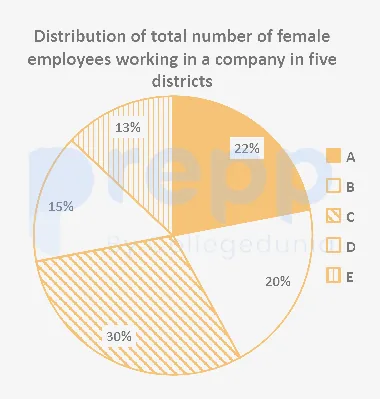
- A
62000
- B
61200
- C
61000
- D
62290
Show answer
B. 61200Calculation:
Total number of female employees = 136000
⇒ 100% = 136000
⇒ 1% = 1360
Female employees working in a company in district C = 30% = 1360 × 30 = 40800
Female employees working in a company in district D = 15% = 1360 × 15 = 20400
Total number of female employees in districts C and D = 40800 + 20400 = 61200
∴ The correct answer is 61200.
Paper & answer key PDF ↗ Question 55archived
The difference between a discount of 40% and two successive discounts of 30% on a certain bill was ₹220. Find the amount of the bill (in ₹).
- A
2000
- B
1100
- C
2200
- D
1000
Show answer
A. 2000Calculating Bill Amount with Discount Differences
This problem involves understanding the effect of a single discount versus the effect of two successive discounts and using the given difference to find the original amount of the bill.
Understanding Discounts
A discount is a reduction in the original price of an item. When a discount is applied, the final price is the original price minus the discount amount.
If a discount is $D\%$ on an amount $A$, the discount amount is $\frac{D}{100} \times A$, and the final price is $A - \frac{D}{100} \times A = A \left(1 - \frac{D}{100}\right)$.
Calculating the Single Discount Scenario
Let the original amount of the bill be $\text{₹}B$.
A single discount of 40% is applied to the bill.
Discount amount = 40% of $B$ = $\frac{40}{100} \times B = 0.40 B$
Final amount after 40% discount = $B - 0.40 B = 0.60 B$
Calculating the Successive Discounts Scenario
Two successive discounts of 30% are applied to the bill.
After the first 30% discount, the price becomes: $B \times \left(1 - \frac{30}{100}\right) = B \times (1 - 0.30) = B \times 0.70 = 0.70 B$
The second 30% discount is applied to this new price ($0.70 B$).
Amount after the second 30% discount = $(0.70 B) \times \left(1 - \frac{30}{100}\right) = (0.70 B) \times 0.70 = 0.49 B$
So, after two successive discounts of 30%, the final amount is $0.49 B$.
The total discount in this case is $B - 0.49 B = 0.51 B$, which is equivalent to a single discount of 51%.
Finding the Difference in Final Amounts
The difference between the two discount scenarios is given as ₹220.
The final amount after a single 40% discount was $0.60 B$.
The final amount after two successive 30% discounts was $0.49 B$.
The difference between these final amounts is the difference mentioned in the problem:
Difference = (Final amount after 40% discount) - (Final amount after two successive 30% discounts)
Difference = $0.60 B - 0.49 B = 0.11 B$
Calculating the Original Bill Amount
We are given that the difference is ₹220.
So, $0.11 B = 220$
To find $B$, we can rearrange the equation:
$B = \frac{220}{0.11}$
To simplify the division, we can multiply the numerator and denominator by 100:
$B = \frac{220 \times 100}{0.11 \times 100} = \frac{22000}{11}$
Now, perform the division:
$B = 2000$
The amount of the bill is ₹2000.
Step-by-Step Calculation Summary
Step
Description
Calculation
1
Let bill amount be $B$. Calculate final price after 40% discount.
$B \times (1 - 0.40) = 0.60 B$
2
Calculate price after first 30% discount.
$B \times (1 - 0.30) = 0.70 B$
3
Calculate final price after second 30% discount.
$(0.70 B) \times (1 - 0.30) = 0.49 B$
4
Find the difference between the two final prices.
$0.60 B - 0.49 B = 0.11 B$
5
Equate the difference to the given value (₹220) and solve for $B$.
$0.11 B = 220 \implies B = \frac{220}{0.11} = 2000$
Revision Table: Discount Calculations
Type of Discount
Calculation Method
Example (on ₹100)
Single Discount of $D\%$
Final Price = Original Price $\times (1 - \frac{D}{100})$
40% on ₹100: ₹$100 \times (1 - 0.40) = \text{₹}60$
Two Successive Discounts of $D_1\%$ and $D_2\%$
Final Price = Original Price $\times (1 - \frac{D_1}{100}) \times (1 - \frac{D_2}{100})$
30% and 30% on ₹100: ₹$100 \times (1 - 0.30) \times (1 - 0.30) = \text{₹}100 \times 0.70 \times 0.70 = \text{₹}49$
Single Equivalent Discount for $D_1\%$ and $D_2\%$
Equivalent Discount % = $D_1 + D_2 - \frac{D_1 \times D_2}{100}$
For 30% and 30%: $30 + 30 - \frac{30 \times 30}{100} = 60 - \frac{900}{100} = 60 - 9 = 51\%$
Additional Information: Single Equivalent Discount
When two successive discounts, say $D_1\%$ and $D_2\%$, are applied, it is often useful to find the single equivalent discount that would result in the same final price.
Let the original price be $P$.
After the first discount of $D_1\%$, the price becomes $P \left(1 - \frac{D_1}{100}\right)$.
After the second discount of $D_2\%$ on this reduced price, the final price is $P \left(1 - \frac{D_1}{100}\right) \left(1 - \frac{D_2}{100}\right)$.
If $D_{eq}\%$ is the single equivalent discount, the final price is $P \left(1 - \frac{D_{eq}}{100}\right)$.
Equating the final prices:
$P \left(1 - \frac{D_{eq}}{100}\right) = P \left(1 - \frac{D_1}{100}\right) \left(1 - \frac{D_2}{100}\right)$
Dividing by $P$ (assuming $P \neq 0$):
$1 - \frac{D_{eq}}{100} = \left(1 - \frac{D_1}{100}\right) \left(1 - \frac{D_2}{100}\right)$
$1 - \frac{D_{eq}}{100} = 1 - \frac{D_1}{100} - \frac{D_2}{100} + \frac{D_1 D_2}{10000}$
$-\frac{D_{eq}}{100} = - \frac{D_1}{100} - \frac{D_2}{100} + \frac{D_1 D_2}{10000}$
Multiplying by -100:
$D_{eq} = D_1 + D_2 - \frac{D_1 D_2}{100}$
Using this formula for the successive 30% and 30% discounts:
$D_{eq} = 30 + 30 - \frac{30 \times 30}{100} = 60 - \frac{900}{100} = 60 - 9 = 51\%$
This confirms our earlier calculation that two successive discounts of 30% are equivalent to a single discount of 51%. The difference between a 40% discount and a 51% discount is $51\% - 40\% = 11\%$. This 11% difference of the original bill amount is equal to ₹220.
So, $11\%$ of $B = \text{₹}220$
$\frac{11}{100} \times B = 220$
$B = \frac{220 \times 100}{11} = 20 \times 100 = 2000$
The original bill amount is ₹2000.
Paper & answer key PDF ↗ Question 56archived
If \(\left(y+\frac{1}{y}\right)=4\), find the value of \(\left(y^6+\frac{1}{y^6}\right)\)
- A
2702
- B
2704
- C
4096
- D
2706
Show answer
A. 2702Finding the Value of \(y^6 + \frac{1}{y^6}\) from \(y + \frac{1}{y}\)
This problem requires us to find the value of an expression involving higher powers of \(y\) and \(\frac{1}{y}\), given a simple relationship between \(y\) and \(\frac{1}{y}\). We can solve this by using algebraic identities to progressively find the values of higher powers.
Step-by-Step Solution to Find \(y^6 + \frac{1}{y^6}\)
We are given the equation:
\(y + \frac{1}{y} = 4\)
Our goal is to find the value of \(y^6 + \frac{1}{y^6}\).
Step 1: Find the value of \(y^2 + \frac{1}{y^2}\)
We can square both sides of the given equation using the identity \((a+b)^2 = a^2 + b^2 + 2ab\). Let \(a=y\) and \(b=\frac{1}{y}\).
\(\left(y + \frac{1}{y}\right)^2 = 4^2\)
\(y^2 + \left(\frac{1}{y}\right)^2 + 2 \cdot y \cdot \frac{1}{y} = 16\)
\(y^2 + \frac{1}{y^2} + 2 = 16\)
Subtract 2 from both sides:
\(y^2 + \frac{1}{y^2} = 16 - 2\)
\(y^2 + \frac{1}{y^2} = 14\)
So, we have found the value of \(y^2 + \frac{1}{y^2}\) to be 14.
Step 2: Find the value of \(y^6 + \frac{1}{y^6}\)
Now we have the value of \(y^2 + \frac{1}{y^2}\). To get to \(y^6 + \frac{1}{y^6}\), we can cube the expression \(y^2 + \frac{1}{y^2}\) because \((y^2)^3 = y^6\) and \(\left(\frac{1}{y^2}\right)^3 = \frac{1}{y^6}\).
We use the algebraic identity for cubing a sum: \((a+b)^3 = a^3 + b^3 + 3ab(a+b)\). Let \(a=y^2\) and \(b=\frac{1}{y^2}\).
From Step 1, we know \(y^2 + \frac{1}{y^2} = 14\). Cube both sides:
\(\left(y^2 + \frac{1}{y^2}\right)^3 = 14^3\)
\((y^2)^3 + \left(\frac{1}{y^2}\right)^3 + 3 \cdot y^2 \cdot \frac{1}{y^2} \left(y^2 + \frac{1}{y^2}\right) = 14^3\)
\(y^6 + \frac{1}{y^6} + 3 \cdot 1 \cdot (14) = 14^3\)
\(y^6 + \frac{1}{y^6} + 42 = 14^3\)
Step 3: Calculate \(14^3\) and find the final value
Now we need to calculate \(14^3\):
\(14^3 = 14 \times 14 \times 14\)
\(14 \times 14 = 196\)
\(196 \times 14\):
1
9
6
x
14
---
---
---
---
7
8
4
1
9
6
0
---
---
---
---
2
7
4
4
So, \(14^3 = 2744\).
Substitute this value back into the equation from Step 2:
\(y^6 + \frac{1}{y^6} + 42 = 2744\)
Subtract 42 from both sides to isolate \(y^6 + \frac{1}{y^6}\):
\(y^6 + \frac{1}{y^6} = 2744 - 42\)
\(y^6 + \frac{1}{y^6} = 2702\)
The value of \(y^6 + \frac{1}{y^6}\) is 2702.
Comparing with Options
Let's compare our result with the given options:
Option 1: 2702
Option 2: 2704
Option 3: 4096
Option 4: 2706
Our calculated value, 2702, matches Option 1.
Revision Table: Key Algebraic Identities
Identity
Formula
Application in this Problem
Square of a sum
\((a+b)^2 = a^2 + b^2 + 2ab\)
Used to find \(y^2 + \frac{1}{y^2}\) from \(y + \frac{1}{y}\).
Cube of a sum
\((a+b)^3 = a^3 + b^3 + 3ab(a+b)\)
Used to find \(y^6 + \frac{1}{y^6}\) from \(y^2 + \frac{1}{y^2}\).
Additional Information: Generalizing the Problem
Problems like this often appear in exams. If you are given \(x + \frac{1}{x} = k\), you can find expressions involving higher powers:
\(x^2 + \frac{1}{x^2} = (x + \frac{1}{x})^2 - 2 = k^2 - 2\)
\(x^3 + \frac{1}{x^3} = (x + \frac{1}{x})^3 - 3(x + \frac{1}{x}) = k^3 - 3k\)
\(x^4 + \frac{1}{x^4} = (x^2 + \frac{1}{x^2})^2 - 2 = (k^2 - 2)^2 - 2\)
\(x^6 + \frac{1}{x^6}\) can be found either as \((x^2 + \frac{1}{x^2})^3 - 3(x^2 + \frac{1}{x^2})\) or as \((x^3 + \frac{1}{x^3})^2 - 2\). In our solution, we used the first method: cubing \(y^2 + \frac{1}{y^2}\).
Using the formulas we derived:
Given \(y + \frac{1}{y} = 4\) (\(k=4\))
\(y^2 + \frac{1}{y^2} = k^2 - 2 = 4^2 - 2 = 16 - 2 = 14\). This matches our Step 1.
Let \(m = y^2 + \frac{1}{y^2} = 14\). We want \(y^6 + \frac{1}{y^6}\). Since \(y^6 = (y^2)^3\) and \(\frac{1}{y^6} = (\frac{1}{y^2})^3\), this is in the form \(a^3 + b^3\) where \(a=y^2\) and \(b=\frac{1}{y^2}\). The sum \(a+b = y^2 + \frac{1}{y^2} = m = 14\). Using the formula for \(x^3 + \frac{1}{x^3}\) but with \(x\) replaced by \(y^2\) and \(k\) replaced by \(m\):
\((y^2)^3 + \frac{1}{(y^2)^3} = m^3 - 3m\)
\(y^6 + \frac{1}{y^6} = 14^3 - 3(14)\)
\(14^3 = 2744\)
\(3(14) = 42\)
\(y^6 + \frac{1}{y^6} = 2744 - 42 = 2702\). This confirms our result using the generalized formula.
Paper & answer key PDF ↗ Question 57archived
A is 50% more efficient then B. B worked to finish the same work in 20 days. If A and B worked together, then how much time will they take to finish the same work?
- A
10 days
- B
7 days
- C
8 days
- D
9 days
Show answer
C. 8 daysUnderstanding Work and Efficiency Problems
This problem involves the concepts of work, efficiency, and time. Efficiency is inversely proportional to the time taken to complete a fixed amount of work. If someone is more efficient, they take less time to finish the same work.
Analyzing the Given Information
A is 50% more efficient than B.
B takes 20 days to finish the entire work.
We need to find the time A and B take together to finish the same work.
Calculating Individual Work Rates (Efficiency)
Let's think about the work done per day. If B finishes the work in 20 days, B completes $\frac{1}{20}$ of the work each day. This is B's daily work rate or efficiency relative to the total work.
B's daily work rate = $\frac{1}{20}$ of the total work.
A is 50% more efficient than B. This means A's daily work rate is B's daily work rate plus 50% of B's daily work rate.
50% of B's daily work rate = $50\%$ of $\frac{1}{20} = \frac{50}{100} \times \frac{1}{20} = \frac{1}{2} \times \frac{1}{20} = \frac{1}{40}$ of the total work.
A's daily work rate = B's daily work rate + 50% of B's daily work rate
A's daily work rate = $\frac{1}{20} + \frac{1}{40} = \frac{2}{40} + \frac{1}{40} = \frac{3}{40}$ of the total work.
Calculating Combined Work Rate
When A and B work together, their daily work rates add up.
Combined daily work rate of A and B = A's daily work rate + B's daily work rate
Combined daily work rate = $\frac{3}{40} + \frac{1}{20} = \frac{3}{40} + \frac{2}{40} = \frac{5}{40} = \frac{1}{8}$ of the total work.
This means that together, A and B complete $\frac{1}{8}$ of the total work each day.
Calculating Time Taken Together
If they complete $\frac{1}{8}$ of the work each day, the total time taken to complete the entire work (which is 1 whole) is the reciprocal of their combined daily work rate.
Time taken together = $\frac{1}{\text{Combined daily work rate}}$
Time taken together = $\frac{1}{1/8} = 8$ days.
Alternative Approach Using Efficiency Ratios
Let the efficiency of B be $E_B$.
The efficiency of A is 50% more than B, so $E_A = E_B + 0.5 E_B = 1.5 E_B$.
The ratio of efficiencies $E_A : E_B = 1.5 : 1 = 3 : 2$.
Efficiency is inversely proportional to time. So, the ratio of time taken $T_A : T_B$ is the inverse ratio of their efficiencies.
$T_A : T_B = \frac{1}{E_A} : \frac{1}{E_B} = \frac{1}{1.5 E_B} : \frac{1}{E_B} = \frac{1}{1.5} : 1 = 1 : 1.5 = 2 : 3$.
We are given that $T_B = 20$ days. Since $T_A : T_B = 2 : 3$, we have $\frac{T_A}{T_B} = \frac{2}{3}$.
$\frac{T_A}{20} = \frac{2}{3} \implies T_A = \frac{2}{3} \times 20 = \frac{40}{3}$ days.
Let the total work be $W$.
B's daily work rate $= \frac{W}{T_B} = \frac{W}{20}$.
A's daily work rate $= \frac{W}{T_A} = \frac{W}{40/3} = \frac{3W}{40}$.
Combined daily work rate $= \frac{W}{20} + \frac{3W}{40} = \frac{2W}{40} + \frac{3W}{40} = \frac{5W}{40} = \frac{W}{8}$.
The time taken by A and B together is $\frac{\text{Total Work}}{\text{Combined daily work rate}} = \frac{W}{W/8} = 8$ days.
Summary of Steps
Step
Description
Calculation
1
Find B's daily work rate
$\frac{1}{20}$
2
Find A's daily work rate (50% more than B)
$\frac{1}{20} + 0.5 \times \frac{1}{20} = \frac{3}{40}$
3
Find Combined daily work rate
$\frac{1}{20} + \frac{3}{40} = \frac{5}{40} = \frac{1}{8}$
4
Find Time taken together
$\frac{1}{\text{Combined rate}} = \frac{1}{1/8} = 8$ days
Therefore, if A and B worked together, they would take 8 days to finish the same work.
Revision Table: Work and Efficiency Concepts
Concept
Relationship
Formula
Work Rate (Efficiency)
Amount of work done per unit of time.
Work Rate = $\frac{\text{Total Work}}{\text{Time}}$
Time
Duration to complete the work.
Time = $\frac{\text{Total Work}}{\text{Work Rate}}$
Work
Total task to be completed. Often assumed as 1 unit or calculated based on given rates/times.
Total Work = Work Rate $\times$ Time
Efficiency & Time
Inversely proportional for a fixed amount of work.
$E \propto \frac{1}{T}$
Combined Work Rate
Sum of individual work rates when working together.
$R_{\text{combined}} = R_1 + R_2 + \dots$
Additional Information: Percentage Efficiency and Work
When efficiency is given as a percentage relative to another person, it directly affects their work rate. If someone is X% more efficient, their work rate is (100+X)% of the other person's work rate. If they are X% less efficient, their work rate is (100-X)% of the other person's work rate.
In this problem, A is 50% more efficient than B.
Efficiency of A = 100% of Efficiency of B + 50% of Efficiency of B
Efficiency of A = 150% of Efficiency of B
Ratio of Efficiency of A to Efficiency of B = 150 : 100 = 3 : 2.
Since time is inversely proportional to efficiency, the ratio of time taken by A to time taken by B is the inverse of the efficiency ratio.
Ratio of Time taken by A to Time taken by B = 2 : 3.
If B takes 20 days (which corresponds to the '3' part of the ratio), then the time taken by A (corresponding to the '2' part) can be found:
$\frac{\text{Time}_A}{\text{Time}_B} = \frac{2}{3}$
$\frac{\text{Time}_A}{20} = \frac{2}{3}$
Time$_A = \frac{2 \times 20}{3} = \frac{40}{3}$ days.
A takes $\frac{40}{3}$ days to complete the work alone.
Using the formula for time taken by A and B together: $T_{\text{together}} = \frac{T_A \times T_B}{T_A + T_B}$ (This formula works when we have individual times for completing the *same* work).
$T_{\text{together}} = \frac{\frac{40}{3} \times 20}{\frac{40}{3} + 20} = \frac{\frac{800}{3}}{\frac{40}{3} + \frac{60}{3}} = \frac{\frac{800}{3}}{\frac{100}{3}} = \frac{800}{3} \times \frac{3}{100} = \frac{800}{100} = 8$ days.
Both methods confirm that A and B working together take 8 days to finish the work.
Paper & answer key PDF ↗ Question 58archived
What is the area of the sector of a circle of radius 8 cm and formed by an arc of length 12 cm?
- A
45 cm2
- B
47 cm2
- C
48 cm2
- D
84 cm2
Show answer
C. 48 cm2Finding the Area of a Circle Sector
The problem asks us to calculate the area of a sector of a circle. We are given the radius of the circle and the length of the arc that forms the sector.
Here's what we know:
Radius (r) = 8 cm
Arc Length (L) = 12 cm
We need to find the Area of the Sector.
Formula for Sector Area
There are different formulas to find the area of a sector, depending on what information is given. When the radius and arc length are known, the formula to use is:
\text{Area} = \frac{1}{2} \times \text{Arc Length} \times \text{Radius}
In mathematical notation, this is:
\text{Area} = \frac{1}{2} L r
Calculating the Sector Area
Now, let's substitute the given values into the formula:
\text{Area} = \frac{1}{2} \times 12 \text{ cm} \times 8 \text{ cm}
First, multiply the numbers:
\text{Area} = \frac{1}{2} \times (12 \times 8) \text{ cm}^2
\text{Area} = \frac{1}{2} \times 96 \text{ cm}^2
Now, multiply by \(\frac{1}{2}\) (or divide by 2):
\text{Area} = 48 \text{ cm}^2
Final Answer
The area of the sector of the circle is 48 cm2.
Revision Table: Key Formulas for Circle Sectors
ConceptFormula (Degrees)Formula (Radians)
Area of Sector\(\text{Area} = \frac{\theta}{360^\circ} \times \pi r^2\)\(\text{Area} = \frac{1}{2} r^2 \theta\)
Arc Length\(L = \frac{\theta}{360^\circ} \times 2\pi r\)\(L = r \theta\)
Area of Sector (using Arc Length)\(\text{Area} = \frac{1}{2} L r\)
Additional Information: What is a Circle Sector?
A circle sector is a region of a circle bounded by two radii and the intercepted arc. Think of it as a slice of a circular pizza or cake. The size of the sector is determined by the central angle, which is the angle formed by the two radii at the center of the circle. The arc is the portion of the circumference between the endpoints of the two radii.
The area of the sector represents the portion of the circle's total area that the sector covers. The formulas for area and arc length show the relationship between the central angle, radius, arc length, and the sector's area.
In this problem, even though we weren't given the central angle, the formula \(\text{Area} = \frac{1}{2} L r\) allows us to find the area directly from the arc length and radius, making the calculation straightforward.
Paper & answer key PDF ↗ Question 59archived
The cost price of an article is decreased by 10% and then increased by 20%. If the final price is ₹540, then the original cost price is:
- A
₹650
- B
₹600
- C
₹500
- D
₹550
Show answer
C. ₹500Finding the Original Cost Price After Percentage Changes
This problem involves calculating the original price of an article given its final price after two consecutive percentage changes: a decrease followed by an increase. Let's break down the steps to find the original cost price.
Understanding the Price Changes
The cost price of the article undergoes two transformations:
A decrease of 10% from the original price.
An increase of 20% on the resulting price after the decrease.
We are given the final price after these changes and need to work backward to find the starting price.
Step-by-Step Calculation
Let's denote the original cost price of the article as \(x\).
Step 1: Calculate the Price After a 10% Decrease
When the price is decreased by 10%, the new price is \(100\% - 10\% = 90\%\) of the original price.
Price after 10% decrease \( = 90\%\) of \(x\)
\( = \frac{90}{100} \times x\)
\( = 0.90x\)
So, after the 10% decrease, the price of the article is \(0.90x\).
Step 2: Calculate the Final Price After a 20% Increase
The price is then increased by 20%. This increase is applied to the price *after* the first decrease, which is \(0.90x\).
Increase amount \( = 20\%\) of \(0.90x\)
\( = \frac{20}{100} \times (0.90x)\)
\( = 0.20 \times 0.90x\)
\( = 0.18x\)
The final price is the price after the decrease plus the increase amount:
Final Price \( = \) (Price after 10% decrease) \( + \) (20% increase on that price)
\( = 0.90x + 0.18x\)
\( = 1.08x\)
Step 3: Set Up the Equation and Solve for the Original Cost Price
We are given that the final price is ₹540.
So, we can set up the equation:
\(1.08x = 540\)
To find the original cost price \(x\), we need to divide the final price by 1.08:
\(x = \frac{540}{1.08}\)
To make the division easier, we can remove the decimal from the denominator by multiplying both the numerator and the denominator by 100:
\(x = \frac{540 \times 100}{1.08 \times 100}\)
\(x = \frac{54000}{108}\)
Now, we perform the division:
\(54000 \div 108\)
\(540 \div 108 = 5\)
So, \(54000 \div 108 = 500\)
Thus, \(x = 500\).
The original cost price of the article is ₹500.
Verifying the Result
Let's check if starting with ₹500 and applying the changes gives the final price of ₹540:
Original Price: ₹500
10% decrease: \(10\%\) of ₹500 \( = \frac{10}{100} \times 500 = 50\). Price after decrease: \(500 - 50 = 450\).
20% increase on ₹450: \(20\%\) of ₹450 \( = \frac{20}{100} \times 450 = \frac{1}{5} \times 450 = 90\).
Final Price: \(450 + 90 = 540\).
The calculation matches the given final price of ₹540, confirming that the original cost price is ₹500.
Summary of Price Calculation
Description
Calculation
Price
Original Cost Price
\(x\)
₹\(x\)
After 10% Decrease
\(x \times (1 - 0.10)\)
₹\(0.90x\)
After 20% Increase on decreased price
\(0.90x \times (1 + 0.20)\)
₹\(0.90x \times 1.20 = 1.08x\)
Given Final Price
₹540
Equating the calculated final price to the given final price:
\(1.08x = 540\)
\(x = \frac{540}{1.08} = 500\)
Revision Table: Key Concepts
Concept
Explanation
Percentage Decrease
Reducing a value by a certain percentage. New Value = Original Value \(\times (1 - \frac{\text{Decrease Percentage}}{100})\).
Percentage Increase
Increasing a value by a certain percentage. New Value = Original Value \(\times (1 + \frac{\text{Increase Percentage}}{100})\).
Consecutive Percentage Changes
Applying one percentage change after another. The second change is applied to the value *after* the first change. The changes are generally not simply additive (e.g., +20% after -10% is not a net +10% on the original).
Original Cost Price
The initial price before any markups, discounts, or changes.
Additional Information: Calculating Net Percentage Change
In problems with consecutive percentage changes, the overall net percentage change is not simply the sum or difference of the individual percentages. For example, a 10% decrease followed by a 20% increase does not result in a net 10% increase from the original price.
Let's see this using the original price \(x\):
After 10% decrease: Price is \(0.90x\).
After 20% increase on \(0.90x\): Price is \(0.90x \times 1.20 = 1.08x\).
The final price (\(1.08x\)) is 1.08 times the original price (\(x\)). This means the final price is \(108\%\) of the original price.
The net percentage change is \((1.08 - 1) \times 100\% = 0.08 \times 100\% = 8\%\).
So, a 10% decrease followed by a 20% increase results in a net increase of 8% on the original price. This confirms our finding that the final price (₹540) is 108% of the original price (₹500), since \(500 \times 1.08 = 540\).
Understanding the concept of applying percentage changes sequentially is crucial for solving such problems.
Paper & answer key PDF ↗ Question 60archived
The curved surface area of a solid circular cylinder of height 12 cm is 2640 cm2. What is the volume (in cm3) of the cylinder? (Take π = 22/7)
- A
46200
- B
37900
- C
42000
- D
55200
Show answer
A. 46200Finding the Volume of a Solid Circular Cylinder
The problem asks us to find the volume of a solid circular cylinder when its height and curved surface area are known. We are given the height and the curved surface area, along with the value of π.
Given Information about the Cylinder
Height of the cylinder ($h$) = 12 cm
Curved Surface Area (CSA) = 2640 cm²
Value of π = 22/7
Formula for Curved Surface Area (CSA)
The formula for the curved surface area of a cylinder is given by:
\( \text{CSA} = 2 \pi r h \)
where \(r\) is the radius of the base and \(h\) is the height of the cylinder.
Calculating the Radius of the Cylinder
We can use the given CSA and height to find the radius \(r\). Substituting the known values into the CSA formula:
\( 2 \times \frac{22}{7} \times r \times 12 = 2640 \)
Now, we solve for \(r\):
\( \frac{44}{7} \times 12 \times r = 2640 \)
\( \frac{528}{7} \times r = 2640 \)
\( r = \frac{2640 \times 7}{528} \)
To simplify, we can divide 2640 by 528. Notice that \(528 \times 5 = 2640\).
\( r = 5 \times 7 \)
\( r = 35 \text{ cm} \)
So, the radius of the cylinder's base is 35 cm.
Formula for the Volume of a Cylinder
The formula for the volume of a cylinder is given by:
\( \text{Volume} = \pi r^2 h \)
where \(r\) is the radius of the base and \(h\) is the height of the cylinder.
Calculating the Volume of the Cylinder
Now that we have the radius (\(r = 35\) cm) and the height (\(h = 12\) cm), and using \(\pi = 22/7\), we can calculate the volume:
\( \text{Volume} = \frac{22}{7} \times (35)^2 \times 12 \)
\( \text{Volume} = \frac{22}{7} \times (35 \times 35) \times 12 \)
\( \text{Volume} = \frac{22}{7} \times 1225 \times 12 \)
We can simplify by dividing 1225 by 7 (\(1225 / 7 = 175\)):
\( \text{Volume} = 22 \times 175 \times 12 \)
Now, multiply the numbers:
\( 22 \times 175 = 3850 \)
\( \text{Volume} = 3850 \times 12 \)
\( 3850 \times 12 = 46200 \)
So, the volume of the cylinder is 46200 cm³.
The calculated volume matches one of the given options.
Revision Table: Cylinder Formulas
Aspect
Formula
Variables
Radius (derived from CSA)
\( r = \frac{\text{CSA}}{2 \pi h} \)
CSA = Curved Surface Area
h = height
\(\pi \approx 22/7\) or 3.14
Volume
\( V = \pi r^2 h \)
r = radius
h = height
\(\pi \approx 22/7\) or 3.14
Additional Information: Understanding Cylinders
A solid circular cylinder is a three-dimensional geometric shape. It has two parallel circular bases connected by a curved surface. The height of the cylinder is the perpendicular distance between the two bases. The volume represents the amount of space occupied by the cylinder, while the curved surface area represents the area of the side surface (excluding the top and bottom bases).
The calculation steps followed are standard for finding the volume when CSA and height are provided. First, deduce the radius from the CSA formula, then use this radius along with the height in the volume formula.
Paper & answer key PDF ↗ Question 61archived
100 ÷ 10 - [-2 + {-9 + (3 - 6 of 2)}] = ______.
- A
20
- B
-6
- C
30
- D
0
Show answer
C. 30Evaluating Mathematical Expressions with Order of Operations
The question asks us to evaluate the mathematical expression: \(100 \div 10 - [-2 + \{-9 + (3 - 6 \text{ of } 2)\}]\). To solve this, we need to follow the order of operations, commonly known as BODMAS or PEMDAS.
Understanding the Order of Operations (BODMAS/PEMDAS)
The order of operations dictates the sequence in which mathematical operations should be performed:
B/P: Brackets (Parentheses), Orders (Exponents), i.e., solve operations inside parentheses, square brackets, and curly braces first, from innermost to outermost.
O/E: Orders (Powers, Square Roots, etc.) / Exponents. The term 'of' also falls under this category and is treated as multiplication.
D/M: Division and Multiplication. These are performed from left to right.
A/S: Addition and Subtraction. These are performed from left to right.
Step-by-Step Evaluation of the Expression
Let's evaluate the given expression systematically:
\(100 \div 10 - [-2 + \{-9 + (3 - 6 \text{ of } 2)\}] \)
Step 1: Solve the 'of' operation within the innermost parentheses.
The expression has \(6 \text{ of } 2\). According to BODMAS/PEMDAS, 'of' means multiplication.
\(6 \text{ of } 2 = 6 \times 2 = 12\)
Substitute this value back into the expression:
\(100 \div 10 - [-2 + \{-9 + (3 - 12)\}] \)
Step 2: Solve the operation inside the innermost parentheses.
The innermost parentheses contain \((3 - 12)\).
\(3 - 12 = -9\)
Substitute this value back into the expression:
\(100 \div 10 - [-2 + \{-9 + (-9)\}] \)
Step 3: Solve the operation inside the curly braces.
The curly braces contain \(\{-9 + (-9)\}\).
\(-9 + (-9) = -9 - 9 = -18\)
Substitute this value back into the expression:
\(100 \div 10 - [-2 + (-18)] \)
Step 4: Solve the operation inside the square brackets.
The square brackets contain \([-2 + (-18)]\).
\(-2 + (-18) = -2 - 18 = -20\)
Substitute this value back into the expression:
\(100 \div 10 - [-20] \)
Step 5: Perform the division operation.
Next, perform the division \(100 \div 10\).
\(100 \div 10 = \frac{100}{10} = 10\)
Substitute this value back into the expression:
\(10 - [-20] \)
Step 6: Perform the final subtraction.
Finally, perform the subtraction \(10 - [-20]\).
\(10 - [-20] = 10 + 20 = 30\)
The result of the expression is 30.
Summary of Evaluation Steps
Step
Operation
Calculation
Expression Remaining
1
'of'
\(6 \text{ of } 2 = 12\)
\(100 \div 10 - [-2 + \{-9 + (3 - 12)\}]\)
2
Innermost Bracket
\(3 - 12 = -9\)
\(100 \div 10 - [-2 + \{-9 + (-9)\}]\)
3
Curly Braces
\(-9 + (-9) = -18\)
\(100 \div 10 - [-2 + (-18)]\)
4
Square Brackets
\(-2 + (-18) = -20\)
\(100 \div 10 - [-20]\)
5
Division
\(100 \div 10 = 10\)
\(10 - [-20]\)
6
Subtraction
\(10 - (-20) = 30\)
\(30\)
Conclusion
Following the order of operations, the value of the expression \(100 \div 10 - [-2 + \{-9 + (3 - 6 \text{ of } 2)\}]\) is 30.
Revision Table: Order of Operations
Acronym (BODMAS/PEMDAS)
Operation Type
Order
B/P
Brackets/Parentheses ( ), { }, [ ]
First (innermost first)
O/E
Orders/Exponents (Powers, Roots), 'of'
Second
D/M
Division and Multiplication
Third (Left to Right)
A/S
Addition and Subtraction
Fourth (Left to Right)
Additional Information: Negative Numbers and Subtraction
Understanding how to handle negative numbers during addition and subtraction is crucial for solving expressions like this. Remember the rules:
Subtracting a positive number is the same as adding a negative number: \(a - b = a + (-b)\).
Subtracting a negative number is the same as adding a positive number: \(a - (-b) = a + b\).
Adding numbers with the same sign: Add their absolute values and keep the sign (e.g., \(-9 + (-9) = -(9+9) = -18\)).
Adding numbers with different signs: Subtract the smaller absolute value from the larger absolute value and take the sign of the number with the larger absolute value (e.g., \(-2 + 10 = 10 - 2 = 8\); \(2 + (-10) = -(10 - 2) = -8\)).
Paper & answer key PDF ↗ Question 62archived
The fourth proportional to 8, 32 and 13 is:
- A
39
- B
40
- C
26
- D
52
Show answer
D. 52Given:
First number = 8
Second number = 32
Third number = 13
Formula used:
Fourth proportional = (Second number × Third number)/First number
Calculation:
Fourth proportional = (Second number × Third number)/First number
⇒ (32×13)/8 = 52
∴ The correct answer is 52.
Paper & answer key PDF ↗ Question 63archived
The rate of simple interest for which ₹9,000 will amount to ₹10,200 in 4 years is:
- A
\(4 \frac{2}{3} \%\)
- B
\(7 \frac{1}{3} \%\)
- C
\(5 \frac{1}{2} \%\)
- D
\(3 \frac{1}{3} \%\)
Show answer
D. \(3 \frac{1}{3} \%\)The correct answer is 3 \frac{1}{3} \%.
The interest earned grows over time. This question specifically deals with simple interest. If it were compound interest, the calculation would involve a different formula: A = P(1 + \frac{R}{100})^T. Understanding these basic concepts of simple interest, principal, amount, rate, and time is crucial for solving problems related to financial calculations.
Paper & answer key PDF ↗ Question 64archived
What is the remainder when (x17 + 1) is divided by (x + 1)?
- A
0
- B
x
- C
1
- D
x - 1
Show answer
A. 0Solution:
Given Polynomial and Divisor:
Polynomial $P(x) = x^{17} + 1$
Divisor = $x + 1$
Finding the Value of $x$ to Substitute:
Set the divisor equal to zero to find $c$:
$x + 1 = 0$
$x = -1$
Applying the Remainder Theorem:
According to the theorem, the remainder ($R$) is equal to $P(-1)$.
$R = (-1)^{17} + 1$
Calculation:
Since $17$ is an odd number, $(-1)^{\text{odd number}} = -1$.
$R = -1 + 1$
$R = 0$
Final Answer:
The remainder when $(x^{17} + 1)$ is divided by $(x + 1)$ is $0$.
Paper & answer key PDF ↗ Question 65archived
A boat running upstream takes 10 hours to cover a certain distance, while it takes 7 hours to cover the same distance running downstream. What is the ratio between the speed of the boat and that of the water current, respectively?
- A
17 ∶ 5
- B
3 ∶ 17
- C
2 ∶ 17
- D
17 ∶ 3
Show answer
D. 17 ∶ 3Calculating Boat and Stream Speed Ratio
This problem involves the concepts of speed, time, and distance in the context of a boat traveling in water with a current. The speed of the boat is affected by the speed of the water current when moving upstream (against the current) and downstream (with the current).
Understanding Upstream and Downstream Motion
Let's define the key speeds:
Let the speed of the boat in still water be \(B\) km/hr.
Let the speed of the water current be \(C\) km/hr.
When the boat travels upstream, the current opposes its motion, so the effective speed is reduced:
\( \text{Upstream Speed} = B - C \)
When the boat travels downstream, the current assists its motion, so the effective speed is increased:
\( \text{Downstream Speed} = B + C \)
Applying the Distance Formula
The problem states that the boat covers the same distance both upstream and downstream. We know that:
\( \text{Distance} = \text{Speed} \times \text{Time} \)
Given the times:
Time taken upstream = 10 hours
Time taken downstream = 7 hours
Since the distance is the same in both cases, we can set up an equation using the distance formula:
\( \text{Distance Upstream} = \text{Distance Downstream} \)
\( (\text{Upstream Speed}) \times (\text{Upstream Time}) = (\text{Downstream Speed}) \times (\text{Downstream Time}) \)
Substituting the speeds and times:
\( (B - C) \times 10 = (B + C) \times 7 \)
Solving for the Ratio of Speeds
Now, we need to solve this equation to find the ratio of the speed of the boat (\(B\)) to the speed of the current (\(C\)), which is \(B:C\) or \(B/C\).
Let's expand the equation:
\( 10B - 10C = 7B + 7C \)
Now, let's gather the terms with \(B\) on one side and the terms with \(C\) on the other side:
\( 10B - 7B = 7C + 10C \)
Simplify both sides:
\( 3B = 17C \)
To find the ratio \(B:C\), we can divide both sides by \(C\) (assuming \(C \neq 0\)) and by 3:
\( \frac{3B}{3C} = \frac{17C}{3C} \)
\( \frac{B}{C} = \frac{17}{3} \)
This can be expressed as a ratio:
\( B : C = 17 : 3 \)
The ratio between the speed of the boat and that of the water current is \(17:3\).
Revision Table: Boat and Stream Concepts
Concept
Formula/Relation
Applied Value
Boat Speed in Still Water
\(B\)
\(17\) (relative units)
Current Speed
\(C\)
\(3\) (relative units)
Upstream Speed
\(B - C\)
\(17 - 3 = 14\) (relative units)
Downstream Speed
\(B + C\)
\(17 + 3 = 20\) (relative units)
Distance (Upstream)
\((B-C) \times \text{Time}_{Up}\)
\(14 \times 10 = 140\) (relative units)
Distance (Downstream)
\((B+C) \times \text{Time}_{Down}\)
\(20 \times 7 = 140\) (relative units)
Additional Information on Boat and Stream Problems
Boat and stream problems are a common application of relative speed. Here are a few more useful relationships:
If you know the upstream speed \(U = B - C\) and downstream speed \(D = B + C\), you can find the boat speed and current speed:
Boat Speed \(B = \frac{D + U}{2}\)
Current Speed \(C = \frac{D - U}{2}\)
In this problem, we found the ratio directly from the time equation. If we had used the speeds \(B-C\) and \(B+C\) with times 10 and 7, we could think of relative speeds: Upstream speed is \(14k\) and Downstream speed is \(20k\) for some constant \(k\), because \(14k \times 10 = 140k\) and \(20k \times 7 = 140k\).
Using \(B = \frac{D+U}{2}\) and \(C = \frac{D-U}{2}\) with \(U=14\) and \(D=20\) (relative speeds):
\(B = \frac{20 + 14}{2} = \frac{34}{2} = 17\)
\(C = \frac{20 - 14}{2} = \frac{6}{2} = 3\)
This also gives the ratio \(B:C = 17:3\).
Paper & answer key PDF ↗ Question 66archived
Rice worth ₹35 per kilogram and ₹38 per kilogram are mixed with a third variety in the ratio 2 ∶ 1 ∶ 2. If the mixture is worth ₹42 per kilogram, the price of the third variety per kilogram is:
- A
₹52
- B
₹53
- C
₹54
- D
₹51
Show answer
D. ₹51Understanding the Rice Mixture Problem
This question asks us to find the price of a third variety of rice when it's mixed with two other varieties in a specific ratio, and the average price of the resulting mixture is known. This is a classic example of a mixture problem often encountered in quantitative aptitude.
Setting up the Rice Mixture Calculation
We are given three varieties of rice:
Variety 1: Price ₹35 per kilogram (kg)
Variety 2: Price ₹38 per kilogram (kg)
Variety 3: Price unknown, let's call it 'p' per kilogram (kg)
These varieties are mixed in the ratio 2 ∶ 1 ∶ 2. This means for every 2 parts of Variety 1, there is 1 part of Variety 2, and 2 parts of Variety 3.
Let's assume the quantities of the three varieties in the mixture are 2k, 1k, and 2k kilograms respectively, where 'k' is a constant representing the size of one part in the ratio. The total quantity of the mixture will be the sum of these quantities.
Total quantity of mixture $= 2k + 1k + 2k = 5k$ kilograms.
Calculating the Total Value of the Mixture
The total value of the mixture is the sum of the values of each variety used in the mix.
Value of Variety 1 = Quantity of Variety 1 × Price of Variety 1 $= 2k \times 35 = 70k$
Value of Variety 2 = Quantity of Variety 2 × Price of Variety 2 $= 1k \times 38 = 38k$
Value of Variety 3 = Quantity of Variety 3 × Price of Variety 3 $= 2k \times p = 2pk$
Total value of the mixture $= 70k + 38k + 2pk = (108 + 2p)k$.
Using the Average Price to Find the Unknown Price
We are given that the mixture is worth ₹42 per kilogram. The average price of the mixture is calculated by dividing the total value of the mixture by the total quantity of the mixture.
Average price $= \frac{\text{Total Value}}{\text{Total Quantity}}$
We are given the average price is ₹42/kg. So, we can set up the equation:
\(42 = \frac{(108 + 2p)k}{5k}\)
Assuming \(k > 0\) (since we have a mixture), we can cancel 'k' from the numerator and denominator:
\(42 = \frac{108 + 2p}{5}\)
Now, we need to solve this equation for 'p'.
Multiply both sides by 5:
\(42 \times 5 = 108 + 2p\)
\(210 = 108 + 2p\)
Subtract 108 from both sides:
\(210 - 108 = 2p\)
\(102 = 2p\)
Divide both sides by 2:
\(p = \frac{102}{2}\)
\(p = 51\)
Therefore, the price of the third variety of rice is ₹51 per kilogram.
Variety
Ratio Part
Assumed Quantity (kg)
Price per kg (₹)
Total Value (₹)
1
2
\(2k\)
35
\(35 \times 2k = 70k\)
2
1
\(1k\)
38
\(38 \times 1k = 38k\)
3
2
\(2k\)
\(p\)
\(p \times 2k = 2pk\)
Total
5
\(5k\)
Mixture Price = 42
\((108 + 2p)k\)
Using the formula: \( \text{Average Price} = \frac{\text{Sum of (Quantity } \times \text{ Price)}}{\text{Sum of Quantities}} \)
\( 42 = \frac{70k + 38k + 2pk}{2k + 1k + 2k} \)
\( 42 = \frac{(108 + 2p)k}{5k} \)
\( 42 \times 5 = 108 + 2p \)
\( 210 = 108 + 2p \)
\( 2p = 210 - 108 \)
\( 2p = 102 \)
\( p = \frac{102}{2} \)
\( p = 51 \)
The price of the third variety per kilogram is ₹51.
Revision Table: Key Concepts
Concept
Description
Application in Problem
Ratio
Compares the quantities of different items.
Given as 2:1:2 for the three rice varieties.
Mixture Problem
Involves calculating properties (like price) of a mix based on the properties and quantities of components.
Finding the price of one component given the mix ratio and average price.
Weighted Average
The average where each component's value is weighted by its quantity. The average price of the mixture is a weighted average of the prices of the components.
\( \text{Average Price} = \frac{\sum (\text{Quantity}_i \times \text{Price}_i)}{\sum \text{Quantity}_i} \)
Additional Information on Mixture Problems
Mixture problems often involve mixing liquids (like milk and water, or different solutions), solids (like different types of grains or metals), or investments with different interest rates. The core idea is always to balance the total quantity and the total value or property of the mixture.
For instance, if you mix \(Q_1\) kg of ingredient A at price \(P_1\) and \(Q_2\) kg of ingredient B at price \(P_2\), the average price \(P_{avg}\) of the mixture is given by:
\( P_{avg} = \frac{Q_1 P_1 + Q_2 P_2}{Q_1 + Q_2} \)
In our case with three varieties, the formula extended to:
\( P_{avg} = \frac{Q_1 P_1 + Q_2 P_2 + Q_3 P_3}{Q_1 + Q_2 + Q_3} \)
We used \(Q_1 = 2k\), \(P_1 = 35\), \(Q_2 = 1k\), \(P_2 = 38\), \(Q_3 = 2k\), \(P_3 = p\), and \(P_{avg} = 42\). Plugging these values into the formula allows us to solve for the unknown price 'p'.
Paper & answer key PDF ↗ Question 67archived
Two circles touch each other externally. The radius of the first circle with centre O is 6 cm. The radius of the second circle with centre P is 3 cm. Find the length of their common tangent AB.
- A
3√2 cm
- B
4√2 cm
- C
6√3 cm
- D
6√2 cm
Show answer
D. 6√2 cmUnderstanding the Problem: Common Tangent of Externally Touching Circles
The question asks for the length of the common tangent to two circles that touch each other externally. We are given the radius of the first circle (6 cm) and the radius of the second circle (3 cm).
Key Concepts for Solving Common Tangent Problems
When two circles touch externally, the distance between their centers is equal to the sum of their radii. A common tangent is a line segment that is tangent to both circles.
For a direct common tangent (like AB in this problem, assuming A and B are on the same side of the line connecting centers), we can use geometry or a specific formula to find its length.
Method 1: Using Geometric Construction and Pythagoras Theorem
Let the center of the first circle be O with radius \(R_1 = 6\) cm. Let the center of the second circle be P with radius \(R_2 = 3\) cm. The circles touch externally, so the distance between their centers is \(OP = R_1 + R_2 = 6 + 3 = 9\) cm.
Let the common tangent touch the first circle at A and the second circle at B. OA is perpendicular to AB, and PB is perpendicular to AB. OA is the radius \(R_1\), and PB is the radius \(R_2\).
To find the length of AB, draw a line through P parallel to AB, intersecting OA at point C.
ABPC forms a rectangle. Thus, AB = PC and AC = PB = \(R_2 = 3\) cm.
The line segment OC is part of the radius OA. Its length is \(OC = OA - AC = R_1 - R_2 = 6 - 3 = 3\) cm.
Triangle OCP is a right-angled triangle with the right angle at C (since PC is parallel to AB, which is perpendicular to OA).
The hypotenuse OP is the distance between the centers, which is 9 cm.
Now we can use the Pythagoras theorem in triangle OCP:
\[OP^2 = OC^2 + PC^2\]
Substitute the values:
\[9^2 = 3^2 + PC^2\]
\[81 = 9 + PC^2\]
\[PC^2 = 81 - 9\]
\[PC^2 = 72\]
\[PC = \sqrt{72}\]
To simplify \(\sqrt{72}\), we find the largest perfect square factor of 72. \(72 = 36 \times 2\). So:
\[\sqrt{72} = \sqrt{36 \times 2} = \sqrt{36} \times \sqrt{2} = 6\sqrt{2}\]
Since AB = PC, the length of the common tangent AB is \(6\sqrt{2}\) cm.
Method 2: Using the Direct Formula for Common Tangent Length
The length of the direct common tangent (L) between two circles with radii \(R_1\) and \(R_2\) and the distance between their centers (d) is given by the formula:
\[L = \sqrt{d^2 - (R_1 - R_2)^2}\]
In this case, the circles touch externally, so the distance between centers \(d = R_1 + R_2\). Substituting this into the formula:
\[L = \sqrt{(R_1 + R_2)^2 - (R_1 - R_2)^2}\]
Expanding the terms inside the square root:
\[(R_1 + R_2)^2 = R_1^2 + 2R_1R_2 + R_2^2\]
\[(R_1 - R_2)^2 = R_1^2 - 2R_1R_2 + R_2^2\]
Subtracting the second from the first:
\[(R_1 + R_2)^2 - (R_1 - R_2)^2 = (R_1^2 + 2R_1R_2 + R_2^2) - (R_1^2 - 2R_1R_2 + R_2^2)\]
\[= R_1^2 + 2R_1R_2 + R_2^2 - R_1^2 + 2R_1R_2 - R_2^2\]
\[= 4R_1R_2\]
So, the formula simplifies to:
\[L = \sqrt{4R_1R_2} = 2\sqrt{R_1R_2}\]
Using this simplified formula with \(R_1 = 6\) cm and \(R_2 = 3\) cm:
\[L = 2\sqrt{6 \times 3}\]
\[L = 2\sqrt{18}\]
\[L = 2\sqrt{9 \times 2}\]
\[L = 2 \times 3\sqrt{2}\]
\[L = 6\sqrt{2}\]
The length of the common tangent AB is \(6\sqrt{2}\) cm.
Comparing Methods
Both methods yield the same result, \(6\sqrt{2}\) cm. The geometric method helps understand the derivation of the formula, while the formula provides a quicker way to solve the problem once understood.
Final Answer Derivation
Using either the Pythagoras theorem with the constructed triangle or the direct formula for the common tangent of externally touching circles, we found the length of the common tangent AB to be \(6\sqrt{2}\) cm.
Revision Table: Circle Tangent Formulas
Concept
Formula/Relation
Notes
Distance between centers (externally touching circles)
\(d = R_1 + R_2\)
\(R_1, R_2\) are radii
Length of Direct Common Tangent
\(L = \sqrt{d^2 - (R_1 - R_2)^2}\)
d = distance between centers
Length of Direct Common Tangent (externally touching circles)
\(L = 2\sqrt{R_1R_2}\)
Special case where \(d = R_1 + R_2\)
Radius and Tangent at point of contact
Radius is perpendicular to the tangent
Forms a 90-degree angle
Additional Information: Types of Common Tangents
Circles can have different types of common tangents depending on their positions relative to each other.
Direct Common Tangents: These tangents keep both circles on the same side of the tangent line. For two circles touching externally, there are two direct common tangents. Their lengths are equal.
Transverse Common Tangents: These tangents pass between the two circles, keeping the circles on opposite sides of the tangent line. For two circles touching externally, there is one transverse common tangent.
The length of the transverse common tangent (L_T) between two circles with radii \(R_1\) and \(R_2\) and distance between centers (d) is given by the formula:
\[L_T = \sqrt{d^2 - (R_1 + R_2)^2}\]
However, this formula is only applicable when the circles are separate, not touching externally. If circles touch externally, the distance \(d = R_1 + R_2\), making \(d^2 - (R_1 + R_2)^2 = (R_1+R_2)^2 - (R_1+R_2)^2 = 0\). This indicates that for externally touching circles, the point of contact is the only 'transverse common tangent' line segment, which has zero length in terms of a segment between the tangent points on the circles (the tangent line passes through the point of contact). The problem specified "their common tangent AB", referring to a direct common tangent segment.
Paper & answer key PDF ↗ Question 68archived
What is the value of 5√3 cos 60° tan 30° - 3 cos 0° + 3 cos2 45° + 2 sin2 60°?
- A
2√3
- B
2.5
- C
3√2
- D
3.5
Show answer
B. 2.5Evaluating the Trigonometric Expression
We are asked to find the value of the given trigonometric expression:
$5\sqrt{3} \cos 60^\circ \tan 30^\circ - 3 \cos 0^\circ + 3 \cos^2 45^\circ + 2 \sin^2 60^\circ$
To evaluate this expression, we need to know the values of the trigonometric functions for the standard angles $0^\circ$, $30^\circ$, $45^\circ$, and $60^\circ$.
Key Trigonometric Values for Evaluation
Here are the specific trigonometric values needed for this problem:
Angle
$\cos$
$\sin$
$\tan$
$0^\circ$
$1$
$0$
$0$
$30^\circ$
$\frac{\sqrt{3}}{2}$
$\frac{1}{2}$
$\frac{1}{\sqrt{3}}$
$45^\circ$
$\frac{1}{\sqrt{2}}$
$\frac{1}{\sqrt{2}}$
$1$
$60^\circ$
$\frac{1}{2}$
$\frac{\sqrt{3}}{2}$
$\sqrt{3}$
Substituting Values into the Expression
Now, substitute these values into the given expression:
$5\sqrt{3} \left(\frac{1}{2}\right) \left(\frac{1}{\sqrt{3}}\right) - 3 (1) + 3 \left(\frac{1}{\sqrt{2}}\right)^2 + 2 \left(\frac{\sqrt{3}}{2}\right)^2$
Step-by-Step Calculation
Let's calculate the value of each term separately.
Term 1: $5\sqrt{3} \cos 60^\circ \tan 30^\circ$
Substitute values: $5\sqrt{3} \times \frac{1}{2} \times \frac{1}{\sqrt{3}}$
Simplify: $5 \times \frac{1}{2} \times \left(\sqrt{3} \times \frac{1}{\sqrt{3}}\right) = 5 \times \frac{1}{2} \times 1 = \frac{5}{2}$
So, the first term is $\frac{5}{2}$.
Term 2: $-3 \cos 0^\circ$
Substitute value: $-3 \times 1$
Simplify: $-3$
So, the second term is $-3$.
Term 3: $3 \cos^2 45^\circ$
Substitute value: $3 \left(\frac{1}{\sqrt{2}}\right)^2$
Simplify: $3 \times \left(\frac{1^2}{(\sqrt{2})^2}\right) = 3 \times \left(\frac{1}{2}\right) = \frac{3}{2}$
So, the third term is $\frac{3}{2}$.
Term 4: $2 \sin^2 60^\circ$
Substitute value: $2 \left(\frac{\sqrt{3}}{2}\right)^2$
Simplify: $2 \times \left(\frac{(\sqrt{3})^2}{2^2}\right) = 2 \times \left(\frac{3}{4}\right) = \frac{6}{4} = \frac{3}{2}$
So, the fourth term is $\frac{3}{2}$.
Combining the Terms
Now, we add and subtract the simplified terms:
Value $= \frac{5}{2} - 3 + \frac{3}{2} + \frac{3}{2}$
Combine the fractions:
$\frac{5}{2} + \frac{3}{2} + \frac{3}{2} = \frac{5 + 3 + 3}{2} = \frac{11}{2}$
Now, complete the calculation:
Value $= \frac{11}{2} - 3$
Value $= 5.5 - 3$
Value $= 2.5$
Final Value of the Expression
The value of the expression $5\sqrt{3} \cos 60^\circ \tan 30^\circ - 3 \cos 0^\circ + 3 \cos^2 45^\circ + 2 \sin^2 60^\circ$ is $2.5$.
Revision Table: Standard Trigonometric Ratios
Reviewing standard trigonometric values is crucial for solving such problems. Here's a table summarizing common values:
Angle $(\theta)$
$\sin \theta$
$\cos \theta$
$\tan \theta$
$\csc \theta$
$\sec \theta$
$\cot \theta$
$0^\circ$
$0$
$1$
$0$
Undefined
$1$
Undefined
$30^\circ$ ($\frac{\pi}{6}$)
$\frac{1}{2}$
$\frac{\sqrt{3}}{2}$
$\frac{1}{\sqrt{3}}$
$2$
$\frac{2}{\sqrt{3}}$
$\sqrt{3}$
$45^\circ$ ($\frac{\pi}{4}$)
$\frac{1}{\sqrt{2}}$
$\frac{1}{\sqrt{2}}$
$1$
$\sqrt{2}$
$\sqrt{2}$
$1$
$60^\circ$ ($\frac{\pi}{3}$)
$\frac{\sqrt{3}}{2}$
$\frac{1}{2}$
$\sqrt{3}$
$\frac{2}{\sqrt{3}}$
$2$
$\frac{1}{\sqrt{3}}$
$90^\circ$ ($\frac{\pi}{2}$)
$1$
$0$
Undefined
$1$
Undefined
$0$
Additional Information on Trigonometric Expressions
Evaluating trigonometric expressions often requires recalling basic trigonometric identities and the values of trigonometric functions for common angles like $0^\circ, 30^\circ, 45^\circ, 60^\circ,$ and $90^\circ$.
The values for these angles can be derived from specific right-angled triangles (30-60-90 and 45-45-90 triangles) or the unit circle.
Remember that $\cos^2 \theta = (\cos \theta)^2$ and $\sin^2 \theta = (\sin \theta)^2$.
Pay close attention to the order of operations (PEMDAS/BODMAS) when evaluating expressions.
Trigonometric identities, such as $\tan \theta = \frac{\sin \theta}{\cos \theta}$, can sometimes simplify expressions before evaluation, although not strictly necessary for this particular problem after substituting values.
Practice evaluating expressions with various combinations of trigonometric functions and angles to become proficient.
Paper & answer key PDF ↗ Question 69archived
The effective speed of a boat is 15.2 km/h against the stream and 20.8 km/h along the stream. Find the speed of the stream.
- A
18 km/h
- B
1.8 km/h
- C
2.8 km/h
- D
3 km/h
Show answer
C. 2.8 km/hCalculating Speed of Stream from Boat Speeds
This problem involves understanding the concepts of boat speed in still water and the speed of the stream, and how they affect the boat's effective speed when moving upstream (against the current) and downstream (with the current).
Let's define the key terms:
Speed of the boat in still water (let's call it \(V_b\)). This is the speed the boat would travel at if there were no current.
Speed of the stream or current (let's call it \(V_s\)). This is the speed of the flowing water.
Speed along the stream or downstream speed (\(V_d\)). When the boat travels with the current, the speed of the stream adds to the boat's speed in still water.
Speed against the stream or upstream speed (\(V_u\)). When the boat travels against the current, the speed of the stream subtracts from the boat's speed in still water.
The relationships between these speeds are given by the following formulas:
\(V_d = V_b + V_s\)
\(V_u = V_b - V_s\)
We are given the following information:
Effective speed against the stream (Upstream Speed, \(V_u\)) = 15.2 km/h
Effective speed along the stream (Downstream Speed, \(V_d\)) = 20.8 km/h
We need to find the speed of the stream (\(V_s\)).
We have two equations:
1) \(V_d = V_b + V_s \implies 20.8 = V_b + V_s\)
2) \(V_u = V_b - V_s \implies 15.2 = V_b - V_s\)
To find the speed of the stream (\(V_s\)), we can subtract the second equation from the first equation:
\((V_d) - (V_u) = (V_b + V_s) - (V_b - V_s)\)
\(V_d - V_u = V_b + V_s - V_b + V_s\)
\(V_d - V_u = 2V_s\)
Now, we can solve for \(V_s\):
\(V_s = \frac{V_d - V_u}{2}\)
Substitute the given values into this formula:
\(V_s = \frac{20.8 \text{ km/h} - 15.2 \text{ km/h}}{2}\)
\(V_s = \frac{5.6 \text{ km/h}}{2}\)
\(V_s = 2.8 \text{ km/h}\)
So, the speed of the stream is 2.8 km/h.
Boat and Stream Speed Revision
Concept
Formula
Explanation
Downstream Speed (\(V_d\))
\(V_d = V_b + V_s\)
Boat speed in still water PLUS stream speed
Upstream Speed (\(V_u\))
\(V_u = V_b - V_s\)
Boat speed in still water MINUS stream speed
Speed of Boat in Still Water (\(V_b\))
\(V_b = \frac{V_d + V_u}{2}\)
Average of downstream and upstream speeds
Speed of Stream (\(V_s\))
\(V_s = \frac{V_d - V_u}{2}\)
Half the difference between downstream and upstream speeds
Additional Information on Boat and Stream Problems
Boat and stream problems are common in quantitative aptitude. They test your understanding of relative speed. Here are a few more points to remember:
The speed of the boat in still water is always greater than the speed of the stream for the boat to be able to move against the stream. If \(V_b \le V_s\), the boat would be carried away by the stream when trying to move upstream.
Distance, speed, and time relationships (\(Distance = Speed \times Time\)) are often combined with boat and stream concepts. You might need to calculate time taken to travel a certain distance upstream or downstream.
When solving problems, always identify what is given (upstream speed, downstream speed, time, distance) and what needs to be found (boat speed in still water, stream speed, time, distance).
Paper & answer key PDF ↗ Question 70archived
2 men can finish a work in 6 days and 3 women can finish the same work in 4 days. In how many days will the work be finished by 1 man and 2 women, working together every day?
- A
4
- B
6
- C
8
- D
9
Show answer
A. 4Solving Work and Time Problems: Men, Women Working Together
This question asks us to determine the time taken by a group of 1 man and 2 women to complete a specific work, given the time taken by different groups of men and women to finish the same work.
To solve such problems, the key is to find the efficiency or work rate of an individual man and an individual woman. The work rate is usually expressed as the fraction of the work done per day.
Calculating Individual Work Rates
We are given the following information:
2 men can finish the work in 6 days.
3 women can finish the same work in 4 days.
Let's calculate the work rate for one man and one woman:
If 2 men take 6 days, then 1 man would take twice the time (since there are half the number of workers).
Time taken by 1 man = $2 \times 6$ days = 12 days.
Work rate of 1 man per day = $\frac{1}{\text{Time taken by 1 man}} = \frac{1}{12}$ of the work.
If 3 women take 4 days, then 1 woman would take three times the time.
Time taken by 1 woman = $3 \times 4$ days = 12 days.
Work rate of 1 woman per day = $\frac{1}{\text{Time taken by 1 woman}} = \frac{1}{12}$ of the work.
Interestingly, in this specific problem, the individual work rate of a man is equal to the individual work rate of a woman, i.e., $\frac{1}{12}$ work per day.
Calculating Combined Work Rate
Now, we need to find out the combined work rate of the group consisting of 1 man and 2 women. The combined work rate is the sum of the individual work rates of everyone in the group.
Work rate of 1 man = $\frac{1}{12}$ per day.
Work rate of 2 women = $2 \times$ (Work rate of 1 woman) = $2 \times \frac{1}{12} = \frac{2}{12} = \frac{1}{6}$ per day.
Combined work rate of 1 man and 2 women per day = (Work rate of 1 man) + (Work rate of 2 women)
Combined work rate = $\frac{1}{12} + \frac{1}{6}$
To add these fractions, we find a common denominator, which is 12.
$\frac{1}{12} + \frac{1 \times 2}{6 \times 2} = \frac{1}{12} + \frac{2}{12} = \frac{1+2}{12} = \frac{3}{12} = \frac{1}{4}$
So, 1 man and 2 women working together can finish $\frac{1}{4}$ of the work per day.
Calculating Time Taken by the Combined Group
If the combined group completes $\frac{1}{4}$ of the work in 1 day, they will complete the entire work (which is 1 unit of work) in the reciprocal of their daily work rate.
Time taken = $\frac{1}{\text{Combined Work Rate per day}}$
Time taken = $\frac{1}{1/4} = 1 \times 4 = 4$ days.
Therefore, 1 man and 2 women working together will finish the work in 4 days.
Summary of Steps
Calculate the work rate of one man per day.
Calculate the work rate of one woman per day.
Calculate the total work rate of the combined group (1 man and 2 women).
Find the reciprocal of the combined work rate to get the total time taken.
Entity
Given Info
Calculation
Daily Work Rate
2 Men
6 days
-
$\frac{1}{6}$
1 Man
-
$2 \times 6 = 12$ days
$\frac{1}{12}$
3 Women
4 days
-
$\frac{1}{4}$
1 Woman
-
$3 \times 4 = 12$ days
$\frac{1}{12}$
1 Man & 2 Women
-
$\frac{1}{12} (\text{man}) + 2 \times \frac{1}{12} (\text{woman}) = \frac{1}{12} + \frac{2}{12} = \frac{3}{12} = \frac{1}{4}$
$\frac{1}{4}$
Since the combined daily work rate is $\frac{1}{4}$, the total time taken is $\frac{1}{1/4} = 4$ days.
Revision Table: Work and Time Concepts
Concept
Definition
Formula
Work
The total task to be completed (often considered as 1 unit)
Work = Rate $\times$ Time
Time
Duration taken to complete the work
Time = $\frac{\text{Work}}{\text{Rate}}$
Work Rate (Efficiency)
Amount of work done per unit of time (e.g., per day, per hour)
Rate = $\frac{\text{Work}}{\text{Time}}$
Combined Rate
Sum of individual rates when people work together
Rate$_{\text{combined}}$ = Rate$_1$ + Rate$_2$ + ...
Additional Information: Work and Time Problem Solving
Work and time problems are a common type in quantitative aptitude. The fundamental principle is that the total amount of work is directly proportional to the number of workers and the time taken, assuming constant efficiency. If the number of workers increases, the time taken decreases proportionally (inverse relationship), provided the amount of work remains the same.
Key ideas to remember:
If a person can do a work in 'n' days, their work rate per day is $\frac{1}{n}$.
If a person's work rate per day is $\frac{1}{n}$, they can finish the work in 'n' days.
When multiple people work together, their individual work rates are added to find the combined work rate.
The concept of 'total work' can sometimes be represented as the Least Common Multiple (LCM) of the individual times given. This can simplify calculations by avoiding fractions, though the fractional method shown above is also effective. For example, in this problem, the LCM of 12 (time for 1 man) and 12 (time for 1 woman) is 12. We could assume total work is 12 units. Then, 1 man does 1 unit/day, and 1 woman does 1 unit/day. 1 man and 2 women do $1 + 2 \times 1 = 3$ units/day. Time = Total Work / Combined Rate = 12 / 3 = 4 days. Both methods yield the same result.
Understanding the relationship between work, rate, and time is crucial for solving these problems efficiently.
Paper & answer key PDF ↗ Question 71archived
In the first month, the income of Mohan increases by 30%. In the second month his income decreases by 30%. What will be percentage increase or decrease in the income after two months?
- A
15% increase
- B
9% increase
- C
15% decrease
- D
9% decrease
Show answer
D. 9% decreaseThe correct answer is 9% decrease.
\text{Overall Change} = 30 + (-30) + \frac{30 \times (-30)}{100} \text{Overall Change} = 30 - 30 + \frac{-900}{100} \text{Overall Change} = 0 - 9 \text{Overall Change} = -9\% The result -9% indicates a 9% decrease. This confirms the result obtained by assuming an initial value. This formula is very useful for quickly solving problems involving successive percentage changes, especially when the percentage values are the same for increase and decrease.
Paper & answer key PDF ↗ Question 72archived
If \(\cos ^2 θ=\frac{3}{4}\), where θ is an acute angle, then the value of sin (θ + 30°) is:
- A
\(\frac{1}{2}\)
- B
1
- C
\(\frac{\sqrt{3}}{2}\)
- D
\(\frac{1}{\sqrt{2}}\)
Show answer
C. \(\frac{\sqrt{3}}{2}\)Solving Trigonometry Problems: Finding sin(θ + 30°)
We are given that \(\cos ^2 θ=\frac{3}{4}\), where θ is an acute angle. We need to find the value of \(\sin (θ + 30°)\).
First, let's find the value of \(\cos θ\) from the given equation:
\[ \cos^2 θ = \frac{3}{4} \]\[ \cos θ = \pm\sqrt{\frac{3}{4}} \]\[ \cos θ = \pm\frac{\sqrt{3}}{2} \]
Since θ is an acute angle, it lies in the range \(0° < θ < 90°\). In the first quadrant, the cosine of an angle is always positive. Therefore, we take the positive value:
\[ \cos θ = \frac{\sqrt{3}}{2} \]
Now, we need to find the value of the acute angle θ for which \(\cos θ = \frac{\sqrt{3}}{2}\). We know that \(\cos 30° = \frac{\sqrt{3}}{2}\). Therefore,
\[ θ = 30° \]
Next, we need to find the value of \(\sin(θ + 30°)\). We substitute the value of θ we found:
\[ \sin(θ + 30°) = \sin(30° + 30°) \]\[ \sin(θ + 30°) = \sin(60°) \]
Finally, we find the value of \(\sin(60°)\). We know that the sine of 60° is \(\frac{\sqrt{3}}{2}\).
\[ \sin(60°) = \frac{\sqrt{3}}{2} \]
So, the value of \(\sin(θ + 30°)\) is \(\frac{\sqrt{3}}{2}\).
Let's list the key values used in the calculation:
Trigonometric Ratio
Value
\(\cos 30°\)
\(\frac{\sqrt{3}}{2}\)
\(\sin 60°\)
\(\frac{\sqrt{3}}{2}\)
This matches option 3.
Alternative Approach Using Trigonometric Identities
We know \(\cos θ = \frac{\sqrt{3}}{2}\) for an acute angle θ.
We can find \(\sin θ\) using the identity \(\sin^2 θ + \cos^2 θ = 1\):
\[ \sin^2 θ = 1 - \cos^2 θ \]\[ \sin^2 θ = 1 - \left(\frac{\sqrt{3}}{2}\right)^2 \]\[ \sin^2 θ = 1 - \frac{3}{4} \]\[ \sin^2 θ = \frac{1}{4} \]\[ \sin θ = \pm\sqrt{\frac{1}{4}} \]\[ \sin θ = \pm\frac{1}{2} \]
Since θ is an acute angle, \(\sin θ\) is positive in the first quadrant:
\[ \sin θ = \frac{1}{2} \]
Now, use the sum formula for sine: \(\sin(A + B) = \sin A \cos B + \cos A \sin B\). Let \(A = θ\) and \(B = 30°\).
\[ \sin(θ + 30°) = \sin θ \cos 30° + \cos θ \sin 30° \]
We know the values:
\(\sin θ = \frac{1}{2}\)
\(\cos θ = \frac{\sqrt{3}}{2}\)
\(\cos 30° = \frac{\sqrt{3}}{2}\)
\(\sin 30° = \frac{1}{2}\)
Substitute these values into the formula:
\[ \sin(θ + 30°) = \left(\frac{1}{2}\right) \left(\frac{\sqrt{3}}{2}\right) + \left(\frac{\sqrt{3}}{2}\right) \left(\frac{1}{2}\right) \]\[ \sin(θ + 30°) = \frac{\sqrt{3}}{4} + \frac{\sqrt{3}}{4} \]\[ \sin(θ + 30°) = \frac{2\sqrt{3}}{4} \]\[ \sin(θ + 30°) = \frac{\sqrt{3}}{2} \]
Both methods lead to the same result, confirming our answer.
Revision Table: Key Trigonometry Concepts
Concept
Description
Relevant to this Problem
Acute Angle
An angle between 0° and 90° (exclusive).
Used to determine the sign of \(\cos θ\) and \(\sin θ\).
Trigonometric Identities
Equations involving trigonometric functions that are true for all values of the variables for which the functions are defined. E.g., \(\sin^2 x + \cos^2 x = 1\), \(\sin(A+B) = \sin A \cos B + \cos A \sin B\).
Can be used as an alternative method to solve the problem.
Standard Angles
Angles like 0°, 30°, 45°, 60°, 90° whose trigonometric ratios are commonly known.
The value of θ turns out to be a standard angle (30°).
Additional Information: Understanding Trigonometric Functions
Trigonometric functions like sine, cosine, and tangent relate the angles of a right-angled triangle to the ratios of its sides. For an acute angle θ in a right triangle:
\(\sin θ = \frac{\text{Opposite}}{\text{Hypotenuse}}\)
\(\cos θ = \frac{\text{Adjacent}}{\text{Hypotenuse}}\)
\(\tan θ = \frac{\text{Opposite}}{\text{Adjacent}}\)
These definitions can be extended to angles beyond 90° using the unit circle. The sign of the trigonometric function depends on the quadrant the angle lies in.
Quadrant I (0° to 90°): All functions (sin, cos, tan) are positive.
Quadrant II (90° to 180°): Sin is positive; cos and tan are negative.
Quadrant III (180° to 270°): Tan is positive; sin and cos are negative.
Quadrant IV (270° to 360°): Cos is positive; sin and tan are negative.
In this problem, θ is acute, so it's in Quadrant I, where both \(\sin θ\) and \(\cos θ\) are positive, which was crucial in determining the sign when taking the square root of \(\cos^2 θ\) and \(\sin^2 θ\).
Paper & answer key PDF ↗ Question 73archived
A can complete a piece of work in 14 days, while A and B together can complete it in 3\( 1\over2\) days. How long will B alone take to complete it?312312
- A
4 days
- B
5 days
- C
\(\frac{3}{14}\) days
- D
\(\frac{14}{3}\) days
Show answer
D. \(\frac{14}{3}\) daysSolving Work Rate Problems: Finding Time Taken Alone
This problem asks us to determine how long individual B takes to complete a piece of work, given the time A takes alone and the time A and B take together.
Work rate problems are often solved by considering the amount of work done per unit of time. If someone completes a job in 'd' days, their work rate is \( \frac{1}{d} \) of the job per day.
Step-by-Step Solution to the Work Problem
Let's break down the problem using work rates:
Find A's Work Rate:
A can complete the work in 14 days. Therefore, A's work rate is \( \frac{1}{14} \) of the total work per day.
Find the Combined Work Rate of A and B:
A and B together can complete the work in \( 3\frac{1}{2} \) days.
First, convert the mixed number to an improper fraction: \( 3\frac{1}{2} = 3 + \frac{1}{2} = \frac{6}{2} + \frac{1}{2} = \frac{7}{2} \) days.
The combined work rate of A and B is \( \frac{1}{\text{Time taken together}} = \frac{1}{\frac{7}{2}} = \frac{2}{7} \) of the total work per day.
Find B's Work Rate:
The combined work rate of A and B is the sum of their individual work rates. Let B's work rate be \( R_B \).
Combined rate = A's rate + B's rate
\( \frac{2}{7} = \frac{1}{14} + R_B \)
To find \( R_B \), subtract A's rate from the combined rate:
\( R_B = \frac{2}{7} - \frac{1}{14} \)
To subtract these fractions, find a common denominator, which is 14.
\( R_B = \frac{2 \times 2}{7 \times 2} - \frac{1}{14} = \frac{4}{14} - \frac{1}{14} \)
\( R_B = \frac{4 - 1}{14} = \frac{3}{14} \)
So, B's work rate is \( \frac{3}{14} \) of the total work per day.
Find the Time Taken by B Alone:
If B's work rate is \( \frac{3}{14} \) work per day, the time B takes to complete the entire work alone is the reciprocal of B's work rate.
Time taken by B = \( \frac{1}{\text{B's work rate}} = \frac{1}{\frac{3}{14}} = \frac{14}{3} \) days.
Therefore, B alone will take \( \frac{14}{3} \) days to complete the work.
Verification
A's rate = \( \frac{1}{14} \)
B's rate = \( \frac{3}{14} \)
Combined rate = \( \frac{1}{14} + \frac{3}{14} = \frac{4}{14} = \frac{2}{7} \)
Time taken together = \( \frac{1}{\text{Combined rate}} = \frac{1}{\frac{2}{7}} = \frac{7}{2} = 3\frac{1}{2} \) days.
This matches the information given in the problem, confirming our calculation for B's time is correct.
Entity
Time Taken (Days)
Work Rate (Work per Day)
A
14
\( \frac{1}{14} \)
A + B
\( 3\frac{1}{2} = \frac{7}{2} \)
\( \frac{2}{7} \)
B
\( \frac{14}{3} \)
\( \frac{3}{14} \)
Revision Table: Key Concepts in Time and Work Problems
Concept
Explanation
Formula
Work Rate
The amount of work completed per unit of time.
Rate = \( \frac{1}{\text{Time taken}} \)
Total Work
Often considered as '1' unit or represented by the LCM of the times taken.
Total Work = Rate × Time
Combined Rate
The sum of individual work rates when multiple people work together.
Rate\(_{A+B}\) = Rate\(_{A}\) + Rate\(_{B}\)
Time Taken Together
The reciprocal of the combined work rate.
Time\(_{A+B}\) = \( \frac{1}{\text{Rate}_{A+B}} \)
Additional Information on Work Problems
Another common method to solve time and work problems is the LCM (Least Common Multiple) method. In this method, the total work is assumed to be the LCM of the days taken by individuals or groups.
Let the total work be the LCM of 14 (days taken by A) and \( \frac{7}{2} \) (days taken by A and B). To find the LCM with fractions, we can consider the work units. If A does 1 unit in 14 days, and A+B do 1 unit in \( \frac{7}{2} \) days, let's find LCM of the denominators of the rates, or consider work as a number of units easily divisible by the times.
Using rates is generally more direct for problems like this. However, with the LCM method, if A takes 14 days, and A+B take \( \frac{7}{2} \) days, let the total work be 14 units (LCM of 14 and 7).
A's efficiency (units/day) = \( \frac{14 \text{ units}}{14 \text{ days}} = 1 \) unit/day.
(A+B)'s efficiency (units/day) = \( \frac{14 \text{ units}}{\frac{7}{2} \text{ days}} = 14 \times \frac{2}{7} = 4 \) units/day.
B's efficiency = (A+B)'s efficiency - A's efficiency = 4 units/day - 1 unit/day = 3 units/day.
Time taken by B alone = \( \frac{\text{Total Work}}{\text{B's efficiency}} = \frac{14 \text{ units}}{3 \text{ units/day}} = \frac{14}{3} \) days.
Both the rate method and the LCM method yield the same result for time and work calculations, allowing you to choose the approach you find easiest to apply for solving work problems.
Paper & answer key PDF ↗ Question 74archived
If r = 15 (sin θ + cos θ) and s = 16 (sin θ - cos θ), then the value of \(\frac{r^2}{15^2}+\frac{s^2}{16^2}\) is ________.
- A
8
- B
6
- C
4
- D
2
Show answer
D. 2Solving the Trigonometric Expression
The problem asks us to find the value of the expression \( \frac{r^2}{15^2} + \frac{s^2}{16^2} \), given the values of \( r \) and \( s \) in terms of \( \sin \theta \) and \( \cos \theta \).
We are given:
\( r = 15 (\sin \theta + \cos \theta) \)
\( s = 16 (\sin \theta - \cos \theta) \)
Let's first manipulate the given equations to isolate the terms \( \frac{r}{15} \) and \( \frac{s}{16} \).
From the first equation, dividing both sides by 15, we get:
\( \frac{r}{15} = \sin \theta + \cos \theta \)
From the second equation, dividing both sides by 16, we get:
\( \frac{s}{16} = \sin \theta - \cos \theta \)
Now, we need to evaluate the expression \( \frac{r^2}{15^2} + \frac{s^2}{16^2} \). This can be rewritten as \( \left(\frac{r}{15}\right)^2 + \left(\frac{s}{16}\right)^2 \).
Let's square both of the manipulated equations we found:
Squaring the first equation:
\( \left(\frac{r}{15}\right)^2 = (\sin \theta + \cos \theta)^2 \)
Using the algebraic identity \( (a+b)^2 = a^2 + b^2 + 2ab \), we expand the right side:
\( \left(\frac{r}{15}\right)^2 = \sin^2 \theta + \cos^2 \theta + 2 \sin \theta \cos \theta \)
Using the fundamental trigonometric identity \( \sin^2 \theta + \cos^2 \theta = 1 \), we simplify:
\( \left(\frac{r}{15}\right)^2 = 1 + 2 \sin \theta \cos \theta \)
Squaring the second equation:
\( \left(\frac{s}{16}\right)^2 = (\sin \theta - \cos \theta)^2 \)
Using the algebraic identity \( (a-b)^2 = a^2 + b^2 - 2ab \), we expand the right side:
\( \left(\frac{s}{16}\right)^2 = \sin^2 \theta + \cos^2 \theta - 2 \sin \theta \cos \theta \)
Using the fundamental trigonometric identity \( \sin^2 \theta + \cos^2 \theta = 1 \), we simplify:
\( \left(\frac{s}{16}\right)^2 = 1 - 2 \sin \theta \cos \theta \)
Now we can substitute these simplified expressions back into the expression we need to evaluate, which is \( \left(\frac{r}{15}\right)^2 + \left(\frac{s}{16}\right)^2 \):
\( \frac{r^2}{15^2} + \frac{s^2}{16^2} = (1 + 2 \sin \theta \cos \theta) + (1 - 2 \sin \theta \cos \theta) \)
Combine the terms:
\( \frac{r^2}{15^2} + \frac{s^2}{16^2} = 1 + 1 + (2 \sin \theta \cos \theta - 2 \sin \theta \cos \theta) \)
\( \frac{r^2}{15^2} + \frac{s^2}{16^2} = 2 + 0 \)
\( \frac{r^2}{15^2} + \frac{s^2}{16^2} = 2 \)
Thus, the value of the expression \( \frac{r^2}{15^2} + \frac{s^2}{16^2} \) is 2.
Step-by-Step Calculation
Let's summarize the steps:
Start with the given equations: \( r = 15 (\sin \theta + \cos \theta) \) and \( s = 16 (\sin \theta - \cos \theta) \).
Divide the first equation by 15: \( \frac{r}{15} = \sin \theta + \cos \theta \).
Divide the second equation by 16: \( \frac{s}{16} = \sin \theta - \cos \theta \).
Square both resulting equations:
\( \left(\frac{r}{15}\right)^2 = (\sin \theta + \cos \theta)^2 = \sin^2 \theta + \cos^2 \theta + 2 \sin \theta \cos \theta \)
\( \left(\frac{s}{16}\right)^2 = (\sin \theta - \cos \theta)^2 = \sin^2 \theta + \cos^2 \theta - 2 \sin \theta \cos \theta \)
Apply the identity \( \sin^2 \theta + \cos^2 \theta = 1 \):
\( \left(\frac{r}{15}\right)^2 = 1 + 2 \sin \theta \cos \theta \)
\( \left(\frac{s}{16}\right)^2 = 1 - 2 \sin \theta \cos \theta \)
Add the two squared expressions: \( \left(\frac{r}{15}\right)^2 + \left(\frac{s}{16}\right)^2 = (1 + 2 \sin \theta \cos \theta) + (1 - 2 \sin \theta \cos \theta) \).
Simplify the sum: \( 1 + 1 + 2 \sin \theta \cos \theta - 2 \sin \theta \cos \theta = 2 \).
The final answer is 2.
Given Information
Derived Expression
\( r = 15 (\sin \theta + \cos \theta) \)
\( \frac{r}{15} = \sin \theta + \cos \theta \)
\( s = 16 (\sin \theta - \cos \theta) \)
\( \frac{s}{16} = \sin \theta - \cos \theta \)
Target Expression: \( \frac{r^2}{15^2}+\frac{s^2}{16^2} \)
\( \left(\frac{r}{15}\right)^2 + \left(\frac{s}{16}\right)^2 \)
Revision Table: Key Trigonometric and Algebraic Identities
Identity
Formula
Usage in this problem
Pythagorean Identity
\( \sin^2 \theta + \cos^2 \theta = 1 \)
Used to simplify \( \sin^2 \theta + \cos^2 \theta \) terms after squaring.
Square of a Sum
\( (a+b)^2 = a^2 + b^2 + 2ab \)
Used to expand \( (\sin \theta + \cos \theta)^2 \).
Square of a Difference
\( (a-b)^2 = a^2 + b^2 - 2ab \)
Used to expand \( (\sin \theta - \cos \theta)^2 \).
Additional Information: Working with Trigonometric Expressions
When working with trigonometric expressions, especially those involving sums or differences of sine and cosine, squaring the expressions is a common technique. This is often useful because the identity \( \sin^2 \theta + \cos^2 \theta = 1 \) helps simplify the squared terms. Also, the cross-product terms (\( 2 \sin \theta \cos \theta \) or \( -2 \sin \theta \cos \theta \)) often cancel out when combining expressions derived from sums and differences (like \( \sin \theta + \cos \theta \) and \( \sin \theta - \cos \theta \)).
Recognizing patterns like \( (a+b)^2 \) and \( (a-b)^2 \) in trigonometric forms is crucial for simplifying expressions efficiently. This problem demonstrates how combining algebraic identities with trigonometric identities leads directly to the solution.
Paper & answer key PDF ↗ Question 75archived
The following table shows the percentage of population of four states below poverty line and the proportion of males and females below and above poverty line.
State
Percentage of Population Below Poverty Line
Proportion of Males and Females
Below Poverty Line
Above Poverty Line
Males ∶ Females
Males ∶ Females
A
10%
2 ∶ 3
4 ∶ 5
B
25%
3 ∶ 5
3 ∶ 2
C
28%
1 ∶ 4
5 ∶ 3
D
38%
7 ∶ 1
7 ∶ 4
If the total population of State B is 7,200 , then what is the number of females below poverty line in that state?
- A
1,025
- B
1,125
- C
1,075
- D
1250
Show answer
B. 1,125Calculating Females Below Poverty Line in State B
This problem requires us to analyze the provided table data to find the number of females below the poverty line in State B, given its total population.
Understanding the Given Data for State B
Let's extract the relevant information for State B from the table:
Total Population of State B: 7,200
Percentage of Population Below Poverty Line in State B: 25%
Proportion of Males & Females Below Poverty Line in State B: 3 ∶ 5
We need to find the number of females below the poverty line in State B.
Step-by-Step Calculation
Step 1: Calculate the Total Number of People Below Poverty Line in State B
The table states that 25% of the population in State B is below the poverty line. The total population of State B is 7,200.
Number of people below poverty line = Percentage below poverty line × Total Population
$$ \text{Number below poverty line} = 25\% \text{ of } 7200 $$
$$ \text{Number below poverty line} = \frac{25}{100} \times 7200 $$
$$ \text{Number below poverty line} = \frac{1}{4} \times 7200 $$
$$ \text{Number below poverty line} = 1800 $$
So, there are 1800 people below the poverty line in State B.
Step 2: Calculate the Number of Females Below Poverty Line in State B
We are given that the proportion of males and females below the poverty line in State B is 3 ∶ 5. This means for every 3 males below the poverty line, there are 5 females below the poverty line.
The ratio parts are 3 (for males) and 5 (for females). The total number of ratio parts is $3 + 5 = 8$.
The number of females below the poverty line is the female ratio part divided by the total ratio parts, multiplied by the total number of people below the poverty line.
$$ \text{Number of females below poverty line} = \left( \frac{\text{Female Ratio Part}}{\text{Total Ratio Parts}} \right) \times \text{Total people below poverty line} $$
$$ \text{Number of females below poverty line} = \left( \frac{5}{8} \right) \times 1800 $$
$$ \text{Number of females below poverty line} = 5 \times \frac{1800}{8} $$
$$ \text{Number of females below poverty line} = 5 \times 225 $$
$$ \text{Number of females below poverty line} = 1125 $$
Therefore, the number of females below the poverty line in State B is 1125.
Summary of Calculations
DescriptionCalculationResult
Total Population of State BGiven7,200
Population below Poverty Line in State B25% of 72001800
Ratio of Males:Females below Poverty LineGiven3:5
Total Ratio Parts3 + 58
Number of Females below Poverty Line(5/8) * 18001125
The number of females below the poverty line in State B is 1125.
Revision Table: Key Concepts for Data Interpretation
ConceptExplanationHow it applied here
Percentage CalculationFinding a part of a whole based on a given percentage: $\frac{\text{Percentage}}{100} \times \text{Whole Value}$Used to find the number of people below the poverty line from the total population.
Ratio and ProportionDividing a quantity into parts based on a given ratio. The value of one part is $\frac{\text{Total Quantity}}{\text{Sum of Ratio Parts}}$.Used to divide the population below the poverty line into males and females based on the 3:5 ratio.
Data ExtractionIdentifying and isolating the necessary information from a larger dataset (table).Extracted data specifically for State B and its relevant proportions.
Additional Information: Analyzing Population Data
Analyzing population data often involves using percentages, ratios, and proportions to break down the total population into different subgroups based on various criteria like poverty level, gender, age, etc.
Poverty Line: A threshold income below which a person is considered to be living in poverty. The percentage below the poverty line indicates the proportion of the population struggling financially.
Ratios for Subgroups: Ratios like male:female ratios help understand the gender distribution within a specific group (e.g., below poverty line, above poverty line). This allows for calculating the absolute number of males and females within that group if the total number of people in the group is known.
Consistency Check: While not needed for this specific question, in more complex problems, you might calculate numbers for different subgroups (like males and females below poverty, males and females above poverty) and check if their sums add up correctly to the total population.
Understanding these concepts is crucial for solving data interpretation problems based on population statistics.
Paper & answer key PDF ↗ Question 76archived
Select the option that expresses the given sentence in passive voice.
Does she prepare the lesson?
- A
Do she prepare the lesson?
- B
Is the lesson prepared by her?
- C
Is she preparing the lesson?
- D
Is the lesson being prepared by her?
Show answer
B. Is the lesson prepared by her?Understanding Active and Passive Voice Conversion
Voice in grammar refers to the form of a verb that shows whether the subject of the sentence performs the action (active voice) or is the receiver of the action (passive voice).
In the active voice, the subject does the action. Example: She prepares the lesson. (She is doing the preparing).
In the passive voice, the subject receives the action. Example: The lesson is prepared by her. (The lesson receives the action of being prepared).
The given sentence is "Does she prepare the lesson?". This is an interrogative sentence in the Simple Present Tense, and it is in the active voice because 'she' (the subject) is performing the action of 'preparing'. We need to convert this active voice sentence into the passive voice.
Converting Simple Present Interrogative to Passive Voice
To transform a Simple Present Tense interrogative sentence from active to passive voice, follow these steps:
Identify the subject, verb, and object in the active sentence.
Sentence: Does she (Subject) prepare (Verb) the lesson (Object)?
Determine the tense. The sentence is in the Simple Present Tense (indicated by 'Does' and the base verb 'prepare').
The object of the active sentence ("the lesson") becomes the subject of the passive sentence.
Use the appropriate form of the verb 'to be' (is/am/are) before the past participle of the main verb. Since "the lesson" is singular, we use 'Is'.
Use the past participle of the main verb ('prepare'). The past participle of 'prepare' is 'prepared'.
The subject of the active sentence ("she") becomes the object in the passive sentence, usually preceded by 'by'. "She" becomes "by her".
Since the original sentence is an interrogation, the passive sentence must also be an interrogation. Start the passive sentence with the 'to be' verb.
Putting it together:
Active: Does + Subject + Base Verb + Object?
Passive: Is/Are + Object + Past Participle + by + Subject?
Applying to "Does she prepare the lesson?":
Object becomes subject: the lesson
'To be' verb for 'the lesson' (singular): Is
Past participle of 'prepare': prepared
Subject becomes object with 'by': by her
So the passive voice form is: Is the lesson prepared by her?
Analysing the Given Options for Passive Voice
Let's look at the options provided and see which one correctly represents the passive voice conversion of "Does she prepare the lesson?".
Option 1: Do she prepare the lesson?
This option is still in the active voice and uses 'Do' incorrectly with 'she'. It's not a passive voice construction.
Option 2: Is the lesson prepared by her?
This option follows the structure of a Simple Present Tense interrogative sentence in passive voice: Is + Object (the lesson) + Past Participle (prepared) + by + Subject (her)? This correctly converts the active sentence to passive voice.
Option 3: Is she preparing the lesson?
This option is in the Present Continuous Tense active voice (Is + Subject + -ing verb). It is not the passive voice of the given sentence.
Option 4: Is the lesson being prepared by her?
This option is the passive voice form of the Present Continuous Tense (Is + Object + being + Past Participle + by + Subject?). The original sentence is in the Simple Present Tense, not Present Continuous.
Based on the analysis, Option 2 is the correct conversion of the active sentence "Does she prepare the lesson?" into passive voice.
Revision Table: Simple Present Voice Change
Sentence Type
Active Voice Structure
Passive Voice Structure
Affirmative
Subject + Verb(s/es) + Object
Object + is/am/are + Past Participle + by + Subject
Negative
Subject + does/do not + Base Verb + Object
Object + is/am/are not + Past Participle + by + Subject
Interrogative
Does/Do + Subject + Base Verb + Object?
Is/Are + Object + Past Participle + by + Subject?
Additional Information on Sentence Voice
Using the passive voice is common when the action is more important than the doer of the action, or when the doer is unknown or obvious from the context. However, the active voice is generally preferred for clearer and more direct writing.
Remember that only transitive verbs (verbs that take an object) can be changed into the passive voice. Intransitive verbs (verbs that do not take an object) cannot be changed into the passive voice.
Paper & answer key PDF ↗ Question 77archived
Sentences of a paragraph are given below in jumbled order. Arrange the sentences in the correct order to form a meaningful and coherent paragraph.
A. And also, they contribute to the development of social and environmental solutions for the planet's future.
B. Companies do play an important role in modern society.
C. Because of their systematic relevance and their impact on policy-making, companies must use their influence in ways that benefit the public good.
D. Some corporations have become so large that their activities and strategic decisions have a direct impact on government policy and citizens' lives.
- A
DCAB
- B
DBCA
- C
ADCB
- D
BDCA
Show answer
D. BDCAArranging Jumbled Sentences to Form a Coherent Paragraph
The question asks us to rearrange four jumbled sentences (A, B, C, and D) to form a meaningful and coherent paragraph. To do this, we need to identify the logical connections between the sentences and determine the best order that creates a smooth flow of ideas.
Let's examine each sentence:
Sentence A: And also, they contribute to the development of social and environmental solutions for the planet's future.
Sentence B: Companies do play an important role in modern society.
Sentence C: Because of their systematic relevance and their impact on policy-making, companies must use their influence in ways that benefit the public good.
Sentence D: Some corporations have become so large that their activities and strategic decisions have a direct impact on government policy and citizens' lives.
We are looking for a sentence that introduces the main topic. Sentence B, "Companies do play an important role in modern society," serves as a general introductory statement about the role of companies. This is a good candidate for the first sentence.
Next, we need a sentence that elaborates on the 'important role' mentioned in sentence B. Sentence D, which discusses how some corporations have become so large that their activities and strategic decisions have a direct impact on government policy and citizens' lives, provides specific details about this importance and influence. This sentence naturally follows sentence B.
Sentence C starts with "Because of their systematic relevance and their impact on policy-making...". This phrase directly refers back to the influence and impact described in sentence D. Sentence C then states that because of this relevance and impact, companies must use their influence in ways that benefit the public good. This sentence logically follows sentence D as it discusses the responsibility arising from the influence mentioned in D.
Finally, sentence A begins with "And also...". This phrase indicates that it is adding another point related to the previous discussion. It states that companies contribute to the development of social and environmental solutions for the planet's future. This contribution can be seen as another way companies benefit the public good, building upon the idea presented in sentence C.
Therefore, the logical sequence is B followed by D, then C, and finally A. This gives us the order BDCA.
Step-by-Step Analysis for Sentence Arrangement
Let's break down the transition from one sentence to the next in the order BDCA:
Sentence B: "Companies do play an important role in modern society." - This is the topic sentence, introducing the subject of companies' role.
Transition B to D: "Some corporations have become so large that their activities and strategic decisions have a direct impact on government policy and citizens' lives." - This sentence provides evidence or explanation for *why* companies play an important role by highlighting the significant influence of large corporations.
Transition D to C: "Because of their systematic relevance and their impact on policy-making, companies must use their influence in ways that benefit the public good." - This sentence uses the impact mentioned in D ("systematic relevance and their impact on policy-making") as the reason for the requirement that companies should act for the public good. The "because of" clause explicitly links back to D.
Transition C to A: "And also, they contribute to the development of social and environmental solutions for the planet's future." - This sentence adds another positive contribution companies make, supplementing the idea of benefiting the public good discussed in C. The phrase "And also" signals the addition of a related point.
The paragraph formed by BDCA reads:
Companies do play an important role in modern society. Some corporations have become so large that their activities and strategic decisions have a direct impact on government policy and citizens' lives. Because of their systematic relevance and their impact on policy-making, companies must use their influence in ways that benefit the public good. And also, they contribute to the development of social and environmental solutions for the planet's future.
This arrangement creates a coherent and meaningful paragraph that progresses logically from a general statement about companies' importance to specific details about their influence, the responsibility that comes with that influence, and further positive contributions they make.
Sentence Flow Analysis
Order
Sentence
Connection to Previous Sentence
B
Companies do play an important role in modern society.
Introduces the main topic.
D
Some corporations have become so large that their activities and strategic decisions have a direct impact on government policy and citizens' lives.
Explains how companies (especially large ones) are important.
C
Because of their systematic relevance and their impact on policy-making, companies must use their influence in ways that benefit the public good.
States a requirement based on the impact mentioned in D.
A
And also, they contribute to the development of social and environmental solutions for the planet's future.
Adds another point complementing the previous discussion on benefiting the public good.
Revision Table: Checking Options
We can quickly check why other options are incorrect based on our analysis:
Analysis of Other Options
Option
Order
Reason for being incorrect
1
DCAB
Starts with a specific example (D) before the general statement (B). The flow from C to A to B is also not logical.
2
DBCA
Starts with D (specific example), then B (general statement), breaking the flow.
3
ADCB
Starts with "And also" (A), which cannot be the opening sentence.
4
BDCA
Follows a logical progression from general introduction (B) to specific details/impact (D), then consequence/responsibility (C), and finally an additional point (A). This order creates a coherent paragraph.
Based on the logical flow and connections between the sentences, the correct order is BDCA.
Additional Information on Paragraph Coherence
Creating a coherent paragraph involves arranging sentences so they flow logically and smoothly. Key strategies include:
Identifying the Topic Sentence: This sentence usually introduces the main idea of the paragraph.
Finding Supporting Sentences: These sentences provide details, explanations, examples, or evidence related to the topic sentence.
Look for Transition Words and Phrases: Words like "because of," "and also," "therefore," "however," etc., help connect ideas between sentences.
Ensure Logical Flow: Ideas should progress in a clear sequence, whether it's chronological, cause-and-effect, general-to-specific, or problem-solution.
Check for Pronoun/Noun References: Pronouns (like "they") or specific nouns often refer back to previously mentioned nouns, helping link sentences.
In this problem, identifying B as the topic sentence and recognizing the cause-and-effect relationship between D and C, and the additive nature of A helped establish the correct order BDCA.
Paper & answer key PDF ↗ Question 78archived
Select the most appropriate meaning of the underlined idiom in the following sentence.
I just went to Bali on a backpacking trip and did everything by the ear without any itinerary.
- A
by spreading rumors
- B
by improvisation
- C
while criticising
- D
by asking
Show answer
B. by improvisationUnderstanding Idioms: Meaning of "by the ear" (or "by ear")
The question asks for the meaning of the underlined idiom in the sentence: "I just went to Bali on a backpacking trip and did everything by the ear without any itinerary." The idiom appears to be a slight variation or typo of the common English idiom "by ear". We will analyze the meaning based on the standard idiom "by ear" as it fits the context.
Analyzing the Idiom "By Ear"
The idiom "by ear" generally means to do something based on instinct, intuition, or without a prepared plan or written instructions. It implies spontaneity and adaptation rather than following a fixed schedule or set of rules. A common usage is in music, meaning to play a piece without reading sheet music, relying solely on listening and memory.
Context of the Sentence
The sentence describes a backpacking trip to Bali where the person "did everything by the ear without any itinerary." The phrase "without any itinerary" strongly suggests a lack of planning and a spontaneous approach to the trip. This context aligns well with the meaning of "by ear".
Evaluating the Options
Let's look at the given options and see which one best fits the context and the likely intended idiom "by ear":
Option 1: by spreading rumors
This option is completely unrelated to planning or travelling without an itinerary. Spreading rumors means sharing unverified information, usually maliciously.
Option 2: by improvisation
Improvisation means creating or performing something spontaneously, without preparation. Doing things by improvisation fits perfectly with the idea of travelling "without any itinerary". You make decisions and plans as you go along, adapting to circumstances.
Option 3: while criticising
Criticising means expressing disapproval of someone or something. This has no connection to the way the trip was conducted in the sentence.
Option 4: by asking
While asking for information (like directions or recommendations) might be part of a spontaneous trip, the idiom "by ear" primarily describes the *method* of operating (without a plan), not the *source* of information (asking others). Improvisation is a more direct match for operating without an itinerary.
Conclusion
Considering the context "without any itinerary" and the meaning of the idiom "by ear", the most appropriate meaning is "by improvisation". The trip was conducted spontaneously, making decisions on the spot rather than following a pre-determined plan.
Idiom Analysis: "By Ear"
Idiom (Likely Intended)
Literal Meaning
Figurative Meaning
Sentence Context
Best Fit Option
By ear
Using one's sense of hearing
Without a plan, instruction, or sheet music; by intuition or improvisation
Travelling without an itinerary
By improvisation
Revision Table: Key Terms
Term
Explanation
Idiom
A group of words established by usage as having a meaning not deducible from those of the individual words.
By ear
To do something based on instinct or without reference to a formal plan or written materials.
Improvisation
Creating or performing spontaneously or without preparation.
Itinerary
A detailed plan for a journey, including dates, times, and places to visit.
Backpacking trip
A journey typically involving carrying one's belongings in a backpack and often characterized by budget travel and flexible plans.
Additional Information: Spontaneity vs. Planning in Travel
The sentence highlights two contrasting approaches to travel: having an itinerary (planning) versus doing things "by ear" (improvisation/spontaneity). Both approaches have pros and cons:
Planned Travel (with Itinerary): Offers structure, can be more efficient for seeing specific sights, helps with booking accommodations and transport in advance, reduces uncertainty.
Spontaneous Travel (by Ear): Offers flexibility, allows for discovering unexpected places, reduces pressure to stick to a schedule, can be more adventurous and allow for following intuition or local recommendations.
The idiom "by ear" directly relates to the spontaneous approach, where the traveller adapts and decides their next steps based on how they feel, what they discover, or suggestions they receive, rather than following a pre-defined plan.
Paper & answer key PDF ↗ Question 79archived
Select the option that is OPPOSITE in meaning to the given word.
Jubilant
- A
Indifferent
- B
Thoughtful
- C
Gay
- D
Melancholic
Show answer
D. MelancholicUnderstanding the Opposite Meaning of Jubilant
The question asks us to identify the word that has the opposite meaning to the word Jubilant. This is a vocabulary question focusing on antonyms.
Meaning of Jubilant
The word Jubilant describes a feeling of great happiness, excitement, and triumph. When someone is jubilant, they are extremely pleased and often express this joy openly.
Analyzing the Options
Let's look at the meaning of each option provided:
Indifferent: This means not feeling or showing any interest or concern about something or someone. It's about a lack of feeling or emotion.
Thoughtful: This word relates to thinking deeply or showing consideration for others. It doesn't directly relate to the level of happiness or sadness.
Gay: In its older, less common usage, "gay" meant cheerful or merry. While this is similar to "jubilant", the modern meaning is different. In the context of antonyms, we usually look for the most distinct opposite.
Melancholic: This describes a feeling of pensive sadness, typically with no obvious cause. It signifies deep unhappiness or gloominess.
Identifying the Antonym
We need the word that is the OPPOSITE of feeling very happy and triumphant (Jubilant).
"Indifferent" is about lack of interest, not sadness.
"Thoughtful" is about thinking, not a specific emotion like happiness or sadness.
"Gay" (in its archaic sense) is actually a synonym, meaning cheerful.
"Melancholic" means sad and gloomy, which is the direct opposite of being happy and triumphant.
Therefore, Melancholic is the word that stands in direct contrast to the feeling described by Jubilant.
Conclusion
The word Melancholic best represents the opposite meaning of Jubilant because jubilant means feeling great happiness, while melancholic means feeling deep sadness.
Paper & answer key PDF ↗ Question 80archived
Select the option that can be used as a one-word substitute for the given group of words.
Changing secret and coded messages in a readable form
- A
Decoupling
- B
Encoding
- C
Decoding
- D
Encrypting
Show answer
C. DecodingUnderstanding the Process: Changing Coded Messages
The question asks for a single word that describes the action of taking a secret or coded message and transforming it into a form that can be easily read and understood. This is a common process used in various fields, from communication to data security.
Analyzing the Provided Options
Let's look at each option and see if it fits the description:
Decoupling
Decoupling generally means separating or disconnecting something from something else. In a technical context, it might refer to reducing dependencies between software components. It is not related to changing coded messages into a readable form.
Encoding
Encoding is the process of converting information from a readable form into a coded or secret form. This is done to protect the information or prepare it for transmission. For example, converting text into binary code or using a cipher to make a message secret. This is the opposite process of what the question describes.
Decoding
Decoding is the process of converting a coded message back into its original, readable form. This is done by applying the reverse process of encoding. For example, taking a message written in a cipher and using the key to make it understandable. This exactly matches the description in the question.
Encrypting
Encrypting is very similar to encoding, specifically focusing on making data or messages secret to protect them from unauthorized access. It involves using an algorithm and a key to transform plain text into cipher text. Like encoding, this is the process of making a message secret, not making a secret message readable.
Why Decoding Fits the Description
Based on the definitions, the word that means changing secret and coded messages into a readable form is Decoding. Encoding and Encrypting are the processes of making messages secret, while Decoding is the process of making secret messages readable.
TermProcessDescription
Encoding / EncryptingTransformationChanging readable information into a coded/secret form.
DecodingTransformationChanging coded/secret information into a readable form.
DecouplingSeparationSeparating connected things (not related to messages).
Revision Table: Key Message Transformation Terms
TermMeaning
EncodingConverting readable data to coded form.
EncryptingMaking data secret using a code/cipher.
DecodingConverting coded data back to readable form.
DecouplingSeparating components or ideas.
Additional Information on Message Security
The concepts of encoding, decoding, encrypting, and decrypting are fundamental in the field of cryptography. Cryptography is the practice and study of techniques for secure communication in the presence of third parties called adversaries.
Encryption is the process of obscuring information to make it unreadable without special knowledge.
Decryption is the process of converting encrypted data back into its original form. This is essentially the same process as decoding a coded message.
The original readable message is called plaintext.
The coded or encrypted message is called ciphertext.
An algorithm and a key are usually used in encryption and decryption processes.
Paper & answer key PDF ↗ Question 81archived
Identify and correct the INCORRECTLY spelt word in the given sentence.
Successful people often have a role modal who inspired them to greatness.
- A
greatness
- B
Successful
- C
inspired
- D
modal
Show answer
D. modalThe question asks us to find the word that is spelled incorrectly in the given sentence: "Successful people often have a role modal who inspired them to greatness." We need to examine each word, especially the one identified as potentially incorrect in the options.
Identifying the Incorrectly Spelled Word
Let's look at the sentence again: "Successful people often have a role modal who inspired them to greatness."
We are looking for a spelling error. Let's consider the word "modal". The sentence is talking about a person who inspires others, someone looked up to. The term for such a person is usually "role model".
Successful: This word is spelled correctly.
people: This word is spelled correctly.
often: This word is spelled correctly.
have: This word is spelled correctly.
a: This word is spelled correctly.
role: This word is spelled correctly.
modal: This word refers to modality or mode, often in grammar or music. It is not the correct word for someone who serves as an example. The correct word is 'model'.
who: This word is spelled correctly.
inspired: This word is spelled correctly.
them: This word is spelled correctly.
to: This word is spelled correctly.
greatness: This word is spelled correctly.
Based on this check, the word "modal" is used incorrectly for the intended meaning and is therefore the incorrectly spelled word in context.
Understanding the Difference: Modal vs. Model
It is important to understand the difference between the words "modal" and "model".
Word
Meaning
Example Sentence
Modal
Relating to mode or form; in grammar, referring to verbs like can, could, will, would, etc., which express mood or tense.
'Can' is a modal verb.
Model
A person or thing that represents something else, typically on a smaller scale; a standard or example for imitation or comparison; a person employed to display clothes, pose for artists, etc.
She is a great role model for young people.
In the given sentence, the intended meaning is a person who serves as an example to inspire others. This fits the definition of "model". The word "modal" is used incorrectly.
Correcting the Sentence
The sentence with the correct spelling would be:
"Successful people often have a role model who inspired them to greatness."
Analysis of Options
Let's look at the provided options:
Option 1: <p>greatness</p> - 'greatness' is spelled correctly.
Option 2: <p>Successful</p> - 'Successful' is spelled correctly.
Option 3: <p>inspired</p> - 'inspired' is spelled correctly.
Option 4: <p>modal</p> - 'modal' is incorrectly used for 'model' in this context.
Thus, the incorrectly spelled word in the context of the sentence is "modal".
Revision Table: Common Spelling Errors
Incorrect Spelling
Correct Spelling
Context/Meaning
modal
model
A person or thing serving as an example.
practise (noun in US English)
practice (noun in US English)
The act of doing something regularly. (Spelling varies between US/UK English for noun/verb)
advise (noun)
advice (noun)
Guidance or recommendations.
affect (noun)
effect (noun)
A result or consequence.
Additional Information on Spelling and Vocabulary
Learning to identify incorrectly spelled words and correcting spelling is a crucial part of improving English language skills. Pay attention to words that sound similar but have different spellings and meanings, like 'modal' and 'model'. This is often referred to as distinguishing between homophones or near-homophones, although 'modal' and 'model' are not perfect homophones, they are often confused.
Reading widely can help you become more familiar with the correct spellings and usage of words in different contexts. When you encounter a word you are unsure about, look it up in a dictionary to check its spelling, meaning, and usage.
Common areas for spelling errors include:
Words with silent letters (e.g., knowledge, island)
Words with double letters (e.g., accommodate, necessary)
Words with similar sounds but different spellings (e.g., their/there/they're, to/too/two)
Suffixes and prefixes (e.g., -able/-ible, un-/in-)
Practice exercises like proofreading sentences and using spelling checkers can also be beneficial.
Paper & answer key PDF ↗ Question 82archived
Choose the option that rectifies the incorrectly spelt underlined word.
Mr. Singh is a phenomenally sucsesful salesperson.
- A
sucessful
- B
successful
- C
successfull
- D
sucesfull
Show answer
B. successfulUnderstanding Correct Spelling: The Word "Successful"
The question asks us to identify and correct a misspelled word in the given sentence: "Mr. Singh is a phenomenally sucsesful salesperson." The underlined word, "sucsesful," is incorrectly spelt.
Identifying the Misspelled Word
The word in question is intended to be an adjective describing Mr. Singh's sales performance. The spelling provided, "sucsesful," is not the standard English spelling.
Correcting the Spelling of "Successful"
The correct spelling of the word is "successful." This word describes achieving success or desired results. It is formed from the noun "success" and the suffix "-ful".
Common Misspellings of "Successful"
Misspellings often occur because of confusion with the double letters in the word. The correct spelling requires a double 'c' and a double 's'.
Incorrect: sucsesful (Missing one 'c', missing one 's')
Incorrect: sucessful (Missing one 'c')
Incorrect: successfull (Extra 'l' at the end, similar to 'beautiful')
Incorrect: sucesfull (Missing one 'c', extra 'l')
The correct form is 'success' + 'ful' = 'successful'.
Analyzing the Given Options
Let's look at the provided options to find the correct spelling of "successful":
sucessful: This option has a single 'c' and a double 's', but the correct spelling requires a double 'c'. So, this is incorrect.
successful: This option has a double 'c' and a double 's', followed by '-ful'. This matches the correct spelling.
successfull: This option has a double 'c' and a double 's', but ends with '-full'. Adjectives formed with the suffix '-ful' typically end with a single 'l', not double 'l' (e.g., careful, hopeful, beautiful, useful). So, this is incorrect.
sucesfull: This option has a single 'c', a single 's', and ends with '-full'. Both the 'c', 's', and the ending are incorrect. So, this is incorrect.
Based on the analysis, the only option with the correct spelling of the word is "successful".
Therefore, the sentence correctly written would be: "Mr. Singh is a phenomenally successful salesperson."
Conclusion
The incorrectly spelt word "sucsesful" should be "successful". Option 2 provides the correct spelling.
Incorrect Spelling
Correct Spelling
Explanation
sucsesful
successful
Missing 'c' and 's'
sucessful
successful
Missing 'c'
successfull
successful
Extra 'l' at the end
sucesfull
successful
Missing 'c', missing 's', extra 'l'
Revision Table: Common Spelling Errors
Word
Common Error
Correct Spelling
Successful
sucessful, successfull
successful
Believe
beleive
believe
Receive
recieve
receive
Separate
seperate
separate
Definite
definately
definite
Additional Information: Forming Adjectives with -ful
Many adjectives are formed by adding the suffix '-ful' to a noun. This suffix means "full of" or "having the quality of". When added to a noun, the suffix is typically spelt with a single 'l', even if the base noun ends in 'l' or the adjective before adding '-ful' might seem to suggest a double 'l'.
Beauty + ful = Beautiful
Care + ful = Careful
Hope + ful = Hopeful
Use + ful = Useful
Success + ful = Successful
Note that when adding '-ful' to a word ending in 'y' (like beauty), the 'y' changes to 'i'.
Paper & answer key PDF ↗ Question 83archived
Select the most appropriate ANTONYM of the given word.
Grow
- A
Shrink
- B
Crimp
- C
Plant
- D
Alter
Show answer
A. ShrinkFinding the Antonym of Grow
An antonym is a word that has the opposite meaning of another word. We are looking for the word that means the opposite of "Grow".
The word "Grow" means to increase in size, amount, or degree; to develop or mature. It implies getting bigger or becoming more developed.
Analyzing the Options for Antonym of Grow
Let's examine each option to determine which one is the most appropriate antonym for "Grow".
Option 1: Shrink
To "Shrink" means to become smaller in size or amount. This is the direct opposite of growing or becoming larger.
Option 2: Crimp
To "Crimp" means to compress or fold something into small folds or ridges. It doesn't relate to increasing or decreasing in size in the general sense of "Grow".
Option 3: Plant
To "Plant" means to place a seed, young tree, or other living thing in the ground so that it can grow. Planting is an action that helps something grow, not the opposite of growing itself.
Option 4: Alter
To "Alter" means to change in character or composition, typically in a small but significant way. While growth is a form of alteration, "Alter" itself is a general term for change and not specifically the opposite of increasing in size or development.
Comparing the meanings, "Shrink" directly represents the action or process of becoming smaller, which is the opposite of "Grow".
Most Appropriate Antonym for Grow
Based on the analysis, the word that is the most appropriate antonym for "Grow" is "Shrink".
Word
Meaning
Relationship to "Grow"
Grow
Increase in size, develop
The original word
Shrink
Become smaller
Opposite meaning
Crimp
Compress into ridges
Unrelated meaning
Plant
Place to facilitate growth
Related action, not opposite
Alter
Change
General change, not specific opposite
Therefore, the most fitting antonym is "Shrink".
Revision Table: Grow Antonym
Word
Antonym
Grow
Shrink
Additional Information: Understanding Antonyms and Synonyms
Understanding antonyms and synonyms is crucial for building vocabulary and improving language skills. Let's look at some related concepts.
Antonym: A word that means the opposite of another word (e.g., hot and cold, up and down, grow and shrink).
Synonym: A word that means the same or nearly the same as another word (e.g., big and large, happy and joyful, grow and increase).
Homonym: Words that sound the same but have different meanings and often different spellings (e.g., there, their, and they're; to, too, and two).
Learning pairs of antonyms helps in understanding the nuances of word meanings and provides context for usage.
Paper & answer key PDF ↗ Question 84archived
Select the option that can be used as a one-word substitute for the given group of words.
Enjoying or affording warm secure shelter or cover and opportunity for ease and contentment
- A
Undisturbed
- B
Easeful
- C
Untroubled
- D
Snug
Show answer
D. SnugUnderstanding One-Word Substitution for Shelter and Comfort
One-word substitution is a common type of question in English vocabulary and grammar sections of various exams. It tests your ability to replace a given phrase or clause with a single word that has the same meaning. This helps in making language more concise and effective. The task here is to find a single word that can substitute the phrase: "Enjoying or affording warm secure shelter or cover and opportunity for ease and contentment".
Analyzing the Given Phrase
Let's break down the key components of the phrase:
Warm secure shelter or cover: This suggests a physical place that provides safety and warmth.
Opportunity for ease and contentment: This implies a state of comfort, relaxation, and satisfaction derived from being in that secure and warm place.
The word we are looking for must encompass both the physical aspect of warm, secure shelter and the feeling of ease and contentment that comes with it.
Evaluating the Options for the One-Word Substitute
Let's examine each of the provided options to see which one best fits the description of enjoying or affording warm secure shelter or cover and opportunity for ease and contentment.
Option
Meaning
Fit with the Phrase?
Undisturbed
Not bothered or interfered with. (Focuses on lack of interruption)
Does not specifically refer to physical shelter or warmth.
Easeful
Affording ease or comfort. (Focuses on comfort)
Relates to ease, but lacks the specific emphasis on warm, secure shelter.
Untroubled
Not feeling or showing anxiety or problems. (Focuses on mental state)
Refers to a mental state, not directly linked to physical shelter or warmth.
Snug
Comfortable, warm, and cozy; securely or closely fitted. (Focuses on physical comfort, warmth, and security)
Matches the idea of warm, secure shelter and the resulting feeling of ease and contentment (coziness).
Identifying the Correct One-Word Substitute
Based on the analysis of the options, the word "Snug" is the only one that accurately captures the full meaning of the phrase "Enjoying or affording warm secure shelter or cover and opportunity for ease and contentment". It conveys the sense of being in a warm, safe, and comfortable environment, which directly leads to ease and contentment.
Why 'Snug' is the Best Fit
The word snug is commonly used to describe a feeling or state of being warm, comfortable, and secure in a place, like being tucked up in bed on a cold night or sitting by a fire in a cozy room. This aligns perfectly with the description of enjoying warm, secure shelter and the associated feeling of ease and contentment. The other options, while related to comfort or peace, do not specifically include the element of warm, secure shelter.
Revision Table: One-Word Substitution
Phrase/Description
One-Word Substitute
Enjoying or affording warm secure shelter or cover and opportunity for ease and contentment
Snug
Additional Information on Vocabulary Building
Improving your vocabulary, especially for one-word substitutions, involves understanding the nuances of different words. Here are some tips:
Read widely to encounter words in context.
Use a dictionary or thesaurus to find synonyms and antonyms.
Practice with lists of common one-word substitutions.
Try to use new words in your own sentences.
Understanding the specific meaning and connotation of words like 'snug', 'undisturbed', 'easeful', and 'untroubled' is crucial for selecting the correct one-word substitute. Each word has a slightly different focus: 'snug' on physical warmth/security leading to comfort, 'undisturbed' and 'untroubled' on lack of bother/worry, and 'easeful' on general comfort or lack of difficulty.
Paper & answer key PDF ↗ Question 85archived
Select the option that can be used as a one-word substitute for the given group of words.
Kind, generous, and forgiving.
- A
Magnificent
- B
Grandiloquent
- C
Portentous
- D
Magnanimous
Show answer
D. MagnanimousFinding the One-Word Substitute for Kind, Generous, and Forgiving
The question asks us to select a single word that can replace the phrase "Kind, generous, and forgiving." This requires understanding the meanings of the given options and comparing them to the characteristics described: kindness, generosity, and a willingness to forgive.
Analyzing the Options
Let's look at the meanings of each word provided:
Magnificent: This word means impressive or splendid in appearance, size, or scale. It relates to grandeur or beauty, not specifically to character traits like kindness or forgiveness.
Grandiloquent: This term is used to describe language that is pompous or extravagant, often intended to impress but lacking sincerity. It pertains to speech style, not character.
Portentous: This means something that is a sign or warning that something, especially something momentous or calamitous, is likely to happen. It relates to foreboding or significance, not personal virtues.
Magnanimous: This word describes someone who is generous or forgiving, especially towards a rival or less powerful person. The Latin roots 'magnus' meaning 'great' and 'animus' meaning 'spirit' or 'mind' suggest a great or noble spirit, capable of great generosity and forgiveness.
Comparing Meaning to the Phrase
Now, let's match the meanings to the qualities described in the phrase "Kind, generous, and forgiving":
"Kind" and "generous" align well with the "generous" aspect of Magnanimous.
"Forgiving" directly aligns with the "forgiving" aspect of Magnanimous.
None of the other options (Magnificent, Grandiloquent, Portentous) capture the essence of being kind, generous, and forgiving. They relate to appearance, language, or significance.
Conclusion on the One-Word Substitute
Based on the analysis, the word that best fits the description "Kind, generous, and forgiving" is Magnanimous.
Word
Meaning
Fits "Kind, generous, forgiving"?
Magnificent
Impressive, splendid
No
Grandiloquent
Pompous language
No
Portentous
Ominous, significant
No
Magnanimous
Generous and forgiving
Yes
Revision Table: Understanding Vocabulary
Term
Definition
Example Usage
Magnificent
Extremely beautiful, elaborate, or impressive.
The palace had a magnificent ballroom.
Grandiloquent
Speaking or expressed in a lofty style, often to the point of being pompous or bombastic.
His grandiloquent speeches failed to win over the crowd.
Portentous
Of momentous or ominous significance; indicates something bad is likely to happen.
The dark clouds gathered, a portentous sign of a coming storm.
Magnanimous
Generous or forgiving toward someone less powerful or toward a rival.
The magnanimous winner praised her defeated opponent.
Additional Information on Generous and Forgiving Character Traits
Being kind, generous, and forgiving are positive character traits that contribute to good relationships and a peaceful society. The word Magnanimous specifically encapsulates these virtues, especially when shown towards others who might not expect such treatment, like rivals or those who have caused harm. It implies a nobility of spirit that rises above pettiness or resentment.
Kindness involves being friendly, generous, and considerate.
Generosity is the quality of being kind and open-handed in giving.
Forgiveness is the act of pardoning someone for a mistake or offense.
A magnanimous person demonstrates these qualities on a significant level, often showing great self-control and maturity in overcoming desires for revenge or holding grudges.
Paper & answer key PDF ↗ Question 86archived
The following sentence has been split into four segments. Identify the segment that contains a grammatical error.
You wash / the dishes / and / I dry the same.
- A
and
- B
You wash
- C
I dry the same
- D
the dishes
Show answer
C. I dry the sameFinding Grammatical Errors in Sentences
Let's analyze the given sentence: "You wash / the dishes / and / I dry the same." The sentence is broken into four parts, and we need to find the part with a grammatical error.
Analyzing Each Segment
The sentence connects two simple actions using the conjunction "and". Let's look at each segment:
Segment 1: "You wash"
This segment contains a subject ("You") and a verb ("wash"). It is grammatically correct on its own, assuming a context where "you" is performing the action of washing.
Segment 2: "the dishes"
This segment is a noun phrase ("the dishes") which serves as the direct object of the verb "wash" in the first part of the sentence. It is grammatically correct as a phrase.
Segment 3: "and"
"And" is a coordinating conjunction used to connect two similar grammatical elements, in this case, two independent clauses. Using "and" here is grammatically correct to join the two parts of the sentence.
Segment 4: "I dry the same"
This segment contains a subject ("I") and a verb ("dry"). However, the phrase "the same" is used incorrectly here to refer back to "the dishes". While "the same" can be used in some contexts (e.g., "They ordered the same thing"), when referring back to a specific plural noun like "the dishes" that was the object of the previous action, a pronoun is typically required.
Identifying the Error: "I dry the same"
The error lies in the phrase "the same" in the segment "I dry the same". To correctly refer back to the plural noun "the dishes", we need a plural pronoun. The appropriate pronoun to replace "the dishes" in the second clause would be "them".
The grammatically correct sentence should be: "You wash the dishes and I dry them."
Conclusion
Based on the analysis, the segment containing the grammatical error is "I dry the same". The incorrect use of "the same" instead of the pronoun "them" makes this segment grammatically unsound in the context of the full sentence.
Revision Table: Understanding Pronoun Usage
Correct Usage of Pronouns vs. "the same"
Incorrect Usage Example
Explanation
Correct Usage Example
He lost his keys. He found the same later.
"the same" is incorrectly used to refer to "keys".
He lost his keys. He found them later.
We watched a movie. We discussed the same.
"the same" is incorrectly used to refer to "a movie".
We watched a movie. We discussed it.
You wash the dishes and I dry the same.
"the same" is incorrectly used to refer to "the dishes".
You wash the dishes and I dry them.
They bought a car. I want the same.
Correct usage of "the same" as a noun phrase referring to "the same type of car".
They bought a car. I want the same. (Here "the same" implies "the same kind of car")
Additional Information on Pronoun Reference
Pronouns are words that replace nouns. They help avoid repetition and make sentences smoother. Choosing the correct pronoun depends on the noun it replaces (its antecedent) in terms of number (singular/plural) and case (subject/object).
Antecedent: The noun or noun phrase that a pronoun refers back to.
Pronoun Agreement: Pronouns must agree with their antecedents in number (singular/plural) and gender (masculine, feminine, neutral) if applicable. In our sentence, the antecedent is "the dishes" (plural), so the pronoun must also be plural ("them").
Using phrases like "the same" instead of appropriate pronouns can lead to awkward or grammatically incorrect sentences, especially in standard English writing.
Paper & answer key PDF ↗ Question 87archived
Select the grammatically correct sentence.
A. As a nation, India is a united country and shall always remain so.
B. As nation, India is a united country and shall always remain so.
C. As the nation, India is a united country and shall always remain so.
D. As a nation, India is an united country and shall always remain so.
- A
A
- B
B
- C
D
- D
C
Show answer
A. AAnalyzing Sentence Structure and Article Usage
The question asks us to identify the grammatically correct sentence among the given options. This involves checking the proper use of articles (a, an, the) and the overall sentence construction.
Examining Each Sentence Option
Let's break down each option to understand why it is grammatically correct or incorrect.
Option A: "As a nation, India is a united country and shall always remain so."
Option B: "As nation, India is a united country and shall always remain so."
Option C: "As the nation, India is a united country and shall always remain so."
Option D: "As a nation, India is an united country and shall always remain so."
Detailed Analysis of Grammatical correctness
The key areas to focus on are the phrases "As ___ nation" and "is ___ united country".
Analyzing "As ___ nation":
When referring to a country in its capacity as a nation (one among many), the indefinite article "a" is typically used before "nation". This is a common idiomatic phrase.
"As nation" (Option B) is grammatically incorrect as it lacks the necessary article.
"As the nation" (Option C) would imply a specific or unique role as *the* nation, which isn't the intended meaning in this general statement about India. "A nation" is appropriate here.
Analyzing "is ___ united country":
The word "united" starts with the letter 'u'. However, the sound it makes is a consonant sound, /juːnaɪtɪd/, similar to the 'y' in 'you'.
According to the rules of English grammar, we use "a" before words that start with a consonant sound, and "an" before words that start with a vowel sound.
Therefore, the correct article before "united" is "a", making the phrase "a united country".
"an united country" (Option D) is grammatically incorrect because "united" begins with a consonant sound.
Evaluating the Options Based on Analysis
Option
Phrase 1: "As ___ nation"
Grammar (Phrase 1)
Phrase 2: "is ___ united country"
Grammar (Phrase 2)
Overall Sentence Grammar
A
As a nation
Correct
is a united country
Correct
Correct
B
As nation
Incorrect (missing article)
is a united country
Correct
Incorrect
C
As the nation
Incorrect (wrong article for context)
is a united country
Correct
Incorrect
D
As a nation
Correct
is an united country
Incorrect (wrong article before 'united')
Incorrect
Based on this analysis, Option A correctly uses "a nation" and "a united country", making it the only grammatically correct sentence.
Conclusion on Correct Grammar
The sentence "As a nation, India is a united country and shall always remain so" follows the standard rules for using articles before nouns like 'nation' and adjectives like 'united'. The use of 'a' before 'nation' treats India as one instance of a nation, and 'a' before 'united' is correct because 'united' starts with a consonant sound.
Revision Table: Understanding Articles 'a' and 'an'
Article
Usage Rule
Examples
a
Used before words that start with a consonant sound.
a book, a cat, a university (/j/ sound), a one-way street (/w/ sound)
an
Used before words that start with a vowel sound.
an apple, an hour (/aʊ/ sound), an idea, an umbrella
Additional Information: Idiomatic Phrases and Context
Understanding common phrases and the context is crucial for correct grammar. The phrase "As a nation" is a standard way to introduce a statement about a country from the perspective of its national identity or status. While "As the nation" exists, its meaning is different, usually referring to a specific, often unique, role or characteristic of that nation.
Always pay close attention to the sound a word starts with when deciding between "a" and "an", especially for words beginning with vowels like 'u' or 'h'.
Paper & answer key PDF ↗ Question 88archived
Select the most appropriate option to fill in the blank.
I take my _____ off to our freedom fighters for their service to our country.
- A
boots
- B
hat
- C
gun
- D
socks
Show answer
B. hatUnderstanding Idioms and Phrases in English
The question asks us to fill in the blank in the sentence "I take my _____ off to our freedom fighters for their service to our country." with the most appropriate word from the given options. This sentence uses a common English idiom or phrase.
Idioms are phrases where the meaning isn't obvious from the individual words. They have a figurative meaning that is different from their literal meaning. To correctly answer this question, we need to identify the idiom being used and its standard form.
Analyzing the Idiom: 'Take one's _____ off'
The structure "take one's _____ off to someone" is part of a well-known English idiom used to express deep respect or admiration for someone's achievements, hard work, or service. Let's look at the options provided:
boots
hat
gun
socks
We need to determine which of these words correctly completes the idiom.
Identifying the Correct Word for the Idiom
The standard and correct form of this idiom is "to take one's hat off to someone".
The idiom originated from the practice of men removing their hats as a gesture of respect or reverence, for example, in church or when greeting someone of higher status. While this literal practice is less common now, the figurative meaning of showing respect or admiration through hard work or achievement persists in the idiom.
Let's consider the options:
boots: "Take off boots" usually relates to removing footwear. It doesn't form a standard idiom for showing respect.
hat: "Take off one's hat" is the correct phrase for the idiom meaning to show respect or admiration.
gun: "Take off a gun" doesn't make grammatical sense in this context and isn't an idiom. Removing a gun might relate to safety or disarming.
socks: "Take off socks" relates to removing footwear. It doesn't form a standard idiom for showing respect.
Therefore, "hat" is the only word that fits the standard idiom.
Applying the Idiom to the Sentence
When we fill the blank with "hat", the sentence becomes:
"I take my hat off to our freedom fighters for their service to our country."
This sentence now correctly uses the idiom "take one's hat off to someone" to express deep respect and admiration for the freedom fighters' service. This makes perfect sense in the context of honoring people who served the country.
Conclusion
Based on the analysis of the idiom and the provided options, the most appropriate word to fill in the blank is "hat". The idiom "take one's hat off to someone" is used to show respect and admiration.
Option
Fits the Idiom?
Reason
boots
No
Not part of the standard idiom for showing respect.
hat
Yes
Forms the correct idiom "take one's hat off to someone".
gun
No
Not part of the standard idiom and doesn't fit grammatically.
socks
No
Not part of the standard idiom for showing respect.
Revision Table: Understanding Common English Idioms
Let's quickly recap the key point about this idiom.
Idiom
Meaning
Example
Take one's hat off to someone
To show great respect or admiration for someone's achievements or service.
I take my hat off to her for finishing the marathon despite being injured.
Additional Information: More Idioms of Respect
While "take one's hat off" is a common idiom for showing respect, English has other phrases that convey similar meanings, although they might be used in slightly different contexts. Understanding various idioms helps improve language fluency.
Bow down to someone: To show deep respect, often acknowledging superiority or authority.
Salute someone: To show respect, often in a formal or military context, but can also be used figuratively to acknowledge achievement.
Give a standing ovation: A form of showing great respect and approval by standing and applauding, usually after a performance or speech.
Learning idioms requires memorizing the specific words used in the phrase and understanding their figurative meaning. Context is also crucial for using idioms correctly.
Paper & answer key PDF ↗ Question 89archived
Select the most appropriate option to fill in the blank.
_____ droplets settled on top of leaves.
- A
Due
- B
Doe
- C
Do
- D
Dew
Show answer
D. DewUnderstanding Word Choice for Droplets on Leaves
The question asks us to select the most appropriate word to fill in the blank in the sentence: "_____ droplets settled on top of leaves." This is a common type of question that tests our understanding of homophones or words that sound alike but have different meanings and spellings. We need to consider the meaning of each option in the context of "droplets settled on top of leaves".
Analyzing the Options
Let's look at each option provided:
Due: The word "due" typically means expected or required at a certain time (e.g., "the payment is due") or owed as a debt (e.g., "he was due some money"). It can also mean attributed to something (e.g., "the delay was due to traffic"). None of these meanings fit the context of liquid droplets on leaves.
Doe: The word "doe" refers to a female deer, a female rabbit, or certain other female animals. This meaning clearly does not relate to droplets of liquid.
Do: The word "do" is primarily used as a verb, meaning to perform an action (e.g., "please do your homework"). It can also be used as an auxiliary verb. This word has no connection to droplets on leaves.
Dew: The word "dew" refers to tiny drops of water that form on outdoor surfaces, such as grass and leaves, especially during the night or early morning. This happens when moisture in the air cools and condenses on the surface. This meaning perfectly fits the description of "droplets settled on top of leaves".
Selecting the Correct Word for Droplets
Based on the analysis of the options, the word that correctly describes the droplets settled on top of leaves is "Dew". Dew is a natural phenomenon where moisture forms these tiny drops on surfaces like leaves.
Therefore, the complete and correct sentence is:
Dew droplets settled on top of leaves.
Revision Table: Understanding Homophones
Word
Meaning
Example Sentence
Due
Expected, required, owed; attributed to
The assignment is due tomorrow.
Doe
Female deer, rabbit, etc.
We saw a doe and her fawn in the field.
Do
Perform an action; auxiliary verb
What will you do today?
Dew
Condensed moisture on surfaces
The grass was covered in dew in the morning.
Additional Information on Dew Formation
Dew formation is an interesting meteorological process. It typically occurs when the temperature of a surface, like a leaf, drops below the dew point temperature of the surrounding air. The dew point is the temperature at which the air becomes saturated with water vapor. When the surface cools below this point, the excess water vapor in the air condenses directly onto the surface as liquid water droplets, which are the dew droplets we see on leaves and other surfaces.
Paper & answer key PDF ↗ Question 90archived
Select the most appropriate ANTONYM of the underlined word to fill in the blank.
Instead of becoming joyous to hear the breaking news, she became _________.
- A
melancholic
- B
vengeful
- C
ecstatic
- D
exuberant
Show answer
A. melancholicUnderstanding the Question: Finding the Antonym of Joyous
The question asks us to select the most appropriate antonym for the underlined word "joyous" from the given options. An antonym is a word that means the opposite of another word. We need to find a word that describes the opposite feeling of being joyous.
Defining the Word: Joyous
The word "joyous" means feeling, expressing, or causing great happiness and delight. Someone who is joyous is full of joy and happiness, often outwardly showing their positive feelings.
The sentence indicates that instead of feeling happy about the breaking news, the person felt the opposite.
Analyzing the Options for Antonym of Joyous
Let's examine the meaning of each provided option:
melancholic: Feeling or expressing pensive sadness. It means being sad or gloomy.
vengeful: Seeking to harm someone in return for a perceived injury or wrongdoing. It relates to revenge.
ecstatic: Feeling or expressing overwhelming happiness or joyful excitement. This is similar to joyous, not opposite.
exuberant: Filled with or characterized by lively energy and excitement. This is also similar to joyous, not opposite.
Finding the Most Appropriate Antonym
We are looking for the opposite of "joyous" (great happiness and delight). Let's compare the options:
"Melancholic" means sad or gloomy. This is clearly the opposite of being happy or joyous.
"Vengeful" relates to revenge, which is not the opposite of joy.
"Ecstatic" means extremely happy, which is a synonym or similar to joyous, not an antonym.
"Exuberant" means lively and excited, which is also related to positive energy and happiness, not the opposite of joyous.
Therefore, "melancholic" is the word that is most opposite in meaning to "joyous".
Comparison: Joyous vs. Options
Word
Meaning
Relationship to Joyous
Joyous
Great happiness and delight
---
Melancholic
Pensive sadness; gloomy
Opposite (Antonym)
Vengeful
Seeking revenge
Unrelated
Ecstatic
Overwhelming happiness
Similar (Synonym)
Exuberant
Lively energy and excitement
Similar
Explanation of the Correct Antonym: Melancholic
The sentence describes a situation where the person felt the opposite of joyous upon hearing the news. Feeling sad or gloomy, as described by "melancholic," is the direct opposite of feeling great happiness and delight, which is the meaning of "joyous." Thus, "melancholic" fits perfectly in the blank to convey the opposite reaction.
Revision Table: Key Vocabulary for Antonyms
Vocabulary: Antonyms of Joyous
Word
Meaning
Antonym Example
Joyous
Full of happiness and delight
Melancholic, Sad, Gloomy
Melancholic
Feeling or showing sadness
Joyous, Happy, Cheerful
Ecstatic
Extremely happy
Depressed, Unhappy
Exuberant
Lively and energetic
Lethargic, Unenthusiastic
Additional Information: Understanding Antonyms
Antonyms are crucial for building a strong vocabulary and understanding the nuances of language. They help us express contrast and opposition effectively. Knowing antonyms allows for more precise communication and a deeper comprehension of word meanings.
Examples of Antonym Pairs:
Hot – Cold
Big – Small
Up – Down
Love – Hate
Beginning – End
Identifying antonyms often involves understanding the core meaning of a word and then finding another word that represents the opposite state, quality, or action.
Paper & answer key PDF ↗ Question 91archived
Select the most appropriate option that can substitute the underlined segment in the given sentence.
The young boy displayed an aptitude on scientific research.
- A
aptitude for
- B
aptitude at
- C
aptitude by
- D
aptitude in
Show answer
A. aptitude forUnderstanding Prepositions with Aptitude
The question asks us to identify the most appropriate word to replace the underlined segment "aptitude on" in the sentence: "The young boy displayed an aptitude on scientific research." This involves understanding which preposition correctly follows the noun "aptitude".
Analyzing the Noun "Aptitude"
The word 'aptitude' refers to a natural ability to do something or a natural tendency. When we talk about someone having an aptitude, we need a preposition to connect 'aptitude' to the specific area or subject they have an ability in.
Common Prepositions with Aptitude
The most common and grammatically correct prepositions used with 'aptitude' are 'for' and sometimes 'in'.
Aptitude for: This is the most frequent and widely accepted preposition. It is used to indicate a natural ability for a particular subject, skill, or activity. For example, "aptitude for languages," "aptitude for music," "aptitude for solving problems."
Aptitude in: This preposition is also used, often interchangeably with 'for', especially when referring to a subject or field. For example, "aptitude in mathematics," "aptitude in science." While less common than 'for', it is not incorrect in many contexts, particularly in British English.
Aptitude at: This is less common with 'aptitude' and is more typically used with verbs or nouns describing activities or performance, like "good at," "skill at." Using "aptitude at" is generally considered less appropriate than "aptitude for" or "aptitude in" when referring to a subject area.
Evaluating the Given Options
Let's look at the options provided to replace "aptitude on scientific research":
aptitude for: This uses the preposition 'for'. As discussed, 'aptitude for' is the standard way to express a natural ability in a particular field like 'scientific research'.
aptitude at: This uses the preposition 'at'. While 'at' is used with some ability-related words (like 'good at'), it is not the standard preposition to follow 'aptitude' when referring to a subject area.
aptitude by: This uses the preposition 'by'. 'By' indicates means or agency and is not appropriate here.
aptitude in: This uses the preposition 'in'. 'Aptitude in' is also used, particularly when referring to subjects like science or mathematics. However, 'aptitude for' is often preferred and is considered equally, if not more, correct for "scientific research".
Determining the Most Appropriate Option
Comparing the options, "aptitude for" is the most appropriate and standard preposition to use with "aptitude" when referring to a field of study like "scientific research". "Aptitude in" is also plausible but "aptitude for" is a very strong and commonly used choice. The other options, "aptitude at" and "aptitude by," are grammatically incorrect in this context.
Therefore, the segment "aptitude on scientific research" should be replaced with "aptitude for scientific research".
Corrected Sentence
The young boy displayed an aptitude for scientific research.
Revision Table: Prepositions with Aptitude
Preposition
Usage with Aptitude
Example Context
Notes
For
Most common; indicates natural ability in a field, skill, or activity.
Aptitude for languages, aptitude for design, aptitude for scientific research.
Highly recommended and widely used.
In
Used with subjects or fields of study.
Aptitude in mathematics, aptitude in science, aptitude in literature.
Also acceptable, especially in British English.
At
Generally not used with 'aptitude' for subjects/fields. More common with 'skill at' or 'good at'.
(Incorrect usage: Aptitude at science) - Correct: Skill at painting, good at sports.
Avoid using 'at' with 'aptitude' for subjects.
On / By
Incorrect usage with 'aptitude' to indicate the field of ability.
(Incorrect usage: Aptitude on research, aptitude by music)
Grammatically incorrect in this context.
Additional Information: Noun-Preposition Collocations
Understanding which prepositions follow certain nouns is crucial for correct English grammar. These fixed combinations are called collocations. Many nouns expressing feelings, states, or abilities are followed by specific prepositions. Here are a few examples:
Belief in
Interest in
Difficulty in (or with)
Reason for
Responsibility for
Talent for (or in)
Concern about (or for)
Learning these collocations helps improve sentence structure and accuracy. For 'aptitude', 'for' is the most reliable and common preposition when referring to a subject or field of study.
Paper & answer key PDF ↗ Question 92archived
Select the option that expresses the given sentence in passive voice.
The magazine house was expecting unpublished authors for their forthcoming exclusive issue on new trends.
- A
Unpublished authors will be expected by the magazine house for their forthcoming exclusive issue on new trends.
- B
Unpublished authors were being expected by the magazine house for their forthcoming exclusive issue on new trends.
- C
Unpublished authors was expected by the magazine house for their forthcoming exclusive issue on new trends.
- D
Unpublished authors were expected by the magazine house for their forthcoming exclusive issue on new trends.
Show answer
B. Unpublished authors were being expected by the magazine house for their forthcoming exclusive issue on new trends.Understanding Voice Transformation: Active to Passive
The question asks us to convert a given sentence from active voice to passive voice. The original sentence is: "The magazine house was expecting unpublished authors for their forthcoming exclusive issue on new trends."
Let's break down the original sentence to identify its key components in the active voice:
Subject: The magazine house (performs the action)
Verb: was expecting (past continuous tense)
Object: unpublished authors (receives the action)
Rest of the sentence: for their forthcoming exclusive issue on new trends (modifies the verb/object)
In the active voice, the subject performs the action. In the passive voice, the object of the active sentence becomes the new subject, and the action is performed upon it. The structure of the passive voice depends on the tense of the verb in the active voice.
Converting Past Continuous Active to Passive Voice
The original sentence uses the past continuous tense ("was expecting"). The general structure for converting a sentence from past continuous active to passive voice is:
Active: Subject + was/were + verb-ing + Object
Passive: Object + was/were + being + past participle of the verb + by + Subject
Applying the Conversion Steps
Using the components we identified and the passive voice structure for the past continuous tense, let's convert the sentence:
Identify the object of the active sentence: "unpublished authors". This becomes the new subject in the passive sentence.
Choose the correct form of "to be" (was/were) to agree with the new subject in the past tense. Since "unpublished authors" is plural, we use "were".
Add "being" after "were".
Find the past participle of the main verb ("expecting"). The past participle of "expect" is "expected".
Add "by" followed by the original subject ("the magazine house").
Keep the remaining part of the sentence: "for their forthcoming exclusive issue on new trends".
Putting it all together, the passive voice sentence is: "Unpublished authors were being expected by the magazine house for their forthcoming exclusive issue on new trends."
Evaluating the Options
Let's look at the provided options and compare them to our derived passive sentence:
Option 1: "Unpublished authors will be expected by the magazine house for their forthcoming exclusive issue on new trends."
This uses the future simple passive voice ("will be expected"), which is not the correct tense conversion from past continuous.
Option 2: "Unpublished authors were being expected by the magazine house for their forthcoming exclusive issue on new trends."
This matches the structure for the past continuous passive voice (Object + were + being + past participle + by + Subject).
Option 3: "Unpublished authors was expected by the magazine house for their forthcoming exclusive issue on new trends."
This uses "was" with a plural subject ("Unpublished authors"), which is grammatically incorrect agreement. Also, it uses the simple past passive structure ("was expected") instead of past continuous passive.
Option 4: "Unpublished authors were expected by the magazine house for their forthcoming exclusive issue on new trends."
This uses the simple past passive structure ("were expected") instead of the past continuous passive structure required by the original sentence's tense.
Based on the analysis, Option 2 correctly transforms the active voice sentence in the past continuous tense into the passive voice.
Component
Active Voice (Original)
Passive Voice (Conversion)
Subject
The magazine house
Unpublished authors
Verb (Tense)
was expecting (Past Continuous)
were being expected (Past Continuous Passive)
Object
unpublished authors
- (Becomes new subject)
By Phrase
-
by the magazine house
Rest of sentence
for their forthcoming exclusive issue on new trends
Revision Table: Voice Transformation Rules
Understanding how different tenses are transformed between active and passive voice is crucial for grammar questions.
Active Voice Tense
Passive Voice Structure
Example (Active & Passive)
Present Simple (verb/verb+s)
is/am/are + Past Participle
She writes letters. → Letters are written by her.
Present Continuous (is/am/are + verb-ing)
is/am/are + being + Past Participle
She is writing letters. → Letters are being written by her.
Present Perfect (has/have + Past Participle)
has/have + been + Past Participle
She has written letters. → Letters have been written by her.
Past Simple (verb-ed/irregular)
was/were + Past Participle
She wrote letters. → Letters were written by her.
Past Continuous (was/were + verb-ing)
was/were + being + Past Participle
She was writing letters. → Letters were being written by her.
Past Perfect (had + Past Participle)
had + been + Past Participle
She had written letters. → Letters had been written by her.
Future Simple (will + verb)
will + be + Past Participle
She will write letters. → Letters will be written by her.
Additional Information on Active and Passive Voice
Voice in grammar refers to the relationship between the verb and the subject. There are two main voices in English: active voice and passive voice.
Active Voice: The subject performs the action of the verb. This voice is typically more direct, clear, and concise. It is generally preferred in writing unless there's a specific reason to use the passive voice. Example:
The student completed the assignment. (Subject 'student' performs the action 'completed')
Passive Voice: The subject receives the action of the verb. The doer of the action is either mentioned in a "by" phrase or is not mentioned at all if it's unknown, unimportant, or obvious from the context. It is useful when the action itself or the receiver of the action is more important than the doer. Example:
The assignment was completed by the student. (Subject 'assignment' receives the action 'completed'). Or if the doer is less important: The assignment was completed.
Choosing between active and passive voice depends on the emphasis you want to create in your sentence. For general writing, active voice is often stronger.
Paper & answer key PDF ↗ Question 93archived
Select the correct option to substitute the underlined segment in the given sentence.
He had given me that book in 1999.
- A
did given me
- B
was given me
- C
gives me
- D
gave me
Show answer
D. gave meThe question asks us to find the correct option to replace the underlined phrase "had given me" in the sentence: "He had given me that book in 1999."
Let's analyze the sentence structure and tense. The sentence describes an action that happened at a specific point in the past: "in 1999". The original phrase uses the past perfect tense ("had given").
The past perfect tense (had + past participle) is typically used to talk about an action that happened before another action or a specific time in the past. For example:
By the time I arrived, he had given me the book. (Giving happened before arriving)
However, when referring to a single completed action at a specific past time, the simple past tense is usually used. The simple past tense is formed with the past form of the verb (e.g., give → gave, go → went, eat → ate).
Since the sentence specifies a single action occurring in "1999" (a specific past time), the simple past tense is more appropriate than the past perfect.
Analyzing the Options for Substituting 'had given me'
Let's look at each option:
did given me: This is grammatically incorrect. The auxiliary verb "did" is used with the base form of the verb in simple past questions or negative sentences (e.g., "Did he give you?", "He did not give me"). Using "did given" is wrong.
was given me: This is in the passive voice ("was given"). The original sentence "He had given me that book" is in the active voice, where the subject ("He") performs the action ("given"). While you could say "The book was given to me by him", "was given me" is grammatically awkward and usually requires "to me". More importantly, it changes the voice of the sentence.
gives me: This is in the simple present tense. The action occurred in 1999, which is in the past, not the present. This option changes the tense incorrectly.
gave me: This is in the simple past tense ("gave" is the past form of "give"). This tense is correct for a single completed action that happened at a specific time in the past (1999). The sentence becomes "He gave me that book in 1999," which is grammatically sound and fits the context.
Comparing Tenses: Simple Past vs. Past Perfect
Here's a quick comparison relevant to this question:
Tense
Structure
Typical Use
Example (related to giving book)
Simple Past
Verb + -ed (or irregular form)
Single completed action at a specific past time. Series of completed actions in the past.
He gave me the book yesterday.
He gave me the book in 1999.
Past Perfect
had + Past Participle
Action completed before another past action or time. Showing duration up to a past point.
He had given me the book before I asked for it.
He had lived there for 5 years before he moved.
In our sentence, "in 1999" pinpoints a specific time in the past. Therefore, the simple past tense, "gave," is the appropriate choice for substituting "had given."
Conclusion for Substituting 'had given me'
Based on the analysis, substituting "had given me" with "gave me" results in a grammatically correct sentence using the appropriate tense for an action completed at a specific past time (1999).
Revision Table: Verb Tenses for Past Events
Tense
Example Sentence
Reasoning for Use
Simple Past
He gave me the book yesterday.
Single completed action at a specific past time.
Past Perfect
He had given me the book before noon.
Action completed before another past time (noon).
Past Perfect
He had already given me the book when I arrived.
Action completed before another past action (arriving).
Additional Information on Verb Substitution and Grammar
When you are asked to substitute a phrase in a sentence, especially an underlined segment, you need to consider several aspects of grammar:
Tense: Does the substitute maintain the correct time frame (past, present, future) indicated by the sentence?
Voice: Does the substitute maintain the same voice (active or passive) as the original sentence?
Subject-Verb Agreement: Does the verb form match the subject? (Not relevant here as the subject "He" remains).
Grammatical Correctness: Is the substituted phrase itself grammatically correct?
Meaning: Does the substitution change the intended meaning of the sentence? (In this case, "He gave me the book in 1999" means the same as "He had given me the book in 1999" if the context is simply reporting a past event, but simple past is the more standard way to express it).
For a single action at a specific past time, the simple past is generally preferred over the past perfect unless there is a specific reason to emphasize that it happened before another past event. The phrase "in 1999" clearly indicates a specific past time, making simple past the most suitable choice.
Paper & answer key PDF ↗ Question 94archived
Select the most appropriate synonym of the given word.
Predicament
- A
Ease
- B
Quandary
- C
Blessing
- D
Solution
Show answer
B. QuandaryFinding the Synonym for Predicament
Let's find the most appropriate synonym for the word 'Predicament'. A synonym is a word or phrase that means exactly or nearly the same as another word or phrase in the same language.
First, let's understand the meaning of the word Predicament. A predicament is defined as a difficult, unpleasant, or embarrassing situation.
Analyzing the Options
We need to examine each given option to see which one has a meaning closest to 'Predicament'.
Ease: This word refers to the absence of difficulty or effort. This is the opposite of a difficult situation. Therefore, 'Ease' is not a synonym of 'Predicament'.
Quandary: A quandary is defined as a state of perplexity or uncertainty over what to do in a difficult situation. This meaning is very close to the definition of 'Predicament', as both involve being in a difficult or uncertain situation.
Blessing: A blessing is something that brings well-being or happiness. This is the opposite of a difficult or unpleasant situation. Therefore, 'Blessing' is not a synonym of 'Predicament'.
Solution: A solution is a means of solving a problem or dealing with a difficult situation. While it relates to a difficult situation, it is the resolution or answer to the situation, not the situation itself. It can be considered an antonym (opposite) or a way out of a predicament, but not a synonym.
Conclusion: Identifying the Correct Synonym
Based on the analysis of the meanings, the word that is closest in meaning to Predicament (a difficult or unpleasant situation) is Quandary (a difficult or uncertain situation or state of perplexity).
Therefore, 'Quandary' is the most appropriate synonym for 'Predicament'.
Revision Table: Understanding Word Relationships
Word
Meaning
Relationship to Predicament
Predicament
A difficult, unpleasant, or embarrassing situation
Target word
Ease
Absence of difficulty
Antonym
Quandary
State of difficulty or uncertainty
Synonym
Blessing
Something bringing happiness or well-being
Antonym
Solution
A means of solving a problem
Related (resolution), but not a synonym
Additional Information: Exploring Synonyms and Context
Understanding synonyms is crucial for building vocabulary and improving communication. Synonyms often have slightly different shades of meaning or are used in different contexts. While 'Quandary' is a strong synonym for 'Predicament', other words like 'dilemma', 'difficulty', 'fix', or 'jam' can also be considered depending on the specific nuance needed. However, among the given options, 'Quandary' is the best fit for describing a difficult or perplexing situation.
Paying attention to the context in which a word is used helps in choosing the most appropriate synonym. In this case, the options provide distinct meanings that make the choice relatively clear.
Paper & answer key PDF ↗ Question 95archived
Select the most appropriate ANTONYM of the underlined word.
His knowledge is superficial in nature.
- A
Deviant
- B
Profound
- C
Artificial
- D
Opposing
Show answer
B. ProfoundIdentifying the Antonym of 'Superficial'
The question asks to find the most fitting antonym for the word 'superficial', which is highlighted in the sentence: "His knowledge is superficial in nature." An antonym is a word that expresses the opposite meaning of another word.
Understanding the Meaning of 'Superficial'
'Superficial' describes something that is related only to the surface or appearance, lacking depth, thoroughness, or seriousness. When referring to knowledge, 'superficial' implies a basic, shallow understanding, without deep insight or comprehensive study. It's like knowing only the outer layer of something.
Analyzing the Provided Options
We need to examine each option to determine which word is the best opposite of 'superficial':
Deviant: This term refers to something that deviates or departs from usual or accepted standards. It does not relate to the depth or lack thereof.
Profound: This word signifies something very great, intense, or showing deep insight and understanding. It implies depth and thoroughness, directly contrasting with the meaning of 'superficial'.
Artificial: This means made by humans rather than occurring naturally, or insincere. While a superficial approach might sometimes seem artificial, the word itself isn't the direct opposite of lacking depth.
Opposing: This word indicates resistance or acting against something. It relates to being against or in contrast, not to the quality of depth.
Determining the Correct Antonym
Comparing the meanings, 'superficial' signifies shallowness, while 'profound' signifies depth and deep understanding. Therefore, 'profound' is the most appropriate antonym among the given choices.
Here's a summary:
Word
Meaning
Relationship to 'Superficial'
Superficial
Lacking depth; concerned only with surface appearance.
The word needing an antonym.
Deviant
Differing from accepted norms.
Not related to depth.
Profound
Deep; showing great knowledge or insight.
Direct opposite (antonym).
Artificial
Made by humans; not natural; insincere.
Not the direct opposite.
Opposing
In conflict or contrast with.
Not related to depth.
In the context of the sentence, someone with 'profound' knowledge would have a deep and thorough understanding, which is the opposite of 'superficial' knowledge.
Paper & answer key PDF ↗ Question 96archived
Select the most appropriate option to fill in blank no. 1.
- A
rotates
- B
revolves
- C
squares
- D
circles
Show answer
B. revolvesSolving Fill in the Blank: Modern World and Technology
The question asks us to select the most appropriate word to fill in the first blank in the given passage. Let's examine the sentence containing blank (1):
"The modern world (1)______ around technology."
We need to choose a word that fits grammatically and contextually to describe how the modern world relates to technology.
Analyzing the Options for Blank (1)
Here are the options provided for the first blank:
rotates
revolves
squares
circles
Evaluating Each Option
rotates: To rotate means to turn or spin on an axis. While things can rotate around a central point, this word is less commonly used figuratively to describe something that is the central focus or theme around which something else operates or exists.
revolves: To revolve means to move in a circle or orbit around a central point. Figuratively, "revolves around" is a common idiom meaning 'to have as a central theme, point, or focus'. This fits the context of technology being the central element in the modern world.
squares: To square means to make something square, or to multiply a number by itself. Neither meaning fits the context of the sentence.
circles: To circle means to move around something in a circular path. While similar to revolving, "circles around" is not the standard idiomatic expression used to mean 'is centered on' or 'focuses on'. The common idiom is "revolves around".
Determining the Best Fit
The sentence describes the modern world being fundamentally centered on or focused around technology. The idiomatic phrase "revolves around" is perfectly suited to convey this meaning. Technology is presented as the central element around which aspects of the modern world operate.
Therefore, the most appropriate word to fill in blank (1) is "revolves".
Final Answer for Blank (1)
The completed sentence with the correct word is:
The modern world revolves around technology.
Blank Number
Sentence Context
Most Appropriate Word
Reasoning
(1)
The modern world (1)______ around technology.
revolves
"Revolves around" is a common idiom meaning 'is centered on' or 'focuses on', which accurately describes the relationship between the modern world and technology according to the passage.
Revision Table: Understanding Idioms
Idiom/Phrase
Meaning
Example Sentence
Revolve around
To be centered on; to have as a main theme or focus
His life revolves around his work.
Center on / around
To focus on or be based around something
The discussion centered on the future of renewable energy.
Rotate around
(Literal) To spin on an axis while moving in a circle around something else.
(Figurative - Less common) To be a central point (less common than 'revolve').
The Earth rotates on its axis while revolving around the Sun.
The conversation seemed to rotate around the same few topics.
Additional Information: The Centrality of Technology
The passage highlights how technology has become fundamental to modern life. Key areas mentioned include:
Communication: The internet allows global communication.
Connectivity: Smartphones and wireless internet ensure constant connection.
Daily Life: Technology is used for payments, booking, travel, and banking.
Innovation: New technologies like Li-Fi are in development.
However, the passage also acknowledges the downsides, such as cyber crime and the potential for technology to distract from real-world experiences. This balanced view reinforces the idea that technology is a central, pervasive force in the modern world, around which many aspects of life revolve.
Paper & answer key PDF ↗ Question 97archived
Select the most appropriate option to fill in blank no. 2.
- A
lay
- B
disturb
- C
transmit
- D
communicate
Show answer
C. transmitUnderstanding the Passage and Blank 2
The passage discusses the pervasive role of technology in the modern world, highlighting the advancements in the last twenty years, particularly the internet. It touches upon its benefits, such as communication, online transactions, and emerging technologies like Li-Fi, as well as its drawbacks, primarily cybercrime and its impact on real-world experiences.
We need to select the most appropriate word for blank number 2 in the sentence: "Li-Fi, a new technology that uses light signals to (2)_________ data and reduces external interference, is currently in development."
This sentence describes the function of Li-Fi, a technology that uses light. The blank requires a verb that explains what this technology does with "data" using light signals.
Analyzing the Options for Blank 2
Let's examine the provided options:
<p>lay</p>: The word "lay" typically means to place something down or to set something out. It does not fit the context of how a technology handles data signals.
<p>disturb</p>: The word "disturb" means to interrupt or disrupt. While external interference is mentioned as being reduced by Li-Fi, the technology's primary purpose is not to disturb data. This word is incorrect in this context.
<p>transmit</p>: The word "transmit" means to cause something (such as an electric signal or a disease) to pass on from one place or person to another. In the context of technology and data, "transmit" is commonly used to describe the process of sending data or signals from one point to another. This fits perfectly with the idea of Li-Fi using light signals to send data.
<p>communicate</p>: The word "communicate" means to share or exchange information, ideas, or feelings. While transmitting data enables communication, "transmit" is a more precise and technical term for the specific action of sending data packets or signals, which is what Li-Fi does using light. In the phrase "transmit data," "transmit" is the standard verb used in technology.
Determining the Correct Word
Based on the analysis, the word that accurately describes a technology using signals (light signals in this case) to handle data is "transmit". Li-Fi's function is to send data from one device to another using light, which is the definition of transmitting data.
Final Answer for Blank 2
The most appropriate option to fill in blank number 2 is "transmit".
The completed sentence would be: "Li-Fi, a new technology that uses light signals to transmit data and reduces external interference, is currently in development."
Revision Table: Key Terms from Passage
Term
Relevance to Passage
Technology
Central theme; modern world revolves around it.
Internet
Significant advancement; enables global communication and online activities.
Smart phones
Keep users connected to the virtual world.
Li-Fi
New technology discussed; uses light to transmit data.
Data
Information handled by technologies like Li-Fi; also subject to theft.
Cybercrime
Major drawback discussed; threat to security.
Virtual world
Online realm; people spend time here, potentially missing real-world experiences.
Additional Information: Li-Fi Technology
Li-Fi stands for Light Fidelity. It is a wireless communication technology that uses visible light communication (VLC) to transmit data. Unlike Wi-Fi, which uses radio waves, Li-Fi uses light from LEDs as a medium to transmit data. LEDs can be switched on and off very quickly, faster than the human eye can detect. This rapid blinking can be used to encode data. The light source (like an LED lamp) transmits data, and a receiver device (like a photodiode) detects the changes in light intensity and converts them back into data. Li-Fi is being explored for its potential benefits, including potentially higher speeds than Wi-Fi in certain environments, increased security (as light doesn't pass through walls), and its ability to be used in radio-sensitive areas.
Paper & answer key PDF ↗ Question 98archived
Select the most appropriate option to fill in blank no. 3.
- A
drawbacks
- B
snag
- C
hitch
- D
liabilities
Show answer
A. drawbacksAnalyzing the Passage and Identifying the Correct Word for Blank 3
The passage discusses the rapid advancements in technology and their impact on the modern world. It highlights the significant role of technology like PCs, smartphones, and the internet in daily life. While acknowledging the immense benefits, the passage also transitions to discuss the negative aspects or challenges associated with this progress.
The sentence containing blank 3 is: "On the other hand, such rapid progress comes with some (3)_______ Another sort of wrongdoing, known as digital wrongdoing, is the greatest danger to security today."
The phrase "On the other hand" signals a shift from discussing the positives (benefits of technology) to discussing the negatives or disadvantages. The subsequent mention of "digital wrongdoing" (cybercrime) as a "greatest danger to security" provides context for the type of negative aspects being discussed.
We need to select a word for blank 3 that appropriately describes the negative consequences or disadvantages that come with rapid technological progress.
Evaluating the Options for Blank 3
Let's look at the given options:
drawbacks: This word means disadvantages or problems.
snag: This word usually refers to a minor difficulty or obstacle, often unexpected.
hitch: Similar to snag, this means a temporary difficulty or problem.
liabilities: In a general sense, this can mean disadvantages or drawbacks. However, it also has specific meanings, such as legal responsibilities or debts. In the context of technological progress and its negative consequences like cybercrime, "drawbacks" or "disadvantages" is a more common and fitting term than "liabilities".
Determining the Best Fit for Blank 3
Considering the context provided by the sentence and the following discussion about cybercrime, "drawbacks" is the most suitable word. The passage discusses serious issues like digital crime, data theft, and the negative impact on real-world experiences, which are significant disadvantages or problems associated with rapid technological progress.
While "snag" and "hitch" refer to minor or temporary issues, the passage describes major threats like WannaCry and widespread data theft. "Drawbacks" accurately captures the overall negative aspects being discussed, including significant problems like cybercrime.
Conclusion
The word that best fits the context of describing the negative consequences of rapid technological progress, especially in light of serious issues like cybercrime, is "drawbacks".
Therefore, the most appropriate option to fill in blank no. 3 is "drawbacks".
Blank Number
Context Clues
Most Appropriate Word
Reasoning
3
"On the other hand", discussion of "digital wrongdoing" and "cyber security"
drawbacks
The sentence transitions to negative aspects, and the following text details significant problems like cybercrime, which are accurately described as drawbacks of technological advancement.
Revision Table: Understanding Key Terms in Technology
Term
Definition
Relevance to Passage
Technology
The application of scientific knowledge for practical purposes, especially in industry.
The central theme of the passage, discussing its advancements and impact.
Internet
A global computer network providing a variety of information and communication facilities.
Highlighted as a significant technological advancement and its widespread use is discussed.
Digital Crime (Cybercrime)
Criminal activities carried out by means of computers or the internet.
Presented as a major drawback and threat associated with technological progress.
Drawbacks
Disadvantages or problems associated with something.
The term used to describe the negative consequences of rapid technological progress.
Additional Information: The Double-Edged Sword of Technology
Technological progress, while bringing numerous benefits like improved communication, access to information, and efficiency, also presents significant challenges. These challenges, often referred to as drawbacks, include:
Cybersecurity Threats: As discussed in the passage, digital crime, data breaches, and cyberattacks are growing concerns. Protecting personal and sensitive information is crucial.
Privacy Concerns: The vast amount of data collected by technology platforms raises questions about how this information is used and protected.
Dependence and Addiction: Excessive reliance on technology, particularly smartphones and social media, can lead to reduced real-world interaction and potential addiction, as mentioned in the passage regarding China.
Digital Divide: Unequal access to technology and the internet can exacerbate social and economic inequalities.
Misinformation: The internet can be a vector for spreading false or misleading information rapidly.
Managing these drawbacks requires a combination of technological solutions (like improved security measures), educational efforts (promoting responsible technology use), and policy interventions.
Paper & answer key PDF ↗ Question 99archived
Select the most appropriate option to fill in blank no. 4.
- A
secret
- B
confidential
- C
regular
- D
common
Show answer
B. confidentialUnderstanding the Passage and Blank 4
The provided passage discusses the significant role of technology in the modern world, highlighting both its benefits, such as enhanced communication and convenience, and its drawbacks, particularly in the realm of cybersecurity. The blank number 4 is located in a sentence within the paragraph that focuses on the risks associated with rapid technological advancement, specifically addressing the threat of digital crime and data security.
The sentence reads: "Personal and (4)_______ data continue to be stolen frequently, and our country's cyber security is still lacking." We need to choose the most appropriate word to fill blank 4 that describes a type of data often stolen alongside 'Personal data' in cyberattacks.
Analyzing Options for Blank 4
Let's examine the given options and consider how well each fits the context of data theft and cybersecurity:
secret: This term implies data that is kept hidden or not known to others. While stolen data is often secret, 'secret data' isn't typically used as a standard category of data alongside 'personal data' in discussions of cybersecurity risks and data breaches.
confidential: This term refers to data that is private and sensitive, requiring protection against unauthorized disclosure. 'Confidential data' is a widely recognized category of sensitive information, often including financial details, health records, proprietary business information, etc., which are frequently targeted in cyberattacks alongside personal identifying information.
regular: This term describes something normal, standard, or occurring frequently. 'Regular data' is not a term used to classify sensitive information subject to theft. Cybercriminals target valuable or sensitive data, not 'regular' or commonplace data.
common: This term means shared, widespread, or occurring often. Similar to 'regular', 'common data' is not a category of sensitive data. Data targeted by theft is typically uncommon or private information.
Selecting the Most Appropriate Word
Considering the context of data being stolen in cyberattacks, the most fitting term to be used alongside 'Personal data' is 'confidential'. Personal data refers to information that can identify an individual (like name, address, etc.), while confidential data encompasses other sensitive private information that, if stolen, could lead to significant harm (financial loss, identity theft, etc.). These two types of data are often targeted together in data breaches.
Therefore, the phrase "Personal and confidential data" accurately describes the types of sensitive information that are frequently stolen in cyberattacks, as discussed in the passage.
Conclusion for Blank 4
Based on the analysis of the options and the context of the passage, the word that best completes the sentence for blank 4 is 'confidential'. It aligns with the common terminology used in cybersecurity discussions regarding data breaches and the theft of sensitive information.
Option
Relevance to Blank 4 (Stolen Data)
Fit with "Personal and ___ data"
secret
Data can be secret, but less standard term for classification.
Possible, but 'confidential' is more common in this context.
confidential
Refers to sensitive, private data requiring protection - a common target.
Excellent fit, standard terminology in data security.
regular
Does not describe sensitive data.
Poor fit, stolen data is typically not 'regular'.
common
Does not describe sensitive data.
Poor fit, stolen data is typically not 'common'.
Revision Table: Key Concepts
Term
Definition in Context
Relevance to Cybersecurity
Technology
Application of scientific knowledge for practical purposes.
Enables digital systems, but also introduces vulnerabilities.
Cybersecurity
Protecting systems, networks, and data from digital attacks.
Crucial for preventing theft of personal and confidential data.
Personal Data
Information identifying an individual (name, address, etc.).
Highly targeted in data breaches.
Confidential Data
Sensitive private information (financial, health, proprietary).
Highly targeted alongside personal data in cyberattacks.
Digital Crime / Cybercrime
Criminal activities using computers or networks.
Major threat discussed in the passage, leads to data theft.
Additional Information: Types of Data and Cybersecurity Threats
In the field of cybersecurity and data protection, data is often categorized based on its sensitivity and the impact of its unauthorized access or disclosure. While categories can vary, common distinctions include:
Public Data: Information that is freely available to the public and poses little or no risk if disclosed.
Internal Data: Data that is for internal use within an organization and is not intended for public disclosure, but might not be highly sensitive.
Confidential Data: Sensitive private data requiring strict protection. This includes proprietary business information, trade secrets, health records (\(\text{PHI}\) - Protected Health Information), financial data, and often combined with personal data.
Restricted / Highly Confidential Data: Extremely sensitive data where unauthorized access could cause severe damage or legal penalties. This might include top-secret government information or critical infrastructure data.
The passage specifically mentions "Personal and (4)_______ data". Personal data is a subcategory of confidential data in many frameworks, or they are discussed together because they are often compromised simultaneously. The threat of digital crime like the WannaCry attack highlights how critical it is to protect both personal and confidential data.
Protecting this data involves implementing robust cybersecurity measures, such as firewalls, encryption, access controls, and regular security audits. User awareness and secure practices are also vital components of a strong cybersecurity posture.
Paper & answer key PDF ↗ Question 100archived
Select the most appropriate option to fill in blank no. 5.
- A
balances
- B
shadows
- C
outweigh
- D
insides
Show answer
C. outweighUnderstanding Technology's Benefits and Drawbacks
The passage discusses the significant impact of technology on the modern world, highlighting both its rapid advancements and associated challenges. The question asks us to fill in the blank (5) in the sentence: "However, technology's benefits (5)_______ its drawbacks." This sentence contrasts the positive aspects (benefits) of technology with the negative ones (drawbacks) and suggests a comparison of their relative significance.
Analyzing the Options for Blank (5)
Let's examine each option to determine which word best fits the context of comparing technology's benefits and drawbacks:
balances: This implies that the benefits and drawbacks are equal in weight or importance. The sentence starts with "However," suggesting a contrast or a weighing up where one side might be considered greater than the other. "Balances" doesn't typically fit a context where one aspect is being presented as having more weight than the other.
shadows: To "shadow" can mean to follow or to cast a shadow over, making something appear less significant. While drawbacks might "shadow" benefits in a negative sense, the structure "benefits _______ drawbacks" requires a verb that describes the relationship between the two in terms of significance or scale. "Shadows" doesn't logically complete this comparison in the intended way.
outweigh: To "outweigh" means to be greater or more significant than something else. In the context of comparing benefits and drawbacks, saying that benefits "outweigh" drawbacks means that the advantages are considered more significant or numerous than the disadvantages. This fits the contrasting nature of the sentence and the common way of discussing the overall impact of something with both positive and negative aspects.
insides: "Insides" refers to the inner parts of something. It has no relevant meaning in the context of comparing benefits and drawbacks.
Determining the Most Appropriate Word
The sentence structure "However, technology's benefits _______ its drawbacks" suggests a comparison where one aspect is deemed more significant than the other. The word "outweigh" directly conveys this idea – that the benefits are more significant or numerous than the drawbacks. This makes sense in the overall context of the passage which discusses both the positives (internet, communication, convenience) and the negatives (cybercrime, addiction) but concludes by suggesting that the overall impact depends on usage, implying a net positive or at least a potential for one.
Therefore, the most appropriate word to fill blank (5) is "outweigh". The sentence becomes: "However, technology's benefits outweigh its drawbacks."
Final Answer Explanation
The sentence contrasts the benefits and drawbacks of technology. The word "outweigh" is used to indicate that the benefits are considered more significant or greater in impact than the drawbacks. This fits the context of the passage which explores both sides but leads to a concluding thought about how technology serves us depending on usage. The other options do not logically complete the sentence or fit the meaning of comparing the relative importance of benefits and drawbacks.
Revision Table: Key Vocabulary
Word
Meaning in Context
Why it fits/doesn't fit
Balances
To be equal in weight or importance.
Doesn't fit the "However" clause which suggests a comparative outcome, not necessarily equality.
Shadows
To make something seem less important (less common meaning in this context).
Doesn't grammatically or logically fit the structure comparing benefits TO drawbacks in terms of overall weight.
Outweigh
To be greater or more significant than something else.
Perfectly fits the context of comparing the relative importance of benefits and drawbacks.
Insides
Inner parts.
No relevance to comparing benefits and drawbacks.
Additional Information: Discussing Pros and Cons
When discussing the positive and negative aspects of a topic like technology, we often use terms that compare their significance. Common phrases include:
The benefits outweigh the drawbacks.
The pros and cons balance out.
The disadvantages overshadow the advantages.
The choice of word depends on the conclusion drawn about the overall impact. Using "outweigh" implies a positive overall assessment, despite acknowledging the negatives.
Paper & answer key PDF ↗ Browser storage is unavailable. You can still browse and practise; progress will last for this visit.