Question 1archived
Select the option that is related to the fourth term in the same way as the first term is related to the second term and the fifth term is related to the sixth term.
169 : 14 :: ? : 16 :: 289 : 18
- A
205
- B
230
- C
225
- D
125
Show answer
C. 225Understanding Number Analogy and Reasoning
This question asks us to find a missing term in a number analogy based on the relationship between the given pairs. The analogy is presented as:
\(169 : 14 :: ? : 16 :: 289 : 18\)
This format means "169 is to 14 as ? is to 16 as 289 is to 18". We need to identify the pattern connecting the numbers in the first pair (169 and 14) and the third pair (289 and 18), and then apply that same pattern to the second pair to find the missing number.
Analyzing the Given Number Pairs
Let's examine the relationship between the numbers in the known pairs:
Pair 1: 169 and 14
We can observe that 169 is a perfect square. Specifically, \(169 = 13 \times 13 = 13^2\).
The second number in this pair is 14.
What is the relationship between 13 (the base of the square) and 14? It seems to be \(13 + 1 = 14\).
So, the pattern for this pair could be: If the first term is \(N^2\), the second term is \(N+1\).
Pair 3: 289 and 18
Let's check if the same pattern applies here. Is 289 a perfect square? Yes, \(289 = 17 \times 17 = 17^2\).
The second number in this pair is 18.
According to our hypothesized pattern, the second term should be the base of the square plus 1. The base is 17. Is \(17 + 1 = 18\)? Yes, it is.
The pattern \(N^2 : N+1\) holds true for this pair as well.
Applying the Pattern to Find the Missing Term
Now that we've identified the consistent pattern \(N^2 : N+1\), we can apply it to the middle pair:
\( ? : 16 \)
In this pair, the second term is 16. According to the pattern, the second term is \(N+1\).
So, we have the equation: \(N + 1 = 16\).
To find the value of \(N\), we subtract 1 from both sides:
\(N = 16 - 1\)
\(N = 15\)
The first term in this pair is \(N^2\). Since \(N = 15\), the missing term is \(15^2\).
Let's calculate \(15^2\):
\(15^2 = 15 \times 15 = 225\)
Therefore, the missing term is 225.
Verifying the Answer with Options
We found the missing term to be 225. Let's look at the given options:
205
230
225
125
Our calculated value, 225, matches option 3.
Final Solution
The relationship in the analogy is that the first term is the square of a number, and the second term is that number plus one. Applying this pattern to the pair \(? : 16\), where 16 is \(N+1\), we find \(N=15\). The missing term is \(N^2\), which is \(15^2 = 225\).
Pair
First Term
Relationship
Second Term
1
\(169 = 13^2\)
\(N=13\)
\(14 = 13+1\)
2
\(? = 15^2\)
\(N=15\)
\(16 = 15+1\)
3
\(289 = 17^2\)
\(N=17\)
\(18 = 17+1\)
Revision Table: Key Concepts in Number Analogy
Concept
Description
Example in this Problem
Analogy
A comparison between two things for the purpose of explanation or clarification. In reasoning, it involves finding a similar relationship.
\(169 : 14 :: ? : 16 :: 289 : 18\)
Number Analogy
Identifying the relationship between pairs of numbers to find a missing number or pair.
The relationship \(N^2 : N+1\).
Pattern Recognition
The ability to identify underlying rules or sequences. Crucial for solving analogy and series problems.
Recognizing that 169, ?, and 289 are perfect squares and relating them to 14, 16, and 18.
Perfect Square
An integer that is the square of an integer.
169 (\(13^2\)), 289 (\(17^2\)), 225 (\(15^2\)).
Additional Information: Solving Reasoning Problems
Number analogy questions are common in reasoning and quantitative aptitude tests. To excel at these, consider the following strategies:
Look for simple arithmetic operations: Addition, subtraction, multiplication, division.
Check for squares or cubes: Numbers might be squares, cubes, or related to squares/cubes (e.g., \(N^2 \pm k\), \(N^3 \pm k\)).
Consider prime numbers: The sequence might involve prime numbers.
Look for patterns in digits: Sometimes the relationship is based on the sum, product, or manipulation of the digits within the numbers.
Check for sequences: The numbers (or their bases/roots) might form an arithmetic or geometric progression. In this problem, the bases (13, 15, 17) form an arithmetic progression with a common difference of 2.
Practice regularly: Familiarity with common patterns (like squares, cubes, basic series) helps in quickly identifying the relationship.
This problem involved recognizing perfect squares and a simple additive relationship with the base of the square, highlighting the importance of knowing common squares and basic arithmetic operations.
Paper & answer key PDF ↗ Question 2archived
A paper is folded and cut as shown below. How will it appear when unfolded?

- A
Option A (shown in image)
- B
Option B (shown in image)
- C
Option C (shown in image)
- D
Option D (shown in image)
Show answer
A. Option A (shown in image)According to given figure:
The figure will appear when it is opened as follows:
Hence, "Option - (1)" is the correct answer.
 Paper & answer key PDF ↗
 Question 3archived
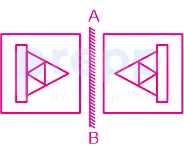
Select the correct mirror image of the given figure when the mirror is placed at AB.
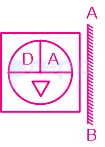
- A
Option A (shown in image)
- B
Option B (shown in image)
- C
Option C (shown in image)
- D
Option D (shown in image)
Show answer
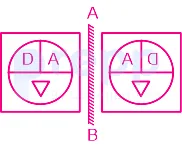
B. Option B (shown in image)The correct mirror image of the given figure when mirror is placed at AB is as shown below:
Hence, the correct answer is "Option - (2)".
 Paper & answer key PDF ↗
 Question 4archived
Pointing to a woman, Suman (a woman) said “She is the grandmother of my father-in-law's wife's son.” How is the woman related to Suman?
- A
Mother
- B
husband's grandmother
- C
Daughter
- D
Mother in law
Show answer
B. husband's grandmotherThe correct answer is husband's grandmother.
Draw a family tree diagram if the relationships are complex. Use symbols for gender and generations. Be aware of common pitfalls, like confusing maternal and paternal sides or mistaking siblings for children. Practicing various types of blood relation puzzles helps in quickly identifying the connections and arriving at the correct answer.
Paper & answer key PDF ↗ Question 5archived
Select the option that is related to the fifth letter-cluster in the same way as the second letter-cluster is related to the first letter-cluster and the fourth letter-cluster is related to the third letter-cluster.
MAP : NZK :: HOZ:SLA :: WQK : ?
- A
DJP
- B
DIP
- C
CIP
- D
CJP
Show answer
A. DJPUnderstanding Letter Cluster Analogy Questions
Letter cluster analogy questions test your ability to identify patterns and relationships between groups of letters. These patterns can involve alphabetical positions, shifts, reverse order, or other logical rules. To solve them, carefully analyze the relationship shown in the given pairs of letter clusters and apply the same rule to the third cluster to find the missing one.
Analyzing the First Letter Cluster Pair: MAP to NZK
Let's look at the first pair: MAP and NZK. We need to find how MAP transforms into NZK. Let's examine the letters in corresponding positions:
The first letter of MAP is M. The first letter of NZK is N.
The second letter of MAP is A. The second letter of NZK is Z.
The third letter of MAP is P. The third letter of NZK is K.
Let's consider their alphabetical positions:
Letter
Position
M
13
A
1
P
16
Letter
Position
N
14
Z
26
K
11
Now let's look at the relationship between the positions of corresponding letters:
M (13) and N (14): \(13 + 14 = 27\)
A (1) and Z (26): \(1 + 26 = 27\)
P (16) and K (11): \(16 + 11 = 27\)
It appears that each letter in the second cluster (NZK) is the reverse alphabetical pair of the corresponding letter in the first cluster (MAP). Reverse alphabetical pairs are letters whose positions in the alphabet sum up to 27 (e.g., A and Z, B and Y, etc.).
Analyzing the Second Letter Cluster Pair: HOZ to SLA
Let's check if the same reverse alphabetical pair pattern holds for the second pair: HOZ and SLA.
Letter
Position
H
8
O
15
Z
26
Letter
Position
S
19
L
12
A
1
Let's examine the relationship between corresponding letter positions:
H (8) and S (19): \(8 + 19 = 27\)
O (15) and L (12): \(15 + 12 = 27\)
Z (26) and A (1): \(26 + 1 = 27\)
Yes, the same pattern is observed here as well. Each letter in SLA is the reverse alphabetical pair of the corresponding letter in HOZ.
Applying the Reverse Alphabetical Pattern to WQK
Since the relationship between the first two pairs is consistently the reverse alphabetical pair, we apply the same pattern to the fifth letter cluster, WQK, to find the missing cluster.
Let's find the reverse alphabetical pair for each letter in WQK:
W: W is the 23rd letter. We need a letter whose position sums to 27 with 23. \(23 + ? = 27\). \(? = 27 - 23 = 4\). The 4th letter is D.
Q: Q is the 17th letter. We need a letter whose position sums to 27 with 17. \(17 + ? = 27\). \(? = 27 - 17 = 10\). The 10th letter is J.
K: K is the 11th letter. We need a letter whose position sums to 27 with 11. \(11 + ? = 27\). \(? = 27 - 11 = 16\). The 16th letter is P.
By applying the reverse alphabetical pair rule to WQK, we get the letters D, J, and P.
The resulting letter cluster is DJP.
Verifying the Solution against Options
The letter cluster we found is DJP. Let's compare this with the given options:
Option 1: DJP
Option 2: DIP
Option 3: CIP
Option 4: CJP
Our derived cluster, DJP, matches Option 1.
Revision Table: Alphabetical Positions and Reverse Pairs
Letter
Position
Reverse Pair
Position
A1Z26
B2Y25
C3X24
D4W23
E5V22
F6U21
G7T20
H8S19
I9R18
J10Q17
K11P16
L12O15
M13N14
Additional Information on Reverse Alphabetical Pairs
Reverse alphabetical pairs, also known as complementary letters or letter opposites, are two letters in the English alphabet whose positions sum up to 27. This concept is frequently used in coding-decoding and letter series questions in reasoning tests.
Understanding reverse pairs can quickly help solve certain types of pattern-based questions. For example:
A (1st) and Z (26th) → \(1 + 26 = 27\)
B (2nd) and Y (25th) → \(2 + 25 = 27\)
C (3rd) and X (24th) → \(3 + 24 = 27\)
...and so on, up to...
M (13th) and N (14th) → \(13 + 14 = 27\)
Memorizing these pairs or being able to quickly calculate them can save time during exams. Knowing the alphabetical position of each letter is fundamental to identifying patterns based on position or shifts.
Paper & answer key PDF ↗ Question 6archived
Select the option that represents the correct order of the given words as they would appear in an English dictionary.
1. Cartoon
2. Carrier
3. Carrying
4. Carousel
5. Carnival
6. Carriage
- A
5, 4, 2, 6, 3, 1
- B
5, 4, 6, 3, 2, 1
- C
5, 1, 4, 6, 2, 3
- D
5, 4, 6, 2, 3, 1
Show answer
D. 5, 4, 6, 2, 3, 1The correct answer is 5, 4, 6, 2, 3, 1.
In this specific question, all words start with "Car" and are longer, so this rule doesn't directly apply for the "Car" part, but it applies if we were comparing "Car" and "Carnival" - "Car" would come first. Case Sensitivity: Standard dictionary order is usually not case-sensitive (e.g., "Apple" and "apple" are treated the same), but formal sorting rules might specify behavior. This question uses consistent lowercase letters. Mastering dictionary order is a fundamental skill for efficient information retrieval and organization.
Paper & answer key PDF ↗ Question 7archived
Study the given pattern carefully and select the number that can replace the question mark (?) in it.
(6, 1, 18)
(5, 4, 60)
(6, 2, ?)
(NOTE: Operations should be performed on the whole numbers, without breaking down the numbers into its constituent digits. E.g. 13 – Operations on 13 such as adding/subtracting/multiplying etc. to 13 can be performed. Breaking down 13 into 1 and 3 and then performing mathematical operations on 1 and 3 is not allowed)
- A
36
- B
32
- C
40
- D
24
Show answer
A. 36Understanding the Pattern Recognition Question
The question asks us to carefully examine a given pattern consisting of sets of three numbers enclosed in parentheses. We need to identify the logical rule or relationship that connects these three numbers in each set. Once the pattern is identified, we apply it to the third set which has a missing number represented by a question mark (?). We are specifically told that operations should be performed on the whole numbers themselves, not on their individual digits.
Analyzing the Given Number Sets
We are given the following sets of numbers:
(6, 1, 18)
(5, 4, 60)
(6, 2, ?)
Let's denote the three numbers in each set as the first number (A), the second number (B), and the third number (C). We need to find a relationship between A, B, and C that holds true for the first two sets.
Discovering the Pattern or Logic
Let's look at the first set (6, 1, 18). The numbers are A=6, B=1, and C=18. We can try simple arithmetic operations to see if they connect these numbers.
Addition: 6 + 1 = 7. This doesn't directly relate to 18.
Subtraction: 6 - 1 = 5. This doesn't directly relate to 18.
Multiplication: 6 × 1 = 6. How does 6 relate to 18? $6 \times 3 = 18$.
Division: 6 ÷ 1 = 6. Again, $6 \times 3 = 18$.
It appears that multiplying the first two numbers (A × B) and then multiplying the result by 3 gives the third number (C). Let's check if this rule holds for the second set.
Verifying the Pattern with the Second Set
For the second set (5, 4, 60), A=5, B=4, and C=60.
Let's apply the potential rule we found: $C = 3 \times (A \times B)$
Calculate the product of the first two numbers: $A \times B = 5 \times 4 = 20$.
Now, multiply this product by 3: $3 \times 20 = 60$.
This result matches the third number (C=60) in the second set. The pattern is confirmed: The third number is three times the product of the first two numbers.
The rule is: $$C = 3 \times (A \times B)$$.
Applying the Pattern to Find the Missing Number
Now we apply the discovered pattern to the third set (6, 2, ?), where A=6, B=2, and C is the missing number (?).
Using the rule $$C = 3 \times (A \times B)$$, substitute the values of A and B:
$$C = 3 \times (6 \times 2)$$.
First, calculate the product inside the parentheses:
$$6 \times 2 = 12$$.
Now, multiply this result by 3:
$$C = 3 \times 12 = 36$$.
The missing number is 36.
Summary of the Pattern and Solution
The pattern in the given sets is that the third number is equal to three times the product of the first two numbers. Applying this pattern to the set (6, 2, ?), we find the missing number.
Set
First Number (A)
Second Number (B)
Third Number (C)
Pattern Check ($3 \times (A \times B)$)
Set 1
6
1
18
$3 \times (6 \times 1) = 3 \times 6 = 18$ (Matches)
Set 2
5
4
60
$3 \times (5 \times 4) = 3 \times 20 = 60$ (Matches)
Set 3
6
2
?
$3 \times (6 \times 2) = 3 \times 12 = 36$ (?)
The missing number is 36.
Conclusion
Based on the pattern identified and verified with the first two sets, the number that replaces the question mark (?) in the set (6, 2, ?) is 36.
Revision Table: Pattern Analysis
Concept
Explanation
Application
Pattern Identification
Finding a consistent mathematical rule connecting the numbers in each set.
Examining (6, 1, 18) and (5, 4, 60) to find the rule $C = 3 \times (A \times B)$.
Pattern Verification
Ensuring the identified rule works for all given complete sets.
Checking if $3 \times (5 \times 4) = 60$, which it does.
Applying the Rule
Using the confirmed rule to find the missing element.
Calculating $3 \times (6 \times 2)$ for the third set.
Additional Information: Solving Number Pattern Problems
Number pattern problems require careful observation and systematic testing of possible relationships between the given numbers. Common relationships often involve basic arithmetic operations (addition, subtraction, multiplication, division), powers, roots, or combinations of these operations. It's important to test a potential rule against all provided examples to ensure its consistency before applying it to find the missing value. The constraint about not breaking down numbers into constituent digits is crucial and simplifies the approach by limiting the types of operations to consider.
Paper & answer key PDF ↗ Question 8archived
Select the correct combination of mathematical signs to sequentially replace the * signs and to balance the given equation.
18 * 3 * 12 * 9 * 3 * 111
- A
÷, +, ×, –, =
- B
×, +, ÷, –, =
- C
×, –, ×, +, =
- D
×, +, ×, –, =
Show answer
A. ÷, +, ×, –, =The correct answer is ÷, +, ×, –, =.
A ddition and S ubtraction: These are done last, working from left to right. If both are present, perform whichever comes first from the left. In the problem solved, we applied this order (Division and Multiplication before Addition and Subtraction) to correctly evaluate each potential equation and find the sequence of mathematical signs that balances the equation 18 * 3 * 12 * 9 * 3 * 111 to equal 111.
Paper & answer key PDF ↗ Question 9archived
Select the corner mirror image of the given figure when the mirror is placed at the right side of the figure.
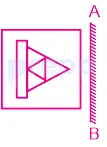
- A
Option A (shown in image)
- B
Option B (shown in image)
- C
Option C (shown in image)
- D
Option D (shown in image)
Show answer
C. Option C (shown in image)The correct mirror image of the given figure when mirror is placed at MN is as shown below:
Hence, the correct answer is "Option - (3)".
 Paper & answer key PDF ↗
 Question 10archived
The second number in the given number-pairs is obtained by performing certain mathematical operation(s) on the first number. The same operation(s) is/are followed in all the number-pairs except one. Find that odd number-pair.
- A
2 : 9
- B
6 : 21
- C
10 : 33
- D
8 : 29
Show answer
D. 8 : 29The correct answer is 8 : 29.
Hypothesize a rule (e.g., addition, multiplication, linear function). Test your hypothesized rule on other examples. If the rule works for most examples, apply it to the remaining one to check for consistency or identify the outlier. Practice with various types of number series and pattern recognition problems.
Paper & answer key PDF ↗ Question 11archived
Three statements are given followed by three conclusions numbered I, II and III. Assuming the statements to be true, even if they seem to be at variance with commonly known facts, decide which of the conclusions logically follow(s) from the statements.
Statements:
Some teachers are scientists.
All scientists are doctors.
All doctors are engineers.
Conclusions:
I. Some doctors are teachers.
II. Some engineers are teachers.
III. Some doctors are scientists.
- A
Only conclusions II and III follow
- B
Only conclusions I and III follow
- C
All conclusions follow
- D
Only conclusions I and II follow
Show answer
C. All conclusions followThe correct answer is All conclusions follow.
The statements are the premises, and the s are what we test for logical validity. The structure typically involves quantifiers like "All", "Some", and "No". Understanding the rules of inference and how quantifiers interact is crucial for solving such logic problems. Venn diagrams are a visual tool to represent the sets and their relationships described in the statements, making it easier to see if a holds true within that representation.
Paper & answer key PDF ↗ Question 12archived
Which of the following letter-clusters will replace the question mark (?) in the given series to make it logically complete?
ADZ, GJF, MPL, SVR, ?
- A
XYB
- B
YBX
- C
XBY
- D
YXB
Show answer
B. YBXUnderstanding the Letter Series Problem
The problem presents a series of letter clusters: ADZ, GJF, MPL, SVR, ?. We need to identify the logical pattern or rule that governs the transition from one cluster to the next and use this rule to find the missing cluster that replaces the question mark.
Analyzing the Pattern in the Letter Clusters
To solve letter series problems, we usually look at the progression of each letter position independently or the cluster as a whole. In this case, let's analyze the pattern for the first, second, and third letters across the series.
Analyzing the First Letter
Let's look at the sequence of the first letters from each cluster:
A (from ADZ)
G (from GJF)
M (from MPL)
S (from SVR)
? (the first letter of the next cluster)
Now let's consider their positions in the English alphabet:
A is the 1st letter.
G is the 7th letter.
M is the 13th letter.
S is the 19th letter.
Let's find the difference in positions between consecutive letters:
From A to G: Position ${7 - 1 = 6}$ (a difference of 6 positions).
From G to M: Position ${13 - 7 = 6}$ (a difference of 6 positions).
From M to S: Position ${19 - 13 = 6}$ (a difference of 6 positions).
The pattern for the first letter is a consistent increase of 6 positions in the alphabet. To find the next first letter, we add 6 positions to the position of S (19th letter):
${19 + 6 = 25}$. The 25th letter of the alphabet is Y.
So, the first letter of the next cluster is Y.
Analyzing the Second Letter
Next, let's look at the second letter of each cluster:
D (from ADZ)
J (from GJF)
P (from MPL)
V (from SVR)
? (the second letter of the next cluster)
Their positions in the alphabet are:
D is the 4th letter.
J is the 10th letter.
P is the 16th letter.
V is the 22nd letter.
Let's find the difference in positions:
From D to J: Position ${10 - 4 = 6}$ (a difference of 6 positions).
From J to P: Position ${16 - 10 = 6}$ (a difference of 6 positions).
From P to V: Position ${22 - 16 = 6}$ (a difference of 6 positions).
The pattern for the second letter is also a consistent increase of 6 positions. To find the next second letter, we add 6 positions to the position of V (22nd letter). Remember that after Z (26th letter), we wrap around to A.
${22 + 6 = 28}$. Since there are 26 letters, we find the remainder when dividing by 26, or subtract 26: ${28 - 26 = 2}$. The 2nd letter of the alphabet is B.
So, the second letter of the next cluster is B.
Analyzing the Third Letter
Finally, let's examine the third letter of each cluster:
Z (from ADZ)
F (from GJF)
L (from MPL)
R (from SVR)
? (the third letter of the next cluster)
Their positions in the alphabet are:
Z is the 26th letter (or we can consider it position 0 when wrapping around).
F is the 6th letter.
L is the 12th letter.
R is the 18th letter.
Let's find the difference in positions (considering Z as 0 for the calculation from Z to F):
From Z to F: Position ${6 - 0 = 6}$ (a difference of 6 positions).
From F to L: Position ${12 - 6 = 6}$ (a difference of 6 positions).
From L to R: Position ${18 - 12 = 6}$ (a difference of 6 positions).
The pattern for the third letter is also a consistent increase of 6 positions. To find the next third letter, we add 6 positions to the position of R (18th letter):
${18 + 6 = 24}$. The 24th letter of the alphabet is X.
So, the third letter of the next cluster is X.
Determining the Missing Letter Cluster
By combining the next letters found for each position, we get the missing cluster:
First letter: Y
Second letter: B
Third letter: X
The next letter cluster in the series is YBX.
Summary of the Letter Series Pattern
Each letter in the cluster advances by a fixed number of positions in the alphabet (+6), with wrapping around from Z to A.
Cluster1st Letter (+6)2nd Letter (+6)3rd Letter (+6)
ADZA (1)D (4)Z (26/0)
GJFG (7)J (10)F (6)
MPLM (13)P (16)L (12)
SVRS (19)V (22)R (18)
?Y (25)B (2)X (24)
Revision Table: Alphabetical Positions
Knowing the position of each letter in the alphabet is helpful for solving letter series problems quickly.
LetterPositionLetterPositionLetterPosition
A1J10S19
B2K11T20
C3L12U21
D4M13V22
E5N14W23
F6O15X24
G7P16Y25
H8Q17Z26
I9R18
Additional Information: Solving Letter Series
Here are some common strategies for solving letter series questions:
Check the difference in alphabetical position between corresponding letters in consecutive terms. The difference might be constant, increasing, decreasing, or alternating.
Look for patterns involving vowels and consonants.
See if the series involves reversing letters or other transformations.
Consider if there's a pattern based on skipping a certain number of letters.
Practice with various types of series to become familiar with different patterns.
Regular practice helps in quickly recognizing patterns during exams.
Paper & answer key PDF ↗ Question 13archived
In a certain code language, if ‘RPD’ is written as ‘43’ and ‘FCL’ is written as ‘60’, how will ‘QTS’ be written in the same code language?
- A
35
- B
28
- C
25
- D
40
Show answer
C. 25The correct answer is 25.
Letter Shifting: Each letter is shifted forward or backward by a fixed number of positions. Opposite Letters: Replacing each letter with its opposite letter in the alphabet (A with Z, B with Y, etc.). Mixed Patterns: Combinations of the above rules or other unique patterns like substituting consonants/vowels, rearranging letters, etc. Solving such problems requires careful observation, trying different potential patterns, and verifying the identified pattern with all given examples before applying it to the question word.
Paper & answer key PDF ↗ Question 14archived
Looking at the family picture, Smriti said, "She is my father’s father-in-law’s wife’s son’s only sister." How is the person in the photo related to Smriti’s father?
- A
Mother
- B
Sister-in-law
- C
Wife
- D
Daughter
Show answer
C. WifeSolving the Blood Relation Puzzle from the Family Picture
This question asks us to determine the relationship between a person in a family picture and Smriti's father, based on Smriti's statement. Let's break down the statement step-by-step to understand the connection.
Analyzing Smriti's Statement: "She is my father’s father-in-law’s wife’s son’s only sister."
We need to trace the relationship starting from Smriti's father.
Smriti’s father: This is the starting point.
Smriti’s father’s father-in-law: The father-in-law of Smriti's father is the father of Smriti's father's wife. Smriti's father's wife is Smriti's mother. So, this is Smriti's maternal grandfather.
Smriti’s father’s father-in-law’s wife: This is the wife of Smriti's maternal grandfather. The wife of Smriti's maternal grandfather is Smriti's maternal grandmother.
Smriti’s father’s father-in-law’s wife’s son: This is the son of Smriti's maternal grandmother. The son of Smriti's maternal grandmother is Smriti's maternal uncle (mother's brother).
Smriti’s father’s father-in-law’s wife’s son’s only sister: This is the only sister of Smriti's maternal uncle. The only sister of Smriti's maternal uncle is Smriti's mother.
Therefore, the person in the photo is Smriti's mother.
Determining the Relationship to Smriti’s Father
We found that the person in the photo is Smriti's mother. The question asks how the person in the photo (Smriti's mother) is related to Smriti's father.
Smriti's mother is the wife of Smriti's father.
So, the person in the photo is the wife of Smriti's father.
Conclusion on the Blood Relation
Based on the detailed breakdown of Smriti's statement about the family picture, the person in the photo is Smriti's mother, and she is related to Smriti's father as his wife.
Revision Table: Blood Relation Terms
Term
Relation Explained
Father-in-law
Father of spouse
Mother-in-law
Mother of spouse
Maternal Grandfather
Mother's father
Maternal Grandmother
Mother's mother
Maternal Uncle
Mother's brother
Maternal Aunt
Mother's sister
Additional Information: Solving Blood Relation Problems
Solving blood relation problems like this requires careful step-by-step analysis. It's often helpful to draw a family tree or use symbolic representations to keep track of the relationships as you decode the statement. Start from the subject mentioned (in this case, Smriti's father) and work outwards according to the given relationships (father-in-law, wife, son, sister) until you identify the final person in the photo.
Paper & answer key PDF ↗ Question 15archived
Three statements are given followed by three conclusions numbered I, II and III. Assuming the statements to be true, even if they seem to be at variance with commonly known facts, decide which of the conclusions logically follow(s) from the statements.
Statements:
Some colours are rainbows.
Some paints are rainbows.
All rainbows are drawings.
Conclusions:
I. Some drawings are colours.
II. All paints are drawings.
III. Some drawings are rainbows.
- A
Only conclusions I and II follow
- B
Only conclusions I and III follow
- C
Only conclusions II and III follow
- D
All conclusions follow
Show answer
B. Only conclusions I and III followThe correct answer is Only conclusions I and III follow.
E (Universal Negative): No S are P (e.g., No fish are birds). I (Particular Affirmative): Some S are P (e.g., Some students are athletes). O (Particular Negative): Some S are not P (e.g., Some fruits are not apples). Understanding these types and the rules of inference between them is crucial for solving syllogism problems.
Paper & answer key PDF ↗ Question 16archived
Select the set in which the numbers are related in the same way as are the numbers of the following sets.
(NOTE: Operations should be performed on the whole numbers, without breaking down the numbers into its constituent digits. E.g. 13 – Operations on 13 such as adding/Subtracting/multiplying etc. to 13 can be performed. Breaking down 13 into 1 and 3 and then performing mathematical operations on 1 and 3 is not allowed)
(2, 7, 27)
(6, 15, 63)
- A
(3, 21, 24)
- B
(9, 8, 50)
- C
(12, 4, 40)
- D
(8, 8, 48)
Show answer
D. (8, 8, 48)The correct answer is (8, 8, 48).
Think about squares, cubes, and roots. If the numbers are large, multiplication or powers are often involved. If they are close, addition or subtraction is more likely. Test any potential rule consistently across all given examples before applying it to the options.
Paper & answer key PDF ↗ Question 17archived
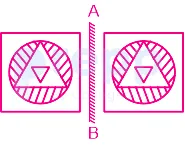
Select the correct mirror image of the given figure when the mirror is placed at AB.

- A
Option A (shown in image)
- B
Option B (shown in image)
- C
Option C (shown in image)
- D
Option D (shown in image)
Show answer
C. Option C (shown in image)The correct mirror image of the given figure when mirror is placed at AB is as shown below:
Hence, the correct answer is "Option - (3)".
 Paper & answer key PDF ↗
 Question 18archived
Select the option that represents the letters that, when placed from left to right in the blanks below, will complete the letter series.
C _ R C _ R _ A R _ A _ C A _
- A
R A C A C A
- B
R A C A A C
- C
A C R A C R
- D
A A C C R R
Show answer
D. A A C C R RThe correct answer is A A C C R R.
Differences or sums of positions could form a numerical pattern. Series Length: The total length of the series can sometimes hint at the pattern block size (e.g., a series of length 16 might have blocks of 4). When tackling a letter series question, try filling the blanks with each option if finding the pattern immediately is difficult. Check if any filled series forms a logical and consistent sequence.
Paper & answer key PDF ↗ Question 19archived
Which of the following numbers will replace the question mark (?) in the given series?
3, 8, 15, 26, 39, ?
- A
61
- B
49
- C
52
- D
56
Show answer
D. 56The correct answer is 56.
Being familiar with the sequence of prime numbers is helpful for quickly recognizing such patterns. Remember that prime numbers are 2, 3, 5, 7, 11, 13, 17, 19, 23, and so on. When solving a number series problem, always start by checking the differences between terms. If that doesn't reveal a simple pattern, consider differences of differences, ratios, or look for sequences of special numbers like primes, squares, or cubes.
Paper & answer key PDF ↗ Question 20archived
Select the figure that will come in place of the question mark (?) in the following figure series.

- A
Option A (shown in image)
- B
Option B (shown in image)
- C
Option C (shown in image)
- D
Option D (shown in image)
Show answer
Question 21archived
Select the option that is related to the fifth number in the same way as the second number is related to the first number and the fourth number is related to the third number.
98 : 7 :: 162 : 9 :: 242 : ?
- A
14
- B
11
- C
13
- D
12
Show answer
B. 11Understanding Numerical Analogy Questions
Numerical analogy questions test your ability to find the relationship between a pair of numbers and apply that same relationship to another pair to find a missing number. In the given question, we have three pairs: 98 and 7, 162 and 9, and 242 and a missing number. We need to determine how the first number is related to the second number in the first two pairs and then apply that rule to the third pair.
Analyzing the Relationship in the Given Pairs
Let's look at the first pair: 98 : 7. We need to find a mathematical operation or pattern that connects 98 and 7.
Consider simple operations: 98 divided by 7 is 14. This might not be the pattern.
Let's try squaring the second number: $7^2 = 49$.
How can we get from 49 to 98? We can multiply by 2: $49 \times 2 = 98$.
So, the relationship could be: the first number is equal to 2 multiplied by the square of the second number ($2 \times \text{second number}^2$).
Now, let's check this pattern with the second pair: 162 : 9.
According to our proposed pattern, the first number (162) should be 2 multiplied by the square of the second number (9).
Square the second number: $9^2 = 81$.
Multiply by 2: $81 \times 2 = 162$.
This matches the first number in the pair (162). The pattern holds true for the second pair as well.
Applying the Pattern to Find the Missing Number
Now we apply the established pattern to the third pair: 242 : ?.
Let the missing number be $x$.
The pattern is: $2 \times x^2 = 242$.
We need to solve this equation for $x$.
Step-by-step calculation:
Start with the equation based on the pattern: \(2 \times x^2 = 242\)
Divide both sides by 2: \(\frac{2 \times x^2}{2} = \frac{242}{2}\)
Simplify: \(x^2 = 121\)
Take the square root of both sides to find x: \(x = \sqrt{121}\)
The square root of 121 is 11 (since $11 \times 11 = 121$). So, \(x = 11\).
The missing number is 11.
Verification
Let's verify the third pair with the missing number 11:
Second number is 11.
Square the second number: $11^2 = 121$.
Multiply by 2: $121 \times 2 = 242$.
This matches the first number in the third pair (242).
Therefore, the pattern is consistent, and the missing number is 11.
Summary of Relationships
Pair
Numbers
Relationship Check
First Pair
98 : 7
\(2 \times 7^2 = 2 \times 49 = 98\) (Correct)
Second Pair
162 : 9
\(2 \times 9^2 = 2 \times 81 = 162\) (Correct)
Third Pair
242 : ?
\(2 \times x^2 = 242 \Rightarrow x^2 = 121 \Rightarrow x = 11\)
Based on the analysis, the number that relates to 242 in the same way as 7 relates to 98 and 9 relates to 162 is 11.
Revision Table: Numerical Analogy Skills
Concept
Key Skill
Notes
Identifying Patterns
Looking for relationships (arithmetic, squares, cubes, etc.)
Test different operations (+, -, ×, ÷, squares, cubes, roots)
Applying Logic
Ensuring the same pattern applies consistently
Check the pattern across all given pairs
Solving Equations
Using algebra to find the unknown value
Isolate the variable to solve for the missing number
Additional Information: Types of Number Analogy
Numerical analogy problems can involve various types of relationships between numbers. Recognizing common patterns helps in solving these questions quickly.
Arithmetic Operations: Addition, subtraction, multiplication, division.
Squares and Cubes: Relationships involving the squares or cubes of numbers.
Roots: Relationships involving square roots or cube roots.
Series based: The numbers might follow a sequence or progression.
Digit Operations: Relationships based on the sum, product, or manipulation of the digits within the number.
Combination of Operations: A combination of two or more of the above patterns.
Practicing different types of numerical analogy questions helps improve pattern recognition and problem-solving speed for competitive exams.
Paper & answer key PDF ↗ Question 22archived
Select the figure that will replace the question mark (?) in the following figure series.

- A
Option A (shown in image)
- B
Option B (shown in image)
- C
Option C (shown in image)
- D
Option D (shown in image)
Show answer
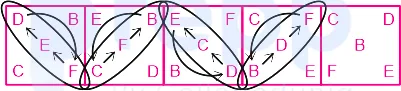
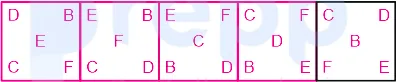
D. Option D (shown in image)The figure that will replace the question mark (?) in the following figure series is shown below:
1) Pattern is followed diagonally i.e :
1st box → Moving forward diagonally and no change in rest of the elements.
2nd box → Moving forward diagonally and no change in rest of the elements.
3rd box → Moving forward diagonally and no change in rest of the elements.
4th box → Moving forward diagonally and no change in rest of the elements.
Final series is
Hence, ‘option - (4)’ is the correct answer.
 Paper & answer key PDF ↗
 Question 23archived
Select the option that represents the letters that, when sequentially placed from left to right in the blanks below, will complete the letter series.
_ _ MSDRTM _ _ R _ _ SD _ TM _ D
- A
RSTDTMRS
- B
RTSDMTRS
- C
RTSDMTSR
- D
RTSDTMRS
Show answer
D. RTSDTMRSThe question asks us to find the sequence of letters that completes the given letter series when placed in the blanks from left to right.
The given letter series is: _ _ MSDRTM _ _ R _ _ SD _ TM _ D
There are 8 blanks in the series, and each option provides a sequence of 8 letters.
To solve this type of letter series problem, we need to identify a pattern, which is often a repeating block of letters.
Let's take the correct option, RTSDTMRS, and place its letters sequentially into the 8 blanks in the series.
The blanks are located at the following positions (counting from 1):
1st blank
2nd blank
9th blank
10th blank
12th blank
13th blank
16th blank
19th blank
The letters from the option RTSDTMRS are:
R (for 1st blank)
T (for 2nd blank)
S (for 9th blank)
D (for 10th blank)
T (for 12th blank)
M (for 13th blank)
R (for 16th blank)
S (for 19th blank)
Now, let's fill the blanks in the original series:
Original: _ _ MSDRTM _ _ R _ _ SD _ TM _ D
Filling with RTSDTMRS:
Position 1: R
Position 2: T
Position 3-8: MSDRTM (given)
Position 9: S
Position 10: D
Position 11: R (given)
Position 12: T
Position 13: M
Position 14-15: SD (given)
Position 16: R
Position 17-18: TM (given)
Position 19: S
Position 20: D (given)
The completed series becomes: R T M S D R T M S D R T M S D R T M S D
Let's examine the completed series to find the pattern:
RTMSDRTMSDRTMSDRTMSD
We can observe that the sequence 'RTMSD' is repeating throughout the series. Let's break it down:
Block 1: RTMSD
Block 2: RTMSD
Block 3: RTMSD
Block 4: RTMSD
The completed series is formed by the repetition of the block 'RTMSD' exactly 4 times.
Let's verify if the original series matches this repeating pattern when the blanks are filled with RTSDTMRS.
The pattern is RTMSD. The complete series should be RTMSDRTMSDRTMSDRTMSD.
Original series with blanks: _ _ MSDRTM _ _ R _ _ SD _ TM _ D
Let's compare the original series with the pattern-based complete series character by character:
Position
Original Series
Completed Series (Pattern: RTMSD)
Matches?
1
_
R
Yes (Blank filled with R)
2
_
T
Yes (Blank filled with T)
3
M
M
Yes
4
S
S
Yes
5
D
D
Yes
6
R
R
Yes
7
T
T
Yes
8
M
M
Yes
9
_
S
Yes (Blank filled with S)
10
_
D
Yes (Blank filled with D)
11
R
R
Yes
12
_
T
Yes (Blank filled with T)
13
_
M
Yes (Blank filled with M)
14
S
S
Yes
15
D
D
Yes
16
_
R
Yes (Blank filled with R)
17
T
T
Yes
18
M
M
Yes
19
_
S
Yes (Blank filled with S)
20
D
D
Yes
As shown in the table, when the blanks are filled with the letters RTSDTMRS, the resulting series RTMSDRTMSDRTMSDRTMSD perfectly follows the repeating pattern 'RTMSD'.
Therefore, the sequence of letters that completes the series is RTSDTMRS.
Revision Table: Letter Series Completion
Concept
Description
Application Here
Letter Series
A sequence of letters following a specific pattern.
The given series `_ _ MSDRTM _ _ R _ _ SD _ TM _ D`.
Pattern Identification
Finding the rule or repeating unit in the series.
Identifying the repeating block 'RTMSD'.
Series Completion
Filling the blanks based on the identified pattern.
Using the 'RTMSD' pattern to determine missing letters.
Repeating Pattern
A block of letters that repeats one or more times.
The block 'RTMSD' repeats 4 times.
Additional Information: Solving Letter Series Questions
Letter series questions are common in logical reasoning tests. They require you to find the underlying rule that connects the letters in the sequence.
Common types of patterns include:
Repeating Block: A fixed sequence of letters repeats. (Like in this problem)
Alphabetical Position: The pattern is based on the position of letters in the alphabet (e.g., A+2=C, C+2=E).
Skipping Letters: Letters are skipped in a specific order.
Reverse Alphabetical Order: Letters move backward in the alphabet.
Combination of Rules: More than one type of pattern might be combined.
Tips for solving letter series:
Count the total number of elements (letters and blanks). This can help determine the length of a repeating block if present.
Look for recurring groups of letters.
Check the difference in alphabetical positions between consecutive letters.
Try substituting the options into the blanks to see if a recognizable pattern emerges.
Be systematic and test potential patterns against the entire series.
Paper & answer key PDF ↗ Question 24archived
In a certain code language, ‘DISCIPLINE’ is written as ‘DKSCKPLKNG’, ‘REVOLUTION’ is written as ‘RGVQLWTKQN’. How will ‘UNIVERSITY’ be written in that language?
- A
WNKGVRSKTY
- B
WNKVGSRKTY
- C
WNKVGRSKTY
- D
WNKVGRKSTY
Show answer
C. WNKVGRSKTYThe correct answer is WNKVGRSKTY.
Number Coding: Words are coded using numbers, often based on the alphabetical position of letters or the number of letters in the word. Symbol Coding: Letters or words are replaced by symbols. Mixed Coding: A combination of numbers, letters, and symbols is used to code words or messages. Practicing different types of coding decoding problems helps in quickly identifying the underlying rule, which is the key to solving these questions efficiently.
Paper & answer key PDF ↗ Question 25archived
If ‘<’ means ‘−’, ‘!’ means ‘×’, ‘>’ means ‘+’ and ‘$’ means ‘÷’, then what is the value of the following expression?
183 > 39 $ 13 ! 6 < 26
- A
175
- B
160
- C
193
- D
181
Show answer
A. 175Solving Symbol Substitution Problems
This question asks us to find the value of a given expression by replacing specific symbols with mathematical operators according to the provided rules. This type of problem tests our ability to correctly interpret instructions and apply the order of operations.
Understanding the Symbol-Operator Mapping
The first step is to understand which mathematical operation each symbol represents. The question gives us the following mapping:
'<' means '−' (subtraction)
'!' means '×' (multiplication)
'>' means '+' (addition)
'$' means '÷' (division)
Symbol to Operator Mapping
Symbol
Operator
<
−
!
×
>
+
$
÷
Substituting Symbols in the Expression
The given expression is: \(183 \, > \, 39 \, $ \, 13 \, ! \, 6 \, < \, 26\)
Now, we substitute the symbols with their corresponding operators using the mapping we identified:
Replace '>' with '+'.
Replace '$' with '÷'.
Replace '!' with '×'.
Replace '<' with '−'.
The expression after substitution becomes: \(183 + 39 \div 13 \times 6 - 26\)
Evaluating the Expression using BODMAS
To find the value of the expression \(183 + 39 \div 13 \times 6 - 26\), we must follow the order of operations. The widely accepted rule is BODMAS (or PEMDAS), which dictates the sequence in which operations should be performed:
Brackets (or Parentheses)
Orders (or Exponents)
Division and Multiplication (from left to right)
Addition and Subtraction (from left to right)
Step-by-Step Calculation
Let's evaluate the expression \(183 + 39 \div 13 \times 6 - 26\) step-by-step following the BODMAS rule:
Division: First, perform the division operation.
\(39 \div 13 = 3\)
The expression now is: \(183 + 3 \times 6 - 26\)
Multiplication: Next, perform the multiplication operation.
\(3 \times 6 = 18\)
The expression now is: \(183 + 18 - 26\)
Addition and Subtraction: Finally, perform addition and subtraction from left to right.
Perform addition:
\(183 + 18 = 201\)
The expression now is: \(201 - 26\)
Perform subtraction:
\(201 - 26 = 175\)
The final value of the expression is \(175\).
Concluding the Symbol Substitution Problem
By correctly substituting the symbols with their corresponding mathematical operators and applying the BODMAS rule systematically, we found the value of the expression \(183 > 39 $ 13 ! 6 < 26\) to be 175.
Revision Table: Key Concepts
Key Concepts for Symbol Substitution
Concept
Description
Symbol Substitution
Replacing arbitrary symbols with standard mathematical operators based on given rules.
Expression Evaluation
Calculating the numerical value of a mathematical expression.
BODMAS / PEMDAS
An acronym representing the order of operations: Brackets/Parentheses, Orders/Exponents, Division/Multiplication, Addition/Subtraction.
Additional Information: Order of Operations
The order of operations (BODMAS/PEMDAS) is crucial for evaluating mathematical expressions correctly, especially when they involve multiple operators. Performing operations in the wrong order will likely result in an incorrect answer.
Division and Multiplication have the same priority and should be performed from left to right as they appear in the expression.
Addition and Subtraction also have the same priority and should be performed from left to right after all divisions and multiplications are done.
Parentheses/Brackets are always evaluated first to simplify the expression inside them before applying operations outside.
Understanding and applying this rule is key to solving many quantitative aptitude and reasoning problems.
Paper & answer key PDF ↗ Question 26archived
Guru Shashadhar Acharya was awarded the Padma Shri in 2020 for his contribution in which of the following fields?
- A
musical instrument playing
- B
classical dance
- C
folk dance
- D
Hindustani classical singing
Show answer
C. folk danceGuru Shashadhar Acharya, a renowned figure in the world of Indian dance, was honoured with the prestigious Padma Shri award by the Government of India in the year 2020.
Understanding Guru Shashadhar Acharya's Padma Shri
The question asks about the specific field for which Guru Shashadhar Acharya received this significant national honour. The Padma Shri is awarded for distinguished service in any field.
Guru Shashadhar Acharya is widely recognised for his exceptional contributions to a particular dance form that falls under the broad category of folk dance.
Guru Shashadhar Acharya and His Contribution to Dance
Guru Shashadhar Acharya is a leading exponent and guru of the Seraikela Chhau dance. Chhau dance is a semi-classical Indian dance with martial, tribal, and folk origins, performed in the states of Odisha, Jharkhand, and West Bengal. The Seraikela form is one of the three main styles of Chhau.
His lifelong dedication has been instrumental in preserving, promoting, and teaching this traditional dance form. His work has helped keep the rich heritage of Chhau dance alive and reach new generations.
Considering his profound impact and mastery in preserving and propagating the Seraikela Chhau style, which is classified as a folk/semi-classical dance, the Padma Shri awarded to him in 2020 was for his contribution in the field of folk dance.
Awardee
Award
Year
Recognised Field
Guru Shashadhar Acharya
Padma Shri
2020
Folk Dance (specifically Chhau dance)
Padma Awards Recognition
The Padma Awards are among the highest civilian honours of India. They are conferred in three categories:
Padma Vibhushan (for exceptional and distinguished service)
Padma Bhushan (for distinguished service of a high order)
Padma Shri (for distinguished service in any field)
These awards are announced annually on the eve of Republic Day.
Revision Table: Guru Shashadhar Acharya Padma Shri
Detail
Information
Awardee Name
Guru Shashadhar Acharya
Award Received
Padma Shri
Year of Award
2020
Field of Contribution
Folk Dance (Chhau Dance)
Additional Information on Chhau Dance and Padma Awards
Chhau dance is unique for its use of masks (especially in the Seraikela and Mayurbhanj forms, though not consistently) and its storytelling based on epics like the Ramayana and Mahabharata, as well as local folklore. It is recognised by UNESCO as Intangible Cultural Heritage.
The Padma awards recognise contributions across various disciplines including art, social work, public affairs, science and engineering, trade and industry, medicine, literature and education, sports, civil service, etc. Guru Shashadhar Acharya's award falls under the 'Art' category, specifically acknowledging his expertise and contribution to traditional dance forms like Chhau.
Paper & answer key PDF ↗ Question 27archived
Which of the following musicians is associated with the instrument santoor?
- A
Alauddin Khan
- B
Annapurna Devi
- C
Pandit Shiv Kumar Sharma
- D
Vilayat Khan
Show answer
C. Pandit Shiv Kumar SharmaIdentifying the Musician Associated with the Santoor
The question asks us to identify which of the given musicians is primarily associated with the instrument known as the santoor. The santoor is a string instrument that originated in Kashmir and has become a significant instrument in Indian classical music, particularly the Hindustani tradition. It is played with two wooden mallets.
Let's look at the musicians listed in the options and the instruments they are famous for:
Alauddin Khan: A legendary figure in Indian classical music, Allauddin Khan (also known as Baba Allauddin Khan) was a master of the sarod. He was also a great teacher, mentoring many renowned musicians.
Annapurna Devi: The daughter of Alauddin Khan, Annapurna Devi was a highly respected musician known for her mastery of the surbahar, a bass sitar.
Pandit Shiv Kumar Sharma: Pandit Shiv Kumar Sharma is widely credited with adapting the santoor for Indian classical music and popularizing it globally. He is considered a maestro of the santoor.
Vilayat Khan: Ustad Vilayat Khan was a celebrated sitar player, known for his unique style called the Gayaki Ang (singing style) on the sitar.
Based on the instruments associated with each musician, it is clear that Pandit Shiv Kumar Sharma is the musician linked to the santoor.
Here is a quick summary of the musicians and their primary instruments:
Musician
Primary Instrument
Alauddin Khan
Sarod
Annapurna Devi
Surbahar
Pandit Shiv Kumar Sharma
Santoor
Vilayat Khan
Sitar
Revision Table: Classical Indian Instruments & Artists
Understanding the association between prominent Indian classical musicians and their instruments is crucial for music knowledge. Here's a brief revision:
Santoor: Pandit Shiv Kumar Sharma, Bhajan Sopori
Sitar: Ravi Shankar, Vilayat Khan, Nikhil Banerjee
Sarod: Ali Akbar Khan, Amjad Ali Khan, Allauddin Khan
Flute (Bansuri): Hariprasad Chaurasia, Pannalal Ghosh
Tabla: Zakir Hussain, Alla Rakha
Shehnai: Bismillah Khan
Violin (Indian Classical): L. Subramaniam, N. Rajam
Additional Information on Santoor and Indian Classical Music
The santoor, as played in Indian classical music, is different from its traditional Persian counterpart. Pandit Shiv Kumar Sharma made significant modifications to the instrument to make it suitable for performing classical ragas. These modifications included increasing the number of strings and changing the bridge system.
The other musicians mentioned are also giants in their respective fields. Allauddin Khan established the Maihar gharana (school of music) and trained many eminent musicians. Annapurna Devi, despite being reclusive, was known for her profound musical knowledge and technique. Vilayat Khan was a leading figure of the Imdadkhani gharana of sitar playing.
Learning about these musicians and their instruments helps in appreciating the rich diversity and depth of Indian classical music.
Paper & answer key PDF ↗ Question 28archived
What is the atomicity of Chlorine?
- A
Tetra-atomic
- B
Diatomic
- C
Poly-atomic
- D
Monoatomic
Show answer
B. DiatomicUnderstanding Atomicity of Elements
Atomicity refers to the number of atoms that make up a single molecule of an element. Elements can exist in different forms regarding how their atoms bond together to form molecules. Understanding atomicity is fundamental in chemistry.
Based on the number of atoms present in one molecule, elements are classified as:
Monoatomic: Elements that exist as single atoms. Examples include noble gases like Helium (He), Neon (Ne), Argon (Ar).
Diatomic: Elements that exist as molecules made up of two atoms. Examples include many common gases like Hydrogen (H₂), Oxygen (O₂), Nitrogen (N₂), Fluorine (F₂), Chlorine (Cl₂), Bromine (Br₂), Iodine (I₂). These are often referred to as the "diatomic seven" (H₂, N₂, O₂, F₂, Cl₂, Br₂, I₂).
Triatomic: Elements whose molecules consist of three atoms. An example is Ozone (O₃), which is an allotrope of oxygen.
Poly-atomic: Elements whose molecules are made up of more than three atoms. Examples include Phosphorus (P₄, tetra-atomic) and Sulfur (S₈, octa-atomic).
Determining Atomicity of Chlorine
The question asks about the atomicity of Chlorine. To determine this, we need to know the common molecular form in which elemental Chlorine exists.
Chlorine, under normal conditions, exists as a molecule containing two Chlorine atoms chemically bonded together. The chemical formula for elemental Chlorine gas is Cl₂.
Let's look at the structure of a Chlorine molecule:
Element
Chemical Formula (common form)
Number of Atoms per Molecule
Atomicity Classification
Chlorine
Cl₂
2
Diatomic
Since a single molecule of Chlorine (Cl₂) contains exactly two Chlorine atoms, its atomicity is 2.
Based on the definition, an element with an atomicity of two is classified as Diatomic.
Comparing Options for Chlorine Atomicity
Let's examine the given options in the context of Chlorine's atomicity:
Tetra-atomic: This means 4 atoms per molecule (like P₄). Chlorine is not tetra-atomic.
Diatomic: This means 2 atoms per molecule (like Cl₂). Chlorine is diatomic.
Poly-atomic: This means more than three atoms per molecule (like P₄ or S₈). Diatomic (2 atoms) is not poly-atomic.
Monoatomic: This means 1 atom per molecule (like He, Ne). Chlorine is not monoatomic.
Therefore, the correct classification for the atomicity of Chlorine is Diatomic.
Revision Table: Common Element Atomicity
Element
Chemical Symbol
Common Molecular Form
Number of Atoms
Atomicity
Helium
He
He
1
Monoatomic
Neon
Ne
Ne
1
Monoatomic
Argon
Ar
Ar
1
Monoatomic
Hydrogen
H
H₂
2
Diatomic
Oxygen
O
O₂
2
Diatomic
Nitrogen
N
N₂
2
Diatomic
Chlorine
Cl
Cl₂
2
Diatomic
Phosphorus
P
P₄ (White Phosphorus)
4
Tetra-atomic (Poly-atomic)
Sulfur
S
S₈ (Rhombic Sulfur)
8
Octa-atomic (Poly-atomic)
Ozone
O
O₃
3
Triatomic (Poly-atomic)
Additional Information on Atomicity and Molecular Structure
The atomicity of an element is related to its chemical properties and how it forms stable molecules. Elements like noble gases have a complete valence shell, making them very stable as single atoms (monoatomic).
Many nonmetals, like Hydrogen, Oxygen, Nitrogen, and the Halogens (Fluorine, Chlorine, Bromine, Iodine), form covalent bonds with another atom of the same element to achieve stability, resulting in diatomic molecules.
Some elements, like Phosphorus and Sulfur, form more complex structures involving multiple atoms bonded together, leading to higher atomicity (tetra-atomic, octa-atomic, etc.), which fall under the general category of poly-atomic.
Understanding atomicity helps in writing correct chemical formulas and balancing chemical equations.
Paper & answer key PDF ↗ Question 29archived
How many elected members are there in the Legislative Assembly of Telangana till December 2022?
- A
119
- B
121
- C
124
- D
120
Show answer
A. 119Understanding the Telangana Legislative Assembly Composition
The Legislative Assembly of Telangana, also known as the Vidhan Sabha, is the lower house of the bicameral state legislature of Telangana. Understanding its composition is important for knowing the structure of the state government.
The question asks specifically about the number of elected members in the Telangana Legislative Assembly as of December 2022. State legislative assemblies in India typically consist of members directly elected by the eligible voters from various constituencies across the state, along with a provision for nominated members.
For the state of Telangana, the composition of the Legislative Assembly is as follows:
There are a fixed number of constituencies from which members are elected.
There is also a provision for the nomination of one member from the Anglo-Indian community by the Governor, if they feel that community is not adequately represented.
Based on the constitutional provisions and the setup of the Telangana legislature since the state's formation, the total strength includes both elected and potentially nominated members. However, the question specifically targets the number of members who gain their seats through the electoral process.
Let's look at the breakdown:
Type of Member
Number
Elected Members
119
Nominated Member (Anglo-Indian community)
1 (if nominated by Governor)
Total Strength
120
Therefore, focusing solely on the elected members of the Telangana Legislative Assembly, the number is 119. This structure was in place in December 2022 and remains consistent with the formation of the state.
Revision Table: Key Facts about Telangana Assembly
Aspect
Detail
House Name
Legislative Assembly (Vidhan Sabha)
State
Telangana
Number of Elected Members
119
Number of Nominated Members
1 (Anglo-Indian, if nominated)
Total Strength
120
Additional Information on State Legislative Assemblies
State Legislative Assemblies (Vidhan Sabhas) are crucial components of the state government structure in India. Here are some additional points:
Members of the Legislative Assembly (MLAs) are directly elected by the adult citizens of the state from their respective constituencies.
The maximum strength of a Legislative Assembly is generally fixed at 500 members, and the minimum at 60 members, although exceptions exist for smaller states.
The term of a Legislative Assembly is typically five years, unless it is dissolved earlier.
The leader of the party or coalition that wins a majority in the Legislative Assembly is usually invited by the Governor to form the government and becomes the Chief Minister.
Some states in India have a bicameral legislature, meaning they also have a Legislative Council (Vidhan Parishad) in addition to the Legislative Assembly. Telangana is one such state.
Paper & answer key PDF ↗ Question 30archived
In the year 2022, the Ministry of Health and Family Welfare announced a National Suicide Prevention Strategy to reduce suicide mortality rate by ________ percent by 2030.
- A
20
- B
10
- C
25
- D
15
Show answer
B. 10Understanding India's National Suicide Prevention Strategy
The question asks about the specific percentage reduction target set by the Ministry of Health and Family Welfare in the year 2022 as part of the National Suicide Prevention Strategy. This strategy was introduced with the aim of significantly reducing the suicide mortality rate across India by a specific target year.
The National Suicide Prevention Strategy 2022
In November 2022, the Ministry of Health and Family Welfare of India officially launched the National Suicide Prevention Strategy. This marked a crucial step towards addressing the growing concern of suicide in the country. The strategy outlined a time-bound action plan to create a framework for suicide prevention.
Key objectives of the National Suicide Prevention Strategy included:
Establishing a robust surveillance mechanism for suicide mortality within the next three years.
Setting up psychiatric outpatient departments in all district hospitals within the next five years.
Integrating a mental well-being curriculum into educational institutions within the next eight years.
Suicide Mortality Reduction Target by 2030
A central goal of the National Suicide Prevention Strategy is the reduction of the suicide mortality rate. The strategy explicitly states a quantitative target for this reduction to be achieved by the year 2030.
The target set is to reduce the suicide mortality rate by a specific percentage. Let's look at the options provided and determine the correct percentage based on the strategy's announcement.
Option
Percentage
1
20%
2
10%
3
25%
4
15%
According to the details released regarding the National Suicide Prevention Strategy, the target is to reduce the suicide mortality rate by 10 percent by the year 2030.
This target is ambitious and requires coordinated efforts across various sectors, including health, education, social welfare, and community participation, as outlined in the strategy document.
Why the National Suicide Prevention Strategy is Important
Suicide is a major public health issue. Strategies like the National Suicide Prevention Strategy are vital because they provide a structured approach to prevention, intervention, and postvention. They help in:
Raising awareness about mental health issues and suicide.
Reducing stigma associated with seeking help.
Improving access to mental health services.
Implementing early identification and intervention programs.
Restricting access to means of suicide.
Revision Table: National Suicide Prevention Strategy Key Points
Aspect
Detail
Launched By
Ministry of Health and Family Welfare, India
Year of Announcement
2022
Target Year for Reduction
2030
Suicide Mortality Reduction Target
10%
Overall Goal
Reduce suicide mortality rate
Additional Information on Suicide Prevention
Suicide prevention is a complex issue requiring multi-faceted interventions. Beyond national strategies, individual and community-level actions are crucial.
Recognizing Warning Signs: Being aware of the signs of suicidal ideation or distress is important.
Providing Support: Offering help, listening without judgment, and encouraging professional help are critical.
Helpline Numbers: Knowing and promoting mental health helplines can provide immediate support to those in crisis.
Safe Environment: Ensuring safe living environments, especially by limiting access to lethal means, can prevent impulsive acts.
National strategies provide the framework, but collective community action strengthens the response to suicide prevention.
Paper & answer key PDF ↗ Question 31archived
Raut Naach is famous in which of the following states?
- A
Punjab
- B
Gujarat
- C
Assam
- D
Chhattisgarh
Show answer
D. ChhattisgarhUnderstanding Raut Naach Folk Dance
Raut Naach is a vibrant folk dance that is deeply rooted in the cultural traditions of a specific Indian state. It is particularly famous among the Yadav or Yaduvanshi community.
Raut Naach Location: Which State?
The question asks about the state where Raut Naach is famous. Let's examine the options provided:
Punjab
Gujarat
Assam
Chhattisgarh
Raut Naach is a traditional dance primarily performed in the state of Chhattisgarh. It is often performed by the Yadav community, who consider themselves descendants of Lord Krishna. The dance is typically performed during the Diwali festival, symbolizing the cowherd community's gratitude and celebration.
Comparing Raut Naach with Dances from Other States
To confirm the correct state, it's helpful to know some famous dance forms from the other options:
State
Famous Dance Forms
Punjab
Bhangra, Giddha
Gujarat
Garba, Dandiya Raas
Assam
Bihu
Chhattisgarh
Raut Naach, Panthi, Karma
As the table shows, Raut Naach is indeed listed as a famous dance form of Chhattisgarh.
Significance of Raut Naach in Chhattisgarh
The Raut Naach dance is more than just a performance; it's a cultural expression tied to the life and traditions of the Yadav community. Dancers often wear traditional costumes and carry sticks, which they use rhythmically while dancing. The performance is accompanied by folk songs and musical instruments like dhol and madal. It's a significant part of the Diwali celebrations, especially on the day following Diwali, known as Govardhan Puja.
Conclusion on Raut Naach State
Based on the cultural information and common knowledge about Indian folk dances, Raut Naach is famously associated with Chhattisgarh.
Revision Table: Key Dance Forms
Dance Form
Associated State
Key Features (if any)
Raut Naach
Chhattisgarh
Yadav/Yaduvanshi community, performed during Diwali, stick dance
Bhangra
Punjab
High energy, harvest festival (Baisakhi), male dance
Giddha
Punjab
Female counterpart to Bhangra, performed in circles
Garba
Gujarat
Navratri festival, circular movements around a lamp (garbha deep)
Dandiya Raas
Gujarat
Navratri festival, stick dance, mock fight between Durga and Mahishasura
Bihu
Assam
Assamese new year (Bohag Bihu), celebrates fertility and spring
Panthi
Chhattisgarh
Satnami community, celebrates teachings of Guru Ghasidas
Additional Information on Chhattisgarh Folk Dances
Chhattisgarh has a rich tradition of folk dances that reflect its diverse communities and cultural heritage. Besides Raut Naach and Panthi, other notable dance forms include:
Karma: Performed by tribal groups like Gonds, Baigas, and Oraons during the Karma Puja festival.
Saila (or Stick Dance): Also performed by tribal boys after the harvest season.
Sua Naach (Parrot Dance): A women's dance performed during Diwali, representing parrots.
पंथी (Panthi): A spiritual dance of the Satnami community.
These dances often incorporate traditional music, costumes, and themes related to nature, mythology, and daily life.
Paper & answer key PDF ↗ Question 32archived
Who, being the Commander-in-Chief of the Indian Armed Forces, takes the salute of various regiments of the Armed Forces during the march-past on the occasion of Republic Day?
- A
Defense Minister of India
- B
President of India
- C
Prime Minister of India
- D
Home Minister of India
Show answer
B. President of IndiaUnderstanding the Republic Day Parade and the Commander-in-Chief
The Republic Day parade in India is a significant national event showcasing the country's cultural diversity and military strength. A key moment during the parade is the march-past of various regiments of the Indian Armed Forces. Taking the salute during this march-past is a highly symbolic act performed by the highest authority in the Indian military structure.
Who is the Commander-in-Chief of the Indian Armed Forces?
In India, the supreme command of the defence forces is vested in the President of India. This makes the President of India the ceremonial and constitutional Commander-in-Chief of the Indian Armed Forces. This role is defined by the Constitution of India.
The Republic Day Salute
Given the President's position as the Commander-in-Chief, it is he or she who presides over the Republic Day celebrations and takes the salute of the marching contingents of the Army, Navy, Air Force, and various paramilitary forces during the march-past on Kartavya Path (formerly Rajpath) in New Delhi.
Analyzing the Options
Let's look at why the other options are not the correct answer:
Defense Minister of India: The Defense Minister is responsible for the day-to-day administration and policy matters of the Ministry of Defence and the armed forces. While they oversee the defense sector, they are not the constitutional Commander-in-Chief.
Prime Minister of India: The Prime Minister is the head of the government and leads the Union Cabinet. The Prime Minister plays a crucial role in national security and decision-making, but constitutionally, the President holds the title of Commander-in-Chief.
Home Minister of India: The Home Minister is in charge of internal security and law and order, overseeing forces like the central armed police forces. They are not directly in command of the Indian Army, Navy, or Air Force, nor are they the Commander-in-Chief.
Therefore, the person who takes the salute as the Commander-in-Chief of the Indian Armed Forces during the Republic Day march-past is the President of India.
Revision Table: Key Roles
Constitutional Position
Role on Republic Day Parade
President of India (Commander-in-Chief)
Takes the salute of the Armed Forces march-past.
Prime Minister of India
Attends the ceremony, lays wreath at National War Memorial.
Defense Minister of India
Attends the ceremony, involved in organizing.
Home Minister of India
Attends the ceremony.
Additional Information: Commander-in-Chief Role
The role of the Commander-in-Chief being the President of India is primarily symbolic and constitutional. Real executive power regarding defense policy, operations, and deployment rests with the government, led by the Prime Minister, advised by the Defense Minister and the military chiefs. However, in times of war or national emergency, the President's role can become more prominent, especially in formal declarations and constitutional matters related to defense.
The act of the President taking the salute on Republic Day is a powerful reaffirmation of the civilian control over the military, a fundamental principle of Indian democracy, and highlights the President's position as the head of the state and the supreme commander of the armed forces.
Paper & answer key PDF ↗ Question 33archived
The famous poet and playwright Rajashekhar was the court poet in the court of which of the following Pratihara kings?
- A
Rambhadra
- B
Rajpal
- C
Mahinder Pal
- D
Devpal
Show answer
C. Mahinder PalUnderstanding Rajashekhar and the Pratihara Dynasty
The question asks about the Pratihara king in whose court the renowned poet and playwright Rajashekhar served. Rajashekhar was a celebrated literary figure in ancient India.
Historical sources indicate that Rajashekhar was associated with the court of the Gurjara-Pratihara dynasty. He served as a court poet and teacher to at least two Pratihara rulers.
Rajashekhar's Association with Pratihara Kings
Rajashekhar's literary works mention his patronage by the Pratihara kings. Specifically, he is known to have been the court poet of:
Mahendrapala I: Often referred to as Mahinder Pal. He was a powerful ruler of the Gurjara-Pratihara dynasty.
Mahipala I: Mahendrapala I's son. Rajashekhar also continued to be associated with his court.
Given the options, "Mahinder Pal" corresponds to Mahendrapala I, who was a significant patron of Rajashekhar.
Notable Works of Rajashekhar
Rajashekhar contributed several important works to Sanskrit literature. Some of his famous plays and literary criticisms include:
Kavyamimamsa (A treatise on poetry)
Karpuramanjari (A play written in Sauraseni Prakrit)
Balabharata (An unfinished play based on the Mahabharata)
Balaramayana (A play based on the Ramayana)
His works provide valuable insights into the literary and cultural conditions of his time and the court life of the Pratihara rulers.
Analysing the Options
Let's consider the given options in the context of the Pratihara dynasty and Rajashekhar:
Option
King Name
Historical Context
1
Rambhadra
A Pratihara ruler, but not specifically known as Rajashekhar's patron.
2
Rajpal
Possibly referring to Rajyapala, a later Pratihara ruler, well after Rajashekhar's time.
3
Mahinder Pal
Refers to Mahendrapala I, a major Pratihara king and a confirmed patron of Rajashekhar.
4
Devpal
Devapala was a Pala dynasty king, not a Pratihara ruler, and not associated with Rajashekhar.
Based on historical evidence, Rajashekhar was the court poet of Mahendrapala I, also known as Mahinder Pal.
Revision Table: Rajashekhar and Pratihara Kings
Poet/Playwright
Associated King(s)
Dynasty
Key Works
Rajashekhar
Mahendrapala I (Mahinder Pal), Mahipala I
Gurjara-Pratihara Dynasty
Kavyamimamsa, Karpuramanjari, Balabharata, Balaramayana
Additional Information on Pratihara Dynasty and Literature
The Gurjara-Pratihara dynasty ruled over a large part of northern India from the 6th to the 11th century. They played a significant role in Indian history, including defending against invasions.
Their period saw considerable development in art, architecture, and literature. Kings like Mahendrapala I were known patrons of scholars and poets, fostering a vibrant cultural environment in their courts.
Rajashekhar's presence in the Pratihara court highlights the importance given to literary pursuits during this era. His works are studied for their literary merit and for understanding the historical context of the Pratihara rule.
Paper & answer key PDF ↗ Question 34archived
In which year did an English scientist named Michael Faraday discover benzene in illuminating gas?
- A
1820
- B
1827
- C
1822
- D
1825
Show answer
D. 1825Understanding Michael Faraday's Discovery of Benzene
The question asks about the specific year when the English scientist Michael Faraday made the significant discovery of benzene. This discovery occurred while he was analyzing illuminating gas.
Michael Faraday was a renowned scientist who made numerous contributions to the fields of electromagnetism and electrochemistry. His work often involved studying various substances and their properties.
In the early 19th century, coal gas (used for illumination) was a common substance being studied. During his research, Faraday isolated and identified a new hydrocarbon from the oily residue left behind from this illuminating gas.
The Year of Benzene Discovery
Michael Faraday discovered benzene in the year 1825. He named this new compound "bicarburet of hydrogen". Later, the German chemist Eilhard Mitscherlich renamed it "benzene" in 1833 after synthesizing it from benzoic acid.
The discovery of benzene was crucial because it was one of the first aromatic compounds to be isolated and characterized. Its unique structure and properties paved the way for understanding a whole class of organic chemicals.
Analyzing the Options
Let's look at the given options:
1820: This is not the year Faraday discovered benzene.
1827: This is not the year Faraday discovered benzene.
1822: This is not the year Faraday discovered benzene.
1825: This is the year Michael Faraday discovered benzene in illuminating gas.
Based on historical records of Michael Faraday's work, the discovery of benzene from illuminating gas residues is specifically dated to 1825.
Conclusion: The Correct Discovery Year
The year in which Michael Faraday discovered benzene in illuminating gas was 1825.
Revision Table: Key Facts about Benzene Discovery
Scientist
Michael Faraday
Substance Analyzed
Oily residue from illuminating gas
Compound Discovered
Benzene (initially named "bicarburet of hydrogen")
Year of Discovery
1825
Significance
One of the first aromatic compounds isolated
Additional Information: Michael Faraday and Benzene
Michael Faraday's work on benzene was just one of his many important discoveries. His analysis of the composition and properties of this new hydrocarbon was a significant step in the development of organic chemistry.
Illuminating gas, or coal gas, was produced by heating coal in the absence of air. It was primarily used for lighting in cities before the widespread adoption of electricity. The oily residue was a byproduct of this process.
Benzene's chemical formula is $\text{C}_6\text{H}_6$. It has a cyclic structure with alternating double and single bonds, which gives it its unique aromatic properties. This structure was later elucidated through the work of chemists like August Kekulé.
Paper & answer key PDF ↗ Question 35archived
In the later Vedic period, which of the following varnas were mainly involved in farming, animal husbandry and trade?
- A
Kshatriya
- B
Brahmin
- C
Shudra
- D
Vaishya
Show answer
D. VaishyaUnderstanding the Varna System in the Later Vedic Period
The Later Vedic period (roughly 1000 BCE - 600 BCE) saw significant changes in the social structure compared to the Early Vedic period. The Varna system became more rigid and hereditary. Society was broadly divided into four main Varnas, each associated with specific duties and roles.
Let's look at the main roles typically associated with each Varna during this time:
Brahmin: Primarily associated with priestly duties, performing rituals and sacrifices, studying and teaching the Vedas.
Kshatriya: Associated with ruling, administration, and warfare; protectors of society.
Vaishya: Associated with agriculture, cattle rearing (animal husbandry), and trade; the producers and contributors to the economy.
Shudra: Associated with serving the other three Varnas; often involved in manual labor and other service-oriented tasks.
Vaishya Varna: Economic Backbone of the Later Vedic Society
During the Later Vedic period, the Vaishya Varna played a crucial role in the economic activities of society. They were primarily involved in:
Farming (Agriculture): Cultivating land and producing food grains.
Animal Husbandry: Rearing cattle and other animals for milk, hides, and other products.
Trade: Engaging in commercial activities, exchanging goods, and contributing to wealth creation.
The growth of agriculture and expansion into new territories during this period increased the importance of these economic activities, solidifying the Vaishyas' position as the primary producers and traders.
Comparing Roles of Different Varnas
While all Varnas were part of the social structure, their main responsibilities differed:
The Brahmins focused on religious and intellectual pursuits.
The Kshatriyas focused on political and military functions.
The Shudras were mainly involved in manual labor and service roles for the other Varnas.
The Vaishyas were distinctively centered around wealth creation through farming, animal husbandry, and trade.
Therefore, when considering the Varnas primarily involved in farming, animal husbandry, and trade during the Later Vedic period, the description most accurately fits the Vaishya Varna.
Varna
Primary Role (Later Vedic Period)
Brahmin
Priestly duties, teaching, performing rituals
Kshatriya
Ruling, administration, warfare
Vaishya
Farming, animal husbandry, trade
Shudra
Service, manual labor
Revision Table: Later Vedic Varna Roles
Varna
Key Activities
Brahmin
Religious practices, Education
Kshatriya
Governance, Protection
Vaishya
Agriculture, Cattle Rearing, Commerce
Shudra
Labor, Service
Additional Information on Later Vedic Economy
The Later Vedic period saw the expansion of agriculture due to the introduction of iron tools, particularly the iron ploughshare, which facilitated the clearing of forests and cultivation of tougher soil. This agricultural surplus supported the growth of trade and craft production. While craft activities were often associated with specific groups, the overall economic production and exchange, including farming, animal husbandry, and long-distance trade, became the domain primarily linked with the Vaishya Varna. This economic prosperity contributed to the rise of cities and states in the subsequent period.
Paper & answer key PDF ↗ Question 36archived
Identify the meaning of continentality.
- A
Very hot during winters and very cold during summers
- B
Very hot during summers and very cold during winters
- C
Very hot during summers and lots of rain
- D
Very cold during winters and not hot during summers
Show answer
B. Very hot during summers and very cold during wintersUnderstanding Continentality: Hot Summers and Cold Winters
The question asks us to identify the meaning of the term continentality. Continentality is a geographic term that describes the difference in temperature patterns experienced by areas located far inland compared to areas located near the coast.
What Causes Continentality?
The key factor behind continentality is the difference in how land and water absorb and release heat:
Land heats up and cools down much faster than water.
Water has a higher heat capacity, meaning it can store more heat energy and takes longer to change temperature.
Coastal areas benefit from the moderating effect of the ocean or large bodies of water. The water stays relatively warmer in winter and cooler in summer, influencing the nearby land temperatures.
Inland areas, far from the moderating influence of large water bodies, experience more extreme temperature variations.
Temperature Characteristics of Continental Climates
Regions with high continentality typically have:
Very hot summers: The land heats up quickly and significantly during the summer months.
Very cold winters: The land loses heat rapidly during the winter months, leading to low temperatures.
This results in a large annual range of temperature (the difference between the average temperature of the hottest month and the average temperature of the coldest month).
Analyzing the Options for Continentality
Let's examine the provided options in the context of our understanding of continentality:
Option 1: Very hot during winters and very cold during summers. This contradicts the principle of continentality, where summers are hot and winters are cold.
Option 2: Very hot during summers and very cold during winters. This statement perfectly matches the temperature characteristics associated with high continentality. Inland areas experience significant heating in summer and significant cooling in winter.
Option 3: Very hot during summers and lots of rain. While some continental climates can have summer rainfall, "lots of rain" is not the defining characteristic of continentality itself. Continentality is primarily about temperature range.
Option 4: Very cold during winters and not hot during summers. This describes cold winters but mild summers, which is often more characteristic of a maritime (coastal) climate, not a continental one which has hot summers.
Based on the analysis, Option 2 accurately describes the temperature extreme associated with continentality.
Conclusion on Continentality
The term continentality refers to the tendency of land areas far from the coast to experience larger variations in temperature throughout the year compared to coastal areas. This means significantly hotter summers and significantly colder winters.
Revision Table: Understanding Continentality
Feature
Continental Climate (High Continentality)
Maritime Climate (Low Continentality)
Location
Far from large water bodies (inland)
Near large water bodies (coast)
Summer Temperatures
Very hot
Mild to warm (moderated by water)
Winter Temperatures
Very cold
Mild to cool (moderated by water)
Annual Temperature Range
Large
Small
Additional Information: Factors Influencing Climate
While continentality is a major factor, several other factors influence the climate of a region:
Latitude: Determines the angle of the sun's rays and the length of daylight, affecting overall temperature.
Altitude: Temperatures generally decrease with increasing altitude.
Ocean Currents: Warm or cold currents can significantly influence the temperature of coastal areas.
Prevailing Winds: Can carry maritime or continental air masses, affecting temperature and precipitation.
Relief (Mountains): Can act as barriers to air masses and influence precipitation patterns (e.g., rain shadow effect).
Understanding these factors together helps explain the diverse climates found across the globe.
Paper & answer key PDF ↗ Question 37archived
Where and when were the first Khelo India University Games held?
- A
Punjab, 2019
- B
Odisha, 2020
- C
Kerala, 2020
- D
Maharashtra, 2019
Show answer
B. Odisha, 2020The question asks about the location and year of the first edition of the Khelo India University Games. These games are a significant part of India's Khelo India initiative, aimed at promoting sports at the grassroots level, including universities.
Understanding the Khelo India Initiative
The Khelo India program was launched by the Government of India to revive the sports culture in India at the grassroots level by building a strong framework for all sports played in our country and establish India as a great sporting nation. It aims to encourage sports participation among the youth.
Details of the First Khelo India University Games
The Khelo India program includes different events for various age groups and institutions. The Khelo India University Games focus specifically on athletes from universities across India. The first edition of the Khelo India University Games was a landmark event for university sports in the country.
Based on historical records and official announcements regarding the Khelo India events, the first Khelo India University Games were held in:
Location: Odisha
Year: 2020
The games were primarily held in Bhubaneswar, Odisha.
Analyzing the Options
Let's look at the provided options in the context of the first Khelo India University Games:
Punjab, 2019: While Punjab is active in sports, the first university games were not held there in 2019.
Odisha, 2020: This aligns with the information about the venue and year of the inaugural Khelo India University Games.
Kerala, 2020: Kerala hosts various sports events, but the first edition of these specific games was in Odisha.
Maharashtra, 2019: Maharashtra has also been involved in the Khelo India program (e.g., Khelo India Youth Games), but not the first university games in 2019.
Therefore, the option that correctly identifies the location and year of the first Khelo India University Games is Odisha, 2020.
Conclusion on First Khelo India University Games
The inaugural Khelo India University Games marked a significant step in boosting sports at the university level across India, providing a platform for young athletes to showcase their talent. The event successfully took place in Odisha in the year 2020.
First Khelo India University Games Summary
Event
First Edition Location
First Edition Year
Khelo India University Games
Odisha
2020
Revision Table: Khelo India Games Details
Understanding the different Khelo India events is helpful:
Different Editions and Locations
Event Type
First Edition
Subsequent Editions (Examples)
Khelo India Youth Games
Delhi, 2018 (started as Khelo India School Games)
Pune 2019, Guwahati 2020, Panchkula 2022, Bhopal 2023, Chennai 2024
Khelo India University Games
Odisha, 2020
Bengaluru 2022, Lucknow 2023, Guwahati 2024
Khelo India Winter Games
Gulmarg/Leh, 2020
Gulmarg/Pahalgam 2021, Gulmarg/Leh 2023, Gulmarg/Leh 2024
Khelo India Para Games
New Delhi, 2023
N/A (First edition held)
Additional Information: Impact of Khelo India University Games
The Khelo India University Games play a crucial role in the Indian sports ecosystem:
They provide a national platform for university athletes, bridging the gap between college sports and professional/national-level competitions.
They help identify potential talent for national teams.
They encourage universities to invest in sports infrastructure and coaching.
They promote a culture of fitness and sports among the youth enrolled in higher education.
The success of the first Khelo India University Games in Odisha in 2020 set the stage for future editions, further strengthening the sports environment in Indian universities.
Paper & answer key PDF ↗ Question 38archived
(As of November 2021) How many cities have been identified for ring roads under Phase-I of the 'Bharatmala Project' to ease traffic in various cities across India?
- A
21
- B
28
- C
33
- D
41
Show answer
B. 28Understanding Bharatmala Project and City Ring Roads
The Bharatmala Pariyojana is a centrally-sponsored and funded Road and Highways Project of the Government of India. It is an umbrella program for highways sector that focuses on optimizing the efficiency of freight and passenger movement across the country by bridging critical infrastructure gaps.
One of the key components of the Bharatmala Project, particularly in its Phase-I, is the development of Ring Roads or bypasses around cities. The main objective of building Ring Roads is to ease traffic congestion within the city limits by diverting through traffic, especially commercial vehicles, away from the core urban areas.
Ring Roads under Bharatmala Phase-I
Phase-I of the Bharatmala Project includes various components such as economic corridors, inter-corridor and feeder routes, national corridor efficiency improvement, border and international connectivity roads, coastal and port connectivity roads, and the focus of this question, Ring Roads.
These Ring Roads are planned around major cities to provide seamless connectivity for vehicles travelling to different destinations without entering the city, thereby reducing pollution, travel time, and traffic bottlenecks inside the city.
Number of Cities Identified for Ring Roads
As of November 2021, under the Phase-I of the Bharatmala Project, a specific number of cities were identified for the construction or upgradation of Ring Roads to improve traffic flow and ease congestion around these urban centres across India.
Based on the project plans and updates available around November 2021, 28 cities were identified for the development of Ring Roads as part of the Bharatmala Phase-I initiatives. This was a significant step towards enhancing urban connectivity and reducing pressure on existing city infrastructure.
Conclusion on the Number of Cities
Therefore, the number of cities identified for ring roads under Phase-I of the 'Bharatmala Project' to ease traffic, as of November 2021, is 28.
Revision Table: Bharatmala Phase-I Ring Roads
Aspect
Detail (as of Nov 2021)
Project Name
Bharatmala Pariyojana
Phase Covered
Phase-I
Component
Ring Roads / Bypasses
Primary Goal
Ease city traffic congestion
Mechanism
Diverting through traffic away from cities
Number of Cities Identified
28
Additional Information on Bharatmala Project
The Bharatmala Project is a large-scale government initiative aimed at improving the road infrastructure across India. It was envisioned to bridge critical infrastructure gaps and improve the efficiency of road traffic movement.
The project covers various types of road construction and development.
It aims to connect key economic centres with high-speed corridors.
Phase-I is the initial stage, covering specific targets related to length and types of roads.
Apart from Ring Roads, Phase-I focuses on Economic Corridors, Feeder Routes, National Corridor Efficiency Improvement, Border Roads, Coastal Roads, etc.
The project is managed by the National Highways Authority of India (NHAI) and the National Highways & Infrastructure Development Corporation Ltd (NHIDCL).
The development of Ring Roads under this project is crucial for sustainable urban development and managing the ever-increasing vehicular traffic in major cities.
Paper & answer key PDF ↗ Question 39archived
Which species of mangrove tree found in the Sunderbans of India and Bangladesh is scientifically known as 'Heritiera formes'?
- A
Arjun
- B
Kusum
- C
Sundri
- D
Kachnar
Show answer
C. SundriUnderstanding Sunderbans Mangrove Species: Heritiera formes
The question asks for the common name of a specific mangrove tree species, Heritiera formes, found prominently in the Sunderbans region of India and Bangladesh. The Sunderbans is the world's largest mangrove forest, a unique ecosystem supporting diverse flora and fauna, including iconic species like the Bengal tiger.
Identifying Heritiera formes
Let's examine the provided options in the context of the Sunderbans ecosystem and tree names:
Arjun: Arjun (Terminalia arjuna) is a deciduous tree commonly found in India, but it is typically found along riverbanks and in forests outside of the core mangrove areas of the Sunderbans. It is not the primary species known as Heritiera formes.
Kusum: Kusum (Schleichera oleosa) is another tree species found in various parts of India for its oil and timber. Like Arjun, it is not characteristic of the Sunderbans mangrove environment and is not known scientifically as Heritiera formes.
Sundri: The name 'Sunderbans' is widely believed to be derived from the 'Sundri' tree, which is the local name for Heritiera formes. This species is one of the most dominant and economically important trees in the Sunderbans mangrove forest. It is well-adapted to the saline and tidal conditions of the region.
Kachnar: Kachnar (Bauhinia variegata) is a flowering tree native to Southeast Asia, including parts of India. It is known for its beautiful flowers but is not a mangrove species and is not found in the Sunderbans mangrove habitat in the context of Heritiera formes.
Based on the botanical classification and common names associated with the Sunderbans, Heritiera formes is scientifically known as the Sundri tree.
Importance of Sundri Tree in Sunderbans
The Sundri tree (Heritiera formes) plays a crucial role in the Sunderbans ecosystem. Its strong, durable timber has historically been valuable, and the tree itself helps stabilize the soil in the challenging tidal environment. The health and prevalence of Sundri trees are often indicators of the ecological condition of parts of the Sunderbans forest.
Revision Table: Sunderbans Trees
Scientific Name
Common Name (Sunderbans Context)
Habitat Type
Heritiera formes
Sundri
Mangrove (dominant in specific areas)
Terminalia arjuna
Arjun
Riverbanks, forests (outside core mangroves)
Schleichera oleosa
Kusum
Various forests (not typical mangrove)
Bauhinia variegata
Kachnar
Flowering tree (not mangrove)
Additional Information on Sunderbans Ecosystem
The Sunderbans is a UNESCO World Heritage site and a complex estuarine ecosystem. It is characterized by a network of tidal waterways, mudflats, and small islands covered by dense mangrove forests. Apart from Heritiera formes (Sundri), other significant mangrove species found here include Sonneratia apetala (Keya), Avicennia officinalis (Bain), and Excoecaria agallocha (Gewa). This biodiversity supports a wide range of wildlife adapted to the unique environment.
Paper & answer key PDF ↗ Question 40archived
Who introduced the Zamindari Settlement as a measure of land revenue administration?
- A
Lord Curzon
- B
Lord Wellesley
- C
Lord Cornwallis
- D
Lord Lytton
Show answer
C. Lord CornwallisUnderstanding the Zamindari Settlement
The question asks about the historical figure responsible for introducing the Zamindari Settlement as a method for administering land revenue in British India. This was a significant policy that impacted land ownership and revenue collection for a long time.
The Zamindari Settlement, also known as the Permanent Settlement, was a land revenue system introduced by the British East India Company. Under this system, the Zamindars (landlords) were recognized as the owners of the land. They were responsible for collecting rent from the farmers or peasants who cultivated the land and paying a fixed amount of revenue to the Company government. The fixed nature of the revenue demand was a key feature, intended to ensure a stable income for the Company.
Lord Cornwallis and the Permanent Settlement
The Permanent Settlement, which is essentially the Zamindari Settlement in the areas where it was applied permanently, was introduced in Bengal, Bihar, and Odisha in 1793. The Governor-General responsible for implementing this system was Lord Cornwallis.
Lord Cornwallis believed that fixing the land revenue demand would encourage Zamindars to invest in improving the land, as they would benefit from any increase in production beyond the fixed revenue payment. However, the system often led to exploitation of the cultivators by the Zamindars and created a class of wealthy landlords loyal to the British.
Analysing the Options
Let's look at the other options provided:
Lord Curzon: Known for the Partition of Bengal (1905) and administrative reforms, but not for introducing the Zamindari Settlement.
Lord Wellesley: Known for the Subsidiary Alliance system and expansion of British territory, but not for the Zamindari Settlement.
Lord Lytton: Known for the Vernacular Press Act and the Arms Act, serving much later than the introduction of the Zamindari system.
Based on historical records, Lord Cornwallis is correctly credited with introducing the Permanent Settlement or Zamindari Settlement in Bengal, Bihar, and Odisha in 1793.
Key Facts: Zamindari Settlement Revision
Introduced by: Lord Cornwallis
Year of Introduction: 1793
Areas Covered: Bengal, Bihar, Odisha
System: Zamindars recognized as landowners; fixed revenue payable to the British; Zamindars collected rent from cultivators.
Also known as: Permanent Settlement
Understanding Land Revenue Systems: Additional Information
The British introduced several land revenue systems in India, each with different features and impacts. Besides the Zamindari system (Permanent Settlement), two other major systems were:
Ryotwari System: Introduced primarily in Southern India (like Madras Presidency) by Thomas Munro. Here, revenue was collected directly from the cultivators (ryots), who were recognized as landowners. The revenue rates were often subject to periodic revision.
Mahalwari System: Introduced in areas like the North-Western Provinces, Punjab, and parts of Central India. Under this system, revenue was collected from a village or a group of villages (mahal) collectively. The village headman or representatives were responsible for collecting and paying the revenue, which was also revised periodically.
Each of these systems had different consequences for land rights, agricultural production, and social structures in their respective regions.
Paper & answer key PDF ↗ Question 41archived
Who among the following is the second Grand Master of India after Viswanathan Anand?
- A
P. Harikrishna
- B
Dibyendu Barua
- C
Abhijeet Kunte
- D
Shashikaran Krishnan
Show answer
B. Dibyendu BaruaUnderstanding Indian Chess Grand Masters
This question asks about the lineage of Indian chess Grand Masters, specifically identifying the second person from India to achieve this prestigious title after Viswanathan Anand. The title of Grand Master (GM) is awarded to world-class chess players by the sport's governing body, FIDE (Fédération Internationale des Échecs). It is the highest title a chess player can attain, apart from World Champion.
Viswanathan Anand: The First Indian Grand Master
Viswanathan Anand holds a significant place in Indian chess history as the first person from India to become a Grand Master. He achieved this milestone in 1988. His success paved the way for many future Indian chess players and popularized the sport in the country.
Identifying the Second Indian Grand Master
Following Viswanathan Anand's achievement, the next Indian player to earn the Grand Master title was Dibyendu Barua. He became India's second Grand Master in 1991. This was another important moment for Indian chess, demonstrating that Anand's success was not an isolated incident and that more talent was emerging.
Analysis of the Options
Let's look at the provided options in the context of Indian Grand Masters:
P. Harikrishna: Pentala Harikrishna is a very strong Indian Grand Master. He achieved the GM title in 2001. While a prominent figure, he became a GM much later than the second Indian GM.
Dibyendu Barua: Dibyendu Barua became the second Indian Grand Master in 1991. This directly answers the question.
Abhijeet Kunte: Abhijeet Kunte is also an Indian Grand Master. He earned his GM title in 2000. Like Harikrishna, he became a GM much later than the second Indian GM.
Shashikaran Krishnan: Krishnan Sasikiran is another leading Indian Grand Master. He achieved his GM title in 1998. He was not the second, but the third Indian Grand Master.
Ranking Indian Grand Masters by Year
To further clarify the sequence, here is a table showing the first few Indian players to achieve the Grand Master title, along with the year they achieved it:
Rank
Player
Year GM Title Achieved
1
Viswanathan Anand
1988
2
Dibyendu Barua
1991
3
Krishnan Sasikiran
1998
4
Abhijeet Kunte
2000
5
P. Harikrishna
2001
Based on this information, Dibyendu Barua was indeed the second Indian player to become a Grand Master after Viswanathan Anand.
Conclusion
The question asks for the second Grand Master of India after Viswanathan Anand. Historical records and the timeline of achieving the GM title confirm that Dibyendu Barua was the second Indian to reach this status.
Revision Table: Indian Chess Pioneers
Player
Significance
Year Became GM (if applicable)
Viswanathan Anand
First Indian Grand Master, Multiple World Champion
1988
Dibyendu Barua
Second Indian Grand Master
1991
Krishnan Sasikiran
Third Indian Grand Master
1998
Abhijeet Kunte
Indian Grand Master
2000
P. Harikrishna
Indian Grand Master, Top Player
2001
Additional Information: The Grand Master Title in Chess
The Grand Master title is the highest recognition in chess. It is awarded by FIDE based on specific criteria, primarily involving achieving a FIDE rating of 2500 or more and earning three Grand Master norms in international tournaments. A norm is essentially a high level of performance over a specific number of games against strong opponents, including other GMs or titled players. Once awarded, the GM title is held for life. Achieving the GM title is a major milestone for any chess player, representing years of dedication, study, and competitive success. India now has numerous Grand Masters, making it one of the leading countries in the sport.
Paper & answer key PDF ↗ Question 42archived
Prime Minister's Employment Generation Program (PMEGP) scheme was launched by which ministry of the Government of India?
- A
Ministry of Micro, Small and Medium Enterprises
- B
Finance Ministry
- C
Ministry of Rural Development
- D
Ministry of Housing and Urban Affairs
Show answer
A. Ministry of Micro, Small and Medium EnterprisesUnderstanding the Prime Minister's Employment Generation Program (PMEGP)
The Prime Minister's Employment Generation Program (PMEGP) is a significant credit-linked subsidy scheme launched by the Government of India. Its primary objective is to generate employment opportunities in both rural and urban areas of the country through the establishment of new micro-enterprises.
The scheme aims to bring together margin money subsidy from the government for setting up these micro-enterprises. This helps unemployed youth and traditional artisans to start their own businesses, thereby contributing to the nation's economic growth and self-reliance.
Which Ministry Launched PMEGP?
Identifying the correct ministry responsible for implementing government schemes is crucial for understanding their administration and focus. The Prime Minister's Employment Generation Program (PMEGP) is specifically focused on promoting micro, small, and medium enterprises (MSMEs) as a means of generating employment.
Given its focus on the MSME sector and employment generation through it, the PMEGP scheme is administered by the Ministry of Micro, Small and Medium Enterprises (MSME). The scheme is implemented through the Khadi and Village Industries Commission (KVIC) at the national level, and through State KVIC Directorates, State Khadi and Village Industries Boards (KVIBs), and District Industries Centres (DICs) at the state and district levels.
Analysis of Options:
Ministry of Micro, Small and Medium Enterprises: This ministry is responsible for the formulation and administration of rules, regulations, and laws relating to micro, small, and medium enterprises in India. The PMEGP directly falls under its purview as it promotes the establishment and growth of micro-enterprises.
Finance Ministry: While the Finance Ministry is crucial for budgeting and allocating funds for various schemes, it is not the nodal ministry for launching or implementing sector-specific programs like PMEGP.
Ministry of Rural Development: This ministry focuses on rural areas but primarily deals with programs like rural infrastructure, livelihoods (e.g., MNREGA), and poverty alleviation programs that are not directly linked to setting up credit-linked micro-enterprises in both rural and urban areas under a single scheme like PMEGP.
Ministry of Housing and Urban Affairs: This ministry deals with urban development, housing, and urban poverty alleviation, but not specifically with promoting micro-enterprises across both urban and rural areas through a credit-linked subsidy scheme like PMEGP.
Therefore, the correct ministry responsible for launching the Prime Minister's Employment Generation Program (PMEGP) is the Ministry of Micro, Small and Medium Enterprises.
Revision Table: Key PMEGP Details
Aspect
Detail
Scheme Name
Prime Minister's Employment Generation Program (PMEGP)
Primary Goal
Generate employment through micro-enterprises
Applicability
Rural and Urban areas
Implementing Ministry
Ministry of MSME
Implementing Agencies
KVIC, KVIBs, DICs
Additional Information on PMEGP and MSMEs
The Ministry of MSME plays a vital role in the Indian economy by supporting small businesses which are significant contributors to employment and GDP. Schemes like PMEGP are instruments used by the ministry to foster entrepreneurship at the grassroots level.
PMEGP provides financial assistance in the form of margin money (subsidy) ranging from 15% to 35% of the project cost, depending on the category of the entrepreneur and the location of the unit.
The balance amount of the project cost is provided by banks in the form of term loan and working capital.
Manufacturing units with project costs up to ₹50 lakhs and Service units with project costs up to ₹20 lakhs are eligible under the scheme.
The scheme prioritizes beneficiaries from special categories like Scheduled Castes (SCs), Scheduled Tribes (STs), Other Backward Classes (OBCs), Minorities, Women, Ex-servicemen, Physically Handicapped, and NER, Hill & Border Areas.
Understanding the nodal ministries for various government schemes is important for competitive exams, as it helps in categorizing and remembering the purpose and administrative structure of these programs.
Paper & answer key PDF ↗ Question 43archived
The Indian Constitution originally consisted of ________ Articles.
- A
385
- B
395
- C
365
- D
375
Show answer
B. 395Understanding the Original Structure of the Indian Constitution
The Constitution of India is the supreme law of India. It lays down the framework defining fundamental political principles, establishing the structure, procedures, powers, and duties of government institutions and sets out fundamental rights, directive principles, and the duties of citizens. When it was originally adopted, the Indian Constitution had a specific structure regarding its Articles, Parts, and Schedules.
Genesis of the Indian Constitution Articles
The Constitution of India was drafted by the Constituent Assembly. After extensive deliberations, it was adopted on 26th November 1949 and came into effect on 26th January 1950. At the time of its commencement, the Constitution was a comprehensive document designed to govern the newly formed Republic of India.
Let's look at the question again, which asks about the original number of Articles in the Indian Constitution. The options provided are 385, 395, 365, and 375. We need to determine which of these numbers correctly represents the original count of Articles.
Analysing the Original Composition
When the Constitution of India came into force on 26th January 1950, it was structured as follows:
It consisted of a Preamble.
It was divided into 22 Parts.
These Parts contained a total of 395 Articles.
It also had 8 Schedules.
This original structure is a key historical fact about the Indian Constitution. Over the years, the Constitution has been amended numerous times, which has led to the addition of new articles, parts, and schedules, and the deletion or modification of others. However, the question specifically asks about the original number.
Based on the historical records and the original text of the Constitution as adopted and enforced in 1950, the number of Articles was indeed 395.
Let's consider the given options:
385: This is not the correct original number of Articles.
395: This matches the historical record of the original number of Articles.
365: This is not the correct original number of Articles.
375: This is not the correct original number of Articles.
Therefore, the Indian Constitution originally consisted of 395 Articles.
Original Structure of the Indian Constitution (1950)
Component
Original Count
Preamble
1
Parts
22
Articles
395
Schedules
8
Understanding the original structure is important context when studying the evolution of the Indian Constitution through its various amendments.
Revision Table: Indian Constitution Key Facts
Key Original Facts vs. Present Structure
Feature
Original (1950)
Present (Post-Amendments)
Preamble
1
1 (Amended)
Parts
22
25 (Effectively)
Articles
395
~448+ (Numbered up to 395, but sub-articles added)
Schedules
8
12
Additional Information: Articles and Amendments
The Articles of the Indian Constitution are grouped into different Parts, each dealing with a specific aspect of the constitutional framework, such as Fundamental Rights, Directive Principles of State Policy, the Union Government, State Governments, etc.
Amendments to the Constitution are made under Article 368. These amendments can add, modify, or repeal articles. For instance, new articles like 21A (Right to Education) or new parts like Part IX-A (Municipalities) and Part IX-B (Co-operative Societies) have been added over time, changing the overall structure and number of operational articles and parts, although the last numbered article remains 395. Sub-clauses like 51A or 356A are added using letters (e.g., Article 51A, Article 356A, 243-A to 243-ZG), increasing the effective number of articles.
The Schedules provide details and lists referred to in the Articles, such as the list of states and union territories, allocation of seats in the Rajya Sabha, lists of official languages, etc. Four schedules have been added since 1950.
Paper & answer key PDF ↗ Question 44archived
Which cells, also called neurilemma cells, are the main glial cells in the PNS and play an essential role in the survival and functions of neurons?
- A
Bipolar cells
- B
Ganglion cells
- C
Photoreceptor cells
- D
Schwann cells
Show answer
D. Schwann cellsUnderstanding Glial Cells in the PNS
The nervous system is made up of neurons, which transmit electrical and chemical signals, and glial cells, which support and protect neurons. Glial cells are vital for the proper functioning of the nervous system. They perform many roles, including providing nutrients, maintaining the extracellular environment, and forming myelin sheaths around axons.
In the Peripheral Nervous System (PNS), which includes all the nerves outside the brain and spinal cord, the main type of glial cell is the Schwann cell. These cells are absolutely essential for the survival and effective function of neurons in the PNS.
Schwann Cells: The Primary Glial Cells of the PNS
Schwann cells are specifically located in the PNS. They are sometimes referred to as neurilemma cells because they form the neurilemma, which is a sheath covering the axons of peripheral nerves. A key function of many Schwann cells is to produce the myelin sheath, an insulating layer that wraps around the axon and allows nerve impulses to travel much faster. Unmyelinated axons in the PNS are also surrounded and protected by Schwann cells.
Beyond forming myelin, Schwann cells play several critical roles:
Providing structural support to axons.
Producing growth factors that help neurons survive.
Clearing away cellular debris after nerve injury.
Guiding axon regeneration after injury in the PNS.
Their role in supporting neuron survival and facilitating regeneration makes Schwann cells indispensable for PNS health and function.
Analyzing the Options
Let's look at why the other options are not the correct answer for glial cells in the PNS:
Bipolar cells: These are neurons found in the retina of the eye. They transmit visual signals from photoreceptor cells to ganglion cells. They are not glial cells and are located in the central nervous system (CNS) part of the visual pathway (retina is considered an outgrowth of CNS).
Ganglion cells: These are also neurons located in the retina. They receive signals from bipolar cells and their axons form the optic nerve, which transmits visual information to the brain. Like bipolar cells, they are neurons, not glial cells.
Photoreceptor cells: These are neurons (rods and cones) located in the retina that detect light. They convert light into electrical signals. They are neurons, not glial cells.
Based on the functions and location described in the question – being the main glial cells in the PNS, also called neurilemma cells, and essential for neuron survival and function – Schwann cells perfectly match this description.
Comparing Glial Cells and Neurons
Feature
Glial Cells (e.g., Schwann cells)
Neurons (e.g., Bipolar, Ganglion, Photoreceptor)
Primary Function
Support, protect, insulate, nourish neurons
Transmit electrical and chemical signals
Signal Transmission
Do not transmit nerve impulses
Transmit nerve impulses (action potentials)
Myelin Formation (in PNS)
Form myelin sheath (Schwann cells)
Receive myelin sheath around their axons
Ability to Divide
Generally retain ability to divide throughout life
Most lose the ability to divide after maturation
This comparison highlights the distinct roles of glial cells like Schwann cells compared to neurons. The question specifically asks for a glial cell, making options 1, 2, and 3 incorrect as they describe types of neurons.
Conclusion
The cells in the PNS that are also known as neurilemma cells, serve as the main glial cells, and are essential for neuron survival and function are Schwann cells. They perform vital support and protective roles for peripheral neurons.
Revision Table: PNS Glial Cells and Neurons
Review the key characteristics:
Schwann cells: PNS glial cells, form neurilemma and myelin, support neuron survival/regeneration.
Bipolar cells: CNS (retina) neurons, visual pathway.
Ganglion cells: CNS (retina) neurons, visual pathway.
Photoreceptor cells: CNS (retina) neurons, detect light.
Additional Information: Types of Glial Cells
Glial cells are broadly classified based on whether they are in the Central Nervous System (CNS) or the Peripheral Nervous System (PNS).
CNS Glial Cells:
Astrocytes: Provide support, regulate environment, form blood-brain barrier.
Oligodendrocytes: Form myelin sheath in the CNS.
Microglia: Immune cells of the CNS, remove debris and pathogens.
Ependymal cells: Line ventricles, produce cerebrospinal fluid.
PNS Glial Cells:
Schwann cells: Form neurilemma and myelin in the PNS, support axons, regeneration.
Satellite cells: Surround neuron cell bodies in PNS ganglia, provide support and regulate external chemical environment.
Understanding the distinction between CNS and PNS glial cells, as well as their specific functions like myelin formation by Schwann cells in the PNS, is crucial for comprehending nervous system biology.
Paper & answer key PDF ↗ Question 45archived
According to dietary guidelines recommended by physicians, the RDA for cholesterol intake in healthy adults and children over four years of age. (RDA) is ________ mg/day.
- A
600
- B
500
- C
400
- D
300
Show answer
D. 300Understanding Cholesterol Intake and Daily Recommendations (RDA)
Dietary guidelines often provide recommendations for the intake of various nutrients, including cholesterol. Monitoring cholesterol intake is important for maintaining cardiovascular health.
Cholesterol is a waxy substance found in your blood. Your body needs cholesterol to build healthy cells, but high levels of cholesterol can increase your risk of heart disease. Cholesterol is found in foods derived from animals.
Recommended Daily Allowance (RDA) for Cholesterol
While older guidelines often specified a strict Recommended Daily Allowance (RDA) or daily limit for dietary cholesterol, more recent recommendations from health organizations have shifted focus. However, historical and commonly cited guidelines, especially in certain contexts or older materials which might be the basis for such questions, often refer to a specific daily limit.
Based on commonly referenced dietary guidelines for reducing the risk of cardiovascular disease, particularly those that were prominent in the past and are still used as a benchmark in some educational materials, the recommended limit for dietary cholesterol intake for healthy adults and children over four years of age is often cited.
Let's look at the options provided:
600 mg/day
500 mg/day
400 mg/day
300 mg/day
According to many historical and widely referenced dietary recommendations regarding cholesterol intake, the guideline for healthy individuals is to limit dietary cholesterol. The figure most frequently associated with this limit in past recommendations is 300 mg per day.
Although current guidelines from organizations like the American Heart Association and the Dietary Guidelines for Americans (2015-2020 and later editions) emphasize dietary patterns rather than a specific numerical limit for cholesterol, the 300 mg/day figure remains a commonly known benchmark from earlier guidelines and educational contexts, often used in questions testing knowledge of traditional dietary recommendations.
Therefore, considering the context of the question asking for an RDA (a term less frequently applied to cholesterol in the newest guidelines, but historically used to imply a recommended limit), the value that aligns with past and commonly referenced dietary recommendations for limiting cholesterol intake in healthy individuals is 300 mg/day.
Analyzing the Options and the Correct Recommendation
Comparing the options with the commonly cited historical recommendation:
Option 1: 600 mg/day - This is significantly higher than typical recommendations.
Option 2: 500 mg/day - This is also higher than the commonly cited limit.
Option 3: 400 mg/day - This is higher than the commonly cited limit.
Option 4: 300 mg/day - This matches the widely referenced historical daily limit for dietary cholesterol intake for healthy individuals.
Thus, based on the likely source material for this question referencing traditional dietary guidelines regarding cholesterol RDA, the recommended daily intake is 300 mg/day.
Option
Recommended Cholesterol Limit
Alignment with Common Guidelines (Historical/Educational Context)
1
600 mg/day
Does not align
2
500 mg/day
Does not align
3
400 mg/day
Does not align
4
300 mg/day
Aligns with commonly cited historical limit
Therefore, the correct answer is 300 mg/day.
Revision Table: Dietary Cholesterol RDA
Concept
Details
Dietary Cholesterol
Cholesterol consumed from food, primarily animal products.
RDA for Cholesterol (Historical/Common Reference)
300 mg/day for healthy adults and children > 4 years. Note: Modern guidelines focus less on a specific number and more on overall dietary patterns.
Importance of Limiting Intake
Can help manage blood cholesterol levels and reduce risk of heart disease, especially for individuals sensitive to dietary cholesterol.
Additional Information: Current Dietary Guidelines on Cholesterol
It's important to note that recent dietary guidelines (like those from the USDA and HHS in the U.S.) have moved away from setting a specific numerical limit for dietary cholesterol intake. This is because research has shown that for most healthy people, dietary cholesterol has a less significant impact on blood cholesterol levels compared to saturated and trans fats.
However, they still recommend eating as little dietary cholesterol as possible because foods high in cholesterol are often also high in saturated fat. The focus is now more on limiting saturated and trans fats and following healthy eating patterns rich in fruits, vegetables, whole grains, lean protein, and low-fat dairy.
Individuals with specific health conditions, such as heart disease or diabetes, may still receive more specific dietary recommendations from their physicians, which might include limiting cholesterol intake.
Paper & answer key PDF ↗ Question 46archived
On 21 November 2022, who assumed charge as the new Election Commissioner (EC) of India?
- A
Rajiv Kumar
- B
Anup Chandra Pandey
- C
Manoj Kumar
- D
Arun Goel
Show answer
D. Arun GoelUnderstanding the Election Commission of India Structure
The Election Commission of India (ECI) is an autonomous constitutional body responsible for administering election processes in India at national and state levels. It is composed of a Chief Election Commissioner (CEC) and two Election Commissioners (ECs).
The appointments of the Chief Election Commissioner and other Election Commissioners are made by the President of India.
Election Commissioner Appointment on November 21, 2022
The question specifically asks about the individual who took charge as a new Election Commissioner (EC) on November 21, 2022. At that time, the Election Commission had Chief Election Commissioner Rajiv Kumar and Election Commissioner Anup Chandra Pandey.
To fill the vacancy for the third position of Election Commissioner, an appointment was made. The individual appointed and who assumed charge on November 21, 2022, was Arun Goel.
Analyzing the Options
Rajiv Kumar: Rajiv Kumar was already serving as the Chief Election Commissioner (CEC) on November 21, 2022. He was appointed as the CEC on May 15, 2022. Therefore, he is not the person who assumed charge as a *new* Election Commissioner on that specific date.
Anup Chandra Pandey: Anup Chandra Pandey was already serving as an Election Commissioner (EC) on November 21, 2022. He was appointed as an EC on June 8, 2021. Thus, he was not the *new* Election Commissioner joining on that date.
Manoj Kumar: Manoj Kumar is not associated with this specific appointment or position within the Election Commission of India during the mentioned period.
Arun Goel: Arun Goel, a former IAS officer, was appointed as an Election Commissioner and assumed charge of the office on November 21, 2022. His appointment completed the three-member body of the Election Commission at that time.
Conclusion on the New Election Commissioner
Based on the official appointments and the composition of the Election Commission on November 21, 2022, Arun Goel was the individual who assumed charge as the new Election Commissioner.
Revision Table: Key ECI Members (as of Nov 21, 2022)
Role
Name
Took Charge On (Approximate)
Chief Election Commissioner (CEC)
Rajiv Kumar
May 15, 2022
Election Commissioner (EC)
Anup Chandra Pandey
June 8, 2021
Election Commissioner (EC)
Arun Goel
November 21, 2022
Additional Information on Election Commission Appointments
The Chief Election Commissioner and Election Commissioners serve for a term of six years or until they attain the age of 65 years, whichever is earlier. They have the same status as Judges of the Supreme Court of India and enjoy similar benefits. The CEC can be removed from office only through a process of impeachment by Parliament. The Election Commissioners can be removed by the President on the recommendation of the CEC.
The Election Commission of India plays a crucial role in ensuring free and fair elections across the country, upholding the principles of democracy.
Paper & answer key PDF ↗ Question 47archived
Which of the following is NOT one of the characteristics of the new agricultural strategy?
- A
Use of chemical fertilisers
- B
Use of hybrid seeds
- C
Extensive irrigation
- D
Use of organic manures
Show answer
D. Use of organic manuresUnderstanding the New Agricultural Strategy
The New Agricultural Strategy, often referred to as the Green Revolution, was introduced in India during the mid-1960s. Its primary aim was to achieve food grain self-sufficiency by rapidly increasing agricultural productivity, especially for crops like wheat and rice.
This strategy marked a significant shift from traditional farming methods. It relied heavily on a package of modern inputs and techniques to boost yields per acre.
Key Characteristics of the New Agricultural Strategy
The core features that defined the New Agricultural Strategy were:
Use of High-Yielding Varieties (HYVs) of Seeds: These were special seeds developed in research institutions that could produce much higher yields under optimal conditions compared to traditional varieties. 'Hybrid seeds' in the options refers to this aspect.
Increased Use of Chemical Fertilisers: HYV seeds require specific nutrients to realize their full potential. The strategy promoted the extensive use of chemical fertilisers (like urea, DAP, etc.) to provide these nutrients to the soil.
Extensive and Controlled Irrigation: HYV seeds and chemical fertilisers are most effective when there is a reliable and controlled supply of water. The strategy emphasized developing irrigation facilities like canals, tube wells, and pumps.
Application of Pesticides and Insecticides: The monoculture farming and high nutrient levels associated with HYV cultivation often made crops more susceptible to pests and diseases. The use of chemical pesticides and insecticides became common to protect yields.
Use of Modern Machinery: Tractors, tillers, threshers, and other machinery were introduced to speed up farming operations, from land preparation to harvesting.
Analyzing the Given Options
Let's examine each option in the context of the New Agricultural Strategy:
Use of chemical fertilisers: This is a fundamental characteristic of the New Agricultural Strategy. It was crucial for providing the necessary nutrients to HYV crops to achieve high yields.
Use of hybrid seeds: This refers to the use of High-Yielding Varieties (HYVs) of seeds, which is another cornerstone of the Green Revolution. These seeds were genetically selected or hybridized to produce higher yields.
Extensive irrigation: Consistent and adequate water supply is essential for the success of HYV seeds and chemical fertilisers. The strategy heavily promoted the expansion and efficient use of irrigation systems.
Use of organic manures: Traditional farming often relied on organic manures (like cow dung, compost, etc.) to replenish soil nutrients. However, the New Agricultural Strategy shifted the focus towards faster-acting chemical fertilisers for quicker and higher nutrient supply needed by HYV crops for rapid growth and high output. While organic matter is beneficial for soil health in the long run, the intensive, yield-focused approach of the Green Revolution primarily emphasized chemical inputs rather than organic ones as the main source of nutrients.
Conclusion: Identifying the Non-Characteristic
Based on the characteristics of the New Agricultural Strategy, the use of chemical fertilisers, hybrid (HYV) seeds, and extensive irrigation were all central to the strategy. The strategy, however, marked a move away from the primary reliance on traditional inputs like organic manures towards chemical alternatives for achieving rapid yield increases.
Revision Table: New Agricultural Strategy Focus
Key Focus Area
Characteristic of New Agricultural Strategy
Seeds
Use of High-Yielding Varieties (HYV) / Hybrid seeds
Nutrients
Extensive use of Chemical Fertilisers
Water
Extensive and Controlled Irrigation
Soil Health (Traditional Input)
Less emphasis on primary use of Organic Manures compared to chemicals
Pest Control
Use of Chemical Pesticides/Insecticides
Farming Practices
Use of Modern Machinery
Additional Information on Agricultural Strategies
It's important to understand the context:
Traditional Farming: Relied on traditional seeds, organic manures, rainfall (or traditional irrigation), and simple tools. Yields were lower and often dependent on natural conditions.
Green Revolution Farming (New Agricultural Strategy): Focused on maximizing yields using modern inputs (HYV seeds, chemical fertilisers, pesticides, irrigation, machinery). This significantly increased food production but also raised concerns about environmental impact and sustainability due to reliance on chemicals and water.
Sustainable Agriculture/Organic Farming: More recent approaches that aim to be environmentally friendly and economically viable, often emphasizing soil health, biodiversity, reduced chemical use, and sometimes focusing on organic inputs like manures and compost.
The New Agricultural Strategy was a response to food shortages and aimed for rapid production increase, prioritizing certain modern inputs over traditional ones like organic manures for large-scale yield enhancement.
Paper & answer key PDF ↗ Question 48archived
Who among the following is a Nobel laureate, also known as the father of micro finance systems?
- A
Amartya Sen
- B
Sandra Romain
- C
Raghuram Rajan
- D
Mohammad Yunus
Show answer
D. Mohammad YunusIdentifying the Father of Microfinance and Nobel Laureate
The question asks to identify a Nobel laureate who is also known as the father of microfinance systems. Let's examine the key individuals mentioned in the options and their contributions.
Nobel Laureate and Microfinance Pioneer: Mohammad Yunus
Mohammad Yunus is a renowned social entrepreneur, banker, economist, and civil society leader. He is credited with pioneering the concepts of microcredit and microfinance. He founded the Grameen Bank in Bangladesh in 1983, which provides small loans (microcredit) to impoverished individuals, particularly women, who would not qualify for traditional bank loans.
His work in microfinance has had a significant impact on poverty reduction worldwide. For his efforts, Mohammad Yunus, along with Grameen Bank, was awarded the Nobel Peace Prize in 2006.
Understanding Microfinance
Microfinance is a category of financial services targeting low-income individuals and microenterprises who traditionally lack access to conventional banking and related services. It includes services like:
Microcredit (small loans)
Microsavings
Microinsurance
Payment systems
Money transfers
The core idea, as championed by Yunus, is that even small amounts of credit can empower the poor to start or expand small businesses, helping them to improve their livelihoods and break the cycle of poverty.
Analyzing the Options Provided
Let's briefly look at the other options:
Amartya Sen: An Indian economist who was awarded the Nobel Memorial Prize in Economic Sciences in 1998 for his contributions to welfare economics and social choice theory, and for his interest in the problems of society's poorest members. While his work relates to poverty and welfare, he is not known as the father of microfinance.
Sandra Romain: Not relevant in the context of economics, Nobel prizes, or microfinance.
Raghuram Rajan: An Indian economist and former Governor of the Reserve Bank of India. He has made significant contributions to economics and banking but is not known as the father of microfinance.
Based on their well-documented contributions and Nobel recognition, Mohammad Yunus clearly fits the description of a Nobel laureate known as the father of microfinance systems.
Conclusion
Identifying the individual known for pioneering microfinance and receiving the Nobel Prize is straightforward when considering the impact and recognition of Mohammad Yunus's work with Grameen Bank.
Revision Table: Key Figures & Concepts
Figure / Concept
Association
Nobel Prize?
Mohammad Yunus
Father of Microfinance, Grameen Bank
Yes (Peace, 2006)
Amartya Sen
Welfare Economics, Social Choice Theory
Yes (Economic Sciences, 1998)
Raghuram Rajan
Economist, Former RBI Governor
No
Microfinance
Financial services for the poor
N/A (Concept)
Additional Information on Microfinance Systems
The microfinance model is based on the premise that the poor are creditworthy and can use small loans effectively to generate income. Grameen Bank's model often uses a system of group lending, where borrowers form groups and guarantee each other's loans, promoting peer support and accountability. This differs significantly from traditional banking practices, which often require collateral and stable income streams, making them inaccessible to the poorest populations.
Microfinance has evolved to include a range of services beyond credit, aiming for holistic financial inclusion. However, it also faces criticisms regarding high-interest rates, potential for debt traps, and sustainability challenges for some institutions. Despite these challenges, microfinance remains a crucial tool in the global fight against poverty.
Paper & answer key PDF ↗ Question 49archived
In ________, Lord Curzon, the Viceroy of India, announced the partition of Bengal.
- A
1907
- B
1906
- C
1911
- D
1905
Show answer
D. 1905Understanding the Partition of Bengal by Lord Curzon
The question asks for the specific year when Lord Curzon, serving as the Viceroy of India, made the announcement regarding the partition of Bengal.
Historical Context: The Partition of Bengal
The Partition of Bengal was a significant event during British rule in India. It involved the division of the Bengal Presidency, which was one of the largest provinces in British India.
Lord Curzon and the Announcement
Lord Curzon was the Viceroy of India from 1899 to 1905. He was known for several administrative reforms and policies. One of his most controversial decisions was the partition of Bengal.
The stated reason for the partition was administrative convenience, as the province was very large and difficult to govern effectively. However, many perceived it as a move to divide the Bengali people along religious lines (Hindus and Muslims) and weaken the growing nationalist movement in Bengal.
The Year of the Announcement
The partition plan was officially announced by Lord Curzon.
Let's look at the options provided:
1907
1906
1911
1905
Historical records confirm that the announcement of the partition of Bengal by Lord Curzon took place in the year 1905. The partition itself came into effect later the same year, on October 16, 1905.
Impact and Aftermath
The partition led to widespread protests and agitation across Bengal and other parts of India. This opposition manifested in the Swadeshi and Boycott movements, advocating for the use of Indian goods and boycotting British products. The strong reaction ultimately led to the annulment of the partition in 1911.
Key Details of the Partition
Event
Key Figure
Year of Announcement
Effective Date
Partition of Bengal
Lord Curzon (Viceroy)
1905
October 16, 1905
Therefore, the year Lord Curzon announced the partition of Bengal was 1905.
Revision Table: Important Years in Indian History
Year
Significant Event
1905
Partition of Bengal announced by Lord Curzon
1906
Formation of the All-India Muslim League
1907
Surat Split in the Indian National Congress
1911
Annulment of the Partition of Bengal, Shifting of capital to Delhi
Additional Information: Lord Curzon's Viceroyalty
Lord Curzon's tenure as Viceroy (1899-1905) was marked by several policies aimed at strengthening British administration and influence in India. While some were related to education, archaeology, and famine relief, the Partition of Bengal remains one of the most controversial and significant events associated with his time in office. It fueled nationalist sentiments and played a crucial role in the Indian independence movement.
Paper & answer key PDF ↗ Question 50archived
Who among the following is appointed as new Attorney General for India in September 2022?
- A
Fali Sam Nariman
- B
KK Venugopa
- C
R Venkataramani
- D
Harish Salve
Show answer
C. R VenkataramaniAttorney General of India Appointment in September 2022
The question asks about the individual appointed as the new Attorney General for India in September 2022. The Attorney General is a crucial constitutional post, serving as the chief legal advisor to the Government of India.
Several prominent legal personalities were considered or mentioned in relation to this appointment. Looking at the options provided, we need to identify who among them was appointed during that specific time frame.
The appointment for the Attorney General of India role saw a change in September 2022.
Fali Sam Nariman is a respected senior advocate but was not appointed AG in 2022.
KK Venugopal was the Attorney General for India before the appointment made in September 2022. His tenure was extended multiple times before he demitted office.
R Venkataramani was appointed as the new Attorney General for India effective September 30, 2022.
Harish Salve is another eminent senior advocate, known for handling significant cases, but he was not appointed AG in September 2022.
Therefore, based on the appointments made in September 2022, the individual who took office as the Attorney General for India was R Venkataramani.
Post
Individual
Appointment Date (Effective)
Attorney General for India
R Venkataramani
September 30, 2022
Revision Table: Key Attorney General Appointments
Name
Period
Notes
M. C. Setalvad
1950 – 1963
First Attorney General of India
KK Venugopal
2017 – 2022
Served before R Venkataramani
R Venkataramani
2022 – Present
Appointed in September 2022
Additional Information on Attorney General of India
The Attorney General (AG) is the highest law officer of the country. This position is established under Article 76 of the Constitution of India.
Appointment and Term
The Attorney General is appointed by the President of India.
The person appointed must be qualified to be appointed a Judge of the Supreme Court. This means they should be a citizen of India and have been a judge of a High Court for five years or an advocate of a High Court for ten years or an eminent jurist in the opinion of the President.
The term of office of the AG is not fixed by the Constitution. They hold office during the pleasure of the President.
They can be removed by the President at any time.
The AG is not a member of the central cabinet.
Duties and Functions
To give advice to the Government of India upon such legal matters, and to perform such other duties of a legal character, as may from time to time be referred or assigned to him by the President.
To discharge the functions conferred on him by the Constitution or any other law.
The AG has the right of audience in all courts in the territory of India.
They also have the right to speak and to take part in the proceedings of both Houses of Parliament or their joint sitting, and any committee of the Parliament of which he may be named a member, but without a right to vote.
The appointment of the Attorney General is a significant event in the Indian legal and governmental structure, ensuring that the government receives expert legal counsel.
Paper & answer key PDF ↗ Question 51archived
Find the value of tan (−1125°).
- A
1
- B
\(1 \over 2\)
- C
-1
- D
0
Show answer
C. -1Finding the Value of tan (-1125°)
This problem asks us to find the value of the tangent function for a negative angle, specifically −1125°. We can solve this using properties of trigonometric functions and angle reduction formulas.
Understanding Tangent of a Negative Angle
The tangent function is an odd function. This means that for any angle \(\theta\), the tangent of the negative angle is the negative of the tangent of the positive angle. Mathematically, this is expressed as:
\[ \tan(-\theta) = -\tan(\theta) \]
Using this property, we can rewrite the given problem:
\[ \tan(-1125^\circ) = -\tan(1125^\circ) \]
Now, we need to find the value of \(\tan(1125^\circ)\).
Reducing Large Angles for Tangent
Trigonometric functions have a periodicity of 360° (or \(2\pi\) radians). This means that adding or subtracting any multiple of 360° to an angle does not change the value of its trigonometric function. For the tangent function specifically, it also has a period of 180° (or \(\pi\) radians), meaning \(\tan(\theta + 180^\circ n) = \tan(\theta)\) for any integer \(n\). However, it's standard practice to reduce angles by subtracting multiples of 360° to find an equivalent angle between 0° and 360° (or 0° and 180° for tangent's primary period).
To reduce the angle 1125°, we find how many times 360° fits into 1125°. We can do this by dividing 1125 by 360:
\[ \frac{1125}{360} \approx 3.125 \]
This tells us that 1125° is more than 3 full cycles of 360°. We subtract 3 times 360° from 1125°:
\[ 1125^\circ - 3 \times 360^\circ = 1125^\circ - 1080^\circ = 45^\circ \]
So, the angle 1125° is coterminal with 45°. This means:
\[ \tan(1125^\circ) = \tan(45^\circ) \]
Evaluating tan (45°)
The tangent of 45° is a standard trigonometric value that is often memorized or derived from the properties of a 45-45-90 right triangle. In such a triangle, the opposite side and the adjacent side to the 45° angle are equal.
\[ \tan(45^\circ) = \frac{\text{Opposite}}{\text{Adjacent}} = \frac{\text{side}}{\text{side}} = 1 \]
So, \(\tan(45^\circ) = 1\).
Final Calculation of tan (-1125°)
Now we can substitute the value of \(\tan(1125^\circ)\) back into our expression from the first step:
\[ \tan(-1125^\circ) = -\tan(1125^\circ) = -\tan(45^\circ) \]
Since we found that \(\tan(45^\circ) = 1\), we have:
\[ \tan(-1125^\circ) = -(1) = -1 \]
Therefore, the value of \(\tan(-1125^\circ)\) is −1.
Summary of Steps:
Use the property \(\tan(-\theta) = -\tan(\theta)\) to handle the negative angle.
Reduce the large positive angle by subtracting multiples of 360°.
Evaluate the tangent of the resulting standard angle (45°).
Apply the negative sign from step 1 to get the final answer.
Revision Table: Key Trigonometric Values
Angle (θ)
\(\sin(\theta)\)
\(\cos(\theta)\)
\(\tan(\theta) = \frac{\sin(\theta)}{\cos(\theta)}\)
0°
0
1
0
30°
\(\frac{1}{2}\)
\(\frac{\sqrt{3}}{2}\)
\(\frac{1}{\sqrt{3}}\)
45°
\(\frac{\sqrt{2}}{2}\)
\(\frac{\sqrt{2}}{2}\)
1
60°
\(\frac{\sqrt{3}}{2}\)
\(\frac{1}{2}\)
\(\sqrt{3}\)
90°
1
0
Undefined
Additional Information on Trigonometric Properties
Understanding the properties of trigonometric functions for negative angles and large angles is crucial for solving many problems. Here are some key identities:
Even and Odd Functions:
Cosine and Secant are even functions: \(\cos(-\theta) = \cos(\theta)\), \(\sec(-\theta) = \sec(\theta)\).
Sine, Cosecant, Tangent, and Cotangent are odd functions: \(\sin(-\theta) = -\sin(\theta)\), \(\csc(-\theta) = -\csc(\theta)\), \(\tan(-\theta) = -\tan(\theta)\), \(\cot(-\theta) = -\cot(\theta)\).
Periodicity:
Sine, Cosine, Secant, Cosecant have a period of 360° (or \(2\pi\)): \(f(\theta + 360^\circ n) = f(\theta)\).
Tangent and Cotangent have a period of 180° (or \(\pi\)): \(f(\theta + 180^\circ n) = f(\theta)\). While you can use the 180° period for tangent/cotangent reduction, using 360° reduction first is a general method applicable to all trig functions.
These properties allow us to evaluate trigonometric functions for any angle by relating it back to an angle between 0° and 360°, or even between 0° and 90° using quadrantal analysis and reference angles.
Paper & answer key PDF ↗ Question 52archived
The following pie charts show the data of the number of appeared and passed students of class 12 in sections A, B, C, D and E.
Find the difference between the number of students who appeared for the exam in sections A and B.
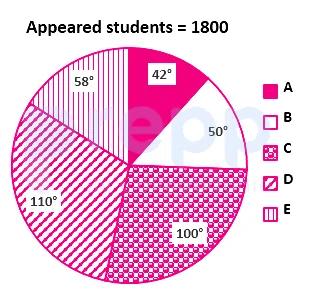
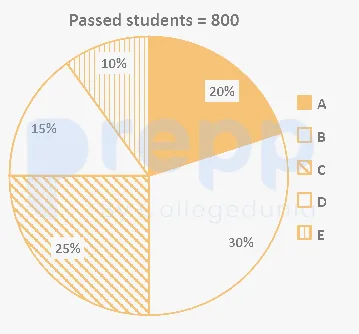
- A
60
- B
30
- C
50
- D
40
Show answer
D. 40Calculation:
Total number of appeared students = 1800 student
⇒ 360° = 1800
⇒ 1° = 1800/360 = 5 students
Appeared students of section A = 42° = 42 × 5 = 210 students
Appeared students of section B = 50° = 50 × 5 = 250 students
Required difference = (250 - 210) = 40 students
∴ The correct answer is 40 students.
Paper & answer key PDF ↗ Question 53archived
\(\rm sec \theta \sqrt{1 - sin^2\theta} = ?\)
- A
-1
- B
1
- C
∞
- D
0
Show answer
B. 1Simplifying Trigonometric Expressions
We are asked to simplify the trigonometric expression \( \rm sec \theta \sqrt{1 - sin^2\theta} \). To simplify this expression, we need to use fundamental trigonometric identities.
Understanding the Key Components
Let's break down the expression:
\( \rm sec \theta \): This is the secant of angle \( \theta \). It is defined as the reciprocal of the cosine of \( \theta \), i.e., \( \rm sec \theta = \frac{1}{\cos \theta} \).
\( \sqrt{1 - sin^2\theta} \): This involves the sine of \( \theta \) and a square root. We need an identity that relates \( \rm sin^2\theta \) to something else, preferably cosine, so we can simplify the term under the square root.
Applying Trigonometric Identities
The most fundamental trigonometric identity is the Pythagorean identity:
\( \rm sin^2\theta + cos^2\theta = 1 \)
We can rearrange this identity to find an expression for \( \rm 1 - sin^2\theta \). Subtracting \( \rm sin^2\theta \) from both sides gives:
\( \rm cos^2\theta = 1 - sin^2\theta \)
Now, substitute this into the original expression:
\( \rm sec \theta \sqrt{1 - sin^2\theta} = sec \theta \sqrt{cos^2\theta} \)
Simplifying the Square Root
The square root of \( \rm cos^2\theta \) is \( \rm |cos \theta| \). So the expression becomes \( \rm sec \theta |cos \theta| \). However, in typical trigonometric problems like this without specified quadrant information, we often assume the principal value where \( \sqrt{cos^2\theta} = cos\theta \), especially when options are single numerical values (unless \( \theta \) is such that \( \rm cos \theta \) is negative). Let's proceed with the assumption \( \sqrt{cos^2\theta} = cos\theta \).
\( \rm sec \theta \sqrt{cos^2\theta} = sec \theta \cdot cos \theta \)
Final Simplification
Now, substitute the definition of \( \rm sec \theta \):
\( \rm sec \theta \cdot cos \theta = \left(\frac{1}{\cos \theta}\right) \cdot cos \theta \)
Assuming \( \rm cos \theta \neq 0 \) (which must be true if \( \rm sec \theta \) is defined), we can cancel out the \( \rm cos \theta \) terms:
\( \rm \frac{1}{\cos \theta} \cdot cos \theta = 1 \)
Thus, the simplified expression is 1.
Step-by-Step Simplification
Start with the given expression: \( \rm sec \theta \sqrt{1 - sin^2\theta} \)
Use the identity \( \rm 1 - sin^2\theta = cos^2\theta \): \( \rm sec \theta \sqrt{cos^2\theta} \)
Simplify the square root (assuming \( \rm \sqrt{cos^2\theta} = cos\theta \)): \( \rm sec \theta \cdot cos \theta \)
Use the definition \( \rm sec \theta = \frac{1}{\cos \theta} \): \( \rm \frac{1}{\cos \theta} \cdot cos \theta \)
Cancel \( \rm cos \theta \) terms (assuming \( \rm cos \theta \neq 0 \)): \( \rm 1 \)
The simplified value of the expression \( \rm sec \theta \sqrt{1 - sin^2\theta} \) is 1.
Identity Used
Formula
Pythagorean Identity
\( \rm sin^2\theta + cos^2\theta = 1 \)
Derived Identity
\( \rm 1 - sin^2\theta = cos^2\theta \)
Secant Definition
\( \rm sec \theta = \frac{1}{\cos \theta} \)
Revision Table: Core Trigonometric Concepts
Trigonometric Function
Definition
Reciprocal
Sine (\( \rm sin \theta \))
Opposite / Hypotenuse
Cosecant (\( \rm csc \theta \))
Cosine (\( \rm cos \theta \))
Adjacent / Hypotenuse
Secant (\( \rm sec \theta \))
Tangent (\( \rm tan \theta \))
Opposite / Adjacent
Cotangent (\( \rm cot \theta \))
Additional Information: Trigonometric Identities
Understanding trigonometric identities is crucial for simplifying expressions and solving trigonometric equations. The Pythagorean identity \( \rm sin^2\theta + cos^2\theta = 1 \) is derived from the Pythagorean theorem applied to a right-angled triangle within the unit circle. This single identity can be rearranged to derive other useful forms:
\( \rm sin^2\theta = 1 - cos^2\theta \)
\( \rm cos^2\theta = 1 - sin^2\theta \)
Dividing the main identity by \( \rm cos^2\theta \) (assuming \( \rm cos \theta \neq 0 \)) gives:
\( \rm \frac{sin^2\theta}{cos^2\theta} + \frac{cos^2\theta}{cos^2\theta} = \frac{1}{cos^2\theta} \)
\( \rm tan^2\theta + 1 = sec^2\theta \)
Dividing the main identity by \( \rm sin^2\theta \) (assuming \( \rm sin \theta \neq 0 \)) gives:
\( \rm \frac{sin^2\theta}{sin^2\theta} + \frac{cos^2\theta}{sin^2\theta} = \frac{1}{sin^2\theta} \)
\( \rm 1 + cot^2\theta = csc^2\theta \)
These identities, along with reciprocal identities (\( \rm sec \theta = 1/cos \theta \), \( \rm csc \theta = 1/sin \theta \), \( \rm cot \theta = 1/tan \theta \)) and quotient identities (\( \rm tan \theta = sin \theta / cos \theta \), \( \rm cot \theta = cos \theta / sin \theta \)), form the basis for simplifying many trigonometric expressions.
Paper & answer key PDF ↗ Question 54archived
The angles of a triangle are in the ratio 2 ∶ 3 ∶ 7. What is the measure of the largest angle of the triangle?
- A
45°
- B
105°
- C
90°
- D
100°
Show answer
B. 105°Finding the Largest Angle in a Triangle Given Ratio
The problem asks us to find the measure of the largest angle in a triangle where the angles are given in a specific ratio. We are told the angles are in the ratio 2 ∶ 3 ∶ 7.
Understanding Triangle Angle Ratios
When the angles of a triangle are in a ratio, it means they can be represented as multiples of a common value. Let the common multiplier be \(x\). So, the three angles of the triangle can be represented as:
First angle = \(2x\)
Second angle = \(3x\)
Third angle = \(7x\)
The ratio 2 ∶ 3 ∶ 7 directly translates to these expressions for the angles.
Applying the Triangle Angle Sum Property
A fundamental property of any triangle is that the sum of its interior angles is always \(180^{\circ}\). We can use this property to find the value of \(x\).
The sum of the angles is:
\(2x + 3x + 7x\)
According to the angle sum property, this sum must equal \(180^{\circ}\):
\(2x + 3x + 7x = 180^{\circ}\)
Solving for the Common Multiplier \(x\)
Now, we solve the equation for \(x\):
Combine the terms on the left side:
\( (2 + 3 + 7)x = 180^{\circ} \)
\( 12x = 180^{\circ} \)
To find \(x\), divide both sides by 12:
\( x = \frac{180^{\circ}}{12} \)
\( x = 15^{\circ} \)
Calculating the Measures of the Angles
Now that we have the value of \(x\), we can find the measure of each angle by substituting \(x = 15^{\circ}\) back into our expressions for the angles:
First angle = \(2x = 2 \times 15^{\circ} = 30^{\circ}\)
Second angle = \(3x = 3 \times 15^{\circ} = 45^{\circ}\)
Third angle = \(7x = 7 \times 15^{\circ} = 105^{\circ}\)
Let's quickly check if the sum of these angles is \(180^{\circ}\): \(30^{\circ} + 45^{\circ} + 105^{\circ} = 75^{\circ} + 105^{\circ} = 180^{\circ}\). This confirms our calculation for \(x\) is correct.
Identifying the Largest Angle
The three angles of the triangle are \(30^{\circ}\), \(45^{\circ}\), and \(105^{\circ}\). We need to find the largest angle among these. Comparing the values, we see that \(105^{\circ}\) is the largest.
Conclusion
The measures of the angles of the triangle are \(30^{\circ}\), \(45^{\circ}\), and \(105^{\circ}\). The largest angle is \(105^{\circ}\).
Step
Description
Calculation
1
Represent angles using ratio and \(x\)
\(2x, 3x, 7x\)
2
Set up equation using angle sum property
\(2x + 3x + 7x = 180^{\circ}\)
3
Solve for \(x\)
\(12x = 180^{\circ} \implies x = 15^{\circ}\)
4
Calculate angle measures
\(2(15)=30^{\circ}\), \(3(15)=45^{\circ}\), \(7(15)=105^{\circ}\)
5
Identify largest angle
\(105^{\circ}\)
Revision Table: Key Concepts for Triangle Angles
Concept
Description
Property/Formula
Triangle
A polygon with three sides and three angles.
Sum of interior angles = \(180^{\circ}\)
Angle Ratio
Represents the proportional relationship between angle measures.
Angles can be written as \(ax, bx, cx\) if ratio is \(a:b:c\).
Types of Triangles (by Angle)
Acute (all < 90°), Right (one = 90°), Obtuse (one > 90°)
Angle measures determine type.
Additional Information: Exploring Triangle Properties
Understanding triangle properties is crucial in geometry. Here are a few related concepts:
Types of Triangles based on Sides: Triangles can also be classified by their side lengths:
Equilateral Triangle: All three sides are equal, and all three angles are equal (\(60^{\circ}\) each).
Isosceles Triangle: Two sides are equal, and the angles opposite those sides are equal.
Scalene Triangle: All three sides are different lengths, and all three angles are different measures.
Exterior Angles: An exterior angle of a triangle is equal to the sum of the two opposite interior angles.
Inequality Theorem: The sum of the lengths of any two sides of a triangle must be greater than the length of the third side.
For this problem, the key was the angle sum property and working with ratios to find the specific angle measures.
Paper & answer key PDF ↗ Question 55archived
P and Q together complete a job in \(4{2 \over5}\) days. R and S complete the same job in \(4{8 \over9}\) days. If P, Q, R and S work together, how many days do they need to complete the same job?
- A
\(2{7 \over18}\)
- B
\(1{7\over18}\)
- C
\(1{6 \over19}\)
- D
\(2{6 \over19}\)
Show answer
D. \(2{6 \over19}\)Understanding the Work and Time Problem
This question asks us to find out how long it takes for four individuals, P, Q, R, and S, to complete a job when working together. We are given the time taken by two pairs: P and Q together, and R and S together.
To solve this type of problem, we need to understand the relationship between work, time, and work rate. The work rate is the amount of job completed per unit of time. If someone completes a job in 'T' days, their work rate is \( \frac{1}{T} \) job per day.
Step-by-Step Solution
Step 1: Convert mixed numbers to improper fractions.
The time taken by P and Q together is \( 4{2 \over5} \) days.
\( 4{2 \over5} = \frac{(4 \times 5) + 2}{5} = \frac{20 + 2}{5} = \frac{22}{5} \) days.
The time taken by R and S together is \( 4{8 \over9} \) days.
\( 4{8 \over9} = \frac{(4 \times 9) + 8}{9} = \frac{36 + 8}{9} = \frac{44}{9} \) days.
Step 2: Calculate the combined work rate of each pair.
If P and Q together complete the job in \( \frac{22}{5} \) days, their combined work rate is the reciprocal of the time taken.
Combined work rate of P and Q = \( \frac{1}{\frac{22}{5}} = \frac{5}{22} \) job per day.
If R and S together complete the job in \( \frac{44}{9} \) days, their combined work rate is the reciprocal of the time taken.
Combined work rate of R and S = \( \frac{1}{\frac{44}{9}} = \frac{9}{44} \) job per day.
Step 3: Calculate the total combined work rate when P, Q, R, and S work together.
When all four work together, their total work rate is the sum of the combined work rates of the pairs.
Total combined work rate of P, Q, R, and S = (Work rate of P and Q) + (Work rate of R and S)
Total combined work rate = \( \frac{5}{22} + \frac{9}{44} \)
To add these fractions, we need a common denominator. The least common multiple of 22 and 44 is 44.
\( \frac{5}{22} = \frac{5 \times 2}{22 \times 2} = \frac{10}{44} \)
Total combined work rate = \( \frac{10}{44} + \frac{9}{44} = \frac{10 + 9}{44} = \frac{19}{44} \) job per day.
Step 4: Calculate the time taken by P, Q, R, and S working together.
The time taken to complete the job is the reciprocal of the total combined work rate.
Time taken by P, Q, R, and S together = \( \frac{1}{\text{Total combined work rate}} = \frac{1}{\frac{19}{44}} = \frac{44}{19} \) days.
Step 5: Convert the improper fraction back to a mixed number.
We need to express \( \frac{44}{19} \) as a mixed number.
\( 44 \div 19 \)
\( 19 \times 2 = 38 \)
\( 44 - 38 = 6 \)
So, \( \frac{44}{19} = 2 \) with a remainder of \( 6 \). This means \( 2 \frac{6}{19} \) days.
Thus, P, Q, R, and S together need \( 2 \frac{6}{19} \) days to complete the same job.
Summary of Results
Here's a quick summary of the key values calculated:
Group
Time Taken (Days)
Work Rate (Job/Day)
P and Q
\( 4{2 \over5} = \frac{22}{5} \)
\( \frac{5}{22} \)
R and S
\( 4{8 \over9} = \frac{44}{9} \)
\( \frac{9}{44} \)
P, Q, R, and S
\( 2 \frac{6}{19} = \frac{44}{19} \)
\( \frac{19}{44} \)
Revision Table - Work and Time Concepts
Understanding these basic concepts is crucial for solving work and time problems:
Work Rate: The amount of work done per unit of time. It is usually calculated as \( \frac{\text{Total Work}}{\text{Time Taken}} \). If the total work is considered 1 unit (the whole job), then Work Rate \( = \frac{1}{\text{Time Taken}} \).
Time Taken: The total time required to complete the work. It is calculated as \( \frac{\text{Total Work}}{\text{Work Rate}} \). If the total work is 1 unit, then Time Taken \( = \frac{1}{\text{Work Rate}} \).
Combined Work Rate: When multiple individuals or groups work together, their individual work rates are added to find the combined work rate. If Person A's rate is \( R_A \) and Person B's rate is \( R_B \), their combined rate is \( R_A + R_B \).
Additional Information - Solving Work Problems
Work and time problems often involve understanding how rates combine. Here are some additional points:
Assume the total work is 1 unit unless a specific quantity is mentioned. This simplifies calculations as rates become fractions of 1 job per unit time.
If a person A takes 'a' days and person B takes 'b' days to complete a job, their combined rate is \( \frac{1}{a} + \frac{1}{b} \). The time taken together is \( \frac{1}{\frac{1}{a} + \frac{1}{b}} = \frac{ab}{a+b} \) days. This formula can be extended for more people.
Problems might involve individuals working for different durations or leaving/joining mid-way. In such cases, calculate the amount of work done by each person/group and sum them up to equal the total work (usually 1 unit).
Paper & answer key PDF ↗ Question 56archived
A can finish a work in 60 days. He works at it for 15 days and then B alone finishes the remaining work in 48 days. In how much time can A and B working together finish the work?
- A
\(171 \over 37\) days
- B
\(960 \over 31\) days
- C
51 days
- D
45 days
Show answer
B. \(960 \over 31\) daysSolving Work and Time Problems
This problem involves understanding the concept of work rate. When someone can finish a work in a certain number of days, their daily work rate is the reciprocal of the number of days. For example, if someone finishes a work in \(N\) days, their daily work rate is \(\frac{1}{N}\) of the work.
Step-by-Step Solution for Work Calculation
Find A's daily work rate:
A can finish the work in 60 days.
So, A's daily work rate is \(\frac{1}{60}\) of the total work.
Calculate the work done by A in 15 days:
A works for 15 days at a daily rate of \(\frac{1}{60}\).
Work done by A in 15 days = Daily rate \(\times\) Number of days
Work done by A = \(\frac{1}{60} \times 15 = \frac{15}{60} = \frac{1}{4}\) of the total work.
Find the remaining work:
The total work is considered as 1 unit.
Work remaining = Total work - Work done by A
Work remaining = \(1 - \frac{1}{4} = \frac{4-1}{4} = \frac{3}{4}\) of the total work.
Find B's daily work rate:
B finishes the remaining \(\frac{3}{4}\) of the work in 48 days.
Let B's daily work rate be \(r_B\).
Work done by B = B's daily rate \(\times\) Number of days
\(\frac{3}{4} = r_B \times 48\)
To find \(r_B\), divide the work done by the number of days:
\(r_B = \frac{\frac{3}{4}}{48} = \frac{3}{4 \times 48} = \frac{3}{192}\)
This fraction can be simplified by dividing the numerator and denominator by 3:
\(r_B = \frac{3 \div 3}{192 \div 3} = \frac{1}{64}\)
So, B's daily work rate is \(\frac{1}{64}\) of the total work.
Find the combined daily work rate of A and B:
When A and B work together, their daily work rates add up.
Combined daily rate = A's daily rate + B's daily rate
Combined daily rate = \(\frac{1}{60} + \frac{1}{64}\)
To add these fractions, find a common denominator. The least common multiple (LCM) of 60 and 64.
\(60 = 2^2 \times 3 \times 5\)
\(64 = 2^6\)
LCM(60, 64) = \(2^6 \times 3 \times 5 = 64 \times 15 = 960\).
Combined daily rate = \(\frac{1 \times 16}{60 \times 16} + \frac{1 \times 15}{64 \times 15} = \frac{16}{960} + \frac{15}{960} = \frac{16 + 15}{960} = \frac{31}{960}\)
The combined daily work rate is \(\frac{31}{960}\) of the total work.
Calculate the time taken by A and B working together:
The time taken to finish the entire work is the reciprocal of the combined daily work rate.
Time = \(\frac{1}{\text{Combined daily rate}} = \frac{1}{\frac{31}{960}} = \frac{960}{31}\) days.
Summary of Work Rates
Person
Time to finish work alone
Daily work rate
A
60 days
\(\frac{1}{60}\)
B
64 days (calculated from remaining work)
\(\frac{1}{64}\)
A and B (together)
\(\frac{960}{31}\) days
\(\frac{31}{960}\)
The time taken by A and B working together to finish the work is \(\frac{960}{31}\) days.
Revision Table: Work and Time Concepts
Concept
Explanation
Formula/Relation
Work Rate
The amount of work done per unit of time (e.g., per day).
Rate \(=\) \(\frac{\text{Total Work}}{\text{Time Taken}}\)
Time Taken
The duration required to complete a specific amount of work.
Time \(=\) \(\frac{\text{Total Work}}{\text{Rate}}\)
Total Work
Often considered as 1 unit for convenience.
Work \(=\) Rate \(\times\) Time
Combined Rate
When multiple people work together, their individual rates are added.
\(R_{total} = R_1 + R_2 + \dots + R_n\)
Additional Information on Work and Time Problems
Work and time problems are a common topic in quantitative aptitude. They often involve calculating the efficiency or rate at which a person or machine completes a task. The key is to convert the given information into work rates.
If a person can do a piece of work in \(N\) days, their work rate is \(\frac{1}{N}\) part of the work per day.
If a person works for \(D\) days at a rate of \(R\), the work done is \(R \times D\).
If the work done is \(W\) and the rate is \(R\), the time taken is \(\frac{W}{R}\).
When solving problems with multiple people, always find their individual daily rates first. Then, depending on whether they work together or separately, combine their rates or calculate the work done individually.
Sometimes, efficiency is mentioned. Efficiency is directly proportional to the work rate. If A is twice as efficient as B, A's work rate is double B's work rate.
Understanding these basic principles allows you to tackle various types of work and time questions, including those involving pipes and cisterns (where filling is positive work and emptying is negative work).
Paper & answer key PDF ↗ Question 57archived
The value of which of the following is different from the other options?
- A
sin 90°
- B
sec 60°
- C
cos 0°
- D
tan 45°
Show answer
B. sec 60°Understanding the Problem: Finding the Different Trigonometric Value
The question asks us to find which of the given trigonometric expressions has a value that is different from the values of the other options. We need to evaluate each expression and compare the results.
Evaluating Each Trigonometric Expression
Let's calculate the value for each of the given options:
Option 1: \( \sin 90^\circ \)
The value of sine at \( 90^\circ \) is a fundamental trigonometric value.
\( \sin 90^\circ = 1 \)
Option 2: \( \sec 60^\circ \)
The secant function is the reciprocal of the cosine function. So, \( \sec \theta = \frac{1}{\cos \theta} \). We need the value of \( \cos 60^\circ \).
\( \cos 60^\circ = \frac{1}{2} \)
Now, we can find \( \sec 60^\circ \):
\( \sec 60^\circ = \frac{1}{\cos 60^\circ} = \frac{1}{\frac{1}{2}} = 1 \times \frac{2}{1} = 2 \)
Option 3: \( \cos 0^\circ \)
The value of cosine at \( 0^\circ \) is another fundamental trigonometric value.
\( \cos 0^\circ = 1 \)
Option 4: \( \tan 45^\circ \)
The value of tangent at \( 45^\circ \) is also a standard trigonometric value.
\( \tan 45^\circ = 1 \)
Comparing the Calculated Values
Let's summarize the values we found for each option:
Expression
Calculated Value
\( \sin 90^\circ \)
1
\( \sec 60^\circ \)
2
\( \cos 0^\circ \)
1
\( \tan 45^\circ \)
1
Comparing the values (1, 2, 1, 1), we can see that the value 2 is different from the other values (which are all 1).
The expression that resulted in the value 2 is \( \sec 60^\circ \).
Identifying the Option with the Different Value
Based on our calculations, the value of \( \sin 90^\circ \) is 1, \( \sec 60^\circ \) is 2, \( \cos 0^\circ \) is 1, and \( \tan 45^\circ \) is 1.
The value of \( \sec 60^\circ \) (which is 2) is different from the values of the other three options (which are all 1).
Therefore, the option whose value is different from the others is \( \sec 60^\circ \).
Revision Table: Key Trigonometric Values
Angle
\( \sin \)
\( \cos \)
\( \tan \)
\( \sec \)
\( \csc \)
\( \cot \)
\( 0^\circ \)
0
1
0
1
Undefined
Undefined
\( 30^\circ \)
\( \frac{1}{2} \)
\( \frac{\sqrt{3}}{2} \)
\( \frac{1}{\sqrt{3}} \)
\( \frac{2}{\sqrt{3}} \)
2
\( \sqrt{3} \)
\( 45^\circ \)
\( \frac{1}{\sqrt{2}} \)
\( \frac{1}{\sqrt{2}} \)
1
\( \sqrt{2} \)
\( \sqrt{2} \)
1
\( 60^\circ \)
\( \frac{\sqrt{3}}{2} \)
\( \frac{1}{2} \)
\( \sqrt{3} \)
2
\( \frac{2}{\sqrt{3}} \)
\( \frac{1}{\sqrt{3}} \)
\( 90^\circ \)
1
0
Undefined
Undefined
1
0
Additional Information: Reciprocal Trigonometric Functions
Besides the primary trigonometric functions (sine, cosine, tangent), there are three reciprocal trigonometric functions:
Secant (sec) is the reciprocal of cosine: \( \sec \theta = \frac{1}{\cos \theta} \)
Cosecant (csc) is the reciprocal of sine: \( \csc \theta = \frac{1}{\sin \theta} \)
Cotangent (cot) is the reciprocal of tangent: \( \cot \theta = \frac{1}{\tan \theta} \) or \( \cot \theta = \frac{\cos \theta}{\sin \theta} \)
These reciprocal functions are useful in various trigonometric identities and applications.
Paper & answer key PDF ↗ Question 58archived
A can complete \(1 \over 3\) of a work in 7 days and B can complete \(2 \over 7\) of the same work in 10 days. In how many days can both A and B together complete the work?
- A
\(12{3 \over 8}\)
- B
\(11{7 \over 8}\)
- C
\(13{1 \over 8}\)
- D
\(15{1 \over 7}\)
Show answer
C. \(13{1 \over 8}\)The correct answer is 13{1 \over 8}.
If the question involves efficiency differences, adjust the work rates accordingly (e.g., B is twice as efficient as A means B's rate is 2 times A's rate). LCM method can be a helpful alternative for calculating combined time, especially when dealing with multiple people. In the LCM method, the total work is assumed to be the LCM of the individual times taken, and daily work units are calculated accordingly.
Paper & answer key PDF ↗ Question 59archived
Ramesh, on his way to his hometown, travelled the first 250 km at a speed of 75 km/h and the next 250 km at a speed of 85 km/h. Find the average speed for the whole journey(correct to 2 decimal places).
- A
80.55 km/h
- B
79.20 km/h
- C
80.69 km/h
- D
79.69 km/h
Show answer
D. 79.69 km/hTo find the average speed for the whole journey where the distances covered are equal ($250\,\text{km}$ each), we can use the harmonic mean of the two speeds.
Here is the step-by-step, one-side aligned solution without any numbers before the steps:
Solution:
Given Data:
Distance of the first part ($d_1$) = $250\,\text{km}$
Speed during the first part ($v_1$) = $75\,\text{km/h}$
Distance of the second part ($d_2$) = $250\,\text{km}$
Speed during the second part ($v_2$) = $85\,\text{km/h}$
Formula:
When two equal distances are travelled at different speeds $v_1$ and $v_2$, the formula for average speed is:
$$\text{Average Speed} = \frac{2v_1v_2}{v_1 + v_2}$$
Calculation:
$\text{Average Speed} = \frac{2 \times 75 \times 85}{75 + 85}$
$\text{Average Speed} = \frac{12750}{160}$
$\text{Average Speed} = \frac{1275}{16}$
$\text{Average Speed} = 79.6875\,\text{km/h}$
Final Answer:
The average speed for the whole journey is $79.69\,\text{km/h}$ (rounded to 2 decimal places).
Paper & answer key PDF ↗ Question 60archived
A can do \(1 \over 3\) of a piece of work in 32 days, B can do \(37{1 \over 2}\)% of the same work in 24 days, while C can do 60% of the same work in 48 days. B and C together started and worked for x days. After x days, B left the work and A joined C and both completed the remaining work in (x + 8) days. If the ratio of the work done by (B + C) together to the work done by (A + C) together is 9 ∶ 11, then what fraction of the same work can be completed by C alone in 3.5x days?
- A
\({18 \over 25}\)
- B
\({4 \over 5}\)
- C
\({7 \over 10}\)
- D
\({3 \over 4}\)
Show answer
C. \({7 \over 10}\)Understanding the Work and Time Problem
This question involves calculating the work rates of three individuals, A, B, and C, and then determining the fraction of work C can complete alone based on conditions involving their combined work and a specific time duration.
First, let's find the time each person takes to complete the entire work alone and their respective daily work rates.
Calculating Individual Work Rates (Daily Work)
For A:
A can do \( \frac{1}{3} \) of the work in 32 days.
Time taken by A to complete the whole work = \( 32 \text{ days} \div \frac{1}{3} = 32 \times 3 = 96 \text{ days} \).
A's daily work rate = \( \frac{1}{\text{Time taken by A}} = \frac{1}{96} \) of the work per day.
For B:
B can do \( 37\frac{1}{2}\)% of the work in 24 days.
\( 37\frac{1}{2}\)% as a fraction is \( \frac{37.5}{100} = \frac{75/2}{100} = \frac{75}{200} = \frac{3}{8} \).
So, B can do \( \frac{3}{8} \) of the work in 24 days.
Time taken by B to complete the whole work = \( 24 \text{ days} \div \frac{3}{8} = 24 \times \frac{8}{3} = 8 \times 8 = 64 \text{ days} \).
B's daily work rate = \( \frac{1}{\text{Time taken by B}} = \frac{1}{64} \) of the work per day.
For C:
C can do 60% of the work in 48 days.
60% as a fraction is \( \frac{60}{100} = \frac{3}{5} \).
So, C can do \( \frac{3}{5} \) of the work in 48 days.
Time taken by C to complete the whole work = \( 48 \text{ days} \div \frac{3}{5} = 48 \times \frac{5}{3} = 16 \times 5 = 80 \text{ days} \).
C's daily work rate = \( \frac{1}{\text{Time taken by C}} = \frac{1}{80} \) of the work per day.
Person
Time to complete work alone
Daily Work Rate
A
96 days
\( \frac{1}{96} \)
B
64 days
\( \frac{1}{64} \)
C
80 days
\( \frac{1}{80} \)
Analyzing the Two Phases of Work Completion
The work is completed in two phases:
Phase 1: B and C work together for x days.
Phase 2: B leaves, and A joins C. A and C work together for (x + 8) days to complete the remaining work.
Combined Work Rates
Combined daily work rate of B and C:
\( \text{Rate}_{B+C} = \text{Rate}_B + \text{Rate}_C = \frac{1}{64} + \frac{1}{80} \)
To add these fractions, find the Least Common Multiple (LCM) of 64 and 80. LCM(64, 80) = 320.
\( \text{Rate}_{B+C} = \frac{1 \times 5}{64 \times 5} + \frac{1 \times 4}{80 \times 4} = \frac{5}{320} + \frac{4}{320} = \frac{5+4}{320} = \frac{9}{320} \) of the work per day.
Combined daily work rate of A and C:
\( \text{Rate}_{A+C} = \text{Rate}_A + \text{Rate}_C = \frac{1}{96} + \frac{1}{80} \)
To add these fractions, find the LCM of 96 and 80. LCM(96, 80) = 480.
\( \text{Rate}_{A+C} = \frac{1 \times 5}{96 \times 5} + \frac{1 \times 6}{80 \times 6} = \frac{5}{480} + \frac{6}{480} = \frac{5+6}{480} = \frac{11}{480} \) of the work per day.
Work Done in Each Phase and Finding x
Work done by (B+C) in x days (Phase 1):
\( W_{B+C} = \text{Rate}_{B+C} \times x = \frac{9}{320} \times x = \frac{9x}{320} \)
Work done by (A+C) in (x+8) days (Phase 2):
\( W_{A+C} = \text{Rate}_{A+C} \times (x+8) = \frac{11}{480} \times (x+8) \)
The question states that the ratio of the work done by (B + C) together to the work done by (A + C) together is 9 : 11. Based on the problem structure, this ratio likely refers to the work done during the specific periods mentioned for each group (Phase 1 vs Phase 2).
So, \( W_{B+C} : W_{A+C} = 9 : 11 \).
\( \frac{9x}{320} : \frac{11(x+8)}{480} = 9 : 11 \)
\( \frac{\frac{9x}{320}}{\frac{11(x+8)}{480}} = \frac{9}{11} \)
\( \frac{9x}{320} \times \frac{480}{11(x+8)} = \frac{9}{11} \)
Cancel out 9 from both numerators and 11 from both denominators:
\( \frac{x}{320} \times \frac{480}{x+8} = 1 \)
\( \frac{480x}{320(x+8)} = 1 \)
Simplify the fraction \( \frac{480}{320} = \frac{48}{32} = \frac{3}{2} \).
\( \frac{3x}{2(x+8)} = 1 \)
\( 3x = 2(x+8) \)
\( 3x = 2x + 16 \)
\( 3x - 2x = 16 \)
\( x = 16 \)
Verifying the value of x
If \( x = 16 \) days:
Work done by (B+C) in Phase 1 (\( x \) days) = \( \frac{9}{320} \times 16 = \frac{9 \times 16}{320} = \frac{144}{320} \). Divide numerator and denominator by 16: \( \frac{9}{20} \).
Work done by (A+C) in Phase 2 (\( x+8 \) days) = \( \frac{11}{480} \times (16+8) = \frac{11}{480} \times 24 = \frac{11 \times 24}{480} \). Divide numerator and denominator by 24: \( \frac{11}{20} \).
Total work done = Work in Phase 1 + Work in Phase 2 = \( \frac{9}{20} + \frac{11}{20} = \frac{20}{20} = 1 \). This confirms that \( x=16 \) is correct as the total work is completed.
The ratio of work done in Phase 1 to Phase 2 is \( \frac{9}{20} : \frac{11}{20} = 9 : 11 \), which matches the condition given in the question.
Calculating Work Done by C Alone
We need to find the fraction of work C can complete alone in \( 3.5x \) days.
Value of \( x = 16 \) days.
Time for C = \( 3.5x = 3.5 \times 16 \) days.
\( 3.5 \times 16 = \frac{7}{2} \times 16 = 7 \times 8 = 56 \) days.
C's daily work rate = \( \frac{1}{80} \).
Work done by C alone in 56 days = C's daily work rate \( \times \) Time
Work done by C = \( \frac{1}{80} \times 56 = \frac{56}{80} \)
Simplify the fraction \( \frac{56}{80} \). Both numerator and denominator are divisible by 8.
\( \frac{56 \div 8}{80 \div 8} = \frac{7}{10} \).
So, C alone can complete \( \frac{7}{10} \) of the work in \( 3.5x \) days.
Final Answer Fraction of Work
The fraction of the same work that can be completed by C alone in \( 3.5x \) days is \( \frac{7}{10} \).
Revision Table: Key Calculations
Description
Calculation
Result
A's time to complete work
\( 32 / (1/3) \)
96 days
B's time to complete work
\( 24 / (3/8) \)
64 days
C's time to complete work
\( 48 / (3/5) \)
80 days
B + C daily work rate
\( 1/64 + 1/80 \)
\( 9/320 \)
A + C daily work rate
\( 1/96 + 1/80 \)
\( 11/480 \)
Equation from ratio
\( \frac{9x/320}{11(x+8)/480} = \frac{9}{11} \)
\( x = 16 \)
Time for C alone
\( 3.5 \times x \)
56 days
Work by C in 56 days
\( 1/80 \times 56 \)
\( 7/10 \)
Additional Information: Time and Work Concepts
Time and work problems often involve calculating individual efficiency and then combining or comparing the work done by multiple individuals over specific periods.
Daily Work Rate: If a person completes a work in 'N' days, their daily work rate is \( 1/N \) of the total work. This is the amount of work done per day.
Total Work: The total work is typically considered as '1 unit' or '100%'.
Combined Work Rate: If multiple people work together, their individual daily work rates are added to find the combined daily work rate. For example, if A's rate is \( R_A \) and B's rate is \( R_B \), their combined rate is \( R_A + R_B \).
Work Done = Rate \( \times \) Time: If a person or group works at a rate 'R' for 'T' days, the total work done is \( R \times T \).
Completing Work: When the work is completed, the total work done equals 1.
Efficiency: Work rate is directly related to efficiency. A higher work rate means higher efficiency (completing more work in less time).
Understanding these basic principles is key to solving complex time and work problems like the one discussed here.
Paper & answer key PDF ↗ Question 61archived
Which of the following numbers is divisible by 8?
- A
18718
- B
18716
- C
18712
- D
18714
Show answer
C. 18712Understanding Divisibility by 8
This solution explains how to determine which number from the given options is divisible by 8. We will use the standard divisibility rule for 8.
Divisibility Rule for 8 Explained
A number is considered divisible by 8 if the number formed by its last three digits is also divisible by 8. If the last three digits form a number that leaves a remainder when divided by 8, then the original number is not divisible by 8.
Mathematically, if a number N can be represented as $N = 1000a + b$, where 'b' represents the number formed by the last three digits, then since $1000$ is divisible by 8 ($1000 = 8 \times 125$), the divisibility of N by 8 depends solely on the divisibility of 'b' by 8.
Checking Each Option
Let's apply the divisibility rule for 8 to each of the provided numbers:
Option 1: 18718
The last three digits are 718.
We check if 718 is divisible by 8.
Calculation: $718 \div 8$
$718 = 8 \times 89 + 6$
Since there is a remainder of 6, 18718 is not divisible by 8.
Option 2: 18716
The last three digits are 716.
We check if 716 is divisible by 8.
Calculation: $716 \div 8$
$716 = 8 \times 89 + 4$
Since there is a remainder of 4, 18716 is not divisible by 8.
Option 3: 18712
The last three digits are 712.
We check if 712 is divisible by 8.
Calculation: $712 \div 8$
$712 = 8 \times 89 + 0$
Since the remainder is 0, 712 is divisible by 8. Therefore, 18712 is divisible by 8.
Option 4: 18714
The last three digits are 714.
We check if 714 is divisible by 8.
Calculation: $714 \div 8$
$714 = 8 \times 89 + 2$
Since there is a remainder of 2, 18714 is not divisible by 8.
Conclusion on Divisibility
By applying the divisibility rule for 8, we found that the number formed by the last three digits of 18712 (which is 712) is divisible by 8. Thus, 18712 is the number divisible by 8 among the given options.
Paper & answer key PDF ↗ Question 62archived
The three sides of two triangles are 4, 5 and 6 cm. Select the INCORRECT statement.
- A
The angle opposite to the greater side in those triangles will be greater.
- B
The area of the two triangles will be different.
- C
The two triangles are congruent.
- D
The two triangles are scalene triangles.
Show answer
B. The area of the two triangles will be different.The question provides information about two triangles, stating that the lengths of their three sides are 4 cm, 5 cm, and 6 cm. We are asked to identify the incorrect statement among the given options based on this information.
Analyzing the Given Triangles
For both triangles, the side lengths are 4 cm, 5 cm, and 6 cm. Since all three sides have different lengths, these triangles belong to a specific category of triangles.
A triangle with all three sides of different lengths is called a scalene triangle.
Therefore, both of the triangles mentioned in the question are scalene triangles.
Evaluating Statements about the Two Triangles
Let's examine each statement provided in the options to determine which one is incorrect.
Statement 1: Angle Opposite the Longest Side
The statement says: "The angle opposite to the greater side in those triangles will be greater."
In any triangle, there is a direct relationship between the length of a side and the measure of the angle opposite that side. The longest side is always opposite the largest angle, and the shortest side is always opposite the smallest angle.
In both triangles, the longest side is 6 cm. The angle opposite the 6 cm side will be the largest angle in each triangle.
Since the side lengths of the two triangles are identical (4, 5, and 6 cm), their corresponding angles must also be identical. Thus, the angle opposite the 6 cm side in the first triangle will be equal to the angle opposite the 6 cm side in the second triangle, and this angle will be the greatest angle in both triangles.
This statement accurately describes a fundamental property of triangles.
This statement is correct.
Statement 3: Congruence and SSS Rule
The statement says: "The two triangles are congruent."
Two triangles are said to be congruent if they have the same size and shape. This means all corresponding sides and corresponding angles are equal.
There are several criteria for proving triangle congruence. One of them is the Side-Side-Side (SSS) congruence rule. The SSS rule states that if the three sides of one triangle are equal in length to the three corresponding sides of another triangle, then the two triangles are congruent.
The given triangles have side lengths 4 cm, 5 cm, and 6 cm. The first triangle has sides 4, 5, 6, and the second triangle also has sides 4, 5, 6.
Since the three corresponding sides are equal, the two triangles are congruent by the SSS congruence rule.
This statement is correct.
Statement 4: Identifying Scalene Triangles
The statement says: "The two triangles are scalene triangles."
As defined earlier, a scalene triangle is a triangle where all three sides have different lengths.
The side lengths of the given triangles are 4 cm, 5 cm, and 6 cm. These are three distinct lengths.
Therefore, both triangles fit the definition of a scalene triangle.
This statement is correct.
Statement 2: Triangle Area Comparison
The statement says: "The area of the two triangles will be different."
We have already determined that the two triangles are congruent because their corresponding sides are equal (SSS congruence).
Congruent figures have the exact same dimensions and shape. As a result, they must have the same area.
If the triangles are congruent, their areas must be equal, not different.
We can also calculate the area using Heron's formula to verify. The semi-perimeter \(s\) is:
$$ s = \frac{4+5+6}{2} = \frac{15}{2} = 7.5 \text{ cm} $$
The area \(A\) is:
$$ A = \sqrt{s(s-a)(s-b)(s-c)} = \sqrt{7.5(7.5-4)(7.5-5)(7.5-6)} $$
$$ A = \sqrt{7.5 \times 3.5 \times 2.5 \times 1.5} = \sqrt{98.4375} \approx 9.92 \text{ cm}^2 $$
Since both triangles have the same side lengths, their area calculated using Heron's formula will be the same.
This statement is incorrect.
Determining the Incorrect Statement
Based on the analysis of each statement, the only statement that is not true for the two triangles described is that their areas will be different. Congruent triangles always have equal areas.
Revision Table: Key Triangle Concepts
Concept
Description/Rule
Applies to these triangles?
Side-Angle Relationship
Largest angle opposite longest side, etc.
Yes
SSS Congruence
If three sides are equal, triangles are congruent.
Yes
Scalene Triangle
All three sides have different lengths.
Yes
Area of Congruent Triangles
Congruent triangles have equal areas.
Yes (implies areas are equal)
Additional Information: Expanding on Triangle Geometry
Understanding triangle properties is crucial in geometry. Here are a few related concepts:
Types of Triangles by Sides
Scalene Triangle: All three sides are of different lengths. (Like the triangles in this problem).
Isosceles Triangle: At least two sides are of equal length. The angles opposite the equal sides are also equal.
Equilateral Triangle: All three sides are of equal length. All three angles are also equal (60 degrees each).
Triangle Congruence Rules
Besides SSS (Side-Side-Side), other common congruence rules include:
SAS (Side-Angle-Side): If two sides and the included angle of one triangle are equal to the corresponding two sides and the included angle of another triangle.
ASA (Angle-Side-Angle): If two angles and the included side of one triangle are equal to the corresponding two angles and the included side of another triangle.
AAS (Angle-Angle-Side): If two angles and a non-included side of one triangle are equal to the corresponding two angles and the non-included side of another triangle.
RHS (Right-angle-Hypotenuse-Side): If in two right-angled triangles, the hypotenuse and one side of one triangle are equal to the hypotenuse and one corresponding side of the other triangle.
Heron's Formula
This formula is used to calculate the area of a triangle when the lengths of all three sides (\(a, b, c\)) are known. First, calculate the semi-perimeter \(s = (a+b+c)/2\), then the area \(A\) is given by \(A = \sqrt{s(s-a)(s-b)(s-c)}\).
Paper & answer key PDF ↗ Question 63archived
If RP and RQ are two tangents to a circle with centre O such that ∠POQ = 120°, where P and Q are the points on the circle and R is a point outside the circle then ∠PRQ is equal to:
- A
90°
- B
75°
- C
60°
- D
45°
Show answer
C. 60°Finding the Angle Between Tangents to a Circle
The problem asks us to find the angle formed by two tangents drawn from an external point to a circle, given the angle subtended by the chord of contact at the center.
Understanding Tangents and Circle Properties
We are given a circle with center O, and an external point R. RP and RQ are tangents to the circle at points P and Q respectively. This means P and Q are the points of contact. We are given that the angle ∠POQ, which is the angle subtended by the arc PQ at the center O, is 120°.
Key properties related to tangents and radii at the point of contact are essential here:
A radius drawn to the point of tangency is perpendicular to the tangent at that point.
Therefore, the radius OP is perpendicular to the tangent RP, so ∠OPR = 90°.
Similarly, the radius OQ is perpendicular to the tangent RQ, so ∠OQR = 90°.
Analyzing the Quadrilateral OPRQ
Consider the quadrilateral formed by the points O, P, R, and Q. The angles of this quadrilateral are ∠OPR, ∠PRQ, ∠OQR, and ∠POQ.
The sum of the interior angles of any quadrilateral is 360°.
So, in quadrilateral OPRQ, we have:
$\angle OPR + \angle PRQ + \angle OQR + \angle POQ = 360^\circ$
Calculating ∠PRQ
We know the values of three angles in the quadrilateral:
$\angle OPR = 90^\circ$ (Radius perpendicular to tangent)
$\angle OQR = 90^\circ$ (Radius perpendicular to tangent)
$\angle POQ = 120^\circ$ (Given)
Substitute these values into the sum of angles equation:
$90^\circ + \angle PRQ + 90^\circ + 120^\circ = 360^\circ$
Combine the known angle values:
$180^\circ + 120^\circ + \angle PRQ = 360^\circ$
$300^\circ + \angle PRQ = 360^\circ$
Now, isolate ∠PRQ:
$\angle PRQ = 360^\circ - 300^\circ$
$\angle PRQ = 60^\circ$
Thus, the angle ∠PRQ is equal to 60°.
Summary of Angles in Quadrilateral OPRQ
Angle
Value
Reason
∠OPR
90°
Radius ⊥ Tangent
∠OQR
90°
Radius ⊥ Tangent
∠POQ
120°
Given
∠PRQ
60°
Calculated
Sum
360°
Angles in a Quadrilateral
Conclusion
The angle between the two tangents RP and RQ, which is ∠PRQ, is 60°.
Revision Table: Circle Tangent Properties
Property
Description
Relevance to Problem
Radius-Tangent Perpendicularity
A radius at the point of contact is perpendicular to the tangent.
Used to determine ∠OPR = 90° and ∠OQR = 90°.
Angles in a Quadrilateral
The sum of interior angles in a quadrilateral is 360°.
Used to set up the equation for OPRQ and solve for ∠PRQ.
Tangents from External Point
Tangents from an external point to a circle are equal in length (RP = RQ). They also subtend equal angles at the center if chords are equal.
Not directly used for finding ∠PRQ in this specific method, but a fundamental property.
Additional Information: Relationship Between Angles
For tangents RP and RQ from an external point R to a circle with center O, the quadrilateral OPRQ is formed. In this quadrilateral, the angles at the points of tangency (∠OPR and ∠OQR) are always 90°. This leads to a direct relationship between the angle subtended by the chord of contact at the center (∠POQ) and the angle between the tangents (∠PRQ).
Since $\angle OPR + \angle OQR = 90^\circ + 90^\circ = 180^\circ$, the sum of the remaining two angles must also be 180° for the total to be 360°.
Thus, $\angle POQ + \angle PRQ = 180^\circ$.
This means that the angle subtended by the chord of contact at the center and the angle between the tangents at the external point are supplementary (they add up to 180°).
In this problem, we were given $\angle POQ = 120^\circ$. Using this relationship:
$\angle PRQ = 180^\circ - \angle POQ$
$\angle PRQ = 180^\circ - 120^\circ$
$\angle PRQ = 60^\circ$
This confirms the result obtained using the sum of angles in a quadrilateral.
Paper & answer key PDF ↗ Question 64archived
The length, breadth and height of a hall are 10 m, 20 m and 15 m respectively. Find the cost of whitewashing the walls of the inside of the hall and ceiling at the rate of Rs. 10.20/m2
- A
Rs. 13,394
- B
Rs. 11,220
- C
Rs. 15,320
- D
Rs. 16,542
Show answer
B. Rs. 11,220Calculating Whitewashing Cost for a Hall
Let's break down the problem of finding the cost to whitewash the walls and ceiling of a rectangular hall. We are given the dimensions of the hall and the rate per square meter for whitewashing.
Understanding the Hall Dimensions
The dimensions of the hall are given as:
Length (l) = 10 m
Breadth (b) = 20 m
Height (h) = 15 m
The rate for whitewashing is Rs. 10.20 per square meter ($/m^2$).
Area to be Whitewashed
We need to whitewash the four walls and the ceiling of the hall. The floor is not whitewashed.
The total area to be whitewashed is the sum of the area of the four walls and the area of the ceiling.
Area of the Four Walls
The area of the four walls is the lateral surface area of the hall (excluding the floor and ceiling). A rectangular hall has four rectangular walls. Two walls have dimensions length $\times$ height, and the other two walls have dimensions breadth $\times$ height.
The formula for the area of the four walls is $2 \times (\text{length} \times \text{height} + \text{breadth} \times \text{height})$.
Area of walls $= 2 \times (l \times h + b \times h)$
Substituting the given dimensions:
Area of walls $= 2 \times (10 \, m \times 15 \, m + 20 \, m \times 15 \, m)$
Area of walls $= 2 \times (150 \, m^2 + 300 \, m^2)$
Area of walls $= 2 \times (450 \, m^2)$
Area of walls $= 900 \, m^2$
Area of the Ceiling
The ceiling of the hall is rectangular with dimensions length $\times$ breadth.
The formula for the area of the ceiling is $\text{length} \times \text{breadth}$.
Area of ceiling $= l \times b$
Substituting the given dimensions:
Area of ceiling $= 10 \, m \times 20 \, m$
Area of ceiling $= 200 \, m^2$
Total Area for Whitewashing
The total area to be whitewashed is the sum of the area of the four walls and the area of the ceiling.
Total Area = Area of walls + Area of ceiling
Total Area = $900 \, m^2 + 200 \, m^2$
Total Area = $1100 \, m^2$
Component
Area Calculation
Area ($m^2$)
Four Walls
$2(10 \times 15 + 20 \times 15)$
900
Ceiling
$10 \times 20$
200
Total Area
1100
Calculating the Total Whitewashing Cost
The cost of whitewashing is calculated by multiplying the total area to be whitewashed by the rate per square meter.
Rate of whitewashing = Rs. 10.20 $/m^2$
Total Cost = Total Area $\times$ Rate
Total Cost = $1100 \, m^2 \times Rs. \, 10.20/m^2$
Total Cost = $1100 \times 10.20$
Total Cost = Rs. 11220
Therefore, the cost of whitewashing the walls and ceiling of the hall is Rs. 11,220.
Revision Table: Hall Whitewashing Calculation
Item
Value
Unit
Hall Length (l)
10
m
Hall Breadth (b)
20
m
Hall Height (h)
15
m
Rate
10.20
Rs./m<sup>2</sup>
Area of Walls
$2(lh + bh) = 2(10 \times 15 + 20 \times 15) = 900$
m<sup>2</sup>
Area of Ceiling
$lb = 10 \times 20 = 200$
m<sup>2</sup>
Total Area
$900 + 200 = 1100$
m<sup>2</sup>
Total Cost
$1100 \times 10.20 = 11220$
Rs.
Additional Information on Surface Area Calculations
Understanding how to calculate surface areas is important in geometry problems like this one. Here are some related concepts:
Lateral Surface Area (LSA): This is the area of the sides of a 3D shape, excluding the base(s). For a cuboid (like a hall), the LSA is the area of the four walls. Formula for cuboid LSA = $2(l+b)h$ or $2(lh+bh)$. Our calculation $2(lh+bh)$ is correct as it sums the areas of the four individual walls.
Total Surface Area (TSA): This is the sum of the areas of all faces of a 3D shape. For a cuboid, TSA = $2(lb + bh + hl)$. In this problem, we needed the area of the four walls plus only one base (the ceiling), not the total surface area.
Units: Always pay attention to units. Dimensions are in meters (m), area is in square meters ($m^2$), and the rate is per square meter. The final cost is in Rupees (Rs.).
Real-world Applications: Calculating areas for painting, tiling, carpeting, or wallpapering are common real-world uses of surface area calculations.
Paper & answer key PDF ↗ Question 65archived
If p + q + r = pqr = \(\rm {1 \over p} + {1 \over q} + {1 \over r} = 1\), then find p3 + q3 + r3.
- A
1
- B
-1
- C
5
- D
-5
Show answer
A. 1Understanding the Algebra Problem
We are given three conditions relating the variables p, q, and r:
\(p + q + r = 1\)
\(pqr = 1\)
\(\frac{1}{p} + \frac{1}{q} + \frac{1}{r} = 1\)
Our goal is to find the value of \(p^3 + q^3 + r^3\).
Deriving Key Relationships from the Conditions
Let's first simplify the third condition: \(\frac{1}{p} + \frac{1}{q} + \frac{1}{r} = 1\).
To add the fractions on the left side, we find a common denominator, which is \(pqr\).
The expression becomes \(\frac{qr}{pqr} + \frac{pr}{pqr} + \frac{pq}{pqr} = \frac{pq + qr + rp}{pqr}\).
We are given that this expression equals 1:
\(\frac{pq + qr + rp}{pqr} = 1\)
We are also given that \(pqr = 1\). Substituting this into the equation:
\(\frac{pq + qr + rp}{1} = 1\)
This simplifies to:
\(pq + qr + rp = 1\)
So, we now have three important relationships:
\(p + q + r = 1\)
\(pq + qr + rp = 1\)
\(pqr = 1\)
Finding \(p^2 + q^2 + r^2\)
To find \(p^3 + q^3 + r^3\), we can use the algebraic identity:
\(p^3 + q^3 + r^3 - 3pqr = (p+q+r)(p^2 + q^2 + r^2 - pq - qr - rp)\)
We know \(p+q+r\), \(pqr\), and \(pq+qr+rp\). We need to find \(p^2 + q^2 + r^2\).
We can find \(p^2 + q^2 + r^2\) using the identity \((p+q+r)^2 = p^2 + q^2 + r^2 + 2(pq + qr + rp)\).
Substitute the known values:
\((1)^2 = p^2 + q^2 + r^2 + 2(1)\)
\(1 = p^2 + q^2 + r^2 + 2\)
Subtract 2 from both sides to find \(p^2 + q^2 + r^2\):
\(p^2 + q^2 + r^2 = 1 - 2\)
\(p^2 + q^2 + r^2 = -1\)
Calculating \(p^3 + q^3 + r^3\) using the Identity
Now we have all the components needed for the sum of cubes identity:
\(p^3 + q^3 + r^3 - 3pqr = (p+q+r)(p^2 + q^2 + r^2 - (pq + qr + rp))\)
Substitute the values we found:
\(p+q+r = 1\)
\(pqr = 1\)
\(pq + qr + rp = 1\)
\(p^2 + q^2 + r^2 = -1\)
\(p^3 + q^3 + r^3 - 3(1) = (1)((-1) - (1))\)
\(p^3 + q^3 + r^3 - 3 = (1)(-2)\)
\(p^3 + q^3 + r^3 - 3 = -2\)
Add 3 to both sides to solve for \(p^3 + q^3 + r^3\):
\(p^3 + q^3 + r^3 = -2 + 3\)
\(p^3 + q^3 + r^3 = 1\)
Alternative Method using Roots
The values p, q, and r are the roots of a cubic polynomial \(x^3 - (p+q+r)x^2 + (pq+qr+rp)x - pqr = 0\).
Substituting the given values, the polynomial is:
\(x^3 - (1)x^2 + (1)x - (1) = 0\)
\(x^3 - x^2 + x - 1 = 0\)
We can factor this polynomial:
\(x^2(x - 1) + 1(x - 1) = 0\)
\((x^2 + 1)(x - 1) = 0\)
The roots are found by setting the factors to zero:
\(x - 1 = 0 \implies x = 1\)
\(x^2 + 1 = 0 \implies x^2 = -1 \implies x = \pm \sqrt{-1} \implies x = \pm i\) (where \(i\) is the imaginary unit)
So, the values of p, q, and r are 1, i, and -i in some order.
Let's calculate the sum of their cubes directly:
Assume \(p=1\), \(q=i\), \(r=-i\).
\(p^3 = 1^3 = 1\)
\(q^3 = i^3 = i^2 \cdot i = (-1) \cdot i = -i\)
\(r^3 = (-i)^3 = (-1)^3 \cdot i^3 = (-1) \cdot (-i) = i\)
The sum \(p^3 + q^3 + r^3 = 1 + (-i) + i = 1\).
Both methods yield the same result.
Conclusion on Finding p³ + q³ + r³
Based on the given conditions \(p + q + r = 1\), \(pqr = 1\), and \(\frac{1}{p} + \frac{1}{q} + \frac{1}{r} = 1\), we derived that \(pq + qr + rp = 1\). Using the algebraic identity for the sum of cubes or by finding the specific values of p, q, and r, we found that \(p^3 + q^3 + r^3 = 1\).
Revision Table: Key Information
Given Condition
Derived Relationship
Calculated Value
\(p + q + r = 1\)
\(p^2 + q^2 + r^2 = -1\) (from \((p+q+r)^2\))
\(p^3 + q^3 + r^3 = 1\)
\(pqr = 1\)
\(pq + qr + rp = 1\) (from \(\frac{1}{p} + \frac{1}{q} + \frac{1}{r} = 1\))
\(\frac{1}{p} + \frac{1}{q} + \frac{1}{r} = 1\)
Additional Information: Algebraic Identities and Symmetric Polynomials
This problem relies on the concept of elementary symmetric polynomials and useful algebraic identities.
The elementary symmetric polynomials in three variables p, q, r are \(\sigma_1 = p+q+r\), \(\sigma_2 = pq+qr+rp\), and \(\sigma_3 = pqr\).
Any symmetric polynomial in p, q, and r can be expressed in terms of \(\sigma_1\), \(\sigma_2\), and \(\sigma_3\).
The sum of squares: \(p^2 + q^2 + r^2 = (p+q+r)^2 - 2(pq+qr+rp) = \sigma_1^2 - 2\sigma_2\).
The sum of cubes identity used here is a key identity relating \(p^3+q^3+r^3\) to the elementary symmetric polynomials. Specifically, \(p^3+q^3+r^3 = (p+q+r)^3 - 3(p+q+r)(pq+qr+rp) + 3pqr\), or the form \(p^3 + q^3 + r^3 - 3pqr = (p+q+r)(p^2 + q^2 + r^2 - pq - qr - rp)\). Using the \(\sigma\) notation, this is \(p^3+q^3+r^3 - 3\sigma_3 = \sigma_1 (p^2+q^2+r^2 - \sigma_2)\). Substituting \(p^2+q^2+r^2 = \sigma_1^2 - 2\sigma_2\), we get \(p^3+q^3+r^3 - 3\sigma_3 = \sigma_1 (\sigma_1^2 - 2\sigma_2 - \sigma_2) = \sigma_1(\sigma_1^2 - 3\sigma_2) = \sigma_1^3 - 3\sigma_1\sigma_2\). Thus, \(p^3+q^3+r^3 = \sigma_1^3 - 3\sigma_1\sigma_2 + 3\sigma_3\).
In this problem, \(\sigma_1 = 1\), \(\sigma_2 = 1\), \(\sigma_3 = 1\).
Using the formula \(p^3+q^3+r^3 = \sigma_1^3 - 3\sigma_1\sigma_2 + 3\sigma_3\): \(p^3+q^3+r^3 = (1)^3 - 3(1)(1) + 3(1) = 1 - 3 + 3 = 1\). This confirms the result.
Paper & answer key PDF ↗ Question 66archived
The marked price of an article is Rs. 50,000. Of three shopkeepers, the first one allows two successive discounts of 25% and 15%.The second one allows two successive discounts 20% and 20%. The third shopkeeper allows two successive discounts of 30% and 10%. From which shopkeeper does the customer get more profit?
- A
First
- B
Same for all the shopkeepers
- C
Third
- D
Second
Show answer
C. ThirdThis problem asks us to find out which shopkeeper offers the best deal to a customer by comparing the final selling prices after applying successive discounts. A lower selling price means the customer gets more profit (saves more money).
Understanding Successive Discounts
When successive discounts are applied, the second discount is calculated on the price remaining after the first discount has been applied, not on the original marked price. If the marked price is MP and the successive discounts are $d_1$\% and $d_2$\%, the final selling price (SP) can be calculated using the formula:
$\text{SP} = \text{MP} \times \left(1 - \frac{d_1}{100}\right) \times \left(1 - \frac{d_2}{100}\right)$
Let's apply this formula to each shopkeeper.
Calculating Final Price for Each Shopkeeper
The marked price (MP) of the article is Rs. 50,000.
Shopkeeper 1 Successive Discounts
Discounts: 25% and 15%
$d_1 = 25\%$, $d_2 = 15\%$
Final Price for Shopkeeper 1:
$\text{SP}_1 = 50000 \times \left(1 - \frac{25}{100}\right) \times \left(1 - \frac{15}{100}\right)$
$\text{SP}_1 = 50000 \times (1 - 0.25) \times (1 - 0.15)$
$\text{SP}_1 = 50000 \times 0.75 \times 0.85$
$\text{SP}_1 = 50000 \times 0.6375$
$\text{SP}_1 = 31875$
The final selling price offered by the first shopkeeper is Rs. 31,875.
Shopkeeper 2 Successive Discounts
Discounts: 20% and 20%
$d_1 = 20\%$, $d_2 = 20\%$
Final Price for Shopkeeper 2:
$\text{SP}_2 = 50000 \times \left(1 - \frac{20}{100}\right) \times \left(1 - \frac{20}{100}\right)$
$\text{SP}_2 = 50000 \times (1 - 0.20) \times (1 - 0.20)$
$\text{SP}_2 = 50000 \times 0.80 \times 0.80$
$\text{SP}_2 = 50000 \times 0.64$
$\text{SP}_2 = 32000$
The final selling price offered by the second shopkeeper is Rs. 32,000.
Shopkeeper 3 Successive Discounts
Discounts: 30% and 10%
$d_1 = 30\%$, $d_2 = 10\%$
Final Price for Shopkeeper 3:
$\text{SP}_3 = 50000 \times \left(1 - \frac{30}{100}\right) \times \left(1 - \frac{10}{100}\right)$
$\text{SP}_3 = 50000 \times (1 - 0.30) \times (1 - 0.10)$
$\text{SP}_3 = 50000 \times 0.70 \times 0.90$
$\text{SP}_3 = 50000 \times 0.63$
$\text{SP}_3 = 31500$
The final selling price offered by the third shopkeeper is Rs. 31,500.
Comparing Final Selling Prices for Customer Profit
To determine from which shopkeeper the customer gets more profit, we need to compare the final selling prices:
Shopkeeper 1: Rs. 31,875
Shopkeeper 2: Rs. 32,000
Shopkeeper 3: Rs. 31,500
The lowest selling price is Rs. 31,500, which is offered by the third shopkeeper. A lower price means the customer pays less and thus gets more profit.
Shopkeeper
Successive Discounts
Final Selling Price (Rs.)
First
25%, 15%
31,875
Second
20%, 20%
32,000
Third
30%, 10%
31,500
Comparing the final prices, Rs. 31,500 is the lowest among the three. Therefore, the customer gets more profit from the third shopkeeper.
Revision Table: Key Concepts
Concept
Description
Calculation Method
Marked Price (MP)
The original price of an article before any discounts.
Given in the problem.
Discount
A reduction in the marked price.
Usually expressed as a percentage.
Successive Discounts
Applying one discount after another on the reduced price.
Multiply the MP by $(1 - d_1/100)$ and then by $(1 - d_2/100)$.
Selling Price (SP)
The price after applying discounts.
MP - Total Discount.
Customer Profit (Saving)
The difference between the marked price and the final selling price (or comparing final selling prices).
Lower SP means higher customer profit compared to other options.
Additional Information: Equivalent Single Discount
Sometimes, it's useful to find the single equivalent discount for successive discounts $d_1$\% and $d_2$\%. The formula for the equivalent single discount (D%) is:
$D = d_1 + d_2 - \frac{d_1 \times d_2}{100}$
Let's calculate the equivalent single discount for each shopkeeper:
Shopkeeper 1 (25%, 15%): $D_1 = 25 + 15 - \frac{25 \times 15}{100} = 40 - \frac{375}{100} = 40 - 3.75 = 36.25\%$
Shopkeeper 2 (20%, 20%): $D_2 = 20 + 20 - \frac{20 \times 20}{100} = 40 - \frac{400}{100} = 40 - 4 = 36\%$
Shopkeeper 3 (30%, 10%): $D_3 = 30 + 10 - \frac{30 \times 10}{100} = 40 - \frac{300}{100} = 40 - 3 = 37\%$
The customer gets the most profit from the shopkeeper offering the highest equivalent single discount. Comparing the equivalent single discounts: 36.25%, 36%, and 37%. The highest is 37%, which corresponds to the third shopkeeper. This confirms our previous calculation using the final selling price.
Therefore, the customer gets more profit from the third shopkeeper.
Paper & answer key PDF ↗ Question 67archived
Mona purchased two sets of jewellery for Rs. 4,000 each. She sold these sets of jewellery, gaining 8% on one and loosing 6% on the other. Calculate her total loss or gain in this whole transaction.
- A
Rs. 120 gain
- B
Rs. 80 gain
- C
Rs. 80 loss
- D
Rs. 120 loss
Show answer
B. Rs. 80 gainCalculating Total Gain or Loss on Jewellery Sets
This problem involves calculating the profit and loss on individual items and then finding the overall profit or loss for the entire transaction. We need to determine the selling price for each jewellery set and then compare the total selling price with the total cost price.
Step-by-Step Calculation of Selling Prices
Mona purchased two jewellery sets, each for Rs. 4,000. This is the cost price (CP) for each set.
Cost Price of the first set = Rs. 4,000
Cost Price of the second set = Rs. 4,000
Calculating Selling Price for the First Set (with Gain):
The first set was sold at an 8% gain.
Gain amount on the first set is 8% of the cost price:
\(\text{Gain amount} = 8\% \text{ of Rs. } 4000\)
\(\text{Gain amount} = \frac{8}{100} \times 4000\)
\(\text{Gain amount} = 8 \times 40\)
\(\text{Gain amount} = \text{Rs. } 320\)
The Selling Price (SP) is the Cost Price plus the Gain:
\(\text{Selling Price (First Set)} = \text{Cost Price} + \text{Gain amount}\)
\(\text{Selling Price (First Set)} = 4000 + 320\)
\(\text{Selling Price (First Set)} = \text{Rs. } 4320\)
Calculating Selling Price for the Second Set (with Loss):
The second set was sold at a 6% loss.
Loss amount on the second set is 6% of the cost price:
\(\text{Loss amount} = 6\% \text{ of Rs. } 4000\)
\(\text{Loss amount} = \frac{6}{100} \times 4000\)
\(\text{Loss amount} = 6 \times 40\)
\(\text{Loss amount} = \text{Rs. } 240\)
The Selling Price (SP) is the Cost Price minus the Loss:
\(\text{Selling Price (Second Set)} = \text{Cost Price} - \text{Loss amount}\)
\(\text{Selling Price (Second Set)} = 4000 - 240\)
\(\text{Selling Price (Second Set)} = \text{Rs. } 3760\)
Calculating Total Cost Price and Total Selling Price
Now, let's find the total cost price and total selling price for both sets of jewellery.
Total Cost Price = Cost Price of First Set + Cost Price of Second Set
\(\text{Total CP} = 4000 + 4000\)
\(\text{Total CP} = \text{Rs. } 8000\)
Total Selling Price = Selling Price of First Set + Selling Price of Second Set
\(\text{Total SP} = 4320 + 3760\)
\(\text{Total SP} = \text{Rs. } 8080\)
Determining Overall Gain or Loss
To find the total gain or loss in the whole transaction, we compare the total selling price with the total cost price.
If Total SP > Total CP, there is a Gain.
If Total SP < Total CP, there is a Loss.
If Total SP = Total CP, there is no gain or loss.
In this case, Total SP (Rs. 8080) is greater than Total CP (Rs. 8000).
So, there is an overall gain.
Overall Gain = Total Selling Price - Total Cost Price
\(\text{Overall Gain} = 8080 - 8000\)
\(\text{Overall Gain} = \text{Rs. } 80\)
Mona's total gain in this whole transaction is Rs. 80.
Item
Cost Price (CP)
Percentage Change
Gain/Loss Amount
Selling Price (SP)
First Set
Rs. 4,000
+8% (Gain)
\(0.08 \times 4000 = 320\)
\(4000 + 320 = 4320\)
Second Set
Rs. 4,000
-6% (Loss)
\(0.06 \times 4000 = 240\)
\(4000 - 240 = 3760\)
Total Transaction
Total CP
Total SP
Overall Result
Amount
Both Sets
\(4000 + 4000 = 8000\)
\(4320 + 3760 = 8080\)
Gain (since Total SP > Total CP)
\(8080 - 8000 = 80\)
Therefore, the total result of the transaction is a gain of Rs. 80.
Revision Table: Profit and Loss Concepts
Concept
Definition
Formula
Cost Price (CP)
The price at which an article is bought.
Given or calculated from SP and profit/loss %.
Selling Price (SP)
The price at which an article is sold.
SP = CP + Gain; SP = CP - Loss
Gain (Profit)
When SP > CP.
Gain = SP - CP; Gain % = \(\frac{\text{Gain}}{\text{CP}} \times 100\)
Loss
When SP < CP.
Loss = CP - SP; Loss % = \(\frac{\text{Loss}}{\text{CP}} \times 100\)
Gain/Loss Amount
The actual amount of profit or loss.
Gain Amount = Gain % of CP; Loss Amount = Loss % of CP
Additional Information on Profit and Loss Calculations
When dealing with multiple items in a single transaction, it's crucial to calculate the total cost price and total selling price for all items combined before determining the overall gain or loss. You cannot simply average the individual profit/loss percentages.
Formulas for SP when percentage gain or loss is given:
If there is a gain of r%, Selling Price \( = \text{CP} \times \left(1 + \frac{r}{100}\right) \).
If there is a loss of r%, Selling Price \( = \text{CP} \times \left(1 - \frac{r}{100}\right) \).
Using these formulas for the problem:
SP (First Set) = \(4000 \times \left(1 + \frac{8}{100}\right) = 4000 \times \left(\frac{108}{100}\right) = 40 \times 108 = 4320\)
SP (Second Set) = \(4000 \times \left(1 - \frac{6}{100}\right) = 4000 \times \left(\frac{94}{100}\right) = 40 \times 94 = 3760\)
These results match the calculations done earlier, confirming the total gain of Rs. 80.
Paper & answer key PDF ↗ Question 68archived
A boat covers a distance of 12 km in 1 hour upstream and in 45 minutes downstream. Find the speed of the boat and the stream (in km/h).
- A
16; 4
- B
16; 2
- C
14; 2
- D
12; 4
Show answer
C. 14; 2Calculating Boat Speed and Stream Speed
This problem involves understanding how the speed of a stream affects the speed of a boat traveling in water. When a boat travels upstream, the stream's speed works against the boat's speed, slowing it down. When it travels downstream, the stream's speed works with the boat's speed, speeding it up.
Defining Key Terms and Variables
Speed of the boat in still water (B): This is the boat's own speed without the influence of the stream.
Speed of the stream (S): This is the speed at which the water is flowing.
Upstream Speed: The effective speed of the boat when traveling against the stream. It is calculated as \(B - S\).
Downstream Speed: The effective speed of the boat when traveling with the stream. It is calculated as \(B + S\).
The basic formula relating speed, distance, and time is:
\(\text{Speed} = \frac{\text{Distance}}{\text{Time}}\)
Setting up the Equations
We are given the following information:
Distance covered in both cases = 12 km.
Time taken upstream = 1 hour.
Time taken downstream = 45 minutes.
First, let's convert the downstream time from minutes to hours:
\(45 \text{ minutes} = \frac{45}{60} \text{ hours} = \frac{3}{4} \text{ hours}\)
Now we can use the speed formula to set up equations for the upstream and downstream journeys:
For Upstream:
Distance = 12 km, Time = 1 hour
Upstream Speed = \(\frac{12 \text{ km}}{1 \text{ hour}} = 12 \text{ km/h}\)
Since Upstream Speed = \(B - S\), we have:
\(B - S = 12\) (Equation 1)
For Downstream:
Distance = 12 km, Time = \(\frac{3}{4}\) hours
Downstream Speed = \(\frac{12 \text{ km}}{\frac{3}{4} \text{ hours}} = 12 \times \frac{4}{3} \text{ km/h} = 16 \text{ km/h}\)
Since Downstream Speed = \(B + S\), we have:
\(B + S = 16\) (Equation 2)
Solving the System of Equations
We now have a system of two linear equations with two variables \(B\) and \(S\):
\(B - S = 12\) (Equation 1)
\(B + S = 16\) (Equation 2)
We can solve this system using the elimination method. Adding Equation 1 and Equation 2:
\((B - S) + (B + S) = 12 + 16\)
\(B - S + B + S = 28\)
\(2B = 28\)
\(B = \frac{28}{2}\)
\(B = 14\)
So, the speed of the boat in still water is 14 km/h.
Now substitute the value of \(B = 14\) into either Equation 1 or Equation 2. Using Equation 1:
\(14 - S = 12\)
\(S = 14 - 12\)
\(S = 2\)
So, the speed of the stream is 2 km/h.
Conclusion
The speed of the boat in still water is 14 km/h, and the speed of the stream is 2 km/h.
Boat and Stream Speed Revision Table
Concept
Formula
Upstream Speed
Speed of boat - Speed of stream (\(B - S\))
Downstream Speed
Speed of boat + Speed of stream (\(B + S\))
Speed of Boat (B)
\(\frac{\text{Downstream Speed} + \text{Upstream Speed}}{2}\)
Speed of Stream (S)
\(\frac{\text{Downstream Speed} - \text{Upstream Speed}}{2}\)
Additional Information on Boat and Stream Problems
Understanding relative speed is crucial for solving boat and stream problems. The stream's speed is relative to the water it's flowing in (which is considered still for the boat's inherent speed). The boat's speed is relative to the still water.
When moving against the stream (upstream), the net speed is reduced because the stream's velocity is subtracted from the boat's velocity.
When moving with the stream (downstream), the net speed is increased because the stream's velocity is added to the boat's velocity.
These problems often involve setting up and solving simultaneous linear equations, as demonstrated in the solution above.
Always ensure units are consistent (e.g., km/h, meters/minute) before performing calculations. Convert all time units to hours or minutes, and distance units to kilometers or meters.
Paper & answer key PDF ↗ Question 69archived
Which of the following numbers is divisible by 99?
- A
31548
- B
60687
- C
44775
- D
84456
Show answer
B. 60687Understanding Divisibility by 99
To determine if a number is divisible by 99, we need to check if it is divisible by both 9 and 11, since $99 = 9 \times 11$.
Let's recall the divisibility rules for 9 and 11:
Divisibility by 9: A number is divisible by 9 if the sum of its digits is divisible by 9.
Divisibility by 11: A number is divisible by 11 if the alternating sum of its digits (starting from the rightmost digit, alternating between adding and subtracting) is divisible by 11 (this includes 0).
Checking Each Option for Divisibility by 99
Let's apply these rules to each given option:
Option 1: 31548
Divisibility by 9: Sum of digits = $3+1+5+4+8 = 21$. Since 21 is not divisible by 9, the number 31548 is not divisible by 9.
Conclusion: 31548 is not divisible by 99.
Option 2: 60687
Divisibility by 9: Sum of digits = $6+0+6+8+7 = 27$. Since 27 is divisible by 9, the number 60687 is divisible by 9.
Divisibility by 11: Alternating sum of digits (starting from the right): $7 - 8 + 6 - 0 + 6 = 11$. Since 11 is divisible by 11, the number 60687 is divisible by 11.
Conclusion: Since 60687 is divisible by both 9 and 11, it is divisible by 99.
Option 3: 44775
Divisibility by 9: Sum of digits = $4+4+7+7+5 = 27$. Since 27 is divisible by 9, the number 44775 is divisible by 9.
Divisibility by 11: Alternating sum of digits (starting from the right): $5 - 7 + 7 - 4 + 4 = 5$. Since 5 is not divisible by 11, the number 44775 is not divisible by 11.
Conclusion: 44775 is not divisible by 99.
Option 4: 84456
Divisibility by 9: Sum of digits = $8+4+4+5+6 = 27$. Since 27 is divisible by 9, the number 84456 is divisible by 9.
Divisibility by 11: Alternating sum of digits (starting from the right): $6 - 5 + 4 - 4 + 8 = 9$. Since 9 is not divisible by 11, the number 84456 is not divisible by 11.
Conclusion: 84456 is not divisible by 99.
Summary of Divisibility Checks
Number
Sum of Digits
Divisible by 9?
Alternating Sum of Digits
Divisible by 11?
Divisible by 99?
31548
21
No
$8-4+5-1+3 = 11$
Yes
No (Not divisible by 9)
60687
27
Yes
$7-8+6-0+6 = 11$
Yes
Yes (Divisible by 9 and 11)
44775
27
Yes
$5-7+7-4+4 = 5$
No
No (Not divisible by 11)
84456
27
Yes
$6-5+4-4+8 = 9$
No
No (Not divisible by 11)
Based on the checks, only the number 60687 is divisible by both 9 and 11, making it divisible by 99.
Revision Table: Key Divisibility Rules
Divisible By
Rule
Example
2
Ends in an even digit (0, 2, 4, 6, 8).
48 (ends in 8)
3
Sum of digits is divisible by 3.
123 ($1+2+3=6$, 6 is div by 3)
4
The number formed by the last two digits is divisible by 4.
516 (16 is div by 4)
5
Ends in 0 or 5.
75 (ends in 5)
6
Divisible by both 2 and 3.
18 (even, $1+8=9$, 9 is div by 3)
9
Sum of digits is divisible by 9.
729 ($7+2+9=18$, 18 is div by 9)
10
Ends in 0.
150 (ends in 0)
11
Alternating sum of digits is divisible by 11.
1331 ($1-3+3-1=0$, 0 is div by 11)
Additional Information on Composite Divisors
When a number's divisor is a composite number (a number with more than two factors), like 99, we can often break down the divisibility check into its prime factors or relatively prime factors. Since $99 = 9 \times 11$, and 9 and 11 are relatively prime (they share no common factors other than 1), a number is divisible by 99 if and only if it is divisible by both 9 and 11.
It is important that the factors used are relatively prime. For instance, to check divisibility by 12, we check for divisibility by 3 and 4 (since 3 and 4 are relatively prime and $3 \times 4 = 12$), not 2 and 6 (since 2 and 6 are not relatively prime).
Paper & answer key PDF ↗ Question 70archived
Simplify \(\rm {256x^4 - 16y^4} \over {(80x^2 - 20y^2)}{(16x^2 + 4y^2)}\).
- A
\(2 \over 5\)
- B
5
- C
\(1 \over 5\)
- D
\(1 \over 20\)
Show answer
C. \(1 \over 5\)Simplifying Algebraic Expressions: Step-by-Step Guide
To simplify the given algebraic expression, we will factorize the numerator and the terms in the denominator and then cancel out common factors.
The expression to simplify is:
\(\rm {256x^4 - 16y^4} \over {(80x^2 - 20y^2)}{(16x^2 + 4y^2)}\)
Step 1: Factor the Numerator
The numerator is \(256x^4 - 16y^4\). This is a difference of squares, \((a^2 - b^2) = (a-b)(a+b)\), where \(a^2 = 256x^4\) and \(b^2 = 16y^4\).
\(a = \sqrt{256x^4} = 16x^2\)
\(b = \sqrt{16y^4} = 4y^2\)
So, the numerator factors as:
\(256x^4 - 16y^4 = (16x^2 - 4y^2)(16x^2 + 4y^2)\)
Step 2: Factor the Denominator Terms
The denominator is \((80x^2 - 20y^2)(16x^2 + 4y^2)\).
Let's factor each term separately:
First term: \(80x^2 - 20y^2\). We can factor out the greatest common divisor of 80 and 20, which is 20.
\(80x^2 - 20y^2 = 20(4x^2 - y^2)\)
Second term: \(16x^2 + 4y^2\). We can factor out the greatest common divisor of 16 and 4, which is 4.
\(16x^2 + 4y^2 = 4(4x^2 + y^2)\)
So, the denominator becomes:
\([20(4x^2 - y^2)][4(4x^2 + y^2)]\)
However, looking back at the original expression, the second term in the denominator is given as \((16x^2 + 4y^2)\) not factored. Let's use the terms as given in the question for substitution first.
The denominator is \((80x^2 - 20y^2)(16x^2 + 4y^2)\).
Factor just the first term:
\(80x^2 - 20y^2 = 20(4x^2 - y^2)\)
Step 3: Substitute Factored Forms into the Expression
Substitute the factored numerator and the factored first term of the denominator back into the original expression:
\(\rm {(16x^2 - 4y^2)(16x^2 + 4y^2)} \over {[20(4x^2 - y^2)](16x^2 + 4y^2)}\)
Step 4: Cancel Common Factors
Observe that the term \((16x^2 + 4y^2)\) appears in both the numerator and the denominator. We can cancel this common factor.
The expression simplifies to:
\(\rm {16x^2 - 4y^2} \over {20(4x^2 - y^2)}\)
Step 5: Simplify the Remaining Expression
Now we simplify the remaining fraction:
Numerator: \(16x^2 - 4y^2\). We can factor out 4:
\(16x^2 - 4y^2 = 4(4x^2 - y^2)\)
Denominator: \(20(4x^2 - y^2)\)
Substitute this factored numerator back into the simplified expression:
\(\rm {4(4x^2 - y^2)} \over {20(4x^2 - y^2)}\)
Now, we can cancel the common factor \((4x^2 - y^2)\) from the numerator and the denominator.
This leaves us with a numerical fraction:
\(\rm {4} \over {20}\)
Step 6: Reduce the Numerical Fraction
Simplify the fraction \(\rm {4} \over {20}\) by dividing both the numerator and the denominator by their greatest common divisor, which is 4.
\(\rm {4 \div 4} \over {20 \div 4} = {1 \over 5}\)
Thus, the simplified expression is \(\rm {1 \over 5}\).
Step
Action
Expression
1
Original Expression
\(\rm {256x^4 - 16y^4} \over {(80x^2 - 20y^2)}{(16x^2 + 4y^2)}\)
2
Factor Numerator
\(\rm {(16x^2 - 4y^2)(16x^2 + 4y^2)} \over {(80x^2 - 20y^2)}{(16x^2 + 4y^2)}\)
3
Cancel \((16x^2 + 4y^2)\)
\(\rm {16x^2 - 4y^2} \over {80x^2 - 20y^2}\)
4
Factor Numerator & Denominator
\(\rm {4(4x^2 - y^2)} \over {20(4x^2 - y^2)}\)
5
Cancel \((4x^2 - y^2)\)
\(\rm {4} \over {20}\)
6
Reduce Fraction
\(\rm {1} \over {5}\)
Revision Table: Key Concepts in Algebraic Simplification
Concept
Description
Example
Factorization
Breaking down a polynomial into a product of simpler expressions (factors).
\(ax + ay = a(x+y)\)
Difference of Squares
A specific type of factorization: \(a^2 - b^2 = (a-b)(a+b)\).
\(x^2 - 9 = (x-3)(x+3)\)
Greatest Common Divisor (GCD)
The largest factor that divides two or more terms. Used to factor expressions.
GCD of \(12x^2\) and \(18x\) is \(6x\).
Cancelling Common Factors
Removing identical factors from the numerator and denominator of a fraction, simplifying it.
\(\rm {ab \over ac} = {b \over c}\) (where \(a \ne 0, c \ne 0\))
Additional Information: Importance of Factorization in Algebra
Factorization is a fundamental technique in algebra that helps in simplifying expressions, solving equations, and analyzing functions. When dealing with algebraic fractions, factorization is often the first step towards simplification. By expressing the numerator and denominator as products of their factors, we can easily identify and cancel out common terms, which significantly reduces the complexity of the expression.
Recognizing common factoring patterns like the difference of squares is crucial. Factoring out the greatest common divisor from terms is also essential for simplifying expressions effectively. These techniques allow us to transform complex algebraic fractions into simpler, equivalent forms, making further calculations or analysis much easier.
Paper & answer key PDF ↗ Question 71archived
The given table represents the monthly income of 100 families of a locality.
Monthly income range (in Rs.)
Number of families
Income more than Rs. 10,000
100
Income more than Rs. 13,000
85
Income more than Rs. 16,000
69
Income more than Rs. 19,000
50
Income more than Rs. 22,000
33
Income more than Rs. 25,000
15
The number of families having income range (in Rs.) 19000 - 22000 is:
- A
24
- B
17
- C
22
- D
19
Show answer
B. 17Analyzing Monthly Income Data from a Table
The question provides a table showing the cumulative frequency distribution of monthly incomes for 100 families in a locality. The data is presented in a "more than" format, indicating the number of families whose income exceeds a certain threshold.
Understanding the Provided Income Data Table
Here is the data given in the problem:
Monthly income range (in Rs.)
Number of families
Income more than Rs. 10,000
100
Income more than Rs. 13,000
85
Income more than Rs. 16,000
69
Income more than Rs. 19,000
50
Income more than Rs. 22,000
33
Income more than Rs. 25,000
15
This table tells us, for example, that 100 families have an income more than Rs. 10,000, and 85 families have an income more than Rs. 13,000, and so on.
Finding the Number of Families in a Specific Income Range
We are asked to find the number of families whose monthly income is in the range of Rs. 19,000 - 22,000. To find the number of families in a specific range from a "more than" cumulative frequency table, we can use the following logic:
The number of families with income more than the lower limit of the range includes all families in the range plus all families with income more than the upper limit of the range.
So, the number of families strictly within the range is the number of families with income more than the lower limit minus the number of families with income more than the upper limit.
In this case, the range is Rs. 19,000 - 22,000.
Lower limit of the range: Rs. 19,000
Upper limit of the range: Rs. 22,000
From the table:
Number of families with income more than Rs. 19,000 is 50.
Number of families with income more than Rs. 22,000 is 33.
The number of families with income in the range Rs. 19,000 - 22,000 is the number of families with income more than Rs. 19,000 minus the number of families with income more than Rs. 22,000.
Calculation:
\text{Number of families in range } 19000 - 22000 = (\text{Families with income } > 19000) - (\text{Families with income } > 22000)
\text{Number of families in range } 19000 - 22000 = 50 - 33
\text{Number of families in range } 19000 - 22000 = 17
Therefore, the number of families having an income range of Rs. 19,000 - 22,000 is 17.
Conclusion on Income Range Frequency
Based on the cumulative frequency data provided in the table, we determined that 17 families fall within the monthly income bracket of Rs. 19,000 to Rs. 22,000.
Revision Table: Key Concepts
Concept
Explanation
Application in this problem
Cumulative Frequency
The total frequency of a variable below a certain value or above a certain value.
The table gives "more than" cumulative frequencies.
"More Than" Cumulative Frequency
The total number of observations whose value is greater than the given value.
Each entry shows how many families earn more than the stated amount.
Finding Class Frequency from Cumulative Frequency
For a range (a - b), the frequency is (Cumulative frequency > a) - (Cumulative frequency > b) for a "more than" table.
Used to find families in the Rs. 19000 - 22000 range.
Additional Information: Frequency Distribution Types
Data can be presented in various frequency distribution formats to make it easier to understand and analyze. Two common types are:
Simple Frequency Distribution: This table shows the number of times each observation or group of observations occurs in a dataset. For example, the number of families exactly in the range 19000-22000 would be listed directly.
Cumulative Frequency Distribution: This table shows the running total of frequencies. It can be "less than" or "more than".
"Less Than" Cumulative Frequency: Shows the total number of observations less than or equal to a certain value.
"More Than" Cumulative Frequency: Shows the total number of observations greater than a certain value (as seen in this problem).
Converting between these forms is a common task in statistics. To get the simple frequency for a class from a "more than" table, you subtract the cumulative frequency of the upper boundary from the cumulative frequency of the lower boundary.
Paper & answer key PDF ↗ Question 72archived
A family income is Rs. 35,000 in a month. The family spends the income on various expenditures, viz., food, health, education, entertainment, and rent. After incurring all the expenditures, 8% is saved every month. The expenditure on health is 50% more than that of food. While food is three times of the expenditure on entertainment, the expenditure on health is half of the expenditure on education. The expenditure on rent is one-third of the combined expenditure on food, health and education. How much expenditure (in Rs.) is incurred on education?
- A
8400
- B
12600
- C
13200
- D
7700
Show answer
B. 12600Understanding the Family Expenditure Problem
This problem involves a family's monthly income and how it is allocated among various expenditures and savings. We are given the total income, the percentage saved, and several relationships between the amounts spent on different categories: food, health, education, entertainment, and rent. Our goal is to find the specific amount spent on education.
Calculating Total Expenditure
First, let's find out the total amount the family spends in a month. The total income is Rs. 35,000, and they save 8% of this income every month.
Savings = 8% of Rs. 35,000
We can calculate the savings amount using the formula:
\text{Savings} = \left( \frac{8}{100} \right) \times 35000
\text{Savings} = 8 \times 350 = 2800 \text{ Rs.}
The total expenditure is the total income minus the savings.
\text{Total Expenditure} = \text{Total Income} - \text{Savings}
\text{Total Expenditure} = 35000 - 2800 = 32200 \text{ Rs.}
So, the family spends a total of Rs. 32,200 on all the categories combined.
Setting Up Relationships Between Expenditures
Let's represent the expenditure on each category with variables:
Expenditure on Food = \(F\)
Expenditure on Health = \(H\)
Expenditure on Education = \(E\)
Expenditure on Entertainment = \(N\)
Expenditure on Rent = \(R\)
We are given the following relationships:
The expenditure on health is 50% more than that of food: \(H = F + 0.50F = 1.5F\)
Food is three times the expenditure on entertainment: \(F = 3N \implies N = \frac{F}{3}\)
The expenditure on health is half of the expenditure on education: \(H = 0.5E \implies E = 2H\)
The expenditure on rent is one-third of the combined expenditure on food, health, and education: \(R = \frac{F + H + E}{3}\)
The sum of all expenditures equals the total expenditure:
F + H + E + N + R = 32200
Expressing All Expenditures in Terms of One Variable
To solve for the unknown values, let's express all expenditures in terms of a single variable, say \(F\) (expenditure on Food).
\(H = 1.5F\)
\(E = 2H = 2 \times (1.5F) = 3F\)
\(N = \frac{F}{3}\)
\(R = \frac{F + H + E}{3} = \frac{F + 1.5F + 3F}{3} = \frac{5.5F}{3}\)
Solving for the Variable F
Now substitute these expressions into the total expenditure equation:
F + H + E + N + R = 32200
F + 1.5F + 3F + \frac{F}{3} + \frac{5.5F}{3} = 32200
Combine the terms with \(F\) and the terms with \(F/3\):
(F + 1.5F + 3F) + \left( \frac{F}{3} + \frac{5.5F}{3} \right) = 32200
5.5F + \frac{F + 5.5F}{3} = 32200
5.5F + \frac{6.5F}{3} = 32200
To add the terms, find a common denominator (which is 3):
\frac{3 \times 5.5F}{3} + \frac{6.5F}{3} = 32200
\frac{16.5F + 6.5F}{3} = 32200
\frac{23F}{3} = 32200
Now, solve for \(F\):
23F = 32200 \times 3
23F = 96600
F = \frac{96600}{23}
Performing the division:
F = 4200 \text{ Rs.}
So, the expenditure on Food is Rs. 4200.
Calculating the Expenditure on Education
The question asks for the expenditure on education, which is represented by \(E\). We established the relationship \(E = 3F\).
E = 3 \times F
E = 3 \times 4200
E = 12600 \text{ Rs.}
The expenditure incurred on education is Rs. 12,600.
Verification (Optional but Recommended)
Let's quickly calculate all expenditures to ensure they add up correctly and the relationships hold:
Food \(F\) = 4200
Health \(H\) = 1.5 * 4200 = 6300 (50% more than 4200 is 4200 + 2100 = 6300. Correct.)
Education \(E\) = 3 * 4200 = 12600 (Health is half of Education: 6300 = 0.5 * 12600. Correct.)
Entertainment \(N\) = 4200 / 3 = 1400 (Food is three times Entertainment: 4200 = 3 * 1400. Correct.)
Rent \(R\) = (F + H + E) / 3 = (4200 + 6300 + 12600) / 3 = 23100 / 3 = 7700 (Rent is one-third of combined F, H, E. Correct.)
Total Expenditure = \(F + H + E + N + R = 4200 + 6300 + 12600 + 1400 + 7700 = 32200\).
Total Income = 35000, Savings = 2800. Total Expenditure = 35000 - 2800 = 32200. The total expenditure matches. All conditions are satisfied.
Revision Table: Key Information
Item
Amount (Rs.)
Relationship
Total Income
35000
Given
Savings
2800
8% of Income
Total Expenditure
32200
Income - Savings
Food (F)
4200
Calculated base
Health (H)
6300
1.5 * F
Education (E)
12600
2 * H or 3 * F
Entertainment (N)
1400
F / 3
Rent (R)
7700
(F + H + E) / 3
Additional Information: Solving Word Problems
Solving word problems involving percentages and relationships requires a systematic approach:
Read Carefully: Understand the total amount, the parts it's divided into, and all the given relationships.
Identify the Unknowns: Determine what you need to find.
Assign Variables: Use letters to represent the unknown quantities. Choose one key variable if possible.
Translate to Equations: Write down the given relationships as mathematical equations. Percentages should be converted to decimals or fractions.
Solve the System: Use substitution or elimination methods to find the values of the variables. If you expressed everything in terms of one variable, solve that equation first.
Calculate the Final Answer: Use the values of the variables to find the specific quantity requested in the question.
Verify: Plug your calculated values back into the original relationships and the total to ensure consistency. This helps catch errors.
In this problem, setting up the relationships correctly was crucial. Expressing all variables in terms of Food (F) allowed us to form a single equation with one unknown, which we could then solve.
Paper & answer key PDF ↗ Question 73archived
Which of the following is the lowest ratio?
- A
8 ∶ 19
- B
15 ∶ 38
- C
17 ∶ 38
- D
13 ∶ 19
Show answer
B. 15 ∶ 38Finding the Lowest Ratio: A Step-by-Step Guide
To find the lowest ratio among the given options, we need to compare their values. The easiest way to compare ratios is to convert them into decimal form. A ratio $a : b$ can be written as a fraction $\frac{a}{b}$. We will calculate the decimal value for each ratio provided in the options.
Calculating Decimal Values for Each Ratio
Let's convert each ratio into a fraction and then calculate its decimal equivalent.
Ratio 1: 8 : 19
Fraction form: $\frac{8}{19}$
Decimal value: $\frac{8}{19} \approx 0.42105$
Ratio 2: 15 : 38
Fraction form: $\frac{15}{38}$
Decimal value: $\frac{15}{38} \approx 0.39473$
Ratio 3: 17 : 38
Fraction form: $\frac{17}{38}$
Decimal value: $\frac{17}{38} \approx 0.44736$
Ratio 4: 13 : 19
Fraction form: $\frac{13}{19}$
Decimal value: $\frac{13}{19} \approx 0.68421$
Comparing the Decimal Values
Now we have the decimal values for all the ratios. Let's list them out for easy comparison:
Ratio
Fraction
Approximate Decimal Value
8 : 19
$\frac{8}{19}$
0.42105
15 : 38
$\frac{15}{38}$
0.39473
17 : 38
$\frac{17}{38}$
0.44736
13 : 19
$\frac{13}{19}$
0.68421
Comparing the decimal values (0.42105, 0.39473, 0.44736, and 0.68421), we can see that 0.39473 is the smallest value.
Identifying the Lowest Ratio
The smallest decimal value, 0.39473, corresponds to the ratio 15 : 38.
Therefore, the lowest ratio among the given options is 15 : 38.
Revision Table: Understanding Ratios
Concept
Description
Example
Ratio
A comparison of two quantities by division. Expressed as $a : b$ or $\frac{a}{b}$.
The ratio of apples to oranges is $3 : 2$.
Antecedent
The first term in a ratio ($a$ in $a : b$).
In $3 : 2$, the antecedent is 3.
Consequent
The second term in a ratio ($b$ in $a : b$).
In $3 : 2$, the consequent is 2.
Simplifying Ratios
Dividing both terms by their greatest common divisor (GCD).
The ratio $10 : 15$ simplifies to $2 : 3$ (dividing by GCD of 5).
Additional Information: Comparing Ratios
There are multiple ways to compare ratios:
Converting to Decimals: As done in this problem, convert each ratio $\frac{a}{b}$ into its decimal form and compare the decimals. This is often the most straightforward method.
Converting to Fractions with a Common Denominator: Find a common denominator for all the fractions $\frac{a}{b}$ and $\frac{c}{d}$. Then compare the numerators. The fraction with the smaller numerator (when denominators are equal) is the smaller ratio. For example, to compare $\frac{1}{3}$ and $\frac{2}{5}$, find a common denominator (15). $\frac{1}{3} = \frac{5}{15}$ and $\frac{2}{5} = \frac{6}{15}$. Since $5 < 6$, $\frac{1}{3} < \frac{2}{5}$.
Cross-Multiplication (for two ratios): To compare $\frac{a}{b}$ and $\frac{c}{d}$, compare $a \times d$ and $b \times c$. If $a \times d < b \times c$, then $\frac{a}{b} < \frac{c}{d}$. If $a \times d > b \times c$, then $\frac{a}{b} > \frac{c}{d}$. If $a \times d = b \times c$, then $\frac{a}{b} = \frac{c}{d}$. This method is efficient for comparing only two ratios at a time.
Choosing the best method depends on the specific ratios given. For multiple ratios, converting to decimals or using a common denominator are generally preferred.
Paper & answer key PDF ↗ Question 74archived
If \(\rm 7a - {7\over a} + 4 = 0\), then find \(\rm a^3 - {1 \over a^3} - 1\).
- A
\(-995 \over 343\)
- B
\(-875 \over 248\)
- C
\(-694 \over 315\)
- D
\(-765 \over 262\)
Show answer
A. \(-995 \over 343\)Solving Algebraic Expression: Finding \( \rm a^3 - {1 \over a^3} - 1 \)
We are given the equation \( \rm 7a - {7\over a} + 4 = 0 \) and asked to find the value of \( \rm a^3 - {1 \over a^3} - 1 \). Let's first manipulate the given equation to find the value of \( \rm a - {1 \over a} \).
Step 1: Simplify the Given Equation
The given equation is:
\( \rm 7a - {7\over a} + 4 = 0 \)
We can factor out 7 from the first two terms:
\( \rm 7 \left( a - {1\over a} \right) + 4 = 0 \)
Subtract 4 from both sides:
\( \rm 7 \left( a - {1\over a} \right) = -4 \)
Divide both sides by 7:
\( \rm a - {1\over a} = -{4\over 7} \)
So, we have found the value of \( \rm a - {1\over a} \).
Step 2: Use Algebraic Identity
We need to find the value of \( \rm a^3 - {1 \over a^3} - 1 \). Let's first focus on \( \rm a^3 - {1 \over a^3} \). This expression resembles the difference of cubes identity, which is \( \rm x^3 - y^3 = (x - y)(x^2 + xy + y^2) \).
In our case, \( \rm x = a \) and \( \rm y = {1\over a} \). Applying the identity:
\( \rm a^3 - {1 \over a^3} = \left( a - {1\over a} \right) \left( a^2 + a \cdot {1\over a} + \left({1\over a}\right)^2 \right) \)
\( \rm a^3 - {1 \over a^3} = \left( a - {1\over a} \right) \left( a^2 + 1 + {1\over a^2} \right) \)
We already know \( \rm a - {1\over a} = -{4\over 7} \). Now we need to find the value of \( \rm a^2 + {1\over a^2} \).
Step 3: Find the Value of \( \rm a^2 + {1 \over a^2} \)
We can find \( \rm a^2 + {1 \over a^2} \) by squaring the expression \( \rm a - {1\over a} \).
Recall the identity \( \rm (x - y)^2 = x^2 - 2xy + y^2 \). Here, \( \rm x = a \) and \( \rm y = {1\over a} \).
\( \rm \left( a - {1\over a} \right)^2 = a^2 - 2 \cdot a \cdot {1\over a} + \left({1\over a}\right)^2 \)
\( \rm \left( a - {1\over a} \right)^2 = a^2 - 2 + {1\over a^2} \)
We know \( \rm a - {1\over a} = -{4\over 7} \), so substitute this value:
\( \rm \left( -{4\over 7} \right)^2 = a^2 - 2 + {1\over a^2} \)
\( \rm {16\over 49} = a^2 - 2 + {1\over a^2} \)
Now, isolate \( \rm a^2 + {1\over a^2} \) by adding 2 to both sides:
\( \rm a^2 + {1\over a^2} = {16\over 49} + 2 \)
\( \rm a^2 + {1\over a^2} = {16\over 49} + {98\over 49} \)
\( \rm a^2 + {1\over a^2} = {16 + 98\over 49} = {114\over 49} \)
So, we have \( \rm a^2 + {1\over a^2} = {114\over 49} \).
Step 4: Calculate \( \rm a^3 - {1 \over a^3} \)
Now substitute the values of \( \rm a - {1\over a} \) and \( \rm a^2 + {1\over a^2} \) back into the identity for \( \rm a^3 - {1 \over a^3} \):
\( \rm a^3 - {1 \over a^3} = \left( a - {1\over a} \right) \left( a^2 + {1\over a^2} + 1 \right) \)
\( \rm a^3 - {1 \over a^3} = \left( -{4\over 7} \right) \left( {114\over 49} + 1 \right) \)
\( \rm a^3 - {1 \over a^3} = \left( -{4\over 7} \right) \left( {114\over 49} + {49\over 49} \right) \)
\( \rm a^3 - {1 \over a^3} = \left( -{4\over 7} \right) \left( {114 + 49\over 49} \right) \)
\( \rm a^3 - {1 \over a^3} = \left( -{4\over 7} \right) \left( {163\over 49} \right) \)
\( \rm a^3 - {1 \over a^3} = -{4 \times 163 \over 7 \times 49} \)
\( \rm a^3 - {1 \over a^3} = -{652 \over 343} \)
Step 5: Calculate the Final Expression \( \rm a^3 - {1 \over a^3} - 1 \)
Finally, we need to find the value of \( \rm a^3 - {1 \over a^3} - 1 \).
\( \rm a^3 - {1 \over a^3} - 1 = -{652 \over 343} - 1 \)
To subtract 1, we can write 1 as \( \rm {343 \over 343} \):
\( \rm a^3 - {1 \over a^3} - 1 = -{652 \over 343} - {343 \over 343} \)
\( \rm a^3 - {1 \over a^3} - 1 = {-652 - 343 \over 343} \)
\( \rm a^3 - {1 \over a^3} - 1 = {-995 \over 343} \)
Thus, the value of \( \rm a^3 - {1 \over a^3} - 1 \) is \( \rm -{995 \over 343} \).
Expression
Value
\( \rm a - {1\over a} \)
\( \rm -{4\over 7} \)
\( \rm a^2 + {1\over a^2} \)
\( \rm {114\over 49} \)
\( \rm a^3 - {1\over a^3} \)
\( \rm -{652\over 343} \)
\( \rm a^3 - {1\over a^3} - 1 \)
\( \rm -{995\over 343} \)
Revision Table: Key Steps in Algebraic Manipulation
Step
Action
Formula/Concept Used
1
Simplify the given equation to find \( \rm a - {1\over a} \).
Basic algebraic manipulation.
2
Identify the target expression \( \rm a^3 - {1 \over a^3} \) and relate it to \( \rm a - {1\over a} \) using an identity.
Difference of cubes identity: \( \rm x^3 - y^3 = (x-y)(x^2+xy+y^2) \).
3
Find the value of \( \rm a^2 + {1\over a^2} \) from \( \rm a - {1\over a} \) by squaring.
Squaring a binomial: \( \rm (x-y)^2 = x^2 - 2xy + y^2 \).
4
Substitute calculated values into the identity for \( \rm a^3 - {1\over a^3} \).
Substitution and arithmetic.
5
Subtract 1 from the result to get the final answer.
Arithmetic with fractions.
Additional Information: Important Algebraic Identities
Solving problems like this often relies on recognizing and applying algebraic identities. Here are some common and useful identities:
\( \rm (x+y)^2 = x^2 + 2xy + y^2 \)
\( \rm (x-y)^2 = x^2 - 2xy + y^2 \)
\( \rm (x+y)^3 = x^3 + 3x^2y + 3xy^2 + y^3 = x^3 + y^3 + 3xy(x+y) \)
\( \rm (x-y)^3 = x^3 - 3x^2y + 3xy^2 - y^3 = x^3 - y^3 - 3xy(x-y) \)
\( \rm x^2 - y^2 = (x-y)(x+y) \)
\( \rm x^3 + y^3 = (x+y)(x^2 - xy + y^2) \)
\( \rm x^3 - y^3 = (x-y)(x^2 + xy + y^2) \)
For expressions involving \( \rm a \pm {1\over a} \), the identities become particularly useful:
\( \rm a^2 + {1\over a^2} = \left( a + {1\over a} \right)^2 - 2 \)
\( \rm a^2 + {1\over a^2} = \left( a - {1\over a} \right)^2 + 2 \)
\( \rm a^3 + {1\over a^3} = \left( a + {1\over a} \right)^3 - 3 \left( a + {1\over a} \right) \)
\( \rm a^3 - {1\over a^3} = \left( a - {1\over a} \right)^3 + 3 \left( a - {1\over a} \right) \)
These specific forms can sometimes provide a quicker path to the solution than the general difference/sum of cubes formulas.
Paper & answer key PDF ↗ Question 75archived
Rs. 8,500 becomes Rs. 11,050 in 6 years at a certain rate of simple interest. If the rate becomes 1.8 times of itself, the amount of the same principal in 5 years will be:
- A
Rs. 15,625
- B
Rs. 14,350
- C
Rs. 13,550
- D
Rs. 12,325
Show answer
D. Rs. 12,325Calculating Amount with Simple Interest Rate Change
This problem involves calculating the final amount based on simple interest, where the interest rate changes after an initial period.
We are given the initial principal, the initial amount after a certain time, and we need to find the simple interest rate. Then, we need to calculate the new amount for the same principal over a different time period when the interest rate is increased.
Step 1: Calculate the Initial Simple Interest
The simple interest earned is the difference between the final amount and the principal.
Initial Principal (P) = Rs. 8,500
Initial Amount (A\(_1\)) = Rs. 11,050
Initial Time (T\(_1\)) = 6 years
Initial Simple Interest (I\(_1\)) = A\(_1\) - P
I\(_1\) = Rs. 11,050 - Rs. 8,500
I\(_1\) = Rs. 2,550
Step 2: Calculate the Initial Rate of Simple Interest
The formula for simple interest is:
\(I = \frac{P \times R \times T}{100}\)
Where:
I is the Simple Interest
P is the Principal
R is the Rate of Interest per annum
T is the Time in years
We can rearrange the formula to find the Rate (R\(_1\)):
\(R_1 = \frac{I_1 \times 100}{P \times T_1}\)
Substitute the values:
\(R_1 = \frac{2550 \times 100}{8500 \times 6}\)
\(R_1 = \frac{255000}{51000}\)
\(R_1 = \frac{2550}{510}\)
\(R_1 = 5\%\) per annum.
Step 3: Calculate the New Rate of Simple Interest
The new rate (R\(_2\)) is 1.8 times the original rate (R\(_1\)).
\(R_2 = 1.8 \times R_1\)
\(R_2 = 1.8 \times 5\%\)
\(R_2 = 9\%\) per annum.
Step 4: Calculate the New Simple Interest
Now we calculate the simple interest with the original principal, the new rate, and the new time.
Principal (P) = Rs. 8,500
New Rate (R\(_2\)) = 9%
New Time (T\(_2\)) = 5 years
New Simple Interest (I\(_2\)) = \(\frac{P \times R_2 \times T_2}{100}\)
I\(_2\) = \(\frac{8500 \times 9 \times 5}{100}\)
I\(_2\) = \(85 \times 9 \times 5\)
I\(_2\) = \(85 \times 45\)
I\(_2\) = Rs. 3,825
Step 5: Calculate the Final Amount
The final amount (A\(_2\)) is the sum of the principal and the new simple interest.
\(A_2 = P + I_2\)
\(A_2 = 8500 + 3825\)
\(A_2 = \text{Rs. } 12,325\)
Thus, the amount of the same principal in 5 years at the new rate will be Rs. 12,325.
Revision Table: Simple Interest Concepts
Concept
Formula
Explanation
Simple Interest (I)
\(I = \frac{P \times R \times T}{100}\)
Interest calculated only on the initial principal.
Amount (A)
\(A = P + I\)
Total sum obtained after adding simple interest to the principal.
Principal (P)
\(P = \frac{I \times 100}{R \times T}\)
The initial sum of money borrowed or invested.
Rate (R)
\(R = \frac{I \times 100}{P \times T}\)
The percentage at which interest is calculated annually.
Time (T)
\(T = \frac{I \times 100}{P \times R}\)
The duration for which the money is borrowed or invested.
Additional Information: Simple Interest vs. Compound Interest
It's important to understand the difference between simple interest and compound interest, as they are common concepts in finance problems.
Simple Interest: As used in this problem, simple interest is calculated only on the initial principal amount. The interest earned in previous periods does not affect the interest calculation for the current period.
Compound Interest: In compound interest, the interest earned in each period is added to the principal for the next period. This means that interest is earned on both the original principal and the accumulated interest from previous periods. This leads to faster growth of the amount compared to simple interest.
This problem specifically deals with simple interest, where the interest calculation is straightforward and based solely on the original principal, rate, and time.
Paper & answer key PDF ↗ Question 76archived
Select the most appropriate synonym of the given word.
Gentle
- A
Fierce
- B
Ferocious
- C
Cruel
- D
Sympathetic
Show answer
D. SympatheticUnderstanding the Word "Gentle" and its Meaning
The question asks us to find the most appropriate synonym for the word "Gentle". A synonym is a word that has the same or nearly the same meaning as another word.
Let's first understand the meaning of "Gentle". The word "Gentle" describes someone or something that is:
Kind, mild, or soft in nature or behaviour.
Not rough or violent.
Having a mild or low degree of intensity (e.g., a gentle breeze).
Not steep or abrupt (e.g., a gentle slope).
In the context of describing a person or their nature, "Gentle" often implies kindness, calmness, and a lack of harshness or aggression.
Analyzing the Synonym Options
Now let's look at the given options and their meanings:
Fierce: This means having or displaying an intense or ferocious aggressiveness. It is the opposite of gentle.
Ferocious: This means savagely fierce, cruel, or violent. It is also the opposite of gentle.
Cruel: This means wilfully causing pain or suffering to others, or feeling no concern about it. This is clearly the opposite of gentle.
Sympathetic: This means feeling, showing, or expressing sensitivity to or understanding of the feelings of others. A sympathetic person is often kind and compassionate, and their actions or words tend to be gentle rather than harsh. While not a direct synonym in every context, "sympathetic" shares the positive connotation of kindness and a mild nature, making it the closest option among the choices provided, especially when considering a person's disposition.
Comparing Options to "Gentle"
Let's compare the core meaning of "Gentle" (kind, mild, not rough) with the meanings of the options:
Word
Meaning
Relation to "Gentle"
Gentle
Kind, mild, soft, not rough or violent
Base word for comparison
Fierce
Intensely aggressive, violent
Antonym
Ferocious
Savagely fierce, violent, cruel
Antonym
Cruel
Causing suffering, unkind
Antonym
Sympathetic
Showing kindness, understanding, compassion
Shares positive connotation, relates to kind/mild disposition
From the analysis, "Fierce", "Ferocious", and "Cruel" are antonyms of "Gentle", representing harshness, aggression, and unkindness. "Sympathetic", on the other hand, describes a positive quality involving kindness and understanding, which aligns more closely with the positive and mild nature implied by "Gentle" than any of the other options.
Conclusion: Identifying the Most Appropriate Synonym
Based on the meanings and comparison, "Sympathetic" is the only option that shares a positive or mild quality related to a person's character, making it the most appropriate synonym for "Gentle" among the given choices, even though their meanings are not identical in all contexts. In many situations, a gentle person is also sympathetic, and a sympathetic person behaves gently.
Revision Table: Key Vocabulary Review
Word
Meaning
Example Usage
Gentle
Kind, mild, soft, not rough
She has a gentle voice.
Fierce
Intensely aggressive or violent
The tiger gave a fierce roar.
Ferocious
Savagely fierce, cruel, or violent
A ferocious animal attacked the prey.
Cruel
Willfully causing pain or suffering
It was cruel to mock their efforts.
Sympathetic
Showing kindness, understanding, or compassion
He was very sympathetic to her problems.
Additional Information: Exploring Synonyms and Antonyms
Understanding synonyms and antonyms is crucial for vocabulary building and improving language skills. Synonyms help you express the same idea in different ways, adding variety to your language. Antonyms help you understand the opposite meaning, clarifying the word's scope.
Synonyms for Gentle: Besides sympathetic, other words that can sometimes be synonyms for gentle, depending on the context, include mild, soft, tender, kind, delicate, calm, peaceful.
Antonyms for Gentle: Some antonyms for gentle are harsh, rough, violent, fierce, cruel, severe, aggressive, tough.
When choosing a synonym, it's important to consider the specific context in which the word is used, as synonyms can have slightly different connotations or shades of meaning.
Paper & answer key PDF ↗ Question 77archived
Select the most appropriate option that can substitute the underlined segment in the given sentence.
My friend Meera and her mother is visiting me this weekend.
- A
have visiting
- B
am visiting
- C
was visiting
- D
are visiting
Show answer
D. are visitingUnderstanding Subject-Verb Agreement in English Grammar
The question asks to replace the underlined segment 'is visiting' in the sentence "My friend Meera and her mother is visiting me this weekend." To answer this, we need to understand the rules of subject-verb agreement, especially with compound subjects.
Analyzing the Sentence Subject and Verb
In the given sentence, the subject is "My friend Meera and her mother". This is a compound subject because it consists of two nouns ("My friend Meera" and "her mother") joined by the conjunction "and". When two subjects are joined by "and", the compound subject is generally considered plural.
The verb used is "is visiting". The verb 'is' is a singular form, typically used with singular subjects (like 'he', 'she', 'it', or a single noun). Since the subject "My friend Meera and her mother" is plural, the singular verb "is" does not agree with the plural subject.
The phrase "this weekend" indicates a planned future event. The present continuous tense (subject + am/is/are + verb-ing) is often used to talk about definite future plans.
Evaluating the Options
Let's look at the given options and see which one correctly substitutes the underlined segment, ensuring proper subject-verb agreement and tense for a planned future event.
Option 1: have visiting
This option uses 'have' which is part of perfect tenses (like present perfect, 'have visited'). The construction 'have visiting' is not a standard English verb tense. It does not fit the context of a planned future visit.
Option 2: am visiting
The verb 'am' is the first-person singular form of 'to be' and is used with the subject 'I'. The subject here is "My friend Meera and her mother" (plural, third person). Therefore, 'am visiting' is incorrect because it does not agree with the plural subject.
Option 3: was visiting
The verb 'was' is the past singular form of 'to be'. 'Was visiting' is the past continuous tense, used for actions ongoing in the past. The sentence refers to "this weekend", which is in the future, not the past. So, 'was visiting' is incorrect.
Option 4: are visiting
The verb 'are' is the plural form of 'to be' in the present tense, used with plural subjects (like 'we', 'you', 'they', or plural nouns/compound subjects). 'Are visiting' is the present continuous tense. This tense is correctly used here with the plural subject "My friend Meera and her mother" to indicate a planned future action happening "this weekend". This form correctly follows subject-verb agreement.
Conclusion on Subject-Verb Agreement
The subject "My friend Meera and her mother" is plural. The correct verb form to agree with a plural subject in the present continuous tense is 'are'. Therefore, 'are visiting' is the appropriate substitution.
Subject Type
Correct Present Verb (for 'visit')
Correct Present Continuous Verb ('be visiting')
Singular (e.g., she, he, it, cat)
visits
is visiting
Plural (e.g., they, we, cats)
visit
are visiting
Compound subject with 'and' (e.g., cat and dog)
visit
are visiting
Based on the analysis, the segment "is visiting" needs to be changed to "are visiting" to ensure correct subject-verb agreement with the plural subject "My friend Meera and her mother" and to correctly express a planned future event.
Revision Table: Key Grammar Concepts
Concept
Explanation
Example
Subject-Verb Agreement
The verb in a sentence must agree in number (singular/plural) with its subject.
Singular Subject → Singular Verb (e.g., She walks)
Plural Subject → Plural Verb (e.g., They walk)
Compound Subject with 'and'
When two subjects are joined by 'and', the compound subject is almost always plural and requires a plural verb.
John and Mary are studying. (Plural verb 'are')
Present Continuous for Future
The present continuous tense (am/is/are + verb-ing) can be used to talk about definite plans or arrangements in the future.
I am meeting him tomorrow.
They are arriving next week.
Additional Information on Subject-Verb Agreement and Tenses
Understanding subject-verb agreement is fundamental to constructing grammatically correct sentences. While subjects joined by 'and' are typically plural, there are exceptions. For example, if the two items joined by 'and' refer to a single unit or idea (like "bread and butter" as one meal), the subject can be treated as singular. However, "My friend Meera and her mother" clearly refers to two distinct people, making the subject plural.
Using the present continuous tense to describe future plans is very common in English. It implies that the plan is already arranged and confirmed. Other ways to talk about the future include the simple future ('will visit') or the 'be going to' construction ('are going to visit'). In this specific sentence context with the options provided, the present continuous 'are visiting' is the most appropriate and grammatically correct choice for the planned event "this weekend".
Paper & answer key PDF ↗ Question 78archived
Sentences of a paragraph are given below in jumbled order. Arrange the sentences in the correct order to form a meaningful and coherent paragraph.
A. Several times I have visited the narrow, dirty streets where the poor live, and I grow hot and indignant to think that good people should be content to live in fine houses and become strong and beautiful, while others are condemned to live in hideous, sunless tenements and grow ugly, withered and cringing.
B. Dear little creatures, they crouch in my heart and haunt me with a constant sense of pain.
C. The children who crowd these grimy alleys, half-clad and underfed, shrink away from your outstretched hand as if from a blow.
D. In the country one sees only nature’s fair works, and one’s soul is not saddened by the cruel struggle for mere existence that goes on in the crowded city.
- A
BACD
- B
ADBC
- C
CABD
- D
DACB
Show answer
D. DACBUnderstanding Paragraph Jumbling: Arranging Sentences
Paragraph jumbling questions test your ability to understand the logical flow and coherence of a piece of writing. You need to identify the connections between sentences to form a meaningful paragraph. Let's analyze the given sentences to find the correct sequence.
Analyzing Each Sentence
Sentence A: Several times I have visited the narrow, dirty streets where the poor live, and I grow hot and indignant to think that good people should be content to live in fine houses and become strong and beautiful, while others are condemned to live in hideous, sunless tenements and grow ugly, withered and cringing. This sentence describes the author's experience visiting poor areas in the city, highlighting the living conditions and the author's strong emotional reaction (indignation) to the contrast with the wealthy.
Sentence B: Dear little creatures, they crouch in my heart and haunt me with a constant sense of pain. This sentence expresses a deep emotional impact felt by the author concerning certain "little creatures." This sounds like a personal reaction to something seen or experienced, likely referring to people mentioned in a previous sentence.
Sentence C: The children who crowd these grimy alleys, half-clad and underfed, shrink away from your outstretched hand as if from a blow. This sentence specifically describes children in "grimy alleys," detailing their appearance and behavior. "Grimy alleys" suggests a poor, urban setting.
Sentence D: In the country one sees only nature’s fair works, and one’s soul is not saddened by the cruel struggle for mere existence that goes on in the crowded city. This sentence introduces a contrast between the peace of the country and the difficult life in the "crowded city." It sets the scene by establishing the author's perspective on urban life compared to rural life.
Finding the Logical Sequence: DACB
Let's determine the most logical order for these sentences to form a coherent paragraph. A good paragraph often starts with a general statement or a topic introduction, followed by details and concluding with a reflection or summary.
Considering the analysis:
Sentence D serves as a good introductory sentence. It sets up the contrast between the country and the city and introduces the theme of the "cruel struggle" in the "crowded city."
Sentence A logically follows D. It elaborates on the difficult conditions in the "crowded city" by describing visits to the "narrow, dirty streets where the poor live" and the author's strong feelings about the inequality observed there. This provides specific details about the struggle mentioned in D.
Sentence C fits well after A. Sentence A describes the poor living areas ("narrow, dirty streets"). Sentence C then focuses on specific inhabitants of these areas: "The children who crowd these grimy alleys." "Grimy alleys" connects directly to the "dirty streets" in A.
Sentence B concludes the paragraph by describing the author's emotional response to these "little creatures." The "little creatures" in B are clearly the "children" mentioned in C. The deep sense of pain is a personal reflection stemming from witnessing the condition of these children.
Thus, the sequence DACB creates a smooth and logical flow of thought, starting with a general contrast, moving to specific urban conditions, focusing on the children, and ending with the author's personal emotional impact.
The Coherent Paragraph
Arranged in the DACB order, the paragraph reads:
D. In the country one sees only nature’s fair works, and one’s soul is not saddened by the cruel struggle for mere existence that goes on in the crowded city.
A. Several times I have visited the narrow, dirty streets where the poor live, and I grow hot and indignant to think that good people should be content to live in fine houses and become strong and beautiful, while others are condemned to live in hideous, sunless tenements and grow ugly, withered and cringing.
C. The children who crowd these grimy alleys, half-clad and underfed, shrink away from your outstretched hand as if from a blow.
B. Dear little creatures, they crouch in my heart and haunt me with a constant sense of pain.
This sequence establishes the setting and theme, provides supporting details and examples, and concludes with a personal reflection, forming a meaningful and coherent paragraph.
Sentence
Key Idea
Role in Paragraph
Connection
D
Country vs. City struggle
Introduction, setting scene
Introduces "crowded city" and "struggle"
A
Visiting poor city areas, author's indignation
Elaboration on city struggle
Describes "narrow, dirty streets" in the "crowded city"
C
Children in grimy alleys
Specific example within poor areas
Focuses on "children" in "grimy alleys" (dirty streets)
B
Author's emotional pain
Concluding reflection
Refers to "little creatures" (the children in C)
Revision Table: Checking the Order
Let's quickly review how the sentences connect in the DACB order:
D introduces the city's struggle.
A describes specific locations (dirty streets, tenements) within the city where this struggle is evident and the author's reaction.
C describes the people (children) living in these locations (grimy alleys).
B describes the lasting emotional effect these specific people (children) have on the author.
This order maintains a clear and logical progression of ideas.
Additional Information: Tips for Solving Paragraph Jumbles
Here are some tips that can help you solve paragraph jumbling questions effectively:
Look for the opening sentence: This sentence is usually a general statement, introduces a topic, or sets a scene. It often doesn't contain pronouns like 'he', 'she', 'it', 'they', or conjunctions like 'and', 'but', 'so' that refer to something mentioned previously. Sentence D is a good example of an opening sentence.
Identify connecting words: Look for pronouns (he, she, it, they), demonstrative pronouns (this, that, these, those), conjunctions (and, but, however, therefore), and transition words (first, then, also, in addition) that link sentences together. In our example, "these grimy alleys" in C links back to the locations in A, and "Dear little creatures, they" in B refers to the children in C.
Find the concluding sentence: This sentence might summarize the main idea, offer a conclusion, or present a final thought or reflection. Sentence B, expressing the lasting emotional impact, serves as a strong concluding sentence here.
Establish cause and effect or sequence of events: Look for how ideas lead from one to another. Does one sentence describe a cause and another an effect? Does one describe an action and another the result?
Read the arranged paragraph: After arranging the sentences in a potential order, read the complete paragraph to see if it makes sense and flows smoothly.
By practicing these techniques, you can improve your ability to solve paragraph jumbling questions accurately.
Paper & answer key PDF ↗ Question 79archived
Identify from the given options the word OPPOSITE in meaning to the underlined word according to its meaning in the following sentence.
The confectioner dusted a fine layer of sugar on the muffin.
- A
scattered
- B
sprinkled
- C
powdered
- D
cleaned
Show answer
D. cleanedUnderstanding the Word 'Dusted' in the Sentence
The question asks us to find the word that is opposite in meaning to the underlined word 'dusted' as it is used in the sentence: "The confectioner dusted a fine layer of sugar on the muffin."
In this context, 'dusted' means to lightly sprinkle or cover something with a fine powder, in this case, sugar. It's an action of applying a substance.
Analyzing the Options for Opposite Meaning
Let's look at the meaning of each given option:
scattered: This means to throw or distribute widely. It is similar to sprinkling or dusting, implying the application of something.
sprinkled: This means to scatter small drops or particles of something. This is very similar in meaning to dusting, especially when applying a fine powder like sugar.
powdered: This word describes something that is in the form of a powder, or it can mean to apply powder to something. In the context of the sentence, it's related to the substance being applied, not the opposite action.
cleaned: This means to make something free of dirt, marks, or unwanted matter. It is an action of removing something from a surface.
Identifying the Antonym of 'Dusted'
The word 'dusted' in the sentence describes the action of applying a fine layer of sugar. We are looking for the action that is the opposite of applying a fine layer of something.
Comparing the options:
'Scattered' and 'sprinkled' are actions of applying something, similar to 'dusted'. They are not opposites.
'Powdered' describes the state of the substance or the act of making something into powder, or applying powder, which is related to the action but not the opposite.
'Cleaned' describes the act of removing dirt or unwanted material from a surface. Removing something is the opposite of applying something in this context. If you dust something with powder, cleaning it would involve removing that powder.
Therefore, the word that is most opposite in meaning to 'dusted' (meaning applying a fine layer of powder) is 'cleaned' (meaning removing material from a surface).
Word
Meaning in Context (or related)
Relationship to 'Dusted'
Dusted
Applied a fine layer of powder (sugar)
Base word
Scattered
Distributed widely
Similar action
Sprinkled
Scattered small particles
Similar action
Powdered
In the form of powder / applied powder
Related (substance/action)
Cleaned
Removed dirt/material
Opposite action
Conclusion on the Opposite Word
Based on the analysis, the opposite action of applying a fine layer of sugar (dusted) is removing material from the surface (cleaned).
Revision Table: Antonyms of 'Dusted'
Word
Meaning (Contextual)
Antonym
Dusted
Applied powder lightly
Cleaned (removed powder/dirt)
Additional Information: Understanding Antonyms
An antonym is a word that means the opposite of another word. Finding the correct antonym often depends heavily on the context in which the word is used. For example, 'light' can be the opposite of 'dark' (referring to brightness) or the opposite of 'heavy' (referring to weight). In this question, understanding how 'dusted' is used to mean applying powder is crucial to finding its specific opposite.
Recognizing synonyms and antonyms helps improve vocabulary and comprehension skills. Synonyms are words with similar meanings, while antonyms are words with opposite meanings.
Paper & answer key PDF ↗ Question 80archived
The following sentence has been divided into parts. One of them may contain an error. Select the part that contains the error from the given options. If you don’t find any error, mark ‘No error’ as your answer.
Anti-party activities / improved my relations / with an opposition.
- A
Anti-party activities
- B
No error
- C
Improved my relations
- D
With an opposition
Show answer
D. With an oppositionAnalyzing the Sentence for Grammatical Errors
The question asks us to identify the part of the sentence "Anti-party activities / improved my relations / with an opposition." that contains a grammatical error. Let's examine each part carefully.
Breaking Down the Sentence Parts
The sentence is divided into three parts:
Anti-party activities
improved my relations
with an opposition
Examining Each Part
Let's look at each part to determine if it is grammatically correct in this context.
Anti-party activities: This part functions as the subject of the sentence. "Activities" is a plural noun, and "Anti-party" modifies it. This part seems grammatically sound as a subject.
improved my relations: This part contains the verb and the direct object. "Improved" is the verb in the past tense, which agrees with the plural subject "activities". "My relations" is the direct object. This part also appears correct.
with an opposition: This part is a prepositional phrase. The issue lies with the use of the article "an" before the noun "opposition".
The noun "opposition" can refer to:
The state of opposing something (uncountable).
A political party or group that opposes the government (countable or treated as a collective noun).
When referring to the political body or group, it is typically used as a collective noun preceded by the definite article "the" (e.g., "the opposition"). Using "an opposition" suggests a single, countable instance, which is unusual and grammatically incorrect in this context. It would be correct to say "with the opposition" (referring to the collective body) or possibly "with an opposition party/group" (referring to one specific entity). The phrase "with an opposition" is not standard English usage when referring to a political entity one has relations with.
Identifying the Error
Based on the analysis, the error is in the third part, "with an opposition", specifically due to the incorrect use of the indefinite article "an" before "opposition" when referring to a political entity.
The correct phrasing would likely be "with the opposition".
Conclusion on the Grammatical Error
The part of the sentence that contains the error is "with an opposition".
Therefore, the option corresponding to this part is the correct answer.
Revision Table: Common Article Errors
Concept
Common Error
Correct Usage
Explanation
Using 'an' before consonants
an boy
a boy
Use 'a' before singular countable nouns starting with a consonant sound.
Using 'a' before vowel sounds
a apple
an apple
Use 'an' before singular countable nouns starting with a vowel sound.
Using articles with abstract/uncountable nouns (general sense)
the happiness, a information
happiness, information
Do not use articles with uncountable nouns when speaking generally.
Using articles with specific uncountable nouns
information
the information (specific)
Use 'the' when referring to specific uncountable nouns.
Incorrect article with collective nouns (like 'opposition')
an opposition
the opposition
Use 'the' with collective nouns like 'opposition' when referring to the political group.
Additional Information: Articles and Nouns
Articles ('a', 'an', 'the') are used before nouns to specify whether the noun is general or specific. Understanding when to use each article is crucial for correct grammar.
A/An: These are indefinite articles. They are used with singular countable nouns when referring to a general instance of something (e.g., a dog, an idea). Use 'a' before consonant sounds and 'an' before vowel sounds.
The: This is the definite article. It is used with singular or plural nouns, countable or uncountable, when referring to a specific noun that is known to the listener or reader, or has been mentioned before (e.g., the sun, the dog we saw yesterday, the information you gave me). It is also used with unique items (the moon) or collective groups referred to as a single entity (the government, the opposition).
No Article: No article is used with plural countable nouns and uncountable nouns when speaking generally (e.g., Dogs are loyal. Information is power.). No article is also used with proper nouns (names of people, places, specific organizations) unless part of the name or specifying a particular instance (e.g., John, Paris, Oxford University vs. the United Nations).
In the context of political groups, "opposition" as a collective noun representing the party or parties against the government typically uses the definite article "the".
Paper & answer key PDF ↗ Question 81archived
Select the most appropriate ANTONYM of the given word.
Compulsory
- A
Obligatory
- B
Mandatory
- C
Voluntary
- D
Subsidiary
Show answer
C. VoluntaryUnderstanding Compulsory: Finding the Antonym
The question asks us to find the most appropriate antonym of the word "Compulsory". An antonym is a word that has the opposite meaning of another word.
Meaning of Compulsory
The word Compulsory means required by law or a rule; obligatory.
For example, in many countries, primary education is compulsory, meaning children are required by law to attend school.
Analyzing the Options
Let's look at the given options and determine their meanings and relationship to the word Compulsory:
Obligatory: This word means required by a legal, moral, or other rule; compulsory. It is a synonym of Compulsory.
Mandatory: This word also means required by law or rules; compulsory. It is another synonym of Compulsory.
Voluntary: This word means done, given, or acting of one's own free will. It is the opposite of something that is required or compulsory.
Subsidiary: This word means relating to or constituting a subsidiary company, or of secondary importance. It is not related in meaning to Compulsory.
Identifying the Antonym
Based on the meanings, "Voluntary" is the word that means acting or done by choice, not because it is required. This is the direct opposite of something that is Compulsory (required).
Conclusion
The most appropriate antonym for Compulsory is Voluntary.
Word
Meaning
Relationship to Compulsory
Compulsory
Required by law or rule
(Base word)
Obligatory
Required by rule
Synonym
Mandatory
Required by law or rules
Synonym
Voluntary
Done by free will; not required
Antonym
Subsidiary
Of secondary importance
Unrelated
Revision Table: Compulsory Antonyms and Synonyms
Understanding synonyms and antonyms helps build vocabulary. Here's a quick look at words related to Compulsory.
Word Type
Examples
Synonyms of Compulsory
Obligatory, Mandatory, Required, Necessary
Antonyms of Compulsory
Voluntary, Optional, Discretionary, Elective
Additional Information: Word Roots
The word "Compulsory" comes from the Latin word "compellere," meaning "to drive together" or "to compel." This root highlights the idea of being forced or required to do something.
The word "Voluntary" comes from the Latin word "voluntas," meaning "will, desire." This root highlights the idea of doing something by choice or free will.
Understanding the roots of words can often help in understanding their meanings and relationships.
Paper & answer key PDF ↗ Question 82archived
Select the most appropriate meaning of the given idiom.
At cross purposes
- A
Developing and amplifying ideas given
- B
Finalising ideas and plans
- C
Blindly following each other’s ideas
- D
Disagreeing with each other’s ideas
Show answer
D. Disagreeing with each other’s ideasUnderstanding the Idiom: At Cross Purposes
The question asks for the most appropriate meaning of the idiom "At cross purposes". Idioms are phrases where the meaning isn't obvious from the individual words. Let's break down this specific idiom.
What does "At Cross Purposes" Mean?
When people are "at cross purposes", they are misunderstanding each other or have conflicting aims or goals, even if they are trying to work together. They might think they are discussing the same thing, but their underlying objectives or interpretations are different, leading to confusion or disagreement.
Analyzing the Options
Let's look at the given options and see which one best fits the meaning of being "At cross purposes":
Option 1: Developing and amplifying ideas given
This suggests building upon existing ideas in a collaborative way. This is the opposite of being "at cross purposes," which implies conflict or misunderstanding, not development or amplification.
Option 2: Finalising ideas and plans
This implies reaching a conclusion or agreement after discussion or planning. Being "at cross purposes" usually prevents finalisation because of the underlying disagreements or conflicting goals.
Option 3: Blindly following each other’s ideas
This suggests a lack of independent thought or critical evaluation, but it implies agreement or compliance rather than conflict or disagreement inherent in being "at cross purposes."
Option 4: Disagreeing with each other’s ideas
This option directly reflects the core meaning of "at cross purposes." When people are "at cross purposes," their ideas, goals, or understandings are often in conflict, leading to disagreement or a lack of shared direction.
Identifying the Most Appropriate Meaning
Comparing the analysis with the options, the meaning of "At cross purposes" aligns most closely with disagreeing with each other's ideas or having conflicting goals that cause misunderstanding and disagreement.
For example, if two people are planning a party, and one thinks it's a formal dinner while the other thinks it's a casual barbecue, they are "at cross purposes" and will likely disagree on food, dress code, and activities.
Therefore, the most appropriate meaning of the idiom "At cross purposes" is disagreeing with each other’s ideas or having conflicting aims.
Idiom
Most Appropriate Meaning
At cross purposes
Disagreeing with each other’s ideas or having conflicting aims leading to misunderstanding.
Revision Table: Understanding Idioms
Idiom
Meaning
Context
At cross purposes
Having conflicting goals or understandings; misunderstanding each other.
When people are working together but their fundamental aims or interpretations differ.
See eye to eye
Agree completely.
When people share the same opinion or perspective.
Talk at cross purposes
To talk about different things while thinking you are talking about the same thing.
Often used interchangeably with "at cross purposes" in the context of communication breakdown.
Additional Information: Idioms and Communication
Idioms like "At cross purposes" are part of figurative language and are important for understanding nuanced communication in English. They often describe human interactions and situations.
Understanding idioms helps in comprehending native speakers and written text.
Using idioms can make language more colorful and expressive.
Misinterpreting an idiom can lead to complete misunderstanding of the conversation or text.
"At cross purposes" specifically highlights a communication breakdown where parties believe they are aligned but actually have fundamentally different perspectives or objectives. This can happen in meetings, negotiations, or even casual conversations.
Paper & answer key PDF ↗ Question 83archived
Select the most appropriate synonym of the underlined word.
The Department of Educational Policy is committed to the study of educational policy, analyse, and evaluate educational programmes, to identify trends, understand outcomes and guide policy and practice, towards finding solutions to current problems in educational governance and management.
- A
affiliated
- B
dedicated
- C
inclined
- D
apathetic
Show answer
B. dedicatedFinding the Right Synonym for Committed
The question asks us to select the most appropriate synonym for the word "committed" as used in the given sentence: "The Department of Educational Policy is committed to the study of educational policy, analyse, and evaluate educational programmes..."
In this context, "committed" means being dedicated to a task, purpose, or cause. It implies a strong sense of devotion, responsibility, and earnestness towards the stated objective, which is the study and evaluation of educational programmes.
Analyzing the Options for "Committed" Synonym
Let's look at the meanings of the provided options:
affiliated: This means officially attached or connected to an organization. While the department is connected to the study, "affiliated" describes a relationship, not the degree of devotion to the task itself.
dedicated: This means devoted to a task or purpose. It strongly aligns with the idea of being earnestly engaged in and supportive of the study of educational policy. Someone who is dedicated puts significant effort and focus into their work or cause.
inclined: This means having a tendency or preference for something. Being "inclined" to do something suggests a likelihood or willingness, but it doesn't convey the strong sense of devotion and responsibility implied by "committed" in this sentence.
apathetic: This means showing or feeling no interest, enthusiasm, or concern. This is the opposite of being "committed" to something, which implies a strong interest and engagement.
Comparing Options and Choosing the Best Synonym
We are looking for the most appropriate synonym for "committed" in the sense of being devoted to the study of educational policy. Comparing the options:
"Affiliated" describes a connection.
"Dedicated" describes strong devotion to a purpose.
"Inclined" describes a preference or tendency.
"Apathetic" describes a lack of interest.
The word that best captures the meaning of strong devotion and earnest engagement towards the study of educational policy is "dedicated". The department is not just connected or slightly inclined; it is strongly devoted to this work.
Conclusion: The Most Appropriate Synonym
Based on the analysis of the options and the context of the sentence, the most appropriate synonym for "committed" is "dedicated".
Revision Table: Understanding Synonyms
Reviewing the core concept:
Word
Meaning in Context ("Committed")
Option
Meaning of Option
Is it a good synonym?
Committed
Strongly devoted to a task or purpose
affiliated
Officially connected
No
Committed
Strongly devoted to a task or purpose
dedicated
Devoted to a task or purpose
Yes, most appropriate
Committed
Strongly devoted to a task or purpose
inclined
Having a tendency or preference
No, too weak
Committed
Strongly devoted to a task or purpose
apathetic
Showing no interest
No, opposite
Additional Information: Exploring Vocabulary
Understanding synonyms is a key part of improving vocabulary and comprehension. Synonyms are words that have similar meanings. However, even synonyms often have slight differences in nuance or usage, making context very important when choosing the best word. For instance, while "committed" and "dedicated" are very close, other words like "devoted," "pledged," or "bound" might be synonyms in different contexts of "committed." Always consider how the word is used in the specific sentence.
Let's quickly define the options again:
Affiliated: Being formally joined or connected to an organization or group. Example: The club is affiliated with a national association.
Dedicated: Wholly committed to a particular course of thought or action; devoted. Example: She is a dedicated teacher.
Inclined: Disposed or willing; having a propensity or tendency. Example: He is inclined to agree with you.
Apathetic: Showing or feeling no interest, enthusiasm, or concern. Example: Young people are often portrayed as apathetic.
Comparing these definitions confirms that "dedicated" is the strongest and most fitting synonym for "committed" in the context of a department focusing intently on its core function.
Paper & answer key PDF ↗ Question 84archived
Select the option that can be used as a one-word substitute for the given group of words.
Never changing and therefore boring.
- A
Outdated
- B
Impractical
- C
Idealistic
- D
Monotonous
Show answer
D. MonotonousLet's break down the phrase "Never changing and therefore boring" to find the best one-word substitute among the given options.
Understanding the Phrase: Never Changing and Boring
The core idea here is something that stays the same constantly. Because it never changes, it lacks variety or excitement, leading to boredom. We are looking for a word that captures both the unchanging nature and the resulting boredom.
Analyzing the Options for One-Word Substitute
Outdated: This means something is no longer modern or current. While something outdated might be boring, the key meaning of outdated is being old-fashioned, not necessarily unchanging. A style can be outdated even if it undergoes minor variations or is replaced by something else.
Impractical: This refers to something that is not sensible or realistic to do or use. This has no direct connection to being unchanging or boring.
Idealistic: This describes someone or something that is characterized by idealism, often pursuing high principles or goals, perhaps unrealistically. This relates to beliefs or goals, not to the state of being unchanging and boring.
Monotonous: This word specifically means lacking in variety and interest, often because it is repeated too much or is too uniform. The root "mono" means "one" or "single," implying sameness or lack of change. Something that is monotonous is inherently boring due to its unchanging or repetitive nature.
Identifying the Correct One-Word Substitute
Based on the analysis, the word that best fits the description "Never changing and therefore boring" is Monotonous.
Explanation of Why Monotonous is the Best Fit
A monotonous task, routine, or sound is one that is so uniform and unchanging that it becomes boring and tedious. The lack of change is the direct cause of the boredom, perfectly matching the given phrase.
Revision Table: Understanding Vocabulary
Word
Meaning
How it Relates to the Phrase
Outdated
No longer modern or current.
Could be boring, but focuses on age/fashion, not constant unchanging nature.
Impractical
Not sensible or realistic.
No direct link to being unchanging or boring.
Idealistic
Characterized by idealism; pursuing high principles.
Refers to beliefs/goals, not lack of change or boredom.
Monotonous
Lacking variety and interest; tedious due to sameness/repetition.
Exactly describes something unchanging that causes boredom.
Additional Information on Monotonous and Similar Concepts
Understanding words like 'monotonous' helps in vocabulary building for competitive exams. Here are some related concepts:
Tedious: Similar to boring, but often implies something takes a long time or is repetitive. A monotonous task is often tedious.
Repetitive: Doing the same thing over and over. Repetitive tasks can be monotonous and boring.
Uniform: Staying the same in all cases or at all times; without variety. Uniformity can lead to monotony.
Variety: The opposite of monotony; the presence of different types of things or activities. Variety makes things interesting.
Identifying one-word substitutes requires careful consideration of the exact meaning conveyed by the group of words.
Paper & answer key PDF ↗ Question 85archived
Select the option that expresses the given sentence in active voice.
The painting was not made by you.
- A
You should not make the painting.
- B
You does not make the painting.
- C
You did not make the painting.
- D
You do not make the painting.
Show answer
C. You did not make the painting.Understanding Active and Passive Voice
Sentences in English can be expressed in either active voice or passive voice. The key difference lies in which part of the sentence is the focus.
Active Voice: The subject of the sentence performs the action. The structure is typically Subject + Verb + Object. This voice is direct and clear.
Passive Voice: The subject of the sentence is the receiver of the action. The doer of the action is often mentioned using the preposition 'by', or it might be omitted if it's unknown or unimportant. The structure is typically Object + form of 'be' + Past Participle + (by + Subject).
The given sentence is "The painting was not made by you." Let's analyse its structure:
"The painting" is the subject in this sentence, but it is receiving the action (it wasn't made).
"was not made" is the verb phrase, using a form of 'be' ('was') and the past participle ('made').
"by you" indicates the doer of the action ('you'), introduced by 'by'.
This structure clearly matches the passive voice pattern (Object + form of 'be' + Past Participle + by + Subject).
Converting Passive Voice to Active Voice
To change a sentence from passive voice to active voice, follow these steps:
Identify the doer of the action in the passive sentence (usually found after 'by'). This will become the subject in the active sentence.
Identify the verb in the passive sentence. Determine its tense.
The subject from the passive sentence (the receiver of the action) will become the object in the active sentence.
Construct the new sentence in active voice using the structure Subject + Verb + Object, ensuring the verb is in the correct tense and matches the new subject.
Applying the Conversion to the Sentence
Let's apply the steps to "The painting was not made by you."
The doer of the action is "you" (after 'by'). So, "you" will be the subject of the active sentence.
The verb is "was not made". The tense is Past Simple (negative). The base verb is 'make'.
The subject of the passive sentence is "The painting". This will be the object of the active sentence.
Construct the active sentence: Subject ("You") + Verb (Past Simple negative form of 'make') + Object ("the painting"). The Past Simple negative form of 'make' for the subject 'you' is "did not make".
The resulting active voice sentence is: "You did not make the painting."
Evaluating the Options
Now let's look at the provided options and see which one matches our converted sentence:
Option 1: "You should not make the painting." This uses the modal verb 'should' and is not in the Past Simple tense. Incorrect.
Option 2: "You does not make the painting." This uses 'does not', which is Present Simple tense. Also, 'does not' is incorrect for the subject 'you' in standard English (it should be 'do not'). Incorrect.
Option 3: "You did not make the painting." This uses 'did not make', which is the Past Simple negative form of 'make'. The subject is 'you' and the object is 'the painting'. This matches our converted sentence perfectly. Correct.
Option 4: "You do not make the painting." This uses 'do not make', which is Present Simple tense. The original sentence was in Past Simple. Incorrect.
Based on the conversion rules and evaluation, Option 3 is the correct active voice equivalent of the given passive sentence.
Revision Table: Active vs Passive Voice
Feature
Active Voice
Passive Voice
Subject's Role
Performs the action
Receives the action
Typical Structure
Subject + Verb + Object
Object + form of 'be' + Past Participle + (by + Subject)
Focus
On the doer of the action
On the action or the receiver of the action
Example (Our Sentence)
You did not make the painting.
The painting was not made by you.
Additional Information on Voice Conversion
Understanding verb tenses is crucial when converting between active and passive voice. The tense of the verb must remain the same in both voices. For example:
Present Simple Passive: is/am/are + Past Participle → Present Simple Active: base verb (or verb+s/es)
Past Simple Passive: was/were + Past Participle → Past Simple Active: simple past form of verb
Present Continuous Passive: is/am/are + being + Past Participle → Present Continuous Active: is/am/are + -ing form
Past Continuous Passive: was/were + being + Past Participle → Past Continuous Active: was/were + -ing form
Present Perfect Passive: has/have + been + Past Participle → Present Perfect Active: has/have + Past Participle
Past Perfect Passive: had + been + Past Participle → Past Perfect Active: had + Past Participle
Future Simple Passive: will + be + Past Participle → Future Simple Active: will + base verb
Modals Passive: Modal + be + Past Participle → Modals Active: Modal + base verb
When converting from passive to active, identify the tense of the 'be' verb in the passive structure ('was' in our example indicates Past Simple). Then, use the corresponding active voice verb form for the new subject.
Paper & answer key PDF ↗ Question 86archived
The following sentence has been divided into parts. One of them may contain an error. Select the part that contains the error from the given options. If you don’t find any error, mark ‘No error’ as your answer.
All the horses, except one, always / behaved in a rough manner when / Robert come to clean the stable.
- A
behaved in a rough manner when
- B
Robert come to clean the stable
- C
No error
- D
All the horses, except one, always
Show answer
B. Robert come to clean the stableIdentifying the Grammar Error in the Sentence
The question asks us to identify the part of the given sentence that contains a grammatical error. The sentence is: "All the horses, except one, always / behaved in a rough manner when / Robert come to clean the stable." We need to examine each part carefully.
Analyzing Each Part of the Sentence
Let's break down the sentence into its given parts and analyze them for potential errors, particularly focusing on subject-verb agreement, tense, and usage.
Part 1: All the horses, except one, always
This part includes the subject "All the horses" (which is plural) and an adverb "always". The phrase "except one" is a parenthetical element modifying the subject. There is no verb in this specific part, but it sets up the subject for the main verb that follows. Grammatically, this part is correct.
Part 2: behaved in a rough manner when
This part contains the main verb "behaved". "Behaved" is in the simple past tense. It agrees with the plural subject "All the horses" from the previous part. The phrase "in a rough manner" acts as an adverbial phrase modifying "behaved". The word "when" is a conjunction introducing a subordinate clause related to the time the action occurred. This part appears grammatically correct.
Part 3: Robert come to clean the stable
This is the subordinate clause introduced by "when". The subject is "Robert". The verb is "come". However, the main verb in the sentence ("behaved") is in the past tense. The action described in the subordinate clause ("Robert come to clean the stable") happened at the time the horses "behaved" in a rough manner. For consistency in reporting past events, the verb in the subordinate clause should also be in a past tense form.
The verb "come" is the base form or present tense form. The simple past tense of "come" is "came". Since the main verb "behaved" is in the past, the action of Robert cleaning the stable also happened in the past context of the sentence. Therefore, "come" should be replaced with "came".
The correct phrasing for this part should be "Robert came to clean the stable".
Identifying the Error
Based on the analysis, the error lies in the third part of the sentence where the present tense verb "come" is used instead of the required past tense verb "came" to maintain tense consistency with the main clause, which is in the past tense ("behaved").
The part containing the error is "Robert come to clean the stable".
Conclusion on the Sentence Error
The sentence structure requires the verb following "when Robert" to be in the past tense because the main clause verb ("behaved") is in the past tense. The word "come" should be "came". Therefore, the error is in the part "Robert come to clean the stable".
Revision Table: Common Verb Tense Errors
Incorrect Usage
Correct Usage
Explanation
He walk to school yesterday.
He walked to school yesterday.
Use past tense verb for completed action in the past.
They are went to the park now.
They are going to the park now.
Use present continuous for action happening now.
She have finished her work.
She has finished her work.
Use 'has' with singular subjects in present perfect tense.
We seen the movie last night.
We saw the movie last night.
Use simple past tense ('saw') for completed action. ('seen' is past participle, needs helping verb like 'have' or 'had').
When he come, we left.
When he came, we left.
Maintain tense consistency when describing past events. Both actions happened in the past.
Additional Information: Tense Consistency
Tense consistency, also known as sequence of tenses, is crucial for clear and accurate writing. It means using the same verb tense throughout a sentence or paragraph when describing actions that happened at the same time, or using different tenses logically to show the relationship between actions occurring at different times.
In sentences with a main clause and a subordinate clause introduced by words like 'when', 'while', 'as', 'because', etc., the tense in the subordinate clause often relates directly to the tense in the main clause.
If the main verb describes a past action, verbs in subordinate clauses describing actions happening concurrently or immediately after often also use a past tense form.
Using consistent tenses helps the reader understand the timeline of events being described.
In the given sentence, the horses' rough behavior happened "when Robert came". Both actions occurred in the past, making the past tense "came" necessary for consistency with the main verb "behaved".
Paper & answer key PDF ↗ Question 87archived
Select the most appropriate option to substitute the underlined segment in the given sentence. If no substitution is required, select ‘No substitution’.
I’ve got a lot of homeworks this weekend.
- A
a lot of homework
- B
No substitution
- C
a lots of homework
- D
much homework
Show answer
A. a lot of homeworkEnglish Grammar Analysis: Correcting "a lot of homeworks"
The question asks for the most appropriate substitution for the underlined segment "a lot of homeworks" in the sentence: "I’ve got a lot of homeworks this weekend." This involves understanding the rules of English grammar, specifically concerning countable and uncountable nouns and the quantifiers used with them.
Understanding Countable and Uncountable Nouns
Nouns in English are often categorized as either countable or uncountable (also known as mass nouns). This classification affects how we use articles (a, an, the) and quantifiers (like much, many, a lot of, some, any) with them.
Countable Nouns: These are nouns that can be counted. They have singular and plural forms (e.g., apple, apples; book, books; student, students). We can use numbers with them (one apple, two books) and quantifiers like 'many', 'few', 'a few'.
Uncountable Nouns: These are nouns that cannot be counted individually. They usually do not have a plural form and are treated as singular (e.g., water, air, information, advice, furniture, knowledge, money, homework). We cannot use numbers directly with them (we can't say "two waters" unless referring to units like "two bottles of water"). We use quantifiers like 'much', 'little', 'a little', and 'a lot of'.
Analyzing the Original Phrase: "a lot of homeworks"
The noun "homework" is an uncountable noun in English. It refers to schoolwork done at home as a general concept, not as individual items that can be counted (you might have many assignments, but it's still collectively referred to as "homework"). As an uncountable noun, "homework" does not have a plural form ending in -s. Therefore, "homeworks" is grammatically incorrect.
The phrase "a lot of" is a quantifier that can be used with both countable and uncountable nouns. For example, "a lot of books" (books is countable) and "a lot of water" (water is uncountable) are both correct. The issue in the original sentence is the use of the incorrect plural form "homeworks".
Evaluating the Options for Substitution
Let's examine each provided option:
a lot of homework: This option uses the quantifier "a lot of" correctly with the uncountable noun "homework" in its singular form. This structure is grammatically correct and commonly used to indicate a large amount of homework.
No substitution: This option suggests the original phrase "a lot of homeworks" is correct. As established, "homeworks" is not the correct plural form of the uncountable noun "homework", making the original phrase incorrect. Therefore, substitution is required.
a lots of homework: This option uses the phrase "a lots of". The correct phrase is "a lot of". "a lots of" is grammatically incorrect in standard English.
much homework: This option uses the quantifier "much" with the uncountable noun "homework". "Much" is correctly used with uncountable nouns. So, "much homework" is grammatically correct. However, "a lot of" is often preferred in informal contexts or when emphasizing a large quantity, making "a lot of homework" slightly more common and arguably more appropriate in a casual statement like "I've got...". Between a correct and common phrasing ("a lot of homework") and a correct but perhaps less common or slightly more formal phrasing ("much homework"), the option "a lot of homework" is presented and is a highly appropriate substitution.
Based on the analysis, "a lot of homework" is a grammatically correct and appropriate substitution for the incorrect phrase "a lot of homeworks".
Choosing the Most Appropriate Option
Comparing the valid options provided (only option 1 is grammatically correct among the substitutions), option 1 directly addresses the grammatical error by using the correct form of the uncountable noun "homework" with an appropriate quantifier.
The most appropriate option to substitute the underlined segment is "a lot of homework".
Phrase
Grammar Analysis
Correctness
a lot of homeworks (Original)
"homeworks" is an incorrect plural form of the uncountable noun "homework".
Incorrect
a lot of homework
"a lot of" is correctly used with the uncountable noun "homework".
Correct
No substitution
Original phrase is incorrect.
Incorrect
a lots of homework
"a lots of" is grammatically incorrect; should be "a lot of".
Incorrect
much homework
"much" is correctly used with the uncountable noun "homework". Grammatically correct, but "a lot of" is often preferred in this context.
Correct (but option 1 is a direct and common fix for the error)
Revision Table: Countable vs. Uncountable Nouns & Quantifiers
Feature
Countable Nouns
Uncountable Nouns
Plural Form
Usually have (e.g., book, books)
Do not usually have (e.g., homework, water)
Used with Numbers
Yes (e.g., two books)
No (e.g., not "two homeworks")
Articles
a/an (singular), the (singular/plural)
the (general), sometimes no article
Common Quantifiers
many, few, a few, several, a number of
much, little, a little, a great deal of
Quantifiers for both
a lot of, lots of, some, any, enough, no
a lot of, lots of, some, any, enough, no
Additional Information: Quantifiers with Homework
Since "homework" is an uncountable noun, the quantifiers typically used with it are those for uncountable nouns or those that can be used for both countable and uncountable nouns. Examples include:
a lot of homework
lots of homework
much homework
some homework
any homework (in questions/negatives)
little homework
a little homework
no homework
a great deal of homework
Phrases like "many homeworks" or "few homeworks" are incorrect because "homework" is uncountable and doesn't take the plural form "homeworks". The original sentence incorrectly pluralized "homework", and the substitution "a lot of homework" correctly uses the singular, uncountable form.
Paper & answer key PDF ↗ Question 88archived
Select the option that expresses the given sentence in active voice.
He was praised by his father.
- A
His father has praised him.
- B
His father praises him.
- C
His father had praised him.
- D
His father praised him.
Show answer
D. His father praised him.Understanding Active and Passive Voice Conversion
The question asks us to convert a sentence from the passive voice to the active voice. The given sentence is "He was praised by his father."
What are Active and Passive Voice?
Active Voice: In an active voice sentence, the subject performs the action. The structure is typically Subject + Verb + Object. Example: "His father praised him." (The father is the subject performing the action of praising).
Passive Voice: In a passive voice sentence, the subject receives the action. The structure is typically Subject + be (in appropriate tense) + Past Participle + (by + Agent/Doer). Example: "He was praised by his father." (He is the subject receiving the action of being praised).
Converting Passive Voice to Active Voice
To change a sentence from passive voice to active voice, we generally follow these steps:
Identify the agent (the doer of the action) in the passive sentence, usually found after "by". This will become the subject in the active sentence. In "He was praised by his father," the agent is "his father".
Identify the subject of the passive sentence (the receiver of the action). This will become the object in the active sentence. In "He was praised by his father," the subject is "He". When it becomes an object, "He" changes to "him".
Identify the verb in the passive sentence. Determine its tense. The verb "was praised" uses the past participle "praised" with the past tense form of "be" ("was"), indicating the simple past tense.
Change the verb to the corresponding active form while keeping the same tense. The simple past passive "was praised" converts to the simple past active "praised".
Applying the Conversion to the Sentence
Let's apply the steps to "He was praised by his father":
Agent (becomes active subject): his father
Passive subject (becomes active object): He → him
Passive verb tense: Simple Past ("was praised")
Active verb (Simple Past): praised
Putting it together, the active voice sentence is: "His father praised him."
Analyzing the Options
Let's look at the given options:
Option 1: His father has praised him. This sentence is in the Present Perfect active tense (has + past participle). The original sentence is in the Simple Past. Therefore, this is incorrect.
Option 2: His father praises him. This sentence is in the Present Simple active tense (base verb + s). The original sentence is in the Simple Past. Therefore, this is incorrect.
Option 3: His father had praised him. This sentence is in the Past Perfect active tense (had + past participle). The original sentence is in the Simple Past. Therefore, this is incorrect.
Option 4: His father praised him. This sentence is in the Simple Past active tense (past form of the verb). This matches the tense and structure derived from the passive sentence. Therefore, this is correct.
The correct active voice equivalent of "He was praised by his father" is "His father praised him." This option correctly identifies the agent as the subject, the original subject as the object, and maintains the Simple Past tense.
Passive Sentence
Subject
Verb (Tense)
Agent
He was praised by his father.
He
was praised (Simple Past Passive)
his father
Active Sentence
Subject
Verb (Tense)
Object
His father praised him.
His father
praised (Simple Past Active)
him
Revision Table: Active vs Passive Voice
Feature
Active Voice
Passive Voice
Focus
Doer of the action
Receiver of the action
Structure (Simple Past)
Subject + Verb (past form) + Object
Subject + was/were + Past Participle + (by + Agent)
Example
The dog chased the ball.
The ball was chased by the dog.
When used
When the doer is important or known.
When the receiver is more important, the doer is unknown, or in formal/scientific writing.
Additional Information: Verb Tense Consistency
A crucial aspect of converting between active and passive voice is maintaining the original tense. If the passive sentence is in the Simple Past, the active sentence must also be in the Simple Past. If the passive is in the Present Perfect, the active must be in the Present Perfect, and so on.
Let's see a few more examples:
Passive (Present Simple): The cake is eaten by the children.
Active (Present Simple): The children eat the cake.
Passive (Present Continuous): The letter is being written by John.
Active (Present Continuous): John is writing the letter.
Passive (Past Perfect): The work had been finished by her.
Active (Past Perfect): She had finished the work.
Understanding how the "be" verb and the past participle form the passive structure for different tenses is key to performing accurate conversions to the active voice.
Paper & answer key PDF ↗ Question 89archived
Select the most appropriate ANTONYM of the underlined word.
He was riding his bike on a bumpy surface.
- A
Jerky
- B
Uneven
- C
Choppy
- D
Steady
Show answer
D. SteadyFinding the Antonym of 'Bumpy'
The question asks us to find the most appropriate antonym for the word 'bumpy'. An antonym is a word that means the opposite of another word. Let's understand the meaning of 'bumpy' and then look at the options provided.
Understanding 'Bumpy'
The word 'bumpy' is an adjective used to describe a surface that is uneven, rough, or full of bumps. When a bike is ridden on a bumpy surface, the ride is likely to be uncomfortable and uneven because of the irregularities on the ground.
Analyzing the Options
Let's examine each option to see which one means the opposite of 'bumpy':
Jerky: This word describes movement that is sudden and uneven. While a bumpy surface can cause a jerky ride, 'jerky' describes motion, not the surface itself. It is related to instability but isn't the direct opposite of a smooth surface.
Uneven: This word is actually a synonym for 'bumpy'. An uneven surface is one that is not flat or smooth, which is exactly what 'bumpy' means.
Choppy: This word is often used to describe water that is rough and has many small waves, or movement that is uneven and irregular. It is similar in meaning to bumpy or jerky, and not its opposite.
Steady: This word describes something that is firm, stable, and not easily disturbed. A steady surface would be smooth, stable, and uniform, without bumps or irregularities. This is the complete opposite of a bumpy surface.
Comparing the meanings, 'steady' is the word that most accurately describes the opposite of 'bumpy'. A bumpy surface makes a ride unsteady, while a steady surface would allow for a smooth ride.
Therefore, the most appropriate antonym of 'bumpy' is 'steady'.
Antonym Comparison Table
Word
Meaning
Relationship to 'Bumpy'
Bumpy
Uneven, rough, full of bumps
Original word
Jerky
Sudden, uneven movement
Related concept (effect of bumpy surface)
Uneven
Not flat or smooth
Synonym of Bumpy
Choppy
Irregular, rough (often water or movement)
Similar meaning to Bumpy/Jerky
Steady
Firm, stable, smooth, uniform
Antonym of Bumpy
Revision Table: Key Concepts
Term
Definition
Example Context
Antonym
A word opposite in meaning to another.
'Hot' is an antonym of 'cold'.
Synonym
A word having the same or nearly the same meaning as another.
'Happy' is a synonym of 'joyful'.
Bumpy
Having a rough, uneven surface with many bumps.
A bumpy road makes driving difficult.
Steady
Firmly fixed or supported; not swaying or shaking; regular or continuous.
A steady hand is needed for surgery. / The ship was steady on the calm sea.
Additional Information: Exploring Antonyms and Synonyms
Understanding antonyms and synonyms is crucial for building a strong vocabulary and improving comprehension. Antonyms help us express contrasts and opposites, while synonyms allow us to vary our language and express similar ideas in different ways.
Identifying antonyms often involves considering the core meaning of a word and finding a word that negates or reverses that meaning.
Context is important when choosing antonyms or synonyms, as the best word can depend on how it's used in a sentence.
Many words have multiple antonyms or synonyms depending on the specific shade of meaning being considered.
In this case, 'bumpy' describes a physical characteristic of a surface (unevenness), and 'steady' describes the opposite physical characteristic (evenness/stability).
Paper & answer key PDF ↗ Question 90archived
Select the correct idiom that can substitute the italicised group of words in the given sentence.
You must not participate in the marathon this year without any training. It is an unreal hope on your part!
- A
carrying coal to new castle
- B
a pipe dream
- C
a will-o’-the-wisp
- D
to lose one’s temper
Show answer
B. a pipe dreamUnderstanding the Question: Replacing 'unreal hope' with an Idiom
The question asks us to find a suitable idiom that can effectively replace the phrase "unreal hope" in the given sentence: "You must not participate in the marathon this year without any training. It is an unreal hope on your part!" The phrase "unreal hope" describes a hope or expectation that is not based on reality and is unlikely to be achieved.
Analyzing the Idiom Options
Let's look at the meanings of the provided idioms to see which one best fits the context of having an "unreal hope" about participating in a marathon without training.
carrying coal to new castle: This idiom means doing something that is redundant or unnecessary because the thing you are supplying is already plentiful in that place. For example, offering water to someone who is standing next to a full water cooler might be described as carrying coal to Newcastle. This meaning does not match "unreal hope".
a pipe dream: This idiom refers to an unrealistic or impractical hope, plan, or fantasy. It describes something that is wished for but is very unlikely to happen. Training for a marathon is essential for participation and completion; hoping to do it successfully without any training is certainly an unrealistic expectation.
a will-o’-the-wisp: This idiom originally referred to a strange light seen on marshy ground, thought to mislead travelers. Figuratively, it means something that is impossible to reach or achieve, or a hope or goal that is deceptive and leads one on fruitlessly. While related to unattainability, "a pipe dream" more directly describes the *nature of the hope itself* as unrealistic, rather than just the goal being elusive.
to lose one’s temper: This idiom means to become angry. It describes an emotional state and has no relation to the concept of an "unreal hope".
Why 'a pipe dream' is the Correct Idiom
Comparing the meanings, "a pipe dream" most accurately captures the essence of an "unreal hope" or an "unrealistic plan." Expecting to successfully participate in a marathon without training is an unrealistic ambition; it's a fantasy that is unlikely to materialize. Therefore, calling it "a pipe dream" is the most appropriate idiom substitution.
Conclusion on Idiom Selection
Based on the analysis of the idiom meanings and the context of the sentence, the idiom that best substitutes the phrase "unreal hope" is "a pipe dream". It clearly conveys that the hope of running a marathon without training is unrealistic and impractical.
Revision Table: Common Idioms and Meanings
Idiom
Meaning
Break a leg
Good luck (especially before a performance)
Bite the bullet
To face a difficult situation with courage
Get something off your chest
To talk about something that has been worrying you
Hit the nail on the head
To describe exactly what is causing a situation or problem
On the same page
To have a shared understanding
Additional Information: Exploring Idioms and Figurative Language
Idioms are phrases or expressions whose meaning cannot be deduced simply by knowing the literal meanings of the individual words. They are a type of figurative language, which also includes metaphors, similes, and personification. Understanding idioms is crucial for mastering a language, as they are frequently used in everyday conversation and literature. Learning idioms helps improve comprehension and makes communication more colorful and natural.
Paper & answer key PDF ↗ Question 91archived
Sentences of a paragraph are given below in jumbled order. Arrange the sentences in the correct order to form a meaningful and coherent paragraph.
A. Many species of bamboo flower once in several years and then die.
B. The stem itself is hollow and is connected to a network of rhizomes, which spreads out beneath the surface of the soil.
C. Roots grow out of this network of rhizomes and help the plants to absorb and distribute food and water from the soil.
D. The bamboo is a variety of grass, with a woody, many-jointed stem.
- A
ADCB
- B
DBCA
- C
BCAD
- D
CADC
Show answer
B. DBCAUnderstanding the Paragraph Jumble Task
The task requires us to arrange the given sentences into a coherent and meaningful paragraph. This involves identifying the main topic, the introductory sentence, supporting details, and the concluding sentence.
Analyzing the Sentences on Bamboo
Let's look at the given sentences about bamboo:
A. Many species of bamboo flower once in several years and then die.
B. The stem itself is hollow and is connected to a network of rhizomes, which spreads out beneath the surface of the soil.
C. Roots grow out of this network of rhizomes and help the plants to absorb and distribute food and water from the soil.
D. The bamboo is a variety of grass, with a woody, many-jointed stem.
Finding the Logical Flow: Step-by-Step
We need to find a logical sequence that describes bamboo and its features. Let's consider potential starting sentences and how others might follow:
Sentence D introduces the subject: "The bamboo is a variety of grass, with a woody, many-jointed stem." This provides a basic definition of bamboo. It seems like a good opening sentence.
Sentence B describes the stem mentioned in D: "The stem itself is hollow and is connected to a network of rhizomes..." This naturally follows D as it elaborates on a key feature introduced in D (the stem).
Sentence C talks about what comes from the rhizomes mentioned in B: "Roots grow out of this network of rhizomes and help the plants..." This continues the description of the plant's structure, specifically focusing on roots and their function related to the rhizomes discussed in B.
Sentence A introduces a specific biological characteristic (flowering cycle and death) of many bamboo species. This is a detail about the plant's life cycle, which fits well after the basic description of its structure and parts (stem, rhizomes, roots) is complete.
Constructing the Coherent Paragraph
Following the logical connections identified above, the order D $\to$ B $\to$ C $\to$ A forms a coherent paragraph:
D: The bamboo is a variety of grass, with a woody, many-jointed stem. (Introduction)
B: The stem itself is hollow and is connected to a network of rhizomes, which spreads out beneath the surface of the soil. (Describes the stem and introduces rhizomes)
C: Roots grow out of this network of rhizomes and help the plants to absorb and distribute food and water from the soil. (Describes roots from rhizomes and their function)
A: Many species of bamboo flower once in several years and then die. (Adds a specific detail about the life cycle)
The complete paragraph reads:
The bamboo is a variety of grass, with a woody, many-jointed stem. The stem itself is hollow and is connected to a network of rhizomes, which spreads out beneath the surface of the soil. Roots grow out of this network of rhizomes and help the plants to absorb and distribute food and water from the soil. Many species of bamboo flower once in several years and then die.
This sequence creates a smooth flow, starting with a general definition and moving to specific structural details and then a life cycle characteristic.
Conclusion on Sentence Order
The correct order of the sentences to form a meaningful paragraph is DBCA.
Revision Table: Sentence Arrangement Skills
Skill
Description
Application in this Question
Identifying Topic Sentence
Finding the sentence that introduces the main idea.
Sentence D introduces bamboo.
Recognizing Supporting Details
Identifying sentences that elaborate on the main idea.
Sentences B and C provide details about the stem, rhizomes, and roots.
Understanding Transitions
Noticing how one sentence connects to the next (e.g., referring to a previously mentioned concept).
B follows D (stem), C follows B (rhizomes), A adds a related detail.
Determining Conclusion (if any)
Finding a sentence that summarizes or offers a final point.
Sentence A provides a specific characteristic.
Additional Information: Paragraph Structure
A well-structured paragraph typically follows a pattern to ensure clarity and coherence. While variations exist, a common structure includes:
Topic Sentence: States the main point of the paragraph.
Supporting Sentences: Provide details, examples, explanations, or evidence to back up the topic sentence.
Concluding Sentence (Optional): Summarizes the main point or provides a transition to the next paragraph.
In sentence arrangement questions, identifying these roles helps in putting the sentences in the correct order. Often, the sentence introducing the main subject or idea is the topic sentence.
Paper & answer key PDF ↗ Question 92archived
Select the most appropriate option that can substitute the underlined segment in the given sentence.
The commanders entered by force into terrorists’ camp.
- A
broke down
- B
broke with
- C
broke into
- D
broke off
Show answer
C. broke intoUnderstanding Phrasal Verbs Substitution
The question asks us to find the most appropriate phrasal verb to replace the underlined segment "entered by force into" in the sentence: "The commanders entered by force into terrorists’ camp." The core meaning we need to capture is entering a place using force, often illegally or without permission.
Analysing the Phrasal Verb Options
Let's examine the meanings of the given phrasal verbs:
broke down: This phrasal verb has several meanings, such as ceasing to function (for a machine or vehicle), becoming emotionally distressed, or dividing something into smaller parts for analysis. For example, "The car broke down on the highway" or "He broke down in tears."
broke with: This means to end a relationship or an association with someone or something, often involving a disagreement or change in policy. For example, "She broke with her political party over the issue."
broke into: This phrasal verb commonly means to enter a building or place illegally and often by force. It can also mean to suddenly begin doing something (like "broke into a run") or dividing something into parts. The first meaning, entering by force, is highly relevant to the context of the sentence. For example, "Thieves broke into the house."
broke off: This means to separate a part from something larger, or to end a relationship, negotiation, or discussion abruptly. For example, "He broke off a piece of chocolate" or "The talks broke off without agreement."
Why 'Broke Into' is the Correct Choice
The original phrase "entered by force into" specifically describes the action of entering a place (the terrorists' camp) using force, implying it was not a peaceful or permitted entry. Among the given options, the phrasal verb "broke into" directly corresponds to this meaning. When someone "breaks into" a place, they enter it by overcoming resistance or security measures, which aligns perfectly with the idea of entering "by force into" a protected area like a camp.
Let's substitute "broke into" into the sentence:
The commanders broke into terrorists’ camp.
This sentence accurately conveys that the commanders entered the camp using force, which matches the original meaning.
Eliminating Other Options
Let's see why the other options are not suitable:
broke down: This does not relate to entering a place by force. Its meanings involve failure, emotional collapse, or analysis, none of which fit the context of invading a camp.
broke with: This concerns ending relationships or associations. It has no meaning related to physical entry into a location.
broke off: This means separating a part or ending something abruptly. It does not describe the act of entering a place by force.
Therefore, based on the meanings of the phrasal verbs, "broke into" is the only option that correctly substitutes "entered by force into".
Revision Table: Phrasal Verbs Meaning
Phrasal Verb
Common Meaning in Context
Fit for "entered by force into"?
broke down
Stopped functioning, became emotional
No
broke with
Ended a relationship/association
No
broke into
Entered by force/illegally
Yes
broke off
Separated a part, ended abruptly
No
Additional Information on Phrasal Verbs
Phrasal verbs are common in English and consist of a verb combined with an adverb or a preposition, or sometimes both. The combination often creates a new meaning different from the original verb alone. Understanding phrasal verbs is crucial for improving English fluency and comprehension.
Examples of other phrasal verbs using "break":
break out: start suddenly (like a fire or war); escape from a prison or confinement; develop a skin condition.
break up: end a relationship; divide into smaller pieces; disperse (a meeting or crowd); laugh uncontrollably.
break away: escape from someone's control; separate from a group.
The meaning of a phrasal verb is often idiomatic, meaning it cannot be guessed from the individual words. Learning them requires understanding their specific uses in different contexts.
Paper & answer key PDF ↗ Question 93archived
Sentences with spelling errors are given. Select the sentence with NO error.
- A
Making healtcare more affordable is something I would do as Prescident.
- B
Making healtcare more afordable is something I would do as President.
- C
Making healthcare more affordable is something I would do as President.
- D
Making healthcare more afordable is something I would do as Prescident.
Show answer
C. Making healthcare more affordable is something I would do as President.Understanding Spelling Errors in Sentences
The question asks us to find the sentence that has absolutely no spelling errors among the given options. To do this, we need to carefully look at each word in every sentence and check its spelling.
Identifying Common Misspellings
In the given sentences, there are a few words where spelling variations are used. These are likely the words we need to focus on:
Healthcare
Affordable
President
Let's examine the correct spelling of these words:
Healthcare: This is the standard and correct spelling.
Affordable: This is the standard and correct spelling.
President: This is the standard and correct spelling.
Now, let's look at the spellings used in the options and compare them to the correct spellings.
Analyzing Each Sentence Option for Spelling Errors
Let's go through each option provided and check for spelling mistakes:
Option 1: Making healtcare more affordable is something I would do as Prescident.
"healtcare": The correct spelling is "healthcare". This word is misspelled.
"affordable": This word is spelled correctly.
"Prescident": The correct spelling is "President". This word is misspelled.
This sentence contains spelling errors ("healtcare" and "Prescident").
Option 2: Making healtcare more afordable is something I would do as President.
"healtcare": The correct spelling is "healthcare". This word is misspelled.
"afordable": The correct spelling is "affordable". This word is misspelled (missing one 'f').
"President": This word is spelled correctly.
This sentence contains spelling errors ("healtcare" and "afordable").
Option 3: Making healthcare more affordable is something I would do as President.
"healthcare": This word is spelled correctly.
"affordable": This word is spelled correctly.
"President": This word is spelled correctly.
All words in this sentence are spelled correctly.
Option 4: Making healthcare more afordable is something I would do as Prescident.
"healthcare": This word is spelled correctly.
"afordable": The correct spelling is "affordable". This word is misspelled (missing one 'f').
"Prescident": The correct spelling is "President". This word is misspelled.
This sentence contains spelling errors ("afordable" and "Prescident").
Determining the Sentence with No Errors
Based on the analysis, only Option 3 contains no spelling errors. All words "healthcare", "affordable", and "President" are spelled correctly in this sentence.
Spelling Check Summary
Sentence Option
healthcare/healtcare
affordable/afordable
President/Prescident
Errors Found?
1
healtcare (Incorrect)
affordable (Correct)
Prescident (Incorrect)
Yes
2
healtcare (Incorrect)
afordable (Incorrect)
President (Correct)
Yes
3
healthcare (Correct)
affordable (Correct)
President (Correct)
No
4
healthcare (Correct)
afordable (Incorrect)
Prescident (Incorrect)
Yes
Therefore, the sentence with no spelling error is "Making healthcare more affordable is something I would do as President."
Revision Table: Common Spelling Confusions
Here is a table summarizing the correct spellings encountered in this question:
Correct vs. Incorrect Spellings
Topic Word
Correct Spelling
Incorrect Spellings Seen
Healthcare
healthcare
healtcare
Affordable
affordable
afordable
President
President
Prescident
Additional Information: Improving Your Spelling Skills
Improving your spelling takes practice and attention to detail. Here are a few tips:
Read Regularly: Reading helps you see words spelled correctly in context.
Use a Dictionary or Spell Checker: Don't guess if you're unsure. Use reliable resources.
Learn Common Patterns: English spelling has patterns, though there are exceptions. Learning common prefixes, suffixes, and root words can help.
Practice Difficult Words: Make a list of words you often misspell and practice writing them correctly.
Break Down Words: For longer words, break them into smaller parts or syllables.
Proofread Carefully: Always read through your writing specifically looking for errors, including spelling mistakes. Reading aloud can sometimes help catch errors you might otherwise miss.
Focusing on commonly confused words and tricky spellings like those seen in this question ("healthcare", "affordable", "President") is a great way to improve accuracy.
Paper & answer key PDF ↗ Question 94archived
Select the INCORRECTLY spelt word.
- A
Receipt
- B
Technically
- C
Harrasment
- D
Vaccinate
Show answer
C. HarrasmentIdentifying the Incorrectly Spelt Word
The question asks us to identify the word among the given options that is spelt incorrectly. Let's examine each word provided:
Receipt
Technically
Harrasment
Vaccinate
Analyzing Each Word's Spelling
We need to check the standard English spelling for each word:
Receipt: This word refers to a written acknowledgment that something has been received. The spelling 'R-e-c-e-i-p-t' is the correct spelling.
Technically: This word means according to the facts or strict interpretation of something. The spelling 'T-e-c-h-n-i-c-a-l-l-y' is the correct spelling.
Harrasment: This word is intended to mean the act of harassing or disturbing someone. Let's check its correct spelling.
Vaccinate: This word means to treat a person or animal with a vaccine to produce immunity against a disease. The spelling 'V-a-c-c-i-n-a-t-e' is the correct spelling.
Identifying the Spelling Error
Upon checking standard dictionaries, the correct spelling for 'Harrasment' is actually 'Harassment'. The common error is doubling the 'r' and often missing one 's'. The correct spelling is H-a-r-a-s-s-m-e-n-t.
Therefore, the word 'Harrasment' is the incorrectly spelt word among the given options.
Summary of Spellings
Given Word
Correct Spelling
Status
Receipt
Receipt
Correct
Technically
Technically
Correct
Harrasment
Harassment
Incorrect
Vaccinate
Vaccinate
Correct
Revision Table: Correcting Common Spelling Errors
Common Incorrect Spelling
Correct Spelling
Harrasment
Harassment
Reciept
Receipt
Tehnically
Technically
Vacinate
Vaccinate
Additional Information on English Spelling
English spelling can be tricky due to its history and influences from various languages. Here are a few points to remember about common spelling patterns and errors:
Double Letters: Many words involve double consonants (like 'cc' in vaccinate, 'ss' in harassment, 'll' in technically). These are frequent sources of errors. Pay attention to the number of letters required.
'ei' vs 'ie': The rule "i before e except after c, or when sound like 'a' as in neighbour or weigh" is famous, though it has many exceptions (like 'receipt'). For 'receipt', 'c' is followed by 'ei'.
Suffixes: Adding suffixes can change the spelling of the base word (e.g., drop the 'e', double the final consonant).
Silent Letters: Some letters are written but not pronounced (like the 'p' in 'receipt').
Practice: Reading widely and practicing writing are the best ways to improve spelling. Using a dictionary or spell-checker can help confirm correct spellings.
Being mindful of these common issues can help you avoid frequently made spelling mistakes.
Paper & answer key PDF ↗ Question 95archived
Select the most appropriate option to fill in the blank.
Yesterday, I ate only a ________ of apples for my dinner.
- A
pier
- B
pear
- C
pare
- D
pair
Show answer
D. pairFinding the Right Word for Quantity: "A ______ of Apples"
The question asks us to choose the most appropriate word to fill in the blank in the sentence: "Yesterday, I ate only a ________ of apples for my dinner." We need to select a word from the given options that makes grammatical and logical sense in the context of eating a quantity of apples.
Analyzing the Options for "A ______ of Apples"
Let's look at each option provided:
pier: A pier is a long structure built far out into the water, used as a landing place for ships or as a place of entertainment. This word has no relation to fruit or eating.
pear: A pear is a type of fruit, similar in shape to a bell, with a sweet flavour. While it is a fruit, the structure "a pear of apples" does not make sense; you wouldn't describe apples using the word "pear" in this way.
pare: Pare is a verb that means to trim something by cutting away its outer edges, especially fruit or vegetables. For example, "to pare an apple". It is not a noun that describes a quantity of apples you might eat.
pair: A pair means two of something. The phrase "a pair of apples" means two apples. This fits the structure "a ______ of apples" and is a plausible quantity of apples someone might eat for dinner.
Determining the Correct Word for the Blank
Based on the analysis of the options, only the word "pair" can logically fit into the sentence "Yesterday, I ate only a ________ of apples for my dinner." It correctly describes a quantity (two) of the fruit (apples) being eaten.
Final Answer Explanation
The sentence requires a noun that specifies a quantity of apples. The options are "pier", "pear", "pare", and "pair".
"pier" is incorrect as it's a structure by water.
"pear" is incorrect as it's a different type of fruit and doesn't fit the structure "a ______ of apples".
"pare" is incorrect as it's a verb meaning to peel or trim.
"pair" is correct as it means two of something, and "a pair of apples" means two apples, which fits the context of eating a quantity of fruit for dinner.
Therefore, the most appropriate word to fill in the blank is "pair".
The completed sentence is: "Yesterday, I ate only a pair of apples for my dinner."
Word
Meaning
Fits Sentence?
pier
Structure into water
No
pear
Type of fruit
No (Incorrect structure)
pare
To trim (verb)
No
pair
Two of something
Yes
Revision Table: Understanding Homophones and Context
Word
Pronunciation
Meaning Relevant to Question
Example Usage
pier
/pɪər/
A landing stage or structure built into the sea, lake, or river.
We walked along the pier.
pear
/pɛər/
A sweet, juicy fruit, typically bell-shaped.
She bit into a ripe pear.
pare
/pɛər/
To trim something by cutting away its outer edges.
He used a knife to pare the apple skin.
pair
/pɛər/
A set of two things used together or regarded as a unit.
I need a new pair of shoes. / I ate a pair of apples.
Additional Information: Homophones and Quantifiers
The words "pear", "pare", and "pair" are examples of homophones. Homophones are words that sound alike but have different spellings and different meanings.
Understanding the context of the sentence is crucial when choosing between homophones. In this sentence, the context is about eating a quantity of fruit (apples). This immediately narrows down the possible meanings.
The phrase "a ______ of" is often followed by a noun that is typically countable, referring to a specific quantity or grouping. For example:
a bunch of grapes
a slice of cake
a bag of chips
a pair of socks (two socks)
a pair of apples (two apples)
Recognizing this structure helps identify that the blank needs a word that describes a quantity or group, specifically relating to "of apples". Among the homophones provided, only "pair" functions correctly as a quantifier in this specific structure, indicating a quantity of two.
Paper & answer key PDF ↗ Question 96archived
Select the most appropriate option to fill in blank no.1.
- A
maintenance
- B
nutrients
- C
ingredients
- D
items
Show answer
B. nutrientsUnderstanding Plant Needs: Filling the Blank
The question asks us to fill in blank number 1 in the provided passage. The passage discusses the historical use of manure in agriculture and how people discovered that plants need certain things from the soil to grow. The sentence containing the blank is: "In those days, they didn't know how plants got the (1) ________ they needed." We need to determine what essential element plants get from the soil for their growth and survival.
Analysing Options for Blank (1)
Let's look at the options provided for blank (1) and consider which one best fits the context of what plants obtain from the soil for their needs:
maintenance: This word refers to the process of keeping something in good condition. Plants don't 'get maintenance' from the soil; they require certain substances for growth.
nutrients: Plants absorb essential chemical elements from the soil, such as nitrogen, phosphorus, and potassium, which are vital for their growth, development, and overall health. These are collectively referred to as nutrients.
ingredients: While nutrients are like 'ingredients' for plant growth, the term 'ingredients' is very general. In the context of plant biology and agriculture, the specific term for what plants absorb from the soil is 'nutrients'.
items: This is a very broad and inappropriate term in this context. Plants don't 'get items' from the soil for their needs.
Considering the options, the most appropriate word to describe what plants absorb from the soil for their necessary processes is 'nutrients'. The passage later reinforces this by stating, "They came to the conclusion that the soil supplied the plants with the nutrients they needed..."
Selecting the Correct Word for Plant Requirements
Based on the analysis, the word that accurately describes what plants obtain from the soil for their needs, as discussed in the passage about manure and plant growth, is "nutrients". This aligns with the biological understanding of how plants feed and grow.
The completed sentence should read: "In those days, they didn't know how plants got the nutrients they needed."
Revision Table: Key Terms Review
Term
Definition/Context in Passage
Manure
Organic material, typically derived from animal waste or decomposed plants, used as fertiliser in agriculture. The passage discusses its historical use.
Nutrients
Substances that plants absorb from the soil (or other sources) necessary for their growth and health (e.g., nitrogen, phosphorus, potassium). The blank specifically asks about what plants 'needed'.
Fertilisers
Substances added to soil to supply plant nutrients. Can be organic (like manure) or inorganic (commercial fertilisers).
Soil Structure
The arrangement of soil particles into aggregates (crumbs). Manure is said to improve soil structure.
Additional Information on Plant Nutrients and Fertilisers
Understanding plant nutrients is crucial in agriculture. Plants require various nutrients in different quantities.
Macronutrients: Needed in large amounts. Examples include Nitrogen (N), Phosphorus (P), Potassium (K), Calcium (Ca), Magnesium (Mg), and Sulfur (S).
Micronutrients: Needed in smaller amounts. Examples include Iron (Fe), Manganese (Mn), Zinc (Zn), Copper (Cu), Boron (B), Molybdenum (Mo), and Chlorine (Cl).
These nutrients are absorbed by plant roots, usually from the soil water solution. A deficiency in any essential nutrient can limit plant growth and yield.
Fertilisers are used to supplement the soil's natural nutrient supply. Manure is an organic fertiliser that not only provides nutrients but also adds organic matter, improving soil health and structure. Inorganic or commercial fertilisers typically provide specific nutrients in concentrated forms but do not contribute organic matter or improve soil structure in the same way manure does. Proper application of fertilisers is important to ensure plants can absorb the nutrients effectively and to prevent loss through leaching or runoff, which can harm the environment and waste the farmer's resources.
Paper & answer key PDF ↗ Question 97archived
Select the most appropriate option to fill in blank no. 2.
- A
cherish
- B
raise
- C
flourish
- D
tend
Show answer
C. flourishUnderstanding the Passage and Blank 2
The passage discusses the historical and modern use of manure and commercial fertilisers in agriculture. It highlights how early observations led to the understanding that organic matter like manure could provide plants with the nutrients they need, improving their growth.
Blank number 2 appears in the sentence: "However, it wasn't long before people began to notice that the grass, bushes and shrubs there were beginning to (2) ________." This sentence describes what happened to the plants (grass, bushes, and shrubs) after organic remains were discarded on the land. The context implies a positive change in the plants' condition due to the added material.
Analysing Options for Blank 2
Let's look at the provided options and see which one best fits the context of plants improving their condition:
cherish: To cherish means to protect and care lovingly. This action is typically performed by people towards something, not something plants do to themselves or passively experience in terms of growth.
raise: To raise means to lift something or, in the context of plants, to cultivate them from seed. While plants are 'raised' by farmers, the sentence describes the existing plants' response to the organic matter, not the act of cultivating them.
flourish: To flourish means to grow or develop in a healthy or vigorous way, especially as a result of a favourable environment. This word perfectly describes plants growing well and becoming strong due to receiving necessary nutrients.
tend: To tend means to care for or look after something. Similar to 'cherish', this is an action performed by people, not something plants do or experience passively in terms of growth improvement.
Selecting the Most Appropriate Word
Based on the analysis, the word that best describes the positive growth and development of plants when provided with beneficial substances like those found in organic remains is 'flourish'. The passage indicates that adding these materials created a favourable environment for the plants, causing them to thrive.
Therefore, the most appropriate option to fill in blank no. 2 is 'flourish'.
The completed sentence reads: "However, it wasn't long before people began to notice that the grass, bushes and shrubs there were beginning to flourish."
Revision Table: Key Concepts
Term
Meaning in Context
Relevance to Passage
Manure
Organic matter from animal waste used as fertiliser.
Discussed as an early form of fertiliser providing nutrients and improving soil structure.
Fertilisers
Substances added to soil to increase fertility and plant growth.
Passage contrasts organic (manure) and inorganic (commercial) types.
Nutrients
Substances essential for plant growth (e.g., nitrogen, phosphorus, potassium).
The key element plants need from soil, supplied by manure and fertilisers.
Flourish
To grow or develop in a healthy, vigorous way.
Describes the positive effect of manure/nutrients on plant growth, filling Blank 2.
Additional Information on Plant Growth and Soil Health
Understanding how plants get the nutrients they need is fundamental to agriculture. Plants absorb nutrients from the soil through their roots. Soil health is crucial for this absorption process.
Soil Structure: Manure is particularly beneficial because it improves soil structure, helping to form 'soil crumbs'. This allows for better water infiltration, aeration (air in the soil), and root penetration, all of which are essential for plants to flourish.
Organic vs. Inorganic Fertilisers: The passage highlights the difference. Organic fertilisers like manure release nutrients slowly as they decompose and significantly improve soil structure. Inorganic fertilisers are chemical compounds that provide specific nutrients more quickly but do not contribute to improving the soil's physical structure.
Nutrient Loss: The passage mentions that manure helps prevent nutrient loss during precipitation (rain). Good soil structure, aided by organic matter, reduces runoff and soil erosion, keeping nutrients in the soil where plant roots can access them. Inorganic fertilisers, being soluble, can be easily washed away if not applied correctly, leading to financial loss for the farmer and potential environmental issues.
Proper Application: The passage wisely notes that knowing when and how to apply fertiliser is vital. Applying fertiliser at the right time ensures plants can use the nutrients when they need them most, promoting optimal growth and helping the plants flourish.
Both manure and commercial fertilisers play roles in modern agriculture, providing essential nutrients for plants to flourish and produce good crops. However, their impact on soil health and the way they supply nutrients differ.
Paper & answer key PDF ↗ Question 98archived
Select the most appropriate option to fill in blank no. 3.
- A
extracted
- B
constructed
- C
derived
- D
build
Show answer
C. derivedUnderstanding the Passage and Filling the Blank
The passage discusses the history and use of manure and commercial fertilisers in agriculture. It explains how people initially discovered the benefits of organic matter like manure for plant growth and how this led to the understanding of soil nutrients. It contrasts manure with commercial fertilisers based on their composition and effect on soil structure.
The question asks us to choose the most appropriate word to fill in blank number 3. Let's look at the sentence containing blank 3:
"Because manure is (3) ________ from animals and plants, it not only provides a wide range of plant nutrients but also improves the structure of the soil."
This sentence is explaining the origin of manure. Manure comes from animals and plants. We need a word that means "comes from" or "obtained from".
Analyzing Options for Blank 3
Let's evaluate the given options for blank 3:
extracted: This word means to pull or draw out, often by force or effort. While nutrients might be extracted from manure, manure itself is not typically described as being "extracted" from animals and plants. It's a natural product of their life processes or decomposition.
constructed: This word means built or put together. Manure is not built or constructed from animals and plants; it is produced or results from them. This word doesn't fit the context of its origin.
derived: This word means obtained from or coming from a source. Manure is a product that naturally comes from or is obtained from animals (as waste) and plants (as decomposed material). This word accurately describes the origin of manure in this context.
build: This is a base form of a verb meaning to construct. It is grammatically incorrect in this sentence ("manure is build"). Even if it were "built," it would still have the same contextual issue as "constructed."
Selecting the Most Appropriate Word
Based on the analysis, the word that best fits the blank and describes how manure originates from animals and plants is "derived". It accurately conveys that manure is a substance that comes from or is obtained from these sources.
Final Answer for Blank 3
The most appropriate word to fill in blank number 3 is derived.
Revision Table: Key Concepts in the Passage
Concept
Description in Passage
Significance
Manure
Organic matter from animals and plants.
Provides nutrients, improves soil structure, prevents erosion, retains water.
Commercial Fertilisers
Inorganic substances.
Provide additional plant nutrients, do not alter soil structure.
Soil Structure
How soil particles bond together (e.g., into crumbs).
Important for cultivation and preventing erosion. Improved by manure.
Nutrients
Substances plants need for growth.
Supplied by soil, manure, and fertilisers. Timing of application is important.
Additional Information: Manure and Fertiliser Use
Understanding the difference between organic fertilisers like manure and inorganic commercial fertilisers is crucial for effective farming. Manure is considered a soil conditioner because it adds organic matter, improving the soil's physical properties, water retention, and overall health over time. Commercial fertilisers provide specific nutrients in readily available forms, leading to quicker plant responses, but they don't contribute significantly to long-term soil structure improvement.
Proper application is key for both. The passage highlights that applying fertilisers at the right time, when plants need specific nutrients most, is essential. Incorrect application can lead to nutrients being washed away by rain (leaching) or not being absorbed efficiently by plant roots, wasting resources and potentially harming the environment if they run off into water bodies.
In traditional and sustainable agriculture, manure plays a vital role in closing nutrient cycles and maintaining soil fertility. The historical context in the passage shows that these benefits were observed empirically long before the science behind nutrients was fully understood.
Paper & answer key PDF ↗ Question 99archived
Select the most appropriate option to fill in blank no. 4.
- A
contents
- B
substances
- C
essences
- D
compositions
Show answer
B. substancesUnderstanding Fertilizers and Soil Nutrients
The passage discusses the historical use of manure and the development of commercial fertilizers in agriculture. It highlights the differences between organic manure and inorganic commercial fertilizers, particularly their effect on soil structure and how they provide nutrients to plants. We need to find the most appropriate word to fill in blank number 4, which describes what inorganic commercial fertilizers are.
Analyzing Blank 4: Inorganic Fertilizers
The sentence containing blank 4 reads: "Commercial fertilisers, in contrast to manure, are inorganic (4) ________ that do not alter the structure of the soil." This tells us that commercial fertilizers are inorganic and they are referred to by the word missing in the blank. They are being contrasted with manure, which is organic and improves soil structure.
Let's look at the options provided:
contents
substances
essences
compositions
Evaluating the Options for Blank 4
We need a word that fits the description of inorganic commercial fertilizers in this context. These are chemical materials produced artificially or derived from non-living sources, designed to supply plant nutrients.
Contents: This is a very general word. While fertilizers contain nutrients, calling them simply "contents" isn't specific enough in this scientific context.
Substances: This word refers to a particular kind of matter with uniform properties. Chemical fertilizers are specific chemical substances (or mixtures of chemical substances) like ammonium nitrate, superphosphate, etc., that provide nutrients. This fits the description well.
Essences: This word usually refers to the inherent nature of something, or a concentrated extract. It's not typically used to describe chemical fertilizers.
Compositions: This refers to the way something is put together or mixed. While fertilizers have a chemical composition, the passage is describing what the fertilizer *is* fundamentally, not just its makeup. "Substances" is a more direct fit for describing the material itself.
Considering the scientific nature of inorganic fertilizers and their function as chemical providers of nutrients, "substances" is the most fitting term. They are chemical substances designed to deliver specific nutrients to the soil and plants.
Conclusion for Blank 4
Based on the analysis, the word "substances" is the most appropriate choice to fill blank 4, accurately describing commercial inorganic fertilizers as chemical substances.
Appropriate Word for Blank 4
Blank Number
Context
Most Appropriate Word
Reasoning
4
Describes inorganic commercial fertilisers.
substances
Inorganic fertilisers are chemical substances providing plant nutrients.
Revision Table: Key Concepts in Fertilizers
Comparison of Manure and Commercial Fertilizers
Feature
Manure (Organic Fertilizer)
Commercial Fertilizer (Inorganic Fertilizer)
Origin
Animal waste, plant remains
Chemical compounds, derived from minerals or synthesis
Effect on Soil Structure
Improves (forms soil crumbs)
Generally does not alter
Nutrient Release
Slow, gradual as organic matter decomposes
Often rapid, readily available
Nutrient Range
Provides a wide range of nutrients, plus organic matter
Often provides specific nutrients (e.g., N, P, K)
Risk of Wash-off/Loss
Lower due to incorporation into soil structure
Higher if not applied correctly
Additional Information on Plant Nutrients and Fertilization
Plants need various nutrients for healthy growth, which they primarily absorb from the soil through their roots. These nutrients are divided into macronutrients (needed in large amounts) and micronutrients (needed in small amounts).
Macronutrients: These include Nitrogen (N), Phosphorus (P), Potassium (K), Calcium (Ca), Magnesium (Mg), and Sulfur (S). The passage mentions the importance of the soil supplying plants with nutrients.
Micronutrients: These include Iron (Fe), Manganese (Mn), Zinc (Zn), Copper (Cu), Boron (B), Molybdenum (Mo), and Chlorine (Cl).
Fertilizers, whether manure or commercial, are used to supplement the soil's natural nutrient supply. The passage highlights that using fertilizers aims to improve crop growth by providing necessary nutrients. Applying the correct type of fertilizer at the right time is crucial for plant uptake and to prevent waste or environmental issues like nutrients being washed away by rain, as mentioned in the text.
Paper & answer key PDF ↗ Question 100archived
Select the most appropriate option to fill in blank no. 5.
- A
wounding
- B
harming
- C
replicating
- D
hurting
Show answer
B. harmingUnderstanding the Passage and Blank 5
The passage discusses the historical and modern use of manure and commercial fertilisers in agriculture. It explains how manure improves soil structure and provides nutrients, while commercial fertilisers primarily provide nutrients. The final paragraph highlights the importance of correct fertiliser application and the potential negative consequences if it's not done properly.
We need to fill in blank number 5 in the following sentence:
Rainwater could wash away these fertilisers, or they could end up (5) ________ the plants instead, costing the farmer money.
This sentence describes what happens if fertilisers are not added correctly. They can be washed away by rainwater, or they can negatively affect the plants, leading to financial loss for the farmer.
Analyzing Options for Blank 5
Let's look at the options provided for blank 5:
wounding
harming
replicating
hurting
We need to choose the word that best fits the context of incorrectly applied fertilisers causing a negative impact on plants.
Wounding: This usually implies a physical injury, like a cut or abrasion. While chemical burn from excessive fertiliser might cause tissue damage, "wounding" isn't the most general or common term used in this context.
Harming: This is a general term meaning causing damage or injury. Incorrect fertiliser application can damage plant roots, cause nutrient imbalances, or lead to toxicity, all of which can be described as "harming" the plant.
Replicating: This means making an exact copy. This word has no relevance in the context of fertilisers affecting plant growth.
Hurting: Similar to "harming," this means causing pain or injury. "Hurting" could also fit, but "harming" is often preferred in a slightly more technical or general description of damage to plants from external factors like chemicals.
Selecting the Most Appropriate Option
Considering the potential negative effects of incorrect fertiliser application, such as chemical burn, root damage, or nutrient toxicity, a general term indicating damage or negative impact is required. "Harming" effectively captures these potential issues. "Hurting" is also close, but "harming" is a slightly better fit for describing damage caused by a substance like fertiliser.
Therefore, the most appropriate word to fill blank 5 is "harming".
The completed sentence is: Rainwater could wash away these fertilisers, or they could end up harming the plants instead, costing the farmer money.
Revision Table: Key Concepts
Concept
Description
Relevance to Passage
Manure
Organic matter from animal waste or decomposed plants used as fertiliser.
Discussed as a traditional and beneficial soil amendment.
Commercial Fertilisers
Inorganic or synthetic substances containing plant nutrients.
Compared to manure; noted for providing nutrients without improving soil structure.
Nutrients
Elements essential for plant growth (e.g., Nitrogen, Phosphorus, Potassium).
The primary benefit provided by both manure and fertilisers.
Soil Structure
The arrangement of soil particles into aggregates (crumbs).
Manure improves it; commercial fertilisers do not. Crucial for cultivation, aeration, and drainage.
Soil Erosion
Washing away or blowing away of topsoil.
Manure helps prevent it by binding soil particles.
Incorrect Application
Applying fertilisers at the wrong time, amount, or method.
Leads to washing away, nutrient loss, or harming plants.
Additional Information: Effects of Incorrect Fertiliser Use
Applying too much fertiliser, applying it at the wrong time, or applying it incorrectly (e.g., direct contact with roots or leaves in high concentration) can lead to several problems for plants and the environment:
Chemical Burn: High concentrations of salts in fertilisers can draw water out of plant roots (osmosis), causing dehydration and damage, often seen as browning edges on leaves.
Nutrient Imbalance: Excess of one nutrient can interfere with the plant's uptake of other essential nutrients, leading to deficiencies even if those nutrients are present in the soil.
Toxicity: Some nutrients, while essential in small amounts, can become toxic to plants at high concentrations.
Environmental Pollution: Excess nutrients not absorbed by plants can be washed away by rain (runoff) into rivers and lakes, causing eutrophication (algal blooms that deplete oxygen). Nitrates can leach into groundwater, making it unsafe for drinking.
Wasted Resources: As the passage mentions, if fertilisers are washed away or harm the plants, the farmer loses the money spent on the fertiliser and potentially reduces crop yield.
Proper soil testing helps determine the specific nutrients needed, and following recommended application rates and timing is crucial for healthy plant growth and environmental protection.
Paper & answer key PDF ↗ Browser storage is unavailable. You can still browse and practise; progress will last for this visit.