Question 1archived
Which of the following terms will replace the question mark (?) in the given series?
XGR, TKN, POJ, LSF, ?, DAX
- A
HVB
- B
HWB
- C
GWB
- D
HWA
Show answer
B. HWBThis question asks us to find the missing term in the given letter series. The series is: XGR, TKN, POJ, LSF, ?, DAX.
To solve this, we need to identify the pattern by examining the corresponding letters in each term. Let's analyze the pattern for the first, second, and third letters separately.
Analyzing the First Letter Pattern
Let's look at the first letter of each term:
X
T
P
L
?
D
We can determine the position of these letters in the English alphabet (A=1, B=2, ..., Z=26):
X is the 24th letter.
T is the 20th letter.
P is the 16th letter.
L is the 12th letter.
D is the 4th letter.
Let's find the difference between consecutive letters' positions:
24 (X) to 20 (T): $20 - 24 = -4$
20 (T) to 16 (P): $16 - 20 = -4$
16 (P) to 12 (L): $12 - 16 = -4$
The pattern for the first letter is a decrease of 4 in the letter's position each time. Following this pattern:
From L (12), the next letter's position should be $12 - 4 = 8$.
The 8th letter of the alphabet is H.
Let's check this with the last term, D (4): $8 - 4 = 4$. This matches the last term's first letter, D.
So, the first letter of the missing term is H.
Analyzing the Second Letter Pattern
Now, let's look at the second letter of each term:
G
K
O
S
?
A
Let's find the position of these letters in the English alphabet:
G is the 7th letter.
K is the 11th letter.
O is the 15th letter.
S is the 19th letter.
A is the 1st letter (or 27th if wrapping around after Z).
Let's find the difference between consecutive letters' positions:
7 (G) to 11 (K): $11 - 7 = +4$
11 (K) to 15 (O): $15 - 11 = +4$
15 (O) to 19 (S): $19 - 15 = +4$
The pattern for the second letter is an increase of 4 in the letter's position each time. Following this pattern:
From S (19), the next letter's position should be $19 + 4 = 23$.
The 23rd letter of the alphabet is W.
Let's check this with the last term, A (1 or 27): $23 + 4 = 27$. The 27th position wraps around from Z (26) to the 1st position, which is A. This matches the last term's second letter, A.
So, the second letter of the missing term is W.
Analyzing the Third Letter Pattern
Finally, let's look at the third letter of each term:
R
N
J
F
?
X
Let's find the position of these letters in the English alphabet:
R is the 18th letter.
N is the 14th letter.
J is the 10th letter.
F is the 6th letter.
X is the 24th letter.
Let's find the difference between consecutive letters' positions:
18 (R) to 14 (N): $14 - 18 = -4$
14 (N) to 10 (J): $10 - 14 = -4$
10 (J) to 6 (F): $6 - 10 = -4$
The pattern for the third letter is a decrease of 4 in the letter's position each time. Following this pattern:
From F (6), the next letter's position should be $6 - 4 = 2$.
The 2nd letter of the alphabet is B.
Let's check this with the last term, X (24): $2 - 4 = -2$. When wrapping around the alphabet from Z (26), a position of -2 is equivalent to $26 - 2 = 24$, which is X. This matches the last term's third letter, X.
So, the third letter of the missing term is B.
Combining the Patterns to Find the Missing Term
Based on our analysis:
The first letter of the missing term is H.
The second letter of the missing term is W.
The third letter of the missing term is B.
Combining these letters, the missing term is HWB.
Comparing with Options
Let's compare HWB with the given options:
HVB
HWB
GWB
HWA
The calculated term HWB matches option 2.
Letter Series Solution Summary
We can summarize the patterns found for each letter position:
Position
Term 1
Term 2
Term 3
Term 4
Missing Term
Term 6
Pattern
1st Letter
X (24)
T (20)
P (16)
L (12)
H (8)
D (4)
Position - 4
2nd Letter
G (7)
K (11)
O (15)
S (19)
W (23)
A (1/27)
Position + 4
3rd Letter
R (18)
N (14)
J (10)
F (6)
B (2)
X (24/0)
Position - 4
The missing term is HWB.
Revision Table for Letter Series
Reviewing the steps involved in solving letter series questions:
Write down the series clearly.
Break down each term by letter position.
Identify the alphabetical position of each letter.
Look for numerical patterns (addition, subtraction, multiplication, division, etc.) or sequence patterns (alternating patterns, steps increasing/decreasing) in the letter positions across the terms.
Pay attention to patterns that might wrap around the alphabet (A after Z, or Z before A).
Apply the identified pattern to find the missing letter(s).
Combine the letters to form the missing term.
Verify the pattern holds for the rest of the series, if possible.
Compare your result with the given options.
Additional Information on Alphabet Series Reasoning
Alphabet series questions are common in logical reasoning and aptitude tests. They can involve various types of patterns:
Fixed Addition/Subtraction: A constant number is added or subtracted from the letter's position to get the next letter.
Increasing/Decreasing Differences: The difference between consecutive letters' positions changes according to a pattern (e.g., +2, +3, +4...).
Alternating Patterns: Different patterns apply to alternate terms (e.g., term 1 to term 2 uses pattern A, term 2 to term 3 uses pattern B, term 3 to term 4 uses pattern A again).
Skip Letter Patterns: A fixed number of letters are skipped between consecutive terms.
Combination Patterns: Different patterns apply to different letter positions within the same term, as seen in this question (first letter follows one rule, second letter another, etc.).
Alphabet Wrap-around: The sequence continues from A after Z, or vice versa.
Practicing various types of alphabet series helps improve pattern recognition skills.
Paper & answer key PDF ↗ Question 2archived
Select the set in which the numbers are related in the same way as are the numbers of the given sets.
(NOTE : Operations should be performed on the whole numbers, without breaking down the numbers into its constituent digits. E.g. 13 - Operations on 13 such as adding /subtracting /multiplying etc. to 13 can be performed. Breaking down 13 into 1 and 3 and then performing mathematical operations on 1 and 3 is not allowed.)
(15, 28, 41)
(19, 32, 45)
- A
(16, 28, 43)
- B
(12, 25, 36)
- C
(24, 38, 55)
- D
(22, 35, 48)
Show answer
D. (22, 35, 48)The question asks us to find a set of numbers from the given options that shares the same relationship as the numbers in the two provided sets: (15, 28, 41) and (19, 32, 45).
To solve this type of problem, we first need to carefully analyze the relationship between the numbers in the given sets. We should look for patterns based on operations like addition, subtraction, multiplication, division, or a sequence of these operations performed on the whole numbers.
Analyzing the Given Number Sets Pattern
Let's examine the first set: (15, 28, 41)
Consider the difference between the second and first number: $28 - 15 = 13$.
Consider the difference between the third and second number: $41 - 28 = 13$.
It appears that the difference between consecutive numbers in this set is 13.
Now let's examine the second set: (19, 32, 45)
Consider the difference between the second and first number: $32 - 19 = 13$.
Consider the difference between the third and second number: $45 - 32 = 13$.
The second set also shows the same pattern: the difference between consecutive numbers is 13.
Based on the analysis of both given sets, the relationship between the numbers in a set is that each subsequent number is 13 greater than the previous number. This means the numbers form an arithmetic progression with a common difference of 13.
Checking the Options for the Pattern
Now we will check each option to see which one follows this identified pattern.
Option 1: (16, 28, 43)
Difference between 28 and 16: $28 - 16 = 12$.
Difference between 43 and 28: $43 - 28 = 15$.
The differences (12 and 15) are not consistently 13. So, this option does not match the pattern.
Option 2: (12, 25, 36)
Difference between 25 and 12: $25 - 12 = 13$.
Difference between 36 and 25: $36 - 25 = 11$.
The differences (13 and 11) are not consistently 13. So, this option does not match the pattern.
Option 3: (24, 38, 55)
Difference between 38 and 24: $38 - 24 = 14$.
Difference between 55 and 38: $55 - 38 = 17$.
The differences (14 and 17) are not consistently 13. So, this option does not match the pattern.
Option 4: (22, 35, 48)
Difference between 35 and 22: $35 - 22 = 13$.
Difference between 48 and 35: $48 - 35 = 13$.
The differences (13 and 13) are consistent and match the pattern found in the given sets.
Conclusion on Number Set Relationship
The set (22, 35, 48) is the only option where the numbers follow the same relationship as the numbers in the given sets (15, 28, 41) and (19, 32, 45). The relationship is that the difference between consecutive numbers is 13.
Set
Difference 1 (2nd - 1st)
Difference 2 (3rd - 2nd)
Matches Pattern?
(15, 28, 41)
$28 - 15 = 13$
$41 - 28 = 13$
Yes (Given)
(19, 32, 45)
$32 - 19 = 13$
$45 - 32 = 13$
Yes (Given)
(16, 28, 43)
$28 - 16 = 12$
$43 - 28 = 15$
No
(12, 25, 36)
$25 - 12 = 13$
$36 - 25 = 11$
No
(24, 38, 55)
$38 - 24 = 14$
$55 - 38 = 17$
No
(22, 35, 48)
$35 - 22 = 13$
$48 - 35 = 13$
Yes
Revision Table: Number Set Analysis
This table summarizes the analysis for quick review:
Set
Relationship Observed
Pattern Match (Common Difference = 13)
(15, 28, 41)
Consecutive difference is 13
Yes
(19, 32, 45)
Consecutive difference is 13
Yes
(16, 28, 43)
Consecutive differences are 12, 15
No
(12, 25, 36)
Consecutive differences are 13, 11
No
(24, 38, 55)
Consecutive differences are 14, 17
No
(22, 35, 48)
Consecutive difference is 13
Yes
Additional Information on Number Patterns
Understanding number patterns is a key part of logical and numerical reasoning. Here are some related concepts:
Arithmetic Progression (AP): A sequence of numbers such that the difference between consecutive terms is constant. This constant difference is called the common difference (d). In this question, the sets are short arithmetic progressions with a common difference of 13.
Geometric Progression (GP): A sequence of numbers where each term after the first is found by multiplying the previous one by a fixed, non-zero number called the common ratio.
Fibonacci Sequence: A sequence where each number is the sum of the two preceding ones, usually starting with 0 and 1 (e.g., 0, 1, 1, 2, 3, 5, 8...).
Difference Series: Sometimes the pattern isn't in the numbers themselves but in the differences between consecutive numbers (as seen in this problem). Higher-order differences might also reveal patterns.
Number Analogies: Questions like this require identifying a specific relationship or rule within a given set of numbers and applying it to find a similar relationship in another set.
Practicing various types of number series and set analogy problems helps in quickly identifying the underlying patterns.
Paper & answer key PDF ↗ Question 3archived
A% B means 'A is the daughter of B'
A = B means 'A is the sister of B'
A $ B means 'A is the father of B'
If E = F = G $ H = I, then how is G related to E?
- A
Brother
- B
Son's son
- C
Son's daughter
- D
Father
Show answer
A. BrotherThis question involves decoding relationships represented by symbols. We are given a set of rules defining the relationships between two people, say A and B, based on a symbol placed between them. We then need to apply these rules to a longer expression to determine the relationship between two individuals mentioned in the expression.
Understanding the Relationship Codes
Let's first understand what each symbol signifies:
A% B means 'A is the daughter of B'. This tells us A's gender (female) and the relationship (daughter).
A = B means 'A is the sister of B'. This tells us A's gender (female) and the relationship (sister).
A $ B means 'A is the father of B'. This tells us A's gender (male) and the relationship (father).
Analyzing the Given Expression: E = F = G $ H = I
Now, let's break down the given expression piece by piece, applying the rules:
E = F: According to the second rule (A = B means A is the sister of B), E is the sister of F. This tells us E is female.
F = G: According to the second rule (A = B means A is the sister of B), F is the sister of G. This tells us F is female.
G $ H: According to the third rule (A $ B means A is the father of B), G is the father of H. This tells us G is male.
H = I: According to the second rule (A = B means A is the sister of B), H is the sister of I. This tells us H is female.
Tracing the Relationship between G and E
We need to find out how G is related to E. Let's connect the relationships we've deduced:
E is the sister of F.
F is the sister of G.
If E is the sister of F, and F is the sister of G, this means E, F, and G are siblings. We also know the gender of G from G $ H: G is the father of H, which means G is male.
Since E, F, and G are siblings, and G is male, G is the brother of E (and also the brother of F).
Conclusion
Based on the analysis of the expression E = F = G $ H = I and the given relationship codes, we determined that E, F, and G are siblings, and G is male. Therefore, G is the brother of E.
Let's look at the options provided:
Brother
Son's son
Son's daughter
Father
Our conclusion that G is the brother of E matches the first option.
Expression Segment
Relationship
Gender Deduced
E = F
E is sister of F
E is female
F = G
F is sister of G
F is female
G $ H
G is father of H
G is male
H = I
H is sister of I
H is female
Combining E = F and F = G, we see that E, F, and G are siblings. Since G is male (from G $ H), G is the brother of E.
Revision Table: Key Relationships
Symbol
Meaning
A's Gender
%
A is daughter of B
Female
=
A is sister of B
Female
$
A is father of B
Male
Additional Information: Solving Symbolic Relationship Problems
Solving symbolic relationship problems often involves breaking down complex expressions into smaller, manageable parts. Here are some tips:
Understand the meaning of each symbol thoroughly, paying attention to which person's relationship and gender are defined by the rule.
Process the expression sequentially from left to right, determining the relationship between adjacent individuals.
Keep track of the gender of individuals whenever it can be determined from the rules or the relationships established.
Combine the direct relationships deduced in each step to find the overall relationship between the target individuals.
Drawing a family tree diagram can sometimes help visualize the relationships, especially for more complex expressions.
This type of question tests your ability to decode information and logically deduce relationships based on defined rules, which is common in reasoning sections of competitive exams.
Paper & answer key PDF ↗ Question 4archived
In a certain code language, "PRECIOUS" is written as "UOICERPS" and "FLAGRANT" is written as "NARGALFT". How will "CHILDISH" be written in that language?
- A
HCSIDLIH
- B
SIDLIHCH
- C
SCHILDIH
- D
HSIDLIHC
Show answer
B. SIDLIHCHUnderstanding the Coding Pattern
In this type of coding-decoding question, we need to identify the rule or pattern applied to transform the given words into their coded forms. We are given two examples:
"PRECIOUS" is coded as "UOICERPS"
"FLAGRANT" is coded as "NARGALFT"
We need to find the code for "CHILDISH" using the same pattern.
Analyzing the Transformation for PRECIOUS
Let's look at the word "PRECIOUS" and its coded form "UOICERPS". Both words have 8 letters. Let's assign positions to the letters in the original word:
Original Word
P
R
E
C
I
O
U
S
Original Position
1
2
3
4
5
6
7
8
Now let's look at the coded word "UOICERPS":
Coded Word
U
O
I
C
E
R
P
S
Coded Position
1
2
3
4
5
6
7
8
Let's see which letter from the original word goes to which position in the coded word:
The letter at Original Position 1 (P) is at Coded Position 7 (P).
The letter at Original Position 2 (R) is at Coded Position 6 (R).
The letter at Original Position 3 (E) is at Coded Position 5 (E).
The letter at Original Position 4 (C) is at Coded Position 4 (C).
The letter at Original Position 5 (I) is at Coded Position 3 (I).
The letter at Original Position 6 (O) is at Coded Position 2 (O).
The letter at Original Position 7 (U) is at Coded Position 1 (U).
The letter at Original Position 8 (S) is at Coded Position 8 (S).
So, the pattern for the position mapping is:
Original Position
1
2
3
4
5
6
7
8
Coded Position
7
6
5
4
3
2
1
8
This means the first 7 letters of the original word are reversed in position, while the 8th letter remains in its original position.
Verifying the Pattern with FLAGRANT
Let's apply this pattern to the second example, "FLAGRANT":
Original Word: F L A G R A N T
Original Positions: 1 2 3 4 5 6 7 8
Applying the pattern (1-7 reversed, 8 stays):
Letter at Orig Pos 7 (N) goes to Coded Pos 1.
Letter at Orig Pos 6 (A) goes to Coded Pos 2.
Letter at Orig Pos 5 (R) goes to Coded Pos 3.
Letter at Orig Pos 4 (G) goes to Coded Pos 4.
Letter at Orig Pos 3 (A) goes to Coded Pos 5.
Letter at Orig Pos 2 (L) goes to Coded Pos 6.
Letter at Orig Pos 1 (F) goes to Coded Pos 7.
Letter at Orig Pos 8 (T) goes to Coded Pos 8.
Coded Word: N A R G A L F T
This matches the given coded word "NARGALFT". The pattern is confirmed.
Applying the Pattern to CHILDISH
Now let's apply the same pattern to the word "CHILDISH":
Original Word: C H I L D I S H
Original Positions: 1 2 3 4 5 6 7 8
Applying the pattern (1-7 reversed, 8 stays):
Letter at Orig Pos 7 (S) goes to Coded Pos 1.
Letter at Orig Pos 6 (I) goes to Coded Pos 2.
Letter at Orig Pos 5 (D) goes to Coded Pos 3.
Letter at Orig Pos 4 (L) goes to Coded Pos 4.
Letter at Orig Pos 3 (I) goes to Coded Pos 5.
Letter at Orig Pos 2 (H) goes to Coded Pos 6.
Letter at Orig Pos 1 (C) goes to Coded Pos 7.
Letter at Orig Pos 8 (H) goes to Coded Pos 8.
Constructing the Coded Word for CHILDISH
Coded Position
1
2
3
4
5
6
7
8
Letter (from Original Position)
S (7)
I (6)
D (5)
L (4)
I (3)
H (2)
C (1)
H (8)
Combining the letters in the coded positions, we get the coded word "SIDLIHCH".
Comparing with Options
Let's check the generated code "SIDLIHCH" against the given options:
HCSIDLIH
SIDLIHCH
SCHILDIH
HSIDLIHC
The coded word "SIDLIHCH" matches Option 2.
Conclusion
The code language follows a pattern where the first seven letters of the original word are reversed in their positions, and the eighth letter remains in the same position. Applying this rule to "CHILDISH" gives the coded word "SIDLIHCH".
Revision Table: Coding Patterns
Concept
Description
Example
Letter Rearrangement
Letters within the word are shuffled based on a specific rule.
PRECIOUS → UOICERPS (positions 1-7 reversed, 8 constant)
Positional Coding
The rule dictates where each original letter's position moves to in the coded word.
Original Position $n$ moves to Coded Position $f(n)$. Here, $f(1)=7, f(2)=6, ..., f(7)=1, f(8)=8$.
Additional Information: Types of Coding
Coding-decoding questions can involve various types of patterns:
Letter Shifting: Each letter is shifted a fixed number of positions forward or backward in the alphabet (e.g., A becomes C, B becomes D, etc.).
Direct Letter Coding: Each letter in the original word is assigned a specific code letter, number, or symbol.
Letter Rearrangement: The letters of the original word are simply reordered based on a rule (as seen in this problem).
Mixed Coding: A combination of letter shifting and rearrangement, or other complex rules.
Number/Symbol Coding: Words are coded using numbers or symbols based on letter positions, values, or other patterns.
Understanding these common types helps in quickly identifying the pattern in coding-decoding problems.
Paper & answer key PDF ↗ Question 5archived
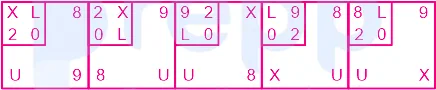
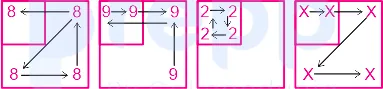
Select the correct mirror image of the given figure when the mirror is placed at the right side of the figure.

- A
Option A (shown in image)
- B
Option B (shown in image)
- C
Option C (shown in image)
- D
Option D (shown in image)
Show answer
C. Option C (shown in image)The correct mirror image of the given figure when the mirror is placed at the right side of the figure is shown below:
Hence, 'option 3' is the correct answer.
 Paper & answer key PDF ↗
 Question 6archived
Select the Venn diagram that best illustrates the relationship between the following classes.
Mobile, Book, Digital device
- A
Option A (shown in image)
- B
Option B (shown in image)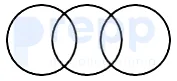
- C
Option C (shown in image)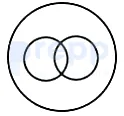
- D
Option D (shown in image)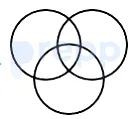
Show answer
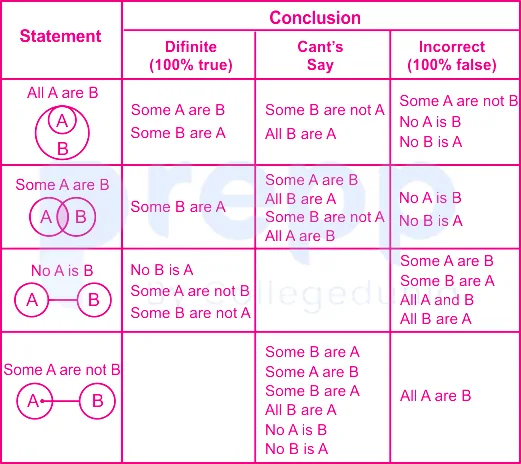
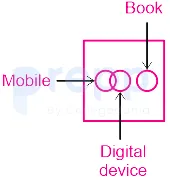
A. Option A (shown in image)The Venn diagram that best illustrates the relationship between Mobile, Book, and Digital device is shown below:
A digital device is an electronic device that can receive, store, process. or send digital information. Mobile phone is a digital device.
Mobile refers to the ability to move or be moved freely or easily.
So, some mobile are digital device.
Book is a written or printed work consisting of pages glued or sewn together along one side and bound in covers.
Hence, 'option 1' is the correct answer.
 Paper & answer key PDF ↗
 Question 7archived
Study the given pattern carefully and select the number that can replace the question mark (?) in it.
(6, 8, 11)
(2, 1, 2)
(6, 7, ?)
(NOTE: Operations should be performed on the whole numbers, without breaking down the numbers into its constituent digits. E.g. 13 - Operations on 13 such as adding/subtracting/multiplying etc. to 13 can be performed. Breaking down 13 into 1 and 3 and then performing mathematical operations on 1 and 3 is not allowed)
- A
12
- B
13
- C
10
- D
4
Show answer
C. 10Solving the Number Pattern Puzzle
The question asks us to identify a pattern in the given sets of numbers and find the missing number represented by the question mark (?). The sets are presented in a vertical format:
(6, 8, 11)
(2, 1, 2)
(6, 7, ?)
This can be viewed as three rows of numbers:
Row
Column 1
Column 2
Column 3
1
6
8
11
2
2
1
2
3
6
7
?
We need to find a logical relationship between the numbers in these rows or columns that holds true for the first two rows and can then be applied to the third row to find the missing number. The rule states that operations should be performed on whole numbers.
Analyzing the Pattern Row by Row
Let's examine each row individually and try to find a relationship between the numbers within the row. Let the numbers in a row be A, B, and C.
Row 1 Analysis: (6, 8, 11)
Numbers are 6, 8, and 11. Let's try common arithmetic operations:
Sum: \(6 + 8 = 14\). \(14\) is not \(11\). Difference is \(14 - 11 = 3\).
Difference: \(8 - 6 = 2\). \(11 - 8 = 3\). (Sequence +2, +3)
Product: \(6 \times 8 = 48\). Not related to \(11\) directly.
Let's consider a pattern like \(A + B - X = C\):
\(6 + 8 - X = 11\)
\(14 - X = 11\)
\(X = 14 - 11 = 3\)
So, for Row 1, the pattern could be \(A + B - 3 = C\).
Row 2 Analysis: (2, 1, 2)
Numbers are 2, 1, and 2. Let's test the pattern found in Row 1: \(A + B - 3 = C\):
\(2 + 1 - 3 = 3 - 3 = 0\)
This result (0) is not the third number (2). This means the value of X in \(A + B - X = C\) might not be constant.
Let's find the required value of X for Row 2 using \(A + B - X = C\):
\(2 + 1 - X = 2\)
\(3 - X = 2\)
\(X = 3 - 2 = 1\)
So, for Row 2, the pattern is \(A + B - 1 = C\).
Identifying the Pattern in X
The value of X needed for the pattern \(A + B - X = C\) is 3 for Row 1 and 1 for Row 2.
The sequence of X values for the first two rows is 3, 1.
Let's assume there is a simple pattern in the values of X across the rows. A simple pattern for 3, 1 could be that it alternates between 3 and 1, or it decreases by 2 each time (but that would give -1 for the next value, which might or might not be valid depending on the overall pattern context). Given the nature of such puzzles, alternation is a common pattern.
Let's assume X alternates between 3 and 1 for the rows: 3, 1, 3, 1, ...
Applying the Pattern to Row 3
Row 3 has numbers (6, 7, ?). Let A=6 and B=7. Based on the alternating pattern for X (3 for Row 1, 1 for Row 2), X for Row 3 should be 3.
Using the pattern \(A + B - X = C\):
\(6 + 7 - 3 = ?\)
\(13 - 3 = ?\)
\(10 = ?\)
The missing number is 10.
Verifying the Solution with Options
Let's check if 10 is one of the given options. The options are 12, 13, 10, 4. Option 3 is 10.
This confirms that our identified pattern \(A + B - X = C\) where X alternates between 3 and 1 is likely correct.
Final Answer Derivation
Based on the pattern observed:
Row 1: \(6 + 8 - 3 = 11\)
Row 2: \(2 + 1 - 1 = 2\)
Row 3: \(6 + 7 - 3 = 10\)
The number that replaces the question mark is 10.
Revision Table: Pattern Analysis Summary
Row
Numbers (A, B, C)
Pattern Used
Calculated C
Given C
1
(6, 8, 11)
\(A + B - 3\)
\(6 + 8 - 3 = 11\)
11
2
(2, 1, 2)
\(A + B - 1\)
\(2 + 1 - 1 = 2\)
2
3
(6, 7, ?)
\(A + B - 3\)
\(6 + 7 - 3 = 10\)
? (10)
Additional Information on Number Patterns and Reasoning
Number pattern and reasoning questions are common in aptitude tests and competitive exams. They assess your ability to identify logical rules governing a sequence or set of numbers. Here are some key concepts and strategies:
Types of Patterns: Patterns can involve arithmetic progressions (constant difference), geometric progressions (constant ratio), or a combination of operations. They can also involve squares, cubes, prime numbers, Fibonacci sequence, or more complex rules.
Looking for Relationships: Analyze the relationship between adjacent numbers, alternate numbers, or numbers in corresponding positions if the pattern is presented in rows/columns or a grid.
Common Operations: Look for addition, subtraction, multiplication, division, squaring, cubing, or combinations of these. Sometimes the pattern involves the sum or difference of digits, but the question explicitly disallowed this here.
Testing Hypotheses: Once a potential pattern is identified from the initial numbers, test it rigorously on the subsequent numbers in the sequence or pattern to confirm its consistency.
Columnar vs. Row-wise Patterns: In grid-like patterns, the relationship might exist between numbers within a row, within a column, or even diagonally. Sometimes, a number might be derived from numbers in previous rows/columns.
Alternating Patterns: Be aware that patterns can alternate between different operations or constant values, as seen in this problem with the alternating subtrahend (3, 1, 3...).
Practice: Solving a variety of pattern questions is key to developing the intuition and skills needed to quickly identify the underlying logic.
Understanding these approaches helps in systematically tackling number pattern and reasoning problems.
Paper & answer key PDF ↗ Question 8archived
Select the word-pair that best represents a similar relationship to the one expressed in the pair of words given below.
Shovel : Scoop
- A
Spanner : Grip
- B
Lever : Cut
- C
Chisel : Grip
- D
Hammer : Iron
Show answer
A. Spanner : GripUnderstanding Word Pair Analogies
Word pair analogies test your ability to identify the relationship between a given pair of words and then find another pair that shares the same relationship. The key is to figure out the precise connection between the first two words.
Analyzing the Given Analogy: Shovel : Scoop
Let's look at the relationship between the words "Shovel" and "Scoop".
A Shovel is a tool.
To Scoop is the primary action or function performed with a shovel (like scooping dirt, sand, or snow).
So, the relationship here is Tool : Primary Action/Function.
Evaluating the Options for a Similar Relationship
Now, we will examine each option to see which word pair best matches the Tool : Primary Action/Function relationship established by "Shovel : Scoop".
Option 1: Spanner : Grip
A Spanner (also known as a wrench) is a tool.
To Grip is a key action performed with a spanner. A spanner is used to grip nuts or bolts to tighten or loosen them. While the ultimate goal might be tightening/loosening, gripping is the immediate action of the tool on the object.
This pair fits the Tool : Primary Action/Function relationship quite well, similar to "Shovel : Scoop". A shovel's function is to scoop; a spanner's function involves gripping.
Option 2: Lever : Cut
A Lever is a simple machine used to lift or move heavy objects with less force.
To Cut is the action performed by tools like knives, scissors, or saws.
A lever's primary function is not cutting. This pair does not represent the Tool : Primary Action/Function relationship in the same way as "Shovel : Scoop".
Option 3: Chisel : Grip
A Chisel is a tool used for cutting, shaping, or carving hard materials.
To Grip is the action of holding something. While you grip a chisel to use it, the primary action of the chisel itself is cutting or shaping the material, not gripping the material.
The relationship here is more like "Tool : How it's held" rather than "Tool : Primary Action". This does not match the "Shovel : Scoop" analogy as closely as Option 1.
Option 4: Hammer : Iron
A Hammer is a tool used for striking.
Iron is a material. A hammer might be made of iron or might be used to hit objects made of iron (like iron nails).
The relationship here is "Tool : Material (of the tool or object acted upon)", not "Tool : Primary Action/Function". This pair does not match the "Shovel : Scoop" analogy.
Conclusion: Identifying the Best Analogy Pair
Comparing all the options, the pair "Spanner : Grip" demonstrates the most similar relationship to "Shovel : Scoop". Both follow the pattern of Tool : Primary Action/Function.
Revision Table: Key Tool Analogies and Relationships
Tool
Primary Action/Function
Analogy Example
Shovel
Scoop
Shovel : Scoop
Spanner
Grip / Turn
Spanner : Grip
Hammer
Strike / Pound
Hammer : Strike
Knife
Cut
Knife : Cut
Saw
Saw / Cut
Saw : Cut
Drill
Drill / Bore
Drill : Bore
Additional Information: Types of Analogies
Word analogies can express various types of relationships. Recognizing these common types can help you solve analogy questions more effectively. Some common types include:
Part-Whole: Finger : Hand (Finger is part of a Hand)
Cause-Effect: Fire : Smoke (Fire causes Smoke)
Synonyms: Happy : Joyful (Happy means Joyful)
Antonyms: Hot : Cold (Hot is opposite of Cold)
Tool-User: Pen : Writer (Writer uses a Pen)
Tool-Action: Shovel : Scoop (Shovel performs the action Scoop)
Object-Purpose: Key : Unlock (Key is used to Unlock)
Worker-Product: Baker : Bread (Baker makes Bread)
Always analyze the core relationship in the given pair before looking at the options. The better you understand the relationship, the easier it is to find the matching pair.
Paper & answer key PDF ↗ Question 9archived
Three of the following four letter-clusters are alike in a certain way and one is different.
Pick the odd one out.
- A
VWZE
- B
TUXC
- C
ABEJ
- D
FGJP
Show answer
D. FGJPQuestion Analysis: Finding the Odd Letter Cluster
The question asks us to find the letter cluster that is different from the other three based on a certain rule or pattern. We are given four letter clusters: VWZE, TUXC, ABEJ, and FGJP.
Identifying the Pattern in Letter Clusters
To solve this type of verbal reasoning problem, we usually look at the position of each letter in the standard English alphabet (A=1, B=2, ..., Z=26) and see how the letters relate to each other within each cluster. We can examine the differences in the alphabetical positions of consecutive letters.
Analyzing Each Option: Letter Positions and Differences
Let's analyze each letter cluster by noting the alphabetical position of its letters and calculating the difference between consecutive letters:
Cluster 1: VWZE
The letters are V, W, Z, E. Their positions are V(22), W(23), Z(26), E(5).
Differences:
From V to W: $23 - 22 = +1$
From W to Z: $26 - 23 = +3$
From Z to E: Moving from Z(26) to E(5) involves wrapping around the alphabet. Counting forward from Z: A(1), B(2), C(3), D(4), E(5). This is a jump of $5$ positions. So the difference is $+5$.
The pattern of differences for VWZE is: $+1, +3, +5$.
Cluster 2: TUXC
The letters are T, U, X, C. Their positions are T(20), U(21), X(24), C(3).
Differences:
From T to U: $21 - 20 = +1$
From U to X: $24 - 21 = +3$
From X to C: Moving from X(24) to C(3) involves wrapping around. Counting forward from X: Y(25), Z(26), A(1), B(2), C(3). This is a jump of $5$ positions. So the difference is $+5$.
The pattern of differences for TUXC is: $+1, +3, +5$.
Cluster 3: ABEJ
The letters are A, B, E, J. Their positions are A(1), B(2), E(5), J(10).
Differences:
From A to B: $2 - 1 = +1$
From B to E: $5 - 2 = +3$
From E to J: $10 - 5 = +5$
The pattern of differences for ABEJ is: $+1, +3, +5$.
Cluster 4: FGJP
The letters are F, G, J, P. Their positions are F(6), G(7), J(10), P(16).
Differences:
From F to G: $7 - 6 = +1$
From G to J: $10 - 7 = +3$
From J to P: $16 - 10 = +6$
The pattern of differences for FGJP is: $+1, +3, +6$.
Comparing the Patterns
Let's put the patterns of differences for each letter cluster side-by-side:
Letter Cluster
Pattern of Differences
VWZE
$+1, +3, +5$
TUXC
$+1, +3, +5$
ABEJ
$+1, +3, +5$
FGJP
$+1, +3, +6$
Identifying the Odd One Out Letter Cluster
We can see that the letter clusters VWZE, TUXC, and ABEJ all follow the same pattern of differences in letter positions: adding $1$, then adding $3$, then adding $5$.
However, the letter cluster FGJP follows a different pattern: adding $1$, then adding $3$, then adding $6$. The last difference is $+6$ instead of $+5$.
Therefore, FGJP is the letter cluster that is different from the other three, making it the odd one out.
Revision Table: Letter Cluster Analysis
Cluster
Letter Positions
Differences
Pattern
VWZE
22, 23, 26, 5
$+1, +3, +5$
$+1, +3, +5$
TUXC
20, 21, 24, 3
$+1, +3, +5$
$+1, +3, +5$
ABEJ
1, 2, 5, 10
$+1, +3, +5$
$+1, +3, +5$
FGJP
6, 7, 10, 16
$+1, +3, +6$
$+1, +3, +6$
Additional Information: Solving Letter Reasoning Problems
Solving letter series and letter cluster problems often involves understanding the basic structure of the alphabet and looking for mathematical or sequential patterns. Here are some key strategies:
Assign numerical values to letters (A=1, B=2, etc.). This converts the problem into a numerical pattern recognition task.
Calculate differences between consecutive letters' positions. Look for constant differences, arithmetic progressions, or other numerical sequences.
Consider patterns based on vowels and consonants.
Look for reverse alphabetical order or alternating patterns.
Be mindful of wrap-around from Z back to A when calculating differences.
Practicing a variety of problems helps in recognizing different types of patterns quickly.
Paper & answer key PDF ↗ Question 10archived
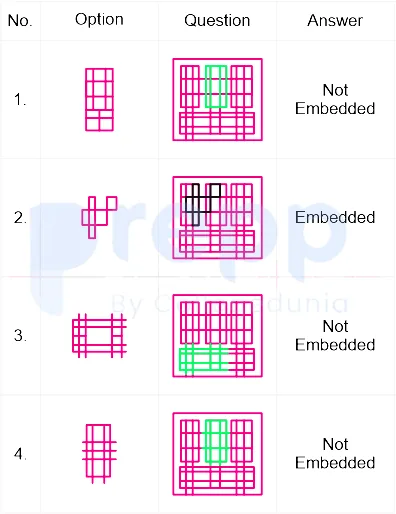
Select the option figure which is embedded in the given figure as its part (rotation is NOT allowed).

- A
Option A (shown in image)
- B
Option B (shown in image)
- C
Option C (shown in image)
- D
Option D (shown in image)
Show answer
B. Option B (shown in image)The image embedded in given figure is as shown below:
Hence, 'option 2' is the correct answer.
 Paper & answer key PDF ↗
 Question 11archived
Which two signs and numbers need to be interchanged to make the following equation correct?
(31 × 3) - (27 × 4) + (81 ÷ 9) = 126
- A
27 and 81, + and -
- B
31 and 27, + and -
- C
3 and 4, ÷ and +
- D
27 and 9, + and -
Show answer
D. 27 and 9, + and -Equation Interchange: Finding Correct Sign and Number Swaps
The question asks us to find which pair of numbers and which pair of signs, when swapped simultaneously in the given equation, makes the equation correct. The original equation is:
$(31 \times 3) - (27 \times 4) + (81 \div 9) = 126$
Let's first evaluate the original equation to see if it's already correct:
$(31 \times 3) = 93$
$(27 \times 4) = 108$
$(81 \div 9) = 9$
Substituting these values into the original equation:
$93 - 108 + 9 = -15 + 9 = -6$
The original equation evaluates to -6, which is not equal to 126. So, we need to perform an interchange as suggested by the options.
We will test each option by swapping the specified numbers and signs in the equation and calculating the result.
Testing Option 1: Interchange 27 and 81, + and -
Original Equation: $(31 \times 3) \text{ - } (27 \times 4) \text{ + } (81 \div 9) = 126$
Swap 27 with 81 and + with -:
New Equation: $(31 \times 3) \text{ + } (81 \times 4) \text{ - } (27 \div 9) = ?$
Calculate the values within the parentheses:
$(31 \times 3) = 93$
$(81 \times 4) = 324$
$(27 \div 9) = 3$
Substitute these values into the new equation:
$93 + 324 - 3 = 417 - 3 = 414$
Since $414 \neq 126$, this option is incorrect.
Testing Option 2: Interchange 31 and 27, + and -
Original Equation: $(31 \times 3) \text{ - } (27 \times 4) \text{ + } (81 \div 9) = 126$
Swap 31 with 27 and + with -:
New Equation: $(27 \times 3) \text{ + } (31 \times 4) \text{ - } (81 \div 9) = ?$
Calculate the values within the parentheses:
$(27 \times 3) = 81$
$(31 \times 4) = 124$
$(81 \div 9) = 9$
Substitute these values into the new equation:
$81 + 124 - 9 = 205 - 9 = 196$
Since $196 \neq 126$, this option is incorrect.
Testing Option 3: Interchange 3 and 4, ÷ and +
Original Equation: $(31 \times 3) \text{ - } (27 \times 4) \text{ + } (81 \div 9) = 126$
Swap 3 with 4 and $\div$ with +:
New Equation: $(31 \times 4) \text{ - } (27 \times 3) \text{ \(\div\) } (81 + 9) = ?$
Calculate the values within the parentheses:
$(31 \times 4) = 124$
$(27 \times 3) = 81$
$(81 + 9) = 90$
Substitute these values into the new equation:
$124 - 81 \div 90$
According to the order of operations (BODMAS/PEMDAS), division is performed before subtraction:
$81 \div 90 = \frac{81}{90} = \frac{9 \times 9}{9 \times 10} = \frac{9}{10} = 0.9$
$124 - 0.9 = 123.1$
Since $123.1 \neq 126$, this option is incorrect.
Testing Option 4: Interchange 27 and 9, + and -
Original Equation: $(31 \times 3) \text{ - } (27 \times 4) \text{ + } (81 \div 9) = 126$
Swap 27 with 9 and + with -:
New Equation: $(31 \times 3) \text{ + } (9 \times 4) \text{ - } (81 \div 27) = ?$
Calculate the values within the parentheses:
$(31 \times 3) = 93$
$(9 \times 4) = 36$
$(81 \div 27) = 3$
Substitute these values into the new equation:
$93 + 36 - 3 = 129 - 3 = 126$
Since $126 = 126$, this option makes the equation correct.
Therefore, interchanging the numbers 27 and 9, and the signs + and - makes the given equation correct.
Revision Table: Summary of Options Tested
Option
Interchange
New Equation
Result
Correct?
1
27 <-> 81, + <-> -
$(31 \times 3) \text{ + } (81 \times 4) \text{ - } (27 \div 9)$
414
No
2
31 <-> 27, + <-> -
$(27 \times 3) \text{ + } (31 \times 4) \text{ - } (81 \div 9)$
196
No
3
3 <-> 4, ÷ <-> +
$(31 \times 4) \text{ - } (27 \times 3) \text{ \(\div\) } (81 + 9)$
123.1
No
4
27 <-> 9, + <-> -
$(31 \times 3) \text{ + } (9 \times 4) \text{ - } (81 \div 27)$
126
Yes
Additional Information: Order of Operations (BODMAS/PEMDAS)
When evaluating mathematical expressions, it's crucial to follow the correct order of operations. A common acronym for this order is BODMAS or PEMDAS.
BODMAS:
Brackets (Parentheses)
Orders (Exponents, Square Roots, etc.)
Division and Multiplication (from left to right)
Addition and Subtraction (from left to right)
PEMDAS:
Parentheses
Exponents
Multiplication and Division (from left to right)
Addition and Subtraction (from left to right)
In this problem, we first evaluated the expressions within the parentheses, then performed multiplication and division, and finally addition and subtraction, following the standard order of operations.
Paper & answer key PDF ↗ Question 12archived
The second number in the given number-pairs is obtained by performing certain mathematical operation(s) on the first number. The same operation(s) is/are followed in all the number-pairs except one. Find that odd number-pair.
- A
16 : 2
- B
100 : 5
- C
36 : 3
- D
186 : 7
Show answer
D. 186 : 7The question asks us to identify the number pair that does not follow the same mathematical operation rule as the others. We need to analyze each given pair and find the relationship between the first and second number.
Analyzing the Number Pairs for Pattern
Let's examine the pairs:
16 : 2
100 : 5
36 : 3
186 : 7
We look for a consistent mathematical operation that transforms the first number into the second number in most of the pairs.
Checking Common Operations
Let's consider potential relationships like addition, subtraction, multiplication, division, squares, square roots, cubes, cube roots, sum/product of digits, etc.
Let's test the square root relationship for the pairs where the first number is a perfect square:
For 16 : 2, the square root of 16 is 4 ($ \sqrt{16} = 4 $). How can we get 2 from 4? By dividing by 2 ($ 4 / 2 = 2 $). So, the operation could be $ \frac{\sqrt{\text{First Number}}}{2} = \text{Second Number} $. Let's check this pattern for other pairs.
For 100 : 5, the square root of 100 is 10 ($ \sqrt{100} = 10 $). Using the proposed operation: $ \frac{\sqrt{100}}{2} = \frac{10}{2} = 5 $. This matches the second number in the pair.
For 36 : 3, the square root of 36 is 6 ($ \sqrt{36} = 6 $). Using the proposed operation: $ \frac{\sqrt{36}}{2} = \frac{6}{2} = 3 $. This matches the second number in the pair.
The pattern $ \text{Second Number} = \frac{\sqrt{\text{First Number}}}{2} $ holds true for the first three number pairs: 16:2, 100:5, and 36:3. This suggests that the odd number pair is the one that does not follow this specific mathematical operation.
Testing the Odd Number Pair Candidate
Now let's test the fourth pair, 186 : 7, using the same operation.
For 186 : 7, we need to check if $ \frac{\sqrt{186}}{2} = 7 $.
First, let's find the square root of 186. 186 is not a perfect square. $ 13^2 = 169 $ and $ 14^2 = 196 $. So, $ \sqrt{186} $ is a value between 13 and 14. Approximately, $ \sqrt{186} \approx 13.64 $.
Now, apply the operation: $ \frac{\sqrt{186}}{2} \approx \frac{13.64}{2} \approx 6.82 $.
The result $ \approx 6.82 $ is close to 7, but it is not exactly 7. More importantly, for the pattern $ \frac{\sqrt{N}}{2} $ to yield an integer result for the second number, $N$ must be a perfect square whose square root is an even number. 16, 100, and 36 are perfect squares ($\sqrt{16}=4$, $\sqrt{100}=10$, $\sqrt{36}=6$), and their square roots are even, allowing division by 2 to yield integers (2, 5, 3). 186 is not a perfect square, so $ \sqrt{186} $ is irrational, and $ \frac{\sqrt{186}}{2} $ cannot be the integer 7.
Therefore, the number pair 186 : 7 does not follow the same rule as the other three pairs.
Conclusion
The consistent mathematical operation followed by the first three number pairs (16:2, 100:5, and 36:3) is that the second number is equal to half the square root of the first number ($ \text{Second} = \frac{\sqrt{\text{First}}}{2} $). The pair 186 : 7 does not fit this pattern because 186 is not a perfect square that would yield 7 after this operation.
Number Pair
First Number (N)
Operation $ \frac{\sqrt{N}}{2} $
Result
Second Number
Follows Pattern?
16 : 2
16
$ \frac{\sqrt{16}}{2} = \frac{4}{2} $
2
2
Yes
100 : 5
100
$ \frac{\sqrt{100}}{2} = \frac{10}{2} $
5
5
Yes
36 : 3
36
$ \frac{\sqrt{36}}{2} = \frac{6}{2} $
3
3
Yes
186 : 7
186
$ \frac{\sqrt{186}}{2} \approx \frac{13.64}{2} $
$ \approx 6.82 $
7
No
Thus, 186 : 7 is the odd number-pair.
Revision Table: Number Pair Analysis
Number Pair
First Number
Second Number
Observed Pattern ($ \text{Second} = \frac{\sqrt{\text{First}}}{2} $)
16 : 2
16
2
$ \frac{\sqrt{16}}{2} = \frac{4}{2} = 2 $ (Matches)
100 : 5
100
5
$ \frac{\sqrt{100}}{2} = \frac{10}{2} = 5 $ (Matches)
36 : 3
36
3
$ \frac{\sqrt{36}}{2} = \frac{6}{2} = 3 $ (Matches)
186 : 7
186
7
$ \frac{\sqrt{186}}{2} \approx 6.82 $ (Does not match)
Additional Information: Number Pattern Logic
Finding patterns in number series or number pairs is a common type of logical reasoning question. These questions test your ability to observe relationships and apply mathematical operations. Here are some tips for approaching such problems:
Look for basic arithmetic operations (addition, subtraction, multiplication, division).
Consider squares, cubes, square roots, cube roots of the numbers.
Check for patterns related to the digits of the numbers (sum of digits, product of digits, reversing digits).
Look for relationships between consecutive numbers or positions in a series.
Sometimes, the pattern might involve multiple steps or a combination of operations.
Test your hypothesized pattern on all given examples to ensure consistency.
If one pattern doesn't fit all, look for an alternative pattern.
In this specific question, recognizing the perfect squares (16, 100, 36) was key to identifying the square root operation pattern.
Paper & answer key PDF ↗ Question 13archived
Select the option that represents the correct order of the given words as they would appear in an English dictionary.
1. Absurdly
2. Abstriction
3. Abstract
4. Absolutely
5. Abstain
6. Absorber
- A
6, 4, 3, 5, 2, 1
- B
4, 6, 3, 5, 1, 2
- C
6, 4, 5, 3, 2, 1
- D
4, 6, 5, 3, 2, 1
Show answer
D. 4, 6, 5, 3, 2, 1Finding Dictionary Order for Words
To arrange words in the correct dictionary order, we compare them letter by letter starting from the beginning. The word with the letter that comes earlier in the alphabet at the first point of difference will appear earlier in the dictionary.
Words to Order
We are given the following words with their corresponding numbers:
Absurdly
Abstriction
Abstract
Absolutely
Abstain
Absorber
Step-by-Step Comparison for Dictionary Order
Let's compare the words letter by letter:
All words start with "Ab". This doesn't help us differentiate.
The next letter is 's' for Absurdly, Abstriction, Abstract, Abstain, and 'o' for Absolutely and Absorber. Since 'o' comes before 's' in the alphabet, Absolutely (4) and Absorber (6) will come before the others.
Now let's compare Absolutely (4) and Absorber (6). Both start with "Absol". The next letter in Absolutely is 'u' and in Absorber is 'r'. Since 'r' comes before 'u', Absorber (6) comes before Absolutely (4). Wait, let's recheck. Absolutely is Absolutely, Absorber is Absorber. 'l' comes before 'r'. So, Absolutely (4) comes before Absorber (6).
The order so far: Absolutely (4), Absorber (6).
Now let's look at the words starting with "Abs": Absurdly (1), Abstriction (2), Abstract (3), Abstain (5). All start with "Abs".
The next letter: 'u' for Absurdly (1), 't' for Abstriction (2), Abstract (3), Abstain (5). Since 't' comes before 'u', the words starting with "Abst" come before Absurdly (1).
Now let's compare Abstriction (2), Abstract (3), Abstain (5). All start with "Abst".
The next letter: 'a' for Abstain (5), 'r' for Abstract (3), 'r' for Abstriction (2). Since 'a' comes before 'r', Abstain (5) comes first among these three.
Now compare Abstract (3) and Abstriction (2). Both start with "Abstr".
The next letter: 'a' for Abstract (3), 'i' for Abstriction (2). Since 'a' comes before 'i', Abstract (3) comes before Abstriction (2).
So, the order for words starting with "Abst" is: Abstain (5), Abstract (3), Abstriction (2).
Finally, Absurdly (1) comes last as it starts with "Absu".
Putting it all together, the correct dictionary order of the words is:
Absolutely (4)
Absorber (6)
Abstain (5)
Abstract (3)
Abstriction (2)
Absurdly (1)
The correct sequence of numbers is 4, 6, 5, 3, 2, 1.
Comparing with Options
Let's compare our derived order (4, 6, 5, 3, 2, 1) with the given options:
Option
Order
Matches Derived Order?
1
6, 4, 3, 5, 2, 1
No
2
4, 6, 3, 5, 1, 2
No
3
6, 4, 5, 3, 2, 1
No
4
4, 6, 5, 3, 2, 1
Yes
Option 4 matches the correct dictionary order we determined.
Revision Table: Key Learnings on Dictionary Order
Concept
Description
Application
Alphabetical Comparison
Comparing words letter by letter from left to right.
Essential for finding dictionary order.
First Point of Difference
The letter where two words first differ determines their order.
If 'a' is the first differing letter in word A and 'b' in word B, word A comes first.
Shorter vs. Longer Words
If one word is a prefix of another (e.g., "app" and "apple"), the shorter word comes first. (Not applicable in this specific question, but a general rule).
"Go" comes before "Going".
Additional Information: Alphabetical Order Rules
Understanding alphabetical order is fundamental for using dictionaries, encyclopedias, and sorted lists. Here are some important points:
Comparison starts with the first letter. If they are the same, move to the second letter, and so on.
Spaces and hyphens are usually ignored or treated specially depending on the sorting rules (though not relevant for single words).
Capitalization is typically ignored in standard dictionary order (e.g., "Apple" and "apple" would be sorted together).
Numbers are usually sorted before letters.
Understanding letter order (a-z) is crucial.
Practicing with different sets of words helps build speed and accuracy in determining dictionary order.
Paper & answer key PDF ↗ Question 14archived
Select the Venn diagram that best illustrates the relationship between the following classes.
Player, Captain, Coach
- A
Option A (shown in image)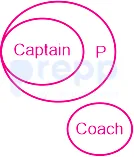
- B
Option B (shown in image)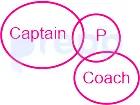
- C
Option C (shown in image)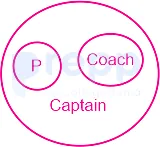
- D
Option D (shown in image)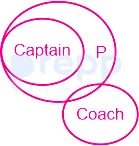
Show answer
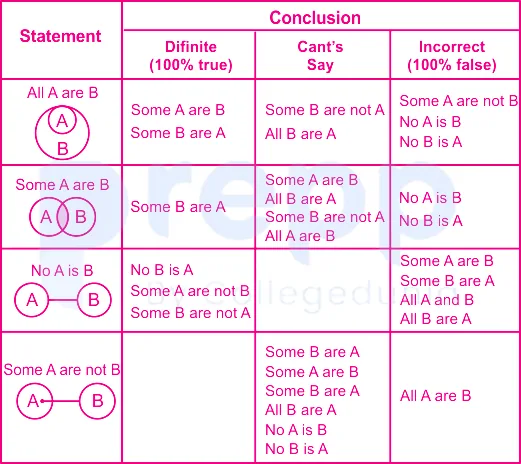
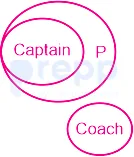
A. Option A (shown in image)The Venn diagram that best illustrates the relationship between Player, Captain, and Coach is:
Captain is one of the Players only.
So, Captain is a player.
Coach is a person who trains the players.
Hence, ‘option 1’ is the correct answer.
 Paper & answer key PDF ↗
 Question 15archived
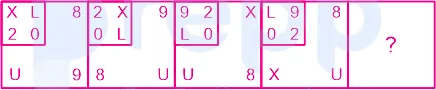
Select the figure from the options that can replace the question mark (?) and complete the given pattern.
- A
Option A (shown in image)
- B
Option B (shown in image)
- C
Option C (shown in image)
- D
Option D (shown in image)
Show answer
Question 16archived
Select the option that is related to the fifth term in the same way as the second term is related to the first term and the fourth term is related to the third term.
24 : 2 :: 81 : 3 :: 375 : ?
- A
15
- B
5
- C
9
- D
7
Show answer
B. 5Understanding the Reasoning Analogy Question
This question asks us to find a relationship between pairs of numbers. The relationship that connects the first pair (24 and 2) is the same as the relationship connecting the second pair (81 and 3). We need to apply this same relationship to the third term (375) to find the missing fifth term.
The given pairs illustrating the reasoning analogy are:
24 : 2
81 : 3
375 : ?
Analyzing the Relationship between the Number Pairs
Let's carefully examine the first two pairs provided in the analogy to uncover the hidden pattern or rule.
Analyzing the Pair 81 : 3
Let's start with the pair 81 and 3. We should look for a mathematical relationship between these two numbers. Notice that 81 is a power of 3:
$\qquad 3^1 = 3$
$\qquad 3^2 = 9$
$\qquad 3^3 = 27$
$\qquad 3^4 = 81$
So, we find that $81 = 3^4$. In this relationship, the second term, 3, is the base of the power that results in the first term (when the exponent is 4, and multiplied by 1).
Analyzing the Pair 24 : 2
Now let's apply a similar thinking process to the first pair, 24 and 2. Is 24 a power of 2? Let's check:
$\qquad 2^1 = 2$
$\qquad 2^2 = 4$
$\qquad 2^3 = 8$
$\qquad 2^4 = 16$
$\qquad 2^5 = 32$
24 is not directly a power of 2. However, we can express 24 by using 2 as a base in its prime factorization:
$\qquad 24 = 8 \times 3$
Since $8 = 2^3$, we can write:
$\qquad 24 = 3 \times 2^3$
Here, the first number (24) is obtained by multiplying a small integer (3) by the second number (2) raised to a power (3). The second term, 2, is the base of this power.
Identifying the Consistent Pattern in the Reasoning Analogy
Let's summarize the relationships found for the first two pairs:
For 81 : 3, the relationship is $81 = 1 \times 3^4$. The first number is $1 \times (\text{second number})^{\text{power}}$.
For 24 : 2, the relationship is $24 = 3 \times 2^3$. The first number is $3 \times (\text{second number})^{\text{power}}$.
The common pattern in this reasoning analogy is that the first number in each pair can be expressed as a small integer ($X$) multiplied by the second number in the pair ($B$) raised to an integer power ($n$), where $n \ge 3$. The second number ($B$) is the base in this expression ($First Number = X \times B^n$). In the given examples, $X$ is either 1 or 3, and $n$ is either 3 or 4.
Applying the Pattern to Find the Missing Term in 375 : ?
Now, we apply this consistent pattern to the third pair, 375 : ?. We need to find the missing term (let's call it $B$) such that 375 can be written in the form $X \times B^n$, where $X$ is a small integer and $n \ge 3$. The missing term will be this base $B$.
Let's find the prime factorization of 375:
$\qquad 375 = 5 \times 75$
$\qquad 75 = 3 \times 25$
$\qquad 25 = 5 \times 5 = 5^2$
So, $375 = 5 \times 3 \times 5^2 = 3 \times 5^3$.
This expression fits the pattern $X \times B^n$ with $X=3$, $B=5$, and $n=3$. The base $B$ is 5.
Therefore, according to the pattern, the missing term in the analogy 375 : ? is 5.
Summary of the Reasoning Analogy Pattern
Pair
First Term
Second Term
Relationship based on pattern ($X \times B^n$)
Identified Base (Second Term)
1st
24
2
$3 \times 2^3$
2
2nd
81
3
$1 \times 3^4$
3
3rd
375
?
$3 \times 5^3$
5
The base of the power term (multiplied by a small integer) consistently gives the second number in each pair of the analogy.
Conclusion
Following the pattern identified in the first two pairs, where the first term is $X$ times the second term raised to a power, we expressed 375 as $3 \times 5^3$. The base of the power in this expression is 5. Thus, the missing term is 5.
Reviewing the given options:
Option 1: 15
Option 2: 5
Option 3: 9
Option 4: 7
The missing term that fits the pattern is 5, which corresponds to Option 2.
Reasoning Analogy Problem Revision Table
Concept
Explanation
Application in this Problem
Analogy
Identifying equivalent relationships between different sets of items.
Finding the consistent rule between (24, 2), (81, 3), and (375, ?).
Pattern Recognition
The ability to find underlying rules or structures in a sequence or set.
Crucial for identifying the mathematical operation connecting the numbers in each pair.
Prime Factorization
Breaking a number down into its prime number components.
Helpful in analyzing 24, 81, and 375 to find potential bases and exponents. ($24=2^3 \times 3$, $81=3^4$, $375=3 \times 5^3$).
Exponents and Bases
Understanding how numbers are formed by raising a base to a power.
The core pattern involves expressing the first number as $X \times \text{Base}^{\text{power}}$.
Additional Information on Solving Reasoning Questions
Reasoning questions, especially numerical ones like this analogy, test your ability to observe, analyze, and find logical connections. Here are some tips for tackling such problems:
Look for simple arithmetic operations: Addition, subtraction, multiplication, division.
Consider squares and cubes: Check if numbers are perfect squares or cubes, or related to them.
Analyze digits: Look for patterns involving the sum, product, or arrangement of digits.
Check prime numbers and factors: Prime factorization can reveal important structural properties of the numbers.
Think about number bases: Sometimes, numbers in a different base show a simpler pattern.
Combine operations: The pattern might involve a sequence of different operations.
Be systematic: Test one type of pattern at a time (e.g., first check arithmetic, then powers, then digits).
Look for consistency: The pattern must apply to all given pairs in the analogy.
Practice with various types of number series and analogy problems will help you become quicker at recognizing different patterns.
Paper & answer key PDF ↗ Question 17archived
In a certain code language,
'meet them now' is coded as 'el cn ah';
'never meet alone' is coded as 'cn sm uv' and
'not alone now' is coded as 'ah sm rt'.
(All the codes are two-letter codes only.)
How will 'not them' be coded in that language?
- A
rt sm
- B
el uv
- C
el rt
- D
uv cn
Show answer
C. el rtDecoding the Code Language: Finding 'not them'
This question involves decoding a simple code language based on provided phrases and their corresponding codes. We are given three statements relating phrases to sets of two-letter codes. The key to solving this type of problem is to compare the statements to find common words and their corresponding common codes.
Step-by-Step Decoding Process
Let's list the given statements and their codes:
'meet them now' is coded as 'el cn ah' (Statement 1)
'never meet alone' is coded as 'cn sm uv' (Statement 2)
'not alone now' is coded as 'ah sm rt' (Statement 3)
Comparing Statements to Find Common Codes
Compare Statement 1 and Statement 2:
Common word: 'meet'
Common code: 'cn'
Conclusion: The code for 'meet' is 'cn'.
Compare Statement 1 and Statement 3:
Common word: 'now'
Common code: 'ah'
Conclusion: The code for 'now' is 'ah'.
Compare Statement 2 and Statement 3:
Common word: 'alone'
Common code: 'sm'
Conclusion: The code for 'alone' is 'sm'.
Using Decoded Words to Find Remaining Codes
Now we can substitute the codes we found back into the original statements to find the codes for the remaining words.
From Statement 1: 'meet them now' = 'el cn ah'. We know 'meet' is 'cn' and 'now' is 'ah'. So, 'cn them ah' = 'el cn ah'. By eliminating the known codes, we find that 'them' corresponds to 'el'.
From Statement 2: 'never meet alone' = 'cn sm uv'. We know 'meet' is 'cn' and 'alone' is 'sm'. So, 'never cn sm' = 'cn sm uv'. By eliminating the known codes, we find that 'never' corresponds to 'uv'.
From Statement 3: 'not alone now' = 'ah sm rt'. We know 'alone' is 'sm' and 'now' is 'ah'. So, 'not sm ah' = 'ah sm rt'. By eliminating the known codes, we find that 'not' corresponds to 'rt'.
Summary of Decoded Words and Codes
We have now decoded all the words present in the given phrases:
Word
Code
meet
cn
them
el
now
ah
never
uv
alone
sm
not
rt
Coding 'not them'
The question asks for the code for 'not them'. Based on our decoding:
The code for 'not' is 'rt'.
The code for 'them' is 'el'.
Therefore, 'not them' will be coded as 'rt el' or 'el rt'. The order of the codes for multiple words in a phrase usually does not matter in these types of coding questions unless specified.
Looking at the options provided, the code 'el rt' is present.
Revision Table: Code Language Concepts
Concept
Explanation
Code Language
A system where words, phrases, or letters are represented by alternative symbols or words.
Decoding
The process of converting a coded message back into its original form.
Comparison Method
A common technique in coding-decoding problems where different coded phrases are compared to find common elements (words/codes) to deduce their mappings.
Additional Information: Solving Coding-Decoding Problems
Solving coding-decoding questions often relies on identifying patterns or rules. In this specific type of coding, where phrases are given with their codes (often represented by sets of words or two-letter codes), the standard approach is comparison. By comparing different phrases and their codes, you can isolate the code for each individual word that appears in multiple phrases.
Here are some tips for solving such problems:
List the given information clearly.
Compare pairs of statements to find common words and their corresponding codes.
Once a word's code is found, use it to eliminate possibilities in other statements.
Continue comparing and eliminating until the codes for the required words are identified.
Pay attention to whether the order of codes matters (it usually doesn't in phrase-to-code set problems unless specified).
This systematic comparison method helps break down complex coding puzzles into simpler steps.
Paper & answer key PDF ↗ Question 18archived
Which of the following interchange of numbers would make the given equation correct?
5 × 15 ÷ 3 + 20 - 9 = 4
- A
5, 20
- B
3, 9
- C
4, 20
- D
15, 20
Show answer
C. 4, 20Understanding the Equation Correction Problem
The problem asks us to find which pair of number interchanges will make the given mathematical equation true. The initial equation is: \(5 \times 15 \div 3 + 20 - 9 = 4\). Let's first evaluate the given equation using the order of operations (BODMAS/PEMDAS):
Brackets/Parentheses
Orders/Exponents
Division and Multiplication (from left to right)
Addition and Subtraction (from left to right)
Evaluating the original equation:
\(5 \times 15 \div 3 + 20 - 9\)
\(5 \times (15 \div 3) + 20 - 9\)
\(5 \times 5 + 20 - 9\)
\(25 + 20 - 9\)
\(45 - 9\)
\(36\)
So, the original equation is \(36 = 4\), which is false. We need to test the given options for number interchanges to see which one results in a true equation.
Testing Number Interchange Option 1: 5 and 20
If we interchange the numbers 5 and 20 in the equation \(5 \times 15 \div 3 + 20 - 9 = 4\), the new equation becomes:
\(20 \times 15 \div 3 + 5 - 9 = 4\)
Now, let's evaluate the left side of this new equation:
\(20 \times 15 \div 3 + 5 - 9\)
\(20 \times (15 \div 3) + 5 - 9\)
\(20 \times 5 + 5 - 9\)
\(100 + 5 - 9\)
\(105 - 9\)
\(96\)
The new equation is \(96 = 4\), which is false. So, this interchange does not make the equation correct.
Testing Number Interchange Option 2: 3 and 9
If we interchange the numbers 3 and 9 in the equation \(5 \times 15 \div 3 + 20 - 9 = 4\), the new equation becomes:
\(5 \times 15 \div 9 + 20 - 3 = 4\)
Now, let's evaluate the left side of this new equation:
\(5 \times 15 \div 9 + 20 - 3\)
\(5 \times (15 \div 9) + 20 - 3\)
\(5 \times \frac{15}{9} + 20 - 3\)
\(5 \times \frac{5}{3} + 17\)
\(\frac{25}{3} + 17\)
\(\frac{25 + (17 \times 3)}{3}\)
\(\frac{25 + 51}{3}\)
\(\frac{76}{3}\)
The new equation is \(\frac{76}{3} = 4\), which is false. So, this interchange does not make the equation correct.
Testing Number Interchange Option 3: 4 and 20
If we interchange the number 4 (the result on the right side) and the number 20 (a number on the left side) in the equation \(5 \times 15 \div 3 + 20 - 9 = 4\), the new equation becomes:
\(5 \times 15 \div 3 + 4 - 9 = 20\)
Now, let's evaluate the left side of this new equation:
\(5 \times 15 \div 3 + 4 - 9\)
\(5 \times (15 \div 3) + 4 - 9\)
\(5 \times 5 + 4 - 9\)
\(25 + 4 - 9\)
\(29 - 9\)
\(20\)
The new equation is \(20 = 20\), which is true. So, this interchange makes the equation correct.
Testing Number Interchange Option 4: 15 and 20
If we interchange the numbers 15 and 20 in the equation \(5 \times 15 \div 3 + 20 - 9 = 4\), the new equation becomes:
\(5 \times 20 \div 3 + 15 - 9 = 4\)
Now, let's evaluate the left side of this new equation:
\(5 \times 20 \div 3 + 15 - 9\)
\(5 \times (20 \div 3) + 15 - 9\)
\(5 \times \frac{20}{3} + 6\)
\(\frac{100}{3} + 6\)
\(\frac{100 + (6 \times 3)}{3}\)
\(\frac{100 + 18}{3}\)
\(\frac{118}{3}\)
The new equation is \(\frac{118}{3} = 4\), which is false. So, this interchange does not make the equation correct.
Conclusion on Number Interchange
Based on the evaluation of each option, interchanging the numbers 4 and 20 is the only option that results in a correct mathematical equation (\(20 = 20\)).
Interchange Option
New Equation
Evaluation
Correct?
5, 20
\(20 \times 15 \div 3 + 5 - 9 = 4\)
\(96\)
No (\(96 \neq 4\))
3, 9
\(5 \times 15 \div 9 + 20 - 3 = 4\)
\(\frac{76}{3}\)
No (\(\frac{76}{3} \neq 4\))
4, 20
\(5 \times 15 \div 3 + 4 - 9 = 20\)
\(20\)
Yes (\(20 = 20\))
15, 20
\(5 \times 20 \div 3 + 15 - 9 = 4\)
\(\frac{118}{3}\)
No (\(\frac{118}{3} \neq 4\))
Revision Table: Key Concepts
Concept
Description
Order of Operations
A rule (like BODMAS/PEMDAS) that specifies the sequence in which mathematical operations should be performed to evaluate an expression.
Number Interchange
Swapping the positions or values of two specific numbers within a mathematical expression or equation.
Equation
A mathematical statement that asserts the equality of two expressions.
Additional Information: Solving Equation Problems
Solving equation problems, especially those involving number or sign interchanges, requires careful application of the order of operations and systematic testing of each possibility provided in the options. This type of problem tests your understanding of arithmetic operations and logical reasoning.
Always evaluate the original expression or equation first to understand the starting point.
For interchange problems, substitute the numbers as specified in each option.
Re-evaluate the modified equation carefully, following the correct order of operations.
Compare the result of the evaluation with the expected result of the equation (which might also change if the number being interchanged is on the right side).
The option that results in a true statement (Left Side = Right Side) is the correct answer.
Practicing different types of number and sign interchange problems helps improve speed and accuracy in competitive exams.
Paper & answer key PDF ↗ Question 19archived
Select the option that represents the letters that, when placed from left to right in the blanks below, will complete the letter series.
D _ B A _ C B _ D C B _ D _ B A
- A
C D A A C
- B
D B C A C
- C
D C B C A
- D
C B D C A
Show answer
A. C D A A CSolving Letter Series Completion Problems
Letter series completion questions test your ability to identify patterns in a sequence of letters. To solve these, you need to look for repeating blocks, skips, alphabetical order variations, or other logical rules that govern the sequence.
Analyzing the Given Letter Series
The incomplete letter series is given as:
D _ B A _ C B _ D C B _ D _ B A
There are 16 positions in total, with 5 blanks to fill. We need to find the sequence of letters that fits into these blanks to complete the series based on a consistent pattern.
Applying the Options to Find the Pattern
Let's try inserting the letters from the provided correct option, which is C D A A C, into the blanks from left to right.
Original series with blanks:
D _ B A _ C B _ D C B _ D _ B A
Inserting the letters C, D, A, A, C into the blanks:
D C B A D C B A D C B A D C B A
Identifying the Repeating Pattern
Let's look at the completed series:
D C B A D C B A D C B A D C B A
Upon observing the completed series, we can clearly see a repeating block of letters: D C B A.
The series is formed by repeating the sequence D C B A four times consecutively.
The first block is positions 1-4: D C B A
The second block is positions 5-8: D C B A
The third block is positions 9-12: D C B A
The fourth block is positions 13-16: D C B A
This confirms that the letters C D A A C, when placed in the blanks, complete the series into a consistent and repeating pattern of D C B A.
Conclusion
By filling the blanks with the letters C, D, A, A, and C, the series becomes D C B A D C B A D C B A D C B A, which is a clear repeating pattern of 'DCBA'. Therefore, the option C D A A C correctly completes the letter series.
Revision Table: Key Concepts in Letter Series
Concept
Description
Example Pattern Type
Repeating Block
A specific sequence of letters repeats throughout the series.
ABC ABC ABC...
Alphabetical Gap
Letters follow alphabetical order with a fixed or changing gap.
A C E G... (gap of 1)
Reverse Alphabetical Order
Letters follow alphabetical order in reverse.
Z Y X W...
Mixed Patterns
Combination of different rules or multiple interwoven series.
AZ BY CX...
Additional Information: Solving Letter Series Questions
Solving letter series questions effectively requires a systematic approach:
Count the total number of letters: This helps in identifying potential block lengths (e.g., if there are 16 letters, blocks of 4 or 8 are possible).
Break the series into potential blocks: Divide the series (including blanks) into equal parts based on the total count and look for similarities between corresponding positions in different blocks.
Look for repeating sequences: Identify if a specific group of letters is repeating.
Check for alphabetical order or gaps: See if letters are in alphabetical or reverse alphabetical order, or if there's a consistent gap between consecutive letters (e.g., +1, +2, -1).
Consider alternating patterns: Sometimes, two or more different patterns alternate or are interwoven within the same series.
Test the options: Once you suspect a pattern or block length, try inserting the letters from the options into the blanks to see if a logical and consistent pattern emerges.
Practice: Familiarity with different types of patterns comes with practice.
These types of logical reasoning questions are common in various competitive exams and aptitude tests.
Paper & answer key PDF ↗ Question 20archived
Select the number from among the given options that can replace the question mark (?) in the following series.
31, 37, 46, 60, 81, ?
- A
117
- B
106
- C
122
- D
111
Show answer
D. 111Solving the Number Series Pattern: 31, 37, 46, 60, 81, ?
This problem asks us to find the next number in the given series: 31, 37, 46, 60, 81, ?. To solve number series problems, we often look for a pattern in the differences between consecutive terms.
Finding the Differences Between Consecutive Terms
Let's calculate the difference between each term and the one preceding it:
Difference between the 2nd and 1st term: \(37 - 31 = 6\)
Difference between the 3rd and 2nd term: \(46 - 37 = 9\)
Difference between the 4th and 3rd term: \(60 - 46 = 14\)
Difference between the 5th and 4th term: \(81 - 60 = 21\)
The sequence of these first differences is: 6, 9, 14, 21.
Analyzing the Differences: Second-Order Differences
Now, let's look for a pattern in this new sequence of differences (6, 9, 14, 21). We can find the differences between these differences:
Difference between the 2nd and 1st first difference: \(9 - 6 = 3\)
Difference between the 3rd and 2nd first difference: \(14 - 9 = 5\)
Difference between the 4th and 3rd first difference: \(21 - 14 = 7\)
The sequence of these second-order differences is: 3, 5, 7.
Identifying the Pattern in the Second Differences
The second-order differences (3, 5, 7) show a clear pattern: they are consecutive odd numbers starting from 3. Following this pattern, the next second-order difference should be the next odd number after 7, which is 9.
Predicting the Next Terms in the Differences
Based on the pattern:
The next second-order difference will be 9.
This means the next first difference will be the last first difference plus the next second difference: \(21 + 9 = 30\).
Calculating the Next Number in the Series
The next term in the original series is found by adding the next first difference (30) to the last term in the original series (81):
\(81 + 30 = 111\)
Therefore, the next number in the series 31, 37, 46, 60, 81, ? is 111.
Number Series Pattern Analysis
Original Series
First Difference
Second Difference
31
—
—
37
\(37 - 31 = 6\)
—
46
\(46 - 37 = 9\)
\(9 - 6 = 3\)
60
\(60 - 46 = 14\)
\(14 - 9 = 5\)
81
\(81 - 60 = 21\)
\(21 - 14 = 7\)
? (111)
\(81 + 30 = 111\)
\(21 + 9 = 30\)
\(7 + 2 = 9\) (pattern 3, 5, 7, 9)
The number that replaces the question mark is 111.
Revision Table: Number Series Concepts
Key Concepts for Number Series Problems
Concept
Description
How it Applies Here
Consecutive Differences
Finding the difference between adjacent terms in a series.
Used to find the 6, 9, 14, 21 sequence.
Second-Order Differences
Finding the differences between the consecutive differences.
Used to find the 3, 5, 7 sequence.
Identifying Patterns
Looking for arithmetic progression, geometric progression, or other logical sequences in the differences or terms themselves.
The pattern 3, 5, 7 (consecutive odd numbers) was identified.
Extrapolating the Pattern
Using the identified pattern to predict the next term(s) in the difference sequence.
Predicted the next second difference is 9 and the next first difference is 30.
Additional Information: Types of Number Series Patterns
Number series problems can follow many different patterns. Understanding these can help solve various logical reasoning questions.
Arithmetic Series: Each term is obtained by adding a constant value (common difference) to the previous term.
Geometric Series: Each term is obtained by multiplying the previous term by a constant value (common ratio).
Difference Series: The pattern is found by taking differences between terms, often multiple times (like the second-order difference series in this problem).
Ratio Series: The pattern is found by looking at the ratios between consecutive terms.
Mixed Series: Combines two or more patterns, or includes operations like squaring, cubing, alternating addition/subtraction, etc.
Fibonacci-like Series: Each term is the sum of the two preceding terms (or a variation of this rule).
Solving series problems requires careful observation and systematic checking of different potential patterns, starting with simple differences or ratios.
Paper & answer key PDF ↗ Question 21archived
Select the set in which the numbers are related in the same way as are the numbers of the following sets.
(NOTE: Operations should be performed on the whole numbers, without breaking down the numbers into its constituent digits. E.g. 13 - Operations on 13 such as adding /subtracting /multiplying etc. to 13 can be performed. Breaking down 13 into 1 and 3 and then performing mathematical operations on 1 and 3 is not allowed.)
(28, 65, 261)
(37, 83, 342)
- A
(39, 42, 393)
- B
(46, 92, 414)
- C
(29, 54, 358)
- D
(78, 95, 485)
Show answer
B. (46, 92, 414)Understanding Number Analogy Problems
Number analogy questions require us to find the specific mathematical or logical relationship connecting the numbers within a given set or pair of sets. Once the pattern is identified, we apply the same pattern to the options to find the set that follows the same rule.
Analyzing the Given Number Sets
We are given two sets of numbers:
Set 1: (28, 65, 261)
Set 2: (37, 83, 342)
We need to find a relationship between the first two numbers (let's call them A and B) that results in the third number (C) for both sets. Remember, we must operate on the whole numbers as instructed.
Finding the Pattern
Let's look at the numbers in Set 1: A = 28, B = 65, C = 261.
The numbers 28 and 65 are smaller than 261. This suggests that C might be a result of multiplication, or a combination of multiplication and addition/subtraction involving A and B.
Let's try multiplying A by a small integer and adding/subtracting B:
Try multiplying A by 2: \(28 \times 2 = 56\). \(56 + 65 = 121\). Not 261.
Try multiplying A by 5: \(28 \times 5 = 140\). \(140 + 65 = 205\). Not 261.
Try multiplying A by 7: \(28 \times 7 = 196\). \(196 + 65 = 261\). This matches the third number!
So, a potential pattern is \(C = A \times 7 + B\).
Now, let's test this pattern with Set 2: A = 37, B = 83, C = 342.
Using the proposed pattern \(C = A \times 7 + B\):
\(37 \times 7 + 83 = 259 + 83 = 342\).
This matches the third number in Set 2 as well. So, the pattern \(C = A \times 7 + B\) is consistent for both given sets.
Applying the Pattern to the Options
We will now check each option to see which set follows the pattern \(C = A \times 7 + B\), where A is the first number, B is the second, and C is the third.
Option 1: (39, 42, 393)
Here, A = 39, B = 42, C = 393.
Check the pattern: \(A \times 7 + B = 39 \times 7 + 42\)
\(39 \times 7 = 273\)
\(273 + 42 = 315\)
The calculated value (315) does not equal C (393). So, this option does not follow the pattern.
Option 2: (46, 92, 414)
Here, A = 46, B = 92, C = 414.
Check the pattern: \(A \times 7 + B = 46 \times 7 + 92\)
\(46 \times 7 = 322\)
\(322 + 92 = 414\)
The calculated value (414) equals C (414). So, this option follows the pattern.
Option 3: (29, 54, 358)
Here, A = 29, B = 54, C = 358.
Check the pattern: \(A \times 7 + B = 29 \times 7 + 54\)
\(29 \times 7 = 203\)
\(203 + 54 = 257\)
The calculated value (257) does not equal C (358). So, this option does not follow the pattern.
Option 4: (78, 95, 485)
Here, A = 78, B = 95, C = 485.
Check the pattern: \(A \times 7 + B = 78 \times 7 + 95\)
\(78 \times 7 = 546\)
\(546 + 95 = 641\)
The calculated value (641) does not equal C (485). So, this option does not follow the pattern.
Conclusion
Only Option 2 follows the pattern \(C = A \times 7 + B\) that was identified in the initial sets. Therefore, Option 2 is the correct answer.
Set
Numbers (A, B, C)
Pattern Check (\(A \times 7 + B\))
Result
Given Set 1
(28, 65, 261)
\(28 \times 7 + 65 = 196 + 65 = 261\)
Matches C
Given Set 2
(37, 83, 342)
\(37 \times 7 + 83 = 259 + 83 = 342\)
Matches C
Option 1
(39, 42, 393)
\(39 \times 7 + 42 = 273 + 42 = 315\)
Does not match C (393)
Option 2
(46, 92, 414)
\(46 \times 7 + 92 = 322 + 92 = 414\)
Matches C
Option 3
(29, 54, 358)
\(29 \times 7 + 54 = 203 + 54 = 257\)
Does not match C (358)
Option 4
(78, 95, 485)
\(78 \times 7 + 95 = 546 + 95 = 641\)
Does not match C (485)
Revision Table: Key Steps for Number Analogy
Step
Action
Description
1
Observe Given Sets
Carefully look at the numbers in the initial sets. Note their relative sizes.
2
Identify Potential Patterns
Hypothesize simple mathematical operations (addition, subtraction, multiplication, division, squares, cubes, or combinations) between the numbers. Test common relationships first.
3
Test Pattern on All Given Sets
Verify if the hypothesized pattern holds true for all the provided examples. Adjust the pattern if needed.
4
Apply Pattern to Options
Use the confirmed pattern to calculate the expected result for each option.
5
Select Matching Option
Choose the option where the calculated result using the pattern matches the given third number in that option.
Additional Information: Types of Number Patterns
Number analogy problems can involve various types of patterns. Here are a few common ones:
Arithmetic Operations: Simple addition, subtraction, multiplication, division between numbers in the set.
Sequential Operations: Applying an operation to the first number, then another operation involving the second number. (Like in this problem: A * k + B)
Squares and Cubes: The numbers might be squares or cubes, or related to squares/cubes (e.g., \(n^2+1\), \(n^3-1\)).
Prime or Composite Numbers: The pattern might be based on properties of prime or composite numbers.
Digit-based Operations: (Though explicitly excluded in this specific question) Some problems might involve operations on individual digits.
Practicing different types of number analogy questions helps in quickly recognizing common patterns.
Paper & answer key PDF ↗ Question 22archived
Select the figure that will replace the question mark (?) in the following figure series.

- A
Option A (shown in image)
- B
Option B (shown in image)
- C
Option C (shown in image)
- D
Option D (shown in image)
Show answer
A. Option A (shown in image)The correct answer is the figure completing the series.
Solution:
Step 1 — This is a non-verbal figure series where each figure is derived from the previous by a fixed transformation (rotation, addition/removal of elements, or symmetry).
Step 2 — Identify the transformation between consecutive figures.
Step 3 — Apply the same transformation to the last given figure to obtain the missing figure.
Hence the answer is the figure completing the series.
Mistake Point:
The transformation is uniform across all steps. Verify the identified rule on ALL given transitions before extrapolating.
Paper & answer key PDF ↗ Question 23archived
Select the option figure which is embedded in the given figure (rotation is NOT allowed).
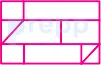
- A
Option A (shown in image)
- B
Option B (shown in image)
- C
Option C (shown in image)
- D
Option D (shown in image)
Show answer
C. Option C (shown in image)The correct answer is the option figure embedded in the given figure.
Solution:
Step 1 — This is a non-verbal reasoning question testing figure-embedding perception.
Step 2 — Compare each option figure with the given figure, checking whether it appears as an exact sub-shape (without rotation).
Step 3 — The option whose outline is fully traceable inside the given figure is the correct answer.
Hence the answer is the option figure embedded in the given figure.
Mistake Point:
Rotation is NOT allowed, so a rotated match does not count. Focus on the given orientation only.
Paper & answer key PDF ↗ Question 24archived
A paper is folded and cut as shown below. How will it appear when unfolded?

- A
Option A (shown in image)
- B
Option B (shown in image)
- C
Option C (shown in image)
- D
Option D (shown in image)
Show answer
C. Option C (shown in image)The paper when unfolded will appear as shown below:
Hence, 'option 3' is the correct answer.
 Paper & answer key PDF ↗
 Question 25archived
Select the option that is related to the fifth letter-cluster in the same way as the second letter-cluster is related to the first letter-cluster and the fourth letter-cluster is related to the third letter-cluster.
ORANGE : FIQEWU :: MANGO : PIQER :: APPLE : ?
- A
ELPPA
- B
GNSTG
- C
FNSTF
- D
ENSTE
Show answer
C. FNSTFSolving the Letter Cluster Analogy: ORANGE, MANGO, APPLE
This question asks us to find the relationship between pairs of letter clusters and apply the same relationship to a third word to find the missing cluster. We are given two pairs: ORANGE is related to FIQEWU, and MANGO is related to PIQER. We need to find the letter cluster related to APPLE in the same way.
Analyzing the Letter Cluster Pattern (ORANGE to FIQEWU)
Let's look at the first pair: ORANGE and FIQEWU. Both clusters have 6 letters. Let's try to find a rule that transforms ORANGE into FIQEWU.
Sometimes, the pattern involves reversing the word. Let's reverse ORANGE, which gives us EGNARO.
Now, let's compare the letters of the reversed word (EGNARO) with the letters of the target cluster (FIQEWU) based on their position in the alphabet (A=1, B=2, ...):
E (5) $\rightarrow$ F (6): This is a difference of $+1$ (5 + 1 = 6).
G (7) $\rightarrow$ I (9): This is a difference of $+2$ (7 + 2 = 9).
N (14) $\rightarrow$ Q (17): This is a difference of $+3$ (14 + 3 = 17).
A (1) $\rightarrow$ E (5): This is a difference of $+4$ (1 + 4 = 5).
R (18) $\rightarrow$ W (23): This is a difference of $+5$ (18 + 5 = 23).
O (15) $\rightarrow$ U (21): This is a difference of $+6$ (15 + 6 = 21).
The pattern seems to be: reverse the first word, and then add 1 to the alphabetical position of the first letter (of the reversed word), add 2 to the second, add 3 to the third, and so on, for each letter.
Verifying the Pattern (MANGO to PIQER)
Let's test this pattern with the second pair: MANGO and PIQER. MANGO has 5 letters.
Reverse MANGO: OGNAM.
Now, apply the same rule: add 1 to the first letter, 2 to the second, etc.
O (15) + 1 = P (16)
G (7) + 2 = I (9)
N (14) + 3 = Q (17)
A (1) + 4 = E (5)
M (13) + 5 = R (18)
Putting these letters together gives us PIQER. This matches the second cluster in the given pair. So, the pattern holds true for both examples.
Letter Pattern Analysis
Original Word
Reversed Word
Position
Addition
New Position
New Letter
ORANGE
E
5
+1
6
F
G
7
+2
9
I
N
14
+3
17
Q
A
1
+4
5
E
R
18
+5
23
W
O
15
+6
21
U
MANGO
O
15
+1
16
P
G
7
+2
9
I
N
14
+3
17
Q
A
1
+4
5
E
M
13
+5
18
R
Applying the Pattern to APPLE
Now we apply the same rule to the word APPLE. APPLE has 5 letters.
Reverse APPLE: ELPPA.
Apply the addition rule sequentially:
E (5) + 1 = F (6)
L (12) + 2 = N (14)
P (16) + 3 = S (19)
P (16) + 4 = T (20)
A (1) + 5 = F (6)
Combining the resulting letters, we get FNSTF.
Comparing with Options
Let's compare our result, FNSTF, with the given options:
Option 1: ELPPA (This is just the reversed word)
Option 2: GNSTG
Option 3: FNSTF
Option 4: ENSTE
Our calculated cluster FNSTF matches Option 3.
Revision Table: Letter Cluster Logic
Step
Description
Example (APPLE)
1
Identify the words/clusters.
APPLE
2
Analyze the pattern in given pairs (ORANGE:FIQEWU, MANGO:PIQER).
Reverse word, add sequential numbers to alphabetical position.
3
Reverse the target word.
APPLE reversed is ELPPA.
4
Add 1 to the 1st letter, 2 to the 2nd, etc. (of the reversed word).
E+1=F, L+2=N, P+3=S, P+4=T, A+5=F.
5
Combine the new letters.
FNSTF
6
Match the result with the options.
FNSTF matches Option 3.
Additional Information: Letter Coding Patterns
Letter cluster analogies and coding are common types of verbal reasoning questions. They test your ability to identify patterns based on the position of letters in the alphabet. Common patterns include:
Simple Shift: Each letter is shifted by a fixed number of positions forward or backward (e.g., A $\rightarrow$ C, B $\rightarrow$ D is a +2 shift).
Mixed Shift: The shift amount changes for each letter (e.g., +1, -2, +3, -4...).
Reversal: The letters in the word are reversed.
Positional Change: Letters are rearranged based on their position (e.g., 1st letter becomes last, 2nd becomes second last).
Opposite Letters: Letters are replaced by their opposite letter in the alphabet (A is opposite Z, B is opposite Y, etc.).
Combination of Rules: The pattern might involve reversing the word and then applying a shift, or applying a shift and then rearranging letters, like the pattern found in this question.
Solving these types of questions requires careful observation, knowledge of alphabetical order, and systematic testing of potential rules.
Paper & answer key PDF ↗ Question 26archived
_________ was the chairman of the planning commission when the first five year plan was formulated in India.
- A
Dr Rajendra Prasad
- B
Subhash Chandra Bose
- C
Lal Bahadur Shastri
- D
Jawaharlal Nehru
Show answer
D. Jawaharlal NehruUnderstanding the Chairman of India's Planning Commission
The question asks about the individual who served as the chairman of the Planning Commission when India's First Five Year Plan was formulated. Understanding the structure and function of the Planning Commission in India is key to answering this question.
The Planning Commission of India was an institution in the Government of India, which formulated India's Five-Year Plans, among other functions. It was established in March 1950. The commission was responsible for assessing the resources of the country, augmenting deficit resources, formulating plans for the most effective and balanced utilisation of resources, and determining priorities.
A crucial point about the Planning Commission was its chairperson. By convention, the Prime Minister of India always served as the ex-officio Chairman of the Planning Commission. This structure ensured that the planning process was directly linked to the highest executive authority in the country.
The First Five Year Plan and its Formulation
The First Five Year Plan of India was launched in 1951 and primarily focused on the development of the primary sector, especially agriculture and irrigation. The formulation period would have been just prior to and during 1951. The government in power at this time was led by the first Prime Minister of independent India.
Identifying the Chairman
Given that the Prime Minister serves as the Chairman of the Planning Commission, we need to identify who was the Prime Minister of India during the period when the First Five Year Plan was formulated and implemented (1951-1956).
Let's consider the options provided:
Dr Rajendra Prasad: He was the first President of India during this period. The President is the head of state, not the head of government or the chairman of the Planning Commission.
Subhash Chandra Bose: He was a prominent leader in the Indian independence movement but was not involved in the government structure of independent India in this capacity.
Lal Bahadur Shastri: He became the Prime Minister of India much later, in 1964, after the death of Jawaharlal Nehru.
Jawaharlal Nehru: He was the first Prime Minister of independent India, serving from 1947 to 1964. This period includes the formulation and implementation of the First Five Year Plan.
Since Jawaharlal Nehru was the Prime Minister of India when the First Five Year Plan was formulated, he was also the ex-officio Chairman of the Planning Commission at that time.
Therefore, Jawaharlal Nehru was the chairman of the planning commission when the first five year plan was formulated in India.
Roles during the First Five Year Plan Period
Individual
Role during 1951-1956
Connection to Planning Commission Chairmanship
Dr Rajendra Prasad
President of India
Not the Chairman
Subhash Chandra Bose
Freedom Fighter (not in government role during this period)
Not the Chairman
Lal Bahadur Shastri
Minister in Nehru's cabinet (later Prime Minister)
Not the Chairman at this time
Jawaharlal Nehru
Prime Minister of India
Ex-officio Chairman of Planning Commission
Revision Table: Key Facts about Planning Commission Chairman
Concept
Description
Planning Commission Establishment
March 1950
Chairman of Planning Commission
Prime Minister of India (ex-officio)
First Five Year Plan Period
1951-1956
Prime Minister during 1951-1956
Jawaharlal Nehru
Chairman during First Five Year Plan
Jawaharlal Nehru
Additional Information: Evolution of Planning in India
The Planning Commission played a significant role in India's economic development for over six decades. It was responsible for drafting, executing, and monitoring the Five-Year Plans. However, in 2015, the Planning Commission was replaced by a new institution called NITI Aayog (National Institution for Transforming India). Like the Planning Commission, the Prime Minister of India is the Chairperson of NITI Aayog.
The shift from Planning Commission to NITI Aayog reflected a change in approach from centralized planning towards a more collaborative approach involving states and a focus on think-tank functions.
The formulation of the Five-Year Plans involved extensive consultations with various ministries, state governments, and experts to set national goals and allocate resources for different sectors like agriculture, industry, infrastructure, and social services.
Paper & answer key PDF ↗ Question 27archived
In the self-help group, the loan and saving decisions are taken by the __________.
- A
group members
- B
non-government organisation
- C
bank
- D
government
Show answer
A. group membersUnderstanding Self-Help Groups (SHGs) and Decision Making
Self-Help Groups, commonly known as SHGs, are small associations of people, often from similar socio-economic backgrounds, who come together voluntarily to address their common needs. A key aspect of SHGs is their focus on savings and credit activities among members. These groups promote self-reliance and mutual support.
Loan and Saving Decisions in SHGs
In a self-help group, the members regularly save a small amount of money. This pooled money forms the basis of the group's financial resources. One of the main activities is providing small loans to members for various purposes, such as starting a small business, meeting emergency needs, or covering educational expenses.
The critical decision-making process within an SHG regarding savings and loans is highly democratic and member-driven. Here's how it typically works:
Savings: The amount to be saved by each member and the frequency of saving (e.g., weekly, monthly) are decided collectively by the members of the self-help group.
Loans: When a member needs a loan, they approach the group. The group members discuss the purpose of the loan, the amount needed, the interest rate to be charged (which is usually lower than market rates but higher than bank rates for savings), and the repayment schedule.
Decision Authority: All decisions about approving loans, setting terms, and managing the pooled savings are made through discussions and consensus or voting among the members of the self-help group. There is no external authority dictating these specific operational decisions.
Analyzing the Options
Let's look at why the other options are generally incorrect for the primary decision-maker role regarding internal loan and saving decisions in a self-help group:
Non-government organisation (NGO): NGOs often play a crucial role in forming and nurturing SHGs, providing training, guidance, and sometimes initial funding or links to banks. However, the day-to-day operational decisions about internal loans and savings within the group are typically left to the members themselves to foster self-management.
Bank: Banks are external financial institutions. SHGs may link with banks to access larger loans after demonstrating regular savings and good repayment history. While banks provide these external loans, they do not decide on the internal loan applications or saving rules made by the SHG members amongst themselves using their own pooled funds.
Government: Government bodies might promote SHGs or provide schemes that offer financial assistance or subsidies to SHGs. However, similar to banks and NGOs, the government is not directly involved in the specific decisions about which member gets a loan from the group's internal savings, how much interest is charged internally, or how much members save regularly within the group.
Therefore, the members themselves hold the authority for making these crucial financial decisions within their self-help group.
Conclusion on SHG Decision Making
The core principle of a self-help group is collective action and empowerment. This empowerment is most evident in the members' direct control over their pooled resources. The loan and saving decisions are fundamental financial activities managed by the members, for the members, based on mutual trust and understanding.
Entity
Role in SHG Finances
Decision Maker for Internal Loans/Savings?
Group Members
Save, pool money, borrow, repay
Yes - Decide on saving amounts, loan applications, interest rates, repayment terms for internal funds.
Non-government Organisation (NGO)
Formation, training, capacity building, linking with banks
No - Support structure, not internal decision-maker.
Bank
Provide external loans, savings accounts
No - Provides external finance, does not decide on internal group loans/savings.
Government
Policy promotion, schemes, subsidies
No - Facilitates environment, not internal decision-maker.
Revision Table: Key Concepts of Self-Help Groups
Concept
Description
SHG Definition
Small group of people with similar background coming together for mutual support.
Main Activities
Regular savings, internal lending, collective action.
Decision Making
Democratic, member-led, based on consensus/discussion.
Purpose
Financial inclusion, social empowerment, poverty reduction.
Additional Information on SHG Benefits
Self-help groups provide numerous benefits beyond just financial services. They create a platform for social interaction, mutual support, and collective bargaining power. Members often discuss social issues, health, education, and other community concerns. SHGs can also act as a stepping stone for women's empowerment, enabling them to participate more actively in community and household decision-making.
The self-management of savings and credit builds financial discipline and confidence among members, who may have previously lacked access to formal financial systems. This model has been particularly successful in rural areas and among marginalized communities.
Paper & answer key PDF ↗ Question 28archived
As per the announcement made by the Education Minister, Dharmendra Pradhan in August 2021, the duration of Samagra Shiksha Scheme 2 is from 1 April 2021 to __________.
- A
31 December 2021
- B
31 December 2024
- C
31 March 2026
- D
31 March 2023
Show answer
C. 31 March 2026Understanding the Samagra Shiksha Scheme 2 Duration
The question asks about the duration of the Samagra Shiksha Scheme 2 as announced in August 2021 by the Education Minister. This scheme is a significant initiative by the Indian government in the education sector.
What is Samagra Shiksha Scheme?
The Samagra Shiksha Scheme is an integrated scheme for school education covering pre-school to senior secondary levels. It aims to ensure inclusive and equitable quality education at all levels of school education.
Duration Announcement for Samagra Shiksha Scheme 2
In August 2021, the Union Cabinet approved the continuation of the revamped Samagra Shiksha Scheme for a specific period. The scheme's second phase, known as Samagra Shiksha Scheme 2.0 or Samagra Shiksha Scheme 2, was announced to run from the financial year 2021-22 onwards.
According to the announcement made by the Education Minister, Dharmendra Pradhan, the approved duration for the Samagra Shiksha Scheme 2 was for five years, starting from 1 April 2021.
Calculating the End Date
The scheme starts on 1 April 2021 and is approved for a duration of five years.
Year 1: 1 April 2021 to 31 March 2022
Year 2: 1 April 2022 to 31 March 2023
Year 3: 1 April 2023 to 31 March 2024
Year 4: 1 April 2024 to 31 March 2025
Year 5: 1 April 2025 to 31 March 2026
Therefore, five years from 1 April 2021 concludes on 31 March 2026.
Evaluating the Options
Let's look at the given options:
31 December 2021: This is less than one year, which is incorrect.
31 December 2024: This is less than five years (ends in the 4th financial year), incorrect.
31 March 2026: This marks the completion of five full financial years starting from 1 April 2021. This matches the announced duration.
31 March 2023: This is only two years, incorrect.
Based on the official announcement regarding the five-year extension starting from 1 April 2021, the Samagra Shiksha Scheme 2 is set to continue until 31 March 2026.
Scheme
Phase/Version
Start Date
End Date
Duration
Samagra Shiksha Scheme
Samagra Shiksha 2 / 2.0
1 April 2021
31 March 2026
5 years
Conclusion on Samagra Shiksha Scheme 2 Duration
The duration of the Samagra Shiksha Scheme 2, as announced in August 2021, is from 1 April 2021 to 31 March 2026.
Revision Table: Samagra Shiksha Scheme Key Facts
Aspect
Detail
Scheme Name
Samagra Shiksha Scheme
Phase Discussed
Samagra Shiksha Scheme 2.0
Approved By
Union Cabinet
Announcement Month/Year
August 2021
Effective Start Date
1 April 2021
Approved End Date
31 March 2026
Duration Approved
5 years
Scope
Pre-school to Senior Secondary
Additional Information: Samagra Shiksha Scheme Focus Areas
The Samagra Shiksha Scheme 2.0 continues and strengthens the focus on various aspects of school education. Some key areas include:
Ensuring access and equity at all levels.
Improving the quality of education through teacher training and curriculum reform.
Promoting digital education and technology integration.
Strengthening infrastructure in schools.
Supporting vocational education.
Focusing on foundational literacy and numeracy.
Enhancing the safety and security of students.
Promoting sports and physical education.
Supporting children with special needs.
The scheme integrates the three erstwhile schemes: Sarva Shiksha Abhiyan (SSA), Rashtriya Madhyamik Shiksha Abhiyan (RMSA), and Teacher Education (TE).
Paper & answer key PDF ↗ Question 29archived
According to Kautilya's Arthashastra, the Commanding Officer of the cavalry in the Mauryan administration was known as:
- A
Hastyadhyaksha
- B
Ashwadhyaksha
- C
Rathadhyaksha
- D
Patyadhyaksha
Show answer
B. AshwadhyakshaUnderstanding the administrative structure of ancient Indian empires, particularly the Mauryan period as described in Kautilya's Arthashastra, is crucial for historical studies. Kautilya's Arthashastra provides intricate details about various aspects of governance, including the military administration. The administration was highly organized, with various departments headed by superintendents known as 'Adhyakshas'.
Kautilya's Arthashastra and Mauryan Military Administration
Kautilya's Arthashastra outlines a sophisticated military organization for the Mauryan Empire. The military was typically divided into different branches, each with its own set of officers and superintendents responsible for its maintenance, training, and deployment. These superintendents played a vital role in ensuring the efficiency and strength of the Mauryan army.
Identifying the Commanding Officer of Cavalry
The question specifically asks about the Commanding Officer of the cavalry. Let's examine the options provided, which are terms for different superintendents (Adhyakshas) mentioned in historical texts like the Arthashastra, and identify the one related to cavalry.
Hastyadhyaksha: This term is derived from 'Hasti' (meaning elephant) and 'Adhyaksha' (meaning superintendent). The Hastyadhyaksha was the superintendent in charge of the elephant corps, which was a significant part of the Mauryan army.
Ashwadhyaksha: This term comes from 'Ashwa' (meaning horse) and 'Adhyaksha'. The Ashwadhyaksha was the superintendent responsible for horses and cavalry. The cavalry was another critical component of the Mauryan military, used for speed, maneuverability, and flanking attacks.
Rathadhyaksha: This term is formed from 'Ratha' (meaning chariot) and 'Adhyaksha'. The Rathadhyaksha was the superintendent overseeing the chariot division of the army.
Patyadhyaksha: This term is derived from 'Patti' or 'Padati' (meaning foot soldier or infantry) and 'Adhyaksha'. The Patyadhyaksha was the superintendent in charge of the infantry, which usually formed the largest part of the army.
Based on the etymology of the terms and their common usage in historical contexts related to ancient Indian administration and military, the term directly associated with horses and thus cavalry is Ashwadhyaksha.
Therefore, according to Kautilya's Arthashastra, the Commanding Officer or superintendent of the cavalry in the Mauryan administration was known as the Ashwadhyaksha.
Adhyaksha Title
Meaning (Root + Adhyaksha)
Area of Responsibility
Hastyadhyaksha
Hasti (Elephant) + Adhyaksha
Elephants Corps
Ashwadhyaksha
Ashwa (Horse) + Adhyaksha
Horses / Cavalry
Rathadhyaksha
Ratha (Chariot) + Adhyaksha
Chariot Division
Patyadhyaksha
Patti/Padati (Foot Soldier) + Adhyaksha
Infantry
This table clearly shows the specific roles of different Adhyakshas within the Mauryan military and related departments as described in Kautilya's work.
Conclusion
In summary, Kautilya's Arthashastra details various administrative roles. The question asks specifically about the officer commanding the cavalry. By examining the terms provided, we find that Ashwadhyaksha is the title corresponding to the superintendent of horses or cavalry. This aligns with the structured military administration described in the Arthashastra.
Revision Table: Mauryan Military Adhyakshas
Role
Title (Arthashastra)
Superintendent of Cavalry
Ashwadhyaksha
Superintendent of Elephants
Hastyadhyaksha
Superintendent of Chariots
Rathadhyaksha
Superintendent of Infantry
Patyadhyaksha
Additional Information: Kautilya's Arthashastra and Administration
Kautilya's Arthashastra is an ancient Indian treatise on statecraft, economic policy, and military strategy. Written by Kautilya (also known as Chanakya or Vishnugupta), chief advisor to Emperor Chandragupta Maurya, it is a foundational text for understanding the administration of the Mauryan Empire.
The text describes a centralized administration with various departments headed by 'Adhyakshas'. These superintendents were responsible for managing everything from treasury and mines to agriculture, trade, and military divisions. The military section of the Arthashastra provides insights into the composition, training, logistics, and deployment of the Mauryan army, which included infantry, cavalry, chariots, and elephants. The detailed roles of Adhyakshas like the Ashwadhyaksha highlight the systematic approach to governance during the Mauryan period.
Paper & answer key PDF ↗ Question 30archived
Doongri festival of Himachal Pradesh is primarily celebrated by which religious community?
- A
Buddhist
- B
Sikh
- C
Muslim
- D
Hindu
Show answer
D. HinduUnderstanding the Doongri Festival of Himachal Pradesh
The question asks about the primary religious community that celebrates the Doongri festival in Himachal Pradesh. This festival is a significant cultural event in the region, deeply rooted in local traditions.
What is the Doongri Festival?
The Doongri festival is a popular annual festival celebrated with great enthusiasm in Himachal Pradesh. It is particularly famous in the Kullu Valley.
Focus of the Doongri Festival
The festival is dedicated to Goddess Hadimba Devi, who is considered the patron deity of the Kullu rulers and is highly revered by the local people.
Religious Community Celebrating Doongri Festival
Goddess Hadimba Devi is a deity within the Hindu pantheon, specifically a form of Durga or Kali in some interpretations, or a powerful local deity assimilated into Hinduism. The rituals, prayers, and celebrations associated with the Doongri festival follow Hindu traditions and customs. Therefore, the festival is primarily celebrated by the Hindu community living in Himachal Pradesh, especially in the Kullu region where the Hadimba Devi Temple is located.
Analyzing the Options
Buddhist: While Buddhism is practiced in some parts of Himachal Pradesh, particularly in regions closer to Tibet like Lahaul and Spiti and Kinnaur, the Doongri festival is not associated with Buddhist traditions or deities.
Sikh: Sikhism is also present in Himachal Pradesh, especially in urban areas and the foothills, but the Doongri festival is not a Sikh religious event. Sikh festivals include Guru Nanak Jayanti, Baisakhi, etc.
Muslim: The Muslim community is a minority in Himachal Pradesh, and the Doongri festival is not related to Islamic religious practices or festivals.
Hindu: Hinduism is the predominant religion in Himachal Pradesh, and the Doongri festival, dedicated to Goddess Hadimba Devi, is a significant Hindu festival celebrated according to Hindu rituals and traditions.
Based on the association with Goddess Hadimba Devi and the nature of the rituals performed, the Doongri festival is clearly a Hindu festival.
Conclusion
The Doongri festival of Himachal Pradesh is primarily celebrated by the Hindu religious community.
Festival
State/Region
Primary Community
Deity/Focus
Doongri Festival
Himachal Pradesh (Kullu)
Hindu
Goddess Hadimba Devi
Kullu Dussehra
Himachal Pradesh (Kullu)
Hindu
Lord Rama, local deities
Losar
Himachal Pradesh (Lahaul-Spiti, Kinnaur)
Buddhist
Tibetan New Year
Revision Table: Himachal Pradesh Festivals
Festival Name
Key Association
Community
Doongri
Goddess Hadimba Devi
Hindu
Shivratri
Lord Shiva (Mandi Shivratri is famous)
Hindu
Phulaich (Festival of Flowers)
Kinnaur Region
Hindu (local traditions)
Losar
Tibetan New Year
Buddhist
Additional Information: Goddess Hadimba Devi and Doongri Festival
Goddess Hadimba Devi is considered a powerful deity and the sister of Hadimb, a character from the epic Mahabharata.
The temple dedicated to her in Manali (Kullu) is an ancient structure with unique architecture.
The Doongri festival celebrates her birthday and involves bringing deities from nearby villages to pay homage at the Hadimba Devi Temple.
The festival typically takes place in the month of May.
Paper & answer key PDF ↗ Question 31archived
Arjun Singh Dhurve was conferred the Padma Shri in 2022 for his contribution to the Baiga dance form of which state?
- A
Rajasthan
- B
Madhya Pradesh
- C
Odisha
- D
West Bengal
Show answer
B. Madhya PradeshUnderstanding the Padma Shri and Baiga Dance
The question asks about Arjun Singh Dhurve, who received the Padma Shri award in 2022 for his significant contributions. Specifically, it links his award to his work on the Baiga dance form and seeks to identify the state associated with this dance form and his contribution.
The Padma Shri is one of the highest civilian awards in India, given for distinguished service in various fields including art, social work, public affairs, science & engineering, trade & industry, medicine, literature & education, sports, and civil service.
Baiga dance is a traditional tribal dance form. Arjun Singh Dhurve is a prominent figure known for preserving and promoting this cultural heritage.
Analyzing the Options
The provided options are four different Indian states:
Rajasthan
Madhya Pradesh
Odisha
West Bengal
We need to determine which of these states is primarily associated with the Baiga community and their traditional dance forms, for which Arjun Singh Dhurve was recognised with the Padma Shri.
Identifying the Correct State
Arjun Singh Dhurve is a well-known folk artist associated with the Baiga community. The Baiga community is predominantly found in the state of Madhya Pradesh, particularly in districts like Dindori and Mandla, as well as in parts of Chhattisgarh and other neighbouring states. His work has been instrumental in promoting the traditional dances and culture of the Baiga people.
His recognition with the Padma Shri in 2022 specifically highlights his dedication to the Baiga dance form, which is deeply rooted in the cultural fabric of Madhya Pradesh.
Conclusion
Based on the geographical and cultural association of the Baiga community and the work of Arjun Singh Dhurve, the state linked to his Padma Shri award for contributions to the Baiga dance form is Madhya Pradesh.
Revision Table: Key Information
Person
Award
Year
Contribution
Associated Dance Form
Associated State
Arjun Singh Dhurve
Padma Shri
2022
Contribution to folk art and culture
Baiga Dance
Madhya Pradesh
Additional Information on Baiga Dance and Culture
The Baiga dance is an integral part of the cultural life of the Baiga tribe. These dances are often performed during festivals, social gatherings, and rituals. They are characterised by rhythmic movements, sometimes involving percussion instruments and traditional songs. Arjun Singh Dhurve's efforts have focused on keeping these traditional performances alive and bringing them to a wider audience, earning him the Padma Shri award.
Madhya Pradesh is home to several tribal communities, each with unique traditions, art forms, and dances. The state government and cultural organisations often work towards preserving and promoting these diverse cultural expressions.
Paper & answer key PDF ↗ Question 32archived
Which of the soluble fibres found in fruits is used as a thickener in cooking and baking?
- A
Lignin
- B
Cellulose
- C
Pectin
- D
Inulin
Show answer
C. PectinUnderstanding Soluble Fibers in Cooking
The question asks about a specific type of soluble fiber found in fruits that serves a function as a thickener in the processes of cooking and baking. Dietary fibers are broadly classified into two main categories: soluble and insoluble fibers. Soluble fibers dissolve in water and form a gel-like substance, which has various health benefits, including regulating blood sugar and cholesterol levels. These properties also make some soluble fibers useful in food preparation.
Analyzing the Options for Fiber as a Thickener
Let's examine the provided options to determine which soluble fiber from fruits is commonly used as a thickener:
Lignin: Lignin is primarily an insoluble fiber, not soluble. It provides structural support in plants and is not used as a thickener in cooking.
Cellulose: Cellulose is also a major component of plant cell walls and is an insoluble fiber. While modified celluloses (like carboxymethylcellulose) are used as thickeners in industrial food processing, natural cellulose itself is not the soluble fruit fiber acting as a thickener the question refers to.
Pectin: Pectin is a soluble fiber found abundantly in the cell walls of fruits, particularly in citrus peels, apples, quinces, and some berries. When heated with sugar and acid, pectin forms a gel. This gelling property makes it widely used as a thickener and stabilizer in jams, jellies, fruit preserves, pie fillings, and even some baked goods and dairy products.
Inulin: Inulin is a soluble fiber found in the roots and rhizomes of many plants, such as chicory, onions, garlic, and bananas, but it is not typically the primary soluble fiber associated with the gelling properties of fruits used in traditional cooking/baking applications like jams (where pectin is key). While it can be used as a thickener, especially in processed foods, pectin is the well-known fruit fiber for this purpose.
Identifying the Correct Soluble Fiber Thickener
Based on the properties and common uses of these fibers, Pectin is the soluble fiber derived from fruits that is widely utilized as a thickener and gelling agent in cooking and baking, especially in the creation of jams, jellies, and fruit-based desserts.
Revision Table: Fiber Types and Uses
Fiber Type
Solubility
Primary Sources (Examples)
Common Use as Thickener/Gel?
Lignin
Insoluble
Woody parts of vegetables, seeds
No
Cellulose
Insoluble
Whole grains, vegetables, fruits skins
No (natural form); Yes (modified forms)
Pectin
Soluble
Fruits (apples, citrus, berries), vegetables
Yes (especially in jams/jellies)
Inulin
Soluble
Chicory root, onions, garlic, bananas
Yes (can be used, often as fat replacer or for texture)
Additional Information on Pectin and Gelling
Pectin's ability to form a gel is influenced by several factors: concentration of pectin, sugar content, and acidity ($\text{pH}$). High-methoxyl pectins, which require sugar and acid to gel, are common in jam making. Low-methoxyl pectins can gel with calcium ions and are used in low-sugar preserves. Understanding these properties is key to successful use of pectin as a thickener in various culinary applications.
Paper & answer key PDF ↗ Question 33archived
'Vazhuvoor' is one of the styles of which Indian classical dance form?
- A
Bharatanatyam
- B
Kathakali
- C
Kathak
- D
Mohiniyattam
Show answer
A. BharatanatyamUnderstanding the Vazhuvoor Style in Indian Classical Dance
The question asks about the 'Vazhuvoor' style and its association with a specific Indian classical dance form. Indian classical dances have different regional or guru-parampara (lineage of teachers) styles, also known as banis. The Vazhuvoor style is one such prominent bani.
Exploring the Options for Vazhuvoor Style
Let's look at the given options and see which classical dance form is historically associated with the Vazhuvoor style:
Bharatanatyam: This is a major classical dance form that originated in Tamil Nadu. It is known for its precise movements, rich expressions (abhinaya), and geometric postures. Bharatanatyam has several recognized styles or banis, each with slight variations in technique, emphasis, and repertoire.
Kathakali: This is a major classical dance form from Kerala, known for its elaborate makeup, costumes, and detailed gestures (mudras) to tell stories, often from epics. Kathakali has its own distinct schools or traditions, but they are not referred to as banis in the context of Bharatanatyam styles.
Kathak: This is a major classical dance form from North India. It is characterized by intricate footwork (tatkar), spins (chakkars), and storytelling through mime and gesture. Kathak has gharanas (schools or styles) like Lucknow, Jaipur, and Benares, which are different from the banis of Bharatanatyam.
Mohiniyattam: This is another classical dance form from Kerala, characterized by graceful, flowing movements, swaying body, and expressive facial abhinaya. Mohiniyattam has evolved with influences from various sources and has specific techniques and repertoire, but its styles are not termed banis like those in Bharatanatyam.
Identifying the Dance Form Associated with Vazhuvoor
The Vazhuvoor style, or Vazhuvoor bani, is one of the most famous and widely practiced styles of the Indian classical dance form, Bharatanatyam. This style originated in the village of Vazhuvoor, near Mayiladuthurai in Tamil Nadu. The renowned guru Ramiah Pillai played a significant role in popularizing this bani.
Characteristics often associated with the Vazhuvoor style of Bharatanatyam include:
Emphasis on graceful, lyrical movements.
Greater use of fluid transitions between poses.
A focus on stage presentation and visual appeal.
Specific ways of executing adavus (basic steps) and mudras (hand gestures).
Rich and emotive abhinaya (expressional acting).
Other prominent styles (banis) of Bharatanatyam include Kalakshetra, Thanjavur, Mysore, and Pandanallur, among others. Each bani has its unique nuances and approach to the classical Bharatanatyam repertoire.
Therefore, the Vazhuvoor style is directly linked to Bharatanatyam.
Conclusion
Based on the analysis of the options and the known styles of Indian classical dance forms, the 'Vazhuvoor' style is a prominent bani of Bharatanatyam.
Revision Table: Indian Classical Dance Styles
Dance Form
Origin
Known Styles/Schools
Bharatanatyam
Tamil Nadu
Vazhuvoor Bani, Pandanallur Bani, Kalakshetra Bani, Thanjavur Bani, Mysore Bani
Kathakali
Kerala
Kalluvazhi, Kaplingad, Thekkan Chatta Nadanam
Kathak
North India
Lucknow Gharana, Jaipur Gharana, Benares Gharana
Mohiniyattam
Kerala
(Less emphasis on distinct 'banis' like Bharatanatyam, evolution influenced by gurus and institutions)
Additional Information on Vazhuvoor Bani and Bharatanatyam
The Vazhuvoor style of Bharatanatyam owes much of its popularity and structure to Vazhuvoor Ramaiah Pillai. He refined the style, making it appealing to a wider audience and emphasizing beauty and grace alongside technical precision. Many famous Bharatanatyam dancers today trace their lineage to the Vazhuvoor bani through their gurus. Studying the Vazhuvoor style involves mastering specific sequences of adavus, learning the unique interpretations of songs and poems through abhinaya, and understanding the stage presentation techniques characteristic of this bani. The evolution of the Vazhuvoor style highlights how classical art forms adapt and flourish through the contributions of visionary artists while maintaining their classical roots.
Paper & answer key PDF ↗ Question 34archived
Who was the Mughal emperor during the third battle of Panipat?
- A
Akbar II
- B
Shahalam II
- C
Bahadur Shah I
- D
Bahadurshah Jafar
Show answer
B. Shahalam IIUnderstanding the Third Battle of Panipat and the Mughal Emperor
The Third Battle of Panipat is a significant event in Indian history, fought on January 14, 1761. This battle involved the Maratha Confederacy and the invading forces of the Afghan ruler Ahmad Shah Durrani (also known as Ahmad Shah Abdali). While the battle was a major clash between these two powers, the Mughal Empire, though weakened, still held nominal authority in Delhi.
Who was the Mughal Ruler During the Third Battle of Panipat?
At the time the Third Battle of Panipat took place in 1761, the Mughal Emperor on the throne was Shah Alam II. He was the son of Alamgir II.
Shah Alam II's reign was marked by significant turmoil and the declining power of the Mughal Empire.
He faced challenges from various regional powers, including the Marathas and the Afghans.
Although he was the emperor, his control over the empire's territories was very limited. Delhi itself was under various influences during this period.
During the battle itself, Shah Alam II was not in Delhi but in exile, initially seeking refuge with the Nawab of Awadh and later with the British. His wazir (chief minister) in Delhi was involved in the events leading up to the battle.
Therefore, despite not being physically present in Delhi or at the battle site, Shah Alam II was the recognized Mughal Emperor during the Third Battle of Panipat in 1761.
Analysing the Other Options
Let's look at the other individuals mentioned in the options to understand why they were not the Mughal emperor during the Third Battle of Panipat (1761):
Akbar II: Akbar II was the Mughal Emperor from 1806 to 1837. This period is well after the Third Battle of Panipat. He was the father of Bahadur Shah Zafar.
Bahadur Shah I: Bahadur Shah I (also known as Muazzam) was the Mughal Emperor from 1707 to 1712. He was the son of Aurangzeb. This period is much earlier than the Third Battle of Panipat.
Bahadurshah Jafar: Bahadur Shah Zafar (also known as Bahadur Shah II) was the last Mughal Emperor, reigning from 1837 to 1857. He was involved in the Indian Mutiny of 1857. His reign is also well after the Third Battle of Panipat. The name is sometimes spelled as Bahadur Shah Jafar.
Based on the timelines, only Shah Alam II was the Mughal Emperor in 1761 when the Third Battle of Panipat occurred.
Key Figures in the Third Battle of Panipat
Understanding the main players helps contextualise the role of the Mughal Empire:
Side
Key Leaders
Maratha Confederacy
Sadashivrao Bhau, Vishwasrao
Durrani Empire
Ahmad Shah Durrani, Najib-ud-Daulah
Mughal Empire (Nominal Ruler)
Shah Alam II
Revision Table: Mughal Emperors Around the Period
Emperor
Reign Period
Relation to 1761
Alamgir II
1754 – 1759
Father of Shah Alam II, reigned just before the battle
Shah Alam II
1759 – 1806
Emperor during the battle (1761)
Akbar II
1806 – 1837
Reigned after Shah Alam II
Bahadur Shah Zafar (Bahadur Shah II)
1837 – 1857
Reigned after Akbar II, the last emperor
Additional Information on Shah Alam II and the Third Battle of Panipat
Shah Alam II's reign was one of significant decline for the Mughal Empire. He spent much of his early reign in exile, unable to return to Delhi due to political instability. The Third Battle of Panipat further weakened the Maratha power, which had been a dominant force vying for control over the Delhi region and influencing the Mughal court. Although the Afghans won the battle, they did not stay long in India. The power vacuum created or exacerbated by this battle contributed to the rise of other regional powers and the eventual dominance of the British East India Company. Shah Alam II eventually came under the protection of the British.
Paper & answer key PDF ↗ Question 35archived
The Champaran Satyagraha took place in ___________.
- A
1923
- B
1920
- C
1917
- D
1914
Show answer
C. 1917Understanding the Champaran Satyagraha
The question asks about the specific year when the Champaran Satyagraha took place. Understanding this event is crucial for studying the history of India's freedom struggle.
The Champaran Satyagraha was a significant movement led by Mahatma Gandhi. It was primarily focused on addressing the grievances of the farmers in the Champaran district of Bihar, India.
The Context of the Champaran Satyagraha
Farmers in Champaran were forced by British planters to cultivate indigo on a significant portion of their land (usually 3/20th part, known as the 'Tinkathia' system) and sell it at prices fixed by the planters. This system was exploitative and caused immense hardship to the farmers, especially when the demand for natural indigo declined due to the invention of synthetic dyes.
Local leaders and farmers invited Mahatma Gandhi to look into their situation. Gandhi's arrival marked his first major involvement in a non-violent resistance movement (Satyagraha) in India after his return from South Africa.
Key Events and Timeline
Mahatma Gandhi arrived in Champaran and began investigating the conditions of the farmers. He faced opposition from the authorities but continued his work, documenting the injustices. He employed the methods of Satyagraha – non-violent resistance and civil disobedience.
The pressure exerted by Gandhi's peaceful protest and widespread support led the government to appoint a committee to inquire into the matter. Gandhi was a member of this committee.
Based on the committee's findings, the Champaran Agrarian Act was passed. This act abolished the Tinkathia system and provided some relief to the farmers, including compensation for the illegal exactions by the planters.
When Did the Champaran Satyagraha Occur?
The Champaran Satyagraha began its crucial phase with Mahatma Gandhi's arrival and investigation in the district. This pivotal event in India's freedom movement took place in the year 1917.
It is considered the first Satyagraha movement inspired by Gandhi on Indian soil and laid the groundwork for his future campaigns against British rule.
Revision Table: Champaran Satyagraha Facts
Aspect
Detail
Event
Champaran Satyagraha
Location
Champaran district, Bihar, India
Year
1917
Led By
Mahatma Gandhi
Issue Addressed
Exploitative indigo cultivation system (Tinkathia) imposed by British planters
Method
Satyagraha (Non-violent resistance)
Outcome
Abolition of Tinkathia system, Champaran Agrarian Act passed
Additional Information: Significance of Champaran Satyagraha
It was Mahatma Gandhi's first major successful application of Satyagraha in India.
It brought Gandhi into close contact with the rural population of India, allowing him to understand their problems firsthand.
It demonstrated the effectiveness of non-violent methods against injustice, inspiring future movements.
Many prominent leaders of the Indian freedom movement participated alongside Gandhi, gaining valuable experience.
The Champaran Satyagraha was a watershed moment, establishing Gandhi as a leader of mass movements and paving the way for India's independence struggle.
Paper & answer key PDF ↗ Question 36archived
According to Koeppen's Scheme, which type of climate is denoted by the letter 'E' in India?
- A
Tropical savannah
- B
Hot desert
- C
Monsoon with dry summer
- D
Polar type
Show answer
D. Polar typeUnderstanding Koeppen's Climate Classification Scheme
Koeppen's climate classification scheme is a widely used system for classifying the world's climates based on vegetation, temperature, and precipitation. It uses a combination of letters to denote different climate types and subtypes.
The primary climate groups are represented by capital letters:
A: Tropical climates
B: Dry (Arid and Semi-arid) climates
C: Temperate (Mesothermal) climates
D: Continental (Microthermal) climates
E: Polar climates
The question asks what the letter 'E' denotes according to Koeppen's Scheme, specifically in the context of India.
Decoding the 'E' Climate Type in India
As listed above, the capital letter 'E' in Koeppen's classification represents the Polar climate type. This climate is characterized by extremely cold temperatures, with the warmest month having an average temperature below ${10}^\circ\text{C}$. There is generally little precipitation, and the ground is often covered by snow and ice.
In India, this 'E' type climate is found in areas of very high altitude, such as the upper reaches of the Himalayas and regions like Ladakh and parts of Jammu and Kashmir, and Himachal Pradesh. These areas experience conditions similar to polar regions due to their elevation, even though they are located at lower latitudes than typical polar zones.
Analyzing the Options
Let's look at why the other options do not represent the 'E' climate type:
Tropical savannah: This climate type is denoted by 'Aw' or 'As' under the 'A' (Tropical) group in Koeppen's scheme. It is characterized by distinct wet and dry seasons and high temperatures throughout the year.
Hot desert: This dry climate type is denoted by 'BWh' under the 'B' (Dry) group. It is characterized by very low precipitation and high temperatures.
Monsoon with dry summer: This is a specific type of monsoon climate, potentially classified under 'As' (Tropical with dry summer) or possibly other codes depending on the exact characteristics, but it falls under the 'A' (Tropical) group or potentially 'C' or 'D' in some variations, not 'E'.
Therefore, based on Koeppen's classification system, the letter 'E' specifically denotes the Polar type climate, which is found in the high altitude regions of India.
Conclusion
According to Koeppen's Scheme, the type of climate denoted by the letter 'E' is the Polar type. This corresponds to the high altitude, cold regions in India.
Revision Table: Koeppen's Main Climate Groups
Letter
Climate Type
Key Characteristics
A
Tropical
Hot year-round, high rainfall
B
Dry
Evaporation > Precipitation
C
Temperate
Mild winters
D
Continental
Cold winters, warm/hot summers
E
Polar
Extremely cold, warmest month < ${10}^\circ\text{C}$
Additional Information on Koeppen Climate in India
India exhibits a wide range of climate types according to Koeppen's scheme due to its diverse geography. While 'E' represents the high-altitude Polar type, other regions of India fall under different categories:
Most of South India and parts of the Northeast fall under 'A' (Tropical) types (Aw, Am, As).
Large parts of Rajasthan and Gujarat fall under 'B' (Dry) types (BWh, BSh).
Areas in the Indo-Gangetic Plain and Northern India fall under 'C' or 'D' types depending on the specific temperature and precipitation patterns (Cwg, Dwb, etc.).
The classification helps in understanding the relationship between climate and vegetation distribution across the country.
Paper & answer key PDF ↗ Question 37archived
When did Carl Friedrich Gauss and Wilhelm Eduard Weber invent the world's first electromagnetic telegraph?
- A
1833
- B
1832
- C
1830
- D
1831
Show answer
A. 1833Carl Friedrich Gauss and Wilhelm Eduard Weber: Pioneering the Electromagnetic Telegraph
The question asks about the invention date of the world's first electromagnetic telegraph by two renowned scientists, Carl Friedrich Gauss and Wilhelm Eduard Weber. Understanding this historical event is key to appreciating the development of telecommunications.
Carl Friedrich Gauss was a brilliant mathematician and physicist, while Wilhelm Eduard Weber was a physicist. Both worked at the University of Göttingen in Germany. Their collaboration extended beyond theoretical work into practical applications of electromagnetism.
Invention of the Electromagnetic Telegraph
Gauss and Weber were deeply involved in studying electricity and magnetism. They saw the potential of these forces for communication. Their work led them to develop a practical telegraph system that utilized electromagnetic principles.
They used a galvanometer to detect electric current, which was sent through wires.
The deflection of the galvanometer needle represented coded messages.
This system allowed messages to be transmitted over distances.
This invention was a significant step towards modern communication systems. It demonstrated the feasibility of using electricity to send signals rapidly over long distances, a concept fundamental to telegraphy.
Dating the Invention
Based on historical records and scientific publications, Carl Friedrich Gauss and Wilhelm Eduard Weber successfully demonstrated their electromagnetic telegraph system in a specific year. This demonstration is widely recognized as the creation of the first working electromagnetic telegraph.
Let's look at the options provided:
1833
1832
1830
1831
Historical accounts confirm that the groundbreaking work by Gauss and Weber, leading to the invention and demonstration of their electromagnetic telegraph, took place in 1833. They used this telegraph to link their university laboratory to the astronomical observatory, a distance of about one kilometer, transmitting messages using a code based on the deflection of a magnetic needle.
Therefore, the year Carl Friedrich Gauss and Wilhelm Eduard Weber invented the world's first electromagnetic telegraph is 1833.
Significance of the Gauss-Weber Telegraph
While other telegraph systems existed (like optical ones), the Gauss-Weber telegraph was the first to effectively use electromagnetism for sending messages. Their work laid the foundation for future developments in electrical communication, including the telegraph systems developed by figures like Samuel Morse.
Revision Table: Key Facts on Gauss-Weber Telegraph
Inventors
Invention
Year of Invention
Principle Used
Carl Friedrich Gauss & Wilhelm Eduard Weber
Electromagnetic Telegraph
1833
Electromagnetism (Galvanometer Deflection)
Additional Information: Early Telegraph Systems
The concept of sending messages over distances predates the electromagnetic telegraph. Here are some related points:
Semaphore Telegraphs: Before electrical telegraphs, systems like the Chappe semaphore line in France were used in the late 18th century. These used visual signals (like mechanical arms) on towers.
Early Electrical Experiments: Many scientists experimented with using electricity for signaling before Gauss and Weber, but their systems were often impractical for real-world communication over significant distances.
Later Developments: The Gauss-Weber telegraph was followed by various other designs. Samuel Morse's telegraph, developed in the late 1830s and patented in 1837, used a different system (an electromagnet to produce clicks on paper) and the famous Morse Code, which became commercially dominant.
Gauss and Weber's Impact: Their work in 1833 demonstrated the practical potential of electromagnetic communication, inspiring further research and development in the field.
Paper & answer key PDF ↗ Question 38archived
Who among the following was one of the founders of Rahnumai Mazdayasnan Sabha or Religious Reform Association?
- A
Muhammad Iqbal
- B
Aatmarang Pandurang
- C
Kesub Chandra Sen
- D
Dadabhai Naoroji
Show answer
D. Dadabhai NaorojiUnderstanding the Rahnumai Mazdayasnan Sabha
The question asks about the founders of the Rahnumai Mazdayasnan Sabha, also known as the Religious Reform Association. This was a significant socio-religious reform movement started in Mumbai (then Bombay) in 1851 by a group of educated Parsis. The primary aim of the association was to reform the Parsi community in India, bringing back the original purity of Zoroastrianism and removing various social evils that had crept in. They advocated for reforms in social customs, education, and the position of women within the community.
Key Founders of the Religious Reform Association
The Rahnumai Mazdayasnan Sabha was founded by several prominent Parsi intellectuals and social reformers. Key figures involved in its establishment included:
Dadabhai Naoroji
S.S. Bengalee
Naoroji Furdonji
K.R. Cama
These individuals worked together to publish journals like 'Rast Goftar' (Truth Teller) to spread their reformist ideas among the Parsi population.
Analyzing the Given Options
Let's examine the provided options to identify who among them was a founder of the Rahnumai Mazdayasnan Sabha:
Muhammad Iqbal: Muhammad Iqbal was a philosopher, poet, and politician from British India who is widely regarded as having inspired the Pakistan Movement. He was not associated with the Parsi reform movement Rahnumai Mazdayasnan Sabha.
Aatmarang Pandurang: Atmaram Pandurang was an Indian physician and social reformer. He is best known as one of the founders of the Prarthana Samaj in 1867, a different reform society focused on Hindu community issues, primarily in Maharashtra. He was not a founder of the Rahnumai Mazdayasnan Sabha.
Kesub Chandra Sen: Keshub Chandra Sen was a Hindu philosopher and social reformer who was a prominent leader of the Brahmo Samaj, another reformist movement in Hinduism, primarily active in Bengal. He was not involved with the Parsi Rahnumai Mazdayasnan Sabha.
Dadabhai Naoroji: Dadabhai Naoroji was a towering figure in Indian history, known as the "Grand Old Man of India". He was an intellectual, educator, cotton trader, and politician who served as a Liberal Party Member of Parliament in the United Kingdom House of Commons. He was indeed one of the key founders of the Rahnumai Mazdayasnan Sabha.
Based on the historical information about the founders of the Rahnumai Mazdayasnan Sabha, Dadabhai Naoroji is clearly one of the individuals who established this association.
Conclusion: Identifying the Founder
The question asks to identify one of the founders of the Rahnumai Mazdayasnan Sabha from the given options. Our analysis confirms that Dadabhai Naoroji was a prominent founder of this important Parsi reform society.
Revision Table: Key Reform Societies and Founders
Reform Society
Community Focused
Year Founded
Key Founders/Leaders
Rahnumai Mazdayasnan Sabha (Religious Reform Association)
Parsi
1851
Dadabhai Naoroji, S.S. Bengalee, Naoroji Furdonji, K.R. Cama
Brahmo Samaj
Hindu
1828
Raja Ram Mohan Roy, Debendranath Tagore, Keshub Chandra Sen
Prarthana Samaj
Hindu
1867
Atmaram Pandurang, M.G. Ranade, R.G. Bhandarkar
Additional Information: Dadabhai Naoroji and Parsi Reforms
Dadabhai Naoroji's involvement in the Rahnumai Mazdayasnan Sabha highlights his multifaceted commitment to social progress alongside his political and economic activities. The Sabha aimed to modernize the Parsi community by promoting education, especially for girls, and eradicating practices like child marriage. Naoroji and his colleagues believed that reforming their own community was a necessary step towards achieving broader social and political advancement in India.
His work with the Rahnumai Mazdayasnan Sabha demonstrates the vibrant reform movements that were taking place across different communities in 19th-century India, seeking to address social issues and promote modern values while also engaging with their religious heritage.
Paper & answer key PDF ↗ Question 39archived
In which of the following cities of British India was Lata Mangeshkar born?
- A
Calcutta
- B
Lucknow
- C
Bombay
- D
Indore
Show answer
D. IndoreLata Mangeshkar's Birthplace in British India
This solution identifies the city in British India where the renowned playback singer Lata Mangeshkar was born.
Discovering Lata Mangeshkar's Birth City
Lata Mangeshkar is a globally celebrated Indian playback singer, composer, and music director. She is widely recognized as one of the most accomplished singers in the Indian music industry. Knowing details about her origins, like her birthplace, is key to understanding her legacy.
Confirming the Birthplace: Indore
The legendary singer Lata Mangeshkar was born in the city of Indore. At the time of her birth, Indore was a significant city within the administrative regions of British India. Today, Indore is a major city in the state of Madhya Pradesh.
Historical Context of Birthplace
Lata Mangeshkar's birth date is September 28, 1929. The city of Indore, her birthplace, was then part of the princely state of Indore, which was under the indirect rule of the British Raj. Her father, Pandit Deenanath Mangeshkar, was a respected classical singer and theatre actor.
Why Indore is the Correct Answer
Detailed biographical information confirms that Lata Mangeshkar's roots are in Indore. While other major cities existed during British India, Indore is historically documented as her place of birth.
Paper & answer key PDF ↗ Question 40archived
When did India first win the first World Cup title in Hockey?
- A
1971
- B
1978
- C
1975
- D
1982
Show answer
C. 1975Understanding India's Hockey World Cup Wins
The question asks about the year India first won the Men's Hockey World Cup title. The Hockey World Cup is a major international tournament organized by the International Hockey Federation (FIH).
India's Journey in the Hockey World Cup
India has a rich history in field hockey, particularly in the Olympic Games where they have won numerous gold medals. However, the Hockey World Cup started later than the Olympics.
Let's look at the options provided and their relevance to India's first World Cup win:
1971: The first Men's Hockey World Cup was held in 1971 in Barcelona, Spain. India participated in this tournament.
1978: India participated in the 1978 Hockey World Cup held in Buenos Aires, Argentina.
1975: This year is notable in the history of Indian hockey.
1982: India hosted the Hockey World Cup in 1982 in Mumbai (then Bombay).
Identifying the Year of India's First World Cup Title
India's first and only victory in the Men's Hockey World Cup came in the tournament held in 1975. The 1975 Hockey World Cup was held in Kuala Lumpur, Malaysia. India reached the final and defeated Pakistan to lift the coveted trophy.
Therefore, the year India first won the World Cup title in Hockey was 1975.
Key Years in Early Hockey World Cup History
Year
Event
India's Performance Highlight
1971
1st Hockey World Cup
India secured the 3rd position.
1973
2nd Hockey World Cup
India was the runner-up.
1975
3rd Hockey World Cup
India won the title.
Conclusion on India's First World Cup Win
Based on the history of the Men's Hockey World Cup and India's participation, the year India achieved its first title victory was 1975.
Revision Table: India's Hockey World Cup Achievements
Summary of India's Men's Hockey World Cup Participation (Selected)
Year
Host Nation
India's Result
1971
Spain
Bronze Medal (3rd)
1973
Netherlands
Silver Medal (2nd)
1975
Malaysia
Gold Medal (1st)
1978
Argentina
6th Place
1982
India
5th Place
Additional Information: The Men's Hockey World Cup
The Men's Hockey World Cup is held every four years, usually two years after the Olympic Games.
The first tournament in 1971 had 10 teams. The number of participating teams has varied over the years.
Pakistan is historically the most successful team in the Men's Hockey World Cup, having won the title four times. The Netherlands and Australia have won three titles each.
India's win in 1975 remains their sole victory in this prestigious tournament.
Paper & answer key PDF ↗ Question 41archived
Which of the following periods is known as the period of population explosion in India?
- A
1931 - 1961
- B
1921 - 1951
- C
1981 - 2021
- D
1951 - 1981
Show answer
D. 1951 - 1981Understanding India's Population Growth Phases
India's population growth has gone through distinct phases over time. Studying these phases helps us understand the demographic changes the country has experienced. One significant phase is known as the period of population explosion, characterized by a rapid increase in population.
Identifying the Period of Population Explosion in India
The term 'population explosion' refers to a phase where the population grows at a very high rate. This typically happens when the death rate falls significantly while the birth rate remains high. In the context of India, different periods show varying rates of population growth:
Period before 1921: Often referred to as a period of stagnant or stationary population. Growth was low due to high birth rates balanced by high death rates (due to poor health, sanitation, famines, etc.).
Period from 1921 to 1951: This period saw a steady but moderate population growth. Death rates started declining due to improvements in health and sanitation, but birth rates remained relatively high. The year 1921 is sometimes referred to as the 'great divide' in India's demographic history.
Period from 1951 to 1981: This is widely known as the period of population explosion in India. During these three decades, the population grew at a very rapid pace. This was primarily due to a sharp decline in the death rate (thanks to better healthcare, control of epidemic diseases, and improved living conditions) while the birth rate remained high. The average annual growth rate during this period was quite high.
Period after 1981: While the population continued to grow, the growth rate started showing a declining trend, albeit gradually. Birth rates began to fall, though still higher than death rates, leading to continued population increase but at a slower pace compared to the 1951-1981 period.
Based on this analysis of India's demographic history, the period from 1951 to 1981 experienced the most rapid population growth, fitting the description of a 'population explosion'.
Period
Characteristics
Population Growth Rate
Before 1921
Stagnant Population
Very Low/Negative sometimes
1921 - 1951
Steady Growth
Moderate
1951 - 1981
Population Explosion
Very High
After 1981
High Growth with signs of Slowdown
Declining (compared to 1951-1981) but still positive
Therefore, the period 1951 - 1981 is correctly identified as the period of population explosion in India because of the significant gap between birth rates and death rates during this time, leading to accelerated population growth.
Revision Table: India Population Explosion Period
Concept
Description
Population Explosion
Rapid increase in population due to falling death rates and high birth rates.
Period in India
1951 to 1981
Key Reason
Improved healthcare & sanitation reducing death rates, while birth rates remained high.
Additional Information: Factors Affecting Population Growth
Population growth is influenced by several factors, primarily:
Birth Rate: The number of live births per thousand people in a year. High birth rates contribute to population increase.
Death Rate: The number of deaths per thousand people in a year. Declining death rates (due to better health, nutrition, etc.) contribute to population increase if birth rates remain high.
Migration: The movement of people into (immigration) or out of (emigration) a region. Net migration (immigration minus emigration) also affects the population size of a specific area.
The period of population explosion in India (1951-1981) was predominantly driven by the difference between birth rates and death rates within the country.
Paper & answer key PDF ↗ Question 42archived
Which of the following is NOT one of the scenarios of National Digital Education Architecture (NDEAR) launched by the Government of India in 2021?
- A
Manage Learn
- B
Learn
- C
Develop Learn
- D
Help Learn
Show answer
C. Develop LearnUnderstanding National Digital Education Architecture (NDEAR) Scenarios
The question asks us to identify which option is NOT one of the scenarios associated with the National Digital Education Architecture (NDEAR) launched by the Government of India in 2021.
NDEAR is a conceptual framework that aims to create a digital infrastructure for education. It is designed to support a wide range of educational activities and functions across the country.
The core idea behind NDEAR is to build a digital ecosystem that connects various stakeholders in the education sector, including learners, teachers, parents, administrators, content creators, and technology providers. It focuses on enabling interoperability and providing foundational building blocks for digital education.
Key NDEAR Scenarios and Building Blocks
While NDEAR is a broad framework, its functions and capabilities are often described through various scenarios or building blocks that represent key areas of digital education. Common scenarios or capabilities often mentioned in the context of NDEAR include:
Learn
Teach
Assess
Manage
Connect
Collaborate
Govern
These building blocks represent the core processes and functionalities that the digital architecture aims to enable and support.
Analyzing the Given Options
Let's look at the options provided in the question and see how they relate to the common NDEAR scenarios:
Manage Learn: This option combines 'Manage' and 'Learn'. NDEAR has distinct building blocks for 'Manage' (related to administration, logistics, etc.) and 'Learn' (related to the learning process itself). A scenario involving managing aspects of the learning process, such as managing learning resources, platforms, or learner progress, fits within the scope of NDEAR's objectives.
Learn: 'Learn' is explicitly listed as one of the fundamental building blocks or scenarios of NDEAR. The architecture is fundamentally designed to support and enhance the learning experience for students.
Develop Learn: This option combines 'Develop' and 'Learn'. While content development is a crucial part of digital education, 'Develop' is not typically listed as a core, standalone NDEAR scenario or building block in the same way as 'Learn', 'Teach', or 'Manage'. NDEAR provides the infrastructure *on which* content can be developed and delivered for learning, but 'Develop Learn' as a primary scenario name doesn't align with the commonly described NDEAR components.
Help Learn: This option implies providing assistance or support for learning. Support systems, helplines, or digital assistance features are often integrated into digital learning platforms, which fall under the broader umbrella enabled by NDEAR's infrastructure, possibly related to 'Connect' or 'Manage' aspects that facilitate interaction and support. While 'Help' isn't a standard scenario name, 'Help Learn' seems more plausible as a descriptive scenario enabled by NDEAR compared to 'Develop Learn'.
Based on the standard description of NDEAR building blocks and scenarios, 'Develop Learn' is the option that does NOT typically feature as a designated scenario or core building block compared to aspects related to 'Learn', 'Manage', and support for learning.
Conclusion
The National Digital Education Architecture (NDEAR) is built around several key scenarios to enable digital education. Among the given options, 'Develop Learn' does not align with the commonly recognized scenarios or building blocks of NDEAR, which focus on activities like Learning, Teaching, Managing, Assessing, Connecting, etc. The other options, 'Manage Learn', 'Learn', and 'Help Learn' (interpreted as support for learning), are more closely related to the core functions NDEAR aims to support.
Option
Analysis related to NDEAR Scenarios
Is it likely an NDEAR scenario?
Manage Learn
Combines 'Manage' and 'Learn' building blocks; plausible scenario for managing learning processes/resources.
Yes (or derived from core scenarios)
Learn
A core and explicit NDEAR building block/scenario.
Yes
Develop Learn
'Develop' is not typically a core, named NDEAR scenario. While content development is important, 'Develop Learn' doesn't fit the standard framework names.
No
Help Learn
Implies support for learning; could be enabled by 'Connect' or 'Manage' functionalities. More plausible than 'Develop Learn'.
Likely (as an enabled function)
Therefore, 'Develop Learn' is the option that is NOT one of the scenarios of National Digital Education Architecture (NDEAR).
Revision Table: NDEAR Key Points
Concept
Description
NDEAR
National Digital Education Architecture
Launch Year
2021
Purpose
Create a digital infrastructure for education
Key Scenarios/Building Blocks (Common)
Learn, Teach, Assess, Manage, Connect, Collaborate, Govern
Additional Information: Deep Dive into NDEAR
The National Digital Education Architecture (NDEAR) is a significant initiative under the National Education Policy (NEP) 2020. It envisions a single, unified digital infrastructure that can support the diverse needs of the Indian education ecosystem.
Key aspects of NDEAR include:
Open Standards and APIs: NDEAR promotes the use of open standards and Application Programming Interfaces (APIs) to ensure that different digital platforms and systems can interact and share data seamlessly.
Federated Architecture: It is designed as a federated architecture, meaning it connects multiple distributed systems rather than being a single, centralized platform. This allows for innovation and flexibility.
Data Privacy and Security: A strong emphasis is placed on ensuring the privacy and security of educational data within the architecture.
Inclusivity and Accessibility: NDEAR aims to make digital education accessible to all learners, including those in remote areas and those with special needs.
Ecosystem Development: By providing a common infrastructure, NDEAR encourages the development of innovative digital solutions by various players in the education technology sector.
The scenarios like 'Learn', 'Teach', 'Assess', and 'Manage' represent the core functions that the architecture facilitates. 'Connect' and 'Collaborate' enable interactions between stakeholders, while 'Govern' relates to the administrative and regulatory aspects of the digital ecosystem.
Understanding these core components helps clarify why certain activities are considered NDEAR scenarios while others, like 'Develop Learn' in this context, are not explicitly named as primary architectural functions.
Paper & answer key PDF ↗ Question 43archived
Which form of leucoplast specialises in oil synthesis and storage and is mainly found in the layer of cells in pollen grains that develop pollen grains?
- A
Gerontoplasts
- B
Proteinoplasts
- C
Chloroplasts
- D
Elaioplasts
Show answer
D. ElaioplastsUnderstanding Plastids and Leucoplasts
Plant cells contain important organelles called plastids. Plastids are involved in the synthesis and storage of food. They are typically categorised based on the pigments they contain or the substances they store.
There are different types of plastids:
Chloroplasts: Contain chlorophyll, responsible for photosynthesis and are green.
Chromoplasts: Contain carotenoids, giving colours like orange, yellow, or red to flowers and fruits.
Leucoplasts: Colourless plastids, primarily involved in storage of various substances.
The question specifically asks about a type of leucoplast that specialises in oil synthesis and storage and is found in cells developing pollen grains. Let's look at the types of leucoplasts.
Types of Leucoplasts Involved in Storage
Leucoplasts are a diverse group, specialising in storing different types of food molecules:
Amyloplasts: Store starch. Commonly found in roots and storage organs like tubers.
Proteinoplasts: Store protein. Found in seeds and storage tissues.
Elaioplasts: Store fats and oils (lipids). Found in seeds, fruits, and pollen grains.
Elaioplasts: Specialists in Oil Synthesis and Storage
Based on the function of different leucoplasts, elaioplasts are the ones responsible for the synthesis and storage of oils and fats. The question mentions a leucoplast involved in oil synthesis and storage, specifically located in the layer of cells that develop pollen grains. Pollen grains often contain significant amounts of lipids (oils) which serve as an energy source. This function and location perfectly match the description of elaioplasts.
Analyzing the Options
Let's consider why the other options are not correct:
Gerontoplasts: These are not leucoplasts. They are senescing (aging) chloroplasts where chlorophyll has degraded, often seen in autumn leaves turning yellow or orange. They are not primarily involved in oil synthesis and storage in developing pollen grains.
Proteinoplasts: These are leucoplasts, but they specialise in storing protein, not oil.
Chloroplasts: These are not leucoplasts as they contain chlorophyll and are green. Their primary role is photosynthesis, not large-scale oil synthesis and storage, especially not in the context described for developing pollen grains (though some lipid synthesis occurs in chloroplasts, dedicated oil storage plastids are different).
Therefore, the leucoplast that specialises in oil synthesis and storage and is found in the layer of cells in pollen grains that develop pollen grains is the elaioplast.
Plastid Type
Pigment/Substance
Primary Function/Storage
Chloroplast
Chlorophyll, Carotenoids
Photosynthesis
Chromoplast
Carotenoids
Colouration (flowers, fruits)
Amyloplast
None (colourless)
Starch storage
Proteinoplast
None (colourless)
Protein storage
Elaioplast
None (colourless)
Oil/Fat storage
Gerontoplast
Carotenoids (Chlorophyll degraded)
Aging chloroplasts
Revision Table: Plastids and Their Functions
Plastid Type
Colour
Main Storage Product
Example Location
Amyloplast
Colourless
Starch
Potato tubers, root cells
Proteinoplast
Colourless
Protein
Seeds, legume cotyledons
Elaioplast
Colourless
Oils/Fats
Seeds, fruits, pollen grains
Additional Information about Plastids and Storage
Plastids are fascinating organelles with diverse roles in plant cells. Their ability to differentiate from proplastids (undifferentiated plastids) into various forms like chloroplasts, chromoplasts, and leucoplasts allows plants to perform functions ranging from photosynthesis to storing essential nutrients like starch, protein, and lipids.
The specific type of leucoplast that develops depends on the cell's location and function within the plant. For instance, cells in a potato tuber predominantly develop amyloplasts for starch storage, while cells in oily seeds or pollen grains develop elaioplasts for lipid storage. This specialisation highlights the efficiency of plant cells in compartmentalizing different metabolic processes and storage needs.
Paper & answer key PDF ↗ Question 44archived
Which of the following statements are correct regarding the State Executive?
A. Article 152 of the Indian Constitution states 'Unless the context otherwise requires, the expression 'State' does not include Jammu and Kashmir'.
B. The 7th Constitutional Amendment Act has provided for the appointment of the same person as Governor for two or more states.
C. The Supreme Court clearly mentioned that the office of the Governor is under the control of the Central Government.
- A
A, B and C
- B
B and C only
- C
A and B only
- D
A and C only
Show answer
C. A and B onlyThe correct answer is A and B only.
Key Points
Article 152 of the Indian Constitution states 'Unless the context otherwise requires, the expression 'State' does not include Jammu and Kashmir'.
This statement is correct.
It means that unless the context requires otherwise, the laws and provisions applicable to other states in India do not apply to Jammu and Kashmir.
The 7th Constitutional Amendment Act has provided for the appointment of the same person as Governor for two or more states.
This statement is correct.
The 7th Constitutional Amendment Act, 1956, allowed the appointment of the same person as Governor for two or more states to promote better coordination between the states.
Additional Information
The Supreme Court clearly mentioned that the office of the Governor is under the control of the Central Government.
This statement is incorrect.
The Supreme Court has held that the Governor's office is not under the control of the Central Government.
However, the Governor is bound to act on the aid and advice of the Council of Ministers of the State.
The State Executive comprises the Governor, Chief Minister, Council of Ministers, and Advocate General.
 Paper & answer key PDF ↗
 Question 45archived
The 'East-West' corridor connects which of the following cities?
- A
Itanagar and Dwarka
- B
Guwahati and Gandhinagar
- C
Shillong and Kandla
- D
Silchar and Porbandar
Show answer
D. Silchar and PorbandarUnderstanding the East-West Corridor Connection
The National Highways Development Project (NHDP) is a major initiative in India aimed at upgrading, augmenting, and rehabilitating major national highways. It consists of several phases and corridors connecting key cities across the country. One of the significant components of this project is the North-South and East-West Corridor.
Identifying the East-West Corridor Terminals
The East-West Corridor runs from the easternmost part of India to the westernmost part, connecting two significant cities that serve as its endpoints. This corridor is crucial for improving connectivity and reducing travel time across the width of the country.
The East-West Corridor specifically connects:
Silchar in Assam (East India)
Porbandar in Gujarat (West India)
This corridor is approximately 3,507 kilometers long.
Analysing the Given Options
Let's examine the provided options to determine which one correctly identifies the cities connected by the East-West Corridor:
Itanagar and Dwarka: Itanagar is in Arunachal Pradesh (East), and Dwarka is in Gujarat (West). While these are East and West cities, they are not the designated endpoints of the official East-West Corridor under NHDP.
Guwahati and Gandhinagar: Guwahati is in Assam (East), and Gandhinagar is the capital of Gujarat (West). Similar to option 1, these are not the specific endpoints of the East-West Corridor.
Shillong and Kandla: Shillong is in Meghalaya (North-East), and Kandla is in Gujarat (West). Again, these do not represent the defined terminals of the East-West Corridor.
Silchar and Porbandar: Silchar is located in Assam (East India), and Porbandar is located in Gujarat (West India). These are the officially designated eastern and western terminals of the East-West Corridor as part of the NHDP.
Conclusion on East-West Corridor Connection
Based on the structure of the National Highways Development Project, the East-West Corridor links Silchar in Assam to Porbandar in Gujarat. Therefore, option 4 correctly identifies the cities connected by this significant highway corridor.
Revision Table: India's Major Corridors
Corridor Name
Connected Cities
Approx. Length
North-South Corridor
Srinagar (Jammu & Kashmir) to Kanyakumari (Tamil Nadu)
4,000 km
East-West Corridor
Silchar (Assam) to Porbandar (Gujarat)
3,507 km
Golden Quadrilateral
Delhi, Mumbai, Chennai, Kolkata (connecting major metros)
5,846 km
Additional Information: National Highways Development Project
The NHDP is managed by the National Highways Authority of India (NHAI). Its main aim is to upgrade national highways to world-class standards. Besides the North-South and East-West corridors, other parts of the NHDP include the Golden Quadrilateral, which connects the four major metro cities (Delhi, Mumbai, Chennai, Kolkata), port connectivity roads, and other national highways. The East-West corridor plays a vital role in integrating the eastern and western regions of the country, facilitating trade, tourism, and overall economic development.
Paper & answer key PDF ↗ Question 46archived
The centre of a cyclone is a calm area. It is called the ___________ of the storm.
- A
base
- B
focal point
- C
eye
- D
trigger point
Show answer
C. eyeUnderstanding the Centre of a Cyclone
A cyclone is a large-scale air mass that rotates around a strong center of low atmospheric pressure. Cyclones are characterized by inward-spiraling winds that rotate counterclockwise in the Northern Hemisphere and clockwise in the Southern Hemisphere. While the outer parts of a cyclone can bring intense winds and heavy rainfall, the very centre has a distinct characteristic.
Let's analyze the question which asks for the name of the calm area at the centre of a cyclone.
Characteristics of the Cyclone's Centre
The most striking feature of a mature tropical cyclone is its central region. This area is relatively clear, calm, and warm compared to the surrounding stormy areas. Here's why:
Air from the stormy eyewall descends into the centre.
This descending air warms and dries out.
The low pressure is lowest at the centre, but the winds are surprisingly light or even calm.
Clouds are minimal or absent in this central region.
Analyzing the Options
The question provides four options:
base
focal point
eye
trigger point
Let's consider each option in the context of a cyclone's structure:
base: The base typically refers to the bottom part or foundation of something. This term is not used to describe the calm centre of a cyclone.
focal point: A focal point is usually a point where something converges or originates, or a central point of interest. While the centre is central, "focal point" isn't the specific meteorological term for the calm area.
eye: In meteorology, the term "eye" is specifically used to describe the calm, clear area at the center of a tropical cyclone. This aligns perfectly with the description in the question.
trigger point: A trigger point refers to a location or condition that initiates something. It's not related to the physical structure or calm centre of a mature cyclone.
Conclusion
Based on the meteorological definition and the characteristics of a cyclone, the calm area at its centre is known as the eye of the storm.
Therefore, the correct answer is the option that names this specific part of the cyclone.
The centre of a cyclone, which is a calm area, is called the eye of the storm.
Revision Table: Cyclone Structure
Part of Cyclone
Description
Conditions
Eye
Central region
Calm winds, clear/minimal clouds, lowest pressure, descending air
Eyewall
Ring surrounding the eye
Strongest winds, heaviest rainfall, intense thunderstorms, ascending air
Rainbands
Spiral bands extending outwards
Periods of rain and wind, alternating with calmer conditions
Additional Information: Tropical Cyclones
Tropical cyclones are powerful weather systems that form over warm ocean waters. They are also known by regional names such as hurricanes (in the Atlantic and Northeast Pacific), typhoons (in the Northwest Pacific), and simply cyclones (in the South Pacific and Indian Ocean). The formation and intensification of tropical cyclones require specific conditions, including warm sea surface temperatures, atmospheric instability, high humidity, and low vertical wind shear.
The eye is a defining feature of mature, strong tropical cyclones. Its size can vary significantly, from a few kilometers to over a hundred kilometers in diameter. The passage of the eye over a location brings a temporary lull in the storm before the fierce winds from the opposite side of the eyewall arrive.
Paper & answer key PDF ↗ Question 47archived
The feature of fundamental duties in the Indian Constitution is adopted from which of the following countries?
- A
Soviet Union (USSR)
- B
UK
- C
Germany
- D
US
Show answer
A. Soviet Union (USSR)Understanding Fundamental Duties in the Indian Constitution
The Indian Constitution is a blend of various features borrowed from different constitutions around the world, adapted to suit the Indian context. One such important feature is the inclusion of Fundamental Duties.
Origin and Inspiration of Fundamental Duties
The concept of Fundamental Duties in the Constitution of India was not originally part of the constitution adopted in 1950. These duties were added later based on the recommendations of a specific committee. The idea behind incorporating Fundamental Duties was to remind citizens of their responsibilities towards the nation and society, alongside their fundamental rights.
The inspiration for including Fundamental Duties in the Indian Constitution came from the Constitution of the Union of Soviet Socialist Republics (USSR), which is now largely dissolved, with Russia being its successor state. The USSR Constitution had a chapter on the fundamental duties of citizens.
Inclusion in the Indian Constitution
Fundamental Duties were added to the Constitution by the 42nd Constitutional Amendment Act in 1976.
They are listed in Part IVA of the Constitution.
There is only one article in this part, Article 51A.
Initially, there were 10 Fundamental Duties.
Later, one more duty was added by the 86th Constitutional Amendment Act in 2002, bringing the total number of Fundamental Duties to 11.
The Swaran Singh Committee Recommendation
The need for including a separate chapter on Fundamental Duties was recommended by the Swaran Singh Committee. This committee was constituted by the government in 1976. The committee felt that citizens should not only enjoy rights but also perform certain duties.
Comparing with Other Constitutions
While India borrowed the concept of Fundamental Duties from the Soviet Union, other countries mentioned in the options influenced different aspects of the Indian Constitution:
UK (United Kingdom): Influenced the parliamentary system of government, rule of law, legislative procedure, single citizenship, cabinet system, etc.
US (United States): Influenced Fundamental Rights, independent judiciary, judicial review, impeachment of the President, etc.
Germany (Weimar Constitution): Influenced the suspension of Fundamental Rights during a National Emergency.
Therefore, the feature of Fundamental Duties specifically traces its origin to the Constitution of the Soviet Union (USSR).
Conclusion
The inclusion of Fundamental Duties in Part IVA, Article 51A of the Indian Constitution, through the 42nd Amendment, was inspired by the constitution of the Soviet Union (USSR). This underscores the importance of citizens' responsibilities in nation-building.
Revision Table: Key Facts on Fundamental Duties
Feature
Detail
Source Country
Soviet Union (USSR)
Added By
42nd Amendment Act, 1976
Constitutional Part
Part IVA
Constitutional Article
Article 51A
Recommended By
Swaran Singh Committee
Initial Number
10
Present Number
11 (11th added by 86th Amendment, 2002)
Additional Information: Significance of Fundamental Duties
Although Fundamental Duties are non-justiciable (meaning they cannot be enforced by courts like Fundamental Rights), they hold significant importance:
They act as a reminder to citizens about their duties towards the society, fellow citizens, and the nation.
They help in promoting a sense of discipline and commitment towards the nation.
They can be used by courts in interpreting laws, especially concerning the constitutionality of a statute.
They are enforceable by law enacted by the Parliament.
Understanding Fundamental Duties is crucial for every citizen of India.
Paper & answer key PDF ↗ Question 48archived
The Nehru trophy boat race was organised by which of the following states?
- A
Tamil Nadu
- B
Kerala
- C
West Bengal
- D
Karnataka
Show answer
B. KeralaUnderstanding the Nehru Trophy Boat Race
The Nehru Trophy Boat Race is one of the most famous and competitive boat races held in India. It is a popular annual event that attracts tourists and participants from all over the world.
The question asks which state organises this prestigious Nehru Trophy Boat Race. Let's look at the options provided:
Tamil Nadu
Kerala
West Bengal
Karnataka
To find the correct answer, we need to know the geographical location and tradition associated with the Nehru Trophy Boat Race.
Identifying the Organising State for the Nehru Trophy Boat Race
The Nehru Trophy Boat Race is synonymous with the state of Kerala. It is held every year on the second Saturday of August in Punnamada Lake, which is located in Alappuzha (Alleppey) district of Kerala.
This boat race is primarily a competition of "Chundan Vallams" or snake boats, which are traditional long canoes used in Kerala. The event has a rich history and is named after India's first Prime Minister, Jawaharlal Nehru, who visited the region in 1952 and was so impressed by an informal race that he donated a trophy.
Analysing the Options
Let's consider why the other options are incorrect:
Tamil Nadu: While Tamil Nadu has a rich cultural heritage, the Nehru Trophy Boat Race is not a prominent event associated with this state.
West Bengal: West Bengal has its own cultural events, but the famous snake boat races and the Nehru Trophy are specific to Kerala.
Karnataka: Karnataka is known for many festivals and traditions, but the Nehru Trophy Boat Race does not take place there.
The Nehru Trophy Boat Race is deeply rooted in the culture and backwater traditions of Kerala.
Key Details about the Nehru Trophy Boat Race
Location: Punnamada Lake, Alappuzha (Alleppey), Kerala.
Timing: Usually the second Saturday of August.
Type of Boats: Primarily Chundan Vallams (Snake Boats), but other smaller categories also participate.
Significance: One of the largest and most popular Vallam Kali (boat race) festivals in Kerala.
Therefore, the state that organises the Nehru Trophy Boat Race is Kerala.
Boat Race Name
State Organising
Location
Nehru Trophy Boat Race
Kerala
Punnamada Lake, Alappuzha
Pulikkali (Tiger Dance)
Kerala
Thrissur
Jallikattu
Tamil Nadu
Various locations
Dasara
Karnataka
Mysuru
Revision Table: Nehru Trophy Race Facts
Aspect
Detail
Event Name
Nehru Trophy Boat Race
Organising State
Kerala
Primary Location
Punnamada Lake, Alappuzha
Typical Time
Second Saturday of August
Main Boat Type
Chundan Vallam (Snake Boat)
Named After
Jawaharlal Nehru
Additional Information on Kerala Boat Races
Kerala is famous for its boat races, collectively known as Vallam Kali. These races are usually held during the harvest festival season of Onam. The Nehru Trophy Boat Race is the most prominent among them, but there are other significant races as well:
Champakulam Moolam Boat Race: Believed to be the oldest boat race in Kerala, held in Champakulam.
Aranmula Uthrattathi Boat Race: A traditional and religious boat race held at Aranmula during Onam.
Payippad Jalotsavam: Held near Harippad, Alappuzha, usually three days after Thiruvonam.
These races are not just sporting events but are also significant cultural festivals reflecting the rich heritage and community spirit of Kerala.
Paper & answer key PDF ↗ Question 49archived
As mentioned in the Government of India's Economic Survey 2022-23, Aadhaar is an essential tool for social delivery of how many Central Schemes as notified under Section 7 of the Aadhaar Act, 2016?
- A
228
- B
318
- C
564
- D
720
Show answer
B. 318Understanding Aadhaar's Role in Central Schemes: Economic Survey 2022-23
The Government of India's Economic Survey is an important document that provides insights into the state of the Indian economy and its various sectors. The Economic Survey 2022-23 highlighted the significant role played by Aadhaar in enhancing the efficiency and transparency of social service delivery.
Aadhaar as an Essential Tool for Social Delivery
Aadhaar, a unique identification number, has become a cornerstone for delivering welfare benefits and subsidies directly to eligible citizens. This process, often referred to as Direct Benefit Transfer (DBT), leverages the Aadhaar identity platform to ensure that funds and benefits reach the intended recipients, reducing leakages and corruption.
Section 7 of the Aadhaar (Targeted Delivery of Financial and Other Subsidies, Benefits and Services) Act, 2016 is particularly relevant in this context. This section allows the government to require an individual to furnish proof of possession of Aadhaar number or undergo Aadhaar authentication to receive any subsidy, benefit, or service for which expenditure is incurred from the Consolidated Fund of India.
Number of Central Schemes Linked to Aadhaar
According to the Economic Survey 2022-23, Aadhaar is an essential tool for the social delivery of a specific number of Central Schemes that have been notified under Section 7 of the Aadhaar Act, 2016.
The survey explicitly stated that the number of such Central Schemes is 318.
Document/Act
Relevant Section
Number of Central Schemes Notified
Government of India's Economic Survey 2022-23
Aadhaar Act, 2016 (Section 7)
318
This figure underscores the extensive integration of Aadhaar into the framework of delivering various government benefits and services across India, impacting a wide range of welfare programs aimed at financial inclusion, food security, pension payments, and more.
Revision Table: Key Facts on Aadhaar and Schemes
Concept
Detail
Source Document
Government of India's Economic Survey 2022-23
Key Tool Mentioned
Aadhaar
Purpose of Aadhaar
Essential tool for social delivery
Relevant Legal Provision
Section 7 of the Aadhaar Act, 2016
Number of Central Schemes
318
Additional Information on Aadhaar Act and DBT
The Aadhaar Act, 2016 provides the legal backing for the use of Aadhaar as a proof of identity. Section 7 is crucial as it mandates Aadhaar for accessing certain government subsidies and benefits, ensuring that these resources are targeted effectively to the beneficiaries. This has facilitated the expansion of the Direct Benefit Transfer (DBT) system, which aims to transfer benefits directly into the bank accounts of eligible individuals, bypassing intermediaries and reducing corruption. The Economic Survey 2022-23 acknowledged the significant savings achieved through the use of Aadhaar-enabled DBT.
Paper & answer key PDF ↗ Question 50archived
Which suffix is used when the -CHO group is attached to a carbon atom of a ring or ring system, or to a heteroatom?
- A
Amide
- B
Halide
- C
Nitrile
- D
Carbaldehyde
Show answer
D. CarbaldehydeThe correct answer is Option 4: Carbaldehyde.
IUPAC Nomenclature Rule:
According to the IUPAC rules for naming organic compounds, when an aldehyde group (\(-\text{CHO}\)) is directly attached to a ring or a ring system, the carbon of the \(-\text{CHO}\) group cannot be included in the principal chain numbering of the ring.
In such cases:
The entire ring is named as the parent alkane/alkene (e.g., Cyclohexane, Benzene).
The suffix "-carbaldehyde" is added to the end of the parent name to denote the \(-\text{CHO}\) group.
Examples:
\(\text{C}_6\text{H}_{11}-\text{CHO}\) is named as Cyclohexanecarbaldehyde.
\(\text{C}_6\text{H}_5-\text{CHO}\) is systematically named as Benzenecarbaldehyde (commonly known as Benzaldehyde).
What do the other suffixes represent?
Amide (Option 1): Used for compounds containing the \(-\text{CONH}_2\) functional group.
Halide (Option 2): Used for halogen-containing compounds (e.g., \(-\text{Cl}\), \(-\text{Br}\)).
Nitrile (Option 3): Used for compounds containing the \(-\text{C}\equiv\text{N}\) functional group.
Paper & answer key PDF ↗ Question 51archived
6 labourers can finish a work in 16 days. 10 labourers are available, but the work is to be finished by 8 days. How many more labourers are to be called to finish the work in time?
- A
0
- B
1
- C
4
- D
2
Show answer
D. 2Solving Work and Time Problems: Finding Additional Labourers
This question deals with the concept of work and time, specifically how the number of labourers affects the time taken to complete a fixed amount of work. The core idea is that the total amount of work remains constant regardless of how many people are doing it, assuming everyone works at the same rate.
We can think of the total work in terms of 'labourer-days' or 'man-days'. This represents the total effort required to finish the job. If a certain number of labourers take a certain number of days, the product of these two values gives us the total work units.
Calculating Total Work Units
We are given that 6 labourers can finish the work in 16 days. We can calculate the total work required using the formula:
\(\text{Total Work} = \text{Number of Labourers} \times \text{Number of Days}\)
Using the initial information:
\(\text{Total Work} = 6 \text{ labourers} \times 16 \text{ days}\)
\(\text{Total Work} = 96 \text{ labourer-days}\)
So, the total amount of work that needs to be done is equivalent to 96 labourer-days.
Determining Labourers Needed for 8 Days
Now, the work needs to be finished in 8 days. Let's say we need \(N\) labourers to complete the 96 labourer-days of work in 8 days. We can use the same formula:
\(\text{Total Work} = \text{Number of Labourers Required} \times \text{New Number of Days}\)
We know the Total Work is 96 labourer-days and the New Number of Days is 8. We need to find the Number of Labourers Required (\(N\)).
\(96 \text{ labourer-days} = N \text{ labourers} \times 8 \text{ days}\)
To find \(N\), we rearrange the equation:
\(N = \frac{96 \text{ labourer-days}}{8 \text{ days}}\)
\(N = 12 \text{ labourers}\)
This means that a total of 12 labourers are needed to finish the work in 8 days.
Finding Additional Labourers Required
We are told that 10 labourers are already available. We calculated that 12 labourers are needed in total to finish the work in time (8 days). The question asks how many more labourers are to be called.
Additional Labourers Needed = Total Labourers Required - Labourers Available
\(\text{Additional Labourers} = 12 \text{ labourers} - 10 \text{ labourers}\)
\(\text{Additional Labourers} = 2 \text{ labourers}\)
Therefore, 2 more labourers need to be called to finish the work in 8 days.
Summary of Calculations
Item
Value
Calculation/Source
Initial Labourers
6
Given
Initial Days
16
Given
Total Work (Labourer-Days)
96
\(6 \times 16\)
Target Days
8
Given
Labourers Required for 8 Days
12
\(96 / 8\)
Labourers Available
10
Given
Additional Labourers Needed
2
\(12 - 10\)
Revision Table: Work and Time Relationship
Concept
Formula
Description
Total Work
Labourers \(\times\) Days
Constant amount of work assuming constant rate.
Relationship
\(L_1 \times D_1 = L_2 \times D_2\)
If work is constant, the product of labourers and days is constant. \(L_1\) and \(D_1\) are initial values, \(L_2\) and \(D_2\) are new values.
Labourers vs. Days
Inversely Proportional
More labourers mean fewer days to finish the same work, and vice versa.
Additional Information: Man-Days Concept
The concept of 'man-days' (or labourer-days) is a fundamental unit in work and time problems. It represents the total effort one person puts in over one day. So, 10 man-days could mean 1 person working for 10 days, or 10 people working for 1 day, or 2 people working for 5 days, and so on, assuming the work rate is the same for everyone.
In problems like this, we assume:
All labourers work at the same constant rate.
The total amount of work is fixed.
This allows us to use the direct relationship: Total Work = Number of Labourers × Number of Days. If the work is constant, \(L_1 D_1 = L_2 D_2\). In our problem, \(L_1 = 6\), \(D_1 = 16\), \(D_2 = 8\). We needed to find \(L_2\):
\(6 \times 16 = L_2 \times 8\)
\(96 = 8 L_2\)
\(L_2 = \frac{96}{8}\)
\(L_2 = 12\)
This confirms that 12 labourers are needed in total. Since 10 are available, \(12 - 10 = 2\) additional labourers are required.
Paper & answer key PDF ↗ Question 52archived
R, S and T can finish a work in 20, 15 and 10 days, respectively. R works on all days and S and T work on alternate days with T starting the work on the first day. In how many days is the work finished?
- A
50/7
- B
57/8
- C
52/7
- D
61/7
Show answer
C. 52/7Work and Time Problem Solution
This problem involves calculating the total time taken by R, S, and T to complete a piece of work, given their individual efficiencies and a specific work pattern.
Understanding Individual Work Rates
First, we need to determine the amount of work each person can complete in one day. This is their work rate.
R can finish the work in 20 days. So, R's work rate is $\frac{1}{20}$ of the work per day.
S can finish the work in 15 days. So, S's work rate is $\frac{1}{15}$ of the work per day.
T can finish the work in 10 days. So, T's work rate is $\frac{1}{10}$ of the work per day.
Analyzing the Work Pattern and Cycle
R works on all days. S and T work on alternate days, with T starting on the first day.
The work pattern is as follows:
Day 1: R and T work together.
Day 2: R and S work together.
Day 3: R and T work together (repeats Day 1).
Day 4: R and S work together (repeats Day 2).
This establishes a 2-day cycle involving (R+T) on Day 1 of the cycle and (R+S) on Day 2 of the cycle.
Calculating Work Done in One Cycle
Let's calculate the total work done in one complete 2-day cycle:
Work done on Day 1 (R + T): $R's\ rate + T's\ rate = \frac{1}{20} + \frac{1}{10}$
To add these fractions, we find a common denominator, which is 20.
$\frac{1}{20} + \frac{1}{10} = \frac{1}{20} + \frac{1 \times 2}{10 \times 2} = \frac{1}{20} + \frac{2}{20} = \frac{1+2}{20} = \frac{3}{20}$
So, R and T together complete $\frac{3}{20}$ of the work on Day 1 of the cycle.
Work done on Day 2 (R + S): $R's\ rate + S's\ rate = \frac{1}{20} + \frac{1}{15}$
To add these fractions, we find a common denominator, which is 60.
$\frac{1}{20} + \frac{1}{15} = \frac{1 \times 3}{20 \times 3} + \frac{1 \times 4}{15 \times 4} = \frac{3}{60} + \frac{4}{60} = \frac{3+4}{60} = \frac{7}{60}$
So, R and S together complete $\frac{7}{60}$ of the work on Day 2 of the cycle.
Total work done in one 2-day cycle:
Work per cycle = Work on Day 1 + Work on Day 2
Work per cycle = $\frac{3}{20} + \frac{7}{60}$
Common denominator is 60.
$\frac{3}{20} + \frac{7}{60} = \frac{3 \times 3}{20 \times 3} + \frac{7}{60} = \frac{9}{60} + \frac{7}{60} = \frac{9+7}{60} = \frac{16}{60}$
Simplify the fraction: $\frac{16}{60} = \frac{4 \times 4}{15 \times 4} = \frac{4}{15}$
In one 2-day cycle, $\frac{4}{15}$ of the work is completed.
Progress Towards Completing the Work
We need to find how many full cycles are completed before the remaining work can be finished in a fraction of a day or one more day. The total work is 1 (or 100%).
Work done after 'n' cycles is $n \times \frac{4}{15}$. We want this value to be close to 1 but not exceed it for full cycles.
After 1 cycle (2 days): Work done = $1 \times \frac{4}{15} = \frac{4}{15}$. Remaining work = $1 - \frac{4}{15} = \frac{11}{15}$.
After 2 cycles (4 days): Work done = $2 \times \frac{4}{15} = \frac{8}{15}$. Remaining work = $1 - \frac{8}{15} = \frac{7}{15}$.
After 3 cycles (6 days): Work done = $3 \times \frac{4}{15} = \frac{12}{15} = \frac{4}{5}$. Remaining work = $1 - \frac{4}{5} = \frac{1}{5}$.
After 4 cycles (8 days): Work done = $4 \times \frac{4}{15} = \frac{16}{15}$. This is more than 1, so work finishes before 4 full cycles are completed.
So, 3 full cycles are completed in 6 days. After 6 days, $\frac{4}{5}$ of the work is done, and $\frac{1}{5}$ of the work remains.
Finishing the Remaining Work
After 6 days, the work remaining is $\frac{1}{5}$. The 6 days complete 3 full cycles. The 7th day is the start of the next cycle (Day 1 of the cycle), which means R and T work together.
Work remaining = $\frac{1}{5}$.
Work rate of R and T together = $\frac{3}{20}$ per day.
Can R and T finish the remaining $\frac{1}{5}$ work in a full day?
Work R+T can do in 1 day = $\frac{3}{20}$.
Compare remaining work ($\frac{1}{5} = \frac{4}{20}$) with work R+T can do in 1 day ($\frac{3}{20}$).
Since $\frac{4}{20} > \frac{3}{20}$, R and T cannot finish the remaining work in one full 7th day. They will complete $\frac{3}{20}$ of the work on Day 7.
Work remaining after 7 days (6 days from cycles + 1 full day of R+T):
Work done after 6 days = $\frac{4}{5}$.
Work done on Day 7 (R+T) = $\frac{3}{20}$.
Total work done after 7 days = $\frac{4}{5} + \frac{3}{20} = \frac{16}{20} + \frac{3}{20} = \frac{19}{20}$.
Remaining work after 7 days = $1 - \frac{19}{20} = \frac{1}{20}$.
Now, it's the start of Day 8. This is Day 2 of the work cycle, meaning R and S work together.
Work remaining = $\frac{1}{20}$.
Work rate of R and S together = $\frac{7}{60}$ per day.
Time taken by R and S to finish the remaining $\frac{1}{20}$ work:
Time = $\frac{\text{Remaining Work}}{\text{Rate}} = \frac{\frac{1}{20}}{\frac{7}{60}}$
Time = $\frac{1}{20} \times \frac{60}{7} = \frac{60}{140} = \frac{6}{14} = \frac{3}{7}$ days.
So, on the 8th day, R and S work for $\frac{3}{7}$ of the day to finish the remaining work.
Calculating Total Time
Total time taken to finish the work is the sum of the full days worked and the fraction of the last day.
Full days worked = 7 days (6 days from 3 cycles + 1 full Day 7)
Fraction of the 8th day worked = $\frac{3}{7}$ days
Total time = $7 + \frac{3}{7}$ days
Total time = $\frac{7 \times 7 + 3}{7} = \frac{49 + 3}{7} = \frac{52}{7}$ days.
The work is finished in $\frac{52}{7}$ days.
Step-by-Step Work Calculation Summary
R's rate = $1/20$ work/day
S's rate = $1/15$ work/day
T's rate = $1/10$ work/day
Work on Day 1 (R+T) = $1/20 + 1/10 = 3/20$
Work on Day 2 (R+S) = $1/20 + 1/15 = 7/60$
Work in 1 cycle (2 days) = $3/20 + 7/60 = 9/60 + 7/60 = 16/60 = 4/15$
Work after 3 cycles (6 days) = $3 \times 4/15 = 12/15 = 4/5$
Remaining work after 6 days = $1 - 4/5 = 1/5$
Day 7 is an R+T day. Work done on Day 7 = $3/20$
Remaining work after 7 days = $1/5 - 3/20 = 4/20 - 3/20 = 1/20$
Day 8 is an R+S day. Their rate = $7/60$ work/day
Time on Day 8 to finish $1/20$ work = $(1/20) / (7/60) = (1/20) \times (60/7) = 3/7$ days
Total time = 7 full days + $3/7$ days = $7 + 3/7 = 52/7$ days.
Revision Table: Key Work and Time Concepts
Concept
Formula/Explanation
Work Rate
If a person finishes work in 'n' days, their rate is $\frac{1}{n}$ per day.
Total Work
Usually considered as 1 unit.
Time Taken
$\frac{\text{Total Work}}{\text{Work Rate}}$ (if rate is constant).
Work Done
Rate $\times$ Time
Combined Rate
Sum of individual rates when working together.
Alternate Day Work
Calculate work done over a cycle (usually 2 days) and find how many cycles are needed. Address remaining work separately.
Additional Information: Alternate Day Work Problems
Alternate day work problems are a common type in time and work. The key is to identify the repeating cycle of workers and calculate the work done in one such cycle. Then, determine how many full cycles are completed and deal with the remaining work by considering the work rate of the individuals scheduled for the day(s) following the last full cycle. Pay close attention to who starts the work, as this determines the sequence of workers in the cycle.
Paper & answer key PDF ↗ Question 53archived
The side of an equilateral triangle is 12 cm. What is the area (in cm2, rounded off to 2 decimal places) of the triangle? Given: \(\sqrt{3}\) = 1.732
- A
68.07
- B
63.89
- C
62.35
- D
65.23
Show answer
C. 62.35Calculating Area of Equilateral Triangle
The problem asks us to find the area of an equilateral triangle with a given side length. We are provided with the side length and a specific value for the square root of 3.
An equilateral triangle is a triangle in which all three sides are equal in length, and all three internal angles are equal, each being 60 degrees.
Formula for Equilateral Triangle Area
The area of an equilateral triangle can be calculated using the formula:
\( \text{Area} = \frac{\sqrt{3}}{4} \times (\text{side})^2 \)
Where:
Area is the area of the triangle.
side is the length of one side of the triangle.
\(\sqrt{3}\) is the square root of 3.
Step-by-Step Calculation of Equilateral Triangle Area
Given:
Side (s) = 12 cm
\(\sqrt{3}\) = 1.732
Using the formula:
\( \text{Area} = \frac{\sqrt{3}}{4} \times s^2 \)
Substitute the given values into the formula:
\( \text{Area} = \frac{1.732}{4} \times (12 \text{ cm})^2 \)
First, calculate the square of the side length:
\( 12^2 = 12 \times 12 = 144 \)
Now, substitute this value back into the area formula:
\( \text{Area} = \frac{1.732}{4} \times 144 \)
We can simplify the calculation by dividing 144 by 4:
\( \frac{144}{4} = 36 \)
So, the formula becomes:
\( \text{Area} = 1.732 \times 36 \)
Now, perform the multiplication:
\( 1.732 \times 36 = 62.352 \)
The question asks for the area rounded off to 2 decimal places. The third decimal place is 2, which is less than 5, so we round down.
\( \text{Area} \approx 62.35 \text{ cm}^2 \)
Thus, the area of the equilateral triangle is approximately 62.35 cm\(^2\).
Step
Description
Calculation
1
Identify the given side length
s = 12 cm
2
Identify the given value for \(\sqrt{3}\)
\(\sqrt{3}\) = 1.732
3
Write down the formula for area of equilateral triangle
Area = \( \frac{\sqrt{3}}{4} \times s^2 \)
4
Substitute values into the formula
Area = \( \frac{1.732}{4} \times (12)^2 \)
5
Calculate the square of the side
\(12^2 = 144\)
6
Substitute \(s^2\) back into the formula
Area = \( \frac{1.732}{4} \times 144 \)
7
Perform the multiplication
Area = \( 1.732 \times 36 = 62.352 \)
8
Round to 2 decimal places
Area \(\approx\) 62.35 cm\(^2\)
Revision Table: Equilateral Triangle Concepts
Concept
Definition/Formula
Equilateral Triangle
A triangle with all three sides equal and all three angles equal (60°).
Perimeter
Sum of the lengths of all sides = 3 \(\times\) side.
Area
\( \frac{\sqrt{3}}{4} \times (\text{side})^2 \)
Height (Altitude)
\( \frac{\sqrt{3}}{2} \times \text{side} \)
Additional Information about Equilateral Triangles
Equilateral triangles possess several interesting properties:
All sides are equal.
All interior angles are equal (60 degrees).
It is a regular polygon with 3 sides.
The altitude from any vertex bisects the opposite side and also bisects the angle at that vertex.
The altitude, median, angle bisector, and perpendicular bisector from any vertex are all the same line segment.
The centroid, circumcenter, incenter, and orthocenter all coincide at a single point.
Understanding these properties is crucial for solving various geometry problems involving equilateral triangles, including calculating their area, perimeter, or height.
Paper & answer key PDF ↗ Question 54archived
A dishonest shopkeeper sells mangoes at Rs. 30/kg bought at Rs. 20/kg and he is giving 800 g instead of 1 kg. The shopkeeper's actual profit percentage is:
- A
75%
- B
37.5%
- C
50%
- D
87.5%
Show answer
D. 87.5%The correct answer is 87.5%.
Mixing Adulterants: Adding cheaper substances to pure goods to increase weight or volume, selling the mixture at the price of the pure item. Marking up Price Heavily: This is a standard practice (included in this problem), but combined with false weights, it amplifies the profit. Selling Defective Goods: Selling damaged or expired goods at standard prices. In profit and loss problems with false weights, the core is always to find the shopkeeper's cost price for the actual quantity sold and the revenue generated from that actual quantity.
Paper & answer key PDF ↗ Question 55archived
Simplify \(\frac{1}{2+2p} + \frac{1}{2+2q}+\frac{1}{2+2r}\), where p = \(\frac{x}{y+z}\), if q = \(\frac{y}{z+x}\) and r = \(\frac{z}{x+y}\).
- A
1
- B
x + y + z
- C
2
- D
\(\frac{1}{2}\)
Show answer
A. 1Simplifying Algebraic Expressions
The question asks us to simplify the expression \( \frac{1}{2+2p} + \frac{1}{2+2q}+\frac{1}{2+2r} \) given the values of p, q, and r in terms of x, y, and z.
We are given:
\( p = \frac{x}{y+z} \)
\( q = \frac{y}{z+x} \)
\( r = \frac{z}{x+y} \)
Let's substitute the given values of p, q, and r into the expression we need to simplify.
Step-by-Step Simplification
First, consider the first term \( \frac{1}{2+2p} \). Substitute the value of p:
\( \frac{1}{2+2p} = \frac{1}{2+2\left(\frac{x}{y+z}\right)} \)
Factor out 2 from the denominator:
\( = \frac{1}{2\left(1+\frac{x}{y+z}\right)} \)
Combine the terms inside the parenthesis by finding a common denominator:
\( = \frac{1}{2\left(\frac{y+z}{y+z}+\frac{x}{y+z}\right)} \)
\( = \frac{1}{2\left(\frac{y+z+x}{y+z}\right)} \)
Now, invert the fraction in the denominator and multiply:
\( = \frac{1}{2} \times \frac{y+z}{x+y+z} \)
\( = \frac{y+z}{2(x+y+z)} \)
Next, consider the second term \( \frac{1}{2+2q} \). Substitute the value of q:
\( \frac{1}{2+2q} = \frac{1}{2+2\left(\frac{y}{z+x}\right)} \)
Following the same steps as above:
\( = \frac{1}{2\left(1+\frac{y}{z+x}\right)} \)
\( = \frac{1}{2\left(\frac{z+x+y}{z+x}\right)} \)
\( = \frac{z+x}{2(x+y+z)} \)
Finally, consider the third term \( \frac{1}{2+2r} \). Substitute the value of r:
\( \frac{1}{2+2r} = \frac{1}{2+2\left(\frac{z}{x+y}\right)} \)
Following the same steps:
\( = \frac{1}{2\left(1+\frac{z}{x+y}\right)} \)
\( = \frac{1}{2\left(\frac{x+y+z}{x+y}\right)} \)
\( = \frac{x+y}{2(x+y+z)} \)
Combining the Terms
Now, add the three simplified terms together:
\( \frac{y+z}{2(x+y+z)} + \frac{z+x}{2(x+y+z)} + \frac{x+y}{2(x+y+z)} \)
Since all terms have the same denominator \( 2(x+y+z) \), we can add the numerators directly:
\( = \frac{(y+z) + (z+x) + (x+y)}{2(x+y+z)} \)
Combine like terms in the numerator:
\( = \frac{y+z+z+x+x+y}{2(x+y+z)} \)
\( = \frac{2x+2y+2z}{2(x+y+z)} \)
Factor out 2 from the numerator:
\( = \frac{2(x+y+z)}{2(x+y+z)} \)
Cancel the common factor \( 2(x+y+z) \) from the numerator and the denominator. Assuming \( x+y+z \neq 0 \), the expression simplifies to:
\( = 1 \)
Therefore, the simplified value of the expression \( \frac{1}{2+2p} + \frac{1}{2+2q}+\frac{1}{2+2r} \) is 1.
Revision Table - Algebraic Simplification
Concept
Description
Example (related to this problem)
Substitution
Replacing a variable with its defined expression.
Substituting \( p = \frac{x}{y+z} \) into \( \frac{1}{2+2p} \).
Factoring
Extracting a common multiplier from an expression.
Factoring 2 from \( 2+2p \) to get \( 2(1+p) \).
Combining Fractions
Adding or subtracting fractions by finding a common denominator.
Adding \( \frac{y+z}{2(x+y+z)} \), \( \frac{z+x}{2(x+y+z)} \), and \( \frac{x+y}{2(x+y+z)} \) as they have a common denominator.
Simplification
Reducing an expression to its simplest form by cancelling common factors.
Simplifying \( \frac{2(x+y+z)}{2(x+y+z)} \) to 1.
Additional Information - Related Algebraic Concepts
This problem involves algebraic manipulation and working with rational expressions (fractions involving variables). Key concepts used include:
Rational Expressions: Fractions where the numerator and denominator are polynomials. Simplifying them often involves factoring and cancelling common terms.
Least Common Denominator (LCD): When adding or subtracting fractions with different denominators, finding the LCD is crucial. In this problem, after substitution, all terms naturally had the same denominator \( 2(x+y+z) \), making addition straightforward.
Algebraic Identities: While not directly used for simplification here, recognizing patterns and identities can sometimes simplify complex expressions more quickly.
Problems like this test your ability to systematically substitute expressions and perform algebraic operations accurately. Always simplify each part of the expression before combining them if possible, as shown in the step-by-step solution above.
Paper & answer key PDF ↗ Question 56archived
A ball is to be made with inner radius of 2 units and outside radius of 3 units. How much material is required to make the ball?
- A
\(\frac{19}{3}\)π
- B
19π
- C
\(\frac{76}{3}\)π
- D
π
Show answer
C. \(\frac{76}{3}\)πCalculating Material Needed for a Spherical Ball
This question asks us to determine the amount of material required to create a ball with a specific inner and outer radius. This shape is known as a spherical shell. To find the amount of material, we need to calculate the volume of this spherical shell.
A spherical shell is essentially a larger sphere with a smaller sphere removed from its center. Therefore, the volume of the material is the difference between the volume of the outer sphere and the volume of the inner sphere.
Understanding Sphere Volume
The formula for the volume of a sphere is:
\(V = \frac{4}{3}\pi r^3\)
where:
\(V\) is the volume of the sphere
\(\pi\) is a mathematical constant (approximately 3.14159)
\(r\) is the radius of the sphere
Calculating the Volume of the Outer Sphere
The problem states the outside radius of the ball is 3 units. Let's call this \(R\).
\(R = 3\) units
The volume of the outer sphere (\(V_{outer}\)) is:
\(V_{outer} = \frac{4}{3}\pi R^3 = \frac{4}{3}\pi (3^3)\)
\(V_{outer} = \frac{4}{3}\pi (27)\)
Calculating the Volume of the Inner Sphere
The problem states the inner radius of the ball is 2 units. Let's call this \(r\).
\(r = 2\) units
The volume of the inner sphere (\(V_{inner}\)) is:
\(V_{inner} = \frac{4}{3}\pi r^3 = \frac{4}{3}\pi (2^3)\)
\(V_{inner} = \frac{4}{3}\pi (8)\)
Determining the Amount of Material
The amount of material required is the volume of the spherical shell, which is the volume of the outer sphere minus the volume of the inner sphere.
Amount of Material = \(V_{outer} - V_{inner}\)
Amount of Material = \(\frac{4}{3}\pi (27) - \frac{4}{3}\pi (8)\)
We can factor out \(\frac{4}{3}\pi\) from both terms:
Amount of Material = \(\frac{4}{3}\pi (27 - 8)\)
Amount of Material = \(\frac{4}{3}\pi (19)\)
Amount of Material = \(\frac{76}{3}\pi\)
So, the amount of material required to make the ball is \(\frac{76}{3}\pi\) cubic units.
Summary of Calculation Steps
Step
Description
Formula/Calculation
1
Identify radii
Outer Radius (\(R\)) = 3, Inner Radius (\(r\)) = 2
2
Calculate outer sphere volume
\(V_{outer} = \frac{4}{3}\pi R^3 = \frac{4}{3}\pi (3^3) = \frac{4}{3}\pi (27)\)
3
Calculate inner sphere volume
\(V_{inner} = \frac{4}{3}\pi r^3 = \frac{4}{3}\pi (2^3) = \frac{4}{3}\pi (8)\)
4
Subtract to find material volume
\(V_{material} = V_{outer} - V_{inner} = \frac{4}{3}\pi (27) - \frac{4}{3}\pi (8) = \frac{4}{3}\pi (19) = \frac{76}{3}\pi\)
The calculated amount of material is \(\frac{76}{3}\pi\), which corresponds to one of the given options.
Revision Table: Key Concepts for Sphere Volume
Concept
Description
Formula
Sphere
A perfectly round geometrical object in three-dimensional space that is the surface of a completely round ball.
N/A
Radius (\(r\))
The distance from the center of a sphere to any point on its surface.
N/A
Volume of a Sphere
The amount of 3D space a sphere occupies.
\(V = \frac{4}{3}\pi r^3\)
Spherical Shell
The region between two concentric spheres of different radii.
\(V_{shell} = V_{outer} - V_{inner} = \frac{4}{3}\pi (R^3 - r^3)\)
Additional Information: Applications of Sphere Volume Calculations
Calculating the volume of spheres and spherical shells has many practical applications in various fields:
Engineering: Determining the volume of tanks, pipes, or ball bearings.
Physics: Calculating the volume of celestial bodies or understanding fluid dynamics within spherical containers.
Manufacturing: Estimating the amount of raw material needed for producing spherical objects like ball bearings, cannonballs, or even some types of sports equipment.
Chemistry: Understanding the volume occupied by spherical molecules or particles.
Medicine: Estimating the volume of organs or tumors that can be approximated as spheres.
Understanding how to calculate the volume of a spherical shell is useful when dealing with hollow spherical objects, where the thickness of the wall is important for determining weight or material cost.
Paper & answer key PDF ↗ Question 57archived
4 men and 6 women can complete a work in 8 days, while 3 men and 7 women can complete it in 10 days. In how many days will 10 women complete it?
- A
44
- B
40
- C
15
- D
16
Show answer
B. 40The correct answer is 40.
For example, 400w means the total work is equivalent to what 1 woman can do in 400 days. If M_1 men and W_1 women do a work in D_1 days, and M_2 men and W_2 women do the same work in D_2 days, then the total work is (M_1 m + W_1 w)D_1 = (M_2 m + W_2 w)D_2 . This fundamental equation is used to solve such problems.
Paper & answer key PDF ↗ Question 58archived
The given chart shows the marks scored by a class X student in different subjects.
If the total marks are 1800, then find the marks in social science.
- A
360
- B
72
- C
350
- D
306
Show answer
A. 360Given
Total marks are 1800.
Calculation
The marks in social science = 72°
⇒ 360° → 1800
⇒ 72° → (1800 × 72)/360
⇒ 72° → 360
The marks in social science is 360.
Paper & answer key PDF ↗ Question 59archived
If acot θ = b, then what will be the value of \(\frac{bcosθ - asinθ}{bcosθ + asinθ}\)?
- A
\(\frac{b^2 + a^2}{b^2 - a^2}\)
- B
b2 + a2
- C
\(\frac{b^2 - a^2}{b^2 + a^2}\)
- D
0
Show answer
C. \(\frac{b^2 - a^2}{b^2 + a^2}\)Understanding the Trigonometry Problem
The question asks us to find the value of a given algebraic expression that involves trigonometric functions (\(\cos\theta\) and \(\sin\theta\)) and constants (\(a\) and \(b\)). We are provided with a relationship between the constants and the trigonometric function \(\cot\theta\), which is \(a \cot \theta = b\).
Our goal is to simplify the expression \(\frac{b\cos\theta - asin\theta}{bcos\theta + asin\theta}\) using the given condition \(a \cot\theta = b\).
Using the Given Cotangent Relation
The given relation is \(a \cot\theta = b\). We can rewrite this to express \(\cot\theta\) in terms of \(a\) and \(b\):
\[\cot\theta = \frac{b}{a}\]
Recall the definition of \(\cot\theta\):
\[\cot\theta = \frac{\cos\theta}{\sin\theta}\]
So, we have the relation:
\[\frac{\cos\theta}{\sin\theta} = \frac{b}{a}\]
Simplifying the Trigonometric Expression
The expression we need to evaluate is:
\[\frac{b\cos\theta - asin\theta}{bcos\theta + asin\theta}\]
A common technique to simplify such expressions when a relation involving \(\cot\theta\) or \(\tan\theta\) is given is to divide both the numerator and the denominator by either \(\sin\theta\) or \(\cos\theta\). Let's divide both by \(\sin\theta\).
Step 1: Divide Numerator by \(sin\theta\)
Divide each term in the numerator \(b\cos\theta - asin\theta\) by \(\sin\theta\):
\[\frac{b\cos\theta - asin\theta}{\sin\theta} = \frac{b\cos\theta}{\sin\theta} - \frac{asin\theta}{\sin\theta}\]
Using the identity \(\frac{\cos\theta}{\sin\theta} = \cot\theta\) and \(\frac{\sin\theta}{\sin\theta} = 1\) (for \(\sin\theta \neq 0\)), this becomes:
\[b \cot\theta - a(1) = b\cot\theta - a\]
Step 2: Divide Denominator by \(sin\theta\)
Divide each term in the denominator \(b\cos\theta + asin\theta\) by \(\sin\theta\):
\[\frac{b\cos\theta + asin\theta}{\sin\theta} = \frac{b\cos\theta}{\sin\theta} + \frac{asin\theta}{\sin\theta}\]
Using the same identities, this becomes:
\[b \cot\theta + a(1) = b\cot\theta + a\]
Step 3: Substitute the Value of \(cot\theta\)
Now the expression is in terms of \(\cot\theta\):
\[\frac{b\cot\theta - a}{b\cot\theta + a}\]
Substitute the given relation \(\cot\theta = \frac{b}{a}\) into this expression:
\[\frac{b\left(\frac{b}{a}\right) - a}{b\left(\frac{b}{a}\right) + a}\]
Step 4: Simplify the Algebraic Expression
Perform the multiplication in the numerator and denominator:
\[\frac{\frac{b^2}{a} - a}{\frac{b^2}{a} + a}\]
Find a common denominator for the terms in the numerator and the denominator. The common denominator is \(a\):
Numerator: \(\frac{b^2}{a} - a = \frac{b^2}{a} - \frac{a \times a}{a} = \frac{b^2 - a^2}{a}\)
Denominator: \(\frac{b^2}{a} + a = \frac{b^2}{a} + \frac{a \times a}{a} = \frac{b^2 + a^2}{a}\)
Now substitute these back into the expression:
\[\frac{\frac{b^2 - a^2}{a}}{\frac{b^2 + a^2}{a}}\]
To divide these fractions, multiply the numerator by the reciprocal of the denominator:
\[\frac{b^2 - a^2}{a} \times \frac{a}{b^2 + a^2}\]
The \(a\) in the numerator and denominator cancels out (assuming \(a \neq 0\)):
\[\frac{b^2 - a^2}{b^2 + a^2}\]
This is the final simplified value of the expression.
Conclusion on Trigonometric Expression Evaluation
By using the given relation \(a \cot\theta = b\) and simplifying the expression by dividing numerator and denominator by \(\sin\theta\), we found the value of \(\frac{b\cos\theta - asin\theta}{bcos\theta + asin\theta}\) to be \(\frac{b^2 - a^2}{b^2 + a^2}\).
Revision Table: Trigonometric Identities
Trigonometric Function
Definition in terms of Sine and Cosine
\(\tan\theta\)
\(\frac{\sin\theta}{\cos\theta}\)
\(\cot\theta\)
\(\frac{\cos\theta}{\sin\theta}\)
\(\sec\theta\)
\(\frac{1}{\cos\theta}\)
\(\csc\theta\)
\(\frac{1}{\sin\theta}\)
Additional Information: Working with Trigonometric Expressions
When simplifying trigonometric expressions, especially those involving fractions with sums or differences of terms like \(A\sin\theta + B\cos\theta\), look for ways to introduce \(\tan\theta\) or \(\cot\theta\) if a relationship involving these functions is given. Dividing the numerator and denominator by the highest power of \(\sin\theta\) or \(\cos\theta\) present is a common and effective strategy. This converts the expression into terms of \(\tan\theta\) or \(\cot\theta\), allowing direct substitution of the given value.
It is important to remember that division by \(\sin\theta\) or \(\cos\theta\) is only valid if \(\sin\theta \neq 0\) or \(\cos\theta \neq 0\), respectively. In most problems of this type encountered in standard exams, it is assumed that \(\theta\) is such that these functions are non-zero unless specified otherwise, allowing the simplification steps.
Paper & answer key PDF ↗ Question 60archived
The time required for a sum of money to amount to three times itself at 8% simple interest p.a. will be:
- A
35 years
- B
25 years
- C
30 years
- D
20 years
Show answer
B. 25 yearsGiven:
Rate = 8%
Concept:
In simple interest, if a principal amount Y becomes X times in the given years, then interest = (X - 1) × Y
Used Formula:
I = (P × R × T)/100
(where, P = principal, R = rate, T = time, and I = simple interest)
Calculation:
Let the principal be X, then the interest at 8% will be 2X, and the time is T.
⇒ 2X = (X × 8 × T)/100
⇒ T = (2 × 100)/8 = 25 years
∴ The required answer will be 25 years.
Paper & answer key PDF ↗ Question 61archived
Simplify:
220 + 80 ÷ [63 - {7 × 8 + (13 - 2 × 4)}]
- A
260
- B
270
- C
240
- D
250
Show answer
A. 260The correct answer is 260.
Simplifying an expression means rewriting it in a simpler, equivalent form. This often involves performing the operations according to the standard rules like BODMAS or PEDMAS until no further operations can be performed. Correctly applying the order of operations prevents ambiguity and ensures that everyone arrives at the same correct answer for a given expression. Mistakes often happen when the order of operations is not followed strictly, leading to incorrect results.
Paper & answer key PDF ↗ Question 62archived
A boat covers a distance of 80 km downstream in 8 h while it takes 10 h to cover the same distance upstream. What is the speed (in km/h) of the boat in still water?
- A
18
- B
12
- C
9
- D
16
Show answer
C. 9The correct answer is 9.
If you calculate a negative speed for the boat in still water or the stream, it indicates an error in your calculation or understanding of the problem setup (though stream speed is typically less than boat speed for upstream travel to be possible). The speed of the boat in still water must be greater than the speed of the stream for the boat to be able to move upstream. These problems often result in a system of two linear equations, which can be solved using methods like substitution or elimination.
Paper & answer key PDF ↗ Question 63archived
Simplify the given expression.
\(\frac{1+sin^4 \theta+cos^4\theta}{cos^2 \theta+sin^4\theta}\)
- A
3
- B
4
- C
2
- D
1
Show answer
C. 2Simplifying Trigonometric Expressions: A Step-by-Step Guide
Let's simplify the given trigonometric expression:
\[\frac{1+\sin^4 \theta+\cos^4\theta}{\cos^2 \theta+\sin^4\theta}\]
We will simplify the numerator and the denominator separately using fundamental trigonometric identities.
Simplifying the Numerator: \(1+\sin^4 \theta+\cos^4\theta\)
Recall the basic identity: \(\sin^2 \theta + \cos^2 \theta = 1\).
We can rewrite \(\sin^4 \theta + \cos^4 \theta\) using this identity:
\[\sin^4 \theta + \cos^4 \theta = (\sin^2 \theta)^2 + (\cos^2 \theta)^2\]
This looks like the form \(a^2 + b^2\). We know \(a^2 + b^2 = (a+b)^2 - 2ab\).
So, let \(a = \sin^2 \theta\) and \(b = \cos^2 \theta\):
\[\sin^4 \theta + \cos^4 \theta = (\sin^2 \theta + \cos^2 \theta)^2 - 2 (\sin^2 \theta)(\cos^2 \theta)\]
Since \(\sin^2 \theta + \cos^2 \theta = 1\), we have:
\[\sin^4 \theta + \cos^4 \theta = (1)^2 - 2 \sin^2 \theta \cos^2 \theta = 1 - 2 \sin^2 \theta \cos^2 \theta\]
Now substitute this back into the numerator:
Numerator = \(1 + (\sin^4 \theta + \cos^4 \theta)\)
Numerator = \(1 + (1 - 2 \sin^2 \theta \cos^2 \theta)\)
Numerator = \(1 + 1 - 2 \sin^2 \theta \cos^2 \theta\)
Numerator = \(2 - 2 \sin^2 \theta \cos^2 \theta\)
Numerator = \(2(1 - \sin^2 \theta \cos^2 \theta)\)
Analyzing the Denominator: \(\cos^2 \theta+\sin^4\theta\)
The denominator is \(\cos^2 \theta+\sin^4\theta\).
Let's examine the simplified numerator: \(2(1 - \sin^2 \theta \cos^2 \theta)\). Can we relate the expression \(1 - \sin^2 \theta \cos^2 \theta\) to the denominator?
Recall \(1 = \sin^2 \theta + \cos^2 \theta\).
So, \(1 - \sin^2 \theta \cos^2 \theta = (\sin^2 \theta + \cos^2 \theta) - \sin^2 \theta \cos^2 \theta\). This doesn't immediately look like the denominator.
Let's try to show that \(1 - \sin^2 \theta \cos^2 \theta\) can be written in a form related to the denominator \(cos^2 \theta + sin^4 \theta\). Consider the identity we need to establish:
\(1 - \sin^2 \theta \cos^2 \theta = \cos^2 \theta + \sin^4 \theta\)
Let's work from the right side and try to reach the left side using the identity \(\cos^2 \theta = 1 - \sin^2 \theta\):
RHS = \(\cos^2 \theta + \sin^4 \theta\)
RHS = \((1 - \sin^2 \theta) + \sin^4 \theta\)
RHS = \(1 - \sin^2 \theta + \sin^4 \theta\)
This still doesn't look like \(1 - \sin^2 \theta \cos^2 \theta\).
Let's re-examine the relationship derived from the correct answer option being 2. If the expression simplifies to 2, it means:
\[\frac{1+\sin^4 \theta+\cos^4\theta}{\cos^2 \theta+\sin^4\theta} = 2\]
This implies that the numerator is equal to 2 times the denominator:
\[1+\sin^4 \theta+\cos^4\theta = 2(\cos^2 \theta+\sin^4\theta)\]
We know the numerator simplifies to \(2 - 2 \sin^2 \theta \cos^2 \theta\). So we need to check if:
\[2 - 2 \sin^2 \theta \cos^2 \theta = 2(\cos^2 \theta+\sin^4\theta)\]
Divide both sides by 2:
\[1 - \sin^2 \theta \cos^2 \theta = \cos^2 \theta+\sin^4\theta\]
We need to verify if this identity is true for all \(\theta\) where the expression is defined.
Let's rearrange the terms to check:
\[1 - \cos^2 \theta = \sin^2 \theta \cos^2 \theta + \sin^4 \theta\]
We know \(1 - \cos^2 \theta = \sin^2 \theta\). So we need to check if:
\[\sin^2 \theta = \sin^2 \theta \cos^2 \theta + \sin^4 \theta\]
Factor out \(\sin^2 \theta\) from the right side:
\[\sin^2 \theta = \sin^2 \theta (\cos^2 \theta + \sin^2 \theta)\]
Using the identity \(\cos^2 \theta + \sin^2 \theta = 1\):
\[\sin^2 \theta = \sin^2 \theta (1)\]
\[\sin^2 \theta = \sin^2 \theta\]
This is true for all \(\theta\)! Therefore, the identity \(1 - \sin^2 \theta \cos^2 \theta = \cos^2 \theta+\sin^4\theta\) is correct.
Final Simplification
We found that:
Numerator = \(1+\sin^4 \theta+\cos^4\theta = 2(1 - \sin^2 \theta \cos^2 \theta)\)
Denominator = \(\cos^2 \theta+\sin^4\theta\)
And we verified that \(1 - \sin^2 \theta \cos^2 \theta = \cos^2 \theta+\sin^4\theta\)
Substitute the equivalent expression for \(1 - \sin^2 \theta \cos^2 \theta\) into the numerator:
Numerator = \(2(\cos^2 \theta+\sin^4\theta)\)
Now, substitute this back into the original expression:
\[\frac{2(\cos^2 \theta+\sin^4\theta)}{\cos^2 \theta+\sin^4\theta}\]
Assuming the denominator \(\cos^2 \theta+\sin^4\theta\) is not equal to zero, we can cancel the common term:
\[\frac{2\cancel{(\cos^2 \theta+\sin^4\theta)}}{\cancel{(\cos^2 \theta+\sin^4\theta)}} = 2\]
Thus, the simplified expression is 2.
Summary of Steps
To simplify the expression, we followed these steps:
Simplified the numerator \(1+\sin^4 \theta+\cos^4\theta\) using the identity \(\sin^2 \theta+\cos^2\theta=1\) to get \(2(1 - \sin^2 \theta \cos^2 \theta)\).
Examined the denominator \(\cos^2 \theta+\sin^4\theta\).
Proved the identity \(1 - \sin^2 \theta \cos^2 \theta = \cos^2 \theta+\sin^4\theta\) by substituting \(\cos^2 \theta = 1 - \sin^2 \theta\) and simplifying to \(\sin^2 \theta = \sin^2 \theta\).
Substituted the equivalent expression into the numerator, resulting in \(2(\cos^2 \theta+\sin^4\theta)\).
Divided the numerator by the denominator, cancelling the common term to get 2.
The final answer is 2.
Revision Table: Simplifying Trigonometric Expressions
Key Identity Used:
\(\sin^2 \theta + \cos^2 \theta = 1\)
Intermediate Identity:
\(\sin^4 \theta + \cos^4 \theta = 1 - 2 \sin^2 \theta \cos^2 \theta\)
Proven Relationship:
\(1 - \sin^2 \theta \cos^2 \theta = \cos^2 \theta + \sin^4 \theta\)
Numerator Simplification:
\(1+\sin^4 \theta+\cos^4\theta = 2(1 - \sin^2 \theta \cos^2 \theta)\)
Expression After Substitution:
\(\frac{2(\cos^2 \theta+\sin^4\theta)}{\cos^2 \theta+\sin^4\theta}\)
Final Simplified Value:
2
Additional Information: Trigonometric Identities for Simplification
Simplifying trigonometric expressions often relies on recognizing and applying fundamental identities. Here are some important ones:
Pythagorean Identities:
\(\sin^2 \theta + \cos^2 \theta = 1\)
\(1 + \tan^2 \theta = \sec^2 \theta\)
\(1 + \cot^2 \theta = \csc^2 \theta\)
Reciprocal Identities:
\(\csc \theta = \frac{1}{\sin \theta}\)
\(\sec \theta = \frac{1}{\cos \theta}\)
\(\cot \theta = \frac{1}{\tan \theta}\)
Quotient Identities:
\(\tan \theta = \frac{\sin \theta}{\cos \theta}\)
\(\cot \theta = \frac{\cos \theta}{\sin \theta}\)
Manipulating expressions involving higher powers like \(\sin^4 \theta\) or \(\cos^4 \theta\) often involves using the square identities repeatedly or techniques like the one used in this problem where \(a^4+b^4 = (a^2+b^2)^2 - 2a^2b^2\). Recognizing patterns and equivalent forms of expressions is key to successful simplification.
Paper & answer key PDF ↗ Question 64archived
Dharmendra can row 80 km upstream and 110 km downstream in 13 hours. Also, he can row 60 km upstream and 88 km downstream in 10 hours. What is the speed (in km/h) of the current?
- A
10
- B
6
- C
16
- D
12
Show answer
B. 6Solving Rowing Speed Problems: Upstream and Downstream
This problem involves the concepts of upstream and downstream motion, which are common in quantitative aptitude questions. When a boat travels upstream, its speed is reduced by the speed of the current. When it travels downstream, its speed is increased by the speed of the current.
Understanding Upstream and Downstream Speeds
Let the speed of the boat in still water be \(b\) km/h.
Let the speed of the current be \(c\) km/h.
Speed of the boat upstream = \((b - c)\) km/h (Boat speed minus current speed).
Speed of the boat downstream = \((b + c)\) km/h (Boat speed plus current speed).
The fundamental formula relating distance, speed, and time is:
\(\text{Time} = \frac{\text{Distance}}{\text{Speed}}\)
Setting Up Equations from the Given Information
We are given two scenarios:
Dharmendra rows 80 km upstream and 110 km downstream in a total of 13 hours.
He also rows 60 km upstream and 88 km downstream in a total of 10 hours.
Using the time formula for each part of the journey (upstream and downstream) and summing them up for each scenario, we get the following equations:
Scenario 1:
Time upstream + Time downstream = Total time
\(\frac{80}{b - c} + \frac{110}{b + c} = 13\) (Equation 1)
Scenario 2:
Time upstream + Time downstream = Total time
\(\frac{60}{b - c} + \frac{88}{b + c} = 10\) (Equation 2)
These are two linear equations in terms of \(\frac{1}{b - c}\) and \(\frac{1}{b + c}\). To make solving easier, let's substitute variables:
Let \(u = \frac{1}{b - c}\) and \(d = \frac{1}{b + c}\).
The equations become:
\(80u + 110d = 13\) (Equation 3)
\(60u + 88d = 10\) (Equation 4)
Solving the System of Linear Equations
We can solve this system using elimination. Let's multiply Equation 3 by a factor and Equation 4 by another factor so that the coefficients of \(u\) become equal.
Multiply Equation 3 by 3: \(3 \times (80u + 110d) = 3 \times 13 \implies 240u + 330d = 39\) (Equation 5)
Multiply Equation 4 by 4: \(4 \times (60u + 88d) = 4 \times 10 \implies 240u + 352d = 40\) (Equation 6)
Now, subtract Equation 5 from Equation 6:
\((240u + 352d) - (240u + 330d) = 40 - 39\)
\(240u + 352d - 240u - 330d = 1\)
\(22d = 1\)
\(d = \frac{1}{22}\)
Now substitute the value of \(d\) back into Equation 3 (or Equation 4) to find \(u\). Using Equation 3:
\(80u + 110 \left(\frac{1}{22}\right) = 13\)
\(80u + 5 = 13\)
\(80u = 13 - 5\)
\(80u = 8\)
\(u = \frac{8}{80} = \frac{1}{10}\)
Finding Boat Speed and Current Speed
We found \(u = \frac{1}{10}\) and \(d = \frac{1}{22}\). Let's substitute these back into our original definitions of \(u\) and \(d\):
\(u = \frac{1}{b - c} = \frac{1}{10} \implies b - c = 10\) (Equation 7 - Upstream Speed)
\(d = \frac{1}{b + c} = \frac{1}{22} \implies b + c = 22\) (Equation 8 - Downstream Speed)
We now have a simpler system of two linear equations with two variables \(b\) and \(c\).
To find \(c\) (speed of the current), subtract Equation 7 from Equation 8:
\((b + c) - (b - c) = 22 - 10\)
\(b + c - b + c = 12\)
\(2c = 12\)
\(c = \frac{12}{2}\)
\(c = 6\)
To find \(b\) (speed of the boat), substitute the value of \(c\) into Equation 7:
\(b - 6 = 10\)
\(b = 10 + 6\)
\(b = 16\)
Verification
Boat speed \(b = 16\) km/h, Current speed \(c = 6\) km/h.
Upstream speed = \(b - c = 16 - 6 = 10\) km/h
Downstream speed = \(b + c = 16 + 6 = 22\) km/h
Check Scenario 1: Time = \(\frac{80 \text{ km}}{10 \text{ km/h}} + \frac{110 \text{ km}}{22 \text{ km/h}} = 8 \text{ hours} + 5 \text{ hours} = 13\) hours. (Correct)
Check Scenario 2: Time = \(\frac{60 \text{ km}}{10 \text{ km/h}} + \frac{88 \text{ km}}{22 \text{ km/h}} = 6 \text{ hours} + 4 \text{ hours} = 10\) hours. (Correct)
The calculated speeds satisfy both conditions. The speed of the current is 6 km/h.
Revision Table: Rowing Speed Concepts
Concept
Description
Formula
Speed in Still Water
Speed of the boat without the effect of current.
\(b\)
Speed of Current
Speed of the flowing water.
\(c\)
Upstream Speed
Net speed when rowing against the current.
\(b - c\)
Downstream Speed
Net speed when rowing with the current.
\(b + c\)
Time, Distance, Speed
Relationship between time, distance, and speed.
\(\text{Time} = \frac{\text{Distance}}{\text{Speed}}\)
Additional Information: Solving Word Problems
Solving word problems like this often involves translating the problem into mathematical equations. Here are some tips:
Read the problem carefully to understand all the given information and what is being asked.
Define variables for the unknown quantities (like boat speed and current speed).
Identify the relationships between the variables based on the problem's context (e.g., upstream speed, downstream speed).
Use relevant formulas (like Time = Distance/Speed) to set up equations.
Solve the system of equations. Substitution or elimination methods are commonly used.
Check your answer by plugging the values back into the original conditions of the problem.
Problems involving upstream and downstream speeds are a classic application of setting up and solving systems of linear equations. Mastering this helps in various quantitative aptitude tests.
Paper & answer key PDF ↗ Question 65archived
In an examination a candidate had to sit for three papers A, B, and C. The candidate secured 75% marks in Paper A, 80% marks in Paper B, and 60% marks in Paper C. If the weightage assigned to Papers A, B, and C were 40%, 50% and 10%, respectively, then find the weighted percentage of marks obtained by the candidate, when all the three papers were taken together.
- A
77%
- B
74%
- C
72%
- D
76%
Show answer
D. 76%Understanding Weighted Percentage Marks
This problem asks us to calculate the overall percentage of marks obtained by a candidate in an examination, considering the different weightages assigned to each paper. This is a classic example of calculating a weighted average.
Calculating Weighted Contribution
To find the weighted percentage, we need to calculate the contribution of marks from each paper based on its assigned weightage. The formula for weighted average is:
$\text{Weighted Average} = \frac{\sum (\text{Value}_i \times \text{Weight}_i)}{\sum \text{Weight}_i}$
In this case, the values are the percentage marks obtained in each paper, and the weights are the percentage weightage assigned to each paper. The total weight is $40\% + 50\% + 10\% = 100\%$.
Let's calculate the weighted contribution for each paper:
Paper A: The candidate secured 75% marks, and Paper A has a weightage of 40%.
Weighted contribution from Paper A = $75\% \times 40\%$
Paper B: The candidate secured 80% marks, and Paper B has a weightage of 50%.
Weighted contribution from Paper B = $80\% \times 50\%$
Paper C: The candidate secured 60% marks, and Paper C has a weightage of 10%.
Weighted contribution from Paper C = $60\% \times 10\%$
Step-by-Step Calculation
Let's convert the percentages to decimals for calculation or perform the calculation directly:
Weighted contribution from Paper A = $75 \times \frac{40}{100} = 75 \times 0.40 = 30$
Weighted contribution from Paper B = $80 \times \frac{50}{100} = 80 \times 0.50 = 40$
Weighted contribution from Paper C = $60 \times \frac{10}{100} = 60 \times 0.10 = 6$
Alternatively, using percentages:
Weighted contribution from Paper A = $\frac{75}{100} \times \frac{40}{100} \times 100\% = \frac{3000}{100} \% = 30\%$
Weighted contribution from Paper B = $\frac{80}{100} \times \frac{50}{100} \times 100\% = \frac{4000}{100} \% = 40\%$
Weighted contribution from Paper C = $\frac{60}{100} \times \frac{10}{100} \times 100\% = \frac{600}{100} \% = 6\%$
Now, we sum the weighted contributions:
Total weighted sum = $30 + 40 + 6 = 76$ (or $30\% + 40\% + 6\% = 76\%$)
Since the total weight is 100%, the weighted percentage of marks is simply the total weighted sum divided by the total weight (which is 1 in decimal form or 100%):
Weighted percentage of marks = $\frac{\text{Total weighted sum}}{\text{Total weight}} = \frac{76}{100} \times 100\% = 76\%$
Let's summarize the data and calculation in a table:
Paper
Marks Secured (%)
Weightage (%)
Weighted Contribution
A
75
40
$75 \times \frac{40}{100} = 30$
B
80
50
$80 \times \frac{50}{100} = 40$
C
60
10
$60 \times \frac{10}{100} = 6$
Total
100
$30 + 40 + 6 = 76$
The weighted percentage of marks obtained by the candidate when all three papers were taken together is 76%.
Revision Table: Key Concepts in Weighted Average
Concept
Description
Formula
Weighted Average
An average where some values contribute more than others, determined by their weightages.
$\frac{\sum (x_i w_i)}{\sum w_i}$ (where $x_i$ are values, $w_i$ are weights)
Weightage
A measure of the importance or contribution of each data point to the total average.
Expressed as percentage, fraction, or ratio. Sum of weights often equals 1 or 100%.
Percentage Marks
Marks obtained out of a total, expressed as a percentage.
$\frac{\text{Marks Obtained}}{\text{Total Marks}} \times 100\%$
Additional Information: Applications of Weighted Averages
Weighted averages are used in many real-world situations, such as:
Calculating GPA: Different courses have different credit hours (weights).
Financial Indexes: Stock prices are weighted by market capitalization.
Manufacturing: Averaging quality control data from different production lines with varying volumes.
Surveys and Statistics: Adjusting data to reflect population demographics.
Understanding weighted averages is important for correctly interpreting data where different components have varying levels of significance.
Paper & answer key PDF ↗ Question 66archived
Study the given pie-chart carefully and answer the following question. What is the total amount (in Rs.) used by the school for the payment?
- A
1,20,000
- B
3,10,000
- C
1,10,000
- D
2,10,000
Show answer
C. 1,10,000Calculation
The total amount used by the school for the payment = 11% of 1000000
⇒ 11/100 * 1000000
⇒ 110000
The total amount used by the school for the payment is 110000.
Paper & answer key PDF ↗ Question 67archived
If (4y - \(\frac{4}{y}\)) = 13, find the value of (y2 + \(\frac{1}{y^2}\)).
- A
\(12\frac{11}{16}\)
- B
\(10\frac{9}{16}\)
- C
\(12\frac{9}{16}\)
- D
\(8\frac{9}{16}\)
Show answer
C. \(12\frac{9}{16}\)Given
(4y - 4/y) = 13
Concept used
If (y - 1/y) = k
(y2 - 1/y2) = K2 + 2
Calculation
(4y - \(\frac{4}{y}\)) = 13
Dividing the whole equation by 4.
⇒ (y - 1/y ) = 13/4
Squaring both side
⇒ (y2 + 1/y2 ) - 2 = 169/16
⇒ (y2 + 1/y2 ) = 169/16 + 2
⇒ (y2 + 1/y2 ) = (169 + 3 2)/16
⇒ (y2 + 1/y2 ) = 201 /16
⇒ (y2 + 1/y2 ) = 12(9/16)
The value of the expression is 12(9/16).
Paper & answer key PDF ↗ Question 68archived
In the given figure, chords XY and PQ intersect each other at point L. Find the length of XY (in cm).
- A
21
- B
20
- C
22
- D
23
Show answer
C. 22Calculation
By the theorem,
LQ × LP = LY × LX
Let the length of OD be x.
⇒ 5 × 15 = 3 × (3 + x)
⇒ 25 = x + 3
⇒ x = 22
The length of XY is 22.
 Paper & answer key PDF ↗
 Question 69archived
A person marks his goods x% above the cost price and allows a discount of 12% on the marked price. If his profit is 10%, then the difference between x% and the profit percentage is:
- A
15%
- B
18%
- C
13%
- D
10%
Show answer
A. 15%Formulae Used:
$\text{Selling Price (SP)} = \text{Cost Price (CP)} \times \left(1 + \frac{\text{Profit Percentage}}{100}\right)$
$\text{Selling Price (SP)} = \text{Marked Price (MP)} \times \left(1 - \frac{\text{Discount Percentage}}{100}\right)$
$\text{Marked Price (MP)} = \text{Cost Price (CP)} \times \left(1 + \frac{x}{100}\right)$
Step-by-Step Explanation:
Step 1: Assume a standard value for the Cost Price (CP)
Let the Cost Price ($\text{CP}$) of the goods be $\$100$.
Step 2: Find the Selling Price (SP)
Since the profit percentage is given as $10\%$:
$$\text{SP} = \text{CP} + \text{Profit}$$
$$\text{SP} = 100 + 10\% \text{ of } 100 = 110$$
Step 3: Find the Marked Price (MP)
A discount of $12\%$ is offered on the Marked Price ($\text{MP}$), which means the Selling Price is $88\%$ of the Marked Price.
$$\text{SP} = \text{MP} \times \left(1 - \frac{12}{100}\right)$$
$$110 = \text{MP} \times 0.88$$
$$\text{MP} = \frac{110}{0.88}$$
$$\text{MP} = \frac{11000}{88} = 125$$
Step 4: Determine the value of $x$
The goods are marked $x\%$ above the Cost Price ($\text{CP} = 100$).
$$\text{Markup Amount} = \text{MP} - \text{CP} = 125 - 100 = 25$$
$$\text{Markup Percentage } (x\%) = \left(\frac{25}{100}\right) \times 100 = 25\%$$
Therefore, $x = 25$.
Step 5: Calculate the required difference
We need to find the difference between $x\%$ and the profit percentage:
$$\text{Difference} = x\% - \text{Profit Percentage}$$
$$\text{Difference} = 25\% - 10\% = 15\%$$
Paper & answer key PDF ↗ Question 70archived
Two equal circles of radius 18 cm intersect each other, such that each passes through the centre of the other. The length of the common chord is _________.
- A
\(6\sqrt{27}\) cm
- B
\(\sqrt{3}\)
- C
\(9\sqrt{27}\) cm
- D
\(3\sqrt{3}\) cm
Show answer
A. \(6\sqrt{27}\) cmFinding the Length of the Common Chord of Intersecting Circles
This problem involves two equal circles that intersect in a specific way: each circle passes through the center of the other circle. We are given the radius of these circles and need to find the length of the common chord.
Understanding the Geometry of Intersecting Circles
Let the two equal circles be \(C_1\) and \(C_2\), and let their centers be \(O_1\) and \(O_2\), respectively. The radius of both circles is given as \(r = 18\) cm.
Since each circle passes through the center of the other, the distance between the centers \(O_1\) and \(O_2\) is equal to the radius, \(r\). So, \(O_1O_2 = 18\) cm.
The common chord is the line segment connecting the two points where the circles intersect. Let these intersection points be \(A\) and \(B\). The line segment \(AB\) is the common chord.
A key property of the common chord of two intersecting circles is that it is perpendicular to the line joining their centers, and it is bisected by this line. Let \(M\) be the point where the common chord \(AB\) intersects the line segment \(O_1O_2\).
Therefore, \(AB \perp O_1O_2\), and \(AM = MB\). Also, \(M\) is the midpoint of \(O_1O_2\) because the circles are equal and each passes through the other's center. This means \(O_1M = MO_2 = \frac{O_1O_2}{2} = \frac{r}{2}\).
Calculating Half the Length of the Common Chord using Pythagoras Theorem
Consider the triangle \(O_1MA\). This is a right-angled triangle with the right angle at \(M\).
\(O_1A\) is the radius of circle \(C_1\), so \(O_1A = r = 18\) cm.
\(O_1M\) is half the distance between the centers, so \(O_1M = \frac{r}{2} = \frac{18}{2} = 9\) cm.
\(AM\) is half the length of the common chord \(AB\).
According to the Pythagorean theorem in triangle \(O_1MA\):
\( (O_1A)^2 = (O_1M)^2 + (AM)^2 \)
Substitute the known values:
\( (18)^2 = (9)^2 + (AM)^2 \)
\( 324 = 81 + (AM)^2 \)
Now, solve for \( (AM)^2 \):
\( (AM)^2 = 324 - 81 \)
\( (AM)^2 = 243 \)
Take the square root to find \(AM\):
\( AM = \sqrt{243} \)
Simplifying the Result and Finding the Common Chord Length
We need to simplify \(\sqrt{243}\). We can factorize 243:
\( 243 = 3 \times 81 \)
Since \(81 = 9^2\), we have:
\( \sqrt{243} = \sqrt{81 \times 3} = \sqrt{81} \times \sqrt{3} = 9\sqrt{3} \)
So, \(AM = 9\sqrt{3}\) cm.
The length of the common chord \(AB\) is twice the length of \(AM\):
\( AB = 2 \times AM = 2 \times 9\sqrt{3} = 18\sqrt{3} \) cm.
Comparing with the Given Options
Let's check the given options to see which one matches \(18\sqrt{3}\) cm.
Option 1: \(6\sqrt{27}\) cm. Let's simplify \(\sqrt{27}\): \( \sqrt{27} = \sqrt{9 \times 3} = \sqrt{9} \times \sqrt{3} = 3\sqrt{3} \). So, \(6\sqrt{27} = 6 \times (3\sqrt{3}) = 18\sqrt{3}\) cm. This matches our calculated length.
Option 2: \(\sqrt{3}\). This is not \(18\sqrt{3}\).
Option 3: \(9\sqrt{27}\) cm. \(9\sqrt{27} = 9 \times (3\sqrt{3}) = 27\sqrt{3}\) cm. This is not \(18\sqrt{3}\).
Option 4: \(3\sqrt{3}\) cm. This is not \(18\sqrt{3}\).
The length of the common chord is \(18\sqrt{3}\) cm, which is equivalent to \(6\sqrt{27}\) cm.
Revision Table: Common Chord Calculations
Concept
Value/Formula
Radius (r)
18 cm
Distance between centers (\(O_1O_2\))
r = 18 cm
Half distance between centers (\(O_1M\))
r/2 = 9 cm
Triangle \(O_1MA\)
Right-angled at M
Pythagorean Theorem
\( (O_1A)^2 = (O_1M)^2 + (AM)^2 \)
\( (AM)^2 \)
\( r^2 - (r/2)^2 = 18^2 - 9^2 = 324 - 81 = 243 \)
\( AM \) (Half common chord)
\( \sqrt{243} = 9\sqrt{3} \) cm
Common Chord Length (AB)
\( 2 \times AM = 2 \times 9\sqrt{3} = 18\sqrt{3} \) cm
Equivalent Option 1
\( 6\sqrt{27} = 6 \times 3\sqrt{3} = 18\sqrt{3} \) cm
Additional Information: Geometry of Intersecting Circles
When two circles intersect, the line connecting their centers is the perpendicular bisector of their common chord. This is a fundamental property used in geometry problems involving intersecting circles.
In the special case where two equal circles each pass through the center of the other:
The distance between the centers is equal to the radius of the circles.
The line segment connecting the centers and the two radii to an intersection point form an equilateral triangle. For example, triangle \(O_1AO_2\) would have sides \(O_1A = r\), \(O_2A = r\), and \(O_1O_2 = r\).
The common chord passes through the midpoints of the radii connecting the centers to the intersection points (this is incorrect, the common chord bisects the line segment between the centers). The common chord is the altitude of the equilateral triangle formed by the centers and one intersection point, when considering the base as the line segment between the centers.
The length of the altitude of an equilateral triangle with side 'a' is \(\frac{a\sqrt{3}}{2}\). In our case, the 'equilateral triangle' is \(O_1AO_2\) with side 'r'. The altitude from \(A\) to \(O_1O_2\) is \(AM\). So, \(AM = \frac{r\sqrt{3}}{2}\). The common chord \(AB = 2 \times AM = 2 \times \frac{r\sqrt{3}}{2} = r\sqrt{3}\).
Using \(r=18\) cm, the common chord length is \(18\sqrt{3}\) cm. This confirms the result obtained using the Pythagorean theorem on the right triangle \(O_1MA\). The Pythagorean method (\(AM = \sqrt{r^2 - (r/2)^2} = \sqrt{\frac{3r^2}{4}} = \frac{r\sqrt{3}}{2}\)) is essentially deriving the altitude formula for this specific triangle configuration.
Understanding these geometric properties helps solve various problems related to intersecting circles and common chords.
Paper & answer key PDF ↗ Question 71archived
In the given ΔABC, DE ∥ BC. If BC = 8 cm, DE = 6 cm and area of ΔADE = 90 cm2, then what is the area of ΔABC (in cm2)?
- A
140
- B
120
- C
160
- D
190
Show answer
C. 160Calculation:
ΔABC ~ ΔADE so,
(AB/AD)2 = (BC/DE)2 = (AC/AE)2 = (area of ΔABC/area of ΔADE)
⇒ (8/6)2 = area of ΔABC/90
⇒ Area of ΔABC = 90 * 16/9
⇒ Area of ΔABC = 160
The area of ΔABC is 160.
 Paper & answer key PDF ↗
 Question 72archived
Rima spends 35% of her monthly income on food articles and 15% of the remaining on clothes. She saves 40% of the remaining income. If her monthly salary is Rs. 27,500, how much does she save (in Rs.) every month?
- A
6077.5
- B
6170.5
- C
6277.5
- D
6370.5
Show answer
A. 6077.5The correct answer is 6077.5.
The total percentage of the original income saved is not simply 40%. It is 40% of [85% of (65% of the original income)]. This highlights why calculating step-by-step based on the remaining amount is crucial for accuracy in such problems. The amount Rima saves is Rs.
Paper & answer key PDF ↗ Question 73archived
A pole is 9030 cm long. It is colored saffron, white and green in the ratio of 6 : 7 : 8. Find the length of the green part of the pole.
- A
2580 cm
- B
3010 cm
- C
3440 cm
- D
3480 cm
Show answer
C. 3440 cmSolution:
Given:
Total length of the pole = $9030\,\text{cm}$
Ratio of Saffron, White, and Green colors = $6 : 7 : 8$
Sum of the ratio parts:
Total parts = $6 + 7 + 8 = 21$
Ratio of the green part:
Green part = $8$ (out of $21$ total parts)
Calculation of the length of the green part:
Length of the green part = $(\frac{8}{21}) \times 9030$
Length of the green part = $8 \times 430$
Length of the green part = $3440\,\text{cm}$
Final Answer:
The length of the green part of the pole is $3440\,\text{cm}$.
Paper & answer key PDF ↗ Question 74archived
If X + \(\frac{1}{x}\) = 9, then find X4 + \(\frac{1}{x^4}\).
- A
5431
- B
6561
- C
6156
- D
6239
Show answer
D. 6239Solving Algebraic Expressions: Finding X<sup>4</sup> + 1/X<sup>4</sup>
This problem asks us to find the value of an algebraic expression, specifically X<sup>4</sup> + \(\frac{1}{x^4}\), given a related expression, X + \(\frac{1}{x}\) = 9. We can solve this by using the algebraic identity for squaring binomials: \((a+b)^2 = a^2 + 2ab + b^2\).
Step-by-Step Solution to Find X<sup>4</sup> + 1/X<sup>4</sup>
We are given the equation: \(X + \frac{1}{x} = 9\)
Our goal is to find the value of \(X^4 + \frac{1}{x^4}\).
Step 1: Square the given equation
Let's first square the given equation \(X + \frac{1}{x} = 9\) on both sides:
\(\left(X + \frac{1}{x}\right)^2 = 9^2\)
Using the identity \((a+b)^2 = a^2 + 2ab + b^2\), where \(a=X\) and \(b=\frac{1}{x}\):
\(X^2 + 2 \cdot X \cdot \frac{1}{x} + \left(\frac{1}{x}\right)^2 = 81\)
\(X^2 + 2 + \frac{1}{x^2} = 81\)
Now, isolate the term \(X^2 + \frac{1}{x^2}\):
\(X^2 + \frac{1}{x^2} = 81 - 2\)
\(X^2 + \frac{1}{x^2} = 79\)
So, we have found the value of \(X^2 + \frac{1}{x^2}\).
Step 2: Square the result from Step 1
Now, we need to find \(X^4 + \frac{1}{x^4}\). We can do this by squaring the expression \(X^2 + \frac{1}{x^2}\) that we just found:
\(\left(X^2 + \frac{1}{x^2}\right)^2 = 79^2\)
Again, using the identity \((a+b)^2 = a^2 + 2ab + b^2\), where \(a=X^2\) and \(b=\frac{1}{x^2}\):
\((X^2)^2 + 2 \cdot X^2 \cdot \frac{1}{x^2} + \left(\frac{1}{x^2}\right)^2 = 79^2\)
\(X^4 + 2 + \frac{1}{x^4} = 79^2\)
Now, calculate \(79^2\):
\(79^2 = 79 \times 79 = 6241\)
Substitute this value back into the equation:
\(X^4 + 2 + \frac{1}{x^4} = 6241\)
Isolate the term \(X^4 + \frac{1}{x^4}\):
\(X^4 + \frac{1}{x^4} = 6241 - 2\)
\(X^4 + \frac{1}{x^4} = 6239\)
Thus, the value of \(X^4 + \frac{1}{x^4}\) is 6239.
Summary of Calculations
Expression
Calculation
Result
\(X + \frac{1}{x}\)
Given
9
\(X^2 + \frac{1}{x^2}\)
\(\left(X + \frac{1}{x}\right)^2 - 2 = 9^2 - 2\)
\(81 - 2 = 79\)
\(X^4 + \frac{1}{x^4}\)
\(\left(X^2 + \frac{1}{x^2}\right)^2 - 2 = 79^2 - 2\)
\(6241 - 2 = 6239\)
Revision Table: Key Concepts for X + 1/X Problems
Concept
Identity/Formula
Application
Squaring \(x + \frac{1}{x}\)
\(\left(x + \frac{1}{x}\right)^2 = x^2 + \frac{1}{x^2} + 2\)
Used to find \(x^2 + \frac{1}{x^2}\) from \(x + \frac{1}{x}\).
Squaring \(x^2 + \frac{1}{x^2}\)
\(\left(x^2 + \frac{1}{x^2}\right)^2 = x^4 + \frac{1}{x^4} + 2\)
Used to find \(x^4 + \frac{1}{x^4}\) from \(x^2 + \frac{1}{x^2}\).
Generalization
If \(x^n + \frac{1}{x^n} = k\), then \(\left(x^n + \frac{1}{x^n}\right)^2 = x^{2n} + \frac{1}{x^{2n}} + 2\), so \(x^{2n} + \frac{1}{x^{2n}} = k^2 - 2\).
Allows finding higher even powers iteratively.
Additional Information: Solving Similar Algebraic Problems
Problems involving expressions like \(x + \frac{1}{x}\) are common in algebra. They often require using identities to find values of related expressions such as \(x^2 + \frac{1}{x^2}\), \(x^3 + \frac{1}{x^3}\), \(x^4 + \frac{1}{x^4}\), and so on.
To find \(x^2 + \frac{1}{x^2}\) from \(x + \frac{1}{x}\), we square the given expression: \((x + \frac{1}{x})^2 = x^2 + \frac{1}{x^2} + 2\), so \(x^2 + \frac{1}{x^2} = (x + \frac{1}{x})^2 - 2\).
To find \(x^3 + \frac{1}{x^3}\) from \(x + \frac{1}{x}\), we cube the given expression: \((x + \frac{1}{x})^3 = x^3 + \frac{1}{x^3} + 3x \cdot \frac{1}{x}(x + \frac{1}{x}) = x^3 + \frac{1}{x^3} + 3(x + \frac{1}{x})\), so \(x^3 + \frac{1}{x^3} = (x + \frac{1}{x})^3 - 3(x + \frac{1}{x})\).
To find \(x^4 + \frac{1}{x^4}\) from \(x + \frac{1}{x}\), we first find \(x^2 + \frac{1}{x^2}\) (as shown in the solution) and then square that result.
These patterns show how we can find higher power sums based on the value of the base expression \(x + \frac{1}{x}\).
Paper & answer key PDF ↗ Question 75archived
Find the value of k if 13 - [10 - {16 + 8 ÷ (k - 2)} + 2] = 20.
- A
\(\frac{14}{3}\)
- B
\(\frac{31}{3}\)
- C
\(\frac{23}{13}\)
- D
\(\frac{40}{13}\)
Show answer
A. \(\frac{14}{3}\)Solving the Equation for the Value of k
The question asks us to find the value of the variable \(k\) in the given mathematical equation: \(13 - [10 - \{16 + 8 \div (k - 2)\} + 2] = 20\). To solve for \(k\), we need to isolate \(k\) by simplifying the equation step by step, following the order of operations (often remembered by acronyms like BODMAS or PEMDAS).
Step-by-Step Solution to Find k
Let's break down the equation and solve it systematically:
The given equation is:
\(13 - [10 - \{16 + 8 \div (k - 2)\} + 2] = 20\)
Step 1: Isolate the main bracket term
First, move the term outside the outermost square bracket to the right side of the equation:
\(- [10 - \{16 + 8 \div (k - 2)\} + 2] = 20 - 13\)
\(- [10 - \{16 + 8 \div (k - 2)\} + 2] = 7\)
Now, multiply both sides by -1 to remove the negative sign outside the square bracket:
\(10 - \{16 + 8 \div (k - 2)\} + 2 = -7\)
Step 2: Simplify inside the square bracket
Combine the constant terms inside the square bracket (which are now on the left side):
\((10 + 2) - \{16 + 8 \div (k - 2)\} = -7\)
\(12 - \{16 + 8 \div (k - 2)\} = -7\)
Step 3: Isolate the curly brace term
Move the constant term \(12\) to the right side of the equation:
\( - \{16 + 8 \div (k - 2)\} = -7 - 12 \)
\( - \{16 + 8 \div (k - 2)\} = -19 \)
Multiply both sides by -1 to remove the negative sign outside the curly brace:
\( 16 + 8 \div (k - 2) = 19 \)
Step 4: Isolate the division term
Move the constant term \(16\) to the right side of the equation:
\( 8 \div (k - 2) = 19 - 16 \)
\( 8 \div (k - 2) = 3 \)
Rewrite the division as a fraction:
\(\frac{8}{k - 2} = 3\)
Step 5: Solve for k
Multiply both sides of the equation by \((k - 2)\) to remove the denominator:
\( 8 = 3 \times (k - 2) \)
\( 8 = 3k - 6 \)
Add 6 to both sides of the equation:
\( 8 + 6 = 3k \)
\( 14 = 3k \)
Finally, divide both sides by 3 to find the value of \(k\):
\( k = \frac{14}{3} \)
Thus, the value of \(k\) that satisfies the given equation is \(\frac{14}{3}\).
Verification (Optional but Recommended)
To verify the solution, substitute \(k = \frac{14}{3}\) back into the original equation:
\(13 - [10 - \{16 + 8 \div (\frac{14}{3} - 2)\} + 2]\)
Calculate the term inside the parenthesis:
\(\frac{14}{3} - 2 = \frac{14}{3} - \frac{6}{3} = \frac{14 - 6}{3} = \frac{8}{3}\)
Now substitute this back:
\(13 - [10 - \{16 + 8 \div (\frac{8}{3})\} + 2]\)
Perform the division:
\(8 \div \frac{8}{3} = 8 \times \frac{3}{8} = 3\)
Substitute this back:
\(13 - [10 - \{16 + 3\} + 2]\)
Simplify inside the curly braces:
\(13 - [10 - \{19\} + 2]\)
\(13 - [10 - 19 + 2]\)
Simplify inside the square brackets:
\(10 - 19 + 2 = -9 + 2 = -7\)
Substitute this back:
\(13 - [-7]\)
\(13 + 7 = 20\)
The left side equals 20, which matches the right side of the original equation. Thus, the value \(k = \frac{14}{3}\) is correct.
Revision Table: Equation Solving Steps
StepActionEquation
1Original Equation\(13 - [10 - \{16 + 8 \div (k - 2)\} + 2] = 20\)
2Isolate outermost bracket\(-[10 - \{16 + 8 \div (k - 2)\} + 2] = 7\)
3Remove negative sign\(10 - \{16 + 8 \div (k - 2)\} + 2 = -7\)
4Simplify inside square bracket\(12 - \{16 + 8 \div (k - 2)\} = -7\)
5Isolate curly brace term\( - \{16 + 8 \div (k - 2)\} = -19 \)
6Remove negative sign\( 16 + 8 \div (k - 2) = 19 \)
7Isolate division term\( 8 \div (k - 2) = 3 \)
8Rewrite division\(\frac{8}{k - 2} = 3\)
9Solve for k\( 8 = 3k - 6 \)
10Isolate 3k\( 14 = 3k \)
11Final value of k\( k = \frac{14}{3} \)
Additional Information: Order of Operations (BODMAS/PEMDAS)
Solving equations like this requires strictly following the order of operations. This ensures that we simplify the expression correctly. The acronyms BODMAS and PEMDAS help remember this order:
BODMAS: Brackets, Orders (powers, square roots), Division and Multiplication (from left to right), Addition and Subtraction (from left to right).
PEMDAS: Parentheses, Exponents, Multiplication and Division (from left to right), Addition and Subtraction (from left to right).
In our problem, we started with the innermost parentheses/brackets `(k-2)`, although we couldn't simplify that directly. We then worked outwards from the curly braces `{}` to the square brackets `[]`, performing operations in the correct order (division before addition/subtraction). Finally, we used inverse operations (subtraction/addition, multiplication/division) to isolate the variable \(k\).
Paper & answer key PDF ↗ Question 76archived
Select the grammatically correct sentence.
- A
The warrior was waiting for an right time to attack the lion hiding in a cave.
- B
The warrior was waiting for the right time to attack the lion hiding in the cave.
- C
An warrior was waiting for a right time to attack the lion hiding in the cave.
- D
The warrior was waiting for a right time to attack an lion hiding in the cave.
Show answer
B. The warrior was waiting for the right time to attack the lion hiding in the cave.Analyzing Grammatical Correctness in Sentences
The question asks us to select the grammatically correct sentence among the given options. This task primarily involves understanding the correct usage of articles (a, an, and the) before nouns and considering the context of the sentence.
Understanding Articles: A, An, and The
Articles are words that modify nouns. They help specify whether a noun is general or specific. There are two types of articles:
Indefinite Articles: 'a' and 'an'.
'A' is used before singular countable nouns that begin with a consonant sound (e.g., a cat, a house, a university - 'u' sounds like 'yoo').
'An' is used before singular countable nouns that begin with a vowel sound (e.g., an apple, an hour - 'h' is silent).
Definite Article: 'the'.
'The' is used before any noun (singular or plural, countable or uncountable) when the noun is specific or already known to the listener/reader (e.g., the sun, the book you lent me, the water in the glass).
Analyzing Each Sentence Option for Correct Grammar
Let's examine each sentence provided:
Sentence 1: <p>The warrior was waiting for an right time to attack the lion hiding in a cave.</p>
This sentence uses "an right time". The word "right" starts with the consonant sound /r/. Therefore, the indefinite article should be "a", not "an". Also, "the right time" is a common specific phrase for an opportune moment, making "a" potentially incorrect depending on context, but "an" is definitely wrong due to the consonant sound.
Sentence 2: <p>The warrior was waiting for the right time to attack the lion hiding in the cave.</p>
This sentence uses "the warrior", "the right time", "the lion", and "the cave".
"The warrior" implies a specific warrior.
"The right time" is a common idiom referring to a specific opportune moment, making "the" appropriate.
"The lion" implies a specific lion, likely the one being tracked.
"The cave" implies a specific cave where that particular lion is hiding.
The use of the definite article 'the' throughout the sentence strongly suggests specificity, which fits a narrative context like a warrior waiting for a specific opportunity to attack a specific animal in a specific location. This usage is grammatically correct.
Sentence 3: <p>An warrior was waiting for a right time to attack the lion hiding in the cave.</p>
This sentence uses "An warrior". The word "warrior" starts with the consonant sound /w/. Therefore, the indefinite article should be "a", not "an". The use of "a right time" is also questionable for specificity, but the primary error is "An warrior".
Sentence 4: <p>The warrior was waiting for a right time to attack an lion hiding in the cave.</p>
This sentence uses "a right time", which, as discussed, is less common and precise than "the right time" in this context. More importantly, it uses "an lion". The word "lion" starts with the consonant sound /l/. Therefore, the indefinite article should be "a", not "an".
Why Option 2 is Grammatically Correct
Based on the analysis, Sentence 2 ("The warrior was waiting for the right time to attack the lion hiding in the cave.") is grammatically correct because it uses articles appropriately. 'The' is correctly used to refer to specific entities: a particular warrior, the specific opportune moment ("the right time"), the specific lion being targeted, and the specific cave it inhabits. The other sentences contain errors in article usage, either using 'a' or 'an' incorrectly before words starting with consonant/vowel sounds or using 'a'/'an' where 'the' would be more appropriate for specificity.
Common Article Errors in English Grammar
Using 'an' before a consonant sound (e.g., an dog).
Using 'a' before a vowel sound (e.g., a apple).
Using 'a' or 'an' when referring to something specific or unique (e.g., He is reading a Bible - should be the Bible).
Omitting 'the' when referring to something specific or unique (e.g., Sun is hot - should be The sun is hot).
Using 'the' before a general plural or uncountable noun (e.g., I like the music - if referring to music in general).
Revision Table: Articles in English
Article
Type
Usage
Example
A
Indefinite
Before singular countable nouns starting with a consonant sound
a cat, a book
An
Indefinite
Before singular countable nouns starting with a vowel sound
an apple, an hour
The
Definite
Before specific or unique nouns (singular, plural, countable, uncountable)
the sun, the specific book, the water
Additional Information: Specificity with Articles
The choice between 'a/an' and 'the' often depends on whether the noun is being introduced for the first time (use 'a/an' for singular countable) or is already known or specific in context (use 'the'). In the given sentence, "the warrior", "the lion", and "the cave" imply these are specific entities previously mentioned or understood in the context of the situation. "The right time" is also a specific concept, referring to the single opportune moment for the attack.
Paper & answer key PDF ↗ Question 77archived
Select the most appropriate synonym for the underlined word in the given sentence.
The hot sun enervated the labourer to the extent that he collapsed.
- A
weaken
- B
alleviate
- C
energise
- D
elevate
Show answer
A. weakenUnderstanding the Word Enervated and Finding its Synonym
The question asks us to find the most appropriate synonym for the underlined word "enervated" in the sentence: "The hot sun enervated the labourer to the extent that he collapsed."
To find the correct synonym, we first need to understand the meaning of "enervated" in this context.
Meaning of Enervated
The word "enervated" comes from the Latin word enervare, which means to 'weaken' or 'cut the sinews'. When a person is enervated, they feel drained of energy, weakened, or debilitated. In the given sentence, the hot sun caused the labourer to become weak, leading to his collapse. This aligns perfectly with the meaning of enervated.
Analyzing the Options
Let's look at the provided options and see which one best fits the meaning of "enervated":
weaken: This means to make someone or something less strong or powerful. This aligns directly with the meaning of enervated and the context of the sentence where the heat caused the labourer to lose strength and collapse.
alleviate: This means to make suffering, deficiency, or a problem less severe. This is the opposite of what the hot sun did to the labourer; it made his condition worse, not less severe.
energise: This means to give energy or vitality to someone. This is the opposite of enervated. The heat drained the labourer's energy, it did not give him energy.
elevate: This means to raise to a higher position or level, or to make something more important or impressive. This word is unrelated to feeling weak or losing energy due to heat.
Identifying the Most Appropriate Synonym
Comparing the meaning of "enervated" with the options, "weaken" is the word that means to make someone less strong, which is exactly what the hot sun did to the labourer, causing him to collapse. Therefore, "weaken" is the most appropriate synonym.
Word and its Synonym
Word
Meaning
Synonym from Options
Enervated
Drained of energy or vitality; weakened.
weaken
Conclusion
Based on the analysis of the word "enervated" and the given options, the word that is closest in meaning and fits the context of the sentence is "weaken".
Revision Table: Understanding Enervated
Key Information about 'Enervated'
Term
Definition/Meaning
Example Usage
Related Concepts
Enervated
Feeling drained of energy or vitality; weakened.
The long journey enervated the travellers.
Weakness, fatigue, debilitation, exhaustion.
Additional Information: Synonyms and Antonyms
Understanding synonyms and antonyms is crucial for expanding vocabulary and improving comprehension. Synonyms are words that have similar meanings, while antonyms are words that have opposite meanings.
Synonyms of Enervated: Weakened, fatigued, exhausted, debilitated, drained, tired.
Antonyms of Enervated: Energized, invigorated, strengthened, revitalized, animated.
Paying attention to the context in which a word is used helps in selecting the most appropriate synonym or understanding its precise meaning.
Paper & answer key PDF ↗ Question 78archived
Sentences of a paragraph are given below in jumbled order. Arrange the sentences in the correct order to form a meaningful and coherent paragraph
A. I would attach as many as four of them to a crosspiece, rotably arranged on a thin spindle, and transmit the motion of the same to a large disc and so derive considerable 'power'.
B. In my next attempt I seem to have acted under the first instinctive impulse which later dominated me - to harness the energies of nature to the service of man.
C. These creatures were remarkably efficient, for once they were started they had no sense to stop and continued whirling for hours and hours and the hotter it was the harder they worked.
D. I did this through the medium of May-bugs - or June-bugs as they are called in America - which were a veritable pest in that country and sometimes broke the branches of trees by the sheer weight of their bodies.
- A
BACD
- B
ACBD
- C
BDAC
- D
DACB
Show answer
C. BDACSolving Paragraph Jumbles: Arranging Sentences to Form a Meaningful Paragraph
Paragraph jumble questions require you to arrange a set of jumbled sentences in the correct, logical order to form a coherent and meaningful paragraph. The key is to look for connections between sentences, identify the topic sentence, and follow the flow of ideas.
Analyzing the Jumbled Sentences
Let's examine each sentence to find clues about its place in the paragraph:
Sentence A: "I would attach as many as four of them to a crosspiece, rotably arranged on a thin spindle, and transmit the motion of the same to a large disc and so derive considerable 'power'." - This sentence describes a specific action ('attach... them', 'transmit the motion') and seems to detail a mechanism. The word 'them' is a pronoun, indicating it refers back to something mentioned earlier.
Sentence B: "In my next attempt I seem to have acted under the first instinctive impulse which later dominated me - to harness the energies of nature to the service of man." - This sentence introduces an idea or impulse ('harness the energies of nature'). It sounds like a potential starting point, introducing the theme of the passage.
Sentence C: "These creatures were remarkably efficient, for once they were started they had no sense to stop and continued whirling for hours and hours and the hotter it was the harder they worked." - This sentence describes 'These creatures' and their characteristics ('efficient', 'whirling for hours'). 'These creatures' is a pronoun phrase, meaning it refers to something mentioned before. It explains *why* they were efficient.
Sentence D: "I did this through the medium of May-bugs - or June-bugs as they are called in America - which were a veritable pest in that country and sometimes broke the branches of trees by the sheer weight of their bodies." - This sentence talks about doing "this" (referring to something previous) "through the medium of May-bugs". This sentence introduces the specific means used and identifies the 'creatures' (May-bugs). It links the impulse (from B) to the actual method.
Finding the Logical Sequence
Let's try to build the paragraph step-by-step:
Sentence B introduces the main idea: the impulse to harness nature's energies. This seems like a good opening sentence as it sets the context.
Sentence D follows logically from B. It explains *how* the author acted on this impulse ("I did this") – by using May-bugs as the "medium". So, B is followed by D.
Sentence A details what the author *did* with the May-bugs introduced in D. He would "attach as many as four of them" (the May-bugs) to a mechanism to "derive considerable 'power'". This describes the process. So, A follows D.
Sentence C describes the characteristics of "These creatures" (the May-bugs mentioned in D and used in A) that made them suitable for this task – their efficiency and tendency to keep working. This explains *why* using May-bugs was effective. So, C follows A.
The logical sequence is BDAC.
Forming the Coherent Paragraph
Let's read the sentences in the BDAC order:
B. In my next attempt I seem to have acted under the first instinctive impulse which later dominated me - to harness the energies of nature to the service of man.
D. I did this through the medium of May-bugs - or June-bugs as they are called in America - which were a veritable pest in that country and sometimes broke the branches of trees by the sheer weight of their bodies.
A. I would attach as many as four of them to a crosspiece, rotably arranged on a thin spindle, and transmit the motion of the same to a large disc and so derive considerable 'power'.
C. These creatures were remarkably efficient, for once they were started they had no sense to stop and continued whirling for hours and hours and the hotter it was the harder they worked.
This order creates a smooth flow, starting with the general impulse, then introducing the specific method (May-bugs), describing the mechanism used with them, and finally explaining the efficiency of the May-bugs in this application.
Sentence Sequence Analysis
Sentence
Clues & Function
Logical Placement
B
Introduces impulse/idea; potential start.
Start of the paragraph.
D
Explains how "this" (harnessing nature) was done, introduces May-bugs.
Follows B (explaining the method).
A
Details the mechanism using "them" (May-bugs), describes action.
Follows D (detailing the method).
C
Describes "These creatures" (May-bugs) & their efficiency.
Follows A (explaining why the method was effective).
Conclusion: The Correct Order
Based on the logical flow and connections between the sentences, the correct order is BDAC.
Revision Table: Key Strategies for Paragraph Jumbles
Paragraph Jumble Solving Techniques
Strategy
Description
Identify the Topic Sentence
Look for a sentence that introduces the main subject or idea. It's often a general statement.
Find Connecting Words/Phrases
Look for pronouns (he, she, it, they, this, these), transition words (however, therefore, also, in addition), and repeated nouns or ideas.
Look for Cause and Effect
Sentences describing a result often follow sentences describing a cause.
Follow Chronological Order
If the paragraph describes events, look for time markers (first, then, next, finally, dates, years).
Check for Noun-Pronoun Links
A sentence using a pronoun (like 'them' or 'these creatures') must usually follow a sentence that mentions the noun (like 'May-bugs').
Additional Information: Coherence and Cohesion in Paragraphs
A well-arranged paragraph is both coherent and cohesive.
Coherence: Refers to the logical connection of ideas. The ideas flow smoothly from one sentence to the next, making sense as a whole unit. Our analysis followed the coherence by looking for the logical progression from impulse > method > specific action > reason for effectiveness.
Cohesion: Refers to the grammatical and lexical links that hold a text together. This includes using transition words (like 'this', 'these'), pronouns, and repeating or referring back to key nouns or ideas. In this jumble, words like "this" (in D referring to B), "them" (in A referring to May-bugs in D), and "These creatures" (in C referring to May-bugs in D) provide cohesion.
Understanding both coherence and cohesion is vital for mastering paragraph arrangement tasks.
Paper & answer key PDF ↗ Question 79archived
Select the INCORRECTLY spelt word.
- A
Hoarse
- B
Imprint
- C
Precious
- D
Visious
Show answer
D. VisiousFinding the Incorrectly Spelt Word
The question asks us to identify the word among the given options that is spelt incorrectly. To do this, we need to look at each word and check its standard English spelling.
Analysing Each Option for Correct Spelling
Option 1: Hoarse
The word 'Hoarse' means having a rough or harsh voice, typically as the result of a sore throat or shouting. This spelling is correct.
Option 2: Imprint
The word 'Imprint' means to stamp or mark a shape or figure onto something. This spelling is correct.
Option 3: Precious
The word 'Precious' means something of great value or importance. This spelling is correct.
Option 4: Visious
The word 'Visious' is not the correct spelling. The correct spelling for a word meaning cruel, violent, or deliberately hurtful is 'Vicious'.
Identifying the Incorrectly Spelt Word
Based on the analysis, the word 'Visious' is the one that is spelt incorrectly. The correct spelling is 'Vicious'.
Therefore, the option containing the word spelt incorrectly is 'Visious'.
Revision Table: Common Spelling Checks
Word as Written
Correct Spelling
Meaning
Hoarse
Hoarse
Rough or harsh sounding voice
Imprint
Imprint
To mark or stamp on a surface
Precious
Precious
Of great value; not to be wasted
Visious
Vicious
Deliberately cruel or violent
Additional Information on Spelling and Vocabulary
Checking the spelling of words is an important part of English language proficiency. Many words sound similar but have different spellings and meanings (homophones), while others are simply commonly misspelt. Building a strong vocabulary and regularly checking spellings can help avoid errors.
When encountering an unfamiliar word or unsure about its spelling, reliable dictionaries (both print and online) are invaluable resources. Paying attention to word origins and common spelling patterns can also improve accuracy.
Paper & answer key PDF ↗ Question 80archived
Select the option that can be used as a one-word substitute for the given group of words.
To move or travel back and forth frequently
- A
Grapple
- B
Shuttle
- C
Rupture
- D
Foster
Show answer
B. ShuttleUnderstanding One-Word Substitutions: Frequent Back and Forth Movement
Let's break down the phrase "To move or travel back and forth frequently" and find the single word that best captures this meaning from the given options.
Analyzing the Phrase: Frequent Back and Forth Movement
The core idea here is repeated movement between two or more points or positions. It's not just moving once, but doing it often and repeatedly in alternating directions.
Evaluating the Options
Let's look at the meaning of each provided option:
Grapple: This word typically means to struggle with something or someone, often in a physical sense, or to deal with a difficult problem. It involves a struggle or a firm hold, not frequent movement back and forth.
Shuttle: This word means to travel or move repeatedly between two points. Think of a space shuttle moving between Earth and space, or a bus service that runs back and forth between two locations. This definition perfectly matches the idea of frequent back and forth movement.
Rupture: This means to break or burst suddenly. For example, a pipe can rupture. It has nothing to do with repeated movement.
Foster: This word means to encourage the development of something or to bring up a child who is not one's own. It relates to growth, support, or care, not physical movement back and forth.
Identifying the Correct One-Word Substitute
Comparing the options with the given phrase, the word that accurately describes the act of moving or traveling back and forth frequently is Shuttle.
Therefore, Shuttle is the most suitable one-word substitute.
Word Meanings Comparison
Word
Meaning
Fits "To move or travel back and forth frequently"?
Grapple
To struggle with; to hold firmly
No
Shuttle
To move or travel back and forth frequently
Yes
Rupture
To break or burst suddenly
No
Foster
To encourage; to bring up a child
No
Revision Table: Key Vocabulary
Word
Meaning
Example Usage
Grapple
To struggle to deal with; to hold firmly
The government is grappling with high unemployment.
Shuttle
To move or travel back and forth frequently
He had to shuttle between two cities for his job.
Rupture
To break or burst suddenly
The appendix might rupture if not treated.
Foster
To encourage or promote; to bring up a child not one's own
The program aims to foster a sense of community.
Additional Information: Words related to Movement
Understanding words related to different types of movement can be helpful for vocabulary building and one-word substitutions. Here are a few examples:
Commute: To travel some distance between one's home and place of work on a regular basis.
Oscillate: To move or swing back and forth at a regular speed. Often used for physical objects or abstract ideas.
Vibrate: To move back and forth rapidly and continuously.
Migrate: To move from one place to another, especially in large numbers (like birds seasonally).
Paper & answer key PDF ↗ Question 81archived
Select the most appropriate ANTONYM of the underlined word.
My complaint is that the gardener dozes off during work.
- A
Challenge
- B
Carp
- C
Praise
- D
Demur
Show answer
C. PraiseFinding the Antonym of 'Complaint'
The question asks us to find the most appropriate antonym for the underlined word 'complaint' in the sentence: "My complaint is that the gardener dozes off during work."
First, let's understand the meaning of the word 'complaint'. A complaint is a statement that something is unsatisfactory or unacceptable. It is an expression of dissatisfaction or grievance.
Analyzing the Options for the Antonym of Complaint
We need to find a word that means the opposite of expressing dissatisfaction or grievance. Let's look at the given options:
Challenge: A challenge is a call to someone to participate in a competitive situation or fight to do or achieve something. It can also be a difficulty in a task or situation. This is not the opposite of a complaint.
Carp: To carp means to complain about trivial matters, especially in a petulant or nagging way. This is actually a synonym or related concept to complaining, not an antonym.
Praise: Praise means expressing warm approval or admiration. It is an expression of satisfaction or commendation. This is the opposite of expressing dissatisfaction or grievance (a complaint).
Demur: To demur means to raise doubts or objections or show reluctance. This is similar to complaining or expressing disagreement, not the opposite.
Identifying the Most Appropriate Antonym
Comparing the meanings, 'praise' is the word that expresses the opposite sentiment of a 'complaint'. While a complaint expresses dissatisfaction, praise expresses satisfaction or admiration.
Therefore, the most appropriate antonym for 'complaint' among the given options is 'Praise'.
Word
Meaning
Relationship to 'Complaint'
Complaint
Expression of dissatisfaction
The word in question
Challenge
Difficulty; call to compete
Not an antonym
Carp
Complain about trivial things
Related/Similar (near synonym)
Praise
Expression of approval/admiration
Antonym
Demur
Raise objections; show reluctance
Related (similar to objecting)
Conclusion on the Antonym
Based on the analysis, 'Praise' is the direct opposite of 'Complaint'. A complaint is negative feedback, while praise is positive feedback.
Revision Table: Understanding Vocabulary
Term
Definition
Example
Antonym
A word opposite in meaning to another.
Hot and Cold are antonyms.
Synonym
A word having the same or nearly the same meaning as another.
Happy and Joyful are synonyms.
Complaint
A formal expression of dissatisfaction.
He filed a complaint about the noise.
Praise
Expression of approval or admiration.
The teacher gave praise for her effort.
Additional Information on Antonyms and Synonyms
Understanding antonyms and synonyms is crucial for building vocabulary and improving comprehension. Antonyms help us understand contrast and differences in meaning, while synonyms help us understand similarity and nuances.
Antonyms can be true opposites (like hot/cold) or they can represent points along a scale (like warm/cool).
Some words might have multiple antonyms depending on the specific context in which they are used.
Identifying the antonym of a word often involves thinking about the core concept the word represents and finding a word that represents the opposite core concept. For 'complaint' (expressing negative feeling/dissatisfaction), the opposite is expressing positive feeling/satisfaction, which is 'praise'.
Paper & answer key PDF ↗ Question 82archived
Select the most appropriate option that can substitute the underlined segment in the given sentence.
You can always dependent on me.
- A
depend over me
- B
depend for me
- C
depend at me
- D
depend on me
Show answer
D. depend on meUnderstanding Sentence Correction: Dependent vs. Depend
The original sentence is "You can always dependent on me." The underlined segment "dependent on me" contains a grammatical error.
The word "dependent" is an adjective. It describes a state of relying on someone or something. For example, "He is dependent on his parents for financial support."
In the given sentence, "You can always..." is followed by an auxiliary verb ("can") and an adverb ("always"). This structure requires a main verb after "always" to complete the verb phrase. However, "dependent" is an adjective, not a verb.
The verb form related to "dependent" is "depend". The sentence requires the verb "depend" to function correctly after "can always".
Using the Verb Depend Correctly
The verb "depend" is commonly used with the preposition "on" or "upon" to indicate reliance or trust in someone or something. The correct phrase is "depend on someone" or "depend upon someone".
Let's look at the options provided to substitute the underlined segment:
depend over me
depend for me
depend at me
depend on me
Analyzing the Options for Substitution
We need to find the option that correctly replaces the underlined segment "dependent on me" with a grammatically sound phrase, using the verb "depend".
Option 1: depend over me
The preposition "over" is not typically used with the verb "depend" to mean reliance. This phrase is grammatically incorrect in this context.
Option 2: depend for me
The preposition "for" is not the standard preposition used with "depend" to indicate reliance. While you might *do* something *for* someone, you don't "depend for" them. This phrase is incorrect in this context.
Option 3: depend at me
The preposition "at" is not used with the verb "depend" to indicate reliance. This phrase is grammatically incorrect.
Option 4: depend on me
This option uses the correct verb "depend" and the correct preposition "on". "Depend on me" is a standard and grammatically correct phrase meaning "rely on me" or "trust me". This fits the structure required after "You can always...".
Therefore, the most appropriate option to substitute the underlined segment is "depend on me".
The corrected sentence is: "You can always depend on me."
Original Segment
Analysis
Correct Form Needed
dependent on me
"dependent" is an adjective, needs a verb after "can always". Preposition "on" is correct.
Verb + Correct Preposition
Option
Analysis
Correctness
depend over me
Uses verb "depend", but preposition "over" is incorrect.
Incorrect
depend for me
Uses verb "depend", but preposition "for" is incorrect for indicating reliance.
Incorrect
depend at me
Uses verb "depend", but preposition "at" is incorrect.
Incorrect
depend on me
Uses verb "depend" and correct preposition "on".
Correct
Revision Table: Correcting "Dependent"
Word
Part of Speech
Common Use
Example
Dependent
Adjective
Describes someone/something that relies on another.
He is dependent on coffee in the morning.
Depend
Verb
Action of relying on someone/something. Usually followed by 'on' or 'upon'.
You can depend on me.
Additional Information: Using Depend and Related Terms
The verb "depend" is a key part of many English phrases related to reliance, conditionality, or trust.
Depend on/upon: To rely on or trust someone or something. (e.g., We depend on the weather for our plans.)
Depend on it: Used informally to mean you can be sure about something. (e.g., He'll be late, depend on it!)
Depending on: Used to introduce a factor that will influence something else. (e.g., The price varies depending on the size.)
Dependable: An adjective describing someone or something that is reliable. (e.g., She is a very dependable worker.)
Dependability: The noun form referring to the quality of being dependable.
Understanding the difference between the adjective "dependent" and the verb "depend" is crucial for correct sentence construction in English grammar.
Paper & answer key PDF ↗ Question 83archived
Select the option that can be used as a one-word substitute for the given group of words.
Willing to take risks and try new ideas.
- A
Resolute
- B
Desperate
- C
Adventurous
- D
Mythical
Show answer
C. AdventurousUnderstanding the Phrase: Willing to Take Risks and Try New Ideas
The phrase "willing to take risks and try new ideas" describes a person's attitude towards challenges and novelty. It suggests someone who is not afraid of potential failure or danger when exploring new possibilities or ventures. This quality is often associated with courage, innovation, and a desire for new experiences.
Analyzing the Options for One-Word Substitute
We need to find a single word among the given options that best captures the meaning of being "willing to take risks and try new ideas." Let's examine each option:
Option 1: Resolute
The word "resolute" means admirably purposeful, determined, and unwavering. While a resolute person is firm in their decisions and goals, this doesn't necessarily mean they are eager to take risks or try *new* ideas. It focuses more on steadfastness in pursuing an existing path.
Option 2: Desperate
"Desperate" describes feeling or showing a hopeless sense that a situation is so bad as to be impossible to deal with. A desperate person might take risks, but usually out of a lack of other options or a sense of panic, not because they are willingly embracing new challenges or ideas for exploration or innovation.
Option 3: Adventurous
"Adventurous" means willing to take risks or to try out new methods, ideas, or experiences. This definition aligns perfectly with the given phrase. An adventurous person actively seeks out new and exciting things, often involving some level of risk.
Option 4: Mythical
"Mythical" relates to or exists in myth; fictitious. This term is used to describe something imaginary, legendary, or not real. It has no connection to a person's willingness to take risks or try new ideas.
Selecting the Best One-Word Substitute
Comparing the definitions with the given phrase, the word "adventurous" is the most fitting one-word substitute for "willing to take risks and try new ideas." It directly conveys the sense of embracing novelty and potential danger for the sake of experience or innovation.
Revision Table: One-Word Substitutes Explained
Word
Meaning
Fit with "Willing to take risks and try new ideas"
Resolute
Determined, unwavering
Poor fit (focuses on steadfastness, not risk/newness)
Desperate
Hopeless, frantic
Poor fit (risks taken out of necessity/panic, not willingness for novelty)
Adventurous
Willing to take risks and try new things
Excellent fit
Mythical
Fictitious, legendary
No fit (unrelated to personality)
Additional Information on One-Word Substitutes and Synonyms
Understanding one-word substitutes is crucial for expanding vocabulary and improving communication efficiency. For the concept of being "willing to take risks and try new ideas," related terms and synonyms for "adventurous" might include:
Daring: Willing to take risks.
Enterprising: Having or showing initiative and resourcefulness.
Bold: Showing a willingness to take risks; confident and courageous.
Pioneering: Involving new ideas or methods; innovative and daring.
These words share aspects of embracing novelty and risk, but "adventurous" specifically captures the broad willingness to engage with both risks and new ideas/experiences.
Paper & answer key PDF ↗ Question 84archived
Select the most appropriate synonym of the given word.
Exuberance
- A
Vibrancy
- B
Laziness
- C
Sympathy
- D
Impartiality
Show answer
A. VibrancyUnderstanding the Word Exuberance
The question asks us to find the most appropriate synonym for the word Exuberance. A synonym is a word or phrase that means exactly or nearly the same as another word or phrase in the same language.
Let's first understand the meaning of Exuberance.
Exuberance: The quality of being full of energy, excitement, and cheerfulness; ebullience. It describes a state of feeling very lively, joyful, and enthusiastic.
Analyzing the Options for Exuberance Synonym
We are given four options to choose from. Let's look at the meaning of each option to find the best match for Exuberance.
Vibrancy: This word means the state of being full of energy and enthusiasm; lively. It suggests being energetic, bright, and full of life.
Laziness: This means the quality of being unwilling to work or use energy; idleness. This is the opposite of being full of energy.
Sympathy: This refers to feelings of pity and sorrow for someone else's misfortune. It is about sharing feelings with others, especially sadness or suffering.
Impartiality: This means equal treatment of all rivals or disputants; fairness. It is about not favoring one side over another.
Comparing Options and Finding the Synonym
Now let's compare the meanings to find the best synonym for Exuberance.
Exuberance is about high energy, excitement, cheerfulness, and liveliness.
Vibrancy is about being full of energy and enthusiasm; lively.
Laziness is about lack of energy and unwillingness to act.
Sympathy is about feeling pity for others' suffering.
Impartiality is about being fair and unbiased.
Comparing these meanings, Vibrancy is the option that is closest in meaning to Exuberance. Both words describe a state of high energy, liveliness, and enthusiasm.
Conclusion: The Most Appropriate Synonym
Based on the meanings, the most appropriate synonym for Exuberance among the given options is Vibrancy.
Revision Table: Understanding Word Meanings
Word
Meaning
Related to Exuberance?
Exuberance
Full of energy, excitement, cheerfulness; lively.
Base word for comparison.
Vibrancy
Full of energy and enthusiasm; lively.
Yes, very similar meaning.
Laziness
Unwillingness to work or use energy.
No, opposite meaning.
Sympathy
Feelings of pity for others' misfortune.
No, different meaning.
Impartiality
Fairness, not taking sides.
No, different meaning.
Additional Information: Exploring Synonyms and Antonyms
Understanding synonyms and antonyms is key to building vocabulary. While Vibrancy is a strong synonym for Exuberance, other words like ebullience, enthusiasm, zest, and vitality can also be considered synonyms depending on the context.
Antonyms for Exuberance would include words like apathy, listlessness, depression, or weariness, which describe a lack of energy, interest, or cheerfulness.
When looking for the best synonym, always consider the specific nuance of the word in question and the context in which it is used.
Paper & answer key PDF ↗ Question 85archived
Select the option that expresses the given sentence in passive voice.
Rakesh will win the lottery.
- A
The lottery is won by Rakesh.
- B
The lottery will have won by Rakesh.
- C
The lottery will be won by Rakesh.
- D
The lottery was won by Rakesh.
Show answer
C. The lottery will be won by Rakesh.Converting Active Voice to Passive Voice: "Rakesh will win the lottery"
Understanding how to change a sentence from active voice to passive voice is a key part of English grammar. In the active voice, the subject performs the action. In the passive voice, the action is performed on the subject.
The given sentence is: Rakesh will win the lottery.
Let's break down this sentence:
Subject: Rakesh (the person performing the action)
Verb: will win (the action)
Object: the lottery (the thing receiving the action)
This sentence is in the Future Simple tense. The structure for Active Voice in Future Simple is:
\(\text{Subject} + \text{will} + \text{Base Form of Verb} + \text{Object}\)
To convert a Future Simple active sentence to passive voice, we follow this structure:
\(\text{Object} + \text{will} + \text{be} + \text{Past Participle of Verb} + \text{by} + \text{Subject (optional)}\)
Applying this structure to our sentence:
The object ('the lottery') becomes the new subject.
We add 'will be'.
We use the past participle of the verb 'win', which is 'won'.
We add 'by' followed by the original subject ('Rakesh').
This gives us the passive sentence: The lottery will be won by Rakesh.
Analyzing the Options for Passive Voice Transformation
Let's examine the provided options to find the one that correctly expresses "Rakesh will win the lottery" in the passive voice.
The lottery is won by Rakesh.
This option uses the Simple Present passive voice (is + past participle). This does not match the future simple tense of the original sentence.
The lottery will have won by Rakesh.
This option attempts to use 'will have' which is part of the Future Perfect tense, but the passive structure for Future Perfect is 'will have been won'. This option is grammatically incorrect and doesn't match the original tense.
The lottery will be won by Rakesh.
This option correctly uses 'will be' + the past participle 'won'. This follows the passive voice structure for the Future Simple tense, matching the original sentence.
The lottery was won by Rakesh.
This option uses the Simple Past passive voice (was + past participle). This does not match the future simple tense of the original sentence.
Based on the analysis, option 3 correctly converts the sentence "Rakesh will win the lottery" into the passive voice while maintaining the original tense.
Revision Table: Active vs. Passive Voice for Future Simple
Aspect
Active Voice (Future Simple)
Passive Voice (Future Simple)
Structure
Subject + will + Verb (base form) + Object
Object + will + be + Past Participle + by + Subject (optional)
Focus
On the doer of the action (Rakesh)
On the action or the receiver of the action (the lottery being won)
Example
Rakesh will win the lottery.
The lottery will be won by Rakesh.
Additional Information: When to Use Passive Voice
While active voice is generally preferred for clarity and directness, the passive voice is useful in certain situations:
When the doer of the action is unknown, unimportant, or obvious from the context.
When you want to emphasize the action itself or the receiver of the action rather than the doer.
In formal or scientific writing where objectivity is desired.
To vary sentence structure and avoid repetition.
In the sentence "The lottery will be won by Rakesh," the passive voice shifts the focus from Rakesh to the lottery and the event of it being won.
Paper & answer key PDF ↗ Question 86archived
Sentences of a paragraph are given below in jumbled order. Arrange the sentences in the correct order to form a meaningful and coherent paragraph.
A. Those verses are collectively known as the Bhagavadgita.
B. His hesitation before the battle against his family became the occasion for his friend and charioteer, Lord Krishna, to deliver a discourse on dharma.
C. Arjuna was one of the five Pandava brothers, who are the heroes of the Indian epic, the 'Mahabharata'.
D. He was the son of the god Indra and was famous for his archery.
- A
DCBA
- B
CDBA
- C
ABDC
- D
BADC
Show answer
B. CDBAArranging Sentences to Form a Coherent Paragraph
The question asks us to arrange the given jumbled sentences (A, B, C, and D) to form a meaningful and coherent paragraph. To do this, we need to identify the main subject and follow the logical flow of information. Let's analyze each sentence:
Sentence A: Those verses are collectively known as the Bhagavadgita. (Refers to "Those verses", suggesting it follows a sentence that mentions verses or a discourse).
Sentence B: His hesitation before the battle against his family became the occasion for his friend and charioteer, Lord Krishna, to deliver a discourse on dharma. (Mentions "His hesitation", referring to someone; also mentions Lord Krishna and a discourse).
Sentence C: Arjuna was one of the five Pandava brothers, who are the heroes of the Indian epic, the 'Mahabharata'. (Introduces Arjuna and the context of the Mahabharata. This seems like a good introductory sentence).
Sentence D: He was the son of the god Indra and was famous for his archery. (Mentions "He", referring to a male person, likely Arjuna introduced in C; provides more descriptive details about him).
Step-by-Step Reasoning for Sentence Order
Let's determine the best sequence:
Sentence C introduces the main character, Arjuna, and sets the scene within the 'Mahabharata'. This is a strong opening sentence.
Sentence D provides additional biographical details about Arjuna ("He was the son of the god Indra and was famous for his archery"). This logically follows C, as it further describes the person introduced.
Sentence B describes a specific event involving Arjuna and Lord Krishna during the battle (his hesitation and Krishna's discourse). This fits the context of the 'Mahabharata' war already established.
Sentence A refers to "Those verses" from the discourse mentioned in sentence B and identifies them as the Bhagavadgita. This directly follows B.
Therefore, the most logical and coherent order is C → D → B → A.
The Correct Sequence: CDBA
Let's assemble the paragraph in this order:
C: Arjuna was one of the five Pandava brothers, who are the heroes of the Indian epic, the 'Mahabharata'.
D: He was the son of the god Indra and was famous for his archery.
B: His hesitation before the battle against his family became the occasion for his friend and charioteer, Lord Krishna, to deliver a discourse on dharma.
A: Those verses are collectively known as the Bhagavadgita.
Putting it all together, the paragraph reads:
Arjuna was one of the five Pandava brothers, who are the heroes of the Indian epic, the 'Mahabharata'. He was the son of the god Indra and was famous for his archery. His hesitation before the battle against his family became the occasion for his friend and charioteer, Lord Krishna, to deliver a discourse on dharma. Those verses are collectively known as the Bhagavadgita.
This arrangement forms a clear, logical, and meaningful paragraph that introduces Arjuna, describes him further, explains the context for Krishna's discourse, and names the discourse as the Bhagavadgita.
The correct option is the one that presents the sequence CDBA.
Revision Table: Paragraph Arrangement
Sentence
Content
Role in Paragraph
C
Introduces Arjuna & Mahabharata
Main Subject Introduction
D
Describes Arjuna (lineage, skill)
Further Description
B
Describes the event leading to the discourse
Key Event/Context
A
Names the discourse (Bhagavadgita)
Conclusion/Identification
Additional Information: The Mahabharata and Bhagavadgita
The Mahabharata is one of the two major Sanskrit epics of ancient India, the other being the Ramayana. It narrates the struggle between two groups of cousins, the Pandavas and the Kauravas, for the throne of Hastinapura. The conflict culminates in the Kurukshetra War.
Arjuna: A central figure in the Mahabharata, known for his skills as an archer and his close relationship with Lord Krishna.
Lord Krishna: The divine charioteer and guide of Arjuna during the war.
Bhagavadgita: A 700-verse scripture that is part of the Mahabharata (specifically the Bhishma Parva). It is a conversation between Lord Krishna and Arjuna on the battlefield of Kurukshetra, covering a wide range of philosophical and spiritual topics, including dharma, yoga, and the nature of reality.
Understanding the context of the Mahabharata and the key figures like Arjuna and Krishna helps in appreciating the meaning of the Bhagavadgita and its significance within the epic.
Paper & answer key PDF ↗ Question 87archived
Select the INCORRECTLY spelt word.
- A
Entrance
- B
Brief
- C
Thunder
- D
Statinary
Show answer
D. StatinaryFinding the Incorrectly Spelt Word
The question asks us to identify the word that is spelt incorrectly among the given options. Let's examine each word carefully.
Option 1: Entrance
Option 2: Brief
Option 3: Thunder
Option 4: Statinary
Now, let's check the standard spelling of each word in English dictionaries.
Entrance: This word means a door, gate, or opening through which you can enter a place. The spelling 'Entrance' is correct.
Brief: This word can mean of short duration, or a summary of information. The spelling 'Brief' is correct.
Thunder: This refers to the loud noise that follows a flash of lightning during a storm. The spelling 'Thunder' is correct.
Statinary: Let's consider possible correct spellings that sound similar.
There are two common words that sound similar to 'Statinary' but have different meanings and spellings:
Stationary: This word means not moving or not intended to be moved. Example: A stationary car. The spelling is S-T-A-T-I-O-N-A-R-Y.
Stationery: This word refers to writing and other office materials, such as paper, envelopes, pens, and ink. Example: Buying new stationery for school. The spelling is S-T-A-T-I-O-N-E-R-Y.
Comparing 'Statinary' with the correct spellings 'Stationary' and 'Stationery', we see that 'Statinary' is missing a letter ('o' or 'e') or has misplaced letters depending on which intended word it's trying to resemble. Therefore, 'Statinary' is not a correctly spelt word in English.
Based on this analysis, the incorrectly spelt word is 'Statinary'.
Revision Table: Correcting Spelling Errors
Provided Spelling
Correct Spelling (Possible Intentions)
Meaning
Entrance
Entrance
An opening to enter a place.
Brief
Brief
Short in duration; a summary.
Thunder
Thunder
Loud noise after lightning.
Statinary
Stationary
Not moving.
Statinary
Stationery
Writing materials.
Additional Information on Common Spelling Mistakes
Identifying incorrectly spelt words is a common task. Many spelling errors occur with words that sound alike but are spelt differently (homophones) or words that have similar spellings but different meanings. Here are a few examples:
Their, There, They're:
Their: belonging to them.
There: in or at that place or position.
They're: contraction of "they are".
To, Too, Two:
To: indicating motion in the direction of (a point).
Too: in addition; excessively.
Two: the number 2.
Affect, Effect:
Affect (usually a verb): to influence.
Effect (usually a noun): a result or consequence.
Paying attention to pronunciation and understanding the meaning of the word in context can help avoid spelling errors.
Paper & answer key PDF ↗ Question 88archived
Select the option that expresses the given sentence in passive voice.
Authorities denied his simple request.
- A
His simple request has been denied by authorities.
- B
His simple request is denied by authorities.
- C
His simple request had been denied by authorities.
- D
His simple request was denied by authorities.
Show answer
D. His simple request was denied by authorities.Understanding Active and Passive Voice Transformation
In English grammar, sentences can be expressed in either active voice or passive voice. The choice of voice affects how the subject and verb relate to the action.
Active Voice: The subject performs the action. The structure is typically Subject + Verb + Object. For example, "The dog chased the ball." (The dog is the subject performing the action 'chased').
Passive Voice: The subject receives the action. The structure is typically Object + be verb + Past Participle + (by + Subject). For example, "The ball was chased by the dog." (The ball is the subject receiving the action 'chased').
Analyzing the Given Sentence: "Authorities denied his simple request."
Let's break down the structure of the given sentence:
Subject: Authorities (They are performing the action)
Verb: denied (This is the past tense form of the verb 'deny')
Object: his simple request (This is receiving the action)
The sentence is in the simple past tense active voice because the subject "Authorities" performed the action "denied" on the object "his simple request".
Rules for Converting Simple Past Active to Passive Voice
To convert a sentence from simple past active voice to passive voice, we follow a specific structure:
The structure is:
$\text{Object} + \text{was/were} + \text{Verb (Past Participle)} + (\text{by} + \text{Subject})$
Here:
The object of the active sentence becomes the subject of the passive sentence.
A form of the 'be' verb in the simple past tense ('was' for singular subjects, 'were' for plural subjects) is used.
The main verb is changed to its past participle form.
The subject of the active sentence becomes the object of the preposition 'by' (this part is often optional if the doer of the action is unknown, obvious, or unimportant, but it is included in the options here).
Step-by-Step Conversion of the Sentence "Authorities denied his simple request."
Let's apply the rules to the given sentence:
Identify the Object: The object is "his simple request". This will become the new subject.
Choose the correct 'be' verb form: The new subject "his simple request" is singular, so we use "was".
Find the Past Participle of the verb: The verb is "denied". Its past participle form is also "denied".
Add the 'by + Subject' phrase: The original subject is "Authorities", so we add "by authorities".
Putting it all together, the passive voice sentence is: "His simple request was denied by authorities."
Evaluating the Options for Passive Voice Transformation
Now, let's look at the provided options and see which one matches our correct passive voice structure for the simple past tense.
Option 1: His simple request has been denied by authorities.
This option uses "has been denied," which is the structure for the present perfect passive voice ($\text{Object} + \text{has/have been} + \text{Verb (Past Participle)} + (\text{by} + \text{Subject})$). This does not match the simple past tense of the original sentence.
Option 2: His simple request is denied by authorities.
This option uses "is denied," which is the structure for the simple present passive voice ($\text{Object} + \text{is/am/are} + \text{Verb (Past Participle)} + (\text{by} + \text{Subject})$). This does not match the simple past tense of the original sentence.
Option 3: His simple request had been denied by authorities.
This option uses "had been denied," which is the structure for the past perfect passive voice ($\text{Object} + \text{had been} + \text{Verb (Past Participle)} + (\text{by} + \text{Subject})$). This does not match the simple past tense of the original sentence.
Option 4: His simple request was denied by authorities.
This option uses "was denied," which is the structure for the simple past passive voice ($\text{Object} + \text{was/were} + \text{Verb (Past Participle)} + (\text{by} + \text{Subject})$). This exactly matches our derived passive voice sentence based on the simple past active original sentence.
Conclusion on Passive Voice Selection
Based on the transformation rules for simple past tense active to passive voice, the correct passive form of the sentence "Authorities denied his simple request" is "His simple request was denied by authorities."
Revision Table: Active vs. Passive Voice Tenses
Tense
Active Voice Structure
Passive Voice Structure
Example (Active → Passive)
Simple Present
Subject + Verb(s/es) + Object
Object + is/am/are + Verb(Past Participle) + (by Subject)
She writes a letter. → A letter is written by her.
Simple Past
Subject + Verb(ed/Past form) + Object
Object + was/were + Verb(Past Participle) + (by Subject)
They built a house. → A house was built by them.
Simple Future
Subject + will + Verb(base form) + Object
Object + will be + Verb(Past Participle) + (by Subject)
He will finish the work. → The work will be finished by him.
Additional Information on Voice Change
Here are a few more points about changing voice:
Only transitive verbs (verbs that take an object) can be changed into the passive voice. Intransitive verbs (like 'run', 'sleep', 'go') cannot have a passive voice because they do not have an object to become the new subject.
The passive voice is often used when the action is more important than the doer of the action, or when the doer is unknown or irrelevant.
While technically possible, changing verbs in perfect continuous and future continuous tenses to passive voice is uncommon and often sounds awkward.
Paper & answer key PDF ↗ Question 89archived
Select the most appropriate phrasal verb to fill in the blank.
The details were ___________ from one person to the other within no time.
- A
passed away
- B
passed in
- C
passed down
- D
passed out
Show answer
C. passed downUnderstanding Phrasal Verbs for Information Transfer
The question asks us to select the most appropriate phrasal verb to complete the sentence: "The details were ___________ from one person to the other within no time." This sentence describes how information, or 'details', was transmitted sequentially from one individual to the next, quickly.
Analyzing the Phrasal Verb Options
Let's look at the meaning of each provided phrasal verb:
Passed away: This phrasal verb is an idiom that means 'died'. It is used to refer to someone's death.
Passed in: This is not a commonly used or standard phrasal verb with a clear, widely accepted meaning related to transferring information in this context.
Passed down: This phrasal verb means to transmit or give something to someone who is younger, or comes after you, often through generations (like traditions, skills, or possessions). It can also mean to transmit information from one person to another in a chain or sequence.
Passed out: This phrasal verb has two primary meanings:
To faint or lose consciousness.
To distribute something to a group of people (like flyers or papers).
Evaluating the Options in Context
Now let's consider which phrasal verb best fits the sentence, "The details were ___________ from one person to the other within no time." The sentence implies a process where information is relayed sequentially from one person to the next person in a line or chain.
"Passed away" is clearly incorrect as it relates to death.
"Passed in" does not fit the context and is not a standard phrasal verb for this meaning.
"Passed out" could potentially relate to distribution, but "from one person to the other" specifically suggests a sequential transfer or relaying, which is a strong meaning of "passed down" when referring to information or stories. "Passed out" usually implies distributing *to* multiple people simultaneously or generally, not necessarily in a person-to-person sequence.
"Passed down" precisely describes the act of transmitting information from one individual to the next in a sequence, fitting the phrase "from one person to the other" perfectly in the context of details being shared quickly through a chain of communication.
Therefore, the most appropriate phrasal verb is "passed down".
The completed sentence reads: "The details were passed down from one person to the other within no time."
Summary of Phrasal Verb Meanings
Phrasal Verb
Common Meaning(s)
Fits the Sentence?
Passed away
Died
No
Passed in
Not standard/Relevant
No
Passed down
Transmitted through a sequence of people/generations
Yes
Passed out
Fainted; Distributed
No (Implies sequential transfer, not general distribution)
Revision Table: Phrasal Verbs for Communication
Phrasal Verb
Meaning related to Communication/Transfer
Example
Pass on
Transmit (information, message, disease)
Could you pass on this message?
Pass down
Transmit through sequence/generations (stories, skills, information)
These traditions were passed down through centuries.
Pass around
Distribute to multiple people, often in a circular way
Pass these papers around.
Hand down
Similar to pass down (inheritance, tradition, decision)
The judge handed down the verdict.
Additional Information: Phrasal Verbs and Context
Phrasal verbs are combinations of a verb and an adverb or a preposition, or sometimes both. Their meaning is often idiomatic, meaning it cannot be guessed from the individual words. The correct phrasal verb to use depends heavily on the specific context of the sentence.
In this question, the context "from one person to the other" is key. While "passed out" can mean to distribute, "passed down" better captures the idea of information being relayed sequentially along a chain of people, which is the meaning suggested by the structure "from one person to the other". This is similar to how stories, skills, or traditions are 'passed down' through generations or through a community.
Understanding the nuances of phrasal verbs requires studying them in context and paying attention to the prepositions or adverbs used, as they change the meaning significantly.
Paper & answer key PDF ↗ Question 90archived
Select the most appropriate option to fill in the blank.
The room was very ___________.
- A
quit
- B
quilt
- C
quiet
- D
quite
Show answer
C. quietUnderstanding the Question: Describing a Room
The question asks us to choose the most appropriate word to complete the sentence: "The room was very ___________." The word needed must describe a quality or state of the room, following the intensifier "very". We need to look at the options and see which one fits grammatically and contextually.
Analyzing the Options for the Blank
Let's examine each option provided:
quit: This is primarily used as a verb, meaning to stop doing something or to leave a place. It does not make sense to describe a room as "very quit". For example, you can quit a job, but a room cannot quit.
quilt: This is a noun, referring to a type of blanket or bedding. You can have a quilt in a room, but a room itself is not a quilt. Describing a room as "very quilt" is incorrect.
quiet: This is an adjective meaning making little or no noise. It is commonly used to describe places, like a room, house, or library. Saying a room is "very quiet" means it makes very little noise, which is a common description for a room.
quite: This is an adverb, meaning to a considerable extent or completely. It is often used before adjectives or adverbs to intensify or qualify their meaning (e.g., "quite large", "quite quickly"). While "very" is also an intensifier, "very quite" is not standard English usage. 'Quite' itself means 'to a considerable degree', so 'very quite' would be redundant or awkward. The blank requires a word that 'very' can modify, which is usually an adjective or adverb. 'Quiet' is an adjective that fits this structure.
Determining the Correct Word Choice
Based on the analysis, the sentence "The room was very ___________" requires a word that describes a characteristic of the room, particularly related to noise or atmosphere, and can be modified by "very". The word "quiet" fits this description perfectly as it is an adjective meaning 'making little noise', and it's common to say a room is "very quiet". The other options ("quit", "quilt", "quite") do not fit grammatically or semantically in this context.
Comparison Table
Word
Part of Speech
Meaning
Fits in sentence "The room was very ___________"?
quit
Verb (primarily)
Stop, leave
No
quilt
Noun
Bedding
No
quiet
Adjective
Making little noise
Yes
quite
Adverb
To a considerable extent
No (Awkward with 'very')
Therefore, the most appropriate word to fill in the blank is "quiet". The completed sentence is "The room was very quiet."
Revision Table: Commonly Confused Words
Word
Pronunciation
Meaning & Usage
Quiet
/ˈkwaɪət/
An adjective meaning making little or no noise; free from disturbance. (e.g., The library is quiet.)
Quite
/kwaɪt/
An adverb meaning to a considerable extent; completely or absolutely. (e.g., It was quite a difficult test. / I'm quite sure.)
Quit
/kwɪt/
A verb meaning to leave a place; to stop doing something. (e.g., He decided to quit his job. / They quit the game.)
Quilt
/kwɪlt/
A noun meaning a decorative cover for a bed, made of two layers of fabric with material in between, stitched together. (e.g., She made a beautiful quilt.)
Additional Information: Adverbs of Degree
Adverbs of degree, like "very" and "quite", are used to indicate the intensity of an adjective or adverb. "Very" is a common intensifier (e.g., very happy, very quickly). "Quite" can mean 'to a considerable extent' (e.g., quite good) or 'completely' (e.g., quite right). It's important to understand how these adverbs combine with different types of words. In the structure "very + adjective", the adjective describes a quality, such as being "quiet".
Paper & answer key PDF ↗ Question 91archived
Select the correct idiom to replace the underlined segment in the given sentence.
Harry always speaks his eye but he is not always very diplomatic!
- A
speaks his tongue
- B
reads his heart
- C
speaks his mind
- D
listens his ear
Show answer
C. speaks his mindUnderstanding Idioms and Phrases
The question asks us to replace an underlined phrase with the correct English idiom from the given options. Idioms are phrases whose meaning is not obvious from the individual words. We need to find the idiom that best fits the context of the sentence: "Harry always speaks his eye but he is not always very diplomatic!" The sentence implies that Harry is direct in his communication, sometimes to the point of being undiplomatic.
Analyzing the Options for the Correct Idiom
Let's look at the options provided and consider their meanings:
speaks his tongue: This is not a recognised or common idiom in English.
reads his heart: This idiom means to understand someone's deepest feelings or true intentions. It does not relate to how someone speaks directly.
speaks his mind: This is a common idiom meaning to state one's opinions or feelings frankly and directly, even if they are controversial or unpopular. This fits the description of someone who is "not always very diplomatic".
listens his ear: This is not a recognised or common idiom in English. The idiom 'lend an ear' means to listen attentively or sympathetically.
Based on the analysis, the idiom "speaks his mind" is the most appropriate fit for the context of the sentence, as it directly relates to being direct and potentially undiplomatic in speech.
Identifying the Correct Idiom Replacement
The original sentence is:
Harry always speaks his eye but he is not always very diplomatic!
We need to replace "speaks his eye" with the correct idiom.
Option 3, "speaks his mind", means being very direct and saying exactly what you think. This aligns perfectly with the latter part of the sentence, which states that Harry is "not always very diplomatic". Someone who speaks their mind is often perceived as undiplomatic because they don't sugarcoat their words or consider the feelings of others as much as a diplomatic person would.
Therefore, the correct idiom to replace the underlined segment is "speaks his mind".
Constructing the Revised Sentence
Replacing the incorrect phrase with the correct idiom, the sentence becomes:
Harry always speaks his mind but he is not always very diplomatic!
This revised sentence makes perfect sense and uses a common English idiom correctly.
Idiom Analysis Table
Option
Phrase/Idiom
Meaning/Status
Fit with Sentence Context
1
speaks his tongue
Not a standard idiom
No
2
reads his heart
Understand feelings/intentions
No
3
speaks his mind
States opinions frankly
Yes (fits "not always diplomatic")
4
listens his ear
Not a standard idiom
No
Revision Table: Correct Idiom Choice
Correct Idiom Selection
Original Phrase
Correct Idiom
Reasoning
speaks his eye
speaks his mind
"Speaks his mind" means being direct and frank, which contrasts with being diplomatic.
Additional Information on Communication Idioms
English has many idioms related to speaking and communication styles. Understanding these can help improve fluency and comprehension. Here are a few examples:
Beat around the bush: To avoid getting to the point; to talk indirectly.
Get to the point: To start talking about the main topic.
Talk something over: To discuss something in detail.
Keep someone in the loop: To keep someone informed about something.
Spill the beans: To reveal a secret.
Learning these idioms helps in understanding native English speakers and using the language more naturally.
Paper & answer key PDF ↗ Question 92archived
Select the most appropriate meaning of the given idiom.
Pass the buck
- A
Providing essential services
- B
Trying to calm down
- C
Blaming another person
- D
Saying something unpleasant
Show answer
C. Blaming another personThe correct answer is Blaming another person.
When someone didn't want the responsibility of dealing, they would 'pass the buck' to the next person. Over time, this evolved into the current meaning of shifting responsibility or blame. Using idioms correctly can make your English sound more natural and fluent. However, it's important to use them in the right context.
Paper & answer key PDF ↗ Question 93archived
Select the most appropriate ANTONYM of the underlined word in the given sentence.
The lizard's light brown skin acts as camouflage in the desert sand.
- A
clothed
- B
mask
- C
reveal
- D
vanishing
Show answer
C. revealUnderstanding the Antonym of Camouflage
The question asks for the most appropriate antonym of the underlined word 'camouflage' in the given sentence:
"The lizard's light brown skin acts as camouflage in the desert sand."
Let's first understand the meaning of the word 'camouflage' in this context.
Definition of Camouflage:
Camouflage refers to the disguise or concealment of someone or something by making it blend in with its surroundings. In the sentence, the lizard's skin acts as camouflage, meaning it helps the lizard hide or blend in with the desert sand to avoid being seen by predators or prey.
What is an Antonym?
An antonym is a word that means the opposite of another word.
Now, let's examine the given options to find the word that is the opposite of 'camouflage' (hiding or blending in):
clothed: This refers to wearing clothes. It is not the opposite of hiding or blending in.
mask: A mask can be used for disguise, which is similar in purpose to camouflage (concealment), but it is not the opposite.
reveal: This means to make something visible or known; to show something that was hidden. This is the opposite of hiding or concealing.
vanishing: This means disappearing, which is an outcome of successful camouflage, but not the opposite action of camouflaging.
Comparing the options, 'reveal' is the word that means the opposite of 'camouflage' or concealing something.
Therefore, the most appropriate antonym of 'camouflage' is 'reveal'.
Step-by-Step Analysis
Identify the underlined word: camouflage.
Determine the meaning of camouflage: hiding or concealing by blending in.
Understand the concept of an antonym: a word with the opposite meaning.
Evaluate each option:
clothed: Not opposite of hiding.
mask: Similar to camouflage (concealment).
reveal: Opposite of hiding or concealing.
vanishing: An effect of camouflage, not the opposite action.
Select the option that is the most direct opposite of camouflage: reveal.
Word Analysis
Word
Meaning (related to context)
Relationship to Camouflage
Camouflage
Hiding by blending in
The word itself
Clothed
Wearing clothes
No direct relation
Mask
Device for disguise/concealment
Similar (concealment)
Reveal
Make visible/known
Opposite (Antonym)
Vanishing
Disappearing
Result of camouflage
Based on this analysis, the antonym of camouflage is reveal.
Revision Table: Key Vocabulary
Key Vocabulary and Definitions
Term
Definition
Example/Context
Camouflage
Disguise or concealment by blending in with surroundings.
Military uniforms often use camouflage patterns.
Antonym
A word opposite in meaning to another word.
Hot is an antonym of cold.
Reveal
To make something visible or known.
She decided to reveal the truth.
Conceal
To hide something.
He tried to conceal his emotions.
Additional Information: Synonyms and Antonyms
Understanding synonyms and antonyms is crucial for expanding vocabulary and improving comprehension. While antonyms provide the opposite meaning, synonyms provide similar meanings.
Synonyms of Camouflage: disguise, concealment, cover, mask (in the sense of hiding).
Antonyms of Camouflage: reveal, expose, uncover, show.
In many tests, identifying the correct antonym requires understanding the specific context in which the word is used, as some words can have multiple meanings.
Paper & answer key PDF ↗ Question 94archived
Select the most appropriate meaning of the underlined word in the given sentence.
We have always been told retaliation is not the key to resolving problems.
- A
revenge
- B
outcome
- C
realisation
- D
pamper
Show answer
A. revengeUnderstanding the Meaning of Retaliation
The question asks for the most appropriate meaning of the word "retaliation" in the sentence, "We have always been told retaliation is not the key to resolving problems." To find the meaning, let's examine the word and the context.
Defining Retaliation
The word retaliation generally means the action of harming someone because they have harmed you; it is essentially returning an injury for an injury. It implies a reciprocal action, usually negative, in response to a previous action, often perceived as harmful or wrong.
Analyzing the Options for Retaliation
Let's look at the given options and see which one best fits the meaning of retaliation:
revenge: This means the action of inflicting hurt or harm on someone for an injury or wrong suffered at their hands. This aligns very closely with the definition of retaliation.
outcome: This refers to the way a thing turns out; a consequence. While retaliation might be an outcome of an action, the word itself doesn't mean outcome.
realisation: This is the act of becoming aware of something or achieving something. This meaning is unrelated to retaliation.
pamper: This means to indulge with every attention, comfort, and kindness. This is opposite to the idea of harming or returning an injury, which is central to retaliation.
Comparing the options, "revenge" is the closest synonym for retaliation, as both words involve reacting to harm by inflicting harm in return.
Word
Meaning
Relation to Retaliation
Retaliation
Returning an injury or wrong; counterattack
Target word
Revenge
Action of harming someone for wrong suffered
Synonym, closest meaning
Outcome
Result or consequence
Related but not the meaning of the word
Realisation
Becoming aware or achieving
Unrelated meaning
Pamper
Indulge with kindness
Opposite meaning
Conclusion on Retaliation Meaning
Based on the analysis, the most appropriate meaning of retaliation among the given options is "revenge". The sentence suggests that returning harm for harm (retaliation) is not an effective way to solve problems.
Revision Table: Understanding Vocabulary
Word
Definition
Example Sentence
Retaliation
The act of returning an injury or wrong
His decision to cut prices was seen as direct retaliation for their earlier actions.
Revenge
The action of inflicting hurt or harm on someone for an injury or wrong suffered at their hands
He swore to get revenge on those who had betrayed him.
Outcome
The way a thing turns out; a consequence
The outcome of the meeting was successful.
Realisation
An act of becoming aware of something
The sudden realisation of the danger made her freeze.
Pamper
To indulge with every attention, comfort, and kindness
She likes to pamper herself with a spa day.
Additional Information on Synonyms
Understanding synonyms is crucial for building vocabulary and comprehending text. Synonyms are words that have the same or similar meanings. While "retaliation" and "revenge" are very similar, nuances can exist depending on the context. Retaliation often implies a more direct, proportional response, especially in conflicts or disputes, whereas "revenge" can sometimes carry a stronger emotional connotation and might be less constrained by proportionality.
Other words related to retaliation or revenge include:
Vengeance
reprisal
payback
requital
counteraction
Paying attention to context is key when choosing the most appropriate synonym.
Paper & answer key PDF ↗ Question 95archived
Sentences of a paragraph are given below in jumbled order. Arrange the sentences in the correct order to form a meaningful and coherent paragraph.
A) There is a general belief that these medicines heal ailments safely.
B) The 'safe healing' is actually that which doesn't have any side effects.
C) Positive healing without any unwanted effect on the body drives the trend.
D) Herbal medicines are a new trend these days.
- A
ADCB
- B
DACB
- C
DABC
- D
ACDB
Show answer
C. DABCLet's analyze the given sentences and arrange them in a coherent paragraph about herbal medicines and their perceived safety and popularity.
Understanding the Sentences on Herbal Medicines
We are given four sentences (A, B, C, and D) that are jumbled and need to be put in the correct order to form a meaningful paragraph. Each sentence discusses aspects related to herbal medicines, their use, and perceptions about them.
Sentence A: There is a general belief that these medicines heal ailments safely. This sentence talks about a common perception or belief regarding the safety of herbal medicines and their healing capabilities. It uses the phrase 'these medicines', implying the topic has already been introduced.
Sentence B: The 'safe healing' is actually that which doesn't have any side effects. This sentence clarifies or defines what 'safe healing' mentioned in Sentence A means, specifically linking it to the absence of side effects.
Sentence C: Positive healing without any unwanted effect on the body drives the trend. This sentence explains the reason or driving force behind a trend, relating it to effective healing that lacks negative consequences or side effects.
Sentence D: Herbal medicines are a new trend these days. This sentence introduces the main subject, herbal medicines, and states that they are currently popular or a 'new trend'. This is a strong candidate for the opening sentence.
Determining the Logical Sequence
To form a coherent paragraph, we need to find the logical flow between these sentences. Let's consider potential starting points and connections:
Sentence D introduces the topic (Herbal medicines and trend). This makes it a suitable opening sentence.
Following the introduction of Herbal medicines as a trend (D), a general belief associated with this trend would be logical. Sentence A states a belief about herbal medicines and safe healing. So, A could logically follow D. (DA...)
Sentence A mentions 'safe healing'. Sentence B provides a definition or clarification of what 'safe healing' means – specifically, healing without side effects. Therefore, B logically follows A, explaining a term used in A. (DAB...)
Sentence C talks about 'Positive healing without any unwanted effect' (which is essentially the definition from B) as the driver of the 'trend' (introduced in D). This sentence summarizes the benefit (safe healing/no side effects) that supports the trend of herbal medicines. Therefore, C logically follows B, concluding the thought. (DABC)
Let's check the flow of DABC:
D: Herbal medicines are a new trend these days. (Introduces topic)
A: There is a general belief that these medicines heal ailments safely. (States a belief about the trend/topic)
B: The 'safe healing' is actually that which doesn't have any side effects. (Defines a term used in A)
C: Positive healing without any unwanted effect on the body drives the trend. (Explains the reason for the trend, linking concepts from A and B back to D)
This sequence creates a smooth and logical flow, starting with the introduction of the topic (trend of herbal medicines), discussing a common belief about them (safe healing), defining what that belief means (no side effects), and concluding with why this perceived benefit drives the trend.
The Correct Order
Based on the logical flow and connections between the sentences, the correct order is DABC.
The meaningful and coherent paragraph is:
Herbal medicines are a new trend these days. There is a general belief that these medicines heal ailments safely. The 'safe healing' is actually that which doesn't have any side effects. Positive healing without any unwanted effect on the body drives the trend.
Sentence
Role in Paragraph
D
Introduces the topic and trend (Herbal medicines).
A
States a common belief about the topic (safe healing).
B
Defines a key term from A ('safe healing' = no side effects).
C
Explains the reason for the trend (benefit of safe healing/no unwanted effect).
Revision Table: Key Concepts
Concept
Explanation in Context
Herbal Medicines
Introduced as a new trend.
General Belief
The belief that herbal medicines provide safe healing.
Safe Healing
Defined as healing that occurs without any side effects.
Driving the Trend
The perceived benefit of positive healing without unwanted effects (lack of side effects) is stated as the reason for the popularity trend.
Additional Information: Exploring Herbal Medicine Trends and Safety
The paragraph highlights the trend of using herbal medicines, primarily driven by the belief in their safe healing properties, specifically the absence of side effects. While many people turn to herbal remedies hoping for fewer side effects compared to conventional medicines, it's important to understand that 'natural' doesn't always mean 'safe' for everyone.
Regulation: Regulation of herbal medicines varies greatly by country. In some places, they are regulated more like food supplements than pharmaceutical drugs.
Interactions: Herbal medicines can interact with conventional medicines, potentially altering their effectiveness or causing harmful side effects. It's crucial to inform healthcare providers about any herbal supplements being taken.
Dosage and Purity: Unlike regulated drugs with standardized dosages, the active compounds and strength in herbal products can vary. Purity can also be a concern.
Scientific Evidence: While some traditional uses of herbs are supported by scientific research, many claims about specific healing properties and the absence of side effects of many herbal medicines require more rigorous study.
The appeal of safe, natural healing without side effects is significant, contributing to the trend of herbal medicines. However, users should approach them with caution and seek professional medical advice.
Paper & answer key PDF ↗ Question 96archived
Select the most appropriate option to fill in blank number 1.
- A
desires
- B
lacks
- C
grapples
- D
consists
Show answer
D. consistsUnderstanding the Passage and Blank 1
The question asks us to fill in the first blank in a passage that describes Sigmund Freud's model of the human psyche. The specific sentence we need to focus on is: "The structure of human psyche, as postulated by Sigmund Freud, (1) ________ of the ego, the super ego, and the id."
This sentence is explaining what the structure of the human psyche is made up of, according to Freud's theory. We need to find a verb that correctly completes the phrase "__ of the ego, the super ego, and the id" to mean "is composed of" or "consists of these parts".
Analyzing Options for Blank 1
Let's look at the given options for blank number 1 and see which one fits grammatically and contextually:
desires
lacks
grapples
consists
Evaluation of Each Option:
desires: The word "desires" is usually a noun (meaning strong feelings of wanting something) or a verb (meaning wants something strongly). Neither usage fits here. "The structure of human psyche... desires of the ego..." doesn't make sense.
lacks: The word "lacks" means is without or deficient in something. The sentence describes the components of the psyche structure, not what it is missing. "The structure of human psyche... lacks of the ego..." is grammatically incorrect and doesn't fit the meaning.
grapples: The word "grapples" means to struggle with something, either physically or mentally. "The structure of human psyche... grapples of the ego..." is grammatically incorrect and doesn't fit the context of describing the components of the psyche.
consists: The phrase "consists of" means "is composed of" or "is made up of". This perfectly fits the context of describing the parts that form the structure of the human psyche (the ego, the super ego, and the id). "The structure of human psyche... consists of the ego, the super ego, and the id" is grammatically correct and conveys the intended meaning.
Selecting the Most Appropriate Option
Based on the analysis, the word that best fits the blank to describe what the structure of the human psyche is made of is "consists". The phrase "consists of" is standard English usage for listing the components of something.
Therefore, the most appropriate option to fill in blank number 1 is "consists".
Option Analysis for Blank 1
Option
Fit (Yes/No)
Reasoning
desires
No
Grammatically and contextually incorrect.
lacks
No
Grammatically incorrect and opposite meaning.
grapples
No
Grammatically incorrect and doesn't fit the meaning.
consists
Yes
Grammatically correct and means "is composed of".
Revision Table: Blank 1 - Human Psyche Structure
Summary of Blank 1 Options
Blank Number
Sentence Part
Correct Fill
Explanation
1
The structure of human psyche... ________ of the ego, the super ego, and the id.
consists
"Consists of" means "is made up of", which correctly describes the components of the psyche structure.
Additional Information: Freud's Psyche Model
Sigmund Freud, the founder of psychoanalysis, proposed a structural model of the human psyche divided into three parts:
The Id: This is the most primitive part, present from birth. It operates on the pleasure principle, seeking immediate gratification of desires and needs. According to the passage, it contains subconscious thoughts, desires, and dreams.
The Ego: This part develops from the Id and operates on the reality principle. It tries to satisfy the Id's desires in realistic and socially acceptable ways. It is largely the conscious part of the mind that we interact with the world through.
The Superego: This part develops last and represents internalized societal and parental standards and morals. It acts as our conscience, guiding us toward moral behavior and often conflicting with the Id's desires. It operates on the morality principle and is often unconscious.
These three parts constantly interact, and their conflicts can lead to psychological tension and defense mechanisms.
Paper & answer key PDF ↗ Question 97archived
Select the most appropriate option to fill in blank number 2.
- A
afraid
- B
dependent
- C
aware
- D
resistant
Show answer
C. awareUnderstanding the Structure of the Human Psyche and Context
The question asks us to fill in the second blank in a passage describing Sigmund Freud's model of the human psyche. The passage introduces the three components: the ego, the superego, and the id. The second blank is located in the sentence describing the ego:
"The ego forms the part of our conscious mind which we work with and are most (2) ________ of."
We need to select the word that best fits the context of being associated with the conscious mind and the part we actively "work with".
Analyzing Option 2: Filling the Second Blank
Let's look at the options provided for blank number 2:
afraid
dependent
aware
resistant
The sentence describes the ego as the "conscious mind" that "we work with". We need a word that describes the relationship of "we" (the person) to this part of the mind. Consider what it means to "work with" the conscious mind.
Evaluating Each Option for Blank 2
Option 1: afraid. Being "afraid of" the conscious mind or the ego doesn't fit the description of it being the part we actively work with. This word suggests fear, which is not the primary characteristic of our relationship with our conscious ego.
Option 2: dependent. While we might be dependent on our conscious mind for daily functions, the phrasing "most dependent of" feels grammatically awkward and doesn't capture the active relationship described ("work with"). The core function here is about interacting with or knowing this part of ourselves.
Option 3: aware. The ego is explicitly stated to be part of the "conscious mind". Consciousness is directly related to awareness. We are "aware of" our conscious thoughts, feelings, and the part of us that interacts with reality. This fits perfectly with the description of the ego as the part we work with and are most directly connected to in our waking state.
Option 4: resistant. Being "resistant of" the conscious mind or ego contradicts the idea that it's the part we "work with". Resistance implies opposition or difficulty, not active engagement.
Based on the analysis, the word that logically completes the sentence and aligns with the concept of the conscious mind that we interact with is "aware". We are most aware of the part of our psyche that constitutes the conscious ego.
Placement in the Passage
Reading the sentence with "aware" inserted:
"The ego forms the part of our conscious mind which we work with and are most aware of."
This sentence now makes complete sense in the context of describing the ego's function as the conscious, reality-oriented part of the psyche that the individual is directly connected to and uses in daily life.
Revision Table: Key Terms from Passage
Term
Description (as per passage)
Related Concept
Ego
Part of conscious mind we work with; most ______ of.
Reality principle, conscious thought
Super ego
Conscience (unconscious); works on social/cultural influences.
Morality principle, internalized rules
Id
Subconscious; contains basic desires, thoughts, dreams.
Pleasure principle, primal urges
Conscious mind
Part containing the Ego, the part we are aware of and work with.
Current awareness
Unconscious
Contains the Super ego; also part of Id. Inaccessible zone generally.
Hidden thoughts, memories, drives
Subconscious
Contains the Id; related to dreams. Often used interchangeably with Unconscious in broader contexts, but here specific to Id's location/access.
Below conscious awareness, accessible via certain means like dreams
Additional Information: Freud's Structure of Psyche
Sigmund Freud's structural model of the psyche proposed three interconnected parts:
The Id: Present from birth, it operates entirely unconsciously. It is driven by the pleasure principle, seeking immediate gratification of desires, needs, and urges.
The Ego: Develops from the Id during infancy. It operates in both the conscious and unconscious mind, but primarily the conscious. It is guided by the reality principle, trying to satisfy the Id's desires in realistic and socially acceptable ways. The Ego mediates between the demands of the Id, the Superego, and external reality. This is the part of the personality we are most aware of and that manages our daily interactions.
The Superego: Develops last, around age five. It represents internalized moral standards and ideals learned from parents and society. It operates on the morality principle, striving for perfection and judging our behavior, leading to feelings of guilt or pride. It functions across conscious, preconscious, and unconscious levels.
Understanding how these components interact is central to Freudian psychoanalytic theory and helps explain personality development and behavior.
Paper & answer key PDF ↗ Question 98archived
Select the most appropriate option to fill in blank number 3.
- A
love
- B
counter
- C
understanding
- D
basis
Show answer
D. basisUnderstanding Passage Completion Questions
Passage completion questions test your ability to understand the context, grammar, and vocabulary of a given text. You need to read the passage carefully and determine the most appropriate word or phrase to fill in the blanks. The key is to look at the sentence containing the blank and the surrounding sentences to find clues about the meaning and the required grammatical form.
Analyzing Blank Number 3 in the Passage
The passage discusses Sigmund Freud's concept of the human psyche, specifically focusing on the ego, super ego, and id. Blank number 3 is in the sentence:
"The super ego forms our conscience in the form of the unconscious and works on the (3) ________ of social and cultural influences."
This sentence explains how the super ego functions. It states that the super ego "works on the ________ of social and cultural influences." We need a word that indicates how social and cultural influences relate to the operation or formation of the super ego.
Evaluating Options for Blank 3
Let's examine the provided options for blank number 3:
love
counter
understanding
basis
Let's consider how each option fits into the sentence:
Option 1: love - "works on the love of social and cultural influences." This doesn't make grammatical or contextual sense. The super ego isn't working *on* the emotion of love related to influences.
Option 2: counter - "works on the counter of social and cultural influences." 'Counter' here seems misused grammatically. If it meant 'counter to', it would imply opposition, but the passage suggests the super ego is formed by these influences, not against them.
Option 3: understanding - "works on the understanding of social and cultural influences." While the super ego might involve an 'understanding' in a broad sense, the phrase "works on the understanding of..." is not the most idiomatic or precise way to describe how influences shape a psychological structure like the super ego.
Option 4: basis - "works on the basis of social and cultural influences." This phrase means that the super ego operates or is formed using social and cultural influences as its foundation or principle. This aligns perfectly with the idea that our conscience (super ego) is shaped by the rules, norms, and values we learn from society and culture.
Comparing the options, "basis" provides the most logical and grammatically sound fit for the context of how the super ego is related to social and cultural influences. The super ego's rules and operations are based upon what is learned from society and culture.
Option
Fit in Sentence
Reasoning
love
Poor
Grammatically awkward, contextually incorrect.
counter
Poor
Grammatically awkward, implies opposition rather than formation.
understanding
Fair, but not best
Less idiomatic; 'basis' better describes the foundation of the superego's operation.
basis
Excellent
Means 'foundation' or 'principle', fitting how influences shape the superego.
Therefore, the most appropriate word to fill blank number 3 is "basis".
Revision Table: Key Concepts
Term
Concept from Passage
Relation to Blank 3
Super Ego
Forms conscience, part of the unconscious.
Its functioning ("works") is described in the sentence with blank 3.
Social and Cultural Influences
Mentioned as something the super ego "works on the basis of".
These influences form the foundation or principle for the super ego's operation.
Basis
The selected word for blank 3.
Connects the super ego's operation to the influences that shape it.
Additional Information: Freud's Structure of Psyche
The passage mentions Freud's postulation of the psyche's structure consisting of the ego, super ego, and id. Understanding these concepts helps in comprehending the passage:
Id: Represents basic drives and instincts, operates on the pleasure principle (seeking immediate gratification). It is entirely unconscious. The passage calls it the subconscious with desires, thoughts, and dreams.
Ego: Deals with reality, trying to satisfy the id's desires in realistic and socially acceptable ways. It operates on the reality principle. It is the conscious part we work with, as the passage states.
Super Ego: Incorporates the values and morals of society learned from parents and others. It provides guidelines for making judgments. It operates on the morality principle, striving for perfection. The passage correctly identifies it as forming our conscience based on social and cultural influences.
The interaction between these three parts is central to Freud's theory of personality.
Paper & answer key PDF ↗ Question 99archived
Select the most appropriate option to fill in blank number 4.
- A
repressed
- B
heavy
- C
legal
- D
sanctioned
Show answer
A. repressedUnderstanding Freud's Structure of the Psyche
The passage discusses Sigmund Freud's model of the human psyche, which is divided into three parts: the ego, the super ego, and the id. Understanding the role of each part is key to filling in the blanks correctly.
Ego: The conscious part that deals with reality. It mediates between the id and the superego. The passage says we are "most (2) ________ of" this part.
Super ego: Represents our conscience and internalized societal rules. It operates on principles learned from social and cultural influences, as mentioned in the passage.
Id: The unconscious part driven by primal urges and desires. The passage states it "contains all (4) ________ thoughts, desires, and dreams" and is an "inaccessible zone in general," which dreams can access.
Analyzing Blank Number 4
The fourth blank is describing the contents of the id, our subconscious. The passage explicitly states that the subconscious (id) is "an inaccessible zone in general" and that dreams provide a "free pathway into the subconscious." This suggests that the thoughts, desires, and dreams contained within the id are not readily available to our conscious mind. We need a word that fits this characteristic of being hidden or pushed away from conscious awareness.
Evaluating the Options for Blank 4
Let's look at the provided options for blank number 4:
repressed
heavy
legal
sanctioned
Option 1: Repressed
In psychology, particularly Freudian theory, "repressed" refers to thoughts, memories, or desires that are unconsciously blocked from entering conscious awareness because they are too disturbing, painful, or unacceptable. This aligns perfectly with the description of the id as an "inaccessible zone" containing thoughts, desires, and dreams that aren't easily accessed.
Option 2: Heavy
"Heavy" is a general term related to weight or intensity. While some thoughts or desires might feel "heavy" emotionally, it doesn't specifically describe the state of being hidden or inaccessible within the subconscious (id). This option does not fit the context of describing the nature of the contents of the id in Freudian terms.
Option 3: Legal
"Legal" relates to law and regulations. The id operates on the pleasure principle, seeking immediate gratification of desires, regardless of legality or societal rules. Societal and legal considerations are more related to the superego. Therefore, "legal" is inappropriate here.
Option 4: Sanctioned
"Sanctioned" means officially permitted or approved. Like "legal," this term relates to societal or external approval, which is contrary to the nature of the id. The id contains raw, untamed desires, which are often not sanctioned by society or our conscious mind.
Conclusion for Blank 4
Considering the description of the id as an "inaccessible zone" that dreams provide a pathway into, and based on the principles of Freudian psychology, the most appropriate word to describe the thoughts, desires, and dreams contained within the id is "repressed." These are the psychological contents that are pushed out of conscious awareness into the subconscious.
Part of Psyche
Principle
Description (based on passage & Freud)
Relation to Blank 4
Id
Pleasure Principle
Unconscious, instincts, desires, dreams, inaccessible zone. Contains content like thoughts, desires, dreams.
Describes the type of content (blank 4) that is in the id, which is inaccessible.
Ego
Reality Principle
Conscious, mediates, deals with reality, part we work with & are aware of.
Not directly related to contents of id.
Super ego
Morality Principle
Conscience, unconscious, based on social/cultural influences.
Not directly related to contents of id; deals with rules/morality.
Revision Table: Freudian Psyche Key Terms
Term
Brief Explanation
Psyche
The totality of the human mind, conscious and unconscious.
Ego
The part of the psyche that operates on the reality principle, mediating between the id and superego.
Super Ego
The part of the psyche that represents internalized moral standards and ideals.
Id
The most primitive part of the psyche, operating on the pleasure principle; source of basic drives and instincts.
Conscious
Awareness of the present moment.
Unconscious/Subconscious
The part of the mind containing thoughts, memories, and desires that are not readily accessible to conscious awareness.
Repression
A defense mechanism where unacceptable thoughts or desires are pushed into the unconscious.
Additional Information: Freud's Psychoanalytic Theory
Sigmund Freud's psychoanalytic theory was one of the first comprehensive theories of personality. He believed that unconscious drives and experiences, particularly from childhood, significantly influence behavior and personality. The structure of the psyche (id, ego, superego) is a core concept in this theory. Dreams were considered very important in psychoanalysis because Freud believed they offered insights into the unconscious mind and the repressed material stored there. Analyzing dreams, often through free association, was a technique used to uncover these hidden thoughts and feelings that might be causing psychological distress.
Understanding how these parts of the psyche interact helps explain human behavior and internal conflicts. The ego tries to satisfy the id's desires in realistic and socially acceptable ways, while the superego imposes moral constraints. The balance or imbalance between these forces can lead to psychological well-being or conflict.
Paper & answer key PDF ↗ Question 100archived
Select the most appropriate option to fill in blank number 5.
- A
parallel
- B
constricted
- C
concurrent
- D
bizarre
Show answer
D. bizarreUnderstanding Freud's Psyche Structure and Dreams
The question asks us to fill in the fifth blank in a passage describing Sigmund Freud's structure of the human psyche and the role of dreams. We need to choose the most appropriate word from the given options based on the context.
Analyzing the Passage Context
The passage introduces Freud's model of the psyche consisting of the ego, super ego, and id. It describes the ego as the conscious part, the super ego as the unconscious conscience based on social influences, and the id as the subconscious containing thoughts, desires, and dreams.
The passage states that dreams provide a "free pathway" into the subconscious (id), which is generally "inaccessible". The sentence with the fifth blank describes the content of dreams entering the subconscious:
"It can also contain (5) ________ scenes or images that apparently have no relation to anything related to the person."
Here, "It" refers to the pathway into the subconscious, implying the content found there via dreams. The key characteristics of this content are:
Found in the subconscious (id).
Accessed through dreams.
Appears to have "no relation to anything related to the person" in their conscious life.
We need a word that describes scenes or images fitting this description – unrelated to conscious life, likely strange or unusual because they come from the inaccessible subconscious realm.
Evaluating Options for Blank 5
Let's consider each option:
parallel: This means corresponding or similar, running alongside something else. If the scenes were "parallel," they might relate to conscious life in some way, which contradicts the phrase "apparently have no relation to anything related to the person."
constricted: This means limited or narrowed. Describing dream scenes as "constricted" doesn't fit the context of their content coming from the vast, hidden subconscious.
concurrent: This means happening at the same time. While dream events happen concurrently within the dream experience, this word doesn't describe the *nature* or *appearance* of the scenes themselves, especially their lack of relation to conscious reality.
bizarre: This means strange, unusual, or eccentric. Scenes or images from the subconscious (id) that are typically hidden and appear to have no connection to a person's conscious reality are often perceived as strange or bizarre. This word perfectly captures the unpredictable and often illogical nature of dream content stemming from the deep subconscious according to Freudian theory.
Determining the Most Appropriate Word
Based on the analysis, the word "bizarre" best describes scenes or images that are accessed through dreams from the subconscious and appear to have no relation to the person's conscious life. Freud's theory often discusses how repressed thoughts and desires surface in dreams in distorted or strange forms.
Therefore, the most appropriate option to fill in blank number 5 is "bizarre".
Completed Sentence
Putting the chosen word back into the sentence:
"It can also contain bizarre scenes or images that apparently have no relation to anything related to the person."
This sentence makes logical sense within the context of dreams revealing strange, unrelated content from the subconscious (id).
Revision Table: Key Concepts
Concept
Description in Passage
Relation to Blank 5
Ego
Conscious mind, used for working, most aware of.
Distinct from the source of the content in Blank 5.
Super Ego
Unconscious conscience, based on social/cultural influences.
Distinct from the source of the content in Blank 5.
Id
Subconscious, contains thoughts, desires, dreams.
The source of the content accessed by dreams, described in Blank 5.
Dreams
Free pathway into the subconscious (id).
The means of accessing the content described in Blank 5.
Subconscious (Id)
Generally inaccessible zone.
The source content (Blank 5) is from this hidden, often strange realm.
Scenes/Images
Content found via dreams in the subconscious.
These are described by the word in Blank 5 and their apparent lack of relation to the person.
Additional Information on Freud's Psyche and Dreams
Sigmund Freud's psychoanalytic theory proposed that the human psyche is structured into three parts:
Id: The primitive, instinctual part operating on the pleasure principle, seeking immediate gratification. It is entirely unconscious.
Ego: The realistic part that mediates between the desires of the id and the demands of the super ego and external reality. It operates on the reality principle and is partly conscious, partly unconscious.
Super Ego: Represents internalized societal and parental standards of morality. It is partly conscious, but largely unconscious, and strives for perfection, leading to guilt or shame.
According to Freud, dreams are a manifestation of the id's desires and are a way for repressed thoughts and feelings to surface in a disguised form. The dream's apparent content (manifest content) often hides the true, symbolic meaning (latent content), which relates to unconscious conflicts and desires. The bizarre and unrelated nature of dream imagery mentioned in the passage aligns with the idea that the id communicates in a symbolic, often strange, language to bypass the ego's censorship.
Paper & answer key PDF ↗ Browser storage is unavailable. You can still browse and practise; progress will last for this visit.