Question 1archived
Three of the following four triads are alike in a certain way as they are formed by performing same mathematical operations among themselves and thus form a group. Which triad does NOT belong to that group?
- A
11 : 21 : 121
- B
2 : 3 : 4
- C
7 : 15 : 49
- D
9 : 17 : 81
Show answer
C. 7 : 15 : 49Introduction to Triad Pattern Analysis
This question asks us to identify a triad (a set of three numbers) that does not share the same mathematical relationship as the other three triads provided. We need to analyze each triad and look for underlying mathematical operations or patterns connecting the three numbers within each set.
Analyzing the Triads for Mathematical Relationships
Let's represent each triad as (A : B : C). We will examine each option to find a consistent mathematical rule or pattern that applies to most of them.
Triad 1: 11 : 21 : 121
Let A = 11, B = 21, C = 121.
Let's look at the relationship between A and C. We notice that \(11^2 = 121\). So, it seems \(C = A^2\).
Now let's look at the relationship between A and B. We can try simple operations. \(2 \times 11 = 22\). \(22 - 1 = 21\). So, it seems \(B = 2A - 1\).
Both potential rules, \(B = 2A - 1\) and \(C = A^2\), hold true for this triad.
Triad 2: 2 : 3 : 4
Let A = 2, B = 3, C = 4.
Let's check the potential rule \(C = A^2\): \(2^2 = 4\). This rule holds true.
Let's check the potential rule \(B = 2A - 1\): \(2 \times 2 - 1 = 4 - 1 = 3\). This rule also holds true.
Both potential rules, \(B = 2A - 1\) and \(C = A^2\), hold true for this triad.
Triad 3: 7 : 15 : 49
Let A = 7, B = 15, C = 49.
Let's check the potential rule \(C = A^2\): \(7^2 = 49\). This rule holds true.
Let's check the potential rule \(B = 2A - 1\): \(2 \times 7 - 1 = 14 - 1 = 13\). This result (13) is not equal to B (15). So, the rule \(B = 2A - 1\) does NOT hold true for this triad.
Only one of the potential rules (\(C = A^2\)) holds for this triad, while the other (\(B = 2A - 1\)) does not.
Triad 4: 9 : 17 : 81
Let A = 9, B = 17, C = 81.
Let's check the potential rule \(C = A^2\): \(9^2 = 81\). This rule holds true.
Let's check the potential rule \(B = 2A - 1\): \(2 \times 9 - 1 = 18 - 1 = 17\). This rule also holds true.
Both potential rules, \(B = 2A - 1\) and \(C = A^2\), hold true for this triad.
Identifying the Outlier Triad
We have analyzed all four triads based on the two potential rules we identified:
Rule 1: \(B = 2A - 1\)
Rule 2: \(C = A^2\)
Let's summarize the findings in a table:
Triad (A : B : C)
Check Rule 1: \(B = 2A - 1\)
Check Rule 2: \(C = A^2\)
Follows Both Rules?
11 : 21 : 121
\(2 \times 11 - 1 = 21\) (Yes)
\(11^2 = 121\) (Yes)
Yes
2 : 3 : 4
\(2 \times 2 - 1 = 3\) (Yes)
\(2^2 = 4\) (Yes)
Yes
7 : 15 : 49
\(2 \times 7 - 1 = 13 \neq 15\) (No)
\(7^2 = 49\) (Yes)
No
9 : 17 : 81
\(2 \times 9 - 1 = 17\) (Yes)
\(9^2 = 81\) (Yes)
Yes
The analysis shows that Triads 1, 2, and 4 follow both mathematical rules. Triad 3 follows only the rule \(C = A^2\) but fails to follow the rule \(B = 2A - 1\). Therefore, the triad 7 : 15 : 49 is the one that does NOT belong to the group that follows both rules.
Revision Table: Triad Analysis Summary
Triad
Rule 1 (\(B = 2A - 1\))
Rule 2 (\(C = A^2\))
Group Member?
11 : 21 : 121
Holds
Holds
Yes
2 : 3 : 4
Holds
Holds
Yes
7 : 15 : 49
Does Not Hold
Holds
No
9 : 17 : 81
Holds
Holds
Yes
Additional Information: Number Pattern Reasoning
Finding patterns in number series or triads is a common type of logical reasoning question. Here are some tips for solving such problems:
Look for basic arithmetic operations: addition, subtraction, multiplication, division between consecutive numbers or between the first and subsequent numbers.
Check for squares, cubes, or roots. The third number being the square of the first number (as seen in this problem) is a frequent pattern.
Consider combinations of operations: For example, multiplying the first number by a constant and then adding or subtracting another constant (like \(2A - 1\) in this case).
Look for patterns related to the digits themselves, although this was not the case here.
Systematically test potential rules across all given sets to confirm consistency. The rule must apply to the majority of the sets to form the group's pattern.
If a simple pattern isn't obvious, look for differences or ratios between numbers to see if they form a pattern (e.g., an arithmetic or geometric progression).
Practice with different types of number series and pattern questions helps in quickly recognizing common relationships.
Paper & answer key PDF ↗ Question 2archived
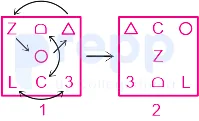
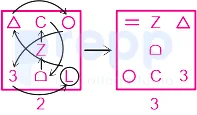
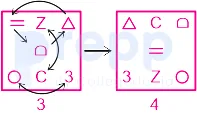
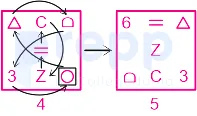
Select the figure from among the given options that can replace the question mark (?) in the following series.

- A
Option A (shown in image)
- B
Option B (shown in image)
- C
Option C (shown in image)
- D
Option D (shown in image)
Show answer
Question 3archived
The fifteenth day of the month of June is a Saturday. What will be the last day of the next month which has 31 days?
- A
Tuesday
- B
Monday
- C
Friday
- D
Wednesday
Show answer
D. WednesdayUnderstanding the Calendar Problem
This question asks us to determine the day of the week for a specific date in the future, given the day of the week for an earlier date. We are told that the fifteenth day of June is a Saturday. We need to find the day of the week for the last day of the next month which has 31 days.
Identifying the Target Date
The starting month is June. The next month is July. We need to confirm if July has 31 days. Yes, July is a month that has 31 days. The last day of July is the 31st. So, we need to find the day of the week for July 31st, given that June 15th is a Saturday.
Calculating the Number of Days
To find the day of the week for July 31st, we need to calculate the total number of days from June 15th to July 31st. This calculation involves two parts:
The number of days remaining in June from June 15th onwards.
The total number of days in July.
Days Remaining in June
June has 30 days. The number of days remaining in June from June 15th is the total days in June minus the day number we are starting from.
\( \text{Days remaining in June} = \text{Total days in June} - \text{Day in June we start from} \)
\( \text{Days remaining in June} = 30 - 15 = 15 \text{ days} \)
Days in July
July is the month following June, and it has 31 days.
\( \text{Days in July} = 31 \text{ days} \)
Total Number of Days
The total number of days from June 15th to July 31st is the sum of the remaining days in June and the days in July.
\( \text{Total days} = \text{Days remaining in June} + \text{Days in July} \)
\( \text{Total days} = 15 + 31 = 46 \text{ days} \)
Finding the Day of the Week using Odd Days
The day of the week repeats every 7 days. To find the day of the week after a certain number of days, we find the number of 'odd days'. Odd days are the remainder when the total number of days is divided by 7.
\( \text{Odd days} = \text{Total days} \pmod{7} \)
\( \text{Odd days} = 46 \pmod{7} \)
We divide 46 by 7:
\( 46 \div 7 = 6 \text{ with a remainder of } 4 \)
So, there are 4 odd days.
Determining the Final Day
Starting from Saturday (June 15th), we move forward by the number of odd days calculated. The starting day is Saturday.
After 1 odd day: Sunday
After 2 odd days: Monday
After 3 odd days: Tuesday
After 4 odd days: Wednesday
Therefore, 46 days after Saturday, the day will be Wednesday.
Summary of the Calculation
Step
Description
Calculation
Result
1
Starting Date
June 15th (Saturday)
Saturday
2
Days remaining in June
30 - 15
15 days
3
Days in July
31 days
4
Total days
15 + 31
46 days
5
Odd days
\(46 \div 7\) (Remainder)
4 odd days
6
Final Day
Saturday + 4 odd days
Wednesday
The last day of the next month (July 31st) will be a Wednesday.
Revision Table: Key Calendar Concepts
Concept
Explanation
Odd Days
The remainder left after dividing the total number of days by 7. These represent the extra days beyond a complete week cycle.
Days in Months
The number of days each month has (Jan: 31, Feb: 28/29, Mar: 31, Apr: 30, May: 31, Jun: 30, Jul: 31, Aug: 31, Sep: 30, Oct: 31, Nov: 30, Dec: 31).
Leap Year
A year with 366 days, where February has 29 days. Occurs every 4 years, except for years divisible by 100 but not by 400.
Additional Information on Calendar Calculations
Calendar problems often rely on the concept of odd days because the sequence of days of the week is cyclical (repeats every 7 days). Knowing the number of odd days between two dates allows us to determine the day of the week for the later date if the day of the week for the earlier date is known.
To find the day of the week after \(N\) days from a given day:
Calculate the number of odd days: \( N \pmod{7} \).
Count forward that many days from the given day. For example, if the given day is Monday and the number of odd days is 3, the day after \(N\) days will be Thursday (Monday + 3 days).
In this specific problem, the total number of days from June 15th to July 31st was 46. The number of odd days was \(46 \pmod{7} = 4\). Starting from Saturday, moving forward 4 days gives us Sunday, Monday, Tuesday, Wednesday.
Paper & answer key PDF ↗ Question 4archived
Which option represents the correct order of the given words as they would appear in an English dictionary?
1. Elite
2. Elude
3. Elaborate
4. Elapsed
5. Elongate
- A
3, 4, 1, 5, 2
- B
3, 5, 1, 4, 2
- C
4, 3, 5, 1, 2
- D
3, 5, 2, 4, 1
Show answer
A. 3, 4, 1, 5, 2Determining Dictionary Order for English Words
This guide explains how to arrange a given list of English words in their correct alphabetical order, simulating how they would appear in an English dictionary. We will compare the words letter by letter to determine their sequence.
Analyzing the Words for Dictionary Sequence
The words provided for ordering are:
Elite
Elude
Elaborate
Elapsed
Elongate
Step-by-Step Comparison for Alphabetical Ordering
To find the correct dictionary order, we compare the words character by character from the beginning.
Step 1: Initial Letter Comparison
All the words begin with the letters 'El'. Therefore, we need to examine the subsequent letters to establish the order.
Step 2: Third Letter Comparison
We compare the third letter of each word:
Elaborate: The third letter is 'a'.
Elapsed: The third letter is 'a'.
Elite: The third letter is 'i'.
Elongate: The third letter is 'o'.
Elude: The third letter is 'u'.
Alphabetically, the order of these third letters is 'a', 'i', 'o', 'u'. This means the words starting with 'Ela' will come first, followed by the word starting with 'Eli', then 'Elo', and finally 'Elu'.
Step 3: Resolving Ties with the Fourth Letter
We have two words, 'Elaborate' and 'Elapsed', that share the first three letters ('Ela'). We compare their fourth letters to determine their order relative to each other:
Elaborate: The fourth letter is 'b'.
Elapsed: The fourth letter is 'p'.
Since 'b' comes before 'p' in the alphabet, 'Elaborate' precedes 'Elapsed'.
Thus, the order between these two words is: Elaborate (3), Elapsed (4).
Step 4: Establishing the Complete Dictionary Order
Now, we combine the findings from the letter comparisons:
The words starting with 'Ela' come first, in the order: Elaborate (3), Elapsed (4).
Next comes the word starting with 'Eli': Elite (1).
Following that is the word starting with 'Elo': Elongate (5).
Lastly, we have the word starting with 'Elu': Elude (2).
Therefore, the complete dictionary order of the words is:
Elaborate (3)
Elapsed (4)
Elite (1)
Elongate (5)
Elude (2)
This sequence corresponds to the numerical order 3, 4, 1, 5, 2.
Final Conclusion on Word Order
The correct sequence of the given words as they would appear in an English dictionary is represented by the numerical order 3, 4, 1, 5, 2.
Paper & answer key PDF ↗ Question 5archived
Select the word-pair that best represents a similar relationship to the one expressed in the pair of words given below.
Portugal : Lisbon
- A
Mozambique : Matola
- B
Turkey : Istanbul
- C
New Zealand : Canberra
- D
Italy : Rome
Show answer
D. Italy : RomeSolving Country Capital Analogies
The question asks us to find a word-pair that shares the same relationship as the given pair: Portugal : Lisbon.
First, let's analyze the relationship between Portugal and Lisbon.
Portugal is a country in Europe.
Lisbon is the capital city of Portugal.
So, the relationship expressed in the given pair is Country : Capital City.
Now, we need to examine each option and determine the relationship between the two words in each pair. We are looking for a pair where the first word is a country and the second word is its capital city.
Analyzing Each Option Pair
Let's break down each option:
Mozambique : Matola
Mozambique is a country in Africa.
Matola is a city in Mozambique, but the capital of Mozambique is Maputo.
Relationship: Country : Major City (but not Capital). This relationship is different from the original pair.
Turkey : Istanbul
Turkey is a country.
Istanbul is a major city in Turkey, known historically and culturally. However, the capital of Turkey is Ankara.
Relationship: Country : Major City (but not Capital). This relationship is different from the original pair.
New Zealand : Canberra
New Zealand is a country.
Canberra is a city. However, Canberra is the capital of Australia, not New Zealand. The capital of New Zealand is Wellington.
Relationship: Country : Capital of Another Country. This relationship is different from the original pair.
Italy : Rome
Italy is a country in Europe.
Rome is the capital city of Italy.
Relationship: Country : Capital City. This relationship is the same as the original pair (Portugal : Lisbon).
Identifying the Matching Analogy
Based on our analysis, only the pair Italy : Rome exhibits the same Country : Capital City relationship as Portugal : Lisbon.
Revision Table: Countries and Their Capitals
Country
Capital City
Portugal
Lisbon
Mozambique
Maputo
Turkey
Ankara
New Zealand
Wellington
Italy
Rome
Additional Information on Word Analogies
Word analogies test your ability to recognize the relationship between a pair of words and find another pair that shares the most similar relationship. Common types of relationships include:
Part : Whole: e.g., Finger : Hand (A finger is part of a hand)
Cause : Effect: e.g., Sun : Heat (Sun causes heat)
Antonyms (Opposites): e.g., Hot : Cold
Synonyms (Similar Meaning): e.g., Happy : Joyful
Worker : Tool: e.g., Carpenter : Hammer
Action : Object: e.g., Read : Book
Category : Example: e.g., Fruit : Apple
Degree: e.g., Warm : Hot (Hot is a higher degree of warm)
To solve analogies, always first identify the clear relationship in the given pair before examining the options.
Paper & answer key PDF ↗ Question 6archived
Select the correct combination of mathematical signs to sequentially replace the @ signs and to balance the given equation.
72 @ 9 @3 @ 6 @ 6 @ 6 @ 6
- A
÷, ×, +, =, -, +
- B
÷, ×, +, =, × , -
- C
×, ÷, =, -, +, ×
- D
+. ×, =, -, ÷, +
Show answer
B. ÷, ×, +, =, × , -The Correct Combination: $\div, \times, +, =, \times, -$
When we replace the $\text{@}$ signs sequentially with these symbols, the equation becomes:
$$72 \div 9 \times 3 + 6 = 6 \times 6 - 6$$
Now, we solve both the Left-Hand Side (LHS) and the Right-Hand Side (RHS) using the BODMAS rule:
1. Solving Left-Hand Side (LHS):
$$\text{LHS} = 72 \div 9 \times 3 + 6$$
Step 1 (Division): Perform $72 \div 9 = 8$
$$\text{LHS} = 8 \times 3 + 6$$
Step 2 (Multiplication): Perform $8 \times 3 = 24$
$$\text{LHS} = 24 + 6$$
Step 3 (Addition): Perform $24 + 6 = 30$
$$\mathbf{\text{LHS} = 30}$$
2. Solving Right-Hand Side (RHS):
$$\text{RHS} = 6 \times 6 - 6$$
Step 1 (Multiplication): Perform $6 \times 6 = 36$
$$\text{RHS} = 36 - 6$$
Step 2 (Subtraction): Perform $36 - 6 = 30$
$$\mathbf{\text{RHS} = 30}$$
Conclusion
Since $\text{LHS} = \text{RHS}$ ($30 = 30$), the question is mathematically consistent and correct.
The correct sequence of signs to balance the equation is $\div, \times, +, =, \times, -$.
Paper & answer key PDF ↗ Question 7archived
Select the option that is related to the fifth number in the same way as the second number is related to the first number and the fourth number is related to the third number.
14 : 54 :: 21 : 82 :: 5 : ?
- A
24
- B
19
- C
15
- D
18
Show answer
D. 18Understanding Number Analogy Questions
Number analogy questions test your ability to find a specific relationship or pattern between pairs of numbers and then apply that same pattern to a new number to find a missing one. The key is to carefully examine the given pairs and identify the rule connecting them.
Analyzing the Given Number Pairs
We are given two complete pairs: 14 : 54 and 21 : 82. We need to find the relationship between the numbers in each pair.
Let's look at the first pair, 14 and 54. How can we get from 14 to 54? We can try different arithmetic operations:
Adding a number: $14 + x = 54 \implies x = 54 - 14 = 40$. So, adding 40.
Multiplying by a number: $14 \times x = 54 \implies x = \frac{54}{14}$ (not a whole number).
Let's try a combination of operations, like multiplying and then adding or subtracting.
What if we multiply 14 by a small whole number?
Try multiplying 14 by 3: $14 \times 3 = 42$. To get to 54, we need to add $54 - 42 = 12$. So, the rule could be ($\times 3 + 12$).
Try multiplying 14 by 4: $14 \times 4 = 56$. To get to 54, we need to subtract $56 - 54 = 2$. So, the rule could be ($\times 4 - 2$).
Now let's test these potential rules with the second pair, 21 and 82.
Using the ($\times 3 + 12$) rule on 21: $21 \times 3 = 63$. Then add 12: $63 + 12 = 75$. This does not equal 82. So, this rule is incorrect.
Using the ($\times 4 - 2$) rule on 21: $21 \times 4 = 84$. Then subtract 2: $84 - 2 = 82$. This matches the second number!
So, the pattern relating the first number to the second number in each pair is: Multiply the first number by 4 and then subtract 2.
Let's verify the pattern with the given pairs:
For the first pair (14 : 54): $(14 \times 4) - 2 = 56 - 2 = 54$. This is correct.
For the second pair (21 : 82): $(21 \times 4) - 2 = 84 - 2 = 82$. This is correct.
Applying the Pattern to Find the Missing Number
Now we apply the same pattern to the third number given, which is 5. We need to find the number that relates to 5 in the same way.
Using the rule ($\times 4 - 2$):
Multiply the number 5 by 4: $5 \times 4 = 20$.
Subtract 2 from the result: $20 - 2 = 18$.
So, the missing number is 18.
Conclusion
The pattern found is that the second number in each pair is obtained by multiplying the first number by 4 and subtracting 2. Applying this pattern to the number 5, we get $(5 \times 4) - 2 = 18$. Therefore, the correct answer is 18.
Pair
First Number
Pattern ($ \times 4 - 2 $)
Result
Second Number
Match
1
14
$(14 \times 4) - 2$
$56 - 2 = 54$
54
Yes
2
21
$(21 \times 4) - 2$
$84 - 2 = 82$
82
Yes
3
5
$(5 \times 4) - 2$
$20 - 2 = 18$
?
Found: 18
Revision Table: Number Analogy Patterns
Understanding different types of patterns is crucial for number analogy questions. Here are some common pattern types:
Arithmetic Operations: Adding, subtracting, multiplying, dividing by a constant number.
Combined Operations: Multiplying/dividing and then adding/subtracting.
Squaring/Cubing: Squaring or cubing the number and then adding/subtracting/multiplying/dividing.
Digit Operations: Sum of digits, product of digits, reversing digits, etc.
Sequence based: Relation might be based on prime numbers, squares, cubes, etc.
Additional Information: Improving Pattern Recognition Skills
To improve your ability to solve number analogy and pattern recognition problems, practice is key. Try to solve a variety of problems involving different types of numerical relationships. Always check the pattern you find on all given pairs before applying it to find the missing number. Be systematic in trying different operations and combinations of operations.
Paper & answer key PDF ↗ Question 8archived
Select the figure that will replace the question mark (?) in the following figure series.

- A
Option A (shown in image)
- B
Option B (shown in image)
- C
Option C (shown in image)
- D
Option D (shown in image)
Show answer
Question 9archived
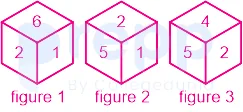
Three different positions of the same dice are shown. Find the number on the face opposite to the face showing '3'.
- A
4
- B
5
- C
2
- D
6
Show answer
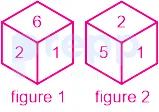
C. 2As 2 and 1 are the common faces on both the dice, the remaining faces 6 and 5 are opposite to each other.
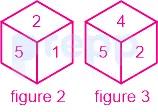
As 5 and 2 are the common faces on both the dice, the remaining faces 1 and 4 are opposite to each other.
Remaining faces 2 and 3 will be opposite to each other.
Hence, '2' is the correct answer.
 Paper & answer key PDF ↗
 Question 10archived
Which of the following numbers will replace the question mark (?) in the given series?
18, 20, 22, 27, 32, 39, ?
- A
47
- B
42
- C
46
- D
45
Show answer
C. 46This question asks us to find the next number in the given series: 18, 20, 22, 27, 32, 39, ?
To solve a number series question, we first try to identify the pattern by looking at the differences between consecutive terms, or by examining the relationship between the terms in some other way (like squares, cubes, multiplication, division, etc.).
Analyzing the Number Series Pattern
Let's find the differences between adjacent terms in the series:
Difference between the 2nd term (20) and the 1st term (18): $20 - 18 = 2$
Difference between the 3rd term (22) and the 2nd term (20): $22 - 20 = 2$
Difference between the 4th term (27) and the 3rd term (22): $27 - 22 = 5$
Difference between the 5th term (32) and the 4th term (27): $32 - 27 = 5$
Difference between the 6th term (39) and the 5th term (32): $39 - 32 = 7$
We can represent these differences in a table:
Terms
Difference
18
-
20
$+2$ ($20 - 18$)
22
$+2$ ($22 - 20$)
27
$+5$ ($27 - 22$)
32
$+5$ ($32 - 27$)
39
$+7$ ($39 - 32$)
?
$?$
The sequence of differences is 2, 2, 5, 5, 7. Let's examine this sequence of differences:
We observe that the differences appear to be grouped in pairs: (2, 2), (5, 5), (7, ...).
The first difference is 2, and it is repeated. The next difference is 5, and it is repeated. The next difference is 7. Following this pattern, the difference 7 should also be repeated for the next term in the original series.
So, the next difference should be 7.
Calculating the Next Term in the Series
To find the number that replaces the question mark (?), we add the next difference (which we found to be 7) to the last term of the given series (39).
Next term = Last term + Next difference
Next term = $39 + 7$
Next term = $46$
Therefore, the number that replaces the question mark (?) in the given series is 46.
Revision Table: Common Number Series Patterns
Pattern Type
Description
Example
Arithmetic Progression
Constant difference between terms.
3, 6, 9, 12... (Difference is 3)
Geometric Progression
Constant ratio between terms.
2, 4, 8, 16... (Ratio is 2)
Difference Series
The differences between terms follow a pattern (like AP, GP, or another series). This question is an example.
1, 2, 4, 7, 11... (Differences: 1, 2, 3, 4...)
Alternating Series
Two different patterns alternate.
10, 5, 12, 7, 14, 9... (Pattern 1: 10, 12, 14... +2; Pattern 2: 5, 7, 9... +2)
Fibonacci Series
Each term is the sum of the two preceding terms.
0, 1, 1, 2, 3, 5, 8...
Squares/Cubes Series
Terms are squares or cubes of natural numbers, or related to them.
1, 4, 9, 16... ($1^2, 2^2, 3^2, 4^2...$)
Additional Information on Solving Number Series Questions
Solving number series questions is a common type of logical reasoning problem. The key is to carefully observe the relationship between consecutive numbers. Here are some tips:
Always start by calculating the differences between adjacent terms. This is the most common pattern.
If the differences don't show a clear pattern, calculate the differences of the differences (second-order differences).
Consider the ratio between terms if the numbers are increasing or decreasing rapidly (geometric progression or multiplication/division pattern).
Look for alternating patterns where every other number follows a sequence.
Check for common mathematical operations like squares, cubes, square roots, etc., or patterns involving prime numbers or composite numbers.
Sometimes, the pattern might involve a combination of operations (e.g., multiply by 2, then add 1).
Practice with various types of series to become familiar with different patterns.
For the series 18, 20, 22, 27, 32, 39, ?, the pattern of differences (2, 2, 5, 5, 7) clearly indicates that the next difference should be 7, leading to the next term $39 + 7 = 46$.
Paper & answer key PDF ↗ Question 11archived
Select the option that represents the letters that, when placed from left to right in the following blanks, will complete the letter-series.
F G H _ Y _ G _ U Y F_ H _ Y F G _ W _
- A
U F H G V I Y
- B
T G H G V H Y
- C
T F H G V H Y
- D
U G H G V H Y
Show answer
C. T F H G V H YThis question requires identifying a pattern in a given sequence of letters and determining the correct letters to fill in the blanks to complete the sequence. The provided sequence is: F G H _ Y _ G _ U Y F _ H _ Y F G _ W _.
Analyzing the Letter Series Structure
First, let's carefully examine the structure of the given letter series: F G H _ Y _ G _ U Y F _ H _ Y F G _ W _.
The known letters are: F, G, H, Y, G, U, Y, F, H, Y, F, G, W.
There are 9 blank positions (represented by underscores `_`) that need to be filled.
The provided options contain 7 letters each. The correct answer is given as T F H G V H Y, which also consists of 7 letters. This mismatch between the 9 blanks and the 7 letters in the options suggests either a typo in the question or a pattern where only specific blanks are filled, or the pattern involves segments.
Identifying the Pattern Logic
Given the correct answer option is T F H G V H Y, let's assume these 7 letters are the key to completing the pattern. We need to determine how these letters fit into the 9 blanks. Let's break the sequence into segments based on the provided letters and blanks:
Segment 1: F G H
Segment 2: _ Y _ (Contains blanks at positions 4 and 6, with Y at position 5)
Segment 3: G _ U Y F (Contains a blank at position 8, with G, U, Y, F at positions 7, 9, 10, 11)
Segment 4: _ H _ Y F G (Contains blanks at positions 12 and 14, with H, Y, F, G at positions 13, 15, 16, 17)
Segment 5: _ W _ (Contains blanks at positions 18 and 20, with W at position 19)
Now, let's try to fill the blanks in these segments using the letters from the correct answer T F H G V H Y sequentially.
Filling the Blanks Sequentially
We will use the letters T, F, H, G, V, H, Y to fill the blanks in the order they appear across the segments:
Segment 2 (blanks at 4 and 6): Use the first two letters from the answer, T and F. The segment becomes T Y F.
Segment 3 (blank at 8): Use the next letter from the answer, H. The segment becomes G H U Y F.
Segment 4 (blanks at 12 and 14): Use the next two letters from the answer, G and V. The segment becomes G H V Y F G.
Segment 5 (blanks at 18 and 20): Use the last two letters from the answer, H and Y. The segment becomes H W Y.
This process uses all 7 letters from the answer T F H G V H Y exactly once to fill the blanks at positions 4, 6, 8, 12, 14, 18, and 20.
Constructing the Final Sequence
By placing the letters T, F, H, G, V, H, Y into the blanks at positions 4, 6, 8, 12, 14, 18, and 20 respectively, we reconstruct the complete sequence:
Original: F G H _ Y _ G _ U Y F _ H _ Y F G _ W _
Filled: F G H T Y F G H U Y F G H V Y F G H W Y
This resulting sequence maintains the original letters and incorporates the letters from the correct answer into the structure.
Conclusion
The pattern involves specific segments within the series, and the blanks are filled sequentially by the letters provided in the correct answer option T F H G V H Y. This confirms that option 3 is the correct choice for completing the letter series.
Paper & answer key PDF ↗ Question 12archived
Select the set in which the numbers are related in the same way as are the numbers of the following sets:
(4, 16, 8)
(2, 14, 9)
(NOTE: Operations should be performed on the whole numbers, without breaking down the numbers into its constituent digits. E.g. 13 - Operations on 13 such as adding /subtracting /multiplying etc. to 13 can be performed. Breaking down 13 into 1 and 3 and then performing mathematical operations on 1 and 3 is NOT allowed)
- A
(2, 8, 10)
- B
(2, 8, 6)
- C
(2, 8, 16)
- D
(2, 8, 1)
Show answer
B. (2, 8, 6)The correct answer is (2, 8, 6).
The pattern must be consistent across all the example sets provided. Test your hypothesized pattern rigorously on all options. Remember the constraint about not breaking down numbers into constituent digits unless specifically allowed. Practice with various types of number set questions helps in quickly identifying potential patterns.
Paper & answer key PDF ↗ Question 13archived
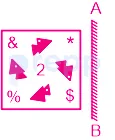
Select the correct mirror image from the following options, when the mirror is placed on the right side of the given figure.
- A
Option A (shown in image)
- B
Option B (shown in image)
- C
Option C (shown in image)
- D
Option D (shown in image)
Show answer
D. Option D (shown in image)The correct mirror image from the following options, when the mirror is placed on the right side of the given figure is shown below:
Hence, 'option 4' is the correct answer.
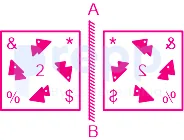 Paper & answer key PDF ↗
 Question 14archived
Three statements are given followed by three conclusions numbered I, II and III. Assuming the statements to be true, even if they seem to be at variance with commonly known facts, decide which of the conclusions logically follow(s) from the statements.
Statements:
Some boats are ships.
All ships are yachts.
All yachts are barges.
Conclusions:
I. Some barges are ships.
II. Some barges are boats.
III. Some yachts are boats.
- A
Only conclusions II and III follow
- B
Only conclusions I and III follow
- C
All conclusions follow
- D
Only conclusions I and II follow
Show answer
C. All conclusions followThe correct answer is All conclusions follow.
"Some A are B" means there is at least one A that is also a B. Chaining of statements is important. If All A are B and All B are C, then All A are C. Practicing with different types of syllogism questions involving various categories helps improve logical reasoning skills for exams.
Paper & answer key PDF ↗ Question 15archived
In a certain code language, 'LIFETIME' is written as 'FGJMFNJU' and 'INTEGRAL' is written as 'FUOJMBSH'. How will 'INTEREST' be written in that language?
- A
FUOKUTGS
- B
FUOJUTFS
- C
FUOJVUFS
- D
ETNITSER
Show answer
B. FUOJUTFSThe correct answer is FUOJUTFS.
Test your hypothesized rule on the word you need to code. Check your resulting code against the options provided. This problem illustrates a complex positional shift where the pattern for one part of the word is derived from an example, while the pattern for another part is different. Careful calculation and pattern recognition are key.
Paper & answer key PDF ↗ Question 16archived
Select the option that is related to the sixth letter-cluster in the same way as the first letter-cluster is related to the second letter-cluster and the third letter-cluster is related to the fourth letter-cluster.
EKH : BIE :: MGP : JEM :: ? : QDI
- A
TGL
- B
SFK
- C
LFT
- D
TFL
Show answer
D. TFLUnderstanding Letter Cluster Analogies
This question asks us to identify a relationship between letter clusters. We are given two pairs that follow a certain pattern, and we need to apply that same pattern to find the missing letter cluster in a third pair.
The given relationships are:
EKH : BIE
MGP : JEM
? : QDI
Let's analyze the pattern in the first two pairs by looking at the change in position of each letter in the English alphabet.
Analyzing the Pattern in EKH : BIE
Let's look at the position of each letter:
E is the 5th letter, B is the 2nd letter. Change: $5 - 2 = 3$ (or moving 3 positions backward).
K is the 11th letter, I is the 9th letter. Change: $11 - 9 = 2$ (or moving 2 positions backward).
H is the 8th letter, E is the 5th letter. Change: $8 - 5 = 3$ (or moving 3 positions backward).
So, the pattern from the first cluster (EKH) to the second (BIE) is a positional shift of -3, -2, -3 for the first, second, and third letters respectively.
Analyzing the Pattern in MGP : JEM
Let's verify if the same pattern holds for the second pair:
M is the 13th letter, J is the 10th letter. Change: $13 - 10 = 3$ (or moving 3 positions backward).
G is the 7th letter, E is the 5th letter. Change: $7 - 5 = 2$ (or moving 2 positions backward).
P is the 16th letter, M is the 13th letter. Change: $16 - 13 = 3$ (or moving 3 positions backward).
The pattern is consistent: -3, -2, -3 for the corresponding letters.
Applying the Pattern to Find the Missing Letter Cluster
The third pair is ? : QDI. Let the missing letter cluster be XYZ. The relationship is XYZ : QDI. This means applying the pattern (-3, -2, -3) to XYZ should result in QDI.
X shifted by -3 gives Q. This means Q is 3 positions before X. Therefore, X must be 3 positions after Q.
Y shifted by -2 gives D. This means D is 2 positions before Y. Therefore, Y must be 2 positions after D.
Z shifted by -3 gives I. This means I is 3 positions before Z. Therefore, Z must be 3 positions after I.
Let's find the letters for X, Y, and Z based on the positions of Q, D, and I:
Q is the 17th letter. X is $17 + 3 = 20$th letter. The 20th letter is T. So, X = T.
D is the 4th letter. Y is $4 + 2 = 6$th letter. The 6th letter is F. So, Y = F.
I is the 9th letter. Z is $9 + 3 = 12$th letter. The 12th letter is L. So, Z = L.
The missing letter cluster is TFL.
Let's verify this:
T (20th) - 3 = Q (17th)
F (6th) - 2 = D (4th)
L (12th) - 3 = I (9th)
This matches QDI, confirming that TFL is the correct missing letter cluster.
Conclusion
Based on the consistent -3, -2, -3 positional shift pattern observed in the first two analogy pairs, the missing letter cluster related to QDI in the third pair is TFL.
Letter Cluster Analogy Revision Table
Relationship
Letter 1
Letter 2
Letter 3
EKH → BIE
E (5) → B (2): -3
K (11) → I (9): -2
H (8) → E (5): -3
MGP → JEM
M (13) → J (10): -3
G (7) → E (5): -2
P (16) → M (13): -3
XYZ → QDI
(Pattern applied to find XYZ)
X → Q (-3)
So X = Q+3
Q(17)+3 = T(20)
Y → D (-2)
So Y = D+2
D(4)+2 = F(6)
Z → I (-3)
So Z = I+3
I(9)+3 = L(12)
Resulting Cluster
T
F
L
Additional Information on Letter Analogies
Letter analogies are a common type of verbal reasoning question. They test your ability to identify patterns based on the position of letters in the alphabet, skipping of letters, or even relationships between groups of letters. Common patterns include:
Positional shifts (forward or backward).
Skipping a fixed number of letters.
Reversing the order of letters.
Vowel/consonant patterns.
Combination of different patterns.
To solve letter analogy problems, it's often helpful to write down the alphabetical position of each letter or visualize the alphabet.
Paper & answer key PDF ↗ Question 17archived
Select the set in which the numbers are related in the same way as are the numbers of the following sets.
(NOTE: Operations should be performed on the whole numbers, without breaking down the numbers into its constituent digits. E.g. 13 - Operations on 13 such as adding /Subtracting/multiplying etc. to 13 can be performed. Breaking down 13 into 1 and 3 and then performing mathematical operations on 1 and 3 is not allowed)
(4, 14, 828)
(3, 10, 620)
- A
(1, 10, 100)
- B
(2, 50, 500)
- C
(5, 10, 980)
- D
(4, 32, 98)
Show answer
B. (2, 50, 500)The correct answer is (2, 50, 500).
If simple patterns don't fit all given examples, consider more complex polynomial relationships or combinations of terms. Once a potential set of rules is found, test it rigorously on all given sets. Finally, apply the verified rules to the options to find the matching set. It's important to note that sometimes, the correct rule is only apparent when considering the given sets AND the correct option together, as seen in this problem.
Paper & answer key PDF ↗ Question 18archived
Select the correct mirror image of the given combination when the mirror is placed at line MN as shown.

- A
Option A (shown in image)
- B
Option B (shown in image)
- C
Option C (shown in image)
- D
Option D (shown in image)
Show answer
D. Option D (shown in image)Select the correct mirror image of the given combination when the mirror is placed at line MN as shown.
Hence, 'option 4' is the correct answer.
 Paper & answer key PDF ↗
 Question 19archived
Select the option figure which is embedded in the given figure(rotation is NOT allowed).

- A
Option A (shown in image)
- B
Option B (shown in image)
- C
Option C (shown in image)
- D
Option D (shown in image)
Show answer
B. Option B (shown in image)The image embedded in given figure is as shown below:
Hence, 'option 2' is the correct answer.
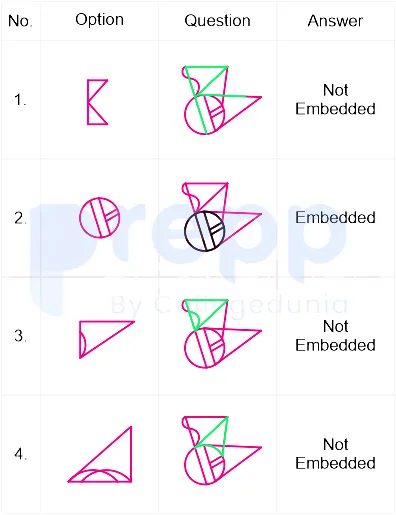 Paper & answer key PDF ↗
 Question 20archived
In this question, three statements are given, followed by three conclusions numbered I, II and III. Assuming the statements to be true, even if they seem to be at variance with commonly known facts, decide which of the conclusions logically follows/follow from the statements.
Statements:
Some roses are yellow.
Some yellow are buses.
All buses are green.
Conclusions:
I. All yellow are roses.
II. Some buses are yellow.
III. All yellow are green.
- A
Only conclusion III follows.
- B
None of the conclusions follows.
- C
Only conclusion II follows.
- D
Only conclusion I follows.
Show answer
C. Only conclusion II follows.Understanding Syllogism Statements and Conclusions
This question asks us to analyze three statements and determine which of the given conclusions logically follows from them, assuming the statements are true.
Analyzing the Statements
Let's break down the given statements:
Statement 1: Some roses are yellow.
Statement 2: Some yellow are buses.
Statement 3: All buses are green.
These are statements expressing relationships between different categories (roses, yellow things, buses, green things).
Evaluating the Conclusions
Now, let's examine each conclusion based on the statements:
Conclusion I: All yellow are roses.
Statement 1 tells us "Some roses are yellow". This means there is at least one rose that is yellow, or at least one yellow thing that is a rose. However, this does not give us any information about *all* yellow things. It is possible that many yellow things are not roses. For example, yellow could include bananas, lemons, etc. Therefore, we cannot conclude that all yellow things are roses based only on "Some roses are yellow".
This conclusion does not follow.
Conclusion II: Some buses are yellow.
Statement 2 says "Some yellow are buses". In logic, a statement of the form "Some A are B" is equivalent to "Some B are A". If some yellow things are buses, it logically follows that some buses must be yellow. The existence of even one thing that is both yellow and a bus makes both statements true.
Let's illustrate with a simple example:
If the group 'Yellow' contains {Car, Bus, Shirt} and the group 'Buses' contains {Bus, Van}, then 'Some yellow are buses' is true because 'Bus' is in both groups.
Conversely, 'Some buses are yellow' is also true because 'Bus' is in both groups.
This conclusion logically follows from Statement 2.
Conclusion III: All yellow are green.
We have Statement 2: "Some yellow are buses", and Statement 3: "All buses are green".
From Statement 2, we know there's an overlap between 'yellow' and 'buses'. From Statement 3, we know everything that is a 'bus' is also 'green'.
Combining these:
There is a part of 'yellow' that is also 'bus'.
That part of 'yellow' (which is 'bus') must also be 'green' because all buses are green.
This leads to the conclusion that "Some yellow are green". However, the conclusion presented is "All yellow are green". Just because some yellow things are green does not mean all yellow things are green. For example, a yellow banana is yellow, but it is not a bus and therefore not guaranteed to be green (in the context of buses being green).
This conclusion does not follow.
Summary of Conclusions
Based on our analysis:
Conclusion I (All yellow are roses) - Does not follow.
Conclusion II (Some buses are yellow) - Follows.
Conclusion III (All yellow are green) - Does not follow.
Therefore, only conclusion II logically follows from the given statements.
Conclusion
Logically Follows?
Reasoning
I. All yellow are roses.
No
Statements only say "Some roses are yellow", not vice versa for "All yellow".
II. Some buses are yellow.
Yes
This is the converse of "Some yellow are buses" (Statement 2), which is logically equivalent.
III. All yellow are green.
No
Statements imply "Some yellow are green", not "All yellow are green".
Revision Table: Syllogism Basics
Statement Type
Form
Conversion (Simple)
Universal Affirmative (A)
All S are P
Cannot convert simply (Some P are S)
Universal Negative (E)
No S are P
No P are S
Particular Affirmative (I)
Some S are P
Some P are S
Particular Negative (O)
Some S are not P
Cannot convert simply
In this problem, Conclusion II is the simple conversion of Statement 2 ("Some yellow are buses" <=> "Some buses are yellow").
Additional Information: Venn Diagrams in Logic
Venn diagrams are useful tools for visualizing the relationships described in syllogism statements. Each category is represented by a circle, and the overlap between circles represents the elements that belong to both categories.
"All S are P": The circle for S is completely inside the circle for P.
"No S are P": The circles for S and P do not overlap.
"Some S are P": The circles for S and P overlap, and there is at least one element in the overlapping region (often marked with an 'x').
"Some S are not P": The circle for S has an area outside the overlap with P, and there is at least one element in that area (marked with an 'x').
By drawing diagrams for the statements, you can visually check if the conclusions hold true in all possible valid diagrams.
Paper & answer key PDF ↗ Question 21archived
Which of the following terms will replace the question mark (?) in the given series?
ZBQ, BFL, ?, FNB, HRW, JVR
- A
DKG
- B
DJF
- C
DJG
- D
DKF
Show answer
C. DJGThe correct answer is DJG.
Write Down Differences/Shifts: Calculate the difference in position between consecutive letters in each series (e.g., +2, -5). This often reveals the pattern. Verify the Pattern: Once you think you've found a pattern, check if it consistently applies throughout the given series. By systematically analyzing each letter position and identifying the underlying pattern, you can determine the missing term in a letter series.
Paper & answer key PDF ↗ Question 22archived
Select the set in which the numbers are related in the same way as are the numbers of the following sets.
(NOTE: Operations should be performed on the whole numbers, without breaking down the numbers into its constituent digits. E.g. 13 - Operations on 13 such as adding /Subtracting /multiplying etc. to 13 can be performed. Breaking down 13 into 1 and 3 and then performing mathematical operations on 1 and 3 is not allowed)
(10, 5, 65)
(9, 8, 89)
- A
(12, 5, 89)
- B
(11, 10, 128)
- C
(4, 5, 29)
- D
(8, 7, 98)
Show answer
C. (4, 5, 29)Understanding Number Set Relations
The problem asks us to find the relationship or pattern connecting the numbers within given sets and then identify which of the options follows the same pattern. We are given two examples of sets and the relationship should apply to both.
The sets provided are:
(10, 5, 65)
(9, 8, 89)
Let's denote the numbers in a set as \(A\), \(B\), and \(C\), where \(A\) is the first number, \(B\) is the second, and \(C\) is the third.
Analyzing the Given Number Sets
We need to figure out how \(C\) is related to \(A\) and \(B\) in the given sets. Let's examine the first set (10, 5, 65):
\(A = 10\), \(B = 5\), \(C = 65\)
Let's try some common mathematical operations involving \(A\) and \(B\) to see if we can arrive at \(C\):
Sum: \(A + B = 10 + 5 = 15\) (Not 65)
Product: \(A \times B = 10 \times 5 = 50\) (Not 65)
Difference: \(|A - B| = |10 - 5| = 5\) (Not 65)
Squares: \(A^2 = 10^2 = 100\), \(B^2 = 5^2 = 25\)
Sum of squares: \(A^2 + B^2 = 100 + 25 = 125\) (Not 65)
The value 50 (A x B) is close to 65. The difference is \(65 - 50 = 15\). Notice that \(A + B = 10 + 5 = 15\). This suggests a possible relationship: \(C = (A \times B) + (A + B)\).
Verifying the Pattern with the Second Set
Let's test this proposed rule \(C = (A \times B) + (A + B)\) with the second set (9, 8, 89):
\(A = 9\), \(B = 8\), \(C = 89\)
Using the rule:
\((A \times B) + (A + B) = (9 \times 8) + (9 + 8)\)
\(= 72 + 17\)
\(= 89\)
This matches the third number \(C\) in the second set. So, the rule \(C = (A \times B) + (A + B)\) holds for both given sets.
Applying the Number Relation to Options
Now we apply this rule \(C = (A \times B) + (A + B)\) to each of the given options to find the set that follows the same pattern.
Option 1: (12, 5, 89)
\(A = 12\), \(B = 5\)
Calculated third number \(= (12 \times 5) + (12 + 5) = 60 + 17 = 77\)
The given third number is 89. Since \(77 \neq 89\), this option does not follow the rule.
Option 2: (11, 10, 128)
\(A = 11\), \(B = 10\)
Calculated third number \(= (11 \times 10) + (11 + 10) = 110 + 21 = 131\)
The given third number is 128. Since \(131 \neq 128\), this option does not follow the rule.
Option 3: (4, 5, 29)
\(A = 4\), \(B = 5\)
Calculated third number \(= (4 \times 5) + (4 + 5) = 20 + 9 = 29\)
The given third number is 29. Since \(29 = 29\), this option follows the rule.
Option 4: (8, 7, 98)
\(A = 8\), \(B = 7\)
Calculated third number \(= (8 \times 7) + (8 + 7) = 56 + 15 = 71\)
The given third number is 98. Since \(71 \neq 98\), this option does not follow the rule.
Conclusion
Based on the analysis, only the set (4, 5, 29) follows the identified relationship \(C = (A \times B) + (A + B)\) found in the example sets (10, 5, 65) and (9, 8, 89).
The correct set is (4, 5, 29).
Set
A
B
Calculated \(C = (A \times B) + (A + B)\)
Given C
Follows Rule?
(10, 5, 65)
10
5
\((10 \times 5) + (10 + 5) = 50 + 15 = 65\)
65
Yes
(9, 8, 89)
9
8
\((9 \times 8) + (9 + 8) = 72 + 17 = 89\)
89
Yes
(12, 5, 89)
12
5
\((12 \times 5) + (12 + 5) = 60 + 17 = 77\)
89
No
(11, 10, 128)
11
10
\((11 \times 10) + (11 + 10) = 110 + 21 = 131\)
128
No
(4, 5, 29)
4
5
\((4 \times 5) + (4 + 5) = 20 + 9 = 29\)
29
Yes
(8, 7, 98)
8
7
\((8 \times 7) + (8 + 7) = 56 + 15 = 71\)
98
No
Revision Table: Key Learnings on Number Set Patterns
Concept
Description
Relevance to this Problem
Number Set Relation
Identifying a mathematical rule connecting numbers within a set.
The core task: finding the pattern in (A, B, C).
Pattern Recognition
Observing numerical sequences or groups to find underlying rules.
Essential skill to deduce the relationship \(C = (A \times B) + (A + B)\).
Logical Deduction
Using given information (example sets) to infer a general rule.
Applying the rule found in example sets to test options.
Arithmetic Operations
Using addition, subtraction, multiplication, division, etc.
The pattern involved multiplication and addition.
Additional Information: Strategies for Solving Number Relation Problems
When tackling number set relation questions in reasoning tests, consider these strategies:
Analyze the difference/ratio: Look at the difference or ratio between consecutive numbers or pairs of numbers.
Consider basic operations: Test addition, subtraction, multiplication, and division between the first two numbers to see if they relate to the third.
Involve squares or cubes: The pattern might involve squaring or cubing the numbers.
Combine operations: Often, the rule is a combination of operations, like \(A \times B + A\) or \(A^2 + B\).
Look for digital sums/products (if allowed): Though explicitly disallowed in this problem, some questions might involve operations on individual digits. Always check the problem constraints carefully.
Test with all given examples: The rule you find must work for every example set provided in the question.
Systematically test options: Once you have a potential rule, apply it to each option methodically.
Practice is key to quickly identifying common patterns in number set reasoning problems.
Paper & answer key PDF ↗ Question 23archived
Select the option that represents the correct order of the given words as they would appear in an English dictionary.
1. Breakdown
2. Brevity
3. Breathe
4. Breeding
5. Breeze
6. Breakfast
- A
1, 3, 6, 4, 5, 2
- B
1, 6, 3, 4, 5, 2
- C
1, 3, 6, 5, 4, 2
- D
1, 6, 3, 5, 4, 2
Show answer
B. 1, 6, 3, 4, 5, 2Understanding Dictionary Order and Alphabetization
Arranging words in the order they appear in an English dictionary is called alphabetization or finding the dictionary order. This process involves comparing words letter by letter from left to right.
Given the following words to arrange in dictionary order:
Breakdown
Brevity
Breathe
Breeding
Breeze
Breakfast
Let's determine the correct dictionary order by comparing the words letter by letter.
Step-by-Step Alphabetical Comparison
We compare the words based on their letters, moving from the first letter to the next until a difference is found. The word with the letter that comes earlier in the alphabet is placed first.
All the words begin with "Br". Let's look at the third letter:
Breakdown: Bre...
Brevity: Bre...
Breathe: Bre...
Breeding: Bre...
Breeze: Bre...
Breakfast: Bre...
All words have 'e' as the third letter. Let's look at the fourth letter:
Breakdown: Brea...
Brevity: Brev...
Breathe: Brea...
Breeding: Bree...
Breeze: Bree...
Breakfast: Brea...
The fourth letters are 'a', 'v', 'a', 'e', 'e', 'a'. Comparing these letters, 'a' comes before 'e', and 'e' comes before 'v'. So, words with 'a' as the fourth letter will come first, followed by words with 'e', and then words with 'v'.
Comparing words with 'a' as the fourth letter:
Words are: Breakdown (Brea...), Breathe (Brea...), Breakfast (Brea...).
Let's look at the fifth letter:
Breakdown: Break...
Breathe: Breat...
Breakfast: Break...
The fifth letters are 'k', 't', 'k'. Comparing these, 'k' comes before 't'. So, Breakdown and Breakfast will come before Breathe.
Comparing Breakdown and Breakfast (both have 'k' as the fifth letter):
Let's look at the sixth letter:
Breakdown: Breakd...
Breakfast: Breakf...
The sixth letters are 'd' and 'f'. 'd' comes before 'f'. So, Breakdown comes before Breakfast.
Order so far: Breakdown (1), Breakfast (6).
Placing Breathe:
Breathe (Breath...) comes after Breakdown and Breakfast because its fifth letter ('t') comes after 'k'. So, after comparing words starting with 'Brea', the order is Breakdown (1), Breakfast (6), Breathe (3).
Comparing words with 'e' as the fourth letter:
Words are: Breeding (Bree...), Breeze (Bree...).
Let's look at the fifth letter:
Breeding: Breed...
Breeze: Breez...
The fifth letters are 'd' and 'z'. 'd' comes before 'z'. So, Breeding comes before Breeze.
Order for these two: Breeding (4), Breeze (5).
Placing Brevity:
Brevity (Brev...) has 'v' as its fourth letter, which comes after 'a' and 'e'. Therefore, Brevity (2) comes last among all the words.
Determining the Final Dictionary Order
Combining the sorted groups:
Words starting 'Brea': Breakdown (1), Breakfast (6), Breathe (3)
Words starting 'Bree': Breeding (4), Breeze (5)
Words starting 'Brev': Brevity (2)
The final order based on dictionary arrangement is:
Breakdown (1), Breakfast (6), Breathe (3), Breeding (4), Breeze (5), Brevity (2).
This corresponds to the sequence of numbers: 1, 6, 3, 4, 5, 2.
Word Number
Word
Comparison (Letter by Letter)
Final Rank
1
Breakdown
Breakd...
1
6
Breakfast
Breakf...
2
3
Breathe
Breat...
3
4
Breeding
Breed...
4
5
Breeze
Breez...
5
2
Brevity
Brev...
6
Revision Table: Checking Dictionary Order
Let's double-check the sequence based on the letter-by-letter comparison:
1. Breakdown (Brea...)
6. Breakfast (Brea...) - Comes after 1 because 'f' > 'd' at the 6th letter.
3. Breathe (Brea...) - Comes after 6 because 't' > 'k' at the 5th letter.
4. Breeding (Bree...) - Comes after 3 because 'e' < 'a' at the 4th letter group comparison, but 'a' words are done. Among 'e' words, 'd' < 'z' at the 5th letter compared to Breeze.
5. Breeze (Bree...) - Comes after 4 because 'z' > 'd' at the 5th letter.
2. Brevity (Brev...) - Comes after 5 because 'v' > 'e' at the 4th letter.
The order 1, 6, 3, 4, 5, 2 is confirmed.
Additional Information: Importance of Alphabetical Order
Alphabetical order is a fundamental concept used in many aspects of organizing information, not just in dictionaries. It is used in:
Indexes of books
Contact lists
Filing systems
Library catalogs
Sorting data in spreadsheets and databases
Mastering the skill of arranging words in alphabetical order helps in quickly finding information in alphabetically sorted lists.
Paper & answer key PDF ↗ Question 24archived
Three of the following four letter-clusters are alike in a certain way and one is different.
Pick the odd one out.
- A
HSF
- B
FUD
- C
BYZ
- D
JOH
Show answer
D. JOHThe correct answer is JOH.
Here are some examples of opposite letter pairs: A (1st) and Z (26th) → 1+26=27 B (2nd) and Y (25th) → 2+25=27 C (3rd) and X (24th) → 3+24=27. M (13th) and N (14th) → 13+14=27. Recognizing opposite letter pairs is a common technique used in letter series and coding-decoding questions in reasoning tests. Knowing these pairs can help quickly identify patterns like the one in this letter cluster problem.
Paper & answer key PDF ↗ Question 25archived
Select the set in which the numbers are related in the same way as are the numbers of the given sets.
(NOTE: Operations should be performed on the whole numbers, without breaking down the numbers into its constituent digits. E.g. 13 - Operations on 13 such as adding/subtracting /multiplying etc. to 13 can be performed. Breaking down 13 into 1 and 3 and then performing mathematical operations on 1 and 3 is not allowed.)
(6, 4, 8)
(17, 6, 28)
- A
(8, 3, 12)
- B
(12, 9, 11)
- C
(11, 4, 19)
- D
(13, 5, 21)
Show answer
D. (13, 5, 21)Understanding the Number Set Analogy Problem
This question asks us to identify a logical relationship or pattern that connects the three numbers within a set. We are given two example sets that follow the same hidden rule. Our task is to first discover this rule and then apply it to the given options to find the set that follows the exact same pattern.
The constraint mentioned is important: we must treat each number as a whole unit. We cannot break down numbers like 13 into 1 and 3 and perform operations on those individual digits.
The given sets are:
(6, 4, 8)
(17, 6, 28)
Let's denote the numbers in a set as A, B, and C, where A is the first number, B is the second, and C is the third.
For the set (6, 4, 8): A = 6, B = 4, C = 8
For the set (17, 6, 28): A = 17, B = 6, C = 28
Discovering the Relationship Between Numbers
We need to find an operation or a combination of operations involving A and B that results in C, or a relationship that holds true for all three numbers in the set. Let's try some common relationships based on the two given sets.
Consider the first set (6, 4, 8). How can we get 8 from 6 and 4?
Could it be addition? \(6 + 4 = 10\) (Not 8)
Could it be subtraction? \(6 - 4 = 2\) (Not 8), \(4 - 6 = -2\) (Not 8)
Could it involve multiplication? \(6 \times 4 = 24\) (Not 8)
Could it involve division? \(6/4 = 1.5\), \(4/6 \approx 0.67\)
Let's try combining operations or using multiples. Maybe a relationship of the form \(mA + nB = C\) or similar.
For (6, 4, 8): \(m(6) + n(4) = 8\) \(\Rightarrow 6m + 4n = 8\) (Equation 1)
For (17, 6, 28): \(m(17) + n(6) = 28\) \(\Rightarrow 17m + 6n = 28\) (Equation 2)
We now have a system of two linear equations with two variables, m and n. Let's solve for m and n.
From Equation 1, we can simplify by dividing by 2: \(3m + 2n = 4\).
Multiply this simplified equation by 3 to match the coefficient of n in Equation 2:
\(3 \times (3m + 2n) = 3 \times 4\)
\(9m + 6n = 12\) (Equation 3)
Now, subtract Equation 3 from Equation 2:
\((17m + 6n) - (9m + 6n) = 28 - 12\)
\(17m - 9m = 16\)
\(8m = 16\)
\(m = 16 / 8\)
\(m = 2\)
Now substitute the value of \(m=2\) back into the simplified Equation 1 (\(3m + 2n = 4\)):
\(3(2) + 2n = 4\)
\(6 + 2n = 4\)
\(2n = 4 - 6\)
\(2n = -2\)
\(n = -2 / 2\)
\(n = -1\)
So, the relationship appears to be \(C = 2A - 1B\), or simply \(C = 2A - B\).
Verifying the Discovered Relationship
Let's double-check if the relationship \(C = 2A - B\) holds for both given sets:
For (6, 4, 8): \(2 \times 6 - 4 = 12 - 4 = 8\). This matches C.
For (17, 6, 28): \(2 \times 17 - 6 = 34 - 6 = 28\). This matches C.
The relationship \(C = 2A - B\) is consistent with the given sets.
Applying the Relationship to Options
Now, we will test each option to see which one satisfies the relationship \(C = 2A - B\).
Let the option set be (A, B, C).
Option 1: (8, 3, 12)
A = 8, B = 3, C = 12
Calculate \(2A - B\): \(2 \times 8 - 3 = 16 - 3 = 13\). This is not equal to C (12).
Option 2: (12, 9, 11)
A = 12, B = 9, C = 11
Calculate \(2A - B\): \(2 \times 12 - 9 = 24 - 9 = 15\). This is not equal to C (11).
Option 3: (11, 4, 19)
A = 11, B = 4, C = 19
Calculate \(2A - B\): \(2 \times 11 - 4 = 22 - 4 = 18\). This is not equal to C (19).
Option 4: (13, 5, 21)
A = 13, B = 5, C = 21
Calculate \(2A - B\): \(2 \times 13 - 5 = 26 - 5 = 21\). This is equal to C (21).
Identifying the Matching Set
Option 4: (13, 5, 21) is the only set among the options that satisfies the relationship \(C = 2A - B\).
Conclusion
The relationship between the numbers in the given sets (6, 4, 8) and (17, 6, 28) is that the third number is equal to twice the first number minus the second number (\(C = 2A - B\)). Applying this relationship to the options, we find that the set (13, 5, 21) follows the same rule because \(2 \times 13 - 5 = 26 - 5 = 21\).
Revision Table - Number Set Analogy
Review of the problem solving process:
Step
Description
Action Taken
1
Analyze given sets
Identified sets (6, 4, 8) and (17, 6, 28)
2
Understand constraints
Operations on whole numbers, not digits
3
Formulate potential relationships
Hypothesized linear relationship \(C = mA + nB\)
4
Set up equations
Created system of equations using both sets
5
Solve for variables
Solved the system to find \(m=2, n=-1\)
6
State the rule
Established relationship \(C = 2A - B\)
7
Verify the rule
Checked rule against given sets
8
Test options
Applied rule to each option
9
Identify matching set
Found option satisfying the rule
Additional Information - Quantitative Reasoning Concepts
Number set analogy questions are common in quantitative reasoning and logical reasoning tests. They assess your ability to identify patterns and relationships between numbers. Here are some concepts related to solving such problems:
Pattern Recognition: The core skill is observing numbers and finding how they are mathematically connected.
Common Relationships: Look for basic arithmetic operations (addition, subtraction, multiplication, division), squares, cubes, square roots, multiples, differences, sums of digits (though specifically excluded in this problem), or combinations of these.
Algebraic Representation: Sometimes, expressing the relationship using variables (like A, B, C) and forming equations can help systematically find the rule, especially when the pattern isn't immediately obvious.
Systematic Testing: Once a potential rule is found, it must be tested against all given examples (in this case, both original sets) to confirm its validity before applying it to the options.
Option Elimination: Testing each option against the discovered rule helps eliminate those that do not fit, leading to the correct answer.
Practicing with different types of number set problems helps improve speed and accuracy in identifying varied relationships.
Paper & answer key PDF ↗ Question 26archived
Theoretical foundations of Bharatanatyam have been found in which of these Shastras?
- A
Arth Shastra
- B
Vaimānika Shastra
- C
Dharma Shastra
- D
Natya Shastra
Show answer
D. Natya ShastraUnderstanding the Theoretical Roots of Bharatanatyam
Bharatanatyam, one of the prominent classical dance forms of India, has a rich theoretical basis. To understand its intricate movements, expressions, and structure, one must look into ancient Indian texts that codified performing arts.
Identifying the Relevant Shastra
The question asks which Shastra contains the theoretical foundations of Bharatanatyam. Let's examine the given options:
Arth Shastra: This ancient Indian treatise, attributed to Chanakya (Kautilya), deals with statecraft, economic policy, and military strategy. It is not related to performing arts.
Vaimānika Shastra: This is a 20th-century Sanskrit text claimed to describe ancient aviation technology. Its authenticity and ancient origins are debated, and it is certainly not related to dance theory.
Dharma Shastra: These are Sanskrit texts primarily dealing with dharma, which includes religious, social, and ethical duties, laws, and conduct. While culture and arts might be mentioned in a broader context, they are not the core focus for the theoretical foundation of a dance form.
Natya Shastra: This is an ancient Indian treatise on the performing arts, encompassing theatre, dance, and music. Attributed to sage Bharata Muni, it is considered the foundational text for classical Indian dance forms, including Bharatanatyam. It details various aspects such as mudras (hand gestures), postures, movements, emotions (rasas), and theatrical conventions.
The Importance of Natya Shastra for Bharatanatyam
The term "Bharatanatyam" itself is sometimes interpreted as a combination of "Bharata" (referring to Bharata Muni, the author of Natya Shastra) and "Natyam" (dance). The principles laid down in the Natya Shastra concerning adavus (basic dance units), mudras (hand gestures), abhinaya (expressive aspects), and rasas (emotions) form the backbone of Bharatanatyam training and performance. It provides the lexicon and grammar for the dance form.
Comparison of Shastras
To further clarify, here is a brief comparison of the subject matter of the listed Shastras:
Shastra
Primary Subject
Relevance to Bharatanatyam
Arth Shastra
Statecraft, Economics, Politics
None
Vaimānika Shastra
Alleged ancient aviation
None
Dharma Shastra
Ethics, Law, Duty
Indirect (cultural context)
Natya Shastra
Performing Arts (Dance, Drama, Music)
Direct and Foundational
Based on this analysis, the theoretical foundations of Bharatanatyam are unequivocally found in the Natya Shastra.
Revision Table: Bharatanatyam Foundations
Concept
Key Text
Significance
Theoretical Foundation
Natya Shastra
Codifies dance grammar, expressions, emotions
Practical Application
Guru-Shishya tradition
Transmission of knowledge and technique
Key Elements
Adavus, Mudras, Abhinaya, Rasa
Components described in Natya Shastra
Additional Information: Natya Shastra Contents
The Natya Shastra is a vast text with around 6,000 verses. It covers a wide range of topics essential for performing arts:
Origin of theatre and drama
Construction of playhouses
Body movements and gestures (angikabhinaya)
Speech and dialogue (vachikabhinaya)
Costumes and makeup (aharyabhinaya)
Involuntary expressions (sattvikabhinaya)
Emotions (rasas) and their corresponding states (bhavas)
Music and musical instruments
Principles of rhythm (tala) and melody (raga)
These detailed descriptions form the theoretical bedrock for not only Bharatanatyam but also other classical Indian dance forms like Odissi, Kathakali, Kuchipudi, and others, each interpreting and adapting the principles in their unique style.
Paper & answer key PDF ↗ Question 27archived
Which tunnel has been built with ultra-modern specifications in the Pir Panjal range of the Himalayas at an altitude of 3000 meters above Mean Sea Level?
- A
Atal Tunnel
- B
Bhatan Tunnel
- C
Syama Prasad Mookerjee Tunnel
- D
Jawahar Tunnel
Show answer
A. Atal TunnelUnderstanding the High-Altitude Tunnels in the Himalayas
The question asks us to identify a specific tunnel located in the Pir Panjal range of the Himalayas. The key characteristics provided are: it's built with ultra-modern specifications and is situated at a high altitude of 3000 meters above Mean Sea Level.
Let's examine the options provided:
Analyzing the Tunnel Options
Atal Tunnel: This tunnel is indeed located in the Pir Panjal range, connecting Manali to Lahaul-Spiti valley in Himachal Pradesh. It is known for its strategic importance and modern construction. It is built at an altitude of about 3000 meters (approx. 10,000 feet). Its specifications are considered ultra-modern.
Bhatan Tunnel: Information about a prominent tunnel named "Bhatan Tunnel" with characteristics matching the question's description in the Pir Panjal range is not widely available. This option does not align with the given details.
Syama Prasad Mookerjee Tunnel: Also known as Chenani-Nashri Tunnel, this tunnel is located on NH 44 in Jammu and Kashmir, connecting Chenani to Nashri. While it is a significant and modern tunnel, it is not located in the Pir Panjal range nor at the specified altitude of 3000 meters.
Jawahar Tunnel: This is one of the older tunnels connecting Jammu and Kashmir across the Banihal pass. While located in the Pir Panjal range, it was constructed much earlier and does not fit the description of being built with ultra-modern specifications compared to recent constructions like the Atal Tunnel. Its altitude is also lower than 3000 meters.
Identifying the Correct Tunnel
Based on the location in the Pir Panjal range, the high altitude of approximately 3000 meters, and the description of ultra-modern specifications, the Atal Tunnel perfectly matches all the criteria mentioned in the question. It is renowned for overcoming challenging terrain and weather conditions using advanced engineering techniques.
The Atal Tunnel is the longest highway single-tube tunnel above 10,000 feet ($3000 \text{ m}$), spanning a length of $9.02 \text{ km}$ ($5.6 \text{ miles}$). Its construction significantly reduces the travel time and distance between Manali and Lahaul valley, which was previously cut off for about six months every year due to snow.
Comparison of Tunnels (Based on Question Criteria)
Tunnel Name
Located in Pir Panjal?
Approx. Altitude ($\text{m}$)?
Ultra-Modern Specs?
Fits Description?
Atal Tunnel
Yes
3000
Yes
Yes
Bhatan Tunnel
Uncertain/Not Prominent
?
?
No
Syama Prasad Mookerjee Tunnel
No (Located elsewhere in J&K)
Lower
Yes
No
Jawahar Tunnel
Yes
Lower
No (Older construction)
No
Therefore, the tunnel built with ultra-modern specifications in the Pir Panjal range at an altitude of 3000 meters is the Atal Tunnel.
Revision Table: Key Facts on Prominent Indian Tunnels
Tunnel
Location Range/Area
Connects
Length
Altitude (Approx.)
Atal Tunnel
Pir Panjal (Himachal Pradesh)
Manali to Lahaul-Spiti
$9.02 \text{ km}$
$3000 \text{ m}$ ($10000 \text{ ft}$)
Syama Prasad Mookerjee Tunnel (Chenani-Nashri)
Lower Himalayas (Jammu & Kashmir)
Chenani to Nashri (NH 44)
$9.28 \text{ km}$
$1200 \text{ m}$ ($3900 \text{ ft}$)
Jawahar Tunnel
Pir Panjal (Jammu & Kashmir)
Jammu to Srinagar (NH 44, Banihal Pass)
$2.85 \text{ km}$
$2194 \text{ m}$ ($7198 \text{ ft}$)
Additional Information on Tunnel Construction in Himalayas
Building tunnels in the Himalayan region is incredibly challenging due to several factors:
Geology: The Himalayas are young, folded mountains with complex and often unstable geological structures. This requires advanced boring techniques and strong support systems.
Altitude: High altitudes mean lower oxygen levels, extreme cold, heavy snowfall, and difficult access, all of which complicate construction work and logistics.
Weather: The region experiences harsh weather, including blizzards, avalanches, and landslides, which can halt construction and pose risks.
Seismic Activity: The Himalayas are seismically active, requiring tunnels to be designed with earthquake resistance in mind.
Ultra-modern specifications in tunnels like the Atal Tunnel include advanced ventilation and fire fighting systems, emergency exits every few hundred meters, lighting, monitoring systems, and robust structural support designed for the specific geological and environmental conditions.
Paper & answer key PDF ↗ Question 28archived
In which Five-Year Plan was the Jawahar Rozgar Yojana started?
- A
Seventh
- B
Fourth
- C
Sixth
- D
Fifth
Show answer
A. SeventhUnderstanding the Jawahar Rozgar Yojana and Five-Year Plans
The question asks about the specific Five-Year Plan during which the Jawahar Rozgar Yojana was initiated in India. To answer this, we need to know the launch date of the scheme and the periods covered by India's various Five-Year Plans.
What was the Jawahar Rozgar Yojana?
The Jawahar Rozgar Yojana (JRY) was a major rural employment programme launched by the Government of India. Its primary objective was to generate gainful employment opportunities for the unemployed and underemployed people in rural areas. The scheme aimed to achieve this by creating rural infrastructure and assets, which would also benefit the local community.
India's Five-Year Plans Overview
India's economy was planned based on Five-Year Plans formulated by the Planning Commission (now NITI Aayog). Each plan had specific objectives and priorities for national development.
Identifying the Relevant Five-Year Plan
Let's look at the periods of the Five-Year Plans relevant to the options provided and the known launch year of the Jawahar Rozgar Yojana:
Five-Year Plan
Period
Fourth Five-Year Plan
1969 – 1974
Fifth Five-Year Plan
1974 – 1978
Sixth Five-Year Plan
1980 – 1985
Seventh Five-Year Plan
1985 – 1990
The Jawahar Rozgar Yojana (JRY) was launched on April 1, 1989. Comparing this launch date with the periods of the Five-Year Plans listed above:
The Fourth Plan (1969-1974) was much earlier.
The Fifth Plan (1974-1978) was also earlier.
The Sixth Plan (1980-1985) concluded before the launch date.
The Seventh Plan (1985-1990) includes the year 1989.
Therefore, the Jawahar Rozgar Yojana was started during the Seventh Five-Year Plan period.
Revision Table: Jawahar Rozgar Yojana
Scheme Name
Launch Date
Objective
Relevant Five-Year Plan
Jawahar Rozgar Yojana (JRY)
April 1, 1989
Generate rural employment and create infrastructure
Seventh Five-Year Plan
Additional Information: Rural Employment Schemes in India
The Jawahar Rozgar Yojana was a significant step in India's efforts towards rural employment generation and poverty alleviation. It merged previous schemes like the National Rural Employment Programme (NREP) and Rural Landless Employment Guarantee Programme (RLEGP). Later, JRY itself underwent restructuring and was eventually subsumed into other programmes, highlighting the evolution of rural employment policies in India over the years.
Paper & answer key PDF ↗ Question 29archived
Identify the element that does NOT belong to Period 6 of the Modern Periodic Table.
- A
Silicon
- B
Tungsten
- C
Rhenium
- D
Platinum
Show answer
A. SiliconUnderstanding Periodic Table Periods
The Modern Periodic Table arranges elements based on their atomic number and recurring chemical properties. It consists of horizontal rows called periods and vertical columns called groups. The period number indicates the highest principal energy level occupied by electrons in an atom of that element.
The question asks us to identify the element that does NOT belong to Period 6 from the given options: Silicon, Tungsten, Rhenium, and Platinum.
Analyzing the Elements and Their Periods
To answer this question, we need to locate each element in the Modern Periodic Table and determine its period number.
Silicon (Si): Silicon has an atomic number of 14. It is located in Group 14. Looking at the periodic table, Silicon is in the third row. Therefore, Silicon is in Period 3.
Tungsten (W): Tungsten has an atomic number of 74. It is a transition metal located in Group 6. Tungsten is found in the sixth row of the periodic table. Therefore, Tungsten is in Period 6.
Rhenium (Re): Rhenium has an atomic number of 75. It is a transition metal located in Group 7. Rhenium is also found in the sixth row of the periodic table, immediately following Tungsten. Therefore, Rhenium is in Period 6.
Platinum (Pt): Platinum has an atomic number of 78. It is a transition metal located in Group 10. Platinum is found in the sixth row of the periodic table. Therefore, Platinum is in Period 6.
Comparing the Periods
Now let's compare the periods of the given elements:
Element
Symbol
Atomic Number
Period
Silicon
Si
14
3
Tungsten
W
74
6
Rhenium
Re
75
6
Platinum
Pt
78
6
From the table, it is clear that Tungsten, Rhenium, and Platinum are all located in Period 6. Silicon, on the other hand, is located in Period 3.
Conclusion
The element that does NOT belong to Period 6 of the Modern Periodic Table is Silicon, as it is located in Period 3.
Revision Table: Elements and Periods
Element
Period Number
Silicon
3
Tungsten
6
Rhenium
6
Platinum
6
Additional Information: The Modern Periodic Table Structure
The Modern Periodic Table is organized into seven periods (rows) and eighteen groups (columns). The period number corresponds to the highest principal quantum number (n) of the valence electrons for elements in that period. For instance, elements in Period 1 have their valence electrons in the n=1 shell, elements in Period 2 in the n=2 shell, and so on, up to Period 7 where valence electrons are in the n=7 shell.
Period 6 is particularly long, starting with Cesium (Cs, Z=55) and Barium (Ba, Z=56), followed by the Lanthanides (from Lanthanum, La, Z=57, through Lutetium, Lu, Z=71 - these are usually shown in a separate block below the main table but belong to Period 6), and then continuing with Hafnium (Hf, Z=72) across to Radon (Rn, Z=86).
Elements in Period 6 include many well-known transition metals, including Tungsten, Rhenium, and Platinum, as well as the Lanthanides.
Silicon is a nonmetal (metalloid) found in Period 3 and Group 14, along with Carbon, Germanium, Tin, and Lead.
Paper & answer key PDF ↗ Question 30archived
The Prime Minister in August 2021 announced the fortification of rice distributed under various government schemes including the Public Distribution System (PDS) and Mid-Day-Meal scheme by the year __________.
- A
2023
- B
2025
- C
2024
- D
2026
Show answer
C. 2024Understanding Rice Fortification in Government Schemes
The government has been working towards improving nutritional outcomes across the country. One significant initiative announced was the fortification of rice distributed through various public schemes. This measure aims to address micronutrient deficiencies prevalent in the population.
Prime Minister's Announcement on Rice Fortification
In August 2021, the Prime Minister of India made a key announcement regarding the fortification of rice. The goal was to ensure that fortified rice is supplied under all government schemes by a specific target year. These schemes include vital programs like:
Public Distribution System (PDS)
Mid-Day-Meal scheme
Integrated Child Development Services (ICDS)
The purpose of this fortification is to add essential vitamins and minerals, such as Iron, Vitamin B12, and Folic Acid, to the rice, thereby improving the nutritional content consumed by beneficiaries.
Target Year for Fortified Rice Distribution
The ambitious target set for the complete roll-out of fortified rice distribution across all government schemes, including the Public Distribution System (PDS) and Mid-Day-Meal scheme, was announced as the year 2024. This phased approach aimed to cover the entire country by this deadline, ensuring that vulnerable sections of the population receive enhanced nutrition through their staple diet.
What is Rice Fortification?
Rice fortification is a process where milled rice is enhanced with micronutrients. This involves adding a small quantity of fortified rice kernels (FRK) to normal rice. FRK is produced by grinding rice into powder, mixing it with vitamins and minerals, and then shaping it back into rice-like kernels through an extrusion process. These FRK are then mixed with regular rice in a specific ratio, typically 1:100 (1 part FRK to 100 parts of normal rice).
Key Facts about Rice Fortification Initiative
Initiative
Rice Fortification
Announced In
August 2021
Schemes Covered
PDS, Mid-Day-Meal, ICDS, etc.
Target Year
2024
Nutrients Added (Typical)
Iron, Folic Acid, Vitamin B12
Implementing rice fortification across large-scale government programs like PDS and Mid-Day-Meal is a significant step towards combating malnutrition and micronutrient deficiencies, often referred to as 'hidden hunger', among millions of beneficiaries.
Revision Table: Rice Fortification Initiative
Aspect
Detail
Announcement Date
August 2021
Purpose
Address micronutrient deficiencies
Covered Schemes
PDS, Mid-Day-Meal, ICDS
Nutrients
Iron, Folic Acid, Vitamin B12
Target Completion Year
2024
Additional Information: Impact of Fortified Rice
The distribution of fortified rice through government schemes is expected to have a positive impact on public health, particularly among women and children who are often more susceptible to deficiencies like iron deficiency anemia. By integrating fortification into staple foods distributed widely, the program aims for a sustainable and far-reaching nutritional improvement without requiring significant changes in dietary habits of the population.
Paper & answer key PDF ↗ Question 31archived
From which country were the Directive Principles of State Policy of the Indian Constitution borrowed?
- A
The USSR
- B
The US
- C
Ireland
- D
China
Show answer
C. IrelandUnderstanding Directive Principles of State Policy
The Directive Principles of State Policy (DPSPs) are guidelines or principles enshrined in Part IV of the Constitution of India. They are fundamental in the governance of the country, and it is the duty of the State to apply these principles in making laws. Unlike Fundamental Rights, the DPSPs are not enforceable by any court, but they aim to establish a welfare state in India by ensuring social and economic justice.
Origin of Directive Principles of State Policy
The concept of Directive Principles of State Policy in the Indian Constitution was borrowed from the Constitution of Ireland. The framers of the Indian Constitution were inspired by the Irish model of 'Directive Principles of Social Policy'.
The Indian Constitution draws inspiration from various constitutions across the globe. This borrowing was not a blind imitation but a careful selection and adaptation of features best suited to the Indian context and its needs.
Sources of Important Features of the Indian Constitution
Many key features of the Indian Constitution are borrowed from different countries. Understanding these sources helps appreciate the diverse influences on India's governing framework.
Feature Borrowed
Source Country
Directive Principles of State Policy (DPSP)
Ireland
Fundamental Rights
USA
Parliamentary Government
UK
Judicial Review
USA
Federal Scheme
Canada
Procedure Established by Law
Japan
Concurrent List
Australia
Emergency Provisions
Germany (Weimar Constitution)
The specific inspiration for the Directive Principles of State Policy, as incorporated in the Indian Constitution, comes directly from the Irish Constitution. Therefore, to answer the question about the origin country of the Directive Principles of State Policy, the correct source is Ireland.
Revision Table: Directive Principles of State Policy Source
Constitutional Concept
Borrowed From
Directive Principles of State Policy (DPSP)
Ireland
Additional Information: DPSP and Indian Governance
While not legally enforceable, the Directive Principles of State Policy play a crucial role. They serve as a moral compass for the government, guiding policy-making and legislation. Many laws aimed at social and economic upliftment in India are enacted to implement these principles. For example, the Minimum Wages Act, the Child Labour (Prohibition and Regulation) Act, and various land reform laws are influenced by the ideals set out in the DPSPs. They represent aspirations for a just and equitable society that the State should strive to achieve over time.
Paper & answer key PDF ↗ Question 32archived
The national poverty line for 2011-12 was estimated at ________ per capita per month for rural areas of India.
- A
Rs. 760
- B
Rs. 1,206
- C
Rs. 900
- D
Rs. 816
Show answer
D. Rs. 816Understanding India's National Poverty Line in 2011-12
The national poverty line in India is a crucial indicator used to determine the minimum expenditure required by an individual to fulfill their basic needs. These needs typically include food, clothing, shelter, healthcare, and education.
The question specifically asks about the national poverty line set for the fiscal year 2011-12, focusing on rural areas of India. Various committees in India have historically estimated the poverty line based on consumption expenditure surveys. The estimates for 2011-12 were based on the methodology recommended by the Suresh Tendulkar Committee.
According to the official estimates released based on the Tendulkar methodology for the year 2011-12, the national poverty line was defined differently for rural and urban areas, reflecting the differences in cost of living and consumption patterns.
Let's look at the specific figures for 2011-12:
For rural areas, the poverty line was set at a per capita per month expenditure of Rs. 816.
For urban areas, the poverty line was set at a per capita per month expenditure of Rs. 1,000.
Individuals whose monthly per capita expenditure fell below these respective thresholds were considered to be living below the national poverty line in 2011-12.
Therefore, the national poverty line for 2011-12 estimated for rural areas of India was Rs. 816 per capita per month.
Rural vs. Urban Poverty Line 2011-12
It is helpful to see how the poverty line differed between rural and urban areas in 2011-12:
Area
Poverty Line (Per Capita Per Month) 2011-12
Rural
Rs. 816
Urban
Rs. 1,000
Analysis of Options
Let's examine the given options based on the established national poverty line for rural areas in 2011-12:
Rs. 760: This figure is below the official rural poverty line for 2011-12.
Rs. 1,206: This figure is significantly above the official rural poverty line for 2011-12.
Rs. 900: This figure is above the official rural poverty line for 2011-12.
Rs. 816: This figure matches the official national poverty line estimated for rural areas of India for the year 2011-12.
Based on the official data, the correct national poverty line for rural areas in 2011-12 was Rs. 816 per capita per month.
Revision Table: India Poverty Line 2011-12 Rural
Key Aspect
Details
Year
2011-12
Area
Rural India
Poverty Line Definition
Per capita per month expenditure
Estimated Amount
Rs. 816
Basis
Tendulkar Committee Methodology
Additional Information on National Poverty Line in India
The concept of a national poverty line in India has evolved over time, with different committees providing methodologies for its estimation. Some key aspects include:
Historical Context: Early poverty estimations in India were based on minimum calorie requirements.
Tendulkar Committee (2009): This committee recommended a shift from calorie-based poverty estimation to one based on consumption expenditure, including spending on education and health. The 2011-12 estimates discussed here are based on this methodology.
Rangarajan Committee (2014): This committee, formed after the Tendulkar Committee, provided a different methodology, suggesting higher poverty lines (Rs. 972 for rural and Rs. 1,407 for urban per capita per month for 2011-12). However, the government typically referred to the Tendulkar committee estimates for official poverty figures for that period.
Purpose: Poverty line estimates help in identifying the poor, monitoring poverty trends, and evaluating the effectiveness of poverty alleviation programs.
Understanding the specific year and region (rural or urban) is crucial when discussing poverty line figures in India, as they vary significantly.
Paper & answer key PDF ↗ Question 33archived
The 75-day festival of Bastar Dussehra is associated with which Indian state?
- A
Chhattisgarh
- B
Odisha
- C
Jharkhand
- D
Bihar
Show answer
A. ChhattisgarhUnderstanding Bastar Dussehra in Chhattisgarh
The question asks about the Indian state associated with the 75-day festival known as Bastar Dussehra. This is a significant cultural event with unique traditions.
What is Bastar Dussehra?
Bastar Dussehra is a unique and elaborate festival celebrated primarily in the Bastar region of India. Unlike the Dussehra celebrated in other parts of the country, which marks the victory of Lord Rama over Ravana, Bastar Dussehra has its own distinct historical and cultural roots. It is dedicated to the goddess Danteshwari, the tutelary deity of the Bastar region's royal family.
A key feature of Bastar Dussehra is its duration. It is renowned for being a very long festival, spanning a period of 75 days. This makes it one of the longest-celebrated festivals in the world.
Location of Bastar Dussehra Celebration
The celebration of this 75-day festival is deeply rooted in the culture and traditions of a specific state. Let's look at the options provided:
Chhattisgarh
Odisha
Jharkhand
Bihar
The Bastar region, which is the epicentre of this unique Dussehra celebration, is located in the state of Chhattisgarh. The festival is a major highlight of Chhattisgarh's cultural calendar, attracting tourists and participants from various places. The ceremonies involve elaborate rituals, processions, and participation from various tribal communities of the region.
Analyzing the Options
Based on the location of the Bastar region and the historical association of the festival, we can determine the correct state:
Chhattisgarh: The Bastar region is a district within Chhattisgarh. The festival is strongly associated with the culture and history of this state.
Odisha: While geographically close to Chhattisgarh, Bastar is not in Odisha.
Jharkhand: Jharkhand is located further north-east and does not encompass the Bastar region.
Bihar: Bihar is also not associated with the Bastar region or this specific festival.
Therefore, the 75-day festival of Bastar Dussehra is associated with Chhattisgarh.
Conclusion on Bastar Dussehra State
The 75-day long Bastar Dussehra festival is intrinsically linked to the cultural heritage and geographical location of the Bastar region, which is part of Chhattisgarh.
Festival
Duration
Associated State
Key Deity/Focus
Bastar Dussehra
75 Days
Chhattisgarh
Goddess Danteshwari
Revision Table: Bastar Dussehra Facts
Fact
Detail
Festival Name
Bastar Dussehra
Duration
75 days
Associated State
Chhattisgarh
Region
Bastar region
Main Deity
Goddess Danteshwari
Additional Information on Chhattisgarh Festivals
Chhattisgarh is known for its rich tribal culture and unique festivals. Besides Bastar Dussehra, other notable festivals and cultural aspects of Chhattisgarh include:
Madai Festival: Celebrated in various parts of Chhattisgarh, especially in the tribal areas, involving local deities, dances, and markets.
Rajim Kumbh Mela: A significant religious gathering held annually at Rajim, located at the confluence of three rivers (Mahanadi, Pairi, Sondur).
Pola Festival: Celebrated with bull racing and decorating agricultural tools and cattle, related to agriculture.
Tribal Dances: Various tribal dance forms like Raut Nacha, Karma, and Panthi reflect the state's diverse cultural heritage.
Understanding these festivals helps appreciate the cultural diversity within India, particularly the unique traditions preserved in regions like Bastar in Chhattisgarh.
Paper & answer key PDF ↗ Question 34archived
Which group of Kingdom Animalia has unsegmented, bilaterally symmetrical, soft bodies, with a triploblastic construction (comprising three layers of cells) and a lacking coelom, skeleton, and anus?
- A
Ctenophora
- B
Cnidaria
- C
Porifera
- D
Platyhelminthes
Show answer
D. PlatyhelminthesUnderstanding Animal Kingdom Characteristics
The question asks us to identify a group within the Kingdom Animalia that possesses a specific set of characteristics: unsegmented body, bilateral symmetry, soft body, triploblastic construction (three germ layers), absence of a coelom (acoelomate), lack of a skeleton, and absence of an anus (incomplete digestive system).
Analyzing the Given Characteristics
Let's break down the key features mentioned:
Unsegmented: The body is not divided into repeating units or segments.
Bilaterally symmetrical: The body can be divided into two mirror-image halves along a single plane.
Soft bodies: Lacking hard external or internal support structures like shells or bones.
Triploblastic: Developed from three embryonic germ layers: ectoderm, mesoderm, and endoderm.
Lacking coelom (Acoelomate): Absence of a true fluid-filled body cavity lined by mesoderm. The space between the gut and body wall is filled with mesodermal tissue (parenchyma).
Lacking skeleton: No internal or external skeletal support.
Lacking anus: The digestive system is incomplete, meaning there is only one opening that serves as both mouth and anus for ingestion and egestion.
Evaluating the Options
Now, let's examine each option based on these characteristics:
Ctenophora: Also known as comb jellies. They are generally radially symmetrical, diploblastic (two germ layers), and have a rudimentary digestive system, often with anal pores (though sometimes considered transient or not a true anus like in higher animals). They do not fit the bilateral symmetry or triploblastic criteria.
Cnidaria: Includes jellyfish, corals, and sea anemones. They exhibit radial symmetry, are diploblastic, and have an incomplete digestive system (mouth but no anus). They are not bilaterally symmetrical or triploblastic.
Porifera: Sponges. These are the simplest multicellular animals. They lack true tissues and organs, are mostly asymmetrical (sometimes radially symmetrical), diploblastic (or functionally so), and have a unique filter-feeding system without a mouth or anus in the conventional sense. They do not fit the bilateral symmetry, triploblastic, or well-defined soft body criteria.
Platyhelminthes: Flatworms. This group includes planarians, flukes, and tapeworms. They typically exhibit bilateral symmetry, are triploblastic, have soft, flattened bodies, are acoelomate (lacking a coelom), lack a skeleton, and have an incomplete digestive system with a mouth but no anus (except for tapeworms, which lack a digestive system entirely). Most flatworms are also unsegmented, although some (like tapeworms) appear segmented due to repeating proglottids, but these are not true segments formed during embryonic development. Considering the typical characteristics representative of the phylum as a whole and the other options, Platyhelminthes align best with all the listed features.
Conclusion
Comparing the characteristics listed in the question with those of the given animal groups, Platyhelminthes (Flatworms) is the group that best fits all the criteria: unsegmented (mostly), bilaterally symmetrical, soft-bodied, triploblastic, acoelomate, lacking a skeleton, and having an incomplete digestive system (lacking an anus).
Characteristic
Ctenophora
Cnidaria
Porifera
Platyhelminthes
Question Description
Segmentation
Unsegmented
Unsegmented
Unsegmented
Mostly unsegmented
Unsegmented
Symmetry
Radial
Radial
Asymmetrical/Radial
Bilateral
Bilateral
Body
Soft
Soft
Soft
Soft
Soft
Germ Layers
Diploblastic
Diploblastic
No true tissues (Functionally Diploblastic)
Triploblastic
Triploblastic
Coelom
Acoelomate
Acoelomate
No coelom
Acoelomate
Lacking coelom (Acoelomate)
Skeleton
Lacking
Lacking (some may have hard parts)
Present (spicules)
Lacking
Lacking skeleton
Anus
Present (anal pores)
Lacking
Lacking
Lacking
Lacking anus
Based on this analysis, Platyhelminthes is the correct answer as it uniquely satisfies all the conditions provided in the question.
Revision Table: Animal Kingdom Phyla
Phylum
Symmetry
Germ Layers
Coelom
Digestive System
Porifera
Asymmetrical/Radial
No true tissues
Absent
Absent (Intracellular digestion)
Cnidaria
Radial
Diploblastic
Absent
Incomplete (Mouth only)
Ctenophora
Radial
Diploblastic
Absent
Complete/Incomplete (Mouth & often anal pores)
Platyhelminthes
Bilateral
Triploblastic
Absent (Acoelomate)
Incomplete (Mouth only, except tapeworms)
Nematoda
Bilateral
Triploblastic
Pseudocoelomate
Complete (Mouth & Anus)
Annelida
Bilateral
Triploblastic
Coelomate
Complete (Mouth & Anus)
Arthropoda
Bilateral
Triploblastic
Coelomate
Complete (Mouth & Anus)
Mollusca
Bilateral (often modified)
Triploblastic
Coelomate
Complete (Mouth & Anus)
Echinodermata
Radial (adult)
Triploblastic
Coelomate
Complete/Incomplete
Chordata
Bilateral
Triploblastic
Coelomate
Complete (Mouth & Anus)
Additional Information: Triploblastic and Acoelomate States
The development of three germ layers (triploblasty) in animals is a significant evolutionary step. These layers give rise to different tissues and organs:
Ectoderm: Forms the outer covering and nervous tissue.
Mesoderm: Forms muscles, bone, circulatory system, and connective tissues.
Endoderm: Forms the lining of the digestive tract and associated organs.
Animals with only two germ layers (diploblastic, like Cnidarians and Ctenophores) lack true mesoderm.
The coelom is a body cavity that forms within the mesoderm. Its presence allows for greater organ development and mobility. Animals can be classified based on the presence and nature of the coelom:
Acoelomate: No body cavity between the gut and body wall. The mesoderm fills the space (e.g., Platyhelminthes).
Pseudocoelomate: A body cavity is present, but it is not fully lined by mesoderm. It lies between the mesoderm and endoderm (e.g., Nematodes).
Coelomate: A true coelom is present, fully lined by mesoderm (e.g., Annelids, Molluscs, Arthropods, Chordates).
Platyhelminthes represent one of the earliest groups to evolve triploblasty and bilateral symmetry but still retain the acoelomate condition and an incomplete digestive system, making them a crucial link in the study of animal evolution.
Paper & answer key PDF ↗ Question 35archived
How many classes of Indian society are mentioned in Megasthene's book Indica?
- A
12
- B
10
- C
5
- D
7
Show answer
D. 7Understanding Society in Megasthenes' Indica
Megasthenes was a Greek diplomat and historian who served as an ambassador of the Seleucid king Seleucus I Nicator to the court of the Mauryan emperor Chandragupta Maurya in Pataliputra (modern Patna). His account of India, titled Indica, is a crucial source for understanding ancient Indian society, administration, and geography during the Mauryan period.
In his observations of Indian society, Megasthenes noted distinct social divisions. He classified the inhabitants of India into several groups or classes based on their occupation or way of life. The question asks about the number of such classes mentioned in his work.
According to Megasthenes' Indica, he divided Indian society into seven classes.
These seven classes described by Megasthenes are often listed as follows:
Class No.
Description (as per Indica)
1
Philosophers: Included Brahmins and ascetics, who were highly respected and advised the king.
2
Farmers: The largest class, who cultivated the land and were considered sacred and exempt from military service.
3
Herdsmen and Hunters: Those who lived in forests, reared cattle, and hunted wild animals.
4
Artisans and Traders: Craftspeople and merchants involved in manufacturing and commerce.
5
Soldiers: A well-organized and paid class responsible for the defense of the kingdom.
6
Supervisors (Overseers): Spies or inspectors who reported on events and conditions to the king.
7
Councillors and Assessors: Officials who advised the king and managed state affairs.
It is important to note that this classification into seven classes by Megasthenes does not perfectly align with the Varna system described in Indian texts (Brahmin, Kshatriya, Vaishya, Shudra). Megasthenes' observation was based on functional divisions rather than the hierarchical, birth-based Varna system, which might explain the difference in the number and composition of classes he described.
Therefore, the number of classes of Indian society mentioned in Megasthenes' book Indica is seven.
Revision Table: Key Facts on Megasthenes and Indica
Aspect
Detail
Author
Megasthenes
Book Title
Indica
Period Described
Mauryan Empire (during Chandragupta Maurya's reign)
Author's Role
Greek Ambassador to Mauryan court
Number of Social Classes Mentioned
Seven
Additional Information on Indica's Social Description
Megasthenes' account in Indica provides valuable insights, but it also has limitations. His understanding of Indian society and its nuances, particularly the Varna system, might have been imperfect due to cultural and linguistic barriers.
The seven classes he described are primarily based on occupation and function rather than a strict hierarchical order like the Varna system.
His description suggests a lack of intermarriage between these classes, although this is debated among historians.
The original Indica text is lost, and our knowledge of it comes from fragments preserved in the writings of later Greek and Roman authors like Arrian, Strabo, and Diodorus Siculus.
Despite its limitations, Indica remains a significant foreign perspective on ancient Indian society, governance, and daily life during the Mauryan era.
Paper & answer key PDF ↗ Question 36archived
Lanthanides are often called:
- A
alkali metals
- B
rare earth elements
- C
inert gases
- D
d-block elements
Show answer
B. rare earth elementsUnderstanding Lanthanides and Rare Earth Elements
Let's break down the question about what lanthanides are often called. This question relates to the classification of elements in the periodic table.
The periodic table organizes elements based on their properties. We have different blocks: s-block, p-block, d-block, and f-block.
What are Lanthanides?
Lanthanides are a series of 15 metallic chemical elements with atomic numbers 57 through 71, from lanthanum ($\text{La}$) through lutetium ($\text{Lu}$). These elements are part of the f-block of the periodic table because their distinguishing characteristic is that they have valence electrons in the f subshell.
Analyzing the Options
Let's look at the given options and see if they fit the description of Lanthanides:
alkali metals: Alkali metals are elements in Group 1 of the periodic table (like Lithium, Sodium, Potassium). They are highly reactive metals. Lanthanides are not alkali metals.
rare earth elements: This term refers to a group of 17 elements in the periodic table, specifically the 15 lanthanides plus scandium ($\text{Sc}$) and yttrium ($\text{Y}$). Lanthanides are the major part of the rare earth elements group. Although not truly 'rare' in terms of abundance, isolating them from each other is difficult and expensive, hence the historical name.
inert gases: Inert gases, also known as noble gases, are the elements in Group 18 of the periodic table (like Helium, Neon, Argon). They are very unreactive gases. Lanthanides are metallic solids and are reactive.
d-block elements: D-block elements are the transition metals, typically found in Groups 3-12 of the periodic table. Their valence electrons are in the d subshell. Lanthanides are f-block elements, not d-block elements.
Based on the analysis, the term "rare earth elements" is the common name often used to refer to or include the lanthanides.
Element Categories Comparison
Category
Location/Block
Key Characteristic
Relation to Lanthanides
Alkali Metals
Group 1 (s-block)
Highly reactive metals, 1 valence electron
No relation
Rare Earth Elements
Includes Lanthanides, Sc, Y (f-block & others)
Metallic, difficult to separate
Lanthanides are a major subset
Inert Gases
Group 18 (p-block)
Unreactive gases, full valence shell
No relation
d-block elements
Groups 3-12 (d-block)
Transition metals, valence electrons in d subshell
Lanthanides are f-block, not d-block
Conclusion on Lanthanides
Lanthanides are specifically the elements from atomic number 57 to 71. The term "rare earth elements" is a broader category that includes the lanthanides and some other related elements. Therefore, lanthanides are often called rare earth elements because they constitute the largest part of this group and share similar properties, especially their chemical behavior and occurrence in nature.
Revision Table: Lanthanides and Elements
Term
Description
Lanthanides
Elements with atomic numbers 57-71 (f-block)
Rare Earth Elements
Lanthanides + Scandium + Yttrium (17 elements total)
Alkali Metals
Group 1 elements
Inert Gases
Group 18 elements (Noble Gases)
d-block elements
Transition metals (Groups 3-12)
Additional Information on Rare Earth Elements
The term "rare earth elements" is partly a misnomer. While not found in concentrated deposits, they are relatively abundant in the Earth's crust, more so than elements like silver or gold. The difficulty lies in separating them from each other and from the ores they are found in because of their similar chemical properties. Rare earth elements have many important applications in modern technology, including electronics, magnets, catalysts, and phosphors used in screens.
Paper & answer key PDF ↗ Question 37archived
Which of the following hills is a part of the Western Ghats?
- A
Anaimalai Hills
- B
Khasi Hills
- C
Jaintia Hills
- D
Garo Hills
Show answer
A. Anaimalai HillsIdentifying Western Ghats Hills: Anaimalai vs Northeast Ranges
The question asks us to identify which of the given hill ranges is part of the Western Ghats of India. The Western Ghats are a mountain range that runs along the western coast of the Indian peninsula, from the Satpura Range in the north to the southern tip near Kanyakumari. They are known for their high biodiversity and are a UNESCO World Heritage Site.
Analyzing the Options:
Let's examine the location of each of the given hill ranges:
Anaimalai Hills: These hills are located in the southern part of India, primarily in the states of Tamil Nadu and Kerala. They are situated south of the Palghat Gap and are considered a major range within the Southern Western Ghats.
Khasi Hills: These hills are located in the northeastern part of India, specifically in the state of Meghalaya. They are part of the larger Meghalaya Plateau, which is geologically an extension of the Deccan Plateau but is separated from the main peninsula by the Ganga-Brahmaputra plains.
Jaintia Hills: Also located in the state of Meghalaya in northeastern India, the Jaintia Hills are situated east of the Khasi Hills. They are part of the same Meghalaya Plateau system.
Garo Hills: These hills are located in the western part of Meghalaya in northeastern India. They are the westernmost range of the Meghalaya Plateau.
Based on their locations, the Khasi, Jaintia, and Garo Hills are all situated in Northeast India and are part of the Meghalaya Plateau, not the Western Ghats.
The Anaimalai Hills, however, are a significant part of the mountain chain running along the western coast of India, which is the Western Ghats.
Conclusion:
Comparing the locations, only the Anaimalai Hills are situated within the geographical region of the Western Ghats. The other options are located in Northeast India.
Hill Range
Location
Part of Western Ghats?
Anaimalai Hills
Tamil Nadu, Kerala (South India)
Yes (Southern Western Ghats)
Khasi Hills
Meghalaya (Northeast India)
No (Part of Meghalaya Plateau)
Jaintia Hills
Meghalaya (Northeast India)
No (Part of Meghalaya Plateau)
Garo Hills
Meghalaya (Northeast India)
No (Part of Meghalaya Plateau)
Therefore, the Anaimalai Hills are the correct answer as they are a part of the Western Ghats.
Revision Table: Key Indian Hill Ranges and Locations
Hill Range
Location
Associated Mountain System
Anaimalai Hills
Tamil Nadu, Kerala
Western Ghats
Cardamom Hills
Kerala, Tamil Nadu
Western Ghats
Nilgiri Hills
Tamil Nadu, Kerala, Karnataka
Western Ghats (Meeting point of Eastern and Western Ghats)
Palani Hills
Tamil Nadu
Eastern Ghats (also linked to Western Ghats)
Khasi Hills
Meghalaya
Meghalaya Plateau
Jaintia Hills
Meghalaya
Meghalaya Plateau
Garo Hills
Meghalaya
Meghalaya Plateau
Aravalli Range
Rajasthan, Haryana, Delhi, Gujarat
Ancient Fold Mountains
Vindhya Range
Central India
Fold and Block Mountains
Satpura Range
Central India
Block Mountains
Additional Information: Understanding Western Ghats and Meghalaya Plateau
The Western Ghats are geologically much older than the Himalayas. They significantly influence the climate of India, particularly the monsoon patterns. They are recognized as one of the world's eight "hottest hotspots" of biological diversity. Prominent peaks in the Western Ghats include Anamudi (located in the Anaimalai Hills), which is the highest peak in the Western Ghats and peninsular India.
The Meghalaya Plateau, on the other hand, is geologically an extension of the Deccan Plateau. It is separated from the main block by the Malda Fault. The plateau receives very high rainfall, particularly in areas like Mawsynram and Cherrapunji in the Khasi Hills, known for being among the wettest places on Earth. The main hill ranges of the Meghalaya Plateau are the Garo, Khasi, and Jaintia Hills, named after the tribal communities inhabiting them.
Understanding the geographical location and major mountain systems of India is crucial for competitive exams. Distinguishing between the peninsular ranges like the Western Ghats and Eastern Ghats, central ranges like Vindhya and Satpura, and northeastern ranges helps in answering geography questions accurately.
Paper & answer key PDF ↗ Question 38archived
Major Dhyan Chand Khel Ratna Awards-2022, which was presented by President of India Droupadi Murmu on 30th November 2022, was given to _________.
- A
Venkatesh Prasad
- B
Deepika Kumari
- C
Sharath Kamal
- D
Manpreet Singh
Show answer
C. Sharath KamalUnderstanding the Major Dhyan Chand Khel Ratna Award
The Major Dhyan Chand Khel Ratna Award is India's highest sporting honour. It is given annually by the Ministry of Youth Affairs and Sports to individuals for their "spectacular and most outstanding performance in the field of sports over a period of four years immediately preceding the period of consideration for the award". This prestigious award recognizes exceptional achievement in Indian sports.
Major Dhyan Chand Khel Ratna Awards 2022 Recipient
The Major Dhyan Chand Khel Ratna Awards for the year 2022 were presented by the President of India, Droupadi Murmu, on November 30, 2022. For the 2022 cycle, the award was bestowed upon a single individual for his remarkable contributions and performance in his respective sport.
The recipient of the Major Dhyan Chand Khel Ratna Award in 2022 was Sharath Kamal. He is a veteran Indian table tennis player known for his long and successful career, including multiple Commonwealth Games medals and participation in the Olympics.
Analyzing the Options for Khel Ratna 2022
Let's look at the options provided and confirm the recipient of the 2022 Major Dhyan Chand Khel Ratna Award:
Venkatesh Prasad: A former Indian cricketer. He was not the recipient of the Khel Ratna in 2022.
Deepika Kumari: An Indian archer. While she has received the Arjuna Award in the past, she did not receive the Khel Ratna in 2022.
Sharath Kamal: An Indian table tennis player. He was indeed the sole recipient of the Major Dhyan Chand Khel Ratna Award for the year 2022.
Manpreet Singh: An Indian field hockey player, former captain of the national team. He was one of the recipients of the Khel Ratna in 2021 along with other hockey players and athletes. He did not receive it in 2022.
Based on the official announcement and presentation ceremony on November 30, 2022, the Major Dhyan Chand Khel Ratna Award was conferred upon Sharath Kamal.
Sharath Kamal's Achievements Leading to the Award
Sharath Kamal received the award for his stellar performance, particularly highlighting his achievements in the Commonwealth Games 2022 where he won multiple medals, including gold in the men's singles, mixed doubles, and men's team events, along with a silver in the men's doubles.
Major Dhyan Chand Khel Ratna Award 2022
Award
Year
Recipient
Sport
Major Dhyan Chand Khel Ratna Award
2022
Sharath Kamal
Table Tennis
Conclusion on the Khel Ratna Awardee 2022
Therefore, the correct individual who received the Major Dhyan Chand Khel Ratna Award in 2022 is Sharath Kamal for his excellence in Table Tennis.
Revision Table: Khel Ratna 2022 Summary
Key Details: Major Dhyan Chand Khel Ratna Award 2022
Award Name
Year
Presented By
Recipient
Sport
Major Dhyan Chand Khel Ratna Award
2022
President of India, Droupadi Murmu
Sharath Kamal
Table Tennis
Additional Information on Khel Ratna Award
The Major Dhyan Chand Khel Ratna Award was formerly known as the Rajiv Gandhi Khel Ratna Award. It was renamed in August 2021 in honour of the legendary Indian hockey player, Major Dhyan Chand. The award carries a cash prize, a medal, and a scroll of honour. It is one of the most significant recognitions for a sportsperson in India, celebrating their sustained excellent performance at the international level.
Paper & answer key PDF ↗ Question 39archived
The 'Pattanulkars' migrated from the Gujarat region to the Vijayanagar state. They were _________.
- A
cotton traders
- B
diamond makers
- C
goldsmiths
- D
silk weavers
Show answer
D. silk weaversUnderstanding the Pattanulkars and Vijayanagar State
The question asks about the profession of the 'Pattanulkars' who migrated from the Gujarat region to the Vijayanagar state. This involves understanding historical communities and their roles within medieval Indian states.
The Vijayanagar Empire, located in South India, was a significant political and cultural power from the 14th to the 17th centuries. It attracted people from various regions, including artisans and traders, who contributed to its economy and society.
Who were the Pattanulkars?
Historical records and community histories identify the Pattanulkars (also known by variations like Pattunulkars or Pattu Saliyar) as a specific community. They were traditionally known for their expertise in a particular craft.
Analyzing the Pattanulkars' Profession
The Pattanulkars are historically documented as a community deeply involved in the textile industry. Specifically, they were renowned for their skills in silk production.
Considering the options provided:
cotton traders: While trade was important, the Pattanulkars' primary identification is with a specific craft, not just general trading.
diamond makers: This craft is not historically associated with the Pattanulkar community.
goldsmiths: This is another craft, but the Pattanulkars' expertise lies elsewhere in the textile sector.
silk weavers: This aligns correctly with the historical profession of the Pattanulkar community. They were skilled weavers, particularly of silk fabrics. Their migration from the north to the south was often linked to patronage from rulers or local demand for fine textiles.
Therefore, the Pattanulkars who migrated from the Gujarat region to the Vijayanagar state were skilled silk weavers.
The Importance of Silk Weaving in Vijayanagar
Silk weaving was a valuable craft in the Vijayanagar Empire. The empire was known for its rich trade networks and sophisticated urban centers, where demand for luxury goods like silk was high. Communities like the Pattanulkars played a crucial role in producing these high-value textiles, contributing significantly to the empire's economy and reputation for wealth and craftsmanship.
Revision Table: Key Facts about Pattanulkars
Community
Origin Region
Migrated To
Primary Profession
Pattanulkars
Gujarat / North India
Vijayanagar State / South India
Silk Weavers
Additional Information on Migrant Communities in Vijayanagar
The Vijayanagar Empire was a melting pot of cultures and communities. Rulers often encouraged skilled artisans and traders to settle in the empire to boost its economy and cultural richness. Besides weavers, other communities of merchants, artisans, and service providers migrated to Vijayanagar from various parts of India, contributing to the empire's prosperity and diverse social fabric. This migration highlights the economic opportunities and relative stability offered by the Vijayanagar state during its peak.
Paper & answer key PDF ↗ Question 40archived
With which of the following Government of India Acts did the Montagu-Chelmsford Reforms introduce Dyarchy in the provinces?
- A
Government of India Act, 1945
- B
Government of India Act, 1935
- C
Government of India Act, 1923
- D
Government of India Act, 1919
Show answer
D. Government of India Act, 1919Understanding the Montagu-Chelmsford Reforms and Dyarchy
The question asks about the specific Government of India Act that introduced Dyarchy in the provinces, as part of the Montagu-Chelmsford Reforms. Understanding these reforms and the key features of the related Acts is crucial for answering this question.
What were the Montagu-Chelmsford Reforms?
The Montagu-Chelmsford Reforms, named after Edwin Montagu (Secretary of State for India) and Lord Chelmsford (Viceroy of India), were introduced to bring gradual development of self-governing institutions in India. These reforms led to the enactment of a specific Government of India Act.
Introduction of Dyarchy in Provinces
One of the most significant features introduced by the reforms was the system of 'Dyarchy' in the provinces. Dyarchy means 'dual rule' or 'dual government'. Under this system, provincial subjects were divided into two parts:
Transferred Subjects: These were administered by the Governor with the help of ministers responsible to the legislative council. Examples include education, health, agriculture, local government.
Reserved Subjects: These were administered by the Governor and his Executive Council, who were not responsible to the legislative council. Examples include finance, law and order, irrigation.
The aim was to give Indians some experience in governing certain areas, while retaining control over critical subjects.
Identifying the Correct Government of India Act
Let's examine the options provided:
Government of India Act, 1945: This Act is not historically significant in the context of major constitutional reforms leading to independence. The significant Act preceding independence was the Indian Independence Act, 1947.
Government of India Act, 1935: This was a very comprehensive Act. It introduced provincial autonomy (ending Dyarchy in provinces) and proposed Dyarchy at the Centre. It also established a federal structure (though never fully implemented). So, this Act *abolished* provincial Dyarchy, it didn't introduce it.
Government of India Act, 1923: There was no major Government of India Act passed in 1923 that introduced such significant reforms.
Government of India Act, 1919: This Act was a direct outcome of the Montagu-Chelmsford Reforms. It formally introduced the system of Dyarchy in the provinces.
Conclusion
Based on the historical context and the features of the Acts, the Montagu-Chelmsford Reforms are associated with the introduction of Dyarchy in the provinces through the Government of India Act, 1919.
Government of India Act
Key Features Related to Provinces/Dyarchy
1919
Introduced Dyarchy in Provinces (Transferred and Reserved subjects). Based on Montagu-Chelmsford Reforms.
1935
Abolished Dyarchy in Provinces and introduced Provincial Autonomy. Introduced Dyarchy at the Centre (never fully implemented).
Other Acts (e.g., 1945, 1923)
Not the primary Acts associated with the introduction or abolition of provincial Dyarchy in this reform period.
Revision Table: Government of India Acts & Reforms
Reform/Act
Year
Key Impact on Provinces
Montagu-Chelmsford Reforms leading to Government of India Act
1919
Introduced Dyarchy (dual government - Reserved and Transferred subjects)
Government of India Act
1935
Abolished Dyarchy; Introduced Provincial Autonomy
Additional Information: Significance of the 1919 Act
The Government of India Act, 1919, was a significant step, although limited, towards responsible government in British India. Beyond Dyarchy, it also:
Increased the size of provincial legislative councils and introduced a majority of elected members.
Separated provincial budgets from the Central budget.
Established a bicameral legislature at the Centre (Imperial Legislative Council replaced by Council of State and Legislative Assembly).
Provided for the establishment of a Public Service Commission.
While criticized for its limitations, particularly the division of subjects and the Governor's overriding powers, it provided valuable experience in legislative and administrative functions to Indian politicians.
Paper & answer key PDF ↗ Question 41archived
Who among the following was the first non-European to win a Nobel prize in 1913 in literature for his work 'Gitanjali'?
- A
Abanindranath Tagore
- B
Bankim Chandra Chatterjee
- C
Rabindranath Tagore
- D
Dwarka Nath Tagore
Show answer
C. Rabindranath TagoreUnderstanding the Nobel Prize in Literature Question
The question asks us to identify the first person from outside Europe to win the prestigious Nobel Prize in Literature. It specifically mentions the year 1913 and the famous work 'Gitanjali'. This gives us key clues to pinpoint the correct individual.
Rabindranath Tagore's Historic Nobel Win
The individual who fits all the criteria mentioned in the question is Rabindranath Tagore. He was a renowned Indian poet, writer, playwright, composer, philosopher, social reformer, and painter. Rabindranath Tagore made history by becoming the first non-European to win a Nobel Prize. This significant achievement was in the field of Literature.
Year of Award: 1913
Award Category: Nobel Prize in Literature
Awarded For: His collection of poems, 'Gitanjali'
Significance: First non-European and first Indian laureate.
About Gitanjali
'Gitanjali' (meaning 'Song Offerings') is a collection of poems by Rabindranath Tagore. It was originally written in Bengali. An English translation of the poems, largely done by Tagore himself, was published in 1912. It was this English version that brought his work to international attention and led to him being awarded the Nobel Prize in Literature in 1913.
Why Other Options Are Not Correct for the 1913 Literature Nobel Prize
Let's look at the other options provided and understand why they are not the correct answer in this specific context:
Abanindranath Tagore: He was a prominent artist and the founder of the Indian Society of Oriental Art. While a member of the Tagore family and highly influential in art, he was not awarded the Nobel Prize in Literature in 1913.
Bankim Chandra Chatterjee: He was a great Bengali writer, poet, and journalist. He composed 'Vande Mataram'. Although a celebrated literary figure, he passed away in 1894, long before the 1913 Nobel Prize was awarded. He was not the first non-European to win this prize.
Dwarka Nath Tagore: He was Rabindranath Tagore's grandfather. He was a prominent businessman and social reformer, one of the first Indian industrialists. He was not a literary figure who won the Nobel Prize.
Therefore, based on the year, the prize category, and the work 'Gitanjali', Rabindranath Tagore is clearly the correct answer.
Key Takeaways
Rabindranath Tagore won the Nobel Prize in Literature in 1913.
He was the first non-European recipient of a Nobel Prize.
The award recognized his poetry collection, 'Gitanjali'.
Revision Table: Tagore Family and Notable Achievements
Name
Relation to Rabindranath Tagore
Known For
Notable Achievement/Contribution
Rabindranath Tagore
-
Poet, Writer, Philosopher, etc.
First non-European Nobel Laureate (Literature, 1913 for 'Gitanjali')
Dwarka Nath Tagore
Grandfather
Businessman, Social Reformer
One of the first Indian industrialists
Abanindranath Tagore
Nephew
Artist, Founder of Indian Society of Oriental Art
Key figure in modern Indian art
Bankim Chandra Chatterjee
Not related
Writer, Poet
Author of 'Vande Mataram'
Additional Information on Nobel Prize and Literature
The Nobel Prizes were established by the will of Swedish scientist Alfred Nobel, who died in 1896. The first prizes were awarded in 1901. The prizes are awarded annually in the fields of Physics, Chemistry, Physiology or Medicine, Literature, Peace, and Economic Sciences. The Nobel Prize in Literature is awarded to an author from any country who has, in the words of Alfred Nobel's will, produced "the most outstanding work in an idealistic direction". The selection process is carried out by the Swedish Academy.
Paper & answer key PDF ↗ Question 42archived
Ramkrishna Talukdar received the Sangeet Natak Akademi Award in 2018 for his contribution to the Sattriya dance form. To which state does this dance form belong?
- A
West Bengal
- B
Assam
- C
Meghalaya
- D
Jharkhand
Show answer
B. AssamQuestion Analysis: Sattriya Dance and its State Origin
The question asks about the state associated with the Sattriya dance form, specifically mentioning Ramkrishna Talukdar, who received the Sangeet Natak Akademi Award in 2018 for his contribution to this dance.
Understanding the origins of classical Indian dance forms is important for cultural knowledge and competitive exams.
Understanding Sattriya Dance
Sattriya is a major Indian classical dance form. It originated in the Krishna-centric Vaishnavism monasteries, known as Sattras, of Assam. It was introduced in the 15th century by the great Vaishnava saint and reformer of Assam, Srimanta Sankardev. The dance form developed and was preserved in these Sattras over centuries.
Key characteristics of Sattriya dance include:
Its origin in the Sattras (monasteries) of Assam.
Its connection to Vaishnava philosophy and mythology, often depicting stories from the lives of Krishna and Vishnu.
It includes both male (Purusha Paksha) and female (Prakriti Paksha) styles.
It is traditionally performed by monks (Bhokots) in the Sattras, but has since moved to the modern stage.
Ramkrishna Talukdar is a notable artist who has contributed significantly to the propagation and development of the Sattriya dance form, leading to his recognition with the Sangeet Natak Akademi Award.
Analyzing the Options
Let's examine the given options:
West Bengal: West Bengal is known for various folk dances like Chhau, Baul, and Gourdances, and also has a rich tradition in Rabindra Nritya, but Sattriya is not traditionally from West Bengal.
Assam: As discussed, Sattriya dance originated and flourished in the Sattras of Assam, introduced by Srimanta Sankardev. This aligns with the origin of the dance form mentioned in the question.
Meghalaya: Meghalaya has its own distinct folk dances like Shad Suk Mynsiem and Nongkrem dance, which are integral to Khasi culture, but Sattriya is not associated with Meghalaya.
Jharkhand: Jharkhand is known for folk dances like Chhau (a different style from Bengal/Odisha), Santhal dance, and Karma dance, reflecting the culture of its tribal communities, but Sattriya is not a dance form from Jharkhand.
Based on the origin and history of the Sattriya dance form, it clearly belongs to Assam.
Conclusion
The Sattriya dance form is deeply rooted in the cultural and religious history of Assam. Ramkrishna Talukdar's award for his work in this field further highlights its connection to the state.
Therefore, the state to which the Sattriya dance form belongs is Assam.
Revision Table: Sattriya Dance Key Points
Dance Form
State of Origin
Associated Figure
Significance
Sattriya
Assam
Srimanta Sankardev (originator), Ramkrishna Talukdar (awardee)
One of the 8 classical dance forms of India, originated in Sattras, linked to Vaishnavism
Additional Information on Indian Classical Dances
India recognizes several dance forms as classical, based on texts like the Natya Shastra and their traditional roots. The Sangeet Natak Akademi currently recognizes eight classical dance forms:
Bharatanatyam (Tamil Nadu)
Kathak (Uttar Pradesh)
Kathakali (Kerala)
Kuchipudi (Andhra Pradesh)
Odissi (Odisha)
Sattriya (Assam)
Manipuri (Manipur)
Mohiniyattam (Kerala)
These dance forms have specific rules regarding gesture, posture, rhythm, and expressions, and often narrate stories from mythology and epics. Awards like the Sangeet Natak Akademi Award recognize significant contributions to preserving and promoting these rich cultural traditions.
Paper & answer key PDF ↗ Question 43archived
According to the World Meteorological Organization report reviewed during 2010-2012, the highest registered shade temperature of ________ was recorded at Al Aziziyah, Libya.
- A
72°C
- B
50°C
- C
68°C
- D
58°C
Show answer
D. 58°CUnderstanding the Al Aziziyah Libya Temperature Record
The question asks about a specific temperature record from Al Aziziyah, Libya, which was the subject of a review by the World Meteorological Organization (WMO) between 2010 and 2012. This review focused on historical weather data, particularly extreme temperature records.
The historical record under scrutiny was the shade temperature recorded in Al Aziziyah, Libya, on September 13, 1922.
Analysis of the WMO Review 2010-2012
The World Meteorological Organization (WMO) appointed a committee to investigate historical extreme temperature records, including the record from Al Aziziyah, Libya. The purpose was to verify the accuracy and validity of these long-standing records using modern meteorological standards and available historical data.
The record specifically being reviewed from Al Aziziyah was a shade temperature reading.
Identifying the Recorded Temperature
The historical temperature record from Al Aziziyah, Libya, that was reviewed by the WMO committee during the 2010-2012 period was famously cited as the world's highest temperature for many years.
Let's look at the options provided:
Option 1: $\text{72}^\circ\text{C}$
Option 2: $\text{50}^\circ\text{C}$
Option 3: $\text{68}^\circ\text{C}$
Option 4: $\text{58}^\circ\text{C}$
Based on historical climate data and the specific record from Al Aziziyah, Libya, that was reviewed, the recorded shade temperature was $\text{58}^\circ\text{C}$. The WMO's review aimed to assess the credibility of this particular $\text{58}^\circ\text{C}$ record.
Conclusion on the Al Aziziyah Temperature
The World Meteorological Organization report reviewed during 2010-2012 examined the historical claim of $\text{58}^\circ\text{C}$ being the highest registered shade temperature at Al Aziziyah, Libya.
Therefore, according to the WMO report reviewed during that period, the highest registered shade temperature of $\text{58}^\circ\text{C}$ was recorded at Al Aziziyah, Libya (this being the record under review).
Location
Temperature
Date
Status Reviewed by WMO (2010-2012)
Al Aziziyah, Libya
$\text{58}^\circ\text{C}$ (Shade)
September 13, 1922
Record under review for validity
Revision Table: Al Aziziyah Temperature Record
Key Aspect
Details
Location
Al Aziziyah, Libya
Temperature Record Reviewed
$\text{58}^\circ\text{C}$ (Shade Temperature)
Period of WMO Review
2010-2012
Historical Date of Record
September 13, 1922
Additional Information: WMO Temperature Reviews
The World Meteorological Organization is responsible for maintaining official records of extreme weather and climate events. Periodically, historical records, especially those claiming world extremes, are re-evaluated using current scientific understanding and available historical evidence.
The review of the Al Aziziyah, Libya, $\text{58}^\circ\text{C}$ temperature record is a notable example of such a process. These reviews help ensure the accuracy and reliability of global climate data. The committee's findings from the 2010-2012 review regarding the Al Aziziyah record were published, leading to updates in the official list of world extreme temperatures.
Understanding these reviews is important for students studying climate and meteorology, as it highlights the dynamic nature of scientific data verification.
Paper & answer key PDF ↗ Question 44archived
Select the Indian musician who is associated with percussion instruments (played by striking).
- A
Pandit Ayodhya Prasad
- B
Pandit Ravi Shankar
- C
Vishwa Mohan Bhat
- D
Bismillah Khan
Show answer
A. Pandit Ayodhya PrasadUnderstanding Indian Musicians and Percussion Instruments
The question asks to identify an Indian musician from the given options who is known for playing percussion instruments. Percussion instruments are musical instruments that are sounded by being struck or scraped by a beater (including attached beaters or enclosed beaters or rattles); rubbed; or plied (a tuned instrument can be plied or rubbed with a bow). Examples include drums, cymbals, and xylophones.
Analyzing the Options Provided
Let's examine each musician listed in the options and their primary musical instrument:
Pandit Ayodhya Prasad: He was a renowned master of the Pakhawaj. The Pakhawaj is a barrel-shaped, two-headed drum, which is a prominent percussion instrument used in Hindustani classical music, particularly for Dhrupad compositions and instrumental ensembles.
Pandit Ravi Shankar: He was a globally celebrated sitarist. The Sitar is a plucked string instrument used in Indian classical music. String instruments are not percussion instruments.
Vishwa Mohan Bhat: He is a Grammy Award-winning musician known for creating and playing the Mohan Veena. The Mohan Veena is a modified Hawaiian slide guitar, making it a string instrument, not a percussion instrument.
Bismillah Khan: He was a legendary Shehnai player. The Shehnai is a quadruple reed wind instrument, which falls under the category of wind instruments, not percussion instruments.
Identifying the Percussion Instrument Player
Based on the analysis of the instruments played by each musician, Pandit Ayodhya Prasad is the musician associated with a percussion instrument, the Pakhawaj.
Musician
Primary Instrument
Instrument Category
Associated with Percussion?
Pandit Ayodhya Prasad
Pakhawaj
Percussion
Yes
Pandit Ravi Shankar
Sitar
String
No
Vishwa Mohan Bhat
Mohan Veena
String
No
Bismillah Khan
Shehnai
Wind
No
Therefore, the Indian musician associated with percussion instruments from the given options is Pandit Ayodhya Prasad.
Revision Table: Key Indian Musicians and Instruments
Musician
Famous For
Instrument Type
Pandit Ayodhya Prasad
Pakhawaj
Percussion
Pandit Ravi Shankar
Sitar
String
Vishwa Mohan Bhat
Mohan Veena
String
Bismillah Khan
Shehnai
Wind
Ustad Zakir Hussain
Tabla
Percussion
Pandit Shivkumar Sharma
Santoor
String (Struck)
Additional Information on Indian Classical Percussion
Indian classical music features a rich variety of percussion instruments. These instruments provide the rhythmic framework (Tala) for the melodic performance. Some of the most important Indian percussion instruments include:
Tabla: A pair of drums, the Dayan (right hand, smaller) and the Bayan (left hand, larger). It is the most common percussion instrument in Hindustani classical music.
Pakhawaj: A two-headed barrel drum, historically preceding the Tabla and still used, especially for Dhrupad music. Pandit Ayodhya Prasad is a key figure in Pakhawaj tradition.
Mridangam: A two-headed drum, the primary percussion instrument in Carnatic classical music.
Ghatam: An earthen pot, used as a percussion instrument, particularly in Carnatic music.
Kanjira: A small frame drum with jingles, also used in Carnatic music.
These instruments require immense skill and practice to master, with complex rhythmic patterns and techniques.
Paper & answer key PDF ↗ Question 45archived
Rovers Cup is associated with which game?
- A
Tennis
- B
Badminton
- C
Football
- D
Hockey
Show answer
C. FootballUnderstanding the Rovers Cup and its Sport
The question asks about the sport associated with the Rovers Cup. This is a common question related to sports tournaments and their history.
What is the Rovers Cup?
The Rovers Cup was a popular annual football tournament held in India. It was one of the oldest and most prestigious football competitions in the country.
Connecting Rovers Cup to a Sport
Based on historical records and sports history in India, the Rovers Cup was exclusively a football tournament. Teams from across India and sometimes neighboring countries participated in this competition.
Examining the Options
Tennis: Major tennis tournaments include Grand Slams (Wimbledon, US Open, French Open, Australian Open), ATP Finals, etc. Rovers Cup is not related to tennis.
Badminton: Prominent badminton tournaments include the All England Open, World Championships, Olympic Games, etc. Rovers Cup has no association with badminton.
Football: As established, the Rovers Cup was a significant football competition in India.
Hockey: Famous hockey tournaments include the Hockey World Cup, Olympic Games, Champions Trophy, etc. Rovers Cup is not a hockey trophy.
Therefore, the Rovers Cup is associated with football.
Tournament/Cup
Associated Sport
Rovers Cup
Football
Wimbledon
Tennis
All England Open
Badminton
Hockey World Cup
Hockey
Conclusion on Rovers Cup Association
The Rovers Cup was a historic football tournament in India, confirming its strong association with the sport of football.
Revision Table: Key Sports Cups
Cup Name
Associated Sport
Region/Country
Rovers Cup
Football
India
Durand Cup
Football
India
Santosh Trophy
Football
India (State teams)
Davis Cup
Tennis
International (Men)
Uber Cup
Badminton
International (Women teams)
Stanley Cup
Ice Hockey
North America
Additional Information on Rovers Cup Football
The Rovers Cup was founded in 1891 and was held annually in Mumbai. It was one of the oldest football tournaments in Asia. Over its long history, it featured many prominent Indian football clubs. The tournament eventually faced challenges and was discontinued after the 2000-01 edition, although there were efforts to revive it later. Its legacy remains significant in the history of Indian football.
Paper & answer key PDF ↗ Question 46archived
Article 323 of the Indian Constitution deals with ___________.
- A
power to extend functions of Public Services Commissions
- B
reports of Public Services Commissions
- C
functions of Public Services Commissions
- D
expenses of Public Services Commissions
Show answer
B. reports of Public Services CommissionsUnderstanding Article 323 of the Indian Constitution
Article 323 of the Constitution of India deals with the specific responsibility of the Public Service Commissions regarding their annual reports. These commissions, like the Union Public Service Commission (UPSC) and the State Public Service Commissions (SPSCs), are vital constitutional bodies responsible for recruitment and other service matters.
What Article 323 Specifies About Reports of Public Service Commissions
Article 323 mandates that the Union Public Service Commission presents an annual report of its work to the President of India. Similarly, a State Public Service Commission presents its annual report to the Governor of the State. Let's break down the details:
The President, upon receiving the report from the UPSC, must lay a copy of it before each House of Parliament.
This report must be accompanied by a memorandum explaining the cases where the Commission's advice was not accepted by the Government and the reasons for such non-acceptance.
The Governor, upon receiving the report from the SPSC, must lay a copy of it before the State Legislature.
This state report must also be accompanied by a similar memorandum explaining cases where the SPSC's advice was not accepted by the State Government and the reasons for non-acceptance.
This reporting mechanism ensures accountability and transparency in the functioning of the Government bodies that interact with the Public Service Commissions' recommendations.
Analyzing the Options Based on Article 323
Let's look at why the different options fit or don't fit the scope of Article 323:
power to extend functions of Public Services Commissions: Article 322 relates to the expenses of Public Service Commissions, and Article 321 deals with the power to extend the functions of Public Service Commissions. Therefore, Article 323 does not cover this.
reports of Public Services Commissions: As discussed, Article 323 is explicitly titled and deals with the "Reports of Public Service Commissions," detailing the procedure for submitting annual reports and related memorandums. This aligns directly with the article's content.
functions of Public Services Commissions: Article 320 of the Constitution broadly outlines the functions of Public Service Commissions, such as conducting examinations for appointments, advising on recruitment rules, promotions, transfers, disciplinary matters, etc. Article 323 focuses specifically on reporting on the work done related to these functions.
expenses of Public Services Commissions: Article 322 of the Constitution deals with the expenses of the Public Service Commissions, stating they are charged on the Consolidated Fund of India or the Consolidated Fund of the State, as the case may be. This is not covered by Article 323.
Conclusion on Article 323
Based on the constitutional provisions, Article 323 is solely concerned with the submission and presentation of the annual reports by the Public Service Commissions to the respective executive heads (President or Governor) and then to the legislatures (Parliament or State Legislature).
Revision Table: Key Aspect of Article 323
Article Number
Subject Matter
Article 323
Reports of Public Service Commissions
Additional Information on Public Service Commissions and the Constitution
Public Service Commissions play a crucial role in maintaining the integrity and efficiency of public administration. They are covered under Part XIV of the Indian Constitution, titled "Services under the Union and the States," specifically in Chapter II which deals with Public Service Commissions (Articles 315 to 323).
Here is a brief overview of some related articles:
Article 315: Constitution of Public Service Commissions for the Union and for the States.
Article 316: Appointment and term of office of members.
Article 317: Removal and suspension of a member of a Public Service Commission.
Article 318: Power to make regulations as to conditions of service of members and staff of the Commission.
Article 319: Prohibition as to the holding of offices by members of Commission on ceasing to be such members.
Article 320: Functions of Public Service Commissions.
Article 321: Power to extend functions of Public Service Commissions.
Article 322: Expenses of Public Service Commissions.
Understanding these articles together provides a comprehensive view of the constitutional framework governing Public Service Commissions in India, with Article 323 specifically focusing on their reporting obligations.
Paper & answer key PDF ↗ Question 47archived
Which of the following statements is correct regarding cell membrane?
I. The membrane is selectively permeable to some molecules present on either side of it.
II. Water may also move across this membrane from lower to higher concentration.
- A
Only II
- B
Only I
- C
Neither I nor II
- D
Both I and II
Show answer
B. Only IUnderstanding the Cell Membrane Properties
The cell membrane, also known as the plasma membrane, is a vital boundary for all cells, separating the internal environment from the external world. It plays a crucial role in controlling what enters and leaves the cell. Let's carefully examine the two statements provided about its characteristics.
Analyzing Statement I: Selective Permeability of the Cell Membrane
Statement I asserts: "The membrane is selectively permeable to some molecules present on either side of it."
The term 'selectively permeable' is a key property of the cell membrane. It means that the membrane does not allow all substances to pass through indiscriminately. Instead, it regulates the passage of molecules and ions, allowing some to cross easily, others with assistance, and preventing others entirely. This selective nature is fundamental to maintaining the cell's internal balance (homeostasis) and function. For example, small, nonpolar molecules like oxygen and carbon dioxide can often diffuse directly through the lipid bilayer, while ions and larger polar molecules like glucose require specific protein channels or carriers to cross.
Therefore, Statement I accurately describes a well-established characteristic of the cell membrane.
Analyzing Statement II: Water Movement Across the Membrane
Statement II claims: "Water may also move across this membrane from lower to higher concentration."
The movement of water across a selectively permeable membrane is a special type of diffusion called osmosis. Osmosis occurs when there is a difference in solute concentration on either side of the membrane. Water moves from a region of higher water potential (which is typically a region with a lower concentration of solutes) to a region of lower water potential (a region with a higher concentration of solutes).
Statement II says water moves "from lower to higher concentration." This phrasing is potentially misleading. If it refers to water concentration, water moves from higher water concentration to lower water concentration. If it refers to solute concentration, water moves from lower solute concentration to higher solute concentration.
The standard understanding of osmosis is that water moves towards the area with a higher concentration of solutes (i.e., lower water potential). Thus, water moves from a region of lower *solute* concentration to a region of higher *solute* concentration. The statement "from lower to higher concentration" without specifying what concentration (solute or water) is ambiguous but does not correctly describe the net movement of water via osmosis as moving from lower to higher *water* concentration, nor does it clearly capture the movement relative to *solute* concentration in a way that aligns with the direction "from lower to higher concentration" without further context. Water moves towards the area where solutes are more concentrated.
Based on the principles of osmosis, Statement II, as phrased, is incorrect regarding the typical direction of net water movement.
Conclusion on Cell Membrane Statements
Based on our analysis:
Statement I: The membrane is selectively permeable. (Correct)
Statement II: Water may also move across this membrane from lower to higher concentration. (Incorrect - water moves from higher water potential/lower solute concentration to lower water potential/higher solute concentration via osmosis).
Therefore, only Statement I is a correct statement regarding the cell membrane.
Revision Table: Key Cell Membrane Features
FeatureDescriptionSignificance
Lipid BilayerForms the basic structure, semi-fluidBarrier function, allows passage of small nonpolar molecules
ProteinsEmbedded or associated, various types (channels, carriers, enzymes, receptors)Selective transport, signaling, cell recognition
CarbohydratesAttached to lipids (glycolipids) or proteins (glycoproteins)Cell recognition, adhesion
Cholesterol (in animal cells)Affects membrane fluidityMaintains membrane stability across temperature ranges
Selectively PermeableControls passage of substancesEssential for homeostasis and cell function
Additional Information: Osmosis and Cell Tonicity
Osmosis is crucial for cell survival. When a cell is placed in a solution, water moves across the membrane depending on the relative solute concentrations:
Isotonic Solution: Solute concentration is the same inside and outside the cell. No net water movement.
Hypotonic Solution: Solute concentration is lower outside the cell than inside. Water moves into the cell, potentially causing it to swell or burst (lysis in animal cells).
Hypertonic Solution: Solute concentration is higher outside the cell than inside. Water moves out of the cell, causing it to shrink (crenation in animal cells, plasmolysis in plant cells).
This demonstrates that water movement is fundamentally driven by concentration gradients (specifically, water potential gradients), moving towards areas of higher solute concentration, contrary to the phrasing in Statement II.
Paper & answer key PDF ↗ Question 48archived
How many substitute players are there on a Beach Volleyball team?
- A
3
- B
0
- C
2
- D
1
Show answer
B. 0Let's understand the rules regarding substitute players in Beach Volleyball.
Understanding Beach Volleyball Teams and Substitutes
Beach Volleyball is played by two teams. Each team consists of exactly two players on the court at any given time. Unlike indoor volleyball, which has larger teams and allows for substitutions throughout the match, the rules for Beach Volleyball are different in this regard.
Substitution Rules in Beach Volleyball
A key characteristic of Beach Volleyball is the absence of substitute players. The two players who start the match are the only players for that team for the entire match, unless one becomes unable to continue due to injury or other exceptional circumstances as determined by the rules or officials.
Each team has only two players.
There are no provisions for substituting players during the normal course of the game.
If a player is injured and cannot continue, and there are no substitutes allowed, the team would typically forfeit the match.
This rule emphasizes the endurance and versatility required by each player in Beach Volleyball, as they must cover the entire court and perform all necessary skills (serving, passing, setting, attacking, blocking) without relief from a substitute.
Comparing Beach and Indoor Volleyball Substitutions
To highlight the rule, let's compare it briefly with indoor volleyball substitution rules.
Feature
Beach Volleyball
Indoor Volleyball
Players per team on court
2
6
Substitute Players Allowed
0
Yes (Multiple)
Purpose of Substitution
Not applicable (no subs)
Tactical changes, injury, rest
As the table shows, the concept of substitute players is fundamentally different between the two sports.
Conclusion on Beach Volleyball Substitutes
In summary, a Beach Volleyball team is composed of two players with no substitute players available during the match. This rule is a defining aspect of the sport.
Revision Table: Beach Volleyball Rules Key Points
Aspect
Beach Volleyball Rule
Team Size on Court
2 players
Number of Substitutes
0
Substitution Permitted?
No (except under specific, rare injury rules that often lead to forfeit)
Additional Information: Beach Volleyball Team Structure
While a team consists of two players on the court, official rules sometimes mention a roster of up to two players per team. This simply means the registered team consists of these two individuals, and no one else can play for them in that match. There are no extra players sitting on the side waiting to enter the game.
This structure makes Beach Volleyball a sport where partnership and individual skill are paramount, as there is no larger squad to rely on for tactical changes or rest periods during play.
Paper & answer key PDF ↗ Question 49archived
Identify the INCORRECT statement in the context of Microfinance Institutions in India.
- A
When giving a micro loan, a household means an individual family unit, i.e., husband, wife, and their unmarried children.
- B
A microfinance loan is a collateral-free loan.
- C
A microfinance loan should be linked with a lien on the deposit account of the borrower.
- D
A microfinance loan is given to a household having annual household income up to Rs. 3,00,000.
Show answer
C. A microfinance loan should be linked with a lien on the deposit account of the borrower.Identifying the Incorrect Statement on Microfinance Institutions in India
Microfinance Institutions (MFIs) play a crucial role in providing financial services, primarily small loans (microcredit), to low-income individuals and households who typically lack access to conventional banking channels. These services are designed to help people start or expand businesses, manage household expenses, and improve their livelihoods. Understanding the regulations and characteristics of microfinance loans in India is important.
Analyzing the Statements about Microfinance Loans
Let's examine each statement provided in the context of microfinance regulations and practices in India:
Statement 1: When giving a micro loan, a household means an individual family unit, i.e., husband, wife, and their unmarried children.
Analysis 1: This definition of a "household" aligns with standard definitions used in microfinance, particularly by regulatory bodies like the Reserve Bank of India (RBI) when defining eligible borrowers and income limits. This is generally considered a correct representation.
Statement 2: A microfinance loan is a collateral-free loan.
Analysis 2: One of the fundamental characteristics of microfinance is that loans are typically provided without requiring collateral. This makes financial services accessible to the poor who do not own assets that can be pledged. This statement is correct.
Statement 3: A microfinance loan should be linked with a lien on the deposit account of the borrower.
Analysis 3: Regulatory guidelines for microfinance institutions in India generally prohibit imposing a lien on the deposit accounts of borrowers for microfinance loans. This measure is in place to protect the borrower and ensure they have access to their deposited funds. Therefore, linking a microfinance loan with a lien on the deposit account is incorrect practice and against regulations. This statement claims it *should* be linked, which makes it incorrect.
Statement 4: A microfinance loan is given to a household having annual household income up to Rs. 3,00,000.
Analysis 4: As per recent regulations by the RBI, the household income limit for borrowers eligible for microfinance loans has been set at Rs. 3,00,000 per annum. This statement correctly reflects the current income criteria for eligible households.
Identifying the INCORRECT Statement
Based on the analysis, the statement that is incorrect in the context of Microfinance Institutions in India is the one claiming that a microfinance loan should be linked with a lien on the deposit account of the borrower.
Regulatory frameworks for microfinance specifically aim to protect vulnerable borrowers, and placing a lien on their deposit accounts goes against the principles of empowering low-income individuals through accessible finance.
Therefore, the INCORRECT statement is:
A microfinance loan should be linked with a lien on the deposit account of the borrower.
Statement
Analysis
Correctness
Household definition for micro loan
Standard definition aligning with regulations.
Correct
Microfinance loan is collateral-free
Key feature of microfinance.
Correct
Loan linked with lien on deposit account
Against regulations; lien is generally prohibited.
Incorrect
Income limit up to Rs. 3,00,000
Current regulatory income criteria.
Correct
Revision Table: Key Microfinance Concepts
Concept
Description
Relevance to Question
Microfinance
Provision of financial services (loans, savings, insurance) to low-income individuals and households.
Context of the question.
Microcredit
Small loans provided to poor borrowers, often without collateral.
Related to collateral-free nature of loans.
Household Income Limit
Maximum annual income a household can have to be eligible for microfinance loans (currently Rs. 3,00,000 in India).
Directly relevant to statement 4.
Lien on Deposit Account
A financial institution's right to hold funds in a deposit account as security for a loan. Prohibited for microfinance loans in India.
Directly relevant to statement 3 (the incorrect statement).
Collateral
Assets pledged by a borrower to secure a loan. Not required for typical microfinance loans.
Directly relevant to statement 2.
Additional Information: Microfinance Regulations in India
Microfinance Institutions in India are regulated primarily by the Reserve Bank of India (RBI). NBFC-MFIs (Non-Banking Financial Company - Micro Finance Institutions) are a significant category. The regulatory framework aims to ensure responsible lending practices, protect borrowers, and promote the healthy growth of the sector.
Responsible Lending: Regulations emphasize fair practices, transparency in interest rates and terms, and avoiding over-indebtedness among borrowers.
Pricing of Loans: Guidelines are in place regarding the maximum interest rates that MFIs can charge, although recent norms have given MFIs more flexibility while requiring transparency.
Borrower Protection: Specific rules prohibit coercive recovery practices and restrict certain actions like placing a lien on deposit accounts or collecting collateral for micro-loans.
Income Criteria: The income ceiling is a key criterion to ensure that microfinance services reach the intended low-income target group. The definition of a household is also standardized for this purpose.
Understanding these regulations is key to identifying correct and incorrect practices within the Indian microfinance sector.
Paper & answer key PDF ↗ Question 50archived
The Union Ministry of Environment, Forest, and Climate Change notified the E-Waste Management Rules in 2022. These rules are supposed to come into force from __________.
- A
1 April 2023
- B
1 July 2023
- C
1 December 2022
- D
1 January 2023
Show answer
A. 1 April 2023Understanding the E-Waste Management Rules 2022 in India
The question asks about the enforcement date of the E-Waste Management Rules, 2022, which were notified by the Union Ministry of Environment, Forest, and Climate Change.
Managing electronic waste (e-waste) is crucial for environmental protection and resource conservation. Recognizing this, the Indian government introduced new rules to strengthen the regulatory framework for e-waste management. These rules replaced the earlier E-Waste Management Rules, 2016.
Key Date for E-Waste Management Rules Enforcement
The E-Waste Management Rules, 2022, although notified in November 2022, were given a specific period before they became legally effective. This transition period allows stakeholders, including manufacturers, producers, recyclers, and consumers, to understand and prepare for compliance with the new provisions.
Let's examine the options provided:
Option 1: 1 April 2023
Option 2: 1 July 2023
Option 3: 1 December 2022
Option 4: 1 January 2023
The E-Waste Management Rules, 2022, explicitly stated the date from which they would come into force.
The rules officially came into force on 1st April 2023.
Significance of E-Waste Management Rules 2022
These E-Waste Management Rules, 2022, brought several changes aimed at improving the collection, recycling, and disposal of e-waste in an environmentally sound manner. Some key features include:
Implementing Extended Producer Responsibility (EPR) with targets.
Establishing a credit-based system for EPR fulfillment.
Online registration and reporting through a central portal.
Promoting refurbishment of e-waste.
Updating the list of regulated electrical and electronic equipment.
Understanding the enforcement date is important for anyone involved in or studying environmental regulations in India.
Aspect
Details
Rules Name
E-Waste Management Rules, 2022
Notifying Ministry
Union Ministry of Environment, Forest, and Climate Change
Notification Year
2022
Enforcement Date
1 April 2023
Replaced Rules
E-Waste Management Rules, 2016
Revision Table: E-Waste Rules 2022 Key Points
Key Feature
Description
Objective
Regulate collection, recycling, and disposal of e-waste.
Basis
Extended Producer Responsibility (EPR).
Mechanism
Credit system for EPR targets.
Implementation
Centralized online portal.
Additional Information on E-Waste Management
E-waste, or electronic waste, includes discarded electrical or electronic devices. It contains valuable materials but also hazardous substances like lead, mercury, and cadmium. Improper handling of e-waste can cause significant environmental pollution and health risks.
The E-Waste Management Rules aim to shift the responsibility of managing end-of-life products to the producers, also known as Extended Producer Responsibility (EPR). This encourages producers to design environmentally friendly products and establish systems for collecting and recycling their products once they become waste.
The 2022 rules streamlined the process by introducing a digital platform for stakeholders to register and report their activities, making the system more transparent and efficient compared to the previous rules.
Paper & answer key PDF ↗ Question 51archived
A car covers a distance of 350 km in 5 hours and covers another 450 km at a speed of 90 km/h. What is the average speed (in km/h) of the car?
- A
72
- B
82
- C
80
- D
85
Show answer
C. 80The marked answer is 80.
Paper & answer key PDF ↗ Question 52archived
Simplify the following.
\(\frac{0.01 \times 0.01 \times 0.01 +0.003 \times 0.003 \times 0.003}{0.05 \times 0.05 - 0.015 \times 0.05+0.015 \times 0.015}\)
- A
\(\frac{13}{15} \times \) 10-3
- B
\(\frac{13}{25} \times 10^3 \)
- C
\(\frac{13}{25} \times \) 10-3
- D
\(\frac{13}{15} \times 10^3 \)
Show answer
C. \(\frac{13}{25} \times \) 10-3Understanding the Problem: Simplifying the Decimal Expression
The problem asks us to simplify a given expression involving decimal numbers raised to powers. The expression is:
\(\frac{0.01 \times 0.01 \times 0.01 +0.003 \times 0.003 \times 0.003}{0.05 \times 0.05 - 0.015 \times 0.05+0.015 \times 0.015}\)
This can be rewritten using powers:
\(\frac{(0.01)^3 + (0.003)^3}{(0.05)^2 - (0.015) \times (0.05) + (0.015)^2}\)
This form looks similar to the algebraic identity for the sum of cubes, \(a^3 + b^3 = (a+b)(a^2 - ab + b^2)\).
Applying the Sum of Cubes Formula for Simplification
Let's analyze the numerator and the denominator separately to see if we can use the sum of cubes formula effectively.
Analyzing the Numerator
The numerator is \( (0.01)^3 + (0.003)^3 \). This is in the form \(a^3 + b^3\) where \(a = 0.01\) and \(b = 0.003\).
Analyzing the Denominator
The denominator is \( (0.05)^2 - (0.015) \times (0.05) + (0.015)^2 \). This looks like the \(a^2 - ab + b^2\) part of the sum of cubes expansion.
Let's see if the terms in the denominator are related to the terms in the numerator.
Observe the relationship between the numbers:
\(0.05\) and \(0.01\): \(0.05 = 5 \times 0.01\)
\(0.015\) and \(0.003\): \(0.015 = 5 \times 0.003\)
Let's define variables for the base numbers in the numerator:
Let \(x = 0.01\)
Let \(y = 0.003\)
So, the numerator is \(x^3 + y^3\).
Now, let's express the terms in the denominator using \(x\) and \(y\):
\(0.05 = 5 \times 0.01 = 5x\)
\(0.015 = 5 \times 0.003 = 5y\)
Substitute these into the denominator expression:
Denominator = \((5x)^2 - (5y)(5x) + (5y)^2\)
Denominator = \(25x^2 - 25xy + 25y^2\)
Factor out \(25\) from the denominator:
Denominator = \(25(x^2 - xy + y^2)\)
Putting it Together: The Simplified Expression
Now, let's rewrite the original expression using our variables \(x\) and \(y\):
Expression = \(\frac{x^3 + y^3}{25(x^2 - xy + y^2)}\)
Using the sum of cubes formula, \(x^3 + y^3 = (x+y)(x^2 - xy + y^2)\), substitute this into the numerator:
Expression = \(\frac{(x+y)(x^2 - xy + y^2)}{25(x^2 - xy + y^2)}\)
Assuming \(x^2 - xy + y^2 \neq 0\), we can cancel the common term \(x^2 - xy + y^2\) from the numerator and the denominator.
(We can quickly check if \(x^2 - xy + y^2 = 0.01^2 - 0.01 \times 0.003 + 0.003^2 = 0.0001 - 0.00003 + 0.000009 = 0.000079\), which is not zero).
So, the simplified expression is:
Expression = \(\frac{x+y}{25}\)
Substituting Back and Final Calculation
Now, substitute the original values of \(x\) and \(y\) back into the simplified expression:
\(x = 0.01\)
\(y = 0.003\)
\(x+y = 0.01 + 0.003 = 0.013\)
Expression = \(\frac{0.013}{25}\)
To match the format of the options, let's write \(0.013\) in scientific notation:
\(0.013 = 13 \times 10^{-3}\)
So, the expression is:
Expression = \(\frac{13 \times 10^{-3}}{25}\)
Expression = \(\frac{13}{25} \times 10^{-3}\)
This is the simplified value of the given expression.
Step-by-Step Summary
Here is a summary of the steps taken to simplify the expression:
Recognize the structure of the expression involves cubes and squares of related numbers.
Identify the sum of cubes pattern in the numerator: \( (0.01)^3 + (0.003)^3 \).
Identify the relationship between the numbers in the numerator (0.01, 0.003) and the numbers in the denominator (0.05, 0.015). They have a common factor of 5.
Use substitution (\(x=0.01, y=0.003\)) to rewrite the expression in terms of variables. Numerator becomes \(x^3+y^3\), and the denominator becomes \(25(x^2-xy+y^2)\).
Apply the algebraic identity \(x^3 + y^3 = (x+y)(x^2 - xy + y^2)\).
Simplify the expression by canceling the common factor \((x^2 - xy + y^2)\).
Substitute the original numerical values of \(x\) and \(y\) back into the simplified expression \(\frac{x+y}{25}\).
Perform the final calculation and express the result in the required format \(\frac{13}{25} \times 10^{-3}\).
Part
Original Form
Using Variables (\(x=0.01, y=0.003\))
Numerator
\((0.01)^3 + (0.003)^3\)
\(x^3 + y^3\)
Denominator Terms
\(0.05, 0.015\)
\(5x, 5y\)
Denominator Expression
\((0.05)^2 - (0.015)(0.05) + (0.015)^2\)
\((5x)^2 - (5y)(5x) + (5y)^2 = 25(x^2 - xy + y^2)\)
Full Expression
\(\frac{(0.01)^3 + (0.003)^3}{(0.05)^2 - (0.015)(0.05) + (0.015)^2}\)
\(\frac{x^3 + y^3}{25(x^2 - xy + y^2)}\)
Simplified using \(a^3+b^3\)
\(\frac{(x+y)(x^2 - xy + y^2)}{25(x^2 - xy + y^2)} = \frac{x+y}{25}\)
Final Value
\(\frac{0.01 + 0.003}{25} = \frac{0.013}{25} = \frac{13 \times 10^{-3}}{25} = \frac{13}{25} \times 10^{-3}\)
Revision Table: Key Concepts for Simplification
Concept
Description
Relevance to Problem
Sum of Cubes Formula
\(a^3 + b^3 = (a+b)(a^2 - ab + b^2)\)
Used to factor the numerator of the expression.
Recognizing Patterns
Identifying relationships between numbers in the expression.
Noticing that denominator terms are multiples of numerator terms.
Algebraic Substitution
Replacing numbers with variables to simplify the structure.
Making the sum of cubes pattern more obvious.
Simplifying Fractions
Canceling common factors in the numerator and denominator.
Used after applying the sum of cubes formula.
Scientific Notation
Expressing numbers as \(a \times 10^n\).
Helpful for dealing with small decimals and matching answer formats.
Additional Information: Algebraic Identities for Simplification
Algebraic identities are crucial tools for simplifying expressions efficiently. Besides the sum of cubes, other useful identities include:
Difference of Cubes: \(a^3 - b^3 = (a-b)(a^2 + ab + b^2)\)
Difference of Squares: \(a^2 - b^2 = (a-b)(a+b)\)
Perfect Square Trinomials:
\((a+b)^2 = a^2 + 2ab + b^2\)
\((a-b)^2 = a^2 - 2ab + b^2\)
Sum/Difference of Cubes Expansion:
\((a+b)^3 = a^3 + 3a^2b + 3ab^2 + b^3\)
\((a-b)^3 = a^3 - 3a^2b + 3ab^2 - b^3\)
Being able to spot these patterns in numerical expressions, especially with decimals or fractions, allows for quicker and more accurate simplification compared to direct calculation of powers of small numbers.
Paper & answer key PDF ↗ Question 53archived
A shopping mart offers four different discounts schemes on the sale of an object as follows:
(1) A discount of 30%
(2) Two successive discounts of 15%
(3) Buy 2, get 1 free
(4) Buy 5, get 3 free
Which discount scheme offers the maximum discount to a customer?
- A
(1)
- B
(4)
- C
(2)
- D
(3)
Show answer
B. (4)Understanding Discount Schemes in Shopping
When shopping, stores often present various discount schemes to attract customers. These schemes can be simple percentage discounts, successive discounts, or offers like 'buy X, get Y free'. To find the best deal, it's important to compare the effective discount offered by each scheme.
Let's analyse each of the given discount schemes to determine which one offers the maximum discount to a customer.
Calculating Effective Discount for Each Scheme
Scheme (1): A discount of 30%
This is a straightforward percentage discount. The effective discount is simply 30%.
Effective Discount (Scheme 1): 30%
Scheme (2): Two successive discounts of 15%
When successive discounts are applied, the second discount is calculated on the price after the first discount. Let the original price of an object be \(P\). The first discount reduces the price by 15%.
Price after first discount = \(P - 0.15P = P(1 - 0.15) = 0.85P\)
The second discount of 15% is applied to \(0.85P\).
Price after second discount = \(0.85P - 0.15(0.85P) = 0.85P(1 - 0.15) = 0.85P \times 0.85 = 0.7225P\)
The final price is \(0.7225P\). The total discount is the original price minus the final price:
Total Discount Amount = \(P - 0.7225P = 0.2775P\)
To find the effective discount percentage, we divide the total discount amount by the original price and multiply by 100:
Effective Discount % = \(\left(\frac{0.2775P}{P}\right) \times 100 = 0.2775 \times 100 = 27.75\%\)
Alternatively, the effective rate of two successive discounts \(d_1\%\) and \(d_2\%\) can be calculated using the formula:
\(d_{effective} = d_1 + d_2 - \frac{d_1 \times d_2}{100}\)
For \(d_1 = 15\%\) and \(d_2 = 15\%\):
\(d_{effective} = 15 + 15 - \frac{15 \times 15}{100} = 30 - \frac{225}{100} = 30 - 2.25 = 27.75\%\)
Effective Discount (Scheme 2): 27.75%
Scheme (3): Buy 2, get 1 free
In this scheme, you pay for 2 items but receive a total of \(2 + 1 = 3\) items. The discount is equivalent to getting 1 item free out of the 3 items received. To calculate the percentage discount, we can consider the value of the free items relative to the total value of items received.
Assume the price of one item is \(P\). The total value of items received is \(3 \times P\). The customer pays for \(2 \times P\). The value of the free items is \(1 \times P\).
Discount % = \(\left(\frac{\text{Value of free items}}{\text{Total value of items received}}\right) \times 100\)
Discount % = \(\left(\frac{1 \times P}{3 \times P}\right) \times 100 = \left(\frac{1}{3}\right) \times 100 \approx 33.33\%\)
Effective Discount (Scheme 3): Approximately 33.33%
Scheme (4): Buy 5, get 3 free
In this scheme, you pay for 5 items but receive a total of \(5 + 3 = 8\) items. The discount is equivalent to getting 3 items free out of the 8 items received.
Assume the price of one item is \(P\). The total value of items received is \(8 \times P\). The customer pays for \(5 \times P\). The value of the free items is \(3 \times P\).
Discount % = \(\left(\frac{\text{Value of free items}}{\text{Total value of items received}}\right) \times 100\)
Discount % = \(\left(\frac{3 \times P}{8 \times P}\right) \times 100 = \left(\frac{3}{8}\right) \times 100\)
\(\frac{3}{8} = 0.375\)
Discount % = \(0.375 \times 100 = 37.5\%\)
Effective Discount (Scheme 4): 37.5%
Comparing the Effective Discounts
Let's compare the effective discounts calculated for each scheme:
Discount Scheme
Effective Discount
(1) 30% discount
30%
(2) Two successive 15% discounts
27.75%
(3) Buy 2, get 1 free
\(33.33\%\) (approx)
(4) Buy 5, get 3 free
37.5%
Comparing the percentages: \(30\%\), \(27.75\%\), \(33.33\%\), and \(37.5\%\). The highest percentage is 37.5%.
Therefore, the discount scheme that offers the maximum discount to a customer is Scheme (4).
Revision Table: Comparing Discount Schemes
Scheme Type
Calculation Method
Example (from question)
Effective Discount
Single Percentage
Given percentage
30%
30%
Successive Percentages
\(d_1 + d_2 - \frac{d_1 d_2}{100}\)
15% and 15%
27.75%
Buy X Get Y Free
\(\left(\frac{Y}{X+Y}\right) \times 100\)
Buy 2 Get 1 Free (\(X=2, Y=1\))
\(\left(\frac{1}{2+1}\right) \times 100 = 33.33\%\)
Buy X Get Y Free
\(\left(\frac{Y}{X+Y}\right) \times 100\)
Buy 5 Get 3 Free (\(X=5, Y=3\))
\(\left(\frac{3}{5+3}\right) \times 100 = 37.5\%\)
Additional Information: Types of Discounts
Understanding different types of discounts helps consumers make informed decisions.
Percentage Discount: A direct reduction of a certain percentage from the original price. Simple and easy to understand.
Successive Discounts: Two or more discounts applied one after another. The effective discount is less than the sum of the individual discounts. This is because each subsequent discount is applied to a reduced price.
Buy One Get One Free (BOGO) / Buy X Get Y Free: The discount is based on receiving free items. The percentage discount is calculated based on the value of the free items relative to the total number of items received. This type of offer is attractive as it gives a perception of getting something for 'free'.
Cashback Offers: Instead of a direct price reduction, a portion of the amount paid is returned to the customer later, either as cash or store credit.
Flat Discounts: A fixed amount is deducted from the price, regardless of the percentage it represents. For example, "$50 off".
Comparing these different types requires converting them into a common metric, usually the effective percentage discount, to see which offer provides the greatest saving relative to the original value.
Paper & answer key PDF ↗ Question 54archived
Two circles with radii 22 cm and 16 cm touch each other externally. The length of the direct common tangent is:
- A
\(4\sqrt{22}\) cm
- B
\(8\sqrt{11}\) cm
- C
\(4\sqrt{11}\) cm
- D
\(8\sqrt{22}\) cm
Show answer
D. \(8\sqrt{22}\) cmFinding the Length of the Direct Common Tangent
This problem involves two circles that touch each other externally. We are given their radii and need to find the length of the direct common tangent.
When two circles touch externally, the distance between their centers is equal to the sum of their radii. Let the radii of the two circles be \(r_1\) and \(r_2\), and let the distance between their centers be \(D\). If the circles touch externally, then \(D = r_1 + r_2\).
The general formula for the length of the direct common tangent (\(L\)) between two circles with radii \(r_1\) and \(r_2\) and distance between centers \(D\) is:
\(L = \sqrt{D^2 - (r_1 - r_2)^2}\)
For circles touching externally, we substitute \(D = r_1 + r_2\) into the formula:
\(L = \sqrt{(r_1 + r_2)^2 - (r_1 - r_2)^2}\)
Let's simplify the expression under the square root:
\((r_1 + r_2)^2 - (r_1 - r_2)^2 = (r_1^2 + 2r_1r_2 + r_2^2) - (r_1^2 - 2r_1r_2 + r_2^2)\)
\(= r_1^2 + 2r_1r_2 + r_2^2 - r_1^2 + 2r_1r_2 - r_2^2\)
\(= 4r_1r_2\)
So, the formula for the length of the direct common tangent when circles touch externally simplifies to:
\(L = \sqrt{4r_1r_2} = 2\sqrt{r_1r_2}\)
Now, let's use the given radii: \(r_1 = 22\) cm and \(r_2 = 16\) cm.
Substitute these values into the simplified formula:
\(L = 2\sqrt{22 \times 16}\)
Calculate the product inside the square root:
\(22 \times 16 = 352\)
So, \(L = 2\sqrt{352}\).
Now, simplify the square root \(\sqrt{352}\). We look for perfect square factors of 352.
\(352 = 16 \times 22\)
So, \(\sqrt{352} = \sqrt{16 \times 22} = \sqrt{16} \times \sqrt{22} = 4\sqrt{22}\).
Substitute this back into the formula for \(L\):
\(L = 2 \times (4\sqrt{22})\)
\(L = 8\sqrt{22}\) cm.
Thus, the length of the direct common tangent is \(8\sqrt{22}\) cm.
Revision Table: Circle Tangent Formulas
Concept
Description
Formula (r<sub>1</sub> > r<sub>2</sub>)
Circles Touching Externally
Distance between centers = sum of radii
D = r<sub>1</sub> + r<sub>2</sub>
Length of Direct Common Tangent (General)
Tangent that doesn't cross the line segment joining centers
\(\sqrt{D^2 - (r_1 - r_2)^2}\)
Length of Direct Common Tangent (Touching Externally)
Simplified formula for circles touching externally
\(2\sqrt{r_1r_2}\)
Length of Transverse Common Tangent (Touching Externally)
Tangent that crosses the line segment joining centers (for touching circles, this length is 0)
\(\sqrt{D^2 - (r_1 + r_2)^2}\) (This formula is for non-touching circles. For touching circles, it's 0)
Additional Information on Common Tangents
A common tangent to two circles is a line that is tangent to both circles. There are two types of common tangents:
Direct Common Tangent: These tangents lie on the same side of the line segment connecting the centers of the two circles. There can be up to two direct common tangents.
Transverse Common Tangent: These tangents lie on opposite sides of the line segment connecting the centers of the two circles. There can be up to two transverse common tangents.
The number of common tangents depends on the relative positions of the two circles:
If one circle is completely inside the other without touching: 0 common tangents.
If two circles touch internally: 1 common tangent (a direct one at the point of contact).
If two circles intersect at two distinct points: 2 common tangents (both direct).
If two circles touch externally: 3 common tangents (two direct, one transverse). The length of the transverse common tangent is 0 at the point of contact.
If two circles are completely separate: 4 common tangents (two direct, two transverse).
In this specific problem, the circles touch externally, so we have two direct common tangents of equal length and one transverse common tangent (whose length is effectively zero, being the tangent at the point of contact). The question asks for the length of the direct common tangent.
Paper & answer key PDF ↗ Question 55archived
If ΔABC and ΔDEF are congruent triangles, then which of the following is FALSE?
- A
The ratio of AC to DF is 2 ∶ 1.
- B
The perimeter of both the triangles is equal.
- C
AB = DE, and BC = EF.
- D
The ratio of the angles in both the triangles is the same.
Show answer
A. The ratio of AC to DF is 2 ∶ 1.Understanding Congruent Triangles
Congruent triangles are triangles that have the exact same size and shape. If triangle ABC ($\Delta \text{ABC}$) and triangle DEF ($\Delta \text{DEF}$) are congruent, it means that one triangle can be moved (by translation, rotation, or reflection) to fit exactly on top of the other. This congruence implies specific properties about their sides and angles.
Properties of Congruent Triangles
When two triangles are congruent, their corresponding parts are equal. This is often remembered by the acronym CPCTC, which stands for "Corresponding Parts of Congruent Triangles are Congruent" or "Corresponding Parts of Congruent Triangles are Equal".
Corresponding Sides: The lengths of corresponding sides are equal. If $\Delta \text{ABC} \cong \Delta \text{DEF}$, then $AB = DE$, $BC = EF$, and $AC = DF$.
Corresponding Angles: The measures of corresponding angles are equal. If $\Delta \text{ABC} \cong \Delta \text{DEF}$, then $\angle A = \angle D$, $\angle B = \angle E$, and $\angle C = \angle F$.
Analyzing the Given Statements about Congruent Triangles
Let's examine each statement based on the properties of congruent triangles $\Delta \text{ABC}$ and $\Delta \text{DEF}$.
Statement 1: The ratio of AC to DF is 2 ∶ 1.
If $\Delta \text{ABC}$ and $\Delta \text{DEF}$ are congruent triangles, their corresponding sides must be equal in length. $AC$ corresponds to $DF$. Therefore, $AC$ must be equal to $DF$ ($AC = DF$). The ratio of $AC$ to $DF$ is $\frac{AC}{DF}$. Since $AC = DF$, the ratio is $\frac{AC}{AC} = \frac{DF}{DF} = 1$. So the ratio $AC : DF$ is $1 : 1$. A ratio of $2 : 1$ would mean $AC$ is twice as long as $DF$, which contradicts the definition of congruent triangles. Thus, this statement is FALSE.
Statement 2: The perimeter of both the triangles is equal.
The perimeter of a triangle is the sum of the lengths of its three sides. Perimeter of $\Delta \text{ABC} = AB + BC + AC$. Perimeter of $\Delta \text{DEF} = DE + EF + DF$. Since the triangles are congruent, we know $AB = DE$, $BC = EF$, and $AC = DF$. Therefore, $AB + BC + AC = DE + EF + DF$. This means the perimeters are equal. Thus, this statement is TRUE.
Statement 3: AB = DE, and BC = EF.
As established by the CPCTC property, corresponding sides of congruent triangles are equal. $AB$ corresponds to $DE$, and $BC$ corresponds to $EF$. The statement claims $AB = DE$ and $BC = EF$, which is consistent with the properties of congruent triangles. Thus, this statement is TRUE.
Statement 4: The ratio of the angles in both the triangles is the same.
For congruent triangles $\Delta \text{ABC} \cong \Delta \text{DEF}$, corresponding angles are equal: $\angle A = \angle D$, $\angle B = \angle E$, and $\angle C = \angle F$. If the angles are equal, their ratios are $1:1$. For example, $\angle A : \angle D = 1 : 1$. More broadly, the statement implies that the relationship (ratio) between the angles within $\Delta \text{ABC}$ is the same as the relationship between the corresponding angles within $\Delta \text{DEF}$. Since $\angle A = \angle D$, $\angle B = \angle E$, and $\angle C = \angle F$, the ratio $\angle A : \angle B : \angle C$ is the same as $\angle D : \angle E : \angle F$. This statement is TRUE.
Based on the analysis, the only false statement is that the ratio of $AC$ to $DF$ is $2:1$.
Conclusion: Identifying the False Statement
When $\Delta \text{ABC}$ and $\Delta \text{DEF}$ are congruent, their corresponding sides are equal in length, their corresponding angles are equal in measure, and consequently, their perimeters are equal. The ratio of corresponding sides must be $1:1$. The statement that the ratio of $AC$ to $DF$ is $2:1$ contradicts the property of congruent triangles where corresponding sides are equal.
Summary of Statement Analysis for Congruent Triangles
Statement
Analysis
Truth Value
Ratio of AC to DF is 2:1
Corresponding sides of congruent triangles are equal ($AC=DF$), so the ratio is 1:1.
FALSE
Perimeter is equal
Sum of corresponding equal sides ($AB+BC+AC = DE+EF+DF$).
TRUE
AB=DE, BC=EF
Corresponding sides of congruent triangles are equal.
TRUE
Ratio of angles is the same
Corresponding angles are equal ($\angle A=\angle D, \angle B=\angle E, \angle C=\angle F$). Their ratios are 1:1, and the ratio of angles within each triangle is the same.
TRUE
Revision Table: Congruent Triangles Properties
Key Properties of Congruent Triangles
Property
Description
Impact on $\Delta \text{ABC} \cong \Delta \text{DEF}$
Side Lengths
Corresponding sides are equal.
$AB=DE$, $BC=EF$, $AC=DF$. Ratio of corresponding sides is 1:1.
Angle Measures
Corresponding angles are equal.
$\angle A=\angle D$, $\angle B=\angle E$, $\angle C=\angle F$. Ratio of corresponding angles is 1:1.
Perimeter
Perimeters are equal.
Perimeter($\Delta \text{ABC}$) = Perimeter($\Delta \text{DEF}$)
Area
Areas are equal.
Area($\Delta \text{ABC}$) = Area($\Delta \text{DEF}$)
Additional Information: Congruence vs. Similarity
It's important to distinguish between congruent triangles and similar triangles.
Congruent Triangles: Have the same size and shape. Corresponding sides are equal, and corresponding angles are equal. The ratio of corresponding sides is always 1:1.
Similar Triangles: Have the same shape but can be different sizes. Corresponding angles are equal, but corresponding sides are proportional (their ratios are equal, but not necessarily 1:1). For similar triangles, the ratio of corresponding sides is a constant value called the scale factor.
The statement about the ratio of sides being 2:1 would be applicable to similar triangles where one is larger than the other, but it is false for congruent triangles.
Paper & answer key PDF ↗ Question 56archived
If tan x = \(\frac{7}{5}\), then the value of \(\frac{9 \sin x - \frac{42}{5}\cos x}{15 \sin x + 21 \cos x}\) is:
- A
0
- B
1
- C
0.1
- D
0.5
Show answer
C. 0.1Solving Trigonometric Expressions Given Tan x Value
The problem asks us to find the value of a trigonometric expression involving sine and cosine, given the value of tan x.
We are given:
$\tan x = \frac{7}{5}$
We need to find the value of the expression:
$\frac{9 \sin x - \frac{42}{5}\cos x}{15 \sin x + 21 \cos x}$
Simplifying the Trigonometric Expression
The given expression contains terms of $\sin x$ and $\cos x$. We know that $\tan x = \frac{\sin x}{\cos x}$. This suggests that if we can transform the expression into terms involving $\tan x$, we can use the given value.
We can achieve this by dividing both the numerator and the denominator of the expression by $\cos x$. This is valid as long as $\cos x \neq 0$. If $\tan x$ is defined, $\cos x$ cannot be zero (unless x is an odd multiple of $\frac{\pi}{2}$ and $\tan x$ is undefined, but here $\tan x$ is given as a finite value). Let's proceed with the division:
Expression $= \frac{\frac{9 \sin x - \frac{42}{5}\cos x}{\cos x}}{\frac{15 \sin x + 21 \cos x}{\cos x}}$
Now, we can separate the terms in the numerator and the denominator:
Numerator: $\frac{9 \sin x}{\cos x} - \frac{\frac{42}{5}\cos x}{\cos x} = 9 \frac{\sin x}{\cos x} - \frac{42}{5} \frac{\cos x}{\cos x} = 9 \tan x - \frac{42}{5}$
Denominator: $\frac{15 \sin x}{\cos x} + \frac{21 \cos x}{\cos x} = 15 \frac{\sin x}{\cos x} + 21 \frac{\cos x}{\cos x} = 15 \tan x + 21$
So, the expression simplifies to:
Expression $= \frac{9 \tan x - \frac{42}{5}}{15 \tan x + 21}$
Substituting the Given Tan x Value
Now, we substitute the given value $\tan x = \frac{7}{5}$ into the simplified expression:
Expression $= \frac{9 \left(\frac{7}{5}\right) - \frac{42}{5}}{15 \left(\frac{7}{5}\right) + 21}$
Calculating the Final Value
Let's calculate the values in the numerator and the denominator separately.
Numerator: $9 \times \frac{7}{5} - \frac{42}{5} = \frac{63}{5} - \frac{42}{5} = \frac{63 - 42}{5} = \frac{21}{5}$
Denominator: $15 \times \frac{7}{5} + 21 = \frac{15 \times 7}{5} + 21 = 3 \times 7 + 21 = 21 + 21 = 42$
Now, divide the numerator by the denominator:
Expression $= \frac{\frac{21}{5}}{42} = \frac{21}{5} \times \frac{1}{42}$
We can simplify this fraction by cancelling out common factors. $21$ is a factor of $42$ ($42 = 21 \times 2$).
Expression $= \frac{\cancel{21}}{5} \times \frac{1}{\cancel{42}_2} = \frac{1}{5 \times 2} = \frac{1}{10}$
The value $\frac{1}{10}$ can also be written as $0.1$.
Conclusion
The value of the given trigonometric expression is $0.1$. Comparing this with the given options, we find that option 3 matches our result.
Step
Description
Calculation
1
Given $\tan x$ value
$\tan x = \frac{7}{5}$
2
Original Expression
$\frac{9 \sin x - \frac{42}{5}\cos x}{15 \sin x + 21 \cos x}$
3
Divide by $\cos x$
$\frac{9 \tan x - \frac{42}{5}}{15 \tan x + 21}$
4
Substitute $\tan x = \frac{7}{5}$
$\frac{9(\frac{7}{5}) - \frac{42}{5}}{15(\frac{7}{5}) + 21}$
5
Calculate Numerator
$\frac{63}{5} - \frac{42}{5} = \frac{21}{5}$
6
Calculate Denominator
$21 + 21 = 42$
7
Final Value
$\frac{21/5}{42} = \frac{21}{5 \times 42} = \frac{1}{10} = 0.1$
Revision Table: Trigonometric Ratios
Understanding the basic trigonometric ratios is crucial for solving such problems.
Sine (sin): Ratio of the length of the opposite side to the length of the hypotenuse in a right-angled triangle. $\sin \theta = \frac{\text{Opposite}}{\text{Hypotenuse}}$
Cosine (cos): Ratio of the length of the adjacent side to the length of the hypotenuse in a right-angled triangle. $\cos \theta = \frac{\text{Adjacent}}{\text{Hypotenuse}}$
Tangent (tan): Ratio of the length of the opposite side to the length of the adjacent side in a right-angled triangle. It is also the ratio of sine to cosine. $\tan \theta = \frac{\text{Opposite}}{\text{Adjacent}} = \frac{\sin \theta}{\cos \theta}$
Additional Information: Solving Expressions with Tan x
When you are given the value of $\tan x$ and need to evaluate an expression involving $\sin x$ and $\cos x$, a common strategy is to convert the expression entirely in terms of $\tan x$. This is usually done by dividing every term in the numerator and denominator by $\cos x$ (or $\cos^2 x$ or a higher power of $\cos x$, depending on the powers of $\sin x$ and $\cos x$ in the expression).
For example, if the expression was $\frac{a \sin^2 x + b \cos^2 x}{c \sin x \cos x}$, you could divide numerator and denominator by $\cos^2 x$ to get $\frac{a \tan^2 x + b}{c \tan x}$.
This method works efficiently for homogeneous expressions in $\sin x$ and $\cos x$ (where the sum of powers of $\sin x$ and $\cos x$ is the same in each term of the numerator and denominator).
Paper & answer key PDF ↗ Question 57archived
The difference between the cubes of two given natural numbers is 6272, while the positive difference between the two given numbers is 8. What is the product of the two given numbers?
- A
160
- B
240
- C
200
- D
320
Show answer
B. 240Finding the Product of Natural Numbers Given Cube Difference
The question asks us to find the product of two natural numbers, given the difference between their cubes and the positive difference between the numbers themselves.
Setting Up the Problem with Natural Numbers
Let the two natural numbers be \(a\) and \(b\). Since the positive difference is given, let's assume \(a > b\). We are given two pieces of information:
The difference between the cubes of the two numbers is 6272.
Mathematically, this is written as: \(a^3 - b^3 = 6272\).
The positive difference between the two numbers is 8.
Mathematically, this is written as: \(a - b = 8\).
We need to find the product of these two numbers, which is \(a \times b\) or \(ab\).
Using the Difference of Cubes Formula
To relate the given information, we can use the algebraic identity for the difference of cubes. The formula is:
\(a^3 - b^3 = (a - b)(a^2 + ab + b^2)\)
We are given \(a^3 - b^3 = 6272\) and \(a - b = 8\). Substitute these values into the formula:
\(6272 = (8)(a^2 + ab + b^2)\)
Solving for \(a^2 + ab + b^2\)
Now, we can divide both sides of the equation by 8 to find the value of \(a^2 + ab + b^2\):
\(a^2 + ab + b^2 = \frac{6272}{8}\)
Let's perform the division:
\(\frac{6272}{8} = 784\)
So, we have our first derived equation:
\(a^2 + ab + b^2 = 784\) (Equation 1)
Using the Difference of Squares Formula Related Identity
We also know the identity for the square of a difference:
\((a - b)^2 = a^2 - 2ab + b^2\)
Since we know \(a - b = 8\), we can square both sides:
\((a - b)^2 = 8^2\)
\(a^2 - 2ab + b^2 = 64\) (Equation 2)
Solving for the Product \(ab\)
Now we have two equations involving \(a^2\), \(b^2\), and \(ab\):
Equation 1: \(a^2 + ab + b^2 = 784\)
Equation 2: \(a^2 - 2ab + b^2 = 64\)
Notice that both equations contain \(a^2 + b^2\). We can subtract Equation 2 from Equation 1 to eliminate \(a^2\) and \(b^2\) and solve for \(ab\):
\((a^2 + ab + b^2) - (a^2 - 2ab + b^2) = 784 - 64\)
Carefully subtract the terms:
\(a^2 + ab + b^2 - a^2 + 2ab - b^2 = 720\)
Combine like terms:
\((a^2 - a^2) + (ab + 2ab) + (b^2 - b^2) = 720\)
\(0 + 3ab + 0 = 720\)
\(3ab = 720\)
Finally, solve for \(ab\) by dividing both sides by 3:
\(ab = \frac{720}{3}\)
\(ab = 240\)
The product of the two natural numbers is 240.
Verification (Optional but Recommended)
We can find the actual numbers to confirm. We have \(a - b = 8\) and \(ab = 240\). From the first equation, \(a = b + 8\). Substitute this into the second equation:
\((b+8)b = 240\)
\(b^2 + 8b = 240\)
\(b^2 + 8b - 240 = 0\)
This is a quadratic equation. We look for two numbers that multiply to -240 and add to 8. These numbers are 20 and -12.
\((b+20)(b-12) = 0\)
The possible values for \(b\) are -20 or 12. Since the numbers are natural numbers, \(b\) must be positive. So, \(b = 12\).
If \(b = 12\), then \(a = b + 8 = 12 + 8 = 20\).
The two natural numbers are 20 and 12.
Check the difference of cubes: \(20^3 - 12^3 = 8000 - 1728 = 6272\). This matches the given information.
Check the difference: \(20 - 12 = 8\). This also matches.
Check the product: \(20 \times 12 = 240\). This confirms our answer.
Conclusion
By using the difference of cubes identity and the given information, we found that the product of the two natural numbers is 240.
Given Information
Mathematical Representation
Difference of cubes
\(a^3 - b^3 = 6272\)
Positive difference of numbers
\(a - b = 8\)
Revision Table: Natural Number Problem Solving
Step
Description
Formula/Concept Used
1
Identify given information
Problem statement analysis
2
Apply difference of cubes formula
\(a^3 - b^3 = (a - b)(a^2 + ab + b^2)\)
3
Substitute known values
Substitution
4
Solve for \(a^2 + ab + b^2\)
Algebraic manipulation
5
Apply square of difference identity
\((a - b)^2 = a^2 - 2ab + b^2\)
6
Substitute known difference value
Substitution
7
Set up system of equations
Derived equations
8
Subtract equations to eliminate terms
Algebraic manipulation
9
Solve for the product \(ab\)
Final calculation
Additional Information: Algebraic Identities for Number Problems
Algebraic identities are very useful in solving problems involving numbers. Besides the difference of cubes, other important identities include:
Sum of Cubes: \(a^3 + b^3 = (a + b)(a^2 - ab + b^2)\)
Difference of Squares: \(a^2 - b^2 = (a - b)(a + b)\)
Square of Sum: \((a + b)^2 = a^2 + 2ab + b^2\)
These formulas help simplify expressions and establish relationships between sums, differences, products, and powers of numbers, making it easier to solve equations like the one in this natural number problem.
Paper & answer key PDF ↗ Question 58archived
If \(\frac{a}{b} = \frac{7}{6}\), the find the value of the expression \(\frac{6a+13b}{6a-13b}\).
- A
\(-\frac{3}{10}\)
- B
\(\frac{10}{3}\)
- C
\(-\frac{10}{3}\)
- D
\(\frac{3}{10}\)
Show answer
C. \(-\frac{10}{3}\)Understanding the Ratio and Expression
The problem gives us a ratio relating two variables, \(a\) and \(b\), as \(\frac{a}{b} = \frac{7}{6}\). We need to find the value of a specific algebraic expression involving \(a\) and \(b\), which is \(\frac{6a+13b}{6a-13b}\).
To solve this, we can use the given ratio to simplify the expression. The expression \(\frac{6a+13b}{6a-13b}\) contains terms involving both \(a\) and \(b\). Our goal is to transform this expression so that we can substitute the value of the ratio \(\frac{a}{b}\).
Using the Given Ratio \(\frac{a}{b} = \frac{7}{6}\)
We can manipulate the given expression by dividing both the numerator and the denominator by \(b\) (assuming \(b \neq 0\)). This is a common technique used when dealing with expressions involving ratios like \(\frac{a}{b}\).
Let's divide the numerator and the denominator of the expression \(\frac{6a+13b}{6a-13b}\) by \(b\):
Numerator: \(\frac{6a+13b}{b} = \frac{6a}{b} + \frac{13b}{b} = 6\left(\frac{a}{b}\right) + 13\)
Denominator: \(\frac{6a-13b}{b} = \frac{6a}{b} - \frac{13b}{b} = 6\left(\frac{a}{b}\right) - 13\)
So, the expression becomes: \(\frac{6\left(\frac{a}{b}\right) + 13}{6\left(\frac{a}{b}\right) - 13}\)
Step-by-Step Calculation
Now we can substitute the given value of the ratio, \(\frac{a}{b} = \frac{7}{6}\), into the simplified expression.
Substitute \(\frac{a}{b} = \frac{7}{6}\) into the numerator:
Numerator = \(6 \times \left(\frac{7}{6}\right) + 13\)
Numerator = \(7 + 13\)
Numerator = \(20\)
Substitute \(\frac{a}{b} = \frac{7}{6}\) into the denominator:
Denominator = \(6 \times \left(\frac{7}{6}\right) - 13\)
Denominator = \(7 - 13\)
Denominator = \(-6\)
Now, combine the results for the numerator and the denominator to find the value of the expression:
Value of expression = \(\frac{\text{Numerator}}{\text{Denominator}} = \frac{20}{-6}\)
Simplify the fraction \(\frac{20}{-6}\) by dividing both the numerator and the denominator by their greatest common divisor, which is 2.
Value of expression = \(\frac{20 \div 2}{-6 \div 2} = \frac{10}{-3} = -\frac{10}{3}\)
Result
The value of the expression \(\frac{6a+13b}{6a-13b}\) when \(\frac{a}{b} = \frac{7}{6}\) is \(-\frac{10}{3}\).
Given Information
Expression to Evaluate
Calculated Value
\(\frac{a}{b} = \frac{7}{6}\)
\(\frac{6a+13b}{6a-13b}\)
\(-\frac{10}{3}\)
Revision Table: Key Concepts
Concept
Description
Application in Problem
Ratio
A comparison of two quantities by division (\(\frac{a}{b}\)).
The given relationship \(\frac{a}{b} = \frac{7}{6}\) is a ratio.
Algebraic Expression
A mathematical phrase that can contain variables, numbers, and operation symbols.
\(\frac{6a+13b}{6a-13b}\) is the expression to evaluate.
Evaluating an Expression
Finding the numerical value of an expression by substituting given values for the variables.
We substituted the value of \(\frac{a}{b}\) into the simplified expression.
Additional Information: Solving Ratio Problems
When you are given a ratio \(\frac{a}{b} = k\) and asked to evaluate an expression that is homogeneous in \(a\) and \(b\) (meaning all terms have the same total degree in \(a\) and \(b\), like \(6a\) (degree 1), \(13b\) (degree 1)), you can often divide the numerator and denominator by a suitable power of \(b\) (or \(a\)) to get the ratio \(\frac{a}{b}\) (or \(\frac{b}{a}\)).
In this case, all terms in the numerator (\(6a\) and \(13b\)) and the denominator (\(6a\) and \(-13b\)) are of degree 1. Dividing by \(b\) allows us to replace all occurrences of \(\frac{a}{b}\) with its given value.
Alternatively, one could assume \(a = 7k\) and \(b = 6k\) for some constant \(k\) (where \(k \neq 0\)). Substituting these into the expression:
\(\frac{6(7k)+13(6k)}{6(7k)-13(6k)} = \frac{42k+78k}{42k-78k} = \frac{120k}{-36k}\)
Since \(k \neq 0\), we can cancel \(k\):
\(\frac{120}{-36}\)
Simplifying this fraction:
\(\frac{120}{-36} = \frac{120 \div 12}{-36 \div 12} = \frac{10}{-3} = -\frac{10}{3}\)
Both methods yield the same result, confirming the answer.
Paper & answer key PDF ↗ Question 59archived
In a 200-m linear race, if A gives B a start of 25 m, then A wins the race by 10 seconds. Alternatively, if A gives B a start of 45 m, the race ends in a dead heat. How long does A take to run 200m?
- A
78 seconds
- B
77 seconds
- C
78.5 seconds
- D
77.5 seconds
Show answer
D. 77.5 secondsCorrect answer: 77.5 seconds
Distance covered by B = 155 m
Time taken by A = Time taken by B = \(T\) seconds
Let \(V_A\) be the speed of A and \(V_B\) be the speed of B. Speed = Distance / Time.
So, we have:
\(V_A = \frac{200}{T}\)
\(V_B = \frac{155}{T}\)
The ratio of their speeds is:
Paper & answer key PDF ↗ Question 60archived
Ram can copy 60 pages in 15 hours. If Ram and Riya together can copy 180 pages in 30 hours, then in how many hours can Riya copy 20 pages?
- A
29 hours
- B
12 hours
- C
20 hours
- D
10 hours
Show answer
D. 10 hoursSolving the Work Rate Problem: Ram and Riya Copying Pages
This problem involves understanding the concept of work rate, which is the amount of work done per unit of time. Here, the work is copying pages, and the time is measured in hours. We are given information about Ram's work rate and the combined work rate of Ram and Riya. We need to find Riya's individual work rate and then calculate the time she takes to copy a specific number of pages.
Step 1: Calculate Ram's Work Rate
We are told that Ram can copy 60 pages in 15 hours. To find Ram's work rate, we divide the total number of pages copied by the total time taken.
Ram's Work Rate $= \frac{\text{Total Pages Copied by Ram}}{\text{Time Taken by Ram}}$
Ram's Work Rate $= \frac{60 \text{ pages}}{15 \text{ hours}}$
Ram's Work Rate $= 4 \text{ pages per hour}$
So, Ram copies 4 pages every hour.
Step 2: Calculate the Combined Work Rate of Ram and Riya
We are also told that Ram and Riya together can copy 180 pages in 30 hours. Their combined work rate is calculated similarly:
Combined Work Rate $= \frac{\text{Total Pages Copied by Ram and Riya Together}}{\text{Time Taken Together}}$
Combined Work Rate $= \frac{180 \text{ pages}}{30 \text{ hours}}$
Combined Work Rate $= 6 \text{ pages per hour}$
So, Ram and Riya together copy 6 pages every hour.
Step 3: Calculate Riya's Individual Work Rate
The combined work rate of Ram and Riya is the sum of their individual work rates. We know the combined rate and Ram's rate, so we can find Riya's rate by subtracting Ram's rate from the combined rate.
Combined Work Rate $=$ Ram's Work Rate $+$ Riya's Work Rate
Riya's Work Rate $=$ Combined Work Rate $-$ Ram's Work Rate
Riya's Work Rate $= 6 \text{ pages per hour} - 4 \text{ pages per hour}$
Riya's Work Rate $= 2 \text{ pages per hour}$
So, Riya copies 2 pages every hour.
Step 4: Calculate the Time for Riya to Copy 20 Pages
Now that we know Riya's individual work rate, we can find out how long it will take her to copy 20 pages. We use the formula:
Time Taken $= \frac{\text{Total Pages to Copy}}{\text{Riya's Work Rate}}$
Time Taken $= \frac{20 \text{ pages}}{2 \text{ pages per hour}}$
Time Taken $= 10 \text{ hours}$
Therefore, Riya can copy 20 pages in 10 hours.
Let's summarize the work rates:
Person/Group
Pages Copied
Time Taken
Work Rate (Pages/Hour)
Ram
60
15 hours
$\frac{60}{15} = 4$
Ram and Riya
180
30 hours
$\frac{180}{30} = 6$
Riya
Calculated
Calculated
$6 - 4 = 2$
Using Riya's rate of 2 pages/hour:
Time for Riya to copy 20 pages = $\frac{20 \text{ pages}}{2 \text{ pages/hour}} = 10 \text{ hours}$.
Revision Table: Key Calculations for Work Rate Problem
Calculation
Formula
Result
Ram's Rate
$\frac{\text{Pages}}{\text{Hours}}$
4 pages/hour
Combined Rate (Ram + Riya)
$\frac{\text{Pages}}{\text{Hours}}$
6 pages/hour
Riya's Rate
Combined Rate - Ram's Rate
2 pages/hour
Time for Riya to Copy 20 Pages
$\frac{\text{Pages}}{\text{Riya's Rate}}$
10 hours
Additional Information: Understanding Time and Work Concepts
Problems like this fall under the category of Time and Work. The core idea is that if a person or group completes a certain amount of work in a certain time, their work rate is Work/Time. Here are some related concepts:
Efficiency: Work rate is often referred to as efficiency. Higher efficiency means more work done in less time.
Inverse Relationship: Time taken to complete work is inversely proportional to the work rate (efficiency). If you work faster, you take less time.
Combined Work: If two people work together, their combined work rate is the sum of their individual work rates, assuming they work at a constant pace and don't interfere with each other.
Units: It's important to be consistent with units (e.g., pages per hour, units per day).
By calculating individual efficiencies and combining them, we can solve various problems involving multiple people working together or finding the time taken for a specific task.
Paper & answer key PDF ↗ Question 61archived
4 women and 7 men earn a total of Rs. 11,480 in 7 days, while 10 women and 17 men earn a total of Rs. 36,360 in 9 days. How much will 11 women and 9 men together earn (in Rs.) in 13 days?
- A
42900
- B
42640
- C
42510
- D
42770
Show answer
B. 42640Solving Earning Problems: Men and Women Earnings
This problem involves calculating the individual daily earnings of women and men based on given information about their combined earnings over a certain number of days. We can set up a system of linear equations to find the daily earning rate for each person.
Let's define our variables:
Let \(w\) be the daily earning of one woman (in Rs.).
Let \(m\) be the daily earning of one man (in Rs.).
From the first statement, "4 women and 7 men earn a total of Rs. 11,480 in 7 days", we can find their total daily earning:
Total daily earning of 4 women and 7 men = \(\frac{11480}{7}\) Rs. = 1640 Rs.
This gives us our first equation:
\(4w + 7m = 1640\) (Equation 1)
From the second statement, "10 women and 17 men earn a total of Rs. 36,360 in 9 days", we can find their total daily earning:
Total daily earning of 10 women and 17 men = \(\frac{36360}{9}\) Rs. = 4040 Rs.
This gives us our second equation:
\(10w + 17m = 4040\) (Equation 2)
Solving the System of Equations to Find Daily Earning
Now we have a system of two linear equations with two variables:
\(4w + 7m = 1640\)
\(10w + 17m = 4040\)
We can solve this system using the elimination method. Multiply Equation 1 by 10 and Equation 2 by 4 to make the coefficients of \(w\) equal:
Multiply Equation 1 by 10: \(10 \times (4w + 7m) = 10 \times 1640\)
This gives: \(40w + 70m = 16400\) (Equation 3)
Multiply Equation 2 by 4: \(4 \times (10w + 17m) = 4 \times 4040\)
This gives: \(40w + 68m = 16160\) (Equation 4)
Subtract Equation 4 from Equation 3:
\((40w + 70m) - (40w + 68m) = 16400 - 16160\)
\(40w - 40w + 70m - 68m = 240\)
\(2m = 240\)
Divide by 2 to find the value of \(m\):
\(m = \frac{240}{2}\)
\(m = 120\)
So, the daily earning of one man is Rs. 120.
Now substitute the value of \(m\) (120) back into Equation 1 to find the value of \(w\):
\(4w + 7m = 1640\)
\(4w + 7(120) = 1640\)
\(4w + 840 = 1640\)
Subtract 840 from both sides:
\(4w = 1640 - 840\)
\(4w = 800\)
Divide by 4 to find the value of \(w\):
\(w = \frac{800}{4}\)
\(w = 200\)
So, the daily earning of one woman is Rs. 200.
Calculating Total Earning for 11 Women and 9 Men in 13 Days
We need to find out how much 11 women and 9 men will earn together in 13 days. First, let's calculate their combined daily earning:
Combined daily earning = \(11w + 9m\)
Substitute the values of \(w = 200\) and \(m = 120\):
Combined daily earning = \(11(200) + 9(120)\)
Combined daily earning = \(2200 + 1080\)
Combined daily earning = 3280 Rs. per day
Now, calculate the total earning over 13 days:
Total earning in 13 days = Combined daily earning \(\times\) Number of days
Total earning in 13 days = \(3280 \times 13\)
Let's perform the multiplication:
\(3280 \times 13 = 3280 \times (10 + 3)\)
\( = 3280 \times 10 + 3280 \times 3\)
\( = 32800 + 9840\)
\( = 42640\)
So, 11 women and 9 men together will earn Rs. 42,640 in 13 days.
Entity
Daily Earning (Rs.)
One Woman (\(w\))
200
One Man (\(m\))
120
11 Women
\(11 \times 200 = 2200\)
9 Men
\(9 \times 120 = 1080\)
11 Women + 9 Men (Daily)
\(2200 + 1080 = 3280\)
11 Women + 9 Men (13 Days)
\(3280 \times 13 = 42640\)
Revision Table: Earning Calculation Steps
Step
Description
Calculation
1
Daily earning of (4W + 7M)
\(11480 / 7 = 1640\)
2
Daily earning of (10W + 17M)
\(36360 / 9 = 4040\)
3
Set up system of equations
\(4w + 7m = 1640\)
\(10w + 17m = 4040\)
4
Solve for \(m\)
\(m = 120\) Rs./day
5
Solve for \(w\)
\(w = 200\) Rs./day
6
Daily earning of (11W + 9M)
\(11(200) + 9(120) = 2200 + 1080 = 3280\) Rs./day
7
Total earning in 13 days
\(3280 \times 13 = 42640\) Rs.
Additional Information on System of Linear Equations
A system of linear equations is a set of two or more linear equations that involve the same variables. In this problem, we used two equations with variables \(w\) and \(m\). Solving such a system means finding the values of the variables that satisfy all equations simultaneously.
Common methods to solve a system of linear equations include:
Substitution Method: Solve one equation for one variable, then substitute that expression into the other equation.
Elimination Method: Multiply one or both equations by constants so that the coefficients of one variable are opposites. Then, add the equations to eliminate that variable.
Graphical Method: Graph both equations. The point of intersection of the lines represents the solution. (Less practical for non-integer solutions or complex numbers).
Matrix Method: Use matrices (like Cramer's rule or Gaussian elimination) to solve the system, particularly useful for larger systems.
In this solution, we used the elimination method, which is efficient when you can easily make the coefficients of one variable match or become opposites by multiplication.
Understanding how to set up and solve systems of equations is crucial for many types of word problems in mathematics and real-world applications involving multiple unknown quantities.
Paper & answer key PDF ↗ Question 62archived
A notebook was sold for Rs. 28 with a profit of 12%. If it had been sold for Rs. 26.25, then what would have been the profit percentage?
- A
5%
- B
7%
- C
4%
- D
6%
Show answer
A. 5%At a 12% profit, the cost price is Rs. 28 / 1.12 = Rs. 25. If the selling price were Rs. 26.25, the profit would be Rs. 1.25. Therefore, profit percentage = (1.25 / 25) × 100 = 5%.
Paper & answer key PDF ↗ Question 63archived
A can complete a work in 9 days and B in 12 days. If they work together on it for 5 days, then the fraction of the work left is:
- A
\(\frac{1}{35}\)
- B
\(\frac{1}{36}\)
- C
\(\frac{5}{36}\)
- D
\(\frac{35}{36}\)
Show answer
B. \(\frac{1}{36}\)Given:
Time taken by A to complete the work = 9 days
Time taken by B to complete the work = 12 days
Calculation:
Total work = LCM of (12, 9) = 36 units
A's efficiency = 36/9 = 4 units/day
B's efficiency = 36/12 = 3 units/day
Combined efficiency of A and B = (3 + 4) = 7 units/day
If they work together on this for 5 days = 7 × 5 = 35 units
Fraction of remaining work = 1/36
The fraction of remaining work is 1/36.
Paper & answer key PDF ↗ Question 64archived
An airplane travels five times as fast as a bus. If the bus covers 60 km in 80 minutes, then what distance (in km) will the airplane cover in 25 minutes?
- A
95.35
- B
93.75
- C
65.35
- D
18.75
Show answer
B. 93.75The correct answer is 93.75.
Understanding relative speed is important for solving problems involving meeting points or crossing times. Another important aspect is unit conversion. Always ensure your units for distance and time are consistent before performing calculations. For example, if speed is in km/hr, time should be in hours and distance will be in km.
Paper & answer key PDF ↗ Question 65archived
The interest on a certain deposit at 4.5% p.a. is ₹135 in one year. How much will the additional interest in one year be on the same deposit at 5% p.a.?
- A
₹16
- B
₹15
- C
₹14
- D
₹18
Show answer
B. ₹15Understanding Simple Interest Calculation
The problem asks us to find the additional interest earned on a deposit when the interest rate changes from 4.5% per annum to 5% per annum for one year. We are given the initial interest earned at the 4.5% rate.
The formula for simple interest is:
\( \text{Simple Interest} = \frac{\text{Principal} \times \text{Rate} \times \text{Time}}{100} \)
Let's denote the principal amount as \( P \), the rate as \( R \), the time in years as \( T \), and the simple interest as \( I \).
Step-by-Step Calculation
Step 1: Find the Principal Amount
We know the interest earned at 4.5% p.a. for 1 year is ₹135. Using the simple interest formula:
\( I = 135 \)
\( R = 4.5\% \)
\( T = 1 \text{ year} \)
Substitute these values into the formula:
\( 135 = \frac{P \times 4.5 \times 1}{100} \)
Now, we solve for \( P \):
\( 135 \times 100 = P \times 4.5 \)
\( 13500 = 4.5P \)
\( P = \frac{13500}{4.5} \)
To simplify the division, we can multiply the numerator and denominator by 10:
\( P = \frac{135000}{45} \)
Performing the division:
\( P = 3000 \)
So, the principal amount of the deposit is ₹3000.
Step 2: Calculate the Interest at the New Rate (5% p.a.)
Now we need to find the interest earned on the same principal amount (₹3000) at the new rate of 5% p.a. for the same time period (1 year).
\( P = 3000 \)
\( R = 5\% \)
\( T = 1 \text{ year} \)
Using the simple interest formula again:
\( \text{New Interest} = \frac{3000 \times 5 \times 1}{100} \)
\( \text{New Interest} = \frac{15000}{100} \)
\( \text{New Interest} = 150 \)
The interest earned at 5% p.a. is ₹150.
Step 3: Find the Additional Interest
The additional interest is the difference between the new interest earned and the original interest earned.
\( \text{Additional Interest} = \text{New Interest} - \text{Original Interest} \)
\( \text{Additional Interest} = 150 - 135 \)
\( \text{Additional Interest} = 15 \)
The additional interest in one year on the same deposit at 5% p.a. will be ₹15.
We can summarize the calculations:
Parameter
Scenario 1 (4.5% p.a.)
Scenario 2 (5% p.a.)
Principal (P)
\( P \) (unknown)
\( P = 3000 \)
Rate (R)
\( 4.5\% \)
\( 5\% \)
Time (T)
\( 1 \) year
\( 1 \) year
Simple Interest (I)
₹135
\( I_{\text{new}} \) (unknown)
Formula
\( 135 = \frac{P \times 4.5 \times 1}{100} \)
\( I_{\text{new}} = \frac{3000 \times 5 \times 1}{100} \)
Calculated Value
\( P = 3000 \)
\( I_{\text{new}} = 150 \)
Additional Interest = \( I_{\text{new}} - 135 = 150 - 135 = 15 \)
Revision Table: Simple Interest Concepts
Term
Definition
Formula Symbol
Principal
The initial amount of money deposited or borrowed.
\( P \)
Interest Rate
The percentage charged or earned on the principal per unit of time (usually per year).
\( R \)
Time
The duration for which the money is deposited or borrowed. Must be in the same unit as the rate (usually years).
\( T \)
Simple Interest
Interest calculated only on the principal amount.
\( I \)
Additional Information: Calculating Interest Change Directly
Instead of calculating the principal first and then the new interest, we could directly calculate the additional interest based on the change in rate.
The change in rate is \( 5\% - 4.5\% = 0.5\% \).
The original interest is ₹135, which corresponds to the interest calculated at 4.5%.
This means that 4.5% of the principal for one year is ₹135.
\( 4.5\% \text{ of } P = 135 \)
\( 0.045 \times P = 135 \)
\( P = \frac{135}{0.045} = \frac{135000}{45} = 3000 \)
The additional interest is the interest calculated at the additional rate of 0.5% on the same principal for the same time.
\( \text{Additional Interest} = \text{Interest at } (5\% - 4.5\%) \)
\( \text{Additional Interest} = \text{Interest at } 0.5\% \)
\( \text{Additional Interest} = \frac{P \times (0.5) \times 1}{100} \)
\( \text{Additional Interest} = \frac{3000 \times 0.5 \times 1}{100} \)
\( \text{Additional Interest} = \frac{1500}{100} \)
\( \text{Additional Interest} = 15 \)
This method also gives the same result and can be quicker if you understand the relationship between the interest and the rate.
Paper & answer key PDF ↗ Question 66archived
Simplify the following expression.
2 + (30 - 26)2 ÷ 83-2 × 0.5
- A
2
- B
1
- C
3
- D
0
Show answer
C. 3The correct answer is 3.
Without a standard order, the same expression could be interpreted in different ways, leading to different results. This standard ensures consistency and accuracy in mathematical calculations, which is fundamental for solving equations, evaluating functions, and performing any complex arithmetic. It provides a clear roadmap for simplifying expressions by prioritizing certain operations over others, moving from the most complex (like those in parentheses or with exponents) to the simpler ones (multiplication/division and finally addition/subtraction).
Paper & answer key PDF ↗ Question 67archived
The centroid of an equilateral triangle PQR is L. If PQ = 6 cm, the length of PL is:
- A
2\(\sqrt{3}\) cm
- B
4\(\sqrt{3}\) cm
- C
5\(\sqrt{3}\) cm
- D
3 \(\sqrt{3}\) cm
Show answer
A. 2\(\sqrt{3}\) cmFinding the Length of PL in an Equilateral Triangle Centroid Problem
The question asks us to find the length of the segment PL, where PQR is an equilateral triangle with side length 6 cm and L is its centroid.
In an equilateral triangle, the centroid is the point where the three medians intersect. A median connects a vertex to the midpoint of the opposite side. In an equilateral triangle, the medians are also the altitudes and the angle bisectors.
Let's consider the median from vertex P to the midpoint of the side QR. Let's call this midpoint M. So, PM is a median of triangle PQR.
Since PM is also an altitude in an equilateral triangle, triangle PMR (or PMQ) is a right-angled triangle with the right angle at M. The length of QM (or MR) is half the length of QR. Since PQ = QR = RP = 6 cm, QM = \( \frac{1}{2} \times 6 \) cm = 3 cm.
We can find the length of the median PM using the Pythagorean theorem in triangle PMR:
\( PR^2 = PM^2 + MR^2 \)
\( 6^2 = PM^2 + 3^2 \)
\( 36 = PM^2 + 9 \)
\( PM^2 = 36 - 9 \)
\( PM^2 = 27 \)
\( PM = \sqrt{27} = \sqrt{9 \times 3} = 3\sqrt{3} \) cm.
Alternatively, we can use the formula for the height (which is the median length) of an equilateral triangle with side length \( s \): \( h = \frac{\sqrt{3}}{2}s \).
Here, \( s = 6 \) cm, so \( PM = \frac{\sqrt{3}}{2} \times 6 = 3\sqrt{3} \) cm.
The centroid L divides each median in the ratio 2:1, with the vertex part being twice the length of the base part. This means the distance from the vertex (P) to the centroid (L) is 2/3 of the length of the entire median (PM), and the distance from the centroid (L) to the midpoint of the side (M) is 1/3 of the median length.
So, the length of PL is \( \frac{2}{3} \) of the length of PM.
\( PL = \frac{2}{3} \times PM \)
\( PL = \frac{2}{3} \times 3\sqrt{3} \)
\( PL = 2\sqrt{3} \) cm.
Therefore, the length of PL is \( 2\sqrt{3} \) cm.
Summary of Calculation for Centroid Distance
Step
Description
Calculation
Result
1
Side length of equilateral triangle (s)
Given
6 cm
2
Length of median (height, h)
\( h = \frac{\sqrt{3}}{2}s \)
\( \frac{\sqrt{3}}{2} \times 6 = 3\sqrt{3} \) cm
3
Ratio of vertex to centroid distance on median
PL : LM
2 : 1
4
Fraction of median length for PL
\( \frac{PL}{PM} \)
\( \frac{2}{3} \)
5
Calculate PL
\( PL = \frac{2}{3} \times PM \)
\( \frac{2}{3} \times 3\sqrt{3} = 2\sqrt{3} \) cm
Revision Table: Equilateral Triangle Properties & Centroid
Property
Description
Sides & Angles
All three sides are equal, all three angles are 60°.
Medians, Altitudes, etc.
Medians, altitudes, angle bisectors, and perpendicular bisectors from a vertex to the opposite side are all the same line segment.
Centroid (L)
Intersection point of medians. It divides each median in a 2:1 ratio (vertex to centroid is 2 parts, centroid to midpoint is 1 part).
Distance from Vertex to Centroid
\( \frac{2}{3} \) of the length of the median from that vertex.
Distance from Centroid to Midpoint
\( \frac{1}{3} \) of the length of the median from that vertex.
Additional Information: Centroid and other Triangle Centers
Besides the centroid, there are other important centers in a triangle:
Incenter: The intersection point of the angle bisectors. It is the center of the inscribed circle (incircle) of the triangle.
Circumcenter: The intersection point of the perpendicular bisectors of the sides. It is the center of the circumscribed circle (circumcircle) that passes through all three vertices.
Orthocenter: The intersection point of the altitudes.
In an equilateral triangle, all four of these centers (centroid, incenter, circumcenter, and orthocenter) coincide at the same point. This is a unique property of equilateral triangles (and also true for any triangle that is both equilateral and equiangular, which an equilateral triangle is).
The distance from the centroid (which is also the circumcenter) to a vertex (like PL) is the circumradius (R) of the equilateral triangle. \( R = \frac{2}{3} \times \text{median} \). The distance from the centroid (which is also the incenter) to the midpoint of a side (like LM) is the inradius (r). \( r = \frac{1}{3} \times \text{median} \). The relationship is \( R = 2r \).
Using the median length \( 3\sqrt{3} \) cm:
Circumradius \( R = PL = \frac{2}{3} \times 3\sqrt{3} = 2\sqrt{3} \) cm.
Inradius \( r = LM = \frac{1}{3} \times 3\sqrt{3} = \sqrt{3} \) cm.
This confirms our calculated length for PL.
Paper & answer key PDF ↗ Question 68archived
Simplify the given expression.
15 - (-5) × {4 - (7 - 3)} ÷ [3 × {5 + (-3) × (-6)}]
- A
21
- B
15
- C
88
- D
125
Show answer
B. 15The correct answer is 15.
Multiplication and Division have equal priority; perform them from left to right. Addition and Subtraction have equal priority; perform them from left to right. Negative numbers follow the standard rules for operations (e.g., multiplying two negatives gives a positive). Practicing different types of expressions helps solidify the understanding of applying the order of operations correctly.
Paper & answer key PDF ↗ Question 69archived
Study the given pie-chart and answer the question that follows.
If the pie-chart shows the distribution of 36 marbles among 3 persons, then the number of marbles Madhuri has is:
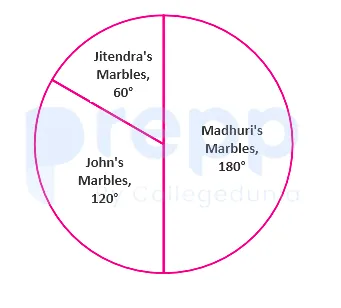
- A
8
- B
16
- C
18
- D
12
Show answer
C. 18Calculation
The number of marbles Madhuri has = 180
360° → 36 marbles
180 ° → 18
The number of marbles Madhuri has is 18
Paper & answer key PDF ↗ Question 70archived
A person spends 25% of his income on goods of daily uses. Furthermore, he spends 18% of the rest on house rent and 16% of the rest on travel. After that, only Rs. 861 is left with him. What is his salary?
- A
Rs. 1852\(\frac{1}{3}\)
- B
Rs. 1666\(\frac{2}{3}\)
- C
Rs. 1563\(\frac{1}{3}\)
- D
Rs. 1426\(\frac{1}{3}\)
Show answer
B. Rs. 1666\(\frac{2}{3}\)Given:
Daily expenditure = 25%
House rent expenditure = 18%
Travel expenditure = 16%
Savings = 861 rupees
Calculation:
Let, total salary = a
25% = 1/4
18% = 9/50
16% = 4/25
⇒ a × 3/4 × 41/50 × 21/25 = 861
⇒ a = (861 × 50 × 25 × 4)/(3 × 41 × 21)
⇒ a = 5000/3
⇒ a = 1666(2/3)
Total salary is 1666(2/3).
Paper & answer key PDF ↗ Question 71archived
If sin θ + cosec θ = \(\sqrt{5}\), then the value of sin3 θ + cosec3 θ = ___________.
- A
0
- B
\(3\sqrt{5}\)
- C
\(\frac{1}{\sqrt{5}}\)
- D
\(2\sqrt{5}\)
Show answer
D. \(2\sqrt{5}\)Let \(x = \sin\theta\), so \(\csc\theta = 1/x\) and \(x + \dfrac{1}{x} = \sqrt{5}\).
Cube both sides using \((a+b)^{3} = a^{3} + b^{3} + 3ab(a+b)\):
\(\left(x + \dfrac{1}{x}\right)^{3} = x^{3} + \dfrac{1}{x^{3}} + 3\left(x + \dfrac{1}{x}\right)\)
\((\sqrt{5})^{3} = (\sin^{3}\theta + \csc^{3}\theta) + 3\sqrt{5}\)
\(5\sqrt{5} = (\sin^{3}\theta + \csc^{3}\theta) + 3\sqrt{5}\)
Hence \(\sin^{3}\theta + \csc^{3}\theta = 5\sqrt{5} - 3\sqrt{5} = \mathbf{2\sqrt{5}}\).
Paper & answer key PDF ↗ Question 72archived
If cosec θ + cot θ = \(\frac{3}{2}\), then what is the value of cosec θ?
- A
\(\frac{13}{12}\)
- B
\(\frac{3}{2}\)
- C
\(\frac{11}{12}\)
- D
\(\frac{9}{13}\)
Show answer
A. \(\frac{13}{12}\)Finding cosec θ using Trigonometric Identities
We are given the equation cosec θ + cot θ = \(\frac{3}{2}\) and asked to find the value of cosec θ.
To solve this problem, we can use a fundamental trigonometric identity that relates cosec θ and cot θ.
The relevant identity is:
\(\text{cosec}^2 \theta - \text{cot}^2 \theta = 1\)
This identity is in the form of a difference of squares (\(a^2 - b^2\)), which can be factored as \((a - b)(a + b)\). Applying this to the identity, we get:
\((\text{cosec} \theta - \text{cot} \theta)(\text{cosec} \theta + \text{cot} \theta) = 1\)
We are given that cosec θ + cot θ = \(\frac{3}{2}\). We can substitute this value into the factored identity:
\((\text{cosec} \theta - \text{cot} \theta) \times \left(\frac{3}{2}\right) = 1\)
Now, we can solve for the value of (cosec θ - cot θ):
\(\text{cosec} \theta - \text{cot} \theta = \frac{1}{\left(\frac{3}{2}\right)}\)
\(\text{cosec} \theta - \text{cot} \theta = \frac{2}{3}\)
We now have a system of two linear equations involving cosec θ and cot θ:
cosec θ + cot θ = \(\frac{3}{2}\)
cosec θ - cot θ = \(\frac{2}{3}\)
To find the value of cosec θ, we can add these two equations together. Notice that the cot θ terms will cancel out:
(\(\text{cosec} \theta + \text{cot} \theta\)) + (\(\text{cosec} \theta - \text{cot} \theta\)) = \(\frac{3}{2} + \frac{2}{3}\)
\(2 \text{ cosec} \theta = \frac{3 \times 3}{2 \times 3} + \frac{2 \times 2}{3 \times 2}\)
\(2 \text{ cosec} \theta = \frac{9}{6} + \frac{4}{6}\)
\(2 \text{ cosec} \theta = \frac{9 + 4}{6}\)
\(2 \text{ cosec} \theta = \frac{13}{6}\)
Finally, to find cosec θ, we divide both sides by 2:
\(\text{cosec} \theta = \frac{\left(\frac{13}{6}\right)}{2}\)
\(\text{cosec} \theta = \frac{13}{6 \times 2}\)
\(\text{cosec} \theta = \frac{13}{12}\)
Thus, the value of cosec θ is \(\frac{13}{12}\).
Revision Table: Key Trigonometric Concepts
Trigonometric Ratio
Definition (using sides of a right triangle)
Reciprocal Identity
Sine (\(\sin \theta\))
Opposite / Hypotenuse
\(\frac{1}{\text{cosec} \theta}\)
Cosine (\(\cos \theta\))
Adjacent / Hypotenuse
\(\frac{1}{\sec \theta}\)
Tangent (\(\tan \theta\))
Opposite / Adjacent
\(\frac{1}{\cot \theta}\)
Cosecant (\(\text{cosec} \theta\))
Hypotenuse / Opposite
\(\frac{1}{\sin \theta}\)
Secant (\(\sec \theta\))
Hypotenuse / Adjacent
\(\frac{1}{\cos \theta}\)
Cotangent (\(\cot \theta\))
Adjacent / Opposite
\(\frac{1}{\tan \theta}\)
Additional Information: Solving Equations with cosec θ and cot θ
Problems involving the sum or difference of cosec θ and cot θ can often be solved effectively using the identity \(\text{cosec}^2 \theta - \text{cot}^2 \theta = 1\).
The key is to recognize that \(\text{cosec}^2 \theta - \text{cot}^2 \theta\) is a difference of squares.
Factoring it into \((\text{cosec} \theta - \text{cot} \theta)(\text{cosec} \theta + \text{cot} \theta)\) allows you to use a given sum or difference to find the other.
Once you have both the sum and the difference of cosec θ and cot θ, you can treat them as a system of two linear equations.
Adding the two equations eliminates cot θ and allows you to solve for cosec θ.
Subtracting the second equation from the first would eliminate cosec θ and allow you to solve for cot θ if needed.
This method is a common technique for solving such trigonometric problems without necessarily finding the value of θ itself.
Paper & answer key PDF ↗ Question 73archived
A, B and C together can complete a work in 12 days. A as well as B alone can do the same work in 36 days. In how many days can C alone complete the same work?
- A
48
- B
25
- C
12
- D
36
Show answer
D. 36Understanding Work and Time Problems
In work and time problems, we often calculate the amount of work done by a person or a group in a single day. This is known as their work rate. If a person can complete a work in 'n' days, their work rate is $\frac{1}{n}$ of the total work per day.
Analyzing the Given Information
We are given the following information:
A, B, and C together can complete the work in 12 days.
A alone can complete the work in 36 days.
B alone can complete the work in 36 days.
We need to find the number of days C alone takes to complete the same work.
Calculating Combined and Individual Work Rates
Let the total work be 1 unit.
The combined work rate of A, B, and C is the total work divided by the time taken:
Work rate of (A + B + C) = $\frac{1 \text{ work}}{12 \text{ days}} = \frac{1}{12}$ work per day.
The individual work rate of A is the total work divided by the time taken by A:
Work rate of A = $\frac{1 \text{ work}}{36 \text{ days}} = \frac{1}{36}$ work per day.
The individual work rate of B is the total work divided by the time taken by B:
Work rate of B = $\frac{1 \text{ work}}{36 \text{ days}} = \frac{1}{36}$ work per day.
Determining C's Work Rate
The combined work rate of A, B, and C is the sum of their individual work rates:
Work rate of (A + B + C) = Work rate of A + Work rate of B + Work rate of C
We can rearrange this equation to find C's work rate:
Work rate of C = Work rate of (A + B + C) - Work rate of A - Work rate of B
Substituting the values we calculated:
Work rate of C = $\frac{1}{12} - \frac{1}{36} - \frac{1}{36}$
To subtract these fractions, we find a common denominator, which is 36.
$\frac{1}{12} = \frac{1 \times 3}{12 \times 3} = \frac{3}{36}$
$\frac{1}{36}$ remains $\frac{1}{36}$
Now substitute these equivalent fractions:
Work rate of C = $\frac{3}{36} - \frac{1}{36} - \frac{1}{36} = \frac{3 - 1 - 1}{36} = \frac{1}{36}$ work per day.
Calculating Time Taken by C Alone
If C's work rate is $\frac{1}{36}$ work per day, it means C completes $\frac{1}{36}$ of the work each day. To complete the entire work (1 unit), C will take the reciprocal of their work rate.
Time taken by C alone = $\frac{1}{\text{Work rate of C}} = \frac{1}{\frac{1}{36}} = 1 \times 36 = 36$ days.
Therefore, C alone can complete the same work in 36 days.
Entity
Time Taken (days)
Work Rate (work/day)
A + B + C
12
$\frac{1}{12}$
A
36
$\frac{1}{36}$
B
36
$\frac{1}{36}$
C
?
$\frac{1}{12} - \frac{1}{36} - \frac{1}{36} = \frac{1}{36}$
Revision Table: Work and Time Concepts
Concept
Explanation
Formula
Work Rate
The amount of work done per unit of time (e.g., per day).
Work Rate = $\frac{\text{Total Work}}{\text{Time Taken}}$
Time Taken
The total time required to complete the work.
Time Taken = $\frac{\text{Total Work}}{\text{Work Rate}}$
Combined Work Rate
Sum of individual work rates when people work together.
$R_{\text{total}} = R_1 + R_2 + \dots$
Additional Information: Efficiency and Work
Efficiency in work and time problems is directly proportional to the work rate. A more efficient person has a higher work rate and takes less time to complete the same amount of work.
If a person's efficiency doubles, their work rate doubles, and the time taken is halved.
Total work can sometimes be represented as the product of the number of workers, the number of days, and the number of hours per day (if applicable). For example, $\text{Work} = \text{Men} \times \text{Days} \times \text{Hours}$.
When comparing the work done by different groups or individuals, we can equate the work done: $\frac{M_1 D_1 H_1}{W_1} = \frac{M_2 D_2 H_2}{W_2}$.
These basic principles help in solving various types of work and time problems, including those involving multiple people working together or separately.
Paper & answer key PDF ↗ Question 74archived
If the diameter of a sphere is 7 cm, then find the volume of the sphere. (use π = \(\frac{22}{7}\)) (Rounded up to two places of decimal).
- A
184 cm3
- B
201.34 cm3
- C
128.87 cm3
- D
179.67 cm3
Show answer
D. 179.67 cm3Calculate Sphere Volume from Diameter
This problem asks us to find the volume of a sphere when its diameter is given. We are also given the value to use for \(\pi\). Finding the volume of a sphere requires knowing its radius.
Sphere Volume Formula and Calculation Steps
The standard formula for the volume of a sphere is:
\[ V = \frac{4}{3} \pi r^3 \]
where \(V\) is the volume, \(\pi\) is the constant Pi, and \(r\) is the radius of the sphere.
We are given the diameter of the sphere, which is 7 cm. The radius (\(r\)) is always half of the diameter.
\[ r = \frac{\text{Diameter}}{2} \]
So, the radius \(r\) is:
\[ r = \frac{7 \text{ cm}}{2} = 3.5 \text{ cm} \]
We are given that we should use the value \(\pi = \frac{22}{7}\) for the calculation.
Now, we substitute the values of \(r\) and \(\pi\) into the volume formula:
\[ V = \frac{4}{3} \times \frac{22}{7} \times (3.5)^3 \]
First, let's calculate the value of \( (3.5)^3 \):
\[ (3.5)^3 = 3.5 \times 3.5 \times 3.5 = 12.25 \times 3.5 = 42.875 \]
Now, substitute this value back into the volume equation:
\[ V = \frac{4}{3} \times \frac{22}{7} \times 42.875 \]
We can perform the multiplication and division. It can be helpful to first divide 42.875 by 7:
\[ \frac{42.875}{7} = 6.125 \]
So, the volume calculation becomes:
\[ V = \frac{4}{3} \times 22 \times 6.125 \]
Multiply the numerators:
\[ V = \frac{88}{3} \times 6.125 \]
\[ V = \frac{88 \times 6.125}{3} = \frac{539}{3} \]
Now, perform the division to get the decimal value:
\[ V \approx 179.6666... \text{ cm}^3 \]
Rounding the Calculated Sphere Volume
The problem instructs us to round the result up to two places of decimal. Our calculated volume is approximately 179.6666... cm\(^3\).
To round a number to two decimal places, we look at the third decimal digit. In this case, the third decimal digit is 6.
Since the third decimal digit (6) is 5 or >= 5, we round up the second decimal digit.
The second decimal digit is 6. When rounded up, it becomes 7.
Therefore, 179.6666... rounded up to two decimal places is 179.67 cm\(^3\).
This value represents the volume of the sphere with a diameter of 7 cm using the given value for \(\pi\).
Step
Action / Formula
Calculation
Result
1
Identify Diameter
Given D = 7 cm
D = 7 cm
2
Calculate Radius
\(r = D / 2\)
\(r = 7 / 2 = 3.5\) cm
3
Use \(\pi\) Value
Given \(\pi = 22/7\)
\(\pi = 22/7\)
4
Apply Volume Formula
\(V = \frac{4}{3} \pi r^3\)
\(V = \frac{4}{3} \times \frac{22}{7} \times (3.5)^3\)
5
Calculate \(r^3\)
\((3.5)^3\)
42.875
6
Calculate Volume
\(V = \frac{4}{3} \times \frac{22}{7} \times 42.875\)
\(V = \frac{539}{3} \approx 179.6666...\) cm\(^3\)
7
Round Up
Round to 2 decimal places
179.67 cm\(^3\)
Revision Table: Key Sphere Formulas
Measurement
Formula
Notes
Radius (r)
\(r = \text{Diameter} / 2\)
Half the distance across
Diameter (d)
\(d = 2r\)
Twice the radius
Volume of Sphere (V)
\(V = \frac{4}{3} \pi r^3\)
Amount of space inside
Surface Area of Sphere (SA)
\(SA = 4 \pi r^2\)
Area of the outer surface
Additional Information: Understanding Sphere Concepts
A sphere is a perfectly round shape in 3D space, like a ball. It is defined by its center point and its radius.
Diameter: The longest distance you can measure straight through the sphere, passing through its center.
Radius: The distance from the exact center of the sphere to any point on its surface. The radius is always half the diameter.
Volume: This is the amount of space the sphere occupies. It's measured in cubic units, such as cubic centimeters (cm\(^3\)), cubic meters (m\(^3\)), etc.
\(\pi\): This is a special number used in calculations involving circles and spheres. It's approximately 3.14159. For many problems, including this one, a fractional value like \(\frac{22}{7}\) or a rounded decimal like 3.14 is used as an approximation.
Calculating the volume of a sphere is a fundamental concept in geometry. Make sure to correctly identify the radius from the given information (it might be diameter or radius) before applying the formula.
Paper & answer key PDF ↗ Question 75archived
Study the given bar graph carefully and answer the following question. What is the difference between the average demand and the average production of the three companies taken together?

- A
1,272
- B
1,530
- C
1,850
- D
1,456
Show answer
D. 1,456Formula used:
Average of N numbers = sum of N numbers/N
Calculation:
Average demand of all 3 companies = (3800 + 4532 + 5318)/3 = 4550
Average production of all 3 companies = (3620 + 2829 + 2833)/3 = 3094
Required difference = 4550 - 3094 = 1456
∴ The correct answer is 1456.
Paper & answer key PDF ↗ Question 76archived
Direction: Select the option that expresses the given sentence in passive voice.
One group of the club has raised an undigestible criticism against the manager.
- A
An undigestible criticism would have been raised by one group of the club against the manager.
- B
An undigestible criticism was being raised by one group of the club against the manager.
- C
An undigestible criticism had been raised by one group of the club against the manager.
- D
An undigestible criticism has been raised by one group of the club against the manager.
Show answer
D. An undigestible criticism has been raised by one group of the club against the manager.Understanding Active and Passive Voice
The question asks us to transform a sentence from active voice to passive voice. Let's first understand the difference between these two voices.
Active Voice: The subject of the sentence performs the action. The structure is typically Subject + Verb + Object. Example: One group (Subject) has raised (Verb) a criticism (Object).
Passive Voice: The subject of the sentence receives the action. The structure is typically Object + Verb (be + past participle) + by + Subject (optional). Example: A criticism (Object) has been raised (Verb - passive form) by one group (Subject).
Analyzing the Original Sentence
The given sentence is: "One group of the club has raised an undigestible criticism against the manager."
Let's break down the elements:
Subject: One group of the club
Verb: has raised
Object: an undigestible criticism
Tense: Present Perfect Tense (indicated by "has raised")
Other part: against the manager
Converting Present Perfect Tense to Passive Voice
The rule for changing a sentence in the Present Perfect Tense from active to passive voice is:
\( \text{Active: Subject + has/have + Verb (past participle) + Object} \)
\( \text{Passive: Object + has/have + been + Verb (past participle) + by + Subject} \)
Applying the Conversion Rule
Following the rule, we take the object ("an undigestible criticism") and make it the new subject. Since "an undigestible criticism" is singular, we use "has". The passive verb form for "has raised" in present perfect is "has been raised". The original subject ("one group of the club") becomes the object of the preposition "by". The remaining part ("against the manager") stays in its position.
So, the passive voice transformation is: "An undigestible criticism has been raised by one group of the club against the manager."
Evaluating the Options
Let's compare our derived passive sentence with the given options:
Option 1: "An undigestible criticism would have been raised by one group of the club against the manager." - This uses the conditional perfect passive ("would have been raised"), which is the incorrect tense.
Option 2: "An undigestible criticism was being raised by one group of the club against the manager." - This uses the past continuous passive ("was being raised"), which is the incorrect tense.
Option 3: "An undigestible criticism had been raised by one group of the club against the manager." - This uses the past perfect passive ("had been raised"), which is the incorrect tense for converting from simple present perfect active.
Option 4: "An undigestible criticism has been raised by one group of the club against the manager." - This sentence matches our derived passive voice transformation in the correct tense (present perfect passive).
Therefore, Option 4 correctly expresses the given sentence in the passive voice.
Revision Table: Active vs. Passive Voice for Key Tenses
Tense
Active Voice Structure
Passive Voice Structure
Simple Present
Subject + Verb(s/es) + Object
Object + am/is/are + Verb (past participle) + by + Subject
Simple Past
Subject + Verb(ed) + Object
Object + was/were + Verb (past participle) + by + Subject
Present Continuous
Subject + am/is/are + Verb(ing) + Object
Object + am/is/are + being + Verb (past participle) + by + Subject
Past Continuous
Subject + was/were + Verb(ing) + Object
Object + was/were + being + Verb (past participle) + by + Subject
Present Perfect
Subject + has/have + Verb(past participle) + Object
Object + has/have + been + Verb (past participle) + by + Subject
Past Perfect
Subject + had + Verb(past participle) + Object
Object + had + been + Verb (past participle) + by + Subject
Additional Information: The Agent in Passive Voice
In passive voice sentences, the original subject is often included using the preposition "by" (e.g., "by one group of the club"). This part of the sentence is called the agent. However, the agent can be omitted if it is not important, unknown, or obvious from the context. For example, if the sentence was "The window was broken," we might not need to say "by someone" if who broke it isn't relevant.
In this specific sentence, the agent ("by one group of the club") is included in the correct option, which is common when the doer of the action is specific and relevant.
Paper & answer key PDF ↗ Question 77archived
Direction: Select the most appropriate idiom that can substitute the underlined segment in the given sentence.
Vinay missed his flight, but good luck came to him from bad circumstances as the flight crashed into the sea.
- A
it was a tinker's curse
- B
it was counting his blessings
- C
it was a blessing and a curse
- D
it was a blessing in disguise
Show answer
D. it was a blessing in disguiseUnderstanding Idioms in English Vocabulary
The question asks us to find the most suitable idiom to replace the underlined phrase "good luck came to him from bad circumstances" in the given sentence:
Vinay missed his flight, but good luck came to him from bad circumstances as the flight crashed into the sea.
The sentence describes a situation where something initially perceived as negative (missing the flight) turns out to be highly positive and beneficial (saved from a plane crash). We need an idiom that captures this meaning.
Analysing the Options for the Correct Idiom
Let's examine the meaning of each provided idiom option:
it was a tinker's curse: This idiom refers to something that is worthless or has little significance. It doesn't fit the context of a life-saving outcome.
it was counting his blessings: This phrase means to appreciate the good things in one's life, especially after experiencing something bad. While related to appreciating a positive outcome, the idiom itself describes the *act* of appreciation, not the *situation* where a misfortune leads to good fortune.
it was a blessing and a curse: This idiom describes something that has both advantages (a blessing) and disadvantages (a curse). In Vinay's case, missing the flight was initially inconvenient (bad circumstance), but the outcome (not being on the crashed plane) was purely positive (good luck). The situation doesn't have both good and bad aspects simultaneously in the final outcome.
it was a blessing in disguise: This idiom refers to something that appears to be a misfortune at first but turns out to be beneficial later. Missing the flight seemed like bad luck initially, but it resulted in Vinay's safety, making it a benefit hidden within an unfortunate event. This perfectly matches the scenario.
Identifying the Most Appropriate Idiom
Comparing the meanings, the idiom "a blessing in disguise" most accurately describes a situation where something bad or inconvenient leads to a positive and fortunate outcome. Vinay missing his flight was inconvenient (a bad circumstance), but it saved his life (good luck), which is the very definition of a blessing in disguise.
Explanation of the Correct Idiom
The idiom 'a blessing in disguise' is used when a misfortune or an unpleasant event ultimately leads to a good result that wasn't initially obvious. It highlights the hidden positive aspect within an apparent negative situation.
Conclusion on Idiom Choice
The situation described in the sentence, where missing a flight (bad circumstance) saves Vinay's life (good luck due to the crash), is a classic example of an unfortunate event having a very positive hidden outcome. Therefore, 'it was a blessing in disguise' is the most fitting idiom.
Idiom Meanings Comparison
Idiom
Meaning
Fit with Sentence?
a tinker's curse
Something worthless
No
counting his blessings
Appreciating good things (an action)
Describes an action, not the situation itself
a blessing and a curse
Something with both pros and cons
No (outcome was purely positive for Vinay)
a blessing in disguise
Misfortune leading to good fortune
Yes (perfect fit)
Revision Table: Key English Idioms
Reviewing common idioms helps improve vocabulary and comprehension.
Add insult to injury: To make a bad situation worse.
Bite the bullet: To face a difficult or unpleasant situation with courage.
Break a leg: Good luck (used especially before a performance).
Get something off your chest: To talk about something that has been worrying you for a long time.
Additional Information: Using Idioms Effectively
Idioms are phrases or expressions whose meaning cannot be deduced from the literal meaning of their words. Understanding and using idioms correctly is important for sounding natural in English. The context of the sentence is crucial in determining which idiom is appropriate.
In this specific question, identifying the core meaning of the underlined phrase - that a negative event had a positive outcome - was key to selecting the correct idiom, "a blessing in disguise".
Paper & answer key PDF ↗ Question 78archived
Direction: Sentences of a paragraph are given below in jumbled order. Arrange the sentences in the correct order to form a meaningful and coherent paragraph.
A. The Olympic Games have come to be regarded as the world's foremost sports competition.
B. Olympic Games is an athletic festival that originated in ancient Greece and was revived in the late 19th century.
C. Before the 1970s, the Games were officially limited to competitors with amateur status, but in the 1980s many events were opened to professional athletes.
D. Currently, the Games are open to all, even the top professional athletes in basketball and football (soccer).
- A
ABDC
- B
BCDA
- C
CADB
- D
BDCA
Show answer
B. BCDAArranging Sentumbled Sentences: The Olympic Games
To form a meaningful and coherent paragraph from jumbled sentences, we need to identify the logical connections between them. We look for an introductory sentence, sentences that provide supporting details or follow a chronological order, and potentially a concluding sentence.
Analyzing the Sentences about the Olympic Games
Let's examine each sentence:
A. The Olympic Games have come to be regarded as the world's foremost sports competition.
B. Olympic Games is an athletic festival that originated in ancient Greece and was revived in the late 19th century.
C. Before the 1970s, the Games were officially limited to competitors with amateur status, but in the 1980s many events were opened to professional athletes.
D. Currently, the Games are open to all, even the top professional athletes in basketball and football (soccer).
Step-by-Step Sentence Arrangement
Let's determine the best order:
Identify the introductory sentence: Sentence B defines the Olympic Games and provides their origin and revival history. This serves as a good introduction to the topic.
Find the sequence of ideas: Sentences C and D discuss the evolution of participation rules regarding amateur vs. professional athletes. Sentence C talks about the change in the 1970s and 1980s, while Sentence D describes the current situation. This indicates a chronological progression from past rule changes (C) to the present state (D). Therefore, D should follow C.
Place the remaining sentence: Sentence A describes the current status of the Olympic Games as the world's foremost sports competition. This statement follows logically after detailing the history and the current rules of the Games, acting as a summary of their significance today.
Putting the sentences in this order, we get B followed by C, then D, and finally A. The resulting sequence is BCDA.
Checking the Coherence of the Sequence BCDA
B: Olympic Games is an athletic festival that originated in ancient Greece and was revived in the late 19th century. (Introduces the topic and its history.)
C: Before the 1970s, the Games were officially limited to competitors with amateur status, but in the 1980s many events were opened to professional athletes. (Discusses a historical rule change regarding participants.)
D: Currently, the Games are open to all, even the top professional athletes in basketball and football (soccer). (Continues the discussion on participants, describing the current rule which evolved from the situation in C.)
A: The Olympic Games have come to be regarded as the world's foremost sports competition. (Concludes by stating the current significant status of the Games.)
This sequence creates a smooth and logical flow, starting with the definition and history, moving to the evolution of participant rules, and ending with the current prominent status of the Olympic Games.
The correct order is BCDA.
Sentence
Role in Paragraph
B
Introduction (Definition, Origin, Revival)
C
Historical Detail (Amateur vs. Professional Rule Evolution - Past)
D
Current Detail (Amateur vs. Professional Rule Evolution - Present)
A
Concluding Statement (Current Status/Importance)
Revision Table: Olympic Games Sentence Arrangement
Jumbled Order
Correct Order
Explanation
A, B, C, D
B, C, D, A
B introduces the Games; C & D follow a chronological path about participant rules; A concludes with the current status.
Additional Information: Understanding Paragraph Coherence
Arranging sentences to form a coherent paragraph requires understanding how ideas connect. Here are some tips:
Look for the topic sentence: This sentence usually introduces the main idea.
Identify transition words or phrases: Words like "before," "currently," "however," "also," "therefore," etc., show relationships between sentences.
Follow chronological order: If the sentences describe events over time, arrange them in the order they happened.
Follow cause and effect: One sentence might describe a cause, and the next its effect.
Group related ideas: Sentences discussing the same sub-topic should generally be placed together.
Check for pronoun references: A pronoun (like "he," "she," "it," "they") refers back to a noun mentioned in a previous sentence.
Applying these techniques helps piece together the jumbled sentences logically, just like we did for the Olympic Games sentences, moving from general introduction to specific details and then a concluding statement about their importance.
Paper & answer key PDF ↗ Question 79archived
Direction: Identify the INCORRECTLY spelt word from the given options.
- A
Weave
- B
Heave
- C
Obssess
- D
Sieve
Show answer
C. ObssessIdentify the Incorrectly Spelt Word
The question asks us to identify the word that is spelt incorrectly from the given options. To do this, we need to examine each word's spelling.
Analyzing Each Option's Spelling
Option 1: Weave
The word 'weave' is a standard English word meaning to form fabric by interlacing threads or to move by winding in and out. The spelling W-E-A-V-E is correct.
Option 2: Heave
The word 'heave' is a standard English word meaning to lift or haul something heavy or to utter a sigh with effort. The spelling H-E-A-V-E is correct.
Option 3: Obssess
Let's consider the word 'obssess'. We often hear or read the word 'obsess', which means to preoccupy or fill the mind of someone continually and to a troubling extent. The standard spelling of this word is O-B-S-E-S-S, with a single 's' after the 'b'. The spelling 'Obssess' has two 's's after the 'b', which is not the correct spelling.
Option 4: Sieve
The word 'sieve' is a standard English word for a tool used for separating solid matter from a liquid, fine material from coarser material, or different sizes of material. The spelling S-I-E-V-E is correct.
Conclusion on the Incorrect Spelling
Comparing the options to the standard spellings in English, it is clear that 'Obssess' is the word that is spelt incorrectly. The correct spelling is 'Obsess'.
Therefore, the incorrectly spelt word is Obssess.
Revision Table: Correct vs. Incorrect Spellings
Given Word
Standard Spelling
Correct/Incorrect
Weave
Weave
Correct
Heave
Heave
Correct
Obssess
Obsess
Incorrect
Sieve
Sieve
Correct
Additional Information on Identifying Spelling Errors
Identifying incorrectly spelt words is a key part of English language proficiency. Many errors occur with double letters, silent letters, or commonly confused letter combinations (like 'ie' vs 'ei').
To improve your ability to spot spelling errors:
Learn common spelling rules, but also be aware of exceptions.
Pay attention to words you frequently misspell.
Use mnemonic devices or visual aids if helpful.
Practice proofreading carefully, focusing specifically on spelling.
Familiarize yourself with words that look similar but have different spellings or meanings.
Regular practice and careful observation when reading are effective ways to enhance your spelling skills.
Paper & answer key PDF ↗ Question 80archived
Direction: Select the most appropriate synonym of the given word.
Earnestly
- A
Wordily
- B
Ambiguously
- C
Verbosely
- D
Sincerely
Show answer
D. SincerelyFinding the Synonym for Earnestly
Let's find the most appropriate synonym for the word "Earnestly". A synonym is a word or phrase that means exactly or nearly the same as another word or phrase in the same language.
Understanding the Meaning of Earnestly
The word "Earnestly" is an adverb. It describes an action or feeling that is done in a serious and sincere way, or with great sincerity and intensity. Think of it as doing something with genuine feeling and purpose, not lightly or casually.
Example: She spoke earnestly about her goals, showing how much they meant to her.
Example: He worked earnestly to finish the project on time.
Analyzing the Options
We need to examine each given option to see which one has a meaning closest to "Earnestly".
Option
Meaning
Relevance to Earnestly
Wordily
Using too many words; verbose.
Not related to the sincerity or seriousness implied by "Earnestly".
Ambiguously
Open to more than one interpretation; not having one obvious meaning.
The opposite of the clear, focused nature implied by "Earnestly".
Verbosely
Using or expressed in more words than are needed; wordy.
A synonym for "Wordily", and not related to sincerity or seriousness.
Sincerely
In a sincere or genuine way; with genuine feeling.
Exactly matches the core meaning of seriousness and genuineness in "Earnestly".
Selecting the Best Synonym
Based on the analysis, the word "Sincerely" means acting or speaking in a genuine and heartfelt way. This aligns perfectly with the meaning of "Earnestly", which describes an action performed with seriousness and deep feeling.
Therefore, "Sincerely" is the most appropriate synonym for "Earnestly".
Why Other Options Are Incorrect
Wordily and Verbosely relate to using too many words when speaking or writing. This has no connection to the sincerity or seriousness of an action or feeling, which is what "Earnestly" conveys.
Ambiguously means unclearly or doubtfully. "Earnestly" implies a clear, focused, and genuine approach, which is the opposite of being ambiguous.
Conclusion on Earnestly Synonym
The most fitting synonym among the choices for the word "Earnestly" is "Sincerely" because both words convey a sense of seriousness, genuineness, and deep feeling in action or expression.
Revision Table: Understanding Synonyms
Word
Meaning
Example Synonym
Earnestly
In a serious, sincere, or intense manner
Sincerely, Seriously, Gravely, Solemnly
Sincerely
In a genuine or heartfelt manner
Honestly, Truly, Earnestly, Genuinely
Wordily
Using too many words
Verbosely, Redundantly, Lengthily
Ambiguously
In a way that is open to more than one interpretation
Unclearly, Vaguely, Dubiously
Verbosely
Using more words than needed
Wordily, Talkatively, Loquaciously
Additional Information: Expanding Vocabulary
Learning synonyms is a great way to expand your vocabulary and improve your communication skills. Understanding the subtle differences between synonyms can help you choose the most precise word for any context. When looking for a synonym, always consider the context in which the original word is used.
For example, while "seriously" can sometimes be a synonym for "earnestly", "sincerely" often captures the emotional or genuine aspect of "earnestly" more closely, especially when talking about feelings or intentions.
Paper & answer key PDF ↗ Question 81archived
Direction: Identify the sentence with the correct spellings.
- A
There was not enouf food in the beggar's house.
- B
There was not enough food in the beggar's house.
- C
There was not enauf food in the beggar's house.
- D
There was not enoufh food in the beggar's house.
Show answer
B. There was not enough food in the beggar's house.Understanding Correct Spelling in Sentences
The question asks us to identify the sentence that is spelled correctly. We are given four sentences, and the difference between them lies in the spelling of one specific word. Let's examine each option carefully to find the sentence with the accurate spelling.
Analysing Each Sentence for Spelling Errors
We need to check the spelling of every word in each sentence, paying close attention to the word that seems to vary between the options. The sentence structure is "There was not ______ food in the beggar's house." The word that changes is the one describing the quantity of food.
Option 1: "There was not enouf food in the beggar's house."
In this sentence, the word used is "enouf". Let's consider if this is the standard English spelling.
Option 2: "There was not enough food in the beggar's house."
Here, the word used is "enough". We need to determine if "enough" is the correct spelling.
Option 3: "There was not enauf food in the beggar's house."
This option uses the word "enauf". We should compare this spelling to the correct one.
Option 4: "There was not enoufh food in the beggar's house."
Finally, this sentence uses the word "enoufh". Let's see if this spelling is correct.
Identifying the Correct Spelling of 'Enough'
The word in question is used to indicate a sufficient amount. The correct and standard spelling of this word in English is enough. Let's compare this correct spelling with the versions used in each option:
Option 1 uses "enouf" - Incorrect spelling.
Option 2 uses "enough" - Correct spelling.
Option 3 uses "enauf" - Incorrect spelling.
Option 4 uses "enoufh" - Incorrect spelling.
Selecting the Sentence with Correct Spellings
Based on our analysis of the spelling of the word "enough", we can see that only Option 2 uses the correct spelling. Therefore, the sentence in Option 2 is the one with the correct spellings among the given choices.
The correct sentence is: "There was not enough food in the beggar's house."
Conclusion on Correct Sentence Spelling
By carefully checking the spelling of the word that differed between the sentences, we found that only one option contained the standard and correct English spelling. This demonstrates the importance of knowing the correct spelling of common words to construct grammatically sound sentences.
Spelling Comparison
Option
Word Used
Correctness
1
enouf
Incorrect
2
enough
Correct
3
enauf
Incorrect
4
enoufh
Incorrect
Revision Table: Key Spelling Concepts
Reviewing common spelling patterns and challenging words can help improve accuracy. The word "enough" is a good example of a word with a spelling that might not seem intuitive based on its pronunciation.
Focus on frequently misspelled words.
Practice writing sentences using correct spellings.
Use a dictionary or spell check when unsure.
Additional Information on English Spelling
English spelling can be tricky due to its history and influences from various languages. Words like "enough", "through", "cough", and "rough" all share the "-ough" ending but are pronounced differently. This highlights the need to learn the spelling of individual words rather than relying solely on phonetic rules.
Many English words have silent letters (e.g., the 'gh' in enough).
Vowel sounds can be represented by different letter combinations.
Regular practice and exposure to written English are key to mastering spelling.
Paper & answer key PDF ↗ Question 82archived
Direction: Select the option that can be used as a one-word substitute for the given group of words.
A person whose age is between 70 and 79 years old
- A
Septuagenarian
- B
Aged
- C
Pensioner
- D
Oldie
Show answer
A. SeptuagenarianLet's analyse the given options to find the most appropriate one-word substitute for a person whose age is between 70 and 79 years old.
Understanding Age-Specific Terms
English vocabulary has specific terms derived from Latin to denote people within certain age decades.
A person in their 20s is a Vicenarian.
A person in their 30s is a Tricenarian.
A person in their 40s is a Quadragenarian.
A person in their 50s is a Quinquagenarian.
A person in their 60s is a Sexagenarian.
A person in their 70s (70-79 years old) is a Septuagenarian.
A person in their 80s (80-89 years old) is an Octogenarian.
A person in their 90s (90-99 years old) is a Nonagenarian.
A person 100 years or older is a Centenarian.
Analysing the Options
Let's examine each option provided:
Septuagenarian: This term is specifically used for a person who is in their seventies, meaning their age is between 70 and 79 years old. This directly matches the description given in the question.
Aged: This is a general term used to describe someone who is old. It does not specify a particular age range like 70-79 years. A person could be aged in their 60s, 80s, or even younger depending on the context.
Pensioner: A pensioner is someone who receives a pension, typically after retiring from work or due to disability. While many pensioners are older, the term relates to their financial status or retirement, not necessarily their exact age range of 70-79 years. Someone could be a pensioner at 60, or still working at 75 and not yet receiving a pension.
Oldie: This is an informal term for an old person. Like "aged," it is not specific to the 70-79 age range and can refer to anyone considered old, often used casually or affectionately, but lacks the precise meaning required for a one-word substitute in this context.
Identifying the Correct One-Word Substitute
Based on the analysis of the terms and their specific meanings, "Septuagenarian" is the precise one-word substitute for a person whose age is between 70 and 79 years old. The other options are either too general ("Aged," "Oldie") or refer to a status rather than a specific age range ("Pensioner").
Revision Table: Understanding Age Terms
Age Range
One-Word Substitute
20 - 29
Vicenarian
30 - 39
Tricenarian
40 - 49
Quadragenarian
50 - 59
Quinquagenarian
60 - 69
Sexagenarian
70 - 79
Septuagenarian
80 - 89
Octogenarian
90 - 99
Nonagenarian
100+
Centenarian
Additional Information on One-Word Substitutes
One-word substitutes are important for concise communication and are often tested in vocabulary sections of competitive exams. They replace a phrase or clause with a single word, making the language more precise and economical.
Learning these specific terms for age ranges is useful for expanding your vocabulary. Pay attention to the Latin roots, which often indicate the number or decade (e.g., 'septua' relates to seven, 'octo' to eight, 'nona' to nine, 'centi' to hundred).
Paper & answer key PDF ↗ Question 83archived
Direction: The following sentence has been split into four segments. Identify the segment that contains a grammatical error.
I play / cricket in / my childhood / with my sister.
- A
my childhood
- B
with my sister
- C
I play
- D
cricket in
Show answer
C. I playUnderstanding Grammatical Errors in Sentence Structure
The question asks us to identify the segment containing a grammatical error in the sentence provided: "I play / cricket in / my childhood / with my sister." We need to examine each part of the sentence to find the error.
Analyzing the Sentence Segments for Grammar
Let's look at the sentence broken down into its four segments:
I play
cricket in
my childhood
with my sister
The sentence describes an action that happened in the past. The phrase "in my childhood" clearly indicates a time period in the past.
Examining Each Segment:
Segment 1: "I play" - This segment contains the subject "I" and the verb "play". The verb "play" is in the simple present tense. The simple present tense is typically used for actions happening now, or for habitual actions, general truths, or future events (in some specific cases).
Segment 2: "cricket in" - This segment contains the noun "cricket" (the object of the verb) and the preposition "in". The phrase "in my childhood" uses the preposition "in", which is correct for specifying a time period.
Segment 3: "my childhood" - This is a noun phrase referring to a specific period in the past. It functions as part of the time phrase "in my childhood".
Segment 4: "with my sister" - This is a prepositional phrase indicating who the action was performed with. It is grammatically correct in this context.
Identifying the Verb Tense Error
The key to finding the error lies in the relationship between the verb tense used and the time phrase indicating when the action occurred.
The sentence says the action ("play cricket") happened "in my childhood". Since "my childhood" is a past time, the verb describing the action should be in a past tense. The verb used is "play", which is in the simple present tense.
To correctly describe an action that happened and was completed in the past, we typically use the simple past tense. The simple past tense of the verb "play" is "played".
Therefore, using the simple present tense verb "play" with the past time phrase "in my childhood" creates a grammatical error.
The segment "I play" should be changed to "I played" to make the sentence grammatically correct for an action that happened in childhood.
Correcting the Grammatical Error
The grammatically correct sentence would be:
I played cricket in my childhood with my sister.
This clearly shows that the error is located in the segment containing the verb "play".
Conclusion: The Segment with the Error
Based on the analysis of verb tense and the time phrase, the segment containing the grammatical error is "I play".
Segment
Analysis
Grammatical Status
I play
Subject + Simple Present Verb; Used with a past time phrase ("in my childhood"). Incorrect tense for past action.
Contains Error
cricket in
Object + Preposition. Correctly used with the following noun phrase.
Correct
my childhood
Past time noun phrase. Correctly used with "in" to indicate a past period.
Correct
with my sister
Prepositional phrase indicating companion. Grammatically correct.
Correct
Revision Table: Verb Tenses for Past Actions
Tense
Usage for Past
Example
Simple Past
For actions completed at a specific or understood time in the past.
I played football yesterday.
Simple Present
Generally NOT used for single completed actions in the past. Used for habits, facts, etc.
I play football every Saturday. (Habit)
Additional Information: Using Simple Past Tense
The simple past tense is one of the most common ways to talk about the past in English. It is formed by adding '-ed' to the base form of regular verbs (like play > played, walk > walked) or by using specific irregular past tense forms (like go > went, eat > ate).
We use the simple past tense to talk about:
Actions completed in the past at a definite time (even if the time is not stated, it is implied).
A series of completed actions in the past.
Past habits (often with adverbs like 'always', 'often').
Past states.
In the sentence "I play cricket in my childhood with my sister", "in my childhood" specifies a past time, requiring the verb to be in the simple past tense ("played").
Paper & answer key PDF ↗ Question 84archived
Direction: Select the most appropriate synonym of the given word.
Announced
- A
Estrange
- B
Declared
- C
Secret
- D
Hid
Show answer
B. DeclaredUnderstanding the Question: Finding the Synonym
The question asks us to select the word from the given options that is the most appropriate synonym for the word "Announced". A synonym is a word that has a similar meaning to another word.
Meaning of the Word "Announced"
The word "Announced" means to make something known publicly or officially; to state something clearly and publicly.
Analyzing the Options for a Synonym
Let's examine the meaning of each option provided to see which one best matches the meaning of "Announced":
Estrange: To cause someone to be no longer affectionate or friendly towards someone else; to alienate. This means to make someone unfriendly or hostile, which is not related to making information public.
Declared: To make something known formally or officially; to state emphatically. This involves making something public or known in a formal way, much like announcing something.
Secret: Not known or seen or not meant to be known or seen by others. This word describes something hidden from public knowledge, which is the opposite of "Announced".
Hid: Past tense of hide, meaning to put or keep out of sight; to conceal. This also means to keep something from being known or seen, which is the opposite of "Announced".
Comparing Meanings to Find the Best Synonym
We are looking for a word that means making something known publicly or officially, which is the definition of "Announced".
"Estrange" is about relationships becoming unfriendly. Not a synonym for "Announced".
"Declared" is about making something known formally or officially. This is very similar to "Announced".
"Secret" means not known by others. This is an antonym (opposite) of "Announced".
"Hid" means kept out of sight or knowledge. This is also an antonym of "Announced".
Based on the meanings, "Declared" is the word that is most similar to "Announced".
Determining the Most Appropriate Synonym
Comparing the definition of "Announced" (to make known publicly or officially) with the options, "Declared" (to make known formally or officially; state emphatically) is the closest match in meaning. Both words describe the action of making information public.
Conclusion: Identifying the Correct Synonym
The most appropriate synonym for "Announced" among the given options is "Declared".
WordMeaningRelation to "Announced"
AnnouncedMade known publicly or officially—
EstrangeAlienate, make unfriendlyNot a synonym
DeclaredMade known formally or officiallySynonym
SecretNot known by othersAntonym
HidKept out of sightAntonym
Revision Table: Synonyms and Antonyms Practice
Here's a quick look at the relationships between these words and some others:
WordTypeSimilar Words (Synonyms)Opposite Words (Antonyms)
AnnouncedVerbDeclared, Proclaimed, Stated, PublicizedConcealed, Hid, Kept secret, Withheld
DeclaredVerbAnnounced, Stated, Proclaimed, AssertedDenied, Concealed, Suppressed
EstrangeVerbAlienate, Separate, AntagonizeReconcile, Unite, Connect
SecretAdjective/NounConfidential, Private, Hidden, ClassifiedPublic, Open, Known, Revealed
HidVerb (Past)Concealed, Stashed, Obscured, ShroudRevealed, Showed, Exposed, Uncovered
Additional Information: Boosting Your Vocabulary
Learning synonyms is a great way to improve your vocabulary and understanding of the English language. When you encounter a new word, try to find words that mean the same thing (synonyms) and words that mean the opposite (antonyms).
For example, think about the word "happy".
Synonyms could be: joyful, cheerful, content, pleased.
Antonyms could be: sad, unhappy, miserable, gloomy.
Knowing synonyms allows you to express yourself more precisely and avoid repeating the same words. It also helps you understand different contexts in which similar words are used.
In this case, understanding that "Announced" and "Declared" share the meaning of making something known publicly helps confirm why "Declared" is the correct synonym.
Paper & answer key PDF ↗ Question 85archived
Direction: Select the most appropriate synonym of the given word.
Crooked
- A
Admirable
- B
Taken
- C
Twisted
- D
Toasted
Show answer
C. TwistedFinding the Synonym for Crooked
The question asks us to find the most appropriate synonym for the word "Crooked". A synonym is a word that has the same or nearly the same meaning as another word.
Let's first understand the meaning of "Crooked". The word "Crooked" can have a few meanings:
Bent, twisted, or not straight.
Dishonest or illegal.
In the context of synonyms, we need to look for a word among the options that shares one of these core meanings.
Analysing the Options
Let's examine each given option to see which one fits best as a synonym for "Crooked":
Admirable: This word means deserving respect or approval. This is related to character or quality, not physical shape or dishonesty. It is not a synonym for "Crooked".
Taken: This is the past participle of the verb "take", meaning to carry or transport something, or to occupy a place or position. This meaning is completely unrelated to "Crooked". It is not a synonym for "Crooked".
Twisted: This word means forced out of its natural or proper shape; bent into a different shape. It can also mean complicated, convoluted, or even perverted or warped. The meaning "bent out of shape" or "not straight" is a direct match for one of the primary meanings of "Crooked".
Toasted: This is the past participle of the verb "toast", meaning to make bread or other food brown and crisp by heating it. This meaning is entirely unrelated to "Crooked". It is not a synonym for "Crooked".
Conclusion: Choosing the Correct Synonym
Comparing the meanings, the word "Twisted" directly corresponds to the meaning of "Crooked" when it refers to something bent or not straight. While "Crooked" can also mean dishonest, "Twisted" also has meanings related to being warped or convoluted, which can sometimes overlap conceptually, but the most common and direct synonym comes from the physical sense.
Therefore, "Twisted" is the most appropriate synonym for "Crooked" among the given options.
Revision Table: Understanding Synonyms
Word
Meaning
Example Sentence
Crooked
Bent or twisted; not straight; dishonest.
The old path was steep and crooked. / He was known for his crooked business deals.
Admirable
Deserving respect and approval.
Her courage in facing the challenge was admirable.
Taken
Carried or removed from a place; occupied.
The book was taken from the shelf. / The seat was taken.
Twisted
Bent or contorted out of shape; complicated or distorted.
The wire was badly twisted. / He told a strange and twisted story.
Toasted
Made brown and crisp by heating.
We had toasted bread for breakfast.
Additional Information: Expanding Vocabulary
Understanding synonyms and antonyms helps improve vocabulary and comprehension. Synonyms are words with similar meanings, while antonyms have opposite meanings. For the word "Crooked", potential antonyms (depending on the meaning) could be "straight" (for the physical sense) or "honest" (for the moral sense).
When choosing a synonym, it's important to consider the context in which the word is used. However, in a general question like this, we look for the most common or direct shared meaning between the given word and the options.
Paper & answer key PDF ↗ Question 86archived
Direction: The sentences of a paragraph are given below in jumbled order. Arrange the sentences in the correct order to form a meaningful and coherent paragraph.
A. We recognise some aspects of an SF narrative with the realities of this world and some elements are estranged from the reality so as to take us to an unreal world.
B. Therefore, it is often suggested that 'cognitive estrangement' is a necessary means through which the SF is usually understood.
C. Science Fiction is a genre which manifests in itself the use of scientific premises often in a fantastical manner in a narrative.
D. It is highly seeped into the reality of this world.
- A
CDBA
- B
BCAD
- C
DACB
- D
ADBC
Show answer
A. CDBAArranging Sentences to Form a Coherent Paragraph on Science Fiction
The task is to rearrange the given sentences (A, B, C, and D) into a logical sequence to form a meaningful and coherent paragraph about Science Fiction (SF). Let's examine each sentence:
Sentence A: We recognise some aspects of an SF narrative with the realities of this world and some elements are estranged from the reality so as to take us to an unreal world.
Sentence B: Therefore, it is often suggested that 'cognitive estrangement' is a necessary means through which the SF is usually understood.
Sentence C: Science Fiction is a genre which manifests in itself the use of scientific premises often in a fantastical manner in a narrative.
Sentence D: It is highly seeped into the reality of this world.
Analyzing the Flow of Ideas
We need to find a starting point and then connect the sentences logically. Sentence C provides a definition of Science Fiction, which is a good way to begin a paragraph introducing the topic.
Sentence D states that SF is "highly seeped into the reality of this world." This seems to add a characteristic to the genre defined in C, elaborating on its connection to the real world despite its fantastical elements.
Sentence B contains the word "Therefore," indicating it is a conclusion drawn from previous statements. It introduces the concept of 'cognitive estrangement' as a way to understand SF.
Sentence A explains the nature of an SF narrative, describing how it contains both elements recognizable from reality and elements estranged from it. This mix of reality and estrangement is precisely what 'cognitive estrangement' refers to.
Determining the Correct Order: CDBA
Let's follow the sequence CDBA and see if it forms a logical flow:
C (Start): Science Fiction is a genre which manifests in itself the use of scientific premises often in a fantastical manner in a narrative. (Introduces SF and its basic nature).
D (Follows C): It is highly seeped into the reality of this world. (Adds a key characteristic to the definition - its connection to reality). This logically follows the introduction of the genre.
B (Follows D): Therefore, it is often suggested that 'cognitive estrangement' is a necessary means through which the SF is usually understood. (Uses 'Therefore' to link the understanding of SF to the characteristics mentioned in C and D. The idea is that because SF is based on scientific premises and seeped in reality (C & D), understanding its fantastical or estranged elements requires a specific cognitive approach).
A (Follows B): We recognise some aspects of an SF narrative with the realities of this world and some elements are estranged from the reality so as to take us to an unreal world. (Explains *how* we arrive at the understanding mentioned in B. This sentence elaborates on what 'cognitive estrangement' entails – the process of recognizing familiar aspects from reality alongside elements estranged from it).
Putting it all together:
Science Fiction is a genre which manifests in itself the use of scientific premises often in a fantastical manner in a narrative. It is highly seeped into the reality of this world. Therefore, it is often suggested that 'cognitive estrangement' is a necessary means through which the SF is usually understood. We recognise some aspects of an SF narrative with the realities of this world and some elements are estranged from the reality so as to take us to an unreal world.
This sequence begins with a definition (C), adds a crucial characteristic (D), draws a conclusion about how to understand it based on these characteristics (B), and finally explains the mechanism of that understanding (A). While the transition from D to B might feel slightly abrupt without explicitly defining cognitive estrangement beforehand, sentence A clarifies the concept immediately after its introduction in B, making the CDBA order a plausible and coherent paragraph structure.
Final Ordered Paragraph
C. Science Fiction is a genre which manifests in itself the use of scientific premises often in a fantastical manner in a narrative.
D. It is highly seeped into the reality of this world.
B. Therefore, it is often suggested that 'cognitive estrangement' is a necessary means through which the SF is usually understood.
A. We recognise some aspects of an SF narrative with the realities of this world and some elements are estranged from the reality so as to take us to an unreal world.
The correct arrangement is CDBA.
Sentence
Role in Paragraph
C
Introduces and defines Science Fiction.
D
Adds a characteristic: connection to reality.
B
Introduces the concept of 'cognitive estrangement' as a way to understand SF, linked to previous points.
A
Explains the mechanism of 'cognitive estrangement' – mixing reality and estranged elements.
Revision Table: Science Fiction Paragraph Order
Reviewing the sentences and their connections in the CDBA order helps confirm its logical flow, starting from a definition and moving to a specific concept related to understanding the genre.
Additional Information: Understanding Cognitive Estrangement in SF
The concept of 'cognitive estrangement' is central to the study of Science Fiction, particularly associated with literary theorist Darko Suvin. It describes the blend of familiar, reality-based elements with radically unfamiliar or impossible elements in a way that makes the reader see their own reality in a new light. The "cognitive" aspect refers to the rational, science-based nature often present in SF, grounding the unfamiliar elements in a way that allows for intellectual engagement. The "estrangement" comes from the way the narrative defamiliarizes aspects of our world or introduces entirely new concepts, making the familiar seem strange and the strange seem, potentially, understandable within the story's logic. This interplay between the recognizable and the unfamiliar is what allows SF to explore complex ideas and comment on society, science, and the future.
Paper & answer key PDF ↗ Question 87archived
Direction: Select the most appropriate option to fill in the blank.
The princess firmly held the ______ in her hands.
- A
rain
- B
ran
- C
reign
- D
rein
Show answer
D. reinUnderstanding the Question: Filling the Blank for the Princess
The question asks us to choose the most appropriate word from the given options to complete the sentence: "The princess firmly held the ______ in her hands." We need to understand the meaning of each option and how it fits the context of the sentence, especially the phrase "held... in her hands."
Analyzing the Options for the Princess's Grip
Let's look at each word provided as an option:
rain: This refers to water falling from the sky. While rain might fall on a princess, it's not something she would typically "hold firmly in her hands" in this context.
ran: This is the past tense of the verb "run." It describes an action and is not a noun that can be held. It doesn't fit grammatically or contextually.
reign: This refers to the period of rule by a monarch or the act of ruling. A princess might be part of a reign, but she wouldn't physically "hold a reign in her hands." It's an abstract concept in this sense.
rein: This refers to a long strap, typically one of a pair connected to a bridle, used to guide or check a horse or other animal. Holding reins firmly in one's hands is exactly how someone controls a horse, which is a common activity for royalty, including princesses.
Why 'Rein' is the Correct Word
Considering the phrase "held the ______ in her hands," the word needs to be a noun that can be physically held. Among the options, 'rain' and 'reign' are abstract or unsuitable for holding in this way, and 'ran' is a verb. The word 'rein' refers to a tangible object (a strap) that is specifically designed to be held in the hands for control, usually when riding a horse. Therefore, 'rein' is the only word that makes logical sense and fits the sentence structure and context.
The sentence "The princess firmly held the rein in her hands" implies the princess was likely riding a horse or preparing to do so, holding the reins to control the animal.
Option Analysis Summary
Option
Type
Meaning
Fits "held... in her hands"?
rain
Noun (usually)
Water from clouds
No
ran
Verb (past tense)
Act of running
No (not a noun to hold)
reign
Noun/Verb
Rule by monarch; act of ruling
No (abstract/concept)
rein
Noun
Strap for guiding a horse
Yes
Based on this analysis, the word that fits the blank most appropriately is 'rein'.
Revision Table: Reviewing Key Concepts
Word
Definition in Context
Usage Example
Rein
A strap for controlling a horse.
The rider pulled back on the reins.
Reign
Period of rule by a sovereign.
Queen Elizabeth II had a long reign.
Rain
Water falling from clouds.
The rain started to fall.
Ran
Past tense of 'run'.
She ran quickly to catch the bus.
Additional Information on Homophones
The words 'rein' and 'reign' are homophones, meaning they sound alike but have different spellings and meanings. 'Rain' also sounds similar. It is important to understand the specific meaning of each word to use it correctly in a sentence.
Rein: Always relates to control, restraint, or guidance, particularly with horses (literal) or for control in a more general sense (figurative, e.g., "keep a tight rein on spending").
Reign: Exclusively relates to royal rule or dominance (e.g., "the reign of the king," "a reign of terror").
Rain: Refers specifically to precipitation (water falling from the sky).
Choosing the correct word depends entirely on the specific context of the sentence.
Paper & answer key PDF ↗ Question 88archived
Direction: The following sentence has been split into four segments. Identify the segment that contains a grammatical error.
The historians / are a great / asset to the / field of academia.
- A
field of academia
- B
are a great
- C
asset to the
- D
The historians
Show answer
D. The historiansIdentify Grammatical Errors in Sentences
The question asks us to identify the segment in the given sentence that contains a grammatical error. The sentence is split into four parts:
Segment 1: The historians
Segment 2: are a great
Segment 3: asset to the
Segment 4: field of academia.
Putting these segments together, the complete sentence is: "The historians are a great asset to the field of academia."
Analyzing the Grammatical Error
Let's examine the sentence structure:
The subject is "The historians". This is a plural noun phrase.
The verb is "are". This is a plural verb, which agrees in number with the plural subject "historians".
The phrase "a great asset to the field of academia" functions as the predicate, describing what the historians are. Within this predicate, "a great asset" is the predicate nominative or subject complement, referring back to the subject "The historians".
The issue here is one of subject-complement agreement. The subject "The historians" is plural, but the complement "a great asset" is singular. In standard English, the subject and its complement should agree in number. If the subject is plural, the complement should ideally also be plural (e.g., "great assets").
The sentence contains a mismatch between the plural subject and the singular complement. While the verb "are" correctly links the plural subject, the singular nature of "a great asset" conflicts with the plurality of "The historians".
The question requires identifying the segment containing the error. Given the options and the provided answer pointing to "The historians", the error is considered to be in the subject segment itself. This implies that, in the context of the singular complement "a great asset", the use of the plural subject "The historians" is deemed incorrect. The sentence might have been intended to have a singular subject ("The historian is a great asset...") or perhaps a collective subject treated as singular ("The body of historians is a great asset..."). Therefore, the segment "The historians" is where the number disagreement originates in relation to the rest of the sentence.
Conclusion on the Segment with the Error
Based on the mismatch between the plural subject "The historians" and the singular complement "a great asset", and considering the structure of the options, the segment containing the grammatical error is "The historians". The use of the plural subject clashes with the singular form of the complement that describes the subject.
Revision Table: Sentence Analysis
Segment
Phrase
Analysis
Grammatical Status
1
The historians
Plural subject
Contains error (mismatch with singular complement)
2
are a great
Verb + Article + Adjective
'are' agrees with plural subject, but 'a great' introduces singular complement
3
asset to the
Noun + Prepositional Phrase part
'asset' is singular, part of the singular complement
4
field of academia.
Noun + Prepositional Phrase part
Correct structure
Additional Information: Subject-Complement Agreement
Subject-complement agreement, also known as subject-predicate agreement, is a grammatical rule stating that a subject and its complement must agree in number and sometimes in gender. A subject complement follows a linking verb (like 'is', 'are', 'was', 'were', 'seems', 'becomes') and renames or describes the subject.
If the subject is singular, the complement is usually singular. Example: "She is a student." (Singular subject, singular complement)
If the subject is plural, the complement is usually plural. Example: "They are students." (Plural subject, plural complement)
Sometimes, a plural subject can be identified with a singular collective noun complement if the subject is acting as a single unit. Example: "The students are a great team." (Plural subject, singular collective complement)
However, in cases like "The historians are a great asset," where the subject refers to individuals and the complement is a singular count noun ("asset"), it creates a number mismatch that is typically considered a grammatical error unless there's a specific context where "The historians" collectively represent one "asset" in a unique sense, which is less common than referring to them as individual or collective "assets".
To correct the original sentence, one could either change the subject to be singular ("The historian is a great asset...") or, more commonly, change the complement to be plural ("The historians are great assets..."). Since the error segment identified is "The historians", the sentence is likely expected to be corrected by changing the subject to fit the singular complement.
Paper & answer key PDF ↗ Question 89archived
Direction: Select the option that can be used as a one-word substitute for the given group of words.
A formal agreement between two or more nations or peoples
- A
Pact
- B
Concord
- C
Bond
- D
Charter
Show answer
A. PactUnderstanding the Question: One-Word Substitute for Formal Agreements
The question asks us to find a single word that accurately describes "A formal agreement between two or more nations or peoples". This is a common type of vocabulary question where you need to identify the most precise term for a given definition.
Let's examine the options provided and see which one best fits this specific definition.
Analyzing the Options for Formal Agreements
We are given four options:
Pact
Concord
Bond
Charter
Option 1: Pact
A Pact is defined as a formal agreement between individuals or parties. In international relations, a pact is specifically a formal agreement or treaty between nations or peoples, often concerning peace, alliance, or trade. This definition seems to align very closely with the phrase "A formal agreement between two or more nations or peoples".
Option 2: Concord
Concord primarily means agreement or harmony between people or groups. It can also refer to a treaty or agreement, but its usage often emphasizes harmony or mutual understanding in a broader sense than just a formal, legally binding agreement between nations.
Option 3: Bond
A Bond is typically a connection, link, or tie. It can also mean a formal written agreement or promise that is legally binding, often related to finance or contracts. While it implies an agreement, it's a very general term and not specifically or commonly used for formal agreements between nations in the way 'Pact' is.
Option 4: Charter
A Charter is usually a written grant by a sovereign power or legislature, by which a body such as a company, university, or city is created and its rights and privileges defined. It's a foundational document for an organization or entity, rather than a mutual agreement between existing nations.
Identifying the Best Fit Word Substitute
Comparing the definitions, the term that most directly and commonly refers to a formal agreement specifically between nations or peoples is Pact.
While 'Concord' can sometimes mean a treaty, 'Pact' is a more precise and frequent term for a formal international agreement. 'Bond' and 'Charter' have different primary meanings.
Conclusion on the One-Word Substitute
Based on the analysis of each option, Pact is the most appropriate one-word substitute for the phrase "A formal agreement between two or more nations or peoples".
Comparison of Options
Word
Common Meaning
Relevance to "Formal agreement between nations"
Pact
Formal agreement, especially between nations
Highly Relevant
Concord
Harmony; also a treaty
Relevant, but less specific than Pact for international agreements
Bond
Connection; formal promise
Generally relevant to agreements, but not specifically for international relations
Charter
Foundational grant document
Not relevant to a mutual agreement between existing nations
Revision Table: Key Vocabulary
Term
Definition related to Agreements
Example Context
Pact
A formal agreement between nations or peoples.
Non-aggression pact, peace pact
Concord
Agreement or harmony; a treaty.
Living in concord, a concordat (specific type of treaty)
Bond
A binding agreement or promise.
Legal bond, bond of friendship
Charter
A document establishing rights or principles (e.g., for an organization).
UN Charter, city charter
Additional Information: Types of International Agreements
Formal agreements between nations come in various forms and names depending on their nature and formality. Some common terms include:
Treaty: A formally concluded and ratified agreement between countries. This is a very general term.
Convention: A formal agreement, usually between states, often dealing with a specific topic (e.g., human rights, environmental protection).
Protocol: An additional agreement that supplements or amends a previous treaty or convention.
Accord: An agreement or treaty, often implying harmony or resolution of differences.
Covenant: A formal agreement, often used for significant international agreements (e.g., the League of Nations Covenant, human rights covenants).
Pact: As discussed, a formal agreement, frequently used for non-aggression or alliance agreements.
While these terms have nuances, they all broadly fall under the category of "formal agreements between two or more nations or peoples".
Paper & answer key PDF ↗ Question 90archived
Direction: Select the option that expresses the given sentence in active voice.
The newspaper was read by me.
- A
I was reading the newspaper.
- B
I had read the newspaper.
- C
I read the newspaper.
- D
I will read the newspaper.
Show answer
C. I read the newspaper.Understanding Active and Passive Voice Conversion
Verb voice indicates whether the subject of a sentence performs the action (active voice) or is acted upon (passive voice). Converting a sentence from passive voice to active voice involves rearranging the sentence structure and changing the verb form.
Analyzing the Passive Sentence
The given sentence is: "The newspaper was read by me."
Let's identify the components:
The subject of the passive sentence is "The newspaper".
The verb is "was read". This is the passive form of the past tense of "read".
The agent performing the action is indicated after "by", which is "me".
Converting to Active Voice
To change a passive sentence to active voice, follow these steps:
Identify the agent performing the action (usually after 'by'). This agent becomes the new subject in the active sentence. In this case, the agent is "me", so the new subject will be "I".
Identify the verb in the passive sentence and determine its tense. "was read" is the simple past tense passive. The active verb needs to be in the simple past tense. The simple past form of "read" is "read" (spelled the same, but pronounced differently than the present tense).
Identify the subject of the passive sentence. This becomes the object in the active sentence. In this case, the subject is "the newspaper".
Assemble the sentence in the active structure: Subject + Verb + Object.
Applying these steps:
New Subject: I
Active Verb (Simple Past): read
New Object: the newspaper
The resulting active sentence is: "I read the newspaper."
Evaluating the Options
Now let's look at the given options:
Option 1: "I was reading the newspaper." This is past continuous tense. Incorrect.
Option 2: "I had read the newspaper." This is past perfect tense. Incorrect.
Option 3: "I read the newspaper." This is simple past tense active voice. This matches our conversion.
Option 4: "I will read the newspaper." This is simple future tense. Incorrect.
Based on the conversion process and tense matching, Option 3 is the correct active voice equivalent of the given passive sentence.
Revision Table: Active vs. Passive Voice Structure
Voice
Structure (Simple Past)
Example
Active
Subject + Verb (\text{V}_2\text{ form}) + Object
I read the newspaper.
Passive
Subject + was/were + Past Participle (\text{V}_3\text{ form}) + by + Agent (optional)
The newspaper was read by me.
Additional Information on Using Voice
While both active and passive voices are grammatically correct, active voice is generally preferred in writing because it is:
More direct and clear.
More concise.
More engaging for the reader, as it shows who is performing the action.
Passive voice is sometimes used when:
The doer of the action is unknown or unimportant.
The focus is on the action itself or the recipient of the action.
Writing in scientific or technical contexts where objectivity is desired (though active voice is increasingly common here too).
Understanding how to convert between active and passive voice helps in choosing the best voice for your writing purpose.
Paper & answer key PDF ↗ Question 91archived
Direction: Select the most appropriate synonym of the underlined word.
In order to support countries with a concerted approach for an inclusive, and government-led assessment of post-disaster damages, losses, and recovery needs, as well as the development of a comprehensive recovery plan, the European Commission, the World Bank, and the United Nations adopted the Post Disaster Needs Assessment (PDNA) process in 2008.
- A
sustainable
- B
clear
- C
complete
- D
restricted
Show answer
C. completeFinding the Synonym for Comprehensive
The question asks us to identify the most appropriate synonym for the underlined word "comprehensive" as used in the provided passage.
Let's first understand the meaning of the word "comprehensive" in this context.
Understanding the Word 'Comprehensive'
The word comprehensive means including or dealing with all or nearly all aspects of something. It implies thoroughness and completeness.
In the passage, the phrase is "a comprehensive recovery plan". This suggests a plan that covers all necessary aspects and needs for recovery after a disaster.
Analyzing the Options
We are given four options to choose from:
sustainable
clear
complete
restricted
Let's examine each option:
Sustainable: This means able to be maintained at a certain rate or level, or able to be upheld or defended. While a recovery plan might aim to be sustainable, "sustainable" is not a direct synonym for "comprehensive".
Clear: This means easy to perceive, understand, or interpret. A comprehensive plan should ideally be clear, but "clear" focuses on understanding, whereas "comprehensive" focuses on coverage or inclusion of elements. They are related but not synonyms.
Complete: This means having all the necessary or appropriate parts; whole. This aligns very closely with the meaning of "comprehensive", which implies including all or nearly all aspects.
Restricted: This means limited in extent, amount, or access. This is the opposite of "comprehensive", which implies a wide or full scope. Therefore, "restricted" is an antonym, not a synonym.
Identifying the Most Appropriate Synonym
Comparing the options, the word that best fits the meaning of "comprehensive" as including all necessary parts or aspects of a recovery plan is "complete".
Let's see how "complete" fits in the sentence:
"...as well as the development of a complete recovery plan..."
This phrasing makes sense and retains the intended meaning of the original sentence.
Conclusion
Based on the analysis of the meaning of "comprehensive" and the provided options, the most appropriate synonym is "complete".
Word
Meaning
Suitability as Synonym for 'Comprehensive'
Sustainable
Maintainable level
Not a direct synonym
Clear
Easy to understand
Related, but not the primary meaning of 'comprehensive'
Complete
Having all parts; whole
Best synonym
Restricted
Limited
Antonym
Revision Table: Understanding Comprehensive
Term
Definition
Example Use
Comprehensive
Including or dealing with all or nearly all elements or aspects of something.
A comprehensive study covering all phases of the project.
Synonym
A word or phrase that means exactly or nearly the same as another word or phrase in the same language.
'Start' is a synonym for 'begin'.
Antonym
A word opposite in meaning to another.
'Hot' is an antonym for 'cold'.
Additional Information: Vocabulary Building for Exams
Improving your vocabulary is crucial for understanding reading passages and performing well in language exams. Here are some tips:
Read widely: Expose yourself to different types of texts (news articles, books, essays).
Learn words in context: Pay attention to how a word is used in a sentence or passage. This helps you understand its nuances.
Use a dictionary and thesaurus: Look up the meanings, synonyms, and antonyms of new words.
Practice using new words: Try to incorporate them into your writing and speaking.
Review regularly: Go over the words you've learned to reinforce your memory.
Understanding synonyms and antonyms helps you grasp the precise meaning of words and express yourself more accurately. In exams, this skill is vital for answering questions related to vocabulary, reading comprehension, and cloze tests.
Paper & answer key PDF ↗ Question 92archived
Direction: Select the most appropriate option to fill in the blank.
Mosquitoes ______ if there is no water logging.
- A
breed
- B
will breed
- C
will not breed
- D
will have been breeding
Show answer
C. will not breedUnderstanding Mosquito Breeding and Conditional Sentences
The question asks about the conditions under which mosquitoes breed, specifically focusing on the absence of water logging. It uses a conditional sentence structure: "Mosquitoes ______ if there is no water logging." This structure typically implies a cause and effect relationship, often predicting a future outcome based on a present condition.
Analyzing the Conditional Sentence Structure
The sentence uses the structure "if [condition in simple present], [result in simple future]". The condition is "if there is no water logging". This condition is stated in the simple present tense ("is"). Therefore, the result clause should logically be in the simple future tense.
Condition: "if there is no water logging" (Simple Present)
Result: [Something] (Simple Future)
We need to determine what happens regarding mosquito breeding when there is no water logging.
Evaluating the Options for Mosquito Breeding
Let's examine each option provided:
breed: This is the simple present tense. While mosquitoes *do* breed, using the simple present in the result clause ("Mosquitoes breed if there is no water logging") suggests a general truth that they always breed when there is no water logging, which is incorrect. Mosquitoes need water to breed.
will breed: This is the simple future tense. Using this ("Mosquitoes will breed if there is no water logging") means that in the future, if there is no water logging, mosquitoes will breed. This contradicts the known fact that mosquitoes require water logging (stagnant water) to lay eggs and for larvae to develop.
will not breed: This is the simple future tense, in the negative form. Using this ("Mosquitoes will not breed if there is no water logging") means that in the future, if the condition of no water logging exists, mosquitoes will not breed. This aligns perfectly with the biological requirement of mosquitoes for stagnant water to complete their life cycle.
will have been breeding: This is the future perfect continuous tense. This tense is used to talk about an action that will be continuing up to a future point in time. ("Mosquitoes will have been breeding if there is no water logging"). This tense is inappropriate for this conditional sentence structure and the context of a simple condition-result relationship regarding mosquito breeding.
Conclusion on Mosquito Breeding and Water Logging
Mosquitoes need standing water (water logging) to reproduce. Their eggs are laid in water, and the larvae and pupae develop there. Without water logging, their life cycle cannot complete, and therefore, they cannot breed.
The sentence "Mosquitoes ______ if there is no water logging" requires a result that logically follows from the condition "if there is no water logging". The logical result is that they will not be able to breed.
Combining the tense requirement for the conditional structure (simple future) with the biological fact about mosquito breeding, the correct phrase to fill the blank is "will not breed".
The completed sentence is: Mosquitoes will not breed if there is no water logging.
Revision Table: Mosquitoes and Water Logging
Condition (If)
Result (Then)
Biological Basis
There is water logging
Mosquitoes can breed
Standing water is essential for laying eggs and larval development.
There is no water logging
Mosquitoes will not breed
Lack of standing water prevents the completion of the mosquito life cycle.
Additional Information: Preventing Mosquito Breeding
Understanding the link between water logging and mosquito breeding is crucial for mosquito control and preventing diseases they transmit like Dengue, Malaria, and Chikungunya. Simple steps can significantly reduce mosquito populations:
Empty and clean water containers like buckets, coolers, and pet dishes regularly.
Remove stagnant water from discarded tires, flower pots, and other objects where water collects.
Clean drains and gutters to ensure water flows freely.
Cover water storage tanks and containers properly.
Fill in low-lying areas that collect water.
These actions directly target the breeding sites of mosquitoes, thus preventing them from reproducing.
Paper & answer key PDF ↗ Question 93archived
Direction: Select the most appropriate option that can substitute the underlined segment in the given sentence. If there is no need to substitute it, select 'No substitution'.
Delegates of the conflicting countries formally meet at a conference to ironing out their differences.
- A
No substitution
- B
to ironed
- C
for iron in
- D
to iron out
Show answer
D. to iron outUnderstanding Verb Forms After 'To' in English Grammar
The original sentence is: "Delegates of the conflicting countries formally meet at a conference to ironing out their differences."
We need to examine the underlined phrase "to ironing out" and determine if it is grammatically correct in this context and if one of the options provides a suitable substitution.
In English grammar, when 'to' is used before a verb to indicate purpose, direction, or as part of a verb phrase, it typically forms an infinitive. The structure of the infinitive is 'to' followed by the base form of the verb (e.g., to eat, to study, to resolve).
The phrase "iron out" is a phrasal verb that means to resolve, settle, or eliminate problems, difficulties, or differences. In the given sentence, the delegates meet at a conference with the purpose of resolving their differences. Therefore, the infinitive form of the phrasal verb "iron out" is needed.
Analyzing the Underlined Segment: 'to ironing out'
The phrase "to ironing out" uses the '-ing' form ('ironing') after 'to'. This is generally incorrect when 'to' is functioning as part of an infinitive. The correct infinitive form of "iron out" is "to iron out".
Let's look at the provided options to find the correct substitution.
Evaluating Substitution Options
Option 1: No substitution
Keeping "to ironing out" is grammatically incorrect as explained above. The infinitive form is required here.
Option 2: to ironed
"Ironed" is the past tense or past participle form of the verb 'iron'. Using "to ironed" after 'to' is not the correct structure for an infinitive. The infinitive is 'to' + base form (iron).
Option 3: for iron in
This phrase changes the meaning significantly and is not a standard idiom or grammatical construction that fits the context of resolving differences. The phrasal verb needed is related to 'iron out'.
Option 4: to iron out
This option uses 'to' followed by the base form of the phrasal verb 'iron out'. This forms the correct infinitive phrase "to iron out", which means "to resolve differences". This fits both the grammatical requirement (infinitive after 'to' indicating purpose) and the meaning required by the sentence (resolving conflicts).
The Correct Substitution for 'to ironing out'
Based on the analysis, the phrase "to ironing out" must be replaced by the correct infinitive form of the phrasal verb "iron out". This is "to iron out". This substitution makes the sentence grammatically correct and retains the intended meaning.
The corrected sentence is: "Delegates of the conflicting countries formally meet at a conference to iron out their differences."
Revision Table: Common Verb Forms After 'To'
Usage of 'To'
Verb Form After 'To'
Example
Infinitive (Purpose/Direction)
Base form of the verb
She went to buy groceries.
Preposition (followed by Noun/Pronoun/Gerund)
Noun, Pronoun, or Gerund (-ing form)
He is committed to helping others.
She is looking forward to the party.
Part of a Phrasal Verb
Base form or Gerund (depends on the specific phrasal verb)
He used to live here (base form after 'used to').
She objected to singing in public (gerund after 'object to').
In the sentence "to ironing out their differences", 'to' is used to express the purpose of the meeting, indicating that an infinitive is needed. Thus, the base form 'iron out' is correct after 'to'.
Additional Information on Infinitives and Gerunds
Understanding when to use the infinitive ('to' + base form) versus the gerund (-ing form) is a common point of confusion in English grammar. Here are a few key points:
Infinitives often follow certain verbs (e.g., want to go, need to study, decide to leave).
Gerunds often follow prepositions (e.g., about studying, instead of going, without asking).
Gerunds can act as subjects or objects in a sentence (e.g., Swimming is fun. I enjoy reading.).
Some verbs can be followed by either an infinitive or a gerund, sometimes with a change in meaning (e.g., remember to call vs. remember calling).
Phrasal verbs ending in 'to' (like look forward to, object to, committed to) are exceptions where 'to' acts as a preposition, and it is followed by a noun or a gerund (-ing form). However, 'to iron out' is the base form of the phrasal verb itself, and when used as an infinitive, it follows the standard 'to' + base form rule.
In the sentence, 'to iron out' acts as an infinitive of purpose, explaining why the delegates meet. This structure correctly uses the base form of the phrasal verb 'iron out'.
Paper & answer key PDF ↗ Question 94archived
Direction: Select the most appropriate synonym of the given word from the sentence.
Dangerous
The traffic police have released a safe advisory that driving without seat belts is risky, beneficial, and fearful for human life.
- A
Risky
- B
Beneficial
- C
Safe
- D
Released
Show answer
A. RiskyFinding the Synonym for Dangerous
The question asks us to identify the most appropriate synonym for the word "Dangerous" from the given sentence. A synonym is a word that has a similar meaning to another word.
The given word is: Dangerous
The sentence provided is: "The traffic police have released a safe advisory that driving without seat belts is risky, beneficial, and fearful for human life."
Understanding 'Dangerous'
The word "Dangerous" means likely to cause injury, harm, or death; not safe.
Analyzing the Sentence and Options
The sentence describes driving without seat belts as something that has certain qualities for human life. The qualities listed are "risky", "beneficial", and "fearful". We need to find which of these words, or one of the options provided (which are words from the sentence), is the best synonym for "Dangerous".
Let's look at the words listed in the sentence:
Risky: This means involving a risk of something unpleasant or undesirable happening. Something risky is often considered dangerous because it involves potential harm.
Beneficial: This means favorable or advantageous; resulting in good. This is the opposite of dangerous.
Fearful: This means feeling afraid, or showing fear or anxiety. While a dangerous situation can make one fearful, "fearful" describes a feeling, not the inherent quality of being dangerous.
Now let's consider the provided options, which are words taken from the sentence:
Risky: As discussed, this word means involving risk or danger. This aligns closely with the meaning of "Dangerous".
Beneficial: This word means helpful or good, which is the opposite of "Dangerous".
Safe: This word appears in the phrase "safe advisory". It means protected from or not exposed to danger or risk. This is the opposite of "Dangerous".
Released: This word appears in the phrase "traffic police have released". It means made public or set free. This word has no relation to the meaning of "Dangerous".
Identifying the Most Appropriate Synonym
Comparing the meaning of "Dangerous" with the meanings of the words available in the sentence and provided as options, "Risky" is the word that is most similar in meaning to "Dangerous". Driving without seat belts is described as "risky" and "fearful", but "risky" is a direct descriptor of the potential for harm, much like "dangerous". "Fearful" describes the emotional response to danger, not the danger itself. "Beneficial" and "safe" are antonyms (opposites) of dangerous in this context, and "released" is irrelevant.
Therefore, "Risky" is the most appropriate synonym for "Dangerous" among the options provided from the sentence.
Word
Meaning in Context
Is it a synonym for Dangerous?
Dangerous
Likely to cause harm; not safe.
-
Risky
Involving a risk of harm.
Yes, closely related.
Beneficial
Helpful or good.
No (Antonym).
Safe
Protected from danger.
No (Antonym).
Released
Made public or issued.
No (Unrelated).
Conclusion
Based on the analysis of the word meanings and the context within the sentence, "Risky" is the word that functions as the most appropriate synonym for "Dangerous".
Revision Table: Synonym Analysis
Original Word
Sentence Context
Potential Synonyms in Sentence
Best Synonym Identified
Dangerous
Driving without seat belts is risky, beneficial, and fearful.
Risky, beneficial, fearful
Risky
Additional Information: Understanding Synonyms and Context
Synonyms are words that share similar meanings. However, the best synonym for a word can often depend heavily on the context in which it is used. In this case, the context of driving without seat belts describes a situation with potential negative outcomes (harm to human life). Both "dangerous" and "risky" fit this description well. Other words like "fearful" describe the feeling associated with such a situation rather than the situation's inherent quality of being unsafe.
Understanding the specific nuances of word meanings and how they are used in sentences is crucial for correctly identifying synonyms.
Paper & answer key PDF ↗ Question 95archived
Direction: Choose the most appropriate meaning of the underlined phrase.
Many analysts are tipping stable, blue-chip companies to weather the storm.
- A
to deal with a simple situation without being harmed
- B
to deal with a situation without thinking
- C
to deal with a difficult situation without being harmed
- D
to deal with a simple situation without harming anyone else
Show answer
C. to deal with a difficult situation without being harmedUnderstanding the Idiom "Weather the Storm"
The question asks for the meaning of the underlined phrase "weather the storm" as used in the sentence: "Many analysts are tipping stable, blue-chip companies to weather the storm."
This phrase is an idiom. Idioms are expressions whose meaning cannot be deduced from the literal meanings of their individual words. Let's break down the idiom "weather the storm".
Meaning of "Weather the Storm"
The word "weather" used as a verb here means to survive or safely come through a difficult period. A "storm" literally refers to bad weather, but in this idiomatic expression, it serves as a metaphor for a challenging, turbulent, or difficult situation, like an economic crisis, a business downturn, or any significant adversity.
Therefore, to weather the storm means to successfully navigate or endure a difficult situation without being overcome, destroyed, or severely harmed by it. It implies resilience and the ability to survive hardship.
Analyzing the Options for "Weather the Storm"
Let's examine each option provided:
Option 1: to deal with a simple situation without being harmed
This option is incorrect. The word "storm" in the idiom suggests a difficult or turbulent situation, not a simple one.
Option 2: to deal with a situation without thinking
This option is incorrect. The idiom refers to surviving a difficult situation, not the process of dealing with it thoughtfully or thoughtlessly.
Option 3: to deal with a difficult situation without being harmed
This option aligns perfectly with the meaning of the idiom. "Dealing with a difficult situation" corresponds to "weathering the storm," and "without being harmed" indicates successful survival or endurance through the difficulty.
Option 4: to deal with a simple situation without harming anyone else
This option is incorrect for two reasons: the situation is difficult, not simple, and the idiom focuses on the subject surviving the difficulty, not on whether others are harmed.
Based on the analysis, the most appropriate meaning of the underlined phrase "weather the storm" is to deal with a difficult situation without being harmed.
Revision Table: Key Idioms and Meanings
Idiom
Meaning
Example Usage
Weather the storm
To survive or endure a difficult period or crisis
The company managed to weather the storm during the recession.
In the same boat
To be in the same difficult situation as someone else
We're all in the same boat waiting for the exam results.
Smooth sailing
An easy situation without difficulties
After the initial problems, it was smooth sailing for the project.
Additional Information on Idioms and Figurative Language
Idioms like "weather the storm" are common in English and add color and depth to language. They are a type of figurative language, meaning they use words in a way that is different from their literal sense to create a particular effect. Understanding idioms is crucial for comprehending conversational English and many texts.
In the context of business and finance, phrases like "weather the storm" are often used to describe how companies or economies manage to survive difficult economic conditions or market volatility without collapsing or suffering irreparable damage. "Blue-chip companies" mentioned in the sentence are typically large, stable, financially sound companies, which are often expected to be more capable of weathering economic storms than smaller or less established businesses.
Paper & answer key PDF ↗ Question 96archived
Select the most appropriate option to fill in blank no. 1.
- A
piece
- B
being
- C
body
- D
object
Show answer
D. objectThe question asks us to fill in the first blank in the provided passage about satellites. Let's look at the sentence containing blank (1):
"Any ______ (1) ______ that revolves around a planet is a satellite."
This sentence is giving us a definition of what a satellite is. We need to find a word that fits the description of something that revolves around a planet.
Analyzing Options for Blank 1 in the Satellite Passage
Let's consider the given options for blank (1):
piece: This word is too general and doesn't typically describe something orbiting a planet in a scientific context.
being: This word usually refers to a living creature. A satellite is not a living being.
body: This word can refer to a physical entity, often used in astronomy (e.g., celestial body). It fits the idea of something in space.
object: This is a very general term for a thing. In physics and astronomy, "object" is frequently used to refer to physical entities in space, including planets, stars, and satellites (both natural and artificial).
Considering the definition being provided – something that revolves around a planet – both "body" and "object" seem plausible. However, "object" is a broader and very commonly used term in this context to refer to anything physical, especially something being described generically as revolving around another celestial body. The passage later refers to objects in space pushed by gravity, reinforcing the use of "object" in this context.
Therefore, the most appropriate word to complete the definition "Any ______ (1) ______ that revolves around a planet is a satellite" is "object".
Step-by-step analysis of the sentence structure:
The sentence defines a satellite. It starts with "Any...", implying a general category of things. The blank needs to fill this category. The defining characteristic is "that revolves around a planet".
"Any piece that revolves..." - Doesn't sound natural or scientifically accurate.
"Any being that revolves..." - Incorrect, as satellites are not living beings.
"Any body that revolves..." - Plausible, as a celestial body can be a satellite (like the Moon). Artificial satellites can also be considered bodies.
"Any object that revolves..." - Also plausible and very commonly used in physics and astronomy for any physical thing, whether natural or man-made, in space. It serves as a general term encompassing both natural bodies and artificial structures.
Given the common usage in scientific descriptions and the context of both natural (moon) and man-made (artificial) satellites being discussed, "object" is the most fitting general term.
Filling the blank with "object" gives: "Any object that revolves around a planet is a satellite." This is a standard and correct definition.
Option
Suitability
Reasoning
piece
Unsuitable
Too informal and not standard terminology for celestial or orbiting entities.
being
Unsuitable
Incorrect; satellites are not living organisms.
body
Suitable
Refers to a physical entity; celestial bodies include satellites.
object
Most Appropriate
General term widely used for physical entities in space, covering both natural bodies and artificial structures like satellites.
Revision Table: Understanding Satellite Terminology
Term
Definition/Context
Satellite
An object that revolves around a planet. Can be natural (like the Moon) or artificial (man-made spacecraft).
Natural Satellite
A celestial body that orbits a larger celestial body, usually a planet. Example: The Moon orbiting Earth.
Artificial Satellite
A man-made spacecraft that has been launched into orbit around the Earth or another celestial body. Used for communication, weather forecasting, navigation, etc.
Orbit
The curved path of a celestial object or spacecraft around a star, planet, or moon.
Gravity
The force of attraction between any two objects with mass. It is what keeps satellites in orbit around a planet.
Additional Information on Satellites
Satellites are crucial for many aspects of modern life and scientific research. The passage highlights some of their uses:
Communication: Enabling phone calls and television broadcasting across long distances. Communication satellites receive signals from Earth and relay them to other locations.
Weather Forecasting: Weather satellites monitor atmospheric conditions and send back images and data that help meteorologists predict weather patterns.
Navigation: Systems like GPS (Global Positioning System) rely on constellations of satellites orbiting Earth to provide precise location information.
Scientific Research: Satellites equipped with various instruments can study Earth's surface, atmosphere, oceans, and even look out into deep space.
Maintaining a satellite in orbit requires a balance between the force of gravity pulling it towards the planet and the satellite's inertia (its tendency to keep moving in a straight line) from its velocity. The precise orbital velocity ensures the satellite follows a curved path around the planet instead of falling to the surface or flying off into space.
Paper & answer key PDF ↗ Question 97archived
Select the most appropriate option to fill in blank no. 2.
- A
lobbed
- B
launched
- C
floated
- D
tossed
Show answer
B. launchedAnalyzing the Passage and Blank 2
The passage discusses satellites, their nature, and how they are sent into space. It mentions that any object revolving around a planet is a satellite, and talks about Earth's natural satellite (the moon) and artificial satellites.
Blank number 2 appears in the sentence: "In 1957, the Soviet Sputnik was the first to be ______ (2) into space." This sentence describes the historical event of sending the first artificial satellite, Sputnik, beyond Earth's atmosphere towards space.
Evaluating the Options for Blank 2
Let's consider the meaning of each option in the context of sending an object like a satellite into space:
lobbed: This means to throw or hit something in a high arc, typically over a short distance. It implies a relatively less controlled or powerful throw. Sending a satellite into space requires immense power and precise calculation, so 'lobbed' is not suitable.
launched: This means to send off a vehicle or projectile, especially a rocket, satellite, or missile. It is the standard and accurate term used for sending spacecraft or satellites into orbit or space.
floated: This means to rest on the surface of a liquid or to move without effort in the air. While objects might float once in space under certain conditions, this word describes the state of being buoyant or moving passively, not the act of sending something into space with force.
tossed: This means to throw something lightly or carelessly. It implies a lack of precision and force. Sending a satellite into space is a highly precise and powerful process, so 'tossed' is inappropriate.
Determining the Correct Word for Blank 2
Based on the analysis of the options, the action of sending Sputnik into space is best described by the term 'launched'. Satellites and rockets are specifically designed to be 'launched' into space using powerful propulsion systems. The passage itself later mentions, "It is typically launched into space by means of a rocket." This reinforces the correct terminology.
Step-by-Step Solution
Read the sentence containing blank 2: "In 1957, the Soviet Sputnik was the first to be ______ (2) into space."
Identify the context: The sentence talks about sending Sputnik, the first artificial satellite, into space.
Consider the meaning of the verb needed: The verb should describe the action of sending a satellite from Earth into space using a rocket.
Examine the options provided: 'lobbed', 'launched', 'floated', 'tossed'.
Evaluate which word accurately describes the powerful and controlled process of sending a satellite into space.
'Launched' is the standard and most appropriate term for this action.
Therefore, 'launched' is the correct word to fill blank 2.
The sentence with the correct word is: "In 1957, the Soviet Sputnik was the first to be launched into space."
Option
Word
Suitability for Blank 2
1
lobbed
Incorrect - implies a high, arcing throw, not appropriate for satellite launch.
2
launched
Correct - standard term for sending rockets/satellites into space.
3
floated
Incorrect - describes passive movement, not the act of sending into space.
4
tossed
Incorrect - implies a light or careless throw, not appropriate for satellite launch.
Revision Table: Key Concepts in Satellite Launch
Term
Definition/Relevance to Passage
Satellite
An object that revolves around a planet. Can be natural (like the Moon) or artificial (man-made).
Artificial Satellite
Man-made object sent into space to orbit Earth or another celestial body for various purposes (communication, weather, scientific research, etc.).
Launch
The act of sending a spacecraft, satellite, or rocket into space. Requires powerful propulsion and precise calculations.
Rocket
Vehicle used to carry satellites into space by providing the necessary thrust to overcome Earth's gravity.
Sputnik
The first artificial satellite launched into space by the Soviet Union in 1957. Mentioned as a historical example.
Additional Information: Importance of Satellite Launches
The successful launch of satellites is crucial for many aspects of modern life, as highlighted in the passage. These include:
Communication: Enabling global phone calls and television broadcasts (as mentioned with communication and broadcast satellites).
Weather Forecasting: Providing images and data that help predict weather patterns (using weather satellites).
Navigation and Mapping: Systems like GPS rely on a network of satellites.
Scientific Research: Satellites carry instruments to study Earth, the solar system, and the universe.
Earth Observation: Monitoring environmental changes, natural disasters, and mapping the Earth's surface (as mentioned with mapping).
The passage correctly identifies that satellites are typically launched by rockets, and the success of a satellite launch depends on carefully calculated speed and control to achieve the correct orbit.
Paper & answer key PDF ↗ Question 98archived
Select the most appropriate option to fill in blank no. 3.
- A
migrate
- B
move
- C
stir
- D
jump
Show answer
B. moveSatellite Motion Explanation for Blank 3
This question asks us to identify the most suitable word to complete the sentence describing a satellite's behavior when the forces acting upon it are balanced. The context is about how a satellite stays in orbit around the Earth.
Understanding Orbital Mechanics: Gravity vs. Velocity
The passage explains a key concept in physics: orbital motion. A satellite is essentially an object moving at a high speed parallel to the ground. Two primary forces are discussed:
Gravity: This force constantly pulls the satellite towards the center of the Earth.
Inertia/Velocity: This is the satellite's tendency to keep moving in a straight line at its current speed.
When these two forces are in balance, the satellite doesn't crash into the Earth nor does it fly off into space. Instead, it follows a continuous, curved path around the planet, which we call an orbit. The specific sentence we need to complete describes this state: "When the orbital velocity is exactly right, these two opposing forces are balanced, causing the satellite to ______ (3) ______ toward the earth while still hovering over its surface."
Analyzing the Options for Blank 3
Let's examine each option to see which best fits the description of a satellite's motion in orbit:
migrate: This word means to move from one place to another, typically for reasons like seasonal changes. It does not accurately describe the stable, continuous path of an orbiting satellite.
move: This is a general term that means to change position. It fits the context well, as the satellite is continuously changing its position as it orbits, being pulled towards Earth by gravity but maintaining its altitude.
stir: This implies causing movement, often in a gentle or agitated way, like stirring a liquid. It doesn't describe the steady motion of a satellite.
jump: This suggests a sudden, abrupt movement, often upwards. This is the opposite of the smooth, continuous motion required for maintaining an orbit.
Selecting the Best Fit for Satellite Movement
The phrase "toward the earth while still hovering over its surface" describes the satellite's path. Gravity pulls it *toward* Earth, but its forward *velocity* makes it continuously *move* parallel to the surface, effectively 'hovering' at a certain altitude. The word move best describes this continuous change in position that defines orbital motion. The satellite is constantly moving along its path, fulfilling the conditions described.
Paper & answer key PDF ↗ Question 99archived
Select the most appropriate option to fill in blank no. 4.
- A
locate
- B
send
- C
deliver
- D
discharge
Show answer
B. sendUnderstanding Satellite Communication Functions
The question asks us to fill in blank number 4 in the provided passage. The passage discusses different types of satellites and their functions, including communication satellites. Blank 4 is in the sentence: "Radio receivers and amplifiers on communication satellites can ______ (4) ______ waves back at a frequency that is different from the one the satellite received."
This sentence describes a key function of communication satellites. They receive signals (waves) from one point on Earth, process them (often amplifying them and changing their frequency), and then retransmit them back to another point on Earth. This retransmission is what enables global communication.
Analyzing Blank 4: Satellite Signal Processing
The phrase "waves back at a frequency that is different from the one the satellite received" directly refers to the action a communication satellite performs on incoming radio waves before sending them towards a different location on Earth. This process is often handled by a transponder on the satellite.
Evaluating the Options
Let's look at the provided options for blank 4:
locate: To locate something means to find its position. While satellites can be used for locating things (like GPS), the satellite itself doesn't "locate" the waves it receives in the sense described here. This option doesn't fit the action of retransmitting signals.
send: To send waves back means to transmit them. This aligns perfectly with the function of a communication satellite receiving signals and retransmitting them to a different area. The phrase "send waves back" accurately describes this process, especially when mentioning transmitting at a different frequency.
deliver: To deliver means to bring something to a destination. While the satellite helps "deliver" the overall communication, the action it performs on the waves themselves is transmission or sending. "Send" is a more precise term for the physical action of transmitting radio waves.
discharge: To discharge means to release or unload. While the satellite does release radio waves, "discharge" is not the standard term used in the context of transmitting communication signals. "Send" or "transmit" is the appropriate terminology.
Why 'Send' is the Correct Choice
Based on the function of communication satellites, which is to receive radio waves and retransmit them, the word that best describes this action is "send". The sentence explains that the satellite receives waves and then "sends" them back at a different frequency. This is precisely what a communication satellite's transponder does to relay communication signals across vast distances.
Therefore, the most appropriate word to fill in blank 4 is send.
The completed sentence reads: "Radio receivers and amplifiers on communication satellites can send waves back at a frequency that is different from the one the satellite received."
Revision Table: Key Satellite Concepts
Term
Definition
Example
Satellite
An object that revolves around a planet. Can be natural or artificial.
The Moon (natural), Sputnik (artificial)
Orbit
The curved path of a celestial object or spacecraft around a star, planet, or moon.
Earth's orbit around the Sun, a satellite's orbit around Earth.
Communication Satellite
An artificial satellite that relays radio waves between ground stations on Earth for communication purposes.
Used for phone calls, television broadcast, internet.
Geo-stationary Orbit
An orbit where a satellite appears stationary relative to a fixed point on the Earth's surface, completing one revolution in 24 hours.
Common for communication and weather satellites.
Transponder
A component on a communication satellite that receives, amplifies, and retransmits signals.
Essential for relaying communication signals.
Additional Information: Satellite Communication Explained
Communication satellites play a crucial role in modern global connectivity. They act as relay stations in space. Here's a simplified look at how they work:
A signal (like a TV broadcast or phone call data) is sent from a ground station on Earth towards the communication satellite. This signal is an uplink.
The satellite receives this signal using its antennas and receivers.
A transponder on the satellite processes the signal. This typically involves amplifying the weak incoming signal and changing its frequency. Changing the frequency prevents interference between the strong outgoing signal (downlink) and the weak incoming signal (uplink) at the satellite and on the ground.
The processed signal is then sent back down to Earth, usually covering a large geographical area called a "footprint". This is the downlink.
Another ground station within the satellite's footprint receives the downlink signal.
This process allows communication signals to be sent across vast distances that would be impossible with terrestrial (ground-based) communication methods due to the Earth's curvature.
Paper & answer key PDF ↗ Question 100archived
Select the most appropriate option to fill in blank no. 5.
- A
access
- B
entry
- C
approach
- D
ingress
Show answer
A. accessUnderstanding the Passage and the Blank
The passage discusses satellites - both natural and artificial. It explains what satellites are, how they are launched into space, how they maintain orbit due to the balance of gravity and inertia, and the various functions of different types of satellites like communication satellites, weather satellites, and broadcast satellites.
The question asks us to fill in blank number (5) in the sentence: "Television signals can be transmitted from one location to other using broadcast satellites, and scientists can ______ (5) ______ scientific data from numerous satellites."
We need to determine the most appropriate verb that describes what scientists do with scientific data obtained from satellites.
Analyzing Options for Blank (5): Scientific Data
Let's look at the provided options and see which one fits the context of scientists obtaining or using data from satellites.
access
entry
approach
ingress
Let's evaluate each option:
Access: This word means to obtain or retrieve information or data, especially from a computer system or database. In the context of scientists getting data from satellites, "access" is a very common and appropriate term. Scientists need to "access" the data collected by satellites.
Entry: This means the act of entering or being admitted. While scientists might "enter" a lab or a facility, it doesn't describe the action of getting data from a satellite.
Approach: This means to come near or nearer to something, or a way of dealing with something. Scientists might "approach" a problem or "approach" a satellite in a conceptual sense, but they don't "approach" the data itself.
Ingress: This is a formal or technical term meaning the act of entering. Similar to "entry," it doesn't fit the context of handling data.
Selecting the Best Fit for Blank (5)
Considering the meanings of the options, the word that best describes scientists obtaining or retrieving scientific data from satellites is "access". Scientists typically "access" data that has been collected and transmitted by satellites.
Therefore, the sentence should read: "Television signals can be transmitted from one location to other using broadcast satellites, and scientists can access scientific data from numerous satellites."
Detailed Explanation of the Correct Option
The correct option is "access". When satellites collect scientific data (like images of Earth, atmospheric readings, astronomical observations, etc.), this data is transmitted back to Earth. Scientists then need a way to get this data to study and analyze it. The term "access data" specifically refers to the process of retrieving or obtaining this data for use. This aligns perfectly with the context of the sentence describing what scientists do with the data from numerous satellites.
Revision Table: Key Concepts from the Passage
Concept
Explanation from Passage
Satellite Definition
Any object revolving around a planet.
Natural Satellite
Moon (for Earth).
Artificial Satellite
Man-made objects launched into space circling Earth.
Satellite Launch
Typically by rocket, carefully calculated speed for orbital velocity.
Orbital Mechanism
Balance between Earth's gravity pulling the object towards centre and the object's inertia propelling it into space.
Geo-stationary Orbit
Completes one revolution in 24 hours, appears stationary relative to a point on Earth's surface.
Satellite Functions
Communication (phone, TV, radio), weather prediction, mapping, scientific data collection.
Data Handling (Blank 5 Context)
Scientists can ______ scientific data from numerous satellites.
Additional Information: Types and Uses of Satellites
Satellites play a crucial role in modern life and scientific research. Here's a bit more detail:
Communication Satellites: These are often in geostationary orbits. They receive signals from one point on Earth and relay them to another. This is how long-distance phone calls, television broadcasts, and internet services are facilitated.
Weather Satellites: These help meteorologists forecast weather by providing images of cloud patterns, tracking storms, and measuring atmospheric conditions. They use cameras and other sensors.
Navigation Satellites: Systems like GPS (Global Positioning System) use constellations of satellites to help users on Earth determine their precise location.
Scientific Satellites: These are designed for specific research purposes. Examples include space telescopes (like the Hubble or James Webb) that study distant galaxies, Earth observation satellites that monitor climate change or environmental conditions, and research satellites that study Earth's atmosphere or magnetic field. Scientists need to access the vast amounts of data these satellites collect.
Military Satellites: Used for reconnaissance, communication, and navigation by defense forces.
The ability of scientists to "access" the data from these various types of satellites is fundamental to advancing our understanding of Earth, space, and the universe.
Paper & answer key PDF ↗ Browser storage is unavailable. You can still browse and practise; progress will last for this visit.