Question 1archived
Select the word-pair that best represents a similar relationship to the one expressed in the pair of words given below. (The words must be considered as meaningful English words and must not be related to each other based on the number of letters/number of consonants/vowels in the word.)
Horse : Mare
- A
Bull : Cow
- B
Duck : Chick
- C
Dog : Calf
- D
Butterfly : Larva
Show answer
A. Bull : CowUnderstanding Analogies: Identifying Relationships
Analogies test your ability to identify the relationship between a given pair of words and then find another pair that shares the most similar relationship. The question asks us to find a word-pair with the same relationship as 'Horse : Mare'.
Analyzing the Given Pair: Horse : Mare
Let's look at the relationship between 'Horse' and 'Mare':
A Horse is a common term for the species.
A Mare is a female horse.
The relationship here is a male animal term to its female counterpart. Specifically, 'Horse' can sometimes refer to a male horse (stallion), or the species in general, and 'Mare' is strictly the female.
Evaluating the Options
Now let's examine the relationship in each option provided:
Option Pair
Analysis
Relationship Type
Match with Horse : Mare?
Bull : Cow
A Bull is a male bovine (cattle). A Cow is a female bovine (cattle).
Male : Female
Yes, this is a male-female relationship for the same animal species (cattle).
Duck : Chick
A Duck is an adult bird. A Chick is a young bird (specifically, often referring to young chickens, but also used for young birds in general, sometimes ducklings).
Adult : Young
No, this represents an adult-young relationship.
Dog : Calf
A Dog is a canine. A Calf is a young bovine (cattle).
Different Species, Adult : Young
No, this involves different animal species and an adult-young relationship.
Butterfly : Larva
A Butterfly is an adult insect. A Larva is an immature stage (e.g., caterpillar) of the butterfly's life cycle.
Adult : Immature Stage
No, this represents an adult insect and its developmental stage.
Conclusion: Finding the Matching Relationship
Comparing the relationships, we see that the pair 'Bull : Cow' has the same male-female relationship as 'Horse : Mare'. A bull is a male cow (or bovine), and a cow is a female cow (or bovine). This mirrors the relationship between a male/general horse and a female horse (mare).
Therefore, the word-pair that best represents a similar relationship to 'Horse : Mare' is 'Bull : Cow'.
Revision Table: Animal Gender Terms
Animal
Male Term
Female Term
Young Term
Horse
Stallion
Mare
Foal (male: colt, female: filly)
Cattle
Bull
Cow
Calf
Duck
Drake
Duck
Duckling
Dog
Dog (or Stud)
Bitch
Puppy
Butterfly
N/A (terms not common)
N/A (terms not common)
Larva (Caterpillar), Pupa (Chrysalis)
Additional Information: Types of Analogies
Analogies can express various types of relationships. Understanding common relationship types helps solve analogy questions. Some common types include:
Part to Whole: e.g., Finger : Hand
Cause and Effect: e.g., Rain : Flood
Synonyms: e.g., Happy : Joyful
Antonyms: e.g., Hot : Cold
Tool and User: e.g., Pen : Writer
Action and Object: e.g., Read : Book
Worker and Tool: e.g., Carpenter : Hammer
Degree: e.g., Warm : Hot
Category and Item: e.g., Fruit : Apple
Male to Female: e.g., Lion : Lioness
Adult to Young: e.g., Cat : Kitten
In this question, the relationship was primarily 'Male to Female' within the same species.
Paper & answer key PDF ↗ Question 2archived
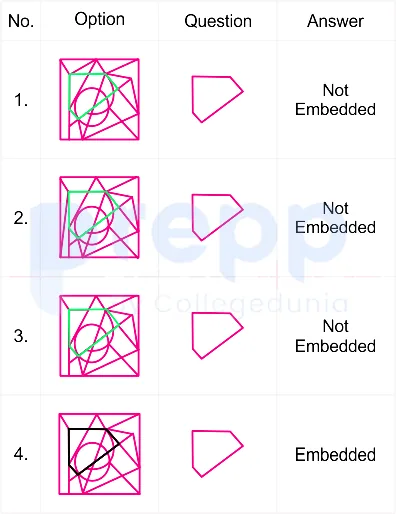
Select the option figure in which the given figure is embedded (rotation is NOT allowed).

- A
Option A (shown in image)
- B
Option B (shown in image)
- C
Option C (shown in image)
- D
Option D (shown in image)
Show answer
D. Option D (shown in image)Given:
The image must not to be rotated
Hence, the correct answer is "Option - (4)".

 Paper & answer key PDF ↗
 Question 3archived
The second number in the given number pairs is obtained by performing certain mathematical operation(s) on the first number. The same operation(s) are followed in all the number pairs, EXCEPT one. Find that odd number pair.
- A
(8, 62)
- B
(10, 100)
- C
(14, 194)
- D
(12, 142)
Show answer
B. (10, 100)Finding the Odd Number Pair Based on Mathematical Operations
The question asks us to identify the number pair that does not follow the same mathematical rule as the other pairs. In each pair $(a, b)$, the second number ($b$) is derived from the first number ($a$) using a specific operation or set of operations. We need to find the common operation among most pairs and then spot the one that deviates.
Analyzing the Given Number Pairs
Let's examine each pair and try to find a relationship between the first number and the second number.
(8, 62): Let the first number be $n=8$. We need to see how 62 can be obtained from 8.
Trying simple operations:
Addition/Subtraction: $8 + 54 = 62$ (Unlikely to be a general rule)
Multiplication: $8 \times ? = 62$ (Not a whole number)
Squaring: $8^2 = 64$. How is 62 related to 64? $64 - 2 = 62$.
This suggests a potential rule: $n^2 - 2$.
Let's test this potential rule $n^2 - 2$ on the other pairs.
(10, 100): Let the first number be $n=10$.
Applying the potential rule $n^2 - 2$: $10^2 - 2 = 100 - 2 = 98$.
The second number in the pair is 100, not 98.
Let's see the direct relationship for this pair: $10^2 = 100$. This pair follows the rule $n^2$.
(14, 194): Let the first number be $n=14$.
Applying the potential rule $n^2 - 2$: $14^2 - 2 = 196 - 2 = 194$.
The second number in the pair is 194. This pair follows the rule $n^2 - 2$.
(12, 142): Let the first number be $n=12$.
Applying the potential rule $n^2 - 2$: $12^2 - 2 = 144 - 2 = 142$.
The second number in the pair is 142. This pair follows the rule $n^2 - 2$.
Identifying the Rule and the Odd Pair
From the analysis above, we can see the following relationships for each pair $(n, \text{second number})$:
Number Pair
First Number ($n$)
Second Number
Operation Found
(8, 62)
8
62
$8^2 - 2 = 64 - 2 = 62$ (Rule: $n^2 - 2$)
(10, 100)
10
100
$10^2 = 100$ (Rule: $n^2$)
(14, 194)
14
194
$14^2 - 2 = 196 - 2 = 194$ (Rule: $n^2 - 2$)
(12, 142)
12
142
$12^2 - 2 = 144 - 2 = 142$ (Rule: $n^2 - 2$)
It is clear that pairs (8, 62), (14, 194), and (12, 142) all follow the rule where the second number is obtained by squaring the first number and subtracting 2 ($n^2 - 2$).
The pair (10, 100) follows a different rule, where the second number is simply the square of the first number ($n^2$).
Therefore, the odd number pair that does not follow the same operation as the others is (10, 100).
Conclusion
The common mathematical operation connecting the number pairs is squaring the first number and subtracting 2 ($n^2 - 2$). The pair (10, 100) does not follow this rule, instead following the rule of simple squaring ($n^2$). Thus, (10, 100) is the odd number pair.
Revision Table: Checking Number Pair Operations
Pair
First No. ($n$)
Calculate $n^2 - 2$
Given Second No.
Match?
(8, 62)
8
$8^2 - 2 = 64 - 2 = 62$
62
Yes
(10, 100)
10
$10^2 - 2 = 100 - 2 = 98$
100
No
(14, 194)
14
$14^2 - 2 = 196 - 2 = 194$
194
Yes
(12, 142)
12
$12^2 - 2 = 144 - 2 = 142$
142
Yes
This table clearly shows that (10, 100) is the outlier.
Additional Information: Number Pattern Reasoning
Questions like this test your ability to find patterns in numbers. Common patterns involve basic arithmetic operations (addition, subtraction, multiplication, division), squares, cubes, square roots, or combinations of these. When solving such problems, it's helpful to:
Look for simple relationships first.
Test common operations like squaring or cubing the number and adding/subtracting/multiplying by a constant.
Compare the difference or ratio between the numbers.
Systematically test potential rules across all given pairs to find the consistent one.
Identify the pair that does not fit the established consistent rule.
This type of problem is common in logical reasoning and quantitative aptitude tests.
Paper & answer key PDF ↗ Question 4archived
Select the option that represents the correct order of the given words as they would appear in an English dictionary.
1. Calamity
2. Calcium
3. Calculus
4. Calmly
5. Calories
6. Calendar
- A
1, 2, 3, 4, 5, 6
- B
1, 2, 3, 6, 4, 5
- C
2, 3, 1, 6, 4, 5
- D
1, 3, 2, 6, 4, 5
Show answer
B. 1, 2, 3, 6, 4, 5Understanding Dictionary Order for Words
Arranging words in dictionary order, also known as alphabetical order, involves comparing words letter by letter from left to right. When the letters are the same, you move to the next letter until you find a difference. The word with the letter that comes earlier in the alphabet is placed first.
Analyzing the Given Words
We are given the following six words:
Calamity
Calcium
Calculus
Calmly
Calories
Calendar
Step-by-Step Ordering Process
Let's compare the words letter by letter to determine their correct dictionary order.
Comparing Initial Letters
All six words start with the letters "Cal". So, we need to look at the fourth letter of each word:
Calamity: C-a-l-a
Calcium: C-a-l-c
Calculus: C-a-l-c
Calmly: C-a-l-m
Calories: C-a-l-o
Calendar: C-a-l-e
Now, let's arrange the words based on their fourth letter in alphabetical order:
'a' (Calamity)
'c' (Calcium, Calculus)
'e' (Calendar)
'm' (Calmly)
'o' (Calories)
This gives us a preliminary order:
Calamity, (Calcium/Calculus), Calendar, Calmly, Calories.
Based on this, word 1 (Calamity) comes first. Word 6 (Calendar) comes after words 2 and 3. Word 4 (Calmly) comes after word 6. Word 5 (Calories) comes after word 4.
Ordering Words with the Same Fourth Letter
We need to compare Calcium (2) and Calculus (3), as both have 'c' as their fourth letter. We move to the fifth letter:
Calcium: C-a-l-c-i
Calculus: C-a-l-c-u
Comparing the fifth letters, 'i' comes before 'u' in the alphabet. Therefore, Calcium comes before Calculus.
So, the order for words 2 and 3 is: Calcium, Calculus.
Combining the Orders
Now we can combine the preliminary order with the order of words 2 and 3:
Calamity (starts with Cala...)
Calcium (starts with Calci...)
Calculus (starts with Calcu...)
Calendar (starts with Cale...)
Calmly (starts with Calm...)
Calories (starts with Calo...)
The final order of the words is:
Calamity (1)
Calcium (2)
Calculus (3)
Calendar (6)
Calmly (4)
Calories (5)
This corresponds to the sequence of numbers: 1, 2, 3, 6, 4, 5.
Comparing with Options
Let's compare our derived order (1, 2, 3, 6, 4, 5) with the given options:
1, 2, 3, 4, 5, 6
1, 2, 3, 6, 4, 5
2, 3, 1, 6, 4, 5
1, 3, 2, 6, 4, 5
Our order matches option 2.
Conclusion
By comparing the words letter by letter, starting from the first letter and moving towards the right when letters are the same, we determined the correct dictionary order. The correct sequence of the given words as they would appear in an English dictionary is Calamity, Calcium, Calculus, Calendar, Calmly, Calories.
Word
Index
Starts with
4th Letter
5th Letter
Calamity
1
Cal
a
m
Calcium
2
Cal
c
i
Calculus
3
Cal
c
u
Calmly
4
Cal
m
l
Calories
5
Cal
o
r
Calendar
6
Cal
e
n
Revision Table: Checking Dictionary Order
Reviewing the process of finding the correct dictionary order is key for mastering such questions. Always start comparison from the first letter.
Additional Information: Dictionary Order Rules
Here are some important points about dictionary order:
Comparison starts from the leftmost letter.
If the first letters are the same, compare the second letters, and so on.
If one word is a prefix of another (e.g., 'cat' and 'catalog'), the shorter word comes first ('cat' before 'catalog'). This rule was not needed here as all words had at least 6 letters and distinct 4th or 5th letters where compared.
Case sensitivity is usually ignored in standard dictionary order (all words treated as lowercase).
Paper & answer key PDF ↗ Question 5archived
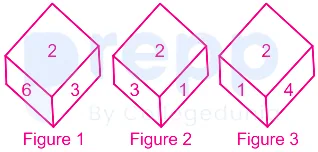
Three different positions of the same dice are shown. Find the number on the face opposite the face showing '2'.
- A
4
- B
3
- C
6
- D
5
Show answer
D. 5The logic followed here is:-
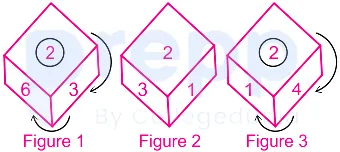
From the given three different cubes, figure 1 and figure 3, the adjacent sides are as shown below :
As 2 is common in both figure 1 and figure 3, it is clear that 1, 3, 4 and 6 are adjacent to it, and the remaining number i.e., 5 will be opposite to it.
Opposite pairs:
4 → 3
1 → 6
5 → 5
So, the opposite side of "2" will be side "5".
Hence, the correct answer is "5".
 Paper & answer key PDF ↗
 Question 6archived
Select the option that is related to the third term in the same way as the second term is related to the first term and the sixth term is related to the fifth term.
6 ∶ 136 ∶∶ 8 ∶ ? ∶∶ 12 ∶ 568
- A
248
- B
284
- C
244
- D
288
Show answer
A. 248Understanding Number Analogies and Patterns
Number analogy questions test your ability to find a relationship between two numbers and apply that same relationship to another number to find a missing term. In this question, we are given three pairs related by the same underlying pattern: 6 is related to 136, 8 is related to an unknown number, and 12 is related to 568.
Our task is to discover the rule connecting the numbers in the known pairs (6 and 136, and 12 and 568) and then use that rule to find the missing number related to 8.
Analyzing the Relationship: 6 to 136
Let's look at the first pair, 6 and 136. We need to find a mathematical operation or sequence of operations that transforms 6 into 136. Let's consider common operations involving the number $n=6$:
Squaring: $6^2 = 36$. This is far from 136.
Cubing: $6^3 = 216$. This is closer to 136. The difference is $216 - 136 = 80$.
Maybe a combination of operations? Let's try multiplying the square of the number by a constant and adding/subtracting. $6^2 = 36$. If we multiply 36 by 4, we get $36 \times 4 = 144$. The difference between 144 and 136 is $144 - 136 = 8$. So, $144 - 8 = 136$. This suggests a potential rule: $n^2 \times 4 - 8$.
Verifying the Pattern with 12 and 568
Let's test if the proposed rule, $n^2 \times 4 - 8$, holds for the third pair, where $n=12$. According to the rule, 12 should be related to $12^2 \times 4 - 8$.
Calculate the square of 12: $12^2 = 144$.
Multiply the square by 4: $144 \times 4 = 576$.
Subtract 8: $576 - 8 = 568$.
The result, 568, matches the given second number in the third pair. This confirms that the rule $n^2 \times 4 - 8$ is the correct pattern for this analogy.
Finding the Missing Term for 8
Now that we have identified the pattern $n^2 \times 4 - 8$, we can apply it to the third term, $n=8$, to find the missing number.
We need to calculate $8^2 \times 4 - 8$:
Calculate the square of 8: $8^2 = 64$.
Multiply the square by 4: $64 \times 4 = 256$.
Subtract 8: $256 - 8 = 248$.
So, the missing term in the analogy is 248.
Comparing with Options
Let's compare our calculated missing term with the given options:
248
284
244
288
Our calculated value, 248, matches option 1.
Step-by-Step Solution Summary
Here is a summary of the steps taken to solve the number analogy:
Identify the known pairs in the analogy (6:136 and 12:568).
Analyze the relationship between the numbers in the first pair (6 and 136). Through testing, we found the relationship $n^2 \times 4 - 8$.
Verify this relationship with the second known pair (12 and 568). The calculation $12^2 \times 4 - 8 = 568$ confirmed the pattern.
Apply the established pattern ($n^2 \times 4 - 8$) to the third term (8) to find the missing number.
Calculate $8^2 \times 4 - 8 = 64 \times 4 - 8 = 256 - 8 = 248$.
Match the result with the given options.
The missing term is 248.
Revision Table: Number Analogy Pattern
First Term (n)
Relationship
Second Term ($n^2 \times 4 - 8$)
6
$6^2 \times 4 - 8 = 36 \times 4 - 8 = 144 - 8$
136
8
$8^2 \times 4 - 8 = 64 \times 4 - 8 = 256 - 8$
248
12
$12^2 \times 4 - 8 = 144 \times 4 - 8 = 576 - 8$
568
Additional Information: Tips for Solving Number Analogies
Solving number analogy problems often involves identifying mathematical relationships between numbers. Here are some common patterns to look for:
Basic Operations: Addition, subtraction, multiplication, division.
Squares and Cubes: The numbers might be related to the square ($n^2$) or cube ($n^3$) of the given number, or a number close to it ($n+1)^2$, $(n-1)^3$).
Combinations: The relationship could involve a combination of operations, like $n^2 + c$, $n^3 - c$, $an + b$, $an^2 + bn + c$, etc.
Digits: Sometimes the pattern involves the digits of the number (sum of digits, product of digits, reversing digits).
Prime or Composite Numbers: The relationship might be based on whether the number is prime or composite, or its position in a sequence of primes.
Divisibility Rules: The relationship could involve divisibility by a certain number.
Practice is key to recognizing these patterns quickly. Always check the identified pattern with all given pairs in the analogy to ensure its consistency before applying it to find the missing term.
Paper & answer key PDF ↗ Question 7archived
Which of the answer figures is the exact mirror image of the given problem figure when the mirror is held at the right side?
Problem figure:

- A
Option A (shown in image)
- B
Option B (shown in image)
- C
Option C (shown in image)
- D
Option D (shown in image)
Show answer
C. Option C (shown in image)The correct mirror image of the given figure when mirror is placed at AB is as shown below:
Hence, the correct answer is "Option - (3)".
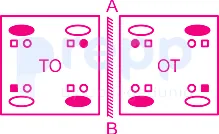 Paper & answer key PDF ↗
 Question 8archived
Select the correct combination of mathematical signs that can sequentially replace the * signs and balance the given equation.
96 * 3 * 7 * 4 * 11 = 15
- A
× + ÷ -
- B
× ÷ - +
- C
+ ÷ × -
- D
÷ - × +
Show answer
D. ÷ - × +Balancing Equations with Mathematical Signs
The question asks us to find the correct combination of mathematical signs that can replace the asterisks (*) in the equation \(96 \text{ * } 3 \text{ * } 7 \text{ * } 4 \text{ * } 11 = 15\) to make it a true statement. We need to test each given option by substituting the signs into the equation and performing the calculations following the order of operations (BODMAS/PEMDAS).
Understanding the Order of Operations (BODMAS/PEMDAS)
To correctly evaluate mathematical expressions, we must follow a specific order of operations:
Brackets (Parentheses)
Orders (Exponents, Powers, Square Roots)
Division and Multiplication (from left to right)
Addition and Subtraction (from left to right)
Let's test each option sequentially.
Testing Option 1: \(\times, +, \div, -\)
Substitute the signs into the equation:
\(96 \times 3 + 7 \div 4 - 11\)
Following BODMAS:
Multiplication: \(96 \times 3 = 288\)
Division: \(7 \div 4 = 1.75\)
Equation becomes: \(288 + 1.75 - 11\)
Addition/Subtraction from left to right: \(288 + 1.75 = 289.75\)
Subtraction: \(289.75 - 11 = 278.75\)
Since \(278.75 \neq 15\), Option 1 is incorrect.
Testing Option 2: \(\times, \div, -, +\)
Substitute the signs into the equation:
\(96 \times 3 \div 7 - 4 + 11\)
Following BODMAS:
Multiplication/Division from left to right: \(96 \times 3 = 288\)
Division: \(288 \div 7\). This results in a non-integer value.
Since the right side of the equation is an integer (15), this option is unlikely to be correct as it introduces a non-integer early in the calculation. Let's continue the calculation anyway:
\(288 \div 7 \approx 41.14\)
Equation becomes approximately: \(41.14 - 4 + 11\)
Addition/Subtraction from left to right: \(41.14 - 4 = 37.14\)
Addition: \(37.14 + 11 = 48.14\)
Since \(48.14 \neq 15\), Option 2 is incorrect.
Testing Option 3: \(+, \div, \times, -\)
Substitute the signs into the equation:
\(96 + 3 \div 7 \times 4 - 11\)
Following BODMAS:
Division: \(3 \div 7\). This results in a non-integer value.
Again, this introduces a non-integer, making it unlikely to result in the integer 15.
Equation becomes: \(96 + (3 \div 7) \times 4 - 11\)
Let's perform the multiplication next: \((3 \div 7) \times 4 = 12 \div 7 \approx 1.71\)
Equation becomes approximately: \(96 + 1.71 - 11\)
Addition/Subtraction from left to right: \(96 + 1.71 = 97.71\)
Subtraction: \(97.71 - 11 = 86.71\)
Since \(86.71 \neq 15\), Option 3 is incorrect.
Testing Option 4: \(\div, -, \times, +\)
Substitute the signs into the equation:
\(96 \div 3 - 7 \times 4 + 11\)
Following BODMAS:
Division: \(96 \div 3 = 32\)
Multiplication: \(7 \times 4 = 28\)
Equation becomes: \(32 - 28 + 11\)
Addition/Subtraction from left to right: \(32 - 28 = 4\)
Addition: \(4 + 11 = 15\)
Since \(15 = 15\), the equation is balanced. Option 4 is the correct combination of signs.
Detailed Calculation for the Correct Option
Step
Operation
Calculation
Resulting Equation
1
Substitute signs
\(96 \text{ * } 3 \text{ * } 7 \text{ * } 4 \text{ * } 11 = 15\)
\(96 \div 3 - 7 \times 4 + 11 = 15\)
2
Division (BODMAS)
\(96 \div 3\)
\(32 - 7 \times 4 + 11 = 15\)
3
Multiplication (BODMAS)
\(7 \times 4\)
\(32 - 28 + 11 = 15\)
4
Subtraction (BODMAS)
\(32 - 28\)
\(4 + 11 = 15\)
5
Addition (BODMAS)
\(4 + 11\)
\(15 = 15\)
The left side of the equation equals 15, which is equal to the right side. Therefore, the equation is balanced with the signs \(\div, -, \times, +\).
Revision Table: Key Concepts for Balancing Equations
Concept
Description
Order of Operations
Rules (like BODMAS/PEMDAS) dictating the sequence of mathematical operations (Brackets, Orders, Division/Multiplication, Addition/Subtraction).
Equation Balancing
Finding unknown values or operators that make the expression on the left side equal to the expression on the right side.
Mathematical Operators
Symbols like +, -, ×, ÷ used to perform operations.
Substitution Method
Replacing placeholders (like *) with given values or symbols to test an equation.
Additional Information: Practice with Order of Operations
Practice is key to mastering the order of operations and balancing equations. Remember to always perform operations in the correct sequence to avoid errors.
Brackets first: Solve anything inside parentheses or other grouping symbols.
Exponents/Orders next: Calculate powers and roots.
Multiplication and Division: Perform these from left to right.
Addition and Subtraction: Perform these from left to right.
Checking each option systematically, as demonstrated in this solution, is a reliable approach for these types of problems.
Paper & answer key PDF ↗ Question 9archived
Select the option that is related to the fifth letter-cluster in the same way as the second letter-cluster is related to the first letter-cluster and the fourth letter-cluster is related to the third letter-cluster
ADAMS : DASMA :: TOWER : OTREW :: RAINY : ?
- A
ARYNI
- B
YNIAR
- C
INYRA
- D
AINYR
Show answer
A. ARYNIUnderstanding Letter Cluster Analogies
This question asks us to find the letter cluster that has the same relationship with 'RAINY' as 'DASMA' has with 'ADAMS', and 'OTREW' has with 'TOWER'. This type of problem is known as a letter cluster analogy, where we need to identify the rule or pattern connecting the first pair and apply it to the second and third pairs.
Analyzing the First Letter Cluster Analogy: ADAMS to DASMA
Let's look at the transformation from ADAMS to DASMA.
The letters in ADAMS are A, D, A, M, S.
The letters in DASMA are D, A, S, M, A.
Comparing the positions of the letters:
The 2nd letter of ADAMS (D) is the 1st letter of DASMA.
The 1st letter of ADAMS (A) is the 2nd letter of DASMA.
The 5th letter of ADAMS (S) is the 3rd letter of DASMA.
The 4th letter of ADAMS (M) is the 4th letter of DASMA.
The 3rd letter of ADAMS (A) is the 5th letter of DASMA.
So, the letters from ADAMS (positions 1 2 3 4 5) are rearranged in DASMA according to the order of positions 2 1 5 4 3.
Verifying the Pattern with the Second Pair: TOWER to OTREW
Let's apply the identified pattern (2 1 5 4 3) to TOWER.
TOWER has letters T, O, W, E, R at positions 1, 2, 3, 4, 5 respectively.
Applying the pattern 2 1 5 4 3:
2nd letter is O.
1st letter is T.
5th letter is R.
4th letter is E.
3rd letter is W.
Combining these gives O T R E W.
This matches the given second letter cluster, OTREW. The pattern 2 1 5 4 3 is consistent for both pairs.
Applying the Pattern to the Third Pair: RAINY to ?
Now, we apply the same pattern (2 1 5 4 3) to the letter cluster RAINY to find the missing cluster.
RAINY has letters R, A, I, N, Y at positions 1, 2, 3, 4, 5 respectively.
Applying the pattern 2 1 5 4 3:
2nd letter is A.
1st letter is R.
5th letter is Y.
4th letter is N.
3rd letter is I.
Combining these gives A R Y N I.
Comparing with the Options
The resulting letter cluster is ARYNI. Let's check the given options:
Option 1: ARYNI
Option 2: YNIAR
Option 3: INYRA
Option 4: AINYR
Our result, ARYNI, matches Option 1.
Conclusion
The pattern connecting the letter clusters is a rearrangement of the letters from the first cluster based on their original positions. The second letter becomes the first, the first becomes the second, the fifth becomes the third, the fourth remains the fourth, and the third becomes the fifth. Applying this pattern to RAINY gives ARYNI.
Original Cluster (1 2 3 4 5)
Rule (2 1 5 4 3)
New Cluster
A D A M S
D(2) A(1) S(5) M(4) A(3)
D A S M A
T O W E R
O(2) T(1) R(5) E(4) W(3)
O T R E W
R A I N Y
A(2) R(1) Y(5) N(4) I(3)
A R Y N I
Revision Table: Letter Analogy Pattern
Reviewing the core concept of letter cluster analogies is crucial for exam preparation. Identifying the transformation rule is the key.
Look for shifts in position.
Look for alphabetical shifts (+n or -n).
Look for reversal or other types of rearrangement.
Test the identified rule on all given pairs.
Additional Information: Types of Verbal Reasoning
Letter cluster analogies fall under verbal reasoning, which assesses the ability to understand and logically work with concepts and problems presented in words. Other types include:
Number series
Coding-decoding
Blood relations
Direction sense
Logical sequences
Classification
Practicing various types of verbal reasoning questions helps improve analytical and problem-solving skills.
Paper & answer key PDF ↗ Question 10archived
Select the set in which the numbers are related in the same way as are the numbers of the following sets.
(NOTE: Operations should be performed on the whole numbers, without breaking down the numbers into its constituent digits. E.g., 13- Operations on 13 such as adding/subtracting/multiplying etc. to 13 can be performed. Breaking down 13 into 1 and 3 and then performing mathematical operations on 1 and 3 is NOT allowed)
(26, 62, 140)
(12, 39, 75)
- A
(20, 38, 108)
- B
(20, 48, 108)
- C
(50, 48, 108)
- D
(20, 48, 98)
Show answer
B. (20, 48, 108)Understanding Number Analogy Problems
Number analogy questions require identifying the underlying mathematical relationship or pattern within a given set of numbers. This same pattern must then be used to find a matching set from the provided options.
According to the specific instructions for this question, operations must be performed on the whole numbers as presented. We are not allowed to break down a number like 26 into its individual digits (2 and 6) for calculations.
Analyzing the Provided Number Sets to Find the Pattern
We are given two sets of numbers that follow the same relationship:
Set 1: (26, 62, 140)
Set 2: (12, 39, 75)
Let's label the numbers in each set as A, B, and C. So, for Set 1, A=26, B=62, and C=140. For Set 2, A=12, B=39, and C=75.
Our goal is to find a consistent rule or formula linking A, B, and C that works for both sets.
Let's examine the first set (26, 62, 140). The difference between the first two numbers is \(62 - 26 = 36\). The third number is 140.
In the second set (12, 39, 75), the difference between the first two numbers is \(39 - 12 = 27\). The third number is 75.
We need to find a way to relate C to A and B (or A and B-A) that holds for both sets. Let's consider a potential relationship involving A and the difference (B-A), such as \(C = k_1 \times A + k_2 \times (B-A)\).
For Set 1: \(140 = k_1 \times 26 + k_2 \times (62 - 26) \implies 140 = 26k_1 + 36k_2\)
For Set 2: \(75 = k_1 \times 12 + k_2 \times (39 - 12) \implies 75 = 12k_1 + 27k_2\)
We now have a system of two linear equations with two variables \(k_1\) and \(k_2\):
\(\begin{cases} 26k_1 + 36k_2 = 140 \quad (1) \\ 12k_1 + 27k_2 = 75 \quad (2) \end{cases}\)
We can simplify these equations. Divide equation (1) by 2 and equation (2) by 3:
\(\begin{cases} 13k_1 + 18k_2 = 70 \quad (3) \\ 4k_1 + 9k_2 = 25 \quad (4) \end{cases}\)
Multiply equation (4) by 2: \(8k_1 + 18k_2 = 50 \quad (5)\)
Subtract equation (5) from equation (3):
\((13k_1 + 18k_2) - (8k_1 + 18k_2) = 70 - 50\)
\(5k_1 = 20\)
\(k_1 = \frac{20}{5} = 4\)
Substitute the value of \(k_1=4\) into equation (4):
\(4(4) + 9k_2 = 25\)
\(16 + 9k_2 = 25\)
\(9k_2 = 25 - 16\)
\(9k_2 = 9\)
\(k_2 = \frac{9}{9} = 1\)
The relationship is \(C = 4 \times A + 1 \times (B-A)\).
This simplifies to: \(C = 4A + B - A \implies C = 3A + B\).
Let's verify this simplified rule with the original sets:
Set 1: \(3 \times 26 + 62 = 78 + 62 = 140\). This matches the given C value.
Set 2: \(3 \times 12 + 39 = 36 + 39 = 75\). This matches the given C value.
The rule is indeed \(C = 3A + B\).
Evaluating the Options Using the Identified Pattern
Now we will apply the rule \(C = 3A + B\) to each of the given options to see which one follows the same pattern. Let the numbers in each option be A, B, and C.
Option 1: (20, 38, 108)
Here, A=20, B=38, C=108.
Applying the rule: Calculate \(3A + B\).
\(3 \times 20 + 38 = 60 + 38 = 98\).
The calculated value (98) is not equal to the third number in the option (108). So, this option does not match the pattern.
Option 2: (20, 48, 108)
Here, A=20, B=48, C=108.
Applying the rule: Calculate \(3A + B\).
\(3 \times 20 + 48 = 60 + 48 = 108\).
The calculated value (108) is equal to the third number in the option (108). So, this option follows the pattern.
Option 3: (50, 48, 108)
Here, A=50, B=48, C=108.
Applying the rule: Calculate \(3A + B\).
\(3 \times 50 + 48 = 150 + 48 = 198\).
The calculated value (198) is not equal to the third number in the option (108). So, this option does not match the pattern.
Option 4: (20, 48, 98)
Here, A=20, B=48, C=98.
Applying the rule: Calculate \(3A + B\).
\(3 \times 20 + 48 = 60 + 48 = 108\).
The calculated value (108) is not equal to the third number in the option (98). So, this option does not match the pattern.
Conclusion
Comparing the results, only Option 2 (20, 48, 108) satisfies the relationship \(C = 3A + B\) that was derived from the given number sets (26, 62, 140) and (12, 39, 75).
Revision Table: Understanding Number Analogies
Concept
Explanation
Number Analogy
Finding a mathematical pattern or relationship between numbers in a set.
Whole Number Rule
Operations apply to the entire number, not individual digits.
Pattern Discovery
Analyze given sets to derive a consistent rule (e.g., \(C = f(A, B)\)).
Option Testing
Apply the discovered rule to each option to find the matching set.
`
Additional Information: Strategies for Number Pattern Questions
Solving number pattern and analogy questions often involves exploring different mathematical possibilities. Here are some common strategies:
Look for simple arithmetic progressions (adding/subtracting a constant).
Check for geometric progressions (multiplying/dividing by a constant).
Analyze the differences between consecutive numbers; these differences might form a pattern.
Consider squares, cubes, square roots, or cube roots.
Look for relationships involving the sum, difference, product, or quotient of the first two numbers in relation to the third.
Test combinations of operations, like the rule \(C = 3A + B\) found in this problem.
When multiple sets are given, the rule must be valid for every single set provided.
Systematically test potential patterns and eliminate those that do not fit all given examples.
Paper & answer key PDF ↗ Question 11archived
Which of the following letter-clusters will replace the question mark (?) in the given series?
EJCK, GMDO, IPES, ?, MVGA
- A
KRFW
- B
KTFW
- C
KSFW
- D
KRFV
Show answer
C. KSFWSolving the Letter Series Reasoning Question
This question asks us to find the letter cluster that replaces the question mark in the given series: EJCK, GMDO, IPES, ?, MVGA. To solve this, we need to identify the pattern in how the letters change from one cluster to the next.
Analyzing the Pattern in the Letter Series
Let's examine each letter position within the clusters separately and see how it changes as we move through the series.
Cluster
1st Letter
2nd Letter
3rd Letter
4th Letter
EJCK
E
J
C
K
GMDO
G
M
D
O
IPES
I
P
E
S
?
?
?
?
MVGA
M
V
G
A
Pattern for the 1st Letter:
E (5th letter) to G (7th letter): This is a step of $+2$ alphabetical positions.
G (7th letter) to I (9th letter): This is also a step of $+2$ alphabetical positions.
Assuming the pattern continues, the next letter after I (9th letter) should be the letter at position $9 + 2 = 11$. The 11th letter is K.
Let's check the next step: K (11th letter) to M (13th letter): This is a step of $+2$. The pattern holds.
So, the first letter of the missing cluster is K.
Pattern for the 2nd Letter:
J (10th letter) to M (13th letter): This is a step of $+3$ alphabetical positions.
M (13th letter) to P (16th letter): This is also a step of $+3$ alphabetical positions.
Assuming the pattern continues, the next letter after P (16th letter) should be the letter at position $16 + 3 = 19$. The 19th letter is S.
Let's check the next step: S (19th letter) to V (22nd letter): This is a step of $+3$. The pattern holds.
So, the second letter of the missing cluster is S.
Pattern for the 3rd Letter:
C (3rd letter) to D (4th letter): This is a step of $+1$ alphabetical position.
D (4th letter) to E (5th letter): This is also a step of $+1$ alphabetical position.
Assuming the pattern continues, the next letter after E (5th letter) should be the letter at position $5 + 1 = 6$. The 6th letter is F.
Let's check the next step: F (6th letter) to G (7th letter): This is a step of $+1$. The pattern holds.
So, the third letter of the missing cluster is F.
Pattern for the 4th Letter:
K (11th letter) to O (15th letter): This is a step of $+4$ alphabetical positions.
O (15th letter) to S (19th letter): This is also a step of $+4$ alphabetical positions.
Assuming the pattern continues, the next letter after S (19th letter) should be the letter at position $19 + 4 = 23$. The 23rd letter is W.
Let's check the next step: W (23rd letter) to A (which is like the 27th letter, $26+1$): This is a step of $+4$ (from W to X, Y, Z, A). The pattern holds, wrapping around the alphabet.
So, the fourth letter of the missing cluster is W.
Forming the Missing Letter Cluster
Combining the letters we found for each position, the missing letter cluster is KSFW.
Verification of the Letter Series Pattern
Let's write out the series with the found cluster and the patterns:
EJCK ($\xrightarrow{+2}$ $\xrightarrow{+3}$ $\xrightarrow{+1}$ $\xrightarrow{+4}$) GMDO
GMDO ($\xrightarrow{+2}$ $\xrightarrow{+3}$ $\xrightarrow{+1}$ $\xrightarrow{+4}$) IPES
IPES ($\xrightarrow{+2}$ $\xrightarrow{+3}$ $\xrightarrow{+1}$ $\xrightarrow{+4}$) KSFW
KSFW ($\xrightarrow{+2}$ $\xrightarrow{+3}$ $\xrightarrow{+1}$ $\xrightarrow{+4}$) MVGA
The pattern is consistent throughout the series.
Conclusion
Based on the analysis of the patterns in each letter position, the letter cluster that replaces the question mark is KSFW.
Revision Table: Key Patterns in Letter Series
Letter Position
Pattern
Progression
1st
$+2$
E, G, I, K, M
2nd
$+3$
J, M, P, S, V
3rd
$+1$
C, D, E, F, G
4th
$+4$
K, O, S, W, A (wraps around)
Additional Information on Letter Series Reasoning
Letter series questions are common in logical reasoning and mental ability tests. They require you to identify the underlying rule or pattern that governs the sequence of letters or letter clusters. Common patterns include:
Adding or subtracting a fixed number to the alphabetical position of letters.
Alternating patterns (e.g., +2, +3, +2, +3...).
Patterns involving the position of letters in the original cluster changing in the next cluster.
Combinations of these patterns across different letter positions within a cluster.
Patterns involving vowels or consonants.
Reverse alphabetical order.
Solving these types of questions involves careful observation and breaking down the problem into smaller, manageable parts, just like we did by analyzing each letter position separately in the EJCK, GMDO, IPES, ?, MVGA series.
Paper & answer key PDF ↗ Question 12archived
Study the given pattern carefully and select the number that can replace the question mark (?) in it.
(3, 5, 6)
(5, 12, 15)
(9, 4, ?)
(NOTE: Operations should be performed on the whole numbers, without breaking down the numbers into its constituent digits. E.g. 13 - Operations on 13 such as adding/subtracting/multiplying etc. to 13 can be performed. Breaking down 13 into 1 and 3 and then performing mathematical operations on 1 and 3 is not allowed)
- A
13
- B
9
- C
11
- D
7
Show answer
C. 11Solving the Number Pattern: Finding the Missing Number
The problem asks us to identify the pattern in the given sets of numbers, presented as triplets, and then use that pattern to find the missing number in the third triplet. The given triplets are:
(3, 5, 6)
(5, 12, 15)
(9, 4, ?)
We are instructed to perform operations on the whole numbers as given, not on their constituent digits. Let's analyze the relationship between the numbers in the first two triplets to find a consistent rule.
Analyzing the Given Triplets
Let's look at the first triplet: (3, 5, 6). We need to find a relationship between 3, 5, and 6. Let's consider basic arithmetic operations:
Sum of the first two numbers: \(3 + 5 = 8\). This is not 6.
Difference of the first two numbers: \(5 - 3 = 2\) (or \(3 - 5 = -2\)). How does 2 relate to 6? \(2 \times 3 = 6\). Let's check this idea with the next triplet.
Now consider the second triplet: (5, 12, 15).
Sum of the first two numbers: \(5 + 12 = 17\). This is not 15.
Difference of the first two numbers: \(12 - 5 = 7\). If we apply the previous idea \(7 \times 3 = 21\). This is not 15. So, the difference multiplied by 3 is not the pattern.
Let's re-examine the first triplet (3, 5, 6). What if the relationship involves the sum and a constant adjustment? We found \(3 + 5 = 8\). To get 6 from 8, we subtract 2 (\(8 - 2 = 6\)).
Let's test this pattern with the second triplet (5, 12, 15). The pattern would be: (first number + second number) - 2 = third number.
First number: 5
Second number: 12
Applying the potential pattern: \((5 + 12) - 2 = 17 - 2 = 15\).
This matches the third number in the second triplet. So, the pattern appears to be consistent across the first two sets of numbers.
The identified pattern is: The third number in each triplet is obtained by adding the first two numbers and then subtracting 2 from the sum.
Mathematically, the pattern can be expressed as: \(\text{Third Number} = (\text{First Number} + \text{Second Number}) - 2\).
Applying the Pattern to Find the Missing Number
Now we apply this pattern to the third triplet: (9, 4, ?).
First number: 9
Second number: 4
Let the missing number be \(x\). According to the pattern: \((9 + 4) - 2 = x\)
Calculate the sum of the first two numbers: \(9 + 4 = 13\)
Subtract 2 from the sum: \(13 - 2 = 11\)
So, \(x = 11\).
The missing number that replaces the question mark (?) is 11.
Verification
Let's quickly verify the pattern with all three triplets:
Triplet
First Number
Second Number
Calculation \((1st + 2nd) - 2\)
Third Number
Matches?
(3, 5, 6)
3
5
\((3 + 5) - 2 = 8 - 2 = 6\)
6
Yes
(5, 12, 15)
5
12
\((5 + 12) - 2 = 17 - 2 = 15\)
15
Yes
(9, 4, ?)
9
4
\((9 + 4) - 2 = 13 - 2 = 11\)
?
The calculated value is 11
The pattern is consistent and gives the value 11 for the missing number.
Conclusion
Based on the pattern observed in the first two triplets, the missing number in the third triplet (9, 4, ?) is 11.
Revision Table: Key Concepts
Concept
Description
Relevance to Pattern Problems
Pattern Recognition
Identifying a consistent rule or relationship within a sequence of numbers, figures, or events.
Essential skill for solving problems involving number series or visual sequences.
Logical Reasoning
Using logical steps and deductions to arrive at a conclusion.
Required to analyze the relationships between numbers and hypothesize potential patterns.
Arithmetic Operations
Basic math operations like addition, subtraction, multiplication, and division.
Commonly form the basis of number patterns. Testing different combinations is crucial.
Additional Information: Approaches to Solving Number Patterns
Solving number pattern problems often involves trial and error and systematically testing different relationships between the given numbers. Here are some common approaches:
Difference/Ratio: Look at the differences or ratios between consecutive numbers (though this is more common in linear sequences, not triplets).
Relationships within elements: For groups like triplets, analyze how the first element relates to the second, the second to the third, or the first and second combined relate to the third.
Arithmetic Operations: Test sums, differences, products, quotients, squares, cubes, square roots, etc., and combinations of these.
Constant Addition/Subtraction: Check if a constant value is added or subtracted at each step or within the relationship.
Multiple Operations: The pattern might involve more than one operation (like in this problem: addition and then subtraction).
It's important to test the hypothesized pattern against all the given examples to ensure consistency before applying it to find the missing element.
Paper & answer key PDF ↗ Question 13archived
Select the set in which the numbers are related in the same way as are the numbers of the given set.
(NOTE: Operations should be performed on the whole numbers, without breaking down the numbers into its constituent digits. E.g. 13 - Operations on 13 such as adding /subtracting/multiplying etc. to 13 can be performed. Breaking down 13 into 1 and 3 and then performing mathematical operations on 1 and 3 is not allowed.)
(6, 16, 8)
(5, 15, 9)
- A
(4, 12, 11)
- B
(3, 11, 11)
- C
(3, 19, 11)
- D
(4, 32, 8)
Show answer
B. (3, 11, 11)Understanding Number Set Relationships
The problem asks us to identify a set of numbers from the given options that shares the same mathematical relationship between its elements as the two provided sets: (6, 16, 8) and (5, 15, 9). The key constraint is that operations must be performed on the whole numbers themselves, not their individual digits.
We need to analyze the given sets to discover the underlying rule that connects the three numbers in each set.
Analyzing the Given Number Sets
Let's denote the numbers in a set as A, B, and C. The given sets are:
Set 1: (A, B, C) = (6, 16, 8)
Set 2: (A, B, C) = (5, 15, 9)
We look for a pattern or mathematical relationship that holds true for both Set 1 and Set 2.
Let's explore some possibilities:
Is there a simple arithmetic progression or difference?
Is there a multiplication or division relationship?
Is there a relationship involving the sum or product of numbers?
After examining various combinations, let's consider a relationship involving multiplication of the first and third numbers and how it relates to the second number.
Let's test the product of the first and third numbers (A and C) and compare it to the second number (B).
For Set 1 (6, 16, 8):
Product of first and third: $A \times C = 6 \times 8 = 48$
Second number: $B = 16$
How are 48 and 16 related? $48 = 3 \times 16$. So, $A \times C = 3 \times B$ seems like a potential rule.
For Set 2 (5, 15, 9):
Product of first and third: $A \times C = 5 \times 9 = 45$
Second number: $B = 15$
How are 45 and 15 related? $45 = 3 \times 15$. This confirms the potential rule $A \times C = 3 \times B$.
So, the mathematical relationship governing the numbers in the given sets is that the product of the first number and the third number is equal to three times the second number. This can be expressed as $A \times C = 3 \times B$, or equivalently, $B = \frac{A \times C}{3}$.
Applying the Rule to the Options
Now, we will test each given option to see which set satisfies the relationship $B = \frac{A \times C}{3}$.
Option 1: (4, 12, 11)
$A = 4$, $B = 12$, $C = 11$
Check the rule: $B = \frac{A \times C}{3}$
Substitute the values: $12 = \frac{4 \times 11}{3} = \frac{44}{3}$
$12 \neq 14.66...$
Option 1 does not follow the rule.
Option 2: (3, 11, 11)
$A = 3$, $B = 11$, $C = 11$
Check the rule: $B = \frac{A \times C}{3}$
Substitute the values: $11 = \frac{3 \times 11}{3} = \frac{33}{3}$
$11 = 11$
Option 2 follows the rule.
Option 3: (3, 19, 11)
$A = 3$, $B = 19$, $C = 11$
Check the rule: $B = \frac{A \times C}{3}$
Substitute the values: $19 = \frac{3 \times 11}{3} = \frac{33}{3}$
$19 \neq 11$
Option 3 does not follow the rule.
Option 4: (4, 32, 8)
$A = 4$, $B = 32$, $C = 8$
Check the rule: $B = \frac{A \times C}{3}$
Substitute the values: $32 = \frac{4 \times 8}{3} = \frac{32}{3}$
$32 \neq 10.66...$
Option 4 does not follow the rule.
Based on the analysis, only Option 2 (3, 11, 11) satisfies the derived relationship $B = \frac{A \times C}{3}$, which is consistent with the given sets (6, 16, 8) and (5, 15, 9).
Conclusion
The set of numbers that is related in the same way as the numbers of the given sets is (3, 11, 11).
Revision Table: Number Relationship
SetABC$A \times C$$3 \times B$Relationship ($A \times C = 3 \times B$)
Given Set 16168$6 \times 8 = 48$$3 \times 16 = 48$Holds ($48=48$)
Given Set 25159$5 \times 9 = 45$$3 \times 15 = 45$Holds ($45=45$)
Option 141211$4 \times 11 = 44$$3 \times 12 = 36$Does Not Hold ($44 \neq 36$)
Option 231111$3 \times 11 = 33$$3 \times 11 = 33$Holds ($33=33$)
Option 331911$3 \times 11 = 33$$3 \times 19 = 57$Does Not Hold ($33 \neq 57$)
Option 44328$4 \times 8 = 32$$3 \times 32 = 96$Does Not Hold ($32 \neq 96$)
Additional Information on Number Analogies
Number analogy questions, like this one, test your ability to identify patterns and relationships between numbers. These relationships can involve various mathematical operations. Here are some common types of relationships found in such problems:
Arithmetic Operations: Simple addition, subtraction, multiplication, or division between the numbers. For example, $B = A + k$, $C = B - m$, etc.
Ratio and Proportion: The numbers might be in a specific ratio, e.g., $A:B:C = x:y:z$.
Squares and Cubes: The numbers might be squares or cubes of other numbers, or related to them. For example, $B = A^2$, $C = \sqrt{B}$.
Combined Operations: A combination of arithmetic operations and potentially powers. For instance, $B = 2A + 3$, $C = A \times B - 5$.
Digit Operations: (Usually specified if allowed) Relationships based on the digits of the numbers, like the sum of digits, product of digits, etc. However, the given question explicitly disallowed this.
Solving number analogy problems requires careful observation, systematic testing of possible relationships, and understanding the constraints given in the question.
Paper & answer key PDF ↗ Question 14archived
Select the figure from the options that can replace the question mark and complete the given pattern.

- A
Option A (shown in image)
- B
Option B (shown in image)
- C
Option C (shown in image)
- D
Option D (shown in image)
Show answer
Question 15archived
Amil points towards a girl and says she is his only daughter's father's paternal grandfather's granddaughter. Amil's father has no siblings. How is the girl related to Amil?
- A
Granddaughter
- B
daughter
- C
Paternal grandmother
- D
Mother
Show answer
B. daughterDecoding the Family Relationship Riddle
This question asks us to figure out the relationship between Amil and a girl he is describing. We need to carefully follow the chain of relationships Amil mentions.
Analyzing the Description
Amil says the girl is "his only daughter's father's paternal grandfather's granddaughter". Let's break this phrase down:
"His": This refers to Amil, the speaker.
"His only daughter": This refers to Amil's daughter.
"His only daughter's father": The father of Amil's daughter is Amil himself.
"Amil's paternal grandfather": This is the father of Amil's father. Let's denote Amil's paternal grandfather as GGP.
Putting it together, the description means the girl is the granddaughter of Amil's paternal grandfather (GGP).
Using the Given Condition
The problem includes a crucial piece of information: "Amil's father has no siblings".
This tells us that Amil's father (let's call him F) was the only child of his parents (Amil's GGP and GGM).
Identifying GGP's Granddaughters
With the condition that Amil's father (F) was an only child, we can determine who GGP's granddaughters are:
Since F was GGP's only child, GGP's grandchildren must be the children of F.
The children of F are Amil (who is male) and any daughters F might have (these would be Amil's sisters).
Therefore, the granddaughters of GGP are the daughters of F, meaning they must be Amil's sisters.
Evaluating the Possibilities
Based on a strict interpretation of Amil's description ("She is GGP's granddaughter") and the condition ("Amil's father has no siblings"), the girl Amil is describing should logically be his sister.
However, riddles like this often imply the speaker is referring to the person they are physically pointing towards. Let's consider if Amil might be pointing to his own daughter (let's call her D). If Amil is pointing to his daughter D, he is essentially saying: "D is GGP's granddaughter."
Let's check if this statement holds true:
Amil's paternal grandfather (GGP) is the father of Amil's father (F).
Amil's father (F) is the father of Amil.
Amil is the father of his daughter (D).
The generational line is: GGP -> F -> Amil -> D.
This makes D the great-granddaughter of GGP, not the granddaughter.
Final Conclusion
The literal interpretation of the description identifies Amil's sister. If Amil were pointing to his daughter, the description contains a generational inaccuracy (calling a great-granddaughter a granddaughter). Given the multiple-choice options, and recognizing that riddles sometimes use slightly flawed descriptions, the most plausible intended answer assumes Amil is referring to his own daughter.
Therefore, the girl is Amil's daughter.
Final Answer: The final answer is daughter
Paper & answer key PDF ↗ Question 16archived
In a certain code language, 'BREAD' is coded as RBBDA and 'FLOUR' is coded as LFLRU. How will 'PAINT' be coded in the same language?
- A
AFPTN
- B
APLTN
- C
NTFAP
- D
APFTN
Show answer
D. APFTNUnderstanding the Coding Pattern
This type of question tests your ability to identify a hidden pattern or rule used to transform one word into another. We are given two examples of words being coded, and we need to use these examples to figure out the rule so we can apply it to a new word, 'PAINT'.
Analyzing the First Example: BREAD to RBBDA
Let's look at the positions of the letters in the original word 'BREAD' and the coded word 'RBBDA'.
Position
1
2
3
4
5
BREAD (Original)
B
R
E
A
D
RBBDA (Coded)
R
B
B
D
A
Comparing the letters and their positions:
The letter 'R' from position 2 in 'BREAD' is at position 1 in 'RBBDA'.
The letter 'B' from position 1 in 'BREAD' is at position 2 in 'RBBDA'.
The letter 'E' from position 3 in 'BREAD' becomes 'B' at position 3 in 'RBBDA'. This looks like a transformation.
The letter 'A' from position 4 in 'BREAD' is at position 5 in 'RBBDA'.
The letter 'D' from position 5 in 'BREAD' is at position 4 in 'RBBDA'.
Analyzing the Second Example: FLOUR to LFLRU
Let's apply the same analysis to the second pair, 'FLOUR' and 'LFLRU'.
Position
1
2
3
4
5
FLOUR (Original)
F
L
O
U
R
LFLRU (Coded)
L
F
L
R
U
Comparing the letters and their positions:
The letter 'L' from position 2 in 'FLOUR' is at position 1 in 'LFLRU'. (Matches BREAD pattern)
The letter 'F' from position 1 in 'FLOUR' is at position 2 in 'LFLRU'. (Matches BREAD pattern)
The letter 'O' from position 3 in 'FLOUR' becomes 'L' at position 3 in 'LFLRU'. (Transformation, similar to E → B)
The letter 'R' from position 5 in 'FLOUR' is at position 4 in 'LFLRU'. (Matches BREAD pattern)
The letter 'U' from position 4 in 'FLOUR' is at position 5 in 'LFLRU'. (Matches BREAD pattern)
Identifying the Consistent Coding Pattern
From the two examples, we can see a consistent pattern for most positions:
The letter at coded position 1 comes from original position 2.
The letter at coded position 2 comes from original position 1.
The letter at coded position 4 comes from original position 5.
The letter at coded position 5 comes from original position 4.
This is essentially a swap of positions 1 <-> 2 and positions 4 <-> 5.
The letter at coded position 3 is where a transformation happens to the letter from original position 3.
In BREAD, original 3rd letter E becomes B.
In FLOUR, original 3rd letter O becomes L.
Let's look at the alphabetical positions of these letters:
E is the 5th letter of the alphabet. B is the 2nd letter. The shift is 2 - 5 = -3.
O is the 15th letter of the alphabet. L is the 12th letter. The shift is 12 - 15 = -3.
The pattern for the 3rd position is that the original letter is shifted 3 places backward in the alphabet.
Applying the Pattern to PAINT
Now let's apply this pattern to the word 'PAINT'. The letters and their original positions are:
Position
1
2
3
4
5
PAINT (Original)
P
A
I
N
T
Let's determine the letters for the coded word based on the identified pattern:
Coded Position 1: Original Position 2 letter is 'A'.
Coded Position 2: Original Position 1 letter is 'P'.
Coded Position 3: Original Position 3 letter is 'I'. Apply the -3 shift. 'I' is the 9th letter. $9 - 3 = 6$. The 6th letter is 'F'.
Coded Position 4: Original Position 5 letter is 'T'.
Coded Position 5: Original Position 4 letter is 'N'.
Putting the letters together in the coded positions (1, 2, 3, 4, 5):
Position 1: A
Position 2: P
Position 3: F
Position 4: T
Position 5: N
The coded word for 'PAINT' is 'APFTN'.
Matching with Options
Let's compare 'APFTN' with the given options:
AFPTN
APLTN
NTFAP
APFTN
The coded word 'APFTN' matches option 4.
Revision Table: Coding Pattern Summary
Coded Word Position
Derivation Rule
Example (PAINT)
1
Original word Position 2 letter
A (from PAINT's 2nd position)
2
Original word Position 1 letter
P (from PAINT's 1st position)
3
Original word Position 3 letter, shifted -3 places alphabetically
I (9th letter) $\rightarrow$ 6th letter (F)
4
Original word Position 5 letter
T (from PAINT's 5th position)
5
Original word Position 4 letter
N (from PAINT's 4th position)
Additional Information: Types of Coding Questions
Coding and decoding questions often appear in reasoning tests. They involve a set of rules to transform words, numbers, or symbols. Some common types include:
Letter Shifting: Each letter is replaced by a letter a fixed number of positions away in the alphabet (e.g., A becomes C, B becomes D - a +2 shift). The shift can be forward or backward, and might be constant or vary based on position or letter type (vowel/consonant).
Position Swapping: The letters of the word are rearranged based on a specific pattern of position changes. This is seen in the 1 <-> 2 and 4 <-> 5 swaps in our problem.
Substitution: Letters are replaced by other letters, numbers, or symbols based on a direct substitution table or rule (e.g., A=1, B=2 or A=@, B=#).
Mixed Patterns: Questions like the one we solved combine multiple rules, such as positional changes along with letter transformations (like the -3 shift for the 3rd letter).
Word/Sentence Coding: Entire words or sentences are coded based on rules applied to the first/last letter, number of letters, or other features.
Solving these questions requires careful observation, comparison of examples, and systematic deduction of the underlying rules.
Paper & answer key PDF ↗ Question 17archived
Which two signs should be interchanged to make the given equation correct?
459 + 17 × 12 ÷ 72 - 47 = 349
- A
÷ and +
- B
÷ and -
- C
+ and ×
- D
and +
Show answer
A. ÷ and +Solving Sign Interchange Equation Puzzles
The question asks us to determine which pair of mathematical signs, when swapped in the given equation, makes the equation mathematically correct. The original equation is:
\(459 + 17 \times 12 \div 72 - 47 = 349\)
We need to test each given option by interchanging the specified signs and then evaluating the resulting equation using the BODMAS (or PEMDAS) rule to see if it equals 349.
Testing Option 1: Interchanging ÷ and +
Let's swap the division (\(\div\)) and addition (\(+\)) signs in the original equation. The new equation becomes:
\(459 \div 17 \times 12 + 72 - 47\)
Now, we evaluate this expression step-by-step following the BODMAS rule (Brackets, Orders, Division/Multiplication, Addition/Subtraction):
Division: First, perform the division.
\[459 \div 17 = 27\]
The equation becomes: \(27 \times 12 + 72 - 47\)
Multiplication: Next, perform the multiplication.
\[27 \times 12 = 324\]
The equation becomes: \(324 + 72 - 47\)
Addition/Subtraction: Now, perform addition and subtraction from left to right.
\[324 + 72 = 396\]
\[396 - 47 = 349\]
The result of evaluating the equation after swapping \(\div\) and \(+\) is 349. This matches the value on the right side of the equation (349).
So, interchanging \(\div\) and \(+\) makes the equation correct.
Testing Other Sign Interchange Options
Although we found the correct interchange, let's quickly consider the other options to confirm why they are incorrect.
Option 2: Interchanging ÷ and -
Swap \(\div\) and \(-\): \(459 + 17 \times 12 - 72 \div 47\)
Evaluating this using BODMAS:
Division: \(72 \div 47 \approx 1.53\)
Multiplication: \(17 \times 12 = 204\)
Addition/Subtraction: \(459 + 204 - 1.53 = 663 - 1.53 = 661.47\)
This does not equal 349.
Option 3: Interchanging + and ×
Swap \(+\) and \(\times\): \(459 \times 17 + 12 \div 72 - 47\)
Evaluating this using BODMAS:
Division: \(12 \div 72 \approx 0.167\)
Multiplication: \(459 \times 17 = 7803\)
Addition/Subtraction: \(7803 + 0.167 - 47 = 7803.167 - 47 = 7756.167\)
This does not equal 349.
Option 4: Interchanging - and +
Swap \(-\) and \(+\): \(459 - 17 \times 12 \div 72 + 47\)
Evaluating this using BODMAS:
Multiplication: \(17 \times 12 = 204\)
Division: \(204 \div 72 \approx 2.83\)
Subtraction/Addition: \(459 - 2.83 + 47 = 456.17 + 47 = 503.17\)
This does not equal 349.
Based on the evaluation, only interchanging the \(\div\) and \(+\) signs results in the correct equation.
Option
Signs Interchanged
New Equation
Evaluated Result
Correct?
1
\(\div\) and \(+\)
\(459 \div 17 \times 12 + 72 - 47\)
349
Yes
2
\(\div\) and \(-\)
\(459 + 17 \times 12 - 72 \div 47\)
\(\approx 661.47\)
No
3
\(+\) and \(\times\)
\(459 \times 17 + 12 \div 72 - 47\)
\(\approx 7756.167\)
No
4
\(-\) and \(+\)
\(459 - 17 \times 12 \div 72 + 47\)
\(\approx 503.17\)
No
Revision Table: Key Concepts for Equation Solving
Concept
Explanation
Importance in Solving
BODMAS / PEMDAS
Order of operations: Brackets/Parentheses, Orders/Exponents, Division & Multiplication (from left to right), Addition & Subtraction (from left to right).
Ensures consistent and correct evaluation of mathematical expressions. Crucial for verifying the equation after sign interchange.
Sign Interchange
Replacing one mathematical operator with another in an expression or equation.
Forms the basis of this type of puzzle question, requiring careful substitution before evaluation.
Equation Verification
Checking if the left side of an equation equals the right side after performing operations.
The final step in solving these problems to confirm if the chosen sign interchange was correct.
Additional Information: Strategies for Sign Interchange Problems
Understand BODMAS/PEMDAS: A thorough understanding of the order of operations is fundamental. Make sure you know the hierarchy (Division and Multiplication are equal priority, done left-to-right; same for Addition and Subtraction).
Systematic Testing: Test each option provided. Do not skip options unless you are absolutely sure.
Write Down Each Step: Especially for longer equations, writing down the result after each operation (like division, then multiplication) helps prevent errors.
Look for Clues (Sometimes): Sometimes, the numbers might give a slight hint. For example, if a large number needs to become much smaller, division might be involved where addition/multiplication was. However, relying solely on this can be misleading.
Accuracy in Calculation: Double-check your arithmetic at every step to ensure your final result is correct.
Solving sign interchange problems effectively relies on careful application of the order of operations after correctly modifying the equation based on the given options.
Paper & answer key PDF ↗ Question 18archived
Four letter-clusters have been given, out of which three are alike in some manner and one is different. Select the odd letter-cluster.
- A
JPSW
- B
BEJQ
- C
CFKR
- D
MPUB
Show answer
A. JPSWFinding the Odd Letter Cluster
In questions asking to find the 'odd one out' from a group of letter clusters, we look for a common pattern or rule that applies to most of the clusters, while one cluster does not follow that rule. A very common approach is to analyze the position of each letter in the English alphabet.
Analyzing Letter Positions
Let's assign a numerical value to each letter based on its sequence in the alphabet, where A=1, B=2, C=3, and so on, up to Z=26.
LetterPositionLetterPositionLetterPositionLetterPosition
A1H8O15V22
B2I9P16W23
C3J10Q17X24
D4K11R18Y25
E5L12S19Z26
F6M13T20
G7N14U21
Now let's look at each letter cluster and calculate the difference in alphabetical position between consecutive letters.
Examining JPSW
Letters: J, P, S, W
Positions: J(10), P(16), S(19), W(23)
Differences:
P to J: \(16 - 10 = 6\)
S to P: \(19 - 16 = 3\)
W to S: \(23 - 19 = 4\)
The pattern of differences for JPSW is \(+6, +3, +4\).
Examining BEJQ
Letters: B, E, J, Q
Positions: B(2), E(5), J(10), Q(17)
Differences:
E to B: \(5 - 2 = 3\)
J to E: \(10 - 5 = 5\)
Q to J: \(17 - 10 = 7\)
The pattern of differences for BEJQ is \(+3, +5, +7\).
Examining CFKR
Letters: C, F, K, R
Positions: C(3), F(6), K(11), R(18)
Differences:
F to C: \(6 - 3 = 3\)
K to F: \(11 - 6 = 5\)
R to K: \(18 - 11 = 7\)
The pattern of differences for CFKR is \(+3, +5, +7\).
Examining MPUB
Letters: M, P, U, B
Positions: M(13), P(16), U(21), B(2)
Differences (remembering that B comes after U if we loop around the alphabet Z to A):
P to M: \(16 - 13 = 3\)
U to P: \(21 - 16 = 5\)
B to U: Starting from U(21), moving forward: U(21) → V(22) → W(23) → X(24) → Y(25) → Z(26) → A(1) → B(2). This is a jump of 7 positions. Or, calculated as \(2 + 26 - 21 = 7\).
The pattern of differences for MPUB is \(+3, +5, +7\).
Comparing the Patterns
Let's compare the patterns we found for each letter cluster:
Letter ClusterPattern of Differences
JPSW\(+6, +3, +4\)
BEJQ\(+3, +5, +7\)
CFKR\(+3, +5, +7\)
MPUB\(+3, +5, +7\)
We can clearly see that three of the letter clusters (BEJQ, CFKR, and MPUB) share a consistent pattern of adding +3, then +5, and finally +7 to the alphabetical position of the previous letter to get the next letter. The letter cluster JPSW follows a different pattern of adding +6, then +3, and then +4.
Conclusion
Based on the analysis of the patterns formed by the differences in alphabetical positions of consecutive letters, the letter cluster that is different from the rest is JPSW.
Revision Table: Letter Cluster Patterns Summary
ClusterLetter PositionsPosition DifferencesCalculated Pattern
JPSW10, 16, 19, 2316-10=6, 19-16=3, 23-19=4\(+6, +3, +4\)
BEJQ2, 5, 10, 175-2=3, 10-5=5, 17-10=7\(+3, +5, +7\)
CFKR3, 6, 11, 186-3=3, 11-6=5, 18-11=7\(+3, +5, +7\)
MPUB13, 16, 21, 216-13=3, 21-16=5, (2+26)-21=7\(+3, +5, +7\) (with wrap-around)
Additional Information: Types of Letter Series Questions
Letter series and coding-decoding questions in logical reasoning tests can involve various patterns, such as:
Position-based: Using the alphabetical order (like in this example).
Difference patterns: Constant difference, increasing/decreasing differences, prime numbers, squares, cubes, etc.
Vowel/Consonant patterns: Based on the sequence or count of vowels and consonants.
Reverse order: Using the alphabet in reverse (Z=1, Y=2, etc.).
Skipping letters: A fixed number of letters skipped between terms.
Combination of patterns: Sometimes multiple rules are combined.
Understanding these different types of patterns helps in quickly identifying the rule in odd-one-out or series completion questions.
Paper & answer key PDF ↗ Question 19archived
Select the option figure which is embedded in the given figure (rotation is NOT allowed).

- A
Option A (shown in image)
- B
Option B (shown in image)
- C
Option C (shown in image)
- D
Option D (shown in image)
Show answer
A. Option A (shown in image)Given:
The image must not to be rotated
Hence, the correct answer is "Option - (1)".

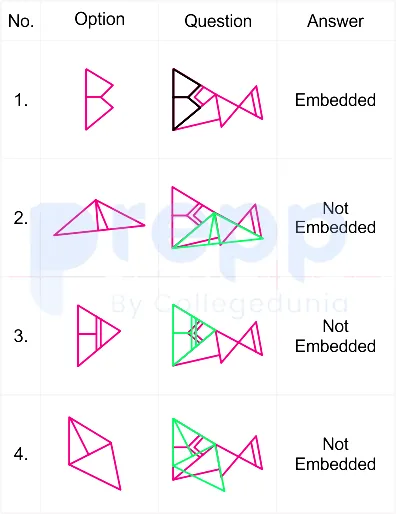 Paper & answer key PDF ↗
 Question 20archived
Select the Venn diagram that best illustrates the relationship between the following classes.
Dirham, Dubai, Currency
- A
Option A (shown in image)
- B
Option B (shown in image)
- C
Option C (shown in image)
- D
Option D (shown in image)
Show answer
B. Option B (shown in image)The correct Venn diagram representation is :
⇒As Dirham is one of the type of currency, so it is part of currency. Therefore all Dirham should come in currency.
⇒Dubai is one of the seven Emirates which is different from the currency, therefore it should be shown separately.
Hence, "Option - (2)" is the correct answer.
Additional Information
Dirhamis the name of the currencies of Morocco and United Arab Emirates
Dubai is one of the seven Emirates.
Currency is a medium of exchange for goods and services.

 Paper & answer key PDF ↗
 Question 21archived
Select the figure that will replace the question mark (?) in the following figure series.

- A
Option A (shown in image)
- B
Option B (shown in image)
- C
Option C (shown in image)
- D
Option D (shown in image)
Show answer
Question 22archived
Select the option that represents the letters that, when placed from left to right in the blanks below, will complete the letter series.
_ R Q _ P R _ S _ _ Q S P R Q _
- A
P Q R S PR
- B
P S Q P R S
- C
P S R Q P S
- D
P R Q S P S
Show answer
B. P S Q P R SHow to Solve the Letter Series Completion Problem
The question asks us to select the correct sequence of letters from the given options to fill in the blanks in the provided letter series. Completing the series correctly should reveal a discernible pattern.
The given incomplete series is:
_ R Q _ P R _ S _ _ Q S P R Q _
Let's count the number of blanks (\_) in the series. There are 6 blanks that need to be filled.
The options provided each contain a sequence of 6 letters. We need to determine which sequence fits into the blanks to create a logical pattern.
Identifying the Correct Letters to Complete the Series
We will use the letters from the correct option to fill the blanks. The correct sequence of letters is P, S, Q, P, R, S.
We place these letters into the 6 blank positions from left to right:
The 1st blank gets 'P'.
The 2nd blank gets 'S'.
The 3rd blank gets 'Q'.
The 4th blank gets 'P'.
The 5th blank gets 'R'.
The 6th blank gets 'S'.
Completing the Letter Series
Let's see what the series looks like after filling in the blanks with the letters P S Q P R S:
Original series: _ R Q _ P R _ S _ _ Q S P R Q _
Letters to fill: P S Q P R S
Completed series:
P R Q S P R Q S P R Q S P R Q S
Analyzing the Pattern in the Completed Series
Now that the series is complete, let's examine it: P R Q S P R Q S P R Q S P R Q S
We can observe that a specific group of letters is repeating throughout the series.
The repeating unit or block of letters is P R Q S.
This block consists of 4 letters. The total length of the completed series is 16 letters.
We can break down the series into these repeating blocks:
(P R Q S) (P R Q S) (P R Q S) (P R Q S)
The pattern is a simple repetition of the four-letter sequence 'PRQS'. This confirms that the letters P S Q P R S correctly complete the series according to this repeating pattern.
Understanding Repeating Patterns in Letter Series
Repeating patterns are one of the most common types found in letter series problems. The key is to identify the length and content of the repeating block by carefully observing the existing letters and testing options in the blanks.
Summary of the Letter Series Completion
Incomplete Series
_ R Q _ P R _ S _ _ Q S P R Q _
Letters from Correct Option
P S Q P R S
Completed Series
P R Q S P R Q S P R Q S P R Q S
Identified Repeating Pattern
P R Q S
Additional Information: Exploring Different Types of Letter Series Patterns
While the pattern here is a simple repetition, letter series can follow various rules. Recognizing these types helps in solving different problems:
Gap Patterns: Letters progress with a fixed or changing number of skipped letters (e.g., A, C, E, G).
Alternating Patterns: Two or more patterns might interleave (e.g., A, Z, B, Y, C, X where one sequence is A, B, C... and the other is Z, Y, X...).
Positional Patterns: Based on the alphabetical position of letters (A=1, B=2, etc.), where the pattern applies to the numbers.
Combined Patterns: A mix of the above, or other logical rules like reverse order within a block, etc.
Solving letter series requires careful observation, pattern recognition, and sometimes testing different possibilities, especially when blanks are present.
Paper & answer key PDF ↗ Question 23archived
Which of the following numbers will replace the question mark (?) in the given series?
245, 212, ?, 146, 113, 80
- A
176
- B
179
- C
178
- D
180
Show answer
B. 179Solving the Number Series Problem
The question asks us to find the missing number in the given number series: 245, 212, ?, 146, 113, 80.
To solve this number series problem, we need to identify the pattern that governs the sequence of numbers. Let's look at the difference between consecutive terms where the numbers are known.
Identifying the Pattern in the Number Series
We can calculate the difference between adjacent terms:
Difference between the first and second term: \(212 - 245\)
Difference between the fifth and fourth term: \(113 - 146\)
Difference between the sixth and fifth term: \(80 - 113\)
Let's perform the calculations:
\(212 - 245 = -33\)
\(113 - 146 = -33\)
\(80 - 113 = -33\)
The differences between the consecutive terms are consistently \(-33\). This indicates that the pattern in this number series is to subtract 33 from the previous term to get the next term.
Finding the Missing Number
Now that we have identified the pattern (subtracting 33), we can apply it to find the missing number. The missing number is the third term in the series, which follows the second term (212).
According to the pattern, the third term should be the second term minus 33:
Missing Number = Second Term - 33
Missing Number = \(212 - 33\)
Missing Number = \(179\)
Verifying the Pattern
Let's verify if 179 fits the pattern for the rest of the series:
Starting with 245: \(245 - 33 = 212\) (Correct)
Using the calculated missing number 179: \(212 - 33 = 179\) (Our missing number)
Continuing from 179: \(179 - 33 = 146\) (Correct)
Continuing from 146: \(146 - 33 = 113\) (Correct)
Continuing from 113: \(113 - 33 = 80\) (Correct)
The pattern holds true for the entire series when the missing number is 179.
Therefore, the number that replaces the question mark is 179.
Series Pattern Summary
Term Position
Number
Pattern Applied
1st
245
-
2nd
212
\(245 - 33\)
3rd
179
\(212 - 33\)
4th
146
\(179 - 33\)
5th
113
\(146 - 33\)
6th
80
\(113 - 33\)
Conclusion on the Missing Number in the Series
Based on the analysis of the differences between consecutive terms, the pattern is a constant difference of -33. Applying this pattern, the missing number in the series 245, 212, ?, 146, 113, 80 is 179.
Revision Table: Number Series Patterns
Pattern Type
Description
Example
Arithmetic Series
Constant difference between consecutive terms.
2, 5, 8, 11, ... (Difference is +3)
Geometric Series
Constant ratio between consecutive terms.
3, 9, 27, 81, ... (Ratio is x3)
Difference Series
The differences between consecutive terms form a pattern (e.g., arithmetic, geometric).
1, 2, 4, 7, 11, ... (Differences are 1, 2, 3, 4...)
Mixed Series
Combination of two or more patterns.
Alternating arithmetic series, or arithmetic + geometric operations.
Additional Information: Solving Number Series Questions
Solving number series questions is a common part of quantitative aptitude and logical reasoning tests. The key is to systematically look for patterns. Here are a few strategies:
Calculate Differences: Find the differences between consecutive terms. If the differences are constant, it's an arithmetic series. If the differences follow a pattern (like an arithmetic or geometric progression), it's a difference series.
Calculate Ratios: Find the ratio between consecutive terms. If the ratios are constant, it's a geometric series.
Look for Squares or Cubes: The numbers might be related to squares or cubes of consecutive numbers, possibly with an addition or subtraction.
Alternating Patterns: Sometimes, the pattern alternates between two different operations or two different sub-series.
Step Differences: Sometimes the pattern isn't in the first level of differences, but in the differences of the differences.
Practicing various types of number series helps in quickly recognizing patterns during exams.
Paper & answer key PDF ↗ Question 24archived
Select the Venn diagram that best illustrates the relationship between the following classes.
Women, Mothers, Singers
- A
Option A (shown in image)
- B
Option B (shown in image)
- C
Option C (shown in image)
- D
Option D (shown in image)
Show answer
C. Option C (shown in image)The Venn diagram that best represents the relationship between Women, Mothers, Singers is shown below:
⇒ As mother is subset of women category, therefore whole mothers will come in women.
⇒ As some women and mothers can be singer too, therefore some part of both women and mother is common with singer.
Hence, the correct answer is "Option 3".
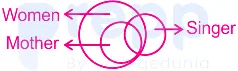 Paper & answer key PDF ↗
 Question 25archived
In a certain code language, 'UPSIDE' is coded as 'NJNEAC' and 'GINGER' is coded as 'ZCICBP'. How will 'BRUNCH' be coded in the same language?
- A
TKOKYE
- B
VMQKAG
- C
WNRKBH
- D
ULPJZF
Show answer
D. ULPJZFUnderstanding Code Language and Letter Coding Logic
This question involves decoding a word based on a pattern observed in two given coded words. We need to identify the specific rule or logic applied to transform the original words into their coded forms and then apply the same rule to the word 'BRUNCH'.
Analyzing the Given Code Examples
Let's examine the first example: 'UPSIDE' is coded as 'NJNEAC'. We can compare the positions of each letter in the English alphabet.
U is the 21st letter. N is the 14th letter.
P is the 16th letter. J is the 10th letter.
S is the 19th letter. N is the 14th letter.
I is the 9th letter. E is the 5th letter.
D is the 4th letter. A is the 1st letter.
E is the 5th letter. C is the 3rd letter.
Let's look at the difference in their alphabetical positions:
U (21) → N (14): $14 - 21 = -7$
P (16) → J (10): $10 - 16 = -6$
S (19) → N (14): $14 - 19 = -5$
I (9) → E (5): $5 - 9 = -4$
D (4) → A (1): $1 - 4 = -3$
E (5) → C (3): $3 - 5 = -2$
The differences are -7, -6, -5, -4, -3, -2. This suggests a pattern of decreasing backward shifts in alphabetical position for consecutive letters.
Let's verify this pattern with the second example: 'GINGER' is coded as 'ZCICBP'.
G is the 7th letter. Z is the 26th letter.
I is the 9th letter. C is the 3rd letter.
N is the 14th letter. I is the 9th letter.
G is the 7th letter. C is the 3rd letter.
E is the 5th letter. B is the 2nd letter.
R is the 18th letter. P is the 16th letter.
Let's look at the difference in their alphabetical positions, considering wrap-around for Z:
G (7) → Z (26): $26 - 7$ is not directly -7. If we go backward from G (7 letters): F(6), E(5), D(4), C(3), B(2), A(1), Z(26). This is indeed a shift of 7 positions backward. $7 - 7 = 0$, which maps to Z (26 in a 1-26 cycle). So, a shift of -7.
I (9) → C (3): $3 - 9 = -6$. A shift of -6.
N (14) → I (9): $9 - 14 = -5$. A shift of -5.
G (7) → C (3): $3 - 7 = -4$. A shift of -4.
E (5) → B (2): $2 - 5 = -3$. A shift of -3.
R (18) → P (16): $16 - 18 = -2$. A shift of -2.
The pattern is confirmed: a backward shift of -7, -6, -5, -4, -3, -2 for the successive letters of the word.
Applying the Logic to 'BRUNCH'
Now, we apply the same shifting pattern (-7, -6, -5, -4, -3, -2) to the letters of the word 'BRUNCH'.
B is the 2nd letter. Shift by -7. $2 - 7 = -5$. Alphabetical position cycles (A=1 to Z=26). To go backward from B, we move to A, then Z, Y, X, W, V, U. Going back 7 steps from B leads to U (which is 21). This corresponds to $2 - 7 + 26 = 21$.
R is the 18th letter. Shift by -6. $18 - 6 = 12$. The 12th letter is L.
U is the 21st letter. Shift by -5. $21 - 5 = 16$. The 16th letter is P.
N is the 14th letter. Shift by -4. $14 - 4 = 10$. The 10th letter is J.
C is the 3rd letter. Shift by -3. $3 - 3 = 0$. Going back 3 steps from C leads to B, A, Z. Z is the 26th letter. This corresponds to $3 - 3 + 26 = 26$.
H is the 8th letter. Shift by -2. $8 - 2 = 6$. The 6th letter is F.
Let's summarize the transformation for 'BRUNCH' in a table:
Letter
Position
Shift
New Position (calculated)
New Position (within 1-26)
Coded Letter
B
2
-7
$2 - 7 = -5$
$-5 + 26 = 21$
U
R
18
-6
$18 - 6 = 12$
12
L
U
21
-5
$21 - 5 = 16$
16
P
N
14
-4
$14 - 4 = 10$
10
J
C
3
-3
$3 - 3 = 0$
$0 + 26 = 26$
Z
H
8
-2
$8 - 2 = 6$
6
F
So, applying the same code language logic, 'BRUNCH' is coded as 'ULPJZF'.
Final Coded Word
Based on the established pattern of consecutive backward shifts (-7, -6, -5, -4, -3, -2), the word 'BRUNCH' is coded as 'ULPJZF'.
Revision Table: Coding Logic Summary
Word
Letters
Shift Pattern
Coded Letters
Coded Word
UPSIDE
U, P, S, I, D, E
-7, -6, -5, -4, -3, -2
N, J, N, E, A, C
NJNEAC
GINGER
G, I, N, G, E, R
-7, -6, -5, -4, -3, -2
Z, C, I, C, B, P
ZCICBP
BRUNCH
B, R, U, N, C, H
-7, -6, -5, -4, -3, -2
U, L, P, J, Z, F
ULPJZF
Additional Information on Letter Coding in Reasoning
Letter coding is a common type of reasoning question where letters of a word are replaced by other letters based on a specific rule. The rule can involve:
Shifting letters forward or backward by a fixed number of positions.
Shifting letters by a variable number of positions (as in this case).
Reversing the order of letters.
Substituting letters based on their position in the word or alphabet.
Using a combination of these rules.
Solving such problems requires careful observation, comparison, and pattern identification between the given words and their codes. It often helps to write down the alphabetical positions of the letters or draw out the shifts.
Paper & answer key PDF ↗ Question 26archived
In February 2021, In which of the following cases did the Court observe that the consent of a family is not needed once two adults decide to marry?
- A
Devilal v. State of Madhya Pradesh
- B
Rahul Sharma v. National Insurance Company Ltd.
- C
Satbir Singh v. State of Haryana
- D
Laxmibai Chandaragi v. The State of Karnataka
Show answer
D. Laxmibai Chandaragi v. The State of KarnatakaUnderstanding the Court Observation on Adult Marriage Consent
The question asks about a significant observation made by a court in February 2021 concerning the necessity of family consent for marriage between two adults. This specific ruling highlighted the autonomy of individuals in choosing their life partners, emphasizing that familial approval is not legally required once both individuals have reached the age of majority.
Let's examine the case where this observation was made.
Analysis of the Case
The case in question is Laxmibai Chandaragi v. The State of Karnataka. In February 2021, the Supreme Court of India made a crucial observation in this case. The court emphasized that two consenting adults have the fundamental right to marry according to their choice, and the consent of their family members is not a prerequisite for such a marriage to be valid or recognized legally.
The court noted that instances of harassment and threats against inter-caste and inter-religious couples were increasing. It directed states and Union Territories to ensure the protection of such couples. The observation regarding family consent was made in this context, reinforcing the idea that the choice of a life partner is a personal decision for adults, free from external pressure, including from family.
The ruling reaffirmed the principles of individual liberty and dignity enshrined in the Constitution of India.
Evaluating the Options
Based on legal reports and judgments from February 2021 concerning marriage and personal liberty, the case where the court explicitly made the observation about family consent not being needed for adult marriage was Laxmibai Chandaragi v. The State of Karnataka.
Devilal v. State of Madhya Pradesh: This case is not widely reported for a prominent ruling on adult marriage consent in February 2021.
Rahul Sharma v. National Insurance Company Ltd.: This typically relates to insurance disputes and not personal law or marriage consent.
Satbir Singh v. State of Haryana: While there might be various cases involving these parties, a significant ruling on adult marriage consent in February 2021 is not primarily associated with this case name.
Laxmibai Chandaragi v. The State of Karnataka: This case is specifically recognized for the Supreme Court's strong stance in February 2021 regarding the right of adults to marry without family consent and the need to protect couples facing opposition.
Therefore, the case where the court observed that the consent of a family is not needed once two adults decide to marry is Laxmibai Chandaragi v. The State of Karnataka.
This ruling is significant as it reinforces the legal position that adult individuals have the autonomy to make their own decisions regarding marriage, independent of familial or societal pressures. The focus remains on the consent of the two individuals involved in the marriage.
Revision Table: Key Concepts
Concept
Explanation
Adult Marriage
Marriage between two individuals who have attained the legal age of majority (18 years in India).
Consent for Marriage
The voluntary agreement of both parties involved to enter into the marriage.
Family Consent
Approval or permission from family members for a marriage. The court clarified this is not legally mandatory for adult marriages.
Right to Marry
Recognized as a facet of the right to life and personal liberty under Article 21 of the Indian Constitution. Includes the right to choose a partner.
Additional Information: Right to Marry in India
The right of two adults to marry a person of their choice has been upheld by the Supreme Court of India in several judgments. This right is considered an integral part of the fundamental right to life and personal liberty guaranteed under Article 21 of the Constitution.
The courts have repeatedly stated that the choice of a partner is a matter of individual liberty and autonomy.
Neither the state nor any third party, including family members or community, can interfere with the marriage between two consenting adults.
The Laxmibai Chandaragi v. The State of Karnataka case specifically highlighted the issue of protection for couples facing opposition, particularly in the context of inter-caste or inter-religious marriages.
The ruling reinforces the principle that societal approval or family consent is not a legal requirement for the validity of a marriage between adults.
This judicial stance is aimed at protecting individual freedom and preventing honour killings or harassment against couples who marry against the wishes of their families or community.
Paper & answer key PDF ↗ Question 27archived
Which of the following organic compounds is synonymous with olefiant gas which is used to make anaesthetics, refrigerants and other chemicals?
- A
1-Pentene
- B
Methane
- C
Ethylene
- D
Butane
Show answer
C. EthyleneUnderstanding Olefiant Gas and Ethylene
The question asks to identify the organic compound that is also known as olefiant gas and has uses in making anaesthetics, refrigerants, and various chemicals. Let's explore the history and properties of this specific gas.
Identifying Olefiant Gas
Historically, the term "olefiant gas" was used to refer to a specific gaseous hydrocarbon. This name comes from the Latin words "oleum" (oil) and "fians" (making), referring to the oily liquid formed when the gas reacts with halogens like chlorine. This characteristic reaction led chemists to coin the term.
The organic compound commonly known as olefiant gas is Ethylene.
Ethylene is the simplest alkene, with the chemical formula \(\text{C}_2\text{H}_4\).
It contains a carbon-carbon double bond.
Its structure is \(\text{CH}_2=\text{CH}_2\).
Uses of Ethylene (Olefiant Gas)
As mentioned in the question, Ethylene (olefiant gas) has several important applications:
Anaesthetics: Although less commonly used now due to flammability risks, Ethylene was historically used as an inhaled anaesthetic.
Refrigerants: Ethylene is used as a refrigerant, particularly in cryogenic refrigeration systems.
Chemical Production: It is a crucial building block in the petrochemical industry. It is used to produce a vast array of chemicals, including ethanol, ethylene oxide, ethylene glycol, vinyl chloride, and most significantly, polyethylene plastic.
Analyzing the Options
Let's look at why the other options are not considered olefiant gas:
1-Pentene: This is an alkene with five carbon atoms (\(\text{C}_5\text{H}_{10}\)) and a double bond at the first carbon. While it is an alkene and would react with halogens, the historical term "olefiant gas" specifically refers to Ethylene.
Methane: This is the simplest alkane (\(\text{CH}_4\)). It contains only single bonds and is the primary component of natural gas. It is not an alkene and is not called olefiant gas.
Butane: This is an alkane with four carbon atoms (\(\text{C}_4\text{H}_{10}\)). It contains only single bonds and is a major component of liquefied petroleum gas (LPG). It is not an alkene and is not called olefiant gas.
Comparing the options, Ethylene is the organic compound historically known as olefiant gas and matches the description of being used for anaesthetics, refrigerants, and other chemicals.
Conclusion
Based on the historical naming conventions and uses, Ethylene is synonymous with olefiant gas.
The correct answer is Ethylene.
Revision Table: Organic Compounds
Compound
Formula
Class
Synonym (if any)
Relevant Uses
Ethylene
\(\text{C}_2\text{H}_4\)
Alkene
Olefiant gas
Plastics (Polyethylene), Refrigerant, Historical Anaesthetic
1-Pentene
\(\text{C}_5\text{H}_{10}\)
Alkene
-
Chemical intermediate
Methane
\(\text{CH}_4\)
Alkane
Marsh gas, Natural gas primary component
Fuel, Chemical feedstock
Butane
\(\text{C}_4\text{H}_{10}\)
Alkane
-
Fuel (LPG), Aerosol propellant
Additional Information: Ethylene Properties
Ethylene is a simple but very important organic molecule. Understanding its properties helps explain its wide range of uses:
It is a colorless, flammable gas with a faint sweet odor.
The carbon-carbon double bond is a reactive functional group, making Ethylene suitable for polymerization (forming plastics like polyethylene) and other addition reactions (like reacting with halogens to form dihaloalkanes).
Its low boiling point (\(-103.7 \, ^\circ\text{C}\)) makes it suitable for cryogenic applications.
Ethylene is also a natural plant hormone, involved in fruit ripening and flower wilting.
The historical name "olefiant gas" highlights its reaction with halogens to form oily compounds, a characteristic reaction of alkenes, particularly Ethylene.
Paper & answer key PDF ↗ Question 28archived
Which of the following is NOT a tributary of the Godavari river?
- A
Mahi
- B
Pranhita
- C
Manjra
- D
Purna
Show answer
A. MahiUnderstanding River Tributaries
A tributary is a stream or river that flows into a larger stream or river or a lake. It does not flow directly into a sea or ocean. Understanding which rivers are tributaries of a major river system like the Godavari is important for geographical studies.
The Godavari River System
The Godavari is the second longest river in India and the third largest in terms of discharge of water. It rises in Trimbakeshwar, Nashik, Maharashtra, and flows east through the Deccan Plateau, draining into the Bay of Bengal. It has numerous tributaries that join it from various regions.
Identifying Tributaries of the Godavari River
The question asks us to identify which of the given rivers is NOT a tributary of the Godavari river. Let's examine each option:
Mahi River: The Mahi River is a river in western India. It rises in Madhya Pradesh and flows through Rajasthan and Gujarat, eventually draining into the Arabian Sea through the Gulf of Khambhat. It flows in a completely different direction and region compared to the Godavari basin.
Pranhita River: The Pranhita River is a major tributary of the Godavari river. It is a confluence of the Wardha and Wainganga rivers. It flows through Maharashtra and Telangana.
Manjra River: The Manjra River is an important right-bank tributary of the Godavari river. It originates in the Balaghat range of hills in Maharashtra and flows through Maharashtra, Karnataka, and Telangana.
Purna River: The Purna River is a major tributary of the Godavari river that flows through Maharashtra. It is known for draining a large area of the Vidarbha region.
Analysis of Options
Based on our understanding of these rivers:
River
Is it a Godavari Tributary?
Where it flows/drains
Mahi
No
Flows West, drains into Arabian Sea (Gulf of Khambhat)
Pranhita
Yes
Flows into Godavari (Maharashtra/Telangana)
Manjra
Yes
Flows into Godavari (Maharashtra/Karnataka/Telangana)
Purna
Yes
Flows into Godavari (Maharashtra)
The Mahi River is clearly not part of the Godavari river system. It flows westwards and drains into the Arabian Sea, while the Godavari flows eastwards into the Bay of Bengal and its tributaries are located within the Deccan Plateau region.
Therefore, the river that is NOT a tributary of the Godavari river is the Mahi.
Revision Table: Key Tributaries of Godavari
Left Bank Tributaries
Right Bank Tributaries
Purna
Pravara
Pranhita (Wardha, Wainganga, Pench, Kanhan)
Mula
Indravati
Manjra
Sabari
Manair
Kinnerasani
Additional Information on Indian Rivers
Understanding the major river systems and their tributaries is crucial for geography. Here are some related points:
Major east-flowing rivers in India (draining into Bay of Bengal): Godavari, Krishna, Cauvery, Mahanadi.
Major west-flowing rivers in India (draining into Arabian Sea): Indus, Narmada, Tapti, Mahi, Sabarmati.
The Godavari river basin covers parts of Maharashtra, Telangana, Andhra Pradesh, Chhattisgarh, Odisha, and Karnataka.
Tributaries contribute significantly to the volume of water in the main river and play a vital role in the river's ecosystem and the geography of the region it drains.
Paper & answer key PDF ↗ Question 29archived
What is the significance of 26 January being chosen as a day to celebrate the Republic Day, aside from the adoption of the constitution?
- A
Revolution of 1857
- B
Foundation day of the Indian National Congress
- C
Declaration of Purna Swaraj
- D
Day of the Champaran Satyagraha
Show answer
C. Declaration of Purna SwarajSignificance of January 26th for Republic Day
Republic Day in India is celebrated on 26 January each year. This day marks the date on which the Constitution of India came into effect in 1950, replacing the Government of India Act (1935) as the governing document of India. While the adoption of the Constitution is the primary reason for celebrating Republic Day on this specific date, there is a deeper historical significance linked to January 26th that predates the adoption of the Constitution.
The historical significance of January 26th is rooted in the Indian independence movement. Specifically, it is connected to a pivotal moment in the struggle for self-rule.
Declaration of Purna Swaraj and January 26th
The correct answer is the Declaration of Purna Swaraj. Let's understand why this event makes January 26th historically significant:
In December 1929, the Indian National Congress (INC) held its annual session in Lahore.
During this session, under the presidency of Jawaharlal Nehru, a historic resolution was passed. This resolution declared the attainment of complete self-rule, or 'Purna Swaraj', as the main goal of the Indian independence movement.
Following this declaration, the Congress party asked the people of India to observe 26 January 1930 as 'Purna Swaraj Diwas' or Independence Day.
On this day, across the country, people held meetings, hoisted the Indian flag, and read out a pledge of independence.
This annual observance of January 26th as 'Purna Swaraj Diwas' continued until India achieved independence.
Although India gained independence on August 15, 1947, the leaders remembered the historical importance of January 26th. When the Constitution of India was ready, the Constituent Assembly decided to wait and bring it into effect on 26 January 1950, precisely to honor the date of the first Purna Swaraj declaration and pledge.
Analysis of Other Options
Let's look at the other options provided:
Revolution of 1857: The Sepoy Mutiny or the First War of Indian Independence in 1857 was a significant event, but it is not directly linked to the date January 26th.
Foundation day of the Indian National Congress: The Indian National Congress was founded on 28 December 1885 in Bombay. This date is not January 26th.
Day of the Champaran Satyagraha: The Champaran Satyagraha, led by Mahatma Gandhi, took place in 1917, starting in April of that year. It is not associated with January 26th.
Therefore, the Declaration of Purna Swaraj is the specific historical event, aside from the Constitution's adoption, that gives January 26th its special significance for Republic Day.
Revision Table: Key Dates in Indian History
Date
Event/Significance
28 December 1885
Foundation of the Indian National Congress
1857
Revolution of 1857 (Sepoy Mutiny)
April 1917
Beginning of Champaran Satyagraha
December 1929
INC Lahore Session, Resolution for Purna Swaraj
26 January 1930
First observance of Purna Swaraj Diwas (Independence Day)
15 August 1947
India achieves Independence
26 January 1950
Constitution of India comes into effect; India becomes a Republic
Additional Information on Purna Swaraj
The concept of Purna Swaraj was a shift from the earlier demand for Dominion Status within the British Empire. It represented a clear call for complete independence. The pledge taken on January 26, 1930, outlined the reasons for demanding complete independence and affirmed the belief that it was a basic right of the Indian people. This declaration and its annual observance helped to mobilize public opinion and generate enthusiasm for the freedom struggle.
Choosing January 26th as Republic Day was a conscious decision to remember and honor this significant milestone in India's journey towards becoming a completely sovereign nation, a republic governing itself under its own constitution.
Paper & answer key PDF ↗ Question 30archived
During the reign of Akbar, _________ was the land that has lain fallow for three or four years.
- A
Parauti
- B
Polaj
- C
Chachar
- D
Banjar
Show answer
C. ChacharAkbar's Land Classification: Identifying Fallow Land
During the reign of Emperor Akbar, the Mughal administration developed a detailed system for classifying agricultural land. This classification was primarily based on the continuity of cultivation and the period the land remained uncultivated or fallow. The main objective was to determine land productivity and apply appropriate revenue rates. This system categorized lands into several types, each with specific characteristics regarding its usage and fertility.
Detailed Breakdown of Land Categories During Akbar's Reign
The classification of land under Akbar's revenue system helps us understand agrarian practices during that period. The categories are defined as follows:
Polaj: This category refers to land that is regularly cultivated, either annually or with very brief interruptions. It is considered the most productive type of land.
Parauti: This land is left fallow for a period of one to two years. This resting period allows the soil to recover its fertility before the next cultivation cycle.
Chachar: This classification applies to land that has remained fallow for three to four years. By this time, the soil's fertility is partially restored, making it suitable for cultivation.
Banjar: This is land that has been left uncultivated for five years or more. It is the least fertile category and requires significant effort and time to be made cultivable again.
Identifying Land Fallow for Three to Four Years
The question asks specifically to identify the term for land that was left fallow for a duration of three to four years during Akbar's reign. According to the land classification system used:
The land that has lain fallow for three to four years is termed Chachar. This period represents a significant fallow duration, allowing for partial soil regeneration.
Therefore, Chachar is the correct classification for land left uncultivated for three to four years during the period of Akbar's rule.
Paper & answer key PDF ↗ Question 31archived
What is the age criteria for the subscribers of Atal Pension Yojana?
- A
20 - 30 Years
- B
25 - 35 Years
- C
18 - 40 Years
- D
40 - 60 Years
Show answer
C. 18 - 40 YearsThe Atal Pension Yojana (APY) is a government-guaranteed pension scheme launched in May 2015, primarily targeted at workers in the unorganised sector to provide them a defined monthly pension in old age.
Any Indian citizen aged between 18 and 40 years with a savings bank account and a valid Aadhaar/mobile number can subscribe. The subscriber contributes for at least 20 years, and on attaining the age of 60, receives a guaranteed monthly pension of ₹1,000, ₹2,000, ₹3,000, ₹4,000 or ₹5,000 depending on the contribution slab chosen.
The lower age limit (18) ensures a minimum 20-year contribution horizon, and the upper limit (40) ensures the subscriber reaches age 60 with adequate savings. Hence the correct age criterion is 18 – 40 years.
Paper & answer key PDF ↗ Question 32archived
Dr DS Athwal was known as the 'Father of __________ Revolution in India'.
- A
Oilseed
- B
Rice
- C
Millet
- D
Wheat
Show answer
D. WheatUnderstanding Dr DS Athwal's Contribution to India's Agriculture
The question asks about Dr DS Athwal's significant contribution to a specific agricultural revolution in India, identifying him as the 'Father' of that movement.
Let's look at the options provided:
Oilseed Revolution
Rice Revolution
Millet Revolution
Wheat Revolution
Dr DS Athwal was a renowned plant breeder who played a pivotal role during the Green Revolution period in India. His work focused heavily on developing high-yielding varieties (HYVs) of staple crops.
Specifically, Dr Athwal is credited with developing groundbreaking wheat varieties. He worked at the Indian Agricultural Research Institute (IARI) and then at Punjab Agricultural University (PAU). His efforts, particularly in developing semi-dwarf wheat varieties like 'Kalyansona' and 'Sonalika' from materials originally developed by Dr. Norman Borlaug, were crucial in dramatically increasing wheat production in India.
This significant increase in wheat yield transformed India from a food-deficit nation relying on imports to a food-surplus nation, particularly in wheat. This period of rapid increase in wheat (and also rice) production due to HYVs, fertilizers, and irrigation is known as the Green Revolution in India.
Because of his pioneering work in developing high-yielding wheat varieties and his crucial role in the success of wheat cultivation during this era, Dr DS Athwal is often referred to as the 'Father of the Wheat Revolution in India'.
Therefore, the revolution associated with Dr DS Athwal, earning him the title 'Father of the ______ Revolution in India', is the Wheat Revolution.
Explanation of Options:
Oilseed Revolution: This refers to the increase in oilseed production, often associated with the 'Yellow Revolution'.
Rice Revolution: While rice also saw increases during the Green Revolution, Dr. Athwal's primary and most celebrated contribution was in wheat breeding. Other scientists were more directly involved in major rice HYVs in India at that time.
Millet Revolution: There isn't a widely recognized specific 'Millet Revolution' often discussed in the same context as the Green or Wheat Revolution.
Wheat Revolution: This specifically refers to the dramatic increase in wheat production in India, largely driven by the high-yielding varieties developed by scientists like Dr DS Athwal and the adoption of new farming technologies.
Dr DS Athwal's work was fundamental to achieving self-sufficiency in food grains, especially wheat, in India during the Green Revolution era.
Revision Table: Key Figures in India's Agricultural Revolutions
Revolution
Associated Figure (Often Credited As 'Father' or Key Leader)
Primary Focus
Green Revolution (Overall in India)
Dr. M.S. Swaminathan
Wheat, Rice, Food grains
Wheat Revolution (Part of Green Revolution)
Dr. DS Athwal
High-yielding Wheat varieties
White Revolution
Dr. Verghese Kurien
Milk Production (Operation Flood)
Yellow Revolution
Sam Pitroda
Oilseed Production
Additional Information on Dr DS Athwal and the Wheat Revolution
Dr. Dilbagh Singh Athwal (1928-2017) was an agricultural scientist who made immense contributions to plant breeding. He was instrumental in introducing and adapting the semi-dwarf wheat varieties to Indian conditions. These varieties were shorter and more responsive to fertilizers and irrigation compared to traditional tall varieties, preventing lodging (falling over) and allowing for significantly higher yields.
His work at PAU, Ludhiana, was crucial in developing the package of practices (seed, fertilizer, water management) that farmers needed to adopt to maximize the potential of these new wheat varieties. The success of the Wheat Revolution led to increased food security, improved farmer incomes in regions like Punjab and Haryana, and was a major milestone in India's post-independence agricultural history.
Paper & answer key PDF ↗ Question 33archived
Which of the following can be considered as an example of flow variable?
(i) Production of rice
(ii) Import of cloth
(iii) Change in capital
- A
None of (i), (ii) and (iii)
- B
Only (iii)
- C
All of (i), (ii) and (iii)
- D
Only (i) and (ii)
Show answer
C. All of (i), (ii) and (iii)Understanding Flow Variables in Economics
In economics, variables are often classified based on how they are measured. One important classification is between stock variables and flow variables.
A flow variable is a variable that is measured over a specific period of time. It represents a quantity that occurs or changes over that duration. Think of it like the flow of water into a bathtub – you measure how much water flows in per minute or per hour.
In contrast, a stock variable is measured at a specific point in time. It represents a quantity that exists at that moment. Using the bathtub analogy, the amount of water already in the bathtub at a particular moment is a stock variable.
Analyzing the Given Examples of Potential Flow Variables
Let's examine each of the options provided to determine if they fit the definition of a flow variable:
(i) Production of rice
(ii) Import of cloth
(iii) Change in capital
Analyzing (i) Production of Rice
The production of rice is always measured over a period. For example, you might talk about the production of rice per year, per season, or per month. You wouldn't measure the production of rice 'at a particular point in time'. Therefore, the production of rice is a flow variable.
Analyzing (ii) Import of Cloth
Imports, like production, are also measured over a period. We talk about the value or quantity of cloth imported per month, per quarter, or per year. It represents a flow of goods into the country over time. Thus, the import of cloth is a flow variable.
Analyzing (iii) Change in Capital
Change in capital refers to the addition to or reduction in the capital stock over a period. This change is often referred to as investment (gross or net investment). Investment is measured over time, for instance, investment made during a financial year. The capital stock itself (e.g., the total value of machinery and buildings) is a stock variable, but the change in that stock is a flow variable. Therefore, change in capital is a flow variable.
Conclusion on Flow Variables Examples
Based on the analysis:
Production of rice is a flow variable.
Import of cloth is a flow variable.
Change in capital is a flow variable.
All three examples listed (i), (ii), and (iii) are indeed examples of flow variables because they are all measured over a period of time.
Variable Type
Definition
Examples
Measurement
Flow Variable
Measured over a period of time
Production, Income, Consumption, Investment, Exports, Imports, Change in Stock, Depreciation
Per period (e.g., per year, per month)
Stock Variable
Measured at a specific point in time
Wealth, Capital, Money Supply, Inventory (Stock), Population, Debt
At a point (e.g., on 31st March 2023)
Revision Table: Key Economic Variables
Concept
Type (Stock/Flow)
Why?
Production of rice
Flow
Measured per period (e.g., per year)
Import of cloth
Flow
Measured per period (e.g., per month)
Change in capital (Investment)
Flow
Measured over a period of time
Capital stock
Stock
Measured at a point in time
National Income
Flow
Measured per period (usually per year)
Wealth
Stock
Measured at a point in time
Additional Information on Economic Variable Types
Understanding the difference between stock and flow variables is fundamental in economics, especially in macroeconomics. Many key economic relationships link stock and flow variables. For instance, investment (a flow) adds to the capital stock (a stock) over time. Saving (a flow) adds to wealth (a stock).
Confusion often arises with 'change in' variables. While a stock variable exists at a point, the change in that stock over time is always a flow variable. For example, the population of a country on a specific date is a stock, but the change in population over a year (births minus deaths plus net migration) is a flow.
Being able to correctly identify whether a variable is a stock or a flow is crucial for correctly interpreting economic data and understanding economic models.
Paper & answer key PDF ↗ Question 34archived
How many main styles of Chhau folk dance exist?
- A
7
- B
3
- C
9
- D
5
Show answer
B. 3Understanding Chhau Dance Styles
Chhau is a traditional folk dance form originating from Eastern India. It is known for its vibrant movements, masked performances (except in one style), and themes often derived from epics like the Ramayana and Mahabharata, Puranas, and local folk tales. The dance is traditionally performed by male dancers during seasonal festivals, especially the spring festival of Chaitra Parva.
The question asks about the number of main styles of Chhau folk dance. Chhau dance is primarily recognized by its three distinct regional styles.
The Three Main Styles of Chhau Dance
The three main styles of Chhau dance are:
Purulia Chhau of West Bengal
Seraikela Chhau of Jharkhand
Mayurbhanj Chhau of Odisha
Each of these styles has unique characteristics, including differences in costume, the use of masks, and the nuances of the movements and music.
Differences Between the Chhau Styles
While all three are forms of Chhau, there are key distinctions:
Purulia Chhau: This style is highly dynamic and known for its extensive use of elaborate masks, which are integral to the performance. The dance is energetic and dramatic, often depicting battle scenes and mythological narratives.
Seraikela Chhau: This style is more lyrical and subtle compared to Purulia. Dancers wear masks, but they are lighter and less elaborate, focusing more on conveying emotion through body language and graceful movements rather than facial expression (which is hidden by the mask).
Mayurbhanj Chhau: Distinctly, the Mayurbhanj style does not use masks. This allows dancers to use facial expressions along with body movements to tell the story. This style is also very athletic and incorporates complex jumps and spins, often drawing comparisons to martial arts.
Therefore, based on the distinct regional variations recognized, there are 3 main styles of Chhau folk dance.
Revision Table: Chhau Dance Styles
Style
Origin State
Use of Masks
Key Characteristic
Purulia Chhau
West Bengal
Yes (Elaborate)
Dramatic, energetic, battle themes
Seraikela Chhau
Jharkhand
Yes (Lighter)
Lyrical, subtle, graceful movements
Mayurbhanj Chhau
Odisha
No
Athletic, expressive faces, martial influence
Additional Information: Significance of Chhau Dance
Chhau dance has been recognized by UNESCO as part of the Intangible Cultural Heritage of Humanity since 2010. It is a vibrant tradition that blends elements of martial arts, acrobatics, and athletic movements with folk and classical dance forms. The training for Chhau dancers is rigorous and traditionally takes place in open-air arenas called akhada. The music accompanying Chhau dance varies by style but typically includes traditional instruments like the Dhol, Dhamsa (a large kettle drum), and the Mohuri (a double reed instrument).
Paper & answer key PDF ↗ Question 35archived
Which of the following countries will host the BWF para badminton championship in 2023?
- A
China
- B
Thailand
- C
Indonesia
- D
India
Show answer
B. ThailandUnderstanding the BWF Para Badminton Championship Host 2023
The question asks to identify the country that hosted the BWF Para Badminton Championship in the year 2023.
The BWF Para Badminton World Championships is a major international tournament for para badminton players, sanctioned by the Badminton World Federation (BWF). It brings together the best para badminton athletes from around the globe to compete for world titles in various sport classes.
Identifying the 2023 Host Country
The host country for the BWF Para Badminton Championship changes with each edition. For the 2023 championship, the event was held in Thailand.
Thailand has a strong history in hosting international badminton events, including those for para athletes. The 2023 championship was a significant event for the para badminton community, providing a platform for athletes to showcase their skills and compete at the highest level.
Significance of Hosting the Championship
Hosting an event like the BWF Para Badminton Championship is important for several reasons:
It promotes para badminton and disability sports within the host country and globally.
It provides opportunities for local athletes to compete against international players.
It helps in developing infrastructure and expertise related to hosting major sports events.
It inspires future generations of para athletes.
Based on the official records and sports news regarding the 2023 BWF Para Badminton Championship, Thailand was indeed the host nation.
Conclusion
The country that hosted the BWF Para Badminton Championship in 2023 was Thailand.
Championship Year
Event
Host Country
2023
BWF Para Badminton Championship
Thailand
2022
BWF Para Badminton Championship
Japan
2019
BWF Para Badminton Championship
Switzerland
Revision Table: BWF Para Badminton Key Facts
Term
Description
BWF
Badminton World Federation, the international governing body for the sport of badminton.
Para Badminton
Badminton adapted for athletes with a range of physical disabilities.
World Championship
The highest level of competition for para badminton players, held periodically.
2023 Host
Thailand hosted the BWF Para Badminton World Championship in 2023.
Additional Information: Para Badminton Classes and Events
Para badminton includes various sport classes based on the type and extent of athletes' disabilities. These classes ensure fair competition. The events contested at the BWF Para Badminton Championship typically include:
Wheelchair (WH1, WH2)
Standing Lower (SL3, SL4)
Standing Upper (SU5)
Short Stature (SH6)
Athletes compete in singles, doubles, and mixed doubles events within their respective sport classes or combined classes.
Paper & answer key PDF ↗ Question 36archived
Who among the following freedom fighters lost his life during the protest against Simon Commission where black flags were waved at the Commission?
- A
Lala Lajpat Rai
- B
Surendranath Banerjee
- C
Sachindra Nath Sanyal
- D
Chittaranjan Das
Show answer
A. Lala Lajpat RaiThe question asks about a freedom fighter who died during the protest against the Simon Commission where protesters used black flags.
The Simon Commission, also known as the Indian Statutory Commission, was a group of seven Members of Parliament from Britain formed in 1927 to study constitutional reform in India. A major point of contention was that the Commission did not include any Indian members. This exclusion led to widespread outrage and calls for a complete boycott of the Commission by Indian political parties, including the Indian National Congress and the Muslim League.
When the Simon Commission arrived in India in 1928, it was met with nationwide protests. People participated in hartals (strikes) and demonstrations. A common form of protest was waving black flags and chanting slogans like "Simon Go Back!".
One significant protest occurred in Lahore on October 30, 1928, when the Simon Commission visited the city. Lala Lajpat Rai, a prominent nationalist leader and a key figure in the Indian independence movement, led the demonstration against the Commission. Despite the peaceful nature of the protest, the police resorted to a brutal lathi (baton) charge to disperse the crowd.
Lala Lajpat Rai was severely injured during this police action. Although he addressed a public meeting later, declaring that "Every blow aimed at my body will be a nail in the coffin of the British empire," his injuries were grievous. He succumbed to his injuries about three weeks later, on November 17, 1928.
His death further intensified the nationalist sentiment and became a symbol of British brutality, galvanizing many young leaders.
Let's briefly look at the other options in this context:
Surendranath Banerjee was an early nationalist leader but was less active in the mass movements of the late 1920s compared to Lala Lajpat Rai. He passed away in 1925, before the Simon Commission arrived in India.
Sachindra Nath Sanyal was a revolutionary leader, co-founder of the Hindustan Republican Association. While a significant figure, his death was not directly linked to the protest against the Simon Commission in this manner.
Chittaranjan Das was a prominent freedom fighter, lawyer, and co-founder of the Swaraj Party. He passed away in 1925, before the Simon Commission was formed.
Based on historical events, Lala Lajpat Rai is the freedom fighter who lost his life following injuries sustained during the protest against the Simon Commission.
Lala Lajpat Rai and Simon Commission Protest Summary
Event
Details
Simon Commission Arrival in India
1928
Purpose of Simon Commission
Constitutional reform study (excluded Indians)
Nature of Protest
Boycott, black flags, "Simon Go Back!" slogans
Protest Location & Leader
Lahore, led by Lala Lajpat Rai
Police Action
Lathi charge on protesters
Impact on Lala Lajpat Rai
Severely injured during lathi charge
Outcome
Lala Lajpat Rai passed away from injuries on Nov 17, 1928
Revision Table: Key Leaders & Events
Freedom Fighter
Notable Association with Simon Commission Protest
Year of Passing
Lala Lajpat Rai
Injured during lathi charge at Lahore protest, leading to death
1928
Surendranath Banerjee
Early nationalist leader
1925
Sachindra Nath Sanyal
Revolutionary, HRA founder
1942
Chittaranjan Das
Swaraj Party co-founder
1925
Additional Information on Simon Commission and Indian Nationalism
The Simon Commission controversy played a significant role in the Indian independence movement. The exclusion of Indians from the commission was seen as a direct insult to Indian dignity and capability for self-governance. The widespread protests united various sections of Indian society against the British rule.
Following the boycott and the political turmoil it created, the British government invited Indian leaders to the Round Table Conferences to discuss constitutional reforms. The death of Lala Lajpat Rai in the protest against the Simon Commission became a major catalyst for nationalist anger and revolutionary activities.
Bhagat Singh and his associates retaliated for Lala Lajpat Rai's death by assassinating J.P. Saunders, a British police officer believed to have been responsible for the lathi charge, although the target was intended to be Superintendent James Scott.
Paper & answer key PDF ↗ Question 37archived
Select the correct option about Kwashiorkor.
Statement A: It is a form of malnutrition caused by a lack of fat in the diet.
Statement B: Children who develop Kwashiorkor may not grow or develop properly and may remain stunted for the rest of their lives.
- A
Only statement B is correct
- B
Both statements A and B are correct
- C
Both statements A and B are incorrect
- D
Only statement A is correct
Show answer
A. Only statement B is correctUnderstanding Kwashiorkor: A Form of Malnutrition
Kwashiorkor is a severe form of malnutrition, primarily affecting children in regions experiencing famine or limited food supply. It results from a diet that is critically lacking in protein, even though the child may be consuming enough calories from carbohydrates.
Analyzing Statement A: Cause of Kwashiorkor
Statement A says: "It is a form of malnutrition caused by a lack of fat in the diet."
This statement is incorrect. While a severely malnourished child's diet is often deficient in many nutrients, including fats, the primary underlying cause of Kwashiorkor is a severe deficiency of protein. Protein is essential for building and repairing tissues, maintaining fluid balance, and numerous other vital bodily functions. A diet high in carbohydrates but very low in protein can lead to Kwashiorkor.
Analyzing Statement B: Impact on Growth and Development
Statement B says: "Children who develop Kwashiorkor may not grow or develop properly and may remain stunted for the rest of their lives."
This statement is correct. Protein is crucial for growth and development, especially in growing children. A lack of adequate protein intake impairs muscle development, bone growth, and overall physical and cognitive development. Children suffering from severe protein deficiency like Kwashiorkor often experience significant growth retardation (stunting) and developmental delays. If the condition is severe or prolonged, these effects can become permanent, impacting their height, physical capacity, and potentially cognitive function throughout their lives.
Evaluating the Provided Statements
Based on the analysis:
Statement A is incorrect because Kwashiorkor is caused by a lack of protein, not primarily fat.
Statement B is correct because severe malnutrition, particularly protein deficiency, severely impairs growth and development and can lead to permanent stunting.
Therefore, only Statement B is correct.
Conclusion on Kwashiorkor Statements
Comparing our analysis with the given options, the option that states only Statement B is correct accurately reflects our findings regarding Kwashiorkor.
Revision Table: Key Facts about Kwashiorkor
Aspect
Description
Primary Cause
Severe protein deficiency in the diet
Affected Population
Mainly children (typically 1-3 years old)
Impact on Growth
Causes significant growth retardation and stunting
Long-term Effects
May lead to permanent physical and developmental issues
Key Symptoms
Edema (swelling), apathy, irritability, enlarged liver, changes in skin and hair, muscle wasting (often masked by swelling)
Additional Information on Protein Malnutrition
Kwashiorkor is one form of Protein-Energy Malnutrition (PEM). Another severe form is Marasmus, which results from a severe deficiency of both calories and protein. While both are serious, Kwashiorkor is often characterized by edema (swelling), which is typically absent in Marasmus. The lack of protein in Kwashiorkor affects fluid balance, leading to fluid accumulation in tissues, giving the child a swollen appearance, particularly in the face ("moon face") and limbs.
Early identification and treatment with a carefully managed diet containing adequate protein and other essential nutrients are crucial for recovery, although severe cases can still have long-lasting impacts on growth and development.
Paper & answer key PDF ↗ Question 38archived
In Which year did John Newlands propound the 'Law of Octaves' an innovative concept proposing the periodicity of chemical elements arranged in the order of atomic weight?
- A
1861
- B
1863
- C
1865
- D
1867
Show answer
C. 1865Understanding John Newlands' Law of Octaves
The question asks about the specific year when John Newlands proposed his significant concept known as the 'Law of Octaves'. This law was an early attempt to classify chemical elements based on their properties.
What is the Law of Octaves?
John Newlands, an English chemist, observed a pattern when he arranged the known chemical elements in increasing order of their atomic weights. He noticed that the properties of every eighth element were similar to the properties of the first element, much like the octaves in musical scales (Do, Re, Mi, Fa, Sol, La, Ti, Do), where the eighth note is a repetition of the first.
For example, lithium (Li), sodium (Na), and potassium (K) show similar chemical properties, and if arranged by atomic weight starting from lithium, sodium is the eighth element after lithium (considering elements between them), and potassium is the eighth element after sodium.
When was the Law of Octaves Propounded?
John Newlands presented his observation, the Law of Octaves, to the Chemical Society in London. His work was published and discussed during this period.
The innovative concept of the Law of Octaves, proposing the periodicity of chemical elements arranged in the order of atomic weight, was propounded by John Newlands in the year 1865.
Significance and Limitations
The Law of Octaves was one of the first attempts to find a logical basis for the periodicity observed in the properties of elements. It was a precursor to the modern periodic table.
However, Newlands' Law had limitations:
It was applicable only up to Calcium. After Calcium, the pattern did not hold true.
Newlands assumed that only 56 elements existed and did not leave any gaps for newly discovered elements.
He sometimes placed two elements in the same slot to fit them into the octaves pattern.
The analogy with musical octaves was not taken seriously by many scientists at the time.
Analyzing the Options
Let's look at the provided options:
1861
1863
1865
1867
Based on historical records, John Newlands propounded the Law of Octaves in 1865.
Conclusion
John Newlands' Law of Octaves was a significant early step towards the development of the periodic table, introduced in 1865.
Revision Table: Key Concepts of Periodic Classification
Concept
Scientist
Year (Approx.)
Basis of Classification
Law of Triads
Johann Wolfgang Döbereiner
1829
Grouping elements in sets of three with similar properties and atomic weight relation.
Law of Octaves
John Newlands
1865
Arranging elements by atomic weight; periodicity every eighth element.
Periodic Table (Early Version)
Dmitri Mendeleev
1869
Arranging elements by atomic weight; properties repeat periodically. Left gaps for undiscovered elements.
Modern Periodic Law
Henry Moseley
1913
Properties of elements are a periodic function of their atomic numbers.
Additional Information: Development of the Periodic Table
The development of the periodic table was a gradual process involving contributions from many scientists over decades. Newlands' Law of Octaves, despite its limitations, was an important intermediate step between earlier attempts like Döbereiner's Triads and the more comprehensive work of Mendeleev and Meyer, which eventually led to the modern periodic table based on atomic number.
The idea of arranging elements by atomic weight was a common approach in the mid-19th century. Newlands' unique contribution was the observation of a recurring pattern every eight elements, linking it to a musical scale, which was unfortunately met with skepticism initially.
Paper & answer key PDF ↗ Question 39archived
Which of the following parts of the Indian Constitution deals with fundamental right ?
- A
Part IX
- B
Part VI
- C
Part XI
- D
Part III
Show answer
D. Part IIIUnderstanding Fundamental Rights in the Indian Constitution
The Constitution of India is the supreme law of the country, laying down the framework for governing the nation. It is divided into various Parts, each dealing with specific aspects of governance, rights, and duties. Understanding which part deals with Fundamental Rights is crucial for comprehending the basic structure and democratic principles of India.
Which Part Covers Fundamental Rights?
The question asks about the part of the Indian Constitution that specifically deals with Fundamental Rights. These rights are considered essential for the holistic development of individuals and are enforceable against the state.
Let's look at the options provided and their corresponding subjects in the Indian Constitution:
Part of the Constitution
Subject Matter
Part IX
The Panchayats
Part VI
The States
Part XI
Relations between the Union and the States
Part III
Fundamental Rights
Based on this comparison, Part III of the Indian Constitution is dedicated to Fundamental Rights.
Detailed Analysis of Part III: Fundamental Rights
Part III of the Indian Constitution spans from Article 12 to Article 35. These articles enumerate various rights guaranteed to the citizens of India and, in some cases, to all persons. The purpose of including Fundamental Rights is to establish a government of law and not of men, ensuring that the state does not infringe upon these basic liberties.
The key categories of Fundamental Rights enshrined in Part III include:
Right to Equality (Articles 14-18)
Right to Freedom (Articles 19-22)
Right against Exploitation (Articles 23-24)
Right to Freedom of Religion (Articles 25-28)
Cultural and Educational Rights (Articles 29-30)
Right to Constitutional Remedies (Article 32)
Initially, there was also a Right to Property (Article 31), but it was removed from the list of Fundamental Rights by the 44th Amendment Act, 1978, and made a legal right under Article 300A in Part XII.
Why Other Options Are Incorrect
Part IX: The Panchayats - This part (Articles 243 to 243O) was added by the 73rd Amendment Act, 1992, dealing with the structure and functions of rural local self-government. It does not relate to Fundamental Rights.
Part VI: The States - This part (Articles 152 to 237) deals with the executive, legislature, and judiciary of the States in India. It outlines the structure and powers of state governments, not Fundamental Rights.
Part XI: Relations between the Union and the States - This part (Articles 245 to 263) defines the legislative and administrative relations between the central government (Union) and the state governments. It concerns the distribution of powers, not Fundamental Rights.
Therefore, among the given options, only Part III of the Indian Constitution addresses Fundamental Rights.
Revision Table: Key Parts of the Constitution
Part
Subject
Relevant Articles
Part I
The Union and its Territory
1-4
Part II
Citizenship
5-11
Part III
Fundamental Rights
12-35
Part IV
Directive Principles of State Policy
36-51
Part IV A
Fundamental Duties
51A
Part V
The Union
52-151
Part VI
The States
152-237
Part IX
The Panchayats
243-243O
Part IX A
The Municipalities
243P-243ZG
Part XI
Relations between the Union and the States
245-263
Additional Information on Fundamental Rights
Fundamental Rights are a cornerstone of the Indian democracy. They are not absolute and are subject to reasonable restrictions imposed by the state under specific circumstances. However, the state cannot arbitrarily take away or abridge these rights. If a Fundamental Right is violated, an individual can approach the High Courts (under Article 226) or the Supreme Court (under Article 32) for enforcement. The Right to Constitutional Remedies (Article 32) is itself a Fundamental Right, making the Fundamental Rights justiciable.
Paper & answer key PDF ↗ Question 40archived
FTX Crypto Cup is associated with which of the following sports events?
- A
Snooker
- B
Chess
- C
Billiards
- D
Golf
Show answer
B. ChessUnderstanding the FTX Crypto Cup Sport
The question asks about the sport associated with the FTX Crypto Cup. This event was a prominent online competition sponsored by the cryptocurrency exchange FTX.
Analyzing the FTX Crypto Cup and its Sport
To determine the sport associated with the FTX Crypto Cup, we need to recall or research information about this specific event. The FTX Crypto Cup was part of a larger series of online tournaments that gained significant attention in the sports world.
Let's look at the options provided:
Snooker
Chess
Billiards
Golf
The FTX Crypto Cup was widely publicized as a major event featuring top players from a specific mind sport. This sport involves strategic thinking and intense competition on a board.
Detailed Analysis of Options
Let's consider each option in relation to the FTX Crypto Cup:
Snooker: Snooker is a cue sport played on a table. While it requires skill and strategy, the FTX Crypto Cup is not known to be associated with snooker.
Chess: Chess is a board game of strategy played between two opponents. The FTX Crypto Cup was indeed a major tournament in the world of online chess, featuring elite chess players. It was part of the Meltwater Champions Chess Tour.
Billiards: Billiards, like snooker, is a cue sport played on a table. The FTX Crypto Cup is not associated with billiards.
Golf: Golf is a sport played on a course using clubs and balls. The FTX Crypto Cup is not related to golf.
Based on the widely known information about the FTX Crypto Cup, it is clearly associated with Chess.
Conclusion
The FTX Crypto Cup was a significant event in the world of online Chess. Sponsored by FTX, it attracted top players and was part of a major online chess tour. Therefore, the correct sport associated with the FTX Crypto Cup is Chess.
Summary: FTX Crypto Cup Sport Association
Event
Associated Sport
FTX Crypto Cup
Chess
Revision Table: Key Facts about FTX Crypto Cup
Quick Facts: FTX Crypto Cup
Feature
Description
Event Name
FTX Crypto Cup
Associated Sport
Chess
Sponsor
FTX (Cryptocurrency Exchange)
Type of Event
Online Tournament
Part of
Meltwater Champions Chess Tour
Additional Information: Cryptocurrency and Sports Sponsorships
The FTX Crypto Cup is an example of a trend where cryptocurrency companies have sponsored various sports events and teams. This allows crypto platforms to gain visibility and reach a wider audience. While FTX's sponsorship ended due to the company's issues, such sponsorships were common for a period across different sports, including:
Basketball (e.g., arena naming rights)
Baseball
Formula 1 racing
Esports
Soccer
This demonstrates how different industries seek partnerships with sports to build their brand presence. The FTX Crypto Cup was a notable instance of this in the world of competitive online chess.
Paper & answer key PDF ↗ Question 41archived
Who among the following won the Padma award for the year 2023 for his efforts of reviving the traditional art of making Etikoppaka toys by adoption of eco-friendly technologies?
- A
Devendra Jhajharia
- B
CV Raju
- C
Radheyshyam Khemka
- D
Victor Banerjee
Show answer
B. CV RajuUnderstanding the Padma Awards and Traditional Arts
The Padma Awards are among the highest civilian honours of India, announced annually on the eve of Republic Day. They are given in three categories: Padma Vibhushan, Padma Bhushan, and Padma Shri. These awards recognize achievements in various disciplines and fields of activities, including art, social work, public affairs, science and engineering, trade and industry, medicine, literature and education, sports, and civil service.
The question focuses on a recipient of a Padma award in 2023 for contributions related to traditional art, specifically the revival of Etikoppaka toys using eco-friendly methods. Etikoppaka toys are traditional wooden toys made in the Etikoppaka village of Andhra Pradesh, India. Traditionally, they are known for their smooth finish and vibrant colours derived from natural dyes.
Identifying the Padma Awardee for Etikoppaka Toys
In 2023, several individuals were honoured with Padma awards for their significant contributions across various fields. Among them was a person recognized specifically for their work in preserving and promoting the traditional craft of making Etikoppaka toys, while also introducing sustainable practices.
Let's look at the individual who received the award for this specific effort:
CV Raju: CV Raju from Andhra Pradesh was awarded the Padma Shri in 2023. His work focused on the revival of the ancient 400-year-old art of making Etikoppaka wooden toys. A key aspect of his effort was the adoption of eco-friendly techniques, moving away from chemical colours and promoting the use of natural dyes and traditional methods, ensuring the sustainability of the craft and the safety of the toys.
Analyzing Other Options
Let's briefly consider the other options provided to understand why they are not the correct answer for this specific achievement in 2023:
Devendra Jhajharia: Devendra Jhajharia is a celebrated Indian Paralympic javelin thrower. He has received Padma Bhushan in 2022 for his achievements in sports. His contribution is in the field of sports, not traditional arts or Etikoppaka toys.
Radheyshyam Khemka: Radheyshyam Khemka was the chairman of Gita Press, a publisher of Hindu religious texts. He was posthumously awarded the Padma Vibhushan in 2022 for his contributions to literature and education. His work is not related to traditional arts or toys.
Victor Banerjee: Victor Banerjee is a well-known Indian actor. He was awarded the Padma Bhushan in 2022 for his contributions to the field of art (acting). His work is in cinema and acting, not traditional toy making.
Based on the specific criteria mentioned in the question – winning a Padma award in 2023 for reviving Etikoppaka toys using eco-friendly methods – CV Raju is the correct individual.
Conclusion on Padma Award for Etikoppaka Toys
The individual who was recognized with a Padma award in 2023 for his dedicated efforts in reviving the traditional Etikoppaka toy-making art by adopting eco-friendly technologies is CV Raju. His work has been crucial in sustaining this unique craft and promoting sustainable practices within it.
Summary of Options and Contributions (2022/2023 Padma Awards)
Individual
Known Field/Contribution
Padma Award Year (as discussed)
Relevance to Question (Etikoppaka Toys)
Devendra Jhajharia
Sports (Paralympics Javelin)
2022
No
CV Raju
Revival of Etikoppaka Toys (Eco-friendly)
2023
Yes
Radheyshyam Khemka
Literature & Education (Gita Press)
2022 (Posthumous)
No
Victor Banerjee
Art (Acting)
2022
No
Revision Table: Padma Awards 2023 Key Terms
Term
Explanation
Padma Award
One of India's highest civilian honours.
Etikoppaka Toys
Traditional wooden toys from Andhra Pradesh.
Eco-friendly Technologies
Methods that do minimal harm to the environment, like using natural dyes.
Revival of Art
Efforts to bring back and preserve a traditional craft or art form.
CV Raju
Padma Shri awardee 2023, recognized for reviving Etikoppaka toys with eco-friendly methods.
Additional Information: Etikoppaka Toys and Sustainability
Etikoppaka toys are traditionally crafted from local softwood, often using the 'Ankudu' (Wrightia tinctoria) tree. The uniqueness lies in the use of natural dyes derived from seeds, roots, leaves, and bark of various plants, which are processed using the 'lacquer turning' craft technique. However, over time, the use of chemical colours became prevalent, posing environmental and health concerns. CV Raju's efforts focused on researching and popularizing the traditional methods of natural dye making, ensuring the toys are safe for children and the craft remains environmentally sustainable. This revival not only preserves cultural heritage but also supports the livelihoods of local artisans in Etikoppaka village.
Paper & answer key PDF ↗ Question 42archived
The finance commission of India is required to make recommendations to the __________.
- A
Central Cabinet
- B
Parliament
- C
Ministry of Finance
- D
President of India
Show answer
D. President of IndiaUnderstanding the Finance Commission of India's Role
The Finance Commission of India is a crucial constitutional body established under Article 280 of the Constitution of India. Its primary function is to recommend the distribution of financial resources between the Union government and the state governments, as well as among the states themselves.
Who does the Finance Commission submit its recommendations to?
The Finance Commission is constituted by the President of India and is required to make recommendations to the President regarding specific matters related to the distribution of financial resources.
Key Areas of Recommendation by the Finance Commission:
The distribution of net proceeds of taxes to be shared between the Union and the States, and the allocation of shares of such proceeds among the States.
The principles that should govern the grants-in-aid of the revenues of the States out of the Consolidated Fund of India.
The measures needed to augment the Consolidated Fund of a State to supplement the resources of the Panchayats and Municipalities in the State on the basis of the recommendations made by the Finance Commission of the State.
Any other matter referred to the Commission by the President in the interests of sound finance.
After receiving the recommendations from the Finance Commission, the President causes the report to be laid before each House of Parliament.
Analyzing the Options
Let's look at why the other options are not the direct recipient of the Finance Commission's recommendations:
Central Cabinet: While the Cabinet plays a significant role in government policy and decision-making, the constitutional mandate specifies the recommendations are made to the President.
Parliament: The Finance Commission's report, containing its recommendations to the President, is laid before Parliament. However, the recommendations are directly addressed to the President, not Parliament.
Ministry of Finance: The Ministry of Finance is responsible for implementing financial policies, but the Finance Commission is an independent constitutional body whose recommendations are directed to the head of state, the President.
Conclusion on Finance Commission Recommendations
Based on the constitutional provisions and the functions of the Finance Commission, its recommendations are explicitly made to the President of India.
Revision Table: Finance Commission Overview
Aspect
Description
Constitutional Article
Article 280
Constituted by
President of India
Appointed Every
Fifth year or earlier
Recommendations made to
President of India
Key Role
Recommend distribution of financial resources between Union and States, and among States.
Additional Information: Role of Finance Commission
The Finance Commission plays a vital role in cooperative federalism in India by ensuring a fair and equitable distribution of financial resources. Its recommendations help in reducing fiscal imbalances between the Union and the states and promote fiscal stability.
The Commission consists of a Chairman and four other members appointed by the President. They hold office for such period as specified in the order of the President but not exceeding five years. They are eligible for reappointment.
The recommendations of the Finance Commission are advisory in nature, meaning the government is not bound to accept them. However, historically, the Union government has given significant weight to the Commission's recommendations.
Paper & answer key PDF ↗ Question 43archived
What do you call the glycocalyx when it is like a loose sheath in the cell envelope of bacteria?
- A
Mesoderm
- B
Capsule
- C
Slime layer
- D
Organelle
Show answer
C. Slime layerUnderstanding the Bacterial Cell Envelope and Glycocalyx
Bacteria are prokaryotic organisms, and their cell structure includes a cell envelope, which is a protective layers surrounding the cytoplasm. The cell envelope typically consists of the cell membrane, the cell wall, and in some bacteria, an outer layer called the glycocalyx.
What is the Glycocalyx?
The glycocalyx is an outermost layer found in many bacteria. It is usually composed of polysaccharides, and sometimes polypeptides. The presence and nature of the glycocalyx are significant factors in the bacteria's ability to cause disease (pathogenicity) and to survive in different environments. The glycocalyx can exist in two main forms, depending on its structure and attachment to the cell wall:
Capsule
Slime layer
Distinguishing the Slime Layer from the Capsule
The question asks about the glycocalyx when it is in the form of a "loose sheath" in the bacterial cell envelope. Let's look at the characteristics of the two main forms:
Capsule: This form of glycocalyx is typically thick, sticky, and tightly bound to the cell wall of the bacterium. It is well-organized and has a definite shape. Capsules are often involved in preventing phagocytosis by host immune cells.
Slime Layer: This form of glycocalyx is less organized and is only loosely attached to the cell wall. It is often described as a diffuse, unorganized, and easily washed-off layer. It may be water-soluble and does not have a distinct shape. The slime layer can help bacteria adhere to surfaces and form biofilms.
Based on these descriptions, the term "loose sheath" perfectly describes the nature of the slime layer.
Comparison of Bacterial Glycocalyx Forms
Feature
Capsule
Slime Layer
Structure
Thick, organized
Diffuse, unorganized
Attachment
Tightly bound
Loosely attached
Shape
Definite
Indefinite
Solubility
Less soluble
More water-soluble
Description in question
Not applicable (tight)
"Loose sheath"
Analyzing the Options
Let's evaluate the given options:
Mesoderm: This is one of the three primary germ layers in the early development of most animals, located between the ectoderm and endoderm. It is completely unrelated to bacterial cell structure.
Capsule: While a type of glycocalyx, the capsule is characterized by being tightly bound and well-organized, not a "loose sheath".
Slime layer: This form of glycocalyx is characterized by being loose, unorganized, and diffuse, fitting the description of a "loose sheath".
Organelle: Organelles are membrane-bound structures found within eukaryotic cells (like mitochondria, nucleus, etc.). Bacteria are prokaryotic and lack membrane-bound organelles within their cytoplasm.
Therefore, the glycocalyx that is like a loose sheath in the cell envelope of bacteria is called the slime layer.
Revision Table: Bacterial Cell Envelope Components
Component
Description
Function (Examples)
Cell Membrane
Inner layer, phospholipid bilayer
Transport, energy production, synthesis
Cell Wall
Outside cell membrane (peptidoglycan in most bacteria)
Maintains shape, protects against osmotic lysis
Glycocalyx (Capsule/Slime Layer)
Outermost layer (polysaccharides/polypeptides)
Protection (phagocytosis), adhesion, biofilm formation, prevents dehydration
Additional Information: Role of Glycocalyx in Bacteria
The glycocalyx plays several important roles for the bacteria that possess it:
Adhesion: Both capsules and slime layers can help bacteria stick to surfaces, including host tissues, medical devices, or environmental substrates. This is crucial for colonization and the formation of biofilms.
Protection:
Capsules can protect pathogenic bacteria from being engulfed and destroyed by phagocytic cells of the host immune system.
Both forms can protect bacteria from drying out (desiccation) because they contain a significant amount of water.
The glycocalyx can also provide protection against antibiotics, disinfectants, and bacteriophages (viruses that infect bacteria).
Biofilm Formation: The glycocalyx is a key component of the matrix that holds bacterial communities together in biofilms, which are complex structures that can be highly resistant to environmental stresses and antimicrobial treatments.
Nutrient Source: In some cases, the glycocalyx can serve as a reserve of nutrients for the bacterium.
Understanding the structure and function of the bacterial glycocalyx, including the distinction between the capsule and the slime layer, is important for understanding bacterial survival, pathogenesis, and resistance mechanisms.
Paper & answer key PDF ↗ Question 44archived
Aditi Mangal Das was conferred the Mahari Award for dance in 2022 for which of the following dance forms?
- A
Kathak
- B
Odissi
- C
Manipuri
- D
Bharatanatyam
Show answer
A. KathakUnderstanding the Mahari Award and Aditi Mangal Das
The question asks about the specific dance form for which Aditi Mangal Das was honoured with the Mahari Award in the year 2022. This award recognizes significant contributions to the field of dance.
Aditi Mangal Das and Her Dance Form
Aditi Mangal Das is a widely recognized name in the world of Indian classical dance. She is particularly acclaimed for her mastery and innovative approach within a specific dance form.
Let's look at the options provided, which represent various Indian classical dance forms:
Kathak
Odissi
Manipuri
Bharatanatyam
The Mahari Award is an honour associated with excellence in dance. Aditi Mangal Das received this award in 2022.
Research and recognition confirm that Aditi Mangal Das is a prominent exponent of the Kathak dance form. Her work and contributions are deeply rooted in the Kathak tradition.
Therefore, the Mahari Award conferred upon her in 2022 was for her outstanding work in Kathak.
Significance of the Mahari Award
While the question focuses on the awardee and the dance form, understanding the context of the Mahari Award adds depth. This award often celebrates artists who have made substantial impacts on their respective classical dance traditions.
Analyzing the Options
Based on Aditi Mangal Das's known specialization and the information about the award, we can analyze the options:
Kathak: This aligns with Aditi Mangal Das's primary dance form and the reason for which she received significant awards like the Mahari Award.
Odissi: While a beautiful classical dance form, Aditi Mangal Das is not primarily associated with Odissi.
Manipuri: This is another distinct classical dance form, different from Aditi Mangal Das's area of expertise.
Bharatanatyam: A prominent South Indian classical dance form, Bharatanatnam is not the dance style Aditi Mangal Das is known for.
Thus, the award was for her contributions to Kathak dance.
Dance Form
Association with Aditi Mangal Das
Kathak
Strong Association (Primary Form)
Odissi
No Primary Association
Manipuri
No Primary Association
Bharatanatyam
No Primary Association
Conclusion
Aditi Mangal Das received the Mahari Award in 2022 for her significant contributions and excellence in the field of Kathak dance.
Revision Table: Aditi Mangal Das and Mahari Award
Artist
Award Conferred
Year
Dance Form
Aditi Mangal Das
Mahari Award
2022
Kathak
Additional Information: Indian Classical Dance Forms
India has a rich tradition of classical dance forms, recognized for their unique styles, music, costumes, and storytelling. Some major forms include:
Kathak: Originating in North India, known for rhythmic footwork, spins, and storytelling.
Bharatanatyam: From Tamil Nadu, characterized by geometric hand gestures, postures, and expressions.
Odissi: From Odisha, known for fluid movements, lyrical postures, and sculpturesque poses.
Manipuri: From Manipur, characterized by gentle, fluid movements, devotion, and unique costumes.
Kathakali: From Kerala, known for elaborate makeup, costumes, and dramatic facial expressions.
Kuchipudi: From Andhra Pradesh, combining dance, drama, and music.
Sattriya: From Assam, rooted in Vaishnavite monasteries.
Mohiniyattam: From Kerala, a graceful, feminine dance form.
These forms represent diverse regional and cultural heritages within India's classical arts scene.
Paper & answer key PDF ↗ Question 45archived
The North-South corridor links which of the two major cities?
- A
Leh and Vishakhapatnam
- B
Leh and Kanyakumari
- C
Srinagar and Vishakhapatnam
- D
Srinagar and Kanyakumari
Show answer
D. Srinagar and KanyakumariUnderstanding the North-South Corridor Link
The question asks us to identify the two major cities connected by the North-South corridor. This corridor is a crucial part of India's National Highways Development Project (NHDP), aimed at improving road connectivity across the country.
What is the North-South Corridor?
The North-South Corridor is one of the major components of the NHDP. It is a planned network of highways connecting the northernmost tip of mainland India to its southernmost tip. This extensive network facilitates trade, movement of people, and overall economic development by reducing travel time and improving logistics.
Identifying the Endpoints
The North-South corridor links Srinagar in Jammu and Kashmir to Kanyakumari in Tamil Nadu. These two cities represent the geographical extremities of mainland India covered by this major highway project.
Srinagar: Located in the northern part of India, it is the summer capital of Jammu and Kashmir.
Kanyakumari: Situated at the southernmost tip of mainland India in Tamil Nadu.
Let's look at the options provided:
Option 1: Leh and Vishakhapatnam - Leh is in the north, but Vishakhapatnam is on the east coast, not the southern endpoint.
Option 2: Leh and Kanyakumari - Leh is further north than Srinagar, but Srinagar is generally considered the starting point for this major corridor project.
Option 3: Srinagar and Vishakhapatnam - Srinagar is the northern start, but Vishakhapatnam is on the east coast, not the southern endpoint.
Option 4: Srinagar and Kanyakumari - Srinagar is the northern start point, and Kanyakumari is the southern end point. This aligns with the definition of the North-South corridor.
Therefore, the North-South corridor connects Srinagar and Kanyakumari.
Major Indian Corridors (NHDP)
Corridor
Connectivity
North-South Corridor
Srinagar to Kanyakumari
East-West Corridor
Silchar to Porbandar
Golden Quadrilateral
Delhi, Mumbai, Chennai, Kolkata
Significance of the Corridors
The North-South and East-West corridors, along with the Golden Quadrilateral, form the backbone of India's highway network under the NHDP. They significantly reduce travel times, improve freight movement, boost trade and tourism, and promote regional development by connecting major cities and industrial centers.
Revision Table: North-South Corridor
Feature
Description
Project
National Highways Development Project (NHDP)
Corridor Name
North-South Corridor
Northern End
Srinagar, Jammu and Kashmir
Southern End
Kanyakumari, Tamil Nadu
Additional Information on Indian Highway Projects
The NHDP was launched in 1998 to upgrade, rehabilitate, and widen major highways in India to a four-lane or six-lane standard. It is managed by the National Highways Authority of India (NHAI). The key components include:
Golden Quadrilateral (GQ): Connects the four major metro cities - Delhi, Mumbai, Chennai, and Kolkata. Approximately 5,846 km long.
North-South and East-West Corridor (NS-EW):
North-South Corridor: Srinagar to Kanyakumari (approx. 4,000 km).
East-West Corridor: Silchar (Assam) to Porbandar (Gujarat) (approx. 3,300 km).
Port Connectivity & Other Projects: Improving highways connecting major ports and other important economic hubs.
These projects are vital for India's economic growth and infrastructure development.
Paper & answer key PDF ↗ Question 46archived
Who among the following gave the famous 'Do or Die' slogan during Quit India Movement?
- A
Abul Kalam Azad
- B
Jawaharlal Nehru
- C
Subhash Chandra Bose
- D
Mahatma Gandhi
Show answer
D. Mahatma GandhiUnderstanding the 'Do or Die' Slogan during the Quit India Movement
The Quit India Movement was a significant mass movement launched in August 1942, during World War II, demanding an end to British rule in India. It was a pivotal moment in India's struggle for independence.
One of the most powerful and memorable slogans associated with this movement is 'Do or Die'. This slogan was a call to action, urging Indians to make every possible effort to achieve independence or perish in the attempt. It galvanized the nation and symbolized the intensity of the demand for freedom.
Who Gave the 'Do or Die' Slogan?
Let's look at the individuals mentioned in the options:
Abul Kalam Azad: Maulana Abul Kalam Azad was a senior leader of the Indian National Congress and served as its president during the Quit India Movement. While a key figure in the movement, the 'Do or Die' slogan is not attributed to him.
Jawaharlal Nehru: Jawaharlal Nehru was another prominent leader and later became India's first Prime Minister. He was involved in the Quit India Movement but is not credited with coining the 'Do or Die' slogan.
Subhash Chandra Bose: Subhash Chandra Bose had differences with Mahatma Gandhi and the Congress leadership around this time and was not directly associated with the Quit India Movement from within India. He is famous for slogans like "Give me blood, and I shall give you freedom!"
Mahatma Gandhi: Mahatma Gandhi, the leader of the Indian national movement, gave the famous 'Do or Die' (Karenge ya Marenge) call to the people during his speech at the Gowalia Tank Maidan in Bombay (now Mumbai) on August 8, 1942, just before the movement officially began.
Therefore, the 'Do or Die' slogan during the Quit India Movement was famously given by Mahatma Gandhi.
Revision Table: Key Figures and Slogans
Figure
Associated Slogan(s)
Key Movement/Context
Mahatma Gandhi
'Do or Die' (Karenge ya Marenge), 'Quit India'
Quit India Movement, Indian Independence Movement
Subhash Chandra Bose
"Give me blood, and I shall give you freedom!", 'Jai Hind'
Formation of Azad Hind Fauj (Indian National Army)
Jawaharlal Nehru
'Tryst with Destiny' (speech title)
Indian Independence (specifically, speech at midnight, Aug 1947)
Additional Information on the Quit India Movement
Date of Launch: The Quit India Movement was officially launched on August 8, 1942, after the All India Congress Committee meeting in Bombay.
Reason for Launch: The failure of the Cripps Mission (which offered limited dominion status after the war) and the rising threat of Japanese invasion prompted Congress leaders, particularly Gandhi, to demand complete independence immediately.
Impact: The movement saw widespread protests, hartals, and demonstrations across the country. Many prominent leaders were arrested shortly after the launch, which led to the movement becoming leaderless in many areas, resulting in spontaneous acts of rebellion by the masses.
Outcome: While suppressed by the British government with force, the movement significantly weakened the British authority and clearly demonstrated the Indian people's strong will for independence. It paved the way for future negotiations leading to India's independence in 1947.
Paper & answer key PDF ↗ Question 47archived
Why do most parts of India receive rainfall from June to September?
- A
Due to high pressure in these months
- B
Due to the North-east monsoon
- C
Due to the South-West monsoon
- D
Due to extremely cold nights in these regions
Show answer
C. Due to the South-West monsoonUnderstanding India's Monsoon Rainfall (June to September)
India experiences distinct seasons, and the period from June to September is characterized by significant rainfall across most parts of the country. This crucial rainfall is primarily driven by a specific weather system known as the monsoon.
The Role of the South-West Monsoon
The main reason why most parts of India receive heavy rainfall during the months of June to September is the influence of the South-West monsoon. Here's a simple explanation:
During the summer months (late May and June), the landmass of India heats up considerably more than the surrounding seas.
This intense heating creates a low-pressure area over the Indian subcontinent.
Meanwhile, the Indian Ocean to the south has relatively higher pressure.
Winds always blow from areas of high pressure to areas of low pressure.
Therefore, moisture-laden winds start blowing from the high-pressure area over the Indian Ocean towards the low-pressure area over India.
These winds pick up a large amount of moisture as they travel over the warm ocean waters.
As these moist winds reach India, they are forced to rise, especially when they encounter physical barriers like the Western Ghats and the Himalayan mountains.
When moist air rises, it cools down, and the water vapor condenses to form clouds, leading to widespread rainfall.
This moisture-bearing wind system that blows from the south-west direction during the summer months is called the South-West monsoon.
The South-West monsoon typically arrives in Kerala around the first week of June and gradually progresses northwards, covering most of India by mid-July. It accounts for the vast majority of India's annual rainfall and is vital for agriculture.
Analyzing the Other Options
Let's look at why the other options are not correct for explaining the rainfall from June to September:
Due to high pressure in these months: High-pressure systems are generally associated with stable, dry weather conditions, not rainfall. The summer months in India actually see the development of a low-pressure area over the land, which attracts the monsoon winds.
Due to the North-east monsoon: The North-east monsoon affects parts of India, primarily the coastal regions of Tamil Nadu, Andhra Pradesh, and Kerala, during the post-monsoon or winter months (October to December). It brings rainfall during that specific period, not June to September.
Due to extremely cold nights in these regions: Extremely cold nights are characteristic of winter, not the hot summer months leading up to and during the monsoon season (June-September). Cold temperatures themselves do not cause widespread rainfall in this manner; rainfall is a result of complex atmospheric processes involving moisture, temperature changes, and pressure gradients.
Therefore, the South-West monsoon is the system responsible for the heavy rainfall received by most parts of India during June to September.
Revision Table: India's Monsoon Seasons
Monsoon Type
Typical Period
Affected Regions (Primary)
Cause
South-West Monsoon
June - September
Most of India
Moisture-laden winds from Indian Ocean blowing towards low-pressure over India
North-east Monsoon
October - December
Coastal Tamil Nadu, Andhra Pradesh, Kerala
Returning monsoon winds crossing Bay of Bengal picking up moisture
Additional Information on Indian Monsoon
The monsoon is a crucial phenomenon for India's economy, particularly its agriculture sector, which relies heavily on monsoon rains for irrigation. The variability of the monsoon in terms of arrival, intensity, and distribution significantly impacts crop yields and the overall economy. The monsoon's behavior is influenced by various global climatic phenomena, such as the El Niño-Southern Oscillation (ENSO).
Understanding the different phases and types of monsoon is essential for comprehending India's climate and geography.
Paper & answer key PDF ↗ Question 48archived
Shivaputra Siddharamayya Komkalimath is the original name of which of the following Indian classical singers?
- A
Pandit Jasraj
- B
Pandit Dinkar Kaikini
- C
Pandit Kumar Gandharva
- D
Pandit Omkarnath Thakur
Show answer
C. Pandit Kumar GandharvaIdentifying the Original Name of a Famous Indian Classical Singer
The question asks for the original name of one of the given Indian classical singers. We are provided with the name Shivaputra Siddharamayya Komkalimath and need to determine which renowned musician used this name early in their life.
Let's look at the information related to prominent Indian classical singers to identify the correct match for the original name Shivaputra Siddharamayya Komkalimath.
Upon researching the biographies of the singers provided in the options, we find that the celebrated classical vocalist Pandit Kumar Gandharva was born with the name Shivaputra Siddharamayya Komkalimath.
Pandit Kumar Gandharva (1924-1992) was a legendary figure in Indian classical music, known for his unique style and experiments in Hindustani classical music. His original name reflects his birth identity before he became widely known by his performance name.
Let's consider the options provided:
Pandit Jasraj: His original name was Jasraj.
Pandit Dinkar Kaikini: His original name was Dinkar Kaikini.
Pandit Kumar Gandharva: His original name was Shivaputra Siddharamayya Komkalimath.
Pandit Omkarnath Thakur: His original name was Omkarnath Thakur.
Based on this, it is clear that Shivaputra Siddharamayya Komkalimath is the original name associated with Pandit Kumar Gandharva.
Exploring Pandit Kumar Gandharva's Original Name and Legacy
Pandit Kumar Gandharva was born in the state of Karnataka, India. His prodigious talent was recognised early, and he was given the name 'Kumar Gandharva' by his guru, Professor B.R. Deodhar, which translates to 'celestial musician' in Sanskrit. This became the name by which he was universally known and celebrated in the world of Indian classical music, overshadowing his birth name, Shivaputra Siddharamayya Komkalimath.
His contribution to music includes not only mastering classical ragas but also composing devotional songs (bhajans) and exploring the folk music of the Malwa region, integrating these elements into his unique style. His legacy is significant in the history of Hindustani classical music.
Revision Table: Famous Indian Classical Singers
Famous Name
Original/Birth Name
Known For
Pandit Kumar Gandharva
Shivaputra Siddharamayya Komkalimath
Unique vocal style, experimental approach, devotional and folk music integration
Pandit Jasraj
Jasraj
Mewati Gharana vocalist, known for devotional music and distinct style
Pandit Dinkar Kaikini
Dinkar Kaikini
Agra Gharana vocalist, musicologist, composer
Pandit Omkarnath Thakur
Omkarnath Thakur
Gwalior Gharana vocalist, musicologist, freedom fighter
Additional Information: Indian Classical Music Legends
Understanding the original names of artists like Pandit Kumar Gandharva provides insight into their personal history and the evolution of their public identity. Many artists in the classical music tradition adopt names that reflect their artistic persona, lineage, or a significant event in their musical journey.
Gharanas: Indian classical music is often associated with 'Gharanas' or schools of music, representing specific stylistic traditions developed over generations. Each singer often belongs to or is influenced by a particular Gharana.
Importance of Guru: The guru-shishya (teacher-disciple) tradition is central to learning Indian classical music. Gurus play a crucial role in shaping the artist's technique and philosophy, sometimes even giving them new names, as in the case of Kumar Gandharva.
Contribution to Music: Artists like Pandit Kumar Gandharva, Pandit Jasraj, Pandit Dinkar Kaikini, and Pandit Omkarnath Thakur have made invaluable contributions to preserving, evolving, and popularising Indian classical music globally through their performances, compositions, and teachings.
Knowing such details about the masters helps appreciate the rich heritage of Indian classical music.
Paper & answer key PDF ↗ Question 49archived
The national poverty line for 2011-12 was estimated at _________ per capita per month for urban areas of India.
- A
Rs. 2,000
- B
Rs. 1,000
- C
Rs. 3,000
- D
Rs. 1,500
Show answer
B. Rs. 1,000Understanding India's Poverty Line for Urban Areas (2011-12)
The question asks about the national poverty line specifically for urban areas of India during the financial year 2011-12. The poverty line is a threshold income or consumption expenditure level below which a person is considered poor. These estimates are crucial for understanding the extent of poverty in the country and for designing welfare policies.
For the period 2011-12, poverty lines in India were estimated based on the methodology recommended by the Suresh Tendulkar Committee. This methodology took into account not just calorie intake but also expenditure on education and health.
Poverty Line Estimate for Urban India 2011-12
Based on the Tendulkar Committee methodology, the national poverty line for urban areas in 2011-12 was estimated at a specific amount per person per month. This figure represented the minimum expenditure required to meet basic needs in urban settings.
The estimated national poverty line for urban areas in 2011-12 was set at Rs. 1,000 per capita per month.
For comparison, the poverty line for rural areas during the same period was estimated to be lower, reflecting the differences in cost of living between rural and urban regions.
Area
Poverty Line (per capita per month, 2011-12)
Urban
Rs. 1,000
Rural
Rs. 816
Therefore, a person living in an urban area in India in 2011-12 was considered to be below the poverty line if their monthly expenditure was less than Rs. 1,000.
Key Aspects of 2011-12 Poverty Estimation
The estimation was based on the Tendulkar Committee's recommendations.
It used consumption expenditure as the criterion.
Separate poverty lines were calculated for rural and urban areas due to differences in price levels and consumption patterns.
These estimates were widely used for policy-making and analysis regarding poverty reduction programs.
Revision Table: India Poverty Line 2011-12
Year
Committee/Methodology
Urban Poverty Line (per capita/month)
Rural Poverty Line (per capita/month)
2011-12
Tendulkar Methodology
Rs. 1,000
Rs. 816
Additional Information on Poverty Estimation in India
Poverty estimation in India has evolved over time, with different committees recommending various methodologies. Some notable committees include:
Alagh Committee (1979): Used calorie consumption as the primary criterion.
Lakdawala Committee (1993): State-specific poverty lines were estimated.
Tendulkar Committee (2009): Moved away from calorie norms alone, incorporating expenditure on health and education. This methodology was used for the 2011-12 estimates.
Rangarajan Committee (2014): Suggested a higher poverty line than Tendulkar, but the Tendulkar estimates for 2011-12 remained widely cited.
Estimating poverty is complex due to variations in prices, consumption patterns, and cost of living across different regions and between urban and rural areas.
Paper & answer key PDF ↗ Question 50archived
Kosala Mahajanapada (6th century BCE) is a part of modern day:
- A
Maharashtra
- B
Haryana
- C
Madhya Pradesh
- D
Uttar Pradesh
Show answer
D. Uttar PradeshUnderstanding the Kosala Mahajanapada Location
The question asks about the modern-day region that corresponds to the ancient Kosala Mahajanapada of the 6th century BCE. To answer this, we need to recall the geographical locations of the major Mahajanapadas during that period.
What were Mahajanapadas?
The 6th century BCE in ancient India is a significant period often referred to as the second urbanization. During this time, several large territorial states emerged, known as Mahajanapadas. There were sixteen such major kingdoms spread across the Indian subcontinent.
These states were generally monarchical, though some were republics (Ganasanghas).
They had defined territories, standing armies, and administrative systems.
They played a crucial role in the political and economic developments of the era.
Locating the Kosala Mahajanapada
The Kosala Mahajanapada was one of the prominent kingdoms among the sixteen. Its location was primarily in the region of present-day Uttar Pradesh and parts of Nepal. The capital of Kosala was Sravasti (also known as Savatthi), which was a major urban center and also closely associated with the life of Gautama Buddha.
Other important cities in Kosala included Ayodhya and Saketa. The kingdom was situated along the river Ghaghara (ancient Sarayu).
Comparing Kosala's Location to Modern States
Let's look at how the historical location of the Kosala Mahajanapada aligns with the given modern states:
Maharashtra: Located in western India, far from the historical core region of Kosala.
Haryana: Located in North India, west of Uttar Pradesh, not part of the historical Kosala area.
Madhya Pradesh: Located in central India, south of Uttar Pradesh, not the primary location of Kosala, though some parts might have bordered it.
Uttar Pradesh: A large state in northern India that historically encompassed the core territories of the Kosala kingdom, including cities like Sravasti and Ayodhya.
Based on historical records and archaeological findings, the ancient Kosala kingdom was situated in the modern-day state of Uttar Pradesh.
Conclusion on Kosala Mahajanapada's Modern Location
The territories of the Kosala Mahajanapada in the 6th century BCE correspond directly to parts of modern-day Uttar Pradesh in India. Its historical capital, Sravasti, is located in the Gonda-Bahraich region of Uttar Pradesh, and the ancient city of Ayodhya is also in Uttar Pradesh.
Therefore, the Kosala Mahajanapada is a part of modern-day Uttar Pradesh.
Prominent Mahajanapadas and Modern Regions (Examples)
Mahajanapada
Capital
Modern Region
Kosala
Sravasti (Savatthi)
Eastern Uttar Pradesh
Magadha
Rajagriha (Rajgir), Pataliputra
Bihar
Vatsa
Kaushambi
Western Uttar Pradesh
Avanti
Ujjain, Mahishmati
Madhya Pradesh
Revision Table: Key Facts about Kosala Mahajanapada
Feature
Description
Era
6th Century BCE
Type
Mahajanapada (Kingdom)
Capital
Sravasti (Savatthi), Ayodhya, Saketa
Major River
Ghaghara (Sarayu)
Modern Location
Uttar Pradesh, India & parts of Nepal
Significance
Major power in the 6th century BCE, important Buddhist site (Sravasti)
Additional Information: The Significance of Kosala
The Kosala Mahajanapada was one of the most powerful northern Indian kingdoms during the time of the Buddha. It often competed with its southern neighbour, the Magadha Mahajanapada, for political supremacy.
The cities of Kosala, particularly Sravasti, were centers of trade and learning. Sravasti was where the Buddha spent many rainy seasons and delivered important sermons, making it a crucial pilgrimage site for Buddhists. Ayodhya is also a city with deep historical and religious significance, mentioned in ancient texts like the Ramayana.
The history of Kosala is integral to understanding the political landscape of ancient India during the rise of Buddhism and Jainism and the eventual consolidation of power by Magadha.
Paper & answer key PDF ↗ Question 51archived
Anuj and Anup have to travel from a place A to a place B in their respective cars. Anuj is driving at 70 km/h, and takes 3 halts of 10 minutes each, while Anup is driving at 80 km/h, and takes 4 halts of 15 minutes each. The time taken by Anup to reach Place B, if Anuj takes 8.5 hours, is:
- A
6 hours
- B
8 hours
- C
7 hours
- D
4 hours
Show answer
B. 8 hoursSolving Travel Time with Halts Problem
This problem involves calculating travel time for two individuals, Anuj and Anup, traveling the same distance but with different speeds and halt durations. We need to determine the total time Anup takes based on the information given about Anuj.
Step 1: Calculate Anuj's Actual Driving Time
Anuj's total time taken is given as 8.5 hours. This total time includes his driving time and his halt time.
Anuj takes 3 halts, each lasting 10 minutes.
Total halt time for Anuj = Number of halts × Duration per halt
Total halt time for Anuj = $3 \times 10$ minutes = 30 minutes
We need to convert the halt time to hours for consistency with the total time:
Total halt time for Anuj = $\frac{30}{60}$ hours = 0.5 hours
Now, we can find Anuj's actual driving time:
Anuj's total time = Anuj's driving time + Anuj's halt time
8.5 hours = Anuj's driving time + 0.5 hours
Anuj's driving time = 8.5 hours - 0.5 hours = 8 hours
Step 2: Calculate the Distance Between Place A and Place B
We know Anuj's speed and his actual driving time. We can use the formula: Distance = Speed × Time.
Anuj's speed is 70 km/h.
Anuj's driving time is 8 hours.
Distance from A to B = Anuj's speed × Anuj's driving time
Distance = $70 \text{ km/h} \times 8 \text{ hours} = 560 \text{ km}$
The distance between Place A and Place B is 560 km.
Step 3: Calculate Anup's Actual Driving Time
Anup travels the same distance of 560 km. Anup's driving speed is given as 80 km/h.
We can use the distance formula again to find Anup's actual driving time (excluding halts):
Distance = Anup's speed × Anup's driving time
$560 \text{ km} = 80 \text{ km/h} \times \text{Anup's driving time}$
Anup's driving time = $\frac{560 \text{ km}}{80 \text{ km/h}} = 7 \text{ hours}
Anup's actual driving time is 7 hours.
Step 4: Calculate Anup's Total Halt Time
Anup takes 4 halts, each lasting 15 minutes.
Total halt time for Anup = Number of halts × Duration per halt
Total halt time for Anup = $4 \times 15$ minutes = 60 minutes
Converting this to hours:
Total halt time for Anup = $\frac{60}{60}$ hours = 1 hour
Step 5: Calculate Anup's Total Time Taken
Anup's total time is the sum of his actual driving time and his total halt time.
Anup's total time = Anup's driving time + Anup's halt time
Anup's total time = 7 hours + 1 hour = 8 hours
Therefore, the time taken by Anup to reach Place B is 8 hours.
Summary of Calculations
Item
Anuj
Anup
Speed
70 km/h
80 km/h
Number of Halts
3
4
Duration per Halt
10 mins
15 mins
Total Halt Time
$3 \times 10 = 30$ mins (0.5 hours)
$4 \times 15 = 60$ mins (1 hour)
Total Journey Time
8.5 hours
?
Actual Driving Time
8.5 - 0.5 = 8 hours
Distance / Speed = 560 / 80 = 7 hours
Distance (Calculated)
Speed × Driving Time = 70 × 8 = 560 km
560 km
Total Time Taken
8.5 hours
Driving Time + Halt Time = 7 + 1 = 8 hours
Revision Table: Time, Speed, and Distance Concepts
Concept
Formula
Notes
Distance
$\text{Distance} = \text{Speed} \times \text{Time}$
Actual travel time (excluding halts).
Speed
$\text{Speed} = \frac{\text{Distance}}{\text{Time}}$
Constant rate of travel.
Time
$\text{Time} = \frac{\text{Distance}}{\text{Speed}}$
Actual time spent moving.
Total Journey Time
Actual Driving Time + Total Halt Time
Includes time spent stopped.
Additional Information: Handling Halts in Travel Problems
When solving problems involving travel with halts, it is crucial to distinguish between the actual driving time (or moving time) and the total journey time. The total journey time is the clock time elapsed from start to finish, including any stops or breaks.
Actual Driving Time: This is the time the vehicle is actually in motion. Speed is calculated based on this time. Distance = Speed × Actual Driving Time.
Halt Time: This is the total duration of all stops taken during the journey. These stops could be for rest, refueling, or any other reason.
Total Journey Time: This is the sum of the actual driving time and the total halt time. Total Journey Time = Actual Driving Time + Total Halt Time.
In these problems, you often need to use one person's data (including halts) to find the distance or actual driving time, and then use that information with the other person's data to find their driving time and subsequently their total journey time including their halts.
Paper & answer key PDF ↗ Question 52archived
In the given figure, diameter AB and chord CD of a circle meet at P. PT is a tangent to the circle at T. If CD = 8 cm, PD = 10 cm and PB = 8 cm, find AB.
- A
14.5 cm
- B
22.5 cm
- C
12 cm
- D
8 cm
Show answer
A. 14.5 cmConcept:
Secant Property
If chord AB and chord CD of a circle intersect at a point P, then
PA × PB = PC × PD
Calculation:
Let the AB = x
PA × PB = PC × PD
⇒ (8 + x) × 8 = 18 × 10
⇒ (8 + x) = 180/8
⇒ (8 + x) = 22.5
⇒ x = 22.5 - 8
= 14.5
∴ The answer is 14.5.
 Paper & answer key PDF ↗
 Question 53archived
If sec A + tan A = 3, then cos A is equal to:
- A
\(\frac{3}{4}\)
- B
\(\frac{3}{5}\)
- C
\(\frac{5}{3}\)
- D
\(\frac{4}{3}\)
Show answer
B. \(\frac{3}{5}\)Solving the Trigonometry Problem: Finding cos A from sec A + tan A
We are given a trigonometric equation relating secant (sec A) and tangent (tan A) of an angle A, and we need to find the value of cosine (cos A) for the same angle.
The given equation is:
\[ \sec A + \tan A = 3 \]
To solve this, we can use a fundamental trigonometric identity that relates $\sec A$ and $\tan A$. The identity is:
\[ \sec^2 A - \tan^2 A = 1 \]
This identity is a difference of squares, which can be factored as:
\[ (\sec A - \tan A)(\sec A + \tan A) = 1 \]
We are given the value of $(\sec A + \tan A)$, which is 3. We can substitute this value into the factored identity:
\[ (\sec A - \tan A)(3) = 1 \]
Now, we can solve for $(\sec A - \tan A)$:
\[ \sec A - \tan A = \frac{1}{3} \]
We now have a system of two linear equations involving $\sec A$ and $\tan A$:
Equation 1: \(\sec A + \tan A = 3\)
Equation 2: \(\sec A - \tan A = \frac{1}{3}\)
We can solve this system by adding the two equations. Adding Equation 1 and Equation 2 eliminates $\tan A$:
\[ (\sec A + \tan A) + (\sec A - \tan A) = 3 + \frac{1}{3} \]
\[ 2 \sec A = 3 + \frac{1}{3} \]
To add the numbers on the right side, we find a common denominator:
\[ 3 + \frac{1}{3} = \frac{3 \times 3}{3} + \frac{1}{3} = \frac{9}{3} + \frac{1}{3} = \frac{9+1}{3} = \frac{10}{3} \]
So, the equation becomes:
\[ 2 \sec A = \frac{10}{3} \]
Now, we solve for $\sec A$ by dividing by 2:
\[ \sec A = \frac{10}{3} \times \frac{1}{2} = \frac{10}{6} \]
Simplifying the fraction:
\[ \sec A = \frac{5}{3} \]
The question asks for $\cos A$. We know that $\cos A$ is the reciprocal of $\sec A$. That is:
\[ \cos A = \frac{1}{\sec A} \]
Substituting the value of $\sec A$ we found:
\[ \cos A = \frac{1}{\frac{5}{3}} = \frac{3}{5} \]
Thus, the value of $\cos A$ is $\frac{3}{5}$.
Comparing with Options
Let's compare our calculated value of $\cos A$ with the given options:
Option
Value
1
\(\frac{3}{4}\)
2
\(\frac{3}{5}\)
3
\(\frac{5}{3}\)
4
\(\frac{4}{3}\)
Our result, $\cos A = \frac{3}{5}$, matches Option 2.
Revision Table: Key Concepts for sec A + tan A Problems
Concept
Description
Identity/Relation
Secant (sec A)
Reciprocal of cosine
\(\sec A = \frac{1}{\cos A}\)
Tangent (tan A)
Ratio of sine to cosine
\(\tan A = \frac{\sin A}{\cos A}\)
Pythagorean Identity
Relates secant and tangent
\(\sec^2 A - \tan^2 A = 1\)
Difference of Squares
Factoring method
\(a^2 - b^2 = (a-b)(a+b)\)
Solving System of Equations
Method to find unknown variables from multiple equations
Addition, Subtraction, Substitution
Additional Information: Understanding sec A and tan A Relationship
The relationship $\sec^2 A - \tan^2 A = 1$ is derived directly from the fundamental Pythagorean identity $\sin^2 A + \cos^2 A = 1$. If we divide the fundamental identity by $\cos^2 A$ (assuming $\cos A \neq 0$), we get:
\[ \frac{\sin^2 A}{\cos^2 A} + \frac{\cos^2 A}{\cos^2 A} = \frac{1}{\cos^2 A} \]
This simplifies to:
\[ \left(\frac{\sin A}{\cos A}\right)^2 + 1 = \left(\frac{1}{\cos A}\right)^2 \]
Using the definitions of $\tan A$ and $\sec A$, we get:
\[ \tan^2 A + 1 = \sec^2 A \]
Rearranging this gives the identity used in the solution:
\[ \sec^2 A - \tan^2 A = 1 \]
This identity is very useful in problems involving both $\sec A$ and $\tan A$. When you are given the sum or difference of $\sec A$ and $\tan A$, you can often use the factored form $(\sec A - \tan A)(\sec A + \tan A) = 1$ to find the other value, and then solve for $\sec A$ and $\tan A$ using a system of equations, as demonstrated in this problem.
Paper & answer key PDF ↗ Question 54archived
If x + y = 7 and xy = 19, then calculate the value of x2 + y2.
- A
17
- B
12
- C
11
- D
19
Show answer
C. 11This problem requires us to find the value of the sum of squares of two variables, x2 + y2, given their sum (x + y) and their product (xy).
We are given the following information:
The sum of x and y: \(x + y = 7\)
The product of x and y: \(xy = 19\)
Using an Algebraic Identity for x<sup>2</sup> + y<sup>2</sup>
A key algebraic identity relates the sum, product, and sum of squares of two variables. The identity for the square of a sum is:
\((x+y)^2 = x^2 + 2xy + y^2\)
Our goal is to find x2 + y2. We can rearrange the above identity to express x2 + y2 in terms of \((x+y)^2\) and \(xy\). Subtract \(2xy\) from both sides of the identity:
\((x+y)^2 - 2xy = x^2 + y^2\)
So, the formula to calculate the sum of squares is: \(x^2 + y^2 = (x+y)^2 - 2xy\).
Step-by-Step Calculation of x<sup>2</sup> + y<sup>2</sup>
Now, we substitute the given values into the formula \(x^2 + y^2 = (x+y)^2 - 2xy\).
We know that \(x + y = 7\) and \(xy = 19\).
Substitute these values into the formula:
\(x^2 + y^2 = (7)^2 - 2(19)\)
First, calculate the square of the sum:
\((7)^2 = 7 \times 7 = 49\)
Next, calculate twice the product:
\(2 \times 19 = 38\)
Now, substitute these results back into the formula for x2 + y2:
\(x^2 + y^2 = 49 - 38\)
Finally, perform the subtraction:
\(49 - 38 = 11\)
Thus, the value of x2 + y2 is 11.
Comparing with Options
Let's check which of the given options matches our result:
Option
Value
Does it Match?
1
17
No
2
12
No
3
11
Yes
4
19
No
Our calculated value, 11, matches Option 3.
Revision Table: Understanding the Problem
Given Information
Required Value
Identity Used
Final Result
x + y = 7
x<sup>2</sup> + y<sup>2</sup>
\((x+y)^2 = x^2 + 2xy + y^2\)
11
xy = 19
\(x^2 + y^2 = (x+y)^2 - 2xy\)
Additional Information: Other Useful Identities
Understanding algebraic identities is crucial for solving many math problems. Here are a few more identities related to sums, differences, and powers of variables:
Square of a Difference: \((x-y)^2 = x^2 - 2xy + y^2\). This can be rearranged to \(x^2 + y^2 = (x-y)^2 + 2xy\).
Difference of Squares: \(x^2 - y^2 = (x-y)(x+y)\).
Cube of a Sum: \((x+y)^3 = x^3 + y^3 + 3xy(x+y)\). This can be rearranged to \(x^3 + y^3 = (x+y)^3 - 3xy(x+y)\).
Sum of Cubes: \(x^3 + y^3 = (x+y)(x^2 - xy + y^2)\).
These identities help simplify expressions and solve equations efficiently. Practicing their application is key to mastering algebraic manipulations.
Paper & answer key PDF ↗ Question 55archived
Which of the following options is NOT a correct trigonometric identity?
- A
1 + cot2θ ≡ cosec2θ
- B
1 + tan2θ ≡ sec2θ
- C
1 - sin2θ ≡ cos2θ
- D
cos2θ - sin2θ ≡ 1
Show answer
D. cos2θ - sin2θ ≡ 1Understanding Trigonometric Identities
Trigonometric identities are equations involving trigonometric functions that are true for every value of the variables for which both sides of the equation are defined. They are fundamental in simplifying expressions and solving trigonometric equations.
The question asks us to identify which of the given options is NOT a correct trigonometric identity. Let's examine each option.
Analyzing Each Trigonometric Identity Option
Option 1: 1 + cot<sup>2</sup>θ ≡ cosec<sup>2</sup>θ
This is a well-known Pythagorean identity. It is derived from the basic identity \(\sin^2 \theta + \cos^2 \theta = 1\). If you divide the basic identity by \(\sin^2 \theta\), you get:
$$\frac{\sin^2 \theta}{\sin^2 \theta} + \frac{\cos^2 \theta}{\sin^2 \theta} = \frac{1}{\sin^2 \theta}$$
Which simplifies to:
$$1 + \left(\frac{\cos \theta}{\sin \theta}\right)^2 = \left(\frac{1}{\sin \theta}\right)^2$$
Using the definitions \(\cot \theta = \frac{\cos \theta}{\sin \theta}\) and \(\operatorname{cosec} \theta = \frac{1}{\sin \theta}\), we get:
$$1 + \cot^2 \theta = \operatorname{cosec}^2 \theta$$
Thus, option 1 is a correct trigonometric identity.
Option 2: 1 + tan<sup>2</sup>θ ≡ sec<sup>2</sup>θ
This is also a standard Pythagorean identity. It is derived from the basic identity \(\sin^2 \theta + \cos^2 \theta = 1\). If you divide the basic identity by \(\cos^2 \theta\), you get:
$$\frac{\sin^2 \theta}{\cos^2 \theta} + \frac{\cos^2 \theta}{\cos^2 \theta} = \frac{1}{\cos^2 \theta}$$
Which simplifies to:
$$\left(\frac{\sin \theta}{\cos \theta}\right)^2 + 1 = \left(\frac{1}{\cos \theta}\right)^2$$
Using the definitions \(\tan \theta = \frac{\sin \theta}{\cos \theta}\) and \(\sec \theta = \frac{1}{\cos \theta}\), we get:
$$\tan^2 \theta + 1 = \sec^2 \theta$$
Thus, option 2 is a correct trigonometric identity.
Option 3: 1 - sin<sup>2</sup>θ ≡ cos<sup>2</sup>θ
This identity is a rearrangement of the most fundamental Pythagorean identity: \(\sin^2 \theta + \cos^2 \theta = 1\). Subtracting \(\sin^2 \theta\) from both sides gives:
$$\cos^2 \theta = 1 - \sin^2 \theta$$
So, option 3 is a correct trigonometric identity.
Option 4: cos<sup>2</sup>θ - sin<sup>2</sup>θ ≡ 1
Let's test this identity with a value of \(\theta\). For instance, let \(\theta = 45^\circ\).
\(\cos 45^\circ = \frac{\sqrt{2}}{2}\), so \(\cos^2 45^\circ = \left(\frac{\sqrt{2}}{2}\right)^2 = \frac{2}{4} = \frac{1}{2}\).
\(\sin 45^\circ = \frac{\sqrt{2}}{2}\), so \(\sin^2 45^\circ = \left(\frac{\sqrt{2}}{2}\right)^2 = \frac{2}{4} = \frac{1}{2}\).
Substituting these values into the expression \(\cos^2 \theta - \sin^2 \theta\):
$$\cos^2 45^\circ - \sin^2 45^\circ = \frac{1}{2} - \frac{1}{2} = 0$$
Since \(0 \neq 1\), the statement \(\cos^2 \theta - \sin^2 \theta \equiv 1\) is not true for all values of \(\theta\). Therefore, this is not a correct trigonometric identity.
Note that \(\cos^2 \theta - \sin^2 \theta\) is actually the identity for \(\cos(2\theta)\).
Conclusion
Based on the analysis of each option, the identity \(\cos^2 \theta - \sin^2 \theta \equiv 1\) is not a correct trigonometric identity.
Option
Identity
Correct?
Reason/Related Identity
1
\(1 + \cot^2 \theta \equiv \operatorname{cosec}^2 \theta\)
Yes
Pythagorean identity
2
\(1 + \tan^2 \theta \equiv \sec^2 \theta\)
Yes
Pythagorean identity
3
\(1 - \sin^2 \theta \equiv \cos^2 \theta\)
Yes
Derived from \(\sin^2 \theta + \cos^2 \theta = 1\)
4
\(\cos^2 \theta - \sin^2 \theta \equiv 1\)
No
Incorrect; \(\cos^2 \theta - \sin^2 \theta = \cos(2\theta)\)
The option that is NOT a correct trigonometric identity is \(\cos^2 \theta - \sin^2 \theta \equiv 1\).
Revision Table: Key Trigonometric Identities
Category
Identity
Reciprocal Identities
\(\sin \theta = \frac{1}{\operatorname{cosec} \theta}\), \(\cos \theta = \frac{1}{\sec \theta}\), \(\tan \theta = \frac{1}{\cot \theta}\)
Quotient Identities
\(\tan \theta = \frac{\sin \theta}{\cos \theta}\), \(\cot \theta = \frac{\cos \theta}{\sin \theta}\)
Pythagorean Identities
\(\sin^2 \theta + \cos^2 \theta = 1\)
\(1 + \tan^2 \theta = \sec^2 \theta\)
\(1 + \cot^2 \theta = \operatorname{cosec}^2 \theta\)
Double Angle Identity (Cosine)
\(\cos(2\theta) = \cos^2 \theta - \sin^2 \theta\)
Additional Information on Trigonometric Identities
Trigonometric identities are crucial tools in trigonometry and calculus. They allow us to rewrite trigonometric expressions in simpler forms, making equations easier to solve or integrals easier to evaluate. Mastering the fundamental identities, like the Pythagorean identities, is the first step.
It's important to distinguish between trigonometric identities and trigonometric equations. An identity is true for all valid values of the variable, while an equation is only true for specific values. For example, \(\sin \theta = 0\) is a trigonometric equation, true only for \(\theta = n\pi\) where \(n\) is an integer. But \(\sin^2 \theta + \cos^2 \theta = 1\) is an identity, true for all \(\theta\).
Paper & answer key PDF ↗ Question 56archived
The volume of a cuboid is twice that of a cube. If the dimensions of the cuboid are (8 m × 8 m ×16 m), the total surface area of the cube is:
- A
316 m2
- B
288 m2
- C
324 m2
- D
384 m2
Show answer
D. 384 m2Given:
The volume of a cuboid is double that of a cube.
Height = 16 cm
Width = 8 cm
Length = 8 cm
Used formula:
Volume of a cuboid = Length × Width × Height
Volume of a cube = (side)3
Calculation:
Volume of a cuboid = 8 × 8 × 16
= 1024
Volume of a cuboid = 2 × Volume of a cube
Volume of a cuboid = 2 × (side)3
(side)3 = 1024/2 = 512cm
Side = 8 cm
Total surface area of the cube = 6 × 64
= 384 cm2
∴ The total surface area of the cube is 384 cm2.
Paper & answer key PDF ↗ Question 57archived
Simplify the given expression.
(a - 2b) (b - 3a) + (a + b) (a - 3b) - (b - 3a) (4a-5b)
- A
10a2 - 4ab
- B
8a2 + 10ab
- C
10a2 - 14ab
- D
8a2 - 10ab
Show answer
C. 10a2 - 14abSimplifying Algebraic Expressions: A Step-by-Step Guide
The question asks us to simplify a given algebraic expression:
\[ (a - 2b) (b - 3a) + (a + b) (a - 3b) - (b - 3a) (4a - 5b) \]
To simplify this expression, we need to expand each product of binomials and then combine the like terms. Let's break down the expression into three parts:
The first part: \((a - 2b) (b - 3a)\)
The second part: \((a + b) (a - 3b)\)
The third part: \((b - 3a) (4a - 5b)\)
Expanding the First Part: \((a - 2b) (b - 3a)\)
We use the distributive property (often called FOIL for binomials):
\( (a - 2b) (b - 3a) = a(b) + a(-3a) + (-2b)(b) + (-2b)(-3a) \)
\( = ab - 3a^2 - 2b^2 + 6ab \)
Combine like terms (\(ab\) terms):
\( = -3a^2 + (ab + 6ab) - 2b^2 \)
\( = -3a^2 + 7ab - 2b^2 \)
Expanding the Second Part: \((a + b) (a - 3b)\)
Again, using the distributive property:
\( (a + b) (a - 3b) = a(a) + a(-3b) + b(a) + b(-3b) \)
\( = a^2 - 3ab + ab - 3b^2 \)
Combine like terms (\(ab\) terms):
\( = a^2 + (-3ab + ab) - 3b^2 \)
\( = a^2 - 2ab - 3b^2 \)
Expanding the Third Part: \((b - 3a) (4a - 5b)\)
Using the distributive property:
\( (b - 3a) (4a - 5b) = b(4a) + b(-5b) + (-3a)(4a) + (-3a)(-5b) \)
\( = 4ab - 5b^2 - 12a^2 + 15ab \)
Combine like terms (\(ab\) terms):
\( = -12a^2 + (4ab + 15ab) - 5b^2 \)
\( = -12a^2 + 19ab - 5b^2 \)
Combining the Expanded Parts
Now we substitute the expanded forms back into the original expression:
\[ (-3a^2 + 7ab - 2b^2) + (a^2 - 2ab - 3b^2) - (-12a^2 + 19ab - 5b^2) \]
Distribute the subtraction sign to the terms in the third parenthesis:
\[ -3a^2 + 7ab - 2b^2 + a^2 - 2ab - 3b^2 + 12a^2 - 19ab + 5b^2 \]
Grouping and Combining Like Terms
Now, group the terms with the same variables and exponents:
Terms with \(a^2\): \(-3a^2 + a^2 + 12a^2\)
Terms with \(ab\): \(+7ab - 2ab - 19ab\)
Terms with \(b^2\): \(-2b^2 - 3b^2 + 5b^2\)
Combine the coefficients for each group:
For \(a^2\): \(-3 + 1 + 12 = -2 + 12 = 10\). So, \(10a^2\).
For \(ab\): \(+7 - 2 - 19 = 5 - 19 = -14\). So, \(-14ab\).
For \(b^2\): \(-2 - 3 + 5 = -5 + 5 = 0\). So, \(0b^2\) or just \(0\).
Putting it all together, the simplified expression is:
\[ 10a^2 - 14ab + 0 = 10a^2 - 14ab \]
Let's compare this simplified expression with the given options:
Option
Expression
Matches Simplified Result?
1
\(10a^2 - 4ab\)
No
2
\(8a^2 + 10ab\)
No
3
\(10a^2 - 14ab\)
Yes
4
\(8a^2 - 10ab\)
No
The simplified expression \(10a^2 - 14ab\) matches option 3.
Revision Table: Key Steps in Simplifying Expressions
Step
Description
Goal
1
Expand products
Remove parentheses by multiplying terms (e.g., using distributive property).
2
Remove parentheses with signs
Change signs of terms inside parentheses if preceded by a minus sign.
3
Group like terms
Identify terms with the same variable parts (\(a^2\), \(ab\), \(b^2\), etc.).
4
Combine like terms
Add or subtract the coefficients of the grouped terms.
5
Final simplification
Write the resulting expression in its simplest form.
Additional Information on Algebraic Simplification
Simplifying algebraic expressions is a fundamental skill in algebra. It involves rewriting an expression in a simpler, equivalent form. This often makes expressions easier to work with in equations, inequalities, or other mathematical contexts.
Terms: Parts of an expression separated by addition or subtraction (e.g., in \(3a^2 - 14ab + 5b^2\), the terms are \(3a^2\), \(-14ab\), and \(5b^2\)).
Like Terms: Terms that have the exact same variable part, including exponents (e.g., \(5a^2\) and \(-2a^2\) are like terms; \(3ab\) and \(7ba\) are like terms because \(ab = ba\); \(4a^2b\) and \(9ab^2\) are not like terms).
Coefficients: The numerical factor of a term (e.g., in \(10a^2\), the coefficient is 10; in \(-14ab\), the coefficient is -14).
Distributive Property: A key rule for expanding products, stating that \(x(y + z) = xy + xz\) and \((y + z)x = yx + zx\). For binomials \((w+x)(y+z) = w(y+z) + x(y+z) = wy + wz + xy + xz\).
Carefully handling signs, especially when distributing a negative sign, is crucial for accurate simplification. Remember that subtracting a negative term is equivalent to adding a positive term (e.g., \(-(-12a^2) = +12a^2\)).
Paper & answer key PDF ↗ Question 58archived
If (a + b + c) = 12, and (ab + bc + ca) = 47, find the value of (a3 + b3 + c3 - 3abc).
- A
24
- B
36
- C
48
- D
42
Show answer
B. 36Finding the Value of a³ + b³ + c³ - 3abc
This problem requires us to find the value of the expression \((a^3 + b^3 + c^3 - 3abc)\) given the sum of the variables \((a + b + c)\) and the sum of their pairwise products \((ab + bc + ca)\). We need to use algebraic identities to solve this.
Given Information
Sum of variables: \((a + b + c) = 12\)
Sum of pairwise products: \((ab + bc + ca) = 47\)
Target Expression
We need to find the value of \((a^3 + b^3 + c^3 - 3abc)\).
Using the Algebraic Identity for a³ + b³ + c³ - 3abc
There is a standard algebraic identity that relates the expression \((a^3 + b^3 + c^3 - 3abc)\) to the sum of variables and the sum of pairwise products:
\[a^3 + b^3 + c^3 - 3abc = (a + b + c)(a^2 + b^2 + c^2 - ab - bc - ca)\]
We are given \((a + b + c)\) and \((ab + bc + ca)\), but we need to find \((a^2 + b^2 + c^2)\).
Finding the Value of a² + b² + c²
We can find \((a^2 + b^2 + c^2)\) using another common identity related to \((a+b+c)^2\):
\[(a + b + c)^2 = a^2 + b^2 + c^2 + 2(ab + bc + ca)\]
Rearranging this identity to solve for \((a^2 + b^2 + c^2)\):
\[a^2 + b^2 + c^2 = (a + b + c)^2 - 2(ab + bc + ca)\]
Now, substitute the given values into this formula:
\[a^2 + b^2 + c^2 = (12)^2 - 2(47)\]
Calculate the values:
\[a^2 + b^2 + c^2 = 144 - 94\]
\[a^2 + b^2 + c^2 = 50\]
So, the value of \((a^2 + b^2 + c^2)\) is 50.
Calculating the Value of a³ + b³ + c³ - 3abc
Now we have all the components needed for the main identity:
\[a^3 + b^3 + c^3 - 3abc = (a + b + c)(a^2 + b^2 + c^2 - ab - bc - ca)\]
Substitute the known values:
\((a + b + c) = 12\)
\((a^2 + b^2 + c^2) = 50\)
\((ab + bc + ca) = 47\)
The term \((a^2 + b^2 + c^2 - ab - bc - ca)\) can be written as \((a^2 + b^2 + c^2) - (ab + bc + ca)\).
Substitute the values:
\[a^3 + b^3 + c^3 - 3abc = (12)(50 - 47)\]
Perform the subtraction inside the second parenthesis:
\[a^3 + b^3 + c^3 - 3abc = (12)(3)\]
Finally, multiply the numbers:
\[a^3 + b^3 + c^3 - 3abc = 36\]
Summary of Calculations
Given Value
Value
\((a + b + c)\)
12
\((ab + bc + ca)\)
47
\((a + b + c)^2\)
\((12)^2 = 144\)
\(2(ab + bc + ca)\)
\(2(47) = 94\)
\((a^2 + b^2 + c^2)\)
\((a+b+c)^2 - 2(ab+bc+ca) = 144 - 94 = 50\)
\((a^2 + b^2 + c^2 - ab - bc - ca)\)
\(50 - 47 = 3\)
\((a^3 + b^3 + c^3 - 3abc)\)
\((a+b+c)(a^2+b^2+c^2-ab-bc-ca) = 12 \times 3 = 36\)
The calculated value of \((a^3 + b^3 + c^3 - 3abc)\) is 36.
Revision Table: Key Algebraic Identities
Identity
Formula
Square of sum of three terms
\((a + b + c)^2 = a^2 + b^2 + c^2 + 2ab + 2bc + 2ca\)
Factorization of \(a^3 + b^3 + c^3 - 3abc\)
\(a^3 + b^3 + c^3 - 3abc = (a + b + c)(a^2 + b^2 + c^2 - ab - bc - ca)\)
Special case: If \(a + b + c = 0\)
Then \(a^3 + b^3 + c^3 = 3abc\)
Additional Information: Applications of Algebraic Identities
Algebraic identities like the ones used in this problem are fundamental tools in mathematics. They help simplify complex expressions and solve equations more easily. Understanding these identities is crucial for various topics in algebra, including:
Simplifying polynomial expressions.
Factoring polynomials.
Solving polynomial equations.
Working with algebraic fractions.
Deriving other mathematical formulas.
The identity for \((a^3 + b^3 + c^3 - 3abc)\) is particularly useful in problems involving the sum and products of three variables, often appearing in competitive exams.
Paper & answer key PDF ↗ Question 59archived
Find the value of the given expression:
10 ÷ 5 × 1 + 3 - [8 - {5 - (7 - 7 - 9)}]
- A
11
- B
10
- C
9
- D
8
Show answer
A. 11Solution: \(10 \div 5 \times 1 + 3 - [8 - \{5 - (7-7-9)\}] = 2 + 3 - [8 - \{5 - (-9)\}] = 5 - [8 - 14] = 5 + 6 = 11\).
∴ 11
Paper & answer key PDF ↗ Question 60archived
What is the value of sec2θ - cot2(90°- θ)?
- A
2
- B
1
- C
-1
- D
0
Show answer
B. 1Evaluating the Value of sec²θ - cot²(90° - θ)
The question asks for the value of the trigonometric expression $\sec^2\theta - \cot^2(90^\circ - \theta)$. To solve this, we need to use trigonometric identities, specifically those related to complementary angles and Pythagorean identities.
Understanding Complementary Angles
Complementary angles are two angles that add up to 90 degrees ($90^\circ$). There are specific relationships between the trigonometric ratios of complementary angles. One important identity is:
$\cot(90^\circ - \theta) = \tan\theta$
This means the cotangent of an angle $(90^\circ - \theta)$ is equal to the tangent of the angle $\theta$.
Applying the Complementary Angle Identity
Let's substitute the complementary angle identity into the given expression:
The expression is $\sec^2\theta - \cot^2(90^\circ - \theta)$.
Using $\cot(90^\circ - \theta) = \tan\theta$, we can replace $\cot^2(90^\circ - \theta)$ with $\tan^2\theta$.
So, the expression becomes $\sec^2\theta - \tan^2\theta$.
Using a Pythagorean Identity
Now we have the expression $\sec^2\theta - \tan^2\theta$. There is a fundamental Pythagorean identity in trigonometry that relates $\sec^2\theta$ and $\tan^2\theta$:
$1 + \tan^2\theta = \sec^2\theta$
We can rearrange this identity to find the value of $\sec^2\theta - \tan^2\theta$. Subtract $\tan^2\theta$ from both sides of the identity:
$1 = \sec^2\theta - \tan^2\theta$
Finding the Value of the Expression
We found that the expression $\sec^2\theta - \cot^2(90^\circ - \theta)$ simplifies to $\sec^2\theta - \tan^2\theta$, and using the Pythagorean identity, we know that $\sec^2\theta - \tan^2\theta$ is equal to 1.
Therefore, the value of $\sec^2\theta - \cot^2(90^\circ - \theta)$ is 1.
Step-by-Step Solution Summary
Identify the given expression: $\sec^2\theta - \cot^2(90^\circ - \theta)$.
Use the complementary angle identity $\cot(90^\circ - \theta) = \tan\theta$.
Substitute this identity into the expression: $\sec^2\theta - \tan^2\theta$.
Recall the Pythagorean identity $1 + \tan^2\theta = \sec^2\theta$.
Rearrange the Pythagorean identity: $\sec^2\theta - \tan^2\theta = 1$.
Conclude the value of the original expression is 1.
The value of $\sec^2\theta - \cot^2(90^\circ - \theta)$ is 1.
The final answer is 1.
Revision Table: Key Trigonometric Identities
Understanding these identities is crucial for solving trigonometric problems.
Identity Type
Identity
Complementary Angle Identity
$\cot(90^\circ - \theta) = \tan\theta$
Pythagorean Identity
$1 + \tan^2\theta = \sec^2\theta$
Pythagorean Identity (Rearranged)
$\sec^2\theta - \tan^2\theta = 1$
Additional Information: Trigonometric Ratios and Identities
Trigonometric ratios relate the angles and sides of a right-angled triangle. The basic ratios are sine (sin), cosine (cos), and tangent (tan). Their reciprocals are cosecant (csc), secant (sec), and cotangent (cot).
Trigonometric identities are equations involving trigonometric ratios that are true for every value of the angle(s) for which the ratios are defined. They are fundamental tools for simplifying expressions and solving trigonometric equations.
Besides the identities used in this problem, other important identities include:
$\sin^2\theta + \cos^2\theta = 1$
$1 + \cot^2\theta = \csc^2\theta$
$\sin(90^\circ - \theta) = \cos\theta$
$\cos(90^\circ - \theta) = \sin\theta$
$\sec(90^\circ - \theta) = \csc\theta$
$\csc(90^\circ - \theta) = \sec\theta$
$\tan(90^\circ - \theta) = \cot\theta$
Mastering these identities is key to successfully solving a wide range of trigonometry questions encountered in exams.
Paper & answer key PDF ↗ Question 61archived
If A and B together can do a piece of work in 20 days, and A alone can do the same work in 30 days, then in how many days can B alone complete the same work?
- A
40
- B
50
- C
60
- D
45
Show answer
C. 60Solving Work and Time Problems: Finding Individual Contribution
This question is a classic example of a work and time problem. These problems often involve calculating the time it takes for individuals or groups to complete a task, based on their combined or individual work rates. The key concept here is understanding the relationship between the time taken and the rate of work.
The rate of work is typically defined as the amount of work done per unit of time (in this case, per day). If a person can complete a whole work in 'n' days, their one day's work (or rate) is $1/n$ of the total work.
Let's break down the given information:
A and B together can do the work in 20 days.
A alone can do the same work in 30 days.
We need to find the number of days B alone can complete the work.
Let's denote:
Total Work = 1 unit (representing the entire piece of work).
Time taken by A and B together = $T_{A+B} = 20$ days.
Time taken by A alone = $T_A = 30$ days.
Time taken by B alone = $T_B$ days (which we need to find).
Calculating Work Rates
Using the concept of work rate:
The combined work rate of A and B (work done by A and B together in one day) is $\frac{1}{T_{A+B}} = \frac{1}{20}$ of the total work per day.
The work rate of A alone (work done by A in one day) is $\frac{1}{T_A} = \frac{1}{30}$ of the total work per day.
The work rate of B alone (work done by B in one day) is $\frac{1}{T_B}$ of the total work per day.
The combined work rate of A and B is the sum of their individual work rates. Therefore, we can write the equation:
Combined Work Rate $= $ Work Rate of A $+ $ Work Rate of B
$\frac{1}{20} = \frac{1}{30} + \frac{1}{T_B}$
Solving for B's Time
Now, we need to solve this equation for $\frac{1}{T_B}$:
$\frac{1}{T_B} = \frac{1}{20} - \frac{1}{30}$
To subtract the fractions, we need a common denominator. The least common multiple (LCM) of 20 and 30 is 60.
Convert the fractions to have a denominator of 60:
$\frac{1}{20} = \frac{1 \times 3}{20 \times 3} = \frac{3}{60}$
$\frac{1}{30} = \frac{1 \times 2}{30 \times 2} = \frac{2}{60}$
Substitute these back into the equation:
$\frac{1}{T_B} = \frac{3}{60} - \frac{2}{60}$
$\frac{1}{T_B} = \frac{3 - 2}{60}$
$\frac{1}{T_B} = \frac{1}{60}$
Since $\frac{1}{T_B}$ represents B's work rate (fraction of work done by B in one day), this means B completes $\frac{1}{60}$ of the work in one day.
To find the total time $T_B$ that B takes to complete the entire work (1 unit), we take the reciprocal of B's work rate:
$T_B = \frac{1}{\text{B's work rate}}$
$T_B = \frac{1}{1/60} = 60$ days.
So, B alone can complete the same work in 60 days.
Verification
Let's quickly check if this makes sense. A takes 30 days, B takes 60 days. Their one-day rates are $1/30$ and $1/60$. Together, their rate is $1/30 + 1/60 = 2/60 + 1/60 = 3/60 = 1/20$. A combined rate of $1/20$ means they take 20 days together, which matches the information given in the question. The calculation is correct.
Work and Time Problem Revision Table
Entity
Time Taken (Days)
One Day's Work Rate
A and B Together
20
$\frac{1}{20}$
A Alone
30
$\frac{1}{30}$
B Alone
$T_B = 60$
$\frac{1}{T_B} = \frac{1}{60}$
Additional Information on Work Rate Problems
Work rate problems are common in quantitative aptitude. Here are a few related concepts:
Efficiency: Work rate is often related to efficiency. A person who takes less time is more efficient and has a higher work rate.
Multiple Workers: If there are more than two individuals or groups, their individual rates can be added to find the combined rate, assuming they work simultaneously and their efficiency doesn't change.
Work Not Done: Some problems might ask about the fraction of work remaining after a certain number of days. If the combined rate is $R$ per day, after $d$ days, the work done is $R \times d$, and the work remaining is $1 - (R \times d)$.
Changing Rates: More complex problems might involve rates changing over time, or individuals leaving/joining the work. In such cases, calculate the work done in segments based on the rates during those periods.
Negative Work: Occasionally, a problem might involve something that hinders the work (like a leak in a tank being filled). This is treated as "negative work," and its rate is subtracted from the positive work rates.
Understanding the concept of one day's work or work rate is fundamental to solving all variations of work and time problems effectively.
Paper & answer key PDF ↗ Question 62archived
A worker completes \(\frac{3}{5}\) of a work in 12 days. In how many days will he complete \(\frac{3}{4}\) of the work?
- A
18
- B
20
- C
16
- D
15
Show answer
D. 15Understanding the Work and Time Problem
The question describes a scenario where a worker completes a certain fraction of a task in a given number of days. We need to find out how many days it will take the same worker to complete a different fraction of the same task, assuming their work rate remains constant.
Problems involving work and time often rely on the concept of the rate of work, which is the amount of work done per unit of time.
Calculating the Worker's Rate of Work
We are told that the worker completes \(\frac{3}{5}\) of the total work in 12 days.
The rate of work can be calculated as:
Rate = \(\frac{\text{Amount of Work Done}}{\text{Time Taken}}\)
In this case, the amount of work done is \(\frac{3}{5}\) and the time taken is 12 days.
Rate = \(\frac{\frac{3}{5}}{12}\) work per day
To simplify this fraction, we can write it as multiplication:
Rate = \(\frac{3}{5} \times \frac{1}{12}\) work per day
Rate = \(\frac{3 \times 1}{5 \times 12}\) work per day
Rate = \(\frac{3}{60}\) work per day
This fraction can be simplified by dividing both the numerator and the denominator by their greatest common divisor, which is 3.
Rate = \(\frac{3 \div 3}{60 \div 3}\) work per day
Rate = \(\frac{1}{20}\) work per day
So, the worker completes \(\frac{1}{20}\) of the total work every day.
Calculating Time to Complete \(\frac{3}{4}\) of the Work
Now we want to find out how many days it will take the worker to complete \(\frac{3}{4}\) of the work at the rate of \(\frac{1}{20}\) work per day.
The relationship between time, work, and rate is:
Time = \(\frac{\text{Amount of Work to be Done}}{\text{Rate of Work per Day}}\)
Here, the amount of work to be done is \(\frac{3}{4}\) and the rate is \(\frac{1}{20}\) work per day.
Time = \(\frac{\frac{3}{4}}{\frac{1}{20}}\) days
To divide by a fraction, we multiply by its reciprocal:
Time = \(\frac{3}{4} \times \frac{20}{1}\) days
Time = \(\frac{3 \times 20}{4 \times 1}\) days
Time = \(\frac{60}{4}\) days
Now, we perform the division:
Time = 15 days
Therefore, the worker will complete \(\frac{3}{4}\) of the work in 15 days.
Summary of the Solution Steps
Identify the given information: Worker completes \(\frac{3}{5}\) of work in 12 days.
Identify the target: Find the time to complete \(\frac{3}{4}\) of the work.
Calculate the worker's daily rate: Rate = \(\frac{\text{Work Done}}{\text{Time Taken}}\) = \(\frac{3/5}{12} = \frac{1}{20}\) work per day.
Calculate the time for the target work: Time = \(\frac{\text{Target Work}}{\text{Rate}}\) = \(\frac{3/4}{1/20}\) = \(\frac{3}{4} \times 20 = 15\) days.
Final Answer
The worker will complete \(\frac{3}{4}\) of the work in 15 days.
Revision Table: Key Work and Time Concepts
ConceptExplanationHow it's used here
Work DoneThe portion of the total task completed. Represented as a fraction or percentage.Given as \(\frac{3}{5}\) and \(\frac{3}{4}\) of the total work.
Time TakenThe duration required to complete a specific amount of work.Given as 12 days; we need to find another time.
Rate of WorkThe amount of work completed per unit of time (e.g., per day, per hour). Assumed constant unless stated otherwise.Calculated as \(\frac{1}{20}\) of the work completed per day.
RelationshipWork Done = Rate \(\times\) Time Taken. Time Taken = \(\frac{\text{Work Done}}{\text{Rate}}\). Rate = \(\frac{\text{Work Done}}{\text{Time Taken}}\).Used to calculate the rate from the initial information and then calculate the required time.
Additional Information: Proportionality in Work Problems
Work and Time problems with a constant rate can also be solved using proportionality. If a worker completes \(W_1\) amount of work in \(T_1\) time, and \(W_2\) amount of work in \(T_2\) time, assuming a constant rate, the ratio of work to time is constant:
\(\frac{W_1}{T_1} = \frac{W_2}{T_2}\)
In this problem:
\(W_1 = \frac{3}{5}\)
\(T_1 = 12\) days
\(W_2 = \frac{3}{4}\)
\(T_2 = ?\)
Setting up the proportion:
\(\frac{3/5}{12} = \frac{3/4}{T_2}\)
This simplifies to:
\(\frac{3}{5 \times 12} = \frac{3}{4 \times T_2}\)
\(\frac{3}{60} = \frac{3}{4 \times T_2}\)
Simplifying the left side:
\(\frac{1}{20} = \frac{3}{4 \times T_2}\)
Cross-multiply:
\(1 \times (4 \times T_2) = 3 \times 20\)
\(4 \times T_2 = 60\)
Divide by 4:
\(T_2 = \frac{60}{4}\)
\(T_2 = 15\)
This confirms that it takes 15 days to complete \(\frac{3}{4}\) of the work.
Paper & answer key PDF ↗ Question 63archived
The weights (in kg) of five girls of a class are 49, 42, 61, 55 and 58. What is the average weight (in kg) of these five girls?
- A
53
- B
54
- C
51
- D
52
Show answer
A. 53Understanding the Average Weight Calculation
The question asks us to find the average weight of five girls. The average, also known as the arithmetic mean, is a measure of central tendency. It is calculated by summing up all the values in a dataset and then dividing the sum by the total number of values.
Formula for Average Weight
The formula to calculate the average is:
\(\text{Average} = \frac{\text{Sum of all values}}{\text{Number of values}}\)
In this case, the values are the weights of the five girls, and the number of values is 5.
Steps to Calculate the Average Weight
Here are the steps to find the average weight:
List the individual weights of the five girls.
Calculate the sum of these weights.
Divide the sum of weights by the number of girls (which is 5).
Individual Weights of the Five Girls
The weights given are:
49 kg
42 kg
61 kg
55 kg
58 kg
Calculating the Sum of Weights
Let's add all the weights together:
\(\text{Sum of weights} = 49 + 42 + 61 + 55 + 58\)
Adding these numbers:
\(49 + 42 = 91\)
\(91 + 61 = 152\)
\(152 + 55 = 207\)
\(207 + 58 = 265\)
So, the total sum of the weights is 265 kg.
\(\text{Sum of weights} = 265 \text{ kg}\)
Calculating the Average Weight
Now, we use the average formula:
\(\text{Average weight} = \frac{\text{Sum of weights}}{\text{Number of girls}}\)
\(\text{Average weight} = \frac{265}{5}\)
Performing the division:
\(\frac{265}{5} = 53\)
The average weight of the five girls is 53 kg.
Final Answer: Average Weight
The calculated average weight of the five girls is 53 kg.
This value represents the typical weight among the group of girls.
Weight (kg)
49
42
61
55
58
Sum: 265
Calculation Step
Value
Sum of Weights
265 kg
Number of Girls
5
Average Weight (Sum / Number)
265 / 5 = 53 kg
Revision Table: Calculating Average Weight
Concept
Definition/Formula
Application in this Problem
Average (Mean)
Sum of values divided by the number of values
Used to find the typical weight of the girls
Summation
Adding all values together
\(49 + 42 + 61 + 55 + 58 = 265\)
Division
Splitting the sum into equal parts based on the number of values
\(265 \div 5 = 53\)
Additional Information: Measures of Central Tendency
The average (arithmetic mean) is one type of measure of central tendency. Other common measures include the median and the mode.
Median: The middle value in a dataset that is ordered from least to greatest. If there's an even number of values, it's the average of the two middle numbers.
Mode: The value that appears most frequently in a dataset. A dataset can have one mode (unimodal), multiple modes (multimodal), or no mode.
In this problem, we were specifically asked for the average weight, which refers to the arithmetic mean.
Paper & answer key PDF ↗ Question 64archived
Anand covers a certain distance in the first lag of 5 hours at the speed of 50 km/h. In the second lag, he increased the speed by 20% due to which he covered 20% extra distance than that of the first lag. He covered the third lag at the average speed of the first two lags and covered 10% extra distance than that of the second lag distance. How much total time (in hours) did he take to complete all three lags?
- A
18
- B
14
- C
16
- D
15
Show answer
C. 16Understanding the Distance, Speed, and Time Problem
This problem involves calculating the total time Anand took to complete a journey broken into three different parts or "lags", each with varying speed and distance. To solve this, we need to calculate the distance and time taken for each lag and then sum up the individual times.
Calculating for the First Lag
In the first leg of the journey, we are given the speed and the time taken.
Speed in the first lag (\(S_1\)) = 50 km/h
Time taken in the first lag (\(T_1\)) = 5 hours
The distance covered in the first lag can be calculated using the formula: Distance = Speed × Time.
Distance in the first lag (\(D_1\)) \( = S_1 \times T_1 = 50 \text{ km/h} \times 5 \text{ hours} \)
\(D_1 = 250 \text{ km}\)
Calculating for the Second Lag
For the second lag, the speed increased by 20%, and the distance covered was 20% more than the first lag distance.
Speed increase = 20% of \(S_1\)
Speed in the second lag (\(S_2\)) \( = S_1 + 20\% \text{ of } S_1 \)
\(S_2 = 50 + (0.20 \times 50) = 50 + 10 = 60 \text{ km/h}\)
The distance covered is 20% more than the first lag distance.
Distance increase = 20% of \(D_1\)
Distance in the second lag (\(D_2\)) \( = D_1 + 20\% \text{ of } D_1 \)
\(D_2 = 250 + (0.20 \times 250) = 250 + 50 = 300 \text{ km}\)
Now we can calculate the time taken for the second lag using the formula: Time = Distance / Speed.
Time in the second lag (\(T_2\)) \( = \frac{D_2}{S_2} = \frac{300 \text{ km}}{60 \text{ km/h}} \)
\(T_2 = 5 \text{ hours}\)
Calculating Average Speed of the First Two Lags
The third lag's speed is the average speed of the first two lags. To find the average speed for multiple parts of a journey, we divide the total distance by the total time for those parts.
Total Distance for Lag 1 and 2 (\(D_{1+2}\)) \( = D_1 + D_2 = 250 \text{ km} + 300 \text{ km} = 550 \text{ km}\)
Total Time for Lag 1 and 2 (\(T_{1+2}\)) \( = T_1 + T_2 = 5 \text{ hours} + 5 \text{ hours} = 10 \text{ hours}\)
Average Speed of the first two lags (\(S_{avg_{1,2}}\)) \( = \frac{D_{1+2}}{T_{1+2}} = \frac{550 \text{ km}}{10 \text{ hours}} \)
\(S_{avg_{1,2}} = 55 \text{ km/h}\)
Calculating for the Third Lag
The third lag was covered at the average speed of the first two lags, and the distance was 10% extra than the second lag distance.
Speed in the third lag (\(S_3\)) \( = S_{avg_{1,2}} = 55 \text{ km/h}\)
Distance increase = 10% of \(D_2\)
Distance in the third lag (\(D_3\)) \( = D_2 + 10\% \text{ of } D_2 \)
\(D_3 = 300 + (0.10 \times 300) = 300 + 30 = 330 \text{ km}\)
Now we calculate the time taken for the third lag using the formula: Time = Distance / Speed.
Time in the third lag (\(T_3\)) \( = \frac{D_3}{S_3} = \frac{330 \text{ km}}{55 \text{ km/h}} \)
\(T_3 = 6 \text{ hours}\)
Total Time Taken
To find the total time Anand took to complete all three lags, we sum up the time taken for each lag.
Total Time (\(T_{total}\)) \( = T_1 + T_2 + T_3 \)
\(T_{total} = 5 \text{ hours} + 5 \text{ hours} + 6 \text{ hours}\)
\(T_{total} = 16 \text{ hours}\)
Thus, the total time taken to complete all three lags is 16 hours.
Summary of Lags
Lag
Speed (km/h)
Distance (km)
Time (hours)
1
50
250
5
2
60
300
5
3
55
330
6
Total
16
Revision Table: Distance Speed Time Concepts
Here's a quick review of the basic formulas used in distance, speed, and time problems:
Distance \( = \text{Speed} \times \text{Time}\)
Speed \( = \frac{\text{Distance}}{\text{Time}}\)
Time \( = \frac{\text{Distance}}{\text{Speed}}\)
Remember these formulas are fundamental to solving problems involving constant speed over a certain period.
Additional Information: Average Speed
When a journey involves different speeds over different distances or times, the average speed is not simply the average of the speeds. It is calculated by dividing the total distance covered by the total time taken for the entire journey.
Average Speed \( = \frac{\text{Total Distance}}{\text{Total Time}}\)
This concept was crucial in calculating the speed for the third lag of Anand's journey.
Paper & answer key PDF ↗ Question 65archived
The monthly income of a person was Rs. 12,000 and his monthly expenditure was Rs. 8,000. Next year, his income increased by 10% and his expenditure by 8%. Find the percentage increase in his savings.
- A
10%
- B
14%
- C
12%
- D
15%
Show answer
B. 14%The correct answer is 14%.
Additional Information: Percentage Change Calculating percentage change is a common mathematical concept used to express how much a value has increased or decreased relative to its original value. The formula is: Percentage Change = $\frac{\text{Change in Value}}{\text{Original Value}} \times 100\%$ If the change is an increase, the result is a positive percentage increase. If the change is a decrease, the result is a negative percentage (or a percentage decrease). In this problem, we calculated the percentage increase in savings, as the new savings amount was greater than the initial savings amount.
Paper & answer key PDF ↗ Question 66archived
At simple interest a sum of Rs. 6,400 becomes Rs. 8,320 in 3 years. What will Rs. 7,200 become in 5 years at the same rate?
- A
Rs. 10,200
- B
Rs. 10,600
- C
Rs. 10,800
- D
Rs. 10,400
Show answer
C. Rs. 10,800Understanding Simple Interest Calculations
This problem involves calculating the amount a sum of money becomes after a certain period at a specific simple interest rate. We are given information about an initial sum to first determine the rate of interest, and then use that rate to find the final amount for a different sum and time period.
Step-by-Step Solution to the Simple Interest Problem
1. Calculate the Simple Interest Earned in the First Scenario
The simple interest earned is the difference between the final amount and the initial principal.
Initial Principal ($\text{P}_1$): Rs. 6,400
Amount after 3 years ($\text{A}_1$): Rs. 8,320
Time period ($\text{T}_1$): 3 years
Simple Interest ($\text{SI}_1$) = $\text{A}_1 - \text{P}_1$
$\text{SI}_1 = 8320 - 6400$
$\text{SI}_1 = \text{Rs. } 1920$
2. Determine the Rate of Simple Interest
We use the formula for simple interest: $\text{SI} = \frac{\text{P} \times \text{R} \times \text{T}}{100}$, where P is the principal, R is the rate of interest per annum, and T is the time in years.
Using the values from the first scenario:
$1920 = \frac{6400 \times \text{R} \times 3}{100}$
Now, we solve for R:
$1920 = 64 \times \text{R} \times 3$
$1920 = 192 \times \text{R}$
$\text{R} = \frac{1920}{192}$
$\text{R} = 10\%$ per annum.
3. Calculate the Simple Interest for the Second Scenario
Now we have the simple interest rate (10%) and the details for the second sum of money.
New Principal ($\text{P}_2$): Rs. 7,200
Time period ($\text{T}_2$): 5 years
Rate ($\text{R}$): 10% per annum
Using the simple interest formula again:
$\text{SI}_2 = \frac{\text{P}_2 \times \text{R} \times \text{T}_2}{100}$
$\text{SI}_2 = \frac{7200 \times 10 \times 5}{100}$
$\text{SI}_2 = 72 \times 10 \times 5$
$\text{SI}_2 = 720 \times 5$
$\text{SI}_2 = \text{Rs. } 3600$
4. Calculate the Final Amount in the Second Scenario
The final amount is the sum of the new principal and the simple interest earned over 5 years.
Amount ($\text{A}_2$) = $\text{P}_2 + \text{SI}_2$
$\text{A}_2 = 7200 + 3600$
$\text{A}_2 = \text{Rs. } 10800$
Therefore, Rs. 7,200 will become Rs. 10,800 in 5 years at the same simple interest rate of 10% per annum.
Revision Table: Simple Interest Concepts
Concept
Formula
Description
Simple Interest (SI)
$\text{SI} = \frac{\text{P} \times \text{R} \times \text{T}}{100}$
Interest calculated only on the initial principal.
Amount (A)
$\text{A} = \text{P} + \text{SI}$
The total sum after adding interest to the principal.
Principal (P)
The initial sum of money borrowed or invested.
Rate (R)
The percentage at which interest is charged or earned per year.
Time (T)
The duration for which the money is borrowed or invested, in years.
Additional Information on Simple Interest
Simple interest is a fundamental concept in finance. It is calculated based on the original principal amount. Unlike compound interest, simple interest does not add the accumulated interest from previous periods to the principal for future calculations. This makes simple interest calculations relatively simpler.
Key characteristics of simple interest:
The interest earned each year is the same, assuming the principal and rate remain constant.
It is often used for short-term loans or investments.
The total interest grows linearly over time.
Understanding how to calculate the rate from given information is crucial, as shown in this problem, where the rate calculated from the first scenario was essential for solving the second part.
Paper & answer key PDF ↗ Question 67archived
In the given figure, a circle is inscribed in ΔPQR, such that it touches the sides PQ, QR and RP at points D, E, F, respectively. If the lengths of the sides PQ = 18 cm. QR = 13 cm and RP = 15 cm, then find the length of PD.
- A
10 cm
- B
8 cm
- C
15 cm
- D
12 cm
Show answer
A. 10 cmCalculation
Let PD be x cm, then QD = (18 – x) cm
PD = PF, QD = QE, RF = RE [tangents]
⇒ QE = (18 – x) cm
⇒ RE = 13 – (18 – x) = x – 5
⇒ RF = (x – 5)
⇒ PF = 15 – (x - 5) = 20 – x
⇒ 20 – x = x
⇒ 2x = 20
⇒ x = 20/2
⇒ x = 10 cm
⇒ PD = 10
The answer is 10.
Paper & answer key PDF ↗ Question 68archived
A works 3.5 times as fast as B, and A takes 45 days less than B to complete a job when each works alone. Calculate the number of days taken to complete the same job if A and B work together.
- A
21
- B
10.5
- C
14
- D
17.5
Show answer
C. 14Solving Work and Time Problems: A and B Together
This problem involves understanding the relationship between efficiency and the time taken to complete a job. We are given how much faster A is compared to B and the difference in the time they take when working alone. Our goal is to find the time it takes for them to complete the same job when working together.
Understanding Efficiency and Time
Efficiency is inversely proportional to the time taken to complete a fixed amount of work. If someone is more efficient, they take less time. The relationship can be expressed as:
Efficiency $\propto \frac{1}{\text{Time taken}}$
Or, Work Rate $\times$ Time taken = Total Work (which is constant for the same job).
Calculating Individual Times for A and B
We are given that A works 3.5 times as fast as B. This means the efficiency of A ($E_A$) is 3.5 times the efficiency of B ($E_B$).
$E_A = 3.5 E_B$
Since efficiency is inversely proportional to time, the ratio of their efficiencies is the inverse of the ratio of their times ($T_A$ and $T_B$).
$\frac{E_A}{E_B} = \frac{T_B}{T_A}$
Substituting the given efficiency relationship:
$3.5 = \frac{T_B}{T_A}$
This gives us a relationship between their individual times:
$T_B = 3.5 T_A$
We are also given that A takes 45 days less than B to complete the job alone.
$T_B - T_A = 45$ days
Now we have a system of two equations with two variables ($T_A$ and $T_B$):
$T_B = 3.5 T_A$
$T_B - T_A = 45$
Substitute equation (1) into equation (2):
$3.5 T_A - T_A = 45$
$2.5 T_A = 45$
$T_A = \frac{45}{2.5} = \frac{450}{25}$
Performing the division:
$T_A = 18$ days
Now find $T_B$ using $T_B = 3.5 T_A$:
$T_B = 3.5 \times 18 = 63$ days
So, A takes 18 days and B takes 63 days to complete the job alone. We can verify the time difference: $63 - 18 = 45$ days, which matches the problem statement.
Calculating Time When A and B Work Together
To find the time taken when A and B work together, we first need to calculate their individual work rates (the fraction of the job they complete in one day).
Work rate of A ($W_A$) = $\frac{1}{\text{Time taken by A}} = \frac{1}{18}$ job per day.
Work rate of B ($W_B$) = $\frac{1}{\text{Time taken by B}} = \frac{1}{63}$ job per day.
When A and B work together, their work rates add up to give the combined work rate ($W_{A+B}$).
$W_{A+B} = W_A + W_B = \frac{1}{18} + \frac{1}{63}$
To add these fractions, we find a common denominator. The least common multiple (LCM) of 18 and 63 is 126.
$18 \times 7 = 126$
$63 \times 2 = 126$
So, we rewrite the fractions with the common denominator:
$W_{A+B} = \frac{1 \times 7}{18 \times 7} + \frac{1 \times 2}{63 \times 2} = \frac{7}{126} + \frac{2}{126} = \frac{7+2}{126} = \frac{9}{126}$
Simplify the combined work rate:
$W_{A+B} = \frac{9}{126} = \frac{1}{14}$ job per day.
The time taken for A and B to complete the job together ($T_{A+B}$) is the reciprocal of their combined work rate.
$T_{A+B} = \frac{1}{W_{A+B}} = \frac{1}{1/14} = 14$ days.
Therefore, A and B working together will complete the job in 14 days.
Summary of Calculations
Parameter
Value
Calculation
Efficiency Ratio ($E_A : E_B$)
3.5 : 1
Given
Time Ratio ($T_A : T_B$)
1 : 3.5
Inverse of Efficiency Ratio
Time Difference ($T_B - T_A$)
45 days
Given
Individual Time A ($T_A$)
18 days
$T_B = 3.5 T_A$, $T_B - T_A = 45 \implies 2.5 T_A = 45$
Individual Time B ($T_B$)
63 days
$3.5 \times 18$
Work Rate A ($W_A$)
1/18 job/day
$1/T_A$
Work Rate B ($W_B$)
1/63 job/day
$1/T_B$
Combined Work Rate ($W_{A+B}$)
9/126 = 1/14 job/day
$W_A + W_B = \frac{1}{18} + \frac{1}{63}$
Time Together ($T_{A+B}$)
14 days
$1/W_{A+B}$
Final Answer for Work Together Time
Based on our calculations, the number of days taken to complete the same job if A and B work together is 14 days.
Revision Table: Key Concepts in Work and Time
Concept
Explanation
Formula/Relationship
Work Rate
The amount of work done per unit of time.
Work Rate = Total Work / Time Taken
Efficiency
A measure of how quickly work can be done. Higher efficiency means higher work rate.
Efficiency $\propto$ Work Rate
Efficiency and Time
For a fixed amount of work, efficiency is inversely proportional to the time taken.
Efficiency $\propto$ 1 / Time Taken
Combined Work Rate
When multiple people work together, their individual work rates are added.
$W_{total} = W_1 + W_2 + ...$
Time Together
The time taken by a group to complete work is the inverse of their combined work rate.
Time Together = Total Work / $W_{total}$ (Often Total Work is considered 1 unit)
Additional Information: Work and Time Problem Solving
Work and time problems are common in quantitative aptitude. The key is to convert the information about how fast someone works or how long they take into a work rate. The work rate is usually expressed as 'fraction of work done per day' or 'units of work per hour', etc. Once you have work rates, you can easily find the time taken to complete the whole work (which is usually considered as 1 unit) by taking the reciprocal of the work rate.
When people work together, assuming they work independently and consistently, their work rates add up. If person A does 1/a of the work per day and person B does 1/b of the work per day, together they do $(1/a + 1/b)$ of the work per day. The time taken together is the reciprocal of this combined rate, i.e., $\frac{1}{(1/a + 1/b)}$.
Sometimes, problems involve scenarios where people work for different durations or leave before the work is finished. In such cases, calculate the amount of work done by each person and sum it up to equal the total work (1 unit). These problems often require setting up linear equations.
Paper & answer key PDF ↗ Question 69archived
Solve the following expression.
50 - [20 + (30 - (25 - 5)]
- A
10
- B
30
- C
20
- D
40
Show answer
C. 20Understanding Mathematical Expressions and the Order of Operations
Solving mathematical expressions correctly requires following a specific order of operations. This order ensures that everyone gets the same answer when solving the same problem. A common way to remember this order is using mnemonics like BODMAS or PEMDAS.
BODMAS stands for: Brackets, Orders (powers and square roots), Division and Multiplication (from left to right), Addition and Subtraction (from left to right).
PEMDAS stands for: Parentheses, Exponents, Multiplication and Division (from left to right), Addition and Subtraction (from left to right).
In the given expression, $50 - [20 + (30 - (25 - 5))]$, we have different types of brackets (parentheses and square brackets). We must start with the innermost bracket and work our way outwards.
Step-by-Step Solution
Let's break down the expression $50 - [20 + (30 - (25 - 5))]$ using the BODMAS/PEMDAS rule.
Innermost Brackets (Parentheses): First, solve the expression inside the innermost parentheses.
Expression: $25 - 5$
Calculation: $25 - 5 = 20$
The expression now becomes: $50 - [20 + (30 - 20)]$
Next Level Brackets (Parentheses): Now, solve the expression inside the next set of parentheses.
Expression: $30 - 20$
Calculation: $30 - 20 = 10$
The expression now becomes: $50 - [20 + 10]$
Outer Brackets (Square Brackets): Next, solve the expression inside the square brackets.
Expression: $20 + 10$
Calculation: $20 + 10 = 30$
The expression now becomes: $50 - 30$
Final Operation (Subtraction): Finally, perform the remaining subtraction.
Expression: $50 - 30$
Calculation: $50 - 30 = 20$
So, the value of the expression $50 - [20 + (30 - (25 - 5))]$ is 20.
Summary of Calculation Steps
Step
Expression Part
Calculation
Result
1
$25 - 5$
$25 - 5 = 20$
$50 - [20 + (30 - 20)]$
2
$30 - 20$
$30 - 20 = 10$
$50 - [20 + 10]$
3
$20 + 10$
$20 + 10 = 30$
$50 - 30$
4
$50 - 30$
$50 - 30 = 20$
$20$
The final result is 20.
Revision Table: Order of Operations (BODMAS/PEMDAS)
Order
Operation Type
Examples
1
Brackets/Parentheses
$( ), [ ], \{ \}$
2
Orders/Exponents
$x^2, \sqrt{x}$
3
Division and Multiplication
$\div, \times$ (Left to Right)
4
Addition and Subtraction
$+, -$ (Left to Right)
Additional Information: Importance of Order of Operations
Understanding and applying the correct order of operations is fundamental in mathematics. It ensures consistency and accuracy in calculations. Without a standard order, expressions could have multiple possible answers, leading to confusion. This rule is essential not only for basic arithmetic but also for algebra, calculus, and all other areas of mathematics. When dealing with nested brackets, always start from the innermost set and move outwards, simplifying each part according to the BODMAS/PEMDAS rules.
Paper & answer key PDF ↗ Question 70archived
A sold an article to B at 25% profit and B further sold it to C by earning a certain profit. If the cost price of C is 30% more than the cost price of A, then find the profit percentage earned by B.
- A
\(5 \frac{1}{2} \% \\ \)
- B
5%
- C
\( 4\frac{1}{2} \%\)
- D
4%
Show answer
D. 4%Calculating Profit Percentage Between Sellers
This problem involves calculating the profit percentage earned by an intermediate seller (B) in a chain of transactions, given the profit percentage of the first seller (A) and the relationship between the final buyer's cost price (C) and the original seller's cost price (A).
Step-by-Step Calculation
Let's assume the cost price of the article for A is \( \text{CP}_A \). We are given the following information:
A sells to B at a 25% profit.
B sells to C at a certain profit percentage (which we need to find). Let this be \( P_B \% \).
The cost price for C is 30% more than the cost price for A.
1. Calculate the Cost Price for B (\( \text{CP}_B \))
A sold the article to B at a 25% profit. This means the selling price for A is the cost price for B.
\( \text{Selling Price}_A = \text{CP}_A + 25\% \text{ of } \text{CP}_A \)
\( \text{Selling Price}_A = \text{CP}_A + 0.25 \times \text{CP}_A \)
\( \text{Selling Price}_A = 1.25 \times \text{CP}_A \)
Since the selling price for A is the cost price for B:
\( \text{CP}_B = 1.25 \times \text{CP}_A \)
2. Calculate the Cost Price for C (\( \text{CP}_C \))
We are told that the cost price for C is 30% more than the cost price for A.
\( \text{CP}_C = \text{CP}_A + 30\% \text{ of } \text{CP}_A \)
\( \text{CP}_C = \text{CP}_A + 0.30 \times \text{CP}_A \)
\( \text{CP}_C = 1.30 \times \text{CP}_A \)
3. Determine the Selling Price for B
B sold the article to C. The cost price for C is the selling price for B.
\( \text{Selling Price}_B = \text{CP}_C \)
From step 2, we know \( \text{CP}_C = 1.30 \times \text{CP}_A \).
So, \( \text{Selling Price}_B = 1.30 \times \text{CP}_A \)
4. Calculate the Profit Earned by B
Profit earned by B is the difference between B's selling price and B's cost price.
\( \text{Profit}_B = \text{Selling Price}_B - \text{CP}_B \)
Substitute the values from steps 1 and 3:
\( \text{Profit}_B = (1.30 \times \text{CP}_A) - (1.25 \times \text{CP}_A) \)
\( \text{Profit}_B = (1.30 - 1.25) \times \text{CP}_A \)
\( \text{Profit}_B = 0.05 \times \text{CP}_A \)
5. Calculate the Profit Percentage Earned by B
The profit percentage is calculated based on the cost price of B.
\( P_B \% = \left( \frac{\text{Profit}_B}{\text{CP}_B} \right) \times 100 \)
Substitute the values from steps 1 and 4:
\( P_B \% = \left( \frac{0.05 \times \text{CP}_A}{1.25 \times \text{CP}_A} \right) \times 100 \)
The term \( \text{CP}_A \) cancels out:
\( P_B \% = \left( \frac{0.05}{1.25} \right) \times 100 \)
\( P_B \% = \left( \frac{5}{125} \right) \times 100 \)
\( P_B \% = \left( \frac{1}{25} \right) \times 100 \)
\( P_B \% = 4 \% \)
The profit percentage earned by B is 4%.
Summary of Transactions
Party
Cost Price (relative to \(\text{CP}_A\))
Selling Price (relative to \(\text{CP}_A\))
Profit %
A
\( \text{CP}_A \)
\( 1.25 \times \text{CP}_A \) (\( \text{CP}_B \))
25%
B
\( 1.25 \times \text{CP}_A \)
\( 1.30 \times \text{CP}_A \) (\( \text{CP}_C \))
\( \left( \frac{1.30 \times \text{CP}_A - 1.25 \times \text{CP}_A}{1.25 \times \text{CP}_A} \right) \times 100 = 4\% \)
The profit percentage earned by B is 4%.
Revision Table: Key Concepts
Concept
Formula
Description
Profit
\( \text{Profit} = \text{Selling Price} - \text{Cost Price} \)
Earned when Selling Price > Cost Price.
Profit Percentage
\( \text{Profit Percentage} = \left( \frac{\text{Profit}}{\text{Cost Price}} \right) \times 100 \)
Profit expressed as a percentage of the Cost Price.
Selling Price with Profit
\( \text{Selling Price} = \text{Cost Price} \times \left( 1 + \frac{\text{Profit Percentage}}{100} \right) \)
Formula to calculate SP when CP and Profit% are known.
Additional Information on Profit and Loss Calculations
Profit and loss calculations are fundamental concepts in business mathematics. They help in understanding the profitability of transactions.
The cost price is the initial price at which an item is bought.
The selling price is the price at which an item is sold.
If selling price is greater than cost price, there is a profit.
If selling price is less than cost price, there is a loss.
Profit or loss percentage is always calculated on the cost price unless otherwise specified.
In a chain transaction, the selling price for one person becomes the cost price for the next person in the chain.
Understanding these basic principles is crucial for solving problems involving multiple sales stages and profit/loss calculations.
Paper & answer key PDF ↗ Question 71archived
The following figure shows the percentage growth in units of fans and coolers sold in some years. What is the difference between the averages of the growth rate in coolers and fans?

- A
34
- B
30
- C
32
- D
42
Show answer
A. 34Calculation
The averages of the growth rate in coolers = (60 + 72 + 54 + 45)/4
= 231/4
The averages of the growth rate in fans = (27 + 18 + 30 + 20)/4
= 95/4
Difference = 231/4 - 95/4
= 136/4
= 34
The answer is 34.
Paper & answer key PDF ↗ Question 72archived
Raghav covers a distance of 3300 m in 45 minutes. What is his speed (in km/h)?
- A
5
- B
4.4
- C
2.25
- D
3.75
Show answer
B. 4.4Calculating Raghav's Speed in km/h
This solution explains how to calculate the speed of Raghav given the distance he covers and the time taken. We need to find the speed in kilometers per hour (km/h).
Understanding the Given Information
We are provided with the following details:
Distance covered by Raghav = 3300 meters (m)
Time taken = 45 minutes (min)
Target unit for speed = kilometers per hour (km/h)
Converting Units for Speed Calculation
To calculate the speed in km/h, we first need to convert the distance from meters to kilometers and the time from minutes to hours.
Distance Conversion:
We know that 1 kilometer = 1000 meters.
So, to convert 3300 meters to kilometers, we divide by 1000:
Distance = $\frac{3300 \text{ m}}{1000 \text{ m/km}} = 3.3 \text{ km}$
Time Conversion:
We know that 1 hour = 60 minutes.
So, to convert 45 minutes to hours, we divide by 60:
Time = $\frac{45 \text{ min}}{60 \text{ min/h}} = \frac{3}{4} \text{ h} = 0.75 \text{ h}$
Calculating the Speed
The formula for speed is:
Speed = $\frac{\text{Distance}}{\text{Time}}$
Now, we can plug in the converted values:
Speed = $\frac{3.3 \text{ km}}{0.75 \text{ h}}$
To perform the division:
Speed = $\frac{3.3}{0.75} = \frac{330}{75} = \frac{110}{25} = \frac{22}{5} = 4.4$ km/h
Final Answer
Raghav's speed is 4.4 km/h.
Paper & answer key PDF ↗ Question 73archived
In the given figure, ΔQPS ≅ ΔSRQ. Find the measure of ∠PSR.
- A
64°
- B
74°
- C
52°
- D
82°
Show answer
B. 74°Given
ΔQPS ≅ ΔSRQ
Concept used
Congruency: Two triangles are said to be congruent if they have all their corresponding sides and angles equal to each other
Calculation
According to the question,
∠P = ∠R
⇒ 106 = 2x + 12
⇒ 2x = 94 /2 = 47
∠QSR = 180 - 52 - 106 = 22
∠PSQ = ∠SQR = 52
∠S = 52 + 22 = 74°
The answer is 74°.
 Paper & answer key PDF ↗
 Question 74archived
If successive discounts of 5%, 10% and p% are equivalent to a single discount of 31.6%, then the value of p is:
- A
15
- B
25
- C
20
- D
30
Show answer
C. 20Understanding Successive Discounts and Equivalent Single Discount
Successive discounts are discounts applied one after another on the reduced price. When multiple discounts are applied in succession, they are equivalent to a single discount that provides the same final price reduction from the original price.
Let's consider the given problem where successive discounts of 5%, 10%, and p% are applied, and they are equivalent to a single discount of 31.6%.
Calculating the Price After Each Successive Discount
Assume the original price of an item is $100$.
After the first discount of 5%: The price becomes $100 \times (1 - \frac{5}{100}) = 100 \times (1 - 0.05) = 100 \times 0.95 = 95$.
After the second discount of 10%: This discount is applied to the reduced price of $95$. The price becomes $95 \times (1 - \frac{10}{100}) = 95 \times (1 - 0.10) = 95 \times 0.90$.
Calculating $95 \times 0.90$: $95 \times \frac{9}{10} = \frac{855}{10} = 85.5$.
So, after the second discount, the price is $85.5$.
After the third discount of p%: This discount is applied to the price of $85.5$. The price becomes $85.5 \times (1 - \frac{p}{100})$.
The final price after the three successive discounts is $85.5 \times (1 - \frac{p}{100})$.
Calculating the Final Price with the Equivalent Single Discount
The problem states that the successive discounts are equivalent to a single discount of 31.6% on the original price ($100$).
The final price with a single discount of 31.6% is $100 \times (1 - \frac{31.6}{100}) = 100 \times (1 - 0.316) = 100 \times 0.684 = 68.4$.
Equating the Final Prices and Solving for p
Since the successive discounts are equivalent to the single discount, the final prices must be equal:
Price after successive discounts = Price after single equivalent discount
\( 85.5 \times \left(1 - \frac{p}{100}\right) = 68.4 \)
Now, we need to solve this equation for p:
\( 1 - \frac{p}{100} = \frac{68.4}{85.5} \)
To simplify the fraction, we can remove the decimal points by multiplying the numerator and denominator by 10:
\( 1 - \frac{p}{100} = \frac{684}{855} \)
Let's simplify the fraction $\frac{684}{855}$. Both numbers are divisible by 9 (sum of digits $6+8+4=18$, $8+5+5=18$).
\( 684 \div 9 = 76 \)
\( 855 \div 9 = 95 \)
So, \( \frac{684}{855} = \frac{76}{95} \).
Now simplify $\frac{76}{95}$. Both numbers are divisible by 19 ($19 \times 4 = 76$, $19 \times 5 = 95$).
\( \frac{76}{95} = \frac{4}{5} \)
Convert the fraction to a decimal: \( \frac{4}{5} = 0.8 \).
So the equation becomes:
\( 1 - \frac{p}{100} = 0.8 \)
Now, isolate $\frac{p}{100}$:
\( \frac{p}{100} = 1 - 0.8 \)
\( \frac{p}{100} = 0.2 \)
Finally, solve for p:
\( p = 0.2 \times 100 \)
\( p = 20 \)
Thus, the value of p is 20.
Alternative Method: Formula for Equivalent Discount
If successive discounts are \( d_1\%, d_2\%, \) and \( d_3\% \), the equivalent single discount \( D\% \) is given by:
\( 1 - \frac{D}{100} = \left(1 - \frac{d_1}{100}\right) \times \left(1 - \frac{d_2}{100}\right) \times \left(1 - \frac{d_3}{100}\right) \)
In this problem, \( d_1 = 5\% \), \( d_2 = 10\% \), \( d_3 = p\% \), and \( D = 31.6\% \).
Substitute the values into the formula:
\( 1 - \frac{31.6}{100} = \left(1 - \frac{5}{100}\right) \times \left(1 - \frac{10}{100}\right) \times \left(1 - \frac{p}{100}\right) \)
\( 1 - 0.316 = (1 - 0.05) \times (1 - 0.10) \times \left(1 - \frac{p}{100}\right) \)
\( 0.684 = (0.95) \times (0.90) \times \left(1 - \frac{p}{100}\right) \)
Calculate the product of the known factors:
\( 0.95 \times 0.90 = 0.855 \)
So, \( 0.684 = 0.855 \times \left(1 - \frac{p}{100}\right) \)
Now, solve for \( \left(1 - \frac{p}{100}\right) \):
\( 1 - \frac{p}{100} = \frac{0.684}{0.855} \)
To simplify the fraction, multiply the numerator and denominator by 1000 to remove decimal points:
\( 1 - \frac{p}{100} = \frac{684}{855} \)
As calculated before, \( \frac{684}{855} = \frac{4}{5} = 0.8 \).
\( 1 - \frac{p}{100} = 0.8 \)
\( \frac{p}{100} = 1 - 0.8 = 0.2 \)
\( p = 0.2 \times 100 \)
\( p = 20 \)
Both methods yield the same result, confirming that the value of p is 20.
Summary of Calculation
Step
Calculation
Result
Original Price (Assumed)
\(100\)
\(100\)
Price after 5% discount
\(100 \times (1 - 0.05)\)
\(95\)
Price after 10% discount
\(95 \times (1 - 0.10)\)
\(85.5\)
Price after p% discount
\(85.5 \times (1 - p/100)\)
\(85.5 \times (1 - p/100)\)
Final Price (Equivalent single discount)
\(100 \times (1 - 0.316)\)
\(68.4\)
Equating Final Prices
\(85.5 \times (1 - p/100) = 68.4\)
Solving for \((1 - p/100)\)
\(1 - p/100 = 68.4 / 85.5 = 0.8\)
\(0.8\)
Solving for \(p/100\)
\(p/100 = 1 - 0.8\)
\(0.2\)
Solving for \(p\)
\(p = 0.2 \times 100\)
\(20\)
Revision Table: Key Concepts
Concept
Explanation
Formula/Example
Successive Discounts
Applying discounts one after another on the reduced price.
Price after \(d_1\%\) and \(d_2\%\) discounts on P is \( P \times (1-\frac{d_1}{100}) \times (1-\frac{d_2}{100}) \)
Equivalent Single Discount
A single discount that results in the same final price as applying multiple successive discounts.
If successive discounts are \(d_1, d_2, d_3\), equivalent single discount \(D\) satisfies \(1-\frac{D}{100} = (1-\frac{d_1}{100})(1-\frac{d_2}{100})(1-\frac{d_3}{100})\)
Additional Information: Applications of Discounts
Understanding discounts, whether single or successive, is crucial in various real-life scenarios and business calculations:
Retail Pricing: Stores often use successive discounts (e.g., "30% off, plus an extra 10% for members") to attract customers.
Financial Calculations: Concepts similar to successive discounts appear in calculations involving depreciation, where value decreases by a certain percentage each period.
Sales Tax and Markups: While not discounts, these are related concepts involving percentage increases or decreases from a base price.
Remember that successive discounts are not simply added together. Applying a 10% discount and then a 20% discount is not the same as a single 30% discount. The second discount is always applied to the already reduced price.
Paper & answer key PDF ↗ Question 75archived
What is the difference between the total production of Cotton and Khadi?
Note: Ignore negative sign, if any
- A
10
- B
11
- C
8
- D
7
Show answer
C. 8Calculation
The total production of Cotton = 114 + 120 + 121
= 355
The total production of Khadi = 118 + 120 + 125
= 363
The difference between the total production of Cotton and Khadi = 363 - 355 = 8
The answer is 8.
Paper & answer key PDF ↗ Question 76archived
Select the most appropriate ANTONYM of the given word.
Perseverance
- A
Irresolution
- B
Obstinacy
- C
Readiness
- D
Eloquence
Show answer
A. IrresolutionIrresolution
Analyzing Antonym Options Meaning of Irresolution Irresolution means the state of being uncertain or indecisive.
Paper & answer key PDF ↗ Question 77archived
Select the option that can be used as a one-word substitute for the given group of words.
A group of worshippers
- A
Congregation
- B
Crowd
- C
Caravan
- D
Constellation
Show answer
A. CongregationUnderstanding the Term: Group of Worshippers
The question asks for a single word that describes "A group of worshippers". This type of question tests your vocabulary and understanding of collective nouns or specific terms used for groups of people based on their activity or affiliation.
Let's analyze the given options to find the most appropriate one-word substitute for "A group of worshippers".
Analyzing the Options for Group of Worshippers
We are given four options:
Congregation
Crowd
Caravan
Constellation
Let's examine each option:
Congregation: This word specifically refers to a gathering of people, typically for religious worship or a religious meeting. It is the standard term used to describe a group of people who come together in a church, temple, mosque, or other place of worship.
Crowd: This is a general term for a large number of people gathered together, often in a public place. While a group of worshippers might form a crowd, "crowd" itself doesn't specify that they are worshippers or gathered for worship. It could be a crowd at a market, a concert, or a protest.
Caravan: This term refers to a group of people, especially traders or pilgrims, traveling together across a desert or hostile territory. It can also refer to a group of vehicles traveling together. This term is not related to religious worship or gathering in a place of worship.
Constellation: This word refers to a group of stars forming a recognizable pattern or design, or a group of related things. It has no relation to a group of people, let alone worshippers.
Comparing the definitions, "Congregation" is the only word among the options that specifically refers to a group of people gathered for religious worship.
Conclusion on One-Word Substitute
Based on the analysis of the options, the most fitting one-word substitute for "A group of worshippers" is "Congregation".
Term
Meaning
Fits "Group of Worshippers"?
Congregation
A group of people assembled for religious worship.
Yes
Crowd
A large number of people gathered together.
No (Too general)
Caravan
A group traveling together (often across desert).
No
Constellation
A group of stars.
No
Revision Table: Important Collective Nouns
Here is a quick table of some other collective nouns you might encounter:
Collective Noun
Group of...
Audience
listeners or spectators
Assembly
people gathered for a common purpose
Choir
singers
Panel
experts
Jury
people deciding a legal case
Additional Information: Expanding Vocabulary
Learning one-word substitutes is a great way to improve your English vocabulary for competitive exams and general communication. Pay attention to the specific context of the group being described. For instance, while "crowd" is general, words like "congregation," "audience," or "team" are much more specific and informative.
Practice identifying the key characteristic of the group mentioned in the phrase to select the most accurate one-word substitute.
Paper & answer key PDF ↗ Question 78archived
Parts of the following sentence have been given as options. Select the option that contains an error.
He will return in a hour.
- A
He will
- B
in a
- C
hour
- D
return
Show answer
B. in aUnderstanding the Sentence and Finding the Error
The question asks us to identify the part of the sentence that contains a grammatical error. The given sentence is:
"He will return in a hour."
We need to examine each part of the sentence to see if it follows standard English grammar rules.
Identifying the Incorrect Usage
Let's look closely at the phrase "in a hour". The word "hour" starts with the letter 'h', which is a consonant. However, when we pronounce "hour", the 'h' is silent, and the word begins with a vowel sound, specifically the /aʊər/ sound. The rule for using indefinite articles ("a" or "an") is based on the sound that immediately follows the article.
We use "a" before words that start with a consonant sound (e.g., a cat, a dog, a unit - because 'u' here sounds like 'you').
We use "an" before words that start with a vowel sound (a, e, i, o, u sounds, e.g., an apple, an elephant, an ice cream, an orange, an umbrella).
Since "hour" starts with a vowel sound, the correct indefinite article to use before it is "an", not "a".
Therefore, the phrase "in a hour" is grammatically incorrect. It should be "in an hour".
Analyzing the Options for the Error
The sentence has been broken down into the following parts as options:
He will
in a
hour
return
We need to find which of these options contains the error we identified.
Option 1: "He will" - This part is grammatically correct. "He" is the subject pronoun, and "will return" is the future tense verb phrase.
Option 2: "in a" - This part contains the article "a" which is incorrectly used before the word "hour" in the original sentence. The error lies in the combination of "a" and the subsequent word's sound.
Option 3: "hour" - The word "hour" itself is spelled correctly and is a valid English word. The error isn't the word itself, but how the article "a" is used with it.
Option 4: "return" - This is the main verb and is used correctly in the context of the future tense with "will".
Based on our analysis, the error is found within the phrase "in a hour", specifically the incorrect article "a" used before "hour". Option 2, "in a", is the part that includes the incorrect article that makes the phrase wrong when combined with "hour".
The corrected sentence would be "He will return in an hour."
Conclusion
The option that contains the error is the one with the incorrect article "a" being used in anticipation of the word "hour".
The correct option identifying the error is "in a".
Sentence Part
Option
Analysis
Contains Error?
He will
1
Subject and correct verb phrase
No
in a
2
Incorrect article 'a' before a word starting with a vowel sound ('hour')
Yes
hour
3
The word itself is correct
No (Error is in article before it)
return
4
Correct verb form
No
Revision Table: Indefinite Articles 'A' vs 'An'
Article
Used Before
Examples
A
Words starting with a consonant sound
a cat, a house, a unique idea (unique starts with /j/ sound), a European country (European starts with /j/ sound)
An
Words starting with a vowel sound (a, e, i, o, u sounds)
an apple, an hour (h is silent), an honest person (h is silent), an MBA (M is pronounced 'em', starting with vowel sound), an umbrella
Additional Information on Article Usage
Indefinite articles "a" and "an" are used with singular, countable nouns when the noun is general or being mentioned for the first time. The choice between "a" and "an" depends purely on the sound of the word that immediately follows the article, not the letter it starts with.
Common words that start with a consonant letter but a vowel sound (requiring "an"):
hour
honest
honor / honour
heir
Common words that start with a vowel letter but a consonant sound (requiring "a"):
university
uniform
union
European
one (starts with a /w/ sound)
Understanding the sounds is crucial for correct article usage in English grammar.
Paper & answer key PDF ↗ Question 79archived
Select the most appropriate ANTONYM of the underlined word.
Her sudden arrival has disarranged my plans.
- A
Entrance
- B
Timing
- C
Departure
- D
Appearance
Show answer
C. DepartureUnderstanding Antonyms: Finding the Opposite of Arrival
The question asks us to find the most appropriate antonym of the underlined word 'arrival'. An antonym is a word that means the opposite of another word. We need to look at the given options and determine which word has a meaning that is contrary to 'arrival'.
Let's first understand the meaning of the word 'arrival'.
Arrival: The act of coming to a place. For example, "Her sudden arrival surprised everyone."
Now, let's examine each option to see which one is the opposite of 'arrival'.
Analyzing the Options for Antonym of Arrival
Option 1: Entrance
Entrance means the act of entering a place. This is similar to arrival, not the opposite. You arrive when you make an entrance.
Option 2: Timing
Timing refers to the regulation or control of a process in relation to time. This word is related to when something happens, but it is not the opposite of arriving.
Option 3: Departure
Departure means the act of leaving a place. This is the direct opposite of arriving at a place.
Option 4: Appearance
Appearance can mean the way that someone or something looks, or the act of starting to be seen or to exist. While arrival might involve appearing somewhere, appearance itself is not the antonym of arrival. Something can appear without arriving at a physical location in the sense of travel.
Comparing the meanings, 'departure' is the clear opposite of 'arrival'. When you arrive, you come to a place; when you depart, you leave a place.
Word
Meaning
Arrival
Coming to a place
Departure
Leaving a place
Therefore, the most appropriate antonym for 'arrival' is 'departure'.
Revision Table: Key Vocabulary
Word
Type
Meaning
Example Sentence
Arrival
Noun
The act of coming to a place or destination.
We celebrated the arrival of the guests.
Departure
Noun
The act of leaving a place, especially to start a journey.
The train's departure was delayed by ten minutes.
Antonym
Noun
A word opposite in meaning to another.
'Hot' is an antonym of 'cold'.
Synonym
Noun
A word or phrase that means exactly or nearly the same as another word or phrase.
'Happy' is a synonym of 'joyful'.
Additional Information: Expanding Vocabulary and Antonyms
Understanding antonyms is a key part of building strong vocabulary for verbal ability sections in exams. Antonyms help us understand the range of meanings words can have and how they relate to each other. Here are some points to remember:
Many words can have more than one antonym depending on the specific context in which they are used.
Antonyms can be created by adding prefixes like 'un-', 'dis-', 'in-', 'im-', 'non-', etc. (e.g., happy <--> unhappy, connect <--> disconnect). However, 'arrival' and 'departure' are examples of lexical antonyms, which are simply pairs of words with opposite meanings that don't rely on prefixes in this way.
Practicing identifying antonyms helps improve reading comprehension and writing skills as you become more aware of subtle differences in word meanings.
Learning words in pairs (like arrival/departure, joy/sorrow, big/small) can make vocabulary learning more effective.
Paper & answer key PDF ↗ Question 80archived
Sentences of a paragraph are given below in jumbled order. Arrange the sentences in the correct order to form a meaningful and coherent paragraph.
A. It superseded India's previous educational strategy, which was created in 1986.
B. The Indian union cabinet approved the country's national education strategy on 29 July 2020.
C. And it provides a framework for education from the primary grades up to higher education, as well as for vocational training in both urban and rural settings.
D. This policy significantly improves India's educational system. Restructuring India's educational system is the primary goal of the National Education Policy 2022.
- A
DBCA
- B
ABDC
- C
BCDA
- D
BADC
Show answer
D. BADCArranging Sentences for a Coherent Paragraph: National Education Policy
The task is to arrange the given four sentences (A, B, C, and D) into a logical and meaningful paragraph. This involves identifying the topic sentence, understanding the flow of ideas, and connecting sentences based on context and transition words.
Understanding the Sentences
Sentence A: It superseded India's previous educational strategy, which was created in 1986. (Refers to a policy ('It') and its relation to an older one)
Sentence B: The Indian union cabinet approved the country's national education strategy on 29 July 2020. (Introduces a specific event: the approval of the national education strategy on a date)
Sentence C: And it provides a framework for education from the primary grades up to higher education, as well as for vocational training in both urban and rural settings. (Describes what 'it' (the strategy) provides - its scope)
Sentence D: This policy significantly improves India's educational system. Restructuring India's educational system is the primary goal of the National Education Policy 2022. (Introduces the impact and goal of the policy, linking 'this policy' to the National Education Policy)
Finding the Opening Sentence
A good opening sentence usually introduces the main topic or subject. Sentence B clearly introduces the subject – the approval of India's national education strategy – along with a specific date, making it a strong candidate for the first sentence.
Sentence B: The Indian union cabinet approved the country's national education strategy on 29 July 2020.
Connecting the Sentences
After introducing the strategy (B), we need to develop the idea. Sentence D talks about "This policy" and its impact and goal ("significantly improves", "primary goal of the National Education Policy"). Sentence D naturally follows B, as "This policy" in D refers back to the "national education strategy" approved in B.
Current sequence: B → D
Sentence B: The Indian union cabinet approved the country's national education strategy on 29 July 2020.
Sentence D: This policy significantly improves India's educational system. Restructuring India's educational system is the primary goal of the National Education Policy 2022.
Next, we need to place A and C. Both A and C refer to the policy using "It". Sentence A talks about the policy superseding a previous one (1986 strategy). This provides historical context for the policy introduced in B and D.
Sentence A: It superseded India's previous educational strategy, which was created in 1986.
Current sequence: B → D → A
Finally, Sentence C describes the scope of the policy ("provides a framework... from primary grades up to higher education, as well as for vocational training"). This provides details about what the policy actually covers, which is a logical conclusion or further detail after introducing the policy, its goal, and its relation to the past.
Sentence C: And it provides a framework for education from the primary grades up to higher education, as well as for vocational training in both urban and rural settings.
Putting it all together, the most logical sequence is BADC.
Final Arranged Paragraph
The Indian union cabinet approved the country's national education strategy on 29 July 2020. This policy significantly improves India's educational system. Restructuring India's educational system is the primary goal of the National Education Policy 2022. It superseded India's previous educational strategy, which was created in 1986. And it provides a framework for education from the primary grades up to higher education, as well as for vocational training in both urban and rural settings.
Comparing this order with the given options, the order BADC corresponds to one of the choices.
Sentence
Role in Paragraph
B
Introduces the topic (Policy approval)
D
Describes the policy's impact and goal
A
Provides historical context (supersedes previous policy)
C
Details the policy's scope/framework
Conclusion on Sentence Arrangement
Based on the logical flow, starting with the introduction of the event (B), followed by the policy's purpose and impact (D), then its historical context (A), and finally its scope (C), the correct arrangement is BADC.
Revision Table: Sentence Arrangement Practice
Step
Action
Why it helps
1
Read all sentences carefully
Understand the main ideas
2
Identify the topic sentence
Find the sentence that introduces the subject
3
Look for connections
Identify pronouns ('it', 'this'), transition words ('and'), and repeated ideas
4
Build the sequence
Connect sentences based on logical flow (cause-effect, general-specific, chronological)
5
Read the arranged paragraph
Check if it makes sense and is coherent
Additional Information: National Education Policy (NEP) and Jumbled Sentences
The National Education Policy (NEP) 2020 is a comprehensive framework guiding the development of education in India. It aims to transform India's education system to meet the needs of the 21st century.
Solving jumbled sentence problems, also known as paragraph completion or sentence reordering, is a common exercise to test reading comprehension and logical reasoning. It requires understanding how sentences relate to each other to form a cohesive paragraph.
Look for sentences that introduce a topic, person, or event. These are often opening sentences.
Identify sentences that elaborate on the topic, provide details, examples, or explanations.
Find sentences that conclude the idea or provide a summary.
Pay attention to pronouns (like 'it', 'he', 'she', 'they', 'this') and see what noun they refer to. The sentence introducing the noun usually comes before the sentence using the pronoun.
Look for transition words and phrases (like 'however', 'therefore', 'in addition', 'for example', 'finally') that indicate the relationship between sentences.
Practice with different types of paragraphs on various subjects like the National Education Policy or other general topics helps improve skills in arranging jumbled sentences.
Paper & answer key PDF ↗ Question 81archived
Select the most appropriate phrasal verb to fill in the blank.
Mohan __________ the charge of Centre for Life Skills from Mustafa.
- A
took out
- B
took through
- C
took off
- D
took over
Show answer
D. took overUnderstanding Phrasal Verbs: 'Took Over' vs. Other Options
This question asks us to select the most appropriate phrasal verb to complete the sentence, "Mohan __________ the charge of Centre for Life Skills from Mustafa." The sentence describes a situation where responsibility or control is being transferred from one person to another. We need to examine the meanings of the given phrasal verbs to find the one that fits this context.
Analyzing the Phrasal Verb Options
Let's look at the common meanings of each phrasal verb provided in the options:
Took out: This phrasal verb has several meanings, such as to remove something from a place (e.g., take out the trash), to go out with someone on a date, or to obtain something official like a loan or insurance. It doesn't fit the idea of taking control or responsibility.
Took through: This phrasal verb typically means to guide someone through a process, explanation, or place. For example, "The manager took me through the new procedures." This is not about taking charge.
Took off: This phrasal verb commonly means to leave the ground (for an aircraft), to suddenly become successful or popular, or to remove a piece of clothing. It is unrelated to taking control or responsibility.
Took over: This phrasal verb means to take control of something or someone; to take responsibility for something. For example, "She took over the company after her father retired," or "The rebels took over the city." This meaning aligns perfectly with the idea of Mohan taking "the charge of Centre for Life Skills" from Mustafa.
Selecting the Most Appropriate Phrasal Verb
Based on the analysis, the phrasal verb 'took over' is the only one that conveys the meaning of taking control or responsibility from someone else, which is precisely what the sentence describes regarding Mohan and the Centre for Life Skills.
Therefore, the most appropriate phrasal verb to fill the blank is 'took over'.
Putting it Together
The completed sentence reads: Mohan took over the charge of Centre for Life Skills from Mustafa.
Phrasal Verb
Common Meaning(s)
Fits Sentence Context?
Took out
Remove, obtain, go on a date
No
Took through
Guide through
No
Took off
Leave the ground, become successful, remove clothing
No
Took over
Take control/responsibility
Yes
Revision Table: Phrasal Verbs for Taking Control
Phrasal Verb
Meaning related to control/responsibility
Example
Take over
To take control of something; to take responsibility for something
She took over the management of the project.
Additional Information: Exploring Phrasal Verbs
Phrasal verbs are combinations of a verb and an adverb or a preposition (or sometimes both). They often have a meaning different from the original verb. Understanding phrasal verbs is important for fluency in English. They are very common in everyday conversation and writing. Many phrasal verbs have multiple meanings, which can make them challenging to learn, but context usually helps determine the correct meaning.
Examples of other phrasal verbs related to work or responsibility might include:
Hand over: to give control or responsibility to someone else. (Mustafa might have handed over the charge).
Step down: to leave an important job or position. (Mustafa might have stepped down from the charge).
Take on: to agree to be responsible for something difficult or important. (Mohan took on the responsibility for the Centre).
Paying attention to the preposition or adverb (like 'over', 'out', 'through', 'off', 'on') is key to understanding the specific meaning of a phrasal verb.
Paper & answer key PDF ↗ Question 82archived
Identify the sentence that provides the meaning of the given idiom.
Under the cloud
- A
The driver was under suspicion after the police found blood on his car.
- B
The classmates were dancing together under the rain.
- C
The Red fort looks beautiful amidst the cloudy weather and cold atmosphere.
- D
It was the best place to sit under the sky with hands full of food.
Show answer
A. The driver was under suspicion after the police found blood on his car.Understanding the Idiom 'Under the Cloud'
The question asks us to identify the sentence that correctly provides the meaning of the idiom "Under the cloud". Idioms are phrases whose meaning cannot be deduced from the literal meanings of its words.
Meaning of 'Under the Cloud'
The idiom "Under the cloud" means to be under suspicion, in disgrace, or regarded unfavourably.
Analyzing the Options
Let's examine each given option to see which one aligns with the meaning of "Under the cloud":
Option 1: "The driver was under suspicion after the police found blood on his car."
This sentence explicitly uses the phrase "under suspicion". Being under suspicion means that people believe someone might have done something wrong. This directly matches the primary meaning of the idiom "Under the cloud".
Option 2: "The classmates were dancing together under the rain."
This sentence describes people physically being under rainfall. This is a literal description of being under weather conditions and has no connection to suspicion or disgrace.
Option 3: "The Red fort looks beautiful amidst the cloudy weather and cold atmosphere."
This sentence talks about literal clouds in the sky affecting the weather and appearance of a place. It relates to meteorology and atmosphere, not suspicion or disgrace.
Option 4: "It was the best place to sit under the sky with hands full of food."
This sentence describes being outdoors ("under the sky") and having food. This is a literal description of location and activity and is unrelated to suspicion or disgrace.
Identifying the Correct Meaning
Comparing the meaning of the idiom "Under the cloud" (under suspicion, in disgrace) with the options, it is clear that Option 1 is the only sentence that reflects the correct meaning.
Therefore, the sentence "The driver was under suspicion after the police found blood on his car" provides the meaning of the idiom "Under the cloud".
Revision Table: Idioms and Meanings
Idiom
Meaning
Example Usage
Under the cloud
Under suspicion or disgrace
After the incident, the manager was under a cloud.
Break the ice
To start a conversation in a social setting
He told a joke to break the ice at the meeting.
Beat around the bush
Avoiding the main topic
Stop beating around the bush and tell me what you want.
Additional Information on Idioms
Idioms are an important part of language, adding richness and nuance. They are figurative expressions, and their meanings are often culturally specific. Learning common idioms helps in understanding and using the language more effectively, especially in conversational contexts.
Understanding idioms like "Under the cloud" requires knowing the non-literal meaning associated with the phrase rather than interpreting the individual words literally.
Paper & answer key PDF ↗ Question 83archived
Choose the option that can substitute the underlined segment correctly and complete the meaning of the sentence.
Bajrang is in extreme pain in his teeth.
- A
Ache
- B
Agony
- C
Hurt
- D
Sting
Show answer
B. AgonyUnderstanding Synonyms for Extreme Pain
The task is to find the most suitable word to replace the phrase "extreme pain" in the sentence "Bajrang is in extreme pain in his teeth." We need a word that conveys a high level of suffering, specifically relating to dental discomfort.
Evaluating Options for Replacing Extreme Pain
Let's examine each option provided:
Ache: An ache is typically a dull, continuous pain. While a toothache can be painful, the term "ache" usually implies a lower intensity than "extreme pain."
Agony: This word refers to severe, often unbearable physical or mental pain. It perfectly captures the meaning of "extreme pain."
Hurt: This is a general term for pain or injury. It can be mild or severe, but it doesn't specifically emphasize the extremity of the pain like "extreme pain" or "agony" does.
Sting: A sting usually describes a sharp, piercing pain, similar to what one might feel from an insect bite. This is not the typical description for severe, ongoing tooth pain.
Choosing the Best Fit for Dental Discomfort
Considering the context of severe discomfort in the teeth ("extreme pain"):
"Ache" is generally less intense.
"Hurt" is too broad and lacks intensity.
"Sting" describes a sharp, localized pain, which may not accurately represent severe tooth pain.
"Agony" directly signifies extreme suffering and is the most appropriate choice to replace "extreme pain" in this sentence, clearly communicating the severity of Bajrang's condition.
Therefore, the sentence "Bajrang is in Agony in his teeth" effectively conveys the intended meaning of severe dental pain.
Paper & answer key PDF ↗ Question 84archived
Select the INCORRECTLY spelt word.
- A
Nocturnal
- B
Repulcive
- C
Scoreboard
- D
Irrespective
Show answer
B. RepulciveIdentifying the Incorrect Spelling
The question asks us to identify the word that is spelt incorrectly among the given options. To answer this, we need to examine each word and check its correct spelling.
Detailed Analysis of Spelling Options
Let's look at each option provided:
Nocturnal: This word refers to things active at night. Its spelling, N-o-c-t-u-r-n-a-l, is correct.
Repulcive: Let's check the spelling of this word. Upon checking, the correct spelling is R-e-p-u-l-s-i-v-e, not R-e-p-u-l-c-i-v-e. This word means causing strong dislike or disgust. Therefore, 'Repulcive' is incorrectly spelt.
Scoreboard: This is a compound word referring to a board used to display the score in a game. Its spelling, S-c-o-r-e-b-o-a-r-d, is correct.
Irrespective: This word means regardless of. Its spelling, I-r-r-e-s-p-e-c-t-i-v-e, is correct.
Based on the analysis, the word 'Repulcive' is the only one that is spelt incorrectly.
Identifying the Incorrectly Spelt Word
Comparing the spellings with standard English dictionaries, we confirm that:
Nocturnal is correctly spelt.
Repulcive is incorrectly spelt; the correct spelling is Repulsive.
Scoreboard is correctly spelt.
Irrespective is correctly spelt.
Thus, the word that is incorrectly spelt is 'Repulcive'.
Word
Spelling Given
Correct Spelling
Status
Nocturnal
Nocturnal
Nocturnal
Correct
Repulsive
Repulcive
Repulsive
Incorrect
Scoreboard
Scoreboard
Scoreboard
Correct
Irrespective
Irrespective
Irrespective
Correct
Revision Table: Mastering Spelling
Here are some commonly confused or misspelt words:
Common Misspelling
Correct Spelling
A lot (two words)
Alot (incorrect)
Definitely
Definately (incorrect)
Accommodate
Acommodate (incorrect)
Believe
Beleive (incorrect)
Receive
Recieve (incorrect)
Separate
Seperate (incorrect)
Bizare
Bizarre
Neccessary
Necessary
Additional Information: Strategies for Better Spelling
Improving your spelling takes practice. Here are some helpful strategies:
Read Widely: The more you read, the more you see correct spellings in context.
Learn Spelling Rules: Understand basic rules like 'i before e except after c', doubling consonants, etc. (though be aware of exceptions!).
Use a Dictionary: When in doubt, always look up the word.
Practice Writing: Write words out multiple times.
Break Down Words: For longer words, break them into syllables or smaller parts.
Use Mnemonics: Create memory aids, like 'a rat in separate'.
Regular practice and attention to detail are key to mastering English spelling.
Paper & answer key PDF ↗ Question 85archived
Select the most appropriate ANTONYM of the word 'Unsure' from the given sentence.
Himanshi is preparing customised gifts and handicrafts for surprising Mehul on his retirement, but the date is not certain yet.
- A
date
- B
certain
- C
customised
- D
handicrafts
Show answer
B. certainFinding the Antonym of 'Unsure' in a Sentence
The question asks us to find the most appropriate antonym (opposite word) for the word 'Unsure' from the given sentence:
"Himanshi is preparing customised gifts and handicrafts for surprising Mehul on his retirement, but the date is not certain yet."
Let's first understand the meaning of 'Unsure'. 'Unsure' means not certain, not confident, or hesitant. We need to find a word in the sentence that means the opposite of this.
Now, let's look at the options provided and see how they appear in the sentence and what they mean:
Option 1: date
In the sentence, it says "the date is not certain yet". 'Date' refers to a specific day. It is a noun and does not express a state of certainty or uncertainty. Therefore, 'date' is not the antonym of 'Unsure'.
Option 2: certain
The sentence uses the phrase "not certain yet". The word 'certain' means sure, definite, or confident. The phrase 'not certain' means unsure. Therefore, the word 'certain' itself is the direct opposite of 'not certain' and the opposite of 'Unsure'.
Option 3: customised
The sentence mentions "customised gifts". 'Customised' means made or altered to suit a specific person or purpose. This word describes the gifts and has no relation to the state of being sure or unsure. Thus, 'customised' is not the antonym of 'Unsure'.
Option 4: handicrafts
The sentence mentions "handicrafts". 'Handicrafts' are objects made skillfully by hand. This word is a noun referring to things and is not related to the state of being sure or unsure. Hence, 'handicrafts' is not the antonym of 'Unsure'.
Comparing the meaning of 'Unsure' (not certain) with the meanings of the words in the sentence, we see that 'certain' (sure) is the word that expresses the opposite meaning.
So, the most appropriate antonym of 'Unsure' found in the given sentence is 'certain'.
Analysis of Options and Antonym Finding
Option
Word in Sentence
Meaning
Is it Antonym of 'Unsure'?
1
date
A specific day or time
No
2
certain
Sure, definite, confident
Yes
3
customised
Made or altered to suit a specific person
No
4
handicrafts
Objects made by hand
No
Based on the analysis, 'certain' is the word from the sentence that is the antonym of 'Unsure'.
Revision Table: Understanding Antonyms and Vocabulary
Term
Definition
Example
Antonym
A word that has the opposite meaning of another word.
Hot is an antonym of cold.
Synonym
A word that has a similar meaning to another word.
Happy is a synonym of joyful.
Vocabulary
The body of words used in a particular language.
Learning new words improves your vocabulary.
Additional Information: Expanding Vocabulary for Exams
Understanding antonyms and synonyms is a key part of building strong vocabulary, which is important for various exams. When you encounter a new word like 'Unsure', try to learn its meaning, how it's used in a sentence, and its antonyms and synonyms. This helps you understand text better and use words more effectively in your own writing and speaking.
In this case, the word 'Unsure' is an adjective describing a state of mind or knowledge. Its antonym 'certain' is also an adjective. Recognising the part of speech can sometimes help in identifying antonyms.
Paper & answer key PDF ↗ Question 86archived
Select the most appropriate ANTONYM of the underlined word.
He was acquitted of all the charges in the court today.
- A
Discharged
- B
Praised
- C
Conformed
- D
Convicted
Show answer
D. ConvictedUnderstanding the Antonym of 'Acquitted'
The question asks for the most appropriate antonym of the underlined word 'acquitted' in the sentence: "He was acquitted of all the charges in the court today."
First, let's understand the meaning of the word 'acquitted' in this context.
Meaning of Acquitted:
In a legal setting, to be 'acquitted' means to be found not guilty of a crime by a court of law.
When someone is acquitted, they are legally cleared of the charges brought against them.
Now, let's examine the given options to find the word that means the opposite of being found not guilty.
Analyzing the Options for the Antonym
Discharged: This word means to release someone from a duty, service, or custody. While it involves release, in a legal context, being discharged from custody might follow an acquittal, but 'discharged' itself isn't the direct legal opposite of 'acquitted' regarding the verdict.
Praised: This means to express admiration or approval of someone or something. This word is unrelated to legal verdicts in a court of law.
Conformed: This means to comply with rules, standards, or laws. It refers to behaviour, not a legal judgment on whether someone committed a crime.
Convicted: In a legal context, to be 'convicted' means to be found guilty of a crime by a court of law. This is the direct opposite of being found not guilty (acquitted).
Identifying the Correct Antonym
Comparing the meaning of 'acquitted' (found not guilty) with the options, 'convicted' (found guilty) is the clear antonym. When a person goes to court facing charges, they can either be acquitted (found not guilty) or convicted (found guilty).
Final Answer Explanation: Antonym of Acquitted
The word that is the opposite in meaning to 'acquitted' is 'convicted'. 'Acquitted' means cleared of charges, while 'convicted' means found guilty of charges.
Therefore, the most appropriate antonym of 'acquitted' is 'Convicted'.
Revision Table: Key Vocabulary
Word
Meaning in Legal Context
Antonym
Acquitted
Found not guilty of charges
Convicted
Convicted
Found guilty of charges
Acquitted
Discharged
Released from duty, service, or custody
(Context dependent, not a direct antonym of acquitted/convicted verdict)
Praised
Expressed admiration or approval
Criticized
Conformed
Complied with rules or standards
Deviated, Rebelled
Additional Information: Legal Terminology
Understanding legal terms like 'acquitted' and 'convicted' is important for vocabulary building, especially in contexts related to law and justice.
An acquittal is a verdict in a criminal trial in which the defendant is found not guilty. It is a final judgment.
A conviction is a finding of guilt by a judge or jury, or a guilty plea by the defendant.
These terms represent the two main possible outcomes regarding guilt or innocence in a criminal trial.
Other related terms might include 'charge' (an accusation of a crime), 'verdict' (the formal finding by a jury or judge), and 'sentence' (the punishment given after a conviction).
Paper & answer key PDF ↗ Question 87archived
Select the most appropriate ANTONYM of the underlined word.
Her modest behaviour was appreciated by everyone in the assembly.
- A
conceited
- B
distant
- C
obvious
- D
unpresuming
Show answer
A. conceitedFinding the Antonym of Modest Behaviour
The question asks us to find the most appropriate antonym for the word "modest" as used in the sentence: "Her modest behaviour was appreciated by everyone in the assembly."
In this context, "modest" behaviour refers to a lack of vanity or boastfulness; it suggests humility, reserve, or shyness rather than seeking attention or showing off.
Analysing the Options for the Antonym
Let's look at the meaning of each provided option:
conceited: This word describes someone who has an excessively high opinion of themselves, their abilities, or their appearance. It suggests arrogance, vanity, and self-importance.
distant: This describes someone who is reserved or cool in manner; not friendly or communicative.
obvious: This means easily perceived or understood; plain or evident.
unpresuming: This means not bold, confident, or arrogant; modest. It is actually a synonym of modest.
Identifying the Correct Antonym
We are looking for the antonym of "modest behaviour". Modest implies humility and lack of arrogance. Let's compare the options to find the one that means the opposite:
Conceited behaviour is characterized by arrogance and an inflated sense of self-importance, which is the direct opposite of modest behaviour.
Distant behaviour is about being reserved, which can sometimes accompany modesty but isn't its direct opposite. Someone can be modest without being distant, and someone can be distant without being particularly modest or immodest.
Obvious behaviour is about being clear or easily seen, which is unrelated to modesty or its opposite.
Unpresuming behaviour means not being bold or arrogant, which is very similar in meaning to modest behaviour. It is a synonym, not an antonym.
Based on the meanings, "conceited" is the most appropriate antonym for "modest" in the context of describing behaviour related to humility and self-view.
Conclusion
The word "conceited" means having excessive pride in oneself, which is the opposite of being modest. Therefore, the most appropriate antonym for "modest" is "conceited".
Word
Meaning (in context)
Relationship to "Modest"
Modest
Humble, not boastful, not arrogant
Original Word
Conceited
Arrogant, excessively proud, vain
Antonym
Distant
Reserved, cool
Unrelated/Weakly related
Obvious
Clear, evident
Unrelated
Unpresuming
Modest, not arrogant
Synonym
Revision Table: Understanding Antonyms
Understanding antonyms is key to improving vocabulary. An antonym is a word opposite in meaning to another word.
Antonym: A word that means the opposite of another word (e.g., hot <> cold).
Synonym: A word that means the same or nearly the same as another word (e.g., hot <> warm).
Identifying antonyms requires careful consideration of the context in which a word is used, as words can have multiple meanings.
Additional Information on Vocabulary Building
Expanding your vocabulary is crucial for communication and comprehension. Here are some tips:
Learn words in context, like from sentences or readings.
Use flashcards or vocabulary apps.
Practice using new words in your speaking and writing.
Learn word roots, prefixes, and suffixes.
Study synonyms and antonyms together to understand nuances in meaning.
Regularly reviewing vocabulary lists can help retain new words and their meanings.
Paper & answer key PDF ↗ Question 88archived
Select the most appropriate synonym of the word given in brackets to fill in the blank.
She looked ____________ (luminous) in the diamond necklace.
- A
strident
- B
transcendent
- C
resplendent
- D
impudent
Show answer
C. resplendentUnderstanding the Question and the Word luminous
The question asks us to select the most appropriate synonym for the word "luminous" to complete the given sentence: "She looked ____________ (luminous) in the diamond necklace."
The word luminous means radiating or reflecting light; shining; bright. It describes something that is full of light or glowing.
In the context of someone wearing a diamond necklace, looking "luminous" suggests that the person appears bright, radiant, or shining, possibly enhanced by the light reflecting off the diamonds.
Analyzing the Options for the Best Synonym
Let's examine each option provided and determine its meaning and suitability as a synonym for "luminous" in this specific context:
strident: This word typically describes a sound that is loud and harsh, or a viewpoint that is forceful and insistent. It is related to sound or manner, not visual appearance or brightness. Therefore, it is not a synonym for luminous.
transcendent: This word means beyond or above the range of normal or merely physical human experience. It refers to something exceptional, spiritual, or metaphysical. It is not related to physical brightness or appearance in the sense of being luminous.
resplendent: This word means attractively bright and impressive in appearance. It describes something that is shining brilliantly, often implying richness or splendor. This meaning aligns well with both the word "luminous" and the context of wearing a sparkling diamond necklace, suggesting a bright and impressive look.
impudent: This word means not showing due respect for another person; impertinent. It describes behaviour or attitude, not physical appearance or brightness. Therefore, it is not a synonym for luminous.
Selecting the Most Appropriate Word
Based on the analysis of the options, "resplendent" is the word that most closely matches the meaning of "luminous" in the context of describing someone who looks bright, shiny, and impressive while wearing a diamond necklace. The other options are clearly not synonyms for "luminous" in this usage.
The completed sentence using the most appropriate synonym is: She looked resplendent in the diamond necklace.
Revision Table - Word Meanings
Word
Meaning
Relevance to "Luminous" / Brightness
luminous
Shining; bright; full of light
The word to be replaced
strident
Loud and harsh (sound)
None
transcendent
Exceptional; beyond normal experience
None
resplendent
Attractively bright and impressive
High relevance; direct synonym
impudent
Disrespectfully bold
None
Additional Information - Using Synonyms Effectively
Choosing the right synonym is crucial for precise communication. While "luminous" and "resplendent" are similar, "resplendent" often carries a connotation of rich display or grandeur that fits well with describing someone adorned with jewels. Understanding these subtle differences helps in selecting the best word for a specific sentence or context.
Other synonyms for "luminous" might include radiant, glowing, brilliant, or bright. Synonyms for "resplendent" could include dazzling, magnificent, glorious, or brilliant.
Paper & answer key PDF ↗ Question 89archived
Select the most appropriate meaning of the given idiom.
Once in a blue moon
- A
Very ancient
- B
Very colorful
- C
Very rare
- D
Very high
Show answer
C. Very rareUnderstanding the Idiom: Once in a Blue Moon
Idioms are phrases or expressions whose meaning cannot be deduced simply from the ordinary meaning of the individual words. The idiom "Once in a blue moon" is a common English idiom. Let's analyze its meaning.
Meaning of "Once in a Blue Moon"
The phrase "Once in a blue moon" is used to describe something that happens very infrequently or rarely. It implies an event that occurs on such an irregular basis that it is almost unforgettable when it does happen.
The term "blue moon" itself is sometimes used to refer to the third full moon in an astronomical season with four full moons, or more commonly, the second full moon in a calendar month. While blue-colored moons can occasionally happen due to atmospheric conditions (like volcanic ash), a 'blue moon' event, in either definition, doesn't occur frequently. This rarity of the literal or astronomical "blue moon" is the basis for the figurative meaning of the idiom.
Analyzing the Options
Let's look at the provided options and see which one best matches the meaning of "Once in a blue moon":
Option 1: Very ancient - This refers to something very old. The idiom does not relate to age.
Option 2: Very colorful - This refers to having many bright colors. The idiom does not relate to color.
Option 3: Very rare - This means happening or found infrequently. This aligns perfectly with the meaning of "Once in a blue moon".
Option 4: Very high - This refers to a great height or amount. The idiom does not relate to height or quantity.
Based on the analysis, the most appropriate meaning of the idiom "Once in a blue moon" is "Very rare".
Idiom Meaning Summary
Here is a summary comparing the idiom and its correct meaning:
Idiom
Meaning
Once in a blue moon
Something that happens very rarely or infrequently.
For example, you might say, "My brother lives in Australia, so I only see him once in a blue moon." This sentence implies that seeing the brother is a very rare event.
Revision Table: Common English Idioms
Understanding common idioms is important for English proficiency. Here are a few examples:
Idiom
Meaning
Example Usage
Break a leg
Good luck (especially before a performance)
"Break a leg tonight in your play!"
Bite the bullet
To face a difficult or unpleasant situation with courage
"I had to bite the bullet and work overtime."
Speak of the devil
Said when the person you were just talking about appears
"Speak of the devil, we were just talking about you, Mark!"
Additional Information: Learning Idioms Effectively
Learning idioms can enhance your understanding and use of the English language. Here are some tips:
Group idioms by theme (e.g., idioms about time, money, emotions).
Use flashcards or apps designed for learning vocabulary and idioms.
Try to use new idioms in your own sentences.
Pay attention to how native speakers use idioms in conversations, movies, or books.
Don't try to learn too many at once; focus on a few at a time.
Regular practice and exposure are key to mastering idioms like "Once in a blue moon".
Paper & answer key PDF ↗ Question 90archived
Select the option that expresses the given sentence in passive voice.
Who teaches her geography?
- A
By who geography is taught to her?
- B
By whom she is taught geography?
- C
By whom is she taught geography?
- D
By whom was she taught geography?
Show answer
C. By whom is she taught geography?Understanding Passive Voice Transformation: Who Teaches Her Geography?
The question asks us to convert an active voice sentence into its passive voice equivalent. The given sentence is "Who teaches her geography?". This is an interrogative sentence (a question) in the simple present tense.
Converting Active to Passive Voice Questions (Starting with Who)
When converting a question starting with "Who" from active to passive voice, the structure often changes significantly. The subject "Who" in the active voice performs the action. In the passive voice, the object of the active sentence becomes the subject, and the original subject ("Who") is typically introduced by "By whom".
Let's break down the original sentence:
Subject (Active): Who
Verb (Active): teaches (simple present tense)
Indirect Object (Active): her
Direct Object (Active): geography
In the passive voice, either "her" or "geography" can become the subject. However, when the active sentence has both a direct and an indirect object, the indirect object (the person) is more commonly made the subject in the passive transformation, especially with verbs like 'teach', 'give', 'tell', etc.
So, if "her" becomes the subject, it changes to "she". The simple present verb "teaches" becomes "is taught" in the passive voice (using "is" because the new subject "she" is singular). Since it's a question, the structure will be auxiliary verb + subject + past participle + object (if any) + by agent?
The agent ("Who" from the active voice) is introduced by "By whom".
Putting it together: "By whom" + auxiliary verb ("is") + new subject ("she") + past participle ("taught") + remaining object ("geography")?
This gives us: "By whom is she taught geography?"
Analyzing the Options
Let's look at the provided options based on this understanding:
Option
Sentence
Analysis
1
By who geography is taught to her?
Incorrect. "Who" should be "whom". The question structure is also incorrect ("geography is taught" instead of "is geography taught?").
2
By whom she is taught geography?
Incorrect. While "whom" is correct, the word order is incorrect for a question. It sounds like a statement with a question mark at the end. The correct question structure places the auxiliary verb before the subject.
3
By whom is she taught geography?
Correct. "Whom" is correctly used as the object of the preposition "by". The structure "is she taught" is the correct interrogative passive voice structure for the subject "she" and the simple present tense. The sentence correctly uses the indirect object "her" (changed to "she") as the subject of the passive sentence.
4
By whom was she taught geography?
Incorrect. The active sentence is in the simple present tense ("teaches"). The passive voice must also be in the present tense ("is taught"), not the past tense ("was taught").
Based on the analysis, Option 3 correctly transforms the active voice question "Who teaches her geography?" into the passive voice, maintaining the correct tense and interrogative structure.
Revision Table: Active vs. Passive Voice Basics
Feature
Active Voice
Passive Voice
Focus
The subject performing the action.
The action and the object receiving the action.
Structure (Simple Present)
Subject + Verb (s/es) + Object(s)
Object(s) → Subject + is/am/are + Past Participle (+ by Agent)
'Who' Questions (Simple Present)
Who + Verb (s/es) + Object(s)?
By whom + is/am/are + New Subject + Past Participle (+ Object)? OR Who + is/am/are + New Subject + Past Participle (+ by whom)? (Less common structure for this specific example)
Example (Statement)
He teaches geography.
Geography is taught by him. / He is taught geography (by someone - if 'her' was subject).
Example (Question)
Does he teach geography?
Is geography taught by him?
Additional Information: 'Who' vs. 'Whom' in Passive Voice
In active voice questions starting with 'Who', 'Who' is the subject. When converting to passive voice, the original subject becomes the agent introduced by 'by'. The word 'by' is a preposition. Pronouns that follow prepositions are typically in the object case. The object case form of 'who' is 'whom'. Therefore, in formal English, the passive transformation of a 'Who' question usually begins with 'By whom'.
Example:
Active: Who broke the window? (Who = subject)
Passive: By whom was the window broken? ('whom' is object of 'by')
While in informal English 'who' is often used instead of 'whom' ("Who was the window broken by?"), the option "By whom is she taught geography?" follows the more formal and standard grammatical rule for passive transformations of 'Who' questions.
Paper & answer key PDF ↗ Question 91archived
Sentences of a paragraph are given below in jumbled order. Arrange the sentences in the correct order to form a meaningful and coherent paragraph.
A. Because of the region's scorching heat and aridity, a considerable amount of water evaporates.
B. As a result, the salt and other minerals become increasingly concentrated.
C. It is then unable to exit the lake and is forced to evaporate.
D. The Dead Sea is one of the saltiest bodies of water on the planet, with about ten times the salt content of typical saltwater.
E. This is because water flows into the Dead Sea from a single primary tributary, the Jordan River.
- A
DECAB
- B
DCBAE
- C
DEABC
- D
DACEB
Show answer
A. DECABAnalyzing the Paragraph Order
The task is to arrange the jumbled sentences (A, B, C, D, E) into a meaningful and coherent paragraph about the Dead Sea.
Sentence D: "The Dead Sea is one of the saltiest bodies of water on the planet, with about ten times the salt content of typical saltwater." This sentence introduces the main topic – the high salinity of the Dead Sea – making it a suitable starting point.
Sentence E: "This is because water flows into the Dead Sea from a single primary tributary, the Jordan River." This sentence provides a reason related to the input source. Mentioning the Jordan River as the *single primary tributary* implies limited outflow, which is crucial for explaining the concentration.
Sentence C: "It is then unable to exit the lake and is forced to evaporate." The pronoun "It" logically refers to the water mentioned in sentence E. This sentence explains the fate of the water: it enters the lake, cannot exit, and consequently evaporates. This follows directly from the implication of limited outflow in E.
Sentence A: "Because of the region's scorching heat and aridity, a considerable amount of water evaporates." This sentence explains the environmental conditions (heat and aridity) that cause significant evaporation. It provides the reason behind the evaporation process described in sentence C, clarifying why a "considerable amount" evaporates.
Sentence B: "As a result, the salt and other minerals become increasingly concentrated." This sentence describes the final outcome or consequence of the entire process (water inflow, lack of outflow, and evaporation). The continuous evaporation of water while salts remain leads to increased concentration.
Constructing the Coherent Paragraph
By connecting these points logically, we get the following order:
D: Introduces the high salt content of the Dead Sea.
E: Explains the water source (Jordan River) and implies limited outflow.
C: Describes the water's fate – being trapped and evaporating.
A: Provides the reason for the significant evaporation – the region's climate.
B: States the final result – increasing concentration of salt and minerals.
Therefore, the correct order is DECAB.
Final Paragraph
The Dead Sea is one of the saltiest bodies of water on the planet, with about ten times the salt content of typical saltwater. This is because water flows into the Dead Sea from a single primary tributary, the Jordan River. It is then unable to exit the lake and is forced to evaporate. Because of the region's scorching heat and aridity, a considerable amount of water evaporates. As a result, the salt and other minerals become increasingly concentrated.
The correct option is the one that matches this sequence.
Paper & answer key PDF ↗ Question 92archived
Sentences of a paragraph are given below in jumbled order. Arrange the sentences in the correct order to form a meaningful and coherent paragraph.
A) Bauxite is used as a main raw material for the production of aluminium.
B) Precipitation is a pre-final stage for actual production.
C) Sodium aluminate is acquired in the next step.
D) The smelting process actually extracts aluminium as a final product from its oxide.
- A
ABCD
- B
ACBD
- C
DCAB
- D
ADCB
Show answer
B. ACBDArranging Jumbled Sentences: Aluminium Production Process
The question asks us to arrange four jumbled sentences to form a coherent paragraph describing the process of aluminium production, starting from the raw material.
Let's analyse each sentence:
A) Bauxite is used as a main raw material for the production of aluminium. - This sentence introduces the primary raw material, Bauxite, used for making aluminium. It seems like a logical starting point for a process description.
B) Precipitation is a pre-final stage for actual production. - This sentence mentions a specific step, precipitation, and states it's a "pre-final stage". This means it must come before the very last step.
C) Sodium aluminate is acquired in the next step. - This sentence uses the phrase "in the next step", indicating it follows immediately after a previous step. Sodium aluminate is an intermediate product in the Bayer process (used to refine bauxite).
D) The smelting process actually extracts aluminium as a final product from its oxide. - This sentence describes the "smelting process" and explicitly states it extracts the "final product", aluminium. This is clearly the last step in obtaining aluminium metal.
Finding the Logical Sequence
Based on the analysis:
Sentence A introduces the raw material, Bauxite, which is the starting point. So, A is likely the first sentence.
Sentence C mentions "the next step" and introduces Sodium Aluminate, an intermediate product derived from Bauxite. This logically follows A. So far, we have AC.
Sentence B mentions "Precipitation" as a "pre-final stage". Precipitation is a step that follows the formation of sodium aluminate in the Bayer process, leading to aluminium oxide (alumina). This fits after C. So, we have ACB.
Sentence D describes "smelting" which extracts the "final product" (aluminium) from its oxide. This is the final step after obtaining the oxide from the precipitation stage. This logically follows B. So, we have ACBD.
The complete sequence formed is ACBD.
Let's read the sentences in this order:
A) Bauxite is used as a main raw material for the production of aluminium.
C) Sodium aluminate is acquired in the next step.
B) Precipitation is a pre-final stage for actual production.
D) The smelting process actually extracts aluminium as a final product from its oxide.
This sequence forms a meaningful and coherent paragraph describing the initial steps and the final steps in the process of aluminium production.
Comparing this with the given options, the sequence ACBD matches one of them.
The correct order is ACBD.
Revision Table: Key Steps in Ordering Sentences
Step
Action
1
Read all sentences carefully to understand the general topic and context.
2
Look for introductory sentences (often stating a topic, a beginning, or a general idea).
3
Identify connecting words or phrases (like "next step," "therefore," "however," "also," "finally," "this," "it," etc.) that indicate relationships between sentences.
4
Look for concluding sentences (often summarising, stating a final outcome, or finishing a process).
5
Arrange the sentences based on the logical flow of ideas, chronology, or cause-and-effect relationships.
6
Read the rearranged paragraph to ensure it makes sense and is coherent.
Additional Information: Aluminium Production Process
The production of aluminium involves two main stages: the Bayer process and the Hall-Héroult process.
Bayer Process: This process refines Bauxite ore to produce pure Aluminium Oxide ($\text{Al}_2\text{O}_3$), also known as alumina.
Bauxite (Sentence A) is crushed and mixed with a hot solution of sodium hydroxide ($\text{NaOH}$).
Aluminium compounds in bauxite dissolve, forming Sodium Aluminate ($\text{NaAlO}_2$) (Sentence C). Impurities, like iron oxides, are left behind as a residue called red mud.
The sodium aluminate solution is cooled, and small seed crystals of aluminium hydroxide ($\text{Al(OH)}_3$) are added. This causes the aluminium hydroxide to precipitate out of the solution (Sentence B - Precipitation is a pre-final stage before smelting).
The precipitated aluminium hydroxide is heated strongly (calcined) to remove water, leaving behind pure aluminium oxide ($\text{Al}_2\text{O}_3$).
Hall-Héroult Process: This process extracts pure aluminium metal from the alumina produced by the Bayer process.
Alumina is dissolved in molten cryolite ($\text{Na}_3\text{AlF}_6$) in large electrolytic cells.
A strong electric current is passed through the solution.
Aluminium ions ($\text{Al}^{3+}$) from the alumina are reduced at the cathode, forming molten aluminium metal.
Oxygen ions ($\text{O}^{2-}$) are oxidised at the anode, forming oxygen gas.
This electrolytic reduction is the smelting process (Sentence D), which extracts the final aluminium product.
Paper & answer key PDF ↗ Question 93archived
Sentences of a paragraph are given below in jumbled order. Arrange the sentences in the correct order to form a meaningful and coherent paragraph.
A. She dashed from one side to the other, taking care not to destroy the lovely flowers in the garden.
B. Karen took a stroll in a lovely garden full of tulips and butterflies.
C. She discovered a swing constructed of tree branches behind a large bush.
D. Karen went onto the swing without hesitation and began swinging, causing the wind to dishevel her hair.
E. The small girl adored the outdoors and relished the breeze blowing through her hair.
- A
BEACD
- B
DBCAE
- C
BDECA
- D
BDCAE
Show answer
A. BEACDMastering Paragraph Ordering: Arranging Jumbled Sentences
This question tests your ability to arrange jumbled sentences into a logical and coherent paragraph. The key is to identify the topic sentence, understand the sequence of events or ideas, and recognize how sentences connect to each other. Let's break down how to find the correct order for the sentences about Karen's garden visit.
Analyzing Sentence Connections for Karen's Garden Stroll
We need to analyze each sentence to see how it fits into the overall narrative about Karen in the garden:
Sentence B: "Karen took a stroll in a lovely garden full of tulips and butterflies." This sentence introduces the main character, Karen, and the setting – a beautiful garden. It serves as a perfect starting point for the paragraph. It establishes the scene for the reader.
Sentence E: "The small girl adored the outdoors and relished the breeze blowing through her hair." This sentence provides background information about Karen's personality and her enjoyment of nature. It logically follows the introduction in sentence B, giving us more insight into why she might be taking a stroll and enjoying the garden.
Sentence A: "She dashed from one side to the other, taking care not to destroy the lovely flowers in the garden." This describes an action Karen takes within the garden. The pronoun "She" refers to Karen (introduced in B), and the description of her movement fits after establishing that she is strolling and enjoying the outdoors. It shows her exploring the garden.
Sentence C: "She discovered a swing constructed of tree branches behind a large bush." This sentence introduces a new element – a swing – that Karen finds. This discovery logically occurs while she is moving around or exploring the garden, as mentioned in sentence A.
Sentence D: "Karen went onto the swing without hesitation and began swinging, causing the wind to dishevel her hair." This sentence describes Karen's interaction with the swing she discovered in sentence C. It's the direct consequence or next action following the discovery, making it the final sentence in the sequence.
Step-by-Step Sentence Arrangement
Let's assemble the sentences in the most logical order:
Start with the Introduction: Sentence B is the best starting point as it introduces Karen and the garden setting.
Add Character Detail: Sentence E naturally follows B, providing details about Karen's love for the outdoors, which explains her actions in the garden.
Describe Exploration: Sentence A describes Karen's movement within the garden, adding action to the narrative.
Introduce a Discovery: Sentence C introduces the discovery of the swing, which logically follows Karen's exploration (A).
Describe the Action on Discovery: Sentence D describes Karen using the swing she just found (C), concluding the short narrative.
Therefore, the sequence B, E, A, C, D creates a clear and understandable story.
Constructing the Final Coherent Paragraph
Arranging the sentences in the order B E A C D results in a meaningful paragraph that flows smoothly:
Karen took a stroll in a lovely garden full of tulips and butterflies. The small girl adored the outdoors and relished the breeze blowing through her hair. She dashed from one side to the other, taking care not to destroy the lovely flowers in the garden. She discovered a swing constructed of tree branches behind a large bush. Karen went onto the swing without hesitation and began swinging, causing the wind to dishevel her hair.
This sequence effectively tells a short story about Karen's experience in the garden, starting with her stroll and ending with her enjoying a newly discovered swing.
Paper & answer key PDF ↗ Question 94archived
Select the option that expresses the given sentence in passive voice.
Who broke my glasses?
- A
Who had broken my glasses?
- B
Who is breaking my glasses?
- C
By whom were my glasses being broken?
- D
By whom were my glasses broken?
Show answer
D. By whom were my glasses broken?Understanding Active and Passive Voice Transformation
This question asks us to convert a sentence from active voice to passive voice. The sentence is a question: "Who broke my glasses?"
Let's first understand what active and passive voice are:
Active Voice: The subject of the sentence performs the action. The structure is typically Subject + Verb + Object.
Passive Voice: The subject of the sentence receives the action. The structure is typically Object + Be Verb (is, am, are, was, were, etc.) + Past Participle of the main verb + (by + Subject).
Analyzing the Original Sentence: "Who broke my glasses?"
Let's break down the given sentence:
Verb: broke
Tense: Simple Past Tense (broke is the past form of break)
Subject: Who (This pronoun acts as the subject performing the action)
Object: my glasses (This is what received the action)
The sentence is in active voice because "Who" (the subject) performed the action of "breaking". It is also an interrogative sentence (a question).
Converting Simple Past Interrogative Sentences (Starting with 'Who') to Passive Voice
When a simple past tense question starts with "Who" and you want to change it to passive voice, the structure changes:
The subject "Who" in the active voice becomes "By whom" in the passive voice and usually moves to the beginning of the sentence.
The object of the active sentence ("my glasses") becomes the subject of the passive sentence.
The verb structure for simple past passive is 'was' or 'were' + past participle. Since "my glasses" is plural, we use 'were'. The past participle of "broke" is "broken".
The passive sentence retains the question format.
So, the general structure for passive voice in this case is: By whom + were/was + new subject (original object) + past participle + ?
Applying the Transformation to "Who broke my glasses?"
Following the rules:
"Who" becomes "By whom".
The new subject is "my glasses".
The tense requires "were" (because "my glasses" is plural) + past participle of "broke" ("broken").
Putting it together, the passive voice question is: "By whom were my glasses broken?"
Evaluating the Options
Let's look at the given options and see which one matches our transformation:
Option
Analysis
1. Who had broken my glasses?
This is an active voice sentence in the Past Perfect tense (had broken). The original sentence is Simple Past. Incorrect.
2. Who is breaking my glasses?
This is an active voice sentence in the Present Continuous tense (is breaking). The original sentence is Simple Past. Incorrect.
3. By whom were my glasses being broken?
This is a passive voice sentence in the Past Continuous tense (were being broken). The original sentence is Simple Past, not Past Continuous. Incorrect.
4. By whom were my glasses broken?
This matches the structure and tense we derived for the passive voice transformation of "Who broke my glasses?". It uses "By whom", the correct helping verb "were" for the plural subject "my glasses", and the past participle "broken". Correct.
Based on the analysis, Option 4 correctly expresses the given sentence in the passive voice.
Revision Table: Active vs. Passive Voice
Feature
Active Voice
Passive Voice
Focus
On the performer of the action (Subject)
On the receiver of the action (Object)
Structure (Simple Past)
Subject + Past Verb + Object
Object + was/were + Past Participle (+ by Subject)
Example (Simple Past Statement)
She wrote a letter.
A letter was written by her.
Example (Simple Past 'Who' Question)
Who wrote this letter?
By whom was this letter written?
Additional Information on Voice Change
Changing voice involves restructuring a sentence without changing its meaning. It's important to identify the tense of the active sentence correctly because the 'be' verb in the passive voice must match that tense.
Voice change is typically possible only for transitive verbs (verbs that take an object).
When the subject in the active voice is unknown, unimportant, or obvious from the context, the 'by + agent' part is often omitted in the passive voice. However, when the active subject is 'who', it is transformed into 'by whom' and usually kept.
Understanding the subject, verb, and object in the active sentence is the first step to a correct passive transformation.
Paper & answer key PDF ↗ Question 95archived
Select the correctly spelt option that can substitute the underlined word in the given sentence.
Her duel attitude misguides everyone.
- A
daul
- B
deul
- C
dual
- D
dwell
Show answer
C. dualFinding the Correct Spelling for "Duel Attitude"
The question asks us to identify the correctly spelled word that can replace the underlined word "duel" in the sentence: "Her duel attitude misguides everyone." The sentence talks about a person's attitude, which implies a characteristic or way of behaving. The word "duel" as underlined seems out of place in this context.
Understanding the Original Word "Duel"
The word "duel" is a noun and a verb. As a noun, it means a fight between two people, often with weapons, especially swords or pistols, in accordance with a set of rules, in order to settle a point of honor. As a verb, it means to fight a duel.
Clearly, having a "fight" attitude doesn't quite fit the common usage when describing someone's general disposition that misguides people. We need a word that describes an attitude with two parts or aspects.
Analyzing the Options for Correct Spelling
Let's look at the provided options to find the correct spelling and meaning that fits the sentence context:
daul: This is not a standard English word.
deul: This is also not a standard English word.
dual: This word is an adjective. It means consisting of two parts, elements, or aspects; having two uses or two purposes.
dwell: This is a verb meaning to live in a place, or to think or speak about something at length.
Identifying the Correct Word: Dual vs Duel
Comparing the options, the word "dual" perfectly fits the context of describing an "attitude" that has two different aspects or sides, potentially causing confusion or misguidance. A "dual attitude" suggests inconsistency or having two different ways of presenting oneself or reacting, depending on the situation.
The word "duel," meaning a fight, is a completely different word with a different meaning and spelling. The original sentence likely intended to use the word "dual" but it was misspelled as "duel".
Applying the Correct Spelling to the Sentence
Replacing the misspelled "duel" with the correctly spelled "dual" gives us: "Her dual attitude misguides everyone." This sentence now makes grammatical and semantic sense, describing an attitude with two facets that causes confusion.
Word
Meaning
Relevance to Sentence
duel
A fight between two people
Incorrect spelling/meaning in this context
dual
Consisting of two parts or aspects
Correct spelling and meaning for describing attitude
Conclusion
Based on the analysis of the word meanings and the context of the sentence, the correctly spelled option that substitutes the underlined word "duel" is "dual".
Revision Table: Correct Spelling Practice
Misspelling
Correct Spelling
Type of Word
Example Context
duel (when meaning two)
dual
Adjective
Dual nature, dual purpose, dual role
dual (when meaning fight)
duel
Noun/Verb
Fight a duel, pistol duel, settle a point of honor by duel
Additional Information: Commonly Confused Words
Words like "duel" and "dual" are often confused because they sound similar but have different spellings and meanings. These are known as homophones or near-homophones. Paying attention to the context in which a word is used is crucial for choosing the correct spelling.
Affect vs. Effect: Affect is usually a verb (to influence), Effect is usually a noun (the result).
There, Their, They're: There indicates a place, Their shows possession, They're is a contraction of "they are".
To, Too, Two: To is a preposition, Too means also or excessively, Two is the number 2.
Learning the specific meanings and common uses of such word pairs can significantly improve spelling and grammar.
Paper & answer key PDF ↗ Question 96archived
Select the most appropriate option to fill in blank no. 1.
- A
use
- B
uses
- C
being use
- D
used
Show answer
D. usedUnderstanding the Passage and Blank 1
The passage describes the purpose and characteristics of posters. It talks about how posters are employed for various reasons, such as promoting brands or conveying information. We need to select the most appropriate word to fill in the first blank, which is part of the sentence: "Posters are (1) __________ to promote a brand or pass (2) __________ important information."
Analyzing Options for Blank 1
Let's look at the options provided for blank number 1 and consider which one fits grammatically and contextually in the sentence "Posters are __________".
Option 1: use
Option 2: uses
Option 3: being use
Option 4: used
The structure "Posters are..." followed by a verb form suggests either a simple present tense (if 'are' is the main verb, e.g., "Posters are colourful") or a passive voice construction (be + past participle). In this sentence, the verb form describes what is done to posters or how they function. This points towards a passive voice construction.
Applying Passive Voice Grammar
The passive voice is used when the action is performed on the subject, rather than the subject performing the action. The structure is typically "subject + form of 'be' + past participle of the main verb".
In the sentence "Posters are __________ to promote...", the subject is "Posters". The action is being promoted or passing information, which is done *using* posters. Therefore, posters are being used for this purpose. The verb we need is a form of "use".
Let's examine how each option fits the passive voice structure with "are":
"Posters are use": This is grammatically incorrect. "Use" is the base form or present tense (for 'I/you/we/they').
"Posters are uses": This is grammatically incorrect. "Uses" is the third-person singular present tense form (for 'he/she/it').
"Posters are being use": This attempts to form a present continuous passive ("being used"), but "use" is in the wrong form. It should be the past participle.
"Posters are used": This fits the passive voice structure perfectly: "subject (Posters) + form of 'be' (are) + past participle (used)". This means posters are subjected to the action of being used for promotion and information.
Conclusion for Blank 1
Based on the grammatical requirement for passive voice after "Posters are", the only correct option is the past participle form of 'use', which is 'used'. The sentence "Posters are used to promote a brand or pass important information" is grammatically sound and makes complete sense in the context of the passage.
Option
Word
Grammatical Fit with "are"
Contextual Fit
1
use
Incorrect (requires past participle for passive)
Incorrect
2
uses
Incorrect (requires past participle for passive)
Incorrect
3
being use
Incorrect (requires past participle: being used)
Incorrect form
4
used
Correct (past participle for passive voice)
Correct
Therefore, the most appropriate option to fill in blank no. 1 is 'used'.
Revision Table: Understanding Passive Voice Structure
Voice
Structure
Example
Active
Subject + Verb + Object
Someone uses posters.
Passive
Subject + Be (is, are, was, were) + Past Participle (+ by agent)
Posters are used (by someone).
Additional Information: Forms of the Verb 'Use'
The verb 'use' has different forms depending on the tense, subject, and voice. Understanding these forms is crucial for correct grammar.
Base form: use (e.g., I use, We use)
Present tense (third-person singular): uses (e.g., He uses, She uses)
Present participle: using (used in continuous tenses, e.g., is using, are using)
Past simple: used (e.g., I used, They used)
Past participle: used (used in perfect tenses and passive voice, e.g., have used, had been used, is used, are used)
In the context of the passage, the passive structure "Posters are..." requires the past participle form, which is 'used'.
Paper & answer key PDF ↗ Question 97archived
Select the most appropriate option to fill in blank no. 2.
- A
away
- B
on
- C
for
- D
to
Show answer
B. onUnderstanding the Passage and Fill in the Blank Questions
This question asks us to complete a passage about posters by filling in missing words. We need to carefully read the passage and consider the context of each blank to choose the most appropriate word from the given options. The specific task is to fill in the second blank, which is part of the phrase "pass (2) __________ important information."
Analyzing Blank 2: "pass __________ important information"
Let's look at the sentence containing blank 2:
"Posters are (1) __________ to promote a brand or pass (2) __________ important information."
The phrase "pass __________ important information" talks about how posters convey information. We need a word that fits grammatically and contextually to describe the act of transmitting or communicating information using posters.
Evaluating the Options for Blank 2
Let's examine each option provided for blank 2:
away
on
for
to
Now, let's substitute each option into the blank and see which one makes the most sense in the context of passing information:
Pass away: The phrase "pass away" is an idiom that means to die. This meaning does not fit the context of conveying information.
Pass on: The phrase "pass on" is a common phrasal verb that means to transmit, communicate, or convey something, such as information, news, or a message. For example, "Please pass on this message to your manager." This meaning fits the context perfectly.
Pass for: The phrase "pass for" means to be accepted as something else, often deceptively. For example, "He could pass for a much younger person." This meaning does not fit the context of conveying information.
Pass to: While "pass to" can sometimes imply giving something to someone, "pass on" is the standard idiomatic phrase used specifically for transmitting information or news. "Pass information to someone" is grammatically correct but "pass on information" is more common and natural in this context.
Based on the analysis, the most appropriate word to fill blank 2 is "on" because "pass on information" is a standard phrase used to describe the act of conveying or communicating information.
Explanation of the Correct Choice
The correct option for blank 2 is 'on'. The phrasal verb 'pass on' means to transmit or communicate information. Posters serve the purpose of transmitting important information to a large audience, so saying they "pass on important information" is the correct and natural way to express this idea.
Let's look at how the passage reads with 'on' in blank 2:
"Posters are (1) __________ to promote a brand or pass on important information."
This sentence is grammatically correct and makes perfect sense in describing the function of posters.
Summary of Options and Rationale
Option
Word
Fit in Blank 2
Reason
1
away
No
Means 'to die', irrelevant to information.
2
on
Yes
Means 'to transmit/convey' (information), fits perfectly.
3
for
No
Means 'to be accepted as', irrelevant to information transmission.
4
to
Less suitable
While grammatically possible, 'pass on information' is the common idiom for transmitting information.
Revision Table: Key Vocabulary
Word/Phrase
Meaning in Context
Example
Promote
To support or actively encourage the furtherance of a cause, venture, or aim.
Posters are used to promote new movies.
Pass on
To transmit or communicate information, news, or a message.
Please pass on my best wishes to the team.
Information
Facts provided or learned about something or someone.
The poster provided information about the event time.
Appropriate
Suitable or proper in the circumstances.
Choosing the appropriate word is important for clear communication.
Additional Information: Phrasal Verbs with "Pass"
Phrasal verbs are combinations of a verb and a preposition or adverb (or both) that create a meaning different from the original verb alone. The verb "pass" combines with different prepositions/adverbs to form various phrasal verbs. Understanding these can help in fill-in-the-blank questions.
Pass out: To faint or distribute something (e.g., hand out flyers).
Pass up: To decline or fail to take advantage of something (e.g., pass up an opportunity).
Pass by: To go past without stopping or noticing (e.g., The train passed by the station).
Pass off: To try to make people believe that someone or something is something else (e.g., pass off a fake as a genuine article).
Pass away: To die.
Pass on: To transmit or communicate information; to give something to someone after you have finished using it; to die (similar to pass away).
In the context of information, "pass on" is the most relevant phrasal verb, meaning to transmit or communicate.
Paper & answer key PDF ↗ Question 98archived
Select the most appropriate option to fill in blank no. 3.
- A
little
- B
varied
- C
much
- D
similar
Show answer
B. variedUnderstanding the Passage and the Question
The question asks us to fill in the blanks in a given passage about posters. We need to read the passage carefully and choose the most appropriate word from the options for each blank. Specifically, we are asked to select the best option for blank number 3.
Analyzing Blank 3
Let's look at the sentence containing blank 3:
"They can be used for (3) __________ purposes ranging from telling people to be cautious as the floor is wet, to informing them about an upcoming sale or event."
The sentence provides examples of the different uses of posters: giving a caution (wet floor) and providing information (sale/event). These examples show that posters are used for many different kinds of communication needs.
Evaluating the Options for Blank 3
Let's consider the provided options for blank 3:
little
varied
much
similar
Now, let's test each option in the sentence:
"They can be used for little purposes..." - 'little' suggests a small number or amount. This doesn't fit the idea of posters being used for things "ranging from...to", which implies a breadth of uses.
"They can be used for varied purposes..." - 'varied' means many different types or kinds. The examples (caution, information about sale/event) clearly show different types of purposes. This option fits well with the phrase "ranging from...to".
"They can be used for much purposes..." - 'much' is usually used with uncountable nouns. 'purposes' is a countable noun. Grammatically, 'much' is incorrect here; 'many' would be used for countable nouns, but even 'many' wouldn't capture the *type* difference implied by the examples as well as 'varied' does.
"They can be used for similar purposes..." - 'similar' means alike or almost the same. The examples (caution about wet floor vs. information about a sale) are not similar; they are quite different in nature and intent. This option contradicts the examples given.
Determining the Most Appropriate Word
Based on the analysis, the word that best describes the range and difference in the types of purposes for which posters are used, as illustrated by the examples provided in the passage, is "varied". It accurately reflects that posters serve many different kinds of purposes, from safety warnings to event announcements.
Therefore, the most appropriate option to fill in blank number 3 is "varied".
Final Answer Selection for Blank 3
The most appropriate word for blank no. 3 is 'varied'.
Blank Number
Sentence Context
Options
Best Fit
Reasoning
3
They can be used for (3) __________ purposes ranging from...
little, varied, much, similar
varied
The examples (caution, sale info) show different types of purposes, fitting 'varied'. 'Ranging from...to' also supports the idea of variety.
Revision Table: Key Concepts
Concept
Explanation
Relevance to Question
Context Clues
Using surrounding words and sentences to understand the meaning or find the missing word.
The examples provided after blank 3 (wet floor caution, sale info) are crucial context clues.
Vocabulary
Understanding the meanings of the option words (little, varied, much, similar).
Knowing that 'varied' means 'of different kinds' is key to solving the blank.
Grammar
Understanding how words are used in sentences.
Recognizing that 'much' is not used with countable nouns like 'purposes' helps eliminate an option.
Additional Information: Understanding Poster Usage
Posters are a common form of visual communication. Their effectiveness comes from being concise and visually appealing. Key elements often include:
Purpose: Clearly defined goal, whether to inform, persuade, warn, or announce.
Target Audience: Designed with specific viewers in mind.
Visuals: Often include images or graphics to grab attention.
Text: Usually minimal, impactful text.
Placement: Location where the target audience will see it.
As the passage mentions, the purposes can be very varied, reflecting the many different communication needs they serve in public and private spaces.
Paper & answer key PDF ↗ Question 99archived
Select the most appropriate option to fill in blank no. 4.
- A
nor
- B
and
- C
yet
- D
also
Show answer
B. andSolving the Poster Passage Fill-in-the-Blank Question
The question asks us to find the most appropriate word to fill in the fourth blank in the given passage about posters. Let's read the sentence containing the blank again:
"They usually include a picture (4) __________ very few words."
This sentence describes the typical content found in a poster. It states that a poster usually contains "a picture" and "very few words". We need a word that connects these two elements effectively.
Analyzing the Options for Blank 4
Let's examine each option provided:
nor: This word is used to connect two negative statements or alternatives, often following "neither". For example, "Neither a picture nor many words". This doesn't fit the context, as posters usually contain *both* a picture and words.
and: This word is used to connect two or more items or ideas that are related or go together. In the context of a poster containing both a picture and words, "and" is a suitable connector to show that both elements are typically present.
yet: This word is used to introduce a contrasting idea or something that is surprising in contrast to what has just been mentioned. For example, "a picture yet no words". This doesn't fit the description of a typical poster.
also: This word is used to add an extra item or idea, often meaning "in addition" or "too". While you could say "a picture, also very few words", "and" is a more direct and common way to link two items that are part of the same composition, like the elements of a poster.
Determining the Best Fit for Blank 4
Considering the typical design of a poster, which includes both a visual element (a picture) and textual information (words), the word that most appropriately connects these two components as things that are both included is "and". The sentence "They usually include a picture and very few words" makes perfect sense and accurately describes a common characteristic of posters.
Therefore, the most appropriate option to fill blank number 4 is "and".
Understanding the Full Passage Context
Let's consider the passage with the likely correct words filled in based on the surrounding context (though we are only asked for blank 4):
Posters are (1) __________ to promote a brand or pass (2) __________ important information. They can be used for (3) __________ purposes ranging from telling people to be cautious as the floor is wet, to informing them about an upcoming sale or event. They usually include a picture (4) and very few words. A suitable (5) __________ makes a poster effective and memorable.
Focusing on blank 4, "include a picture and very few words" clearly indicates that posters combine these two elements.
Final Answer for Blank 4
Based on the analysis, the word that best completes the sentence "They usually include a picture (4) __________ very few words" is "and".
Blank Number
Sentence Snippet
Most Appropriate Word
Reasoning
4
include a picture _____ very few words
and
Connects two elements typically found together in a poster (picture and words).
Revision Table: Key Concepts
Concept
Explanation
Relevance to Posters
Connectors (Conjunctions)
Words like 'and', 'but', 'or', 'yet', 'nor' used to join words, phrases, or clauses.
Choosing the right connector is essential for clear and logical sentences describing poster features.
Poster Purpose
To promote, inform, warn, or persuade using visuals and minimal text.
Understanding the purpose helps interpret descriptions of poster content.
Poster Content
Typically includes a main image or visual element and concise text (headline, brief message).
The description "a picture and very few words" aligns with typical poster content.
Additional Information on Poster Design Elements
Effective posters are designed to grab attention quickly and convey a message efficiently. Here are some key elements often considered:
Headline: A large, catchy phrase that immediately communicates the main topic or purpose.
Visuals: Images, illustrations, or graphics that are relevant, high-quality, and visually striking. These are often the first thing people notice.
Body Text: Brief, clear, and concise information. Unlike brochures or articles, posters use minimal text.
Call to Action: Instructions on what the viewer should do (e.g., visit a website, attend an event, buy a product).
Layout and Typography: The arrangement of elements and the choice of fonts significantly impact readability and visual appeal. Large, legible fonts are crucial.
Color Scheme: Colors evoke emotions and can make a poster stand out or blend in.
White Space: Empty areas around elements help prevent the poster from looking cluttered and improve focus on the key parts.
The sentence in the passage highlights the combination of a picture and minimal words as a characteristic feature, which is fundamental to poster design principles aimed at quick communication.
Paper & answer key PDF ↗ Question 100archived
Select the most appropriate option to fill in blank no. 5.
- A
caption
- B
anticipation
- C
quotation
- D
caution
Show answer
A. captionUnderstanding Posters and Effective Communication
The passage describes posters as a tool for promotion and information dissemination, often featuring a picture and minimal text. The question asks what suitable element makes a poster effective and memorable, referring to blank number 5.
Let's examine the relevant sentence from the passage:
"A suitable (5) __________ makes a poster effective and memorable."
The passage hints that posters typically include a picture and very few words. We need a word for blank 5 that fits this description and enhances the effectiveness and memorability of a poster.
Analyzing the Options for Blank 5
We are given four options for blank number 5:
caption
anticipation
quotation
caution
Let's consider each option in the context of the passage's description of posters:
Caption: A caption is text that accompanies an illustration or picture and provides a title or explanation. Given that posters usually include a picture and few words, a suitable caption can perfectly complement the image and convey the intended message effectively and memorably.
Anticipation: Anticipation refers to expecting something. This word doesn't relate to a component of a poster that makes it effective or memorable in a general sense. While a poster might create anticipation for an event, 'anticipation' itself isn't the element making the poster effective.
Quotation: A quotation is a phrase or sentence taken from a speech or book. While some posters might use a quotation, it is not a fundamental element that makes *all* posters effective and memorable, especially when the passage highlights the presence of a picture and few words.
Caution: Caution means care to avoid danger. While a poster might be used to convey caution (like a wet floor sign), 'caution' is a purpose or a type of message, not an element within the poster's design that generally makes it effective and memorable across all types of posters.
Considering the emphasis on a picture and few words, a 'caption' aligns best as something suitable that would work alongside the picture to make the poster effective and memorable.
Option
Meaning
Relevance to Making a Poster Effective/Memorable (with Picture & Few Words)
caption
Explanation for a picture
Highly relevant. A good caption clarifies/enhances the picture and message, making it memorable.
anticipation
Expecting something
Not relevant as a component of the poster itself.
quotation
Borrowed text
Possibly relevant, but not as universally fitting as 'caption' given the picture element.
caution
Care to avoid danger
Relevant as a purpose of a poster, but not as a general element making it effective/memorable.
Conclusion for Blank 5
Based on the analysis, a suitable caption, working with the picture and limited text, is the most appropriate element to make a poster effective and memorable as described in the passage.
Final Answer Selection
The most appropriate option to fill blank no. 5 is "caption".
Revision Table: Key Concepts
Term
Definition
Role in Posters
Poster
A large printed picture, notice, or advertisement displayed in a public place.
Used to promote or inform, typically with visuals and minimal text.
Caption
A brief explanation or description accompanying an illustration or picture.
Enhances the understanding and impact of the visual element in a poster.
Effectiveness
The degree to which something is successful in producing a desired result.
A key goal for a poster - to successfully convey its message or promote its subject.
Memorability
The quality of being easy to remember.
Important for posters to leave a lasting impression on the viewer.
Additional Information: Elements of an Effective Poster
Beyond a suitable caption, several elements contribute to an effective and memorable poster:
Clear Message: The main point should be immediately understandable.
Strong Visuals: A compelling image or graphic captures attention.
Minimal Text: Text should be concise and easy to read quickly.
Good Layout/Design: Elements should be well-organized and visually appealing.
Suitable Typography: Font choices affect readability and tone.
Color Scheme: Colors can evoke emotions and highlight information.
These elements work together to ensure the poster achieves its purpose, whether it's promoting a brand, announcing an event, or sharing important information.
Paper & answer key PDF ↗ Browser storage is unavailable. You can still browse and practise; progress will last for this visit.