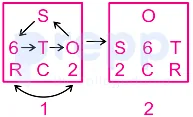
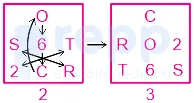
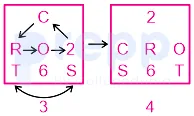
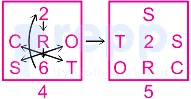
Question 1archived
In a certain code language, 'QUANTITY' is written as 'TPMZHSXS', 'RELIABLE' is written as 'DQHKAZDK'. How will 'SAMPLING' be written in that language?
- A
ZROLHLGM
- B
ZROLHJEL
- C
ZROLHKFM
- D
ZROLHKFN
Show answer
Question 2archived
Each vowel in the word "FRETSAW" is changed to the following letter in the English alphabetical series and each consonant is changed to the previous letter in the English alphabetical series. In the newly formed word, how many alphabets are there in the English alphabetical series between the alphabet which is 3rd from the right and 1st from the right?
- A
Three
- B
Four
- C
One
- D
Two
Show answer
A. ThreeUnderstanding the Word Transformation Problem
The question asks us to perform a letter transformation on the word "FRETSAW". Each vowel in the word needs to be changed to the letter that comes immediately after it in the English alphabetical series. Similarly, each consonant in the word needs to be changed to the letter that comes immediately before it in the English alphabetical series.
Once the transformation is complete, we will have a new word. We then need to identify two specific letters in this new word: the letter that is 3rd from the right end and the letter that is 1st from the right end. Finally, we must count how many letters are present in the standard English alphabet between these two identified letters.
Step-by-Step Transformation of "FRETSAW"
Let's take the word "FRETSAW" and apply the given rules letter by letter:
F: This is a consonant. The letter before F is E. So, F changes to E.
R: This is a consonant. The letter before R is Q. So, R changes to Q.
E: This is a vowel. The letter after E is F. So, E changes to F.
T: This is a consonant. The letter before T is S. So, T changes to S.
S: This is a consonant. The letter before S is R. So, S changes to R.
A: This is a vowel. The letter after A is B. So, A changes to B.
W: This is a consonant. The letter before W is V. So, W changes to V.
Putting the transformed letters together, the new word formed from "FRETSAW" is "EQFSRBV".
Identifying Letters in the New Word
The new word is EQFSRBV.
We need to find:
The letter 1st from the right end. Looking at "EQFSRBV" from right to left, the first letter is V.
The letter 3rd from the right end. Looking at "EQFSRBV" from right to left, the third letter is R.
So, the two letters we are interested in are R and V.
Counting Letters Between R and V
Now, we need to find out how many letters are there in the English alphabetical series between R and V.
Let's list the letters from R to V in the English alphabet:
R, S, T, U, V
The letters strictly between R and V are S, T, and U.
Counting these letters, we find there are 3 letters between R and V.
Conclusion
After transforming the word "FRETSAW" according to the given rules, the new word is "EQFSRBV". The letter 1st from the right is V, and the letter 3rd from the right is R. There are three letters (S, T, U) in the English alphabet between R and V.
Original Word
Transformed Word
F (consonant)
E (previous)
R (consonant)
Q (previous)
E (vowel)
F (following)
T (consonant)
S (previous)
S (consonant)
R (previous)
A (vowel)
B (following)
W (consonant)
V (previous)
New Word
EQFSRBV
1st from Right
V
3rd from Right
R
Letters Between R and V
Count
S, T, U
3
Revision Table - Word Transformation and Counting
Let's summarise the key steps and findings:
Original word: FRETSAW
Transformation rule: Vowel > next letter; Consonant > previous letter.
New word: EQFSRBV
Letter 1st from right in new word: V
Letter 3rd from right in new word: R
Letters between R and V in alphabet: S, T, U
Number of letters between R and V: Three
Additional Information - Alphabetical Reasoning
Problems like this test your understanding of alphabetical order and positional analysis within a string or word. Knowing the sequence of letters in the English alphabet is fundamental. Identifying positions from the left or right end of a word is also a common skill required in such questions.
Remember that "between" usually means strictly between the two letters, not including the letters themselves.
Consonants are all letters except A, E, I, O, U. Vowels are A, E, I, O, U.
Careful application of the rules and systematic step-by-step processing of the word ensures accuracy.
Paper & answer key PDF ↗ Question 3archived
Looking at a picture of a girl Samuel said, "She is the sister of my maternal uncle's son." How is the girl in the picture related to Samuel?
- A
Daughter-in-law
- B
Brother's wife
- C
Sister's daughter
- D
Mother's brother's daughter
Show answer
D. Mother's brother's daughterUnderstanding Blood Relations: Solving the Puzzle
This question is a classic example of a blood relation puzzle, where we need to deduce the relationship between two individuals based on a given statement. Let's break down Samuel's statement step-by-step to understand how the girl in the picture is related to him.
Step-by-Step Analysis of the Statement
Samuel says, "She is the sister of my maternal uncle's son." We can analyze this by starting from 'Samuel' and working outwards:
"my maternal uncle": Samuel's maternal uncle is his mother's brother.
"my maternal uncle's son": This person is the son of Samuel's mother's brother. The son of your maternal uncle is your cousin. So, this person is Samuel's cousin.
"She is the sister of my maternal uncle's son": The girl in the picture is the sister of Samuel's cousin (who is the son of Samuel's maternal uncle).
If the girl is the sister of Samuel's cousin (who is the son of his maternal uncle), it means the girl is also a child of Samuel's maternal uncle. Specifically, she is the daughter of Samuel's maternal uncle.
Deducing the Final Relationship
Based on our analysis:
Samuel's maternal uncle is his mother's brother.
The girl is the daughter of Samuel's maternal uncle.
Therefore, the girl is the daughter of Samuel's mother's brother. This makes the girl Samuel's cousin.
Let's look at the options provided and see which one matches this relationship:
Daughter-in-law: This is the wife of one's son. This does not match.
Brother's wife: This is one's sister-in-law. This does not match.
Sister's daughter: This is one's niece. This does not match.
Mother's brother's daughter: This is the daughter of one's maternal uncle. This is exactly the relationship we deduced.
Thus, the girl in the picture is Samuel's mother's brother's daughter, which is his cousin.
Revision Table: Key Relationships
Relationship Term
Definition
Maternal Uncle
Mother's brother
Paternal Uncle
Father's brother
Maternal Aunt
Mother's sister
Paternal Aunt
Father's sister
Cousin
Child of uncle or aunt
Niece
Brother's or sister's daughter
Nephew
Brother's or sister's son
Additional Information on Blood Relation Puzzles
Blood relation questions test your ability to understand and trace relationships within a family structure. They often involve breaking down complex sentences into simpler relationships. Visualizing a family tree can be very helpful when solving these types of problems. Remember to focus on the subject (Samuel in this case) and trace the relations mentioned from their perspective.
Paper & answer key PDF ↗ Question 4archived
Select the correct mirror image of the given figure when the mirror is placed at MN as shown below.

- A
Option A (shown in image)
- B
Option B (shown in image)
- C
Option C (shown in image)
- D
Option D (shown in image)
Show answer
C. Option C (shown in image)The mirror image of the given figure is :
Hence, the correct answer is "Option (3)".
 Paper & answer key PDF ↗
 Question 5archived
Which of the following numbers will replace the question mark (?) in the given series?
11, ?, 29, 53, 101, 197
- A
19
- B
13
- C
21
- D
17
Show answer
D. 17Correct answer: 17
Difference Series: The differences between consecutive terms form a pattern (like in this problem).
Double Difference Series: The differences of the differences form a pattern.
Squares and Cubes: Terms are related to squares or cubes of natural numbers.
Alternating Pattern: Two different patterns alternate within the series.
Fibonacci or Similar Series: Each term is the sum of the previous two terms, or a similar additive pattern.
Mixed Patterns: A combination of the above.
To solve these problems effectively, practice analyzing the differences, ratios, and other relationships between terms. Writing down the differences or ratios can often reveal the underlying pattern quickly.
Paper & answer key PDF ↗ Question 6archived
Select the option that represents the letters that, when placed from left to right in the blanks, will complete the letter series.
P _ G I O _ D _ I O R D G _ O _ D G I O
- A
G Q D S I
- B
D Q G I S
- C
Q G D I S
- D
S I D G Q
Show answer
B. D Q G I SThe correct answer is D Q G I S.
If the series is long, try breaking it down into smaller segments. Test the options systematically by filling the blanks and checking if a recognizable pattern emerges. Don't assume a simple pattern; look for more complex or combined patterns if needed. Practicing different types of letter series helps in quickly identifying the pattern during exams.
Paper & answer key PDF ↗ Question 7archived
Select the figure from among the given options that can replace the question mark (?) in the following series.

- A
Option A (shown in image)
- B
Option B (shown in image)
- C
Option C (shown in image)
- D
Option D (shown in image)
Show answer
Question 8archived
Three of the following four letter-clusters are alike in a certain way and one is different. Pick the odd one out.
- A
CXG
- B
IRM
- C
BYF
- D
GUK
Show answer
D. GUKThe correct answer is GUK.
Determining the Odd Cluster Out By comparing the established patterns: CXG, IRM, and BYF all follow the rule: Letter1, Reverse(Letter1), Letter1 + 4. GUK follows the second part of the rule (Letter1 + 4 = Letter3) but fails the first part (the second letter is not the reverse of the first). Since GUK does not adhere to the complete pattern observed in the other three clusters, it is the odd one out.
Paper & answer key PDF ↗ Question 9archived
Select the option that is related to the fifth number in the same way as the second number is related to the first number and the fourth number is related to the third number.
4 ∶ 25 ∶∶ 12 ∶ 73 ∶∶ 7 ∶ ?
- A
48
- B
39
- C
43
- D
52
Show answer
C. 43The correct answer is 43.
Look for patterns involving consecutive numbers or skipped numbers. Test combinations of operations (e.g., multiply then add/subtract). Examine the digits of the numbers themselves. Regular practice with different types of number puzzles helps improve pattern recognition skills.
Paper & answer key PDF ↗ Question 10archived
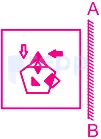
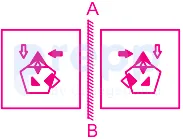
Select the correct mirror image of the given figure when the mirror is placed at 'AB' as shown.
- A
Option A (shown in image)
- B
Option B (shown in image)
- C
Option C (shown in image)
- D
Option D (shown in image)
Show answer
A. Option A (shown in image)The mirror image of the given figure is :
Hence, the correct answer is "Option (1)".
 Paper & answer key PDF ↗
 Question 11archived
Three statements are given followed by three conclusions numbered I, II and III. Assuming the statements to be true, even if they seem to be at variance with commonly known facts, decide which of the conclusions logically follow(s) from the statements.
Statements:
All leathers are shoes.
Some bags are shoes.
Some bags are papers.
Conclusions:
I. Some papers are leathers.
II. Some shoes are leathers.
III. Some shoes are papers.
- A
Only conclusion II follows
- B
Only conclusion I follows
- C
Only conclusion III follows
- D
All conclusions follow
Show answer
A. Only conclusion II followsThe correct answer is Only conclusion II follows.
The middle term must be distributed in at least one premise. (The middle term is the one appearing in both statements but not in the , e.g., 'Bags' in linking statements 2 and 3). A term distributed in the must be distributed in its premise. In this problem, II ("Some shoes are leathers") follows directly from the implication of the Universal Affirmative Statement 1 ("All leathers are shoes"), which is a fundamental rule of logic.
Paper & answer key PDF ↗ Question 12archived
Three statements are given followed by three conclusions numbered I, II and III. Assuming the statements to be true, even if they seem to be at variance with commonly known facts, decide which of the conclusions logically follow(s) from the statements.
Statements:
Some hills are mountains.
Some hills are valleys.
All valleys are rivers.
Conclusions:
I. Some rivers are valleys.
II. Some mountains are valleys.
III. Some hills are rivers.
- A
Only conclusions I and III follow
- B
Only conclusions II and III follow
- C
Only conclusions I and II follow
- D
Only conclusion I follows
Show answer
A. Only conclusions I and III followThe correct answer is Only conclusions I and III follow.
Some A are not B: Means there is at least one element in set A that is not in set B. Does NOT imply "Some B are not A" or "No A are B". When solving, focus only on what the statements definitively tell you about the relationships between the categories mentioned. Do not assume any relationships that are not explicitly stated or logically implied by the statements combined.
Paper & answer key PDF ↗ Question 13archived
Select the word-pair that best represents a similar relationship to the one expressed in the given pair of words.
(The words must be considered as meaningful English words and must not be related to each other based on the number of letters/number of consonants/vowels in the word)
Film : Director
- A
Pages : Books
- B
Doctor : Nurse
- C
Dance : Choreographer
- D
Degree : Engineer
Show answer
C. Dance : ChoreographerThe correct answer is Dance : Choreographer.
Option 3: Dance : Choreographer A Choreographer is a person who creates and arranges the steps and movements for a Dance . The Choreographer is the creative mind behind the dance performance. This relationship is 'Creation : Creator' or 'Product : Maker', which is directly analogous to "Film : Director". Based on this analysis, the relationship between "Dance : Choreographer" is the most similar to the relationship between "Film : Director". In both cases, the second word is the person responsible for creating the first word.
Paper & answer key PDF ↗ Question 14archived
In a certain code language, "ABUSE" is written as "DEXVH" and "CANDY" is written as "FDQGB". How will "DESERT" be written in that language?
- A
HIWIVX
- B
IJXJWY
- C
GHVHUW
- D
HJWJWX
Show answer
C. GHVHUWThe correct answer is GHVHUW.
Common types of patterns include: Letter shifting (like in this problem, forwards or backwards) Letter reversal Substituting letters based on a fixed code Using positions of letters (e.g., first letter coded as its position number) Patterns involving vowels and consonants Mixing multiple rules To solve these questions, it's helpful to write down the letters and their corresponding codes, analyze the differences or relationships, and look for consistency across the given examples. Practice with different types of patterns helps improve speed and accuracy.
Paper & answer key PDF ↗ Question 15archived
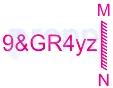
Select the correct mirror image of the given combination when the mirror is placed at line MN as shown.
- A
Option A (shown in image)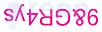
- B
Option B (shown in image)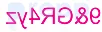
- C
Option C (shown in image)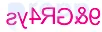
- D
Option D (shown in image)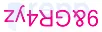
Show answer
B. Option B (shown in image)The mirror image of the given figure is:
Hence, the correct answer is "Option (2)".
 Paper & answer key PDF ↗
 Question 16archived
Select the option that is related to the fifth number in the same way as the second number is related to the first number and the fourth number is related to the third number.
9 ∶ 702 ∶∶ 3 ∶ 18 ∶∶ 6 ∶ ?
- A
156
- B
172
- C
188
- D
198
Show answer
D. 198This question is a number analogy problem where we need to find the relationship between the numbers in the given pairs and apply the same logic to find the missing number.
Understanding the Number Analogy Problem
In this type of question, two pairs of numbers are given, showing a specific relationship between the first and second numbers in each pair. We need to identify this relationship and then apply it to the third pair to find the missing number.
The given analogy is:
\(9 \ratio 702 \ratio\ratio 3 \ratio 18 \ratio\ratio 6 \ratio ?\)
This means:
The relationship between 9 and 702 is the same as the relationship between 3 and 18.
We need to find this relationship and apply it to 6 to find the missing number.
Analyzing the Relationships in the Given Pairs
Let's examine the first two pairs to find the pattern:
Pair 1: 9 ∶ 702
Pair 2: 3 ∶ 18
Let's try to find a mathematical operation or pattern connecting the numbers in each pair. Let 'n' be the first number in a pair.
Analyzing Pair 2 (3 ∶ 18) First
Starting with the smaller numbers often makes it easier to spot the pattern.
If \(n = 3\), the second number is 18.
Is it multiplication? \(3 \times 6 = 18\). The multiplier is 6.
Is it related to squares or cubes? \(3^2 = 9\), \(3^3 = 27\).
Can we combine operations? \(3^2 + 9 = 18\). This uses the number itself.
What about \(n^3 - k \times n\)? \(3^3 - 3 \times 3 = 27 - 9 = 18\). This works for Pair 2! The pattern is \(n^3 - 3n\).
Verifying the Pattern with Pair 1 (9 ∶ 702)
Now, let's check if the pattern \(n^3 - 3n\) holds for the first pair.
If \(n = 9\), let's calculate \(n^3 - 3n\):
\(9^3 - 3 \times 9 = 729 - 27\)
\(729 - 27 = 702\)
The calculated value (702) matches the second number in Pair 1. So, the pattern \(n^3 - 3n\) is consistent for both the given pairs.
Applying the Pattern to Find the Missing Number
Now, we apply the same pattern to the third pair (6 ∶ ?).
Here, the first number is \(n = 6\). We need to find the second number using the pattern \(n^3 - 3n\).
Missing number = \(6^3 - 3 \times 6\)
Calculate the terms:
\(6^3 = 6 \times 6 \times 6 = 36 \times 6 = 216\)
\(3 \times 6 = 18\)
Subtract the second term from the first:
Missing number = \(216 - 18\)
Missing number = \(198\)
Conclusion
The missing number in the analogy is 198.
The pattern followed is \(n \ratio n^3 - 3n\), where n is the first number in the pair.
Step-by-Step Solution Summary
Identify the relationship between the numbers in the first two pairs: \(9 \ratio 702\) and \(3 \ratio 18\).
Determine the pattern. The pattern found is \(n \ratio n^3 - 3n\).
Verify the pattern with both pairs.
For \(n=3\): \(3^3 - 3(3) = 27 - 9 = 18\) (Matches)
For \(n=9\): \(9^3 - 3(9) = 729 - 27 = 702\) (Matches)
Apply the pattern to the third pair \(6 \ratio ?\).
For \(n=6\): \(6^3 - 3(6) = 216 - 18 = 198\)
The missing number is 198.
Revision Table: Number Analogy Pattern
First Number (n)
Pattern (\(n^3 - 3n\))
Second Number
Verification
3
\(3^3 - 3(3) = 27 - 9\)
18
Correct
9
\(9^3 - 3(9) = 729 - 27\)
702
Correct
6
\(6^3 - 3(6) = 216 - 18\)
198
Calculated
Additional Information: Logical Reasoning and Number Series
Number analogy questions are part of logical reasoning and quantitative aptitude. They test your ability to find patterns and relationships between numbers.
Common patterns in number series and analogies include:
Arithmetic progression (adding or subtracting a constant)
Geometric progression (multiplying or dividing by a constant)
Powers and roots (squares, cubes, square roots, cube roots)
Combinations of operations (e.g., \(n^2 + n\), \(n^3 - n\), \(2n + 5\), etc.)
Difference patterns (finding the pattern in the differences between consecutive terms)
Digit operations (sum of digits, product of digits, etc.)
Prime numbers, composite numbers, odd/even numbers
Solving these problems requires careful observation, trial and error, and knowledge of basic mathematical operations and number properties. Practicing different types of patterns helps improve pattern recognition skills.
Paper & answer key PDF ↗ Question 17archived
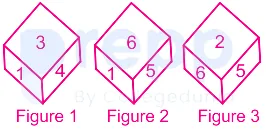
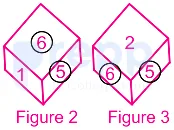
Three different positions of the same dice are shown. Find the number on the face opposite the face showing '1'.
- A
3
- B
4
- C
6
- D
2
Show answer
D. 2Here, we use the figure (2) and (3) to find opposite faces.
In figures (2) and (3) faces showing 5 and 6 are common, which means the face showing 2 is opposite to the face showing 1.
Here, the face showing 2 is opposite to the face showing 1 .
Hence, the correct answer is "Option (4)".
 Paper & answer key PDF ↗
 Question 18archived
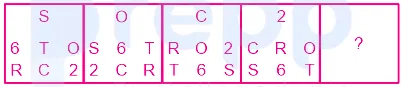
Which figure should replace the question mark (?) if the series were to be continued?
- A
Option A (shown in image)
- B
Option B (shown in image)
- C
Option C (shown in image)
- D
Option D (shown in image)
Show answer
Question 19archived
Which two signs should be interchanged to make the given equation correct?
12 ÷ 5 - 8 × 2 + 14 = 70
- A
and +
- B
+ and ×
- C
÷ and ×
- D
÷ and +
Show answer
C. ÷ and ×This problem requires us to find which pair of mathematical signs in the equation 12 ÷ 5 - 8 × 2 + 14 = 70 needs to be swapped to make the equation true. We will test each option by interchanging the specified signs and evaluating the resulting equation using the standard order of operations (PEMDAS/BODMAS: Parentheses/Brackets, Exponents/Orders, Division and Multiplication from left to right, Addition and Subtraction from left to right).
Analyzing the Original Equation
First, let's evaluate the equation as it is given:
12 ÷ 5 - 8 × 2 + 14
Following the order of operations:
Division: $12 \div 5 = 2.4$
Multiplication: $8 \times 2 = 16$
The equation becomes:
2.4 - 16 + 14
Now, performing subtraction and addition from left to right:
Subtraction: $2.4 - 16 = -13.6$
Addition: $-13.6 + 14 = 0.4$
The original equation evaluates to 0.4, not 70. Therefore, we need to interchange signs.
Testing Sign Interchange Options
We will now test each option to see which interchange makes the equation equal to 70.
Testing Option 1: Interchanging '-' and '+'
The new equation becomes: 12 ÷ 5 + 8 - 14
Evaluation:
Division: $12 \div 5 = 2.4$
Equation: $2.4 + 8 - 14$
Addition: $2.4 + 8 = 10.4$
Subtraction: $10.4 - 14 = -3.6$
Result: -3.6 (Incorrect)
Testing Option 2: Interchanging '+' and '×'
The new equation becomes: 12 ÷ 5 - 8 + 14 × 2
Evaluation:
Division: $12 \div 5 = 2.4$
Multiplication: $14 \times 2 = 28$
Equation: $2.4 - 8 + 28$
Subtraction: $2.4 - 8 = -5.6$
Addition: $-5.6 + 28 = 22.4$
Result: 22.4 (Incorrect)
Testing Option 3: Interchanging '÷' and '×'
The new equation becomes: 12 × 5 - 8 ÷ 2 + 14
Evaluation:
Multiplication: $12 \times 5 = 60$
Division: $8 \div 2 = 4$
Equation: $60 - 4 + 14$
Subtraction: $60 - 4 = 56$
Addition: $56 + 14 = 70$
Result: 70 (Correct!)
Testing Option 4: Interchanging '÷' and '+'
The new equation becomes: 12 + 5 - 8 × 2 + 14
Evaluation:
Multiplication: $8 \times 2 = 16$
Equation: $12 + 5 - 16 + 14$
Addition: $12 + 5 = 17$
Subtraction: $17 - 16 = 1$
Addition: $1 + 14 = 15$
Result: 15 (Incorrect)
Conclusion: Verified Equation for Accuracy
By systematically checking each option, we found that interchanging the division (÷) and multiplication (×) signs results in the correct value of 70.
The correct equation is: 12 × 5 - 8 ÷ 2 + 14 = 70.
Therefore, the signs ÷ and × must be interchanged.
Paper & answer key PDF ↗ Question 20archived
Which of the following terms will replace the question mark (?) in the given series?
MPT, PRU, STV, VVW,?
- A
YWX
- B
YXW
- C
YXX
- D
ZXW
Show answer
C. YXXUnderstanding the Letter Series Pattern
This question asks us to find the next term in a given series of letter groups: MPT, PRU, STV, VVW, ?. To solve this, we need to identify the pattern or rule that governs the progression from one term to the next in the letter series.
Let's examine the changes occurring in each letter position (first, second, and third) as we move from one term to the next in the series MPT, PRU, STV, VVW.
Analyzing Each Letter Position in the Series
We will analyze the series term by term, focusing on the position of each letter in the English alphabet (A=1, B=2, ..., Z=26).
Term
First Letter
Second Letter
Third Letter
MPT
M (13)
P (16)
T (20)
PRU
P (16)
R (18)
U (21)
STV
S (19)
T (20)
V (22)
VVW
V (22)
V (22)
W (23)
?
?
?
?
Pattern for the First Letter:
From M (13) to P (16): The position increases by $16 - 13 = 3$.
From P (16) to S (19): The position increases by $19 - 16 = 3$.
From S (19) to V (22): The position increases by $22 - 19 = 3$.
The pattern for the first letter is a consistent increase of 3 in the alphabetical position. Following this pattern, the first letter of the next term will be 3 positions after V (22). $22 + 3 = 25$. The 25th letter is Y.
So, the first letter of the next term is Y.
Pattern for the Second Letter:
From P (16) to R (18): The position increases by $18 - 16 = 2$.
From R (18) to T (20): The position increases by $20 - 18 = 2$.
From T (20) to V (22): The position increases by $22 - 20 = 2$.
The pattern for the second letter is a consistent increase of 2 in the alphabetical position. Following this pattern, the second letter of the next term will be 2 positions after V (22). $22 + 2 = 24$. The 24th letter is X.
So, the second letter of the next term is X.
Pattern for the Third Letter:
From T (20) to U (21): The position increases by $21 - 20 = 1$.
From U (21) to V (22): The position increases by $22 - 21 = 1$.
From V (22) to W (23): The position increases by $23 - 22 = 1$.
The pattern for the third letter is a consistent increase of 1 in the alphabetical position. Following this pattern, the third letter of the next term will be 1 position after W (23). $23 + 1 = 24$. The 24th letter is X.
So, the third letter of the next term is X.
Determining the Next Term in the Series
By combining the letters we found for each position:
First letter: Y
Second letter: X
Third letter: X
The next term in the series MPT, PRU, STV, VVW, ? is YXX.
Conclusion on the Letter Series
Based on the analysis of the consistent patterns (+3, +2, +1) across the letter positions, the next term that replaces the question mark (?) in the given series MPT, PRU, STV, VVW, ? is YXX.
Revision Table: Letter Series Patterns
Letter Position
Letters in Series
Pattern (Difference)
Next Letter (Based on VVW)
First
M, P, S, V
+3
V (22) + 3 = Y (25)
Second
P, R, T, V
+2
V (22) + 2 = X (24)
Third
T, U, V, W
+1
W (23) + 1 = X (24)
Additional Information: Solving Letter Series Questions
Solving letter series problems often involves looking for various types of patterns:
Alphabetical Position Differences: The most common pattern involves adding or subtracting a fixed number, or a series with a pattern, to the alphabetical position of each letter.
Skipping Letters: Sometimes the pattern involves skipping a specific number of letters between consecutive terms (e.g., A, C, E skips one letter each time).
Reverse Alphabetical Order: The series might move backwards through the alphabet.
Combination of Patterns: Different positions within the same term might follow different rules, as seen in the example above (+3, +2, +1).
Vowel/Consonant Patterns: The pattern might involve alternating vowels and consonants or following a rule related to them.
Repeating Patterns: A sequence of letters or differences might repeat.
A systematic approach, breaking down the terms and analyzing each component (like letter position here), is key to finding the underlying rule in letter series questions.
Paper & answer key PDF ↗ Question 21archived
Which two signs should be interchanged to make the given equation correct?
256 - 4 × 2 + 200 ÷ 19 = 309
- A
- and +
- B
÷ and +
- C
÷ and -
- D
+ and ×
Show answer
C. ÷ and -Understanding the Math Equation Problem :-
The question asks us to identify which two mathematical signs in the given equation need to be swapped to make the equation correct. The equation provided is: \(256 - 4 \times 2 + 200 \div 19 = 309\).
To solve this type of signs interchange problem, we need to systematically test each given option. For each option, we will interchange the specified signs in the original equation and then evaluate the new equation using the standard order of operations (BODMAS/PEMDAS). The correct option is the one where the calculation results in 309.
Let's analyze each option:
Testing Option 1: Interchange \(-\) and \(+\)
Original Equation: \(256 - 4 \times 2 + 200 \div 19\)
After interchanging \(-\) and \(+\): \(256 + 4 \times 2 - 200 \div 19\)
Now, we evaluate this new equation following the BODMAS rule:
Division first: \(200 \div 19 \approx 10.53\)
Multiplication next: \(4 \times 2 = 8\)
Addition/Subtraction: \(256 + 8 - 10.53\)
\(264 - 10.53 \approx 253.47\)
Since \(253.47 \neq 309\), interchanging \(-\) and \(+\) does not make the equation correct.
Testing Option 2: Interchange \(\div\) and \(+\)
Original Equation: \(256 - 4 \times 2 + 200 \div 19\)
After interchanging \(\div\) and \(+\): \(256 - 4 \times 2 \div 200 + 19\)
Now, we evaluate this new equation following the BODMAS rule:
Division/Multiplication from left to right: \(4 \times 2 = 8\), then \(8 \div 200 = 0.04\)
Addition/Subtraction: \(256 - 0.04 + 19\)
\(255.96 + 19 = 274.96\)
Since \(274.96 \neq 309\), interchanging \(\div\) and \(+\) does not make the equation correct.
Testing Option 3: Interchange \(\div\) and \(-\)
Original Equation: \(256 - 4 \times 2 + 200 \div 19\)
After interchanging \(\div\) and \(-\): \(256 \div 4 \times 2 + 200 - 19\)
Now, we evaluate this new equation following the BODMAS rule:
Division first: \(256 \div 4 = 64\)
Multiplication next: \(64 \times 2 = 128\)
Addition/Subtraction: \(128 + 200 - 19\)
\(328 - 19 = 309\)
Since \(309 = 309\), interchanging \(\div\) and \(-\) makes the equation correct.
Testing Option 4: Interchange \(+\) and \(\times\)
Original Equation: \(256 - 4 \times 2 + 200 \div 19\)
After interchanging \(+\) and \(\times\): \(256 - 4 + 2 \times 200 \div 19\)
Now, we evaluate this new equation following the BODMAS rule:
Division first: \(200 \div 19 \approx 10.53\)
Multiplication next: \(2 \times 10.53 \approx 21.06\)
Addition/Subtraction: \(256 - 4 + 21.06\)
\(252 + 21.06 = 273.06\)
Since \(273.06 \neq 309\), interchanging \(+\) and \(\times\) does not make the equation correct.
Based on the analysis, interchanging the \(\div\) and \(-\) signs makes the given equation correct.
OptionSigns InterchangedNew EquationEvaluationResultCorrect?
1\(-\) and \(+\)\(256 + 4 \times 2 - 200 \div 19\)\(256 + 8 - 10.53\)\(253.47\)No
2\(\div\) and \(+\)\(256 - 4 \times 2 \div 200 + 19\)\(256 - 0.04 + 19\)\(274.96\)No
3\(\div\) and \(-\)\(256 \div 4 \times 2 + 200 - 19\)\(64 \times 2 + 200 - 19 = 128 + 200 - 19\)\(309\)Yes
4\(+\) and \(\times\)\(256 - 4 + 2 \times 200 \div 19\)\(256 - 4 + 21.06\)\(273.06\)No
Revision Table: Key Concepts
ConceptDescriptionImportance in Problem Solving
Order of OperationsRules that dictate the sequence for performing calculations in a mathematical expression (BODMAS/PEMDAS).Essential for correctly evaluating the modified equations after signs interchange.
Signs InterchangeReplacing one mathematical operator with another operator at specific positions or swapping two types of operators throughout the expression.The core operation required by the problem statement to find the correct equation.
Equation VerificationChecking if the calculated value of one side of an equation matches the value on the other side.The final step to confirm if the signs interchange was successful in making the equation correct.
Additional Information: BODMAS Rule Explained
The BODMAS rule (or PEMDAS in some regions) is a mnemonic used to remember the correct order of operations in mathematical expressions. Performing operations in the wrong order will lead to an incorrect result.
Brackets (or Parentheses): Operations inside brackets are performed first.
Orders (or Exponents): Powers, square roots, etc., are evaluated next.
Division and Multiplication: These are performed from left to right.
Addition and Subtraction: These are performed from left to right after division and multiplication.
In the context of signs interchange problems, understanding and strictly following the BODMAS rule is crucial for accurately evaluating the expressions and finding the correct pair of signs to swap.
Paper & answer key PDF ↗ Question 22archived
Select the option that is related to the fifth letter - cluster in the same way as the second letter - cluster is related to the first letter - cluster and the fourth letter - cluster is related to the third letter - cluster.
CYCLE : BXBKF :: TYRE : SXQF :: SCOOTER : ?
- A
TDNNUFQ
- B
RBPPSFQ
- C
TDNNUDS
- D
RBPPSDS
Show answer
B. RBPPSFQUnderstanding Letter Cluster Analogies
This question presents a letter cluster analogy where we need to find the relationship between the first pair and the second pair to apply it to the third cluster. The analogy is:
CYCLE : BXBKF :: TYRE : SXQF :: SCOOTER : ?
Let's analyze the transformation from the first letter cluster to the second in the given pairs to identify the underlying pattern.
Analyzing the First Pair: CYCLE to BXBKF
We examine each letter in 'CYCLE' and its corresponding letter in 'BXBKF':
C becomes B: Moving one step backward in the alphabet (C → B). This is a -1 shift.
Y becomes X: Moving one step backward in the alphabet (Y → X). This is a -1 shift.
C becomes B: Moving one step backward in the alphabet (C → B). This is a -1 shift.
L becomes K: Moving one step backward in the alphabet (L → K). This is a -1 shift.
E becomes F: Moving one step forward in the alphabet (E → F). This is a +1 shift.
The transformation for CYCLE seems to be applying a shift to each letter. Let's look closer at the letters involved: C, Y, C, L are typically considered consonants (in this type of problem, Y often behaves like a consonant unless specified), and E is a vowel.
C (Consonant) → B (-1)
Y (Consonant) → X (-1)
C (Consonant) → B (-1)
L (Consonant) → K (-1)
E (Vowel) → F (+1)
This suggests a pattern based on whether the letter is a consonant or a vowel (A, E, I, O, U).
Analyzing the Second Pair: TYRE to SXQF
Let's apply the potential pattern (Consonant -1, Vowel +1, treating Y as a consonant) to the second pair:
T (Consonant) → T-1 = S (Matches SXQF)
Y (Consonant) → Y-1 = X (Matches SXQF)
R (Consonant) → R-1 = Q (Matches SXQF)
E (Vowel) → E+1 = F (Matches SXQF)
The pattern (Consonant -1, Vowel +1, with Y as consonant) is consistent across both given pairs.
Applying the Pattern to SCOOTER
Now, we apply this identified pattern to the cluster SCOOTER. We identify each letter as a consonant or a vowel and apply the corresponding shift:
S (Consonant) → S-1 = R
C (Consonant) → C-1 = B
O (Vowel) → O+1 = P
O (Vowel) → O+1 = P
T (Consonant) → T-1 = S
E (Vowel) → E+1 = F
R (Consonant) → R-1 = Q
Combining the transformed letters, we get the cluster RBPPSFQ.
Verifying the Result
The derived cluster RBPPSFQ matches one of the given options.
Original Letter
Type
Shift
Transformed Letter
S
Consonant
-1
R
C
Consonant
-1
B
O
Vowel
+1
P
O
Vowel
+1
P
T
Consonant
-1
S
E
Vowel
+1
F
R
Consonant
-1
Q
The resulting cluster is RBPPSFQ.
Conclusion
Based on the analysis of the pattern in the first two pairs, applying the rule "Consonant → Previous letter" and "Vowel → Next letter" (treating Y as a consonant), the cluster related to SCOOTER is RBPPSFQ.
Revision Table: Letter Analogy Pattern
Word
Letters
Classification (C/V)
Shift Rule
Resulting Letters
Coded Word
CYCLE
C Y C L E
C C C C V
-1 -1 -1 -1 +1
B X B K F
BXBKF
TYRE
T Y R E
C C C V
-1 -1 -1 +1
S X Q F
SXQF
SCOOTER
S C O O T E R
C C V V C V C
-1 -1 +1 +1 -1 +1 -1
R B P P S F Q
RBPPSFQ
Additional Information: Letter Coding and Analogies
Letter coding and analogy questions are common in logical reasoning tests. They assess your ability to identify patterns in how letters or groups of letters are transformed. Common patterns include:
Shifting letters forward or backward by a fixed number of positions (e.g., A+2=C).
Shifting letters based on their position in the word (e.g., 1st letter +1, 2nd letter -1).
Shifting letters based on whether they are vowels or consonants.
Reversing the order of letters.
Skipping letters in a sequence.
Combinations of the above rules.
Solving these problems requires careful observation, breaking down the transformation letter by letter, and testing potential rules for consistency across all given examples.
Paper & answer key PDF ↗ Question 23archived
Select the set in which the numbers are related in the same way as are the numbers of the following set.
(NOTE: Operations should be performed on the whole numbers, without breaking down the numbers into its constituent digits. E.g. 13 - Operations on 13 such as adding /subtracting /multiplying etc. to 13 can be performed. Breaking down 13 into 1 and 3 and then performing mathematical operations on 1 and 3 is NOT allowed)
(15, 5, 375)
(14, 3, 210)
- A
(10, 12, 320)
- B
(17, 19, 920)
- C
(14, 15, 780)
- D
(11, 16, 880)
Show answer
D. (11, 16, 880)Understanding Number Analogy and Finding the Pattern
This question asks us to identify the relationship between the numbers in the given sets and apply that same relationship to the options provided. We are given two example sets: (15, 5, 375) and (14, 3, 210). The note specifies that we should treat the numbers as whole numbers and not break them down into individual digits.
Analyzing the Given Number Sets
Let's look at the first set: (15, 5, 375). We need to find a mathematical operation or combination of operations involving 15 and 5 that results in 375.
If we multiply the first two numbers: $15 \times 5 = 75$. How is 75 related to 375? $375 \div 75 = 5$. So, $75 \times 5 = 375$.
This suggests a possible rule: (First number $\times$ Second number) $\times$ Second number = Third number. Or, written differently, First number $\times$ (Second number)$^2$ = Third number.
Let's test this potential rule with the second set: (14, 3, 210).
First number is 14, Second number is 3.
According to the rule: (First number $\times$ Second number) $\times$ Second number = $(14 \times 3) \times 3 = 42 \times 3 = 126$.
The result 126 is not 210. So, this rule (First number $\times$ Second number) $\times$ Second number is incorrect.
Let's reconsider the relationship from the first set: $15 \times 5 = 75$, and $75 \times 5 = 375$. We saw that multiplying the product of the first two by the second number worked for the first set. For the second set: $14 \times 3 = 42$. To get 210 from 42, we need to multiply by $210 \div 42 = 5$. So, $42 \times 5 = 210$.
Notice that in the first set, we multiplied $15 \times 5$ by 5 (the second number). In the second set, we multiplied $14 \times 3$ by 5 (which is NOT the second number, 3). This '5' appears consistently as the final multiplier.
This leads to a new potential rule: Third number = First number $\times$ Second number $\times$ 5.
Verifying the Pattern Rule
Let's verify this rule with both given sets:
Set
First Number (A)
Second Number (B)
Proposed Rule Calculation (A $\times$ B $\times$ 5)
Third Number (C)
Matches?
(15, 5, 375)
15
5
$15 \times 5 \times 5 = 75 \times 5 = 375$
375
Yes
(14, 3, 210)
14
3
$14 \times 3 \times 5 = 42 \times 5 = 210$
210
Yes
The rule "Third number = First number $\times$ Second number $\times$ 5" holds true for both the given sets.
Applying the Rule to the Options
Now, we will apply this rule to each of the given options to find the set that follows the same pattern.
Option 1: (10, 12, 320)
First number = 10, Second number = 12.
Calculated third number = $10 \times 12 \times 5 = 120 \times 5 = 600$.
The given third number is 320. $600 \neq 320$. This option does not follow the rule.
Option 2: (17, 19, 920)
First number = 17, Second number = 19.
Calculated third number = $17 \times 19 \times 5$.
$17 \times 19 = 323$.
Calculated third number = $323 \times 5 = 1615$.
The given third number is 920. $1615 \neq 920$. This option does not follow the rule.
Option 3: (14, 15, 780)
First number = 14, Second number = 15.
Calculated third number = $14 \times 15 \times 5$.
$14 \times 15 = 210$.
Calculated third number = $210 \times 5 = 1050$.
The given third number is 780. $1050 \neq 780$. This option does not follow the rule.
Option 4: (11, 16, 880)
First number = 11, Second number = 16.
Calculated third number = $11 \times 16 \times 5$.
$11 \times 16 = 176$.
Calculated third number = $176 \times 5 = 880$.
The given third number is 880. $880 = 880$. This option follows the rule.
Therefore, the set (11, 16, 880) is related in the same way as the numbers in the given sets.
Revision Table: Number Analogy Pattern
Set
First Number (A)
Second Number (B)
Rule: A $\times$ B $\times$ 5
Result
Third Number (C)
Follows Rule?
(15, 5, 375)
15
5
$15 \times 5 \times 5$
375
375
Yes (Example)
(14, 3, 210)
14
3
$14 \times 3 \times 5$
210
210
Yes (Example)
(10, 12, 320)
10
12
$10 \times 12 \times 5$
600
320
No
(17, 19, 920)
17
19
$17 \times 19 \times 5$
1615
920
No
(14, 15, 780)
14
15
$14 \times 15 \times 5$
1050
780
No
(11, 16, 880)
11
16
$11 \times 16 \times 5$
880
880
Yes
Additional Information on Number Reasoning Patterns
Number analogy or number series problems are common in logical and quantitative reasoning tests. They require you to find the hidden mathematical rule or pattern that connects a set of numbers. Common patterns include:
Arithmetic progression (constant difference)
Geometric progression (constant ratio)
Operations on consecutive numbers (addition, subtraction, multiplication, division, squares, cubes)
Combinations of operations
Rules involving a constant factor or term
Rules based on the position of the number in the sequence
Solving these problems involves careful observation, trying different basic arithmetic operations, and testing potential rules against all given examples before applying them to the options. Remember the constraint about using whole numbers and not breaking them down into digits, as specified in this question.
Paper & answer key PDF ↗ Question 24archived
Select the set in which the numbers are related in the same way as are the numbers of the following sets.
(NOTE: Operations should be performed on the whole numbers, without breaking down the numbers into its constituent digits. E.g. 13 - Operations on 13 such as adding /Subtracting/multiplying etc. to 13 can be performed. Breaking down 13 into 1 and 3 and then performing mathematical operations on 1 and 3 is not allowed)
(6, 7, 98)
(8, 10, 182)
- A
(10, 12, 150)
- B
(5, 9, 125)
- C
(12, 14, 434)
- D
(4, 5, 50)
Show answer
D. (4, 5, 50)Understanding the Number Pattern Relationship
The question asks us to find a set of numbers that follows the same relationship between its elements as shown in the given sets: (6, 7, 98) and (8, 10, 182).
Let's analyze the given sets to identify the underlying pattern. Let the three numbers in a set be represented as \(a\), \(b\), and \(c\).
For the set (6, 7, 98): \(a = 6\), \(b = 7\), \(c = 98\).
For the set (8, 10, 182): \(a = 8\), \(b = 10\), \(c = 182\).
We need to find an operation or a combination of operations performed on \(a\) and \(b\) that results in \(c\). Let's explore potential relationships.
Discovering the Pattern in the Sets
Let's try combining squares and sums of \(a\) and \(b\).
Consider the first set (6, 7, 98):
Square of the first number: \(a^2 = 6^2 = 36\)
Square of the second number: \(b^2 = 7^2 = 49\)
Sum of the numbers: \(a+b = 6+7 = 13\)
Let's see if a combination of these gives 98:
Adding the squares and the sum: \(a^2 + b^2 + (a+b) = 36 + 49 + 13 = 85 + 13 = 98\).
This matches the third number in the first set!
Now, let's test this pattern with the second set (8, 10, 182):
First number: \(a = 8\)
Second number: \(b = 10\)
Expected third number based on the pattern \(c = a^2 + b^2 + (a+b)\)
Calculate the value:
\(a^2 + b^2 + (a+b) = 8^2 + 10^2 + (8+10) = 64 + 100 + 18 = 164 + 18 = 182\).
This also matches the third number in the second set. The pattern identified is consistent for both given sets.
The relationship is: The third number (\(c\)) is the sum of the square of the first number (\(a^2\)), the square of the second number (\(b^2\)), and the sum of the first and second numbers (\(a+b\)). Mathematically, this is expressed as \(c = a^2 + b^2 + a + b\).
Applying the Pattern to the Options
Now we will apply this pattern to each of the given options to find the set that follows the same rule.
Option
Set (a, b, c)
Calculation: \(a^2 + b^2 + a + b\)
Result
Matches c?
1
(10, 12, 150)
\(10^2 + 12^2 + (10+12) = 100 + 144 + 22 = 244 + 22\)
266
No (266 ≠ 150)
2
(5, 9, 125)
\(5^2 + 9^2 + (5+9) = 25 + 81 + 14 = 106 + 14\)
120
No (120 ≠ 125)
3
(12, 14, 434)
\(12^2 + 14^2 + (12+14) = 144 + 196 + 26 = 340 + 26\)
366
No (366 ≠ 434)
4
(4, 5, 50)
\(4^2 + 5^2 + (4+5) = 16 + 25 + 9 = 41 + 9\)
50
Yes (50 = 50)
Based on the calculations, only the set in Option 4 satisfies the pattern \(c = a^2 + b^2 + a + b\).
Conclusion
The set (4, 5, 50) follows the same numerical relationship as the sets (6, 7, 98) and (8, 10, 182), where the third number is the sum of the squares of the first two numbers plus the sum of the first two numbers.
Revision Table: Key Pattern Details
Set Type
Numbers (a, b, c)
Pattern Applied
Calculation
Result
Given Set 1
(6, 7, 98)
\(a^2 + b^2 + a + b\)
\(6^2 + 7^2 + 6 + 7 = 36 + 49 + 13\)
98
Given Set 2
(8, 10, 182)
\(a^2 + b^2 + a + b\)
\(8^2 + 10^2 + 8 + 10 = 64 + 100 + 18\)
182
Matching Option
(4, 5, 50)
\(a^2 + b^2 + a + b\)
\(4^2 + 5^2 + 4 + 5 = 16 + 25 + 9\)
50
Additional Information: Solving Number Pattern Questions
Number pattern questions in logical reasoning or quantitative aptitude tests require you to identify the mathematical rule or relationship between a given set of numbers. Here are some common approaches:
Basic Operations: Look for relationships involving addition, subtraction, multiplication, or division between the numbers.
Squares and Cubes: Consider squares (\(n^2\)) or cubes (\(n^3\)) of the numbers, or their sums/differences.
Combinations: The pattern might involve a combination of operations, such as multiplying two numbers and adding a third, or summing squares and adding a constant.
Position-Based Rules: Sometimes the rule depends on the position of the number in the set (e.g., the third number is derived from the first and second).
Difference or Ratio Analysis: Look at the differences or ratios between consecutive numbers in the sequence (though this is more common for number series than sets).
Trial and Error: Often, testing different simple mathematical relationships systematically is the most effective way to find the pattern. Start with simple patterns and move to more complex ones if needed.
Remember to always verify the identified pattern with all the provided example sets before applying it to the options.
Paper & answer key PDF ↗ Question 25archived
The second number in the given number pairs is obtained by performing certain mathematical operation(s) on the first number. The same operation(s) are followed in all the number pairs, EXCEPT one. Find that odd number pair.
- A
(6, 1260)
- B
(5, 600)
- C
(7, 2050)
- D
(4, 240)
Show answer
C. (7, 2050)Analyzing Number Pairs and Mathematical Operations
The question asks us to identify a number pair that does not follow the same mathematical operation relating the first number to the second number, unlike the other given pairs. We are given four number pairs: (6, 1260), (5, 600), (7, 2050), and (4, 240). We need to find the pattern that applies to most of these pairs and then find the one pair that is an exception.
Finding the Mathematical Pattern in Number Pairs
Let's examine the relationship between the first number (let's call it $x$) and the second number (let's call it $y$) in each pair. We can test various mathematical operations. Let's look at the ratios or powers involved.
For (6, 1260), $1260 / 6 = 210$. Notice that $6^3 = 216$. $210$ is close to $6^3$. Could the pattern involve $x^3$? Let's check $6^4 = 1296$. $1260$ is close to $6^4$. Specifically, $1260 = 1296 - 36$. $36$ is $6^2$. So, $1260 = 6^4 - 6^2$. This suggests a pattern $y = x^4 - x^2$.
Let's test this potential pattern, $y = x^4 - x^2$, with the other number pairs.
Applying the Pattern to Each Number Pair
We will now apply the mathematical operation $y = x^4 - x^2$ to the first number ($x$) of each pair and see if we get the second number ($y$).
Pair 1: (6, 1260)
Here, $x = 6$. Let's calculate $6^4 - 6^2$:
$$ 6^4 - 6^2 = (6 \times 6 \times 6 \times 6) - (6 \times 6) $$
$$ = (36 \times 36) - 36 $$
$$ = 1296 - 36 $$
$$ = 1260 $$
The calculated value (1260) matches the given second number. This pair follows the pattern.
Pair 2: (5, 600)
Here, $x = 5$. Let's calculate $5^4 - 5^2$:
$$ 5^4 - 5^2 = (5 \times 5 \times 5 \times 5) - (5 \times 5) $$
$$ = (25 \times 25) - 25 $$
$$ = 625 - 25 $$
$$ = 600 $$
The calculated value (600) matches the given second number. This pair follows the pattern.
Pair 3: (7, 2050)
Here, $x = 7$. Let's calculate $7^4 - 7^2$:
$$ 7^4 - 7^2 = (7 \times 7 \times 7 \times 7) - (7 \times 7) $$
$$ = (49 \times 49) - 49 $$
$$ = 2401 - 49 $$
$$ = 2352 $$
The calculated value (2352) does NOT match the given second number (2050). This pair does NOT follow the pattern.
Pair 4: (4, 240)
Here, $x = 4$. Let's calculate $4^4 - 4^2$:
$$ 4^4 - 4^2 = (4 \times 4 \times 4 \times 4) - (4 \times 4) $$
$$ = (16 \times 16) - 16 $$
$$ = 256 - 16 $$
$$ = 240 $$
The calculated value (240) matches the given second number. This pair follows the pattern.
Identifying the Odd Number Pair
Based on our analysis, the mathematical operation $y = x^4 - x^2$ successfully describes the relationship in pairs (6, 1260), (5, 600), and (4, 240). However, this pattern does not hold for the pair (7, 2050), where the pattern would predict 2352 instead of 2050.
Therefore, the odd number pair is (7, 2050).
Analysis of Number Pair Patterns
Number Pair (x, y)
First Number (x)
Second Number (y)
Pattern Calculation ($x^4 - x^2$)
Result
Follows Pattern?
(6, 1260)
6
1260
$6^4 - 6^2$
1260
Yes
(5, 600)
5
600
$5^4 - 5^2$
600
Yes
(7, 2050)
7
2050
$7^4 - 7^2$
2352
No
(4, 240)
4
240
$4^4 - 4^2$
240
Yes
Revision Table: Understanding Number Pair Patterns
This table summarizes how we analyzed each number pair to find the pattern.
Summary of Number Pair Pattern Analysis
Pair
First No. (x)
Second No. (y)
Operation $x^4 - x^2$
Matches y?
(6, 1260)
6
1260
$6^4 - 6^2 = 1296 - 36 = 1260$
Yes
(5, 600)
5
600
$5^4 - 5^2 = 625 - 25 = 600$
Yes
(7, 2050)
7
2050
$7^4 - 7^2 = 2401 - 49 = 2352$
No
(4, 240)
4
240
$4^4 - 4^2 = 256 - 16 = 240$
Yes
Additional Information: Common Mathematical Operations in Number Series
Problems involving number pairs or number series often use simple or complex mathematical operations. Recognizing these patterns is key to solving such questions. Some common patterns include:
Arithmetic Progression: Adding or subtracting a constant value.
Geometric Progression: Multiplying or dividing by a constant value.
Square or Cube Series: $x^2, x^3$, etc., or related values like $x^2 \pm c$, $x^3 \pm c$.
Combinations of Operations: Patterns like $ax + b$, $ax^2 + bx + c$, $x^n \pm x^m$, etc.
Factorials: $x!$ or related expressions.
Differences or Ratios: Looking at the differences between consecutive numbers or the ratios between them to find a pattern in the differences/ratios themselves.
Practicing different types of pattern recognition helps improve logical reasoning and problem-solving skills required for competitive exams.
Paper & answer key PDF ↗ Question 26archived
A class of organic compounds that contain an oxygen between two alkyl groups is called:
- A
alcohol
- B
aldehyde
- C
ketone
- D
ether
Show answer
D. etherether
Therefore, the description "an oxygen between two alkyl groups" uniquely identifies the ether functional group.
Paper & answer key PDF ↗ Question 27archived
The 'Donate - a - Pension' campaign under _____________ scheme, was launched in the 'Iconic Week' celebrations by the Labour Ministry from 7 to 13 March 2022.
- A
Pradhan Mantri eDonate
- B
Pradhan Mantri HRIDAY
- C
Pradhan Mantri Shram Yogi Maan - Dhan
- D
Pradhan Mantri Krishi Sinchayee Yojana
Show answer
C. Pradhan Mantri Shram Yogi Maan - DhanUnderstanding the 'Donate-a-Pension' Campaign
The question asks about the 'Donate-a-Pension' campaign and the specific government scheme it falls under. This campaign was highlighted during the 'Iconic Week' celebrations by the Labour Ministry in March 2022.
'Donate-a-Pension' is a significant initiative launched to encourage citizens to contribute to the retirement security of unorganised sector workers. Under this scheme, people can donate the employer's contribution part of the Pradhan Mantri Shram Yogi Maan-Dhan (PM-SYM) scheme for their support staff, such as domestic helpers, drivers, sweepers, and other unorganised workers.
Connecting 'Donate-a-Pension' to Government Schemes
Let's look at the options provided and determine which scheme is directly linked to the 'Donate-a-Pension' campaign:
Pradhan Mantri eDonate: This does not correspond to a known government pension or donation scheme in this context.
Pradhan Mantri HRIDAY: This scheme focuses on heritage city development. HRIDAY stands for Heritage City Development and Augmentation Yojana. It is not related to pensions or labour welfare.
Pradhan Mantri Shram Yogi Maan-Dhan (PM-SYM): This is a voluntary and contributory pension scheme for unorganised workers. It provides an assured monthly pension of & रुपया;3000 after attaining the age of 60 years. The 'Donate-a-Pension' campaign is specifically designed to allow citizens to donate the employer's share of contribution under this very scheme (PM-SYM) for their eligible support staff.
Pradhan Mantri Krishi Sinchayee Yojana: This scheme is related to irrigation and water management in agriculture. It has no connection to labour pensions or the 'Donate-a-Pension' campaign.
Based on the nature of the 'Donate-a-Pension' campaign, which facilitates contributions to the pension of unorganised workers, it is directly associated with the Pradhan Mantri Shram Yogi Maan-Dhan (PM-SYM) scheme.
Pradhan Mantri Shram Yogi Maan-Dhan (PM-SYM) Scheme
The PM-SYM scheme was launched to provide social security to unorganised workers. Key features include:
Target beneficiaries: Unorganised workers with monthly income & le; & रुपया;15,000.
Age of entry: 18 to 40 years.
Contribution: It is a 50:50 matching scheme where the subscriber makes a prescribed contribution based on entry age, and the Central Government contributes an equal amount.
Pension: & रुपया;3000 assured monthly pension after attaining 60 years of age.
The 'Donate-a-Pension' campaign leverages this existing structure, allowing individuals to pay the government's share of the contribution on behalf of a specific unorganised worker they wish to support.
Summary of Options and Campaign Link
Scheme
Focus
Link to 'Donate-a-Pension'
Pradhan Mantri eDonate
Not a recognised scheme
None
Pradhan Mantri HRIDAY
Heritage City Development
None
Pradhan Mantri Shram Yogi Maan-Dhan
Pension for Unorganised Workers
Directly linked: Campaign allows donation to this scheme
Pradhan Mantri Krishi Sinchayee Yojana
Agriculture/Irrigation
None
The 'Donate-a-Pension' campaign is an initiative under the Pradhan Mantri Shram Yogi Maan-Dhan scheme to facilitate contributions towards the pension of unorganised workers.
Revision Table: Government Schemes
Scheme Name
Primary Objective
Relevant Ministry
Pradhan Mantri Shram Yogi Maan-Dhan (PM-SYM)
Old age social security for Unorganised Workers
Ministry of Labour and Employment
Pradhan Mantri HRIDAY
Urban Planning, Heritage Development
Ministry of Housing and Urban Affairs
Pradhan Mantri Krishi Sinchayee Yojana
Improving water use efficiency in agriculture
Ministry of Agriculture & Farmers Welfare, Ministry of Jal Shakti, Ministry of Rural Development
'Donate-a-Pension' Campaign
Enable citizens to donate to PM-SYM for support staff
Ministry of Labour and Employment (related to PM-SYM)
Additional Information: Labour Ministry Initiatives
The Labour Ministry frequently launches and promotes initiatives aimed at the welfare of workers, especially those in the unorganised sector. The 'Iconic Week' celebrations often involve showcasing such important schemes and campaigns like 'Donate-a-Pension' under PM-SYM to raise awareness and encourage participation.
The 'Donate-a-Pension' campaign is a philanthropic effort built upon the framework of PM-SYM, allowing a bridge between privileged citizens and unorganised workers to enhance social security coverage.
Paper & answer key PDF ↗ Question 28archived
Under whose reign was the maximum number of books in Persian on classical Indian Music written?
- A
Shah Jahan
- B
Jahangir
- C
Akbar
- D
Aurangzeb
Show answer
D. AurangzebUnderstanding Mughal Patronage and Indian Classical Music
The question asks under which Mughal emperor's reign the maximum number of books in Persian on classical Indian music were written. This is an interesting point in history, especially considering the general perception of some rulers' attitudes towards music.
Aurangzeb's Reign and Documentation of Music
While Emperor Aurangzeb is often depicted as discouraging music in his court and even ordering musicians to be buried, historical evidence suggests a different reality regarding the documentation and study of classical Indian music during his reign. Despite his personal views or court policies, there was a significant amount of scholarly activity and writing about music during the late 17th century, which corresponds to Aurangzeb's long rule (1658-1707).
Several factors contributed to this:
Interest among Nobles: Many nobles and princes continued to patronize arts and literature, including music, outside the immediate imperial court.
Scholarly Tradition: There was a strong existing tradition of writing treatises on various subjects, including music, in Persian. Scholars continued this work.
Compilation and Translation: Many works written during earlier periods or in other languages (like Sanskrit) might have been compiled, translated, or commented upon in Persian during this time.
Regional Centres: Cultural and intellectual activity wasn't limited to the capital; regional centres within the vast Mughal Empire also contributed to literary production.
Therefore, paradoxically, Aurangzeb's reign saw a notable increase in the number of Persian texts dedicated to classical Indian music, making it the period with the maximum output in this specific category among the options provided.
Comparing with Other Mughal Emperors
Let's briefly consider the reigns of the other emperors mentioned:
Akbar (1556-1605): Known for his broad patronage of arts, music, and literature. Many musicians were part of his court (like Tansen), and there was significant cultural synthesis. While music was highly valued, the sheer volume of specific treatises on classical theory written in Persian is often cited as being higher later.
Jahangir (1605-1627): Continued his father's patronage of arts. His reign saw advancements in painting and other fields. Music remained popular, but perhaps less emphasis was placed on theoretical documentation compared to the later period.
Shah Jahan (1628-1658): Famous for architecture, but also a patron of other arts. Music was present in his court. However, the peak period for Persian musical treatises seems to have occurred after his reign.
Thus, based on historical accounts of literary production, Aurangzeb's reign stands out for the volume of Persian works on classical Indian music.
Conclusion
Although Aurangzeb's personal inclination towards music was restrictive, his long reign coincided with a period where a considerable number of books and treatises on classical Indian music were compiled or written in Persian. This makes his reign the one under which the maximum number of such books were produced among the given options.
Mughal Emperor
Reign Period
Contribution to Arts/Music (General)
Persian Books on Indian Music
Akbar
1556-1605
Strong patronage, synthesis of styles
Significant, but perhaps less in volume of specific treatises than later
Jahangir
1605-1627
Continued patronage, focus on specific arts
Documentation continued
Shah Jahan
1628-1658
Patronage of architecture, other arts
Documentation continued
Aurangzeb
1658-1707
Restricted court music, but significant scholarly writing occurred
Maximum number of Persian books on classical Indian Music
Revision Table - Mughal Emperors and Music Literature
Reviewing the key point:
The maximum number of books in Persian on classical Indian Music were written during the reign of Aurangzeb.
This occurred despite Aurangzeb's personal or courtly restrictions on music performance.
Factors included scholarly activity, noble patronage, and compilation efforts outside the immediate court.
Additional Information - Persian Influence on Indian Music
Persian had a profound influence on Indian music during the Mughal era. Not only were many court chronicles and treatises written in Persian, but it also led to the development of new musical forms and instruments. Many terms used in Hindustani classical music today have Persian origins. The interaction between Persian and Indian musical traditions under the Mughals created a rich, synthesized culture, and Persian remained the language of intellectual discourse and documentation for a long time, including for subjects like classical Indian music theory and practice.
Paper & answer key PDF ↗ Question 29archived
When was the first Session of the Lok Sabha of independent India held?
- A
13th June 1952
- B
13th June 1951
- C
13th May 1952
- D
13th May 1951
Show answer
C. 13th May 1952Understanding the First Session of Lok Sabha
The question asks about the date when the first session of the Lok Sabha of independent India was held. This is a key historical date in India's parliamentary democracy.
After India gained independence in 1947 and its Constitution came into effect in 1950, the first general elections were held in 1951-52. Following these elections, the first Lok Sabha was constituted.
The Lok Sabha, also known as the House of the People, is the lower house of India's bicameral Parliament. Its members are elected directly by the eligible voters.
Date of the First Lok Sabha Session
The first session of the newly constituted Lok Sabha commenced on a specific date in 1952. Let's look at the options provided:
13th June 1952
13th June 1951
13th May 1952
13th May 1951
Historically, the first session of the first Lok Sabha of independent India began on 13th May 1952.
This date marks a significant milestone as the elected representatives of the people gathered for the first time as the Lok Sabha, exercising their powers under the new Constitution.
Key Facts about the First Lok Sabha (1952-1957)
It was constituted after the first general elections held from October 1951 to February 1952.
The first Speaker of the Lok Sabha was Shri G.V. Mavalankar.
The first Deputy Speaker was Shri M. Ananthasayanam Ayyangar.
The Prime Minister was Shri Jawaharlal Nehru.
Revision Table: Key Dates for India's Parliament
Event
Date
Constitution of India adopted
26th November 1949
Constitution of India enacted/came into force
26th January 1950
First General Elections (began)
October 1951
First Lok Sabha constituted
April 1952
First Session of Lok Sabha held
13th May 1952
First Session of Rajya Sabha held
13th May 1952
Additional Information on India's Parliament
The Parliament of India consists of the President and two Houses: the Lok Sabha (House of the People) and the Rajya Sabha (Council of States).
Rajya Sabha: This is the upper house. Its members are elected indirectly by the elected members of the Legislative Assemblies of the States and Union Territories. Like the Lok Sabha, the first session of the Rajya Sabha was also held on 13th May 1952.
Sessions: The President summons each House of Parliament to meet. There are usually three sessions in a year: the Budget Session (February-May), the Monsoon Session (July-September), and the Winter Session (November-December). The period between the last sitting of one session and the first sitting of the next session is called a 'recess'.
Quorum: To hold a sitting of either House, a minimum number of members must be present. This minimum attendance requirement is called the quorum, which is one-tenth of the total number of members of the House, including the presiding officer.
Understanding the dates and functions of the Lok Sabha and Rajya Sabha is crucial for students studying Indian Polity and history.
Paper & answer key PDF ↗ Question 30archived
The Cabinet Mission came to India in ___________ to discuss the ultimate transfer of power.
- A
1946
- B
1945
- C
1943
- D
1942
Show answer
A. 1946Understanding the Cabinet Mission to India
The question asks about the year the Cabinet Mission arrived in India with the aim of discussing the process for the ultimate transfer of power from British rule to Indian hands. This mission was a significant step in the lead-up to India's independence.
Let's look at the historical context:
After World War II, the British government under Clement Attlee decided to grant independence to India.
To facilitate this process and address the complex political situation, including the demands of various political parties, a high-level mission was sent to India.
Arrival of the Cabinet Mission
The Cabinet Mission was dispatched by the British government. Its primary objective was to find a way to grant India freedom while preserving its unity, if possible, and to help Indians frame their constitution. The mission arrived in India in the year 1946.
Purpose of the Cabinet Mission
The main purposes of the Cabinet Mission were:
To discuss and finalize plans for the transfer of power from British to Indian leadership.
To help the Indian leaders in formulating a Constitution for independent India.
To suggest the formation of an Interim Government.
The mission held extensive discussions with leaders of major Indian political parties, including the Indian National Congress and the Muslim League, to understand their viewpoints and find a common ground, although complete agreement on all issues proved difficult.
Key Members of the Cabinet Mission
The Cabinet Mission consisted of three members from the British Cabinet:
Lord Pethick-Lawrence (Secretary of State for India) - Head of the Mission
Sir Stafford Cripps (President of the Board of Trade)
A.V. Alexander (First Lord of the Admiralty)
Based on the historical timeline, the Cabinet Mission arrived in India in 1946.
Revision Table: Key Events Leading to Indian Independence
Event
Year
Significance
Cripps Mission
1942
Attempted to secure Indian support during WWII; offered Dominion Status after the war.
Wavell Plan & Simla Conference
1945
Proposed Indianization of the Viceroy's Executive Council; failed due to disagreement between Congress and Muslim League.
Cabinet Mission
1946
Discussed transfer of power and constitutional framework; proposed a federal union.
Mountbatten Plan
1947
Proposed partition of India and Pakistan; set date for independence.
Indian Independence Act
1947
Granted independence and created two Dominions: India and Pakistan.
Additional Information on Cabinet Mission Proposals
The Cabinet Mission put forward a plan that recommended:
A Union of India, comprising both British India and the Princely States, dealing with Foreign Affairs, Defence, and Communications.
Remaining powers to be vested in the Provinces and States.
Provinces could form groups with their own executives and legislatures, dealing with subjects assigned to them.
A Constituent Assembly to be formed to draft the Constitution.
An Interim Government, having the support of the major political parties, to be formed.
While parts of the plan were initially accepted, disagreements over the grouping of provinces and the nature of the Union eventually led to its failure in its original form and paved the way for partition.
Thus, the Cabinet Mission arrived in India in the year 1946 to discuss the critical issue of transferring power.
Paper & answer key PDF ↗ Question 31archived
The 'Kambala' festival is organised by farming communities in the state of ____________.
- A
Himachal Pradesh
- B
Rajasthan
- C
Karnataka
- D
Madhya Pradesh
Show answer
C. KarnatakaThe 'Kambala' festival is a significant traditional event deeply rooted in the culture of specific farming communities in India. Understanding the origin and location of such festivals helps in appreciating the diverse cultural landscape of the country.
Kambala Festival Origin
Kambala is an annual traditional festival celebrated in the coastal districts of Karnataka. It is essentially a form of buffalo racing organised by the farming communities in the region. This sport is held traditionally from November to March. The coastal region of Karnataka, particularly the districts of Dakshina Kannada and Udupi, are famous for hosting these events.
Participants and Purpose
The festival involves farmers, their buffaloes, and the local community coming together. The buffaloes, often decorated and adorned, are raced through muddy paddy fields. This event is not just a sport but also a part of the rural thanksgiving tradition, often associated with the harvest season and seeking blessings for a good yield. It is believed to be an event that honours the gods and goddesses of the land, seeking their divine protection and prosperity for the farming community.
Geographical Context
The unique geographical features of the coastal regions of Karnataka, characterized by fertile paddy fields, provide the ideal setting for Kambala races. The climate and the agricultural practices of the area are integral to the existence and continuation of this festival.
Key Features of Kambala
Sport: Buffalo racing in muddy water.
Location: Primarily celebrated in the coastal districts of Karnataka (Dakshina Kannada, Udupi).
Organisers: Farming communities.
Timing: Typically held between November and March.
Significance: Traditional event, thanksgiving, seeking blessings for agriculture.
Therefore, the farming communities who organise the 'Kambala' festival are predominantly found in the state of Karnataka.
Paper & answer key PDF ↗ Question 32archived
Where does the Bay of Bengal Monsoon Branch and Arabian Sea Branch merge?
- A
Southern Part of Peninsular
- B
Coromandel Coast
- C
North Western Part of Ganga Plains
- D
North of Deccan Plateau
Show answer
C. North Western Part of Ganga PlainsThe Indian monsoon system is characterized by two main branches: the Bay of Bengal branch and the Arabian Sea branch. Understanding their paths and interactions is key to determining where they merge.
Understanding Monsoon Branch Paths
The Indian monsoon primarily originates from the southwest. As the monsoon advances, it splits into two distinct currents:
Arabian Sea Branch: This branch moves towards the west coast of India. It often splits further, with one part moving northwards over central India and the other progressing towards the northern plains.
Bay of Bengal Branch: This branch moves towards the northeastern part of India and then curves westwards, travelling across the northern plains.
Identifying the Merger Point
The crucial point where these two monsoon currents meet and interact is essential for understanding the rainfall patterns across North India. Let's analyze the options:
Southern Part of Peninsular India: While the monsoons affect the peninsula, this is not the primary merger point for both major branches.
Coromandel Coast: This coast (eastern side of the peninsula) typically receives rainfall from the retreating monsoon (northeast monsoon), not the primary merger of the southwest monsoon branches.
North Western Part of Ganga Plains: This region is a significant meeting ground. The Arabian Sea branch, after moving across central India, pushes northwestwards, while the Bay of Bengal branch moves westward across the plains. Their confluence here influences the weather systems affecting Northwest India and the upper Gangetic plain.
North of Deccan Plateau: While the Deccan Plateau is affected, the specific merging zone for both branches extends further north into the plains.
Merger Location Explained
The Bay of Bengal Monsoon Branch advances across the plains of North India. Simultaneously, the Arabian Sea Branch moves inland, penetrating deep into the subcontinent and extending its influence towards the northern plains, often reaching the northwest. The convergence of these two moisture-laden air masses typically occurs over the North Western Part of Ganga Plains. This merging zone is critical as it leads to widespread rainfall and significant weather activity in these areas, marking the effective culmination of the initial monsoon burst from both directions.
Paper & answer key PDF ↗ Question 33archived
Khelo India Winter Games started in which year?
- A
2022
- B
2020
- C
2019
- D
2018
Show answer
B. 2020Understanding the Khelo India Winter Games Start Year
The question asks about the year the Khelo India Winter Games commenced. This is a key event in India's sporting calendar, focusing on winter sports disciplines.
First Edition of Khelo India Winter Games
The Khelo India Winter Games were introduced as part of the larger Khelo India initiative by the Indian government. The primary goal of this initiative is to promote grassroots sports and identify young talents across the country.
The very first edition of the Khelo India Winter Games took place in the year 2020.
Details about the inaugural event:
Year: 2020
Locations: The event was held in two locations: Gulmarg in Jammu and Kashmir for skiing and other snow events, and Leh in Ladakh for ice hockey and speed skating events.
Disciplines: It featured various winter sports disciplines.
Subsequent editions have also been held, primarily in Gulmarg, reinforcing its position as a key venue for winter sports in India.
Analysing the Options
Let's look at the given options based on the information about the first edition:
Option
Year
Correctness
1
2022
Incorrect (A later edition)
2
2020
Correct (First edition year)
3
2019
Incorrect (Before the first edition)
4
2018
Incorrect (Before the first edition)
Based on the official records and information about the Khelo India Winter Games, the first edition was held in 2020.
Revision Table: Khelo India Winter Games History
Edition
Year
Primary Location
1st
2020
Gulmarg (J&K), Leh (Ladakh)
2nd
2021
Gulmarg (J&K)
3rd
2023
Gulmarg (J&K)
4th
2024
Ladakh (Leh, Kargil), Gulmarg (J&K)
Additional Information on Khelo India Initiative
The Khelo India programme is a national scheme for the development of sports in India. It was launched in 2017-18 to revive the sports culture in India at the grassroots level. Apart from the Winter Games, the initiative also includes:
Khelo India Youth Games: Started in 2018 (initially as Khelo India School Games). Held for Under-17 and Under-21 age groups.
Khelo India University Games: Started in 2020. Targets university-level athletes.
Various other initiatives like talent identification, infrastructure development, community coaching development, etc.
The Khelo India Winter Games specifically aims to promote winter sports in regions like Jammu and Kashmir and Ladakh, providing a platform for athletes in these disciplines.
Paper & answer key PDF ↗ Question 34archived
Giddha and Bhagra are the folk dances of which Indian state?
- A
Punjab
- B
Gujarat
- C
Jharkhand
- D
Bihar
Show answer
A. PunjabUnderstanding Indian Folk Dances: Giddha and Bhagra
Folk dances are an integral part of the cultural heritage of India, reflecting the traditions, festivals, and daily life of different states. The question asks to identify the Indian state associated with the popular folk dances known as Giddha and Bhagra.
Exploring Giddha Dance
Giddha is a vibrant and energetic folk dance performed by women. It is traditionally performed during festive occasions, especially during the harvest festival of Baisakhi. The dance is known for its lively music, colourful costumes, and expressive movements. Women perform Giddha in circles, clapping their hands and singing traditional folk songs called 'Boliyan'. The songs are often humorous and deal with various aspects of life, including love, family, and social issues.
Exploring Bhagra Dance
Bhagra (or Bhangra) is another dynamic folk dance, typically performed by men. Like Giddha, Bhagra is also associated with the harvest season and celebrations like Baisakhi. It is characterized by vigorous movements, jumps, and enthusiastic expressions. Performers often use instruments like the dhol (drum), tumbi, and algoze. Bhagra has gained international popularity and is recognized for its infectious energy and celebratory spirit.
Which State do Giddha and Bhagra Belong To?
Both Giddha and Bhagra are deeply rooted in the culture of Punjab. They originated in the Punjab region and are considered quintessential folk dances of the state. These dances are a significant part of Punjabi identity and are performed at weddings, festivals, and other joyous events.
Let's look at the options provided:
Punjab: This state is widely known for Giddha and Bhagra.
Gujarat: Known for Garba and Dandiya.
Jharkhand: Known for Jhumair, Mardani Jhumar, Paika, etc.
Bihar: Known for Jata-Jatin, Bidesia, Kajari, etc.
Based on the cultural association and origin of these dance forms, Giddha and Bhagra are definitively the folk dances of Punjab.
Folk Dance
Associated State
Giddha
Punjab
Bhagra (Bhangra)
Punjab
Garba
Gujarat
Dandiya
Gujarat
Jhumair
Jharkhand, Bihar, etc.
Jata-Jatin
Bihar
Therefore, Giddha and Bhagra are the folk dances of the Indian state of Punjab.
Revision Table: Key Folk Dances
State
Prominent Folk Dances
Punjab
Giddha, Bhagra, Malwai Giddha, Jhumar
Gujarat
Garba, Dandiya Raas, Tippani
Jharkhand
Jhumair, Mardani Jhumar, Janani Jhumar, Paika, Chhau
Bihar
Jata-Jatin, Bidesia, Kajari, Sohar, Chhau
Rajasthan
Ghoomar, Kalbelia, Bhavai
Assam
Bihu, Bodu, Bagurumba
Additional Information on Punjabi Folk Arts
Punjab, often called the 'Land of Five Rivers', has a rich cultural heritage reflected in its vibrant folk arts, music, and dance. While Giddha and Bhagra are the most internationally recognized, other forms like Malwai Giddha, Jhumar, and Luddi are also significant.
Significance: These dances are not just entertainment; they are expressions of joy, community spirit, and agricultural cycles (especially Baisakhi, the harvest festival).
Music and Instruments: The music accompanying these dances is lively, featuring instruments like the dhol, dholak, tumbi, algoze, and chimta.
Costumes: Traditional costumes are colourful and elaborate. Women in Giddha wear Salwar Kameez and Dupatta, while men in Bhagra wear a Turban (Pagri), Kurta, Vest (Chadra or Tehmat), and accessories like a phumman (tassel) and vagg (stick).
Evolution: Bhagra, in particular, has evolved significantly over time, incorporating modern elements and gaining popularity in mainstream music and culture worldwide.
Studying folk dances helps understand the diverse cultural landscape of India, state by state.
Paper & answer key PDF ↗ Question 35archived
Which element's atomic number in the periodic table is named seaborgium, according to the notation of IUPAC nomenclature?
- A
110
- B
106
- C
102
- D
113
Show answer
B. 106106
Therefore, the element with atomic number $\text{106}$ is named seaborgium according to IUPAC nomenclature.
Paper & answer key PDF ↗ Question 36archived
Under the National Waterways Act, 2016, how many inland waterways have been declared as 'national waterways'?
- A
111
- B
109
- C
121
- D
132
Show answer
A. 111Understanding the National Waterways Act, 2016
The question asks about the number of inland waterways that were officially declared as 'national waterways' under the provisions of the National Waterways Act, which was passed in 2016.
Before the enactment of the National Waterways Act, 2016, India had only a few designated national waterways. This act significantly expanded the network of waterways recognized as important for transport and navigation across the country.
The National Waterways Act, 2016 was a major step taken by the Indian government to promote inland water transport as a cost-effective and environmentally friendly mode of moving goods and people.
Number of National Waterways Declared
The National Waterways Act, 2016, identified and declared a specific number of additional inland waterways as 'national waterways'. This declaration brings these waterways under the purview of the central government for development and regulation for shipping and navigation.
According to the National Waterways Act, 2016, the total number of inland waterways designated as national waterways is 111. This number includes the 5 existing national waterways that were already in place before the Act was passed. The Act effectively added 106 new waterways to the list.
Summary: National Waterways Act, 2016
Legislation
Total National Waterways Declared
Includes Existing Waterways
New Waterways Added
National Waterways Act, 2016
111
Yes (5)
106
The declaration of these waterways as national waterways aims to facilitate investment in infrastructure like terminals, navigation channels, and other facilities required for efficient inland water transportation.
Significance of Inland Waterways
Inland waterways play a crucial role in the transport sector. They offer several advantages compared to road and rail transport:
Cost-effective: Generally cheaper for bulk cargo transport.
Fuel-efficient: Uses less fuel per ton-kilometer.
Environmentally friendly: Lower carbon emissions compared to other modes.
Less congestion: Helps in decongesting roads and railways.
Expanding the network of national waterways through acts like the 2016 Act is part of a larger strategy to improve India's logistics and transport infrastructure.
Revision Table: Key Facts on National Waterways Act 2016
Quick Revision Points
Act Name
Year Enacted
Key Outcome
National Waterways Act
2016
Declared 111 inland waterways as National Waterways
Additional Information on Indian Inland Waterways
The Inland Waterways Authority of India (IWAI) is the statutory body in India responsible for the development and regulation of inland waterways for shipping and navigation. It was established in 1986.
The major existing national waterways before the 2016 Act included:
NW-1: Allahabad to Haldia (Ganga-Bhagirathi-Hooghly river system)
NW-2: Sadiya to Dhubri (Brahmaputra river)
NW-3: Kollam to Kottapuram (West Coast Canal and Champakara & Udyogamandal canals)
NW-4: Kakinada to Puducherry (Godavari & Krishna rivers and canals)
NW-5: Talcher to Dhamra (Brahmani river and canals)
The 2016 Act consolidated and expanded this network significantly, covering various rivers, canals, and other water bodies across different states.
Paper & answer key PDF ↗ Question 37archived
A football match lasts two equal periods of ____________.
- A
40 minutes
- B
50 minutes
- C
20 minutes
- D
45 minutes
Show answer
D. 45 minutesUnderstanding Football Match Periods
The question asks about the standard duration of each equal period in a football match. Football, also known as soccer in some regions, has a specific structure regarding its playing time.
According to the Laws of the Game, a standard football match is divided into two equal halves. The duration of each half is fixed for senior matches.
Standard Duration of a Football Period
A full football match typically consists of two equal halves. The standard duration for each of these halves is 45 minutes. This timing is consistent across professional and amateur adult football.
The first period lasts 45 minutes.
There is a half-time interval after the first period.
The second period also lasts 45 minutes.
Referees may add additional time at the end of each 45-minute period to account for stoppages like injuries, substitutions, or other delays. This is known as "stoppage time" or "injury time", but the base duration of the period itself remains 45 minutes.
Analyzing the Options
Let's look at the given options:
40 minutes: This is not the standard duration for a period in a senior football match. Matches for younger age groups might have shorter periods, but the standard is longer.
50 minutes: This duration is also not the standard length for one period in a senior football match.
20 minutes: This is significantly shorter than the standard duration for a football period and is not correct for senior matches.
45 minutes: This matches the standard duration for each of the two equal periods in a senior football match according to the Laws of the Game.
Conclusion on Football Match Periods
Based on the official rules of football, a standard match is played over two equal periods, each lasting 45 minutes. Therefore, the correct option is 45 minutes.
Revision Table: Football Match Structure
Component
Duration/Description
First Period (Half)
45 minutes (plus stoppage time)
Half-time Interval
Usually 15 minutes (maximum)
Second Period (Half)
45 minutes (plus stoppage time)
Total Playing Time
90 minutes (plus total stoppage time)
Additional Information about Football Timing
Half-time: There is a break between the two 45-minute periods, usually not exceeding 15 minutes.
Stoppage Time: The referee adds time at the end of each half to compensate for time lost during the match due to various reasons (injuries, substitutions, goal celebrations, etc.). This added time is determined by the referee.
Extra Time: In knockout competitions, if the score is tied after the standard 90 minutes, two equal periods of extra time may be played (usually 15 minutes each).
Penalty Shoot-out: If scores are still level after extra time (if played), a penalty shoot-out may follow to determine the winner.
Shorter Matches: Matches for younger players or specific competitions (like 5-a-side) have different, shorter durations for periods. However, the question refers to the standard football match.
Understanding the basic structure and timing of a football match is fundamental to following the sport.
Paper & answer key PDF ↗ Question 38archived
Ricky Kej won his third Grammy under which of the following categories?
- A
Song of the Year
- B
Best Immersive Audio Album
- C
Best Contemporary Instrumental Album
- D
Album of the Year
Show answer
B. Best Immersive Audio AlbumUnderstanding Ricky Kej's Grammy Wins
The question asks about the specific category under which Indian music composer Ricky Kej won his third Grammy Award.
Ricky Kej is a globally renowned music composer known for his work blending diverse musical styles and often focusing on environmental themes. He has achieved significant international recognition, including multiple Grammy Awards.
Ricky Kej's Third Grammy Category
Ricky Kej won his third Grammy Award at the 65th Annual Grammy Awards ceremony held in February 2023. This award was for the album 'Divine Tides'.
It's important to distinguish between his different Grammy wins:
First Grammy: Won in 2015 for the album 'Winds of Samsara' in the Best New Age Album category.
Second Grammy: Won in 2022 for the album 'Divine Tides' (with Stewart Copeland) in the Best New Age Album category.
Third Grammy: Won in 2023 for the same album 'Divine Tides' (with Stewart Copeland) in the Best Immersive Audio Album category.
Therefore, his third Grammy win was specifically in the Best Immersive Audio Album category.
Analysing the Options
Let's look at the provided options in light of Ricky Kej's Grammy history:
Song of the Year: This is a major general category but not the one Ricky Kej won for his third Grammy.
Best Immersive Audio Album: As detailed above, Ricky Kej and Stewart Copeland won their third Grammy for 'Divine Tides' in this category in 2023.
Best Contemporary Instrumental Album: While Ricky Kej's music is often instrumental, his Grammy wins have been primarily in the New Age and Immersive Audio categories.
Album of the Year: This is one of the most prestigious general categories at the Grammys, but Ricky Kej has not won in this category.
Based on the analysis, the correct category for Ricky Kej's third Grammy win is Best Immersive Audio Album.
Detailed Breakdown of the Win
The 'Best Immersive Audio Album' category recognizes albums mixed in formats like Dolby Atmos, 360 Reality Audio, or other spatial audio technologies that provide a listener with an 'immersive' experience. Ricky Kej and Stewart Copeland's album 'Divine Tides' was recognized for its exceptional audio production in this format for the 65th Grammy Awards.
Conclusion on Ricky Kej's Award
The third Grammy awarded to Ricky Kej was for the category acknowledging excellence in immersive audio production, specifically for the album 'Divine Tides'.
Revision Table: Ricky Kej's Grammy Wins
Grammy Number
Year Won
Album
Category
Collaborator (for win)
1st
2015 (57th Grammys)
Winds of Samsara
Best New Age Album
Wouter Kellerman
2nd
2022 (64th Grammys)
Divine Tides
Best New Age Album
Stewart Copeland
3rd
2023 (65th Grammys)
Divine Tides
Best Immersive Audio Album
Stewart Copeland
Additional Information on Grammy Categories
The Grammy Awards feature numerous categories covering a vast range of musical genres and technical achievements. Categories are broadly grouped and voted upon by members of the Recording Academy. Some key categories include:
General Field (Record of the Year, Album of the Year, Song of the Year, Best New Artist)
Genre-Specific Categories (Pop, Rock, R&B, Country, Jazz, World Music, etc.)
Production and Technical Categories (Best Engineered Album, Producer of the Year, Best Immersive Audio Album, etc.)
Packaging and Historical Categories
The Best Immersive Audio Album category highlights advancements in audio technology and mixing techniques that create a multi-dimensional soundscape for the listener.
Paper & answer key PDF ↗ Question 39archived
Who among the following was the most famous Shaka ruler, who got the Sudarshana Lake in Kathiawar renovated?
- A
Rudradaman I
- B
Maues
- C
Rudrasimha III
- D
Chashtana
Show answer
A. Rudradaman IUnderstanding the Famous Shaka Ruler and Sudarshana Lake
The question asks about the most famous Shaka ruler associated with the renovation of the Sudarshana Lake in Kathiawar. This refers to a significant historical event mentioned in ancient Indian inscriptions.
The Sudarshana Lake: History and Renovations
The Sudarshana Lake is a historic artificial reservoir located in the Kathiawar region (modern-day Gujarat). Its history of construction and subsequent renovations is documented, most notably in the Junagadh inscription.
The lake was originally constructed during the reign of the Mauryan emperor Chandragupta Maurya, built by his provincial governor, Pushyagupta Vaishya.
Later, during the reign of Emperor Ashoka, the lake was improved by his governor Tushaspha, a Yavana.
However, the lake was damaged by floods on multiple occasions.
Several rulers undertook its repair and renovation over time.
Identifying the Shaka Ruler for Renovation
The specific renovation mentioned in the question, involving a famous Shaka ruler in Kathiawar, points directly to Rudradaman I.
The Junagadh rock inscription of Rudradaman I provides detailed information about his rule and achievements.
This inscription explicitly records that the Sudarshana Lake was severely damaged by a storm.
Rudradaman I undertook extensive repairs and reconstruction of the lake, despite the objections of his ministers who considered it too expensive.
His decision to use his own treasury for the repair, without imposing taxes or forced labor on his subjects, is highlighted in the inscription.
This historical account firmly establishes Rudradaman I as the Shaka ruler responsible for a major renovation of the Sudarshana Lake in Kathiawar, and his fame is largely associated with this inscription and his successful rule in western India.
Examining Other Shaka Rulers
Let's consider the other options provided:
Maues (or Moa): He was one of the earliest Indo-Scythian (Shaka) kings, ruling in northwestern India (modern Pakistan and Afghanistan) much earlier than Rudradaman I. He is not associated with the Sudarshana Lake renovation in Kathiawar.
Rudrasimha III: He was one of the last rulers of the Western Kshatrapas, the dynasty to which Rudradaman I belonged. He ruled much later than Rudradaman I and is not known for the Sudarshana Lake renovation.
Chashtana: He was the grandfather of Rudradaman I and founded the line of Kardamaka Kshatrapas in western India. While an important ruler, the famous renovation of the Sudarshana Lake is attributed to his grandson, Rudradaman I, according to the inscription.
Based on historical evidence, specifically the Junagadh inscription, Rudradaman I is the Shaka ruler famously associated with the renovation of the Sudarshana Lake.
Shaka Ruler
Period/Relation
Association with Sudarshana Lake Renovation
Rudradaman I
Most famous Western Kshatrapa ruler
Directly responsible for a major renovation; recorded in Junagadh inscription.
Maues
Early Indo-Scythian ruler
No known association with this renovation in Kathiawar.
Rudrasimha III
Later Western Kshatrapa ruler
No known association with this specific renovation.
Chashtana
Founder of Kardamaka dynasty (grandfather of Rudradaman I)
No known association with this specific renovation; attributed to his grandson.
Therefore, the most famous Shaka ruler who got the Sudarshana Lake in Kathiawar renovated was Rudradaman I.
Revision Table: Shaka Rulers and Sudarshana Lake
Reviewing key facts about the Shaka rulers and the Sudarshana Lake renovation:
Sudarshana Lake: Artificial lake in Kathiawar, Gujarat.
Original construction: Chandragupta Maurya (Governor Pushyagupta).
Early improvement: Ashoka (Governor Tushaspha).
Key Shaka ruler for renovation: Rudradaman I.
Source of information: Junagadh inscription of Rudradaman I.
Why Rudradaman I was famous for this: He repaired the lake after severe damage and recorded it in detail.
Additional Information: Junagadh Inscription and Rudradaman I
The Junagadh rock inscription is a trilingual inscription found on the same rock as the edicts of Ashoka and an inscription of Skandagupta. It is significant because:
It is one of the earliest inscriptions in Sanskrit prose.
It provides valuable information about the history of the Sudarshana Lake under Mauryan and Shaka rule.
It details the achievements and genealogy of Rudradaman I, including his conquests and administrative policies.
It highlights Rudradaman I's efforts in repairing the lake and his just rule.
Rudradaman I was a powerful ruler of the Western Kshatrapas (a Shaka dynasty) in the 2nd century CE. He controlled a large territory including Malwa, Gujarat, and parts of Rajasthan. His reign is considered a peak for the Western Kshatrapas.
Paper & answer key PDF ↗ Question 40archived
Agriculture sector is a part of the:
- A
tertiary sector
- B
secondary sector
- C
primary sector
- D
quaternary sector
Show answer
C. primary sectorprimary sector
The main sectors are: Primary Sector: This involves activities that directly use natural resources.
Paper & answer key PDF ↗ Question 41archived
If the interest rate goes up, the demand for money will __________.
- A
First rise and then falls
- B
fall
- C
remain the same
- D
rise
Show answer
B. fallUnderstanding Money Demand and Interest Rates
The question asks about the relationship between the interest rate and the demand for money. To answer this, we need to understand what the demand for money means in economics.
Demand for money refers to the desire of economic agents (individuals and firms) to hold their assets in the form of liquid money (cash or funds in checking accounts) rather than in illiquid assets like investments or bonds that earn interest.
Holding money provides convenience for transactions but comes with an opportunity cost. The opportunity cost of holding money is the interest that could have been earned by holding an interest-bearing asset, such as a bond or a savings account, instead of holding non-interest-bearing or low-interest-bearing money.
The Impact of Rising Interest Rates on Money Demand
When the interest rate goes up, the return on interest-bearing assets increases. This makes holding these assets more attractive compared to holding money. The opportunity cost of holding money rises because by choosing to hold money, you are giving up a higher potential return on other assets.
Consider this scenario:
If the interest rate is low, the return on bonds or savings accounts is low. The cost of holding money (missing out on low interest) is also low. People might feel less compelled to switch their money into interest-earning assets.
If the interest rate is high, the return on bonds or savings accounts is high. The cost of holding money (missing out on high interest) is also high. People are more incentivized to reduce their money holdings and convert them into interest-earning assets to take advantage of the higher returns.
Therefore, a rise in the interest rate increases the opportunity cost of holding money, leading individuals and firms to hold a smaller quantity of money. This means the demand for money falls.
Based on economic principles, the relationship between the interest rate and the quantity of money demanded is inverse:
When interest rates rise, the quantity of money demanded falls.
When interest rates fall, the quantity of money demanded rises.
This relationship is typically represented by a downward-sloping money demand curve on a graph where the interest rate is on the vertical axis and the quantity of money is on the horizontal axis.
Conclusion
When the interest rate goes up, the opportunity cost of holding money increases. This encourages people and firms to hold less money and more interest-earning assets. Therefore, the demand for money falls.
Effect of Interest Rate Changes on Money Demand
Change in Interest Rate
Opportunity Cost of Holding Money
Effect on Demand for Money
Increases
Increases
Falls
Decreases
Decreases
Rises
Revision Table: Money Demand Concepts
Key Concepts Related to Money Demand
Term
Definition/Relationship
Demand for Money
Quantity of wealth people want to hold in liquid form (cash, checking accounts).
Opportunity Cost of Money
Interest foregone by holding money instead of interest-bearing assets.
Interest Rate
Price paid for the use of money; return on interest-bearing assets.
Relationship (Interest Rate & Money Demand)
Inverse relationship: Higher interest rates lead to lower money demand.
Additional Information: Motives for Holding Money
Economists typically identify three main motives for why people and firms demand money:
Transactions Motive: People hold money to carry out everyday transactions (buying goods and services). The amount held for this motive depends on income and the frequency of transactions. Higher income usually means higher transaction demand for money.
Precautionary Motive: People hold money to cover unexpected expenses or emergencies. The amount held depends on income and uncertainty about future expenses.
Speculative Motive: People hold money as an asset, anticipating future changes in interest rates (and thus bond prices). If people expect interest rates to rise (and bond prices to fall), they might prefer to hold money rather than bonds, hoping to buy bonds later at a lower price. This motive is particularly sensitive to changes in the interest rate.
The inverse relationship between the interest rate and the demand for money is primarily driven by the speculative motive and, to some extent, the transaction and precautionary motives as higher interest rates encourage more efficient management of even transaction balances.
Paper & answer key PDF ↗ Question 42archived
Which of the following states are a part of Garib Kalyan Rojgar Abhiyaan?
- A
Madhya Pradesh and Gujarat
- B
Bihar and Madhya Pradesh
- C
Haryana and Bihar
- D
Assam and West Bengal
Show answer
B. Bihar and Madhya PradeshUnderstanding the Garib Kalyan Rojgar Abhiyaan States
The Garib Kalyan Rojgar Abhiyaan was a massive rural public works scheme launched by the Indian government in June 2020. Its primary aim was to provide employment opportunities to migrant workers who had returned to their native villages during the COVID-19 pandemic, and also to create infrastructure in rural areas.
The scheme was focused on identified districts with a large number of returning migrant workers across certain states. Let's look at the states that were included in this important initiative.
States Covered by Garib Kalyan Rojgar Abhiyaan
The Garib Kalyan Rojgar Abhiyaan was implemented in 116 districts spread across 6 states. These states were:
Bihar
Jharkhand
Uttar Pradesh
Madhya Pradesh
Odisha
Rajasthan
Analyzing the Options for Garib Kalyan Rojgar Abhiyaan States
Now let's examine the given options to determine which one correctly identifies states that were part of the Garib Kalyan Rojgar Abhiyaan.
Option 1: Madhya Pradesh and Gujarat
Madhya Pradesh was indeed one of the states covered by the Abhiyaan. However, Gujarat was not included in the list of the 6 focus states for this scheme.
Option 2: Bihar and Madhya Pradesh
Bihar was one of the states where a significant number of migrant workers returned, and it was included in the Abhiyaan. Madhya Pradesh was also a part of the scheme. Both states are on the list of the 6 states.
Option 3: Haryana and Bihar
Bihar was a part of the scheme. However, Haryana was not one of the 6 states covered under the Garib Kalyan Rojgar Abhiyaan.
Option 4: Assam and West Bengal
Neither Assam nor West Bengal were included in the list of the 6 states targeted by the Garib Kalyan Rojgar Abhiyaan.
Conclusion on Garib Kalyan Rojgar Abhiyaan States
Based on the analysis of the states covered by the Garib Kalyan Rojgar Abhiyaan, the option that correctly identifies two states from the list is Bihar and Madhya Pradesh.
State
Included in Garib Kalyan Rojgar Abhiyaan?
Bihar
Yes
Jharkhand
Yes
Uttar Pradesh
Yes
Madhya Pradesh
Yes
Odisha
Yes
Rajasthan
Yes
Gujarat
No
Haryana
No
Assam
No
West Bengal
No
Garib Kalyan Rojgar Abhiyaan Revision Table
Scheme Name
Launch Date
Objective
States Covered
Districts Covered
Garib Kalyan Rojgar Abhiyaan
June 20, 2020
Provide employment to returning migrant workers and create rural infrastructure
Bihar, Jharkhand, Uttar Pradesh, Madhya Pradesh, Odisha, Rajasthan
116
Additional Information on Garib Kalyan Rojgar Abhiyaan
The Garib Kalyan Rojgar Abhiyaan was a 125-day campaign operating on a mission mode. It involved coordinated efforts by 12 different ministries and departments. The focus was on creating durable rural infrastructure like roads, housing, Anganwadi centres, Panchayat Bhawans, wells, and rural livelihoods assets.
The selection of the 116 districts was based on the criteria that they had more than 25,000 returnee migrant workers. This ensured that the scheme targeted areas most affected by the reverse migration during the pandemic lockdown.
The scheme aimed to utilize the skills of the returning workers while boosting the rural economy and infrastructure development in these specific regions.
Paper & answer key PDF ↗ Question 43archived
Who was given the title of 'Hanjaba' by the Maharaj of Manipur for reviving Manipuri dance?
- A
Darshana Jhaveri
- B
Bipin Singh
- C
Charu Malhar
- D
Kalavati Devi
Show answer
B. Bipin SinghBipin Singh Honored with 'Hanjaba' Title for Manipuri Dance Revival
Manipuri dance, a classical Indian dance form originating from the state of Manipur, boasts a rich cultural heritage. Its revival and popularization in the 20th century owe much to the dedicated efforts of several artists. Understanding the contributions of these individuals helps appreciate the evolution of this graceful dance form.
The Significance of the 'Hanjaba' Title
The title 'Hanjaba', which translates to 'elder brother' or 'respected leader' in the Meitei language, is a significant honor bestowed by the Maharaj of Manipur. This title signifies deep respect and recognition for contributions towards Manipuri culture and tradition.
Bipin Singh's Role in Reviving Manipuri Dance
Guru Bipin Singh is widely acknowledged as a pivotal figure in the revival and renaissance of Manipuri dance. His contributions include:
Systematizing the dance form, making it more accessible for study and performance.
Choreographing numerous pieces based on traditional themes and Vaishnavite Puranas.
Training generations of dancers, ensuring the continuity of the tradition.
Promoting Manipuri dance across India and internationally.
For his tireless dedication and profound impact on reviving Manipuri dance, the Maharaj of Manipur bestowed upon him the esteemed title of 'Hanjaba'. This recognition highlights his leadership and mastery in preserving and promoting the art form.
Contributions of Other Artists
While Guru Bipin Singh received the specific title of 'Hanjaba' for his work in reviving Manipuri dance, other artists mentioned also made significant contributions to the field of dance:
Darshana Jhaveri: A renowned dancer from the renowned Jhaveri sisters, she is celebrated for her significant contributions to Manipuri dance, particularly in popularizing it.
Charu Mathur: Known for her contributions to Kathak dance.
Kalavati Devi: A notable figure in Manipuri dance, she has also played a role in its preservation and performance.
However, the specific title of 'Hanjaba' by the Maharaj of Manipur in the context of reviving Manipuri dance was awarded to Guru Bipin Singh, acknowledging his foundational role.
Paper & answer key PDF ↗ Question 44archived
Which player among the following is the twenty-third Woman Grandmaster of India?
- A
Eesha Karavade
- B
Priyanka Nutakki
- C
Bhakti Kulkarni
- D
Subbaraman Vijayalakshmi
Show answer
B. Priyanka NutakkiUnderstanding the Woman Grandmaster Title in Chess
The Woman Grandmaster (WGM) is a prestigious title awarded by FIDE (the International Chess Federation) specifically to female chess players. It is the highest title exclusively for women, though women can also earn the 'Grandmaster' title, which is open to all players.
Achieving the WGM title requires players to reach a specific high level of performance in tournaments, indicated by achieving a certain FIDE rating and norms (performance thresholds in strong tournaments).
Identifying the Twenty-Third Indian Woman Grandmaster
India has produced many strong female chess players who have earned the Woman Grandmaster title. The question asks us to identify the twenty-third player from India to achieve this esteemed title from the given options.
Let's look at the options provided:
Eesha Karavade
Priyanka Nutakki
Bhakti Kulkarni
Subbaraman Vijayalakshmi
Based on chess records and timelines, we can determine which player among these holds the distinction of being the twenty-third Woman Grandmaster from India.
Subbaraman Vijayalakshmi: She was India's first Woman Grandmaster, achieving the title way back in 2001.
Eesha Karavade: She became India's eighth Woman Grandmaster.
Bhakti Kulkarni: She achieved the Woman Grandmaster title, being one of the earlier WGMs from India, though not the 23rd.
Priyanka Nutakki: She achieved her final WGM norm and crossed the required rating threshold in early 2022, becoming the twenty-third Woman Grandmaster from India.
Therefore, among the given options, Priyanka Nutakki is the player who is the twenty-third Woman Grandmaster of India.
Comparing Indian Woman Grandmasters
Here is a simple comparison based on the information:
Player
Indian WGM Number (Approx/Known)
Notes
Subbaraman Vijayalakshmi
1st
First Indian WGM
Eesha Karavade
8th
Bhakti Kulkarni
Earlier WGM
Priyanka Nutakki
23rd
Achieved title in 2022
This table helps clarify the relative positions of these players in terms of achieving the Indian Woman Grandmaster title.
Revision Table: Indian Chess Titles
Title
Awarded By
Criteria (General)
Gender
Grandmaster (GM)
FIDE
2500+ rating & norms
Open (Male & Female)
Woman Grandmaster (WGM)
FIDE
2300+ rating & norms
Female Only
International Master (IM)
FIDE
2400+ rating & norms
Open (Male & Female)
Woman International Master (WIM)
FIDE
2200+ rating & norms
Female Only
Additional Information: Indian Women in Chess
India has a rich history in chess, producing numerous strong players, both male and female. The achievement of titles like Woman Grandmaster is a testament to the growing popularity and strength of chess in the country. Players like Koneru Humpy and Dronavalli Harika have not only achieved the WGM title but also the higher 'Grandmaster' title, competing at the highest level globally. The progression from titles like WIM to WGM reflects a player's development and increasing skill level in competitive chess.
Paper & answer key PDF ↗ Question 45archived
Creaming fat and sugar, whipping egg whites, or whipping heavy cream are examples of what type of leavening?
- A
Physical leavening
- B
Organic leavening
- C
Chemical leavening
- D
Mechanical leavening
Show answer
D. Mechanical leaveningUnderstanding Leavening in Baking
Leavening is a crucial process in baking that makes doughs and batters rise, resulting in a light and airy texture. This rise is achieved by incorporating gases into the mixture, which expand when heated during baking.
Types of Leavening Agents
Leavening agents can be broadly categorized based on how they produce or incorporate gas:
Chemical Leavening: Uses chemical reactions, typically between an acid and a base, to produce carbon dioxide gas. Examples include baking soda and baking powder.
Biological Leavening: Uses living microorganisms, usually yeast, to produce carbon dioxide gas through fermentation.
Physical Leavening: Relies on the expansion of trapped air or liquids when heated. Steam is a key physical leavening agent, often used in things like puff pastry or choux paste.
Mechanical Leavening: Achieved by physically incorporating air into a mixture through actions like whipping, creaming, or beating. This trapped air then expands during baking.
Analyzing the Question: Mechanical Leavening Examples
The question asks about the type of leavening demonstrated by:
Creaming fat and sugar
Whipping egg whites
Whipping heavy cream
Let's look at each process:
Creaming Fat and Sugar: When fat (like butter) and sugar are beaten together, sharp sugar crystals cut into the fat, creating tiny air pockets. Continuous beating traps more air within these pockets, making the mixture light and fluffy.
Whipping Egg Whites: Beating egg whites incorporates air into the protein structure (albumin). The proteins denature and form a network that traps air bubbles, creating a foam.
Whipping Heavy Cream: Similar to egg whites, whipping cream incorporates air into the fat globules and proteins, forming a stable foam (whipped cream).
In all these examples, the leavening effect comes from physically incorporating air into the mixture through mechanical action (beating, whipping, creaming). This directly aligns with the definition of Mechanical leavening.
Comparing with Other Leavening Types
Let's consider why the other options are not appropriate for these specific processes:
Chemical leavening: This involves ingredients like baking soda or baking powder reacting. Creaming or whipping does not involve these chemical reactions to produce gas.
Organic leavening: This typically refers to biological leavening using living organisms like yeast. Creaming or whipping does not involve yeast fermentation.
Physical leavening: While steam is a physical leavening agent, the primary mechanism in the listed examples is the deliberate incorporation of air through mechanical action, not solely the expansion of naturally occurring steam (though steam also contributes during baking as moisture in the trapped air and ingredients heats up). Mechanical leavening is a specific method of introducing the initial gas (air) physically.
Therefore, the processes of creaming fat and sugar, whipping egg whites, and whipping heavy cream are classic examples of Mechanical leavening because they rely on mechanical action to incorporate air.
Revision Table: Leavening Types
Leavening Type
Mechanism
Common Agents/Processes
Examples
Chemical
Chemical reaction produces $\text{CO}_2$
Baking soda, Baking powder
Cakes, Muffins, Cookies
Biological (Organic)
Yeast fermentation produces $\text{CO}_2$ and alcohol
Yeast
Breads, Some pastries
Physical
Expansion of trapped air or liquid (steam)
Trapped air, Water turning to steam
Puff pastry (steam), Choux paste (steam), Initial volume in cakes (air expands)
Mechanical
Physical incorporation of air through beating/whipping/creaming
Whipping, Creaming, Beating
Whipped cream, Meringues, Creamed butter cakes
Additional Information on Mechanical Leavening
Mechanical leavening is often used in combination with other leavening methods. For instance, a butter cake might use creaming (mechanical) to incorporate air into the butter and sugar, and also baking powder (chemical) for additional lift. Meringues and whipped cream rely almost entirely on mechanical leavening for their structure and volume.
The success of mechanical leavening depends on:
The ability of ingredients (like egg proteins or fat) to hold trapped air.
The temperature of ingredients (e.g., softened butter creams better than cold butter).
The duration and speed of the mechanical action (longer whipping often incorporates more air up to a point).
Understanding mechanical leavening helps bakers control texture and volume in various recipes.
Paper & answer key PDF ↗ Question 46archived
Who among the following signed the Poona pact with Mahatma Gandhi?
- A
Ali Brothers
- B
Chittaranjan Das
- C
Jyotiba Phule
- D
Bhimrao Ambedkar
Show answer
D. Bhimrao AmbedkarThe Poona Pact: Who Signed with Mahatma Gandhi?
The Poona Pact was a historic agreement signed in 1932. It resolved the controversy surrounding the British government's decision to grant separate electorates to the 'Depressed Classes' (later known as Scheduled Castes) as part of the Communal Award.
Mahatma Gandhi opposed the idea of separate electorates for the Depressed Classes, believing it would permanently segregate them from the Hindu community. He undertook a fast unto death while imprisoned in Yerwada Jail, Poona (now Pune), to protest this decision.
In response to Gandhi's fast, negotiations took place between leaders of the caste Hindus and the Depressed Classes to reach an alternative arrangement. Dr. B.R. Ambedkar was the key leader representing the Depressed Classes during these negotiations.
The Poona Pact was the outcome of these negotiations. It was signed on September 24, 1932, at Yerwada Jail. While Mahatma Gandhi was fasting, the pact was signed by various leaders on behalf of caste Hindus and the Depressed Classes. Dr. B.R. Ambedkar signed the pact on behalf of the Depressed Classes.
Therefore, when asked who signed the Poona Pact with Mahatma Gandhi, the correct answer is Dr. Bhimrao Ambedkar, as he was the principal figure representing the Depressed Classes in reaching this agreement with the leaders negotiating with Gandhi.
Understanding the Poona Pact
The key terms of the Poona Pact were:
Separate electorates for the Depressed Classes were abolished.
Instead of separate electorates, the Depressed Classes were granted a specific number of reserved seats in the provincial legislatures and the central legislature.
The number of reserved seats for the Depressed Classes was significantly increased compared to what the Communal Award had proposed.
The election for these reserved seats would be through joint electorates, meaning all voters from a constituency (including caste Hindus) would vote for the candidates from the Depressed Classes in the reserved seats.
Analysis of Options
Ali Brothers: Mohammad Ali Jauhar and Shaukat Ali were prominent leaders of the Khilafat Movement in the early 1920s. They were not involved in the Poona Pact negotiations in 1932.
Chittaranjan Das: Also known as C.R. Das, he was a prominent freedom fighter and a leader of the Swaraj Party. He passed away in 1925, well before the Poona Pact was signed in 1932.
Jyotiba Phule: A pioneering social reformer and activist from the 19th century who worked for the upliftment of the backward classes and women. He passed away in 1890, long before the events leading to the Poona Pact.
Bhimrao Ambedkar: Dr. B.R. Ambedkar was a key leader representing the Depressed Classes and played a crucial role in negotiating the terms of the Poona Pact with those representing the interests of caste Hindus, prompted by Gandhi's fast. He was a signatory to the pact.
Based on the historical context and the signatories, Dr. Bhimrao Ambedkar was the leader who signed the Poona Pact alongside others negotiating with Mahatma Gandhi.
Key Details of the Poona Pact
Aspect
Detail
Date Signed
September 24, 1932
Location
Yerwada Jail, Poona (Pune)
Principal Negotiators
Mahatma Gandhi (through representatives), Dr. B.R. Ambedkar
Signed By
Dr. B.R. Ambedkar (representing Depressed Classes), Madan Mohan Malaviya (on behalf of caste Hindus), and others.
Background
Communal Award (1932) granting separate electorates to Depressed Classes. Gandhi's fast in protest.
Outcome
Separate electorates abandoned. Reserved seats in legislatures for Depressed Classes, elected through joint electorates.
Revision Table: Poona Pact
Event/Concept
Significance
Communal Award (1932)
Granted separate electorates to minorities, including Depressed Classes.
Gandhi's Fast
Protest against separate electorates for Depressed Classes, demanding unity within the Hindu community.
Poona Pact
Agreement between Hindu leaders and Depressed Classes leaders to replace separate electorates with reserved seats in joint electorates.
Dr. B.R. Ambedkar
Chief negotiator and signatory of the Poona Pact on behalf of the Depressed Classes.
Additional Information: Communal Award and Separate Electorates
The Communal Award was announced by the British Prime Minister Ramsay MacDonald in August 1932. It extended separate electorates not only to Muslims, Sikhs, Indian Christians, Anglo-Indians, and Europeans but also to the Depressed Classes.
Separate electorates meant that voters from a particular community would elect their own representatives from their community through separate voting rolls. This system was introduced by the Morley-Minto Reforms of 1909 for Muslims and later extended.
Mahatma Gandhi saw the separate electorate for Depressed Classes as a move to divide Hindu society further and weaken the nationalist movement. His fast put pressure on leaders to find a resolution, leading to the Poona Pact.
The Poona Pact is a significant event in the history of India's freedom struggle and the fight for the rights of marginalized communities.
Paper & answer key PDF ↗ Question 47archived
Identify an organism that has a well-defined muscular pharynx.
- A
Ascaris
- B
Adamsia
- C
Ctenoplana
- D
Gorgonia
Show answer
A. AscarisUnderstanding the Question: Identifying Organisms by Digestive Features
The question asks us to identify which among the given options possesses a well-defined muscular pharynx. A pharynx is a part of the digestive tract, located behind the mouth cavity. A muscular pharynx is particularly adapted for functions like sucking food or grinding. We need to examine the digestive systems of the organisms listed in the options to find the one that fits this description.
Analyzing the Options
Let's look at each option and its relevant characteristics:
Ascaris: This is a type of roundworm, belonging to the phylum Nematoda. Nematodes are known for having a complete digestive system that includes a mouth, a pharynx, an intestine, a rectum, and an anus. The pharynx in Nematodes, like Ascaris, is typically muscular and functions effectively in pumping food from the host's intestine into their own digestive tract.
Adamsia: This is a sea anemone, belonging to the phylum Cnidaria. Cnidarians have a relatively simple digestive system with a single opening (mouth/anus) leading into a gastrovascular cavity. They often have a structure called a stomodeum or pharynx which is an invagination from the mouth, but it is generally not as muscular or well-defined as the pharynx found in Nematodes for active food pumping.
Ctenoplana: This is a type of comb jelly, belonging to the phylum Ctenophora. Ctenophores have a more complex digestive system than cnidarians, with a mouth, pharynx, and a complex system of canals, sometimes ending in anal pores. However, their pharynx structure and function differ from the highly muscular, pumping pharynx of nematodes.
Gorgonia: This is a sea fan or sea whip, also belonging to the phylum Cnidaria (specifically Octocorallia). Like other cnidarians such as Adamsia, Gorgonia possesses a gastrovascular cavity and lacks the type of well-defined muscular pharynx characteristic of nematodes.
Identifying the Organism with a Muscular Pharynx
Based on the analysis, the presence of a well-defined muscular pharynx is a characteristic feature of nematodes like Ascaris. This muscular pharynx acts as a pump, drawing food into the intestine. Cnidarians (like Adamsia and Gorgonia) and Ctenophores (like Ctenoplana) do not possess this type of highly muscular, pumping pharynx in the same manner as nematodes.
Detailed Comparison of Digestive Systems
Organism/Group
Phylum
Digestive System Type
Pharynx Characteristics
Ascaris
Nematoda
Complete (Mouth, Pharynx, Intestine, Rectum, Anus)
Well-defined, highly muscular, pumping pharynx
Adamsia
Cnidaria
Incomplete (Gastrovascular cavity, single opening)
Stomodeum/Pharynx present, but generally not highly muscular pump like in nematodes
Ctenoplana
Ctenophora
Complete with complex canal system (Mouth, Pharynx, Canals, sometimes Anal pores)
Pharynx present, but structure and function differ from nematode muscular pharynx
Gorgonia
Cnidaria
Incomplete (Gastrovascular cavity, single opening)
Similar to Adamsia; lacks highly muscular pumping pharynx
Conclusion
The organism among the options that is characterized by having a well-defined muscular pharynx used for actively feeding is Ascaris.
Revision Table: Organism Features for Identification
Feature
Ascaris (Nematoda)
Adamsia (Cnidaria)
Ctenoplana (Ctenophora)
Gorgonia (Cnidaria)
Presence of Muscular Pharynx
Yes, well-defined and pumping
No (has stomodeum, not highly muscular pump)
No (pharynx structure different)
No (has stomodeum, not highly muscular pump)
Digestive System
Complete
Incomplete (Gastrovascular)
Complete (with canals)
Incomplete (Gastrovascular)
Body Symmetry
Bilateral
Radial/Biradial
Biradial
Radial/Biradial
Additional Information: The Muscular Pharynx in Nematodes
The muscular pharynx is a crucial adaptation for nematodes, especially parasitic ones like Ascaris, which live in the host's intestine. The strong muscular contractions of the pharynx create a suction that draws liquid food into the worm's digestive tract. This pumping action is vital for their feeding mechanism. The structure of the nematode pharynx is often tri-radiate in cross-section, meaning it has three lumens or channels.
In contrast, the pharynx-like structure (stomodeum) in cnidarians is primarily involved in connecting the mouth to the gastrovascular cavity and doesn't perform the same kind of active, muscular pumping for feeding as seen in nematodes. Ctenophores also have a pharynx, but their feeding mechanisms often involve capturing prey with tentacles or colloblasts, and the pharynx's role is different from the muscular pump of nematodes.
Paper & answer key PDF ↗ Question 48archived
The concept of fundamental rights first came into being in the Magna Carta in _____________.
- A
England
- B
The US
- C
Canada
- D
Australia
Show answer
A. EnglandUnderstanding the Magna Carta and Fundamental Rights
The question asks about the origin of the concept of fundamental rights, specifically in relation to the Magna Carta. To answer this, we need to know where and when the Magna Carta originated and what its significance was.
What is the Magna Carta?
The Magna Carta Libertatum, commonly known as the Magna Carta, is a royal charter of rights. It was agreed to by King John of England on 15 June 1215, at Runnymede, near Windsor. The charter was initially drafted by Archbishop Stephen Langton and the most powerful barons in England.
Significance of the Magna Carta
While the Magna Carta didn't create what we understand as modern fundamental rights in a complete sense, it was a crucial step in the historical development of constitutional law and the limitation of monarchical power. Key principles established or implied in the Magna Carta include:
Protection against arbitrary imprisonment (a precursor to Habeas Corpus).
Access to swift justice.
Limitations on taxation without consent (initially from the barons).
The principle that the king, like everyone else, was subject to the law (Rule of Law).
These principles laid foundational ideas that evolved over centuries into concepts of individual liberties and fundamental rights.
The Origin of the Magna Carta
The historical context of the Magna Carta is firmly rooted in the disputes between King John and his barons in England. The charter was a direct response to King John's heavy taxation and perceived abuses of power. Therefore, its origin is specifically tied to England.
Analysing the Options
Let's look at the provided options:
England: As discussed, the Magna Carta was signed in England in 1215. It is considered a foundational document in English common law and constitutional history, laying early groundwork for limiting power and protecting certain liberties.
The US: The legal system of the United States was heavily influenced by English common law, and concepts from the Magna Carta did influence documents like the US Bill of Rights much later (late 18th century). However, the Magna Carta itself originated in England, not the US.
Canada: Canada's legal system is also based on English common law. While Canadian law is influenced by principles found in the Magna Carta, the charter did not originate in Canada. Canada became a nation much later than 1215.
Australia: Similarly, Australia's legal traditions are rooted in English common law. Principles tracing back to the Magna Carta are relevant, but the charter itself originated in England, not Australia. Australia was settled by Europeans and became a nation long after 1215.
Based on the historical facts, the Magna Carta, and the concept of fundamental rights it helped initiate, first came into being in England.
Revision Table: Key Facts about Magna Carta
Document
Magna Carta
Year Signed
1215
Place of Origin
England
Key Idea Introduced
Limitation of monarch's power, Rule of Law, early protection of liberties
Additional Information: Evolution of Fundamental Rights
While the Magna Carta was a starting point in England, the concept of fundamental rights continued to evolve significantly over centuries through various legal and political developments, including:
The Petition of Right (1628): Further limited the power of the English monarch.
The Bill of Rights (1689) in England: Established key rights for Parliament and certain liberties for individuals, influencing later bills of rights.
The American Bill of Rights (1791): The first 10 amendments to the US Constitution, explicitly listing fundamental rights like freedom of speech, religion, and assembly.
The French Declaration of the Rights of Man and of the Citizen (1789): A key document of the French Revolution declaring universal rights.
The Universal Declaration of Human Rights (UDHR) (1948): Adopted by the United Nations, outlining fundamental human rights for all people globally.
These later documents built upon earlier ideas, including those first given significant form in the Magna Carta in England.
Paper & answer key PDF ↗ Question 49archived
The partially molten upper mantle material called ___________ is a mechanically vulnerable layer beneath the lithosphere characterised by low seismic wave velocity and high attenuation.
- A
asthenosphere
- B
magnetosphere
- C
mesosphere
- D
stratosphere
Show answer
A. asthenosphereUnderstanding Earth's Layers: The Asthenosphere
The question asks about a specific layer within the Earth's upper mantle, located beneath the lithosphere. This layer is described as partially molten, mechanically vulnerable, and characterized by low seismic wave velocity and high attenuation. Let's examine the options provided to identify this layer.
Analyzing the Options
Asthenosphere: This term refers to a highly viscous, mechanically weak, and ductile region of the upper mantle. It lies directly below the lithosphere. It is known to contain a small percentage of melt, which contributes to its plastic behavior and allows the tectonic plates (part of the lithosphere) to move on top of it. This partially molten state also explains the observation of low seismic wave velocities and high attenuation (weakening) as seismic waves pass through it. The asthenosphere fits all the characteristics described in the question.
Magnetosphere: This is the region surrounding a planet or star where the magnetic field is strong enough to deflect most solar particles. It is located far outside the Earth's physical layers (crust, mantle, core) and has nothing to do with the upper mantle material.
Mesosphere: In the context of Earth's internal structure, the mesosphere refers to the lower mantle, situated beneath the asthenosphere and above the outer core. While it is part of the mantle, it is generally considered more rigid than the asthenosphere, although still capable of very slow convection. It is not the partially molten, mechanically vulnerable layer directly beneath the lithosphere. (Note: In atmospheric science, the mesosphere is a layer of the atmosphere).
Stratosphere: This is a layer of the Earth's atmosphere, located above the troposphere and below the mesosphere (in the atmospheric sense). It is completely unrelated to the Earth's internal structure or the upper mantle.
Identifying the Correct Layer Beneath the Lithosphere
Based on the characteristics provided – partially molten, located beneath the lithosphere, mechanically vulnerable (allowing plate movement), low seismic wave velocity, and high attenuation – the layer being described is the asthenosphere.
The asthenosphere is crucial for plate tectonics. Its weaker, deformable nature allows the rigid lithospheric plates to slide and move across the Earth's surface, driving processes like continental drift, seafloor spreading, and mountain building.
Properties of the Asthenosphere
Characteristic
Description
Location
Upper mantle, directly beneath the lithosphere
Physical State
Partially molten (a few percent melt)
Mechanical Strength
Mechanically weak, ductile, vulnerable
Seismic Properties
Low seismic wave velocity, high attenuation (the "low-velocity zone")
Role
Allows lithospheric plates to move
Therefore, the partially molten upper mantle material called the asthenosphere is the mechanically vulnerable layer beneath the lithosphere characterized by low seismic wave velocity and high attenuation.
Revision Table: Earth's Major Layers
Summary of Earth's Internal Layers (Simplified)
Layer
Location
Composition/State
Key Properties
Crust
Outermost solid shell
Rocky (continental/oceanic)
Rigid
Lithosphere
Crust + uppermost solid mantle
Rocky, solid
Rigid plates
Asthenosphere
Upper mantle below lithosphere
Peridotite, partially molten
Weak, ductile, low seismic velocity
Mesosphere
Lower mantle below asthenosphere
Silicate rock (solid under pressure)
More rigid than asthenosphere, still deforms slowly
Outer Core
Below mantle
Liquid iron and nickel
Generates Earth's magnetic field
Inner Core
Innermost center
Solid iron and nickel
Extremely hot, solid due to immense pressure
Additional Information on Asthenosphere and Seismic Waves
The asthenosphere is sometimes referred to as the "low-velocity zone" (LVZ) because the speed of seismic waves (particularly S-waves and P-waves) significantly decreases as they pass through this layer. This reduction in velocity is primarily attributed to the small percentage of melt present within the rock structure. High attenuation means that the amplitude of seismic waves decreases more rapidly in the asthenosphere compared to more rigid layers. Studying how seismic waves travel through the Earth's interior helps seismologists understand the physical properties and boundaries of these layers, confirming the existence and characteristics of the asthenosphere.
Paper & answer key PDF ↗ Question 50archived
Which player among the following won double gold at the 4th Para Badminton National Championship in December 2021?
- A
Manoj Sarkar
- B
Tarun Dhillon
- C
Pramod Bhagat
- D
Nitesh Kumar
Show answer
D. Nitesh KumarUnderstanding the 4th Para Badminton National Championship 2021
The 4th Para Badminton National Championship was a significant event for Indian para-badminton players. Held in December 2021, this championship saw numerous athletes competing across different categories, aiming for national titles and recognition.
Identifying the Double Gold Winner
The question asks about a player who achieved 'double gold' at this specific championship. Winning a 'double gold' means a single athlete won gold medals in two separate events during the same tournament. This is a remarkable feat requiring exceptional skill and endurance.
In the 4th Para Badminton National Championship in December 2021, the athlete who won double gold was Nitesh Kumar.
Nitesh Kumar's Achievements
Nitesh Kumar showcased outstanding performance at the championship. He secured gold in two events:
Men's Singles SL3 category.
Men's Doubles SL3-SL4 category (partnering with Parmod Bhagat).
This achievement made him the only player among the options listed to win double gold at the event.
Reviewing Other Options
Let's briefly look at the other players mentioned in the options, who are also prominent figures in Indian para-badminton:
Manoj Sarkar: A skilled player, but Nitesh Kumar won the double gold at this specific event.
Tarun Dhillon: Another top Indian para-badminton player known for his performance in different categories.
Pramod Bhagat: A highly decorated player, including a Paralympic gold medalist. He won gold in the Men's Doubles SL3-SL4 with Nitesh Kumar at this championship, but not double gold on his own in two distinct events.
Based on the results of the 4th Para Badminton National Championship held in December 2021, Nitesh Kumar is confirmed to have won gold in both the singles and doubles events, thus achieving double gold.
Revision Table: 4th Para Badminton National Championship 2021 Key Outcomes
Championship
Edition & Year
Notable Achievement
Player
Para Badminton National Championship
4th, December 2021
Double Gold Winner (Men's Singles SL3 & Men's Doubles SL3-SL4)
Nitesh Kumar
Additional Information: Para Badminton Classifications
Para Badminton players are classified based on their physical impairments to ensure fair competition. The classifications relevant to the events Nitesh Kumar won are:
SL3: Players with impairment in one or both lower limbs and poor walking/running balance. They usually play half court (singles).
SL4: Players with less severe impairments in one or both lower limbs and minimal impairment in walking/running balance.
The doubles event Nitesh won (SL3-SL4) involves a mix of players from these two classes.
Paper & answer key PDF ↗ Question 51archived
A solid cone with curved surface area twice its base area has slant height of 6√3 cm. Its height is:
- A
6√2 cm
- B
9 cm
- C
6 cm
- D
3√6 cm
Show answer
B. 9 cmAnalyzing Solid Cone Properties and Formulas
This problem involves a solid cone, specifically its curved surface area, base area, slant height, and height. To solve it, we need to use the standard formulas for these properties and the relationship between them.
A cone is a three-dimensional geometric shape that tapers smoothly from a flat base (usually circular) to a point called the apex or vertex.
Key Formulas for Cone Calculations
Let $r$ be the radius of the circular base, $h$ be the height of the cone (the perpendicular distance from the apex to the base), and $l$ be the slant height (the distance from the apex to any point on the circumference of the base).
Property
Formula
Base Area (A)
$\pi r^2$
Curved Surface Area (CSA)
$\pi r l$
Total Surface Area (TSA)
A + CSA = $\pi r^2 + \pi r l$
Relationship between $r, h, l$
$l^2 = r^2 + h^2$ (Pythagorean theorem)
Setting Up the Problem Equation
The problem states that the curved surface area (CSA) of the solid cone is twice its base area (A). We can write this as an equation using the formulas:
$\text{CSA} = 2 \times \text{A}$
Substitute the formulas for CSA and A:
$\pi r l = 2 \times \pi r^2$
Calculating the Cone Radius
We can simplify the equation $\pi r l = 2 \pi r^2$ to find a relationship between the radius ($r$) and the slant height ($l$). Assuming the cone is not a line segment (i.e., $r \neq 0$), we can divide both sides by $\pi r$:
$\frac{\pi r l}{\pi r} = \frac{2 \pi r^2}{\pi r}$
$l = 2r$
This means the slant height is always twice the radius for this particular cone. The problem provides the slant height $l = 6\sqrt{3}$ cm. We can use this to find the radius:
$6\sqrt{3} = 2r$
$r = \frac{6\sqrt{3}}{2}$
$r = 3\sqrt{3}$ cm
Calculating the Cone Height using Pythagorean Theorem
The height ($h$), radius ($r$), and slant height ($l$) of a cone form a right-angled triangle, where the slant height is the hypotenuse. Therefore, the Pythagorean theorem applies:
$l^2 = r^2 + h^2$
We know the values of $l$ and $r$: $l = 6\sqrt{3}$ cm and $r = 3\sqrt{3}$ cm. We can substitute these values into the equation to find the height $h$:
$(6\sqrt{3})^2 = (3\sqrt{3})^2 + h^2$
Calculate the squares:
$(6\sqrt{3})^2 = 6^2 \times (\sqrt{3})^2 = 36 \times 3 = 108$
$(3\sqrt{3})^2 = 3^2 \times (\sqrt{3})^2 = 9 \times 3 = 27$
Substitute these values back into the equation:
$108 = 27 + h^2$}
Now, solve for $h^2$:
$h^2 = 108 - 27$
$h^2 = 81$
Finally, take the square root to find the height $h$ (since height must be positive):
$h = \sqrt{81}$
$h = 9$ cm
The height of the solid cone is 9 cm.
Revision Table: Cone Properties Summary
Property
Symbol
Formula
Radius
$r$
Derived from $l=2r$ and given $l$
Height
$h$
Calculated using $l^2=r^2+h^2$
Slant Height
$l$
Given as $6\sqrt{3}$ cm
Base Area
$A$
$\pi r^2$
Curved Surface Area
$CSA$
$\pi r l$
Additional Information on Cone Geometry
Understanding the parts of a cone and their relationships is fundamental in geometry. Here are some key points:
The height, radius, and slant height always form a right-angled triangle, allowing the use of the Pythagorean theorem.
The curved surface area represents the area of the cone's side surface, excluding the base.
The base area is the area of the circular base.
Problems involving cones often require relating surface areas, volume, and dimensions using the appropriate formulas and geometric properties.
Paper & answer key PDF ↗ Question 52archived
A sum of money earns a simple interest at 7.25% per annum for the first eight years, at 8.5% for the next six years, and at 6.5% for the final four years. If the total interest earned during these eighteen years was Rs. 35,100, what was the original sum invested (in Rs.)?
- A
25,800
- B
25,500
- C
26,400
- D
26,000
Show answer
D. 26,000Calculating Original Sum with Simple Interest Rates
The question asks us to find the initial sum of money (the principal) invested, given the total simple interest earned over a period of 18 years, during which the interest rate changed multiple times.
Simple interest is calculated using the formula:
Simple Interest (SI) = \frac{Principal (P) \times Rate (R) \times Time (T)}{100}
In this problem, the total time is divided into three periods with different interest rates:
Period 1: 8 years at 7.25% per annum
Period 2: 6 years at 8.5% per annum
Period 3: 4 years at 6.5% per annum
The total duration is $8 + 6 + 4 = 18$ years, which matches the total time mentioned.
Let the original sum invested be P (in Rs.). We can calculate the simple interest earned in each period and sum them up to get the total interest.
Simple interest for the first 8 years ($SI_1$) at 7.25%:
SI_1 = \frac{P \times 7.25 \times 8}{100}
Simple interest for the next 6 years ($SI_2$) at 8.5%:
SI_2 = \frac{P \times 8.5 \times 6}{100}
Simple interest for the final 4 years ($SI_3$) at 6.5%:
SI_3 = \frac{P \times 6.5 \times 4}{100}
The total simple interest earned over 18 years is given as Rs. 35,100. So, the sum of the interests from the three periods must equal this amount:
Total Interest = SI_1 + SI_2 + SI_3 = 35100
Substituting the expressions for $SI_1$, $SI_2$, and $SI_3$:
\frac{P \times 7.25 \times 8}{100} + \frac{P \times 8.5 \times 6}{100} + \frac{P \times 6.5 \times 4}{100} = 35100
Calculate the products of rate and time for each period:
$7.25 \times 8 = 58$
$8.5 \times 6 = 51$
$6.5 \times 4 = 26$
Now substitute these values back into the equation:
\frac{P \times 58}{100} + \frac{P \times 51}{100} + \frac{P \times 26}{100} = 35100
\frac{58P}{100} + \frac{51P}{100} + \frac{26P}{100} = 35100
Combine the terms on the left side:
\frac{(58 + 51 + 26)P}{100} = 35100
\frac{135P}{100} = 35100
Now, solve for P:
135P = 35100 \times 100
135P = 3510000
P = \frac{3510000}{135}
Let's perform the division:
P = 26000
So, the original sum invested was Rs. 26,000.
Let's verify the interest calculation with P = 26000:
$SI_1 = \frac{26000 \times 7.25 \times 8}{100} = \frac{26000 \times 58}{100} = 260 \times 58 = 15080$
$SI_2 = \frac{26000 \times 8.5 \times 6}{100} = \frac{26000 \times 51}{100} = 260 \times 51 = 13260$
$SI_3 = \frac{26000 \times 6.5 \times 4}{100} = \frac{26000 \times 26}{100} = 260 \times 26 = 6760$
Total Interest = $SI_1 + SI_2 + SI_3 = 15080 + 13260 + 6760 = 35100$.
The calculated total interest matches the given total interest (Rs. 35,100). Therefore, the calculated principal amount is correct.
Period (Years)
Rate (%)
Rate $\times$ Time
Interest Formula
Interest (for P=26000)
8
7.25
58
$\frac{P \times 58}{100}$
15080
6
8.5
51
$\frac{P \times 51}{100}$
13260
4
6.5
26
$\frac{P \times 26}{100}$
6760
Total: 18
135
$\frac{135P}{100}$
35100
The original sum invested was Rs. 26,000.
Revision Table: Key Simple Interest Concepts
Term
Definition
Formula (Basic)
Principal (P)
The initial amount of money invested or borrowed.
-
Rate (R)
The annual percentage rate at which interest is calculated.
-
Time (T)
The duration for which the money is invested or borrowed, usually in years.
-
Simple Interest (SI)
Interest calculated only on the principal amount.
$\frac{P \times R \times T}{100}$
Amount (A)
The total sum after adding interest to the principal.
$P + SI$
Additional Information on Varying Interest Rates
When the simple interest rate changes over the total period of investment or loan, the total simple interest is the sum of the simple interest calculated for each period with its respective rate and duration.
If the principal is P, and the rates are $R_1, R_2, R_3, \dots, R_n$ for periods $T_1, T_2, T_3, \dots, T_n$ respectively (where the total time is $T = T_1 + T_2 + \dots + T_n$), the total simple interest is:
Total SI = $\frac{P \times R_1 \times T_1}{100} + \frac{P \times R_2 \times T_2}{100} + \dots + \frac{P \times R_n \times T_n}{100}$
This can be simplified as:
Total SI = $\frac{P}{100} \times (R_1 T_1 + R_2 T_2 + \dots + R_n T_n)$
In this problem, we used this principle to set up the equation and solve for the unknown principal P.
Paper & answer key PDF ↗ Question 53archived
If x > 0 and \(\rm x^4 + \frac{1}{x^4} = 142\), what is the value of \(\rm x^7 + \frac{1}{x^7} \)?
- A
1562\(\sqrt{14} \)
- B
1563\(\sqrt{14} \)
- C
1561\(\sqrt{14} \)
- D
1560\(\sqrt{14} \)
Show answer
C. 1561\(\sqrt{14} \)Solving Algebraic Expressions: Finding \( \rm x^7 + \frac{1}{x^7} \)
We are given an equation involving a variable \( \rm x \) and asked to find the value of a different expression involving \( \rm x \). Specifically, we are given that for \( \rm x > 0 \), \( \rm x^4 + \frac{1}{x^4} = 142 \), and we need to find the value of \( \rm x^7 + \frac{1}{x^7} \).
To solve this problem, we can use algebraic identities to work our way from the given expression (\( \rm x^4 + \frac{1}{x^4} \)) to the desired expression (\( \rm x^7 + \frac{1}{x^7} \)). This involves finding intermediate values like \( \rm x^2 + \frac{1}{x^2} \) and \( \rm x + \frac{1}{x} \), and then building up to higher powers like \( \rm x^3 + \frac{1}{x^3} \) and \( \rm x^4 + \frac{1}{x^4} \) (which is given) to combine them to get \( \rm x^7 + \frac{1}{x^7} \).
Step 1: Find the value of \( \rm x^2 + \frac{1}{x^2} \)
We know the algebraic identity \( \rm (a+b)^2 = a^2 + b^2 + 2ab \). Let \( \rm a = x^2 \) and \( \rm b = \frac{1}{x^2} \).
Then, \( \left( \rm x^2 + \frac{1}{x^2} \right)^2 = (x^2)^2 + \left(\frac{1}{x^2}\right)^2 + 2 \cdot x^2 \cdot \frac{1}{x^2} \)
\( \left( \rm x^2 + \frac{1}{x^2} \right)^2 = x^4 + \frac{1}{x^4} + 2 \)
We are given \( \rm x^4 + \frac{1}{x^4} = 142 \). Substituting this value:
\( \left( \rm x^2 + \frac{1}{x^2} \right)^2 = 142 + 2 \)
\( \left( \rm x^2 + \frac{1}{x^2} \right)^2 = 144 \)
Taking the square root of both sides:
\( \rm x^2 + \frac{1}{x^2} = \pm \sqrt{144} \)
\( \rm x^2 + \frac{1}{x^2} = \pm 12 \)
Since \( \rm x > 0 \), \( \rm x^2 \) is positive, and \( \rm \frac{1}{x^2} \) is also positive. The sum of two positive numbers must be positive.
Therefore, \( \rm x^2 + \frac{1}{x^2} = 12 \).
Step 2: Find the value of \( \rm x + \frac{1}{x} \)
Again, using the identity \( \rm (a+b)^2 = a^2 + b^2 + 2ab \). Let \( \rm a = x \) and \( \rm b = \frac{1}{x} \).
Then, \( \left( \rm x + \frac{1}{x} \right)^2 = x^2 + \left(\frac{1}{x}\right)^2 + 2 \cdot x \cdot \frac{1}{x} \)
\( \left( \rm x + \frac{1}{x} \right)^2 = x^2 + \frac{1}{x^2} + 2 \)
We found in Step 1 that \( \rm x^2 + \frac{1}{x^2} = 12 \). Substituting this value:
\( \left( \rm x + \frac{1}{x} \right)^2 = 12 + 2 \)
\( \left( \rm x + \frac{1}{x} \right)^2 = 14 \)
Taking the square root of both sides:
\( \rm x + \frac{1}{x} = \pm \sqrt{14} \)
Since \( \rm x > 0 \), \( \rm x \) is positive, and \( \rm \frac{1}{x} \) is also positive. The sum of two positive numbers must be positive.
Therefore, \( \rm x + \frac{1}{x} = \sqrt{14} \).
Step 3: Find the value of \( \rm x^3 + \frac{1}{x^3} \)
We use the identity \( \rm (a+b)^3 = a^3 + b^3 + 3ab(a+b) \). Let \( \rm a = x \) and \( \rm b = \frac{1}{x} \).
Then, \( \left( \rm x + \frac{1}{x} \right)^3 = x^3 + \left(\frac{1}{x}\right)^3 + 3 \cdot x \cdot \frac{1}{x} \left(x + \frac{1}{x}\right) \)
\( \left( \rm x + \frac{1}{x} \right)^3 = x^3 + \frac{1}{x^3} + 3 \left(x + \frac{1}{x}\right) \)
Rearranging to solve for \( \rm x^3 + \frac{1}{x^3} \):
\( \rm x^3 + \frac{1}{x^3} = \left( x + \frac{1}{x} \right)^3 - 3 \left( x + \frac{1}{x} \right) \)
We found in Step 2 that \( \rm x + \frac{1}{x} = \sqrt{14} \). Substituting this value:
\( \rm x^3 + \frac{1}{x^3} = (\sqrt{14})^3 - 3(\sqrt{14}) \)
\( \rm x^3 + \frac{1}{x^3} = 14\sqrt{14} - 3\sqrt{14} \)
\( \rm x^3 + \frac{1}{x^3} = (14 - 3)\sqrt{14} \)
\( \rm x^3 + \frac{1}{x^3} = 11\sqrt{14} \)
Step 4: Find the value of \( \rm x^7 + \frac{1}{x^7} \)
Consider the product of \( \left( \rm x^3 + \frac{1}{x^3} \right) \) and \( \left( \rm x^4 + \frac{1}{x^4} \right) \).
\( \left( \rm x^3 + \frac{1}{x^3} \right) \left( \rm x^4 + \frac{1}{x^4} \right) = x^3 \cdot x^4 + x^3 \cdot \frac{1}{x^4} + \frac{1}{x^3} \cdot x^4 + \frac{1}{x^3} \cdot \frac{1}{x^4} \)
\( = x^{3+4} + x^{3-4} + x^{4-3} + x^{-3-4} \)
\( = x^7 + x^{-1} + x^1 + x^{-7} \)
\( = x^7 + \frac{1}{x} + x + \frac{1}{x^7} \)
\( = \left( \rm x^7 + \frac{1}{x^7} \right) + \left( \rm x + \frac{1}{x} \right) \)
Rearranging to solve for \( \rm x^7 + \frac{1}{x^7} \):
\( \rm x^7 + \frac{1}{x^7} = \left( x^3 + \frac{1}{x^3} \right) \left( x^4 + \frac{1}{x^4} \right) - \left( x + \frac{1}{x} \right) \)
We have the values from previous steps:
\( \rm x^3 + \frac{1}{x^3} = 11\sqrt{14} \) (from Step 3)
\( \rm x^4 + \frac{1}{x^4} = 142 \) (given in the question)
\( \rm x + \frac{1}{x} = \sqrt{14} \) (from Step 2)
Substitute these values into the expression for \( \rm x^7 + \frac{1}{x^7} \):
\( \rm x^7 + \frac{1}{x^7} = (11\sqrt{14})(142) - (\sqrt{14}) \)
First, calculate \( 11 \times 142 \):
\( 11 \times 142 = 11 \times (100 + 40 + 2) = 1100 + 440 + 22 = 1562 \)
So, \( \rm x^7 + \frac{1}{x^7} = 1562\sqrt{14} - \sqrt{14} \)
Combine the terms with \( \sqrt{14} \):
\( \rm x^7 + \frac{1}{x^7} = (1562 - 1)\sqrt{14} \)
\( \rm x^7 + \frac{1}{x^7} = 1561\sqrt{14} \)
Thus, the value of \( \rm x^7 + \frac{1}{x^7} \) is \( 1561\sqrt{14} \).
Comparing with Options
Let's check the calculated value against the given options:
Option 1: \( 1562\sqrt{14} \)
Option 2: \( 1563\sqrt{14} \)
Option 3: \( 1561\sqrt{14} \)
Option 4: \( 1560\sqrt{14} \)
Our calculated value \( 1561\sqrt{14} \) matches Option 3.
Step
Calculation
Result
Given
\( \rm x^4 + \frac{1}{x^4} = 142 \)
\( \rm x^4 + \frac{1}{x^4} = 142 \)
Find \( \rm x^2 + \frac{1}{x^2} \)
\( \left( \rm x^2 + \frac{1}{x^2} \right)^2 = x^4 + \frac{1}{x^4} + 2 \)
\( \rm x^2 + \frac{1}{x^2} = 12 \)
Find \( \rm x + \frac{1}{x} \)
\( \left( \rm x + \frac{1}{x} \right)^2 = x^2 + \frac{1}{x^2} + 2 \)
\( \rm x + \frac{1}{x} = \sqrt{14} \)
Find \( \rm x^3 + \frac{1}{x^3} \)
\( \rm x^3 + \frac{1}{x^3} = \left( x + \frac{1}{x} \right)^3 - 3 \left( x + \frac{1}{x} \right) \)
\( \rm x^3 + \frac{1}{x^3} = 11\sqrt{14} \)
Find \( \rm x^7 + \frac{1}{x^7} \)
\( \rm x^7 + \frac{1}{x^7} = \left( x^3 + \frac{1}{x^3} \right) \left( x^4 + \frac{1}{x^4} \right) - \left( x + \frac{1}{x} \right) \)
\( \rm x^7 + \frac{1}{x^7} = 1561\sqrt{14} \)
Revision Table: Key Identities
Understanding key algebraic identities is crucial for solving problems like this involving powers of a variable and its reciprocal.
Identity
Formula
Square of a sum
\( \rm (a+b)^2 = a^2 + b^2 + 2ab \)
Cube of a sum
\( \rm (a+b)^3 = a^3 + b^3 + 3ab(a+b) \)
Sum of cubes (derived)
\( \rm a^3 + b^3 = (a+b)^3 - 3ab(a+b) \)
Sum of powers (derived)
\( \rm a^m + b^m = (a^k + b^k)(a^{m-k} + b^{m-k}) - ab^k a^{m-k} - ba^k b^{m-k} \) (General form)
Sum of 7th powers (specific)
\( \rm x^7 + \frac{1}{x^7} = \left( x^3 + \frac{1}{x^3} \right) \left( x^4 + \frac{1}{x^4} \right) - \left( x + \frac{1}{x} \right) \)
Additional Information: Generalizing Power Sums
Problems asking for \( \rm x^n + \frac{1}{x^n} \) given \( \rm x + \frac{1}{x} \) or a similar expression are common in algebra. We can find \( \rm x^n + \frac{1}{x^n} \) for various integer values of \( \rm n \) if we know \( \rm x + \frac{1}{x} \).
If \( \rm x + \frac{1}{x} = k \), then \( \rm x^2 + \frac{1}{x^2} = (x + \frac{1}{x})^2 - 2 = k^2 - 2 \).
If \( \rm x + \frac{1}{x} = k \), then \( \rm x^3 + \frac{1}{x^3} = (x + \frac{1}{x})^3 - 3(x + \frac{1}{x}) = k^3 - 3k \).
If \( \rm x^2 + \frac{1}{x^2} = m \), then \( \rm x^4 + \frac{1}{x^4} = (x^2 + \frac{1}{x^2})^2 - 2 = m^2 - 2 \).
If we have values for \( \rm x^a + \frac{1}{x^a} \) and \( \rm x^b + \frac{1}{x^b} \), we can find \( \rm x^{a+b} + \frac{1}{x^{a+b}} \) or \( \rm x^{a-b} + \frac{1}{x^{a-b}} \) using the product identity: \( \left( \rm x^a + \frac{1}{x^a} \right) \left( \rm x^b + \frac{1}{x^b} \right) = \left( \rm x^{a+b} + \frac{1}{x^{a+b}} \right) + \left( \rm x^{a-b} + \frac{1}{x^{a-b}} \right) \), assuming \( \rm a > b \).
In this problem, we used the case where \( \rm a=4 \) and \( \rm b=3 \) to find \( \rm x^{4+3} + \frac{1}{x^{4+3}} \) using \( \left( \rm x^4 + \frac{1}{x^4} \right) \left( \rm x^3 + \frac{1}{x^3} \right) = \left( \rm x^7 + \frac{1}{x^7} \right) + \left( \rm x^{4-3} + \frac{1}{x^{4-3}} \right) \), which is \( \left( \rm x^7 + \frac{1}{x^7} \right) + \left( \rm x + \frac{1}{x} \right) \).
Paper & answer key PDF ↗ Question 54archived
Study the given pie - chart carefully and answer the following question.
What is the difference between the funds (in Rs.) acquired by the school from donation and those from government agencies?
The entire fund that school gets from different sources is equal to Rs. 10 lakh
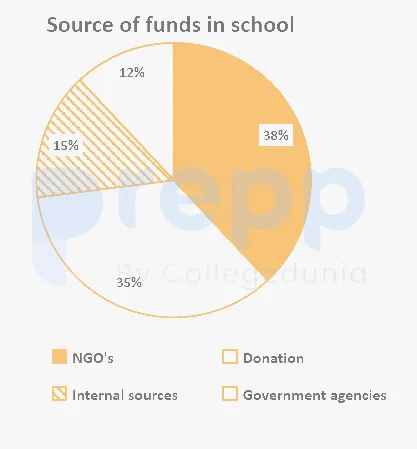
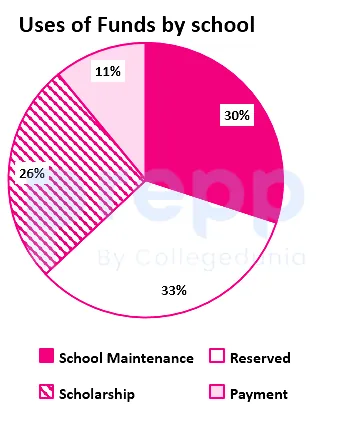
- A
2,30,000
- B
2,50,000
- C
2,80,000
- D
2,40,000
Show answer
A. 2,30,000Given:-
Funds from Donations = 35% of Rs. 10,00,000 (10 lacks)
Funds from Government Agencies = 12% of Rs. 10,00,000 (10 lakh)
Calculations:-
Funds from Donations = (35/100) × 10,00,000 = Rs. 3,50,000
Funds from Government Agencies = (12/100) × 10,00,000 = Rs. 1,20,000
Difference = Funds from Donations - Funds from Government Agencies Difference
⇒ Rs. 3,50,000 - Rs. 1,20,000 = Rs. 2,30,000
∴ The difference is Rs. 2,30,000.
Paper & answer key PDF ↗ Question 55archived
A and B can complete a piece of work in 12 days and 18 days, respectively. If they work at it alternatively, A beginning, in how many days will the work be finished?
- A
\(15\frac{2}{3}\)
- B
\(15\frac{1}{3}\)
- C
\(14\frac{2}{3}\)
- D
\(14\frac{1}{3}\)
Show answer
D. \(14\frac{1}{3}\)Solving Time and Work Problems with Alternating Workdays
This problem involves two individuals, A and B, working on a task on alternate days. To solve this, we first need to determine their individual work rates and then calculate the amount of work completed in one full cycle of their work (one day by A and one day by B). Finally, we'll figure out how many cycles are needed to complete the task and handle any remaining work.
Understanding Individual Work Rates
The work rate of a person is the amount of work they can complete in one day. It is the reciprocal of the number of days they take to complete the entire work alone.
A can complete the work in 12 days.
So, A's work rate per day is $\frac{1}{12}$ of the total work.
B can complete the work in 18 days.
So, B's work rate per day is $\frac{1}{18}$ of the total work.
Work Done in One Alternating Cycle
The individuals work on alternate days, with A starting first. A cycle consists of A working on day 1 and B working on day 2. So, one cycle takes 2 days.
In one cycle (2 days), the total work done is the sum of the work done by A on the first day and the work done by B on the second day:
Work done in 1 cycle = Work done by A on Day 1 + Work done by B on Day 2
Work done in 1 cycle = $\frac{1}{12} + \frac{1}{18}$
To add these fractions, we find a common denominator. The least common multiple (LCM) of 12 and 18 is 36.
$\frac{1}{12} = \frac{1 \times 3}{12 \times 3} = \frac{3}{36}$
$\frac{1}{18} = \frac{1 \times 2}{18 \times 2} = \frac{2}{36}$
Work done in 1 cycle = $\frac{3}{36} + \frac{2}{36} = \frac{5}{36}$ of the total work.
One cycle of 2 days completes $\frac{5}{36}$ of the work.
Calculating Number of Full Cycles
We need to find out how many full 2-day cycles are required to complete the work. Since each cycle completes $\frac{5}{36}$ of the work, we can see how many times $\frac{5}{36}$ fits into the total work (which is 1).
We look for the largest number of cycles such that the work done does not exceed the total work (1). If 1 cycle does $\frac{5}{36}$, then 'n' cycles do $n \times \frac{5}{36}$ work.
Let's test some numbers of cycles:
7 cycles: Work done = $7 \times \frac{5}{36} = \frac{35}{36}$. This is less than 1.
8 cycles: Work done = $8 \times \frac{5}{36} = \frac{40}{36}$. This is more than 1.
So, 7 full cycles can be completed.
Work completed after 7 cycles = $\frac{35}{36}$.
Time taken for 7 cycles = 7 cycles $\times$ 2 days/cycle = 14 days.
Work Remaining and Final Days
After 7 full cycles (14 days), the amount of work remaining is:
Remaining work = Total work - Work done in 7 cycles
Remaining work = $1 - \frac{35}{36} = \frac{36}{36} - \frac{35}{36} = \frac{1}{36}$.
Now, on the 15th day, it is A's turn to work (since A started and 14 days is an even number of days, completing 7 full cycles, leaving the turn with A to start the next cycle).
A's daily work rate is $\frac{1}{12}$.
A needs to complete $\frac{1}{36}$ of the work.
Time taken by A to complete the remaining work = $\frac{\text{Remaining work}}{\text{A's daily rate}}$
Time taken by A = $\frac{1/36}{1/12} = \frac{1}{36} \times \frac{12}{1} = \frac{12}{36} = \frac{1}{3}$ day.
Total Time Taken
The total time taken to finish the work is the sum of the time taken for the full cycles and the time taken for the remaining work.
Total Time = Time for 7 cycles + Time for remaining work
Total Time = 14 days + $\frac{1}{3}$ day
Total Time = $14\frac{1}{3}$ days.
The work will be finished in $14\frac{1}{3}$ days.
Revision Table: Key Concepts
Concept
Explanation
Formula/Calculation
Work Rate
Amount of work done per unit of time (usually per day).
Work Rate = $\frac{1}{\text{Time taken to complete work}}$
Alternating Work Cycle
A sequence of workdays where different individuals work in turn. The length of the cycle is the number of days before the sequence repeats.
In this case, 1 cycle = A's work (Day 1) + B's work (Day 2). Cycle duration = 2 days.
Work Done in a Cycle
Sum of work rates of individuals working in one full cycle.
Work per cycle = Sum of daily work rates for days in the cycle.
Remaining Work
The portion of the work left after completing full cycles.
Remaining Work = Total Work - Work done in full cycles.
Time for Remaining Work
Time taken by the next person in sequence to complete the remaining work based on their work rate.
Time = $\frac{\text{Remaining Work}}{\text{Work Rate of next person}}$
Additional Information: Time and Work Principles
Time and work problems are common in quantitative aptitude tests. Understanding a few core principles makes these problems easier to solve, especially complex ones involving multiple people, varying efficiencies, or alternating workdays.
Total Work is Constant: The total amount of work to be done is usually considered as 1 unit or a specific quantity (like LCM of days).
Efficiency and Time: Efficiency is inversely proportional to the time taken to complete work. A more efficient person takes less time.
Combining Work Rates: If people work together, their work rates add up. If they work alternatively or with breaks, you calculate work done per unit of time or per cycle.
LCM Method: A useful approach is to assume the total work is equal to the LCM of the individual times taken. This converts fractions into integers, simplifying calculations. For this problem, LCM(12, 18) = 36 units of work.
Using the LCM method:
A's efficiency = $\frac{36}{12} = 3$ units/day.
B's efficiency = $\frac{36}{18} = 2$ units/day.
In 1 cycle (2 days), work done = A's work + B's work = 3 + 2 = 5 units.
To complete 36 units, number of cycles = $\frac{36}{5}$. Since 36 is not perfectly divisible by 5, we find full cycles. $5 \times 7 = 35$.
7 cycles complete $7 \times 5 = 35$ units of work. Time for 7 cycles = $7 \times 2 = 14$ days.
Remaining work = $36 - 35 = 1$ unit.
Next turn is A's. A does 3 units/day.
Time for remaining 1 unit = $\frac{1 \text{ unit}}{3 \text{ units/day}} = \frac{1}{3}$ day.
Total time = 14 days + $\frac{1}{3}$ day = $14\frac{1}{3}$ days. This confirms the fractional method result.
Paper & answer key PDF ↗ Question 56archived
In a factory, a piece of work is completed by Raima in 15 days while Joe can finish it in 10 days. The factory manager has to complete the work as soon as possible and so he orders Joe and Raima to work together. How many days will they take to complete the work?
- A
5
- B
8
- C
7
- D
6
Show answer
D. 6The correct answer is 6.
Leaving or Joining Work: Problems can involve a person leaving or another person joining the work after a few days. You calculate the work done in the initial period and then find the remaining work. The time to complete the remaining work is calculated based on the work rate of the remaining people. Understanding the basic concept of work rate (work per unit time) is key to solving all these variations.
Paper & answer key PDF ↗ Question 57archived
A,B and C can do a work in 10 days, 15 days, and 20 days, respectively. They finished that work together and got Rs. 2,600 as wages. Find C's wage.
- A
Rs. 550
- B
Rs. 600
- C
Rs. 575
- D
Rs. 625
Show answer
B. Rs. 600Solving Work and Wages Problems: Finding Individual Share
This problem involves the concept of work and wages, where the wages earned by individuals working together are distributed based on the amount of work they contribute. In such cases, the wages are usually divided in the ratio of the work done by each person.
Since they work together for the same amount of time to finish the work, the work done by each person is proportional to their individual daily work rate (or efficiency). The faster a person works (i.e., the less time they take to finish the work alone), the more work they do in a given amount of time, and thus they earn a larger share of the wages.
Calculating Individual Daily Work Rates
First, let's determine the portion of work each person can complete in one day:
A can do the work in 10 days. So, A's daily work rate is $\frac{1}{10}$ of the total work.
B can do the work in 15 days. So, B's daily work rate is $\frac{1}{15}$ of the total work.
C can do the work in 20 days. So, C's daily work rate is $\frac{1}{20}$ of the total work.
Determining the Ratio of Work Done
Since A, B, and C work together until the work is finished, the total work done by each person is proportional to their daily work rate. The ratio of the work done by A, B, and C is the ratio of their daily work rates:
Ratio of work done by A : B : C = (A's daily work) : (B's daily work) : (C's daily work)
Ratio = $\frac{1}{10} : \frac{1}{15} : \frac{1}{20}$
To simplify this ratio, we find the Least Common Multiple (LCM) of the denominators (10, 15, and 20). The LCM of 10, 15, and 20 is 60.
Multiply each fraction in the ratio by the LCM (60):
For A: $\frac{1}{10} \times 60 = 6$
For B: $\frac{1}{15} \times 60 = 4$
For C: $\frac{1}{20} \times 60 = 3$
So, the simplified ratio of the work done by A : B : C is 6 : 4 : 3.
Calculating C's Share of Wages
The total wages received for the work is Rs. 2,600. This total amount is to be distributed among A, B, and C in the ratio of the work they have done, which is 6 : 4 : 3.
The sum of the ratio parts is $6 + 4 + 3 = 13$.
This means that the total wage of Rs. 2,600 is divided into 13 equal parts. C's share corresponds to 3 parts of this total.
C's wage = (C's ratio part / Total ratio parts) × Total wages
C's wage = $\frac{3}{13} \times 2600$
Now, we calculate the value:
C's wage = $3 \times \frac{2600}{13}$
C's wage = $3 \times 200$
C's wage = Rs. 600
Therefore, C's wage is Rs. 600.
Revision Table: Work and Wages Summary
Individual
Time to Complete Work (Days)
Daily Work Rate (Fraction of Work)
Ratio Part (based on LCM 60)
A
10
$\frac{1}{10}$
6
B
15
$\frac{1}{15}$
4
C
20
$\frac{1}{20}$
3
Total Ratio Parts
-
-
$\mathbf{13}$
Total Wages
-
-
$\mathbf{Rs.\ 2600}$
C's Wage Calculation
-
-
$\frac{3}{13} \times 2600 = 600$
Additional Information: Key Concepts in Work and Wages
Understanding work and wages problems involves a few key concepts:
Work Rate: This is the amount of work a person can do in a unit of time (like a day or an hour). If a person can complete a work in 'n' days, their daily work rate is $\frac{1}{n}$.
Combined Work Rate: If multiple people work together, their individual work rates are added up to find the combined work rate. If A's rate is $R_A$ and B's rate is $R_B$, their combined rate is $R_A + R_B$.
Time Taken Together: If the combined work rate of a group is $R_{combined}$, the time taken by the group to complete the entire work is $\frac{1}{R_{combined}}$.
Wage Distribution: When people work together for the same duration, wages are distributed in the ratio of their individual work rates. If they work for different durations, the wages are distributed in the ratio of (individual work rate × time worked).
In this problem, since A, B, and C worked together for the same amount of time to finish the task, the wage distribution was simply based on their daily work rate ratio.
Paper & answer key PDF ↗ Question 58archived
A seller professes to sell his fruits at cost price but still gains \(5\frac{5}{19}\)%. How much does he give for 1 kg?
- A
905 gm
- B
5 gm
- C
900 gm
- D
950 gm
Show answer
D. 950 gmUnderstanding False Weight Profit Problems
This problem deals with a dishonest seller who claims to sell goods at the cost price but uses a false weight to make a profit. The profit is earned because the seller charges the price of a larger quantity (like 1 kg) while actually selling a smaller quantity.
Let's assume the cost price (CP) of 1 kg (1000 gm) of fruits is \(C\). The seller professes to sell at this cost price.
However, the seller gives a smaller weight, let's say \(W\) grams, instead of 1000 grams.
The seller charges the price of 1000 gm, which is \(C\), for only \(W\) grams of fruits. So, the selling price (SP) of \(W\) grams is \(C\).
The actual cost price of \(W\) grams of fruits is \(C \times \frac{W}{1000}\).
The gain is the difference between the selling price and the actual cost price for the quantity sold:
Gain = SP of \(W\) gm - CP of \(W\) gm
Gain = \(C - C \times \frac{W}{1000} = C \left(1 - \frac{W}{1000}\right)\)
The gain percentage is calculated on the actual cost price of the quantity sold (which is \(W\) gm):
Gain% = \(\frac{\text{Gain}}{\text{CP of W gm}} \times 100\)
Gain% = \(\frac{C \left(1 - \frac{W}{1000}\right)}{C \times \frac{W}{1000}} \times 100\)
We can cancel \(C\) from the numerator and denominator:
Gain% = \(\frac{1 - \frac{W}{1000}}{\frac{W}{1000}} \times 100\)
Gain% = \(\frac{\frac{1000 - W}{1000}}{\frac{W}{1000}} \times 100\)
Gain% = \(\frac{1000 - W}{W} \times 100\)
Calculating the Given Gain Percentage
The problem states the seller gains \(5\frac{5}{19}\)%. Let's convert this mixed fraction percentage into an improper fraction:
\(5\frac{5}{19}\)% = \(\frac{5 \times 19 + 5}{19}\)% = \(\frac{95 + 5}{19}\)% = \(\frac{100}{19}\)%
Solving for the Weight Given
Now we set up the equation using the gain percentage formula and the given value:
\(\frac{1000 - W}{W} \times 100 = \frac{100}{19}\)
Divide both sides by 100:
\(\frac{1000 - W}{W} = \frac{1}{19}\)
Cross-multiply:
\(19 \times (1000 - W) = 1 \times W\)
\(19000 - 19W = W\)
Add \(19W\) to both sides:
\(19000 = W + 19W\)
\(19000 = 20W\)
Solve for \(W\):
\(W = \frac{19000}{20}\)
\(W = \frac{1900}{2}\)
\(W = 950\)
So, the seller gives 950 grams for 1 kg.
Verification and Conclusion
The calculation shows that the seller gives 950 gm while charging for 1000 gm. This matches one of the options provided.
The calculated weight is 950 gm.
Concept
Details
Claimed Sale Price
Cost price of 1000 gm
Actual Weight Sold
\(W\) gm
Actual Cost Price of Sold Weight
CP of \(W\) gm
Gain Source
Difference between price of 1000 gm and cost of \(W\) gm
Gain Percentage Calculation Base
Actual cost price of \(W\) gm
Revision Table: Key Concepts in False Weight Problems
Term
Explanation
False Weight
Using a weight less than what is indicated or charged for.
Gain % (False Weight)
\(\frac{\text{Error}}{\text{Actual Weight Used}} \times 100\)
Error
True Weight - Actual Weight Used (e.g., 1000 gm - W gm)
Selling at Cost Price Claim
Charging the buyer the cost price of the advertised weight (e.g., cost of 1000 gm).
Additional Information: Profit Calculation Variations
In profit and loss problems, the gain or loss percentage is usually calculated on the cost price. In false weight scenarios where the seller claims to sell at cost price, the gain comes purely from the difference in weight supplied versus weight charged for. The formula used above, \(\frac{\text{Error}}{\text{Actual Weight}} \times 100\), is a direct application of the gain percentage formula where the 'gain' is proportional to the 'error' in weight, and the base for percentage calculation is the 'actual weight' supplied (as this is the quantity whose cost is effectively recovered plus a profit).
If a seller claims to sell at a profit/loss percentage while using a false weight, the calculation becomes a bit more complex, combining both the declared profit/loss and the gain/loss from the weight difference.
Understanding the base on which the percentage is calculated (usually CP, but effectively the cost of the actual quantity sold in false weight cases at CP) is crucial for solving these problems.
Paper & answer key PDF ↗ Question 59archived
Suppose Δ PQR and Δ STU are congruent triangles under ASA. If ∠PQR = 60°, ∠PRQ = 30° and ∠STU = 60°, find ∠TSU.
- A
90°
- B
75°
- C
60°
- D
45°
Show answer
A. 90°Understanding Congruent Triangles Using the ASA Rule
The question involves two triangles, Δ PQR and Δ STU, which are stated to be congruent under the Angle-Side-Angle (ASA) criterion. The ASA congruence rule states that if two angles and the included side of one triangle are equal to two angles and the included side of another triangle, then the two triangles are congruent.
Specifically, if Δ PQR ≅ Δ STU by ASA, this implies a specific correspondence between their vertices and angles:
The first angle of Δ PQR corresponds to the first angle of Δ STU (e.g., ∠P = ∠S).
The side included between the first two angles corresponds (e.g., PQ = ST).
The second angle corresponds to the second angle (e.g., ∠Q = ∠T).
This correspondence means that all corresponding angles and sides of the two triangles are equal.
Calculating the Missing Angle in Δ PQR
We are given two angles within Δ PQR:
∠PQR = 60ˆ
∠PRQ = 30ˆ
The sum of the interior angles in any triangle is always 180ˆ. Therefore, we can find the measure of the third angle, ∠QPR, using the formula:
$$ \angle QPR + \angle PQR + \angle PRQ = 180^\circ $$
Substituting the known values:
$$ \angle QPR + 60^\circ + 30^\circ = 180^\circ $$
Combine the known angles:
$$ \angle QPR + 90^\circ = 180^\circ $$
To find ∠QPR, subtract 90ˆ from both sides:
$$ \angle QPR = 180^\circ - 90^\circ $$
$$ \angle QPR = 90^\circ $$
So, the measure of angle ∠QPR in Δ PQR is 90ˆ.
Finding ∠TSU Using Triangle Congruence
We are given that Δ PQR ≅ Δ STU under the ASA congruence rule. This congruence implies that corresponding angles are equal. Based on the order of the vertices (PQR corresponding to STU), we have the following angle correspondences:
∠P corresponds to ∠S (specifically, ∠QPR corresponds to ∠TSU)
∠Q corresponds to ∠T (specifically, ∠PQR corresponds to ∠STU)
∠R corresponds to ∠U (specifically, ∠PRQ corresponds to ∠SUT)
We are given that ∠STU = 60ˆ. This corresponds to ∠PQR, which is also 60ˆ. This confirms the correspondence for ∠Q and ∠T.
We need to find ∠TSU. According to the ASA congruence correspondence Δ PQR ≅ Δ STU, the angle ∠TSU in Δ STU corresponds to the angle ∠QPR in Δ PQR.
Since corresponding angles of congruent triangles are equal:
$$ \angle TSU = \angle QPR $$
We calculated earlier that ∠QPR = 90ˆ.
Therefore,
$$ \angle TSU = 90^\circ $$
The measure of angle ∠TSU is 90ˆ.
Paper & answer key PDF ↗ Question 60archived
Which of the following numbers is divisible by 9?
- A
78432
- B
29568
- C
83061
- D
47695
Show answer
C. 83061Understanding Divisibility by 9
The question asks us to identify which of the given numbers is divisible by 9. To answer this, we need to understand the divisibility rule for the number 9.
A key concept in number theory is divisibility rules, which help us quickly determine if a number can be evenly divided by another number without performing long division.
The Divisibility Rule for 9
The divisibility rule for 9 is quite simple and useful:
A number is divisible by 9 if and only if the sum of its digits is divisible by 9.
This rule is similar to the divisibility rule for 3. Let's apply this rule to each of the given options to check for divisibility by 9.
Checking Each Number for Divisibility by 9
We will calculate the sum of the digits for each number provided in the options and then check if that sum is divisible by 9.
Option 1: 78432
Sum of digits = $7 + 8 + 4 + 3 + 2$
Sum of digits = $15 + 4 + 3 + 2$
Sum of digits = $19 + 3 + 2$
Sum of digits = $22 + 2$
Sum of digits = $24$
Is 24 divisible by 9? No, because $24 \div 9$ leaves a remainder. Thus, 78432 is not divisible by 9.
Option 2: 29568
Sum of digits = $2 + 9 + 5 + 6 + 8$
Sum of digits = $11 + 5 + 6 + 8$
Sum of digits = $16 + 6 + 8$
Sum of digits = $22 + 8$
Sum of digits = $30$
Is 30 divisible by 9? No, because $30 \div 9$ leaves a remainder. Thus, 29568 is not divisible by 9.
Option 3: 83061
Sum of digits = $8 + 3 + 0 + 6 + 1$
Sum of digits = $11 + 0 + 6 + 1$
Sum of digits = $11 + 6 + 1$
Sum of digits = $17 + 1$
Sum of digits = $18$
Is 18 divisible by 9? Yes, because $18 \div 9 = 2$ with no remainder. Thus, 18 is divisible by 9.
Since the sum of the digits of 83061 (which is 18) is divisible by 9, the number 83061 itself is divisible by 9.
Option 4: 47695
Sum of digits = $4 + 7 + 6 + 9 + 5$
Sum of digits = $11 + 6 + 9 + 5$
Sum of digits = $17 + 9 + 5$
Sum of digits = $26 + 5$
Sum of digits = $31$
Is 31 divisible by 9? No, because $31 \div 9$ leaves a remainder. Thus, 47695 is not divisible by 9.
Summary of Divisibility Check by 9
Let's summarize our findings in a table:
Number
Sum of Digits
Is Sum Divisible by 9?
Is Number Divisible by 9?
78432
24
No
No
29568
30
No
No
83061
18
Yes ($18 \div 9 = 2$)
Yes
47695
31
No
No
Based on the divisibility rule for 9, only the number 83061 has a sum of digits (18) that is divisible by 9.
Revision Table: Divisibility Rules
Divisible by
Rule
Example
2
Ends in 0, 2, 4, 6, or 8
136 (ends in 6)
3
Sum of digits is divisible by 3
45 ($4+5=9$, $9 \div 3 = 3$)
4
Last two digits are divisible by 4 or are 00
716 (16 is divisible by 4)
5
Ends in 0 or 5
235 (ends in 5)
6
Divisible by both 2 and 3
108 (even, $1+0+8=9$, 9 is divisible by 3)
9
Sum of digits is divisible by 9
83061 ($8+3+0+6+1=18$, $18 \div 9 = 2$)
10
Ends in 0
560 (ends in 0)
Additional Information on Divisibility Tests
Divisibility tests are shortcuts used to check if a number is exactly divisible by another number without performing the full division. These rules are derived from the properties of numbers and place values.
The divisibility rule for 9 works because any number can be written in expanded form based on powers of 10 (e.g., $100a + 10b + c$). Since any power of 10 is one more than a multiple of 9 ($10 = 9+1$, $100 = 99+1$, $1000 = 999+1$, etc.), the number can be rewritten as a sum of multiples of 9 plus the sum of its digits.
For example, $83061 = 8 \times 10000 + 3 \times 1000 + 0 \times 100 + 6 \times 10 + 1 \times 1$.
We can write this as:
$8 \times (9999+1) + 3 \times (999+1) + 0 \times (99+1) + 6 \times (9+1) + 1$
$= 8 \times 9999 + 8 + 3 \times 999 + 3 + 0 \times 99 + 0 + 6 \times 9 + 6 + 1$
$= (8 \times 9999 + 3 \times 999 + 0 \times 99 + 6 \times 9) + (8 + 3 + 0 + 6 + 1)$
The first part is a sum of multiples of 9, so it is divisible by 9. Therefore, the divisibility of the entire number depends only on whether the second part (the sum of the digits) is divisible by 9.
This property makes the sum of digits rule a reliable test for divisibility by 9.
Paper & answer key PDF ↗ Question 61archived
If a : b :: b : c, and b = 96, then which of the following can be a possible pair of values of a and c?
- A
a = 24; c = 374
- B
a = 32; c = 288
- C
a = 48; c = 168
- D
a = 16; c = 586
Show answer
B. a = 32; c = 288Understanding Continued Proportion
The question deals with the concept of continued proportion. Three quantities, say a, b, and c, are said to be in continued proportion if the ratio of the first to the second is equal to the ratio of the second to the third. Mathematically, this is expressed as a : b :: b : c.
This proportion can be written as fractions:
\(\frac{a}{b} = \frac{b}{c}\)
By cross-multiplication, we get the relationship:
\(ac = b^2\)
In this relationship, 'b' is called the mean proportional between 'a' and 'c'.
Applying the Continued Proportion Formula
We are given that a, b, and c are in continued proportion, and the value of the mean proportional, b, is 96.
So, we have the relation:
\(ac = b^2\)
Substitute the given value of b = 96:
\(ac = 96^2\)
Let's calculate \(96^2\):
\(96^2 = 96 \times 96 = 9216\)
So, the condition for the pair (a, c) is that their product must be equal to 9216. We need to check the given options to find which pair of (a, c) satisfies the condition \(a \times c = 9216\).
Evaluating the Options
Let's test each option by multiplying the given values of 'a' and 'c'.
Option
Value of a
Value of c
Product \(a \times c\)
Check (\(a \times c = 9216\)? )
1
24
374
\(24 \times 374 = 8976\)
No
2
32
288
\(32 \times 288 = 9216\)
Yes
3
48
168
\(48 \times 168 = 8064\)
No
4
16
586
\(16 \times 586 = 9376\)
No
Conclusion
From the evaluation, only Option 2, where \(a = 32\) and \(c = 288\), satisfies the condition \(a \times c = 9216\). Therefore, the possible pair of values for a and c is 32 and 288.
In summary, for three quantities to be in continued proportion \(a : b :: b : c\), the square of the middle term (the mean proportional) must be equal to the product of the first and third terms (\(b^2 = ac\)). Given \(b = 96\), we required \(ac = 96^2 = 9216\), and the pair \(a = 32, c = 288\) is the only option where the product \(32 \times 288\) equals 9216.
Revision Table: Key Concepts
Concept
Description
Formula
Ratio
Comparison of two quantities by division.
\(a : b\) or \(\frac{a}{b}\)
Proportion
An equality between two ratios.
\(a : b :: c : d\) or \(\frac{a}{b} = \frac{c}{d}\)
Continued Proportion
Three quantities where the first is to the second as the second is to the third.
\(a : b :: b : c\)
Mean Proportional
The middle term in a continued proportion (b in a : b :: b : c).
\(b = \sqrt{ac}\) or \(b^2 = ac\)
Additional Information: Properties of Proportion
Understanding the properties of proportion can be helpful when solving such problems.
Product of Extremes and Means: In any proportion \(a : b :: c : d\), the product of the extremes (a and d) is equal to the product of the means (b and c). So, \(ad = bc\). In continued proportion \(a : b :: b : c\), the extremes are a and c, and the means are both b. Thus, \(ac = b \times b = b^2\).
Invertendo: If \(a : b = c : d\), then \(b : a = d : c\).
Alternendo: If \(a : b = c : d\), then \(a : c = b : d\).
Componendo: If \(a : b = c : d\), then \((a+b) : b = (c+d) : d\).
Dividendo: If \(a : b = c : d\), then \((a-b) : b = (c-d) : d\).
Componendo and Dividendo: If \(a : b = c : d\), then \((a+b) : (a-b) = (c+d) : (c-d)\).
These properties are derived from basic algebraic manipulation of the fractional form of proportion and are useful tools in solving more complex problems involving ratios and proportions, including continued proportion scenarios.
Paper & answer key PDF ↗ Question 62archived
Which of the following is a FALSE statement?
- A
Centroid of the triangle divides each median in the ratio of 2 ∶1
- B
Incentre is the point of concurrency of angle bisectors of a triangle.
- C
The circumcentre is the centre of a circle which circumscribes the triangle.
- D
The angle formed by any side at the incentre is always 90° more than the angle at the opposite vertex.
Show answer
D. The angle formed by any side at the incentre is always 90° more than the angle at the opposite vertex.Understanding Triangle Centers and Properties
This question asks us to identify the statement that is FALSE among the given options regarding important points within a triangle, specifically the centroid, incenter, and circumcenter. Let's examine each statement carefully.
Analyzing Statement 1: Centroid Property
Statement 1 says: Centroid of the triangle divides each median in the ratio of 2 ∶1.
The centroid is the point where the three medians of a triangle intersect. A median is a line segment from a vertex to the midpoint of the opposite side. A fundamental property of the centroid is that it divides each median in a specific ratio. The part of the median closer to the vertex is twice as long as the part closer to the midpoint of the side.
This statement accurately describes a key property of the centroid. Therefore, statement 1 is TRUE.
Analyzing Statement 2: Incenter Definition
Statement 2 says: Incentre is the point of concurrency of angle bisectors of a triangle.
The incenter is defined as the point where the three angle bisectors of a triangle intersect. An angle bisector divides a vertex angle into two equal angles. The incenter is also the center of the inscribed circle (incircle) of the triangle, which is tangent to all three sides.
This statement is the definition of the incenter. Therefore, statement 2 is TRUE.
Analyzing Statement 3: Circumcentre Property
Statement 3 says: The circumcentre is the centre of a circle which circumscribes the triangle.
The circumcenter is the point where the three perpendicular bisectors of the sides of a triangle intersect. The circumcenter is the center of the circumscribed circle (circumcircle), which is a circle that passes through all three vertices of the triangle. The distance from the circumcenter to each vertex is the same, which is the radius of the circumcircle.
This statement correctly describes the circumcenter's relationship with the circumscribed circle. Therefore, statement 3 is TRUE.
Analyzing Statement 4: Angle at Incenter
Statement 4 says: The angle formed by any side at the incentre is always 90° more than the angle at the opposite vertex.
Let's consider a triangle ABC, and let I be its incenter. We want to check the angle formed by a side, say BC, at the incenter ($\angle BIC$). The opposite vertex to side BC is A, and the angle at this vertex is $\angle BAC$ (or simply $\angle A$). The statement claims that $\angle BIC = 90^\circ + \angle A$.
In triangle BIC, the sum of angles is $180^\circ$. So, $\angle BIC + \angle IBC + \angle ICB = 180^\circ$.
Since I is the incenter, BI is the angle bisector of $\angle B$, and CI is the angle bisector of $\angle C$. Therefore, $\angle IBC = \frac{\angle B}{2}$ and $\angle ICB = \frac{\angle C}{2}$.
Substituting these into the angle sum equation for triangle BIC:
$\angle BIC + \frac{\angle B}{2} + \frac{\angle C}{2} = 180^\circ$
$\angle BIC = 180^\circ - \left(\frac{\angle B + \angle C}{2}\right)$
In triangle ABC, the sum of angles is $180^\circ$, so $\angle A + \angle B + \angle C = 180^\circ$. This means $\angle B + \angle C = 180^\circ - \angle A$.
Substitute this into the expression for $\angle BIC$:
$\angle BIC = 180^\circ - \left(\frac{180^\circ - \angle A}{2}\right)$
$\angle BIC = 180^\circ - \left(\frac{180^\circ}{2} - \frac{\angle A}{2}\right)$
$\angle BIC = 180^\circ - 90^\circ + \frac{\angle A}{2}$
$\angle BIC = 90^\circ + \frac{\angle A}{2}$
Our derivation shows that the angle formed by a side at the incenter is $90^\circ$ plus half the angle at the opposite vertex, i.e., $\angle BIC = 90^\circ + \frac{\angle A}{2}$.
The statement claims $\angle BIC = 90^\circ + \angle A$. This is different from the correct formula. Therefore, statement 4 is FALSE.
Conclusion: Identifying the False Statement
Based on our analysis:
Statement 1 is TRUE.
Statement 2 is TRUE.
Statement 3 is TRUE.
Statement 4 is FALSE.
The question asks for the FALSE statement. Therefore, the fourth statement is the correct answer.
Revision Table: Key Triangle Centers
Center
Point of Concurrency of
Key Property
Centroid
Medians
Divides each median in 2:1 ratio (vertex to side)
Incenter
Angle Bisectors
Center of inscribed circle; equidistant from sides
Circumcenter
Perpendicular Bisectors
Center of circumscribed circle; equidistant from vertices
Additional Information: Properties of Triangle Centers
Understanding triangle centers like the centroid, incenter, and circumcenter is crucial in geometry. Each center has unique properties and is the point of concurrency for specific lines within the triangle.
The Centroid is the center of mass of the triangle. It's always inside the triangle.
The Incenter is equidistant from all sides of the triangle. It's always inside the triangle.
The Circumcenter is equidistant from all vertices of the triangle. Its location depends on the type of triangle: inside for acute triangles, on the hypotenuse for right triangles, and outside for obtuse triangles.
There is also the orthocenter, which is the point of concurrency of the altitudes of a triangle.
The formula for the angle at the incenter opposite a vertex is a common property to remember: the angle formed by any side at the incenter is $90^\circ$ plus half the angle at the opposite vertex.
Paper & answer key PDF ↗ Question 63archived
7.5 × 17.2 ÷ 8.6 + (59.5) of \(\frac{1}{17} - \frac{7}{2}\) of 5 = ?
- A
1
- B
2
- C
4
- D
3
Show answer
A. 1Calculate the Value of the Expression
This problem involves simplifying a complex mathematical expression using the standard order of operations. We need to carefully evaluate each part of the expression, paying attention to brackets, multiplication, division, addition, and subtraction, including the "of" operator which means multiplication.
Understanding the Order of Operations (BODMAS)
To solve this correctly, we follow the BODMAS rule:
Brackets: Simplify expressions inside parentheses first.
Orders: Deal with powers and roots (not present here).
Division and Multiplication: Perform these operations from left to right. The "of" operator is also treated as multiplication and done at this stage.
Addition and Subtraction: Perform these operations from left to right.
The given expression is: $7.5 \times 17.2 \div 8.6 + (59.5) \text{ of } \frac{1}{17} - \frac{7}{2} \text{ of } 5$
Step-by-Step Calculation
Let's simplify the expression step by step:
Part 1: Simplify $7.5 \times 17.2 \div 8.6$
Perform the multiplication first (left to right):
$7.5 \times 17.2 = 129$
Now, perform the division:
$129 \div 8.6 = 15$
The result of the first part is $15$.
Part 2: Simplify $(59.5) \text{ of } \frac{1}{17} - \frac{7}{2} \text{ of } 5$
According to BODMAS, we handle the "of" (multiplication) operations before subtraction.
Calculate the first "of" term: $(59.5) \text{ of } \frac{1}{17}$
First, convert the decimal $59.5$ to a fraction: $59.5 = \frac{595}{10} = \frac{119}{2}$.
Now, multiply: $\frac{119}{2} \times \frac{1}{17}$.
Recognize that $119$ is $7 \times 17$. So, the expression becomes $\frac{7 \times 17}{2} \times \frac{1}{17}$.
Cancel out the $17$: $\frac{7}{2}$.
As a decimal, $\frac{7}{2} = 3.5$.
Calculate the second "of" term: $\frac{7}{2} \text{ of } 5$
This means multiplying $\frac{7}{2}$ by $5$:
$\frac{7}{2} \times 5 = \frac{35}{2}$.
As a decimal, $\frac{35}{2} = 17.5$.
Now, perform the subtraction between the results of the two "of" terms: $3.5 - 17.5$.
$3.5 - 17.5 = -14$.
The result of the second part is $-14$.
Part 3: Combine the results of Part 1 and Part 2
Finally, add the result from Part 1 and the result from Part 2:
Result of Part 1 = $15$
Result of Part 2 = $-14$
Combine: $15 + (-14) = 15 - 14 = 1$.
Final Answer
The simplification of the expression $7.5 \times 17.2 \div 8.6 + (59.5) \text{ of } \frac{1}{17} - \frac{7}{2} \text{ of } 5$ yields the final result $1$.
Paper & answer key PDF ↗ Question 64archived
A thief is chased by a policeman and distance between them is 3 km. The speed of policeman is 75 km/h and the speed of the thief is 60 km/h. The policeman will be able to catch the thief when the thief would have covered the distance of ____________ km.
- A
18
- B
12
- C
15
- D
10
Show answer
B. 12Solving the Policeman and Thief Chase Problem
This problem is a classic example of a relative speed scenario where two objects are moving in the same direction. To find out when and where the policeman catches the thief, we need to consider their relative speed.
Understanding Relative Speed
When two objects move in the same direction, their relative speed is the difference between their individual speeds. This relative speed tells us how quickly the distance between them is increasing or decreasing.
If the faster object is behind the slower object (like the policeman chasing the thief), the distance between them decreases at the rate of their relative speed.
If the slower object is behind the faster object, the distance between them increases at the rate of their relative speed.
Calculating Relative Speed
In this case, the policeman is chasing the thief, and the policeman's speed is greater than the thief's speed. The distance between them reduces because of this difference in speed.
Given:
Policeman's speed \(S_p = 75\) km/h
Thief's speed \(S_t = 60\) km/h
The relative speed (\(S_{rel}\)) of the policeman with respect to the thief is:
\[ S_{rel} = S_p - S_t \]
\[ S_{rel} = 75 \text{ km/h} - 60 \text{ km/h} \]
\[ S_{rel} = 15 \text{ km/h} \]
This means the distance between the policeman and the thief decreases by 15 km every hour.
Calculating Time to Catch the Thief
The initial distance between the policeman and the thief is given as 3 km. The policeman needs to cover this initial distance at the relative speed to catch the thief.
Initial distance \(D = 3\) km
Relative speed \(S_{rel} = 15\) km/h
The time taken (\(T\)) to cover this distance is given by:
\[ T = \frac{D}{S_{rel}} \]
\[ T = \frac{3 \text{ km}}{15 \text{ km/h}} \]
\[ T = \frac{1}{5} \text{ hours} \]
To convert this to minutes, multiply by 60:
\[ T = \frac{1}{5} \times 60 \text{ minutes} = 12 \text{ minutes} \]
So, the policeman will catch the thief in 1/5 of an hour (or 12 minutes).
Calculating the Distance Covered by the Thief
The question asks for the distance the thief would have covered when the policeman catches him. The thief runs for the same amount of time that it takes the policeman to catch him, which is \(T = \frac{1}{5}\) hours. The thief's speed is \(S_t = 60\) km/h.
The distance covered by the thief (\(D_t\)) is:
\[ D_t = S_t \times T \]
\[ D_t = 60 \text{ km/h} \times \frac{1}{5} \text{ hours} \]
\[ D_t = \frac{60}{5} \text{ km} \]
\[ D_t = 12 \text{ km} \]
Therefore, the thief would have covered a distance of 12 km when the policeman catches him.
Summary of Calculation Steps
1. Calculate Relative Speed
\(S_{rel} = S_p - S_t = 75 - 60 = 15\) km/h
2. Calculate Time to Catch
\(T = \frac{\text{Initial Distance}}{S_{rel}} = \frac{3}{15} = \frac{1}{5}\) hours
3. Calculate Distance by Thief
\(D_t = S_t \times T = 60 \times \frac{1}{5} = 12\) km
The final answer is 12 km.
Revision Table: Key Concepts in Time and Distance
Concept
Formula
Description
Speed
\(S = \frac{D}{T}\)
Distance covered per unit of time.
Distance
\(D = S \times T\)
The total length covered by a moving object.
Time
\(T = \frac{D}{S}\)
Duration taken to cover a distance.
Relative Speed (Same Direction)
\(S_{rel} = |S_1 - S_2|\)
The difference in speeds when objects move in the same direction. Useful for chase problems.
Relative Speed (Opposite Direction)
\(S_{rel} = S_1 + S_2\)
The sum of speeds when objects move towards or away from each other.
Additional Information: Relative Motion Problems
Relative motion problems often involve finding the time or distance when the gap between two moving objects closes or opens. The key is to identify whether the objects are moving towards each other (speeds add) or in the same direction (speeds subtract). Once the relative speed is found, the problem simplifies to a basic distance, speed, and time relationship.
Always ensure that the units for distance, speed, and time are consistent (e.g., km, km/h, hours).
Identify the initial distance between the objects.
Determine the relative speed based on their directions of movement.
Use the relative speed and initial distance to find the time when they meet or the distance between them changes by a certain amount.
Finally, use this time to find the distance covered by either object.
These types of questions are common in various competitive exams to test understanding of basic kinematics.
Paper & answer key PDF ↗ Question 65archived
The average weight of 15 persons is increased by 1.2 kg when one of them whose weight is 51 kg is replaced by a new man. The weight of the new man is:
- A
69 kg
- B
70 kg
- C
65 kg
- D
59 kg
Show answer
A. 69 kgThis problem involves calculating the weight of a new person who replaces someone in a group, causing a change in the average weight of the group.
Understanding the Average Weight Concept
The average weight of a group of people is calculated by dividing the total weight of all individuals by the number of individuals in the group.
Average Weight $= \frac{\text{Total Weight}}{\text{Number of Persons}}$
If the average weight increases when one person is replaced by another, it means the weight of the new person is greater than the weight of the person who left. The increase in the total weight of the group is distributed among all members, causing the average to rise.
Analyzing the Given Information
Initial number of persons: 15
Weight of the person who left: 51 kg
Increase in average weight: 1.2 kg
We need to find the weight of the new man.
Calculating the Total Change in Weight
The increase in average weight is due to the difference between the new person's weight and the old person's weight. This difference adds to the total weight of the group. Since this increased total weight is then divided among all 15 persons to get the new average, the total increase in weight is the increase per person multiplied by the number of persons.
Increase in Total Weight = Increase in Average Weight $\times$ Number of Persons
Increase in Total Weight $= 1.2 \text{ kg/person} \times 15 \text{ persons}$
Increase in Total Weight $= 18 \text{ kg}$
Determining the Weight of the New Man
The increase in the total weight (18 kg) is the exact difference between the weight of the new man and the weight of the man who left.
Increase in Total Weight = Weight of New Man - Weight of Old Man
So, Weight of New Man = Weight of Old Man + Increase in Total Weight
Weight of New Man $= 51 \text{ kg} + 18 \text{ kg}$
Weight of New Man $= 69 \text{ kg}$
Therefore, the weight of the new man is 69 kg.
Verification
Let's assume the initial average weight was $A$ kg. The initial total weight was $15 \times A$.
When the 51 kg person leaves and the new man (let's call his weight $W$) joins, the new total weight is $15A - 51 + W$.
The new average weight is $(15A - 51 + W) / 15$.
We are told the new average is $A + 1.2$.
So, $\frac{15A - 51 + W}{15} = A + 1.2$
$15A - 51 + W = 15(A + 1.2)$
$15A - 51 + W = 15A + 15 \times 1.2$
$15A - 51 + W = 15A + 18$
Subtract $15A$ from both sides:
$-51 + W = 18$
$W = 18 + 51$
$W = 69$
This confirms our calculated weight of 69 kg for the new man.
Revision Table: Average Weight Concepts
Concept
Formula/Explanation
Average
Sum of values / Number of values
Total Sum
Average $\times$ Number of values
Change in Average
Change in Total Sum / Number of values
Change in Total Sum (Replacement)
Weight of New Person - Weight of Old Person
Additional Information: Solving Replacement Problems
Replacement problems in averages are common. The key is to understand that the change in the total sum is directly related to the difference between the value of the item or person leaving and the value of the item or person joining. This change in total sum is then distributed among all items/persons to affect the average.
If the average increases, the new item/person has a higher value than the one replaced.
If the average decreases, the new item/person has a lower value than the one replaced.
The total change in sum is equal to the change in average multiplied by the total number of items/persons (which remains constant in a simple replacement).
Using the formula: Weight of New Person = Weight of Old Person + (Change in Average $\times$ Number of Persons) is a quick way to solve such problems.
If the average had decreased, the formula would be: Weight of New Person = Weight of Old Person - (Decrease in Average $\times$ Number of Persons).
Paper & answer key PDF ↗ Question 66archived
The following expression is equal to.
cot 85°+ cos 75°
- A
tan 85°+ sin 75°
- B
tan 5°+ sin 15°
- C
tan 85°- sin 75°
- D
tan 5°- sin 15°
Show answer
B. tan 5°+ sin 15°Simplifying Trigonometric Expressions
The problem asks us to find an equivalent expression for $\cot 85^\circ + \cos 75^\circ$ from the given options. To solve this, we can use trigonometric identities, specifically the complementary angle identities.
Understanding Complementary Angle Identities
Complementary angles are two angles that add up to $90^\circ$. Trigonometric functions of complementary angles have specific relationships:
$\sin \theta = \cos (90^\circ - \theta)$
$\cos \theta = \sin (90^\circ - \theta)$
$\tan \theta = \cot (90^\circ - \theta)$
$\cot \theta = \tan (90^\circ - \theta)$
$\sec \theta = \csc (90^\circ - \theta)$
$\csc \theta = \sec (90^\circ - \theta)$
We will apply these identities to the terms in the given expression $\cot 85^\circ + \cos 75^\circ$.
Applying Identities to the Expression
Let's take each term separately:
Term 1: $\cot 85^\circ$
We can use the identity $\cot \theta = \tan (90^\circ - \theta)$. Here, $\theta = 85^\circ$.
So, $\cot 85^\circ = \tan (90^\circ - 85^\circ) = \tan 5^\circ$.
Term 2: $\cos 75^\circ$
We can use the identity $\cos \theta = \sin (90^\circ - \theta)$. Here, $\theta = 75^\circ$.
So, $\cos 75^\circ = \sin (90^\circ - 75^\circ) = \sin 15^\circ$.
Combining the Simplified Terms
Now, substitute the simplified terms back into the original expression:
$\cot 85^\circ + \cos 75^\circ = (\tan 5^\circ) + (\sin 15^\circ)$
Thus, the expression simplifies to $\tan 5^\circ + \sin 15^\circ$.
Comparing with Options
Let's compare our simplified expression with the given options:
Option 1: $\tan 85^\circ + \sin 75^\circ$ (Does not match)
Option 2: $\tan 5^\circ + \sin 15^\circ$ (Matches our result)
Option 3: $\tan 85^\circ - \sin 75^\circ$ (Does not match)
Option 4: $\tan 5^\circ - \sin 15^\circ$ (Does not match)
The expression $\cot 85^\circ + \cos 75^\circ$ is equal to $\tan 5^\circ + \sin 15^\circ$.
Conclusion
By applying the complementary angle identities, we transformed the given expression into an equivalent form that matches one of the options.
Original Term
Identity Used
Simplified Term
$\cot 85^\circ$
$\cot \theta = \tan (90^\circ - \theta)$
$\tan 5^\circ$
$\cos 75^\circ$
$\cos \theta = \sin (90^\circ - \theta)$
$\sin 15^\circ$
Therefore, $\cot 85^\circ + \cos 75^\circ = \tan 5^\circ + \sin 15^\circ$.
Revision Table: Trigonometric Identities
Identity Type
Examples
Reciprocal Identities
$\sin \theta = \frac{1}{\csc \theta}$, $\cos \theta = \frac{1}{\sec \theta}$, $\tan \theta = \frac{1}{\cot \theta}$
Quotient Identities
$\tan \theta = \frac{\sin \theta}{\cos \theta}$, $\cot \theta = \frac{\cos \theta}{\sin \theta}$
Pythagorean Identities
$\sin^2 \theta + \cos^2 \theta = 1$, $1 + \tan^2 \theta = \sec^2 \theta$, $1 + \cot^2 \theta = \csc^2 \theta$
Complementary Angle Identities
$\sin (90^\circ - \theta) = \cos \theta$, $\cos (90^\circ - \theta) = \sin \theta$, $\tan (90^\circ - \theta) = \cot \theta$
Additional Information: Working with Trigonometric Functions
Working with trigonometric functions often requires recognizing which identities are useful in simplifying expressions or solving equations. Complementary angle identities are particularly helpful when dealing with angles close to $90^\circ$. For instance, $85^\circ$ is close to $90^\circ$, and its complement is $5^\circ$. Similarly, $75^\circ$ has a complement of $15^\circ$. Using these identities allows us to relate trigonometric functions of larger angles (less than 90) to those of smaller, often more familiar, angles.
Remembering these identities and practicing their application will significantly improve your ability to solve problems involving trigonometric expressions.
Paper & answer key PDF ↗ Question 67archived
If x + y + z = 4 and x2 + y2 + z2 = 12, then find xy + yz + xz.
- A
4
- B
6
- C
7
- D
2
Show answer
D. 2Solving Algebra Equations: Finding xy + yz + xz
We are given two equations relating the variables x, y, and z:
Equation 1: \(x + y + z = 4\)
Equation 2: \(x^2 + y^2 + z^2 = 12\)
Our goal is to find the value of the expression \(xy + yz + xz\).
Using the Algebraic Identity
To solve this problem, we can use a fundamental algebraic identity that connects the sum of the variables, the sum of their squares, and the sum of the products of pairs of variables. The identity is:
\[ (a + b + c)^2 = a^2 + b^2 + c^2 + 2(ab + bc + ca) \]
In our case, we can replace a, b, and c with x, y, and z respectively. So the identity becomes:
\[ (x + y + z)^2 = x^2 + y^2 + z^2 + 2(xy + yz + xz) \]
Substituting the Given Values
Now, we can substitute the values given in Equation 1 and Equation 2 into this identity.
We know \(x + y + z = 4\). So, \((x + y + z)^2 = 4^2\).
We know \(x^2 + y^2 + z^2 = 12\).
Substituting these into the identity:
\[ (4)^2 = 12 + 2(xy + yz + xz) \]
Calculating xy + yz + xz
Let's simplify the equation and solve for \(xy + yz + xz\).
\[ 16 = 12 + 2(xy + yz + xz) \]
Now, subtract 12 from both sides of the equation:
\[ 16 - 12 = 2(xy + yz + xz) \]
\[ 4 = 2(xy + yz + xz) \]
Finally, divide both sides by 2 to find the value of \(xy + yz + xz\):
\[ \frac{4}{2} = xy + yz + xz \]
\[ 2 = xy + yz + xz \]
Final Answer for xy + yz + xz
The value of \(xy + yz + xz\) is 2.
Given Information
Identity Used
Calculation Steps
Result
\(x + y + z = 4\)
\((x + y + z)^2 = x^2 + y^2 + z^2 + 2(xy + yz + xz)\)
Substitute values: \(4^2 = 12 + 2(xy + yz + xz)\)
\(xy + yz + xz = 2\)
\(x^2 + y^2 + z^2 = 12\)
Simplify: \(16 = 12 + 2(xy + yz + xz)\)
Find \(xy + yz + xz\)
Solve for \(xy + yz + xz\): \(4 = 2(xy + yz + xz)\) → \(2 = xy + yz + xz\)
Revision Table: Key Concepts for Algebra Problems
Concept
Description
Relevance to this Problem
Algebraic Identities
Equations that are true for all values of the variables involved.
The identity \((x+y+z)^2 = x^2+y^2+z^2+2(xy+yz+xz)\) is crucial.
Substitution
Replacing a variable or expression with its known value.
Substituting the given values of \((x+y+z)\) and \((x^2+y^2+z^2)\) into the identity.
Solving Linear Equations
Isolating the unknown variable using inverse operations.
Solving the resulting equation \(16 = 12 + 2(xy + yz + xz)\) for \(xy + yz + xz\).
Additional Information: Related Algebraic Identities
Understanding algebraic identities is key to solving many problems involving sums, differences, and products of variables. Here are a few other common identities you might encounter:
\((a+b)^2 = a^2 + 2ab + b^2\)
\((a-b)^2 = a^2 - 2ab + b^2\)
\((a+b)(a-b) = a^2 - b^2\)
\((a+b)^3 = a^3 + 3a^2b + 3ab^2 + b^3\)
\(a^3 + b^3 = (a+b)(a^2 - ab + b^2)\)
\(a^3 - b^3 = (a-b)(a^2 + ab + b^2)\)
\((x+y+z)^3 = x^3 + y^3 + z^3 + 3(x+y)(y+z)(z+x)\) (a more complex one)
Recognizing which identity to use based on the structure of the given equations is an important skill in algebra.
Paper & answer key PDF ↗ Question 68archived
If \((5y + \frac{5}{y}) = 11\), find the value of \((y^2 + \frac{1}{y^2})\).
- A
\(2\frac{21}{25}\)
- B
\(1\frac{21}{25}\)
- C
\(3\frac{21}{25}\)
- D
\(4\frac{21}{25}\)
Show answer
A. \(2\frac{21}{25}\)Solving for \(y^2 + \frac{1}{y^2}\) from \(5y + \frac{5}{y} = 11\)
The question provides an equation \(5y + \frac{5}{y} = 11\) and asks us to find the value of \(y^2 + \frac{1}{y^2}\).
We can solve this problem by first simplifying the given equation and then using an algebraic identity to find the required value.
Step-by-Step Solution for Finding \(y^2 + \frac{1}{y^2}\)
Simplify the given equation:
The given equation is \(5y + \frac{5}{y} = 11\). Notice that we can factor out 5 from the left side of the equation:
\(5(y + \frac{1}{y}) = 11\)
Now, divide both sides by 5 to isolate the term \((y + \frac{1}{y})\):
\(y + \frac{1}{y} = \frac{11}{5}\)
Relate \((y + \frac{1}{y})\) to \((y^2 + \frac{1}{y^2})\):
We know the algebraic identity \((a+b)^2 = a^2 + 2ab + b^2\). If we let \(a = y\) and \(b = \frac{1}{y}\), then:
\((y + \frac{1}{y})^2 = y^2 + 2(y)(\frac{1}{y}) + (\frac{1}{y})^2\)
\((y + \frac{1}{y})^2 = y^2 + 2 + \frac{1}{y^2}\)
We can rearrange this to find \(y^2 + \frac{1}{y^2}\):
\(y^2 + \frac{1}{y^2} = (y + \frac{1}{y})^2 - 2\)
Substitute the value of \((y + \frac{1}{y})\):
From Step 1, we found that \(y + \frac{1}{y} = \frac{11}{5}\). Substitute this value into the rearranged identity from Step 2:
\(y^2 + \frac{1}{y^2} = (\frac{11}{5})^2 - 2\)
Calculate the square and perform the subtraction:
First, calculate \((\frac{11}{5})^2\):
\((\frac{11}{5})^2 = \frac{11^2}{5^2} = \frac{121}{25}\)
Now substitute this back into the equation:
\(y^2 + \frac{1}{y^2} = \frac{121}{25} - 2\)
To subtract 2, convert it to a fraction with a denominator of 25:
\(2 = 2 \times \frac{25}{25} = \frac{50}{25}\)
Now subtract the fractions:
\(y^2 + \frac{1}{y^2} = \frac{121}{25} - \frac{50}{25} = \frac{121 - 50}{25} = \frac{71}{25}\)
Convert the improper fraction to a mixed number:
The value is \(\frac{71}{25}\). To convert this to a mixed number, divide 71 by 25.
\(71 \div 25 = 2\) with a remainder of \(71 - (2 \times 25) = 71 - 50 = 21\).
So, \(\frac{71}{25} = 2 \frac{21}{25}\).
Thus, the value of \(y^2 + \frac{1}{y^2}\) is \(2 \frac{21}{25}\).
Verification of the Value
We found \(y^2 + \frac{1}{y^2} = \frac{71}{25}\). Let's quickly check the steps.
Given: \(5y + \frac{5}{y} = 11\)
Implies: \(5(y + \frac{1}{y}) = 11 \implies y + \frac{1}{y} = \frac{11}{5}\)
Squaring: \((y + \frac{1}{y})^2 = (\frac{11}{5})^2 \implies y^2 + 2 + \frac{1}{y^2} = \frac{121}{25}\)
Solving for \(y^2 + \frac{1}{y^2}\): \(y^2 + \frac{1}{y^2} = \frac{121}{25} - 2 = \frac{121}{25} - \frac{50}{25} = \frac{71}{25}\)
Converting to mixed number: \(\frac{71}{25} = 2 \frac{21}{25}\).
The steps are consistent, and the result matches one of the given options.
Summary of Calculation
Step
Operation
Result
1
Factor 5 from \(5y + \frac{5}{y}\)
\(5(y + \frac{1}{y})\)
2
Solve for \(y + \frac{1}{y}\)
\(y + \frac{1}{y} = \frac{11}{5}\)
3
Square \(y + \frac{1}{y}\)
\((y + \frac{1}{y})^2 = (\frac{11}{5})^2 = \frac{121}{25}\)
4
Use identity \((y + \frac{1}{y})^2 = y^2 + \frac{1}{y^2} + 2\)
\(y^2 + \frac{1}{y^2} + 2 = \frac{121}{25}\)
5
Solve for \(y^2 + \frac{1}{y^2}\)
\(y^2 + \frac{1}{y^2} = \frac{121}{25} - 2 = \frac{71}{25}\)
6
Convert to mixed number
\(2 \frac{21}{25}\)
Revision Table for Algebraic Identities
Understanding basic algebraic identities is crucial for solving problems like this. Here are some key identities:
Identity
Formula
Example/Use Case
Square of a sum
\((a+b)^2 = a^2 + 2ab + b^2\)
Used in this problem: \((y + \frac{1}{y})^2 = y^2 + 2(y)(\frac{1}{y}) + (\frac{1}{y})^2 = y^2 + 2 + \frac{1}{y^2}\)
Square of a difference
\((a-b)^2 = a^2 - 2ab + b^2\)
Useful if the given equation was \(y - \frac{1}{y}\). \((y - \frac{1}{y})^2 = y^2 - 2 + \frac{1}{y^2}\)
Difference of squares
\(a^2 - b^2 = (a-b)(a+b)\)
Factoring expressions like \(x^2 - 9\) into \((x-3)(x+3)\).
Additional Information on Solving Equations
When solving equations and manipulating algebraic expressions, remember these tips:
Always perform the same operation on both sides of an equation to maintain equality.
Factoring can simplify expressions and make them easier to work with.
Recognizing algebraic identities helps to quickly expand or factor expressions.
Be careful with signs when squaring negative numbers or subtracting terms.
When working with fractions, find a common denominator for addition or subtraction.
Converting between improper fractions and mixed numbers is often required for final answers in certain formats.
This problem demonstrates a common technique where a term involving \(y + \frac{1}{y}\) or \(y - \frac{1}{y}\) is given, and you need to find \(y^2 + \frac{1}{y^2}\). Squaring the given term is the key step.
Paper & answer key PDF ↗ Question 69archived
\(\rm \frac{2\tan A}{1 + \tan^2A} = ?\)
- A
cos 2A
- B
sin A
- C
cos A
- D
sin 2A
Show answer
D. sin 2AThis solution explains how to simplify the given trigonometric expression using fundamental trigonometric identities.
Simplifying the Trigonometric Expression \( \rm \frac{2\tan A}{1 + \tan^2A} \)
We are asked to find the equivalent form of the expression \( \rm \frac{2\tan A}{1 + \tan^2A} \). This involves utilizing standard trigonometric identities.
Key Trigonometric Identities
To solve this, we need to recall the following important trigonometric identities:
The Pythagorean identity involving tangent and secant: \( \rm 1 + \tan^2 A = \sec^2 A \)
The definition of tangent in terms of sine and cosine: \( \rm \tan A = \frac{\sin A}{\cos A} \)
The definition of secant in terms of cosine: \( \rm \sec A = \frac{1}{\cos A} \)
The double angle identity for sine: \( \rm \sin 2A = 2 \sin A \cos A \)
Step-by-Step Derivation
Let's derive the solution step-by-step:
Start with the given expression:
$$ \rm \frac{2\tan A}{1 + \tan^2A} $$
Apply the Pythagorean identity \( \rm 1 + \tan^2 A = \sec^2 A \):
Replace the denominator \( \rm 1 + \tan^2 A \) with \( \rm \sec^2 A \).
$$ \rm = \frac{2\tan A}{\sec^2 A} $$
Express \( \rm \tan A \) and \( \rm \sec^2 A \) in terms of \( \rm \sin A \) and \( \rm \cos A \):
We know that \( \rm \tan A = \frac{\sin A}{\cos A} \) and \( \rm \sec A = \frac{1}{\cos A} \), so \( \rm \sec^2 A = \frac{1}{\cos^2 A} \).
Substitute these into the expression:
$$ \rm = \frac{2 \left( \frac{\sin A}{\cos A} \right)}{\frac{1}{\cos^2 A}} $$
Simplify the complex fraction:
To divide by a fraction, we multiply by its reciprocal.
$$ \rm = 2 \left( \frac{\sin A}{\cos A} \right) \times \cos^2 A $$
Cancel out common terms:
One \( \rm \cos A \) in the denominator cancels out with one \( \rm \cos A \) in \( \rm \cos^2 A \).
$$ \rm = 2 \sin A \cos A $$
Apply the double angle identity for sine:
Recognize that \( \rm 2 \sin A \cos A \) is the identity for \( \rm \sin 2A \).
$$ \rm = \sin 2A $$
Conclusion
By applying fundamental trigonometric identities, we find that the expression \( \rm \frac{2\tan A}{1 + \tan^2A} \) simplifies to \( \rm \sin 2A \).
Paper & answer key PDF ↗ Question 70archived
Find the value of sin (50 + θ) - cos (40 - θ).
- A
\(\frac{1}{2}\)
- B
1
- C
0
- D
1
Show answer
C. 0Used formulas:
sin(90- θ) = cos θ
cos(90-θ) = sin θ
Calculation:
sin (50° +θ) - cos (40° - θ)
= sin( 90 - (40 -θ)) - cos(40 - θ)
= cos(40 -θ) - cos(40- θ)
= 0
∴ The correct answer is 0.
Paper & answer key PDF ↗ Question 71archived
Two successive increments of 30% each is by what percentage more than two successive decrements of 30% each? (Correct to two decimal places)
- A
32.54%
- B
28.15%
- C
25.25%
- D
35.29%
Show answer
D. 35.29%Understanding Successive Percentage Changes
This question asks us to compare the overall effect of two successive 30% increments with the overall effect of two successive 30% decrements. We need to determine the net percentage change in both scenarios and then find the percentage difference between these net changes.
Let's assume an initial value, say $$P$$, for simplicity. We can also use 100, which often makes calculations easier when dealing with percentages.
Calculating Net Effect of Successive Increments
When a value is increased successively by percentages, we multiply the original value by the corresponding factors.
Let the initial value be $$P$$.
After the first 30% increment, the value becomes:
$P \times (1 + 0.30) = 1.30P$
After the second 30% increment on the new value, it becomes:
$(1.30P) \times (1 + 0.30) = 1.30P \times 1.30 = 1.69P$
The final value after two successive 30% increments is $$1.69P$$.
The net change is $$1.69P - P = 0.69P$$.
The net percentage change (increase) is:
$$(0.69P / P) \times 100\% = 0.69 \times 100\% = 69\%$$
So, two successive 30% increments result in a net increase of 69%.
Calculating Net Effect of Successive Decrements
When a value is decreased successively by percentages, we multiply the original value by the corresponding factors (1 - percentage/100).
Let the initial value be $$P$$.
After the first 30% decrement, the value becomes:
$P \times (1 - 0.30) = 0.70P$
After the second 30% decrement on the new value, it becomes:
$(0.70P) \times (1 - 0.30) = 0.70P \times 0.70 = 0.49P$
The final value after two successive 30% decrements is $$0.49P$$.
The net change is $$0.49P - P = -0.51P$$.
The net percentage change (decrease) is:
$$(-0.51P / P) \times 100\% = -0.51 \times 100\% = -51\%$$
So, two successive 30% decrements result in a net decrease of 51%. The magnitude of this decrease is 51%.
Comparing the Net Percentage Changes
We found that:
Two successive 30% increments give a net increase of 69%.
Two successive 30% decrements give a net decrease of 51%.
The question asks: "Two successive increments of 30% each is by what percentage more than two successive decrements of 30% each?". This implies we should compare the magnitude of the net increase (69%) with the magnitude of the net decrease (51%).
We need to find the percentage by which 69% is more than 51%. The formula for "A is by what percentage more than B" is $$((A - B) / B) \times 100\%$$.
Here, $$A = 69\%$$ and $$B = 51\%$$.
Percentage more = $$((69 - 51) / 51) \times 100\%$$
Percentage more = $$(18 / 51) \times 100\%$$
Percentage more = $$(1800 / 51)\%$$
Let's calculate the value:
$$1800 \div 51 \approx 35.2941$$
Rounding to two decimal places, we get 35.29%.
Summary of Calculations
Change Type
Calculation (Starting with P)
Final Value
Net Percentage Change
Two 30% Increments
$P \times 1.30 \times 1.30$
$1.69P$
$(1.69P - P)/P \times 100\% = 69\%$ (Increase)
Two 30% Decrements
$P \times 0.70 \times 0.70$
$0.49P$
$(0.49P - P)/P \times 100\% = -51\%$ (Decrease)
Comparing the net percentage increase (69%) and the magnitude of the net percentage decrease (51%):
Percentage more = $$((69 - 51) / 51) \times 100\% = (18/51) \times 100\% \approx 35.29\%$$
Conclusion
The percentage by which two successive increments of 30% each is more than two successive decrements of 30% each is approximately 35.29%.
Revision Table: Successive Percentage Changes
Type of Change
Single Change Formula
Two Successive Changes Formula
Example (r = 30% = 0.3)
Increment (rate = r)
Value $$\times (1 + r)$$
Value $$\times (1 + r_1) \times (1 + r_2)$$
Initial $$\times (1+0.3) \times (1+0.3) = \text{Initial} \times 1.69$$ (69% increase)
Decrement (rate = r)
Value $$\times (1 - r)$$
Value $$\times (1 - r_1) \times (1 - r_2)$$
Initial $$\times (1-0.3) \times (1-0.3) = \text{Initial} \times 0.49$$ (51% decrease)
Mixed Change (r1 increment, r2 decrement)
N/A
Value $$\times (1 + r_1) \times (1 - r_2)$$
Initial $$\times (1+0.3) \times (1-0.3) = \text{Initial} \times 1.3 \times 0.7 = \text{Initial} \times 0.91$$ (9% decrease)
Additional Information: Compound Percentage Effect
Successive percentage changes are often referred to as compound percentage changes. The final effect depends on the order and magnitude of each change.
If a value changes successively by $$r_1\%$$, $$r_2\%$$, ..., $$r_n\%$$, the final value is given by:
$$ \text{Initial Value} \times (1 + r_1/100) \times (1 + r_2/100) \times \dots \times (1 + r_n/100) $$
where increments use a positive sign for $$r$$ and decrements use a negative sign for $$r$$.
The net percentage change is then:
$$ \left( \frac{\text{Final Value} - \text{Initial Value}}{\text{Initial Value}} \right) \times 100\% $$
In our case:
Two 30% increments: Net factor is $$(1 + 0.30)(1 + 0.30) = 1.3 \times 1.3 = 1.69$$. Net change $$(1.69 - 1) \times 100\% = 69\%$$.
Two 30% decrements: Net factor is $$(1 - 0.30)(1 - 0.30) = 0.7 \times 0.7 = 0.49$$. Net change $$(0.49 - 1) \times 100\% = -51\%$$.
Comparing 69% and 51% is done by taking the difference (69 - 51 = 18) and dividing by the base for comparison (51), then multiplying by 100%.
This calculation confirms the result obtained earlier: $$(18/51) \times 100\% \approx 35.29\%$$.
Paper & answer key PDF ↗ Question 72archived
Find the total surface area (in cm2) of a cuboid having dimensions 5 cm, 7 cm and 11 cm.
- A
385
- B
334
- C
343
- D
167
Show answer
B. 334Given:
Dimensions of the cuboid = 5 cm × 7 cm × 11 cm
Used formula:
Total surface area of the cuboid = 2(lb + bh + hl)
Calculation:
Total surface area of the cuboid = 2(5 × 7 + 7 × 11 + 11 × 5)
⇒ 2(35 + 77 + 55)
⇒ 2×167
⇒ 334 cm2
∴ The required result is 334 cm2.
Paper & answer key PDF ↗ Question 73archived
Study the given bar graph carefully and answer the following question. The demand of Company P is what percentage of the demand of Company Q?
- A
68%
- B
65%
- C
70%
- D
72%
Show answer
D. 72%Calculation
= 3276/4550 × 100
= 18/25 × 100
= 72%
The answer is 72%
Paper & answer key PDF ↗ Question 74archived
A man can finish a work in 10 days and a woman can finish it in 12 days. In how many days will the work be finished by a man and a woman, working together every day?
- A
\(\frac{61}{10}\)
- B
\(\frac{31}{10}\)
- C
\(\frac{30}{11}\)
- D
\(\frac{60}{11}\)
Show answer
D. \(\frac{60}{11}\)Understanding Work and Time Problems
Work and time problems often involve calculating the rate at which individuals or groups complete a task and then determining the time taken when they work together or under different conditions. The core concept is that the rate of work is the reciprocal of the time taken to complete the work.
Calculating Individual Work Rates
If a person can complete a task in \(t\) days, their daily work rate is \( \frac{1}{t} \) of the total work.
The man can finish the work in 10 days.
So, the man's daily work rate is \( \frac{1}{10} \) of the work per day.
The woman can finish the work in 12 days.
So, the woman's daily work rate is \( \frac{1}{12} \) of the work per day.
Calculating Combined Work Rate
When individuals work together, their individual work rates are added to find the combined work rate.
Combined daily work rate = Man's daily work rate + Woman's daily work rate
Combined daily work rate = \( \frac{1}{10} + \frac{1}{12} \)
To add these fractions, we find a common denominator. The least common multiple (LCM) of 10 and 12 is 60.
\( \frac{1}{10} = \frac{1 \times 6}{10 \times 6} = \frac{6}{60} \)
\( \frac{1}{12} = \frac{1 \times 5}{12 \times 5} = \frac{5}{60} \)
Combined daily work rate = \( \frac{6}{60} + \frac{5}{60} = \frac{6 + 5}{60} = \frac{11}{60} \) of the work per day.
Calculating Time Taken Together
The time taken to complete the work when working together is the reciprocal of the combined daily work rate.
Time taken together = \( \frac{1}{\text{Combined daily work rate}} \)
Time taken together = \( \frac{1}{\frac{11}{60}} = \frac{60}{11} \) days.
So, working together, the man and the woman can finish the work in \( \frac{60}{11} \) days.
Person
Time Taken (days)
Daily Work Rate
Man
10
\( \frac{1}{10} \)
Woman
12
\( \frac{1}{12} \)
Man & Woman Together
\( \frac{60}{11} \)
\( \frac{11}{60} \)
Summary of Steps
Determine the individual work rate for each person (work per day).
Add the individual work rates to find the combined work rate.
The time taken to complete the work together is the reciprocal of the combined work rate.
Final Answer Derivation
Based on our calculations, the time taken for the man and woman to finish the work together is \( \frac{60}{11} \) days.
Revision Table: Work and Time Concepts
Concept
Formula/Explanation
Individual Work Rate
If time is \( t \), rate is \( \frac{1}{t} \) per unit time.
Total Work
Considered as 1 unit.
Combined Work Rate
Sum of individual rates ( \( R_{total} = R_1 + R_2 + ... \) ).
Time Together
\( T_{total} = \frac{1}{R_{total}} \).
Additional Information: Work and Time Variations
Work and time problems can have variations such as:
Working for a specific number of days.
One person leaving or joining mid-way.
Working on alternate days.
Comparing efficiencies of different workers.
In all cases, the fundamental principle of calculating daily work rates and summing them for combined work remains the key to solving these problems.
Paper & answer key PDF ↗ Question 75archived
A shopkeeper offers three schemes as given below to sell a particular type of product. Which of the following schemes offer(s) the maximum discount percentage?
A. Buy 6, get 4 free
B. Buy 5, get 5 free
C. Two successive discounts of 18% and 24%
- A
Only B
- B
Only A
- C
Only A and C
- D
Only B and C
Show answer
A. Only BUnderstanding Discount Schemes and Calculations
The question asks us to determine which of the given schemes offers the maximum discount percentage. We need to calculate the effective discount percentage for each scheme and then compare them.
Scheme A: Buy 6, Get 4 Free
In this scheme, a customer buys 6 items and gets 4 additional items for free. This means the customer takes home a total of $6 + 4 = 10$ items, but only pays for 6 items.
Total number of items received = 10
Number of items paid for = 6
Number of free items = 4
The discount is on the items received for free. To calculate the discount percentage, we can use the formula:
$$ \text{Discount Percentage} = \left( \frac{\text{Number of free items}}{\text{Total number of items received}} \right) \times 100 $$
For Scheme A:
$$ \text{Discount Percentage}_A = \left( \frac{4}{10} \right) \times 100 = 0.4 \times 100 = 40\% $$
So, Scheme A offers a 40% discount.
Scheme B: Buy 5, Get 5 Free
In this scheme, a customer buys 5 items and gets 5 additional items for free. The customer receives a total of $5 + 5 = 10$ items, but only pays for 5 items.
Total number of items received = 10
Number of items paid for = 5
Number of free items = 5
Using the same discount percentage formula:
$$ \text{Discount Percentage} = \left( \frac{\text{Number of free items}}{\text{Total number of items received}} \right) \times 100 $$
For Scheme B:
$$ \text{Discount Percentage}_B = \left( \frac{5}{10} \right) \times 100 = 0.5 \times 100 = 50\% $$
So, Scheme B offers a 50% discount.
Scheme C: Two Successive Discounts
This scheme offers two successive discounts of 18% and 24%. To find the single equivalent discount for successive discounts, we can use the formula:
$$ \text{Equivalent Discount Percentage} = D_1 + D_2 - \frac{D_1 \times D_2}{100} $$
Where $D_1$ and $D_2$ are the individual discount percentages.
For Scheme C, $D_1 = 18\%$ and $D_2 = 24\%$.
$$ \text{Equivalent Discount Percentage}_C = 18 + 24 - \frac{18 \times 24}{100} $$
$$ \text{Equivalent Discount Percentage}_C = 42 - \frac{432}{100} $$
$$ \text{Equivalent Discount Percentage}_C = 42 - 4.32 $$
$$ \text{Equivalent Discount Percentage}_C = 37.68\% $$
So, Scheme C offers an effective discount of 37.68%.
Comparing the Discount Percentages
Now let's compare the discount percentages calculated for each scheme:
Scheme A: 40%
Scheme B: 50%
Scheme C: 37.68%
Let's put the percentages in a table for clarity:
Scheme
Discount Percentage
A (Buy 6, Get 4 Free)
40%
B (Buy 5, Get 5 Free)
50%
C (Successive 18% & 24%)
37.68%
Comparing the values 40%, 50%, and 37.68%, we can see that the maximum discount percentage is 50%, which is offered by Scheme B.
Conclusion
Based on the calculations, Scheme B offers the highest discount percentage among the three schemes. Therefore, only Scheme B offers the maximum discount percentage.
Revision Table: Key Discount Calculations
Scheme Type
Method
Formula/Calculation
Result
Buy X, Get Y Free
Calculate % discount based on total items received.
$$ \left( \frac{\text{Y}}{\text{X+Y}} \right) \times 100 $$
Scheme A: 40%
Scheme B: 50%
Successive Discounts
Calculate single equivalent discount.
$$ D_1 + D_2 - \frac{D_1 \times D_2}{100} $$
Scheme C: 37.68%
Additional Information: Understanding Discounts
A discount is a reduction in the price of something. Businesses use discounts to attract customers, clear old stock, or boost sales during specific periods. Understanding how to calculate different types of discounts is important for both consumers and businesses.
Flat Discount: A fixed percentage or amount is reduced from the price (e.g., 10% off or $5 off).
Buy One Get One Free (BOGO): A common type of 'Buy X, Get Y Free' scheme where X=1 and Y=1. The discount percentage is $\left(\frac{1}{1+1}\right) \times 100 = 50\%$.
Successive Discounts: When multiple discounts are applied one after another. The order of applying successive discounts does not change the final price, but the equivalent single discount is not simply the sum of the individual discounts.
Calculating Selling Price after Discount: If an item costs P and a discount of D% is applied, the selling price is $P \times \left(1 - \frac{D}{100}\right)$. For successive discounts $D_1$ and $D_2$, the final selling price is $P \times \left(1 - \frac{D_1}{100}\right) \times \left(1 - \frac{D_2}{100}\right)$. The equivalent single discount can be derived from this.
Comparing different discount offers helps customers make informed decisions and helps shopkeepers design effective promotional strategies.
Paper & answer key PDF ↗ Question 76archived
Direction: Select the most appropriate option to fill in the blank.
Meenakshi sweeps the ball excellently when she ______ an off - spin delivery.
- A
will get
- B
has got
- C
got
- D
gets
Show answer
D. getsAnalyzing Meenakshi's Sweeping Technique with Off-Spin Deliveries
This question asks us to identify the correct verb form to complete a sentence about Meenakshi's excellent performance when facing a specific type of cricket delivery. The sentence structure suggests a pattern or habit.
Understanding the Sentence Structure
The sentence is:
"Meenakshi sweeps the ball excellently when she ______ an off - spin delivery."
The main clause, "Meenakshi sweeps the ball excellently," uses the present simple tense ('sweeps'). This tense is typically used to describe habitual actions, routines, or general truths. It indicates that Meenakshi consistently performs this action excellently under certain conditions.
The word "when" introduces a subordinate clause that sets the condition for the action in the main clause.
The blank needs a verb that fits grammatically and logically within this conditional structure, maintaining the sense of habit or general occurrence.
Evaluating Verb Tense Options
Let's examine how each option fits:
Option 1: will get (Future Simple) - Using the future tense here would imply a specific, future instance. The sentence structure, however, points towards a general or habitual situation, not a one-off future event. "Meenakshi sweeps excellently when she will get an off-spin delivery" is grammatically incorrect in this context for expressing a habit.
Option 2: has got (Present Perfect) - The present perfect tense often indicates completed actions or states that began in the past and continue to the present. It doesn't typically fit a simple conditional structure describing a recurring event. "Meenakshi sweeps excellently when she has got an off-spin delivery" doesn't sound natural and doesn't convey the intended meaning of receiving the delivery.
Option 3: got (Past Simple) - The past simple tense refers to a specific completed action in the past. If the main clause were also in the past tense (e.g., "Meenakshi swept..."), this might fit. However, with the main clause in the present simple ("sweeps") indicating a habit, using the past simple in the 'when' clause ("got") creates a tense mismatch for a general rule or habit.
Option 4: gets (Present Simple) - The present simple tense is used for habits, routines, and general truths. In conditional sentences where the 'when' clause describes a general condition or trigger for an action, the present simple is the correct tense. "Meenakshi sweeps excellently when she gets an off-spin delivery" correctly conveys that her excellent sweeping is a consistent response whenever she receives an off-spin delivery. This aligns perfectly with the habitual nature indicated by "sweeps".
Conclusion: Choosing the Correct Verb
The sentence describes a consistent behaviour of Meenakshi. She performs excellently when faced with an off-spin delivery. This implies a recurring event or a general rule. Therefore, the verb in the 'when' clause should be in the present simple tense to match the present simple tense in the main clause ("sweeps") and indicate a habitual action.
The most appropriate option is gets, as it correctly uses the present simple tense to describe this consistent situation.
Paper & answer key PDF ↗ Question 77archived
Direction: Select the most appropriate ANTONYM of the underlined word.
Her mother always encouragedthe idea of early marriage.
- A
Motivated
- B
Supported
- C
Cheered
- D
Discouraged
Show answer
D. DiscouragedUnderstanding Antonyms: Finding the Opposite of Encouraged
The question asks us to find the antonym of the word "encouraged". An antonym is a word that means the opposite of another word.
Let's first understand the meaning of the word "encouraged".
Meaning of Encouraged
The word "encouraged" means:
To give support, confidence, or hope to someone.
To stimulate the development of something.
In the context of the sentence "Her mother always encouraged the idea of early marriage," it means her mother supported and promoted the idea, giving positive reinforcement towards it.
Analysing the Options
Now let's look at the given options and determine which one is the opposite, or antonym, of "encouraged".
Option 1: Motivated
Meaning: To provide someone with a reason for doing something.
Relation to "encouraged": Motivated is similar in meaning to encouraged; it implies giving someone incentive or drive. It is not an antonym.
Option 2: Supported
Meaning: To bear all or part of the weight of; to hold up. To give assistance to, enable to function or flourish.
Relation to "encouraged": Supported is very similar in meaning to encouraged; it implies providing help or backing. It is not an antonym.
Option 3: Cheered
Meaning: To shout for joy or in praise or encouragement. To make someone feel happier or more hopeful.
Relation to "encouraged": Cheered is related to encouraged, especially in boosting spirits or morale. It is not an antonym.
Option 4: Discouraged
Meaning: To cause someone to lose confidence or enthusiasm. To prevent or deter someone from doing something.
Relation to "encouraged": Discouraged is the direct opposite of encouraged. While encouraged makes someone feel positive and hopeful, discouraged makes them feel less confident or less enthusiastic about something.
Based on the analysis, the word "discouraged" is the antonym of "encouraged".
Conclusion: Antonym of Encouraged
The antonym of "encouraged" is "discouraged". The sentence "Her mother always encouraged the idea of early marriage" suggests positive reinforcement for the idea. The opposite would be negative reinforcement or deterrence from the idea, which is what "discouraged" means.
Therefore, the most appropriate antonym is "Discouraged".
Revision Table: Key Vocabulary Concepts
Word
Meaning
Example Usage
Antonym
Encouraged
Gave support, confidence, or hope
She encouraged him to apply for the job.
Discouraged
Discouraged
Caused loss of confidence or enthusiasm
The bad weather discouraged us from going out.
Encouraged
Additional Information: Exploring Antonyms and Synonyms
Understanding antonyms and synonyms is crucial for building vocabulary and improving language skills. Synonyms are words that have similar meanings, while antonyms have opposite meanings.
Synonyms for Encouraged: supported, motivated, stimulated, promoted, fostered, helped, inspired, uplifted.
Antonyms for Encouraged: discouraged, deterred, hindered, prevented, demoralized, disheartened, suppressed.
Learning word relationships like synonyms and antonyms helps you express yourself more precisely and understand texts better. When you encounter a new word, thinking about its opposite can sometimes clarify its meaning.
In the context of the question, "encouraged" relates to giving a positive push towards something, while "discouraged" relates to pulling back or deterring from something. They represent opposing actions or feelings regarding an idea or action.
Paper & answer key PDF ↗ Question 78archived
Direction: Select the most appropriate synonym of the given word.
Apathy
- A
Empathy
- B
Indifference
- C
Aversion
- D
Hostility
Show answer
B. IndifferenceLet's find the most appropriate synonym for the word Apathy. Understanding the meaning of the word is the first step in finding its synonym.
Understanding the Meaning of Apathy
The word Apathy refers to a lack of interest, enthusiasm, or concern. It describes a state of not caring or feeling indifferent about something that would normally excite or concern people.
Analyzing the Options for Apathy Synonym
Now let's examine each option provided to see which one best matches the meaning of Apathy:
Empathy: This means the ability to understand and share the feelings of another person. This is the opposite of Apathy, which is a lack of feeling or concern. So, Empathy is not a synonym.
Indifference: This means a lack of interest, concern, or sympathy. Someone who is indifferent doesn't care one way or the other. This meaning aligns closely with the definition of Apathy.
Aversion: This means a strong dislike or disinclination towards something. While related to negative feelings, it implies a specific feeling of dislike, whereas Apathy is more about a lack of any strong feeling or interest at all. So, Aversion is not the most appropriate synonym.
Hostility: This means hostile behaviour; unfriendliness or opposition. This is a strong negative feeling directed towards someone or something. This is very different from Apathy, which is a lack of feeling or interest. So, Hostility is not a synonym.
Identifying the Most Appropriate Synonym
Comparing the meanings, Indifference is the word that most closely matches the lack of interest and concern described by Apathy. Both words describe a state of not caring.
Conclusion: Synonym for Apathy
Based on the analysis of the options, the most appropriate synonym for Apathy is Indifference.
Word and Potential Synonyms/Antonyms
Word
Meaning
Potential Synonym
Potential Antonym
Apathy
Lack of interest, enthusiasm, or concern
Indifference
Enthusiasm, Interest, Concern
Revision Table: Understanding Vocabulary
Let's quickly review the meanings of the key terms related to finding synonyms for Apathy:
Apathy: No feeling or interest.
Empathy: Sharing and understanding others' feelings.
Indifference: Not caring, lack of interest.
Aversion: Strong dislike.
Hostility: Unfriendliness, opposition.
Additional Information: Exploring Apathy and Related Concepts
Apathy is often discussed in psychology and sociology. It can be a symptom of certain medical conditions or a reaction to overwhelming situations, where people feel powerless and stop caring. Understanding Apathy helps us recognize states where people are disengaged from their environment or society. It contrasts sharply with emotions like passion, enthusiasm, or even strong negative feelings like anger or hate, because Apathy is characterized by a general lack of feeling rather than a specific emotion.
Paper & answer key PDF ↗ Question 79archived
Select the most appropriate meaning of the given idiom.
To face the music
- A
Not knowing the real chords in music
- B
Barring the entire audiences view at a concert
- C
Being challenged to a music competition
- D
To bear the negative consequences of wrongful actions
Show answer
D. To bear the negative consequences of wrongful actionsUnderstanding the Idiom: To Face the Music
The question asks for the most appropriate meaning of the idiom "To face the music". Idioms are phrases or expressions that have a figurative meaning different from the literal meaning of the words used. Understanding idioms is important for mastering the nuances of a language.
Meaning of 'To Face the Music'
The idiom "To face the music" means to confront the unpleasant consequences of one's actions. It refers to accepting responsibility and dealing with the punishment, criticism, or trouble that results from something wrong or foolish one has done.
Let's break down the options provided and see which one aligns with this meaning:
Not knowing the real chords in music
Barring the entire audiences view at a concert
Being challenged to a music competition
To bear the negative consequences of wrongful actions
Analyzing the Options
Option 1: Not knowing the real chords in music - This option relates the idiom directly to music terms like 'chords'. Idioms usually have meanings that are not literal interpretations. This meaning is not related to accepting consequences.
Option 2: Barring the entire audiences view at a concert - This option also takes the word 'music' literally in the context of a concert. This is a literal interpretation and does not represent the figurative meaning of the idiom "To face the music".
Option 3: Being challenged to a music competition - Again, this option relates the idiom to a literal music event. The idiom is not about performing music or competing.
Option 4: To bear the negative consequences of wrongful actions - This option perfectly captures the figurative meaning of "To face the music". It talks about facing the results (often unpleasant) of things one has done wrong. This aligns with the common usage and definition of the idiom.
Conclusion on the Idiom Meaning
Based on the analysis, the most appropriate meaning of the idiom "To face the music" is to bear the negative consequences of wrongful actions. It is about confronting and accepting the outcome, often negative, of one's behavior.
Example usage: After skipping work for a week, he finally had to face the music when his boss called him into the office.
This example clearly shows the person having to deal with the repercussions of their action (skipping work).
Revision Table: Idiom Meaning
Idiom
Meaning
To face the music
To confront the negative consequences of one's actions; to accept punishment or criticism.
Additional Information: Understanding English Idioms
Idioms are a vital part of spoken and written English. They add color and depth to language. Learning idioms helps in understanding native speakers and improving fluency.
Idioms are figurative, not literal.
Their meaning often cannot be guessed from the individual words.
They are used in everyday conversation and literature.
Understanding context is key to interpreting idioms correctly.
Mastering common English idioms like "To face the music" can significantly enhance your communication skills and comprehension.
Paper & answer key PDF ↗ Question 80archived
Direction: Select the option that expresses the given sentence in active voice.
The new building was being constructed by the construction workers.
- A
The construction workers were constructing the new building.
- B
The construction workers had been constructing the new building.
- C
The new building has being constructed by the construction workers?
- D
The new building is being constructed by the construction workers.
Show answer
A. The construction workers were constructing the new building.Understanding Active and Passive Voice Transformation
This question asks us to convert a sentence from passive voice to active voice. Let's first understand the difference between active and passive voice in English grammar.
Active Voice: The subject of the sentence performs the action. The structure is typically: Subject + Verb + Object.
Passive Voice: The subject of the sentence receives the action. The structure is typically: Object + Be verb (in appropriate tense) + Past Participle of the main verb + (by + Agent).
The given sentence is: "The new building was being constructed by the construction workers."
Let's break down this passive sentence:
The subject in the passive voice is "The new building" (which is the object of the action).
The verb phrase is "was being constructed". This indicates the tense is Past Continuous Passive.
The agent performing the action is "the construction workers". This is introduced by "by".
To convert a passive voice sentence in the Past Continuous tense to active voice, we follow this structure:
\(\text{Subject (Agent from passive)} + \text{was/were} + \text{Verb-ing} + \text{Object (Subject from passive)}\)
Applying this structure to our sentence:
The agent is "the construction workers". This becomes the subject in active voice.
The tense is Past Continuous, so we need "were" (because "construction workers" is plural) + the -ing form of the main verb "construct", which is "constructing".
The subject from the passive sentence is "The new building". This becomes the object in active voice.
Putting it together, the active voice sentence should be: "The construction workers were constructing the new building."
Analyzing the Options
Let's examine each provided option to see which one correctly represents the active voice transformation of the original sentence while maintaining the tense.
The construction workers were constructing the new building.
In this sentence:
Subject: "The construction workers" (This is the agent from the passive sentence).
Verb: "were constructing" (This is the Past Continuous form).
Object: "the new building" (This is the original subject from the passive sentence).
This structure matches the active voice structure for the Past Continuous tense. The construction workers are performing the action of constructing the building.
The construction workers had been constructing the new building.
This sentence uses the Past Perfect Continuous tense ("had been constructing"). This is a different tense from the original passive sentence (Past Continuous). Therefore, this option is incorrect.
The new building has being constructed by the construction workers?
This sentence uses an incorrect verb form ("has being constructed") and structure. It also adds a question mark, changing the sentence type. Furthermore, "The new building" is still the subject, indicating it is still in a form of passive voice. Therefore, this option is incorrect.
The new building is being constructed by the construction workers.
This sentence is in the Present Continuous Passive tense ("is being constructed"). The original sentence was in the Past Continuous Passive tense ("was being constructed"). Also, "The new building" is still the subject, indicating passive voice. Therefore, this option is incorrect.
Based on the analysis, only option 1 correctly converts the sentence to active voice while preserving the original Past Continuous tense.
Revision Table: Active vs. Passive Voice (Past Continuous)
Feature
Active Voice (Past Continuous)
Passive Voice (Past Continuous)
Structure
Subject + was/were + Verb-ing + Object
Object + was/were + being + Past Participle + (by + Agent)
Focus
On the doer of the action
On the action or the receiver of the action
Example
The construction workers were constructing the building.
The building was being constructed by the construction workers.
Additional Information: Why Voice Matters in Grammar
Understanding active and passive voice is important for clear and effective communication. Here are a few points:
Clarity: Active voice sentences are generally clearer, more direct, and easier to understand because they clearly state who is performing the action.
Conciseness: Active voice is often more concise than passive voice.
Emphasis: Use active voice when you want to emphasize the performer of the action. Use passive voice when you want to emphasize the action itself or the receiver of the action, or when the doer is unknown or unimportant.
Variety: Using a mix of active and passive voice can add variety to writing, but overuse of passive voice can make writing sound awkward or unnecessarily formal.
Being able to switch between active and passive voice allows you to choose the best way to phrase a sentence depending on what you want to highlight.
Paper & answer key PDF ↗ Question 81archived
Direction: Select the most appropriate option to fill in the blank.
'Rapid' may be replaced by ' ______'.
- A
Gradual
- B
Legitimate
- C
Artistic
- D
Speedy
Show answer
D. SpeedyUnderstanding the Question: Replacing 'Rapid'
The question asks us to find a word that can replace the word 'Rapid' from the given options. This means we are looking for a synonym for 'Rapid'.
The word 'Rapid' means happening or moving quickly; fast.
Analyzing the Options for 'Rapid' Replacement
Let's examine each option provided:
Option 1: Gradual
The word 'Gradual' means taking place or progressing slowly or by degrees. This is the opposite of 'Rapid'. Therefore, 'Gradual' cannot replace 'Rapid'.
Option 2: Legitimate
The word 'Legitimate' means conforming to the law or to rules; lawful. It is also used to describe something that is valid or justifiable. This word is unrelated to the meaning of 'Rapid'.
Option 3: Artistic
The word 'Artistic' means relating to or characteristic of art or artists. It refers to creativity or skill in art. This word is also unrelated to the meaning of 'Rapid'.
Option 4: Speedy
The word 'Speedy' means happening or done quickly. It is a direct synonym for 'Rapid'.
Conclusion: Finding the Synonym for 'Rapid'
Based on the analysis of the options, the word 'Speedy' has a meaning that is the same as 'Rapid'. Both words describe something that happens or moves quickly.
Therefore, 'Rapid' may be replaced by 'Speedy'.
Revision Table: Word Meanings
Word
Meaning
Can Replace 'Rapid'?
Rapid
Happening or moving quickly; fast.
--
Gradual
Taking place or progressing slowly.
No (Opposite)
Legitimate
Lawful; valid.
No (Unrelated)
Artistic
Relating to art or creativity.
No (Unrelated)
Speedy
Happening or done quickly.
Yes (Synonym)
Additional Information: Understanding Synonyms
Synonyms are words that have the same or very similar meanings. Understanding synonyms is important for building vocabulary and expressing ideas with variety in language.
Here are a few examples of synonyms:
Happy - Joyful, Cheerful
Big - Large, Huge
Small - Little, Tiny
Cold - Chilly, Icy
In this question, we were looking for a synonym for 'Rapid', and 'Speedy' is a suitable synonym because both words convey the idea of quickness.
Paper & answer key PDF ↗ Question 82archived
Direction: Sentences of a paragraph are given below in jumbled order. Arrange the sentences in the correct order to form a meaningful and coherent paragraph.
A. He used to commit one theft a year on average. The stolen money lasted for the year.
B. He chose the house at Shotover Grange to commit his next burglary. He studied the design of the house carefully for a fortnight.
C. He found that the family had gone to London and the servants to the movie. He broke into the house one afternoon.
D. He hoped to get fifteen thousand pounds worth of jewels from the safe.
- A
ABCD
- B
DCBA
- C
BDAC
- D
BCDA
Show answer
A. ABCDUnderstanding Paragraph Coherence and Sentence Arrangement
Arranging jumbled sentences to form a coherent and meaningful paragraph is a crucial skill that tests your understanding of logical flow and sequence in writing. To solve such questions, you need to read all the sentences carefully and identify the connections between them. Look for introductory sentences, concluding sentences, cause-and-effect relationships, chronological order, or general-to-specific descriptions.
Analysing the Jumbled Sentences
Let's look at the provided sentences:
A. He used to commit one theft a year on average. The stolen money lasted for the year.
B. He chose the house at Shotover Grange to commit his next burglary. He studied the design of the house carefully for a fortnight.
C. He found that the family had gone to London and the servants to the movie. He broke into the house one afternoon.
D. He hoped to get fifteen thousand pounds worth of jewels from the safe.
Step-by-Step Arrangement Logic
We need to find the sequence that creates a smooth narrative. Let's consider the flow:
Sentence A introduces the character and his general habit or routine regarding theft. This often serves as a good starting point for a paragraph, providing context. It tells us about his frequency of theft and what he does with the money.
Sentence B talks about a specific future event: choosing a house for his "next burglary". This naturally follows the description of his general habit (Sentence A). If he commits theft regularly, talking about the next one makes sense. It also details his preparation for this specific event.
Sentence C describes the actual act of breaking into the house mentioned in Sentence B. It provides the circumstances that allowed the break-in ("family had gone... servants to the movie"). This action logically follows the preparation described in B.
Sentence D states his goal or expectation for this specific burglary. He broke into the house (C) because he hoped to get the jewels (D). Stating the goal (D) after the action (C) or closely following the preparation (B) fits the narrative. In this sequence, placing it after the action in C makes sense as it explains the motive behind the specific break-in.
Therefore, the sequence ABCD follows a logical progression:
General habit (A) →
Planning for the next specific instance (B) →
Executing the action (C) →
Stating the objective/hope for the action (D).
Constructing the Coherent Paragraph (ABCD)
Combining the sentences in the ABCD order gives the following paragraph:
He used to commit one theft a year on average. The stolen money lasted for the year. He chose the house at Shotover Grange to commit his next burglary. He studied the design of the house carefully for a fortnight. He found that the family had gone to London and the servants to the movie. He broke into the house one afternoon. He hoped to get fifteen thousand pounds worth of jewels from the safe.
This paragraph reads smoothly and makes complete sense, detailing the burglar's routine, his specific plan for a particular house, the execution of the plan, and his expected gain.
Revision Table: Evaluating Other Options
Let's briefly consider why other options are less suitable:
Option
Sequence
Why it is Less Coherent
DCBA
D, C, B, A
Starts with the hope (D) before mentioning the action (C) or preparation (B), and ends with the general habit (A) after discussing a specific event. Illogical flow.
BDAC
B, D, A, C
Starts with specific preparation (B), then goal (D), then general habit (A), then action (C). The general habit (A) is out of place after discussing a specific event (B, D), and the action (C) should logically follow preparation (B).
BCDA
B, C, D, A
Starts with specific preparation (B), then action (C), then goal (D), but ends with the general habit (A). Similar to BDAC, the general habit feels tacked on at the end rather than providing initial context.
Based on the analysis of the logical flow, the ABCD sequence forms the most meaningful and coherent paragraph.
Additional Information: Tips for Sentence Arrangement
Here are some tips to help you arrange jumbled sentences effectively:
Read all sentences: Get a general understanding of the topic and content.
Identify the opener: Look for sentences that introduce a topic, person, or setting. These often don't start with transition words like 'but', 'therefore', 'also', or pronouns like 'he', 'she', 'it', unless the preceding sentence is implied.
Look for connections: Find links between sentences based on ideas, pronouns referring to nouns in previous sentences, or transition words indicating sequence, contrast, or cause-effect.
Establish chronological order: If the sentences describe events, arrange them in the order they happened.
General to specific: Often, a paragraph starts with a general statement and then provides specific details or examples.
Cause and effect: Identify if one sentence describes a cause and another describes its effect.
Trial and error: Once you have a potential sequence, read the sentences in that order to see if it forms a smooth, logical paragraph.
Paper & answer key PDF ↗ Question 83archived
Direction: Sentences of a paragraph are given below in jumbled order. Arrange the sentences in the correct order to form a meaningful and coherent paragraph.
A. Chronic infections such as typhoid, chickenpox and others, for example, are no longer feared.
B. A factor contributing to the rapid rise of the population in recent years has been the drop in the death rate.
C. Because of medical breakthroughs, the death rate has decreased.
D. In 2001, the death rate in India was approximately 8.5 per thousand people.
- A
BDCA
- B
DBCA
- C
CDAB
- D
ADBC
Show answer
A. BDCAArranging Jumbled Sentences for Paragraph Coherence
The task is to arrange the given sentences (A, B, C, and D) into a logical sequence to form a meaningful and coherent paragraph. We need to identify the central theme and the logical flow between the sentences.
Let's analyze each sentence:
Sentence A: Chronic infections such as typhoid, chickenpox and others, for example, are no longer feared. This sentence provides specific examples of diseases that are less threatening now, implying advancements have been made. It likely follows a statement about medical progress or reduced fear of diseases.
Sentence B: A factor contributing to the rapid rise of the population in recent years has been the drop in the death rate. This sentence introduces a key relationship: population rise caused by a lower death rate. It serves as a strong potential topic sentence, introducing the main idea.
Sentence C: Because of medical breakthroughs, the death rate has decreased. This sentence explains the primary reason for the decrease in the death rate mentioned in B. It logically follows B or a sentence discussing the lower death rate.
Sentence D: In 2001, the death rate in India was approximately 8.5 per thousand people. This sentence provides a specific statistic about the death rate. It can serve as evidence supporting a statement about the death rate.
Let's examine the provided options and the implied flow:
Considering the sentences, Sentence B introduces the main topic: the relationship between population rise and a dropping death rate. This makes B a good starting point for the paragraph.
After introducing the drop in the death rate (B), Sentence D provides a specific data point for the death rate in India (D). This statistic gives context to the magnitude of the death rate being discussed.
Sentence C explains why the death rate has decreased (medical breakthroughs). This explanation logically follows the mention of the drop in death rate in B and the specific figure in D.
Finally, Sentence A provides concrete examples of the impact of these medical breakthroughs mentioned in C, showing how they have reduced the threat of specific diseases. This sentence naturally follows the explanation of medical breakthroughs.
Following this logic, the sequence BDCA forms a coherent paragraph:
B: A factor contributing to the rapid rise of the population in recent years has been the drop in the death rate. (Introduces the topic: population rise due to lower death rate)
D: In 2001, the death rate in India was approximately 8.5 per thousand people. (Provides a specific statistic related to the death rate)
C: Because of medical breakthroughs, the death rate has decreased. (Explains the reason for the lower death rate)
A: Chronic infections such as typhoid, chickenpox and others, for example, are no longer feared. (Gives examples illustrating the effect of medical breakthroughs)
Reading the sentences in the order BDCA:
"A factor contributing to the rapid rise of the population in recent years has been the drop in the death rate. In 2001, the death rate in India was approximately 8.5 per thousand people. Because of medical breakthroughs, the death rate has decreased. Chronic infections such as typhoid, chickenpox and others, for example, are no longer feared."
This sequence flows logically, starting with the main factor, providing a supporting statistic, explaining the cause, and finally giving specific examples of the effect.
Let's quickly look at why other options might be less ideal:
DBCA: Starts with a statistic (D) without introducing the main topic first.
CDAB: Starts with the reason (C) before introducing the phenomenon (B) it explains.
ADBC: Starts with an example (A) before introducing the main point or reason.
Therefore, the order BDCA creates the most logical and coherent paragraph.
Sentence
Role in Paragraph
B
Introduces the main topic (population rise, death rate drop).
D
Provides supporting data (specific death rate).
C
Explains the cause (medical breakthroughs).
A
Gives examples of the effect (less feared diseases).
Revision Table: Checking Paragraph Arrangement
Let's review the logical connections in the BDCA sequence:
B to D: B states the death rate dropped; D provides a specific low death rate figure, supporting B.
D to C: D shows a low death rate; C explains the reason for this low rate – medical breakthroughs.
C to A: C mentions medical breakthroughs; A gives specific examples of how these breakthroughs have reduced the threat of certain diseases.
The flow is smooth and each sentence logically connects to the previous one, contributing to a coherent paragraph about population rise and the impact of medical advancements on the death rate.
Additional Information on Paragraph Structure and Coherence
Creating a coherent paragraph involves arranging sentences so they flow logically and smoothly from one idea to the next. Key elements of paragraph structure include:
Topic Sentence: Often introduces the main idea of the paragraph (Sentence B serves this role here).
Supporting Sentences: Provide details, explanations, examples, statistics, or evidence to support the topic sentence (Sentences D, C, and A serve this role).
Logical Order: Sentences should be arranged in an order that makes sense, such as chronological order, spatial order, order of importance, or cause and effect (The BDCA order follows a cause-effect-example pattern within the context of the overall topic).
Transitions: Words or phrases that connect ideas between sentences, although not always explicitly present, the ideas should link naturally (Here, the connection relies on shared concepts like 'death rate', 'medical breakthroughs', and their effects).
In this question, identifying the sentence that introduces the main subject (B) and the sentence that provides the reason (C) is crucial for establishing the core relationship, while D and A add specific context and examples.
Paper & answer key PDF ↗ Question 84archived
Direction: Select the word which means the same as the group of words underlined in the given sentence.
Manisha is a believer of fate.
- A
Minimalist
- B
Socialist
- C
Fatalist
- D
Catalyst
Show answer
C. FatalistUnderstanding the Meaning of "Believer of Fate"
The question asks us to find a single word that has the same meaning as the phrase "believer of fate". This phrase describes someone who thinks that everything that happens is already decided and cannot be changed by our actions.
Analyzing the Options for "Believer of Fate"
Let's look at the options provided and see which one fits the meaning of "believer of fate":
Minimalist: A minimalist is a person who prefers a simple lifestyle, often using only the most essential things. This word is related to lifestyle choices, not beliefs about fate.
Socialist: A socialist is someone who supports socialism, an economic and political theory where the community or the state owns and controls the means of production and distribution. This word is related to politics and economics, not beliefs about fate.
Fatalist: A fatalist is a person who believes in fatalism. Fatalism is the belief that all events are predetermined and therefore inevitable. This means a fatalist believes that fate controls everything, and human efforts are powerless to change the course of events. This definition perfectly matches the phrase "believer of fate".
Catalyst: A catalyst is typically a substance that speeds up a chemical reaction without being consumed itself. In a non-chemical sense, a catalyst can be a person or event that causes change or action. This word is related to causing change or speeding things up, which is the opposite of believing events are predetermined and inevitable.
Identifying the Correct Term
Based on the analysis of the options, the word that means the same as "believer of fate" is Fatalist. A fatalist is someone who believes that fate is in control of everything that happens.
Revision Table: Understanding Key Terms
Word
Meaning
Relation to "Believer of Fate"
Minimalist
Advocates or practices minimal living.
No relation.
Socialist
Advocates or practices socialism.
No relation.
Fatalist
Believes that all events are predetermined and inevitable.
Direct synonym for "believer of fate".
Catalyst
A substance or person that causes or accelerates a change.
No relation (opposite idea).
Additional Information on Fatalism and Beliefs
Fatalism is a philosophical doctrine. People who are fatalists might feel that there is no point in trying to change things because whatever is going to happen will happen anyway. This can sometimes lead to a passive attitude towards life.
It's interesting to compare fatalism with other belief systems:
Some beliefs emphasize free will, suggesting that individuals have the power to make choices that significantly influence their future.
Other beliefs might incorporate a mix of fate/destiny and free will.
Fatalism, in its pure form, leans heavily on the idea of predetermined events.
Understanding these different terms helps in expanding vocabulary and comprehending various philosophical and social viewpoints.
Paper & answer key PDF ↗ Question 85archived
Direction: Select the option that expresses the given sentence in passive voice.
Dr. Joyce is studying an experiment in his laboratory.
- A
An experiment is studied by Dr. Joyce in his laboratory.
- B
An experiment was being studied by Dr. Joyce in his laboratory.
- C
An experiment is being studied by Dr. Joyce in his laboratory.
- D
An experiment has been studied by Dr. Joyce in his laboratory.
Show answer
C. An experiment is being studied by Dr. Joyce in his laboratory.Understanding Active and Passive Voice Conversion
The question asks us to convert a sentence from active voice to passive voice. The given sentence is "Dr. Joyce is studying an experiment in his laboratory." To solve this, we need to identify the tense of the sentence and the rules for converting that specific tense from active to passive voice.
Let's break down the original sentence:
Subject: Dr. Joyce
Verb: is studying
Object: an experiment
Additional Information: in his laboratory
The verb phrase "is studying" is in the present continuous tense. The structure of a sentence in the present continuous active voice is: Subject + is/am/are + Verb-ing + Object.
Converting Present Continuous Active to Passive Voice
The rule for converting a sentence from present continuous active voice to present continuous passive voice is:
Object + is/am/are + being + Past Participle (V3) + by + Subject + Additional Information
Applying the Rule to the Sentence
Let's apply this rule to the sentence "Dr. Joyce is studying an experiment in his laboratory."
Identify the Object: The object is "an experiment". This becomes the new subject in the passive voice.
Choose the correct form of "to be": The new subject "an experiment" is singular, so we use "is".
Add "being": As per the rule for present continuous passive, we add "being".
Find the Past Participle (V3): The main verb is "studying" (from study). The past participle of "study" is "studied".
Add "by" and the original Subject: Add "by Dr. Joyce".
Include Additional Information: "in his laboratory" remains part of the sentence.
Putting it all together, the passive voice sentence is: "An experiment is being studied by Dr. Joyce in his laboratory."
Evaluating the Options
Now, let's compare our derived passive sentence with the given options:
Option 1: An experiment is studied by Dr. Joyce in his laboratory. (This is present simple passive - incorrect)
Option 2: An experiment was being studied by Dr. Joyce in his laboratory. (This is past continuous passive - incorrect)
Option 3: An experiment is being studied by Dr. Joyce in his laboratory. (This matches our derived sentence - correct)
Option 4: An experiment has been studied by Dr. Joyce in his laboratory. (This is present perfect passive - incorrect)
Based on the conversion rules, Option 3 correctly transforms the given present continuous active sentence into the present continuous passive voice.
Revision Table: Active vs. Passive Voice Tenses
Understanding how voice changes across different tenses is key. Here's a quick comparison for common tenses:
Tense
Active Voice Structure
Passive Voice Structure
Present Simple
Subject + V1/Vs/Ves + Object
Object + is/am/are + V3 + by + Subject
Present Continuous
Subject + is/am/are + Verb-ing + Object
Object + is/am/are + being + V3 + by + Subject
Present Perfect
Subject + has/have + V3 + Object
Object + has/have + been + V3 + by + Subject
Past Simple
Subject + V2 + Object
Object + was/were + V3 + by + Subject
Past Continuous
Subject + was/were + Verb-ing + Object
Object + was/were + being + V3 + by + Subject
Past Perfect
Subject + had + V3 + Object
Object + had + been + V3 + by + Subject
Future Simple
Subject + will + V1 + Object
Object + will + be + V3 + by + Subject
Additional Information on Voice in Grammar
Voice is a grammatical term that describes the relationship between the verb and the subject. There are two main voices in English: active voice and passive voice.
Active Voice: In the active voice, the subject of the sentence performs the action. The structure is typically Subject + Verb + Object. Example: Dr. Joyce is studying an experiment. (Dr. Joyce performs the action of studying).
Passive Voice: In the passive voice, the subject of the sentence receives the action. The structure is typically Object + Verb (form of 'to be' + V3) + by + Subject (optional). Example: An experiment is being studied by Dr. Joyce. (An experiment receives the action of being studied).
The passive voice is often used when the action is more important than the doer of the action, or when the doer is unknown or irrelevant. The part of the sentence that performs the action in the passive voice is called the 'agent' (e.g., 'by Dr. Joyce'), and the part that receives the action is called the 'patient' (e.g., 'an experiment').
In the sentence "Dr. Joyce is studying an experiment," 'Dr. Joyce' is the agent, and 'an experiment' is the patient.
Paper & answer key PDF ↗ Question 86archived
Direction: Parts of the following sentence have been given as options. One of them may contain an error. Select the part that contains the error from the given options. If you don't find any error, mark 'No error' as your answer.
You can fool some of the people all the time, and all the people some of the time; but you cannot fool all the people all the time.
- A
No error
- B
You can fool some of the people all the time
- C
and all the people some of the time
- D
but you cannot fool all the people all the time.
Show answer
A. No errorAnalyzing the Sentence Structure and Grammar
The question asks us to identify if there is any grammatical error in a famous saying attributed to Abraham Lincoln: "You can fool some of the people all the time, and all the people some of the time; but you cannot fool all the people all the time." We need to examine the different parts of the sentence provided in the options.
Examining Each Part for Potential Errors
Let's break down the sentence and analyze each option:
Option 2: "You can fool some of the people all the time"
This is the first independent clause of the sentence.
The subject is "You".
The verb phrase is "can fool" (modal verb 'can' + base verb 'fool').
The object is "some of the people".
The phrase "all the time" is an adverbial phrase indicating duration.
Grammatically, this part is correct. The subject-verb agreement is fine, and the structure is standard for an English sentence.
Option 3: "and all the people some of the time"
This is the second independent clause, connected to the first by the conjunction "and".
In coordinated clauses like this, the subject and verb ("you can fool") are often implied rather than repeated, especially when they are the same as in the previous clause.
The object is "all the people".
The phrase "some of the time" is an adverbial phrase indicating duration.
Grammatically, this part is correct in its context as a coordinated clause within the larger sentence.
Option 4: "but you cannot fool all the people all the time."
This is the third independent clause, connected to the previous clauses by the conjunction "but".
The subject is "you".
The verb phrase is "cannot fool" (modal verb 'cannot' + base verb 'fool').
The object is "all the people".
The phrase "all the time" is an adverbial phrase indicating duration.
The clause ends with a period (full stop), which is appropriate for the end of a complete sentence.
Grammatically, this part is correct.
Analyzing the Overall Sentence Structure and Punctuation
The complete sentence consists of three independent clauses joined by conjunctions and separated by punctuation:
Clause 1: "You can fool some of the people all the time"
Conjunction: "and"
Clause 2: "all the people some of the time" (with implied subject/verb)
Punctuation: semicolon (;)
Conjunction: "but"
Clause 3: "you cannot fool all the people all the time."
The use of the semicolon is appropriate here because it connects two closely related independent clauses ("You can fool some...time, and all the people...time") which are part of a larger thought contrasting with the final clause introduced by "but". The use of commas around the first two clauses (before 'and' and before ';') and a period at the end is also standard punctuation.
Based on the analysis of each part and the overall structure and punctuation, there are no grammatical errors in the sentence.
Conclusion
Since none of the provided parts contain an error and the sentence as a whole is grammatically correct and properly punctuated, the correct option is the one indicating no error.
Sentence Part
Analysis
Error Found?
You can fool some of the people all the time
Independent clause, correct structure
No
and all the people some of the time
Coordinated independent clause with implied subject/verb, correct structure
No
but you cannot fool all the people all the time.
Independent clause, correct structure and punctuation
No
Overall Sentence Structure and Punctuation
Three independent clauses connected by conjunctions; semicolon used appropriately
No
Revision Table: Key Concepts in Sentence Structure
Concept
Explanation
Example from Sentence
Independent Clause
A group of words that contains a subject and a verb and expresses a complete thought. Can stand alone as a sentence.
"You can fool some of the people all the time"
Conjunctions
Words used to connect clauses or sentences (e.g., and, but, or, so).
"and", "but"
Semicolon (;)
Used to join two or more closely related independent clauses. Can also be used before conjunctive adverbs (e.g., however, therefore) joining independent clauses.
Used after "some of the time"
Additional Information on Punctuation and Conjunctions
Understanding how to use punctuation marks like commas and semicolons, and how to use conjunctions, is vital for constructing clear and correct sentences.
Commas: Commas have many uses, including separating items in a list, setting off introductory clauses or phrases, and separating independent clauses when joined by coordinating conjunctions (for, and, nor, but, or, yet, so - FANBOYS). In our sentence, the comma before "and" separates the first two parts which function somewhat like items in a list of possibilities.
Semicolons: A semicolon is stronger than a comma but weaker than a period. It's typically used to join two independent clauses that are closely related in meaning, without using a coordinating conjunction. However, as seen in the example, it can also be used when coordinating conjunctions are present, especially when multiple clauses are being connected or when one of the clauses already contains internal commas.
Coordinating Conjunctions: Words like 'and' and 'but' are coordinating conjunctions. They connect words, phrases, or clauses of equal grammatical rank. 'And' adds information, while 'but' indicates a contrast.
The sentence structure "Independent Clause + conjunction + Independent Clause; + conjunction + Independent Clause" is complex but valid, using both coordinating conjunctions and a semicolon to logically group the related ideas before the final contrasting statement.
Paper & answer key PDF ↗ Question 87archived
Sentences of a paragraph are given below in jumbled order. Arrange the sentences in the correct order to form a meaningful and coherent paragraph.
A. There are 1.52 billion Aadhaar cards given to the whole population as of February 2019.
B. A financial inclusion programme called the Prime Minister's Jan Dhan Yojana (PMJDY) makes services like banking, remittance, and insurance accessible to every Indian at a reasonable price.
C. Under the acronym JAM-Jan Dhan Yojana for Financial Inclusion, Aadhaar Biometric Identification, and Mobile Telecommunications-India is on the verge of a social revolution.
D. Beneficiaries may open an account with no balance.
- A
ABCD
- B
BCDA
- C
CABD
- D
DCBA
Show answer
C. CABDUnderstanding Paragraph Arrangement
The question asks us to arrange four jumbled sentences (A, B, C, and D) into a meaningful and coherent paragraph. To do this, we need to find the logical flow and connection between the sentences.
Analyzing the Sentences
Sentence A: There are 1.52 billion Aadhaar cards given to the whole population as of February 2019. (Provides a statistic about Aadhaar.)
Sentence B: A financial inclusion programme called the Prime Minister's Jan Dhan Yojana (PMJDY) makes services like banking, remittance, and insurance accessible to every Indian at a reasonable price. (Defines and describes PMJDY.)
Sentence C: Under the acronym JAM-Jan Dhan Yojana for Financial Inclusion, Aadhaar Biometric Identification, and Mobile Telecommunications-India is on the verge of a social revolution. (Introduces the JAM concept and its significance.)
Sentence D: Beneficiaries may open an account with no balance. (Provides a specific benefit of PMJDY.)
Finding the Logical Order
Let's examine the provided correct order, CABD, and see how the sentences connect:
Sentence C (Introduction): "Under the acronym JAM... India is on the verge of a social revolution." This sentence introduces a key concept (JAM) and its impact, making it a suitable opening sentence for a paragraph about this topic. JAM is explained as Jan Dhan Yojana, Aadhaar, and Mobile.
Sentence A (Detail about a component): "There are 1.52 billion Aadhaar cards..." Sentence A provides a statistic about one of the components mentioned in sentence C, specifically Aadhaar. It shows the massive reach of Aadhaar, supporting the idea of a "social revolution" mentioned in C. So, A logically follows C by elaborating on one part of JAM.
Sentence B (Detail about another component): "A financial inclusion programme called the Prime Minister's Jan Dhan Yojana (PMJDY)..." Sentence B introduces and describes another key component of JAM mentioned in sentence C: Jan Dhan Yojana (PMJDY). It explains what PMJDY is and what it offers. This flows well after discussing Aadhaar (another JAM component) and elaborating on the overall JAM concept introduced in C.
Sentence D (Specific benefit): "Beneficiaries may open an account with no balance." Sentence D provides a specific detail or benefit related to the Prime Minister's Jan Dhan Yojana (PMJDY), which was just introduced and described in sentence B. This detail logically follows the general description of PMJDY.
Thus, the sequence C > A > B > D creates a coherent paragraph that starts with an introduction (C), elaborates on components and their scale (A, B), and provides a specific detail (D).
Constructed Paragraph
Under the acronym JAM-Jan Dhan Yojana for Financial Inclusion, Aadhaar Biometric Identification, and Mobile Telecommunications-India is on the verge of a social revolution. There are 1.52 billion Aadhaar cards given to the whole population as of February 2019. A financial inclusion programme called the Prime Minister's Jan Dhan Yojana (PMJDY) makes services like banking, remittance, and insurance accessible to every Indian at a reasonable price. Beneficiaries may open an account with no balance.
Conclusion
The correct order of the sentences is CABD, as it forms a logical and cohesive paragraph explaining the JAM concept and its significance, detailing its components (Aadhaar and PMJDY), and providing a specific benefit of PMJDY.
Revision Table: Sentence Order Analysis
Sentence
Content
Role in Paragraph (CABD)
Connection to Previous Sentence
C
Introduces JAM (Jan Dhan, Aadhaar, Mobile) and social revolution.
Opening sentence, introduces the main topic.
None (starts the paragraph).
A
Statistic on Aadhaar cards (1.52 billion).
Provides evidence/scale for one JAM component (Aadhaar).
Follows C by giving a statistic about Aadhaar, part of JAM.
B
Describes Prime Minister's Jan Dhan Yojana (PMJDY).
Introduces and explains another JAM component (Jan Dhan).
Follows A by describing PMJDY, another part of JAM mentioned in C.
D
Benefit of PMJDY: no-balance account.
Provides a specific detail about PMJDY.
Follows B by giving a specific benefit of the PMJDY program.
Additional Information: JAM Trinity
The JAM trinity refers to the convergence of Jan Dhan Yojana (financial inclusion), Aadhaar (biometric identification), and Mobile numbers. This combination is aimed at streamlining the delivery of government subsidies and welfare benefits, reducing leakages, and promoting financial inclusion across India. It is considered a significant step towards digital transformation and better governance.
Jan Dhan Yojana: Focuses on providing access to banking, insurance, and pension services for the poor.
Aadhaar: Provides a unique identity for every resident, enabling direct benefit transfers (DBT).
Mobile: Facilitates digital payments and communication, linking the poor to the financial system.
Together, these three pillars aim to create a robust infrastructure for efficient and transparent welfare delivery and financial access.
Paper & answer key PDF ↗ Question 88archived
Select the most appropriate synonym of the given word.
Diligent
- A
Spiteful
- B
Awful
- C
Faithful
- D
Careful
Show answer
D. CarefulLet's analyze the meaning of the word "Diligent" and compare it with the given options to find the most appropriate synonym.
Understanding the Meaning of Diligent
"Diligent" describes someone who is careful and persistent in their work or efforts. A diligent person shows great care and conscientiousness, working hard and thoroughly to complete tasks. They pay attention to detail and don't give up easily.
Analyzing the Synonym Options
Let's examine each option:
Spiteful: This means showing or caused by malice; malicious. This is related to feelings of ill will towards someone.
Awful: This means very bad or unpleasant. It describes something terrible or dreadful.
Faithful: This means remaining loyal and steadfast. It often relates to being true to a promise or a person.
Careful: This means exercising caution or paying close attention to detail or safety. It implies being meticulous and thorough.
Comparing Meanings to Find the Synonym
We are looking for a word that is closest in meaning to "Diligent". Diligence involves applying oneself carefully and thoroughly to a task. Let's see how the options relate:
"Spiteful" has no connection to the effort or attention involved in being diligent.
"Awful" describes something negative; it's not a synonym for diligence.
"Faithful" relates to loyalty, which is different from the concept of hard work and careful attention to tasks.
"Careful" directly relates to paying close attention to detail and doing something with thought and precision. This aligns well with the "careful" aspect of being diligent. While "diligent" also implies persistence and hard work, "careful" captures the necessary attention to detail and thoroughness that a diligent person exhibits in their work. Among the given options, "careful" is the closest fit.
Conclusion: Selecting the Most Appropriate Synonym
Based on the analysis, "Careful" is the most appropriate synonym for "Diligent" among the given choices, as it reflects the attention to detail and thoroughness that is characteristic of a diligent person's work.
Revision Table: Word Meanings
Word
Meaning
Relation to Diligent
Diligent
Careful and persistent in work or effort.
The word itself.
Spiteful
Showing malice or ill will.
Not related.
Awful
Very bad or unpleasant.
Not related.
Faithful
Loyal and steadfast.
Different meaning.
Careful
Paying close attention; thorough.
Closest synonym among options, emphasizing attention to detail.
Additional Information on Diligence and Synonyms
While "Careful" is the best synonym among the given options, other words that are often used as synonyms for "Diligent" depending on the specific context include:
Industrious (hard-working)
Assiduous (showing great care and perseverance)
Conscientious (wishing to do one's work or duty well and thoroughly)
Sedulous (showing dedication and diligence)
Attentive (paying close attention)
Understanding the subtle differences between these synonyms can help in choosing the most precise word in different situations. Diligence is a valued quality often associated with success in studies or work due to the combination of effort and attention to detail.
Paper & answer key PDF ↗ Question 89archived
Direction: Select the most appropriate ANTONYM of the underlined word.
They live in the apartment aboveours.
- A
Over
- B
After
- C
Upward
- D
Below
Show answer
D. BelowFinding the Antonym of 'Above'
The question asks us to identify the most appropriate antonym for the underlined word "above". An antonym is a word that means the opposite of another word.
Let's understand the meaning of the word "above".
Above: In position or in a higher place than; over. For example, "The birds were flying above the trees."
Now, we need to find the word among the options that means the opposite of "above". Let's look at each option:
Option 1: Over
"Over" often means in a position directly above or across. While related to position, it is often synonymous or similar in meaning to "above", not an opposite.
Option 2: After
"After" refers to time or sequence. It means following in time or order. This has no relationship to the position indicated by "above".
Option 3: Upward
"Upward" describes movement towards a higher place or position. This is related to the direction of "above" but is not an opposite position.
Option 4: Below
"Below" means in a lower place or position than. For example, "The cellar is below the house." This is the direct opposite in meaning to "above".
Comparing the options, "below" is the word that represents the opposite position or place to "above". Therefore, "below" is the antonym of "above".
Comparison of 'Above' and 'Below'
Word
Meaning
Relationship
Above
In a higher position than
Original word
Below
In a lower position than
Opposite (Antonym)
The Antonym for 'Above'
Based on the analysis, the word that is the opposite in meaning to "above" is "below". When something is above another thing, it is in a higher position. When something is below another thing, it is in a lower position. These two words describe opposite relative positions.
Revision Table - English Vocabulary
Let's summarize the relationship between the words.
Word: Above
Antonym: Below
Example Sentence: They live in the apartment above ours. (Meaning the apartment is in a higher location)
The basement is below the ground floor. (Meaning the basement is in a lower location)
Additional Information - Word Relationships
Understanding antonyms is a key part of building vocabulary. Antonyms help us express contrasting ideas clearly. Besides antonyms, words can have other relationships:
Synonyms: Words that have similar meanings (e.g., happy and joyful).
Homonyms: Words that sound the same but have different meanings and spellings (e.g., to, too, two).
Homographs: Words that are spelled the same but have different meanings and sometimes different pronunciations (e.g., lead - the metal, lead - to guide).
Focusing on antonyms helps you understand the nuances of word meanings by considering their direct opposites.
Paper & answer key PDF ↗ Question 90archived
Direction: Select the most appropriate option that can substitute the underlined segment in the given sentence. If there is no need to substitute it, select 'No substitution'.
Many noticeable people were present at the function.
- A
No substitution
- B
notworthy
- C
celebrity
- D
notable
Show answer
D. notableUnderstanding Word Substitution for Sentence Improvement
The question asks us to identify the most appropriate word or phrase to substitute the underlined segment, "noticeable people," in the sentence: "Many noticeable people were present at the function." We need to consider the context and the precise meaning of the words.
Analyzing the Underlined Phrase: "noticeable people"
The word "noticeable" means easily observed, visible, or attracting attention. While people are generally noticeable just by being present, the sentence implies that these individuals were worthy of being noticed in a special way, perhaps due to their importance, fame, or status. Simply being visible isn't the likely intended meaning in the context of "many noticeable people were present at the function."
Evaluating the Options
Let's look at the alternative options provided:
No substitution: This would imply that "noticeable people" is the most fitting phrase. As discussed, "noticeable" typically refers to something that is easily seen or perceived, which is a bit redundant for people at a function and doesn't convey the idea of importance or prominence usually associated with guests mentioned in this context.
notworthy: This word is not a standard English word. The correct phrasing would likely be "not worthy," which means not deserving or meriting something. This is the opposite of what the sentence implies about the people present.
celebrity: A celebrity is a famous person, especially in entertainment or sports. While some of the people present might be celebrities, using "celebrity" would imply that *all* the noticeable people were celebrities. The original phrase "noticeable people" could include important figures who are not necessarily celebrities in the entertainment sense (e.g., politicians, business leaders). Therefore, "celebrity" is too specific and might not accurately cover all the people referred to.
notable: The word "notable" means worthy of attention or notice; important; famous. This meaning aligns well with the likely intention of the sentence – that many people who were important, famous, or otherwise significant were present at the function. These are people who are "notable" because they are worthy of being "noticed" or remarked upon due to their significance.
Comparing "Noticeable" and "Notable"
While related, "noticeable" and "notable" have distinct uses:
Noticeable: Easily seen, heard, or observed. (e.g., A noticeable change in temperature, a noticeable stain on the shirt).
Notable: Worthy of attention, important, famous, distinguished. (e.g., A notable achievement, a notable scientist, notable guests).
In the context of describing people at a function who are singled out, "notable" is the appropriate word to indicate that they are important or distinguished, rather than just being visible ("noticeable").
Conclusion
Considering the meanings and the context, "notable" is the most accurate and appropriate substitute for "noticeable people" to convey that many important or distinguished individuals were present at the function. The original phrase "noticeable people" is awkward and doesn't quite capture the intended meaning.
Therefore, the best substitution is "notable".
Revision Table: Word Meanings
Word
Meaning
Suitability in Context
Noticeable
Easily seen or observed
Less suitable; implies mere visibility, not importance.
Notable
Worthy of attention; important; famous
Most suitable; implies significance or distinction.
Celebrity
A famous person (often entertainment)
Too specific; may not cover all important people.
Additional Information: Improving Vocabulary and Sentence Structure
Choosing the right word is crucial for clear and effective communication. This example highlights how similar-sounding words can have different meanings and connotations. Improving vocabulary involves understanding these subtle differences. When you encounter a word like "noticeable," think about its core meaning and whether it truly fits the specific context you want to describe. For people who are important or famous, words like "notable," "distinguished," "prominent," or "illustrious" are often better choices than simply "noticeable." Paying attention to word choice can significantly improve the precision and impact of your sentences.
Paper & answer key PDF ↗ Question 91archived
Direction: In the following sentence, four words are underlined, out of which one word is incorrectly spelt. Identify the INCORRECTLY spelt word.
The sovenirshops within the amusement parks do sell well because the visitors are mostly children and the shops keep a good stock of objects that children find fascinating.
- A
fascinating
- B
visitors
- C
amusement
- D
sovenir
Show answer
D. sovenirFinding the Incorrectly Spelt Word
The question asks us to identify the word that is spelt incorrectly among the four underlined words in the given sentence. Let's examine the sentence and the underlined words carefully:
The sovenirshops within the amusement parks do sell well because the visitors are mostly children and the shops keep a good stock of objects that children find fascinating.
Analyzing the Underlined Words for Spelling
We will check the spelling of each underlined word:
sovenir: This word looks suspicious. Let's think about words related to items bought as a reminder of a place visited.
amusement: This word refers to the state or experience of finding something entertaining. Is its spelling correct?
visitors: This word refers to people who visit a place. How is it usually spelt?
fascinating: This word means extremely interesting. Is its spelling correct?
Identifying the Misspelt Word
Let's verify the standard spelling for each word:
The correct spelling for items bought as a reminder of a trip or place is souvenir, not 'sovenir'.
The spelling of amusement is correct.
The spelling of visitors is correct.
The spelling of fascinating is correct.
Based on this analysis, the word 'sovenir' is incorrectly spelt.
Conclusion on the Spelling Error
The incorrectly spelt word in the sentence is 'sovenir'. The correct spelling is 'souvenir'.
Underlined Word
Spelling Check
Status
Correct Spelling (if applicable)
sovenir
Incorrect
Misspelt
souvenir
amusement
Correct
Correctly Spelt
N/A
visitors
Correct
Correctly Spelt
N/A
fascinating
Correct
Correctly Spelt
N/A
Revision Table: Common Misspellings
Common Misspelling
Correct Spelling
Category/Tip
recieve
receive
'i' before 'e' except after 'c' (usually)
beleive
believe
'i' before 'e' except after 'c' (usually)
accommodate
accommodate
Often one 'c' or one 'm' is missed (needs two 'c's and two 'm's)
definately
definitely
Common error, ends in '-itely'
seperate
separate
Often 'a' and 'e' are swapped (needs 'a' in the middle)
Additional Information: Improving Spelling Skills
Improving your spelling is a key part of mastering the English language. Here are some tips:
Read Regularly: Reading exposes you to correct spellings of many words.
Learn Rules and Patterns: Understanding basic spelling rules (like 'i' before 'e') can help, though there are many exceptions.
Use a Dictionary: When in doubt, look up the word.
Practice Writing: The more you write, the more you reinforce correct spellings.
Proofread: Always review your writing to catch errors. Reading aloud can sometimes help you spot mistakes.
Focus on Common Errors: Pay special attention to words you frequently misspell.
Identifying and correcting spelling errors like 'sovenir' instead of 'souvenir' is an important skill for both academic writing and daily communication.
Paper & answer key PDF ↗ Question 92archived
Direction: Select the most appropriate meaning of the given idiom.
Stir up a hornet's nest
- A
Provoke trouble
- B
Resist a fight
- C
Create doubts
- D
Scare the birds
Show answer
A. Provoke troubleUnderstanding the Idiom: Stir Up a Hornet's Nest
The question asks for the most appropriate meaning of the idiom "Stir up a hornet's nest." Idioms are phrases whose meaning cannot be deduced from the literal meaning of its words. Understanding the figurative meaning is key.
What Does "Stir Up a Hornet's Nest" Mean Literally?
Literally, a hornet's nest is a home for hornets, which are known for being aggressive and stinging fiercely when disturbed. To "stir up" a nest means to provoke or disturb it, which inevitably leads to the hornets becoming agitated and attacking anyone nearby.
Figurative Meaning of the Idiom
Applying this literal image to a figurative context, "stir up a hornet's nest" means to deliberately cause trouble or provoke a strong, angry reaction from a group of people. It's about initiating a situation that will lead to conflict, controversy, or widespread anger.
Analyzing the Options for "Stir Up a Hornet's Nest"
Let's look at the given options and see which one best fits the figurative meaning of the idiom:
Option 1: Provoke trouble
This option aligns perfectly with the idea of disturbing a dangerous situation (like a hornet's nest) and causing negative consequences (trouble or angry reactions). This seems to be the correct meaning of "stir up a hornet's nest".
Option 2: Resist a fight
This is the opposite of provoking trouble. "Stir up a hornet's nest" means to cause a fight or conflict, not to avoid or resist one.
Option 3: Create doubts
While stirring up a situation might sometimes lead to doubts, the primary meaning of the idiom is about causing direct trouble or angry opposition, not uncertainty.
Option 4: Scare the birds
This option is completely unrelated to the idiom's meaning. Hornets are insects, not birds, and the idiom is about causing human trouble, not scaring animals.
Conclusion on the Meaning of Stir Up a Hornet's Nest
Based on the analysis, the idiom "stir up a hornet's nest" most accurately means to provoke trouble or cause a strong, negative reaction. Option 1, "Provoke trouble," is the most appropriate meaning.
Idiom
Meaning
Stir up a hornet's nest
To provoke trouble or cause a strong, angry reaction.
Revision Table: Common Idioms and Their Meanings
Idiom
Meaning
Example Usage
Beat around the bush
Avoid saying what you mean directly.
Stop beating around the bush and tell me what you want.
Bite the bullet
Face a difficult or unpleasant situation with courage.
I didn't want to pay for the repairs, but I had to bite the bullet.
Break a leg
Good luck (used especially in theatre).
You have a performance tonight? Break a leg!
Let the cat out of the bag
Reveal a secret accidentally.
I tried to keep the party a secret, but my brother let the cat out of the bag.
Additional Information: Idioms and Figurative Language
Idioms are part of figurative language, which uses words or expressions with a meaning that is different from the literal interpretation. They enrich language and are commonly used in everyday conversation.
Learning idioms helps in understanding native speakers and improving fluency.
Idioms often have cultural origins or historical context.
The meaning of an idiom is fixed and must be learned as a whole unit.
Understanding idioms like "stir up a hornet's nest" is crucial for reading comprehension and effective communication.
The idiom "stir up a hornet's nest" is a vivid way to describe the act of intentionally causing conflict or difficulty, often by raising a sensitive or controversial issue.
Paper & answer key PDF ↗ Question 93archived
Direction: Select the most appropriate ANTONYM of the underlined word in the given sentence.
Aditi is meticulousby nature.
- A
accurate
- B
precise
- C
careless
- D
concise
Show answer
C. carelessFinding the Antonym of Meticulous
The question asks us to find the most appropriate antonym of the underlined word 'meticulous' in the sentence "Aditi is meticulous by nature."
Let's first understand the meaning of the word 'meticulous'.
Meticulous: This word describes someone who shows great attention to detail; very careful and precise. A meticulous person takes great care in their work and makes sure everything is exact and accurate.
Now, let's look at the given options and their meanings:
accurate: This means correct in all details; exact. This is similar in meaning to 'meticulous' or 'precise', describing a quality often achieved by being meticulous.
precise: This means marked by exactness and accuracy of expression or detail. This is a synonym of 'meticulous', not an antonym.
careless: This means not giving sufficient attention to avoid harm or error; negligent. A careless person does not pay attention to details and is likely to make mistakes. This is the opposite of being careful and detailed.
concise: This means giving a lot of information clearly and in a few words; brief but comprehensive. This relates to brevity and clarity in communication, not directly to the level of care or attention to detail in a task.
We are looking for the antonym, which is the word that has the opposite meaning. Comparing the options to the meaning of 'meticulous', we see that 'careless' is the direct opposite of being careful and paying attention to detail.
Therefore, the most appropriate antonym for 'meticulous' is 'careless'.
Word
Meaning
Relationship to Meticulous
Meticulous
Very careful and precise; showing great attention to detail
Original word
Accurate
Correct in all details; exact
Similar meaning/Result of being meticulous
Precise
Marked by exactness and accuracy
Synonym
Careless
Not giving sufficient attention; negligent
Antonym
Concise
Brief but comprehensive
Unrelated
Step-by-Step Analysis
To find the antonym of 'meticulous', we followed these steps:
Understood the meaning of the word 'meticulous' (very careful, detailed).
Examined each option provided.
Determined the meaning of each option (accurate, precise, careless, concise).
Compared the meaning of each option to the meaning of 'meticulous'.
Identified the option that has the opposite meaning of 'meticulous'.
The word 'careless' means the opposite of being careful and paying attention to details, which is the core meaning of 'meticulous'.
Revision Table: Understanding Antonyms and Synonyms
Term
Definition
Example
Antonym
A word opposite in meaning to another.
Hot $\leftrightarrow$ Cold
Synonym
A word or phrase that means exactly or nearly the same as another word or phrase in the same language.
Happy $\leftrightarrow$ Joyful
Additional Information: Expanding Your Vocabulary
Understanding synonyms and antonyms is a key part of building a strong vocabulary for exams like competitive tests. When you learn a new word, try to find words with similar meanings (synonyms) and opposite meanings (antonyms). This helps you understand the word's context and usage better.
For example, let's consider the word 'meticulous' further:
Synonyms: careful, diligent, accurate, precise, thorough, painstaking, punctilious.
Antonyms: careless, negligent, sloppy, hasty, slapdash, inaccurate.
Knowing these related words helps reinforce the meaning of 'meticulous' and how it contrasts with its opposite, 'careless'.
Paper & answer key PDF ↗ Question 94archived
Sentences of a paragraph are given below in jumbled order. Arrange the sentences in the correct order to form a meaningful and coherent paragraph.
A. Swarms have wreaked havoc on crops and caused famines and mass migrations.
B. Since prehistoric times, locusts have caused plagues.
C. Traditional methods of control rely on the use of pesticides from the ground or the air, although biological control approaches are also making great strides.
D. Changes in agricultural practices and improved observation of areas where swarms tend to form have lately allowed control measures to be implemented at an earlier stage.
- A
DCBA
- B
BADC
- C
BDAC
- D
ABDC
Show answer
B. BADCUnderstanding Paragraph Ordering: Locusts and Plagues
The question asks us to arrange four jumbled sentences (A, B, C, D) to form a meaningful and coherent paragraph about locusts and the problems they cause, along with control measures.
Analysing the Sentences
Sentence A: Swarms have wreaked havoc on crops and caused famines and mass migrations. This sentence describes the *effects* or *impact* of locust swarms.
Sentence B: Since prehistoric times, locusts have caused plagues. This sentence introduces the main subject, locusts, and their historical tendency to cause plagues. It provides a broad context.
Sentence C: Traditional methods of control rely on the use of pesticides from the ground or the air, although biological control approaches are also making great strides. This sentence discusses specific *methods* used to control locusts.
Sentence D: Changes in agricultural practices and improved observation of areas where swarms tend to form have lately allowed control measures to be implemented at an earlier stage. This sentence talks about *strategies* or *changes* that enable better, earlier control of locusts.
Finding the Logical Flow
A coherent paragraph usually starts with a general introduction or topic sentence, followed by details, explanations, causes/effects, and possibly conclusions or solutions.
Sentence B provides a historical and general introduction to the topic: locusts causing plagues. This seems like a good starting point.
Sentence A describes the negative consequences of these plagues (swarms causing havoc, famine, migration). This logically follows the introduction of the problem in B. B introduces the *plagues*, and A details their *impact*. So, B followed by A makes sense.
Sentences C and D discuss control measures. D talks about recent changes (agricultural practices, observation) allowing for *earlier* control. C talks about the *methods* of control (traditional pesticides, biological).
D, discussing implementing control measures at an "earlier stage" due to recent changes, seems to bridge the problem (A) and the specific methods (C). It explains *how* control is being improved.
C then details the actual *methods* used for control, following naturally after D mentions that control measures are being implemented.
Therefore, the most logical sequence is B (Introduction) → A (Impact of the problem) → D (Improved approach to controlling the problem) → C (Specific methods of control).
Forming the Coherent Paragraph
Let's put the sentences together in the order BADC:
Since prehistoric times, locusts have caused plagues. Swarms have wreaked havoc on crops and caused famines and mass migrations. Changes in agricultural practices and improved observation of areas where swarms tend to form have lately allowed control measures to be implemented at an earlier stage. Traditional methods of control rely on the use of pesticides from the ground or the air, although biological control approaches are also making great strides.
This sequence creates a clear and smooth flow, moving from the historical problem to its consequences and then to modern strategies and specific methods for managing it.
Conclusion
Based on the logical flow and coherence of the sentences, the correct order is BADC.
Sentence
Role in Paragraph
B
Introduces the topic (locusts causing plagues historically).
A
Describes the impact of these plagues (havoc, famine, migration).
D
Discusses modern strategies for control (earlier implementation).
C
Details the methods of control (pesticides, biological).
Revision Table: Understanding Paragraph Structure
Concept
Explanation
Importance in Paragraph Ordering
Topic Sentence
Often the first sentence, introducing the main idea.
Helps identify the starting point of the paragraph.
Supporting Details
Sentences that explain, describe, or provide evidence for the topic sentence.
Follow the topic sentence and build the main argument or narrative.
Transitional Words/Phrases
Words like "however," "therefore," "in addition," "since," "although," "lately".
Help create smooth connections between sentences and guide the reader through the logic. In this case, "Since prehistoric times" in B sets a historical context, "Swarms have..." in A follows up on the plagues mentioned in B, "Changes... have lately allowed control measures" in D introduces the response to the problem, and "Traditional methods... although biological control..." in C details the methods linked to control in D.
Logical Sequence
The order in which ideas are presented makes sense (e.g., chronological, cause-effect, problem-solution, general-specific).
Essential for coherence. The BADC order follows a problem (B, A) followed by solutions/strategies (D, C) structure.
Additional Information: Locust Plagues and Control
Locusts are a type of grasshopper that can change their behavior and form swarms under specific environmental conditions, often related to rainfall and vegetation growth. These swarms can migrate over vast distances and consume enormous amounts of crops, posing a significant threat to food security, particularly in arid and semi-arid regions.
Historically, locust plagues have been a major cause of famine. The Bible, for example, mentions locusts as one of the ten plagues of Egypt.
Modern locust control efforts involve monitoring populations and environmental conditions to predict swarm formation and migration. Control measures primarily involve spraying insecticides from the ground or air to kill the locusts before they cause widespread damage. Research into biological control methods, such as using natural predators, parasites, or pathogens of locusts, is also ongoing as an alternative or supplementary approach to chemical control.
Early intervention, as mentioned in sentence D, is key. If locusts are controlled at the nymph stage (before they can fly) or when swarms are small, it is much easier and less costly than dealing with large, highly mobile swarms.
Paper & answer key PDF ↗ Question 95archived
Direction: Select the INCORRECTLY spelt word.
- A
Erase
- B
Dredge
- C
Sieze
- D
North
Show answer
C. SiezeAnalyzing Spelling Options
The question asks us to identify the word that is incorrectly spelt among the given options. To do this, we need to examine each word and determine its standard spelling.
Checking Each Word's Spelling
Let's look at each option provided:
Option 1: Erase
Option 2: Dredge
Option 3: Sieze
Option 4: North
Verifying Correct Spellings
We can check the standard English spelling for each word:
Erase: This word is correctly spelt. It means to rub out or remove something, like writing or a mark.
Dredge: This word is correctly spelt. It typically means to clean out the bed of a river, harbor, or other area of water by scooping out mud, weeds, and rubbish.
North: This word is correctly spelt. It is one of the four main cardinal directions.
Identifying the Incorrectly Spelt Word
Now let's consider the third option, "Sieze". The standard and correct spelling of the word meaning to take hold of suddenly and forcibly is "Seize". The spelling "Sieze" is a common misspelling.
Therefore, "Sieze" is the incorrectly spelt word among the given options.
Summary of Spellings
Word
Spelling Correct?
Correct Spelling (if applicable)
Erase
Yes
Erase
Dredge
Yes
Dredge
Sieze
No
Seize
North
Yes
North
Based on our analysis, the word "Sieze" is incorrectly spelt. The correct spelling is "Seize".
Revision Table: Spelling Practice
Common Misspelling
Correct Spelling
Sieze
Seize
Recieve
Receive
Believeable
Believable
Occured
Occurred
Additional Information: Spelling Rules
Recognizing incorrectly spelt words is important for clear communication. English spelling can be tricky, often due to irregular patterns and borrowings from other languages.
Many common misspellings involve vowel combinations, like 'ie' and 'ei'. A general rule is "i before e, except after c, or when sounding like 'a' as in 'neighbor' and 'weigh'". However, there are many exceptions to this rule (e.g., seize, weird, foreign).
Double letters can also cause confusion (e.g., occassion vs. occasion, tomorrow).
Adding suffixes can sometimes change the base word (e.g., run + ing = running).
Practicing common misspellings and learning spelling rules can help improve accuracy.
Paper & answer key PDF ↗ Question 96archived
Select the most appropriate option to fill in blank No. 1.
- A
attribute
- B
attain
- C
impart
- D
affirm
Show answer
C. impartUnderstanding the Passage and Blank 1
The passage describes the Digital Saksharta Abhiyan (DISHA) or National Digital Literacy Mission (NDLM) Scheme. This government scheme aims to provide something specific to a large number of people across India. The sentence we are focusing on is: "The Digital Saksharta Abhiyan (DISHA) or National Digital Literacy Mission (NDLM) Scheme has been formulated to ______ (1) ______ IT training to 52.5 lakh persons..."
The blank (1) requires a verb that describes the action of the scheme towards "IT training". What does a scheme do with training? It provides it, delivers it, gives it, or makes it available to people. We need to find the option that best fits this meaning in the context of giving training.
Analyzing the Options for Blank 1
Let's look at the given options and see which one makes the most sense when placed in the blank:
attribute: To attribute something means to regard it as belonging to, caused by, or possessed by someone or something. For example, "He attributed his success to hard work." Placing "attribute" in the blank gives "attribute IT training". This doesn't fit the meaning of the scheme providing training.
attain: To attain something means to achieve or reach it, usually after effort. For example, "She attained her goal of becoming a doctor." Placing "attain" in the blank gives "attain IT training". This means the scheme is achieving or reaching training itself, which doesn't make sense in this context. The scheme is designed to give training to others.
impart: To impart something means to make it known, or to give or communicate something. For example, "Teachers impart knowledge to students." or "The training is designed to impart specific skills." Placing "impart" in the blank gives "impart IT training". This perfectly fits the context of a scheme giving or providing IT training to people.
affirm: To affirm something means to state or assert that it is true. For example, "He affirmed his commitment to the project." Placing "affirm" in the blank gives "affirm IT training". This means the scheme is stating that IT training is true or exists, which is not the intended meaning. The scheme's purpose is to provide the training.
Selecting the Correct Word for Blank 1
Based on the analysis of the options, the word that correctly describes the action of the scheme in giving or providing IT training is "impart". The scheme was formulated to impart IT training to the target group of 52.5 lakh persons.
Therefore, the most appropriate option for blank No. 1 is 'impart'.
Revision Table: Key Vocabulary
Word
Meaning in Context
Usage Example
attribute
Regard as belonging to or caused by
She attributes her recovery to the treatment.
attain
Achieve; reach
He worked hard to attain his goals.
impart
Give or communicate (information or skill)
The course aims to impart essential skills.
affirm
State as a fact; assert strongly
He affirmed his loyalty to the country.
Additional Information: The DISHA/NDLM Scheme
The Digital Saksharta Abhiyan (DISHA) or National Digital Literacy Mission (NDLM) is a key initiative by the Indian government. Its primary goal is to make a large number of citizens digitally literate. Digital literacy means being able to operate digital devices like computers, smartphones, and tablets, and performing basic tasks such as sending emails, browsing the internet, and accessing government services online. The scheme focuses on reaching out to specific groups like Anganwadi and ASHA workers and ration dealers to ensure wider digital inclusion across the country, enabling them to participate more effectively in society and improve their livelihoods.
Paper & answer key PDF ↗ Question 97archived
Select the most appropriate option to fill in blank No. 2.
- A
among
- B
within
- C
between
- D
across
Show answer
D. acrossUnderstanding the Digital Saksharta Abhiyan (DISHA) Passage
The passage discusses the Digital Saksharta Abhiyan (DISHA), also known as the National Digital Literacy Mission (NDLM). This scheme aims to provide IT training to specific individuals across India to enhance their digital literacy.
The question asks us to select the most appropriate word to fill in blank number 2 in the sentence: "The Digital Saksharta Abhiyan (DISHA) or National Digital Literacy Mission (NDLM) Scheme has been formulated to ______ (1) ______ IT training to 52.5 lakh persons, including Anganwadi and ASHA workers and authorised ration dealers in all the States/UTS ______ (2) ______ the country..."
Analyzing Blank 2: Coverage of States/UTs
Blank 2 describes the geographical scope of the training program – covering "all the States/UTS" relative to "the country". We need a preposition that expresses the idea of covering the entire area or extent of the country, encompassing all its states and union territories.
Evaluating the Options for Blank 2
Let's look at the provided options and determine their suitability for blank 2:
among: This preposition is used to indicate being surrounded by or in the company of several people or things. It's typically used with a group of discrete items. It doesn't fit the context of covering geographical areas like states and union territories across a country.
within: This means inside something, or not going beyond the limits of something. While the states/UTs are within the country, the phrase "in all the States/UTS within the country" sounds redundant and doesn't convey the intended sense of reaching across the entire nation.
between: This preposition is used to indicate the space separating two points or things, or a relationship involving two entities. It is not appropriate for describing coverage across numerous states and union territories that make up a whole country.
across: This preposition means on the other side of; or extending over or covering the whole of. When used with a geographical area like "the country," it effectively conveys the idea of covering or reaching throughout that entire area, including all its constituent parts like states and union territories. This aligns perfectly with the context of the DISHA/NDLM scheme's objective to provide training in "all the States/UTS ______ the country".
Conclusion for Blank 2
Based on the analysis, the most appropriate word to fill blank number 2 is "across". The phrase "in all the States/UTS across the country" clearly indicates that the training is intended to be implemented in every state and union territory throughout the entire nation.
The completed part of the sentence relevant to blank 2 would be: "...in all the States/UTS across the country..."
Revision Table: Prepositions for Location and Coverage
Preposition
Common Usage
Example Sentence
Suitability for "States/UTs ______ the country"
among
Within a group; surrounded by
He was popular among his friends.
Not suitable for geographical coverage of a whole country.
within
Inside the limits of; inside
The report is due within a week.
Not the best fit; sounds redundant with "in all the States/UTs".
between
In the space separating two points/things
The house is between the park and the library.
Not suitable for covering many states/UTs throughout a country.
across
Extending over or covering the whole area of
They travelled across the continent.
Most suitable; indicates coverage throughout the country.
Additional Information: Digital Literacy Missions in India
The Digital Saksharta Abhiyan (DISHA) and the National Digital Literacy Mission (NDLM) were initiatives by the Government of India aimed at making citizens digitally literate. Digital literacy is the ability to use digital technology, communication tools, or networks to access, manage, integrate, evaluate, and create information in order to function in a knowledge society. These missions targeted specific groups often excluded from mainstream digital advancements, empowering them with basic IT skills. Subsequent programs like Pradhan Mantri Gramin Digital Saksharta Abhiyan (PMGDISHA) have continued this effort to bridge the digital divide, particularly in rural areas.
Such missions are crucial for:
Facilitating participation in the digital economy.
Improving access to government services (e-governance).
Enhancing communication and access to information.
Potentially improving livelihood opportunities through digital skills.
Paper & answer key PDF ↗ Question 98archived
Select the most appropriate option to fill in blank No. 3.
- A
included
- B
made
- C
ordered
- D
trained
Show answer
D. trainedUnderstanding the Digital Saksharta Abhiyan (DISHA) and Blank 3
The passage describes the Digital Saksharta Abhiyan (DISHA), also known as the National Digital Literacy Mission (NDLM). This government initiative aims to impart Information Technology (IT) training to specific sections of the population, including Anganwadi workers, ASHA workers, and authorised ration dealers, across all States and Union Territories in India. The core objective is to make non-IT literate citizens proficient in using digital technology.
Analyzing the Sentence with Blank 3
The sentence containing blank 3 explains the purpose of the IT training:
"so that the non-IT literate citizens are ______ (3) ______ to become IT literate so as to ______ (4) ______ them to actively and effectively participate in the democratic and developmental process and also ______ (5) ______ their livelihood."
We need to find the most appropriate word for blank 3 that describes how non-IT literate citizens achieve IT literacy through this mission.
Evaluating Options for Blank 3
Let's look at the given options and see which one fits best in the context of an IT training program:
included: If citizens are "included to become IT literate," it implies they are part of a group, but doesn't explain the process by which they gain literacy. This doesn't fit the context of a training mission.
made: Saying citizens are "made to become IT literate" sounds forceful and doesn't describe the educational process involved in a training program.
ordered: This suggests a command or requirement, which is not the nature of a government mission offering training.
trained: If citizens are "trained to become IT literate," it directly relates to the IT training mentioned earlier in the passage. Training is the process by which skills, like IT literacy, are imparted. This fits the context perfectly.
Identifying the Correct Word for Blank 3
Based on the analysis, the word "trained" is the most suitable option for blank 3. The mission provides IT training so that citizens are trained to become IT literate.
Completing the Sentence
With "trained" in blank 3, the sentence reads:
"so that the non-IT literate citizens are trained to become IT literate so as to ______ (4) ______ them to actively and effectively participate in the democratic and developmental process and also ______ (5) ______ their livelihood."
Revision Table: Understanding Blank 3
Blank Number
Context
Most Appropriate Word
Reasoning
3
How citizens gain IT literacy through the mission
trained
The mission provides IT training; citizens are the recipients of this training, thus they are "trained".
Additional Information on Digital Literacy Missions
The Digital Saksharta Abhiyan (DISHA) or National Digital Literacy Mission (NDLM) and subsequent programs like Pradhan Mantri Gramin Digital Saksharta Abhiyan (PMGDISHA) are crucial for bridging the digital divide in India. Key aspects include:
Target Audience: Focusing on rural areas and disadvantaged groups.
Objectives: To enable citizens to operate digital devices, access digital services, and use digital communication.
Impact: Empowering citizens for better participation in governance, accessing social benefits, and improving economic opportunities.
Such missions highlight the importance of training and skill development in achieving national goals related to technology adoption and digital inclusion.
Paper & answer key PDF ↗ Question 99archived
Select the most appropriate option to fill in blank No. 4.
- A
enact
- B
able
- C
enable
- D
regard
Show answer
C. enableUnderstanding the Digital Saksharta Abhiyan (DISHA) Passage
The passage describes the goal of the Digital Saksharta Abhiyan (DISHA) or National Digital Literacy Mission (NDLM). This government scheme aims to provide Information Technology (IT) training to specific groups of people across India, including Anganwadi and ASHA workers and authorised ration dealers. The main purpose is to make citizens who are not currently IT literate capable of using IT. The passage outlines several benefits of this IT literacy, which are detailed in the sentences leading up to and including blank No. 4.
Analyzing Blank No. 4 and Options
Blank No. 4 is part of the phrase "so as to ______ (4) ______ them to actively and effectively participate in the democratic and developmental process and also ______ (5) ______ their livelihood." This part of the sentence explains the intended outcome or benefit of the IT training provided by the DISHA/NDLM scheme. The blank requires a word that describes how IT literacy helps these citizens participate and improve their livelihoods.
Let's look at the options provided for blank No. 4:
enact: To make (a bill or other proposal) into a law. This word is used in the context of legislation and does not fit the idea of helping someone participate or improve livelihood.
able: Having the power, skill, or means to do something. This is an adjective. The structure "so as to ______ them to..." requires a verb that acts upon "them". "Able" cannot be used directly in this way.
enable: To make possible, practical, or easy; to give (someone) the authority or means to do something. This verb fits the context of giving people the means or capability (through IT training) to participate and improve their livelihood.
regard: To think of someone or something in a particular way; to consider. This word relates to perception or consideration and does not fit the idea of facilitating participation or livelihood improvement.
Evaluating the Best Fit
The phrase "so as to ______ them to actively and effectively participate..." suggests that the IT training provides the necessary condition or ability for participation. The verb 'enable' means to make something possible or to give someone the means to do something. This perfectly aligns with the idea that digital literacy gives citizens the capability to participate in democratic and developmental processes and enhance their livelihood.
Let's insert 'enable' into the sentence:
"...so that the non-IT literate citizens are ______ (3) ______ to become IT literate so as to enable them to actively and effectively participate in the democratic and developmental process and also ______ (5) ______ their livelihood."
This sentence structure and meaning are grammatically correct and logically consistent with the purpose of a digital literacy program.
Conclusion
Based on the analysis of the sentence structure, context, and the meaning of the options, the word that best fits blank No. 4 is 'enable'. It accurately describes how the IT literacy provided by the DISHA/NDLM scheme facilitates the participation of citizens in various processes and helps their livelihood.
Option
Type
Meaning
Fit in Sentence
enact
Verb
Make law
Does not fit context
able
Adjective
Having ability
Incorrect grammar structure
enable
Verb
Make possible/give means
Best fit
regard
Verb
Consider/look upon
Does not fit context
Revision Table: Digital Literacy Mission Key Points
Aspect
Description
Scheme Name
Digital Saksharta Abhiyan (DISHA) / National Digital Literacy Mission (NDLM)
Goal
Provide IT training to specified citizens
Target Group
Non-IT literate citizens, including Anganwadi/ASHA workers, ration dealers, etc.
Purpose of IT Literacy
Enable participation in democratic/developmental process, improve livelihood
Additional Information: Importance of Digital Literacy
Digital literacy is the ability to use information and communication technologies to find, evaluate, create, and communicate information, requiring both cognitive and technical skills. In today's world, it is becoming increasingly important for various reasons:
Access to Information: Digital skills allow citizens to access government websites, educational resources, news, and health information online.
Financial Inclusion: Many banking and financial services are moving online. Digital literacy is essential for accessing these services securely.
Employment Opportunities: A growing number of jobs require basic or advanced digital skills. Digital literacy enhances employability.
Social and Civic Participation: Citizens can use digital tools to participate in online surveys, access public services, communicate with representatives, and engage in community activities.
Livelihood Improvement: Individuals can use digital tools for online businesses, marketing, accessing market information, and finding better economic opportunities.
Initiatives like DISHA/NDLM play a crucial role in bridging the digital divide and ensuring that a larger section of the population can benefit from technological advancements.
Paper & answer key PDF ↗ Question 100archived
Select the most appropriate option to fill in blank No. 5.
- A
present
- B
enhance
- C
engage
- D
train
Show answer
B. enhanceUnderstanding the Digital Saksharta Abhiyan (DISHA) / NDLM Passage
The passage describes the Digital Saksharta Abhiyan (DISHA), also known as the National Digital Literacy Mission (NDLM). This government scheme aims to provide Information Technology (IT) training to a large number of people across India, specifically mentioning groups like Anganwadi and ASHA workers and authorised ration dealers.
The primary goal of this IT training is clearly stated: to make non-IT literate citizens IT literate. The passage then explains the intended outcomes of this digital literacy:
To enable them to actively and effectively participate in the democratic process.
To enable them to actively and effectively participate in the developmental process.
And also to ______ (5) ______ their livelihood.
We need to find the most appropriate word to fill in blank No. 5 that fits the context of how IT literacy can benefit someone's ability to earn a living or support themselves.
Analyzing Options for Blank 5 - Enhancing Livelihood
Let's look at the given options for blank No. 5:
present
enhance
engage
train
Consider how each word would fit into the phrase "...and also ______ (5) ______ their livelihood."
present: To "present" means to show or offer something. You wouldn't typically "present" your livelihood in this sense as a direct action resulting from IT literacy training. This doesn't make grammatical or contextual sense here.
enhance: To "enhance" means to improve, increase, or make something better. IT literacy can improve someone's job prospects, efficiency in work, ability to find new opportunities, or manage existing work better. This directly relates to improving their livelihood. For example, digital skills can help a small business owner reach more customers online or help someone find a better-paying job requiring computer skills.
engage: To "engage" means to participate, involve oneself, or attract. While you can "engage in" a livelihood (participate in work), using "engage" directly before "their livelihood" doesn't fit the intended meaning of improving or impacting the livelihood positively as a result of the training. The training enables participation and also impacts the livelihood itself.
train: To "train" means to teach or instruct someone in a skill. The passage states the scheme provides IT training TO the people. The purpose is not to "train their livelihood" (which doesn't make sense) but to train the people so they can then use their skills, for example, to improve their livelihood.
Based on this analysis, the word that best describes the positive impact of IT literacy on a person's economic well-being or ability to earn a living is "enhance". The scheme trains people so they can improve their skills and, consequently, improve their livelihood.
Completion of the Sentence
With "enhance" filled in blank 5, the sentence reads:
...so as to enable them to actively and effectively participate in the democratic and developmental process and also enhance their livelihood.
This sentence structure and the meaning of "enhance" fit perfectly within the stated goals of the Digital Saksharta Abhiyan / NDLM scheme.
Option
Word
Fit in Blank 5?
Reasoning
1
present
No
Does not fit grammatically or contextually.
2
enhance
Yes
Means to improve; IT literacy can improve livelihood.
3
engage
No
Doesn't fit the intended meaning of positively impacting livelihood.
4
train
No
The scheme trains people, not their livelihood.
Revision Table: Key Terms and Concepts
Term
Meaning in Context
Relevance to Question
Digital Saksharta Abhiyan (DISHA)
A scheme for digital literacy.
The subject of the passage.
National Digital Literacy Mission (NDLM)
Another name for the DISHA scheme.
Provides context for the scheme's purpose.
IT training
Instruction in Information Technology skills.
The core activity of the scheme.
IT literate
Having basic IT skills.
The goal for the citizens receiving training.
Livelihood
A means of securing the necessities of life; earning a living.
One of the key outcomes of IT literacy mentioned in the blank.
Enhance
To improve, increase, or make better.
The most appropriate word to describe the positive impact on livelihood.
Additional Information: Digital Literacy Schemes
Digital literacy is becoming increasingly important in today's world. Schemes like DISHA/NDLM are crucial for ensuring that a large part of the population is equipped with basic digital skills. These skills enable people to access online services, communicate effectively, participate in the digital economy, and utilize technology for personal and professional growth. The focus on specific groups like Anganwadi and ASHA workers highlights the goal of ensuring digital inclusion even among those in vital community roles.
Key aspects of Digital Literacy often include:
Understanding the basics of computers and mobile devices.
Using the internet for information access.
Communicating digitally (email, etc.).
Using digital applications for daily tasks.
Understanding online safety and privacy.
By providing this training, schemes like DISHA/NDLM aim to bridge the digital divide and empower citizens, enabling them to benefit from technology and participate more fully in society and the economy.
Paper & answer key PDF ↗ Browser storage is unavailable. You can still browse and practise; progress will last for this visit.
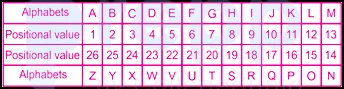
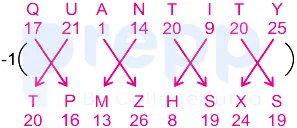
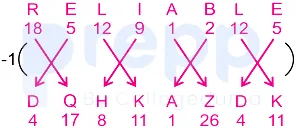
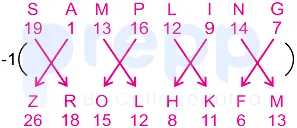 Paper & answer key PDF