Question 1archived
In a certain code language, "ENVOY" is written as "DMUNX" and "CHECK" is written as "BGDBJ". How will "ANGLE" be written in that language?
- A
ZNDID
- B
YLDJD
- C
YNEJC
- D
ZMFKD
Show answer
D. ZMFKDDecoding the Pattern: ENVOY to DMUNX and CHECK to BGDBJ
This question involves decoding a pattern used in a specific code language. We are given two examples of words being coded and asked to apply the same pattern to a new word, "ANGLE".
Analyzing the Given Code Language Examples
Let's examine the transformation from the original words to their coded forms:
Example 1: ENVOY coded as DMUNX
We compare each letter of "ENVOY" with the corresponding letter in "DMUNX" based on their positions in the English alphabet.
E (5th letter) becomes D (4th letter): The position changes by \(5 - 4 = 1\). It's a decrease.
N (14th letter) becomes M (13th letter): The position changes by \(14 - 13 = 1\). It's a decrease.
V (22nd letter) becomes U (21st letter): The position changes by \(22 - 21 = 1\). It's a decrease.
O (15th letter) becomes N (14th letter): The position changes by \(15 - 14 = 1\). It's a decrease.
Y (25th letter) becomes X (24th letter): The position changes by \(25 - 24 = 1\). It's a decrease.
The pattern observed here is that each letter in the original word is replaced by the letter that comes immediately before it in the alphabet. This is equivalent to subtracting 1 from the alphabetical position of each letter, wrapping around from A to Z if needed (though not needed in this specific example).
Example 2: CHECK coded as BGDBJ
Let's verify this pattern with the second example:
C (3rd letter) becomes B (2nd letter): \(3 - 2 = 1\). Decrease.
H (8th letter) becomes G (7th letter): \(8 - 7 = 1\). Decrease.
E (5th letter) becomes D (4th letter): \(5 - 4 = 1\). Decrease.
C (3rd letter) becomes B (2nd letter): \(3 - 2 = 1\). Decrease.
K (11th letter) becomes J (10th letter): \(11 - 10 = 1\). Decrease.
The same pattern holds true for the second example as well. Each letter is replaced by the preceding letter in the alphabet.
Applying the Coding Pattern to ANGLE
Now, we apply the established pattern (subtracting 1 from the alphabetical position of each letter, wrapping around from A to Z) to the word "ANGLE".
A (1st letter): Subtracting 1 from 1 gives 0. In alphabetical order, moving back one step from 'A' takes us to 'Z' (the 26th letter). So, A becomes Z.
N (14th letter): Subtracting 1 from 14 gives 13. The 13th letter is M. So, N becomes M.
G (7th letter): Subtracting 1 from 7 gives 6. The 6th letter is F. So, G becomes F.
L (12th letter): Subtracting 1 from 12 gives 11. The 11th letter is K. So, L becomes K.
E (5th letter): Subtracting 1 from 5 gives 4. The 4th letter is D. So, E becomes D.
Combining the coded letters, "ANGLE" is written as "ZMFKD".
Summary of the Transformation
Original Word
ENVOY
CHECK
ANGLE
Pattern Applied
Each letter \(\rightarrow\) Previous letter
Each letter \(\rightarrow\) Previous letter
Each letter \(\rightarrow\) Previous letter
Coded Word
DMUNX
BGDBJ
ZMFKD
Comparing with the Options
The coded word for "ANGLE" is ZMFKD. Let's compare this with the given options:
Option 1: ZNDID
Option 2: YLDJD
Option 3: YNEJC
Option 4: ZMFKD
Our derived code, ZMFKD, matches Option 4.
Conclusion on Coding Decoding
Based on the consistent pattern observed in the examples "ENVOY" is coded as "DMUNX" and "CHECK" is coded as "BGDBJ", the rule is to shift each letter back by one position in the alphabet. Applying this rule to "ANGLE" results in the coded word "ZMFKD".
The final answer is ZMFKD.
Revision Table: Coding Decoding Patterns
Understanding different types of coding decoding patterns is crucial for solving these questions quickly.
Pattern Type
Description
Example (Simple)
Letter Shift
Each letter is shifted by a fixed number of positions forward or backward in the alphabet.
CAT \(\rightarrow\) DBU (Shift +1)
Reverse Letter Shift
Similar to letter shift, but the shift value might change for each letter.
BAT \(\rightarrow\) CAU (+1 for B, +1 for A, +1 for T)
Opposite Letters
Each letter is replaced by its opposite letter in the alphabet (A is opposite to Z, B to Y, etc.).
BOY \(\rightarrow\) YLB
Letter Reversal
The order of letters in the word is reversed.
TOP \(\rightarrow\) POT
Mixed Patterns
Combinations of the above or other logical rules (e.g., swapping pairs of letters, shifting vowels differently from consonants).
TEAM \(\rightarrow\) SZBL (Shift -1, +1, -1, +1)
Additional Information on Letter Coding Reasoning
Letter coding is a common type of question in logical reasoning tests. It tests your ability to observe patterns and apply rules consistently. Here are some tips for solving such problems:
Write down the alphabetical series with their positions (A=1, B=2, ..., Z=26).
Compare the original word and the coded word letter by letter. Note the change in position for each letter.
Look for a consistent pattern across all letters in one example.
Verify the identified pattern using the second example provided.
Once the pattern is confirmed, apply it carefully to the word you need to code.
Pay attention to wrap-around cases (e.g., shifting back from 'A' or forward from 'Z').
Check your answer against the given options.
Mastering letter coding patterns improves your analytical and logical reasoning skills, which are valuable in many competitive exams.
Paper & answer key PDF ↗ Question 2archived
Select the set in which the numbers are related in the same way as are the numbers of the given sets.
(NOTE : Operations should be performed on the whole numbers, without breaking down the numbers into its constituent digits. E.g. 13- Operations on 13 such as adding /Subtracting /multiplying etc. to 13 can be performed. Breaking down 13 into 1 and 3 and then performing mathematical operations on 1 and 3 is NOT allowed)
(194, 14, 4)
(527, 23, 5)
- A
(63, 8, 3)
- B
(2, 2, 2)
- C
(8, 3, 2)
- D
(10, 6, 5)
Show answer
B. (2, 2, 2)The correct answer is (2, 2, 2).
(Note: This method was excluded by the question's rule here). When solving number analogy problems, it's useful to start by examining the relationships between the numbers in the given sets. Look for simple patterns first (addition, subtraction, multiplication, division), then move to squares, cubes, or combinations of operations. Apply the identified pattern to the options to find the matching set.
Paper & answer key PDF ↗ Question 3archived
Select the Venn diagram that best illustrates the relationship between the following classes.
Swimming, Running, Sports
- A
Option A (shown in image)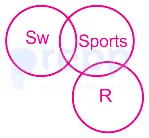
- B
Option B (shown in image)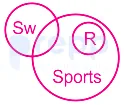
- C
Option C (shown in image)
- D
Option D (shown in image)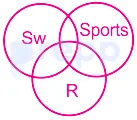
Show answer
C. Option C (shown in image)The logic followed here is :-
Running is type of sport.
Swimming is a type of sport.
Hence, the correct answer is "Option 3".
 Paper & answer key PDF ↗
 Question 4archived
Select the option that is related to the third word in the same way as the second word is related to the first word.
(The words must be considered as meaningful English words and must not be related to each other based on the number of letters/number of consonants/vowels in the word.)
Doctor : Hospital :: Lawyer : ?
- A
Court
- B
Temple
- C
School
- D
House
Show answer
A. CourtThe correct answer is Court.
Some common types of relationships include: Part to Whole: e.g., Finger : Hand Tool to User: e.g., Pen : Writer Cause and Effect: e.g., Rain : Flood Synonyms: e.g., Happy : Joyful Antonyms: e.g., Hot : Cold Performer and Action: e.g., Chef : Cooks Object and Characteristic: e.g., Snow : Cold Category and Example: e.g., Fruit : Apple In this specific lawyer and court analogy, the relationship is Professional and Workplace/Setting where the professional performs their core duties.
Paper & answer key PDF ↗ Question 5archived
Select the figure that will replace the question mark (?) in the following figure series.

- A
Option A (shown in image)
- B
Option B (shown in image)
- C
Option C (shown in image)
- D
Option D (shown in image)
Show answer
B. Option B (shown in image)The logic followed here is :-
Hence, the correct answer is "Option 2".
 Paper & answer key PDF ↗
 Question 6archived
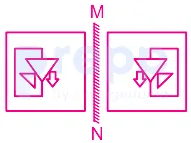
Select the correct mirror image of the given figure when the mirror is placed at the right side of the figure.

- A
Option A (shown in image)
- B
Option B (shown in image)
- C
Option C (shown in image)
- D
Option D (shown in image)
Show answer
D. Option D (shown in image)The correct mirror image of the given figure when the mirror is placed at MN as shown below :
Hence, the correct answer is "Option 4".
 Paper & answer key PDF ↗
 Question 7archived
In a certain code language, 'TURNIP' is coded as VNRUWU and 'DAIKON' is coded as TTOLCE. How will 'RADISH' be coded in the same language?
- A
NXMGCS
- B
NXNHCS
- C
MXNHCS
- D
CYMGDP
Show answer
A. NXMGCSThe Logic:
The code is derived by reversing the word and then adding a descending sequence of numbers (+6, +5, +4, +3, +2, +1) to the positional value of each letter.
Verification:
1. TURNIP → VNRUWU
* Reverse the word: P - I - N - R - U - T
* Apply the pattern:
* P (16) + 6 = 22 (V)
* I (9) + 5 = 14 (N)
* N (14) + 4 = 18 (R)
* R (18) + 3 = 21 (U)
* U (21) + 2 = 23 (W)
* T (20) + 1 = 21 (U)
* Result: VNRUWU (Matches)
2. DAIKON → TTOLCE
* Reverse the word: N - O - K - I - A - D
* Apply the pattern:
* N (14) + 6 = 20 (T)
* O (15) + 5 = 20 (T)
* K (11) + 4 = 15 (O)
* I (9) + 3 = 12 (L)
* A (1) + 2 = 3 (C)
* D (4) + 1 = 5 (E)
* Result: TTOLCE (Matches)
Answer for RADISH:
1. Reverse the word: H - S - I - D - A - R
2. Apply the pattern:
* H (8) + 6 = 14 → N
* S (19) + 5 = 24 → X
* I (9) + 4 = 13 → M
* D (4) + 3 = 7 → G
* A (1) + 2 = 3 → C
* R (18) + 1 = 19 → S
Final Code: NXMGCS
Paper & answer key PDF ↗ Question 8archived
The second number in the given number pairs is obtained by performing certain mathematical operation(s) on the first number. The same operation(s) are followed in all the number pairs, EXCEPT one. Find that odd number pair.
- A
(125, 91)
- B
(64, 61)
- C
(27, 37)
- D
(8, 20)
Show answer
D. (8, 20)Understanding the Number Pair Pattern
The problem asks us to identify the number pair that does not follow the same mathematical operation rule as the others. We are given four pairs of numbers, and the second number in each pair is related to the first number by a specific operation. This operation is consistent across all pairs except one.
The given number pairs are:
(125, 91)
(64, 61)
(27, 37)
(8, 20)
Identifying the Base Number
Let's examine the first number in each pair. We can observe that these numbers are perfect cubes:
\(125 = 5^3\). The base number is \(n = 5\).
\(64 = 4^3\). The base number is \(n = 4\).
\(27 = 3^3\). The base number is \(n = 3\).
\(8 = 2^3\). The base number is \(n = 2\).
Let the first number in a pair be \(N_1\) and the second number be \(N_2\). We see that \(N_1 = n^3\), where \(n\) is the base.
Finding the Operation Rule
We need to determine the mathematical operation that relates the base number (\(n\)) to the second number (\(N_2\)) for the majority of the pairs. Let's list the pairs along with their base numbers and second numbers:
Pair
\(N_1\)
\(n\) (Base)
\(N_2\)
(125, 91)
125
5
91
(64, 61)
64
4
61
(27, 37)
27
3
37
(8, 20)
8
2
20
We need to find a relationship \(N_2 = f(n)\) that holds for three of these pairs. Let's consider the relationship for the first three pairs:
When \(n=5\), \(N_2=91\).
When \(n=4\), \(N_2=61\).
When \(n=3\), \(N_2=37\).
Let's examine the difference between consecutive \(N_2\) values as \(n\) decreases:
From \(n=5\) to \(n=4\): \(N_2\) changes from 91 to 61. Difference = \(91 - 61 = 30\).
From \(n=4\) to \(n=3\): \(N_2\) changes from 61 to 37. Difference = \(61 - 37 = 24\).
The differences (30 and 24) are not constant. The difference between these differences is \(30 - 24 = 6\), which is constant. This pattern in differences suggests a quadratic relationship between \(N_2\) and \(n\), of the form \(N_2 = An^2 + Bn + C\).
We can use the points \((n, N_2)\) for \(n=3, 4, 5\) to find the values of A, B, and C:
For \(n=3\): \(A(3)^2 + B(3) + C = 37 \implies 9A + 3B + C = 37\) (Equation 1)
For \(n=4\): \(A(4)^2 + B(4) + C = 61 \implies 16A + 4B + C = 61\) (Equation 2)
For \(n=5\): \(A(5)^2 + B(5) + C = 91 \implies 25A + 5B + C = 91\) (Equation 3)
Subtracting Equation 1 from Equation 2:
\((16A + 4B + C) - (9A + 3B + C) = 61 - 37\)
\(7A + B = 24\) (Equation 4)
Subtracting Equation 2 from Equation 3:
\((25A + 5B + C) - (16A + 4B + C) = 91 - 61\)
\(9A + B = 30\) (Equation 5)
Now, subtract Equation 4 from Equation 5:
\((9A + B) - (7A + B) = 30 - 24\)
\(2A = 6 \implies A = 3\)
Substitute \(A=3\) into Equation 4:
\(7(3) + B = 24 \implies 21 + B = 24 \implies B = 3\)
Substitute \(A=3\) and \(B=3\) into Equation 1:
\(9(3) + 3(3) + C = 37 \implies 27 + 9 + C = 37 \implies 36 + C = 37 \implies C = 1\)
Thus, the mathematical operation relating the base \(n\) to the second number \(N_2\) is \(N_2 = 3n^2 + 3n + 1\), where \(N_1 = n^3\).
Checking the Operation with All Pairs
Let's test this rule for each of the given pairs:
Pair (125, 91): \(N_1 = 125 = 5^3\), so \(n=5\). According to the rule, \(N_2 = 3(5^2) + 3(5) + 1 = 3(25) + 15 + 1 = 75 + 15 + 1 = 91\). This matches the given second number.
Pair (64, 61): \(N_1 = 64 = 4^3\), so \(n=4\). According to the rule, \(N_2 = 3(4^2) + 3(4) + 1 = 3(16) + 12 + 1 = 48 + 12 + 1 = 61\). This matches the given second number.
Pair (27, 37): \(N_1 = 27 = 3^3\), so \(n=3\). According to the rule, \(N_2 = 3(3^2) + 3(3) + 1 = 3(9) + 9 + 1 = 27 + 9 + 1 = 37\). This matches the given second number.
Pair (8, 20): \(N_1 = 8 = 2^3\), so \(n=2\). According to the rule, \(N_2 = 3(2^2) + 3(2) + 1 = 3(4) + 6 + 1 = 12 + 6 + 1 = 19\). The given second number is 20.
The pair (8, 20) does not follow the determined rule \(N_2 = 3n^2 + 3n + 1\), as the rule predicts 19 while the given value is 20.
Identifying the Odd Pair
The mathematical operation \(N_2 = 3n^2 + 3n + 1\), where the first number \(N_1\) is \(n^3\), holds true for the number pairs (125, 91), (64, 61), and (27, 37). The number pair (8, 20) is the one that does not conform to this rule.
Therefore, the odd number pair is (8, 20).
Revision Table: Number Patterns and Relationships
Concept
Explanation
Application in Problem
Number Pair Analysis
Examining the relationship between two numbers in a given pair to find a pattern.
Used to find the rule connecting the first and second number in each pair.
Perfect Cubes
Numbers that are the result of multiplying an integer by itself three times (\(n \times n \times n\)).
The first number in each pair is a perfect cube, allowing us to identify the base \(n\).
Quadratic Relationship
A pattern where the dependent variable is related to the square of the independent variable, expressed as \(y = ax^2 + bx + c\).
The second number (\(N_2\)) is found to have a quadratic relationship with the base (\(n\)) of the first number (\(N_1\)).
Identifying the Odd One Out
Finding the element in a set that does not follow the same rule or pattern as the others.
After establishing the rule from three pairs, the pair that violates the rule is the odd one.
Additional Information: Techniques for Finding Number Patterns
Finding patterns in numbers is a fundamental skill in many aptitude tests and mathematical puzzles. Several techniques can be employed:
Difference Method: Calculate the difference between consecutive terms. If the first differences are constant, the pattern is linear (arithmetic progression). If the second differences are constant, the pattern is quadratic. Higher-order differences indicate polynomial relationships of higher degrees.
Ratio Method: Calculate the ratio between consecutive terms. If the ratio is constant, the pattern is geometric.
Relating to Position: Sometimes the pattern relates the number to its position in the sequence (1st, 2nd, 3rd, ...). For example, the \(k^{th}\) term might be \(k^2\) or \(2k+1\).
Relating Numbers within Pairs: As seen in this problem, the relationship might exist between the numbers within a pair itself, often involving powers or multiple operations on one of the numbers or its components (like the base of a power).
Prime Numbers, Squares, Cubes: Check if the numbers are related to prime numbers, perfect squares, or perfect cubes.
Combinations: Many patterns involve a combination of operations, such as multiplying by a number and then adding another, or alternating operations.
When analyzing number pairs like this, it's crucial to first look for obvious characteristics of the numbers (like being squares, cubes, etc.) and then systematically test potential relationships between the numbers in the pair or derived values like the base of a power.
Paper & answer key PDF ↗ Question 9archived
Which of the following numbers will replace the question mark (?) in the given series?
15, 17, ?, 33, 47, 65
- A
30
- B
21
- C
20
- D
23
Show answer
D. 23The correct answer is 23.
To solve number series questions, we usually look for a pattern between consecutive terms. Let's find the difference between the given terms: Difference between the second term (17) and the first term (15): $ 17 - 15 = 2 $
Paper & answer key PDF ↗ Question 10archived
Rahul attended a competition, wherein his mother's paternal grandfather's only son's only granddaughter was fighting against the clock. How is the person in the competition related to Rahul?
- A
Sister
- B
Maternal grandmother
- C
Mother
- D
Daughter
Show answer
A. SisterUnderstanding the Blood Relation Puzzle
To solve this blood relation question, we need to carefully trace the relationship described from Rahul's perspective. The person in the competition is described as "Rahul's mother's paternal grandfather's only son's only granddaughter."
Step-by-Step Relation Analysis
Let's break down the description:
Rahul's mother: This is the starting point relative to Rahul. Let's call her M.
Mother's paternal grandfather: M's paternal grandfather is M's father's father. This person is Rahul's maternal great-grandfather. Let's call him GG.
Mother's paternal grandfather's only son: The only son of GG. Since GG is M's father's father, GG's son would be M's father or M's father's brother. The phrase "only son" of GG means that GG had only one son. That only son is M's father. M's father is Rahul's maternal grandfather. Let's call him MG.
Maternal grandfather's only granddaughter: This refers to the only granddaughter of MG (Rahul's maternal grandfather).
Now, let's think about who the granddaughters of Rahul's maternal grandfather (MG) could be:
The daughters of MG's children.
MG's children include Rahul's mother (M) and possibly her siblings (Rahul's maternal uncles and aunts).
The granddaughters of MG would be the daughters of M (Rahul's sisters) or the daughters of M's siblings (Rahul's maternal cousins).
The description states this person is the "only granddaughter" of MG. This implies that among all the children of MG (Rahul's mother and her siblings, if any), there is only one female grandchild.
Given the options provided, "Sister" is the most plausible relationship. For Rahul's sister to be the "only granddaughter" of his maternal grandfather, it would mean Rahul's mother has one daughter (who is Rahul's sister) and no other female grandchildren are born to Rahul's maternal grandfather's lineage (i.e., Rahul's maternal aunts/uncles have no daughters).
Tracing back:
Relationship Fragment
Identified Person (relative to Rahul)
Rahul's mother
Mother
Mother's paternal grandfather
Maternal Great-Grandfather
Mother's paternal grandfather's only son
Maternal Grandfather
Maternal Grandfather's only granddaughter
Rahul's Sister (under the assumption of "only granddaughter" in a typical puzzle)
Based on this step-by-step analysis and considering the options, the person who is the only granddaughter of Rahul's maternal grandfather is Rahul's sister.
Conclusion: The Relation to Rahul
The intricate description leads us to conclude that the person competing against the clock is Rahul's sister. The phrase "only granddaughter" specifically points to a single female grandchild from the maternal grandfather's lineage, which aligns with the sister relationship in the context of the options provided.
Revision Table: Common Blood Relations
Relation Term
Meaning
Paternal
Related through the father's side of the family.
Maternal
Related through the mother's side of the family.
Grandfather
Parent's father.
Grandmother
Parent's mother.
Great-Grandparent
Grandparent's parent.
Sibling
A person's brother or sister.
Cousin
The child of one's aunt or uncle.
Additional Information: Solving Blood Relation Questions
Blood relation questions are common in reasoning sections of competitive exams. To tackle them effectively:
Read the sentence carefully, pausing at commas or connecting words like 'of'.
Break down the complex sentence into smaller, manageable relationship segments.
Mentally (or physically) trace the relationships backward or forward from the reference person.
Use diagrams or symbols to represent family members and their connections if the relationship is very complex.
Pay close attention to limiting words like "only", "none", "sole", as they are key to narrowing down possibilities.
Relate each step back to the original person (Rahul, in this case) to maintain clarity.
Consistent practice with different types of blood relation puzzles will help you quickly identify the required connection.
Paper & answer key PDF ↗ Question 11archived
Which of the following interchange of numbers and signs would make the given equation correct?
24 × 9 + 6 ÷ 24 - 18 = 22
- A
18 and 22, + and -
- B
24 and 6, × and +
- C
6 and 9, ÷ and +
- D
6 and 18, ÷ and ×
Show answer
C. 6 and 9, ÷ and +Analyzing Equation Interchange Problems
The problem asks us to find the correct interchange of numbers and mathematical signs that makes the given equation true. The original equation is:
\(24 \times 9 + 6 \div 24 - 18 = 22\)
We need to test each given option by performing the suggested swaps and then evaluating the resulting equation using the BODMAS rule (Brackets, Orders, Division and Multiplication, Addition and Subtraction) to see if the Left Hand Side (LHS) equals the Right Hand Side (RHS), which is 22.
Step-by-Step Testing of Interchange Options
Option 1: Interchange 18 and 22, + and -
Original equation: \(24 \times 9 + 6 \div 24 - 18 = 22\)
As per Option 1, we swap the numbers 18 and 22, and the signs + and -.
The number 18 appears on the LHS, and 22 is the RHS value. We interchange these numbers and also interchange the + and - signs within the expression.
The modified equation becomes:
\(24 \times 9 - 6 \div 24 + 22 = 18\)
Now, let's evaluate the LHS using BODMAS:
First, perform Multiplication and Division from left to right:
\(24 \times 9 = 216\)
\(6 \div 24 = 0.25\)
The equation becomes: \(216 - 0.25 + 22\)
Next, perform Addition and Subtraction from left to right:
\(216 - 0.25 = 215.75\)
\(215.75 + 22 = 237.75\)
The LHS is 237.75, and the RHS is 18. Since \(237.75 \neq 18\), this interchange does not make the equation correct.
Option 2: Interchange 24 and 6, × and +
Original equation: \(24 \times 9 + 6 \div 24 - 18 = 22\)
As per Option 2, we swap the numbers 24 and 6, and the signs × and +.
Swap 24 with 6 and 6 with 24 in the equation: \(6 \times 9 + 24 \div 6 - 18 = 22\)
Swap × with + and + with × in the equation: \(6 + 9 \times 24 \div 6 - 18 = 22\)
The modified equation is:
\(6 + 9 \times 24 \div 6 - 18 = 22\)
Now, let's evaluate the LHS using BODMAS:
First, perform Multiplication and Division from left to right:
\(24 \div 6 = 4\)
The equation becomes: \(6 + 9 \times 4 - 18\)
\(9 \times 4 = 36\)
The equation becomes: \(6 + 36 - 18\)
Next, perform Addition and Subtraction from left to right:
\(6 + 36 = 42\)
\(42 - 18 = 24\)
The LHS is 24, and the RHS is 22. Since \(24 \neq 22\), this interchange does not make the equation correct.
Option 3: Interchange 6 and 9, ÷ and +
Original equation: \(24 \times 9 + 6 \div 24 - 18 = 22\)
As per Option 3, we swap the numbers 6 and 9, and the signs ÷ and +.
Swap 6 with 9 and 9 with 6 in the equation: \(24 \times 6 + 9 \div 24 - 18 = 22\)
Swap ÷ with + and + with ÷ in the equation: \(24 \times 6 \div 9 + 24 - 18 = 22\)
The modified equation is:
\(24 \times 6 \div 9 + 24 - 18 = 22\)
Now, let's evaluate the LHS using BODMAS:
First, perform Multiplication and Division from left to right:
\(24 \times 6 = 144\)
The equation becomes: \(144 \div 9 + 24 - 18\)
\(144 \div 9 = 16\)
The equation becomes: \(16 + 24 - 18\)
Next, perform Addition and Subtraction from left to right:
\(16 + 24 = 40\)
\(40 - 18 = 22\)
The LHS is 22, and the RHS is 22. Since \(22 = 22\), this interchange makes the equation correct.
Option 4: Interchange 6 and 18, ÷ and ×
Original equation: \(24 \times 9 + 6 \div 24 - 18 = 22\)
As per Option 4, we swap the numbers 6 and 18, and the signs ÷ and ×.
Swap 6 with 18 and 18 with 6 in the equation: \(24 \times 9 + 18 \div 24 - 6 = 22\)
Swap ÷ with × and × with ÷ in the equation: \(24 \div 9 + 18 \times 24 - 6 = 22\)
The modified equation is:
\(24 \div 9 + 18 \times 24 - 6 = 22\)
Now, let's evaluate the LHS using BODMAS:
First, perform Multiplication and Division from left to right:
\(24 \div 9 = \frac{24}{9} = \frac{8}{3}\)
\(18 \times 24 = 432\)
The equation becomes: \(\frac{8}{3} + 432 - 6\)
Next, perform Addition and Subtraction from left to right:
\(\frac{8}{3} + 432 - 6 = \frac{8}{3} + 426\)
\(\frac{8}{3} + 426 = \frac{8 + 426 \times 3}{3} = \frac{8 + 1278}{3} = \frac{1286}{3}\)
The LHS is \(\frac{1286}{3}\), and the RHS is 22. Since \(\frac{1286}{3} \neq 22\), this interchange does not make the equation correct.
Conclusion
After testing all the given options, we found that interchanging the numbers 6 and 9, and the signs ÷ and + makes the equation \(24 \times 9 + 6 \div 24 - 18 = 22\) correct. The equation becomes \(24 \times 6 \div 9 + 24 - 18 = 22\), which simplifies to \(22 = 22\).
Revision Table: Checking Options
Option
Interchange
Modified Equation
Result (LHS)
Matches RHS (22)?
1
18 <-> 22, + <-> -
\(24 \times 9 - 6 \div 24 + 22 = 18\)
\(237.75\)
No
2
24 <-> 6, × <-> +
\(6 + 9 \times 24 \div 6 - 18 = 22\)
\(24\)
No
3
6 <-> 9, ÷ <-> +
\(24 \times 6 \div 9 + 24 - 18 = 22\)
\(22\)
Yes
4
6 <-> 18, ÷ <-> ×
\(24 \div 9 + 18 \times 24 - 6 = 22\)
\(\frac{1286}{3}\)
No
Additional Information: BODMAS Rule and Equation Solving
Problems involving interchanging signs and numbers require careful application of the order of mathematical operations, commonly remembered by the acronym BODMAS or PEMDAS.
BODMAS:
Brackets
Orders (powers, roots)
Division and Multiplication (from left to right)
Addition and Subtraction (from left to right)
When solving such problems, always remember to first apply the required interchanges correctly to the original equation. Then, evaluate the new equation step-by-step following the BODMAS rule. Compare the final result of the LHS evaluation with the RHS value to verify if the equation holds true. This systematic approach helps avoid errors in calculations and ensures the correct identification of the valid interchange.
Paper & answer key PDF ↗ Question 12archived
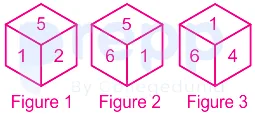
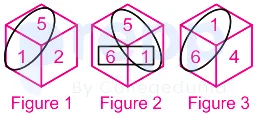
Three different positions of the same dice are shown. Find the number on the face opposite to the face showing '3'.
- A
1
- B
6
- C
5
- D
4
Show answer
A. 1In first and Second dice 5 and 1 is common.
In second and Third dice 6 and 1 are common.
First dice is rotated horizontally 90 degrees in anti-clockwise direction
Second dice is rotated vertically 90 degrees in anti-clockwise direction.
NumbersOpposite Numbers
26
54
31
∴ Here, the opposite face of '3' is '1'.
Hence, the correct answer is "1".
 Paper & answer key PDF ↗
 Question 13archived
Which of the following terms will replace the question mark (?) in the given series?
ALW, GEY, MXA, SQC, YJE, ?
- A
ECG
- B
DBI
- C
DCH
- D
EBH
Show answer
A. ECGSolving the Letter Series Pattern: ALW, GEY, MXA, SQC, YJE, ?
Let's analyze the given letter series: ALW, GEY, MXA, SQC, YJE, ?. We need to find the next term by identifying the pattern followed by the letters in each position.
Analyzing the First Letter
Let's look at the first letter of each term:
A (1st letter of the alphabet)
G (7th letter of the alphabet)
M (13th letter of the alphabet)
S (19th letter of the alphabet)
Y (25th letter of the alphabet)
? (The next letter in the sequence)
Let's find the difference in their positions:
A to G: $7 - 1 = 6$ (moves forward by 6 positions)
G to M: $13 - 7 = 6$ (moves forward by 6 positions)
M to S: $19 - 13 = 6$ (moves forward by 6 positions)
S to Y: $25 - 19 = 6$ (moves forward by 6 positions)
The pattern for the first letter is an increment of 6 positions in the alphabet, wrapping around from Z to A if necessary. So, for the next term, the first letter will be 6 positions after Y.
Y is the 25th letter. Moving 6 positions forward: $25 + 6 = 31$. Since the alphabet has 26 letters, we wrap around: $31 - 26 = 5$. The 5th letter of the alphabet is E.
So, the first letter of the next term is E.
Analyzing the Second Letter
Now let's look at the second letter of each term:
L (12th letter)
E (5th letter)
X (24th letter)
Q (17th letter)
J (10th letter)
? (The next letter)
Let's find the difference in their positions, considering wrapping around:
L to E: From 12 to 5. This is a decrease. $12 - 5 = 7$. So it moves backward by 7 positions (or forward by $26 - 7 = 19$ positions). Let's check for -7.
E to X: From 5 to 24. Moving backward by 7 from E (5): $5 - 7 = -2$. Wrapping around: $-2 + 26 = 24$. This matches X. The pattern is a decrease of 7.
X to Q: $24 - 17 = 7$. Moves backward by 7.
Q to J: $17 - 10 = 7$. Moves backward by 7.
The pattern for the second letter is a decrement of 7 positions in the alphabet, wrapping around from A to Z if necessary. So, for the next term, the second letter will be 7 positions before J.
J is the 10th letter. Moving 7 positions backward: $10 - 7 = 3$. The 3rd letter of the alphabet is C.
So, the second letter of the next term is C.
Analyzing the Third Letter
Finally, let's look at the third letter of each term:
W (23rd letter)
Y (25th letter)
A (1st letter)
C (3rd letter)
E (5th letter)
? (The next letter)
Let's find the difference in their positions:
W to Y: $25 - 23 = 2$ (moves forward by 2 positions)
Y to A: From 25 to 1. This moves forward by 2 positions ($25 + 2 = 27$; $27 - 26 = 1$). The pattern is an increment of 2.
A to C: $3 - 1 = 2$ (moves forward by 2 positions)
C to E: $5 - 3 = 2$ (moves forward by 2 positions)
The pattern for the third letter is an increment of 2 positions in the alphabet, wrapping around from Z to A if necessary. So, for the next term, the third letter will be 2 positions after E.
E is the 5th letter. Moving 2 positions forward: $5 + 2 = 7$. The 7th letter of the alphabet is G.
So, the third letter of the next term is G.
Combining the Letters to Find the Next Term
By combining the letters we found for each position:
First letter: E
Second letter: C
Third letter: G
The next term in the series is ECG.
Term
1st Letter
Pattern
2nd Letter
Pattern
3rd Letter
Pattern
ALW
A (1)
+6
L (12)
-7
W (23)
+2
GEY
G (7)
+6
E (5)
-7
Y (25)
+2
MXA
M (13)
+6
X (24)
-7
A (1)
+2
SQC
S (19)
+6
Q (17)
-7
C (3)
+2
YJE
Y (25)
+6
J (10)
-7
E (5)
+2
?
E (31-26=5)
C (10-7=3)
G (5+2=7)
Conclusion
Based on the analysis of the patterns for each letter position, the next term in the series ALW, GEY, MXA, SQC, YJE, ? is ECG.
Revision Table: Letter Series Patterns
Letter Position
Pattern
Start (ALW)
End (ECG)
First Letter
Add 6 (modulo 26)
A (1)
E (5)
Second Letter
Subtract 7 (modulo 26)
L (12)
C (3)
Third Letter
Add 2 (modulo 26)
W (23)
G (7)
Additional Information: Solving Letter and Alpha-Numeric Series
Letter series and alpha-numeric series questions are common in logical reasoning sections of competitive exams. To solve them, you often need to identify the pattern based on:
Position of letters in the English alphabet (A=1, B=2, ..., Z=26).
Difference or sum in positions between consecutive terms.
Consistent increment or decrement patterns.
Alternating patterns.
Patterns involving squares, cubes, or prime numbers (less common for simple letter series, but possible in mixed series).
Vowel/consonant sequences.
It's helpful to write down the alphabetical position of each letter below the series terms to make it easier to spot numerical patterns. Remember to handle wrapping around from Z to A (or A to Z) correctly by using modulo 26 arithmetic if needed.
Paper & answer key PDF ↗ Question 14archived
In a certain code language, 'GINGER' is coded as LZCKGF and 'GARLIC' is coded as WDHOYF. How will 'CLOVES' be coded in the same language?
- A
NYQLJB
- B
MZRLJB
- C
MZQLIB
- D
NYYLJB
Show answer
B. MZRLJBSolving the Code Language Puzzle
The problem provides two examples of words coded into other words in a specific code language: 'GINGER' is coded as 'LZCKGF', and 'GARLIC' is coded as 'WDHOYF'. We need to determine the coding logic and apply it to find the code for 'CLOVES'.
Analyzing the Examples: GINGER and GARLIC
Let's look at the letters and their corresponding coded letters for both examples. We can also consider their positions and numerical values (A=1, B=2, ..., Z=26).
Word: GINGER
G
I
N
G
E
R
Value
7
9
14
7
5
18
Code: LZCKGF
L
Z
C
K
G
F
Value
12
26
3
11
7
6
Shift (Code - Word) mod 26
$+5$
$+17$
$+15$
$+4$
$+2$
$+14$
Word: GARLIC
G
A
R
L
I
C
Value
7
1
18
12
9
3
Code: WDHOYF
W
D
H
O
Y
F
Value
23
4
8
15
25
6
Shift (Code - Word) mod 26
$+16$
$+3$
$+16$
$+3$
$+16$
$+3$
In the case of 'GARLIC', we observe a clear alternating pattern of shifts: $+16, +3, +16, +3, +16, +3$. For 'GINGER', the shifts are $+5, +17, +15, +4, +2, +14$, which doesn't show an obvious simple pattern.
Let's look for a different kind of relationship. Let's calculate the sum of the shifts for each word.
Sum of shifts for GINGER: $\small 5 + 17 + 15 + 4 + 2 + 14 = 57$
Sum of shifts for GARLIC: $\small 16 + 3 + 16 + 3 + 16 + 3 = 57$
It appears that the sum of the individual letter shifts for each word equals 57. This could be the key pattern.
Applying the Pattern to CLOVES
We will now take the word 'CLOVES' and each of the given options. For each option, we will calculate the required shifts to transform 'CLOVES' into that code and check if the sum of these shifts is 57.
Word: CLOVES
Letter
C
L
O
V
E
S
Value
3
12
15
22
5
19
Option 1: NYQLJB
Code: NYQLJB
N
Y
Q
L
J
B
Value
14
25
17
12
10
2
Shift (Code - Word) mod 26
$+11$
$+13$
$+2$
$+16$
$+5$
$+9$
Sum of shifts: $\small 11 + 13 + 2 + 16 + 5 + 9 = 56$. This sum is not 57.
Option 2: MZRLJB
Code: MZRLJB
M
Z
R
L
J
B
Value
13
26
18
12
10
2
Shift (Code - Word) mod 26
$+10$
$+14$
$+3$
$+16$
$+5$
$+9$
Sum of shifts: $\small 10 + 14 + 3 + 16 + 5 + 9 = 57$. This sum is 57, matching the pattern found in the examples.
Option 3: MZQLIB
Code: MZQLIB
M
Z
Q
L
I
B
Value
13
26
17
12
9
2
Shift (Code - Word) mod 26
$+10$
$+14$
$+2$
$+16$
$+4$
$+9$
Sum of shifts: $\small 10 + 14 + 2 + 16 + 4 + 9 = 55$. This sum is not 57.
Option 4: NYYLJB
Code: NYYLJB
N
Y
Y
L
J
B
Value
14
25
25
12
10
2
Shift (Code - Word) mod 26
$+11$
$+13$
$+10$
$+16$
$+5$
$+9$
Sum of shifts: $\small 11 + 13 + 10 + 16 + 5 + 9 = 64$. This sum is not 57.
Based on the analysis, only when 'CLOVES' is coded as 'MZRLJB' does the sum of the letter shifts equal 57, which is consistent with the pattern observed in the given examples 'GINGER' and 'GARLIC'. Therefore, 'MZRLJB' is the correct code for 'CLOVES'.
Conclusion
The coding rule seems to involve shifting each letter by a specific amount such that the total sum of shifts for the word is 57. Applying this rule, the code for 'CLOVES' is found to be 'MZRLJB'.
Revision Table - Code Language Pattern
Word
Code
Letter Shifts
Sum of Shifts
GINGER
LZCKGF
+5, +17, +15, +4, +2, +14
57
GARLIC
WDHOYF
+16, +3, +16, +3, +16, +3
57
CLOVES
MZRLJB (Option 2)
+10, +14, +3, +16, +5, +9
57
Additional Information - Letter Coding Concepts
Code language and coding-decoding problems are common in logical reasoning sections of competitive exams. These problems test your ability to identify patterns and rules governing the transformation of words, numbers, or symbols.
Common types of letter coding include:
Letter Shifting: Each letter is shifted a fixed number of positions forward or backward in the alphabet (like in Caesar cipher). The shift might be constant for the whole word or vary based on position or the letter itself.
Substitution: Each letter is replaced by another specific letter or symbol. This replacement can be based on a simple mapping (e.g., A always becomes Z) or a more complex rule.
Reverse Order: The letters of the word are written in reverse order, sometimes followed by a shift or substitution.
Position-based Coding: The code depends on the position of the letter in the word.
Letter Value Based Coding: Using the numerical position of letters in the alphabet (A=1, B=2, etc.) and applying arithmetic operations. The pattern found in this problem, involving the sum of shifts based on letter values, falls into this category.
Solving these problems often requires careful observation, breaking down the examples, trying different potential patterns (shifts, reversals, substitutions, sums), and testing the discovered pattern rigorously on the given examples and the target word/options.
Paper & answer key PDF ↗ Question 15archived
Select the set in which the numbers are related in the same way as are the numbers of the following sets.
(NOTE: Operations should be performed on the whole numbers, without breaking down the numbers into its constituent digits. E.g., 13 - Operations on 13 such as adding/Subtracting/multiplying etc. to 13 can be performed. Breaking down 13 into 1 and 3 and then performing mathematical operations on 1 and 3 is not allowed)
(62, 5, 8)
(87,7,11)
- A
(5, 72, 10)
- B
(77, 4, 14)
- C
(112, 9, 14)
- D
(6, 87, 12)
Show answer
C. (112, 9, 14)Understanding Number Relationships in Sets
This problem requires us to identify a mathematical relationship between the numbers in the given sets and then find which option follows the same relationship. The given sets are (62, 5, 8) and (87, 7, 11). Let's denote the three numbers in each set as \(N_1\), \(N_2\), and \(N_3\).
Analyzing the Given Number Sets
We need to find a pattern that connects \(N_1\), \(N_2\), and \(N_3\) in both (62, 5, 8) and (87, 7, 11).
For the set (62, 5, 8), we have \(N_1 = 62\), \(N_2 = 5\), and \(N_3 = 8\).
For the set (87, 7, 11), we have \(N_1 = 87\), \(N_2 = 7\), and \(N_3 = 11\).
We explore various arithmetic operations (addition, subtraction, multiplication, division) and combinations to find a consistent rule that applies to both sets.
Discovering the Pattern or Rule
Let's examine how the numbers might be related. After trying several combinations, we can observe a pattern involving multiplication and linear relation.
Consider the relationship between the first number \(N_1\) and the third number \(N_3\). Let's see if there's a constant multiplier for \(N_3\) that is close to \(N_1\):
For (62, 5, 8): \(62 \div 8 \approx 7.75\).
For (87, 7, 11): \(87 \div 11 \approx 7.91\).
For the option (112, 9, 14): \(112 \div 14 = 8\). This is an exact integer.
This suggests a relationship involving \(8 \times N_3\). Let's calculate the difference between \(N_1\) and \(8 \times N_3\) for the given sets and the promising option:
For (62, 5, 8): \(N_1 - 8 \times N_3 = 62 - 8 \times 8 = 62 - 64 = -2\). Or \(8 \times N_3 - N_1 = 2\).
For (87, 7, 11): \(N_1 - 8 \times N_3 = 87 - 8 \times 11 = 87 - 88 = -1\). Or \(8 \times N_3 - N_1 = 1\).
For (112, 9, 14): \(N_1 - 8 \times N_3 = 112 - 8 \times 14 = 112 - 112 = 0\). Or \(8 \times N_3 - N_1 = 0\).
The differences \(8 \times N_3 - N_1\) are 2, 1, and 0. Let's check if these differences are related to the second number \(N_2\), which is 5, 7, and 9 respectively.
We have the pairs \((N_2, \text{Difference})\): (5, 2), (7, 1), and (9, 0).
Notice that as \(N_2\) increases by 2 (from 5 to 7 to 9), the difference decreases by 1 (from 2 to 1 to 0). This suggests a linear relationship between the difference and \(N_2\). The difference can be expressed as \(\frac{9 - N_2}{2}\).
Let's verify this expression for the difference:
For (62, 5, 8), \(N_2=5\): \(\frac{9 - 5}{2} = \frac{4}{2} = 2\). This matches the difference \(8 \times 8 - 62 = 2\).
For (87, 7, 11), \(N_2=7\): \(\frac{9 - 7}{2} = \frac{2}{2} = 1\). This matches the difference \(8 \times 11 - 87 = 1\).
For (112, 9, 14), \(N_2=9\): \(\frac{9 - 9}{2} = \frac{0}{2} = 0\). This matches the difference \(8 \times 14 - 112 = 0\).
Thus, the relationship is \(8 \times N_3 - N_1 = \frac{9 - N_2}{2}\).
We can rearrange this equation to find a clearer rule involving only integers:
\(2 \times (8 \times N_3 - N_1) = 9 - N_2\)
\(16 \times N_3 - 2 \times N_1 = 9 - N_2\)
\(2 \times N_1 - N_2 + 9 = 16 \times N_3\)
This is the numerical relationship connecting the three numbers in the sets.
Verifying the Relationship with Given Sets
Let's confirm that the formula \(2 \times N_1 - N_2 + 9 = 16 \times N_3\) holds for the given sets.
Set
\(N_1\), \(N_2\), \(N_3\)
Calculate \(2 \times N_1 - N_2 + 9\)
Calculate \(16 \times N_3\)
Do they Match?
(62, 5, 8)
62, 5, 8
\(2 \times 62 - 5 + 9 = 124 - 5 + 9 = 119 + 9 = 128\)
\(16 \times 8 = 128\)
Yes
(87, 7, 11)
87, 7, 11
\(2 \times 87 - 7 + 9 = 174 - 7 + 9 = 167 + 9 = 176\)
\(16 \times 11 = 176\)
Yes
The relationship \(2 \times N_1 - N_2 + 9 = 16 \times N_3\) is consistent for both provided sets.
Testing the Options
Now we test each option to see which set satisfies the relationship \(2 \times N_1 - N_2 + 9 = 16 \times N_3\).
Option Set
\(N_1\), \(N_2\), \(N_3\)
Calculate \(2 \times N_1 - N_2 + 9\)
Calculate \(16 \times N_3\)
Do they Match?
(5, 72, 10)
5, 72, 10
\(2 \times 5 - 72 + 9 = 10 - 72 + 9 = -62 + 9 = -53\)
\(16 \times 10 = 160\)
No (\(-53 \neq 160\))
(77, 4, 14)
77, 4, 14
\(2 \times 77 - 4 + 9 = 154 - 4 + 9 = 150 + 9 = 159\)
\(16 \times 14 = 224\)
No (\(159 \neq 224\))
(112, 9, 14)
112, 9, 14
\(2 \times 112 - 9 + 9 = 224 - 9 + 9 = 215 + 9 = 224\)
\(16 \times 14 = 224\)
Yes (\(224 = 224\))
(6, 87, 12)
6, 87, 12
\(2 \times 6 - 87 + 9 = 12 - 87 + 9 = -75 + 9 = -66\)
\(16 \times 12 = 192\)
No (\(-66 \neq 192\))
The calculations show that only Option 3, the set (112, 9, 14), satisfies the identified relationship.
Conclusion
The set (112, 9, 14) is related in the same way as the given sets (62, 5, 8) and (87, 7, 11). The governing numerical relationship is \(2 \times N_1 - N_2 + 9 = 16 \times N_3\), where \(N_1\), \(N_2\), and \(N_3\) are the first, second, and third numbers in the set, respectively.
Revision Table - Number Relation Problem
Summary of the pattern and verification steps:
The relationship is \(2 \times N_1 - N_2 + 9 = 16 \times N_3\).
For each set, substitute the values of \(N_1\), \(N_2\), and \(N_3\) into the formula.
Calculate both sides of the equation.
The set that satisfies the equation is the correct answer.
Additional Information - Quantitative Aptitude Patterns
Finding patterns in numbers is a fundamental skill in quantitative aptitude and logical reasoning. These patterns can take many forms, including arithmetic, geometric, quadratic, or more complex relationships involving multiple elements of the sequence or set.
Key steps in approaching such problems:
Carefully observe the given examples. Look at the differences, ratios, sums, products, squares, cubes, etc.
Formulate a hypothesis about the relationship.
Test the hypothesis rigorously with all given examples. The relationship must hold true for every example.
Apply the confirmed relationship to the options provided.
Be mindful of any specific instructions, such as operating on whole numbers.
Practice with different types of number pattern problems helps in quickly identifying potential relationships.
Paper & answer key PDF ↗ Question 16archived
Select the correct mirror image of the given figure when the mirror is placed at MN as shown below.
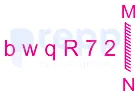
- A
Option A (shown in image)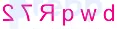
- B
Option B (shown in image)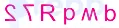
- C
Option C (shown in image)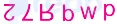
- D
Option D (shown in image)
Show answer
Question 17archived
Select the set in which the numbers are NOT related in the same way as are the numbers of the following sets.
(4, 5, 82)
(6, 11, 314)
(NOTE: Operations should be performed on the whole numbers, without breaking down the numbers into its constituent digits.)
- A
(7, 10, 298)
- B
(13, 15, 788)
- C
(11, 9, 560)
- D
(9, 8, 290)
Show answer
C. (11, 9, 560)The logic followed here is :-
(First number2 + Second number2) × 2 = Third number
(4, 5, 82) → (42 + 52) × 2 = (16 + 25) × 2 = 41 × 2 = 82
and
(6, 11, 314) → (62 + 112) × 2 = (36 + 121) × 2 = 157 × 2 = 314
Similarly,
1) (7, 10, 298) → (72 + 102) × 2 = (49 + 100) × 2 = 149 × 2 = 298
2) (13, 15, 788) → (132 + 152) × 2 = (169 + 225) × 2 = 394 × 2 = 788
3) (11, 9, 560) → (112 + 92) × 2 = (121 + 81) × 2 = 202 × 2 = 404 ≠ 560
4) (9, 8, 290) → (92 + 82) × 2 = (81 + 64) × 2 = 145 × 2 = 290
∴ Here, '(11, 9, 560)' is NOT relatedin the same way as are the numbers of the following sets.
Hence, the correct answer is "(11, 9, 560)".
Mistake Points
According to the question, "Which numbers are NOT related in the same way as the numbers of the following sets"
Option 3 is not related to the given sets. So option 3 is the correct answer.
 Paper & answer key PDF ↗
 Question 18archived
Select the set in which the numbers are related in the same way as are the numbers of the following sets.
(NOTE: Operations should be performed on the whole numbers, without breaking down the numbers into its constituent digits. E.g. 13 - Operations on 13 such as adding /Subtracting/multiplying etc. to 13 can be performed. Breaking down 13 into 1 and 3 and then performing mathematical operations on 1 and 3 is not allowed)
(7, 5, 16)
(12, 10, 36)
- A
(8, 7, 59)
- B
(9, 8, 12)
- C
(8, 7, 7)
- D
(10, 9, 144)
Show answer
C. (8, 7, 7)Analyzing Number Sets and Finding the Relationship
The question asks us to identify a set of numbers from the given options that follows the same relationship as the numbers in the provided sets: (7, 5, 16) and (12, 10, 36).
We need to find a pattern or rule that connects the three numbers (let's call them a, b, and c) in these sets. The rule must use the whole numbers themselves, not their individual digits.
Discovering the Pattern in the Given Sets
Let's look at the first given set: (7, 5, 16).
Let the first number be a = 7.
Let the second number be b = 5.
Let the third number be c = 16.
Let's examine the second given set: (12, 10, 36).
Let the first number be a = 12.
Let the second number be b = 10.
Let the third number be c = 36.
We need to find a consistent relationship between a, b, and c for both sets.
Let's consider some simple operations:
Difference between the first two numbers (a - b):
Set 1: 7 - 5 = 2
Set 2: 12 - 10 = 2
The difference (a - b) is 2 in both given sets. This is a potential part of the pattern.
Sum of the first two numbers (a + b):
Set 1: 7 + 5 = 12
Set 2: 12 + 10 = 22
Now let's see how the third number (c) might be related to these values (a, b, a-b, a+b).
In Set 1: a=7, b=5, c=16. a-b=2, a+b=12.
In Set 2: a=12, b=10, c=36. a-b=2, a+b=22.
Let's look at the third number c again:
Set 1: c = 16
Set 2: c = 36
Consider the product of the difference and the sum:
Set 1: (a - b) × (a + b) = 2 × 12 = 24. This is close to 16. 24 - 8 = 16.
Set 2: (a - b) × (a + b) = 2 × 22 = 44. This is close to 36. 44 - 8 = 36.
It appears the rule is: the third number c is equal to the product of the difference (a - b) and the sum (a + b), minus 8.
Let's write this rule as an equation:
\( (a - b) \times (a + b) - 8 = c \)
Recall the difference of squares formula: \( (a - b)(a + b) = a^2 - b^2 \).
So, the rule can also be written as:
\( a^2 - b^2 - 8 = c \)
Verifying the Rule with Given Sets
Let's check if this rule holds true for the given sets:
For set (7, 5, 16):
a = 7, b = 5.
Calculate using the rule: \( 7^2 - 5^2 - 8 \)
\( = 49 - 25 - 8 \)
\( = 24 - 8 \)
\( = 16 \)
This matches the third number in the set.
For set (12, 10, 36):
a = 12, b = 10.
Calculate using the rule: \( 12^2 - 10^2 - 8 \)
\( = 144 - 100 - 8 \)
\( = 44 - 8 \)
\( = 36 \)
This matches the third number in the set.
The rule \( a^2 - b^2 - 8 = c \) (or \( (a - b) \times (a + b) - 8 = c \)) successfully describes the relationship in both given sets.
Testing the Rule on the Options
Now, we apply this rule to each of the given options to find the set that follows the same pattern.
Let the option set be (a, b, c).
Option 1: (8, 7, 59)
a = 8, b = 7.
Calculate \( a^2 - b^2 - 8 \):
\( 8^2 - 7^2 - 8 \)
\( = 64 - 49 - 8 \)
\( = 15 - 8 \)
\( = 7 \)
The calculated value (7) does not match the third number in the option (59). Option 1 is incorrect.
Option 2: (9, 8, 12)
a = 9, b = 8.
Calculate \( a^2 - b^2 - 8 \):
\( 9^2 - 8^2 - 8 \)
\( = 81 - 64 - 8 \)
\( = 17 - 8 \)
\( = 9 \)
The calculated value (9) does not match the third number in the option (12). Option 2 is incorrect.
Option 3: (8, 7, 7)
a = 8, b = 7.
Calculate \( a^2 - b^2 - 8 \):
\( 8^2 - 7^2 - 8 \)
\( = 64 - 49 - 8 \)
\( = 15 - 8 \)
\( = 7 \)
The calculated value (7) matches the third number in the option (7). Option 3 follows the same relationship.
Option 4: (10, 9, 144)
a = 10, b = 9.
Calculate \( a^2 - b^2 - 8 \):
\( 10^2 - 9^2 - 8 \)
\( = 100 - 81 - 8 \)
\( = 19 - 8 \)
\( = 11 \)
The calculated value (11) does not match the third number in the option (144). Option 4 is incorrect.
Conclusion
Based on the analysis, the set (8, 7, 7) is the only option that follows the discovered rule \( a^2 - b^2 - 8 = c \) which holds for the given sets (7, 5, 16) and (12, 10, 36).
Revision Table: Checking the Number Relation
Set
a
b
c
Calculation \( a^2 - b^2 - 8 \)
Result
Matches c?
(7, 5, 16)
7
5
16
\( 7^2 - 5^2 - 8 = 49 - 25 - 8 = 16 \)
16
Yes
(12, 10, 36)
12
10
36
\( 12^2 - 10^2 - 8 = 144 - 100 - 8 = 36 \)
36
Yes
Option 1: (8, 7, 59)
8
7
59
\( 8^2 - 7^2 - 8 = 64 - 49 - 8 = 7 \)
7
No
Option 2: (9, 8, 12)
9
8
12
\( 9^2 - 8^2 - 8 = 81 - 64 - 8 = 9 \)
9
No
Option 3: (8, 7, 7)
8
7
7
\( 8^2 - 7^2 - 8 = 64 - 49 - 8 = 7 \)
7
Yes
Option 4: (10, 9, 144)
10
9
144
\( 10^2 - 9^2 - 8 = 100 - 81 - 8 = 11 \)
11
No
Additional Information: Number Analogy Problems
Number analogy questions test your ability to find patterns and relationships between numbers. These relationships can involve basic arithmetic operations (addition, subtraction, multiplication, division), squares, cubes, exponents, or combinations of these. Sometimes the relationship is between the first two numbers to get the third, or a relationship that applies across multiple pairs or sets of numbers.
Key strategies for solving number analogy problems:
Look for common differences or ratios.
Check for squares or cubes of the numbers or their differences/sums.
Combine operations (e.g., multiply the first by the second, then add/subtract a constant).
Analyze the structure of the sets (e.g., is there a constant difference between the first two numbers?).
Test potential rules consistently across all given examples before applying them to options.
The constraint about performing operations on whole numbers (like 13) rather than breaking them into digits (1 and 3) is standard in these types of logical reasoning problems. It prevents unconventional or digit-based arithmetic rules.
Paper & answer key PDF ↗ Question 19archived
Select the option that represents the correct order of the given words as they would appear in an English dictionary.
1. Mistaken
2. Missing
3. Mistyped
4. Mistrust
5. Mission
6. Mistress
- A
2, 5, 6, 4, 3, 1
- B
2, 5, 1, 6, 4, 3
- C
5, 2, 1, 6, 4, 3
- D
2, 5, 1, 4, 6, 3
Show answer
B. 2, 5, 1, 6, 4, 3The correct answer is 2, 5, 1, 6, 4, 3.
It's a fundamental concept in computer science and data organization, used extensively in databases, sorting algorithms, and text processing. Understanding dictionary order is essential not just for using a physical dictionary but also for searching, indexing, and organizing information alphabetically in various digital contexts. While simple for short words, arranging longer words or complex terms requires careful letter-by-letter comparison, especially when prefixes are shared, as seen in the words like Missing , Mission , Mistaken , Mistyped , Mistrust , and Mistress .
Paper & answer key PDF ↗ Question 20archived
Select the option that represents the letters that, when placed from left to right in the given blanks, will complete the letter series.
N O P _ Q N O _ I Q N _ P H Q _ O P G _
- A
P J N O Q
- B
J P O N Q
- C
P J O N O
- D
J P Q N O
Show answer
B. J P O N QSolving the Letter Series Pattern
The question asks us to find the letters that complete the given letter series when placed in the blanks from left to right. Let's look at the series provided:
N O P _ Q N O _ I Q N _ P H Q _ O P G _
We need to analyze the pattern by trying the given options in the blanks. The blanks are located at these positions:
After 'N O P' in the first segment.
After 'N O' in the second segment.
After 'N' in the third segment.
Before 'O P G' in the fourth segment.
After 'N O P G' in the fourth segment.
Let's test Option 2: J P O N Q. Placing these letters into the blanks from left to right:
N O P J Q
N O P I Q
N O P H Q
N O P G Q
Putting these segments together, the completed series becomes:
N O P J Q N O P I Q N O P H Q N O P G Q
Now, let's observe this completed letter series to find a repeating pattern. We can see that the series appears to be divided into blocks of five letters:
Block 1
N O P J Q
Block 2
N O P I Q
Block 3
N O P H Q
Block 4
N O P G Q
Upon examining these blocks, we notice the following consistent pattern:
Each block starts with 'N O P'.
Each block ends with 'Q'.
The fourth letter in each block changes. Let's look at this sequence of fourth letters: J, I, H, G.
The sequence of the fourth letters (J, I, H, G) is a sequence of consecutive letters in reverse alphabetical order.
This confirms that the letters J, P, O, N, and Q correctly complete the letter series by fitting this logical pattern. The letters placed in the blanks from left to right were indeed J, P, O, N, Q.
Identifying the Pattern in Letter Series
Identifying patterns in letter series often involves looking for repetition, sequences (alphabetical, reverse alphabetical), skips, or combinations of these. In this specific series:
N O P _ Q N O _ I Q N _ P H Q _ O P G _
The presence of repeated 'N O P' and 'Q' suggests a repeating block structure. The variations within the block usually form their own sub-pattern.
Let the blanks be b1, b2, b3, b4, b5:
N O P b1 Q N O b2 I Q N b3 P H Q b4 O P G b5
With the correct option J P O N Q placed in the blanks:
N O P J Q N O P I Q N O P H Q N O P G Q
Comparing the filled series to the original structure confirms the placement:
b1 is J (in N O P J Q)
b2 is P (in N O P I Q)
b3 is O (in N O P H Q)
b4 is N (in N O P G Q)
b5 is Q (in N O P G Q)
The letters filling the blanks from left to right are J, P, O, N, Q.
Conclusion on the Correct Option
By inserting the letters from Option 2 (J P O N Q) into the specified blanks, we successfully formed a letter series with a clear and consistent pattern: repeating blocks of 'N O P' followed by a letter from the reverse alphabetical sequence (J, I, H, G) and ending with 'Q'. Therefore, Option 2 is the correct answer.
Revision Table: Letter Series Patterns
Type of Pattern
Description
Example Idea
Repetition
A fixed block of letters/alphabets repeats.
ABC ABC ABC...
Alphabetical Sequence
Letters follow in standard alphabetical order.
A B C D... or AB BC CD...
Reverse Alphabetical Sequence
Letters follow in reverse alphabetical order.
Z Y X W... or ZY YX XW...
Skipping Letters
Letters follow with a gap (e.g., skipping one letter).
A C E G... (skipping B, D, F)
Mixed Patterns
Combinations of the above or different patterns in different parts of the series.
AZ BY CX... (alphabetical forward + reverse)
Additional Information: Tips for Solving Letter Series
Solving letter series questions requires careful observation and identification of the underlying rule. Here are some tips:
Break Down the Series: Look for potential repeating blocks or segments. The length of the repeating unit might be constant.
Look for Sequences: Check if individual letters or groups of letters follow alphabetical or reverse alphabetical order, or if they skip letters.
Check Positions: Sometimes the pattern relates to the position of the letter within a block or the series.
Consider Options: If it's a multiple-choice question, try fitting the options into the blanks. This can often reveal the pattern quickly.
Write it Out: Writing the series with the blanks filled (using an option) helps visualize the complete pattern.
Practice: Familiarity with common types of letter series patterns comes with practice.
Paper & answer key PDF ↗ Question 21archived
Three of the following four letter-clusters are alike in a certain way and one is different.
Pick the odd one out.
- A
PUXZ
- B
CHLP
- C
TYBD
- D
SXAC
Show answer
B. CHLPThe correct answer is CHLP.
Besides positional value differences, other common patterns include: Skipping letters (e.g., skipping 1 letter, then 2 letters, etc.). Patterns related to symmetry or visual appearance of letters (less common). Combinations of number and letter patterns. Practicing various types of letter series and odd-one-out questions helps you quickly spot these patterns during an exam.
Paper & answer key PDF ↗ Question 22archived
Select the Venn diagram that best illustrates the relationship between the following classes.
Dialect, Language, Communication
- A
Option A (shown in image)
- B
Option B (shown in image)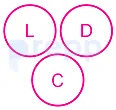
- C
Option C (shown in image)
- D
Option D (shown in image)
Show answer
C. Option C (shown in image)The least possible Venn diagram for the given relations is as shown below :-
All Dialect are languages.
All languages are for communication.
Hence, the correct answer is "Option 3".
 Paper & answer key PDF ↗
 Question 23archived
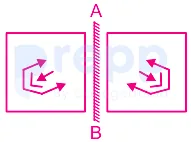
Select the correct mirror image of the given figure when the mirror is placed at AB.

- A
Option A (shown in image)
- B
Option B (shown in image)
- C
Option C (shown in image)
- D
Option D (shown in image)
Show answer
A. Option A (shown in image)The correct mirror image of the given figure when the mirror is placed at AB is as shown below :
Hence, the correct answer is "Option 1".
 Paper & answer key PDF ↗
 Question 24archived
Which of the following interchanges of signs and numbers would make the given equation correct?
25 - 10 ÷ 5 + 15 × 30 = 55
- A
× and +, 30 and 25
- B
÷ and +, 15 and 10
- C
× and -, 15 and 10
- D
+ and -, 5 and 10
Show answer
C. × and -, 15 and 10The problem asks us to find which interchange of signs and numbers will make the given equation mathematically correct. The given equation is:
\(25 - 10 \div 5 + 15 \times 30 = 55\)
We need to test each option by performing the suggested interchanges and then evaluating the new equation using the BODMAS or PEMDAS rule (Brackets/Parentheses, Orders/Exponents, Division and Multiplication (from left to right), Addition and Subtraction (from left to right)).
Testing Each Interchange Option
Option 1: Interchange \(\times\) and +, 30 and 25
Original equation: \(25 - 10 \div 5 + 15 \times 30 = 55\)
After interchanging \(\times\) and + signs, and 30 and 25 numbers, the equation becomes:
\(30 - 10 \div 5 \times 15 + 25\)
Let's evaluate this expression:
\(30 - (10 \div 5) \times 15 + 25\) (Division first)
\(30 - 2 \times 15 + 25\)
\(30 - (2 \times 15) + 25\) (Multiplication next)
\(30 - 30 + 25\)
\((30 - 30) + 25\) (Subtraction/Addition from left to right)
\(0 + 25 = 25\)
Since \(25 \neq 55\), this interchange does not make the equation correct.
Option 2: Interchange \(\div\) and +, 15 and 10
Original equation: \(25 - 10 \div 5 + 15 \times 30 = 55\)
After interchanging \(\div\) and + signs, and 15 and 10 numbers, the equation becomes:
\(25 - 15 + 5 \div 10 \times 30\)
Let's evaluate this expression:
\(25 - 15 + (5 \div 10) \times 30\) (Division first)
\(25 - 15 + 0.5 \times 30\)
\(25 - 15 + (0.5 \times 30)\) (Multiplication next)
\(25 - 15 + 15\)
\((25 - 15) + 15\) (Subtraction/Addition from left to right)
\(10 + 15 = 25\)
Since \(25 \neq 55\), this interchange does not make the equation correct.
Option 3: Interchange \(\times\) and -, 15 and 10
Original equation: \(25 - 10 \div 5 + 15 \times 30 = 55\)
After interchanging \(\times\) and - signs, and 15 and 10 numbers, the equation becomes:
\(25 \times 15 \div 5 + 10 - 30\)
Let's evaluate this expression:
\((25 \times 15) \div 5 + 10 - 30\) (Multiplication/Division from left to right)
\(375 \div 5 + 10 - 30\)
\((375 \div 5) + 10 - 30\) (Division next)
\(75 + 10 - 30\)
\((75 + 10) - 30\) (Addition/Subtraction from left to right)
\(85 - 30 = 55\)
Since \(55 = 55\), this interchange makes the equation correct.
Option 4: Interchange + and -, 5 and 10
Original equation: \(25 - 10 \div 5 + 15 \times 30 = 55\)
After interchanging + and - signs, and 5 and 10 numbers, the equation becomes:
\(25 + 5 \div 10 - 15 \times 30\)
Let's evaluate this expression:
\(25 + (5 \div 10) - 15 \times 30\) (Division first)
\(25 + 0.5 - 15 \times 30\)
\(25 + 0.5 - (15 \times 30)\) (Multiplication next)
\(25 + 0.5 - 450\)
\((25 + 0.5) - 450\) (Addition/Subtraction from left to right)
\(25.5 - 450 = -424.5\)
Since \(-424.5 \neq 55\), this interchange does not make the equation correct.
Based on the evaluation of all options, the interchange of \(\times\) and - signs, and the numbers 15 and 10 makes the given equation correct.
Revision Table: Checking Interchanges
Option
Interchange
New Equation
Evaluation
Result
Correct?
1
\(\times \leftrightarrow +\), \(30 \leftrightarrow 25\)
\(30 - 10 \div 5 \times 15 + 25\)
\(30 - 2 \times 15 + 25 = 30 - 30 + 25 = 25\)
25
No
2
\(\div \leftrightarrow +\), \(15 \leftrightarrow 10\)
\(25 - 15 + 5 \div 10 \times 30\)
\(25 - 15 + 0.5 \times 30 = 25 - 15 + 15 = 25\)
25
No
3
\(\times \leftrightarrow -\), \(15 \leftrightarrow 10\)
\(25 \times 15 \div 5 + 10 - 30\)
\(25 \times 3 + 10 - 30 = 75 + 10 - 30 = 85 - 30 = 55\)
55
Yes
4
\(+ \leftrightarrow -\), \(5 \leftrightarrow 10\)
\(25 + 5 \div 10 - 15 \times 30\)
\(25 + 0.5 - 450 = 25.5 - 450 = -424.5\)
-424.5
No
Additional Information on Mathematical Operations and BODMAS/PEMDAS
When solving mathematical expressions with multiple operations, it is crucial to follow a specific order to ensure the correct result. This order is commonly remembered using acronyms like BODMAS or PEMDAS.
BODMAS: Brackets, Orders (powers, square roots, etc.), Division and Multiplication (from left to right), Addition and Subtraction (from left to right).
PEMDAS: Parentheses, Exponents (powers, square roots, etc.), Multiplication and Division (from left to right), Addition and Subtraction (from left to right).
The key is that Division and Multiplication have the same priority, and you perform whichever comes first from the left in the expression. Similarly, Addition and Subtraction have the same priority, and you perform whichever comes first from the left.
In this problem, correctly applying the BODMAS/PEMDAS rule after performing the sign and number interchanges is essential to determine if the new equation holds true.
Paper & answer key PDF ↗ Question 25archived
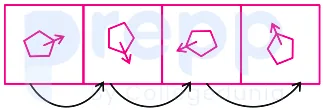
Select the figure that will come next in the following figure series.

- A
Option A (shown in image)
- B
Option B (shown in image)
- C
Option C (shown in image)
- D
Option D (shown in image)
Show answer
A. Option A (shown in image)The figure that will come next in the following figure series is as shown below :
The image is rotated 90 degrees in clockwise from figure to figure.
Hence, the correct answer is "Option 1".
 Paper & answer key PDF ↗
 Question 26archived
Which Grand Slam tournament was played between 17 to 30 January 2022?
- A
Wimbledon open
- B
US Open
- C
French Open
- D
Australian Open
Show answer
D. Australian OpenUnderstanding Tennis Grand Slam Tournaments
Tennis features four major annual tournaments known as the Grand Slams. These events are highly prestigious and are held at different times of the year.
The four Grand Slam tournaments are:
Australian Open
French Open (Roland-Garros)
Wimbledon
US Open
Typical Timing of Grand Slam Events
Each Grand Slam tournament is typically held during a specific period of the year. Knowing the general schedule helps identify which tournament was played during a given date range.
Here is the usual timing for each Grand Slam:
Grand Slam Tournament
Typical Months
Australian Open
January
French Open
May-June
Wimbledon
June-July
US Open
August-September
Identifying the Grand Slam from the Date Range
The question asks which Grand Slam tournament was played between 17 to 30 January 2022. Looking at the typical schedule:
Wimbledon is played in June-July.
The US Open is played in August-September.
The French Open is played in May-June.
The Australian Open is played in January.
The given dates, January 17 to January 30, 2022, fall entirely within the month of January. Based on the typical calendar, the Australian Open is the only Grand Slam tournament held in January.
Conclusion: Australian Open 2022
Therefore, the Grand Slam tournament played between 17 to 30 January 2022 was the Australian Open. This aligns perfectly with the traditional timing of the Australian Open, which marks the start of the Grand Slam season each year.
Revision Table: Key Grand Slam Facts
Tournament
Location
Surface
Typical Timing
Australian Open
Melbourne, Australia
Hard court
January
French Open (Roland-Garros)
Paris, France
Clay court
May-June
Wimbledon
London, England
Grass court
June-July
US Open
New York City, USA
Hard court
August-September
Additional Information on Grand Slam Tennis
Grand Slam tournaments are significant not just for their prestige but also for the ranking points they award and the prize money. Winning a Grand Slam title is considered the pinnacle of achievement in professional tennis. Each tournament also has unique traditions and playing surfaces, which add to the challenge and variety of the Grand Slam season.
Paper & answer key PDF ↗ Question 27archived
Why is PC Mahalanobis' name talked about in the context of Five-Year Plans?
- A
He was the chairman of the Planning Commission.
- B
He established the Institute of Economic Growth.
- C
He conceptualised the framework for the Second Five-Year Plan.
- D
He was the finance minister during the First Five-Year Plan period.
Show answer
C. He conceptualised the framework for the Second Five-Year Plan.Understanding PC Mahalanobis and India's Five-Year Plans
PC Mahalanobis, whose full name was Prasanta Chandra Mahalanobis, was a renowned Indian statistician. He played a very significant role in shaping India's post-independence economic policies, particularly through the framework of the Five-Year Plans.
His contributions are especially remembered in the context of the Second Five-Year Plan (1956-1961). While the First Five-Year Plan focused mainly on agriculture, the Second Plan aimed for rapid industrialization. Mahalanobis provided the core economic model upon which this plan was built.
The Framework for the Second Five-Year Plan: The Mahalanobis Model
PC Mahalanobis developed an economic model in 1953 which later became the basis for the strategy of the Second Five-Year Plan. This model is often referred to as the 'Mahalanobis Model'.
Key features of the Mahalanobis Model included:
Focus on heavy industries: The model advocated for massive investment in basic and heavy industries like steel, coal, and machinery manufacturing. The idea was that building a strong base of capital goods industries would enable future self-reliant growth.
Rapid industrialization: The plan aimed for a quick transformation of the Indian economy from an agrarian one to an industrialized one.
Emphasis on public sector: The model implicitly favoured a significant role for the public sector in driving industrial growth.
This framework, conceptualized by Mahalanobis, heavily influenced the direction and priorities of the Second Five-Year Plan, making his name synonymous with this crucial period of India's economic planning.
Analyzing the Options
Let's look at the given options to understand why the conceptualization of the Second Five-Year Plan framework is the correct reason for his prominence.
Option 1 Analysis: Chairman of the Planning Commission
While PC Mahalanobis was a member of the Planning Commission and a key advisor, the first Chairman of the Planning Commission was Jawaharlal Nehru, the Prime Minister. Mahalanobis held various important roles and committees within the planning structure but was not the Chairman.
Option 2 Analysis: He established the Institute of Economic Growth
PC Mahalanobis was instrumental in establishing the Indian Statistical Institute (ISI) in Kolkata (then Calcutta) in 1931, which later became an institution of national importance. While the Institute of Economic Growth is a prominent research institute, its establishment is not primarily attributed to PC Mahalanobis. His major institutional contribution was the ISI.
Option 3 Analysis: He conceptualised the framework for the Second Five-Year Plan
As discussed above, PC Mahalanobis developed the theoretical and statistical framework, the Mahalanobis Model, that guided the objectives, investments, and strategies of the Second Five-Year Plan. This is considered his most significant contribution to India's Five-Year Plans.
Option 4 Analysis: He was the finance minister during the First Five-Year Plan period
The Finance Minister during a significant portion of the First Five-Year Plan (1951-1956) was C.D. Deshmukh. PC Mahalanobis was a statistician and economic advisor, not a finance minister.
Therefore, the most accurate reason why PC Mahalanobis's name is prominently associated with Five-Year Plans is his fundamental role in conceptualizing the framework for the Second Five-Year Plan.
Revision Table: Key Figures and Plans
Figure
Associated Plan(s) / Role
Key Contribution / Focus
Jawaharlal Nehru
All initial Plans (as PM & Chairman of Planning Commission)
Visionary head of planning; Socialist pattern of society
K.N. Raj
First Five-Year Plan
Drafted the First Plan, focusing on agriculture
PC Mahalanobis
Second Five-Year Plan
Developed the framework (Mahalanobis Model); focus on heavy industries
C.D. Deshmukh
First Five-Year Plan (as FM)
Finance Minister during the period
Additional Information: India's Five-Year Plans
India's Five-Year Plans were a series of national economic plans initiated after independence to guide the country's economic development. They were formulated and implemented by the Planning Commission of India (later replaced by NITI Aayog).
The concept was borrowed from the Soviet Union.
Each plan had specific objectives and priorities, addressing different sectors of the economy.
The plans aimed at achieving economic growth, self-reliance, social justice, and poverty eradication over time.
The era of Five-Year Plans formally ended in 2017 with the dissolution of the Planning Commission and the introduction of a 15-year vision document by NITI Aayog.
Paper & answer key PDF ↗ Question 28archived
Which from the following is a phylum of animals found in fresh water ponds, lakes and swamps provides setae or parapodia for locomotion?
- A
Ctenophora
- B
Porifera
- C
Annelida
- D
Platyhelminthes
Show answer
C. AnnelidaUnderstanding Phyla of Freshwater Animals
The question asks to identify a phylum of animals that are commonly found in freshwater environments like ponds, lakes, and swamps, and which use structures called setae or parapodia for movement (locomotion). Let's examine the characteristics of the phyla provided in the options.
Analyzing the Options and Animal Locomotion
We need to consider the habitat and the method of locomotion for each phylum:
Ctenophora: This phylum consists of comb jellies, which are almost exclusively marine. They are known for their comb rows, structures made of cilia used for swimming. They do not live in freshwater and do not possess setae or parapodia for locomotion.
Porifera: This phylum includes sponges. Sponges are mostly marine, though a few species are found in freshwater. However, adult sponges are sessile, meaning they are attached to a surface and do not move freely. They lack true tissues and organs, including specialized structures like setae or parapodia for locomotion.
Annelida: This phylum comprises segmented worms, such as earthworms, leeches, and many types of marine worms. Many annelids are found in freshwater habitats (e.g., leeches, some oligochaetes like freshwater earthworms). A key characteristic of Annelida is the presence of segments, and many species bear chitinous bristles called setae. Polychaete annelids (which include some freshwater forms) often have fleshy, paired appendages on each segment called parapodia, which bear setae and are used for crawling, swimming, or gas exchange. Both setae and parapodia are crucial for locomotion in many annelids.
Platyhelminthes: This phylum includes flatworms. While some flatworms (like planarians) are found in freshwater, their primary methods of locomotion involve cilia on the ventral surface for gliding or muscular contractions for undulation or crawling. They do not possess setae or parapodia for locomotion.
Identifying the Correct Phylum
Based on the analysis, the phylum Annelida fits the description provided in the question. Many species of Annelida are found in freshwater ponds, lakes, and swamps, and they utilize setae or parapodia for locomotion.
Revision Table: Phyla Characteristics
Phylum
Common Habitat
Locomotion Structures
Found in Freshwater?
Ctenophora
Marine
Cilia (comb rows)
No
Porifera
Mostly Marine
Sessile (adults)
Few species
Annelida
Marine, Freshwater, Terrestrial
Setae, Parapodia
Yes (Common)
Platyhelminthes
Marine, Freshwater, Terrestrial (parasitic)
Cilia, Muscular contractions
Yes (Some species)
The table summarizes why Annelida is the phylum that matches the criteria of being found in freshwater and having setae or parapodia for locomotion.
Additional Information on Annelid Locomotion
The way annelids move using setae and parapodia is quite effective in their environments:
Setae: These are bristle-like structures made of chitin. In earthworms (Oligochaetes), short setae anchor the body to the substrate, allowing muscles to contract and extend the body forward. This wave of muscle contraction and anchoring propels the worm.
Parapodia: Found mainly in Polychaetes, parapodia are paired, fleshy outgrowths from each segment. They often have two lobes (dorsal notopodium and ventral neuropodium) and bear bundles of setae. Parapodia can be used for crawling, walking, or even swimming in some species, acting like oars or legs.
Understanding these structures helps clarify why Annelida is the correct answer for animals with setae or parapodia used for locomotion in freshwater habitats.
Paper & answer key PDF ↗ Question 29archived
Which autonomous body was operationalised under the Ministry of Surface Transport in 1995?
- A
Border Roads Organization (BRO)
- B
Centre for Railway Information System (CRIS)
- C
Inland Waterways Authority of India (IWAI)
- D
National Highways Authority of India (NHAI)
Show answer
D. National Highways Authority of India (NHAI)Understanding Autonomous Bodies under Ministry of Surface Transport
The question asks about an autonomous body that began operating in 1995 under the Ministry of Surface Transport. Identifying the correct body requires knowledge of the establishment and operational history of key infrastructure organizations in India.
Analyzing the Options
Let's examine each option provided:
Border Roads Organization (BRO): This organization is responsible for developing and maintaining road networks in India's border areas and friendly neighboring countries. The BRO was established in 1960 and primarily functions under the Ministry of Defence, although it also supports projects for the Ministry of Road Transport and Highways (which evolved from the Ministry of Surface Transport). Its establishment year and primary ministry do not match the question's criteria.
Centre for Railway Information System (CRIS): CRIS is an autonomous society under the Ministry of Railways. It is involved in developing and managing information technology solutions for the Indian Railways. Its focus on railways and its parent ministry mean it is not the correct answer concerning the Ministry of Surface Transport or its related ministries focused on roads and highways.
Inland Waterways Authority of India (IWAI): IWAI is responsible for the development and regulation of inland waterways for shipping and navigation. It was constituted in October 1986 under the Ministry of Surface Transport. While it falls under the correct ministry type, its operationalization date (1986) does not match the 1995 requirement.
National Highways Authority of India (NHAI): NHAI is a statutory body established by the National Highways Authority of India Act, 1988. It is responsible for the development, maintenance, and management of National Highways in India. While the Act was passed in 1988, NHAI became operational in 1995. It functions under the Ministry of Road Transport and Highways, which evolved from the Ministry of Surface Transport. This aligns perfectly with the question's criteria of an autonomous body operationalized in 1995 under the ministry responsible for surface transport.
Comparing the Options - Establishment and Operational Dates
Let's put the key details into a table for clarity:
Autonomous Body
Establishment/Constitution Year
Operational Year (if different)
Primary Ministry (at relevant time)
Border Roads Organization (BRO)
1960
N/A
Ministry of Defence
Centre for Railway Information System (CRIS)
1986
N/A
Ministry of Railways
Inland Waterways Authority of India (IWAI)
1986
N/A
Ministry of Surface Transport
National Highways Authority of India (NHAI)
Act in 1988
1995
Ministry of Surface Transport / Road Transport and Highways
Identifying the Correct Autonomous Body
Based on the analysis, the National Highways Authority of India (NHAI) is the only body among the options that fits the description: an autonomous body operationalized in 1995 under the Ministry of Surface Transport (or its successor ministry responsible for road transport).
Conclusion on Autonomous Body Operational in 1995
The autonomous body operationalized under the Ministry of Surface Transport in 1995 was the National Highways Authority of India (NHAI).
Revision Table: Key Details for Exam Prep
Body
Established
Operationalized
Focus Area
Ministry
BRO
1960
1960
Border Roads
Ministry of Defence
CRIS
1986
1986
Railway IT
Ministry of Railways
IWAI
1986
1986
Inland Waterways
Ministry of Surface Transport
NHAI
Act 1988
1995
National Highways
Ministry of Surface Transport/Road Transport & Highways
Additional Information: Understanding NHAI and Ministry Evolution
The Ministry responsible for surface transport has undergone several name changes over the years. It was the Ministry of Surface Transport around 1995. Later, it was bifurcated or renamed. The National Highways Authority of India (NHAI) consistently falls under the purview of the ministry responsible for roads and highways, which was the Ministry of Surface Transport in 1995.
NHAI's mandate includes planning, developing, collecting tolls on, and maintaining national highways across India. Its operationalization in 1995 marked a significant step in accelerating highway development projects in the country.
Paper & answer key PDF ↗ Question 30archived
The slogan of which census of India was 'Our Census, Our Future'?
- A
1981
- B
2011
- C
2001
- D
1991
Show answer
B. 2011The correct answer is 2011.
The slogan of the 15th Census of India, held in 2011, was 'Our Census, Our Future'. Census 2011 was conducted in two phases — houselisting and population enumeration — and covered around 1.21 billion people, making it the largest single administrative exercise in the world at that time.
The 1981 census used 'One nation, one people, one identity'; 1991 used 'Ensuring the future by census planning'; and 2001 used 'For a stronger, better and prosperous India'. Hence 'Our Census, Our Future' is uniquely associated with the 2011 census.
Paper & answer key PDF ↗ Question 31archived
Micro credit or micro finance is a novel approach to bank with poor. In this approach bank credit is extended to the poor through _________.
- A
co-operative credit societies
- B
RBI
- C
self-help groups
- D
anganwadees
Show answer
C. self-help groupsUnderstanding Micro Credit and Self-Help Groups
Micro credit, also known as micro finance, is a way of providing small loans and other financial services to poor and low-income households. Traditional banking systems often struggle to serve these populations because they lack collateral, have irregular income, and may live in remote areas.
To overcome these challenges, innovative approaches are used to make credit accessible to the poor. One widely adopted method involves channeling bank credit through community-based groups.
How Banks Extend Micro Credit to the Poor
The question asks about the mechanism through which banks extend credit to the poor in the context of micro credit or micro finance. Among the options provided, a specific method is commonly employed to facilitate this lending.
Let's consider the common approaches used in micro finance:
Co-operative credit societies: These are member-owned financial institutions. While they serve members, including those with low incomes, micro credit often refers to models specifically designed to reach the very poor who may not be part of formal co-operatives.
RBI (Reserve Bank of India): The RBI is the central bank of India and regulates banks. It doesn't directly extend credit to individual poor people or even typically to groups at the grassroots level for micro finance purposes. It sets policies for banks.
Self-help groups (SHGs): These are small, informal associations of people who come together to save money and lend to each other. SHGs form a crucial link between banks and the poor. Banks find it easier and less risky to lend to SHGs as a collective entity rather than to individual poor people.
Anganwadis: Anganwadis are rural child care and mother care centers in India. While they play a vital role in health, nutrition, and education, they are not financial institutions and are not involved in extending bank credit.
The model of extending micro credit through self-help groups (SHGs) is particularly effective. Here's how it generally works:
Formation of SHGs: Poor individuals, usually women, in a community form a group (typically 10-20 members).
Regular Savings: Members regularly contribute small amounts as savings to the group's common fund.
Internal Lending: The group uses its pooled savings to provide small loans to members for their urgent needs, based on simple rules decided by the group.
Bank Linkage: After a period of successful saving and internal lending, the SHG becomes eligible to borrow from a bank. Banks are more willing to lend to a group with a proven track record of savings and repayment discipline.
Bank Loan Utilization: The SHG receives a larger loan from the bank, which it then lends to its members for various income-generating activities or needs.
Repayment: Members repay their loans to the SHG, and the SHG repays the bank loan. The group collectively takes responsibility for repayment, providing peer pressure and support.
This self-help group model reduces transaction costs for banks and leverages social capital and peer monitoring within the group to ensure high repayment rates. Therefore, bank credit is commonly extended to the poor through self-help groups in the context of micro credit and micro finance initiatives.
Revision Table: Micro Credit Channels
Method
Role in Micro Credit
Directness of Bank Credit to Poor
Co-operative Credit Societies
Can provide credit, but not the primary novel approach for the 'poorest' in micro finance initiatives.
Yes, to members.
RBI
Regulator and policy maker, not direct lender for micro credit.
No.
Self-Help Groups (SHGs)
Key intermediary model, aggregates demand and ensures repayment.
Indirectly, via the group.
Anganwadis
Child and mother care centers, not financial intermediaries.
No.
Additional Information on Micro Finance
Micro finance has evolved significantly since its early days. While SHGs are a dominant model, particularly in South Asia, other models exist globally, such as:
Grameen Bank Model: Founded by Nobel Laureate Muhammad Yunus in Bangladesh, this model lends directly to poor individuals organized into small groups (often 5 members). The group members act as co-guarantors, and weekly meetings are held for loan disbursement and collection.
Individual Lending Model: Some micro finance institutions (MFIs) lend directly to individuals, often requiring some form of social collateral or smaller initial loan sizes that increase upon successful repayment.
Village Banking Model: Similar to SHGs, these are community-managed credit and savings associations at the village level.
The success of micro finance largely depends on appropriate group formation, financial discipline, and linking with formal financial institutions like banks.
Paper & answer key PDF ↗ Question 32archived
Which state ranks first with a total length of 31.2 thousand km of rivers and canals, which is about 17% of the total length of rivers and canals in the country?
- A
Kerala
- B
West Bengal
- C
Uttar Pradesh
- D
Madhya Pradesh
Show answer
C. Uttar PradeshAnalyzing India's River and Canal Network Lengths
Understanding the geographical distribution of rivers and canals across India is important for studying water resources, irrigation, and transportation infrastructure. The total length of these waterways varies significantly from state to state.
Identifying the State with the Longest Waterway Network
The question asks us to identify the state that holds the top position in India for the total length of rivers and canals. It provides specific data: a total length of 31.2 thousand kilometers, which accounts for approximately 17% of the entire country's river and canal length.
Let's consider the options provided:
Kerala
West Bengal
Uttar Pradesh
Madhya Pradesh
Based on available data regarding the length of rivers and canals used for navigation and irrigation across various states, Uttar Pradesh emerges as the state with the most extensive network.
Uttar Pradesh: Leading in River and Canal Length
Uttar Pradesh, being a large state in the fertile Indo-Gangetic plain, is endowed with numerous rivers and has developed a vast network of irrigation canals over the years. Major rivers like the Ganga and Yamuna flow through the state, along with many tributaries. The extensive agricultural activity in the state necessitates a wide network of canals for irrigation purposes.
The figure of 31.2 thousand kilometers for the total length of rivers and canals in Uttar Pradesh aligns with data indicating its leading position in this regard, constituting about 17% of India's total waterway length.
Comparison with Other States
While states like West Bengal also have significant river systems (like the Hooghly branch of Ganga) and canals, and Kerala is known for its backwaters and canals, and Madhya Pradesh has several major rivers originating there, none of these states have a combined total length of rivers and canals that surpasses Uttar Pradesh's extensive network, particularly when considering irrigation canals alongside natural rivers.
Therefore, Uttar Pradesh ranks first in India for the total length of rivers and canals.
Conclusion
The state that ranks first with a total length of 31.2 thousand km of rivers and canals, which is about 17% of the total length in the country, is Uttar Pradesh.
State
Approximate Total Length of Rivers & Canals (km)
Ranking (based on this criterion)
Uttar Pradesh
31,200
1st
Other States (listed in options)
Significantly less than 31,200
Lower
Revision Table: Key Facts on Waterways in India
Feature
Details
State with Longest River & Canal Network
Uttar Pradesh
Approximate Length in Uttar Pradesh
31.2 thousand km
Percentage of India's Total Length
About 17%
Reason for Extensive Network in UP
Large fertile plains, major rivers (Ganga, Yamuna), extensive irrigation needs
Additional Information on Indian Waterways
India has a vast network of rivers and canals that serve multiple purposes, including irrigation, navigation, power generation, and drinking water supply. The Gangetic plain states, due to their topography and agricultural intensity, often have dense networks of canals built to utilize river water effectively.
Inland Waterways: India also focuses on developing inland waterways for transportation. Major rivers and canals are being connected and upgraded for navigation.
Irrigation Canals: A significant portion of the canal length in states like Uttar Pradesh is dedicated to irrigation, supporting the large agricultural sector.
River Systems: India is home to several major river systems, including the Indus, Ganga, Brahmaputra, Godavari, Krishna, Kaveri, and Mahanadi.
The data on river and canal length can sometimes vary slightly depending on the source and what types of waterways are included (e.g., only navigable, all rivers, all canals, distributaries, etc.). However, Uttar Pradesh consistently ranks among the top states for total inland waterway length, particularly when including irrigation canals.
Paper & answer key PDF ↗ Question 33archived
Hindustan Copper Limited (HCL) was incorporated in the year _________.
- A
1972
- B
1963
- C
1981
- D
1967
Show answer
D. 1967Understanding Hindustan Copper Limited (HCL)
The question asks about the year of incorporation of Hindustan Copper Limited (HCL).
Hindustan Copper Limited (HCL) is a Central Public Sector Undertaking (CPSE) under the Ministry of Mines, Government of India. It is involved in the entire value chain of copper production, from mining to refining and selling.
Knowing the incorporation year of key public sector undertakings like HCL is important for understanding India's industrial history and economic development.
HCL Incorporation Year Analysis
Let's examine the options provided for the incorporation year of Hindustan Copper Limited (HCL):
1972
1963
1981
1967
To answer this question correctly, one needs to recall the historical facts regarding the formation of HCL.
Hindustan Copper Limited (HCL) was formed by the Government of India. The correct year of its incorporation is a specific historical date.
Based on historical records, Hindustan Copper Limited (HCL) was incorporated in the year 1967. This makes the fourth option the correct answer.
Detailed Breakdown of HCL Incorporation
Hindustan Copper Limited (HCL) was incorporated on November 9, 1967. It was formed to take over the assets of the Indian Copper Corporation Limited, which was a private company. This step was part of the government's policy at that time to bring strategic industries under state control.
Here is a simple table summarizing the options and the correct information:
Option
Year
Correct?
1
1972
No
2
1963
No
3
1981
No
4
1967
Yes
Therefore, the incorporation year of Hindustan Copper Limited (HCL) is indeed 1967.
Revision Table - Hindustan Copper Limited History
Aspect
Details
Company Name
Hindustan Copper Limited (HCL)
Incorporation Date
November 9, 1967
Type
Central Public Sector Undertaking (CPSE)
Governing Ministry
Ministry of Mines, Government of India
Primary Business
Copper mining, smelting, refining, and sales
Additional Information - HCL and Copper Industry
HCL holds the distinction of being the only vertically integrated copper producer in India. It has mines and plants located across different states, including Jharkhand, Madhya Pradesh, Rajasthan, Maharashtra, and Gujarat. HCL plays a vital role in meeting India's demand for copper, a critical metal used in various industries, including electrical, construction, and manufacturing.
Understanding the history of such public sector undertakings provides insight into India's industrial policy evolution and the development of core sectors like mining and metals.
Paper & answer key PDF ↗ Question 34archived
Vajira Chitrasena of Sri Lanka was conferred the Padma Shri award 2020 for which of the following?
- A
Enriching India-Sri Lanka ties through Indian classical music
- B
Enriching India-Sri Lanka ties through Indian classical dance
- C
Enriching India- Sri Lanka ties through social work
- D
Enriching India- Sri Lanka ties through education
Show answer
B. Enriching India-Sri Lanka ties through Indian classical danceUnderstanding the Vajira Chitrasena Padma Shri Award 2020
The question asks about the specific reason for which Vajira Chitrasena from Sri Lanka was awarded the Padma Shri in 2020, focusing on her contribution to India-Sri Lanka ties.
Vajira Chitrasena is a highly respected and pioneering figure in traditional Sri Lankan dance, particularly the Kandyan dance form. She is known for her significant contributions to dance as a performer, choreographer, and teacher, and comes from the renowned Chitrasena Dance Company lineage.
The Padma Shri is one of India's highest civilian awards, given for distinguished service in various fields. Conferring it upon an international figure like Vajira Chitrasena highlights her impact beyond Sri Lanka, particularly in fostering cultural connections with India.
Analyzing Options for Vajira Chitrasena's Award
Let's look at the provided options and consider how they relate to Vajira Chitrasena's known work and the nature of the Padma Shri award for international recipients promoting bilateral ties:
Option 1: Enriching India-Sri Lanka ties through Indian classical music. Vajira Chitrasena's expertise is in dance, not primarily music. While dance and music are related art forms, her core contribution is through dance.
Option 2: Enriching India-Sri Lanka ties through Indian classical dance. While Vajira Chitrasena is a master of Kandyan dance (a Sri Lankan traditional form), cultural exchange often involves dialogue and influence between different classical traditions. Her work and performances, as well as her institution's activities, have significantly contributed to mutual appreciation and understanding of dance forms between the two countries. Awards recognizing contributions to bilateral ties through art often encompass the broad impact of an artist's work in fostering cultural understanding, even if their primary form is from their own country's tradition, especially when there's historical or contemporary exchange. The provided correct answer states this reason.
Option 3: Enriching India- Sri Lanka ties through social work. While artists often engage in activities beneficial to society, Vajira Chitrasena's primary recognition stems from her artistic contributions to dance and culture, not specifically social work as a distinct field.
Option 4: Enriching India- Sri Lanka ties through education. Vajira Chitrasena is an educator in dance, running a renowned dance school. However, the specific citation for the Padma Shri often focuses on the cultural impact and bilateral ties aspect, framed through her artistic domain. While education is part of her contribution, the award recognizes the broader impact on cultural relations through her artistic expertise.
Based on information about the Padma Shri awards in 2020 and the accomplishments of Vajira Chitrasena, the award recognized her profound influence in strengthening cultural bonds between India and Sri Lanka through the medium of dance. The specific citation for the award conferred upon her in 2020 was indeed for 'Enriching India-Sri Lanka ties through Indian classical dance'. This highlights the role of dance, including classical traditions from both countries and their interaction, in fostering strong bilateral relations.
Conclusion on Vajira Chitrasena's Padma Shri
Vajira Chitrasena, the celebrated Sri Lankan dancer, received the Padma Shri award in 2020 for her significant role in enhancing the relationship between India and Sri Lanka through her contributions to dance. Her work has been instrumental in promoting cultural exchange and mutual appreciation, specifically recognized under the category relating to classical dance and its impact on bilateral ties.
Revision Table: Key Details
Award Recipient
Country
Award
Year
Recognized Contribution (Specific)
Vajira Chitrasena
Sri Lanka
Padma Shri
2020
Enriching India-Sri Lanka ties through Indian classical dance
Additional Information on Padma Awards and Cultural Ties
The Padma Awards - Padma Vibhushan, Padma Bhushan, and Padma Shri - are among the highest civilian honours of India. They are announced annually on the eve of Republic Day. These awards recognize achievements in various disciplines and fields of activities. The category 'Foreigners/NRIs/PIOs/OCI' is specifically for individuals from outside India who have made significant contributions to India or to furthering India's relations with their respective countries.
Cultural exchange through arts like dance, music, and theatre plays a vital role in strengthening diplomatic and people-to-people ties between countries. India and Sri Lanka share a rich cultural heritage, and artists like Vajira Chitrasena contribute significantly to preserving, promoting, and sharing this heritage across borders.
Vajira Chitrasena's legacy is deeply rooted in the traditional Kandyan dance, but her influence extends to fostering a broader understanding and appreciation of South Asian classical and traditional dance forms internationally, including in India.
Paper & answer key PDF ↗ Question 35archived
Which pioneer scientist used radio waves to transmit signals over distances of several kilometres in the 1890s?
- A
Michael Faraday
- B
Paul Langevin
- C
Guglielmo Marconi
- D
Pierre Weiss
Show answer
C. Guglielmo MarconiIdentifying the Radio Wave Transmission Pioneer
The question asks us to identify the scientist who was a pioneer in using radio waves to transmit signals over distances of several kilometers during the 1890s. Let's examine the contributions of the scientists listed in the options.
Analyzing the Options for Radio Wave Pioneers
Michael Faraday: Michael Faraday was a fundamental figure in the study of electromagnetism in the 19th century. His work laid the groundwork for understanding electric and magnetic fields and their relationship, which is crucial for radio waves. However, he is not specifically known for transmitting radio signals over distances in the 1890s.
Paul Langevin: Paul Langevin was a French physicist known for his work on ultrasonics and magnetism in the early 20th century. He developed techniques using ultrasound, particularly during World War I for submarine detection. His main contributions are not related to pioneering long-distance radio wave transmission in the 1890s.
Guglielmo Marconi: Guglielmo Marconi was an Italian inventor and electrical engineer. He is widely credited with pioneering the practical application of radio waves for communication. In the 1890s, Marconi conducted experiments demonstrating the ability to transmit wireless signals over increasingly longer distances. By 1896, he had patented his system, and by 1897, he was transmitting over distances of several kilometers. His famous transatlantic transmission occurred later, in 1901, but his work in the 1890s established his role as a key pioneer in long-distance radio communication.
Pierre Weiss: Pierre Weiss was a French physicist known for his work on ferromagnetism in the early 20th century. He developed the domain theory of ferromagnetism and the concept of the molecular field. His research was focused on magnetic properties of materials, not on the practical transmission of radio waves.
Guglielmo Marconi's Pioneering Radio Wave Experiments
Guglielmo Marconi's significant contributions in the 1890s directly address the question. He built upon the theoretical work of James Clerk Maxwell and the experimental demonstrations of Heinrich Hertz regarding electromagnetic waves (radio waves). Marconi focused on developing a practical system for wireless telegraphy.
Key points about Marconi's work in the 1890s:
He began experiments in 1894 in Italy.
He successfully increased the transmission range by using elevated antennas.
In 1896, he moved to England and patented his wireless telegraphy system.
By 1897, he achieved transmissions over distances of several kilometers, including across the Bristol Channel.
His work quickly led to the establishment of wireless communication services.
His efforts during this decade were crucial in demonstrating the potential of radio waves for long-distance communication, making him the pioneer described in the question.
Conclusion on Radio Wave Pioneers
Based on the historical evidence of their work, Guglielmo Marconi is the scientist who pioneered the use of radio waves for transmitting signals over distances of several kilometers in the 1890s.
Revision Table: Scientists and Contributions
Scientist
Key Area(s) of Contribution
Relevance to 1890s Radio Transmission
Michael Faraday
Electromagnetism, Induction
Provided theoretical foundation, but not practical transmission in 1890s
Paul Langevin
Ultrasonics, Magnetism
Not relevant to radio wave transmission in 1890s
Guglielmo Marconi
Wireless Telegraphy (Radio)
Pioneered practical long-distance radio transmission in the 1890s
Pierre Weiss
Ferromagnetism
Not relevant to radio wave transmission in 1890s
Additional Information on Early Radio Communication
The development of radio communication was a culmination of theoretical physics and practical engineering. Heinrich Hertz had demonstrated the existence of electromagnetic waves (radio waves) in the late 1880s, but his experiments were typically over short distances within a laboratory.
Guglielmo Marconi's genius lay in taking this scientific discovery and engineering a system capable of sending these waves over significant distances for communication purposes. His improvements to antennas and grounding were critical in achieving these longer ranges in the 1890s.
While other inventors and scientists were also working on wireless technologies around the same time, Marconi was particularly successful in developing a commercially viable system and demonstrating its potential for global communication, starting with his achievements in the 1890s.
Paper & answer key PDF ↗ Question 36archived
"India House", a revolutionary organisation, was established by Shyamji Krishna Varma in _________ for the spread of Indian Nationalism.
- A
Singapore
- B
London
- C
San Francisco
- D
Paris
Show answer
B. LondonUnderstanding the Establishment of India House
The question asks about the location where "India House", a significant revolutionary organisation for the spread of Indian Nationalism, was founded by Shyamji Krishna Varma.
Shyamji Krishna Varma was a prominent Indian revolutionary fighter, lawyer, and journalist. He founded the Indian Home Rule Society, the Indian Sociologist, and "India House".
India House and its Role in Indian Nationalism
"India House" was more than just a building; it became a centre for Indian students in London and a hub for revolutionary activities aimed at achieving India's independence from British rule. Established in 1905, it provided accommodation for Indian students and served as a meeting place for discussing and promoting the cause of Indian Nationalism.
Many prominent Indian revolutionaries stayed at or were associated with "India House", including Vinayak Damodar Savarkar, Madan Lal Dhingra, V.N. Chatterjee, and Madame Cama. The organisation played a crucial role in disseminating nationalist ideas and organising support for the independence movement from abroad.
Shyamji Krishna Varma and London
Shyamji Krishna Varma established "India House" specifically in London. London was the capital of the British Empire, and establishing a centre for Indian Nationalism there had significant symbolic and practical implications. It allowed Indian nationalists to engage directly with the imperial power, raise awareness among the British public, and network with other international revolutionary movements.
Analysing the Options
Let's look at the provided options:
Singapore: While Singapore had Indian connections within the British Empire, it was not the location where Shyamji Krishna Varma established "India House".
London: As discussed, Shyamji Krishna Varma established "India House" in London as a key centre for promoting Indian Nationalism among students and revolutionaries.
San Francisco: San Francisco later became a hub for Indian nationalist activity, particularly with the Ghadr Party, but "India House" was not founded there by Shyamji Krishna Varma.
Paris: Shyamji Krishna Varma did move to Paris later when facing pressure in London, and Paris also became an important centre for Indian revolutionaries like Madame Cama, but the initial establishment of "India House" was not in Paris.
Based on historical facts, "India House" was established by Shyamji Krishna Varma in London.
Key Information about India House
Organisation
India House
Founder
Shyamji Krishna Varma
Year of Establishment
1905
Purpose
Spread of Indian Nationalism, support for Indian students, revolutionary activities
Location
London
Revision Table: Key Facts on India House in London
Reviewing India House Details
Feature
Detail
Organisation Name
India House
Founder's Name
Shyamji Krishna Varma
Founding Location
London
Primary Goal
Promoting Indian Nationalism
Functioned As
Hostel for students, meeting point for revolutionaries
Additional Information on Indian Revolutionary Movements Abroad
The establishment of "India House" in London was part of a broader trend of Indian nationalists operating from outside India to escape British repression and garner international support. Other important centres and organisations included:
The Ghadr Party, primarily active in North America (USA and Canada), founded by Lala Hardayal and others.
Activities in Paris led by figures like Madame Bhikaji Cama, who unfurled one of the early versions of the Indian flag at the International Socialist Conference in Stuttgart in 1907.
Revolutionary committees and groups in various other European countries and parts of Asia.
These overseas activities were crucial in keeping the flame of Indian Nationalism alive and supporting revolutionary efforts back in India.
Paper & answer key PDF ↗ Question 37archived
In December 2022, India's Pension Fund Regulatory and Development Authority (PFRDA) has recommended the federal government to introduce a pension scheme like UK pension scheme for the country's __________.
- A
paramedics
- B
gig workers
- C
farmers
- D
textile workers
Show answer
B. gig workersUnderstanding PFRDA's Recommendation for Pension Scheme for Gig Workers
The question asks about a specific recommendation made by India's Pension Fund Regulatory and Development Authority (PFRDA) in December 2022 concerning the introduction of a pension scheme similar to the UK's model for a particular group of workers in the country.
PFRDA is the regulatory body for pension funds in India. Its role involves promoting, developing, and regulating the pension sector.
In recent years, there has been increasing focus on providing social security benefits, including pensions, to workers in the informal sector and the growing gig economy. These workers often lack access to traditional employer-sponsored retirement plans or government social security schemes available to formal sector employees.
Considering the nature of work in the gig economy – characterized by short-term contracts, freelancing, or task-based work – these workers face unique challenges regarding long-term financial security and retirement planning.
News reports from December 2022 indicated that PFRDA had indeed recommended that the government consider introducing a pension scheme specifically tailored for gig workers in India, potentially drawing inspiration from models like the UK's workplace pension scheme which has mechanisms to cover various employment types.
Let's examine the options provided:
paramedics: Paramedics are often employed by healthcare institutions or government bodies, potentially having access to existing pension or provident fund schemes.
gig workers: Gig workers represent a rapidly growing segment of the workforce operating outside traditional employer-employee relationships, making them a demographic often underserved by formal pension systems and thus a likely target for new, inclusive schemes.
farmers: India already has specific pension schemes for farmers, such as the Pradhan Mantri Kisan Maandhan Yojana.
textile workers: Textile workers in the organized sector typically have access to Employees' Provident Fund (EPF) or other retirement benefits. Those in the unorganized sector might be covered by other general schemes, but the specific focus in PFRDA's reported recommendation was on the emerging category of gig workers.
Based on the context of recent policy discussions around social security for new-age workers and specific reports regarding PFRDA's recommendations in late 2022, the focus was clearly on bringing gig workers under a formal pension structure.
Detailed Analysis of the Recommendation
The recommendation from PFRDA aimed to address the retirement security gap for individuals engaged in the gig economy. A UK-style model often involves automatic enrollment (though adaptations would be needed for the Indian context) and contributions from both the worker and potentially the platform they work through or a government contribution.
Providing a pension scheme for gig workers is crucial for their financial well-being in old age and is seen as a necessary step to provide a safety net for this increasingly significant part of the workforce.
Revision Table: Key Entities
Entity
Role in Question Context
PFRDA
Regulatory body for pensions in India; made the recommendation.
Federal Government (India)
The authority to potentially implement the recommended scheme.
UK Pension Scheme
A model suggested for inspiration due to its features potentially adaptable for diverse worker types.
Gig Workers
The specific group recommended for a new pension scheme.
Additional Information: Pension Schemes and Gig Economy
The gig economy includes freelancers, independent contractors, project-based workers, and temporary contract workers. While offering flexibility, it often lacks the benefits associated with traditional employment, such as paid leave, health insurance, and retirement plans.
Globally, governments and organizations are exploring ways to extend social security benefits to gig workers. This can involve:
Adapting existing social security programs.
Creating new, specific schemes for platform or gig workers.
Mandating contributions from platforms or aggregators.
Providing government co-contributions or incentives.
The recommendation by PFRDA for a pension scheme specifically for gig workers in India aligns with this global trend of ensuring retirement security for the evolving nature of work.
Therefore, the group for whom PFRDA recommended a UK-like pension scheme in December 2022 was gig workers.
Paper & answer key PDF ↗ Question 38archived
The Prime Minister Atmanirbhar Swasth Bharat Yojana was announced in which year's Union Budget?
- A
2020-21
- B
2018-19
- C
2021-22
- D
2019-20
Show answer
C. 2021-22Understanding the Prime Minister Atmanirbhar Swasth Bharat Yojana
The question asks about the specific Union Budget year in which the significant health initiative, the Prime Minister Atmanirbhar Swasth Bharat Yojana, was officially announced by the government.
The Prime Minister Atmanirbhar Swasth Bharat Yojana is a major scheme focused on strengthening India's healthcare infrastructure, particularly at the primary, secondary, and tertiary care levels. It aims to build capacity for managing health emergencies, improve public health surveillance, and strengthen existing national health institutions.
Announcement Year of PM Atmanirbhar Swasth Bharat Yojana
This scheme was a key announcement made during the presentation of a particular Union Budget. Identifying the correct budget year is crucial to understanding when this initiative was launched.
Upon reviewing government records and official budget documents, the Prime Minister Atmanirbhar Swasth Bharat Yojana was announced in the Union Budget presented for the financial year 2021-22. This budget was presented by the Finance Minister on February 1, 2021.
Key Aspects of the Prime Minister Atmanirbhar Swasth Bharat Yojana
The scheme is a long-term plan aimed at holistic healthcare. Some of its key components include:
Developing capacities of primary, secondary, and tertiary care health systems.
Strengthening existing national health institutions.
Creating new institutions to diagnose and cure new and emerging diseases.
Establishing integrated public health labs in all districts and 11 states.
Setting up critical care hospital blocks in all districts with a population of more than 5 lakhs.
The announcement of this scheme in the 2021-22 budget underscored the government's focus on health infrastructure resilience following the global pandemic.
Analysis of Options
Let's consider the provided options based on the announcement year of the Prime Minister Atmanirbhar Swasth Bharat Yojana:
2020-21: This was the budget year prior to the announcement of the scheme.
2018-19: This year's budget did not include the announcement of this specific scheme.
2021-22: The Prime Minister Atmanirbhar Swasth Bharat Yojana was indeed announced in the Union Budget for this financial year.
2019-20: This year's budget did not include the announcement of this specific scheme.
Therefore, the correct Union Budget year for the announcement of the Prime Minister Atmanirbhar Swasth Bharat Yojana is 2021-22.
Scheme
Union Budget Announcement Year
Prime Minister Atmanirbhar Swasth Bharat Yojana
2021-22
Revision Table: Key Government Health Schemes & Budgets
Scheme Name
Primary Focus
Union Budget Announcement Year
Ayushman Bharat Yojana (PM-JAY)
Health insurance for poor & vulnerable families
2018-19 (Initial Announcement/Expansion)
National Health Mission (NHM)
Improving healthcare system (Ongoing)
Launched 2013 (Integration of NRHM & URHM)
Prime Minister Atmanirbhar Swasth Bharat Yojana
Strengthening health infrastructure & capacity
2021-22
Additional Information: Union Budget and Health Sector
The Union Budget is an annual financial statement presented by the Government of India, detailing its estimated receipts and expenditures for the coming financial year. It outlines the government's policy priorities, including allocations for various sectors like health, education, and infrastructure.
Investment in the health sector through initiatives like the Prime Minister Atmanirbhar Swasth Bharat Yojana is critical for building a resilient healthcare system capable of serving the population and responding to future health challenges. The 2021-22 budget marked a significant step in increasing public health expenditure.
Understanding the budget year of major scheme announcements helps in tracking government priorities and the timeline of policy implementation.
Paper & answer key PDF ↗ Question 39archived
Which of the following states organises 'Lokrang', a five-day festival, beginning every year on 26 January?
- A
Arunachal Pradesh
- B
Himachal Pradesh
- C
Madhya Pradesh
- D
Uttar Pradesh
Show answer
C. Madhya PradeshUnderstanding the Lokrang Festival
The question asks about the state that organizes the 'Lokrang' festival, a five-day event starting annually on January 26th.
The Lokrang festival is a well-known cultural event in India, specifically celebrated to showcase the diverse folk and tribal traditions of the country. It is known for featuring performances from various states, including dance, music, crafts, and exhibitions.
Identifying the State Hosting Lokrang
Let's examine the options provided to determine which state is the host of the Lokrang festival:
Arunachal Pradesh
Himachal Pradesh
Madhya Pradesh
Uttar Pradesh
Based on cultural information and festival calendars, the Lokrang festival is primarily associated with the state of Madhya Pradesh. It is organized by the Adivasi Lok Kala Academy in Bhopal, Madhya Pradesh.
The festival indeed begins every year on January 26th, coinciding with India's Republic Day, and continues for five days, attracting artists and visitors from across the country and sometimes even abroad.
Analysing the Options
Arunachal Pradesh: This state has its own vibrant festivals like Ziro Festival, Losar, and Solung, but Lokrang is not primarily held here.
Himachal Pradesh: Known for festivals such as Kullu Dussehra, Shivratri Fair, and Sazo, Himachal Pradesh is not the organizing state for Lokrang.
Madhya Pradesh: Madhya Pradesh is renowned for hosting the Lokrang festival. It is a major cultural highlight in the state capital, Bhopal.
Uttar Pradesh: Significant festivals in Uttar Pradesh include Kumbh Mela (Prayagraj), Janmashtami (Mathura), and Holi (Vrindavan), but Lokrang is not its main cultural festival.
Therefore, the state that organizes the five-day 'Lokrang' festival beginning on January 26th is Madhya Pradesh.
Conclusion on Lokrang Festival Host
The Lokrang festival is a significant event in the cultural landscape of India, dedicated to folk and tribal arts. Its organization is a key cultural initiative of the state of Madhya Pradesh.
Revision Table: Lokrang Festival
Festival Name
State
Start Date
Duration
Focus
Lokrang
Madhya Pradesh
January 26th
5 days
Folk and Tribal Arts, Indian Cultural Diversity
Additional Information on Festivals in Madhya Pradesh
Apart from Lokrang, Madhya Pradesh hosts several other important cultural and folk festivals, showcasing the state's rich heritage. Some examples include:
Khajuraho Dance Festival: An internationally acclaimed classical dance festival held against the backdrop of the Khajuraho temples.
Tansen Samaroh: A music festival held in Gwalior in memory of the legendary musician Tansen.
Malwa Utsav: Celebrated in Indore, Ujjain, and Mandu, featuring folk dances and music of the Malwa region.
Akhil Bharatiya Kalidas Samaroh: Held in Ujjain, celebrating the works of the great poet Kalidas.
These festivals, along with Lokrang, highlight Madhya Pradesh's commitment to preserving and promoting traditional Indian arts and culture.
Paper & answer key PDF ↗ Question 40archived
The art of decoration, called Pietra dura became popular during whose reign?
- A
Jahangir
- B
Sher Shah Suri
- C
Shah Jahan
- D
Akbar
Show answer
C. Shah JahanPietra Dura Popularity During Mughal Reign
The question asks about the specific Mughal ruler whose reign marked the period when the decorative art form known as Pietra dura gained significant popularity. Pietra dura is a distinctive art form involving the inlay of polished colored stones like jade, lapis lazuli, amethyst, and turquoise into a stone surface (often marble) to create intricate designs and patterns.
Understanding Pietra Dura
This technique is essentially a form of mosaic work, but instead of using small pieces of glass or ceramic (tesserae), it utilizes precisely cut and fitted pieces of semi-precious stones. The artistry lies in the seamless integration of these stones, creating a smooth, decorative surface that often resembles painting.
Historical Development of Pietra Dura
While elements of inlay work existed earlier, Pietra dura as a refined art form truly flourished and became a prominent feature of Mughal architecture and decorative arts during a specific period.
Akbar's Reign: Emperor Akbar (reigned 1556-1605) was a great patron of arts and architecture, encouraging various forms of craftsmanship. However, Pietra dura was not yet a defining feature of his era.
Jahangir's Reign: Emperor Jahangir (reigned 1605-1627) had a deep appreciation for art, particularly painting and gardens. While skilled artisans were present, the extensive use and development of Pietra dura as seen later was still emerging.
Sher Shah Suri's Reign: Sher Shah Suri (reigned 1540-1545) was known for his administrative reforms and public works, but his brief rule predates the peak popularity of elaborate Pietra dura in Mughal art.
Shah Jahan's Reign: Emperor Shah Jahan (reigned 1628-1658) is renowned for his magnificent architectural achievements, including the Taj Mahal, Agra Fort's Khas Mahal, and Jama Masjid. It was during his reign that Pietra dura reached its zenith. The intricate floral designs and detailed inlay work seen in these monuments are prime examples of the sophisticated application of this art form. The technique was extensively employed to adorn walls, screens, and tombs, showcasing exceptional craftsmanship and a sophisticated aesthetic sense.
Conclusion on Pietra Dura Popularity
Therefore, the art of decoration known as Pietra dura became most popular and reached its highest level of execution and widespread use during the reign of Shah Jahan.
Paper & answer key PDF ↗ Question 41archived
In 1908, __________ and Prafulla Chaki threw a bomb at a carriage that was occupied, they believed, by Kingsford, the unpopular judge of Muzzafarpur.
- A
Bhagat Singh
- B
Khudiram Bose
- C
Rajguru
- D
Jaitndranath Bose
Show answer
B. Khudiram BoseUnderstanding the 1908 Muzzafarpur Bombing
The question asks about a significant event in India's freedom struggle that occurred in 1908. This event involved a bombing targeting a specific British official.
In 1908, two young revolutionaries attempted to assassinate Douglas Kingsford, the Chief Presidency Magistrate of Calcutta, who was known for handing down severe punishments to nationalist protestors. Kingsford had been transferred to Muzzafarpur.
The plan was executed in Muzzafarpur. Two individuals were involved in throwing a bomb at a carriage believed to be carrying Kingsford.
One of the revolutionaries was Prafulla Chaki.
The other individual, as mentioned in the question, is the person whose name is missing.
Historical records confirm that the person who was with Prafulla Chaki during the Muzzafarpur bombing attempt in 1908, targeting judge Kingsford, was Khudiram Bose.
Unfortunately, Kingsford was not in the carriage that was targeted. Instead, two innocent British women, Mrs. Kennedy and her daughter, were killed.
Following the incident:
Prafulla Chaki shot himself to avoid arrest.
Khudiram Bose was arrested and subsequently tried and hanged at a very young age, becoming a martyr for the independence movement.
Analyzing the Options
Let's look at why Khudiram Bose is the correct answer and why the others are not.
Bhagat Singh: Bhagat Singh was a prominent revolutionary, but his major activities and the Lahore Conspiracy Case came much later than 1908. He was born in 1907, so he would have been too young to participate in the 1908 Muzzafarpur bombing.
Khudiram Bose: Khudiram Bose was a key figure in the Anushilan Samiti and actively involved in revolutionary activities in the early 20th century. He was indeed Prafulla Chaki's companion in the 1908 Muzzafarpur bombing incident targeting Kingsford.
Rajguru: Shivaram Rajguru was another revolutionary, known for his association with Bhagat Singh and Sukhdev. Like Bhagat Singh, his major contributions were in the later phase of the independence movement, not in 1908.
Jatindranath Bose: While there were several revolutionaries named Jatindranath (e.g., Jatindranath Mukherjee or Bagha Jatin), none of them were involved in the 1908 Muzzafarpur bombing alongside Prafulla Chaki. The name "Jatindranath Bose" is not historically associated with this specific event.
Therefore, based on historical facts regarding the 1908 Muzzafarpur bombing attempt on judge Kingsford, the correct individual who accompanied Prafulla Chaki was Khudiram Bose.
Revision Table: Key Facts about the Muzzafarpur Incident 1908
Event
Muzzafarpur Bombing Attempt
Year
1908
Location
Muzzafarpur
Target
Judge Douglas Kingsford
Revolutionaries Involved
Khudiram Bose, Prafulla Chaki
Outcome
Target missed; two innocent women killed; Prafulla Chaki committed suicide; Khudiram Bose arrested and hanged.
Additional Information: Early Revolutionary Activities
The 1908 Muzzafarpur bombing was part of a wave of revolutionary activities that intensified in the early 20th century, particularly in Bengal. Groups like the Anushilan Samiti and Jugantar played a significant role in organizing such acts of defiance against British rule.
These groups believed that armed struggle was necessary to achieve independence.
They often targeted unpopular British officials as a form of protest and retaliation against repressive policies.
The bravery and sacrifice of young revolutionaries like Khudiram Bose inspired many others to join the freedom struggle, even though their actions sometimes had tragic unintended consequences.
The Alipore Bomb Case, which followed shortly after the Muzzafarpur incident, involved several prominent revolutionaries, including Barindra Kumar Ghosh and Aurobindo Ghosh, and was linked to the investigation into these revolutionary activities.
Understanding events like the 1908 Muzzafarpur bombing helps us appreciate the diverse strategies and sacrifices made during India's fight for independence.
Paper & answer key PDF ↗ Question 42archived
Jamda folk dance is associated with which Indian state?
- A
Assam
- B
Maharashtra
- C
Manipur
- D
Jharkhand
Show answer
D. JharkhandUnderstanding Jamda Folk Dance and its State Origin
Folk dances are an integral part of India's rich cultural heritage, varying significantly from one state to another. Each dance form often reflects the traditions, lifestyle, and beliefs of the local community.
The question asks about the association of the Jamda folk dance with a specific Indian state. Identifying the correct state for lesser-known folk dances can sometimes be challenging, but this particular dance form is primarily linked to one state.
Let's examine the options provided:
Assam
Maharashtra
Manipur
Jharkhand
Based on cultural records and studies of Indian folk traditions, the Jamda folk dance is a dance form that originated from and is primarily performed in the state of Jharkhand.
Jharkhand is known for its vibrant tribal culture and numerous folk dances that are performed during festivals, harvest seasons, and social gatherings. Jamda is one such traditional dance that contributes to the diverse performing arts of the state.
Therefore, the Jamda folk dance is associated with Jharkhand.
Revision Table: Folk Dance and State Association
Folk Dance
Associated State
Jamda
Jharkhand
Additional Information on Jharkhand Folk Dances
Jharkhand boasts a rich variety of folk dances, many of which are tied to the lifestyle and rituals of its indigenous people. These dances are often performed with traditional musical instruments and colourful costumes.
Some other notable folk dances from Jharkhand include:
Chhau Dance (a semi-classical Indian dance with martial and folk traditions)
Santhali Dance (performed by the Santhal tribe)
Karma Dance (associated with the Karma festival)
Agni Dance
Mardana Jhumair (performed by men)
Janani Jhumair (performed by women)
These dances play a crucial role in preserving the cultural identity and history of the communities in Jharkhand.
Paper & answer key PDF ↗ Question 43archived
The capital of Vajji Mahajanapada was __________.
- A
Pataliputra
- B
Champa
- C
Vaishali
- D
Koshala
Show answer
C. VaishaliThe correct answer is Vaishali.
Key Points
Vajji was an ancient Indian Mahajanapada, which was a union of several republics rather than a single state.
The Vajji union represents one of the oldest examples of a republic in the world, dating back to the 6th century BCE.
Vaishali, also known in ancient texts as Vaishali or Vaishali, was the capital of the Vajji Mahajanapada.
Located in present-day Bihar, Vaishali holds significant historical and archaeological importance.
Vaishali is also revered in Buddhism and Jainism as it was the favorite place of Lord Buddha and the birthplace of Lord Mahavira.
Today, Vaishali is known for its archaeological sites, including stupas, pillars, and ancient ruins that reflect its rich past.
Additional Information
Sr. No.MahajanapadaCapitalModern Location
1Kashi/VaishaliKashiVaranasi
2AngaChampaBihar
3MagadhaRajgrihaGaya and Patna
4VatsaKausambiPrayagraj
5KosalaSravastiEastern Uttar Pradesh
6SursenaMathuraWestern Uttar Pradesh
7KuruIndraprasthaMeerut
8PanchalaAhichchhatra and KampilyaWestern Uttar Pradesh
9MatsyaViratnagarJaipur
10ChetiSothivatiBundelkhand region
11AvantiUjjainMadhya Pradesh
12GandharaTaksashilaRawalpindi
13KambojaPoonchRajouri and Hazara (Kashmir)
14AsakaPotali/PodanaBank of Godavari
15VajjiVaishaliBihar
16MallaKushinaraUttar Pradesh.
Paper & answer key PDF ↗ Question 44archived
In which year was the 1st winter edition of the Olympic Games organised?
- A
1924
- B
1920
- C
1922
- D
1926
Show answer
A. 1924Understanding the First Winter Olympic Games
The question asks about the specific year when the first-ever winter edition of the Olympic Games was organized. The Olympic Games have both summer and winter editions, held in different years.
Let's look at the history to determine the year of the first Winter Olympics.
The modern Olympic Games began in 1896 in Athens, Greece. These were summer games. For several years, all Olympic events were part of the summer program, sometimes including winter sports like figure skating and ice hockey.
However, there was a growing desire to create a separate event specifically for winter sports. This led to the organization of an International Winter Sports Week held in 1924 in Chamonix, France. This event was so successful that it was retroactively recognized by the International Olympic Committee (IOC) in 1925 as the first Winter Olympic Games.
Therefore, the first Winter Olympics were organized in 1924.
Let's examine the options provided:
1924: This year aligns with the historical organization of the first Winter Olympic Games in Chamonix, France.
1920: The 1920 Olympics were held in Antwerp, Belgium, and included figure skating and ice hockey within the summer program, but it was not a dedicated Winter Games.
1922: No Olympic Games (summer or winter) were held in 1922.
1926: No Olympic Games (summer or winter) were held in 1926. The second Winter Olympics were held in 1928 in St. Moritz, Switzerland.
Based on historical records, the year 1924 marks the first edition of the Winter Olympic Games.
Year
Event
Location
Notes
1896
I Summer Olympics
Athens, Greece
Start of modern Olympics
1920
VII Summer Olympics
Antwerp, Belgium
Included some winter sports (figure skating, ice hockey)
1924
I Winter Olympics
Chamonix, France
Originally "International Winter Sports Week", later recognized as the 1st Winter Olympics
1928
II Winter Olympics
St. Moritz, Switzerland
Revision Table: Key Winter Olympic Facts
Detail
Description
First Winter Olympics Year
1924
Location of First Winter Olympics
Chamonix, France
Original Name of 1924 Event
International Winter Sports Week
Year Recognized by IOC as 1st Olympics
1925
Additional Information on the Olympic Games
The Olympic Games are the world's foremost sports competition, featuring summer and winter sports events in which thousands of athletes from around the world participate in a variety of competitions. They are held every four years.
The first modern Summer Olympics were held in 1896 in Athens, Greece.
The first Winter Olympics were held much later, in 1924.
From 1924 to 1992, the Summer and Winter Games were held in the same year.
Since 1994, the Winter Olympics have been held two years after the Summer Olympics, maintaining the four-year cycle but staggered from the Summer Games.
Understanding the history of both the Summer and Winter Olympic Games is important when studying global sporting events.
Paper & answer key PDF ↗ Question 45archived
Which of the following pair of compound - boiling point is correct?
I. Chloroform - 334K
II. Methane - 111K
- A
Only I
- B
Neither I nor II
- C
Only II
- D
Both I and II
Show answer
D. Both I and IIAnalyzing Boiling Points of Chloroform and Methane
The question asks us to verify the correctness of the stated boiling points for two common compounds: Chloroform and Methane. We need to check if the given values match the known boiling points for these substances under standard conditions.
Checking Statement I: Chloroform - 334K
Statement I claims that the boiling point of Chloroform is 334 Kelvin. Chloroform, with the chemical formula \(\text{CHCl}_3\), is a halomethane. Its boiling point is well-established. Let's look up the standard boiling point and compare it to the given value.
The standard boiling point of Chloroform is approximately 61.2 degrees Celsius (\(61.2 \text{ °C}\)).
To convert degrees Celsius to Kelvin, we use the formula: \(T(\text{K}) = T(\text{°C}) + 273.15\).
Converting 61.2 °C to Kelvin: \(61.2 + 273.15 = 334.35 \text{ K}\).
The given boiling point of 334 K is very close to the calculated value of 334.35 K. In many contexts, this level of approximation is considered correct. Therefore, Statement I appears to be correct.
Checking Statement II: Methane - 111K
Statement II claims that the boiling point of Methane is 111 Kelvin. Methane, with the chemical formula \(\text{CH}_4\), is the simplest hydrocarbon (alkane). Its boiling point is also a known physical property. Let's verify this value.
The standard boiling point of Methane is approximately -161.5 degrees Celsius (\(-161.5 \text{ °C}\)).
Converting -161.5 °C to Kelvin: \(-161.5 + 273.15 = 111.65 \text{ K}\).
The given boiling point of 111 K is very close to the calculated value of 111.65 K. Similar to Chloroform, this value is considered correct within a typical range of precision. Therefore, Statement II also appears to be correct.
Conclusion on Correctness of Statements
Based on standard literature values for the boiling points of Chloroform and Methane, both statements provide values that are very close to the actual boiling points when expressed in Kelvin. The given values (334K for Chloroform and 111K for Methane) are generally accepted approximations.
Summary of Boiling Points
Compound
Given Boiling Point (K)
Standard Boiling Point (°C)
Standard Boiling Point (K)
Match?
Chloroform (\(\text{CHCl}_3\))
334
~61.2
~334.35
Yes (approximate)
Methane (\(\text{CH}_4\))
111
~-161.5
~111.65
Yes (approximate)
Since both Statement I and Statement II are found to be correct, the pair of compound - boiling point is correct for both cases presented.
Identifying the Correct Option
We evaluated both statements:
Statement I (Chloroform - 334K) is correct.
Statement II (Methane - 111K) is correct.
The option that indicates both statements are correct is the right answer.
Revision Table: Boiling Point Facts
Key Information on Boiling Points
Concept
Description
Boiling Point
The temperature at which a liquid boils and changes into a gas at a given pressure. This typically refers to standard atmospheric pressure.
Kelvin Scale
An absolute thermodynamic temperature scale where 0 K is absolute zero. It is commonly used in scientific measurements.
Celsius Scale
A temperature scale widely used around the world. 0 °C is the freezing point of water and 100 °C is the boiling point of water at standard atmospheric pressure.
Conversion Formula
To convert Celsius to Kelvin, use \(T(\text{K}) = T(\text{°C}) + 273.15\).
Additional Information: Factors Affecting Boiling Point
The boiling point of a substance is determined by the strength of the intermolecular forces holding the molecules together. Stronger intermolecular forces require more energy (higher temperature) to overcome, resulting in a higher boiling point.
Intermolecular Forces: These include London dispersion forces, dipole-dipole interactions, and hydrogen bonding.
Chloroform (\(\text{CHCl}_3\)): This molecule is polar due to the presence of chlorine atoms and its tetrahedral geometry (though slightly distorted). It exhibits dipole-dipole interactions in addition to London dispersion forces. This contributes to a relatively higher boiling point compared to nonpolar molecules of similar size.
Methane (\(\text{CH}_4\)): This molecule is nonpolar due to its symmetrical tetrahedral structure. It only exhibits weak London dispersion forces between molecules. These forces are relatively weak, resulting in a very low boiling point.
Molecular Size/Mass: For molecules with similar types of intermolecular forces, larger molecules generally have stronger London dispersion forces and thus higher boiling points. However, the type of intermolecular force is usually the dominant factor. Methane is a small molecule with weak forces, hence a very low boiling point. Chloroform is larger and polar, leading to a significantly higher boiling point.
Paper & answer key PDF ↗ Question 46archived
Who administers oath of office to the Vice President of India?
- A
The Prime Minister of India
- B
The Speaker of Lok Sabha
- C
The President of India
- D
The Chief Justice of India
Show answer
C. The President of IndiaLet's understand who administers the oath of office to the Vice President of India. The oath of office is a formal promise made by a person holding a high constitutional position to faithfully discharge their duties.
Understanding the Vice President's Oath of Office
The Constitution of India specifies the procedure for administering the oath of office to key functionaries, including the Vice President.
According to Article 69 of the Constitution of India, the Vice President of India, before entering upon his office, shall make and subscribe before the President of India, or some person appointed in that behalf by him, an oath or affirmation in the prescribed form.
This means that the President of India is the authority designated to administer the oath of office and secrecy to the newly elected Vice President.
Analyzing the Options
Let's look at why the other options are not correct:
The Prime Minister of India: The Prime Minister is the head of the government but does not administer the oath to the Vice President. The Prime Minister's oath is administered by the President.
The Speaker of Lok Sabha: The Speaker presides over the Lok Sabha (House of the People) and administers oaths to members of the Lok Sabha, but not to the Vice President.
The Chief Justice of India: The Chief Justice of India administers the oath of office to the President of India. However, the Vice President's oath is administered by the President.
Therefore, based on the constitutional provisions, the President of India administers the oath of office to the Vice President of India.
Key Constitutional Role: Oath Administrator
The role of administering oaths to high constitutional officeholders is a significant ceremonial duty outlining the transfer of responsibility and the pledge to uphold the Constitution.
In the case of the Vice President, this vital duty is performed by the President, symbolizing the constitutional hierarchy and the formal start of the Vice President's term.
Oath Administration in India
Office
Oath Administered By
President of India
Chief Justice of India (or senior-most Judge of Supreme Court in absence)
Vice President of India
President of India (or person appointed by President)
Prime Minister & Council of Ministers
President of India
Judges of Supreme Court
President of India (or person appointed by President)
Governors of States
Chief Justice of the concerned High Court (or senior-most Judge of High Court in absence)
Conclusion on Vice President's Oath
The constitutional provision is clear: the President of India administers the oath of office to the Vice President of India as per Article 69. Understanding this specific role of the President is important for comprehending the constitutional framework of India.
Final check confirms that the authority for administering the oath of office to the Vice President is indeed the President of India.
Revision Table: Vice President Oath Administrator
Summary: Who Administers Vice President's Oath?
Constitutional Position
Oath Administered By
Relevant Article
Vice President of India
The President of India
Article 69
Additional Information: Oaths and Constitutional Offices
The administration of oaths is a crucial step in the assumption of office for various high-ranking officials in India. It signifies their commitment to uphold the Constitution and perform their duties diligently. Different officials administer oaths to different functionaries, as specified in the Constitution.
The President's oath emphasizes preserving, protecting, and defending the Constitution and the law.
The Vice President's oath involves bearing true faith and allegiance to the Constitution and faithfully discharging the duties of the office.
The Chief Justice administers the oath to the President, highlighting the judiciary's role in upholding the Constitution.
The President administers oaths to many others, including the Vice President, Prime Minister, and Supreme Court judges, signifying the executive head's central role.
Knowing who administers oaths to which office helps understand the interrelation and hierarchy of constitutional positions in India.
Paper & answer key PDF ↗ Question 47archived
The Constitution (Scheduled Castes and Scheduled Tribes) Order (Second Amendment) Bill, 2022 was passed by the Parliament. This is pertaining to the state of __________.
- A
Andhra Pradesh
- B
Jammu and Kashmir
- C
Uttar Pradesh
- D
Kerala
Show answer
C. Uttar PradeshUnderstanding the Constitution (Scheduled Castes and Scheduled Tribes) Order (Second Amendment) Bill, 2022
The Constitution (Scheduled Castes and Scheduled Tribes) Order (Second Amendment) Bill, 2022 is an important piece of legislation passed by the Indian Parliament. This bill is specifically focused on amending the lists of Scheduled Castes and Scheduled Tribes in a particular state.
The purpose of such amendment bills is to include or exclude certain communities from the lists of Scheduled Castes and Scheduled Tribes based on various recommendations and criteria. Being included in these lists makes communities eligible for certain reservations and benefits provided by the government.
Regarding the Constitution (Scheduled Castes and Scheduled Tribes) Order (Second Amendment) Bill, 2022, the state it pertains to is Uttar Pradesh.
The Bill aimed to make certain inclusions and exclusions in the Scheduled Castes and Scheduled Tribes lists concerning Uttar Pradesh. Specifically, it included certain communities in the Scheduled Tribes list of Uttar Pradesh and made corresponding adjustments to the Scheduled Castes list.
Let's look at why the other options are not correct for this specific bill:
Andhra Pradesh: While there have been amendments related to Andhra Pradesh regarding SC/ST lists, the 2022 Second Amendment Bill specifically targeted Uttar Pradesh.
Jammu and Kashmir: Similar to Andhra Pradesh, amendments related to J&K SC/ST lists exist, but the 2022 Second Amendment Bill was for Uttar Pradesh.
Kerala: Kerala also has its own lists and potential amendments, but the 2022 Second Amendment Bill does not concern Kerala.
Therefore, the Constitution (Scheduled Castes and Scheduled Tribes) Order (Second Amendment) Bill, 2022 passed by the Parliament is specific to the state of Uttar Pradesh.
Revision Table: Constitution (SC and ST) Order (Second Amendment) Bill, 2022
Bill Name
Year
Amendment Type
State Addressed
Constitution (SC and ST) Order (Second Amendment) Bill
2022
Amending SC/ST Lists
Uttar Pradesh
Additional Information on SC/ST List Amendments and Uttar Pradesh
The power to include or exclude communities from the Scheduled Castes and Scheduled Tribes lists rests with the Parliament. This is done through amendments to the Constitution (Scheduled Castes) Order, 1950 and the Constitution (Scheduled Tribes) Order, 1950, or specific state orders.
The process usually involves recommendations from state governments and the National Commissions for Scheduled Castes and Scheduled Tribes.
Parliament considers these recommendations and passes a bill to amend the relevant Order.
Amendments can involve adding new communities, removing communities, or changing the names or geographical coverage of existing entries.
The Constitution (Scheduled Castes and Scheduled Tribes) Order (Second Amendment) Bill, 2022 for Uttar Pradesh aimed to rectify certain discrepancies and include some communities that were previously not listed or were listed incorrectly.
Paper & answer key PDF ↗ Question 48archived
Who among the following personalities is associated with the musical instrument Mandolin?
- A
Brij Bhushan Kabra
- B
Vishwa Mohan Bhat
- C
U Srinivas
- D
MS Gopalkrishnan
Show answer
C. U SrinivasU Srinivas and the Mandolin
This question asks to identify the personality among the given options who is associated with the musical instrument, the Mandolin. The Mandolin is a string instrument, often associated with folk and classical music traditions worldwide. In the context of Indian classical music, one artist brought significant recognition to this instrument.
Key Personalities and Their Instruments
It's important to understand the musical contributions of each artist mentioned in the options to correctly identify the Mandolin player.
Personality
Associated Instrument
Musical Genre
Brij Bhushan Kabra
Guitar
Indian Classical Music (Hindustani)
Vishwa Mohan Bhat
Mohan Veena (a modified guitar)
Indian Classical Music (Hindustani)
U Srinivas
Mandolin
Indian Classical Music (Carnatic)
MS Gopalkrishnan
Violin
Indian Classical Music (Carnatic)
Analysis of Options
Let's examine each option:
Brij Bhushan Kabra: He is a pioneering artist known for popularizing the classical guitar in Indian classical music.
Vishwa Mohan Bhat: He is renowned for inventing and playing the Mohan Veena, a modified guitar, and is a Grammy-nominated artist.
U Srinivas: Uppalapu Shrinivas, often known as U Srinivas, was a legendary Carnatic music virtuoso. He is globally celebrated for adapting the Western Mandolin to the intricate nuances of Carnatic music, creating a unique sound and gaining international acclaim for the instrument in this genre.
MS Gopalkrishnan: M. S. Gopalakrishnan was a distinguished Carnatic classical violinist, known for his mastery of the violin.
Conclusion on Mandolin Association
Based on the contributions and primary instruments associated with each artist, U Srinivas is the personality famously linked with the Mandolin, particularly in the realm of Carnatic music. He elevated the Mandolin to a classical concert instrument.
Paper & answer key PDF ↗ Question 49archived
Which of the following committees recommended for the inclusion of fundamental duties in the Constitution of India?
- A
Swaran Singh Committee
- B
Sarkaria Commission
- C
Rajamannar Committee
- D
Balwant Rai Mehta Committee
Show answer
A. Swaran Singh CommitteeUnderstanding the Committee for Fundamental Duties in India
The question asks about the specific committee that recommended adding Fundamental Duties to the Constitution of India. Understanding the roles of various committees formed to review or suggest changes to the Indian Constitution is crucial for Indian Polity studies.
Let's look at the options provided and their relevance:
Swaran Singh Committee: This committee was constituted by the Indian National Congress in 1976 during the National Emergency. Its primary purpose was to recommend amendments to the Constitution. One of its significant recommendations was the inclusion of a chapter on Fundamental Duties.
Sarkaria Commission: This commission was set up in 1983 to examine the relationship and balance of power between the central and state governments in India. It is known for its extensive report on Centre-State relations.
Rajamannar Committee: Formed by the Tamil Nadu government in 1969, this committee also examined Centre-State relations and recommended significant changes to the federal structure, including the abolition of certain central controls over states.
Balwant Rai Mehta Committee: Constituted in 1957, this committee is famous for recommending the three-tier Panchayati Raj system in India, which led to the establishment of local self-governance at the village, block, and district levels.
Based on the analysis, the committee specifically tasked with and recommending the inclusion of Fundamental Duties was the Swaran Singh Committee. Following its recommendations, the 42nd Amendment Act of 1976 added Part IVA and Article 51A to the Constitution, which enumerate the ten Fundamental Duties (later increased to eleven).
Therefore, the committee that recommended the inclusion of fundamental duties in the Constitution of India is the Swaran Singh Committee.
Key Recommendation Analysis
The Swaran Singh Committee felt that citizens should not only be aware of their rights but also have certain duties towards the nation and society. They proposed the inclusion of a separate chapter on Fundamental Duties.
Comparison of Committees
Committee/Commission
Year Formed
Primary Focus/Recommendation
Swaran Singh Committee
1976
Recommended inclusion of Fundamental Duties
Sarkaria Commission
1983
Examined Centre-State Relations
Rajamannar Committee
1969
Examined Centre-State Relations (State perspective)
Balwant Rai Mehta Committee
1957
Recommended Panchayati Raj System
Each of these committees played a significant role in shaping the Indian Constitution and governance, but their areas of focus were distinct.
Revision Table: Indian Constitution Committees
Committee Name
Major Contribution/Recommendation
Swaran Singh Committee
Recommended Fundamental Duties
Balwant Rai Mehta Committee
Recommended Three-tier Panchayati Raj
Sarkaria Commission
Report on Centre-State Relations
Rajamannar Committee
Report on Centre-State Relations (from Tamil Nadu's perspective)
Kothari Commission
Recommendations on Education System
Additional Information: Fundamental Duties and the Constitution
The Fundamental Duties are contained in Part IVA of the Indian Constitution, specifically Article 51A. Originally ten in number, an eleventh duty was added by the 86th Constitutional Amendment Act in 2002.
These duties are not legally enforceable in the same way as Fundamental Rights, meaning a citizen cannot be directly punished by courts for their non-observance. However, they serve as a reminder to citizens of their responsibilities towards the nation and society. They are considered important for promoting a sense of discipline and commitment among the citizens.
For example, one of the duties is to abide by the Constitution and respect its ideals and institutions, the National Flag and the National Anthem. Another is to protect and improve the natural environment.
While not directly enforceable, courts can use Fundamental Duties to interpret laws and determine the constitutionality of legislation.
Mathematical expression example (not directly relevant here, but for format compliance): The sum of two numbers \(a\) and \(b\) is \(a+b\).
Paper & answer key PDF ↗ Question 50archived
Pepperonil, ethyl acetate, butyraldehyde and nitrate are some common adulterants used in:
- A
oils
- B
ice cream
- C
spices
- D
honey
Show answer
B. ice creamUnderstanding Food Adulteration and Adulterants
Food adulteration involves intentionally lowering the quality of food by adding or substituting ingredients with substances that are inferior, cheaper, or harmful. Adulterants are the substances used for this purpose. This practice is illegal and poses serious health risks to consumers.
Common Adulterants in Ice Cream
The question lists several substances: Pepperonil, ethyl acetate, butyraldehyde, and nitrate. Let's look at why these might be used as adulterants in food products, particularly ice cream.
Pepperonil (Piperonal): This is a synthetic organic compound. It has a vanillin-like aroma and flavour. It is often used as a cheaper substitute for natural vanilla flavouring or to enhance the vanilla note in ice cream.
Ethyl Acetate: This is an ester with a sweet, fruity odour. It is used as a solvent and can also contribute to fruity notes. In ice cream, it might be used to enhance artificial fruit flavours or contribute to a general sweet aroma, potentially masking a lack of natural ingredients.
Butyraldehyde (Butanal): This aldehyde has a pungent but somewhat fatty or buttery odour. It can be used to impart or enhance buttery or creamy notes in food products. In ice cream, it could be used to give a richer, more creamy impression without using sufficient butterfat.
Nitrate: Nitrates can occur naturally in water and some ingredients. While nitrites/nitrates are sometimes used as preservatives in processed meats, their intentional addition as a direct adulterant for flavour/texture in ice cream like the others listed is less typical as a primary flavouring agent. However, they could potentially be introduced through contaminated water or ingredients, or used in some form related to texture modification or preservation processes, though the other three are more commonly cited as flavour/aroma adulterants in ice cream.
These chemicals, particularly Pepperonil, Ethyl Acetate, and Butyraldehyde, are known to be used to artificially enhance the flavour and aroma profile of ice cream, making it seem richer, creamier, or more flavourful than it actually is, often using cheaper base ingredients.
Analyzing the Options
Now let's consider the options provided:
Oils: Oils can be adulterated (e.g., mixing cheaper oils with expensive ones), but the listed chemicals (especially Pepperonil, Ethyl Acetate, Butyraldehyde) are primarily flavour/aroma compounds, not typical oil adulterants like argemone oil or mineral oil.
Ice cream: As discussed above, Pepperonil, ethyl acetate, and butyraldehyde are specifically known to be used as artificial flavour enhancers and substitutes in ice cream production.
Spices: Spices can be adulterated (e.g., adding brick powder to chili powder), but the listed chemicals are not common adulterants for spices.
Honey: Honey can be adulterated with sugar syrups, but the listed chemicals are not typical honey adulterants.
Based on the common uses of these specific substances as flavour and aroma enhancers, they are primarily linked to the adulteration of ice cream to mimic or boost desired sensory qualities.
Conclusion on Adulterants in Ice Cream
The combination of Pepperonil, ethyl acetate, and butyraldehyde strongly points towards their use in imitating or enhancing flavours and aromas in products like ice cream, where vanilla, fruity, and creamy/buttery notes are important. Nitrate is less directly a flavour adulterant in this context but can be related to food processing or ingredient quality.
Therefore, ice cream is the product commonly associated with the use of these specific substances as adulterants to artificially improve flavour, aroma, or perceived richness.
Common Adulterants and Their Use in Ice Cream
Adulterant
Purpose in Ice Cream Adulteration
Pepperonil (Piperonal)
Artificial vanilla flavour/aroma
Ethyl Acetate
Artificial fruity/sweet flavour/aroma
Butyraldehyde (Butanal)
Artificial buttery/creamy flavour/aroma
Nitrate
Potential presence from water/ingredients or related to processing (less direct flavour adulterant)
Revision Table: Key Food Adulteration Concepts
Food Adulteration Summary
Term
Definition
Example (relevant to question)
Food Adulteration
Adding inferior or harmful substances to food to increase quantity or reduce cost, lowering quality.
Using synthetic flavours like Pepperonil instead of natural vanilla in ice cream.
Adulterant
The substance added for adulteration.
Pepperonil, Ethyl Acetate, Butyraldehyde in ice cream.
Common Adulterants
Substances frequently used to adulterate specific food items.
Pepperonil, Ethyl Acetate, Butyraldehyde are common flavour adulterants for ice cream.
Additional Information: Impact of Food Adulterants
Using adulterants like synthetic flavours and chemicals in food products such as ice cream is a serious issue. These substances may not be approved for food use or may be used in quantities exceeding safe limits. Health risks associated with consuming such adulterated food can range from digestive issues and allergies to more severe long-term health problems depending on the substance and level of exposure. Regulatory bodies establish standards and conduct testing to detect and prevent food adulteration to ensure consumer safety.
Paper & answer key PDF ↗ Question 51archived
Which number among 98984, 98992, 98998 and 99008 is NOT divisible by 8?
- A
98984
- B
98998
- C
99008
- D
98992
Show answer
B. 98998Understanding Divisibility by 8
The question asks us to identify which number among a given set is not divisible by 8. To solve this, we need to use the divisibility rule for 8.
The divisibility rule for 8 states that a whole number is divisible by 8 if the number formed by its last three digits is divisible by 8. If the number has fewer than three digits, we check if the number itself is divisible by 8.
Applying the Divisibility Rule for 8
Let's examine each number provided:
98984: The last three digits form the number 984. We need to check if 984 is divisible by 8.
98992: The last three digits form the number 992. We need to check if 992 is divisible by 8.
98998: The last three digits form the number 998. We need to check if 998 is divisible by 8.
99008: The last three digits form the number 008, which is simply 8. We need to check if 8 is divisible by 8.
Step-by-Step Division Check
We will now divide the number formed by the last three digits of each given number by 8 to see if the remainder is zero.
For 98984:
Check 984:
\[ \frac{984}{8} \]
Performing the division:
\[ 984 \div 8 \]
8 goes into 9 once (remainder 1). Bring down 8, making 18. 8 goes into 18 twice (16, remainder 2). Bring down 4, making 24. 8 goes into 24 three times (24, remainder 0).
\[ 984 \div 8 = 123 \]
Since 984 is divisible by 8, the number 98984 is divisible by 8.
For 98992:
Check 992:
\[ \frac{992}{8} \]
Performing the division:
\[ 992 \div 8 \]
8 goes into 9 once (remainder 1). Bring down 9, making 19. 8 goes into 19 twice (16, remainder 3). Bring down 2, making 32. 8 goes into 32 four times (32, remainder 0).
\[ 992 \div 8 = 124 \]
Since 992 is divisible by 8, the number 98992 is divisible by 8.
For 98998:
Check 998:
\[ \frac{998}{8} \]
Performing the division:
\[ 998 \div 8 \]
8 goes into 9 once (remainder 1). Bring down 9, making 19. 8 goes into 19 twice (16, remainder 3). Bring down 8, making 38. 8 goes into 38 four times (32, remainder 6).
\[ 998 \div 8 = 124 \text{ with a remainder of } 6 \]
Since 998 is not divisible by 8 (it has a remainder), the number 98998 is NOT divisible by 8.
For 99008:
Check 008 (or 8):
\[ \frac{8}{8} \]
Performing the division:
\[ 8 \div 8 = 1 \]
Since 8 is divisible by 8, the number 99008 is divisible by 8.
Summary of Divisibility Checks
Number
Last 3 Digits
Is last 3 digits divisible by 8?
Is the number divisible by 8?
98984
984
\(984 \div 8 = 123\) (Yes)
Yes
98992
992
\(992 \div 8 = 124\) (Yes)
Yes
98998
998
\(998 \div 8 = 124\) R 6 (No)
No
99008
008 (or 8)
\(8 \div 8 = 1\) (Yes)
Yes
Based on the checks, the number 98998 is the only one among the given options whose last three digits (998) are not divisible by 8. Therefore, 98998 is not divisible by 8.
Revision Table: Divisibility Rules
Divisible by
Rule
2
The last digit is even (0, 2, 4, 6, or 8).
3
The sum of the digits is divisible by 3.
4
The number formed by the last two digits is divisible by 4.
5
The last digit is 0 or 5.
6
The number is divisible by both 2 and 3.
8
The number formed by the last three digits is divisible by 8.
9
The sum of the digits is divisible by 9.
10
The last digit is 0.
Additional Information: Why the Divisibility Rule for 8 Works
The divisibility rule for 8 is based on the fact that \(1000\) is divisible by 8 (\(1000 \div 8 = 125\)). Any number can be written as \(1000 \times (\text{some number}) + (\text{last three digits})\). For example, the number 98984 can be written as \(98 \times 1000 + 984\).
If a number \(N\) is written as \(N = 1000 \times Q + R\), where \(Q\) is the quotient and \(R\) is the remainder when \(N\) is divided by 1000 (so \(R\) is the number formed by the last three digits), then \(N\) is divisible by 8 if and only if \(1000 \times Q + R\) is divisible by 8.
Since \(1000\) is divisible by 8, \(1000 \times Q\) is always divisible by 8, regardless of the value of \(Q\). Therefore, for \(N\) to be divisible by 8, the remainder \(R\) (the number formed by the last three digits) must also be divisible by 8. This explains why we only need to check the last three digits.
Paper & answer key PDF ↗ Question 52archived
Two numbers are, respectively, 17% and 50% more than a third number. The ratio of the two numbers is:
- A
27 ∶ 25
- B
39 ∶ 50
- C
19 ∶ 11
- D
29 ∶ 25
Show answer
B. 39 ∶ 50Understanding the Percentage Increase Problem
The problem asks us to find the ratio of two numbers, each of which is a certain percentage more than a third number. We are given that the first number is 17% more than the third number, and the second number is 50% more than the third number.
Setting up the Numbers
Let's assume the third number is \(x\). This will help us express the other two numbers algebraically.
The first number is 17% more than the third number.
The second number is 50% more than the third number.
Calculating the Two Numbers
To find a number that is a certain percentage more than another, we add the percentage increase (as a decimal) to 1 and multiply it by the original number.
Let the third number be \(x\).
The first number is 17% more than \(x\).
This means the first number is \(100\% + 17\% = 117\%\) of \(x\).
In decimal form, \(117\%\) is \(1.17\).
So, the first number is \(1.17 \times x\), or \(1.17x\).
The second number is 50% more than \(x\).
This means the second number is \(100\% + 50\% = 150\%\) of \(x\).
In decimal form, \(150\%\) is \(1.50\).
So, the second number is \(1.50 \times x\), or \(1.50x\).
Finding the Ratio
We need to find the ratio of the two numbers. This is the ratio of the first number to the second number.
Ratio = First Number : Second Number
Substituting the expressions we found:
Ratio = \(1.17x : 1.50x\)
Simplifying the Ratio
To simplify the ratio \(1.17x : 1.50x\), we can divide both sides by \(x\) (assuming \(x\) is not zero, which it must be for percentage increase to make sense).
Ratio = \(1.17 : 1.50\)
To get rid of the decimals, we can multiply both sides of the ratio by 100:
Ratio = \(1.17 \times 100 : 1.50 \times 100\)
Ratio = \(117 : 150\)
Now, we need to simplify the ratio \(117 : 150\) by finding the greatest common divisor (GCD) of 117 and 150 and dividing both numbers by it.
Let's find the prime factors of 117 and 150:
\(117 = 3 \times 39 = 3 \times 3 \times 13\)
\(150 = 2 \times 75 = 2 \times 3 \times 25 = 2 \times 3 \times 5 \times 5\)
The common prime factor is 3. So, the GCD of 117 and 150 is 3.
Now, divide both parts of the ratio by 3:
\(117 \div 3 = 39\)
\(150 \div 3 = 50\)
The simplified ratio is \(39 : 50\).
Step-by-Step Calculation Summary
Assume the third number is \(x\).
Calculate the first number: \(x \times (1 + 17/100) = x \times 1.17 = 1.17x\).
Calculate the second number: \(x \times (1 + 50/100) = x \times 1.50 = 1.50x\).
Form the ratio of the two numbers: \(1.17x : 1.50x\).
Simplify the ratio by dividing by \(x\): \(1.17 : 1.50\).
Multiply by 100 to remove decimals: \(117 : 150\).
Simplify by dividing by the GCD (3): \(117/3 : 150/3 = 39 : 50\).
Ratio Comparison
The ratio of the two numbers is \(39 : 50\).
Let's compare this with the given options to ensure accuracy.
Option
Ratio
1
\(27 : 25\)
2
\(39 : 50\)
3
\(19 : 11\)
4
\(29 : 25\)
Revision Table - Key Concepts
Concept
Explanation
Application Here
Percentage Increase
Adding a percentage of a number to the original number. Formula: Original + (Percentage/100) * Original = Original * (1 + Percentage/100).
Used to find the two numbers that are 17% and 50% more than the third number.
Ratio
A comparison of two quantities by division. Represented as \(a:b\) or \(a/b\).
Used to express the relationship between the first and second calculated numbers.
Ratio Simplification
Dividing both parts of a ratio by their greatest common divisor (GCD) to get the simplest form.
Used to simplify the ratio \(117:150\) to \(39:50\).
Additional Information - Percentage and Ratio Basics
Understanding Percentages: A percentage is a way of expressing a number as a fraction of 100. For example, 17% means 17 out of 100, or \(17/100 = 0.17\).
Calculating 'More Than': When a quantity is 'P% more than' another quantity, it means the new quantity is the original quantity plus P% of the original quantity. If the original quantity is Q, the new quantity is \(Q + (P/100) \times Q = Q(1 + P/100)\).
Ratio Properties: A ratio \(a:b\) can be scaled by multiplying or dividing both \(a\) and \(b\) by the same non-zero number \(k\). The ratio \(a:b\) is equivalent to \(ka:kb\).
Paper & answer key PDF ↗ Question 53archived
If cos x + sin x = √2 cos x, what is the value of (cos x - sin x)2 + (cos x + sin x)2?
- A
0
- B
2
- C
\(\frac{1}{\sqrt2}\)
- D
1
Show answer
B. 2Understanding the Problem: Trigonometric Expression Evaluation
The question asks us to find the value of the expression \((\cos x - \sin x)^2 + (\cos x + \sin x)^2\), given the condition \(\cos x + \sin x = \sqrt{2} \cos x\).
We need to simplify the given expression and see if the provided condition affects its value.
Simplifying the Expression Using Algebraic Identities
Let's look at the expression we need to evaluate: \((\cos x - \sin x)^2 + (\cos x + \sin x)^2\). This expression has the form \((a-b)^2 + (a+b)^2\), where \(a = \cos x\) and \(b = \sin x\).
We can use the algebraic identities for squaring binomials:
\((a-b)^2 = a^2 - 2ab + b^2\)
\((a+b)^2 = a^2 + 2ab + b^2\)
Let's apply these identities to the terms in our expression:
First term: \((\cos x - \sin x)^2 = \cos^2 x - 2(\cos x)(\sin x) + \sin^2 x\)
Second term: \((\cos x + \sin x)^2 = \cos^2 x + 2(\cos x)(\sin x) + \sin^2 x\)
Combining and Applying Trigonometric Identities
Now, let's add the expanded terms together:
\((\cos x - \sin x)^2 + (\cos x + \sin x)^2 = (\cos^2 x - 2 \sin x \cos x + \sin^2 x) + (\cos^2 x + 2 \sin x \cos x + \sin^2 x)\)
Let's group the terms:
\(= \cos^2 x + \sin^2 x - 2 \sin x \cos x + \cos^2 x + \sin^2 x + 2 \sin x \cos x\)
We can see that the middle terms, \(- 2 \sin x \cos x\) and \(+ 2 \sin x \cos x\), cancel each other out.
\(= \cos^2 x + \sin^2 x + \cos^2 x + \sin^2 x\)
Now, we can use the fundamental trigonometric identity: \(\sin^2 \theta + \cos^2 \theta = 1\). Applying this identity:
\(= (\cos^2 x + \sin^2 x) + (\cos^2 x + \sin^2 x)\)
\(= 1 + 1\)
\(= 2\)
Analyzing the Given Condition
The expression \((\cos x - \sin x)^2 + (\cos x + \sin x)^2\) simplifies to a constant value of 2, regardless of the specific value of \(x\). The given condition \(\cos x + \sin x = \sqrt{2} \cos x\) is true for a specific value of \(x\) (where \(\tan x = \sqrt{2} - 1\)), but it does not change the simplified value of the expression we were asked to evaluate.
Therefore, the value of \((\cos x - \sin x)^2 + (\cos x + \sin x)^2\) is 2.
Step-by-Step Derivation
Start with the expression: \(E = (\cos x - \sin x)^2 + (\cos x + \sin x)^2\).
Expand the squares using \((a \pm b)^2 = a^2 \pm 2ab + b^2\):
\(E = (\cos^2 x - 2 \cos x \sin x + \sin^2 x) + (\cos^2 x + 2 \cos x \sin x + \sin^2 x)\)
Combine like terms:
\(E = \cos^2 x + \sin^2 x + \cos^2 x + \sin^2 x - 2 \cos x \sin x + 2 \cos x \sin x\)
The terms \(- 2 \cos x \sin x\) and \(+ 2 \cos x \sin x\) cancel out:
\(E = \cos^2 x + \sin^2 x + \cos^2 x + \sin^2 x\)
Group the terms using the identity \(\sin^2 x + \cos^2 x = 1\):
\(E = (\cos^2 x + \sin^2 x) + (\cos^2 x + \sin^2 x)\)
\(E = 1 + 1\)
Simplify:
\(E = 2\)
The value of the expression is 2.
The final answer is 2.
Revision Table: Key Identities Used
Identity Type
Identity
Application in Solution
Algebraic Identity
\((a-b)^2 = a^2 - 2ab + b^2\)
Expanding \((\cos x - \sin x)^2\)
Algebraic Identity
\((a+b)^2 = a^2 + 2ab + b^2\)
Expanding \((\cos x + \sin x)^2\)
Trigonometric Identity
\(\sin^2 \theta + \cos^2 \theta = 1\)
Simplifying \(\cos^2 x + \sin^2 x\) terms
Additional Information: Exploring Identities
This problem demonstrates how combining algebraic and trigonometric identities can simplify complex expressions. The identities \((a-b)^2 + (a+b)^2 = 2(a^2+b^2)\) and \(\sin^2 \theta + \cos^2 \theta = 1\) are fundamental.
The identity \((a-b)^2 + (a+b)^2 = 2a^2 + 2b^2\) can be derived by expanding both squares and adding them, as shown in the solution. This identity is useful in many algebraic manipulations.
The Pythagorean identity \(\sin^2 \theta + \cos^2 \theta = 1\) is one of the most important identities in trigonometry. It is derived from the Pythagorean theorem applied to a right-angled triangle inscribed in a unit circle.
Recognizing these patterns and knowing these identities is key to solving many trigonometry problems efficiently.
Paper & answer key PDF ↗ Question 54archived
14 persons can build a house in 60 days. How long will it take 30 persons to build the same house, provided that they all work at the same rate?
- A
28 days
- B
30 days
- C
32 days
- D
56 days
Show answer
A. 28 daysUnderstanding the Work and Time Problem
This problem is a classic example of a work and time calculation where the number of workers and the time taken to complete a fixed amount of work are involved. The core principle here is the relationship between the number of people working and the time it takes to finish the task. If more people work, it should take less time, assuming everyone works at the same rate. This indicates an inverse relationship, also known as inverse proportion.
Applying the Concept of Inverse Proportion
In an inverse proportion, if one quantity increases, the other quantity decreases proportionally, given that their product remains constant. In work and time problems with a fixed amount of work, the product of the number of persons and the number of days is constant (assuming a constant work rate per person).
We can represent this relationship as:
$\text{Number of Persons} \times \text{Number of Days} = \text{Constant Work}$
Let $P_1$ be the initial number of persons and $D_1$ be the initial number of days.
Let $P_2$ be the new number of persons and $D_2$ be the new number of days.
Since the total work (building the same house) is constant, we have:
$P_1 \times D_1 = P_2 \times D_2$
Step-by-Step Calculation
From the question, we are given:
Initial number of persons, $P_1 = 14$
Initial number of days, $D_1 = 60$
New number of persons, $P_2 = 30$
We need to find the new number of days, $D_2$.
Using the inverse proportion formula $P_1 \times D_1 = P_2 \times D_2$, we can substitute the given values:
$14 \times 60 = 30 \times D_2$
Now, we need to solve for $D_2$. Divide both sides of the equation by 30:
$D_2 = \frac{14 \times 60}{30}$
We can simplify the expression:
$D_2 = 14 \times \frac{60}{30}$
$D_2 = 14 \times 2$
$D_2 = 28$
So, it will take 30 persons 28 days to build the same house, provided they all work at the same rate.
Conclusion on Time Taken
The calculation shows that increasing the number of persons from 14 to 30 reduces the time required to build the house from 60 days to 28 days. This aligns with the principle of inverse proportion in work and time problems.
Number of Persons
Number of Days
14
60
30
?
Revision Table: Key Concepts in Work and Time
Concept
Description
Formula/Relationship
Total Work
The total amount of task to be completed. Often considered constant in basic problems.
Total Work = Rate × Time
Work Rate
Amount of work done per unit of time (e.g., work per day per person). Assumed constant per person unless stated otherwise.
Rate = Work / Time
Inverse Proportion
If the total work and work rate per person are constant, the number of workers is inversely proportional to the time taken.
$P_1 \times D_1 = P_2 \times D_2$ (for persons and days)
Additional Information on Work and Time Problems
Work and time problems can involve various scenarios, including:
Individual work rates: Where different people work at different speeds.
Combined work rates: Calculating the time taken when multiple people work together.
Efficiency: Problems involving percentage changes in work rate.
Alternate working days: Scenarios where individuals work on different days.
The key to solving these problems is to first understand the relationship between work, rate, time, and the number of workers involved. Converting all quantities to a standard unit of work (e.g., 'units of work per day per person') can help simplify complex problems.
For instance, in this problem, we can think of the total work as $14 \text{ persons} \times 60 \text{ days} = 840 \text{ person-days}$. To complete 840 person-days of work with 30 persons, the time required would be $\frac{840 \text{ person-days}}{30 \text{ persons}} = 28 \text{ days}$. This confirms the result obtained using the inverse proportion formula.
Paper & answer key PDF ↗ Question 55archived
The average of 8 numbers is 18. If one of the numbers is excluded, the average becomes 20. Find the excluded number.
- A
6
- B
10
- C
8
- D
4
Show answer
D. 4Understanding the Average Concept
The average of a set of numbers is calculated by dividing the sum of all the numbers by the total count of numbers. It gives us a central value for the data set. The formula for the average is:
Average = Sum of numbers / Count of numbers
This formula can also be rearranged to find the sum of numbers if the average and count are known:
Sum of numbers = Average × Count of numbers
In this problem, we are given information about the average of a set of numbers before and after one number is removed. We can use the average formula to find the sum of the numbers in both cases and then determine the value of the excluded number.
Calculating the Initial Sum
We are told that the average of 8 numbers is 18. Using the rearranged formula, we can find the sum of these 8 numbers:
Number of numbers = 8
Average of 8 numbers = 18
Sum of 8 numbers = Average × Count of numbers
Sum of 8 numbers = $\small 18 \times 8$
Sum of 8 numbers = $\small 144$
So, the total sum of the original 8 numbers is 144.
Calculating the Sum After Exclusion
When one number is excluded, the number of numbers becomes 7. The average of these remaining 7 numbers is given as 20.
Number of remaining numbers = $\small 8 - 1 = 7$
Average of 7 numbers = 20
Now, let's find the sum of these 7 numbers:
Sum of 7 numbers = Average × Count of remaining numbers
Sum of 7 numbers = $\small 20 \times 7$
Sum of 7 numbers = $\small 140$
The total sum of the 7 numbers after one was excluded is 140.
Finding the Excluded Number
The difference between the sum of the original 8 numbers and the sum of the remaining 7 numbers is the value of the number that was excluded. We can find the excluded number by subtracting the sum of the 7 numbers from the sum of the 8 numbers.
Excluded number = Sum of 8 numbers - Sum of 7 numbers
Excluded number = $\small 144 - 140$
Excluded number = $\small 4$
Therefore, the excluded number is 4.
Summary of Steps
Here is a summary of the calculation process:
Calculate the total sum of the initial 8 numbers.
Calculate the total sum of the remaining 7 numbers.
Subtract the sum of 7 numbers from the sum of 8 numbers to find the excluded value.
Description
Calculation
Result
Initial Count
8
Initial Average
18
Sum of 8 Numbers
$\small 18 \times 8$
144
New Count
$\small 8 - 1$
7
New Average
20
Sum of 7 Numbers
$\small 20 \times 7$
140
Excluded Number
$\small 144 - 140$
4
The excluded number is 4.
Revision Table: Key Concepts
Term
Definition
Formula
Average (Mean)
A measure of central tendency; the sum of values divided by the count of values.
Sum of values / Count of values
Sum of Numbers
The total obtained by adding all numbers in a set.
Average × Count of values
Additional Information: Properties of Average
Understanding how average changes when numbers are added or removed is crucial for solving such problems. Here are a few points:
If a number equal to the current average is added or removed, the average remains unchanged.
If a number greater than the current average is added, the average increases. If removed, the average decreases.
If a number less than the current average is added, the average decreases. If removed, the average increases.
In this problem, removing a number increased the average from 18 to 20. This indicates that the excluded number must have been less than the original average of 18. Our calculated value, 4, is indeed less than 18, which aligns with this property.
Paper & answer key PDF ↗ Question 56archived
The cube of the sum of two given numbers is 1728, while the product of the two given numbers is 32. Find the sum of the cubes of the two given numbers.
- A
576
- B
260
- C
640
- D
512
Show answer
A. 576Finding the Sum of Cubes for Two Numbers
This problem asks us to find the sum of the cubes of two unknown numbers, given information about their sum and product.
Let the two numbers be \(a\) and \(b\).
Given Information:
The cube of the sum of the two numbers is 1728. This can be written as \((a+b)^3 = 1728\).
The product of the two numbers is 32. This can be written as \(ab = 32\).
Problem:
We need to find the sum of the cubes of the two numbers, which is \(a^3 + b^3\).
Step-by-Step Solution to Find Sum of Cubes:
To find \(a^3 + b^3\), we can use algebraic identities that relate the sum of cubes to the sum and product of the numbers.
Step 1: Find the sum of the numbers (\(a+b\)).
We are given \((a+b)^3 = 1728\). To find \(a+b\), we need to calculate the cube root of 1728.
\[ a+b = \sqrt[3]{1728} \]
By finding the cube root, we get:
\[ a+b = 12 \]
This is because \(12 \times 12 \times 12 = 144 \times 12 = 1728\).
Step 2: Use an algebraic identity to relate \((a+b)^3\), \(ab\), and \(a^3 + b^3\).
The relevant identity is the expansion of the cube of a sum:
\[ (a+b)^3 = a^3 + 3a^2b + 3ab^2 + b^3 \]
This identity can be rearranged to group terms:
\[ (a+b)^3 = a^3 + b^3 + 3ab(a+b) \]
This form is very useful because it includes the terms we know: \((a+b)^3\), \(ab\), and \(a+b\), and the term we want to find: \(a^3 + b^3\).
Step 3: Substitute the given values and solve for \(a^3 + b^3\).
We found \(a+b = 12\) and are given \(ab = 32\) and \((a+b)^3 = 1728\). Substitute these values into the identity:
\[ 1728 = (a^3 + b^3) + 3 \times (32) \times (12) \]
Now, calculate the product \(3 \times 32 \times 12\):
\[ 3 \times 32 \times 12 = 96 \times 12 \]
Let's calculate \(96 \times 12\):
96
x12
-------
192 (96 x 2)
960 (96 x 10)
-------
1152
So, \(3 \times 32 \times 12 = 1152\).
Substitute this back into the equation:
\[ 1728 = (a^3 + b^3) + 1152 \]
To find \(a^3 + b^3\), subtract 1152 from 1728:
\[ a^3 + b^3 = 1728 - 1152 \]
Calculate the difference:
\[ 1728 - 1152 = 576 \]
Therefore, the sum of the cubes of the two numbers is 576.
Revision Table: Key Values in Sum of Cubes Problem
PropertyValueHow Found
Cube of Sum \((a+b)^3\)1728Given
Sum \((a+b)\)12Cube root of 1728
Product \(ab\)32Given
Sum of Cubes \(a^3+b^3\)576Using \((a+b)^3 = a^3+b^3+3ab(a+b)\)
Additional Information: Useful Algebraic Identities
Understanding algebraic identities is crucial for solving problems like this efficiently. Here are a few related identities you might encounter:
Sum of Cubes: \(a^3 + b^3 = (a+b)(a^2 - ab + b^2)\). This is an alternative identity for the sum of cubes. If you know \(a+b\) and \(ab\), you can find \(a^2+b^2\) using the identity \((a+b)^2 = a^2 + 2ab + b^2\), which gives \(a^2+b^2 = (a+b)^2 - 2ab\). Then you can substitute these values into the identity \(a^3 + b^3 = (a+b)(a^2 - ab + b^2)\). However, using the expansion of \((a+b)^3\) as shown in the solution is often more direct when \((a+b)\) and \(ab\) are already available.
Difference of Cubes: \(a^3 - b^3 = (a-b)(a^2 + ab + b^2)\).
Cube of Difference: \((a-b)^3 = a^3 - 3a^2b + 3ab^2 - b^3 = a^3 - b^3 - 3ab(a-b)\).
Memorizing and understanding how to apply these identities will greatly help in solving problems involving powers of sums and differences.
Paper & answer key PDF ↗ Question 57archived
Ashok runs \(2\frac{2}{3}\) times as fast as Bharat. If Ashok gives Bharat a head start of 160 m, then how far must the winning post be so that Ashok and Bharat can reach it at the same time?
- A
240 m
- B
256 m
- C
225 m
- D
200 m
Show answer
B. 256 mSolving the Race Problem with Speed and Head Start
This problem involves calculating the distance of a race track given the relative speeds of two runners and a head start given by the faster runner to the slower one, such that both finish at the same time.
Let's define the variables:
\(V_A\) = Speed of Ashok
\(V_B\) = Speed of Bharat
\(D\) = Total distance to the winning post (the length of the race)
\(T\) = Time taken by both Ashok and Bharat to reach the winning post
According to the question, Ashok runs \(2\frac{2}{3}\) times as fast as Bharat. First, let's convert the mixed fraction to an improper fraction:
\(2\frac{2}{3} = \frac{2 \times 3 + 2}{3} = \frac{6 + 2}{3} = \frac{8}{3}\)
So, the relationship between their speeds is:
\(V_A = \frac{8}{3} V_B\)
Ashok gives Bharat a head start of 160 m. This means:
Ashok has to cover the full distance \(D\).
Bharat has to cover a distance of \(D - 160\) meters.
They both reach the winning post at the same time \(T\). We know that Distance = Speed \(\times\) Time.
For Ashok:
Distance covered by Ashok = \(V_A \times T\)
\(D = V_A \times T \quad \text{(Equation 1)}\)
For Bharat:
Distance covered by Bharat = \(V_B \times T\)
\(D - 160 = V_B \times T \quad \text{(Equation 2)}\)
We have two equations and we want to find \(D\). We can substitute the relationship between \(V_A\) and \(V_B\) into these equations. From Equation 1, we can express \(T\) in terms of \(D\) and \(V_A\):
\(T = \frac{D}{V_A}\)
Now substitute this expression for \(T\) into Equation 2:
\(D - 160 = V_B \times \left(\frac{D}{V_A}\right)\)
Now substitute \(V_A = \frac{8}{3} V_B\) into the equation:
\(D - 160 = V_B \times \left(\frac{D}{\frac{8}{3} V_B}\right)\)
\(D - 160 = V_B \times \left(\frac{3D}{8V_B}\right)\)
Assuming \(V_B \neq 0\), we can cancel \(V_B\) from the numerator and denominator on the right side:
\(D - 160 = \frac{3D}{8}\)
Now, we need to solve this equation for \(D\). Multiply both sides by 8 to eliminate the denominator:
\(8 \times (D - 160) = 8 \times \left(\frac{3D}{8}\right)\)
\(8D - 8 \times 160 = 3D\)
\(8D - 1280 = 3D\)
Subtract \(3D\) from both sides:
\(8D - 3D - 1280 = 3D - 3D\)
\(5D - 1280 = 0\)
Add 1280 to both sides:
\(5D = 1280\)
Divide by 5:
\(D = \frac{1280}{5}\)
To calculate \(\frac{1280}{5}\):
\(1280 \div 5 = 256\)
So, the distance to the winning post is 256 meters.
Let's quickly check the answer. If the distance is 256m, Ashok runs 256m and Bharat runs \(256 - 160 = 96\)m. The ratio of distances covered is \(\frac{256}{96}\). Simplifying this fraction: \(\frac{256}{96} = \frac{128}{48} = \frac{64}{24} = \frac{32}{12} = \frac{16}{6} = \frac{8}{3}\). Since they finish at the same time, the ratio of distances covered must be equal to the ratio of their speeds, which is \(\frac{V_A}{V_B} = \frac{8}{3}\). This confirms our calculation is correct.
The winning post must be 256 meters away.
Revision Table: Speed, Distance, Time and Head Start
Concept
Formula/Explanation
Speed, Distance, Time Relation
Distance = Speed \(\times\) Time
Head Start
The distance the slower person runs less than the total distance.
Simultaneous Finish
Both participants take the same amount of time to reach the finish line (after their respective starts).
Relative Speed in Races
When comparing two runners finishing at the same time, the ratio of distances covered equals the ratio of their speeds.
Additional Information: Race Problems and Head Starts
Race problems often test your understanding of the relationship between speed, distance, and time, especially when one participant has a head start or finishes earlier/later than another.
Head Start in Distance: As seen in this problem, a head start in distance means one person starts closer to the finish line.
Head Start in Time: Sometimes, a head start can be given in time, where one person starts running earlier than the other. If person B gets a time head start of \(t_h\) over person A, and they run for times \(T_A\) and \(T_B\) respectively to cover the same distance, then \(T_A = T_B - t_h\).
Finishing Simultaneously: This is a key condition in many problems. It means the time taken by both participants (from their respective start times) is the same until they reach the finish line.
Using Ratios: When time is constant (as in a simultaneous finish from respective starts), the ratio of distances covered is equal to the ratio of speeds (\(D_1/D_2 = V_1/V_2\)). When distance is constant, the ratio of times taken is the inverse of the ratio of speeds (\(T_1/T_2 = V_2/V_1\)).
Understanding these basic concepts allows you to set up the correct equations or ratios to solve various race-related problems in competitive exams.
Paper & answer key PDF ↗ Question 58archived
The value of cos232° - sin258° is:
- A
\(\frac{1}{2}\)
- B
-1
- C
1
- D
0
Show answer
D. 0Understanding the Trigonometric Expression
The problem asks us to find the value of the expression $ \cos^2 32^\circ - \sin^2 58^\circ $. This involves trigonometric functions of angles that seem related.
Recognizing Complementary Angles
Let's look at the angles involved: $32^\circ$ and $58^\circ$. We can check if they are complementary angles.
$32^\circ + 58^\circ = 90^\circ$
Indeed, the two angles are complementary. This means we can use trigonometric identities related to complementary angles.
Applying Trigonometric Identities
A key identity for complementary angles is:
$ \sin(90^\circ - \theta) = \cos \theta $
$ \cos(90^\circ - \theta) = \sin \theta $
In our expression, we have $ \sin^2 58^\circ $. We can rewrite $58^\circ$ as $90^\circ - 32^\circ$.
$ 58^\circ = 90^\circ - 32^\circ $
So, $ \sin 58^\circ = \sin(90^\circ - 32^\circ) $.
Using the identity $ \sin(90^\circ - \theta) = \cos \theta $, with $ \theta = 32^\circ $, we get:
$ \sin(90^\circ - 32^\circ) = \cos 32^\circ $
Therefore, $ \sin 58^\circ = \cos 32^\circ $.
Substituting and Calculating the Value
Now, substitute $ \sin 58^\circ $ with $ \cos 32^\circ $ in the original expression $ \cos^2 32^\circ - \sin^2 58^\circ $:
$ \cos^2 32^\circ - (\sin 58^\circ)^2 $
$ = \cos^2 32^\circ - (\cos 32^\circ)^2 $
$ = \cos^2 32^\circ - \cos^2 32^\circ $
Subtracting a term from itself results in 0.
$ = 0 $
Thus, the value of $ \cos^2 32^\circ - \sin^2 58^\circ $ is 0.
Step-by-Step Calculation Summary
Identify the expression: $ \cos^2 32^\circ - \sin^2 58^\circ $.
Check if the angles are complementary: $ 32^\circ + 58^\circ = 90^\circ $. Yes.
Use complementary angle identity for $ \sin 58^\circ $: $ 58^\circ = 90^\circ - 32^\circ $, so $ \sin 58^\circ = \sin(90^\circ - 32^\circ) = \cos 32^\circ $.
Substitute into the original expression: $ \cos^2 32^\circ - (\cos 32^\circ)^2 $.
Simplify: $ \cos^2 32^\circ - \cos^2 32^\circ = 0 $.
Expression Part
Angle Relation
Identity Used
Substitution
$ \sin 58^\circ $
$ 58^\circ = 90^\circ - 32^\circ $
$ \sin(90^\circ - \theta) = \cos \theta $
$ \sin 58^\circ = \cos 32^\circ $
Revision Table: Key Trigonometric Identities
Identity Type
Identity
Complementary Angles
$ \sin(90^\circ - \theta) = \cos \theta $
$ \cos(90^\circ - \theta) = \sin \theta $
$ \tan(90^\circ - \theta) = \cot \theta $
Pythagorean Identity
$ \sin^2 \theta + \cos^2 \theta = 1 $
Additional Information: Understanding Squared Trigonometric Functions
When we write $ \cos^2 \theta $, it means $ (\cos \theta)^2 $. Similarly, $ \sin^2 \theta $ means $ (\sin \theta)^2 $. This notation is common in trigonometry and helps simplify writing expressions involving powers of trigonometric functions.
The problem leveraged the relationship between sine and cosine of complementary angles. Recognizing these relationships is crucial for simplifying trigonometric expressions and solving equations.
The identity $ \cos^2 A - \sin^2 B $ can sometimes be simplified using angle sum/difference identities or double angle identities if $A$ and $B$ are related in a specific way. In this case, the complementary angle relationship between $32^\circ$ and $58^\circ$ was the key.
Paper & answer key PDF ↗ Question 59archived
The following figure shows the different expenses that are incurred in manufacturing toys. If the total expenditure is Rs. 3,00,000, then how much expenditure was incurred on Material Cost and Selling Expenses (in Rs.)?
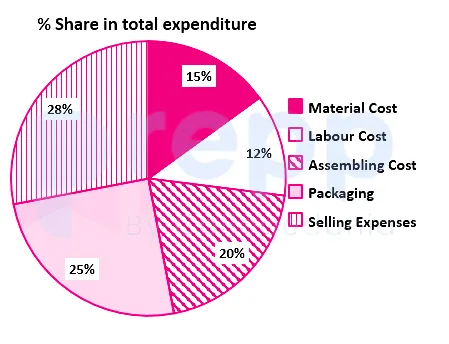
- A
1,29,000
- B
84000
- C
1,15,000
- D
1,20,000
Show answer
A. 1,29,000Calculation :
100% = 300000
1% = 3000
Expenditure incurred on Material Cost and Selling Expenses = (15 + 28)% = 43%
⇒ 43 × 3000
⇒ 129000
∴ The correct answer is 129000.
Paper & answer key PDF ↗ Question 60archived
Aditya buys 300 mangoes for Rs. 1,100. Some of these mangoes are rotten and are thrown away. He sells the remaining mangoes at Rs. 5 each and makes a profit of Rs. 150. Find the percentage of mangoes thrown away.
- A
\(16 \frac{1}{2} \% \)
- B
\(15 \frac{2}{3} \% \)
- C
\(16 \frac{2}{3} \% \)
- D
\(16 \frac{1}{3} \%\)
Show answer
C. \(16 \frac{2}{3} \% \)Understanding the Problem: Aditya's Mango Purchase
This problem involves calculating the percentage of mangoes that were unusable (rotten) after Aditya bought a batch. We are given the initial cost, the selling price per mango for the remaining ones, and the total profit made. Our goal is to find how many mangoes were thrown away and express this as a percentage of the total number of mangoes initially purchased.
Calculating the Total Selling Price
Aditya made a profit, which means his total revenue from selling the good mangoes was more than his initial cost. The relationship between Cost Price (CP), Selling Price (SP), and Profit is:
\( \text{Selling Price} = \text{Cost Price} + \text{Profit} \)
We are given:
Cost Price (CP) = Rs. 1100
Profit = Rs. 150
Let's calculate the total Selling Price:
\( \text{SP} = \text{Rs. } 1100 + \text{Rs. } 150 = \text{Rs. } 1250 \)
So, Aditya earned a total of Rs. 1250 by selling the good mangoes.
Determining the Number of Mangoes Sold
We know the total amount Aditya received from selling the mangoes (Rs. 1250) and the price at which each good mango was sold (Rs. 5). To find the number of mangoes sold, we divide the total selling price by the price per mango:
\( \text{Number of mangoes sold} = \frac{\text{Total Selling Price}}{\text{Selling Price per mango}} \)
\( \text{Number of mangoes sold} = \frac{\text{Rs. } 1250}{\text{Rs. } 5} = 250 \)
Aditya was able to sell 250 mangoes.
Finding the Number of Mangoes Thrown Away
Aditya initially bought 300 mangoes. Some were rotten and thrown away, and the rest (250) were sold. The number of mangoes thrown away is the difference between the total number bought and the number sold.
\( \text{Number of mangoes thrown away} = \text{Total mangoes bought} - \text{Number of mangoes sold} \)
\( \text{Number of mangoes thrown away} = 300 - 250 = 50 \)
Therefore, 50 mangoes were rotten and had to be thrown away.
Calculating the Percentage of Mangoes Thrown Away
To find the percentage of mangoes thrown away, we compare the number thrown away to the total number of mangoes Aditya initially bought and multiply by 100%.
\( \text{Percentage thrown away} = \left( \frac{\text{Number of mangoes thrown away}}{\text{Total mangoes bought}} \right) \times 100 \% \)
\( \text{Percentage thrown away} = \left( \frac{50}{300} \right) \times 100 \% \)
We can simplify the fraction \(\frac{50}{300}\):
\( \frac{50}{300} = \frac{5}{30} = \frac{1}{6} \)
Now, calculate the percentage:
\( \text{Percentage thrown away} = \frac{1}{6} \times 100 \% = \frac{100}{6} \% \)
\( \frac{100}{6} \% = \frac{50}{3} \% \)
To express this as a mixed fraction:
\( \frac{50}{3} = 16 \text{ with a remainder of } 2 \)
So, \( \frac{50}{3} \% = 16 \frac{2}{3} \% \)
Final Answer Summary
Aditya bought 300 mangoes. By selling the remaining good ones at Rs. 5 each and making a profit of Rs. 150, he sold 250 mangoes. This means 50 mangoes were thrown away. The percentage of mangoes thrown away is \(16 \frac{2}{3} \% \).
Revision Table: Key Concepts in Profit and Loss
Concept
Definition
Formula
Cost Price (CP)
The initial price at which an item is bought.
-
Selling Price (SP)
The price at which an item is sold.
-
Profit
When Selling Price is greater than Cost Price.
Profit = SP - CP
Loss
When Cost Price is greater than Selling Price.
Loss = CP - SP
Profit Percentage
Profit calculated as a percentage of the Cost Price.
\(\left(\frac{\text{Profit}}{\text{CP}}\right) \times 100 \%\)
Loss Percentage
Loss calculated as a percentage of the Cost Price.
\(\left(\frac{\text{Loss}}{\text{CP}}\right) \times 100 \%\)
Additional Information: Handling Rotten Goods Problems
Problems involving rotten or damaged goods are common in profit and loss calculations. Here are some points to remember:
The initial cost price is for the total quantity bought.
The selling price and profit/loss are based on the quantity that was actually sold.
The difference between the quantity bought and the quantity sold is the quantity that was unusable (rotten, damaged, etc.).
When calculating the percentage of unusable goods, the base is always the total quantity initially bought.
Make sure to distinguish between the total cost and the cost per item, and the total revenue from selling and the selling price per item.
Paper & answer key PDF ↗ Question 61archived
(N + 15) persons, each working for 9 hours a day, can complete 36% of a work in 8 days. (N + 9) persons can complete the remaining work in 20 days, if each of them works for 7 hours per day. Determine the value of N.
- A
50
- B
52
- C
55
- D
64
Show answer
C. 55Understanding the Work and Time Problem to Find N
This problem involves two groups of persons working at different rates and for different durations to complete parts of a total work. We are given the number of persons (in terms of N), the hours they work per day, the number of days, and the percentage of work they complete. We need to find the value of N.
Key Concept: Work, Persons, Days, Hours
The total work done is directly proportional to the number of persons, the number of days they work, and the number of hours they work per day. This relationship can be expressed as:
\(\text{Work} \propto \text{Number of Persons} \times \text{Number of Days} \times \text{Hours per Day}\)
If the work is different, we can compare two scenarios using the formula:
\[ \frac{M_1 \times D_1 \times H_1}{W_1} = \frac{M_2 \times D_2 \times H_2}{W_2} \]
Where:
\(M\) is the number of persons
\(D\) is the number of days
\(H\) is the hours per day
\(W\) is the fraction or percentage of work done
Subscripts 1 and 2 refer to the two different scenarios or groups.
Setting up the Equation for N
Let's identify the values for the two groups mentioned in the problem:
Parameter
Group 1
Group 2
Number of Persons (\(M\))
\(N + 15\)
\(N + 9\)
Number of Days (\(D\))
8
20
Hours per Day (\(H\))
9
7
Work Done (\(W\))
36% or 0.36
Remaining work = 100% - 36% = 64% or 0.64
Now, we can plug these values into our formula:
\[ \frac{(N + 15) \times 8 \times 9}{0.36} = \frac{(N + 9) \times 20 \times 7}{0.64} \]
Solving for the Value of N
Let's simplify and solve the equation step-by-step:
\[ \frac{(N + 15) \times 72}{0.36} = \frac{(N + 9) \times 140}{0.64} \]
To eliminate the decimals in the denominators, we can multiply both sides by \(0.36 \times 0.64\), or cross-multiply:
\[ (N + 15) \times 72 \times 0.64 = (N + 9) \times 140 \times 0.36 \]
Calculate the products on each side:
\(72 \times 0.64 = 46.08\)
\(140 \times 0.36 = 50.4\)
So the equation becomes:
\[ (N + 15) \times 46.08 = (N + 9) \times 50.4 \]
Distribute the numbers on both sides:
\[ 46.08N + 46.08 \times 15 = 50.4N + 50.4 \times 9 \]
\[ 46.08N + 691.2 = 50.4N + 453.6 \]
Now, group the terms with N on one side and the constant terms on the other side. Subtract \(46.08N\) from both sides and subtract \(453.6\) from both sides:
\[ 691.2 - 453.6 = 50.4N - 46.08N \]
\[ 237.6 = 4.32N \]
Finally, solve for N by dividing both sides by \(4.32\):
\[ N = \frac{237.6}{4.32} \]
\[ N = 55 \]
Verification of the Value of N
Let's check if N=55 satisfies the conditions.
Group 1: \((55 + 15)\) persons = 70 persons. Work done: \(70 \times 8 \times 9 = 5040\) units of effort.
Group 2: \((55 + 9)\) persons = 64 persons. Work done: \(64 \times 20 \times 7 = 8960\) units of effort.
The ratio of work done by Group 1 to Group 2 is \(\frac{5040}{8960} = \frac{504}{896}\).
Dividing both numerator and denominator by their greatest common divisor (which is 56), we get \(\frac{504 \div 56}{896 \div 56} = \frac{9}{16}\).
The percentage of work done by Group 1 is 36%, and by Group 2 is 64%. The ratio is \(\frac{36\%}{64\%} = \frac{36}{64}\).
Dividing both numerator and denominator by 4, we get \(\frac{36 \div 4}{64 \div 4} = \frac{9}{16}\).
Since the ratios match (\(\frac{9}{16} = \frac{9}{16}\)), our calculated value \(N=55\) is correct.
Revision Table: Key Formulas in Work and Time
Concept
Formula
Explanation
Basic Work Formula
\(\text{Work} = \text{Rate} \times \text{Time}\)
Total work is the product of the rate of work and the time taken.
Rate of Work
\(\text{Rate} = \frac{\text{Work}}{\text{Time}}\)
Rate is the amount of work done per unit of time.
Comparing Work (M, D, H)
\(\frac{M_1 D_1 H_1}{W_1} = \frac{M_2 D_2 H_2}{W_2}\)
Compares work done by different groups or in different conditions.
If Work is Same (\(W_1 = W_2\))
\(M_1 D_1 H_1 = M_2 D_2 H_2\)
Applicable when two groups complete the same amount of work.
Additional Information on Work and Time Problems
Work and time problems often involve understanding the inverse relationship between the number of workers and the time taken to complete a fixed amount of work. More workers typically mean less time for the same task, assuming they work at the same rate.
Efficiency: Sometimes, the problem might mention the efficiency of workers. Efficiency directly affects the work rate. Higher efficiency means a higher work rate.
Individual vs. Group Work: Problems can involve individuals working alone or together. When working together, their individual work rates are added up.
Units of Work: The 'units of effort' calculated in the verification step (\(M \times D \times H\)) represent a measure of the total effort required or supplied to complete a certain portion of the work.
Paper & answer key PDF ↗ Question 62archived
The mid points of AB and AC of a ΔABC are X and Y, respectively. If BC + XY = 18 cm , then the value of BC - XY is:
- A
8 cm
- B
4 cm
- C
12 cm
- D
6 cm
Show answer
D. 6 cmGiven:
BC + XY = 18 cm
Calculation :
⇒ BC + XY = 18 cm
We know that, XY = 1/2 BC
⇒ 1/2BC + BC = 18
⇒ 3BC/2 = 18
⇒ BC = 12
Now, XY = 6
Therefore, BC - XY = 12 - 6 = 6
∴ The correct answer is 6 cm.
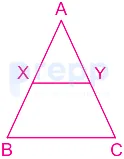 Paper & answer key PDF ↗
 Question 63archived
In the shown figure, BC is a chord and CD is a tangent through the point C. If ∠AOC = 112°, then find ∠ACD.
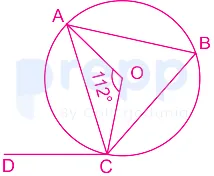
- A
63°
- B
59°
- C
65°
- D
56°
Show answer
Question 64archived
If sin θ - cos θ = 0, then find the value of (sin3 θ - cos3 θ).
- A
0
- B
2
- C
1
- D
\(\frac{1}{\sqrt2}\)
Show answer
A. 0Solving the Trigonometric Equation and Expression
We are given a trigonometric equation and asked to evaluate a related expression. The given equation is:
\(\sin \theta - \cos \theta = 0\)
We need to find the value of:
\((\sin^3 \theta - \cos^3 \theta)\)
Analyzing the Given Condition: \(\sin \theta - \cos \theta = 0\)
The equation \(\sin \theta - \cos \theta = 0\) can be rewritten as:
\(\sin \theta = \cos \theta\)
This condition holds true when the angle \(\theta\) is such that its sine and cosine values are equal. This occurs at angles like \(45^\circ\), \(225^\circ\), etc., or in radians, \(\frac{\pi}{4}\), \(\frac{5\pi}{4}\), and so on, considering the periodicity of trigonometric functions. For these angles, \(\tan \theta = \frac{\sin \theta}{\cos \theta} = 1\).
If \(\sin \theta = \cos \theta\), let's substitute this directly into the expression we need to evaluate.
Evaluating the Expression: \(\sin^3 \theta - \cos^3 \theta\)
We want to find the value of \((\sin^3 \theta - \cos^3 \theta)\). Since we know from the given condition that \(\sin \theta = \cos \theta\), we can substitute \(\cos \theta\) with \(\sin \theta\) (or vice versa) in the expression.
Substituting \(\cos \theta = \sin \theta\):
\(\sin^3 \theta - \cos^3 \theta = \sin^3 \theta - (\sin \theta)^3 = \sin^3 \theta - \sin^3 \theta\)
So, the value is:
\(\sin^3 \theta - \cos^3 \theta = 0\)
Alternative Method Using Algebraic Identity
We can also use the algebraic identity for the difference of cubes: \(a^3 - b^3 = (a-b)(a^2 + ab + b^2)\). Here, \(a = \sin \theta\) and \(b = \cos \theta\).
Applying the identity to \((\sin^3 \theta - \cos^3 \theta)\):
\(\sin^3 \theta - \cos^3 \theta = (\sin \theta - \cos \theta)(\sin^2 \theta + \sin \theta \cos \theta + \cos^2 \theta)\)
We are given that \((\sin \theta - \cos \theta) = 0\). Substitute this value into the expanded expression:
\(\sin^3 \theta - \cos^3 \theta = (0)(\sin^2 \theta + \sin \theta \cos \theta + \cos^2 \theta)\)
The term \((\sin^2 \theta + \cos^2 \theta)\) is the fundamental trigonometric identity, which equals 1. So the expression inside the second bracket becomes \((1 + \sin \theta \cos \theta)\).
Thus, the expression evaluates to:
\(\sin^3 \theta - \cos^3 \theta = (0)(1 + \sin \theta \cos \theta)\)
\(\sin^3 \theta - \cos^3 \theta = 0\)
Both methods lead to the same result.
Conclusion
Given the condition \(\sin \theta - \cos \theta = 0\), which means \(\sin \theta = \cos \theta\), the value of \((\sin^3 \theta - \cos^3 \theta)\) is 0.
Revision Table: Key Concepts
Concept
Description
Given Condition
\(\sin \theta - \cos \theta = 0 \implies \sin \theta = \cos \theta\)
Trigonometric Identity
\(\sin^2 \theta + \cos^2 \theta = 1\)
Algebraic Identity
\(a^3 - b^3 = (a-b)(a^2 + ab + b^2)\)
Additional Information: Angles where sin θ = cos θ
The equation \(\sin \theta = \cos \theta\) is satisfied for \(\theta = \frac{\pi}{4} + n\pi\), where \(n\) is an integer. Let's check the values of \(\sin \theta\) and \(\cos \theta\) for a few such angles:
If \(n=0\), \(\theta = \frac{\pi}{4}\) (\(45^\circ\)). \(\sin(\frac{\pi}{4}) = \frac{1}{\sqrt{2}}\), \(\cos(\frac{\pi}{4}) = \frac{1}{\sqrt{2}}\). Here \(\sin \theta = \cos \theta\). Then \(\sin^3 \theta - \cos^3 \theta = (\frac{1}{\sqrt{2}})^3 - (\frac{1}{\sqrt{2}})^3 = 0\).
If \(n=1\), \(\theta = \frac{\pi}{4} + \pi = \frac{5\pi}{4}\) (\(225^\circ\)). \(\sin(\frac{5\pi}{4}) = -\frac{1}{\sqrt{2}}\), \(\cos(\frac{5\pi}{4}) = -\frac{1}{\sqrt{2}}\). Here \(\sin \theta = \cos \theta\). Then \(\sin^3 \theta - \cos^3 \theta = (-\frac{1}{\sqrt{2}})^3 - (-\frac{1}{\sqrt{2}})^3 = 0\).
This confirms that for any angle satisfying \(\sin \theta = \cos \theta\), the value of \((\sin^3 \theta - \cos^3 \theta)\) is indeed 0.
Paper & answer key PDF ↗ Question 65archived
A dealer marks an article 60% above the cost price and sells it to a customer allowing two successive discounts of 10% and 20% on the marked price. If he gains Rs. 1,064 in the transaction, the cost price (in Rs.) of the article is:
- A
8400
- B
7000
- C
6300
- D
7200
Show answer
B. 7000Understanding the Problem: Calculating Cost Price with Discounts and Profit
This question asks us to find the original cost price of an article. We are given information about how the article was marked up, the successive discounts applied to the marked price, and the final profit made on the sale.
Let's break down the information provided:
The article is marked 60% above the cost price.
Two successive discounts, 10% and 20%, are given on the marked price.
The dealer gains a profit of Rs. 1,064 in the transaction.
Our goal is to determine the cost price (CP).
Step-by-Step Solution to Find the Cost Price
Let's denote the cost price of the article as \( \text{CP} \). We will use this variable to express the marked price and selling price.
Step 1: Calculate the Marked Price (MP)
The article is marked 60% above the cost price. So, the marked price is:
\[ \text{MP} = \text{CP} + 60\% \text{ of } \text{CP} \]
\[ \text{MP} = \text{CP} + 0.60 \times \text{CP} \]
\[ \text{MP} = 1.60 \times \text{CP} \]
Step 2: Calculate the Selling Price (SP) after Successive Discounts
Two successive discounts of 10% and 20% are given on the marked price. Let's apply these discounts one by one.
Price after the first discount of 10%:
\[ \text{Price}_1 = \text{MP} \times \left(1 - \frac{10}{100}\right) \]
\[ \text{Price}_1 = \text{MP} \times (1 - 0.10) \]
\[ \text{Price}_1 = \text{MP} \times 0.90 \]
Now, the second discount of 20% is applied to \( \text{Price}_1 \). This gives us the final selling price (SP):
\[ \text{SP} = \text{Price}_1 \times \left(1 - \frac{20}{100}\right) \]
\[ \text{SP} = \text{Price}_1 \times (1 - 0.20) \]
\[ \text{SP} = \text{Price}_1 \times 0.80 \]
Substitute the expression for \( \text{Price}_1 \) into the SP equation:
\[ \text{SP} = (\text{MP} \times 0.90) \times 0.80 \]
\[ \text{SP} = \text{MP} \times (0.90 \times 0.80) \]
\[ \text{SP} = \text{MP} \times 0.72 \]
Now, substitute the expression for \( \text{MP} \) from Step 1 into the SP equation:
\[ \text{SP} = (1.60 \times \text{CP}) \times 0.72 \]
\[ \text{SP} = (1.60 \times 0.72) \times \text{CP} \]
Let's calculate \( 1.60 \times 0.72 \):
Calculation
Result
\(1.6 \times 0.72\)
\(1.6 \times (0.7 + 0.02)\)
\((1.6 \times 0.7) + (1.6 \times 0.02)\)
\(1.12 + 0.032\)
\(1.152\)
So, the selling price is:
\[ \text{SP} = 1.152 \times \text{CP} \]
Step 3: Use the Profit Information to Find CP
The profit is given as Rs. 1,064. Profit is calculated as Selling Price minus Cost Price:
\[ \text{Profit} = \text{SP} - \text{CP} \]
Substitute the given profit and the expression for SP from Step 2:
\[ 1064 = (1.152 \times \text{CP}) - \text{CP} \]
\[ 1064 = (1.152 - 1) \times \text{CP} \]
\[ 1064 = 0.152 \times \text{CP} \]
Now, solve for CP:
\[ \text{CP} = \frac{1064}{0.152} \]
To simplify the division, multiply the numerator and denominator by 1000 to remove the decimal:
\[ \text{CP} = \frac{1064 \times 1000}{0.152 \times 1000} \]
\[ \text{CP} = \frac{1064000}{152} \]
Let's perform the division:
Division
Result
\(1064000 \div 152\)
\(1064 \div 152 = 7\) (Since \(152 \times 7 = 1064\))
So, \(1064000 \div 152 = 7000\)
Therefore, the cost price (CP) of the article is Rs. 7000.
Verification of the Cost Price Calculation
Let's check if a CP of Rs. 7000 results in a profit of Rs. 1,064.
Cost Price (CP) = Rs. 7000
Marked Price (MP) = 60% above CP = \(7000 + 0.60 \times 7000 = 7000 + 4200 = 11200\)
First Discount (10%) on MP = \(0.10 \times 11200 = 1120\)
Price after 1st discount = \(11200 - 1120 = 10080\)
Second Discount (20%) on the reduced price = \(0.20 \times 10080\)
\(0.20 \times 10080 = \frac{1}{5} \times 10080 = 2016\)
Selling Price (SP) = Price after 1st discount - 2nd Discount = \(10080 - 2016 = 8064\)
Profit = SP - CP = \(8064 - 7000 = 1064\)
The calculated profit matches the given profit (Rs. 1,064). Thus, our calculated cost price of Rs. 7000 is correct.
Revision Table: Key Concepts in Profit, Loss, and Discounts
Term
Definition
Formula
Cost Price (CP)
The original price at which an article is bought.
-
Marked Price (MP) / List Price
The price at which the article is listed for sale, often higher than CP.
\( \text{MP} = \text{CP} + \text{Markup} \)
Selling Price (SP)
The final price at which the article is sold to the customer.
\( \text{SP} = \text{MP} - \text{Discount} \)
Profit
When SP > CP. The gain made in a transaction.
\( \text{Profit} = \text{SP} - \text{CP} \)
Loss
When SP < CP. The deficit incurred in a transaction.
\( \text{Loss} = \text{CP} - \text{SP} \)
Discount
A reduction in the marked price. Calculated on MP.
\( \text{Discount} = \text{Discount Rate} \times \text{MP} \)
Successive Discounts
Two or more discounts applied one after the other on the reduced price. Not simply added together.
If discounts are \(d_1\% \) and \( d_2\% \) on MP, final SP = \( \text{MP} \times (1 - d_1/100) \times (1 - d_2/100) \)
Additional Information: Successive Discounts Explained
Successive discounts can sometimes be confusing. It's important to remember that the second discount is applied not on the original marked price, but on the price that results after the first discount has been applied.
For example, if the marked price is Rs. 100 and there are successive discounts of 10% and 20%:
After 10% discount: \(100 - (0.10 \times 100) = 100 - 10 = 90\)
After 20% discount on Rs. 90: \(90 - (0.20 \times 90) = 90 - 18 = 72\)
The final selling price is Rs. 72. The total reduction is \(100 - 72 = 28\), which is a 28% equivalent single discount (\(10 + 20 = 30\), but the equivalent is less than the sum).
The formula for equivalent single discount for two successive discounts \(d_1\% \) and \( d_2\% \) is:
\[ \text{Equivalent Discount}\% = d_1 + d_2 - \frac{d_1 \times d_2}{100} \]
In our case, \(d_1 = 10\) and \(d_2 = 20\):
\[ \text{Equivalent Discount}\% = 10 + 20 - \frac{10 \times 20}{100} = 30 - \frac{200}{100} = 30 - 2 = 28\% \]
This means the selling price is 28% less than the marked price. So, SP = MP \(\times (1 - 0.28) = \text{MP} \times 0.72\). This confirms our calculation in Step 2.
Paper & answer key PDF ↗ Question 66archived
A thief seeing a policeman from a distance of 300 m starts running at a speed of 10 km/h. The policeman gives chase immediately at a speed of 12 km/h and the thief is caught. What is the distance run by the thief?
- A
3.2 km
- B
2.5 km
- C
2 km
- D
1.5 km
Show answer
D. 1.5 kmCalculating Distance Run by Thief in a Chase
This problem involves a chase between a thief and a policeman. We are given their speeds and the initial distance between them. We need to determine the distance covered by the thief before being caught.
The key concept here is the relative speed between the policeman and the thief. Since the policeman is chasing the thief, the policeman reduces the distance between them at a rate equal to the difference in their speeds.
Given Information
Initial distance between thief and policeman = 300 m
Thief's speed = 10 km/h
Policeman's speed = 12 km/h
Converting Units for Consistency
To perform calculations, it's best to have all units consistent. We can convert the initial distance from meters to kilometers.
Initial distance = 300 m
Since $1 \text{ km} = 1000 \text{ m}$, we have:
Initial distance = $\frac{300}{1000} \text{ km} = 0.3 \text{ km}$
Speeds are already in km/h, so they are consistent.
Calculating Relative Speed
The policeman gains on the thief at a speed equal to the difference between his speed and the thief's speed.
Relative Speed = Policeman's speed - Thief's speed
Relative Speed = $12 \text{ km/h} - 10 \text{ km/h} = 2 \text{ km/h}$
This means the distance between them decreases by 2 km every hour.
Calculating Time Taken to Catch the Thief
The time it takes for the policeman to catch the thief is the time required to cover the initial distance at the relative speed.
Time = $\frac{\text{Distance}}{\text{Speed}}$
Here, Distance = Initial distance between them and Speed = Relative Speed.
Time to catch = $\frac{\text{Initial distance}}{\text{Relative speed}}$
Time to catch = $\frac{0.3 \text{ km}}{2 \text{ km/h}} = 0.15 \text{ hours}$
Calculating Distance Run by the Thief
The thief runs for the same amount of time that it takes the policeman to catch him. The distance run by the thief is calculated using his speed and the time taken until he is caught.
Distance run by thief = Thief's speed $\times$ Time to catch
Distance run by thief = $10 \text{ km/h} \times 0.15 \text{ hours}$
Distance run by thief = $1.5 \text{ km}$
So, the distance run by the thief before being caught is 1.5 km.
Summary of Steps
Convert the initial distance to kilometers.
Calculate the relative speed of the policeman with respect to the thief.
Calculate the time taken for the policeman to cover the initial distance at the relative speed. This is the time until the thief is caught.
Use the thief's speed and the time calculated in the previous step to find the distance run by the thief.
Quantity
Value
Units
Initial Distance
300 m
meters
Initial Distance
0.3 km
kilometers
Thief's Speed
10
km/h
Policeman's Speed
12
km/h
Relative Speed
2
km/h
Time to Catch
0.15
hours
Distance run by thief
1.5
km
Revision Table: Key Concepts for Chase Problems
Concept
Description
Formula (when chasing)
Relative Speed
The difference in speed between two objects moving in the same direction. Determines how quickly the distance between them changes.
$|Speed_1 - Speed_2|$
Time to Meet/Catch
The time taken for the faster object to cover the initial distance between them at their relative speed.
$\frac{\text{Initial Distance}}{\text{Relative Speed}}$
Distance Covered by an object
The total distance traveled by one object during the time they are moving.
Speed $\times$ Time
Additional Information: Relative Speed Applications
Relative speed is a useful concept in physics and mathematics problems involving the motion of multiple objects. It simplifies calculations by focusing on the rate at which the distance between objects changes rather than analyzing each object's motion independently.
Applications include:
Calculating the time it takes for one object to overtake another.
Determining the time until two objects moving towards each other meet.
Analyzing scenarios like boats in rivers (speed relative to water vs. speed relative to ground) or airplanes in wind (speed relative to air vs. speed relative to ground).
Solving problems involving trains crossing each other or crossing platforms.
In chase problems like the one with the thief and policeman, the relative speed is the speed at which the distance between the chaser and the chased decreases.
Paper & answer key PDF ↗ Question 67archived
If \(\rm (x+\frac{1}{x})=2\), then \(\rm x^7+\frac{1}{x^{117}}=\) ___________.
- A
4
- B
1
- C
3
- D
2
Show answer
D. 2Understanding the Algebra Problem: Finding the Value of an Expression
The problem asks us to find the value of the expression \( \rm x^7+\frac{1}{x^{117}} \) given the condition \( \rm (x+\frac{1}{x})=2 \). This type of problem often involves first solving the given equation for the variable \( \rm x \) and then substituting that value into the expression.
Step-by-Step Solution to Find x
We are given the equation:
\( \rm x+\frac{1}{x}=2 \)
To solve for \( \rm x \), we can multiply the entire equation by \( \rm x \) to eliminate the fraction. Note that if \( \rm x=0 \), the original expression \( \rm x+\frac{1}{x} \) would be undefined, so \( \rm x \) cannot be zero.
Multiplying by \( \rm x \), we get:
\( \rm x(x) + x(\frac{1}{x}) = 2(x) \)
\( \rm x^2 + 1 = 2x \)
Now, rearrange the terms to form a standard quadratic equation:
\( \rm x^2 - 2x + 1 = 0 \)
This quadratic equation is a perfect square trinomial. It can be factored as:
\( \rm (x-1)^2 = 0 \)
Taking the square root of both sides:
\( \rm x-1 = 0 \)
Solving for \( \rm x \):
\( \rm x = 1 \)
So, the only value of \( \rm x \) that satisfies the given condition \( \rm x+\frac{1}{x}=2 \) is \( \rm x=1 \).
Evaluating the Expression \( \rm x^7+\frac{1}{x^{117}} \)
Now that we have found \( \rm x=1 \), we need to substitute this value into the expression \( \rm x^7+\frac{1}{x^{117}} \).
Substitute \( \rm x=1 \):
\( \rm (1)^7+\frac{1}{(1)^{117}} \)
We know that any positive integer power of 1 is equal to 1. That is, \( \rm 1^n = 1 \) for any positive integer \( \rm n \).
So, \( \rm 1^7 = 1 \) and \( \rm 1^{117} = 1 \).
Substituting these values back into the expression:
\( \rm 1 + \frac{1}{1} \)
\( \rm 1 + 1 = 2 \)
Therefore, the value of \( \rm x^7+\frac{1}{x^{117}} \) when \( \rm (x+\frac{1}{x})=2 \) is 2.
Summary of the Solution
Given \( \rm x+\frac{1}{x}=2 \), we found that \( \rm x=1 \). Substituting \( \rm x=1 \) into the expression \( \rm x^7+\frac{1}{x^{117}} \) gives \( \rm 1^7 + \frac{1}{1^{117}} = 1 + \frac{1}{1} = 1 + 1 = 2 \).
Given Equation
\( \rm x+\frac{1}{x}=2 \)
Solution for \( \rm x \)
\( \rm x=1 \)
Expression to Evaluate
\( \rm x^7+\frac{1}{x^{117}} \)
Value at \( \rm x=1 \)
\( \rm 1^7+\frac{1}{1^{117}} = 1+1=2 \)
Revision Table: Key Concepts
Concept
Description
Relevance to Problem
Solving Algebraic Equations
Finding the value(s) of the variable that satisfy the equation.
We solved \( \rm x+\frac{1}{x}=2 \) for \( \rm x \).
Quadratic Equations
Equations of the form \( \rm ax^2+bx+c=0 \). Can be solved by factoring, completing the square, or quadratic formula.
\( \rm x^2-2x+1=0 \) is a quadratic equation.
Perfect Square Trinomial
A trinomial that is the square of a binomial, e.g., \( \rm a^2 \pm 2ab + b^2 = (a \pm b)^2 \).
\( \rm x^2-2x+1 \) is \( \rm (x-1)^2 \).
Properties of Exponents
Rules governing operations with exponents, e.g., \( \rm a^1=a \), \( \rm 1^n=1 \).
Used to evaluate \( \rm 1^7 \) and \( \rm 1^{117} \).
Substitution
Replacing a variable with its known value in an expression or equation.
We substituted \( \rm x=1 \) into the expression.
Additional Information: Special Cases of \( \rm x+\frac{1}{x} \)
The expression \( \rm x+\frac{1}{x} \) is interesting in algebra. Here are a few points:
For real numbers \( \rm x \), the minimum value of \( \rm x+\frac{1}{x} \) (for \( \rm x>0 \)) is 2, which occurs when \( \rm x=1 \).
For real numbers \( \rm x \), the maximum value of \( \rm x+\frac{1}{x} \) (for \( \rm x<0 \)) is -2, which occurs when \( \rm x=-1 \).
The given condition \( \rm x+\frac{1}{x}=2 \) specifically leads to \( \rm x=1 \) for real \( \rm x \). If the condition were \( \rm x+\frac{1}{x}=-2 \), the solution for real \( \rm x \) would be \( \rm x=-1 \).
If the condition were \( \rm x+\frac{1}{x}=k \) where \( \rm |k|<2 \), there would be no real solutions for \( \rm x \), only complex solutions.
Problems involving \( \rm x^n + \frac{1}{x^n} \) given \( \rm x+\frac{1}{x} \) are common. For integer \( \rm n \), these can often be solved using formulas or by finding \( \rm x \) if \( \rm x+\frac{1}{x} \) is a specific value like 2 or -2.
Paper & answer key PDF ↗ Question 68archived
When m is divided by 7, the remainder is 5. When 3m is divided by 7, the remainder is:
- A
3
- B
2
- C
1
- D
0
Show answer
C. 1Understanding Remainders and Modular Arithmetic
This problem involves finding the remainder when a multiple of a number is divided by a specific divisor, given the remainder of the original number. This concept is best understood using modular arithmetic.
The problem states that when an integer \(m\) is divided by 7, the remainder is 5. In the language of modular arithmetic, this can be written as:
\(m \equiv 5 \pmod{7}\)
This means that \(m\) can be expressed in the form \(m = 7k + 5\) for some integer \(k\).
Finding the Remainder of 3m
We need to find the remainder when \(3m\) is divided by 7. Let's use the property of congruences that allows multiplication. If \(a \equiv b \pmod{n}\), then \(ca \equiv cb \pmod{n}\) for any integer \(c\).
Since we know \(m \equiv 5 \pmod{7}\), we can multiply both sides of the congruence by 3:
\(3m \equiv 3 \times 5 \pmod{7}\)
Now, calculate the product on the right side:
\(3m \equiv 15 \pmod{7}\)
To find the remainder when \(3m\) is divided by 7, we need to find the remainder when 15 is divided by 7.
We can perform the division:
\(15 = 2 \times 7 + 1\)
The remainder when 15 is divided by 7 is 1.
Therefore, in terms of modular arithmetic:
\(15 \equiv 1 \pmod{7}\)
Substituting this back into our congruence for \(3m\):
\(3m \equiv 15 \equiv 1 \pmod{7}\)
This tells us that when \(3m\) is divided by 7, the remainder is 1.
Step-by-Step Calculation
Here is a summary of the steps:
Understand the given information: \(m\) divided by 7 gives a remainder of 5.
Write this using modular notation: \(m \equiv 5 \pmod{7}\).
Determine what needs to be found: the remainder when \(3m\) is divided by 7.
Multiply the congruence by 3: \(3m \equiv 3 \times 5 \pmod{7}\).
Calculate the product: \(3m \equiv 15 \pmod{7}\).
Find the remainder of the new number (15) when divided by the original divisor (7): \(15 = 2 \times 7 + 1\).
The remainder is 1.
Conclude that \(3m \equiv 1 \pmod{7}\).
Using the Algebraic Form
Alternatively, we can use the algebraic form \(m = 7k + 5\).
Multiply \(m\) by 3:
\(3m = 3(7k + 5)\)
Distribute the 3:
\(3m = 21k + 15\)
We want to find the remainder when \(3m\) is divided by 7. We can rewrite the expression for \(3m\) to explicitly show division by 7:
\(3m = 21k + 15\)
Since \(21k\) is a multiple of 7 (\(21k = 7 \times 3k\)), the remainder when \(21k\) is divided by 7 is 0.
So, the remainder of \(3m\) when divided by 7 is the same as the remainder of 15 when divided by 7.
\(15 = 2 \times 7 + 1\)
The remainder is 1. Thus, \(3m = 7 \times (3k + 2) + 1\). This confirms that when \(3m\) is divided by 7, the remainder is 1.
Concept
Explanation
Example
Remainder
The integer left over after dividing one integer by another.
15 divided by 7 is 2 with a remainder of 1.
Modular Arithmetic
A system of arithmetic for integers, where numbers "wrap around" upon reaching a certain value (the modulus).
\(15 \equiv 1 \pmod{7}\) because \(15 - 1\) is divisible by 7.
Congruence Property (Multiplication)
If \(a \equiv b \pmod{n}\), then \(ca \equiv cb \pmod{n}\).
Since \(5 \equiv 5 \pmod{7}\), \(3 \times 5 \equiv 3 \times 5 \pmod{7}\), which is \(15 \equiv 15 \pmod{7}\). More importantly, if \(m \equiv 5 \pmod{7}\), then \(3m \equiv 3 \times 5 \pmod{7}\).
Revision Table: Key Concepts for Remainder Problems
Concept
Description
Formula/Notation
Division Algorithm
For integers \(a\) and \(b\) with \(b > 0\), there exist unique integers \(q\) (quotient) and \(r\) (remainder) such that \(a = bq + r\), where \(0 \le r < b\).
\(a = bq + r\), \(0 \le r < b\)
Modular Congruence
\(a \equiv b \pmod{n}\) means \(a - b\) is divisible by \(n\), or \(a\) and \(b\) have the same remainder when divided by \(n\).
\(n \mid (a - b)\) or \(a \pmod{n} = b \pmod{n}\)
Properties of Congruence (Addition)
If \(a \equiv b \pmod{n}\) and \(c \equiv d \pmod{n}\), then \(a + c \equiv b + d \pmod{n}\).
\(a+c \equiv b+d \pmod{n}\)
Properties of Congruence (Multiplication)
If \(a \equiv b \pmod{n}\) and \(c \equiv d \pmod{n}\), then \(ac \equiv bd \pmod{n}\). Also, if \(a \equiv b \pmod{n}\), then \(ca \equiv cb \pmod{n}\).
\(ac \equiv bd \pmod{n}\)
\(ca \equiv cb \pmod{n}\)
Additional Information: Exploring Modular Arithmetic
Modular arithmetic is a fundamental concept in number theory and has applications in various fields like cryptography, computer science, and clock arithmetic.
The set of possible remainders when dividing by 7 is \(\{0, 1, 2, 3, 4, 5, 6\}\). All integers fall into one of these 7 congruence classes modulo 7.
Any integer \(n\) such that \(n \equiv 0 \pmod{7}\) is a multiple of 7.
Any integer \(n\) such that \(n \equiv 1 \pmod{7}\) is one more than a multiple of 7.
And so on, up to \(n \equiv 6 \pmod{7}\), which is one less than a multiple of 7 (or equivalently, \(-1 \pmod{7}\)).
In our problem, \(m \equiv 5 \pmod{7}\). This means \(m\) could be 5, 12, 19, 26, etc.
Let's check for \(m=5\): \(3m = 3 \times 5 = 15\). \(15\) divided by 7 is 2 with a remainder of 1.
Let's check for \(m=12\): \(3m = 3 \times 12 = 36\). \(36\) divided by 7 is 5 with a remainder of 1 (\(36 = 5 \times 7 + 1\)).
Let's check for \(m=19\): \(3m = 3 \times 19 = 57\). \(57\) divided by 7 is 8 with a remainder of 1 (\(57 = 8 \times 7 + 1\)).
As you can see, regardless of the specific value of \(m\) (as long as it satisfies \(m \equiv 5 \pmod{7}\)), the remainder when \(3m\) is divided by 7 is always 1. Modular arithmetic provides a concise way to arrive at this general result without testing specific values of \(m\).
Paper & answer key PDF ↗ Question 69archived
12 men can complete a work in 10 days. How many more men are required to complete the work in 6 days?
- A
24
- B
10
- C
8
- D
20
Show answer
C. 8Solving Work and Time Problems: Men and Days Calculation
This question involves the concept of work and time, specifically dealing with how the number of workers affects the time taken to complete a task. The fundamental principle here is that if the amount of work remains constant, the number of workers is inversely proportional to the time taken. This means if you increase the number of workers, the time taken decreases, and vice versa.
Understanding the Inverse Proportion in Work and Time
Let's define the relationship between the number of men and the number of days. If $M$ is the number of men and $D$ is the number of days required to complete a certain work, then the total work done can often be represented as the product of the number of men and the number of days, assuming all men work at the same rate. So, Work $= M \times D$.
Since the work to be done is the same in both scenarios given in the problem, we can equate the product of men and days for the initial case to the product of men and days for the second case.
Let:
$M_1$ be the initial number of men
$D_1$ be the initial number of days
$M_2$ be the new number of men required
$D_2$ be the new number of days
The relationship is: $M_1 \times D_1 = M_2 \times D_2$
Applying the Formula to Find Required Men
From the question, we are given:
Initial number of men, $M_1 = 12$ men
Initial number of days, $D_1 = 10$ days
New number of days, $D_2 = 6$ days
We need to find the new number of men required, $M_2$.
Using the formula $M_1 \times D_1 = M_2 \times D_2$, we can substitute the known values:
$\qquad 12 \text{ men} \times 10 \text{ days} = M_2 \text{ men} \times 6 \text{ days}$
Now, let's solve for $M_2$:
$\qquad 12 \times 10 = M_2 \times 6$
$\qquad 120 = 6 \times M_2$
To find $M_2$, divide 120 by 6:
$\qquad M_2 = \frac{120}{6}$
$\qquad M_2 = 20$ men
So, 20 men are required to complete the work in 6 days.
Calculating the Number of Additional Men Required
The question asks for how many more men are required, not the total number of men. The initial number of men was 12. The new number of men required is 20.
Number of additional men = $M_2 - M_1$
Number of additional men = $20 - 12$
Number of additional men = 8 men
Therefore, 8 more men are required to complete the work in 6 days.
Scenario
Number of Men ($M$)
Number of Days ($D$)
Total Work ($M \times D$)
Initial
12
10
$12 \times 10 = 120$
Required
$M_2$
6
$M_2 \times 6$
Since the total work is the same:
$12 \times 10 = M_2 \times 6$
$120 = 6M_2$
$M_2 = \frac{120}{6} = 20$
Additional men = $M_2 - \text{Initial men} = 20 - 12 = 8$
Summary of Steps
Identify the given values: initial men ($M_1$), initial days ($D_1$), new days ($D_2$).
Recognize the inverse relationship: $M_1 \times D_1 = M_2 \times D_2$.
Substitute the known values into the formula.
Solve for the new number of men required ($M_2$).
Calculate the number of additional men needed ($M_2 - M_1$).
Revision Table: Work and Time Concepts
Concept
Description
Formula/Relationship
Work
The total task or amount of job to be completed. Often considered constant in these problems.
Work $\propto$ Men $\times$ Time (usually days or hours)
Inverse Proportion
When one quantity increases, the other decreases proportionally, assuming their product is constant.
If $A \times B = \text{Constant}$, then $A \propto \frac{1}{B}$ and $B \propto \frac{1}{A}$. In work problems: Men $\propto \frac{1}{\text{Days}}$ or Days $\propto \frac{1}{\text{Men}}$.
Direct Proportion
When one quantity increases, the other also increases proportionally, assuming their ratio is constant.
If $\frac{A}{B} = \text{Constant}$, then $A \propto B$. Example: More work $\propto$ More men (if time is constant). More work $\propto$ More time (if men are constant).
Additional Information: Variations in Work and Time Problems
Work and time problems can have several variations. Here are a few common ones:
Efficiency: Problems might introduce different efficiency levels for workers. In such cases, the 'Work' is calculated as $\text{Work} = \text{Number of Men} \times \text{Efficiency per man} \times \text{Time}$.
Multiple Groups: Sometimes, different groups of workers might work on the same task or different parts of it. You calculate the work done by each group and combine them.
Part of Work: Questions might ask about completing a fraction of the work or the remaining work after some workers leave or join. You calculate the work done in the initial period and then the work remaining.
Working Hours per Day: The time might be specified in days with a certain number of hours per day. In this case, the total time is the number of days multiplied by hours per day, and the Work $= \text{Men} \times \text{Days} \times \text{Hours per day}$. The relationship becomes $M_1 \times D_1 \times H_1 = M_2 \times D_2 \times H_2$.
Understanding the basic inverse proportion between men and days for a fixed amount of work is crucial for solving most work and time problems.
Paper & answer key PDF ↗ Question 70archived
Study the given bar graph carefully and answer the following question.
What is the ratio of the number of companies with more demand than production to the number of companies with more production than demand?
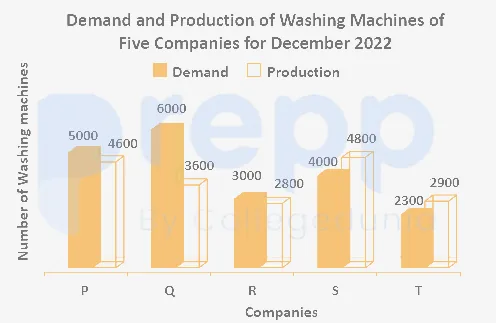
- A
4 ∶ 3
- B
3 ∶ 5
- C
2 ∶ 3
- D
3 ∶ 2
Show answer
D. 3 ∶ 2Calculation :
Companies with more demand than production are P, Q, R.
Companies with more production than demand are S, T.
Ratio = 3 : 2
∴ The correct answer is 3 : 2.
Paper & answer key PDF ↗ Question 71archived
If (a + b + c) = 20, and a2 + b2 + c2 = 152, find the value of a3 + b3 + c3 - 3abc.
- A
560
- B
640
- C
480
- D
720
Show answer
A. 560Understanding the Algebraic Problem
The question asks us to find the value of the expression \(a^3 + b^3 + c^3 - 3abc\) given two initial conditions: the sum of three variables \((a + b + c)\) and the sum of their squares \((a^2 + b^2 + c^2)\).
We are given:
\(a + b + c = 20\)
\(a^2 + b^2 + c^2 = 152\)
We need to find the value of \(a^3 + b^3 + c^3 - 3abc\).
Utilizing Algebraic Identities
To solve this problem, we need to use standard algebraic identities that relate the sum of variables, the sum of their squares, and the sum and product of their cubes.
The key identity for \(a^3 + b^3 + c^3 - 3abc\) is:
\(a^3 + b^3 + c^3 - 3abc = (a + b + c)(a^2 + b^2 + c^2 - ab - bc - ca)\)
Looking at this identity, we already have the values for \((a + b + c)\) and \((a^2 + b^2 + c^2)\). However, we need to find the value of \((ab + bc + ca)\).
Finding the Value of (ab + bc + ca)
We can find the value of \((ab + bc + ca)\) using another well-known identity:
\((a + b + c)^2 = a^2 + b^2 + c^2 + 2(ab + bc + ca)\)
We can rearrange this identity to solve for \((ab + bc + ca)\):
\(2(ab + bc + ca) = (a + b + c)^2 - (a^2 + b^2 + c^2)\)
Now, let's substitute the given values into this equation:
\(a + b + c = 20\)
\(a^2 + b^2 + c^2 = 152\)
So, we get:
\(2(ab + bc + ca) = (20)^2 - 152\)
Calculate the square of 20:
\(2(ab + bc + ca) = 400 - 152\)
Perform the subtraction:
\(2(ab + bc + ca) = 248\)
Now, divide by 2 to find the value of \((ab + bc + ca)\):
\(ab + bc + ca = \frac{248}{2}\)
\(ab + bc + ca = 124\)
Calculating a³ + b³ + c³ - 3abc
Now that we have all the necessary components, we can substitute the values into the main identity:
\(a^3 + b^3 + c^3 - 3abc = (a + b + c)(a^2 + b^2 + c^2 - (ab + bc + ca))\)
Substitute the known values:
\(a + b + c = 20\)
\(a^2 + b^2 + c^2 = 152\)
\(ab + bc + ca = 124\)
So, the expression becomes:
\(a^3 + b^3 + c^3 - 3abc = (20)(152 - 124)\)
First, calculate the value inside the second parenthesis:
\(152 - 124 = 28\)
Now, multiply the results:
\(a^3 + b^3 + c^3 - 3abc = (20)(28)\)
\(a^3 + b^3 + c^3 - 3abc = 560\)
Summary of the Solution Steps
Here’s a breakdown of the steps taken:
Identify the known values: \(a+b+c = 20\) and \(a^2+b^2+c^2 = 152\).
Recall the identity for \(a^3 + b^3 + c^3 - 3abc\): \((a + b + c)(a^2 + b^2 + c^2 - ab - bc - ca)\).
Recognize the need to find \((ab + bc + ca)\).
Use the identity \((a + b + c)^2 = a^2 + b^2 + c^2 + 2(ab + bc + ca)\) to solve for \((ab + bc + ca)\).
Substitute known values into the rearranged identity: \(2(ab + bc + ca) = (20)^2 - 152 = 400 - 152 = 248\).
Calculate \((ab + bc + ca) = 248 / 2 = 124\).
Substitute all required values into the main identity: \((20)(152 - 124)\).
Perform the final calculation: \((20)(28) = 560\).
The value of \(a^3 + b^3 + c^3 - 3abc\) is 560.
Revision Table: Algebraic Identities
Understanding key algebraic identities is crucial for solving problems like this. Here are the identities used:
Identity Name
Formula
Square of Sum of Three Terms
\((a + b + c)^2 = a^2 + b^2 + c^2 + 2(ab + bc + ca)\)
Sum/Difference of Cubes related Identity
\(a^3 + b^3 + c^3 - 3abc = (a + b + c)(a^2 + b^2 + c^2 - ab - bc - ca)\)
Additional Information: Special Cases
It's worth noting a special case related to the identity \(a^3 + b^3 + c^3 - 3abc = (a + b + c)(a^2 + b^2 + c^2 - ab - bc - ca)\).
If \(a + b + c = 0\), then the entire expression \((a + b + c)(a^2 + b^2 + c^2 - ab - bc - ca)\) becomes \(0 \times (a^2 + b^2 + c^2 - ab - bc - ca) = 0\).
Therefore, if \(a + b + c = 0\), then \(a^3 + b^3 + c^3 - 3abc = 0\), which implies \(a^3 + b^3 + c^3 = 3abc\).
This is a useful result to remember and often appears in related algebraic problems.
Paper & answer key PDF ↗ Question 72archived
If the surface area of a cube is 5046 cm2, then the volume of the cube is:
- A
26189 cm3
- B
25145 cm3
- C
22812 cm3
- D
24389 cm3
Show answer
D. 24389 cm3Finding the Volume of a Cube from its Surface Area
This problem asks us to calculate the volume of a cube given its surface area. To do this, we first need to find the length of one side of the cube using the surface area formula, and then use that side length to calculate the volume using the volume formula.
Understanding Cube Formulas
A cube is a three-dimensional shape with six identical square faces. Let 'a' be the length of one side of the cube.
The surface area of a cube is the total area of all six faces. Since each face is a square with area \(a^2\), the total surface area (SA) is given by the formula:
\[SA = 6a^2\]
The volume of a cube (V) is the amount of space it occupies, given by the formula:
\[V = a^3\]
Step-by-Step Calculation
We are given that the surface area of the cube is 5046 cm2.
Step 1: Calculate the Side Length (a)
We use the surface area formula:
\[SA = 6a^2\]
Substitute the given surface area value:
\[5046 \text{ cm}^2 = 6a^2\]
To find \(a^2\), divide the surface area by 6:
\[a^2 = \frac{5046}{6}\]
\[a^2 = 841\]
Now, take the square root of both sides to find the side length 'a':
\[a = \sqrt{841}\]
\[a = 29 \text{ cm}\]
So, the length of one side of the cube is 29 cm.
Step 2: Calculate the Volume (V)
Now that we have the side length, we can use the volume formula:
\[V = a^3\]
Substitute the value of 'a' we found:
\[V = (29 \text{ cm})^3\]
\[V = 29 \times 29 \times 29 \text{ cm}^3\]
Let's perform the multiplication:
\[29 \times 29 = 841\]
\[841 \times 29 = 24389\]
So, the volume of the cube is:
\[V = 24389 \text{ cm}^3\]
Conclusion
Given the surface area of the cube is 5046 cm2, the side length is 29 cm, and the volume of the cube is 24389 cm3.
Revision Table: Cube Calculations
Concept
Formula (side 'a')
Given/Calculated Value
Surface Area
\(6a^2\)
5046 cm2 (Given)
Side Length
\(a\)
29 cm (Calculated)
Volume
\(a^3\)
24389 cm3 (Calculated)
Additional Information: Properties of a Cube
Cubes are fundamental shapes in geometry. Here are some key properties:
A cube has 6 faces, 12 edges, and 8 vertices.
All faces are congruent squares.
All edges are of equal length.
At each vertex, three faces meet and three edges meet at right angles.
The diagonal of a face (d) is given by \(d = a\sqrt{2}\).
The space diagonal (D) connecting opposite vertices is given by \(D = a\sqrt{3}\).
Cubes are a special type of cuboid where all edges are equal.
Paper & answer key PDF ↗ Question 73archived
The distance between the centres of two circles of radii 2 cm and 6 cm is 5 cm. Find the length of the direct common tangent.
- A
9 cm
- B
5/2 cm
- C
6 cm
- D
3 cm
Show answer
D. 3 cmCalculating the Length of the Direct Common Tangent
This problem asks us to find the length of the direct common tangent between two circles with given radii and the distance between their centers. A direct common tangent is a line segment that is tangent to both circles on the same side of the line joining their centers.
Understanding the Given Information
We are provided with the following details:
Radius of the first circle ($r_1$): 2 cm
Radius of the second circle ($r_2$): 6 cm
Distance between the centers of the two circles ($d$): 5 cm
Our goal is to find the length of the direct common tangent ($L$).
Formula for Direct Common Tangent Length
The length of the direct common tangent ($L$) between two circles with radii $r_1$ and $r_2$ (where $r_2 \ge r_1$) and the distance between their centers $d$ is given by the formula:
$$L = \sqrt{d^2 - (r_2 - r_1)^2}$$
This formula is derived using the Pythagorean theorem by constructing a rectangle and a right-angled triangle. Imagine drawing a line parallel to the direct common tangent from the center of the smaller circle to meet the radius of the larger circle perpendicular to the tangent. This forms a right-angled triangle where the hypotenuse is the distance between the centers ($d$), one leg is the difference in radii ($r_2 - r_1$), and the other leg is the length of the direct common tangent ($L$).
Step-by-Step Calculation of Direct Common Tangent
Now, let's substitute the given values into the formula:
Given:
$r_1 = 2$ cm
$r_2 = 6$ cm
$d = 5$ cm
Difference in radii:
$$r_2 - r_1 = 6 \text{ cm} - 2 \text{ cm} = 4 \text{ cm}$$
Using the formula:
$$L = \sqrt{d^2 - (r_2 - r_1)^2}$$
$$L = \sqrt{(5 \text{ cm})^2 - (4 \text{ cm})^2}$$
$$L = \sqrt{25 \text{ cm}^2 - 16 \text{ cm}^2}$$
$$L = \sqrt{9 \text{ cm}^2}$$
$$L = 3 \text{ cm}$$
The length of the direct common tangent is 3 cm.
Summary of the Calculation
Let's summarise the key values and the result:
Parameter
Value
Radius 1 ($r_1$)
2 cm
Radius 2 ($r_2$)
6 cm
Distance between centers ($d$)
5 cm
Difference in radii ($r_2 - r_1$)
4 cm
Length of Direct Common Tangent ($L$)
3 cm
Revision Table: Direct Common Tangent Formula
It's helpful to remember the formula for the direct common tangent. Here's a quick revision table.
Concept
Formula
Variables
Length of Direct Common Tangent ($L$)
$L = \sqrt{d^2 - (r_2 - r_1)^2}$
$d$: distance between centers
$r_1$, $r_2$: radii of circles ($r_2 \ge r_1$)
Additional Information: Types of Common Tangents
Besides direct common tangents, there are also transverse common tangents. Understanding the difference is important in geometry problems involving circles.
Direct Common Tangents: These tangents keep both circles on the same side of the tangent line. The formula used above is for this type. Two direct common tangents can exist unless the circles intersect or one is inside the other.
Transverse Common Tangents: These tangents pass between the two circles, keeping the circles on opposite sides of the tangent line. The formula for the length of a transverse common tangent ($L_T$) is $L_T = \sqrt{d^2 - (r_1 + r_2)^2}$. Transverse common tangents exist only if the circles are outside each other or touch externally.
In this specific problem, since the distance between centers ($d=5$ cm) is less than the sum of radii ($r_1 + r_2 = 2+6=8$ cm), the circles intersect. When circles intersect, only direct common tangents exist, and transverse common tangents do not. Our calculated length of the direct common tangent is valid.
Paper & answer key PDF ↗ Question 74archived
If the price of petrol increased by 7%, then by what percentage should the consumption be decreased by the consumer, if the expenditure on petrol remains unchanged?
- A
\( 6 \frac{58}{107} \% \)
- B
\(5 \frac{11}{107} \% \)
- C
\(3 \frac{49}{107} \% \)
- D
\(4 \frac{99}{107} \%\)
Show answer
A. \( 6 \frac{58}{107} \% \)Calculating Percentage Decrease in Consumption When Petrol Price Increases
This problem involves the relationship between the price of a commodity (petrol), its consumption, and the total expenditure. The key information is that the expenditure on petrol remains unchanged despite the price increase.
The fundamental relationship is:
\(\text{Expenditure} = \text{Price} \times \text{Consumption}\)
If the expenditure is to remain constant, and the price increases, the consumption must decrease proportionally. We need to find the percentage decrease in consumption required.
Step-by-Step Solution for Petrol Consumption Adjustment
Let's assume initial values to make the calculation easier. Suppose:
Initial Price of petrol = \( \text{Rs. } 100 \) per unit
Initial Consumption = \( 100 \) units
Using these assumptions, the initial expenditure on petrol is:
\( \text{Initial Expenditure} = \text{Initial Price} \times \text{Initial Consumption} \)
\( \text{Initial Expenditure} = 100 \times 100 = \text{Rs. } 10000 \)
Now, the problem states that the price of petrol increased by \(7\%\). So, the new price will be:
\( \text{New Price} = \text{Initial Price} + 7\% \text{ of Initial Price} \)
\( \text{New Price} = 100 + \frac{7}{100} \times 100 \)
\( \text{New Price} = 100 + 7 = \text{Rs. } 107 \) per unit
The problem also states that the expenditure on petrol remains unchanged. This means the new expenditure is the same as the initial expenditure:
\( \text{New Expenditure} = \text{Initial Expenditure} = \text{Rs. } 10000 \)
Let the new consumption be \( C_{\text{new}} \). We can use the relationship \( \text{Expenditure} = \text{Price} \times \text{Consumption} \) again for the new values:
\( \text{New Expenditure} = \text{New Price} \times \text{New Consumption} \)
\( 10000 = 107 \times C_{\text{new}} \)
Now, we can find the value of the new consumption:
\( C_{\text{new}} = \frac{10000}{107} \) units
The decrease in consumption is the difference between the initial consumption and the new consumption:
\( \text{Decrease in Consumption} = \text{Initial Consumption} - \text{New Consumption} \)
\( \text{Decrease in Consumption} = 100 - \frac{10000}{107} \)
To subtract, we find a common denominator:
\( \text{Decrease in Consumption} = \frac{100 \times 107}{107} - \frac{10000}{107} \)
\( \text{Decrease in Consumption} = \frac{10700 - 10000}{107} = \frac{700}{107} \) units
Finally, we need to calculate the percentage decrease in consumption. This is the decrease in consumption divided by the original consumption, multiplied by \(100\%\):
\( \text{Percentage Decrease in Consumption} = \frac{\text{Decrease in Consumption}}{\text{Initial Consumption}} \times 100\% \)
\( \text{Percentage Decrease in Consumption} = \frac{\frac{700}{107}}{100} \times 100\% \)
\( \text{Percentage Decrease in Consumption} = \frac{700}{107} \times \frac{1}{100} \times 100\% \)
\( \text{Percentage Decrease in Consumption} = \frac{700}{107} \% \)
To express this as a mixed fraction, we divide 700 by 107:
\( 700 \div 107 \)
\( 107 \times 6 = 642 \)
\( 700 - 642 = 58 \)
So, \( \frac{700}{107} \) is \( 6 \) with a remainder of \( 58 \). This means \( \frac{700}{107} = 6 \frac{58}{107} \).
Therefore, the percentage decrease in consumption should be \( 6 \frac{58}{107} \% \).
Alternatively, a direct formula can be used for such problems where expenditure remains constant: If the price increases by R%, the consumption must be reduced by \( \frac{R}{100+R} \times 100\% \). Here, R = 7%. So, the percentage decrease in consumption is \( \frac{7}{100+7} \times 100\% = \frac{7}{107} \times 100\% = \frac{700}{107}\% = 6 \frac{58}{107} \% \).
Summary of Calculation
Description
Value
Initial Price
100 (assumed)
Initial Consumption
100 (assumed)
Initial Expenditure
10000
Price Increase
7%
New Price
107
New Expenditure
10000 (unchanged)
New Consumption (\( \frac{10000}{107} \))
\( \frac{10000}{107} \)
Decrease in Consumption (\( 100 - \frac{10000}{107} \))
\( \frac{700}{107} \)
Percentage Decrease in Consumption (\( \frac{700/107}{100} \times 100\% \))
\( \frac{700}{107} \% \) or \( 6 \frac{58}{107} \% \)
The consumer should decrease the consumption of petrol by \( 6 \frac{58}{107} \% \) to keep the expenditure unchanged when the price increases by \(7\%\).
Revision Table: Price, Consumption, and Expenditure
Concept
Formula
Relationship (Constant Expenditure)
Expenditure
Price \( \times \) Consumption
\( P_1 C_1 = P_2 C_2 \)
Percentage Increase in Price
\( \frac{\text{Increase}}{\text{Original}} \times 100\% \)
If price increases by R%, consumption decreases by \( \frac{R}{100+R} \times 100\% \)
Percentage Decrease in Consumption
\( \frac{\text{Decrease}}{\text{Original}} \times 100\% \)
If consumption decreases by R%, price must increase by \( \frac{R}{100-R} \times 100\% \) for expenditure to be constant (Note: This is for a different scenario, included for completeness).
Additional Information: Percentage Calculations
Understanding percentage changes is crucial for many real-world problems, including those related to finance, economics, and daily expenses like petrol. When dealing with percentage changes and a constant product (like Expenditure = Price x Consumption), a percentage increase in one factor requires a specific percentage decrease in the other, and these percentages are not simply opposites.
If a value increases by x%, the new value is Original Value \( \times (1 + \frac{x}{100}) \).
If a value decreases by y%, the new value is Original Value \( \times (1 - \frac{y}{100}) \).
In this problem, Price\(_{new}\) = Price\(_{old}\) \( \times (1 + \frac{7}{100}) = \) Price\(_{old}\) \( \times \frac{107}{100} \).
Since Expenditure is constant, Price\(_{old}\) \( \times \) Consumption\(_{old}\) = Price\(_{new}\) \( \times \) Consumption\(_{new}\).
Price\(_{old}\) \( \times \) Consumption\(_{old}\) = Price\(_{old}\) \( \times \frac{107}{100} \times \) Consumption\(_{new}\).
This simplifies to Consumption\(_{old}\) = \( \frac{107}{100} \times \) Consumption\(_{new}\), or Consumption\(_{new}\) = Consumption\(_{old}\) \( \times \frac{100}{107} \).
The decrease in consumption is Consumption\(_{old}\) - Consumption\(_{new}\) = Consumption\(_{old}\) - Consumption\(_{old}\) \( \times \frac{100}{107} = \) Consumption\(_{old}\) \( (1 - \frac{100}{107}) = \) Consumption\(_{old}\) \( (\frac{107-100}{107}) = \) Consumption\(_{old}\) \( \times \frac{7}{107} \).
The percentage decrease is \( \frac{\text{Decrease}}{\text{Original}} \times 100\% = \frac{\text{Consumption}_{old} \times \frac{7}{107}}{\text{Consumption}_{old}} \times 100\% = \frac{7}{107} \times 100\% = \frac{700}{107}\% \).
This confirms the result \( 6 \frac{58}{107} \% \).
Paper & answer key PDF ↗ Question 75archived
A sum of money at a fixed rate of simple interest amounts to Rs. 1,630 in 3 years and to Rs. 1,708 in 4 years. Find the sum (in Rs.).
- A
1132
- B
1296
- C
1396
- D
1448
Show answer
C. 1396Solving the Simple Interest Problem
The problem involves a sum of money invested at a fixed simple interest rate. We are given the amounts after 3 years and 4 years, and we need to find the original principal sum.
In simple interest, the interest earned each year is constant and is calculated only on the original principal amount. This is different from compound interest, where interest is calculated on the principal plus accumulated interest.
Understanding the Given Information
Amount after 3 years = Rs. 1,630
Amount after 4 years = Rs. 1,708
The increase in the amount from the end of the 3rd year to the end of the 4th year is simply the simple interest earned during the 4th year. Since simple interest is constant every year, this increase is also the interest earned in any single year.
Step-by-Step Solution to Find the Sum
Calculate the Simple Interest for One Year
The difference between the amount after 4 years and the amount after 3 years gives us the simple interest earned in the 4th year.
Simple Interest for 1 year = Amount in 4 years - Amount in 3 years
Simple Interest for 1 year = Rs. \(1708 - 1630\)
Simple Interest for 1 year = Rs. \(78\)
So, the simple interest earned per year is Rs. 78.
Calculate the Total Simple Interest for 3 Years
Since the simple interest per year is Rs. 78, the total simple interest earned over 3 years is:
Total Simple Interest for 3 years = Simple Interest for 1 year \(\times\) Number of years
Total Simple Interest for 3 years = Rs. \(78 \times 3\)
Total Simple Interest for 3 years = Rs. \(234\)
Calculate the Principal Sum
The amount after 3 years is the sum of the original principal and the total simple interest earned over 3 years.
Amount after 3 years = Principal + Total Simple Interest for 3 years
We know the Amount after 3 years is Rs. 1,630 and the Total Simple Interest for 3 years is Rs. 234. We can rearrange the formula to find the Principal:
Principal = Amount after 3 years - Total Simple Interest for 3 years
Principal = Rs. \(1630 - 234\)
Principal = Rs. \(1396\)
Therefore, the original sum (principal) is Rs. 1396.
Item
Value (Rs.)
Amount after 3 years
1630
Amount after 4 years
1708
Simple Interest for 1 year (1708 - 1630)
78
Total Simple Interest for 3 years (78 x 3)
234
Principal (Amount after 3 years - Total Interest for 3 years)
1630 - 234 = 1396
Revision Table: Simple Interest Concepts
Term
Meaning
Formula (where P=Principal, R=Rate, T=Time)
Principal (P)
The initial sum of money invested or borrowed.
-
Interest (SI)
The extra money earned or paid.
\(SI = \frac{P \times R \times T}{100}\)
Rate of Interest (R)
The percentage at which interest is calculated per period (usually per year).
-
Time (T)
The duration for which the money is invested or borrowed.
-
Amount (A)
The total sum after adding interest to the principal.
\(A = P + SI\) or \(A = P + \frac{P \times R \times T}{100}\) or \(A = P(1 + \frac{R \times T}{100})\)
Additional Information: Simple Interest vs. Compound Interest
Simple Interest: Interest is calculated only on the original principal amount for the entire duration. The interest earned each period is constant.
Compound Interest: Interest is calculated on the principal amount plus any accumulated interest from previous periods. The interest earned grows over time because the base on which it's calculated increases.
This problem specifically mentions "simple interest", which is why the yearly interest is constant.
To find the rate of interest (R) in this problem, we could use the formula \(SI = \frac{P \times R \times T}{100}\). We know \(SI\) for 1 year is Rs. 78, \(P\) is Rs. 1396, and \(T\) is 1 year.
\(78 = \frac{1396 \times R \times 1}{100}\)
\(R = \frac{78 \times 100}{1396}\)
\(R \approx 5.587\%\) per annum.
However, the question only asked for the sum, which we have found to be Rs. 1396.
Paper & answer key PDF ↗ Question 76archived
Direction: Sentences of a paragraph are given below in jumbled order. Arrange the sentences in the correct order to form a meaningful and coherent paragraph.
A. The olive tree grows slowly yet lives a long time.
B. The normal lifespan of an olive tree is 300-400 years, but olive trees as ancient as 3000 years have been discovered.
C. The olive is a well-known Mediterranean-native evergreen tree whose fruit and oil are used in cuisine and cooking.
D. As a result, the olive tree is known as the 'immortal tree' in mythology and botany.
- A
CDAB
- B
CABD
- C
DBCA
- D
ABCD
Show answer
B. CABDArranging Sentences to Form a Coherent Paragraph
The task is to arrange the given four sentences (A, B, C, and D) in a logical order to form a meaningful and coherent paragraph about the olive tree. Let's analyze each sentence to understand its role and find the correct flow.
Sentence A: The olive tree grows slowly yet lives a long time. (Introduces characteristics: slow growth, long life)
Sentence B: The normal lifespan of an olive tree is 300-400 years, but olive trees as ancient as 3000 years have been discovered. (Provides specific details about the long life mentioned in A)
Sentence C: The olive is a well-known Mediterranean-native evergreen tree whose fruit and oil are used in cuisine and cooking. (Introduces the subject: the olive tree, its origin, and uses)
Sentence D: As a result, the olive tree is known as the 'immortal tree' in mythology and botany. (Provides a consequence or name given due to the characteristics mentioned earlier)
Step-by-Step Arrangement of the Olive Tree Sentences
Let's determine the best starting sentence and then link the others logically.
The most suitable opening sentence is typically one that introduces the main topic. Sentence C introduces the subject, the olive tree, and provides basic information about it (origin, uses). So, C is likely the first sentence.
After introducing the olive tree, we need to describe it further. Sentence A mentions characteristics like slow growth and long life, which logically follows the introduction. So, A comes after C.
Sentence B gives specific details about the long lifespan mentioned in Sentence A (normal lifespan and exceptionally ancient trees). B directly elaborates on the information in A, making it the next logical step. So, B comes after A.
Finally, Sentence D states a consequence or nickname given to the olive tree ('immortal tree') "As a result," linking back to the long life discussed in A and B. This serves as a good concluding sentence. So, D comes after B.
Following this step-by-step analysis, the logical order of the sentences is C, A, B, D.
Checking the Proposed Order (CABD)
Let's read the sentences in the order CABD:
"The olive is a well-known Mediterranean-native evergreen tree whose fruit and oil are used in cuisine and cooking. The olive tree grows slowly yet lives a long time. The normal lifespan of an olive tree is 300-400 years, but olive trees as ancient as 3000 years have been discovered. As a result, the olive tree is known as the 'immortal tree' in mythology and botany."
This sequence forms a coherent and meaningful paragraph about the olive tree, starting with an introduction, describing its characteristics (growth, lifespan), giving specific details about the lifespan, and concluding with a name given to it based on its longevity.
Conclusion
The correct arrangement of the sentences is CABD.
Sentence
Content Summary
Role in Paragraph
C
Introduction to olive tree, origin, uses
Introduces the subject
A
Olive tree characteristics: slow growth, long life
Describes characteristics after introduction
B
Specific details about olive tree lifespan
Elaborates on long life mentioned in A
D
'Immortal tree' name due to longevity
Concluding consequence of long life
This order clearly shows the progression of ideas about the olive tree.
Revision Table: Sentence Arrangement Practice
Concept
Description
Tips for Arrangement
Topic Sentence
Introduces the main subject or idea. Often broad.
Look for sentences that define, introduce, or give background.
Supporting Sentences
Provide details, examples, explanations, or evidence related to the topic sentence.
Follow logically from the topic sentence or previous supporting sentence. Look for transition words.
Concluding Sentence
Summarizes, provides a consequence, or offers a final thought. Often uses phrases like "as a result," "therefore," "in conclusion."
Usually the last sentence in the paragraph. Connects back to the main idea.
Coherence
The smooth flow of ideas from one sentence to the next.
Check for logical connections, pronoun references, transition words, and repetition of keywords (like 'olive tree').
Additional Information: Understanding Paragraph Coherence
A coherent paragraph has sentences that are logically connected and easy to follow. When arranging jumbled sentences, pay attention to several clues:
Identifying the Introduction: Which sentence sets the stage or introduces the main topic (e.g., the olive tree)? This is often the first sentence.
Finding Connections: Look for sentences that naturally follow each other. Does one sentence explain or provide evidence for the previous one? Does it add more specific details?
Transition Words and Phrases: Words like "as a result," "therefore," "in addition," "however," "for example," etc., signal the relationship between sentences. In this case, "As a result" in sentence D clearly links it to the cause mentioned before (the long life).
Pronoun Reference: If a sentence uses a pronoun (like "it," "they," "this"), the noun it refers to must usually appear in a preceding sentence.
Keyword Repetition: Repeated keywords or related terms (like 'olive tree', 'lifespan', 'long time') help maintain focus and connect ideas throughout the paragraph.
Arranging sentences is about creating a logical flow that builds a clear picture or argument for the reader, just like we did with the sentences about the olive tree.
Paper & answer key PDF ↗ Question 77archived
Direction: Select the option that can be used as a one-word substitute for the given group of words.
A person who enjoys doing dangerous things, in a way that other people may think is stupid.
- A
Cavalier
- B
Lunatic
- C
Gallant
- D
Daredevil
Show answer
D. DaredevilFinding the One-Word Substitute for a Person Enjoying Dangerous Things
The question asks for a single word that describes a person who enjoys performing dangerous acts, even if others might consider these actions foolish or stupid. We need to evaluate the given options to find the best fit.
Let's examine each option:
Cavalier: This term usually describes someone who is arrogant or dismissive, especially regarding important matters. It doesn't relate directly to enjoying danger or performing dangerous acts.
Lunatic: This word refers to someone who is considered mentally ill or extremely foolish. While a person doing dangerous things might be seen as foolish, the primary meaning of lunatic is related to mental state, not the enjoyment of danger itself.
Gallant: This word describes someone brave, heroic, or chivalrous, often in a formal or romantic context. While a gallant person might face danger bravely, the term doesn't specifically mean they enjoy doing dangerous things, especially in a potentially foolish way.
Daredevil: A daredevil is defined as a person who is impetuously daring; a reckless adventurer. This word precisely captures the idea of someone who enjoys taking risks and performing dangerous stunts or actions, which others might indeed view as stupid or reckless.
Based on the definitions, "Daredevil" is the most appropriate one-word substitute for a person who enjoys doing dangerous things in a way that others may think is stupid.
Definition of Key Terms
Word
Definition
Cavalier
Showing a lack of proper concern; offhand.
Lunatic
A person who is mentally ill (often used informally to mean someone whose actions are wild or foolish).
Gallant
(of a person or their behavior) Brave or heroic.
Daredevil
A person who enjoys doing dangerous things in a way that other people may think is stupid or reckless.
Comparing the definitions, the word Daredevil perfectly matches the description provided in the question.
Conclusion on One-Word Substitute
Therefore, the correct one-word substitute for "A person who enjoys doing dangerous things, in a way that other people may think is stupid" is Daredevil.
Revision Table: Understanding Synonyms
Word
Related Concept
Fits Question?
Cavalier
Attitude (dismissive)
No
Lunatic
Mental state (crazy/foolish)
Partially (foolish aspect) but not core meaning of enjoying danger
Gallant
Brave/Heroic behavior
No (doesn't imply enjoying danger or doing it stupidly)
Daredevil
Enjoys dangerous/reckless acts
Yes
Additional Information on Adventurous Personalities
Understanding words related to risk-taking and bravery is important for vocabulary building. While 'daredevil' focuses on the enjoyment of danger (sometimes recklessly), other words highlight different aspects:
Adventurer: Someone who undertakes daring or exciting journeys or activities. This is broader than daredevil.
Thrill-seeker: Someone who actively pursues exciting or dangerous experiences. Similar to daredevil, focusing on the enjoyment aspect.
Brave: Ready to face and endure danger or pain; showing courage. This is a general term for courage in the face of danger.
Reckless: Heedless of danger or the consequences of one's actions. A daredevil's actions might be described as reckless.
Each term has subtle differences in meaning, focusing on different facets of confronting or engaging with danger.
Paper & answer key PDF ↗ Question 78archived
Direction: The given sentence is divided into four parts. Select the option that contains an error.
The Dutta company/ has not being making/ new school bags/ since the lockdown commenced.
- A
since the lockdown commenced
- B
new school bags
- C
has not being making
- D
The Dutta company
Show answer
C. has not being makingIdentifying the Grammar Error in the Sentence
The question asks us to find the part of the given sentence that contains a grammatical error. Let's break down the sentence into the provided parts and examine each one carefully.
The sentence is:
"The Dutta company/ has not being making/ new school bags/ since the lockdown commenced."
Analyzing Each Part for Grammatical Correctness
We will look at each segment:
The Dutta company: This is the subject of the sentence, a noun phrase. It is grammatically correct as it stands.
has not being making: This is the main verb phrase. It attempts to express an action that started in the past (since the lockdown) and potentially continues. This structure involves auxiliary verbs and the main verb. Let's look at common English verb structures.
new school bags: This is the direct object of the verb 'making'. It is a standard noun phrase and is grammatically correct.
since the lockdown commenced: This is a subordinate clause indicating the time frame when the action started. 'Since' introduces a point in time, and 'the lockdown commenced' is a grammatically correct clause functioning as a time marker. This part is correct.
Detailed Look at the Verb Phrase: "has not being making"
The error lies in the verb phrase "has not being making". This phrase attempts to use a form of the verb "make" with the auxiliary verb "has". The intended tense is likely the present perfect continuous, which is used for actions that started in the past and continue up to the present or have results in the present. The correct structure for the present perfect continuous tense is:
\( \text{Subject} + \text{has/have} + \text{been} + \text{Verb}_{\text{-ing}} \)
In the given phrase, instead of "been", the word "being" is used. "Being" is the present participle of the verb "to be", often used in passive voice or continuous tenses (like present continuous passive: "is being done"). However, in active voice present perfect continuous, "been" is the required auxiliary.
Therefore, the correct form should be "has not been making".
Let's compare the incorrect and correct forms:
Incorrect Phrase
Correct Phrase (Present Perfect Continuous)
has not being making
has not been making
Using "being" here makes the verb phrase grammatically incorrect.
Identifying the Option with the Error
Based on our analysis, the error is located in the second part of the sentence, "has not being making". We need to find the option that corresponds to this part.
Option 1: "since the lockdown commenced" - Correct.
Option 2: "new school bags" - Correct.
Option 3: "has not being making" - Incorrect phrase.
Option 4: "The Dutta company" - Correct.
The option containing the grammatical error is "has not being making".
Revision Table: Understanding Verb Forms
Here's a quick look at related verb forms for clarity:
Tense/Structure
Form with 'make' (Active)
Notes
Present Perfect
has/have made
Action completed, result in present
Present Perfect Continuous
has/have been making
Action started in past, continues or recently stopped
Present Continuous (Active)
is/am/are making
Action happening now
Present Continuous (Passive)
is/am/are being made
Object is being acted upon now
The original sentence structure "has not being making" incorrectly mixes elements, using "being" where "been" is required for the present perfect continuous tense.
Additional Information on Auxiliary Verbs and Verb Tenses
Auxiliary verbs (also called helping verbs) like 'has', 'have', 'be' (is, am, are, was, were, being, been), and 'do' are crucial for forming different tenses, moods, and voices in English. In this sentence, 'has' is an auxiliary verb used to form the present perfect tense, and it requires 'been' (the past participle of 'be') before the '-ing' form of the main verb ('making') to create the present perfect continuous tense.
Common errors often involve confusing the forms of 'be' ('is', 'are', 'was', 'were', 'been', 'being'). Remember:
'Been' is used after 'has', 'have', or 'had' to form perfect tenses (e.g., has been, have been, had been).
'Being' is used after forms of 'be' (is, are, was, were) to form continuous passive structures (e.g., is being made, were being built).
The error in the sentence is a typical mistake where 'being' is incorrectly used instead of 'been' in the present perfect continuous structure.
Paper & answer key PDF ↗ Question 79archived
Direction: Select the most appropriate ANTONYM of the underlined word in the given sentence.
Taking a brisk walk can often induce a feeling of well-being.
- A
Slow
- B
Late night
- C
Quick
- D
Dusky
Show answer
A. SlowFinding the Antonym of 'Brisk'
The question asks us to identify the most appropriate antonym (a word with the opposite meaning) for the word 'brisk' as used in the sentence: "Taking a brisk walk can often induce a feeling of well-being."
First, let's understand the meaning of 'brisk'. When describing a walk or pace, 'brisk' means quick, energetic, or lively. It suggests a relatively fast pace.
Now, let's examine the provided options:
Slow: This word means moving or operating at a low speed; not quick or fast. This is the direct opposite of quick or fast.
Late night: This phrase refers to a time period occurring late in the evening or during the night. It has no relation to speed or pace.
Quick: This word means moving fast or happening quickly; prompt. This is a synonym, not an antonym, of 'brisk'.
Dusky: This word means dark or dim; characterized by soft, indistinct light. It relates to light conditions or colour, not speed.
We are looking for the word that means the opposite of a quick or energetic pace. Comparing the options, 'slow' is the clear opposite of 'brisk' when talking about the speed of a walk.
Therefore, the most appropriate antonym for 'brisk' in this context is 'slow'.
Understanding the Word 'Brisk'
'Brisk' can have slightly different meanings depending on the context, but in the context of a walk, it always refers to pace or speed. Here are some common uses:
Brisk walk/pace: A quick, energetic walk.
Brisk business: Business that is active and doing well.
Brisk weather: Cold and invigorating weather.
Brisk tone: Quick and confident speech.
In the sentence provided, 'brisk' specifically modifies 'walk', indicating a quick speed.
Antonyms Explained
Antonyms are words that have opposite meanings. Identifying antonyms is an important part of building vocabulary. For example:
Hot – Cold
Up – Down
Happy – Sad
In this question, we needed to find the antonym for 'brisk' in the context of speed.
Why 'Slow' is the Correct Antonym
A brisk walk is a quick, energetic walk. A slow walk is one taken at a low speed. These two terms describe opposite ends of the speed spectrum for walking, making 'slow' the correct antonym for 'brisk'.
Revision Table: Antonyms
Let's summarise the relationship between 'brisk' and the options:
Word
Meaning (in context)
Relationship to 'Brisk'
Brisk
Quick, energetic pace
Original word
Slow
Moving at low speed
Antonym
Late night
Time of day
Unrelated
Quick
Fast, prompt
Synonym
Dusky
Dim, dark light
Unrelated
Additional Information on Vocabulary Building
Learning antonyms and synonyms is a great way to expand your vocabulary and improve your understanding of word meanings. When you encounter a new word like 'brisk', try to think of words that mean the same (synonyms) and words that mean the opposite (antonyms). This helps you remember the word and use it correctly in different contexts.
For example, synonyms for 'brisk' (in the context of speed) could include: rapid, quick, speedy, lively.
Antonyms for 'brisk' (in the context of speed) include: slow, leisurely, unhurried.
Paper & answer key PDF ↗ Question 80archived
Select the most appropriate antonym of the given word.
Partial
- A
Unjust
- B
Prejudiced
- C
Doubtful
- D
Unbiased
Show answer
D. UnbiasedFinding the Antonym of 'Partial'
The question asks us to find the most appropriate antonym for the word "Partial". An antonym is a word that means the opposite of another word.
Understanding the word 'Partial'
The word 'Partial' can have a few meanings, but in the context of the given options, it most likely refers to:
Showing favour to one party or side in a dispute or comparison; biased.
Not complete; in part. (This meaning doesn't fit the options).
Based on the options provided, the first meaning (biased) is the relevant one here. So, 'Partial' means being unfair or showing favouritism.
Analyzing the Options
Let's look at each option:
Unjust: This means not based on or behaving according to what is morally right and fair. While related to fairness, it's not a direct opposite of showing favouritism in a comparison or decision. Someone can be unjust without necessarily being partial in the sense of favouring one side in a specific instance.
Prejudiced: This means having or showing a dislike, distrust, or unfair judgment formed before knowing the facts. Prejudice often leads to partiality (showing favouritism or unfairness based on pre-conceived ideas). Thus, 'Prejudiced' is more of a synonym or related concept rather than an antonym.
Doubtful: This means feeling uncertain about something. This word is completely unrelated to the concept of partiality or bias.
Unbiased: This means showing no prejudice for or against something; impartial. This is the direct opposite of being 'Partial' in the sense of being biased or showing favouritism. An unbiased person makes decisions or judgments fairly, without favouring one side.
Identifying the Most Appropriate Antonym
Comparing the options, 'Unbiased' directly contrasts with 'Partial' (meaning biased or showing favouritism). If someone is partial, they are biased. If they are unbiased, they are impartial and fair.
Therefore, the most appropriate antonym of 'Partial' among the given options is 'Unbiased'.
Word
Meaning (Relevant Context)
Relation to 'Partial'
Partial
Showing favouritism; biased
The word in question
Unjust
Not fair or morally right
Related, but not direct opposite of partiality
Prejudiced
Having unfair judgment; often leads to partiality
Synonym or related
Doubtful
Uncertain
Unrelated
Unbiased
Showing no favouritism; impartial
Antonym
Conclusion
Based on the analysis of the meaning of 'Partial' and the given options, 'Unbiased' is the word that means the opposite of 'Partial' in this context.
Revision Table: Antonyms and Synonyms
Word
Common Synonyms
Common Antonyms
Partial (biased)
Biased, Prejudiced, Discriminatory, Unfair
Unbiased, Impartial, Fair, Neutral, Objective
Additional Information on Vocabulary
Understanding antonyms and synonyms is crucial for improving vocabulary and comprehension skills. When learning a new word, try to find its antonyms and synonyms. This helps you:
Grasp the full range of the word's meaning.
Use the word more accurately in different contexts.
Remember the word better by associating it with related and opposite concepts.
For example, knowing that 'Partial' (in one sense) is similar to 'Prejudiced' and opposite to 'Unbiased' gives you a clearer picture of what 'Partial' means when used in the context of fairness or judgment.
Paper & answer key PDF ↗ Question 81archived
Select the most appropriate synonym of the underlined word.
It was due to treacherous leaders that he decided to leave the party.
- A
Devoted
- B
Disloyal
- C
Transient
- D
Ravenous
Show answer
B. DisloyalFinding the Synonym for 'Treacherous' Leaders
The question asks us to find the most appropriate synonym for the underlined word 'treacherous' in the sentence: "It was due to treacherous leaders that he decided to leave the party."
Let's break down the meaning of 'treacherous' and evaluate the given options.
Understanding 'Treacherous'
The word 'treacherous' describes someone or something that is likely to betray trust or be dangerous. In the context of leaders, it implies they are disloyal, deceitful, or untrustworthy, potentially acting against the interests of those they lead or against their commitments.
Analyzing the Options
Let's look at the meaning of each provided option:
Devoted: This means loyal, faithful, or strongly committed. This is the opposite of being treacherous.
Disloyal: This means not loyal or faithful to someone or something; failing to keep promises or show fidelity. This aligns closely with the meaning of being treacherous, especially in the context of leaders betraying trust.
Transient: This means lasting only for a short time; impermanent. This word relates to duration or change, not loyalty or trust.
Ravenous: This means extremely hungry. This word describes an intense appetite, completely unrelated to the concept of betrayal or loyalty.
Comparing the options, 'disloyal' is the word that best captures the meaning of 'treacherous' when describing leaders who cause someone to leave a party, implying they acted without faithfulness or trustworthiness.
Identifying the Most Appropriate Synonym
Based on the meanings, 'disloyal' is the most appropriate synonym for 'treacherous' in the given sentence.
The sentence implies that the leaders were untrustworthy or acted against the party's interests, leading to the decision to leave. This behavior is characteristic of disloyalty.
Revision Table: Understanding Vocabulary
Word
Meaning
Relation to 'Treacherous'
Treacherous
Guilty of or involving betrayal or deception; disloyal.
The word we are defining.
Devoted
Loyal; faithful.
Antonym
Disloyal
Not loyal or faithful.
Synonym
Transient
Lasting a short time.
Unrelated
Ravenous
Extremely hungry.
Unrelated
Additional Information: Synonyms and Antonyms of Treacherous
Understanding synonyms and antonyms helps build vocabulary. For 'treacherous', other synonyms can include:
Traitorous
Faithless
Unfaithful
Deceitful
Unreliable
Antonyms for 'treacherous' include:
Loyal
Faithful
Trustworthy
Reliable
Steadfast
The context in which a word is used is crucial for selecting the best synonym. In the given sentence, the context of leaders causing someone to leave suggests an act of betrayal or lack of loyalty, making 'disloyal' the fitting choice.
Paper & answer key PDF ↗ Question 82archived
Direction: Select the most appropriate option that can substitute the underlined segment in the given sentence.
Govind is improving his communication skills with a view to become a journalist.
- A
form into
- B
achieving
- C
making
- D
becoming
Show answer
D. becomingUnderstanding Sentence Substitution and Grammar Rules
The question asks us to select the most appropriate option to substitute the underlined segment "with a view to become" in the sentence: "Govind is improving his communication skills with a view to become a journalist."
Analyzing the Phrase "with a view to"
The phrase "with a view to" is an idiomatic expression. It means "with the intention of doing something" or "with the aim of doing something". A crucial grammatical rule regarding this phrase is that 'to' here is a preposition, not part of an infinitive. Therefore, it must be followed by either:
A noun or pronoun
A gerund (the -ing form of a verb, used as a noun)
It is incorrect to follow "with a view to" with the base form of a verb (an infinitive without 'to').
Evaluating the Original Sentence Segment
The original sentence uses "with a view to become". Here, "become" is the base form of the verb. According to the rule for "with a view to", this is grammatically incorrect. We need the gerund form.
Examining the Options
Let's look at the given options:
Option 1: form into - This phrase doesn't fit the context or grammar. "With a view to form into a journalist" is grammatically awkward and changes the intended meaning.
Option 2: achieving - This is a gerund. "With a view to achieving a journalist" is grammatically correct in structure (gerund after 'to'), but "achieving a journalist" doesn't make sense. One becomes a journalist, not achieves one.
Option 3: making - This is a gerund. "With a view to making a journalist" is grammatically correct in structure but changes the meaning significantly and isn't the natural way to express the intention of becoming a journalist.
Option 4: becoming - This is the gerund form of "become". "With a view to becoming a journalist" follows the correct grammatical rule (gerund after 'to') and accurately conveys the intended meaning: Govind's aim is to become a journalist.
Determining the Correct Substitution
Based on the grammatical rule that "with a view to" must be followed by a gerund or noun, and considering the intended meaning of the sentence, the correct substitution for "with a view to become" is "with a view to becoming".
The corrected sentence is: "Govind is improving his communication skills with a view to becoming a journalist."
This follows the pattern: with a view to + gerund.
Other examples of "with a view to" followed by a gerund:
She is saving money with a view to buying a car.
They held a meeting with a view to discussing the new policy.
Examples of "with a view to" followed by a noun phrase:
He decorated the room with a view to comfort.
The changes were made with a view to cost reduction.
Summary of Option Analysis
Option
Analysis
Correctness
form into
Incorrect meaning and structure.
Incorrect
achieving
Correct structure (gerund) but incorrect meaning ("achieving a journalist").
Incorrect
making
Correct structure (gerund) but incorrect meaning ("making a journalist").
Incorrect
becoming
Correct structure (gerund) and correct meaning ("becoming a journalist").
Correct
Conclusion
The most appropriate option to substitute the underlined segment is "becoming".
Final Answer is option 4: becoming.
Revision Table: Common Phrases Followed by Gerunds
Phrase
Followed by
Example
With a view to
Gerund (-ing) or Noun
With a view to improving... / With a view to the future...
Look forward to
Gerund (-ing) or Noun
Look forward to seeing you. / Look forward to your reply.
Addicted to
Gerund (-ing) or Noun
Addicted to playing games. / Addicted to sugar.
Object to
Gerund (-ing) or Noun
Object to working late. / Object to the proposal.
Be used to / Get used to
Gerund (-ing) or Noun
Used to getting up early. / Used to cold weather.
Additional Information on Gerunds and Infinitives
Understanding when to use a gerund and when to use an infinitive is a common challenge in English grammar. Here are some key points:
Gerunds (-ing forms): Function as nouns. They can be the subject of a sentence (e.g., Swimming is fun), the object of a verb (e.g., I enjoy reading), or follow prepositions (e.g., interested in learning).
Infinitives (to + base verb): Often express purpose or function as nouns, adjectives, or adverbs. They can follow certain verbs (e.g., I want to go), adjectives (e.g., It's easy to understand), or be used to show purpose (e.g., He went out to buy milk).
Certain verbs and phrases are specifically followed by either a gerund or an infinitive. "With a view to" is one of those fixed phrases that require a gerund (or noun) after the 'to'. It's important to memorize or recognize these patterns.
Learning these patterns helps improve sentence construction and overall communication skills, just like Govind is doing to become a journalist.
Paper & answer key PDF ↗ Question 83archived
Direction: Select the most appropriate ANTONYM of the underlined word.
Trivial issues have always interested our boss.
- A
Fierce
- B
Hopeful
- C
Significant
- D
Common
Show answer
C. SignificantFinding the Antonym of 'Trivial'
The question asks us to identify the most appropriate antonym for the underlined word 'Trivial' in the sentence, "Trivial issues have always interested our boss." An antonym is a word that has the opposite meaning of another word.
Understanding the Word 'Trivial'
The word 'trivial' means of little value or importance. It describes something that is insignificant, minor, or inconsequential. In the given sentence, 'trivial issues' refers to problems or matters that are considered small or unimportant.
Analyzing the Options
Let's look at the meanings of the given options to find the word that is opposite in meaning to 'trivial':
Fierce: This word means having or displaying an intense or ferocious aggressiveness. It is used to describe something wild, violent, or intense. This is not related to the importance or value of something.
Hopeful: This word means feeling or inspiring optimism about a future event. It relates to feelings and expectations about the future. This is not related to the importance or value of something.
Significant: This word means sufficiently important or noteworthy to merit attention. It describes something that is large, important, or consequential. This is the opposite of being of little value or importance.
Common: This word means occurring, found, or done often; prevalent. While something common might sometimes be trivial, the words do not have opposite meanings. Something common can also be very important (e.g., common sense, common health issues).
Identifying the Correct Antonym for 'Trivial'
Comparing the meanings, 'Significant' is the word that means important or noteworthy, which is the direct opposite of 'Trivial' meaning of little importance.
Therefore, the most appropriate antonym for 'Trivial' is 'Significant'.
Definitions and Comparison
Word
Meaning
Relationship to 'Trivial'
Trivial
Of little value or importance; insignificant.
Base word
Fierce
Aggressive, intense, violent.
Not an antonym
Hopeful
Feeling or inspiring optimism about the future.
Not an antonym
Significant
Sufficiently important or noteworthy; consequential.
Antonym
Common
Occurring often; prevalent.
Not an antonym
The sentence talks about "Trivial issues", meaning unimportant issues. The antonym would refer to important issues, which are "Significant issues".
Conclusion
Based on the meanings of the words, 'Significant' is the most appropriate antonym for 'Trivial'.
Revision Table: Antonym of Trivial
Word
Antonym
Trivial
Significant
Additional Information: Expanding Vocabulary for Antonyms
Understanding antonyms is a key part of building strong vocabulary for language proficiency and exams. When learning a new word, it's helpful to also learn its synonyms (words with similar meanings) and antonyms. This helps in understanding the nuances of meaning and improves ability to use words effectively.
Some synonyms for 'Trivial' include: unimportant, insignificant, minor, petty, small, inconsequential.
Some synonyms for 'Significant' include: important, notable, noteworthy, major, consequential, substantial.
Practice identifying antonyms by reading widely and paying attention to word meanings in context.
Paper & answer key PDF ↗ Question 84archived
Direction: Select the option that expresses the given sentence in active voice.
The article had not been posted by Mr. Gupta.
- A
Mr. Gupta had not posted the article.
- B
Mr. Gupta has not posted the article.
- C
Mr. Gupta have not been posted the article.
- D
Mr. Gupta still had not posted the article.
Show answer
A. Mr. Gupta had not posted the article.Understanding how to convert sentences from passive voice to active voice is a fundamental skill in English grammar. This question asks us to take a sentence in the passive voice and rewrite it in the active voice.
What is Active and Passive Voice?
In grammar, the voice of a verb tells us whether the subject of the sentence performs the action (active voice) or is acted upon (passive voice).
Active Voice: The subject performs the action. Structure is typically Subject + Verb + Object. Example: The dog chased the ball. (The dog is the subject, and it performs the action of chasing).
Passive Voice: The subject receives the action. Structure is typically Object + Verb (be + past participle) + by + Subject (agent). Example: The ball was chased by the dog. (The ball is the subject, and it is acted upon).
Analyzing the Given Passive Sentence
The given sentence is: "The article had not been posted by Mr. Gupta."
Let's break it down:
Subject (of the passive sentence): The article (This is what is being acted upon).
Verb Phrase (passive): had not been posted (This is the action done to the subject).
Agent (the doer of the action): by Mr. Gupta (This indicates who performed the posting).
The verb phrase "had not been posted" is in the Past Perfect Tense, negative form.
Converting Passive Voice to Active Voice
To convert a passive sentence to active voice, follow these steps:
Identify the agent (the doer of the action), usually found in the "by" phrase. This agent will become the subject of the active sentence.
Identify the subject of the passive sentence. This will become the object of the active sentence.
Identify the tense of the passive verb. Convert the verb to the corresponding active tense, ensuring it agrees with the new subject.
Remove the "by" phrase and the forms of "be" used in the passive structure.
Applying these steps to "The article had not been posted by Mr. Gupta":
Agent (who did the posting): Mr. Gupta. He becomes the new subject.
Subject of passive (what was posted): The article. It becomes the new object.
Tense: Past Perfect Tense (from "had not been posted"). The active verb needs to be Past Perfect Tense, negative: "had not posted".
Putting it together: Mr. Gupta (subject) + had not posted (active verb) + the article (object).
The active voice sentence is: "Mr. Gupta had not posted the article."
Evaluating the Options
Now let's look at the given options and compare them to our active voice conversion:
Option 1: Mr. Gupta had not posted the article.
This sentence has "Mr. Gupta" as the subject performing the action "had not posted" on the object "the article". The verb is in the Past Perfect Tense, matching the original passive sentence. This is a correct conversion to active voice.
Option 2: Mr. Gupta has not posted the article.
This sentence uses the verb "has not posted", which is in the Present Perfect Tense. The original passive sentence used the Past Perfect Tense ("had not been posted"). Converting voice requires maintaining the original tense. Therefore, this option is incorrect.
Option 3: Mr. Gupta have not been posted the article.
This sentence has grammatical errors. "Mr. Gupta" is singular, so the auxiliary verb should be "has" or "had", not "have". Also, "have not been posted" is structured similarly to a passive voice verb ("been posted"), implying Mr. Gupta is being posted, which doesn't make sense in this context. This option is incorrect.
Option 4: Mr. Gupta still had not posted the article.
This sentence is in the correct tense (Past Perfect, negative) and structure for active voice. However, it introduces the word "still", which was not present in the original passive sentence. While grammatically correct active voice, it slightly alters the meaning by adding emphasis on the action not being completed up to a certain point. Option 1 is a more direct and faithful conversion of the original sentence's core meaning and structure without adding extra adverbs.
Based on the analysis, Option 1 is the most accurate and direct conversion of the given passive voice sentence into active voice while maintaining the tense and original meaning.
Revision Table: Active vs. Passive Voice Conversion
Feature
Passive Voice Sentence
Active Voice Sentence
Subject
Receives the action (The article)
Performs the action (Mr. Gupta)
Verb Structure
be + Past Participle (had not been posted)
Active Verb (had not posted)
Doer of Action
Indicated in 'by' phrase (by Mr. Gupta)
Is the sentence Subject (Mr. Gupta)
Object
Not the subject (The article)
Receives the action (The article)
Tense
Past Perfect Negative
Past Perfect Negative
Additional Information on Voice Conversion
Converting between active and passive voice is important for varying sentence structure and emphasis in writing.
Active voice is generally preferred for clarity, directness, and conciseness because it clearly shows who is doing the action.
Passive voice is useful when the doer of the action is unknown, unimportant, or when you want to emphasize the action or the receiver of the action (e.g., Mistakes were made.).
When converting from passive to active, always ensure the tense of the verb remains the same. The original tense is key!
Pay attention to auxiliary verbs (like forms of 'be', 'have') as they change significantly between passive and active structures.
Practicing conversions with different tenses will help master this grammar concept.
Paper & answer key PDF ↗ Question 85archived
Direction: Sentences of a paragraph are given below in jumbled order. Arrange the sentences in the correct order to form a meaningful and coherent paragraph.
A. So the problems of India should not be viewed as the failure of this great nation.
B. The uniqueness of this nation lies in its unity in diversity due to which there are problems here and there at times.
C. India, a very large country with many religions, many mini-cultures and many languages, has been achieving success in all fields.
D. But even small countries with monolithic societies have more problems than this second largest country.
- A
DBAC
- B
CADB
- C
CBDA
- D
BDAC
Show answer
C. CBDAUnderstanding Paragraph Arrangement: India's Diversity
The question asks us to arrange a set of jumbled sentences into a meaningful and coherent paragraph. This task requires understanding the logical flow and connections between ideas presented in each sentence. We need to identify the topic sentence, supporting sentences, and concluding sentences.
Let's look at the given sentences:
A. So the problems of India should not be viewed as the failure of this great nation.
B. The uniqueness of this nation lies in its unity in diversity due to which there are problems here and there at times.
C. India, a very large country with many religions, many mini-cultures and many languages, has been achieving success in all fields.
D. But even small countries with monolithic societies have more problems than this second largest country.
Step-by-Step Sentence Ordering
To arrange the sentences, we look for a sentence that introduces the main subject and sets the context. Sentence C introduces "India" as a large, diverse country that is achieving success. This seems like a good starting point for the paragraph.
Sentence C: Introduces India, its size, diversity, and success. This acts as the topic sentence.
After introducing India and its diversity, we need to explain how this diversity relates to challenges or problems. Sentence B talks about the "uniqueness" of India's "unity in diversity" and links it to "problems here and there at times". This logically follows sentence C, expanding on the idea of diversity and its consequences.
Sentence B: Explains the uniqueness of India's diversity and mentions the occasional problems arising from it. This connects directly to the diversity mentioned in C.
Now that problems have been mentioned, we might expect a sentence that discusses or puts these problems into perspective. Sentence D compares India's problems to those of "even small countries with monolithic societies". It suggests that India has *fewer* problems despite its complexity. This provides a contrast and context to the problems mentioned in B.
Sentence D: Compares India's problems favourably to those of less complex countries, putting the problems in perspective. This follows the mention of problems in B.
Finally, we need a concluding sentence that summarizes or draws a conclusion from the preceding statements. Sentence A states that "So the problems of India should not be viewed as the failure of this great nation." This sentence acts as a conclusion based on the fact that India has problems due to its diversity (B) but still manages them better than many other countries (D).
Sentence A: Concludes that the problems shouldn't be seen as a failure, based on the context established by B and D.
Putting the sentences together in this order gives us CBDA.
Checking the Coherence of CBDA
Let's read the paragraph in the order CBDA:
"India, a very large country with many religions, many mini-cultures and many languages, has been achieving success in all fields. The uniqueness of this nation lies in its unity in diversity due to which there are problems here and there at times. But even small countries with monolithic societies have more problems than this second largest country. So the problems of India should not be viewed as the failure of this great nation."
This sequence flows logically, starting with an introduction of India, explaining its unique characteristic and associated challenges, providing a comparison, and concluding with a perspective on these challenges.
Therefore, the correct arrangement is CBDA.
Revision Table: Sentence Arrangement Key Points
Sentence
Role in Paragraph
Connection to Previous Sentence
C
Topic Sentence (Introduces India and its success/diversity)
Starts the paragraph
B
Supporting Sentence (Explains connection between diversity and problems)
Follows C by elaborating on the implications of India's diversity
D
Supporting Sentence (Provides contrast/comparison of India's problems)
Follows B by putting India's problems into perspective relative to other countries
A
Concluding Sentence (Draws a conclusion from the preceding points)
Follows D by summarizing the overall idea that problems aren't a failure
Additional Information: Paragraph Coherence
Paragraph coherence is achieved when sentences are arranged in a logical order and are smoothly connected to each other. This helps the reader understand the flow of ideas. Here are some common ways to achieve coherence:
Logical Order: Ideas can be arranged chronologically, spatially, or in order of importance. In this case, a general-to-specific or problem-solution structure is used.
Transitional Words and Phrases: Words like "So", "But", "Therefore", "However", "For example" help connect ideas between sentences or clauses. In the given sentences, "So" in A and "But" in D act as transitions.
Repetition of Keywords or Synonyms: Repeating key terms (like "India", "problems", "diversity", "nation") or using synonyms helps maintain focus and link ideas.
Pronoun Reference: Using pronouns (like "this nation") that clearly refer back to previously mentioned nouns helps create smooth transitions.
By paying attention to these elements, one can effectively arrange jumbled sentences to form a coherent and meaningful paragraph.
Paper & answer key PDF ↗ Question 86archived
Direction: Select the most appropriate meaning of the given idiom.
Go back to the drawing board
- A
Mediate a task
- B
Accomplish a task
- C
Start over
- D
Leave a work unfinished
Show answer
C. Start overUnderstanding the Idiom: Go Back to the Drawing Board
The idiom "Go back to the drawing board" is used when an attempt to solve a problem or achieve a goal has failed, and it becomes necessary to start over from the beginning, revising the plan or design.
Think about an architect or engineer who designs something on a drawing board. If the design is flawed or doesn't work, they have to literally "go back to the drawing board" to create a new plan. This literal meaning extends to the figurative sense of having to restart a project or idea because the initial approach didn't succeed.
Analyzing the Options for "Go Back to the Drawing Board"
Mediate a task: This means to act as an intermediary or help resolve a dispute related to a task. It does not relate to restarting a failed plan.
Accomplish a task: This means to successfully complete a task. The idiom implies failure, the opposite of accomplishment.
Start over: This means to begin something again from the very beginning, often after a failure or setback. This aligns perfectly with the meaning of the idiom.
Leave a work unfinished: This means to stop working on something without completing it. While a failed attempt might lead to leaving something unfinished in its previous form, the idiom specifically suggests restarting, not simply abandoning the work.
Explanation of the Correct Meaning
Based on the analysis, the most appropriate meaning of the idiom "Go back to the drawing board" is to start over. It implies that the current plan or effort has failed, making it necessary to revisit the initial planning stage and begin the process again with a new approach.
Example using the idiom:
Our first marketing campaign didn't generate enough leads. We need to go back to the drawing board and come up with a completely new strategy.
Idiom
Meaning
Go back to the drawing board
To start a plan or project over again because the previous attempt failed.
Revision Table: Idiom Meanings
Idiom
Common Meaning
Why other options are incorrect
Go back to the drawing board
Start over
Mediate: Not about negotiation.
Accomplish: Implies success, not failure leading to restart.
Leave unfinished: Implies abandonment, not restarting the process.
Additional Information: Idioms about Starting Over
Understanding idioms is crucial for language proficiency. "Go back to the drawing board" is one way to express the need to restart after failure. Other related concepts or phrases include:
Starting from scratch.
Wiping the slate clean.
Beginning anew.
A fresh start.
These phrases all convey the idea of beginning again, often after a previous attempt did not succeed. The specific imagery of the drawing board in the idiom emphasizes the planning or design stage of a project.
Paper & answer key PDF ↗ Question 87archived
Direction: Select the most appropriate ANTONYM of the underlined word.
To abate her listlessness, she went for a long walk in the country.
- A
lessen
- B
sustain
- C
increase
- D
subside
Show answer
C. increaseFinding the Antonym of Abate
The question asks us to find the most appropriate antonym for the word "abate" in the given sentence: "To abate her listlessness, she went for a long walk in the country."
Understanding the Word Abate
In this context, "abate" means to lessen, reduce, or decrease something, specifically her listlessness (lack of energy or enthusiasm). When something abates, it becomes less intense or widespread.
Analyzing the Options for Antonym of Abate
Let's look at the provided options and determine their relationship to the word "abate":
lessen: This word means to make something less or reduce it. This is a synonym of "abate," not an antonym.
sustain: This word means to keep something going or maintain it. While related to duration, it doesn't directly represent the opposite of reducing intensity or amount.
increase: This word means to make something larger in amount, extent, or intensity; to grow or multiply. This is the direct opposite of lessening or reducing something.
subside: This word means to become less intense, violent, or severe. This is also a synonym of "abate," not an antonym.
Identifying the Correct Antonym
We are looking for the word that means the opposite of lessen or reduce. Out of the given options, "increase" is the word that means to make something greater or more intense.
Let's consider the sentence again: "To abate her listlessness..." This means to reduce her lack of energy. The opposite would be to increase her listlessness or increase something else (like her energy). The options provide potential actions or states. We need the opposite action of "abate" (reducing). The opposite of reducing is increasing.
Therefore, the most appropriate antonym for "abate" is "increase".
Word Relationships
Word
Meaning (in context)
Relationship to Abate
Abate
Lessen, reduce intensity
Original word
Lessen
Reduce
Synonym
Sustain
Maintain
Related but not direct antonym
Increase
Make greater
Antonym
Subside
Become less intense
Synonym
Revision Table: Understanding Antonyms
Vocabulary Building: Antonyms of Abate
Word
Antonym(s)
Example Usage
Abate
Increase, Intensify, Escalate, Enhance, Amplify
The storm finally began to abate. (Antonym: The storm began to intensify.)
Additional Information: English Vocabulary and Antonyms
Learning antonyms is a key part of building your English vocabulary. Antonyms are words that have opposite meanings. Understanding antonyms helps you grasp the full range of meaning for a word and improves your ability to express opposing ideas.
When looking for an antonym, especially in a sentence, always consider the context. The meaning of a word can sometimes shift slightly depending on how it is used.
Here are some points to remember:
An antonym expresses the opposite sense of a word.
Some words have multiple antonyms depending on the specific nuance of meaning.
Prefixes like 'un-', 'in-', 'dis-', 'non-' can sometimes create antonyms (e.g., happy > unhappy).
Knowing synonyms and antonyms helps improve reading comprehension and writing skills.
Paper & answer key PDF ↗ Question 88archived
Direction: Select the most appropriate option to fill in the blank.
The doctor ______ two tablets per day.
- A
prescribed
- B
advised
- C
ordered
- D
proposed
Show answer
A. prescribedUnderstanding Doctor's Actions Regarding Medication
The question asks us to fill in the blank in the sentence: "The doctor ______ two tablets per day." We need to choose the most appropriate verb that describes what a doctor does when telling a patient to take medication.
Analyzing the Options
Let's look at each option and consider its meaning in the context of a doctor and medication:
Prescribed: This verb specifically means when a doctor officially recommends and authorizes the use of a medicine or treatment for a patient. It is the formal term for writing a prescription or telling a patient to take a specific drug at a specific dosage.
Advised: This means giving a suggestion or recommendation. A doctor advises patients on many things (diet, exercise, rest), but while they advise *on* medication, the act of telling you to take a specific medication is more formally termed prescribing.
Ordered: This means giving a command or instruction, often with authority. While a doctor does instruct a patient, "ordered" sounds too much like a strict command without patient consent or discussion, and it's not the standard term for assigning medication.
Proposed: This means suggesting something for consideration. A doctor doesn't typically "propose" a medication dosage in the sense of suggesting it as an idea to be debated or considered; they decide on the appropriate dosage based on medical knowledge and the patient's condition.
Why 'Prescribed' is the Best Fit
In the medical field, the act of a doctor telling a patient to take a specific medication, including the dosage (like "two tablets per day"), is known as prescribing medication. This term is precise and commonly used to describe this specific action by a doctor.
Therefore, "prescribed" is the most accurate and appropriate word to complete the sentence.
The completed sentence is: "The doctor prescribed two tablets per day."
Revision Table: Key Medical Vocabulary
Term
Meaning in Medical Context
Example Usage
Prescribe
To officially recommend and authorize a medicine or treatment.
The doctor prescribed antibiotics.
Advise
To give recommendations or suggestions.
The doctor advised resting and drinking fluids.
Order
To direct or instruct with authority (less common for patient medication dosage).
The doctor ordered a blood test.
Propose
To suggest something for consideration (not typical for medication dosage).
The team proposed a new surgical technique.
Additional Information: The Doctor-Patient Relationship
The interaction between a doctor and a patient involves various forms of communication and action. When it comes to medication:
The doctor diagnoses the condition.
Based on the diagnosis, the doctor decides on the appropriate treatment plan, which may include medication.
The doctor then prescribes the necessary medication, specifying the drug, dosage, frequency (like "two tablets per day"), and duration of treatment.
The doctor also advises the patient on how to take the medication correctly, potential side effects, and other important information.
The word "prescribed" accurately captures the action of officially assigning medication and its dosage, making it the correct choice in the given sentence about the doctor and the number of tablets per day.
Paper & answer key PDF ↗ Question 89archived
Direction: Select the sentence that is free from spelling errors.
- A
One needs to abide by certain instructions in every society.
- B
One needs to adide by certain instructions in every society.
- C
One needs to abide by certain instructiones in every society.
- D
One needs to abide by certain instructions in every socity.
Show answer
A. One needs to abide by certain instructions in every society.Identifying Spelling Errors in Sentences
The question asks us to select the sentence that does not contain any spelling errors among the given options. Let's examine each option carefully to find any incorrect spellings.
Analyzing Each Sentence for Spelling Mistakes
We will go through each sentence provided and check the spelling of every word.
Option 1: One needs to abide by certain instructions in every society.
Option 2: One needs to adide by certain instructions in every society.
Option 3: One needs to abide by certain instructiones in every society.
Option 4: One needs to abide by certain instructions in every socity.
Detailed Analysis of Spelling in Each Option
Let's break down the options and pinpoint any words that are misspelled.
Option 1: "One needs to abide by certain instructions in every society."
"One" - Correct spelling.
"needs" - Correct spelling.
"to" - Correct spelling.
"abide" - Correct spelling.
"by" - Correct spelling.
"certain" - Correct spelling.
"instructions" - Correct spelling.
"in" - Correct spelling.
"every" - Correct spelling.
"society" - Correct spelling.
This sentence appears to be free from spelling errors.
Option 2: "One needs to adide by certain instructions in every society."
"adide" - This word is misspelled. The correct spelling is abide.
This sentence contains a spelling error.
Option 3: "One needs to abide by certain instructiones in every society."
"instructiones" - This word is misspelled. The correct spelling is instructions.
This sentence contains a spelling error.
Option 4: "One needs to abide by certain instructions in every socity."
"socity" - This word is misspelled. The correct spelling is society.
This sentence contains a spelling error.
Comparing the analysis of all four options, only Option 1 contains no spelling errors.
Conclusion: Identifying the Correctly Spelled Sentence
Based on the analysis, Option 1 is the only sentence where all the words are spelled correctly according to standard English conventions.
Option
Sentence
Spelling Errors Found
1
One needs to abide by certain instructions in every society.
None
2
One needs to adide by certain instructions in every society.
adide (should be abide)
3
One needs to abide by certain instructiones in every society.
instructiones (should be instructions)
4
One needs to abide by certain instructions in every socity.
socity (should be society)
Revision Table: Key Spelling Points
Word
Common Misspelling
Correct Spelling
Abide
adide
abide
Instructions
instructiones
instructions
Society
socity
society
Additional Information: Improving Spelling Skills
Mastering spelling is crucial for clear and effective communication. Here are some tips to improve your spelling:
Read Widely: Reading exposes you to correct spellings in context.
Learn Common Spelling Rules: Rules about 'i before e', adding suffixes, etc., can be very helpful.
Practice Regularly: Use flashcards, spelling apps, or spelling lists.
Proofread Your Work: Always review your writing carefully for errors. Reading aloud can sometimes help catch mistakes.
Use a Dictionary/Spell Checker: When in doubt, look up the word. However, don't rely solely on spell checkers as they can miss errors like using a correctly spelled word in the wrong context (e.g., "their" instead of "there").
Break Down Difficult Words: Look for root words, prefixes, and suffixes.
Paying attention to details like spelling enhances the credibility and clarity of your writing.
Paper & answer key PDF ↗ Question 90archived
Direction: The following sentence has been divided into three segments, A, B, C. One of them may contain a grammatical error. Select the segment that contains the error, from the given options. If you don't find any error, mark 'No error' as your answer.
It was (A) / by a chance (B) / he saw a movie in a theatre (C).
- A
A
- B
C
- C
B
- D
No error
Show answer
C. BLocating the Grammatical Error in Sentence Segments
This question requires us to pinpoint a potential grammatical error within the provided sentence, which is divided into three parts: A, B, and C. We need to select the segment containing the mistake.
The sentence is structured as follows:
Segment A: "It was"
Segment B: "by a chance"
Segment C: "he saw a movie in a theatre"
Detailed Analysis of Each Segment
We will now examine each segment for grammatical correctness:
Segment A: "It was" - This part of the sentence is grammatically correct. It functions as an introductory phrase.
Segment B: "by a chance" - This segment contains a common idiomatic error. In English grammar, the correct idiom to express that something happened unexpectedly or coincidentally is "by chance". The article "a" is typically omitted in this specific idiomatic expression. Using "by a chance" is considered incorrect.
Segment C: "he saw a movie in a theatre" - This segment is grammatically sound and correctly describes the event.
Understanding the Correct Idiom
The core issue lies in the usage of the prepositional phrase related to chance. The established and correct idiom is simply "by chance".
Examples of correct usage:
"Meeting the director was merely by chance."
"The discovery was made by chance."
The presence of the article "a" in Segment B deviates from this standard idiomatic structure, making it the segment with the grammatical error.
Identifying the Erroneous Segment
Upon reviewing all segments, the incorrect phrasing is found in Segment B.
Paper & answer key PDF ↗ Question 91archived
Identify the idiom/phrase that can best substitute the underlined segment.
I'm going to be in trouble if I don't submit my homework to the teacher.
- A
a devil's advocate
- B
off base
- C
the lion's share
- D
up the creek
Show answer
D. up the creekUnderstanding the Idiom Substitution Question
The question asks us to identify which of the given idioms or phrases can best replace the underlined segment "going to be in trouble" in the sentence: "I'm going to be in trouble if I don't submit my homework to the teacher."
Analyzing the Underlined Phrase: "going to be in trouble"
The phrase "going to be in trouble" signifies facing difficulty, problems, or negative consequences. In the context of not submitting homework, it specifically refers to the disciplinary action or poor grade one might receive from the teacher.
Examining the Options for Idiom Substitution
Let's evaluate each option provided and understand its meaning:
a devil's advocate: This idiom describes a person who takes a position they do not necessarily agree with, usually for the sake of argument or to challenge an idea. It is used to test the strength of a position or argument. This meaning is not related to being in difficulty or facing consequences.
off base: This phrase means to be incorrect, mistaken, or inappropriate in one's statements or actions. It refers to being wrong rather than being in trouble.
the lion's share: This idiom refers to the largest part or portion of something, such as resources, profits, or blame. This meaning is completely unrelated to facing trouble or consequences.
up the creek: This idiom, often used as "up the creek without a paddle," means to be in a difficult, challenging, or precarious situation with no easy way out. It strongly implies being in trouble or facing significant problems.
Identifying the Best Substitute Idiom
We are looking for an idiom that effectively replaces the idea of facing difficulty or consequences. Comparing the meanings of the options with the meaning of "going to be in trouble":
"a devil's advocate" is about arguing, not trouble.
"off base" is about being incorrect, not trouble.
"the lion's share" is about a large portion, not trouble.
"up the creek" directly matches the concept of being in a difficult situation or being in trouble.
Therefore, "up the creek" is the idiom that best fits the meaning of "going to be in trouble" in the context of facing consequences for not submitting homework.
Conclusion: Choosing the Correct Idiom
Based on the analysis, the idiom that best substitutes the underlined segment "going to be in trouble" is "up the creek".
Revision Table: Idioms and Meanings
Idiom/PhraseMeaningRelevance to "in trouble"
a devil's advocateArgues against for testing ideasNo
off baseIncorrect or mistakenNo
the lion's shareLargest portionNo
up the creekIn a difficult or troubled situationYes
Additional Information: More Idioms for Difficult Situations
Understanding idioms for difficult situations can enhance your English vocabulary. Here are a few other common idioms related to being in trouble or difficulty:
In hot water: Facing trouble or difficulty, often as a result of doing something wrong.
In a bind: In a difficult or tricky situation that is hard to resolve.
Behind the eight ball: In a difficult situation or disadvantageous position.
In a tight spot: In a difficult situation that requires careful handling.
These idioms, along with "up the creek," provide various ways to describe being in trouble or facing challenging circumstances.
Paper & answer key PDF ↗ Question 92archived
Direction: Select the option that expresses the given sentence in passive voice.
The ruler of the community had already passed a decree against that decision.
- A
A decree had already passed by the ruler of the community against that decision.
- B
A decree was already passed by the ruler of the community against that decision.
- C
A decree was already being passed by the ruler of the community against that decision.
- D
A decree had already been passed by the ruler of the community against that decision.
Show answer
D. A decree had already been passed by the ruler of the community against that decision.Understanding Active and Passive Voice Transformation
The question asks us to convert a sentence from active voice to passive voice. The original sentence is: "The ruler of the community had already passed a decree against that decision."
Let's analyze the original sentence:
Subject: The ruler of the community
Verb: had already passed (Past Perfect Tense)
Object: a decree
Rest of the sentence: against that decision
In active voice, the subject performs the action. Here, "the ruler" performs the action of "passing a decree".
Converting Past Perfect Active to Passive Voice
To change a sentence from active voice in the Past Perfect Tense to passive voice, we follow this structure:
Passive Structure: Object (Active) + had + been + Verb (Past Participle) + by + Subject (Active) + Rest of the sentence.
Applying this to our sentence:
The object from the active sentence is "a decree". This becomes the subject of the passive sentence.
The auxiliary verb for Past Perfect passive is "had been".
The main verb is "passed". Its past participle is also "passed".
The subject from the active sentence is "the ruler of the community". This is introduced by "by" in the passive sentence.
The adverb "already" is placed before "been passed".
The rest of the sentence "against that decision" remains.
Putting it all together, the passive voice sentence is: "A decree had already been passed by the ruler of the community against that decision."
Analyzing the Options
Let's examine each option based on the correct passive voice structure for Past Perfect Tense:
Option 1: A decree had already passed by the ruler of the community against that decision.
This option uses "had passed". The passive form requires "had been passed". This is incorrect.
Option 2: A decree was already passed by the ruler of the community against that decision.
This option uses "was passed", which is the passive form for the Simple Past Tense, not Past Perfect Tense. This is incorrect.
Option 3: A decree was already being passed by the ruler of the community against that decision.
This option uses "was being passed", which is the passive form for the Past Continuous Tense. This is incorrect.
Option 4: A decree had already been passed by the ruler of the community against that decision.
This option uses "had been passed", which is the correct passive form for the Past Perfect Tense. This structure matches our derived sentence. This is correct.
Therefore, Option 4 correctly expresses the given sentence in the passive voice.
Active vs. Passive Voice (Past Perfect Tense)
Voice
Structure
Example (using parts of the sentence)
Active
Subject + had + V3 + Object
The ruler <strong>had passed</strong> a decree.
Passive
Object + had + been + V3 + by + Subject
A decree <strong>had been passed</strong> by the ruler.
Revision Table: Voice Transformation Key Points
Key Structures for Voice Change
Tense
Active Voice Structure
Passive Voice Structure
Example (Passive)
Simple Present
Subject + V1/Vs + Object
Object + is/am/are + V3 + by + Subject
A decree <strong>is passed</strong>.
Present Continuous
Subject + is/am/are + Ving + Object
Object + is/am/are + being + V3 + by + Subject
A decree <strong>is being passed</strong>.
Present Perfect
Subject + has/have + V3 + Object
Object + has/have + been + V3 + by + Subject
A decree <strong>has been passed</strong>.
Simple Past
Subject + V2 + Object
Object + was/were + V3 + by + Subject
A decree <strong>was passed</strong>.
Past Continuous
Subject + was/were + Ving + Object
Object + was/were + being + V3 + by + Subject
A decree <strong>was being passed</strong>.
Past Perfect
Subject + had + V3 + Object
Object + had + been + V3 + by + Subject
A decree <strong>had been passed</strong>.
Simple Future
Subject + will/shall + V1 + Object
Object + will/shall + be + V3 + by + Subject
A decree <strong>will be passed</strong>.
Future Perfect
Subject + will/shall + have + V3 + Object
Object + will/shall + have + been + V3 + by + Subject
A decree <strong>will have been passed</strong>.
Additional Information: Understanding Voice in Grammar
Voice in grammar refers to the relationship between the verb and the subject of the sentence. There are two main voices in English:
Active Voice: The subject performs the action of the verb. Active voice is generally more direct, clear, and concise. Example: "The dog chased the ball." (Subject 'dog' performs the action 'chased').
Passive Voice: The subject is the receiver of the action. The action is performed upon the subject, often by an agent introduced with "by". Passive voice is used when the action is more important than the doer, or when the doer is unknown or unimportant. Example: "The ball was chased by the dog." (Subject 'ball' receives the action 'chased').
Converting between active and passive voice involves rearranging the sentence elements and changing the form of the verb. The tense of the verb remains the same during the conversion.
In the given question, the original sentence is in the Past Perfect Active Tense. The correct passive conversion must also be in the Past Perfect Passive Tense, which uses the structure "had been + past participle".
Paper & answer key PDF ↗ Question 93archived
Direction: Select the most appropriate word which is nearest in meaning to the underlined word.
One should follow role models in life.
- A
Emulate
- B
Admire
- C
Cherish
- D
Reward
Show answer
A. EmulateUnderstanding the Question: Meaning of 'Follow'
The question asks us to find the word that is nearest in meaning to the underlined word 'follow' in the sentence "One should follow role models in life." We need to consider the specific context of 'following' a role model.
When we 'follow' a role model, we don't just walk behind them. It means we look up to them, learn from their actions, behaviours, and achievements, and often try to imitate or adopt their positive qualities or methods in our own lives. It's about using their example as a guide for our own development or success.
Analyzing the Options
Let's look at the meaning of each option:
Emulate: To imitate or copy (a person or thing), typically with the aim of equalling or surpassing. This strongly aligns with the idea of using a role model's actions or achievements as a standard or example to strive for in one's own life.
Admire: To regard with respect or warm approval. You can admire someone without necessarily trying to be like them or copy their actions. While admiration is often the first step towards choosing a role model, it is not the same as 'following' their example.
Cherish: To protect and care for someone or something lovingly. This relates to holding something dear or valuable, not to imitating or being guided by a role model's behaviour.
Reward: A thing given in recognition of service, effort, or achievement. This is entirely unrelated to the act of 'following' someone's example.
Comparing Meanings in Context
In the context of role models, 'follow' implies actively trying to learn from and replicate their positive attributes, actions, or path to success. Let's see which option fits best:
Following a role model means striving to be like them in certain ways. This is best captured by 'emulate'.
Admiring a role model is about respecting them, not necessarily copying them.
Cherishing a role model doesn't make sense in this context; you cherish memories or relationships, not typically a person in their capacity as a role model whom you wish to imitate.
Rewarding a role model is an action you might take towards them, not something you do in relation to their example for your own benefit.
Therefore, 'emulate' is the word that most closely matches the meaning of 'follow' when referring to using a role model as an example to learn from and imitate.
Conclusion
Based on the analysis of the options and the specific context of the sentence, the word nearest in meaning to 'follow' as used in "One should follow role models in life" is 'Emulate'.
Revision Table: Key Vocabulary
Word
Meaning in Context
Relevance to 'Follow Role Models'
Follow
To take as a guide or example; imitate
The word being defined
Emulate
To imitate with intent to equal or surpass
Nearest meaning; implies copying behaviour/qualities
Admire
Regard with respect/approval
Often precedes emulation, but distinct from it
Cherish
Protect or care for lovingly
Irrelevant context
Reward
Give recognition for service/achievement
Irrelevant context
Additional Information on Vocabulary and Synonyms
Understanding synonyms requires careful attention to context. A word can have multiple meanings, and its closest synonym depends heavily on how it is used in a sentence. In this case, 'follow' could mean different things (e.g., follow instructions, follow a path, follow a person). Here, the object 'role models' clarifies that 'follow' means to imitate or be guided by their example.
Choosing the right synonym enhances precision in language. While 'admire' is related to having a role model, it doesn't capture the active process of imitation or striving to achieve similar success that 'emulate' does. This demonstrates why understanding nuances between similar words is important for vocabulary questions.
Paper & answer key PDF ↗ Question 94archived
Direction: Parts of the following sentence have been underlined and given as options. Select the option that contains a spelling error.
Most hobbies are to some extent constructive, but that they may be useful is of secondary significance, and that they may be lucreative is a minor consideration.
- A
constructive
- B
consideration
- C
significance
- D
lucreative
Show answer
D. lucreativeFinding Spelling Errors in Sentences
The question asks us to identify the option that contains a spelling error within the provided sentence. Let's carefully examine the sentence and the underlined words given as options.
The sentence is: "Most hobbies are to some extent constructive, but that they may be useful is of secondary significance, and that they may be lucreative is a minor consideration."
Analyzing Potential Spelling Errors
We need to check the spelling of each underlined word provided in the options:
constructive: This word means serving a useful purpose or tending to build up. Its spelling is correct.
consideration: This word means careful thought or the act of considering something. Its spelling is correct.
significance: This word means the quality of being important or having a special meaning. Its spelling is correct.
lucreative: Let's look at this word closely. Does it look right? The common word that means producing a great deal of profit is spelled differently.
Identifying the Misspelled Word
Upon reviewing common English words, we find that "lucreative" is not the correct spelling. The correct spelling for the word meaning producing a considerable profit or wealth is "lucrative". The letter 'c' is used instead of 'u' after 'l'.
Therefore, the word "lucreative" in the sentence is misspelled.
Understanding the Correct Word: Lucrative
The correct word is lucrative.
Meaning: Producing a great deal of profit; gainful.
Example: Starting a successful business can be a very lucrative venture.
In the context of the sentence, it discusses hobbies, implying that some hobbies might be useful (significance) or even produce profit (lucrative), but these aspects are secondary considerations compared to the inherent nature of hobbies being constructive to some extent.
Conclusion
Based on the analysis, the word with the spelling error is "lucreative". The correct spelling is "lucrative".
Revision Table: Common Spelling Mistakes
Here is a brief table highlighting some common spelling mistakes and their corrections:
Misspelled Word
Correct Spelling
Notes
beleive
believe
'i' before 'e' except after 'c' or when sounding like 'a' as in neighbor or weigh.
recieve
receive
Example of 'ei' after 'c'.
acommodate
accommodate
Often missed double 'c' and double 'm'.
seperate
separate
Often mistaken 'e' for 'a' in the second syllable.
definately
definitely
Often mistaken 'a' for 'i' and 'e' for 'a'.
Additional Information: Importance of Correct Spelling
Correct spelling is crucial for clear and effective communication. Misspellings can change the meaning of a sentence, make your writing difficult to understand, and can sometimes give a negative impression of your attention to detail. Developing good spelling habits involves:
Reading widely to see words in context.
Using a dictionary or spell checker when unsure.
Practicing commonly misspelled words.
Understanding common spelling rules and patterns.
Identifying spelling errors like "lucreative" helps improve your vocabulary and writing accuracy for exams and everyday communication.
Paper & answer key PDF ↗ Question 95archived
Direction: Select the option that can be used as a one-word substitute for the given phrase.
Forsaken or neglected child who has no home and spends most of his/her time on the streets
- A
Fugitive
- B
Vulnerable
- C
Miscreant
- D
Waif
Show answer
D. WaifUnderstanding One-Word Substitutes for a Homeless Child
The question asks for a single word that can substitute the phrase "Forsaken or neglected child who has no home and spends most of his/her time on the streets". This requires identifying the word that best describes a child in such a vulnerable situation.
Analysing the Options for Describing a Street Child
Let's look at the meanings of the given options:
Fugitive: A person who has escaped from captivity or is in hiding. This word is usually used for someone fleeing from the law or a difficult situation, not specifically a neglected child without a home.
Vulnerable: Exposed to the possibility of being attacked or harmed, either physically or emotionally. While a homeless child is certainly vulnerable, this is an adjective describing a state, not a noun specifically for such a child.
Miscreant: A person who behaves badly or in a way that breaks the law. This word refers to someone who is a wrongdoer or villain, which is not the defining characteristic of a neglected or forsaken child on the street.
Waif: A homeless, neglected, or abandoned person, typically a child. This definition perfectly matches the description provided in the question phrase. It specifically refers to a child who is alone, without a home, and often found on the streets due to abandonment or neglect.
Comparing Definitions to Find the Best Match
Comparing the definitions, the word "waif" directly and accurately describes a "forsaken or neglected child who has no home and spends most of his/her time on the streets". The other options describe different types of people or a general state of being, but none specifically denote a homeless and neglected child.
Word
Definition Summary
Fits the Phrase?
Fugitive
Person fleeing or in hiding
No
Vulnerable
Exposed to harm (adjective)
No (Describes a state, not the person)
Miscreant
Wrongdoer, villain
No
Waif
Homeless, neglected, typically a child
Yes
Therefore, "waif" is the most appropriate one-word substitute for the given phrase.
Revision Table: Key Vocabulary
Term
Meaning in Context
Forsaken
Abandoned or deserted
Neglected
Suffered from a lack of proper care
Waif
A homeless, neglected, or abandoned child
Fugitive
Someone fleeing typically from the law
Vulnerable
At risk of harm
Miscreant
A person who behaves badly
Additional Information: Understanding Child Welfare Terms
The situation described in the phrase highlights the issue of children who are not under the care of guardians and lack a stable home. These children are often exposed to dangers and difficulties on the streets.
Orphan: A child whose parents are deceased. While a waif might be an orphan, a waif could also be a child abandoned by living parents.
Street children: A broader term referring to children living on the streets, whether they are completely alone or part of a group or even living with a family on the street.
Runaway: A child who has left home without permission. A runaway might become a waif if they end up neglected and homeless.
Understanding these related terms helps differentiate the specific nuances of "waif" as defined by being forsaken or neglected and homeless.
Paper & answer key PDF ↗ Question 96archived
Select the most appropriate option to fill in blank no. 1.
- A
enough
- B
many
- C
far
- D
since
Show answer
A. enoughUnderstanding the Passage and Blank (1)
The passage describes an encounter between a student (the narrator) and a famous poet. The student had been drinking with the poet and felt compelled to describe a poem he was thinking about writing. The sentence with blank (1) is central to explaining the circumstances leading to this compulsion: "He had drunk ______ (1) ______ in the poet's company to be compelled to describe to him a poem he was ______ (2) ______ of."
We need to choose the word that best fits the grammatical structure and meaning, indicating the amount or degree of drinking that caused the student to feel compelled to share his poem idea.
Analyzing the Options for Blank (1)
Let's look at the provided options for blank (1):
enough
many
far
since
We need to determine which word creates a sensible and grammatically correct phrase when combined with "had drunk... to be compelled".
Evaluating Each Option:
Option 1: enough
The phrase becomes "He had drunk enough in the poet's company to be compelled...".
This structure "drunk enough to do something" is common and grammatically correct. It implies that the amount of alcohol consumed was sufficient to lower inhibitions or make the student talkative, leading to the compulsion to describe the poem. This fits the context well.
Option 2: many
The phrase becomes "He had drunk many in the poet's company to be compelled...".
"Many" is typically used with countable nouns (e.g., "many drinks," "many times"). "Drunk many" without specifying what was drunk (like "many drinks") is not grammatically correct in this construction.
Option 3: far
The phrase becomes "He had drunk far in the poet's company to be compelled...".
"Far" relates to distance. "Drunk far" does not make sense in this context.
Option 4: since
The phrase becomes "He had drunk since in the poet's company to be compelled...".
"Since" is used to indicate a point in time from which something has been happening (e.g., "He has been drinking since morning"). It does not fit the structure "drunk ______ to be compelled...".
Conclusion on Blank (1)
Based on the analysis of the options and the grammatical requirements of the sentence, "enough" is the only word that correctly completes the phrase "He had drunk ______ in the poet's company to be compelled...". It clearly indicates that the amount of drinking was sufficient to cause the student to feel compelled to describe his poem.
Therefore, the most appropriate option to fill blank no. 1 is "enough".
Revision Table: Key Vocabulary & Grammar
Term/Phrase
Meaning/Usage in Context
Grammatical Point
drunk enough to...
Consumed a sufficient quantity of alcohol to cause a certain effect.
Common structure indicating quantity/degree leading to an action.
compelled to
Forced or strongly urged to do something.
Verb phrase indicating being made to act.
monologue
A long speech by one actor in a play or film, or as part of a theatrical or broadcast program; in this context, likely a self-contained description or thought process.
Noun.
euphuism(s)
An artificial, highly elaborate literary style involving excessive use of antithesis, alliteration, and simile, associated with the work of John Lyly (Euphues).
Noun.
symmetrical posies
Likely refers to elaborately arranged, balanced phrases or literary adornments, similar to a balanced bouquet of flowers.
Figurative language, noun phrase.
Additional Information: Understanding "Enough to Do Something"
The structure "adjective/adverb + enough + to + infinitive" or "verb + enough + to + infinitive" is very common in English to express that a sufficient degree of a quality or action exists to allow or cause a particular result.
Example 1: She is tall enough to reach the top shelf. (Her height is sufficient for reaching)
Example 2: He ran fast enough to win the race. (His speed was sufficient for winning)
Example 3: I ate enough to feel full. (The amount eaten was sufficient for feeling full)
In the passage, "He had drunk enough to be compelled..." follows this pattern, where the amount of drinking was sufficient to cause the compulsion.
Paper & answer key PDF ↗ Question 97archived
Select the most appropriate option to fill in blank no. 2.
- A
thinking
- B
marking
- C
straying
- D
drying
Show answer
A. thinkingAnalyzing Blank No. 2: Choosing the Right Verb
This question requires us to select the most appropriate word to fill in the second blank in the provided passage. The passage discusses a conversation between a student and a famous poet.
Context for Blank No. 2
The sentence containing the blank is: "He had drunk ______ (1) ______ in the poet's company to be compelled to describe to him a poem he was ______ (2) ______ of." We need to determine what the student was doing in relation to the poem.
Evaluating the Options for Blank No. 2
Let's examine each option in the context of the sentence:
Option 1: thinking - If the student was "thinking of" a poem, it means he was considering it, contemplating it, or planning it. This fits the idea of a student working on his own creative piece, a "monologue of sorts". The phrase "thinking of" is a common idiom.
Option 2: marking - "Marking of" doesn't form a standard or logical phrase in this context. Marking usually implies evaluating or identifying something, which doesn't fit the act of creating or describing a poem the student is conceptualizing.
Option 3: straying - "Straying of" is grammatically awkward and doesn't make sense here. Straying means deviating, and it's unlikely the student was "straying of" a poem he was potentially writing.
Option 4: drying - "Drying of" implies becoming dry, which has no relevance to the context of writing or discussing a poem.
Conclusion for Blank No. 2
Considering the context, the student is describing a poem he is working on. The most logical and idiomatic phrase is that he was "thinking of" the poem. This indicates the poem was in his thoughts, perhaps in the process of creation or conceptualization. Therefore, "thinking" is the best fit for blank No. 2.
Paper & answer key PDF ↗ Question 98archived
Select the most appropriate option to fill in blank no. 3.
- A
plains
- B
credits
- C
series
- D
races
Show answer
C. seriesAnalyzing Blank 3: Selecting the Correct Word for 'Series'
This question requires us to understand the context of the passage and choose the most suitable word to fill in blank number 3. The specific sentence we need to focus on is: "The poem itself would be a subtle ______ (3) ______ of euphuisms, translating the heat, the day, the student's concerns, into symmetrical posies..." We must determine which of the given options best fits this description.
Understanding the Context of Euphuisms
The passage discusses a student's contemplation of writing a poem. This poem is intended to use "euphuisms," which are a specific, often elaborate, style of writing. The blank (3) describes how these euphuisms are presented or organized within the poem. The poem aims to translate various experiences, like the weather ("heat," "day") and the student's feelings ("concerns," "boredom"), into this stylistic form ("symmetrical posies," "euphuism").
Evaluating Word Choices for Blank 3
Let's examine each option to see how well it fits the phrase "a subtle ______ (3) ______ of euphuisms":
plains: This term refers to flat geographical areas. It does not logically connect with the concept of arranging literary elements like euphuisms.
credits: This word typically relates to recognition or financial matters. It doesn't fit the context of describing the structure or content of a poem.
series: This word means a sequence of related things or events, or a number of similar items grouped together. A poem could contain a series of euphuisms, implying a collection or sequence of these stylistic devices used to express different ideas or feelings. This aligns well with the idea of translating various aspects of the student's experience into the chosen style. The word "subtle" suggests a nuanced arrangement, fitting for a series.
races: This term refers to competitions or distinct groups. It has no relevance to literary composition or style in this context.
Rationale for Choosing 'Series'
The word series provides the best fit for blank 3. The passage suggests the poem uses euphuisms to represent multiple elements (heat, day, concerns, boredom). A series accurately describes a collection or sequence of these euphuistic expressions within the poem, reflecting the translation of various experiences into a consistent, albeit subtle, style.
Paper & answer key PDF ↗ Question 99archived
Select the most appropriate option to fill in blank no. 4.
- A
weightage
- B
haven
- C
stay
- D
contempt
Show answer
D. contemptUnderstanding the Passage and Blank 4
The passage describes a conversation between a famous poet and a student about writing poetry. The student explains a poem he plans to write, which will be a monologue about reading a book called 'Euphuise' on a summer afternoon. The poem is intended to translate various elements, including the student's feelings about the book, into a specific literary style called euphuisms.
Blank number 4 is in the sentence: "translating even his ______ (4) ______ and boredom with that famously foolish book into a euphuism." We need to find a word that fits appropriately in the blank, describing a feeling alongside 'boredom' that one might have towards a book described as 'famously foolish'.
Analyzing the Options for Blank 4
Let's look at the given options and see which word best fits the context:
Option 1: weightage
Weightage refers to the importance or significance given to something. This doesn't describe a feeling one has towards a book, especially a foolish one. So, 'weightage' is not suitable here.
Option 2: haven
A haven is a place of safety or refuge. This is a noun referring to a physical or metaphorical place, not a feeling towards a book. 'Haven' does not fit the context.
Option 3: stay
Stay can be a verb meaning to remain or a noun meaning a period of residing somewhere. It doesn't represent a feeling or attitude towards a book. 'Stay' is incorrect.
Option 4: contempt
Contempt is the feeling that a person or a thing is worthless or beneath consideration. When a book is described as 'famously foolish', feeling 'contempt' towards it makes sense. It pairs well with 'boredom' as a negative emotional response to something considered foolish and dull. The phrase "contempt and boredom" forms a logical combination of feelings in this context.
Selecting the Best Word for Blank 4
Based on the analysis, the word 'contempt' is the most appropriate choice to fill blank number 4. It logically follows the description of the book as 'famously foolish' and pairs naturally with 'boredom' to describe the student's negative feelings.
The sentence, with 'contempt' filled in, would read: "translating even his contempt and boredom with that famously foolish book into a euphuism."
Revision Table: Key Terms
Term
Meaning in Context
Euphuism
A literary style characterized by artificial, elaborate, and ornate language.
Monologue
A long speech by one actor in a play or movie, or as part of a theatrical or broadcast program. In this context, a poem representing a single person's thoughts.
Famously foolish
Widely known for being silly or unwise.
Contempt
The feeling that a person or a thing is worthless or beneath consideration.
Boredom
The state of feeling tired and impatient because you have nothing to do or because you are uninterested in what is happening.
Additional Information: Understanding Reading Responses
When reading, people have various emotional and intellectual responses. These can include:
Engagement: Feeling interested, absorbed, and connected to the text.
Curiosity: Wanting to know more, being intrigued by the ideas or plot.
Admiration: Appreciating the writing style, ideas, or characters.
Frustration: Finding the text difficult to understand or follow.
Disagreement: Not agreeing with the author's points or views.
Boredom: Feeling uninterested or tired by the text.
Contempt: Believing the text (or its ideas/author) is worthless or beneath consideration.
The student in the passage seems to be experiencing strong negative feelings towards 'Euphuise', specifically boredom and contempt, which he intends to creatively translate into his own poem using the style of euphuisms.
Paper & answer key PDF ↗ Question 100archived
Select the most appropriate option to fill in blank no. 5.
- A
explained
- B
sprang
- C
theorised
- D
raised
Show answer
A. explainedUnderstanding Passage Completion: Filling Blank 5
This question asks us to find the most appropriate word to fill the fifth blank in the given passage. The passage describes a student explaining a poem idea to a famous poet. We need to look at the sentence containing blank (5) and consider the context.
The sentence is: "The poet nodded his big head in a sympathetic, rhythmic way as this was ______ (5) ______ to him, then told him that there are two kinds of poems."
The blank describes what the student was doing or what was happening regarding the poem idea in relation to the poet.
Analyzing the Options for Blank 5
Let's examine each option:
explained: If we insert "explained," the sentence becomes "as this was explained to him." This implies that "this" (referring to the poem idea the student was describing) was being made clear or described in detail to the poet. This fits the context of the student telling the poet about his poem.
sprang: If we insert "sprang," the sentence becomes "as this was sprang to him." "Sprang" is the past tense of "spring," and "was sprang" is grammatically incorrect. Even if it were grammatically correct in some unusual construction, "sprang to him" doesn't fit the idea of the student describing something.
theorised: If we insert "theorised," the sentence becomes "as this was theorised to him." While the student might have been theorising about the poem, "theorised to him" is an awkward and uncommon phrasing. It doesn't clearly convey the act of describing the idea to the poet as well as "explained."
raised: If we insert "raised," the sentence becomes "as this was raised to him." "Raised" can mean brought up for consideration (like a question or issue), but in the context of describing a creative idea, "explained" is a much more natural and precise word.
Selecting the Most Appropriate Word
Comparing the options, "explained" is the only word that is both grammatically correct in the context "as this was explained to him" (meaning "as this was being explained to him") and logically fits the situation where a student is describing his poem concept to a listener (the poet). The poet is nodding as the student is in the process of explaining the poem idea.
Step-by-Step Reasoning:
Identify the sentence with the blank: "The poet nodded his big head in a sympathetic, rhythmic way as this was ______ (5) ______ to him..."
Determine what "this" refers to: "this" refers to the description of the poem idea that the student was giving.
Consider the action being performed on "this" in relation to the poet: The student is conveying the idea to the poet.
Evaluate options based on grammar and meaning in this context.
"explained" fits grammatically ("as this was explained to him") and contextually (the poem idea was being described to the poet).
"sprang" is grammatically incorrect ("was sprang").
"theorised" is grammatically awkward and less precise than "explained."
"raised" doesn't fit the act of describing a poem idea as well as "explained."
Therefore, "explained" is the most appropriate choice for blank (5).
The completed sentence with the correct word is: "The poet nodded his big head in a sympathetic, rhythmic way as this was explained to him, then told him that there are two kinds of poems."
Blank 5 Analysis
Option
Fit in Blank (5)
Reasoning
explained
Good Fit
Grammatically correct and fits the context of describing the poem idea to the poet.
sprang
Poor Fit
Grammatically incorrect ("was sprang").
theorised
Poor Fit
Grammatically awkward phrasing ("theorised to him") and less precise.
raised
Poor Fit
Doesn't naturally fit the act of describing a creative idea.
Revision Table: Improving Vocabulary for Cloze Tests
Vocabulary for Cloze Tests
Word
Meaning
Example Usage
Distinction
A difference or contrast between similar things or people.
He made a clear distinction between prose and poetry.
Compelled
Forced or obliged to do something.
He felt compelled to tell the truth.
Monologue
A long speech by one actor in a play or movie, or as part of a theatrical or broadcast program.
The play began with a lengthy monologue from the protagonist.
Contemplation
The action of looking thoughtfully at something for a long time; deep reflective thought.
He was lost in contemplation of the stars.
Subtle
So delicate or precise as to be difficult to analyse or describe; (of a distinction, system, or argument) clever and indirect.
There was a subtle difference in their opinions.
Symmetrical
Made up of exactly similar parts facing each other or around an axis; showing symmetry.
The garden had a symmetrical design.
Phrasing
The way in which something is expressed in words; the way a piece of music is divided into phrases.
The careful phrasing of the question avoided ambiguity.
Additional Information: Approaches to Solving Cloze Tests
Solving cloze test questions requires a combination of vocabulary knowledge, understanding of grammar, and comprehension of the passage's context and flow.
Read the entire passage first: Get a general understanding of the topic and the narrative or argument being presented. Don't focus on the blanks yet.
Read the sentence with the blank: Focus on the sentence containing the blank and the sentences immediately before and after it. This provides the specific context for that blank.
Consider the part of speech: Determine what kind of word is missing (e.g., noun, verb, adjective, adverb) based on the sentence structure.
Evaluate options: Try inserting each option into the blank. Check if it makes grammatical sense and fits the meaning of the sentence and the overall passage.
Look for clues: Sometimes, words or phrases near the blank can provide clues about the missing word (e.g., prepositions, conjunctions, parallel structures).
Consider the tone and style: The missing word should match the tone and style of the rest of the passage.
Eliminate incorrect options: Rule out options that are grammatically incorrect or clearly do not fit the meaning.
Choose the best fit: From the remaining options, select the word that makes the sentence and passage most coherent and logical.
In this specific case, focusing on the phrase "as this was ______ to him" helped us identify that a word describing how the information (the poem idea) was conveyed was needed, leading to "explained" as the most suitable option.
Paper & answer key PDF ↗ Browser storage is unavailable. You can still browse and practise; progress will last for this visit.