Question 1archived
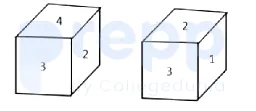
Two different positions of the same dice are shown, the six faces of which are numbered from 1 to 6. Select the number that will be on the face opposite to the one showing 1.
- A
4
- B
5
- C
3
- D
2
Show answer
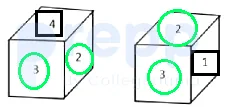
A. 4From the given two dices,
→ 3 and 2 are common surface in both Dice, therefore, '4' is the opposite surface of '1'.
Here, '4' is opposite to the face containing '1'.
Hence, the correct answer is "4".
 Paper & answer key PDF ↗
 Question 2archived
Study the given pattern carefully and select the number that can replace the question mark (?) in it.
(2, 1, 5)
(5, 12, 22)
(6, 2, ?)
(NOTE: Operations should be performed on the whole numbers, without breaking down the numbers into its constituent digits. E.g. 13 — Operations on 13 such as adding/subtracting/multiplying etc. to 13 can be performed. Breaking down 13 into 1 and 3 and then performing mathematical operations on 1 and 3 is not allowed)
- A
6
- B
14
- C
8
- D
12
Show answer
B. 14Understanding the Number Pattern
The question asks us to identify the underlying pattern in the given sets of numbers and use it to find the missing number in the third set. We are given three sets of numbers in the format (a, b, c):
Set 1: (2, 1, 5)
Set 2: (5, 12, 22)
Set 3: (6, 2, ?)
We need to find a relationship between the first two numbers (a and b) and the third number (c) that holds true for the first two sets.
Analyzing the Pattern in the Given Sets
Let's examine the numbers in the first two sets to discover the rule connecting the first two numbers to the third one.
Analysis of Set 1: (2, 1, 5)
Here, $a=2$, $b=1$, and $c=5$. Let's try simple mathematical operations.
Sum: $a+b = 2+1 = 3$ (Not 5)
Product: $a \times b = 2 \times 1 = 2$ (Not 5)
Squaring one number and adding the other: $a^2+b = 2^2+1 = 4+1 = 5$. This matches the third number. Let's check if this rule works for the next set.
Squaring both and adding: $a^2+b^2 = 2^2+1^2 = 4+1 = 5$. This also matches. Let's check this rule too.
Analysis of Set 2: (5, 12, 22)
Here, $a=5$, $b=12$, and $c=22$. Let's test the potential rules found from Set 1.
Rule 1 ($a^2+b = c$): $5^2+12 = 25+12 = 37$. This is not 22. So, this rule is incorrect.
Rule 2 ($a^2+b^2 = c$): $5^2+12^2 = 25+144 = 169$. This is not 22. So, this rule is also incorrect.
Let's look for another relationship. Maybe a linear combination of 'a' and 'b'. Let's assume the pattern is $k \times a + l \times b = c$.
For Set 1: $k \times 2 + l \times 1 = 5 \quad (Equation 1)$
For Set 2: $k \times 5 + l \times 12 = 22 \quad (Equation 2)$
We have a system of two linear equations:
Equation
Expression
1
$2k + l = 5$
2
$5k + 12l = 22$
From Equation 1, we can express $l$ as $l = 5 - 2k$. Substitute this into Equation 2:
$5k + 12(5 - 2k) = 22$
$5k + 60 - 24k = 22$
$60 - 19k = 22$
$19k = 60 - 22$
$19k = 38$
$k = \frac{38}{19} = 2$
Now, substitute the value of $k$ back into the expression for $l$:
$l = 5 - 2k = 5 - 2(2) = 5 - 4 = 1$
So the pattern is $c = 2a + 1b$, which simplifies to $c = 2a + b$.
Verifying the Pattern
Let's check if the rule $c = 2a + b$ holds for both given sets:
Set 1 (2, 1, 5): $2 \times 2 + 1 = 4 + 1 = 5$. This matches.
Set 2 (5, 12, 22): $2 \times 5 + 12 = 10 + 12 = 22$. This also matches.
The pattern $c = 2a + b$ is consistent across the first two sets.
Finding the Missing Number
Now we apply the discovered pattern $c = 2a + b$ to the third set: (6, 2, ?).
Here, $a=6$ and $b=2$. We need to find $c$ (the missing number).
$c = 2 \times a + b$
$c = 2 \times 6 + 2$
$c = 12 + 2$
$c = 14$
The missing number is 14.
Conclusion
Based on the pattern observed in the first two sets, the missing number in the third set is 14.
Revision Table: Analyzing Number Patterns
Concept
Description
Pattern Recognition
Identifying the underlying rule or relationship between the numbers in a sequence or set.
Logical Reasoning
Using deduction and analysis to solve problems where direct calculation methods may not be obvious.
Mathematical Operations
Applying arithmetic operations (addition, subtraction, multiplication, division) and sometimes higher operations (squaring, cubing) to find the pattern.
Variable Assignment
Representing the numbers in a set with variables (like a, b, c) to formulate algebraic expressions for the pattern.
System of Equations
In some patterns involving constants, setting up and solving simultaneous equations to find the values of those constants.
Additional Information: Types of Number Series Patterns
Number pattern questions often involve different types of series or relationships:
Arithmetic Series: Each term is obtained by adding a constant difference to the previous term.
Geometric Series: Each term is obtained by multiplying the previous term by a constant ratio.
Difference Series: The pattern is in the differences between consecutive terms (e.g., difference is constant, or differences form an arithmetic/geometric series).
Ratio Series: The pattern is in the ratio between consecutive terms.
Mixed Series: A combination of arithmetic and geometric operations, or alternating patterns.
Positional Patterns: The value of a term depends on its position in the sequence.
Operation on Previous Terms: The current term is calculated based on one or more previous terms (like in this problem, where the third term depends on the first two in a specific way).
Digit-Based Patterns: (Specifically excluded in this question type) Patterns based on the digits of the numbers themselves.
Solving number pattern problems requires careful observation, hypothesis testing, and logical deduction.
Paper & answer key PDF ↗ Question 3archived
The second number in the given number pairs is obtained by performing certain mathematical operation(s) on the first number. The same operation(s) are followed in all the number pairs except one. Find that odd number pair.
- A
4 : 70
- B
3 : 30
- C
6 : 222
- D
7 : 350
Show answer
A. 4 : 70Logic : (Cube of 1st number + 1st number) = 2nd number
So,
Option - (1) : 4 : 70
\((4)^3\) + 4 = 70
64 + 4 = 70
68 ≠ 70 (LHS ≠ RHS)
Option - (2) : 3 : 30
\((3)^3\) + 3 = 30
27 + 3 = 30
30 = 30 (LHS = RHS)
Option - (3) : 6 : 222
\((6)^3\) + 6 = 222
216 + 6 = 222
222 = 222 (LHS = RHS)
Option - (4) : 7 : 350
\((7)^3\) + 7 = 350
343 + 7 = 350
350 = 350 (LHS = RHS)
Hence, "Option - (1)" is the correct answer.
Paper & answer key PDF ↗ Question 4archived
Which of the following interchanges of signs would make the given equation correct?
100 + 100 × 50 - 2 ÷ 3 = 51
- A
+ and ÷
- B
+ and -
- C
- and ×
- D
÷ and ×
Show answer
A. + and ÷Solving the Equation by Sign Interchange
The problem asks us to find which interchange of two mathematical signs from the given equation will make the equation correct. The initial equation is:
\(100 + 100 \times 50 - 2 \div 3 = 51\)
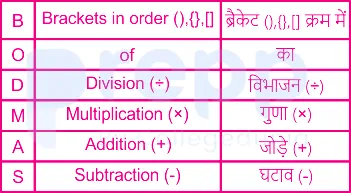
Let's first evaluate the original equation using the order of operations (BODMAS/PEMDAS - Brackets, Orders, Division/Multiplication, Addition/Subtraction):
Multiplication first: \(100 \times 50 = 5000\)
Division next: \(2 \div 3 \approx 0.67\)
So the equation becomes approximately: \(100 + 5000 - 0.67 = 5100 - 0.67 = 5099.33\)
Clearly, \(5099.33\) is not equal to \(51\), so the original equation is incorrect. We need to test the given options by swapping the specified signs and re-evaluating the equation.
Testing Option 1: Interchanging + and ÷
If we interchange the '+' and '÷' signs, the equation becomes:
\(100 \div 100 \times 50 - 2 + 3\)
Now, let's evaluate this new equation using BODMAS:
Division first: \(100 \div 100 = 1\)
The equation is now: \(1 \times 50 - 2 + 3\)
Multiplication next: \(1 \times 50 = 50\)
The equation is now: \(50 - 2 + 3\)
Now, perform addition and subtraction from left to right:
Subtraction: \(50 - 2 = 48\)
Addition: \(48 + 3 = 51\)
So, the equation becomes \(51\). This matches the right side of the original target equation.
\(100 \div 100 \times 50 - 2 + 3 = 51\)
Testing Other Options (for completeness)
Let's quickly look at the other options to see if they yield 51.
Option 2: Interchanging + and -
Equation becomes: \(100 - 100 \times 50 + 2 \div 3\)
Evaluation: \(100 - (100 \times 50) + (2 \div 3) = 100 - 5000 + 0.67 \approx -4899.33\). This is not 51.
Option 3: Interchanging - and ×
Equation becomes: \(100 + 100 - 50 \times 2 \div 3\)
Evaluation: \(100 + 100 - (50 \times 2) \div 3 = 200 - 100 \div 3 \approx 200 - 33.33 \approx 166.67\). This is not 51.
Option 4: Interchanging ÷ and ×
Equation becomes: \(100 + 100 \div 50 - 2 \times 3\)
Evaluation: \(100 + (100 \div 50) - (2 \times 3) = 100 + 2 - 6 = 102 - 6 = 96\). This is not 51.
Conclusion
Based on the evaluation of each option, only interchanging the '+' and '÷' signs makes the given equation correct.
Revision Table: Order of Operations (BODMAS/PEMDAS)
Order
Mnemonic
Operation
1
B / P
Brackets / Parentheses
2
O / E
Orders / Exponents (powers, square roots)
3
D M
Division and Multiplication (from left to right)
4
A S
Addition and Subtraction (from left to right)
Additional Information: Solving Equation Puzzles
Problems involving interchanging signs or numbers in equations are common in reasoning and quantitative aptitude tests. Here are some tips for solving them:
Understand BODMAS/PEMDAS: Always follow the correct order of operations when evaluating the equation after the interchange.
Test Options Systematically: Go through each option one by one. Don't assume the first one you try is correct without verifying it.
Be Careful with Calculations: Double-check your arithmetic, especially with division and subtraction.
Estimation: Sometimes, a quick estimation after swapping signs can eliminate options that are clearly far from the target value.
Practice: Solving more problems of this type will help you become faster and more accurate.
Paper & answer key PDF ↗ Question 5archived
In a certain code language, ‘CROW’ is coded as ‘6970’ and ‘ORCA’ is coded as ‘7569’. What is the code for ‘W’ in the given code language?
- A
7
- B
9
- C
6
- D
0
Show answer
D. 0Understanding Code Language Patterns
This question involves a coding language where words are represented by sequences of digits. We are given two examples of words and their corresponding codes and asked to find the code for a specific letter.
The given information is:
'CROW' is coded as '6970'
'ORCA' is coded as '7569'
We need to determine the code for the letter 'W'. To solve this, we should look for patterns and common elements in the given words and their codes.
Analyzing the Coded Words
Let's list the letters and their potential positions in the codes:
CROW: C (1st), R (2nd), O (3rd), W (4th) correspond to 6, 9, 7, 0 in some order.
ORCA: O (1st), R (2nd), C (3rd), A (4th) correspond to 7, 5, 6, 9 in some order.
Notice that the same letters appear in different positions in the two words, but their codes might be consistent regardless of position. Let's compare the letters and the digits available:
Word
Letters
Code
Digits
CROW
C, R, O, W
6970
6, 9, 7, 0
ORCA
O, R, C, A
7569
7, 5, 6, 9
Identifying Common Letter Codes
We can see which letters are common to both words and try to match them with common digits in their codes. The letters common to 'CROW' and 'ORCA' are 'C', 'R', and 'O'. The digits present in both codes '6970' and '7569' are '6', '9', and '7'.
Let's try to match the common letters with the common digits:
Letter 'C' appears in CROW and ORCA. The digit '6' appears in both codes. In CROW (6970), C is the first letter and 6 is the first digit. In ORCA (7569), C is the third letter and 6 is the third digit. This strongly suggests that 'C' codes to '6'.
Letter 'O' appears in CROW and ORCA. The digit '7' appears in both codes. In CROW (6970), O is the third letter and 7 is the third digit. In ORCA (7569), O is the first letter and 7 is the first digit. This strongly suggests that 'O' codes to '7'.
Letter 'R' appears in CROW and ORCA. The digit '9' appears in both codes. In CROW (6970), R is the second letter and 9 is the second digit. In ORCA (7569), R is the fourth digit. This does not fit a simple positional mapping, but the digit '9' is common for the common letter 'R'. This suggests 'R' codes to '9'.
Deducing Individual Letter Codes
Based on the analysis of common letters and digits, we can propose the following potential mappings:
C <-> 6
O <-> 7
R <-> 9
Now let's apply these mappings to the full codes and find the codes for the remaining letters.
For 'CROW' (6970):
C is 6.
R is 9.
O is 7.
The code is 6970. The digits used are 6, 9, 7. The remaining digit is 0. The remaining letter is 'W'. This implies W <-> 0.
For 'ORCA' (7569):
O is 7.
R is 9.
C is 6.
The code is 7569. The digits used are 7, 9, 6. The remaining digit is 5. The remaining letter is 'A'. This implies A <-> 5.
Verifying the Letter Codes
We have derived the following potential code mapping for each letter:
Letter
Code
C
6
R
9
O
7
W
0
A
5
Let's check if these codes produce the given word codes:
CROW: C(6) R(9) O(7) W(0) → 6970 (Matches the given code)
ORCA: O(7) R(9) C(6) A(5) → 7569 (Matches the given code)
The derived letter codes are consistent with the given information.
Finding the Code for 'W'
The question asks for the code for 'W'. From our verified mapping, the code for 'W' is 0.
Conclusion
By analyzing the given coded words and identifying common letters and their corresponding digits, we deduced the unique code for each letter present in the words. The code determined for the letter 'W' is 0.
Revision Table: Code Language Analysis
Step
Action
Result
1
List given words and codes
CROW=6970, ORCA=7569
2
Identify common letters
C, R, O
3
Identify common digits in codes
6, 9, 7
4
Map common letters to digits
C<->6, O<->7, R<->9 (based on consistency)
5
Deduce remaining codes (from CROW)
W <-> 0
6
Deduce remaining codes (from ORCA)
A <-> 5
7
Verify full mapping
Consistent with given codes
8
Find code for 'W'
0
Additional Information: Letter Coding Principles
Coding language problems often involve different types of patterns. Some common principles include:
Direct Mapping: Each letter has a unique, fixed code (like in this problem).
Positional Mapping: The code for a letter depends on its position in the word.
Alphabetical Position: Letters are coded based on their order in the alphabet (A=1, B=2, etc.) or a modified sequence.
Reversal: The code might be the reverse of the letter sequence or its numerical value.
Arithmetic Operations: Codes might involve adding, subtracting, multiplying, or dividing values derived from letter positions.
Substitution Ciphers: Each letter is replaced by another letter, number, or symbol.
Solving these problems usually requires careful observation, comparison, and logical deduction to identify the specific pattern used.
Paper & answer key PDF ↗ Question 6archived
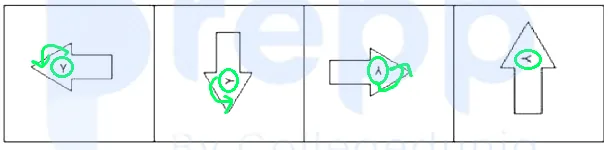
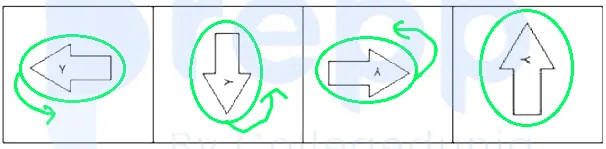
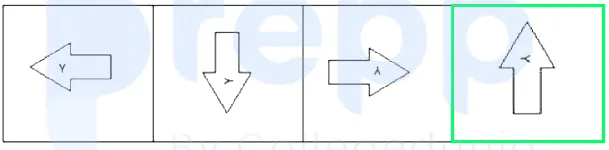
Select the figure that will come in place of the question mark (?) in the following figure series.

- A
Option A (shown in image)
- B
Option B (shown in image)
- C
Option C (shown in image)
- D
Option D (shown in image)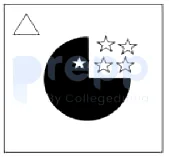
Show answer
Question 7archived
Read the given statements and conclusions carefully. Assuming that the information given in the statements is true, even if it appears to be at variance with commonly known facts, decide which of the given conclusions logically follow(s) from the statements.
Statements:
Some pens are boxes.
No box is a fan.
Some pens are fans.
Conclusions:
I. No pen is a fan.
Il. No box is a pen.
III. Some fans are pens.
IV. Some boxes are pens.
- A
Only conclusions I and III follow
- B
Only conclusions Il and IV follow
- C
Only conclusions I and Il follow
- D
Only conclusions Ill and IV follow
Show answer
D. Only conclusions Ill and IV followThis problem is a classic example of a logical reasoning question, specifically focusing on syllogisms. We are given three statements and four conclusions. Our task is to determine which of the given conclusions logically follow from the statements, assuming the statements are true.
Let's break down the given statements:
Statement 1: Some pens are boxes.
Statement 2: No box is a fan.
Statement 3: Some pens are fans.
To solve syllogism problems like this, we can use methods like Venn diagrams or analyze the rules of inference for categorical propositions. Let's analyze each statement and its implications.
Statement 1 tells us there is an overlap between the category 'pens' and the category 'boxes'. There is a group of items that are both pens and boxes.
Statement 2 tells us there is absolutely no overlap between the category 'boxes' and the category 'fans'. Nothing that is a box can be a fan, and nothing that is a fan can be a box.
Statement 3 tells us there is an overlap between the category 'pens' and the category 'fans'. There is a group of items that are both pens and fans.
Now let's examine each conclusion based on these statements.
Conclusion I: No pen is a fan.
This conclusion states that there is no overlap between pens and fans. However, Statement 3 explicitly says, "Some pens are fans." Since the statements are assumed to be true, this conclusion directly contradicts Statement 3. Therefore, Conclusion I does not follow.
Conclusion II: No box is a pen.
This conclusion states that there is no overlap between boxes and pens. However, Statement 1 explicitly says, "Some pens are boxes." If some pens are boxes, it logically implies that some boxes must also be pens (the relationship is symmetrical for 'some' statements). Therefore, this conclusion contradicts Statement 1 and does not follow.
Conclusion III: Some fans are pens.
This conclusion states that there is an overlap between fans and pens. Statement 3 says, "Some pens are fans." In logical reasoning, the statement "Some A are B" is equivalent to "Some B are A". If some pens belong to the category of fans, then it must also be true that some fans belong to the category of pens. This is a valid conversion for an 'Some' statement. Therefore, Conclusion III logically follows from Statement 3.
Conclusion IV: Some boxes are pens.
This conclusion states that there is an overlap between boxes and pens. Statement 1 says, "Some pens are boxes." Similar to Conclusion III, the statement "Some A are B" is equivalent to "Some B are A". If some pens are boxes, it logically follows that some boxes are also pens. This is a valid conversion for an 'Some' statement. Therefore, Conclusion IV logically follows from Statement 1.
Based on our analysis:
Conclusion I does not follow.
Conclusion II does not follow.
Conclusion III follows.
Conclusion IV follows.
Thus, only conclusions III and IV logically follow from the given statements.
Revision Table: Types of Categorical Statements
Statement Type
Form
Example
Venn Diagram Representation
Universal Affirmative
All A are B
All dogs are mammals.
Circle A completely inside Circle B.
Universal Negative
No A is B
No fish are birds.
Circles A and B separate.
Particular Affirmative
Some A are B
Some students are artists.
Circles A and B overlapping, shaded area in overlap.
Particular Negative
Some A are not B
Some fruits are not sweet.
Circles A and B overlapping, shaded area in A outside overlap.
Additional Information on Syllogism Logic
Syllogisms are a form of deductive reasoning where a conclusion is drawn from two or more statements (premises). The validity of a syllogism depends on its logical form, not necessarily on the truth of the statements in the real world (though for these problems, we assume the statements are true). Key concepts include:
Conversion: Swapping the subject and predicate. "No A is B" is equivalent to "No B is A". "Some A are B" is equivalent to "Some B are A". "All A are B" is NOT equivalent to "All B are A". "Some A are not B" is NOT equivalent to "Some B are not A".
Distribution: Whether a term refers to all members of its class or just some. Knowing which terms are distributed helps determine valid inferences.
Venn Diagrams: A visual tool to represent the relationships between categories and check the validity of conclusions.
In this specific problem, the validity of Conclusions III and IV relies on the simple rule of conversion for 'Some' statements.
Paper & answer key PDF ↗ Question 8archived
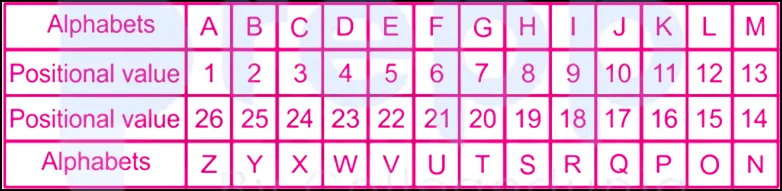
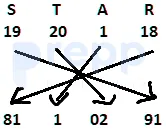
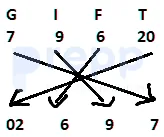
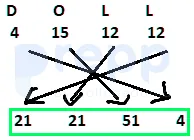
In a certain code language, ‘STAR’ is written as ‘8110291’, ‘GIFT’ is written as '02697'. How will ‘DOLL’ be written in that language?
- A
2112514
- B
2121514
- C
2121154
- D
2121524
Show answer
Question 9archived
Select the set in which the numbers are related in the same way as are the numbers of the following set.
(NOTE: Operations should be performed on the whole numbers, without breaking down the numbers into its constituent digits.)
(12, 15, 18)
(10, 8, 6)
- A
(15, 20, 25)
- B
(14, 28, 14)
- C
(13, 10, 17)
- D
(19, 18, 1)
Show answer
A. (15, 20, 25)Finding the Number Set with the Same Relationship
The objective is to identify which set of numbers from the given options shares the same mathematical relationship as the example sets: (12, 15, 18) and (10, 8, 6). The key instruction emphasizes performing operations on the numbers as whole units, without breaking them down into individual digits.
Understanding the Pattern in the Given Sets
Let's first analyze the relationship between the numbers in the two sets provided:
Set 1: (12, 15, 18)
Difference between the second number (15) and the first number (12): $15 - 12 = 3$.
Difference between the third number (18) and the second number (15): $18 - 15 = 3$.
Observation: There is a constant difference of 3 between consecutive numbers. This pattern indicates that the numbers form an arithmetic progression.
Set 2: (10, 8, 6)
Difference between the second number (8) and the first number (10): $8 - 10 = -2$.
Difference between the third number (6) and the second number (8): $6 - 8 = -2$.
Observation: There is a constant difference of -2 between consecutive numbers. This set also forms an arithmetic progression.
The core pattern identified in both these sets is that they represent an arithmetic progression. An arithmetic progression is a sequence where each term after the first is obtained by adding a fixed, constant number (called the common difference) to the preceding term.
Checking Options for the Arithmetic Progression Rule
Now, we will examine each option to determine if it follows the same rule of being an arithmetic progression:
Option 1: (15, 20, 25)
Difference: $20 - 15 = 5$.
Difference: $25 - 20 = 5$.
Result: The differences are constant (5). This set matches the arithmetic progression pattern.
Option 2: (14, 28, 14)
Difference: $28 - 14 = 14$.
Difference: $14 - 28 = -14$.
Result: The differences are not constant ($14 \neq -14$). This set does not follow the pattern.
Option 3: (13, 10, 17)
Difference: $10 - 13 = -3$.
Difference: $17 - 10 = 7$.
Result: The differences are not constant ($-3 \neq 7$). This set does not follow the pattern.
Option 4: (19, 18, 1)
Difference: $18 - 19 = -1$.
Difference: $1 - 18 = -17$.
Result: The differences are not constant ($-1 \neq -17$). This set does not follow the pattern.
Note: Option 5 was not sufficiently detailed in the provided information for analysis.
Conclusion: Identifying the Matching Set
By analyzing the pattern of constant differences (arithmetic progression) in the initial sets and applying it to the options, we found that only Option 1, the set (15, 20, 25), consistently follows this rule. Therefore, this set demonstrates the same relationship as the sets given in the question.
Paper & answer key PDF ↗ Question 10archived
‘A + B’ means ‘A is the father of B.
‘A - B’ means ‘A is the son of B’.
‘A × B' means ‘A is the sister of B’.
‘A ÷ B’ means ‘A is the wife of B’.
If H + I - J × K × L - M ÷ N, then which of the following statements is NOT correct?
- A
H is the husband of the sister of K.
- B
J is the wife of the son of M.
- C
H is the husband of the sister of L.
- D
H is the husband of the daughter of M.
Show answer
B. J is the wife of the son of M.To solve this blood relations reasoning question, we need to decode the given expression based on the defined relationships and then evaluate each statement to find the one that is not correct.
Decoding the Coded Relationships
The given codes represent specific relationships:
A + B means A is the father of B.
A - B means A is the son of B.
A × B means A is the sister of B.
A ÷ B means A is the wife of B.
Analyzing the Expression: H + I - J × K × L - M ÷ N
Let's break down the expression segment by segment:
H + I: H is the father of I. This tells us H is male.
I - J: I is the son of J. This tells us I is male. Since H is the father of I and I is the son of J, J must be the mother of I. Therefore, H and J are husband and wife. J is female.
J × K: J is the sister of K. This tells us J is female (already known). J and K are siblings.
K × L: K is the sister of L. This tells us K is female. K and L are siblings. Combining with the previous point, J, K, and L are siblings. J and K are sisters.
L - M: L is the son of M. This tells us L is male. Since J, K, and L are siblings, and L is the son of M, M must be the parent of J, K, and L.
M ÷ N: M is the wife of N. This tells us M is female. If M is the wife of N, N must be the husband of M, and N is male. Since M is the parent of J, K, L, and M is married to N, both M and N are parents of J, K, and L.
Summary of Relationships
From the decoding, we can summarize the relationships:
N and M are husband and wife.
J, K, and L are children of N and M.
J is female, K is female, L is male. (J and K are sisters, L is their brother).
J is married to H.
H and J have a son, I.
Evaluating the Statements
Now let's check each given statement against our derived relationships:
Statement 1: H is the husband of the sister of K.
Sister of K: From our summary, J is the sister of K. L is the brother of K. So, J is a sister of K.
Is H the husband of J? Yes, we determined that H and J are husband and wife.
Therefore, Statement 1 is CORRECT.
Statement 2: J is the wife of the son of M.
Son of M: M and N have children J, K, L. L is male (L - M), so L is a son of M.
Is J the wife of L? From our summary, J is married to H. L is her brother.
Therefore, Statement 2 is INCORRECT. J is the sister, not the wife, of the son of M (L).
Statement 3: H is the husband of the sister of L.
Sister of L: From our summary, J and K are sisters of L.
Is H the husband of a sister of L (either J or K)? Yes, H is the husband of J, and J is a sister of L.
Therefore, Statement 3 is CORRECT.
Statement 4: H is the husband of the daughter of M.
Daughter of M: M and N have children J, K, L. J and K are female, so they are daughters of M.
Is H the husband of a daughter of M (either J or K)? Yes, H is the husband of J, and J is a daughter of M.
Therefore, Statement 4 is CORRECT.
Based on our evaluation, the statement that is NOT correct is Statement 2.
Revision Table: Key Relationships
Expression Segment
Relationship
Inferred Gender/Relation
H + I
H is father of I
H (Male)
I - J
I is son of J
I (Male), J (Mother of I), H & J (Married)
J × K
J is sister of K
J & K (Siblings)
K × L
K is sister of L
K & L (Siblings), J, K, L (Siblings)
L - M
L is son of M
L (Male), M (Parent of J, K, L)
M ÷ N
M is wife of N
M (Female), N (Male), M & N (Parents of J, K, L)
Additional Information: Strategies for Blood Relations
Solving blood relations problems, especially those with coded relationships, requires a systematic approach:
Write down the codes: Keep the list of what each symbol means handy.
Break down the expression: Analyze the expression segment by segment, determining the direct relationship between each pair of individuals.
Infer genders: Note down the gender of each person as you deduce it. This is crucial as relationships like son/daughter, father/mother, husband/wife imply gender.
Build a family tree: For complex expressions, drawing a simple family tree diagram can help visualize the relationships clearly. Place individuals on different levels representing generations.
Combine information: Link different parts of the expression to build a complete picture of the family structure.
Evaluate statements carefully: Once the family structure is clear, check each statement against it. Pay close attention to relationships like "son of the mother", "husband of the sister", etc., which involve tracing multiple steps in the tree.
Identify the question type: Does the question ask for the correct statement, the incorrect statement, the relationship between two people, or the gender of someone? Read the question carefully.
Practice with various types of coded blood relations questions helps improve speed and accuracy.
Paper & answer key PDF ↗ Question 11archived
Select the set In which the numbers are related In the same way as are the numbers of the following set.
(NOTE : Operations should be performed on the whole numbers, without breaking down the numbers into its constituent digits. E.g. 13 — Operations on 13 such as adding /subtracting /multiplying etc. to 13 can be performed. Breaking down 13 into 1 and 3 and then performing mathematical operations on 1 and 3 is not allowed)
(44, 63, 98)
(59, 99, 149)
- A
(81, 15, 87)
- B
(54, 73, 121)
- C
(19, 32, 44)
- D
(82, 13, 96)
Show answer
A. (81, 15, 87)Analysis of the Number Sets Relationship
The question asks us to identify the relationship between the numbers in the given sets and find the option set that follows the same relationship. We are provided with two example sets: (44, 63, 98) and (59, 99, 149). We must find a rule that applies to both of these sets and then check which of the given options follows this rule.
Finding the Relationship in the Given Sets
Let's examine the first set (44, 63, 98). Let the numbers be $a$, $b$, and $c$ in the order they appear. So, $a=44$, $b=63$, $c=98$. We need to find a relationship between these numbers using whole number operations.
Calculate the difference between consecutive numbers:
$b - a = 63 - 44 = 19$
$c - b = 98 - 63 = 35$
There is a pattern in the differences ($19$ and $35$), specifically $35 = 19 + 16$. This suggests a rule related to differences, but let's see if it applies to the second set.
Now, let's examine the second set (59, 99, 149). Let $a=59$, $b=99$, $c=149$.
Calculate the difference between consecutive numbers:
$b - a = 99 - 59 = 40$
$c - b = 149 - 99 = 50$
The differences are $40$ and $50$. The difference between these differences is $50 - 40 = 10$. This is different from the first set's difference of differences ($16$). So, the rule $(c-b) = (b-a) + K$ where $K$ is constant for all sets doesn't seem to be the correct pattern.
Let's try looking for a relationship involving sums or other combinations.
Consider the first set (44, 63, 98) again. Let's explore the sum of the first two numbers and see if it relates to the third number.
Sum of first two numbers: $44 + 63 = 107$
The third number is $98$. Notice that $107 - 9 = 98$.
Let's test this potential rule ($a+b-9=c$) with the second set (59, 99, 149). Let $a=59$, $b=99$, $c=149$.
Sum of first two numbers: $59 + 99 = 158$
The third number is $149$. Notice that $158 - 9 = 149$.
This relationship, where the sum of the first two numbers minus 9 equals the third number ($a+b-9=c$), holds true for both example sets. This appears to be the correct rule.
Testing the Options
Now we apply the rule $a+b-9=c$ to each of the given options to find the set that follows the same pattern.
Option 1: (81, 15, 87)
Here, $a=81$, $b=15$, $c=87$.
Calculate $a+b-9$: $81 + 15 - 9 = 96 - 9 = 87$.
The result $87$ matches the third number in the set ($c$). So, this option follows the rule.
Option 2: (54, 73, 121)
Here, $a=54$, $b=73$, $c=121$.
Calculate $a+b-9$: $54 + 73 - 9 = 127 - 9 = 118$.
The result $118$ does not match the third number ($121$). This option does not follow the rule.
Option 3: (19, 32, 44)
Here, $a=19$, $b=32$, $c=44$.
Calculate $a+b-9$: $19 + 32 - 9 = 51 - 9 = 42$.
The result $42$ does not match the third number ($44$). This option does not follow the rule.
Option 4: (82, 13, 96)
Here, $a=82$, $b=13$, $c=96$.
Calculate $a+b-9$: $82 + 13 - 9 = 95 - 9 = 86$.
The result $86$ does not match the third number ($96$). This option does not follow the rule.
Based on the analysis, only Option 1 follows the identified rule $a+b-9=c$ which is consistent with the relationship in the example sets.
Set
a
b
c
Calculation ($a+b-9$)
Result
Matches c?
Follows Rule?
(44, 63, 98)
44
63
98
$44 + 63 - 9 = 107 - 9$
98
Yes
Yes (Example)
(59, 99, 149)
59
99
149
$59 + 99 - 9 = 158 - 9$
149
Yes
Yes (Example)
(81, 15, 87)
81
15
87
$81 + 15 - 9 = 96 - 9$
87
Yes
Yes (Option 1)
(54, 73, 121)
54
73
121
$54 + 73 - 9 = 127 - 9$
118
No
No (Option 2)
(19, 32, 44)
19
32
44
$19 + 32 - 9 = 51 - 9$
42
No
No (Option 3)
(82, 13, 96)
82
13
96
$82 + 13 - 9 = 95 - 9$
86
No
No (Option 4)
Conclusion
The set of numbers (81, 15, 87) is related in the same way as the numbers of the given sets (44, 63, 98) and (59, 99, 149), following the rule that the sum of the first two numbers minus 9 equals the third number.
Revision Table for Number Pattern Questions
Understanding common types of number pattern questions helps in solving them efficiently.
Pattern Type
Description
Example Rule
Arithmetic Progression
Constant difference between consecutive terms.
$b - a = c - b$
Geometric Progression
Constant ratio between consecutive terms.
$b/a = c/b$
Differences in AP
Differences between consecutive terms form an Arithmetic Progression.
$(c-b) - (b-a) = \text{constant}$
Sum/Difference Relation
A term is a sum or difference of previous terms, possibly with an added constant or multiplier.
$c = a + b + K$ or $c = a + b \times K$ or $c = a + b - K$ etc.
Product/Division Relation
A term is a product or division of previous terms, possibly with an added constant or offset.
$c = a \times b + K$ or $c = a \times b / K$ etc.
Mixed Operations
Combination of different operations or slightly more complex rules.
As in this question: $c = a + b - 9$
When tackling these problems, it's useful to look at differences, sums, products, ratios, and how these relate across the numbers in the set.
Additional Information on Number Sets and Patterns
Number sets and patterns are common topics in logical reasoning and quantitative aptitude tests. They require identifying underlying mathematical relationships between numbers.
Logical Reasoning: These questions assess your ability to identify rules and apply them consistently.
Quantitative Aptitude: While logical, these often involve basic arithmetic operations, reinforcing quantitative skills.
Problem-Solving Strategy: A systematic approach involves calculating differences, sums, products, and testing simple relationships first before looking for more complex ones. Always check the discovered rule against all provided examples before applying it to the options.
Common Pitfalls: Assuming a simple pattern too quickly, or not checking the rule against all example sets if more than one is provided. Also, make sure to perform operations on whole numbers as specified, not breaking them into digits unless the pattern explicitly involves digits.
Practicing different types of number pattern questions helps improve speed and accuracy in identifying the correct relationship.
Paper & answer key PDF ↗ Question 12archived
In this question, three statements are given, followed by three conclusions numbered I, Il and III. Assuming the statements to be true, even if they seem to be at variance with commonly known facts, decide which of the conclusions logically follows/follow from the statements.
Statements:
Some spoons are black.
All black are crows.
No crow is a plate.
Conclusions:
I. Some black are spoons.
Il. All crows are black.
III. No plate is a crow.
- A
Only conclusion I follows.
- B
Only conclusions I and Ill follow.
- C
None of the conclusions follows.
- D
Only conclusion Il follows.
Show answer
B. Only conclusions I and Ill follow.Analyzing the Logic Puzzle: Syllogism Statements and Conclusions
This question asks us to evaluate which of the given conclusions logically follow from the three provided statements, assuming the statements are true. This type of problem is based on logical deduction, specifically syllogism.
Understanding the Statements
Let's break down the statements:
Statement 1: Some spoons are black.
Statement 2: All black are crows.
Statement 3: No crow is a plate.
Evaluating the Conclusions
Now, let's examine each conclusion based on the given statements.
Conclusion I: Some black are spoons.
Statement 1 says, "Some spoons are black." The conclusion says, "Some black are spoons." This is the converse of Statement 1.
In logic, if "Some A are B" is true, then its converse "Some B are A" is also logically true. For example, if some students are tall, then it must be true that some tall people are students.
Therefore, Conclusion I logically follows from Statement 1.
Conclusion II: All crows are black.
Statement 2 says, "All black are crows." The conclusion says, "All crows are black." This is the converse of Statement 2.
In logic, if "All A are B" is true, its converse "All B are A" is not necessarily true. For example, if "All dogs are mammals" is true, it doesn't mean "All mammals are dogs" is true.
Statement 2 establishes a relationship where the set of 'black' things is a subset of the set of 'crows'. It does not mean the sets are identical or that the set of 'crows' is a subset of 'black'.
Therefore, Conclusion II does not logically follow from the statements.
Conclusion III: No plate is a crow.
Statement 3 says, "No crow is a plate." The conclusion says, "No plate is a crow." This is the converse of Statement 3.
In logic, if "No A is B" is true, then its converse "No B is A" is also logically true. For example, if no cat is a dog, then no dog is a cat.
Therefore, Conclusion III logically follows from Statement 3.
Summary of Findings
Based on our analysis:
Conclusion I (Some black are spoons) follows.
Conclusion II (All crows are black) does not follow.
Conclusion III (No plate is a crow) follows.
Thus, only conclusions I and III logically follow from the given statements.
Statement
Type
Some spoons are black.
Particular Affirmative (I)
All black are crows.
Universal Affirmative (A)
No crow is a plate.
Universal Negative (E)
Conclusion
Analysis
Follows?
I. Some black are spoons.
Converse of "Some spoons are black". Converse of I type statement is valid.
Yes
II. All crows are black.
Converse of "All black are crows". Converse of A type statement is not always valid.
No
III. No plate is a crow.
Converse of "No crow is a plate". Converse of E type statement is valid.
Yes
Revision Table: Syllogism Conversions
Understanding the valid conversions of standard categorical statements is key to solving such problems:
Original Statement Type
Form
Valid Converse Form
Example
A (Universal Affirmative)
All S are P
Some P are S (by limitation, if P exists)
All dogs are mammals → Some mammals are dogs
E (Universal Negative)
No S is P
No P is S
No cat is a dog → No dog is a cat
I (Particular Affirmative)
Some S are P
Some P are S
Some students are tall → Some tall people are students
O (Particular Negative)
Some S are not P
No valid converse
Some animals are not dogs → No valid conclusion about dogs and animals in reverse
Additional Information: Logical Deduction Basics
Logical deduction involves deriving conclusions from premises. In syllogism, we analyze the relationships between three terms (like spoons, black, crows, plates) based on two or more statements.
A conclusion logically follows if it must be true whenever the statements are true.
Venn diagrams can be a helpful tool to visually represent the relationships described in the statements and check if the conclusion holds in all possible diagrams consistent with the statements.
Pay close attention to words like "All", "Some", and "No" as they define the quantity and quality of the relationship between categories.
Paper & answer key PDF ↗ Question 13archived
Select the correct combination of mathematical signs to sequentially fill in the diamond-shapes and to balance the given equation.

- A
+, =, ÷, ×, +
- B
÷, ×, =, +, +
- C
÷, ×, -, =, ×
- D
÷, ×, +, =, -
Show answer
D. ÷, ×, +, =, -Given statement : 56 * 8 * 4 * 7 * 50 * 15
According to the question, after replacing the * signs :
So,
Option - (1) : +, =, ÷, ×, +
56 * 8 * 4 * 7 * 50 * 15 ⇒ 56 + 8 = 4 ÷ 7 × 50 + 15
64 = 0.57 × 50 + 15
64 = 28.5 + 15
64 ≠ 43.5 (LHS ≠ RHS)
Option - (2) : ÷, ×, =, +, +
56 * 8 * 4 * 7 * 50 * 15 ⇒ 56 ÷ 8 × 4 = 7 + 50 + 15
7 × 4 = 72
28 ≠ 72 (LHS ≠ RHS)
Option - (3) : ÷, ×, -, =, ×
56 * 8 * 4 * 7 * 50 * 15 ⇒ 56 ÷ 8 × 4 - 7 = 50 × 15
7 × 4 - 7 = 750
27 - 7 = 750
20 ≠ 750 (LHS ≠ RHS)
Option - (4) : ÷, ×, +, =, -
56 * 8 * 4 * 7 * 50 * 15 ⇒ 56 ÷ 8 × 4 + 7 = 50 - 15
7 × 4 + 7 = 35
28 + 7 = 35
35 = 35 (LHS = RHS)
Hence, "Option - (4)" is the correct answer.
 Paper & answer key PDF ↗
 Question 14archived
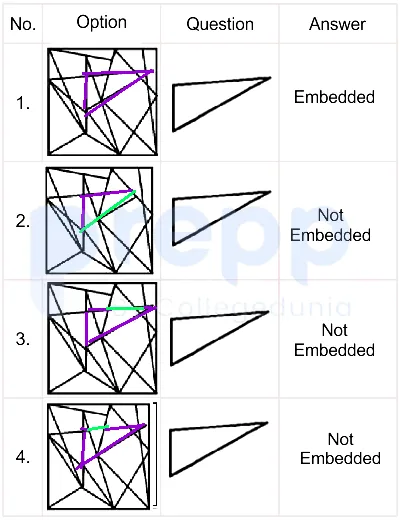
Select the option figure in which the given figure is embedded (rotation is NOT allowed).

- A
Option A (shown in image)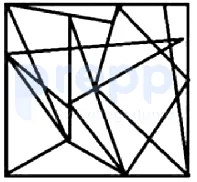
- B
Option B (shown in image)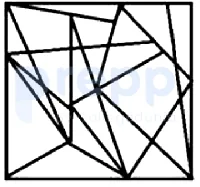
- C
Option C (shown in image)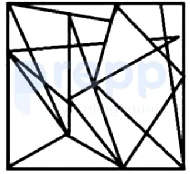
- D
Option D (shown in image)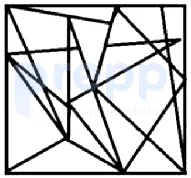
Show answer
A. Option A (shown in image)Given:
The image must not to be rotated
Hence, the correct answer is "Option - (1)".

 Paper & answer key PDF ↗
 Question 15archived
Study the given pattern carefully and select the number that can replace the question mark (?) in it.
(14, 10, 9)
(6, 8, 2)
(8, 4, ?)
(NOTE: Operations should be performed on the whole numbers, without breaking down the numbers into its constituent digits. E.g. 13 — Operations on 13 such as adding/subtracting/multiplying etc. to 13 can be performed. Breaking down 13 into 1 and 3 and then performing mathematical operations on 1 and 3 is not allowed)
- A
4
- B
6
- C
3
- D
5
Show answer
B. 6Solving the Number Pattern Puzzle
The question asks us to identify the pattern in the given sets of numbers and use it to find the missing number in the third set. The sets are:
(14, 10, 9)
(6, 8, 2)
(8, 4, ?)
We are instructed to treat the numbers as whole entities and not break them down into constituent digits.
Analyzing the Pattern
Let's analyze each set to find a consistent relationship between the first two numbers and the third number. Let the numbers in each set be \(N_1\), \(N_2\), and \(N_3\).
Set 1: (14, 10, 9)
Sum: \(14 + 10 = 24\)
Difference: \(|14 - 10| = 4\)
Average: \((14 + 10) / 2 = 12\)
Product: \(14 \times 10 = 140\)
Difference of Squares: \(|14^2 - 10^2| = |196 - 100| = 96\)
The third number is 9. We need to find how 14 and 10 relate to 9.
Set 2: (6, 8, 2)
Sum: \(6 + 8 = 14\)
Difference: \(|6 - 8| = 2\)
Average: \((6 + 8) / 2 = 7\)
Product: \(6 \times 8 = 48\)
Difference of Squares: \(|6^2 - 8^2| = |36 - 64| = 28\)
The third number is 2. We need to find how 6 and 8 relate to 2.
Set 3: (8, 4, ?)
Sum: \(8 + 4 = 12\)
Difference: \(|8 - 4| = 4\)
Average: \((8 + 4) / 2 = 6\)
Product: \(8 \times 4 = 32\)
Difference of Squares: \(|8^2 - 4^2| = |64 - 16| = 48\)
The third number is ?. We need to find how 8 and 4 relate to ?.
Identifying the Underlying Logic
Let's look at the relationship between the calculated values and the third number in each set:
Set 1: Diff=4, Avg=12, Third=9
Set 2: Diff=2, Avg=7, Third=2
Set 3: Diff=4, Avg=6, Third=?
Observe Set 2: The absolute difference between the first two numbers is 2, and the third number is also 2. This suggests a possible rule: if the difference is 2, the third number is 2.
Now look at Set 1 and Set 3. In both these sets, the absolute difference between the first two numbers is 4. However, the third numbers are different (9 and ?). This means the third number is not solely determined by the difference when the difference is 4.
Let's look at the average of the first two numbers when the difference is 4:
Set 1 (Diff=4): Average = 12, Third = 9.
Set 3 (Diff=4): Average = 6, Third = ?.
This reveals a secondary pattern when the difference is 4:
If the average is 12, the third number is 9 (as in Set 1).
If the average is 6, the third number is determined by this rule (as in Set 3).
Formulating the Pattern Rule
The pattern can be described as follows:
Calculate the absolute difference (\(D\)) between the first two numbers: \(D = |N_1 - N_2|\).
If \(D = 2\), the third number (\(N_3\)) is 2.
If \(D = 4\):
Calculate the average (\(A\)) of the first two numbers: \(A = (N_1 + N_2) / 2\).
If \(A = 12\), the third number is 9.
If \(A = 6\), the third number is 6.
Let's verify this pattern with the given sets.
Applying the Pattern to Each Set
Set 1: (14, 10, 9)
Calculate difference: \(D = |14 - 10| = 4\). Since \(D=4\), proceed to check the average.
Calculate average: \(A = (14 + 10) / 2 = 24 / 2 = 12\).
According to the rule for \(D=4\), if \(A=12\), \(N_3\) is 9. This matches the given third number in Set 1.
Set 2: (6, 8, 2)
Calculate difference: \(D = |6 - 8| = 2\).
According to the rule, if \(D=2\), \(N_3\) is 2. This matches the given third number in Set 2.
Set 3: (8, 4, ?)
Calculate difference: \(D = |8 - 4| = 4\). Since \(D=4\), proceed to check the average.
Calculate average: \(A = (8 + 4) / 2 = 12 / 2 = 6\).
According to the rule for \(D=4\), if \(A=6\), \(N_3\) is 6.
Determining the Missing Number
Based on the pattern derived from the first two sets, the missing number in the third set (8, 4, ?) is 6.
Set
\(N_1\)
\(N_2\)
\(N_3\)
Difference \(|N_1 - N_2|\)
Average \((N_1 + N_2)/2\)
Pattern Applied
1
14
10
9
4
12
If Diff=4 and Avg=12, N3=9
2
6
8
2
2
7
If Diff=2, N3=2
3
8
4
?
4
6
If Diff=4 and Avg=6, N3=6
The number that replaces the question mark (?) is 6.
Conclusion
The pattern involves checking the absolute difference between the first two numbers. If the difference is 2, the third number is 2. If the difference is 4, the third number depends on the average of the first two numbers: if the average is 6, the third number is 6; if the average is 12, the third number is 9.
Applying this pattern to the set (8, 4, ?), the difference is \(|8 - 4| = 4\) and the average is \((8 + 4) / 2 = 6\). According to the pattern, when the difference is 4 and the average is 6, the third number is 6.
The final answer is 6.
Revision Table: Number Pattern Analysis
Set
Numbers
Calculation \(|N_1 - N_2|\)
Calculation \((N_1 + N_2)/2\)
Pattern Condition Met
Resulting \(N_3\)
Given \(N_3\)
1
(14, 10, 9)
\(|14 - 10| = 4\)
\((14 + 10)/2 = 12\)
Diff = 4, Avg = 12
9
9
2
(6, 8, 2)
\(|6 - 8| = 2\)
\((6 + 8)/2 = 7\)
Diff = 2
2
2
3
(8, 4, ?)
\(|8 - 4| = 4\)
\((8 + 4)/2 = 6\)
Diff = 4, Avg = 6
6
?
Additional Information: Solving Reasoning Puzzles
Reasoning puzzles like this number pattern question require careful observation and systematic analysis. Here are some tips for tackling similar problems:
Examine Relationships: Look for relationships between the numbers in each row or column. Common relationships involve sums, differences, products, quotients, averages, squares, cubes, or combinations of these operations.
Check All Given Data: A valid pattern must work for all the completed sets provided in the puzzle. Use these sets to test potential rules.
Be Systematic: Try different basic arithmetic operations first. If simple operations don't work, consider squares, cubes, roots, or combinations of multiple operations (like sum and difference, or sum and product).
Look for Conditions: Sometimes, the pattern is conditional, meaning the rule applied depends on a property of the numbers (e.g., the rule for even numbers might differ from odd numbers, or the rule might change based on whether the difference/sum is a certain value).
Consider Position: In some puzzles, the position of the numbers (first, second, third) matters for the operation.
Don't Break Down Digits (Unless Allowed): Pay close attention to specific rules given, such as the note in this question prohibiting breaking numbers into constituent digits.
Options as Clues: The answer options can sometimes provide clues or help you test potential patterns. If a pattern consistently leads to one of the options, it's likely the correct one.
Number pattern puzzles enhance logical thinking and problem-solving skills, which are valuable in various assessments and real-life situations.
Paper & answer key PDF ↗ Question 16archived
'Explicit ' is related to 'open' in the same way as 'confidential' is to '______'.
- A
Clean
- B
Free
- C
Indirectly
- D
Secret
Show answer
D. SecretSolving the Analogy: Explicit, Open, Confidential, and Secret
The question asks us to complete an analogy. An analogy shows a relationship between two words, and we need to find a word that has the same relationship with another given word. The analogy provided is:
'Explicit' is related to 'open' in the same way as 'confidential' is to '______'.
Understanding the First Pair: Explicit and Open
Let's look at the relationship between the first pair of words:
Explicit: Means stated clearly and in detail, leaving no room for confusion or doubt.
Open: Can mean accessible, but in the context of communication or information, it often means frank, candid, or not concealed.
The words 'explicit' and 'open' are synonyms or very closely related in meaning. They both suggest clarity, directness, and a lack of hidden meaning or concealment.
Applying the Relationship to the Second Pair: Confidential and ______
Now we need to find a word from the options that has the same relationship with 'confidential'. 'Confidential' means intended to be kept secret or private.
The relationship between 'explicit' and 'open' is one of synonymy or very close meaning, related to clarity and lack of concealment. Therefore, the word that completes the analogy must be a synonym or a word very closely related in meaning to 'confidential', focusing on the idea of secrecy or privacy.
Analyzing the Options
Let's examine the given options:
Clean: This word refers to being free from dirt or pollution, or morally good. It has no relationship with 'confidential' or secrecy.
Free: This word has many meanings, such as not being under the control of another, or costing nothing. It is not related to 'confidential' or secrecy.
Indirectly: This is an adverb meaning not in a direct way. It describes a manner, not a state of being secret or confidential. It is not related to 'confidential' as a synonym.
Secret: This word means not known or seen or not meant to be known or seen by others. It is a direct synonym for 'confidential'. Information that is confidential is meant to be kept secret.
Determining the Correct Word
Based on the analysis, the word 'secret' is a direct synonym for 'confidential'. This relationship (synonymy) is the same as the relationship between 'explicit' and 'open'.
Therefore, the analogy is completed as: 'Explicit' is to 'open' as 'confidential' is to 'secret'.
Both pairs show a relationship of synonymy.
Conclusion
The word that correctly completes the analogy is 'secret'.
Word 1
Relationship
Word 2
Explicit
Synonym/Closely Related (Clarity, Lack of Concealment)
Open
Confidential
Synonym (Secrecy, Privacy)
Secret
Revision Table: Key Concepts in Analogies
Concept
Explanation
Example Relationship
Synonymy
Words that have similar meanings.
Hot : Cold :: Big : Small (Antonymy) - Oops, correct example: Big : Large :: Small : Tiny
Antonymy
Words that have opposite meanings.
Hot : Cold :: Big : Small
Part to Whole
One word is a part of the other.
Finger : Hand :: Toe : Foot
Cause and Effect
One word describes a cause, the other its effect.
Rain : Flood :: Sun : Heat
Tool and User
One word is a tool used by the other.
Pen : Writer :: Brush : Painter
Additional Information on Word Analogies
Word analogies are common in verbal reasoning tests. They assess your ability to identify relationships between pairs of words and apply that relationship to a new pair. To solve word analogies effectively:
Break down the first pair to understand their relationship.
Consider different types of relationships (synonymy, antonymy, part-to-whole, cause-and-effect, function, etc.).
Apply the identified relationship to the second pair.
Evaluate each option to see which one fits the relationship best.
Sometimes, the relationship might be subtle, so consider different contexts in which the words are used.
Practicing with different types of analogies helps improve your vocabulary and reasoning skills.
Paper & answer key PDF ↗ Question 17archived
Select the figure that will come next in the following figure series.
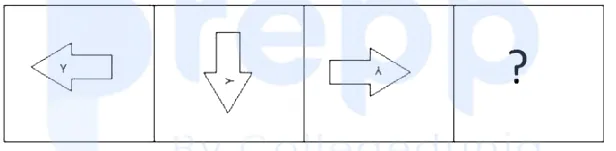
- A
Option A (shown in image)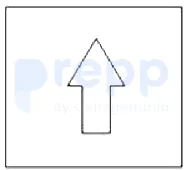
- B
Option B (shown in image)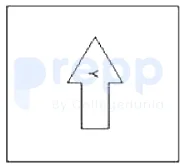
- C
Option C (shown in image)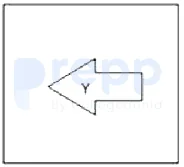
- D
Option D (shown in image)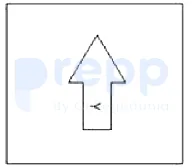
Show answer
Question 18archived
Which of the following numbers will replace the question mark (?) in the given series?
325, 271, 226, ?, 163, 145, 136
- A
190
- B
180
- C
186
- D
196
Show answer
A. 190Solving the Number Series: Finding the Missing Term
This question asks us to find the missing number in the given series: 325, 271, 226, ?, 163, 145, 136.
To solve a number series problem, we need to identify the pattern or rule that connects the numbers in the sequence. This usually involves looking at the differences, ratios, or other mathematical relationships between consecutive terms.
Analyzing the Pattern in the Series
Let's calculate the differences between the consecutive terms in the given series:
Difference between 325 and 271: $325 - 271 = 54$
Difference between 271 and 226: $271 - 226 = 45$
Difference between 163 and 145: $163 - 145 = 18$
Difference between 145 and 136: $145 - 136 = 9$
The sequence of differences we have so far is: 54, 45, ?, ?, 18, 9.
Identifying the Pattern in the Differences
Let's examine the sequence of differences: 54, 45, ?, ?, 18, 9. We can observe a pattern if we look closely at these numbers. They appear to be multiples of 9:
$54 = 6 \times 9$
$45 = 5 \times 9$
$18 = 2 \times 9$
$9 = 1 \times 9$
This suggests that the differences are decreasing multiples of 9. The multipliers are 6, 5, ?, ?, 2, 1. Following this pattern, the missing multipliers should be 4 and 3.
So, the full sequence of differences should be:
$6 \times 9 = 54$
$5 \times 9 = 45$
$4 \times 9 = 36$
$3 \times 9 = 27$
$2 \times 9 = 18$
$1 \times 9 = 9$
The complete sequence of differences is 54, 45, 36, 27, 18, 9.
Calculating the Missing Term
Now we can use the identified differences to find the missing term in the original series.
The series is 325, 271, 226, ?, 163, 145, 136.
The difference between the 1st and 2nd term is 54 ($325 - 54 = 271$).
The difference between the 2nd and 3rd term is 45 ($271 - 45 = 226$).
The difference between the 3rd and the missing term is 36. So, the missing term is $226 - 36$.
Calculation for the missing term:
$226 - 36 = 190$
Let's verify if this fits the rest of the series using the next difference, which is 27:
Difference between 190 and 163: $190 - 163 = 27$. This matches the pattern.
Difference between 163 and 145: $163 - 145 = 18$. This matches the pattern.
Difference between 145 and 136: $145 - 136 = 9$. This matches the pattern.
So, the missing number in the series is 190.
Terms in SeriesDifference from Previous TermPattern in Difference
325--
271$325 - 271 = 54$$6 \times 9$
226$271 - 226 = 45$$5 \times 9$
190$226 - 190 = 36$$4 \times 9$
163$190 - 163 = 27$$3 \times 9$
145$163 - 145 = 18$$2 \times 9$
136$145 - 136 = 9$$1 \times 9$
Conclusion
The pattern in the given number series is that each subsequent term is obtained by subtracting a decreasing multiple of 9 from the previous term. The multipliers decrease sequentially from 6 down to 1. Following this pattern, the missing number is 190.
Revision Table: Number Series Analysis
Understanding the patterns in number series is key to solving these problems. Common patterns include:
Arithmetic progression (constant difference)
Geometric progression (constant ratio)
Differences form an arithmetic or geometric progression
Alternating patterns
Squares, cubes, or other powers
Combinations of patterns
Additional Information: Strategies for Solving Number Series
Here are some helpful strategies when tackling number series questions:
Calculate the differences between consecutive terms. If there's no clear pattern, calculate the differences of the differences.
Look for ratios between consecutive terms, especially if the numbers are increasing or decreasing rapidly.
Check for patterns involving squares, cubes, square roots, or cube roots.
Consider if the series involves prime numbers, Fibonacci numbers, or other special sequences.
Look for alternating patterns where two different rules might apply to alternate terms.
Practice with various types of series to recognize common patterns quickly.
Paper & answer key PDF ↗ Question 19archived
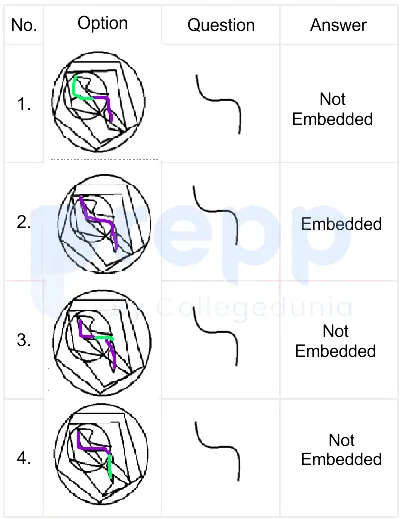
Select the option figure in which the given figure is embedded. (Rotation is NOT allowed.)

- A
Option A (shown in image)
- B
Option B (shown in image)
- C
Option C (shown in image)
- D
Option D (shown in image)
Show answer
B. Option B (shown in image)Given:
The image must not to be rotated
Hence, the correct answer is "Option - (2)".

 Paper & answer key PDF ↗
 Question 20archived
Select the option that represents the letters that, when placed from left to right in the blanks, will complete the letter series.
_B_T F H B N_F I_N T F_B N T F
- A
G N T B J
- B
G T N J B
- C
G J N T B
- D
G B N T B
Show answer
A. G N T B JUnderstanding Letter Series Completion
Letter series completion questions ask you to find the pattern in a sequence of letters and determine which letters fit into the blanks to complete the series.
Let's analyze the given letter series with blanks:
_B_T F H B N_F I_N T F_B N T F
There are five blanks to fill.
Step-by-Step Analysis
We need to test the given options by substituting the letters into the blanks in the series. Let's take the letters from the option we are considering:
The letters are G, N, T, B, J.
Placing these letters into the blanks from left to right, the series becomes:
G B N T F H B N T F I B N T F J B N T F
Identifying the Pattern in the Completed Series
Now, let's look closely at this completed series:
G B N T F H B N T F I B N T F J B N T F
We can observe a repeating sequence of letters. Let's try dividing the series into segments and look for regularity.
Consider dividing the series into blocks of 5 letters:
Block 1: G B N T F
Block 2: H B N T F
Block 3: I B N T F
Block 4: J B N T F
Looking at these blocks, we can see a clear pattern:
Each block consists of a single letter followed by the sequence B N T F.
The single letters at the beginning of each block are G, H, I, and J. These letters form a sequence of consecutive letters in the alphabet.
Confirming the Letter Series Pattern
The pattern identified is: (Consecutive Letter) + (B N T F)
Block 1 starts with G, followed by B N T F.
Block 2 starts with H, followed by B N T F.
Block 3 starts with I, followed by B N T F.
Block 4 starts with J, followed by B N T F.
This pattern holds true for the entire completed series when the blanks are filled with G, N, T, B, and J.
Let's map the blanks to the letters used:
Blank Position
1st
2nd
3rd
4th
5th
Original Series
_
_
_
_
_
Completed Series Letter
G
N
T
B
J
These letters G, N, T, B, J correspond exactly to the sequence provided in the option.
Conclusion
By filling the blanks with the letters G, N, T, B, and J in order, the series forms a logical and repeating pattern based on a sequence of consecutive letters followed by a fixed block of letters. Therefore, the letters G, N, T, B, and J complete the letter series correctly.
Revision Table: Key Concepts in Letter Series
Concept
Explanation
Example Application
Pattern Recognition
Finding a logical rule or sequence governing the arrangement of letters.
Identifying repeating blocks or arithmetic/alphabetical progressions.
Repeating Blocks
Segments of the series that are identical or follow a consistent variation.
The B N T F sequence in this problem is a repeating block.
Sequential Progressions
Letters changing based on their position in the alphabet (e.g., A, B, C or A, C, E).
The G, H, I, J sequence in this problem is an alphabetical progression.
Additional Information on Letter Series Reasoning
Letter series questions often involve different types of patterns. Some common types include:
Alphabetical order: Letters follow the standard A-Z sequence, either forward, backward, or skipping letters (e.g., A, C, E, G...).
Repeating patterns: A specific sequence of letters repeats throughout the series (e.g., ABC, ABC, ABC...).
Alternating patterns: Different patterns apply to alternate letters or blocks (e.g., A, Z, B, Y, C, X...).
Skipping letters: Letters are skipped based on a fixed or increasing number (e.g., A (skip 1) C (skip 2) F (skip 3) J...).
Combinations: A mix of the above patterns, such as a fixed block combined with a sequential change in another part of the series, as seen in this problem.
Solving these requires careful observation and systematic testing of possible pattern types.
Paper & answer key PDF ↗ Question 21archived
Select the option that represents the correct order of the given words as they would appear in an English dictionary.
1. Lambast
2, Lighten
3. Legacy
4. Languish
5. Laughter
6. Lightly
- A
1, 4, 5, 3, 2, 6
- B
1, 4, 5, 2, 3, 6
- C
1, 5, 4, 2, 3, 6
- D
1, 5, 4, 3, 6, 2
Show answer
A. 1, 4, 5, 3, 2, 6Understanding Dictionary Order for English Words
To determine the correct order of words as they would appear in an English dictionary, we compare the words letter by letter, starting from the first letter. If the first letters are the same, we move to the second letter, and so on, until we find a difference. The word with the letter that comes earlier in the alphabet comes first.
Applying Dictionary Order to the Given Words
Here are the words with their corresponding numbers:
1. Lambast
2. Lighten
3. Legacy
4. Languish
5. Laughter
6. Lightly
All the words begin with the letter 'L'. So, we compare the second letter of each word:
Lambast: La
Lighten: Li
Legacy: Le
Languish: La
Laughter: La
Lightly: Li
Comparing the second letters (a, i, e), the order based on the second letter is 'a', then 'e', then 'i'.
Words Starting with 'La'
The words starting with 'La' are Lambast, Languish, and Laughter. Let's compare their third letters:
Lambast: Lam
Languish: Lan
Laughter: Lau
Comparing the third letters (m, n, u), the alphabetical order is 'm', 'n', 'u'.
So, the order for these words is:
Lambast (1)
Languish (4)
Laughter (5)
Words Starting with 'Le'
The word starting with 'Le' is Legacy. This comes after the 'La' words.
Next word in the overall order:
Legacy (3)
Words Starting with 'Li'
The words starting with 'Li' are Lighten and Lightly. Let's compare their subsequent letters. The letters 'l', 'i', 'g', 'h', 't' are the same for both words.
Lighten: Lighten
Lightly: Lightly
Comparing the sixth letters (e, l), the alphabetical order is 'e', 'l'.
So, the order for these words is:
Lighten (2)
Lightly (6)
Final Dictionary Order
Combining the ordered groups, the final dictionary order is:
Lambast (1)
Languish (4)
Laughter (5)
Legacy (3)
Lighten (2)
Lightly (6)
The correct order of the given word numbers is $\boxed{1, 4, 5, 3, 2, 6}$.
Step-by-Step Dictionary Ordering
Word
Number
Second Letter
Third Letter (if 'La')
Sixth Letter (if 'Light')
Order Position
Lambast
1
a
m
-
1
Languish
4
a
n
-
2
Laughter
5
a
u
-
3
Legacy
3
e
-
-
4
Lighten
2
i
-
e
5
Lightly
6
i
-
l
6
Revision Table: Key Concepts in Dictionary Order
Revision Table: Dictionary Order Rules
Concept
Explanation
Example
Alphabetical Comparison
Compare words letter by letter from left to right.
Apple comes before Banana because 'A' < 'B'.
Comparing Identical Prefixes
If initial letters are the same, move to the next letter.
Cat, Cattle, Catch: Compare 't', 't', 'c'. 'c' comes first (Catch). Then compare 't' and 't' for Cat and Cattle.
Shorter vs. Longer Words (Identical Prefix)
If one word is a prefix of another, the shorter word comes first.
Cat comes before Cattle because 'Cat' is a complete word and a prefix of 'Cattle'.
Additional Information on Alphabetical Ordering
Alphabetical ordering is a fundamental skill used not just in dictionaries, but also in indexes, phone books, and digital sorting. It relies on the standard English alphabet sequence (A, B, C, ..., Z). When comparing words, we look at the letters in corresponding positions. If the letters at a certain position are different, the word with the letter that appears earlier in the alphabet comes first. If all letters in one word match the beginning of a longer word (e.g., "car" and "carpet"), the shorter word comes first.
For example:
Car
Carpet
Cart
Here, "Car" comes first because it's a shorter word that is a prefix of "Carpet". Then "Carpet" and "Cart" are compared at the fifth letter ('p' vs 't'), where 'p' comes before 't'.
Paper & answer key PDF ↗ Question 22archived
Which of the answer figures is the exact mirror image of the given problem figure when the mirror is held at the right side?
Problem figure:

- A
Option A (shown in image)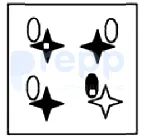
- B
Option B (shown in image)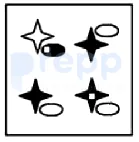
- C
Option C (shown in image)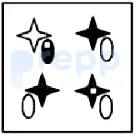
- D
Option D (shown in image)
Show answer
C. Option C (shown in image)The correct mirror image of the given figure when mirror is placed at MN is as shown below:
Hence, the correct answer is "Option - (3)".
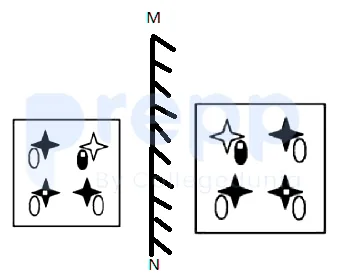 Paper & answer key PDF ↗
 Question 23archived
Select the option that is related to the fifth letter-cluster in the same way as the second letter-cluster is related to the first letter-cluster and the fourth letter-cluster is related to the third letter cluster.
PLANT : VPCNR :: STOMP : ROQVU :: BOARD : ?
- A
DPCTF
- B
DQCTF
- C
FTDQC
- D
FTCQD
Show answer
D. FTCQDFTCQD
B(2) to F(6): \(6 - 2 = +4\) O(15) to T(20): \(20 - 15 = +5\) A(1) to C(3): \(3 - 1 = +2\) R(18) to Q(17): \(17 - 18 = -1\) D(4) to D(4): \(4 - 4 = +0\) The sequence of shifts applied to BOARD to get FTCQD is \(+4, +5, +2, -1, +0\).
Paper & answer key PDF ↗ Question 24archived
Three of the following four letter-clusters are alike in a certain way and one is different. Pick the odd one out.
- A
CAX
- B
AYZ
- C
FDZ
- D
HDS
Show answer
D. HDSUnderstanding the Question: Finding the Odd Letter Cluster
The question asks us to identify the letter cluster that is different from the other three based on a certain pattern. We are given four letter clusters: CAX, AYZ, FDZ, and HDS. We need to analyze the relationship between the letters within each cluster to find the one that doesn't follow the rule common to the others.
Analyzing the Given Letter Clusters
Let's look at the alphabetical position of each letter in the given clusters:
Cluster
First Letter
Second Letter
Third Letter
CAX
C (3)
A (1)
X (24)
AYZ
A (1)
Y (25)
Z (26)
FDZ
F (6)
D (4)
Z (26)
HDS
H (8)
D (4)
S (19)
Identifying the Pattern
Let's examine the relationship between the letters in each cluster. A common pattern in such questions involves the difference between the alphabetical positions of consecutive letters or the first two letters.
Let's try finding the difference between the alphabetical position of the first letter and the second letter in each cluster:
Applying the Pattern to Each Cluster
CAX: The position of C is 3 and A is 1. The difference is \(3 - 1 = 2\).
AYZ: The position of A is 1 and Y is 25. Considering the alphabet wraps around, moving from A backward to Y takes 2 steps (A → Z → Y). The difference can be considered as 2. Or, \(1 - 25 = -24\), and \(-24 + 26 = 2\) (modulo 26).
FDZ: The position of F is 6 and D is 4. The difference is \(6 - 4 = 2\).
HDS: The position of H is 8 and D is 4. The difference is \(8 - 4 = 4\).
Based on this analysis, we can see a consistent pattern in the first three clusters: the difference between the alphabetical positions of the first and second letter is 2. However, in the cluster HDS, the difference is 4.
Determining the Odd One Out
Since CAX, AYZ, and FDZ all follow the pattern where the difference between the positions of the first two letters is 2 (considering wrap-around), HDS is the cluster that does not follow this pattern, as its difference is 4.
Therefore, HDS is the odd letter-cluster among the given options.
Revision Table: Letter Positions
Here is a quick reference for the alphabetical positions of letters:
Letter
Position
Letter
Position
A
1
N
14
B
2
O
15
C
3
P
16
D
4
Q
17
E
5
R
18
F
6
S
19
G
7
T
20
H
8
U
21
I
9
V
22
J
10
W
23
K
11
X
24
L
12
Y
25
M
13
Z
26
Additional Information: Letter Series Reasoning
Letter series and letter cluster questions are common in logical reasoning sections of various exams. They test your ability to identify patterns in sequences of letters. Common patterns include:
Difference in alphabetical position between consecutive letters.
Sum or product of alphabetical positions.
Vowel/consonant patterns.
Reverse alphabetical order.
Skipping letters in a sequence.
Combining number and letter patterns.
To solve these questions effectively, it's helpful to know the alphabetical position of each letter and practice identifying different types of patterns quickly.
Paper & answer key PDF ↗ Question 25archived
Which of the following terms will replace the question mark (?) in the given series?
SHP, RIO, PKN, MNM, ?
- A
ISL
- B
JRL
- C
IRL
- D
IQL
Show answer
C. IRLUnderstanding Letter Series Reasoning
Letter series problems require identifying the pattern governing a sequence of letters or groups of letters. By observing how the letters change from one term to the next, we can predict the subsequent term in the series.
Analyzing the Given Letter Series: SHP, RIO, PKN, MNM, ?
The given series is SHP, RIO, PKN, MNM, ?. Each element in this series is a group of three letters. We need to find the pattern by looking at the progression of the first, second, and third letters across the terms.
Step-by-Step Analysis of Each Letter Position
Let's analyze each position within the terms separately. It's often helpful to note the alphabetical position of each letter (A=1, B=2, ..., Z=26).
Letter Series Terms and Positions
Term
First Letter (Position)
Second Letter (Position)
Third Letter (Position)
SHP
S (19)
H (8)
P (16)
RIO
R (18)
I (9)
O (15)
PKN
P (16)
K (11)
N (14)
MNM
M (13)
N (14)
M (13)
?
?
?
?
Pattern for the First Letter
The sequence of the first letters is S, R, P, M, ... with positions 19, 18, 16, 13, ...
From 19 (S) to 18 (R), the change is $18 - 19 = -1$.
From 18 (R) to 16 (P), the change is $16 - 18 = -2$.
From 16 (P) to 13 (M), the change is $13 - 16 = -3$.
The pattern is a decreasing difference of -1, -2, -3. Following this pattern, the next difference should be -4.
Applying this difference to the position of the last first letter (M at 13): $13 - 4 = 9$.
The letter at alphabetical position 9 is I.
Pattern for the Second Letter
The sequence of the second letters is H, I, K, N, ... with positions 8, 9, 11, 14, ...
From 8 (H) to 9 (I), the change is $9 - 8 = +1$.
From 9 (I) to 11 (K), the change is $11 - 9 = +2$.
From 11 (K) to 14 (N), the change is $14 - 11 = +3$.
The pattern is an increasing difference of +1, +2, +3. Following this pattern, the next difference should be +4.
Applying this difference to the position of the last second letter (N at 14): $14 + 4 = 18$.
The letter at alphabetical position 18 is R.
Pattern for the Third Letter
The sequence of the third letters is P, O, N, M, ... with positions 16, 15, 14, 13, ...
From 16 (P) to 15 (O), the change is $15 - 16 = -1$.
From 15 (O) to 14 (N), the change is $14 - 15 = -1$.
From 14 (N) to 13 (M), the change is $13 - 14 = -1$.
The pattern is a constant difference of -1. Following this pattern, the next difference should be -1.
Applying this difference to the position of the last third letter (M at 13): $13 - 1 = 12$.
The letter at alphabetical position 12 is L.
Constructing the Next Term
Combining the letters found for each position:
First letter: I (from position 9)
Second letter: R (from position 18)
Third letter: L (from position 12)
The next term in the series is IRL.
Revision Table: Key Concepts in Letter Series Reasoning
Letter Series Concepts
Concept
Explanation
Relevance to Solving
Alphabetical Order
The standard sequence of letters A through Z.
Crucial for determining relative positions and movements.
Positional Value
Assigning a numerical value to each letter based on its position (A=1, B=2...).
Helps in identifying arithmetic patterns more easily.
Pattern Identification
Discovering the rule or sequence of changes between terms or letters within terms.
The core task in solving any series question.
Series Types
Understanding that patterns can be arithmetic, geometric, alternating, skip-letter, etc.
Broadens the approaches one can take to find the pattern.
Additional Information: Tips for Solving Letter Series
Solving letter series efficiently often comes down to systematic analysis and recognizing common patterns. Here are some additional tips for approaching these types of logical reasoning questions:
Write down the alphabet and its positional values (1-26) if needed.
For multi-letter terms, analyze each letter position independently first, as they often follow separate patterns.
Look for differences between consecutive terms or letters; these differences might form their own series (as seen in this problem).
Consider reverse alphabetical order or patterns that wrap around from Z to A.
Practice with a variety of series problems to become familiar with different pattern types.
If a pattern isn't immediately obvious, look at differences between alternate terms.
By applying these strategies, you can improve your ability to quickly identify the logical rule and find the missing term in letter series questions.
Paper & answer key PDF ↗ Question 26archived
Intensive agriculture implies ______.
- A
bringing more land under cultivation
- B
cultivating large farms with moderately low inputs of labour and capital
- C
use of more labour and capital inputs on the given land under cultivation
- D
spreading farming across more states of India
Show answer
C. use of more labour and capital inputs on the given land under cultivationUnderstanding Intensive Agriculture
Intensive agriculture is a farming system where producers aim to get maximum output from their land using a high amount of inputs. These inputs typically include significant amounts of labour, capital (like machinery, fertilizers, pesticides), and sometimes technology, applied to a relatively small area of land.
The goal of intensive agriculture is to increase yield per unit area of land. This often involves multiple cropping in a year or growing high-value crops that require more care and resources.
Analyzing the Options for Intensive Agriculture
Let's examine each option to see which one accurately describes intensive agriculture:
Option 1: bringing more land under cultivation. This describes extensive agriculture, where production is increased by expanding the area of land being farmed, often with lower inputs per unit area. This is the opposite of intensive agriculture.
Option 2: cultivating large farms with moderately low inputs of labour and capital. This is another description of extensive agriculture. Large farms and low inputs per unit area are characteristic of extensive farming, not intensive farming.
Option 3: use of more labour and capital inputs on the given land under cultivation. This precisely matches the definition of intensive agriculture. It focuses on increasing the intensity of resource use (labour and capital) on a specific, often limited, area of land to maximize yield.
Option 4: spreading farming across more states of India. This refers to the geographical distribution or expansion of farming activities across regions, not the method or intensity of cultivation applied to a specific piece of land. It is not a definition of intensive agriculture.
Based on the analysis, Option 3 is the correct description of intensive agriculture.
Key Characteristics of Intensive Agriculture
Intensive agriculture is characterized by:
High yield per unit area.
High inputs of labour and capital (fertilizers, pesticides, machinery, irrigation).
Often practiced in densely populated areas where land is scarce.
Can involve multiple cropping (growing more than one crop on the same land in a year).
May involve specialized farming like horticulture or dairy farming, which require intensive management.
Difference between Intensive and Extensive Agriculture
It's helpful to contrast intensive agriculture with extensive agriculture:
Feature
Intensive Agriculture
Extensive Agriculture
Land Area
Relatively Small
Relatively Large
Inputs (Labour & Capital) per Unit Area
High
Low to Moderate
Output per Unit Area
High
Low to Moderate
Goal
Maximize yield per land unit
Maximize output from large area, often with lower costs
Examples
Vegetable farming, rice paddies in high-density areas, dairy farming
Wheat farming on large plains, livestock grazing
Revision Table: Understanding Agriculture Types
Term
Description
Relation to Question
Intensive Agriculture
High inputs (labour, capital) on a given land area for high yield per unit area.
Directly defined by Option 3.
Extensive Agriculture
Lower inputs on large land areas for yield over a wide area.
Described partly by Options 1 & 2.
Inputs
Resources like labour, capital, fertilizers, water used in farming.
Central concept in the definition of intensive agriculture.
Yield
Output of crops or livestock products per unit area or per unit input.
Intensive agriculture aims for high yield per unit area.
Cultivation
The preparation and use of land for growing crops.
Context of the question is about the method of cultivation.
Additional Information on Agricultural Systems
Agricultural systems vary widely across the world depending on climate, soil, population density, technology, and economic factors. Understanding the difference between intensive and extensive farming is fundamental to studying geography and economics related to food production.
In many regions, especially those with high population density like parts of Asia, intensive agriculture is necessary to feed the population from limited land resources. However, intensive farming can also lead to environmental concerns like soil degradation, water pollution from fertilizers and pesticides, and biodiversity loss if not managed sustainably.
Modern intensive agriculture often relies heavily on technology, including improved seed varieties, mechanization, precise irrigation techniques, and chemical inputs, to further boost productivity per unit area.
Paper & answer key PDF ↗ Question 27archived
Nana Sahib, a rebel at Kanpur was the son of which of the following Peshwas?
- A
Baji Rao l
- B
Balaji Baji Rao
- C
Baji Rao ll
- D
Balaji Vishwanath
Show answer
C. Baji Rao llUnderstanding Nana Sahib's Paternity
The question asks about the biological or adopted father of Nana Sahib, a prominent figure in the 1857 rebellion at Kanpur, and his connection to the Peshwa lineage.
Nana Sahib, whose birth name was Dhondu Pant, played a significant role in the Indian Mutiny of 1857, particularly in the events that unfolded at Kanpur. To understand his leadership role, it's important to know his background and his relationship with the Maratha Peshwas.
Nana Sahib was not the biological son of a Peshwa. He was adopted.
Let's examine the options provided:
Baji Rao I: Baji Rao I was a formidable Peshwa of the Maratha Empire who lived in the early to mid-18th century (1700-1740). He was the father of Balaji Baji Rao. Nana Sahib lived much later, in the 19th century.
Balaji Baji Rao: Also known as Nana Saheb Peshwa, he was the son of Baji Rao I and the Peshwa from 1740 to 1761. He led the Marathas during the Third Battle of Panipat. Again, he lived before Nana Sahib's time.
Baji Rao II: Baji Rao II was the last Peshwa of the Maratha Empire, ruling from 1795 to 1818. After his defeat by the British in the Third Anglo-Maratha War, he was exiled to Bithoor near Kanpur, on a pension. It was Baji Rao II who adopted Nana Sahib.
Balaji Vishwanath: He was the first Peshwa appointed by Shahu, the Maratha ruler. He lived from 1660 to 1720 and was the father of Baji Rao I. He predates Nana Sahib significantly.
Therefore, Nana Sahib was the adopted son of Baji Rao II, the last Peshwa. After Baji Rao II's death, the British refused to continue his pension to Nana Sahib, which became a major grievance and a reason for Nana Sahib's involvement in the 1857 rebellion at Kanpur.
Figure
Relationship to Nana Sahib
Notes
Baji Rao I
None (lived earlier)
Father of Balaji Baji Rao
Balaji Baji Rao
None (lived earlier)
Son of Baji Rao I
Baji Rao II
Adopted Father
Last Peshwa, exiled to Bithoor
Balaji Vishwanath
None (lived earlier)
First Peshwa, father of Baji Rao I
The connection to Peshwa Baji Rao II was crucial for Nana Sahib, providing him with a claim to status and also fueling his resentment towards the British when the pension was stopped. His leadership at Kanpur during the 1857 uprising was a direct consequence of these factors.
Revision Table: Nana Sahib and 1857 Connections
Individual/Event
Significance
Nana Sahib (Dhondu Pant)
Leader of the 1857 rebellion in Kanpur. Adopted son of Baji Rao II.
Baji Rao II
Last Peshwa of the Maratha Empire. Exiled to Bithoor. Adopted Nana Sahib.
Kanpur Rebellion (1857)
Site of a major uprising during the Indian Mutiny, led by Nana Sahib.
Bithoor
Location near Kanpur where Baji Rao II lived in exile and where Nana Sahib grew up.
Pension Issue
The British refusal to continue Baji Rao II's pension to Nana Sahib was a key grievance leading to his involvement in the 1857 revolt.
Additional Information: The Peshwas and Maratha Power
The Peshwas were originally prime ministers to the Maratha Chhatrapatis (kings). Over time, they became the de facto rulers of the Maratha Empire, establishing their own dynasty (the Bhat family).
Balaji Vishwanath Bhat is considered the first of the prominent Peshwas who expanded Maratha influence significantly.
His son, Baji Rao I, was known for his military campaigns and expansionist policies.
Baji Rao I's son, Balaji Baji Rao (Nana Saheb), continued the expansion but suffered a major defeat in the Third Battle of Panipat (1761).
After Balaji Baji Rao, the power of the Peshwas began to decline due to internal conflicts and external pressures.
Baji Rao II was the last Peshwa, his reign marked by increasing British influence and eventual defeat in the Third Anglo-Maratha War (1817-1818), which led to the end of the Peshwa rule and his exile.
Nana Sahib's adoption into this lineage connected him to a powerful, although declining, historical force and positioned him as a potential leader against the British.
Paper & answer key PDF ↗ Question 28archived
Which of the following hill stations do NOT experience snowfall in winters?
- A
Ooty
- B
Nainital
- C
Shimla
- D
Srinagar
Show answer
A. OotyUnderstanding Snowfall in Indian Hill Stations
The question asks us to identify the hill station among the given options that does NOT experience snowfall during the winter months. Experiencing snowfall depends mainly on the altitude of the place and its geographical location, particularly its latitude and proximity to cold weather systems.
Let's examine each option to understand its climate and typical winter conditions:
Nainital: Located in the state of Uttarakhand in North India, Nainital is situated at a significant altitude in the Kumaon Himalayas. Due to its elevation and location in the northern mountainous region, Nainital frequently experiences snowfall in winter, usually between December and February.
Shimla: Situated in the state of Himachal Pradesh, Shimla is a popular hill station in North India. It is located at a high altitude in the Shivalik range of the Himalayas. Shimla is well-known for its cold winters and regular snowfall, often attracting tourists specifically to witness the snow.
Srinagar: The summer capital of Jammu and Kashmir, Srinagar is located in the Kashmir Valley, a region known for its high altitude and cold climate. Srinagar experiences very cold winters and receives substantial snowfall, transforming the landscape into a winter wonderland. Snowfall is a common feature of Srinagar winters.
Ooty: Also known as Udhagamandalam, Ooty is a hill station located in the Nilgiri Hills in the state of Tamil Nadu, South India. While Ooty is at a considerable altitude, its geographical location in Southern India, closer to the equator compared to the northern hill stations like Nainital, Shimla, and Srinagar, results in a different climate. Ooty experiences cold weather in winter, with temperatures dropping significantly, but it typically does not receive snowfall. The temperature might occasionally drop close to freezing, leading to frost, but not snow.
Comparing the locations and typical winter climates of these hill stations, it becomes clear that Ooty is the one that does not experience snowfall in winters, unlike Nainital, Shimla, and Srinagar, which are all famous for their winter snow.
Hill Station
Location (State)
Region
Typical Winter Snowfall?
Ooty
Tamil Nadu
South India (Nilgiri Hills)
No (Experiences cold/frost)
Nainital
Uttarakhand
North India (Himalayas)
Yes
Shimla
Himachal Pradesh
North India (Himalayas)
Yes
Srinagar
Jammu and Kashmir
North India (Himalayas/Kashmir Valley)
Yes
Based on this analysis, Ooty is the hill station that does NOT experience snowfall in winters among the given options.
Revision Table: Hill Station Winter Conditions
Let's quickly summarize the winter conditions for revision:
Nainital: Experiences snowfall.
Shimla: Experiences snowfall.
Srinagar: Experiences snowfall.
Ooty: Does NOT experience snowfall, but can get very cold with frost.
Additional Information: Factors Affecting Snowfall in Hill Stations
Several factors determine whether a hill station experiences snowfall:
Altitude: Higher altitudes generally have lower temperatures, increasing the likelihood of precipitation falling as snow.
Latitude: Places located further from the equator (higher latitudes) tend to be colder and are more likely to receive snow in winter. Northern Indian hill stations are at higher latitudes than Ooty in the south.
Proximity to Moisture Sources and Weather Systems: The availability of moisture in the air and the passage of cold weather systems (like Western Disturbances in North India) are crucial for snowfall.
Local Geography: Valleys and slopes can affect temperature inversion and wind patterns, influencing where snow accumulates.
Ooty's relatively lower latitude and the specific climatic patterns of the Southern Indian hills mean that while it gets cold enough for frost, it typically doesn't reach the conditions required for snowfall.
Paper & answer key PDF ↗ Question 29archived
Schools and hostels under the Ministry of Education's Samagra Shiksha scheme will be renamed after:
- A
Shyama Prashad Mukharjee
- B
Netaji Subhas Chandra Bose
- C
Deen Dayal Upadhyaya
- D
Sardar Vallabhbhai Patel
Show answer
B. Netaji Subhas Chandra BoseUnderstanding the Samagra Shiksha Scheme Renaming
The question asks about the new name designated for schools and hostels operating under the Ministry of Education's Samagra Shiksha scheme.
The Samagra Shiksha scheme is an integrated scheme for school education covering pre-school to Senior Secondary levels. It aims to ensure inclusive and equitable quality education at all levels of school education.
According to recent announcements related to the Samagra Shiksha scheme, certain infrastructure components are being renamed to honor prominent national figures.
Identifying the New Name
Let's look at the options provided for the renaming of schools and hostels under the Samagra Shiksha scheme:
Shyama Prashad Mukharjee
Netaji Subhas Chandra Bose
Deen Dayal Upadhyaya
Sardar Vallabhbhai Patel
Based on information regarding the Samagra Shiksha scheme and recent government decisions, the schools and hostels under this scheme are being renamed after Netaji Subhas Chandra Bose.
This decision is part of a larger effort to commemorate the contributions of Netaji Subhas Chandra Bose to India's freedom struggle.
Analyzing the Options
Shyama Prashad Mukharjee: While a significant figure, schools and hostels under the Samagra Shiksha scheme are not being renamed after him according to the information available.
Netaji Subhas Chandra Bose: This name aligns with the reported decision regarding the renaming of schools and hostels under the Samagra Shiksha scheme.
Deen Dayal Upadhyaya: Another important leader, but the renaming under the Samagra Shiksha scheme is not after him.
Sardar Vallabhbhai Patel: A key figure in India's history, but the specific renaming under the Samagra Shiksha scheme is not after Sardar Vallabhbhai Patel.
Therefore, the correct renaming associated with schools and hostels under the Samagra Shiksha scheme is after Netaji Subhas Chandra Bose.
Summary of Renaming under Samagra Shiksha
Scheme Component
Original Context
New Name (Renamed After)
Schools & Hostels Infrastructure
Under Samagra Shiksha Scheme
Netaji Subhas Chandra Bose
Revision Table: Samagra Shiksha Key Facts
Key Details of Samagra Shiksha Scheme
Aspect
Detail
Administered By
Ministry of Education, Government of India
Coverage
Pre-school to Senior Secondary level
Objective
Holistic and integrated approach to school education
Recent Renaming
Schools and Hostels renamed after Netaji Subhas Chandra Bose
Additional Information: Netaji Subhas Chandra Bose and Education
Netaji Subhas Chandra Bose was a prominent nationalist leader whose ideas and actions deeply influenced India's freedom movement. While the renaming of schools and hostels under the Samagra Shiksha scheme is a modern initiative, it reflects a desire to connect current educational infrastructure with figures of national importance.
Integrating the name of Netaji Subhas Chandra Bose with educational institutions like schools and hostels under the Samagra Shiksha scheme aims to inspire students by highlighting his patriotism and contributions.
Paper & answer key PDF ↗ Question 30archived
On 7 November 2022, Prime Minister Narendra Modi attended and offered prayers at celebrations of the _______ Prakash Parv of Shri Guru Nanak Dev Ji at New Delhi.
- A
550th
- B
551st
- C
552nd
- D
553rd
Show answer
D. 553rdUnderstanding Guru Nanak Prakash Parv
The question asks about the specific Prakash Parv (birth anniversary) of Shri Guru Nanak Dev Ji that Prime Minister Narendra Modi attended and offered prayers at on 7 November 2022 in New Delhi.
Shri Guru Nanak Dev Ji is the founder of Sikhism and the first of the ten Sikh Gurus. His birth anniversary, known as Guru Nanak Gurpurab or Guru Nanak Prakash Parv, is one of the most sacred festivals in Sikhism. It is celebrated worldwide with great devotion and enthusiasm.
Identifying the Specific Prakash Parv in 2022
To determine the correct Prakash Parv number, we need to know the birth year of Guru Nanak Dev Ji and the year of the event mentioned in the question (2022). Historical records indicate that Guru Nanak Dev Ji was born in 1469 CE.
The Prakash Parv celebrated in a particular year is the difference between that year and his birth year, plus one (since the 1st Prakash Parv would be celebrated in 1469 itself or potentially the next year, depending on the convention, but the numbering effectively starts from 1). Let's calculate the number for 2022:
Year of Celebration = 2022
Birth Year = 1469
Number of years passed = \(2022 - 1469 = 553\)
Therefore, the Prakash Parv celebrated in 2022 was the 553rd Prakash Parv of Shri Guru Nanak Dev Ji.
The date of Guru Nanak Dev Ji's Prakash Parv varies each year according to the lunar calendar (Kartik Purnima). In 2022, Kartik Purnima fell on 8 November. However, celebrations often begin earlier, and it is common for events related to the Gurpurab to take place in the days leading up to the main date.
Prime Minister's Attendance in New Delhi
As stated in the question, Prime Minister Narendra Modi attended and offered prayers at celebrations of the Guru Nanak Prakash Parv in New Delhi on 7 November 2022. This event was part of the widespread observances for the 553rd Prakash Parv.
Conclusion on the Prakash Parv Number
Based on the calculation (\(2022 - 1469 + 1\), where \(+1\) accounts for including the birth year as the first year), the 553rd birth anniversary of Guru Nanak Dev Ji was celebrated in 2022.
Therefore, the correct option is the one stating the 553rd Prakash Parv.
Revision Table: Guru Nanak Prakash Parv
Aspect
Details
Personality
Shri Guru Nanak Dev Ji
Event
Prakash Parv (Birth Anniversary)
Birth Year
1469 CE
Celebration Year Mentioned
2022
Calculated Parv Number for 2022
553rd
PM's Attendance Date
7 November 2022
Location of PM's Attendance
New Delhi
Additional Information on Guru Nanak Gurpurab and Sikhism
Guru Nanak Gurpurab is a significant day for Sikhs, marked by various spiritual activities:
Akhand Path: A continuous reading of the Guru Granth Sahib (the holy scripture) over 48 hours, usually concluding on the day of the Gurpurab.
Kirtan and Katha: Hymn singing and religious discourses in Gurdwaras.
Nagar Kirtan: Processions carried out through streets, led by the Panj Pyare (Five Beloved Ones), carrying the Guru Granth Sahib.
Langar: Community meals served at Gurdwaras to all visitors, regardless of background.
The date of Guru Nanak Gurpurab is celebrated on Kartik Purnima, the full moon day in the month of Kartik according to the Bikrami calendar. While in 2022 Kartik Purnima was on November 8th, the event mentioned in the question with the Prime Minister's attendance took place on November 7th, highlighting that celebrations extend beyond a single day.
Guru Nanak Dev Ji's teachings emphasize equality, selfless service, justice, and devotion to God.
Paper & answer key PDF ↗ Question 31archived
Match column A with column B.
Column A (Type of algae)
Column B (Proper Name)
(a)
Blue-green algae
(i)
Sargassum
(b)
Red algae
(ii)
Chlamydomonas
(c)
Green algae
(iii)
Rhodophyta
(d)
Brown algae
(iv)
Cyanobacteria
- A
a - i, b - ii, c - iii, d - iv
- B
a - i, b - iii, c - ii, d - iv
- C
a - iv, b - iii, c - ii, d - i
- D
a - iii, b - iv, c - ii, d - i
Show answer
C. a - iv, b - iii, c - ii, d - iMatching Algae Types and Their Proper Names
This question requires us to match different types of algae listed in Column A with their corresponding proper names or examples given in Column B. Understanding the classification and common representatives of algae is key to solving this matching exercise.
Column A (Type of Algae)
Column B (Proper Name)
(a) Blue-green algae
(i) Sargassum
(b) Red algae
(ii) Chlamydomonas
(c) Green algae
(iii) Rhodophyta
(d) Brown algae
(iv) Cyanobacteria
Analyzing the Algae Matching Pairs
Let's analyze each type of algae from Column A and find its correct match in Column B:
(a) Blue-green algae: Blue-green algae are prokaryotic organisms, unlike other types of algae which are eukaryotic. They are also known by their scientific name, Cyanobacteria. Therefore, (a) matches with (iv) Cyanobacteria.
(b) Red algae: Red algae belong to the division Rhodophyta. This group is characterized by the presence of red pigments called phycobilins. Therefore, (b) matches with (iii) Rhodophyta.
(c) Green algae: Green algae are a diverse group, and a common representative genus is Chlamydomonas, which is a single-celled green alga. Therefore, (c) matches with (ii) Chlamydomonas.
(d) Brown algae: Brown algae are characterized by the presence of the pigment fucoxanthin, which gives them their brown color. Sargassum is a well-known genus of brown algae, often forming large floating mats in the ocean. Therefore, (d) matches with (i) Sargassum.
Summarizing the Correct Algae Match
Based on our analysis, the correct matching is:
(a) Blue-green algae → (iv) Cyanobacteria
(b) Red algae → (iii) Rhodophyta
(c) Green algae → (ii) Chlamydomonas
(d) Brown algae → (i) Sargassum
This gives us the combination: a - iv, b - iii, c - ii, d - i.
Comparing with Given Options
Now let's look at the provided options and see which one matches our correct combination:
Option 1: a - i, b - ii, c - iii, d - iv (Incorrect)
Option 2: a - i, b - iii, c - ii, d - iv (Incorrect)
Option 3: a - iv, b - iii, c - ii, d - i (Correct)
Option 4: a - iii, b - iv, c - ii, d - i (Incorrect)
Option 3 correctly matches our derived combination.
Revision Table: Algae Classification Summary
Type of Algae
Proper Name/Example
Key Characteristics
Blue-green algae
Cyanobacteria
Prokaryotic, contain chlorophyll a and phycobilins, perform photosynthesis
Red algae
Rhodophyta
Eukaryotic, contain chlorophyll a, d and phycobilins (phycoerythrin), mostly marine
Green algae
Chlorophyta (Division), Chlamydomonas (Example)
Eukaryotic, contain chlorophyll a, b and carotenoids, diverse habitats (freshwater, marine, terrestrial)
Brown algae
Phaeophyceae (Class), Sargassum (Example)
Eukaryotic, contain chlorophyll a, c and fucoxanthin, mostly marine, often large and complex
Additional Information on Algae Types
Algae are a large and diverse group of photosynthetic eukaryotic organisms (except Cyanobacteria) that are not necessarily related to each other. They are typically aquatic and range in size from microscopic single cells (like Chlamydomonas) to large multi-cellular forms (like Sargassum). They play a vital role in aquatic ecosystems as primary producers.
Cyanobacteria (Blue-green algae): Although called "algae", they are actually bacteria. They were among the earliest life forms on Earth and are responsible for producing much of the oxygen in the atmosphere.
Rhodophyta (Red algae): Most are multicellular marine algae. Some secrete calcium carbonate and are important in reef formation.
Chlorophyta (Green algae): Considered the ancestors of land plants due to similar pigments (chlorophyll a and b) and cell wall composition.
Phaeophyceae (Brown algae): Includes kelps, which are the largest and most complex algae. They are found primarily in cooler marine waters.
Paper & answer key PDF ↗ Question 32archived
What helps making the acidic food alkaline that is coming from the stomach?
- A
Pepsin
- B
Gastric juice
- C
Hydrochloric acid
- D
Bile juice
Show answer
D. Bile juiceUnderstanding How Food Becomes Alkaline in the Digestive System
When food leaves the stomach and enters the small intestine, it is highly acidic. This acidity is due to the presence of hydrochloric acid (HCl) in the gastric juice of the stomach. However, the enzymes in the small intestine, particularly those involved in digesting carbohydrates, fats, and proteins, work best in a slightly alkaline environment. Therefore, the acidic food coming from the stomach needs to be neutralized and made alkaline.
The Role of Bile Juice in Neutralizing Acidity
Bile juice, produced by the liver and stored in the gallbladder, plays a crucial role in this process. Bile is released into the duodenum, which is the first part of the small intestine. Bile is an alkaline fluid, primarily containing bile salts, bile pigments, cholesterol, electrolytes, and water. The alkaline nature of bile is mainly due to the presence of bicarbonate ions.
As the acidic food mixture, called chyme, enters the duodenum from the stomach through the pyloric sphincter, it mixes with bile juice and pancreatic juice. Both bile juice and pancreatic juice are alkaline. The bicarbonate ions in these juices react with the hydrochloric acid in the chyme, neutralizing the acid and raising the pH of the mixture. This neutralization is essential for the subsequent enzymatic digestion that occurs in the small intestine.
Analyzing the Options
Let's look at the given options:
Pepsin: Pepsin is an enzyme found in gastric juice that digests proteins. It works in the highly acidic environment of the stomach (low pH). It does not make food alkaline.
Gastric juice: Gastric juice is produced in the stomach and contains hydrochloric acid and pepsin. Hydrochloric acid makes the stomach environment acidic (low pH) for pepsin to function and to kill bacteria. Gastric juice makes the food acidic, not alkaline.
Hydrochloric acid: Hydrochloric acid (HCl) is a component of gastric juice. It is responsible for the acidity of the stomach contents. It makes food acidic, not alkaline.
Bile juice: Bile juice is produced by the liver and released into the small intestine. It is alkaline due to the presence of bicarbonate ions. It neutralizes the acidic chyme coming from the stomach, helping to create the alkaline environment necessary for intestinal enzymes to work effectively.
Based on the roles of these substances in digestion, bile juice is the substance that helps in making the acidic food coming from the stomach alkaline.
Substance
Source
Primary Function Relevant to pH
Effect on Acidic Food
Pepsin
Stomach
Protein digestion (requires acidic pH)
No effect on making food alkaline; works in acidic conditions.
Gastric juice
Stomach
Contains HCl; creates acidic environment
Makes food acidic.
Hydrochloric acid
Stomach
Component of gastric juice; lowers pH
Makes food acidic.
Bile juice
Liver (stored in gallbladder)
Alkaline; contains bicarbonates
Neutralizes acid; makes food alkaline.
Revision Table: Key Digestive Juices and Their pH Role
Juice
Main Component Affecting pH
Typical pH Range
Location of Action
Role
Saliva
Bicarbonate, Phosphate
6.2 - 7.6 (slightly acidic to neutral)
Mouth
Initial digestion, lubrication, buffering
Gastric Juice
Hydrochloric Acid (HCl)
1.5 - 3.5 (highly acidic)
Stomach
Activates pepsin, kills bacteria, denatures proteins
Pancreatic Juice
Bicarbonate
7.5 - 8.8 (alkaline)
Small Intestine (Duodenum)
Neutralizes stomach acid, contains digestive enzymes
Bile Juice
Bicarbonate, Bile salts
7.6 - 8.6 (alkaline)
Small Intestine (Duodenum)
Neutralizes stomach acid, emulsifies fats
Intestinal Juice (Succus Entericus)
Bicarbonate
7.5 - 8.0 (alkaline)
Small Intestine
Contains digestive enzymes, maintains alkaline environment
Additional Information on Digestive Processes
The journey of food through the digestive system involves significant changes in pH to facilitate the action of various enzymes. Starting from the slightly alkaline or neutral environment of the mouth, the food enters the highly acidic stomach where proteins begin to break down. As this acidic mixture moves into the small intestine, it encounters alkaline secretions from the pancreas and the liver (bile). This rapid shift from acidic to alkaline pH is critical for the enzymes present in the small intestine, such as pancreatic amylase, trypsin, and lipase, to perform their functions effectively. Bile also helps in the emulsification of fats, breaking large fat globules into smaller droplets, increasing the surface area for lipase action.
Disruption of the pH balance in the digestive tract can lead to various problems. For example, if the stomach acid is not sufficiently neutralized in the duodenum, it can damage the intestinal lining, potentially leading to ulcers.
Paper & answer key PDF ↗ Question 33archived
For which discovery did William Bradford Shockley, John Bardeen and Walter Houser Brattain jointly receive the Nobel Prize in Physics in 1956?
- A
Discovery of transistor effect
- B
Discovery of thermionic emission
- C
Discovery of electromagnetic induction
- D
Discovery of receptors for temperature and touch
Show answer
A. Discovery of transistor effectUnderstanding the Nobel Prize in Physics and the Transistor Discovery
The Nobel Prize is a prestigious award given annually for outstanding achievements in various fields. The Nobel Prize in Physics specifically recognizes significant contributions to the world of physics.
In 1956, the Nobel Prize in Physics was jointly awarded to three American scientists: William Bradford Shockley, John Bardeen, and Walter Houser Brattain. Their groundbreaking work led to a discovery that fundamentally changed electronics and technology.
The Nobel Prize Winning Discovery: The Transistor Effect
William Bradford Shockley, John Bardeen, and Walter Houser Brattain were recognized with the 1956 Nobel Prize in Physics for their "researches on semiconductors and their discovery of the transistor effect".
Their work at Bell Telephone Laboratories in the late 1940s led to the invention of the first practical transistor, the point-contact transistor, in 1947. Shockley later developed the junction transistor.
The transistor is a semiconductor device used to amplify or switch electronic signals and electrical power. Transistors are the fundamental building blocks of modern electronic devices, including computers, mobile phones, and radios. Before the transistor, vacuum tubes were used, which were larger, consumed more power, and were less reliable.
The discovery of the transistor effect and the subsequent development of transistors miniaturized electronics, made them more efficient, and paved the way for the digital revolution.
Analyzing the Options
Let's look at why the other options are incorrect regarding the 1956 Nobel Prize awarded to Shockley, Bardeen, and Brattain:
Discovery of transistor effect: This is the correct discovery for which they received the prize.
Discovery of thermionic emission: Thermionic emission is the flow of charged particles across a surface or potential-energy barrier by thermal excitation. This phenomenon was studied by many scientists, including Thomas Edison and Owen Richardson (who won the Nobel Prize in Physics in 1928 for work on thermionic emission). It is not the discovery made by Shockley, Bardeen, and Brattain.
Discovery of electromagnetic induction: Electromagnetic induction is the production of an electromotive force across an electrical conductor in a changing magnetic field. This fundamental principle was discovered by Michael Faraday in the 1830s. It is not related to the work of Shockley, Bardeen, and Brattain.
Discovery of receptors for temperature and touch: This relates to physiology and medicine, specifically how the body senses temperature and touch. The Nobel Prizes for discoveries related to physiology or medicine are awarded in a different category. This is not the discovery made by the physicists Shockley, Bardeen, and Brattain.
Therefore, the only correct option that aligns with the historical scientific achievement recognized by the 1956 Nobel Prize in Physics for William Bradford Shockley, John Bardeen, and Walter Houser Brattain is the discovery of the transistor effect.
Nobel Prize in Physics 1956
Laureates
Discovery
Impact
William Bradford Shockley, John Bardeen, Walter Houser Brattain
Discovery of the transistor effect
Foundation of modern electronics, miniaturization, digital revolution
Key Individuals in Transistor History
Learn more about the scientists awarded the 1956 Nobel Prize in Physics:
William Bradford Shockley: An American physicist and inventor. He led the research group at Bell Labs that included Bardeen and Brattain. He is credited with developing the junction transistor.
John Bardeen: An American physicist. He is the only person to have won the Nobel Prize in Physics twice (the second time in 1972 for the theory of superconductivity, BCS theory). His initial work with Brattain focused on the surface properties of semiconductors.
Walter Houser Brattain: An American physicist. His experimental work with Bardeen was crucial in demonstrating the transistor effect using a point-contact setup.
Revision Table: Key Scientific Discoveries
Comparison of Scientific Discoveries
Discovery
Key Figures
Approximate Time
Relevant Nobel Prize Field (if any)
Transistor Effect
Shockley, Bardeen, Brattain
1947
Physics (1956)
Thermionic Emission
Edison, Richardson
Late 19th/Early 20th Century
Physics (e.g., Richardson in 1928)
Electromagnetic Induction
Michael Faraday
1830s
Physics (fundamental principle)
Receptors for Temperature and Touch
Various physiologists/neuroscientists
Ongoing
Physiology or Medicine (various awards)
Additional Information on Semiconductor Physics
The discovery of the transistor effect was rooted in the understanding of semiconductor materials like germanium and silicon. Unlike conductors (which easily conduct electricity) or insulators (which resist electricity), semiconductors have properties between the two. Their conductivity can be controlled by adding impurities (doping) or applying electric fields.
The transistor effect specifically refers to the ability to use a small voltage or current applied to one part of the semiconductor device (the control terminal, like the base or gate) to control a much larger current flowing through another part (between the emitter/source and collector/drain). This control allows the device to act as a switch or an amplifier, which are essential functions in electronic circuits.
The development from the point-contact transistor to the junction transistor and later to the field-effect transistor (FET) showed a rapid advancement in semiconductor technology, leading directly to integrated circuits and the microchip, further revolutionizing electronics and computing.
Paper & answer key PDF ↗ Question 34archived
Which group of rivers is a part of the peninsular drainage system?
- A
Gandak and Ghaghra
- B
Mahanadi and Godavari
- C
Ganga and Yamuna
- D
Damodar and Sarda
Show answer
B. Mahanadi and GodavariUnderstanding India's Drainage Systems: Peninsular vs. Himalayan
India's river systems are broadly divided into two main categories based on their origin: the Himalayan drainage system and the peninsular drainage system.
The Himalayan drainage system includes rivers that originate from the Himalayas. These are typically perennial rivers with long courses, carving deep gorges and forming large deltas. Examples include the Indus, Ganga, and Brahmaputra river systems and their tributaries like Yamuna, Ghaghra, and Gandak.
The peninsular drainage system comprises rivers flowing through the Peninsular Plateau. These rivers are generally older than the Himalayan rivers. Most are seasonal (rain-fed), have shorter courses and smaller basins compared to Himalayan rivers, and primarily flow eastward into the Bay of Bengal. Key examples include the Mahanadi, Godavari, Krishna, and Cauvery. Some exceptions like Narmada and Tapi flow westward into the Arabian Sea.
Analyzing the Options
Let's examine each group of rivers provided in the options to determine which belongs to the peninsular drainage system:
Option 1: Gandak and Ghaghra - These are major tributaries of the Ganga river. The Ganga originates in the Himalayas, and its tributaries draining the northern plains are considered part of the Himalayan drainage system. Thus, this group belongs to the Himalayan system.
Option 2: Mahanadi and Godavari - The Mahanadi is a major river flowing through Chhattisgarh and Odisha, draining into the Bay of Bengal. The Godavari is the largest peninsular river, flowing through Maharashtra, Telangana, and Andhra Pradesh, also draining into the Bay of Bengal. Both are characteristic rivers of the Peninsular Plateau. Thus, this group belongs to the peninsular drainage system.
Option 3: Ganga and Yamuna - The Ganga and Yamuna are the principal rivers of the Himalayan drainage system, forming the vast Indo-Gangetic plain. They originate from glaciers in the Himalayas. Thus, this group belongs to the Himalayan system.
Option 4: Damodar and Sarda - The Damodar river is a tributary of the Hooghly River, which is a distributary of the Ganga. While it flows through a relatively old plateau region (Chota Nagpur), it is often considered part of the Ganga basin system. The Sarda (also known as Sharda or Mahakali) is a tributary of the Ghaghra, which in turn is a tributary of the Ganga. Both are generally associated with the Himalayan drainage system or its lower basin. Thus, this group is primarily associated with the Himalayan/Indo-Gangetic system.
Based on this analysis, the group of rivers that is a part of the peninsular drainage system is Mahanadi and Godavari.
Comparing Drainage Systems
Feature
Himalayan Drainage
Peninsular Drainage
Origin
Himalayan mountains, glaciers
Peninsular Plateau and Western Ghats
Type of Rivers
Perennial (fed by rain and snowmelt)
Mostly seasonal (rain-fed)
Course Length
Long
Shorter
Age of Rivers
Young, still evolving
Older, stable
Nature of Flow
Dynamic, forming meanders, deltas, sometimes changing course
Comparatively stable courses
Examples
Indus, Ganga, Brahmaputra, Yamuna, Ghaghra, Gandak
Mahanadi, Godavari, Krishna, Cauvery, Narmada, Tapi
Revision Table: River Systems in India
River
Origin
Drainage System
Gandak
Nepal/Himalayas
Himalayan (Ganga Basin)
Ghaghra
Nepal/Himalayas
Himalayan (Ganga Basin)
Mahanadi
Chhattisgarh (Peninsular Plateau)
Peninsular
Godavari
Maharashtra (Western Ghats)
Peninsular
Ganga
Uttarakhand (Himalayas)
Himalayan
Yamuna
Uttarakhand (Himalayas)
Himalayan (Ganga Basin)
Damodar
Jharkhand (Chota Nagpur Plateau)
Mainly associated with lower Ganga Basin
Sarda (Sharda)
Nepal/Himalayas
Himalayan (Ghaghra/Ganga Basin)
Additional Information on Indian Drainage Systems
The peninsular drainage system is older than the Himalayan one. The general gradient of the Peninsular Plateau is from west to east, which explains why most peninsular rivers flow eastward into the Bay of Bengal. The Western Ghats form the main water divide in the peninsula. The Narmada and Tapi are notable exceptions, flowing westward through rift valleys.
The Mahanadi basin is important for its agricultural value and the Hirakud Dam. The Godavari, often called 'Dakshin Ganga', is the longest peninsular river and drains a large area of central and southern India. Understanding the characteristics of these drainage systems is crucial for studying India's geography, climate, and resource distribution.
Paper & answer key PDF ↗ Question 35archived
Ashoka sent a mission to spread the principle of Dhamma led by his son, Mahendra and daughter, Sanghamitra to _______.
- A
Kalinga
- B
Ceylon
- C
Cambodia
- D
Thailand
Show answer
B. CeylonUnderstanding Ashoka's Principle of Dhamma
Emperor Ashoka, a ruler of the Maurya Empire in ancient India, is renowned for his conversion to Buddhism and his efforts to spread its teachings, which he referred to as Dhamma. Dhamma, for Ashoka, was not just a religion but a code of conduct and a set of principles for ethical living, peace, and social harmony. It emphasized compassion, tolerance, truthfulness, and respect for all beings.
After witnessing the horrors of the Kalinga war, Ashoka felt remorse and decided to adopt Dhamma Vijaya, or conquest by Dhamma, instead of military conquest. This involved sending missions to various regions to propagate the principles of Dhamma.
Ashoka's Historic Mission to Ceylon (Sri Lanka)
One of the most significant missions sent by Ashoka was to the island of Ceylon, which is modern-day Sri Lanka. This mission played a crucial role in establishing Buddhism in Ceylon, where it continues to be the dominant religion.
Ashoka entrusted this important mission to his own children:
His son, Mahendra (also known as Mahinda).
His daughter, Sanghamitra (also known as Sanghamitta).
They traveled to Ceylon carrying the message of Dhamma. Mahendra is credited with preaching Buddhism to the king of Ceylon, Devanampiya Tissa, and his court, leading to their conversion. Sanghamitra later arrived carrying a branch of the sacred Bodhi tree (the tree under which Buddha attained enlightenment), which was planted in Anuradhapura and still stands today.
Analysing the Options
Kalinga: Kalinga was a territory that Ashoka conquered through a brutal war, which led to his transformation. It was part of his own empire, not a foreign land to which he sent a mission to spread Dhamma in the same way as Ceylon.
Ceylon: Historical sources, particularly Ceylonese chronicles like the Mahavamsa and Dipavamsa, extensively document the mission of Ashoka's son Mahendra and daughter Sanghamitra to Ceylon (Sri Lanka) to spread Buddhism and Dhamma. This aligns with the question.
Cambodia: While Buddhism spread to various parts of Southeast Asia over time, the direct mission led by Ashoka's children is specifically associated with Ceylon, not Cambodia.
Thailand: Similar to Cambodia, Buddhism reached Thailand (then possibly known by other names) through various routes over centuries, but the mission of Mahendra and Sanghamitra is historically linked to Ceylon.
Conclusion on Ashoka's Dhamma Mission
Based on historical accounts, Ashoka sent his son Mahendra and daughter Sanghamitra on a mission to spread the principle of Dhamma specifically to Ceylon. This mission was highly successful in establishing Buddhism in Ceylon.
Aspect
Details
Emperor
Ashoka (Maurya Dynasty)
Principle Spread
Dhamma (Ethical code based on Buddhist teachings)
Mission Leaders
Son Mahendra, Daughter Sanghamitra
Destination
Ceylon (Modern-day Sri Lanka)
Historical Significance
Establishment of Buddhism in Ceylon
Revision Table: Key Points on Ashoka's Missions
Figure/Event
Significance
Ashoka
Maurya Emperor, patron of Buddhism, spread Dhamma
Dhamma
Ashoka's code of ethical conduct and social harmony
Kalinga War
Event that transformed Ashoka and led him to Dhamma
Mahendra & Sanghamitra
Ashoka's children, led mission to Ceylon
Ceylon (Sri Lanka)
Primary destination of the mission led by Mahendra and Sanghamitra
Additional Information: Ashoka's Dhamma and Buddhism
Ashoka's Dhamma is often seen as distinct from strict Buddhist monasticism, focusing more on practical ethics and social welfare applicable to all, regardless of their specific faith. He inscribed these principles on pillars and rocks throughout his empire.
While Ashoka promoted Dhamma, he also showed tolerance towards other religions like Brahmanism, Jainism, and Ajivikism, advocating for mutual respect among different religious communities. His efforts were instrumental in transforming Buddhism from a regional sect into a major world religion by facilitating its spread beyond the Indian subcontinent, notably to Ceylon.
Paper & answer key PDF ↗ Question 36archived
If the government revenue expenditure exceeds revenue receipt, It is called:
- A
revenue deficit
- B
primary deficit
- C
capital deficit
- D
fiscal deficit
Show answer
A. revenue deficitUnderstanding Government Budget Deficits
The question asks us to identify the term used when the government's revenue expenditure exceeds its revenue receipt. This is a core concept in understanding the government's budget and its financial health.
Let's break down the key terms:
Revenue Expenditure: This refers to the expenditures incurred by the government which do not result in the creation of physical or financial assets. These are expenses for the normal running of government departments and provision of various services, like salaries, interest payments, subsidies, pensions, etc.
Revenue Receipt: This refers to the receipts of the government which neither create a liability nor reduce assets. These are regular receipts like tax revenues (income tax, corporate tax, GST, etc.) and non-tax revenues (fees, fines, dividends from PSUs, etc.).
When the government spends more on revenue items than it receives from revenue sources, it indicates that the government is unable to meet its day-to-day running expenses from its regular income. This situation is specifically termed as the revenue deficit.
The formula for revenue deficit is:
\(\text{Revenue Deficit} = \text{Revenue Expenditure} - \text{Revenue Receipt}\)
A revenue deficit implies that the government is dis-saving on its current account. To meet this deficit, the government might have to borrow, which adds to future repayment burdens, or sell off assets, which reduces its asset base.
Comparing Different Types of Government Deficits
It's helpful to understand how revenue deficit differs from other types of government deficits mentioned in the options:
Revenue Deficit: As explained, this is the excess of revenue expenditure over revenue receipts.
Fiscal Deficit: This is the difference between the government's total expenditure (both revenue and capital) and its total receipts (both revenue and capital) excluding borrowings. It indicates the total borrowing requirements of the government.
\(\text{Fiscal Deficit} = \text{Total Expenditure} - (\text{Revenue Receipts} + \text{Non-debt Capital Receipts})\)
Primary Deficit: This is the fiscal deficit minus interest payments on past borrowings. It shows the borrowing requirements of the government excluding the interest burden from previous loans.
\(\text{Primary Deficit} = \text{Fiscal Deficit} - \text{Interest Payments}\)
Capital Deficit: This term is not a standard measure used in government budget accounting like revenue, fiscal, or primary deficits. Government budgets typically focus on the revenue account balance and overall fiscal balance.
Based on the definitions, the situation where government revenue expenditure exceeds revenue receipt is precisely defined as a revenue deficit.
Revenue Deficit in Government Budgeting
The revenue deficit is a key indicator of fiscal imbalance. A high revenue deficit suggests that the government is using borrowings not for creating assets or long-term development projects (capital expenditure), but for meeting its routine consumption expenditure. This can lead to a debt trap if not managed properly, as borrowings taken to cover revenue expenses do not generate future income streams to repay the debt.
Deficit Type
Calculation / Description
Key Implication
Revenue Deficit
Revenue Expenditure > Revenue Receipt
Government is borrowing to meet day-to-day expenses; signals dis-saving.
Fiscal Deficit
Total Expenditure > Total Receipts (excluding borrowings)
Total borrowing requirement of the government.
Primary Deficit
Fiscal Deficit - Interest Payments
Borrowing requirement excluding past debt burden.
Capital Deficit
Not a standard budget term
-
Revision Table: Key Government Budget Concepts
Concept
Definition
Significance
Revenue Receipts
Income not creating liability or reducing assets (taxes, fees).
Regular income source for government.
Revenue Expenditure
Spending not creating assets (salaries, subsidies, pensions, interest payments).
Cost of running government and providing services.
Revenue Deficit
Revenue Expenditure - Revenue Receipt (>0)
Inability to meet routine expenses from regular income.
Capital Receipts
Income creating liability or reducing assets (borrowings, disinvestment).
Sources for investment or debt repayment.
Capital Expenditure
Spending creating assets or reducing liabilities (infrastructure, loan repayment).
Investment in future growth or debt reduction.
Fiscal Deficit
Total Expenditure - Total Receipts (excluding borrowings)
Total borrowing needed by government.
Additional Information: Managing Government Deficits
Governments aim to manage their deficits to ensure fiscal sustainability. Strategies include:
Reducing Revenue Expenditure: Cutting down on non-essential spending, subsidies, etc.
Increasing Revenue Receipts: Improving tax collection efficiency, widening the tax base, increasing non-tax revenue.
Increasing Capital Expenditure: While fiscal deficit might increase in the short term, productive capital expenditure can boost economic growth and future revenues.
Fiscal Consolidation: A plan to reduce fiscal deficit over time through a combination of expenditure control and revenue enhancement.
Understanding the different types of deficits, particularly the revenue deficit, helps in analyzing the quality of government spending and the sustainability of its finances.
Paper & answer key PDF ↗ Question 37archived
Paramvir Chakra, Ashok Chakra and Vir Chakra are presented during the celebration of which day?
- A
Republic Day
- B
Independence Day
- C
Gandhi Jayanti
- D
Indian Air Force Day
Show answer
A. Republic DayUnderstanding Indian Gallantry Awards
The question asks about the specific day when prestigious Indian gallantry awards like the Paramvir Chakra, Ashok Chakra, and Vir Chakra are presented.
These awards are among the highest decorations given for bravery and sacrifice by the armed forces and sometimes civilians. The presentation of these significant awards is a highlight of certain national celebrations.
Gallantry Awards Presentation Day
India celebrates several important national days throughout the year. The Paramvir Chakra, Ashok Chakra, and Vir Chakra are traditionally presented during the Republic Day celebrations.
Republic Day is celebrated on January 26th each year and marks the date on which the Constitution of India came into effect. The parade on Rajpath (now Kartavya Path) in New Delhi is a major event, where various national achievements are showcased, and honors, including the gallantry awards, are conferred by the President of India.
Analyzing the Options
Let's look at the given options:
Republic Day: This day, celebrated on January 26th, is indeed the occasion when the Paramvir Chakra, Ashok Chakra, and Vir Chakra are traditionally presented.
Independence Day: Celebrated on August 15th, this day marks India's independence from British rule. While it is a major national celebration, the primary gallantry awards are typically not presented on this day.
Gandhi Jayanti: Celebrated on October 2nd, this day marks the birth anniversary of Mahatma Gandhi and is observed as the International Day of Non-Violence. It is not associated with the presentation of military or civilian gallantry awards.
Indian Air Force Day: Celebrated on October 8th, this day marks the anniversary of the establishment of the Indian Air Force. It is specific to the Air Force and is not the occasion for presenting the highest national gallantry awards across all services.
Based on the traditional practice and the significance of Republic Day, it is the correct occasion for the presentation of the Paramvir Chakra, Ashok Chakra, and Vir Chakra.
Significance of Republic Day Presentation
Presenting these awards on Republic Day highlights the sacrifices made by individuals for the security and sovereignty of the Republic of India. It connects the valor and bravery of the awardees directly to the foundation of the Indian Republic and its constitutional values.
Revision Table: Indian National Days and Events
Day
Date
Significance/Key Events
Republic Day
January 26th
Constitution of India came into effect; Parade in Delhi; Presentation of national awards including Paramvir Chakra, Ashok Chakra, Vir Chakra.
Independence Day
August 15th
India's independence; Flag hoisting by Prime Minister at Red Fort.
Gandhi Jayanti
October 2nd
Birth anniversary of Mahatma Gandhi; Observed as International Day of Non-Violence.
Indian Air Force Day
October 8th
Anniversary of the Indian Air Force formation; Air shows and events related to IAF.
Additional Information: Indian Gallantry Awards
India has several categories of gallantry awards. They are broadly divided into:
Wartime Gallantry Awards:
Param Vir Chakra (PVC)
Maha Vir Chakra (MVC)
Vir Chakra (VrC)
Peacetime Gallantry Awards:
Ashok Chakra (AC)
Kirti Chakra (KC)
Shaurya Chakra (SC)
The Param Vir Chakra is the highest award for valor during wartime, while the Ashok Chakra is the highest award for valor during peacetime. The question specifically mentions Paramvir Chakra (wartime), Ashok Chakra (peacetime), and Vir Chakra (wartime), which are all high-level gallantry awards.
These awards are typically announced on the eve of Republic Day and Independence Day, but the formal presentation ceremony for the most prestigious ones, especially Paramvir Chakra and Ashok Chakra, often takes place during the Republic Day parade by the President of India.
Paper & answer key PDF ↗ Question 38archived
The musician Sivamani is associated with which musical instrument?
- A
Drums
- B
Violin
- C
Shehnai
- D
Sarod
Show answer
A. DrumsUnderstanding Musician Sivamani's Instrument
This question asks about the primary musical instrument associated with the renowned Indian musician Sivamani.
Sivamani is a highly acclaimed percussionist and drummer known for his energetic performances and versatile playing style. He is widely recognized for his mastery of various drums and percussion instruments.
Analyzing the Options
Let's look at the instruments mentioned in the options:
Drums: Sivamani is globally famous as a drummer and percussionist. He plays various types of drums and percussion instruments.
Violin: The violin is a string instrument played with a bow. Sivamani is not primarily known for playing the violin.
Shehnai: The shehnai is a double-reed wind instrument commonly used in Indian classical music, especially for auspicious occasions. Sivamani is not associated with the shehnai.
Sarod: The sarod is a plucked string instrument used in Hindustani classical music. Sivamani's expertise lies in percussion, not the sarod.
Determining the Correct Instrument
Based on Sivamani's extensive career and public recognition, his main association is with percussion instruments, particularly the drums. He is often referred to as a drum legend.
Therefore, the musical instrument most associated with musician Sivamani is the Drums.
Revision Table: Sivamani's Instrument
Musician
Primary Instrument Association
Sivamani
Drums (Percussion)
Additional Information about Sivamani
Percussionist Sivamani, also known as 'Drums' Sivamani, is an Indian musician who has performed with many renowned artists across different genres, including Indian classical, jazz, and fusion music. He is known for his innovative techniques and ability to use everyday objects to create rhythmic sounds. His contribution to the world of percussion and drums is significant.
He has worked extensively in the Indian film industry providing rhythm for numerous movie soundtracks.
He is a member of the musical group 'Remember Shakti' alongside John McLaughlin and other musicians.
Sivamani's performances often involve a wide array of percussion instruments beyond just the standard drum kit.
Understanding the instruments played by famous musicians like Sivamani helps in appreciating their specific contributions to music.
Paper & answer key PDF ↗ Question 39archived
Who among the following was the slave-general of Alauddin Khilji, who led his army in the battle against Ramachandra of Devagiri?
- A
Nusrat Khan
- B
Malik Kafur
- C
Ulugh Khan
- D
Zafar Khan
Show answer
B. Malik KafurCorrect answer: Malik Kafur
Let's look at the prominent generals mentioned in the options and their roles:
Therefore, the slave-general of Alauddin Khilji who led the army in the battle against Ramachandra of Devagiri was Malik Kafur.
Alauddin Khilji's approach to the Deccan kingdoms like Devagiri was initially aimed at plunder and tribute rather than direct annexation. Malik Kafur's campaigns secured immense wealth for the Sultanate and forced the southern kingdoms into a tributary status. This policy helped extend the influence of the Delhi Sultanate deep into South India and demonstrated its military might. Ramachandra of Devagiri, after his defeat by Malik Kafur, became a loyal tributary of Alauddin Khilji, assisting the Sultanate in its later southern expeditions.
Paper & answer key PDF ↗ Question 40archived
Padma Shri awardee In 2022, Arjun Singh Dhurve, Is a tribal dancer of which of the following dance forms?
- A
Baiga
- B
Chhau
- C
Santhal
- D
Tertali
Show answer
A. BaigaUnderstanding Padma Shri Awardee Arjun Singh Dhurve and Baiga Dance
The question asks about the tribal dance form associated with Padma Shri awardee Arjun Singh Dhurve. Arjun Singh Dhurve received the prestigious Padma Shri award in 2022 for his contributions to the field of art, specifically for his work in preserving and promoting tribal dance forms.
Arjun Singh Dhurve is a renowned personality from the tribal communities, dedicated to keeping their traditional art forms alive. His work has been significant in showcasing the cultural richness of these communities.
Arjun Singh Dhurve's Association with Tribal Dance
Arjun Singh Dhurve is widely recognized for his mastery and promotion of the traditional dances of the Baiga tribal community. The Baiga dance is a vibrant folk dance form performed by the Baiga people, primarily residing in the states of Madhya Pradesh and Chhattisgarh in India. Arjun Singh Dhurve hails from this region and has been a leading figure in the Baiga dance tradition.
His efforts in popularizing the Baiga dance on various platforms and training younger generations have been instrumental in its recognition and preservation. This dedication and contribution were specifically highlighted when he was conferred the Padma Shri award.
Analyzing the Dance Form Options
Let's briefly look at the options provided:
Baiga Dance: As discussed, this is the tribal dance form strongly associated with Arjun Singh Dhurve.
Chhau Dance: This is a semi-classical Indian dance form with martial, tribal, and folk origins. It is primarily performed in Odisha, Jharkhand, and West Bengal. It is not the dance form Arjun Singh Dhurve is known for.
Santhal Dance: This is a folk dance performed by the Santhal tribe, one of the largest tribal communities in India, spread across Jharkhand, West Bengal, Odisha, Bihar, and Assam. It is distinct from the Baiga dance.
Tertali Dance: This is a folk dance of the Kamar tribe of Madhya Pradesh and involves balancing pots and performing various actions while sitting. This is also different from the Baiga dance.
Based on Arjun Singh Dhurve's recognition and his specific tribal background and work, the Baiga dance is the correct association.
Conclusion: Arjun Singh Dhurve and Baiga Dance
Arjun Singh Dhurve received the Padma Shri in 2022 for his significant contributions to the Baiga tribal dance. His work has helped in preserving and promoting this traditional art form. Therefore, he is a tribal dancer of the Baiga dance form.
Awardee
Award Year
Associated Art Form
Arjun Singh Dhurve
2022 (Padma Shri)
Baiga Tribal Dance
Revision Table: Key Information
Detail
Description
Awardee Name
Arjun Singh Dhurve
Award Received
Padma Shri
Year of Award
2022
Field of Contribution
Art (Tribal Dance)
Associated Tribal Dance Form
Baiga Dance
Primary Region of Dance
Madhya Pradesh, Chhattisgarh (Baiga tribe)
Additional Information on Indian Tribal Dances and Awards
India is home to numerous tribal communities, each with unique cultural traditions, including distinctive dance forms. These dances are often integral to their rituals, festivals, and daily life, reflecting their connection with nature and community spirit.
Tribal dances are crucial for preserving the cultural identity and heritage of indigenous communities.
The Indian government recognizes contributions to art and culture, including folk and tribal arts, through national awards like the Padma Awards (Padma Shri, Padma Bhushan, Padma Vibhushan).
Such awards bring national attention to regional and tribal art forms and the artists dedicated to them, encouraging their preservation and continuation.
Arjun Singh Dhurve's Padma Shri award for Baiga dance highlights the importance given to traditional tribal art forms in India.
Paper & answer key PDF ↗ Question 41archived
The number of on-field umpires in cricket matches is _______?
- A
1
- B
3
- C
4
- D
2
Show answer
D. 2Understanding On-Field Umpires in Cricket
Cricket matches involve several officials who ensure the game is played according to the rules. The question asks specifically about the number of on-field umpires.
In a standard cricket match, there are two umpires positioned on the field of play during the match. These are the officials who make decisions during the game, such as whether a batter is out, calling wides, no-balls, and handling boundaries.
Roles of the On-Field Umpires
The two on-field umpires have distinct positions and responsibilities:
Striker's End Umpire: Stands behind the stumps at the bowler's end. This umpire makes decisions regarding the bowler's action (like no-balls for overstepping) and leg-before-wicket (LBW) appeals.
Bowler's End Umpire: Stands behind the stumps at the striker's end, parallel to the batsman receiving the ball. This umpire primarily monitors run-outs at the striker's end and decisions related to the batsman hitting the ball. The two umpires also swap roles after each over.
These two officials are the primary decision-makers on the field throughout the match.
Other Cricket Officials
While the question focuses on on-field umpires, it's important to note there are other officials who play crucial roles, especially in higher levels of cricket:
Third Umpire: Located off the field, uses video replays to assist on-field umpires with difficult decisions referred to them (like close run-outs, stumpings, or boundary calls).
Match Referee: An official who oversees the conduct of the players and ensures the match is played in the right spirit and according to the Laws of Cricket. They are not directly involved in decision-making on the field during play.
Reserve Umpire (Fourth Umpire): Assists the on-field umpires and third umpire with various duties, such as carrying drinks, replacing bails, and bringing on new balls. They are not on the field during active play unless substituting for an on-field umpire.
However, the question specifically asks for the number of umpires *on the field* during play. Based on the roles described, there are two on-field umpires.
Conclusion on On-Field Umpires
Therefore, the number of on-field umpires in standard cricket matches is two.
Official Type
Location During Play
Number
Primary Role
On-Field Umpire
On the field (bowler's & striker's end)
2
Make decisions during play (outs, boundaries, etc.)
Third Umpire
Off the field
1 (in matches with DRS)
Review decisions using replays when referred
Match Referee
Off the field
1 (in professional matches)
Oversee match conduct, impose penalties
Reserve Umpire
Off the field (substitute)
1 (in professional matches)
Assist on-field umpires, substitute if needed
Revision Table: Cricket Officials
Let's quickly summarise the key officials in cricket:
On-Field Umpires: Two officials who stand on the field and make decisions.
Off-Field Officials: Include the Third Umpire, Match Referee, and Reserve Umpire, who support the on-field officials or manage match conduct off the field.
Additional Information: Umpire Decisions and Referrals
In many professional cricket matches, the Decision Review System (DRS) is used. This allows players to challenge decisions made by the on-field umpires. When a decision is challenged, the Third Umpire reviews the incident using technology and advises the on-field umpire, who then makes the final signal. Despite DRS, the initial decision is made by the on-field umpire, and they remain crucial to the game's flow.
Understanding the roles of the different officials, especially the on-field umpires, is key to understanding how cricket matches are governed.
Paper & answer key PDF ↗ Question 42archived
Borgeet is associated with which Indian classical dance form?
- A
Odissi
- B
Manipuri
- C
Sattriya
- D
Kuchipudi
Show answer
C. SattriyaUnderstanding Borgeet and Indian Classical Dances
The question asks to identify the Indian classical dance form associated with Borgeet. Borgeets are a collection of lyrical songs that hold significant cultural and religious importance, particularly in the Vaisnava tradition of Assam.
What is Borgeet?
Borgeets literally translate to 'great songs'. These songs were composed by Srimanta Sankardev and his prime disciple Madhavdev in the 15th-16th centuries. They are devotional songs, often expressing themes of devotion to Lord Krishna. Borgeets are sung in a unique regional language called Brajavali, which is an artificial literary language.
Connecting Borgeet to Classical Dance
Borgeets are not just standalone songs; they are integral to the performing arts tradition developed by Srimanta Sankardev. This tradition includes drama (Ankiya Nat) and dance.
Sattriya Dance: The Associated Form
The Indian classical dance form that originated and evolved in the monastic centers (Sattras) of Assam is called Sattriya. This dance form was developed by Srimanta Sankardev as a medium to propagate the Vaisnava faith.
Borgeets are a fundamental component of Sattriya performances. They are used as musical accompaniment for various parts of the dance, setting the mood, narrating stories, and providing the rhythmic and melodic framework. The lyrical and devotional nature of Borgeets perfectly complements the spiritual themes often depicted in Sattriya dance.
Why Other Options Are Not Associated with Borgeet
Let's briefly look at the other options provided:
Odissi: This is a classical dance form from Odisha. Its music is based on Odissi music, which is distinct from the musical tradition associated with Borgeet.
Manipuri: This classical dance form originates from Manipur. It has its own distinct musical and performance traditions, primarily associated with Vaishnavism but different from the Assamese tradition of Borgeet.
Kuchipudi: This is a classical dance form from Andhra Pradesh. Its music is based on Carnatic music, which is entirely different from the musical style of Borgeet.
Therefore, among the given options, only Sattriya dance is intrinsically linked with Borgeet.
Summary of the Association
Borgeets are the devotional songs composed by Srimanta Sankardev and Madhavdev. They are a cornerstone of the cultural and religious movement led by Srimanta Sankardev in Assam. The Sattriya dance form, also founded by Sankardev, uses Borgeets as a vital part of its musical repertoire and narrative expression. The relationship is historical and fundamental to the development of Sattriya as a classical art form.
Classical Dance Form
State of Origin
Associated Music/Songs
Odissi
Odisha
Odissi Music
Manipuri
Manipur
Manipuri devotional music
Sattriya
Assam
Borgeet, Ankiya Nat music
Kuchipudi
Andhra Pradesh
Carnatic Music
Revision Table: Borgeet and Sattriya Dance
Term
Description
Association with the other
Borgeet
Devotional songs composed by Srimanta Sankardev and Madhavdev.
Borgeets are sung as musical accompaniment and narrative elements in Sattriya dance performances.
Sattriya
Classical dance form from Assam, founded by Srimanta Sankardev.
Additional Information on Indian Classical Dance Forms
India recognizes several dance forms as classical, based on criteria such as adherence to the Natya Shastra, historical tradition, and specific stylistic features. Each form has unique costumes, music, themes, and instruments.
Origin and Evolution: Classical dances have roots in ancient temple rituals and mythological stories, evolving over centuries with contributions from gurus and artists.
Key Elements: They typically involve 'Nritta' (pure dance movements), 'Natya' (dramatic representation or expression), and 'Nritya' (a combination of both).
Music: The musical accompaniment varies, often using Carnatic or Hindustani classical music traditions, or distinct regional classical music systems like in the case of Odissi and Sattriya.
Themes: Common themes include stories from Hindu epics, mythology, philosophy, and devotional expressions.
Understanding the specific music and literature associated with each classical dance form, such as Borgeet with Sattriya, helps in appreciating their unique cultural context and history.
Paper & answer key PDF ↗ Question 43archived
‘BFSI’ stands for Banking, Financial Services and _____ in India. It is a broad term for industries that offer financial products and services.
- A
Inflation
- B
Investment
- C
Insurance
- D
Index Fund
Show answer
C. InsuranceUnderstanding BFSI: Banking, Financial Services, and Insurance
The term BFSI is widely used in India to refer to the integrated sector comprising key industries that provide financial products and services. The question asks for the full form of BFSI, specifically the third component after Banking and Financial Services.
Breaking Down the BFSI Acronym
BFSI stands for:
Banking
Financial Services
Systems & Integration (Sometimes used in IT contexts, but not the standard industry term)
Insurance
In the standard context of the financial sector, particularly in India, BFSI represents the convergence or close association of three major pillars:
Banking: This includes all activities related to banks, such as accepting deposits, providing loans, managing savings accounts, and offering payment services.
Financial Services: This is a broad category covering diverse financial activities beyond traditional banking. It includes investment banking, asset management, wealth management, brokerage services, and other financial advisory roles.
Insurance: This sector deals with risk management by pooling premiums to cover potential losses. It includes life insurance, health insurance, general insurance (like vehicle or property insurance), and reinsurance.
Therefore, the missing term in the question "Banking, Financial Services and _____" is Insurance.
Analyzing the Options
Let's look at the provided options in the context of the BFSI acronym:
Option
Relevance to BFSI
Explanation
Inflation
Indirectly related
Inflation is an economic phenomenon (the rate at which prices increase). While it impacts the financial sector, it is not one of the core components of the BFSI industry structure itself.
Investment
Part of Financial Services
Investment activities (like buying stocks or bonds) are a significant part of the broader "Financial Services" category within BFSI. It is not the missing third pillar.
Insurance
Core Component
Insurance is the third major pillar alongside Banking and Financial Services that constitutes the BFSI sector.
Index Fund
Type of Investment Product
An Index Fund is a specific type of investment product, which falls under the "Financial Services" umbrella. It is not a major sector on the same level as Banking or Insurance.
Based on this analysis, Insurance is the correct term that completes the BFSI acronym as it is commonly understood in the financial industry, especially in India.
BFSI Sector Significance in India
The BFSI sector plays a crucial role in the Indian economy. It facilitates financial transactions, mobilizes savings, provides credit for businesses and individuals, and offers risk protection through insurance products. The integration and synergy among Banking, Financial Services, and Insurance entities often lead to cross-selling opportunities and comprehensive financial solutions for customers.
Revision Table: Key BFSI Concepts
Term
Definition/Role
BFSI
Banking, Financial Services, and Insurance sector
Banking
Deposits, loans, payments, traditional bank operations
Financial Services
Investment banking, asset management, brokerage, advisory
Insurance
Life, health, general, risk management, premium collection
Additional Information on Financial Sectors
While BFSI is a widely used grouping, the financial sector is vast and includes many other components. Understanding these helps provide context:
Regulatory Bodies: Organizations like the Reserve Bank of India (RBI) for banking, the Securities and Exchange Board of India (SEBI) for capital markets and financial services, and the Insurance Regulatory and Development Authority of India (IRDAI) for insurance, play vital roles in governing these sectors.
Capital Markets: This includes stock markets and bond markets where companies and governments raise funds and securities are traded. This is a key part of Financial Services.
FinTech: Financial Technology companies are emerging players that use technology to deliver financial services, often disrupting traditional models in Banking, Financial Services, and Insurance.
NBFCs: Non-Banking Financial Companies are entities that provide banking-like financial services but do not hold a banking license and are regulated differently.
The BFSI term specifically groups the three core areas: Banking, Financial Services, and Insurance due to their interconnectedness and combined impact on the economy.
Paper & answer key PDF ↗ Question 44archived
What happens to the atomic size as you go down the group?
- A
Triples
- B
Decreases
- C
Increases
- D
No change
Show answer
C. IncreasesUnderstanding Atomic Size Trend Down a Group
The question asks about the trend in atomic size as you move down a group in the periodic table. Atomic size, also known as atomic radius, refers to the distance from the nucleus of an atom to the outermost electron shell.
Let's consider what happens to the structure of an atom as you move down a group:
Elements in the same group have the same number of valence electrons (electrons in the outermost shell).
However, as you go down a group, the principal energy level (or shell number, denoted by \(n\)) of the valence electrons increases. For example, Lithium (Li) in Period 2 has valence electrons in the 2nd shell, Sodium (Na) in Period 3 has valence electrons in the 3rd shell, and Potassium (K) in Period 4 has valence electrons in the 4th shell.
Adding a new shell places the valence electrons further away from the nucleus. This is the primary reason for the increase in atomic size.
Additionally, the inner electron shells shield the valence electrons from the full attractive force of the positively charged nucleus. As you move down a group, the number of inner electron shells increases, leading to greater shielding. This increased shielding effect reduces the effective nuclear charge experienced by the valence electrons, allowing them to spread out further and increasing the atomic size.
Therefore, the combined effect of adding new electron shells and increasing shielding causes the atomic size to increase as you move down a group in the periodic table.
Let's look at the options provided:
Triples: This is not the general trend. While the increase might be significant, it doesn't simply triple uniformly.
Decreases: This is the opposite of the actual trend down a group. Atomic size generally decreases across a period.
Increases: This aligns with our understanding of adding electron shells and increased shielding down a group.
No change: This is incorrect. Atomic size changes significantly down a group.
Based on the principles of atomic structure and shielding effect, the atomic size increases as you go down a group.
Revision Table: Atomic Size Trends
Trend
Direction
Effect on Atomic Size
Primary Reason(s)
Down a Group
↓ (Top to Bottom)
Increases
Addition of new electron shells; Increased shielding effect.
Across a Period
→ (Left to Right)
Decreases
Increasing effective nuclear charge; Electrons added to the same shell.
Additional Information on Atomic Properties
Understanding the trend of atomic size is fundamental to predicting other properties of elements. For instance, atomic size influences ionization energy, electron affinity, and electronegativity.
Ionization Energy: The energy required to remove an electron from a gaseous atom. As atomic size increases, the outermost electrons are further from the nucleus and experience less attraction, making them easier to remove. Thus, ionization energy generally decreases down a group.
Electron Affinity: The energy change when an electron is added to a neutral atom to form a negative ion. As atomic size increases, the nucleus's attraction for an incoming electron decreases, generally leading to less negative (or positive) electron affinity down a group.
Electronegativity: The ability of an atom to attract a shared pair of electrons in a covalent bond. As atomic size increases, the nucleus's pull on bonding electrons decreases, so electronegativity generally decreases down a group.
These related trends highlight the importance of atomic size as a foundational property influencing chemical behavior.
Paper & answer key PDF ↗ Question 45archived
The Fundamental Duties of citizens were added to the Constitution of India, upon the recommendations of which of the following committees?
- A
Raja Chelliah Committee
- B
Santhanam Committee
- C
Kelkar Committee
- D
Swaran Singh Committee
Show answer
D. Swaran Singh CommitteeThe correct answer is Option 4: Swaran Singh Committee.
Here is the essential constitutional history regarding how the Fundamental Duties were introduced in India:
Swaran Singh Committee (1976): Set up by the Government of India during the National Emergency, this committee recommended adding a separate chapter on Fundamental Duties to ensure that while citizens enjoy rights, they also focus on their obligations to the nation.
The 42nd Amendment Act (1976): Based on these recommendations, this major amendment added Part IV-A and Article 51-A to the Constitution, introducing 10 Fundamental Duties (borrowed from the erstwhile USSR Constitution). Later, an 11th duty was added via the 86th Amendment Act in 2002.
Quick breakdown of what the other committees worked on:
Raja Chelliah Committee (Option 1): Known for driving sweeping Tax Reforms in India in the early 1990s.
Santhanam Committee (Option 2): Focused on the prevention of corruption; its recommendations led to the establishment of the Central Vigilance Commission (CVC) in 1964.
Kelkar Committee (Option 3): Prominent for its comprehensive reports on Fiscal Consolidation and public-private partnership (PPP) models.
Paper & answer key PDF ↗ Question 46archived
Who was behind publishing the first News Paper in India?
- A
Deen Bandhu Mitra
- B
James Augustus Hickey
- C
Hem Chandrakar
- D
Harishchandra Mukherjee
Show answer
B. James Augustus HickeyUnveiling the Publisher of India's First Newspaper
The question asks to identify the individual responsible for launching the first newspaper in India. This marks a significant event in the history of the Indian press.
Let's examine the options provided:
Deen Bandhu Mitra
James Augustus Hickey
Hem Chandrakar
Harishchandra Mukherjee
Historically, the first newspaper published in India was the 'Hicky's Bengal Gazette' or the 'Calcutta General Advertiser'. It was a weekly newspaper that started circulating in 1780 from Calcutta (now Kolkata).
The person behind the publication of this pioneering newspaper was an Irishman.
Considering the options and historical facts, the individual who published the first newspaper in India was James Augustus Hickey.
James Augustus Hickey was an English printer and journalist who founded the 'Hicky's Bengal Gazette' on January 29, 1780. This makes him the undisputed figure credited with starting the press in India.
The other options are associated with significant figures in Indian literature, theatre, and journalism, but not with the very first newspaper.
Deen Bandhu Mitra: A prominent Bengali writer known for his play 'Nil Darpan' (The Indigo Mirror), which depicted the plight of indigo farmers. He is not associated with the first newspaper.
Hem Chandrakar: This name does not readily appear in prominent historical records related to the early Indian press.
Harishchandra Mukherjee: A notable journalist and activist who became the editor of 'The Hindoo Patriot' in the mid-19th century. He was influential but not the publisher of the first newspaper.
Therefore, based on historical evidence, James Augustus Hickey was the publisher of the first newspaper in India.
Key Details: First Newspaper in India
Aspect
Details
Newspaper Name
Hicky's Bengal Gazette / Calcutta General Advertiser
Publisher
James Augustus Hickey
Year of Publication
1780
Place of Publication
Calcutta (Kolkata)
Type
Weekly Newspaper
Revision Table: First Newspaper Publisher in India
Publisher
Contribution
James Augustus Hickey
Published the first newspaper in India, 'Hicky's Bengal Gazette', in 1780.
Deen Bandhu Mitra
Bengali writer, known for 'Nil Darpan'. Not related to the first newspaper.
Hem Chandrakar
Not a widely recognized figure associated with the first newspaper.
Harishchandra Mukherjee
Editor of 'The Hindoo Patriot' later. Not related to the first newspaper.
Additional Information on Indian Press History
The launch of Hicky's Bengal Gazette marked the beginning of journalism in India. While it was the first, it faced several challenges and was eventually suppressed by the British East India Company government due to its critical content. Following Hickey's venture, several other newspapers were started in India, slowly laying the foundation for a vibrant press, which later played a crucial role in the Indian independence movement. Early newspapers were primarily in English, but publications in Indian languages also emerged over time.
Paper & answer key PDF ↗ Question 47archived
Which country will host the 2031 Cricket World Cup ?
- A
England
- B
India and Bangladesh
- C
Australia
- D
West Indies
Show answer
B. India and BangladeshUnderstanding the 2031 Cricket World Cup Hosts
The question asks about the countries that will host the 2031 edition of the Men's Cricket World Cup. The hosting rights for major international cricket tournaments are decided by the International Cricket Council (ICC).
The ICC plans out the hosting of its major events several years in advance. This allows the host nations time to prepare infrastructure, logistics, and security for the large-scale tournament.
Identifying the 2031 Cricket World Cup Host Countries
Based on the decisions made by the ICC regarding future tournaments, the Men's Cricket World Cup in 2031 is scheduled to be jointly hosted by two countries.
Let's look at the options provided:
England
India and Bangladesh
Australia
West Indies
Examining the announced hosts for upcoming ICC events, the 2031 Cricket World Cup hosting rights have been awarded to a joint bid.
Analysis of Hosting Rights for Future Cricket World Cups
The ICC has announced the hosts for several upcoming tournaments, including the Men's Cricket World Cup editions:
Year
Tournament
Host(s)
2027
Men's Cricket World Cup
South Africa, Zimbabwe, and Namibia
2031
Men's Cricket World Cup
India and Bangladesh
According to this schedule, the countries designated to host the 2031 Men's Cricket World Cup are India and Bangladesh.
Why India and Bangladesh are the 2031 Hosts
The joint bid from India and Bangladesh was successful in securing the hosting rights for the 2031 tournament. Both countries have a strong history and passion for cricket and have previously hosted major ICC events, though this will be a significant undertaking for both.
Exploring Other Options
England: England has a rich history of hosting the Cricket World Cup, having hosted it multiple times, including the 2019 edition (jointly with Wales). However, they are not scheduled to host the 2031 edition.
Australia: Australia, along with New Zealand, has also successfully co-hosted the Cricket World Cup in the past, most recently in 2015. They are not the hosts for 2031.
West Indies: The West Indies hosted the tournament in 2007. They are not the designated hosts for the 2031 Cricket World Cup.
Therefore, based on the ICC's announcements, India and Bangladesh are set to host the 2031 Cricket World Cup.
Revision Table: Future ICC Men's World Cups
Year
Host Nation(s)
2027
South Africa, Zimbabwe, Namibia
2031
India, Bangladesh
Additional Information: Cricket World Cup Hosting
Hosting an ICC Cricket World Cup is a prestigious event for any nation. It involves significant investment in cricket stadiums, training facilities, transport, and tourism infrastructure. Joint hosting, as seen with India and Bangladesh for 2031, is common and helps distribute the logistical and financial burden while allowing multiple countries to be part of the global spectacle. India has previously hosted the tournament partially or fully several times (1987, 1996, 2011, 2023), and Bangladesh co-hosted in 2011.
Paper & answer key PDF ↗ Question 48archived
Haryana government announced ______ to provide support to women entrepreneurs, on International Women’s Day 2022.
- A
UJJWALA Scheme
- B
Mahila E-Haat Scheme
- C
Matrushakti Udaymita Scheme
- D
SWADHAR Scheme
Show answer
C. Matrushakti Udaymita SchemeHaryana Government Support for Women Entrepreneurs
On the occasion of International Women's Day in 2022, the Haryana government made an important announcement to bolster support for women entrepreneurs in the state. This initiative aimed at empowering women and encouraging their participation in business and economic activities.
The specific scheme announced by the Haryana government on this day to provide support to women entrepreneurs was the Matrushakti Udaymita Scheme.
Let's look at why the Matrushakti Udaymita Scheme is the correct answer and briefly touch upon the other options.
Analysing the Options
UJJWALA Scheme: This scheme, launched by the Central Government, is primarily focused on providing LPG connections to women from Below Poverty Line (BPL) households, not specifically on supporting women entrepreneurs with business ventures.
Mahila E-Haat Scheme: This is an initiative by the Ministry of Women and Child Development, Government of India, providing an online marketing platform for women entrepreneurs to sell their products. While related to women entrepreneurs, it's a central government platform and not the specific scheme announced by the Haryana government on International Women's Day 2022 for direct support.
Matrushakti Udaymita Scheme: This scheme was indeed announced by the Haryana government on International Women's Day 2022. It is specifically designed to provide support and assistance to women entrepreneurs in Haryana, including access to finance and other resources to start or expand their businesses.
SWADHAR Scheme: This scheme, also by the Ministry of Women and Child Development, Government of India, focuses on providing relief and rehabilitation to women in difficult circumstances, such as victims of domestic violence, natural disasters, or trafficking. It is not a scheme specifically for supporting women entrepreneurs' business activities.
Based on the information available, the Matrushakti Udaymita Scheme is the correct initiative announced by the Haryana government on International Women's Day 2022 specifically to support women entrepreneurs.
Understanding the Matrushakti Udaymita Scheme
The Matrushakti Udaymita Scheme by the Haryana government aims to make women self-reliant by facilitating easier access to credit for starting new businesses or expanding existing ones. This support is crucial for overcoming financial hurdles often faced by aspiring women entrepreneurs.
Revision Table: Schemes for Women
Scheme Name
Government/Ministry
Primary Focus
Matrushakti Udaymita Scheme
Haryana Government
Support for Women Entrepreneurs
Pradhan Mantri Ujjwala Yojana (PMUY)
Central Government (MoPNG)
LPG connections for BPL households
Mahila E-Haat
Central Government (MWCD)
Online marketing platform for women entrepreneurs
SWADHAR Greh Scheme
Central Government (MWCD)
Relief and rehabilitation for women in difficult circumstances
Additional Information: Empowering Women Entrepreneurs in India
Governments at both central and state levels launch various schemes to promote women entrepreneurship, recognizing its importance for economic growth and gender equality. These schemes often address common challenges faced by women in business, such as:
Lack of access to finance and credit facilities.
Limited access to markets and networks.
Need for skill development and training.
Balancing business and family responsibilities.
Initiatives like the Matrushakti Udaymita Scheme play a vital role in creating a supportive ecosystem for women to thrive as entrepreneurs, contributing significantly to the economy of states like Haryana.
Paper & answer key PDF ↗ Question 49archived
Which of the following statements are correct regarding the Centre-State Relations pertaining to the three lists of the Indian Constitution?
A. The subjects which are not included in any of the three lists are called Residuary subjects.
B. If there is any conflict between the Union List and the State List, then the former prevails.
C. When the Parliament enacts a law on the request of two or more states, then that law made by the Parliament on the State List Is applicable to all the states.
- A
A and C only
- B
B and C only
- C
A, B and C
- D
A and B only
Show answer
D. A and B onlyLet's analyze the given statements regarding the Centre-State Relations and the distribution of legislative powers in the Indian Constitution, specifically concerning the three lists: the Union List, the State List, and the Concurrent List.
Understanding Centre-State Legislative Relations
The Indian Constitution divides legislative powers between the Union (Centre) and the States through three lists provided in the Seventh Schedule:
Union List: Contains subjects on which only the Parliament can make laws (e.g., Defence, Foreign Affairs, Banking, Railways).
State List: Contains subjects on which generally only the State Legislatures can make laws (e.g., Public Order, Police, Public Health, Sanitation, Agriculture).
Concurrent List: Contains subjects on which both the Parliament and the State Legislatures can make laws (e.g., Criminal Law, Civil Procedure, Marriage, Forests, Education, Trade Unions).
Analysis of the Statements
Statement A: Residuary Subjects
The statement says, "The subjects which are not included in any of the three lists are called Residuary subjects."
According to the Indian Constitution, legislative power regarding subjects not enumerated in any of the three lists (Union, State, or Concurrent) is vested with the Parliament. These subjects are known as Residuary Subjects. Article 248 grants this power to the Parliament, and Entry 97 of the Union List also mentions Parliament's exclusive power over matters not enumerated in Lists II or III.
Therefore, Statement A is correct.
Statement B: Conflict between Union List and State List
The statement says, "If there is any conflict between the Union List and the State List, then the former prevails."
Article 246 of the Constitution demarcates the exclusive powers of Parliament (Union List) and State Legislatures (State List), and the concurrent powers. While each level is supreme within its exclusive domain, situations can arise where the scope of legislation under one list might appear to overlap with another, or in the case of subjects in the Concurrent List where both can legislate.
Article 254 deals with inconsistencies between laws made by Parliament and laws made by State Legislatures on subjects in the Concurrent List. It clearly states that if a State law on a Concurrent subject is repugnant to a Parliament law on the same subject, the Parliament law shall prevail.
Even in cases where a subject might seem to fall under both Union and State Lists or there is an overlap in the application of laws made under different lists, the principle of parliamentary paramountcy generally applies. Courts have often interpreted the scope of Union powers broadly, particularly when dealing with potential conflicts or overlaps that undermine national uniformity or central objectives. Therefore, in essence, if a conflict arises that cannot be resolved by interpreting the scope of the lists, the Union law tends to prevail.
Thus, Statement B is correct, reflecting the general principle of Union supremacy in resolving legislative conflicts or overlaps.
Statement C: Parliament's Law on State List at States' Request
The statement says, "When the Parliament enacts a law on the request of two or more states, then that law made by the Parliament on the State List Is applicable to all the states."
Article 252 of the Constitution allows Parliament to legislate on a subject included in the State List if two or more State Legislatures pass resolutions requesting Parliament to do so. However, the law made by Parliament under this provision applies only to those states which passed the resolutions and any other state which subsequently adopts it by a resolution. It does not automatically apply to all states in the Union.
Therefore, Statement C is incorrect.
Conclusion on Correct Statements
Based on the analysis:
Statement A is correct.
Statement B is correct.
Statement C is incorrect.
Thus, the correct statements are A and B only.
Statement
Assessment
Reasoning
A. Residuary subjects not in lists.
Correct
Article 248 vests residuary powers in Parliament.
B. Union List prevails over State List in conflict.
Correct
Principle of Union paramountcy, particularly noted in Article 254 for Concurrent List but extended to potential overlaps/conflicts.
C. Parliament law on State List (by request) applies to all states.
Incorrect
Article 252 states it applies only to requesting/adopting states.
Revision Table: Indian Constitution Lists and Relations
List
Authority
Key Feature
Union List (List I)
Parliament
Exclusive legislative power for the Centre.
State List (List II)
State Legislatures
Exclusive legislative power for States (subject to exceptions).
Concurrent List (List III)
Both Parliament and State Legislatures
Both can legislate; Union law prevails in case of conflict (Article 254).
Residuary Subjects
Parliament
Subjects not in any of the three lists (Article 248, Entry 97 List I).
Additional Information: Centre-State Legislative Relations
The distribution of legislative powers is a cornerstone of India's federal structure. While the lists define the primary areas of legislation, the Constitution also provides mechanisms for the Union to legislate on State List subjects under specific circumstances:
Article 249: If Rajya Sabha passes a resolution (by 2/3rd majority) that it is necessary in the national interest, Parliament can legislate on a State List subject for up to one year (renewable).
Article 250: During a Proclamation of Emergency (Article 352), Parliament can legislate on any subject in the State List for the whole or any part of India. Such law ceases to have effect six months after the emergency ceases to operate.
Article 253: Parliament can legislate on any subject for implementing international treaties, agreements, or conventions, even if it's a State List subject.
Article 356 (President's Rule): When President's Rule is imposed in a state, Parliament can confer on the President the power of the State Legislature to make laws for that state.
These provisions highlight the unitary bias within the Indian federal system, allowing the Centre to assume greater powers in specific situations, especially during emergencies or when national interest or international obligations are involved.
Paper & answer key PDF ↗ Question 50archived
What is the child sex ratio in India in the 2011 Census?
- A
919 females per 1000 males
- B
911 females per 1000 males
- C
941 females per 1000 males
- D
814 females per 1000 males
Show answer
A. 919 females per 1000 malesUnderstanding the Child Sex Ratio in India
The question asks about the child sex ratio in India according to the 2011 Census. The child sex ratio is a crucial demographic indicator that measures the number of girls per 1000 boys in the age group of 0-6 years.
This ratio reflects societal attitudes towards female children and can indicate issues like female infanticide, sex-selective abortions, or neglect of girl children.
India's Child Sex Ratio in 2011 Census
Based on the data from the Census of India, 2011, the child sex ratio for the age group 0-6 years was recorded as 919 females per 1000 males.
Let's look at what this figure represents:
For every 1000 male children aged 0-6, there were 919 female children in the same age group across India in 2011.
This figure is lower than the biological norm, which is typically slightly skewed in favour of female births (more than 950 girls per 1000 boys is considered healthy).
Analyzing the Options
Let's examine the given options in the context of the 2011 Census data:
919 females per 1000 males: This matches the official figure from the 2011 Census for the 0-6 age group.
911 females per 1000 males: This figure is close but not the exact child sex ratio for 2011. It might represent a different year or calculation.
941 females per 1000 males: This figure is higher than the recorded child sex ratio in 2011 and is closer to the overall sex ratio or possibly data from an earlier period.
814 females per 1000 males: This figure is significantly lower and does not correspond to the national child sex ratio in 2011.
Therefore, the child sex ratio in India in the 2011 Census was 919 females per 1000 males.
Mathematically, the ratio can be represented as:
\(\text{Child Sex Ratio} = \frac{\text{Number of female children (0-6 years)}}{\text{Number of male children (0-6 years)}} \times 1000\)
In 2011, this ratio was \(\frac{919}{1000} \times 1000 = 919\).
Key Demographic Data (India, 2011 Census)
Indicator
Value
Child Sex Ratio (0-6 years)
919 females per 1000 males
Overall Sex Ratio
940 females per 1000 males
Comparison of Child Sex Ratio and Overall Sex Ratio in India (2011)
Revision Table: India Census Data
Important Ratios from 2011 Census
Ratio Type
Value (per 1000 males)
Census Year
Child Sex Ratio (0-6 years)
919 females
2011
Overall Sex Ratio
940 females
2011
Summary of 2011 India Census Ratios
Additional Information on Child Sex Ratio
The child sex ratio is a sensitive indicator as it reflects the impact of gender bias from birth.
A declining child sex ratio suggests increasing preference for sons and potential misuse of technology for sex determination, leading to female feticide.
India has seen a decline in the child sex ratio over several decades, though there was a slight improvement reported in some areas after 2011, the 2011 figure itself represented a decline compared to the 2001 census (which was 927).
Government initiatives like 'Beti Bachao, Beti Padhao' (Save the Daughter, Educate the Daughter) aim to address the declining child sex ratio and empower girls.
Paper & answer key PDF ↗ Question 51archived
18 ÷ {(6 of 2 - 4)} × 5(6 - 3) = _______.
- A
\(\frac{154}{4}\)
- B
\(\frac{145}{4}\)
- C
\(\frac{153}{4}\)
- D
\(\frac{135}{4}\)
Show answer
D. \(\frac{135}{4}\)Understanding the Mathematical Expression
We are asked to evaluate the mathematical expression: $18 \div \{(6 \text{ of } 2 - 4)\} \times 5(6 - 3)$.
This expression involves various operations like division, multiplication, subtraction, and includes brackets (both parentheses and curly braces). To correctly solve this, we must follow the order of operations.
Applying the Order of Operations (BODMAS/PEMDAS)
The order of operations dictates the sequence in which we perform calculations in an expression. A common acronym to remember this order is BODMAS or PEMDAS:
Brackets (Parentheses) / Parentheses
Orders (Exponents, Roots) / Exponents
Division and Multiplication (from left to right) / Multiplication and Division (from left to right)
Addition and Subtraction (from left to right) / Addition and Subtraction (from left to right)
Also, the term 'of' in mathematics usually means multiplication.
Step-by-Step Calculation of the Expression
Let's break down the expression and solve it step by step according to the order of operations:
The expression is: $18 \div \{(6 \text{ of } 2 - 4)\} \times 5(6 - 3)$
Solve operations inside the innermost brackets/parentheses:
$(6 - 3) = 3$
The expression becomes: $18 \div \{(6 \text{ of } 2 - 4)\} \times 5(3)$
Solve 'of' operation inside the curly braces:
$6 \text{ of } 2 = 6 \times 2 = 12$
The expression becomes: $18 \div \{(12 - 4)\} \times 5(3)$
Solve operations inside the curly braces:
$(12 - 4) = 8$
The expression becomes: $18 \div \{8\} \times 5(3)$
This can be written as: $18 \div 8 \times 5 \times 3$
Perform Division and Multiplication from left to right:
First, perform the division:
$18 \div 8 = \frac{18}{8}$
The expression becomes: $\frac{18}{8} \times 5 \times 3$
Perform the remaining multiplications:
$\frac{18}{8} \times 5 \times 3 = \frac{18 \times 5 \times 3}{8}$
Calculate the numerator: $18 \times 5 = 90$, and $90 \times 3 = 270$.
The expression becomes: $\frac{270}{8}$
Simplify the resulting fraction:
The fraction is $\frac{270}{8}$. Both the numerator and the denominator are divisible by 2.
Divide both by 2:
$270 \div 2 = 135$
$8 \div 2 = 4$
The simplified fraction is $\frac{135}{4}$.
Thus, the value of the expression is $\frac{135}{4}$.
Final Answer Calculation
The step-by-step evaluation results in the value $\frac{135}{4}$.
Revision Table: Key Steps in Solving
Step
Operation
Calculation
Expression After Step
1
Innermost Parentheses
$(6-3) = 3$
$18 \div \{(6 \text{ of } 2 - 4)\} \times 5(3)$
2
'of' inside Braces
$6 \text{ of } 2 = 12$
$18 \div \{(12 - 4)\} \times 5(3)$
3
Braces
$(12 - 4) = 8$
$18 \div 8 \times 5 \times 3$
4
Division (L to R)
$18 \div 8 = \frac{18}{8}$
$\frac{18}{8} \times 5 \times 3$
5
Multiplication (L to R)
$\frac{18}{8} \times 5 \times 3 = \frac{270}{8}$
$\frac{270}{8}$
6
Simplify Fraction
$\frac{270}{8} = \frac{135}{4}$
$\frac{135}{4}$
Additional Information on Order of Operations
The order of operations is fundamental in mathematics to ensure consistent results when evaluating expressions. Without a standard order, expressions involving multiple operations could yield different answers depending on which operation is performed first.
Parentheses/Brackets group parts of an expression, indicating that operations within them should be performed first.
Exponents/Orders indicate powers or roots.
Multiplication and Division have equal priority and are performed from left to right as they appear in the expression.
Addition and Subtraction have equal priority and are performed from left to right as they appear in the expression.
The term 'of' is often used in the context of fractions or percentages (e.g., 'half of 10' means $\frac{1}{2} \times 10$) and is treated as multiplication, usually performed before standard multiplication/division when encountered within brackets.
Mastering the order of operations is crucial for solving various mathematical problems correctly.
Paper & answer key PDF ↗ Question 52archived
Study the given pie-chart carefully and answer the following question. If scholarship has to be paid out of the donation fund, then what is the percentage of donation fund used for this purpose (rounded off to two decimal places)?
The entire fund that school gets from different sources is equal to Rs. 10 lakh
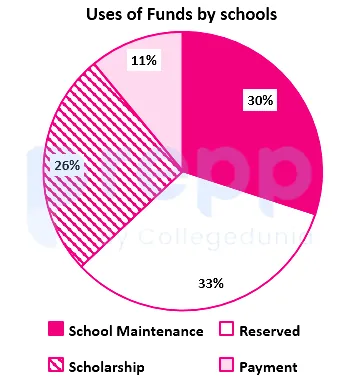
- A
74.29%
- B
72.15%
- C
80.25%
- D
75.25%
Show answer
A. 74.29%Calculation:
Total fund got by school = 100% = 1000000
Funds got through donation = 35%
Scholarship paid = 26%
Required percentage = 26/35 × 100
⇒ 2600/35 = 74.285% ≈ 74.29%
∴ The correct answer is 74.29%.
Paper & answer key PDF ↗ Question 53archived
15 men and 21 women, working together, can do a job in 56 days, while 12 men and 24 women, working together, can do the same job in 64 days. In how many days can the same job be done by 18 men and 24 women, working together?
- A
\(47\frac{6}{19}\)
- B
\(47\frac{5}{19}\)
- C
\(47\frac{9}{19}\)
- D
\(47\frac{3}{19}\)
Show answer
D. \(47\frac{3}{19}\)Understanding the Work and Time Problem
This problem involves the concept of work and time, where the total work done is constant. We are given the time taken by different groups of men and women to complete a specific job. We need to find out how long it takes for a third group with a different composition of men and women to complete the same job.
To solve such problems, we often determine the individual efficiencies of men and women and then use these efficiencies to calculate the total work and the time required by the target group.
Setting Up Equations for Efficiency
Let's denote the amount of work one man can do in one day as \(M\) units per day, and the amount of work one woman can do in one day as \(W\) units per day. These represent their individual efficiencies.
The total work done to complete the job is the product of the number of workers, their efficiency, and the time taken.
From the problem statement, we have two scenarios:
15 men and 21 women working together can do the job in 56 days.
12 men and 24 women working together can do the same job in 64 days.
The total work capacity of 15 men and 21 women per day is \((15M + 21W)\) units. So, the total work done in 56 days is \((15M + 21W) \times 56\).
The total work capacity of 12 men and 24 women per day is \((12M + 24W)\) units. So, the total work done in 64 days is \((12M + 24W) \times 64\).
Since the job is the same in both cases, the total work is equal:
\((15M + 21W) \times 56 = (12M + 24W) \times 64\)
Solving for Efficiency Relationship
We can simplify the equation to find the relationship between the efficiency of a man (\(M\)) and a woman (\(W\)).
Divide both sides of the equation by 8:
\((15M + 21W) \times \frac{56}{8} = (12M + 24W) \times \frac{64}{8}\)
\((15M + 21W) \times 7 = (12M + 24W) \times 8\)
Expand both sides:
\(105M + 147W = 96M + 192W\)
Now, rearrange the terms to group \(M\) and \(W\):
\(105M - 96M = 192W - 147W\)
\(9M = 45W\)
Divide both sides by 9:
\(M = 5W\)
This relationship tells us that one man's daily work capacity is equal to that of five women.
Calculating Total Work
Now that we know the relationship between \(M\) and \(W\), we can calculate the total amount of work required for the job. We can use either of the initial scenarios. Let's use the first scenario:
Total work = \((15M + 21W) \times 56\)
Substitute \(M = 5W\) into this expression:
Total work = \((15(5W) + 21W) \times 56\)
Total work = \((75W + 21W) \times 56\)
Total work = \((96W) \times 56\) units
Calculating Work Rate of Target Group
The target group consists of 18 men and 24 women. We need to find their combined work rate per day.
Combined work rate = \(18M + 24W\)
Substitute \(M = 5W\) into this expression:
Combined work rate = \(18(5W) + 24W\)
Combined work rate = \(90W + 24W\)
Combined work rate = \(114W\) units per day
Finding the Number of Days
The number of days required for the target group to complete the job is calculated by dividing the total work by their combined work rate:
Time = \(\frac{\text{Total Work}}{\text{Combined Work Rate}}\)
Time = \(\frac{96W \times 56}{114W}\)
Cancel out \(W\) (assuming \(W \neq 0\)):
Time = \(\frac{96 \times 56}{114}\)
Simplify the fraction. We can divide both 96 and 114 by their greatest common divisor, which is 6:
\(96 \div 6 = 16\)
\(114 \div 6 = 19\)
So, Time = \(\frac{16 \times 56}{19}\)
Calculate the product \(16 \times 56\):
\(16 \times 56 = 896\)
So, Time = \(\frac{896}{19}\) days
Converting to Mixed Number
Now, convert the improper fraction \(\frac{896}{19}\) into a mixed number by dividing 896 by 19:
\(896 \div 19\)
19 goes into 89 four times (19 * 4 = 76). Remainder is 89 - 76 = 13. Bring down 6, making it 136.
19 goes into 136 seven times (19 * 7 = 133). Remainder is 136 - 133 = 3.
So, \(\frac{896}{19} = 47\) with a remainder of 3.
The mixed number is \(47\frac{3}{19}\).
Thus, 18 men and 24 women, working together, can do the same job in \(47\frac{3}{19}\) days.
Group Composition
Time Taken
Total Work Rate
15 Men + 21 Women
56 days
\(15M + 21W\)
12 Men + 24 Women
64 days
\(12M + 24W\)
18 Men + 24 Women
\(D\) days
\(18M + 24W\)
Revision Table: Key Steps for Work and Time Problems
Step
Description
Action
1
Define Variables
Assign variables for individual efficiencies (e.g., \(M\), \(W\)).
2
Formulate Equations
Set up equations for total work based on given scenarios: Total Work = Rate \(\times\) Time.
3
Find Efficiency Relationship
Solve the equations to find the relationship between the efficiencies (e.g., \(M = 5W\)).
4
Calculate Total Work
Use one of the initial scenarios and the efficiency relationship to calculate the total work.
5
Calculate Target Group Rate
Calculate the combined work rate of the target group using the efficiency relationship.
6
Calculate Time
Divide Total Work by the Target Group Rate to find the required time.
7
Format Answer
Express the answer in the required format (e.g., mixed number).
Additional Information: Concepts in Work and Time
Work and time problems are a common type in quantitative aptitude. They often involve multiple individuals or groups working at different rates to complete a task. Key concepts include:
Efficiency: The amount of work done by an individual or a group in a unit of time. Higher efficiency means more work done per unit of time.
Work Rate: The amount of work done per unit of time by an individual or a group. This is often directly proportional to efficiency and the number of workers.
Total Work: The entire task to be completed. In many problems, the total work is considered constant.
Relationship: Total Work = Work Rate \(\times\) Time. This fundamental relationship is used to solve most problems.
Combining Workers: When multiple individuals or groups work together, their work rates are usually added to find the combined work rate.
Inverse Proportion: Time taken to complete a job is inversely proportional to the work rate (assuming total work is constant). If the work rate increases, the time decreases, and vice-versa.
By understanding these concepts and setting up equations based on the given information, you can solve complex work and time problems systematically.
Paper & answer key PDF ↗ Question 54archived
During a division, Pranjal mistakenly took as the dividend a number that was 10% more than the original dividend. He also mistakenly took as the divisor a number that was 25% more than the original divisor. If the correct quotient of the original division problem was 25 and the remainder was 0, what was the quotient that Pranjal obtained, assuming his calculations had no error?
- A
21.75
- B
21.25
- C
28.75
- D
22
Show answer
D. 22Understanding the Division Problem with Percentage Changes
The question asks us to find the new quotient when the original dividend and divisor are changed by specific percentages. We are given the details of the original division.
Defining Original and Changed Values
Let the original dividend be denoted by \(D\).
Let the original divisor be denoted by \(d\).
According to the problem, the original division had a quotient of 25 and a remainder of 0. This means:
\(D \div d = 25\)
Or, expressed differently:
\(D = 25d\)
Calculating the Mistaken Dividend
Pranjal took a new dividend, let's call it \(D'\), which was 10% more than the original dividend \(D\).
To find \(D'\), we add 10% of \(D\) to \(D\):
\(D' = D + 10\%\text{ of }D\)
\(D' = D + \frac{10}{100}D\)
\(D' = D + 0.10D\)
\(D' = 1.10D\)
Calculating the Mistaken Divisor
Pranjal took a new divisor, let's call it \(d'\), which was 25% more than the original divisor \(d\).
To find \(d'\), we add 25% of \(d\) to \(d\):
\(d' = d + 25\%\text{ of }d\)
\(d' = d + \frac{25}{100}d\)
\(d' = d + 0.25d\)
\(d' = 1.25d\)
Finding the New Quotient
Pranjal's division was using the new dividend \(D'\) and the new divisor \(d'\). The quotient he obtained, let's call it \(Q'\), is given by:
\(Q' = \frac{D'}{d'}\)
Now, we substitute the expressions for \(D'\) and \(d'\) in terms of \(D\) and \(d\):
\(Q' = \frac{1.10D}{1.25d}\)
We know from the original division that \(D = 25d\). Substitute this into the equation for \(Q'\):
\(Q' = \frac{1.10 \times (25d)}{1.25d}\)
Assuming the divisor \(d\) is not zero (which it must be for a division), we can cancel out \(d\) from the numerator and the denominator:
\(Q' = \frac{1.10 \times 25}{1.25}\)
Performing the Calculation
Now we calculate the value of the expression:
\(Q' = \frac{1.10 \times 25}{1.25}\)
\(Q' = \frac{27.5}{1.25}\)
To make the division easier, we can multiply both the numerator and the denominator by 100 to remove decimals:
\(Q' = \frac{27.5 \times 100}{1.25 \times 100}\)
\(Q' = \frac{2750}{125}\)
We can simplify this fraction. Both numbers are divisible by 25:
\(2750 \div 25 = 110\)
\(125 \div 25 = 5\)
So, the calculation becomes:
\(Q' = \frac{110}{5}\)
\(Q' = 22\)
The quotient that Pranjal obtained was 22.
Step-by-Step Calculation Summary
Step
Description
Formula/Calculation
1
Original Relation
\(D = 25d\)
2
Mistaken Dividend
\(D' = 1.10D\)
3
Mistaken Divisor
\(d' = 1.25d\)
4
New Quotient Formula
\(Q' = \frac{D'}{d'}\)
5
Substitute \(D'\) and \(d'\)
\(Q' = \frac{1.10D}{1.25d}\)
6
Substitute \(D = 25d\)
\(Q' = \frac{1.10 \times (25d)}{1.25d}\)
7
Cancel \(d\) and Simplify
\(Q' = \frac{1.10 \times 25}{1.25} = \frac{27.5}{1.25}\)
8
Final Calculation
\(Q' = \frac{2750}{125} = 22\)
Revision Table: Key Concepts
Concept
Explanation
Example
Dividend
The number being divided.
In \(10 \div 5 = 2\), 10 is the dividend.
Divisor
The number by which another number is divided.
In \(10 \div 5 = 2\), 5 is the divisor.
Quotient
The result of division.
In \(10 \div 5 = 2\), 2 is the quotient.
Percentage Increase
Adding a percentage of a value to the original value.
10% increase on 100 is \(100 + 0.10 \times 100 = 110\).
Algebraic Representation
Using letters (variables) to represent unknown numbers.
Let dividend be \(D\), divisor be \(d\).
Additional Information: How Percentage Changes Affect Division
When the dividend and divisor both change, the quotient changes based on the ratio of their changes. If the dividend increases by a larger percentage than the divisor, the quotient will likely increase. If the divisor increases by a larger percentage than the dividend, the quotient will likely decrease.
In this problem, the dividend increased by 10% (multiplied by 1.10) and the divisor increased by 25% (multiplied by 1.25). The new quotient is the old quotient multiplied by the ratio of the dividend change factor to the divisor change factor:
\(Q' = Q \times \frac{\text{Dividend Change Factor}}{\text{Divisor Change Factor}}\)
\(Q' = 25 \times \frac{1.10}{1.25}\)
\(Q' = 25 \times \frac{1.10}{1.25} = 25 \times \frac{110}{125} = 25 \times \frac{22 \times 5}{25 \times 5} = 25 \times \frac{22}{25} = 22\)
This confirms our previous calculation method.
Understanding how percentages affect calculations like division is crucial in quantitative aptitude problems. Always convert percentages to decimals or fractions before performing calculations.
Paper & answer key PDF ↗ Question 55archived
If the selling price of an article is doubled, then the profit becomes four times. What was the original profit percentage?
- A
75%
- B
100%
- C
50%
- D
25%
Show answer
C. 50%Understanding Profit Calculation with Selling Price Changes
This problem involves understanding the relationship between cost price, selling price, and profit. When the selling price of an article changes, the profit also changes, assuming the cost price remains constant. We are given a scenario where doubling the selling price leads to a four-fold increase in profit. Our goal is to find the original profit percentage.
Defining Key Terms
Let's define the terms we'll be using:
Cost Price (CP): The price at which the article was bought. This remains constant in this problem.
Original Selling Price (SP): The initial price at which the article was sold.
Original Profit (P): The difference between the original selling price and the cost price.
Setting up the Original Scenario
The original profit is calculated as:
\(P = SP - CP\)
The original profit percentage is calculated with respect to the cost price:
\(\text{Original Profit Percentage} = \left(\frac{\text{Original Profit}}{\text{Cost Price}}\right) \times 100\)
\(\text{Original Profit Percentage} = \left(\frac{P}{CP}\right) \times 100\)
Substituting the expression for P:
\(\text{Original Profit Percentage} = \left(\frac{SP - CP}{CP}\right) \times 100\)
Analyzing the New Scenario
According to the problem, the selling price is doubled, and the profit becomes four times the original profit.
New Selling Price = \(2 \times SP\)
New Profit = \(4 \times P\)
The cost price (CP) remains unchanged in this new scenario.
The new profit is calculated using the new selling price and the constant cost price:
\(\text{New Profit} = \text{New Selling Price} - \text{Cost Price}\)
\(4 \times P = 2 \times SP - CP\)
Solving for the Relationship Between SP and CP
We have two equations:
\(P = SP - CP\)
\(4 \times P = 2 \times SP - CP\)
Substitute the expression for P from equation (1) into equation (2):
\(4 \times (SP - CP) = 2 \times SP - CP\)
Distribute the 4 on the left side:
\(4 \times SP - 4 \times CP = 2 \times SP - CP\)
Now, we need to isolate SP and CP terms. Let's move the SP terms to one side and the CP terms to the other side of the equation:
\(4 \times SP - 2 \times SP = 4 \times CP - CP\)
Combine like terms:
\(2 \times SP = 3 \times CP\)
This equation gives us the relationship between the original selling price and the cost price. From this, we can express SP in terms of CP:
\(SP = \frac{3}{2} \times CP\)
Calculating the Original Profit Percentage
Now that we have the relationship between SP and CP, we can substitute this back into the formula for the original profit percentage:
\(\text{Original Profit Percentage} = \left(\frac{SP - CP}{CP}\right) \times 100\)
Substitute \(SP = \frac{3}{2} \times CP\) into the formula:
\(\text{Original Profit Percentage} = \left(\frac{\frac{3}{2} \times CP - CP}{CP}\right) \times 100\)
Simplify the numerator by finding a common denominator:
\(\frac{3}{2} \times CP - CP = \frac{3}{2} \times CP - \frac{2}{2} \times CP = \left(\frac{3}{2} - \frac{2}{2}\right) \times CP = \frac{1}{2} \times CP\)
Substitute this back into the profit percentage formula:
\(\text{Original Profit Percentage} = \left(\frac{\frac{1}{2} \times CP}{CP}\right) \times 100\)
The CP terms in the numerator and denominator cancel out:
\(\text{Original Profit Percentage} = \left(\frac{1}{2}\right) \times 100\)
\(\text{Original Profit Percentage} = 50\%\)
The original profit percentage was 50%.
Metric
Original Value
New Value
Cost Price
CP
CP (constant)
Selling Price
SP
2 * SP
Profit
P = SP - CP
4 * P = 2 * SP - CP
Profit Percentage
\(\left(\frac{SP - CP}{CP}\right) \times 100\)
\(\left(\frac{2 \times SP - CP}{CP}\right) \times 100\)
Revision Table: Profit Percentage Concepts
Concept
Formula
Notes
Profit
Profit = SP - CP
When SP > CP
Loss
Loss = CP - SP
When CP > SP
Profit Percentage
\(\left(\frac{\text{Profit}}{CP}\right) \times 100\)
Always calculated on CP unless specified otherwise
Loss Percentage
\(\left(\frac{\text{Loss}}{CP}\right) \times 100\)
Always calculated on CP unless specified otherwise
Selling Price (given CP and Profit%)
\(SP = CP \times \left(1 + \frac{\text{Profit\%}}{100}\right)\)
Selling Price (given CP and Loss%)
\(SP = CP \times \left(1 - \frac{\text{Loss\%}}{100}\right)\)
Additional Information: Importance of Cost Price
In profit and loss calculations, the cost price (CP) serves as the base for calculating percentages unless explicitly stated otherwise (e.g., profit on selling price). This is because CP represents the initial investment in acquiring or producing the article. Changes in selling price or quantity sold affect the total revenue and profit, but the per-unit cost price is typically assumed to be stable unless there are changes in production costs or bulk purchase discounts.
Understanding the relationship between CP, SP, and Profit (or Loss) is fundamental to solving problems related to business mathematics and quantitative aptitude exams. Problems often involve scenarios where one or more of these variables change, and you need to find the impact on profit percentage or calculate one of the initial values.
Paper & answer key PDF ↗ Question 56archived
A person standing at a distance looks at a building having a height of 1000 metres. The angle between the top of the building and the ground is 30°. At what approximate distance (in metres) is the person standing away from the building.
- A
1000
- B
936
- C
1732
- D
1542
Show answer
C. 1732Calculating Distance Using Trigonometry
This problem involves finding the distance between a person and a building given the building's height and the angle of elevation to the top of the building. This scenario forms a right-angled triangle, where:
The building's height is the side opposite the angle of elevation.
The distance from the person to the building is the side adjacent to the angle of elevation.
The angle of elevation is given as 30 degrees.
Understanding the Trigonometric Relationship
In a right-angled triangle, the relationship between the opposite side, the adjacent side, and the angle is described by trigonometric functions. The tangent function ($\tan$) relates the opposite side to the adjacent side:
$$ \tan(\text{angle}) = \frac{\text{Opposite side}}{\text{Adjacent side}} $$
Applying Trigonometry to the Building Problem
In this case:
Angle = 30°
Opposite side (Height of the building) = 1000 metres
Adjacent side (Distance from the person to the building) = Let's call this 'd'
So, the equation becomes:
$$ \tan(30^\circ) = \frac{1000 \text{ m}}{d} $$
Solving for the Distance (d)
To find the distance 'd', we can rearrange the equation:
$$ d = \frac{1000 \text{ m}}{\tan(30^\circ)} $$
We know that the value of $\tan(30^\circ)$ is $\frac{1}{\sqrt{3}}$.
$$ d = \frac{1000}{\frac{1}{\sqrt{3}}} = 1000 \times \sqrt{3} $$
The approximate value of $\sqrt{3}$ is 1.732.
$$ d \approx 1000 \times 1.732 $$
$$ d \approx 1732 \text{ metres} $$
Step-by-Step Calculation
Identify the known values: Building height (Opposite) = 1000 m, Angle of elevation = 30°.
Identify the unknown value: Distance (Adjacent) = d.
Choose the appropriate trigonometric function: $\tan$ because it relates Opposite and Adjacent sides.
Set up the equation: $\tan(30^\circ) = \frac{1000}{d}$.
Solve for d: $d = \frac{1000}{\tan(30^\circ)}$.
Substitute the value of $\tan(30^\circ) = \frac{1}{\sqrt{3}}$: $d = 1000 \times \sqrt{3}$.
Use the approximate value $\sqrt{3} \approx 1.732$: $d \approx 1000 \times 1.732$.
Calculate the distance: $d \approx 1732$ metres.
Comparing with Options
The calculated approximate distance is 1732 metres, which matches one of the provided options.
Option
Value (metres)
Match?
1
1000
No
2
936
No
3
1732
Yes
4
1542
No
Therefore, the approximate distance the person is standing away from the building is 1732 metres.
Revision Table: Key Concepts
Concept
Description
Relevance to Problem
Angle of Elevation
The angle between the horizontal line of sight and the line of sight upward to an object.
Given as 30° in the problem.
Right-Angled Triangle
A triangle with one angle equal to 90°.
Formed by the building, the ground, and the line of sight to the top.
Tangent Function ($\tan$)
In a right triangle, the ratio of the length of the opposite side to the length of the adjacent side for a given angle.
Used to relate the building's height (opposite) to the distance (adjacent).
Special Angles
Common angles (like 0°, 30°, 45°, 60°, 90°) with known trigonometric values.
$\tan(30^\circ) = \frac{1}{\sqrt{3}}$ is a standard value.
Additional Information: Trigonometric Ratios
For a right-angled triangle with an angle $\theta$:
Sine ($\sin \theta$): Ratio of the length of the opposite side to the length of the hypotenuse.
Cosine ($\cos \theta$): Ratio of the length of the adjacent side to the length of the hypotenuse.
Tangent ($\tan \theta$): Ratio of the length of the opposite side to the length of the adjacent side ($\tan \theta = \frac{\sin \theta}{\cos \theta}$).
In problems involving height and distance where the hypotenuse is not directly involved (or needed), the tangent function is often very useful.
Paper & answer key PDF ↗ Question 57archived
A can do 20% of a job in 7 days and B can do 25% of the job in 7 days if they worked alone. How much of the job (in percentage) can they complete in 7 days if they worked together?
- A
38%
- B
52%
- C
56%
- D
45%
Show answer
D. 45%Understanding Work and Time Problem
This question asks us to determine the combined percentage of a job that two individuals, A and B, can complete in a specific time period (7 days), given the percentage of the job each can complete individually in the same time period.
Analysing Individual Work Rates
We are given the following information:
A can do 20% of the job in 7 days when working alone.
B can do 25% of the job in 7 days when working alone.
The question specifically asks how much of the job they can complete together in 7 days. Since the time period is the same for both individuals and for the combined work, we can simply add the percentages of the job they complete individually within that time frame.
Calculating Combined Work in 7 Days
To find the total percentage of the job they complete together in 7 days, we add the percentage of work A does in 7 days and the percentage of work B does in 7 days.
Combined work in 7 days = Work done by A in 7 days + Work done by B in 7 days
Combined work in 7 days = $$20\% + 25\%$$
Combined work in 7 days = $$45\%$$
Therefore, if A and B work together, they can complete 45% of the job in 7 days.
Summary of Calculations
Here is a quick summary:
A's work in 7 days = 20%
B's work in 7 days = 25%
Combined work in 7 days = $$20\% + 25\% = 45\%$$
The percentage of the job they can complete together in 7 days is 45%.
Revision Table: Work and Time Concepts
Concept
Explanation
Formula (Example: A does work in D days)
Work Rate
The amount of work done per unit of time.
If A completes $$1$$ job in $$D$$ days, A's daily work rate is $$\frac{1}{D}$$ job per day.
Total Work
Usually considered as 1 unit or 100%.
Work = Rate × Time
Combined Work Rate
Sum of individual work rates.
If A's rate is $$R_A$$ and B's rate is $$R_B$$, combined rate is $$R_A + R_B$$.
Time to Complete Together
Time taken by individuals working together to complete the total work.
Time = $$\frac{\text{Total Work}}{\text{Combined Rate}}$$
Additional Information: Work and Time Problems
Work and time problems often involve calculating the time taken to complete a task based on individual work rates. The fundamental principle is that the total work done is the product of the work rate and the time spent working. Work rates are usually expressed as the fraction or percentage of work done per unit of time (e.g., per day, per hour).
Key Principles:
Work Rate and Time are Inversely Proportional: If a person works faster (higher rate), they take less time to complete the same amount of work, and vice versa.
Adding Work Rates: When individuals work together, their work rates add up to find the combined work rate, assuming they work independently without affecting each other's pace.
Consistency of Units: Ensure that the units of work and time are consistent throughout the calculation. If the rate is per day, the time should be in days.
In this specific problem, since the time period (7 days) was fixed and the same for individual and combined work, we could directly add the percentages of work completed. If the question had asked for the time taken to complete the *entire* job (100%) together, we would first calculate their daily work rates from the given information and then use the combined daily rate to find the total time.
Paper & answer key PDF ↗ Question 58archived
\(\rm \frac{\sin^4 \theta+\cos ^4\theta}{1-2\sin^2\theta.\cos^2\theta}=\) ________.
- A
1
- B
2
- C
-1
- D
0
Show answer
A. 1Simplifying Trigonometric Expressions
This question asks us to simplify a given trigonometric expression involving powers of sine and cosine. To simplify, we will use fundamental trigonometric identities and algebraic manipulation.
Understanding the Expression
The expression we need to simplify is:
\(\rm \frac{\sin^4 \theta+\cos ^4\theta}{1-2\sin^2\theta.\cos^2\theta}\)
Let's look at the numerator and denominator separately.
Simplifying the Numerator: \(\sin^4 \theta+\cos ^4\theta\)
We can rewrite the numerator \(\sin^4 \theta+\cos ^4\theta\) using algebraic identities. Recall the identity \((a+b)^2 = a^2 + b^2 + 2ab\). From this, we can write \(a^2 + b^2 = (a+b)^2 - 2ab\).
Let \(a = \sin^2 \theta\) and \(b = \cos^2 \theta\).
Then, \(\sin^4 \theta+\cos ^4\theta = (\sin^2 \theta)^2 + (\cos^2 \theta)^2\).
Applying the identity \(a^2 + b^2 = (a+b)^2 - 2ab\), we get:
\(\sin^4 \theta+\cos ^4\theta = (\sin^2 \theta + \cos^2 \theta)^2 - 2(\sin^2 \theta)(\cos^2 \theta)\)
Now, we use the fundamental trigonometric identity: \(\sin^2 \theta + \cos^2 \theta = 1\).
Substitute this into the expression:
\(\sin^4 \theta+\cos ^4\theta = (1)^2 - 2\sin^2 \theta \cos^2 \theta\)
\(\sin^4 \theta+\cos ^4\theta = 1 - 2\sin^2 \theta \cos^2 \theta\)
So, the simplified form of the numerator is \(1 - 2\sin^2 \theta \cos^2 \theta\).
Analyzing the Denominator: \(1-2\sin^2\theta.\cos^2\theta\)
The denominator of the original expression is \(1-2\sin^2\theta.\cos^2\theta\). This is exactly the same as the simplified form of the numerator we found.
Putting it Together
Now substitute the simplified numerator back into the original expression:
\(\rm \frac{\sin^4 \theta+\cos ^4\theta}{1-2\sin^2\theta.\cos^2\theta} = \frac{1 - 2\sin^2 \theta \cos^2 \theta}{1 - 2\sin^2 \theta \cos^2 \theta}\)
Assuming the denominator is not zero (which is generally true for real \(\theta\) as explained below), the expression simplifies to:
\(\frac{1 - 2\sin^2 \theta \cos^2 \theta}{1 - 2\sin^2 \theta \cos^2 \theta} = 1\)
Condition for Denominator Not Being Zero
The denominator \(1-2\sin^2\theta.\cos^2\theta\) would be zero if \(1 = 2\sin^2\theta.\cos^2\theta\).
We know that \(\sin(2\theta) = 2\sin\theta\cos\theta\), so \(\sin^2(2\theta) = 4\sin^2\theta\cos^2\theta\), which means \(\sin^2\theta\cos^2\theta = \frac{\sin^2(2\theta)}{4}\).
Substituting this, we get \(1 = 2 \left(\frac{\sin^2(2\theta)}{4}\right) = \frac{\sin^2(2\theta)}{2}\).
This means \(\sin^2(2\theta) = 2\).
However, the maximum value of \(\sin^2\) of any angle is 1. Since \(\sin^2(2\theta)\) cannot be greater than 1, \(\sin^2(2\theta) = 2\) has no real solution for \(\theta\).
Therefore, the denominator \(1-2\sin^2\theta.\cos^2\theta\) is never zero for real values of \(\theta\).
Conclusion
The simplified value of the expression \(\rm \frac{\sin^4 \theta+\cos ^4\theta}{1-2\sin^2\theta.\cos^2\theta}\) is 1.
Reviewing the Options
1. 1
2. 2
3. -1
4. 0
Our simplified value is 1, which matches option 1.
Step
Expression
Explanation
1
\(\sin^4 \theta+\cos ^4\theta\)
Start with the numerator.
2
\((\sin^2 \theta)^2 + (\cos^2 \theta)^2\)
Rewrite using squares.
3
\((\sin^2 \theta + \cos^2 \theta)^2 - 2\sin^2 \theta \cos^2 \theta\)
Apply \(a^2+b^2 = (a+b)^2 - 2ab\) with \(a=\sin^2\theta, b=\cos^2\theta\).
4
\((1)^2 - 2\sin^2 \theta \cos^2 \theta\)
Use \(\sin^2 \theta + \cos^2 \theta = 1\).
5
\(1 - 2\sin^2 \theta \cos^2 \theta\)
Simplify the numerator.
6
\(\rm \frac{1 - 2\sin^2 \theta \cos^2 \theta}{1-2\sin^2\theta.\cos^2\theta}\)
Substitute the simplified numerator into the original expression.
7
\(1\)
Cancel the identical numerator and denominator.
Revision Table: Trigonometric Identities
Identity
Description
\(\sin^2 \theta + \cos^2 \theta = 1\)
The fundamental Pythagorean identity relating sine and cosine.
\(\sin(2\theta) = 2\sin\theta\cos\theta\)
Double angle identity for sine. Useful for rewriting \(\sin\theta\cos\theta\).
\(a^2 + b^2 = (a+b)^2 - 2ab\)
An algebraic identity useful for rewriting sums of squares.
\(a^4 + b^4 = (a^2+b^2)^2 - 2a^2b^2\)
A specific application of the previous identity for fourth powers.
Additional Information: Simplifying Complex Trigonometric Expressions
Simplifying trigonometric expressions often involves recognizing patterns and applying fundamental identities. Here are some tips:
Look for opportunities to use the Pythagorean identity \(\sin^2 \theta + \cos^2 \theta = 1\).
Try to factor expressions or expand squares using algebraic identities.
Convert all terms to sine and cosine if possible, especially in expressions involving tan, cot, sec, or cosec.
Look for double angle or other compound angle identities if angles like \(2\theta\) or \(\theta/2\) appear.
If the expression involves powers like \(\sin^4 \theta\) or \(\cos^4 \theta\), think about how they relate to \(\sin^2 \theta\) and \(\cos^2 \theta\). The algebraic identity \(a^2+b^2=(a+b)^2-2ab\) is very useful here.
Always check if the denominator can be zero, although in many standard problems, it will be designed to be non-zero for real values of the variable.
Practice is key! Work through various examples to become comfortable with different techniques.
By applying these strategies, we can simplify complex trigonometric expressions effectively.
Paper & answer key PDF ↗ Question 59archived
What is the value of \(\rm \frac{X}{Y}\) if \(\rm \frac{X-5Y}{X+5Y}=\frac{7}{13}\).
- A
\(\frac{23}{7}\)
- B
\(\frac{24}{9}\)
- C
\(\frac{50}{3}\)
- D
\(\frac{100}{7}\)
Show answer
C. \(\frac{50}{3}\)Finding the Value of X/Y from a Given Equation
The problem asks us to find the value of the ratio \(\frac{X}{Y}\) given the equation involving \(X\) and \(Y\).
The given equation is:
\(\frac{X-5Y}{X+5Y}=\frac{7}{13}\)
To find the value of \(\frac{X}{Y}\), we need to rearrange this equation to isolate the ratio. We can do this by cross-multiplying.
Step-by-Step Solution to Find X/Y
Let's solve the given equation:
Start with the given equation: \(\frac{X-5Y}{X+5Y}=\frac{7}{13}\)
Cross-multiply the terms: \(13 \times (X-5Y) = 7 \times (X+5Y)\)
Distribute the numbers on both sides: \(13X - 13 \times 5Y = 7X + 7 \times 5Y\)
Simplify the multiplication: \(13X - 65Y = 7X + 35Y\)
Now, collect the terms involving \(X\) on one side of the equation and the terms involving \(Y\) on the other side. Let's move \(7X\) to the left side and \(-65Y\) to the right side: \(13X - 7X = 35Y + 65Y\)
Combine the like terms on both sides: \(6X = 100Y\)
The goal is to find \(\frac{X}{Y}\). To get this ratio, we can divide both sides of the equation by \(Y\) (assuming \(Y \neq 0\)) and by 6. First, divide by \(Y\): \(\frac{6X}{Y} = 100\). Then, divide by 6: \(\frac{X}{Y} = \frac{100}{6}\)
Finally, simplify the fraction \(\frac{100}{6}\) by dividing both the numerator and the denominator by their greatest common divisor, which is 2: \(\frac{100 \div 2}{6 \div 2} = \frac{50}{3}\)
Thus, the value of \(\frac{X}{Y}\) is \(\frac{50}{3}\).
Conclusion on the Value of X/Y
By solving the given algebraic equation \(\frac{X-5Y}{X+5Y}=\frac{7}{13}\) through cross-multiplication and rearrangement, we found that the ratio \(\frac{X}{Y}\) is equal to \(\frac{50}{3}\).
This matches one of the provided options.
Revision Table: Key Steps for Solving Ratio Equations
Step
Description
Application in this Problem
1
Identify the equation involving ratios.
\(\frac{X-5Y}{X+5Y}=\frac{7}{13}\)
2
Cross-multiply to remove denominators.
\(13(X-5Y) = 7(X+5Y)\)
3
Expand both sides.
\(13X - 65Y = 7X + 35Y\)
4
Collect terms with the same variable.
\(13X - 7X = 35Y + 65Y\)
5
Simplify the equation.
\(6X = 100Y\)
6
Rearrange to isolate the desired ratio (X/Y).
\(\frac{X}{Y} = \frac{100}{6}\)
7
Simplify the final ratio.
\(\frac{50}{3}\)
Additional Information: Working with Ratios and Equations
A ratio is a comparison of two quantities by division. In this problem, we are working with the ratio of two variables, \(X\) and \(Y\).
When solving equations involving ratios or fractions, cross-multiplication is a fundamental technique. It helps convert the fractional equation into a linear equation, which is generally easier to solve.
The principle behind cross-multiplication is that if \(\frac{a}{b} = \frac{c}{d}\) (where \(b \neq 0\) and \(d \neq 0\)), then \(ad = bc\). This is derived by multiplying both sides of the equation by \(bd\).
Once the equation is linear (without fractions), the next step is usually to gather terms containing the variables you are interested in on one side and constant terms or other variables on the other side. This involves using inverse operations (addition/subtraction, multiplication/division).
Simplifying fractions at the end is crucial to present the answer in its simplest form.
Paper & answer key PDF ↗ Question 60archived
The following table shows the scores of three attempts of Archery players in a tournament, The player scoring the highest average score was declared the best player. Who was the best player?
PlayerScore 1Score 2Score 3
Angela62.5065.0064.50
Maria69.0570.0067.52
Sareena73.8172.5074.20
Preeti74.3075.0077.50
Deepika64.2967.5063.28
- A
Angela
- B
Maria
- C
Deepika
- D
Preeti
Show answer
D. PreetiArchery Tournament: Finding the Best Player by Average Score
In an archery tournament, the best player is determined by the highest average score across all attempts. We are given the scores of five players over three attempts and need to calculate each player's average score to find the winner.
The scores for each player are provided in the table below:
Player
Score 1
Score 2
Score 3
Angela
62.50
65.00
64.50
Maria
69.05
70.00
67.52
Sareena
73.81
72.50
74.20
Preeti
74.30
75.00
77.50
Deepika
64.29
67.50
63.28
To find the best player, we need to calculate the average score for each player. The average score is calculated by summing the scores from all three attempts and dividing by the number of attempts, which is 3.
The formula for the average score is:
\(\text{Average Score} = \frac{\text{Score 1} + \text{Score 2} + \text{Score 3}}{3}\)
Calculating Each Player's Average Archery Score
Let's calculate the average score for each player:
Angela:
Sum of scores = \(62.50 + 65.00 + 64.50 = 192.00\)
Average score = \(\frac{192.00}{3} = 64.00\)
Maria:
Sum of scores = \(69.05 + 70.00 + 67.52 = 206.57\)
Average score = \(\frac{206.57}{3} \approx 68.86\)
Sareena:
Sum of scores = \(73.81 + 72.50 + 74.20 = 220.51\)
Average score = \(\frac{220.51}{3} \approx 73.50\)
Preeti:
Sum of scores = \(74.30 + 75.00 + 77.50 = 226.80\)
Average score = \(\frac{226.80}{3} = 75.60\)
Deepika:
Sum of scores = \(64.29 + 67.50 + 63.28 = 195.07\)
Average score = \(\frac{195.07}{3} \approx 65.02\)
Comparing Average Archery Scores
Now we compare the calculated average scores:
Angela: 64.00
Maria: 68.86
Sareena: 73.50
Preeti: 75.60
Deepika: 65.02
Comparing these average scores, we can see that Preeti has the highest average score of 75.60.
Identifying the Best Archery Player
According to the tournament rules, the player scoring the highest average score is declared the best player. Since Preeti has the highest average score, Preeti is the best player in the tournament.
Revision Table: Archery Scores and Averages
Player
Score 1
Score 2
Score 3
Total Score
Average Score
Angela
62.50
65.00
64.50
192.00
64.00
Maria
69.05
70.00
67.52
206.57
68.86 (approx)
Sareena
73.81
72.50
74.20
220.51
73.50 (approx)
Preeti
74.30
75.00
77.50
226.80
75.60
Deepika
64.29
67.50
63.28
195.07
65.02 (approx)
Additional Information: Understanding Average Calculation
The average, or arithmetic mean, is a fundamental concept in statistics used to find a typical value for a set of numbers. It is calculated by summing all the values in the set and then dividing by the count of values in the set.
In this Archery example, the average score gives a single number that represents the player's typical performance across their three attempts. A higher average score indicates a better overall performance.
Calculating averages is useful in many areas, such as:
Finding the average height or weight of a group.
Calculating the average test score in a class.
Determining the average rainfall over a period.
Analyzing average expenses or income.
It's a simple yet powerful tool for summarizing data and making comparisons.
Paper & answer key PDF ↗ Question 61archived
If \(\rm \left(x+\frac{1}{x}\right)=10\). what is the value of \(\rm \left(x^4+\frac{1}{x^4}\right)\)?
- A
9604
- B
9602
- C
9600
- D
9606
Show answer
B. 9602Solving for \(x^4 + \frac{1}{x^4}\) from \(x + \frac{1}{x}\)
We are given the value of \( \left(x+\frac{1}{x}\right) \) and asked to find the value of \( \left(x^4+\frac{1}{x^4}\right) \). To reach the fourth power from the first power, we can square the expression twice.
Let's perform the calculations step-by-step.
Step-by-Step Calculation to find \(x^4 + \frac{1}{x^4}\)
Step 1: Find the value of \( \left(x^2+\frac{1}{x^2}\right) \)
We are given:
\( \left(x+\frac{1}{x}\right) = 10 \)
Square both sides of the equation:
\( \left(x+\frac{1}{x}\right)^2 = 10^2 \)
Using the algebraic identity \( (a+b)^2 = a^2 + 2ab + b^2 \), where \( a=x \) and \( b=\frac{1}{x} \), we expand the left side:
\( x^2 + 2 \cdot x \cdot \frac{1}{x} + \left(\frac{1}{x}\right)^2 = 100 \)
Simplify the middle term \( 2 \cdot x \cdot \frac{1}{x} = 2 \):
\( x^2 + 2 + \frac{1}{x^2} = 100 \)
Subtract 2 from both sides to isolate \( \left(x^2+\frac{1}{x^2}\right) \):
\( x^2 + \frac{1}{x^2} = 100 - 2 \)
\( \left(x^2+\frac{1}{x^2}\right) = 98 \)
Step 2: Find the value of \( \left(x^4+\frac{1}{x^4}\right) \)
Now that we have the value of \( \left(x^2+\frac{1}{x^2}\right) \), we can square it again to find \( \left(x^4+\frac{1}{x^4}\right) \).
We have:
\( \left(x^2+\frac{1}{x^2}\right) = 98 \)
Square both sides of this equation:
\( \left(x^2+\frac{1}{x^2}\right)^2 = 98^2 \)
Using the same algebraic identity \( (a+b)^2 = a^2 + 2ab + b^2 \), but this time with \( a=x^2 \) and \( b=\frac{1}{x^2} \), we expand the left side:
\( (x^2)^2 + 2 \cdot x^2 \cdot \frac{1}{x^2} + \left(\frac{1}{x^2}\right)^2 = 98^2 \)
Simplify the terms:
\( x^4 + 2 + \frac{1}{x^4} = 98^2 \)
Calculate \( 98^2 \):
\( 98^2 = 98 \times 98 = 9604 \)
Substitute the value of \( 98^2 \) back into the equation:
\( x^4 + 2 + \frac{1}{x^4} = 9604 \)
Subtract 2 from both sides to isolate \( \left(x^4+\frac{1}{x^4}\right) \):
\( x^4 + \frac{1}{x^4} = 9604 - 2 \)
\( \left(x^4+\frac{1}{x^4}\right) = 9602 \)
Thus, the value of \( \left(x^4+\frac{1}{x^4}\right) \) is 9602.
Understanding Related Algebraic Identities
The problem relies heavily on the fundamental algebraic identity for squaring a sum:
\( (a+b)^2 = a^2 + 2ab + b^2 \)
This identity allows us to easily find the value of \( a^2 + b^2 \) if we know \( a+b \) and \( ab \). In our case, with terms like \( x \) and \( \frac{1}{x} \), the product \( ab = x \cdot \frac{1}{x} \) simplifies nicely to 1, which makes these types of problems straightforward.
Revision Table: Key Algebraic Formulas
Identity
Formula
Example with \(x\) and \(1/x\)
Square of a sum
\( (a+b)^2 = a^2 + 2ab + b^2 \)
\( \left(x+\frac{1}{x}\right)^2 = x^2 + 2(x)\left(\frac{1}{x}\right) + \left(\frac{1}{x}\right)^2 = x^2 + 2 + \frac{1}{x^2} \)
Square of a difference
\( (a-b)^2 = a^2 - 2ab + b^2 \)
\( \left(x-\frac{1}{x}\right)^2 = x^2 - 2(x)\left(\frac{1}{x}\right) + \left(\frac{1}{x}\right)^2 = x^2 - 2 + \frac{1}{x^2} \)
Difference of squares
\( a^2 - b^2 = (a-b)(a+b) \)
\( x^2 - \frac{1}{x^2} = \left(x-\frac{1}{x}\right)\left(x+\frac{1}{x}\right) \)
Additional Information on Powers of x + 1/x
Problems involving finding values of \( x^n + \frac{1}{x^n} \) given \( x + \frac{1}{x} \) are common. We saw how to go from power 1 to power 2, and then power 2 to power 4 by squaring. You could continue this process to find \( x^8 + \frac{1}{x^8} \), \( x^{16} + \frac{1}{x^{16}} \), and so on.
To find other powers, like \( x^3 + \frac{1}{x^3} \) or \( x^5 + \frac{1}{x^5} \), different identities or combinations of identities are used. For example, to find \( x^3 + \frac{1}{x^3} \), you could cube the original expression \( \left(x+\frac{1}{x}\right) \).
Remembering the core algebraic identities and understanding how the \( 2ab \) term simplifies when \( b = 1/a \) is key to solving these types of algebraic manipulation problems efficiently.
Paper & answer key PDF ↗ Question 62archived
A dealer marks his goods at 20% above the cost price and allows a discount of 15% on the marked price. What is his gain or loss percentage?
- A
4% gain
- B
2% loss
- C
2% gain
- D
4% loss
Show answer
C. 2% gainGiven:
Marked Price (M.P) = 120% × Cost Price (C.P)
Discount (D%) = 15%
Used Formula:
C.P/M.P = (100 - D%)/(100 + P%)
Calculation:
Marked Price (M.P) = 120% × Cost Price (C.P)
M.P/C.P = 120/100 = 6/5
According to the question:
C.P/M.P = (100 - D%)/(100 + P%)
⇒ 5/6 = (100 - 15)/(100 + P%)
⇒ 5/6 = 85/(100 + P%)
⇒ (100 + P%) = (85 × 6)/5
⇒ P% = 102 - 100 = 2%
∴ The correct answer is 2%.
Paper & answer key PDF ↗ Question 63archived
A six-digit number Is divisible by 33. If 54 Is added to the number, then the new number formed will also be divisible by:
- A
3
- B
2
- C
5
- D
7
Show answer
A. 3Understanding the Problem: Divisibility Rules
The question asks us to determine which number will divide a new number, formed by adding 54 to a six-digit number that is already divisible by 33.
Let the original six-digit number be $N$. We are given that $N$ is divisible by 33.
Divisibility by 33
A number is divisible by 33 if and only if it is divisible by both 3 and 11. This is because 3 and 11 are prime numbers and their product is 33.
Since $N$ is divisible by 33, it means $N$ can be written as:
\(N = 33 \times k\)
where \(k\) is an integer.
Because $33$ is divisible by $3$, any number divisible by $33$ is also divisible by $3$. Therefore, $N$ is divisible by $3$.
Analyzing the New Number
The new number is formed by adding 54 to the original number $N$. The new number is \(N + 54\).
We need to check the divisibility of \(N + 54\) by the given options: 3, 2, 5, and 7.
Checking Divisibility of N + 54
Let's examine the divisibility of \(N + 54\) by each option:
Divisibility by 3
We know that $N$ is divisible by 3 (as explained above, since it's divisible by 33).
Now let's check if 54 is divisible by 3.
\(54 \div 3 = 18\)
Since 54 is exactly divisible by 3, 54 is divisible by 3.
There is a property in number theory that states if two numbers are divisible by the same number, their sum is also divisible by that number.
In this case, both $N$ and 54 are divisible by 3.
Therefore, their sum \(N + 54\) must also be divisible by 3.
Divisibility by 2
A number is divisible by 2 if it is an even number (ends in 0, 2, 4, 6, or 8).
54 is an even number (ends in 4).
The original number $N$ is divisible by 33. A number divisible by 33 can be even (e.g., 66, 132) or odd (e.g., 33, 99).
If $N$ is even, \(N + 54\) would be even + even = even. In this case, \(N + 54\) is divisible by 2.
If $N$ is odd, \(N + 54\) would be odd + even = odd. In this case, \(N + 54\) is not divisible by 2.
Since we cannot guarantee that $N$ is always even, we cannot guarantee that \(N + 54\) is always divisible by 2.
Divisibility by 5
A number is divisible by 5 if its last digit is 0 or 5.
The original number $N$ is divisible by 33. The last digit of numbers divisible by 33 can vary (e.g., 33 ends in 3, 66 ends in 6, 99 ends in 9, 132 ends in 2, 165 ends in 5, 198 ends in 8, 231 ends in 1, 264 ends in 4, 297 ends in 7, 330 ends in 0). The last digit of $N$ is not fixed.
When we add 54 to $N$, the last digit of \(N + 54\) depends on the last digit of $N$. For example:
If $N$ ends in 3 (like 33), \(N+54\) ends in \(3+4=7\). 87 is not divisible by 5.
If $N$ ends in 6 (like 66), \(N+54\) ends in \(6+4=10\), so the last digit is 0. 120 is divisible by 5.
Since the last digit of \(N + 54\) is not always 0 or 5, we cannot guarantee that \(N + 54\) is always divisible by 5.
Divisibility by 7
There is no simple general rule for divisibility by 7 that directly applies here.
Let's consider an example. If $N = 33$ (a number divisible by 33), \(N+54 = 33+54 = 87\).
Is 87 divisible by 7? \(87 = 12 \times 7 + 3\). No, 87 is not divisible by 7.
Since there exists a case where \(N+54\) is not divisible by 7, we cannot guarantee that \(N + 54\) is always divisible by 7.
Conclusion
Based on the analysis, when a number $N$ is divisible by 33, it is also divisible by 3. Since 54 is also divisible by 3, the sum \(N + 54\) is guaranteed to be divisible by 3.
The other options (2, 5, and 7) are not guaranteed divisors of \(N + 54\) for all six-digit numbers \(N\) divisible by 33.
Number
Divisible by 3?
Reason
$N$
Yes
$N$ is divisible by 33, and 33 is divisible by 3.
54
Yes
$54 = 3 \times 18$.
$N + 54$
Yes
If two numbers are divisible by a number, their sum is divisible by that number.
Summary of Divisibility Test Results for N + 54
Divisible by 3: Always true
Divisible by 2: Not always true (depends on whether N is even or odd)
Divisible by 5: Not always true (depends on the last digit of N)
Divisible by 7: Not always true (demonstrated with an example)
Revision Table: Key Divisibility Concepts
Divisible By
Rule / Property
Applicability to N + 54
33
Divisible by both 3 and 11
Original number N is.
3
Sum of digits is divisible by 3. OR If a number divides two numbers, it divides their sum.
N is divisible by 3. 54 is divisible by 3. Thus, N+54 is divisible by 3.
11
Alternating sum of digits is divisible by 11.
N is divisible by 11. No guarantee for N+54 without knowing N's digits.
Sum property
If \(a \div d\) and \(b \div d\), then \((a+b) \div d\).
Used to show N+54 is divisible by 3.
Additional Information: Divisibility Rules in Quantitative Aptitude
Understanding divisibility rules is crucial for solving many quantitative aptitude problems quickly. These rules help in determining factors of numbers and simplifying calculations.
Commonly used divisibility rules:
Divisibility by 2: Number ends in 0, 2, 4, 6, or 8.
Divisibility by 3: Sum of digits is divisible by 3.
Divisibility by 4: The last two digits form a number divisible by 4.
Divisibility by 5: Number ends in 0 or 5.
Divisibility by 6: Number is divisible by both 2 and 3.
Divisibility by 8: The last three digits form a number divisible by 8.
Divisibility by 9: Sum of digits is divisible by 9.
Divisibility by 10: Number ends in 0.
Divisibility by 11: The difference between the sum of the digits at odd places and the sum of the digits at even places is either 0 or divisible by 11.
For composite divisors like 33, break them down into their prime factors (3 and 11) and check divisibility by each prime factor.
Paper & answer key PDF ↗ Question 64archived
In the given figure if AD ⊥ BC, AC = 26 units, CD = 10 units, BC = 42 units, ∠DAC = x and ∠B = y then the value of \(\rm \frac{6}{\cos x}-\frac{5}{\cos y}+8\tan y\) is:
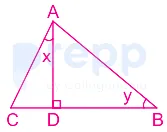
- A
16/9units
- B
13/6 units
- C
25/4 units
- D
15/7 units
Show answer
C. 25/4 unitsGiven:
AD ⊥ BC ; ∠D = 90°
AC = 26 units; CD = 10 units; BC = 42 units
∠DAC = x and ∠B = y
Formula used:
Pythagorean theorem:
H2 = P2 + B2
Cos θ = B/H ; tan θ = P/B
Where, H = hypotenuse; P = perpendicular; B = Base
Calculation:
In △DAC
⇒ AC2 = AD2 + CD2
⇒ 262 = AD2 + 102
⇒ 676 = AD2 + 100
⇒ AD = √(676 - 100) = √576 = 24 units
In △ADB
BD = (BC - CD) = (42 - 10) = 32 units
⇒ AB2 = AD2 + BD2
⇒ AB2 = 242 + 322
⇒ AB2 = 576 + 1024
⇒ AB = √1600 = 40 units
From the question:
\(\rm \frac{6}{\cos x}-\frac{5}{\cos y}+8\tan y\)
⇒ 6/(AD/AC) - 5/(BD/AB) + 8 × (AD/BD)
⇒ 6/(24/26) - 5/(32/40) + 8 × (24/32)
⇒ (6 × 26/24) - (5 × 40/32) + 8 × (24 /32 )
⇒ 6.5 - 6.25 + 6
⇒ 6.25 = 25/4 units
∴ The correct answer is 25/4 units.
Paper & answer key PDF ↗ Question 65archived
A sector of a circle of radius 10 cm is formed at 60° angle at the centre. What will be its area (take π = 3.14)?
- A
52.33 cm2
- B
75.28 cm2
- C
60.67 cm2
- D
55.00 cm2
Show answer
A. 52.33 cm2Segment of a Circle: The area enclosed by an arc and the chord connecting the endpoints of the arc. Its area can be found by subtracting the area of the triangle formed by the radii and the chord from the area of the sector. These formulas help us measure different parts and properties of circles and their divisions. Hence, the correct answer is 52.33 cm 2.
Paper & answer key PDF ↗ Question 66archived
A spherical ball of lead, 3 cm in diameter, is melted and recast into three spherical balls. The diameters of two of these balls are \(\frac{3}{2}\) cm and 2 cm, respectively. Find the diameter of the third ball.
- A
2.1 cm
- B
3.3 cm
- C
3 cm
- D
2.5 cm
Show answer
D. 2.5 cmUnderstanding the Problem: Melting and Recasting Spheres
The question describes a scenario where a single large spherical ball made of lead is melted down and then remolded into three smaller spherical balls. A key principle in such problems is the conservation of volume. When a material is melted and recast, its total volume remains unchanged, assuming no material is lost or added.
We are given the diameter of the original large ball and the diameters of two of the three smaller balls. We need to find the diameter of the third smaller ball.
Key Concept: Volume of a Sphere
The volume of a sphere is calculated using the formula:
\[ V = \frac{4}{3}\pi r^3 \]
where \(V\) is the volume and \(r\) is the radius of the sphere.
Since the diameter \(D\) is twice the radius \(r\), i.e., \(D = 2r\), the radius can be expressed as \(r = \frac{D}{2}\). Substituting this into the volume formula, we get:
\[ V = \frac{4}{3}\pi \left(\frac{D}{2}\right)^3 = \frac{4}{3}\pi \frac{D^3}{8} = \frac{\pi D^3}{6} \]
However, it's often easier to work with radii directly.
Step-by-Step Calculation
Let's denote the diameter of the original large ball as \(D\), and its radius as \(R\). The diameters of the three smaller balls are \(D_1\), \(D_2\), and \(D_3\), with corresponding radii \(r_1\), \(r_2\), and \(r_3\).
According to the problem:
Diameter of the original ball, \(D = 3\) cm.
Diameter of the first small ball, \(D_1 = \frac{3}{2}\) cm.
Diameter of the second small ball, \(D_2 = 2\) cm.
Let the diameter of the third small ball be \(D_3\).
First, calculate the radius of each ball from its diameter:
Original ball radius, \(R = \frac{D}{2} = \frac{3}{2}\) cm.
First small ball radius, \(r_1 = \frac{D_1}{2} = \frac{3/2}{2} = \frac{3}{4}\) cm.
Second small ball radius, \(r_2 = \frac{D_2}{2} = \frac{2}{2} = 1\) cm.
Third small ball radius, \(r_3 = \frac{D_3}{2}\) cm.
Next, calculate the volume of the original large ball:
\[ V = \frac{4}{3}\pi R^3 = \frac{4}{3}\pi \left(\frac{3}{2}\right)^3 = \frac{4}{3}\pi \left(\frac{27}{8}\right) = \frac{9\pi}{2} \text{ cm}^3 \]
Then, calculate the volumes of the two known smaller balls:
\[ V_1 = \frac{4}{3}\pi r_1^3 = \frac{4}{3}\pi \left(\frac{3}{4}\right)^3 = \frac{4}{3}\pi \left(\frac{27}{64}\right) = \frac{9\pi}{16} \text{ cm}^3 \]
\[ V_2 = \frac{4}{3}\pi r_2^3 = \frac{4}{3}\pi (1)^3 = \frac{4\pi}{3} \text{ cm}^3 \]
Let the volume of the third small ball be \(V_3\). According to the principle of conservation of volume:
\[ V = V_1 + V_2 + V_3 \]
Substitute the calculated volumes:
\[ \frac{9\pi}{2} = \frac{9\pi}{16} + \frac{4\pi}{3} + V_3 \]
We can divide the entire equation by \(\pi\) to simplify:
\[ \frac{9}{2} = \frac{9}{16} + \frac{4}{3} + \frac{V_3}{\pi} \]
Now, isolate the term with \(V_3\):
\[ \frac{V_3}{\pi} = \frac{9}{2} - \frac{9}{16} - \frac{4}{3} \]
Find a common denominator for the fractions (the least common multiple of 2, 16, and 3 is 48):
\[ \frac{V_3}{\pi} = \frac{9 \times 24}{2 \times 24} - \frac{9 \times 3}{16 \times 3} - \frac{4 \times 16}{3 \times 16} \]
\[ \frac{V_3}{\pi} = \frac{216}{48} - \frac{27}{48} - \frac{64}{48} \]
\[ \frac{V_3}{\pi} = \frac{216 - 27 - 64}{48} = \frac{216 - 91}{48} = \frac{125}{48} \]
So, \(V_3 = \frac{125\pi}{48}\) cm\(^3\).
Now we use the volume formula for the third ball, \(V_3 = \frac{4}{3}\pi r_3^3\), to find \(r_3\):
\[ \frac{125\pi}{48} = \frac{4}{3}\pi r_3^3 \]
Divide both sides by \(\frac{4}{3}\pi\):
\[ \frac{125\pi}{48} \times \frac{3}{4\pi} = r_3^3 \]
\[ \frac{125 \times 3}{48 \times 4} = r_3^3 \]
\[ \frac{125 \times 1}{16 \times 4} = r_3^3 \]
\[ \frac{125}{64} = r_3^3 \]
To find \(r_3\), take the cube root of both sides:
\[ r_3 = \sqrt[3]{\frac{125}{64}} = \frac{\sqrt[3]{125}}{\sqrt[3]{64}} = \frac{5}{4} \text{ cm} \]
Finally, find the diameter of the third ball, \(D_3 = 2r_3\):
\[ D_3 = 2 \times \frac{5}{4} = \frac{10}{4} = \frac{5}{2} = 2.5 \text{ cm} \]
Thus, the diameter of the third spherical ball is 2.5 cm.
Ball
Diameter (cm)
Radius (cm)
Volume (cm\(^3\))
Original
3
\(\frac{3}{2}\)
\(\frac{4}{3}\pi \left(\frac{3}{2}\right)^3 = \frac{9\pi}{2}\)
Small 1
\(\frac{3}{2}\)
\(\frac{3}{4}\)
\(\frac{4}{3}\pi \left(\frac{3}{4}\right)^3 = \frac{9\pi}{16}\)
Small 2
2
1
\(\frac{4}{3}\pi (1)^3 = \frac{4\pi}{3}\)
Small 3
\(D_3\)
\(\frac{D_3}{2}\)
\(\frac{4}{3}\pi \left(\frac{D_3}{2}\right)^3 = \frac{\pi D_3^3}{6}\)
Volume conservation: \(\frac{9\pi}{2} = \frac{9\pi}{16} + \frac{4\pi}{3} + \frac{\pi D_3^3}{6}\)
Divide by \(\pi\): \(\frac{9}{2} = \frac{9}{16} + \frac{4}{3} + \frac{D_3^3}{6}\)
Multiply by 48 (LCM of 2, 16, 3, 6):
\(48 \times \frac{9}{2} = 48 \times \frac{9}{16} + 48 \times \frac{4}{3} + 48 \times \frac{D_3^3}{6}\)
\(216 = 27 + 64 + 8D_3^3\)
\(216 = 91 + 8D_3^3\)
\(216 - 91 = 8D_3^3\)
\(125 = 8D_3^3\)
\(D_3^3 = \frac{125}{8}\)
\(D_3 = \sqrt[3]{\frac{125}{8}} = \frac{\sqrt[3]{125}}{\sqrt[3]{8}} = \frac{5}{2} = 2.5\)
So, the diameter of the third ball is 2.5 cm.
Comparing with Options
The calculated diameter of the third ball is 2.5 cm, which matches one of the given options.
Revision Table: Sphere Volume and Recasting
Concept
Description
Formula
Volume of Sphere
Amount of space a sphere occupies, depends on its radius or diameter.
\(V = \frac{4}{3}\pi r^3\) or \(V = \frac{\pi D^3}{6}\)
Melting and Recasting
Process where a solid is melted into liquid and reshaped into a new solid.
Total Volume (before) = Total Volume (after)
Diameter and Radius
Diameter is the distance across the center of a circle/sphere; radius is half the diameter.
\(D = 2r\) or \(r = \frac{D}{2}\)
Additional Information: Applications of Volume Conservation
The principle of conservation of volume is fundamental in various problems involving melting, casting, or reshaping materials. It applies whenever a material changes form but its total quantity remains constant. Here are a few examples:
Melting a cube into a sphere: The volume of the original cube equals the volume of the new sphere.
Drawing a wire from a cylinder: The volume of the original cylinder equals the volume of the resulting cylindrical wire.
Converting coins into a cuboid: The sum of the volumes of all coins equals the volume of the resulting cuboid.
Filling a container: If liquid from one container is poured into another, the volume of the liquid remains constant, changing only its shape.
In this problem, we dealt with spheres, using their volume formula and the conservation principle to find an unknown dimension.
Paper & answer key PDF ↗ Question 67archived
A part of a journey is covered in 37.5 minutes at 90 km/h and the remaining part in 14 minutes at 80 km/h. The total distance (in km} of the journey is:
- A
\(76\frac{5}{12}\)
- B
\(62\frac{11}{12}\)
- C
\(78\frac{5}{12}\)
- D
\(74\frac{11}{12}\)
Show answer
D. \(74\frac{11}{12}\)Understanding the Journey and Calculating Distance
This problem asks us to find the total distance of a journey that is completed in two separate parts. We are given the speed and time for each part. To find the total distance, we need to calculate the distance covered in each part and then add them together. The key is to make sure our units are consistent, usually using kilometers for distance and hours for time when speed is given in km/h.
Step-by-Step Distance Calculation
The journey has two distinct parts. Let's calculate the distance covered in each part separately.
Part 1: The First Part of the Journey
Time taken: 37.5 minutes
Speed: 90 km/h
First, we need to convert the time from minutes to hours, because the speed is given in km/h. There are 60 minutes in an hour.
\( \text{Time in hours} = \frac{\text{Time in minutes}}{60} \)
\( \text{Time for Part 1} = \frac{37.5}{60} \text{ hours} \)
To simplify the fraction, we can multiply the numerator and denominator by 10 to remove the decimal:
\( \frac{37.5}{60} = \frac{375}{600} \)
Now, we can simplify this fraction. Both 375 and 600 are divisible by 25:
\( 375 \div 25 = 15 \)
\( 600 \div 25 = 24 \)
So the fraction becomes \( \frac{15}{24} \). This can be further simplified by dividing both by 3:
\( 15 \div 3 = 5 \)
\( 24 \div 3 = 8 \)
So, the time taken for Part 1 is \( \frac{5}{8} \) hours.
Now, we can calculate the distance for Part 1 using the formula: Distance = Speed \( \times \) Time.
\( \text{Distance for Part 1} = 90 \text{ km/h} \times \frac{5}{8} \text{ hours} \)
\( \text{Distance for Part 1} = \frac{90 \times 5}{8} \text{ km} \)
\( \text{Distance for Part 1} = \frac{450}{8} \text{ km} \)
We can simplify this fraction by dividing both numerator and denominator by 2:
\( \frac{450}{8} = \frac{225}{4} \text{ km} \)
Part 2: The Remaining Part of the Journey
Time taken: 14 minutes
Speed: 80 km/h
Again, convert the time from minutes to hours:
\( \text{Time for Part 2} = \frac{14}{60} \text{ hours} \)
Simplify the fraction by dividing both numerator and denominator by 2:
\( \frac{14}{60} = \frac{7}{30} \text{ hours} \)
Now, calculate the distance for Part 2 using the formula: Distance = Speed \( \times \) Time.
\( \text{Distance for Part 2} = 80 \text{ km/h} \times \frac{7}{30} \text{ hours} \)
\( \text{Distance for Part 2} = \frac{80 \times 7}{30} \text{ km} \)
We can cancel out a 10 from the numerator and denominator:
\( \text{Distance for Part 2} = \frac{8 \times 7}{3} \text{ km} \)
\( \text{Distance for Part 2} = \frac{56}{3} \text{ km} \)
Calculating the Total Distance
The total distance of the journey is the sum of the distances covered in Part 1 and Part 2.
\( \text{Total Distance} = \text{Distance for Part 1} + \text{Distance for Part 2} \)
\( \text{Total Distance} = \frac{225}{4} \text{ km} + \frac{56}{3} \text{ km} \)
To add these fractions, we need a common denominator. The least common multiple of 4 and 3 is 12.
Convert \( \frac{225}{4} \) to a fraction with denominator 12:
\( \frac{225}{4} = \frac{225 \times 3}{4 \times 3} = \frac{675}{12} \)
Convert \( \frac{56}{3} \) to a fraction with denominator 12:
\( \frac{56}{3} = \frac{56 \times 4}{3 \times 4} = \frac{224}{12} \)
Now, add the fractions:
\( \text{Total Distance} = \frac{675}{12} + \frac{224}{12} \)
\( \text{Total Distance} = \frac{675 + 224}{12} \)
\( \text{Total Distance} = \frac{899}{12} \text{ km} \)
Converting the Improper Fraction to a Mixed Number
The total distance is \( \frac{899}{12} \) km. We can convert this improper fraction into a mixed number by dividing the numerator (899) by the denominator (12).
\( 899 \div 12 \)
Divide 899 by 12:
\( 899 = 12 \times 74 + 11 \)
So, 899 divided by 12 is 74 with a remainder of 11. This means \( \frac{899}{12} \) is equal to the mixed number \( 74\frac{11}{12} \).
\( \text{Total Distance} = 74\frac{11}{12} \text{ km} \)
Therefore, the total distance of the journey is \( 74\frac{11}{12} \) km.
Revision Table: Journey Calculations
Part of Journey
Time Given
Time in Hours
Speed (km/h)
Distance (km)
Part 1
37.5 minutes
\( \frac{37.5}{60} = \frac{5}{8} \)
90
\( 90 \times \frac{5}{8} = \frac{450}{8} = \frac{225}{4} \)
Part 2
14 minutes
\( \frac{14}{60} = \frac{7}{30} \)
80
\( 80 \times \frac{7}{30} = \frac{560}{30} = \frac{56}{3} \)
Total
\( \frac{225}{4} + \frac{56}{3} = \frac{675}{12} + \frac{224}{12} = \frac{899}{12} = 74\frac{11}{12} \)
Additional Information on Distance, Speed, and Time
The relationship between distance, speed, and time is fundamental in physics and everyday life. Here's a quick look at the core concepts:
Speed: This is how fast an object is moving. It is defined as the distance covered per unit of time. The standard formula is \( \text{Speed} = \frac{\text{Distance}}{\text{Time}} \). Common units include kilometers per hour (km/h), meters per second (m/s), or miles per hour (mph).
Distance: This is the total length of the path traveled by an object. It is calculated by rearranging the speed formula: \( \text{Distance} = \text{Speed} \times \text{Time} \). Units usually include kilometers (km), meters (m), or miles.
Time: This is the duration for which an object is in motion. It can be calculated as \( \text{Time} = \frac{\text{Distance}}{\text{Speed}} \). Units usually include hours (h), minutes (min), or seconds (s).
It is crucial to ensure that the units are consistent when using these formulas. If speed is in km/h, time must be in hours to get distance in km. If speed is in m/s, time must be in seconds to get distance in meters. Converting units is a common step in solving such problems.
Paper & answer key PDF ↗ Question 68archived
20 students of a college went to a hotel. 19 of them spent Rs. 175 each on their meal and the 20th student spent Rs. 19 more than the average of all the 20. Find the total money spent by them.
- A
Rs. 3,490
- B
Rs. 3,540
- C
Rs. 3,520
- D
Rs. 3,500
Show answer
C. Rs. 3,520Step 1: Let avg = A. 20A = 19·175 + (A + 19) ⇒ 19A = 3344 ⇒ A = 176.
Step 2: Total = 20·176 = ₹3520.
∴ ₹3520
Paper & answer key PDF ↗ Question 69archived
Money was lent on simple interest. After 12 years, its simple interest becomes \(\frac{3}{5}\) of the money. Find the rate of interest.
- A
4% p.a.
- B
2% p.a.
- C
5% p.a.
- D
3% p.a.
Show answer
C. 5% p.a.Calculating Simple Interest Rate
The problem asks us to find the annual rate of simple interest given the time period and the relationship between the simple interest earned and the principal amount.
We are given the following information:
Time (T) = 12 years
Simple Interest (SI) is \(\frac{3}{5}\) of the Principal (P)
We need to find the Rate of Interest (R) per annum.
Understanding the Simple Interest Formula
The formula for calculating Simple Interest is:
\(SI = \frac{P \times R \times T}{100}\)
Where:
\(SI\) is the Simple Interest
\(P\) is the Principal amount
\(R\) is the Rate of Interest per annum
\(T\) is the Time period in years
Step-by-Step Calculation of Rate of Interest
We know that \(SI = \frac{3}{5}P\). We can substitute this into the simple interest formula:
\(\frac{3}{5}P = \frac{P \times R \times T}{100}\)
Substitute the value of Time, \(T = 12\) years:
\(\frac{3}{5}P = \frac{P \times R \times 12}{100}\)
Now, we can solve for \(R\). Since \(P\) is on both sides of the equation and we assume \(P \neq 0\) (as money was lent), we can cancel \(P\) from both sides:
\(\frac{3}{5} = \frac{R \times 12}{100}\)
To isolate \(R\), multiply both sides by 100:
\(\frac{3}{5} \times 100 = R \times 12\)
Simplify the left side:
\(3 \times \frac{100}{5} = R \times 12\)
\(3 \times 20 = R \times 12\)
\(60 = 12R\)
Now, divide both sides by 12 to find \(R\):
\(R = \frac{60}{12}\)
\(R = 5\)
So, the rate of simple interest is 5% per annum.
Comparing with Options
Let's look at the given options:
4% p.a.
2% p.a.
5% p.a.
3% p.a.
Our calculated rate of 5% matches option 3.
Summary of Calculation
Given
Formula Used
Result
Time (T) = 12 years
\(SI = \frac{P \times R \times T}{100}\)
Rate (R) = 5% p.a.
\(SI = \frac{3}{5}P\)
Revision Table: Simple Interest Concepts
Key Simple Interest Terms
Term
Definition
Formula Symbol
Principal
The initial amount of money borrowed or invested.
P
Simple Interest
Interest calculated only on the principal amount.
SI
Rate of Interest
The percentage at which interest is charged or earned per period (usually per year).
R
Time
The duration for which the money is borrowed or invested.
T
Amount
The total sum of Principal and Simple Interest.
A = P + SI
Additional Information on Simple Interest vs. Compound Interest
Simple interest is a straightforward way to calculate interest. It is calculated only on the initial principal amount.
Compound interest, on the other hand, is calculated on the principal amount and also on the accumulated interest from previous periods. This means compound interest grows faster than simple interest over time, assuming the same principal, rate, and time period.
In this problem, it is clearly stated that the money was lent on "simple interest", so we correctly used the simple interest formula.
Paper & answer key PDF ↗ Question 70archived
Simplify the expression.
\(\frac{3.35^2-1.25^2}{3.35+1.25}=?\)
- A
3.10
- B
4.60
- C
4.10
- D
2.1
Show answer
D. 2.1Understanding the Expression Simplification
We are asked to simplify the mathematical expression given as: \(\frac{3.35^2-1.25^2}{3.35+1.25}\)
To simplify this fraction, we should look for patterns or identities that can be applied.
Identifying the Key Algebraic Identity
Let's look closely at the numerator of the fraction. It is in the form of a difference of two squares. The general form for the difference of squares identity is:
\(a^2 - b^2 = (a - b)(a + b)\)
In our expression, we can see that the first term being squared is \(3.35\), so \(a = 3.35\). The second term being squared is \(1.25\), so \(b = 1.25\).
Applying the Identity to the Numerator
Using the difference of squares identity, we can rewrite the numerator \(3.35^2 - 1.25^2\) as:
\(3.35^2 - 1.25^2 = (3.35 - 1.25)(3.35 + 1.25)\)
Simplifying the Fraction
Now, substitute this factored form of the numerator back into the original expression:
\(\frac{(3.35 - 1.25)(3.35 + 1.25)}{3.35+1.25}\)
We can see that the term \((3.35 + 1.25)\) appears in both the numerator and the denominator. Since \(3.35 + 1.25 = 4.60\), which is not equal to zero, we can cancel this common term out from the numerator and the denominator.
After cancelling the term \((3.35 + 1.25)\), the expression simplifies to:
\(3.35 - 1.25\)
Performing the Final Calculation
Now, we just need to perform the subtraction operation that remains:
\(3.35 - 1.25 = 2.10\)
So, the simplified value of the expression \(\frac{3.35^2-1.25^2}{3.35+1.25}\) is 2.1.
Step-by-Step Expression Simplification
Here are the steps followed to simplify the expression:
Recognize the numerator \((3.35^2 - 1.25^2)\) as a difference of squares, \(a^2 - b^2\).
Identify \(a = 3.35\) and \(b = 1.25\).
Apply the difference of squares identity: \(a^2 - b^2 = (a - b)(a + b)\). So, \(3.35^2 - 1.25^2 = (3.35 - 1.25)(3.35 + 1.25)\).
Rewrite the original expression using the factored numerator: \(\frac{(3.35 - 1.25)(3.35 + 1.25)}{3.35+1.25}\).
Cancel out the common factor \((3.35 + 1.25)\) from the numerator and the denominator.
The simplified expression becomes \(3.35 - 1.25\).
Perform the subtraction: \(3.35 - 1.25 = 2.1\).
Comparing with Given Options
The simplified value we obtained is 2.1. Let's compare this with the provided options:
Option 1: 3.10
Option 2: 4.60
Option 3: 4.10
Option 4: 2.1
Our calculated value 2.1 matches Option 4.
Revision Table: Understanding Simplification Concepts
ConceptDescriptionApplication in this Problem
Difference of Squares IdentityThe algebraic rule \(a^2 - b^2 = (a-b)(a+b)\).Used to factorize the numerator \(3.35^2 - 1.25^2\).
Fraction SimplificationDividing both the numerator and denominator by a common factor.The common factor \((3.35+1.25)\) was cancelled.
Subtraction of DecimalsSubtracting numbers with decimal points, aligning the decimal points.Used for the final calculation \(3.35 - 1.25\).
Additional Information: Why Algebraic Identities Matter
Algebraic identities are powerful tools in mathematics. They allow us to rewrite expressions in different forms that can be simpler or more convenient for calculations or further manipulation. The difference of squares is a fundamental identity frequently used in algebra and calculus.
Using identities like \(a^2 - b^2 = (a-b)(a+b)\) often helps in simplifying expressions that look complicated at first glance, especially those involving squares or higher powers.
Being able to recognize when and how to apply these identities is a key skill in solving many types of mathematical problems, including simplifying fractions with algebraic terms, solving equations, and factoring polynomials.
Paper & answer key PDF ↗ Question 71archived
The area of the sector of a circle of radius 12 cm is 32 π cm2 Find the length of the corresponding arc of the sector.
- A
\(\frac{16}{3}\) π cm
- B
\(\frac{13}{3}\) π cm
- C
\(\frac{10}{3}\)π cm
- D
\(\frac{8}{3}\)π cm
Show answer
A. \(\frac{16}{3}\) π cmFinding Arc Length from Sector Area and Radius
The question asks us to find the length of the corresponding arc of a sector, given its area and the radius of the circle. We are provided with the following information:
Radius of the circle (r) = 12 cm
Area of the sector = 32 π cm<sup>2</sup>
We need to find the length of the arc (L) associated with this sector.
Formula Relating Sector Area, Radius, and Arc Length
There is a direct formula that connects the area of a sector, the radius of the circle, and the length of the arc subtended by the sector. This formula is:
Area of Sector \( = \frac{1}{2} \times \text{radius} \times \text{arc length} \)
Using symbols, this is written as:
\( \text{Area} = \frac{1}{2} r L \)
Step-by-Step Calculation of Arc Length
Now, we can substitute the given values into this formula and solve for \(L\), the arc length.
Write down the formula:
\( \text{Area} = \frac{1}{2} r L \)
Substitute the given values: Area = \(32\pi\) cm<sup>2</sup> and r = 12 cm.
\( 32\pi = \frac{1}{2} \times 12 \times L \)
Simplify the right side of the equation:
\( 32\pi = 6 L \)
Solve for \(L\) by dividing both sides by 6:
\( L = \frac{32\pi}{6} \)
Simplify the fraction \(\frac{32}{6}\) by dividing both numerator and denominator by their greatest common divisor, which is 2:
\( L = \frac{16\pi}{3} \)
So, the length of the corresponding arc is \(\frac{16}{3}\pi\) cm.
Verification with Options
Let's compare our calculated arc length with the given options:
Option 1: \(\frac{16}{3}\pi\) cm
Option 2: \(\frac{13}{3}\pi\) cm
Option 3: \(\frac{10}{3}\pi\) cm
Option 4: \(\frac{8}{3}\pi\) cm
Our calculated value, \(\frac{16}{3}\pi\) cm, matches Option 1.
Summary of Given Information and Result
Quantity
Value
Unit
Radius (r)
12
cm
Area of Sector
\(32\pi\)
cm<sup>2</sup>
Arc Length (L)
\(\frac{16\pi}{3}\)
cm
Revision Table: Circle Sector Concepts
Key Formulas for Circle Sectors
Concept
Formula (using angle \(\theta\) in degrees)
Formula (using arc length \(L\))
Area of Sector
\( \frac{\theta}{360^\circ} \times \pi r^2 \)
\( \frac{1}{2} r L \)
Length of Arc
\( \frac{\theta}{360^\circ} \times 2 \pi r \)
N/A (This is the quantity we often solve for or use)
Additional Information: Understanding Circle Sectors and Arcs
A circle sector is like a slice of pizza or pie. It is the region bounded by two radii of a circle and the arc between the endpoints of the radii. The central angle of the sector is the angle formed by the two radii at the center of the circle.
The arc is the curved line segment along the circumference of the circle that forms part of the boundary of the sector. The length of this arc is a portion of the total circumference of the circle.
The relationship \( \text{Area} = \frac{1}{2} r L \) is useful because it directly links the area of a sector to its arc length and radius, without needing to calculate the central angle (\(\theta\)) first, which can sometimes simplify problems.
In this problem, by using the formula \( \text{Area} = \frac{1}{2} r L \), we were able to quickly find the arc length using the given area and radius.
Paper & answer key PDF ↗ Question 72archived
Which of the following statements is INCORRECT?
- A
Radius is the longest chord of a circle.
- B
The ratio of circumference of two circles is equal to the ratio of their radii.
- C
The perpendicular drawn from the center of the circle on the chord of the circle bisects the chord.
- D
Circles are congruent to each other if they have equal radii.
Show answer
A. Radius is the longest chord of a circle.Analyzing Incorrect Statement about Circle Properties
The question asks us to identify the statement that is INCORRECT among the given options concerning the properties of a circle.
Let's examine each statement carefully:
Analyzing Statement 1: Radius and Chord
Statement 1 says, "Radius is the longest chord of a circle."
A chord of a circle is a straight line segment whose endpoints both lie on the circle.
A radius of a circle is a line segment from the center of the circle to any point on the circle.
The diameter of a circle is a special type of chord that passes through the center of the circle. It is the longest possible chord in any circle. The diameter is equal to twice the radius ($D = 2r$).
Since the diameter is the longest chord and the radius is only half the diameter, the radius cannot be the longest chord. Therefore, this statement is incorrect.
Analyzing Statement 2: Circumference Ratio
Statement 2 says, "The ratio of circumference of two circles is equal to the ratio of their radii."
The formula for the circumference of a circle is $C = 2\pi r$, where $C$ is the circumference and $r$ is the radius.
Let's consider two circles with radii $r_1$ and $r_2$, and their respective circumferences $C_1$ and $C_2$.
$C_1 = 2\pi r_1$
$C_2 = 2\pi r_2$
The ratio of their circumferences is $\frac{C_1}{C_2} = \frac{2\pi r_1}{2\pi r_2}$.
Since $2\pi$ is a constant, it cancels out: $\frac{C_1}{C_2} = \frac{r_1}{r_2}$.
This shows that the ratio of the circumferences of two circles is indeed equal to the ratio of their radii. Therefore, this statement is correct.
Analyzing Statement 3: Perpendicular from Center to Chord
Statement 3 says, "The perpendicular drawn from the center of the circle on the chord of the circle bisects the chord."
This is a fundamental theorem in circle geometry.
If you draw a line segment from the center of the circle (say, point O) perpendicular to a chord (say, AB), the point where the perpendicular meets the chord (say, M) is the midpoint of the chord AB.
This means AM = MB. The chord is divided into two equal parts.
Therefore, this statement is correct.
Analyzing Statement 4: Congruent Circles
Statement 4 says, "Circles are congruent to each other if they have equal radii."
Congruent figures are figures that are identical in shape and size. They can be perfectly superimposed on each other.
For circles, the shape is always the same (a perfect round shape). The size of a circle is determined solely by its radius.
If two circles have the same radius, they are identical in size and shape. They can be placed directly on top of each other, and they will match perfectly.
Therefore, this statement is correct.
Conclusion
Based on the analysis of each statement, the only incorrect statement is the first one, which claims that the radius is the longest chord of a circle. The longest chord is the diameter.
Statement
Correctness
Reason
Radius is the longest chord of a circle.
Incorrect
The diameter is the longest chord. Radius is half the diameter.
Ratio of circumference of two circles is equal to the ratio of their radii.
Correct
$\frac{C_1}{C_2} = \frac{2\pi r_1}{2\pi r_2} = \frac{r_1}{r_2}$.
Perpendicular from center to chord bisects the chord.
Correct
This is a fundamental circle theorem.
Circles are congruent if they have equal radii.
Correct
Radius determines the size of the circle; shape is always the same.
Key Circle Concepts Revision
Let's quickly recap some essential terms related to circles:
Center: The central point from which all points on the circle are equidistant.
Radius (r): Distance from the center to any point on the circle.
Diameter (d): Distance across the circle through the center. $d = 2r$.
Chord: A line segment connecting two points on the circle.
Diameter: The longest chord, passing through the center.
Circumference (C): The distance around the circle. $C = 2\pi r = \pi d$.
Congruent Circles: Circles with equal radii.
Additional Information: Further Circle Geometry Insights
Beyond these basic properties, circle geometry involves many other interesting concepts and theorems, such as:
Area of a Circle: The space enclosed by the circle, given by $A = \pi r^2$.
Arc: A portion of the circumference of a circle.
Sector: The region bounded by two radii and the intercepted arc. Think of it like a slice of pizza.
Segment: The region bounded by a chord and the arc it subtends.
Tangent: A line that touches the circle at exactly one point. The radius drawn to the point of tangency is perpendicular to the tangent.
Secant: A line that intersects the circle at two points.
Inscribed Angle Theorem: The measure of an inscribed angle is half the measure of its intercepted arc.
Understanding these concepts helps build a strong foundation in geometry.
Paper & answer key PDF ↗ Question 73archived
A can complete a work in 18 days, while B can complete it in 12 days. B worked on it for 4 days. How long will A take to finish the remaining work?
- A
16 days
- B
12 days
- C
14 days
- D
10 days
Show answer
B. 12 daysUnderstanding the Work and Time Problem
This problem involves calculating the time taken by individuals to complete a certain amount of work. We are given the time A and B take to complete the entire work individually and the duration B worked. We need to find out how long A will take to finish the remaining portion of the work.
Calculating Individual Work Rates
First, let's determine the amount of work A and B can complete in one day. This is called their daily work rate.
A can complete the work in 18 days. So, A's daily work rate is the reciprocal of the total time taken by A.
A's daily work rate $= \frac{1}{\text{Time taken by A}} = \frac{1}{18}$ of the work per day.
B can complete the work in 12 days. So, B's daily work rate is the reciprocal of the total time taken by B.
B's daily work rate $= \frac{1}{\text{Time taken by B}} = \frac{1}{12}$ of the work per day.
Work Done by B in 4 Days
B worked on the project for 4 days. To find the amount of work B completed, we multiply B's daily work rate by the number of days B worked.
Work done by B in 4 days = B's daily work rate $\times$ Number of days B worked
Work done by B $= \frac{1}{12} \times 4 = \frac{4}{12} = \frac{1}{3}$ of the total work.
Calculating the Remaining Work
The total work is considered as 1 whole unit. After B completed $\frac{1}{3}$ of the work, the remaining work is the total work minus the work done by B.
Remaining work = Total work - Work done by B
Remaining work $= 1 - \frac{1}{3} = \frac{3}{3} - \frac{1}{3} = \frac{3-1}{3} = \frac{2}{3}$ of the total work.
Time Taken by A to Finish Remaining Work
Now, A needs to complete the remaining $\frac{2}{3}$ of the work. We know A's daily work rate is $\frac{1}{18}$. To find the time A will take, we divide the remaining work by A's daily work rate.
Time taken by A = $\frac{\text{Remaining work}}{\text{A's daily work rate}}$
Time taken by A $= \frac{\frac{2}{3}}{\frac{1}{18}}$ days
Time taken by A $= \frac{2}{3} \times \frac{18}{1} = \frac{2 \times 18}{3 \times 1} = \frac{36}{3}$ days
Time taken by A $= 12$ days.
Therefore, A will take 12 days to finish the remaining work.
Summary of Calculations
Task
Calculation
Result
A's Daily Rate
$1/18$
$1/18$
B's Daily Rate
$1/12$
$1/12$
Work Done by B (4 days)
$(1/12) \times 4$
$1/3$
Remaining Work
$1 - 1/3$
$2/3$
Time A Takes for Remaining Work
$(2/3) / (1/18)$
12 days
Final Answer
A will take 12 days to finish the remaining work.
Revision Table: Work and Time Concepts
Concept
Explanation
Formula
Work Rate
Amount of work done per unit of time (e.g., per day).
Work Rate $= \frac{\text{Total Work}}{\text{Time Taken}}$
Total Work
Usually considered as 1 unit or the LCM of individual times.
$-$
Time Taken
Total time needed to complete the work.
Time Taken $= \frac{\text{Total Work}}{\text{Work Rate}}$
Work Done in 'n' days
Work rate multiplied by the number of days worked.
Work Done $= \text{Work Rate} \times \text{Number of Days}$
Remaining Work
The portion of work left after some work is completed.
Remaining Work $= \text{Total Work} - \text{Work Done}$
Additional Information: Efficiency and Work
Efficiency is inversely proportional to the time taken to complete a work. If a person is more efficient, they take less time to finish the same amount of work. In this problem, B is more efficient than A because B takes 12 days while A takes 18 days to complete the same work.
When multiple people work together, their individual work rates are added up to find the combined work rate per day. For example, if A and B worked together, their combined daily work rate would be $\frac{1}{18} + \frac{1}{12}$.
Understanding these basic principles of work and time problems helps in solving various scenarios involving multiple individuals working for different durations or together.
Paper & answer key PDF ↗ Question 74archived
Racer A and racer B run a race of 18 km on a circular track of length 800 m. Both complete one round in 200 sec and 250 sec, respectively. After how much time from the start will the faster person meet the slower person for the last time?
- A
2700 sec
- B
4000 sec
- C
2250 sec
- D
1800 sec
Show answer
B. 4000 secAnalyzing Racer Meeting Times on a Circular Track
This problem involves two racers, A and B, running on a circular track. We need to find out when the faster racer meets the slower racer for the last time during a race of a specific total distance.
Understanding the Problem Parameters
Total race distance = 18 km = 18000 m
Length of the circular track = 800 m
Time taken by Racer A for one round = 200 sec
Time taken by Racer B for one round = 250 sec
Identifying the Faster Racer and Speeds
The racer who takes less time to complete one round is the faster one. In this case, Racer A takes 200 sec per round, which is less than Racer B's 250 sec per round. So, Racer A is the faster person.
Let's calculate their speeds:
Speed of Racer A ($v_A$) = $\frac{\text{Distance}}{\text{Time}} = \frac{800 \text{ m}}{200 \text{ sec}} = 4 \text{ m/s}$
Speed of Racer B ($v_B$) = $\frac{\text{Distance}}{\text{Time}} = \frac{800 \text{ m}}{250 \text{ sec}} = 3.2 \text{ m/s}$
Calculating Race Duration for Each Racer
The total race distance is 18000 m. Let's find out how long each racer takes to complete the race:
Time taken by Racer A to finish the race = $\frac{\text{Total distance}}{\text{Speed of A}} = \frac{18000 \text{ m}}{4 \text{ m/s}} = 4500 \text{ sec}$
Time taken by Racer B to finish the race = $\frac{\text{Total distance}}{\text{Speed of B}} = \frac{18000 \text{ m}}{3.2 \text{ m/s}} = 5625 \text{ sec}$
A meeting can only occur when both racers are still running the race. Racer A finishes at 4500 sec, and Racer B finishes at 5625 sec. Therefore, any meeting must happen at a time less than or equal to 4500 sec, as Racer A is off the track after that time.
Determining Meeting Times on a Circular Track
When racers move in the same direction on a circular track, they meet when the faster racer gains a full lap (one track length) on the slower racer. The relative speed is the difference between their speeds.
Relative speed ($v_{rel}$) = $v_A - v_B = 4 \text{ m/s} - 3.2 \text{ m/s} = 0.8 \text{ m/s}$
The time it takes for the faster racer to gain one lap on the slower racer is the time between consecutive meetings:
Time between meetings = $\frac{\text{Track length}}{\text{Relative speed}} = \frac{800 \text{ m}}{0.8 \text{ m/s}} = 1000 \text{ sec}$
This means they meet every 1000 seconds after the start. The meeting times will be multiples of 1000 seconds: 1000 sec, 2000 sec, 3000 sec, 4000 sec, and so on.
Finding the Last Meeting Time
We found that meetings occur at times $t = 1000k$, where $k$ is a positive integer. We also know that meetings can only happen up to 4500 seconds (when the faster racer, A, finishes the race).
Let's list the possible meeting times and check if they are within the race duration (up to 4500 sec):
Meeting 1: $1000 \times 1 = 1000$ sec (Both are on the track)
Meeting 2: $1000 \times 2 = 2000$ sec (Both are on the track)
Meeting 3: $1000 \times 3 = 3000$ sec (Both are on the track)
Meeting 4: $1000 \times 4 = 4000$ sec (Both are on the track)
Meeting 5: $1000 \times 5 = 5000$ sec (Racer A has finished at 4500 sec, so no meeting occurs)
The meeting times within the race duration are 1000 sec, 2000 sec, 3000 sec, and 4000 sec. The last time they meet is the largest value in this list.
The last meeting time from the start will be 4000 seconds.
Verification at 4000 seconds
At $t = 4000$ sec:
Distance covered by Racer A = $4 \text{ m/s} \times 4000 \text{ sec} = 16000 \text{ m}$
Distance covered by Racer B = $3.2 \text{ m/s} \times 4000 \text{ sec} = 12800 \text{ m}$
Both 16000 m and 12800 m are less than the total race distance of 18000 m, so both racers are still actively participating in the race at 4000 seconds. They have met at this point.
Summary of Meeting Times
Meeting Number
Time (sec)
Racer A Distance (m)
Racer B Distance (m)
Are both racing?
1st
1000
4000
3200
Yes
2nd
2000
8000
6400
Yes
3rd
3000
12000
9600
Yes
4th
4000
16000
12800
Yes
5th
5000
20000 (>18000)
16000
No (Racer A finished)
As the table shows, the last time both racers are on the track and meet is at 4000 seconds.
Revision Table: Circular Race Concepts
Concept
Explanation
Formula/Calculation
Relative Speed (same direction)
Difference in speeds of two objects moving in the same direction.
$v_{rel} = v_1 - v_2$ (where $v_1 > v_2$)
Time to Meet (circular track, same direction)
Time taken for the faster object to gain one lap on the slower object.
Time = $\frac{\text{Track Length}}{\text{Relative Speed}}$
Meeting Times
Occur at multiples of the time taken to gain one lap.
$t_k = k \times \text{(Time between meetings)}$
Race Duration Limit
Meetings can only occur while both participants are still actively racing.
Bounded by the minimum time either participant takes to finish the race distance.
Additional Information: Meeting at the Starting Point
Sometimes questions ask for meetings specifically at the starting point. This happens when both racers have completed an integer number of rounds and are back at the start simultaneously. The time for this is the Least Common Multiple (LCM) of their individual round times.
Racer A round time: 200 sec
Racer B round time: 250 sec
LCM(200, 250)
200 = $2^3 \times 5^2$
250 = $2 \times 5^3$
LCM(200, 250) = $2^3 \times 5^3 = 8 \times 125 = 1000$ sec
In this specific problem, the time between *any* two consecutive meetings on the track (1000 sec) happens to be the same as the time between meetings *at the starting point* (LCM of round times). This is not always the case; sometimes, they meet at other points on the track in between meetings at the start.
However, the question asks for the last meeting time *from the start*, meaning any meeting point on the track, not just the starting point. The principle of relative speed gaining a lap correctly gives the time between any two consecutive meetings.
Paper & answer key PDF ↗ Question 75archived
What is the value of (27x3 - 58x2y + 31xy2 - 8y3), when x = -5 and y = -7?
- A
1924
- B
-1924
- C
-1926
- D
1926
Show answer
A. 1924Evaluating the Polynomial Expression for Given Values
This solution details the process of finding the value of a given algebraic polynomial by substituting specific numerical values for the variables involved. We will evaluate the expression step-by-step to ensure accuracy.
The problem requires us to find the value of the polynomial expression:
$27x^3 - 58x^2y + 31xy^2 - 8y^3$
when the variables are assigned the values x = -5 and y = -7.
Step-by-Step Calculation Process
To solve this, we will substitute the given values of x and y into the polynomial and compute the result.
1. Substituting Values into the Expression
First, we replace every occurrence of x with -5 and y with -7 in the given expression:
Let the polynomial be $P(x, y) = 27x^3 - 58x^2y + 31xy^2 - 8y^3$.
Substituting the values, we get:
$P(-5, -7) = 27(-5)^3 - 58(-5)^2(-7) + 31(-5)(-7)^2 - 8(-7)^3$
2. Calculating Powers of Variables
Before evaluating the terms, it's helpful to calculate the powers of x and y needed:
$x^2 = (-5)^2 = (-5) \times (-5) = 25$
$x^3 = (-5)^3 = (-5) \times (-5) \times (-5) = 25 \times (-5) = -125$
$y^2 = (-7)^2 = (-7) \times (-7) = 49$
$y^3 = (-7)^3 = (-7) \times (-7) \times (-7) = 49 \times (-7) = -343$
3. Evaluating Each Term of the Polynomial
Now, we calculate the value of each individual term using the results from the previous step:
Term in Expression
Calculation Steps
Resulting Value
$27x^3$
$27 \times x^3 = 27 \times (-125)$
$-3375$
$-58x^2y$
$-58 \times x^2 \times y = -58 \times (25) \times (-7)$
$10150$
$31xy^2$
$31 \times x \times y^2 = 31 \times (-5) \times (49)$
$-7595$
$-8y^3$
$-8 \times y^3 = -8 \times (-343)$
$2744$
4. Summing the Calculated Term Values
The final step is to add the values of all the terms calculated above:
Total Value $= (-3375) + (10150) + (-7595) + (2744)$
To make the addition easier, we can group the positive numbers and the negative numbers:
Sum of positive terms $= 10150 + 2744 = 12894$
Sum of negative terms $= -3375 - 7595 = -(3375 + 7595) = -10970$
Now, combine these sums:
Total Value $= 12894 + (-10970) = 12894 - 10970$
Total Value $= 1924$
Final Answer Verification
After performing the substitution and calculations carefully, the value obtained for the expression $27x^3 - 58x^2y + 31xy^2 - 8y^3$ with $x = -5$ and $y = -7$ is 1924.
Paper & answer key PDF ↗ Question 76archived
Select the most appropriate meaning of the given idiom.
Back against the wall
- A
Be in an easy situation from where escape is difficult
- B
Be in a difficult situation from where escape is difficult
- C
Be in a relationship which one wants to escape
- D
Be in a difficult situation from where escape is easy
Show answer
B. Be in a difficult situation from where escape is difficultUnderstanding the Idiom: Back Against the Wall
The idiom "Back against the wall" is commonly used in English to describe a challenging situation. Let's break down its meaning and analyze the given options.
Literally, if your back is against a wall, you are cornered. You have limited space to move backward, making it difficult to avoid something or escape a confrontation. This literal image translates directly into the figurative meaning of the idiom.
What "Back Against the Wall" Means
When someone has their "back against the wall," it means they are in a difficult or desperate situation with very few options left. They are under pressure, and it is hard for them to get out of the predicament. This situation often requires a direct confrontation or a last-ditch effort because there is no easy way to retreat or avoid the issue.
Let's evaluate the provided options based on this understanding:
Option 1: Be in an easy situation from where escape is difficult. This is incorrect because the idiom describes a difficult, not easy, situation.
Option 2: Be in a difficult situation from where escape is difficult. This aligns perfectly with the meaning of being cornered and having few options to retreat or escape.
Option 3: Be in a relationship which one wants to escape. This is too specific. While being in an unwanted relationship can be a difficult situation, the idiom "back against the wall" applies to any general difficult situation with limited escape routes, not just relationships.
Option 4: Be in a difficult situation from where escape is easy. This is incorrect. The core idea of having your "back against the wall" is that escape is difficult, not easy.
Conclusion on the Idiom's Meaning
Based on the analysis, the most appropriate meaning of "Back against the wall" is being in a difficult situation from where escape is difficult.
Revision Table: Idiom Analysis
Idiom
Literal Image
Figurative Meaning
Back against the wall
Being cornered with no room to move backward.
Being in a difficult or desperate situation with limited options for escape or retreat.
Additional Information: Using Idioms Effectively
Idioms are phrases whose meaning cannot be deduced simply from the individual words. Learning idioms like "Back against the wall" is crucial for improving English comprehension and expression. They add color and depth to language. Other similar idioms suggesting difficulty or being cornered include "in a tight spot," "up a creek without a paddle," or "between a rock and a hard place."
Paper & answer key PDF ↗ Question 77archived
Select the most appropriate ANTONYM of the underlined word.
His house was filthywith papers and eatables strewn everywhere.
- A
Dignified
- B
Integral
- C
Barren
- D
Clean
Show answer
D. CleanFinding the Antonym of Filthy
The question asks for the most appropriate antonym of the underlined word "filthy" in the sentence, "His house was filthy with papers and eatables strewn everywhere."
Let's first understand the meaning of the word "filthy" in this context. The sentence describes a house that is full of strewn papers and eatables, suggesting a state of being very dirty and unclean.
Now, let's examine the given options to find the word that means the opposite of "filthy".
Analysing the Options for Filthy's Antonym
Dignified: This means having or showing a composed or serious manner that is worthy of respect. It relates to character or appearance in a formal sense, not directly to cleanliness.
Integral: This means necessary to make a whole complete; fundamental or essential. It relates to parts of a whole, not cleanliness.
Barren: This means (of land) poor, unproductive, or unable to support vegetation. It can also mean empty or lacking interest. While 'empty' might contrast with 'strewn everywhere', 'barren' primarily describes land productivity or emptiness, not the opposite of being dirty.
Clean: This means free from dirt, marks, or stains. This is the direct opposite of being dirty or filthy.
Comparing the meaning of "filthy" (very dirty) with the meanings of the options, the word that stands in direct opposition is "Clean". A clean house is free from dirt, unlike a filthy house.
Conclusion: The Opposite of Filthy
Based on the analysis of the word "filthy" and the meanings of the options, the most appropriate antonym for "filthy" is "Clean".
Word
Meaning
Relation to Filthy
Filthy
Very dirty and unpleasant
Word in question
Dignified
Respectable, serious
Not an antonym
Integral
Essential, fundamental
Not an antonym
Barren
Unproductive, empty
Not the primary antonym for 'dirty'
Clean
Free from dirt, marks, or stains
Direct antonym
Revision Table: Antonyms of Filthy
Understanding antonyms is crucial for vocabulary building. Here's a quick look at the word and its opposite.
Word
Antonym
Filthy
Clean
Additional Information: Understanding Antonyms
Antonyms are words that have opposite meanings. They are important for expressing contrasts and enhancing vocabulary. For example:
Hot vs. Cold
Happy vs. Sad
Big vs. Small
Finding the correct antonym often depends on the specific context in which the word is used. In this case, "filthy" clearly relates to cleanliness, making "Clean" the most appropriate opposite.
Paper & answer key PDF ↗ Question 78archived
Select the option that expresses the given sentence in passive voice.
She is laughing at me.
- A
I am being laughed at by her.
- B
I have been laughed by her.
- C
I was being laughed at by her.
- D
I had been laughed by her.
Show answer
A. I am being laughed at by her.Converting Active Voice to Passive Voice
The given sentence is "She is laughing at me."
This sentence is in the Active Voice, specifically in the Present Continuous tense.
The structure of a sentence in the Present Continuous Active Voice is:
Subject + is/am/are + Verb(-ing) + Object
In the given sentence:
Subject: She
Verb phrase: is laughing at
Object: me
Note that the verb 'laugh' is often followed by the preposition 'at' when it takes an object. This 'at' must be kept with the verb in the passive voice.
Rules for Converting Present Continuous Active to Passive Voice
To change a sentence from Active Voice (Present Continuous) to Passive Voice, we follow these steps:
The object of the active sentence becomes the subject of the passive sentence.
Use the correct form of the verb 'to be' in the Present Continuous tense (is/am/are + being) according to the new subject.
Use the past participle (V3) of the main verb.
The subject of the active sentence becomes the object of the passive sentence, usually preceded by 'by'.
Keep any prepositions that are part of the verb phrase.
Applying the Rules to "She is laughing at me."
The object is "me". It becomes the subject "I" in the passive voice.
The new subject is "I", so we use "am being" (form of 'to be' + being).
The main verb is "laughing". The past participle of "laugh" is "laughed".
The original subject is "She". It becomes "by her" in the passive voice.
The preposition "at" associated with "laughing" is kept.
Putting it all together:
I + am being + laughed + at + by her.
The passive sentence is: "I am being laughed at by her."
Analyzing the Options
Let's examine the given options based on our derivation:
Option 1: I am being laughed at by her.
This sentence matches the structure and tense of the Present Continuous Passive Voice derived above. It correctly uses "am being", the past participle "laughed", keeps the preposition "at", and uses "by her".
Option 2: I have been laughed by her.
This is in the Present Perfect Passive tense ("have been laughed"), which is incorrect for a Present Continuous active sentence. It also incorrectly omits the preposition "at".
Option 3: I was being laughed at by her.
This is in the Past Continuous Passive tense ("was being laughed"), which is incorrect for a Present Continuous active sentence.
Option 4: I had been laughed by her.
This is in the Past Perfect Passive tense ("had been laughed"), which is incorrect for a Present Continuous active sentence. It also incorrectly omits the preposition "at".
Based on the analysis, only Option 1 correctly transforms the active sentence "She is laughing at me" into the passive voice while maintaining the correct tense (Present Continuous) and including the necessary preposition "at".
Active Voice
Passive Voice
She is laughing at me.
I am being laughed at by her.
Revision Table: Active and Passive Voice Transformations (Key Tenses)
Tense
Active Voice Structure
Passive Voice Structure
Example (Active > Passive)
Simple Present
Subject + V1(s/es) + Object
Object + is/am/are + V3 + by + Subject
She writes a letter. > A letter is written by her.
Present Continuous
Subject + is/am/are + V-ing + Object
Object + is/am/are + being + V3 + by + Subject
She is writing a letter. > A letter is being written by her.
Present Perfect
Subject + has/have + V3 + Object
Object + has/have + been + V3 + by + Subject
She has written a letter. > A letter has been written by her.
Simple Past
Subject + V2 + Object
Object + was/were + V3 + by + Subject
She wrote a letter. > A letter was written by her.
Past Continuous
Subject + was/were + V-ing + Object
Object + was/were + being + V3 + by + Subject
She was writing a letter. > A letter was being written by her.
Past Perfect
Subject + had + V3 + Object
Object + had + been + V3 + by + Subject
She had written a letter. > A letter had been written by her.
Simple Future
Subject + will/shall + V1 + Object
Object + will/shall + be + V3 + by + Subject
She will write a letter. > A letter will be written by her.
Additional Information on Voice Change and Phrasal Verbs
Some verbs in English are followed by specific prepositions to complete their meaning when they take an object. These are sometimes called phrasal verbs or simply verbs followed by prepositions. When such a verb is changed to passive voice, the preposition must stay with the verb.
For example:
Active: They look after the child.
Passive: The child is looked after by them. (The preposition 'after' stays with 'looked')
Active: Everyone spoke about the accident.
Passive: The accident was spoken about by everyone. (The preposition 'about' stays with 'spoken')
In our sentence, "laugh at" is similar. The action is "laughing" and it is directed "at me". Therefore, the "at" is part of the effective verb phrase interacting with the object and must be included in the passive voice construction.
Paper & answer key PDF ↗ Question 79archived
Select the most appropriate ANTONYM of the underlined word.
He was uncomfortable at the sport event.
- A
Easeful
- B
Difficult
- C
Awkward
- D
Troublesome
Show answer
A. EasefulUnderstanding Antonyms and the Word Uncomfortable
The question asks for the most appropriate antonym of the word "uncomfortable". An antonym is a word that means the opposite of another word.
Defining Uncomfortable
The word uncomfortable means feeling uneasy, awkward, or not at ease physically or mentally. When someone is uncomfortable at a sport event, they might feel awkward, restless, or simply not relaxed in that situation.
Analyzing the Options for the Antonym of Uncomfortable
Let's look at each option provided and determine its relationship to the word "uncomfortable":
Easeful: This word means providing ease, comfortable, or relaxed. If someone is "easeful", they are feeling comfortable and relaxed. This seems like a direct opposite of feeling "uncomfortable".
Difficult: This word means hard to do, understand, or deal with. While an uncomfortable situation might be difficult, the word "difficult" itself describes the level of challenge, not the feeling of unease or lack of comfort.
Awkward: This word means causing or feeling uneasy, clumsy, or uncomfortable. "Awkward" is very similar in meaning to "uncomfortable". In fact, it is often used as a synonym for uncomfortable, especially in social situations. Therefore, it cannot be the antonym.
Troublesome: This word means causing difficulty or annoyance. Similar to "difficult", "troublesome" relates to problems or annoyance rather than the specific feeling of physical or mental discomfort or unease that "uncomfortable" describes.
Identifying the Correct Antonym
We are looking for the word that is most opposite in meaning to "uncomfortable". Based on our analysis:
Uncomfortable = not at ease, uneasy, awkward.
Easeful = at ease, comfortable, relaxed.
Therefore, "Easeful" is the most appropriate antonym for "uncomfortable".
Conclusion on Antonym of Uncomfortable
Comparing the meanings of the options, "Easeful" is the word that represents the state of being comfortable and at ease, which is the opposite of being uncomfortable. Thus, the most appropriate antonym of "uncomfortable" is "Easeful".
Word
Meaning
Relationship to "Uncomfortable"
Uncomfortable
Not at ease, uneasy, awkward
Base word
Easeful
Providing ease, comfortable, relaxed
Antonym
Difficult
Hard to do or understand
Not a direct antonym
Awkward
Causing or feeling uneasy, uncomfortable
Synonym
Troublesome
Causing difficulty or annoyance
Not a direct antonym
Revision Table: Antonyms and Synonyms
Understanding antonyms and synonyms is crucial for vocabulary building. Here is a quick recap.
Antonym: A word opposite in meaning to another word (e.g., hot and cold, happy and sad, uncomfortable and easeful).
Synonym: A word similar in meaning to another word (e.g., happy and joyful, big and large, uncomfortable and awkward).
Additional Information: Context Matters
The best antonym can sometimes depend on the specific context. However, in the general context of feeling uneasy or not at ease, "Easeful" or "Comfortable" are the standard antonyms for "Uncomfortable". While "difficult" or "troublesome" might describe situations that make one uncomfortable, they don't directly mean the opposite of the *feeling* of being uncomfortable.
Paper & answer key PDF ↗ Question 80archived
Select the option that expresses the given sentence in past tense form.
The declarations which come out from that office are not dependable.
- A
The declarations which will come out from that office may not be dependable.
- B
The declarations which come out from that office were not dependable.
- C
The declarations which came out from that office are not dependable.
- D
The declarations which came out from that office were not dependable.
Show answer
D. The declarations which came out from that office were not dependable.Converting Sentences to Past Tense Form
The question asks us to convert the given sentence, "The declarations which come out from that office are not dependable," into its past tense form. To do this, we need to identify the verbs in the sentence and change them to their past tense equivalents.
The sentence has two main parts involving verbs:
The relative clause modifying "declarations": "which come out from that office"
The main predicate: "are not dependable"
To transform the entire sentence into the past tense, both verbs must be in the past tense.
The past tense of "come out" is "came out".
The past tense of "are" is "were".
So, the past tense form of the sentence should be: "The declarations which came out from that office were not dependable."
Analyzing the Options for Past Tense Conversion
Let's examine each option provided to see which one correctly reflects the past tense form:
Option 1: "The declarations which will come out from that office may not be dependable."
This option uses "will come out" (future tense) and "may not be" (modal verb). It is not in the past tense.
Option 2: "The declarations which come out from that office were not dependable."
This option uses "come out" (present tense) and "were not dependable" (past tense). Only the main verb is in the past tense, but the verb in the relative clause is still present tense. It is not fully in the past tense.
Option 3: "The declarations which came out from that office are not dependable."
This option uses "came out" (past tense) and "are not dependable" (present tense). Only the verb in the relative clause is in the past tense, but the main verb is still present tense. It is not fully in the past tense.
Option 4: "The declarations which came out from that office were not dependable."
This option uses "came out" (past tense) and "were not dependable" (past tense). Both verbs are correctly in the past tense. This sentence structure accurately represents the past tense form of the original sentence.
Based on the analysis, only Option 4 correctly changes both relevant verbs to their past tense forms.
Identifying the Correct Past Tense Sentence
The original sentence is:
"The declarations which come out from that office are not dependable."
Converting the present tense verbs ('come out' and 'are') to past tense ('came out' and 'were') gives us:
Past Tense Sentence:
"The declarations which came out from that office were not dependable."
This matches Option 4 exactly.
Original Sentence Part
Verb Tense
Past Tense Equivalent
which come out...
Present
which came out...
...are not dependable.
Present
...were not dependable.
Revision Table: Verb Tenses in Sentences
Original Sentence
Option
Relative Clause Verb
Main Verb
Overall Tense
The declarations which come out from that office are not dependable.
Original
come out (Present)
are (Present)
Present
Option 1
will come out (Future)
may not be (Modal)
Future/Modal
Option 2
come out (Present)
were (Past)
Mixed
Option 3
came out (Past)
are (Present)
Mixed
Option 4
came out (Past)
were (Past)
Past
Additional Information: Understanding Past Tense
The past tense is used to describe actions or states that happened at a specific point in time before the present. In English, the simple past tense is often formed by adding -ed to the base form of regular verbs (e.g., walk > walked, play > played). However, many verbs, like "come" and "be," are irregular and have unique past tense forms ("come" > "came", "is/am/are" > "was/were").
When converting complex sentences, such as those with relative clauses, to the past tense, it's crucial to change the tense of all verbs that indicate the time of the action or state. In the given sentence, both "come out" (describing the origin of the declarations) and "are" (describing their dependability) needed to be shifted to the past to accurately reflect that the entire situation occurred in the past.
Paper & answer key PDF ↗ Question 81archived
Select the most appropriate option that can substitute the underlined segment in the given sentence.
The management Is not beware of this fact.
- A
aware of
- B
awaking to
- C
beware to
- D
watchful with
Show answer
A. aware ofUnderstanding Verb Usage: Substituting 'Is not beware of' Correctly
The question asks to select the most appropriate option to substitute the underlined segment "Is not beware of" in the sentence: "The management Is not beware of this fact."
Let's analyze the underlined phrase and the provided options.
Analyzing the Original Sentence and Error
The phrase "beware of" is typically used as a verb, often in imperative sentences or with modal verbs like 'should' or 'must', meaning 'be careful or cautious about'. For example:
"Beware of dogs." (Imperative)
"You should beware of fraudulent schemes." (With modal verb)
Using "Is not beware of" after the subject "The management" and the linking verb "Is not" is grammatically incorrect in standard English. We need a structure that fits after "Is not" and conveys the meaning of not knowing or not being conscious of the fact.
Evaluating the Options for Substitution
Let's examine each option provided to find the best fit for substituting "Is not beware of":
aware of: The phrase "aware of" means having knowledge or perception of a situation or fact. It is commonly used with the verb 'to be' (is, am, are, was, were). For example, "She is aware of the problem." This fits perfectly with "Is not" to form "Is not aware of", meaning the management does not know the fact.
awaking to: "Awaking to" means becoming conscious or realizing something, often gradually. While related to consciousness, it typically implies a process of realization rather than a state of knowing. Also, "Is not awaking to" sounds a bit awkward in this context, suggesting a failure to start realizing, rather than simply not knowing a fact.
beware to: As discussed earlier, "beware" is usually followed by "of" or used alone in imperatives. "Beware to" is grammatically incorrect and not a standard English phrase.
watchful with: "Watchful" means keeping careful watch. "Watchful with" is not a standard idiom. While one might be "watchful of" something (meaning vigilant about potential danger) or "watchful for" something (meaning looking out for it), being "watchful with" a fact doesn't make sense in this context. The sentence is about knowledge, not vigilance.
Based on the grammatical correctness and the meaning conveyed, "aware of" is the most appropriate substitution for "Is not beware of". The corrected sentence "The management Is not aware of this fact" clearly means the management does not know this fact.
Conclusion
The correct option that grammatically and logically substitutes "Is not beware of" is "aware of".
The final sentence reads: "The management Is not aware of this fact."
Substitution Options Analysis
Option
Phrase
Analysis
Appropriateness
1
aware of
Correct usage with 'is not'; means not knowing.
Most Appropriate
2
awaking to
Implies a process of realizing; grammatically awkward with 'is not' in this context.
Inappropriate
3
beware to
Grammatically incorrect phrase.
Inappropriate
4
watchful with
Not a standard idiom; relates to vigilance, not knowledge of a fact.
Inappropriate
Revision Table: Correcting Verb Usage
Original Phrase
Correct Substitution
Reasoning
Is not beware of
Is not aware of
"Beware of" is typically used in imperatives or with modals; "aware of" is used with 'to be' to indicate knowledge or lack thereof.
Additional Information: Aware vs. Beware
Let's look closer at the difference between "aware of" and "beware of".
Aware of: This is an adjective phrase used with the verb 'to be' (am, is, are, was, were). It means having knowledge, understanding, or perception of something.
Example: "She is aware of the risks involved." (She knows the risks).
Example: "I wasn't aware of your arrival." (I didn't know you had arrived).
Beware of: This is a verb phrase often used in warnings or instructions. It means to be cautious or careful about something or someone that might be dangerous or cause problems.
Example: "Beware of pickpockets in crowded areas." (Be cautious about pickpockets).
Example: "You must beware of trusting strangers." (You must be careful not to trust strangers easily).
The key difference is that "aware of" describes a state of knowing, while "beware of" is an action of being cautious.
Paper & answer key PDF ↗ Question 82archived
Select the INCORRECTLY spelt word.
- A
Reasonable
- B
Laughable
- C
Blessed
- D
Prophane
Show answer
D. ProphaneIdentify the Incorrectly Spelt Word
The question asks us to find the word that is spelt incorrectly from the given options. To do this, we need to examine the spelling of each word provided.
Checking the Spelling of Each Word
Let's look at each word carefully:
Reasonable: This word means 'having sound judgment; fair and sensible'. The spelling 'Reasonable' is correct.
Laughable: This word means 'such as to arouse laughter; ridiculous'. The spelling 'Laughable' is correct.
Blessed: This word means 'made holy; consecrated' or 'fortunate'. The spelling 'Blessed' is correct.
Prophane: This word is intended to mean 'relating or devoted to that which is not sacred or biblical; secular rather than religious' or 'treating sacred things with disrespect'. Let's consider its common spelling.
Identifying the Spelling Error
Upon checking standard English dictionaries, the correct spelling for the word meaning 'not sacred' or 'treating sacred things with disrespect' is 'Profane', not 'Prophane'. The letter 'h' is absent in the correct spelling.
Therefore, the word 'Prophane' is incorrectly spelt.
Word
Spelling Status
Correct Spelling (if applicable)
Reasonable
Correct
N/A
Laughable
Correct
N/A
Blessed
Correct
N/A
Prophane
Incorrect
Profane
The word with the incorrect spelling is 'Prophane'.
Revision Table: Common Spelling Checks
Given Word
Is it Correct?
Notes
Reasonable
Yes
Common adjective
Laughable
Yes
Adjective derived from 'laugh'
Blessed
Yes
Past tense/adjective from 'bless'
Prophane
No
Should be 'Profane'
Additional Information on English Spelling
Spelling in English can be tricky due to its history and influences from various languages. Here are some tips to improve your spelling:
Learn Common Patterns: Many words follow rules, like adding '-able' or '-ible', or doubling consonants.
Identify Silent Letters: Be aware of letters that are written but not pronounced, like the 'h' in 'ghost' or the 'k' in 'know'. In our example, the 'h' in 'profane' is a common point of error for some.
Practice Regularly: Reading and writing frequently helps reinforce correct spellings.
Use a Dictionary: When in doubt, always look up the word's spelling and meaning.
Break Down Words: For longer words, breaking them into syllables can help remember the sequence of letters.
Understanding the correct spelling of words like 'reasonable', 'laughable', 'blessed', and 'profane' is essential for clear written communication.
Paper & answer key PDF ↗ Question 83archived
Select the option that can be used as a one-word substitute for the given group of words.
A detailed description of a series of real or fictional events taking place over a long period of time
- A
Witness
- B
Journal
- C
Saga
- D
Case study
Show answer
C. SagaUnderstanding the One-Word Substitute
The question asks for a single word that can replace the phrase "A detailed description of a series of real or fictional events taking place over a long period of time". Let's break down the key components of this phrase:
Detailed description: It's not just a brief mention, but a thorough account.
Series of events: It involves multiple connected occurrences, not just one isolated incident.
Real or fictional: It can be based on history or imagined.
Over a long period of time: It covers a significant duration, perhaps generations or epochs.
Analyzing the Options for One-Word Substitute
Now let's look at the given options and see how well each one fits the description.
Option
Definition/Meaning
Relevance to the Phrase
Witness
A person who sees an event happen.
This refers to a person, not a detailed description of events. It does not fit.
Journal
A daily record of news and events of a personal nature, or a diary.
While it describes events over time, a journal is typically a daily or regular log, often personal, and might not be a detailed, overarching narrative of a long series of interconnected events. It's a record, not necessarily a structured description of a long-term series.
Saga
A long story of heroic achievement, especially a medieval Icelandic or Norwegian prose narrative. More broadly, a long, involved story, account, or series of incidents.
This fits the description perfectly. A saga is traditionally a lengthy narrative, often focusing on a family or group over generations, detailing a series of interconnected events, conflicts, and achievements over a long period. It can be real (historical sagas) or fictional.
Case study
A detailed examination of a specific example.
A case study focuses on one particular situation, person, or event in depth, often for analysis. It does not typically cover a long series of events over an extended period in the narrative sense required by the description.
Identifying the Correct One-Word Substitute: Saga
Based on the analysis, the word that best serves as a one-word substitute for "A detailed description of a series of real or fictional events taking place over a long period of time" is Saga. A saga captures the essence of a long narrative encompassing multiple events spanning a significant duration.
Conclusion
The option that accurately substitutes the given phrase is Saga.
Revision Table: Key Terms Analysis
Term from Phrase
Significance
Detailed description
Implies a thorough account, not just a brief mention.
Series of events
Indicates multiple connected happenings.
Long period of time
Refers to a significant duration, possibly generations.
Additional Information: Expanding on Saga
While originally referring to Norse or Icelandic prose narratives of the Middle Ages, the term 'saga' is now widely used to describe any lengthy story or account that follows a series of events, often involving a family, group, or particular theme, over an extended historical period or narrative timeframe. Think of multi-generational family histories, epic fictional series, or long-running historical accounts – these are often referred to as sagas because they fit the description of detailing events over a long period.
Paper & answer key PDF ↗ Question 84archived
Select the option that can be used as a one-word substitute for the given group of words.
A person who compiles a dictionary
- A
Plagiarist
- B
Iconoclast
- C
Bibliophile
- D
Lexicographer
Show answer
D. LexicographerUnderstanding the Person Who Compiles a Dictionary
The question asks for a single word to describe a person who compiles a dictionary. Let's look at the options provided and understand their meanings.
A dictionary is a reference book that lists words in alphabetical order and gives their meanings, pronunciations, and often information about their etymology and usage. Compiling a dictionary is a detailed process involving research, analysis, and organization of language.
Analyzing the Options
Let's examine each term offered in the options:
Plagiarist: A person who takes the work or ideas of another and passes them off as their own. This is related to academic or creative dishonesty, not dictionary compilation.
Iconoclast: A person who attacks or criticizes cherished beliefs or institutions. This term describes someone who challenges traditional views, not someone who works on dictionaries.
Bibliophile: A person who has a great love of books. While someone who compiles a dictionary might also love books, this term specifically refers to their love of reading or collecting books, not their profession related to dictionaries.
Lexicographer: A person who compiles or writes dictionaries. This term specifically refers to the professional activity of creating dictionaries.
Identifying the Correct Term
Based on the definitions, the term that accurately describes a person who compiles a dictionary is 'Lexicographer'. Lexicography is the process of writing and compiling dictionaries.
Let's summarize the terms in a table for clarity:
Term
Meaning
Related to Dictionary Compilation?
Plagiarist
One who copies others' work
No
Iconoclast
One who challenges beliefs
No
Bibliophile
One who loves books
Indirectly (might be)
Lexicographer
One who compiles dictionaries
Yes
Therefore, the correct one-word substitute for a person who compiles a dictionary is Lexicographer.
Revision Table: Dictionary Compilation Terms
Here's a quick review of the key terms:
Dictionary: A book listing words alphabetically with meanings.
Lexicography: The job or activity of writing dictionaries.
Lexicographer: The person who does lexicography; someone who compiles dictionaries.
Additional Information: Related Concepts
Compiling a dictionary, or lexicography, is a complex field. It involves studying linguistics, etymology (word origins), semantics (meaning), and usage. Modern lexicographers often use large collections of texts called corpora to see how words are used in real language. The work requires precision, extensive knowledge of language, and careful attention to detail to accurately define and present words for users.
Paper & answer key PDF ↗ Question 85archived
Select the most appropriate ANTONYM of the word ‘Sophisticated’ from the given sentence.
The tribe had no access to modern technology or resources and had to rely on primitive tools and techniques for survival.
- A
Technology
- B
Primitive
- C
Modern
- D
Techniques
Show answer
B. PrimitiveUnderstanding the Antonym of 'Sophisticated'
The question asks us to find the most appropriate antonym (opposite word) for 'Sophisticated' from the given sentence and options. Let's first look at the sentence provided:
"The tribe had no access to modern technology or resources and had to rely on primitive tools and techniques for survival."
The word 'Sophisticated' usually means advanced, complex, or highly developed, especially when talking about technology, systems, or ideas. We need to find a word from the options that means the opposite of this, based on how words are used in the sentence.
Analyzing the Options for the Antonym
Let's examine each option given:
Option 1: Technology
Technology refers to the application of scientific knowledge for practical purposes, especially in industry. It's a broad term and not an antonym for 'Sophisticated'. You can have sophisticated technology or simple technology.
Option 2: Primitive
The word 'primitive' is used in the sentence: "...rely on primitive tools and techniques..." Primitive means relating to an early stage in the evolutionary or historical development of something; basic or unsophisticated. This meaning of 'basic' or 'unsophisticated' is the direct opposite of 'Sophisticated' (advanced, complex).
Option 3: Modern
The word 'modern' is also used in the sentence: "...no access to modern technology..." Modern means relating to the present or recent times, or characteristic of present-day civilization and culture. In the context of technology, 'modern' often implies advanced or sophisticated. Therefore, 'modern' is closer in meaning to 'Sophisticated' rather than being its antonym.
Option 4: Techniques
Techniques are methods or skills used in a particular field or activity. Like 'Technology', 'Techniques' is a noun referring to a concept, not an adjective describing a level of development like 'Sophisticated'. You can have sophisticated techniques or simple techniques.
Identifying the Correct Antonym
Based on the analysis, the word 'primitive' is used in the sentence to describe tools and techniques that are the opposite of what would be available with modern technology. 'Primitive' means basic, simple, or undeveloped, which is the clear antonym of 'Sophisticated', meaning advanced, complex, or highly developed.
Conclusion
Comparing 'Sophisticated' (advanced, complex) with the options, 'Primitive' (basic, simple, undeveloped) is the most appropriate antonym from the given sentence.
Revision Table: Vocabulary Terms
Word
Common Meaning
Meaning in Sentence Context
Relationship to 'Sophisticated'
Sophisticated
Advanced, complex, highly developed
Implied opposite of what the tribe had
The word we need an antonym for
Primitive
Basic, simple, undeveloped
Tools and techniques the tribe used
Antonym of Sophisticated
Modern
Relating to present/recent times, characteristic of present-day civilization
Technology the tribe lacked (often implies sophisticated)
Similar meaning to Sophisticated in this context
Technology
Application of scientific knowledge for practical purposes
Something the tribe lacked access to
Not an antonym
Techniques
Methods or skills for doing something
Methods the tribe used
Not an antonym
Additional Information: Antonyms and Context
Finding the correct antonym depends heavily on the context in which the word is used. While 'Sophisticated' can have different meanings (e.g., socially sophisticated), in the context of technology, tools, and techniques, it refers to a level of advancement or complexity. Its antonyms in this sense relate to simplicity, basicness, or lack of development. Words like 'simple', 'basic', 'crude', 'undeveloped', and 'primitive' are common antonyms for 'Sophisticated' when describing objects, tools, or systems. In this specific sentence, 'primitive' directly contrasts with 'modern technology', which often implies sophistication, making it the appropriate antonym within this context.
Paper & answer key PDF ↗ Question 86archived
Select the most appropriate synonym of the underlined word.
The burglar was very vigilant, so he avoided the security perfectly as they didn’t find any proof.
- A
cautious
- B
proof
- C
burglar
- D
security
Show answer
A. cautiousUnderstanding the Word Vigilant
The question asks for the most appropriate synonym of the underlined word "vigilant" in the given sentence:
The burglar was very vigilant, so he avoided the security perfectly as they didn’t find any proof.
The word "vigilant" means keeping careful watch for possible danger or difficulties. It implies being watchful, alert, and attentive, especially in a situation where there is a risk involved.
Analyzing the Sentence Context
In the sentence, the word "vigilant" is used to describe the burglar. It states that because the burglar was "vigilant," he was able to avoid the security and didn't leave any proof. This suggests that the burglar was being very careful, watchful, and alert to the presence of security and potential detection.
Evaluating the Options for Synonym
Let's look at the provided options and their meanings to find the best synonym for "vigilant":
cautious: Careful to avoid potential problems or dangers.
proof: Evidence or argument establishing a fact or the truth of a statement.
burglar: A person who commits burglary (breaks into a building illegally with intent to commit a crime, typically theft).
security: The state of being free from danger or threat, or measures taken to protect property or people.
Why 'Cautious' is the Correct Synonym
Comparing the meaning of "vigilant" (keeping careful watch, alert for danger) with the options:
"Cautious" means being careful to avoid potential problems or dangers. Someone who is vigilant is inherently being cautious. Being vigilant involves being alert and watchful precisely so that one can be cautious and avoid danger or being caught. This aligns perfectly with the context of the burglar avoiding security.
"Proof" is evidence. It has no relation to the state of being watchful or careful.
"Burglar" is the person committing the act. It is not a quality of the person.
"Security" is either the state of being safe or the people/systems providing safety. It is not a quality describing the burglar's behaviour.
Therefore, "cautious" is the most appropriate synonym for "vigilant" in this sentence.
Conclusion
Based on the meaning of the words and the context of the sentence, the word "cautious" best describes the state of being vigilant in this situation.
Word
Meaning
Fit as Synonym for 'Vigilant'?
Vigilant
Keeping careful watch; alert for danger
Target word
Cautious
Careful to avoid problems/dangers
Yes, closely related meaning
Proof
Evidence
No
Burglar
Person committing burglary
No
Security
Safety or protection measures/personnel
No
Revision Table: Vigilant Synonym
Word
Synonym
Vigilant
Cautious
Additional Information: Expanding Vocabulary
Understanding synonyms helps improve vocabulary and comprehension. The word "vigilant" is often used in contexts related to security, safety, and watching out for potential threats. Other synonyms for vigilant include:
Watchful
Alert
Attentive
Observant
Aware
Antonyms (words with opposite meaning) for vigilant might include careless, negligent, or inattentive.
Paper & answer key PDF ↗ Question 87archived
Choose the ANTONYM of the word ‘effervescent’ in the given sentence.
Sonali is bubbly and carefree in comparison to her sister Mitali’s subdued nature.
- A
Bubbly
- B
Comparison
- C
Carefree
- D
Subdued
Show answer
D. SubduedThe question asks us to identify the antonym of the word ‘effervescent’ based on the given sentence. The sentence provided is: "Sonali is bubbly and carefree in comparison to her sister Mitali’s subdued nature."
First, let's understand the meaning of the word ‘effervescent’. ‘Effervescent’ describes someone who is lively, enthusiastic, and cheerful. It is often used to describe a personality that is bubbly and spirited.
Now let's look at the sentence again. It describes Sonali as "bubbly and carefree". The word "bubbly" here is very close in meaning to ‘effervescent’. The sentence then contrasts Sonali's nature with her sister Mitali’s "subdued nature". A subdued nature is one that is quiet, restrained, or low-spirited, which is the opposite of being lively or bubbly.
Analyzing the Options for Antonym of Effervescent
Let's examine each option provided:
Bubbly: As discussed, 'bubbly' is a synonym or very close in meaning to ‘effervescent’. It is not an antonym.
Comparison: This word refers to the act of comparing two or more things. It is irrelevant to the meaning of ‘effervescent’.
Carefree: This means not having worries or responsibilities. While someone effervescent might also be carefree, it’s not the direct opposite of being effervescent. Being carefree relates more to one's mental state regarding worries, whereas effervescent relates to one's energy and expressiveness.
Subdued: This means quiet, reflective, restrained, or lacking in energy or enthusiasm. This is the direct opposite of being lively, bubbly, or effervescent. The sentence explicitly contrasts Sonali's bubbly nature with Mitali's subdued nature, highlighting 'subdued' as the antonym in this context.
Based on the meanings and the context of the sentence, the antonym of ‘effervescent’ (or 'bubbly' which is used similarly) is 'subdued'.
Revision Table: Antonym of Effervescent
Word
Meaning (related to personality)
Relationship to Effervescent
Effervescent
Lively, enthusiastic, bubbly, spirited
Base word
Bubbly
Lively, cheerful, full of energy
Synonym
Subdued
Quiet, reflective, restrained, low-spirited
Antonym
Carefree
Without worries or responsibilities
Related positive trait, not direct antonym
Comparison
Act of comparing
Unrelated
Additional Information on Antonyms and Synonyms
Antonyms are words that have opposite meanings. Synonyms are words that have similar meanings. Understanding antonyms and synonyms helps build vocabulary and improves comprehension.
Examples:
Antonym pair: Hot – Cold
Synonym pair: Happy – Joyful
Context is very important when determining the best antonym or synonym, as some words have multiple meanings depending on how they are used in a sentence.
Paper & answer key PDF ↗ Question 88archived
Select the most appropriate synonym of the underlined word.
The case of Vanuatu in 2020 is a clear example of the constant and complex challenges faced by SIDS. It shows how SIDS are dealing with multiple crises at the same time and how COVID-19 has particularly exposed SIDS’ extreme and interlinked vulnerabilities.
- A
continuous
- B
severe
- C
free
- D
interlaced
Show answer
D. interlacedFinding the Synonym for Interlinked: Vocabulary Explained
The question asks for the most appropriate synonym for the word "interlinked" as used in the given sentence:
"The case of Vanuatu in 2020 is a clear example of the constant and complex challenges faced by SIDS. It shows how SIDS are dealing with multiple crises at the same time and how COVID-19 has particularly exposed SIDS’ extreme and interlinked vulnerabilities."
The word "interlinked" describes the nature of the vulnerabilities faced by SIDS (Small Island Developing States). It suggests that these vulnerabilities are connected or tied together, not isolated.
Understanding the Meaning of Interlinked
When things are "interlinked," they are linked together or connected with each other. They form a network or a chain where one element affects the others.
Analyzing the Options
Let's look at the meanings of the given options:
continuous: Happening or existing without a break or interruption. This relates to duration, not connection.
severe: Very great, intense, or serious. This describes the degree or intensity, not the connection.
free: Not under the control or in the power of another; able to act or be done as one wishes. This is the opposite of being linked or connected.
interlaced: Laced or woven together; interconnected. This means connected or intertwined, which is very similar in meaning to "interlinked."
Comparing the options with the meaning of "interlinked" in the context of vulnerabilities, we see that "interlaced" is the option that best captures the idea of vulnerabilities being connected or woven together.
Synonym Analysis for Interlinked
Word
Meaning
Relevance to "Interlinked"
Interlinked
Linked or connected together
The base word we need a synonym for.
continuous
Without interruption
Not a synonym.
severe
Very serious or intense
Not a synonym.
free
Not restricted or controlled
Opposite of linked.
interlaced
Woven or connected together
Closest synonym.
Conclusion
Based on the analysis, the word "interlaced" is the most appropriate synonym for "interlinked" in the context of the sentence describing SIDS' vulnerabilities.
Revision Table: Key Vocabulary
Word
Definition
Example Usage
Interlinked
Connected or linked together
The economies of different countries are often interlinked.
Interlaced
Woven or laced together; interconnected
The tree branches were interlaced overhead, forming a canopy.
Vulnerability
The state of being exposed to the possibility of being attacked or harmed, either physically or emotionally
Coastal areas have high vulnerability to rising sea levels.
SIDS
Small Island Developing States
SIDS face unique challenges due to climate change.
Additional Information: Understanding Synonyms in Context
When finding a synonym, it's important to consider the context in which the word is used. A word might have multiple meanings, and its most appropriate synonym can change depending on the sentence. In this case, "interlinked" refers to a connection or relationship between vulnerabilities, making "interlaced" (meaning woven or connected together) the best fit. Simply knowing general definitions is not enough; understanding how the word functions in the specific sentence is key to choosing the correct synonym.
Paper & answer key PDF ↗ Question 89archived
Select the most appropriate meaning of the given word.
Harangue
- A
Strict disciplinarian
- B
Breaker of idols
- C
Airplane shed
- D
A lengthy and aggressive speech
Show answer
D. A lengthy and aggressive speechUnderstanding the Meaning of 'Harangue'
This question requires identifying the correct definition for the vocabulary word 'Harangue'. We need to carefully consider the meaning of this word and compare it against the choices provided to select the most accurate description.
Definition of 'Harangue'
The word 'Harangue' refers to a forceful, prolonged, and often aggressive or critical speech. It's typically delivered in a loud and passionate way, sometimes resembling a rant or a tirade, often intended to persuade or incite the audience.
Analysis of Options
Let's look at each option provided:
Option 1: Strict disciplinarian
A 'strict disciplinarian' is a person who enforces strict rules and maintains order. This definition does not match the meaning of 'Harangue', which relates to a type of speech.
Option 2: Breaker of idols
This term describes someone who destroys religious icons or symbols, often referred to as an iconoclast. This meaning is completely different from 'Harangue'.
Option 3: Airplane shed
An 'airplane shed' is a structure used to house aircraft, commonly called a hangar. This option is unrelated to the word 'Harangue'.
Option 4: A lengthy and aggressive speech
This option accurately defines 'Harangue' as a speech that is both long and delivered in an aggressive or forceful manner. This aligns perfectly with the standard definition of the word.
Option 5: (Blank Option)
This option is empty and therefore cannot be considered a valid meaning.
Final Selection for 'Harangue'
Comparing the definition of 'Harangue' with the given options, the most appropriate and accurate meaning is 'A lengthy and aggressive speech'.
Paper & answer key PDF ↗ Question 90archived
Select the most appropriate option that can substitute the bracketed segment in the given sentence.
The river (flowing) under the bridge.
- A
was flow
- B
flows
- C
is flow
- D
is flowed
Show answer
B. flowsUnderstanding Sentence Structure and Verb Forms
The question asks us to replace the bracketed segment "(flowing)" in the sentence fragment "The river (flowing) under the bridge" with the most appropriate option to form a complete and grammatically correct sentence.
The original segment "The river flowing under the bridge" is a phrase, not a complete sentence on its own unless it's part of a larger structure (e.g., "I saw the river flowing under the bridge" or "The river flowing under the bridge is very deep"). When asked to substitute a single verb form to complete the sentence, we are typically looking for a main verb that describes the river's action.
Analyzing the Options for "The River Flowing Under the Bridge"
Let's look at each option and see how it fits:
Option 1: was flow
If we substitute "was flow", the sentence becomes "The river was flow under the bridge". This is grammatically incorrect. The auxiliary verb "was" should be followed by a present participle (-ing form) for the past continuous tense (e.g., "was flowing") or a past participle for the passive voice (e.g., "was shown"). "Was flow" does not fit either construction.
Option 2: flows
If we substitute "flows", the sentence becomes "The river flows under the bridge". "Flows" is the simple present tense form of the verb "to flow" for a singular subject ("The river"). The simple present tense is used to describe habitual actions, facts, or general truths. A river flowing under a bridge is a typical, ongoing state or fact. This sentence is grammatically correct and makes perfect sense.
Option 3: is flow
If we substitute "is flow", the sentence becomes "The river is flow under the bridge". This is grammatically incorrect. The auxiliary verb "is" should be followed by a present participle (-ing form) for the present continuous tense (e.g., "is flowing") or a past participle for the passive voice (e.g., "is shown"). "Is flow" does not fit either construction.
Option 4: is flowed
If we substitute "is flowed", the sentence becomes "The river is flowed under the bridge". "Is flowed" is the present tense passive voice of "to flow". This implies that something is causing the river to be flowed, which is not how rivers naturally behave. Rivers flow actively on their own. This option is grammatically correct in structure (subject + is/are + past participle) but semantically incorrect in this context because "flow" is typically an intransitive verb used actively to describe the river's movement.
Determining the Most Appropriate Verb Form
Comparing the options, only "flows" forms a grammatically correct and meaningful sentence in a standard tense (simple present) that describes the action of a river. The simple present tense "flows" is the most natural and appropriate choice to complete the sentence and state the fact that the river performs the action of flowing under the bridge.
Option
Substitution
Grammatical Correctness
Meaningful Sentence?
Appropriateness
was flow
The river was flow under the bridge.
Incorrect
No
Poor
flows
The river flows under the bridge.
Correct (Simple Present)
Yes
Excellent
is flow
The river is flow under the bridge.
Incorrect
No
Poor
is flowed
The river is flowed under the bridge.
Correct (Passive structure)
No (Semantically odd for river flow)
Poor
Based on this analysis, "flows" is the only option that creates a grammatically sound and sensible sentence from the given fragment.
Revision Table: Analyzing Verb Options
Verb Form
Tense/Voice
Why it Fits or Doesn't
flowing (original)
Present Participle
Needs a helping verb (is, was, etc.) to form a main verb tense or acts as part of a phrase/clause. Not a complete main verb on its own.
was flow
Incorrect form
"Was" requires -ing or past participle. "Flow" is the base form.
flows
Simple Present Active
Used for facts, habits, general truths. Singular subject "river" matches "flows". Correct and natural for river action.
is flow
Incorrect form
"Is" requires -ing or past participle. "Flow" is the base form.
is flowed
Simple Present Passive
Structure is correct passive, but "flow" is usually active when referring to a river's movement. Semantically incorrect here.
Additional Information: Simple Present Tense and Verb Forms
The simple present tense is a fundamental tense in English grammar. It is used for several purposes:
To express facts or general truths (e.g., The sun rises in the east).
To describe habits or routines (e.g., She walks to school every day).
To talk about scheduled events (e.g., The train arrives at 3 PM).
With state verbs (e.g., I understand the problem).
For the simple present tense, the base form of the verb is used for most subjects (I, you, we, they), but for singular third-person subjects (he, she, it, a singular noun like "the river"), we add '-s' or '-es' to the base form. For the verb "flow", the base form is "flow", and the singular third-person form is "flows".
Other verb forms encountered here include:
Present Participle (-ing form): Used with 'be' verbs (is, am, are, was, were) for continuous tenses (e.g., is flowing, was flowing) or as part of phrases (e.g., the water flowing downstream).
Past Participle: Used with 'have' verbs (has, have, had) for perfect tenses (e.g., has flowed) or with 'be' verbs for the passive voice (e.g., is flowed, was flowed).
Understanding these forms helps in selecting the correct verb to complete sentences accurately, especially when correcting sentence structures involving phrases or incomplete clauses.
Paper & answer key PDF ↗ Question 91archived
Select the most appropriate option that can substitute the underlined segment in the given sentence.
They have disposed all the old books.
- A
disposed of
- B
disposed out
- C
disposed on
- D
disposed by
Show answer
A. disposed ofUnderstanding Phrasal Verbs: Disposing of Items
The question asks to find the most appropriate substitute for the underlined segment "disposed" in the sentence: "They have disposed all the old books." This sentence uses the verb "dispose". Let's look at how "dispose" is typically used, especially when talking about getting rid of something.
The Verb 'Dispose' and Phrasal Verbs
The verb 'dispose' means to get rid of something, sell it, or transfer it. However, when used in this sense, it almost always requires a preposition, forming a phrasal verb.
Analyzing the Options for 'Disposed'
Let's examine the given options to see which preposition correctly completes the phrasal verb 'dispose' in the context of getting rid of books:
Option 1: disposed of
The phrasal verb "dispose of" means to get rid of something. This fits the context of getting rid of old books.
Option 2: disposed out
"Disposed out" is not a standard or commonly used phrasal verb in English meaning to get rid of something.
Option 3: disposed on
"Disposed on" does not form a standard phrasal verb meaning to get rid of something. 'On' usually indicates position or time.
Option 4: disposed by
"Disposed by" is not a standard phrasal verb for getting rid of something. 'By' can indicate agency or method, but not completion of the action of getting rid of something in this way.
Correct Usage: Dispose Of
The correct phrasal verb needed to express the idea of getting rid of the old books is "dispose of". The original sentence "They have disposed all the old books" is grammatically incomplete because "dispose" in this context requires "of". The completed sentence with the correct phrasal verb would be "They have disposed of all the old books."
Why 'disposed of' is the Most Appropriate Substitute
Considering the meaning intended by the sentence (getting rid of old books), the phrasal verb "dispose of" is the correct and standard English usage. Therefore, "disposed of" is the most appropriate substitute for the underlined segment "disposed".
Conclusion on Substituting 'Disposed'
Based on the analysis of the phrasal verb "dispose of" and the meaning of the sentence, the most appropriate option to substitute the underlined segment "disposed" is "disposed of".
Revision Table: Phrasal Verb 'Dispose Of'
Understanding 'dispose of' is key here:
Meaning: To get rid of something; to throw away or sell something.
Structure: dispose + of + object
Examples:
Please dispose of your waste properly.
They plan to dispose of their old car.
The company disposed of its assets.
Additional Information: Common Phrasal Verbs
Phrasal verbs are common in English and often consist of a verb and a preposition or adverb, creating a new meaning. Understanding them is important for correct grammar usage.
Examples of other common phrasal verbs:
Break down (stop working)
Look after (take care of)
Give up (stop trying)
Put off (postpone)
Always check the correct preposition or adverb needed to form a phrasal verb and understand its specific meaning.
Paper & answer key PDF ↗ Question 92archived
Select the most appropriate meaning of the given idiom.
To prime the pump
- A
Manipulate someone to achieve success
- B
Encourage the growth or action of something’
- C
To use a pump efficiently
- D
Ask others to be ambitious
Show answer
B. Encourage the growth or action of something’Understanding the Idiom: To Prime the Pump
The idiom "To prime the pump" comes from the process of manually operating old water pumps. Often, these pumps needed a small amount of water poured into them (priming) to create the necessary suction to draw up the main body of water from the well. Without this initial action, the pump wouldn't work.
Similarly, in a figurative sense, "To prime the pump" means to provide an initial stimulus or investment to get a larger activity or process started and encourage its continuation or growth. It's about giving something a kickstart to ensure it becomes active or successful.
Analyzing the Options
Let's look at the provided options and see which one best fits the meaning of the idiom "To prime the pump":
Option 1: Manipulate someone to achieve success
This option implies control or cunning to achieve a specific outcome for someone else. The idiom "to prime the pump" is more about initiating a process or encouraging general activity rather than manipulating a specific individual for success. This is not the most appropriate meaning.
Option 2: Encourage the growth or action of something’
This option directly relates to the idea of providing an initial push or stimulus to help something start, grow, or become active. This aligns perfectly with the origin and common usage of the idiom. Priming a pump encourages the flow of water; priming an activity encourages its growth or action.
Option 3: To use a pump efficiently
This option refers to the literal action of operating a physical pump effectively. Idioms have figurative meanings that are different from the literal sense of the words used. Therefore, this literal interpretation is incorrect for the idiom.
Option 4: Ask others to be ambitious
While asking someone to be ambitious is a form of encouragement, the idiom "to prime the pump" is broader. It can apply to encouraging a project, an economy, a discussion, or any other activity, not just individual ambition. Option 2 is a more general and accurate description of the idiom's meaning.
Conclusion
Based on the analysis, the most appropriate meaning of the idiom "To prime the pump" is to provide an initial stimulus or encouragement for something to start or grow. Option 2 captures this meaning effectively.
Idiom
Meaning
To prime the pump
To stimulate or encourage the beginning or growth of something, often by providing initial resources or action.
Revision Table: Key Idiom Concepts
Concept
Description
Example
Idiom Definition
A phrase or expression whose meaning cannot be deduced from the literal meanings of its component words.
"Kick the bucket" means to die.
Figurative Language
Language that uses words or expressions with a meaning that is different from the literal interpretation. Idioms are a type of figurative language.
Similes, metaphors, personification, idioms.
Context Importance
Understanding the context in which an idiom is used is crucial to determining its intended meaning.
"Break a leg!" means good luck (used before a performance).
Additional Information: Idioms and Their Study
Idioms are a fascinating part of language, adding richness and color. Learning idioms is important for several reasons:
Improved Comprehension: Understanding common idioms helps you grasp the meaning of conversations, books, and media where they are used.
Enhanced Communication: Using idioms correctly can make your language sound more natural and fluent to native speakers.
Cultural Insight: Idioms often reflect the culture, history, and way of thinking of the language speakers.
When encountering an unfamiliar idiom, try to look for clues in the surrounding text or conversation. If the context isn't clear, consulting a dictionary or online resource is the best way to find its meaning.
Paper & answer key PDF ↗ Question 93archived
The sentence given below has one misspelt word. Spot the INCORRECTLY spelt word and select its correct spelling.
Last-bench students are mysterous by nature.
- A
Mystirious
- B
Misterous
- C
Mysterious
- D
Misterious
Show answer
C. MysteriousUnderstanding Misspelt Words and Correct Spelling
The question asks us to find the incorrectly spelt word in the sentence and choose its correct spelling from the given options. The sentence is: "Last-bench students are mysterous by nature."
Identifying the Misspelt Word
Let's look at the words in the sentence:
Last-bench: This looks correctly spelt.
students: This looks correctly spelt.
are: This looks correctly spelt.
mysterous: This word looks unusual. The common spelling for a word meaning 'difficult to understand' or 'puzzling' is different. This is likely the misspelt word.
by: This looks correctly spelt.
nature: This looks correctly spelt.
The word "mysterous" is indeed misspelt.
Finding the Correct Spelling
The intended word is likely "mysterious". Let's examine the options provided to see if this spelling is available:
Mystirious
Misterous
Mysterious
Misterious
Comparing "mysterious" with the options, we see that option 3, "Mysterious", matches the correct spelling.
Analyzing the Options
Mystirious: This spelling is incorrect. The 'i' after 't' is wrong; it should be 'e'.
Misterous: This spelling is incorrect. It uses 'e' instead of 'y' at the beginning and 'e' instead of 'y' in the second syllable.
Mysterious: This is the correct spelling of the adjective meaning strange, unknown, or not easily explained.
Misterious: This spelling is incorrect. It uses 'e' instead of 'y' at the beginning.
The correctly spelt word is "mysterious".
Meaning of Mysterious
The word "mysterious" is an adjective. It means:
Difficult or impossible to understand, explain, or identify.
Having an air of mystery; secretive.
In the context of the sentence, "Last-bench students are mysterious by nature," it implies that these students are often puzzling, secretive, or not easily understood.
Step-by-Step Solution
Read the sentence carefully: "Last-bench students are mysterous by nature."
Identify each word and check its spelling mentally or by sounding it out.
Spot the word "mysterous" as potentially misspelt.
Recall or look up the correct spelling of the word meaning puzzling or hard to understand. The correct spelling is "mysterious".
Compare the correct spelling with the given options.
Select the option that matches the correct spelling "Mysterious".
Spelling Correction Summary
Original Word
Misspelt Word
Correct Spelling
Reason for Error
mysterious
mysterous
mysterious
Incorrect vowel sequence ('e' and 'o' used instead of 'e', 'i', 'o').
Revision Table: Common Spelling Errors
Reviewing Common Spelling Mistakes
Common Misspelling
Correct Spelling
Tip to Remember
recieve
receive
'i' before 'e' except after 'c'.
acheive
achieve
'i' before 'e'.
seperate
separate
There's 'a rat' in separate.
definate
definite
Ends with '-ite'.
Additional Information: Word Formation
The word "mysterious" is derived from the word "mystery".
Mystery (Noun): Something that is difficult or impossible to understand or explain. Example: The origin of the universe is a great mystery.
Mysterious (Adjective): Having the nature of a mystery; puzzling. Example: She gave a mysterious smile.
Mysteriously (Adverb): In a mysterious manner. Example: The key mysteriously disappeared.
Understanding the root word and its related forms can help in remembering the correct spelling.
Paper & answer key PDF ↗ Question 94archived
Select the grammatically correct sentence.
A. It is a old uniform but a memorable thing for me.
B. It is old uniform but a memorable thing for me.
C. It is the old uniform but memorable thing for me.
D. It is an old uniform but a memorable thing for me.
- A
D
- B
C
- C
B
- D
A
Show answer
A. DUnderstanding Articles for Correct Grammar
The question asks us to identify the grammatically correct sentence among the given options. This involves understanding the proper usage of articles (a, an, the) before nouns and noun phrases.
Rules for Using 'a' and 'an'
'A' and 'an' are indefinite articles used with singular, countable nouns. The choice between 'a' and 'an' depends on the sound of the first letter of the word immediately following the article:
Use 'a' before words that start with a consonant sound. Examples: a book, a cat, a university (starts with a 'yoo' sound).
Use 'an' before words that start with a vowel sound (a, e, i, o, u). Examples: an apple, an elephant, an hour (starts with an 'ow' sound).
Analyzing Each Sentence Option
Let's examine each sentence option based on the rules of article usage, focusing on the phrases "old uniform" and "memorable thing".
Option A: It is a old uniform but a memorable thing for me.
The word 'old' starts with the vowel sound 'o'. Therefore, the article before 'old' should be 'an', not 'a'. This part is incorrect.
The phrase 'a memorable thing' is correct because 'memorable' starts with the consonant sound 'm'.
This sentence is grammatically incorrect because of "a old".
Option B: It is old uniform but a memorable thing for me.
'Old uniform' is a singular, countable noun phrase. It requires an article before it. Leaving it without an article is grammatically incorrect in this context.
The phrase 'a memorable thing' is correct.
This sentence is grammatically incorrect because of missing article before "old uniform".
Option C: It is the old uniform but memorable thing for me.
'The old uniform' uses the definite article 'the'. While possible if referring to a specific, previously mentioned uniform, the sentence structure implies a general statement about a uniform. More importantly, the second part "but memorable thing" is missing an article before 'memorable thing', which is a singular countable noun phrase. It should be 'a memorable thing'.
This sentence is grammatically incorrect because of missing article before "memorable thing".
Option D: It is an old uniform but a memorable thing for me.
The word 'old' starts with the vowel sound 'o'. The article 'an' is correctly used before 'old uniform'.
The word 'memorable' starts with the consonant sound 'm'. The article 'a' is correctly used before 'memorable thing'.
Both parts of this sentence follow the rules for using indefinite articles with singular countable noun phrases. This sentence is grammatically correct.
Conclusion
Based on the analysis of article usage, particularly the rules governing 'a' and 'an' with vowel and consonant sounds, Option D is the only grammatically correct sentence.
Sentence Part
Word Starting
Sound
Required Article
Option A
Option B
Option C
Option D
Correct?
... old uniform
old
Vowel ('o')
an
a (Incorrect)
None (Incorrect)
the (Potentially if specific, but structure incorrect)
an (Correct)
Yes (in D)
... memorable thing
memorable
Consonant ('m')
a
a (Correct)
a (Correct)
None (Incorrect)
a (Correct)
Yes (in A, B, D)
Revision Table: Key Grammar Points
Grammar Point
Explanation
Example
Indefinite Articles (a/an)
Used before singular, countable nouns when referring to a non-specific item.
a car, an idea
'a' vs 'an' rule
Depends on the sound of the first letter of the following word. 'an' for vowel sounds, 'a' for consonant sounds.
an hour (silent 'h'), a house (pronounced 'h')
Countable Nouns
Nouns that can be counted and have plural forms. Require an article (a/an/the) when singular.
book, table, uniform, thing
Additional Information on Article Usage
Understanding articles is crucial for correct English grammar. Here are a few more points:
Definite Article ('the'): Used for specific nouns, things already mentioned, or when there is only one of something. Example: The sun is bright. (There is only one sun in our solar system). I saw a dog. The dog was brown. (Refers to the previously mentioned dog).
No Article: Used with uncountable nouns (e.g., water, information, advice) and plural countable nouns when speaking generally (e.g., Dogs bark. Books are useful).
Exceptions: Be careful with words starting with 'h' (hour vs house), 'u' (university vs umbrella), and abbreviations/acronyms (an MP vs a BBC reporter) as it's the sound that matters.
Mastering article usage requires practice and attention to detail regarding sounds and whether a noun is singular, plural, countable, or uncountable.
Paper & answer key PDF ↗ Question 95archived
Select the option that expresses the given sentence in passive voice.
The audience loved her performance.
- A
The audience will love her performance.
- B
The performance is loved by the audience.
- C
Her performance was loved by the audience.
- D
The performance was loved by her.
Show answer
C. Her performance was loved by the audience.Converting Active Voice to Passive Voice
Understanding how to transform a sentence from active voice to passive voice is a fundamental concept in English grammar. The original sentence, "The audience loved her performance," is in the active voice. Let's break down the conversion process.
Identifying Components of the Active Sentence
In an active voice sentence, the subject performs the action. The structure is typically:
Subject + Verb + Object
For the sentence "The audience loved her performance":
Subject: The audience (performs the action of loving)
Verb: loved (the action performed)
Object: her performance (receives the action of being loved)
The verb "loved" is in the simple past tense.
Rules for Converting to Passive Voice
To change an active sentence to passive voice, we typically follow these steps:
The object of the active sentence becomes the subject of the passive sentence.
The verb is changed to a form of "be" followed by the past participle of the main verb. The form of "be" must match the tense of the original verb and agree with the new subject.
The subject of the active sentence becomes part of a "by" phrase (optional, but common).
The structure of a passive voice sentence is typically:
Object (as new Subject) + form of 'be' + Past Participle + (by + original Subject)
Applying Conversion to "The audience loved her performance"
Let's apply the rules to our sentence:
Original Object: "her performance". This becomes the new subject.
Original Verb: "loved" (simple past tense). The new subject "her performance" is singular, and the tense is simple past. The correct form of 'be' in the simple past for a singular subject is "was". The past participle of "loved" is "loved". So, the verb phrase becomes "was loved".
Original Subject: "The audience". This becomes part of the "by" phrase: "by the audience".
Putting it together, the passive voice sentence is: "Her performance was loved by the audience."
Analyzing the Given Options
Let's examine each option based on our derived passive sentence:
OptionAnalysisCorrect?
The audience will love her performance.This sentence uses the future tense ("will love") and is still in active voice (The audience is the subject performing the action).No
The performance is loved by the audience.This sentence is in passive voice ("is loved"), but it uses the present tense ("is"). The original sentence is in the simple past tense.No
Her performance was loved by the audience.This sentence is in passive voice ("was loved") and uses the simple past tense ("was"), matching the original sentence's tense. "Her performance" is the new subject, and "by the audience" correctly identifies the original subject/doer.Yes
The performance was loved by her.This sentence is in passive voice ("was loved") and uses the simple past tense. However, the original subject was "The audience", not "her". This option incorrectly attributes the action to "her".No
Based on the analysis, only option 3 correctly transforms the original active voice sentence into the passive voice while maintaining the original tense and meaning.
Revision Table: Active vs. Passive Voice
FeatureActive VoicePassive Voice
FocusOn the performer of the action (Subject)On the receiver of the action (Object, becomes new Subject)
StructureSubject + Verb + ObjectObject (new Subject) + be (appropriate form) + Past Participle + (by + original Subject)
Verb FormMain verb agrees with SubjectForm of 'be' agrees with new Subject; Main verb is Past Participle
Example (Simple Past)They ate the cake.The cake was eaten by them.
Additional Information: When to Use Passive Voice
While active voice is generally preferred for its clarity and directness, passive voice is useful in certain situations:
When the doer of the action is unknown, unimportant, or obvious from the context (e.g., "The window was broken.").
When you want to emphasize the action itself or the receiver of the action rather than the doer (e.g., "The discovery was made in 1950.").
In formal or scientific writing, where objectivity is desired.
In our example sentence, using passive voice "Her performance was loved by the audience" shifts the focus from "The audience" to "Her performance."
Paper & answer key PDF ↗ Question 96archived
Select the most appropriate option to fill In blank no. 1.
- A
wholesome
- B
negligently
- C
somewhere
- D
careless
Show answer
C. somewhereUnderstanding the Passage and Blank 1
The question asks us to select the most appropriate word to fill in blank number 1 in the given passage. Let's look at the first sentence where the blank is located:
"Redwing had read (1) ______ that one of his favourite writers, Ernest Hemingway, had been asked what was the best (2) ______ for a novelist."
We need a word that describes *where* Redwing read this information about Ernest Hemingway. The blank is followed by "that...", which introduces the content Redwing read.
Analyzing the Options for Blank 1
Let's examine each of the provided options:
wholesome: This is an adjective meaning conducive to or indicative of good health and well-being. It describes a quality, not a location or manner of reading. It does not fit the context of finding information.
negligently: This is an adverb meaning in a careless manner. While it describes how someone might do something, it doesn't fit the context of finding information about a writer's opinion. You wouldn't typically say someone read something "negligently that...", but rather that they read something negligently or acted negligently.
somewhere: This is an adverb referring to an unspecified place. It fits perfectly here because Redwing read this information in a place that isn't specified in the sentence (e.g., a book, an article, an interview transcript). Saying "Redwing had read somewhere that..." is a common way to introduce information whose source location isn't important or known precisely.
careless: This is an adjective meaning not giving sufficient attention or thought to avoiding harm or errors. Like "wholesome", it describes a quality or state, not a location or how information was obtained. It doesn't fit grammatically or contextually here.
Selecting the Most Appropriate Word for Blank 1
Based on the analysis, the word that makes the most sense in the context and fits grammatically is "somewhere". It indicates that Redwing encountered this information about Hemingway's quote, without specifying the exact source or location of where he read it.
Let's place "somewhere" into the sentence:
"Redwing had read somewhere that one of his favourite writers, Ernest Hemingway, had been asked what was the best (2) ______ for a novelist."
This sentence reads logically and fluently, indicating that Redwing acquired this information from an unspecified source.
Final Answer for Blank 1
The most appropriate option to fill in blank no. 1 is "somewhere".
Revision Table: Filling Blank 1
Blank Number
Context
Options
Most Appropriate Word
Reasoning
1
"Redwing had read (1) ______ that..."
wholesome, negligently, somewhere, careless
somewhere
Indicates an unspecified location where Redwing read the information, fitting the common usage when the source location is not precise.
Additional Information on Adverbs of Place
The word "somewhere" is an adverb of place. Adverbs of place tell us where something happens or is located. They can refer to specific locations or, as in the case of "somewhere," non-specific locations.
Examples of specific adverbs of place: here, there, upstairs, downtown.
Examples of non-specific adverbs of place: somewhere, anywhere, nowhere, everywhere.
"Somewhere" is used when the exact location is unknown, unimportant, or deliberately not stated, which is precisely the case in the passage regarding where Redwing read the information about Hemingway.
Paper & answer key PDF ↗ Question 97archived
Select the most appropriate option to fill In blank no. 2.
- A
nature
- B
training
- C
medication
- D
maintenance
Show answer
B. trainingUnderstanding the Passage and Blank 2
The passage talks about the writer Redwing thinking about something his favourite writer, Ernest Hemingway, said. Hemingway was asked about the best thing for a novelist. The passage then quotes Hemingway's answer, which was "an unhappy childhood". Redwing is wondering if his own life, which had a happy childhood, might unfold like a novel where the main character faces unhappiness later.
We need to find the most appropriate word to fill in blank number 2. The sentence containing blank 2 is: "He had said 'an unhappy childhood'. Redwing had read (1) ______ that one of his favourite writers, Ernest Hemingway, had been asked what was the best (2) ______ for a novelist."
The question Hemingway was asked was about the best ______ for a novelist, and his answer was "an unhappy childhood". We need a word that fits the idea of what prepares or is beneficial for a novelist, where "an unhappy childhood" is presented as the answer.
Analyzing the Options for Blank 2
Let's look at the given options and see which one makes the most sense in the context of asking about the best preparation or background for a novelist.
Option 1: nature
If we use "nature", the sentence becomes "what was the best nature for a novelist". This doesn't fit well. "Nature" usually refers to the fundamental quality or character of something. While a novelist might have a certain nature, saying "an unhappy childhood" is the best nature doesn't make grammatical or contextual sense.
Option 2: training
If we use "training", the sentence becomes "what was the best training for a novelist". This fits quite well. "Training" refers to the process of learning or preparing for a skill or job. Hemingway's answer, "an unhappy childhood", can be interpreted as a form of unconventional, perhaps harsh, 'training' or life experience that provides a writer with depth, perspective, or material. This interpretation aligns with the idea that difficult experiences can shape an artist.
Option 3: medication
If we use "medication", the sentence becomes "what was the best medication for a novelist". This option is completely out of context. Medication is used for treating illness. It has no relevance to what prepares someone to be a novelist.
Option 4: maintenance
If we use "maintenance", the sentence becomes "what was the best maintenance for a novelist". "Maintenance" means keeping something in good condition. This does not fit the idea of preparation or background for a profession.
Selecting the Most Appropriate Word
Considering the options and the context, the word that best fits the blank is "training". The question is about what background or preparation (which can be broadly interpreted as 'training') is best for a novelist, and Hemingway's provocative answer is "an unhappy childhood". This implies that difficult life experiences can serve as a kind of training for writing.
Conclusion for Blank 2
Based on the analysis of the sentence structure, the context of Hemingway's quote, and the meanings of the options, "training" is the most logical and appropriate word to complete the sentence.
Revision Table: Analyzing Blank 2 Options
Option
Word
Fit in Sentence ("what was the best ______ for a novelist")
Reasoning
1
nature
Poor fit
"Unhappy childhood" isn't a "nature".
2
training
Good fit
"Unhappy childhood" can be seen as difficult life "training" or preparation.
3
medication
No fit
Irrelevant to writing preparation.
4
maintenance
No fit
Refers to upkeep, not preparation.
Additional Information: Cloze Tests and Context Clues
This question is an example of a cloze test or passage completion exercise. These tests assess your vocabulary and reading comprehension skills. To successfully fill in the blanks, you need to:
Read the entire passage to understand the main topic and flow of ideas.
Look at the sentences immediately surrounding the blank. These often provide strong context clues.
Consider the grammatical role the missing word plays in the sentence (e.g., is it a noun, verb, adjective?).
Evaluate each option provided, testing how well it fits both grammatically and contextually.
Sometimes, understanding the tone or the implied meaning (like Hemingway's somewhat cynical or realistic view here) helps in choosing the right word.
In this specific case, understanding that the question is about what helps someone become a good novelist guides us towards words related to preparation or experience, making "training" a strong candidate that is confirmed by how Hemingway's answer fits with it.
Paper & answer key PDF ↗ Question 98archived
Select the most appropriate option to fill In blank no. 3.
- A
wasted
- B
wondered
- C
wandered
- D
welded
Show answer
B. wonderedPassage Completion: Analyzing Blank 3
The question asks us to select the most appropriate word to fill in blank number 3 in the given passage. Let's examine the context around blank number 3.
The passage reads:
"Redwing had read (1) ______ that one of his favourite writers, Ernest Hemingway, had been asked what was the best (2) ______ for a novelist. He had said "an unhappy childhood". Redwing had enjoyed a fine time growing up, but he (3) ______ if this whole (4) ______ was unfolding more like a novel, and would be (5) ______ on one person, one character, the guy in charge: him. Maybe you got a happy childhood and then an unhappy adulthood, and that's how novels worked."
Blank (3) is followed by the word "if". The structure "He ______ if..." typically suggests a verb related to thinking, questioning, or considering a possibility.
Analyzing the Options for Blank 3
Let's look at the provided options for blank number 3:
wasted
wondered
wandered
welded
Now, let's consider how each option fits grammatically and contextually into the sentence "Redwing had enjoyed a fine time growing up, but he (3) ______ if this whole...".
Option 1: wasted
If we use "wasted", the sentence would be "but he wasted if this whole...". This does not make grammatical sense in this context. "Wasted" usually implies misuse or squandering of something, and it doesn't fit with the structure "wasted if...".
Option 2: wondered
If we use "wondered", the sentence becomes "but he wondered if this whole...". To "wonder if" something is happening or will happen means to think about it and ask yourself if it is true or possible. This perfectly fits the context where Redwing is contemplating whether his life, despite his happy childhood, might unfold like a novel leading to an unhappy adulthood, as suggested by Hemingway's idea.
Option 3: wandered
If we use "wandered", the sentence becomes "but he wandered if this whole...". "Wandered" typically refers to moving about without a fixed course or purpose (physically wandering) or to a mind drifting. While a mind can "wander," the phrase "wandered if" is not a standard construction to express contemplation or questioning in this way.
Option 4: welded
If we use "welded", the sentence becomes "but he welded if this whole...". "Welded" means to join metallic parts by heating them until they melt and fuse. This word has no relevance to the context of thinking about one's life story.
Conclusion for Blank 3
Based on the analysis, the word that best fits blank number 3, both grammatically and contextually, is "wondered". Redwing is contemplating or questioning the possibility that his life story might align with Hemingway's idea of an unhappy background for a novelist, despite his happy childhood.
Filling in blank 3 with "wondered", the sentence becomes:
"Redwing had enjoyed a fine time growing up, but he wondered if this whole..."
Revision Table: Passage Completion Analysis
Blank Number
Context Clues
Most Appropriate Option
Reasoning
3
"...but he ______ if this whole..." followed by contemplation about life unfolding like a novel.
wondered
The phrase "wondered if" correctly expresses contemplation or questioning a possibility. Other options do not fit grammatically or contextually.
Additional Information: Understanding Passage Completion Questions
Passage completion, also known as cloze tests, assesses your vocabulary, grammar, and reading comprehension skills. To successfully fill in the blanks in a passage completion exercise, follow these steps:
Read the passage once to get a general understanding of the topic and flow.
Read the sentence containing the blank carefully.
Look at the words immediately before and after the blank for grammatical clues (e.g., prepositions, articles, conjunctions).
Consider the meaning of the sentence and the overall passage to understand the context.
Examine the options provided for the blank.
Mentally insert each option into the blank and see if it makes sense grammatically and contextually.
Eliminate options that clearly don't fit.
Choose the option that is the most appropriate word based on all the clues.
After filling in the blank, read the complete sentence and surrounding sentences again to ensure the choice flows naturally and maintains the coherence of the passage.
For this specific question, understanding that Redwing was contemplating a possibility related to his life's narrative was key to selecting "wondered".
Paper & answer key PDF ↗ Question 99archived
Select the most appropriate option to fill In blank no. 4.
- A
expiation
- B
expectation
- C
exasperation
- D
expedition
Show answer
D. expeditionUnderstanding Blank 4: Life's Narrative Progression
This question requires selecting the most appropriate word to fill the blank numbered (4) in the provided passage. The passage centres around Redwing's contemplation of life, literature, and the nature of storytelling. He reflects on a quote suggesting an unhappy childhood is beneficial for novelists and wonders if his own life is unfolding like a novel.
The specific sentence containing blank (4) is: "...he (3) ______ if this whole (4) ______ was unfolding more like a novel..." Redwing is considering the overall journey or progression of his life and how it might resemble a fictional narrative.
Evaluating Options for Blank 4
Let's analyze each option to determine the best fit for blank (4):
Expiation: This word relates to making amends for guilt or sin. It does not align with the context of life unfolding like a novel.
Expectation: This refers to a belief about future events. While Redwing might have expectations, the phrase "this whole expectation" doesn't perfectly capture the sense of a life's journey or story arc.
Exasperation: This term means intense irritation or annoyance. It doesn't fit the context of Redwing comparing his life's unfolding to a novel's plot.
Expedition: Typically, an expedition is a journey with a specific purpose, often involving exploration or a significant undertaking. In this context, Redwing is using the word metaphorically. He is considering if his entire life's journey, his undertaking, is developing much like the plot of a novel, with himself as the central character. This metaphorical use fits the narrative theme.
Contextual Relevance of 'Expedition'
Redwing is examining the structure and progression of his life, comparing it to a novel. By questioning if his "whole expedition" is unfolding like a novel, he's essentially treating his life as a significant journey or undertaking whose narrative is playing out. This fits the reflective and comparative tone of the passage, linking the concept of a life lived to the structure of a story.
Considering the options, expedition best captures the idea of life as a journey or undertaking whose progression Redwing is comparing to a novel's narrative structure.
Paper & answer key PDF ↗ Question 100archived
Select the most appropriate option to fill In blank no. 5.
- A
based
- B
bloomed
- C
blessed
- D
blamed
Show answer
A. basedUnderstanding the Passage and Blank 5
The passage discusses the idea of a writer's background influencing their work and how a story or novel might focus on a single character. The narrator, Redwing, wonders if his own life story is unfolding like a novel and how it might focus on him.
We need to select the most appropriate word to fill in blank number 5 in the following sentence:
"...and would be (5) ______ on one person, one character, the guy in charge: him."
Analyzing Options for Blank 5
Let's examine each option to see which word fits best in blank 5, considering the context of the sentence and the overall passage about how novels work and focus on characters.
based: If something is "based on" a person, it means that person is the central figure or subject of the story. This fits perfectly with the idea of a novel unfolding and being centered on "one person, one character, the guy in charge: him."
bloomed: The word "bloomed" means to produce flowers or to flourish. It doesn't make grammatical or contextual sense when followed by "on one person" in the context of a novel's focus.
blessed: The word "blessed" means to be consecrated or to be fortunate. While grammatically you could say "blessed by" or simply "blessed," "blessed on one person" is not a standard or meaningful phrase in this context.
blamed: The word "blamed" means to assign responsibility for a fault or wrong act. While grammatically "blamed on" is correct, the context is about the structure or focus of a novel, not about finding fault. Therefore, it doesn't fit the meaning of the sentence.
Selecting the Most Appropriate Word
Comparing the options, "based" is the only word that makes logical and grammatical sense in the sentence "and would be ______ on one person, one character, the guy in charge: him." The sentence is describing how the 'novel' (Redwing's life) might focus heavily on him as the main character, much like a novel is "based on" or centered around its protagonist.
Completing the Sentence
Substituting the chosen word into the sentence, we get:
"...and would be based on one person, one character, the guy in charge: him."
This sentence clearly conveys the idea that the unfolding story (Redwing's life as a novel) would focus primarily on him.
Revision Table: Key Terminology
Term
Meaning in Context
Novel
A fictional prose narrative, typically of considerable length. The passage uses it metaphorically to describe Redwing's life story.
Character
A person or other being in a narrative work. The passage focuses on one main character.
Based on
Having something as a foundation; centered around or derived from something. In this case, the novel is centered around one person.
Additional Information: Analyzing Sentence Structure
The sentence structure around the blank "would be (5) ______ on" is a common pattern for phrases indicating foundation, source, or focus. For example:
The decision was based on evidence.
The movie was based on a true story.
Responsibility was blamed on the manager.
The project was centered on customer needs.
In the given sentence, the structure "would be ______ on one person" strongly suggests a word that means centered around or founded upon that person. "Based" fits this meaning perfectly in the context of describing the focus of a novel.
Paper & answer key PDF ↗ Browser storage is unavailable. You can still browse and practise; progress will last for this visit.