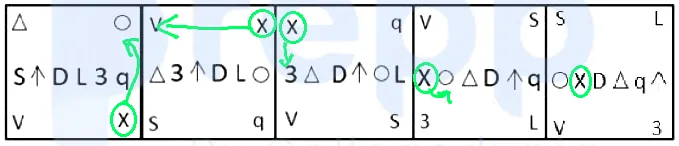
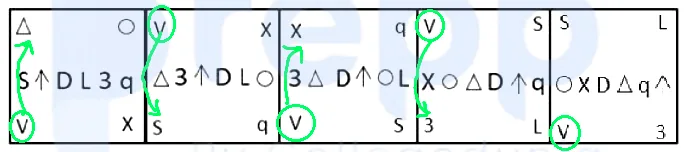
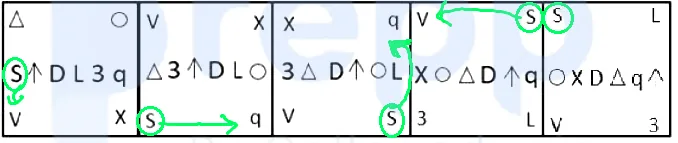
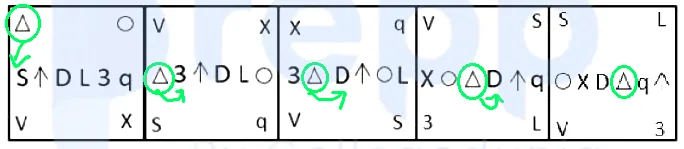
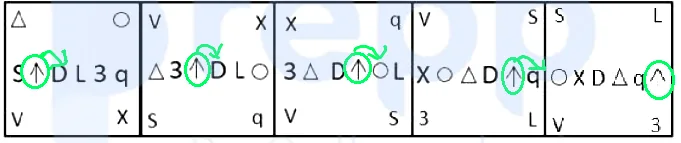
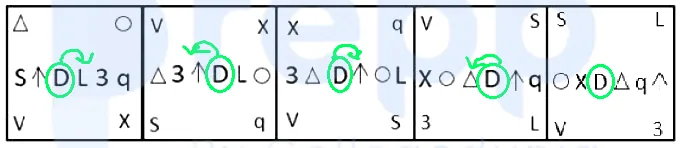
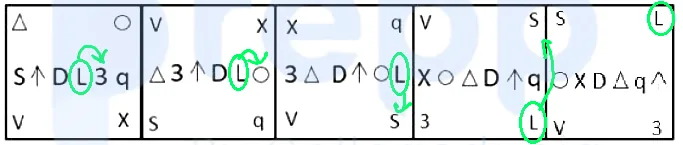
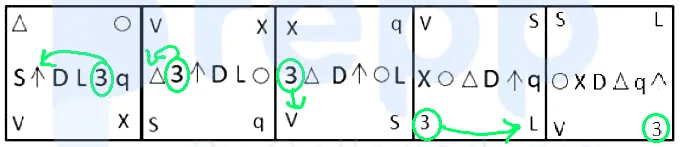
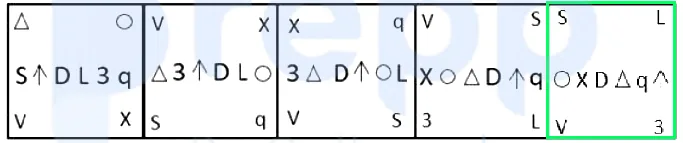
Question 1archived
Looking at a picture of a woman Vineeta said, "She is the wife of my father's brother's father." How is the woman in the picture related to Vineeta?
- A
Father's sister
- B
Mother-in-law
- C
Mother
- D
Father's mother
Show answer
D. Father's motherUnderstanding Blood Relations
This question asks us to determine the relationship between a woman in a picture and Vineeta, based on a statement made by Vineeta. We need to carefully break down the statement step by step to find the correct relationship.
Analyzing Vineeta's Statement
Vineeta says, "She is the wife of my father's brother's father." Let's dissect this statement from Vineeta's perspective:
"My father's brother": This refers to Vineeta's uncle (specifically, her paternal uncle).
"My father's brother's father": This means the father of Vineeta's uncle. Since the uncle is her father's brother, the uncle's father is also Vineeta's father's father. This person is Vineeta's paternal grandfather.
"The wife of my father's brother's father": This means the wife of Vineeta's paternal grandfather. The wife of one's paternal grandfather is one's paternal grandmother.
So, the woman in the picture is Vineeta's paternal grandmother.
Relating Paternal Grandmother to the Options
A paternal grandmother is the mother of one's father. Therefore, the woman in the picture is Vineeta's father's mother.
Evaluating the Options
Let's look at the given options based on our analysis:
Father's sister: This would be Vineeta's paternal aunt. Our analysis shows the woman is the father's mother, not sister.
Mother-in-law: This would be the mother of Vineeta's spouse. The statement describes a relationship through Vineeta's father's side, not a spouse's side.
Mother: This would be Vineeta's direct mother. The statement describes the wife of Vineeta's grandfather, not her father.
Father's mother: This is Vineeta's paternal grandmother. Our step-by-step analysis concluded that the woman is Vineeta's paternal grandmother, which is the same as her father's mother.
Conclusion
Based on the detailed breakdown of Vineeta's statement, the woman in the picture is her father's mother, who is her paternal grandmother.
Part of Statement
Relationship to Vineeta
My father
Vineeta's father
My father's brother
Vineeta's uncle
My father's brother's father
Vineeta's grandfather (father's father)
Wife of my father's brother's father
Vineeta's grandmother (grandfather's wife / father's mother)
Revision Table: Blood Relations Basics
Relationship
Description
Father's father
Paternal Grandfather
Father's mother
Paternal Grandmother
Mother's father
Maternal Grandfather
Mother's mother
Maternal Grandmother
Father's brother
Paternal Uncle
Father's sister
Paternal Aunt
Mother's brother
Maternal Uncle
Mother's sister
Maternal Aunt
Additional Information on Solving Blood Relation Puzzles
Solving blood relation questions often involves working backwards or drawing a family tree. Here are some tips:
Start with the person making the statement (e.g., Vineeta).
Break down the statement into smaller parts.
Identify the relationship denoted by each part, moving step by step from the speaker towards the subject person.
Translate terms like "brother's father" into simpler relationships like "grandfather".
Keep track of whether the relationship is on the paternal (father's) side or maternal (mother's) side.
Visualize the relationships or draw a simple diagram if the relationships are complex.
Carefully consider each option provided after determining the likely relationship.
Practice with different types of statements will help improve speed and accuracy in solving blood relation problems for exams.
Paper & answer key PDF ↗ Question 2archived
Select the option that is related to the fifth letter-cluster in the same way as the second letter-cluster is related to the first letter-cluster and the fourth letter-cluster is related to the third letter-cluster.
MGX : VPG :: TZC : CIL :: HPX :?
- A
PXF
- B
QZG
- C
RZG
- D
QYG
Show answer
D. QYGSolving Letter Cluster Analogy Problems
This question asks us to find a relationship between pairs of letter clusters. We need to identify the pattern in the first two pairs (MGX : VPG and TZC : CIL) and then apply that same pattern to the third letter cluster (HPX) to find the missing cluster.
Analyzing the First Letter Cluster Pair: MGX to VPG
Let's look at the position of each letter in the alphabet:
M is the 13th letter.
G is the 7th letter.
X is the 24th letter.
For the second cluster VPG:
V is the 22nd letter.
P is the 16th letter.
G is the 7th letter.
Now let's compare the positions:
M (13) to V (22): $22 - 13 = 9$. This is a difference of $+9$.
G (7) to P (16): $16 - 7 = 9$. This is a difference of $+9$.
X (24) to G (7): $7 - 24 = -17$. However, if we wrap around the alphabet (A=1, Z=26), moving 9 positions forward from X (24) would be $24 + 9 = 33$. Since there are only 26 letters, we subtract 26: $33 - 26 = 7$. The 7th letter is G. So, this is also a $+9$ pattern with wrapping.
The pattern observed from MGX to VPG is adding 9 to the position of each letter in the alphabet, wrapping around from Z to A if needed.
Verifying the Pattern with the Second Pair: TZC to CIL
Let's check if the same $+9$ pattern applies to the second pair TZC to CIL.
T is the 20th letter. $20 + 9 = 29$. $29 - 26 = 3$. The 3rd letter is C.
Z is the 26th letter. $26 + 9 = 35$. $35 - 26 = 9$. The 9th letter is I.
C is the 3rd letter. $3 + 9 = 12$. The 12th letter is L.
The pattern holds true for the second pair as well. Adding 9 to the position of each letter in TZC gives us CIL.
Applying the Pattern to the Fifth Letter Cluster: HPX
Now we apply the $+9$ pattern to the letters in HPX to find the missing letter cluster.
H is the 8th letter. $8 + 9 = 17$. The 17th letter is Q.
P is the 16th letter. $16 + 9 = 25$. The 25th letter is Y.
X is the 24th letter. $24 + 9 = 33$. $33 - 26 = 7$. The 7th letter is G.
Applying the pattern to HPX results in the letter cluster QYG.
Comparing with Options
Let's compare our result, QYG, with the given options:
Option 1: PXF
Option 2: QZG
Option 3: RZG
Option 4: QYG
Our calculated letter cluster QYG matches Option 4.
Conclusion
The relationship between the letter clusters in each pair is based on adding 9 to the alphabetical position of each letter. Applying this rule to HPX yields QYG.
Original Cluster
Position
Position + 9
New Position (mod 26)
Result Cluster
M
13
$13+9=22$
22
VPG
G
7
$7+9=16$
16
X
24
$24+9=33$
$33 \pmod{26} = 7$
T
20
$20+9=29$
$29 \pmod{26} = 3$
CIL
Z
26
$26+9=35$
$35 \pmod{26} = 9$
C
3
$3+9=12$
12
H
8
$8+9=17$
17
QYG
P
16
$16+9=25$
25
X
24
$24+9=33$
$33 \pmod{26} = 7$
Revision Table: Key Concepts for Letter Series Reasoning
Understanding the fundamentals of letter series and analogy problems is crucial for competitive exams. Here's a quick revision:
Concept
Description
Application in Problems
Alphabet Position
Assigning a numerical value (1-26) to each letter of the alphabet (A=1, B=2, ..., Z=26).
Finding arithmetic patterns (addition, subtraction, multiplication, division) between letter positions.
Alphabet Reversal
Pairing letters from opposite ends of the alphabet (A-Z, B-Y, C-X, etc.).
Identifying patterns based on reversed positions (e.g., A is 1st, Z is 1st from end; B is 2nd, Y is 2nd from end). Sum of positions is often 27.
Skip Counting
Patterns involving skipping a fixed number of letters (e.g., A, C, E... - skipping one letter).
Analyzing the difference in position or the number of letters between consecutive terms.
Vowels/Consonants
Patterns based on the properties of vowels (A, E, I, O, U) and consonants.
Identifying sequences where only vowels or consonants appear, or where they alternate.
Additional Information on Reasoning Patterns
Letter cluster analogies often involve various types of patterns, not just simple arithmetic progressions. Here are a few more ideas that might be used in similar problems:
Positional Shifts: Letters might shift a certain number of places forward or backward in the alphabet. The shift can be constant (+9 in our case), increasing, decreasing, or follow another numerical sequence.
Reverse Alphabetical Order: The pattern might involve using the reverse alphabetical order (Z=1, Y=2, ..., A=26).
Mixing Patterns: Different positions within the letter cluster might follow different rules (e.g., the first letter shifts by +2, the second by +3, the third by +4).
Sum/Difference of Positions: The pattern could relate to the sum or difference of the letter positions within the cluster itself or between corresponding letters in the pair.
Specific Letter Properties: Patterns might involve specific properties like only vowels, only consonants, alternating vowel/consonant, or letters related to common words.
To solve these problems effectively, it's helpful to know the alphabetical position of each letter by heart and practice identifying different types of logical patterns quickly.
Paper & answer key PDF ↗ Question 3archived
Which option represents the correct order of the given words as they would appear in an English dictionary?
1.Greed
2.Green
3.Grown
4.Grip
5.Granite
- A
5, 2, 1, 4, 3
- B
5, 4, 1, 2, 3
- C
5, 1, 2, 4, 3
- D
5, 1, 4, 3, 2
Show answer
C. 5, 1, 2, 4, 3Understanding Dictionary Order for Words
Arranging words in dictionary order, also known as lexicographical order, involves comparing words letter by letter from left to right. We determine the order based on the alphabetical position of the letters.
The given words are:
Greed
Green
Grown
Grip
Granite
Step-by-Step Dictionary Ordering
Let's compare the words letter by letter to determine their correct dictionary order:
First Letter: All words start with 'G'. This letter does not help distinguish the order.
Second Letter: All words have 'r' as the second letter. This also doesn't help in ordering.
Third Letter:
Greed: 'e'
Green: 'e'
Grown: 'o'
Grip: 'i'
Granite: 'a'
Comparing the third letters ('e', 'o', 'i', 'a'), we know that 'a' comes first alphabetically, followed by 'e', then 'i', and finally 'o'.
Based on the third letter, the initial order is:
Granite (starts with 'Gra')
Greed, Green (both start with 'Gre')
Grip (starts with 'Gri')
Grown (starts with 'Gro')
Now we need to determine the order between 'Greed' and 'Green'. Both words start with 'Gre'. We compare the fourth letter:
Greed: 'e'
Green: 'e'
The fourth letters are the same. We move to the fifth letter:
Greed: 'd'
Green: 'n'
Comparing 'd' and 'n', 'd' comes before 'n' in the alphabet. Therefore, 'Greed' comes before 'Green'.
Combining this with the order determined by the third letter, the final dictionary order is:
Granite (5)
Greed (1)
Green (2)
Grip (4)
Grown (3)
Final Sorted Order
The correct order of the given words as they would appear in an English dictionary, based on their original numbers, is:
5, 1, 2, 4, 3
Revision Table: Dictionary Order Practice
Original Number
Word
Dictionary Position
5
Granite
1st
1
Greed
2nd
2
Green
3rd
4
Grip
4th
3
Grown
5th
Additional Information on Lexicographical Order
Lexicographical order is essentially the method used to arrange words in a dictionary or entries in an index. It's based on the alphabetical order of characters. When two words share a common prefix (starting letters), the comparison continues to the first character where they differ. The word with the character that appears earlier in the alphabet comes first.
This principle applies not just to single words but also to lists of words, phrases, or even sequences of numbers or symbols. The comparison proceeds element by element until a difference is found. If one sequence is a prefix of another (e.g., "car" and "carpet"), the shorter sequence typically comes first.
Paper & answer key PDF ↗ Question 4archived
Select the option that is related to the third term in the same way as the second term is related to the first term and the sixth term is related to the fifth term.
6 : 646 :: 5 : ? :: 4 : 190
- A
373
- B
377
- C
337
- D
376
Show answer
A. 373Understanding the Number Analogy Pattern
The question presents a number analogy in the format: 6 : 646 :: 5 : ? :: 4 : 190. This means that the first term is related to the second term in the same way that the third term is related to the missing term, and the fifth term is related to the sixth term. Our goal is to discover the specific mathematical pattern or rule that connects the numbers in the given pairs (6, 646) and (4, 190), and then apply that same rule to find the missing number related to 5.
Analyzing the Given Number Pairs
Let's look at the two complete pairs provided:
Pair 1: 6 and 646
Pair 2: 4 and 190
We need to find a consistent relationship between the first number (let's call it $N$) and the second number (let's call it $R$) in each pair. The numbers 646 and 190 are significantly larger than 6 and 4, respectively, which suggests that the pattern might involve powers of the first number, such as squares ($N^2$) or cubes ($N^3$).
Exploring Potential Mathematical Relationships
Let's consider the cube of the first number $N$:
For $N=6$, $N^3 = 6^3 = 6 \times 6 \times 6 = 216$.
For $N=4$, $N^3 = 4^3 = 4 \times 4 \times 4 = 64$.
Now, let's compare these cubic values to the given second numbers:
For $N=6$, the second number is 646. The difference is $646 - 216 = 430$.
For $N=4$, the second number is 190. The difference is $190 - 64 = 126$.
The differences (430 and 126) still don't immediately show a simple pattern based on $N$. Let's consider if the pattern involves multiplying the cube by a constant and adding or subtracting another constant. Let's assume the pattern is of the form $R = A \times N^3 + B$, where $A$ and $B$ are constants.
Deriving the Pattern Formula
Using the two given pairs, we can set up a system of linear equations to solve for the constants $A$ and $B$ in the potential pattern $R = A \times N^3 + B$.
For the pair (6, 646), with $N=6$ and $R=646$:
\( A \times 6^3 + B = 646 \)
\( 216A + B = 646 \) (Equation 1)
For the pair (4, 190), with $N=4$ and $R=190$:
\( A \times 4^3 + B = 190 \)
\( 64A + B = 190 \) (Equation 2)
Now, we solve this system of two equations. Subtract Equation 2 from Equation 1:
\( (216A + B) - (64A + B) = 646 - 190 \)
\( 216A - 64A = 456 \)
\( 152A = 456 \)
Divide both sides by 152:
\( A = \frac{456}{152} \)
\( A = 3 \)
Now that we have the value of $A$, substitute it back into either Equation 1 or Equation 2 to find $B$. Using Equation 2:
\( 64A + B = 190 \)
\( 64 \times 3 + B = 190 \)
\( 192 + B = 190 \)
Subtract 192 from both sides:
\( B = 190 - 192 \)
\( B = -2 \)
So, the derived pattern rule is \( R = 3N^3 - 2 \).
Verifying the Pattern Rule
Let's quickly check if this rule holds for the given pairs:
For $N=6$: \( R = 3 \times 6^3 - 2 = 3 \times 216 - 2 = 648 - 2 = 646 \). Correct.
For $N=4$: \( R = 3 \times 4^3 - 2 = 3 \times 64 - 2 = 192 - 2 = 190 \). Correct.
The pattern \( R = 3N^3 - 2 \) consistently relates the first number to the second number in both given pairs of the analogy.
Applying the Pattern to Find the Missing Number
The question asks for the number related to 5 in the analogy 5 : ?. Using the established pattern \( R = 3N^3 - 2 \), we substitute $N=5$ to find the missing term:
\( R = 3 \times 5^3 - 2 \)
\( R = 3 \times 125 - 2 \)
\( R = 375 - 2 \)
\( R = 373 \)
Therefore, the missing number in the analogy 5 : ? is 373.
Conclusion
The number that completes the analogy 6 : 646 :: 5 : ? :: 4 : 190 is 373, based on the pattern \( R = 3N^3 - 2 \).
First Term ($N$)
Pattern ($3N^3 - 2$)
Second Term ($R$)
6
\( 3 \times 6^3 - 2 = 3 \times 216 - 2 = 648 - 2 \)
646
5
\( 3 \times 5^3 - 2 = 3 \times 125 - 2 = 375 - 2 \)
373
4
\( 3 \times 4^3 - 2 = 3 \times 64 - 2 = 192 - 2 \)
190
Revision Table: Key Concepts in Number Patterns
Concept
Description
Example
Number Analogy
Finding a relationship between pairs of numbers and applying it to a new pair.
2:4 :: 3:9 (Pattern: $N^2$)
Pattern Recognition
Identifying a mathematical rule (addition, subtraction, multiplication, division, powers, etc.) connecting the terms.
Sequence: 2, 4, 6, 8... (Pattern: Add 2 to the previous term)
Algebraic Representation
Expressing the pattern using variables and equations (e.g., \(R = AN^3 + B\)).
If pattern is double the number plus 5, rule is $R = 2N + 5$.
Solving Equations
Using known pairs to set up and solve equations for unknown constants in the pattern formula.
If $AN+B=5$ for $N=1$ and $AN+B=7$ for $N=2$, then $A=2, B=3$.
Additional Information: Solving Analogy Questions
Solving number analogy questions often involves systematic exploration of potential mathematical relationships between the given terms. Here are some common types of patterns to look for:
Basic Arithmetic: Addition, subtraction, multiplication, division.
Powers: Squares ($N^2$), cubes ($N^3$), or higher powers.
Roots: Square root, cube root.
Combinations: Combinations of basic operations and powers (e.g., $N^2 + k$, $N^3 - k$, $k \times N + m$, $A \times N^2 + B \times N + C$).
Digit Manipulation: Sum of digits, product of digits, reversing digits (less common unless explicitly suggested).
Special Numbers: Prime numbers, composite numbers, factorials.
A good strategy is to start with simple patterns and move towards more complex ones if the initial hypotheses don't fit. For patterns involving polynomial relationships like \( AN^3 + B \), using the given pairs to set up and solve equations is a standard approach when simpler methods fail.
Paper & answer key PDF ↗ Question 5archived
Select the number from among the given options that can replace the question mark (?) in the following series.
80, 73, 64, 53, 40, ?
- A
19
- B
25
- C
33
- D
23
Show answer
B. 25Solving the Number Series Pattern
The given number series is 80, 73, 64, 53, 40, ?. We need to find the number that replaces the question mark by identifying the pattern in the series.
Analyzing the Differences
Let's find the difference between consecutive terms in the series:
Difference between the 1st and 2nd term: $80 - 73 = 7$
Difference between the 2nd and 3rd term: $73 - 64 = 9$
Difference between the 3rd and 4th term: $64 - 53 = 11$
Difference between the 4th and 5th term: $53 - 40 = 13$
Identifying the Pattern in Differences
The differences between consecutive terms are 7, 9, 11, 13. We can observe that these differences form a sequence of consecutive odd numbers starting from 7. The pattern is that each subsequent difference increases by 2.
Pattern of differences: +2, +2, +2 ...
$9 - 7 = 2$
$11 - 9 = 2$
$13 - 11 = 2$
Predicting the Next Difference
Following this pattern, the next difference should be the next odd number after 13, which is $13 + 2 = 15$.
Calculating the Next Term
To find the next term in the original series (replacing the question mark), we subtract the next difference (15) from the last known term (40):
Next term = $40 - 15$
Next term = $25$
So, the number that replaces the question mark is 25.
Conclusion
The series follows a pattern where the difference between consecutive terms is a sequence of increasing odd numbers (7, 9, 11, 13, 15, ...). The next term in the series is 25.
Series Term
80
73
64
53
40
?
Difference
-7
-9
-11
-13
-15
Revision Table: Number Series Patterns
Pattern Type
Description
Example
Arithmetic Series
Constant difference between terms.
2, 5, 8, 11, ... (difference is 3)
Geometric Series
Constant ratio between terms.
3, 6, 12, 24, ... (ratio is 2)
Difference Series
The differences between terms follow a pattern (like arithmetic, geometric, or odd/even numbers).
The series solved here (differences 7, 9, 11, 13, ...)
Mixed Series
Combination of different patterns or operations.
1, 3, 7, 15, 31, ... (pattern is multiply by 2, add 1)
Additional Information: Solving Quantitative Aptitude Series
Number series questions are common in quantitative aptitude tests. To solve them effectively:
Always start by finding the difference or ratio between consecutive terms.
Look for patterns in the differences/ratios (arithmetic progression, geometric progression, perfect squares, cubes, prime numbers, odd/even numbers).
Sometimes, the pattern might involve alternating differences or a combination of operations (like multiply and add/subtract).
Practice with various types of series to recognize common patterns quickly.
If differences don't show a clear pattern, calculate the differences of the differences (second-order differences).
Understanding these techniques helps in quickly identifying the underlying rule governing the sequence and finding the missing term.
Paper & answer key PDF ↗ Question 6archived
Select the set in which the numbers are related in the same way as are the numbers of the following sets.
(NOTE : Operations should be performed on the whole numbers, without breaking down the numbers into its constituent digits. E.g. 13 — Operations on 13 such as adding / subtracting ‘multiplying etc. to 13 can be performed. Breaking down 13 into 1 and 3 and then performing mathematical operations on 1 and 3 is NOT allowed)
\(\left[\left(\frac{7}{9}\right),\left(\frac{31}{39}\right)\right], \left[\left(\frac{3}{5}\right),\left(\frac{15}{23}\right)\right]\)
- A
\(\left[\left(\frac{11}{13}\right),\left(\frac{47}{55}\right)\right]\)
- B
\(\left[\left(\frac{9}{13}\right),\left(\frac{37}{55}\right)\right]\)
- C
\(\left[\left(\frac{9}{11}\right),\left(\frac{32}{37}\right)\right]\)
- D
\(\left[\left(\frac{17}{19}\right),\left(\frac{36}{77}\right)\right]\)
Show answer
A. \(\left[\left(\frac{11}{13}\right),\left(\frac{47}{55}\right)\right]\)Finding the Relationship Between Numbers in Sets
The question asks us to identify a set of fractions that follows the same numerical relationship observed in the two provided sets. We are given the rule that operations must be performed on the whole numbers (numerator and denominator) without breaking them down into individual digits.
The given sets are:
Set 1: \(\left[\left(\frac{7}{9}\right),\left(\frac{31}{39}\right)\right]\)
Set 2: \(\left[\left(\frac{3}{5}\right),\left(\frac{15}{23}\right)\right]\)
Let's analyze the relationship between the first fraction \(\frac{a}{b}\) and the second fraction \(\frac{c}{d}\) in each set.
Analyzing Set 1 Relationship
For Set 1, we have \(\frac{a}{b} = \frac{7}{9}\) and \(\frac{c}{d} = \frac{31}{39}\).
Let's look at how the numbers change from the first fraction to the second:
Numerator: 7 becomes 31
Denominator: 9 becomes 39
We need to find an operation or a set of operations involving the whole numbers 7 and 9 that results in 31 and 39, respectively. A common pattern in such problems is a linear transformation like multiplying by a constant and adding/subtracting another constant. Let's assume the relationship for the numerator is \(c = k \times a + m\) and for the denominator is \(d = k \times b + m\), where \(k\) and \(m\) are constants.
Using Set 1 values:
For the numerator: \(31 = k \times 7 + m\)
For the denominator: \(39 = k \times 9 + m\)
We have a system of two linear equations:
\(7k + m = 31 \quad (1)\)
\(9k + m = 39 \quad (2)\)
Subtract equation (1) from equation (2):
\((9k + m) - (7k + m) = 39 - 31\)
\(2k = 8\)
\(k = \frac{8}{2} = 4\)
Now substitute \(k=4\) into equation (1):
\(7 \times 4 + m = 31\)
\(28 + m = 31\)
\(m = 31 - 28 = 3\)
So, the potential relationship is: Numerator becomes \(4 \times a + 3\), and Denominator becomes \(4 \times b + 3\). In terms of fractions, the relationship is \(\frac{c}{d} = \frac{4a+3}{4b+3}\).
Verifying the Relationship with Set 2
Let's check if this relationship holds for Set 2: \(\left[\left(\frac{3}{5}\right),\left(\frac{15}{23}\right)\right]\). Here, \(a=3\) and \(b=5\).
Using the relationship \(\frac{4a+3}{4b+3}\):
New Numerator: \(4 \times 3 + 3 = 12 + 3 = 15\)
New Denominator: \(4 \times 5 + 3 = 20 + 3 = 23\)
The resulting fraction is \(\frac{15}{23}\), which matches the second fraction in Set 2. This confirms that the relationship is indeed \(\frac{c}{d} = \frac{4a+3}{4b+3}\).
Applying the Relationship to the Options
Now we need to examine each option to see which set follows this established relationship.
For each option \(\left[\left(\frac{a}{b}\right),\left(\frac{c}{d}\right)\right]\), we will calculate \(\frac{4a+3}{4b+3}\) and see if it equals \(\frac{c}{d}\).
Option 1: \(\left[\left(\frac{11}{13}\right),\left(\frac{47}{55}\right)\right]\)
Here, \(a=11\) and \(b=13\).
Calculated Numerator: \(4 \times 11 + 3 = 44 + 3 = 47\)
Calculated Denominator: \(4 \times 13 + 3 = 52 + 3 = 55\)
The calculated fraction is \(\frac{47}{55}\). This matches the second fraction in Option 1.
Therefore, Option 1 follows the same relationship.
Option 2: \(\left[\left(\frac{9}{13}\right),\left(\frac{37}{55}\right)\right]\)
Here, \(a=9\) and \(b=13\).
Calculated Numerator: \(4 \times 9 + 3 = 36 + 3 = 39\)
Calculated Denominator: \(4 \times 13 + 3 = 52 + 3 = 55\)
The calculated fraction is \(\frac{39}{55}\). This does not match \(\frac{37}{55}\).
Option 3: \(\left[\left(\frac{9}{11}\right),\left(\frac{32}{37}\right)\right]\)
Here, \(a=9\) and \(b=11\).
Calculated Numerator: \(4 \times 9 + 3 = 36 + 3 = 39\)
Calculated Denominator: \(4 \times 11 + 3 = 44 + 3 = 47\)
The calculated fraction is \(\frac{39}{47}\). This does not match \(\frac{32}{37}\).
Option 4: \(\left[\left(\frac{17}{19}\right),\left(\frac{36}{77}\right)\right]\)
Here, \(a=17\) and \(b=19\).
Calculated Numerator: \(4 \times 17 + 3 = 68 + 3 = 71\)
Calculated Denominator: \(4 \times 19 + 3 = 76 + 3 = 79\)
The calculated fraction is \(\frac{71}{79}\). This does not match \(\frac{36}{77}\).
Only Option 1 satisfies the numerical relationship found from the given sets.
Set
First Fraction \(\frac{a}{b}\)
Second Fraction \(\frac{c}{d}\)
Calculated \(\frac{4a+3}{4b+3}\)
Match?
Given Set 1
\(\frac{7}{9}\)
\(\frac{31}{39}\)
\(\frac{4(7)+3}{4(9)+3} = \frac{31}{39}\)
Yes
Given Set 2
\(\frac{3}{5}\)
\(\frac{15}{23}\)
\(\frac{4(3)+3}{4(5)+3} = \frac{15}{23}\)
Yes
Option 1
\(\frac{11}{13}\)
\(\frac{47}{55}\)
\(\frac{4(11)+3}{4(13)+3} = \frac{47}{55}\)
Yes
Option 2
\(\frac{9}{13}\)
\(\frac{37}{55}\)
\(\frac{4(9)+3}{4(13)+3} = \frac{39}{55}\)
No
Option 3
\(\frac{9}{11}\)
\(\frac{32}{37}\)
\(\frac{4(9)+3}{4(11)+3} = \frac{39}{47}\)
No
Option 4
\(\frac{17}{19}\)
\(\frac{36}{77}\)
\(\frac{4(17)+3}{4(19)+3} = \frac{71}{79}\)
No
Conclusion
Based on the analysis, the set of numbers that shares the same relationship as the given sets is Option 1: \(\left[\left(\frac{11}{13}\right),\left(\frac{47}{55}\right)\right]\), where the relationship between the fractions \(\frac{a}{b}\) and \(\frac{c}{d}\) is \(\frac{c}{d} = \frac{4a+3}{4b+3}\).
Revision Table: Understanding Number Set Relationships
Concept
Description
Application in Problem
Identifying Relationships
Finding a consistent mathematical rule or pattern connecting elements within a set or between sets.
Analyzing the two given fraction sets to discover the formula \(\frac{c}{d} = \frac{4a+3}{4b+3}\).
Applying the Rule
Using the identified relationship to test other sets or elements.
Testing each option against the discovered formula \(\frac{c}{d} = \frac{4a+3}{4b+3}\).
Whole Number Operations
Performing arithmetic operations on numbers as a whole, not on their individual digits.
Using 7, 9, 31, 39 etc., directly in calculations like multiplication and addition.
Additional Information: Solving Quantitative Aptitude Problems
Quantitative Aptitude problems often involve identifying patterns and relationships between numbers. These can appear in various forms, including number series, analogies, coding-decoding, and set-based questions like this one. To solve such problems effectively, consider the following:
Look for Common Operations: Think about basic arithmetic operations (addition, subtraction, multiplication, division) and how they might connect the numbers.
Consider Transformations: Sometimes, the relationship involves multiplying by a constant, adding/subtracting a constant, squaring, cubing, or combinations of these.
Check Both Numerator and Denominator: In fraction-based problems, the relationship might apply separately but similarly to both parts of the fraction.
Test Hypotheses: Once you find a potential rule using one example (like Set 1 here), always test it with other examples provided (like Set 2) before applying it to the options.
Systematic Checking: Go through each option methodically, applying the rule to see which one fits.
Practice: Familiarity with common patterns and problem types comes with practice.
This question specifically tests your ability to find a consistent linear relationship applied symmetrically to both the numerator and the denominator of fractions within a set.
Paper & answer key PDF ↗ Question 7archived
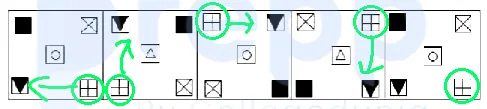
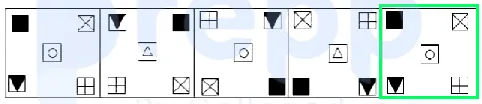
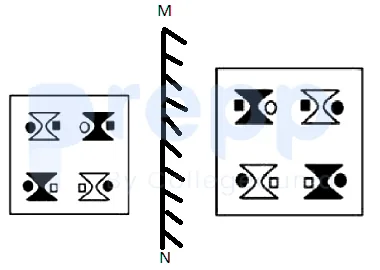
Select the correct mirror image of the given figure when the mirror is placed at MN as shown below.
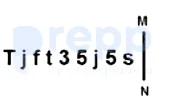
- A
Option A (shown in image)
- B
Option B (shown in image)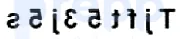
- C
Option C (shown in image)
- D
Option D (shown in image)
Show answer
Question 8archived
Each vowel in the word “ETHICAL” is changed to the following letter in the English alphabetical series and each consonant is changed to the previous letter in the English alphabetical series. In the newly formed word, how many alphabets are there in the English alphabetical series between the alphabet which is 3rd from the left and 1st from the right?
- A
Four
- B
Three
- C
Two
- D
Five
Show answer
B. ThreeThree
Therefore, the number of alphabets in the English alphabetical series between the alphabet which is 3rd from the left and 1st from the right in the newly formed word is Three.
Paper & answer key PDF ↗ Question 9archived
Select the set in which the numbers are related in the same way as are the numbers of the given set.
(NOTE: Operations should be performed on the whole numbers, without breaking down the number into its constituent digits. E. g. 13 — Operations on 13 such as adding /Subtracting /multiplying etc. to 13 can be performed. Breaking down 13 into 1 and 3 and then performing mathematical operations on 1 and 3 is not allowed.)
(312, 24, 13)
(645, 43, 15)
- A
(347, 27, 12)
- B
(347, 22, 17)
- C
(374, 17, 12)
- D
(374, 22, 17)
Show answer
D. (374, 22, 17)Understanding Number Set Reasoning Patterns
This question asks us to identify a mathematical relationship or pattern that connects the numbers within a given set. Once the pattern is found, we need to apply it to the provided options to find the set that follows the same rule. The question specifies that operations should be performed on the whole numbers as they are, without breaking them down into individual digits.
Let's analyze the given sets:
Set 1: (312, 24, 13)
Set 2: (645, 43, 15)
We need to find a relationship between the three numbers in these sets. Let's consider the position of the numbers as First, Second, and Third.
Discovering the Number Relation Pattern
Looking at the numbers in the sets, we observe that the first number is significantly larger than the other two. This often suggests operations like multiplication, division, or combinations involving these.
Let's try to see if the first number is a product or sum related to the second and third numbers.
Consider Set 1: (312, 24, 13)
Could 312 be related to 24 and 13 through multiplication? Let's multiply the second number by the third number:
\[24 \times 13\]
Let's perform the multiplication:
\[24 \times 10 = 240\]
\[24 \times 3 = 72\]
\[240 + 72 = 312\]
So, for Set 1, we found that the First Number = Second Number \(\times\) Third Number.
Let's check if this pattern holds for the second given set:
Consider Set 2: (645, 43, 15)
Let's multiply the second number by the third number:
\[43 \times 15\]
Let's perform the multiplication:
\[43 \times 10 = 430\]
\[43 \times 5 = 215\]
\[430 + 215 = 645\]
Indeed, for Set 2 as well, the First Number = Second Number \(\times\) Third Number.
The established pattern is: First Number = Second Number \(\times\) Third Number.
Applying the Pattern to Options
Now, let's examine each option and see which one follows this pattern.
Option 1: (347, 27, 12)
Check if First Number = Second Number \(\times\) Third Number:
\[27 \times 12 = 324\]
Is 347 equal to 324? No, \(347 \neq 324\). So, Option 1 does not follow the pattern.
Option 2: (347, 22, 17)
Check if First Number = Second Number \(\times\) Third Number:
\[22 \times 17\]
Let's calculate \(22 \times 17\):
\[22 \times 10 = 220\]
\[22 \times 7 = 154\]
\[220 + 154 = 374\]
Is 347 equal to 374? No, \(347 \neq 374\). So, Option 2 does not follow the pattern.
Option 3: (374, 17, 12)
Check if First Number = Second Number \(\times\) Third Number:
\[17 \times 12\]
Let's calculate \(17 \times 12\):
\[17 \times 10 = 170\]
\[17 \times 2 = 34\]
\[170 + 34 = 204\]
Is 374 equal to 204? No, \(374 \neq 204\). So, Option 3 does not follow the pattern.
Option 4: (374, 22, 17)
Check if First Number = Second Number \(\times\) Third Number:
\[22 \times 17\]
From our calculation in Option 2, we know that \(22 \times 17 = 374\).
Is 374 equal to 374? Yes, \(374 = 374\). So, Option 4 follows the pattern.
Conclusion
The set (374, 22, 17) is related in the same way as the given sets (312, 24, 13) and (645, 43, 15). The pattern is that the first number is the product of the second and third numbers.
Reasoning Question Revision Table
Given Set/Option
Numbers (First, Second, Third)
Operation (Second \(\times\) Third)
Result
Does it match First Number?
Follows Pattern?
Given Set 1
(312, 24, 13)
\(24 \times 13\)
312
\(312 = 312\)
Yes
Given Set 2
(645, 43, 15)
\(43 \times 15\)
645
\(645 = 645\)
Yes
Option 1
(347, 27, 12)
\(27 \times 12\)
324
\(347 \neq 324\)
No
Option 2
(347, 22, 17)
\(22 \times 17\)
374
\(347 \neq 374\)
No
Option 3
(374, 17, 12)
\(17 \times 12\)
204
\(374 \neq 204\)
No
Option 4
(374, 22, 17)
\(22 \times 17\)
374
\(374 = 374\)
Yes
Additional Information on Number Reasoning
Number reasoning questions are common in aptitude tests and involve finding logical rules that connect numbers. These rules can be arithmetic operations (addition, subtraction, multiplication, division), but can also involve squares, cubes, prime numbers, or other mathematical properties. Here are some tips for solving such problems:
Look for simple arithmetic operations first. Addition, subtraction, multiplication, or division between adjacent numbers or numbers at specific positions in the set.
Consider the size of the numbers. Large jumps might suggest multiplication or exponents, while small, steady changes might suggest addition or subtraction.
Check for relationships between the first, second, and third numbers (as seen in this problem). The pattern might involve all three numbers interacting.
Look for patterns involving squares, cubes, or roots.
Sometimes, the pattern involves the difference or ratio between consecutive numbers being constant or following another pattern.
Always test your potential pattern on all the given examples before applying it to the options.
If the first few simple patterns don't work, think about slightly more complex combinations of operations.
Practice is key to becoming proficient in identifying these patterns quickly.
Paper & answer key PDF ↗ Question 10archived
‘P @ Q’ means ‘P is the brother of Q’
‘P & Q’ means ‘P is the father of Q’
‘P # Q' means ‘P is the daughter of Q’
If ‘A # B @ C & D # E’, then how is B related to E?
- A
Brother's daughter
- B
Brother's wife
- C
Husband's brother
- D
Brother
Show answer
C. Husband's brotherSolving Blood Relations Puzzles: Decoding Relationships
This question involves decoding a set of relationships given in a coded form and then determining the relationship between two individuals based on a complex expression. We are given specific symbols that represent different family relationships.
Understanding the Relationship Codes
First, let's break down the meaning of each symbol provided:
‘P @ Q’ means ‘P is the brother of Q’. This indicates P is male and is in the same generation as Q.
‘P & Q’ means ‘P is the father of Q’. This indicates P is male and is one generation above Q.
‘P # Q' means ‘P is the daughter of Q’. This indicates P is female and is one generation below Q.
We can summarize these codes in a table:
Code
Relationship
Gender of First Person (P)
Generational Difference
P @ Q
P is brother of Q
Male
Same Generation
P & Q
P is father of Q
Male
P is one generation above Q
P # Q
P is daughter of Q
Female
P is one generation below Q
Decoding the Expression: A # B @ C & D # E
Now, let's decode the given expression segment by segment to build the family structure.
A # B: A is the daughter of B.
This tells us A is female.
B is the parent of A. The gender of B is not yet known from this segment alone.
B @ C: B is the brother of C.
This tells us B is male.
B and C are siblings and belong to the same generation.
Combining with step 1: B is the male parent of A, which means B is A's father. B is also C's brother.
C & D: C is the father of D.
This tells us C is male.
C is one generation above D.
Combining with step 2: C is B's brother and also the father of D. This makes B the uncle of D.
D # E: D is the daughter of E.
This tells us D is female.
E is the parent of D. The gender of E is not yet known from this segment alone.
Combining with step 3: We know C is the father of D, and now we know D is the daughter of E. Since D has two parents, and C is identified as one parent (the father), E must be the other parent (the mother).
Therefore, C and E are married, with C being the husband and E being the wife.
Putting the Relationships Together
Let's connect all the pieces:
B is the brother of C.
C is married to E (C is husband, E is wife).
D is the child of C and E (specifically, their daughter).
A is the child of B (specifically, his daughter, based on B being A's father).
We have the following key relationships: B is C's brother, and C is married to E. Therefore, B is the brother of E's husband (who is C).
Determining the Relationship between B and E
We need to find out how B is related to E.
E is married to C. C is E's husband.
B is the brother of C.
So, B is the brother of E's husband.
Analyzing the Options
Let's check which option matches our finding:
Brother's daughter: This would imply E's brother has a daughter B. This is incorrect, B is male.
Brother's wife: This would imply E's brother is married to B. This is incorrect, B is male.
Husband's brother: This means E's husband (C) has a brother (B). This matches our derived relationship.
Brother: This would imply B and E are siblings. This is incorrect.
The relationship between B and E is that B is E's husband's brother.
Revision Table: Key Relationship Types
Relationship
Description
Parent
Father or Mother
Sibling
Brother or Sister
Spouse
Husband or Wife
Child
Son or Daughter
Uncle/Aunt
Sibling of a parent
Nephew/Niece
Child of a sibling
Cousin
Child of an uncle or aunt
Additional Information on Blood Relations Problems
Blood relations questions test your ability to understand and deduce family relationships based on given information. These problems often appear in competitive exams and logical reasoning tests. Key strategies include:
Clearly understanding the meaning of each symbol or coded phrase.
Breaking down complex expressions into smaller, manageable segments.
Drawing a family tree or diagram to visually represent the relationships. Use symbols for gender (e.g., + for male, - for female) and connections (e.g., horizontal line for siblings, double horizontal line for marriage, vertical line for parent-child).
Systematically combining the deduced relationships.
Identifying the relationship between the specific individuals asked in the question.
Carefully checking the options provided.
Practice with different types of blood relation problems, including those with simple statements and those using codes/symbols, helps improve speed and accuracy.
Paper & answer key PDF ↗ Question 11archived
In a certain code language, ‘PLAY’ Is coded as RICV and ‘TREE’ Is coded as VOGB. How will ‘BOOK’ be coded in the same language?
- A
HLQD
- B
DQQH
- C
DLQH
- D
DLLH
Show answer
C. DLQHThe correct answer is DLQH.
Opposite Letters: Letters are coded by their 'opposite' in the alphabet (A is opposite Z, B is opposite Y, etc., where A+Z=27, B+Y=27). Consonant/Vowel Based: The rule might differ for consonants and vowels. Substitution: Letters are directly substituted by other letters based on a substitution table derived from the examples. Solving these problems requires careful observation and testing potential patterns.
Paper & answer key PDF ↗ Question 12archived
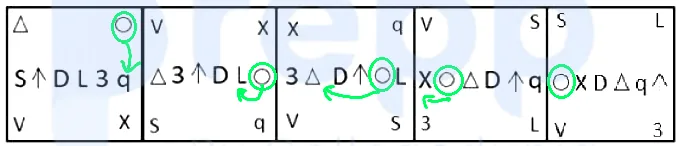
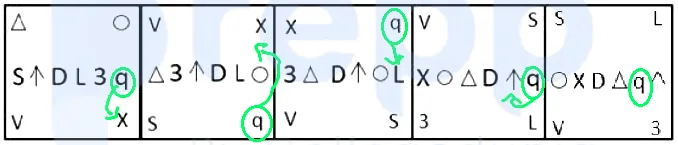
Select the figure from among the given options that can replace the question mark (?) in the following series,
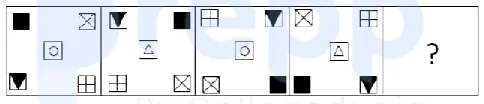
- A
Option A (shown in image)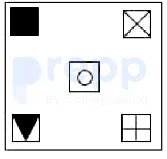
- B
Option B (shown in image)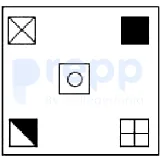
- C
Option C (shown in image)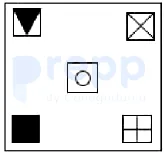
- D
Option D (shown in image)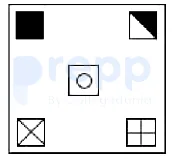
Show answer
Question 13archived
The second number in the given number-pairs is obtained by performing certain mathematical operation(s) on the first number. The same operation(s) is/are followed in all the number-pairs, except one. Find that odd number-pair.
(NOTE: The relation should be found without breaking down the numbers into its constituent digits)
- A
225 : 169
- B
361 : 400
- C
529 : 576
- D
441 : 484
Show answer
A. 225 : 169The correct answer is 225 : 169.
Don't break down digits unless specified: As stated in this question, treat numbers as whole values unless the rule explicitly involves digits. Test the pattern: Once you think you've found the rule, test it against all the given elements to see if it holds true for all except the 'odd one out'. Practice with different types of number pattern questions will help you quickly recognize common relationships and operations.
Paper & answer key PDF ↗ Question 14archived
Select the correct combination of mathematical signs to sequentially replace the * signs and to balance the given equation.
5 * 23 * 24 * 4 * 10 * 111
- A
÷, +, -, ×, =
- B
-, ×, +, ÷, =
- C
×, +, ÷, -, =
- D
+, -, ÷, ×, =
Show answer
C. ×, +, ÷, -, =The correct answer is ×, +, ÷, -, =.
Both acronyms represent the same hierarchy. Division and Multiplication have the same priority and should be performed from left to right as they appear in the expression. Similarly, Addition and Subtraction have the same priority and are performed from left to right. In the given problem, we used this rule to correctly evaluate the expression with the substituted signs.
Paper & answer key PDF ↗ Question 15archived
Select the figure that will replace the question mark (?) in the following figure series.
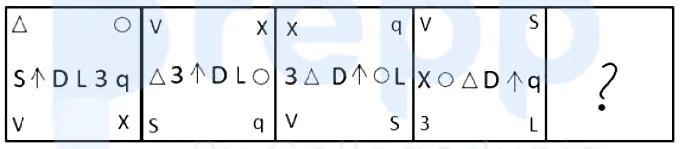
- A
Option A (shown in image)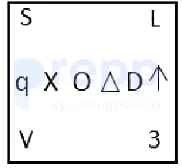
- B
Option B (shown in image)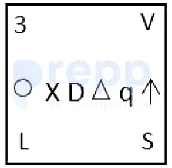
- C
Option C (shown in image)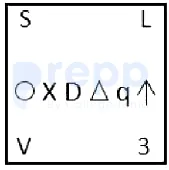
- D
Option D (shown in image)
Show answer
Question 16archived
Which of the following terms will replace the question mark (?) in the given series?
MGB, NIE, OKH, PMK, ?
- A
QON
- B
PQJ
- C
OQN
- D
OPK
Show answer
A. QONAnalyzing the Letter Series Pattern
This question asks us to find the next term in the given series: MGB, NIE, OKH, PMK, ? . To solve this type of letter series question, we need to analyze the pattern in each position of the letters within the terms.
Let's break down the series and look at the sequence of letters in the first, second, and third positions separately.
Pattern for the First Letter
Look at the first letter of each term:
M (in MGB)
N (in NIE)
O (in OKH)
P (in PMK)
? (the next term's first letter)
Let's find the position of each letter in the English alphabet (A=1, B=2, ..., Z=26):
M is the 13th letter.
N is the 14th letter.
O is the 15th letter.
P is the 16th letter.
We can see a clear pattern here. Each subsequent first letter is one position after the previous one. The difference in position is +1.
M ($\texttt{13}$) $\rightarrow$ N ($\texttt{14}$): $\texttt{13} + \texttt{1} = \texttt{14}$
N ($\texttt{14}$) $\rightarrow$ O ($\texttt{15}$): $\texttt{14} + \texttt{1} = \texttt{15}$
O ($\texttt{15}$) $\rightarrow$ P ($\texttt{16}$): $\texttt{15} + \texttt{1} = \texttt{16}$
Following this pattern, the first letter of the next term will be one position after P ($\texttt{16}$). The letter at position $\texttt{16} + \texttt{1} = \texttt{17}$ is Q.
So, the first letter of the next term is Q.
Pattern for the Second Letter
Now, let's examine the second letter of each term:
G (in MGB)
I (in NIE)
K (in OKH)
M (in PMK)
? (the next term's second letter)
Let's find the position of each letter in the English alphabet:
G is the 7th letter.
I is the 9th letter.
K is the 11th letter.
M is the 13th letter.
The pattern here is that each subsequent second letter is two positions after the previous one. The difference in position is +2.
G ($\texttt{7}$) $\rightarrow$ I ($\texttt{9}$): $\texttt{7} + \texttt{2} = \texttt{9}$
I ($\texttt{9}$) $\rightarrow$ K ($\texttt{11}$): $\texttt{9} + \texttt{2} = \texttt{11}$
K ($\texttt{11}$) $\rightarrow$ M ($\texttt{13}$): $\texttt{11} + \texttt{2} = \texttt{13}$
Following this pattern, the second letter of the next term will be two positions after M ($\texttt{13}$). The letter at position $\texttt{13} + \texttt{2} = \texttt{15}$ is O.
So, the second letter of the next term is O.
Pattern for the Third Letter
Finally, let's look at the third letter of each term:
B (in MGB)
E (in NIE)
H (in OKH)
K (in PMK)
? (the next term's third letter)
Let's find the position of each letter in the English alphabet:
B is the 2nd letter.
E is the 5th letter.
H is the 8th letter.
K is the 11th letter.
The pattern here is that each subsequent third letter is three positions after the previous one. The difference in position is +3.
B ($\texttt{2}$) $\rightarrow$ E ($\texttt{5}$): $\texttt{2} + \texttt{3} = \texttt{5}$
E ($\texttt{5}$) $\rightarrow$ H ($\texttt{8}$): $\texttt{5} + \texttt{3} = \texttt{8}$
H ($\texttt{8}$) $\rightarrow$ K ($\texttt{11}$): $\texttt{8} + \texttt{3} = \texttt{11}$
Following this pattern, the third letter of the next term will be three positions after K ($\texttt{11}$). The letter at position $\texttt{11} + \texttt{3} = \texttt{14}$ is N.
So, the third letter of the next term is N.
Combining the Patterns to Find the Next Term
By combining the letters we found for each position, the next term in the series MGB, NIE, OKH, PMK, ? is:
First letter: Q
Second letter: O
Third letter: N
Therefore, the next term in the series is QON.
Revision Table: Letter Series Analysis
Term
1st Letter
Pattern
2nd Letter
Pattern
3rd Letter
Pattern
MGB
M ($\texttt{13}$)
G ($\texttt{7}$)
B ($\texttt{2}$)
NIE
N ($\texttt{14}$)
+1
I ($\texttt{9}$)
+2
E ($\texttt{5}$)
+3
OKH
O ($\texttt{15}$)
+1
K ($\texttt{11}$)
+2
H ($\texttt{8}$)
+3
PMK
P ($\texttt{16}$)
+1
M ($\texttt{13}$)
+2
K ($\texttt{11}$)
+3
?
Q ($\texttt{17}$)
+1
O ($\texttt{15}$)
+2
N ($\texttt{14}$)
+3
Additional Information on Letter Series Questions
Letter series questions are common in reasoning tests. They require you to identify a pattern in a sequence of letters or groups of letters. The patterns can be based on:
Alphabetical Position: The position of the letters in the alphabet (A=1, B=2, etc.). The pattern might involve adding or subtracting a fixed number, or a sequence of numbers, to the position number.
Skipping Letters: Skipping a specific number of letters between terms.
Vowels and Consonants: Patterns related to the sequence of vowels (A, E, I, O, U) or consonants.
Reverse Alphabetical Order: The series might follow a pattern moving backward through the alphabet.
Combinations: More complex series might combine different types of patterns, sometimes different patterns for different positions within multi-letter terms, as seen in this problem.
To solve letter series effectively, it's helpful to know the alphabetical order and perhaps even the position number of each letter. Practice with different types of series helps in quickly recognizing the underlying pattern.
Paper & answer key PDF ↗ Question 17archived
Select the correct combination of mathematical signs that can sequentially replace the * signs and balance the given equation.
32 * 42 * 7 * 7 * 17 = 202
- A
×, ÷, -, +
- B
×, -, +, ÷
- C
+, ÷, ×, -
- D
+, ×, ÷, -
Show answer
A. ×, ÷, -, +Mathematical Signs Replacement for Balancing Equation
The core task is to identify the correct sequence of mathematical operators that, when substituted for the asterisks (*) in the given equation, result in a true statement. The equation we need to solve is:
32 * 42 * 7 * 7 * 17 = 202
To find the correct combination, we will systematically test each provided option, applying the standard order of operations (often remembered by acronyms like PEMDAS/BODMAS). This order dictates that we perform multiplication and division from left to right before handling addition and subtraction, also from left to right.
Evaluating Operator Options for Equation Balance
Let's examine each option to see which sequence of signs correctly balances the equation:
Option
Signs Sequence
Resulting Equation
Evaluation Steps (PEMDAS/BODMAS)
Final Result
1
×, ÷, -, +
32 × 42 ÷ 7 - 7 + 17
First, multiplication: $32 \times 42 = 1344$. The equation becomes $1344 \div 7 - 7 + 17$.
Next, division: $1344 \div 7 = 192$. The equation simplifies to $192 - 7 + 17$.
Then, subtraction (left to right): $192 - 7 = 185$. The equation is now $185 + 17$.
Finally, addition: $185 + 17 = 202$.
202
2
×, -, +, ÷
32 × 42 - 7 + 7 ÷ 17
Multiplication: $32 \times 42 = 1344$. Equation: $1344 - 7 + 7 \div 17$.
Division: $7 \div 17 \approx 0.41176$. Equation: $1344 - 7 + 0.41176$.
Subtraction: $1344 - 7 = 1337$. Equation: $1337 + 0.41176$.
Addition: $1337 + 0.41176 \approx 1337.41176$.
Approx. 1337.41
3
+, ÷, ×, -
32 + 42 ÷ 7 × 7 - 17
Division: $42 \div 7 = 7$. Equation: $32 + 7 \times 7 - 17$.
Multiplication: $7 \times 7 = 49$. Equation: $32 + 49 - 17$.
Addition: $32 + 49 = 81$. Equation: $81 - 17$.
Subtraction: $81 - 17 = 64$.
64
4
+, ×, ÷, -
32 + 42 × 7 ÷ 7 - 17
Multiplication: $42 \times 7 = 294$. Equation: $32 + 294 \div 7 - 17$.
Division: $294 \div 7 = 42$. Equation: $32 + 42 - 17$.
Addition: $32 + 42 = 74$. Equation: $74 - 17$.
Subtraction: $74 - 17 = 57$.
57
Identifying the Correct Operator Sequence
After performing the calculations for each option using the order of operations, it is clear that Option 1 is the one that balances the equation.
Explanation for Option 1:
The chosen sequence replaces the asterisks (*) with $\times$, $\div$, $-$, and $+$ respectively.
This transforms the original equation into: 32 × 42 ÷ 7 - 7 + 17
Following the order of operations:
Multiplication first: $32 \times 42 = 1344$.
Then division: $1344 \div 7 = 192$.
Next, subtraction: $192 - 7 = 185$.
Finally, addition: $185 + 17 = 202$.
This result, 202, matches the right-hand side of the original equation, confirming that this is the correct combination of mathematical signs.
Paper & answer key PDF ↗ Question 18archived
Which of the following numbers will replace the question mark (?) in the given series?
82, 79, 71, ?, 60, 57, 49
- A
61
- B
63
- C
68
- D
62
Show answer
C. 68Let's analyze the given number series to find the pattern and determine the missing number. The series is: 82, 79, 71, ?, 60, 57, 49.
Analyzing the Number Series Pattern
To find the rule governing this series, we can look at the differences between consecutive terms:
The difference between the first and second term is $82 - 79 = 3$.
The difference between the second and third term is $79 - 71 = 8$.
Let's look at the later terms where the numbers are known.
The difference between the fifth and sixth term is $60 - 57 = 3$.
The difference between the sixth and seventh term is $57 - 49 = 8$.
From these calculations, we can see a repeating pattern in the differences between consecutive terms: the series alternates between subtracting 3 and subtracting 8.
Finding the Missing Term in the Series
Following the identified pattern (subtract 3, then subtract 8, repeat), the difference between the third term (71) and the missing term (?) should be 3, because the previous difference was 8.
The pattern is: $82 \xrightarrow{-3} 79 \xrightarrow{-8} 71 \xrightarrow{-3} ? \xrightarrow{-8} 60 \xrightarrow{-3} 57 \xrightarrow{-8} 49$.
So, to find the missing number, we subtract 3 from 71:
Missing number $= 71 - 3 = 68$.
Verifying the Number Series Pattern
Now, let's check if placing 68 in the series maintains the pattern for the subsequent terms.
If the missing number is 68, the next difference in the pattern should be 8 (since the previous difference was 3).
Let's check the difference between 68 and the next term, 60: $68 - 60 = 8$.
This matches the expected pattern of subtracting 8.
The pattern successfully holds throughout the series with 68 as the missing number.
Conclusion: The Missing Number
Based on the pattern of alternating subtractions of 3 and 8, the number that replaces the question mark (?) in the series 82, 79, 71, ?, 60, 57, 49 is 68.
Revision Table: Number Series Analysis
Series Terms
Difference
Pattern
82, 79
$82 - 79 = 3$
Subtract 3
79, 71
$79 - 71 = 8$
Subtract 8
71, 68
$71 - 68 = 3$
Subtract 3
68, 60
$68 - 60 = 8$
Subtract 8
60, 57
$60 - 57 = 3$
Subtract 3
57, 49
$57 - 49 = 8$
Subtract 8
Additional Information on Number Series
Number series questions are common in various tests and exams. They test your ability to identify patterns and rules. Common types of patterns include:
Arithmetic Series: A constant difference between consecutive terms (e.g., 2, 4, 6, 8...).
Geometric Series: A constant ratio between consecutive terms (e.g., 3, 9, 27, 81...).
Difference Series: The differences between consecutive terms follow a pattern (which could be another series). This is the type we saw in this problem.
Alternating Series: The pattern involves operations that alternate between terms, or the series might interleave two different patterns.
Fibonacci-like Series: Each term is the sum of the previous two terms (e.g., 1, 1, 2, 3, 5, 8...).
Solving these requires careful observation and often involves calculating differences, ratios, or looking for other relationships between terms.
Paper & answer key PDF ↗ Question 19archived
Select the option that is related to the third word in the same way as the second word is related to the first word.
(The words must be considered as meaningful English words and must not be related to each other based on the number of letters/number of consonants/vowels in the word.)
Hands : Mittens :: Feet : ?
- A
Shrug
- B
Scarf
- C
Socks
- D
Jacket
Show answer
C. SocksThe correct answer is Socks.
Understanding these can help solve similar problems: Part to Whole: e.g., Finger : Hand :: Toe : Foot Object and its Function: e.g., Knife : Cut :: Pen : Write Cause and Effect: e.g., Study : Success :: Negligence : Failure Synonyms: e.g., Happy : Joyful :: Sad : Unhappy Antonyms: e.g., Hot : Cold :: Up : Down Performer and Action: e.g., Chef : Cook :: Artist : Paint Object and Related Object: e.g., Book : Library :: Painting : Museum In this specific analogy (Hands : Mittens :: Feet : Socks), the relationship is 'Body Part : Clothing Item worn on that part'.
Paper & answer key PDF ↗ Question 20archived
Three statements are given followed by three conclusions numbered I, Il and IlI. Assuming the statements to be true, even if they seem to be at variance with commonly known facts, decide which of the conclusions logically follow(s) from the statements.
Statements:
All computers are laptops.
All laptops are mobiles.
Some mobiles are tablets.
Conclusions:
I. Some mobiles are computers.
II. All computers are mobiles.
III. Some computers are tablets.
- A
Only conclusions Il and III follow.
- B
Only conclusions I and II follow.
- C
Only conclusions I and III follow.
- D
All conclusions follow.
Show answer
B. Only conclusions I and II follow.The correct answer is Only conclusions I and II follow.
This shows All computers are mobiles and Some mobiles are computers. "Some mobiles are tablets" means the Mobiles circle and Tablets circle overlap. This overlap could be within the part of the Mobiles circle that contains computers, or outside of it. This ambiguity is why "Some computers are tablets" does not necessarily follow.
Paper & answer key PDF ↗ Question 21archived
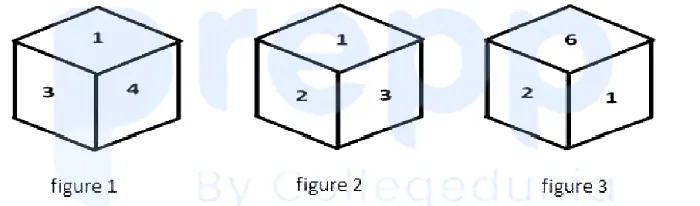
Three different positions of the same dice are shown. Find the number on the face opposite to the face showing ‘5’.
- A
4
- B
2
- C
1
- D
6
Show answer
C. 1The logic followed here is :-
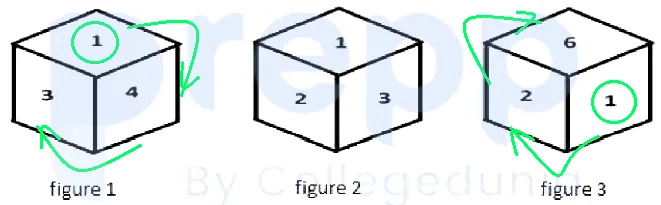
From the given three different cubes taking figure 1 and figure 3 ,the adjacent sides are as shown below :
As 1 is common on both figure 1 and figure 3, it is clear that 2, 3, 4 and 6 are adjacent to it and remaining number i.e., 5 will be opposite to it.
Opposite pairs:
1 → 5
2 → 4
3 → 6
So, the opposite side of "5" will be side "1".
Hence, the correct answer is "1".
 Paper & answer key PDF ↗
 Question 22archived
Which option represents the correct order of the given words as they would appear in an English dictionary?
1. Highway
2. History
3. Hired
4. Hierarchy
5. Hibiscus
- A
5, 4, 3, 1, 2
- B
5, 4, 3, 2, 1
- C
5, 4, 1, 3, 2
- D
5, 4, 2, 1, 3
Show answer
C. 5, 4, 1, 3, 2The correct answer is 5, 4, 1, 3, 2.
"go" vs "going" - "go" comes before "going". Additional Information: Applications of Dictionary Order Alphabetical or dictionary order is a crucial skill used in many areas beyond just looking up words in a dictionary. It's used for sorting lists of names, indexing books, organizing files on a computer, and arranging entries in catalogs or databases. Understanding this system helps in efficiently finding and organizing information.
Paper & answer key PDF ↗ Question 23archived
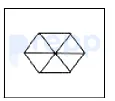
Select the option figure which is embedded in the given figure (rotation is NOT allowed).
- A
Option A (shown in image)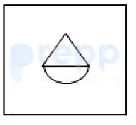
- B
Option B (shown in image)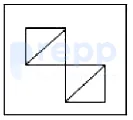
- C
Option C (shown in image)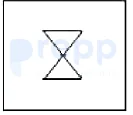
- D
Option D (shown in image)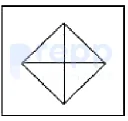
Show answer
C. Option C (shown in image)Given:
The image must not to be rotated
Hence, the correct answer is "Option - (3)".
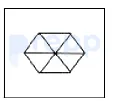
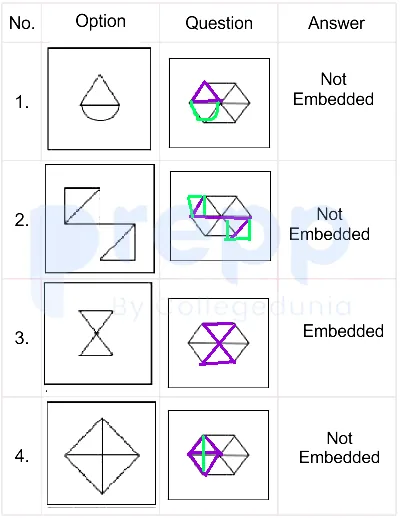 Paper & answer key PDF ↗
 Question 24archived
Select the option that represents the letters that, when sequentially placed from left to right in the blanks below, will complete the letter series.
PRKY_LDP_ _YOLD_RKYO_DPRK_ _LD
- A
ORKLPOD
- B
ORPKYLP
- C
ORPLKYO
- D
ORKPLYO
Show answer
D. ORKPLYOSolving the Letter Series Completion Problem
The question asks us to find the sequence of letters that completes the given letter series when placed in the blanks. The letter series provided is:
PRKY_LDP_ _YOLD_RKYO_DPRK_ _LD
First, let's carefully identify the positions of the blanks in the series. The blanks are represented by underscores (_).
The series can be written showing the blanks:
PRKY _ LDP _ _ YOLD _ RKYO _ DPRK _ _ LD
Counting the underscores, we find there are a total of 7 blanks:
One blank after PRKY.
Two blanks after LDP.
One blank after YOLD.
One blank after RKYO.
Two blanks after DPRK.
No blank after LD in the provided string representation.
So, there are 1 + 2 + 1 + 1 + 2 = 7 blanks in total.
We are given four options, each representing a sequence of letters to fill these blanks. The options are:
ORKLPOD (7 letters)
ORPKYLP (7 letters)
ORPLKYO (7 letters)
ORKPLYO (7 letters)
All the options contain exactly 7 letters, which matches the number of blanks we identified. This suggests that we need to place the letters from one of these sequences into the blanks in the order they appear in the option.
Let's test the correct option, which is ORKPLYO, by placing its letters sequentially into the 7 blanks:
The 1st letter 'O' goes into the 1st blank (after PRKY).
The 2nd letter 'R' goes into the 2nd blank (after LDP).
The 3rd letter 'K' goes into the 3rd blank (after LDP).
The 4th letter 'P' goes into the 4th blank (after YOLD).
The 5th letter 'L' goes into the 5th blank (after RKYO).
The 6th letter 'Y' goes into the 6th blank (after DPRK).
The 7th letter 'O' goes into the 7th blank (after DPRK).
Inserting these letters into the blanks, the series becomes:
PRKY O LDP R K YOLD P RKYO L DPRK Y O LD
Let's look at the series with the blanks filled:
PRKYO LDP RK YOLDP RKYOL DPRKYOLD
Breaking it down by the original segments and the filled letters:
PRKY + O = PRKYO
LDP + R K = LDPRK
YOLD + P = YOLDP
RKYO + L = RKYOL
DPRK + Y O = DPRKYO
LD (No blank followed this segment)
The completed series is PRKYOLDP RKYOL DPRKYOLD.
By inserting the letters O, R, K, P, L, Y, O from option 4 (ORKPLYO) sequentially into the 7 blanks, we get a complete letter series. This sequence of fillers fits the number of blanks exactly.
Analyzing the Completed Letter Series
The completed series is PRKYO LDPRK YOLDP RKYOL DPRKYO LD. While a simple, repeating block pattern might not be immediately obvious across the entire length, the process of filling the identified blanks with the sequence ORKPLYO from the correct option successfully completes the series according to the question's requirements.
The question asks which option completes the series, implying that one of the options provides the correct sequence of letters for the blanks. Since option 4, ORKPLYO, contains 7 letters and there are 7 blanks, this option is the correct choice for filling the series.
The process involves accurately counting the blanks and then applying the letters from the option in order.
Blank Number
Position in Series
Letter from ORKPLYO
Original Segment
Filled Segment
1
After PRKY
O
PRKY_
PRKYO
2
After LDP (1st of 2)
R
LDP_ _
LDPR_
3
After LDP (2nd of 2)
K
LDP R_
LDPRK
4
After YOLD
P
YOLD_
YOLDP
5
After RKYO
L
RKYO_
RKYOL
6
After DPRK (1st of 2)
Y
DPRK_ _
DPRKY_
7
After DPRK (2nd of 2)
O
DPRK Y_
DPRKYO
This table shows how each letter from the sequence ORKPLYO fills a specific blank in the series. The last segment 'LD' has no blanks following it in the original pattern provided.
Revision Table: Key Concepts
Concept
Description
Importance in Series Completion
Letter Series
A sequence of letters following a specific pattern or rule.
Understanding the underlying pattern is crucial for solving.
Blanks
Missing letters in the series that need to be filled.
Counting blanks accurately is the first step.
Options
Provided sequences of letters to fill the blanks.
One option contains the correct sequence for the blanks.
Sequential Placement
Filling the blanks from left to right using the letters from the option in order.
This is the method specified in the question.
Additional Information: Types of Letter Series Patterns
Letter series completion problems can involve various types of patterns. Some common types include:
Repeating Patterns: A block of letters repeats throughout the series (e.g., ABCA BCA BCA...).
Alphabetical Order/Skip: Letters follow alphabetical order or skip letters in a consistent way (e.g., A C E G...).
Reverse Alphabetical Order/Skip: Letters follow reverse alphabetical order or skip letters (e.g., Z X V T...).
Combination of Patterns: Multiple simple patterns might be combined.
Pattern Based on Number of Letters: The number of letters between blanks or in segments follows a pattern.
Complex Patterns: Patterns based on skipping a variable number of letters, using different sequences, or cyclic permutations of a set of letters.
For this specific problem, the pattern is realized by filling the blanks with the correct sequence provided in the option, resulting in segments that may or may not follow a very simple repeating block or arithmetic/alphabetical progression.
Paper & answer key PDF ↗ Question 25archived
Which of the answer figures is the exact mirror image of the given problem figure when the mirror is held at the right side?
Problem figure:
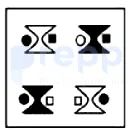
- A
Option A (shown in image)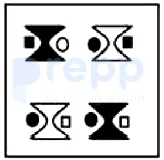
- B
Option B (shown in image)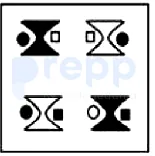
- C
Option C (shown in image)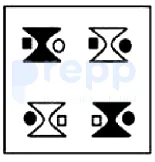
- D
Option D (shown in image)
Show answer
C. Option C (shown in image)The correct mirror image of the given figure when mirror is placed at MN is as shown below:
Hence, the correct answer is "Option - (3)".
 Paper & answer key PDF ↗
 Question 26archived
Consider the following statements about unemployment in India:
a) Seasonal unemployment is mainly found in urban areas.
b) Educated unemployed people are mainly found in rural areas of India.
c) Higher cropping intensity is desirable for reducing unemployment in the rural economy.
Which of the given statements is/are correct?
- A
Only c
- B
Only b and c
- C
Only a and b
- D
Only a
Show answer
A. Only cUnderstanding Unemployment in India: An Analysis
Let's carefully analyze each statement provided regarding unemployment in India to determine its correctness.
Analyzing Statement a: Seasonal Unemployment
Statement a says: "Seasonal unemployment is mainly found in urban areas."
Seasonal unemployment occurs when people are unemployed at particular times of the year because they work in industries like agriculture, tourism, or construction, which are seasonal. In India, seasonal unemployment is most prominently associated with the agricultural sector. Agricultural activities are highly dependent on weather patterns and harvesting cycles. Work is intense during planting and harvesting seasons but reduces significantly during off-seasons.
Since agriculture is predominantly a rural activity, seasonal unemployment is primarily a rural phenomenon, not mainly an urban one. Urban areas might have some seasonal jobs (e.g., certain retail or tourism roles), but the scale and impact of seasonal unemployment are far greater in rural areas tied to agriculture.
Therefore, statement a is incorrect.
Analyzing Statement b: Educated Unemployment
Statement b says: "Educated unemployed people are mainly found in rural areas of India."
Educated unemployment refers to the situation where individuals who have received a certain level of education (like secondary school, college, or university) are unable to find jobs that match their skills or expectations, or any job at all. This is a widespread problem in India, affecting both urban and rural areas.
While educated unemployment is present in rural areas, especially as more people gain access to education, it is also a significant challenge in urban areas. Many educated individuals migrate to urban centers in search of better job opportunities, but face stiff competition or a mismatch between their skills and available jobs. It's difficult to definitively say that educated unemployed people are 'mainly' found in rural areas; it's a significant issue in urban centres as well, often related to structural issues in the economy and the education system.
Therefore, statement b is likely incorrect or at least questionable in its assertion of being 'mainly' in rural areas.
Analyzing Statement c: Cropping Intensity and Rural Economy
Statement c says: "Higher cropping intensity is desirable for reducing unemployment in the rural economy."
Cropping intensity refers to the number of crops grown on the same piece of land within one agricultural year. A higher cropping intensity means that the land is used to grow crops more than once a year (e.g., growing two or three crops instead of one). This usually requires irrigation facilities and better farming practices.
Increasing cropping intensity leads to more agricultural activities spread throughout the year. This creates more demand for labour in rural areas, not just during one main harvesting season but across multiple seasons. By providing more continuous work, higher cropping intensity helps to reduce seasonal unemployment and underemployment (where people are employed but not using their full capacity) in the rural economy.
Therefore, statement c is correct.
Conclusion
Based on the analysis:
Statement a: Incorrect. Seasonal unemployment is mainly rural.
Statement b: Incorrect or questionable. Educated unemployment is significant in both urban and rural areas.
Statement c: Correct. Higher cropping intensity boosts rural employment.
Only statement c is correct.
The question asks which statement(s) are correct. Based on our analysis, only statement c is correct.
The correct option is the one that states "Only c".
Summary of Statements on Unemployment in India
Statement
Analysis
Correctness
a) Seasonal unemployment is mainly found in urban areas.
Seasonal unemployment is linked to agriculture, which is primarily rural.
Incorrect
b) Educated unemployed people are mainly found in rural areas of India.
Educated unemployment is a significant issue in both urban and rural areas.
Incorrect/Questionable
c) Higher cropping intensity is desirable for reducing unemployment in the rural economy.
More crops per year means more work throughout the year, reducing seasonal unemployment.
Correct
Revision Table: Unemployment in India
Here's a quick table for revision on unemployment types mentioned:
Key Unemployment Types Mentioned
Type of Unemployment
Primary Location/Context
Reason
Seasonal Unemployment
Rural Areas (Agriculture)
Work available only during specific seasons (planting, harvesting).
Educated Unemployment
Both Urban and Rural Areas
Lack of suitable jobs for educated individuals; skill mismatch.
Additional Information: Types of Unemployment in India
Unemployment is a major economic challenge in India. It can be categorized in several ways:
Seasonal Unemployment: As discussed, prevalent in agriculture, where work is only available during certain seasons.
Disguised Unemployment: Also common in rural agriculture. People appear to be employed, but their removal would not affect the total output. Their marginal productivity is zero or close to zero.
Educated Unemployment: Graduates and educated people unable to find suitable jobs.
Open Unemployment: When a person is willing and able to work but cannot find any work at the prevailing wage rate.
Structural Unemployment: Caused by a mismatch between the skills workers have and the skills demanded by the industry, often due to technological changes or shifts in the economy.
Cyclical Unemployment: Arises during economic downturns or recessions when aggregate demand falls, leading to reduced production and job losses.
Frictional Unemployment: Temporary unemployment that occurs when people are transitioning between jobs.
Addressing unemployment requires multi-faceted strategies, including promoting labour-intensive industries, improving education and skill development, investing in infrastructure, and supporting sectors like agriculture to provide more stable employment (e.g., through higher cropping intensity and diversification).
Paper & answer key PDF ↗ Question 27archived
The folk dance of Kummi is performed by the women of which Indian state?
- A
Rajasthan
- B
Madhya Pradesh
- C
Tamil Nadu
- D
Jharkhand
Show answer
C. Tamil NaduUnderstanding the Kummi Folk Dance
The question asks about the Indian state where the folk dance known as Kummi is primarily performed by women. Understanding the diverse folk traditions of India is important for general knowledge and competitive exams.
What is Kummi Dance?
Kummi is a popular folk dance traditionally performed by women. It is known for its simple yet graceful movements, typically done in a circle. The dancers do not use any musical instruments; instead, they keep time by clapping their hands in rhythm.
Key characteristics of Kummi dance:
Performed exclusively by women.
Dancers form a circular pattern.
The rhythm is maintained by clapping.
No musical instruments are traditionally used.
It is often performed during festivals and social gatherings.
Origin State of Kummi Dance
The Kummi folk dance is a significant part of the cultural heritage of Tamil Nadu. It is widely practiced in various parts of the state, especially during Pongal (harvest festival) and other religious occasions.
While variations of clapping dances performed by women exist in other South Indian states, Kummi is most strongly associated with Tamil Nadu.
Analyzing the Options
Let's look at the provided options:
Rajasthan: Rajasthan is known for folk dances like Ghoomar, Kalbelia, and Bhavai. Kummi is not a prominent dance form here.
Madhya Pradesh: Madhya Pradesh has dances like Gaur Maria, Karma, and Jawara. Kummi is not associated with this state.
Tamil Nadu: As discussed, Kummi is a traditional folk dance of Tamil Nadu, performed by women.
Jharkhand: Jharkhand's folk dances include Karma Munda, Agni, and Santhali. Kummi is not from this state.
Based on the origin and practice of the Kummi dance, it is clearly associated with Tamil Nadu.
Kummi Dance Overview
Dance Name
Primary Performers
Key Feature
Associated State
Kummi
Women
Circular formation, clapping hands
Tamil Nadu
Revision Table: Indian Folk Dances
Here is a brief look at some other folk dances and their states:
Folk Dance
State
Bhangra
Punjab
Garba
Gujarat
Kathakali
Kerala
Bihu
Assam
Ghoomar
Rajasthan
Lavani
Maharashtra
Bharatnatyam
Tamil Nadu (Classical, but important)
Additional Information on Tamil Nadu Folk Dances
Tamil Nadu has a rich tradition of folk and classical dances. Besides Kummi, some other notable folk dances from the state include:
Karakattam: Performed with pots balanced on the head.
Mayilattam: Peacock dance, performed by dancers dressed as peacocks.
Oyilattam: Dance with rhythm sticks or cloth.
Poikkal Kudirai Attam: Dummy horse dance.
Theru Koothu: Street play/dance form.
These dances often tell stories, celebrate festivals, or are performed during religious ceremonies, showcasing the vibrant culture of Tamil Nadu.
Paper & answer key PDF ↗ Question 28archived
Fundamental duties were not placed in Part III of the Indian Constitution because Part III is ______.
- A
non-justiciable
- B
justiciable
- C
not enforceable
- D
absolute
Show answer
B. justiciableLet's understand why Fundamental Duties were not placed in Part III of the Indian Constitution. The Constitution of India is divided into various Parts, each dealing with different aspects of governance, rights, and duties.
Part III of the Indian Constitution is very significant as it enshrines the Fundamental Rights of the citizens. These are rights that are considered essential for the overall development of individuals and are protected by the Constitution.
Understanding Part III: Fundamental Rights
Key characteristics of the rights listed in Part III:
They are inherent rights guaranteed to all citizens (and sometimes non-citizens).
They are enforceable in a court of law. If a Fundamental Right is violated, an individual can approach the High Court (under Article 226) or the Supreme Court (under Article 32) for its enforcement.
This enforceability makes Part III justiciable. Justiciable means that the issues can be settled by a court of law; rights can be enforced through judicial proceedings.
Exploring Fundamental Duties
Fundamental Duties, on the other hand, were added to the Constitution later by the 42nd Amendment Act of 1976, based on the recommendations of the Swaran Singh Committee. They are listed in Part IVA of the Constitution, under Article 51A.
Key characteristics of Fundamental Duties:
They are obligations or duties of the citizens towards the nation and society.
Examples include upholding the sovereignty, unity, and integrity of India, promoting harmony, protecting the environment, and safeguarding public property.
Unlike Fundamental Rights, Fundamental Duties are generally non-justiciable. This means that a citizen cannot be directly taken to court merely for failing to perform a Fundamental Duty (although the state may enact laws to implement some of these duties).
Why Fundamental Duties Are Not in Part III
The primary reason why Fundamental Duties were placed in a separate Part (Part IVA) and not in Part III is the fundamental difference in their nature and enforceability.
Part III is reserved for rights that the state must protect and which individuals can move the courts to enforce if violated. This is the essence of Part III being justiciable.
Fundamental Duties are obligations that citizens should perform. They are intended to be moral guidelines and promote a sense of responsibility. They were not intended to be legally enforceable in the same way as Fundamental Rights.
Placing non-justiciable duties within a section specifically dedicated to justiciable rights would be structurally and functionally inconsistent. Therefore, because Part III contains rights that are legally enforceable (justiciable), it is not the appropriate place for duties that are primarily moral obligations and non-justiciable.
Analyzing the Options
Let's look at the given options in the context of why Fundamental Duties are not in Part III:
non-justiciable: This describes Fundamental Duties, not Part III. Part III is justiciable. So, this is incorrect.
justiciable: This accurately describes Part III. Since Part III contains rights that can be enforced in court, it is justiciable. Fundamental Duties are non-justiciable, and thus, they are not placed in this justiciable part. This aligns with our understanding.
not enforceable: This describes Fundamental Duties (generally), but not Part III. Rights in Part III are enforceable. So, this is incorrect.
absolute: While some Fundamental Rights are absolute (like the prohibition against untouchability), many are subject to reasonable restrictions. Describing Part III as 'absolute' is an overgeneralization and not the primary legal characteristic that determines the placement of Fundamental Duties. The key characteristic distinguishing Part III from Part IVA is justiciability. So, this is incorrect in this specific context.
Therefore, the reason Fundamental Duties were not placed in Part III is because Part III is justiciable, meaning the rights listed therein are legally enforceable.
Feature
Fundamental Rights (Part III)
Fundamental Duties (Part IVA)
Nature
Rights guaranteed to individuals
Obligations of individuals towards the state/society
Granted by
State to citizens/individuals
Expected from citizens
Enforceability
Justiciable (enforceable by courts)
Generally Non-justiciable (not directly enforceable by courts)
Placement in Constitution
Part III
Part IVA
Revision Table: Key Differences in Constitution Parts
Constitutional Part
Contains
Nature
Enforceability
Part III
Fundamental Rights
Guaranteed Rights
Justiciable (enforceable by courts)
Part IV
Directive Principles of State Policy (DPSP)
Guidelines for State
Non-justiciable
Part IVA
Fundamental Duties
Obligations of Citizens
Generally Non-justiciable
Additional Information on Constitutional Provisions
Understanding the relationship between Fundamental Rights, Directive Principles of State Policy (DPSP - Part IV), and Fundamental Duties is crucial for comprehending the philosophy of the Indian Constitution.
Directive Principles of State Policy (DPSP): These are guidelines or instructions to the State for the establishment of a social and economic democracy. Like Fundamental Duties, they are also non-justiciable. The State is expected to keep them in mind while formulating policies and enacting laws.
Relationship: The courts have sometimes used DPSP and Fundamental Duties to interpret Fundamental Rights. While DPSP and Fundamental Duties are not directly enforceable, they can be relevant in determining the constitutionality of a law that is challenged on the grounds of violating a Fundamental Right. For instance, a law implementing a DPSP or giving effect to a Fundamental Duty might be upheld even if it imposes a reasonable restriction on a Fundamental Right.
The idea is that rights and duties are two sides of the same coin; the enjoyment of rights should be accompanied by the performance of duties.
Paper & answer key PDF ↗ Question 29archived
Which of the following is NOT a function of money?
- A
Medium of exchange
- B
Problem in storage
- C
Measure of value
- D
Standard of deferred payments
Show answer
B. Problem in storageUnderstanding the Functions of Money
Money plays a vital role in modern economies by facilitating transactions and economic calculations. To understand which of the given options is NOT a function of money, let's first review the primary functions that money performs.
Key Functions of Money
Economists generally identify the following main functions of money:
Medium of Exchange: This is the most important function. Money is accepted by people in exchange for goods and services. Using money avoids the difficulties associated with the barter system, where trade requires a "double coincidence of wants" (both parties must have what the other wants). Money makes buying and selling much easier and more efficient.
Measure of Value (or Unit of Account): Money provides a common standard for measuring the relative worth of different goods and services. It allows us to express the prices of all items in the same unit (e.g., dollars, euros, rupees). This makes it easy to compare the value of different things and is essential for accounting and economic calculations.
Standard of Deferred Payments: Money serves as a standard for future payments. Debts, loans, and credit transactions are typically specified in monetary terms. This function is crucial for borrowing, lending, and long-term contracts, as it provides a stable unit in which future obligations can be settled.
Store of Value: Money can be saved and used to purchase goods and services later. It holds its value over time, allowing people to transfer purchasing power from the present to the future. While inflation can erode the real value of money over time, money is generally a more convenient and liquid store of value than many other assets.
Analyzing the Given Options
Now let's examine each option provided in the question to see which one does NOT fit as a function of money:
Medium of exchange: As explained, this is a fundamental function of money. It's what makes transactions possible in a complex economy.
Problem in storage: This phrase describes a potential difficulty or characteristic associated with holding or keeping certain forms of money secure (especially physical cash). It is not a function that money performs for the economy; it's a challenge related to its physical handling and safety. Money's functions relate to its role in economic transactions and valuation, not the logistical issues of storing it.
Measure of value: This is another widely recognized function of money, essential for pricing and comparing economic values.
Standard of deferred payments: This is also a standard function of money, critical for credit, loans, and future financial obligations.
Conclusion
Based on the standard functions of money, "Problem in storage" is the only option that is not a function. While the safekeeping of money is important, the act or issue of storage itself is not a role that money plays in the economy's operation.
Revision Table: Understanding Money Functions
Function of Money
Role in the Economy
Medium of Exchange
Facilitates transactions; avoids barter.
Measure of Value (Unit of Account)
Common unit for pricing and comparisons.
Standard of Deferred Payments
Allows for credit and future obligations.
Store of Value
Holds purchasing power over time.
Additional Information: Characteristics vs. Functions of Money
It is important to distinguish between the functions of money and the characteristics that make something suitable to serve as money. Characteristics are qualities that help money perform its functions effectively. Examples of such characteristics include:
Durability: It should not easily wear out.
Portability: Easy to carry around.
Divisibility: Can be broken into smaller units.
Uniformity: All units are identical.
Limited Supply: Scarcity helps maintain value.
Acceptability: Everyone must be willing to use it.
A "problem in storage" could relate to the characteristic of durability (e.g., if commodity money like grain is hard to store without spoilage) or security, but it is not a function of money itself.
Paper & answer key PDF ↗ Question 30archived
______ is a naturally occurring organic compound with the formula (C6H5)2CO.
- A
Methcathinone
- B
Propiophenone
- C
Acetophenone
- D
Benzophenone
Show answer
D. BenzophenoneIdentifying Organic Compounds by Chemical Formula
The question asks to identify a naturally occurring organic compound with the specific chemical formula \((C_6H_5)_2CO\). Let's break down this formula. \(C_6H_5\) represents a phenyl group, which is a benzene ring \((C_6H_6)\) missing one hydrogen atom. The formula \((C_6H_5)_2CO\) means there are two phenyl groups attached to a carbonyl group \((CO)\). This structure corresponds to a specific type of ketone where the carbonyl group is bonded to two phenyl groups.
Analyzing the Options
We need to examine each given option to see which one matches the formula \((C_6H_5)_2CO\) and is also known to be naturally occurring.
Methcathinone: This is a synthetic stimulant, not naturally occurring. Its chemical formula is \(C_{10}H_{13}NO\), and its structure involves a phenyl group, a ketone group, and an amine group, but it does not match \((C_6H_5)_2CO\).
Propiophenone: The formula for Propiophenone is \(C_9H_{10}O\), which is \(C_6H_5COCH_2CH_3\). This compound has one phenyl group attached to a carbonyl group, which is then attached to an ethyl group \((CH_2CH_3)\). This does not match \((C_6H_5)_2CO\).
Acetophenone: The formula for Acetophenone is \(C_8H_8O\), which is \(C_6H_5COCH_3\). This compound has one phenyl group attached to a carbonyl group, which is then attached to a methyl group \((CH_3)\). While Acetophenone is found naturally in some plants and foods, its formula does not match \((C_6H_5)_2CO\).
Benzophenone: The formula for Benzophenone is \(C_{13}H_{10}O\), which is \(C_6H_5COC_6H_5\) or \((C_6H_5)_2CO\). This exactly matches the given formula. Benzophenone is known to occur naturally in some plants, including fruits and flowers, where it contributes to fragrance.
Comparing Formula and Natural Occurrence
Based on the analysis:
The formula \((C_6H_5)_2CO\) uniquely matches Benzophenone.
Benzophenone is a naturally occurring compound.
The other options either do not match the formula or are not primarily known as naturally occurring compounds fitting this description.
Therefore, the compound described is Benzophenone.
Revision Table: Organic Compounds and Formulas
Compound
Chemical Formula
Matches \((C_6H_5)_2CO\)?
Naturally Occurring?
Methcathinone
\(C_{10}H_{13}NO\)
No
Primarily Synthetic
Propiophenone
\(C_9H_{10}O\) (\(C_6H_5COCH_2CH_3\))
No
Used in Synthesis
Acetophenone
\(C_8H_8O\) (\(C_6H_5COCH_3\))
No
Yes (in some plants)
Benzophenone
\(C_{13}H_{10}O\) (\((C_6H_5)_2CO\))
Yes
Yes (in plants)
Additional Information on Ketones and Aromatic Compounds
The compound \((C_6H_5)_2CO\) is a type of ketone. Ketones are organic compounds containing a carbonyl group \((C=O)\) bonded to two carbon atoms. When the carbon atoms directly attached to the carbonyl group are part of aromatic rings (like phenyl groups), the compound is an aromatic ketone.
Benzophenone is an example of an aromatic ketone. Both groups attached to the carbonyl are phenyl groups.
Acetophenone is also an aromatic ketone, but it has one phenyl group and one alkyl group (methyl) attached to the carbonyl.
Propiophenone is another aromatic ketone, with one phenyl group and one ethyl group attached to the carbonyl.
Understanding the structure and typical occurrences of different classes of organic compounds helps in identifying them from their formulas.
Paper & answer key PDF ↗ Question 31archived
What is the priority zone of the AMRUT (Atal Mission for Rejuvenation and Urban Transformation) mission, which was launched by the Government of India in 2015?
- A
Water supply followed by sewerage
- B
Electricity and power generation
- C
Primary education for all
- D
Health care of urban dwellers
Show answer
A. Water supply followed by sewerageUnderstanding the AMRUT Mission Priority Zone
The Atal Mission for Rejuvenation and Urban Transformation (AMRUT) is a flagship program launched by the Government of India in June 2015. Its main objective is to provide basic amenities to urban areas to improve the quality of life for urban dwellers. The mission covers 500 cities and towns across India.
Key Focus Areas of AMRUT Mission
The AMRUT mission focuses on providing critical urban infrastructure. The primary areas of focus under the mission include:
Water Supply
Sewerage and Septage Management
Storm Water Drainage
Urban Transport
Development of Green Spaces and Parks
Among these focus areas, the mission clearly defined a priority zone to address the most pressing needs first.
AMRUT Mission's Priority Zone Explained
The question asks about the priority zone of the AMRUT mission. While the mission addresses multiple urban infrastructure issues, it specifically prioritizes access to basic services related to water and sanitation. Improving water supply and sanitation infrastructure was identified as the most critical need for improving the quality of life in Indian cities.
Therefore, the priority zone under the AMRUT mission is the provision of universal coverage of water supply connections and sewerage connections in all project cities. The mission emphasizes that 100% coverage for water supply and sewerage should be achieved in the selected cities, wherever feasible.
Analysing the Options
Let's look at the given options in the context of the AMRUT mission's objectives and priorities:
Option 1: Water supply followed by sewerage
This option aligns directly with the stated priority of the AMRUT mission, which aims for universal coverage of water supply and sewerage connections.
Option 2: Electricity and power generation
While essential, electricity and power generation are not the primary focus or stated priority zone of the AMRUT mission. Other government schemes often address energy infrastructure.
Option 3: Primary education for all
Education is crucial, but primary education falls under different government programs and ministries, not the AMRUT mission, which focuses on urban physical infrastructure.
Option 4: Health care of urban dwellers
Healthcare is another vital sector covered by specific health missions and programs, not the urban infrastructure focus of AMRUT.
Based on the mission's guidelines and objectives, the priority zone is clearly focused on water and sanitation infrastructure.
Conclusion on AMRUT Mission Priority
The Atal Mission for Rejuvenation and Urban Transformation (AMRUT) places the highest priority on ensuring that urban residents have access to essential services like clean water and proper sanitation. This focus on water supply followed by sewerage management is fundamental to the mission's goal of transforming urban areas and improving living conditions.
AMRUT Mission Focus Areas
Priority Status
Water Supply
Highest Priority
Sewerage and Septage Management
High Priority (following Water Supply)
Storm Water Drainage
Important
Urban Transport
Important
Development of Green Spaces and Parks
Important
Revision Table: AMRUT Mission Essentials
Feature
Details
Mission Name
Atal Mission for Rejuvenation and Urban Transformation (AMRUT)
Launch Year
2015
Governing Ministry
Ministry of Housing and Urban Affairs
Coverage
500 cities/towns
Primary Goal
Improve quality of life through basic urban infrastructure
Priority Zone
Water Supply followed by Sewerage
Additional Information on Urban Transformation
The AMRUT mission is part of a broader effort by the Indian government to promote urban development. It works in conjunction with other schemes like the Smart Cities Mission and Swachh Bharat Mission (Urban) to create sustainable and livable urban environments. The focus on water supply and sewerage is particularly critical because inadequate services in these areas lead to significant health issues and environmental degradation in urban centres.
Ensuring access to piped water supply for every household and improving sewage collection and treatment are fundamental steps towards building healthy and sustainable cities. The AMRUT mission aims to bridge the infrastructure gap in these vital services.
Paper & answer key PDF ↗ Question 32archived
Who was the founder of Harijan Sevak Sangh founded in 1932?
- A
Jawaharlal Nehru
- B
Mahatma Gandhi
- C
Jyotiba Phule
- D
BR Ambedkar
Show answer
B. Mahatma GandhiUnderstanding the Harijan Sevak Sangh
The question asks about the founder of the Harijan Sevak Sangh, an important organization established in 1932. Let's delve into the history and purpose of this organization to identify its founder.
What is the Harijan Sevak Sangh?
The Harijan Sevak Sangh, initially known as the All India Anti-Untouchability League, was founded with the primary objective of eradicating untouchability in India and working for the welfare of the oppressed classes, whom Mahatma Gandhi referred to as 'Harijans' (meaning 'Children of God').
Founder of Harijan Sevak Sangh 1932
The Harijan Sevak Sangh was founded in September 1932. This happened after the Poona Pact, an agreement between Mahatma Gandhi and B.R. Ambedkar, which addressed the issue of separate electorates for depressed classes. Mahatma Gandhi was deeply committed to the cause of abolishing untouchability and dedicated a significant part of his life and work to this social reform.
Mahatma Gandhi himself founded the Harijan Sevak Sangh to continue the fight against untouchability and work towards the social and economic upliftment of the scheduled castes.
Analysing the Options
Let's look at the provided options and their relevance:
Jawaharlal Nehru: A prominent leader in the Indian independence movement and the first Prime Minister of India. While he supported social reforms, he was not the founder of the Harijan Sevak Sangh.
Mahatma Gandhi: The leader of India's independence movement and a key figure in social reform. He championed the cause against untouchability and founded the Harijan Sevak Sangh.
Jyotiba Phule: A 19th-century social reformer who worked against caste discrimination and untouchability. While his work was foundational, he was not alive in 1932 when the Harijan Sevak Sangh was founded.
BR Ambedkar: A key leader of the depressed classes and the architect of the Indian Constitution. He fought fiercely against untouchability and caste discrimination and was involved in the Poona Pact with Gandhi, but he did not found the Harijan Sevak Sangh; he led his own organizations focused on the rights of the depressed classes.
Based on historical facts, the founder of the Harijan Sevak Sangh in 1932 was Mahatma Gandhi.
Organization
Year Founded
Founder
Primary Goal
Harijan Sevak Sangh (All India Anti-Untouchability League)
1932
Mahatma Gandhi
Eradication of untouchability and upliftment of oppressed classes
Conclusion
The Harijan Sevak Sangh was established by Mahatma Gandhi in 1932 as a part of his broader efforts to reform Indian society and eliminate the practice of untouchability.
Harijan Sevak Sangh Revision Table
Aspect
Detail
Full Name
Harijan Sevak Sangh (formerly All India Anti-Untouchability League)
Year of Foundation
1932
Founder
Mahatma Gandhi
Context of Foundation
After the Poona Pact, as a move to address untouchability
Key Objective
Work against untouchability, uplift Harijans (depressed classes)
Additional Information on Harijan Sevak Sangh and Social Reform
The founding of the Harijan Sevak Sangh was a significant event in the history of social reform in India. Mahatma Gandhi's decision to undertake a fast unto death against the Communal Award's provision for separate electorates for depressed classes led to the Poona Pact. Following this, he shifted his focus significantly to the cause of removing untouchability, which he considered a major blot on Hindu society.
He coined the term 'Harijan' for the depressed classes, although this term later became controversial, with leaders like B.R. Ambedkar preferring terms like 'Dalit' or 'Scheduled Castes'. Gandhi's campaign included:
Opening temples, wells, and other public places to Harijans.
Promoting inter-dining and inter-caste marriage.
Working for their education and economic welfare.
Undertaking tours across the country to raise awareness against untouchability.
The Harijan Sevak Sangh continues its work even today, focusing on education, health, and economic development of Scheduled Castes.
Paper & answer key PDF ↗ Question 33archived
Sohan Singh Bhakna and Har Dayal were primarily associated with which of the following organisations?
- A
Ghadar Party
- B
Kisan Sabha
- C
Anushilan Samiti
- D
Yugantar
Show answer
A. Ghadar PartyUnderstanding the Ghadar Party and its Leaders
The question asks about the primary organisation associated with Sohan Singh Bhakna and Har Dayal. These two individuals were prominent figures in the Indian independence movement, particularly known for their activities outside India.
Examining the Options
Let's look at the organisations provided in the options and their connection to Sohan Singh Bhakna and Har Dayal:
Ghadar Party: This was a revolutionary organisation formed by expatriate Indians, primarily Sikhs, in the United States and Canada. It aimed to overthrow British rule in India.
Kisan Sabha: This term generally refers to peasant movements and organisations in India, focusing on farmers' rights.
Anushilan Samiti: This was a revolutionary group operating mainly in Bengal, focusing on militant nationalism within India.
Yugantar: Also a revolutionary group based in Bengal, closely linked with Anushilan Samiti.
Sohan Singh Bhakna and Har Dayal's Association
Sohan Singh Bhakna was a key founder of the Ghadar Party. He served as its first president. Lala Har Dayal was another pivotal figure in the Ghadar Party. He was a prominent intellectual, writer, and propagandist for the party, serving as its secretary and editor of the party's newspaper, also called 'Ghadar'.
Their leadership roles and significant contributions were central to the Ghadar Party's formation, ideology, and activities from its inception in the early 20th century. The party organised Indian immigrants, mainly in North America, advocating for an armed revolt against the British in India.
Analyzing the Correct Connection
Based on historical records, Sohan Singh Bhakna and Har Dayal's most significant and primary association during this revolutionary phase was with the Ghadar Party. While individuals might have tangential connections to other movements or organisations over their lifetime, their joint and defining role was in the Ghadar movement.
Comparing this with other options:
Kisan Sabha movements primarily gained prominence later and were focused domestically.
Anushilan Samiti and Yugantar were active in Bengal and represented a different stream of revolutionary nationalism, less directly connected to these two leaders' activities abroad.
Therefore, the Ghadar Party is the correct organisation primarily associated with both Sohan Singh Bhakna and Har Dayal.
Organisation
Primary Focus/Location
Connection to Sohan Singh Bhakna & Har Dayal
Ghadar Party
Revolutionary; North America (USA & Canada)
Primary Association: Bhakna (Founder, President), Har Dayal (Secretary, Ideologue, Editor)
Kisan Sabha
Peasant Rights; India
Not primarily associated
Anushilan Samiti
Revolutionary; Bengal, India
Not primarily associated
Yugantar
Revolutionary; Bengal, India
Not primarily associated
Revision Table: Indian Revolutionary Organisations
Organisation
Key Figures (Examples)
Period
Primary Area of Operation
Main Aim
Ghadar Party
Sohan Singh Bhakna, Har Dayal, Kartar Singh Sarabha, Rash Behari Bose
Formed 1913
USA, Canada (North America)
Overthrow British rule in India through armed revolution
Kisan Sabha
Swami Sahajanand Saraswati, N.G. Ranga
Various periods (prominent 1920s-1930s onwards)
India (various regions)
Advocate for peasant rights, against landlordism and exploitation
Anushilan Samiti
Pramathanath Mitra, Aurobindo Ghosh, Barindra Kumar Ghosh
Formed 1902
Bengal, India
Revolutionary activities against British rule, often involving militant actions
Yugantar
Barindra Kumar Ghosh, Bagha Jatin
Active early 20th century
Bengal, India
Revolutionary activities, militant nationalism
Additional Information: The Ghadar Movement
The Ghadar Movement was a significant effort by Indian expatriates to liberate India from British rule. Founded in 1913, its headquarters were in San Francisco. The word 'Ghadar' means 'rebellion' or 'mutiny'. The party aimed to incite a mutiny within the British Indian Army.
The party published a newspaper called 'Ghadar', which spread its revolutionary message among the Indian diaspora, especially in North America and parts of Asia.
Lala Har Dayal's writings in the 'Ghadar' newspaper were highly influential in propagating the party's ideology.
Sohan Singh Bhakna, as the first president, played a crucial role in organising the party and uniting different factions of Indians abroad.
During World War I, the Ghadar Party attempted to organise an armed uprising in India, collaborating with other revolutionaries like Rash Behari Bose. However, these attempts were largely unsuccessful due to various factors, including British intelligence and lack of coordinated support within India.
Despite its limited success in triggering a widespread revolt, the Ghadar Movement significantly contributed to the anti-colonial struggle by raising political consciousness among Indians abroad and inspiring future generations of revolutionaries.
Paper & answer key PDF ↗ Question 34archived
During the reign of which of the following rulers did Hiuen Tsang, a Chinese traveller, come to India?
- A
Chandragupta Il
- B
Samudragupta
- C
Ashoka
- D
Harshavardhana
Show answer
D. HarshavardhanaUnderstanding Hiuen Tsang's Visit to Ancient India
The question asks about the Indian ruler during whose reign the famous Chinese traveller Hiuen Tsang (also known as Xuanzang) visited India. Hiuen Tsang was a prominent Buddhist monk and scholar from China who embarked on a long journey to India in the 7th century CE to collect Buddhist scriptures.
His travels across India spanned many years, providing valuable insights into the political, social, and religious conditions of the time through his detailed account, 'Great Tang Records on the Western Regions' (Da Tang Xiyu Ji).
Identifying the Ruler: Harshavardhana's Reign
Historical records and Hiuen Tsang's own writings confirm that he spent a significant period of his time in North India during the reign of King Harshavardhana of the Pushyabhuti dynasty. Harshavardhana ruled a large empire in northern India from 606 CE to 647 CE.
Hiuen Tsang arrived in India around 629 CE and stayed until approximately 645 CE. This period falls squarely within Harshavardhana's rule, making him the ruler during whose reign Hiuen Tsang travelled extensively in India and was even hosted by the king.
Analyzing Other Options
Let's consider why the other options are incorrect:
Chandragupta II: He was a powerful ruler of the Gupta Empire who reigned in the late 4th and early 5th century CE (around 380-415 CE). This period is significantly earlier than Hiuen Tsang's visit in the 7th century CE.
Samudragupta: He was another prominent ruler of the Gupta Empire who reigned in the 4th century CE (around 335-380 CE). His reign also predates Hiuen Tsang's arrival in India by several centuries.
Ashoka: Emperor Ashoka belonged to the Mauryan dynasty and reigned in the 3rd century BCE (around 268-232 BCE). This period is far removed from the 7th century CE when Hiuen Tsang visited India.
Therefore, the ruler contemporary to Hiuen Tsang's visit to India was undoubtedly Harshavardhana.
Traveller
Period of Visit
Contemporary Indian Ruler/Dynasty
Hiuen Tsang (Xuanzang)
7th Century CE (c. 629-645 CE)
Harshavardhana (Pushyabhuti Dynasty)
Fa Hien (Faxian)
Early 5th Century CE (c. 399-414 CE)
Chandragupta II (Gupta Dynasty)
Megasthenes
4th Century BCE (c. 302-298 BCE)
Chandragupta Maurya (Mauryan Dynasty)
Based on historical evidence, Hiuen Tsang's visit occurred during the reign of Harshavardhana.
Revision Table: Key Travellers to Ancient India
Traveller Name
Nationality
Century of Visit
Famous Work
Indian Ruler/Period
Hiuen Tsang (Xuanzang)
Chinese
7th Century CE
Da Tang Xiyu Ji (Great Tang Records on the Western Regions)
Harshavardhana
Fa Hien (Faxian)
Chinese
5th Century CE
Fo Guo Ji (A Record of Buddhist Kingdoms)
Chandragupta II
Megasthenes
Greek
4th Century BCE
Indica (Fragments)
Chandragupta Maurya
Additional Information: Significance of Hiuen Tsang's Account
Hiuen Tsang's account is a crucial primary source for reconstructing the history of 7th century India, particularly the reign of Harshavardhana. His observations on society, economy, religion (especially Buddhism and its various schools), administration, and geography provide a detailed picture of the period. He attended the large religious assemblies organized by Harshavardhana, like the one at Kannauj and the quinquennial assembly at Prayaga (modern Prayagraj), which he described vividly. His efforts to collect Buddhist texts and relics greatly influenced the development of Buddhism in China and East Asia.
Paper & answer key PDF ↗ Question 35archived
What was India’s rank In Paralympic 2020?
- A
21
- B
25
- C
24
- D
19
Show answer
C. 24Understanding India's Performance in Paralympic 2020
The Paralympic Games are a major international multi-sport event involving athletes with a range of disabilities, including impaired muscle power, impaired passive range of movement, limb deficiency, leg length difference, short stature, hypertonia, ataxia, athetosis, vision impairment, and intellectual impairment. The event is held after the Olympic Games and in the same host city.
India's Rank in Tokyo Paralympic 2020
The Paralympic Games in 2020 were held in Tokyo, Japan. India sent its largest-ever contingent of athletes to compete in various sports.
India's performance at the Tokyo Paralympic 2020 was historic and significantly better than its previous outings. The country secured a remarkable number of medals, which resulted in a much-improved position in the overall medal tally and ranking.
Medal Tally and Ranking Analysis
India finished the Tokyo Paralympic 2020 with a total of 19 medals. This tally included:
Gold Medals: 5
Silver Medals: 8
Bronze Medals: 6
Based on this impressive medal haul, India achieved a specific rank in the overall medal standings among all participating nations.
India's Medal Count at Tokyo Paralympic 2020
Medal Type
Count
Gold
5
Silver
8
Bronze
6
Total
19
Considering the total number of medals won, particularly the gold medals, India's final rank in the Tokyo Paralympic 2020 medal table was 24th.
This 24th rank marked India's best-ever performance and highest ranking in the history of the Paralympic Games.
Conclusion on India's Paralympic 2020 Rank
India's participation and performance in the Tokyo Paralympic 2020 were highly successful, yielding a record number of medals and a significant rise in the global rankings. The final rank achieved by India in the Paralympic 2020 was 24th.
Revision Table: India Paralympic Performance Key Facts
Key Facts about India's Tokyo Paralympic 2020 Performance
Event
Year
Host City
India's Rank
Total Medals (India)
Paralympic Games
2020 (Held in 2021)
Tokyo, Japan
24th
19
Additional Information on Paralympic Games and India
The Paralympic Games are governed by the International Paralympic Committee (IPC). They are held every four years, typically shortly after the respective Olympic Games. The Tokyo 2020 Paralympics were originally scheduled for 2020 but were postponed to 2021 due to the global pandemic.
India first participated in the Paralympic Games in 1968 and has been a regular participant since 1984. The performance in Tokyo 2020 was a significant leap forward, highlighting the growth of the Paralympic movement and support for para-athletes in India.
Notable performances included multiple medals in shooting, athletics, badminton, table tennis, and archery, among others.
Paper & answer key PDF ↗ Question 36archived
Shahid Parvez Khan, Budhaditya Mukherjee and Anoushka Shankar are associated with which of the following musical instruments?
- A
Been
- B
Santoor
- C
Sitar
- D
Sarod
Show answer
C. SitarIdentifying Musical Instruments and Artists
The question asks to identify the musical instrument associated with three renowned artists: Shahid Parvez Khan, Budhaditya Mukherjee, and Anoushka Shankar.
Let's examine each artist:
Shahid Parvez Khan: He is a world-renowned Indian classical musician who plays the Sitar. He belongs to the Etawah gharana and is widely regarded as one of the finest Sitar players of his generation.
Budhaditya Mukherjee: Another eminent Indian classical Sitar player. He is known for his technical virtuosity and is also associated with the Imdadkhani or Etawah gharana.
Anoushka Shankar: She is a British-Indian Sitar player and composer. She is the daughter of the legendary Sitar maestro Ravi Shankar and is a prominent contemporary Sitar artist.
Based on the association of these three artists, the common musical instrument they are primarily known for playing is the Sitar.
Analyzing the Options
Let's briefly consider the other options to understand why they are not the correct answer in this context:
Been: This is an ancient Indian string instrument, specifically associated with Dhrupad music. While it's an important instrument, Shahid Parvez Khan, Budhaditya Mukherjee, and Anoushka Shankar are not known as Been players.
Santoor: The Santoor is a hammered dulcimer originating from Kashmir. Famous Santoor players include Pandit Shivkumar Sharma and Bhajan Sopori. The artists mentioned in the question are not associated with the Santoor.
Sarod: The Sarod is a fretless string instrument used in Indian classical music. Famous Sarod players include Amjad Ali Khan, Ali Akbar Khan, and Hafiz Ali Khan. The artists in the question are not primarily known for playing the Sarod.
Sitar: As discussed, Shahid Parvez Khan, Budhaditya Mukherjee, and Anoushka Shankar are all celebrated Sitar players. This aligns with the primary association of all three individuals.
Conclusion
Considering the principal instruments played by Shahid Parvez Khan, Budhaditya Mukherjee, and Anoushka Shankar, the Sitar is the instrument that connects all three artists.
Musical Instrument Association
Artist Name
Primary Instrument
Shahid Parvez Khan
Sitar
Budhaditya Mukherjee
Sitar
Anoushka Shankar
Sitar
Revision Table: Key Musical Instruments and Artists
Famous Artists and Their Instruments
Instrument
Notable Artists
Sitar
Ravi Shankar, Nikhil Banerjee, Vilayat Khan, Shahid Parvez Khan, Budhaditya Mukherjee, Anoushka Shankar
Been (Rudra Veena)
Asad Ali Khan, Zia Mohiuddin Dagar
Santoor
Shivkumar Sharma, Bhajan Sopori
Sarod
Amjad Ali Khan, Ali Akbar Khan, Hafiz Ali Khan
Additional Information on Indian Classical Instruments
Sitar: A plucked string instrument with a long neck and a gourd resonator. It typically has 18-20 strings, including playing strings, drone strings, and sympathetic strings. It is widely used in Hindustani classical music.
Been (Rudra Veena): A large plucked string instrument, one of the oldest Indian instruments. It consists of a bamboo tube (dandi) with two large gourd resonators (tumba) and typically has four main strings and three drone strings.
Santoor: A trapezoid-shaped hammered dulcimer made of walnut wood. It has a large number of strings (often 100) stretched over bridges, which are struck with lightweight mallets.
Sarod: A fretless plucked string instrument. It has a skin-covered resonator and a metal fingerboard. It usually has 4-5 main playing strings, 1-2 drone strings, and several sympathetic strings. It produces a deep, resonant sound.
Understanding the instruments played by famous musicians helps in recognizing their specific contributions to Indian classical music.
Paper & answer key PDF ↗ Question 37archived
Who was awarded the Mother Teresa Memorial Award for Social Justice 2021?
- A
Sumaira Abdulali
- B
Rajendra Singh
- C
Jadav Payeng
- D
Anil Prakash Joshi
Show answer
D. Anil Prakash JoshiUnderstanding the Mother Teresa Memorial Award for Social Justice
The Mother Teresa Memorial Award for Social Justice is a prestigious award presented by the Harmony Foundation. It is given to individuals and organizations that work towards promoting peace, harmony, and social justice.
Every year, the award recognizes efforts made in various fields of social justice. The recipient for a particular year is chosen based on their significant contributions and impact on society.
Recipient of Mother Teresa Memorial Award 2021
For the year 2021, the Mother Teresa Memorial Award for Social Justice was conferred upon Dr. Anil Prakash Joshi. He is a noted Indian environmentalist, social activist, and the founder of the Himalayan Environmental Studies and Conservation Organisation (HESCO).
Dr. Joshi was recognized for his significant work in preserving the environment and improving the lives of people in rural communities through sustainable development practices. His efforts align with the spirit of social justice by empowering communities and promoting ecological balance.
Analysis of Other Options
Let's briefly look at the other individuals mentioned in the options and their notable contributions, keeping in mind that Dr. Anil Prakash Joshi was the recipient of the Mother Teresa Memorial Award for Social Justice in 2021:
Sumaira Abdulali: She is an environmentalist known for her work against illegal sand mining in India. While her work is crucial for environmental social justice, she was not the recipient of this specific award in 2021.
Rajendra Singh: Often called the 'Waterman of India', he is a well-known water conservationist. His work has significantly impacted rural Rajasthan. He has received numerous awards for his efforts, including the Ramon Magsaysay Award, but not the Mother Teresa Memorial Award in 2021.
Jadav Payeng: Known as the 'Forest Man of India', he is celebrated for single-handedly planting a large forest in Assam. His dedication to reforestation is immense, contributing significantly to environmental conservation. Like the others, he was not the recipient of the Mother Teresa Memorial Award in 2021.
Based on the information about the 2021 award, Dr. Anil Prakash Joshi was the recognized individual.
Revision Table: Mother Teresa Memorial Award
Award Name
Presented By
Focus Area
2021 Recipient
Mother Teresa Memorial Award for Social Justice
Harmony Foundation
Social Justice, Peace, Harmony
Dr. Anil Prakash Joshi
Additional Information: Dr. Anil Prakash Joshi's Work
Dr. Anil Prakash Joshi's organization, HESCO, focuses on integrating traditional knowledge with modern science for rural development and environmental conservation. His work emphasizes:
Promoting indigenous technologies for sustainable living.
Empowering rural communities economically.
Conserving biodiversity and natural resources.
Advocating for policies that benefit mountain communities and the environment.
His comprehensive approach to development earned him this recognition for social justice in 2021.
Paper & answer key PDF ↗ Question 38archived
Identify the element one that does NOT belong to Group 1 of the Modern Periodic Table.
- A
Sodium
- B
Lithium
- C
Hydrogen
- D
Rubidium
Show answer
C. HydrogenUnderstanding Group 1 Elements in the Modern Periodic Table
The Modern Periodic Table organizes elements based on their atomic structure and chemical properties. Elements are arranged in periods (rows) and groups (columns). Group 1 is the first column on the left side of the periodic table.
Group 1 elements are commonly known as the alkali metals. These metals are highly reactive, have one valence electron, and readily lose this electron to form a positive ion with a +1 charge. The typical alkali metals are Lithium (Li), Sodium (Na), Potassium (K), Rubidium (Rb), Cesium (Cs), and Francium (Fr).
Analyzing the Given Options
Let's examine each option provided in the question:
Sodium (<!-- \text{Na} --> \text{Na}): Sodium is an alkali metal. It is located in Group 1, Period 3 of the periodic table.
Lithium (<!-- \text{Li} --> \text{Li}): Lithium is also an alkali metal. It is the first alkali metal and is located in Group 1, Period 2.
Hydrogen (<!-- \text{H} --> \text{H}): Hydrogen is positioned at the top of Group 1. However, it is a non-metal, not an alkali metal. It has unique properties that differ significantly from the alkali metals. While it has one valence electron like Group 1 elements, it can either lose an electron to form <!-- \text{H}^+ --> \text{H}^+ or gain an electron to form <!-- \text{H}^- --> \text{H}^-.
Rubidium (<!-- \text{Rb} --> \text{Rb}): Rubidium is an alkali metal. It is located in Group 1, Period 5.
Identifying the Element That Does Not Belong
Based on the typical properties of Group 1 elements (alkali metals), Lithium, Sodium, and Rubidium clearly belong to this group. Hydrogen, although placed in Group 1 due to its single valence electron, is chemically distinct from the alkali metals. Its properties are very different, and it behaves more like a non-metal.
Therefore, Hydrogen is the element among the options that does NOT belong to the typical Group 1 elements (alkali metals).
Summary Table of Options and Group 1 Status
Element
Symbol
Belongs to Typical Group 1 (Alkali Metals)?
Sodium
<!-- \text{Na} --> \text{Na}
Yes
Lithium
<!-- \text{Li} --> \text{Li}
Yes
Hydrogen
<!-- \text{H} --> \text{H}
No (Chemically distinct)
Rubidium
<!-- \text{Rb} --> \text{Rb}
Yes
Thus, Hydrogen is the element that does NOT belong to Group 1 in the same way the other options do.
Revision Table: Key Concepts of Group 1 Elements
Concept
Description
Location
First column of the Modern Periodic Table.
Typical Members
Alkali Metals: <!-- \text{Li} --> \text{Li}, <!-- \text{Na} --> \text{Na}, <!-- \text{K} --> \text{K}, <!-- \text{Rb} --> \text{Rb}, <!-- \text{Cs} --> \text{Cs}, <!-- \text{Fr} --> \text{Fr}.
Valence Electrons
One valence electron (<!-- \text{ns}^1 --> \text{ns}^1 configuration).
Reactivity
Highly reactive; reactivity increases down the group.
Ion Formation
Easily lose the valence electron to form +1 cations (<!-- \text{M}^+ --> \text{M}^+).
Nature
Soft metals (except Hydrogen).
Hydrogen's Position
Placed in Group 1 due to <!-- \text{1s}^1 --> \text{1s}^1 configuration but is a non-metal with unique properties.
Additional Information on Hydrogen's Unique Nature
Hydrogen's placement in the periodic table has been a subject of discussion among scientists. While often placed in Group 1 because it has one valence electron and can form a +1 ion (<!-- \text{H}^+ --> \text{H}^+), it also shares properties with Group 17 elements (halogens) as it can gain an electron to form a -1 ion (<!-- \text{H}^- --> \text{H}^-). Unlike alkali metals, Hydrogen is a gas at room temperature and standard pressure. Its unique characteristics lead to it being considered separate from the typical alkali metals in Group 1, making it the element that 'does not belong' in the context of shared chemical properties within the group.
Paper & answer key PDF ↗ Question 39archived
One of the Important Institutes associated with green revolution Is the Indian Agriculture Research Institute. Where is it located?
- A
Mumbai
- B
Ludhiana
- C
New Delhi
- D
Patna
Show answer
C. New DelhiThe question asks about the location of the Indian Agriculture Research Institute (IARI), an important institution linked to the Green Revolution in India.
Understanding the Indian Agriculture Research Institute (IARI)
The Indian Agriculture Research Institute, often abbreviated as IARI, is a premier national institute for agricultural research, education, and extension. It played a pivotal role in India's Green Revolution during the 1960s and 1970s by developing high-yielding varieties of crops, particularly wheat and rice, and promoting modern farming techniques. Its contributions significantly boosted India's food production and helped the country achieve self-sufficiency in food grains.
Location of IARI
The main campus of the Indian Agriculture Research Institute is located in a specific major Indian city. Let's look at the options provided:
Mumbai
Ludhiana
New Delhi
Patna
Out of these options, the correct location of the main campus of the Indian Agriculture Research Institute (IARI) is New Delhi.
IARI and the Green Revolution Connection
IARI's scientists, including Dr. M.S. Swaminathan, often called the "Father of the Green Revolution in India," conducted groundbreaking research at the institute. They adapted dwarf wheat varieties from Mexico (developed by Dr. Norman Borlaug) to Indian conditions and developed new high-yielding varieties. These efforts, combined with improved irrigation, fertilizers, and pesticides, formed the core of the Green Revolution in India. Therefore, IARI is strongly associated with this period of agricultural transformation.
Institute
Primary Location
Association
Indian Agriculture Research Institute (IARI)
New Delhi
Green Revolution, Agricultural Research
Why Other Options Are Less Likely
While other cities listed may have agricultural centers or universities, Mumbai is primarily a financial and coastal city. Ludhiana in Punjab is an important agricultural region and has agricultural universities (like Punjab Agricultural University), but IARI's main campus is not located there. Patna is the capital of Bihar and also has agricultural institutions, but again, the main IARI campus is in New Delhi.
Therefore, based on the historical and current information about the Indian Agriculture Research Institute's main location, New Delhi is the correct answer.
Revision Table: Key Facts on IARI and Green Revolution
Aspect
Detail
Institute Name
Indian Agriculture Research Institute (IARI)
Popularly Known As
Pusa Institute (initially located in Pusa, Bihar)
Current Main Location
New Delhi
Historical Significance
Pivotal role in India's Green Revolution
Key Contribution
Development of High-Yielding Varieties (HYVs)
Additional Information: Green Revolution Insights
The term "Green Revolution" refers to a period when agriculture in India (and other developing countries) saw significant increases in yields due to new technologies, particularly high-yielding seed varieties, pesticides, and fertilizers.
Dr. M.S. Swaminathan is widely regarded as the "Father of the Green Revolution in India" for his leadership and scientific contributions.
The Green Revolution primarily focused on wheat and rice cultivation.
While increasing food grain production, the Green Revolution also had some environmental and social impacts that are subjects of ongoing study.
IARI continues to be a leading center for agricultural research in India, focusing on areas like crop improvement, natural resource management, and agricultural extension.
Paper & answer key PDF ↗ Question 40archived
Which of the following Articles of the Indian Constitution provides for a bicameral Parliament of India?
- A
Article 49
- B
Article 59
- C
Article 79
- D
Article 89
Show answer
C. Article 79Understanding India's Bicameral Parliament and Article 79
The question asks about the specific Article of the Indian Constitution that establishes the bicameral nature of the Parliament of India. A bicameral legislature is one that has two separate assemblies, chambers, or houses. In India, the Parliament consists of two Houses: the Lok Sabha (House of the People) and the Rajya Sabha (Council of States).
Identifying the Correct Article
Let's examine the relevant Articles mentioned in the options to determine which one constitutes the Parliament of India and specifies its structure.
Article 49: This Article in the Constitution deals with the protection of monuments and places and objects of national importance. It is not related to the structure or composition of the Parliament.
Article 59: This Article outlines the conditions of the President's office. It discusses aspects like the President not being a member of Parliament and prohibitions on holding other offices of profit. It does not constitute the Parliament itself.
Article 79: This Article is titled "Constitution of Parliament". It explicitly states that there shall be a Parliament for the Union which shall consist of the President and two Houses to be known respectively as the Council of States (Rajya Sabha) and the House of the People (Lok Sabha). This article clearly lays down the foundation for a bicameral Parliament in India.
Article 89: This Article deals with the composition of the Rajya Sabha, specifically mentioning the Chairman and Deputy Chairman of the Council of States. While related to one of the Houses of Parliament, it does not constitute the entire Parliament or establish its bicameral nature; that is done by Article 79.
Based on this analysis, Article 79 is the Article that provides for a bicameral Parliament of India.
Detailed Explanation of Article 79
Article 79 is a foundational article in Part V of the Constitution, which deals with "The Union". Specifically, it is part of Chapter II: "Parliament".
The text of Article 79 effectively establishes the composition of the highest legislative body of the Union. It states:
Article 79. Constitution of Parliament.—There shall be a Parliament for the Union which shall consist of the President and two Houses to be known respectively as the Council of States and the House of the People.
This structure ensures a system of checks and balances within the legislative process and represents both the states (through the Rajya Sabha) and the people directly (through the Lok Sabha).
Why Other Options Are Incorrect
As discussed above, the other options pertain to different aspects of the Indian Constitution:
Article 49 focuses on national heritage protection.
Article 59 details the President's office conditions.
Article 89 discusses leadership roles within the Rajya Sabha.
None of these articles deal with the fundamental constitution and structure of the Parliament as a whole, particularly its bicameral nature, which is the specific function of Article 79.
Therefore, the Article of the Indian Constitution that provides for a bicameral Parliament of India is Article 79.
Revision Table: Key Indian Constitution Articles
Article Number
Subject Matter
Relevance to Parliament
Article 49
Protection of monuments and places and objects of national importance.
Not related to Parliament's structure.
Article 59
Conditions of President's office.
Related to the President (part of Parliament), but not its structure.
Article 79
Constitution of Parliament.
Directly establishes the bicameral Parliament (Lok Sabha & Rajya Sabha).
Article 89
The Chairman and Deputy Chairman of the Council of States (Rajya Sabha).
Related to the leadership of one House, but not the overall constitution of Parliament.
Additional Information on India's Parliament
The Indian Parliament is the supreme legislative body of the Republic of India. It is a central institution of India's democratic governance.
President: The President of India is an integral part of the Parliament, although not a member of either House. The President summons and prorogues the sessions of Parliament and also addresses both Houses.
Rajya Sabha (Council of States): This is the upper house. Its members are elected indirectly by the elected members of the Legislative Assemblies of the States and Union Territories. It represents the states and acts as a revising chamber.
Lok Sabha (House of the People): This is the lower house. Its members are directly elected by the eligible voters of India from various constituencies. It represents the people and holds significant power, particularly in matters of finance and expressing no-confidence in the government.
The bicameral system, as established by Article 79, allows for broader representation and more careful consideration of legislation, ensuring that bills are debated and scrutinized by two different bodies with different compositions and perspectives.
Paper & answer key PDF ↗ Question 41archived
Satyaram Reang received the Padma Shri for promoting the Hojagiri dance form. He belongs to which of the following states?
- A
Sikkim
- B
Manipur
- C
Assam
- D
Tripura
Show answer
D. TripuraUnderstanding Satyaram Reang and Hojagiri Dance
The question asks about the state to which Satyaram Reang, known for promoting the Hojagiri dance form, belongs. Satyaram Reang is a prominent figure who has significantly contributed to the preservation and promotion of this unique tribal dance.
What is Hojagiri Dance?
Hojagiri is a folk dance performed by the Reang community of a particular state in Northeast India. It is a captivating performance involving rhythmic movements, especially by women, balancing various items on their heads and performing intricate steps while sitting on earthen pots. The dance is usually performed during the Hojagiri festival, celebrated after the harvest season.
It is a traditional dance of the Reang tribal community.
Primarily performed by women.
Involves balancing skills and slow, rhythmic movements.
Associated with the Hojagiri festival.
Satyaram Reang's Contribution
Satyaram Reang has been instrumental in bringing the Hojagiri dance form to national and international platforms. His efforts have helped in the recognition and preservation of this rich cultural heritage. In acknowledgement of his significant contribution to art, he was awarded the prestigious Padma Shri.
Geographical Context: Tripura
The Reang community is one of the major indigenous communities residing in the state of Tripura in Northeast India. The Hojagiri dance is intrinsically linked to the culture and traditions of the Reang people of Tripura. Therefore, Satyaram Reang, being a proponent of this dance form from the Reang community, belongs to the state of Tripura.
Analyzing the Options
Let's briefly look at the other options provided:
Sikkim: Known for dances like Maruni, Tamang Selo, etc. Not associated with Hojagiri.
Manipur: Famous for Manipuri dance (a classical dance form) and various folk dances like Thang Ta, Lai Haraoba. Not associated with Hojagiri.
Assam: Known for Bihu dance, Sattriya dance (a classical dance form), Bagurumba, etc. Not associated with Hojagiri.
Tripura: Home to the Reang community and the origin of the Hojagiri dance. This aligns with the information about Satyaram Reang.
Based on the origin of the Hojagiri dance and the community associated with it, Tripura is the correct state.
Importance of Preserving Traditional Dance Forms
Traditional dance forms like Hojagiri are vital for preserving the cultural identity and history of communities. Recognizing artists like Satyaram Reang through awards like Padma Shri encourages the continuation and promotion of these valuable art forms for future generations.
Revision Table: Key Facts
Artist
Associated Dance Form
Community
State
Recognition
Satyaram Reang
Hojagiri Dance
Reang
Tripura
Padma Shri (for Art)
Additional Information: Reang Community and Culture
The Reang community, also known as Bru, is one of the 19 scheduled tribes of Tripura. They have a rich cultural heritage, including unique festivals, music, and dance forms. The Hojagiri dance is one of their most famous cultural expressions, often performed during religious occasions and festivals to appease the Goddess Lakshmi (wealth and prosperity).
Paper & answer key PDF ↗ Question 42archived
Which of the following pairs is INCORRECTLY matched?
- A
Wuchereria — Filaria worm
- B
Ancylostoma — Pinworm
- C
Taenia — Tapeworm
- D
Ascaris — Roundworm
Show answer
B. Ancylostoma — PinwormIdentifying Parasitic Worms and Their Common Names
The question asks us to find the pair that is INCORRECTLY matched among the given options of parasitic worm scientific names and their common names. Let's examine each option carefully to determine the correct pairings.
Analysis of Parasitic Worm Matchings
Let's look at each option provided:
Option 1: Wuchereria — Filaria worm
Option 2: Ancylostoma — Pinworm
Option 3: Taenia — Tapeworm
Option 4: Ascaris — Roundworm
Now, let's verify the common names for each scientific name:
Wuchereria: Species like Wuchereria bancrofti are well-known nematodes that cause lymphatic filariasis. They are commonly referred to as Filaria worms. This is a correct match.
Ancylostoma: Species like Ancylostoma duodenale are a type of nematode that infects the small intestine. They are commonly known as Hookworms due to their mouthparts. Pinworms, on the other hand, refer to Enterobius vermicularis. Therefore, matching Ancylostoma with Pinworm is incorrect.
Taenia: Species like Taenia solium (pork tapeworm) and Taenia saginata (beef tapeworm) are large flatworms that belong to the class Cestoda. They are commonly known as Tapeworms because of their flattened, ribbon-like bodies. This is a correct match.
Ascaris: Ascaris lumbricoides is a large nematode that causes ascariasis, an infection of the small intestine. It is one of the most common intestinal parasites in humans and is commonly referred to as the large Roundworm. This is a correct match.
Based on this analysis, the pair that is INCORRECTLY matched is Ancylostoma — Pinworm, as Ancylostoma is the Hookworm and Pinworm is Enterobius vermicularis.
Here is a summary of the correct pairings:
Scientific Name (Genus)
Correct Common Name
Wuchereria
Filaria worm
Ancylostoma
Hookworm
Taenia
Tapeworm
Ascaris
Roundworm
Enterobius
Pinworm
Conclusion on Incorrect Parasitic Worm Pairing
The question asks for the INCORRECTLY matched pair. Our analysis shows that Ancylostoma is a Hookworm, not a Pinworm. Therefore, the pairing "Ancylostoma — Pinworm" is incorrect.
Revision Table: Parasitic Worms
Parasite Genus
Common Name
Associated Disease (if any)
Wuchereria
Filaria worm
Lymphatic filariasis (Elephantiasis)
Ancylostoma
Hookworm
Ancylostomiasis (Hookworm infection)
Taenia
Tapeworm
Taeniasis (Tapeworm infection)
Ascaris
Roundworm
Ascariasis
Enterobius
Pinworm
Enterobiasis (Pinworm infection)
Additional Information on Common Parasitic Worms
Parasitic worms, also known as helminths, are invertebrates that live in and feed on a host organism. They are a significant public health issue worldwide, particularly in tropical and subtropical regions. Understanding their different types and life cycles is crucial for diagnosis, treatment, and prevention.
Filaria worms (e.g., Wuchereria): These are thread-like nematodes transmitted by mosquitoes. They typically inhabit the lymphatic system, causing blockages that can lead to lymphedema and elephantiasis.
Hookworms (e.g., Ancylostoma): These are small, blood-sucking nematodes found in the small intestine. Larvae penetrate the skin, usually through the feet. They cause blood loss and can lead to anemia and malnutrition.
Tapeworms (e.g., Taenia): These are flat, segmented worms acquired by eating raw or undercooked infected meat (pork or beef). They live in the intestine and can grow quite long. Some species can also cause cysticercosis (tissue cysts).
Roundworms (e.g., Ascaris): This is a large nematode transmitted through ingestion of eggs in contaminated soil. Adult worms live in the intestine, but larvae migrate through the lungs, causing respiratory symptoms. Heavy infections can lead to intestinal blockage.
Pinworms (e.g., Enterobius): These are small, white nematodes common in children. Infection occurs by ingesting eggs, which are often spread through contaminated hands or objects. Adult female worms migrate to the anal area at night to lay eggs, causing itching.
Paper & answer key PDF ↗ Question 43archived
Which sodium compound is the most popular additive to various items such as sauces, salad dressings and beverages for Its preservative action?
- A
Sodium bicarbonate
- B
Sodium fluoride
- C
Sodium hypochlorite
- D
Sodium benzoate
Show answer
D. Sodium benzoateUnderstanding Food Preservatives: Sodium Compounds
The question asks to identify a popular sodium compound widely used as a preservative in various food items like sauces, salad dressings, and beverages. Food preservatives are substances added to food to prevent spoilage by microorganisms such as bacteria, molds, and yeasts, extending the shelf life of the product.
Analyzing the Options
Let's examine each sodium compound listed in the options to determine its primary use:
Sodium bicarbonate: Also known as baking soda ($\text{NaHCO}_3$), it is commonly used as a leavening agent in baking because it produces carbon dioxide gas when heated or reacted with an acid. It can also act as an antacid. While it might have some minor effect on microbial growth due to pH changes, its primary role is not broad-spectrum preservation in these food categories.
Sodium fluoride: This compound ($\text{NaF}$) is primarily known for its use in water fluoridation and toothpaste to prevent dental cavities. It is not approved or used as a food preservative in the types of items mentioned.
Sodium hypochlorite: Sodium hypochlorite ($\text{NaClO}$) is the main ingredient in liquid bleach and is a powerful disinfectant and oxidizing agent. It is used for sanitizing surfaces and water but is not safe for consumption as a food additive for preservation purposes.
Sodium benzoate: Sodium benzoate ($\text{C}_7\text{H}_5\text{NaO}_2$) is a widely used food preservative, particularly effective in acidic environments (pH < 4.5). It works by inhibiting the growth of mold, yeast, and some bacteria. It is commonly found in acidic foods and beverages like fruit juices, carbonated drinks, pickles, sauces, salad dressings, and jams because it prevents spoilage and fermentation. Its effectiveness in acidic items directly aligns with its popular use in sauces, dressings, and beverages.
Based on the analysis, sodium benzoate is the compound specifically recognized and widely used as a preservative in the mentioned food products due to its antimicrobial properties in acidic conditions.
Mechanism of Sodium Benzoate as a Preservative
Sodium benzoate is the sodium salt of benzoic acid. Its preservative action is mainly attributed to benzoic acid, which is released when sodium benzoate is dissolved in acidic food. Benzoic acid enters microbial cells and disrupts their metabolism, particularly inhibiting key enzymes needed for glucose fermentation and growth. This makes it effective against yeasts and molds that can spoil acidic foods.
Common Applications in Sauces, Dressings, and Beverages
The food items listed (sauces, salad dressings, beverages) often have a naturally acidic pH or are formulated to be acidic. This acidic environment is ideal for sodium benzoate to function effectively as a preservative, preventing the growth of spoilage microorganisms that can thrive in such conditions.
Sodium Compound
Chemical Formula
Primary Use(s)
Use as Preservative in Sauces/Dressings/Beverages
Sodium bicarbonate
$\text{NaHCO}_3$
Leavening agent, antacid
No
Sodium fluoride
$\text{NaF}$
Dental care (fluoridation)
No
Sodium hypochlorite
$\text{NaClO}$
Disinfectant, bleach
No
Sodium benzoate
$\text{C}_7\text{H}_5\text{NaO}_2$
Food preservative (antimicrobial)
Yes, widely used in acidic products
Conclusion
Comparing the uses of the provided sodium compounds, sodium benzoate stands out as the most popular and effective additive for its preservative action in acidic foods and beverages like sauces, salad dressings, and carbonated drinks. It is specifically designed and approved for this purpose by food regulatory bodies.
Revision Table: Sodium Compounds in Food
Reviewing the role of common sodium compounds in food-related applications helps solidify understanding.
Sodium bicarbonate: Leavening, pH adjustment (minor).
Sodium fluoride: Not a food additive.
Sodium hypochlorite: Not a food additive (used for sanitation).
Sodium benzoate: Preservative, especially in acidic foods/beverages.
Additional Information: Food Preservation Methods
Preservation methods extend food shelf life and maintain quality. They can be physical, chemical, or biological.
Chemical Preservatives: Substances like sodium benzoate, potassium sorbate, and sulfites that inhibit microbial growth.
Physical Methods: Heating (pasteurization, sterilization), cooling (refrigeration, freezing), drying, irradiation, high pressure processing.
Biological Methods: Fermentation, which produces organic acids or alcohol that inhibit spoilage organisms.
Sodium benzoate is an example of a chemical preservative widely used globally. Its effectiveness is highly dependent on the pH of the food product.
Paper & answer key PDF ↗ Question 44archived
Mawsynram in the southern ranges of the _______ receives the highest average rainfall in the world.
- A
Shivalik
- B
Khasi hills
- C
Aravali
- D
Nilgiri
Show answer
B. Khasi hillsUnderstanding Mawsynram and High Rainfall Location
The question asks us to identify the mountain range in the southern part of which Mawsynram is located, famous for receiving the highest average rainfall in the world.
Mawsynram is a village situated in the state of Meghalaya in northeastern India. Meghalaya literally means 'abode of the clouds'. This region is known for its exceptional rainfall patterns.
Location of Mawsynram Rainfall Area
Mawsynram is specifically located in the southern ranges of the Khasi Hills. The geographical location and topography of the Khasi Hills play a crucial role in causing the extremely high rainfall experienced here. The Bay of Bengal monsoon winds, carrying significant moisture, move northwards and hit the relief barrier provided by the Meghalaya plateau, which includes the Khasi Hills, Garo Hills, and Jaintia Hills.
Why Khasi Hills Receive High Rainfall?
Several factors contribute to the heavy rainfall in the Khasi Hills region, particularly around Mawsynram:
Orographic Lift: The moist monsoon winds are forced to rise rapidly as they encounter the steep slopes of the Khasi Hills. As the air rises, it cools down, and the moisture condenses, leading to heavy rainfall.
Funnel Shape: The hills in this region are arranged in a funnel-like shape, which traps the moisture-laden winds from the Bay of Bengal. This geographical feature concentrates the rainfall in a specific area like Mawsynram and Cherrapunji.
Prolonged Monsoon Season: The region experiences a long monsoon season, receiving rainfall for a significant part of the year.
Analyzing the Options
Let's look at the given options:
Shivalik: The Shivalik Range is the southernmost and geologically youngest range of the Himalayas. It is located much further north and west of Meghalaya. Mawsynram is not located here.
Khasi hills: The Khasi Hills are part of the Meghalaya plateau in northeastern India. Mawsynram is indeed located in the southern part of the Khasi Hills.
Aravali: The Aravali Range is one of the oldest fold mountains in the world, located in northwestern India (Rajasthan, Haryana, Gujarat). It is far from Meghalaya. Mawsynram is not located here.
Nilgiri: The Nilgiri Hills are located in the Western Ghats in South India (Tamil Nadu, Kerala, Karnataka). They are very far from Meghalaya. Mawsynram is not located here.
Based on the location of Mawsynram and the geographical features responsible for its record-breaking rainfall, the correct answer is the Khasi hills.
Mountain Range
Location
Relevance to Mawsynram
Shivalik
Northern India (Himalayas)
Incorrect location
Khasi hills
Northeast India (Meghalaya Plateau)
Correct location of Mawsynram
Aravali
Northwest India
Incorrect location
Nilgiri
South India (Western Ghats)
Incorrect location
Therefore, Mawsynram in the southern ranges of the Khasi hills receives the highest average rainfall in the world.
Revision Table: Key Facts on Mawsynram and Rainfall
Feature
Detail
Location of Mawsynram
Meghalaya, Northeast India
Famous for
Highest average rainfall in the world
Located in
Southern ranges of Khasi Hills
Reason for high rainfall
Orographic lift of monsoon winds by Khasi Hills, funnel shape of hills
Additional Information: Understanding Orographic Rainfall
The type of rainfall experienced in Mawsynram is primarily orographic rainfall. This occurs when moist air is lifted as it moves over a mountain range. As the air rises, it cools and expands due to lower atmospheric pressure. This cooling causes the water vapour in the air to condense into clouds and precipitate as rain or snow on the windward side of the mountain (the side facing the wind). The leeward side (the side away from the wind) often experiences a 'rain shadow' effect, receiving much less precipitation.
In the case of Mawsynram, the Khasi Hills act as the barrier causing the intense orographic lift of the monsoon winds originating from the Bay of Bengal, resulting in the world's highest average rainfall.
Paper & answer key PDF ↗ Question 45archived
The Bailadila range of Chhattisgarh is famous for which of the following minerals?
- A
Copper
- B
Bauxite
- C
Iron ore
- D
Coal
Show answer
C. Iron oreUnderstanding Bailadila Range and its Mineral Wealth
The question asks about the specific mineral for which the Bailadila range in Chhattisgarh is widely known. Identifying the primary mineral resource of a geographical area is important for understanding its economic significance and geological characteristics.
Let's look at the options provided:
Copper
Bauxite
Iron ore
Coal
The Bailadila range is a mountain range located in the Dantewada district of southern Chhattisgarh, India. Its name, meaning 'hump of an ox' in local languages, comes from the shape of its peaks. This region is particularly famous for its vast deposits of a specific high-quality mineral.
Bailadila's Famous Mineral: Iron Ore
Historically and economically, the Bailadila range is synonymous with one particular mineral resource: iron ore. The deposits found here are among the largest and richest in India, known for their high iron content (often hematite) and purity. This makes the iron ore from Bailadila highly valuable in the global market.
The mining activities in Bailadila primarily focus on extracting this high-grade iron ore, which is then used in steel production. National Mineral Development Corporation (NMDC) is a major public sector undertaking involved in the mining operations in this region.
Why Not Other Minerals?
While other minerals might exist in the broader region of Chhattisgarh or other parts of India, the Bailadila range specifically is world-renowned for its iron ore. Let's briefly consider why the other options are not the correct answer for Bailadila:
Copper: Copper deposits are found in various parts of India, but Bailadila is not known as a significant copper-producing area.
Bauxite: Bauxite is the primary ore for aluminum production. While Chhattisgarh has bauxite reserves in other regions (like Surguja, Jashpur), Bailadila's fame is not associated with bauxite.
Coal: Chhattisgarh is a major coal-producing state in India, with significant coalfields in areas like Korba and Surguja. However, the Bailadila range itself is not known for coal deposits; its reputation is built on iron ore.
Conclusion on Bailadila Minerals
Based on geological surveys and mining history, the Bailadila range in Chhattisgarh is most famous for its extensive and high-quality deposits of iron ore.
Region
Famous Mineral
Bailadila Range, Chhattisgarh
Iron ore
Other parts of Chhattisgarh
Coal, Bauxite (in specific areas)
Other parts of India
Copper (e.g., Khetri, Rajasthan)
Therefore, the mineral that the Bailadila range of Chhattisgarh is famous for is iron ore.
Revision Table: Key Facts about Bailadila Iron Ore
Feature
Description
Location
Dantewada district, Southern Chhattisgarh, India
Famous Mineral
Iron ore (primarily Hematite)
Significance
Large and high-grade deposits; major source for India's steel industry and exports
Mining Operator
NMDC (National Mineral Development Corporation) is a key player
Additional Information: Iron Ore in India and Chhattisgarh
India is one of the leading producers of iron ore globally. Iron ore is fundamental to the steel industry, which is a backbone for infrastructure and industrial development. Chhattisgarh is a significant contributor to India's iron ore production, with Bailadila being its most important site.
Iron ore typically occurs in different forms, mainly:
Hematite ($\text{Fe}_2\text{O}_3$): This is the most important industrial iron ore in India, known for its high iron content (up to 70%). Bailadila primarily has hematite deposits.
Magnetite ($\text{Fe}_3\text{O}_4$): Contains a higher percentage of iron (up to 72.4%) but is found in different geological settings and is magnetic.
Limonite ($\text{Fe}_2\text{O}_3 \cdot \text{nH}_2\text{O}$): Hydrated iron oxide, with lower iron content.
Siderite ($\text{FeCO}_3$): Iron carbonate, also with lower iron content.
The high quality of hematite found in Bailadila makes it particularly desirable for steel plants, both domestically and for export. The mining operations and related infrastructure, such as pipelines for slurry transportation to Vizag port, highlight the economic importance of Bailadila's iron ore reserves.
Paper & answer key PDF ↗ Question 46archived
On 28 June 2021, the Supreme Court held that persons with disabilities have a right to reservation in promotion under Article 16(4) of the Constitution of India, 1950, in the case of:
- A
Indra Sawhney v. Union of India
- B
Rajeev Kumar Gupta v. Rangachari
- C
State of Kerala v. Leesamma Joseph
- D
State of Kerala v. N.M. Thomas
Show answer
C. State of Kerala v. Leesamma JosephSupreme Court Ruling on Promotion Reservation for Persons with Disabilities
The question asks to identify the specific Supreme Court case decided on 28 June 2021, which recognized the right to reservation in promotion for persons with disabilities under the Indian Constitution. The key legal provision mentioned is Article 16(4), which deals with the state's power to make reservations in appointments or posts in favour of any backward class of citizens not adequately represented in the services under the state.
Understanding Reservation in Promotion
Reservation policies aim to ensure representation for socially and economically disadvantaged groups in public employment. The Supreme Court has interpreted various constitutional provisions, including Article 16(4), concerning reservation in both initial appointments and promotions. The specific context here is promotion, and the beneficiary group is persons with disabilities.
Analysis of Key Supreme Court Cases
Several landmark cases have shaped the understanding of reservation laws in India. Let's examine the options in relation to the question:
Indra Sawhney v. Union of India: Primarily known for establishing the 50% reservation cap and the concept of the 'creamy layer' for Other Backward Classes (OBCs). It did not directly focus on reservation in promotion for persons with disabilities.
Rajeev Kumar Gupta v. Rangachari: This case dealt with reservation in promotion for Scheduled Castes (SC) and Scheduled Tribes (ST) and the principle of 'catch-up' with consequential seniority. It is not the specific case concerning persons with disabilities' reservation in promotion.
State of Kerala v. Leesamma Joseph: This case is significant in the context of reservation for persons with disabilities. The Supreme Court has addressed the applicability of reservation in promotion for this group, affirming their rights. The principles discussed in this case align with the context of the question regarding promotion benefits for persons with disabilities.
State of Kerala v. N.M. Thomas: This judgment dealt with reservations for SC/ST candidates in promotions and whether promotions granted to SC/ST employees should be counted towards the quota for reserved appointments. This case is related to SC/ST reservations, not disabilities.
Conclusion on the Specific Ruling
The case most relevant to the principle of reservation in promotion for persons with disabilities, as per constitutional interpretation concerning service matters, is State of Kerala v. Leesamma Joseph. The Supreme Court's jurisprudence, including the discussion in this case, clarifies the application of reservation principles to ensure adequate representation for persons with disabilities in promotional avenues within public services, drawing upon the framework provided by enabling constitutional articles like Article 16(4).
Paper & answer key PDF ↗ Question 47archived
In the Olympic flag, the total number of rings are _______.
- A
3
- B
5
- C
7
- D
4
Show answer
B. 5Understanding the Olympic Flag and Rings
The Olympic flag is an important symbol of the Olympic Games. It features a white background with five interlaced rings in the centre. These rings are arranged in a 3-2 pattern.
Number of Rings on the Olympic Flag
The question asks about the total number of rings present on the Olympic flag. Let's look closely at the design:
There are three rings in the top row.
There are two rings in the bottom row.
To find the total number, we add the rings from the top and bottom rows.
Total rings = Rings in top row + Rings in bottom row
Total rings = 3 + 2 = 5
Therefore, the total number of rings on the Olympic flag is 5.
Symbolism of the Olympic Rings
The five rings represent the five inhabited continents of the world joining together in the spirit of Olympism. The colours of the rings (blue, yellow, black, green, and red) along with the white background of the flag represent at least one colour from the flag of every country that participated in the early Olympic Games.
Summary of Olympic Flag Features
Here is a quick summary:
Background colour: White
Number of rings: Five
Arrangement: Three on top, two below
Ring colours: Blue, Yellow, Black, Green, Red
Meaning: Unity of the five continents
Based on the composition of the Olympic flag, the total number of rings is five.
Revision Table: Olympic Flag Facts
FeatureDescription
SymbolOlympic Rings
Number of Rings5
Ring Arrangement3 on top, 2 below
Background ColorWhite
SymbolismUnity of continents
Additional Information on Olympic Symbols
Beyond the Olympic flag, other important symbols represent the Olympic Games:
The Olympic Motto: Originally "Citius, Altius, Fortius" (Faster, Higher, Stronger), updated to include "– Communiter" (Together) in 2021.
The Olympic Flame: Lit in Olympia, Greece, and carried by torchbearers to the host city of the Games.
The Olympic Oath: Taken by an athlete, a judge, and a coach during the opening ceremony, pledging fair play and respect for the rules.
The Olive Branch: A symbol of peace awarded to ancient Olympic victors.
The Olympic Rings remain the most globally recognized symbol, embodying the worldwide nature and unity promoted by the Olympic Movement.
Paper & answer key PDF ↗ Question 48archived
Who is the author of Tarikh-i-Firuz Shahi?
- A
Ziauddin Barani
- B
Amir Khusrow
- C
Al-Biruni
- D
Ibn Battuta
Show answer
A. Ziauddin BaraniUnderstanding Tarikh-i-Firuz Shahi and its Author
The question asks about the authorship of a significant historical work known as Tarikh-i-Firuz Shahi. This book is a historical account of the Delhi Sultanate period.
Let's examine the options provided:
Ziauddin Barani
Amir Khusrow
Al-Biruni
Ibn Battuta
To determine the author of Tarikh-i-Firuz Shahi, we need to recall the prominent historians and chroniclers of the Delhi Sultanate era and their famous works.
Ziauddin Barani was a historian and political thinker who lived during the reigns of Muhammad bin Tughluq and Firuz Shah Tughluq. His major work is indeed the Tarikh-i-Firuz Shahi, which provides a detailed account of the history of the Delhi Sultanate from the reign of Ghiyas ud din Balban to the first six years of Firuz Shah Tughluq's reign.
Amir Khusrow was a famous poet, musician, and scholar, also associated with the Delhi Sultanate period. While he wrote historical works, his most famous contributions are in poetry and music. Some of his historical works include Khazain-ul-Futuh (Treasures of Victory) which details Alauddin Khalji's campaigns.
Al-Biruni was a renowned polymath from Central Asia who visited India with Mahmud of Ghazni in the 11th century, long before the main period covered by Tarikh-i-Firuz Shahi. His famous work on India is Kitab-ul-Hind (Book of India).
Ibn Battuta was a famous traveler and scholar from Morocco who visited India during the reign of Muhammad bin Tughluq. His travelogue, Rihla, provides valuable information about the political, social, and economic conditions of the time, including his experiences in the Delhi Sultanate. However, he is not the author of Tarikh-i-Firuz Shahi.
Based on historical records, Ziauddin Barani is widely recognized as the author of the historical chronicle Tarikh-i-Firuz Shahi.
Therefore, the correct author of Tarikh-i-Firuz Shahi is Ziauddin Barani.
Revision Table: Authors and Works
Author
Period
Notable Work(s)
Ziauddin Barani
Delhi Sultanate (Tughluq period)
Tarikh-i-Firuz Shahi, Fatwa-i-Jahandari
Amir Khusrow
Delhi Sultanate (Various dynasties)
Khazain-ul-Futuh, Tughlaq Nama, poetry
Al-Biruni
Ghaznavid period (visited India)
Kitab-ul-Hind
Ibn Battuta
Delhi Sultanate (Tughluq period, visited India)
Rihla (Travelogue)
Additional Information on Tarikh-i-Firuz Shahi
Tarikh-i-Firuz Shahi is considered one of the most important primary sources for the history of the Delhi Sultanate, particularly for the reigns of the Khalji and Tughluq dynasties. Barani's work provides insights into the political events, administrative policies, and social conditions of the time. While valuable, historians also critically analyze Barani's perspective, noting his biases, particularly against certain rulers and officials. Despite this, its detailed narrative makes it indispensable for studying this period of Indian history.
Paper & answer key PDF ↗ Question 49archived
The Desh Ke Mentor Programme la launched by the Delhi government in October 2021 is for the students of classes ________.
- A
VI to XII
- B
I to V
- C
IX to XII
- D
VI to VIII
Show answer
C. IX to XIIUnderstanding the Desh Ke Mentor Programme
The question asks about the specific classes of students that the Desh Ke Mentor Programme, launched by the Delhi government in October 2021, is designed for.
The Desh Ke Mentor Programme is an initiative by the Delhi government aimed at providing career guidance and support to students. It connects students from government schools with volunteer mentors who are successful professionals from various fields. The primary goal is to help students explore different career paths and make informed decisions about their future.
Target Students of Desh Ke Mentor Programme
The Desh Ke Mentor Programme specifically targets students who are at a crucial stage of deciding their future careers. These are typically students in the higher classes who are nearing the completion of their school education and considering college or vocational training options.
Based on the information available about the Desh Ke Mentor Programme launched by the Delhi government in October 2021, the program focuses on students in the senior secondary classes.
Analyzing the Options for Desh Ke Mentor Programme
Let's look at the given options and see which one aligns with the target group of the Desh Ke Mentor Programme:
Option 1: VI to XII
Option 2: I to V
Option 3: IX to XII
Option 4: VI to VIII
Considering the program's objective of career guidance and mentorship by professionals, it is most relevant for students who are starting to think seriously about their future after school. This typically happens in the higher secondary classes.
Research indicates that the Desh Ke Mentor Programme targets students in classes 9 to 12.
Conclusion on Desh Ke Mentor Programme Student Classes
Therefore, the Desh Ke Mentor Programme is for the students of classes IX to XII.
Feature
Desh Ke Mentor Programme
Launched By
Delhi Government
Launch Date
October 2021
Objective
Career guidance and mentorship for students
Target Students
Students of classes IX to XII
Revision Table: Key Facts on Desh Ke Mentor Programme
Topic
Detail
Program Name
Desh Ke Mentor Programme
Government
Delhi Government
Start Year
2021
Student Classes
IX to XII
Goal
Provide mentorship and career guidance
Additional Information: Expanding on Desh Ke Mentor Programme
The Desh Ke Mentor Programme encourages citizens from various professional backgrounds to volunteer as mentors. Mentors share their experiences and provide guidance to students, helping them navigate challenges and explore opportunities. This initiative is part of the Delhi government's efforts to improve the quality of education and provide holistic development support to its students.
The program leverages technology to connect mentors and mentees, often using phone calls or online platforms for interactions. Students gain valuable insights into potential career paths, skills required, and challenges faced in different professions directly from experienced individuals.
Paper & answer key PDF ↗ Question 50archived
The Hemis Festival is widely celebrated in which state of India?
- A
Arunachala Pradesh
- B
Lakshadweep
- C
Assam
- D
Ladakh
Show answer
D. LadakhThe correct answer is Ladakh.
Key Points
The Hemis Festival is widely celebrated in the Union Territory of Ladakh, which was formerly a part of the northern Indian state of Jammu and Kashmir until it was reorganized in 2019.
The Hemis Festival is a significant event and a major attraction for tourists at the Hemis Monastery, the largest Buddhist monastery in Ladakh.
Additional Information
FestivalState
TeejRajasthan
LohriPunjab
BaisakhiPunjab
PongalTamil Nadu
OnamKerala
BihuAssam
Durga PujaWest Bengal
Ganesh ChaturthiMaharashtra
UgadiKarnataka, Andhra Pradesh, Telangana
HemisLadakh
HornbillNagaland
Rann UtsavGujarat
MadaiChhattisgarh
NuakhaiOdisha
Pushkar MelaRajasthan
TusuJharkhand
LosarHimachal Pradesh, Ladakh, Sikkim and Arunachal Pradesh
Chhath PujaBihar, Jharkhand, Uttar Pradesh
 Paper & answer key PDF ↗
 Question 51archived
If a cot θ + b cosec θ = p and b cot θ + a cosec θ = q then p2 - q2 is equal to ______.
- A
a2 + b2
- B
a2 - b2
- C
b2 - a2
- D
b - a
Show answer
C. b2 - a2Trigonometry Problem: Solving for p² - q²
This problem involves manipulating given trigonometric equations to find the value of an expression. We are given two equations relating variables \(p\) and \(q\) with trigonometric functions \(\cot \theta\) and \(\operatorname{cosec} \theta\), and constants \(a\) and \(b\).
Understanding the Given Trigonometric Equations
The two equations provided are:
\(a \cot \theta + b \operatorname{cosec} \theta = p\)
\(b \cot \theta + a \operatorname{cosec} \theta = q\)
We need to find the value of \(p^2 - q^2\).
Calculating p² and q²
First, let's square both equations to find \(p^2\) and \(q^2\).
Calculating p²:
Squaring the first equation \((a \cot \theta + b \operatorname{cosec} \theta = p)\):
\(p^2 = (a \cot \theta + b \operatorname{cosec} \theta)^2\)
Using the \((x+y)^2 = x^2 + y^2 + 2xy\) formula:
\(p^2 = (a \cot \theta)^2 + (b \operatorname{cosec} \theta)^2 + 2(a \cot \theta)(b \operatorname{cosec} \theta)\)
\(p^2 = a^2 \cot^2 \theta + b^2 \operatorname{cosec}^2 \theta + 2ab \cot \theta \operatorname{cosec} \theta \quad \text{(Equation 3)}\)
Calculating q²:
Squaring the second equation \((b \cot \theta + a \operatorname{cosec} \theta = q)\):
\(q^2 = (b \cot \theta + a \operatorname{cosec} \theta)^2\)
Using the \((x+y)^2 = x^2 + y^2 + 2xy\) formula:
\(q^2 = (b \cot \theta)^2 + (a \operatorname{cosec} \theta)^2 + 2(b \cot \theta)(a \operatorname{cosec} \theta)\)
\(q^2 = b^2 \cot^2 \theta + a^2 \operatorname{cosec}^2 \theta + 2ab \cot \theta \operatorname{cosec} \theta \quad \text{(Equation 4)}\)
Finding p² - q²
Now, we subtract Equation 4 from Equation 3:
\(p^2 - q^2 = (a^2 \cot^2 \theta + b^2 \operatorname{cosec}^2 \theta + 2ab \cot \theta \operatorname{cosec} \theta) - (b^2 \cot^2 \theta + a^2 \operatorname{cosec}^2 \theta + 2ab \cot \theta \operatorname{cosec} \theta)\)
Distribute the negative sign:
\(p^2 - q^2 = a^2 \cot^2 \theta + b^2 \operatorname{cosec}^2 \theta + 2ab \cot \theta \operatorname{cosec} \theta - b^2 \cot^2 \theta - a^2 \operatorname{cosec}^2 \theta - 2ab \cot \theta \operatorname{cosec} \theta\)
Notice that the terms \(+ 2ab \cot \theta \operatorname{cosec} \theta\) and \(- 2ab \cot \theta \operatorname{cosec} \theta\) cancel each other out.
\(p^2 - q^2 = a^2 \cot^2 \theta + b^2 \operatorname{cosec}^2 \theta - b^2 \cot^2 \theta - a^2 \operatorname{cosec}^2 \theta\)
Simplifying the Expression using Trigonometric Identity
Rearrange the terms to group those with \(a^2\) and \(b^2\):
\(p^2 - q^2 = (b^2 \operatorname{cosec}^2 \theta - a^2 \operatorname{cosec}^2 \theta) + (a^2 \cot^2 \theta - b^2 \cot^2 \theta)\)
Factor out common terms:
\(p^2 - q^2 = \operatorname{cosec}^2 \theta (b^2 - a^2) + \cot^2 \theta (a^2 - b^2)\)
To use the identity \(\operatorname{cosec}^2 \theta - \cot^2 \theta = 1\), we need the terms inside the parentheses to be the same. We can rewrite \((a^2 - b^2)\) as \(-(b^2 - a^2)\):
\(p^2 - q^2 = \operatorname{cosec}^2 \theta (b^2 - a^2) + \cot^2 \theta (-(b^2 - a^2))\)
\(p^2 - q^2 = \operatorname{cosec}^2 \theta (b^2 - a^2) - \cot^2 \theta (b^2 - a^2)\)
Now, factor out the common term \((b^2 - a^2)\):
\(p^2 - q^2 = (b^2 - a^2) (\operatorname{cosec}^2 \theta - \cot^2 \theta)\)
Recall the fundamental trigonometric identity: \(\operatorname{cosec}^2 \theta - \cot^2 \theta = 1\).
Substitute this into the expression:
\(p^2 - q^2 = (b^2 - a^2)(1)\)
\(p^2 - q^2 = b^2 - a^2\)
Final Answer
The value of \(p^2 - q^2\) is \(b^2 - a^2\).
Revision Table: Key Trigonometric Identities and Concepts
Concept/Identity
Description/Formula
Relevance to Problem
Squaring a binomial
\((x+y)^2 = x^2 + y^2 + 2xy\)
Used to expand \(p^2\) and \(q^2\).
Difference of Squares
\(x^2 - y^2\)
The expression we needed to evaluate.
Fundamental Identity
\(\operatorname{cosec}^2 \theta - \cot^2 \theta = 1\)
Crucial for simplifying the expression.
Additional Information: Understanding Reciprocal Identities
The functions \(\cot \theta\) and \(\operatorname{cosec} \theta\) are related to the basic trigonometric functions \(\sin \theta\) and \(\cos \theta\) through reciprocal identities:
\(\cot \theta = \frac{1}{\tan \theta} = \frac{\cos \theta}{\sin \theta}\)
\(\operatorname{cosec} \theta = \frac{1}{\sin \theta}\)
The identity \(\operatorname{cosec}^2 \theta - \cot^2 \theta = 1\) can be derived from the identity \(\sin^2 \theta + \cos^2 \theta = 1\) by dividing all terms by \(\sin^2 \theta\) (assuming \(\sin \theta \ne 0\)):
\(\frac{\sin^2 \theta}{\sin^2 \theta} + \frac{\cos^2 \theta}{\sin^2 \theta} = \frac{1}{\sin^2 \theta}\)
\(1 + \cot^2 \theta = \operatorname{cosec}^2 \theta\)
Rearranging this gives: \(\operatorname{cosec}^2 \theta - \cot^2 \theta = 1\). This identity is fundamental in solving trigonometric problems involving \(\cot\) and \(\operatorname{cosec}\).
Paper & answer key PDF ↗ Question 52archived
What is the value of the given expression?
(a + b + c)2 - a2 - b2 - c2
- A
2abc
- B
2(ab + bc + ca)
- C
2(a + b + c)
- D
2ab + bc - 2ca
Show answer
B. 2(ab + bc + ca)Simplifying the Algebraic Expression: $(a+b+c)^2 - a^2 - b^2 - c^2$
The question asks us to find the value of the given expression: $(a + b + c)^2 - a^2 - b^2 - c^2$. To solve this, we need to expand the term $(a + b + c)^2$ and then subtract the other terms.
Expanding $(a+b+c)^2$
We use the algebraic identity for the square of a trinomial, which is:
$\left(x+y+z\right)^2 = x^2 + y^2 + z^2 + 2xy + 2yz + 2zx$
Applying this identity to $(a+b+c)^2$, we replace $x$ with $a$, $y$ with $b$, and $z$ with $c$:
$\left(a+b+c\right)^2 = a^2 + b^2 + c^2 + 2ab + 2bc + 2ca$
Substituting and Simplifying the Expression
Now, we substitute this expanded form back into the original expression:
Original Expression: $\left(a + b + c\right)^2 - a^2 - b^2 - c^2$
Substitute expansion: $\left(a^2 + b^2 + c^2 + 2ab + 2bc + 2ca\right) - a^2 - b^2 - c^2$
Next, we simplify by combining like terms. Notice that we have $+a^2, +b^2, +c^2$ from the expansion and $-a^2, -b^2, -c^2$ from the other terms. These terms will cancel each other out:
$a^2 - a^2 = 0$
$b^2 - b^2 = 0$
$c^2 - c^2 = 0$
So, the expression simplifies to:
$\left(a^2 - a^2\right) + \left(b^2 - b^2\right) + \left(c^2 - c^2\right) + 2ab + 2bc + 2ca$
$0 + 0 + 0 + 2ab + 2bc + 2ca$
Which gives us:
$2ab + 2bc + 2ca$
We can factor out the common factor of 2 from this expression:
$2(ab + bc + ca)$
Therefore, the value of the expression $(a + b + c)^2 - a^2 - b^2 - c^2$ is $2(ab + bc + ca)$.
Comparing with Options
Let's compare our simplified result with the given options:
Option 1: $2abc$
Option 2: $2(ab + bc + ca)$
Option 3: $2(a + b + c)$
Option 4: $2ab + bc - 2ca$
Our simplified expression $2(ab + bc + ca)$ matches Option 2.
Step-by-Step Solution Summary
Write down the given expression: $(a + b + c)^2 - a^2 - b^2 - c^2$.
Recall the expansion formula for $(a+b+c)^2$: $(a+b+c)^2 = a^2 + b^2 + c^2 + 2ab + 2bc + 2ca$.
Substitute the expansion into the expression: $(a^2 + b^2 + c^2 + 2ab + 2bc + 2ca) - a^2 - b^2 - c^2$.
Cancel out the $a^2$, $b^2$, and $c^2$ terms.
The remaining terms are $2ab + 2bc + 2ca$.
Factor out the common factor 2: $2(ab + bc + ca)$.
Revision Table: Key Concepts for Algebraic Simplification
Concept
Description
Example
Expanding Expressions
Using distributive property or identities to write an expression without parentheses.
$(x+y)^2 = x^2 + 2xy + y^2$
Combining Like Terms
Adding or subtracting terms that have the same variables raised to the same power.
$3x + 2y - x + 5y = (3-1)x + (2+5)y = 2x + 7y$
Factoring Expressions
Writing an expression as a product of its factors. Often involves finding a common factor.
$2ab + 2bc + 2ca = 2(ab + bc + ca)$
Algebraic Identities
Equations that are true for all possible values of the variables. Useful shortcuts for expansion and factorization.
$(a+b)(a-b) = a^2 - b^2$
Additional Information: Related Algebraic Identities
Understanding common algebraic identities is crucial for simplifying expressions quickly and accurately. Here are a few related identities:
Square of a Binomial:
$\left(a+b\right)^2 = a^2 + 2ab + b^2$
$\left(a-b\right)^2 = a^2 - 2ab + b^2$
Difference of Squares:
$a^2 - b^2 = \left(a+b\right)\left(a-b\right)$
Sum and Difference of Cubes:
$a^3 + b^3 = \left(a+b\right)\left(a^2 - ab + b^2\right)$
$a^3 - b^3 = \left(a-b\right)\left(a^2 + ab + b^2\right)$
Cube of a Binomial:
$\left(a+b\right)^3 = a^3 + 3a^2b + 3ab^2 + b^3$
$\left(a-b\right)^3 = a^3 - 3a^2b + 3ab^2 - b^3$
Mastering these identities can greatly help in solving problems involving expansion and factorization of algebraic expressions.
Paper & answer key PDF ↗ Question 53archived
Study the given table and answer the question that follows.
The table shows the classification of 100 students based on the marks obtained by them in Statistics and Mathematics in an examination out of 50.
Subject40 and above30 and above20 and above10 and above0 and above
Mathematics8339092100
Statistics5226087100
If at least 60% marks in Mathematics are required for pursuing higher studies in Mathematics, then how many students will be eligible to pursue higher studies in Mathematics?
- A
33
- B
27
- C
90
- D
10
Show answer
A. 33Understanding the Student Classification Table
The provided table presents the classification of 100 students based on their performance in Statistics and Mathematics. The scores are given out of a maximum of 50 marks for each subject. The table is cumulative, meaning each entry shows the number of students who scored the indicated marks or higher. For example, the entry under '40 and above' for Mathematics represents the number of students who scored 40 or more marks in Mathematics.
Let's look at the table structure:
Subject
40 and above
30 and above
20 and above
10 and above
0 and above
Mathematics
8
33
90
92
100
Statistics
5
22
60
87
100
Calculating Eligibility Criteria for Higher Studies in Mathematics
The question states that for pursuing higher studies in Mathematics, a student must achieve 'at least 60% marks' in Mathematics. The maximum marks for Mathematics in this examination is 50.
To find the minimum required marks, we need to calculate 60% of the maximum marks:
Required marks = \( \text{60\% of 50} \)
Required marks = \( \frac{60}{100} \times 50 \)
Required marks = \( 0.60 \times 50 \)
Required marks = \( 30 \)
So, students need to score 30 marks or more in Mathematics to be eligible for higher studies in the subject.
Determining the Number of Eligible Students from the Table
Now we need to find out how many students scored 30 marks or above in Mathematics based on the given table. The table provides cumulative data. We look at the row for 'Mathematics' and the column that represents scores '30 and above'.
According to the table, the number of students who scored '30 and above' in Mathematics is 33.
This means 33 students met the minimum requirement of scoring 30 or more marks in Mathematics.
Conclusion on Eligible Students for Mathematics Higher Studies
Based on the requirement of scoring at least 30 marks (60% of 50) in Mathematics for higher studies, the number of eligible students is directly given by the table entry for 'Mathematics' under the '30 and above' column.
Therefore, the number of students eligible to pursue higher studies in Mathematics is 33.
Revision Table: Key Concepts
Concept
Explanation
Relevance to Problem
Cumulative Frequency Table
A table showing the total number of observations falling below or above a certain value or range.
The given table is cumulative ("X and above").
Percentage Calculation
Finding a part of a whole expressed as a fraction of 100. Formula: \( (\text{Part} / \text{Whole}) \times 100 \) or \( \text{Percentage} \times \text{Whole} / 100 \).
Used to convert the 60% requirement into a raw score out of 50.
Eligibility Criteria
Specific conditions or requirements that must be met.
The condition for eligibility is scoring at least 60% (30 marks) in Mathematics.
Additional Information: Interpreting Cumulative Tables
Cumulative tables like the one provided are useful for quickly seeing how many individuals scored above or below a certain point.
The entry for '0 and above' represents the total number of students, as everyone scores 0 or more. In this case, it's 100, matching the total number of students mentioned.
To find the number of students who scored between two scores (e.g., between 20 and 30, exclusive of 30), you would subtract the number of students scoring '30 and above' from the number of students scoring '20 and above'. For Mathematics, this would be \(90 - 33 = 57\) students scoring between 20 and 29 (inclusive, if 20 is included).
To find the number of students who scored exactly a certain range (e.g., 40-49), you would subtract '40 and above' from '30 and above', but this is not always precise without the exact score distribution. However, for ranges like '40 and above' vs '30 and above', the difference (\(33 - 8 = 25\)) gives the number of students who scored between 30 and 39 (inclusive of 30, exclusive of 40).
Paper & answer key PDF ↗ Question 54archived
After allowing a discount of 15%, the value of a washing machine is Rs. 29,750. If no discount is allowed, then the shopkeeper gains 12%. The cost price of the washing machine is:
- A
Rs. 31,250
- B
Rs. 31,500
- C
Rs. 31,750
- D
Rs. 32,000
Show answer
A. Rs. 31,250Finding the Cost Price of the Washing Machine: Discount and Profit Calculation
Let's break down this problem step-by-step to find the cost price of the washing machine. We are given the selling price after a discount and the profit percentage if no discount is applied. We need to use these pieces of information to work backwards to the cost price.
Understanding the Terms
Marked Price (MP): The original price tagged on the washing machine before any discount.
Discount: A reduction offered on the Marked Price.
Selling Price (SP): The price at which the washing machine is actually sold after the discount.
Cost Price (CP): The price at which the shopkeeper bought the washing machine.
Profit: The gain made when the Selling Price is more than the Cost Price. Profit percentage is calculated on the Cost Price.
Step 1: Calculate the Marked Price (MP)
We know the washing machine was sold for Rs. 29,750 after a 15% discount on the Marked Price. Let the Marked Price be MP.
The selling price (SP) is the Marked Price minus the discount. The discount is 15% of the MP, which can be written as $\frac{15}{100} \times \text{MP}$.
So, the formula for selling price after a discount is:
$\text{SP} = \text{MP} - (\text{Discount \% of MP})$
$\text{SP} = \text{MP} - \frac{15}{100} \times \text{MP}$
$\text{SP} = \text{MP} \times \left(1 - \frac{15}{100}\right)$
$\text{SP} = \text{MP} \times \left(\frac{100 - 15}{100}\right)$
$\text{SP} = \text{MP} \times \frac{85}{100}$
We are given SP = Rs. 29,750.
$29750 = \text{MP} \times \frac{85}{100}$
To find MP, we rearrange the formula:
$\text{MP} = 29750 \times \frac{100}{85}$
Let's calculate the value:
$\text{MP} = 29750 \times \frac{20}{17}$ (Dividing 100 and 85 by 5)
Divide 29750 by 17:
$29750 \div 17 = 1750$
Now, multiply 1750 by 20:
$\text{MP} = 1750 \times 20 = 35000$
So, the Marked Price of the washing machine is Rs. 35,000.
Step 2: Calculate the Cost Price (CP)
The problem states that if no discount is allowed, the shopkeeper gains 12%. If no discount is allowed, the selling price is equal to the Marked Price (MP).
So, in this scenario, the Selling Price (SP) = MP = Rs. 35,000.
This selling price (Rs. 35,000) results in a 12% profit on the Cost Price (CP). The formula for selling price with profit is:
$\text{SP} = \text{CP} + (\text{Profit \% of CP})$
$\text{SP} = \text{CP} + \frac{12}{100} \times \text{CP}$
$\text{SP} = \text{CP} \times \left(1 + \frac{12}{100}\right)$
$\text{SP} = \text{CP} \times \left(\frac{100 + 12}{100}\right)$
$\text{SP} = \text{CP} \times \frac{112}{100}$
We know SP = Rs. 35,000 in this case.
$35000 = \text{CP} \times \frac{112}{100}$
To find CP, we rearrange the formula:
$\text{CP} = 35000 \times \frac{100}{112}$
Let's simplify the fraction $\frac{100}{112}$ by dividing both numerator and denominator by 4:
$\frac{100 \div 4}{112 \div 4} = \frac{25}{28}$
So, $\text{CP} = 35000 \times \frac{25}{28}$
Now, divide 35000 by 28:
$35000 \div 28$
We can simplify $35000/28 = (7 \times 5000) / (7 \times 4) = 5000/4 = 1250$.
Now, multiply 1250 by 25:
$\text{CP} = 1250 \times 25$
$1250 \times 25 = 1250 \times (20 + 5) = (1250 \times 20) + (1250 \times 5) = 25000 + 6250 = 31250$
So, the Cost Price of the washing machine is Rs. 31,250.
Summary of Calculation
Parameter
Value
Calculation / Derivation
Selling Price (with discount)
Rs. 29,750
Given
Discount Rate
15%
Given
Marked Price (MP)
Rs. 35,000
$29750 / (1 - 0.15) = 29750 / 0.85 = 35000$
Selling Price (without discount)
Rs. 35,000
Equal to MP
Profit Rate (without discount)
12%
Given
Cost Price (CP)
Rs. 31,250
$35000 / (1 + 0.12) = 35000 / 1.12 = 31250$
The final answer is the cost price we calculated.
The cost price of the washing machine is Rs. 31,250.
Revision Table: Key Concepts in Profit and Loss
Concept
Definition
Formula(s)
Cost Price (CP)
The price at which an article is purchased.
N/A
Selling Price (SP)
The price at which an article is sold.
$\text{SP} = \text{MP} - \text{Discount}$
$\text{SP} = \text{CP} + \text{Profit}$
$\text{SP} = \text{CP} - \text{Loss}$
Marked Price (MP)
The price printed on the label of an article.
$\text{MP} = \text{SP} / (1 - \text{Discount \%})$
Discount
Reduction in Marked Price.
Discount = $\text{Discount \% of MP}$
Profit
When SP > CP.
Profit = SP - CP
Profit % = $(\text{Profit} / \text{CP}) \times 100$
Loss
When SP < CP.
Loss = CP - SP
Loss % = $(\text{Loss} / \text{CP}) \times 100$
Additional Information: Relationship Between MP, SP, CP, Discount, and Profit
This problem highlights the important relationships between Marked Price, Selling Price, and Cost Price under scenarios involving discounts and profits.
Discount is always calculated on the Marked Price. It reduces the price from MP to SP.
Profit or Loss is always calculated on the Cost Price. It determines the relationship between CP and SP.
When a discount is applied, the Selling Price (SP) is less than the Marked Price (MP).
When there is a profit, the Selling Price (SP) is greater than the Cost Price (CP).
If an item is sold without a discount, then Selling Price = Marked Price.
Understanding these relationships and knowing which base price (MP or CP) percentages are calculated on is crucial for solving profit and loss problems with discounts.
In such problems, you often move between SP and MP using discount information and then between SP and CP using profit/loss information.
Paper & answer key PDF ↗ Question 55archived
Pratima and Diksha can complete a typing work separately in 10 hours and 15 hours, respectively. After typing for 4 hours alone, Pratima leaves the work. In how many hours will Diksha complete the remaining typing work?
- A
8
- B
10
- C
9
- D
7
Show answer
C. 9Solving the Typing Work Problem: Pratima and Diksha
This problem involves understanding work and time concepts. We are given the time it takes two individuals, Pratima and Diksha, to complete a typing work separately. We need to calculate how long Diksha takes to finish the remaining work after Pratima has worked alone for a specific duration.
Understanding Work Rate
The work rate is the amount of work done per unit of time. If someone can complete a work in 'T' hours, their work rate is 1/T of the work per hour.
Pratima completes the typing work in 10 hours.
Pratima's work rate per hour = $\frac{1}{10}$ of the work.
Diksha completes the typing work in 15 hours.
Diksha's work rate per hour = $\frac{1}{15}$ of the work.
Calculating Work Done by Pratima
Pratima works alone for 4 hours. To find the amount of work she completes, we multiply her work rate by the time she worked:
Work done by Pratima = Pratima's rate $\times$ Time worked
Work done by Pratima = $\frac{1}{10} \times 4 = \frac{4}{10} = \frac{2}{5}$ of the typing work.
So, Pratima completed $\frac{2}{5}$ of the total typing work before leaving.
Calculating Remaining Work
The total work is considered as 1 unit. After Pratima leaves, the remaining work is:
Remaining work = Total work - Work done by Pratima
Remaining work = $1 - \frac{2}{5} = \frac{5}{5} - \frac{2}{5} = \frac{3}{5}$ of the typing work.
Thus, $\frac{3}{5}$ of the typing work still needs to be completed.
Calculating Time Taken by Diksha for Remaining Work
Diksha will complete the remaining $\frac{3}{5}$ of the work at her own work rate, which is $\frac{1}{15}$ of the work per hour. The time taken by Diksha is the remaining work divided by Diksha's rate:
Time taken by Diksha = $\frac{\text{Remaining Work}}{\text{Diksha's Rate}}$
Time taken by Diksha = $\frac{\frac{3}{5}}{\frac{1}{15}}$
To divide by a fraction, we multiply by its reciprocal:
Time taken by Diksha = $\frac{3}{5} \times \frac{15}{1}$
Time taken by Diksha = $\frac{3 \times 15}{5 \times 1} = \frac{45}{5} = 9$ hours.
Therefore, Diksha will take 9 hours to complete the remaining typing work.
Summary of Calculations
Person
Time to Complete (hours)
Work Rate (work/hour)
Pratima
10
$\frac{1}{10}$
Diksha
15
$\frac{1}{15}$
Step
Calculation
Result
Work done by Pratima in 4 hours
$\frac{1}{10} \times 4$
$\frac{2}{5}$ of the work
Remaining Work
$1 - \frac{2}{5}$
$\frac{3}{5}$ of the work
Time taken by Diksha for remaining work
$\frac{3/5}{1/15} = \frac{3}{5} \times 15$
9 hours
The remaining typing work will be completed by Diksha in 9 hours.
Revision Table: Typing Work Problem Concepts
Concept
Explanation
Work Rate
The fraction of work done per unit of time. If time taken is T, rate is $1/T$.
Work Done
Work Rate $\times$ Time Worked.
Total Work
Usually considered as 1 unit.
Remaining Work
Total Work - Work Done.
Time to Complete Remaining Work
Remaining Work / Person's Work Rate.
Additional Information: Work and Time Problems
Work and time problems are common in quantitative aptitude. They are based on the principle that the amount of work done is directly proportional to the time taken and the rate at which the work is done. A higher work rate means less time is needed to complete the same amount of work.
Key points to remember:
If multiple people work together, their individual work rates are added to find the combined work rate.
If the efficiency of a person changes, their work rate changes accordingly.
Always express work rate as 'work per unit time' (e.g., work per hour, work per day).
Ensure units of time are consistent throughout the problem.
These problems often involve scenarios where individuals work alone for a time, leave, or join others, requiring calculation of work done in parts and the time taken for the remaining work.
Paper & answer key PDF ↗ Question 56archived
What is the volume of a cube if the perimeter of one face of the cube is 40 cm?
- A
1000 cm3
- B
820 cm3
- C
600 cm3
- D
800 cm3
Show answer
A. 1000 cm3Understanding the Problem: Cube Volume Calculation
The question asks us to find the volume of a cube given the perimeter of one of its faces. A key piece of information here is that a face of a cube is always a square. The volume of a cube depends on the length of its side.
Step-by-Step Solution to Find Cube Volume
Here's how we can solve this problem:
Identify the shape of the face: A cube's face is a square.
Recall the formula for the perimeter of a square: The perimeter of a square is given by $P = 4 \times \text{side}$, where 'side' is the length of one side of the square.
Use the given perimeter to find the side length of the face: We are given that the perimeter of one face is 40 cm. Using the formula:
$\text{Perimeter} = 4 \times \text{side}$
$40 \text{ cm} = 4 \times \text{side}$
To find the side, we divide the perimeter by 4:
$\text{side} = \frac{40 \text{ cm}}{4}$
$\text{side} = 10 \text{ cm}$
So, the length of one side of the square face is 10 cm.
Understand the relationship between face side and cube side: The side length of the square face is the same as the side length (or edge length) of the cube. Therefore, the side length of the cube is 10 cm.
Recall the formula for the volume of a cube: The volume of a cube is given by $V = \text{side}^3$, where 'side' is the length of the cube's edge.
Calculate the volume of the cube: Using the side length we found (10 cm):
$V = (10 \text{ cm})^3$
$V = 10 \text{ cm} \times 10 \text{ cm} \times 10 \text{ cm}$
$V = 1000 \text{ cm}^3$
Final Answer Derivation
Based on our calculation, the volume of the cube with a face perimeter of 40 cm is 1000 cm$^3$. This matches one of the provided options.
Step
Description
Calculation
1
Perimeter of face (square)
40 cm
2
Formula for square perimeter
$P = 4 \times \text{side}$
3
Calculate side of square face
$\text{side} = \frac{P}{4} = \frac{40}{4} = 10 \text{ cm}$
4
Side of cube
10 cm
5
Formula for cube volume
$V = \text{side}^3$
6
Calculate cube volume
$V = (10 \text{ cm})^3 = 1000 \text{ cm}^3$
Revision Table: Cube Formulas
Property
Formula (s = side length)
Perimeter of a face (square)
$4s$
Area of a face (square)
$s^2$
Total Surface Area
$6s^2$
Volume
$s^3$
Diagonal of a face
$s\sqrt{2}$
Space diagonal of cube
$s\sqrt{3}$
Additional Information: Properties of a Cube
A cube is a special type of rectangular prism where all edges are equal in length. It is one of the five Platonic solids. Understanding the properties of a cube is essential for solving geometry problems related to volume, surface area, and dimensions.
A cube has 6 faces, and each face is a square.
A cube has 12 edges of equal length.
A cube has 8 vertices.
All angles in a cube are right angles ($90^\circ$).
The relationship between the perimeter of a face and the volume involves two main steps: first finding the side length from the perimeter, and then cubing the side length to find the volume.
Problems like this test your understanding of basic geometric shapes and how different properties (like perimeter and volume) are related through side lengths.
Paper & answer key PDF ↗ Question 57archived
The following table gives the information of the number of students (in thousands) placed in five different companies during six different years.
Year
Company
A
G
Y
T
F
2010
9.6
10.4
9.3
9.8
8.7
2011
10.4
12.6
7.2
13.8
6.2
2012
12.6
9.8
10.4
14.9
9.8
2013
16.8
15.4
11.4
16.3
11.3
2014
19.3
13.4
13.4
11.8
7.8
2015
18.7
16.7
12.7
15.7
13.7
‘What is the difference (in thousands) between the students placed in all companies in the year 2014 and 2012?
- A
9000
- B
7800
- C
8200
- D
7500
Show answer
C. 8200Understanding the Student Placement Data
The question asks for the difference in the total number of students placed in all five companies between the year 2014 and the year 2012. The provided table gives the placement figures in thousands for each company in each year.
Year
Company A
Company G
Company Y
Company T
Company F
2010
9.6
10.4
9.3
9.8
8.7
2011
10.4
12.6
7.2
13.8
6.2
2012
12.6
9.8
10.4
14.9
9.8
2013
16.8
15.4
11.4
16.3
11.3
2014
19.3
13.4
13.4
11.8
7.8
2015
18.7
16.7
12.7
15.7
13.7
Calculating Total Placements in 2014
To find the total number of students placed in 2014, we need to sum the placements for all companies (A, G, Y, T, F) in that year:
Placements in 2014 = Placements in Company A (2014) + Placements in Company G (2014) + Placements in Company Y (2014) + Placements in Company T (2014) + Placements in Company F (2014)
\(
\text{Total placements in 2014} = 19.3 + 13.4 + 13.4 + 11.8 + 7.8
\)
\(
\text{Total placements in 2014} = 65.7 \text{ thousand}
\)
Calculating Total Placements in 2012
Similarly, to find the total number of students placed in 2012, we sum the placements for all companies (A, G, Y, T, F) in that year:
Placements in 2012 = Placements in Company A (2012) + Placements in Company G (2012) + Placements in Company Y (2012) + Placements in Company T (2012) + Placements in Company F (2012)
\(
\text{Total placements in 2012} = 12.6 + 9.8 + 10.4 + 14.9 + 9.8
\)
\(
\text{Total placements in 2012} = 57.5 \text{ thousand}
\)
Finding the Difference
The question asks for the difference between the students placed in all companies in the year 2014 and 2012. This means we need to subtract the total placements in 2012 from the total placements in 2014.
\(
\text{Difference} = \text{Total placements in 2014} - \text{Total placements in 2012}
\)
\(
\text{Difference} = 65.7 - 57.5
\)
\(
\text{Difference} = 8.2 \text{ thousand}
\)
Since the figures in the table are in thousands, a difference of 8.2 thousand corresponds to:
\(
8.2 \times 1000 = 8200
\)
So, the difference in the number of students placed is 8200.
Revision Table: Key Calculations
Year
Total Placements (in thousands)
2014
\(19.3 + 13.4 + 13.4 + 11.8 + 7.8 = 65.7\)
2012
\(12.6 + 9.8 + 10.4 + 14.9 + 9.8 = 57.5\)
Difference (2014 - 2012)
\(65.7 - 57.5 = 8.2\)
Difference in number of students = \(8.2 \times 1000 = 8200\).
Additional Information: Data Interpretation Skills
Data interpretation questions often require you to extract specific information from tables or graphs and perform calculations such as summation, subtraction, percentage change, or averages. Key skills for solving such problems include:
Carefully reading the question to understand exactly what is being asked.
Identifying the relevant data points in the table or graph.
Performing accurate calculations based on the identified data.
Paying attention to units (e.g., thousands, millions, percentage).
In this problem, the main task was to sum the values for specific rows and then find the difference, remembering that the units were in thousands.
Paper & answer key PDF ↗ Question 58archived
One quality of rice at Rs. 45 per kg is mixed with another quality at a certain rate in the ratio of 3 ∶ 2. If the mixture so formed is worth Rs. 50 per kg, what is the rate per kg of the second quality of rice?
- A
Rs. 57
- B
Rs. 57.5
- C
Rs. 58
- D
Rs. 58.5
Show answer
B. Rs. 57.5Understanding the Rice Mixture Problem
This question involves mixing two different qualities of rice, each with a specific price per kilogram (kg), in a given ratio. The goal is to find the price per kg of the second quality of rice, given the price of the first quality, the mixing ratio, and the price of the resulting mixture.
This type of problem can be solved using the concept of weighted average or alligation. The principle is that the total value of the quantities being mixed equals the value of the total quantity of the mixture.
Setting Up the Calculation
Let's define the variables:
Price of the first quality of rice = Rs. 45 per kg.
Ratio of the first quality in the mixture = 3 parts.
Price of the second quality of rice = \(x\) per kg (this is what we need to find).
Ratio of the second quality in the mixture = 2 parts.
Price of the mixture = Rs. 50 per kg.
The total parts in the mixture are the sum of the individual ratios, which is \(3 + 2 = 5\) parts.
Calculating the Rate of the Second Quality Rice
We can set up an equation based on the weighted average of the prices. The total value contributed by the first quality is its price multiplied by its ratio (or quantity proportional to the ratio). Similarly for the second quality. The sum of these values must equal the total value of the mixture (mixture price multiplied by the total ratio or quantity).
Mathematically, this can be written as:
\[ (\text{Price}_1 \times \text{Ratio}_1) + (\text{Price}_2 \times \text{Ratio}_2) = (\text{Mixture Price} \times \text{Total Ratio}) \]
Substitute the known values into the equation:
\[ (45 \times 3) + (x \times 2) = (50 \times (3 + 2)) \]
Simplify the equation:
\[ 135 + 2x = 50 \times 5 \]
\[ 135 + 2x = 250 \]
Now, we need to solve for \(x\):
Subtract 135 from both sides of the equation:
\[ 2x = 250 - 135 \]
\[ 2x = 115 \]
Divide by 2 to find the value of \(x\):
\[ x = \frac{115}{2} \]
\[ x = 57.5 \]
So, the rate per kg of the second quality of rice is Rs. 57.5.
Let's quickly verify the result using the given options. The calculated value, Rs. 57.5, is one of the options.
Step-by-Step Solution Summary
Identify the prices and ratios of the two qualities of rice and the mixture price.
Set up the equation using the weighted average formula: \((\text{Price}_1 \times \text{Ratio}_1) + (\text{Price}_2 \times \text{Ratio}_2) = (\text{Mixture Price} \times (\text{Ratio}_1 + \text{Ratio}_2))\).
Substitute the given values: \((45 \times 3) + (x \times 2) = (50 \times (3 + 2))\).
Simplify and solve the equation for \(x\): \(135 + 2x = 250 \implies 2x = 115 \implies x = 57.5\).
State the final answer for the rate of the second quality rice.
Revision Table: Rice Mixture Concepts
Concept
Description
Formula Used
Weighted Average
Used to find the average value of a set of items where each item has a different weight or quantity.
Sum of (Value × Weight) / Sum of Weights
Alligation
A shortcut method derived from weighted average, often used for mixing problems involving prices or concentrations.
Based on the difference between individual prices and the mixture price, related to the ratio of quantities.
Additional Information: Alligation Method Explained
The alligation method provides an alternative way to visualize and solve such problems. It is based on the differences in prices.
Write the price of the cheaper quality (45) and the dearer quality (\(x\)) on the left and right sides, respectively.
Write the mixture price (50) in the center.
Find the difference between the mixture price and the cheaper price: \(50 - 45 = 5\). Write this difference opposite the dearer price (\(x\)). This difference represents the ratio of the dearer quality (Ratio 2).
Find the difference between the dearer price (\(x\)) and the mixture price (50): \(x - 50\). Write this difference opposite the cheaper price (45). This difference represents the ratio of the cheaper quality (Ratio 1).
The ratios obtained this way are inversely proportional to the price differences from the mean (mixture price).
So, the ratio of cheaper quality (Ratio 1) : ratio of dearer quality (Ratio 2) is given by:
\[ (x - 50) : (50 - 45) \]
We are given the ratio is 3 : 2.
\[ (x - 50) : 5 = 3 : 2 \]
This gives us the proportion:
\[ \frac{x - 50}{5} = \frac{3}{2} \]
Now, solve for \(x\):
\[ 2 \times (x - 50) = 3 \times 5 \]
\[ 2x - 100 = 15 \]
\[ 2x = 15 + 100 \]
\[ 2x = 115 \]
\[ x = \frac{115}{2} \]
\[ x = 57.5 \]
Both the weighted average method and the alligation method yield the same result, confirming that the rate per kg of the second quality of rice is Rs. 57.5.
Paper & answer key PDF ↗ Question 59archived
What is the radius of circle which circumscribes the triangle ABC whose sides are 16, 30, 34 units, respectively?
- A
16 units
- B
17 units
- C
28 units
- D
34 units
Show answer
B. 17 unitsFinding the Circumradius of a Triangle
The question asks for the radius of the circle that circumscribes a triangle with side lengths 16, 30, and 34 units. This circle is called the circumcircle, and its radius is called the circumradius.
First, let's analyze the given side lengths: 16, 30, and 34. We should check if this triangle is a special type of triangle, such as a right-angled triangle. We can do this using the Pythagorean theorem, which states that in a right-angled triangle, the square of the hypotenuse (the longest side) is equal to the sum of the squares of the other two sides.
Let's check if \(16^2 + 30^2 = 34^2\):
\(16^2 = 16 \times 16 = 256\)
\(30^2 = 30 \times 30 = 900\)
\(34^2 = 34 \times 34 = 1156\)
Now, let's add the squares of the two shorter sides:
\(16^2 + 30^2 = 256 + 900 = 1156\)
We see that \(16^2 + 30^2 = 34^2\), since \(1156 = 1156\). This confirms that the triangle with side lengths 16, 30, and 34 units is a right-angled triangle. The side with length 34 units is the hypotenuse.
Circumradius of a Right-Angled Triangle
A property of right-angled triangles is that the center of their circumcircle (the circumcenter) is located exactly at the midpoint of the hypotenuse. The radius of the circumcircle is therefore half the length of the hypotenuse.
In this case, the hypotenuse has a length of 34 units.
Circumradius \(R = \frac{\text{Hypotenuse}}{2}\)
\(R = \frac{34}{2}\)
\(R = 17\) units
Alternative Method: Using the General Circumradius Formula
For any triangle with side lengths \(a, b, c\) and area \(K\), the circumradius \(R\) can be calculated using the formula:
\(R = \frac{abc}{4K}\)
First, we need to find the area of the triangle. Since it's a right-angled triangle, we can use the two shorter sides as the base and height.
Area \(K = \frac{1}{2} \times \text{base} \times \text{height}\)
\(K = \frac{1}{2} \times 16 \times 30\)
\(K = \frac{1}{2} \times 480\)
\(K = 240\) square units
Now, plug the side lengths \(a=16, b=30, c=34\) and the area \(K=240\) into the circumradius formula:
\(R = \frac{16 \times 30 \times 34}{4 \times 240}\)
\(R = \frac{16320}{960}\)
Simplify the fraction:
\(R = \frac{1632}{96}\)
\(R = 17\)
Both methods give the same result, confirming that the circumradius is 17 units.
The radius of the circle which circumscribes the triangle ABC with sides 16, 30, 34 units is 17 units.
Revision Table: Circumradius Calculation
Given Sides
Triangle Type
Hypotenuse
Circumradius Formula (Right Triangle)
Calculated Circumradius
16, 30, 34
Right-Angled (\(16^2 + 30^2 = 34^2\))
34
\(R = \frac{\text{Hypotenuse}}{2}\)
\(R = \frac{34}{2} = 17\) units
Additional Information: Circumcircles and Circumcenters
The circumcircle of a triangle is the unique circle that passes through all three vertices of the triangle. The center of the circumcircle is called the circumcenter.
The circumcenter is the point where the perpendicular bisectors of the sides of the triangle intersect.
The circumradius is the distance from the circumcenter to any of the triangle's vertices.
For an acute-angled triangle, the circumcenter lies inside the triangle.
For a right-angled triangle, the circumcenter lies at the midpoint of the hypotenuse.
For an obtuse-angled triangle, the circumcenter lies outside the triangle.
Understanding the properties of different triangle types helps in quickly determining the circumcenter and circumradius, especially for right-angled triangles.
Paper & answer key PDF ↗ Question 60archived
How many of the following numbers are divisible by 132?
660, 754, 924, 1452, 1526, 1980, 2045 and 2170
- A
3
- B
6
- C
5
- D
4
Show answer
D. 4Understanding Divisibility by 132
The question asks us to find out how many numbers in the given list are divisible by 132. The list of numbers is 660, 754, 924, 1452, 1526, 1980, 2045, and 2170.
To determine if a number is divisible by 132, we first need to understand the factors of 132. We can find the prime factorization of 132:
$$132 = 2 \times 66$$
$$132 = 2 \times 2 \times 33$$
$$132 = 2 \times 2 \times 3 \times 11$$
So, $132 = 4 \times 3 \times 11$. The numbers 4, 3, and 11 are pairwise coprime (they have no common factors other than 1). This means a number is divisible by 132 if and only if it is divisible by 4, 3, and 11 simultaneously.
Divisibility Rules for 3, 4, and 11
Let's recall the divisibility rules for 3, 4, and 11:
Divisibility by 3: A number is divisible by 3 if the sum of its digits is divisible by 3.
Divisibility by 4: A number is divisible by 4 if the number formed by its last two digits is divisible by 4.
Divisibility by 11: A number is divisible by 11 if the difference between the sum of the digits at odd places (from the right) and the sum of the digits at even places (from the right) is either 0 or a multiple of 11.
Now, we will check each number in the list against these rules.
Checking Divisibility of Each Number by 132
We will go through the list of numbers one by one and check if they meet the divisibility criteria for 3, 4, and 11.
Number
Sum of Digits (Divisible by 3?)
Last 2 Digits (Divisible by 4?)
Alternating Sum of Digits (Divisible by 11?)
Divisible by 12 (3 & 4)?
Divisible by 132 (3, 4 & 11)?
660
$6+6+0 = 12$ (Yes)
60 (Yes, $60 \div 4 = 15$)
$0 - 6 + 6 = 0$ (Yes)
Yes
Yes
754
$7+5+4 = 16$ (No)
54 (No, $54 \div 4$ is not an integer)
$4 - 5 + 7 = 6$ (No)
No
No
924
$9+2+4 = 15$ (Yes)
24 (Yes, $24 \div 4 = 6$)
$4 - 2 + 9 = 11$ (Yes)
Yes
Yes
1452
$1+4+5+2 = 12$ (Yes)
52 (Yes, $52 \div 4 = 13$)
$2 - 5 + 4 - 1 = 0$ (Yes)
Yes
Yes
1526
$1+5+2+6 = 14$ (No)
26 (No, $26 \div 4$ is not an integer)
$6 - 2 + 5 - 1 = 8$ (No)
No
No
1980
$1+9+8+0 = 18$ (Yes)
80 (Yes, $80 \div 4 = 20$)
$0 - 8 + 9 - 1 = 0$ (Yes)
Yes
Yes
2045
$2+0+4+5 = 11$ (No)
45 (No, $45 \div 4$ is not an integer)
$5 - 4 + 0 - 2 = -1$ (No)
No
No
2170
$2+1+7+0 = 10$ (No)
70 (No, $70 \div 4$ is not an integer)
$0 - 7 + 1 - 2 = -8$ (No)
No
No
From the table above, we can see which numbers are divisible by 3, 4, and 11. A number must be divisible by all three (3, 4, and 11) to be divisible by 132.
Summary of Divisible Numbers
The numbers from the list that are divisible by 132 are:
660
924
1452
1980
Let's count how many such numbers we found. There are 4 numbers in the list that are divisible by 132.
Revision Table: Divisibility Concepts
Concept
Explanation
Example
Divisibility
A number 'a' is divisible by a number 'b' if dividing 'a' by 'b' results in a whole number with no remainder.
10 is divisible by 5 because $10 \div 5 = 2$.
Prime Factorization
Expressing a composite number as a product of its prime factors.
$12 = 2^2 \times 3$
Coprime Numbers
Two numbers are coprime (or relatively prime) if their greatest common divisor (GCD) is 1.
4 and 3 are coprime; 4 and 11 are coprime; 3 and 11 are coprime.
Divisibility by Composite Numbers
If a number is a product of pairwise coprime factors, a number is divisible by the composite number if and only if it is divisible by each of its factors.
Divisibility by 132 ($=4 \times 3 \times 11$) requires divisibility by 4, 3, and 11.
Additional Information: General Divisibility Strategies
When checking divisibility by a composite number, finding its prime factorization is a very helpful first step. If the factors are pairwise coprime, you can check divisibility by each factor separately using their respective rules. For example:
To check divisibility by 6, check divisibility by 2 and 3 (since $6 = 2 \times 3$, and 2 and 3 are coprime).
To check divisibility by 10, check divisibility by 2 and 5 (since $10 = 2 \times 5$, and 2 and 5 are coprime).
To check divisibility by 15, check divisibility by 3 and 5 (since $15 = 3 \times 5$, and 3 and 5 are coprime).
If the factors are not pairwise coprime (e.g., checking divisibility by 8 which is $2 \times 4$), you cannot just check divisibility by 2 and 4. You must check by the highest power of each prime factor in the factorization (e.g., for 8, check by $2^3=8$). In the case of 132 ($2^2 \times 3 \times 11$), the factors are 4 ($2^2$), 3, and 11, which are pairwise coprime, making the separate checks valid.
Paper & answer key PDF ↗ Question 61archived
In a constituency, 90% of the total number of people on the electoral roll cast their votes during an election. 15% of the votes cast were declared invalid. Jeeta secured 60% of the valid votes. If Jeeta secured 91,800 valid votes, what was the total number of people on the electoral roll?
- A
2,16,000
- B
2,25,000
- C
1,80,000
- D
2,00,000
Show answer
D. 2,00,000Step 1: Jeeta's votes = 0.60 × 0.85 × 0.90 × T = 0.459 T.
Step 2: 0.459 T = 91800 ⇒ T = 2,00,000.
∴ 2,00,000
Paper & answer key PDF ↗ Question 62archived
12 men and 16 boys can do a piece of work in 5 days, while 13 men and 24 boys can do it in 4 days. In how many days can 29 men and 22 boys complete the work?
- A
2.5
- B
2.45
- C
2.6
- D
2.4
Show answer
A. 2.5Solving Time and Work Problem with Men and Boys
This problem involves understanding the combined work rate of different groups of people (men and boys) to find out how long a third group would take to complete the same task. We need to find the individual work efficiency of a man and a boy relative to each other.
Understanding Work Rate and Total Work
Let's assume that the amount of work one man can do in one day is represented by $M$, and the amount of work one boy can do in one day is represented by $B$. The total work required to complete the task is constant, regardless of who does it or how long it takes.
The total work can be calculated by multiplying the combined daily work rate of a group by the number of days they take to complete the work.
Setting Up Equations from the Given Information
We are given two scenarios:
Scenario 1: 12 men and 16 boys can complete the work in 5 days.
The combined daily work rate of this group is $12M + 16B$.
Total Work = $\left(12M + 16B\right) \times 5$ (Equation 1)
Scenario 2: 13 men and 24 boys can complete the work in 4 days.
The combined daily work rate of this group is $13M + 24B$.
Total Work = $\left(13M + 24B\right) \times 4$ (Equation 2)
Since the total work is the same in both scenarios, we can equate Equation 1 and Equation 2:
$\left(12M + 16B\right) \times 5 = \left(13M + 24B\right) \times 4$
Finding the Relationship Between Men's and Boys' Work Rates
Now, we solve this equation to find the relationship between $M$ and $B$.
Expand both sides of the equation:
$60M + 80B = 52M + 96B$
Rearrange the terms to group $M$ on one side and $B$ on the other:
$60M - 52M = 96B - 80B$
$8M = 16B$
Divide both sides by 8:
$M = 2B$
This important relationship tells us that one man can do the same amount of work in a day as two boys.
Calculating the Total Work
Now that we know the relationship between $M$ and $B$, we can substitute $M = 2B$ back into either Equation 1 or Equation 2 to find the total work in terms of $B$ (or $M$). Let's use Equation 1:
Total Work = $\left(12M + 16B\right) \times 5$
Substitute $M = 2B$:
Total Work = $\left(12(2B) + 16B\right) \times 5$
Total Work = $\left(24B + 16B\right) \times 5$
Total Work = $\left(40B\right) \times 5$
Total Work = $200B$
This means the total work is equivalent to the amount of work 200 boys can do in one day.
Calculating the Work Rate of the New Group
We need to find out how many days it will take for 29 men and 22 boys to complete the same work. First, let's find their combined daily work rate using the relationship $M = 2B$.
New Group Work Rate = $29M + 22B$
Substitute $M = 2B$:
New Group Work Rate = $29(2B) + 22B$
New Group Work Rate = $58B + 22B$
New Group Work Rate = $80B$
This group can complete work equivalent to 80 boys per day.
Finding the Time to Complete the Work
To find the number of days the new group will take, we divide the Total Work by their combined daily Work Rate:
Time = $\frac{\text{Total Work}}{\text{New Group Work Rate}}$
Time = $\frac{200B}{80B}$
The $B$ terms cancel out:
Time = $\frac{200}{80} = \frac{20}{8}$
Simplify the fraction:
Time = $\frac{5}{2} = 2.5$ days
Conclusion
Therefore, 29 men and 22 boys can complete the work in 2.5 days.
Revision Table: Key Time and Work Concepts
Concept
Explanation/Formula
Work
The total task to be completed. Often represented as 1 unit or a common multiple.
Rate
Amount of work done per unit of time (e.g., work per day, work per hour).
Time
The duration taken to complete the work.
Relationship
Work = Rate $\times$ Time
Time = $\frac{\text{Work}}{\text{Rate}}$
Rate = $\frac{\text{Work}}{\text{Time}}$
Combined Rate
When multiple individuals or groups work together, their rates add up. If individual rates are $R_1, R_2, \dots$, the combined rate is $R_1 + R_2 + \dots$
Additional Information: Exploring Time and Work Problem Variations
Time and work problems are common in competitive exams and come in many forms. Understanding the basic principles allows you to solve variations such as:
Problems involving efficiency differences between workers.
Scenarios where workers start or leave the job at different times.
Tasks where work is done on alternate days by different workers.
Problems relating work done to the wages earned.
Using alternative methods like the LCM (Least Common Multiple) of individual times to define total work units.
Practicing these variations helps build a strong foundation in solving time and work questions.
Paper & answer key PDF ↗ Question 63archived
A bag contains Rs. 550 in the form of 50 p, 25 p and 20 p coins in the ratio 2 ∶ 3 ∶ 5. The difference between the amounts that are contributed by the 50 p and the 20 p coins is:
- A
Rs. 30
- B
Rs. 20
- C
Rs. 10
- D
Rs. 0
Show answer
D. Rs. 0Understanding the Problem: Coins in a Bag
The question asks us to find the difference in the total value contributed by the 50 paise (p) coins and the 20 paise coins in a bag. We are given the total amount of money in the bag (Rs. 550) and the ratio of the number of 50 p, 25 p, and 20 p coins (2:3:5).
Setting up the Coin Quantities
Let the number of 50 p, 25 p, and 20 p coins be represented by \(2x\), \(3x\), and \(5x\), respectively, based on the given ratio 2:3:5. Here, \(x\) is a common multiplier for the ratio.
Calculating the Value of Each Denomination
To find the total value, we need to convert the coin values to rupees. Remember:
1 Rupee = 100 paise
50 p = Rs. \(\frac{50}{100} = \) Rs. 0.50
25 p = Rs. \(\frac{25}{100} = \) Rs. 0.25
20 p = Rs. \(\frac{20}{100} = \) Rs. 0.20
Now, we can express the total value contributed by each type of coin in terms of \(x\):
Value from 50 p coins = (Number of 50 p coins) \(\times\) (Value of one 50 p coin) = \(2x \times 0.50 = 1.00x\) Rupees
Value from 25 p coins = (Number of 25 p coins) \(\times\) (Value of one 25 p coin) = \(3x \times 0.25 = 0.75x\) Rupees
Value from 20 p coins = (Number of 20 p coins) \(\times\) (Value of one 20 p coin) = \(5x \times 0.20 = 1.00x\) Rupees
Forming and Solving the Total Value Equation
The total amount in the bag is given as Rs. 550. This total is the sum of the values contributed by all the coins:
Total Value = (Value from 50 p coins) + (Value from 25 p coins) + (Value from 20 p coins)
So, we have the equation:
\(1.00x + 0.75x + 1.00x = 550\)
Combine the terms with \(x\):
\((1.00 + 0.75 + 1.00)x = 550\)
\(2.75x = 550\)
To find the value of \(x\), divide both sides by 2.75:
\(x = \frac{550}{2.75}\)
We can write 2.75 as \(\frac{275}{100} = \frac{11}{4}\). So,
\(x = \frac{550}{\frac{11}{4}} = 550 \times \frac{4}{11}\)
\(x = \frac{550 \times 4}{11} = \frac{2200}{11}\)
\(x = 200\)
Calculating the Amount from Each Type of Coin
Now that we have the value of \(x\), we can find the exact amount contributed by each type of coin:
Amount from 50 p coins = \(1.00x = 1.00 \times 200 = 200\) Rupees
Amount from 25 p coins = \(0.75x = 0.75 \times 200 = 150\) Rupees
Amount from 20 p coins = \(1.00x = 1.00 \times 200 = 200\) Rupees
Calculating the Difference in Amounts
The question asks for the difference between the amounts contributed by the 50 p and the 20 p coins.
Difference = (Amount from 50 p coins) - (Amount from 20 p coins)
Difference = Rs. \(200 - \) Rs. \(200 = \) Rs. \(0\)
Let's summarize the coin counts and values in a table:
Coin Denomination
Ratio Part
Number of Coins (\(x=200\))
Value per Coin (Rs.)
Total Amount (Rs.)
50 p
2
\(2 \times 200 = 400\)
0.50
\(400 \times 0.50 = 200\)
25 p
3
\(3 \times 200 = 600\)
0.25
\(600 \times 0.25 = 150\)
20 p
5
\(5 \times 200 = 1000\)
0.20
\(1000 \times 0.20 = 200\)
Total amount in the bag = Rs. \(200 + 150 + 200 = \) Rs. 550, which matches the given information.
The difference between the amount from 50 p coins and 20 p coins is Rs. \(200 - \) Rs. \(200 = \) Rs. 0.
Revision Table: Coin Ratio Problem
Concept
Description
Formula/Method
Ratio
Expresses the relative number of items.
Let ratio parts be \(a:b:c\); actual numbers are \(ax, bx, cx\).
Coin Value Conversion
Converting paise to rupees.
\(1 \, \text{paise} = \text{Rs.} \, \frac{1}{100}\)
Total Value Calculation
Sum of values from all types of coins.
Total Value = \(\sum\) (Number of coins of type i \(\times\) Value of coin of type i)
Solving for Multiplier
Finding the value of \(x\) from the total value equation.
Set up equation: \(\sum (\text{Ratio} \times \text{Value} \times x) = \text{Total Amount}\), then solve for \(x\).
Finding Difference
Subtracting one calculated amount from another.
Difference = Amount 1 - Amount 2
Additional Information: Ratio and Proportion in Coin Problems
Coin problems frequently involve ratios and proportions. Understanding how to use a common multiplier (\(x\)) with the given ratio is key to solving these types of questions. Once you find the multiplier \(x\), you can determine the exact number of coins of each denomination and subsequently calculate their total value. Always remember to be consistent with units, either converting everything to paise or everything to rupees before setting up the total value equation.
These problems test your ability to translate a word problem into a mathematical equation and solve it systematically. Paying close attention to the units (paise vs. rupees) is crucial to avoid errors.
Paper & answer key PDF ↗ Question 64archived
The distance between the centres of two circles having radii 16 cm and 8 cm, is 26 cm. The length (in cm) of the direct common tangent of the two circles is:
- A
\(2\sqrt{132}\)
- B
\(\sqrt{153}\)
- C
\(2\sqrt{153}\)
- D
\(\sqrt{132}\)
Show answer
C. \(2\sqrt{153}\)Correct answer: \(2\sqrt{153}\)
\(r_1\) and \(r_2\) are the radii of the two circles.
Square the distance between centres:
\(d^2 = (26 \text{ cm})^2 = 676 \text{ cm}^2\).
Square the difference between radii:
\((r_1 - r_2)^2 = (8 \text{ cm})^2 = 64 \text{ cm}^2\).
Substitute values into the formula:
\(L = \sqrt{676 \text{ cm}^2 - 64 \text{ cm}^2}\)
Calculate the value under the square root:
\(L = \sqrt{612 \text{ cm}^2}\)
Simplify the square root:
To simplify \(\sqrt{612}\), we find the prime factors or perfect square factors of 612.
\(612 = 4 \times 153\)
Therefore, \(\sqrt{612} = \sqrt{4 \times 153} = \sqrt{4} \times \sqrt{153} = 2\sqrt{153}\).
The length of the direct common tangent is \(2\sqrt{153}\) cm.
Paper & answer key PDF ↗ Question 65archived
Find the area of the sector of a circle with radius 5 cm and angle 60° (rounded off to one decimal).
- A
12.8 cm2
- B
14.1 cm2
- C
13.1 cm2
- D
15.1 cm2
Show answer
C. 13.1 cm2Finding the Area of a Circle Sector Explained
The question asks us to find the area of a sector of a circle given its radius and the central angle. A sector of a circle is the portion of a disk enclosed by two radii and an arc. Its area is a fraction of the entire circle's area, determined by the ratio of the sector's central angle to the total angle in a circle (360 degrees or \(2\pi\) radians).
Formula for Area of a Sector
The area of a sector can be calculated using the formula:
$$ \text{Area of Sector} = \frac{\theta}{360^\circ} \times \pi r^2 $$
Where:
\(\theta\) is the central angle of the sector in degrees.
\(r\) is the radius of the circle.
\(\pi\) is a mathematical constant, approximately 3.14159.
Applying the Formula to the Given Problem
We are given:
Radius, \(r = 5 \text{ cm}\)
Central angle, \(\theta = 60^\circ\)
Substitute these values into the formula:
$$ \text{Area} = \frac{60^\circ}{360^\circ} \times \pi (5 \text{ cm})^2 $$
First, simplify the fraction representing the ratio of the angle to the full circle:
$$ \frac{60^\circ}{360^\circ} = \frac{1}{6} $$
Next, calculate the square of the radius:
$$ (5 \text{ cm})^2 = 25 \text{ cm}^2 $$
Now, substitute these simplified values back into the area formula:
$$ \text{Area} = \frac{1}{6} \times \pi \times 25 \text{ cm}^2 $$
$$ \text{Area} = \frac{25\pi}{6} \text{ cm}^2 $$
To get a numerical value, use the value of \(\pi\) (approximately 3.14159):
$$ \text{Area} \approx \frac{25 \times 3.14159}{6} \text{ cm}^2 $$
$$ \text{Area} \approx \frac{78.53975}{6} \text{ cm}^2 $$
$$ \text{Area} \approx 13.089958... \text{ cm}^2 $$
Rounding the Result
The question asks for the area rounded off to one decimal place. Rounding 13.089958... to one decimal place gives 13.1 \text{ cm}^2.
Comparison with Options
Let's compare our calculated area with the given options:
12.8 cm2
14.1 cm2
13.1 cm2
15.1 cm2
Our calculated area, rounded to one decimal place, is 13.1 cm2, which matches option 3.
Quantity
Value
Radius (r)
5 cm
Angle (\(\theta\))
60°
Formula
\(\frac{\theta}{360^\circ} \times \pi r^2\)
Calculated Area
\(\approx 13.1 \text{ cm}^2\)
Conclusion
Using the formula for the area of a sector, with a radius of 5 cm and a central angle of 60°, the calculated area is approximately 13.09 cm2. When rounded to one decimal place, this becomes 13.1 cm2.
Revision Table: Key Concepts for Area of Sector
Concept
Description
Formula (Degrees)
Formula (Radians)
Circle Area
The area of the entire circle.
\(\pi r^2\)
\(\pi r^2\)
Sector Angle
The angle formed by the two radii at the center.
\(\theta^\circ\)
\(\theta_{rad}\)
Fraction of Circle
Ratio of sector angle to total angle.
\(\frac{\theta^\circ}{360^\circ}\)
\(\frac{\theta_{rad}}{2\pi}\)
Sector Area
The area of the portion enclosed by radii and arc.
\(\frac{\theta^\circ}{360^\circ} \times \pi r^2\)
\(\frac{\theta_{rad}}{2\pi} \times \pi r^2 = \frac{1}{2} r^2 \theta_{rad}\)
Additional Information: Units and Angles
It is crucial to pay attention to the units of the angle when using the area of sector formula. The formula \(\frac{\theta}{360^\circ} \times \pi r^2\) requires the angle \(\theta\) to be in degrees. If the angle is given in radians, the formula becomes \(\frac{\theta_{rad}}{2\pi} \times \pi r^2\), which simplifies to \(\frac{1}{2} r^2 \theta_{rad}\).
In this problem, the angle was given in degrees (60°), so we correctly used the formula involving 360°. The unit for the area is always in square units, matching the unit of the radius (e.g., cm2, m2, in2).
Paper & answer key PDF ↗ Question 66archived
Solve the following expression.
(-25) × 8 + (- 25) × 2
- A
-210
- B
250
- C
-250
- D
210
Show answer
C. -250Solve the Expression: (-25) × 8 + (- 25) × 2
This guide provides a step-by-step solution for the mathematical expression (-25) × 8 + (- 25) × 2. We'll use the distributive property, a key concept in algebra, to simplify the calculation efficiently.
Expression Components Explained
The expression we need to evaluate is:
$$(-25) \times 8 + (-25) \times 2$$
This expression involves:
Multiplication: We have two multiplication operations: $$(-25) \times 8$$ and $$(-25) \times 2$$.
Addition: The results of the two multiplications are added together.
Negative Numbers: The number -25 is used in both multiplication parts.
Distributive Property Application
A very useful property for simplifying expressions like this is the distributive property. It states that for any numbers a, b, and c:
$$a \times (b + c) = (a \times b) + (a \times c)$$
Our expression, $$(-25) \times 8 + (-25) \times 2$$, matches the right side of this property. Here, $$a = -25$$, $$b = 8$$, and $$c = 2$$.
We can rewrite the expression by factoring out the common term (a = -25). This simplifies the calculation:
$$(-25) \times (8 + 2)$$
Calculation Walkthrough
Add the numbers inside the parentheses: First, calculate the sum of the numbers that were originally multiplied by -25.
$$8 + 2 = 10$$
Multiply the common factor by the sum: Now, multiply the common factor (-25) by the result from the previous step (10).
$$(-25) \times 10$$
Remember the rule for multiplying signs: a negative number multiplied by a positive number results in a negative number.
$$(-25) \times 10 = -250$$
Expression Result
Using the distributive property, the value of the expression $$(-25) \times 8 + (-25) \times 2$$ is -250.
Verification Using Direct Calculation
We can check our answer by calculating each part of the original expression separately and then adding them:
Calculate the first multiplication: $$(-25) \times 8$$
This equals -200.
Calculate the second multiplication: $$(-25) \times 2$$
This equals -50.
Add the results of the two multiplications: $$(-200) + (-50)$$
Adding two negative numbers means summing their magnitudes and keeping the negative sign.
$$(-200) + (-50) = -250$$
Both methods give the same result, confirming that the value of the expression is -250.
Paper & answer key PDF ↗ Question 67archived
The product of 277 and 323 is:
- A
89471
- B
88471
- C
91371
- D
89391
Show answer
A. 89471Finding the Product of 277 and 323
This question requires us to calculate the product of the numbers 277 and 323. Finding the product simply means multiplying the two numbers together. We need to compute the value of $277 \times 323$.
Method for Multiplying 277 by 323
We can use the standard long multiplication method to find the product. This involves multiplying 277 by each digit of 323 (starting from the rightmost digit) and then summing up the results.
First, multiply 277 by the units digit of 323, which is 3:
$$ 277 \times 3 = 831 $$
Next, multiply 277 by the tens digit of 323, which is 2. Since it's in the tens place, it represents 20. We add a zero placeholder in the units column for this step:
$$ 277 \times 20 = 5540 $$
Then, multiply 277 by the hundreds digit of 323, which is 3. Since it's in the hundreds place, it represents 300. We add two zero placeholders in the units and tens columns:
$$ 277 \times 300 = 83100 $$
Finally, add the results obtained from these three steps to get the final product:
$$ 831 + 5540 + 83100 $$
Calculating the Final Product
Let's sum the partial products calculated above:
$$ \begin{array}{@{}c@{\,}c@{}c@{}c@{}c@{}c} & & 8 & 3 & 1 \\ & 5 & 5 & 4 & 0 \\ + & 8 & 3 & 1 & 0 & 0 \\ \hline & 8 & 9 & 4 & 7 & 1 \\ \end{array} $$
The sum is 89471. Therefore, the product of 277 and 323 is 89471.
The mathematical expression is:
$$ 277 \times 323 = 89471 $$
Paper & answer key PDF ↗ Question 68archived
If \(\rm \cos x=-\frac{1}{2}\), x lies in third quadrant, then tan x = ?
- A
√3
- B
\(\frac{\sqrt3}{2}\)
- C
\(\frac{2}{\sqrt3}\)
- D
\(\frac{1}{\sqrt3}\)
Show answer
A. √3Finding tan x When cos x is Known in the Third Quadrant
The problem asks us to find the value of \(\tan x\) given that \(\cos x = -\frac{1}{2}\) and the angle \(x\) lies in the third quadrant. To solve this, we will use fundamental trigonometric identities and the rules for the signs of trigonometric functions in different quadrants.
Understanding Trigonometric Functions and Quadrants
The coordinate plane is divided into four quadrants. The sign of sine, cosine, and tangent depends on the quadrant in which the angle lies.
Quadrant
sin x
cos x
tan x
I (\(0^\circ < x < 90^\circ\))
+
+
+
II (\(90^\circ < x < 180^\circ\))
+
-
-
III (\(180^\circ < x < 270^\circ\))
-
-
+
IV (\(270^\circ < x < 360^\circ\))
-
+
-
We are given that \(x\) is in the third quadrant. In the third quadrant, both \(\sin x\) and \(\cos x\) are negative, while \(\tan x\) is positive. This information will be crucial for determining the correct sign for \(\sin x\).
Using Trigonometric Identities to Find sin x
We know the fundamental trigonometric identity:
\[ \sin^2 x + \cos^2 x = 1 \]
We are given \(\cos x = -\frac{1}{2}\). We can substitute this value into the identity to find \(\sin^2 x\).
Substitute the value of \(\cos x\):
\[ \sin^2 x + \left(-\frac{1}{2}\right)^2 = 1 \]
Calculate the square of \(\cos x\):
\[ \sin^2 x + \frac{1}{4} = 1 \]
Subtract \(\frac{1}{4}\) from both sides to find \(\sin^2 x\):
\[ \sin^2 x = 1 - \frac{1}{4} \]
\[ \sin^2 x = \frac{4}{4} - \frac{1}{4} \]
\[ \sin^2 x = \frac{3}{4} \]
Take the square root of both sides to find \(\sin x\):
\[ \sin x = \pm \sqrt{\frac{3}{4}} \]
\[ \sin x = \pm \frac{\sqrt{3}}{\sqrt{4}} \]
\[ \sin x = \pm \frac{\sqrt{3}}{2} \]
Now we need to choose the correct sign for \(\sin x\). Since \(x\) lies in the third quadrant, \(\sin x\) must be negative.
\[ \sin x = -\frac{\sqrt{3}}{2} \]
Calculating tan x
The definition of \(\tan x\) is the ratio of \(\sin x\) to \(\cos x\):
\[ \tan x = \frac{\sin x}{\cos x} \]
We have found \(\sin x = -\frac{\sqrt{3}}{2}\) and we are given \(\cos x = -\frac{1}{2}\). Substitute these values into the formula for \(\tan x\).
Substitute the values of \(\sin x\) and \(\cos x\):
\[ \tan x = \frac{-\frac{\sqrt{3}}{2}}{-\frac{1}{2}} \]
Simplify the expression. The negative signs cancel out:
\[ \tan x = \frac{\frac{\sqrt{3}}{2}}{\frac{1}{2}} \]
To divide by a fraction, multiply by its reciprocal:
\[ \tan x = \frac{\sqrt{3}}{2} \times \frac{2}{1} \]
Cancel out the common factor of 2:
\[ \tan x = \sqrt{3} \]
This result \(\tan x = \sqrt{3}\) is positive, which is consistent with \(x\) being in the third quadrant.
Summary of Steps to Find tan x from cos x in Third Quadrant
Use the identity \(\sin^2 x + \cos^2 x = 1\) to find \(\sin x\).
Determine the correct sign for \(\sin x\) based on the quadrant (negative in the third quadrant).
Use the definition \(\tan x = \frac{\sin x}{\cos x}\) to calculate \(\tan x\).
Verify the sign of \(\tan x\) based on the quadrant (positive in the third quadrant).
Revision Table: Key Trigonometric Concepts
Concept
Description
Relevant Identity/Rule
Pythagorean Identity
Relates sine and cosine squares.
\(\sin^2 \theta + \cos^2 \theta = 1\)
Tangent Definition
Ratio of sine to cosine.
\(\tan \theta = \frac{\sin \theta}{\cos \theta}\)
Quadrant Rules
Determine the signs of trig functions based on angle location.
ASTC Rule (All, Sine, Tan, Cos)
Additional Information on Trigonometric Functions and Quadrants
Understanding the relationship between trigonometric functions and the unit circle is fundamental. For an angle \(\theta\) in standard position, the coordinates \((x, y)\) of the point where the terminal side intersects the unit circle are given by \((\cos \theta, \sin \theta)\). The radius is \(r=1\).
\(\cos \theta = x/r = x/1 = x\)
\(\sin \theta = y/r = y/1 = y\)
\(\tan \theta = y/x\) (where \(x \ne 0\))
The signs of \(x\) and \(y\) coordinates in each quadrant determine the signs of cosine (x-coordinate) and sine (y-coordinate).
Quadrant I: x > 0, y > 0. So, cos > 0, sin > 0. tan = y/x > 0.
Quadrant II: x < 0, y > 0. So, cos < 0, sin > 0. tan = y/x < 0.
Quadrant III: x < 0, y < 0. So, cos < 0, sin < 0. tan = y/x > 0.
Quadrant IV: x > 0, y < 0. So, cos > 0, sin < 0. tan = y/x < 0.
This confirms our earlier table of quadrant signs. The third quadrant is where both x and y are negative, making both cosine and sine negative, and their ratio, tangent, positive.
Paper & answer key PDF ↗ Question 69archived
A person took a loan at 5% per annum simple interest during the first year and with an increase of 0.5% simple interest every year from the second year onwards. After 4 years, he paid Rs. 4,600 as a total interest to settle the loan completely. How much was the loan?
- A
Rs. 20,000
- B
Rs. 19,000
- C
Rs. 18,000
- D
Rs. 21,000
Show answer
A. Rs. 20,000Calculating the Original Loan Amount with Varying Simple Interest
This problem involves calculating the original principal amount of a loan based on the total simple interest paid over four years, where the interest rate changes annually.
The key information provided is:
The initial simple interest rate is 5% per annum.
The rate increases by 0.5% each year starting from the second year.
The loan duration is 4 years.
The total simple interest paid over 4 years is Rs. 4,600.
We need to find the principal amount (the original loan amount).
Step 1: Determine the Simple Interest Rate for Each Year
The simple interest rate changes annually. Let's list the rate for each of the four years:
Year 1 Rate: 5%
Year 2 Rate: 5% + 0.5% = 5.5%
Year 3 Rate: 5.5% + 0.5% = 6.0%
Year 4 Rate: 6.0% + 0.5% = 6.5%
Step 2: Calculate the Simple Interest for Each Year
The formula for simple interest is:
\( \text{Simple Interest} = \frac{\text{Principal} \times \text{Rate} \times \text{Time}}{100} \)
In this case, the 'Time' for each calculation is 1 year, and the 'Principal' remains constant each year because it is simple interest. Let 'P' be the principal amount.
Interest for Year 1 (SI₁): \( \text{SI}_1 = \frac{P \times 5 \times 1}{100} = \frac{5P}{100} \)
Interest for Year 2 (SI₂): \( \text{SI}_2 = \frac{P \times 5.5 \times 1}{100} = \frac{5.5P}{100} \)
Interest for Year 3 (SI₃): \( \text{SI}_3 = \frac{P \times 6 \times 1}{100} = \frac{6P}{100} \)
Interest for Year 4 (SI₄): \( \text{SI}_4 = \frac{P \times 6.5 \times 1}{100} = \frac{6.5P}{100} \)
Step 3: Calculate the Total Simple Interest over 4 Years
The total interest paid is the sum of the simple interest from each year:
\( \text{Total Interest} = \text{SI}_1 + \text{SI}_2 + \text{SI}_3 + \text{SI}_4 \)
\( \text{Total Interest} = \frac{5P}{100} + \frac{5.5P}{100} + \frac{6P}{100} + \frac{6.5P}{100} \)
Combine the terms with the common denominator:
\( \text{Total Interest} = \frac{(5 + 5.5 + 6 + 6.5)P}{100} \)
Sum the percentages:
\( 5 + 5.5 + 6 + 6.5 = 23 \)
So, the total interest is:
\( \text{Total Interest} = \frac{23P}{100} \)
Step 4: Equate Total Interest to the Given Amount and Solve for Principal
We are given that the total interest paid is Rs. 4,600.
\( \frac{23P}{100} = 4600 \)
Now, solve for P:
\( 23P = 4600 \times 100 \)
\( 23P = 460000 \)
\( P = \frac{460000}{23} \)
\( P = 20000 \)
So, the original loan amount (principal) was Rs. 20,000.
YearInterest Rate (%)Interest (as fraction of P)
15.0\( \frac{5.0P}{100} \)
25.5\( \frac{5.5P}{100} \)
36.0\( \frac{6.0P}{100} \)
46.5\( \frac{6.5P}{100} \)
Total23.0\( \frac{23.0P}{100} \)
The total simple interest paid corresponds to a total rate of 23% of the principal over the four years.
Conclusion
The calculated principal amount based on the total simple interest paid is Rs. 20,000.
Revision Table: Simple Interest Calculation
ConceptDescriptionFormula
Simple Interest (SI)Interest calculated only on the principal amount.\( \text{SI} = \frac{P \times R \times T}{100} \)
Principal (P)The initial amount borrowed or invested.-
Rate (R)The annual interest rate (as a percentage).-
Time (T)The duration for which the amount is borrowed/invested (in years).-
Total SI (for varying rates)Sum of SI calculated for each period.\( \text{Total SI} = \sum \text{SI}_\text{each period} \)
Additional Information: Understanding Simple Interest
Simple interest is a basic method of calculating interest on a loan or investment. Unlike compound interest, simple interest is only calculated on the initial principal amount. This means the interest earned or charged each period does not get added to the principal for the purpose of calculating interest in subsequent periods.
In this problem, even though the rate changes, the interest for each year is still calculated based on the original principal amount, not the principal plus accumulated interest (which would be the case in compound interest).
Steps to solve problems with varying simple interest rates:
Identify the interest rate for each specific time period (usually each year).
Calculate the simple interest for each period using the formula \( \frac{P \times R \times T}{100} \), where T is the duration of that specific period (often 1 year).
Sum up the interest calculated for all periods to find the total simple interest.
If the total interest is given, use the total interest equation to solve for the unknown variable, usually the principal or the rate.
This approach was used in the solution to find the original loan amount.
Paper & answer key PDF ↗ Question 70archived
Using cos(A + B) = cos A cos B - sin A sin B, find the value of cos75°.
- A
\(\frac{\sqrt5-1}{4}\)
- B
\(\frac{\sqrt5+1}{4}\)
- C
\(\frac{\sqrt6-\sqrt2}{4}\)
- D
\(\frac{\sqrt6+\sqrt2}{4}\)
Show answer
C. \(\frac{\sqrt6-\sqrt2}{4}\)Finding the Value of cos 75° using the Addition Formula
The question asks us to find the value of cos 75° by using the trigonometric identity for the cosine of the sum of two angles, which is given as cos(A + B) = cos A cos B - sin A sin B.
Understanding the cos(A + B) Formula
The formula cos(A + B) = cos A cos B - sin A sin B helps us find the cosine of the sum of two angles A and B if we know the sine and cosine values of A and B individually. To find cos 75°, we need to express 75° as the sum of two angles whose sine and cosine values are well-known, such as 0°, 30°, 45°, 60°, 90°, etc.
Breaking Down 75° into Standard Angles
We can write 75° as the sum of 45° and 30°. Both 45° and 30° are standard angles whose trigonometric ratios (sine and cosine) are commonly known.
So, we can set A = 45° and B = 30°. Then A + B = 45° + 30° = 75°.
Applying the cos(A + B) Formula
Now, we substitute A = 45° and B = 30° into the formula cos(A + B) = cos A cos B - sin A sin B:
\(\cos(75^\circ) = \cos(45^\circ + 30^\circ) = \cos(45^\circ) \cos(30^\circ) - \sin(45^\circ) \sin(30^\circ)\)
Substituting Known Trigonometric Values
We need the values of cos 45°, cos 30°, sin 45°, and sin 30°.
Angle (°)
Sine
Cosine
30
\(\frac{1}{2}\)
\(\frac{\sqrt{3}}{2}\)
45
\(\frac{1}{\sqrt{2}}\)
\(\frac{1}{\sqrt{2}}\)
Substitute these values into the equation:
\(\cos(75^\circ) = \left(\frac{1}{\sqrt{2}}\right) \left(\frac{\sqrt{3}}{2}\right) - \left(\frac{1}{\sqrt{2}}\right) \left(\frac{1}{2}\right)\)
Simplifying the Expression
Now, perform the multiplication and subtraction:
\(\cos(75^\circ) = \frac{1 \times \sqrt{3}}{\sqrt{2} \times 2} - \frac{1 \times 1}{\sqrt{2} \times 2}\)
\(\cos(75^\circ) = \frac{\sqrt{3}}{2\sqrt{2}} - \frac{1}{2\sqrt{2}}\)
Since the denominators are the same, we can combine the fractions:
\(\cos(75^\circ) = \frac{\sqrt{3} - 1}{2\sqrt{2}}\)
Rationalizing the Denominator
To match the form of the options provided, which have a rational denominator (specifically, 4), we need to rationalize the denominator by multiplying both the numerator and the denominator by \(\sqrt{2}\):
\(\cos(75^\circ) = \frac{(\sqrt{3} - 1) \times \sqrt{2}}{(2\sqrt{2}) \times \sqrt{2}}\)
\(\cos(75^\circ) = \frac{\sqrt{3} \times \sqrt{2} - 1 \times \sqrt{2}}{2 \times (\sqrt{2} \times \sqrt{2})}\)
\(\cos(75^\circ) = \frac{\sqrt{6} - \sqrt{2}}{2 \times 2}\)
\(\cos(75^\circ) = \frac{\sqrt{6} - \sqrt{2}}{4}\)
This final simplified value matches one of the given options.
Step-by-Step Calculation of cos 75°
Express 75° as a sum of two standard angles: \(75^\circ = 45^\circ + 30^\circ\).
Identify A and B: A = 45°, B = 30°.
Write down the formula: \(\cos(A + B) = \cos A \cos B - \sin A \sin B\).
Substitute A and B into the formula: \(\cos(75^\circ) = \cos(45^\circ) \cos(30^\circ) - \sin(45^\circ) \sin(30^\circ)\).
Substitute the known values of sine and cosine for 30° and 45°.
\(\cos(75^\circ) = \left(\frac{1}{\sqrt{2}}\right) \left(\frac{\sqrt{3}}{2}\right) - \left(\frac{1}{\sqrt{2}}\right) \left(\frac{1}{2}\right)\).
Simplify the expression: \(\cos(75^\circ) = \frac{\sqrt{3}}{2\sqrt{2}} - \frac{1}{2\sqrt{2}} = \frac{\sqrt{3} - 1}{2\sqrt{2}}\).
Rationalize the denominator: \(\cos(75^\circ) = \frac{(\sqrt{3} - 1)\sqrt{2}}{(2\sqrt{2})\sqrt{2}} = \frac{\sqrt{6} - \sqrt{2}}{4}\).
Revision Table: Trigonometric Values for Standard Angles
Angle (\(\theta\))
\(\sin(\theta)\)
\(\cos(\theta)\)
\(\tan(\theta)\)
0°
0
1
0
30° (\(\frac{\pi}{6}\))
\(\frac{1}{2}\)
\(\frac{\sqrt{3}}{2}\)
\(\frac{1}{\sqrt{3}}\)
45° (\(\frac{\pi}{4}\))
\(\frac{1}{\sqrt{2}}\)
\(\frac{1}{\sqrt{2}}\)
1
60° (\(\frac{\pi}{3}\))
\(\frac{\sqrt{3}}{2}\)
\(\frac{1}{2}\)
\(\sqrt{3}\)
90° (\(\frac{\pi}{2}\))
1
0
Undefined
Additional Information on Trigonometric Addition Formulas
Trigonometric addition formulas are fundamental identities used to find the trigonometric ratios of sums or differences of angles. The key formulas are:
\(\sin(A + B) = \sin A \cos B + \cos A \sin B\)
\(\sin(A - B) = \sin A \cos B - \cos A \sin B\)
\(\cos(A + B) = \cos A \cos B - \sin A \sin B\)
\(\cos(A - B) = \cos A \cos B + \sin A \sin B\)
\(\tan(A + B) = \frac{\tan A + \tan B}{1 - \tan A \tan B}\)
\(\tan(A - B) = \frac{\tan A - \tan B}{1 + \tan A \tan B}\)
These formulas are derived using geometry or Euler's formula and are essential for solving various problems in trigonometry, calculus, and physics. They allow us to calculate values for angles that are not standard angles (like 15°, 75°, 105°) by expressing them as sums or differences of standard angles.
Paper & answer key PDF ↗ Question 71archived
A constable Ram is 225 m behind a thief Somesh. Ram runs 50 m and Somesh runs 30 m in a minute. At what time will the constable Ram catch the thief Somesh?
- A
10 minutes 16 seconds
- B
5 minutes 11 seconds
- C
16 minutes 10 seconds
- D
11 minutes 15 seconds
Show answer
D. 11 minutes 15 secondsSolving Constable and Thief Relative Speed Problem
This problem involves understanding the concept of relative speed. When two objects are moving in the same direction, the relative speed at which the faster object gains on the slower object is the difference between their speeds.
Understanding the Problem Setup
We have a constable, Ram, chasing a thief, Somesh. Ram is initially behind Somesh. We are given their speeds and the initial distance between them. We need to find the time it takes for Ram to catch Somesh.
Initial distance between Ram and Somesh = 225 m
Ram's speed = 50 m/minute
Somesh's speed = 30 m/minute
Calculating the Relative Speed
Since Ram and Somesh are moving in the same direction, Ram closes the distance between them at a rate equal to the difference in their speeds. This is the relative speed.
Relative Speed = Speed of the faster object - Speed of the slower object
In this case:
Relative Speed = Ram's speed - Somesh's speed
Relative Speed $= (50 - 30)$ m/minute
Relative Speed $= 20$ m/minute
This means Ram reduces the distance between himself and Somesh by 20 meters every minute.
Calculating the Time to Catch Up
Ram needs to cover the initial distance of 225 meters at the relative speed of 20 m/minute. The time taken can be calculated using the formula:
Time $= \frac{\text{Distance}}{\text{Speed}}$
Here, the distance is the initial gap, and the speed is the relative speed.
Time $= \frac{225 \text{ m}}{20 \text{ m/minute}}$
Time $= 11.25$ minutes
Converting Time to Minutes and Seconds
The time calculated is 11.25 minutes. This means 11 full minutes and 0.25 of a minute.
To convert the decimal part (0.25 minutes) into seconds, we multiply by 60 (since there are 60 seconds in a minute).
Seconds $= 0.25 \times 60$ seconds
Seconds $= 15$ seconds
So, the total time taken for Constable Ram to catch thief Somesh is 11 minutes and 15 seconds.
Conclusion
Constable Ram will catch thief Somesh after 11 minutes and 15 seconds.
Revision Table: Key Concepts
Review the main ideas used in solving this relative speed problem.
Relative Speed: When objects move in the same direction, relative speed is the difference in their speeds ($v_{rel} = v_1 - v_2$). When objects move in opposite directions, relative speed is the sum of their speeds ($v_{rel} = v_1 + v_2$).
Distance, Speed, Time Relation: The fundamental formula is $\text{Distance} = \text{Speed} \times \text{Time}$. This can be rearranged to find speed ($\text{Speed} = \frac{\text{Distance}}{\text{Time}}$) or time ($\text{Time} = \frac{\text{Distance}}{\text{Speed}}$).
Catching Up Problems: These are typically solved using the concept of relative speed in the same direction. The distance to be covered is the initial gap between the objects.
Additional Information on Relative Speed Problems
Relative speed is a crucial concept in time and distance problems. It simplifies scenarios where two or more objects are in motion.
Same Direction: If two objects A and B move in the same direction with speeds $v_A$ and $v_B$ respectively ($v_A > v_B$), their relative speed is $v_A - v_B$. This is the rate at which A gains on B.
Opposite Directions: If two objects A and B move towards each other with speeds $v_A$ and $v_B$, their relative speed is $v_A + v_B$. This is the rate at which the distance between them decreases. If they move away from each other, the rate at which the distance increases is also $v_A + v_B$.
Meeting Point: In problems involving meeting points, the total distance covered by both objects combined is the initial distance between them (when moving towards each other). The time taken to meet is $\frac{\text{Initial Distance}}{\text{Relative Speed (towards each other)}}$.
Trains: Problems involving trains often require considering the length of the trains. When a train crosses a pole or a person, the distance covered is the length of the train. When a train crosses a platform or another train, the distance covered is the sum of the length of the train and the length of the platform or the other train.
Understanding relative speed makes solving complex motion problems much easier by reducing the motion of two objects into the motion of one object relative to the other.
Paper & answer key PDF ↗ Question 72archived
A table was bought for Rs. 3,000 and sold for Rs. 3,200. Find the gain or loss in terms of money.
- A
Gain Rs. 200
- B
Loss Rs. 200
- C
Gain Rs. 100
- D
Loss Rs. 150
Show answer
A. Gain Rs. 200Calculating Gain or Loss on Selling a Table
This problem asks us to determine if there is a gain (profit) or a loss when an item is bought and then sold, and to find the amount of that gain or loss in terms of money.
Understanding Cost Price and Selling Price
Cost Price (CP): This is the price at which an item is bought. In this case, the cost price of the table is Rs. 3,000.
Selling Price (SP): This is the price at which an item is sold. Here, the selling price of the table is Rs. 3,200.
Determining Gain or Loss
We compare the Selling Price (SP) with the Cost Price (CP) to determine if there is a gain or a loss:
If Selling Price (SP) > Cost Price (CP), there is a Gain.
If Selling Price (SP) < Cost Price (CP), there is a Loss.
If Selling Price (SP) = Cost Price (CP), there is neither gain nor loss.
In this problem:
Cost Price (CP) = $\text{Rs. } 3,000$
Selling Price (SP) = $\text{Rs. } 3,200$
Since $\text{Rs. } 3,200 > \text{Rs. } 3,000$, we have $\text{Selling Price (SP)} > \text{Cost Price (CP)}$. This means there is a Gain.
Calculating the Amount of Gain
The amount of gain is calculated by subtracting the Cost Price (CP) from the Selling Price (SP).
The formula for Gain is:
$\text{Gain} = \text{Selling Price (SP)} - \text{Cost Price (CP)}$
Now, let's substitute the given values into the formula:
$\text{Gain} = \text{Rs. } 3,200 - \text{Rs. } 3,000$
$\text{Gain} = \text{Rs. } 200$
So, the gain in terms of money is Rs. 200.
Final Answer Analysis
The calculation shows a gain of Rs. 200. Let's look at the options provided:
Gain Rs. 200
Loss Rs. 200
Gain Rs. 100
Loss Rs. 150
Our calculated gain of Rs. 200 matches option 1.
Item
Value
Cost Price (CP)
Rs. 3,000
Selling Price (SP)
Rs. 3,200
Result
Gain
Gain Amount
Rs. 200
Revision Table: Gain and Loss Concepts
Concept
Formula
Condition
Explanation
Gain (Profit)
$\text{Gain} = \text{SP} - \text{CP}$
SP > CP
Money earned more than the cost.
Loss
$\text{Loss} = \text{CP} - \text{SP}$
SP < CP
Money lost compared to the cost.
Neither Gain nor Loss
SP = CP
Sold at the same price as bought.
Additional Information: Related Concepts in Profit and Loss
Beyond just the amount of gain or loss, we often calculate the percentage of gain or loss. This is done with respect to the Cost Price (CP).
Gain Percentage ($\text{Gain } \%$): This tells us the gain as a percentage of the cost price.
Formula: $\text{Gain } \% = \left( \frac{\text{Gain}}{\text{CP}} \right) \times 100$
In this problem: $\text{Gain } \% = \left( \frac{200}{3000} \right) \times 100 = \left( \frac{1}{15} \right) \times 100 \approx 6.67\%$
Loss Percentage ($\text{Loss } \%$): This tells us the loss as a percentage of the cost price.
Formula: $\text{Loss } \% = \left( \frac{\text{Loss}}{\text{CP}} \right) \times 100$
This is only applicable when there is a loss (SP < CP).
Understanding gain and loss is fundamental in business mathematics and everyday financial calculations.
Paper & answer key PDF ↗ Question 73archived
Sarthak and Mohan have been assigned a work to design a room for a ceremony, Sarthak can design the entire room in 12 days, while Mohan can design the room in 15 days. In how many days will the work be completed if they work together? (Rounded off to 2 decimal places)
- A
5.67
- B
6.67
- C
7.33
- D
6.00
Show answer
B. 6.67This problem involves calculating the time taken for two individuals to complete a task when working together, given their individual times. This is a classic work and time problem.
Understanding Work Rate
The key concept in solving work and time problems is the work rate. The work rate is the amount of work done per unit of time. If a person can complete a task in \( n \) days, their work rate is \( \frac{1}{n} \) of the task per day.
Sarthak can design the entire room in 12 days.
Sarthak's daily work rate is \( \frac{1}{12} \) of the room per day.
Mohan can design the entire room in 15 days.
Mohan's daily work rate is \( \frac{1}{15} \) of the room per day.
Calculating Combined Work Rate
When Sarthak and Mohan work together, their individual work rates are added to find their combined work rate.
Combined daily work rate = Sarthak's daily rate + Mohan's daily rate
Combined daily work rate \( = \frac{1}{12} + \frac{1}{15} \)
To add these fractions, we need a common denominator. The least common multiple (LCM) of 12 and 15 is 60.
\( \frac{1}{12} = \frac{1 \times 5}{12 \times 5} = \frac{5}{60} \)
\( \frac{1}{15} = \frac{1 \times 4}{15 \times 4} = \frac{4}{60} \)
Combined daily work rate \( = \frac{5}{60} + \frac{4}{60} = \frac{5 + 4}{60} = \frac{9}{60} \)
The fraction \( \frac{9}{60} \) can be simplified by dividing the numerator and denominator by 3.
Combined daily work rate \( = \frac{9 \div 3}{60 \div 3} = \frac{3}{20} \) of the room per day.
Calculating Time Taken Together
If the combined daily work rate is \( \frac{3}{20} \) of the room per day, the time taken to complete the entire room (1 whole task) is the reciprocal of the combined work rate.
Time taken together \( = \frac{1}{\text{Combined daily work rate}} = \frac{1}{\frac{3}{20}} \)
Time taken together \( = 1 \times \frac{20}{3} = \frac{20}{3} \) days.
Rounding the Result
The question asks for the answer rounded off to 2 decimal places. We convert the fraction \( \frac{20}{3} \) to a decimal:
\( \frac{20}{3} \approx 6.6666... \)
Rounding to 2 decimal places, we look at the third decimal place. Since it is 6 (which is 5 or greater), we round up the second decimal place.
Rounded time \( \approx 6.67 \) days.
Revision Table: Work and Time Concepts
Concept
Description
Formula
Individual Work Rate
Fraction of work done by one person per unit time.
\( \text{Rate} = \frac{1}{\text{Time Taken Alone}} \)
Combined Work Rate
Sum of individual work rates when working together.
\( \text{Combined Rate} = \text{Rate}_1 + \text{Rate}_2 + ... \)
Time Taken Together
Reciprocal of the combined work rate.
\( \text{Time Together} = \frac{1}{\text{Combined Rate}} \)
Additional Information: Solving Work Problems
Work and time problems often involve individuals or machines working at different rates. Here are some tips for solving them:
Always determine the individual work rate first. This is usually \( \frac{1}{\text{time}} \).
If they work together, add their rates to find the combined rate.
If one person works for a while and then another joins, calculate the work done by the first person, subtract it from the total work (which is 1), and then calculate the time needed for the remaining work with the combined rate.
If one person works against another (e.g., one filling a tank, another emptying it), subtract the rates.
Ensure units are consistent (e.g., days, hours, minutes).
Paper & answer key PDF ↗ Question 74archived
A man is walking at a speed of 14 km/h. After every km, he takes rest for 7 minutes. How much time will he take to cover a distance of 7 km?
- A
\(1\frac{1}{5}\) hours
- B
\(2\frac{1}{3}\) hours
- C
\(1\frac{1}{3}\) hours
- D
\(\frac{1}{5}\) hours
Show answer
A. \(1\frac{1}{5}\) hoursUnderstanding the Problem: Calculating Total Travel Time
The question asks us to calculate the total time a man takes to cover a distance of 7 km, given his walking speed and the duration of rest he takes after every kilometer.
To find the total time, we need to consider two components:
The time spent walking the distance.
The total time spent resting.
Step-by-Step Calculation of Travel Time
1. Calculate the Walking Time
The man walks at a speed of 14 km/h and needs to cover a distance of 7 km.
We use the formula: Time = Distance / Speed
Given:
Distance = 7 km
Speed = 14 km/h
Walking time \( = \frac{7 \text{ km}}{14 \text{ km/h}} = 0.5 \) hours.
Let's convert this walking time to minutes for easier calculation later:
\( 0.5 \text{ hours} \times 60 \text{ minutes/hour} = 30 \) minutes.
2. Calculate the Total Rest Time
The man takes a rest of 7 minutes after every kilometer.
He walks a total distance of 7 km. He takes rests after completing the 1st km, 2nd km, 3rd km, 4th km, 5th km, and 6th km.
He reaches his destination after covering the 7th km, so he does not take a rest *after* the 7th km is completed at the destination.
Number of rests taken \( = 7 \text{ km} - 1 \text{ km (no rest at the end)} = 6 \) rests.
Duration of each rest = 7 minutes.
Total rest time \( = \text{Number of rests} \times \text{Duration per rest} \)
\( = 6 \times 7 \text{ minutes} = 42 \) minutes.
3. Calculate the Total Time Taken
Total time taken \( = \text{Walking time} + \text{Total rest time} \)
\( = 30 \text{ minutes} + 42 \text{ minutes} = 72 \) minutes.
4. Convert Total Time to Hours
The options are given in hours, so we need to convert 72 minutes into hours.
There are 60 minutes in an hour.
\( \text{Total time in hours} = \frac{72 \text{ minutes}}{60 \text{ minutes/hour}} = \frac{72}{60} \text{ hours} \)
\( \frac{72}{60} \) can be simplified by dividing both numerator and denominator by their greatest common divisor, which is 12.
\( \frac{72 \div 12}{60 \div 12} = \frac{6}{5} \) hours.
Convert the improper fraction \( \frac{6}{5} \) into a mixed fraction:
\( \frac{6}{5} = 1 \frac{1}{5} \) hours.
The total time taken to cover 7 km with rests is \(1\frac{1}{5}\) hours.
Summary of Time Components
Activity
Time (minutes)
Time (hours)
Walking
30
0.5 or \( \frac{1}{2} \)
Resting
42
\( \frac{42}{60} = \frac{7}{10} \)
Total Time
72
\( \frac{72}{60} = \frac{6}{5} = 1\frac{1}{5} \)
Matching with Options
The calculated total time is \(1\frac{1}{5}\) hours, which matches option 1.
Revision Table: Key Concepts
Concept
Formula/Rule
Application in Problem
Time, Distance, Speed relation
\( \text{Time} = \frac{\text{Distance}}{\text{Speed}} \)
Calculating walking time for 7 km at 14 km/h.
Unit Conversion (Minutes to Hours)
\( \text{Hours} = \frac{\text{Minutes}}{60} \)
Converting total time from minutes to hours.
Counting Rests
Rests taken after distance \( D \) at intervals of \( i \) is \( \frac{D}{i} - 1 \) if rest is taken after each interval except the last point.
For 7 km with rest after each km, rests are at km 1, 2, 3, 4, 5, 6. Total 6 rests.
Total Time
Total Time = Travel Time + Rest Time
Summing up walking time and total rest time.
Additional Information: Variations of Time and Rest Problems
Problems involving travel time with periodic rests often require careful counting of the number of rest periods. Here are some points to consider in similar problems:
Rest at the end: If the question implies a rest is taken even upon arrival at the destination after covering the final segment, the number of rests might be simply (Total Distance / Rest Interval). However, typically, the rest is taken *before* continuing the journey, so the final rest upon reaching the destination is not counted as part of the travel time.
Rest duration variation: Some problems might have varying rest durations or rest intervals. Always read the problem carefully to identify these details.
Multiple legs of journey: A journey might be broken into different parts with different speeds or rest rules. Calculate time for each leg and sum them up.
Units: Always pay close attention to the units used for speed (km/h, m/s), distance (km, meters), and time (hours, minutes, seconds). Ensure consistency in units before performing calculations and convert the final answer to the required unit.
This problem specifically involves a fixed speed and fixed rest duration after each unit distance, a common type of time and distance problem testing attention to detail regarding the number of rests.
Paper & answer key PDF ↗ Question 75archived
If \(\rm x+\frac{1}{x}=-6\), what will be the value of \(\rm x^5+\frac{1}{x^5}\)?
- A
-7776
- B
-6726
- C
-6738
- D
-6732
Show answer
B. -6726Understanding the Problem: Finding \( \rm x^5+\frac{1}{x^5} \)
The question asks us to find the value of the expression \( \rm x^5+\frac{1}{x^5} \) given that \( \rm x+\frac{1}{x}=-6 \). This type of problem often involves using algebraic identities to express higher powers in terms of lower powers.
Step-by-Step Calculation of \( \rm x^5+\frac{1}{x^5} \)
We are given the value of \( \rm x+\frac{1}{x} \). To find \( \rm x^5+\frac{1}{x^5} \), we can find the values of \( \rm x^2+\frac{1}{x^2} \) and \( \rm x^3+\frac{1}{x^3} \) first. The product of these two expressions will help us find the required value.
Finding the Value of \( \rm x^2+\frac{1}{x^2} \)
We start with the given equation:
\( \rm x+\frac{1}{x}=-6 \)
Square both sides of the equation:
\( \rm \left(x+\frac{1}{x}\right)^2 = (-6)^2 \)
Using the identity \( \rm (a+b)^2 = a^2+2ab+b^2 \), we get:
\( \rm x^2 + 2 \cdot x \cdot \frac{1}{x} + \left(\frac{1}{x}\right)^2 = 36 \)
\( \rm x^2 + 2 + \frac{1}{x^2} = 36 \)
Subtract 2 from both sides:
\( \rm x^2 + \frac{1}{x^2} = 36 - 2 \)
\( \rm x^2 + \frac{1}{x^2} = 34 \)
Finding the Value of \( \rm x^3+\frac{1}{x^3} \)
We use the original equation again:
\( \rm x+\frac{1}{x}=-6 \)
Cube both sides of the equation:
\( \rm \left(x+\frac{1}{x}\right)^3 = (-6)^3 \)
Using the identity \( \rm (a+b)^3 = a^3+b^3+3ab(a+b) \), we get:
\( \rm x^3 + \left(\frac{1}{x}\right)^3 + 3 \cdot x \cdot \frac{1}{x} \left(x+\frac{1}{x}\right) = -216 \)
\( \rm x^3 + \frac{1}{x^3} + 3 \left(x+\frac{1}{x}\right) = -216 \)
Substitute the given value \( \rm x+\frac{1}{x} = -6 \):
\( \rm x^3 + \frac{1}{x^3} + 3(-6) = -216 \)
\( \rm x^3 + \frac{1}{x^3} - 18 = -216 \)
Add 18 to both sides:
\( \rm x^3 + \frac{1}{x^3} = -216 + 18 \)
\( \rm x^3 + \frac{1}{x^3} = -198 \)
Finding the Value of \( \rm x^5+\frac{1}{x^5} \)
Now we have the values for \( \rm x^2+\frac{1}{x^2} \) and \( \rm x^3+\frac{1}{x^3} \). Consider the product of these two expressions:
\( \rm \left(x^2+\frac{1}{x^2}\right)\left(x^3+\frac{1}{x^3}\right) \)
Let's expand this product:
\( \rm x^2 \cdot x^3 + x^2 \cdot \frac{1}{x^3} + \frac{1}{x^2} \cdot x^3 + \frac{1}{x^2} \cdot \frac{1}{x^3} \)
\( \rm = x^{2+3} + x^{2-3} + x^{3-2} + x^{-2-3} \)
\( \rm = x^5 + x^{-1} + x^1 + x^{-5} \)
\( \rm = x^5 + \frac{1}{x} + x + \frac{1}{x^5} \)
Rearranging the terms, we get:
\( \rm = \left(x^5 + \frac{1}{x^5}\right) + \left(x + \frac{1}{x}\right) \)
So, we have the relationship:
\( \rm \left(x^2+\frac{1}{x^2}\right)\left(x^3+\frac{1}{x^3}\right) = x^5 + \frac{1}{x^5} + x + \frac{1}{x} \)
We know the values of \( \rm x^2+\frac{1}{x^2} \) (which is 34), \( \rm x^3+\frac{1}{x^3} \) (which is -198), and \( \rm x+\frac{1}{x} \) (which is -6). Substitute these values into the equation:
\( \rm (34)(-198) = x^5 + \frac{1}{x^5} + (-6) \)
Calculate the product \( \rm 34 \times -198 \):
\( \rm 34 \times 198 = 6732 \)
So, \( \rm 34 \times -198 = -6732 \).
The equation becomes:
\( \rm -6732 = x^5 + \frac{1}{x^5} - 6 \)
To find \( \rm x^5 + \frac{1}{x^5} \), add 6 to both sides of the equation:
\( \rm x^5 + \frac{1}{x^5} = -6732 + 6 \)
\( \rm x^5 + \frac{1}{x^5} = -6726 \)
Summary of Calculations
Expression
Value
Method
\( \rm x+\frac{1}{x} \)
-6
Given
\( \rm x^2+\frac{1}{x^2} \)
34
\( \rm \left(x+\frac{1}{x}\right)^2 - 2 \)
\( \rm x^3+\frac{1}{x^3} \)
-198
\( \rm \left(x+\frac{1}{x}\right)^3 - 3\left(x+\frac{1}{x}\right) \)
\( \rm x^5+\frac{1}{x^5} \)
-6726
\( \rm \left(x^2+\frac{1}{x^2}\right)\left(x^3+\frac{1}{x^3}\right) - \left(x+\frac{1}{x}\right) \)
The calculated value for \( \rm x^5+\frac{1}{x^5} \) is -6726.
Revision Table: Key Algebraic Identities
Identity
Formula
Square of a sum
\( \rm (a+b)^2 = a^2 + 2ab + b^2 \)
Cube of a sum
\( \rm (a+b)^3 = a^3 + b^3 + 3ab(a+b) \)
Sum of squares (derived)
\( \rm a^2+b^2 = (a+b)^2 - 2ab \)
Sum of cubes (derived)
\( \rm a^3+b^3 = (a+b)^3 - 3ab(a+b) \)
These identities are fundamental when dealing with expressions involving sums and powers of variables, especially in the form of \( \rm x+\frac{1}{x} \).
Additional Information on \( \rm x^n+\frac{1}{x^n} \) Problems
Problems involving \( \rm x+\frac{1}{x} \) and finding \( \rm x^n+\frac{1}{x^n} \) for integer values of n are common in algebra. The general approach involves using lower power results to find higher power results.
To find \( \rm x^2+\frac{1}{x^2} \), square \( \rm x+\frac{1}{x} \).
To find \( \rm x^3+\frac{1}{x^3} \), cube \( \rm x+\frac{1}{x} \).
To find \( \rm x^4+\frac{1}{x^4} \), square \( \rm x^2+\frac{1}{x^2} \).
To find \( \rm x^5+\frac{1}{x^5} \), use the product \( \rm (x^2+\frac{1}{x^2})(x^3+\frac{1}{x^3}) \).
To find \( \rm x^6+\frac{1}{x^6} \), either cube \( \rm x^2+\frac{1}{x^2} \) or square \( \rm x^3+\frac{1}{x^3} \).
Understanding these relationships and the core algebraic identities allows you to solve these problems efficiently.
Paper & answer key PDF ↗ Question 76archived
Select the most appropriate ANTONYM of the given word.
Triumph
- A
Defeat
- B
Capture
- C
Attainment
- D
Succeed
Show answer
A. DefeatUnderstanding the Antonym of Triumph
The question asks us to select the most appropriate antonym for the word 'Triumph'. An antonym is a word that means the opposite of another word.
What is Triumph?
The word 'Triumph' typically refers to a great victory or achievement. It implies success, winning, or overcoming an obstacle in a significant way. For example, winning a major competition or achieving a difficult goal can be described as a triumph.
Analyzing the Options
Let's look at the given options and their meanings to find the word that is most opposite to 'Triumph':
Defeat: This word means to lose a battle, contest, or struggle. It is the state of being beaten.
Capture: This means to take someone or something into one's possession or control. It's about seizing something, not necessarily related to winning or losing in the sense of a struggle.
Attainment: This refers to the action or fact of achieving a goal or something desired. It is close in meaning to achievement or success.
Succeed: This means to achieve the desired aim or result. It is synonymous with achieving success.
Comparing Meanings to Find the Antonym
We are looking for the word that is the opposite of 'Triumph' (a great victory or success). Let's compare 'Triumph' with each option:
Triumph vs. Defeat: Triumph is winning, Defeat is losing. These are direct opposites.
Triumph vs. Capture: Triumph is about victory, Capture is about seizing. Not direct opposites in this context.
Triumph vs. Attainment: Triumph is a kind of Attainment (a great one). Attainment is closer to a synonym.
Triumph vs. Succeed: To Triumph is to Succeed greatly. Succeed is a synonym.
Based on the meanings, 'Defeat' is the word that represents the complete opposite of 'Triumph'. While triumph signifies winning and success, defeat signifies losing and failure.
Selecting the Most Appropriate Antonym
Considering the definitions and comparisons, 'Defeat' is the most appropriate antonym for 'Triumph'. The table below summarizes the relationship:
Word
Meaning
Relationship to Triumph
Triumph
A great victory or achievement
Original Word
Defeat
Loss in a contest or struggle
Antonym
Capture
Taking control of something
Unrelated as an antonym
Attainment
Achieving something
Synonym (partial/related)
Succeed
Achieving success
Synonym
Therefore, the word that is most opposite in meaning to 'Triumph' is 'Defeat'.
Revision Table: Key Vocabulary
Word
Meaning
Example Sentence
Triumph
A great victory or achievement
Winning the championship was a personal triumph for the athlete.
Antonym
A word opposite in meaning to another
'Hot' is an antonym of 'cold'.
Defeat
Loss or failure in a contest or struggle
The team accepted their defeat gracefully after a tough match.
Attainment
The act of achieving something
The attainment of his degree was a significant milestone.
Succeed
Achieve the desired aim or result
She worked hard to succeed in her career.
Additional Information: Understanding Antonyms
Antonyms are useful for expanding vocabulary and understanding the nuances of word meanings. They are often tested in vocabulary and verbal ability sections of exams. Recognizing antonyms helps in better comprehension and more precise communication.
There are different types of antonyms, but the most common type, and what is usually asked for in questions like this, are words with opposite meanings in a general context. For 'Triumph', which signifies success and victory, the most direct opposite relating to the outcome of a struggle or effort is 'Defeat', which signifies loss or failure.
While synonyms share similar meanings, antonyms provide contrast. Learning words along with their synonyms and antonyms can significantly improve your grasp of the English language.
Paper & answer key PDF ↗ Question 77archived
Select the most appropriate ANTONYM of the underlined word.
Ranen feels that the notion of democracy is a farce.
- A
Quotient
- B
Law
- C
Reality
- D
Portion
Show answer
C. RealityTo find the antonym of the underlined word "notion", let's understand its meaning and then check the options provided:
Notion: This term refers to an idea, belief, or concept about something. It is often a way of thinking or an opinion.
We are looking for a term that signifies the opposite of an idea or concept. Let's analyze the options:
Quotient: This word is typically used in mathematics and refers to the result of division.
Law: This term describes a system of rules recognized by a community or country. It does not contrast the concept of a notion directly.
Reality: This word refers to the state of things as they actually are, rather than as they are imagined to be. Reality is tangible and concrete, which contrasts with the abstract nature of a notion.
Portion: This term is used to describe a part or share of something, not an opposite of a notion.
Based on the analysis, "Reality" is the correct antonym for "notion" since it characterizes something that exists objectively, contrasting the subjective realm of ideas.
Thus, the most appropriate antonym of "notion" in the context of the sentence is "Reality".
Paper & answer key PDF ↗ Question 78archived
Select the most appropriate ANTONYM of the given word.
Wax
- A
Polish
- B
Cane
- C
Wall
- D
Wane
Show answer
D. WaneFinding the Most Appropriate Antonym of Wax
The question asks for the most appropriate antonym of the word "Wax". An antonym is a word that means the opposite of another word. To find the correct antonym for "Wax", we need to understand its meaning and the meanings of the given options.
Meaning of "Wax"
The word "Wax" can have several meanings, but in the context of changing size, strength, or intensity, it typically means to increase, grow, or become stronger. A common example is the moon, which is said to "wax" as it appears to grow larger in the sky.
Analyzing the Options
Let's examine the meaning of each option:
Polish: To make something smooth and shiny by rubbing it. This is unrelated to increasing or decreasing.
Cane: A stick used for support when walking, or a type of plant. This is unrelated to increasing or decreasing.
Wall: A structure forming the side of a room or building, or an obstacle. This is unrelated to increasing or decreasing.
Wane: To decrease in vigor, power, or extent; to become weaker; to diminish. Like the moon, which is said to "wane" as it appears to get smaller.
Identifying the Antonym
Comparing the meaning of "Wax" (to increase, grow) with the options, we can see that "Wane" (to decrease, diminish) is the direct opposite in the sense of changing size or intensity.
Therefore, the most appropriate antonym of "Wax" is "Wane".
Comparison: Wax vs. Wane
Word
Common Meaning (in this context)
Example
Wax
To increase in size, strength, or intensity
The moon waxes towards a full moon.
Wane
To decrease in size, strength, or intensity
The moon wanes towards a new moon.
Conclusion on the Antonym of Wax
Based on the meanings, "Wane" is the clear antonym for "Wax" when referring to a process of increase versus decrease.
Understanding antonyms like Wax and Wane is important for vocabulary building and excelling in English language sections of exams.
Revision Table: Antonyms and Synonyms
Vocabulary Revision
Word
Meaning
Antonym
Synonym (Context Dependent)
Wax
Increase, grow
Wane
Grow, enlarge, escalate
Wane
Decrease, diminish
Wax
Diminish, shrink, decline
Polish
Make shiny; improve
Dull; tarnish
Shine, buff; refine, improve
Additional Information: Usage of Wax and Wane
While "Wax" and "Wane" are most famously used to describe the phases of the moon, they can also be used metaphorically to describe anything that increases or decreases over time.
A person's enthusiasm might wax and wane.
The popularity of a trend can wax and wane.
Support for a policy might wax and wane.
Recognizing these nuances in usage helps in understanding vocabulary in different contexts.
Paper & answer key PDF ↗ Question 79archived
Select the INCORRECTLY spelt word.
- A
Connotation
- B
Pattron
- C
Dearth
- D
Quarry
Show answer
B. PattronIdentifying the Incorrectly Spelled Word
The question asks us to find the word that is spelt INCORRECTLY among the given options. To do this, we need to examine each word and check its standard English spelling.
Analyzing the Options for Incorrect Spelling
Let's look at each option:
Connotation: This word refers to an idea or feeling that a word invokes in addition to its literal or primary meaning. The spelling 'C-o-n-n-o-t-a-t-i-o-n' is the standard and correct spelling in English.
Pattron: This word appears to be a variation of 'patron'. A patron is a person who gives financial or other support to a person, organization, or cause. The standard spelling for this word is 'P-a-t-r-o-n', with one 't'. The spelling 'Pattron' with two 't's is incorrect.
Dearth: This word means a scarcity or lack of something. The spelling 'D-e-a-r-t-h' is the standard and correct spelling in English.
Quarry: This word can refer to a place, typically a large, deep pit, from which stone or other materials are or have been extracted. It can also refer to a victim or prey. The spelling 'Q-u-a-r-r-y' is the standard and correct spelling in English.
Correct Spelling Explanation
Based on our analysis, the word 'Pattron' is incorrectly spelt. The correct spelling of the word meaning a supporter is 'Patron'. The other words, 'Connotation', 'Dearth', and 'Quarry', are all spelt correctly.
Therefore, the word that is INCORRECTLY spelt is 'Pattron'.
Revision Table: English Spelling Check
Word from Option
Spelling Check
Correct Spelling (if different)
Status
Connotation
C-o-n-n-o-t-a-t-i-o-n
-
Correctly Spelt
Pattron
P-a-t-t-r-o-n
Patron
Incorrectly Spelt
Dearth
D-e-a-r-t-h
-
Correctly Spelt
Quarry
Q-u-a-r-r-y
-
Correctly Spelt
Additional Information: Common English Spelling Errors
Misspellings like 'Pattron' for 'Patron' are common in English. Often, errors occur with double letters or silent letters. Paying attention to word roots and common patterns can help improve spelling. Using a dictionary or spell-checker is always a good practice if you are unsure about a word's spelling.
Some common areas for spelling mistakes include:
Words with similar sounds but different spellings (e.g., their/there/they're).
Words with silent letters (e.g., knight, island).
Words with tricky double letters (e.g., accommodate, necessary, embarrass).
Words borrowed from other languages.
Regular practice and exposure to reading can significantly enhance your English spelling skills.
Paper & answer key PDF ↗ Question 80archived
Select the most appropriate antonym of the underlined word.
She was upset seeing the scattered documents.
- A
Perished
- B
Dissipated
- C
Sprinkled
- D
Gathered
Show answer
D. GatheredUnderstanding Antonyms and the Word 'Scattered'
The question asks for the most appropriate antonym of the underlined word, which is "scattered". An antonym is a word that has the opposite meaning of another word.
First, let's understand the meaning of the word scattered.
Scattered means spread out or dispersed irregularly over a wide area. For example, "scattered documents" means the documents are spread out in a messy way.
Analyzing the Options for the Antonym of Scattered
Now let's look at the given options and see which one is the opposite of scattered.
Perished: This means died, typically in a violent or sudden way. This has no relation to the state of being spread out. So, "perished" is not an antonym of scattered.
Dissipated: This means dispersed or scattered. For example, "the fog dissipated" means the fog spread out and disappeared. This word is a synonym, or has a similar meaning, to scattered, not an antonym.
Sprinkled: This means to scatter or strew in small drops or particles. For example, "sprinkled sugar" means sugar crystals are scattered over a surface. This word is also similar in meaning to scattered. So, "sprinkled" is not an antonym of scattered.
Gathered: This means to bring together or collect. For example, "gathered flowers" means flowers that have been collected in one place. This is the opposite of being spread out. Therefore, "gathered" is an antonym of scattered.
Identifying the Correct Antonym
Based on the analysis of the meanings, the word that is most opposite in meaning to scattered is gathered.
If documents are scattered, they are spread out. If documents are gathered, they are collected together in one place.
Word
Meaning
Relation to 'Scattered'
Scattered
Spread out or dispersed
Original word
Perished
Died or destroyed
Not related
Dissipated
Dispersed or vanished
Similar meaning (Synonym)
Sprinkled
Scattered in small particles
Similar meaning (Synonym)
Gathered
Brought together or collected
Opposite meaning (Antonym)
The sentence "She was upset seeing the scattered documents" implies the documents were messy and spread out. The opposite situation would be the documents being neatly collected or gathered.
Revision Table: Antonym of Scattered
Word
Antonym
Scattered
Gathered
Additional Information: Exploring Antonyms
Antonyms are words that mean the opposite of each other. Understanding antonyms is crucial for building vocabulary and improving language skills. Here are a few points about antonyms:
Antonyms can help clarify the meaning of a word by presenting its opposite.
Words can have multiple antonyms depending on the context.
Some words do not have direct antonyms (e.g., specific nouns like 'tree').
Knowing antonyms can help you express contrast effectively in writing and speech.
Examples of other antonym pairs:
Hot – Cold
Up – Down
Start – Finish
Happy – Sad
Paper & answer key PDF ↗ Question 81archived
Select the grammatically correct sentence.
A. The Supriya is the best girl in the class.
B. Supriya is the best girl in the class.
C. Supriya is best girl in the class.
D. The Supriya is a best girl in the class.
- A
C
- B
A
- C
D
- D
B
Show answer
D. BUnderstanding Grammatical Correctness: Articles and Proper Nouns
Identifying a grammatically correct sentence requires understanding the rules of English grammar, especially regarding the use of articles ('a', 'an', 'the') with different types of nouns and adjectives.
In this question, we need to examine how articles are used with the proper noun 'Supriya' and the superlative adjective 'best' modifying the common noun 'girl'.
Key Grammatical Concepts
Proper Nouns: These are specific names of people, places, organizations, etc. (e.g., Supriya, Paris, Google). Generally, proper nouns do not take articles unless used in a specific, modifying context (which is not the case in these simple sentences).
Articles: Articles are words that come before nouns.
Definite Article ('the'): Used to refer to a specific or unique noun. It is also used before superlative adjectives.
Indefinite Articles ('a', 'an'): Used to refer to a non-specific or general noun. 'a' is used before consonant sounds, 'an' before vowel sounds. They are not used with plural or uncountable nouns in this sense, nor with superlatives.
Superlative Adjectives: These describe the highest degree of a quality (e.g., best, tallest, most beautiful). Superlative adjectives are almost always preceded by the definite article 'the'.
Analyzing Each Sentence Option
Let's break down each sentence to see if it follows the grammatical rules:
A. The Supriya is the best girl in the class.
"The Supriya": Incorrect. A general statement about the person named Supriya does not require the definite article 'The' before her name. Proper nouns typically stand alone.
"the best girl": Correct. The definite article 'the' is correctly used before the superlative adjective 'best'.
Overall: Grammatically incorrect due to the use of 'The' before the proper noun 'Supriya'.
B. Supriya is the best girl in the class.
"Supriya": Correct. No article is used before the proper noun 'Supriya' in this general statement.
"the best girl": Correct. The definite article 'the' is correctly used before the superlative adjective 'best'.
Overall: Grammatically correct as it follows the standard rules for proper nouns and superlatives.
C. Supriya is best girl in the class.
"Supriya": Correct. No article before the proper noun 'Supriya'.
"best girl": Incorrect. The superlative adjective 'best' requires the definite article 'the' before it when modifying a noun like 'girl'. It should be "the best girl".
Overall: Grammatically incorrect due to the missing article before 'best girl'.
D. The Supriya is a best girl in the class.
"The Supriya": Incorrect. As explained for option A, 'The' is not needed before the proper noun 'Supriya' in this context.
"a best girl": Incorrect. The indefinite article 'a' is not used before a superlative adjective ('best'). Superlatives take 'the'.
Overall: Grammatically incorrect due to the use of 'The' before 'Supriya' and 'a' before 'best girl'.
Conclusion on Grammatical Correctness
Based on the analysis, only sentence B correctly applies the rules for using articles with proper nouns and superlative adjectives.
Sentence
Article before Proper Noun (Supriya)
Article before Superlative (best girl)
Grammatically Correct?
A
The (Incorrect)
the (Correct)
No
B
None (Correct)
the (Correct)
Yes
C
None (Correct)
None (Incorrect)
No
D
The (Incorrect)
a (Incorrect)
No
Revision Table: Articles and Superlatives
Grammar Rule
Explanation
Example
Proper Nouns + Articles
Proper nouns generally do not take articles.
Correct: John went to Paris. Incorrect: The John went to the Paris.
Superlative Adjectives + Articles
Superlative adjectives modifying a noun are usually preceded by 'the'.
Correct: the tallest building, the most interesting book. Incorrect: a tallest building, tallest building.
Additional Information: Types of Articles
Let's look a bit more closely at the different types of articles in English grammar:
Definite Article ('the'): Used for specific things, things already mentioned, unique things, geographical features (rivers, mountains), groups of islands, certain countries (e.g., The United States), musical instruments, and before superlatives.
Indefinite Articles ('a', 'an'): Used for non-specific, general, or count nouns mentioned for the first time. 'a' is used before words starting with a consonant sound (a cat, a house), and 'an' is used before words starting with a vowel sound (an apple, an hour - 'h' is silent).
Zero Article (No Article): Used with proper nouns, plural nouns (when speaking generally), uncountable nouns (when speaking generally), abstract nouns, names of meals, sports, and academic subjects.
Mastering the use of articles is a crucial part of achieving grammatical correctness in English sentences.
Paper & answer key PDF ↗ Question 82archived
Select the most appropriate option to fill in the blank.
You are the ______ to the throne and should behave in such a manner.
- A
hair
- B
here
- C
hare
- D
heir
Show answer
D. heirUnderstanding the "Heir to the Throne" Question
The question asks us to choose the most appropriate word to complete the sentence: "You are the ______ to the throne and should behave in such a manner." This sentence refers to someone who is next in line to inherit a royal position or title, represented by "the throne". We need a word that signifies this concept of succession.
Analyzing the Vocabulary Options
Let's look at the meanings of the words provided in the options to determine which one fits the context of inheriting a throne:
hair: This refers to the strands that grow on a person's head or body. Example: "She has long brown hair." This meaning does not relate to a throne or inheritance.
here: This is an adverb referring to a place or position. Example: "Please sit here." This meaning does not relate to inheriting a throne.
hare: This is a noun referring to a fast-running animal similar to a rabbit. Example: "We saw a hare in the field." This meaning does not relate to a throne or inheritance.
heir: This is a noun referring to a person legally entitled to the property or rank of another on that person's death. Example: "The prince is the heir to the throne." This meaning perfectly matches the context of the sentence, indicating the person who will inherit the position of power (the throne).
Identifying the Correct Word for Succession
Based on the analysis of the options, the word that describes someone who is next in line for a throne is "heir". The sentence is about the role and expected behavior of the person destined to inherit the throne. Therefore, "heir" is the only word that correctly fits the meaning required by the sentence.
Let's summarise the options and their relevance:
Option
Word
Meaning
Fits the Blank?
1
hair
Growth on head/body
No
2
here
A place or position (adverb)
No
3
hare
An animal like a rabbit
No
4
heir
Person inheriting rank/property
Yes
The sentence "You are the ______ to the throne and should behave in such a manner" clearly requires a noun that signifies the person who will inherit the throne. The word "heir" precisely means a person entitled to inherit a title, property, or rank. The other options (hair, here, hare) are homophones or similar-sounding words but have completely different meanings that do not fit the context of inheriting a throne.
Conclusion: Filling the Blank
The most appropriate word to fill the blank is "heir". The complete sentence should be: "You are the heir to the throne and should behave in such a manner."
Revision Table: Key Terms
Term
Meaning
Context in Question
Throne
A ceremonial chair used by a sovereign; represents royal power/position.
The position being inherited.
Heir
A person legally entitled to inherit rank, title, or property.
The person who will inherit the throne.
Manner
A way in which a thing is done or happens; a person's bearing or behaviour.
How the heir should behave.
Additional Information: Understanding Homophones
This question tests the knowledge of homophones. Homophones are words that sound alike but have different meanings and often different spellings. In this case, "heir", "hair", "hare", and "here" are either homophones or near-homophones that can be confusing. Understanding the specific meaning required by the sentence context is crucial for selecting the correct word.
Heir: Related to inheritance, succession (sounds like 'air').
Hair: Related to body growth (sounds like 'air').
Hare: Related to an animal (sounds like 'air').
Here: Related to location (sounds like 'heer').
Paying attention to the spelling and the specific context of the sentence (especially key words like "throne") helps in distinguishing between these similar-sounding words.
Paper & answer key PDF ↗ Question 83archived
Select the option that expresses the given sentence In active voice.
Pudding had already been prepared by her.
- A
She has already prepared pudding.
- B
She had already prepared pudding.
- C
She have already prepared pudding.
- D
She will prepare pudding.
Show answer
B. She had already prepared pudding.Understanding Voice Transformation: Passive to Active
The question asks us to convert a sentence from passive voice to active voice. The given sentence is: Pudding had already been prepared by her.
Identifying Sentence Components and Tense
In the given passive voice sentence:
The subject is "Pudding" (the receiver of the action).
The verb phrase is "had already been prepared". This structure ("had + been + past participle") indicates the Past Perfect Tense in the passive voice.
The agent performing the action is "her", introduced by the preposition "by". This will become the subject in the active voice.
The action is "prepared". The tense is Past Perfect.
Rules for Converting Passive Voice (Past Perfect) to Active Voice
To change a sentence from passive voice in the Past Perfect tense to active voice, we follow these steps:
Identify the agent (the doer of the action), usually found after "by". This becomes the subject of the active sentence. "by her" becomes "She".
Identify the subject of the passive sentence. This becomes the object of the active sentence. "Pudding" remains the object.
Change the passive verb form ("had been + past participle") to the active verb form for the Past Perfect tense, which is "had + past participle". The past participle of "prepare" is "prepared". The adverb "already" should be placed before the main verb.
Applying these steps:
New Subject: She
Active Verb: had already prepared
Object: pudding
The active voice sentence is: She had already prepared pudding.
Analyzing the Options
Let's examine the given options:
Option 1: She has already prepared pudding.
This is in the Present Perfect tense ("has prepared"). The original sentence is in the Past Perfect tense. Therefore, this option is incorrect as it changes the tense.
Option 2: She had already prepared pudding.
This sentence has "She" as the subject, "had already prepared" as the verb (Past Perfect Active), and "pudding" as the object. This correctly converts the passive sentence in Past Perfect to active voice in Past Perfect.
Option 3: She have already prepared pudding.
This sentence uses "have prepared", which is Present Perfect, but "She have" is grammatically incorrect. It should be "She has". Thus, this option is incorrect due to both incorrect tense and grammatical error.
Option 4: She will prepare pudding.
This is in the Simple Future tense ("will prepare"). This changes the original tense significantly. Therefore, this option is incorrect.
Based on the analysis, only Option 2 correctly transforms the sentence into active voice while maintaining the original tense (Past Perfect).
Conclusion
The sentence "Pudding had already been prepared by her" in passive voice (Past Perfect) correctly converts to "She had already prepared pudding" in active voice (Past Perfect).
Revision Table: Active and Passive Voice Conversion
Tense
Active Voice Structure
Passive Voice Structure
Example (Active > Passive)
Simple Present
Subject + Verb (s/es) + Object
Object + is/am/are + P.P. + by Subject
She prepares pudding. > Pudding is prepared by her.
Simple Past
Subject + Verb (ed/2nd form) + Object
Object + was/were + P.P. + by Subject
She prepared pudding. > Pudding was prepared by her.
Simple Future
Subject + will + Verb + Object
Object + will be + P.P. + by Subject
She will prepare pudding. > Pudding will be prepared by her.
Present Continuous
Subject + is/am/are + Verb-ing + Object
Object + is/am/are + being + P.P. + by Subject
She is preparing pudding. > Pudding is being prepared by her.
Past Continuous
Subject + was/were + Verb-ing + Object
Object + was/were + being + P.P. + by Subject
She was preparing pudding. > Pudding was being prepared by her.
Present Perfect
Subject + has/have + P.P. + Object
Object + has/have + been + P.P. + by Subject
She has prepared pudding. > Pudding has been prepared by her.
Past Perfect
Subject + had + P.P. + Object
Object + had + been + P.P. + by Subject
She had prepared pudding. > Pudding had been prepared by her.
Note: P.P. stands for Past Participle (the third form of the verb).
Additional Information on Voice Change
Understanding active and passive voice is crucial for effective communication. The active voice is generally preferred because it is more direct, concise, and energetic. It clearly shows who is performing the action.
For example:
Active: The dog chased the ball. (Clearer who did the chasing)
Passive: The ball was chased by the dog. (Slightly less direct)
However, passive voice is useful in certain situations:
When the doer of the action is unknown or unimportant (e.g., "The window was broken.").
When you want to emphasize the action or the receiver of the action rather than the doer (e.g., "The new policy was announced yesterday.").
In scientific or technical writing, to maintain objectivity (though active voice is becoming more common even there).
When converting from passive to active, always ensure you correctly identify the agent (if present) and change the verb form to match the original tense in the active voice structure.
Paper & answer key PDF ↗ Question 84archived
Describe how you will tell your parents that Darshana was laughed at by all her classmates in active voice.
- A
All her classmates laughed at Darshana.
- B
All her classmates laughing at Darshana.
- C
Darshana is laughed at by all her classmates.
- D
All her classmates will been laugh at Darshana.
Show answer
A. All her classmates laughed at Darshana.Understanding Active Voice in English Grammar
The question asks how to tell your parents about an event using the active voice. The original event description, "Darshana was laughed at by all her classmates," is in the passive voice. To convert a sentence from passive to active voice, we need to identify who is performing the action and make them the subject of the sentence.
Identifying the Components
In the passive sentence "Darshana was laughed at by all her classmates":
The action is "laughed at".
The receiver of the action (the passive subject) is "Darshana".
The performer of the action (the agent) is "all her classmates".
To switch to active voice, the performer of the action ("all her classmates") becomes the subject, and the verb should show that this subject is performing the action directly on the object ("Darshana").
Analyzing the Options for Active Voice
Let's examine each option provided to find the sentence in active voice:
All her classmates laughed at Darshana.
Subject: "All her classmates" (These are the people doing the laughing).
Verb: "laughed at" (Shows the action performed by the subject).
Object: "Darshana" (This is who the action is being done to).
This sentence follows the active voice structure: Subject + Verb + Object. The subject performs the action.
All her classmates laughing at Darshana.
This is a phrase, not a complete sentence. It lacks a finite verb needed to form a standard sentence structure in active or passive voice.
Darshana is laughed at by all her classmates.
Subject: "Darshana" (She is receiving the action).
Verb: "is laughed at" (This is a form of the verb 'be' + past participle, typical of passive voice).
Agent: "all her classmates" (Introduced by 'by', indicating the performer in a passive sentence).
This sentence is in the passive voice.
All her classmates will been laugh at Darshana.
This sentence contains grammatical errors ("will been laugh") and does not form a valid structure in English grammar, neither active nor passive.
Determining the Correct Active Voice Sentence
Based on the analysis, Option 1 is the only sentence that correctly represents the action ("laughed at") being performed by the identified agent ("All her classmates") directly upon the receiver ("Darshana"), following the structure of active voice.
Thus, the way to tell your parents that Darshana was laughed at by all her classmates using active voice is "All her classmates laughed at Darshana."
Sentence
Subject
Action/Verb
Receiver/Object
Voice
Darshana was laughed at by all her classmates. (Original)
Darshana (receiver)
was laughed at
N/A (agent is "all her classmates")
Passive
All her classmates laughed at Darshana. (Option 1)
All her classmates (performer)
laughed at
Darshana
Active
Revision Table: Active vs. Passive Voice
Feature
Active Voice
Passive Voice
Focus
On the performer of the action.
On the receiver of the action.
Structure (Typical)
Subject (Performer) + Verb + Object (Receiver)
Object (Receiver) + Form of 'be' + Past Participle (+ by + Performer)
Example (from question)
All her classmates laughed at Darshana.
Darshana was laughed at by all her classmates.
Usage
Generally more direct, clear, and concise. Common in most writing.
Used when the performer is unknown, unimportant, or when the focus is on the action or receiver.
Additional Information: Why Use Active Voice?
Active voice is often preferred in writing because it is typically more direct, clear, and engaging. It makes it immediately clear who is performing the action, leading to stronger and more dynamic sentences. While passive voice has its uses (like when the action is more important than the doer, or the doer is unknown), active voice usually results in more straightforward communication, which is helpful when telling a story or explaining an event.
Paper & answer key PDF ↗ Question 85archived
Sentences of a paragraph are given below in jumbled order. Arrange the sentences in the correct order to form a meaningful and coherent paragraph.
A. “Well, you can’t make me”, she said, looking back at me.
B. She went on, “Well, you might try”, I responded, and she laughed.
C. She came in and we said hello, then she just looked at me and said, “What do you want?” McKechnie remembered.
D. “Well, I want you to grin and seem pleased”, I added.
- A
ACBD
- B
DCBA
- C
BCDA
- D
CDAB
Show answer
D. CDABArranging Jumbled Sentences into a Coherent Paragraph
The task requires arranging the given sentences (A, B, C, and D) in the correct sequence to form a meaningful and coherent paragraph. We need to identify the opening sentence, followed by the subsequent sentences that logically continue the narrative or conversation.
Analyzing the Sentences
Sentence A: “Well, you can’t make me”, she said, looking back at me. This sounds like a response to a previous statement or request.
Sentence B: She went on, “Well, you might try”, I responded, and she laughed. The phrase "She went on" indicates that this sentence follows something she said earlier. "I responded" shows a reaction to what she said.
Sentence C: She came in and we said hello, then she just looked at me and said, “What do you want?” McKechnie remembered. This sentence introduces the scene, the people involved, and the beginning of an interaction. It is a strong candidate for the opening sentence.
Sentence D: “Well, I want you to grin and seem pleased”, I added. This sentence appears to be a direct answer or a statement following a question, specifically stating what "I" wants.
Step-by-Step Arrangement Process
Let's evaluate the flow based on the content of the sentences:
Sentence C sets the stage: "She came in and we said hello, then she just looked at me and said, “What do you want?” This is clearly the beginning of the interaction, as it describes someone arriving and asking a question. Therefore, C is the most likely opening sentence.
Sentence D provides a direct response to the question asked in sentence C (“What do you want?”): “Well, I want you to grin and seem pleased”, I added. This sentence logically follows C, as it answers the initial query. So, D comes after C.
Sentence A is a response from "she" to the request made in sentence D (“I want you to grin and seem pleased”): “Well, you can’t make me”, she said. This is a direct refusal or challenge to the request in D. Thus, A follows D.
Sentence B concludes the interaction described: She went on, “Well, you might try”, I responded, and she laughed. This is the speaker's (I) reaction to her statement in A (“you can’t make me”) and describes how the conversation ended with laughter. This sentence naturally follows A.
Following this logical sequence of a conversation (Question → Request/Answer → Refusal → Response to Refusal/Conclusion), the correct order of the sentences is C, D, A, and B.
The Coherent Paragraph
Putting the sentences in the order CDAB gives the following paragraph:
She came in and we said hello, then she just looked at me and said, “What do you want?” McKechnie remembered. “Well, I want you to grin and seem pleased”, I added. “Well, you can’t make me”, she said, looking back at me. She went on, “Well, you might try”, I responded, and she laughed.
This arrangement forms a sensible and flowing conversation.
Sentence Order Analysis
Sentence
Role
Logical Placement
C
Introduction/Opening Question
Starts the paragraph
D
Response to the Question/Request
Follows C
A
Response to the Request (Refusal)
Follows D
B
Response to the Refusal/Conclusion
Follows A
Therefore, the correct sequence is CDAB.
Revision Table: Jumbled Sentences Arrangement
Reviewing the process of arranging jumbled sentences is key to mastering this skill.
Identify the independent sentence that can start the paragraph (often introduces a topic or scene).
Look for transition words or phrases (like "She went on," "I responded," "added") or pronoun references that link sentences.
Follow the chronological or logical flow of events or ideas (like a conversation sequence).
Read the arranged paragraph to ensure it makes sense and is coherent.
Additional Information: Paragraph Coherence and Flow
A coherent paragraph has sentences that are logically connected and easy to read. Cohesion is achieved through:
Logical Order: Arranging sentences in a sequence that makes sense (e.g., chronological, spatial, order of importance, cause and effect, conversational).
Transitions: Using words or phrases that link ideas between sentences (e.g., "therefore," "however," "in addition," "as a result"). In this case, the question-answer structure acts as a strong link.
Pronoun Reference: Using pronouns (he, she, it, they) to refer back to nouns mentioned earlier, avoiding repetition but requiring clear antecedents.
Repetition of Keywords: Repeating important terms or synonyms helps maintain focus on the topic.
In this jumbled sentence question, understanding the flow of a simple conversation was crucial to determining the correct order.
Paper & answer key PDF ↗ Question 86archived
Sentences of a paragraph are given below in jumbled order. Arrange the sentences in the correct order to form a meaningful and coherent paragraph.
A. After examining these three approaches carefully I crossed the bridge and examined the Kedarnath pilgrim road for half a mile.
B. There were three approaches to the bridge; one from the north, one from the south and between these two a well-beaten footpath from the Rudraprayag bazaar.
C. Satisfied that the leopard had not crossed the river, I determined to put in operation my plan for closing the two bridges at night and thus confining the leopard to my side of the river.
D. Next, I examined the footpath on which three nights previously my goat had been killed.
- A
DABC
- B
CDAB
- C
ABCD
- D
BADC
Show answer
D. BADCUnderstanding Paragraph Jumbling: Arranging Sentences about the Bridge and Leopard
Paragraph jumbling questions test your ability to understand the logical flow of ideas and arrange jumbled sentences into a coherent paragraph. To solve these, look for introductory sentences, connecting words or phrases, and the overall narrative or sequence of events.
Analyzing the Sentences
Let's examine each sentence provided:
Sentence A: After examining these three approaches carefully I crossed the bridge and examined the Kedarnath pilgrim road for half a mile. This sentence starts with "After examining these three approaches...", indicating it follows a sentence that mentions "three approaches." It describes further action after the examination.
Sentence B: There were three approaches to the bridge; one from the north, one from the south and between these two a well-beaten footpath from the Rudraprayag bazaar. This sentence introduces the setting – a bridge with three approaches. It seems like a good starting sentence as it sets the scene.
Sentence C: Satisfied that the leopard had not crossed the river, I determined to put in operation my plan for closing the two bridges at night and thus confining the leopard to my side of the river. This sentence describes a conclusion and a subsequent decision based on being "satisfied that the leopard had not crossed the river." This likely comes after the examinations described in other sentences.
Sentence D: Next, I examined the footpath on which three nights previously my goat had been killed. This sentence starts with "Next," implying it follows another action. It describes examining a specific footpath. The footpath seems related to the "well-beaten footpath from the Rudraprayag bazaar" mentioned in sentence B.
Finding the Logical Sequence
Based on the analysis:
Sentence B introduces the bridge and its three approaches, making it a suitable opening sentence.
Sentence D describes examining a specific footpath, which is one of the approaches mentioned in B. The word "Next" suggests it follows an initial scene-setting, like B.
Sentence A refers to "these three approaches" (from B) and describes examining them carefully before crossing the bridge. This sounds like a broader examination that follows the specific examination in D. It describes the action leading to the conclusion in C.
Sentence C presents a conclusion based on the examination(s) (leopard not crossing the river) and a decision to take action. This logically follows the examinations in A and D.
Putting it Together
The logical order appears to be BADC.
Let's read the paragraph in this order:
B. There were three approaches to the bridge; one from the north, one from the south and between these two a well-beaten footpath from the Rudraprayag bazaar.
D. Next, I examined the footpath on which three nights previously my goat had been killed.
A. After examining these three approaches carefully I crossed the bridge and examined the Kedarnath pilgrim road for half a mile.
C. Satisfied that the leopard had not crossed the river, I determined to put in operation my plan for closing the two bridges at night and thus confining the leopard to my side of the river.
This sequence forms a coherent paragraph describing the setting, specific examinations, further examinations including crossing the bridge, and finally, a conclusion and plan based on the findings.
Sentence
Key Information & Clues
Placement Rationale
B
Introduces the bridge and three approaches. Sets the scene.
Likely the opening sentence.
D
"Next," examines a specific footpath (one of the approaches from B).
Follows B, describes the first specific action.
A
"After examining these three approaches" (refers to B), crosses the bridge, examines pilgrim road.
Follows B and D, describes more extensive examination.
C
"Satisfied that the leopard had not crossed," decision made. Presents a conclusion based on examinations (A, D).
Likely the concluding sentence, states outcome and plan.
Final Answer Derivation
Based on the sequential and logical flow, the correct order of the sentences is BADC.
Revision Table: Key Learnings
Strategy
Application in this Question
Identify the introductory sentence.
Sentence B sets the scene by introducing the bridge and its approaches.
Look for connecting words or phrases.
"Next" in D indicates a sequence. "After examining these three approaches" in A connects back to B.
Establish cause and effect or action and result.
Examinations in D and A lead to the satisfaction and determination in C.
Ensure logical flow and coherence.
The BADC order describes setting, specific examination, broader examination, and resulting action/conclusion, creating a smooth narrative.
Additional Information: Paragraph Coherence and Unity
A coherent paragraph has sentences that are logically connected and flow smoothly from one to the next. Unity means all sentences in the paragraph relate to a single main idea. In paragraph jumbling, you are essentially restoring this coherence and unity.
Coherence: Achieved through logical order, transition words (like "Next," "After"), and repetition of key ideas or phrases (e.g., "approaches to the bridge" in B and "these three approaches" in A).
Unity: All sentences in this paragraph relate to the narrator's actions and observations regarding the bridge, its approaches, and the leopard's potential movements.
Practicing with different types of paragraphs (narrative, descriptive, expository) helps improve your ability to identify these connections and structures.
Paper & answer key PDF ↗ Question 87archived
Select the most appropriate ANTONYM of the underlined word.
The patient found the doctor to be obtuse and distracted by constant calls on his phone.
- A
astute
- B
obese
- C
banal
- D
obsolete
Show answer
A. astuteUnderstanding the Antonym of Obtuse
The question asks us to find the most appropriate antonym for the underlined word 'obtuse' in the sentence: "The patient found the doctor to be obtuse and distracted by constant calls on his phone."
First, let's understand the meaning of 'obtuse' in this context. When describing a person, 'obtuse' means being slow to understand, dull-witted, insensitive, or lacking sharpness of intellect. The sentence suggests the doctor was perceived as not quick to grasp things or perhaps not sensitive to the patient's needs, alongside being distracted.
Analyzing the Options for Antonym
Let's look at the meaning of each option provided:
astute: This word describes someone who has or shows an ability to accurately assess situations or people and turn this to their advantage. An astute person is sharp, intelligent, perceptive, and quick-witted.
obese: This word means grossly fat or overweight. It relates to physical body weight and has no connection to intellect or understanding.
banal: This word describes something so lacking in originality as to be obvious and boring. It means commonplace or uninspired. It relates to creativity and interest, not directly to intelligence or sensitivity.
obsolete: This word means no longer produced or used; out of date. It typically refers to technology, equipment, or ideas, not people's mental capabilities.
Identifying the Most Appropriate Antonym
We are looking for the opposite of 'obtuse', which means slow to understand or dull. Comparing the options, 'astute' means sharp, intelligent, and quick-witted, which is the direct opposite of being slow or dull ('obtuse').
The other options are clearly not antonyms of 'obtuse': 'obese' relates to weight, 'banal' relates to lack of originality, and 'obsolete' relates to being out of date.
Therefore, 'astute' is the most appropriate antonym for 'obtuse'.
Conclusion: Finding the Antonym of Obtuse
Based on the analysis of the meanings of 'obtuse' and the given options, 'astute' stands out as the clear antonym. An obtuse person is slow or dull, while an astute person is sharp and intelligent.
Word
Meaning
Obtuse
Slow to understand; dull-witted; insensitive
Astute
Sharp; intelligent; perceptive; quick to understand
Obese
Grossly fat
Banal
Commonplace; boring; unoriginal
Obsolete
Out of date; no longer in use
Revision Table: Vocabulary and Antonyms
Word
Meaning (Contextual)
Antonym
Obtuse
Slow to understand, dull, insensitive
Astute, Sharp, Perceptive, Quick-witted
Astute
Sharp, intelligent, perceptive
Obtuse, Dull, Slow, Ignorant
Additional Information on Word Relationships
Understanding synonyms and antonyms is crucial for building vocabulary and improving comprehension. Antonyms are words that have opposite meanings, while synonyms have similar meanings.
Antonym Pairs: Examples include hot/cold, up/down, fast/slow, light/dark, and in this case, obtuse/astute.
Context Matters: The meaning of a word can sometimes change depending on the context. For instance, 'sharp' can mean intelligent (synonym for astute) or physically pointed. Always consider the sentence structure and surrounding words.
Vocabulary Building: Learning words in pairs (like antonyms) or groups (like synonyms) can make memorization easier and help you see the nuances in language.
By carefully analyzing the meaning of the core word and each option, we can accurately identify the most appropriate antonym, ensuring a better understanding of word relationships and their usage in sentences.
Paper & answer key PDF ↗ Question 88archived
Select the most appropriate option that can substitute the underlined segment in the given sentence. If there is no need to substitute it, select ‘No substitution’.
He was so curious that he rose many questions in the meeting.
- A
that he raised many questions
- B
that he rose much questions
- C
that he aroused many questions
- D
No substitution
Show answer
A. that he raised many questionsThe question asks us to find the most suitable replacement for the underlined phrase "that he rose many questions" in the sentence: "He was so curious that he rose many questions in the meeting."
Understanding the Error: "Rose" vs. "Raised"
The word "rose" is the past tense of the verb "rise". The verb "rise" typically means to move upwards, stand up, or increase in level. For example, "The sun rises in the east," or "He rose from his chair."
The word "raised" is the past tense of the verb "raise". The verb "raise" means to lift something, increase something, or to bring something up for discussion or consideration. For example, "She raised her hand," or "They raised concerns about the project."
In the given sentence, the context is about bringing up topics or asking questions during a meeting. This action requires the verb "raise", not "rise". Therefore, "rose" is grammatically incorrect here.
Analyzing the Options for Sentence Improvement
Let's look at the options provided to substitute the underlined segment:
that he raised many questions
that he rose much questions
that he aroused many questions
No substitution
Let's evaluate each option:
that he raised many questions: This option uses "raised", which is the correct verb for bringing up questions or topics for discussion. It also uses "many questions", which is correct because "questions" is a countable noun and takes "many" instead of "much". This phrase fits the context of the sentence perfectly.
that he rose much questions: This option still uses the incorrect verb "rose". Furthermore, it uses "much questions". "Much" is used for uncountable nouns (e.g., much water, much advice), while "many" is used for countable nouns (e.g., many books, many ideas, many questions). "Questions" is countable, so "many questions" is correct, not "much questions". This option is incorrect.
that he aroused many questions: The verb "aroused" means to awaken or stimulate a feeling or reaction. While someone's curiosity might *arouse* questions in their mind or in others, the person *himself* bringing up the questions in a meeting performs the action of "raising" them. "Aroused many questions" could imply that his curiosity *caused* many questions to arise, but the sentence structure "he rose/raised/aroused many questions" implies he *performed* the action of bringing them up. "Raised" is the direct and appropriate verb for asking questions in this context.
No substitution: As analyzed earlier, the original phrase "he rose many questions" is grammatically incorrect because "rose" is used instead of "raised", and the context requires "raised". Therefore, a substitution is needed.
Based on the analysis, the most appropriate substitution is "that he raised many questions". This correctly uses the past tense of "raise" in the context of asking questions and the correct quantifier "many" for the countable noun "questions".
Conclusion on Substituting the Segment
The phrase "that he rose many questions" is grammatically incorrect. The correct verb to use when referring to bringing up points or asking questions in a meeting is "raised". The noun "questions" is countable, so it should be preceded by "many". Thus, the correct phrase is "that he raised many questions".
Original Phrase
Problem
Correction
he rose many questions
Incorrect verb "rose" (past of rise) used instead of "raised" (past of raise).
Use "raised".
he rose many questions
"many" is correct for countable noun "questions".
Keep "many".
Revision Table: Verb Usage
Verb
Past Simple
Past Participle
Meaning (Relevant)
Example Sentence
rise
rose
risen
Move upwards, stand up
He rose from his seat.
raise
raised
raised
Lift something, bring up (a topic/question)
He raised his hand. She raised a question.
arouse
aroused
aroused
Awaken a feeling/reaction
His speech aroused curiosity.
Additional Information: Countable and Uncountable Nouns with Quantifiers
Understanding the difference between countable and uncountable nouns helps in choosing the correct quantifier like "many" or "much".
Countable Nouns: These are nouns that can be counted. They have singular and plural forms. Examples: book (books), question (questions), chair (chairs), idea (ideas). We use "many" with countable nouns in the plural form.
Uncountable Nouns: These are nouns that cannot be counted individually. They usually do not have a plural form. Examples: water, information, advice, furniture, air. We use "much" with uncountable nouns.
In this question, "questions" is a countable noun (we can count one question, two questions, etc.), so "many questions" is the correct usage.
Paper & answer key PDF ↗ Question 89archived
Select the most appropriate option to substitute the underlined segment in the given sentence.
Carolina opened a savings account to save money for later.
- A
for a cold day
- B
for a rainy day
- C
for a sunny day
- D
for a hot day
Show answer
B. for a rainy dayUnderstanding the Question: Substituting the Underlined Segment
The question asks us to find the most suitable idiom or phrase to replace the underlined part "to save money for later" in the sentence: "Carolina opened a savings account to save money for later."
The phrase "to save money for later" implies putting aside funds for a future need, potentially for unexpected events or difficult times.
Analyzing the Options for Substitution
Let's look at the provided options and their meanings:
for a cold day
for a rainy day
for a sunny day
for a hot day
We need to select the option that best conveys the idea of saving money for a future need or emergency.
Evaluating Each Option
Option 1: for a cold day
While "cold" can sometimes imply hardship, "for a cold day" is not a widely recognized idiom for saving money for the future or emergencies.
Option 2: for a rainy day
The idiom "for a rainy day" specifically means saving money or putting aside resources for a time when they might be needed, especially during financial difficulty or unexpected problems. This perfectly matches the idea of saving money "for later" for unforeseen circumstances.
Option 3: for a sunny day
"For a sunny day" would imply saving for good times or celebration, which is the opposite of saving for potential hardship or unexpected needs.
Option 4: for a hot day
Similar to "for a cold day", "for a hot day" is not a standard idiom used to describe saving money for future needs or emergencies.
Identifying the Most Appropriate Idiom
Based on the analysis, the idiom "for a rainy day" is the most appropriate substitute for "to save money for later" when the context is saving money for future needs or unexpected situations.
Therefore, the sentence becomes: "Carolina opened a savings account for a rainy day."
Summary of Options Analysis
Option
Meaning / Appropriateness
for a cold day
Not a standard idiom for saving money for future needs.
for a rainy day
Idiom for saving money for future needs or emergencies. Appropriate.
for a sunny day
Implies saving for good times; opposite meaning. Inappropriate.
for a hot day
Not a standard idiom for saving money for future needs.
Conclusion on Substituting the Underlined Segment
The phrase "for a rainy day" is the most fitting idiom to replace "to save money for later" in the given sentence, conveying the standard meaning of saving funds for unexpected future needs.
Revision Table: English Idioms for Saving
Idiom
Meaning
Example Sentence
For a rainy day
Saving money or resources for a time of need or emergency.
It's wise to save some money for a rainy day.
Put by / Put aside
To save money for future use.
She puts a little money by each month.
Stash away
To hide or store something, especially money, in a secret place.
He stashed away some cash under his mattress.
Additional Information: Understanding Idioms in English
Idioms are phrases where the meaning is different from the literal meaning of the individual words. Understanding idioms is crucial for comprehending and using English naturally. They are often related to everyday experiences, including weather, as seen in the options. Learning common idioms like "for a rainy day" helps improve fluency and understanding of conversational and written English.
In this case, "rainy day" doesn't literally mean a day with rain, but a time of difficulty, often financial difficulty, that one needs to prepare for.
Paper & answer key PDF ↗ Question 90archived
Select the most appropriate one-word substitution of the given group of words.
A similarity between like features of two things, on which a comparison may be based.
- A
Analogy
- B
Amalgamation
- C
Apathy
- D
Ambiguity
Show answer
A. AnalogyUnderstanding One-Word Substitutions and Comparisons
One-word substitution is a common exercise in English vocabulary where a phrase or a clause is replaced by a single word, simplifying the expression while retaining the meaning. The question asks for a single word that describes a specific type of comparison.
The group of words is: "A similarity between like features of two things, on which a comparison may be based." This describes a specific kind of relationship used for comparison.
Analyzing the Options for Similarity Comparison
Let's look at the provided options and see which one best fits the definition of finding a similarity between two things to base a comparison:
Analogy: An analogy is indeed a comparison between two things, often for the purpose of explanation or clarification. It highlights the similarities between the things being compared, especially when one is more familiar than the other. This aligns perfectly with the definition provided in the question.
Amalgamation: Amalgamation refers to the process of combining or uniting things, often different elements, into a single body or structure. It's about mixing or merging, not specifically about finding similarities for comparison.
Apathy: Apathy means a lack of interest, enthusiasm, or concern. It relates to emotion or attitude, not to comparing things based on similarities.
Ambiguity: Ambiguity refers to the quality of being open to more than one interpretation; inexactness. It implies unclear meaning, not a comparison based on similarity.
Identifying the Appropriate Word
Based on the analysis, the word that precisely fits the description "A similarity between like features of two things, on which a comparison may be based" is Analogy.
An analogy uses the similarities between two distinct things to help explain or illustrate a concept. For example, comparing the structure of an atom to the solar system is an analogy because it highlights similar relational features (center with orbiting bodies).
Revision Table: Key Term Definitions
Here is a quick table summarizing the terms:
Word
Definition Relevant to Question
Analogy
A comparison showing similarity between two different things for explanation or clarification.
Amalgamation
The process of combining or uniting.
Apathy
Lack of interest or concern.
Ambiguity
The quality of being open to more than one interpretation.
Additional Information on Comparisons and Analogies
Understanding different types of comparisons can be helpful. While analogy focuses on structural or relational similarity to aid understanding, other types of comparisons exist:
Metaphor: A figure of speech in which a word or phrase is applied to an object or action to which it is not literally applicable, without using "like" or "as". (e.g., "The world is a stage.")
Simile: A figure of speech involving the comparison of one thing with another thing of a different kind, used to make a description more emphatic or vivid, using "like" or "as". (e.g., "brave as a lion.")
Comparison: A general term for the act of examining two or more things to find the similarities and differences between them. Analogy is a specific type of comparison.
Analogies are powerful tools in teaching and communication because they make complex ideas more relatable by linking them to something already understood.
Paper & answer key PDF ↗ Question 91archived
Select the most appropriate meaning of the underlined idiom.
Do not beat about the bush when you have anything to say.
- A
To try to influence
- B
To shift blame on others
- C
To argue
- D
To avoid giving a definite answer or position
Show answer
D. To avoid giving a definite answer or positionUnderstanding the Idiom: "Beat About the Bush"
The question asks for the most appropriate meaning of the underlined idiom, "beat about the bush," in the sentence: "Do not beat about the bush when you have anything to say."
Meaning of "Beat About the Bush"
The idiom "beat about the bush" means to talk around a subject without coming directly to the point. It implies avoiding a direct conversation or failing to give a clear answer, often because the person is hesitant, uncomfortable, or trying to be indirect.
Analyzing the Options
Let's examine each option provided to determine which best matches the meaning of "beat about the bush":
To try to influence: This option suggests an attempt to persuade someone. This is not related to avoiding a direct topic.
To shift blame on others : This option describes redirecting responsibility. While sometimes indirect language might be used to shift blame, the core meaning of "beat about the bush" is about avoiding the main point altogether, not necessarily blaming others.
To argue: This option implies a disagreement or debate. "Beat about the bush" is about *avoiding* direct confrontation or discussion, not engaging in an argument.
To avoid giving a definite answer or position: This option perfectly describes the act of speaking indirectly, without getting to the main point or stating one's opinion clearly. This aligns directly with the definition of the idiom.
Conclusion
Based on the analysis of the idiom's meaning and the given options, the most appropriate meaning of "beat about the bush" is to avoid giving a definite answer or position.
The sentence "Do not beat about the bush when you have anything to say" is a direct instruction to speak clearly and frankly, without unnecessary delay or avoidance of the main point.
Idiom
Meaning
Beat about the bush
To avoid the main point or direct answer; to speak indirectly.
Revision Table: Idioms and Their Meanings
Idiom
Common Meaning
Beat about the bush
Avoid the main topic or point.
Break the ice
To make people feel more comfortable, often at the beginning of a social situation.
Bite the bullet
To face a difficult or unpleasant situation with courage.
Let the cat out of the bag
To accidentally reveal a secret.
Additional Information on Idioms
Idioms are phrases or expressions whose meaning cannot be deduced simply from the ordinary meaning of the individual words. They are an important part of language and understanding them is crucial for comprehension.
Idioms are fixed expressions; the words cannot usually be changed or rearranged.
Their meanings are often cultural or historical.
Learning idioms helps in understanding native speakers and improving fluency.
Context is key to understanding the meaning of an unfamiliar idiom.
The idiom "beat about the bush" likely comes from hunting practices where people would literally beat the bushes to flush out birds or animals, thus not directly targeting the prey but preparing for it. Figuratively, it means circling around the main point.
Paper & answer key PDF ↗ Question 92archived
Select the INCORRECTLY spelt word.
- A
Astute
- B
Absolute
- C
Abrupt
- D
Abendance
Show answer
D. AbendanceFinding the Incorrectly Spelled English Word
The question asks us to identify the word that is spelled incorrectly among the given options. Let's examine each word carefully to determine its correct spelling and meaning.
Astute: This word is spelled correctly. It means having or showing an ability to accurately assess situations or people and turn this to one's advantage.
Absolute: This word is also spelled correctly. It means not qualified or diminished in any way; total, or viewed or existing independently and not in relation to other things; not relative.
Abrupt: This word is spelled correctly. It means sudden and unexpected, or brief to the point of rudeness; curt.
Abendance: This word is spelled incorrectly. The correct spelling is "Abundance".
Based on the analysis, the word "Abendance" is misspelled. The correct word is "Abundance", which means a very large quantity of something.
Therefore, the incorrectly spelled word is "Abendance".
Detailed Analysis of the Spelling Error
The word "Abundance" is formed from the root "abound" and the suffix "-ance". Common spelling errors often involve confusing suffixes or vowel sounds. In this case, the letter 'e' is incorrectly used instead of 'u' in the second syllable of the word.
Word Given
Spelling Check
Correct Spelling
Status
Astute
Correct
Astute
Correctly Spelled
Absolute
Correct
Absolute
Correctly Spelled
Abrupt
Correct
Abrupt
Correctly Spelled
Abendance
Incorrect
Abundance
Incorrectly Spelled
Revision Table: Common Spelling Errors
Common Misspelling
Correct Spelling
recieve
receive
beleive
believe
seperate
separate
definately
definitely
occured
occurred
Additional Information on English Spelling
English spelling can be challenging due to its complex history, drawing words from various languages (like Latin, Greek, French, Germanic). This leads to inconsistencies between how words are spelled and how they are pronounced.
Tips for improving spelling:
Read widely: Exposure to correctly spelled words helps.
Use a dictionary: Check spellings whenever unsure.
Learn common spelling rules and patterns: Although there are exceptions, rules can be helpful.
Practice: Write frequently and review your work for errors.
Break down words: Understand prefixes, suffixes, and root words.
Identifying incorrectly spelled words like "Abendance" by knowing the correct form "Abundance" is a key skill in vocabulary and language proficiency.
Paper & answer key PDF ↗ Question 93archived
Select the option that can be used as a one-word substitute for the given group of words.
The money paid to former wife, husband or partner when the marriage is ended.
- A
Alimony
- B
Compensation
- C
Recompense
- D
Maintenance
Show answer
A. AlimonyUnderstanding One-Word Substitutes and Post-Divorce Financial Terms
This question asks us to find a single word that accurately represents the phrase "The money paid to former wife, husband or partner when the marriage is ended." This type of question tests our vocabulary and ability to find precise terms for specific definitions.
Analyzing the Given Phrase
The core of the phrase describes a financial arrangement that occurs after a marriage or partnership legally ends, where one former partner provides money to the other. We need a specific term for this payment.
Evaluating the Options
Let's look at each option and determine if it fits the given definition:
Alimony: Alimony is legally defined as financial support paid by one spouse to the other after separation or divorce. This payment is intended to help the receiving spouse maintain a standard of living similar to what they had during the marriage, or to provide temporary support while they become self-sufficient. This definition closely matches the phrase provided in the question.
Compensation: Compensation is a general term for something, typically money, awarded to someone in recognition of loss, suffering, or injury. While post-divorce payments might involve compensating for financial disparity, 'compensation' itself is too broad and not specific to the context of payment between former spouses after marriage ends.
Recompense: Recompense means to make amends for loss or harm suffered, or to compensate someone for injury or loss. Similar to compensation, it's a general term for making up for something lost or suffered, not specifically the financial support between former spouses after a divorce.
Maintenance: Maintenance is the process of preserving a condition or situation, or financial support paid to someone for their living expenses. While spousal support is a form of maintenance, the term 'maintenance' is often used more broadly (e.g., child maintenance for children's upkeep) or less formally than the specific legal term for spousal payments after divorce. 'Alimony' is the more precise and commonly used one-word substitute for this specific post-divorce payment to a former spouse.
Comparison of Terms
Let's compare the terms in the context of the question:
Term
Definition Relevant to Question
Fit for "Money paid to former spouse when marriage ends"
Alimony
Financial support paid to a former spouse after divorce/separation.
Excellent Fit
Compensation
General payment for loss or injury.
Too General
Recompense
Making amends for loss or harm.
Too General
Maintenance
General financial support; can be child support.
Less precise than Alimony for spousal payment post-divorce.
Conclusion
Based on the definitions, the term that specifically describes the money paid to a former wife, husband, or partner when the marriage is ended is Alimony. It is the standard legal term for spousal financial support after divorce.
Revision Table: Post-Divorce Financial Terms
Let's quickly recap the key terms and their meanings:
Alimony: Financial support paid by one former spouse to the other after divorce.
Spousal Support: Another common term often used interchangeably with Alimony, especially in some legal jurisdictions.
Child Support: Financial support paid by a parent for the upbringing of their child(ren), typically following a divorce or separation. (Distinct from Alimony/Spousal Support).
Additional Information on Alimony and Spousal Support
Alimony, also known as spousal support or maintenance in some regions, is decided by courts based on various factors. These can include the length of the marriage, the income and earning capacity of each spouse, their age and health, and the standard of living during the marriage. The purpose is often to ensure that a spouse who may have sacrificed their career for the family or has a lower earning potential is not left in financial distress after the marriage ends. Alimony payments can be temporary, lasting for a set period, or permanent, lasting until the death of either spouse or the remarriage of the receiving spouse.
Paper & answer key PDF ↗ Question 94archived
Select the option that can be used as a one-word substitute for the given group of words.
A group of people travelling together in a van
- A
Gypsies
- B
Caravan
- C
Brood
- D
Constellation
Show answer
B. CaravanUnderstanding the Question: Group of People Travelling
The question asks for a single word that can replace the phrase "A group of people travelling together in a van". This is a common type of vocabulary question testing knowledge of collective nouns or specific terms for groups of people or things in particular contexts.
Analyzing the Options for the One-Word Substitute
Let's look at each option provided and determine its meaning:
Option
Meaning
Relevance to "Group of people travelling together in a van"
Gypsies
Traditionally refers to a nomadic ethnic group, often associated with travelling.
This refers to a specific group of people, not a general term for any group travelling in a van.
Caravan
A group of people, especially travellers or traders, typically with vehicles or animals, travelling together. It can specifically mean a line of vehicles or a group travelling in vehicles like vans or trailers.
This term directly fits the description of a group of people travelling together, potentially in vehicles like vans.
Brood
A family of young animals or children hatched or born at the same time, or all the children in a family.
This word refers to young animals or children and has no connection to travelling in a van.
Constellation
A group of stars forming a recognizable pattern.
This term is used in astronomy and is irrelevant to a group of people travelling.
Why "Caravan" is the Correct One-Word Substitute
Based on the analysis of the options, the word that best fits the description "A group of people travelling together in a van" is Caravan. A caravan is specifically defined as a group of people travelling together, often in vehicles. While other options refer to groups, none specifically describe a group travelling together in this context as accurately as 'Caravan'.
Revision Table: Key Terms
Word
Definition
Context
Caravan
A group of people travelling together, especially with vehicles or animals.
Travel, Vehicles
Gypsies
A nomadic ethnic group. (Note: This term can sometimes be considered offensive, depending on context and region)
Specific ethnic group, Nomadic travel
Brood
A family of young animals or children.
Family, Young
Constellation
A group of stars.
Astronomy
Additional Information: Related Vocabulary
Understanding collective nouns and specific terms for groups is important for vocabulary. Here are a few other examples related to travel or groups:
Convoy: A group of ships or vehicles travelling together, typically for protection.
Procession: A number of people or vehicles moving forward in an orderly line, especially as part of a ceremony or festival.
Troop: A group of soldiers or armed forces; also used for a group of scouts or girl guides.
Gang: An organized group of criminals; also, a group of people associated together, often negatively.
Each word has a specific nuance and context in which it is used. Choosing the correct one-word substitute depends on carefully understanding the meaning of the original phrase and the options provided.
Paper & answer key PDF ↗ Question 95archived
Parts of the following sentence have been given as options. Select the option that contains an error.
I think Jeremy will not / have save enough money/ by the time / the year ends.
- A
the year ends
- B
have save enough money
- C
by the time
- D
I think Jeremy will not
Show answer
B. have save enough moneyIdentifying the Grammatical Error in Sentence Parts
We need to examine each part of the sentence provided in the options to find the one that contains a grammatical error. The sentence discusses a future scenario involving Jeremy and his savings.
Analyzing the Sentence Structure
The sentence attempts to convey a future condition using a structure similar to the future perfect tense. Let's break down the sentence and check the grammar of each segment:
Part 1: "I think Jeremy will not" - This is the introductory clause and seems grammatically sound.
Part 2: "have save enough money" - This part relates to the action of saving money in the future.
Part 3: "by the time" - This phrase is used to introduce a specific point in the future.
Part 4: "the year ends" - This clause specifies the future point in time.
Checking Verb Tense and Form
The key to identifying the error is understanding the correct verb conjugation for future time references. The structure "will not have..." typically precedes the past participle of a verb to form the future perfect tense. This tense is used to describe an action that will be completed before a specific point in the future.
In this sentence, the intended meaning relates to the completion of saving money by the time the year ends. The verb involved is 'save'.
The base form of the verb is 'save'.
The simple past tense is 'saved'.
The past participle form is also 'saved'.
For the future perfect tense construction ("will have" + verb), the past participle form is required. Therefore, the correct phrasing should be "will not have saved enough money".
Pinpointing the Error in Option 2
Option 2 presents the phrase "have save enough money". Here, the base form of the verb 'save' is used instead of the past participle 'saved'. This violates the standard grammatical rules for the future perfect tense.
The correct construction needs the past participle: "will not have saved enough money".
Conclusion on Sentence Error
Based on the analysis of verb forms required for future perfect tense constructions, the segment "have save enough money" contains the grammatical error. The word 'save' should be 'saved'.
Paper & answer key PDF ↗ Question 96archived
Select the most appropriate option to fill in blank no. 1.
- A
assortment
- B
variability
- C
multitude
- D
diversity
Show answer
D. diversityAnalyzing Blank 1 in the Bird Passage
The question asks us to fill in the first blank in the passage about birds. Let's look at the sentence containing the blank:
The (1) ______ of birds is one of the most fascinating aspects of the natural world.
We need to choose a word that describes what is fascinating about birds, based on the context provided by the rest of the passage. The following sentences talk about the "soaring flight of eagles," the "colourful plumage of parrots," a "wide range of adaptations," "migration over vast distances," different "species," and "habitats." All these details highlight the variety and range of characteristics found in birds.
Let's examine the given options for blank 1:
assortment: This means a collection of different things. While birds are a collection of different species, "assortment" often refers to a casual mix or selection. In a biological context, describing the full range of life forms, a different word is usually preferred.
variability: This refers to the quality of being subject to change or likely to vary. While bird populations and traits can show variability over time or within a species, the blank refers to the overall fascinating aspect of birds as a group, which is better captured by the differences *between* species and types.
multitude: This means a large number of people or things. The passage does mention many species face threats, implying a large number. However, the fascination described stems from the *differences* among birds (soaring flight, colourful plumage, etc.), not just how many there are.
diversity: This refers to the state of being varied; variety. Biological diversity refers to the variety of life forms in a given area or on Earth. The passage explicitly mentions the "wide range of adaptations" and different species with unique characteristics (soaring flight, colourful plumage). This word perfectly encapsulates the idea of the fascinating variety present within the world of birds.
Considering the context provided by the passage, which emphasizes the wide range of characteristics, species, and adaptations of birds, the most appropriate word for blank 1 is "diversity." The passage discusses the diversity of birds, highlighting different aspects of this variety such as flight styles, appearance, and behaviour (like migration).
Step-by-Step Analysis
Read the sentence with the blank and the surrounding sentences to understand the context. The sentence introduces a fascinating aspect of the natural world related to birds.
Identify the core idea being discussed in relation to birds in the passage. The passage describes different types of birds, their features (flight, plumage), adaptations (migration), and the existence of many species.
Evaluate each option based on how well it fits the context and the meaning of the word.
Compare "assortment," "variability," "multitude," and "diversity" with the idea of a wide range of types, characteristics, and adaptations in birds.
Determine that "diversity," meaning variety, best fits the description of the many different and fascinating aspects of birds mentioned in the passage.
Conclusion
Based on the analysis of the context and the meaning of the options, 'diversity' is the most suitable word to fill blank 1. The passage focuses on the varied nature of birds, making 'diversity' the natural fit.
Revision Table: Understanding the Options for Blank 1
Option
Meaning
Fit in Context?
Reasoning
assortment
A collection of different things
Less suitable
Less formal term for biological variety; doesn't emphasize the *extent* of differences as well as 'diversity'.
variability
Prone to change or difference
Incorrect
Refers more to change over time or range within a single trait, not the overall range of types/characteristics of birds as a group.
multitude
A large number
Incorrect
Focuses on quantity, not the range of types or characteristics. The passage emphasizes variety, not just count.
diversity
Variety; state of being varied
Most suitable
Directly aligns with the passage's description of different types of birds, adaptations, flight styles, and plumage.
Additional Information: Bird Diversity and Conservation
Bird diversity is incredibly rich, with nearly 11,000 known species worldwide. This diversity is not just in numbers but also in their morphology (structure), physiology, behaviour, and habitats. Birds occupy almost every ecosystem on Earth, from polar regions to tropical forests, high mountains to vast oceans.
The study of bird diversity helps us understand evolutionary processes, ecological interactions, and the health of ecosystems. Unfortunately, bird diversity is under threat from various factors, including habitat destruction, climate change, pollution, and invasive species. Conservation efforts aim to protect this valuable natural heritage through:
Establishing protected areas like national parks and wildlife sanctuaries.
Restoring degraded habitats, such as wetlands or forests.
Implementing policies to reduce pollution and the use of harmful chemicals.
Monitoring bird populations through surveys and tracking.
Engaging local communities and promoting sustainable practices.
Conserving bird diversity has wider benefits, as birds play crucial roles in ecosystems, such as pollination, seed dispersal, insect control, and scavenging. Protecting bird habitats often means protecting the entire ecosystem, benefiting countless other species and providing essential services to humans.
Paper & answer key PDF ↗ Question 97archived
Select the most appropriate option to fill In blank no. 2.
- A
failures
- B
strategies
- C
shortcomings
- D
weakness
Show answer
B. strategiesUnderstanding the Passage and Blank 2
The passage discusses the fascinating world of birds, focusing on their ability to survive and thrive in diverse environments. It highlights adaptations like flight and plumage, and then specifically mentions the evolution of a "wide range of (2) ______ to survive and thrive." This phrase tells us that birds have developed various methods or approaches that help them live successfully in different places.
Analyzing the Options for Blank 2
We need to choose the word that best fits the context of birds developing ways to survive and thrive. Let's look at the options provided:
failures: This word suggests a lack of success or inability. This is the opposite of "survive and thrive."
strategies: This word refers to plans or methods used to achieve a particular goal, in this case, survival and thriving in their environment.
shortcomings: This word means faults or deficiencies. This is the opposite of having developed ways to succeed.
weakness: This word indicates a lack of strength or a disadvantage. This is the opposite of developing beneficial traits for survival.
Based on the analysis, "strategies" is the only option that aligns with the idea of birds developing methods to successfully navigate their environment and survive.
Explaining the Correct Choice: Strategies
The sentence "birds have evolved a wide range of (2) ______ to survive and thrive in their environments" describes how birds have adapted over time. Adaptations are essentially strategies that organisms develop to meet the challenges of their environment. These strategies can include physical traits (like beak shape or camouflage plumage) or behaviours (like migration patterns or hunting techniques).
Using "strategies" in blank 2 makes the sentence read: "birds have evolved a wide range of strategies to survive and thrive in their environments." This logically follows from the examples given earlier (soaring flight, colourful plumage) and sets up the subsequent discussion about migration as a remarkable adaptation.
Putting it Together
The passage emphasizes the success and adaptability of birds. The word needed for blank 2 must reflect this positive ability to overcome challenges and flourish. "Strategies" is the most fitting term as it represents the diverse methods and approaches birds employ for survival and success in their ecological niches.
Blank Number
Context Clues
Options
Best Fit
Reasoning
2
"...evolved a wide range of ______ to survive and thrive..."
failures, strategies, shortcomings, weakness
strategies
Refers to methods developed for successful survival and thriving.
Revision Table: Key Terms and Concepts
Term
Definition in Context
Relevance to Passage
Evolved
Developed gradually over many generations.
Indicates the long-term process leading to bird adaptations.
Adaptations
Traits or behaviours that help an organism survive and reproduce in its environment.
Synonymous with 'strategies' in this context, highlighting how birds cope with environmental challenges.
Survive and Thrive
To stay alive and grow or flourish.
The goal achieved through the evolved strategies.
Strategies
Plans or methods designed to achieve a goal.
The specific means (like migration, plumage, flight) birds use for survival.
Additional Information: Bird Adaptations and Conservation
Birds exhibit an incredible array of adaptations that allow them to occupy almost every habitat on Earth. These adaptations go beyond flight and colour. For example:
Beak Shapes: Different beak shapes are adaptations for specific diets, like sharp hooks for tearing meat, long thin beaks for probing nectar, or strong, conical beaks for cracking seeds.
Foot Structures: Feet are adapted for perching, climbing, swimming, or grasping prey.
Migration: A complex behavioural strategy involving long-distance seasonal movements to access resources or suitable breeding grounds.
Camouflage: Plumage patterns that help birds blend into their environment to avoid predators or sneak up on prey.
Songs and Calls: Used for communication, attracting mates, or defending territory.
However, as the passage mentions, many bird species face threats. Conservation efforts are crucial. These include protecting key habitats (like wetlands, forests, and grasslands), reducing pollution, managing invasive species, and mitigating climate change impacts. Monitoring bird populations through methods like bird counts and banding provides vital data on their health and distribution, informing conservation strategies. Protecting birds benefits not just the species themselves but contributes to the health and balance of ecosystems, impacting processes like pollination, pest control, and nutrient cycling, which ultimately benefit humans too.
Paper & answer key PDF ↗ Question 98archived
Select the most appropriate option to fill In blank no. 3.
- A
safeguarding
- B
preservation
- C
exploitation
- D
migration
Show answer
C. exploitationUnderstanding the Passage and Filling Blanks
The question asks us to read a passage about birds and their conservation and select the most appropriate word to fill blank number 3. To answer this type of question, we need to understand the context of the passage, especially the sentence containing the blank.
Let's look at the relevant part of the passage:
"However, many species of birds are facing threats to their survival, such as habitat loss, climate change and (3) ______ by humans."
This sentence discusses the threats that birds face. It lists "habitat loss" and "climate change" as examples of these threats. The blank (3) is also listed as a threat, and it is specifically mentioned as something caused "by humans". Therefore, we are looking for a word that describes a threat to birds caused by human activity.
Analyzing Options for Blank (3)
Let's examine the given options for blank number 3:
safeguarding
preservation
exploitation
migration
Evaluation of Each Option:
Option 1: safeguarding
Safeguarding means protecting something. The passage talks about threats to survival. Protecting birds is the opposite of a threat. So, 'safeguarding' is not appropriate here.
Option 2: preservation
Preservation also means keeping something safe or maintaining it in its existing state. Like safeguarding, preservation is a conservation effort, not a threat. This option does not fit the context of the sentence.
Option 3: exploitation
Exploitation means using something or someone unfairly or selfishly, often for profit. In the context of wildlife, human exploitation can involve activities like poaching, illegal hunting, or unsustainable harvesting, which are significant threats to animal populations. This word fits the context of a threat caused by humans.
Option 4: migration
Migration is a natural seasonal movement of animals, including birds. While migration can be affected by threats (like habitat loss or climate change), migration itself is a behavior of birds, not a threat posed by humans. This option does not fit the context.
Determining the Most Appropriate Word
Based on the analysis, the sentence lists threats faced by birds. 'Habitat loss' and 'climate change' are threats. We need a third threat caused by humans. Out of the options, 'exploitation' (such as overhunting or poaching) is a direct threat to birds caused by humans. The other options ('safeguarding', 'preservation') are actions taken to help birds, not threats. 'Migration' is a natural process, not a human-caused threat.
Therefore, 'exploitation' is the most appropriate word to fill blank number 3, as it represents a significant human-caused threat to bird survival.
Conclusion
The most appropriate option to fill in blank no. 3 is 'exploitation'.
Blank Number
Context in Passage
Appropriate Word
Reasoning
3
Threats to birds, caused by humans, listed alongside habitat loss and climate change.
exploitation
Refers to harmful human activities like poaching or unsustainable use that threaten bird populations.
Revision Table: Key Concepts
Term
Meaning in Context
Relation to Passage
Threats to survival
Factors that endanger a species' existence
Habitat loss, climate change, and exploitation are discussed as major threats to birds.
Exploitation
Unfair or harmful use of resources or species
Identified as a human-caused threat alongside environmental factors.
Conservation
Efforts to protect and preserve natural resources and species
Mentioned as a response to the threats faced by birds.
Additional Information: Bird Conservation Efforts
Bird conservation is a global effort involving many strategies to protect bird species and their habitats. Some key aspects include:
Habitat Protection and Restoration: Creating national parks, wildlife reserves, and restoring degraded areas like wetlands or forests where birds live and breed.
Reducing Pollution: Minimizing the use of harmful pesticides and other chemicals that can poison birds or their food sources.
Addressing Climate Change: Working towards reducing greenhouse gas emissions to slow down climate change, which alters habitats and affects bird migration patterns and food availability.
Combating Illegal Wildlife Trade and Poaching: Enforcing laws and raising awareness to stop the illegal capture or killing of birds for pets, food, or traditional medicine.
Monitoring Bird Populations: Regularly surveying bird numbers and distribution to understand population trends and identify species that are declining or under threat. Citizen science projects, where volunteers report bird sightings, play a crucial role in this.
Educating the Public: Raising awareness about the importance of birds and the threats they face encourages people to take action and support conservation efforts.
These efforts are vital not just for the birds themselves, but for maintaining healthy ecosystems that provide many benefits to humans, such as pest control, pollination, and recreation.
Paper & answer key PDF ↗ Question 99archived
Select the most appropriate option to fill In blank no. 4.
- A
neglecting
- B
monitoring
- C
overlooking
- D
forgetting
Show answer
B. monitoringSolving Blank 4 in the Bird Conservation Passage
Let's carefully examine the sentence containing blank number 4 in the given passage about bird conservation:
"Another important aspect of bird conservation is (4) ______ populations to track changes over time and identify emerging threats."
This sentence discusses an activity crucial for bird conservation that involves observing bird populations over time to understand how they are changing and to spot new dangers. We need to find a word that describes this kind of systematic observation or tracking.
Analyzing the Options for Blank 4
Let's look at the provided options:
neglecting
monitoring
overlooking
forgetting
Now, let's consider what each word means in the context of studying bird populations:
Neglecting: This means failing to care for or pay attention to something. Neglecting populations would not help track changes or identify threats; it would likely lead to a decline or disappearance of the populations without anyone knowing. This is the opposite of a conservation effort.
Monitoring: This means observing and checking the progress or quality of something over a period of time; keeping it under systematic review. Monitoring bird populations involves regularly counting them, studying their habitats, tracking migration patterns, and collecting data. This is exactly what is needed to "track changes over time and identify emerging threats."
Overlooking: This means failing to notice or ignoring something. Overlooking populations means you are not paying attention to them at all, which would make it impossible to track changes or threats. This is contrary to conservation efforts.
Forgetting: This means failing to remember. Forgetting about bird populations is not a systematic action for conservation; it's simply failing to remember or consider them, which would prevent any tracking or threat identification.
Based on the analysis, the word that fits the context of systematically observing populations to track changes and identify threats is "monitoring".
Therefore, the most appropriate option to fill in blank no. 4 is "monitoring".
The completed sentence reads: "Another important aspect of bird conservation is monitoring populations to track changes over time and identify emerging threats."
Correct Option for Blank 4
The correct option is 2, "monitoring".
Revision Table: Understanding Key Terms
Term
Meaning in Conservation Context
Relevance to Tracking/Threats
Neglecting
Ignoring populations, failing to care for them.
Makes tracking/identification impossible.
Monitoring
Systematically observing and collecting data on populations over time.
Essential for tracking changes and identifying threats.
Overlooking
Failing to notice populations.
Prevents any form of tracking or assessment.
Forgetting
Failing to remember or consider populations.
Hindrance to any conservation action, including tracking.
Additional Information on Bird Conservation
Bird conservation involves a range of activities aimed at protecting bird species and their habitats. These efforts are crucial because birds play vital roles in ecosystems, such as pollination, seed dispersal, and pest control. Monitoring bird populations is a fundamental part of conservation work. This can range from simple bird counts by volunteers (citizen science) to complex scientific studies using tracking devices and genetic analysis. Data gathered through monitoring helps conservationists understand population trends, identify causes of decline (like habitat loss or disease), and evaluate the effectiveness of conservation strategies.
Paper & answer key PDF ↗ Question 100archived
Select the most appropriate option to fill In blank no. 5.
- A
arduous
- B
recreational
- C
work-related
- D
strenuous
Show answer
B. recreationalUnderstanding the Passage and Blank 5
The passage discusses various aspects of birds, including their characteristics, adaptations like migration, threats they face such as habitat loss and human impact, and conservation efforts. The final sentence highlights the broader importance of protecting birds and their habitats, emphasizing the benefits these ecosystems provide to humans.
The sentence lists benefits received from ecosystems: "clean air and water, and (5) opportunities." We need to choose the word that best describes the type of opportunities provided by healthy ecosystems, fitting alongside clean air and water.
Analyzing Options for Blank 5
Let's evaluate each option in the context of "opportunities" provided by ecosystems that benefit humans:
arduous: This means difficult and tiring. "Arduous opportunities" doesn't make sense as a benefit from an ecosystem.
recreational: This relates to activities done for enjoyment, like hobbies or leisure. Healthy natural environments often provide opportunities for recreational activities such as hiking, birdwatching, photography, camping, fishing, etc. This fits perfectly as a benefit provided by ecosystems.
work-related: While ecosystems can be related to work (e.g., forestry, agriculture, conservation jobs), "work-related opportunities" is not a general benefit alongside clean air and water in this context. The passage focuses on broader societal benefits.
strenuous: This means requiring great exertion. "Strenuous opportunities" also doesn't fit as a typical benefit provided by an ecosystem; it describes the nature of an activity, not the opportunity itself in this context.
Selecting the Most Appropriate Option
Considering the other benefits listed (clean air and water) and the context of human interaction with natural ecosystems, "recreational opportunities" is the most fitting choice for blank (5). Healthy environments are valuable resources for leisure and recreational activities.
Step-by-Step Analysis
Identify the sentence containing blank (5): "...and the many benefits these ecosystems provide to humans, such as clean air and water, and (5) opportunities."
Understand the context: The blank describes a type of opportunity provided by ecosystems, listed alongside essential resources like clean air and water.
Examine each option:
Arduous: Incorrect. Doesn't represent a benefit.
Recreational: Correct. Healthy ecosystems offer places and resources for leisure activities.
Work-related: Incorrect. Not a general benefit like clean air/water or recreation in this context.
Strenuous: Incorrect. Doesn't represent a benefit type.
Conclusion: The word that best completes the sentence and fits the context of ecosystem benefits is "recreational".
Final Answer for Blank 5
Based on the analysis, the most appropriate word to fill in blank number 5 is "recreational".
Blank Number
Context Clues
Most Appropriate Option
Explanation
5
Benefits provided by ecosystems listed alongside clean air and water; followed by "opportunities".
recreational
Healthy ecosystems are valuable for leisure activities like hiking and birdwatching, which are recreational opportunities.
Revision Table: Key Concepts from Passage
Concept
Description
Example from Passage
Bird Characteristics
Fascinating aspects of birds.
Soaring flight, colourful plumage.
Bird Adaptations
Traits evolved for survival.
Migration over vast distances.
Threats to Birds
Factors endangering bird survival.
Habitat loss, climate change, human impact.
Bird Conservation
Efforts to protect birds and habitats.
Protected areas, habitat restoration, reducing pesticides.
Monitoring Bird Populations
Tracking changes to identify threats.
Citizen science programmes, conservation organisation efforts.
Ecosystem Benefits
Advantages humans gain from healthy ecosystems.
Clean air, clean water, recreational opportunities.
Additional Information on Ecosystem Services and Recreational Opportunities
Ecosystem services are the many and varied benefits that humans freely gain from the natural environment and from properly functioning ecosystems. These services are vital for human health, well-being, and economies.
Ecosystem services are often categorized into four types:
Provisioning services: Products obtained from ecosystems (e.g., food, water, timber, fiber).
Regulating services: Benefits obtained from the regulation of ecosystem processes (e.g., climate regulation, flood regulation, disease regulation, water purification).
Cultural services: Non-material benefits obtained from ecosystems (e.g., aesthetic inspiration, spiritual enrichment, recreational opportunities, educational opportunities).
Supporting services: Services necessary for the production of all other ecosystem services (e.g., nutrient cycling, primary production, soil formation).
In the context of blank (5), "recreational opportunities" fall under the category of Cultural Ecosystem Services. Access to natural spaces provides valuable opportunities for outdoor recreation, tourism, and relaxation, contributing significantly to human quality of life and sometimes local economies.
Paper & answer key PDF ↗ Browser storage is unavailable. You can still browse and practise; progress will last for this visit.