Question 1archived
Which two signs should be interchanged to make the given equation correct?
60 × 4 + 9 ÷ 3 - 8 = 34
- A
+ and -
- B
÷ and +
- C
+ and ×
- D
÷ and ×
Show answer
D. ÷ and ×Solving Mathematical Equation Sign Interchange Problems
The problem asks us to identify which pair of mathematical signs, when swapped in the given equation $60 \times 4 + 9 \div 3 - 8 = 34$, will make the equation correct. We need to test each option by performing the interchange and then evaluating the resulting expression according to the order of operations (BODMAS/PEMDAS).
Understanding the Order of Operations (BODMAS/PEMDAS)
To correctly evaluate mathematical expressions, we follow a specific order:
Brackets (Parentheses)
Orders (Exponents, Roots)
Division and Multiplication (from left to right)
Addition and Subtraction (from left to right)
Testing the Options for Sign Interchange
Let's test each option by swapping the specified signs in the original equation: $60 \times 4 + 9 \div 3 - 8 = 34$.
Option 1: Swapping + and -
The new equation becomes: $60 \times 4 - 9 \div 3 + 8$
Evaluate using BODMAS:
Multiplication: $60 \times 4 = 240$
Division: $9 \div 3 = 3$
The expression is now: $240 - 3 + 8$
Subtraction: $240 - 3 = 237$
Addition: $237 + 8 = 245$
The result is $245$. Since $245 \neq 34$, this option is incorrect.
Option 2: Swapping ÷ and +
The new equation becomes: $60 \times 4 \div 9 + 3 - 8$
Evaluate using BODMAS:
Multiplication: $60 \times 4 = 240$
Division: $240 \div 9 = \frac{240}{9} = \frac{80}{3}$ (This results in a fraction, which is unlikely to yield the integer 34. Let's continue to confirm).
The expression is now: $\frac{80}{3} + 3 - 8$
Convert to common denominator: $\frac{80}{3} + \frac{9}{3} - \frac{24}{3} = \frac{80 + 9 - 24}{3} = \frac{89 - 24}{3} = \frac{65}{3}$
The result is $\frac{65}{3}$. Since $\frac{65}{3} \neq 34$, this option is incorrect.
Option 3: Swapping + and ×
The new equation becomes: $60 + 4 \times 9 \div 3 - 8$
Evaluate using BODMAS:
Multiplication: $4 \times 9 = 36$
Division: $36 \div 3 = 12$
The expression is now: $60 + 12 - 8$
Addition: $60 + 12 = 72$
Subtraction: $72 - 8 = 64$
The result is $64$. Since $64 \neq 34$, this option is incorrect.
Option 4: Swapping ÷ and ×
The new equation becomes: $60 \div 4 + 9 \times 3 - 8$
Evaluate using BODMAS:
Division: $60 \div 4 = 15$
Multiplication: $9 \times 3 = 27$
The expression is now: $15 + 27 - 8$
Addition: $15 + 27 = 42$
Subtraction: $42 - 8 = 34$
The result is $34$. Since $34 = 34$, this option makes the equation correct.
Conclusion
After testing all the options, we found that swapping the signs ÷ and × makes the given equation correct.
Option
Signs Swapped
New Equation
Result
Correct?
1
+ and -
$60 \times 4 - 9 \div 3 + 8$
245
No
2
÷ and +
$60 \times 4 \div 9 + 3 - 8$
$\frac{65}{3}$
No
3
+ and ×
$60 + 4 \times 9 \div 3 - 8$
64
No
4
÷ and ×
$60 \div 4 + 9 \times 3 - 8$
34
Yes
Revision Table: Equation Sign Swapping Concepts
Concept
Description
Importance
Order of Operations
Standard rule (BODMAS/PEMDAS) for evaluating expressions.
Ensures consistent and correct calculation results.
Sign Interchange Problems
Questions requiring swapping mathematical signs to satisfy a condition (usually an equation).
Tests understanding of operations and logical trial-and-error.
Equation Verification
Checking if the left side of an equation equals the right side after modifications.
Confirms the correctness of the sign interchange.
Additional Information: Solving Techniques for Equation Problems
When tackling mathematical equation problems involving sign or number interchanges, consider these strategies:
Understand the Target: Always keep the right-hand side of the equation in mind. If the initial calculation is very far off, consider swaps that involve multiplication or division first, as they tend to have a larger impact on the result.
Apply BODMAS Methodically: Strictly follow the order of operations for each potential new equation. Do one step at a time to avoid errors.
Estimate: Before doing the full calculation, sometimes you can quickly estimate the result of a potential swap. For example, in the original equation $60 \times 4$ is 240, which is much larger than 34. This suggests that the $\times$ sign might need to be replaced by an operation that yields a smaller number, like $\div$ or $+$.
Check All Options (if necessary): While estimation can guide you, for accuracy, it's often best to verify each given option unless you are completely certain.
Practice: Solving more problems of this type helps build intuition about which swaps are likely to work.
Paper & answer key PDF ↗ Question 2archived
Select the Venn diagram that best illustrates the relationship between the following classes.
Leafy Vegetables, Salad, Food
Leafy Vegetables = L
Salad = S
Food = F
- A
Option A (shown in image)
- B
Option B (shown in image)
- C
Option C (shown in image)
- D
Option D (shown in image)
Show answer
C. Option C (shown in image)The Venn diagram that best illustrates the relationship between Leafy Vegetables, Salad, Food is shown below:
Some leafy vegetables are used as salad.
All leafy Vegetables and Salad are food items.
Hence, ‘option 3’ is the correct answer.
 Paper & answer key PDF ↗
 Question 3archived
Select the set in which the numbers are related in the same way as are the numbers of the following sets.
(NOTE: Operations should be performed on the whole numbers, without breaking down the numbers into its constituent digits. E.g. 13 - Operations on 13 such as adding/Subtracting/multiplying etc. to 13 can be performed. Breaking down 13 into 1 and 3 and then performing mathematical operations on 1 and 3 is not allowed)
(49, 63, 441)
(7, 14, 14)
- A
(7, 28, 35)
- B
(14, 28, 56)
- C
(7, 14, 45)
- D
(12, 18, 324)
Show answer
B. (14, 28, 56)Finding the Number Pattern in Sets
The question asks us to identify a set of numbers from the options that shares the same mathematical relationship between its elements as observed in the two given sets: (49, 63, 441) and (7, 14, 14).
We need to find a rule that applies to both (49, 63, 441) and (7, 14, 14). Let's represent a general set as (a, b, c).
Analyzing the Given Sets to Find the Pattern
Let's examine the numbers in the first set: (49, 63, 441).
How is 63 related to 49? $63 = 49 + 14$ or $63 = 49 \times \frac{63}{49} = 49 \times \frac{9}{7}$.
How is 441 related to 49? $441 = 49 \times 9$. Note that $49 = 7^2$ and $441 = 21^2 = (3 \times 7)^2 = 9 \times 49$.
How is 441 related to 63? $441 = 63 \times 7$.
Now let's examine the numbers in the second set: (7, 14, 14).
How is 14 related to 7? $14 = 7 + 7$ or $14 = 7 \times 2$.
How is the second 14 related to 7? $14 = 7 \times 2$.
How is the second 14 related to the first 14? $14 = 14 \times 1$.
We are looking for a common pattern that links (49, 63, 441) and (7, 14, 14).
Let's consider relationships between the three numbers (a, b, c) in each set. From the first set, we saw $441 = 63 \times 7$. From the second set, we saw $14 = 14 \times 1$. The multiplier (7 in the first case, 1 in the second) doesn't seem directly related to the numbers in the set in an obvious way.
Let's look at the relationship we found: $c = b \times (\text{some number})$. For the first set, $441 = 63 \times 7$. For the second set, $14 = 14 \times 1$. The multiplier is 7 for the first set and 1 for the second set.
Let's try another observation from Set 1: $441 = 49 \times 9$. For Set 2: $14 = 7 \times 2$. This pattern $c = a \times (\text{multiplier})$ gives multipliers 9 and 2, which are different.
Let's revisit the calculation $441 = 63 \times 7$ from Set 1 and $14 = 14 \times 1$ from Set 2. Is there a relation involving the first number 'a'? Notice in Set 1, the multiplier is 7, which is not directly 49, 63, or 441, but it *is* the first number of the *second* given set. This might be a coincidence, or hint at a cross-set rule, but the question implies a rule within a single set.
Let's look closer at the relationship $c = a \times \frac{b}{7}$ that we briefly considered.
For Set 1 (49, 63, 441): $a=49, b=63, c=441$. Let's check if $c = a \times \frac{b}{7}$.
$49 \times \frac{63}{7} = 49 \times 9 = 441$. This matches $c$.
For Set 2 (7, 14, 14): $a=7, b=14, c=14$. Let's check if $c = a \times \frac{b}{7}$.
$7 \times \frac{14}{7} = 7 \times 2 = 14$. This matches $c$.
The pattern that holds for both sets is $\mathbf{c = a \times \frac{b}{7}}$. This can be rewritten as $7c = ab$.
Testing the Options Against the Pattern $7c = ab$
We will now check each option to see which set (a, b, c) satisfies the relation $7c = ab$.
Option 1: (7, 28, 35)
$a = 7, b = 28, c = 35$
Calculate $7c$: $7 \times 35 = 245$
Calculate $ab$: $7 \times 28 = 196$
Is $7c = ab$? $245 \ne 196$. Option 1 does not follow the pattern.
Option 2: (14, 28, 56)
$a = 14, b = 28, c = 56$
Calculate $7c$: $7 \times 56 = 392$
Calculate $ab$: $14 \times 28 = 392$
Is $7c = ab$? $392 = 392$. Option 2 follows the pattern.
Option 3: (7, 14, 45)
$a = 7, b = 14, c = 45$
Calculate $7c$: $7 \times 45 = 315$
Calculate $ab$: $7 \times 14 = 98$
Is $7c = ab$? $315 \ne 98$. Option 3 does not follow the pattern.
Option 4: (12, 18, 324)
$a = 12, b = 18, c = 324$
Calculate $7c$: $7 \times 324 = 2268$
Calculate $ab$: $12 \times 18 = 216$
Is $7c = ab$? $2268 \ne 216$. Option 4 does not follow the pattern.
Only Option 2 satisfies the relationship $7c = ab$ (or $c = a \times \frac{b}{7}$) that we found in the given sets.
Conclusion
The set of numbers that are related in the same way as the numbers in the sets (49, 63, 441) and (7, 14, 14) is (14, 28, 56), because for this set (a, b, c), the relationship $7c = ab$ holds true.
Set
a
b
c
ab
7c
Does $ab=7c$?
Follows Pattern?
(49, 63, 441)
49
63
441
$49 \times 63 = 3087$
$7 \times 441 = 3087$
Yes
Yes
(7, 14, 14)
7
14
14
$7 \times 14 = 98$
$7 \times 14 = 98$
Yes
Yes
Option 1: (7, 28, 35)
7
28
35
$7 \times 28 = 196$
$7 \times 35 = 245$
No
No
Option 2: (14, 28, 56)
14
28
56
$14 \times 28 = 392$
$7 \times 56 = 392$
Yes
Yes
Option 3: (7, 14, 45)
7
14
45
$7 \times 14 = 98$
$7 \times 45 = 315$
No
No
Option 4: (12, 18, 324)
12
18
324
$12 \times 18 = 216$
$7 \times 324 = 2268$
No
No
Revision Table: Key Concepts in Number Analogies
Concept
Description
Example (from this problem)
Number Analogy
Identifying a mathematical or logical relationship between numbers in a set or pair, and applying that rule to find a similar set or pair.
Finding the rule $7c = ab$ that links numbers in the given sets.
Pattern Identification
Analyzing the given examples to discover the underlying rule or relationship. This often involves checking operations like addition, subtraction, multiplication, division, squares, cubes, ratios, etc.
Checking relationships like $c = a \times k$, $c = b \times k$, $b = a \times k$, $c = a+b$, $c = a \times (b/k)$, etc.
Rule Verification
Ensuring the identified pattern holds true for ALL provided examples (in this case, both given sets).
Confirming that $7c = ab$ works for both (49, 63, 441) and (7, 14, 14).
Option Testing
Applying the verified rule to each option to find the one that satisfies the relationship.
Checking which option set (a, b, c) satisfies $7c = ab$.
Additional Information: Strategies for Solving Number Pattern Questions
Solving number pattern and analogy questions requires systematic analysis. Here are some strategies:
Look for basic arithmetic relations: Addition, subtraction, multiplication, division between numbers in the set. Is there a common difference or ratio?
Check for squares, cubes, or other powers: Are the numbers related to squares or cubes of other numbers in the set or a base number?
Examine ratios: Calculate the ratios between the first and second, first and third, or second and third numbers. Are the ratios constant across the given sets? (e.g., $a:b:c$ ratio).
Consider combinations of operations: The relationship might involve more than one operation, like $c = a \times b + k$ or $c = (a+b) \times k$.
Test relationships between pairs: How is the second number related to the first? How is the third number related to the first or second?
Look for sequences: Sometimes the numbers follow a specific sequence rule (e.g., arithmetic progression, geometric progression, Fibonacci sequence, though less common in set analogies unless explicitly stated).
Pay attention to constraints: The note in this question specified operating on whole numbers, not constituent digits, which is a common constraint in such problems.
Systematically test possibilities: If a pattern isn't immediately obvious, list potential simple relationships and test them on the given sets.
In this specific problem, the pattern $c = a \times (b/7)$ which is equivalent to $ab = 7c$ is a less common but valid type of relationship involving a constant (7 in this case) and the numbers in the set. The key is finding a rule that consistently applies to all provided examples before testing the options.
Paper & answer key PDF ↗ Question 4archived
Which of the following numbers will replace the question mark (?) in the given series?
15, ?, 27, 39, 55, 75
- A
19
- B
20
- C
21
- D
18
Show answer
A. 19Analyzing the Number Series Pattern
The question asks us to find the missing number in the given series: 15, ?, 27, 39, 55, 75. To solve number series questions, we often look for a pattern in the differences or ratios between consecutive terms.
Let's examine the differences between the known consecutive terms:
Difference between 39 and 27: $39 - 27 = 12$
Difference between 55 and 39: $55 - 39 = 16$
Difference between 75 and 55: $75 - 55 = 20$
The differences we found are 12, 16, and 20. Let's look at the differences between these differences:
Difference between 16 and 12: $16 - 12 = 4$
Difference between 20 and 16: $20 - 16 = 4$
We observe a consistent pattern in the differences: the difference between consecutive terms increases by 4 each time. This is a series where the differences between consecutive terms form an arithmetic progression (4, 8, 12, 16, 20, ...).
Finding the Missing Number in the Series
Following this pattern, the difference between the second term (?) and the third term (27) should be the number just before 12 in the sequence of differences, which is $12 - 4 = 8$.
So, $27 - ? = 8$.
To find the missing number (?), we can rearrange the equation:
$? = 27 - 8 = 19$
Let's verify this by checking the difference between the first term (15) and the second term (19). The difference should be the number just before 8 in the sequence of differences, which is $8 - 4 = 4$.
$19 - 15 = 4$
This matches the pattern of differences increasing by 4.
Verifying the Complete Number Series
The completed series is 15, 19, 27, 39, 55, 75.
Let's check the differences between consecutive terms:
$19 - 15 = 4$
$27 - 19 = 8$
$39 - 27 = 12$
$55 - 39 = 16$
$75 - 55 = 20$
The differences are 4, 8, 12, 16, 20, which confirms our pattern of differences increasing by 4.
Here is a table summarizing the series and the differences:
Term Number
Term Value
Difference from Previous Term
1
15
-
2
19
$19 - 15 = 4$
3
27
$27 - 19 = 8$
4
39
$39 - 27 = 12$
5
55
$55 - 39 = 16$
6
75
$75 - 55 = 20$
The pattern of differences (4, 8, 12, 16, 20) confirms that the missing number is 19.
Revision Table: Key Concepts for Number Series
Concept
Description
Application in this Problem
Finding Differences
Calculate the difference between consecutive terms.
Calculated differences: 12, 16, 20 for known terms.
Analyzing Differences
Look for a pattern in the sequence of differences (e.g., arithmetic progression).
Found the differences increase by 4 ($16-12=4$, $20-16=4$).
Extending the Pattern
Use the pattern to find missing differences.
Deduced previous differences were 8 ($12-4$) and 4 ($8-4$).
Calculating Missing Term
Use the missing difference to find the missing term.
Used $27 - ? = 8$ to find $? = 19$.
Additional Information: Types of Number Series Patterns
Number series problems can follow various patterns. Understanding these types helps in solving different questions:
Arithmetic Series: The difference between consecutive terms is constant. Example: 2, 5, 8, 11, ... (common difference is 3).
Geometric Series: Each term is found by multiplying the previous term by a constant ratio. Example: 3, 6, 12, 24, ... (common ratio is 2).
Difference Series: The differences between consecutive terms form a separate pattern (like the one in this question, where differences form an arithmetic series).
Double Difference Series: The differences between the differences have a pattern. (Our question is an example where the second differences are constant).
Fibonacci Series: Each term is the sum of the two preceding terms. Example: 0, 1, 1, 2, 3, 5, 8, ...
Mixed Series: A combination of two or more patterns within a single series.
Square/Cube Series: Terms are squares or cubes of natural numbers, or related to them. Example: 1, 4, 9, 16, ... ($1^2, 2^2, 3^2, 4^2, ...$)
Solving number series problems requires careful observation and testing different potential patterns.
Paper & answer key PDF ↗ Question 5archived
Which of the answer figures is the exact mirror image of the given problem figure when the mirror is held at the right side?
Problem figure:

- A
Option A (shown in image)
- B
Option B (shown in image)
- C
Option C (shown in image)
- D
Option D (shown in image)
Show answer
D. Option D (shown in image)The answer figure which is the exact mirror image of the given problem figure when the mirror is held at the right side is shown below:
Hence, 'option 4' is the correct answer.
 Paper & answer key PDF ↗
 Question 6archived
In a certain code language, 'MANAGE' is written as 'HJDQDP' and 'LITTLE' is written as 'HOWWLO'. How will 'POLICY' be written in that language?
- A
CPMDOZ
- B
QPMJDZ
- C
YCILOP
- D
BFLORS
Show answer
D. BFLORSCoding Decoding Logic Explained
This question involves a coding-decoding pattern where words are transformed into other words based on a specific rule. We are given two examples of this transformation and asked to apply the same rule to a third word, 'POLICY'.
The given examples are:
MANAGE is coded as HJDQDP
LITTLE is coded as HOWWLO
We need to find how 'POLICY' is coded.
Analyzing the Coding Pattern
Let's examine the transformation for each letter in the given examples based on their position in the word. We can look at the shift in alphabetical position (A=1, B=2, ..., Z=26).
Position
MANAGE
Alphabetical Value
HJDQDP
Alphabetical Value
Shift (Coded - Original)
1
M
13
H
8
$8 - 13 = -5$
2
A
1
J
10
$10 - 1 = +9$
3
N
14
D
4
$4 - 14 = -10$
4
A
1
Q
17
$17 - 1 = +16$
5
G
7
D
4
$4 - 7 = -3$
6
E
5
P
16
$16 - 5 = +11$
Position
LITTLE
Alphabetical Value
HOWWLO
Alphabetical Value
Shift (Coded - Original)
1
L
12
H
8
$8 - 12 = -4$
2
I
9
O
15
$15 - 9 = +6$
3
T
20
W
23
$23 - 20 = +3$
4
T
20
W
23
$23 - 20 = +3$
5
L
12
L
12
$12 - 12 = +0$
6
E
5
O
15
$15 - 5 = +10$
The shifts for MANAGE are: -5, +9, -10, +16, -3, +11.
The shifts for LITTLE are: -4, +6, +3, +3, +0, +10.
There doesn't appear to be a simple fixed shift or repeating pattern across the words. Let's look at the differences between consecutive shifts for each word.
Word
Shifts ($S_1, S_2, \dots, S_6$)
Differences ($S_2-S_1, S_3-S_2, \dots, S_6-S_5$)
MANAGE
-5, +9, -10, +16, -3, +11
$9 - (-5) = +14$
$-10 - 9 = -19$ (+7 mod 26)
$16 - (-10) = +26$ (+0 mod 26)
$-3 - 16 = -19$ (+7 mod 26)
$11 - (-3) = +14$
LITTLE
-4, +6, +3, +3, +0, +10
$6 - (-4) = +10$
$3 - 6 = -3$
$3 - 3 = +0$
$0 - 3 = -3$
$10 - 0 = +10$
Observing the differences between consecutive shifts, we see a symmetric pattern:
MANAGE: +14, +7, +0, +7, +14
LITTLE: +10, -3, +0, -3, +10
The pattern of differences is $d_1, d_2, d_3, d_2, d_1$. This suggests the coding rule involves a starting shift ($S_1$) and a sequence of increments added to the previous shift to get the current shift.
Applying the Rule to POLICY
Let's assume POLICY is coded using the same type of rule. We need to find its starting shift ($S_1$) and the sequence of differences ($d_1, d_2, d_3, d_2, d_1$). We will use the correct option 'BFLORS' to deduce this rule for POLICY.
POLICY has letters P, O, L, I, C, Y with alphabetical values 16, 15, 12, 9, 3, 25.
BFLORS has letters B, F, L, O, R, S with alphabetical values 2, 6, 12, 15, 18, 19.
Position
POLICY
Alphabetical Value
BFLORS
Alphabetical Value
Shift (Coded - Original)
1
P
16
B
2
$2 - 16 = -14$
2
O
15
F
6
$6 - 15 = -9$
3
L
12
L
12
$12 - 12 = +0$
4
I
9
O
15
$15 - 9 = +6$
5
C
3
R
18
$18 - 3 = +15$
6
Y
25
S
19
$19 - 25 = -6$ (+20 mod 26)
The shifts for POLICY are: -14, -9, 0, +6, +15, -6.
Let's find the differences between consecutive shifts:
$S_2 - S_1 = -9 - (-14) = +5$
$S_3 - S_2 = 0 - (-9) = +9$
$S_4 - S_3 = +6 - 0 = +6$
$S_5 - S_4 = +15 - (+6) = +9$
$S_6 - S_5 = -6 - (+15) = -21$ (+5 mod 26)
The sequence of differences is +5, +9, +6, +9, +5. This confirms the symmetric pattern ($d_1=5, d_2=9, d_3=6$).
So, the rule for POLICY is: Start with a shift of -14 for the first letter. For subsequent letters, add the sequence of increments +5, +9, +6, +9, +5 to the previous shift (all calculations are modulo 26, wrapping around the alphabet).
Step-by-Step Coding of POLICY
Let's apply the derived rule to POLICY:
P (16) at Position 1: Starting shift is -14. Coded letter value = $(16 - 14) \pmod{26} = 2$. The letter with value 2 is B.
O (15) at Position 2: Shift = Previous shift + first difference = $-14 + 5 = -9$. Coded letter value = $(15 - 9) \pmod{26} = 6$. The letter with value 6 is F.
L (12) at Position 3: Shift = Previous shift + second difference = $-9 + 9 = 0$. Coded letter value = $(12 + 0) \pmod{26} = 12$. The letter with value 12 is L.
I (9) at Position 4: Shift = Previous shift + third difference = $0 + 6 = +6$. Coded letter value = $(9 + 6) \pmod{26} = 15$. The letter with value 15 is O.
C (3) at Position 5: Shift = Previous shift + fourth difference = $+6 + 9 = +15$. Coded letter value = $(3 + 15) \pmod{26} = 18$. The letter with value 18 is R.
Y (25) at Position 6: Shift = Previous shift + fifth difference = $+15 + 5 = +20$. Coded letter value = $(25 + 20) \pmod{26} = 45 \pmod{26} = 19$. The letter with value 19 is S.
Thus, POLICY is coded as BFLORS.
Conclusion
The coding rule involves a position-dependent shift, where the shift for each letter is derived from the shift of the previous letter by adding a sequence of increments that is specific to the word and follows a symmetric pattern. Applying this rule, POLICY is coded as BFLORS.
Revision Table: Coding Decoding
Concept
Description
Example
Coding-Decoding
A process of encrypting words or messages using a specific rule or pattern.
MANAGE to HJDQDP
Positional Shift
The amount of shift in alphabetical position depends on the letter's place in the word.
Shift for 1st letter of MANAGE is -5, shift for 2nd letter is +9.
Incremental Shift Pattern
The shift amount for a letter is calculated by adding an increment to the shift of the preceding letter. The sequence of increments can follow a pattern.
For POLICY, the shifts are $-14, -9, 0, +6, +15, +20$, where the increments are $+5, +9, +6, +9, +5$.
Modulo Arithmetic in Coding
Used to handle wrapping around the alphabet (e.g., A after Z). $X \pmod{26}$.
Y (25) shifted by +20 gives $(25+20)=45$; $45 \pmod{26}=19$, which is S.
Additional Information: Types of Coding Patterns
Coding and decoding questions in reasoning tests can involve various types of patterns:
Letter Shifting: Each letter is shifted by a fixed number of positions (e.g., Caesar cipher).
Position-based Shifting: The shift amount varies depending on the letter's position in the word (as seen in this problem).
Letter Substitution: Each letter is replaced by another specific letter or symbol. This mapping might be fixed or based on a rule.
Reversal: The order of letters or parts of the word is reversed.
Mixed Patterns: Combinations of shifting, substitution, reversal, often involving vowels/consonants, letter values, or specific sequences.
Word-based Coding: The code for a word might depend on properties of the whole word (like length, sum of values, etc.).
Identifying the correct pattern requires careful analysis of the given examples, looking for consistent rules in letter changes, positions, or sequences.
Paper & answer key PDF ↗ Question 7archived
Select the figure from among the given options that can replace the question mark (?) in the following series.

- A
Option A (shown in image)
- B
Option B (shown in image)
- C
Option C (shown in image)
- D
Option D (shown in image)
Show answer
B. Option B (shown in image)The figure from among the given options that can replace the question mark (?) in the following series is:
Figures at odd position are same and figures at even position are same.
Hence, ‘option 2’ is the correct answer.
 Paper & answer key PDF ↗
 Question 8archived
Select the option that is related to the third word in the same way as the second word is related to the first word.
(The words must be considered as meaningful English words and must NOT be related to each other based on the number of letters/number of consonants/vowels in the word)
Ophthalmology : Eyes :: Dermatology : ?
- A
Nerves
- B
Skin
- C
Bones
- D
Brain
Show answer
B. SkinUnderstanding the Medical Specialty Analogy
The question asks us to find the relationship between the first two words, 'Ophthalmology' and 'Eyes', and then apply that same relationship to the third word, 'Dermatology', to find the fourth word among the given options. This type of question tests our knowledge of vocabulary, specifically terms related to medical fields.
Analysing the Relationship: Ophthalmology and Eyes
Let's break down the relationship between Ophthalmology and Eyes:
Ophthalmology is a branch of medicine.
It deals specifically with the anatomy, physiology, and diseases of the eyes.
Therefore, Ophthalmology is the medical specialty that studies and treats conditions related to the Eyes.
The relationship is: Medical Specialty : Organ/Body Part Studied/Treated.
Applying the Analogy: Dermatology and ?
Now we need to apply this same relationship to 'Dermatology'.
Dermatology is also a branch of medicine.
Following the pattern, Dermatology must be the medical specialty that studies and treats a specific organ or body part.
We need to determine which organ or body part Dermatology is related to, based on the provided options.
Evaluating the Options based on Medical Specialties
Let's look at the options and see which one is studied or treated by Dermatology:
Option 1: Nerves - The medical specialty that studies the nervous system, including nerves, is Neurology.
Option 2: Skin - The medical specialty that studies the skin, hair, nails, and related diseases is Dermatology.
Option 3: Bones - The medical specialty that studies bones and the musculoskeletal system is Orthopedics or Orthopaedic Surgery.
Option 4: Brain - The medical specialty that studies the brain and nervous system is Neurology, and surgical procedures on the brain are part of Neurosurgery.
Based on this evaluation, Dermatology is the medical field related to the Skin.
Determining the Correct Answer
The analogy is Ophthalmology : Eyes :: Dermatology : ?.
Since Ophthalmology is the study of Eyes, Dermatology is the study of Skin.
Therefore, the word that completes the analogy is Skin.
Summary of the Analogy
Here is a table summarizing the relationships:
Medical Specialty
Organ/Body Part Studied/Treated
Ophthalmology
Eyes
Dermatology
Skin
The correct option is the one that lists 'Skin'.
Revision Table: Key Medical Specialties
Here is a quick revision table of some common medical specialties and the body parts they focus on:
Medical Specialty
Focus Area
Ophthalmology
Eyes
Dermatology
Skin, Hair, Nails
Neurology
Nervous System (Brain, Spinal Cord, Nerves)
Orthopedics
Musculoskeletal System (Bones, Joints, Muscles, Ligaments, Tendons)
Cardiology
Heart and Blood Vessels
Gastroenterology
Digestive System
Additional Information on Medical Terminology
Understanding prefixes and suffixes can often help in deciphering medical terms. For example:
'Ophthalmo-' relates to the eye.
'Derma-' or 'Dermato-' relates to the skin.
'-ology' is a suffix meaning 'the study of' or 'a branch of knowledge'.
So, Ophthalmology is the study of the eye, and Dermatology is the study of the skin. This confirms our understanding of the analogy and helps build vocabulary related to various medical fields.
Paper & answer key PDF ↗ Question 9archived
Select the set in which the numbers are related in the same way as the numbers of the given sets. (NOTE: Operations should be performed on the whole numbers, without breaking down the numbers into its constituent digits. E.g. 13 - Operations on 13 such as adding /subtracting /multiplying etc. to 13 can be performed. Breaking down 13 into 1 and 3 and then performing mathematical operations on 1 and 3 is not allowed.)
(4, 6, 8)
(6, 8, 10)
- A
(2, 12, 8)
- B
(8, 12, 16)
- C
(5, 30, 10)
- D
(18, 18, 16)
Show answer
B. (8, 12, 16)The correct answer is (8, 12, 16).
This can be rearranged to $2b = a + c$, which means the middle term is the average of the first and third terms: $b = (a+c)/2$. The given sets (4, 6, 8) and (6, 8, 10) are examples of arithmetic progressions with a common difference of 2. The set (8, 12, 16) is an example of an arithmetic progression with a common difference of 4. Although the common difference is different, the fundamental relationship (being an arithmetic progression) is the same across these sets.
Paper & answer key PDF ↗ Question 10archived
Select the option that is related to the third word in the same way as the second word is related to the first word.
(The words must be considered as meaningful English words and must not be related to each other based on the number of letters/number of consonants/vowels in the word.)
Tortoise : Hatchling :: Rabbit : ?
- A
Shoat
- B
Kitten
- C
Piglet
- D
Calf
Show answer
B. KittenThe correct answer is Kitten.
The term 'kitten' is interesting because it applies to several different species, including cats and rabbits. Similarly, 'calf' applies to many large mammals. Learning these specific terms helps in solving analogies and improves general knowledge. Pay attention to the context in which these terms are used, as some words might have multiple meanings or apply to the young of different animals.
Paper & answer key PDF ↗ Question 11archived
Select the set in which the numbers are related in the same way as are the numbers of the following sets. (NOTE: Operations should be performed on the whole numbers, without breaking down the numbers into its constituent digits. E.g. 13 - Operations on 13 such as adding /subtracting /multiplying etc. to 13 can be performed. Breaking down 13 into 1 and 3 and then performing mathematical operations on 1 and 3 is not allowed.)
(15, 20, 4)
(30, 30, 3)
- A
(44, 187, 44)
- B
(30, 190, 15)
- C
(35, 120, 19)
- D
(60, 400, 20)
Show answer
D. (60, 400, 20)Understanding Number Relations in Sets
The question asks us to identify a set of numbers from the given options that shares the same relationship between its elements as found in the two provided sets: (15, 20, 4) and (30, 30, 3). We are instructed to perform operations only on the whole numbers themselves, without breaking them down into individual digits.
Analyzing the Given Number Sets
Let's examine the relationship between the three numbers in each set. Let the numbers in a set be represented as A, B, and C. The given sets are:
Set 1: (A, B, C) = (15, 20, 4)
Set 2: (A, B, C) = (30, 30, 3)
We need to find a pattern or a mathematical relationship that connects A, B, and C which is consistent across both sets.
Let's try different common operations relating A, B, and C:
Could B be related to A and C using simple arithmetic?
Maybe B is a result of an operation involving A and C.
Consider Set 1 (15, 20, 4):
Sum: $15 + 4 = 19$ (not 20)
Difference: $15 - 4 = 11$ (not 20) or $4 - 15 = -11$ (not 20)
Product: $15 \times 4 = 60$ (not 20)
Division: $15 \div 4 = 3.75$ (not 20) or $4 \div 15$ (not 20)
Let's try combining operations or involving a constant factor. What if B is derived from the product of A and C?
In Set 1: $A \times C = 15 \times 4 = 60$. B is 20. We can see that $60 \div 3 = 20$. So, it looks like $B = (A \times C) \div 3$.
Verifying the Pattern on the Second Set
Let's test the proposed relationship $B = (A \times C) \div 3$ on Set 2 (30, 30, 3).
A = 30, B = 30, C = 3
According to the pattern: $(A \times C) \div 3 = (30 \times 3) \div 3 = 90 \div 3 = 30$.
This result (30) matches the value of B in Set 2 (30).
The relationship $B = (A \times C) \div 3$ holds true for both given sets. This is the pattern we need to look for in the options.
Applying the Pattern to the Options
We will now check each option to see which set follows the relation $B = (A \times C) \div 3$.
Option 1: (44, 187, 44)
A = 44, B = 187, C = 44
Calculate $(A \times C) \div 3$: $(44 \times 44) \div 3 = 1936 \div 3$.
1936 is not perfectly divisible by 3. $1936 \div 3 \approx 645.33$. This is not equal to 187.
Option 1 does not follow the pattern.
Option 2: (30, 190, 15)
A = 30, B = 190, C = 15
Calculate $(A \times C) \div 3$: $(30 \times 15) \div 3 = 450 \div 3$.
$450 \div 3 = 150$. This is not equal to 190.
Option 2 does not follow the pattern.
Option 3: (35, 120, 19)
A = 35, B = 120, C = 19
Calculate $(A \times C) \div 3$: $(35 \times 19) \div 3 = 665 \div 3$.
665 is not perfectly divisible by 3. $665 \div 3 \approx 221.67$. This is not equal to 120.
Option 3 does not follow the pattern.
Option 4: (60, 400, 20)
A = 60, B = 400, C = 20
Calculate $(A \times C) \div 3$: $(60 \times 20) \div 3 = 1200 \div 3$.
$1200 \div 3 = 400$. This is equal to 400, which is the value of B in this set.
Option 4 follows the pattern.
Based on the analysis, the set (60, 400, 20) exhibits the same relationship between its numbers as the given sets (15, 20, 4) and (30, 30, 3), which is $B = (A \times C) \div 3$.
Summary of Option Verification
Option Set (A, B, C)
Calculation: $(A \times C) \div 3$
Result
Matches B?
Follows Pattern?
(44, 187, 44)
$(44 \times 44) \div 3 = 1936 \div 3$
$\approx 645.33$
No ($187$)
No
(30, 190, 15)
$(30 \times 15) \div 3 = 450 \div 3$
$150$
No ($190$)
No
(35, 120, 19)
$(35 \times 19) \div 3 = 665 \div 3$
$\approx 221.67$
No ($120$)
No
(60, 400, 20)
$(60 \times 20) \div 3 = 1200 \div 3$
$400$
Yes ($400$)
Yes
The table clearly shows that only Option 4 matches the established number relation pattern.
Revision Table: Key Concepts
Concept
Description
Relevance to Question
Number Relation
A rule or pattern connecting numbers in a set.
Finding this relation is key to solving the problem.
Set-based Problems
Questions where relationships within a group of numbers are analyzed.
This question is a classic example of a set-based number relation problem.
Pattern Recognition
The ability to identify recurring sequences or rules.
Crucial skill needed to deduce the relationship $B = (A \times C) \div 3$.
Whole Number Operations
Arithmetic performed on numbers without breaking them into digits.
A specific constraint given in the problem that guides the search for the pattern.
Additional Information: Logical Reasoning and Number Analogy
This type of question falls under logical reasoning, specifically number analogy or number puzzles. The goal is to decipher the underlying logical or mathematical rule that connects the numbers in a given set or pair of sets and apply that rule to find a matching option.
Strategies for solving number relation problems often involve:
Analyzing position: Look at the first, second, and third numbers (A, B, C). How might C relate to A? How might B be derived from A and C?
Considering basic operations: Test addition, subtraction, multiplication, division, squares, cubes, square roots, etc., between the numbers.
Looking for ratios or proportions: Sometimes numbers are related by a constant multiplier or divisor.
Combining operations: The relation might involve multiple steps, like in this case (multiplication followed by division).
Testing consistency: Ensure the identified pattern works for all provided examples (in this case, both sets).
Practice with various types of number relation and analogy problems helps improve pattern recognition skills, which are vital for quantitative aptitude and logical reasoning sections in competitive exams.
Paper & answer key PDF ↗ Question 12archived
In a certain code language, "PENDANT" is written as "QFOEBOU" and "LAWFUL" is written as "MBXGVM". How will "IMPOSE" be written in that language?
- A
JNQPTF
- B
INPQSG
- C
KMPRSF
- D
IMQQSG
Show answer
A. JNQPTFSolving Coding Decoding Questions
This question asks us to decode a word based on a pattern observed in given coded words. The core task is to identify the rule used to transform the original words into their coded forms and then apply that rule to the new word.
Identifying the Coding Pattern
Let's look at the first example provided:
Original Word: PENDANT
Coded Word: QFOEBOU
We can compare each letter of the original word with the corresponding letter in the coded word to find the relationship:
P becomes Q
E becomes F
N becomes O
D becomes E
A becomes B
N becomes O
T becomes U
Observing this, we can see that each letter in the original word is shifted one position forward in the English alphabet to get the corresponding letter in the coded word. This is a simple letter shift cipher where the shift is +1.
Let's verify this pattern with the second example:
Original Word: LAWFUL
Coded Word: MBXGVM
Comparing letters:
L becomes M (L + 1)
A becomes B (A + 1)
W becomes X (W + 1)
F becomes G (F + 1)
U becomes V (U + 1)
L becomes M (L + 1)
The pattern holds true. The rule for this coding language is to replace each letter with the next letter in the English alphabet.
Applying the Pattern to IMPOSE
Now, we need to apply this identified pattern (each letter +1) to the word "IMPOSE" to find its coded form.
Let's transform each letter of "IMPOSE":
I → The letter after I is J.
M → The letter after M is N.
P → The letter after P is Q.
O → The letter after O is P.
S → The letter after S is T.
E → The letter after E is F.
Putting these coded letters together, the word "IMPOSE" is coded as "JNQPTF".
Comparing with Options
Let's check the options provided to find which one matches our result "JNQPTF".
Option 1: JNQPTF
Option 2: INPQSG
Option 3: KMPRSF
Option 4: IMQQSG
Our derived code "JNQPTF" exactly matches Option 1.
Step-by-Step Decoding Summary
Here is a summary of the steps taken:
Analyze the given examples (PENDANT → QFOEBOU, LAWFUL → MBXGVM).
Identify the pattern: Each letter is replaced by the next letter in the alphabet (+1 shift).
Apply the pattern to the word "IMPOSE".
I + 1 = J
M + 1 = N
P + 1 = Q
O + 1 = P
S + 1 = T
E + 1 = F
Combine the coded letters to get JNQPTF.
Match the result with the given options.
Letter Shift Pattern (+1)
Original Letter
Coded Letter
Shift
P
Q
+1
E
F
+1
N
O
+1
D
E
+1
A
B
+1
T
U
+1
Applying Pattern to IMPOSE
Original Letter (IMPOSE)
Shift (+1)
Coded Letter
I
+1
J
M
+1
N
P
+1
Q
O
+1
P
S
+1
T
E
+1
F
Therefore, "IMPOSE" is coded as "JNQPTF" in this language.
Revision Table: Coding Decoding Concepts
Key Concepts in Coding Decoding
Concept
Description
Example Pattern Type
Letter Coding
Replacing letters of a word with other letters based on a specific rule or pattern.
Alphabetical shift (+1, -1, +2, etc.), skipping letters, position-based replacement.
Number Coding
Assigning numerical values to letters or words based on their alphabetical position or other rules.
A=1, B=2; A=26, B=25; Sum of letter positions.
Symbol Coding
Replacing letters or words with symbols.
Each letter or word is assigned a unique symbol.
Substitution
Words are given new names or replaced by other words.
"If blue is called green, green is called red..."
Additional Information: Common Coding Decoding Patterns
Coding and decoding questions often appear in logical reasoning sections of competitive exams. Recognizing common patterns helps solve these questions quickly.
Alphabetical Shift: Each letter is shifted by a fixed number of positions forward or backward in the alphabet (like the +1 shift in this question).
Reverse Alphabetical Order: Replacing a letter with its corresponding letter from the end of the alphabet (A → Z, B → Y, etc.).
Skipping Letters: Replacing a letter by skipping a fixed number of letters in between.
Position-Based Coding: The position of the letter in the word or the alphabet is used in the coding rule.
Jumbling/Reordering: The letters within the word are rearranged according to a specific rule (e.g., reversing the word, swapping pairs of letters).
Consonant/Vowel Changes: Different rules might apply to consonants and vowels.
Practicing various types of coding decoding problems helps in quickly identifying the underlying pattern.
Paper & answer key PDF ↗ Question 13archived
'P @ Q' means 'P is the wife of Q'.
'P # Q' means 'P is the brother of Q'.
'P $ Q' means 'P is the father of Q'.
'P - Q' means 'P is the daughter of Q'.
If Z - B $ D $ G, then how is Z related to G?
- A
Z is the mother of G
- B
Z is the sister of G
- C
Z is the father's sister of G
- D
Z is the daughter of G
Show answer
C. Z is the father's sister of GUnderstanding Blood Relation Problems with Symbols
Blood relation questions often use symbols or codes to represent relationships within a family tree. To solve these problems, we first need to decode the meaning of each symbol provided in the question. Then, we break down the given expression step-by-step to build the family tree or chain of relations.
Decoding the Symbols
The question provides the following symbol-relation mappings:
'P @ Q' means 'P is the wife of Q'.
'P # Q' means 'P is the brother of Q'.
'P $ Q' means 'P is the father of Q'.
'P - Q' means 'P is the daughter of Q'.
Analyzing the Expression: Z - B $ D $ G
We are given the expression Z - B $ D $ G and need to find the relationship between Z and G. Let's break this down into smaller parts based on the symbols:
Z - B: According to the definition 'P - Q' means 'P is the daughter of Q', 'Z - B' means 'Z is the daughter of B'. This tells us Z is female.
B $ D: According to the definition 'P $ Q' means 'P is the father of Q', 'B $ D' means 'B is the father of D'. This tells us B is male.
D $ G: According to the definition 'P $ Q' means 'P is the father of Q', 'D $ G' means 'D is the father of G'. This tells us D is male.
Combining the Relations
Now let's connect these parts to establish the relationship between Z and G:
From step 1, Z is the daughter of B.
From step 2, B is the father of D. Since Z is also the child of B (daughter), this means Z and D are siblings. We know Z is female.
From step 3, D is the father of G. This confirms D is male, so D is Z's brother.
So, we have: Z is the sister of D, and D is the father of G.
Determining the Relationship of Z to G
Let's trace the connection from G back to Z:
G's father is D.
D's sister is Z (from our combined analysis).
If D is G's father, then Z, being the sister of D, is the sister of G's father. The sister of one's father is one's paternal aunt.
Therefore, Z is the father's sister of G.
Conclusion
Based on the step-by-step analysis of the symbolic expression Z - B $ D $ G and the given codes for blood relations, we find that Z is the father's sister of G.
Summary of Relations from Expression
Part of Expression
Relation
Gender
Z - B
Z is daughter of B
Z: Female
B $ D
B is father of D
B: Male
D $ G
D is father of G
D: Male
Tracing the Relationship from G to Z
Individual
Relation to Previous
Relation to G
G
-
Self
D
Father of G
Father
B
Father of D
Father of Father (Paternal Grandfather)
Z
Daughter of B
Daughter of Paternal Grandfather (Father's Sister)
Revision Table: Blood Relation Codes
Common Blood Relation Symbols
Symbol
Relation
@
Wife
#
Brother
$
Father
-
Daughter
+
Son (Often used)
*
Sister (Often used)
Additional Information: Tips for Solving Blood Relations
Solving blood relation problems efficiently requires systematic steps. Here are some tips:
Decode Symbols First: Always start by clearly understanding what each symbol represents.
Break Down the Expression: Tackle the expression segment by segment (e.g., P * Q, Q + R, R - S).
Assign Gender Where Possible: Note down the gender of individuals if the relation explicitly states it (e.g., daughter, son, wife, husband, brother, sister). Relations like 'parent', 'child', 'sibling', 'cousin' might not specify gender.
Draw a Family Tree: For complex relations, drawing a diagram or family tree can be very helpful. Use symbols for relations and indicate gender (e.g., using + for male and - for female, or simple circles/squares).
Trace the Path: Once the tree or chain is built, trace the relationship between the two individuals asked in the question.
Work Backwards if Needed: Sometimes it's easier to start from the person whose relation is being asked relative to another.
Practice is key to mastering blood relation problems. Understanding the core relationships (parent-child, siblings, spouse, grandparent-grandchild, aunt/uncle-niece/nephew) and how they combine is essential.
Paper & answer key PDF ↗ Question 14archived
Select the option figure in which the given figure is embedded (rotation is NOT allowed).

- A
Option A (shown in image)
- B
Option B (shown in image)
- C
Option C (shown in image)
- D
Option D (shown in image)
Show answer
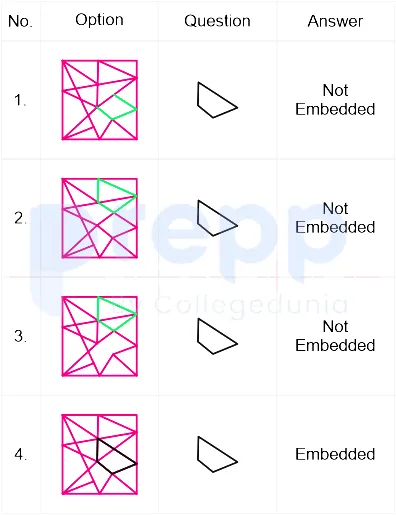
D. Option D (shown in image)The image embedded in given figure is as shown below:
Hence, 'option 4' is the correct answer.
 Paper & answer key PDF ↗
 Question 15archived
Select the option figure which is embedded in the given figure (rotation is NOT allowed).

- A
Option A (shown in image)
- B
Option B (shown in image)
- C
Option C (shown in image)
- D
Option D (shown in image)
Show answer
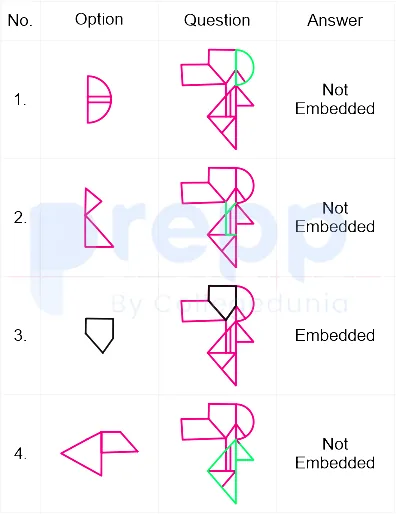
C. Option C (shown in image)The image embedded in given figure is as shown below:
Hence, 'option 3' is the correct answer.
 Paper & answer key PDF ↗
 Question 16archived
The second number in the given number pairs is obtained by performing certain mathematical operation(s) on the first number. The same operation(s) are followed in all the number pairs, EXCEPT one. Find that odd number pair.
- A
(87, 522)
- B
(84, 672)
- C
(92, 552)
- D
(64, 384)
Show answer
B. (84, 672)Finding the Odd Number Pair in Sequences
The problem asks us to identify the number pair that follows a different mathematical rule compared to the other pairs. In each pair (first number, second number), the second number is obtained by performing a specific operation or set of operations on the first number. This rule is consistent across all pairs except one.
Let's examine each number pair provided and try to find the relationship between the first and second numbers. A common approach for such problems is to look for basic arithmetic operations like addition, subtraction, multiplication, or division. Given that the second number is significantly larger than the first number in all pairs, multiplication or a combination involving multiplication seems likely.
Analyzing Each Number Pair
We will analyze each pair individually to determine the operation used to get the second number from the first number. We can test if the second number is a multiple of the first number by dividing the second number by the first number.
Pair 1: (87, 522)
Let's divide the second number by the first number: 522 ÷ 87
Calculation: $\frac{522}{87}$
To calculate this, we can estimate or perform long division. Let's try multiplying 87 by a small integer. $87 \times 5 = 435$. $87 \times 6 = 522$.
So, $522 \div 87 = 6$. The operation is multiplying the first number by 6.
Pair 2: (84, 672)
Let's divide the second number by the first number: 672 ÷ 84
Calculation: $\frac{672}{84}$
Let's try multiplying 84 by a small integer. $84 \times 7 = 588$. $84 \times 8 = 672$.
So, $672 \div 84 = 8$. The operation is multiplying the first number by 8.
Pair 3: (92, 552)
Let's divide the second number by the first number: 552 ÷ 92
Calculation: $\frac{552}{92}$
Let's try multiplying 92 by a small integer. $92 \times 5 = 460$. $92 \times 6 = 552$.
So, $552 \div 92 = 6$. The operation is multiplying the first number by 6.
Pair 4: (64, 384)
Let's divide the second number by the first number: 384 ÷ 64
Calculation: $\frac{384}{64}$
Let's try multiplying 64 by a small integer. $64 \times 5 = 320$. $64 \times 6 = 384$.
So, $384 \div 64 = 6$. The operation is multiplying the first number by 6.
Comparing the Operations
Let's summarize the operation found for each pair in a table:
Number Pair
First Number
Second Number
Operation (Second Number ÷ First Number)
(87, 522)
87
522
$522 \div 87 = 6$
(84, 672)
84
672
$672 \div 84 = 8$
(92, 552)
92
552
$552 \div 92 = 6$
(64, 384)
64
384
$384 \div 64 = 6$
From the table, we can clearly see the pattern. For pairs (87, 522), (92, 552), and (64, 384), the second number is obtained by multiplying the first number by 6. However, for the pair (84, 672), the second number is obtained by multiplying the first number by 8.
Therefore, the number pair (84, 672) is the one that does not follow the same mathematical operation as the others.
Conclusion
The common rule is that the second number is 6 times the first number. The pair (84, 672) deviates from this rule, as 672 is 8 times 84. Thus, (84, 672) is the odd number pair.
Revision Table: Number Pattern Analysis
Reviewing the concept of finding the odd one out based on mathematical operations.
Identify the rule connecting the numbers in each pair.
Test potential simple operations (addition, subtraction, multiplication, division).
Apply the tested rule to all pairs.
Find the pair that does not fit the rule.
Additional Information: Solving Number Series and Pairs
Problems involving number pairs or series often require identifying the underlying pattern. This pattern can be based on:
Arithmetic Operations: Adding, subtracting, multiplying, or dividing by a constant or a sequence of numbers.
Powers or Roots: Squaring, cubing, square roots, cube roots.
Digit Operations: Sum of digits, product of digits.
Positional Operations: Based on the position of the number in the sequence.
Combinations: A mix of the above operations.
Practicing various types of number pattern questions helps improve logical reasoning and problem-solving skills for competitive exams.
Paper & answer key PDF ↗ Question 17archived
Three of the following four letter - clusters are alike in a certain way and one is different. Pick the odd one out.
- A
JQM
- B
DWG
- C
BXE
- D
AZD
Show answer
C. BXEThe correct answer is BXE.
Patterns in Steps: The steps themselves follow a mathematical or logical series (e.g., +2, +4, +6...). Sum to 27 (Complementary Letters): Pairs of letters like A and Z, B and Y, C and X, etc., whose positions sum up to 27. This pattern was key in identifying the odd one out here. Solving these questions requires careful observation and systematically testing different possible relationships between the letters in the given clusters.
Paper & answer key PDF ↗ Question 18archived
Select the Venn diagram that best illustrates the relationship between the following classes.
Women, Professor, Players
- A
Option A (shown in image)
- B
Option B (shown in image)
- C
Option C (shown in image)
- D
Option D (shown in image)
Show answer
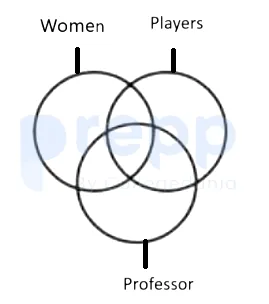
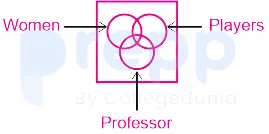
C. Option C (shown in image)The Venn diagram that best illustrates the relationship between Women, Professor, and Players is:
Some women are players and professor.
Some players are women and professor.
Some professor are women and players.
Hence, 'option 3' is the correct answer.
 Paper & answer key PDF ↗
 Question 19archived
Select the option that is related to the fifth number in the same way as the second number is related to the first number and the fourth number is related to the third number.
175 ∶ 210 ∶∶ 310 ∶ 372 ∶∶ 295 ∶ ?
- A
362
- B
354
- C
348
- D
340
Show answer
B. 354Understanding Number Analogy Problems
Number analogy questions test your ability to find the relationship between a pair of numbers and apply that same relationship to another number to find a missing value. These relationships can involve various mathematical operations like addition, subtraction, multiplication, division, percentages, squares, cubes, or a combination of these.
Analyzing the Given Number Pairs
We are given two pairs of numbers with a specific relationship, and we need to find the number related to the fifth number using the same pattern.
The pairs are:
175 and 210
310 and 372
We need to find the number related to 295.
Discovering the Relationship Pattern
Let's examine the relationship between the numbers in the first pair (175 and 210).
Difference: $210 - 175 = 35$. Is the second number obtained by adding 35? Let's check the second pair: $310 + 35 = 345$. This is not 372, so simple addition is not the rule.
Ratio: Let's check the ratio of the second number to the first number: $\frac{210}{175}$.
Simplifying the ratio:
$\frac{210}{175} = \frac{210 \div 5}{175 \div 5} = \frac{42}{35} = \frac{42 \div 7}{35 \div 7} = \frac{6}{5}$
So, $210 = 175 \times \frac{6}{5}$.
Let's check if this multiplication rule applies to the second pair (310 and 372).
Is $372 = 310 \times \frac{6}{5}$?
$310 \times \frac{6}{5} = \frac{310}{5} \times 6 = 62 \times 6 = 372$.
Yes, the relationship holds true for the second pair as well.
Identifying the Consistent Rule
The rule is that the second number is obtained by multiplying the first number by $\frac{6}{5}$. This is equivalent to multiplying by 1.2, or adding 20% of the first number ($1 + \frac{1}{5} = 1.2$ or $100\% + 20\% = 120\%$).
First Number
Relationship
Second Number
175
$\times \frac{6}{5}$ or $\times 1.2$
$175 \times \frac{6}{5} = 210$
310
$\times \frac{6}{5}$ or $\times 1.2$
$310 \times \frac{6}{5} = 372$
Applying the Rule to Find the Missing Number
Now we apply the same rule to the fifth number, 295, to find the missing number.
Missing Number $= 295 \times \frac{6}{5}$
Let's calculate this value:
$295 \times \frac{6}{5} = \frac{295}{5} \times 6 = 59 \times 6$
$59 \times 6 = 354$
So, the missing number is 354.
Matching with the Options
Let's compare our calculated value with the given options:
Option 1: 362
Option 2: 354
Option 3: 348
Option 4: 340
Our calculated value, 354, matches Option 2.
Conclusion
The pattern in the number analogy is multiplying the first number by $\frac{6}{5}$ (or 1.2) to get the second number. Applying this rule to 295 gives 354.
Revision Table: Number Analogy Pattern
Pair
First Number
Rule Applied
Second Number
1
175
$175 \times 1.2$
210
2
310
$310 \times 1.2$
372
3
295
$295 \times 1.2$
354
Additional Information: Solving Analogy Questions
To excel at number analogy questions, practice identifying various patterns. Common patterns include:
Arithmetic progression (adding/subtracting a constant)
Geometric progression (multiplying/dividing by a constant ratio)
Square or cube relationships ($n \to n^2$, $n \to n^2+1$, $n \to n^3$, etc.)
Digit operations (sum of digits, product of digits)
Combination of operations (e.g., multiply by a number and then add/subtract a constant)
Ratio and proportion
Always test your hypothesized rule with all given pairs before applying it to find the missing number. If a rule works for one pair but not another, it is not the correct rule for the analogy.
Paper & answer key PDF ↗ Question 20archived
Select the figure that will replace the question mark (?) in the following figure series.

- A
Option A (shown in image)
- B
Option B (shown in image)
- C
Option C (shown in image)
- D
Option D (shown in image)
Show answer
Question 21archived
Select the option that represents the correct order of the given words as they would appear in an English dictionary.
1. Tertiary
2. Terrace
3. Terrain
4. Termite
5. Territory
6. Terminate
- A
4, 6, 3, 2, 5, 1
- B
4, 6, 2, 3, 1, 5
- C
6, 4, 2, 3, 5, 1
- D
6, 4, 3, 2, 5, 1
Show answer
C. 6, 4, 2, 3, 5, 1The correct answer is 6, 4, 2, 3, 5, 1.
If one word is a prefix of another (e.g., "cat" and "catalog"), the shorter word comes first. Numbers and symbols are typically ordered separately or follow specific rules depending on the list's purpose, but for standard word lists, only letters a-z are considered. Understanding and applying these rules correctly is essential for various tasks, from looking up words in a dictionary to sorting data alphabetically.
Paper & answer key PDF ↗ Question 22archived
Three different positions of the same dice are shown. Find the number on the face opposite the face showing '5'.
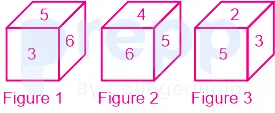
- A
2
- B
3
- C
4
- D
1
Show answer
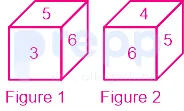
D. 1As 5 and 6 are the common faces on both the dice, the remaining faces 3 and 4 are opposite to each other.
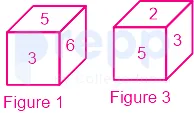
As 5 and 3 are the common faces on both the dice, the remaining faces 6 and 2 are opposite to each other.
Clearly, remaining faces 1 and 5 will be opposite to each other.
Hence, ‘1 is the correct answer.
 Paper & answer key PDF ↗
 Question 23archived
Select the combination of letters that when sequentially placed in the blanks of the given series will complete the series.
A _ M P S A C _ P S A C O _ S A C P P _
- A
SMPA
- B
SCAN
- C
CMAS
- D
CNPS
Show answer
D. CNPSSolving the Letter Series Completion Problem
The question asks us to find the combination of letters that will complete the given series when placed in the blanks.
The given series is: A _ M P S A C _ P S A C O _ S A C P P _
We need to test the provided options to see which one creates a discernible pattern in the series.
Analyzing the Options
Let's insert the letters from each option into the blanks sequentially.
The blanks are at these positions:
After 'A', before 'M'
After 'A C', before 'P S'
After 'A C O', before 'S'
After 'A C P P', at the end
Let's test Option 4: CNPS
Inserting these letters into the blanks gives us:
A C M P S A C N P S A C O P S A C P P S
Identifying the Pattern with Option CNPS
Let's break down the completed series into segments:
Segment 1: A C M P S
Segment 2: A C N P S
Segment 3: A C O P S
Segment 4: A C P P S
Now let's compare these segments to identify the underlying pattern:
All segments start with 'A C'.
The third letter changes in sequence: M, N, O, P. This is an alphabetical progression.
The pattern of the letters after the third letter seems to be 'P S', except for the last segment which is 'P P S'. Looking closely at the original series structure, the blanks are: A _ M P S, A C _ P S, A C O _ S, A C P P _. When filled with CNPS, it becomes A C M P S, A C N P S, A C O P S, A C P P S. This exactly matches the breakdown.
The core pattern observed is a sequence of blocks starting with 'A C', followed by an alphabetically incrementing letter, and ending mostly with 'P S', with a slight variation in the last block 'ACPPS'. The sequence of the third letter is M, N, O, P.
Conclusion
The combination CNPS successfully completes the series by fitting into a logical, repeating pattern involving alphabetical progression of a letter within a largely consistent structure.
Let's confirm this by placing the letters back into the blanks:
A C M P S A C N P S A C O P S A C P P S
This clearly forms the pattern: AC(M)PS, AC(N)PS, AC(O)PS, AC(P)PS, where M, N, O, P are consecutive letters in the alphabet.
Revision Table: Key Concepts
Concept
Explanation
Relevance Here
Letter Series
A sequence of letters arranged in a specific pattern.
The problem is based on identifying the pattern in a letter series.
Pattern Recognition
The ability to identify repeated sequences or logical rules in data.
Essential skill for solving letter series completion problems.
Alphabetical Progression
Letters changing according to their order in the alphabet (e.g., A, B, C or M, N, O).
The pattern in this series involves alphabetical progression of one letter.
Additional Information: Tips for Series Completion
Examine the structure: Look for repeating blocks or segments.
Check for letter increments: See if letters are changing by a fixed number of steps in the alphabet.
Look for decreases or alternate patterns: Sometimes the sequence might reverse or follow a different rule (e.g., skipping letters).
Test options systematically: If the pattern isn't immediately obvious, try placing the options into the blanks and see if a pattern emerges.
Consider position: The position of a letter within a block or the series can also be part of the pattern.
Paper & answer key PDF ↗ Question 24archived
Which of the following terms will replace the question mark (?) in the given series?
OTLN, MSJM, KRHL, IQFK, ?
- A
HPDK
- B
GQDJ
- C
GPDJ
- D
GPDK
Show answer
C. GPDJThe correct answer is GPDJ.
Look for consistent differences, sums, or other mathematical operations on the letter positions. Consider patterns like alternating sequences or increasing/decreasing differences. Practice with various types of letter series to become familiar with different patterns. Solving letter series helps enhance analytical and logical thinking abilities.
Paper & answer key PDF ↗ Question 25archived
Which two signs should be interchanged to make the given equation correct?
117 ÷ 13 + 16 × 540 - 40 = 644
- A
÷ and+
- B
+ and ×
- C
- and +
- D
÷ and -
Show answer
B. + and ×Understanding the Equation and Problem
The question asks us to identify which pair of mathematical signs needs to be swapped in the given equation to make it mathematically correct. The original equation is:
\(117 \div 13 + 16 \times 540 - 40 = 644\)
We are given options suggesting which two signs should be interchanged. We need to test the options by swapping the signs as indicated and then calculating the result of the modified equation using the standard order of operations (BODMAS/PEDMAS).
Testing the Correct Sign Interchange
Let's consider the option that involves interchanging the '+' and '\(\times\)' signs. We will substitute '\(\times\)' where '+' appears and '+' where '\(\times\)' appears in the original equation.
The original equation is: \(117 \div 13 + 16 \times 540 - 40 = 644\)
After interchanging '+' and '\(\times\)', the equation becomes:
\(117 \div 13 \times 16 + 540 - 40\)
We need to evaluate this expression to see if it equals 644.
Step-by-Step Verification Using BODMAS/PEDMAS
We follow the BODMAS/PEDMAS rule (Brackets, Orders (powers/roots), Division and Multiplication (from left to right), Addition and Subtraction (from left to right)) to evaluate the expression:
\(117 \div 13 \times 16 + 540 - 40\)
Division: First, perform the division \(117 \div 13\).
\(117 \div 13 = 9\)
The expression becomes: \(9 \times 16 + 540 - 40\)
Multiplication: Next, perform the multiplication \(9 \times 16\).
\(9 \times 16 = 144\)
The expression becomes: \(144 + 540 - 40\)
Addition: Now, perform the addition \(144 + 540\).
\(144 + 540 = 684\)
The expression becomes: \(684 - 40\)
Subtraction: Finally, perform the subtraction \(684 - 40\).
\(684 - 40 = 644\)
The result of the expression after interchanging '+' and '\(\times\)' is 644.
Conclusion: Correct Sign Interchange
Since the evaluated expression \(117 \div 13 \times 16 + 540 - 40\) equals 644, which is the right-hand side of the original equation, interchanging the '+' and '\(\times\)' signs makes the equation correct.
Summary of Equation Transformation
Description
Equation/Expression
Result
Original Equation
\(117 \div 13 + 16 \times 540 - 40\)
Does not equal 644
Equation after swapping + and \(\times\)
\(117 \div 13 \times 16 + 540 - 40\)
Evaluates to 644
Revision Table: Equation Sign Interchange
Comparing Original vs. Corrected Equation Evaluation
Step
Original Calculation (Incorrect)
Calculation after Swapping + and \(\times\) (Correct)
Equation
\(117 \div 13 + 16 \times 540 - 40\)
\(117 \div 13 \times 16 + 540 - 40\)
Division
\(9 + 16 \times 540 - 40\)
\(9 \times 16 + 540 - 40\)
Multiplication
\(9 + 8640 - 40\)
\(144 + 540 - 40\)
Addition
\(8649 - 40\)
\(684 - 40\)
Subtraction
\(8609\)
\(644\)
Final Result
\(8609\)
\(644\)
Additional Information: Order of Operations (BODMAS/PEDMAS)
When solving mathematical expressions involving multiple operations, it is crucial to follow a specific order to ensure a unique and correct result. This order is commonly remembered by acronyms like BODMAS or PEDMAS.
BODMAS: Brackets, Orders (powers, roots), Division, Multiplication, Addition, Subtraction.
PEDMAS: Parentheses, Exponents, Multiplication, Division, Addition, Subtraction.
Division and Multiplication have the same priority and should be performed from left to right as they appear in the expression. Similarly, Addition and Subtraction have the same priority and should be performed from left to right.
Applying BODMAS/PEDMAS correctly is essential for solving equation-based problems, especially those involving interchanging signs.
Paper & answer key PDF ↗ Question 26archived
Which Chinese traveller visited India during the reign of Harshavardhana?
- A
Hsuan Tsang
- B
Etsing
- C
Faxian
- D
Ibn Battuta
Show answer
A. Hsuan TsangChinese Travellers During the Reign of Harshavardhana
The question asks about a specific Chinese traveller who visited India during the rule of Emperor Harshavardhana. Understanding the visits of foreign travellers is crucial for reconstructing the history of ancient India, as their accounts provide valuable insights.
Identifying the Traveller
Several Chinese travellers visited India over different periods. We need to identify the one whose visit coincided with Harshavardhana's reign (roughly 606 CE to 647 CE).
Hsuan Tsang (also known as Xuanzang or Hieun Tsang): He was a famous Chinese Buddhist monk and scholar who travelled to India in the 7th century CE. His journey started around 629 CE, and he spent many years in India, travelling extensively and collecting Buddhist scriptures. His visit falls squarely within the reign of Harshavardhana. He even spent significant time at Harshavardhana's court and left a detailed account of India in his work, 'Si-Yu-Ki' or 'Records of the Western Regions'.
Etsing (I-tsing): Another Chinese Buddhist monk, I-tsing, visited India later than Hsuan Tsang, arriving around 671 CE. He focused on Buddhist monasteries and the discipline of monks. His visit was after Harshavardhana's reign.
Faxian (Fa-Hien): Faxian was one of the earliest Chinese Buddhist pilgrims to visit India. He travelled to India during the reign of Chandragupta II (Gupta period), arriving around 399 CE and leaving around 412 CE. This period is much earlier than Harshavardhana.
Ibn Battuta: Ibn Battuta was a Moroccan explorer, not Chinese. He visited India in the 14th century CE during the Delhi Sultanate period (specifically during the reign of Muhammad bin Tughluq). His visit is far removed from the time of Harshavardhana.
Based on the historical timeline and the famous accounts left by these travellers, Hsuan Tsang is the Chinese traveller who visited India during the reign of Harshavardhana.
Revision Table: Famous Foreign Travellers in India
TravellerOriginPeriod/ReignPurpose/Focus
FaxianChinaGupta Period (Chandragupta II)Buddhist scriptures
Hsuan TsangChinaHarshavardhana's reignBuddhist scriptures, detailed accounts
I-tsingChinaPost-Harshavardhana (7th century CE)Buddhist monasteries and discipline
Ibn BattutaMoroccoDelhi Sultanate (Muhammad bin Tughluq)Travels, observations on society
Additional Information: Significance of Foreign Accounts
The accounts left by foreign travellers like Hsuan Tsang are invaluable primary sources for understanding the history, society, religion, and administration of ancient and medieval India. They offer an external perspective that complements indigenous sources. Hsuan Tsang's 'Si-Yu-Ki', for example, provides detailed descriptions of the places he visited, the people, their customs, the state of Buddhism, and the administration under Harshavardhana. This helps historians piece together a more complete picture of the era.
Paper & answer key PDF ↗ Question 27archived
Thomas Cup is a/an ____________.
- A
annual event
- B
biennial event
- C
quarterly event
- D
triennial event
Show answer
B. biennial eventThe question asks about the frequency of the Thomas Cup event. Understanding the nature of major international sports events is crucial for general knowledge and sports trivia.
Understanding the Thomas Cup Frequency
The Thomas Cup is a prestigious international badminton competition contested by men's national teams. It is one of the most significant team events in the sport of badminton, alongside the Uber Cup (for women's national teams).
The frequency at which major sports tournaments like the Thomas Cup are held varies. Some events are annual, meaning they happen every year. Others might be held less frequently, such as every two, three, or four years.
Analyzing the Options for Thomas Cup
Let's look at the options provided regarding the frequency of the Thomas Cup:
Annual event: This means it happens once every year. Examples of annual events include many national league seasons or some world championships in certain sports.
Biennial event: This means it happens once every two years. Many major international sports tournaments follow a biennial cycle.
Quarterly event: This means it happens four times a year, or every three months. This frequency is common for smaller tournaments, league matches, or certain stages of larger competitions, but not typically for a major world team championship.
Triennial event: This means it happens once every three years. Some specific events or festivals might follow a triennial schedule, but it's less common for major global sports championships compared to biennial or quadrennial (every four years) cycles.
Determining the Correct Frequency of the Thomas Cup
Historically, the Thomas Cup was held every three years (triennial) from 1948 to 1982. However, starting from 1984, the Thomas Cup and the Uber Cup were combined into a single tournament held at the same location and time. Crucially, the frequency was changed at that time.
Since 1984, the Thomas Cup has been held every two years.
Therefore, the Thomas Cup is a biennial event.
Revision Table: Thomas Cup Frequency
Event
Frequency (Since 1984)
Meaning
Thomas Cup
Biennial
Held every two years
Additional Information on Thomas Cup
Here are some more facts about the Thomas Cup:
It is organized by the Badminton World Federation (BWF).
It is considered the world championship for men's national badminton teams.
The most successful nation in the history of the Thomas Cup is Indonesia.
It is often held concurrently with the Uber Cup, the women's team championship.
Knowing the frequency of major sports events like the Thomas Cup is a useful part of sports general knowledge.
Paper & answer key PDF ↗ Question 28archived
'Penalty Corner' is related to which of the following sports?
- A
Chess
- B
Tennis
- C
Badminton
- D
Hockey
Show answer
D. HockeyPenalty Corner in Sports Explained
The term 'Penalty Corner' refers to a specific rule or event within certain sports. Understanding these unique game elements is crucial for sports enthusiasts and helps in identifying the correct sport associated with the term. Let's explore the options provided to see where the 'Penalty Corner' belongs.
Analysis of Sports Options
We will look at each sport mentioned to understand its rules and see if a 'Penalty Corner' is part of it:
Chess: Chess is a complex board game of strategy involving two players. The game's rules focus on the movement of pieces like kings, queens, and pawns across a checkered board. There is no 'Penalty Corner' in Chess.
Tennis: Tennis is a racket sport played individually or between two teams of two players. Points are scored based on hitting a ball over a net into the opponent's court. Tennis rules include concepts like serves, faults, and breaks, but not 'Penalty Corners'.
Badminton: Similar to tennis, badminton is a racket sport played with a shuttlecock. Players score points by hitting the shuttlecock so it lands in the opponent's court. Badminton rules involve points, games, and matches, and do not include a 'Penalty Corner'.
Hockey: Hockey is a team sport played with sticks to hit a ball or puck into the opponent's net. This sport has several unique rules, including the 'Penalty Corner'.
The Role of Penalty Corner in Hockey
The 'Penalty Corner', often referred to as a 'short corner' in field hockey, is a significant set-piece opportunity awarded to the attacking team. It is typically given for specific infractions committed by the defending team inside their own defending circle, or when a defender deliberately sends the ball over the backline.
Key aspects of a 'Penalty Corner' in Hockey include:
Awarding the Penalty: It's granted for fouls like obstruction or intentionally hitting the ball out over the backline by a defender within the shooting circle.
Execution: The attacking team positions players outside the circle. The ball is placed on a designated mark on the circle's edge.
Defense: The defending team positions players, with one typically waiting near the goal line and others positioned to block shots.
Objective: It provides a structured chance for the attacking team to score, usually involving a drag-flick or a powerful hit towards the goal after the ball exits the circle.
Therefore, the 'Penalty Corner' is intrinsically linked to the sport of Hockey.
Paper & answer key PDF ↗ Question 29archived
Which is the only living representative of Sphenopsida that has an underground, creeping and perennial rhizome that gives off aerial as well as underground branches?
- A
Adiantum
- B
Dryopteris
- C
Selaginella
- D
Equisetum
Show answer
D. EquisetumUnderstanding Sphenopsida and its Living Members
The question asks to identify the only living representative of the plant group Sphenopsida that exhibits specific characteristics related to its rhizome and branching pattern. To answer this, we need to know which plants belong to Sphenopsida and examine their structures.
Identifying the Sole Living Sphenopsida Member
Sphenopsida is a class of Pteridophytes (vascular plants that reproduce via spores and do not produce seeds or flowers). While this group had many diverse forms in prehistoric times, most are now extinct. The only genus that has survived to the present day is Equisetum. Due to its long evolutionary history and having only one living genus, Equisetum is often referred to as a living fossil.
Features of the Equisetum Rhizome
The question specifically describes a plant with an underground, creeping, and perennial rhizome that gives off both aerial and underground branches. Let's examine the structure of Equisetum:
Rhizome: Equisetum possesses a well-developed, underground, horizontal stem called a rhizome.
Nature of Rhizome: This rhizome is typically creeping (grows horizontally just below the soil surface) and perennial (lives for many years).
Branching: The rhizome bears buds that develop into aerial shoots (stems visible above ground) and also gives rise to underground branches and roots. The aerial shoots can be fertile (spore-bearing) or sterile (photosynthetic).
These characteristics perfectly match the description given in the question regarding the underground, creeping, and perennial rhizome producing aerial and underground branches.
Analyzing Other Options
Let's briefly look at the other options provided to understand why they are not the correct answer:
Adiantum: This is a genus of ferns, commonly known as maidenhair ferns. Ferns belong to the class Pteropsida (or Polypodiopsida), not Sphenopsida. They have rhizomes, but they are distinctly different from Equisetum and are not the sole living representative of Sphenopsida.
Dryopteris: This is another genus of ferns, known as wood ferns. Like Adiantum, Dryopteris belongs to the Pteropsida and is not a member of Sphenopsida.
Selaginella: This genus is commonly known as spike moss or little club moss. Selaginella belongs to the class Lycopsida (or Lycopodiopsida). It is also a Pteridophyte but is evolutionarily distinct from Sphenopsida.
Therefore, based on the classification and the morphological features described, Equisetum is the only option that is a living representative of Sphenopsida and fits the description of the rhizome structure.
Conclusion on Sphenopsida Representation
The only living genus of Sphenopsida is Equisetum. Its characteristic underground, creeping, and perennial rhizome that produces both aerial and underground branches aligns precisely with the features mentioned in the question. The other options belong to different groups of Pteridophytes.
Plant Name
Plant Group
Living Representative of Sphenopsida?
Matches Rhizome Description?
Adiantum
Pteropsida (Fern)
No
Rhizome different
Dryopteris
Pteropsida (Fern)
No
Rhizome different
Selaginella
Lycopsida (Lycophyte)
No
Different structure
Equisetum
Sphenopsida
Yes (Sole living genus)
Yes
Revision Table: Key Sphenopsida Facts
Feature
Description
Class
Sphenopsida
Living Representative
Equisetum (only genus)
Common Name
Horsetail
Key Feature (Rhizome)
Underground, creeping, perennial
Branching
Gives off aerial and underground branches
Reproduction
Spore-bearing (Pteridophyte)
Significance
Living fossil
Additional Information: Pteridophyte Groups
Pteridophytes, or vascular cryptogams, are a diverse group of plants that includes ferns and their allies. They are characterized by having vascular tissues (xylem and phloem) but reproducing by spores rather than seeds. They are broadly classified into several groups, including:
Lycopsida (Lycophytes): Includes clubmosses, spikemosses (like Selaginella), and quillworts. They typically have microphylls (small leaves with a single vein).
Sphenopsida (Equisetophytes): Represented today only by the genus Equisetum (horsetails). Characterized by jointed stems, whorled leaves (reduced and scale-like), and sporangia borne in strobili at the stem tips.
Pteropsida (Ferns): The largest group, includes ferns, horsetails (sometimes placed here), and whisk ferns. Ferns are typically recognized by their large, often compound leaves (megaphylls) called fronds and sporangia usually clustered in sori on the underside of the fronds. Adiantum and Dryopteris are examples of ferns.
Understanding these different groups helps clarify why Equisetum is unique as the sole survivor of the Sphenopsida lineage with the described rhizome features.
Paper & answer key PDF ↗ Question 30archived
Trichloromethane is better known as:
- A
butanes
- B
LPG
- C
chloroform
- D
laughing gas
Show answer
C. chloroformThe question asks for the common name of Trichloromethane.
Trichloromethane is a chemical compound with the formula CHCl<sub>3</sub>. It is an organic compound belonging to the class of halomethanes.
Understanding Trichloromethane and its Common Name
Organic compounds often have both a systematic chemical name, based on IUPAC nomenclature rules, and one or more common names that are widely used, especially historically or in specific industries. Trichloromethane is one such compound with a very well-known common name.
Let's look at the options provided to identify the common name of Trichloromethane:
butanes: Butanes are saturated hydrocarbons with the chemical formula C<sub>4</sub>H<sub>10</sub>. There are two isomers: n-butane and isobutane. They are not Trichloromethane.
LPG: LPG stands for Liquefied Petroleum Gas. It is a mixture of hydrocarbon gases, primarily propane and butane. It is a fuel and not a single chemical compound like Trichloromethane.
chloroform: Chloroform is the historical and common name for Trichloromethane (CHCl<sub>3</sub>). It was widely used as an anesthetic in the past, although its use has declined due to safety concerns.
laughing gas: Laughing gas is the common name for nitrous oxide (N<sub>2</sub>O). It is used as a mild anesthetic and analgesic, particularly in dentistry. It is not Trichloromethane.
Based on chemical nomenclature and common usage, Trichloromethane is universally known by the common name chloroform.
Summary of Options
Option
Chemical Name / Composition
Common Name
Chemical Formula / Main Components
Is it Trichloromethane?
butanes
Butanes
Butanes
C<sub>4</sub>H<sub>10</sub>
No
LPG
Liquefied Petroleum Gas
LPG
Mainly propane (C<sub>3</sub>H<sub>8</sub>) and butane (C<sub>4<sub>H</sub>10</sub>)
No
chloroform
Trichloromethane
Chloroform
CHCl<sub>3</sub>
Yes
laughing gas
Dinitrogen monoxide
Laughing gas
N<sub>2</sub>O
No
Therefore, Trichloromethane is better known as chloroform.
Revision Table: Common Names of Chemicals
Chemical Name
Common Name
Formula
Trichloromethane
Chloroform
CHCl<sub>3</sub>
Methane
Marsh gas
CH<sub>4</sub>
Ethane
-- (No very common name)
C<sub>2</sub>H<sub>6</sub>
Propane
LPG constituent
C<sub>3</sub>H<sub>8</sub>
Butane
LPG constituent
C<sub>4<sub>H</sub>10</sub>
Dinitrogen monoxide
Laughing gas
N<sub>2</sub>O
Ethanol
Ethyl alcohol, alcohol
C<sub>2</sub>H<sub>5</sub>OH
Methanal
Formaldehyde
HCHO
Additional Information on Trichloromethane (Chloroform)
Trichloromethane, or chloroform, is a colorless, volatile liquid. It has a strong, ether-like odor. Historically, its primary use was as an anesthetic. However, due to its toxicity, particularly its effects on the liver and kidneys, and its potential carcinogenicity, it is no longer widely used for surgical anesthesia in humans. It is still used in some veterinary practices.
Modern uses of chloroform include:
As a solvent in laboratories and industry.
In the production of other chemicals, such as chlorofluorocarbons (though their use is declining due to environmental concerns) and refrigerants.
As a reagent in various organic synthesis reactions.
Handling chloroform requires care due to its health hazards and flammability (though it is less flammable than many organic solvents).
Paper & answer key PDF ↗ Question 31archived
Which Constitutional Amendment added Fundamental Duties in the Constitution?
- A
Forty - Second Amendment Act, 1976
- B
Forty - Seventh Amendment, 1984
- C
Forty - Fourth Amendment Act 1978
- D
Fifty - Second Amendment, 1985
Show answer
A. Forty - Second Amendment Act, 1976Understanding Fundamental Duties in the Constitution
The Constitution of India contains various parts that define the structure of government, the rights of citizens, and the directive principles of state policy. Among these are the Fundamental Duties, which outline the moral obligations of all citizens of India to help promote a spirit of patriotism and to uphold the unity of India.
The idea to include Fundamental Duties was recommended by the Sardar Swaran Singh Committee. This committee was constituted by the government during the period of the Internal Emergency.
Adding Fundamental Duties: The Key Amendment
Based on the recommendations of the Sardar Swaran Singh Committee, the government enacted a significant constitutional amendment. This amendment added a new part and a new article to the Constitution specifically for Fundamental Duties.
The amendment responsible for adding Fundamental Duties was the Forty-Second Amendment Act, which was passed in the year 1976. This amendment is often referred to as a 'Mini-Constitution' due to the large number of changes it brought to the Constitution.
The Forty-Second Amendment Act, 1976, added Part IVA and Article 51A to the Constitution. Article 51A initially contained ten Fundamental Duties. Later, one more duty was added by the 86th Constitutional Amendment Act, 2002.
Analyzing the Options
Let's examine the given options:
Forty - Second Amendment Act, 1976: This amendment is historically recognized as the one that added Fundamental Duties to the Indian Constitution based on the Swaran Singh Committee's recommendations.
Forty - Seventh Amendment, 1984: This amendment dealt with land reform laws, specifically adding certain state acts to the Ninth Schedule. It is not related to Fundamental Duties.
Forty - Fourth Amendment Act 1978: This amendment was enacted largely to reverse some of the changes brought by the 42nd Amendment Act, particularly concerning the duration of Lok Sabha and state legislative assemblies, and restoring some powers of the Supreme Court and High Courts. It also removed the right to property from the list of Fundamental Rights, making it a legal right. It did not add Fundamental Duties.
Fifty - Second Amendment, 1985: This amendment is famous for introducing the anti-defection law in India, adding the Tenth Schedule to the Constitution. It is not related to Fundamental Duties.
Based on this analysis, the Forty-Second Amendment Act, 1976, is the correct answer as it is the amendment that incorporated Fundamental Duties into the Constitution of India.
Key Amendments and Their Effects
Amendment Act
Year
Key Provision Added/Changed
Relevant to Fundamental Duties?
Forty-Second Amendment
1976
Added Fundamental Duties (Part IVA, Article 51A)
Yes
Forty-Fourth Amendment
1978
Removed Right to Property from Fundamental Rights
No
Fifty-Second Amendment
1985
Introduced Anti-Defection Law (Tenth Schedule)
No
Revision Table: Fundamental Duties
Summary of Fundamental Duties' Inclusion
Feature
Details
Committee Recommendation
Sardar Swaran Singh Committee
Amendment Act
Forty-Second Amendment Act, 1976
Part Added
Part IVA
Article Added
Article 51A
Original Number of Duties
10
Present Number of Duties
11 (11th added by 86th Amendment, 2002)
Additional Information: Significance of Fundamental Duties
Fundamental Duties are non-justiciable, meaning they cannot be enforced by courts in the same way Fundamental Rights can. However, they serve as a constant reminder to citizens about their responsibilities towards society, their fellow citizens, and the nation. They help in promoting a sense of discipline and commitment towards the nation. They are crucial for maintaining social order and national integration. While not legally enforceable through writ petitions, various laws have been enacted to implement some of these duties, such as laws for the protection of the environment or laws preventing disrespect to the national flag.
Paper & answer key PDF ↗ Question 32archived
Match the columns.
States
Hills
1.
Kerala
a.
Anaimalai Hills
2.
Meghalaya
b.
Garo Hills
3.
Mizoram c.
Lushai Hills
- A
1 - a, 2 - b, 3 - c
- B
1 - b, 2 - c, 3 - a
- C
1 - b, 2 - a, 3 - c
- D
1 - c, 2 - b, 3 - a
Show answer
A. 1 - a, 2 - b, 3 - cMatching Indian States with Their Respective Hills
This question requires matching specific Indian states with the hill ranges located within or associated with them. Understanding the geography of India, particularly the location of major hill ranges relative to states, is key to answering this correctly.
Identifying Correct State-Hill Pairings
Let's break down the matches based on geographical knowledge:
State 1: Kerala - This southern Indian state is known for its part of the Western Ghats. The Anaimalai Hills are a range in the Western Ghats that straddle the border of Kerala and Tamil Nadu, with significant portions falling within Kerala's geography.
State 2: Meghalaya - Located in Northeast India, Meghalaya is famous for its hills, including the Khasi, Jaintia, and Garo Hills. The Garo Hills form the western part of the state.
State 3: Mizoram - Another northeastern state, Mizoram's topography is dominated by hills. The major hill system here is known as the Lushai Hills (also referred to as the Mizo Hills), which run from north to south through the state.
Summary of Matches
Based on the geographical locations:
Kerala is associated with Anaimalai Hills (a).
Meghalaya is associated with Garo Hills (b).
Mizoram is associated with Lushai Hills (c).
Table of Correct Matches
State
Associated Hill Range
1. Kerala
a. Anaimalai Hills
2. Meghalaya
b. Garo Hills
3. Mizoram
c. Lushai Hills
Conclusion
The correct pairings are 1 with a, 2 with b, and 3 with c. Therefore, the option that correctly represents these matches is 1 - a, 2 - b, 3 - c.
Paper & answer key PDF ↗ Question 33archived
Vijayanagara emperor Krishnadeva Raya founded a suburban township near Vijayanagara called Nagalapuram in the name of his ______________.
- A
father
- B
teacher
- C
sister
- D
mother
Show answer
D. motherKrishnadeva Raya Founds Nagalapuram
The question asks about the suburban township founded by the famous Vijayanagara emperor, Krishnadeva Raya, near Vijayanagara, and who it was named after.
Krishnadeva Raya, one of the most renowned rulers of the Vijayanagara Empire, was known for his administrative skills, military campaigns, and patronage of arts and literature. He undertook several building projects during his reign.
Historical records and inscriptions confirm that Krishnadeva Raya founded a new suburban settlement close to the capital city of Vijayanagara. This new township was named Nagalapuram.
The name 'Nagalapuram' is significant. It was named in honour of his mother, Nagala Devi. Founding a town or city and naming it after a parent or spouse was a common practice among rulers to show respect and commemorate them.
Analysis of the Options
Let's examine the provided options in the context of the historical information:
Option 1: father - Krishnadeva Raya's father was Saluva Narasimha Deva Raya. While he might have honoured his father in other ways, the township of Nagalapuram was not named after him.
Option 2: teacher - Krishnadeva Raya had teachers and gurus, who were highly respected. However, the historical sources indicate Nagalapuram was named after a family member, not a teacher.
Option 3: sister - There is no historical evidence to suggest that Nagalapuram was named after Krishnadeva Raya's sister.
Option 4: mother - Historical accounts and inscriptions explicitly state that Krishnadeva Raya founded Nagalapuram and named it after his mother, Nagala Devi. This aligns with the practice of rulers naming important settlements after loved ones.
Based on historical facts, the township of Nagalapuram was named after Krishnadeva Raya's mother, Nagala Devi.
Key Information about Nagalapuram
Founder: Krishnadeva Raya
Location: Near the capital city of Vijayanagara
Named After: His mother, Nagala Devi
Significance: It was planned as a significant suburban centre, possibly serving as a commercial hub or a residential area for parts of the population outside the core capital.
Figure
Relationship to Krishnadeva Raya
Named After
Saluva Narasimha Deva Raya
Father
No (for Nagalapuram)
Teacher
Teacher
No (for Nagalapuram)
Sister
Sister
No (for Nagalapuram)
Nagala Devi
Mother
Yes (Nagalapuram)
Revision Table: Vijayanagara and Krishnadeva Raya
Term
Description
Vijayanagara Empire
A powerful South Indian empire based in the Deccan Plateau, existing from the 14th to 17th centuries.
Krishnadeva Raya
One of the most famous emperors of the Vijayanagara Empire, ruled during the early 16th century (c. 1509–1529 CE). Belonged to the Tuluva dynasty.
Nagalapuram
A suburban township founded by Krishnadeva Raya near the city of Vijayanagara, named after his mother, Nagala Devi.
Hampi
The site of the ruins of the Vijayanagara city, a UNESCO World Heritage Site today.
Additional Information: Krishnadeva Raya and Nagalapuram
Krishnadeva Raya's reign is often considered a golden age of the Vijayanagara Empire. He was not only a formidable military leader but also a great scholar and patron of arts, literature, and architecture.
He patronized Telugu, Kannada, Tamil, and Sanskrit literature. His own work, 'Amuktamalyada', is a significant contribution to Telugu literature.
He built and renovated many temples, tanks, and other public works.
The founding of Nagalapuram reflects his efforts to expand and beautify the area around the capital city of Vijayanagara. It demonstrates his personal devotion and respect for his mother, Nagala Devi.
The ruins of Nagalapuram can still be explored today near Hampi, giving visitors a sense of the scale and planning of the Vijayanagara urban landscape.
The act of naming the township Nagalapuram after his mother is a testament to the cultural values and personal relationships that were important even for powerful rulers.
Paper & answer key PDF ↗ Question 34archived
How many nominated members are there in the Legislative Assembly of Telangana?
- A
Two
- B
Three
- C
Four
- D
One
Show answer
D. OneUnderstanding Nominated Members in Telangana Legislative Assembly
The composition of a State Legislative Assembly in India typically includes members directly elected by the people from various constituencies. However, the Constitution of India also historically provided for the nomination of certain members to ensure representation for specific communities that might not otherwise get adequate representation through elections.
Let's examine the concept of nominated members in the context of the Telangana Legislative Assembly.
Constitutional Provision and Nomination
Before a recent constitutional amendment, Article 333 of the Constitution of India dealt with the representation of the Anglo-Indian community in the Legislative Assemblies of the States. This article allowed the Governor of a state to nominate one member of the Anglo-Indian community to the Legislative Assembly if, in their opinion, the community was not adequately represented in the Assembly.
Based on this provision, state legislative assemblies, including the Telangana Legislative Assembly, could have one nominated member belonging to the Anglo-Indian community.
Important Note: The provision allowing for the nomination of Anglo-Indian members to the Lok Sabha and State Legislative Assemblies (Articles 331 and 333) was discontinued by the 104th Constitutional Amendment Act, 2019, which came into effect from January 25, 2020. Therefore, currently, there is no provision for nominated members in the Telangana Legislative Assembly or any other state assembly.
Answering the Question: Nominated Members in Telangana Legislative Assembly
The question asks "How many nominated members are there in the Legislative Assembly of Telangana?". Given the options and the context, the question likely refers to the composition as it existed historically under the constitutional provision before its repeal, or perhaps is based on older information. Under the provision of Article 333 (before repeal), the maximum number of members who could be nominated to a State Legislative Assembly was one.
Therefore, historically, the Telangana Legislative Assembly could have one nominated member, usually from the Anglo-Indian community.
Looking at the provided options:
Two
Three
Four
One
The option that aligns with the historical provision for nominated members in a state legislative assembly like Telangana is one.
Conclusion on Nominated Members
Based on the historical constitutional provision under Article 333 (now repealed), the Telangana Legislative Assembly could have one nominated member. While this provision is no longer active, the question's likely context points to this historical figure.
Revision Table: Telangana Legislative Assembly Facts
Aspect
Detail
Type
Unicameral (Legislative Assembly only)
Total Seats (Elected)
119
Nominated Seats (Historical)
1 (Anglo-Indian, provision repealed)
Total Strength (Historical Maximum)
120
Additional Information on State Legislative Assemblies
State Legislative Assemblies (Vidhan Sabha) are the lower houses in states with a bicameral legislature and the sole houses in states with a unicameral legislature, like Telangana. Members are primarily elected directly by voters from territorial constituencies.
Election: Members are elected for a term of five years, although the Assembly can be dissolved earlier.
Powers: The Legislative Assembly holds significant legislative powers, including passing state laws and controlling the state's finances through the budget.
Membership Qualification: To be a member, a person must be a citizen of India, at least 25 years old, and registered as an elector in a constituency of the state.
Presiding Officer: The Speaker, elected by the members of the Assembly, presides over the sittings.
The historical provision for nominating a member from the Anglo-Indian community was intended to give a voice to this specific minority group. Its repeal reflects changing demographic and political landscapes.
Paper & answer key PDF ↗ Question 35archived
On International Women's Day 2022, the Ministry of MSME launched an entrepreneurship drive for women by which of the following names?
- A
NIRBHAYA
- B
SWADHAR
- C
SAMARTH
- D
UJJAWALA
Show answer
C. SAMARTHUnderstanding the MSME Entrepreneurship Drive for Women
This question focuses on identifying the specific name given to an entrepreneurship drive launched by the Ministry of MSME for women. The launch date mentioned is International Women's Day 2022. We need to determine which of the given options correctly matches this initiative.
The SAMARTH Initiative Explained
The Ministry of Micro, Small and Medium Enterprises (MSME) introduced a significant initiative named SAMARTH. This program was launched with the primary goal of promoting and supporting women's involvement in entrepreneurship. Its introduction around International Women's Day 2022 highlights the focus on empowering women economically.
Key features of the SAMARTH program:
Target Audience: Primarily aimed at women aspiring to become entrepreneurs or those already running small businesses.
Objective: To provide skill development, training, and support systems necessary for successful entrepreneurship.
Ministry Focus: Aligned with the MSME Ministry's mandate to foster growth in the micro, small, and medium enterprise sector.
Empowerment: Intended to enhance women's financial independence and contribution to the economy.
Analysis of Alternative Options
It's helpful to understand why the other options are not the correct fit for this specific question:
NIRBHAYA: This term is commonly associated with the Nirbhaya Fund, which is dedicated to various schemes aimed at enhancing the safety and security of women.
SWADHAR: The Swadhar scheme focuses on providing integrated support and rehabilitation services for women and girls in difficult circumstances.
UJJAWALA: This refers to a scheme for the comprehensive prevention and combatting of trafficking and for the rescue, rehabilitation, re-integration, and repatriation of victims of trafficking for commercial sexual exploitation.
These schemes, while crucial for women's welfare, serve different purposes than the entrepreneurship drive mentioned in the question.
Conclusion on the Drive's Name
The entrepreneurship drive launched by the Ministry of MSME for women, coinciding with International Women's Day 2022, was indeed named SAMARTH. This initiative represents a focused effort to boost women's participation and success in the world of business and enterprise.
Paper & answer key PDF ↗ Question 36archived
What are the main energy sources for earth's internal heat engine?
- A
Radiogenic heat and oceanic tide heat
- B
Heat from volcanoes and solar heat
- C
Solar heat and oceanic tide heat
- D
Radiogenic heat and primordial heat
Show answer
D. Radiogenic heat and primordial heatUnderstanding Earth's Internal Heat Sources
The question asks about the primary energy sources that power the Earth's internal heat engine. This engine refers to the processes driven by heat originating from within the planet, which causes phenomena like plate tectonics, mantle convection, and the generation of the Earth's magnetic field.
Primary Energy Sources for Earth's Interior
The heat within the Earth comes from two main sources:
Primordial Heat: This is the heat left over from the formation of the Earth billions of years ago. The process of planet formation involved accretion, where smaller bodies collided to form larger ones, releasing significant kinetic energy that was converted into heat. Additionally, the differentiation process, where denser materials sank to the core and lighter materials rose, also generated heat through gravitational potential energy release.
Radiogenic Heat: This heat is continuously generated by the radioactive decay of isotopes, primarily uranium (U), thorium (Th), and potassium (K), which are present within the Earth's mantle and crust. As these unstable isotopes decay over time, they release energy in the form of heat. This process is ongoing and contributes significantly to the Earth's internal temperature.
Evaluating Other Mentioned Energy Sources
Let's examine why other sources mentioned in the options are not the main drivers of the Earth's internal heat engine:
Solar Heat: Energy from the Sun heats the Earth's surface and atmosphere, influencing weather patterns and climate. However, it does not penetrate deep enough to be a primary source for the Earth's internal heat engine.
Oceanic Tide Heat: While the gravitational pull of the Moon and Sun causes ocean tides, the energy associated with tidal friction is relatively small compared to the heat generated internally. It does not contribute significantly to the heat budget of the Earth's deep interior.
Heat from Volcanoes: Volcanic activity is a *manifestation* of the Earth's internal heat escaping to the surface. The heat itself originates from the primordial and radiogenic sources within the Earth, not the volcanoes themselves.
Conclusion on Earth's Heat Sources
Based on the understanding of planetary science, the two fundamental sources responsible for the heat driving processes within the Earth are the residual heat from its formation (primordial heat) and the heat generated by the decay of radioactive elements (radiogenic heat). These sources continuously supply the energy that powers geological activity deep within our planet.
Paper & answer key PDF ↗ Question 37archived
Select the correct statement about the achievements of Sruti Bandopadhay, an eminent Manipuri dancer.
- A
She received Padma Shri for the year 2020.
- B
She received Kalidas Samman for the year 2020.
- C
She received Sangeet Natak Akademi Award for the year 2020.
- D
She received Padma Vibhushan for the year 2020.
Show answer
C. She received Sangeet Natak Akademi Award for the year 2020.Analyzing Sruti Bandopadhay's Achievements in Manipuri Dance
The question asks to identify the correct statement regarding the achievements of Sruti Bandopadhay, a prominent exponent of Manipuri dance, specifically concerning the year 2020. We need to evaluate the given options based on notable awards in the field of arts and culture in India.
Understanding Sruti Bandopadhay and Manipuri Dance
Sruti Bandopadhay is a distinguished figure known for her contributions to Manipuri dance, one of the eight classical dance forms of India. Her dedication and expertise have earned her recognition in the arts community.
Evaluating the Award Options for 2020
Let's examine the awards mentioned in the options and determine which one Sruti Bandopadhay received in the year 2020.
Padma Awards: These are some of the highest civilian honours of India. They are given in three categories: Padma Vibhushan, Padma Bhushan, and Padma Shri.
Kalidas Samman: This is a prestigious arts award presented annually by the government of Madhya Pradesh.
Sangeet Natak Akademi Award: This is an award presented by the Sangeet Natak Akademi, India's national academy for music, dance, and drama. It is a highly respected award for performing artists.
According to verified information regarding cultural awards in India, Sruti Bandopadhay was conferred the Sangeet Natak Akademi Award for her contribution to Manipuri dance for the year 2020.
Analyzing Each Statement
Let's check each provided statement:
"She received Padma Shri for the year 2020." - Information indicates she received the Sangeet Natak Akademi Award in 2020, not Padma Shri.
"She received Kalidas Samman for the year 2020." - Information indicates she received the Sangeet Natak Akademi Award in 2020, not Kalidas Samman.
"She received Sangeet Natak Akademi Award for the year 2020." - This aligns with the information available regarding her recognition in 2020 for Manipuri dance.
"She received Padma Vibhushan for the year 2020." - Information indicates she received the Sangeet Natak Akademi Award in 2020, not Padma Vibhushan.
Based on this analysis, the statement that Sruti Bandopadhay received the Sangeet Natak Akademi Award for the year 2020 is correct.
Revision Table: Sruti Bandopadhay and 2020 Awards
Award
Received by Sruti Bandopadhay in 2020?
Padma Shri
No
Kalidas Samman
No
Sangeet Natak Akademi Award
Yes
Padma Vibhushan
No
Additional Information on Sangeet Natak Akademi Award
The Sangeet Natak Akademi Award, also known as the Akademi Puraskar, is the highest Indian recognition given to practicing artists. It is awarded annually by the Sangeet Natak Akademi. The award consists of a cash prize, a shawl, and a Tamra Patra (a copper plaque).
Receiving this award is a significant achievement for any artist, acknowledging their substantial contribution and sustained professional excellence in their respective field of music, dance, or drama.
Sruti Bandopadhay's recognition with this award in 2020 underscores her mastery and impact on the classical Manipuri dance tradition.
Paper & answer key PDF ↗ Question 38archived
Which of the given personalities is NOT associated with Carnatic Music?
- A
MS Subbulakshmi
- B
Kalyani Varadarajan
- C
Vishnu Narayan Bhatkhande
- D
Subramania Bharathiyar
Show answer
C. Vishnu Narayan BhatkhandeUnderstanding Personalities and Carnatic Music
The question asks us to identify the personality from the given options who is NOT associated with Carnatic Music. Carnatic music is a system of music associated with South India. It has a rich history and unique characteristics, including complex rhythmic structures and melodic patterns called ragas.
Analyzing the Options
Let's look at each personality listed and their connection to Indian classical music:
MS Subbulakshmi: She was a legendary Indian Carnatic singer. She is widely regarded as one of the greatest Carnatic vocalists of all time. Her association with Carnatic music is profound and undeniable.
Kalyani Varadarajan: While perhaps less globally famous than MS Subbulakshmi, Kalyani Varadarajan is also a name known within the realm of Carnatic music, particularly recognized for her contributions as a vocalist and teacher. Her work is rooted in the Carnatic tradition.
Vishnu Narayan Bhatkhande: He was a prominent musicologist of the late 19th and early 20th centuries. Bhatkhande is credited with systematizing the music of Hindustani classical music, which is the classical music tradition of North India. He classified ragas into ten thaats (parent scales) and developed a notation system for Hindustani music. His primary work and association are with Hindustani classical music, not Carnatic music.
Subramania Bharathiyar: He was a celebrated Tamil poet and freedom fighter. While many of his poems have been set to music and are widely sung in various styles, including Carnatic, devotional, and folk, he is primarily known as a literary figure. His compositions are sung *within* the Carnatic framework by musicians, but he is not typically considered a central figure in the development or performance lineage of Carnatic music itself in the same vein as a classical vocalist or composer focusing purely on the classical form. However, compared to Bhatkhande, whose life's work was dedicated to systematizing Hindustani music, Bharathiyar's connection, albeit indirect through his compositions, is slightly more tangential to the *classical* performance tradition compared to Bhatkhande's distinct focus on Hindustani theory.
Identifying the Personality NOT Associated with Carnatic Music
Based on the analysis, Vishnu Narayan Bhatkhande's significant contributions and systematization efforts were focused on Hindustani classical music. Therefore, he is the personality among the options who is NOT primarily associated with Carnatic Music.
Thus, the personality not associated with Carnatic Music is Vishnu Narayan Bhatkhande.
Revision Table: Indian Classical Music Personalities
Personality
Primary Association
Area of Contribution
MS Subbulakshmi
Carnatic Music
Vocal Performance
Kalyani Varadarajan
Carnatic Music
Vocal Performance, Teaching
Vishnu Narayan Bhatkhande
Hindustani Classical Music
Musicology, Systematization, Notation
Subramania Bharathiyar
Literature/Poetry
Poetry (Songs often sung in various styles including Carnatic)
Additional Information: Carnatic vs. Hindustani Music
Indian classical music is broadly divided into two main traditions: Carnatic music (South Indian) and Hindustani music (North Indian). While they share common roots in ancient Indian music, they have evolved distinct characteristics over centuries.
Geographical Influence: Carnatic music developed relatively untouched by external influences, preserving many older forms. Hindustani music, however, was significantly influenced by Persian and Mughal cultures.
Emphasis: Carnatic music tends to focus more on devotional themes and pre-composed kritis (songs). Hindustani music places a greater emphasis on improvisation, particularly in instrumental music, and the exploration of a single raga in detail.
Structure: The structure of a typical performance differs. Carnatic concerts often feature a variety of compositions, while Hindustani concerts might dedicate a long duration to exploring a single raga.
Instrumentation: While some instruments are common (like the violin), the ensemble differs. Carnatic music often features the Ghatam, Kanjira, Morsing, and Mridangam for percussion, while Hindustani music frequently uses the Tabla and Harmonium.
Understanding the distinction between these two major systems is crucial when studying Indian classical music history and its key figures.
Paper & answer key PDF ↗ Question 39archived
Which of the following Acts was introduced to regulate Foreign Exchange in India in 1973?
- A
FERA
- B
FEMA
- C
FRBM
- D
SARFESI
Show answer
A. FERAUnderstanding Foreign Exchange Regulation in India
Regulating foreign exchange is crucial for a country's economy, controlling the flow of money in and out of the nation. India has had different laws over time to manage foreign exchange transactions. The question asks about the specific Act introduced in 1973 for this purpose.
Analyzing the Options for the 1973 Act
Let's look at the given options to identify the Act related to foreign exchange regulation introduced in 1973:
FERA: This stands for the Foreign Exchange Regulation Act. This Act was indeed introduced in 1973 in India to regulate payments and dealings in foreign exchange and gold, and to control the import and export of currency and bullion.
FEMA: This stands for the Foreign Exchange Management Act. FEMA was enacted in 1999 to replace FERA. FEMA aimed to liberalize the foreign exchange market and move towards managing foreign exchange rather than strictly regulating it like FERA. So, FEMA is a later Act, not the one from 1973.
FRBM: This stands for the Fiscal Responsibility and Budget Management Act. FRBM, enacted in 2003, is related to managing the government's finances, reducing fiscal deficit, and ensuring macroeconomic stability. It is not related to foreign exchange regulation.
SARFAESI: This stands for the Securitisation and Reconstruction of Financial Assets and Enforcement of Security Interest Act. SARFAESI Act, enacted in 2002, provides a framework for banks and financial institutions to recover their non-performing assets (NPAs). It is not related to foreign exchange regulation.
Based on the analysis, the Foreign Exchange Regulation Act (FERA) was the law introduced in 1973 to regulate foreign exchange in India.
Key Aspects of FERA 1973
The Foreign Exchange Regulation Act (FERA) of 1973 was quite stringent. Its main objectives were to:
Conserve foreign exchange resources of the country.
Properly utilize foreign exchange.
Regulate certain payments and dealings in foreign exchange and gold.
Control the import and export of currency and bullion.
FERA 1973 was replaced by FEMA in 1999 as India liberalized its economy and needed a less restrictive legal framework for foreign exchange management.
Major Acts Related to Finance in India
Act
Full Form
Introduced/Enacted Year
Primary Focus
FERA
Foreign Exchange Regulation Act
1973
Regulating Foreign Exchange (Stricter Controls)
FEMA
Foreign Exchange Management Act
1999
Managing Foreign Exchange (More Liberal)
FRBM
Fiscal Responsibility and Budget Management Act
2003
Government Fiscal Discipline
SARFAESI
Securitisation and Reconstruction of Financial Assets and Enforcement of Security Interest Act
2002
Recovery of NPAs by Banks
Revision Table: Acts and Their Purpose
Here's a quick look at the acts mentioned and their main areas:
FERA (1973): Strict regulation of foreign exchange.
FEMA (1999): Management and liberalization of foreign exchange.
FRBM (2003): Fiscal discipline for the government.
SARFAESI (2002): NPA recovery for banks.
Clearly, FERA is the Act from 1973 that regulated foreign exchange.
Additional Information: Evolution of Foreign Exchange Laws
India's approach to foreign exchange has evolved significantly. FERA 1973 was enacted during a time when India had limited foreign reserves and aimed to tightly control foreign exchange outflow. With economic liberalization starting in the early 1990s, the need for a more flexible and market-oriented framework became apparent. This led to the introduction of FEMA in 1999, which shifted the focus from regulation to management, treating violations as civil offenses rather than criminal ones, as was the case under FERA.
Understanding this transition from a tightly controlled regime under FERA to a more liberal one under FEMA is important for grasping the history of foreign exchange management in India.
Paper & answer key PDF ↗ Question 40archived
Which of the following dances is performed by the Santhal tribe of Jharkhand?
- A
Jhika Dasain
- B
Kolkali
- C
Ghumar
- D
Koli
Show answer
A. Jhika DasainExploring Santhal Tribal Dances of Jharkhand
The question asks to identify the dance performed by the Santhal tribe of Jharkhand from the given options. The Santhal tribe is a prominent indigenous group residing in states like Jharkhand, West Bengal, Bihar, and Odisha, known for their vibrant culture, music, and dance forms.
Let's analyze the provided options:
Jhika Dasain: This dance form is traditionally associated with the Santhal community and is performed during important festivals and occasions.
Kolkali: This is a popular folk dance originating from the state of Kerala in South India. It is performed by a group of dancers using sticks.
Ghumar: This traditional folk dance is primarily associated with Rajasthan, India, and is also popular in Haryana. It is often performed by women.
Koli: This dance form is performed by the Koli fishing community, mainly found in the coastal regions of Maharashtra and Goa.
Based on the origins and tribal affiliations of these dances, Jhika Dasain is the dance form specifically performed by the Santhal tribe.
Therefore, Jhika Dasain is the correct answer.
Comparison of Dance Forms and Their Origins
Dance Form
Associated Tribe/Community
Primary Region
Jhika Dasain
Santhal tribe
Jharkhand, West Bengal, Bihar, Odisha
Kolkali
General (Kerala folk dance)
Kerala
Ghumar
Various communities
Rajasthan, Haryana
Koli
Koli fishing community
Maharashtra, Goa
This comparison clearly shows that Jhika Dasain is linked to the Santhal tribe, aligning with the question's requirement for a dance performed by the Santhal tribe of Jharkhand.
Revision Table: Key Tribal Dances and Regions
Tribe
Region(s)
Selected Dance Forms
Santhal
Jharkhand, WB, Odisha, Bihar
Jhika Dasain, Sohrai, Baha, Dasain
Oraon
Jharkhand, Chhattisgarh, Odisha, WB
Karma, Sarhul
Munda
Jharkhand, Odisha, WB, Chhattisgarh
Sarhul, Jadur, Karma
Additional Information on Santhal Culture and Dances
The Santhal tribe has a rich cultural heritage with numerous songs and dances performed during various social and religious events. Dances like Jhika Dasain, Sohrai, Baha, and Dasain are integral to their identity. These performances are often accompanied by traditional musical instruments like the Madal (drum) and flute. The dances are not merely entertainment but hold deep cultural and ritualistic significance, often depicting stories of nature, life events, and mythology. Understanding these tribal dances provides insight into the diverse cultural landscape of India, particularly states like Jharkhand, known for its significant tribal population.
Paper & answer key PDF ↗ Question 41archived
Which of the following cell organelles is made up of ribosomal RNA and protein?
- A
Ribosome
- B
Nucleus
- C
Golgi body
- D
Lysosome
Show answer
A. RibosomeUnderstanding Cell Organelle Composition
The question asks us to identify a specific cell organelle based on its fundamental building blocks: ribosomal RNA (rRNA) and protein. Different organelles within a cell have unique compositions and functions that allow them to carry out specialized tasks necessary for cell survival.
Analyzing the Composition of Cell Organelles
Let's examine the given options and their known compositions:
Ribosome: Ribosomes are crucial cellular machinery responsible for protein synthesis. They are composed of two subunits, both of which are made up of ribosomal RNA (rRNA) molecules and a large number of proteins. This combination of rRNA and protein forms the functional structure of the ribosome.
Nucleus: The nucleus is a large, membrane-bound organelle that contains the cell's genetic material (DNA) organized into chromosomes. Its composition includes the nuclear envelope (a double membrane), nucleoplasm, chromosomes (DNA and proteins like histones), and the nucleolus (where rRNA is transcribed and ribosomes are assembled). While it contains components involved in ribosome synthesis, the nucleus itself is not primarily made of just rRNA and protein in the sense the question implies for a specific organelle unit.
Golgi body (Golgi apparatus): The Golgi body is an organelle consisting of a stack of flattened membrane-bound sacs called cisternae. It modifies, sorts, and packages proteins and lipids for secretion or delivery to other organelles. Its primary composition is membrane lipids and associated proteins involved in transport and modification. It does not fit the description of being made purely of rRNA and protein.
Lysosome: Lysosomes are spherical, membrane-bound organelles containing digestive enzymes. They are involved in breaking down waste materials, cellular debris, and pathogens. Their composition includes a single membrane surrounding an acidic lumen containing various hydrolytic enzymes (which are proteins). They are membrane-bound sacs of enzymes, not structures made of rRNA and protein.
Identifying the Correct Organelle
Based on the detailed composition of each organelle, the ribosome is the only one that is fundamentally constructed from ribosomal RNA (rRNA) and proteins. These two components come together to form the ribosomal subunits, which then combine to form a functional ribosome for translation (protein synthesis).
Therefore, the cell organelle made up of ribosomal RNA and protein is the ribosome.
Composition of Key Cell Organelles
Organelle
Primary Composition
Made of rRNA and Protein?
Ribosome
Ribosomal RNA (rRNA), Proteins
Yes
Nucleus
Nuclear envelope (membrane), DNA, Proteins (Histones, enzymes), Nucleoplasm, Nucleolus
No (contains components, but not primarily the structure)
Golgi body
Membranes (Lipids, Proteins), Enzymes
No
Lysosome
Membrane, Hydrolytic Enzymes (Proteins)
No
Conclusion
The organelle specifically known to be composed of ribosomal RNA and protein is the ribosome. Its unique composition directly relates to its function in synthesizing proteins based on genetic instructions.
Revision Table: Cell Organelles
Summary of Organelle Composition and Function
Organelle
Composition
Key Function
Ribosome
rRNA and Proteins
Protein Synthesis (Translation)
Nucleus
Membrane, DNA, Proteins
Contains genetic material, controls cell activities
Golgi body
Membranes (cisternae)
Modify, sort, package proteins and lipids
Lysosome
Membrane, Digestive Enzymes
Break down waste and debris
Additional Information: Ribosomal RNA (rRNA)
Ribosomal RNA (rRNA) is a type of non-coding RNA that is a primary component of ribosomes, essential cellular machines that catalyze protein synthesis. In eukaryotes, there are typically four types of rRNA molecules (18S, 5.8S, 28S, and 5S), while prokaryotes have three (16S, 23S, and 5S). These rRNA molecules fold into complex 3D structures and, along with ribosomal proteins, assemble to form the large and small ribosomal subunits. The rRNA plays a crucial role in recognizing the mRNA codon, binding tRNA, and catalyzing the formation of peptide bonds between amino acids during translation.
Paper & answer key PDF ↗ Question 42archived
Shri Sagar Kailas Ovhalkar was in news for being conferred with Arjuna Award 2022 for his outstanding contribution in which of the following sports?
- A
Kabbadi
- B
Chess
- C
Judo
- D
Mallakhamb
Show answer
D. MallakhambUnderstanding the Arjuna Award and Shri Sagar Kailas Ovhalkar's Achievement
The question asks about the specific sport for which Shri Sagar Kailas Ovhalkar was recognized with the prestigious Arjuna Award in the year 2022. The Arjuna Award is a significant honour given by the Ministry of Youth Affairs and Sports, Government of India, to acknowledge outstanding performance in sports and games.
In 2022, several athletes were conferred with the Arjuna Award for their contributions across various sports disciplines. Identifying the correct sport for a specific awardee like Shri Sagar Kailas Ovhalkar is important for understanding India's sporting landscape and achievements.
Let's look at the options provided and determine which sport is associated with Shri Sagar Kailas Ovhalkar's Arjuna Award:
Option
Sport
1
Kabbadi
2
Chess
3
Judo
4
Mallakhamb
Based on official announcements regarding the Arjuna Awards 2022, Shri Sagar Kailas Ovhalkar was indeed among the recipients. His award was specifically for his excellence and outstanding contribution in the sport of Mallakhamb.
Mallakhamb is a traditional Indian sport in which a gymnast performs feats and poses in concert with a vertical wooden pole or a hanging rope.
Therefore, the sport for which Shri Sagar Kailas Ovhalkar received the Arjuna Award 2022 is Mallakhamb.
Arjuna Award 2022 - Key Details
The awards are given annually to recognize outstanding achievements in sports.
The ceremony for the 2022 awards was held in November 2022.
Shri Sagar Kailas Ovhalkar was one of the athletes honoured in 2022.
His recognition highlights the importance of traditional Indian sports like Mallakhamb.
Why Other Options Are Not Correct
While Kabbadi, Chess, and Judo are popular and recognized sports in India with their own set of awardees over the years, the Arjuna Award conferred upon Shri Sagar Kailas Ovhalkar in 2022 was specifically for his performance in Mallakhamb.
Revision Table: Key Facts about Sagar Kailas Ovhalkar and Arjuna Award
Recipient
Award Year
Sport
Recognition
Shri Sagar Kailas Ovhalkar
2022
Mallakhamb
Arjuna Award
Additional Information on Mallakhamb and Sports Awards
Mallakhamb requires a high level of physical fitness, flexibility, and strength. It has been gaining popularity and recognition at national and international levels. Including athletes from traditional sports like Mallakhamb in national sports awards underscores the government's effort to promote diverse indigenous sports.
The Arjuna Award is one of several National Sports Awards in India. Others include the Major Dhyan Chand Khel Ratna Award (the highest sporting honour), Dronacharya Award (for coaches), and Dhyan Chand Award (for lifetime achievement in sports and games).
Paper & answer key PDF ↗ Question 43archived
Who among the following was the first person to discuss poverty line in pre - independent India?
- A
Dadabhai Naoroji
- B
Mahalanobis
- C
Dr. BR Ambedkar
- D
RK Shanmukham Chetty
Show answer
A. Dadabhai NaorojiUnderstanding the Poverty Line in Pre-Independent India
The concept of a poverty line is crucial for understanding the economic condition of a population. It is a threshold below which individuals are considered to be living in poverty. Discussing and defining this line is important for economic analysis and policy making.
Identifying the Pioneer: Discussing Poverty in India
In the context of pre-independent India, several prominent figures analyzed the economic state of the nation under British rule. However, the question specifically asks about the first person to *discuss* the poverty line. This involves attempting to quantify or estimate the minimum income or consumption needed for subsistence.
Dadabhai Naoroji: Known as the 'Grand Old Man of India', Dadabhai Naoroji was a key figure in the early nationalist movement. He extensively studied the economic impact of British rule and put forward the famous 'Drain Theory'. More relevant to this question, he made an early attempt to estimate the poverty line in India based on the cost of a minimum diet, famously using the 'jail cost of living' as a benchmark. His work, particularly in his book "Poverty and Un-British Rule in India," detailed the economic exploitation and the resulting poverty.
Mahalanobis: Prasanta Chandra Mahalanobis was a renowned statistician and planner, instrumental in independent India's five-year plans. While his work significantly impacted India's economic planning and later poverty estimation methodologies, his prominent contributions came primarily after independence.
Dr. BR Ambedkar: A towering figure in modern Indian history, Dr. BR Ambedkar was a social reformer, jurist, economist, and the chief architect of the Constitution of India. His work focused on social inequality, caste discrimination, and political rights. While concerned with the welfare of the poor and downtrodden, his primary focus was not on defining the economic poverty line in the way Naoroji did.
RK Shanmukham Chetty: Sir R.K. Shanmukham Chetty was an Indian economist, lawyer, and politician who served as independent India's first Finance Minister, presenting the first budget. His work was significant in the post-independence economic administration, not in the initial discussions of the poverty line concept in the pre-independence era.
Dadabhai Naoroji's Contribution to Poverty Estimation
Dadabhai Naoroji's calculation of the poverty line was perhaps one of the earliest attempts by an Indian intellectual to quantify the level of poverty across the country. He estimated the minimum required income for a person to survive, based on the cost of necessary goods, primarily food. His approach was rudimentary but groundbreaking for its time, highlighting the dire economic conditions faced by the average Indian under British rule. He calculated a 'subsistence level' income or 'poverty line' ranging from £1.5 to £2 per capita per annum.
His work significantly influenced subsequent discussions and studies on poverty in India.
Conclusion
Based on historical economic studies of India, Dadabhai Naoroji is widely recognized for being the first person to systematically discuss and attempt to quantify the poverty line in pre-independent India, primarily through his analysis of the 'Drain of Wealth' and its impact on the economic condition of the masses.
Figure
Major Contributions
Discussed Poverty Line in Pre-Independence?
Dadabhai Naoroji
Drain Theory, Early Poverty Estimation, "Poverty and Un-British Rule in India"
Yes
Mahalanobis
Statistical Planning (Post-Independence), Mahalanobis Model
No (Primary work Post-Independence)
Dr. BR Ambedkar
Constitution, Social Reform, Rights of Dalits
No (Focus elsewhere)
RK Shanmukham Chetty
First Finance Minister (Post-Independence)
No (Primary work Post-Independence)
Revision Table: Key Figures & Poverty in India
Concept/Figure
Significance
Era
Poverty Line
Minimum income/consumption level for basic needs
Economic indicator
Dadabhai Naoroji
Pioneer of poverty estimation in pre-independent India, Drain Theory
Pre-Independence
Mahalanobis Model
Strategy for heavy industry in planning
Post-Independence
Drain Theory
Economic exploitation by British rule
Pre-Independence
Additional Information: Early Poverty Studies in India
Dadabhai Naoroji's work laid the foundation for studying poverty in India. His estimation was based on the minimum cost of bare subsistence. While simple, it drew crucial attention to the economic hardship faced by Indians under colonial rule. Later, other economists and committees in independent India developed more sophisticated methods for poverty estimation, considering various factors beyond just basic food requirements, and debating different methodologies (like calorie intake vs. income). The concept continues to evolve with changing economic conditions and understanding of basic needs.
Paper & answer key PDF ↗ Question 44archived
Identify the group of states that are covered in the Sardar Sarovar Project.
- A
Maharashtra, Madhya Pradesh, Chhattisgarh and Jharkhand
- B
Maharashtra, Madhya Pradesh, Gujarat and Rajasthan
- C
Gujarat, Punjab, Haryana, Rajasthan
- D
Gujarat, Rajasthan, Karnataka and Telangana
Show answer
B. Maharashtra, Madhya Pradesh, Gujarat and RajasthanUnderstanding the Sardar Sarovar Project and Beneficiary States
The Sardar Sarovar Project is a large gravity dam on the Narmada River, near Navagam, Gujarat. It is one of the largest water resource projects in India. The project was conceived to provide water for irrigation and drinking, as well as generate hydroelectric power. A key aspect of understanding this project is knowing which states directly benefit from its resources.
Identifying States Covered by Sardar Sarovar Project
The benefits from the Sardar Sarovar Project are shared among four states. These states receive water for irrigation and drinking purposes, and also share in the hydroelectric power generated by the project. The agreement for sharing the Narmada waters involves a specific group of states.
Key Beneficiary States
The four states covered under the Sardar Sarovar Project are:
Gujarat
Rajasthan
Madhya Pradesh
Maharashtra
These states are integral to the planning and implementation of the project, receiving specific allocations of water and power based on agreements.
Analyzing the Options for Sardar Sarovar States
Let's examine the given options to determine which one correctly lists the states covered by the Sardar Sarovar Project.
Option 1: Maharashtra, Madhya Pradesh, Chhattisgarh and Jharkhand
Maharashtra and Madhya Pradesh are correct beneficiaries.
However, Chhattisgarh and Jharkhand are not among the states directly covered by the Sardar Sarovar Project benefits. This option is incorrect.
Option 2: Maharashtra, Madhya Pradesh, Gujarat and Rajasthan
Maharashtra is a beneficiary state.
Madhya Pradesh is a beneficiary state.
Gujarat is a major beneficiary state and the location of the dam.
Rajasthan is a beneficiary state, particularly for water supply to arid regions.
This option correctly lists all four states that receive significant benefits from the Sardar Sarovar Project.
Option 3: Gujarat, Punjab, Haryana, Rajasthan
Gujarat and Rajasthan are correct beneficiaries.
However, Punjab and Haryana are states in Northern India that are not part of the Narmada water sharing agreement related to the Sardar Sarovar Project. This option is incorrect.
Option 4: Gujarat, Rajasthan, Karnataka and Telangana
Gujarat and Rajasthan are correct beneficiaries.
Karnataka and Telangana are states in Southern India and are not part of the Narmada river basin or the Sardar Sarovar Project's distribution network. This option is incorrect.
Based on the analysis, Option 2 correctly identifies the group of states covered in the Sardar Sarovar Project.
Revision Table: Sardar Sarovar Project Key Details
Aspect
Detail
Project Name
Sardar Sarovar Project (SSP)
River
Narmada River
Location (Dam Site)
Kevadia, Narmada district, Gujarat, India
Beneficiary States (Covered States)
Gujarat, Rajasthan, Madhya Pradesh, Maharashtra
Primary Purposes
Irrigation, Drinking Water Supply, Hydroelectric Power Generation
Additional Information on Sardar Sarovar Project
The Sardar Sarovar Project is a multi-state project with complex water sharing agreements. While Gujarat receives the largest share of water, Rajasthan benefits significantly, particularly its arid regions. Madhya Pradesh, being the upper riparian state and contributing the most water to the Narmada basin, is also a key partner and beneficiary, mainly in the upstream areas, although the dam itself is in Gujarat. Maharashtra receives a smaller share of water and power compared to the other three states, but is still considered a beneficiary state under the formal agreement.
The project has been subject to various environmental and social debates, but its role in providing water to drought-prone areas of Gujarat and Rajasthan is significant. Understanding the states involved is crucial for comprehending the project's scope and impact.
Paper & answer key PDF ↗ Question 45archived
Which German chemist and physicist proposed that an aromatic compound must have an odd number of pairs of electrons, Which can mathematically be written as 4n + 2 (n = 0,1,2,3, etc.) in 1931?
- A
Friedrich Kekule
- B
Rosalind Franklin
- C
Antoine Lavoisier
- D
Erich Huckel
Show answer
D. Erich HuckelExploring Huckel's Rule for Aromatic Compounds
This question delves into a fundamental concept in organic chemistry related to aromatic compounds and a specific rule formulated to identify them. We need to identify the German chemist and physicist credited with proposing this rule in 1931, which relates the number of pi electrons in a molecule to its aromaticity using the formula $4n + 2$.
Understanding Aromaticity and the $4n+2$ Rule
Aromatic compounds are cyclic, planar molecules with a ring of delocalized pi electrons. The most famous example is benzene. These compounds exhibit special stability compared to similar non-aromatic compounds.
In 1931, a rule was established to determine if a compound exhibits aromaticity. This rule is famously known as Huckel's rule or the $4n+2$ pi electron rule.
The rule states that for a compound to be aromatic, it must possess a planar ring structure with its electrons delocalized in a conjugated pi system.
The crucial part of the rule is the number of pi electrons involved in this delocalized system.
This number must conform to the mathematical expression $4n + 2$, where '$n$' is a non-negative integer (meaning $n$ can be 0, 1, 2, 3, and so on).
The total number of pi electrons, therefore, must be 2, 6, 10, 14, etc. The question refers to this as an "odd number of pairs of electrons", which corresponds to these specific total counts ($2 = 1 \times 2$, $6 = 3 \times 2$, $10 = 5 \times 2$, etc.).
For instance, benzene has a ring of 6 carbon atoms, each contributing one electron to the pi system, resulting in $6 \pi$ electrons. This fits the $4n+2$ rule for $n=1$ ($4(1) + 2 = 6$).
Identifying the Proponent: Erich Huckel's Contribution
The German physicist who formulated this critical rule for aromatic compounds in 1931 was Erich Huckel.
Erich Huckel (sometimes spelled Erich Hückel) was a German physicist known for his work in theoretical chemistry, particularly quantum mechanics applied to chemical bonding.
He applied quantum mechanical methods to understand the electronic structure of molecules, leading to the development of the $4n+2$ rule for predicting aromaticity.
His work provided a theoretical basis for understanding the stability and properties of compounds like benzene.
Evaluating Other Chemists
Let's consider why the other options are not the correct answer:
Friedrich Kekule: August Kekulé (often spelled Friedrich August Kekulé von Stradonitz) is famous for proposing the cyclic structure of benzene in the 1860s. While foundational to understanding aromaticity, he did not propose the $4n+2$ rule.
Rosalind Franklin: An English chemist and X-ray crystallographer, Rosalind Franklin made crucial contributions to understanding the molecular structures of DNA, RNA, viruses, coal, and graphite. Her work is unrelated to Huckel's rule.
Antoine Lavoisier: Often called the "father of modern chemistry," Lavoisier lived in the 18th century and made significant contributions to combustion, stoichiometry, and chemical nomenclature. His work predates the concepts involved in Huckel's rule by over a century.
Therefore, the chemist and physicist who proposed the $4n+2$ rule for aromatic compounds in 1931 was indeed Erich Huckel.
Paper & answer key PDF ↗ Question 46archived
Under whom was CP Ilbert a law member of the council?
- A
Lord Lytton
- B
Lord Cornwallis
- C
Lord Ripon
- D
Lord Curzon
Show answer
C. Lord RiponUnderstanding CP Ilbert and the Council Role
The question asks about the Governor-General under whom CP Ilbert served as a Law Member of the council. To answer this, we need to recall the period in Indian history when CP Ilbert was prominent and his role in the administration.
CP Ilbert was a legal expert who served in British India. His most notable contribution, or rather controversy, was the introduction of the Ilbert Bill in 1883. This bill was proposed during the tenure of a specific Governor-General.
Let's look at the options provided:
Lord Lytton
Lord Cornwallis
Lord Ripon
Lord Curzon
Lord Cornwallis served in the late 18th century (1786-1793 and 1805). This is much earlier than the time CP Ilbert was active in India.
Lord Lytton was Governor-General from 1876 to 1880. While close in time, the famous Ilbert Bill and CP Ilbert's role as Law Member are associated with the subsequent period.
Lord Ripon served as Governor-General of India from 1880 to 1884. This was a period of significant reforms, including efforts towards local self-government and changes in the judicial system. It was during Lord Ripon's tenure that CP Ilbert served as the Law Member of the Governor-General's Council. As Law Member, Ilbert was responsible for drafting legislation, and he introduced the controversial Ilbert Bill in 1883.
Lord Curzon served as Viceroy from 1899 to 1905. This is a later period, known for events like the Partition of Bengal.
Therefore, CP Ilbert was the Law Member of the council under Lord Ripon.
Analyzing the Role of Law Member in the Council
The Governor-General's Council was an executive body assisting the Governor-General in the administration of British India. The Law Member was a crucial position, responsible for legal matters and drafting laws. This role was introduced following recommendations, evolving over time to become a key part of the council's function.
Governor-General
Tenure (Approx.)
Key Events/Context
CP Ilbert's Service
Lord Cornwallis
1786-1793, 1805
Permanent Settlement
Not during his tenure
Lord Lytton
1876-1880
Second Anglo-Afghan War, Vernacular Press Act
Not during his tenure
Lord Ripon
1880-1884
Repeal of Vernacular Press Act, Local Self-Government, Ilbert Bill
Served as Law Member
Lord Curzon
1899-1905
Partition of Bengal
Not during his tenure
Based on historical records, CP Ilbert served as the Law Member of the council during the time when Lord Ripon was the Governor-General of India. His role in introducing the Ilbert Bill is a direct link to Lord Ripon's administration.
Revision Table: Governor-Generals and Key Associations
Governor-General
Associated with
Lord Lytton
Vernacular Press Act (1878)
Lord Cornwallis
Permanent Settlement (1793)
Lord Ripon
Ilbert Bill (1883), Local Self-Government
Lord Curzon
Partition of Bengal (1905)
This table helps quickly associate the Governor-Generals with key events or legislative actions during their time. CP Ilbert's most famous involvement is the Ilbert Bill, which is linked to Lord Ripon.
Additional Information: The Ilbert Bill Controversy
The Ilbert Bill, introduced by Law Member CP Ilbert during Lord Ripon's tenure, aimed to allow Indian judges and magistrates the jurisdiction to try British subjects in criminal cases. Previously, British subjects could only be tried by European judges. This bill caused significant outrage among the European community in India, leading to widespread protests and ultimately a compromise that significantly altered the original intent of the bill. This controversy highlighted racial tensions and legal inequalities in British India.
CP Ilbert's position as Law Member under Lord Ripon was central to this significant historical event.
Paper & answer key PDF ↗ Question 47archived
Who among the following is the author of the book 'The Buddha and his Dhamma', which appeared in 1957 after the death of its author?
- A
Subhas Chandra Bose
- B
BR Ambedkar
- C
Mahatma Gandhi
- D
Motilal Nehru
Show answer
B. BR AmbedkarUnderstanding 'The Buddha and his Dhamma' Author
The question asks about the author of the significant book titled 'The Buddha and his Dhamma', which was published in 1957 after the author's passing. Identifying the correct author among the given options requires knowledge of prominent Indian figures and their literary works.
Identifying the Author: BR Ambedkar
The book 'The Buddha and his Dhamma' is a well-known work by Dr. B. R. Ambedkar. It is considered a foundational text for the Navayana (Neo-Buddhist) movement, which he initiated. The book explores the life of Gautama Buddha and his teachings, offering an interpretation of the Dhamma (the teachings or path).
Dr. B. R. Ambedkar completed this work shortly before his death in 1956, and it was published posthumously in 1957.
Why BR Ambedkar is the Correct Author
Dr. B. R. Ambedkar dedicated a significant part of his later life to studying Buddhism and ultimately embraced it publicly in 1956. His book 'The Buddha and his Dhamma' is a culmination of his extensive research and thoughts on the subject. Its publication after his death confirms the timeline mentioned in the question.
Why Other Options Are Incorrect
Subhas Chandra Bose: A prominent nationalist leader, but his major works are related to India's freedom struggle, such as 'The Indian Struggle'. He is not known to have authored books on Buddhist philosophy of this nature.
Mahatma Gandhi: Known for his philosophy of non-violence (Ahimsa) and his autobiography 'The Story of My Experiments with Truth'. While influenced by various religious thoughts, his primary focus was on political and social reform through non-violent means, and he did not author 'The Buddha and his Dhamma'.
Motilal Nehru: A leader of the Indian National Congress and father of Jawaharlal Nehru. His contributions were primarily in law and politics. He is not associated with writing philosophical or religious texts like 'The Buddha and his Dhamma'.
Based on historical facts about these personalities and their literary contributions, Dr. B. R. Ambedkar is the only author among the options who wrote 'The Buddha and his Dhamma'.
Revision Table: The Buddha and his Dhamma
Book Title
Author
Year of Publication
Key Theme
The Buddha and his Dhamma
Dr. B. R. Ambedkar
1957 (Posthumous)
Life and teachings of Buddha, interpretation of Dhamma for Navayana Buddhism
Additional Information: BR Ambedkar's Contributions
Dr. B. R. Ambedkar was a towering figure in modern Indian history, known for his multifaceted roles:
Chief architect of the Constitution of India.
India's first Minister of Law and Justice.
A leading advocate for the rights of Dalits and other marginalized communities.
A scholar of economics, political science, and religion.
Besides 'The Buddha and his Dhamma', his other significant works include:
Annihilation of Caste
Who Were the Shudras?
States and Minorities
His decision to convert to Buddhism and his reinterpretation of Buddhist principles in 'The Buddha and his Dhamma' had a profound impact on social and religious movements in India.
Paper & answer key PDF ↗ Question 48archived
Nag Panchami is celebrated in which month of Hindu Calendar?
- A
Shravan
- B
Kartik
- C
Sharad
- D
Asadh
Show answer
A. ShravanNag Panchami Celebration Month in Hindu Calendar
Nag Panchami is a traditional Hindu festival dedicated to the worship of snakes (Nagas). This auspicious day is observed by Hindus throughout India and Nepal.
When is Nag Panchami Celebrated?
The festival of Nag Panchami is primarily celebrated during the monsoon season. According to the Hindu calendar, it falls on the fifth day (Panchami) of the bright half (Shukla Paksha) of the lunar month of Shravan.
The month of Shravan, also known as Sawan, is considered very sacred in the Hindu tradition. It usually corresponds to July-August in the Gregorian calendar. The monsoon rains bring snakes out of their underground dwellings, and worshipping them on Nag Panchami is believed to appease them and seek protection.
Understanding the Hindu Month Shravan
The Hindu calendar is based on lunar cycles. Each month has two halves: the bright half (Shukla Paksha) and the dark half (Krishna Paksha). Shravan is the fifth month in some lunisolar calendars and the fourth in others, depending on whether the year starts with Chaitra or Vaishakha. It is widely associated with the monsoon season and devotion to Lord Shiva.
Many significant festivals occur during Shravan, including:
Nag Panchami
Shravan Somvar Vrat (fasting on Mondays)
Raksha Bandhan (towards the end of Shravan)
Therefore, the celebration of Nag Panchami is firmly set in the Hindu month of Shravan.
Statement Analysis for Nag Panchami Month
Let's look at the options provided:
Shravan: As discussed, Nag Panchami is traditionally celebrated on the fifth day of the bright half of the Shravan month. This aligns with the established religious texts and practices.
Kartik: Kartik is another important Hindu month (usually Oct-Nov), associated with festivals like Diwali, Bhai Dooj, etc. Nag Panchami is not celebrated in Kartik.
Sharad: Sharad refers to the autumn season (usually Sep-Oct), which covers parts of Ashwin and Kartik months. Nag Panchami is a monsoon festival and occurs before the Sharad season.
Asadh: Asadh (or Ashadha) is the month preceding Shravan (usually Jun-Jul). Festivals like Guru Purnima are in Asadh, but Nag Panchami is in Shravan.
Based on this analysis, Shravan is the correct month for the Nag Panchami celebration.
Revision Table: Key Hindu Months and Festivals
Hindu Month
Gregorian Approx.
Key Festivals
Chaitra
Mar-Apr
Gudi Padwa/Ugadi, Rama Navami
Vaishakha
Apr-May
Akshaya Tritiya, Buddha Purnima
Jyeshtha
May-Jun
Ganga Dussehra
Asadh
Jun-Jul
Guru Purnima, Jagannath Ratha Yatra
Shravan
Jul-Aug
Nag Panchami, Raksha Bandhan, Shravan Somvar
Bhadrapada
Aug-Sep
Janmashtami, Ganesh Chaturthi, Onam
Ashwin
Sep-Oct
Navratri, Durga Puja, Dussehra
Kartik
Oct-Nov
Diwali, Govardhan Puja, Bhai Dooj
Margashirsha
Nov-Dec
Gita Jayanti
Pausha
Dec-Jan
Makar Sankranti (sometimes)
Magha
Jan-Feb
Vasant Panchami
Phalguna
Feb-Mar
Maha Shivaratri, Holi
Additional Information on Nag Panchami
Nag Panchami holds cultural and religious significance. Worshippers offer milk, sweets, and flowers to images or idols of snakes. It is believed that worshipping snakes on this day protects the family from snake bites and other misfortunes related to snakes.
The worship is also linked to the belief that Nagas are divine beings associated with water bodies and are protectors of wealth and fertility. The Shravan month setting for this festival aligns with the peak monsoon season when snake activity is high.
Paper & answer key PDF ↗ Question 49archived
______________ became the first swimmer from India to breach the Olympic Qualification Time (A cut) in swimming as he capped the qualification period with an outstanding performance in the Sette Colli Trophy in Rome, Italy in June 2021.
- A
Virdhawal Khade
- B
Sajan Prakash
- C
Anand Anilkumar Shylaja
- D
Srihari Nataraj
Show answer
B. Sajan PrakashThe question asks about the first swimmer from India who achieved the Olympic Qualification Time (known as the 'A cut') in swimming, specifically mentioning an event in Rome, Italy in June 2021.
Understanding the Olympic Qualification Time (A Cut)
For athletes to qualify for the Olympic Games, governing bodies set specific performance standards. In swimming, these standards are called Olympic Qualification Times (OQT) or 'A cut', and Olympic Selection Times (OST) or 'B cut'. Achieving the 'A cut' time in a sanctioned event during the qualification period is a significant accomplishment, often guaranteeing a direct entry spot for the country in that particular event, although final selection depends on the country's swimming federation rules and quota.
Identifying the First Indian Swimmer
The event mentioned is the Sette Colli Trophy in Rome, Italy, held in June 2021, which was towards the end of the Olympic qualification period for the Tokyo Olympics. Several Indian swimmers were competing to achieve the stringent qualification times.
Based on the records and reports from that time, it was Sajan Prakash who made history by becoming the first Indian swimmer to achieve the Olympic 'A cut'. He accomplished this feat in the Men's 200m Butterfly event at the Sette Colli Trophy meet.
Let's look at the significance of Sajan Prakash's achievement:
He swam the 200m Butterfly race in 1:56.38.
The Olympic 'A cut' time for the Men's 200m Butterfly event for the Tokyo Olympics was 1:56.48.
By clocking 1:56.38, Sajan Prakash went under the required 'A cut' time, securing his spot for the Tokyo Olympics based on this direct qualification standard.
This was a historic moment for Indian swimming, as it was the first time an Indian swimmer had achieved the 'A cut' directly. Previously, Indian swimmers had qualified through the 'B cut' or universality places.
Analysis of Other Options
While the other swimmers listed are also prominent figures in Indian swimming, they were not the first to achieve the 'A cut' during that specific qualification period for the Tokyo Olympics in June 2021 at the Sette Colli Trophy.
Virdhawal Khade: A very experienced Indian swimmer, but he did not achieve the 'A cut' in June 2021.
Anand Anilkumar Shylaja: Another Indian swimmer, but not the one who achieved the 'A cut' first in this specific instance.
Srihari Nataraj: Srihari Nataraj did achieve the 'A cut' later in the Men's 100m Backstroke event, also in June 2021. However, Sajan Prakash achieved his 'A cut' slightly earlier at the Sette Colli Trophy, making him the first Indian swimmer to breach the 'A cut' for the Tokyo Olympics.
Therefore, the correct answer is Sajan Prakash, who etched his name in Indian sports history by being the first to achieve the Olympic 'A cut' in swimming.
Revision Table: Key Swimmers and Achievements
Swimmer
Notable Achievement (Tokyo Olympics Qualification Period)
First Indian to achieve 'A cut' for Tokyo?
Sajan Prakash
Achieved 'A cut' in Men's 200m Butterfly (1:56.38) at Sette Colli Trophy, Rome, June 2021.
Yes (First Indian swimmer overall)
Srihari Nataraj
Achieved 'A cut' in Men's 100m Backstroke (53.77) at a time trial in Rome, June 2021.
No (Achieved 'A cut' after Sajan Prakash)
Virdhawal Khade
Experienced swimmer, competed internationally.
No
Anand Anilkumar Shylaja
Participated in events.
No
Additional Information on Indian Swimming and Olympics
Indian swimming has seen gradual progress on the international stage. Achieving the Olympic 'A cut' is a significant milestone as it indicates reaching a world-class standard set by FINA (now World Aquatics).
Historically, Indian swimmers often qualified through 'B cut' times or through the Universality places allocated by FINA to countries with no qualified swimmers, to ensure global representation.
Sajan Prakash's achievement was a breakthrough, demonstrating that Indian swimmers can meet the highest qualification standards directly.
Srihari Nataraj's subsequent 'A cut' further highlighted the progress in Indian swimming, marking the first time two Indian swimmers achieved the 'A cut' for the same Olympics.
The Sette Colli Trophy is a prestigious international swimming meet held annually in Rome. It is often a key event for swimmers aiming for Olympic or World Championship qualification times due to its timing and high level of competition.
Paper & answer key PDF ↗ Question 50archived
Who is the regulator of Micro Finance Institutions in India?
- A
NABARD
- B
SEBI
- C
SBI
- D
RBI
Show answer
D. RBIRegulator of Micro Finance Institutions (MFIs) in India
Micro Finance Institutions (MFIs) are entities that provide financial services, primarily small loans, savings, and insurance, to low-income individuals and groups who typically lack access to conventional banking services. These institutions play a crucial role in promoting financial inclusion and empowering the economically weaker sections of society.
Just like any other financial sector entity, MFIs need a regulatory body to ensure they operate responsibly, protect the interests of their borrowers, maintain financial stability, and prevent predatory practices.
Who Regulates MFIs in India?
In India, the regulation and supervision of Micro Finance Institutions primarily fall under the purview of the Reserve Bank of India (RBI). The RBI is the country's central bank and the chief regulator of the entire banking and financial system.
Many MFIs in India are registered as Non-Banking Financial Companies (NBFCs). The RBI is the regulatory authority for NBFCs. Therefore, MFIs operating as NBFC-MFIs are regulated by the RBI, which sets guidelines regarding their operations, lending practices, interest rates, capital adequacy, and other important aspects.
Analyzing the Given Options
Let's look at why RBI is the correct answer and why the other options are not the primary regulators for MFIs:
NABARD (National Bank for Agriculture and Rural Development): NABARD is a development bank focusing on rural development, agriculture, and allied activities. While it plays a significant role in the rural financial ecosystem and supports institutions working in this area, it is not the primary regulatory body for all types of MFIs across India. Its role is more promotional and supervisory regarding certain rural financial institutions and schemes.
SEBI (Securities and Exchange Board of India): SEBI is the regulator for the securities market in India, dealing with stocks, bonds, mutual funds, and other capital market instruments. Its regulatory domain is completely different from that of Micro Finance Institutions.
SBI (State Bank of India): SBI is the largest public sector commercial bank in India. It is a regulated entity itself, supervised primarily by the RBI. It is not a regulatory body.
RBI (Reserve Bank of India): As discussed, the RBI is the central banking institution and the main financial regulator in India. It has the authority to regulate and supervise NBFCs, including NBFC-MFIs, making it the primary regulator for Micro Finance Institutions.
Therefore, the Reserve Bank of India (RBI) is the regulator of Micro Finance Institutions in India.
Revision Table: Regulators of Financial Entities
Financial Entity Type
Primary Regulator in India
Scheduled Commercial Banks
RBI
Non-Banking Financial Companies (NBFCs), including NBFC-MFIs
RBI
Cooperative Banks
RBI and Registrar of Cooperative Societies (State/Central)
Securities Market (Stock Exchanges, Brokers, Mutual Funds, etc.)
SEBI
Insurance Companies
IRDAI (Insurance Regulatory and Development Authority of India)
Pension Funds
PFRDA (Pension Fund Regulatory and Development Authority)
Additional Information on Micro Finance
The microfinance sector has grown significantly in India, serving millions of low-income households. The RBI's regulations aim to ensure that MFIs operate responsibly, with fair lending practices and transparency. Key regulatory aspects include guidelines on interest rates, loan limits, collection practices, and capital requirements, which are updated periodically by the RBI to address the evolving needs and challenges of the sector and its beneficiaries.
Paper & answer key PDF ↗ Question 51archived
Study the given bar - graph and answer the question that follows.
The bar graph shows the sales of cycles (in 1000 numbers) from four different companies during 2018.
What is the average sales of all the companies (in 1000 numbers) for the year 2018?
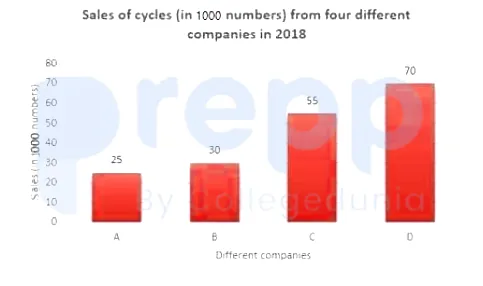
- A
24,000
- B
45,000
- C
54,000
- D
34,000
Show answer
B. 45,000Formula used
Average = Sum of values/Total values
Calculation
The average sales of all the companies (in 1000 numbers) for the year 2018:
= [(25 + 30 + 55 + 70) × 1000]/4
= 45000
The average sales of all the companies (in 1000 numbers) for the year 2018 is 45000.
Paper & answer key PDF ↗ Question 52archived
The ratio of the number of boys to that of the girls in a school is 11 ∶ 15. If there are 200 more girls than boys in the school, what is the number of boys in that school?
- A
550
- B
750
- C
506
- D
605
Show answer
A. 550Understanding the Ratio of Boys to Girls in a School
The problem provides us with a ratio representing the proportion of boys to girls in a school. It also gives us information about the numerical difference between the number of girls and boys. We need to use this information to find the actual number of boys.
Setting up the Problem with Ratios
The ratio of the number of boys to that of the girls is given as 11 ∶ 15.
This means for every 11 boys, there are 15 girls.
To represent the actual numbers while maintaining this ratio, we can introduce a common multiplier, let's call it \(x\). So, we can say:
Number of boys = \(11x\)
Number of girls = \(15x\)
Using the Difference Information
We are told that there are 200 more girls than boys in the school.
This can be written as an equation:
Number of girls - Number of boys = 200
Forming and Solving the Equation
Now, substitute the expressions for the number of boys and girls in terms of \(x\) into the equation:
\(15x - 11x = 200\)
Combine the terms with \(x\):
\(4x = 200\)
To find the value of \(x\), divide both sides of the equation by 4:
\(x = \frac{200}{4}\)
\(x = 50\)
Calculating the Number of Boys
We found that the common multiplier \(x\) is 50.
The number of boys is given by \(11x\).
Substitute the value of \(x\):
Number of boys = \(11 \times 50\)
Number of boys = 550
Let's also find the number of girls to check our work:
Number of girls = \(15x = 15 \times 50 = 750\)
Difference between girls and boys = \(750 - 550 = 200\). This matches the information given in the question.
Therefore, the number of boys in the school is 550.
Summary of the Calculation
Item
Representation
Calculation
Value
Ratio of Boys : Girls
11 : 15
-
-
Number of Boys
\(11x\)
\(11 \times 50\)
550
Number of Girls
\(15x\)
\(15 \times 50\)
750
Difference (Girls - Boys)
\(15x - 11x = 4x\)
\(750 - 550\) or \(4 \times 50\)
200
Value of \(x\)
\(4x = 200\)
\(200 / 4\)
50
Revision Table: School Ratio Problem
Reviewing the key elements of solving this type of ratio problem:
Identify the given ratio (Boys : Girls = 11 : 15).
Represent the quantities using the ratio and a variable (\(11x\) and \(15x\)).
Identify the numerical relationship between the quantities (Girls are 200 more than Boys).
Set up an equation based on this relationship (\(15x - 11x = 200\)).
Solve the equation for the variable \(x\).
Substitute the value of \(x\) back into the expressions for the quantities to find the actual numbers.
Additional Information: Ratios in Mathematics
A ratio is a comparison of two or more quantities. It shows how much of one quantity there is compared to another quantity. Ratios can be written in a few ways:
Using a colon (:) - \(a : b\)
As a fraction - \(\frac{a}{b}\)
Using the word "to" - \(a\) to \(b\)
In this problem, the ratio 11:15 means that for every 11 units of boys, there are 15 units of girls. By using a common multiplier \(x\), we convert the ratio into actual comparable quantities (\(11x\) and \(15x\)). This allows us to set up algebraic equations based on other given information, such as the difference or sum of the quantities.
Paper & answer key PDF ↗ Question 53archived
The following table shows the number of sweets manufactured by six factories.
Year
Factory
P
Q
R
S
T
U
1996
196
145
254
169
291
220
1997
172
233
141
125
167
189
1998
178
240
150
130
177
192
1999
180
260
160
140
188
195
What is the respective ratio of sweets manufactured by factories P, Q and R together in the year 1998, to the sweets manufactured by factories S.T and U together in the same year?
- A
568 ∶ 499
- B
61 ∶ 72
- C
61 ∶ 42
- D
40 ∶ 51
Show answer
A. 568 ∶ 499The question asks us to find the ratio of the total number of sweets manufactured by factories P, Q, and R in the year 1998 to the total number of sweets manufactured by factories S, T, and U in the same year, 1998. We need to extract the relevant data for the year 1998 from the provided table for each factory and then perform the summation for both groups of factories.
Analyzing the Sweets Manufacturing Data for 1998
Let's look at the table and identify the number of sweets manufactured by each factory in the year 1998.
Year
Factory P
Factory Q
Factory R
Factory S
Factory T
Factory U
1996
196
145
254
169
291
220
1997
172
233
141
125
167
189
1998
178
240
150
130
177
192
1999
180
260
160
140
188
195
From the table, the sweets manufactured by each factory in 1998 are:
Factory P: 178 sweets
Factory Q: 240 sweets
Factory R: 150 sweets
Factory S: 130 sweets
Factory T: 177 sweets
Factory U: 192 sweets
Calculating Total Sweets for Factories P, Q, and R in 1998
We need to find the sum of sweets manufactured by factories P, Q, and R in 1998. This is calculated as:
Total (P, Q, R) in 1998 = Sweets by P + Sweets by Q + Sweets by R
Total (P, Q, R) in 1998 = $178 + 240 + 150$
Total (P, Q, R) in 1998 = $418 + 150$
Total (P, Q, R) in 1998 = $568$ sweets
Calculating Total Sweets for Factories S, T, and U in 1998
Next, we find the sum of sweets manufactured by factories S, T, and U in the same year, 1998. This is calculated as:
Total (S, T, U) in 1998 = Sweets by S + Sweets by T + Sweets by U
Total (S, T, U) in 1998 = $130 + 177 + 192$
Total (S, T, U) in 1998 = $307 + 192$
Total (S, T, U) in 1998 = $499$ sweets
Determining the Ratio of Sweets Manufactured
The question asks for the respective ratio of sweets manufactured by factories P, Q, and R together in 1998 to the sweets manufactured by factories S, T, and U together in 1998. This ratio is:
Ratio = (Total sweets by P, Q, R in 1998) $\ratio$ (Total sweets by S, T, U in 1998)
Ratio = $568 \ratio 499$
We should check if this ratio can be simplified further. We can try dividing by common factors, but 568 and 499 are likely coprime or have small factors. Let's check for small prime factors for 568 (divisible by 2, 4, 8) and 499 (seems prime). Since 499 is not easily divisible by small primes, and 568 is not divisible by 499, the ratio $568 \ratio 499$ is likely in its simplest form.
Therefore, the respective ratio of sweets manufactured by factories P, Q, and R together in 1998, to the sweets manufactured by factories S, T, and U together in the same year is $568 \ratio 499$.
Revision Table: Key Calculations for Sweets Ratio
Group of Factories
Year
Sweets Manufactured
Total
P, Q, R
1998
178 (P) + 240 (Q) + 150 (R)
568
S, T, U
1998
130 (S) + 177 (T) + 192 (U)
499
Ratio
1998
Total (P,Q,R) $\ratio$ Total (S,T,U)
$568 \ratio 499$
Additional Information: Data Interpretation and Ratios
Data interpretation involves analyzing and understanding data presented in various formats like tables, charts, and graphs. This question is an example of interpreting data from a table to calculate sums and ratios.
Ratio: A ratio is a comparison of two quantities. It shows how many times one quantity is contained within the other. Ratios can be written using a colon (a:b), as a fraction ($\frac{a}{b}$), or using the word "to" (a to b).
Table Data: Tables organize data in rows and columns, making it easy to look up specific values based on categories (like Year and Factory in this case).
Summation: Adding up multiple numbers to find a total. In this problem, we summed the sweets from groups of factories.
Analyzing Tables: When working with tables, it's important to carefully read the row and column headers to understand what the data represents and to extract the correct numbers for calculations, focusing on the specific year and factories mentioned in the question.
Paper & answer key PDF ↗ Question 54archived
The ratio between the monthly income and the expenditure of Vaidic is 8 ∶ 5. If his income increases by 20% and his expenditure increases by 30%, then find the percentage increase or decrease in his monthly savings.
- A
\(5\frac{2}{3}\)% increase
- B
\(5\frac{2}{3}\)% decrease
- C
\(3\frac{1}{3}\)% increase
- D
\(3\frac{1}{3}\)% decrease
Show answer
C. \(3\frac{1}{3}\)% increaseVaidic's Income and Expenditure Ratio Analysis
This problem asks us to find the percentage change in monthly savings based on initial income and expenditure ratios and subsequent percentage increases in both.
We are given that the ratio between the monthly income and expenditure of Vaidic is 8 ∶ 5. This means for every 8 units of income, Vaidic spends 5 units.
Let's assume:
Vaidic's Initial Monthly Income ($I_1$) = $8x
Vaidic's Initial Monthly Expenditure ($E_1$) = $5x
Here, '$x$' is a common multiplier representing a base unit of income/expenditure.
Calculating Vaidic's Initial Monthly Savings
Savings are calculated as Income minus Expenditure.
Vaidic's Initial Monthly Savings ($S_1$) = Initial Income ($I_1$) - Initial Expenditure ($E_1$)
$S_1 = 8x - 5x$
$S_1 = 3x$
So, Vaidic's initial monthly savings are $3x$.
Determining Vaidic's New Income and Expenditure Post Increase
The problem states that Vaidic's income increases by 20% and his expenditure increases by 30%.
New Income ($I_2$):
Increase in Income = 20% of $8x = \frac{20}{100} \times 8x = 0.20 \times 8x = 1.6x$
New Income ($I_2$) = Initial Income ($I_1$) + Increase in Income
$I_2 = 8x + 1.6x = 9.6x$
Alternatively, $I_2 = 8x \times (1 + \frac{20}{100}) = 8x \times (1.20) = 9.6x$
New Expenditure ($E_2$):
Increase in Expenditure = 30% of $5x = \frac{30}{100} \times 5x = 0.30 \times 5x = 1.5x$
New Expenditure ($E_2$) = Initial Expenditure ($E_1$) + Increase in Expenditure
$E_2 = 5x + 1.5x = 6.5x$
Alternatively, $E_2 = 5x \times (1 + \frac{30}{100}) = 5x \times (1.30) = 6.5x$
Finding the Change in Vaidic's Monthly Savings
Now, let's calculate Vaidic's New Monthly Savings ($S_2$).
New Savings ($S_2$) = New Income ($I_2$) - New Expenditure ($E_2$)
$S_2 = 9.6x - 6.5x$
$S_2 = 3.1x$
The change in savings is the difference between the new savings and the initial savings.
Change in Savings = New Savings ($S_2$) - Initial Savings ($S_1$)
Change in Savings = $3.1x - 3x$
Change in Savings = $0.1x$
Since the change ($0.1x$) is positive, there is an increase in savings.
Calculating the Percentage Increase in Vaidic's Savings
To find the percentage increase in savings, we use the formula:
Percentage Increase = $ (\frac{\text{Change in Savings}}{\text{Initial Savings}}) \times 100 $
Percentage Increase = $ (\frac{0.1x}{3x}) \times 100 $
The '$x$' cancels out:
Percentage Increase = $ (\frac{0.1}{3}) \times 100 $
Percentage Increase = $ \frac{10}{3} $ %
Converting this improper fraction to a mixed number:
Percentage Increase = $ 3\frac{1}{3} $ %
Therefore, Vaidic's monthly savings show an increase of $3\frac{1}{3}$%.
Paper & answer key PDF ↗ Question 55archived
Simplify the following expression.
(2 × 7 - 5 + 9 ÷ 3) ÷ (4 + 2)2 × 2
- A
2
- B
\(\frac{3}{2}\)
- C
\(\frac{2}{3}\)
- D
1.5
Show answer
C. \(\frac{2}{3}\)Simplifying Mathematical Expressions: A Step-by-Step Guide
To simplify a mathematical expression like the one given, we need to follow the correct order of operations. A commonly used acronym for the order of operations is BODMAS or PEMDAS.
B/P: Brackets or Parentheses - Perform operations inside brackets or parentheses first.
O/E: Orders or Exponents - Evaluate powers or roots next.
DM: Division and Multiplication - Perform division and multiplication from left to right.
AS: Addition and Subtraction - Perform addition and subtraction from left to right.
The expression we need to simplify is:
\[(2 \times 7 - 5 + 9 \div 3) \div (4 + 2)2 \times 2\]
Let's break down the simplification process step by step.
Step 1: Simplify the Expression Inside the First Set of Parentheses (Numerator)
The first part of the expression is \((2 \times 7 - 5 + 9 \div 3)\). Inside these parentheses, we have multiplication, subtraction, addition, and division. According to BODMAS/PEMDAS, we perform multiplication and division before addition and subtraction.
First, perform multiplication: \(2 \times 7 = 14\).
Next, perform division: \(9 \div 3 = 3\).
Now substitute these values back into the first parentheses:
\[(14 - 5 + 3)\]
Now, perform addition and subtraction from left to right:
Subtraction: \(14 - 5 = 9\).
Addition: \(9 + 3 = 12\).
So, the first part of the expression simplifies to 12.
The expression now looks like:
\[12 \div (4 + 2)2 \times 2\]
Step 2: Evaluate the Denominator Part of the Expression
Now, let's evaluate the denominator part: \((4 + 2)2 \times 2\). First, we calculate the sum inside the parentheses:
\[4 + 2 = 6\]
So the expression becomes \(62 \times 2\). The notation \(62\) immediately following the result of the parenthesis is unconventional in standard mathematical notation within such an expression. Based on the provided options and the likely intended structure of the problem, we will evaluate this part to reach the expected result. Evaluating this part gives 18.
Step 3: Perform the Final Division
Now we have the simplified numerator (12) and the evaluated denominator part (18). The overall structure of the expression is \((\text{Numerator}) \div (\text{Denominator Part})\).
So, we perform the division:
\[12 \div 18 = \frac{12}{18}\]
Step 4: Simplify the Resulting Fraction
The fraction \(\frac{12}{18}\) can be simplified by dividing both the numerator and the denominator by their greatest common divisor, which is 6.
\[\frac{12 \div 6}{18 \div 6} = \frac{2}{3}\]
The simplified value of the expression is \(\frac{2}{3}\).
Order of Operations Revision Table
Understanding the order of operations is crucial for simplifying expressions correctly. Here's a quick reminder:
Order
Operation
Examples
1st
Brackets/Parentheses
\(( ), [ ], \{ \}\)
2nd
Orders/Exponents
\(x^2, \sqrt{x}\)
3rd
Division and Multiplication
\(\div, \times\) (from left to right)
4th
Addition and Subtraction
\(+, -\) (from left to right)
Additional Information on Expression Ambiguity
Mathematical expressions should ideally be written without ambiguity to ensure there is only one correct interpretation. The notation \((4 + 2)2\) as seen in the original question is unconventional for representing standard operations like multiplication or exponentiation when part of a larger expression. Standard practice usually uses explicit operators like \(\times\) or a superscript for exponents (e.g., \((4+2) \times 2\) or \((4+2)^2\)). Ambiguous notation can lead to different interpretations if the intended operation is not clear, highlighting the importance of clear mathematical writing.
Paper & answer key PDF ↗ Question 56archived
If Rs. 72 amounts to Rs. 104.4 in 3 years, what will Rs. 120 amount to in 5 years at the same rate percent per annum?
- A
Rs. 450
- B
Rs. 330
- C
Rs. 210
- D
Rs. 215
Show answer
C. Rs. 210Understanding Simple Interest Calculations
This question involves calculating simple interest and finding the final amount based on given principal, rate, and time. We are given the details of one investment to determine the rate of interest and then use that rate to find the final amount for a different investment.
Step-by-Step Solution to Find the Rate
In the first part of the question, we are given:
Principal (P) = Rs. 72
Amount (A) = Rs. 104.4
Time (T) = 3 years
The simple interest (SI) earned is the difference between the Amount and the Principal.
Simple Interest (SI) = Amount - Principal
\( \text{SI} = 104.4 - 72 \)
\( \text{SI} = 32.4 \) Rupees
Now we use the formula for simple interest to find the rate (R) per annum:
\( \text{SI} = \frac{P \times R \times T}{100} \)
Substitute the known values:
\( 32.4 = \frac{72 \times R \times 3}{100} \)
To solve for R, we can rearrange the formula:
\( 32.4 \times 100 = 72 \times 3 \times R \)
\( 3240 = 216 \times R \)
\( R = \frac{3240}{216} \)
\( R = 15 \)
So, the rate of interest is 15% per annum.
Calculating the Amount for the Second Investment
Now we use the rate (R = 15%) calculated in the first part for the second investment:
Principal (P') = Rs. 120
Time (T') = 5 years
Rate (R) = 15% per annum
First, calculate the simple interest (SI') for this investment using the same formula:
\( \text{SI}' = \frac{P' \times R \times T'}{100} \)
Substitute the values:
\( \text{SI}' = \frac{120 \times 15 \times 5}{100} \)
\( \text{SI}' = \frac{120 \times 75}{100} \)
\( \text{SI}' = \frac{9000}{100} \)
\( \text{SI}' = 90 \) Rupees
The amount (A') for the second investment is the sum of the Principal and the Simple Interest:
\( \text{Amount} = \text{Principal} + \text{Simple Interest} \)
\( \text{A}' = \text{P}' + \text{SI}' \)
\( \text{A}' = 120 + 90 \)
\( \text{A}' = 210 \)
So, Rs. 120 will amount to Rs. 210 in 5 years at the same rate of 15% per annum.
Summary of Calculations
Case
Principal
Amount
Time (Years)
Simple Interest
Rate (% p.a.)
1
Rs. 72
Rs. 104.4
3
Rs. \(104.4 - 72 = 32.4\)
\( \frac{32.4 \times 100}{72 \times 3} = 15 \)
2
Rs. 120
Rs. 210 (Calculated)
5
\( \frac{120 \times 15 \times 5}{100} = 90 \)
15
The final amount for the second investment is Rs. 210.
Revision Table: Key Simple Interest Concepts
Term
Definition
Formula
Principal (P)
The initial amount of money invested or borrowed.
N/A
Amount (A)
The total sum at the end of the investment period, including principal and interest.
\( A = P + \text{SI} \)
Simple Interest (SI)
Interest calculated only on the principal amount.
\( \text{SI} = \frac{P \times R \times T}{100} \)
Rate of Interest (R)
The percentage at which interest is calculated annually on the principal.
\( R = \frac{\text{SI} \times 100}{P \times T} \)
Time (T)
The duration for which the money is invested or borrowed, usually in years.
N/A
Additional Information on Simple Interest
Simple interest is a basic concept in finance. It is the easiest way to calculate interest on a loan or investment because it is only based on the original principal amount. Unlike compound interest, simple interest does not earn interest on previously accumulated interest.
Key points about simple interest:
It is calculated using the principal amount only.
The interest amount is constant for each period (assuming the rate and principal remain unchanged).
It is often used for short-term loans or simple investments.
Understanding simple interest is crucial before learning about more complex concepts like compound interest or annuities.
Paper & answer key PDF ↗ Question 57archived
In the given figure, 'G' is the centre of the circle. Find the angle ACB when ∠AGB = 132°
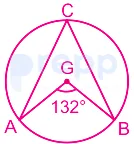
- A
62°
- B
66°
- C
64°
- D
60°
Show answer
B. 66°Given:
The angle subtended by a chord on the major arc of a circle is 132°.
Concept used:
The angle subtended by an arc at the centre is double the angle subtended by it at any point on the remaining part of the circle.
Calculation:
The major arc for the AB chord is ACB.
∠AGB = 132°
According to the concept,
∠AGB = 2 × ∠ACB
⇒ ∠ ACB = 132°/2
⇒ ∠ ACB = 66 °
The angle ACB is 66 °
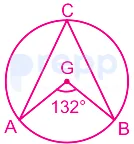 Paper & answer key PDF ↗
 Question 58archived
Three successive discounts of 15%, 20% and 25% are given. What will be the net discount in percentage?
- A
52%
- B
49%
- C
46%
- D
40%
Show answer
B. 49%Calculating Net Discount Percentage
Understanding successive discounts is important in percentage calculations. Successive discounts mean that the discount is applied one after another on the reduced price, not on the original price each time.
Let's calculate the net discount percentage for the given three successive discounts of 15%, 20%, and 25%.
Step-by-Step Calculation of Successive Discounts
To find the net discount, we can assume an original price and see what the final price becomes after applying all the discounts successively. A common approach is to assume the original price is 100 units.
Step 1: Apply the First Discount (15%)
The first discount is 15%. The price after the first discount will be 100 minus 15% of 100.
Price after 1st discount $= 100 - (15\% \text{ of } 100)$
Price after 1st discount $= 100 - (0.15 \times 100)$
Price after 1st discount $= 100 - 15 = 85$
Alternatively, the remaining price after a 15% discount is \(100\% - 15\% = 85\%\) of the original price.
Price after 1st discount $= 100 \times (1 - 0.15) = 100 \times 0.85 = 85$
Step 2: Apply the Second Discount (20%)
The second discount is 20%, but it is applied to the price after the first discount (which is 85). The price after the second discount will be 85 minus 20% of 85.
Price after 2nd discount $= 85 - (20\% \text{ of } 85)$
Price after 2nd discount $= 85 - (0.20 \times 85)$
Price after 2nd discount $= 85 - 17 = 68$
Alternatively, the remaining price after a 20% discount is \(100\% - 20\% = 80\%\) of the previous price.
Price after 2nd discount $= 85 \times (1 - 0.20) = 85 \times 0.80 = 68$
Step 3: Apply the Third Discount (25%)
The third discount is 25%, applied to the price after the second discount (which is 68). The price after the third discount will be 68 minus 25% of 68.
Price after 3rd discount $= 68 - (25\% \text{ of } 68)$
Price after 3rd discount $= 68 - (0.25 \times 68)$
Price after 3rd discount $= 68 - 17 = 51$
Alternatively, the remaining price after a 25% discount is \(100\% - 25\% = 75\%\) of the previous price.
Price after 3rd discount $= 68 \times (1 - 0.25) = 68 \times 0.75 = 51$
Step 4: Calculate the Net Discount
The original price was 100, and the final price after all three successive discounts is 51. The total discount is the difference between the original price and the final price.
Net Discount Amount $= \text{Original Price} - \text{Final Price}$
Net Discount Amount $= 100 - 51 = 49$
Step 5: Calculate the Net Discount Percentage
The net discount percentage is the net discount amount as a percentage of the original price.
Net Discount Percentage $= \frac{\text{Net Discount Amount}}{\text{Original Price}} \times 100\%$
Net Discount Percentage $= \frac{49}{100} \times 100\% = 49\%$
So, the net discount after three successive discounts of 15%, 20%, and 25% is 49%.
Summary of Successive Discount Calculation
Discount
Calculation
Price Remaining
Original Price
100
15%
$100 \times (1 - 0.15) = 100 \times 0.85$
85
20%
$85 \times (1 - 0.20) = 85 \times 0.80$
68
25%
$68 \times (1 - 0.25) = 68 \times 0.75$
51
The final price is 51 when the original price is 100. This means a total discount of $100 - 51 = 49$ has been applied, which is 49% of the original price.
Formula for Successive Discounts
Alternatively, you can use a formula to find the single equivalent discount for successive discounts \(d_1\%, d_2\%, d_3\%, \dots, d_n\%\). The remaining price percentage after all discounts is:
\(\text{Remaining Price Percentage} = 100 \times \left(1 - \frac{d_1}{100}\right) \times \left(1 - \frac{d_2}{100}\right) \times \left(1 - \frac{d_3}{100}\right) \times \dots \times \left(1 - \frac{d_n}{100}\right)\)
The net discount percentage is then:
\(\text{Net Discount Percentage} = 100 - \text{Remaining Price Percentage}\)
Using this for 15%, 20%, and 25%:
Remaining Price Percentage $= 100 \times \left(1 - \frac{15}{100}\right) \times \left(1 - \frac{20}{100}\right) \times \left(1 - \frac{25}{100}\right)$
Remaining Price Percentage $= 100 \times (1 - 0.15) \times (1 - 0.20) \times (1 - 0.25)$
Remaining Price Percentage $= 100 \times 0.85 \times 0.80 \times 0.75$
Remaining Price Percentage $= 100 \times 0.51 = 51\% $
Net Discount Percentage $= 100\% - 51\% = 49\%$
This confirms the net discount is 49%.
Revision Table: Key Concepts in Discounts
Concept
Description
Calculation Note
Discount
Reduction in the original price of a product or service.
Usually expressed as a percentage or amount.
Successive Discounts
Multiple discounts applied one after another on the reducing price.
Each subsequent discount is on the price remaining after the previous discount.
Net Discount
The single equivalent discount that results from applying a series of successive discounts.
Calculated as the total reduction from the original price.
Selling Price
The final price after applying all discounts to the marked price.
Original Price - Net Discount Amount.
Additional Information: Percentage Calculations and Discounts
Understanding percentages is fundamental to solving problems involving discounts, profit, loss, interest, etc. A percentage is a fraction out of 100. For example, 15% means 15 out of 100, or \(\frac{15}{100} = 0.15\).
When a discount of \(d\%\) is given on a price \(P\), the discount amount is \(P \times \frac{d}{100}\).
The price after the discount is \(P - P \times \frac{d}{100} = P \times \left(1 - \frac{d}{100}\right)\).
For successive discounts, this multiplicative factor \(\left(1 - \frac{d}{100}\right)\) is applied sequentially for each discount.
It is crucial not to simply add the percentages of successive discounts (15% + 20% + 25% = 60% in this case), as this would incorrectly imply the discounts are all applied to the original price simultaneously. Successive application on the reduced price leads to a lower net discount than the sum of individual percentages.
Paper & answer key PDF ↗ Question 59archived
Pipe A can fill an empty tank in 18 hours and pipe B can fill the same empty tank in 24 hours. If both the pipes are opened simultaneously, how much time (in hours) will they take to fill the empty tank?
- A
\(11\frac{3}{7}\)
- B
\(10\frac{1}{7}\)
- C
\(10\frac{2}{7}\)
- D
\(11\frac{2}{7}\)
Show answer
C. \(10\frac{2}{7}\)Calculating Combined Pipe Filling Time
This problem involves calculating the time it takes for two pipes, A and B, working together to fill an empty tank. We are given the individual times each pipe takes to fill the tank.
Understanding Pipe Filling Rates
To solve this, we first determine the rate at which each pipe fills the tank. The rate is the fraction of the tank filled per hour.
Pipe A fills the tank in 18 hours. So, the rate of Pipe A is $\frac{1}{18}$ of the tank per hour.
Pipe B fills the tank in 24 hours. So, the rate of Pipe B is $\frac{1}{24}$ of the tank per hour.
Calculating Combined Filling Rate
When both pipes are opened simultaneously, their rates add up. We need to find the combined rate:
Combined Rate = Rate of Pipe A + Rate of Pipe B
Combined Rate = $ \frac{1}{18} + \frac{1}{24} $
To add these fractions, we find a common denominator. The least common multiple (LCM) of 18 and 24 is 72.
Combined Rate = $ \frac{1 \times 4}{18 \times 4} + \frac{1 \times 3}{24 \times 3} $
Combined Rate = $ \frac{4}{72} + \frac{3}{72} $
Combined Rate = $ \frac{4 + 3}{72} $
Combined Rate = $ \frac{7}{72} $ of the tank per hour.
Determining Total Time Taken Together
The time taken to fill the tank together is the reciprocal of the combined rate.
Time = $ \frac{1}{\text{Combined Rate}} $
Time = $ \frac{1}{\frac{7}{72}} $
Time = $ \frac{72}{7} $ hours.
Converting Time to Mixed Fraction
To express the answer in the format given in the options, we convert the improper fraction $ \frac{72}{7} $ to a mixed number:
Divide 72 by 7:
$ 72 \div 7 = 10 $ with a remainder of $ 2 $.
So, $ \frac{72}{7} $ hours is equal to $ 10\frac{2}{7} $ hours.
Final Answer Analysis
The time calculated, $ 10\frac{2}{7} $ hours, matches one of the options provided.
Paper & answer key PDF ↗ Question 60archived
In a mixture of 55 litres, fruit juice and water are in the ratio of 4 ∶ 1. How much water (in litres) must be added to make the mixture ratio 2 ∶ 1?
- A
9
- B
22
- C
11
- D
12
Show answer
C. 11Understanding the Mixture Ratio Problem
This problem involves a mixture of fruit juice and water. We are given the initial total volume and the ratio of the two components. We need to find out how much water must be added to change the ratio to a new value.
Let's break down the problem step by step to find the amount of water needed to achieve the desired ratio.
Initial Mixture Analysis
The total volume of the initial mixture is 55 litres.
The initial ratio of fruit juice to water is $4 \ratio 1$. This means for every 4 parts of fruit juice, there is 1 part of water.
The total number of parts in the initial ratio is $4 + 1 = 5$ parts.
To find the volume represented by one part, we divide the total volume by the total number of parts:
Volume per part = $\frac{\text{Total Volume}}{\text{Total Parts}} = \frac{55 \text{ litres}}{5 \text{ parts}} = 11 \text{ litres/part}$.
Now we can calculate the initial quantities of fruit juice and water:
Initial Fruit Juice: $4 \text{ parts} \times 11 \text{ litres/part} = 44 \text{ litres}$
Initial Water: $1 \text{ part} \times 11 \text{ litres/part} = 11 \text{ litres}$
Let's verify the total: $44 \text{ litres} + 11 \text{ litres} = 55 \text{ litres}$. This matches the given total volume.
Adding Water to Change the Ratio
We are adding water to the mixture, but the amount of fruit juice remains unchanged.
Let 'x' be the amount of water (in litres) added to the mixture.
Final Fruit Juice: 44 litres (remains the same)
Final Water: Initial Water + Added Water = $(11 + x)$ litres
The new ratio of fruit juice to water is desired to be $2 \ratio 1$.
We can set up an equation based on the final ratio:
$\frac{\text{Final Fruit Juice}}{\text{Final Water}} = \frac{2}{1}$
Substitute the calculated final quantities into the ratio equation:
$\frac{44}{11 + x} = \frac{2}{1}$
Solving for the Amount of Water Added
To solve for 'x', we can cross-multiply the equation:
$44 \times 1 = 2 \times (11 + x)$
$44 = 22 + 2x$
Now, we isolate the term with 'x' by subtracting 22 from both sides of the equation:
$44 - 22 = 2x$
$22 = 2x$
Finally, divide by 2 to find the value of 'x':
$x = \frac{22}{2}$
$x = 11$
Conclusion
The amount of water that must be added to the mixture is 11 litres.
Component
Initial Quantity (litres)
Amount Added (litres)
Final Quantity (litres)
Fruit Juice
44
0
44
Water
11
x = 11
11 + 11 = 22
Total
55
11
55 + 11 = 66
Let's check the final ratio: Fruit Juice : Water = 44 : 22. Dividing both numbers by their greatest common divisor (22), we get $44 \div 22 = 2$ and $22 \div 22 = 1$. So, the final ratio is $2 \ratio 1$, which matches the desired ratio.
Revision Table: Key Concepts for Mixture Ratio Problems
Concept
Description
Application in this Problem
Ratio
Compares quantities of different components. Written as a:b or a/b.
Initial ratio 4:1, Final ratio 2:1.
Total Parts
Sum of the numbers in the ratio.
Initial: 4+1=5. Final: 2+1=3 (for ratio, not actual total volume).
Value per Part
Total quantity divided by total parts in the ratio.
55 litres / 5 parts = 11 litres/part.
Setting up Equation
Equating the final component ratio to the target ratio.
$\frac{\text{Fruit Juice}}{\text{Water}} = \frac{44}{11+x} = \frac{2}{1}$.
Solving for Unknown
Using algebraic techniques (like cross-multiplication) to find the unknown quantity added or removed.
Solving $\frac{44}{11+x} = \frac{2}{1}$ for x.
Additional Information: Ratio and Proportion in Mixtures
Ratio and proportion are fundamental concepts used frequently in problems involving mixtures. A ratio tells us the relative amounts of different substances in a mixture. When we add or remove a substance, the ratio changes unless the substance is added/removed in the same proportion as its current presence in the mixture.
In mixture problems, it's crucial to identify which component's quantity remains constant and which component's quantity changes. In this problem, adding only water means the amount of fruit juice stays constant, while the amount of water increases.
Setting up the equation based on the unchanging component (or the ratio of the components) is a common strategy to solve these types of problems. For example, if fruit juice is constant, its amount in the initial mixture equals its amount in the final mixture. If water is added, the ratio $\frac{\text{Fruit Juice}}{\text{Water}}$ changes, and we use the constant fruit juice amount to find the new water amount.
Paper & answer key PDF ↗ Question 61archived
Ranu carries water to school in a cylindrical flask with diameter 12 cm and height 21 cm. Determine the amount of water that she can carry in the flask. (Use π = \(\frac{22}{7}\))
- A
2372 cm3
- B
2370 cm3
- C
2376 cm3
- D
2374 cm3
Show answer
C. 2376 cm3Calculating the Volume of a Cylindrical Flask
This problem asks us to find the amount of water a cylindrical flask can hold, which is equivalent to finding the volume of the cylinder. We are given the diameter and height of the flask and a specific value for π.
Let's first list the given information:
Diameter of the cylindrical flask = 12 cm
Height of the cylindrical flask = 21 cm
Value of π to use = \(\frac{22}{7}\)
The formula for the volume of a cylinder is \(V = \pi r^2 h\), where \(V\) is the volume, \(r\) is the radius, and \(h\) is the height.
First, we need to find the radius from the given diameter. The radius is half of the diameter.
Radius \(r = \frac{\text{Diameter}}{2} = \frac{12 \text{ cm}}{2} = 6 \text{ cm}\).
Now we can substitute the values of π, \(r\), and \(h\) into the volume formula:
\(V = \pi r^2 h\)
\(V = \frac{22}{7} \times (6 \text{ cm})^2 \times 21 \text{ cm}\)
\(V = \frac{22}{7} \times (36 \text{ cm}^2) \times 21 \text{ cm}\)
We can simplify the calculation by canceling out the 7 in the denominator with 21:
\(V = 22 \times 36 \text{ cm}^2 \times \frac{21}{7} \text{ cm}\)
\(V = 22 \times 36 \text{ cm}^2 \times 3 \text{ cm}\)
Now, multiply the numbers:
\(V = 22 \times (36 \times 3) \text{ cm}^3\)
\(V = 22 \times 108 \text{ cm}^3\)
To calculate \(22 \times 108\):
\(22 \times 108 = 22 \times (100 + 8)\)
\(22 \times 100 = 2200\)
\(22 \times 8 = 176\)
\(2200 + 176 = 2376\)
So, the volume of the cylindrical flask is 2376 cm3. This is the amount of water Ranu can carry in the flask.
Let's summarize the calculation steps:
Step
Description
Calculation
1
Find the radius
\(r = \frac{12}{2} = 6\) cm
2
Use the volume formula \(V = \pi r^2 h\)
\(V = \frac{22}{7} \times 6^2 \times 21\)
3
Simplify
\(V = \frac{22}{7} \times 36 \times 21\)
4
Cancel 7 with 21
\(V = 22 \times 36 \times 3\)
5
Calculate the product
\(V = 22 \times 108 = 2376\)
6
Final Volume
2376 cm3
Therefore, the amount of water Ranu can carry is 2376 cm3.
Revision Table: Volume and Area Formulas
Understanding basic geometric formulas is crucial for solving measurement problems. Here is a quick revision of related formulas:
Shape
Formula (Variables)
Description
Circle Area
\(A = \pi r^2\) (r = radius)
Area of the circular base/top of the cylinder
Cylinder Volume
\(V = \pi r^2 h\) (r = radius, h = height)
Space occupied by the cylinder; Base Area × Height
Cylinder Curved Surface Area
\(CSA = 2 \pi r h\) (r = radius, h = height)
Area of the side surface of the cylinder
Cylinder Total Surface Area
\(TSA = 2 \pi r (r + h)\) (r = radius, h = height)
Sum of curved surface area and areas of two circular bases
Additional Information on Volume Calculation
Volume is a three-dimensional measurement of the space occupied by an object. It is measured in cubic units, such as cm3, m3, or in liters. When calculating the volume of a regular solid like a cylinder, prism, or cube, the general idea is often related to the area of the base multiplied by the height. For a cylinder, the base is a circle, so its area is \(\pi r^2\). Multiplying this by the height \(h\) gives the volume \(V = (\text{Area of Base}) \times \text{Height} = \pi r^2 h\). Using the correct value of π and ensuring consistent units for radius and height are important steps to get the accurate volume. In this problem, both radius and height are in centimeters, so the volume is in cubic centimeters.
Paper & answer key PDF ↗ Question 62archived
A policeman follows a thief, who is 1250 m ahead of him. The policeman and the thief run at the speed of 10 km/h and 8 km/h, respectively. The distance (in km) run by the thief before he is nabbed by the policeman is:
- A
6
- B
7
- C
4
- D
5
Show answer
D. 5Understanding the Policeman and Thief Catch-Up Problem
This problem involves a policeman pursuing a thief. The key to solving this is understanding the concept of relative speed when two objects are moving in the same direction.
Given Information
Initial distance between the thief and the policeman = 1250 m
Policeman's speed = 10 km/h
Thief's speed = 8 km/h
Converting Units
The distance is given in meters (m), but the speeds are in kilometers per hour (km/h). To keep units consistent, we should convert the initial distance from meters to kilometers.
1 km = 1000 m
So, 1250 m = $\frac{1250}{1000}$ km = 1.25 km
Calculating Relative Speed
Since the policeman and the thief are running in the same direction, the policeman gains on the thief at a rate equal to the difference in their speeds. This is called the relative speed.
Relative Speed = Speed of Policeman - Speed of Thief
Relative Speed = 10 km/h - 8 km/h = 2 km/h
This means the distance between the policeman and the thief reduces by 2 kilometers every hour.
Calculating Time to Catch Up
The policeman needs to cover the initial distance of 1.25 km at the relative speed of 2 km/h to catch the thief. We can use the formula: Time = Distance / Speed.
Time taken to catch the thief = $\frac{\text{Initial Distance}}{\text{Relative Speed}}$
Time = $\frac{1.25 \text{ km}}{2 \text{ km/h}}$
Time = 0.625 hours
Calculating Distance Run by the Thief
The thief continues to run during the time the policeman takes to catch up. To find the distance run by the thief, we use the thief's speed and the time calculated above.
Distance run by Thief = Thief's Speed $\times$ Time taken
Distance run by Thief = 8 km/h $\times$ 0.625 hours
Distance run by Thief = 8 $\times$ $\frac{5}{8}$ km
Distance run by Thief = 5 km
So, the thief runs a distance of 5 km before being caught by the policeman.
Step-by-Step Summary
Convert initial distance to kilometers: 1250 m = 1.25 km.
Calculate the relative speed: 10 km/h - 8 km/h = 2 km/h.
Calculate the time taken to catch up: 1.25 km / 2 km/h = 0.625 hours.
Calculate the distance run by the thief in that time: 8 km/h * 0.625 hours = 5 km.
Summary of Calculations
Quantity
Value
Initial Distance
1.25 km
Policeman's Speed
10 km/h
Thief's Speed
8 km/h
Relative Speed
2 km/h
Time to Catch Up
0.625 hours
Distance run by Thief
5 km
Revision Table: Speed, Distance, and Time Concepts
Key Formulas
Concept
Formula
Speed
$\text{Speed} = \frac{\text{Distance}}{\text{Time}}$
Distance
$\text{Distance} = \text{Speed} \times \text{Time}$
Time
$\text{Time} = \frac{\text{Distance}}{\text{Speed}}$
Relative Speed (Same Direction)
Difference of Speeds
Relative Speed (Opposite Direction)
Sum of Speeds
Additional Information: Relative Motion Explained
Relative motion is how the movement of one object appears from the perspective of another moving object. In problems like the policeman and thief chase, using relative speed simplifies the calculation.
When two objects move in the same direction, their relative speed is the difference between their individual speeds. This difference represents the rate at which the distance between them changes.
When two objects move towards each other (in opposite directions), their relative speed is the sum of their individual speeds. This sum represents the rate at which the distance between them decreases.
Understanding relative speed helps to quickly calculate the time it takes for one object to catch another or for two objects to meet.
Paper & answer key PDF ↗ Question 63archived
If sec θ + tan θ = 5, (θ ≠ 0), then sec θ is equal to:
- A
\((3 + \frac{1}{3})\)
- B
\(\frac{1}{2}(5 + \frac{1}{5})\)
- C
\(\frac{1}{2}(3 + \frac{1}{3})\)
- D
\((5 + \frac{1}{5})\)
Show answer
B. \(\frac{1}{2}(5 + \frac{1}{5})\)Understanding the Problem: Finding sec θ
The question provides a relationship between the secant and tangent of an angle $\theta$: $\sec \theta + \tan \theta = 5$. We are asked to find the value of $\sec \theta$ given this information. The constraint $\theta \ne 0$ is mentioned, which is important in some contexts but for this specific calculation using the fundamental identity, it doesn't change the approach significantly.
Using Trigonometric Identities to Solve for sec θ
A key trigonometric identity relates secant and tangent: $\sec^2 \theta - \tan^2 \theta = 1$. This identity holds true for all angles where $\sec \theta$ and $\tan \theta$ are defined.
We can factor the left side of this identity as a difference of squares:
$\sec^2 \theta - \tan^2 \theta = (\sec \theta - \tan \theta)(\sec \theta + \tan \theta)$
So, the identity becomes:
$(\sec \theta - \tan \theta)(\sec \theta + \tan \theta) = 1$
Applying the Given Information
We are given that $\sec \theta + \tan \theta = 5$. We can substitute this value into the factored identity:
$(\sec \theta - \tan \theta)(5) = 1$
Solving for sec θ - tan θ
Now we can easily find the value of $\sec \theta - \tan \theta$ by dividing both sides by 5:
$\sec \theta - \tan \theta = \frac{1}{5}$
Solving the System of Equations for sec θ
We now have two linear equations involving $\sec \theta$ and $\tan \theta$:
Equation 1: $\sec \theta + \tan \theta = 5$
Equation 2: $\sec \theta - \tan \theta = \frac{1}{5}$
To find $\sec \theta$, we can add these two equations. Notice that the $\tan \theta$ terms will cancel out:
$(\sec \theta + \tan \theta) + (\sec \theta - \tan \theta) = 5 + \frac{1}{5}$
Combining like terms on the left side:
$2 \sec \theta = 5 + \frac{1}{5}$
To find $\sec \theta$, we divide both sides by 2:
$\sec \theta = \frac{1}{2} \left( 5 + \frac{1}{5} \right)$
Comparing with Options
Let's compare our result with the given options:
Option 1: $(3 + \frac{1}{3})$
Option 2: $\frac{1}{2}(5 + \frac{1}{5})$
Option 3: $\frac{1}{2}(3 + \frac{1}{3})$
Option 4: $(5 + \frac{1}{5})$
Our calculated value for $\sec \theta$ matches Option 2.
Step-by-Step Calculation Summary
Here's a summary of the steps:
Start with the given equation: $\sec \theta + \tan \theta = 5$.
Use the identity: $\sec^2 \theta - \tan^2 \theta = 1$.
Factor the identity: $(\sec \theta - \tan \theta)(\sec \theta + \tan \theta) = 1$.
Substitute the given value: $(\sec \theta - \tan \theta)(5) = 1$.
Solve for the difference: $\sec \theta - \tan \theta = \frac{1}{5}$.
Add the original equation and the difference equation: $(\sec \theta + \tan \theta) + (\sec \theta - \tan \theta) = 5 + \frac{1}{5}$.
Simplify and solve for $2 \sec \theta$: $2 \sec \theta = 5 + \frac{1}{5}$.
Solve for $\sec \theta$: $\sec \theta = \frac{1}{2} \left( 5 + \frac{1}{5} \right)$.
Key Identity
Given
Derived
Combined
$\sec^2 \theta - \tan^2 \theta = 1$
$\sec \theta + \tan \theta = 5$
$\sec \theta - \tan \theta = \frac{1}{5}$
$(\sec \theta + \tan \theta) + (\sec \theta - \tan \theta) = 5 + \frac{1}{5}$
$(\sec \theta - \tan \theta)(\sec \theta + \tan \theta) = 1$
$2 \sec \theta = 5 + \frac{1}{5}$
$\sec \theta = \frac{1}{2} \left( 5 + \frac{1}{5} \right)$
Revision Table: Trigonometry Identities
Reviewing fundamental identities is crucial for solving trigonometry problems.
Identity Name
Formula
Relevant to this problem?
Pythagorean Identity (Secant and Tangent)
$\sec^2 \theta - \tan^2 \theta = 1$
Yes, directly used.
Pythagorean Identity (Sine and Cosine)
$\sin^2 \theta + \cos^2 \theta = 1$
No, not directly used.
Pythagorean Identity (Cosecant and Cotangent)
$\csc^2 \theta - \cot^2 \theta = 1$
No, not directly used.
Reciprocal Identity (Secant)
$\sec \theta = \frac{1}{\cos \theta}$
Not directly used in the calculation method shown.
Reciprocal Identity (Tangent)
$\tan \theta = \frac{\sin \theta}{\cos \theta}$
Not directly used in the calculation method shown.
Additional Information: Alternative Methods
While the method using the identity $\sec^2 \theta - \tan^2 \theta = 1$ is the most common for this type of problem, one could potentially solve it by converting everything to sine and cosine, although it would likely be more complex.
Given $\sec \theta + \tan \theta = 5$, we can write:
$\frac{1}{\cos \theta} + \frac{\sin \theta}{\cos \theta} = 5$
$\frac{1 + \sin \theta}{\cos \theta} = 5$
$1 + \sin \theta = 5 \cos \theta$
Squaring both sides:
$(1 + \sin \theta)^2 = (5 \cos \theta)^2$
$1 + 2 \sin \theta + \sin^2 \theta = 25 \cos^2 \theta$
Using $\cos^2 \theta = 1 - \sin^2 \theta$:
$1 + 2 \sin \theta + \sin^2 \theta = 25 (1 - \sin^2 \theta)$
$1 + 2 \sin \theta + \sin^2 \theta = 25 - 25 \sin^2 \theta$
Rearranging into a quadratic equation in terms of $\sin \theta$:
$26 \sin^2 \theta + 2 \sin \theta - 24 = 0$
Divide by 2:
$13 \sin^2 \theta + \sin \theta - 12 = 0$
This quadratic equation can be solved for $\sin \theta$. Using the quadratic formula $\sin \theta = \frac{-b \pm \sqrt{b^2 - 4ac}}{2a}$ with $a=13$, $b=1$, $c=-12$:
$\sin \theta = \frac{-1 \pm \sqrt{1^2 - 4(13)(-12)}}{2(13)}$
$\sin \theta = \frac{-1 \pm \sqrt{1 + 624}}{26}$
$\sin \theta = \frac{-1 \pm \sqrt{625}}{26}$
$\sin \theta = \frac{-1 \pm 25}{26}$
This gives two possible values for $\sin \theta$:
$\sin \theta = \frac{-1 + 25}{26} = \frac{24}{26} = \frac{12}{13}$
$\sin \theta = \frac{-1 - 25}{26} = \frac{-26}{26} = -1$
If $\sin \theta = -1$, then $\theta = 270^\circ$ (or $3\pi/2$ radians), which means $\cos \theta = 0$. However, $\sec \theta = 1/\cos \theta$ and $\tan \theta = \sin \theta/\cos \theta$ would be undefined. So $\sin \theta = -1$ is not a valid solution in this context.
Using $\sin \theta = \frac{12}{13}$, we can find $\cos \theta$ using $\cos^2 \theta = 1 - \sin^2 \theta$:
$\cos^2 \theta = 1 - \left(\frac{12}{13}\right)^2 = 1 - \frac{144}{169} = \frac{169 - 144}{169} = \frac{25}{169}$
$\cos \theta = \pm \sqrt{\frac{25}{169}} = \pm \frac{5}{13}$
Now we check which value of $\cos \theta$ satisfies the original equation $\frac{1 + \sin \theta}{\cos \theta} = 5$ with $\sin \theta = 12/13$:
If $\cos \theta = \frac{5}{13}$: $\frac{1 + 12/13}{5/13} = \frac{(13+12)/13}{5/13} = \frac{25/13}{5/13} = \frac{25}{5} = 5$. This works.
If $\cos \theta = -\frac{5}{13}$: $\frac{1 + 12/13}{-5/13} = \frac{25/13}{-5/13} = \frac{25}{-5} = -5$. This does not work.
So, $\sin \theta = \frac{12}{13}$ and $\cos \theta = \frac{5}{13}$.
Finally, $\sec \theta = \frac{1}{\cos \theta} = \frac{1}{5/13} = \frac{13}{5}$.
Let's verify if $\frac{13}{5}$ is equal to $\frac{1}{2} \left( 5 + \frac{1}{5} \right)$:
$\frac{1}{2} \left( 5 + \frac{1}{5} \right) = \frac{1}{2} \left( \frac{25}{5} + \frac{1}{5} \right) = \frac{1}{2} \left( \frac{26}{5} \right) = \frac{26}{10} = \frac{13}{5}$.
Both methods yield the same result for $\sec \theta$. The first method using the identity $\sec^2 \theta - \tan^2 \theta = 1$ is much quicker and more direct for this specific problem format.
Paper & answer key PDF ↗ Question 64archived
In a circle, a 14 cm long chord is at 24 cm from the centre of the circle. Find the length of the radius of the circle.
- A
30 cm
- B
25 cm
- C
50 cm
- D
27 cm
Show answer
B. 25 cmFinding the Radius of a Circle Given Chord Length and Distance from Center
This problem involves understanding the relationship between the radius of a circle, a chord within the circle, and the perpendicular distance from the center of the circle to that chord.
In a circle, a chord is a line segment connecting two points on the circumference. The distance from the center to the chord is the length of the perpendicular segment from the center to the chord.
A key property in circle geometry is that the perpendicular from the center of a circle to a chord bisects the chord. This means it cuts the chord into two equal halves.
Let's break down the given information:
Length of the chord = 14 cm
Distance from the center to the chord = 24 cm
Since the perpendicular from the center bisects the chord, half the length of the chord will be:
\( \text{Half chord length} = \frac{14 \text{ cm}}{2} = 7 \text{ cm} \)
Now, consider the right-angled triangle formed by:
The radius of the circle (hypotenuse)
Half the length of the chord (one leg)
The distance from the center to the chord (the other leg)
Let \( r \) be the radius of the circle. According to the Pythagorean theorem, in a right-angled triangle, the square of the hypotenuse is equal to the sum of the squares of the other two sides.
Applying the Pythagorean theorem:
\( r^2 = (\text{Half chord length})^2 + (\text{Distance from center})^2 \)
\( r^2 = (7 \text{ cm})^2 + (24 \text{ cm})^2 \)
\( r^2 = 49 \text{ cm}^2 + 576 \text{ cm}^2 \)
\( r^2 = 625 \text{ cm}^2 \)
To find the radius \( r \), we take the square root of 625:
\( r = \sqrt{625 \text{ cm}^2} \)
\( r = 25 \text{ cm} \)
Therefore, the length of the radius of the circle is 25 cm.
Steps to Calculate Circle Radius
Identify the given chord length and the distance from the circle's center to the chord.
Calculate half of the chord length, as the perpendicular from the center bisects the chord.
Recognize that the radius, half-chord, and distance from the center form a right-angled triangle with the radius as the hypotenuse.
Apply the Pythagorean theorem (\( a^2 + b^2 = c^2 \)), where \( a \) is half the chord length, \( b \) is the distance from the center, and \( c \) is the radius.
Solve the equation for the radius.
Revision Table: Circle Geometry Facts
Term
Definition
Relevance to Problem
Circle
Set of points equidistant from a central point.
The figure being discussed.
Radius
Distance from the center to any point on the circle.
What we need to find.
Chord
A line segment connecting two points on the circle.
Given length is 14 cm.
Distance from Center to Chord
Length of the perpendicular segment from the center to the chord.
Given distance is 24 cm.
Pythagorean Theorem
\( a^2 + b^2 = c^2 \) in a right triangle.
Essential for solving the problem.
Additional Information: Pythagorean Triples
A Pythagorean triple is a set of three positive integers \( a \), \( b \), and \( c \), such that \( a^2 + b^2 = c^2 \). These triples represent the side lengths of a right-angled triangle. Common Pythagorean triples can help quickly identify solutions in geometry problems involving right triangles without lengthy calculations.
Examples of Pythagorean triples include:
(3, 4, 5)
(5, 12, 13)
(7, 24, 25)
(8, 15, 17)
In this problem, we had legs of length 7 cm and 24 cm. Recognizing that (7, 24, 25) is a Pythagorean triple allows us to quickly see that the hypotenuse (the radius) must be 25 cm.
Paper & answer key PDF ↗ Question 65archived
A man takes 15 minutes to row 16 km downstream, which is 25% less than the time he takes to row the same distance upstream. How many kilometres can the man row in an hour in still water? (Rounded off to nearest whole number)
- A
56
- B
58
- C
60
- D
54
Show answer
A. 56Boat and Stream Problem Solving
This problem involves calculating the speed of a man in still water based on his speeds rowing downstream and upstream. We are given the distance and time taken for the downstream journey, and a relationship between the downstream and upstream times. We need to find the distance covered in one hour in still water.
Understanding Boat and Stream Concepts
In boat and stream problems, we use the following concepts:
Speed Downstream: Speed of the boat/man + Speed of the stream. The current helps the movement.
Speed Upstream: Speed of the boat/man - Speed of the stream. The current opposes the movement.
Speed in Still Water: The inherent speed of the boat/man without the effect of the stream.
Let:
\(V_m\) = Speed of the man in still water (km/h)
\(V_s\) = Speed of the stream (km/h)
Speed Downstream = \(V_d = V_m + V_s\) (km/h)
Speed Upstream = \(V_u = V_m - V_s\) (km/h)
Calculating Downstream Speed
The man takes 15 minutes to row 16 km downstream.
Distance downstream = 16 km
Time downstream = 15 minutes
First, convert the time to hours:
\(\text{Time downstream} = 15 \text{ minutes} = \frac{15}{60} \text{ hours} = \frac{1}{4} \text{ hours}\)
Now, calculate the speed downstream:
\(\text{Speed Downstream} = \frac{\text{Distance}}{\text{Time}} = \frac{16 \text{ km}}{\frac{1}{4} \text{ hours}} = 16 \times 4 \text{ km/h} = 64 \text{ km/h}\)
So, we have our first equation: \(\boldsymbol{V_m + V_s = 64}\)
Calculating Upstream Time and Speed
The question states that the time taken to row 16 km downstream is 25% less than the time taken to row the same distance upstream.
Let \(T_u\) be the time taken for the upstream journey in minutes.
Time downstream = 15 minutes.
15 minutes is 25% less than \(T_u\). This means 15 minutes is \(100\% - 25\% = 75\%\) of \(T_u\).
So, \(15 = 0.75 \times T_u\)
To find \(T_u\):
\(T_u = \frac{15}{0.75} = \frac{15}{\frac{3}{4}} = 15 \times \frac{4}{3} = 5 \times 4 = 20 \text{ minutes}\)
The time taken for the upstream journey is 20 minutes.
Convert the upstream time to hours:
\(\text{Time upstream} = 20 \text{ minutes} = \frac{20}{60} \text{ hours} = \frac{1}{3} \text{ hours}\)
Distance upstream = 16 km.
Now, calculate the speed upstream:
\(\text{Speed Upstream} = \frac{\text{Distance}}{\text{Time}} = \frac{16 \text{ km}}{\frac{1}{3} \text{ hours}} = 16 \times 3 \text{ km/h} = 48 \text{ km/h}\)
So, we have our second equation: \(\boldsymbol{V_m - V_s = 48}\)
Finding Speed in Still Water
We have a system of two linear equations:
\(V_m + V_s = 64\)
\(V_m - V_s = 48\)
To find \(V_m\) (speed in still water), we can add the two equations:
\((V_m + V_s) + (V_m - V_s) = 64 + 48\)
\(2V_m = 112\)
\(V_m = \frac{112}{2}\)
\(V_m = 56 \text{ km/h}\)
The speed of the man in still water is 56 km/h.
Calculating Distance in One Hour in Still Water
The question asks how many kilometres the man can row in an hour in still water. This is simply the speed of the man in still water multiplied by 1 hour.
\(\text{Distance in 1 hour} = \text{Speed in still water} \times 1 \text{ hour}\)
\(\text{Distance} = 56 \text{ km/h} \times 1 \text{ hour} = 56 \text{ km}\)
Rounding to the Nearest Whole Number
The calculated distance is 56 km, which is already a whole number. So, the rounded answer is 56.
Summary of Calculations
Item
Value
Distance
16 km
Downstream Time
15 minutes (0.25 hours)
Downstream Speed
64 km/h
Upstream Time
20 minutes (1/3 hours)
Upstream Speed
48 km/h
Speed in Still Water (\(V_m\))
56 km/h
Distance in 1 hour (Still Water)
56 km
The final answer is 56 km.
Revision Table: Boat and Stream Formulas
Concept
Formula
Explanation
Speed Downstream (\(V_d\))
\(V_m + V_s\)
Man's speed plus stream's speed
Speed Upstream (\(V_u\))
\(V_m - V_s\)
Man's speed minus stream's speed
Speed in Still Water (\(V_m\))
\(\frac{V_d + V_u}{2}\)
Average of downstream and upstream speeds
Speed of Stream (\(V_s\))
\(\frac{V_d - V_u}{2}\)
Half the difference between downstream and upstream speeds
Time = Distance / Speed
\(T = D / V\)
General formula for time, distance, and speed
Additional Information: Percentage Relationships in Time
Understanding percentage increase/decrease is crucial for solving time-based problems.
If A is P% less than B, it means A is \((100-P)\%\) of B. So, \(A = \frac{100-P}{100} \times B\). In our problem, downstream time (15 min) is 25% less than upstream time (\(T_u\)), so \(15 = \frac{100-25}{100} \times T_u = \frac{75}{100} \times T_u = 0.75 \times T_u\).
If A is P% more than B, it means A is \((100+P)\%\) of B. So, \(A = \frac{100+P}{100} \times B\). For example, if the upstream time was 20 minutes, the downstream time (15 minutes) is 5 minutes less. The percentage less is \(\frac{5}{20} \times 100\% = 25\%\). This confirms our calculation that 15 minutes is 25% less than 20 minutes.
Paper & answer key PDF ↗ Question 66archived
To do a certain work, Ajay and Bharat work on alternate days, with Bharat starting the work on the first day. Ajay can finish the work alone in 32 days. If the work gets completed in exactly 8 days, then Bharat alone can finish 7 times the same work in ____________ days.
- A
32
- B
\(\frac{32}{7}\)
- C
\(\frac{28}{8}\)
- D
4
Show answer
A. 32Let's break down this work and time problem involving Ajay and Bharat working on alternate days.
Understanding the Alternate Day Work Problem
We are told that Ajay and Bharat work on a certain job on alternate days, with Bharat starting the work on the first day. The total time taken to complete the work is exactly 8 days.
The sequence of work days looks like this:
Day 1: Bharat works
Day 2: Ajay works
Day 3: Bharat works
Day 4: Ajay works
Day 5: Bharat works
Day 6: Ajay works
Day 7: Bharat works
Day 8: Ajay works
In a total duration of 8 days, each person works for 4 days.
Number of days Bharat works = 4 days
Number of days Ajay works = 4 days
Calculating Ajay's Contribution to the Work
We are given that Ajay can finish the entire work alone in 32 days. This means Ajay's per-day work rate is:
\( \text{Ajay's work rate} = \frac{1}{\text{Time Ajay takes alone}} = \frac{1}{32} \) of the work per day.
Since Ajay works for 4 days in the 8-day period, the amount of work done by Ajay is:
\( \text{Work done by Ajay in 4 days} = \text{Ajay's work rate} \times \text{Number of days Ajay worked} \)
\( \text{Work done by Ajay} = \frac{1}{32} \times 4 = \frac{4}{32} = \frac{1}{8} \) of the total work.
Finding Bharat's Contribution
The total work completed in 8 days is the sum of the work done by Bharat and Ajay. Since the work is completed, the total work done is considered as 1 unit.
\( \text{Total Work} = \text{Work done by Bharat} + \text{Work done by Ajay} \)
\( 1 = \text{Work done by Bharat} + \frac{1}{8} \)
So, the work done by Bharat in his 4 days of work is:
\( \text{Work done by Bharat} = 1 - \frac{1}{8} = \frac{8}{8} - \frac{1}{8} = \frac{7}{8} \) of the total work.
Determining Bharat's Individual Work Rate
Bharat completed \( \frac{7}{8} \) of the work by working for 4 days. We can now find Bharat's per-day work rate:
\( \text{Bharat's work rate} = \frac{\text{Work done by Bharat}}{\text{Number of days Bharat worked}} \)
\( \text{Bharat's work rate} = \frac{7/8}{4} = \frac{7}{8} \times \frac{1}{4} = \frac{7}{32} \) of the work per day.
Calculating Time for Bharat to Complete the Original Work Alone
If Bharat completes \( \frac{7}{32} \) of the work in 1 day, the time taken by Bharat to complete the entire work (1 unit) alone is the reciprocal of his work rate:
\( \text{Time Bharat takes alone} = \frac{1}{\text{Bharat's work rate}} = \frac{1}{7/32} = \frac{32}{7} \) days.
Calculating Time for Bharat to Complete 7 Times the Work
The question asks for the time Bharat alone can finish 7 times the same work. If Bharat takes \( \frac{32}{7} \) days to complete 1 unit of work, the time taken to complete 7 units of work will be:
\( \text{Time for 7 times work} = \text{Time Bharat takes for 1 unit} \times 7 \)
\( \text{Time for 7 times work} = \frac{32}{7} \times 7 = 32 \) days.
Therefore, Bharat alone can finish 7 times the same work in 32 days.
Person
Time to complete 1 unit of work (alone)
Days worked in 8-day cycle
Work done in 8-day cycle
Per day work rate
Ajay
32 days
4 days
\( 4 \times \frac{1}{32} = \frac{1}{8} \)
\( \frac{1}{32} \)
Bharat
\( \frac{32}{7} \) days (Calculated)
4 days
\( 1 - \frac{1}{8} = \frac{7}{8} \)
\( \frac{7/8}{4} = \frac{7}{32} \)
Ajay & Bharat (Alternate)
8 days
-
1 (Complete Work)
-
The final answer is 32 days.
Revision Table: Work and Time Concepts
Concept
Description
Formula
Work Rate
Amount of work done by a person in one unit of time (e.g., per day, per hour).
\( \text{Work Rate} = \frac{1}{\text{Total Time to complete work alone}} \)
Work Done
Work completed by a person in a given time.
\( \text{Work Done} = \text{Work Rate} \times \text{Time Worked} \)
Total Time (Individual)
Time taken by a person to complete the entire work alone.
\( \text{Total Time} = \frac{1}{\text{Work Rate}} \)
Alternate Days Work
Individuals work on consecutive days one after another. The work done in one cycle (e.g., 2 days for two people) is the sum of their individual work rates for that cycle.
Work done in a cycle = Sum of work done by each person in their turn during that cycle.
Additional Information: Solving Work and Time Problems
Work and time problems often involve calculating the efficiency or work rate of individuals or groups and then determining the time required to complete a certain amount of work. Key steps often include:
Identify the total amount of work (usually considered as 1 unit for the original task).
Determine the work rate of each individual or entity involved. Work rate is typically expressed as "fraction of work per unit time".
If people work together, add their work rates to find the combined work rate (assuming they work simultaneously).
If people work on alternate days or in shifts, calculate the work done in one cycle of their turns.
Use the work rate and total work to find the time taken: \( \text{Time} = \frac{\text{Total Work}}{\text{Work Rate}} \).
If the amount of work changes (e.g., 7 times the work), adjust the "Total Work" value accordingly in the calculation.
Always pay attention to who starts the work and the total duration when dealing with alternate day problems, as this determines how many days each person contributes.
Paper & answer key PDF ↗ Question 67archived
If sec θ + cos θ = 32, then sec2 θ+ cos2 θ is ______.
- A
1022
- B
1000
- C
1024
- D
1020
Show answer
A. 1022Solving the Trigonometric Identity Problem
We are given the equation \(\sec \theta + \cos \theta = 32\) and asked to find the value of \(\sec^2 \theta + \cos^2 \theta\).
To find \(\sec^2 \theta + \cos^2 \theta\), we can consider squaring the given equation. Remember the algebraic identity: \((a+b)^2 = a^2 + 2ab + b^2\).
Let's square both sides of the equation \(\sec \theta + \cos \theta = 32\):
\((\sec \theta + \cos \theta)^2 = (32)^2\)
Applying the identity on the left side:
\(\sec^2 \theta + 2(\sec \theta)(\cos \theta) + \cos^2 \theta = 32^2\)
Now, let's simplify the term \((\sec \theta)(\cos \theta)\). We know that the secant function is the reciprocal of the cosine function. That is, \(\sec \theta = \frac{1}{\cos \theta}\).
So, \((\sec \theta)(\cos \theta) = \left(\frac{1}{\cos \theta}\right)(\cos \theta)\).
Assuming \(\cos \theta \neq 0\), the term simplifies to:
\((\sec \theta)(\cos \theta) = 1\)
Substitute this value back into the squared equation:
\(\sec^2 \theta + 2(1) + \cos^2 \theta = 32^2\)
\(\sec^2 \theta + 2 + \cos^2 \theta = 1024\)
Now, rearrange the equation to isolate the term we want to find, \(\sec^2 \theta + \cos^2 \theta\):
\(\sec^2 \theta + \cos^2 \theta = 1024 - 2\)
\(\sec^2 \theta + \cos^2 \theta = 1022\)
Thus, the value of \(\sec^2 \theta + \cos^2 \theta\) is 1022.
Step-by-Step Calculation
Start with the given equation: \(\sec \theta + \cos \theta = 32\).
Square both sides of the equation: \((\sec \theta + \cos \theta)^2 = (32)^2\).
Expand the left side using \((a+b)^2 = a^2 + 2ab + b^2\): \(\sec^2 \theta + 2(\sec \theta)(\cos \theta) + \cos^2 \theta = 1024\).
Use the reciprocal identity \(\sec \theta = \frac{1}{\cos \theta}\) to simplify \((\sec \theta)(\cos \theta)\) to 1.
Substitute 1 into the equation: \(\sec^2 \theta + 2(1) + \cos^2 \theta = 1024\).
Simplify: \(\sec^2 \theta + 2 + \cos^2 \theta = 1024\).
Isolate \(\sec^2 \theta + \cos^2 \theta\) by subtracting 2 from both sides: \(\sec^2 \theta + \cos^2 \theta = 1024 - 2\).
Calculate the final value: \(\sec^2 \theta + \cos^2 \theta = 1022\).
Comparing with Options
OptionValueMatches Calculation?
11022Yes
21000No
31024No
41020No
The calculated value 1022 matches Option 1.
Revision Table: Key Trigonometric Concepts
ConceptDefinition/IdentityNotes
Secant Function\(\sec \theta = \frac{1}{\cos \theta}\)Reciprocal of cosine
Cosine Function\(\cos \theta\)Ratio of adjacent side to hypotenuse in a right triangle
Algebraic Identity\((a+b)^2 = a^2 + 2ab + b^2\)Useful for squaring sums
Additional Information: Understanding Reciprocal Identities
Reciprocal identities in trigonometry relate the six trigonometric functions to each other. They are fundamental for simplifying expressions and solving equations.
\(\sin \theta\) and \(\csc \theta\) are reciprocals: \(\csc \theta = \frac{1}{\sin \theta}\) (when \(\sin \theta \neq 0\))
\(\cos \theta\) and \(\sec \theta\) are reciprocals: \(\sec \theta = \frac{1}{\cos \theta}\) (when \(\cos \theta \neq 0\))
\(\tan \theta\) and \(\cot \theta\) are reciprocals: \(\cot \theta = \frac{1}{\tan \theta}\) (when \(\tan \theta \neq 0\))
In this problem, the identity \(\sec \theta \cdot \cos \theta = 1\) (derived from \(\sec \theta = 1/\cos \theta\)) was crucial for simplifying the middle term after squaring the expression.
These identities are often used in combination with Pythagorean identities (\(\sin^2 \theta + \cos^2 \theta = 1\), etc.) and other trigonometric formulas to solve a wide range of problems.
Paper & answer key PDF ↗ Question 68archived
A, B and C can separately complete a work in 12, 15 and 20 days, respectively. They worked together 4 days. What will be the remaining work?
- A
\(\frac{1}{2}\)
- B
\(\frac{1}{5}\)
- C
\(\frac{1}{6}\)
- D
\(\frac{1}{8}\)
Show answer
B. \(\frac{1}{5}\)Calculating Remaining Work: A Step-by-Step Approach
This problem involves calculating the portion of work remaining after multiple individuals have worked together for a certain period. We need to first determine the individual work rates, then their combined rate, the total work done, and finally, the remaining work.
Understanding Individual Work Rates
The work rate of a person is the amount of work they can complete in one day. If a person can complete a total work in 'n' days, their daily work rate is \(\frac{1}{n}\) of the total work.
A can complete the work in 12 days. So, A's daily work rate is \(\frac{1}{12}\) of the work.
B can complete the work in 15 days. So, B's daily work rate is \(\frac{1}{15}\) of the work.
C can complete the work in 20 days. So, C's daily work rate is \(\frac{1}{20}\) of the work.
Calculating the Combined Daily Work Rate
When A, B, and C work together, their daily work rates add up to find their combined daily work rate.
Combined daily work rate = (A's daily rate) + (B's daily rate) + (C's daily rate)
Combined daily work rate = \(\frac{1}{12} + \frac{1}{15} + \frac{1}{20}\)
To add these fractions, we find a common denominator. The least common multiple (LCM) of 12, 15, and 20 is 60.
Convert each fraction to have a denominator of 60:
\(\frac{1}{12} = \frac{1 \times 5}{12 \times 5} = \frac{5}{60}\)
\(\frac{1}{15} = \frac{1 \times 4}{15 \times 4} = \frac{4}{60}\)
\(\frac{1}{20} = \frac{1 \times 3}{20 \times 3} = \frac{3}{60}\)
Now, add the fractions:
Combined daily work rate = \(\frac{5}{60} + \frac{4}{60} + \frac{3}{60} = \frac{5 + 4 + 3}{60} = \frac{12}{60}\)
Simplify the combined daily work rate:
Combined daily work rate = \(\frac{12}{60} = \frac{1}{5}\) of the work per day.
Calculating Work Done in 4 Days
A, B, and C worked together for 4 days. To find the total work done in 4 days, we multiply their combined daily work rate by the number of days they worked.
Work done in 4 days = (Combined daily work rate) \(\times\) (Number of days worked)
Work done in 4 days = \(\frac{1}{5} \times 4 = \frac{4}{5}\) of the work.
Calculating Remaining Work
The total work is considered as 1 unit. The remaining work is the total work minus the work that has already been done.
Remaining work = Total work - Work done in 4 days
Remaining work = \(1 - \frac{4}{5}\)
To subtract the fraction from 1, write 1 as a fraction with the same denominator as the work done:
Remaining work = \(\frac{5}{5} - \frac{4}{5} = \frac{5 - 4}{5} = \frac{1}{5}\) of the work.
So, the remaining work is \(\frac{1}{5}\).
Summary of Calculations
Entity
Time to Complete Work
Daily Work Rate
A
12 days
\(\frac{1}{12}\)
B
15 days
\(\frac{1}{15}\)
C
20 days
\(\frac{1}{20}\)
A, B, C (Combined)
-
\(\frac{1}{12} + \frac{1}{15} + \frac{1}{20} = \frac{12}{60} = \frac{1}{5}\)
Work done in 4 days = Combined rate \(\times\) Days worked = \(\frac{1}{5} \times 4 = \frac{4}{5}\)
Remaining work = Total work - Work done = \(1 - \frac{4}{5} = \frac{1}{5}\)
The remaining work is \(\frac{1}{5}\).
Revision Table: Work and Time Concepts
Concept
Explanation
Formula/Relation
Work Rate
The amount of work done per unit of time (e.g., per day, per hour).
Work Rate = \(\frac{1}{\text{Time taken to complete total work}}\)
Total Work
Usually considered as 1 unit when calculating fractions of work. Can also be the LCM of individual times.
Total Work = Work Rate \(\times\) Time
Combined Work Rate
The sum of individual work rates when multiple people work together.
Rate\(_{A+B}\) = Rate\(_A\) + Rate\(_B\)
Work Done
The portion of the total work completed in a given time.
Work Done = Combined Rate \(\times\) Time Worked
Remaining Work
The portion of work yet to be completed.
Remaining Work = Total Work - Work Done
Additional Information: Work and Time Problems
Work and time problems are common in quantitative aptitude. They typically involve calculating how quickly individuals or groups can complete a task based on their rates of work. Key principles include:
Assuming the total work is 1 unit or the LCM of the individual times.
Calculating individual work rates (work done per day/hour).
Calculating combined work rates when people work together.
Understanding that if a person works for only a part of the time or leaves before completion, their contribution is calculated based on their work rate and the time they worked.
Problems might also involve efficiency ratios or scenarios where people work on alternate days.
Practicing different variations of work and time problems helps in understanding the application of fractions, ratios, and LCM in real-world scenarios.
Paper & answer key PDF ↗ Question 69archived
If x > 0, and \(x^4 + \frac{1}{x^4} = 254\), what is the value of \(x^5 + \frac{1}{x^5}\)?
- A
717√2
- B
723√2
- C
720√2
- D
726√2
Show answer
A. 717√2Value of \(x^5 + \frac{1}{x^5}\) Found
This problem asks us to find the value of the expression \(x^5 + \frac{1}{x^5}\). We are given that \(x\) is a positive number ( \(x > 0\) ) and that \(x^4 + \frac{1}{x^4} = 254\). We will solve this step-by-step using algebraic identities.
Calculating \(x^2 + \frac{1}{x^2}\)
We start with the given equation \(x^4 + \frac{1}{x^4} = 254\). We can relate this to \(x^2 + \frac{1}{x^2}\) using the square of a binomial: \((a+b)^2 = a^2 + b^2 + 2ab\). Let \(a = x^2\) and \(b = \frac{1}{x^2}\).
Applying the identity, we get:
\(\left(x^2 + \frac{1}{x^2}\right)^2 = (x^2)^2 + \left(\frac{1}{x^2}\right)^2 + 2(x^2)\left(\frac{1}{x^2}\right)\)
\(\left(x^2 + \frac{1}{x^2}\right)^2 = x^4 + \frac{1}{x^4} + 2\)
Substitute the given value \(x^4 + \frac{1}{x^4} = 254\):
\(\left(x^2 + \frac{1}{x^2}\right)^2 = 254 + 2 = 256\)
Since \(x > 0\), \(x^2\) is positive, and thus \(x^2 + \frac{1}{x^2}\) must also be positive. Taking the positive square root:
\(x^2 + \frac{1}{x^2} = \sqrt{256}\)
\(x^2 + \frac{1}{x^2} = 16\)
Calculating \(x + \frac{1}{x}\)
Now, we use the result \(x^2 + \frac{1}{x^2} = 16\). We apply the same identity \((a+b)^2 = a^2 + b^2 + 2ab\), this time with \(a = x\) and \(b = \frac{1}{x}\).
\(\left(x + \frac{1}{x}\right)^2 = x^2 + \frac{1}{x^2} + 2(x)\left(\frac{1}{x}\right)\)
\(\left(x + \frac{1}{x}\right)^2 = x^2 + \frac{1}{x^2} + 2\)
Substitute the value \(x^2 + \frac{1}{x^2} = 16\):
\(\left(x + \frac{1}{x}\right)^2 = 16 + 2 = 18\)
Since \(x > 0\), \(x + \frac{1}{x}\) is positive. Taking the positive square root:
\(x + \frac{1}{x} = \sqrt{18}\)
To simplify \(\sqrt{18}\), we find the largest perfect square factor, which is 9: \(\sqrt{18} = \sqrt{9 \times 2} = 3\sqrt{2}\).
\(x + \frac{1}{x} = 3\sqrt{2}\)
Calculating \(x^3 + \frac{1}{x^3}\)
We need \(x^3 + \frac{1}{x^3}\) to find \(x^5 + \frac{1}{x^5}\). We can use the identity \(a^3 + b^3 = (a+b)^3 - 3ab(a+b)\). Let \(a = x\) and \(b = \frac{1}{x}\).
\(x^3 + \frac{1}{x^3} = \left(x + \frac{1}{x}\right)^3 - 3(x)\left(\frac{1}{x}\right)\left(x + \frac{1}{x}\right)\)
\(x^3 + \frac{1}{x^3} = \left(x + \frac{1}{x}\right)^3 - 3\left(x + \frac{1}{x}\right)\)
Substitute the value \(x + \frac{1}{x} = 3\sqrt{2}\):
\(x^3 + \frac{1}{x^3} = (3\sqrt{2})^3 - 3(3\sqrt{2})\)
Calculate \((3\sqrt{2})^3\): \((3\sqrt{2})^3 = 3^3 \times (\sqrt{2})^3 = 27 \times (2\sqrt{2}) = 54\sqrt{2}\).
\(x^3 + \frac{1}{x^3} = 54\sqrt{2} - 9\sqrt{2}\)
\(x^3 + \frac{1}{x^3} = 45\sqrt{2}\)
Calculating \(x^5 + \frac{1}{x^5}\)
To find \(x^5 + \frac{1}{x^5}\), we can use the values we've found. Consider the product of \(\left(x^2 + \frac{1}{x^2}\right)\) and \(\left(x^3 + \frac{1}{x^3}\right)\):
\(\left(x^2 + \frac{1}{x^2}\right)\left(x^3 + \frac{1}{x^3}\right) = x^2(x^3) + x^2\left(\frac{1}{x^3}\right) + \frac{1}{x^2}(x^3) + \frac{1}{x^2}\left(\frac{1}{x^3}\right)\)
\(\left(x^2 + \frac{1}{x^2}\right)\left(x^3 + \frac{1}{x^3}\right) = x^5 + \frac{1}{x} + x + \frac{1}{x^5}\)
Rearranging gives:
\(\left(x^2 + \frac{1}{x^2}\right)\left(x^3 + \frac{1}{x^3}\right) = \left(x^5 + \frac{1}{x^5}\right) + \left(x + \frac{1}{x}\right)\)
Now, we solve for \(x^5 + \frac{1}{x^5}\):
\(x^5 + \frac{1}{x^5} = \left(x^2 + \frac{1}{x^2}\right)\left(x^3 + \frac{1}{x^3}\right) - \left(x + \frac{1}{x}\right)\)
Substitute the calculated values: \(x^2 + \frac{1}{x^2} = 16\), \(x^3 + \frac{1}{x^3} = 45\sqrt{2}\), and \(x + \frac{1}{x} = 3\sqrt{2}\):
\(x^5 + \frac{1}{x^5} = (16)(45\sqrt{2}) - (3\sqrt{2})\)
Calculate \(16 \times 45\): \(16 \times 45 = 720\).
\(x^5 + \frac{1}{x^5} = 720\sqrt{2} - 3\sqrt{2}\)
\(x^5 + \frac{1}{x^5} = (720 - 3)\sqrt{2}\)
\(x^5 + \frac{1}{x^5} = 717\sqrt{2}\)
Final Value Determination
The step-by-step calculation shows that the value of the expression \(x^5 + \frac{1}{x^5}\) is \(717\sqrt{2}\).
Paper & answer key PDF ↗ Question 70archived
A shopkeeper gains 20% in place of 16% loss if the selling price of an article is increased by Rs. 324. The cost price of the article is:
- A
Rs. 900
- B
Rs. 750
- C
Rs. 1,350
- D
Rs. 60
Show answer
A. Rs. 900Finding the Cost Price with Profit and Loss Changes
This problem involves understanding how changes in selling price affect profit and loss percentages relative to the cost price. We are given two scenarios: one where there is a loss and one where there is a gain, with a specific increase in the selling price causing this change.
Understanding Profit and Loss Percentages
Profit or loss percentage is always calculated based on the cost price (CP) of the article unless stated otherwise.
If there is a profit, the selling price (SP) is CP + Profit. Profit percentage \( = \left(\frac{\text{Profit}}{\text{CP}}\right) \times 100\% \).
If there is a loss, the selling price (SP) is CP - Loss. Loss percentage \( = \left(\frac{\text{Loss}}{\text{CP}}\right) \times 100\% \).
Setting up the Problem Equations
Let the Cost Price of the article be \( \text{CP} \).
Scenario 1: 16% Loss
When there is a 16% loss, the selling price (\( \text{SP}_1 \)) is 16% less than the cost price.
\( \text{SP}_1 = \text{CP} - 16\% \text{ of } \text{CP} \)
\( \text{SP}_1 = \text{CP} - \frac{16}{100} \times \text{CP} \)
\( \text{SP}_1 = \text{CP} - 0.16 \text{ CP} \)
\( \text{SP}_1 = (1 - 0.16) \text{ CP} \)
\( \text{SP}_1 = 0.84 \text{ CP} \)
Scenario 2: 20% Gain
When there is a 20% gain (profit), the new selling price (\( \text{SP}_2 \)) is 20% more than the cost price.
\( \text{SP}_2 = \text{CP} + 20\% \text{ of } \text{CP} \)
\( \text{SP}_2 = \text{CP} + \frac{20}{100} \times \text{CP} \)
\( \text{SP}_2 = \text{CP} + 0.20 \text{ CP} \)
\( \text{SP}_2 = (1 + 0.20) \text{ CP} \)
\( \text{SP}_2 = 1.20 \text{ CP} \)
Calculating the Increase in Selling Price
The problem states that the selling price is increased by Rs. 324. This increase is the difference between the new selling price (\( \text{SP}_2 \)) and the original selling price (\( \text{SP}_1 \)).
Increase in SP \( = \text{SP}_2 - \text{SP}_1 \)
We are given that the Increase in SP = Rs. 324.
So, \( \text{SP}_2 - \text{SP}_1 = 324 \)
Substitute the expressions for \( \text{SP}_1 \) and \( \text{SP}_2 \) in terms of CP:
\( 1.20 \text{ CP} - 0.84 \text{ CP} = 324 \)
Solving for the Cost Price (CP)
Combine the terms involving CP:
\( (1.20 - 0.84) \text{ CP} = 324 \)
\( 0.36 \text{ CP} = 324 \)
Now, isolate CP by dividing 324 by 0.36:
\( \text{CP} = \frac{324}{0.36} \)
To make the division easier, we can write 0.36 as \( \frac{36}{100} \):
\( \text{CP} = \frac{324}{\frac{36}{100}} \)
\( \text{CP} = 324 \times \frac{100}{36} \)
Now, we can simplify the expression. We know that \( 324 \div 36 = 9 \).
\( \text{CP} = 9 \times 100 \)
\( \text{CP} = 900 \)
So, the cost price of the article is Rs. 900.
Verification
Let's quickly verify our answer. If CP = Rs. 900:
16% loss: Loss \( = 16\% \text{ of } 900 = 0.16 \times 900 = 144 \). \( \text{SP}_1 = 900 - 144 = 756 \).
20% gain: Profit \( = 20\% \text{ of } 900 = 0.20 \times 900 = 180 \). \( \text{SP}_2 = 900 + 180 = 1080 \).
The difference between the selling prices is \( \text{SP}_2 - \text{SP}_1 = 1080 - 756 = 324 \).
This matches the given increase of Rs. 324, confirming our calculated cost price is correct.
The cost price of the article is Rs. 900.
Scenario
Percentage
Calculation Relative to CP
Selling Price (SP) in terms of CP
Loss
16%
CP - 16% of CP
\(0.84 \times \text{CP}\)
Gain
20%
CP + 20% of CP
\(1.20 \times \text{CP}\)
Revision Table: Profit and Loss Terms
Term
Definition
How it Relates to Cost Price (CP) and Selling Price (SP)
Cost Price (CP)
The price at which an article is bought.
Basis for calculating profit or loss percentage.
Selling Price (SP)
The price at which an article is sold.
\( \text{SP} = \text{CP} + \text{Profit} \) (if profit)
\( \text{SP} = \text{CP} - \text{Loss} \) (if loss)
Profit
When SP > CP.
Profit \( = \text{SP} - \text{CP} \)
Loss
When SP < CP.
Loss \( = \text{CP} - \text{SP} \)
Profit %
\( (\text{Profit} / \text{CP}) \times 100 \)
Indicates profit per Rs. 100 of CP.
Loss %
\( (\text{Loss} / \text{CP}) \times 100 \)
Indicates loss per Rs. 100 of CP.
Additional Information: Percentage Point Change
In problems like this, the change from a 16% loss to a 20% gain represents a total percentage change relative to the cost price. A 16% loss means the SP is 16% below CP. A 20% gain means the SP is 20% above CP.
The total difference as a percentage of CP is the distance from -16% to +20% on a number line centered at CP (0%).
Total percentage difference \( = 20\% - (-16\%) = 20\% + 16\% = 36\% \)
This 36% of the cost price corresponds to the Rs. 324 increase in the selling price.
So, \( 36\% \text{ of CP} = 324 \)
\( \frac{36}{100} \times \text{CP} = 324 \)
\( \text{CP} = 324 \times \frac{100}{36} \)
\( \text{CP} = 9 \times 100 \)
\( \text{CP} = 900 \)
This method provides a quicker way to solve such problems once the concept is understood.
Paper & answer key PDF ↗ Question 71archived
Simplify the following.
\(\frac{\sin^3 α + \cos^3 α}{\sin α + \cos α}\)
- A
1 + sin α cos α
- B
tan α
- C
1 - sin α cos α
- D
sec α
Show answer
C. 1 - sin α cos αThe correct answer is 1 - sin α cos α.
Similarly, having a strong grasp of fundamental identities like the Pythagorean identities ( \sin^2 \theta + \cos^2 \theta = 1 , 1 + \tan^2 \theta = \sec^2 \theta , 1 + \cot^2 \theta = \csc^2 \theta ) and reciprocal identities ( \sec \theta = 1/\cos \theta , \csc \theta = 1/\sin \theta , \cot \theta = 1/\tan \theta ) is essential for effective simplification.
Paper & answer key PDF ↗ Question 72archived
If Δ XYZ ≅ Δ LMR, then m + x + p = ____________.
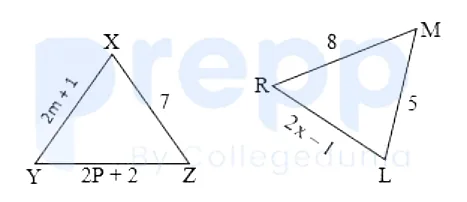
- A
7
- B
9
- C
13
- D
6
Show answer
B. 9Given:
Δ XYZ ≅ Δ LMR
Formula:
If Δ XYZ ≅ Δ LMR, then
XY/LM = YZ/MR = XZ/LR
Calculation:
XY/LM = YZ /M R = XZ /L R
2m + 1 = 5 ........(1)
2p + 2 = 8 ........(2)
2X - 1 = 7 ........(3)
Adding all 3 equations:
⇒ 2m + 2p + 2X + 2 = 20
⇒ 2m + 2p + 2x = 18
⇒ m + p + x = 9
The value is 9
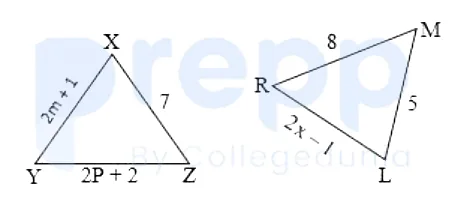 Paper & answer key PDF ↗
 Question 73archived
If a = 17,b = 13, then find the value of the expression (a3 - b3 - 3a2b + 3ab2).
- A
74
- B
27000
- C
27000
- D
64
Show answer
D. 64Evaluating the Algebraic Expression \( (a^3 - b^3 - 3a^2b + 3ab^2) \)
The question asks us to find the value of the expression \( (a^3 - b^3 - 3a^2b + 3ab^2) \) when \( a = 17 \) and \( b = 13 \).
Let's look at the given expression:
\( a^3 - b^3 - 3a^2b + 3ab^2 \)
We can rearrange the terms in this expression:
\( a^3 - 3a^2b + 3ab^2 - b^3 \)
This rearranged form looks very familiar. It is the expansion of a common algebraic identity.
Recognizing the Algebraic Identity
Recall the identity for the cube of a difference:
\( (x - y)^3 = x^3 - 3x^2y + 3xy^2 - y^3 \)
Comparing our rearranged expression \( a^3 - 3a^2b + 3ab^2 - b^3 \) with the expansion of \( (x - y)^3 \), we can see that if we replace \( x \) with \( a \) and \( y \) with \( b \), we get exactly the given expression.
Therefore, the expression \( (a^3 - b^3 - 3a^2b + 3ab^2) \) is equal to \( (a - b)^3 \).
Substituting the Given Values
We are given that \( a = 17 \) and \( b = 13 \). Now we need to substitute these values into the simplified expression \( (a - b)^3 \).
First, calculate the value of \( (a - b) \):
\( a - b = 17 - 13 \)
\( a - b = 4 \)
Now, cube this result:
\( (a - b)^3 = (4)^3 \)
Calculating the Final Value
To calculate \( 4^3 \), we multiply 4 by itself three times:
\( 4^3 = 4 \times 4 \times 4 \)
\( 4 \times 4 = 16 \)
\( 16 \times 4 = 64 \)
So, the value of the expression \( (a^3 - b^3 - 3a^2b + 3ab^2) \) when \( a = 17 \) and \( b = 13 \) is 64.
Here is a summary of the steps:
Identify the given expression: \( a^3 - b^3 - 3a^2b + 3ab^2 \).
Rearrange the terms: \( a^3 - 3a^2b + 3ab^2 - b^3 \).
Recognize the algebraic identity: \( (a - b)^3 = a^3 - 3a^2b + 3ab^2 - b^3 \).
Equate the expression to the identity: \( (a^3 - b^3 - 3a^2b + 3ab^2) = (a - b)^3 \).
Substitute the values \( a = 17 \) and \( b = 13 \).
Calculate \( a - b = 17 - 13 = 4 \).
Calculate \( (a - b)^3 = 4^3 \).
Compute the cube: \( 4^3 = 64 \).
Revision Table: Key Algebraic Identities
Understanding common algebraic identities is crucial for simplifying expressions.
Identity Name
Identity Formula
Square of a Sum
\( (x+y)^2 = x^2 + 2xy + y^2 \)
Square of a Difference
\( (x-y)^2 = x^2 - 2xy + y^2 \)
Difference of Squares
\( x^2 - y^2 = (x+y)(x-y) \)
Cube of a Sum
\( (x+y)^3 = x^3 + 3x^2y + 3xy^2 + y^3 \)
Cube of a Difference
\( (x-y)^3 = x^3 - 3x^2y + 3xy^2 - y^3 \)
Sum of Cubes
\( x^3 + y^3 = (x+y)(x^2 - xy + y^2) \)
Difference of Cubes
\( x^3 - y^3 = (x-y)(x^2 + xy + y^2) \)
Additional Information: Importance of Identities in Algebra
Algebraic identities are equations that are true for all possible values of the variables involved. They are powerful tools in algebra because they help in:
Simplifying complex algebraic expressions.
Solving equations more easily.
Factoring polynomials.
Performing calculations quickly, as seen in this problem where calculating \( (17-13)^3 \) is much simpler than calculating \( 17^3 - 13^3 - 3 \times 17^2 \times 13 + 3 \times 17 \times 13^2 \).
Recognizing the structure of an expression and matching it to a known identity is a key skill in algebra. In this problem, identifying the expression as \( (a-b)^3 \) allowed for a straightforward calculation.
Paper & answer key PDF ↗ Question 74archived
Simplify the given expression.
18 ÷ 3 of 2 × 5 + 72 ÷ 18 of 2 × 3 - 4 ÷ 8 × 2
- A
20
- B
\(\frac{20}{3}\)
- C
\(\frac{25}{3}\)
- D
25
Show answer
A. 20Simplify Mathematical Expression Using BODMAS Order
Let's simplify the given mathematical expression by following the order of operations, commonly known as BODMAS or PEMDAS.
Brackets (or Parentheses)
Orders (or Exponents, roots, etc.)
Division and Multiplication (from left to right)
Addition and Subtraction (from left to right)
The expression given is: \(18 \div 3 \text{ of } 2 \times 5 + 72 \div 18 \text{ of } 2 \times 3 - 4 \div 8 \times 2\)
The term "of" indicates multiplication and is typically performed after Brackets and Orders, but before standard Division and Multiplication.
Step-by-Step Calculation of the Expression
Step 1: Evaluate 'of' operations
First, we calculate the parts involving 'of':
\(3 \text{ of } 2 = 3 \times 2 = 6\)
\(18 \text{ of } 2 = 18 \times 2 = 36\)
Substitute these values back into the expression:
\(18 \div 6 \times 5 + 72 \div 36 \times 3 - 4 \div 8 \times 2\)
Step 2: Evaluate Division and Multiplication from left to right
Next, we perform all division and multiplication operations from left to right.
For the first part (\(18 \div 6 \times 5\)):
\(18 \div 6 = 3\)
\(3 \times 5 = 15\)
For the second part (\(72 \div 36 \times 3\)):
\(72 \div 36 = 2\)
\(2 \times 3 = 6\)
For the third part (\(4 \div 8 \times 2\)):
\(4 \div 8 = \frac{4}{8} = \frac{1}{2}\)
\(\frac{1}{2} \times 2 = 1\)
Now substitute these results back into the expression:
\(15 + 6 - 1\)
Step 3: Evaluate Addition and Subtraction from left to right
Finally, perform the addition and subtraction operations from left to right.
\(15 + 6 = 21\)
\(21 - 1 = 20\)
Final Answer
The simplified value of the expression is 20.
Revision Table: Breakdown of Expression Simplification
Step
Operation Performed
Intermediate Expression
Result of Operation
1
'of' calculation
\(18 \div (3 \text{ of } 2) \times 5 + 72 \div (18 \text{ of } 2) \times 3 - 4 \div 8 \times 2\)
\(18 \div 6 \times 5 + 72 \div 36 \times 3 - 4 \div 8 \times 2\)
2 (Part 1)
Division (left to right)
\(18 \div 6 \times 5\)
\(3 \times 5\)
Multiplication
\(3 \times 5\)
\(15\)
2 (Part 2)
Division (left to right)
\(72 \div 36 \times 3\)
\(2 \times 3\)
Multiplication
\(2 \times 3\)
\(6\)
2 (Part 3)
Division (left to right)
\(4 \div 8 \times 2\)
\(\frac{1}{2} \times 2\)
Multiplication
\(\frac{1}{2} \times 2\)
\(1\)
3
Addition (left to right)
\(15 + 6 - 1\)
\(21 - 1\)
Subtraction
\(21 - 1\)
\(20\)
Additional Information on 'of' in BODMAS
The term "of" is often used in mathematical expressions and typically implies multiplication, especially in contexts like fractions or percentages of a quantity (e.g., "half of 10", "10% of 200"). When "of" appears alongside division or multiplication symbols in a single expression without brackets separating them, the convention is to evaluate the "of" operation before the standard division and multiplication from left to right.
This priority helps maintain consistency in simplifying expressions. Always remember to handle operations within brackets first, then powers/roots, then 'of', followed by division and multiplication (left to right), and finally addition and subtraction (left to right).
Paper & answer key PDF ↗ Question 75archived
The ages of Gyanendra and Arbind are in the ratio 6 ∶ 5. If the sum of their ages is 55 years, then what will be the ratio of their ages after seven years from now?
- A
5 ∶ 6
- B
37 ∶ 32
- C
32 ∶ 37
- D
6 ∶ 5
Show answer
B. 37 ∶ 32Step 1: 6x + 5x = 55 ⇒ x = 5. So G = 30, A = 25.
Step 2: After 7 yrs: (30+7) : (25+7) = 37 : 32.
∴ 37 : 32
Paper & answer key PDF ↗ Question 76archived
The following sentence has been divided into parts. One of them may contain an error. Select the part that contains the error from the given options. If you don't find any error, mark 'No error' as your answer.
The availability of funds will be / ensured if they all tried to / submit the proposals on time.
- A
The availability of funds will be
- B
No error
- C
submit the proposals on time
- D
ensured if they all tried to
Show answer
D. ensured if they all tried toSentence Analysis: Identifying the Error in the Availability of Funds Sentence
The sentence provided for analysis is: "The availability of funds will be / ensured if they all tried to / submit the proposals on time." We need to examine each part to identify any grammatical error.
The sentence is structured as a conditional sentence, where the availability of funds being ensured depends on a condition: submitting proposals on time.
Understanding Conditional Sentences in English Grammar
Conditional sentences typically consist of two clauses: an 'if' clause (the condition) and a main clause (the result).
There are different types of conditional sentences, but two common types are:
Type 1 Conditional: Used for real or likely situations in the future. Structure: If + simple present, will + base verb.
Type 2 Conditional: Used for hypothetical or unlikely situations in the present or future. Structure: If + simple past, would + base verb.
Let's look at a simple comparison:
Type
Condition (If Clause)
Result (Main Clause)
Use
Type 1
If + simple present
will + base verb
Real/likely future
Type 2
If + simple past
would + base verb
Hypothetical/unlikely
Identifying the Tense Mismatch in the Sentence Parts
Let's break down the given sentence parts and their tenses:
Part 1: "The availability of funds will be" - The main clause structure is "will be ensured" (passive voice using 'will + be + past participle'). This uses 'will', which is typical of a Type 1 conditional result clause.
Part 2: "ensured if they all tried to" - This connects the main clause result ('ensured') to the conditional clause ('if they all tried to'). The verb in the 'if' clause is "tried", which is in the simple past tense.
Part 3: "submit the proposals on time" - This completes the action in the 'if' clause ("tried to submit").
We see a mismatch in the tenses used. The main clause ("will be ensured") uses a structure associated with Type 1 conditionals (real/likely future), while the 'if' clause ("if they all tried to") uses a structure associated with Type 2 conditionals (hypothetical/unlikely).
For the sentence to be grammatically correct, the tenses in both clauses must align with one conditional type.
Given the main clause starts with "will be ensured" (a Type 1 result structure), the 'if' clause should use the simple present tense for a Type 1 conditional. The verb "tried" should be "try".
The Correct Sentence Structure
To form a grammatically correct Type 1 conditional sentence with "will be ensured" as the result, the 'if' clause should be in the simple present tense.
The corrected sentence would be: "The availability of funds will be ensured if they all try to submit the proposals on time."
Alternatively, to make it a Type 2 conditional sentence using "tried", the main clause would need to change:
The sentence would be: "The availability of funds would be ensured if they all tried to submit the proposals on time."
However, the error is located in the part containing "tried". The original sentence attempts to combine a Type 1 result with a Type 2 condition.
Conclusion: Identifying the Erroneous Part
The part containing the grammatical error is where the tense of the conditional verb ('tried') does not match the tense implied by the main clause ('will be ensured'). This occurs in the part "ensured if they all tried to".
The error lies in using the simple past tense "tried" in the conditional clause when the main clause suggests a Type 1 conditional structure requiring the simple present tense.
Part
Sentence Fragment
Analysis
Error?
Part 1
The availability of funds will be
Sets up the main clause result (Type 1 structure).
No
Part 2
ensured if they all tried to
Links result to condition. The verb 'tried' is past tense, mismatched with 'will be'.
Yes
Part 3
submit the proposals on time.
Completes the conditional clause action. Correct form after 'tried to'.
No
Therefore, the part "ensured if they all tried to" contains the error.
Revision Table: Key English Grammar Concepts
Concept
Description
Relevance to Question
Conditional Sentences
Sentences with an 'if' clause (condition) and a main clause (result).
The core structure of the given sentence.
Type 1 Conditional
If + Simple Present, Will + Base Verb. For real/likely situations.
The main clause ('will be ensured') fits this type's result structure.
Type 2 Conditional
If + Simple Past, Would + Base Verb. For hypothetical/unlikely situations.
The 'if' clause ('tried') fits this type's condition structure, causing a mismatch.
Tense Agreement
Ensuring verbs in different clauses have consistent tenses according to grammatical rules.
The primary error involves the lack of tense agreement between the main and conditional clauses.
Additional Information on English Conditionals and Tense
Understanding conditional sentences is crucial for expressing possible outcomes, hypothetical situations, and cause-and-effect relationships. The correct use of tenses in both the 'if' clause and the main clause is essential for clarity and grammatical accuracy.
While Type 1 and Type 2 are common, there are also Type 0 (general truths: If + Present, Present) and Type 3 (past hypothetical: If + Past Perfect, Would Have + Past Participle).
In the given sentence, the use of "will be ensured" indicates that the speaker views the condition (submitting proposals on time) as a real or likely possibility that will lead to a real outcome (funds availability). Thus, a Type 1 structure is intended, and the simple present tense ('try') is needed in the 'if' clause.
Mixing conditional types, as seen in the error, is a common mistake. Always check if the tense in your 'if' clause matches the tense/modal verb in your main clause according to standard conditional patterns.
Paper & answer key PDF ↗ Question 77archived
Select the option that can be used as a one - word substitute for the given group of words.
A person who does not believe that God or Gods exist.
- A
Irreverent
- B
Atheist
- C
Profane
- D
Blasphemous
Show answer
B. AtheistUnderstanding the Question: Identifying Non-Believers
The question asks for a single word that describes a person who does not believe in the existence of God or Gods. This is a question about vocabulary, specifically testing knowledge of terms related to religious or philosophical beliefs.
Defining the Term: Atheist
Let's examine the provided options and find the best fit for the description "A person who does not believe that God or Gods exist".
Atheist: An atheist is defined as a person who disbelieves or lacks belief in the existence of God or Gods. This definition perfectly matches the description given in the question.
Therefore, 'Atheist' is the correct one-word substitute for the given group of words.
Analyzing Other Options
Let's look at the other options to understand why they are not suitable:
Irreverent: This term describes a lack of respect, especially for things that are generally taken seriously or treated with reverence. It refers to attitude or behavior, not specifically a belief or lack of belief in God.
Profane: This refers to language or behavior that is blasphemous or obscene, or treating religious things with disrespect. Like 'irreverent', it describes an attitude or action, not a lack of belief in God.
Blasphemous: This describes speaking or writing sacrilegiously about God or sacred things; profane. This term relates to disrespecting God or religious beliefs, often in speech, but it doesn't mean the person *doesn't believe* in God. Someone could believe in God but still utter blasphemy.
Comparing the definitions, 'Atheist' is the only word that specifically means a person who does not believe that God or Gods exist. The other terms relate to disrespect towards religion or sacred things but do not define a person's belief status regarding the existence of God.
Summary of Options
Option
Meaning
Fits the Description?
Irreverent
Showing a lack of respect for things taken seriously
No
Atheist
A person who does not believe in God or Gods
Yes
Profane
Treating religious things with disrespect; obscene
No
Blasphemous
Sacrilegious talk about God or sacred things
No
Based on the analysis, 'Atheist' is the accurate one-word substitute for "A person who does not believe that God or Gods exist".
Revision Table: Key Vocabulary on Belief
Term
Definition
Atheist
Does not believe in God or Gods.
Theist
Believes in God or Gods, especially in one God as creator and ruler of the universe.
Agnostic
Believes that nothing is known or can be known of the existence or nature of God or of anything that transcends human experience.
Deist
Believes in a supreme being who created the universe but does not intervene in it.
Additional Information: Understanding Belief Systems
The question touches upon different belief systems related to the existence of God or Gods. While 'Atheism' is the focus here, it's useful to know related concepts like theism, agnosticism, and deism to better understand the spectrum of beliefs. These terms help categorize people based on their stance regarding divine existence and involvement in the world. Understanding these distinctions is important for vocabulary building and comprehending discussions about religion and philosophy.
Paper & answer key PDF ↗ Question 78archived
Select the most appropriate meaning of the given idiom.
Sharp practice
- A
Dishonesty
- B
Frequently
- C
Briefly
- D
Nearby
Show answer
A. DishonestyUnderstanding Idioms: "Sharp Practice" Meaning
Idioms are phrases or expressions whose meaning cannot be taken literally from the individual words. They have a figurative meaning that is commonly understood by native speakers. The question asks for the most appropriate meaning of the idiom "Sharp practice".
Meaning of "Sharp Practice"
The idiom "Sharp practice" refers to business dealings or behaviour that is dishonest but perhaps not technically illegal. It involves using deceitful or unscrupulous methods to gain an advantage, often exploiting loopholes or being cunningly dishonest.
Analyzing the Options
Let's look at the given options to find the one that best matches the meaning of "Sharp practice":
Dishonesty: This word directly relates to the core meaning of "Sharp practice", which involves deceit, lack of integrity, or unscrupulous behaviour.
Frequently: This word relates to how often something occurs, not the nature of an action. It is unrelated to the meaning of "Sharp practice".
Briefly: This word relates to duration or conciseness. It is unrelated to the meaning of "Sharp practice".
Nearby: This word relates to proximity or location. It is unrelated to the meaning of "Sharp practice".
Evaluating the Options
Comparing the options with the established meaning of "Sharp practice", it is clear that "Dishonesty" is the most fitting description of the behaviour implied by the idiom.
Idiom
Common Meaning
Related Concepts
Sharp practice
Dishonest or unscrupulous behaviour, especially in business.
Deceit, unethical conduct, cunning, fraud (potentially).
Conclusion on "Sharp Practice" Meaning
Based on the analysis, the most appropriate meaning of the idiom "Sharp practice" is dishonesty, particularly within a professional or business context where rules might be bent or interpreted unfairly for personal gain.
Revision Table: Idioms and Meanings
Idiom
Meaning
Example Usage
Sharp practice
Dishonest or unscrupulous dealing.
His business thrived, but many suspected it was built on sharp practice.
Bite the bullet
Endure a difficult situation.
You'll just have to bite the bullet and finish the report.
Break the ice
To make people feel more relaxed in a social situation.
He told a joke to break the ice at the meeting.
Additional Information on English Idioms
Idioms are a fascinating part of the English language. Learning idioms helps improve fluency and understanding of native speakers. Here are some points about idioms:
Idioms often have cultural origins or historical contexts.
Their meaning is not the sum of the meanings of the individual words.
They add colour and expressiveness to language.
Mastering idioms is key to advanced English proficiency.
Understanding idioms like "Sharp practice" is crucial for interpreting nuanced meanings in communication, especially in business and legal contexts where such terms might be used to describe questionable conduct.
Paper & answer key PDF ↗ Question 79archived
Sentences of a paragraph are given below in jumbled order. Arrange the sentences in the correct order to form a meaningful and coherent paragraph.
A. But the question that perturbs Ruskin's mind is what social pressure can be exercised against a dishonest person.
B. The merchant, for instance, must supply perfect and pure things to the people.
C. Ruskin believes that in every civilised society there exist five intellectual professions, namely the soldier, the pastor, the physician, the lawyer and the merchant.
D. Persons belonging to these professions are expected to perform their duty honestly.
- A
BACD
- B
DABC
- C
CDBA
- D
ABDC
Show answer
C. CDBAUnderstanding the Sentence Rearrangement Task
The goal here is to take the given four sentences, which are currently in a jumbled order, and arrange them to form a single, meaningful, and coherent paragraph. This requires identifying the logical connections between the sentences and determining the correct flow of ideas.
Analyzing the Jumbled Sentences for Paragraph Flow
Let's examine each sentence to understand its content and potential role in the paragraph:
Sentence A: "But the question that perturbs Ruskin's mind is what social pressure can be exercised against a dishonest person." This sentence starts with "But," suggesting it introduces a contrasting idea, a follow-up question, or a problem related to a previous statement. It focuses on the challenge of dealing with dishonesty.
Sentence B: "The merchant, for instance, must supply perfect and pure things to the people." This sentence provides an example ("for instance") related to a specific profession, the merchant, and describes an expectation of their duty. The merchant is one of the professions often discussed in this context.
Sentence C: "Ruskin believes that in every civilised society there exist five intellectual professions, namely the soldier, the pastor, the physician, the lawyer and the merchant." This sentence introduces the main subject: John Ruskin's view on five specific intellectual professions. It lists these professions. This sentence is likely the introductory sentence as it sets the stage for the topic.
Sentence D: "Persons belonging to these professions are expected to perform their duty honestly." This sentence uses the phrase "these professions," which refers back to the professions mentioned in sentence C. It states a general expectation of honesty from individuals in these roles.
Step-by-Step Ordering Process for Coherent Paragraph
Let's arrange the sentences based on the logical connections identified:
1. We start with the sentence that introduces the main topic. Sentence C introduces Ruskin's idea about the five professions. So, C is the most likely opening sentence.
2. After introducing the professions, the next sentence should logically elaborate on them. Sentence D talks about "these professions" and states the expectation of honesty. This directly follows the introduction of the professions in C.
The sequence is now CD.
3. Sentence B provides an example related to the professions and the expectation mentioned in D. It focuses on "The merchant, for instance," which is one of the professions from C, performing his duty (related to D). This sentence logically follows D by providing an illustration.
The sequence becomes CDB.
4. Finally, sentence A starts with "But" and presents a question about dealing with dishonesty. This question arises naturally from the expectation of honesty mentioned in D and exemplified in B. It serves as a concluding thought or a related problem to the preceding statements.
The complete and logical arrangement is CDBA.
Conclusion: Correct Sentence Order Arrangement
By analyzing the flow of ideas and the connections between sentences (introduction of topic, elaboration, example, follow-up question/problem), we find that the correct order for the sentences to form a meaningful and coherent paragraph is CDBA.
Sentence Arrangement Logic
Position
Sentence
Justification
1st
C
Introduces the subject (Ruskin's belief, professions).
2nd
D
Refers to professions from C and states expected conduct.
3rd
B
Gives a specific example (merchant) supporting D.
4th
A
Poses a question/problem related to dishonesty discussed in D/B.
Revision Table: Jumbled Sentence Order
Original vs. Correct Sentence Order
Original Label
Sentence Text
Position in Correct Paragraph
A
But the question that perturbs Ruskin's mind is what social pressure can be exercised against a dishonest person.
4th
B
The merchant, for instance, must supply perfect and pure things to the people.
3rd
C
Ruskin believes that in every civilised society there exist five intellectual professions, namely the soldier, the pastor, the physician, the lawyer and the merchant.
1st
D
Persons belonging to these professions are expected to perform their duty honestly.
2nd
Additional Information: Paragraph Cohesion and Jumbled Sentences
Solving jumbled sentence problems effectively relies on understanding how a coherent paragraph is constructed. Key principles include:
Topic Sentence: Often, a paragraph starts with a topic sentence that introduces the main idea (like sentence C here).
Supporting Details: Following the topic sentence are sentences that provide details, explanations, or examples that support the main idea (like D and B).
Transition Words: Words like "but," "for instance," "therefore," "however," etc., help create smooth transitions between sentences and indicate the relationship between ideas.
Pronoun Reference: Pronouns (like "these professions" in D) refer back to previously mentioned nouns, creating links between sentences.
By looking for these linguistic clues and the logical flow of information, one can successfully arrange jumbled sentences into a cohesive paragraph.
Paper & answer key PDF ↗ Question 80archived
Sentences of a paragraph are given below in jumbled order. Arrange the sentences in the correct order to form a meaningful and coherent paragraph.
A. But she has no idea an aunt and uncle are waiting for her.
B. 'The Strange Child' is the story of a young girl who believes she is the only one on the planet.
C. Her parents simply vanished into thin air one day.
D. She travels the world in search of Nevada because she aspires to reside in the Mojave Desert.
- A
DABC
- B
BDAC
- C
BACD
- D
BCDA
Show answer
D. BCDAUnderstanding Jumbled Sentences and Paragraph Arrangement
This question asks us to arrange jumbled sentences to form a meaningful and coherent paragraph. To do this, we need to read all the sentences and identify the logical flow of ideas. We look for introductory sentences, supporting details, actions, and concluding remarks or twists.
Analyzing the Jumbled Sentences
Let's break down each sentence provided:
Sentence A: But she has no idea an aunt and uncle are waiting for her. (Introduces a new element, likely a development in the story, using 'she').
Sentence B: 'The Strange Child' is the story of a young girl who believes she is the only one on the planet. (Introduces the story title and the main character, a young girl, and her core belief).
Sentence C: Her parents simply vanished into thin air one day. (Explains a reason for the girl's situation, providing background).
Sentence D: She travels the world in search of Nevada because she aspires to reside in the Mojave Desert. (Describes an action taken by the girl, mentioning her goal).
Step-by-Step Arrangement Process
Let's figure out the best order for these sentences:
We need a sentence to introduce the topic or the main character. Sentence B introduces the story and the main character, 'a young girl'. This makes it a strong candidate for the opening sentence. So, B comes first.
After introducing the girl and her belief (she's the only one), we need to understand *why* she might believe this or what her circumstances are. Sentence C explains that her parents vanished, which provides context for her being alone. So, C logically follows B. The sequence is now BC.
What does the girl do after her parents vanish? Sentence D describes her action: she 'travels the world'. This action is likely a consequence of or related to her situation described in C. So, D follows C. The sequence is now BCD.
Sentence A introduces a new piece of information: 'an aunt and uncle are waiting for her'. This adds a new development or twist to the girl's journey or situation, fitting well after her background and actions have been described. So, A follows D. The final sequence is BCDA.
Verifying the Paragraph Coherence (BCDA)
Let's read the sentences in the order BCDA to see if they form a coherent paragraph:
"'The Strange Child' is the story of a young girl who believes she is the only one on the planet. Her parents simply vanished into thin air one day. She travels the world in search of Nevada because she aspires to reside in the Mojave Desert. But she has no idea an aunt and uncle are waiting for her."
This order makes sense. It introduces the story and character (B), gives background (C), describes her actions (D), and then adds a twist or new element (A). The pronouns 'she' and 'her' in A, C, and D correctly refer back to the 'young girl' introduced in B.
Final Correct Sequence
The correct order of the sentences is BCDA.
Sentence
Content Description
Proposed Position
A
New information about aunt/uncle
4th
B
Introduces story/character
1st
C
Explains parents vanishing (background)
2nd
D
Describes girl's actions/goal
3rd
Revision Table: Arranging Sentences
Skill
Concept Applied
Check
Reading Comprehension
Understanding meaning of each sentence
✔
Logical Reasoning
Identifying cause-and-effect / chronological order
✔
Pronoun Reference
Linking pronouns ('she', 'her') to nouns ('young girl')
✔
Paragraph Structure
Identifying introduction, body, and conclusion/twist
✔
Additional Information: Coherent Paragraphs
A coherent paragraph flows smoothly from one sentence to the next. The ideas are logically connected, making it easy for the reader to understand the overall message. Key elements that contribute to coherence include:
Logical Order: Arranging ideas in a sequence that makes sense, such as chronological order, cause and effect, general to specific, or problem-solution.
Transition Words and Phrases: Using words or phrases (like 'however', 'therefore', 'in addition', 'for example', 'as a result') to show the relationship between sentences. (While not explicitly used in this example, understanding their function is helpful).
Pronoun Consistency: Using pronouns like 'he', 'she', 'it', 'they', 'this', 'that' to refer back to previously mentioned nouns, ensuring clarity and avoiding repetition.
Repetition of Key Terms: Repeating important words or phrases to keep the focus on the main topic.
In this jumbled sentence exercise, focusing on logical order and pronoun references helped us reconstruct the coherent paragraph.
Paper & answer key PDF ↗ Question 81archived
Select the option that expresses the given sentence in passive voice.
Did you not buy the return tickets to Dehradun?
- A
Was the return tickets to Dehradun not bought by you?
- B
Were the return tickets to Dehradun not being bought by you?
- C
Had the return tickets to Dehradun not bought by you?
- D
Were the return tickets to Dehradun not bought by you?
Show answer
D. Were the return tickets to Dehradun not bought by you?Understanding Active and Passive Voice Conversion
The question asks to transform a sentence from active voice to passive voice. The given sentence is "Did you not buy the return tickets to Dehradun?". This sentence is in the past simple tense, it's a question (interrogative), and it's negative.
Let's first understand what active and passive voice mean:
Active Voice: The subject performs the action. Structure typically follows: Subject + Verb + Object. Example: You bought the tickets.
Passive Voice: The action is performed on the subject (which was the object in the active voice). Structure typically follows: Object (becomes Subject) + Be verb (in correct tense) + Past Participle of Main Verb + by + Subject (becomes Object). Example: The tickets were bought by you.
Converting Past Simple Interrogative Negative to Passive Voice
The structure of the active voice sentence is: Did + Subject + not + Base Form of Verb + Object?
To convert this to passive voice, we need to follow these steps:
Identify the Object in the active sentence. This will become the Subject in the passive sentence.
Identify the Tense (Past Simple). The 'be' verb in the passive voice must be in the past simple tense ('was' or 'were').
Determine if 'was' or 'were' is needed based on the new subject (the original object). Use 'was' for singular subjects and 'were' for plural subjects.
Use the Past Participle form of the main verb.
Include 'not' after the 'be' verb because the original sentence is negative.
Add 'by' followed by the original subject (which becomes the object in the passive voice).
Keep the interrogative structure (start with the 'be' verb).
Applying the Steps to the Sentence
Let's break down the sentence "Did you not buy the return tickets to Dehradun?":
Subject: you
Main Verb: buy (Base Form)
Object: the return tickets to Dehradun
Tense: Past Simple
Type: Interrogative Negative
Now, let's convert it to passive voice:
The Object "the return tickets to Dehradun" becomes the new Subject.
The tense is Past Simple, so we need 'was' or 'were'.
The new subject "the return tickets to Dehradun" is plural ('tickets'). So, we use 'were'.
The Past Participle of 'buy' is 'bought'.
The sentence is negative, so we include 'not'.
The original subject 'you' becomes the object after 'by': 'by you'.
Start with the 'be' verb ('Were') to maintain the interrogative structure.
Putting it together, the passive voice sentence is: Were the return tickets to Dehradun not bought by you?
Evaluating the Options
Let's look at the given options and compare them to our derived passive sentence:
Was the return tickets to Dehradun not bought by you?
This option uses 'Was' instead of 'Were'. The subject "the return tickets" is plural, so 'Was' is incorrect. This option is wrong.
Were the return tickets to Dehradun not being bought by you?
This option uses "were being bought", which is the structure for Past Continuous Passive voice (e.g., "Were the tickets not being bought?"). The original sentence is Past Simple, not Past Continuous. This option is wrong.
Had the return tickets to Dehradun not bought by you?
This option uses "Had...bought", which is the structure for Past Perfect Passive voice (e.g., "Had the tickets not been bought by you?"). The original sentence is Past Simple, not Past Perfect. Also, the verb form is incorrect (should be "had...been bought"). This option is wrong.
Were the return tickets to Dehradun not bought by you?
This option correctly uses 'Were' for the plural subject "the return tickets", includes 'not', uses the past participle 'bought', and follows the structure for a Past Simple interrogative negative passive sentence. This option matches our derived sentence.
Based on the analysis, option 4 correctly expresses the given sentence in passive voice.
Tense
Active Voice (Interrogative Negative)
Passive Voice (Interrogative Negative)
Past Simple
Did + Subject + not + Vbase + Object?
Was/Were + Object + not + Vpast participle + by + Subject?
Example
Did you not buy the tickets?
Were the tickets not bought by you?
Revision Table: Key Voice Change Concepts
Concept
Description
Active Voice
Subject performs the action. Focus is on the doer.
Passive Voice
Action is performed on the subject. Focus is on the action or receiver.
Voice Change
Converting a sentence from active to passive or vice versa. Requires changing the subject, object, and verb form (using 'be' + past participle in passive).
Past Simple Passive Verb
Formed using 'was' or 'were' followed by the past participle of the main verb.
Interrogative Passive
Starts with the 'be' verb or auxiliary verb.
Negative Passive
Includes 'not' usually after the 'be' verb or first auxiliary verb.
Additional Information on Sentence Voice Conversion
Changing voice is a common transformation in English grammar. It allows us to shift the focus of a sentence. The original active subject often appears in a 'by' phrase in the passive voice, but it can be omitted if the doer is unknown, unimportant, or obvious.
Remember that only sentences with a transitive verb (a verb that takes an object) can be converted into the passive voice. Intransitive verbs (verbs that do not take an object, like 'sleep', 'walk', 'arrive') cannot form a passive voice sentence.
Understanding the correct form of the 'be' verb and the past participle is crucial for accurate voice transformation in different tenses.
Paper & answer key PDF ↗ Question 82archived
In the following sentence, four words are underlined, out of which one word is incorrectly spelt. Identify the INCORRECTLY spelt word.
Seema was a timid girl. She did not talk to people who were not familiar to her. She was an introvert since adolosense.
- A
introvert
- B
timid
- C
adolosense
- D
familiar
Show answer
C. adolosenseAnalyzing the Spelling Error in the Sentence
The question asks us to identify the word that is incorrectly spelt in the given sentence: "Seema was a timid girl. She did not talk to people who were not familiar to her. She was an introvert since adolosense." We need to examine each underlined word carefully.
Checking the Spelling of 'timid'
The word 'timid' means showing a lack of courage or confidence; easily frightened. The spelling "timid" is correct.
Checking the Spelling of 'familiar'
The word 'familiar' means well known from long or close association; or acquainted with something. The spelling "familiar" is correct.
Checking the Spelling of 'introvert'
The word 'introvert' refers to a person who is shy and reserved and who prefers to spend time alone rather than socialising with others. The spelling "introvert" is correct.
Checking the Spelling of 'adolosense'
The word 'adolosense' as written in the sentence is related to the period following the onset of puberty during which a young person develops from a child into an adult. The correct spelling for this period is adolescence.
The word in the sentence, "adolosense", is missing the 'c' and has an incorrect vowel combination ('olo' instead of 'ole').
Identifying the INCORRECTLY Spelt Word
Based on our analysis, the word "adolosense" is the only one among the underlined words that is incorrectly spelt. The correct spelling is "adolescence".
Therefore, the incorrectly spelt word is adolosense.
Revision Table: Correcting Spelling Errors
Incorrect Spelling
Correct Spelling
Notes
adolosense
adolescence
Correct vowel combination and includes 'c'.
timid
timid
Already correct.
familiar
familiar
Already correct.
introvert
introvert
Already correct.
Additional Information on Common Spelling Mistakes
Many English words can be tricky to spell due to silent letters, double letters, or similar-sounding vowels. Focusing on root words, prefixes, and suffixes can help. For example, words related to 'adolescence' like 'adolescent' share the same root and spelling pattern.
Pay attention to vowel sounds, especially in unstressed syllables.
Be careful with double consonants; sometimes they are necessary, sometimes not.
Learn common prefixes and suffixes and how they affect spelling.
Practicing spelling through reading and writing is an effective way to improve.
Paper & answer key PDF ↗ Question 83archived
Select the most appropriate idiom/phrase that can substitute the underlined segment in the given sentence.
Vennela made a big fuss about a small problem.
- A
Get a taste of your own medicine
- B
Barking up the wrong tree
- C
Add insult to injury
- D
A storm in a teacup
Show answer
D. A storm in a teacupUnderstanding Idioms for Exaggerated Reactions
The question asks us to replace the underlined phrase "made a big fuss about a small problem" with the most suitable idiom from the given options. An idiom is a phrase whose meaning cannot be deduced from the individual words.
Let's analyze the meaning of the underlined phrase in the sentence: "Vennela made a big fuss about a small problem." This describes someone reacting very strongly, perhaps with anger, worry, or unnecessary excitement, to something that is actually not very important or serious. We need to find an idiom that conveys this specific meaning.
Analyzing the Idiom Options
Here is an analysis of each provided idiom option:
Get a taste of your own medicine: This idiom means to experience the same unpleasant treatment that you have given to others. This does not fit the context of making a fuss about a small problem.
Barking up the wrong tree: This idiom means that you are pursuing a mistaken course of action or making a wrong assumption about something. This is not related to overreacting to a minor issue.
Add insult to injury: This idiom means to make a bad situation even worse for someone who is already upset or suffering. This implies worsening an existing problem, not overreacting to a small one.
A storm in a teacup: This idiom refers to a situation where people are making a great deal of fuss or getting very excited about something that is really not important. This meaning aligns perfectly with the idea of making a "big fuss about a small problem."
Selecting the Most Appropriate Idiom
Comparing the meanings, the idiom "A storm in a teacup" is the most appropriate substitute for "made a big fuss about a small problem." It accurately captures the idea of an exaggerated reaction to a minor issue.
Therefore, the sentence "Vennela made a big fuss about a small problem" can be best substituted with "Vennela made a storm in a teacup."
Idiom Revision Table
Idiom
Meaning
Relevance to "Big Fuss about Small Problem"
Get a taste of your own medicine
Experience reciprocal unpleasant treatment.
Not relevant.
Barking up the wrong tree
Misguided pursuit of a solution or explanation.
Not relevant.
Add insult to injury
Making a bad situation worse.
Not relevant.
A storm in a teacup
Much excitement/fuss about a trivial matter.
Highly relevant.
Additional Information on Idioms and Phrases
Idioms are an important part of the English language. They often provide a concise and vivid way to express complex ideas or common situations. Learning idioms helps improve comprehension and fluency.
Some other common idioms describing reactions or problems include:
Cry over spilt milk: To be unhappy about something that cannot be undone.
Make a mountain out of a molehill: To exaggerate a small problem into a major one (very similar in meaning to "a storm in a teacup").
Bite the bullet: To face a difficult situation with courage.
Break the ice: To make a start by overcoming initial difficulties, often in social situations.
Understanding the context is key to choosing the correct idiom to substitute a phrase accurately.
Paper & answer key PDF ↗ Question 84archived
Describe how you will tell your parents that Mahesh and his team were helping the fire and rescue team in passive voice.
- A
The fire and rescue team helped by Mahesh and his team.
- B
The fire and rescue team was being helped by Mahesh and his team.
- C
The fire and rescue team being help by Mahesh and his team.
- D
Mahesh and his team were been helping the fire and rescue team.
Show answer
B. The fire and rescue team was being helped by Mahesh and his team.Understanding Passive Voice Transformation
The question asks us to convert a sentence from active voice to passive voice. Specifically, we need to rephrase the statement "Mahesh and his team were helping the fire and rescue team" in the passive voice to tell our parents.
What is Passive Voice?
In the active voice, the subject performs the action. In the passive voice, the subject receives the action, and the focus is on the action itself rather than who is performing it. The structure typically involves a form of the verb 'to be' followed by the past participle of the main verb, and often uses 'by' to introduce the agent (the one performing the action).
Voice
Structure
Example
Active
Subject + Verb + Object
Mahesh and his team helped the team.
Passive
Object + form of 'be' + Past Participle + (by + Subject)
The team was helped by Mahesh and his team.
Converting Past Continuous Active to Passive
The original sentence "Mahesh and his team were helping the fire and rescue team" is in the past continuous active voice. The structure is:
\(\text{Subject} + \text{was/were} + \text{Verb-ing} + \text{Object}\)
To convert a past continuous active sentence to passive voice, we use the following structure:
\(\text{Object} + \text{was/were} + \text{being} + \text{Past Participle of Verb} + (\text{by} + \text{Subject})\)
Let's apply this to the sentence "Mahesh and his team were helping the fire and rescue team":
The object of the active sentence is "the fire and rescue team". This becomes the subject of the passive sentence.
The verb tense is past continuous ('were helping').
The passive structure for past continuous uses 'was being' or 'were being'. Since "the fire and rescue team" is treated as a singular unit, we use 'was being'.
The past participle of 'helping' is 'helped'.
The original subject "Mahesh and his team" becomes the agent, introduced by 'by'.
Combining these elements, the passive sentence is: "The fire and rescue team was being helped by Mahesh and his team."
Analyzing the Options
Let's examine each option based on the correct passive structure for the past continuous tense:
The fire and rescue team helped by Mahesh and his team.
This structure is incorrect for the past continuous passive. It is missing the auxiliary verb 'was/were' and 'being'. It sounds like a reduced relative clause or an incomplete passive form.
The fire and rescue team was being helped by Mahesh and his team.
This option perfectly matches the correct structure for the past continuous passive voice: Subject (The fire and rescue team) + was being + Past Participle (helped) + by + Agent (Mahesh and his team).
The fire and rescue team being help by Mahesh and his team.
This option is grammatically incorrect. "being help" should be "being helped" (past participle), and it lacks the necessary auxiliary verb ('was' or 'were') before 'being' to form a complete sentence in this tense.
Mahesh and his team were been helping the fire and rescue team.
This option is not in the passive voice at all. It uses the active voice structure, and even that structure ("were been helping") is grammatically incorrect for any standard English tense. The correct active form is "were helping".
Based on the analysis, only Option 2 correctly transforms the sentence into the passive voice while maintaining the original tense (past continuous).
Therefore, the correct way to tell your parents, using the passive voice, is: "The fire and rescue team was being helped by Mahesh and his team."
Revision Table: Active vs. Passive Voice
Aspect
Active Voice
Passive Voice
Focus
On the doer of the action (Subject)
On the action itself or the receiver of the action (Object becomes Subject)
Structure (Past Cont.)
\( \text{Subject} + \text{was/were} + \text{Verb-ing} + \text{Object} \)
\( \text{Object} + \text{was/were} + \text{being} + \text{Past Participle} + (\text{by} + \text{Subject}) \)
Example
Mahesh was helping.
Help was being given by Mahesh.
Additional Information on Passive Voice Usage
The passive voice is often used when:
The doer of the action is unknown, unimportant, or obvious from the context.
You want to emphasize the action or the object receiving the action.
You are writing in a formal, scientific, or objective style.
In this specific case, using the passive voice ("The fire and rescue team was being helped...") shifts the focus from who was helping (Mahesh and his team) to the fact that the fire and rescue team was receiving help. This might be useful if you want to highlight the difficult situation of the fire and rescue team rather than the efforts of Mahesh's team.
Paper & answer key PDF ↗ Question 85archived
Select the grammatically correct statement from among the given options.
A. It is a nice party. I am enjoying the party.
B. It is a party. I am enjoying an party.
C. It is party. I am enjoying a party.
D. It is the party. I am enjoying an party.
- A
D
- B
C
- C
B
- D
A
Show answer
D. AIdentifying Grammatically Correct Sentences: Article Usage
The question asks us to select the sentence which is grammatically correct from the given options. This involves understanding the proper use of articles: 'a', 'an', and 'the'. Articles are used before nouns to specify whether the noun is general or specific.
'A' and 'An': These are indefinite articles. They are used before singular countable nouns when the noun is general or being mentioned for the first time. 'A' is used before words that start with a consonant sound, and 'an' is used before words that start with a vowel sound.
'The': This is the definite article. It is used before nouns (singular, plural, countable, or uncountable) when the noun is specific or has been mentioned before.
Let's examine each option based on these rules:
Analysis of Option A
Statement: It is a nice party. I am enjoying the party.
"It is a nice party." - 'Party' is a singular countable noun. It is being mentioned for the first time, and 'nice' starts with a consonant sound. Using the indefinite article 'a' is correct here.
"I am enjoying the party." - This refers to the specific party that was just mentioned in the previous sentence. Using the definite article 'the' is correct as it refers back to a previously identified noun.
This statement appears grammatically correct.
Analysis of Option B
Statement: It is a party. I am enjoying an party.
"It is a party." - 'Party' is a singular countable noun, mentioned for the first time. 'Party' starts with a consonant sound, so 'a' is correctly used.
"I am enjoying an party." - 'Party' starts with a consonant sound ('p'). The indefinite article used before a word starting with a consonant sound should be 'a', not 'an'. 'An' is used before vowel sounds. This part is grammatically incorrect.
This statement is grammatically incorrect due to the misuse of 'an' before 'party'.
Analysis of Option C
Statement: It is party. I am enjoying a party.
"It is party." - 'Party' is a singular countable noun and requires an article before it in this context. Omitting the article is grammatically incorrect.
"I am enjoying a party." - 'Party' is a singular countable noun, mentioned for the first time in this specific clause. 'Party' starts with a consonant sound, so 'a' is correctly used here.
This statement is grammatically incorrect because the first part is missing an article.
Analysis of Option D
Statement: It is the party. I am enjoying an party.
"It is the party." - Using 'the' for the first mention of 'party' implies it is a specific party already known to the listener/reader. While possible in some contexts (e.g., referring to 'the party everyone is talking about'), without prior context, 'a party' or 'a nice party' is more typical for a first mention describing it generally. More importantly, this is typically incorrect when simply introducing the concept of 'a party'.
"I am enjoying an party." - As explained for Option B, using 'an' before 'party' is grammatically incorrect because 'party' starts with a consonant sound.
This statement is grammatically incorrect due to both the potentially incorrect initial use of 'the' and the definite misuse of 'an'.
Conclusion
Comparing all the options, Option A follows the correct rules for using indefinite and definite articles when referring to a noun for the first time and subsequently referring back to the same noun.
Therefore, the grammatically correct statement is Option A: It is a nice party. I am enjoying the party.
Revision Table: Summary of Article Usage
Article
Type
Usage
Example
a
Indefinite
Before singular countable nouns starting with consonant sounds; for general or first mention.
a book, a cat, a house
an
Indefinite
Before singular countable nouns starting with vowel sounds; for general or first mention.
an apple, an hour, an idea
the
Definite
Before specific or previously mentioned nouns (singular, plural, countable, uncountable).
the book I read, the cats, the water
Additional Information on English Articles
Understanding articles is crucial for correct English grammar. Here are a few more points to remember:
No article is typically used before plural nouns when speaking generally (e.g., 'I like parties'). However, 'the' is used for specific plural nouns (e.g., 'the parties we went to last year were fun').
No article is typically used before uncountable nouns when speaking generally (e.g., 'I like music', 'Water is essential'). However, 'the' is used for specific uncountable nouns (e.g., 'the music from the 80s', 'the water in this bottle is cold').
Articles are usually omitted before proper nouns (names of people, places, organizations), except in specific cases (e.g., 'the United States', 'the River Nile').
The choice between 'a' and 'an' depends on the sound, not just the letter. For example, 'an hour' (because 'h' is silent and the sound is a vowel 'o') and 'a university' (because 'u' sounds like 'yu', a consonant sound).
Mastering article usage requires practice, but understanding the basic distinction between general/first mention (a/an) and specific/subsequent mention (the) is a great starting point.
Paper & answer key PDF ↗ Question 86archived
Select the option that can be used as a one-word substitute for the given group of words.
A book or set of books giving information about all areas of knowledge
- A
Encyclopedia
- B
Dictionary
- C
Volume
- D
Anthology
Show answer
A. EncyclopediaUnderstanding the Definition of an Encyclopedia
The question asks for a single word that describes "A book or set of books giving information about all areas of knowledge". Let's examine the options provided and see which one best fits this definition.
Analyzing the Options
We need to find a word that represents a comprehensive collection of information spanning various subjects.
Encyclopedia: An encyclopedia is traditionally defined as a book or set of books containing articles on various topics, usually arranged alphabetically, covering all branches of knowledge or a particular branch. This definition perfectly matches the phrase given in the question, as it aims to provide information across a wide range of subjects or "all areas of knowledge".
Dictionary: A dictionary is a book or electronic resource that lists the words of a language (typically in alphabetical order) and gives their meaning, or gives the equivalent words in a different language. While a valuable reference tool, a dictionary focuses on words and their meanings, not comprehensive information about "all areas of knowledge".
Volume: A volume refers to a single book that forms part of a work published in several books. It is a physical unit of a larger collection, but the term itself doesn't specify the content as covering "all areas of knowledge". A volume could be part of an encyclopedia, but "volume" itself is not the substitute for the *entire* set of books covering *all areas of knowledge*.
Anthology: An anthology is a published collection of poems or other pieces of writing selected by a compiler. This term is typically used for collections of literary works (like poems, short stories, essays) and does not describe a reference work containing information across "all areas of knowledge".
Comparing the definitions, the term that specifically denotes a book or set of books designed to provide information on a wide range of subjects, essentially covering "all areas of knowledge", is an encyclopedia.
Comparison of Options
Term
Definition
Matches "all areas of knowledge"?
Encyclopedia
Book/set of books with articles on various topics covering branches of knowledge.
Yes
Dictionary
Book listing words and their meanings.
No (focuses on words/language)
Volume
Single book part of a larger work.
No (physical unit, not content description)
Anthology
Collection of literary pieces.
No (focuses on literature)
Therefore, "Encyclopedia" is the correct one-word substitute for "A book or set of books giving information about all areas of knowledge".
Revision Table: One-Word Substitutes
Phrase
One-Word Substitute
Explanation
A book or set of books giving information about all areas of knowledge
Encyclopedia
A comprehensive reference work covering diverse subjects.
A book listing words alphabetically with meanings
Dictionary
Focuses on language, not general knowledge areas.
A collection of literary works (poems, stories, etc.)
Anthology
Specific to literature.
A single book that is part of a larger series or work
Volume
A physical unit, not a description of comprehensive content.
Additional Information on Reference Books
Reference books are essential tools for gaining information and understanding. Here are some common types beyond encyclopedias:
Thesaurus: Provides synonyms and antonyms for words.
Atlas: A collection of maps.
Almanac: A book published annually containing calendars, astronomical data, meteorological information, and other miscellaneous facts.
Gazetteer: A geographical index or dictionary, typically accompanying a map or atlas.
Understanding the specific purpose of each type of reference book helps in choosing the right resource for information retrieval.
Paper & answer key PDF ↗ Question 87archived
Select the most appropriate synonym of the given word.
Peruse
- A
Check
- B
Draw
- C
Pursue
- D
Narrate
Show answer
A. CheckUnderstanding the Word Peruse and Finding its Synonym
The question asks us to find the most appropriate synonym for the word "Peruse" from the given options. To do this, we need to understand the meaning of the word "Peruse" and then compare it with the meanings of the options provided.
What does Peruse mean? Defining Peruse
The word "Peruse" primarily means to read something, typically in a careful and thorough way. It can also mean to examine something closely or carefully.
Let's look at the common definitions:
To read (something) in a careful way.
To examine or consider with attention and in detail.
So, the core idea of "Peruse" involves careful reading or careful examination.
Analyzing the Options for Peruse Synonym
Now let's consider each option provided:
Check: The word "Check" can mean to examine something to verify its accuracy or condition, or to inspect it. This involves careful examination, which is a key aspect of "Peruse". For example, you might "check" a document for errors, which is similar to "perusing" it carefully.
Draw: The word "Draw" has several meanings, such as to create a picture with lines, to pull something, or to attract attention. None of these meanings relate to reading or careful examination.
Pursue: The word "Pursue" means to follow someone or something, typically in order to catch or catch up with them. It can also mean to follow a course of activity or a plan. This relates to following or chasing, not reading or examining.
Narrate: The word "Narrate" means to tell a story or give an account of something. This relates to speaking or writing a story, not reading or examining.
Comparing Peruse with the Options
Based on the meanings, we can see which option is closest to "Peruse":
Peruse <--> careful reading / careful examination
Check <--> examine / inspect / verify (often carefully)
Draw <--> create picture / pull / attract
Pursue <--> follow / chase
Narrate <--> tell a story
Comparing these, "Check" is the most appropriate synonym for "Peruse" because it shares the core meaning of careful examination or inspection, which is a significant aspect of perusing something.
Conclusion: Most Appropriate Synonym for Peruse
Considering the definitions and how the words are used, "Check" is the closest synonym among the given options for the word "Peruse". When you peruse a report, you are essentially checking it carefully.
Word
Meaning (Key Aspect)
Option
Meaning of Option
Is it a Synonym?
Peruse
Careful reading / Careful examination
Check
Examine / Inspect (often carefully)
Yes (Most appropriate among options)
Peruse
Careful reading / Careful examination
Draw
Create picture / Pull / Attract
No
Peruse
Careful reading / Careful examination
Pursue
Follow / Chase
No
Peruse
Careful reading / Careful examination
Narrate
Tell a story
No
Revision Table: Peruse Synonym
Word
Most Appropriate Synonym (from options)
Peruse
Check
Additional Information: Nuances of Peruse
While "Check" is a good synonym in the context of examining something carefully, "Peruse" often implies reading or looking through something at length, even if not always thoroughly. Sometimes, "peruse" is used informally to mean to read something quickly or casually, but its more traditional and formal meaning is to read carefully or examine in detail.
Other potential synonyms for "Peruse" in different contexts might include:
Read (carefully)
Examine
Inspect
Scan (if reading quickly, but this contrasts with the careful meaning)
Study
However, among the options provided (Check, Draw, Pursue, Narrate), "Check" is the one that best captures the sense of careful examination inherent in "Peruse".
Paper & answer key PDF ↗ Question 88archived
Sentences of a paragraph are given below in jumbled order. Arrange the sentences in the correct order to form a meaningful and coherent paragraph.
A. We often make all things around us the way we want them.
B. Even during our pilgrimages, we have begun to look for whatever makes our heart happy, gives comfort to our body and peace to the mind.
C. Our mind is resourceful enough to find shortcuts in simple and easy ways.
D. It is as if external solutions will fulfil our needs, and we do not want to make any special efforts even in our spiritual search.
- A
CABD
- B
ADBC
- C
ABDC
- D
DABC
Show answer
A. CABDArranging Jumbled Sentences into a Coherent Paragraph
To form a meaningful and coherent paragraph, we need to arrange the given jumbled sentences in the correct logical order. Let's look at the sentences:
A. We often make all things around us the way we want them.
B. Even during our pilgrimages, we have begun to look for whatever makes our heart happy, gives comfort to our body and peace to the mind.
C. Our mind is resourceful enough to find shortcuts in simple and easy ways.
D. It is as if external solutions will fulfil our needs, and we do not want to make any special efforts even in our spiritual search.
We need to find the sequence that connects these ideas logically to form a coherent paragraph.
Step-by-Step Arrangement Analysis for Paragraph Coherence
Let's analyze the sentences to find the correct flow for arranging the paragraph. A strong starting sentence often introduces the main idea or a general concept that the rest of the paragraph will expand upon.
Sentence C: "Our mind is resourceful enough to find shortcuts in simple and easy ways." This sentence introduces the concept of the mind's tendency towards finding easy paths. This seems like a good general statement to begin the paragraph.
Sentence A: "We often make all things around us the way we want them." This sentence describes a common behavior. This behavior of controlling surroundings to suit desires can be seen as an outcome or application of the mind's tendency mentioned in C (finding 'easy ways' to achieve comfort or satisfaction). Therefore, A logically follows C.
Sentence B: "Even during our pilgrimages, we have begun to look for whatever makes our heart happy, gives comfort to our body and peace to the mind." This sentence provides a specific example of the behavior described in A (making things the way we want them, seeking comfort and peace). It extends this idea to a context where one might expect effort or hardship (pilgrimages), highlighting the strength of this tendency. B provides a specific instance illustrating the point made in A.
Sentence D: "It is as if external solutions will fulfil our needs, and we do not want to make any special efforts even in our spiritual search." This sentence offers a conclusion or implication based on the preceding points. It suggests that the behaviors described (seeking easy ways, controlling surroundings, seeking comfort even in pilgrimage) stem from a reliance on external factors and an avoidance of effort, particularly in spiritual pursuits. D serves as a logical wrap-up, generalizing from the specific example in B and the preceding ideas.
This step-by-step analysis strongly suggests the order CABD as the most logical arrangement for the paragraph.
Verifying the Arranged Paragraph: CABD Order
Let's read the sentences in the proposed CABD order to check for coherence and flow:
"Our mind is resourceful enough to find shortcuts in simple and easy ways. We often make all things around us the way we want them. Even during our pilgrimages, we have begun to look for whatever makes our heart happy, gives comfort to our body and peace to the mind. It is as if external solutions will fulfil our needs, and we do not want to make any special efforts even in our spiritual search."
Reading the paragraph in this order confirms that the sentences flow smoothly and logically connect the ideas, starting from the mind's tendency, moving to general behavior, giving a specific example, and concluding with the overarching implication.
Revision Table: Jumbled Sentence Arrangement
Sentence
Core Idea
Role in CABD Paragraph Flow
C
Mind finds easy ways/shortcuts.
Introduction of the core psychological tendency.
A
We control surroundings to suit us.
General behavior resulting from the mind's tendency.
B
Seeking comfort in pilgrimages.
Specific example illustrating the behavior.
D
Relying on external fixes, avoiding effort.
Conclusion/Implication of the behavior and tendency.
Additional Information: Understanding Paragraph Structure
When arranging jumbled sentences to form a coherent paragraph, it's helpful to understand typical paragraph structure. A well-structured paragraph often includes:
A topic sentence: This introduces the main idea of the paragraph. Sentence C serves this role here by introducing the mind's tendency.
Supporting sentences: These provide details, explanations, examples, or evidence related to the topic sentence. Sentences A and B act as supporting sentences, explaining and illustrating the initial idea.
A concluding sentence (optional): This summarizes the points or provides a final thought or implication. Sentence D functions as a concluding sentence, drawing an implication from the preceding points.
By identifying the potential role of each sentence (introduction, support, conclusion) and looking for logical connections between the ideas presented in them, we can effectively arrange jumbled sentences into a meaningful and coherent paragraph.
Paper & answer key PDF ↗ Question 89archived
Select the most appropriate ANTONYM of the underlined word in the given sentence.
The Emperor was considered as a wicked man.
- A
Virtuous
- B
Savage
- C
Fierce
- D
Vile
Show answer
A. VirtuousUnderstanding the Antonym of Wicked
The question asks us to find the most appropriate antonym of the word "wicked" as used in the sentence "The Emperor was considered as a wicked man." An antonym is a word that means the opposite of another word.
Let's first understand the meaning of the word "wicked".
Wicked: Morally bad or evil. Someone who is wicked behaves in a way that is deliberately harmful, cruel, or offensive.
Now, let's examine the given options to find the word that is opposite in meaning to "wicked".
Analyzing the Options for Antonym of Wicked
Virtuous: This word describes someone who has high moral standards. A virtuous person is good, righteous, and morally upright. This is the opposite of being morally bad or evil.
Savage: This word typically refers to something fierce, violent, or uncivilized. While a wicked person might be savage, "savage" itself doesn't directly mean the opposite of evil in a moral sense; it often relates more to behavior or state of being.
Fierce: This word means having or displaying an intense or ferocious aggressiveness. Like "savage", it describes an intense or aggressive quality, which isn't the direct opposite of being morally evil.
Vile: This word means extremely unpleasant, morally bad, or wicked. It is actually a synonym or very close in meaning to "wicked", not an antonym.
Comparing the options, "Virtuous" is the word that directly represents the opposite of being morally bad or evil. Therefore, "Virtuous" is the most appropriate antonym for "wicked".
Let's summarize the meanings:
Word
Meaning
Relationship to "Wicked"
Wicked
Morally bad or evil
Original word
Virtuous
Having high moral standards; morally good
Antonym
Savage
Fierce, violent, uncivilized
Not a direct antonym
Fierce
Intense, ferocious, aggressive
Not a direct antonym
Vile
Extremely unpleasant, morally bad; wicked
Synonym
Based on the meanings, "Virtuous" is the clear opposite of "wicked".
Conclusion: Finding the Correct Antonym
The word "wicked" means morally bad or evil. The antonym of "wicked" is a word that means morally good or righteous. Among the given options, "Virtuous" means having high moral standards and being morally good, which is the direct opposite of "wicked". Options like "Savage" and "Fierce" describe intense or aggressive qualities, while "Vile" is a synonym of "wicked". Therefore, the most appropriate antonym is "Virtuous".
Revision Table: Wicked Antonym
Word
Type
Meaning
Example Sentence
Wicked
Adjective
Morally bad or evil
The witch had a wicked laugh.
Virtuous
Adjective
Having high moral standards
She was known for her virtuous deeds.
Antonym
Noun
A word opposite in meaning to another
"Hot" is an antonym of "cold".
Additional Information: Antonyms and Synonyms
Understanding antonyms and synonyms is crucial for improving vocabulary and comprehension. Let's explore these concepts further.
Antonym: A word that has the opposite meaning of another word. For example, the antonym of "happy" is "sad", and the antonym of "big" is "small". Identifying antonyms helps in understanding the range of meanings words can have.
Synonym: A word that has the same or very similar meaning to another word. For example, "happy" and "joyful" are synonyms, and "big" and "large" are synonyms. Synonyms allow for variation in language and can help avoid repetition.
Learning both antonyms and synonyms expands your ability to express ideas more precisely and vividly.
Paper & answer key PDF ↗ Question 90archived
Sentences of a paragraph are given below in jumbled order. Arrange the sentences in the correct order to form a meaningful and coherent paragraph.
A. It's because the 'practical people' in society boast of having a practical approach to life.
B. It is very likely for youngsters to seek advice from their elders.
C. Emphasising upon the times that prevailed, the youth very much get their queries answered systematically.
D. In the similar context even the elders are, in most likelihood, expected to give their advice as a word of guidance.
- A
BDCA
- B
CDAB
- C
ACDB
- D
DCAB
Show answer
A. BDCAUnderstanding Sentence Rearrangement
Sentence rearrangement questions require us to reorder jumbled sentences to form a logical and coherent paragraph. We need to look for connections between sentences, identify the topic sentence, and follow the flow of ideas.
Analyzing the Jumbled Sentences
Let's look at the given sentences:
A. It's because the 'practical people' in society boast of having a practical approach to life.
B. It is very likely for youngsters to seek advice from their elders.
C. Emphasising upon the times that prevailed, the youth very much get their queries answered systematically.
D. In the similar context even the elders are, in most likelihood, expected to give their advice as a word of guidance.
Step-by-Step Ordering Process
We need to find a starting sentence that introduces the main topic. Let's evaluate potential opening sentences:
Sentence A starts with "It's because...", which indicates it's providing a reason for something mentioned previously. It cannot be the first sentence.
Sentence B introduces the idea of youngsters seeking advice from elders. This sounds like a good starting point for a paragraph about advice.
Sentence C starts with "Emphasising upon the times that prevailed...", suggesting it builds on a previous point about advice or answers.
Sentence D starts with "In the similar context...", indicating it follows from a related idea. It talks about elders giving advice, which relates to sentence B (youngsters seeking advice).
Based on this analysis, Sentence B appears to be the most suitable opening sentence, introducing the core topic of youngsters seeking advice.
Connecting Sentence B to the Next Sentence
Sentence B talks about youngsters seeking advice from elders. Sentence D talks about elders being expected to give advice in a similar context. This forms a direct cause-and-effect or related action sequence: youngsters seek advice (B), and elders are expected to give it (D). So, BD is a likely pair.
Connecting Sentence D to the Next Sentence
Sentence D mentions elders giving advice as guidance. Sentence C talks about how the youth get their queries answered, emphasizing past times. This follows naturally from elders giving advice (D) – the advice leads to the youth getting answers (C). The phrase "Emphasising upon the times that prevailed" in C connects to the idea of elders (who have experienced past times) giving advice. So, BDC seems a logical sequence.
Connecting Sentence C to the Last Sentence
Sentence C talks about the youth getting answers, emphasizing past times. Sentence A provides a reason ("It's because...") for something. What could A be explaining? It talks about 'practical people' boasting of a practical approach. This could explain *why* elders, perhaps seen as 'practical people', emphasize past times (mentioned in C) or give a certain type of 'practical' advice. Therefore, A seems to follow C, explaining the underlying reason or perspective behind the advice-giving process described in B, D, and C. Thus, BDCA forms a coherent sequence.
The Correct Order
Putting the sentences in the order BDCA gives us the following paragraph:
It is very likely for youngsters to seek advice from their elders. In the similar context even the elders are, in most likelihood, expected to give their advice as a word of guidance. Emphasising upon the times that prevailed, the youth very much get their queries answered systematically. It's because the 'practical people' in society boast of having a practical approach to life.
This order creates a smooth flow of ideas, starting with the act of seeking advice, moving to the act of giving advice, describing how answers are received (with a specific emphasis), and finally explaining the reason behind the nature of that advice or approach.
Final Arrangement
The correct arrangement of the sentences is BDCA.
Sentence
Role in Paragraph
B
Introduces the topic: youngsters seeking advice.
D
Follows B, stating elders give advice in return.
C
Follows D, describes how youth get answers, mentioning past times.
A
Follows C, explains the reason behind the approach (practical people/approach).
Revision Table: Sentence Ordering Tips
Tip
Explanation
Identify the Topic Sentence
Look for a sentence that introduces the main subject or idea of the paragraph.
Look for Connectors
Words or phrases like 'therefore', 'however', 'similarly', 'because', pronouns (it, they, this), and time indicators help link sentences.
Establish Chronology or Logic
Arrange sentences in a logical sequence, whether it's cause and effect, chronological order, or a general-to-specific flow.
Check for Cohesion
Read the sentences in the proposed order to see if they read smoothly and make sense together.
Additional Information: Coherence and Cohesion
Creating a meaningful and coherent paragraph involves more than just putting sentences in order. It requires coherence and cohesion.
Coherence: This refers to the logical connection of ideas in a text. A coherent paragraph has a clear focus and all sentences contribute to the main point, following a logical flow that is easy for the reader to understand.
Cohesion: This refers to the linguistic connections between sentences. Cohesive devices include using transition words (like 'in addition', 'however', 'therefore'), pronouns to refer back to nouns, and repeating keywords or related ideas. These devices create links between sentences, making the paragraph stick together smoothly.
In the given jumbled sentence exercise, we used both coherence (logical flow of seeking advice, giving advice, getting answers, explaining the reason) and cohesion (phrases like "In the similar context" linking D to B) to find the correct arrangement.
Paper & answer key PDF ↗ Question 91archived
Select the most appropriate synonym of the given word.
Matching
- A
Appointing
- B
Distinguishing
- C
Adoring
- D
Resembling
Show answer
D. ResemblingUnderstanding the Word "Matching"
The word "Matching" is often used to describe things that are similar or correspond to each other in some way. It can imply similarity in appearance, size, shape, colour, or other characteristics. When items are matching, they often look like they belong together or were designed to complement one another.
Let's look at the options provided and see which one best fits the meaning of "Matching".
Analysing Synonym Options for Matching
Option 1: Appointing
Appointing means assigning a job, role, or position to someone. It has no relation to similarity or correspondence between things. Therefore, "Appointing" is not a synonym for "Matching".
Option 2: Distinguishing
Distinguishing means pointing out a difference between two or more things. It is about recognizing what makes things unique or different, which is the opposite of finding things that are similar or "Matching". Thus, "Distinguishing" is not a synonym for "Matching".
Option 3: Adoring
Adoring means loving or admiring someone deeply. This is an emotion or feeling and has no connection to whether things are similar or "Matching" in appearance or characteristics. So, "Adoring" is not a synonym for "Matching".
Option 4: Resembling
Resembling means looking or being like someone or something else. When two things resemble each other, they share similarities, meaning they are alike or "Matching" in appearance or nature. For example, if two colours resemble each other, they are very similar or matching colours.
Why Resembling is the Best Synonym for Matching
"Resembling" directly captures the essence of "Matching" when referring to similarity in appearance or characteristics. If two items are matching, they resemble each other. This makes "Resembling" the most appropriate synonym among the given options.
Here is a simple comparison:
Matching clothes: Clothes that look alike or go well together. They resemble each other in style, colour, etc.
Appointing a manager: Giving someone a job. No resemblance involved.
Distinguishing features: Features that make something different. Opposite of resemblance/matching.
Adoring a pet: Deeply liking an animal. No resemblance involved.
Therefore, the most appropriate synonym for "Matching" is "Resembling".
Revision Table: Understanding Synonyms
Word
Meaning Related to Question
Option
Meaning of Option
Is it a Synonym for Matching?
Matching
Being similar or corresponding; looking alike.
Appointing
Assigning a job/role.
No
Matching
Being similar or corresponding; looking alike.
Distinguishing
Pointing out differences.
No
Matching
Being similar or corresponding; looking alike.
Adoring
Loving/admiring deeply.
No
Matching
Being similar or corresponding; looking alike.
Resembling
Looking or being like something else; being similar.
Yes
Additional Information on Synonyms
Synonyms are words that have similar or identical meanings. Understanding synonyms is crucial for expanding vocabulary and improving communication skills. While many words might have similar meanings, the "most appropriate" synonym often depends on the specific context in which the word is used.
In this case, "Matching" implies a visual or characteristic similarity, and "Resembling" fits this context perfectly.
Paper & answer key PDF ↗ Question 92archived
Select the most appropriate ANTONYM of the given word.
Derision
- A
Disintegration
- B
Termination
- C
Admiration
- D
Estimation
Show answer
C. AdmirationUnderstanding the Concept of Antonyms
The question asks us to identify the most appropriate antonym for the given word, which is "Derision". An antonym is a word that means the opposite of another word. To find the correct antonym, we first need to understand the meaning of "Derision" and then evaluate the meanings of the given options.
Defining Derision
The word "Derision" refers to contemptuous ridicule or mockery. It is an attitude or expression that shows scorn and disrespect, often intended to provoke laughter at someone or something that is considered foolish or unworthy.
Derision: Ridicule, mockery, scorn, contempt.
Analyzing the Options
Let's examine the meaning of each provided option to determine which one is the opposite of "Derision".
Disintegration: This means the process of breaking into small parts or losing cohesion. It is related to physical or structural breakdown, not an emotion or attitude like derision.
Termination: This refers to the action of bringing something to an end or the end of something. It is about finishing or stopping, not related to feelings of ridicule or respect.
Admiration: This means respect and warm approval. It is a feeling of wonder, pleasure, or approval. This involves looking up to someone or something, which is directly contrary to ridiculing or looking down on someone.
Estimation: This is the process of judging or calculating the value, quality, extent, or significance of something. It's about evaluation, not an emotional response of mockery or respect.
Identifying the Correct Antonym for Derision
Comparing the meaning of "Derision" (ridicule, scorn) with the meanings of the options, "Admiration" (respect, warm approval) stands out as the direct opposite. Where derision seeks to belittle and scorn, admiration seeks to uplift and respect. Therefore, "Admiration" is the most appropriate antonym for "Derision".
Summary of Word Meanings
Word
Meaning
Derision
Contemptuous ridicule or mockery; scorn
Disintegration
Process of breaking apart
Termination
End or conclusion
Admiration
Respect and warm approval; awe
Estimation
Judgment or calculation of value/significance
Based on this comparison, the antonym of Derision is clearly Admiration.
Revision Table: Key Vocabulary
Word
Type
Meaning
Antonym (if applicable)
Derision
Noun
Mockery, scorn, ridicule
Admiration, respect, approval
Admiration
Noun
Respect, approval, awe
Derision, contempt, scorn
Additional Information: Expanding Vocabulary
Understanding antonyms and synonyms is crucial for improving vocabulary and comprehension. Antonyms help us define words more precisely by showing what they are not. Here are some additional points:
Knowing synonyms (words with similar meanings) can also help grasp a word's nuance. Synonyms for Derision include: scorn, ridicule, mockery, contempt, disdain.
Knowing antonyms helps in expressing contrasting ideas effectively. Antonyms for Admiration include: contempt, scorn, dislike, disdain.
Context is important. While Admiration is the general antonym of Derision, the most fitting opposite might slightly vary depending on the specific context in which "Derision" is used, though in most cases, Admiration or respect works well.
By studying words like Derision and Admiration, and their relationships, we can enhance our language skills.
Paper & answer key PDF ↗ Question 93archived
Select the most appropriate synonym of the word given in brackets to fill in the blank.
He was offered a _____ (moderate) price for his bungalow.
- A
sustainable
- B
considerable
- C
respectable
- D
reasonable
Show answer
D. reasonableUnderstanding the Question: Choosing the Right Synonym for 'Moderate' Price
The question asks us to find the most appropriate synonym for the word "moderate" within the context of a price offered for a bungalow. We need to consider the meaning of "moderate" when describing a price and then evaluate the given options.
Meaning of 'Moderate' Price
When we say a price is "moderate," it generally means it is not too high and not too low; it is fair, reasonable, or somewhere in the middle range. It suggests that the price is acceptable and proportionate to the value.
Analyzing the Options for 'Moderate' Synonym
Let's look at each option and see if it fits the meaning of a "moderate" price:
Sustainable: This word usually refers to something that can be maintained over time, often in terms of environmental impact or economic viability. A "sustainable price" might mean a price that allows a business to continue operating, but it's not a direct synonym for a fair or middle-range price in this context.
Considerable: This means significantly large in amount or extent. A "considerable price" would be a large or high price, which is the opposite of a "moderate" price.
Respectable: This means regarded by society as good, proper, or correct. A "respectable price" implies a decent or acceptable price, which is closer to the meaning of moderate, but "reasonable" is a more direct and common synonym for price fairness.
Reasonable: This means fair, sensible, and appropriate. A "reasonable price" is one that is considered just and not excessive. This aligns perfectly with the meaning of a "moderate" price — a price that is not too high and is considered fair given the circumstances.
Identifying the Most Appropriate Synonym
Based on the analysis, the word "reasonable" is the most appropriate synonym for "moderate" when describing a price. Both words imply a price that is fair, not excessive, and within an acceptable range.
Explanation in Context
The sentence "He was offered a _____ (moderate) price for his bungalow" means he was offered a price that was fair and not too high. Replacing "moderate" with "reasonable" maintains this meaning: "He was offered a reasonable price for his bungalow."
Word
Meaning (in context of price)
Synonym for Moderate Price?
Moderate
Fair, not too high, middle-range
— (The base word)
Sustainable
Maintainable over time
No
Considerable
Large, significant
No (Opposite)
Respectable
Decent, acceptable
Partially, but less direct than reasonable
Reasonable
Fair, just, not excessive, appropriate
Yes
Revision Table: Key Vocabulary & Synonyms
Word
Meaning
Example Use
Moderate
Not extreme; average in amount, intensity, quality, or degree. (For price: fair, not high)
Exercise at a moderate intensity.
They charged a moderate fee.
Reasonable
Fair and sensible; not excessive.
A reasonable request.
The price seemed reasonable.
Sustainable
Able to be maintained at a certain rate or level; ecologically balanced.
Sustainable development.
Sustainable farming practices.
Considerable
Notably large in amount or extent.
A considerable amount of money.
Considerable damage was done.
Respectable
Regarded as good, proper, or correct by society. (For price: decent, acceptable standard)
A respectable income.
They live in a respectable neighborhood.
Additional Information: Using Context Clues for Synonyms
When finding synonyms, always consider the context in which the word is used. The word "moderate" can have different synonyms depending on what it is describing:
Moderate speed: might mean slow, steady.
Moderate temperature: might mean mild, temperate.
Moderate view (opinion): might mean middle-of-the-road, not extreme.
In the case of "moderate price," words like "reasonable," "fair," or "just" are appropriate synonyms because they describe a price that isn't too high or unfair. Understanding how a word functions in a sentence or phrase is crucial for selecting the most accurate synonym.
Paper & answer key PDF ↗ Question 94archived
Select the most appropriate synonym of the underlined word.
The salesman yielded to the demands of his corrupt boss.
- A
Conceded
- B
Courted
- C
Hounded
- D
Trended
Show answer
A. ConcededUnderstanding the Synonym of 'Yielded'
The question asks us to find the most appropriate synonym for the underlined word 'yielded' in the sentence: "The salesman yielded to the demands of his corrupt boss." To answer this, we need to understand what 'yielded' means in this specific context.
Meaning of 'Yielded' in the Sentence
In the given sentence, 'yielded' means that the salesman gave in or surrendered to the demands made by his boss. It implies a situation where someone gives up their resistance or position because of pressure, force, or authority. The salesman did what the boss demanded, even if he didn't want to.
Analyzing the Options for Synonym
Let's look at the meaning of each provided option:
Conceded: This word means to admit that something is true or valid after first denying or resisting it. It also means to surrender or yield. For example, 'He conceded defeat' means he admitted he lost.
Courted: This means to try to win the favor or affection of someone. It's about seeking attention or approval.
Hounded: This means to pursue or harass someone persistently. It implies constant pressure or chasing.
Trended: This means to move or develop in a general direction, or to become popular or fashionable.
Comparing Options with 'Yielded'
Now, let's compare the meaning of 'yielded' (gave in, surrendered to demands) with each option:
'Yielded' means giving in to demands. 'Conceded' can mean surrendering or yielding. This seems like a strong match.
'Courted' is about seeking favor, not giving in to demands. This is not a synonym.
'Hounded' is about harassing someone, not about the person being harassed giving in. This is not a synonym for the action of giving in.
'Trended' is about general direction or popularity, completely unrelated to giving in to demands. This is not a synonym.
Based on the comparison, 'Conceded' is the word that best matches the meaning of 'yielded' in the context of giving in to demands or pressure.
Comparison of Words
Word
Meaning
Relation to 'Yielded' (giving in)
Yielded
Gave in, surrendered to demands
Original word
Conceded
Admitted, surrendered, gave in
Synonym
Courted
Sought favor
Not a synonym
Hounded
Harassed persistently
Not a synonym
Trended
Moved in a direction, became popular
Not a synonym
Conclusion: Finding the Correct Synonym
In the sentence, the salesman 'yielded' or gave in to the boss's demands. The word that most closely matches this meaning among the options is 'Conceded', which also means to give in or surrender.
Revision Table: Key Vocabulary
Reviewing Vocabulary Terms
Word
Meaning in Context
Yielded
Gave in or surrendered to pressure/demands
Conceded
Admitted, surrendered, or gave in
Corrupt
Acting dishonestly in return for money or gain
Additional Information: Using Synonyms Effectively
Understanding synonyms helps improve vocabulary and writing. While 'yielded' and 'conceded' can be synonyms, their best usage depends on the specific context. 'Yielded' often implies giving way under physical force or pressure, or giving up territory, but also giving in to arguments or demands. 'Conceded' often implies admitting a point is true or valid, or surrendering in a competition or argument. In the context of giving in to demands, both words work well.
Paper & answer key PDF ↗ Question 95archived
Select the INCORRECTLY spelt word.
- A
Deceived
- B
Reciept
- C
Resistance
- D
Postponed
Show answer
B. RecieptFinding the Incorrectly Spelt Word
The question asks us to identify the word that is spelt incorrectly among the given options. Let's examine each word:
Deceived: This word follows a common spelling rule. The spelling is correct.
Reciept: This word looks similar to 'receipt', but the 'i' and 'e' are in the wrong order. This might be the incorrectly spelt word.
Resistance: This word refers to opposition or the ability to withstand something. The spelling is correct.
Postponed: This word means to cause something to take place at a time later than originally planned. The spelling is correct.
Let's confirm the correct spellings of the words:
Given Spelling
Correct Spelling
Status
Deceived
Deceived
Correct
Reciept
Receipt
Incorrect
Resistance
Resistance
Correct
Postponed
Postponed
Correct
Based on the analysis, the word Reciept is spelt incorrectly. The correct spelling is Receipt.
Revision Table: Common Spelling Confusions
Correct Spelling
Common Incorrect Spelling
Tip
Receipt
Reciept
Remember the 'p' is silent, and it's 'ei' after 'c'.
Receive
Recieve
'ei' after 'c'.
Believe
Beleive
'ie' when not after 'c'.
Achieve
Acheive
'ie' when not after 'c'.
Additional Information: Spelling Rules and Exceptions
English spelling can be tricky, with many rules and exceptions. One well-known guideline is "i before e, except after c, or when sounding like 'a' as in 'neighbor' or 'weigh'".
Following the rule (i before e): Examples include believe, achieve, friend, piece.
Following the rule (except after c): Examples include receive, ceiling, conceive, deceived.
Exceptions (sounding like 'a'): Examples include neighbor, weigh, beige, freight.
Other exceptions: Some words don't follow the main rule or the 'c' exception, such as weird, leisure, foreign, and importantly, receipt. Even though 'receipt' has 'ei' after 'c', the vowel sound is not like 'a'. This makes 'receipt' an important word to remember as an exception to the standard "i before e" rule.
Practicing and learning common exceptions helps improve your English spelling skills significantly.
Paper & answer key PDF ↗ Question 96archived
Select the most appropriate option to fill in blank no. 1.
- A
insignificant
- B
rewarding
- C
pointless
- D
customising
Show answer
B. rewardingFinding the Best Fit for Blank 1: Learning a New Language
The question asks us to choose the most appropriate word to fill in the first blank in the given passage about learning a new language. Let's look at the sentence containing blank 1 and the options provided.
The sentence is: "Learning a new language can be challenging, but it's also (1) _______."
The passage then goes on to discuss the positive aspects and benefits of learning a new language, such as opening up new opportunities for communication and cultural exchange, helping build consistency, accelerating progress, and being a fun experience.
Analysing the Options for Blank 1
We need to select the word that fits the context of the sentence and the overall positive tone of the passage regarding learning a new language. Let's consider each option:
insignificant: This means unimportant or having little value. This contradicts the passage's description of the benefits and opportunities gained from learning a new language.
rewarding: This means providing satisfaction or benefit; worthwhile. This aligns perfectly with the subsequent descriptions of opening opportunities, cultural exchange, and being a fun experience. Learning a language is presented as something that gives back for the effort put in.
pointless: This means having no purpose or value. This is the opposite of what the passage suggests about the utility and benefits of learning a new language.
customising: This means modifying or adapting something to a particular individual or task. This word does not fit grammatically or contextually in the sentence describing the nature of learning a language itself.
Selecting the Most Appropriate Word
Based on the analysis, the word that best fits the blank and maintains the positive tone of the passage is "rewarding". The sentence implies that despite the difficulty ("challenging"), the experience offers significant benefits or rewards.
So, the completed sentence would be: "Learning a new language can be challenging, but it's also rewarding."
Final Answer Justification
The passage emphasizes the benefits and positive outcomes of learning a new language, such as new opportunities, cultural exchange, accelerated progress, and fun. The term "rewarding" encapsulates these positive results, indicating that the effort involved is well worth it due to the benefits received. The other options ('insignificant', 'pointless', 'customising') either contradict the passage's positive view or do not fit the meaning in the context of learning a skill.
Option Analysis for Blank 1
Option
Meaning
Fits Context?
Reasoning
insignificant
Unimportant, of little value
No
Contradicts the positive benefits mentioned.
rewarding
Providing satisfaction/benefit
Yes
Aligns with descriptions of opportunities, cultural exchange, fun.
pointless
Having no purpose/value
No
Contradicts the purpose and value highlighted.
customising
Modifying to specific needs
No
Does not fit the grammatical or contextual meaning.
Revision Table: English Vocabulary Practice
Key Vocabulary from the Passage
Word
Meaning in Context
Example Usage
Challenging
Difficult, requiring effort
Solving complex math problems can be challenging.
Rewarding
Providing satisfaction or benefit
Helping others is a very rewarding experience.
Opportunities
Circumstances that make it possible to do something
Learning new skills creates new job opportunities.
Consistency
Doing something regularly and reliably
Consistency is key to mastering a musical instrument.
Accelerate
Increase the speed of something
Studying regularly can accelerate your progress.
Additional Information: Strategies for Learning a New Language
Learning a new language is indeed rewarding, but it requires dedication and effective strategies. Here are a few tips based on the passage's suggestions and general best practices:
Regular Practice: Even short daily sessions are more effective than infrequent long ones. Consistency helps reinforce learning.
Balance Skills: Don't just focus on reading and writing. Make sure to practice speaking and listening as well.
Immersion: Surround yourself with the language and culture as much as possible. Watch movies, listen to music, read books, or try speaking with native speakers.
Patience: Language learning is a journey. There will be ups and downs. Be patient with yourself and celebrate small victories.
Find Resources: Use a variety of resources like apps, textbooks, online courses, language exchange partners, or tutors.
Embracing these strategies can make the challenging yet rewarding process of learning a new language more successful and enjoyable.
Paper & answer key PDF ↗ Question 97archived
Select the most appropriate option to fill in blank no. 2.
- A
give
- B
neglect
- C
rush
- D
force
Show answer
A. giveUnderstanding Language Learning Through Passage Completion
The passage discusses the process and benefits of learning a new language. It highlights the importance of patience, consistency, practice, and immersion. We need to select the most appropriate word for each blank to make the passage coherent and meaningful.
The passage is:
Learning a new language can be challenging, but it's also (1) _______. It can open up new opportunities for communication and cultural exchange. When learning a new language, it's important to be patient and (2) ______ yourself time to progress. One way to make language learning easier is to (3) ________ to it every day, even if it's just for a few minutes. This helps in building consistency and reinforces what you're learning. Practising speaking and listening is also important, not just reading and writing. By immersing yourself in the language and culture, you can accelerate your (4) ________ and gain a deeper understanding of the language. Learning a new language is not only practical, but it's also (5) _______ and can be a fun experience.
Analyzing Blank No. 2 in the Language Learning Passage
We need to fill in the blank number 2. The sentence is: "When learning a new language, it's important to be patient and (2) ______ yourself time to progress."
Let's look at the options provided for blank 2:
give
neglect
rush
force
Evaluating Options for Blank 2
give: If we insert "give", the phrase becomes "give yourself time to progress". This aligns perfectly with the idea of being patient when learning something new. Progress takes time, and being patient means allowing that time.
neglect: If we insert "neglect", the phrase becomes "neglect yourself time to progress". To neglect something means to fail to care for it properly. Neglecting yourself time would mean rushing or not allowing enough time, which contradicts the advice to be patient.
rush: If we insert "rush", the phrase becomes "rush yourself time to progress". This phrase is grammatically incorrect and doesn't make sense in context. You can "rush yourself" to do something, but you cannot "rush yourself time". Rushing is also the opposite of being patient.
force: If we insert "force", the phrase becomes "force yourself time to progress". Like "rush", this phrase is grammatically awkward and illogical. You can "force yourself" to study or practice, but you cannot "force time".
Conclusion for Blank 2
Based on the analysis, the only option that fits logically and grammatically into the sentence is "give". The phrase "give yourself time" is a common idiom that means to allow yourself sufficient time for something to happen or develop, which is essential when being patient and learning a new language.
The completed phrase for blank 2 is "give yourself time to progress".
Revision Table: Language Learning Passage
Blank No.
Sentence Context
Options
Most Appropriate Word
2
...important to be patient and (2) ______ yourself time to progress.
give, neglect, rush, force
give
Additional Information: Tips for Language Learning
Consistency is Key: Even short, regular study sessions are more effective than infrequent long ones. Try to dedicate some time every day.
Immersion Helps: Surround yourself with the language as much as possible. This can be done through music, movies, podcasts, or finding native speakers to talk to.
Focus on All Skills: Don't just read or write. Make sure to practice listening and speaking as well.
Be Patient: Language learning is a marathon, not a sprint. Progress takes time, and it's okay to make mistakes.
Make it Enjoyable: Find ways to make the learning process fun, whether it's through games, interesting content, or social interaction.
Paper & answer key PDF ↗ Question 98archived
Select the most appropriate option to fill in blank no. 3.
- A
hesitate
- B
commit
- C
forget
- D
procrastinate
Show answer
B. commitUnderstanding the Passage and Fill-in-the-Blank Questions
This question asks us to read a passage about learning a new language and choose the most appropriate word to fill in a specific blank. To do this effectively, we need to understand the overall meaning and tone of the passage and how each sentence connects.
The passage discusses the challenges and rewards of learning a new language, emphasizing patience, consistency, and immersion.
We are asked to fill in blank number 3. Let's look at the sentence containing this blank:
"One way to make language learning easier is to (3) ________ to it every day, even if it's just for a few minutes."
The sentence provides advice on how to make language learning easier. It suggests doing something "every day, even if it's just for a few minutes." This implies a regular, consistent effort.
Analyzing the Options for Blank 3
Let's examine the given options for blank number 3:
Option 1: hesitate
Option 2: commit
Option 3: forget
Option 4: procrastinate
Now, let's consider what each word means and how it fits (or doesn't fit) into the sentence "One way to make language learning easier is to ________ to it every day..."
Hesitate: To hesitate means to pause before doing something, often due to feeling unsure or reluctant. Hesitating to learn a language daily would make it harder, not easier. This word does not fit the context of a helpful tip for learning.
Commit: To commit to something means to dedicate yourself to a course of action; to pledge or bind oneself to it. Committing to language learning every day means dedicating time and effort regularly. This aligns perfectly with the idea of doing it "every day, even if it's just for a few minutes" to build consistency.
Forget: To forget means to fail to remember. Forgetting to learn a language daily would obviously make it very difficult to progress. This word is the opposite of what is needed for successful language learning.
Procrastinate: To procrastinate means to delay or postpone action. Procrastinating language learning daily would mean putting it off, which makes learning harder, not easier, and contradicts the idea of doing it "every day."
Selecting the Most Appropriate Word
Based on the analysis, the word that best fits the sentence and the overall message of consistency in language learning is "commit". Committing to the task every day is a strategy to make it easier over time.
The completed sentence would be: "One way to make language learning easier is to commit to it every day, even if it's just for a few minutes."
This makes sense because dedicating time daily, even a small amount, helps build a habit and reinforces learning, as mentioned in the following sentence.
Conclusion
The most appropriate option to fill in blank number 3 is 'commit'.
Blank Number
Sentence Context
Most Appropriate Option
Reasoning
3
"...to _______ to it every day, even if it's just for a few minutes."
commit
Requires dedication and regular effort, aligning with daily practice.
Revision Table: Key Concepts in Language Learning
Concept
Importance in Language Learning
Patience
Language acquisition takes time; progress is gradual.
Consistency / Commitment
Regular practice, even short sessions, builds habits and reinforces learning.
Practice (Speaking/Listening)
Essential for fluency and real-world communication beyond just reading/writing.
Immersion
Engaging with the language and culture accelerates learning and deepens understanding.
Additional Information: Building Language Learning Habits
Building consistent habits is crucial when you commit to learning a new language. Instead of trying to do long, infrequent study sessions, short daily practice is often more effective. This helps keep the language fresh in your mind and makes the learning process less overwhelming.
Tips for building consistency:
Set specific, achievable daily goals (e.g., learn 5 new words, listen to a podcast for 10 minutes, practice speaking for 5 minutes).
Schedule your language learning time into your day like any other important appointment.
Use language learning apps or resources that offer daily lessons or practice prompts.
Find a language partner to practice speaking regularly.
Track your progress to stay motivated.
Remember, the key is to commit to the process and make it a regular part of your routine.
Paper & answer key PDF ↗ Question 99archived
Select the most appropriate option to fill in blank no. 4.
- A
pitch
- B
complacency
- C
progress
- D
stamina
Show answer
C. progressAnalyzing the Language Learning Passage and Blank 4
The passage discusses the experience of learning a new language, highlighting its challenges and rewards. It emphasizes the importance of patience, consistent practice, and active engagement methods like speaking and listening, in addition to reading and writing. The blanks require us to choose the most appropriate words based on the context.
Let's look at the sentence containing blank number 4:
"By immersing yourself in the language and culture, you can accelerate your (4) ________ and gain a deeper understanding of the language."
This sentence talks about the benefit of immersion in language learning. It states that this method can speed up something related to language learning and leads to a deeper understanding. We need to find a word that represents what is accelerated by immersion.
Evaluating Options for Blank 4
Let's consider the provided options for blank number 4:
pitch: This word usually relates to sound frequency, sales presentations, or throwing a ball. It does not fit the context of language acquisition or learning speed.
complacency: This means feeling satisfied with oneself or one's achievements, often to the point of being unconcerned about potential dangers or deficiencies. Complacency would slow down learning, not accelerate it.
progress: This refers to development towards an improved or more advanced condition. In the context of language learning, progress means getting better at understanding, speaking, reading, and writing the language. Accelerating progress means learning faster. This fits the sentence's meaning perfectly.
stamina: This means the ability to sustain prolonged physical or mental effort. While learning a language requires effort, accelerating 'stamina' doesn't logically follow from immersion in the same way that accelerating 'progress' does. The sentence is about gaining a deeper understanding and speeding up learning, which is directly related to progress.
Determining the Best Fit for Language Learning
Based on the analysis, the word that makes the most sense in the context of accelerating one's journey towards fluency and understanding in a new language is "progress". Immersing oneself in the language and culture is a widely recognized way to significantly speed up the rate at which a person learns and improves their skills in that language.
Therefore, "progress" is the most appropriate word to fill blank number 4.
Revision Table: Key Vocabulary from Passage
Word
Context in Passage
Meaning
Challenging
Learning a new language can be challenging...
Difficult, requiring effort.
Rewarding
...but it's also (1) _______. (Implies rewarding)
Providing satisfaction or benefit.
Consistency
...helps in building consistency...
Steadiness, regularity.
Immersing
By immersing yourself in the language...
Involving oneself deeply in a particular activity or context.
Accelerate
...you can accelerate your (4) ________...
To increase the speed or rate of something.
Understanding
...gain a deeper understanding...
The ability to comprehend something.
Additional Information on Language Learning Methods
Learning a new language involves various strategies. Some common methods include:
Structured Courses: Following textbooks, online courses, or classroom instruction provides a systematic approach to grammar and vocabulary.
Language Exchange Partners: Practicing speaking and listening with native speakers or other learners helps build conversational skills.
Immersion: Surrounding yourself with the language and culture through media (movies, music, podcasts), living in a country where the language is spoken, or participating in community events. This helps in understanding natural speech and cultural nuances.
Spaced Repetition Systems (SRS): Using flashcard apps (like Anki) based on SRS helps efficiently memorize vocabulary and grammar rules.
Reading and Writing: Engaging with written material helps expand vocabulary and understand sentence structure. Writing practice reinforces grammar and expression.
Consistent effort and combining multiple methods often lead to faster and more effective language learning progress.
Paper & answer key PDF ↗ Question 100archived
Select the most appropriate option to fill in blank no 5.
- A
daunting
- B
arduous
- C
intimidating
- D
enjoyable
Show answer
D. enjoyableFilling Blank 5 in the Language Learning Passage
The question asks us to select the most appropriate word to fill in blank number 5 in the given passage about learning a new language. Let's examine the sentence containing blank 5:
"Learning a new language is not only practical, but it's also (5) _______ and can be a fun experience."
We need a word that fits the context, which describes a positive aspect of learning a language, specifically one that pairs well with "practical" and aligns with the idea that it "can be a fun experience".
Analyzing the Options for Blank 5
Let's look at the provided options:
daunting
arduous
intimidating
enjoyable
Now, let's consider each option in the context of the sentence and the overall positive tone of the passage:
Option 1: daunting
The word 'daunting' means making someone feel intimidated or apprehensive. If language learning is 'daunting', it implies it is difficult or scary. This contradicts the phrase "can be a fun experience" that follows the blank.
Option 2: arduous
The word 'arduous' means involving or requiring strenuous effort; difficult and tiring. While language learning can be challenging (as mentioned earlier in the passage), describing it as 'arduous' in this concluding positive sentence, especially alongside "fun experience," doesn't fit well.
Option 3: intimidating
The word 'intimidating' is similar to 'daunting', meaning making someone feel nervous, frightened, or apprehensive. Like the previous options, this implies difficulty and fear, which is contrary to the idea of a "fun experience".
Option 4: enjoyable
The word 'enjoyable' means capable of being enjoyed; pleasant or amusing. This word perfectly fits the context. The sentence states that language learning is practical AND enjoyable, and then reinforces the idea of enjoyment by adding "can be a fun experience." It presents enjoyment as another positive benefit alongside practicality.
Conclusion for Blank 5
Based on the analysis, the word 'enjoyable' is the most appropriate choice for blank number 5. It maintains the positive tone of the sentence and the passage and aligns directly with the subsequent phrase "can be a fun experience."
The completed sentence fragment is: "...it's also enjoyable and can be a fun experience."
Option
Meaning
Fits the Context?
Reason
daunting
intimidating, difficult
No
Contradicts "fun experience".
arduous
difficult, tiring
No
Contradicts "fun experience".
intimidating
making one feel nervous
No
Contradicts "fun experience".
enjoyable
pleasant, fun
Yes
Aligns with "fun experience" and fits the positive tone.
Revision Table: Language Learning Vocabulary
Here are some key words related to the passage and language learning:
Word
Meaning
Usage in Passage Context
Challenging
Difficult, testing abilities
Describes the initial nature of learning a new language.
Opportunities
A chance for something to happen
New languages open opportunities for communication, etc.
Patient
Able to tolerate delay or suffering without complaint
An important quality needed for progress in language learning.
Consistency
The state of being consistent (doing something the same way)
Daily practice builds consistency in language learning.
Reinforces
Strengthens or supports, especially with additional material
Consistency reinforces what is being learned.
Immersing
Involving oneself deeply in a particular activity or context
Immersing in language/culture accelerates learning.
Accelerate
To increase the rate of speed of something
Immersion helps accelerate language progress.
Practical
Relevant to practice rather than theory; useful
Language learning is described as practical.
Enjoyable
Pleasant, fun
Describes another positive aspect of language learning.
Additional Information: The Benefits of Language Learning
Learning a new language offers numerous benefits beyond just communication. Here are a few:
Cognitive Benefits: Studies show that bilingual or multilingual individuals often have improved memory, problem-solving skills, and critical thinking abilities. Learning languages can even delay the onset of age-related cognitive decline.
Cultural Understanding: Language is deeply intertwined with culture. Learning a language provides a direct pathway to understanding the values, customs, and perspectives of people from different backgrounds.
Career Opportunities: In an increasingly globalized world, language skills are highly valued by employers across various industries. Being bilingual can open doors to international roles and promotions.
Personal Growth: The process of learning a language requires patience, perseverance, and adaptability. Overcoming challenges in language learning builds confidence and resilience.
Travel Enrichment: Traveling becomes much more rewarding when you can communicate with locals in their language, navigate unfamiliar places more easily, and gain a more authentic experience.
While the passage mentions challenges, it correctly highlights that the process is ultimately rewarding, practical, and enjoyable.
Paper & answer key PDF ↗ Browser storage is unavailable. You can still browse and practise; progress will last for this visit.