Question 1archived
Select the option that represents the letters that, when sequentially placed from left to right in the blanks below, will complete the letter series.
MN _ _ SM _ PO _ _ N _ OSM _ P _ S
- A
PONSMPNO
- B
PNOSMPNO
- C
PONMSPNO
- D
PONSNOMP
Show answer
A. PONSMPNOThe correct answer is PONSMPNO.
Completing the Series with the Correct Option Now, we compare the required sequence PONSMPNO with the given options: Option 1: PONSMPNO Option 2: PNOSMPNO Option 3: PONMSPNO Option 4: PONSNOMP The sequence derived from the pattern, PONSMPNO , exactly matches Option 1. This confirms that the repeating pattern is indeed MNPOS , and Option 1 provides the correct letters to complete the series. Therefore, the option that represents the letters needed to complete the letter series is Option 1.
Paper & answer key PDF ↗ Question 2archived
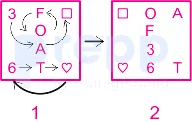
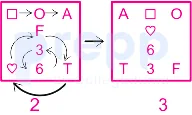
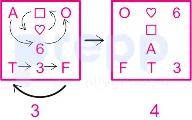
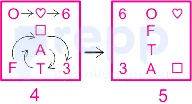
Select the option figure in which the given figure is embedded (rotation is NOT allowed).

- A
Option A (shown in image)
- B
Option B (shown in image)
- C
Option C (shown in image)
- D
Option D (shown in image)
Show answer
A. Option A (shown in image)The image embedded in given figure is as shown below:
Hence, 'option 1' is the correct answer.
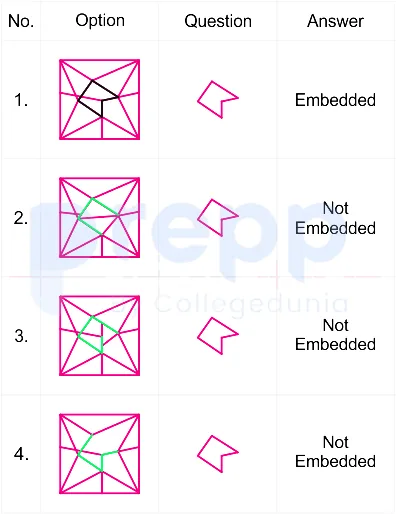 Paper & answer key PDF ↗
 Question 3archived
Select the figure that will replace the question mark (?) in the following figure series.

- A
Option A (shown in image)
- B
Option B (shown in image)
- C
Option C (shown in image)
- D
Option D (shown in image)
Show answer
Question 4archived
Which number should replace the question mark (?) in the following number series?
39, 42, 48, 57, 69, ?, 102
- A
87
- B
79
- C
81
- D
84
Show answer
D. 84The correct answer is 84.
Check for Squares or Cubes: Terms might be related to squares (n^2) or cubes (n^3), or these plus/minus a constant. Combine Operations: The pattern might involve a combination of operations (e.g., multiply by 2, then add 1). Positional Patterns: The value of a term might depend on its position in the series (e.g., the n-th term is 2n + 1). Systematically applying these methods will help you uncover the logic behind most number series problems.
Paper & answer key PDF ↗ Question 5archived
Select the set in which the numbers are related in the same way as are the numbers of the following sets.
(NOTE : Operations should be performed on the whole numbers, without breaking down the numbers into its constituent digits. E.g. 13 – Operations on 13 such as adding / subtracting / multiplying etc. to 13 can be performed. Breaking down 13 into 1 and 3 and then performing mathematical operations on 1 and 3 is NOT allowed)
(8, 44, 3)
(12, 60, 3)
- A
(17, 56, 9)
- B
(12, 68, 5)
- C
(8, 50, 2)
- D
(23, 98, 5)
Show answer
B. (12, 68, 5)Understanding Number Analogies and Relationships
This question asks us to find a set of numbers from the options that shares the same mathematical relationship between its elements as found in the given sets. We are provided with two example sets: (8, 44, 3) and (12, 60, 3). A key rule is that operations must be performed on the whole numbers themselves, not on their individual digits.
Analyzing the Given Sets to Find the Pattern
Let's examine the relationship between the numbers in the first set, (8, 44, 3). We need to figure out how 8, 44, and 3 are connected. Let's consider the first number (8), the middle number (44), and the third number (3).
Could the middle number be a result of operations involving the first and third numbers?
Let's try simple operations like addition, subtraction, multiplication, or a combination.
Looking at the numbers, we notice that the middle number is significantly larger than the first and third numbers. This might suggest multiplication or addition combined with multiplication.
Let's try combining the first and third numbers first:
Sum: \(8 + 3 = 11\)
Difference: \(8 - 3 = 5\) or \(3 - 8 = -5\)
Product: \(8 \times 3 = 24\)
Now, let's see if any of these results can be related to the middle number, 44, perhaps by multiplying by a constant factor or adding/subtracting a constant.
Sum is 11. If we multiply 11 by 4, we get \(11 \times 4 = 44\). This matches the middle number!
So, a potential pattern is: Middle Number = 4 × (First Number + Third Number).
Verifying the Pattern with the Second Set
Let's check if this pattern holds true for the second given set: (12, 60, 3).
First Number = 12
Third Number = 3
Middle Number = 60
According to our potential pattern: Middle Number = 4 × (First Number + Third Number)
Let's calculate 4 × (First Number + Third Number):
\(4 \times (12 + 3) = 4 \times 15 = 60\)
The calculated value, 60, matches the middle number in the second set. This confirms that the relationship Middle Number = 4 × (First Number + Third Number) is the correct pattern.
Applying the Pattern to the Options
Now we will test each option to see which set follows the same pattern.
Option 1: (17, 56, 9)
First Number = 17
Third Number = 9
Middle Number = 56
Let's apply the pattern: \(4 \times (17 + 9) = 4 \times 26 = 104\)
The calculated value (104) is not equal to the middle number (56). So, this option does not follow the pattern.
Option 2: (12, 68, 5)
First Number = 12
Third Number = 5
Middle Number = 68
Let's apply the pattern: \(4 \times (12 + 5) = 4 \times 17 = 68\)
The calculated value (68) is equal to the middle number (68). This option follows the pattern.
Option 3: (8, 50, 2)
First Number = 8
Third Number = 2
Middle Number = 50
Let's apply the pattern: \(4 \times (8 + 2) = 4 \times 10 = 40\)
The calculated value (40) is not equal to the middle number (50). So, this option does not follow the pattern.
Option 4: (23, 98, 5)
First Number = 23
Third Number = 5
Middle Number = 98
Let's apply the pattern: \(4 \times (23 + 5) = 4 \times 28 = 112\)
The calculated value (112) is not equal to the middle number (98). So, this option does not follow the pattern.
Based on the analysis, only Option 2 follows the same relationship between its numbers as the given sets.
Set
First Number
Third Number
Sum (First + Third)
4 × Sum
Middle Number
Matches Pattern?
(8, 44, 3)
8
3
\(8+3=11\)
\(4 \times 11 = 44\)
44
Yes
(12, 60, 3)
12
3
\(12+3=15\)
\(4 \times 15 = 60\)
60
Yes
(17, 56, 9)
17
9
\(17+9=26\)
\(4 \times 26 = 104\)
56
No
(12, 68, 5)
12
5
\(12+5=17\)
\(4 \times 17 = 68\)
68
Yes
(8, 50, 2)
8
2
\(8+2=10\)
\(4 \times 10 = 40\)
50
No
(23, 98, 5)
23
5
\(23+5=28\)
\(4 \times 28 = 112\)
98
No
Conclusion
The set of numbers (12, 68, 5) follows the same relationship as the given sets, where the middle number is four times the sum of the first and third numbers.
Revision Table: Key Concepts
Concept
Description
Relevance to Problem
Number Analogy
Identifying a mathematical or logical relationship within a set of numbers.
The core task is to find an analogous relationship in another set.
Pattern Recognition
Discovering the rule or formula connecting the numbers in the given examples.
Essential for solving the problem by applying the rule to options.
Whole Number Operations
Performing calculations using numbers as a whole unit, not individual digits.
A specific constraint provided in the problem statement.
Additional Information: Solving Number Series and Analogies
Solving number series and analogy problems often involves looking for common mathematical operations, sequences, or relationships between numbers. Here are some common strategies:
Arithmetic Operations: Look for patterns involving addition, subtraction, multiplication, or division between consecutive numbers or specific positions (like first and third, first and second, etc.).
Powers and Roots: The pattern might involve squares, cubes, square roots, etc.
Sequences: Sometimes the numbers follow known sequences like prime numbers, Fibonacci sequence, etc.
Digit-Based Operations: Although explicitly excluded by the rule in this specific question, some problems involve operations on the digits of the numbers (e.g., sum of digits, product of digits). Always check the specific rules given.
Position-Based Rules: The relationship might depend on the position of the number in the set (e.g., the third number is derived from the first two).
Testing potential patterns systematically, as done in this solution, is the key to finding the correct answer.
Paper & answer key PDF ↗ Question 6archived
Which of the following numbers will replace the question mark (?) in the given series?
33, 80, 108, ?, 183, 230, 258
- A
160
- B
155
- C
143
- D
138
Show answer
B. 155The series provided is: 33, 80, 108, ?, 183, 230, 258. To find the missing number, we need to analyze the differences between consecutive numbers in the series.
First, we calculate the differences:
80 - 33 = 47
108 - 80 = 28
? - 108 = x
183 - ? = y
230 - 183 = 47
258 - 230 = 28
We notice a pattern in the differences: 47, 28, repeating.
The sequence of differences appears to repeat the pattern 47, 28. Continuing this pattern:
The difference between the third term (108) and the missing term (x) should be 47.
Thus, the missing term x = 108 + 47 = 155.
Finally, check the pattern continues:
183 - 155 = 28 (matches the recurring difference)
Hence, the number that replaces the question mark is 155.
Paper & answer key PDF ↗ Question 7archived
A paper is folded and cut as shown below. How will it appear when unfolded?

- A
Option A (shown in image)
- B
Option B (shown in image)
- C
Option C (shown in image)
- D
Option D (shown in image)
Show answer
B. Option B (shown in image)The paper when unfolded will appear as shown below:
Hence, 'option 2' is the correct answer.
 Paper & answer key PDF ↗
 Question 8archived
Select the correct combination of mathematical signs to sequentially replace the * signs and to balance the given equation.
150 * 3 * 10 * 2 * 7 * 46
- A
÷, +, −, ×, =
- B
−, ×, +, ÷, =
- C
+, −, ÷, ×, =
- D
×, +, ÷, −, =
Show answer
A. ÷, +, −, ×, =Mathematical Equation Solution
Given numbers: 150 * 3 * 10 * 2 * 7 * 46
We need to replace the * signs with the correct sequence of operations to balance the equation.
150 ÷ 3 + 10 - 2 × 7 = 46
Step-by-Step Solving (Using BODMAS Rule):
Division (÷): 150 ÷ 3 = 50
Multiplication (×): 2 × 7 = 14
Addition (+): 50 + 10 = 60
Subtraction (-): 60 - 14 = 46
Therefore, 46 = 46 (The equation is balanced.)
Correct Combination of Signs: ÷, +, -, ×, =
Paper & answer key PDF ↗ Question 9archived
Select the set in which the number are related in the same way as the numbers of the given sets. (NOTE : Operations should be performed on the whole numbers, without breaking down the numbers into its constituent digits. E.g. 13 – Operations on 13 such as adding /subtracting /multiplying etc. to 13 can be performed. Breaking down 13 into 1 and 3 and then performing mathematical operations on 1 and 3 is not allowed.)
(31, 47, 35)
(51, 67, 55)
- A
(33, 47, 35)
- B
(13, 29, 17)
- C
(32, 39, 27)
- D
(21, 36, 35)
Show answer
B. (13, 29, 17)Understanding Number Set Relationships
This question asks us to identify a set of three numbers that shares the same mathematical relationship as the two given sets: (31, 47, 35) and (51, 67, 55). We are instructed to perform operations only on the whole numbers themselves, not on their individual digits.
Analyzing the Given Number Sets to Find the Pattern
Let's examine the first given set: (31, 47, 35). Let's call the numbers A, B, and C respectively. So, A = 31, B = 47, and C = 35.
Let's look at the differences between these numbers:
Difference between B and A: \(B - A = 47 - 31 = 16\)
Difference between C and A: \(C - A = 35 - 31 = 4\)
We can see that \(16\) is \(4\) times \(4\). This suggests a possible relationship: \(B - A = 4 \times (C - A)\).
Now, let's check this potential relationship with the second given set: (51, 67, 55). Here, A = 51, B = 67, and C = 55.
Difference between B and A: \(B - A = 67 - 51 = 16\)
Difference between C and A: \(C - A = 55 - 51 = 4\)
Again, we find that \(16 = 4 \times 4\). So, the relationship \(B - A = 4 \times (C - A)\) holds true for both given sets.
This is the pattern or relationship we need to find in the given options.
Testing the Options for the Same Number Set Relationship
We will now test each option provided to see which one follows the relationship \(B - A = 4 \times (C - A)\).
Option 1: (33, 47, 35)
Here, A = 33, B = 47, C = 35.
Calculate B - A: \(47 - 33 = 14\)
Calculate C - A: \(35 - 33 = 2\)
Check the relationship: \(14 = 4 \times 2\) > \(14 = 8\)
The relationship does not hold for Option 1. This set is not related in the same way.
Option 2: (13, 29, 17)
Here, A = 13, B = 29, C = 17.
Calculate B - A: \(29 - 13 = 16\)
Calculate C - A: \(17 - 13 = 4\)
Check the relationship: \(16 = 4 \times 4\) > \(16 = 16\)
The relationship holds true for Option 2. This set is related in the same way as the given sets.
Option 3: (32, 39, 27)
Here, A = 32, B = 39, C = 27.
Calculate B - A: \(39 - 32 = 7\)
Calculate C - A: \(27 - 32 = -5\)
Check the relationship: \(7 = 4 \times (-5)\) > \(7 = -20\)
The relationship does not hold for Option 3. This set is not related in the same way.
Option 4: (21, 36, 35)
Here, A = 21, B = 36, C = 35.
Calculate B - A: \(36 - 21 = 15\)
Calculate C - A: \(35 - 21 = 14\)
Check the relationship: \(15 = 4 \times 14\) > \(15 = 56\)
The relationship does not hold for Option 4. This set is not related in the same way.
Identifying the Correct Number Set
Based on our analysis, only Option 2 follows the same mathematical relationship \(B - A = 4 \times (C - A)\) as the given sets.
Set
A
B
C
\(B - A\)
\(C - A\)
\(4 \times (C - A)\)
Matches Rule? \(B - A = 4 \times (C - A)\)
Given Set 1
31
47
35
16
4
16
Yes
Given Set 2
51
67
55
16
4
16
Yes
Option 1
33
47
35
14
2
8
No
Option 2
13
29
17
16
4
16
Yes
Option 3
32
39
27
7
-5
-20
No
Option 4
21
36
35
15
14
56
No
Revision Table: Number Set Analysis
This table summarizes the calculations for each set and option, making it easy to compare results and verify the pattern \(B - A = 4 \times (C - A)\).
Additional Information on Logical Reasoning and Number Sets
Number set and series problems are common in logical reasoning and quantitative aptitude tests. They require you to identify the underlying pattern or rule that relates the numbers in a given set or sequence. The patterns can involve basic arithmetic operations (addition, subtraction, multiplication, division), powers, roots, or combinations of these. Sometimes, the pattern might involve the position of the numbers within the set (like the relationship between the first, second, and third numbers here).
Key strategies for solving these types of problems include:
Looking at differences between consecutive numbers.
Looking at ratios between consecutive numbers.
Considering differences or sums of alternate numbers.
Checking for relationships between the first and last number, or first and middle number, etc., as demonstrated in this problem.
Trying combinations of operations.
Testing your hypothesized rule against all given examples before applying it to the options.
The constraint about not breaking down numbers into constituent digits is important. It guides us to treat 31 as the number 'thirty-one' rather than looking at '3' and '1' separately. This is typical in many competitive exams to prevent ambiguous solutions.
Paper & answer key PDF ↗ Question 10archived
Select the correct mirror image of the given combination when the mirror is placed at MN as shown below.

- A
Option A (shown in image)
- B
Option B (shown in image)
- C
Option C (shown in image)
- D
Option D (shown in image)
Show answer
A. Option A (shown in image)The correct mirror image of the given combination when the mirror is placed at MN is shown below:
Hence, 'option 1' is the correct answer.
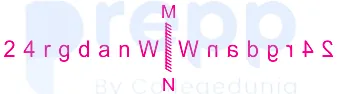 Paper & answer key PDF ↗
 Question 11archived
Select the option that is related to the third word in the same way as the second word is related to the first word. (The words must be considered as meaningful English words and must not be related to each other based on the number of letters/number of consonants/vowels in the word)
Orthopaedic : Bone :: Cardiologist : ?
- A
Kidney
- B
Heart
- C
Lungs
- D
Brain
Show answer
B. HeartThis question asks us to find the word that has the same relationship with 'Cardiologist' as 'Bone' has with 'Orthopaedic'. This is a word analogy problem.
Understanding the Orthopaedic : Bone Relationship
Let's first analyze the relationship between the first pair of words: 'Orthopaedic' and 'Bone'.
An Orthopaedic doctor, or Orthopaedist, is a medical specialist.
They specialize in the musculoskeletal system, which includes bones, joints, muscles, ligaments, and tendons.
Therefore, the relationship between Orthopaedic and Bone is that an Orthopaedic specialist deals with or treats conditions related to Bones. It is a "Specialist : Related Body Part" relationship.
Applying the Relationship to Cardiologist
Now we need to apply the same relationship to the word 'Cardiologist'.
A Cardiologist is also a medical specialist.
Following the pattern "Specialist : Related Body Part", we need to find the body part that a Cardiologist specializes in.
A Cardiologist specializes in the study and treatment of the heart and blood vessels.
Therefore, the body part related to a Cardiologist in the same way Bone is related to Orthopaedic is the Heart.
Analyzing the Options
Let's look at the given options:
Kidney
Heart
Lungs
Brain
We need to find the option that represents the body part a Cardiologist specializes in.
Kidney: A specialist who deals with kidneys is called a Nephrologist. So, this is not the correct relationship.
Heart: A specialist who deals with the heart is called a Cardiologist. This matches the relationship we identified.
Lungs: A specialist who deals with lungs is called a Pulmonologist. So, this is not the correct relationship.
Brain: A specialist who deals with the brain and nervous system is called a Neurologist. So, this is not the correct relationship.
Conclusion
Based on the analysis, the word that completes the analogy Orthopaedic : Bone :: Cardiologist : ? is Heart, because an Orthopaedic specialist deals with Bones, and a Cardiologist specializes in the Heart.
The correct option is Heart.
Revision Table: Key Medical Specialists
Specialist
Related Body Part / System
Orthopaedic
Bones (and musculoskeletal system)
Cardiologist
Heart (and blood vessels)
Nephrologist
Kidneys
Pulmonologist
Lungs
Neurologist
Brain (and nervous system)
Gastroenterologist
Stomach and intestines
Dermatologist
Skin
Additional Information on Word Analogies
Word analogies test your ability to understand relationships between pairs of words and apply that relationship to a new pair. Common types of relationships include:
Part to Whole: Finger : Hand
Cause and Effect: Rain : Flood
Synonyms: Happy : Joyful
Antonyms: Hot : Cold
Tool and User: Pen : Writer
Specialist and Field/Body Part: Cardiologist : Heart
Action and Object: Read : Book
Degree of Intensity: Warm : Hot
To solve word analogies effectively, follow these steps:
Identify the relationship between the first pair of words.
Express that relationship in a simple phrase or sentence (e.g., "X is a part of Y", "X is the opposite of Y", "X is a specialist in Y").
Apply the exact same relationship to the third word to find the fourth word.
Check the options to see which one fits the determined relationship.
Paper & answer key PDF ↗ Question 12archived
Select the option that represents the letters that, when placed from left to right in the following blanks, will complete the letter-series.
_ V J R W B _ _ R W B V L _ _ B V _ _ W
- A
A V K R W M R
- B
A W K R X N R
- C
B V K R W M R
- D
B W K R W M R
Show answer
C. B V K R W M RThe correct answer is B V K R W M R.
Count Position in Alphabet: Assign numerical values (A=1, B=2, etc.) to letters and look for arithmetic or geometric progressions in the numbers. Look for Relationship Between Letters: Check if letters relate to each other in pairs or groups (e.g., complementary letters like AZ, BY). Divide and Conquer: Break the series into smaller, equal segments and analyze the pattern within each segment or how segments relate to each other. Practice with different types of series helps develop the skill to quickly spot these patterns during exams.
Paper & answer key PDF ↗ Question 13archived
Three statements are given, followed by four conclusions numbered I, II, III and IV. Assuming the statements to be true, even if they seem to be at variance with commonly known facts, decide which of the conclusions logically follow(s) from the statements.
Statements:
Some coolers are mixers.
Some mixers are scissors.
Some scissors are knives.
Conclusions:
I. Some knives are mixers.
II. Some scissors are coolers.
III. Some knives are coolers.
IV. No knife is a mixer.
- A
Only conclusions III and IV follow
- B
Only conclusions I and III follow
- C
None of the conclusions follow
- D
Only conclusions II and IV follow
Show answer
C. None of the conclusions followThe correct answer is None of the conclusions follow.
If a is false in even one valid diagram, it does not logically follow. Types of propositions commonly used in syllogism: Universal Affirmative (A): All S are P Universal Negative (E): No S is P Particular Affirmative (I): Some S are P Particular Negative (O): Some S are not P This problem primarily uses Particular Affirmative (I) statements. Drawing valid s from combinations of these types requires understanding specific rules of inference.
Paper & answer key PDF ↗ Question 14archived
Select the option that is related to the fifth letter-cluster in the same way as the second letter-cluster is related to the first letter-cluster and the fourth letter-cluster is related to the third letter-cluster.
NHT : PEX :: KDF : MAJ :: UMR : ?
- A
WJV
- B
VJW
- C
WPN
- D
XIW
Show answer
A. WJVThe correct answer is WJV.
Number Analogies: Based on arithmetic operations, squares, cubes, series patterns. (e.g., 2 : 4 :: 3 : 9). Picture Analogies: Based on rotation, reflection, sequence, addition/removal of elements in figures. Solving analogies improves your ability to spot relationships and patterns quickly, which is useful in many areas of problem-solving.
Paper & answer key PDF ↗ Question 15archived
Which of the following is a leap year?
- A
1076
- B
1675
- C
1354
- D
1998
Show answer
A. 1076Understanding and Identifying a Leap Year
A leap year is a year in the Gregorian calendar that contains an extra day, February 29th, making it 366 days long instead of the usual 365. This extra day is added to keep the calendar year synchronized with the astronomical year or tropical year.
To identify if a year is a leap year, specific rules based on divisibility are applied. Here are the rules:
A year is a leap year if it is evenly divisible by 4.
Exception: If a year is divisible by 100, it is not a leap year, unless...
Second Exception: ...it is also evenly divisible by 400.
Let's apply these rules to the given options to determine which one is a leap year.
Analyzing the Options for Leap Year Identification
We will examine each year from the options provided:
Option 1: 1076
Is 1076 divisible by 4? Let's check: $1076 \div 4 = 269$. Yes, it is divisible by 4.
Is 1076 divisible by 100? $1076 \div 100 = 10.76$. No, it is not divisible by 100.
According to the rules, if a year is divisible by 4 but not by 100, it is a leap year. Since 1076 is divisible by 4 and not by 100, it follows this rule.
Conclusion for 1076: It is a leap year.
Option 2: 1675
Is 1675 divisible by 4? A quick way to check divisibility by 4 is to look at the last two digits. Are 75 divisible by 4? $75 \div 4 = 18.75$. No, 75 is not divisible by 4.
According to the rules, if a year is not divisible by 4, it is not a leap year.
Conclusion for 1675: It is not a leap year.
Option 3: 1354
Is 1354 divisible by 4? Let's check the last two digits, 54. Is 54 divisible by 4? $54 \div 4 = 13.5$. No, 54 is not divisible by 4.
According to the rules, if a year is not divisible by 4, it is not a leap year.
Conclusion for 1354: It is not a leap year.
Option 4: 1998
Is 1998 divisible by 4? Let's check the last two digits, 98. Is 98 divisible by 4? $98 \div 4 = 24.5$. No, 98 is not divisible by 4.
According to the rules, if a year is not divisible by 4, it is not a leap year.
Conclusion for 1998: It is not a leap year.
Summary of Analysis
Let's summarize the findings in a table:
YearDivisible by 4?Divisible by 100?Divisible by 400?Leap Year?Reason
1076Yes ($\div 4$)No ($\neq 100$)N/AYesDivisible by 4, not by 100
1675No ($\neq 4$)N/AN/ANoNot divisible by 4
1354No ($\neq 4$)N/AN/ANoNot divisible by 4
1998No ($\neq 4$)N/AN/ANoNot divisible by 4
Based on the analysis, only the year 1076 meets the criteria for being a leap year.
Revision Table: Leap Year Rules Summary
ConditionOutcome
Year divisible by 4 AND not divisible by 100Leap Year
Year divisible by 400Leap Year
Year divisible by 100 BUT not divisible by 400Not a Leap Year
Year not divisible by 4Not a Leap Year
Additional Information: Why Leap Years Exist
The Earth takes approximately 365.2422 days to orbit the sun (this is called a tropical year). Our standard calendar year has 365 days. If we didn't add an extra day periodically, the calendar would gradually drift out of sync with the seasons. Adding an extra day roughly every four years (the leap year rule of being divisible by 4) helps to correct this drift.
The exceptions for years divisible by 100 and 400 exist because the tropical year is not exactly 365.25 days, but slightly less. The rules involving 100 and 400 make the average length of the calendar year (over a 400-year cycle) much closer to the actual length of the tropical year, ensuring greater accuracy over long periods.
Paper & answer key PDF ↗ Question 16archived
Pointing to Suresha, I said, “She is the daughter of the brother of the son of my wife.” How am I related to Suresha?
- A
Grandmother
- B
Grand aunt
- C
Grandfather
- D
Grand uncle
Show answer
C. GrandfatherThe correct answer is Grandfather.
Be careful with terms like "brother of his son," which could mean the son himself or another son depending on the exact wording and context, but often simplifies to "his son" or "one of his sons" in these puzzles. Always double-check the final relationship derived against the options provided. Practicing different types of blood relation puzzles helps in quickly identifying the connections and avoiding common errors.
Paper & answer key PDF ↗ Question 17archived
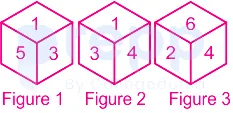
Three different positions of the same dice are shown. Find the number on the face opposite the face showing '4'.
- A
6
- B
5
- C
1
- D
2
Show answer
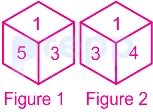
B. 5As 1 and 3 are the common faces on both the dice, the remaining faces 5 and 4 are opposite to each other.
Hence, '5' is the correct answer.
 Paper & answer key PDF ↗
 Question 18archived
Select the option that is related to the fifth letter-cluster in the same way as the second letter-cluster is related to the first letter-cluster and the fourth letter-cluster is related to the third letter-cluster.
WOODLAND : ZIRXOUQX :: PERIODIC : SYUCRXLW :: MAGAZINE : ?
- A
HERDWBMO
- B
LPWXSYCZ
- C
NSCAQOLP
- D
PUJUCCQY
Show answer
D. PUJUCCQYThe correct answer is PUJUCCQY.
Coding based on vowels and consonants. Coding based on skipping letters. Position-based coding (e.g., first letter coded based on last, second based on second last, etc.). Practice with different types helps in quickly identifying the pattern in a new question.
Paper & answer key PDF ↗ Question 19archived
Three of the following four triads are alike in a certain way as they are formed by performing same mathematical operations among themselves and thus form a group. Which triad does NOT belong to that group?
- A
36 ∶ 13 ∶ 7
- B
16 ∶ 9 ∶ 5
- C
72 ∶ 16 ∶ 8
- D
1 ∶ 3 ∶ 2
Show answer
C. 72 ∶ 16 ∶ 8The correct answer is 72 ∶ 16 ∶ 8.
Digit-based Patterns: Operations performed on the digits of the numbers themselves. Fibonacci Series: Each number is the sum of the two preceding ones (e.g., 1, 1, 2, 3, 5, 8...). Solving these problems often involves trial and error, testing different mathematical operations and relationships between the numbers until a consistent pattern is found for most elements in the set. The element that breaks the pattern is the answer.
Paper & answer key PDF ↗ Question 20archived
Which two signs should be interchanged to make the given equation correct?
294 + 14 × 4 ÷ 16 - 67 = 33
- A
+ and ×
- B
+ and ÷
- C
× and ÷
- D
+ and -
Show answer
B. + and ÷Solving the Equation by Interchanging Signs
The question asks us to identify which two mathematical signs in the given equation must be interchanged to make the equation correct. The equation is:
\(294 + 14 \times 4 \div 16 - 67 = 33\)
We need to test each option by swapping the specified signs and calculating the result using the correct order of operations (BODMAS/PEMDAS - Brackets, Orders, Division and Multiplication (from left to right), Addition and Subtraction (from left to right)).
Testing Option 1: Interchanging + and ×
If we interchange '+' and '×', the equation becomes:
\(294 \times 14 + 4 \div 16 - 67\)
Let's calculate step-by-step:
First, calculate Division: \(4 \div 16 = 0.25\)
Next, calculate Multiplication: \(294 \times 14 = 4116\)
Now, perform Addition and Subtraction from left to right: \(4116 + 0.25 - 67 = 4116.25 - 67 = 4049.25\)
The result is \(4049.25\), which is not equal to \(33\). So, interchanging '+' and '×' does not make the equation correct.
Testing Option 2: Interchanging + and ÷
If we interchange '+' and '÷', the equation becomes:
\(294 \div 14 \times 4 + 16 - 67\)
Let's calculate step-by-step following the order of operations:
First, calculate Division: \(294 \div 14 = 21\)
Next, calculate Multiplication: \(21 \times 4 = 84\)
Now, perform Addition and Subtraction from left to right: \(84 + 16 - 67 = 100 - 67 = 33\)
The result is \(33\), which is equal to the target value. So, interchanging '+' and '÷' makes the equation correct.
Testing Option 3: Interchanging × and ÷
If we interchange '×' and '÷', the equation becomes:
\(294 + 14 \div 4 \times 16 - 67\)
Let's calculate step-by-step:
First, calculate Division: \(14 \div 4 = 3.5\)
Next, calculate Multiplication: \(3.5 \times 16 = 56\)
Now, perform Addition and Subtraction from left to right: \(294 + 56 - 67 = 350 - 67 = 283\)
The result is \(283\), which is not equal to \(33\). So, interchanging '×' and '÷' does not make the equation correct.
Testing Option 4: Interchanging + and -
If we interchange '+' and '-', the equation becomes:
\(294 - 14 \times 4 \div 16 + 67\)
Let's calculate step-by-step:
First, calculate Multiplication: \(14 \times 4 = 56\)
Next, calculate Division: \(56 \div 16 = 3.5\)
Now, perform Addition and Subtraction from left to right: \(294 - 3.5 + 67 = 290.5 + 67 = 357.5\)
The result is \(357.5\), which is not equal to \(33\). So, interchanging '+' and '-' does not make the equation correct.
Based on the calculations, interchanging the signs '+' and '÷' correctly solves the equation.
Revision Table: Testing Sign Interchanges
Signs Interchanged
New Equation
Calculation Steps (BODMAS)
Result
Correct?
+ and ×
\(294 \times 14 + 4 \div 16 - 67\)
\(294 \times 14 + 0.25 - 67 = 4116 + 0.25 - 67 = 4049.25\)
\(4049.25\)
No
+ and ÷
\(294 \div 14 \times 4 + 16 - 67\)
\(21 \times 4 + 16 - 67 = 84 + 16 - 67 = 100 - 67 = 33\)
\(33\)
Yes
× and ÷
\(294 + 14 \div 4 \times 16 - 67\)
\(294 + 3.5 \times 16 - 67 = 294 + 56 - 67 = 350 - 67 = 283\)
\(283\)
No
+ and -
\(294 - 14 \times 4 \div 16 + 67\)
\(294 - 56 \div 16 + 67 = 294 - 3.5 + 67 = 290.5 + 67 = 357.5\)
\(357.5\)
No
Additional Information: Understanding Order of Operations
The order of operations is a rule that tells us the sequence in which to perform operations in a mathematical expression. A common acronym used is BODMAS or PEMDAS.
BODMAS: Brackets, Orders (powers and square roots), Division, Multiplication, Addition, Subtraction.
PEMDAS: Parentheses, Exponents, Multiplication, Division, Addition, Subtraction.
Division and Multiplication have the same priority and should be performed from left to right as they appear. Similarly, Addition and Subtraction have the same priority and should be performed from left to right.
In this problem, applying the correct order of operations after interchanging the signs is crucial to arrive at the correct result.
Paper & answer key PDF ↗ Question 21archived
Three of the following four letter-clusters are alike in a certain way and one is different. Pick the odd one out.
- A
KPH
- B
GTD
- C
DWA
- D
EVC
Show answer
D. EVCThe correct answer is EVC.
Reverse alphabetical order (Z=1, Y=2, etc.). Skipping a fixed number of letters. Sequences following a specific rule or series. Practicing with different types of letter series and pattern recognition can help in solving these kinds of odd one out questions.
Paper & answer key PDF ↗ Question 22archived
Select the set in which the numbers are related in the same way as are the numbers of the given sets.
(NOTE : Operations should be performed on the whole numbers, without breaking down the numbers into its constituent digits. E.g. 13 – Operations on 13 such as adding /Subtracting /multiplying etc. to 13 can be performed. Breaking down 13 into 1 and 3 and then performing mathematical operations on 1 and 3 is NOT allowed)
(14, 378, 9)
(18, 432, 8)
- A
(5, 125, 8)
- B
(15, 405, 9)
- C
(15, 305, 7)
- D
(11, 265, 8)
Show answer
B. (15, 405, 9)The correct answer is (15, 405, 9).
Option 4: (11, 265, 8) Applying the rule: $ 11 \times (8 \times 3) = 11 \times 24 = 264 $. This does not match B (265). Final on Number Set Similarity After examining all the options using the derived pattern $$ B = A \times (C \times 3) $$ , we found that only Option 2, the set (15, 405, 9), satisfies the relationship consistently observed in the initial example sets.
Paper & answer key PDF ↗ Question 23archived
Select the figure from the options that can replace the question mark (?) and complete the given pattern.

- A
Option A (shown in image)
- B
Option B (shown in image)
- C
Option C (shown in image)
- D
Option D (shown in image)
Show answer
Question 24archived
Three statements are given followed by three conclusions numbered I, II and III. Assuming the statements to be true, even if they seem to be at variance with commonly known facts, decide which of the conclusions logically follow(s) from the statements.
Statements:
All rice are grains.
All pulses are grains.
All grains are edibles.
Conclusions:
I. All rice are edibles.
II. All pulses are edible.
III. Some edibles are grains.
- A
All conclusions follow
- B
Only conclusions II and III follow
- C
Only conclusions I and II follow
- D
Only conclusions I and III follow
Show answer
A. All conclusions followThe correct answer is All conclusions follow.
(Supports II) If 'Grains' is inside 'Edibles', it means the 'Grains' circle is part of the 'Edibles' circle. Any part of the 'Grains' circle is also part of the 'Edibles' circle. Thus, the area representing 'Grains' is 'Some edibles'. (Supports III) Mastering syllogisms helps in improving logical reasoning and analytical skills, which are crucial for many competitive exams.
Paper & answer key PDF ↗ Question 25archived
Select the option that represents the correct order of the given words as they would appear in an English dictionary.
1. Strident
2. Student
3. Shirking
4. Stuffy
5. Spider
6. Spawn
- A
3, 6, 5, 1, 2, 4
- B
3, 5, 6, 1, 2, 4
- C
3, 6, 5, 1, 4, 2
- D
3, 5, 6, 1, 4, 2
Show answer
A. 3, 6, 5, 1, 2, 4The correct answer is 3, 6, 5, 1, 2, 4.
Words with apostrophes: Sometimes sorted as if the apostrophe isn't there. Capitalization: Usually ignored in standard dictionary sorting (case-insensitive). Contractions: Like "don't" might be treated as "dont" for sorting. For simple lists of standard words, the letter-by-letter comparison is the primary method.
Paper & answer key PDF ↗ Question 26archived
Which of the following musical instruments were played by the musicians such as Shakoor Khan and Pandit Ram Narayan?
- A
Sarangi
- B
Shehnai
- C
Guitar
- D
Veena
Show answer
A. SarangiIdentifying Musical Instruments Played by Famous Musicians
The question asks about the musical instrument played by the renowned musicians Shakoor Khan and Pandit Ram Narayan. Both of these artists are highly respected figures in the world of Indian classical music.
Analyzing the Musicians and Their Instruments
To determine the correct instrument, we need to know the primary instruments associated with Ustad Shakoor Khan and Pandit Ram Narayan. Both masters are celebrated for their contributions to a specific string instrument.
Shakoor Khan: Ustad Shakoor Khan was a prominent figure from the Kirana gharana (style) of Indian classical music, known for his mastery of a particular bowed instrument.
Pandit Ram Narayan: Pandit Ram Narayan is one of the most globally recognized Indian classical musicians, largely credited with popularizing the same instrument as a solo concert instrument.
Their association is primarily with the Sarangi.
Exploring the Options
Let's look at the provided options:
Sarangi: This is a bowed string instrument central to Hindustani classical music.
Shehnai: This is a double-reed wind instrument, often played at weddings and temples, famously associated with Ustad Bismillah Khan.
Guitar: This is a plucked string instrument, primarily associated with Western music, although adaptations exist in Indian music (like the Hawaiian guitar or modified acoustic guitars).
Veena: This is a large plucked string instrument, predominantly associated with Carnatic classical music, though the Rudra Veena is used in Hindustani music. Famous Veena players include S. Balachander and Ustad Asad Ali Khan (Rudra Veena).
Confirming the Correct Instrument
Both Ustad Shakoor Khan and Pandit Ram Narayan are legendary performers of the Sarangi. The Sarangi is known for its ability to imitate the human voice, making it a challenging but expressive instrument. Pandit Ram Narayan, in particular, elevated the Sarangi's status as a solo instrument rather than just an accompaniment.
Therefore, the musical instrument played by musicians such as Shakoor Khan and Pandit Ram Narayan is the Sarangi.
Detailed Explanation of Sarangi
The Sarangi is a short-necked, bowed string instrument from the Indian subcontinent. It is considered one of the most difficult Indian instruments to play.
It typically has three main playing strings made of gut.
It has a large number of sympathetic strings (usually 35 to 40) which vibrate in resonance with the played strings, adding a rich, resonant quality to the sound.
Unlike many string instruments where fingers press the string against a fretboard, the Sarangi is played by pressing the fingernails against the strings.
Historically, the Sarangi was often used to accompany vocalists, especially in Hindustani classical music.
Why Other Options Are Incorrect
Shehnai: A wind instrument, not played by bowing strings.
Guitar: A plucked string instrument, distinct from the Sarangi's bowed technique and traditional Indian context.
Veena: A plucked string instrument (like the Sitar or Tanpura, though larger and with a different structure), different from the bowed Sarangi.
Conclusion
Based on the famous musicians mentioned, Shakoor Khan and Pandit Ram Narayan, their principal instrument is the Sarangi.
Revision Table: Musicians and Instruments
Musician
Instrument
Style
Shakoor Khan
Sarangi
Hindustani Classical
Pandit Ram Narayan
Sarangi
Hindustani Classical
Ustad Bismillah Khan
Shehnai
Hindustani Classical
Ravi Shankar
Sitar
Hindustani Classical
Zakir Hussain
Tabla
Hindustani Classical
Additional Information: Evolution of Sarangi in Indian Music
The Sarangi has a rich history in Indian classical music. While traditionally used as an accompanying instrument for Khayal and Thumri vocalists, its role expanded significantly due to the efforts of maestros like Pandit Ram Narayan. He dedicated his career to establishing the Sarangi as a leading solo concert instrument on par with the Sitar or Violin. The unique timbre and expressive capability of the Sarangi allow it to mimic the nuances of the human voice, making it particularly suitable for Indian classical music's emphasis on melodic expression.
Paper & answer key PDF ↗ Question 27archived
According to IBEF 2021, the Indian pharmaceutical industry ranks _____ in the world on the basis of volume.
- A
9th
- B
5th
- C
11th
- D
3rd
Show answer
D. 3rdUnderstanding India's Pharmaceutical Industry Ranking by Volume
Let's look at the question about the ranking of the Indian pharmaceutical industry globally based on volume, according to the IBEF 2021 report.
Analysing the Indian Pharmaceutical Industry's Position
The Indian pharmaceutical industry is a significant player in the global market. It is known for producing medicines at a lower cost, especially generic drugs. Reports from various sources, including the India Brand Equity Foundation (IBEF), provide insights into the industry's performance and global standing.
According to the IBEF 2021 data, the Indian pharmaceutical industry held a notable position in the world based on the volume of production. Volume refers to the sheer quantity of medicines produced.
Global Ranking by Volume
Based on the information available from IBEF for the year 2021, India's pharmaceutical industry ranks as the third largest in the world by volume. This means that in terms of the number of doses or units of medicine produced, only two other countries produced more than India in that period.
This high ranking in volume highlights India's role as a major global supplier of affordable medicines, often referred to as the "pharmacy of the world". While the ranking by volume is high, the ranking by value (the total monetary worth of the medicines produced) is typically lower, as India focuses heavily on lower-cost generic drugs.
Evaluating the Options
The question asks for the ranking based on volume according to IBEF 2021. Let's check the given options against the information about India's ranking:
9th: This ranking is significantly lower than India's actual position by volume.
5th: This is also lower than the reported volume ranking.
11th: This ranking is much lower than India's position in terms of volume.
3rd: This ranking aligns with the widely reported position of the Indian pharmaceutical industry by volume according to IBEF 2021 data.
Therefore, the correct ranking according to IBEF 2021 based on volume is 3rd.
Indian Pharmaceutical Industry Ranking (IBEF 2021)
Basis of Ranking
Global Rank
Volume
3rd
Value
Lower than Volume Rank (Typically cited around 11th or 12th)
Conclusion
Based on the analysis of the information from IBEF 2021 regarding the Indian pharmaceutical industry's global position by volume, the correct rank is 3rd.
Revision Table: Indian Pharma Industry Facts
Key Facts about Indian Pharmaceutical Industry
Aspect
Details
Global Ranking by Volume (IBEF 2021)
3rd
Major Focus
Generic Drugs
Role in Global Market
Often called the "Pharmacy of the World"
Export Contribution
Significant exporter of medicines globally
Additional Information: Importance of Volume vs. Value
When discussing the pharmaceutical industry's size and impact, two common metrics are volume and value:
Volume: This refers to the quantity of physical units produced or consumed, such as the number of tablets, capsules, vials, etc. A high volume ranking indicates large-scale production capacity. India ranks high in volume because it manufactures vast quantities of affordable generic medicines, supplying them globally.
Value: This refers to the total monetary worth of the medicines produced or sold. Value is influenced by the price of the medicines. Developed countries often rank higher in value even if their volume is lower, because they produce more expensive, patented, or specialized drugs. India's lower ranking in value compared to volume reflects its focus on generics, which are cheaper per unit.
Understanding the difference between volume and value is crucial when interpreting global industry rankings.
Paper & answer key PDF ↗ Question 28archived
When did Linus Carl Pauling receive the Nobel Prize in Chemistry for ‘his research into the nature of the chemical bond and its applications to the elucidation of the structure of complex substances’?
- A
1950
- B
1954
- C
1956
- D
1958
Show answer
B. 1954Linus Pauling's Groundbreaking Chemical Bond Research
Linus Carl Pauling was one of the most influential chemists of the 20th century. His work fundamentally changed our understanding of the forces that hold atoms together to form molecules, known as chemical bonds. His research into the nature of the chemical bond was extensive and provided the foundation for much of modern chemistry, physics, and molecular biology.
The question asks about the specific year when Linus Carl Pauling received the Nobel Prize in Chemistry for his seminal work. This award recognized his profound contributions to understanding the chemical bond and its applications in revealing the structures of complex substances.
Identifying Linus Pauling's Chemistry Nobel Year
Linus Pauling's research on the chemical bond culminated in significant publications, including his famous book "The Nature of the Chemical Bond and the Structure of Molecules and Crystals". This work laid out his theories, including the concept of electronegativity and the hybridization of atomic orbitals, which are central to modern chemistry.
The Nobel Prize in Chemistry is awarded annually for outstanding contributions in the field. Linus Pauling's research into the nature of the chemical bond was recognized as such a contribution.
Let's look at the given options for the year he received this prestigious award:
Option
Year
1
1950
2
1954
3
1956
4
1958
Historical records confirm that Linus Carl Pauling was awarded the Nobel Prize in Chemistry for his work on the chemical bond and the structure of complex substances in the year 1954.
Detailed Analysis of Linus Pauling's Nobel Recognition
Recipient: Linus Carl Pauling
Award: Nobel Prize in Chemistry
Year Awarded: 1954
Citation: "for his research into the nature of the chemical bond and its applications to the elucidation of the structure of complex substances"
Significance: His work provided a unified description of various types of chemical bonds (ionic, covalent, metallic, etc.) and explained the structure and properties of molecules and crystals based on these bonds. This was crucial for understanding everything from simple inorganic molecules to complex biological substances like proteins.
Based on this information, the correct year Linus Carl Pauling received the Nobel Prize in Chemistry for this specific research was 1954.
Revision Table: Key Facts about Linus Pauling's Nobel Prize
Aspect
Detail
Laureate
Linus Carl Pauling
Prize
Nobel Prize in Chemistry
Year
1954
Cited Work
Nature of the chemical bond and structure of complex substances
Additional Information: Linus Pauling's Other Nobel Prize
It is worth noting that Linus Pauling is the only person to have been awarded two unshared Nobel Prizes. Besides the Nobel Prize in Chemistry in 1954, he was also awarded the Nobel Peace Prize in 1962 for his campaign against nuclear weapons testing. This highlights his diverse impact not only in science but also in global peace efforts.
His work on the chemical bond remains a cornerstone of modern chemistry education and research.
Paper & answer key PDF ↗ Question 29archived
Daskathia of _________ is the tribal dance performed by two males depicting the historic and Puranic events.
- A
Uttar Pradesh
- B
Gujarat
- C
Goa
- D
Odisha
Show answer
D. OdishaUnderstanding Daskathia Dance of Odisha
Daskathia is a traditional folk art form predominantly found in the state of Odisha, India. It is a narrative form where the performers use storytelling accompanied by specific musical instruments and actions. The question correctly identifies key characteristics of this unique performance art.
Key Features of Daskathia Performance
Performers: Daskathia is traditionally performed by two male artists. They are known as the 'Gayaka' (singer/narrator) and the 'Palia' (co-singer/assistant).
Theme and Subject Matter: The performances primarily depict stories derived from Hindu epics, Puranas, and historical events. This aligns with the question's mention of 'historic and Puranic events'.
Instruments: The performance gets its name from the primary musical instrument used, the 'Das' sticks or 'Kathi'. These are a pair of wooden sticks that are struck together rhythmically. Other instruments like harmonium or tabla might also be used sometimes.
Performance Style: It's a blend of singing, recitation, dialogue, acting, and rhythmic stick-clicking. The performance is vibrant and engages the audience through narrative and musical elements.
Let's consider the options provided in the context of this information:
Uttar Pradesh: Uttar Pradesh has rich folk traditions like Nautanki, Ramlila, and Raslila, but Daskathia is not associated with this state.
Gujarat: Gujarat is famous for Garba and Dandiya Raas, especially during Navratri, but Daskathia is not a Gujarati folk art form.
Goa: Goa has folk dances like Fugdi and Ghodemodni, but Daskathia is not from Goa.
Odisha: Odisha has a diverse range of folk and classical dance forms, including Odissi dance, Chhau dance, and various folk performances. Daskathia is indeed a well-known traditional narrative art form originating from and popular in Odisha.
Based on the characteristics described in the question – a tribal dance (though often classified as a folk narrative/theatre form, it has roots in community storytelling) performed by two males depicting historic and Puranic events using 'Daskathi' instruments – Daskathia is specifically associated with Odisha.
Comparing Folk Forms: Daskathia vs. Others
Understanding different folk art forms helps in identifying the correct origin. Here is a brief comparison:
Art Form
State of Origin
Performers (Typical)
Theme (Common)
Daskathia
Odisha
Two Males
Puranas, Epics, History
Garba
Gujarat
Groups (Male/Female)
Religious, Navratri
Nautanki
Uttar Pradesh
Groups (Male/Female)
Social, Historical, Folklore
Fugdi
Goa
Females (Group)
Daily life, Religious festivals
This comparison clearly shows that Daskathia is unique in its two-male performance structure and specific narrative style, strongly linking it to Odisha.
Revision Table: Daskathia Key Facts
Feature
Description
Name
Daskathia
Origin State
Odisha
Performers
Two Male Artists (Gayaka & Palia)
Core Instrument
Das or Kathi (wooden sticks)
Themes
Historic and Puranic events, Epics
Classification
Folk narrative, Folk theatre, Traditional performing art
Additional Information on Odisha Folk Arts
Odisha is culturally rich and home to many traditional art forms. While Daskathia is a unique narrative form, other notable folk arts from Odisha include:
Gotipua Dance: A traditional dance form performed by young boys dressed as female dancers.
Chhau Dance: A semi-classical dance form with martial, tribal, and folk origins, performed with masks in some subgenres.
Pala: Another folk narrative art form from Odisha, typically performed by a group of five or six members.
Karma Dance: A tribal dance performed during the Karma Puja festival.
These examples highlight the diversity of Odisha's performing arts landscape, with Daskathia holding its distinct place as a two-person narrative performance using characteristic wooden sticks.
Paper & answer key PDF ↗ Question 30archived
KA Najeeb Vs Union of India case deals with violation of rights under____________.
- A
Article 16
- B
Article 21
- C
Article 14
- D
Article 19
Show answer
B. Article 21Understanding the KA Najeeb Vs Union of India Case
The case of KA Najeeb Vs Union of India is a significant one in Indian constitutional law. It primarily deals with the fundamental rights of individuals, particularly concerning the right to liberty and the complexities surrounding prolonged incarceration without trial.
This case brought into focus the situation of an individual detained for a long period under stringent laws, specifically the Unlawful Activities (Prevention) Act (UAPA). The core question before the court was whether an accused person could be granted bail even if statutory restrictions exist, based on the delay in the trial process.
Fundamental Rights and the KA Najeeb Case
The Supreme Court in the KA Najeeb case examined the interplay between statutory provisions that restrict bail (like those in UAPA) and the fundamental rights guaranteed under the Constitution. The Court recognized that while statutory restrictions are important, they cannot override the fundamental rights of the accused, especially when the trial is unreasonably delayed.
The right to a speedy trial is an implicit part of a fundamental right. Prolonged detention without trial is considered a violation of personal liberty.
Identifying the Relevant Article: Violation of Rights
Let's look at the articles provided in the options and determine which one is most relevant to the violation of rights discussed in the KA Najeeb case:
Article 16: Deals with equality of opportunity in matters of public employment. This is not the focus of the case.
Article 21: States that no person shall be deprived of his life or personal liberty except according to procedure established by law. This article is fundamental to the right to liberty and a speedy trial is considered an essential component of this right. Prolonged detention impacts personal liberty.
Article 14: Deals with equality before the law and equal protection of the laws. While principles of equality are important, the direct violation discussed in the context of prolonged detention relates more specifically to personal liberty.
Article 19: Deals with the protection of certain rights regarding freedom of speech, etc. This article is not directly related to the issue of prolonged detention and the right to a speedy trial.
Based on the nature of the violation discussed in the KA Najeeb case – concerning prolonged detention and the right to a speedy trial – the case primarily involves the violation of rights protected under Article 21 of the Indian Constitution.
Conclusion on the Violation of Rights
The Supreme Court's decision in KA Najeeb Vs Union of India reinforced that the right to a speedy trial is integral to the right to life and personal liberty under Article 21. Unreasonable delay in trial proceedings can be grounds for granting bail, even in cases where statutory provisions might otherwise restrict it, to prevent the violation of this fundamental right.
Revision Table: Key Points
Case
Primary Issue
Fundamental Right Involved
Relevant Article
KA Najeeb Vs Union of India
Prolonged detention, Speedy trial, Bail under UAPA
Right to Personal Liberty
Article 21
Additional Information: Article 21 and Speedy Trial
Article 21 is one of the most crucial fundamental rights. It guarantees the protection of life and personal liberty. The interpretation of Article 21 by the Supreme Court has expanded over time to include various rights that are essential for a dignified life, such as the right to live with human dignity, the right to a clean environment, and importantly, the right to a speedy trial.
The right to a speedy trial means that a criminal trial should be conducted without undue delay. Delays in the justice delivery system can lead to prolonged incarceration of undertrials, which is a direct infringement on their personal liberty. The principle established in various judgments, including implicitly reaffirmed in the KA Najeeb case, is that justice delayed is justice denied, especially when it results in lengthy detention.
The KA Najeeb judgment highlighted that even stringent laws like UAPA, which make bail difficult, must be read in a manner that does not completely negate the fundamental right to a speedy trial under Article 21. If the state fails to conduct a trial within a reasonable time, the court can consider granting bail to uphold the right to personal liberty.
Paper & answer key PDF ↗ Question 31archived
Which of the following is the red algae?
- A
Rhodophyceae
- B
Chlorophyceae
- C
Liverwort
- D
Phaeophyceae
Show answer
A. RhodophyceaeIdentifying Red Algae: A Biological Classification
The question asks us to identify which option represents red algae. Algae are a diverse group of aquatic organisms that can perform photosynthesis. They are typically classified into different groups based on their pigments, storage products, and cell wall composition.
Let's examine the given options:
Rhodophyceae: This is a class of algae. The name "Rhodophyceae" comes from the Greek words "rhodon" meaning "rose" or "red," and "phykos" meaning "alga." Members of this class are commonly known as red algae because of the presence of the accessory photosynthetic pigment phycoerythrin, which masks the green color of chlorophyll.
Chlorophyceae: This is also a class of algae. "Chloro" comes from the Greek word "chloros" meaning "green." Members of this class are typically known as green algae due to the dominance of chlorophyll pigments.
Liverwort: Liverworts are not algae. They belong to the division Marchantiophyta and are a type of bryophyte, which are non-vascular land plants.
Phaeophyceae: This is a class of algae. "Phaeo" comes from the Greek word "phaios" meaning "dusky" or "brown." Members of this class are commonly known as brown algae, characterized by the presence of the pigment fucoxanthin.
Based on the classification and characteristic pigments, Rhodophyceae are the red algae.
Why Rhodophyceae are Red Algae
Red algae, or Rhodophyceae, are primarily marine, though some freshwater species exist. Their characteristic red color is due to the presence of phycobilins, particularly phycoerythrin. These pigments are efficient at absorbing blue and green light, which can penetrate deeper into water than red light. This adaptation allows red algae to photosynthesize in deeper waters where other algae cannot thrive.
Comparison of Algal Classes
To further clarify, here is a brief comparison of the algal classes mentioned:
Class
Common Name
Dominant Pigments
Typical Habitat
Rhodophyceae
Red Algae
Chlorophyll a, Phycobilins (Phycoerythrin, Phycocyanin)
Mostly Marine
Chlorophyceae
Green Algae
Chlorophyll a and b, Carotenoids
Freshwater, Marine, Terrestrial
Phaeophyceae
Brown Algae
Chlorophyll a and c, Carotenoids (Fucoxanthin)
Mostly Marine
From the comparison, it is clear that Rhodophyceae is the class of red algae.
Conclusion
The option that represents red algae is Rhodophyceae.
Revision Table: Algae Classification Review
Algal Group
Key Feature
Rhodophyceae
Red algae, presence of phycoerythrin
Chlorophyceae
Green algae, presence of chlorophyll b
Phaeophyceae
Brown algae, presence of fucoxanthin
Liverwort
Bryophyte, not an alga
Additional Information: Significance of Red Algae
Red algae are economically important for several reasons. Agar and carrageenan, gelling agents used in food, pharmaceuticals, and laboratories, are extracted from certain species of red algae. Some red algae, like Porphyra (used to make Nori for sushi), are also consumed as food.
Paper & answer key PDF ↗ Question 32archived
What will be the atomic number of an element X which is placed in period 2 and group 17?
- A
8
- B
7
- C
10
- D
9
Show answer
D. 9Understanding Periodic Table Placement
The periodic table organizes elements based on their atomic structure and recurring chemical properties. The position of an element in the periodic table tells us a lot about it, including its atomic number.
The period number (the horizontal row) corresponds to the highest principal energy level ($n$) that the valence electrons occupy.
The group number (the vertical column) often relates to the number of valence electrons or the element's chemical properties. For main group elements (Groups 1, 2, and 13-18), the group number can help determine the number of valence electrons.
Locating Element X in Period 2 and Group 17
We are looking for an element X that is in Period 2 and Group 17.
Period 2 contains elements with electrons filling the second energy shell. It starts after Hydrogen (Period 1) and Helium (Period 1). Period 2 begins with Lithium (Li) in Group 1 and ends with Neon (Ne) in Group 18.
Group 17 consists of the halogens. These are highly reactive nonmetals (except for the radioactive Tennessine).
Let's trace the elements across Period 2:
Group 1: Lithium (Li), Atomic Number 3
Group 2: Beryllium (Be), Atomic Number 4
Groups 3-12 are transition metals, which start from Period 4 in the d-block.
Group 13: Boron (B), Atomic Number 5
Group 14: Carbon (C), Atomic Number 6
Group 15: Nitrogen (N), Atomic Number 7
Group 16: Oxygen (O), Atomic Number 8
Group 17: Fluorine (F), Atomic Number 9
Group 18: Neon (Ne), Atomic Number 10
The element located at the intersection of Period 2 and Group 17 is Fluorine (F).
Determining the Atomic Number
The atomic number ($Z$) of an element is equal to the number of protons in the nucleus of an atom of that element. This number is unique for each element and increases sequentially as we move across a period and down a group in the periodic table.
Since the element X is Fluorine (F), its atomic number is 9.
Conclusion on Atomic Number
The element X placed in period 2 and group 17 of the periodic table is Fluorine (F), which has an atomic number of 9.
Revision Table: Period 2 Elements
Element
Symbol
Atomic Number ($Z$)
Group
Period
Lithium
Li
3
1
2
Beryllium
Be
4
2
2
Boron
B
5
13
2
Carbon
C
6
14
2
Nitrogen
N
7
15
2
Oxygen
O
8
16
2
Fluorine
F
9
17
2
Neon
Ne
10
18
2
Additional Information on Periodic Trends and Placement
Understanding the structure of the periodic table helps predict element properties:
Blocks: The periodic table is divided into s, p, d, and f blocks based on the subshell being filled with electrons. Groups 1 and 2 are in the s-block. Groups 13-18 are in the p-block (along with Helium). Groups 3-12 are in the d-block (transition metals), and the Lanthanides and Actinides are in the f-block. Element X (Fluorine) is in the p-block.
Valence Electrons: For main group elements, the group number (for groups 13-18, often taking the last digit) can indicate the number of valence electrons. For example, Group 17 elements typically have 7 valence electrons.
Atomic Number Pattern: The atomic number increases by 1 for each subsequent element across a period. Moving from the end of one period to the start of the next means jumping to the next atomic number in the sequence.
Using the period and group numbers is a reliable way to locate an element and determine its atomic number using the periodic table.
Paper & answer key PDF ↗ Question 33archived
In which two consecutive years was there no chief guest at the Republic Day celebrations of India?
- A
2019 and 2020
- B
2020 and 2021
- C
2018 and 2019
- D
2021 and 2022
Show answer
D. 2021 and 2022Understanding the Republic Day Chief Guest
India celebrates its Republic Day every year on January 26th. A significant part of this national celebration is the tradition of inviting a Head of State or Government from another country to be the Chief Guest at the parade and other events in New Delhi. This tradition highlights India's foreign policy, diplomatic relations, and strengthens ties with the invited nation.
However, there have been instances when, due to various reasons, a Chief Guest was not present for the Republic Day celebrations. The question asks for two consecutive years when this occurred.
Identifying Years Without a Republic Day Chief Guest
While inviting a Chief Guest is a long-standing tradition, it is not mandatory every year. Circumstances, including diplomatic issues or global health crises, can sometimes lead to the cancellation or absence of a Chief Guest. The period between 2020 and 2022 saw significant global challenges, particularly the COVID-19 pandemic, which impacted international travel and large gatherings.
Examining the years mentioned in the options helps determine the correct consecutive years without a Chief Guest:
2018: India hosted the leaders of all ten ASEAN countries as Chief Guests.
2019: The Chief Guest was Cyril Ramaphosa, the President of South Africa.
2020: Jair Bolsonaro, the then President of Brazil, was the Chief Guest.
2021: Initially, the UK Prime Minister Boris Johnson was invited but cancelled his visit due to the COVID-19 situation in the UK. Consequently, there was no Chief Guest.
2022: Due to the prevailing COVID-19 pandemic situation, no foreign dignitary was invited as the Chief Guest for the Republic Day celebration.
Based on this information, the years 2021 and 2022 were two consecutive years where no Chief Guest attended India's Republic Day celebrations.
Republic Day Chief Guests: Recent Years Comparison
Here is a quick look at the Chief Guests for the years around the period in question:
Year
Chief Guest
Country
2018
Leaders of all 10 ASEAN countries
ASEAN Member States
2019
Cyril Ramaphosa
South Africa
2020
Jair Bolsonaro
Brazil
2021
None
N/A (cancelled due to COVID-19)
2022
None
N/A (due to COVID-19)
2023
Abdel Fattah el-Sisi
Egypt
The table clearly shows that 2021 and 2022 were the two consecutive years without a Chief Guest.
Republic Day Celebrations: Revision Table
Aspect
Details
Date
January 26th every year
Significance
Marks the date when the Constitution of India came into effect (1950)
Main Event
Grand parade in New Delhi, starting from Rashtrapati Bhavan and proceeding to India Gate
Key Participants
Armed Forces, paramilitary forces, NCC cadets, school children, cultural tableaux from states
Chief Guest Tradition
Inviting a foreign Head of State or Government; symbol of diplomatic relations
Significance of the Republic Day Chief Guest Tradition: Additional Information
The tradition of hosting a Chief Guest on Republic Day began in 1950 when the first Chief Guest was the President of Indonesia, Sukarno.
The invitation is extended well in advance through diplomatic channels.
The choice of the Chief Guest country often reflects India's strategic interests, foreign policy priorities, and diplomatic engagements for that particular year.
The visit of the Chief Guest typically involves bilateral discussions with Indian leadership, strengthening political, economic, and cultural ties between the two nations.
The presence of a Chief Guest adds international prominence to India's Republic Day celebrations.
Multiple Chief Guests have been invited on a few occasions, such as in 2018 when leaders of ten ASEAN countries were present.
Paper & answer key PDF ↗ Question 34archived
Fisher’s quantity theory is explained by his famous equation given as ________.
- A
MV = PT
- B
MP = VT
- C
MT = PV
- D
PV = MV
Show answer
A. MV = PTUnderstanding Fisher's Quantity Theory of Money
Fisher's quantity theory of money is a fundamental concept in macroeconomics. It explains the relationship between the amount of money in circulation and the general price level. The theory suggests that there is a direct relationship between the quantity of money in an economy and the price level of goods and services sold. If the amount of money doubles, for instance, prices also tend to double, causing the value of money to fall by half.
Economist Irving Fisher formalized this theory using a specific equation. This equation is often referred to as the equation of exchange.
Fisher's Famous Equation of Exchange
Fisher's quantity theory is most famously represented by the equation that relates the total amount of money spent in an economy to the total value of transactions. This equation is:
\(MV = PT\)
Let's break down what each variable in this famous equation represents:
M: This stands for the total quantity of money in circulation within the economy. This could include physical currency and potentially other forms of money depending on the definition used.
V: This represents the velocity of money. Velocity is the average number of times a unit of money is spent on final goods and services in a given period. It measures how quickly money circulates through the economy.
P: This denotes the general price level in the economy. It's an average of the prices of all goods and services transacted.
T: This stands for the total volume of transactions or the total number of goods and services bought and sold during the period. Sometimes, 'T' is replaced by 'Y' representing real output or income, leading to the equation \(MV = PY\), which is often associated with the income version of the quantity theory. However, Fisher's original formulation typically used 'T' for total transactions.
The equation \(MV = PT\) essentially states that the total amount of money spent in the economy (M multiplied by how many times it's spent, MV) must equal the total value of transactions (the average price of each transaction multiplied by the number of transactions, PT).
Assumptions of Fisher's Quantity Theory
For the theory to hold, especially the conclusion that changes in M directly cause changes in P, certain assumptions are often made, particularly in the short run:
Velocity of money (V) is assumed to be relatively stable or constant in the short run, determined by institutional factors like payment habits.
The volume of transactions or real output (T or Y) is assumed to be determined by real factors (like technology, resources, labor) and is often considered constant or growing independently of the money supply in the short run (especially at full employment).
Given V and T are constant, the equation \(MV = PT\) simplifies the relationship: any change in M must lead to a proportional change in P. For example, if M doubles and V and T are constant, then P must also double.
Analyzing the Given Options
The question asks for Fisher's famous equation explaining his quantity theory. Let's look at the options provided:
Option 1: \(MV = PT\)
Option 2: \(MP = VT\)
Option 3: \(MT = PV\)
Option 4: \(PV = MV\)
Comparing these options with the standard formulation of Fisher's equation of exchange, \(MV = PT\), it is clear that Option 1 matches the correct equation that represents Fisher's quantity theory of money.
The other options rearrange the variables incorrectly and do not represent Fisher's equation of exchange or his quantity theory in its standard form.
Conclusion on Fisher's Equation
Fisher's quantity theory, explained by his equation \(MV = PT\), posits a direct link between the money supply and price level, assuming velocity and transactions are stable. Understanding this equation is key to grasping classic monetary theory.
Revision Table: Key Variables in Fisher's Equation
Variable
Represents
M
Quantity of Money
V
Velocity of Money
P
General Price Level
T
Volume of Transactions
Additional Information on Quantity Theory
While Fisher's equation is foundational, it's important to note developments and variations of the quantity theory:
Income Version: As mentioned, sometimes T is replaced by Y (real national income or output), leading to \(MV = PY\). This version focuses on the relationship between money, income, and prices, particularly for final goods and services (GDP transactions).
Cambridge Cash-Balance Approach: Another perspective is the Cambridge approach (associated with economists like Marshall and Pigou). This approach focuses on the demand for money, arguing that individuals and firms hold a certain proportion of their income or wealth in the form of money balances (\(M_d = kPY\), where \(k\) is the proportion of nominal income (PY) held as money). If \(k\) is stable, this also implies a relationship between M and P, similar to the transaction approach if \(k = 1/V\).
Criticisms: The theory, particularly the assumption of constant V and T, has been debated. Critics argue that velocity can change, especially during economic instability, and that output (T or Y) is not always independent of money supply changes, especially in the short run or when the economy is below full employment.
Despite criticisms, the quantity theory remains an important framework for understanding long-run relationships between money supply and inflation.
Paper & answer key PDF ↗ Question 35archived
Before the rise of the modern industrial system, Indian exports consisted chiefly of manufactures like________.
- A
electricals
- B
chemicals
- C
light machinery
- D
cotton and silk fabrics
Show answer
D. cotton and silk fabricsUnderstanding India's Exports Before Modern Industrialization
The question asks about the main goods exported from India before the advent of the modern industrial system. This period generally refers to the time before large-scale industrialization in India, often linked to colonial rule and the rise of machine-based production in Europe and later in India.
Historically, India was renowned globally for its high-quality manufactured goods, particularly textiles. These were produced using traditional methods, relying on skilled craftsmanship rather than large machinery.
Analysis of the Options
electricals: Electrical goods are products of the modern industrial era, requiring complex machinery and technology that were not available in India before industrialization.
chemicals: Industrial chemicals are also largely a product of modern industrial processes, developed significantly with the rise of the chemical industry in the 19th and 20th centuries.
light machinery: Machinery, even 'light' machinery, is a key output of the industrial system itself. India was more of an importer of machinery during the early phases of industrialization rather than a major exporter of it before that period.
cotton and silk fabrics: India has a long history of producing exquisite cotton and silk textiles. These fabrics were highly sought after globally and formed the backbone of India's export trade for centuries before the modern industrial system took hold.
Chief Exports in Pre-Industrial India
Before the modern industrial system, India was a major center of manufacturing and trade, particularly in textiles. Cotton and silk fabrics produced by skilled artisans were exported in large quantities to Europe, Asia, and Africa. Other significant exports included spices, indigo, and precious stones, but textiles, especially cotton and silk, were among the most prominent manufactures exported.
The decline of this traditional manufacturing export sector was a consequence of the policies implemented during the colonial period and the competition from machine-made goods from industrialized nations.
Conclusion
Based on the historical context of India's trade before the modern industrial system, the chief manufactured exports were traditional craft-based products. Cotton and silk fabrics fit this description perfectly, being famous Indian exports for centuries.
Period
Economic System
Key Manufacturing Exports
Before Modern Industrial System
Traditional, Craft-based
Cotton textiles, Silk textiles, Spices, Indigo, Handicrafts
During and After Industrialization
Machine-based, Factory System
Raw materials (cotton, jute), Later: manufactured goods, machinery, chemicals, etc. (developing over time)
Revision Table: Indian Historical Exports
Let's quickly review the key points about India's export profile in different eras.
Pre-Industrial Era: Exports dominated by high-value manufactured goods like textiles (cotton, silk), along with agricultural products and spices.
Colonial Era (Early Industrial Impact): Shift towards exporting raw materials (cotton, jute) and importing manufactured goods, including machine-made textiles from Britain. Traditional Indian manufacturing exports declined.
Post-Independence/Modern Era: Development of diverse export base including manufactured goods (machinery, chemicals, electronics, textiles), services (IT), and agricultural products.
Additional Information on India's Textile Trade
India's cotton and silk textile industry was renowned globally for centuries. Indian cotton fabrics, like Muslin, were famous for their fineness and quality. Silk production also thrived in various regions. This dominance in textile manufacturing exports played a crucial role in the Indian economy and its trade relations with the rest of the world before the disruption caused by the modern industrial system and colonial policies.
Paper & answer key PDF ↗ Question 36archived
The Kanchenjunga peak is located in which sub-division of Himalaya from the following?
- A
Kashmir Himalayas
- B
Darjeeling and Sikkim Himalayas
- C
Himachal and Uttaranchal Himalayas
- D
Arunachal Himalayas
Show answer
B. Darjeeling and Sikkim HimalayasUnderstanding the Kanchenjunga Peak Location
The question asks about the specific sub-division of the vast Himalayan mountain range where the magnificent Kanchenjunga peak is situated. The Himalayas are often divided into several regional sub-divisions based on rivers and geographical features for easier study and understanding.
Exploring Himalayan Sub-divisions and Kanchenjunga
The Kanchenjunga peak is one of the highest mountains in the world and a prominent feature in the Eastern Himalayas. Its location plays a crucial role in determining which sub-division it belongs to.
Let's look at the options provided and relate them to the geographical location of Kanchenjunga:
Kashmir Himalayas: This sub-division is located in the western part of the Himalayas, covering areas primarily within Jammu & Kashmir and Ladakh. This region is geographically distant from where Kanchenjunga is located.
Darjeeling and Sikkim Himalayas: This sub-division covers the areas around the state of Sikkim and the Darjeeling region of West Bengal in India. Kanchenjunga peak stands on the border between Nepal and the Indian state of Sikkim. Therefore, its location falls directly within this sub-division.
Himachal and Uttaranchal Himalayas: This region is located between the Kashmir Himalayas and the Darjeeling and Sikkim Himalayas, covering the states of Himachal Pradesh and Uttarakhand. While part of the Greater Himalayas, this area is west of Kanchenjunga.
Arunachal Himalayas: This sub-division is located in the easternmost part of the Indian Himalayas, covering the state of Arunachal Pradesh. This area is significantly east of the Kanchenjunga peak.
Locating Kanchenjunga Peak Precisely
Kanchenjunga is the third highest mountain in the world. It is situated between Nepal and Sikkim, India. The geographical division of the Himalayas places this specific area within the Darjeeling and Sikkim Himalayas sub-division.
Conclusion on Kanchenjunga's Himalayan Sub-division
Based on the geographical extent of the different Himalayan sub-divisions, the Kanchenjunga peak, located on the border of Sikkim (India) and Nepal, is part of the Darjeeling and Sikkim Himalayas.
Revision Table: Major Himalayan Sub-divisions
Sub-division
Approximate Location (Indian Context)
Key Peaks/Ranges (Examples)
Kashmir Himalayas
Jammu & Kashmir, Ladakh
Pir Panjal, Zaskar Range, Karakoram (parts)
Himachal and Uttaranchal Himalayas
Himachal Pradesh, Uttarakhand
Nanda Devi, Kamet, Badrinath, Kedarnath
Darjeeling and Sikkim Himalayas
Sikkim, Darjeeling (West Bengal)
Kanchenjunga
Arunachal Himalayas
Arunachal Pradesh
Kangto, Namcha Barwa (nearby)
Additional Information on Kanchenjunga Peak
Kanchenjunga peak has an elevation of ${8,586}$ meters (${28,169}$ feet). It is considered a sacred mountain in Sikkim and is protected as part of the Kanchenjunga Biosphere Reserve. The name Kanchenjunga means "The Five Treasures of Snow", referring to its five peaks.
Paper & answer key PDF ↗ Question 37archived
Guru Bipin Singh, a Nrityacharya awardee, Sangeet Natak Akademi awardee and Kalidas Samman awardee, was renowned for promoting which classical dance form?
- A
Manipuri
- B
Kuchipudi
- C
Odissi
- D
Kathak
Show answer
A. ManipuriUnderstanding Guru Bipin Singh and Classical Indian Dance
The question asks about Guru Bipin Singh, a highly respected figure in the world of Indian classical dance, and the specific dance form he was famous for promoting. He is recognized with significant awards like the Nrityacharya award, Sangeet Natak Akademi award, and Kalidas Samman, indicating his immense contribution to the art form.
Guru Bipin Singh's Association with a Classical Dance Form
Guru Bipin Singh (1918-2000) was a celebrated dancer, choreographer, and guru. His name is intrinsically linked with one particular classical dance style, which he dedicated his life to teaching, researching, and popularizing globally. His efforts were pivotal in bringing this traditional dance form to wider recognition.
Identifying the Dance Form
Let's consider the options provided:
Manipuri
Kuchipudi
Odissi
Kathak
Historical records and cultural documentation consistently identify Guru Bipin Singh as a leading authority and promoter of the Manipuri classical dance form. He played a crucial role in codifying and systematizing the techniques of Manipuri dance, making it accessible for teaching and performance.
His numerous awards, including the prestigious Sangeet Natak Akademi Award (1966) and the Kalidas Samman, were bestowed upon him in recognition of his outstanding contribution to Manipuri dance.
Characteristics of Manipuri Dance
Manipuri dance, originating from the state of Manipur in Northeast India, is known for its graceful, fluid movements, gentle footwork, and devotional themes, often based on the legends of Radha and Krishna. Unlike some other classical forms with sharp, percussive footwork, Manipuri dance emphasizes smooth transitions and soft gestures.
Conclusion on Guru Bipin Singh's Work
Guru Bipin Singh's legacy is profound within the Manipuri dance community. He trained many renowned dancers and choreographers, established institutions, and contributed significantly to the theoretical understanding and practical application of this art form. His work ensured the preservation and evolution of Manipuri dance.
Therefore, based on his lifelong work, contributions, and the awards he received, Guru Bipin Singh was renowned for promoting the Manipuri classical dance form.
Let's look at a summary table:
Figure
Associated Classical Dance Form
Key Contributions
Guru Bipin Singh
Manipuri
Promoting, codifying, teaching, and choreographing Manipuri dance. Received Nrityacharya, Sangeet Natak Akademi, Kalidas Samman awards for his work in Manipuri dance.
Revision Table: Guru Bipin Singh and Manipuri Dance
Aspect
Details
Guru Bipin Singh (1918-2000)
Renowned Indian classical dancer, choreographer, and guru.
Associated Dance Form
Manipuri Dance
Key Awards
Nrityacharya, Sangeet Natak Akademi Award (1966), Kalidas Samman.
Contribution to Manipuri
Codified techniques, established institutions, trained students, popularized the form globally.
Origin of Manipuri Dance
Manipur, Northeast India.
Characteristics of Manipuri
Graceful, fluid movements, gentle footwork, devotional themes (often Radha-Krishna).
Additional Information on Indian Classical Dances
India has several recognized classical dance forms, each with its unique history, techniques, costumes, and musical accompaniment. These forms often originated in temples or royal courts and tell stories from epics, mythology, or philosophy.
Bharatanatyam: Originating from Tamil Nadu, known for its geometric patterns, sharp movements, and expressive facial abhinaya.
Kathak: Originating from North India, characterized by intricate footwork, spins (chakkars), and storytelling through gestures and expressions.
Kathakali: From Kerala, known for its elaborate costumes, makeup, masks, and dramatic portrayal of mythological stories.
Kuchipudi: From Andhra Pradesh, a dynamic form often performed on a brass plate, combining dance and drama.
Odissi: From Odisha, known for its fluid torso movements (tribhanga posture) and graceful poses, often depicting themes related to Lord Jagannath.
Sattriya: From Assam, a dance-drama form with roots in Vaishnavite monasteries.
Mohiniyattam: From Kerala, a graceful solo dance performed by women, characterized by gentle, swaying movements.
Manipuri: As discussed, from Manipur, known for its flowing, soft movements and devotional themes.
Gurus like Bipin Singh are crucial for preserving and promoting these rich traditions.
Paper & answer key PDF ↗ Question 38archived
Who holds the authority of transferring judges from one High court to another High Court?
- A
The senior most judge of Supreme Court
- B
The chief justice of India
- C
The President of India
- D
The law minister of India
Show answer
C. The President of IndiaUnderstanding High Court Judge Transfers in India
The question asks about the authority responsible for transferring judges from one High Court to another in India. This is an important aspect of the Indian judiciary's administration and independence.
According to the Constitution of India, the power to transfer judges of the High Courts rests with a specific high office.
Let's examine the options provided:
The senior most judge of Supreme Court: While the Supreme Court judges, particularly the Chief Justice, are involved in the consultation process, the ultimate authority for issuing the transfer order does not lie solely with the senior most judge.
The chief justice of India: The Chief Justice of India plays a crucial role in the transfer process through the collegium system, which recommends transfers. However, the formal order of transfer is not issued by the Chief Justice of India alone.
The President of India: The President of India is the head of the state and acts on the advice of the Council of Ministers. In the matter of transferring High Court judges, the President issues the formal order. This decision is made after consultation with the Chief Justice of India and other relevant authorities, following the procedure established by law and judicial pronouncements (like the collegium system).
The law minister of India: The Law Minister is part of the executive branch and is involved in judicial administration matters, but the authority to transfer judges from one High Court to another is not vested in the Law Minister.
Therefore, the authority to transfer judges from one High Court to another High Court is held by the President of India. This power is exercised in consultation with the Chief Justice of India.
The transfer of High Court judges is governed by Article 222 of the Constitution of India.
Key Authority for High Court Judge Transfers
The primary authority for the transfer of a judge from one High Court to another High Court is the President of India.
This decision is made based on the recommendation of the Supreme Court Collegium, headed by the Chief Justice of India.
Revision Table: Authorities in Judicial Appointments/Transfers
Action
Primary Authority
Consultation Required
Appointment of High Court Judges
President of India
Chief Justice of India, Governor of the state, Chief Justice of the High Court
Transfer of High Court Judges
President of India
Chief Justice of India (Supreme Court Collegium)
Appointment of Supreme Court Judges
President of India
Chief Justice of India (Supreme Court Collegium)
Additional Information: The Collegium System
The Collegium System is the method by which judges of the Supreme Court and High Courts are appointed and transferred. It is headed by the Chief Justice of India and comprises senior-most judges of the Supreme Court. This system evolved through Supreme Court judgments and plays a significant role in the consultation process for judge transfers, ensuring the independence of the judiciary while the formal order is issued by the President of India.
Paper & answer key PDF ↗ Question 39archived
___________ is the process of complete or incomplete oxidation or hydrolysis of fats and oils when exposed to air, light, moisture, or bacterial action that spoils food.
- A
Rancidification
- B
Hydrogenation
- C
Auto-oxidation
- D
Auto reduction
Show answer
A. RancidificationUnderstanding Food Spoilage: Rancidification Explained
The question asks to identify the process that causes the spoilage of fats and oils when they are exposed to elements like air, light, moisture, or bacteria. This spoilage involves complete or incomplete oxidation or hydrolysis and results in undesirable smells and tastes in food.
Let's examine the given options:
Rancidification: This term specifically refers to the chemical decomposition of fats and oils. It occurs primarily through two pathways: hydrolysis and oxidation. Hydrolytic rancidity involves the splitting of fats into fatty acids and glycerol, often catalyzed by enzymes (like lipases) present in the food or produced by microorganisms, especially in the presence of moisture. Oxidative rancidity involves the reaction of unsaturated fatty acids with oxygen from the air, forming peroxides and other volatile compounds responsible for off-flavors and odors. Exposure to light, heat, and certain metals can accelerate this process. Both processes lead to the unpleasant state known as rancidity, making the food unpalatable and sometimes unsafe.
Hydrogenation: This is a process where hydrogen is added to unsaturated fatty acids to make them more saturated. This is commonly used in the food industry to convert liquid vegetable oils into semi-solid or solid fats, like margarine or shortening. It is a manufacturing process, not a process of spoilage caused by exposure to environmental factors in the way described.
Auto-oxidation: This is a specific type of oxidation reaction that occurs spontaneously in the presence of oxygen, particularly in unsaturated compounds like those found in fats and oils. While auto-oxidation is a key mechanism underlying oxidative rancidity, "auto-oxidation" itself describes the chemical reaction pathway, not the overall spoilage process of the food item. Rancidification encompasses both oxidative and hydrolytic spoilage.
Auto reduction: Reduction is the opposite of oxidation. Reduction reactions typically involve gaining electrons or hydrogen atoms, or losing oxygen atoms. This process is not characteristic of how fats and oils primarily spoil when exposed to air and light.
Based on the definitions, Rancidification is the most accurate and comprehensive term that describes the complete or incomplete oxidation or hydrolysis of fats and oils due to exposure to air, light, moisture, or bacterial action, leading to food spoilage.
Analysis of Options in Relation to Rancidification
Term
Description
Related to Food Spoilage of Fats/Oils?
Fits the Question's Description?
Rancidification
Spoilage of fats/oils via oxidation or hydrolysis, causing bad taste/smell.
Yes
Yes, describes the overall process and causes.
Hydrogenation
Adding hydrogen to unsaturated fats to make them solid.
No (It's a processing method)
No
Auto-oxidation
Spontaneous oxidation (part of oxidative rancidity).
Yes (As a mechanism)
Partially, but only covers oxidation, not hydrolysis, and is a mechanism within the broader process of rancidification.
Auto reduction
Spontaneous reduction.
No
No
Therefore, the process described, involving oxidation or hydrolysis and resulting in spoiled food from exposure to environmental factors, is correctly identified as rancidification.
Revision Table: Key Concepts in Rancidification
Term
Explanation
Rancidification
Chemical spoilage of fats and oils leading to unpleasant odors and flavors.
Hydrolytic Rancidity
Fats are broken down into fatty acids and glycerol, often by enzymes and moisture.
Oxidative Rancidity
Unsaturated fatty acids react with oxygen from the air.
Auto-oxidation
A chain reaction where oxygen reacts with lipids spontaneously.
Additional Information on Rancidification Prevention
Preventing rancidification is crucial for extending the shelf life of food products containing fats and oils. Several methods are used:
Reducing Exposure to Oxygen: Packaging food in airtight containers, using vacuum packaging, or flushing packages with inert gases like nitrogen.
Protecting from Light: Storing fats and oils in dark containers or away from light sources, as light accelerates oxidative rancidity.
Lowering Temperature: Storing food in cool places, like refrigerators or freezers, significantly slows down the rate of both oxidative and hydrolytic reactions.
Adding Antioxidants: Substances like Vitamin E, Vitamin C, BHA (Butylated Hydroxyanisole), and BHT (Butylated Hydroxytoluene) are added to fats and oils to inhibit auto-oxidation.
Controlling Moisture: Keeping fats and oils dry helps prevent hydrolytic rancidity.
Using Saturated Fats: Saturated fats are less prone to oxidative rancidity than unsaturated fats.
Paper & answer key PDF ↗ Question 40archived
Which of the following is a Tibeto-Burmese language?
- A
Odia
- B
Tripuri
- C
Assamese
- D
Tulu
Show answer
B. TripuriIdentifying the Tibeto-Burmese Language
The question asks us to identify which of the given options is a Tibeto-Burmese language. To answer this, we need to understand the major language families present in India and classify each of the provided options.
Understanding Language Families in India
Languages spoken in India broadly belong to several major language families. The most prominent ones are:
Indo-Aryan languages (part of the larger Indo-European family), spoken mainly in the northern, central, and eastern parts of India. Examples include Hindi, Bengali, Marathi, Gujarati, Odia, and Assamese.
Dravidian languages, spoken mainly in the southern part of India. Examples include Tamil, Telugu, Kannada, and Tulu.
Austroasiatic languages, spoken by tribal communities in parts of Eastern and Central India. Examples include Santali and Mundari.
Tibeto-Burmese languages, spoken mainly in the Himalayan region, the North-Eastern states, and parts of West Bengal. Examples include languages spoken in Sikkim, Arunachal Pradesh, Nagaland, Manipur, Mizoram, Tripura, Meghalaya (Garo, Bodo), and West Bengal (Bhutia).
Classification of the Given Languages
Let's classify each of the given options:
Language
Language Family
Notes
Odia
Indo-Aryan
An official language of Odisha.
Tripuri
Tibeto-Burmese
Also known as Kokborok, an official language of Tripura.
Assamese
Indo-Aryan
An official language of Assam.
Tulu
Dravidian
Spoken primarily in the Dakshina Kannada and Udupi districts of Karnataka and the Kasaragod district of Kerala.
Analyzing the Options
Odia: This is an Indo-Aryan language.
Tripuri: This is a Tibeto-Burmese language, specifically belonging to the Bodo-Garo branch.
Assamese: This is an Indo-Aryan language.
Tulu: This is a Dravidian language.
Based on this classification, Tripuri is the language among the options that belongs to the Tibeto-Burmese family.
Revision Table: Major Language Families in India
Language Family
Major Regions
Key Characteristics (General)
Indo-Aryan
North, Central, East India
Descended from Old Indo-Aryan (Sanskrit), often have inflections, relatively uniform script origins (Brahmi-derived).
Dravidian
South India
Agglutinative structure, distinct sound systems (e.g., retroflex consonants), ancient literary traditions independent of Sanskrit.
Tibeto-Burmese
Himalayan region, North-East India
Often tonal (though less so in Indian branches), complex verb morphology, diverse structures depending on the branch.
Austroasiatic
Parts of East & Central India (tribal belts)
Complex phonology, unique grammatical structures, often spoken by indigenous communities.
Additional Information: Tibeto-Burmese Languages
The Tibeto-Burmese language family is a large and diverse group, part of the larger Sino-Tibetan family. In India, these languages are spoken by numerous communities, primarily in the states bordering the Himalayas and the North-Eastern states. The family includes languages spoken by tribes in Arunachal Pradesh, Nagaland, Manipur, Mizoram, Meghalaya, and Tripura, as well as languages like Bhutia and Lepcha in Sikkim and parts of West Bengal. Tripuri (Kokborok) is a significant Tibeto-Burmese language spoken by the Tripuri people in Tripura. Its recognition and use are important aspects of the linguistic diversity of North-East India. These languages often face challenges related to documentation, preservation, and standardization.
Paper & answer key PDF ↗ Question 41archived
Who among the following was the author of the play ‘Mrichchhakatika’?
- A
Kalidasa
- B
Amarasimha
- C
Shudraka
- D
Bhasa
Show answer
C. ShudrakaUnderstanding the Author of Mrichchhakatika
The question asks us to identify the author of the famous Sanskrit play known as 'Mrichchhakatika'. This play is a significant work in ancient Indian drama.
Let's look at the options provided and determine the correct author of 'Mrichchhakatika'.
Identifying the Author of Mrichchhakatika
'Mrichchhakatika' (or Mṛcchakaṭika, meaning 'The Little Clay Cart') is a well-known ten-act Sanskrit drama. It is celebrated for its realistic portrayal of urban life, a mix of serious and comic elements, and its unique structure that blends elements of both Nataka (heroic play) and Prakarana (social play).
Historical and literary sources attribute the authorship of this play to a playwright named Shudraka.
Analysis of Options
Kalidasa: Kalidasa was a celebrated classical Sanskrit writer, widely regarded as the greatest poet and dramatist in the Sanskrit language. His famous works include plays like 'Abhijnanasakuntalam', 'Vikramorvasiyam', and 'Malavikagnimitram', as well as epics and poems like 'Raghuvamsam', 'Kumarasambhava', 'Meghadutam', and 'Ritusamhara'. While a giant in Sanskrit literature, he is not the author of 'Mrichchhakatika'.
Amarasimha: Amarasimha was a Sanskrit grammarian and poet from ancient India. He is best known as the author of the 'Amarakosha', a lexicon of Sanskrit. He was not a playwright and certainly not the author of 'Mrichchhakatika'.
Shudraka: Shudraka is traditionally identified as the author of 'Mrichchhakatika'. Although his historical identity is somewhat debated among scholars, the play itself is consistently attributed to him and is considered his masterpiece.
Bhasa: Bhasa was another prominent Sanskrit playwright who predates Kalidasa. Several plays are attributed to him, discovered by Pandit Ganapati Shastri in the early 20th century, such as 'Swapnavasavadattam', 'Pancharatra', and 'Urubhanga'. While an important figure in early Sanskrit drama, he is not the author of 'Mrichchhakatika'.
Based on literary history, Shudraka is the author credited with writing the play 'Mrichchhakatika'.
Conclusion
The author of the play 'Mrichchhakatika' is Shudraka.
Summary of Authors and Works
Author
Known For
Notes
Kalidasa
'Abhijnanasakuntalam', 'Meghadutam', etc.
Considered greatest Sanskrit poet/dramatist.
Amarasimha
'Amarakosha'
Famous Sanskrit lexicographer.
Shudraka
'Mrichchhakatika'
Author of 'The Little Clay Cart'.
Bhasa
'Swapnavasavadattam', etc.
Earlier prominent Sanskrit playwright.
Revision Table: Famous Ancient Indian Authors
Key Sanskrit Authors and Their Masterpieces
Author
Period (Approx.)
Notable Works
Valmiki
Proto-epic period
Ramayana
Vyasa
Proto-epic period
Mahabharata, Puranas, Brahma Sutras
Bhasa
Around 3rd-4th Century CE (debated)
Swapnavasavadattam, Urubhanga, Pancharatra (attributed)
Shudraka
Around 3rd-4th Century CE (debated)
Mrichchhakatika
Kalidasa
Around 4th-5th Century CE (debated)
Abhijnanasakuntalam, Meghadutam, Raghuvamsam
Bharata Muni
Between 2nd Century BCE and 2nd Century CE
Natya Shastra (treatise on performing arts)
Vishakhadatta
Around 4th-5th Century CE
Mudrarakshasa
Bhavabhuti
Around 8th Century CE
Malatimadhava, Uttararamacharitam
Additional Information: About Shudraka and Mrichchhakatika
Shudraka is a somewhat enigmatic figure in Sanskrit literature. The prologue of 'Mrichchhakatika' describes him as a king, a scholar learned in Vedas and various arts, and someone who lived for a hundred years and ten days before performing self-immolation. However, many scholars believe 'Shudraka' might have been a pseudonym or a collective term, or perhaps the prologue is partly legendary. Regardless of his historical reality, the play 'Mrichchhakatika' stands as a masterpiece.
'Mrichchhakatika' is unique because unlike most major Sanskrit plays which focused on royalty or mythological figures, it features a city-dwelling Brahmin merchant, Charudatta, and a courtesan, Vasantasena, as its main characters. It provides a vivid picture of social and legal conditions of the time, including a courtroom scene, which is rare in classical Sanskrit drama. The play blends elements of comedy, romance, social commentary, and even political intrigue, making it a rich and complex work.
Paper & answer key PDF ↗ Question 42archived
Select the FALSE statement from the given options.
- A
Baikal rocks are formed from the dissolved materials that precipitate from the solution.
- B
The sedimentary rocks are formed by the deposition and subsequent cementation of that material within bodies of water and at the surface of the earth.
- C
Metamorphic rocks may be formed simply by being deep beneath the Earth’s surface, subjected to high temperatures and the great pressure of the rock layers above it.
- D
Igneous rock is formed through the cooling and solidification of magma or lava.
Show answer
A. Baikal rocks are formed from the dissolved materials that precipitate from the solution.Understanding Rock Formation Processes
The question asks us to identify the statement that is FALSE among the given options related to the formation of different types of rocks. Let's examine each statement carefully to determine its accuracy based on standard geological understanding.
Analyzing Each Statement on Rock Formation
Let's break down each option provided:
Statement 1: Baikal rocks are formed from the dissolved materials that precipitate from the solution.
Statement 2: The sedimentary rocks are formed by the deposition and subsequent cementation of that material within bodies of water and at the surface of the earth.
Statement 3: Metamorphic rocks may be formed simply by being deep beneath the Earth’s surface, subjected to high temperatures and the great pressure of the rock layers above it.
Statement 4: Igneous rock is formed through the cooling and solidification of magma or lava.
Evaluating the Accuracy of Each Statement
We will now evaluate the truthfulness of each statement regarding rock formation processes:
Statement 4 Analysis (Igneous Rocks): This statement accurately describes the formation of igneous rocks. Igneous rocks originate from the cooling and hardening of molten rock material. When this molten rock is beneath the Earth's surface, it is called magma, and when it erupts onto the surface (like through volcanoes), it is called lava. The cooling and solidification process, whether slow beneath the surface (forming intrusive igneous rocks) or fast on the surface (forming extrusive igneous rocks), results in the formation of igneous rocks.
Thus, Statement 4 is TRUE.
Statement 3 Analysis (Metamorphic Rocks): This statement describes a key process of metamorphic rock formation. Metamorphic rocks are formed from pre-existing rocks (igneous, sedimentary, or even other metamorphic rocks) that are transformed by heat, pressure, and/or chemical reactions. Being deep beneath the Earth's surface exposes rocks to high temperatures and intense pressure from the overlying rock layers. This environment causes the minerals within the rock to recrystallize or form new minerals, changing the rock's texture and composition without melting it. This type of metamorphism is known as regional metamorphism, which is common in mountain-building areas. Contact metamorphism, another type, occurs when rocks are heated by nearby magma.
Thus, Statement 3 is TRUE.
Statement 2 Analysis (Sedimentary Rocks): This statement accurately describes the formation of many sedimentary rocks, particularly clastic sedimentary rocks. Sedimentary rocks are formed from sediments, which are pieces of pre-existing rocks, minerals, or organic matter. These sediments are transported (by water, wind, ice, or gravity) and deposited, often in layers, in bodies of water or on land surfaces. Over time, these layers are compacted by the weight of overlying sediments and cemented together by minerals precipitating from groundwater. This process, called lithification, turns loose sediments into solid rock.
Thus, Statement 2 is TRUE.
Statement 1 Analysis (Baikal Rocks): This statement refers to "Baikal rocks". While the formation process described (precipitation of dissolved materials from solution) is a valid way some chemical sedimentary rocks are formed (like rock salt or some limestones), the term "Baikal rocks" is not a standard, widely recognized geological classification of rocks. There are specific rock types found around Lake Baikal, but calling them generically "Baikal rocks" formed *solely* by this specific process isn't a standard geological definition or process. Geological classifications are based on origin (igneous, sedimentary, metamorphic) and specific composition/texture (e.g., sandstone, granite, marble). Without a defined geological meaning for "Baikal rocks," this statement is likely intended to be false or inaccurate in a standard geological context.
Therefore, Statement 1 is the FALSE statement.
Based on the analysis, the statement that is FALSE is the one referring to "Baikal rocks" having a specific formation process, as this term is not a standard geological classification.
Statement No.
Statement Content
Accuracy
Reasoning
1
Baikal rocks are formed from the dissolved materials that precipitate from the solution.
FALSE
"Baikal rocks" is not a standard geological term for a rock type formed this way.
2
Sedimentary rocks are formed by deposition and cementation of material.
TRUE
Accurate description of sedimentary rock formation (clastic and some chemical types).
3
Metamorphic rocks formed deep underground by heat and pressure.
TRUE
Accurate description of regional metamorphic rock formation.
4
Igneous rock formed by cooling of magma or lava.
TRUE
Accurate description of igneous rock formation.
Conclusion on False Statement Identification
We evaluated all the provided statements against standard geological principles of rock formation. Statements 2, 3, and 4 accurately describe the formation processes for sedimentary, metamorphic, and igneous rocks, respectively. Statement 1, using the non-standard term "Baikal rocks," presents a formation process (precipitation from solution) which applies to certain sedimentary rocks, but the term itself is not a recognized geological classification, making the statement unreliable or false in this context.
Therefore, the FALSE statement is: Baikal rocks are formed from the dissolved materials that precipitate from the solution.
Revision Table: Key Rock Types and Formation
Rock Type
Formation Process
Origin Material
Examples
Igneous
Cooling and solidification
Magma (underground) or Lava (surface)
Granite, Basalt, Obsidian
Sedimentary
Deposition, compaction, cementation (Lithification) or chemical precipitation
Sediments (rock fragments, minerals, organic matter), dissolved minerals
Sandstone, Shale, Limestone, Coal, Rock Salt
Metamorphic
Transformation by heat, pressure, and/or chemical reactions
Pre-existing rocks (Igneous, Sedimentary, Metamorphic)
Marble (from Limestone), Slate (from Shale), Gneiss (from various rocks)
Additional Information on Rock Formation Processes
The Earth's crust is made up of rocks, which are naturally occurring solid aggregates of one or more minerals. Rocks are constantly changing through geological processes, forming the rock cycle. Understanding how different rocks form is fundamental to geology.
Magma and Lava: Molten rock is called magma when it's beneath the Earth's surface and lava when it erupts onto the surface. The rate at which magma or lava cools affects the crystal size in igneous rocks. Slow cooling underground allows for larger crystals, while rapid cooling on the surface results in fine-grained or glassy textures.
Sedimentation and Lithification: Sediments are produced by weathering and erosion of existing rocks. They are then transported and deposited. Over time, layers of sediment accumulate. The pressure from overlying layers compacts the sediment, and minerals dissolved in water act as cement, binding the sediment particles together. This process of turning sediment into solid rock is called lithification.
Metamorphism: Metamorphic changes occur in solid rock. The original rock's minerals become unstable under new conditions of temperature and pressure and recrystallize or react to form new minerals that are stable in the new environment. Metamorphism can be caused by deep burial (regional metamorphism) or by contact with hot magma (contact metamorphism).
Chemical Precipitation: Some sedimentary rocks, like rock salt (Halite) or some types of Limestone, form when dissolved minerals precipitate out of water. This can happen when water evaporates or when chemical conditions change. Statement 1 describes this process accurately, but wrongly attributes it to an undefined rock type ("Baikal rocks").
Paper & answer key PDF ↗ Question 43archived
Pathans in North-West India organised the society of Khudai Khidmatgars, popularly known as Red Shirt, under whose leadership?
- A
Muhammad Ali
- B
MA Ansar
- C
Khan Abdul Ghaffar Khan
- D
Hasrat Mohani
Show answer
C. Khan Abdul Ghaffar KhanUnderstanding the Khudai Khidmatgars Movement in North-West India
The question asks about the leader of the Khudai Khidmatgars, also known as the Red Shirts, a prominent movement in North-West India.
The Khudai Khidmatgars were a non-violent Pashtun movement founded by Khan Abdul Ghaffar Khan in the North-West Frontier Province (NWFP) of British India (present-day Khyber Pakhtunkhwa in Pakistan). They were also widely known as the 'Red Shirts' (Surkh Posh) because of the colour of their uniforms.
Their primary goal was to promote Pushtun unity and independence, initially from British rule, and later they strongly opposed the partition of India. They were closely aligned with the Indian National Congress and participated actively in the Indian independence movement, advocating for non-violent resistance against the British.
Khan Abdul Ghaffar Khan was a towering figure in the independence movement and a staunch follower of Mahatma Gandhi's principle of non-violence. He was often referred to as 'Frontier Gandhi' because of his dedication to non-violent struggle and his influence among the Pashtun people.
Let's look at the options provided:
Muhammad Ali: Likely refers to one of the Ali brothers (Maulana Muhammad Ali or Shaukat Ali) who were leaders in the Khilafat Movement, which was different from the Khudai Khidmatgars.
MA Ansar: Dr. Mukhtar Ahmed Ansari was a prominent leader of the Indian National Congress and Khilafat Movement, but not the leader of the Khudai Khidmatgars.
Khan Abdul Ghaffar Khan: As discussed, he was the founder and undisputed leader of the Khudai Khidmatgars.
Hasrat Mohani: Maulana Hasrat Mohani was an Urdu poet and Indian independence activist, but not associated with the leadership of the Red Shirts movement.
Therefore, the society of Khudai Khidmatgars, also known as Red Shirt, in North-West India was organised under the leadership of Khan Abdul Ghaffar Khan.
Revision Table: Key Facts about Khudai Khidmatgars
Aspect
Detail
Movement Name
Khudai Khidmatgars (Servants of God)
Popular Name
Red Shirts (Surkh Posh)
Region
North-West Frontier Province (British India)
Leader
Khan Abdul Ghaffar Khan
Ideology
Non-violent resistance, Pashtun unity
Affiliation
Indian National Congress
Additional Information: Frontier Gandhi
Khan Abdul Ghaffar Khan's commitment to non-violence was particularly remarkable given the martial traditions of the Pashtun people. He successfully mobilised thousands of Pathans under the banner of non-violent resistance, demonstrating that non-violence was not a sign of weakness but a powerful tool for challenging injustice. His work was a testament to the potential of Gandhian philosophy in diverse cultural contexts. He received the Bharat Ratna, India's highest civilian award, in 1987, highlighting his significant contribution to the freedom struggle.
Paper & answer key PDF ↗ Question 44archived
In which of the following States/Union Territories were the 36th National Games held?
- A
Gujarat
- B
Rajasthan
- C
Kerala
- D
New Delhi
Show answer
A. GujaratUnderstanding the 36th National Games Location
The question asks about the location where the 36th edition of the National Games of India was held. These games are a significant multi-sport event in India, bringing together athletes from various states and union territories.
The National Games are organised periodically, and the hosting responsibility is rotated among different states and union territories. Knowing the venue of recent editions is important for general knowledge and competitive exams.
Where were the 36th National Games Held?
The 36th National Games were held in the state of Gujarat. This marked the first time that Gujarat hosted the National Games.
The games took place across six cities in Gujarat:
Ahmedabad
Gandhinagar
Surat
Vadodara
Rajkot
Bhavnagar
A total of 36 sporting disciplines were contested during the 36th National Games, reflecting the edition number. The event saw participation from all 28 Indian states and 8 Union Territories, along with the Services Sports Control Board (SSCB).
Let's briefly look at the options provided:
Gujarat: This is the correct location for the 36th National Games.
Rajasthan: Rajasthan has hosted the National Games in the past (1964, 1997), but not the 36th edition.
Kerala: Kerala hosted the 35th National Games in 2015.
New Delhi: Delhi has hosted the National Games multiple times, including the first modern games in 1985, but not the 36th edition.
Therefore, the 36th National Games were indeed held in Gujarat.
Key Details of 36th National Games
Detail
Information
Edition
36th
Host State
Gujarat
Year
2022
Host Cities
Ahmedabad, Gandhinagar, Surat, Vadodara, Rajkot, Bhavnagar
Mascot
Savaj (meaning cub in Gujarati)
Motto
Celebrating Unity Through Sports
Sports Disciplines
36
Participants
Teams from 28 States, 8 UTs, and SSCB
Revision Table: National Games Locations
Recent National Games Locations
Edition
Year
Host State/UT
34th
2007
Jharkhand
35th
2015
Kerala
36th
2022
Gujarat
37th
2023
Goa
Additional Information about National Games
The National Games of India are modelled after the Olympic Games, aiming to promote sports and identify talent at the national level. The event is organised by the Indian Olympic Association (IOA).
History: The first edition was held in 1924 (then known as 'Indian Olympic Games') in Lahore. It was renamed National Games in 1940. The modern format, similar to the Olympics, began in 1985 in New Delhi.
Purpose: To bring together athletes from all parts of India for healthy competition, promote national integration through sports, and improve the standard of sports in the country.
Frequency: Ideally, the games are held every two years, but there have been significant gaps between editions due to various reasons.
Significance: Participating and winning medals in the National Games is a major achievement for Indian athletes and can often be a stepping stone to international competitions.
Knowing the host states of major national sporting events like the National Games is important for staying updated on sports current affairs in India.
Paper & answer key PDF ↗ Question 45archived
Which of the following was established in Bombay in 1875?
- A
Satyashodhak Samaj
- B
Aligarh movement
- C
Brahma Samaj
- D
Arya Samaj
Show answer
D. Arya SamajUnderstanding Social and Religious Reform Movements in India
The 19th century in India was a period of significant social and religious awakening. Various reform movements emerged, founded by visionary leaders who aimed to eradicate social evils, promote education, and redefine religious practices. These movements played a crucial role in shaping modern India.
Analyzing the Options for the 1875 Bombay Establishment
The question asks which of the given organizations was established in Bombay in the year 1875. Let's examine each option:
Satyashodhak Samaj: This organization was founded by Jyotirao Phule in 1873. Its main aim was to fight against caste-based discrimination and oppression, particularly focusing on the rights of lower castes and women. It was primarily active in Maharashtra.
Aligarh Movement: This movement was started by Sir Syed Ahmed Khan. It began after the Indian Mutiny of 1857 and aimed at modernizing the education of the Muslim community by establishing institutions like the Muhammadan Anglo-Oriental College (which later became Aligarh Muslim University) in Aligarh in 1875.
Brahma Samaj: Founded by Raja Ram Mohan Roy in 1828, the Brahma Samaj was one of the earliest socio-religious reform movements. It advocated for monotheism, opposed idolatry and caste system, and promoted rationalism. It was primarily based in Bengal.
Arya Samaj: This organization was founded by Swami Dayananda Saraswati. Its goal was to revive Vedic religion and reform Hindu society. It rejected idolatry, rituals, and the caste system by birth, promoting instead a society based on merit and Vedic principles.
To determine which was established in Bombay in 1875, we need to look at the founding details of each movement.
Let's summarize the key details of each movement in a table:
Movement
Founder
Year of Establishment
Primary Location
Satyashodhak Samaj
Jyotirao Phule
1873
Maharashtra
Aligarh Movement
Sir Syed Ahmed Khan
From 1857 (College established 1875)
Aligarh
Brahma Samaj
Raja Ram Mohan Roy
1828
Bengal
Arya Samaj
Swami Dayananda Saraswati
1875
Bombay
Identifying the Correct Establishment
Based on the historical information, the Arya Samaj was founded by Swami Dayananda Saraswati in Bombay (now Mumbai) in the year 1875. This matches the criteria given in the question.
The other options do not fit the description:
Satyashodhak Samaj was founded in 1873.
The Aligarh movement's college was established in 1875, but its primary location and the movement itself are associated with Aligarh, not Bombay.
Brahma Samaj was founded much earlier, in 1828.
Therefore, the organization established in Bombay in 1875 was the Arya Samaj.
Revision Table: Key Reform Movements
Movement
Year
Founder
Location
Key Ideas
Brahma Samaj
1828
Raja Ram Mohan Roy
Calcutta (Bengal)
Monotheism,反对 idolatry,反对 Sati, Education
Satyashodhak Samaj
1873
Jyotirao Phule
Maharashtra
Anti-caste, Rights for backward classes & women
Arya Samaj
1875
Swami Dayananda Saraswati
Bombay
Return to Vedas, Monotheism, Opposed idolatry, child marriage, caste system (by birth)
Aligarh Movement
From 1857
Sir Syed Ahmed Khan
Aligarh
Modern education for Muslims, synthesis of Western science & Islamic studies
Additional Information on 19th Century Indian Reforms
The 19th century reform movements in India can be broadly categorized into religious and social reform movements. They were often influenced by Western education and Christian missionary activities, as well as a desire among Indian intellectuals to reform their own societies from within.
These movements addressed issues like caste system, Sati, child marriage, idolatry, illiteracy, and the position of women.
Leaders like Raja Ram Mohan Roy, Ishwar Chandra Vidyasagar, Jyotirao Phule, Swami Dayananda Saraswati, Ramakrishna Paramahansa, Swami Vivekananda, and Sir Syed Ahmed Khan were prominent figures.
While some movements focused on reforming Hinduism, others like the Aligarh movement focused on the Muslim community.
These reforms led to legislative changes and increased awareness about social injustices, contributing to the growth of Indian nationalism.
Paper & answer key PDF ↗ Question 46archived
Which of the following options conveys the meaning of the word ‘Republic’ in the Indian Constitution?
- A
Elected head
- B
Nominated head
- C
Subordinate head
- D
Hereditary head
Show answer
A. Elected headUnderstanding the Meaning of Republic in the Indian Constitution
The question asks for the meaning of the term ‘Republic’ as used in the context of the Indian Constitution. This term appears in the Preamble to the Constitution and signifies a fundamental aspect of India's political structure.
What does 'Republic' mean?
In simple terms, a republic is a form of government where the head of state is not a hereditary monarch but a person who is elected, either directly or indirectly, for a fixed term. This is in contrast to a monarchy, where the head of state inherits the position.
Republic in the Indian Context
The Preamble of the Indian Constitution declares India to be a 'Sovereign Socialist Secular Democratic Republic'. The inclusion of the word 'Republic' means that:
The head of the state in India is the President.
The President is not a hereditary ruler like a king or queen.
The President is indirectly elected by the elected members of the Parliament and the State Legislative Assemblies.
The office of the head of state is open to all citizens.
Therefore, the term 'Republic' in the Indian Constitution signifies that the head of the state is elected.
Analysing the Options
Let's look at the given options and see how they relate to the meaning of ‘Republic’:
Elected head: This perfectly matches the definition of a republic, where the head of state is chosen through an election process. In India, the President is the elected head of state.
Nominated head: A nominated head is appointed, not elected. While some officials in a republic might be nominated, the head of state in a republic is typically elected. This option does not correctly define a republic.
Subordinate head: This term implies someone who is lower in rank or authority to someone else. The head of state in a republic is the highest constitutional authority, not subordinate. This option is incorrect.
Hereditary head: A hereditary head is someone who inherits their position, like a monarch. This is the defining characteristic of a monarchy, which is the opposite of a republic. This option is incorrect.
Based on the analysis, the meaning of ‘Republic’ in the Indian Constitution is directly conveyed by the concept of an elected head of state.
The correct option is the one that states 'Elected head'.
Revision Table: Key Terms
Term
Meaning in Indian Context
Republic
Head of state is elected, not hereditary.
Democracy
Government is based on the will of the people, usually expressed through elections.
Sovereign
India is independent and not subject to external control.
Secular
The state treats all religions equally and has no official religion.
Socialist
Aims to achieve social and economic equality (added later by 42nd Amendment).
Additional Information on Indian Polity
India has a parliamentary system of government. While the President is the head of state (the Republic character), the Prime Minister is the head of the government. Real executive power is vested in the Council of Ministers headed by the Prime Minister.
The concept of 'Republic' ensures that the highest office in the country is not based on birthright but is open to any citizen who can be elected according to the constitutional process. This upholds the principle of equality and popular sovereignty.
Paper & answer key PDF ↗ Question 47archived
Who among the following was defeated in the battle of Chanderi in 1528?
- A
Shershah Suri
- B
Babur
- C
Sikandar Lodi
- D
Medini Rai
Show answer
D. Medini RaiUnderstanding the Battle of Chanderi (1528)
The question asks about the Battle of Chanderi, which took place in 1528, and specifically who was defeated in this significant historical conflict.
The Battle of Chanderi was fought between the first Mughal Emperor of India, Babur, and the Rajput ruler Medini Rai. Medini Rai was a prominent figure in Malwa, having served as a minister under the Sultan of Malwa before establishing his own control over the region, including Chanderi.
Analyzing the Combatants and Outcome
Babur, having already established his dominance in parts of North India after the First Battle of Panipat in 1526 and the Battle of Khanwa in 1527, sought to expand his control further. Medini Rai, as the ruler of Chanderi, posed a challenge to Babur's authority in the Malwa region.
The battle took place in January 1528. Babur laid siege to the fort of Chanderi. Despite a valiant defense by the Rajputs under Medini Rai, Babur's forces were superior, particularly in artillery, which was a key factor in his military successes.
The outcome of the Battle of Chanderi was a decisive victory for Babur. Medini Rai and many of his soldiers perished in the battle or the subsequent jauhar and saka (rituals of self-immolation by women and fighting to the death by men practiced by Rajputs in the face of defeat).
Examining the Options
Let's look at the provided options in the context of the Battle of Chanderi 1528:
Shershah Suri: Shershah Suri was a significant historical figure who later founded the Sur Empire. However, his major conflicts with the Mughals occurred during the reign of Babur's son, Humayun. He was not the ruler defeated by Babur in the Battle of Chanderi in 1528.
Babur: Babur was the victor in the Battle of Chanderi. He led the Mughal army and defeated Medini Rai. Therefore, he was not the one who was defeated.
Sikandar Lodi: Sikandar Lodi was a sultan of the Delhi Sultanate, belonging to the Lodi dynasty. The Lodi dynasty was defeated by Babur much earlier, in the First Battle of Panipat in 1526, which marked the beginning of the Mughal Empire in India. Sikandar Lodi had already died before the Battle of Panipat; his successor Ibrahim Lodi was defeated by Babur. Thus, Sikandar Lodi was not involved in the 1528 battle.
Medini Rai: Medini Rai was the Rajput ruler of Chanderi who fought against Babur in 1528. As established by historical accounts, Medini Rai was defeated by Babur in this battle.
Based on the historical facts, Medini Rai was the leader of the forces that were defeated by Babur in the Battle of Chanderi in 1528.
Conclusion on Who was Defeated
The battle saw Babur emerge victorious, while Medini Rai suffered defeat, leading to the capture of Chanderi by the Mughals.
Revision Table: Key Battles of Babur
Battle
Year
Opponent
Outcome
First Battle of Panipat
1526
Ibrahim Lodi
Babur won; Mughal rule established
Battle of Khanwa
1527
Rana Sanga
Babur won; consolidated Mughal power
Battle of Chanderi
1528
Medini Rai
Babur won; captured Chanderi
Battle of Ghagra
1529
Afghan Chiefs
Babur won; crushed Afghan resistance
Additional Information on Medini Rai and Chanderi
Medini Rai was a Rajput chief from Gagraun who rose to prominence in the Malwa Sultanate during the reign of Mahmud Khilji II. He held significant influence at the Sultan's court. His growing power led to conflicts with the Muslim nobles, eventually forcing him to seek support from Rajput rulers like Rana Sanga of Mewar. After initial setbacks, he gained control over Chanderi. His defiance and alliance with other Rajput powers, including Rana Sanga (whom Babur had defeated in 1527), made him a target for Babur. The capture of Chanderi was strategically important for Babur to secure his southern frontier in North India.
Paper & answer key PDF ↗ Question 48archived
The venue of the 2020 Olympic Games was _________.
- A
Tokyo
- B
Rio
- C
Sydney
- D
Los Angeles
Show answer
A. TokyoUnderstanding the 2020 Olympic Games Venue
The question asks about the location where the 2020 Olympic Games were held. This is a common type of general knowledge question related to major international sporting events.
Let's look at the options provided:
Tokyo: Tokyo, Japan, was chosen as the host city.
Rio: Rio de Janeiro, Brazil, hosted the 2016 Summer Olympics.
Sydney: Sydney, Australia, hosted the 2000 Summer Olympics.
Los Angeles: Los Angeles, USA, has hosted the Summer Olympics twice (1932 and 1984) and is scheduled to host again in 2028.
Based on the host city selection process and historical records, the city chosen to host the Games of the XXXII Olympiad, commonly known as the 2020 Summer Olympics, was Tokyo.
It is important to note that while officially named the 2020 Olympic Games, the event was postponed due to global circumstances and was actually held from July 23 to August 8, 2021. Despite the postponement, the name "Tokyo 2020" was retained for marketing and branding purposes.
Therefore, the venue for the 2020 Olympic Games was Tokyo.
Revision Table: Recent Summer Olympics Venues
Year
Host City
Host Country
2000
Sydney
Australia
2004
Athens
Greece
2008
Beijing
China
2012
London
United Kingdom
2016
Rio de Janeiro
Brazil
2020 (held in 2021)
Tokyo
Japan
2024
Paris
France
2028
Los Angeles
USA
Additional Information on Tokyo 2020 Olympics
The 2020 Summer Olympics in Tokyo were significant for several reasons:
Postponement: It was the first time in history that the Olympic Games were postponed rather than cancelled. This decision was made globally due to the COVID-19 pandemic.
Held Without Spectators: Due to health and safety protocols, most events at the Tokyo 2020 Olympics were held behind closed doors with no public spectators.
New Sports: Several new sports were introduced or returned to the Olympic program in Tokyo, including skateboarding, surfing, sport climbing, karate, and baseball/softball.
Sustainability Efforts: Tokyo aimed to host a sustainable Games, incorporating initiatives like using recycled materials for medals and podiums.
Understanding the venue and key aspects of major global events like the Tokyo 2020 Olympic Games is important for general knowledge and competitive exams.
Paper & answer key PDF ↗ Question 49archived
When was the International Day of the Girl Child 2021 celebrated?
- A
14 October
- B
12 October
- C
13 October
- D
11 October
Show answer
D. 11 OctoberUnderstanding the International Day of the Girl Child
The question asks about the specific date in 2021 when the International Day of the Girl Child was observed. This is an important international day recognized globally to highlight the challenges girls face and to promote girls' empowerment and the fulfillment of their human rights.
Identifying the International Day of the Girl Child Date
The International Day of the Girl Child is celebrated annually on a fixed date. Knowing this date is key to answering the question correctly.
Analyzing the Provided Options
Let's look at the given options:
14 October
12 October
13 October
11 October
We need to determine which of these dates corresponds to the International Day of the Girl Child.
The Correct Date for International Day of the Girl Child
The United Nations declared October 11 as the International Day of the Girl Child. This means that every year, including in 2021, the International Day of the Girl Child is celebrated on October 11.
Therefore, among the given options, 11 October is the correct date.
Significance of the International Day of the Girl Child
This day is dedicated to focusing attention on the need to address the challenges girls face and to promote girls' empowerment and the fulfillment of their human rights. It highlights various issues such as education, child marriage, discrimination, and violence against girls.
Key Details about the International Day of the Girl Child
Here is a summary of the key information:
Event
Annual Date
Purpose
International Day of the Girl Child
October 11
To highlight challenges girls face and promote their empowerment.
Revision Table: Important October Days
Here are a few other important international days celebrated in October for revision:
Date
Important Day
October 1
International Day of Older Persons
October 2
International Day of Non-Violence
October 11
International Day of the Girl Child
October 16
World Food Day
October 24
United Nations Day
Additional Information on Girl Child Initiatives
The celebration of the International Day of the Girl Child encourages global efforts to support girls' development and rights. Various themes are chosen each year to focus on specific aspects of girls' lives. The day serves as a reminder of the potential of girls and the importance of investing in their health, safety, education, and well-being.
Paper & answer key PDF ↗ Question 50archived
In January 2022, which State Government has extended its integrated initiative for the empowerment of persons with disabilities (PwDs) - the Bhima Bhoi Bhinnakhyama Samarthya Abhiyan (BBSA) – for the next five years?
- A
Jharkhand
- B
Odisha
- C
West Bengal
- D
Manipur
Show answer
B. OdishaUnderstanding the Bhima Bhoi Bhinnakhyama Samarthya Abhiyan (BBSA) Initiative
The question asks about a specific state government initiative aimed at empowering persons with disabilities (PwDs), known as the Bhima Bhoi Bhinnakhyama Samarthya Abhiyan (BBSA). It specifically inquires which state government extended this integrated initiative for the next five years in January 2022.
Identifying the State Extending BBSA
The Bhima Bhoi Bhinnakhyama Samarthya Abhiyan (BBSA) is a well-known initiative focused on the welfare and empowerment of persons with disabilities. This program was launched with the objective of providing various forms of support, assistance, and opportunities to PwDs to enhance their quality of life and integrate them better into society.
In January 2022, the government of a particular state decided to extend this significant initiative for a further period of five years, demonstrating its continued commitment to the disability sector.
Based on official records and news reports regarding state government initiatives for persons with disabilities in India, the Bhima Bhoi Bhinnakhyama Samarthya Abhiyan (BBSA) is an initiative of the Odisha state government.
Therefore, it was the Odisha government that extended the Bhima Bhoi Bhinnakhyama Samarthya Abhiyan (BBSA) in January 2022.
Details of the Bhima Bhoi Bhinnakhyama Samarthya Abhiyan (BBSA)
The Bhima Bhoi Bhinnakhyama Samarthya Abhiyan (BBSA) is an integrated approach by the Odisha government towards the empowerment of persons with disabilities. It encompasses various schemes and programs designed to provide support in areas such as:
Financial assistance
Education and skill development
Healthcare access
Employment opportunities
Provision of aids and appliances
Creation of a barrier-free environment
Extending this initiative ensures that the benefits and support systems established under BBSA continue to reach eligible persons with disabilities across Odisha for the next five years, contributing significantly to their empowerment and inclusion.
Initiative Name
Target Beneficiaries
State
Extension Date
Extension Period
Bhima Bhoi Bhinnakhyama Samarthya Abhiyan (BBSA)
Persons with Disabilities (PwDs)
Odisha
January 2022
Next five years
Importance of State Initiatives for PwDs
State-level initiatives like the Bhima Bhoi Bhinnakhyama Samarthya Abhiyan (BBSA) in Odisha play a crucial role in supplementing national efforts for the welfare of persons with disabilities. They allow for targeted interventions based on local needs and contexts, ensuring that support reaches the most vulnerable populations effectively. Extending such programs reflects a state government's long-term vision and commitment to creating an inclusive society where persons with disabilities have equal opportunities.
Revision Table: Key Facts on BBSA Extension
Aspect
Detail
Initiative
Bhima Bhoi Bhinnakhyama Samarthya Abhiyan (BBSA)
Focus
Empowerment of Persons with Disabilities (PwDs)
State Government
Odisha
Action in Jan 2022
Extended the initiative
Extension Duration
Five years
Additional Information on Disability Empowerment Initiatives
Governments at both central and state levels in India implement various schemes and programs for the welfare and empowerment of persons with disabilities. These initiatives are guided by policies like the Rights of Persons with Disabilities Act, 2016, which promotes the rights, protection, and well-being of PwDs.
Efforts include providing reservations in education and employment, financial aid, accessible infrastructure, and rehabilitation services.
Integrated initiatives often combine multiple types of support to address the diverse needs of PwDs comprehensively.
Periodic review and extension of successful programs like BBSA are essential to ensure their continued impact and relevance.
Paper & answer key PDF ↗ Question 51archived
In a race around a circular cycling track of 75 km, two cyclists are riding at a speed of 30 km/h and 25 km/h. After what time (in hours) will they meet at the point from where they started their journey?
- A
16
- B
7
- C
14
- D
15
Show answer
D. 15Finding the Time Cyclists Meet at the Starting Point on a Circular Track
This problem involves two cyclists moving on a circular track and asks for the time when they will meet again at the point from where they started. When objects move in the same direction on a circular track starting from the same point, they will meet again at the starting point when the time elapsed is the least common multiple (LCM) of the individual times taken by each object to complete one full round.
Step 1: Calculate the Time Taken by Each Cyclist for One Round
The distance of the circular track is 75 km. The speed of the first cyclist is 30 km/h, and the speed of the second cyclist is 25 km/h.
The formula for time is:
\(\text{Time} = \frac{\text{Distance}}{\text{Speed}}\)
Time taken by the first cyclist to complete one round:
\(\text{Time}_1 = \frac{75 \text{ km}}{30 \text{ km/h}} = \frac{75}{30} \text{ hours} = \frac{5}{2} \text{ hours} = 2.5 \text{ hours}\)
Time taken by the second cyclist to complete one round:
\(\text{Time}_2 = \frac{75 \text{ km}}{25 \text{ km/h}} = \frac{75}{25} \text{ hours} = 3 \text{ hours}\)
Step 2: Determine When They Meet at the Starting Point
They will meet at the starting point at times that are common multiples of their individual round times (2.5 hours and 3 hours). The first time they meet at the starting point after the start is the Least Common Multiple (LCM) of their individual times for one round.
We need to find the LCM of 2.5 hours and 3 hours.
It's easier to find the LCM of fractions. We can write 2.5 as \(\frac{5}{2}\) and 3 as \(\frac{3}{1}\).
The LCM of two fractions \(\frac{a}{b}\) and \(\frac{c}{d}\) is given by the formula:
\(\text{LCM}\left(\frac{a}{b}, \frac{c}{d}\right) = \frac{\text{LCM}(a, c)}{\text{HCF}(b, d)}\)
Here, \(a=5, b=2, c=3, d=1\).
Calculate LCM(5, 3): Since 5 and 3 are prime numbers, their LCM is their product.
LCM(5, 3) = \(5 \times 3 = 15\)
Calculate HCF(2, 1): The highest common factor of 2 and 1 is 1.
HCF(2, 1) = 1
Now, apply the LCM of fractions formula:
\(\text{LCM}\left(\frac{5}{2}, \frac{3}{1}\right) = \frac{\text{LCM}(5, 3)}{\text{HCF}(2, 1)} = \frac{15}{1} = 15\)
Conclusion
The cyclists will meet at the point from where they started after 15 hours.
Parameter
Value
Track Length
75 km
Cyclist 1 Speed
30 km/h
Cyclist 2 Speed
25 km/h
Time for Cyclist 1 (1 round)
2.5 hours
Time for Cyclist 2 (1 round)
3 hours
Time to meet at Start
LCM(2.5, 3) = 15 hours
Revision Table: Circular Track Meeting Points
Scenario
Meeting Point
Calculation Method
Objects moving in same direction, meeting anywhere on the track
First meeting time: Distance / Relative Speed (faster - slower)
Calculate relative speed and time.
Objects moving in opposite direction, meeting anywhere on the track
First meeting time: Distance / Relative Speed (faster + slower)
Calculate relative speed and time.
Objects moving in same direction, meeting at the starting point
Meeting time: LCM of individual times to complete one round
Calculate individual times for one round, then find their LCM.
Additional Information: Relative Speed on Circular Tracks
The concept of relative speed is crucial when dealing with objects moving on a circular path. Relative speed is the speed of one object with respect to another.
When two objects move in the same direction, their relative speed is the difference between their speeds (\(Speed_1 - Speed_2\), assuming \(Speed_1 > Speed_2\)). The time to meet anywhere on the track for the first time is \(\frac{\text{Track Length}}{\text{Relative Speed}}\).
When two objects move in opposite directions, their relative speed is the sum of their speeds (\(Speed_1 + Speed_2\)). The time to meet anywhere on the track for the first time is \(\frac{\text{Track Length}}{\text{Relative Speed}}\).
Meeting at the starting point specifically requires a different approach, using the LCM of individual times, as explained in the solution. Each time they meet at the starting point, both cyclists must have completed an integer number of laps.
Paper & answer key PDF ↗ Question 52archived
P is two times as efficient as Q. P is able to complete a piece of work in 40 days less than Q. Working together, the whole number of days taken by them to complete the work is:
(Round off to the nearest integer)
- A
25
- B
26
- C
28
- D
27
Show answer
D. 27Solving Work and Efficiency Problems: P and Q Together
This question involves a classic work and time problem, focusing on the concept of efficiency. Efficiency is inversely proportional to the time taken to complete a piece of work. If a person is more efficient, they take less time to complete the same amount of work.
Understanding Efficiency and Time
We are given that P is two times as efficient as Q. This means that for the same amount of work, P will take half the time that Q takes.
Let \( T_P \) be the time taken by P to complete the work alone, and \( T_Q \) be the time taken by Q to complete the work alone.
Since P is twice as efficient as Q, the time taken by P is half the time taken by Q:
\( T_P = \frac{1}{2} T_Q \)
Setting up Equations Based on the Problem
We are also told that P is able to complete the work in 40 days less than Q. This gives us another relationship between \( T_P \) and \( T_Q \):
\( T_P = T_Q - 40 \)
Finding Individual Times
Now we have two expressions for \( T_P \). We can set them equal to each other to solve for \( T_Q \):
\( \frac{1}{2} T_Q = T_Q - 40 \)
To solve for \( T_Q \), we can rearrange the equation:
\( 40 = T_Q - \frac{1}{2} T_Q \)
\( 40 = \left(1 - \frac{1}{2}\right) T_Q \)
\( 40 = \frac{1}{2} T_Q \)
Multiply both sides by 2:
\( T_Q = 40 \times 2 \)
\( T_Q = 80 \) days
Now that we have \( T_Q \), we can find \( T_P \) using either equation. Let's use \( T_P = T_Q - 40 \):
\( T_P = 80 - 40 \)
\( T_P = 40 \) days
Calculating Work Rate
The work rate of a person is the amount of work they complete in one day. If a person completes the entire work in \( T \) days, their work rate per day is \( \frac{1}{T} \) of the work.
P's work rate per day = \( \frac{1}{T_P} = \frac{1}{40} \)
Q's work rate per day = \( \frac{1}{T_Q} = \frac{1}{80} \)
Working Together
When P and Q work together, their work rates add up. The combined work rate per day is:
\( \text{Combined work rate} = \text{P's work rate} + \text{Q's work rate} \)
\( \text{Combined work rate} = \frac{1}{40} + \frac{1}{80} \)
To add these fractions, find a common denominator, which is 80:
\( \text{Combined work rate} = \frac{2}{80} + \frac{1}{80} \)
\( \text{Combined work rate} = \frac{3}{80} \)
This means that working together, P and Q complete \( \frac{3}{80} \) of the work in one day.
Finding Time Taken Together
The total time taken to complete the work when working together is the reciprocal of the combined work rate:
\( \text{Time together} = \frac{1}{\text{Combined work rate}} \)
\( \text{Time together} = \frac{1}{\frac{3}{80}} \)
\( \text{Time together} = \frac{80}{3} \) days
Rounding to the Nearest Integer
The question asks for the whole number of days taken, rounded off to the nearest integer. Let's calculate the value of \( \frac{80}{3} \):
\( \frac{80}{3} \approx 26.666... \)
Rounding 26.666... to the nearest integer gives 27.
So, working together, P and Q take approximately 27 days to complete the work.
Summary of Steps
Used the efficiency ratio to relate the individual times of P and Q.
Used the given time difference to create another equation relating their times.
Solved the equations simultaneously to find the individual times \( T_P \) and \( T_Q \).
Calculated the individual work rates per day.
Added the individual work rates to find the combined work rate per day.
Took the reciprocal of the combined work rate to find the total time taken when working together.
Rounded the final answer to the nearest integer.
Individual Times and Work Rates
Person
Individual Time (Days)
Work Rate (Work per Day)
P
40
\( \frac{1}{40} \)
Q
80
\( \frac{1}{80} \)
P & Q Together
\( \frac{80}{3} \approx 26.67 \)
\( \frac{3}{80} \)
Revision Table: Work and Efficiency Concepts
Key Concepts in Work & Time Problems
Concept
Description
Relationship
Work
The task to be completed (often considered as 1 unit).
-
Time
Duration taken to complete the work.
Inversely proportional to Efficiency
Efficiency / Work Rate
Amount of work done per unit of time.
Efficiency \( \propto \frac{1}{\text{Time}} \)
Total Work
Work Rate \( \times \) Time
Often 1 unit for the whole task
Combined Work Rate
Sum of individual work rates when people work together.
\( R_{total} = R_1 + R_2 + ... \)
Additional Information: Alternative Method (LCM)
For work and time problems, you can sometimes assume a total amount of work based on the LCM (Least Common Multiple) of the individual times. This can help avoid fractions initially.
In this case, we found \( T_P = 40 \) days and \( T_Q = 80 \) days.
Let the total work be the LCM of 40 and 80, which is 80 units.
P completes 80 units in 40 days. P's work rate = \( \frac{80 \text{ units}}{40 \text{ days}} = 2 \) units/day.
Q completes 80 units in 80 days. Q's work rate = \( \frac{80 \text{ units}}{80 \text{ days}} = 1 \) unit/day.
Notice that P's rate (2 units/day) is indeed twice Q's rate (1 unit/day), matching the initial efficiency statement.
When P and Q work together, their combined rate is \( 2 + 1 = 3 \) units/day.
To complete 80 units of work at a combined rate of 3 units/day, the time taken is:
\( \text{Time together} = \frac{\text{Total Work}}{\text{Combined Rate}} = \frac{80 \text{ units}}{3 \text{ units/day}} = \frac{80}{3} \) days.
This gives the same result, \( \frac{80}{3} \approx 26.666... \) days, which rounds to 27 days. The LCM method can be useful for simplifying calculations with integers.
Paper & answer key PDF ↗ Question 53archived
In an election, 2% persons enrolled in the voter list did not participate and 500 votes were invalid. Two candidates A and B fought the election, and A defeated B by 200 votes. If 43% of the persons enrolled in the voter list casted their votes in favour of A, then what is the number of the total casted votes?
- A
2450
- B
2800
- C
3000
- D
3250
Show answer
A. 2450Understanding the Election Problem
The problem describes an election scenario involving a voter list, participation rates, invalid votes, and two candidates. We are given information about the percentage of people who didn't participate, the number of invalid votes, the difference in votes between the two candidates, and the percentage of the enrolled voters who voted for candidate A. Our goal is to find the total number of votes that were actually casted in the election.
Defining Variables for Election Calculations
Let's define the variables we will use to represent the different quantities in this election problem:
\(V\): The total number of persons enrolled in the voter list.
\(C\): The total number of votes casted (participated) in the election.
\(A\): The number of votes received by candidate A.
\(B\): The number of votes received by candidate B.
\(I\): The number of invalid votes.
Setting up the Equations from Election Data
We can translate the information given in the problem into mathematical equations:
2% persons enrolled did not participate: This means 98% of the enrolled persons participated (casted their votes).
\[C = V - 0.02V = 0.98V\]
500 votes were invalid:
\[I = 500\]
Candidate A defeated B by 200 votes:
\[A - B = 200\]
43% of the persons enrolled in the voter list casted their votes in favour of A:
\[A = 0.43V\]
The total casted votes consist of valid votes for A, valid votes for B, and invalid votes.
\[C = A + B + I\]
Solving for the Total Enrolled Voters
We have a system of equations. We can use the equation \(C = A + B + I\) and substitute the other expressions we derived:
From equation 1: \(C = 0.98V\)
From equation 4: \(A = 0.43V\)
From equation 3: \(B = A - 200\). Substituting \(A = 0.43V\), we get \(B = 0.43V - 200\).
From equation 2: \(I = 500\).
Substitute these into the equation \(C = A + B + I\):
\[0.98V = (0.43V) + (0.43V - 200) + 500\]
Now, let's solve for \(V\):
\[0.98V = 0.86V + 300\]
Subtract \(0.86V\) from both sides:
\[0.98V - 0.86V = 300\]
\[0.12V = 300\]
Divide by \(0.12\):
\[V = \frac{300}{0.12} = \frac{300}{\frac{12}{100}} = 300 \times \frac{100}{12} = \frac{30000}{12}\]
\[V = 2500\]
So, the total number of persons enrolled in the voter list is 2500.
Calculating Total Casted Votes
The question asks for the total number of casted votes, which is \(C\). From equation 1, we know that \(C = 0.98V\). Now that we have the value of \(V\), we can calculate \(C\):
\[C = 0.98 \times 2500\]
\[C = \frac{98}{100} \times 2500 = 98 \times \frac{2500}{100} = 98 \times 25\]
Let's calculate \(98 \times 25\):
\[98 \times 25 = (100 - 2) \times 25 = 100 \times 25 - 2 \times 25 = 2500 - 50 = 2450\]
The total number of casted votes is 2450.
Verification of Election Results
Let's check if our calculated values satisfy all the conditions given in the problem:
Total enrolled voters \(V = 2500\).
Persons who did not participate = \(2\% \text{ of } 2500 = 0.02 \times 2500 = 50\).
Total casted votes \(C = V - 50 = 2500 - 50 = 2450\). (Matches our calculation for C)
Invalid votes \(I = 500\). (Matches the given information)
Votes for A: \(A = 43\% \text{ of } V = 0.43 \times 2500 = 1075\). (Matches our calculation for A)
Valid votes = Casted votes - Invalid votes = \(2450 - 500 = 1950\).
Valid votes are for A and B: \(A + B = 1950\). Since \(A = 1075\), \(1075 + B = 1950\).
Votes for B: \(B = 1950 - 1075 = 875\).
Difference between A and B: \(A - B = 1075 - 875 = 200\). (Matches the given information that A defeated B by 200 votes)
All the conditions are satisfied, confirming that the total number of casted votes is 2450.
The final answer is the total number of casted votes, which is 2450.
Revision Table: Key Election Terms
Term
Definition in Context
Voter List (Enrolled)
The total number of eligible persons registered to vote.
Participation Rate
The percentage or number of enrolled voters who actually cast a vote.
Casted Votes
The total number of votes recorded, including valid and invalid votes.
Invalid Votes
Votes that are not counted towards any candidate due to errors or rules violation.
Valid Votes
Votes that are counted towards the candidates (Casted Votes - Invalid Votes).
Additional Information on Election Mathematics
Election problems often involve percentages and require careful understanding of what percentage refers to (e.g., percentage of enrolled voters vs. percentage of casted votes). Key elements to identify in such problems include:
Base for Percentages: Always check if a percentage is based on the total enrolled voters or the total casted votes. This is crucial for setting up correct equations.
Components of Casted Votes: Casted votes are typically divided into valid votes and invalid votes. Valid votes are then distributed among the candidates.
Vote Difference: The difference in votes between candidates relates to their individual vote counts.
Solving these problems systematically by defining variables and writing down equations based on each piece of information helps in arriving at the correct solution.
Paper & answer key PDF ↗ Question 54archived
Evaluate the following.
sin 25° sin 65° – cos 25° cos 65°.
- A
40
- B
4
- C
0
- D
1
Show answer
C. 0Evaluating Trigonometric Expressions
The question asks us to evaluate the trigonometric expression: $\sin 25^\circ \sin 65^\circ - \cos 25^\circ \cos 65^\circ$.
This expression involves products of sine and cosine functions of two different angles, $25^\circ$ and $65^\circ$. We can approach this problem by recognizing a standard trigonometric identity or by using complementary angle relationships.
Using Trigonometric Identities (Angle Sum Identity)
Let's rearrange the given expression:
Expression $= \sin 25^\circ \sin 65^\circ - \cos 25^\circ \cos 65^\circ$
We can factor out -1:
Expression $= -(\cos 25^\circ \cos 65^\circ - \sin 25^\circ \sin 65^\circ)$
Now, let's recall the angle sum identity for cosine:
$\cos(A+B) = \cos A \cos B - \sin A \sin B$
Comparing this identity with the expression inside the parenthesis, we can see that it matches the right side of the identity with $A = 25^\circ$ and $B = 65^\circ$.
So, $\cos 25^\circ \cos 65^\circ - \sin 25^\circ \sin 65^\circ = \cos(25^\circ + 65^\circ)$.
Let's calculate the sum of the angles:
$25^\circ + 65^\circ = 90^\circ$
Therefore, $\cos(25^\circ + 65^\circ) = \cos 90^\circ$.
We know the standard value of $\cos 90^\circ$:
$\cos 90^\circ = 0$
Substituting this back into our expression:
Expression $= -(\cos(25^\circ + 65^\circ))$
Expression $= -(\cos 90^\circ)$
Expression $= -(0)$
Expression $= 0$
Using Complementary Angle Relationships
Alternatively, we can use the complementary angle relationships. Notice that $25^\circ + 65^\circ = 90^\circ$. This means $65^\circ$ is the complement of $25^\circ$, i.e., $65^\circ = 90^\circ - 25^\circ$. Similarly, $25^\circ = 90^\circ - 65^\circ$.
The complementary angle identities are:
$\sin(90^\circ - \theta) = \cos \theta$
$\cos(90^\circ - \theta) = \sin \theta$
Let's apply these to the $65^\circ$ terms in the expression:
$\sin 65^\circ = \sin(90^\circ - 25^\circ) = \cos 25^\circ$
$\cos 65^\circ = \cos(90^\circ - 25^\circ) = \sin 25^\circ$
Now substitute these into the original expression:
Expression $= \sin 25^\circ (\sin 65^\circ) - \cos 25^\circ (\cos 65^\circ)$
Substitute the converted terms:
Expression $= \sin 25^\circ (\cos 25^\circ) - \cos 25^\circ (\sin 25^\circ)$
This simplifies to:
Expression $= \sin 25^\circ \cos 25^\circ - \sin 25^\circ \cos 25^\circ$
This is the difference of a term and itself, which is always 0.
Expression $= 0$
Conclusion on Evaluating the Expression
Both methods demonstrate that the value of the expression $\sin 25^\circ \sin 65^\circ - \cos 25^\circ \cos 65^\circ$ is 0.
Evaluation Steps and Results
Original Expression
$\sin 25^\circ \sin 65^\circ - \cos 25^\circ \cos 65^\circ$
Rearranged Expression
$-(\cos 25^\circ \cos 65^\circ - \sin 25^\circ \sin 65^\circ)$
Applying Identity $\cos(A+B)$
$-(\cos(25^\circ + 65^\circ))$
Simplifying Angle Sum
$-(\cos 90^\circ)$
Using $\cos 90^\circ = 0$
$-(0)$
Final Result
0
Revision Table: Key Trigonometric Concepts
Important Trigonometric Identities and Values
Concept
Formula/Value
Cosine Angle Sum Identity
$\cos(A+B) = \cos A \cos B - \sin A \sin B$
Sine Complementary Angle
$\sin(90^\circ - \theta) = \cos \theta$
Cosine Complementary Angle
$\cos(90^\circ - \theta) = \sin \theta$
Value of Cosine at 90°
$\cos 90^\circ = 0$
Additional Information on Trigonometry
Trigonometry is a branch of mathematics that studies relationships between side lengths and angles of triangles. The trigonometric functions (sine, cosine, tangent, etc.) are periodic functions used to model various cyclic phenomena.
Understanding trigonometric identities is crucial for simplifying expressions and solving trigonometric equations. Identities like the angle sum and difference formulas, double angle formulas, half angle formulas, and product-to-sum formulas are widely used.
Complementary angles are two angles that add up to $90^\circ$. The relationships between trigonometric functions of complementary angles are fundamental and often help simplify expressions involving angles like $10^\circ$ and $80^\circ$, $30^\circ$ and $60^\circ$, etc.
Knowing the standard values of trigonometric functions for specific angles (like $0^\circ, 30^\circ, 45^\circ, 60^\circ, 90^\circ$) is also essential for evaluating expressions.
Paper & answer key PDF ↗ Question 55archived
Study the given pie chart and answer the question that follows.
The population of village D in 2020 was 10,500. What was the population of village A in 2020? Total population of these six villages is 100%.
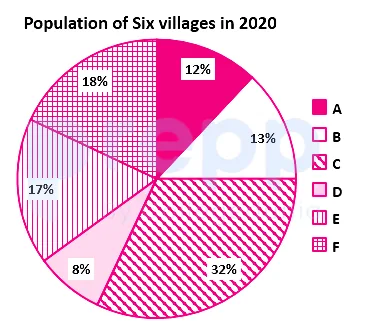
- A
15,570
- B
15,750
- C
17,550
- D
7,875
Show answer
B. 15,750Calculation
The population of village D(8%) in 2020 = 10,500.
The population of village A in 2020 = 12%
⇒ 8% → 10500
⇒ 12% → 10500 × 12/8
= 5250 × 3 = 15750
The population of village A in 2020 is 15750.
Paper & answer key PDF ↗ Question 56archived
What is the value of 64x3 + 38x2y + 20xy2 + y3, when x = 3 and y = - 4?
- A
1256
- B
488
- C
1236
- D
536
Show answer
A. 1256Evaluating Algebraic Expressions with Given Values
The question asks us to find the value of the algebraic expression \(64x^3 + 38x^2y + 20xy^2 + y^3\) when specific values for \(x\) and \(y\) are provided. We are given \(x = 3\) and \(y = -4\). To solve this, we need to substitute these values into the expression and perform the necessary calculations.
Steps to Evaluate the Expression
We will follow these steps:
Write down the given algebraic expression.
Substitute the given values of \(x\) and \(y\) into the expression.
Calculate the value of each term in the expression.
Add or subtract the values of the terms to find the final value of the expression.
The given expression is: \(64x^3 + 38x^2y + 20xy^2 + y^3\)
The given values are: \(x = 3\) and \(y = -4\)
Substitution and Calculation
Substitute \(x = 3\) and \(y = -4\) into the expression:
\(64(3)^3 + 38(3)^2(-4) + 20(3)(-4)^2 + (-4)^3\)
Now, let's calculate each term separately:
Term 1: \(64x^3 = 64(3)^3\)
First, calculate \(3^3\): \(3 \times 3 \times 3 = 9 \times 3 = 27\)
Now, multiply by 64: \(64 \times 27\)
\(64 \times 27 = 1728\)
Term 2: \(38x^2y = 38(3)^2(-4)\)
First, calculate \(3^2\): \(3 \times 3 = 9\)
Now, multiply 38 by 9: \(38 \times 9 = 342\)
Finally, multiply by -4: \(342 \times (-4) = -1368\)
Term 3: \(20xy^2 = 20(3)(-4)^2\)
First, calculate \((-4)^2\): \((-4) \times (-4) = 16\)
Now, multiply 20 by 3: \(20 \times 3 = 60\)
Finally, multiply by 16: \(60 \times 16 = 960\)
Term 4: \(y^3 = (-4)^3\)
Calculate \((-4)^3\): \((-4) \times (-4) \times (-4) = 16 \times (-4) = -64\)
Now, we add the values of the calculated terms:
\(1728 + (-1368) + 960 + (-64)\)
\(1728 - 1368 + 960 - 64\)
Perform the additions and subtractions:
\(1728 - 1368 = 360\)
\(960 - 64 = 896\)
Wait, let's combine the terms as they appear:
\(1728 - 1368 = 360\)
\(360 + 960 = 1320\)
\(1320 - 64 = 1256\)
So, the value of the expression \(64x^3 + 38x^2y + 20xy^2 + y^3\) when \(x = 3\) and \(y = -4\) is 1256.
Let's summarize the term values in a table:
Term
Calculation
Value
\(64x^3\)
\(64(3)^3 = 64 \times 27\)
1728
\(38x^2y\)
\(38(3)^2(-4) = 38 \times 9 \times (-4) = 342 \times (-4)\)
-1368
\(20xy^2\)
\(20(3)(-4)^2 = 20 \times 3 \times 16 = 60 \times 16\)
960
\(y^3\)
\((-4)^3\)
-64
Total value = \(1728 + (-1368) + 960 + (-64) = 1728 - 1368 + 960 - 64 = 1256\)
Conclusion
By substituting \(x = 3\) and \(y = -4\) into the expression \(64x^3 + 38x^2y + 20xy^2 + y^3\) and performing the calculations, we found the value of the expression to be 1256.
Revision Table: Key Concepts for Expression Evaluation
Concept
Description
Example
Algebraic Expression
A mathematical phrase that can contain numbers, variables, and operators.
\(2x + 5y - 3\)
Variable
A symbol (usually a letter) representing a quantity that may change.
\(x\), \(y\) in \(x+y=7\)
Term
A single number or variable, or numbers and variables multiplied together. Terms are separated by + or - signs.
In \(3x^2 + 2xy - 5\), the terms are \(3x^2\), \(2xy\), and \(-5\).
Evaluating an Expression
Finding the numerical value of an expression by substituting given values for the variables and performing the operations.
Evaluating \(2x+3\) for \(x=4\): \(2(4)+3 = 8+3=11\).
Order of Operations
The rule that states the sequence in which multiple operations in an expression should be performed (Parentheses, Exponents, Multiplication and Division, Addition and Subtraction). Often remembered by PEMDAS or BODMAS.
To calculate \(2 + 3 \times 4\), multiply first: \(2 + 12 = 14\).
Additional Information: Polynomial Expressions
The expression \(64x^3 + 38x^2y + 20xy^2 + y^3\) is a type of polynomial, specifically a homogeneous polynomial because every term has the same total degree (the sum of the exponents of the variables in the term). In this case, the degree of each term is 3 (\(x^3\), \(x^2y\) - degree 2+1=3, \(xy^2\) - degree 1+2=3, \(y^3\) - degree 3).
Evaluating polynomials is a fundamental skill in algebra and is used in many areas of mathematics and science. When evaluating, it's crucial to pay close attention to the signs of the numbers, especially when dealing with negative values and exponents, as seen with \(y = -4\) in this problem.
When a negative number is raised to an even power, the result is positive (e.g., \((-4)^2 = 16\)).
When a negative number is raised to an odd power, the result is negative (e.g., \((-4)^3 = -64\)).
Accuracy in calculation is key to getting the correct value of the expression.
Paper & answer key PDF ↗ Question 57archived
X and Y can complete a work in 9 days and 36 days, respectively. X begins to do the work and they work alternately one at a time for one day each. The whole work will be complete in:
- A
\(12 \frac{1}{2} \text { days } \)
- B
\(14 \frac{1}{4} \text { days } \)
- C
\(13 \frac{1}{3} \text { days } \)
- D
\(15 \frac{1}{5} \text { days }\)
Show answer
B. \(14 \frac{1}{4} \text { days } \)Solving Work and Time Problems with Alternating Days
This problem involves two individuals, X and Y, working on a task alternately. To solve this type of work and time problem, we first need to determine their individual work rates and then calculate the amount of work done in one complete cycle of alternation.
Understanding Individual Work Rates
The work rate of a person is the amount of work they can complete in one day. It is the reciprocal of the number of days they take to complete the whole work.
X can complete the work in 9 days. So, X's work rate is $\frac{1}{9}$ of the work per day.
Y can complete the work in 36 days. So, Y's work rate is $\frac{1}{36}$ of the work per day.
Calculating Work Done in One Alternating Cycle
They work alternately, with X starting. A full cycle consists of X working for one day and then Y working for one day. This cycle spans two days.
On Day 1, X works and completes $\frac{1}{9}$ of the work.
On Day 2, Y works and completes $\frac{1}{36}$ of the work.
Work done in one cycle (2 days) = Work done by X on Day 1 + Work done by Y on Day 2
Work done in one cycle = $\frac{1}{9} + \frac{1}{36}$
To add these fractions, we find a common denominator, which is 36.
$\frac{1}{9} = \frac{1 \times 4}{9 \times 4} = \frac{4}{36}$
Work done in one cycle = $\frac{4}{36} + \frac{1}{36} = \frac{4+1}{36} = \frac{5}{36}$ of the work.
So, $\frac{5}{36}$ of the work is completed in every 2-day cycle.
Determining the Number of Full Cycles
We need to find out how many full cycles are required to complete as much work as possible without exceeding the total work (which is 1). The work done per cycle is $\frac{5}{36}$.
Let $n$ be the number of cycles. The work done after $n$ cycles is $n \times \frac{5}{36}$. We want to find the largest integer $n$ such that $n \times \frac{5}{36} < 1$.
Multiply both sides by 36:
$5n < 36$
$n < \frac{36}{5} = 7.2$
The largest integer $n$ less than 7.2 is 7. So, 7 full cycles will be completed.
Time taken for 7 cycles = 7 cycles $\times$ 2 days/cycle = 14 days.
Work completed after 7 cycles = 7 $\times \frac{5}{36} = \frac{35}{36}$ of the work.
Calculating Remaining Work
After 7 cycles, the remaining work is:
Remaining work = Total work - Work done after 7 cycles
Remaining work = $1 - \frac{35}{36} = \frac{36}{36} - \frac{35}{36} = \frac{1}{36}$ of the work.
Completing the Remaining Work
After 7 full cycles (14 days), X just finished their turn as the last person in the 7th cycle (since X starts the first cycle). Thus, it is X's turn to work on the 15th day.
X's work rate is $\frac{1}{9}$ of the work per day.
The remaining work is $\frac{1}{36}$.
Time taken by X to complete the remaining work = $\frac{\text{Remaining Work}}{\text{X's Work Rate}}$
Time taken by X = $\frac{1/36}{1/9} = \frac{1}{36} \times \frac{9}{1} = \frac{9}{36} = \frac{1}{4}$ day.
Total Time Taken
The total time taken to complete the work is the time for 7 cycles plus the time taken by X to complete the remaining work.
Total time = Time for 7 cycles + Time for remaining work
Total time = 14 days + $\frac{1}{4}$ day = $14 \frac{1}{4}$ days.
Thus, the whole work will be complete in $14 \frac{1}{4}$ days.
Day
Worker
Work Done on Day
Total Work Done
1
X
$\frac{1}{9}$
$\frac{1}{9}$
2
Y
$\frac{1}{36}$
$\frac{1}{9} + \frac{1}{36} = \frac{5}{36}$ (End of Cycle 1)
3
X
$\frac{1}{9}$
$\frac{5}{36} + \frac{1}{9} = \frac{5}{36} + \frac{4}{36} = \frac{9}{36}$
4
Y
$\frac{1}{36}$
$\frac{9}{36} + \frac{1}{36} = \frac{10}{36}$ (End of Cycle 2)
...
...
...
...
13
X
$\frac{1}{9}$
(Work after 6 cycles) + $\frac{1}{9} = \frac{6 \times 5}{36} + \frac{1}{9} = \frac{30}{36} + \frac{4}{36} = \frac{34}{36}$
14
Y
$\frac{1}{36}$
$\frac{34}{36} + \frac{1}{36} = \frac{35}{36}$ (End of Cycle 7)
15
X
Work needed: $\frac{1}{36}$
$\frac{35}{36} + \frac{1}{36} = \frac{36}{36} = 1$ (Work complete)
Time taken by X on Day 15
$\frac{\text{Remaining Work}}{\text{X's Rate}} = \frac{1/36}{1/9} = \frac{1}{4}$ day
Total Time
14 days (for 7 cycles) + $\frac{1}{4}$ day = $14 \frac{1}{4}$ days
Revision Table: Key Concepts in Work and Time
Concept
Explanation
Formula
Work Rate
Amount of work done by a person in one unit of time (e.g., per day).
Work Rate = $\frac{1}{\text{Time taken to complete work}}$
Total Work
Usually considered as 1 unit or a common multiple of individual times.
Work Done
Work Done = Work Rate $\times$ Time
Alternating Work
People work on consecutive days or time units. Calculate work done in one cycle of turns.
Work per cycle = Sum of work rates for one turn of each person in the cycle
Additional Information: Alternate Work Problems
When solving alternating work problems, it is crucial to identify:
The individual work rates.
The composition of one full work cycle (who works in what order and for how long in one turn).
The total work done in one cycle.
The number of full cycles needed to complete most of the work without exceeding the total.
The remaining work after the full cycles.
Who is scheduled to work after the full cycles are complete.
The time taken by that person to finish the remaining work.
The total time by adding the time for full cycles and the time for remaining work.
Always pay attention to who starts the work, as this determines whose turn it is after a certain number of days or cycles.
Paper & answer key PDF ↗ Question 58archived
A shopkeeper uses 940 gm weight in place of one kg weight. He sells it at 4% profit. What will be the actual profit percentage? (rounded off to two decimal places)
- A
9.25%
- B
10.32%
- C
10.64%
- D
10.96%
Show answer
C. 10.64%Calculating Actual Profit Percentage with False Weights
This problem involves a shopkeeper who uses a faulty weight and also sells goods at a stated profit margin. We need to determine the true profit percentage the shopkeeper makes by combining these two factors.
Here's how we can break down the problem:
The shopkeeper intends to sell 1 kg (1000 gm) but actually sells only 940 gm. This is a deception related to the quantity.
The shopkeeper claims to sell at a 4% profit on the price he expects for 1 kg. This is the stated, or nominal, profit.
The actual profit is based on the difference between the actual cost of the goods sold and the price received for that quantity.
Step-by-Step Profit Calculation
Let's assume a base price to make the calculation clear. Suppose the shopkeeper buys goods at a cost price (CP) of Rs. 1 per gram.
Calculate the Actual Cost of Goods Sold:
The shopkeeper sells 940 gm of goods.
The actual cost price for 940 gm is \( 940 \text{ gm} \times \text{Rs. } 1/\text{gm} = \text{Rs. } 940 \).
So, the actual CP for the quantity sold is Rs. 940.
Calculate the Selling Price Charged:
The shopkeeper claims to sell based on the weight of 1 kg (1000 gm).
The cost price for 1 kg would be \( 1000 \text{ gm} \times \text{Rs. } 1/\text{gm} = \text{Rs. } 1000 \).
He sells at a nominal profit of 4% on this price.
Nominal Selling Price (SP) for 1 kg = CP of 1 kg + 4% of CP of 1 kg
Nominal SP for 1 kg = \( \text{Rs. } 1000 + \frac{4}{100} \times \text{Rs. } 1000 \)
Nominal SP for 1 kg = \( \text{Rs. } 1000 + \text{Rs. } 40 = \text{Rs. } 1040 \).
This Rs. 1040 is the price he charges the customer for the 940 gm he actually provides.
So, the actual SP for the quantity sold is Rs. 1040.
Calculate the Actual Profit:
Actual Profit = Actual Selling Price - Actual Cost Price
Actual Profit = Rs. 1040 - Rs. 940 = Rs. 100.
Calculate the Actual Profit Percentage:
The actual profit percentage is calculated on the actual cost price of the goods sold.
Actual Profit Percentage \( = \frac{\text{Actual Profit}}{\text{Actual Cost Price}} \times 100\% \)
Actual Profit Percentage \( = \frac{\text{Rs. } 100}{\text{Rs. } 940} \times 100\% \)
Actual Profit Percentage \( = \frac{100}{940} \times 100\% \)
Actual Profit Percentage \( = \frac{1000}{94}\% \)
Actual Profit Percentage \( = \frac{500}{47}\% \)
Convert the Fraction to Decimal and Round Off:
Now, we calculate the decimal value of \( \frac{500}{47} \):
\( \frac{500}{47} \approx 10.63829... \)
Rounding this to two decimal places gives 10.64%.
So, despite claiming a 4% profit, the shopkeeper makes an actual profit of approximately 10.64% due to using a false weight.
Item
Value
Nominal weight (claimed)
1 kg (1000 gm)
False weight used (actual)
940 gm
Assumed CP per gram
Rs. 1
CP of 1 kg (for calculation)
Rs. 1000
Nominal Profit %
4%
Nominal SP for 1 kg
Rs. 1040
Actual quantity sold
940 gm
Actual CP of quantity sold
Rs. 940
Actual SP of quantity sold
Rs. 1040
Actual Profit
Rs. 100
Actual Profit %
\( \frac{100}{940} \times 100\% \approx 10.64\% \)
Revision Table: Key Terms
Understanding the key terms helps in solving problems involving profit and loss, especially with false weights.
Cost Price (CP): The price at which an article is purchased.
Selling Price (SP): The price at which an article is sold.
Nominal Profit: The profit calculated based on the declared or intended weight and price, before considering any deceit like false weights.
Actual Profit: The true profit calculated based on the actual quantity of goods sold and their actual cost.
False Weight: Using a weight less than the declared weight while selling goods, increasing the actual profit margin.
Additional Information on False Weight Problems
Problems involving false weights are common in profit and loss calculations. The core idea is that the shopkeeper is selling less quantity than what is being paid for. The profit comes from two sources:
The declared profit margin on the nominal weight.
The extra amount gained by selling a smaller quantity at the price of a larger one.
The crucial step is to correctly identify the actual cost of the goods that are physically handed over to the customer and the price received for them. The actual profit percentage is always calculated on the actual cost price of the quantity sold.
A quick formula for profit percentage in case of selling at cost price but using false weight:
\( \text{Profit % } = \frac{\text{(True Weight - False Weight)}}{\text{False Weight}} \times 100\% \)
In our problem, the shopkeeper also adds a 4% profit. Let's say CP of 1gm is Rs. 1.
He sells 940gm but charges for 1000gm at 4% profit on cost of 1000gm.
Actual CP of 940gm = Rs. 940.
SP = 1000 * 1.04 = Rs. 1040.
Profit = 1040 - 940 = Rs. 100.
Profit % = \( \frac{100}{940} \times 100 = \frac{1000}{94} = \frac{500}{47} \approx 10.64\% \).
This confirms the method used above which accounts for both false weight and nominal profit.
Paper & answer key PDF ↗ Question 59archived
If D is the midpoint of BC in △ABC and ∠A = 90⁰, then AD = _______.
- A
\(\frac{BC}{4}\)
- B
2BC
- C
\(\frac{BC}{2}\)
- D
BC
Show answer
C. \(\frac{BC}{2}\)The correct answer is \frac{BC}{2}.
The length of AD can be found using the distance formula between A(0,0) and D(\frac{b}{2}, \frac{c}{2}): AD = \sqrt{\left(\frac{b}{2}-0\right)^2 + \left(\frac{c}{2}-0\right)^2} = \sqrt{\left(\frac{b}{2}\right)^2 + \left(\frac{c}{2}\right)^2} = \sqrt{\frac{b^2}{4} + \frac{c^2}{4}} = \sqrt{\frac{b^2 + c^2}{4}} = \frac{\sqrt{b^2 + c^2}}{2}. The length of the hypotenuse BC can be found using the distance formula between B(b,0) and C(0,c): BC = \sqrt{(0-b)^2 + (c-0)^2} = \sqrt{(-b)^2 + c^2} = \sqrt{b^2 + c^2}. Comparing AD and BC, we see that AD = \frac{BC}{2}. Both methods demonstrate why the median to the hypotenuse is half its length, reinforcing the property used to solve the problem.
Paper & answer key PDF ↗ Question 60archived
In what ratio must water be mixed with milk, costing₹32 per litre, in order to get a mixture costing₹28 per litre?
- A
8 ∶ 1
- B
1 ∶ 7
- C
1 ∶ 8
- D
7 ∶ 1
Show answer
B. 1 ∶ 7Understanding the Milk and Water Mixture Problem
This problem asks us to find the correct ratio of water to be mixed with milk of a known cost so that the resulting mixture has a specific lower cost. Problems like this are commonly solved using the concept of weighted averages or the Alligation method.
Applying the Alligation Method for Mixture Ratios
The Alligation method is a simplified technique used to find the ratio in which two or more ingredients at given prices should be mixed to produce a mixture of a desired price. Here's how we apply it to the milk and water mixture:
We have two components:
Milk: Costing ₹32 per litre.
Water: We assume the cost of water is ₹0 per litre, as it is typically considered free when mixed in such contexts.
The desired cost of the final mixture is ₹28 per litre.
We can set up the Alligation diagram:
Component
Price (₹/litre)
Milk
32
Water
0
Desired Mixture Price: ₹28/litre
Steps for Alligation:
Write the prices of the two components on the top left and top right corners. Let's put the cheaper component (water) on the left and the costlier component (milk) on the right.
Write the desired mixture price in the center.
Find the absolute difference between the mixture price and the price of the costlier component. Write this difference diagonally opposite, under the cheaper component.
Find the absolute difference between the mixture price and the price of the cheaper component. Write this difference diagonally opposite, under the costlier component.
The ratio of the quantities of the two components is the ratio of these differences.
Let's calculate the differences:
Difference (Milk Price - Mixture Price) = $|32 - 28| = 4$. This difference corresponds to the quantity of Water.
Difference (Mixture Price - Water Price) = $|28 - 0| = 28$. This difference corresponds to the quantity of Milk.
Cheaper Component (Water)
Costlier Component (Milk)
₹0/litre
₹32/litre
Mixture Price: ₹28/litre
Difference (Milk - Mixture)
Difference (Mixture - Water)
$|32 - 28| = 4$
$|28 - 0| = 28$
The ratio of the quantity of Water to the quantity of Milk is the difference under the Water column to the difference under the Milk column.
Ratio of Water : Milk = $4 : 28$
Simplifying the Ratio
The ratio $4 : 28$ can be simplified by dividing both numbers by their greatest common divisor, which is 4.
$4 \div 4 = 1$
$28 \div 4 = 7$
So, the simplified ratio of Water to Milk is $1 : 7$.
Therefore, water must be mixed with milk in the ratio of 1 : 7 to obtain a mixture costing ₹28 per litre.
Revision Table: Key Concepts
Concept
Explanation
Application Here
Alligation Method
A rule to find the ratio of ingredients when their prices and the desired mixture price are known.
Used to find the ratio of water and milk volumes.
Cost of Water
Assumed as ₹0/litre in mixture problems unless specified otherwise.
Used as one of the component prices.
Ratio Simplification
Dividing both parts of a ratio by their greatest common divisor to get the simplest form.
Simplified 4:28 to 1:7.
Ratio Order
The order in which the ratio is stated (e.g., Water to Milk vs. Milk to Water) is crucial.
Question asks for "water to milk", so the ratio is 1:7.
Additional Information on Mixture Problems
Mixture problems can involve various scenarios, such as mixing liquids with different concentrations, mixing different types of goods with different costs, or finding the overall average when quantities and rates are known. The Alligation method is particularly useful for problems involving mixing two components to achieve a target average price or concentration.
Key aspects to remember:
Ensure all prices or concentrations are in the same units.
Place the mixture value between the two component values in the Alligation diagram.
The differences obtained diagonally represent the ratio of the quantities of the components.
Always check what ratio the question is asking for (e.g., component A to B or B to A).
Paper & answer key PDF ↗ Question 61archived
5 women and 9 girls earn a total of ₹18,720 in 9 days, while 9 women and 16 girls earn a total of ₹ 52,080 in 14 days. How much will 12 women and 7 girls together earn (in ₹) in 13 days?
- A
42510
- B
41990
- C
42380
- D
42120
Show answer
D. 42120Understanding the Problem: Calculating Earnings
This question asks us to determine the total earnings of a specific group of women and girls over a certain number of days, given information about the earnings of two other groups over different periods. To solve this, we first need to find the individual daily earning rate of a woman and a girl.
Step-by-Step Solution to Finding Daily Earnings
Let's denote the daily earning of one woman as \(w\) and the daily earning of one girl as \(g\). We are given two scenarios:
5 women and 9 girls earn a total of ₹18,720 in 9 days.
9 women and 16 girls earn a total of ₹52,080 in 14 days.
From these scenarios, we can set up equations based on the total daily earning multiplied by the number of days.
Setting up Equations for Daily Earning
In the first scenario, the total daily earning of 5 women and 9 girls is \(5w + 9g\). Over 9 days, their total earning is ₹18,720. So, we have:
\((5w + 9g) \times 9 = 18720\)
Dividing both sides by 9 to find the total daily earning:
\(5w + 9g = \frac{18720}{9}\)
\(5w + 9g = 2080\) (Equation 1)
In the second scenario, the total daily earning of 9 women and 16 girls is \(9w + 16g\). Over 14 days, their total earning is ₹52,080. So, we have:
\((9w + 16g) \times 14 = 52080\)
Dividing both sides by 14 to find the total daily earning:
\(9w + 16g = \frac{52080}{14}\)
\(9w + 16g = 3720\) (Equation 2)
Solving the System of Linear Equations
We now have a system of two linear equations with two variables:
Equation 1: \(5w + 9g = 2080\)
Equation 2: \(9w + 16g = 3720\)
We can solve this system using the elimination method. Let's multiply Equation 1 by 9 and Equation 2 by 5 to make the coefficients of \(w\) equal:
Multiply Equation 1 by 9:
\(9 \times (5w + 9g) = 9 \times 2080\)
\(45w + 81g = 18720\) (Equation 3)
Multiply Equation 2 by 5:
\(5 \times (9w + 16g) = 5 \times 3720\)
\(45w + 80g = 18600\) (Equation 4)
Now, subtract Equation 4 from Equation 3:
\((45w + 81g) - (45w + 80g) = 18720 - 18600\)
\(45w - 45w + 81g - 80g = 120\)
\(g = 120\)
So, the daily earning of one girl is ₹120.
Now substitute the value of \(g\) into Equation 1 to find the value of \(w\):
\(5w + 9(120) = 2080\)
\(5w + 1080 = 2080\)
\(5w = 2080 - 1080\)
\(5w = 1000\)
\(w = \frac{1000}{5}\)
\(w = 200\)
So, the daily earning of one woman is ₹200.
Calculating Earnings for 12 Women and 7 Girls in 13 Days
We need to find the total earning of 12 women and 7 girls in 13 days. First, calculate their total daily earning:
Total daily earning = \(12w + 7g\)
Substitute the values \(w = 200\) and \(g = 120\):
Total daily earning = \(12(200) + 7(120)\)
Total daily earning = \(2400 + 840\)
Total daily earning = ₹3240
Now, calculate the total earning over 13 days:
Total earning in 13 days = (Total daily earning) \(\times\) (Number of days)
Total earning in 13 days = \(3240 \times 13\)
\[
3240 \times 13 = 3240 \times (10 + 3) = 32400 + 3240 \times 3 = 32400 + 9720 = 42120
\]
The total earning of 12 women and 7 girls in 13 days is ₹42,120.
Summary of Daily Earnings
Person Type
Daily Earning (₹)
Woman
200
Girl
120
Final Answer
12 women and 7 girls together will earn ₹42,120 in 13 days.
Revision Table: Earning Calculation Summary
Item
Value/Formula
Woman's Daily Earning (\(w\))
₹200
Girl's Daily Earning (\(g\))
₹120
Total Daily Earning (12 Women, 7 Girls)
\(12w + 7g = 12(200) + 7(120) = 2400 + 840 = 3240\)
Total Earning (12 Women, 7 Girls in 13 days)
\(3240 \times 13 = 42120\)
Additional Information: Work and Wages Problems
Problems involving work and wages often require you to determine the individual rates at which workers complete a task or earn money. Key concepts include:
Individual Rate: The amount of work done or money earned by one person in one unit of time (usually a day).
Combined Rate: The sum of individual rates when multiple people work together.
Total Work/Earning: The combined rate multiplied by the time duration.
If different types of workers have different rates, setting up a system of linear equations, as we did here, is a common method to find the individual rates. Once the individual rates are known, you can calculate the combined rate for any group and then find the total work done or money earned for any given time period.
This type of problem is an application of simultaneous linear equations in a real-world context.
Paper & answer key PDF ↗ Question 62archived
An electronic store owner allows two successive discounts of 20% and 25% on each item. The store has a reward points scheme which enables a customer to get free shopping worth ₹0.10 on every 1 reward point credited to the customer’s account on previous purchases from the store. A customer decides to buy a laptop that is marked at ₹72,000. What will be its net selling price if he has 2850 reward points to his credit?
- A
₹43,200
- B
₹42,915
- C
₹42,215
- D
₹42,942
Show answer
B. ₹42,915Calculating Net Selling Price with Successive Discounts and Reward Points
Let's break down the calculation to find the final net selling price of the laptop after applying the successive discounts and using the reward points.
Step 1: Understand the Marked Price and Discounts
The laptop is marked at ₹72,000. The store offers two successive discounts: 20% and 25%. Successive discounts are applied one after the other on the remaining price.
Marked Price = ₹72,000
First Discount Rate = 20%
Second Discount Rate = 25%
Step 2: Calculate the Price After the First Discount
The first discount of 20% is applied to the marked price.
Price after 1st discount = Marked Price - (20% of Marked Price)
Using LaTeX for calculation:
\(
\text{Price after 1st discount} = \text{₹}72,000 - (0.20 \times \text{₹}72,000) \\
= \text{₹}72,000 - \text{₹}14,400 \\
= \text{₹}57,600
\)
Step 3: Calculate the Price After the Second Successive Discount
The second discount of 25% is applied to the price *after* the first discount (₹57,600).
Price after 2nd discount = Price after 1st discount - (25% of Price after 1st discount)
Using LaTeX for calculation:
\(
\text{Price after 2nd discount} = \text{₹}57,600 - (0.25 \times \text{₹}57,600) \\
= \text{₹}57,600 - \text{₹}14,400 \\
= \text{₹}43,200
\)
This ₹43,200 is the selling price after applying both successive discounts, before considering reward points.
Step 4: Calculate the Value of Reward Points
The customer has 2850 reward points, and each point is worth ₹0.10.
Value of reward points = Number of points × Value per point
Using LaTeX for calculation:
\(
\text{Value of reward points} = 2850 \times \text{₹}0.10 \\
= \text{₹}285
\)
So, the customer can get a reduction of ₹285 using their reward points.
Step 5: Calculate the Net Selling Price After Using Reward Points
The net selling price is the price after discounts minus the value of the reward points used.
Net Selling Price = Price after both discounts - Value of reward points
Using LaTeX for calculation:
\(
\text{Net Selling Price} = \text{₹}43,200 - \text{₹}285 \\
= \text{₹}42,915
\)
Therefore, the net selling price of the laptop for the customer is ₹42,915.
Item
Amount (₹)
Marked Price
72,000
Price after 20% discount
57,600
Price after successive 25% discount
43,200
Value of 2850 Reward Points (₹0.10 each)
285
Net Selling Price
42,915
Revision Table: Key Concepts
Concept
Explanation
Marked Price
The original price of an item displayed in the store.
Successive Discounts
When multiple discounts are applied one after the other. Each subsequent discount is applied to the price remaining after the previous discount.
Reward Points
Points earned on previous purchases that can be redeemed for a monetary value or discount on future purchases.
Net Selling Price
The final price a customer pays after all discounts, offers, and redemptions (like reward points) are applied.
Additional Information: Calculating Equivalent Single Discount
Instead of applying successive discounts step-by-step, you can calculate a single equivalent discount rate. If two successive discounts are D1% and D2%, the equivalent single discount D% is calculated as:
\(
D = D1 + D2 - \frac{D1 \times D2}{100}
\)
In this problem, D1 = 20% and D2 = 25%.
\(
D = 20 + 25 - \frac{20 \times 25}{100} \\
D = 45 - \frac{500}{100} \\
D = 45 - 5 \\
D = 40\%
\)
So, two successive discounts of 20% and 25% are equivalent to a single discount of 40%. Applying this to the marked price:
\(
\text{Price after discounts} = \text{Marked Price} \times (1 - \frac{\text{Equivalent Discount}}{100}) \\
= \text{₹}72,000 \times (1 - \frac{40}{100}) \\
= \text{₹}72,000 \times (1 - 0.40) \\
= \text{₹}72,000 \times 0.60 \\
= \text{₹}43,200
\)
This confirms the price after successive discounts calculated in Step 3. The net selling price is then found by subtracting the reward points value from this amount, as shown in Step 5.
Paper & answer key PDF ↗ Question 63archived
What is the value of a3 + b3 + c3 if (a + b + c) = 0?
- A
a2 + b2 + c2 - 3 abc
- B
0
- C
3 abc
- D
a2 + b2 + c2 - ab - bc - ca
Show answer
C. 3 abcUnderstanding the Algebraic Identity: \(a^3 + b^3 + c^3\) when \(a+b+c=0\)
This question asks for the value of the expression \(a^3 + b^3 + c^3\) under a specific condition: that the sum of the variables, \((a + b + c)\), is equal to zero.
To solve this, we need to recall a fundamental algebraic identity related to the sum of cubes of three terms. The identity is:
\[a^3 + b^3 + c^3 - 3abc = (a+b+c)(a^2 + b^2 + c^2 - ab - bc - ca)\]
This identity shows the relationship between the sum of the cubes (\(a^3 + b^3 + c^3\)), the product of the terms (\(3abc\)), the sum of the terms (\(a+b+c\)), and a quadratic expression (\(a^2 + b^2 + c^2 - ab - bc - ca\)).
Applying the Condition \((a + b + c) = 0\)
The problem gives us the condition \((a + b + c) = 0\). Let's substitute this condition into the algebraic identity:
\[a^3 + b^3 + c^3 - 3abc = \mathbf{(0)}(a^2 + b^2 + c^2 - ab - bc - ca)\]
When we multiply any expression by zero, the result is always zero. So, the right side of the equation becomes zero:
\[a^3 + b^3 + c^3 - 3abc = 0\]
Finding the Value of \(a^3 + b^3 + c^3\)
Now we have a simpler equation. We want to find the value of \(a^3 + b^3 + c^3\). To isolate this term, we can move the \(-3abc\) term to the other side of the equation by adding \(3abc\) to both sides:
\[a^3 + b^3 + c^3 = 0 + 3abc\]
Thus, we find that:
\[a^3 + b^3 + c^3 = 3abc\]
This is a very important special case of the algebraic identity. It tells us that whenever the sum of three quantities is zero, the sum of their cubes is equal to three times their product.
Let's verify with an example:
Let \(a=1\), \(b=-1\), and \(c=0\). Here, \(a+b+c = 1 + (-1) + 0 = 0\). The condition is satisfied.
\(a^3 + b^3 + c^3 = (1)^3 + (-1)^3 + (0)^3 = 1 + (-1) + 0 = 0\).
\(3abc = 3 \times (1) \times (-1) \times (0) = 0\).
In this case, \(a^3 + b^3 + c^3 = 3abc = 0\).
Let \(a=1\), \(b=2\), and \(c=-3\). Here, \(a+b+c = 1 + 2 + (-3) = 3 - 3 = 0\). The condition is satisfied.
\(a^3 + b^3 + c^3 = (1)^3 + (2)^3 + (-3)^3 = 1 + 8 + (-27) = 9 - 27 = -18\).
\(3abc = 3 \times (1) \times (2) \times (-3) = 3 \times (-6) = -18\).
In this case too, \(a^3 + b^3 + c^3 = 3abc = -18\).
These examples confirm that if \(a+b+c=0\), then \(a^3 + b^3 + c^3 = 3abc\).
Comparing with the Given Options
Based on our derivation, the value of \(a^3 + b^3 + c^3\) when \((a + b + c) = 0\) is \(3abc\). Let's look at the options:
\(a^2 + b^2 + c^2 - 3abc\) (Incorrect)
\(0\) (Incorrect, only true if \(abc=0\) as well)
\(3 abc\) (Correct)
\(a^2 + b^2 + c^2 - ab - bc - ca\) (Incorrect, this is part of the identity's factors)
The value is indeed \(3abc\).
Revision Table: Key Algebraic Identities
Identity
Formula
Sum of Cubes (General)
\(a^3 + b^3 + c^3 - 3abc = (a+b+c)(a^2 + b^2 + c^2 - ab - bc - ca)\)
Sum of Cubes (Special Case when \(a+b+c=0\))
\(a^3 + b^3 + c^3 = 3abc\)
Square of a Trinomial
\((a+b+c)^2 = a^2 + b^2 + c^2 + 2ab + 2bc + 2ca\)
Additional Information: Proof of the Identity \(a^3 + b^3 + c^3 - 3abc\)
Let's briefly look at how the main identity \(a^3 + b^3 + c^3 - 3abc = (a+b+c)(a^2 + b^2 + c^2 - ab - bc - ca)\) is derived. While not required to solve the problem, understanding the proof can deepen your knowledge of algebraic manipulations.
One common way to prove it involves starting with the sum of two cubes identity, \(x^3 + y^3 = (x+y)(x^2 - xy + y^2)\), and substituting \(x = a\) and \(y = b+c\). However, a more direct way is to expand the right-hand side of the main identity and see if it simplifies to the left-hand side.
Expand \((a+b+c)(a^2 + b^2 + c^2 - ab - bc - ca)\):
\(= a(a^2 + b^2 + c^2 - ab - bc - ca) + b(a^2 + b^2 + c^2 - ab - bc - ca) + c(a^2 + b^2 + c^2 - ab - bc - ca)\)
\(= (a^3 + ab^2 + ac^2 - a^2b - abc - a^2c) + (a^2b + b^3 + bc^2 - ab^2 - b^2c - abc) + (a^2c + b^2c + c^3 - abc - bc^2 - c^2a)\)
Now, let's group and cancel the terms:
\(a^3\)
\(b^3\)
\(c^3\)
\(ab^2\) cancels with \(-ab^2\)
\(ac^2\) cancels with \(-c^2a\) (which is the same as \(-ac^2\))
\(-a^2b\) cancels with \(a^2b\)
\(-abc\) (appears 3 times)
\(bc^2\) cancels with \(-bc^2\)
\(-b^2c\) cancels with \(b^2c\)
\(-a^2c\) cancels with \(a^2c\)
The terms that remain are \(a^3 + b^3 + c^3 - 3abc\).
This confirms the identity is correct. The special case \(a^3+b^3+c^3=3abc\) arises directly from this identity when the first factor on the right side, \((a+b+c)\), is zero.
Paper & answer key PDF ↗ Question 64archived
Evaluate the following:
cos(36° + A).cos(36° - A) + cos(54° + A).cos(54° - A)
- A
sin 2A
- B
cos A
- C
sin A
- D
cos 2A
Show answer
D. cos 2AEvaluating Trigonometric Expressions: Step-by-Step Solution
The question asks us to evaluate the expression $\cos(36^\circ + A).\cos(36^\circ - A) + \cos(54^\circ + A).\cos(54^\circ - A)$. This expression involves products of cosine functions, which suggests using trigonometric identities.
Understanding the Key Trigonometric Identity
We can use the product-to-sum identity: $2 \cos x \cos y = \cos(x+y) + \cos(x-y)$. This can be rewritten as $\cos x \cos y = \frac{1}{2}[\cos(x+y) + \cos(x-y)]$. We will apply this identity to both terms in the given expression.
Applying the Identity to the First Term
Consider the first term: $\cos(36^\circ + A).\cos(36^\circ - A)$.
Let $x = 36^\circ + A$ and $y = 36^\circ - A$.
Using the identity $\cos x \cos y = \frac{1}{2}[\cos(x+y) + \cos(x-y)]$, we calculate $x+y$ and $x-y$:
$x+y = (36^\circ + A) + (36^\circ - A) = 36^\circ + A + 36^\circ - A = 72^\circ$
$x-y = (36^\circ + A) - (36^\circ - A) = 36^\circ + A - 36^\circ + A = 2A$
So, the first term becomes:
$\cos(36^\circ + A).\cos(36^\circ - A) = \frac{1}{2}[\cos(72^\circ) + \cos(2A)] \quad \text{(Equation 1)}$
Applying the Identity to the Second Term
Now consider the second term: $\cos(54^\circ + A).\cos(54^\circ - A)$.
Let $x = 54^\circ + A$ and $y = 54^\circ - A$.
Using the same identity $\cos x \cos y = \frac{1}{2}[\cos(x+y) + \cos(x-y)]$, we calculate $x+y$ and $x-y$:
$x+y = (54^\circ + A) + (54^\circ - A) = 54^\circ + A + 54^\circ - A = 108^\circ$
$x-y = (54^\circ + A) - (54^\circ - A) = 54^\circ + A - 54^\circ + A = 2A$
So, the second term becomes:
$\cos(54^\circ + A).\cos(54^\circ - A) = \frac{1}{2}[\cos(108^\circ) + \cos(2A)] \quad \text{(Equation 2)}$
Combining the Results
The original expression is the sum of the first and second terms. Adding Equation 1 and Equation 2:
Expression = $\frac{1}{2}[\cos(72^\circ) + \cos(2A)] + \frac{1}{2}[\cos(108^\circ) + \cos(2A)]$
Expression = $\frac{1}{2}[\cos(72^\circ) + \cos(2A) + \cos(108^\circ) + \cos(2A)]$
Expression = $\frac{1}{2}[\cos(72^\circ) + \cos(108^\circ) + 2\cos(2A)]$
Using Complementary and Supplementary Angle Properties
We know that $\cos(180^\circ - \theta) = -\cos \theta$. We can use this for $\cos(108^\circ)$.
$\cos(108^\circ) = \cos(180^\circ - 72^\circ) = -\cos(72^\circ)$.
Substitute this back into the expression:
Expression = $\frac{1}{2}[\cos(72^\circ) + (-\cos(72^\circ)) + 2\cos(2A)]$
Expression = $\frac{1}{2}[\cos(72^\circ) - \cos(72^\circ) + 2\cos(2A)]$
Expression = $\frac{1}{2}[0 + 2\cos(2A)]$
Expression = $\frac{1}{2}[2\cos(2A)]$
Expression = $\cos(2A)$
Final Result
The value of the given expression is $\cos(2A)$.
Let's compare this with the given options:
Option 1: $\sin 2A$
Option 2: $\cos A$
Option 3: $\sin A$
Option 4: $\cos 2A$
Our result matches Option 4.
Step
Calculation/Reasoning
Result
1
Identify the form: Sum of products of cosines.
Use product-to-sum identity.
2
Apply $\cos x \cos y = \frac{1}{2}[\cos(x+y) + \cos(x-y)]$ to the first term.
$\frac{1}{2}[\cos(72^\circ) + \cos(2A)]$
3
Apply the identity to the second term.
$\frac{1}{2}[\cos(108^\circ) + \cos(2A)]$
4
Sum the two results.
$\frac{1}{2}[\cos(72^\circ) + \cos(108^\circ) + 2\cos(2A)]$
5
Use $\cos(180^\circ - \theta) = -\cos \theta$ for $\cos(108^\circ)$.
$\cos(108^\circ) = -\cos(72^\circ)$
6
Substitute and simplify.
$\frac{1}{2}[\cos(72^\circ) - \cos(72^\circ) + 2\cos(2A)] = \cos(2A)$
Revision Table: Trigonometric Identities
Identity Type
Identity
Product-to-Sum (Cosine)
$2\cos x \cos y = \cos(x+y) + \cos(x-y)$
Supplementary Angle (Cosine)
$\cos(180^\circ - \theta) = -\cos \theta$
Double Angle (Cosine)
$\cos(2A) = \cos^2 A - \sin^2 A = 2\cos^2 A - 1 = 1 - 2\sin^2 A$
Additional Information: Solving Trigonometric Problems
When solving trigonometric problems, it's often helpful to follow these steps:
Identify the form of the expression. Look for sums/differences of angles, products of trigonometric functions, powers of trigonometric functions, etc.
Recall relevant trigonometric identities. Common identities include Pythagorean identities, sum/difference formulas, product-to-sum, sum-to-product, double angle, half angle identities.
Simplify the expression using the chosen identities.
Look for special angle values ($\sin 30^\circ$, $\cos 60^\circ$, etc.) or relationships between terms that might cancel out or combine.
Continue simplifying until the expression matches one of the options or a known standard form.
In this problem, recognizing the product form $\cos X \cos Y$ was the key to applying the product-to-sum identity effectively.
Paper & answer key PDF ↗ Question 65archived
Study the given pie-chart and answer the question that follows.
The pie-chart shows the expenditure incurred in the preparation of a book by a publisher, under various heads.
What is the difference between the angle of pie-chart showing the expenditure incurred on binding and printing?
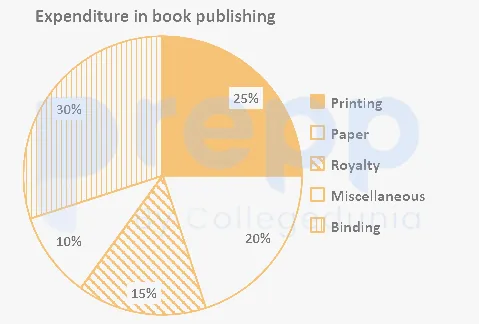
- A
15°
- B
20°
- C
18°
- D
22°
Show answer
C. 18°Given:
Expenditure incurred on binding = 30%
Expenditure incurred on printing = 25%
Calculation:
From the pie chart,
Total expenses = 100%
Total Central angle of circle = 360°
⇒ 100% →360°
The difference between the angle of the pie-chart showing the expenditure incurred on binding and printing = 30 - 25 = 5%
⇒ 5% ≡ (360/100) × 5 = 18°
∴ The central angle corresponding to the difference between the angle of pie-chart showing the expenditure incurred on binding and printing is 18°.
Paper & answer key PDF ↗ Question 66archived
If the total surface area of a cube is 24 sq.units, then what is the volume of the cube?
- A
8 cu.units
- B
16 cu.units
- C
10 cu.units
- D
4 cu.units
Show answer
A. 8 cu.unitsCalculating Cube Volume from Surface Area
The problem asks us to find the volume of a cube given its total surface area. We are provided with the total surface area as 24 square units.
To solve this, we need to use the formulas for the surface area and volume of a cube.
Cube Formulas
The total surface area of a cube is given by the formula: Total Surface Area $= 6 \times (\text{side})^2$. Let 's' represent the length of one side of the cube. So, Total Surface Area $= 6s^2$.
The volume of a cube is given by the formula: Volume $= (\text{side})^3$. So, Volume $= s^3$.
Step-by-Step Calculation
Step 1: Find the side length of the cube.
We know the total surface area is 24 sq. units. Using the surface area formula:
$\text{Total Surface Area} = 6s^2$
$24 = 6s^2$
To find $s^2$, we divide the total surface area by 6:
$s^2 = \frac{24}{6}$
$s^2 = 4$
Now, to find the side length 's', we take the square root of 4:
$s = \sqrt{4}$
Since the side length must be a positive value:
$s = 2$ units
So, the length of each side of the cube is 2 units.
Step 2: Calculate the volume of the cube.
Now that we have the side length, we can use the volume formula:
$\text{Volume} = s^3$
Substitute the value of 's' we found:
$\text{Volume} = (2)^3$
$\text{Volume} = 2 \times 2 \times 2$
$\text{Volume} = 8$ cubic units
Thus, the volume of the cube is 8 cubic units.
Let's verify with the options provided:
Option
Volume
Matches Calculation?
1
8 cu.units
Yes
2
16 cu.units
No
3
10 cu.units
No
4
4 cu.units
No
Our calculated volume matches the first option.
Revision Table: Cube Properties
Property
Formula (side = s)
Description
Side Length
s
Length of one edge of the cube
Total Surface Area
$6s^2$
Sum of the areas of all 6 faces
Volume
$s^3$
Space occupied by the cube
Additional Information: Understanding Cube Dimensions
A cube is a three-dimensional solid object bounded by six square faces, facets or sides, with three meetings at each vertex. It is a type of hexahedron.
All edges of a cube are of equal length.
All faces of a cube are congruent squares.
A cube has 6 faces, 12 edges, and 8 vertices.
The calculation of surface area involves finding the area of one square face ($s^2$) and multiplying it by the number of faces (6).
The calculation of volume involves multiplying the length, width, and height of the cube. Since all are equal to the side length 's', the volume is $s \times s \times s = s^3$.
Problems involving cubes often require you to use these fundamental formulas to find unknown dimensions or properties based on known values.
Paper & answer key PDF ↗ Question 67archived
Find the simplified value of the given expression.
\( 4 \frac{4}{5} \div \frac{3}{5}\) of \(5+\frac{4}{5} \times \frac{3}{10}-\frac{1}{5} \)
- A
\(40 \frac{1}{25} \)
- B
5
- C
\( 1 \frac{16}{25} \)
- D
6
Show answer
C. \( 1 \frac{16}{25} \)Given expression:
4 4/5 ÷ 3/5 of 5 + 4/5 × 3/10 – 1/5
Step 1: Convert the mixed number to improper fraction
4 4/5 = 24/5
Step 2: Simplify "of" part
3/5 of 5 = (3/5) × 5 = 3
Now:
24/5 ÷ 3 = 24/5 × 1/3 = 24/15 = 8/5
Step 3: Multiply the next terms
4/5 × 3/10 = 12/50 = 6/25
Step 4: Put it all together
8/5 + 6/25 – 1/5
Convert all to have denominator 25:
8/5 = 40/25
1/5 = 5/25
So:
40/25 + 6/25 – 5/25 = (40 + 6 – 5)/25 = 41/25
Final Answer:
41/25 or 1 16/25
Paper & answer key PDF ↗ Question 68archived
Let ABC, PQR be two congruent triangles such that angle A = angle P = 90°. If BC = 13 cm, PR = 5 cm, find AB.
- A
12 cm
- B
8 cm
- C
10 cm
- D
5 cm
Show answer
A. 12 cmFinding Side Length in Congruent Right Triangles ABC and PQR
We are given two triangles, ABC and PQR, which are congruent. This means that their corresponding sides and angles are equal in measure. The congruence statement is ABC $\cong$ PQR.
We are also given that both triangles are right-angled triangles, with the right angles at vertices A and P, respectively. So, $\angle A = 90^\circ$ and $\angle P = 90^\circ$.
The given side lengths are BC = 13 cm and PR = 5 cm.
Understanding Congruent Triangles Properties
When two triangles are congruent, their corresponding parts (sides and angles) are equal. From the congruence statement ABC $\cong$ PQR, we can identify the corresponding sides:
AB corresponds to PQ, so AB = PQ.
BC corresponds to QR, so BC = QR.
AC corresponds to PR, so AC = PR.
Similarly, the corresponding angles are:
$\angle A$ corresponds to $\angle P$, so $\angle A = \angle P$. (Given as $90^\circ$)
$\angle B$ corresponds to $\angle Q$, so $\angle B = \angle Q$.
$\angle C$ corresponds to $\angle R$, so $\angle C = \angle R$.
Applying Given Information to Triangle ABC
We are given BC = 13 cm. Since BC corresponds to QR, we know QR = 13 cm.
We are given PR = 5 cm. Since AC corresponds to PR, we know AC = 5 cm.
We are looking for the length of side AB in triangle ABC. We now know the following about triangle ABC:
$\angle A = 90^\circ$
BC = 13 cm (Hypotenuse, as it is opposite the right angle)
AC = 5 cm (One leg)
AB = ? (The other leg)
Using the Pythagorean Theorem
Since triangle ABC is a right-angled triangle at A, we can use the Pythagorean theorem. The theorem states that in a right-angled triangle, the square of the hypotenuse is equal to the sum of the squares of the other two sides (the legs).
For triangle ABC, the Pythagorean theorem is:
\( (Hypotenuse)^2 = (Leg\ 1)^2 + (Leg\ 2)^2 \)
\( BC^2 = AB^2 + AC^2 \)
Calculating the Length of AB
Substitute the known values into the Pythagorean theorem equation:
\( 13^2 = AB^2 + 5^2 \)
Calculate the squares:
\( 169 = AB^2 + 25 \)
To find \( AB^2 \), subtract 25 from 169:
\( AB^2 = 169 - 25 \)
\( AB^2 = 144 \)
To find AB, take the square root of 144:
\( AB = \sqrt{144} \)
\( AB = 12 \)
Since AB is a length, it must be a positive value. Therefore, AB = 12 cm.
We can verify this using the Pythagorean triple (5, 12, 13), which corresponds to the sides of a right-angled triangle.
Conclusion
Using the properties of congruent triangles and the Pythagorean theorem, we found that the length of side AB is 12 cm.
Revision Table: Key Concepts
ConceptDescriptionApplication Here
Congruent TrianglesTriangles with exactly the same size and shape. Corresponding sides and angles are equal.ABC $\cong$ PQR implies AC = PR and BC = QR.
Right-Angled TriangleA triangle with one angle measuring $90^\circ$. The side opposite the right angle is the hypotenuse.Triangle ABC is right-angled at A. BC is the hypotenuse.
Pythagorean TheoremIn a right triangle, \(a^2 + b^2 = c^2\), where a and b are legs and c is the hypotenuse.Used to find the missing side AB in $\triangle ABC$: \(AB^2 + AC^2 = BC^2\).
Additional Information: Congruence Criteria
Besides knowing that corresponding parts of congruent triangles are equal (CPCTC), there are criteria to determine if two triangles are congruent without checking all sides and angles. Some common criteria are:
SSS (Side-Side-Side): If three sides of one triangle are equal to three corresponding sides of another triangle.
SAS (Side-Angle-Side): If two sides and the included angle of one triangle are equal to two corresponding sides and the included angle of another triangle.
ASA (Angle-Side-Angle): If two angles and the included side of one triangle are equal to two corresponding angles and the included side of another triangle.
AAS (Angle-Angle-Side): If two angles and a non-included side of one triangle are equal to two corresponding angles and the corresponding non-included side of another triangle.
RHS (Right-angle-Hypotenuse-Side): For right-angled triangles, if the hypotenuse and one side of one triangle are equal to the hypotenuse and corresponding side of another right-angled triangle.
In this specific problem, knowing $\triangle ABC \cong \triangle PQR$ is given, so we directly used the property of corresponding sides being equal (AC = PR). We then used the Pythagorean theorem as $\triangle ABC$ is a right-angled triangle with two sides known.
Paper & answer key PDF ↗ Question 69archived
The mean proportion between 7 and 112 is:
- A
42
- B
28
- C
21
- D
14
Show answer
B. 28The correct answer is 28.
This is the fundamental property of proportion. For mean proportion <latex>a:b :: b:c</latex>, the product of extremes equals the product of means: <latex>ac = b \times b = b^2</latex>, which leads to <latex>b = \sqrt{ac}</latex>. This confirms the formula used. Mean proportion is a specific case of continuous proportion where the middle two terms are the same.
Paper & answer key PDF ↗ Question 70archived
4 women or 6 boys can finish a work in the same number of days. A boy can finish it in 60 days. In how many days can 5 women finish the work, working together every day?
- A
6
- B
4
- C
10
- D
8
Show answer
D. 8Understanding Time and Work Problems: Women vs Boys
This problem involves the concept of Time and Work, specifically dealing with different types of workers (women and boys) and their respective work rates. The key is to establish a relationship between the work rates of women and boys and then use the given information to find the total work required.
Calculating Total Work Capacity
We are given that a boy can finish the work in 60 days. If one boy works for 60 days, the total amount of work done can be considered as 60 'boy-days'.
Total Work $= 1 \text{ boy} \times 60 \text{ days} = 60 \text{ boy-days}$
Relating Work Rates of Women and Boys
The problem states that 4 women or 6 boys can finish the work in the same number of days. Let this number of days be $D$.
Work done by 4 women in $D$ days = Total Work
Work done by 6 boys in $D$ days = Total Work
Since both groups finish the same work in the same number of days:
Work done by 4 women = Work done by 6 boys (in the same time period)
Let $W_w$ be the work rate of one woman (work done per day) and $W_b$ be the work rate of one boy (work done per day).
$4 \times W_w = 6 \times W_b$
This equation shows the relationship between the collective work rate of 4 women and 6 boys. We can simplify this to find the relationship between individual work rates:
$W_w = \frac{6}{4} W_b = \frac{3}{2} W_b$
This means one woman works $\frac{3}{2}$ times as fast as one boy. Equivalently, 1 woman's work rate is equal to the work rate of 1.5 boys.
Expressing Total Work in Woman-Days
We know the total work is 60 boy-days. We can convert this to an equivalent amount of work in 'woman-days'.
Since 1 boy's work rate is $W_b$ and 1 woman's work rate is $W_w = \frac{3}{2} W_b$, 1 boy-day is equivalent to the amount of work a boy does in one day. To find its equivalent in woman-days, we can use the relationship $W_b = \frac{2}{3} W_w$.
Work done by 1 boy in 1 day = $1 \text{ boy} \times 1 \text{ day} = 1 \text{ boy-day}$.
Work done by 1 woman in 1 day = $1 \text{ woman} \times 1 \text{ day} = 1 \text{ woman-day}$.
From $4 \times W_w = 6 \times W_b$, we can say that the work done by 4 women in a day is equal to the work done by 6 boys in a day.
So, 4 woman-days are equivalent to 6 boy-days.
1 woman-day $= \frac{6}{4}$ boy-days $= \frac{3}{2}$ boy-days.
Alternatively, 1 boy-day $= \frac{4}{6}$ woman-days $= \frac{2}{3}$ woman-days.
Total Work $= 60 \text{ boy-days}$.
Let's convert this total work into woman-days:
Total Work $= 60 \times (1 \text{ boy-day}) = 60 \times \left(\frac{2}{3} \text{ woman-day}\right) = \frac{60 \times 2}{3} \text{ woman-days} = \frac{120}{3} \text{ woman-days} = 40 \text{ woman-days}$.
The total work is 40 woman-days.
Finding Days for 5 Women
We need to find the number of days it takes for 5 women to finish the total work (40 woman-days), working together every day.
Let the number of days required be $D_5$.
Work done by 5 women in $D_5$ days = Total Work
Number of women $\times$ Number of days = Total Work (in woman-days)
$5 \text{ women} \times D_5 \text{ days} = 40 \text{ woman-days}$
$5 \times D_5 = 40$
To find $D_5$, we divide the total work by the number of women:
$D_5 = \frac{40}{5}$
$D_5 = 8$ days.
Therefore, 5 women can finish the work in 8 days.
Summary of Steps:
Calculated the total work based on the boy's time: 60 boy-days.
Established the equivalence between women's and boys' work rates: 4 women = 6 boys.
Used the equivalence to convert total work into woman-days: 40 woman-days.
Calculated the time taken by 5 women using the total work in woman-days.
Revision Table: Time and Work Concepts
Concept
Explanation
Formula/Relation
Work Rate
Amount of work done by a person or group in one unit of time (e.g., per day).
Work Rate = Total Work / Time Taken
Total Work
The entire task to be completed. Can be represented as 1 unit or in terms of worker-days/hours.
Total Work = Work Rate $\times$ Time Taken
Worker-Days
A unit of work. If 1 worker does a job in $D$ days, total work is $D$ worker-days. If $M$ workers do it in $D$ days, total work is $M \times D$ worker-days.
Work = Number of Workers $\times$ Time
Comparing Workers
If $M_1$ workers of type 1 complete a job in time $T$ and $M_2$ workers of type 2 complete the same job in time $T$, then $M_1 \times \text{Rate}_1 = M_2 \times \text{Rate}_2$.
$M_1 \times D_1 = M_2 \times D_2$ (if work rate is constant per worker type)
Additional Information: Work and Time Efficiency
Problems involving work and time often assume that all workers of the same type have equal efficiency and that efficiency remains constant throughout the work. The total work is considered a fixed quantity.
Efficiency: Efficiency is inversely proportional to the time taken to complete a certain amount of work. If A is twice as efficient as B, A takes half the time B takes to do the same work. In our problem, since 1 woman works as fast as 1.5 boys, a woman is 1.5 times more efficient than a boy.
Multiple Workers: If $M$ workers of the same efficiency can do a job in $D$ days, then $M \times D$ is the total work unit (worker-days). If you change the number of workers to $M'$, the new time $D'$ will be such that $M' \times D' = M \times D$. So, $D' = (M \times D) / M'$. This assumes the work rate per worker is constant.
Combining Workers: When different types of workers are involved, like women and boys here, their work capacities are made equivalent. We found that the work rate of 4 women equals the work rate of 6 boys. This means 4 women are equivalent to 6 boys in terms of productivity over any given period. This equivalence is crucial for solving such problems.
Paper & answer key PDF ↗ Question 71archived
A 15 cm long perpendicular is drawn from the centre of a circle to its 40 cm long chord. Find the radius of the circle.
- A
25 cm
- B
27 cm
- C
22 cm
- D
20 cm
Show answer
A. 25 cmFinding the Radius of a Circle Using Chord and Perpendicular Distance
This problem involves a fundamental property of circles related to chords and the perpendicular drawn from the center. When a perpendicular is drawn from the center of a circle to a chord, it bisects the chord. This creates a right-angled triangle where:
One leg is the perpendicular distance from the center to the chord.
The other leg is half the length of the chord.
The hypotenuse is the radius of the circle.
We are given the following information:
Length of the perpendicular from the center to the chord = 15 cm
Length of the chord = 40 cm
First, let's find the length of half the chord:
$$ \text{Half chord length} = \frac{\text{Chord length}}{2} = \frac{40 \text{ cm}}{2} = 20 \text{ cm} $$
Now we have a right-angled triangle with legs of length 15 cm and 20 cm, and the hypotenuse is the radius (let's call it \(r\)). We can use the Pythagorean theorem to find the radius:
$$ (\text{Perpendicular distance})^2 + (\text{Half chord length})^2 = (\text{Radius})^2 $$
$$ (15 \text{ cm})^2 + (20 \text{ cm})^2 = r^2 $$
Let's calculate the squares:
$$ 15^2 = 15 \times 15 = 225 $$
$$ 20^2 = 20 \times 20 = 400 $$
Now substitute these values back into the Pythagorean theorem equation:
$$ 225 + 400 = r^2 $$
$$ 625 = r^2 $$
To find the radius \(r\), we need to take the square root of 625:
$$ r = \sqrt{625} $$
$$ r = 25 $$
So, the radius of the circle is 25 cm.
This solution demonstrates how applying geometric properties and the Pythagorean theorem allows us to find unknown lengths in a circle.
Revision Table: Key Concepts in Circle Geometry
Concept
Description
Relevance to Problem
Chord
A line segment connecting two points on a circle.
The problem provides the length of a chord.
Perpendicular from Center to Chord
A line segment from the center of the circle that intersects the chord at a 90° angle.
The problem provides the length of this perpendicular. It bisects the chord.
Radius
A line segment from the center of the circle to any point on the circle.
This is the value we need to find. It is the hypotenuse in the right triangle formed.
Pythagorean Theorem
In a right-angled triangle, the square of the hypotenuse is equal to the sum of the squares of the other two sides ($a^2 + b^2 = c^2$).
Used to relate the perpendicular, half-chord, and radius.
Additional Information on Circle Properties
Understanding properties of circles is crucial for solving geometry problems. Here are a few more related concepts:
Diameter: The longest chord passing through the center of the circle. It is twice the radius ($D = 2r$).
Tangent: A line that touches the circle at exactly one point. The radius drawn to the point of tangency is perpendicular to the tangent.
Arc: A portion of the circumference of a circle.
Sector: A region of a circle enclosed by two radii and an arc.
Segment: A region of a circle enclosed by a chord and an arc.
The property that a perpendicular from the center bisects a chord is a key theorem. Its converse is also true: the line segment joining the center to the midpoint of a chord is perpendicular to the chord. These properties are essential when dealing with lengths and distances within a circle.
Paper & answer key PDF ↗ Question 72archived
What is the value of sec2 54° - cot2 36° + \(\frac{3}{2}\) sin2 37° × sec2 53° + \(\frac{2}{\sqrt3}\) tan 60°?
- A
\(\frac{9}{2}\)
- B
\(\frac{5}{2}\)
- C
\(\frac{3}{2}\)
- D
\(\frac{7}{2}\)
Show answer
A. \(\frac{9}{2}\)Evaluating Trigonometric Expressions
We need to find the value of the given trigonometric expression:
\[ \sec^2 54^\circ - \cot^2 36^\circ + \frac{3}{2} \sin^2 37^\circ \times \sec^2 53^\circ + \frac{2}{\sqrt3} \tan 60^\circ \]
Let's break down the expression into parts and evaluate each part separately using trigonometric identities and standard values.
Part 1: Evaluating sec² 54° - cot² 36°
We observe that \(54^\circ\) and \(36^\circ\) are complementary angles, as \(54^\circ + 36^\circ = 90^\circ\).
Using the complementary angle identity \(\cot (90^\circ - \theta) = \tan \theta\):
\[ \cot 36^\circ = \cot (90^\circ - 54^\circ) = \tan 54^\circ \]
So, the expression becomes:
\[ \sec^2 54^\circ - \tan^2 54^\circ \]
Using the Pythagorean identity \(1 + \tan^2 \theta = \sec^2 \theta\), which can be rearranged as \(\sec^2 \theta - \tan^2 \theta = 1\):
\[ \sec^2 54^\circ - \tan^2 54^\circ = 1 \]
Thus, the value of the first part is \(1\).
Part 2: Evaluating \(\frac{3}{2}\) sin² 37° × sec² 53°
We observe that \(37^\circ\) and \(53^\circ\) are complementary angles, as \(37^\circ + 53^\circ = 90^\circ\).
Using the complementary angle identity \(\sec (90^\circ - \theta) = \csc \theta\):
\[ \sec 53^\circ = \sec (90^\circ - 37^\circ) = \csc 37^\circ \]
So, the expression becomes:
\[ \frac{3}{2} \sin^2 37^\circ \times \csc^2 37^\circ \]
Using the reciprocal identity \(\csc \theta = \frac{1}{\sin \theta}\), we have \(\csc^2 37^\circ = \frac{1}{\sin^2 37^\circ}\). Assuming \(\sin 37^\circ \neq 0\), which is true:
\[ \frac{3}{2} \sin^2 37^\circ \times \frac{1}{\sin^2 37^\circ} = \frac{3}{2} \times 1 = \frac{3}{2} \]
Thus, the value of the second part is \(\frac{3}{2}\).
Part 3: Evaluating \(\frac{2}{\sqrt3}\) tan 60°
We use the standard value of \(\tan 60^\circ\).
We know that \(\tan 60^\circ = \sqrt{3}\).
Substituting this value into the expression:
\[ \frac{2}{\sqrt{3}} \times \tan 60^\circ = \frac{2}{\sqrt{3}} \times \sqrt{3} = 2 \]
Thus, the value of the third part is \(2\).
Combining the Parts
Now, we combine the values of the three parts according to the original expression:
Original expression = (Value of Part 1) + (Value of Part 2) + (Value of Part 3)
\[ 1 + \frac{3}{2} + 2 \]
To add these values, we can convert them to a common denominator:
\[ \frac{2}{2} + \frac{3}{2} + \frac{4}{2} = \frac{2 + 3 + 4}{2} = \frac{9}{2} \]
The value of the given trigonometric expression is \(\frac{9}{2}\).
Trigonometric Identity / Value
Formula / Value
Complementary Angle (\(\cot\))
\(\cot (90^\circ - \theta) = \tan \theta\)
Complementary Angle (\(\sec\))
\(\sec (90^\circ - \theta) = \csc \theta\)
Pythagorean Identity
\(\sec^2 \theta - \tan^2 \theta = 1\)
Reciprocal Identity
\(\csc \theta = \frac{1}{\sin \theta}\)
Standard Value
\(\tan 60^\circ = \sqrt{3}\)
Revision Table: Key Trigonometric Concepts
Reviewing the concepts used in solving this problem is important for exam preparation.
Complementary Angles: Two angles are complementary if their sum is \(90^\circ\). Trigonometric functions of complementary angles are related (e.g., \(\sin \theta = \cos (90^\circ - \theta)\)).
Pythagorean Identities: Fundamental identities derived from the Pythagorean theorem (e.g., \(\sin^2 \theta + \cos^2 \theta = 1\), \(1 + \tan^2 \theta = \sec^2 \theta\), \(1 + \cot^2 \theta = \csc^2 \theta\)).
Reciprocal Identities: Define relationships between trigonometric functions and their reciprocals (e.g., \(\sec \theta = \frac{1}{\cos \theta}\), \(\csc \theta = \frac{1}{\sin \theta}\)).
Standard Angle Values: Knowing the values of trigonometric functions for specific angles like \(0^\circ, 30^\circ, 45^\circ, 60^\circ, 90^\circ\) is crucial.
Additional Information: Mastering Trigonometric Identities
Solving problems involving trigonometric expressions often requires recognizing which identities to apply. Practice is key to mastering this skill. Always look for angles that are complementary or supplementary, and see if Pythagorean or reciprocal identities can simplify terms.
For example, expressions involving squares of functions like \(\sec^2\) and \(\tan^2\) often suggest using the identity \(1 + \tan^2 \theta = \sec^2 \theta\). Similarly, terms with \(\sin^2\) and \(\csc^2\) being multiplied might simplify using the reciprocal identity \(\sin \theta \cdot \csc \theta = 1\).
Paper & answer key PDF ↗ Question 73archived
If the simple interest at the same interest rate on ₹500 for 4 years and ₹700 for 2 years, combined together, is ₹280, then what is the rate of interest?
- A
\( 9 \frac{3}{17} \% \)
- B
\(6 \frac{5}{17} \% \)
- C
\(8 \frac{4}{17} \% \)
- D
\(7 \frac{3}{17} \%\)
Show answer
C. \(8 \frac{4}{17} \% \)Calculating the Simple Interest Rate
This problem asks us to find the rate of interest given the total simple interest earned from two different investments over different periods. We are given the principal amounts, the time periods, and the combined simple interest. We will use the simple interest formula to solve this.
Understanding Simple Interest
Simple interest is calculated only on the principal amount. The formula for simple interest is:
\( \text{Simple Interest (SI)} = \frac{\text{Principal (P)} \times \text{Rate (R)} \times \text{Time (T)}}{100} \)
Where:
P is the principal amount (the initial money).
R is the annual rate of interest (in percent).
T is the time the money is invested or borrowed for (in years).
Analyzing the Given Information
We have two separate cases of simple interest calculation:
Case
Principal (P)
Time (T)
Simple Interest (SI)
1
₹500
4 years
SI1
2
₹700
2 years
SI2
Combined
-
-
SI1 + SI2 = ₹280
Let the rate of interest be R% per annum for both cases, as the problem states the interest rate is the same.
Calculating Simple Interest for Each Case
Using the simple interest formula, we can find the simple interest for each case in terms of R.
Case 1: Simple Interest on ₹500 for 4 years
Principal (P1) = ₹500
Time (T1) = 4 years
Rate (R1) = R %
Simple Interest (SI1) = \( \frac{P_1 \times R_1 \times T_1}{100} = \frac{500 \times R \times 4}{100} \)
\( SI_1 = \frac{2000R}{100} = 20R \)
Case 2: Simple Interest on ₹700 for 2 years
Principal (P2) = ₹700
Time (T2) = 2 years
Rate (R2) = R %
Simple Interest (SI2) = \( \frac{P_2 \times R_2 \times T_2}{100} = \frac{700 \times R \times 2}{100} \)
\( SI_2 = \frac{1400R}{100} = 14R \)
Using the Combined Simple Interest
The problem states that the combined simple interest from both cases is ₹280.
\( SI_1 + SI_2 = 280 \)
Substitute the expressions for SI1 and SI2 that we found:
\( 20R + 14R = 280 \)
Combine the terms with R:
\( 34R = 280 \)
Finding the Rate of Interest (R)
Now, we need to solve for R by dividing both sides of the equation by 34:
\( R = \frac{280}{34} \)
We can simplify the fraction by dividing the numerator and the denominator by their greatest common divisor, which is 2:
\( R = \frac{280 \div 2}{34 \div 2} = \frac{140}{17} \)
To express this as a mixed number, we divide 140 by 17:
17 goes into 140 eight times (\(17 \times 8 = 136\)).
The remainder is \(140 - 136 = 4\).
So, \( \frac{140}{17} \) as a mixed number is \( 8 \frac{4}{17} \).
Therefore, the rate of interest is \( 8 \frac{4}{17} \% \).
Checking the Options
Let's compare our calculated rate with the given options:
Option 1: \( 9 \frac{3}{17} \% \)
Option 2: \( 6 \frac{5}{17} \% \)
Option 3: \( 8 \frac{4}{17} \% \)
Option 4: \( 7 \frac{3}{17} \% \)
Our calculated rate \( 8 \frac{4}{17} \% \) matches Option 3.
Summary of Steps
Identify the given information for both investments: principals, times, and the total simple interest.
Recall the simple interest formula: \( SI = \frac{P \times R \times T}{100} \).
Express the simple interest for each investment in terms of the unknown rate R.
Set up an equation where the sum of the individual simple interests equals the total given simple interest.
Solve the equation for R.
Convert the resulting improper fraction to a mixed number if necessary.
Compare the result with the given options.
Revision Table: Simple Interest Calculation
Concept
Formula
Explanation
Simple Interest (SI)
\( SI = \frac{P \times R \times T}{100} \)
Interest calculated only on the principal amount. P = Principal, R = Rate (%), T = Time (Years).
Principal (P)
-
The initial amount of money borrowed or invested.
Rate (R)
-
The percentage at which interest is charged or earned per year.
Time (T)
-
The duration for which the money is borrowed or invested, usually in years.
Additional Information: Simple vs. Compound Interest
It's important to distinguish simple interest from compound interest. This problem deals only with simple interest.
Simple Interest: Interest is calculated solely on the initial principal. The interest earned does not get added back to the principal for future calculations.
Compound Interest: Interest is calculated on the initial principal AND on the accumulated interest from previous periods. This means the principal grows over time, leading to higher interest earnings compared to simple interest for the same rate and time (for T > 1 year). The formula for compound interest is more complex, involving exponential growth.
Understanding the difference is crucial for solving interest-related problems correctly.
Paper & answer key PDF ↗ Question 74archived
A thief steals a van at 3 : 00 a.m. and drives it at a speed of 57 km/h. The thief is discovered at 4 : 00 a.m. and the owner starts the chase with another van at a speed of 76 km/h. At what time will he catch the thief?
- A
7 : 30 a.m.
- B
7 : 00 p.m.
- C
7 : 00 a.m.
- D
6 : 00 a.m.
Show answer
C. 7 : 00 a.m.Understanding the Speed, Time, and Distance Problem
This problem involves calculating the time it takes for one vehicle to catch up to another, a common type of speed, time, and distance question. We need to consider the head start the thief gets and the relative speed at which the owner closes the distance.
Step-by-Step Solution to Catch the Thief
1. Calculate the Head Start Distance
The thief started at 3:00 a.m. and the theft was discovered at 4:00 a.m. This means the thief had a head start of 1 hour before the owner began the chase.
During this 1 hour, the thief drove at a speed of 57 km/h.
The distance covered by the thief during the head start is calculated using the formula: Distance = Speed $\times$ Time.
Head Start Distance = $57 \text{ km/h} \times 1 \text{ hour} = 57 \text{ km}$.
This 57 km is the initial distance between the owner and the thief when the chase begins at 4:00 a.m.
2. Calculate the Relative Speed
The owner is chasing the thief in the same direction. To find out how quickly the distance between them is decreasing, we use the concept of relative speed. When two objects move in the same direction, their relative speed is the difference between their speeds.
Owner's speed = 76 km/h
Thief's speed = 57 km/h
Relative Speed = Owner's speed - Thief's speed
Relative Speed = $76 \text{ km/h} - 57 \text{ km/h} = 19 \text{ km/h}$.
This means the distance between the owner and the thief reduces by 19 km every hour the chase continues.
3. Calculate the Time to Catch Up
The owner needs to cover the 57 km head start distance at a relative speed of 19 km/h.
The time it takes to cover this distance is calculated using the formula: Time = Distance / Speed.
Time to Catch Up = Head Start Distance / Relative Speed
Time to Catch Up = $57 \text{ km} / 19 \text{ km/h}$.
Let's perform the division:
$57 \div 19 = 3$.
So, the time taken to catch up is 3 hours.
4. Determine the Final Time
The chase started at 4:00 a.m.
The time taken to catch up is 3 hours.
The time when the owner will catch the thief is:
Catch Up Time = Start Time of Chase + Time to Catch Up
Catch Up Time = 4:00 a.m. + 3 hours = 7:00 a.m.
Therefore, the owner will catch the thief at 7:00 a.m.
Revision Table: Key Details
Event
Time
Speed
Distance Covered Before Chase
Thief Steals Van
3:00 a.m.
57 km/h
-
Theft Discovered / Owner Starts Chase
4:00 a.m.
76 km/h (Owner)
57 km (Thief's head start)
Time Chase Starts
4:00 a.m.
-
-
Relative Speed During Chase
-
19 km/h
-
Time to Catch Up
3 hours
-
57 km
Time of Catching Thief
7:00 a.m.
-
-
Additional Information: Speed, Time, and Distance Concepts
Understanding the relationship between speed, time, and distance is crucial for solving these types of problems. The fundamental formulas are:
Distance = Speed $\times$ Time
Speed = Distance / Time
Time = Distance / Speed
When objects are moving in the same direction, the relative speed is the difference between their speeds. When objects are moving towards each other (opposite directions), the relative speed is the sum of their speeds. In this problem, the chase involves movement in the same direction, hence we used the difference in speeds (relative speed) to find how quickly the gap is closed.
Always make sure the units are consistent (e.g., km/h and hours, or m/s and seconds) before performing calculations.
Paper & answer key PDF ↗ Question 75archived
The present age of Rahim is five times the present age of his daughter, Savita. Seven years from now, Rahim will be three times as old as Savita. What is the present age (in years) of Rahim?
- A
45
- B
35
- C
40
- D
30
Show answer
B. 35Correct answer: 35
\(S = \frac{14}{2}\)
\(S = 7\)
So, Savita's present age is 7 years.
Now, we can find Rahim's present age (\(R\)) using equation (1):
\(R = 5 \times 7\)
\(R = 35\)
The calculation shows that Rahim's present age is 35 years.
Paper & answer key PDF ↗ Question 76archived
Select the most appropriate option to substitute the underlined segment in the given sentence.
The boys and the teacher wants to win.
- A
wants to won
- B
want to won
- C
want win
- D
want to win
Show answer
D. want to winUnderstanding Subject-Verb Agreement with Compound Subjects
The question asks us to find the most appropriate substitute for the underlined segment "wants to win" in the sentence, "The boys and the teacher wants to win." To answer this correctly, we need to understand the rules of subject-verb agreement, especially when the subject is compound.
Identifying the Subject and Verb
In the given sentence, the subject is "The boys and the teacher". The verb is "wants". The phrase "to win" is an infinitive phrase that follows the verb.
Subject-Verb Agreement Rule for Compound Subjects
When two or more subjects are joined by the conjunction "and", the compound subject is usually considered plural. A plural subject requires a plural verb form in the present tense.
Singular subjects take singular verbs (often ending in -s in the present tense, like 'walks', 'eats', 'wants').
Plural subjects take plural verbs (usually the base form of the verb in the present tense, like 'walk', 'eat', 'want').
In our sentence, "The boys and the teacher" refers to more than one person (multiple boys plus one teacher), making it a plural subject.
Analyzing the Original Sentence
The original sentence uses the verb "wants". This is the singular form of the verb "want". Since the subject "The boys and the teacher" is plural, the singular verb "wants" does not agree with the subject in number. Therefore, the segment "wants to win" is grammatically incorrect.
Evaluating the Options
We need to find a substitute that correctly follows subject-verb agreement and maintains the intended meaning (present intention to win).
Option 1: wants to won
This option uses the singular verb "wants", which is incorrect for the plural subject. It also uses "won", which is the past participle or past tense form of "win", instead of the infinitive "to win". This is grammatically incorrect in this context.
Option 2: want to won
This option uses the plural verb "want", which correctly agrees with the plural subject "The boys and the teacher". However, it incorrectly uses the past participle "won" instead of the infinitive "to win". The structure "want to + base form" is required here.
Option 3: want win
This option uses the plural verb "want", which correctly agrees with the plural subject. However, it uses the base form "win" without the preceding "to". While some verbs are followed by a bare infinitive, "want" is typically followed by a 'to-infinitive' ("want to + base form").
Option 4: want to win
This option uses the plural verb "want", which correctly agrees with the plural subject "The boys and the teacher". It also uses the correct infinitive form "to win". This structure "want to win" is grammatically correct and fits the context.
Based on the analysis of subject-verb agreement for compound subjects and the correct usage of the verb "want" followed by an infinitive, Option 4, "want to win", is the most appropriate substitute.
Corrected Sentence
The boys and the teacher want to win.
Revision Table: Subject-Verb Agreement Summary
Subject Type
Verb Form (Present Tense)
Example
Singular Subject
Singular Verb (often ends in -s)
He walks.
She eats.
The dog barks.
Plural Subject
Plural Verb (base form)
They walk.
We eat.
The dogs bark.
Compound Subject (joined by "and")
Plural Verb (base form)
He and she walk.
The boys and the teacher want.
Additional Information on English Grammar Rules
Let's look at a few related grammar points to strengthen our understanding:
Infinitive Phrases: An infinitive phrase consists of "to" followed by the base form of a verb (e.g., to run, to sing, to learn). They often function as nouns, adjectives, or adverbs in a sentence. In "want to win", "to win" functions as a noun phrase, the object of the verb "want".
Exceptions to Compound Subjects with "and": Sometimes, two nouns joined by "and" can refer to a single unit or idea (e.g., "Bread and butter is my favorite breakfast"). In such rare cases, the verb is singular. However, "The boys and the teacher" clearly refers to multiple distinct individuals.
Agreement with "or" or "nor": When subjects are joined by "or" or "nor", the verb agrees with the subject closest to it (e.g., "Neither the boys nor the teacher wants to lose." - teacher is singular, so 'wants'; "Neither the teacher nor the boys want to lose." - boys is plural, so 'want'). This is different from the "and" rule.
Understanding these rules helps in correctly identifying and using appropriate verb forms in sentences with different types of subjects.
Paper & answer key PDF ↗ Question 77archived
Select the most appropriate ANTONYM of the underlined word.
He was compelled by everyone to join the group.
- A
Demur
- B
Obscured
- C
Confessed
- D
Dissuaded
Show answer
D. DissuadedUnderstanding Antonyms: Finding the Opposite of Compelled
The question asks us to find the most appropriate antonym for the word "compelled". An antonym is a word that means the opposite of another word. To solve this, we need to understand the meaning of "compelled" and then examine the options provided to find the one with the opposite meaning.
Meaning of Compelled
The word "compelled" typically means:
Forced or obliged to do something.
Driven or urged strongly to do something.
In the given sentence, "He was compelled by everyone to join the group," it means everyone forced or strongly urged him to join the group.
Analyzing the Options for Antonym of Compelled
Let's look at each option and its meaning:
Option
Meaning
Is it an Antonym of Compelled?
Demur
To object or show reluctance.
No, while it shows resistance, it's not the opposite of being forced. It's about hesitating or refusing, not being persuaded away.
Obscured
Made unclear or hidden from view.
No, this relates to visibility or understanding, not force or influence regarding an action.
Confessed
Admitted to something, usually a crime or wrongdoing.
No, this means admitting guilt or a fact, which is unrelated to being forced or urged to take a specific action like joining a group.
Dissuaded
Persuaded someone not to do something.
Yes, being compelled means being forced to do something, while being dissuaded means being convinced *not* to do it. This is the direct opposite in terms of influence and action direction.
Identifying the Most Appropriate Antonym
Based on the analysis:
"Compelled" means forced to act in a certain way (e.g., forced to join).
"Dissuaded" means persuaded *not* to act in a certain way (e.g., persuaded not to join).
Therefore, "dissuaded" is the most appropriate antonym for "compelled" in the context of influencing someone's action.
Conclusion
The word "compelled" means being forced or strongly urged to do something. The opposite of being forced to do something is being convinced not to do it. Out of the given options, "Dissuaded" means persuading someone against an action, which is the direct opposite of compelling them towards an action.
Revision Table: Antonyms and Synonyms
Understanding antonyms and synonyms is crucial for vocabulary building. Let's summarize:
Word
Meaning
Synonyms (Similar meaning)
Antonyms (Opposite meaning)
Compelled
Forced or strongly urged to do something.
Forced, obliged, required, urged, pressured.
Dissuaded, discouraged, deterred, convinced against.
Additional Information: Types of Word Relationships
Antonyms are just one type of relationship between words. Here are a few others:
Synonyms: Words with similar meanings (e.g., happy and joyful).
Homonyms: Words that sound the same but have different meanings and often different spellings (e.g., to, too, two).
Homographs: Words spelled the same but having different meanings and sometimes different pronunciations (e.g., lead - metal, lead - guide).
Polysemes: Words spelled and pronounced the same but having multiple related meanings (e.g., "bank" - financial institution, "bank" - edge of a river).
Learning these relationships helps improve vocabulary and comprehension skills.
Paper & answer key PDF ↗ Question 78archived
Select the most appropriate meaning of the given idiom.
To kick the bucket
- A
To be ill
- B
Be sad
- C
Be happy
- D
To die
Show answer
D. To dieUnderstanding the Idiom: To Kick the Bucket
Idioms are phrases or expressions whose meaning cannot be deduced simply from the literal meaning of their words. They are a common part of everyday language.
The idiom "To kick the bucket" is one such expression. Let's look at its meaning.
Meaning of "To Kick the Bucket"
The idiom "To kick the bucket" is a colloquial expression that means to die. It is often used informally, sometimes humorously, to refer to someone's death.
Analyzing the Options
Let's examine the given options in the context of the idiom "To kick the bucket":
To be ill: Being ill means suffering from sickness. While illness can sometimes lead to death, the idiom specifically refers to the act of dying, not the state of being sick. So, this option is incorrect.
Be sad: Sadness is an emotional state. The idiom has nothing to do with emotions like sadness. So, this option is incorrect.
Be happy: Happiness is also an emotional state. The idiom does not relate to being happy. So, this option is incorrect.
To die: This option directly matches the established meaning of the idiom "To kick the bucket", which is to pass away or cease to live. This is the correct meaning.
Example Sentence
Here is an example using the idiom "To kick the bucket":
"After a long life, the old tree finally kicked the bucket last winter."
In this sentence, "kicked the bucket" means the tree died.
Conclusion on "To Kick the Bucket" Meaning
Based on the analysis of the idiom and the provided options, the most appropriate meaning of "To kick the bucket" is "To die".
Summary of Idiom Meaning
Idiom
Meaning
To kick the bucket
To die
Revision Table: Common Idioms
Here is a quick table reviewing some common idioms and their meanings:
Common English Idioms
Idiom
Meaning
Break a leg
Good luck
Spill the beans
Reveal a secret
Hit the road
Leave
Piece of cake
Something easy
Additional Information on Idiomatic Expressions
Idioms are important because they add color and nuance to language. Understanding them helps in comprehending native speakers and reading various texts. They are part of the cultural fabric of a language.
Learning idioms like "To kick the bucket" improves vocabulary and fluency. While many idioms have origins, the exact origin of "To kick the bucket" is debated. One theory links it to suicides, where people would stand on a bucket and tie a noose, kicking the bucket away. Another theory relates it to slaughterhouses, where animals were hung by their heels from a beam (also called a bucket) and would thrash, kicking the beam.
Regardless of origin, the meaning of "To kick the bucket" is widely understood as "to die". It's important to use such informal idioms appropriately, depending on the context and audience.
Paper & answer key PDF ↗ Question 79archived
Identify the INCORRECTLY spelt word in the given sentence.
The Collector paid floral tributes to the statue of Mahatma Gandhi after hossting the flag.
- A
floral
- B
statue
- C
tributes
- D
hossting
Show answer
D. hosstingIdentifying the Incorrectly Spelt Word
Let's carefully examine the given sentence: "The Collector paid floral tributes to the statue of Mahatma Gandhi after hossting the flag." We need to identify the word that is spelt incorrectly among the options provided.
Analyzing Each Word's Spelling
We will look at each potential word from the options and check its spelling in the context of standard English.
floral: This word means relating to flowers. Its spelling "floral" is correct.
statue: This word refers to a carved or cast figure of a person or animal. Its spelling "statue" is correct.
tributes: This word refers to acts, statements, or gifts that are intended to show gratitude, respect, or admiration. Its spelling "tributes" is correct.
hossting: Let's consider the action described in the sentence - raising the flag. The word used is "hossting". In English, the action of raising a flag is spelt "hoisting". The spelling "hossting" with a double 's' and 'o' is incorrect.
Comparing the spellings, we find that "hossting" is the word with the spelling error.
The Correct Spelling and Meaning
The word "hossting" is a misspelling of "hoisting".
Hoisting: This means to raise something by means of ropes or pulleys, or simply to raise something to a higher position. In the context of raising a flag, "hoisting" is the correct term.
Therefore, the sentence should correctly read: "The Collector paid floral tributes to the statue of Mahatma Gandhi after hoisting the flag."
Summary of Analysis
Based on the analysis of each word's spelling against standard English, the word "hossting" is the incorrectly spelt word in the provided sentence.
Revision Table: Common Confused Spellings
Incorrect Spelling Example
Correct Spelling
Meaning / Context
recieve
receive
To get or acquire something.
beleive
believe
To accept something as true.
seperate
separate
Forming or regarded as a unit apart.
definately
definitely
Without any doubt.
occured
occurred
Happened; took place.
Additional Information: Improving Spelling Accuracy
Improving your spelling accuracy is crucial for clear communication. Here are some tips:
Read Widely: Exposure to correctly spelt words in books and articles helps you recognize them.
Use a Dictionary: Whenever in doubt, look up the spelling of a word.
Practice Common Errors: Make a list of words you often misspell and practice writing them correctly.
Understand Root Words: Knowing the origin and structure of words can help with spelling.
Use Spelling Checkers: While helpful, don't rely on them completely, as they might miss errors based on context.
Learn Spelling Rules: Rules like "i before e except after c" (though with many exceptions) can be useful starting points.
Identifying incorrectly spelt words, like "hossting" instead of "hoisting", is an important skill in English language proficiency tests.
Paper & answer key PDF ↗ Question 80archived
Select the most appropriate ANTONYM of the underlined word.
Do you know the old adage 'the show must go on’?
- A
Misconstruction
- B
Rebuke
- C
Dare
- D
Addiction
Show answer
A. MisconstructionUnderstanding the Word 'Adage'
The question asks us to find the most appropriate antonym for the underlined word 'adage'. First, let's understand what 'adage' means.
An adage is a short, traditional saying that expresses a general truth or piece of advice. It is often passed down through generations and is widely accepted as wise or true. Synonyms include proverb, maxim, saying, axiom, and aphorism.
What is an Antonym?
An antonym is a word that means the opposite of another word. For example, 'hot' is an antonym of 'cold'. We need to find a word from the options that represents the opposite or something contrary to the meaning of 'adage'.
Analyzing the Options for Antonym of Adage
Let's look at each option and its meaning:
Misconstruction: This means the wrong interpretation of something; a misunderstanding.
Rebuke: This is an expression of sharp disapproval or criticism.
Dare: This is a challenge to someone to do something requiring boldness.
Addiction: This is the state of being dependent on a particular substance or activity.
Selecting the Most Appropriate Antonym
An adage is a widely accepted truth or saying that provides wisdom or guidance. It aims to convey a clear and correct understanding of a concept or situation. Now let's consider the options as potential antonyms:
Misconstruction: If an adage is about conveying truth or correct understanding, a misconstruction is the opposite process – a wrong interpretation or misunderstanding. This directly contrasts with the purpose and nature of an adage.
Rebuke: A rebuke is criticism. While an adage might sometimes be used to rebuke, the word 'rebuke' itself is not an antonym of 'adage'.
Dare: A dare is a challenge. This has no direct opposite relationship with a traditional saying or proverb.
Addiction: Addiction is a dependency. This is unrelated to the meaning of 'adage'.
Considering the options, 'Misconstruction' stands out as the most appropriate antonym because it represents the opposite of clear, accepted truth or understanding conveyed by an adage. A misconstruction is a distortion or misunderstanding, which is contrary to the nature of a well-understood, traditional saying.
Conclusion
Based on the analysis of the meanings of 'adage' and the given options, 'Misconstruction' is the most suitable antonym among the choices provided.
Word
Meaning
Relation to 'Adage'
Adage
A traditional saying expressing truth/advice
The original word
Misconstruction
Wrong interpretation/understanding
Opposite of clear understanding (as aimed by adage)
Rebuke
Sharp criticism
Not an antonym
Dare
A challenge
Not an antonym
Addiction
Dependency
Not an antonym
Revision Table: Key Vocabulary
Term
Definition
Example/Context
Adage
A short, traditional saying expressing a general truth.
"The show must go on" is a well-known adage.
Antonym
A word opposite in meaning to another word.
Hot is an antonym of cold.
Misconstruction
An incorrect interpretation or understanding.
His actions were based on a misconstruction of the instructions.
Rebuke
To express sharp disapproval or criticism of someone because of their behavior or actions.
The teacher rebuked the student for cheating.
Dare
To have the courage to do something; a challenge to do something.
He took a dare to jump over the fence.
Addiction
The state of being dependent on a particular substance or activity.
She struggled with a gaming addiction.
Additional Information: Exploring Antonyms and Synonyms
Learning antonyms and synonyms is crucial for building vocabulary and understanding language nuances. Antonyms help us define concepts by contrasting them with their opposites, while synonyms provide alternative words with similar meanings, allowing for varied expression.
When finding an antonym, consider the core meaning of the word and look for a word that negates or is contrary to that core meaning. Sometimes, a perfect opposite doesn't exist, and you have to choose the word that is most opposed in meaning from the given options, as seen in the case of 'adage' and 'misconstruction'.
Vocabulary questions in exams often test your ability to understand the precise meanings of words and their relationships (like antonymy and synonymy) in different contexts.
Paper & answer key PDF ↗ Question 81archived
Select the most appropriate option to fill in the blank.
She reminds me always that I ________ to be a little more careful.
- A
had
- B
have
- C
must
- D
has
Show answer
B. haveUnderstanding the Grammar Question: Filling the Blank
The question asks us to choose the most appropriate word to complete the sentence: "She reminds me always that I ________ to be a little more careful." We need to select a word that fits grammatically and contextually with "I" and the infinitive "to be".
Analyzing the Options for Sentence Completion
Let's look at each option provided:
Option 1: had
If we use "had", the sentence becomes "She reminds me always that I had to be a little more careful." "Had to" is used for past necessity or obligation. While grammatically possible in some contexts following a present tense verb, it sounds a bit awkward here with "reminds me always", which suggests a recurring present action. It would be more natural if the main clause was in the past, like "She reminded me that I had to be...".
Option 2: have
If we use "have", the sentence becomes "She reminds me always that I have to be a little more careful." "Have to" expresses present necessity or obligation. This fits well with "She reminds me always", indicating a reminder about a current or ongoing need to be careful. "I have to be" is a standard grammatical structure expressing obligation or necessity for the subject "I".
Option 3: must
If we use "must", the sentence becomes "She reminds me always that I must to be a little more careful." This is grammatically incorrect. The modal verb "must" is followed by the base form of the verb (e.g., "I must be careful"), not the infinitive "to be".
Option 4: has
If we use "has", the sentence becomes "She reminds me always that I has to be a little more careful." This is grammatically incorrect. "Has to" is used with third-person singular subjects (he, she, it), not with the subject "I". The correct form for "I" is "have to".
Determining the Correct Word
Based on the analysis, the only option that is both grammatically correct with the subject "I" and fits the structure "________ to be", while also making sense in the context of a present-tense reminder ("She reminds me always"), is "have". The phrase "I have to be" correctly conveys the present necessity or obligation that the subject is being reminded about.
Conclusion
The most appropriate word to fill in the blank is "have". The complete sentence is "She reminds me always that I have to be a little more careful."
Option
Word
Grammatical Usage with "I"
Fits "________ to be"?
Context with "Reminds Always"
Appropriate?
1
had
Correct ("I had to")
Yes
Less natural (past necessity)
No
2
have
Correct ("I have to")
Yes
Natural (present necessity)
Yes
3
must
Incorrect ("I must be")
No (takes base verb, not "to be")
Irrelevant (grammatically wrong)
No
4
has
Incorrect ("I have to")
Yes (but wrong form for "I")
Irrelevant (grammatically wrong)
No
Revision Table: Verbs of Necessity/Obligation
Verb/Phrase
Usage
Example with "I"
Followed by
Must
Strong obligation, often internal or general rule
I must leave now.
Base form of verb
Have to
Necessity, often external rule or circumstance
I have to work tomorrow.
Infinitive (to <span>+ base verb)
Had to
Past necessity or obligation
I had to study hard.
Infinitive (to <span>+ base verb)
Additional Information: "Have to" vs. "Must"
"Have to" and "must" both express necessity or obligation, but they can have subtle differences, especially in negative forms and questions. However, when expressing a positive obligation in the present, "have to" is often used for necessities imposed by external circumstances (rules, laws, situations), whereas "must" can sometimes imply a more personal sense of obligation or a strong recommendation.
In this specific sentence structure, the requirement was to fit a word before "to be", which immediately ruled out "must" due to its grammatical rule of being followed by the base verb, not "to" + base verb. "Have to" correctly uses the infinitive structure required by the blank.
Paper & answer key PDF ↗ Question 82archived
Select the most appropriate ANTONYM of the word given in brackets to fill in the blank.
Mr. Khanna is quite ___________(callous) towards the victims of earthquake.
- A
rationalistic
- B
unsympathetic
- C
sympathetic
- D
nondiplomatic
Show answer
C. sympatheticFinding the Antonym of Callous
The question asks us to select the most appropriate antonym for the word 'callous' to fill in the blank in the sentence: "Mr. Khanna is quite ___________(callous) towards the victims of earthquake."
Let's first understand the meaning of the word 'callous'.
Understanding the Word 'Callous'
The word 'callous' means showing or having an insensitive and cruel disregard for others. A callous person lacks sympathy and feels no emotion or pity for others' suffering. In the context of earthquake victims, being callous would mean being uncaring or indifferent to their plight.
Analyzing the Options for the Antonym
We need to find a word that means the opposite of 'callous'. Let's examine the given options:
rationalistic: This relates to acting or thinking based on reason rather than emotion. While reason is important, it is not the direct opposite of lacking sympathy towards victims.
unsympathetic: This means lacking sympathy. This is a synonym of 'callous', not an antonym.
sympathetic: This means feeling, showing, or expressing sympathy. To be sympathetic towards earthquake victims means to understand and share their feelings, especially sorrow or pity. This is the direct opposite of being callous.
nondiplomatic: This means not characterized by tact and sensitivity when dealing with others. While related to interpersonal skills, it doesn't directly address the lack of feeling or pity associated with 'callousness' towards suffering.
Identifying the Correct Antonym
Based on the analysis, the word that is the most appropriate antonym for 'callous' in the context of feelings towards victims is 'sympathetic'. Being sympathetic means showing care and understanding, which is the opposite of being insensitive and uncaring (callous).
Therefore, the completed sentence with the appropriate antonym is:
Mr. Khanna is quite sympathetic towards the victims of earthquake.
The word 'sympathetic' fits perfectly as the opposite of 'callous' in this context.
Revision Table: Key Vocabulary
Word
Meaning
Relation to 'Callous'
Callous
Insensitive disregard for others; lacking sympathy.
The base word to find the antonym for.
Sympathetic
Showing or feeling sympathy; understanding others' suffering.
The antonym of 'callous'.
Unsympathetic
Lacking sympathy.
A synonym of 'callous'.
Rationalistic
Based on reason rather than emotion.
Not a direct antonym for callousness.
Nondiplomatic
Not tactful or sensitive in dealing with others.
Not a direct antonym for callousness.
Additional Information: Antonyms and Context
Finding the correct antonym often depends on the specific context in which the word is used. While 'sympathetic' is a strong antonym for 'callous', other words like 'caring', 'compassionate', or 'sensitive' could also be considered antonyms in different situations. However, in the context of showing feelings towards suffering victims, 'sympathetic' is highly appropriate as it directly contrasts the lack of pity implied by 'callous'. Understanding the nuances of word meanings and their opposites is crucial for vocabulary building and effective communication.
Paper & answer key PDF ↗ Question 83archived
Sentences of a paragraph are given below. While the first and the last sentences (S1 and S6) are in the correct order, the sentences in between are jumbled up and named P, Q, R, S. Arrange the sentences in the correct order to form a meaningful and coherent paragraph.
(S1) Newspapers, especially of the popular variety, aim to do two things: to inform and to entertain.
(P) Entertainment may be principally found in the centre pages of the newspaper in some of the feature articles and in some local news stories.
(Q) The principal aim of the short news report on the front pages is to inform.
(R) Most newspapers are published daily, and the news reporters must make sure that they have up-to-the minute news.
(S) In their news reports they will aim to create a sense of immediacy, to convey the impression that they have ‘rushed’ the news to the reader and ‘that the information contained is the very latest.’
(S6) Reporters also wish to create a sense of authenticity, that is, that their news is accurate and genuine.
- A
Q, S, R, P
- B
R, P, S, Q
- C
S, R, P, Q
- D
P, Q, R, S
Show answer
D. P, Q, R, SUnderstanding Paragraph Jumbling and Sentence Arrangement
Paragraph jumbling questions require arranging a set of jumbled sentences into a coherent and meaningful paragraph. We are given the first sentence (S1) and the last sentence (S6) in their correct positions, and we need to find the correct sequence for the four sentences labeled P, Q, R, and S.
The topic of the paragraph is about newspapers, specifically their aims to inform and entertain, and how they achieve this.
Let's look at the fixed sentences and the jumbled sentences:
S1: Newspapers, especially of the popular variety, aim to do two things: to inform and to entertain.
P: Entertainment may be principally found in the centre pages of the newspaper in some of the feature articles and in some local news stories.
Q: The principal aim of the short news report on the front pages is to inform.
R: Most newspapers are published daily, and the news reporters must make sure that they have up-to-the minute news.
S: In their news reports they will aim to create a sense of immediacy, to convey the impression that they have ‘rushed’ the news to the reader and ‘that the information contained is the very latest.’
S6: Reporters also wish to create a sense of authenticity, that is, that their news is accurate and genuine.
Analyzing the Sentence Flow for Paragraph Coherence
We need to connect S1 to one of the jumbled sentences (P, Q, R, or S) and then find logical connections between the jumbled sentences themselves, finally leading to S6.
S1 introduces the two main aims of newspapers: to inform and to entertain. The jumbled sentences P and Q directly address these aims. P talks about "Entertainment", while Q talks about the "principal aim... is to inform". Let's examine the provided order P, Q, R, S.
S1 to P: S1 introduces the two aims. P immediately discusses "Entertainment", one of the aims mentioned in S1, and where it is found. This is a possible opening connection after S1.
P to Q: P discusses entertainment in the centre pages. Q then shifts focus to the "principal aim", which is to inform, and locates it on the front pages. This transition moves from the entertainment aspect to the principal informative aspect, differentiating their locations within the newspaper.
Q to R: Q talks about "short news report on the front pages". R talks about "news reporters" getting "up-to-the minute news" because newspapers are published daily. This flows well, connecting the reporting aspect mentioned in Q to the daily requirement for fresh news.
R to S: R mentions the need for "up-to-the minute news". S elaborates on how reporters achieve this, by creating a "sense of immediacy" and conveying that the information is the "very latest" in their "news reports". S directly follows up on the idea of timely news from R.
S to S6: S discusses conveying the 'very latest' news with immediacy. S6 adds another quality of news reporting: "authenticity" and "accuracy". Both S and S6 discuss desirable characteristics of news reporting, making the transition plausible.
Following this sequence, the complete paragraph would read:
S1: Newspapers, especially of the popular variety, aim to do two things: to inform and to entertain.
P: Entertainment may be principally found in the centre pages of the newspaper in some of the feature articles and in some local news stories.
Q: The principal aim of the short news report on the front pages is to inform.
R: Most newspapers are published daily, and the news reporters must make sure that they have up-to-the minute news.
S: In their news reports they will aim to create a sense of immediacy, to convey the impression that they have ‘rushed’ the news to the reader and ‘that the information contained is the very latest.’
S6: Reporters also wish to create a sense of authenticity, that is, that their news is accurate and genuine.
This arrangement (P, Q, R, S) creates a narrative flow that starts by introducing the aims (S1), discussing one aim (entertainment in P), contrasting it with the principal aim (information in Q), explaining how the principal aim's requirement for timely news is met (R and S), and finally adding another quality of informing (authenticity in S6).
Step-by-Step Verification
S1 introduces the two aims: inform and entertain.
Sentence P focuses on the "Entertainment" aim.
Sentence Q introduces the "principal aim" (inform) and contrasts it with entertainment by mentioning its location (front pages vs. centre pages in P).
Sentence R explains a practical aspect related to the "inform" aim mentioned in Q – the need for up-to-the-minute news due to daily publication.
Sentence S expands on R, explaining *how* reporters achieve "up-to-the minute news" by creating "immediacy" in their reports.
S6 concludes by mentioning another crucial quality of news reporting related to the "inform" aim – "authenticity" and "accuracy".
This sequence establishes a logical progression of ideas, discussing the aims, detailing the primary aim (informing) through its execution and qualities, and fitting the secondary aim (entertaining) into the structure.
The correct order of the jumbled sentences is P, Q, R, S.
Position
Sentence
Connection/Topic
S1
Newspapers... aim to inform and to entertain.
Introduction of aims
P
Entertainment may be principally found...
Details the 'entertain' aim
Q
The principal aim... is to inform.
Introduces and details the 'inform' aim
R
Most newspapers are published daily... up-to-the minute news.
Explains requirement for timely news (part of informing)
S
In their news reports... create a sense of immediacy... latest.
Explains *how* immediacy is created (part of informing)
S6
Reporters also wish to create a sense of authenticity...
Adds another quality of informing
Revision Table: Key Connections in Sentence Arrangement
Transition
Connecting Ideas
S1 → P
Introduction of aims (inform/entertain) followed by discussion of one aim (entertainment).
P → Q
Moving from the entertainment aim to the principal inform aim, contrasting their locations.
Q → R
Mention of news reports (Q) leads to discussion of reporters needing up-to-the-minute news (R).
R → S
Need for up-to-the-minute news (R) is explained by creating immediacy/latest news (S).
S → S6
Qualities of news reporting: immediacy/latest (S) followed by authenticity/accuracy (S6).
Additional Information: Tips for Paragraph Jumbling
Solving paragraph jumbling questions effectively involves looking for various types of connections between sentences:
Opening and Closing Sentences: S1 and S6 often provide clues about the overall topic and the direction of the paragraph.
Pronoun References: Look for pronouns (he, she, it, they, this, that, these, those) and identify the noun they refer to in a preceding sentence.
Transition Words: Words or phrases like 'however', 'therefore', 'in addition', 'similarly', 'for example', 'but', 'also' indicate the relationship between sentences (contrast, cause/effect, addition, sequence).
Keyword Repetition: Look for sentences that repeat keywords or ideas introduced in a previous sentence. For instance, 'news reports' in Q, R, and S.
Logical Sequence: Identify the chronological, causal, or thematic order of events or ideas. In this paragraph, the order moves from general aims to specific methods of news reporting.
Abbreviations and Full Forms: If an abbreviation is used, the full form usually appears first.
By carefully analyzing these links, you can reconstruct the original paragraph's structure and flow.
Paper & answer key PDF ↗ Question 84archived
Select the most appropriate synonym of the given word from the sentence.
Ready
She was preparing dinner in an organised manner using well-equipped tools while listening to the radio.
- A
Preparing
- B
Listening
- C
Organised
- D
Equipped
Show answer
A. PreparingTo find the most appropriate synonym for the word "Ready" from the given sentence, we need to carefully read the sentence and understand the context in which the word is used. The sentence is: "Ready She was preparing dinner in an organised manner using well-equipped tools while listening to the radio."
Understanding the Word Ready in Context
The word "Ready" typically means fully prepared for something, or in a suitable condition for use or action. In this sentence, placed at the beginning, "Ready" seems to describe the state of the person or the action that is about to happen or is happening. It sets the scene for the preparation activity that follows.
Analyzing the Sentence and Its Components
The sentence describes someone preparing dinner. Key actions and descriptors include:
Preparing dinner: This is the main action.
Organised manner: This describes *how* the dinner was prepared.
Well-equipped tools: This describes the *tools* used in preparation.
Listening to the radio: This describes a simultaneous activity.
The word "Ready" appears right before the subject "She" and the action "was preparing". This suggests a close link between being "Ready" and the act of "preparing".
Analyzing the Options for Synonym of Ready
Let's look at the provided options and consider if they are appropriate synonyms for "Ready" in this specific context:
Preparing: This word describes the process of making something ready for use or consumption. Being "Ready" is often the state achieved through "preparing", or "preparing" is the action of getting "ready". The two words are very closely related in meaning, especially when "Ready" precedes the action.
Listening: This word refers to the act of hearing sounds. In the sentence, it describes a simultaneous activity while preparing. It is not related to the state of being ready or the act of preparing.
Organised: This word describes the systematic and efficient way in which the preparation was done. It relates to the *manner* of preparation, not the state of being ready or the process of preparing itself.
Equipped: This word describes having the necessary items or tools. It refers to the state of the tools being suitable for the task. It does not describe the person's state of readiness or the act of preparing.
Detailed Explanation: Why Preparing is the Synonym
Based on the analysis, the word "Ready" in this context functions to indicate that the person was in a state of readiness for the activity that followed, which was preparing dinner. The act of "preparing" is the process that leads to or is synonymous with becoming or being "ready" for something. Therefore, among the given options, "Preparing" is the most appropriate synonym for "Ready" as it directly relates to the action described immediately after "Ready". The state of being "Ready" is intrinsically linked to the action of "preparing" in this sentence structure.
Comparison of Ready with Options
Word
Meaning in Context
Relationship to "Ready"
Ready
Prepared; in a suitable state for action (preparing dinner)
Target word
Preparing
The action of making ready
Directly related action/process leading to readiness
Listening
Hearing sounds
Unrelated simultaneous action
Organised
Done in a systematic way
Describes the *manner* of preparation, not readiness
Equipped
Having necessary tools
Describes the tools, not personal readiness or the action of preparing
The option "Preparing" captures the essence of the action implied by being "Ready" in this sentence better than any other option.
Revision Table: Key Vocabulary Concepts
Vocabulary Related to Preparation
Word
Definition
Example Usage
Ready
Fully prepared for something.
Are you ready for the exam?
Prepare
To make something ready for use or consumption.
She needs to prepare the ingredients.
Organise
To arrange or put in order.
He organised his notes before the meeting.
Equip
To provide with necessary items for a particular purpose.
The kitchen was equipped with modern appliances.
Additional Information: Exploring Related Words
Understanding synonyms often involves looking at the nuances of meaning. Words related to "Ready" and "Preparing" might include:
Prepared: Past participle of prepare, often used as an adjective meaning "made ready".
Set: Another word meaning ready or arranged for use. Often used with "ready" (e.g., "ready, set, go").
Arranging: Similar to organising or setting up.
Furnishing: Providing with what is needed; equipping.
In the context of this question, the active process of "preparing" is presented as the most fitting synonym for the state or preceding action indicated by "Ready".
Paper & answer key PDF ↗ Question 85archived
Identify how you will ask everyone if the children were not reading the books in passive voice.
- A
Were the books being read by the children?
- B
Were the books not being read by the children?
- C
Were the book not being read by the children?
- D
Were the children reading the books?
Show answer
B. Were the books not being read by the children?Understanding Active and Passive Voice
Voice in grammar refers to the relationship between the action (verb) and the participants (subject and object) in a sentence. There are two main voices:
Active Voice: The subject performs the action. (Subject + Verb + Object)
Passive Voice: The subject receives the action. The action is performed by someone or something else (often introduced with 'by'). (Object + Be + Verb-ed (Past Participle) + by + Subject)
The question asks us to transform a sentence from active voice to passive voice, specifically a negative interrogative sentence in the past continuous tense.
Converting Past Continuous Negative Interrogative to Passive Voice
The structure for a sentence in the active voice, past continuous tense, negative, and interrogative form is typically:
Were/Was + Subject + not + Verb-ing + Object + ?
To convert this structure to the passive voice, the object of the active sentence becomes the subject of the passive sentence. The structure changes to:
Were/Was + Object (as new subject) + not + being + Verb (Past Participle) + by + Subject (as new object) + ?
Applying the Conversion to the Sentence
The active voice sentence implied by the question is "Were the children not reading the books?". Let's identify the components:
Active Subject: the children
Active Object: the books
Verb: reading (Past Participle: read)
Tense: Past Continuous
Type: Negative Interrogative
Now, let's apply the passive voice structure:
Start with the auxiliary verb: 'Were' (because the new subject, 'the books', is plural).
Add the new subject (the original object): the books
Include the negation: not
Add 'being': being
Add the past participle of the verb 'read': read
Add 'by' and the original subject: by the children
Add the question mark: ?
Putting it all together, the passive voice sentence is: "Were the books not being read by the children?"
Analyzing the Options
Let's evaluate each option based on our understanding of the conversion rules:
Were the books being read by the children?
This sentence is in the passive voice, past continuous, and interrogative. However, it is affirmative, not negative. It translates to "Were the children reading the books?" in the active voice (affirmative).
Were the books not being read by the children?
This sentence follows the structure Were + Object + not + being + Verb-ed + by + Subject + ?. It is in the passive voice, past continuous, interrogative, and includes the negation 'not'. This matches our calculated passive form.
Were the book not being read by the children?
This sentence uses "the book" (singular) as the new subject, while the original sentence implied "the books" (plural). The auxiliary verb 'Were' is appropriate for a plural subject, creating a subject-verb agreement error with 'book'. Therefore, this option is incorrect.
Were the children reading the books?
This sentence is in the active voice, not the passive voice. It is the likely original sentence structure that needs conversion.
Based on the analysis, only option 2 correctly transforms the implied active sentence into the passive voice while maintaining the negative and interrogative form and the correct tense and subject/object agreement.
Feature
Implied Active Sentence
Option 1 (Passive)
Option 2 (Passive)
Option 3 (Passive)
Option 4 (Active)
Voice
Active
Passive
Passive
Passive
Active
Tense
Past Continuous
Past Continuous
Past Continuous
Past Continuous
Past Continuous
Form
Negative Interrogative
Affirmative Interrogative
Negative Interrogative
Negative Interrogative
Negative Interrogative
Subject/Object Agreement
Correct
Correct
Correct
Incorrect ('book' vs 'Were')
Correct
Matches Conversion Goal?
No (Target)
No (Affirmative)
Yes
No (Agreement Error)
No (Active)
Revision Table: Key Points for Voice Change
Concept
Description
Example (Active to Passive)
Active Voice
Subject performs action
She wrote a letter.
Passive Voice
Action performed on subject
A letter was written by her.
Past Continuous Active
Subject + was/were + verb-ing + object
They were building a house.
Past Continuous Passive
Object + was/were + being + verb-ed + by + subject
A house was being built by them.
Interrogative Forms
Auxiliary verb often starts the sentence
Active: Were they building a house?
Passive: Was a house being built by them?
Negative Forms
'not' is added after the auxiliary verb
Active: They were not building a house.
Passive: A house was not being built by them.
Negative Interrogative
Combines interrogative and negative forms
Active: Were they not building a house?
Passive: Was a house not being built by them?
Additional Information on Sentence Voice and Tense
Understanding verb tense is crucial for correct voice transformation. The tense of the verb must remain the same when converting between active and passive voice.
The past continuous tense is used to describe actions that were ongoing at a specific point in the past. The structure typically involves the past tense of 'to be' (was/were) followed by the present participle (-ing form) of the main verb.
When converting to passive voice in the past continuous, the structure includes 'being' between the auxiliary verb (was/were) and the past participle of the main verb. This 'being' indicates the continuous aspect.
The choice between 'was' and 'were' in both active and passive voice depends on the subject's number (singular or plural). In the passive voice, the subject is the original object, so you must ensure the auxiliary verb agrees with the new subject.
Negative interrogative sentences are used to ask questions while suggesting that the expected answer is negative or expressing surprise. The placement of 'not' is important, typically coming after the subject in the active voice interrogative form and after the auxiliary verb and the new subject in the passive voice interrogative form.
Paper & answer key PDF ↗ Question 86archived
Select the most appropriate synonym of the given word.
Hostile
- A
Pleasant
- B
Hospitable
- C
Empathetic
- D
Unfriendly
Show answer
D. UnfriendlyUnderstanding the Word Hostile
The question asks us to find the most appropriate synonym for the word Hostile. A synonym is a word that has the same or nearly the same meaning as another word.
Let's first understand the meaning of Hostile.
Hostile: This word is used to describe someone or something that is unfriendly, antagonistic, or opposed to someone or something.
For example, a hostile look indicates unfriendliness, and a hostile environment is one that is difficult or dangerous to live in.
Analyzing the Options for Hostile Synonym
We are given four options:
Pleasant
Hospitable
Empathetic
Unfriendly
Let's examine each option to see which one is the closest in meaning to Hostile.
Pleasant: Means agreeable, enjoyable, or attractive. This is the opposite of hostile.
Hospitable: Means friendly and welcoming to guests or strangers. This is also the opposite of hostile.
Empathetic: Means understanding and sharing the feelings of another. This relates to feelings but not directly to being opposed or unfriendly in the same way as hostile.
Unfriendly: Means not friendly; not kind or pleasant. This directly matches the core meaning of hostile, which is characterized by a lack of friendliness and often opposition.
Identifying the Correct Synonym
Comparing the meaning of Hostile with the meanings of the given options, the word that is most similar in meaning is Unfriendly.
Both words describe a state of not being friendly or welcoming, often accompanied by opposition or antagonism.
Example Usage
To further illustrate, consider these examples:
"He gave me a hostile glare." (An unfriendly, perhaps threatening, look)
"She was met with an unfriendly response from the crowd." (A response that was not welcoming or kind)
In both cases, 'hostile' and 'unfriendly' can often be used interchangeably.
Word Relationship Analysis
Word
Meaning
Relationship to Hostile
Hostile
Unfriendly; antagonistic
—
Pleasant
Agreeable; enjoyable
Antonym
Hospitable
Welcoming to guests
Antonym
Empathetic
Understanding others' feelings
Different meaning
Unfriendly
Not friendly; unkind
Synonym
Conclusion on Hostile Synonym
Based on the analysis of the word's meaning and the options provided, the most appropriate synonym for Hostile is Unfriendly.
Revision Table: Practice Hostile and Synonyms
Reviewing Vocabulary: Hostile
Word
Type
Synonym
Antonym
Hostile
Adjective
Unfriendly, Antagonistic, Opposed
Friendly, Hospitable, Welcoming, Pleasant
Additional Information: Exploring Synonyms and Antonyms
Understanding synonyms and antonyms is crucial for building vocabulary and improving communication. Synonyms help us vary our language and express nuances, while antonyms help us understand the range of meaning for a word.
Synonyms: Words that have similar meanings. They are rarely identical in *all* contexts, but can be used interchangeably in many situations.
Antonyms: Words that have opposite meanings.
Learning words in relation to their synonyms and antonyms can make vocabulary acquisition more effective.
Paper & answer key PDF ↗ Question 87archived
Select the most appropriate option that can substitute the underlined segment in the given sentence.
The fact that God created man in his personal view by giving him an intellectual spirit elevates him above the beasts of the field.
- A
own glory
- B
own capacity
- C
own image
- D
own idea
Show answer
C. own imageThe question asks us to find the most appropriate phrase to replace the underlined segment "in his personal view" in the sentence:
"The fact that God created man in his personal view by giving him an intellectual spirit elevates him above the beasts of the field."
Let's analyze the sentence and the context. The sentence discusses the special status of humans compared to animals, attributing it to being created by God with an "intellectual spirit." This points towards a concept that differentiates humans based on their nature or likeness to the divine creator.
Understanding the Underlined Phrase and Options
The phrase "in his personal view" feels slightly awkward and not commonly used in this context. We need to find a substitution that fits the meaning related to creation, likeness, and the quality (intellectual spirit) that elevates humans.
Let's look at the options:
own glory: This relates to God's magnificence or fame. While creation can be seen as bringing glory to God, creating something "in his own glory" usually implies reflecting that glory, not necessarily defining the specific nature of the created being in terms of intellect/spirit.
own capacity: This refers to ability or potential. Creating man "in his own capacity" doesn't make grammatical sense in this structure and doesn't convey the idea of likeness or unique nature conferred upon creation.
own image: This phrase is widely used, especially in religious and philosophical texts, to describe the creation of humanity in the likeness or similitude of God. Being created "in God's own image" often implies possessing qualities like intellect, reason, morality, or a spiritual nature that distinguishes humans from other creatures. This aligns perfectly with the part of the sentence mentioning the "intellectual spirit" that "elevates him above the beasts."
own idea: This suggests creation based on a thought or concept. While creation involves an idea, creating something "in his own idea" doesn't idiomaticity convey the sense of likeness or shared qualities that the context implies (intellectual spirit leading to elevation).
Replacing "in his personal view" with the Best Option
Considering the options and the sentence's emphasis on man's intellectual and spiritual nature elevating him above animals, the phrase "own image" is the most appropriate substitute. It directly relates to the concept of man being created with a unique nature or likeness to God, which is manifested in the "intellectual spirit."
Substituting "in his personal view" with "own image" gives:
"The fact that God created man in his own image by giving him an intellectual spirit elevates him above the beasts of the field."
This revised sentence is grammatically correct, idiomatic, and conveys a well-established concept that fits the context of human uniqueness due to intellect/spirit, often linked to a divine origin or likeness.
Analysis of Options
Option
Appropriateness
Reasoning
own glory
Less appropriate
Doesn't directly describe the nature or likeness given to man that elevates him.
own capacity
Inappropriate
Grammatically awkward and doesn't fit the contextual meaning of likeness or unique nature.
own image
Most appropriate
Idiomatic phrase widely used to describe creation in God's likeness, aligning with the 'intellectual spirit' and human elevation.
own idea
Less appropriate
Less idiomatic and doesn't capture the specific sense of likeness or shared attributes implied by the 'intellectual spirit'.
Therefore, "own image" is the best substitute for the underlined segment.
Revision Table: Substitution of Phrase
Original Phrase
Best Substitution
Contextual Fit
in his personal view
in his own image
Reflects the idea of man's creation with an intellectual spirit, elevating him above beasts, consistent with the concept of divine likeness.
Additional Information: Concept of Divine Image
The concept of humans being created "in the image of God" (often referred to by the Latin term "Imago Dei") is a significant theological and philosophical idea found in various traditions. It is often interpreted in several ways:
Substantive View: Focuses on qualities humans possess that reflect God, such as reason, will, intellect, or a spiritual nature.
Relational View: Emphasizes the human capacity for relationship, with God and with other humans, reflecting the relational nature within the divine itself.
Functional View: Highlights the role or function humans have, such as being stewards or rulers over creation, acting as God's representatives.
In the given sentence, the reference to an "intellectual spirit" aligns most closely with the substantive view, where the human capacity for thought and spirit is seen as part of the divine image, differentiating humans from animals and granting them a higher status.
Paper & answer key PDF ↗ Question 88archived
Sentences of a paragraph are given below in jumbled order. Arrange the sentences in the correct order to form a meaningful and coherent paragraph.
A. During the summer, I noticed that the leaves of the tree were beginning to wither.
B. I am especially proud of it, not only because it has survived several winters, but because it occasionally produces luscious peaches.
C. The tree had grown against a warm wall on a sheltered side of the house.
D. Last summer, I spent many days in the garden watching thousands of ants crawling up the trunk of my prize peach tree.
- A
DCBA
- B
ABCD
- C
CDBA
- D
BDAC
Show answer
A. DCBAArranging Jumbled Sentences into a Paragraph
The question asks us to arrange four jumbled sentences (A, B, C, and D) into a meaningful and coherent paragraph about a peach tree. Let's look at the sentences:
A. During the summer, I noticed that the leaves of the tree were beginning to wither.
B. I am especially proud of it, not only because it has survived several winters, but because it occasionally produces luscious peaches.
C. The tree had grown against a warm wall on a sheltered side of the house.
D. Last summer, I spent many days in the garden watching thousands of ants crawling up the trunk of my prize peach tree.
Analyzing Sentence Flow for Paragraph Arrangement
To arrange these sentences correctly, we need to find a logical order that builds a coherent narrative or description. Let's consider the potential roles of each sentence:
Sentence D introduces the subject (my prize peach tree) and sets a specific time frame and activity (Last summer, watching ants). Starting with a specific event can grab attention and introduce the subject.
Sentence C describes the physical location and environment of the tree ("The tree had grown against a warm wall..."). This provides background information about the tree introduced in D.
Sentence B expresses the narrator's feeling about the tree and highlights its special qualities ("proud of it... survived several winters... produces luscious peaches"). This explains why it is a "prize" tree as mentioned in D.
Sentence A describes an observation made during the summer time frame mentioned in D ("leaves... beginning to wither"). This follows the description of the tree and adds another detail about its state during the summer.
Step-by-Step Arrangement (DCBA)
Let's arrange the sentences in the order DCBA and see if they form a smooth paragraph:
D: Last summer, I spent many days in the garden watching thousands of ants crawling up the trunk of my prize peach tree.
This sentence introduces the peach tree and a specific activity from last summer. It sets the scene and the main subject.
C: The tree had grown against a warm wall on a sheltered side of the house.
This sentence follows logically by describing the location and conditions where the tree mentioned in D grew. It provides context for the tree.
B: I am especially proud of it, not only because it has survived several winters, but because it occasionally produces luscious peaches.
This sentence follows by explaining why the narrator is proud of "it" (the tree described in C) and highlights its valuable characteristics. This justifies calling it a "prize" tree as in D.
A: During the summer, I noticed that the leaves of the tree were beginning to wither.
This sentence describes another observation about the tree during the summer time frame, possibly related to or happening concurrently with the events in D. It concludes the sequence by adding a detail about the tree's condition.
Reading the sentences together in the order DCBA:
Last summer, I spent many days in the garden watching thousands of ants crawling up the trunk of my prize peach tree. The tree had grown against a warm wall on a sheltered side of the house. I am especially proud of it, not only because it has survived several winters, but because it occasionally produces luscious peaches. During the summer, I noticed that the leaves of the tree were beginning to wither.
This sequence creates a coherent paragraph. It starts with a specific event involving the tree, then provides background details about the tree's location and why it is valued, and finally adds another observation about the tree's condition during that time.
Evaluating Other Options
Let's quickly consider why other arrangements are less effective:
ABCD: Starts with leaves withering (A), then pride (B), location (C), then ants (D). This order jumps between problems, feelings, descriptions, and events awkwardly.
CDBA: Starts with location (C), then ants (D), then pride (B), then withering (A). While starting with location is possible, putting the specific event (D) before expressing general pride and characteristics (B) feels less natural than describing the tree first.
BDAC: Starts with pride (B), then ants (D), then withering (A), then location (C). Ending the paragraph with a description of where the tree grew (C) feels illogical after discussing recent events and observations.
Therefore, the order DCBA forms the most meaningful and coherent paragraph among the given options.
Revision Table: Paragraph Arrangement
Sentence
Content
Role in DCBA Order
D
Ants on peach tree last summer
Introduces subject and time frame
C
Tree's location and conditions
Provides background details on the tree
B
Pride in tree, survival, peaches
Explains significance and value of the tree
A
Withering leaves during summer
Adds a specific observation during the time frame
Additional Information: Paragraph Cohesion and Coherence
When arranging jumbled sentences to form a paragraph, we look for cohesion and coherence. These two concepts are crucial:
Cohesion: This refers to the grammatical and lexical links between sentences. Pronouns (like "it" referring to "the tree"), repetition of keywords ("the tree," "peach tree," "summer"), and transition words help connect ideas smoothly. In the DCBA order, "The tree" in C refers back to "my prize peach tree" in D, and "it" in B refers back to "The tree" in C, demonstrating cohesion.
Coherence: This refers to the logical flow of ideas in the paragraph. The sentences should follow a sensible sequence that is easy for the reader to understand. Common patterns include moving from general to specific, cause to effect, problem to solution, or following a chronological or spatial order. In the DCBA order, the flow moves from a specific recent event (D) to background information about the subject (C, B) and then another observation within the same timeframe (A), creating a coherent narrative structure.
Understanding these principles helps in correctly arranging jumbled sentences and improving writing skills.
Paper & answer key PDF ↗ Question 89archived
Select the option that expresses the given sentence in active voice.
Was the bag packed by Mary?
- A
Was Mary pack the bag?
- B
Is Mary packing the bag?
- C
Do Mary pack the bag?
- D
Did Mary pack the bag?
Show answer
D. Did Mary pack the bag?Understanding Voice Change: Passive to Active
Voice change involves transforming a sentence from active voice to passive voice or vice versa. The active voice emphasizes the doer of the action, while the passive voice emphasizes the action or the receiver of the action.
The given sentence, "Was the bag packed by Mary?", is in the passive voice. We can identify this by the structure 'was/were + past participle' and the presence of 'by + doer'. The sentence is also an interrogative (question) sentence and is in the Past Simple tense.
Converting Passive Past Simple Interrogative to Active
To convert a passive sentence in the Past Simple Interrogative tense to active voice, we follow a specific structure:
Passive Structure: Was/Were + Object + Past Participle + (by + Subject)?
Active Structure: Did + Subject + Base Form of Verb + Object?
Step-by-Step Conversion of "Was the bag packed by Mary?"
Identify the subject in the passive sentence. Here, the subject is "the bag" (which was the object in the active voice).
Identify the doer of the action (found after 'by'). Here, the doer is "Mary" (which will become the subject in the active voice).
Identify the verb. The passive verb is "was packed". The past participle is "packed". The base form of the verb is "pack".
Since the passive sentence is Past Simple and interrogative, we need to use the auxiliary verb 'Did' at the beginning of the active sentence.
Place the active subject ("Mary") after 'Did'.
Place the base form of the verb ("pack") after the subject.
Place the active object ("the bag") after the base verb.
Add a question mark at the end.
Following these steps, the active voice sentence becomes: "Did Mary pack the bag?"
Analyzing the Given Options for Active Voice
Let's examine each option provided to see which one correctly represents the active voice conversion of "Was the bag packed by Mary?".
Option 1: Was Mary pack the bag?
This option uses "Was" with the base form of the verb "pack". This structure ("Was + Subject + Base Verb") is not correct for Past Simple interrogative in active voice. It mixes elements of passive structure ("Was") with an incorrect active verb form.
Option 2: Is Mary packing the bag?
This option is in the Present Continuous tense ("Is + Subject + -ing form of verb"). The original sentence is in the Past Simple tense, so the tense must remain the same during voice conversion.
Option 3: Do Mary pack the bag?
This option uses the auxiliary verb "Do" with the base form "pack". This structure ("Do + Subject + Base Verb") is used for Present Simple interrogative. The original sentence is in the Past Simple tense, so this is incorrect.
Option 4: Did Mary pack the bag?
This option uses the auxiliary verb "Did" followed by the subject "Mary", and then the base form of the verb "pack", ending with the object "the bag" and a question mark. This structure ("Did + Subject + Base Form of Verb + Object?") is the correct structure for Past Simple interrogative in the active voice.
Comparing our derived active sentence "Did Mary pack the bag?" with the options, Option 4 matches perfectly.
Conclusion: Identifying the Correct Active Sentence
Based on the rules for converting passive Past Simple interrogative sentences to active voice and the analysis of the options, the correct active voice transformation of "Was the bag packed by Mary?" is "Did Mary pack the bag?".
Revision Table: Active vs. Passive Voice Summary
Feature
Active Voice
Passive Voice
Emphasis
Doer of the action
Action or receiver of the action
Structure (Simple Past Affirmative)
Subject + Verb (V2) + Object
Object + Was/Were + Past Participle + (by + Subject)
Structure (Simple Past Interrogative)
Did + Subject + Base Verb + Object?
Was/Were + Object + Past Participle + (by + Subject)?
Example (Past Simple Interrogative)
Did Mary pack the bag?
Was the bag packed by Mary?
Additional Information on Voice Transformation
Voice transformation between active and passive voice is a fundamental concept in English grammar. While converting, it is crucial to maintain the original tense and meaning of the sentence. Only transitive verbs (verbs that take an object) can be changed into the passive voice.
Here are a few more points to remember about voice change:
The object of the active sentence becomes the subject of the passive sentence.
The subject of the active sentence becomes the object of the passive sentence (often preceded by 'by' or sometimes other prepositions like 'with', 'in', etc., or omitted if the doer is unknown or unimportant).
The verb in the passive voice is formed using a form of 'be' (is, am, are, was, were, being, been) followed by the past participle of the main verb.
Modal verbs also follow specific rules when converting voice (e.g., Active: Subject + Modal + Base Verb + Object; Passive: Object + Modal + Be + Past Participle + (by + Subject)).
Paper & answer key PDF ↗ Question 90archived
Select the most appropriate ANTONYM of the word ‘Optimistic’ from the given sentence.
After the incident, Radha prepared herself to stay positive even in gloomy days.
- A
stay
- B
incident
- C
positive
- D
gloomy
Show answer
D. gloomyFinding the Antonym of Optimistic
The question asks us to identify the most appropriate ANTONYM of the word ‘Optimistic’ based on the provided sentence: "After the incident, Radha prepared herself to stay positive even in gloomy days."
First, let's understand the meaning of the word ‘Optimistic’.
Optimistic: Hopeful and confident about the future; feeling or showing hope for the future.
The sentence describes Radha staying positive "even in gloomy days". The word ‘positive’ in this context is very similar in meaning to ‘Optimistic’. It implies maintaining hope and a good outlook despite difficult circumstances (gloomy days).
An antonym is a word that means the opposite of another word. We are looking for a word from the options that is the opposite of ‘Optimistic’ or ‘positive’.
Let's examine the options:
stay: This is a verb meaning to remain in a place or condition. It is not an adjective describing a feeling or outlook. Not an antonym of ‘Optimistic’.
incident: This is a noun referring to an event or occurrence. It is not related to feelings or outlook. Not an antonym of ‘Optimistic’.
positive: This word is used in the sentence and, as discussed, is a synonym or closely related term to ‘Optimistic’ in this context. We are looking for an antonym, not a synonym.
gloomy: This is an adjective that can mean dark or poorly lit, but it also means feeling distressed or pessimistic. In the sentence, "gloomy days" refers to difficult, depressing, or sad days. This state is the opposite of being hopeful, confident, or positive. Therefore, ‘gloomy’ serves as an antonym for ‘positive’ and by extension, ‘Optimistic’, especially in the context of outlook or feeling.
Considering the context of the sentence, 'gloomy' represents the opposite condition or feeling compared to being 'positive' or 'Optimistic'. Radha's effort is to remain 'positive' despite the 'gloomy' circumstances.
Thus, ‘gloomy’ is the most appropriate antonym for ‘Optimistic’ from the given options and sentence context.
Analysis of Options
Option
Part of Speech
Meaning in Context
Antonym of Optimistic?
stay
Verb
To remain
No
incident
Noun
An event
No
positive
Adjective
Hopeful, constructive (similar to Optimistic)
No (It's a synonym/related term)
gloomy
Adjective
Pessimistic, depressing, dark outlook
Yes (Opposite of hopeful/positive)
Conclusion on Antonym Identification
The sentence structure presents 'positive' as a state maintained despite 'gloomy days'. This indicates that 'gloomy' represents the opposing condition to being 'positive' (and therefore 'Optimistic'). Among the given options, 'gloomy' is the only word that serves as an antonym to 'Optimistic' in terms of outlook or feeling.
Revision Table: Understanding Antonyms
Word
Meaning
Example Antonym
Optimistic
Hopeful and confident about the future.
Pessimistic, Negative, Gloomy
Positive
Constructive, optimistic, or confident.
Negative, Pessimistic, Gloomy
Gloomy
Feeling or looking distressed or pessimistic.
Cheerful, Hopeful, Optimistic
Additional Information on Vocabulary
Understanding antonyms is a key part of building a strong vocabulary. Antonyms help clarify the meaning of words by presenting their opposites. For example, knowing that 'cold' is the antonym of 'hot' helps define both terms more precisely.
In sentence analysis, identifying how words are used in relation to each other (like contrasting 'positive' with 'gloomy') can help determine their meanings and relationships, including identifying synonyms and antonyms within the context.
When looking for an antonym in a sentence, consider the role the word plays and what other words it might be contrasted with directly or indirectly.
Paper & answer key PDF ↗ Question 91archived
The following sentence has been divided into parts. One of them may contain an error. Select the part that contains the error from the given options. If you don’t find any error, mark ‘No error’ as your answer.
After knowing truth, / the jury took the right decision / in the case.
- A
The jury took the right decision
- B
In the case
- C
After knowing truth
- D
No error
Show answer
C. After knowing truthUnderstanding Sentence Structure and Errors
Let's break down the given sentence to identify any potential grammatical errors. The sentence is: "After knowing truth, the jury took the right decision in the case." It is divided into three parts:
After knowing truth,
the jury took the right decision
in the case.
Analyzing Each Part for Grammatical Accuracy
We need to examine each part carefully to find the error. Often, errors involve incorrect word usage, missing articles, wrong prepositions, or tense issues.
Part 1: After knowing truth
This part uses a gerund phrase "knowing truth". The word "truth" is a noun. When referring to a specific, known fact or set of facts (like the facts presented in a court case that the jury learns), it is usually preceded by the definite article "the". "Truth" used without an article typically refers to the general concept of truthfulness or reality. In the context of a jury making a decision based on facts presented, it implies they have learned the specific facts relevant to the case. Therefore, the phrase should be "After knowing the truth".
Part 2: the jury took the right decision
This part seems grammatically correct. "The jury" is the subject, and it's followed by the past tense verb "took". "The right decision" acts as the object. The use of the definite article "the" before "jury" and "right decision" is appropriate in this context, referring to a specific jury and the particular decision they made.
Part 3: in the case
This is a prepositional phrase indicating the scope or context of the decision. "In the case" is a standard and correct phrasing to refer to a specific legal case. The use of "the" before "case" is also appropriate.
Identifying the Error Location
Based on our analysis, the error lies in the first part of the sentence, "After knowing truth". The definite article "the" is missing before the noun "truth", which refers to the specific facts learned by the jury in the context of the case.
Correcting the Sentence
The corrected sentence would be: "After knowing the truth, the jury took the right decision in the case."
Conclusion on the Error Part
The part of the sentence that contains the error is "After knowing truth".
Part of Sentence
Analysis
Error Found?
After knowing truth
Missing definite article 'the' before 'truth'.
Yes
the jury took the right decision
Grammatically correct.
No
in the case
Grammatically correct.
No
Revision Table: Key Concepts Reviewed
Concept
Explanation
Relevance to Error Identification
Articles (a, an, the)
Words used before nouns to indicate whether they are specific or general. 'The' is a definite article, used for specific or previously mentioned nouns. 'A'/'An' are indefinite articles, used for general or non-specific nouns.
Understanding when to use 'the' is crucial for identifying missing article errors, like in "After knowing truth" which needs 'the truth'.
Nouns (Countable/Uncountable, Abstract)
Words representing people, places, things, or ideas. 'Truth' is an abstract noun. Abstract nouns referring to specific instances often take 'the'.
Knowing noun types helps determine appropriate article usage.
Contextual Meaning
How the surrounding words or situation affect the meaning and usage of a word or phrase.
The context of a jury case tells us that 'truth' refers to specific facts, requiring 'the'.
Additional Information: Using Articles Correctly
Correctly using articles (a, an, the) is a common area of difficulty in English grammar. Here are some key points:
Use 'a' before singular countable nouns that start with a consonant sound (e.g., a book, a car).
Use 'an' before singular countable nouns that start with a vowel sound (e.g., an apple, an hour - 'h' is silent).
Use 'the' before singular or plural nouns (countable or uncountable) when the noun is specific, unique, or has been mentioned before.
Some abstract nouns (like truth, happiness, freedom) do not always take an article, but when referring to a specific instance or type, they often do (e.g., the truth about the incident, the happiness of the children).
Geographical names, plural names, and unique items often require 'the' (e.g., the Himalayas, the United States, the sun).
Paying attention to the context of the sentence is key to deciding whether an article is needed and which one to use.
Paper & answer key PDF ↗ Question 92archived
In the following sentence, four words are underlined, out of which one word is incorrectly spelt. Identify the INCORRECTLY spelt word.
A lot of spontanity is required from the speaker in an extempore speech. The speaker is expected to brainstorm ideas and give speech instantaneously.
- A
instantaneously
- B
extempore
- C
brainstorm
- D
spontanity
Show answer
D. spontanityIdentifying the Incorrectly Spelt Word
The question asks us to find the word that is spelt incorrectly among the four underlined words in the given sentence. The sentence is about giving an extempore speech, which requires spontaneity, brainstorming, and speaking instantaneously. We need to carefully check the spelling of each underlined word.
Analyzing Each Underlined Word for Spelling
Let's examine each underlined word:
Spontanity: This word refers to the quality of being spontaneous or acting without planning. Let's check its common spelling.
Extempore: This word means spoken or done without preparation. It is often used for speeches given without prior notes.
Brainstorm: This is a verb meaning to produce ideas or ways of solving a problem, especially in a spontaneous group discussion.
Instantaneously: This is an adverb meaning at once; instantly.
Identifying the Misspelt Word
Now, let's compare the spellings used in the sentence with their correct forms.
The word "extempore" is correctly spelt.
The word "brainstorm" is correctly spelt.
The word "instantaneously" is correctly spelt.
The word "spontanity" is spelt incorrectly. The correct spelling is spontaneity. The incorrect spelling replaces the 'ei' with 'ani'.
Correction and Explanation
The incorrect word is "spontanity". The correct spelling for the noun form is "spontaneity". Many words ending in '-ity' are derived from adjectives ending in '-ous' or similar forms (e.g., curious > curiosity, generous > generosity). However, words like 'spontaneity' follow a slightly different pattern, retaining the 'e' before the 'ity' ending.
Therefore, the word "spontanity" is incorrectly spelt in the sentence.
Final Answer Explanation
Based on the analysis of the spellings, the word that is incorrectly spelt is "spontanity". The correct spelling is "spontaneity".
Revision Table: Key Spellings
Given Spelling
Correct Spelling
Status
spontanity
spontaneity
Incorrect
extempore
extempore
Correct
brainstorm
brainstorm
Correct
instantaneously
instantaneously
Correct
Additional Information: Common Spelling Errors
Spelling can be tricky in English. Pay attention to common patterns and tricky letter combinations. Here are some tips:
'ie' vs 'ei': Remember the rule "i before e, except after c, or when sounded as 'a' as in 'neighbor' and 'weigh'". However, there are exceptions!
Suffixes: Be careful when adding suffixes like '-ing', '-ed', '-ly', or '-ity' to base words. Sometimes letters are doubled, dropped, or changed. For example, 'happy' + '-ness' > 'happiness', 'run' + '-ing' > 'running'.
Words that sound alike: Words like 'their/there/they're', 'to/too/two', 'affect/effect' are often confused because they sound similar but have different spellings and meanings.
Proofreading: Always read through your writing carefully to catch any spelling mistakes. Reading aloud can sometimes help you spot errors you might otherwise miss.
Paper & answer key PDF ↗ Question 93archived
Select the option that can be used as a one-word substitute for the given group of words.
A person who believes that laws and governments are not necessary.
- A
Antagonist
- B
Antichrist
- C
Anarchist
- D
Adversary
Show answer
C. AnarchistUnderstanding the Term for a Person Against Laws and Governments
The question asks for a single word to describe a person who holds the belief that laws and governments are not necessary. Let's analyze the given options to find the correct one-word substitute.
Analyzing the Options
Antagonist: An antagonist is someone who opposes or is hostile to someone or something. This word typically refers to an opponent in a conflict or story, not specifically someone against laws and governments in principle.
Antichrist: In Christian theology, the Antichrist is a major enemy of Christ. This term is related to religious beliefs and not to the political or philosophical stance against laws and governments.
Anarchist: An anarchist is a person who believes in or tries to bring about anarchy, a state of society without government or law. This definition aligns perfectly with the description provided in the question.
Adversary: An adversary is one's opponent in a contest, conflict, or dispute. Similar to an antagonist, this term denotes opposition but not necessarily a fundamental belief that governments and laws are unnecessary.
Identifying the Correct One-Word Substitute
Based on the analysis, the term that accurately describes a person who believes that laws and governments are not necessary is Anarchist.
Anarchism is a political philosophy that advocates self-governed societies based on voluntary institutions. Anarchists believe the state and other forms of authority are harmful and unnecessary.
Why Other Options Are Incorrect
The terms Antagonist and Adversary refer to general opponents. While someone who believes laws and governments are unnecessary might be an adversary or antagonist to a government, these words do not specifically capture their core belief about the necessity of laws and governments themselves.
The term Antichrist is rooted in religious context and has no relation to political philosophy regarding the necessity of laws and governments.
Term
Definition
Fits the Description?
Antagonist
An opponent or hostile person.
No
Antichrist
An ultimate evil figure (religious).
No
Anarchist
Believer in no government or law.
Yes
Adversary
An opponent.
No
Revision Table: One-Word Substitutes
Description
One-Word Substitute
A person who believes laws and governments are not necessary.
Anarchist
A person who is hostile or opposed to someone.
Antagonist / Adversary
A person who does something for pleasure, not as a profession.
Amateur
A person who is indifferent to pleasure or pain.
Stoic
Additional Information: Understanding Anarchism
Anarchism is not simply about chaos or disorder. It is a complex political philosophy with various schools of thought. At its core, anarchism critiques hierarchical power structures and advocates for decentralized, voluntary associations.
Core Belief: Opposition to the state and other forms of compulsory authority.
Goal: To create a society where individuals can govern themselves through cooperation and mutual aid, without coercion from a governing body.
Variations: Different anarchist philosophies exist, including individualist anarchism, social anarchism, anarcho-communism, anarcho-syndicalism, etc., each proposing different models for a stateless society.
The term Anarchist specifically identifies someone who adheres to this belief system regarding the non-necessity of laws and governments.
Paper & answer key PDF ↗ Question 94archived
Select the most appropriate meaning of the given idiom.
Miss the boat
- A
Missing a good opportunity
- B
Missing your medium of travel
- C
Missing good moments of your life
- D
Being too late
Show answer
A. Missing a good opportunityUnderstanding the Idiom: Miss the Boat
The question asks for the most appropriate meaning of the idiom "Miss the boat". Idioms are phrases or expressions whose meaning cannot be deduced simply from the ordinary meanings of their words. They have a figurative meaning that is different from the literal meaning.
What does "Miss the boat" Mean?
The idiom "Miss the boat" literally refers to failing to catch a boat. However, in its idiomatic sense, it means to fail to take advantage of an opportunity because you were too late to act.
Let's look at the given options and see which one best fits this idiomatic meaning.
Analyzing the Options
We need to evaluate each option against the commonly accepted meaning of "Miss the boat".
Option 1: Missing a good opportunity
This aligns directly with the idiomatic meaning. If you miss the boat, you have failed to take an action in time and have therefore lost a chance or an opportunity that was available.
Option 2: Missing your medium of travel
This is a literal interpretation of the phrase. While you might miss an actual boat (a medium of travel), this is not the figurative meaning of the idiom "Miss the boat". Idioms go beyond the literal.
Option 3: Missing good moments of your life
This option is too general. While missing an opportunity might lead to missing good moments, the idiom specifically refers to losing a chance or opportunity, not just generally missing out on positive life experiences.
Option 4: Being too late
Being too late is certainly a part of why you "miss the boat" (the opportunity). However, "missing an opportunity" is the consequence and the complete meaning of the idiom, not just the state of being late itself. The idiom implies that being late resulted in the loss of something specific - an opportunity. Therefore, "Missing a good opportunity" is a more complete and accurate meaning of the idiom.
Conclusion on the Meaning of Miss the Boat
Based on the analysis, the most appropriate meaning of the idiom "Miss the boat" is "Missing a good opportunity". It implies that because of delay or slowness, a chance or opportunity has been lost.
Idiom
Literal Meaning
Idiomatic Meaning
Miss the boat
To physically fail to board a boat before it departs.
To miss or fail to take advantage of a good opportunity, typically by being too slow or hesitant.
For example:
"He wanted to buy shares in that new company, but he waited too long. He really missed the boat on that investment." (Meaning he missed a good investment opportunity).
"The job application deadline was yesterday. If you didn't apply, you missed the boat." (Meaning you missed the opportunity to apply for the job).
Revision Table: Idioms and Their Meanings
Idiom
Meaning
Miss the boat
Missing a good opportunity.
Hit the nail on the head
To describe exactly what is causing a situation or problem.
Break a leg
Good luck (often said to actors before a performance).
Speak of the devil
Used when the person you were just talking about appears unexpectedly.
Additional Information: Learning Idioms
Learning idioms is important for understanding and using English naturally. They add colour and expressiveness to the language. When you encounter an idiom, try to find its figurative meaning rather than just the literal interpretation of the words.
Context is key: Often, the surrounding sentences can help you guess the meaning of an unfamiliar idiom.
Practice: The more you read and listen to English, the more familiar you will become with common idioms.
Group by theme: Sometimes, grouping idioms by theme (e.g., time, money, feelings) can help you remember them.
Paper & answer key PDF ↗ Question 95archived
Sentences of a paragraph are given below in jumbled order. Arrange the sentences in the correct order to form a meaningful and coherent paragraph.
A. The outcome is much more likely to be favourable if there is substantial international aid than if there is not.
B. Many of the underdeveloped countries will promote the growth of their economies in one way or the other, no matter whether they receive substantial outside aid in the process or not.
C. By substantial aid I mean not only large amounts of technical assistance but also of capital.
D. The character of that development, however, is likely to be strongly influenced by the types of and amounts of aid available.
- A
BDAC
- B
ABDC
- C
DABC
- D
DBCA
Show answer
A. BDACArranging Jumbled Sentences to Form a Coherent Paragraph
This question asks us to rearrange four jumbled sentences (A, B, C, and D) to form a meaningful and coherent paragraph. To solve this, we need to read each sentence carefully and identify the logical flow, looking for connecting ideas, topic sentences, and concluding remarks.
Analyzing the Sentences
Sentence A: The outcome is much more likely to be favourable if there is substantial international aid than if there is not. This sentence talks about the positive result (favourable outcome) linked to having substantial international aid. It seems to discuss the effect of aid.
Sentence B: Many of the underdeveloped countries will promote the growth of their economies in one way or the other, no matter whether they receive substantial outside aid in the process or not. This sentence introduces the topic: underdeveloped countries and their economic growth. It states that growth will happen regardless of aid, but also hints that aid might influence the *process* or *character* of this growth. This is a strong candidate for the opening sentence.
Sentence C: By substantial aid I mean not only large amounts of technical assistance but also of capital. This sentence defines the term "substantial aid". Definitions often follow the first mention of the term or are placed to clarify something just discussed. The term "substantial aid" is used in sentence A and implied in B and D.
Sentence D: The character of that development, however, is likely to be strongly influenced by the types of and amounts of aid available. This sentence builds upon Sentence B. Sentence B says growth happens regardless of aid, but D adds a crucial point using "however" - the *character* of that development *is influenced by* aid. This establishes a clear link between B and D.
Step-by-Step Reasoning for Paragraph Order
Sentence B introduces the main subject: underdeveloped countries and their economic growth, stating growth occurs even without aid. This is a general statement suitable for starting a paragraph.
Sentence D follows naturally from B. B says growth happens regardless of aid; D contrasts this slightly by saying "however", the *character* of this development *is influenced* by aid. D elaborates on the nuance introduced in B. So, B is followed by D.
Sentence A talks about the *outcome* being *favourable* with *substantial international aid*. Since D just established that aid *influences* the character of development, A fits well after D, discussing a specific positive *outcome* of having substantial aid. A connects the influence mentioned in D to a favourable result. So, D is followed by A.
Sentence C defines "substantial aid". Sentence A mentions "substantial international aid". It is logical to define a term (C) after it has been used (A) or in the context where its specific meaning is important. Placing C after A clarifies what is meant by the aid that leads to a favourable outcome in A. So, A is followed by C.
Following this logic, the order is B $\rightarrow$ D $\rightarrow$ A $\rightarrow$ C.
Forming the Coherent Paragraph
Let's assemble the sentences in the order BDAC:
Many of the underdeveloped countries will promote the growth of their economies in one way or the other, no matter whether they receive substantial outside aid in the process or not. The character of that development, however, is likely to be strongly influenced by the types of and amounts of aid available. The outcome is much more likely to be favourable if there is substantial international aid than if there is not. By substantial aid I mean not only large amounts of technical assistance but also of capital.
Reading the paragraph, we can see that it flows logically and discusses how underdeveloped countries grow, the influence of aid on the *character* of that growth, the link between aid and a *favourable outcome*, and finally, what "substantial aid" comprises.
The correct sequence is BDAC.
Revision Table: Paragraph Jumbling Key Points
Concept
Description
How it Helps in Jumbling
Topic Sentence
Often introduces the main idea of the paragraph.
Look for a sentence that provides a general overview or introduces the subject without referring to previous sentences.
Connecting Words/Phrases
Words like "however", "therefore", "also", "in addition", pronouns (he, she, it, they), demonstratives (this, that, these, those).
These words link sentences together, indicating continuation, contrast, cause/effect, or reference to something previously mentioned.
Cause and Effect
One sentence describes a cause, and the next describes its effect.
Identify relationships where one event or condition leads to another.
Definitions/Explanations
A sentence defining a term or explaining a concept mentioned earlier.
Look for sentences that clarify terms used in preceding sentences.
Chronological Order
Events described in the order they happened (less common in this type of abstract paragraph).
If applicable, look for time markers or sequence of events.
Additional Information: Types of Cohesion
Creating a coherent paragraph involves using various forms of cohesion, which are the linguistic links that hold a text together. Understanding these can help in arranging jumbled sentences:
Reference Cohesion: Using pronouns (he, it, they) or demonstratives (this, that) to refer back to nouns or ideas mentioned earlier. In our example, "that development" in Sentence D refers back to the "growth of their economies" in Sentence B.
Conjunction Cohesion: Using linking words like "and", "but", "however", "therefore" to show the relationship between ideas (addition, contrast, cause, etc.). Sentence D uses "however" to contrast with the idea in Sentence B.
Lexical Cohesion: Using related vocabulary, such as repetition of words ("aid", "development", "growth", "underdeveloped countries"), synonyms, or related concepts. This helps maintain the topic throughout the paragraph.
Substitution and Ellipsis: Replacing a word or phrase with a shorter term (substitution) or omitting words because they are understood from context (ellipsis). While less prominent in this specific example, these are also forms of cohesion.
By identifying these cohesive devices, we can better understand how sentences are meant to connect and thus reconstruct the original paragraph order.
Paper & answer key PDF ↗ Question 96archived
Select the most appropriate option to fill in blank number 1.
- A
typical
- B
huge
- C
the
- D
a
Show answer
C. theUnderstanding Fill-in-the-Blank Questions
This question asks us to fill in the blanks in a passage about the Sun. We need to read the passage carefully, understand the context, and choose the most appropriate word from the given options for each blank. This task focuses on understanding grammar, vocabulary, and context.
Analyzing Blank Number 1
Let's look at the sentence containing blank number 1:
The Sun is the star at the center of (1) ______ Solar System.
We need to choose the best option to fill in the blank from the following:
typical
huge
the
a
Evaluating the Options for Blank 1
Let's consider each option and see if it fits grammatically and contextually:
typical: "Typical" is an adjective. If we put it before "Solar System", the phrase would be "typical Solar System". This doesn't make sense in the context of describing *our* specific Solar System.
huge: "Huge" is also an adjective. "Huge Solar System" describes the size, but the sentence is identifying *which* Solar System the Sun is in, not describing its size. Also, grammatically, we usually need an article before "huge Solar System".
the: "The" is a definite article used to refer to a specific or particular noun. "Solar System" here refers to the specific system that includes the Sun, Earth, and other planets. Using "the" correctly identifies this specific system.
a: "A" is an indefinite article used to refer to a non-specific or general singular countable noun. "Solar System" is a specific system, so "a" is not appropriate here.
Determining the Correct Word
The phrase "Solar System" in this context refers to the unique system of planets, asteroids, comets, and dust that orbit our Sun. When referring to a specific and unique entity like our Solar System, the definite article 'the' is required.
Therefore, the most appropriate word to fill in blank number 1 is "the". The completed phrase is "the Solar System".
Statement-wise Analysis for Blank 1
Original Sentence: The Sun is the star at the center of (1) ______ Solar System.
Option 'typical': The Sun is the star at the center of typical Solar System. (Incorrect grammar and meaning)
Option 'huge': The Sun is the star at the center of huge Solar System. (Incorrect grammar, missing article, and not the primary focus)
Option 'the': The Sun is the star at the center of the Solar System. (Correct grammar and meaning, referring to our specific Solar System)
Option 'a': The Sun is the star at the center of a Solar System. (Incorrect grammar, should refer to our specific system)
Conclusion for Blank 1
Based on the grammatical rules for using articles with specific nouns, and the context of the passage describing our unique Solar System, the correct word for blank number 1 is "the".
Revision Table: Understanding Articles
Article
Type
Common Use Cases
Example
a / an
Indefinite
Used before singular countable nouns when the noun is general or non-specific, or when mentioning it for the first time. 'an' is used before vowel sounds.
I saw a dog.
She ate an apple.
the
Definite
Used before singular or plural nouns (countable or uncountable) when the noun is specific, already mentioned, unique, or understood by the listener/reader.
The dog I saw was brown.
The Sun is a star.
Please pass me the salt.
- (zero article)
N/A
Used with most proper nouns (names of people, cities, continents), abstract nouns, and plural/uncountable nouns when speaking generally.
London is big.
I like music.
Birds fly.
Additional Information: The Solar System
Our Solar System consists of the Sun, which is a star, and everything bound to it by gravity—the planets, dwarf planets, moons, asteroids, comets, and dust. It formed about 4.5 billion years ago from a dense cloud of interstellar gas and dust. The Sun makes up about 99.8% of the total mass of the Solar System, dominating its gravitational influence.
Key components of our Solar System:
The Sun: The central star, providing light and heat.
Planets: Eight official planets (Mercury, Venus, Earth, Mars, Jupiter, Saturn, Uranus, Neptune) orbiting the Sun.
Dwarf Planets: Objects like Pluto, Eris, Ceres, Makemake, and Haumea.
Moons: Natural satellites orbiting planets and dwarf planets.
Small Solar System Bodies: Including asteroids (mostly in the asteroid belt between Mars and Jupiter) and comets (originating from the Kuiper Belt and Oort Cloud).
Understanding the unique nature of "the Solar System" helps in correctly using the definite article.
Paper & answer key PDF ↗ Question 97archived
Select the most appropriate option to fill in blank number 2.
- A
cultures
- B
processes
- C
scenes
- D
types
Show answer
A. culturesUnderstanding the Passage and the Fill-in-the-Blank Question
The passage describes the Sun, its importance as the center of our Solar System, its composition, its historical significance in mythology and religion, and its crucial role in supporting life on Earth by providing warmth, light, and energy.
The question asks us to select the most appropriate word to fill in the second blank, which is in the sentence: "It's central to mythology and religion in (2) ______ around the world."
Analyzing Options for Blank Number 2
Let's look at the provided options and see which one best fits the context of the sentence about the Sun's importance in mythology and religion.
cultures: The word 'cultures' refers to the customs, arts, social institutions, and achievements of a particular nation, people, or group. Mythology and religion are integral parts of human cultures worldwide. Saying the Sun is central to mythology and religion in 'cultures' around the world makes perfect sense.
processes: A 'process' is a series of actions or steps taken in order to achieve a particular end. Mythology and religion are not typically described as 'processes' in the context of being influenced by or centered around something like the Sun.
scenes: A 'scene' is a place where an incident in real life or fiction occurs or occurred. Mythology and religion are not central to 'scenes'. While religious rituals might occur in specific scenes, the belief system itself is not central to a physical scene.
types: 'Types' refers to categories or kinds of things. While there are different types of mythology and religion, saying the Sun is central to 'types' around the world isn't as specific or accurate as saying it's central to the 'cultures' that hold these beliefs. The importance is within the cultural framework.
Selecting the Most Appropriate Word
Based on the analysis, the word that logically completes the sentence "It's central to mythology and religion in (2) ______ around the world" is 'cultures'. Mythology and religion are deeply embedded within the various cultures across the globe, making this the most fitting choice.
Final Answer for Blank 2
The most appropriate option to fill in blank number 2 is cultures.
Blank Number
Sentence Part
Best Fit Option
Completed Phrase
2
...mythology and religion in (2) ______ around the world.
cultures
...mythology and religion in cultures around the world.
Revision Table: Key Concepts Revisited
Concept
Explanation
Relevance to Passage
The Sun
The star at the center of our Solar System, composed of hot plasma.
The main subject of the passage.
Mythology and Religion
Systems of beliefs, stories, and rituals that explain the world and a people's place in it.
Areas where the Sun holds significant historical and cultural importance.
Cultures
Shared customs, beliefs, and social behaviors of a group of people.
The context within which mythology and religion exist globally, making the Sun's centrality understandable.
Additional Information on the Sun's Significance
The Sun's importance extends far beyond mythology and religion. It is fundamental to almost all life processes on Earth. Here are a few key points:
Photosynthesis: Plants use sunlight, water, and carbon dioxide to create energy (sugars) and release oxygen. This process forms the base of most food chains on Earth.
Climate and Weather: The Sun's energy drives Earth's weather patterns and climate systems through heating unevenly distributed surfaces and powering the water cycle.
Energy Source: Historically and currently, the Sun is the primary energy source for Earth, either directly (solar power) or indirectly (fossil fuels, wind, hydroelectric power).
Light and Warmth: Provides the light necessary for vision and the warmth needed to maintain Earth's temperature within a range suitable for liquid water and life.
Understanding the Sun's multifaceted role helps appreciate why it has been revered and integrated into the mythology and religion of numerous cultures throughout history.
Paper & answer key PDF ↗ Question 98archived
Select the most appropriate option to fill in blank number 3.
- A
gesture
- B
source
- C
control
- D
symbol
Show answer
B. sourceUnderstanding the Passage and Blank 3
The passage describes the Sun and its vital role in our Solar System and for life on Earth. We need to find the most appropriate word to fill in the blank numbered (3).
The sentence containing blank (3) reads: "It is by far the most important (3) ______ of energy for life on Earth."
Let's examine the given options to determine which word best fits this context.
Analyzing the Options for Blank 3
The options provided are:
gesture
source
control
symbol
We need a word that describes how the Sun provides energy to Earth. Let's consider each option:
Gesture: A gesture is a movement made to express meaning. This makes no sense in the context of energy.
Source: A source is the origin or point from which something comes. The Sun is the origin of most energy on Earth. This fits the sentence perfectly.
Control: Control means to direct or manage. While the Sun's energy influences Earth's climate and processes, the Sun itself isn't described as 'controlling' the energy in this phrase; it's where the energy comes from.
Symbol: A symbol is something that represents something else. While the Sun can be a symbol (e.g., of warmth, life), in this scientific context describing its role, it is the actual origin of energy, not just a symbol of it.
Based on the meanings and the context of the sentence, "source" is the only word that logically completes the statement, indicating that the Sun is the primary origin from which energy for life on Earth is obtained.
Selecting the Most Appropriate Word
The sentence structure "(3) ______ of energy" requires a noun that indicates the origin or provider of energy. Among the options, "source" precisely means the point from which something originates or is obtained. The Sun is indeed the primary source of energy for Earth, driving processes like photosynthesis which are fundamental to life.
Therefore, the most appropriate word to fill in blank number (3) is "source".
Revision Table: Understanding Key Terms
Word
Meaning Relevant to Passage
Fit for Blank (3)?
Gesture
A movement expressing meaning
No
Source
Origin from which something is obtained
Yes
Control
Power to direct or manage
No
Symbol
Something that represents something else
No (in this context)
Additional Information about the Sun's Energy
The Sun provides energy to Earth primarily in the form of electromagnetic radiation. This includes visible light, infrared radiation (heat), and ultraviolet radiation. This solar energy is crucial for many natural processes:
Photosynthesis: Plants use sunlight to convert carbon dioxide and water into glucose (food) and oxygen. This process forms the base of most food chains on Earth.
Climate and Weather: Solar radiation heats the Earth's surface and atmosphere, driving weather patterns and ocean currents.
Water Cycle: Energy from the Sun causes evaporation, a key part of the water cycle.
Renewable Energy: Technologies like solar panels convert sunlight directly into electricity, showcasing the Sun's potential as a clean energy source.
Without the Sun's energy, Earth would be a frozen, lifeless planet. Its role as a constant "source of energy" is undeniable.
Paper & answer key PDF ↗ Question 99archived
Select the most appropriate option to fill in blank number 4.
- A
about
- B
as
- C
like
- D
than
Show answer
B. asUnderstanding the Passage and Blank 4
The passage describes the Sun, its importance, and its characteristics compared to Earth. We need to fill in blank number 4 to complete the sentence:
"It is about a hundred times as wide (4) ______ the Earth."
This sentence is making a comparison about the width of the Sun relative to the Earth. The structure "as wide ______ the Earth" suggests a comparative construction.
Analyzing the Options for Blank 4
Let's look at the provided options for blank number 4:
Option 1: about
Option 2: as
Option 3: like
Option 4: than
Selecting the Most Appropriate Word
The sentence uses the phrase "as wide". In English grammar, when comparing two things using an adjective of equality (saying they are equally or a certain factor times as much/little of something), the structure typically follows "as + adjective/adverb + as". For example:
She is as tall as her brother.
He runs as fast as a cheetah.
The Sun is about a hundred times as wide as the Earth.
Looking at the options:
"about" is an adverb meaning approximately or concerning, and it doesn't fit grammatically in the comparative structure "as wide about".
"as" perfectly completes the comparative structure "as wide as", which is used to indicate the extent of the Sun's width relative to the Earth's width.
"like" can be used for comparison, but usually in the structure "like + noun/pronoun" (e.g., "The Sun is like a giant ball"). It doesn't fit naturally or grammatically in the "as + adjective + ______" structure intended for comparing the degree of the adjective (width).
"than" is used with comparative adjectives (ending in -er or with "more"), such as "wider". For example, "The Sun is much wider than the Earth." However, the sentence uses "as wide", not "wider".
Therefore, based on the grammatical structure required for comparison using "as wide", the word "as" is the only correct option.
Option
Word
Fits Grammatically?
Reason
1
about
No
Doesn't fit the "as + adjective + as" structure.
2
as
Yes
Completes the correct comparative structure "as wide as".
3
like
No
Doesn't fit the "as + adjective + as" structure; used differently for comparison.
4
than
No
Used with comparative adjectives ("wider than"), not "as wide as".
The sentence correctly completed is: "It is about a hundred times as wide as the Earth."
Revision Table: Key Grammar Points
Grammar Structure
Usage
Example
as + adjective/adverb + as
Comparing two things to show equality or degree
The book is as interesting as the movie.
adjective-er + than OR more + adjective + than
Comparing two things to show difference (comparative)
The book is more interesting than the movie.
Additional Information: The Sun's Importance
The passage highlights the critical role of the Sun:
It is the center of our Solar System.
It provides warmth, making Earth habitable.
It provides light, allowing us to see.
It is the primary energy source for life, enabling processes like photosynthesis which produces oxygen necessary for life's existence.
Understanding the Sun's properties, like its size compared to Earth, helps us appreciate its scale and impact on our planet.
Paper & answer key PDF ↗ Question 100archived
Select the most appropriate option to fill in blank number 5.
- A
skill
- B
end
- C
enhancement
- D
existence
Show answer
D. existenceAnalyzing the Passage and Blank 5
The passage describes the Sun's vital role in our Solar System and for life on Earth. It mentions that the Sun keeps our planet warm, provides light, and is the most important source of energy. The final sentence discusses what would happen if there were no Sun: "If there were no sun, many things wouldn't occur like photosynthesis or the presence of oxygen, which would have caused no (5) ______ of life."
We need to find the most appropriate word for blank 5 that fits the context of what the absence of the Sun, photosynthesis, and oxygen would cause in relation to life.
Evaluating Options for Blank 5
Let's look at the given options:
skill: This refers to the ability to do something well. The lack of sun, photosynthesis, and oxygen would not prevent the development of skills; it would prevent life itself. So, this option doesn't fit.
end: "End of life" means termination or death. However, the phrase is "no end of life". This usually means an abundance or continuous presence of life ("there is no end to the troubles"). If there were no sun, photosynthesis, and oxygen, there would definitely *not* be an abundance of life. This option is incorrect.
enhancement: This means improvement or making something better. The absence of the sun wouldn't prevent the enhancement of existing life; it would prevent life from being there in the first place. So, this option is not suitable.
existence: This refers to the state of being real or living. If there is "no existence of life", it means life would not exist. The passage states that without the sun, photosynthesis and oxygen wouldn't occur. These processes are fundamental for life on Earth. Therefore, their absence would indeed mean that life could not exist. This option fits the context perfectly.
Conclusion for Blank 5
Based on the analysis, the word that logically completes the sentence is "existence". The sentence "If there were no sun, many things wouldn't occur like photosynthesis or the presence of oxygen, which would have caused no existence of life" makes perfect sense, explaining that the absence of the Sun and its effects would prevent life from existing on Earth.
Revision Table: Key Concepts
Term
Relevance to Passage
The Sun
Center of Solar System, source of warmth, light, and energy for Earth.
Photosynthesis
Process vital for many life forms, requires sunlight, produces oxygen.
Oxygen
Gas essential for the respiration of many organisms.
Existence of Life
The state of being alive; dependent on conditions like sunlight, photosynthesis, and oxygen.
Additional Information: Sun's Importance for Life
The passage highlights several critical roles the Sun plays in supporting life on Earth:
Energy Source: The Sun is the primary energy source for almost all ecosystems on Earth. Plants use sunlight for photosynthesis, forming the base of most food chains.
Temperature Regulation: The Sun warms the Earth, maintaining temperatures within a range suitable for liquid water and biological processes.
Light: Sunlight is necessary for vision for many organisms and crucial for processes like photosynthesis.
Photosynthesis and Oxygen: As mentioned, the Sun powers photosynthesis in plants and other organisms, which converts carbon dioxide and water into glucose (energy) and releases oxygen as a byproduct. Oxygen is then used by animals and other organisms for respiration. Without the Sun, this cycle would stop, depleting oxygen and energy sources necessary for life's existence.
Understanding these connections helps explain why the absence of the Sun would directly impact the very possibility of life existing.
Paper & answer key PDF ↗ Browser storage is unavailable. You can still browse and practise; progress will last for this visit.