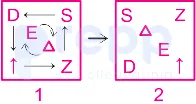
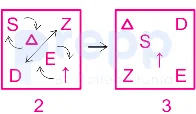
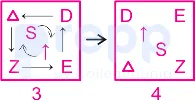
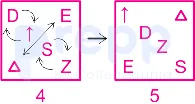
Question 1archived
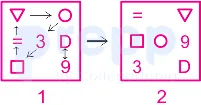
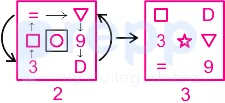
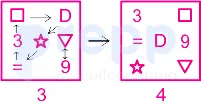
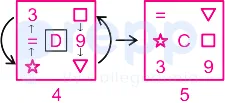
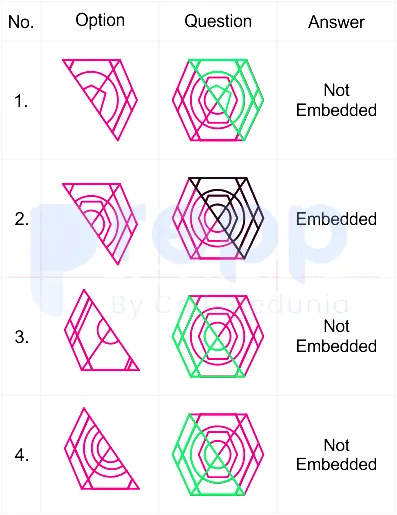
Select the option figure which is embedded in the given figure. (Rotation is NOT allowed).

- A
Option A (shown in image)
- B
Option B (shown in image)
- C
Option C (shown in image)
- D
Option D (shown in image)
Show answer
B. Option B (shown in image)The image embedded in given figure is as shown below:
Hence, the correct answer is "Option 2".
 Paper & answer key PDF ↗
 Question 2archived
Select the option that represents the correct order of the given words as they would appear in an English dictionary.
1. Warriors
2. Warehouse
3. Warcraft
4. Warranty
5. Wardrobe
6. Wardenship
- A
3, 6, 5, 2, 1, 4
- B
3, 5, 6, 2, 1, 4
- C
3, 5, 6, 2, 4, 1
- D
3, 6, 5, 2, 4, 1
Show answer
D. 3, 6, 5, 2, 4, 1Finding the Correct Dictionary Order of Words
To determine the correct order of words as they would appear in an English dictionary, we compare the words letter by letter from left to right. The word with the letter that comes earliest in the alphabet at the first point of difference will appear first.
Here are the words we need to arrange:
Warriors
Warehouse
Warcraft
Warranty
Wardrobe
Wardenship
Let's compare the words step-by-step:
All words begin with 'War'. We need to look at the fourth letter.
The fourth letters are: c (Warcraft), e (Wardrobe, Wardenship), h (Warehouse), r (Warriors, Warranty).
Comparing these letters (c, e, h, r), 'c' comes first. So, Warcraft (3) is the first word.
Next are the words starting with 'Warde' (Wardrobe, Wardenship). Let's compare their sixth letters.
Wardrobe has 'r' as the sixth letter. Wardenship has 'e' as the sixth letter.
Comparing 'r' and 'e', 'e' comes before 'r'. So, Wardenship (6) comes before Wardrobe (5).
Next is 'h' (Warehouse). So, Warehouse (2) comes after Wardrobe.
Finally, we have words starting with 'Warr' (Warriors, Warranty). Let's compare their seventh letters.
Warriors has 'i' as the seventh letter. Warranty has 'a' as the seventh letter.
Comparing 'i' and 'a', 'a' comes before 'i'. So, Warranty (4) comes before Warriors (1).
Putting it all together, the correct dictionary order is:
Warcraft (3)
Wardenship (6)
Wardrobe (5)
Warehouse (2)
Warranty (4)
Warriors (1)
The sequence of numbers is 3, 6, 5, 2, 4, 1.
Let's represent this in a table for clarity:
Word
Original Number
Dictionary Position
Warcraft
3
1st
Wardenship
6
2nd
Wardrobe
5
3rd
Warehouse
2
4th
Warranty
4
5th
Warriors
1
6th
Therefore, the correct order of the given words as they would appear in an English dictionary is 3, 6, 5, 2, 4, 1.
Revision Table: Understanding Dictionary Order
Concept
Explanation
How it Applies Here
Alphabetical Comparison
Comparing words letter by letter from left to right based on the order of letters in the alphabet (A-Z).
Used to compare words starting with 'War', then 'Ward', then 'Warr'.
First Point of Difference
The position where two words first have different letters. The word with the letter that comes earlier in the alphabet at this position comes first.
Helped distinguish between words like Wardrobe (Wardr) and Wardenship (Warde) based on the 6th letter.
Short vs. Long Words
If one word is a prefix of another (e.g., 'cat' and 'catalog'), the shorter word comes first.
Not directly applicable here as words don't start with the exact same sequence up to the end of one word.
Additional Information on Alphabetical Arrangement
Alphabetical arrangement is a fundamental skill used not just in dictionaries but also in indexes, phone books, library catalogs, and databases. Mastering dictionary order helps in quickly finding information and improves understanding of word structure.
Consistency: Always compare letters at the same position in the words.
Character Types: In standard dictionary order, letters come before numbers or symbols, though specific sorting rules can vary in computing.
Case Sensitivity: Standard dictionary order is usually not case-sensitive, treating 'A' and 'a' the same, but some sorting methods might be.
Practicing sorting words alphabetically is a great way to build vocabulary and strengthen language skills. It also helps in organizing information efficiently.
Paper & answer key PDF ↗ Question 3archived
Three statements are given, followed by four conclusions numbered I, II, III and IV. Assuming the statements to be true, even if they seem to be at variance with commonly known facts, decide which of the conclusions logically follow(s) from the statements.
Statements:
Some desks are trays.
Some trays are plates.
Some plates are desks.
Conclusions:
I. All desks are plates.
II. All plates are desks.
III. Some plates are trays.
IV. All trays are desks.
- A
Only conclusion III follows
- B
Only conclusion IV follows
- C
Only conclusion II follows
- D
Only conclusion I follows
Show answer
A. Only conclusion III followsCorrect answer: Only conclusion III follows
Conclusion IV: All trays are desks.
Statement 1 is "Some desks are trays". This is equivalent to "Some trays are desks". This statement only confirms an overlap between trays and desks. It does not provide information that *all* trays are desks. There could be trays that are not desks. Therefore, this conclusion does not logically follow.
Based on our analysis, only Conclusion III, "Some plates are trays", is guaranteed to be true based on the given statements.
Statement Type
Meaning/Implication
Example
All A are B
All members of category A are also members of category B (A is a subset of B).
All dogs are mammals.
No A are B
There is no overlap between categories A and B.
No cats are dogs.
Some A are B
There is at least one member common to both category A and category B (overlap exists). Does NOT mean 'only some' or 'not all'.
Some students are athletes.
Some A are not B
There is at least one member of category A that is not a member of category B.
Some students are not athletes.
Syllogism problems test your ability to reason based *only* on the information provided in the statements, even if the statements contradict common knowledge. The key is to follow the logical structure.
Statements involving "Some" establish the existence of an overlap. They are symmetrical, meaning "Some A are B" is the same as "Some B are A". However, they do not support conclusions about "All" members of a category. To conclude "All A are B", you typically need statements that establish that the entire category A is included within category B.
Visualizing with diagrams (like Venn diagrams) can be helpful, but the formal rules of inference are the most reliable way to solve these problems accurately. Remember to only accept conclusions that are *necessarily* true based on the premises.
Paper & answer key PDF ↗ Question 4archived
Select the option that is related to the third word in the same way as the second word is related to the first word.
(The words must be considered as meaningful English words and must not be related to each other based on the number of letters/number of consonants/vowels in the word.)
Skin : Touch :: Nose : ?
- A
Smell
- B
Taste
- C
Nose ring
- D
Sweat
Show answer
A. SmellUnderstanding the Skin and Nose Word Analogy
The question asks us to find a word that completes the analogy: Skin : Touch :: Nose : ?. This type of question tests our ability to identify the relationship between the first pair of words and apply that same relationship to the second pair.
Let's analyze the first pair: Skin : Touch.
The Skin is a part of the body.
Touch is a sense.
The Skin is the primary organ responsible for the sense of Touch. We feel things through our Skin.
So, the relationship is Organ : Sense associated with that organ.
Applying the Analogy to the Nose
Now we need to apply this same relationship to the second part: Nose : ?.
The Nose is also a part of the body, specifically an organ.
We need to find the sense that is primarily associated with the Nose.
Let's look at the options provided to find the correct sense related to the Nose.
Option 1: Smell. The Nose is the organ responsible for the sense of Smell. This fits the identified relationship (Organ : Sense).
Option 2: Taste. Taste is the sense associated with the tongue, not the Nose.
Option 3: Nose ring. A Nose ring is an ornament, not a sense associated with the Nose.
Option 4: Sweat. Sweat is a secretion from glands in the skin, not a sense associated with the Nose.
Based on our analysis, the word that fits the relationship Organ : Sense associated with that organ for the Nose is Smell.
Therefore, the analogy is Skin : Touch :: Nose : Smell.
Detailed Breakdown of Options
Let's review why only 'Smell' correctly completes the analogy based on the relationship between the Skin and Touch.
Word
Relationship to Nose
Fits Analogy (Organ : Sense)?
Smell
The sense perceived by the Nose.
Yes. The Nose is the organ for Smell.
Taste
The sense perceived by the Tongue.
No.
Nose ring
An object worn on the Nose.
No.
Sweat
A substance produced by glands (not primary Nose function).
No.
Conclusion on the Analogy
The analogy "Skin : Touch :: Nose : ?" establishes a relationship where the first word is an organ and the second word is the primary sense associated with that organ. The Skin is the organ for Touch. Following this pattern, the Nose is the organ for Smell. Thus, Smell is the correct word to complete the analogy.
Revision Table: Key Concepts
Organ
Primary Sense
Skin
Touch
Nose
Smell
Tongue
Taste
Eye
Sight
Ear
Hearing
Additional Information: Understanding Analogies in Reasoning
Analogies are questions that require you to find the relationship between a given pair of items and then identify another pair that shares the same relationship. They are common in reasoning tests and help evaluate your ability to see connections and apply logical patterns.
Types of relationships in word analogies can include:
Part to Whole (e.g., Finger : Hand)
Cause and Effect (e.g., Rain : Flood)
Synonyms (e.g., Happy : Joyful)
Antonyms (e.g., Hot : Cold)
Worker and Tool (e.g., Carpenter : Hammer)
Organ and Sense (as seen in this question: Skin : Touch, Nose : Smell)
Solving analogies improves your vocabulary and logical reasoning skills, which are important for many exams.
Paper & answer key PDF ↗ Question 5archived
Ganesh was taking a walk with his mother’s brother’s father’s granddaughter. Who was he walking with?
- A
Daughter
- B
Mother
- C
Cousin
- D
Granddaughter
Show answer
C. CousinAnalyzing Ganesh's Blood Relation Puzzle
Let's break down the blood relation step-by-step to understand who Ganesh was walking with. The phrase is "his mother’s brother’s father’s granddaughter".
His mother’s brother: This is Ganesh's maternal uncle.
His mother’s brother’s father: The father of Ganesh's maternal uncle is Ganesh's maternal grandfather (and also Ganesh's mother's father).
His mother’s brother’s father’s granddaughter: This person is a granddaughter of Ganesh's maternal grandfather.
A granddaughter of Ganesh's maternal grandfather could be:
His maternal uncle's daughter (Ganesh's cousin).
Ganesh's sister (if he has one).
The question states Ganesh was walking with "his mother’s brother’s father’s granddaughter". Since Ganesh himself is a grandson of his maternal grandfather, the granddaughter mentioned must be someone else in the family who is also a granddaughter of that same grandfather.
Considering the options provided, the most likely relationship is his cousin. If it were his sister, that would typically be the relationship given directly in the options. The term "granddaughter" in the phrase describes her relationship to the grandfather, not directly to Ganesh. Her relationship to Ganesh is either sister or cousin. Among the choices, "Cousin" fits the description of the maternal uncle's daughter.
Therefore, Ganesh was walking with his cousin.
Let's summarize the relationship chain:
Step
Relation
Resulting Relation to Ganesh
1
Mother's brother
Maternal Uncle
2
Mother's brother's father
Maternal Grandfather
3
Mother's brother's father's granddaughter
Maternal Grandfather's Granddaughter (Could be Ganesh's sister or cousin)
Based on the available options, the granddaughter is interpreted as the maternal uncle's daughter, who is Ganesh's cousin.
Revision Table: Key Blood Relations
Relation Described
Relation to 'Self'
Father's father
Paternal Grandfather
Mother's father
Maternal Grandfather
Father's brother
Paternal Uncle
Mother's brother
Maternal Uncle
Father's sister
Paternal Aunt
Mother's sister
Maternal Aunt
Father's brother's son/daughter
Cousin
Mother's brother's son/daughter
Cousin
Additional Information on Blood Relation Puzzles
Blood relation questions test your ability to decipher the relationship between different people based on a series of connections. These puzzles require careful step-by-step analysis.
Always start from the person mentioned in the phrase (in this case, "his mother").
Move through the phrase one relation at a time (mother > brother > father > granddaughter).
Determine the relationship at each step relative to the starting person or 'Ganesh'.
Be mindful of possibilities, like "granddaughter" potentially referring to a sister or a cousin, and choose the most appropriate option from those provided.
Practice with different relationship chains to become proficient.
Paper & answer key PDF ↗ Question 6archived
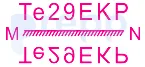
Select the correct mirror image of the given figure when the mirror is placed at MN as shown below.

- A
Option A (shown in image)
- B
Option B (shown in image)
- C
Option C (shown in image)
- D
Option D (shown in image)
Show answer
D. Option D (shown in image)The correct mirror image of the given figure when the mirror is placed at MN is shown below:
Hence, the correct answer is "Option 4".
 Paper & answer key PDF ↗
 Question 7archived
Which of the following letter-clusters will replace the question mark (?) in the given series?
UV, OY, IB, EE, ?
- A
ZK
- B
AH
- C
BI
- D
BH
Show answer
B. AHThe correct answer is AH.
Remember that patterns can involve wrapping around the alphabet (e.g., Z → A). If analyzing position differences doesn't yield a pattern, look for other relationships between the letters themselves (like vowels/consonants, reverse order, etc.). Test your hypothesized pattern with all given terms in the series before applying it to find the next term. Practicing with various types of letter series helps improve pattern recognition skills, which are essential for logical reasoning questions.
Paper & answer key PDF ↗ Question 8archived
The second number in the given number-pairs is obtained by performing certain mathematical operation(s) on the first number. The same operation(s) is/are followed in all the number-pairs except one. Find that odd number-pair.
- A
20 ∶ 11
- B
6 ∶ 4
- C
15 ∶ 9
- D
12 ∶ 7
Show answer
C. 15 ∶ 9Finding the Odd Number Pair in a Series
The question asks us to identify the number pair that does not follow the same mathematical operation relating the first number to the second number, unlike the other pairs provided. We need to examine each number pair and determine the rule.
Analyzing the Number Pairs
Let's look closely at the relationship between the first and second number in each pair:
Pair 1: 20 ∶ 11
Pair 2: 6 ∶ 4
Pair 3: 15 ∶ 9
Pair 4: 12 ∶ 7
We need to find a consistent mathematical operation or set of operations that links the first number to the second number in most of these pairs. Let's try some common operations:
Subtraction: 20 - 11 = 9, 6 - 4 = 2, 15 - 9 = 6, 12 - 7 = 5. No clear pattern here.
Division: 20 / 11 ≈ 1.82, 6 / 4 = 1.5, 15 / 9 ≈ 1.67, 12 / 7 ≈ 1.71. No clear pattern here either.
Let's consider operations involving division and addition/subtraction.
Discovering the Pattern
Let's test a possible pattern: dividing the first number by 2 and then adding a constant value.
For 20 ∶ 11: $20 \div 2 = 10$. To get 11, we add 1. So, the pattern could be $\frac{\text{First Number}}{2} + 1$. Let's check this with other pairs.
For 6 ∶ 4: $\frac{6}{2} + 1 = 3 + 1 = 4$. This matches the second number.
For 12 ∶ 7: $\frac{12}{2} + 1 = 6 + 1 = 7$. This matches the second number.
It appears the common pattern is indeed $\frac{\text{First Number}}{2} + 1 = \text{Second Number}$.
Applying the Pattern to Find the Odd Pair
Now, let's apply this pattern to the remaining pair, 15 ∶ 9, to see if it follows the rule.
For 15 ∶ 9: According to the pattern, the second number should be $\frac{15}{2} + 1$.
Calculation: $\frac{15}{2} + 1 = 7.5 + 1 = 8.5$.
The expected second number based on the pattern is 8.5, but the given second number is 9. Therefore, the pair 15 ∶ 9 does not follow the established pattern.
Summary of Findings
Number Pair
First Number
Operation: (First Number / 2) + 1
Expected Second Number
Actual Second Number
Follows Pattern?
20 ∶ 11
20
$(20 \div 2) + 1$
11
11
Yes
6 ∶ 4
6
$(6 \div 2) + 1$
4
4
Yes
15 ∶ 9
15
$(15 \div 2) + 1$
8.5
9
No
12 ∶ 7
12
$(12 \div 2) + 1$
7
7
Yes
As shown in the table, the pair 15 ∶ 9 is the only one that does not fit the pattern where the second number is obtained by dividing the first number by two and adding one.
Conclusion: Identifying the Odd Pair
Based on our analysis, the odd number pair is 15 ∶ 9 because it is the only pair that does not follow the mathematical operation $\frac{\text{First Number}}{2} + 1$ to get the second number. The other pairs (20 ∶ 11, 6 ∶ 4, and 12 ∶ 7) all adhere to this rule.
Revision Table: Odd Number Pair Analysis
Reviewing the method used to find the odd number pair in a series:
Examine the relationship between numbers in each pair.
Test different mathematical operations (addition, subtraction, multiplication, division, combined operations).
Identify a consistent pattern applicable to most pairs.
Verify if the remaining pair follows the same pattern.
The pair that does not follow the pattern is the odd one out.
Additional Information: Number Series and Patterns
Finding patterns in number series or pairs is a common type of logical reasoning question. These patterns can involve various mathematical concepts:
Arithmetic Progression: Adding or subtracting a constant value.
Geometric Progression: Multiplying or dividing by a constant value.
Combined Operations: Using multiple operations, like in this problem (division and addition).
Square/Cube Numbers: Relating numbers to squares or cubes or their roots.
Digit Operations: Sum of digits, product of digits, etc.
Prime Numbers: The sequence involves prime numbers.
Fibonacci Sequence: The next number is the sum of the previous two.
Practice with different types of number patterns helps in quickly identifying the rule and the odd one out in such questions.
Paper & answer key PDF ↗ Question 9archived
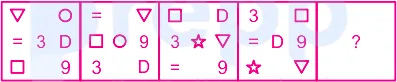
Select the figure that will replace the question mark (?) in the following figure series.
- A
Option A (shown in image)
- B
Option B (shown in image)
- C
Option C (shown in image)
- D
Option D (shown in image)
Show answer
Question 10archived
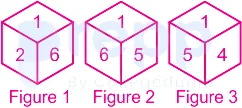
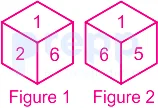
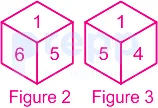
Three different positions of the same dice are shown. Find the number on the face opposite the face showing ‘1’.
- A
6
- B
2
- C
3
- D
4
Show answer
C. 3As 1 and 6 are the common faces on both the dice, the remaining faces 2 and 5 are opposite to each other.
As 1 and 5 are the common faces on both the dice, the remaining faces 6 and 4 are opposite to each other.
Clearly, the remaining number 3 will be opposite to 1.
Hence, the correct answer is "3".
 Paper & answer key PDF ↗
 Question 11archived
Select the set in which the numbers are related in the same way as are the numbers of the following sets.
(55, 11, 25)
(64, 16, 16)
(NOTE : Operations should be performed on the whole numbers, without breaking down the numbers into its constituent digits. E.g. 13 – Operations on 13 such as adding /subtracting /multiplying etc. to 13 can be performed. Breaking down 13 into 1 and 3 and then performing mathematical operations on 1 and 3 is NOT allowed)
- A
(33, 11, 10)
- B
(33, 11, 22)
- C
(33, 11, 3)
- D
(33, 11, 9)
Show answer
D. (33, 11, 9)Understanding Number Relations and Patterns in Sets
This question asks us to identify the relationship between the numbers in the given sets and then find which of the options follows the same relationship. We are given two example sets to help us figure out the pattern.
Analyzing the Given Sets to Find the Pattern
Let's look at the first set: (55, 11, 25).
The first number is 55.
The second number is 11.
The third number is 25.
How are these numbers related? We can try different basic operations.
Let's consider the relationship between the first two numbers: $55 \div 11 = 5$.
Now let's look at the third number, 25. How does it relate to 5? We know that $5^2 = 5 \times 5 = 25$.
So, for the first set, it seems the pattern is: (First number $\div$ Second number)$^2$ = Third number.
Let's check this pattern with the second given set: (64, 16, 16).
The first number is 64.
The second number is 16.
The third number is 16.
Following the potential pattern: (First number $\div$ Second number)$^2$ = Third number.
Let's calculate: $(64 \div 16)^2$.
$64 \div 16 = 4$.
Now, square the result: $4^2 = 4 \times 4 = 16$.
This matches the third number in the set (16). So, the pattern (First number $\div$ Second number)$^2$ = Third number holds for both given sets.
The rule states that operations should be performed on whole numbers, not breaking down digits, which aligns with our identified pattern involving division and squaring of the whole numbers.
Applying the Number Relationship Pattern to Options
Now we will test each option to see which set of numbers follows the pattern: (First number $\div$ Second number)$^2$ = Third number.
Option 1: (33, 11, 10)
First number = 33
Second number = 11
Third number = 10
Calculate (First number $\div$ Second number)$^2$: $(33 \div 11)^2 = 3^2 = 9$.
Does $9 = 10$? No. This option does not fit the pattern.
Option 2: (33, 11, 22)
First number = 33
Second number = 11
Third number = 22
Calculate (First number $\div$ Second number)$^2$: $(33 \div 11)^2 = 3^2 = 9$.
Does $9 = 22$? No. This option does not fit the pattern.
Option 3: (33, 11, 3)
First number = 33
Second number = 11
Third number = 3
Calculate (First number $\div$ Second number)$^2$: $(33 \div 11)^2 = 3^2 = 9$.
Does $9 = 3$? No. This option does not fit the pattern.
Option 4: (33, 11, 9)
First number = 33
Second number = 11
Third number = 9
Calculate (First number $\div$ Second number)$^2$: $(33 \div 11)^2 = 3^2 = 9$.
Does $9 = 9$? Yes. This option fits the pattern.
Conclusion: Identifying the Matching Set
Based on our analysis, only Option 4, the set (33, 11, 9), follows the same number relation pattern as the given sets (55, 11, 25) and (64, 16, 16). The pattern is that the third number is equal to the square of the result obtained by dividing the first number by the second number.
Revision Table: Summarizing Number Pattern Analysis
Set
First Number (A)
Second Number (B)
Third Number (C)
Calculation (A ÷ B)$^2$
Result
Pattern Match?
(55, 11, 25)
55
11
25
$(55 \div 11)^2 = 5^2$
25
Yes
(64, 16, 16)
64
16
16
$(64 \div 16)^2 = 4^2$
16
Yes
(33, 11, 10)
33
11
10
$(33 \div 11)^2 = 3^2$
9
No ($9 \neq 10$)
(33, 11, 22)
33
11
22
$(33 \div 11)^2 = 3^2$
9
No ($9 \neq 22$)
(33, 11, 3)
33
11
3
$(33 \div 11)^2 = 3^2$
9
No ($9 \neq 3$)
(33, 11, 9)
33
11
9
$(33 \div 11)^2 = 3^2$
9
Yes
Additional Information: Types of Number Reasoning Patterns
Number reasoning questions often involve finding patterns or relationships within a series or set of numbers. Some common types of patterns include:
Arithmetic Progression: Numbers increase or decrease by a constant difference.
Geometric Progression: Numbers are multiplied or divided by a constant ratio.
Square or Cube Relations: Numbers are squares or cubes of other numbers in the set or related by squaring/cubing operations.
Sum/Difference/Product/Division: The third number (or another number) is the result of adding, subtracting, multiplying, or dividing the other numbers.
Combination of Operations: Patterns can involve a mix of operations (e.g., multiply and add, divide and square).
Digit-based operations: While not allowed in this specific problem, sometimes patterns depend on the digits of the numbers (e.g., sum of digits, product of digits).
Identifying the correct pattern requires careful observation and testing different relationships between the given numbers.
Paper & answer key PDF ↗ Question 12archived
Select the option that is related to the sixth letter-cluster in the same way as the first letter-cluster is related to the second letter-cluster and the third letter-cluster is related to the fourth letter-cluster.
HMD : KOE : : BNQ : EPR :: ? : FLV
- A
SJE
- B
UJC
- C
EJS
- D
CJU
Show answer
D. CJUThe correct answer is CJU.
Vowels and Consonants: The pattern might be related to the position or sequence of vowels or consonants. Reversal: Letters might be reversed within the cluster. Combination: Often, a combination of these rules is used. Practicing these types of problems helps improve logical reasoning and pattern recognition skills, which are crucial for many competitive exams.
Paper & answer key PDF ↗ Question 13archived
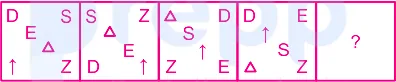
Select the figure from the options that can replace the question mark (?) and complete the given pattern.
- A
Option A (shown in image)
- B
Option B (shown in image)
- C
Option C (shown in image)
- D
Option D (shown in image)
Show answer
Question 14archived
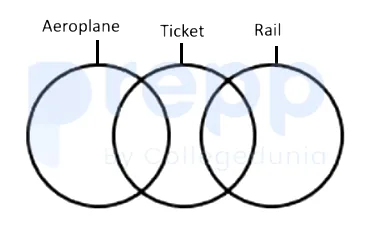
Select the Venn diagram that best illustrates the relationship between the following classes.
Ticket, Aeroplane, Rail
- A
Option A (shown in image)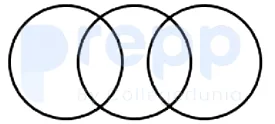
- B
Option B (shown in image)
- C
Option C (shown in image)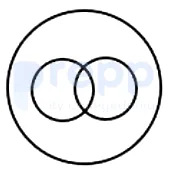
- D
Option D (shown in image)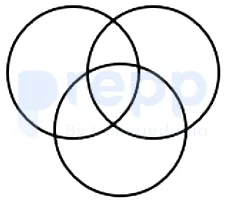
Show answer
A. Option A (shown in image)The Venn diagram that best illustrates the relationship between Ticket, Aeroplane, and Rail is shown below:
We need ticket to travel on Rail and Aeroplane.
Hence, 'option 1' is the correct answer.
 Paper & answer key PDF ↗
 Question 15archived
Four letter-clusters have been given, out of which three are alike in some manner and one is different. Select the odd letter-cluster.
- A
BFJN
- B
DHLP
- C
HJKP
- D
JNRV
Show answer
C. HJKPFinding the Odd Letter Cluster
In this question, we are given four letter clusters and need to identify the one that is different from the others based on a specific pattern. To do this, we can analyze the position of each letter in the English alphabet.
Let's look at the alphabetical position of the letters in each cluster:
Analyzing Letter Cluster 1: BFJN
B is the 2nd letter.
F is the 6th letter.
J is the 10th letter.
N is the 14th letter.
Let's find the difference between consecutive letters:
F (6) - B (2) = 4
J (10) - F (6) = 4
N (14) - J (10) = 4
The pattern in BFJN is a consistent increase of 4 in the letter positions: \(+4, +4, +4\).
Analyzing Letter Cluster 2: DHLP
D is the 4th letter.
H is the 8th letter.
L is the 12th letter.
P is the 16th letter.
Let's find the difference between consecutive letters:
H (8) - D (4) = 4
L (12) - H (8) = 4
P (16) - L (12) = 4
The pattern in DHLP is also a consistent increase of 4 in the letter positions: \(+4, +4, +4\).
Analyzing Letter Cluster 3: HJKP
H is the 8th letter.
J is the 10th letter.
K is the 11th letter.
P is the 16th letter.
Let's find the difference between consecutive letters:
J (10) - H (8) = 2
K (11) - J (10) = 1
P (16) - K (11) = 5
The pattern in HJKP is \(+2, +1, +5\). This is different from the pattern observed in the previous two clusters.
Analyzing Letter Cluster 4: JNRV
J is the 10th letter.
N is the 14th letter.
R is the 18th letter.
V is the 22nd letter.
Let's find the difference between consecutive letters:
N (14) - J (10) = 4
R (18) - N (14) = 4
V (22) - R (18) = 4
The pattern in JNRV is also a consistent increase of 4 in the letter positions: \(+4, +4, +4\).
Comparing the Patterns
Let's summarize the patterns found for each letter cluster:
Letter Cluster
Letter Positions
Pattern (Differences)
BFJN
2, 6, 10, 14
+4, +4, +4
DHLP
4, 8, 12, 16
+4, +4, +4
HJKP
8, 10, 11, 16
+2, +1, +5
JNRV
10, 14, 18, 22
+4, +4, +4
Three of the letter clusters (BFJN, DHLP, JNRV) follow the same pattern of adding 4 to the alphabetical position of the previous letter. The letter cluster HJKP follows a different pattern (+2, +1, +5).
Therefore, HJKP is the odd letter cluster among the given options.
Revision Table: Letter Reasoning Patterns
Topic
Key Concept
Example
Letter Series
Sequences of letters based on alphabetical position or other rules.
A, C, E, G... (+2 pattern)
Odd One Out (Letter Clusters)
Identify the cluster that doesn't fit the pattern followed by others.
BFJN, DHLP, HJKP, JNRV (HJKP is odd due to position difference)
Pattern Types
Arithmetic progression (constant difference), geometric progression, skipping letters, vowel/consonant patterns, etc.
A, Z, B, Y... (Alternating first/last letters)
Additional Information: Solving Letter Reasoning Questions
Letter reasoning questions often require understanding the relationship between letters based on their position in the alphabet. Here are some tips:
Write down the alphabet: Having the alphabet A-Z written out can help quickly identify letter positions.
Assign numerical values: Convert letters to their numerical positions (A=1, B=2, ..., Z=26). This makes identifying arithmetic patterns easier.
Look for differences: Calculate the difference in position between consecutive letters. See if there is a consistent difference or a pattern in the differences.
Consider other patterns: Check for patterns involving skipping a specific number of letters, alternating patterns (e.g., +2, +3, +2, +3), or patterns related to vowels and consonants.
Practice: Solving different types of letter reasoning problems helps you recognize common patterns quickly.
Paper & answer key PDF ↗ Question 16archived
Select the option that is related to the fifth number in the same way as the second number is related to the first number and the fourth number is related to the third number.
5 ∶ 45 ∶∶ 3 ∶ 3 ∶∶ 6 ∶ ?
- A
90
- B
106
- C
110
- D
96
Show answer
D. 96The correct answer is 96.
Calculate the result: Result = $N \times \text{Multiplier} = 6 \times 16$. Performing the multiplication: $$6 \times 16 = 96$$ The missing number is 96. Answer Selection The calculated missing number is 96. This matches one of the options provided.
Paper & answer key PDF ↗ Question 17archived
Which of the following numbers will replace the question mark (?) in the given series?
8, 15, 26, ? , 56, 75
- A
39
- B
41
- C
35
- D
43
Show answer
A. 39Understanding Number Series Patterns
This question asks us to find the missing number in a given number series: 8, 15, 26, ?, 56, 75. To solve this type of number series problem, we need to identify the pattern or rule that governs the sequence of numbers. Often, this involves looking at the differences between consecutive terms, the ratio between terms, or a combination of operations.
Step-by-Step Analysis of the Series
Let's examine the differences between the consecutive terms in the given number series:
Difference between the second and first term: $15 - 8 = 7$
Difference between the third and second term: $26 - 15 = 11$
Difference between the sixth and fifth term: $75 - 56 = 19$
The differences we have found are 7, 11, and 19. Let the missing term be $x$. The differences involving the missing term would be $x - 26$ and $56 - x$. So the sequence of differences is 7, 11, $(x - 26)$, $(56 - x)$, 19.
Identifying the Pattern in the Differences
Let's look at the differences between the known differences: $11 - 7 = 4$. This suggests a possible pattern in the increases of the differences. Let's test the options provided for the missing term (?) to see if a consistent pattern emerges.
Consider the options:
Option 1: 39
Option 2: 41
Option 3: 35
Option 4: 43
Let's assume the missing term is 39 (Option 1) and calculate the differences between consecutive terms:
$15 - 8 = 7$
$26 - 15 = 11$
$39 - 26 = 13$
$56 - 39 = 17$
$75 - 56 = 19$
The sequence of differences is 7, 11, 13, 17, 19.
Now, let's look at the differences between these differences (the second level of differences):
$11 - 7 = 4$
$13 - 11 = 2$
$17 - 13 = 4$
$19 - 17 = 2$
The second level of differences is 4, 2, 4, 2. This shows a clear repeating pattern of alternating increases of 4 and 2 in the first-level differences.
Verifying the Pattern with the Proposed Missing Number
If we use the pattern of first-level differences (7, 11, 13, 17, 19) derived assuming 39 is the missing number, we can reconstruct the original series:
Start with the first term: 8
Add the first difference: $8 + 7 = 15$ (Second term)
Add the second difference: $15 + 11 = 26$ (Third term)
Add the third difference: $26 + 13 = 39$ (Fourth term - missing number)
Add the fourth difference: $39 + 17 = 56$ (Fifth term)
Add the fifth difference: $56 + 19 = 75$ (Sixth term)
The reconstructed series is 8, 15, 26, 39, 56, 75, which perfectly matches the given series when the missing number is 39.
Let's summarize this in a table:
Term Position
Term Value
Difference from Previous Term
Difference of Differences
1st
8
-
-
2nd
15
$15 - 8 = 7$
-
3rd
26
$26 - 15 = 11$
$11 - 7 = 4$
4th
39
$39 - 26 = 13$
$13 - 11 = 2$
5th
56
$56 - 39 = 17$
$17 - 13 = 4$
6th
75
$75 - 56 = 19$
$19 - 17 = 2$
As shown in the table, the pattern of adding alternating increments of 4 and 2 to the differences holds true throughout the series when the missing term is 39.
Conclusion
The missing number in the series 8, 15, 26, ?, 56, 75 is 39 because it fits the pattern where the differences between consecutive terms increase alternately by 4 and 2 (7, 11, 13, 17, 19).
Revision Table: Number Series Pattern
Concept
Explanation
Number Series
A sequence of numbers following a specific rule or pattern.
Difference Method
Analyzing the differences between consecutive terms to find the pattern.
Second Difference
Analyzing the differences between the first-level differences. Useful for patterns where differences increase linearly or in an alternating manner.
Identified Pattern
The differences between terms are 7, 11, 13, 17, 19. The increase in these differences follows the pattern +4, +2, +4, +2.
Missing Number Calculation
Missing Term = 3rd Term + 3rd Difference = $26 + 13 = 39$.
Additional Information: Types of Number Series Patterns
Number series problems can have various patterns. Some common types include:
Arithmetic Series: The difference between consecutive terms is constant.
Geometric Series: Each term is multiplied by a constant ratio to get the next term.
Difference Series: The differences between consecutive terms follow a pattern (like an arithmetic series, geometric series, or the alternating pattern seen in this question).
Double Difference Series: The differences between the differences follow a pattern.
Alternating Series: Terms alternate between increasing and decreasing, or involve alternating operations.
Square or Cube Series: Terms are related to squares or cubes of natural numbers, possibly with additions or subtractions.
Mixed Series: A combination of two or more patterns within a single series.
Fibonacci Series related: Each term is the sum of the two preceding terms, or variations of this.
Solving number series requires careful observation and testing different potential patterns.
Paper & answer key PDF ↗ Question 18archived
Select the option that is related to the third term in the same way as the second term is related to the first term and the sixth term is related to the fifth term.
7183 ∶ 3850 ∶∶ 6957 ∶ ? ∶∶ 8972 ∶ 5639
- A
3426
- B
3624
- C
3246
- D
3642
Show answer
B. 3624The logic followed here is:
Logic: First number - 3333 = Second number
7183 ∶ 3850 → 7183 - 3333 = 3850
8972 ∶ 5639 → 8972 - 3333 = 5639
Similarly,
6957 ∶ ? → 6957 - 3333 = 3624
Hence, '3624' is the correct answer.
Paper & answer key PDF ↗ Question 19archived
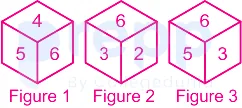
Three different positions of the same dice are shown. Find the number on the face opposite the face showing '4'.
- A
5
- B
6
- C
2
- D
3
Show answer
D. 3As 6 and 5 are the common faces on both the dice, the remaining faces 4 and 3 are opposite to each other.
Hence, '3' is the correct answer.
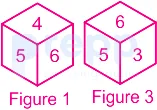 Paper & answer key PDF ↗
 Question 20archived
Select the option that is related to the fifth number in the same way as the second number is related to the first number and the fourth number is related to the third number.
625 ∶ 5 ∶∶ 2560 ∶ 8 ∶∶ 5000 ∶ ?
- A
9
- B
12
- C
10
- D
15
Show answer
C. 10The correct answer is 10.
Common patterns include arithmetic progression, geometric progression, squares, cubes, exponents, division, multiplication, addition, subtraction, or combinations of these operations. Sometimes, the pattern might involve the digits of the numbers or their properties (like prime numbers, composite numbers, etc.). Carefully analyzing the first few terms or pairs is key to identifying the underlying rule that connects them. In this specific number relationship problem, the pattern involved a combination of exponentiation (cubing the second number) and division, resulting in a constant value (5).
Paper & answer key PDF ↗ Question 21archived
In a certain code language, ‘ASK’ is written as ‘62’ and ‘BYE’ is written as ‘64’. How will ‘CRY’ be written in that language?
- A
68
- B
72
- C
86
- D
92
Show answer
D. 92The correct answer is 92.
This problem involves a coding language where words are represented by numbers. We are given two examples to help us decode the pattern: 'ASK' is coded as '62', and 'BYE' is coded as '64'. Our goal is to find the code for 'CRY' using the same pattern. Let's analyze the given examples. A common way to encode words into numbers is by using the positional values of the letters in the English alphabet (A=1, B=2, ..., Z=26).
Paper & answer key PDF ↗ Question 22archived
Select the correct combination of mathematical signs that can sequentially replace the * signs and balance the given equation.
256 * 4 * 9 * 3 * 14 = 51
- A
× + − ÷
- B
÷ × − +
- C
× ÷ + −
- D
÷ − × +
Show answer
D. ÷ − × +Balancing Mathematical Equations: Finding the Right Signs
The problem requires us to find the correct sequence of mathematical signs to replace the asterisks (*) in the equation 256 * 4 * 9 * 3 * 14 = 51 so that the equation holds true. We are given four options, each providing a different sequence of signs. To solve this, we need to test each sequence by substituting the signs into the equation and performing the calculations following the order of operations (BODMAS/PEMDAS).
The mathematical signs to consider are:
Division ($\div$)
Multiplication ($\times$)
Subtraction ($-$)
Addition ($+$)
Evaluating Each Option
Let's evaluate the expression for each given option:
Option 1: $\times, +, -, \div$
Replacing the * signs with this sequence, the equation becomes:
$\quad 256 \times 4 + 9 - 3 \div 14$
According to the order of operations, we perform multiplication and division first from left to right:
$256 \times 4 = 1024$
$3 \div 14 \approx 0.214$ (This indicates it's unlikely to be the correct option as the target is an integer 51)
Now substitute these values back:
$\quad 1024 + 9 - 0.214$
Perform addition and subtraction from left to right:
$1024 + 9 = 1033$
$1033 - 0.214 = 1032.786$
The result $1032.786$ does not equal $51$. So, Option 1 is incorrect.
Option 2: $\div, \times, -, +$
Replacing the * signs with this sequence, the equation becomes:
$\quad 256 \div 4 \times 9 - 3 + 14$
Perform division and multiplication from left to right:
$256 \div 4 = 64$
$64 \times 9 = 576$
Now substitute these values back:
$\quad 576 - 3 + 14$
Perform subtraction and addition from left to right:
$576 - 3 = 573$
$573 + 14 = 587$
The result $587$ does not equal $51$. So, Option 2 is incorrect.
Option 3: $\times, \div, +, -$
Replacing the * signs with this sequence, the equation becomes:
$\quad 256 \times 4 \div 9 + 3 - 14$
Perform multiplication and division from left to right:
$256 \times 4 = 1024$
$1024 \div 9 \approx 113.78$ (Again, a non-integer, unlikely to yield 51)
Substituting back:
$\quad 113.78 + 3 - 14$
This will not result in $51$. So, Option 3 is incorrect.
Option 4: $\div, -, \times, +$
Replacing the * signs with this sequence, the equation becomes:
$\quad 256 \div 4 - 9 \times 3 + 14$
Perform division and multiplication from left to right:
$256 \div 4 = 64$
$9 \times 3 = 27$
Now substitute these values back:
$\quad 64 - 27 + 14$
Perform subtraction and addition from left to right:
$64 - 27 = 37$
$37 + 14 = 51$
The result $51$ equals the right side of the equation. So, Option 4 is the correct combination.
Step-by-Step Calculation for the Correct Combination ($\div, -, \times, +$)
Let's show the calculation for Option 4 again clearly:
Equation: $256 * 4 * 9 * 3 * 14 = 51$
Substitute signs: $256 \div 4 - 9 \times 3 + 14 = 51$
First, perform division: $256 \div 4 = 64$
The equation becomes: $64 - 9 \times 3 + 14$
Next, perform multiplication: $9 \times 3 = 27$
The equation becomes: $64 - 27 + 14$
Now, perform subtraction from left to right: $64 - 27 = 37$
The equation becomes: $37 + 14$
Finally, perform addition: $37 + 14 = 51$
Since the result is $51$, the equation $256 \div 4 - 9 \times 3 + 14 = 51$ is balanced.
Conclusion: Identifying the Correct Signs
By testing each option and applying the correct order of operations, we found that the sequence of signs $\div, -, \times, +$ correctly balances the given equation $256 * 4 * 9 * 3 * 14 = 51$. This corresponds to Option 4.
Revision Table: Key Concepts in Equation Balancing
Concept
Description
Importance in Balancing Equations
Mathematical Signs
Symbols representing operations: $+$, $-$, $\times$, $\div$.
Choosing the right sequence is crucial for the equation to hold true.
Order of Operations (BODMAS/PEMDAS)
Rules determining the sequence of performing operations: Brackets/Parentheses, Orders/Exponents, Division & Multiplication (L to R), Addition & Subtraction (L to R).
Essential for correctly evaluating the expression after substituting the signs.
Equation Balancing
Finding the missing elements (signs, numbers) that make the left side equal the right side.
The goal of this type of problem.
Additional Information: Understanding Order of Operations
The order of operations is a fundamental rule in mathematics that ensures everyone gets the same result when evaluating an expression with multiple operations. A common mnemonic for remembering the order is BODMAS or PEMDAS.
BODMAS: Brackets, Orders (powers and square roots), Division and Multiplication (from left to right), Addition and Subtraction (from left to right).
PEMDAS: Parentheses, Exponents, Multiplication and Division (from left to right), Addition and Subtraction (from left to right).
Both mnemonics represent the same order. Division and Multiplication are performed at the same level, from left to right as they appear. Similarly, Addition and Subtraction are performed at the same level, from left to right as they appear.
In our problem, when evaluating an option like $256 \div 4 - 9 \times 3 + 14$, we first handle the division ($256 \div 4$) and multiplication ($9 \times 3$) because they appear before addition and subtraction in the order. Since division appears before multiplication here, we do $256 \div 4$ first, then $9 \times 3$. After that, we are left with $64 - 27 + 14$. Now we handle subtraction and addition from left to right: $64 - 27 = 37$, then $37 + 14 = 51$. Following this specific order is key to solving these equation balancing problems correctly.
Paper & answer key PDF ↗ Question 23archived
Select the option that represents the letters that, when placed from left to right in the following blanks, will complete the letter-series.
C L _ V E C _ _ W E C L O _ _ C _ O _ E
- A
O L P X E L Y
- B
O L O Y E L Z
- C
O L O X F M Y
- D
O L O X E L Y
Show answer
D. O L O X E L YUnderstanding the Letter Series Problem
The question asks us to identify the sequence of letters that correctly fills the blanks in the given letter series to complete a logical pattern. We are provided with a series containing several blanks and four options, each containing a sequence of letters to fill those blanks from left to right.
The given letter series with blanks is:
C L _ V E C _ _ W E C L O _ _ C _ O _ E
There are 7 blanks in total. We need to test the options to see which sequence of 7 letters creates a discernible pattern when placed in these blanks.
Analyzing the Letter Series Pattern
Let's consider the provided correct option, which is O L O X E L Y. We will place these letters into the blanks in the series from left to right.
Original series with blanks marked:
C L [1] V E C [2] [3] W E C L O [4] [5] C [6] O [7] E
Placing the letters O L O X E L Y into the blanks [1] through [7]:
Blank [1] gets 'O': C L O V E C _ _ W E C L O _ _ C _ O _ E
Blank [2] gets 'L': C L O V E C L _ W E C L O _ _ C _ O _ E
Blank [3] gets 'O': C L O V E C L O W E C L O _ _ C _ O _ E
Blank [4] gets 'X': C L O V E C L O W E C L O X _ C _ O _ E
Blank [5] gets 'E': C L O V E C L O W E C L O X E C _ O _ E
Blank [6] gets 'L': C L O V E C L O W E C L O X E C L O _ E
Blank [7] gets 'Y': C L O V E C L O W E C L O X E C L O Y E
The completed letter series is:
C L O V E C L O W E C L O X E C L O Y E
Now, let's examine this completed series to find the pattern. We can see that the series appears to be composed of repeating segments.
Segment 1: C L O V E
Segment 2: C L O W E
Segment 3: C L O X E
Segment 4: C L O Y E
Each segment is 5 letters long. The first three letters are always C L O, and the last letter is always E. The fourth letter in each segment is the one that changes.
Let's look at the sequence of the fourth letters:
V → W → X → Y
This sequence (V, W, X, Y) is a consecutive alphabetical progression.
Therefore, the pattern is a sequence of 5-letter groups starting with CLO and ending with E, where the fourth letter follows a simple alphabetical order.
Step-by-Step Solution for Filling Blanks
Based on the identified pattern (CLO_E with the fourth letter progressing alphabetically), the full series should be CLOVE CLOWE CLOXE CLOYE.
Let's map the blanks in the original series to the letters needed from the pattern:
Original: C L _ V E. Needs 'O' to be CLOVE. (Blank 1)
Original: C _ _ W E. Needs 'L' and 'O' to be CLOWE. (Blanks 2, 3)
Original: C L O _ _. Needs 'X' and 'E' to be CLOXE. (Blanks 4, 5)
Original: C _ O _ E. Needs 'L' and 'Y' to be CLOYE. (Blanks 6, 7)
The required letters for the blanks, in order, are O, L, O, X, E, L, Y.
This sequence matches the letters provided in the correct option.
Conclusion on the Letter Series
Placing the letters O L O X E L Y into the blanks of the series C L _ V E C _ _ W E C L O _ _ C _ O _ E results in the completed series C L O V E C L O W E C L O X E C L O Y E. This series follows a clear pattern where 5-letter segments (starting with CLO and ending with E) have their fourth letter advancing alphabetically (V, W, X, Y). Thus, the sequence O L O X E L Y successfully completes the letter series according to this logical pattern.
Revision Table: Letter Series Patterns
Pattern Type
Description
Example
Alphabetical Progression
Letters advance sequentially or by a fixed step in the alphabet.
A, C, E, G... (skipping one letter)
Repeating Blocks
A specific sequence of letters or groups repeats.
ABC, ABC, ABC...
Alternating Patterns
Two or more different patterns alternate within the series.
A, Z, B, Y, C, X... (Forward and backward alphabet)
Skipping Letters
Letters are skipped in a specific pattern (e.g., skipping 1, then 2, then 3 letters).
A, C, F, K... (+1, +2, +3 gaps in alphabet)
Combination Patterns
A mix of the above patterns, often applied to different parts of a group of letters.
As in this problem: Fixed start/end, changing middle letter.
Additional Information: Solving Letter Series Questions
Solving letter series problems often involves looking for patterns based on:
Position in the Alphabet: Each letter corresponds to a number (A=1, B=2, etc.). Look for numerical patterns.
Sequences: Check for simple alphabetical order (A, B, C...), reverse order (Z, Y, X...), or skipping letters (A, C, E...).
Repetition: Are there repeating blocks of letters or repeating patterns?
Grouping: Can the series be broken down into smaller groups of letters? What is the pattern within or between these groups?
Vowels/Consonants: Is there a pattern related to vowels and consonants?
It's often helpful to write down the options and try fitting them into the blanks to see if a recognizable pattern emerges in the completed series.
Paper & answer key PDF ↗ Question 24archived
In a certain code language, ‘TABLE’ is coded as ELEAT and ‘SWING’ is coded as GNLWS. How will ‘FRAME’ be coded in the same language?
- A
EMERF
- B
EMDRF
- C
ERMDF
- D
MEDFR
Show answer
B. EMDRFDecoding the Coding Language Pattern
The problem asks us to identify the coding pattern used to transform 'TABLE' into 'ELEAT' and 'SWING' into 'GNLWS', and then apply the same pattern to code 'FRAME'. This is a type of coding-decoding question that requires analyzing the relationship between the original word and its coded form.
Analyzing the Coding Pattern Examples
Let's look at the two examples provided:
Example 1: TABLE → ELEAT
Original word: T A B L E
Coded word: E L E A T
Let's number the positions of the letters in the original word from 1 to 5:
Position
1
2
3
4
5
Letter
T
A
B
L
E
Now let's see which original letter appears at each position in the coded word:
Coded Position
1
2
3
4
5
Coded Letter
E
L
E
A
T
Original Letter
E
L
E
A
T
Original Position
5
4
5
2
1
From this, it appears the coded word's letters come from the original word's positions in the order: 5th, 4th, 5th, 2nd, 1st. Notice the 3rd coded letter is the same as the 1st coded letter, both coming from the 5th original letter ('E'). However, this seems unusual for a standard pattern.
Example 2: SWING → GNLWS
Original word: S W I N G
Coded word: G N L W S
Numbering the original word:
Position
1
2
3
4
5
Letter
S
W
I
N
G
Let's see which original letter appears at each position in the coded word:
Coded Position
1
2
3
4
5
Coded Letter
G
N
L
W
S
Original Letter
G
N
?
W
S
Original Position
5
4
?
2
1
Here, the 1st coded letter is from original position 5 (G), the 2nd from original position 4 (N), the 4th from original position 2 (W), and the 5th from original position 1 (S). The pattern 5, 4, ?, 2, 1 seems to hold for most positions.
However, the 3rd coded letter is 'L', but the original word 'SWING' does not contain the letter 'L'. This suggests the 3rd letter follows a different rule, likely a substitution rather than a simple positional shift.
Identifying the Complete Coding Rule
Let's focus on the 3rd letter transformation:
In TABLE, the 3rd letter is 'B'. In ELEAT, the 3rd letter is 'E'. The shift is B → E.
In SWING, the 3rd letter is 'I'. In GNLWS, the 3rd letter is 'L'. The shift is I → L.
Let's check the alphabetical positions of these letters:
B is the 2nd letter. E is the 5th letter. Shift: $5 - 2 = +3$.
I is the 9th letter. L is the 12th letter. Shift: $12 - 9 = +3$.
This confirms that the 3rd letter of the original word is shifted 3 places forward in the alphabet to get the 3rd letter of the coded word.
The complete coding pattern is:
The 1st coded letter is the 5th letter of the original word.
The 2nd coded letter is the 4th letter of the original word.
The 3rd coded letter is the 3rd letter of the original word, shifted 3 places forward in the alphabet.
The 4th coded letter is the 2nd letter of the original word.
The 5th coded letter is the 1st letter of the original word.
Coded Position
Source from Original Word
1st
5th letter
2nd
4th letter
3rd
3rd letter (shifted +3)
4th
2nd letter
5th
1st letter
Applying the Pattern to FRAME
Now let's apply this pattern to the word 'FRAME'.
Original word: F R A M E
Positions: 1 2 3 4 5
Let's determine each letter of the coded word:
1st Coded Letter: 5th letter of FRAME is E.
2nd Coded Letter: 4th letter of FRAME is M.
3rd Coded Letter: 3rd letter of FRAME is A. Shift A (+3) in the alphabet. A is the 1st letter, $1 + 3 = 4$. The 4th letter is D. So, A → D.
4th Coded Letter: 2nd letter of FRAME is R.
5th Coded Letter: 1st letter of FRAME is F.
Putting the coded letters together in order: E, M, D, R, F.
The coded word for 'FRAME' is EMDRF.
Comparing with Options
Let's compare our result EMDRF with the given options:
EMERF - Incorrect (3rd letter E instead of D)
EMDRF - Correct
ERMDF - Incorrect (Letters are in a different order)
MEDFR - Incorrect (Letters are in a different order)
Our derived coded word EMDRF matches option 2.
Revision Table: Coding Pattern Summary
Original Word Example
Coded Word Example
3rd Letter Shift Check
Positional Mapping Check (1, 2, 4, 5)
TABLE (B at pos 3)
ELEAT (E at pos 3)
B(2) + 3 = E(5) - Matches
E (pos 5) → Coded pos 1, L (pos 4) → Coded pos 2, A (pos 2) → Coded pos 4, T (pos 1) → Coded pos 5 - Matches
SWING (I at pos 3)
GNLWS (L at pos 3)
I(9) + 3 = L(12) - Matches
G (pos 5) → Coded pos 1, N (pos 4) → Coded pos 2, W (pos 2) → Coded pos 4, S (pos 1) → Coded pos 5 - Matches
Additional Information: Types of Coding Patterns
Coding and decoding questions in logical reasoning often involve different types of patterns. Understanding these can help solve such problems efficiently. Some common patterns include:
Letter Shifting: Each letter is shifted a fixed number of positions forward or backward in the alphabet (like the +3 shift seen in the 3rd letter of this problem).
Direct Letter Substitution: Each letter is replaced by a specific letter or symbol based on a predefined code (e.g., A=Z, B=Y, etc.).
Positional Rearrangement (Transposition): The letters of the original word are rearranged according to a specific rule based on their positions (like the 5, 4, 2, 1 order seen in this problem).
Mixed Patterns: A combination of the above patterns, where different parts of the word or different letters follow different rules (as seen in this problem, combining positional rearrangement with letter shifting).
Number/Symbol Coding: Words are coded using numbers or symbols based on letter positions, values, or other rules.
Solving these problems requires careful observation, pattern recognition, and systematic testing of possible rules based on the given examples.
Paper & answer key PDF ↗ Question 25archived
Which two signs should be interchanged to make the given equation correct?
588 ÷ 28 × 32 + 72 – 160 = 760
- A
– and +
- B
÷ and –
- C
+ and ×
- D
÷ and +
Show answer
A. – and +Understanding the Equation and the Problem
The problem asks us to identify which pair of mathematical signs, when swapped in the given equation, makes the equation true. The original equation is:
\(588 \div 28 \times 32 + 72 - 160 = 760\)
To solve this, we need to follow the order of operations, commonly known as BODMAS or PEDMAS. This rule dictates the sequence for performing operations: Brackets/Parentheses, Orders/Exponents, Division and Multiplication (from left to right), and Addition and Subtraction (from left to right).
Let's first evaluate the original equation to see if it's already correct or what value it yields:
Division: \(588 \div 28 = 21\)
Multiplication: \(21 \times 32 = 672\)
Addition and Subtraction (from left to right): \(672 + 72 - 160 = 744 - 160 = 584\)
So, the original equation is \(584 = 760\), which is false. We need to swap signs according to the options to make the equation evaluate to 760.
Testing Sign Interchange Options
We will test each option by swapping the specified signs and then applying the BODMAS rule to the modified equation.
Detailed Calculation: Option 1 (– and +)
Interchange the subtraction (–) and addition (+) signs in the original equation.
Original: \(588 \div 28 \times 32 + 72 - 160 = 760\)
After swapping – and +:
\(588 \div 28 \times 32 - 72 + 160 = ?\)
Now, evaluate this new equation using BODMAS:
Division: \(588 \div 28 = 21\)
Multiplication: \(21 \times 32 = 672\)
Subtraction and Addition (from left to right): \(672 - 72 + 160 = 600 + 160 = 760\)
The result is 760, which matches the right side of the equation. So, interchanging the – and + signs makes the equation correct.
Detailed Calculation: Option 2 (÷ and –)
Interchange the division (÷) and subtraction (–) signs.
Original: \(588 \div 28 \times 32 + 72 - 160 = 760\)
After swapping ÷ and –:
\(588 - 28 \times 32 + 72 \div 160 = ?\)
Evaluate using BODMAS:
Division: \(72 \div 160 = \frac{72}{160} = \frac{9}{20} = 0.45\)
Multiplication: \(28 \times 32 = 896\)
Subtraction and Addition (from left to right): \(588 - 896 + 0.45 = -308 + 0.45 = -307.55\)
The result is -307.55, which is not 760. This option is incorrect.
Detailed Calculation: Option 3 (+ and ×)
Interchange the addition (+) and multiplication (×) signs.
Original: \(588 \div 28 \times 32 + 72 - 160 = 760\)
After swapping + and ×:
\(588 \div 28 + 32 \times 72 - 160 = ?\)
Evaluate using BODMAS:
Division: \(588 \div 28 = 21\)
Multiplication: \(32 \times 72 = 2304\)
Addition and Subtraction (from left to right): \(21 + 2304 - 160 = 2325 - 160 = 2165\)
The result is 2165, which is not 760. This option is incorrect.
Detailed Calculation: Option 4 (÷ and +)
Interchange the division (÷) and addition (+) signs.
Original: \(588 \div 28 \times 32 + 72 - 160 = 760\)
After swapping ÷ and +:
\(588 + 28 \times 32 \div 72 - 160 = ?\)
Evaluate using BODMAS:
Division: \(32 \div 72 = \frac{32}{72} = \frac{4}{9}\)
Multiplication: \(28 \times \frac{4}{9} = \frac{112}{9} \approx 12.44\)
Addition and Subtraction (from left to right): \(588 + \frac{112}{9} - 160 = 588 - 160 + \frac{112}{9} = 428 + \frac{112}{9} = \frac{3852 + 112}{9} = \frac{3964}{9} \approx 440.44\)
The result is approximately 440.44, which is not 760. This option is incorrect.
Conclusion on Sign Interchange
Based on the calculations, only interchanging the subtraction (–) and addition (+) signs makes the equation correct.
Option
Signs Swapped
New Equation
Calculated Result
Correct?
1
– and +
\(588 \div 28 \times 32 - 72 + 160\)
\(760\)
Yes
2
÷ and –
\(588 - 28 \times 32 + 72 \div 160\)
\(-307.55\)
No
3
+ and ×
\(588 \div 28 + 32 \times 72 - 160\)
\(2165\)
No
4
÷ and +
\(588 + 28 \times 32 \div 72 - 160\)
\(\approx 440.44\)
No
Revision Table: Key Concepts
Concept
Description
Importance
Order of Operations (BODMAS/PEDMAS)
A rule defining the sequence of operations: Brackets/Parentheses, Orders/Exponents, Division and Multiplication, Addition and Subtraction.
Essential for correctly evaluating mathematical expressions.
Sign Interchange Problems
Questions where two mathematical operation signs need to be swapped to satisfy a given condition (usually an equation).
Tests understanding of operations and logical reasoning.
Additional Information: BODMAS Rule Explained
The BODMAS or PEDMAS rule is crucial for solving mathematical expressions unambiguously. Let's break down the steps:
B/P: Brackets/Parentheses - Solve any expressions inside brackets first.
O/E: Orders/Exponents - Calculate any powers or square roots.
DM: Division and Multiplication - Perform these operations from left to right in the expression.
AS: Addition and Subtraction - Perform these operations from left to right in the expression.
When you swap signs in an equation, you create a new equation that must be evaluated carefully following this order. This type of question checks your ability to apply these fundamental rules consistently under modified conditions.
Paper & answer key PDF ↗ Question 26archived
The length of the badminton court for singles is:
- A
13.44 m
- B
13.55 m
- C
14 m
- D
13.40 m
Show answer
D. 13.40 mUnderstanding Badminton Court Dimensions
This question asks about a fundamental aspect of the sport of badminton: the official dimensions of the court, specifically focusing on the length for singles play.
The standard dimensions for a badminton court are set by governing bodies like the Badminton World Federation (BWF). These dimensions dictate the boundaries within which a match is played, ensuring fair competition.
Badminton Court Length for Singles
Let's look at the options provided for the length of the badminton court for singles:
13.44 m
13.55 m
14 m
13.40 m
The length of the court is measured from the back boundary line to the back boundary line.
According to official rules, the total length of a badminton court is 13.40 meters (44 feet). This length is used for both singles and doubles matches.
While the total length is the same, the width and service boxes differ between singles and doubles play. However, the question specifically asks for the length, which remains constant.
Therefore, the correct length for a badminton court for singles is 13.40 m.
Official Badminton Court Dimensions Summary
Here is a summary of the key dimensions for a standard badminton court:
Dimension
Measurement (meters)
Measurement (feet)
Total Length (Singles & Doubles)
13.40
44
Total Width (Doubles)
6.10
20
Total Width (Singles)
5.18
17
Short Service Line from Net
1.98
6.5
Long Service Line from Back Boundary (Doubles)
0.76
2.5
Width of Lines
0.04
1.5 inches
The length of the court is a fixed dimension (13.40 m) whether you are playing singles or doubles. The lines that differentiate singles and doubles courts are on the sides (the outermost side lines are for doubles, the inner side lines are for singles) and at the back for the long service line in doubles.
Revision Table: Badminton Court Length
Aspect
Dimension
Badminton Court Total Length
13.40 meters
Length used for Singles
13.40 meters
Length used for Doubles
13.40 meters
Additional Information on Badminton Court Lines
Understanding the different lines on a badminton court is crucial for playing correctly. All lines are 40mm wide and are part of the area they define.
Boundary Lines: These are the outer lines that define the total playing area.
Short Service Line: This line is 1.98 meters from the net. The serve must land beyond this line.
Long Service Line: For singles, the back boundary line is also the long service line. For doubles, there is an additional long service line 0.76 meters inside the back boundary line. Serves in doubles must land before this inner line.
Centre Line: This line divides the court lengthwise into two service areas (right and left).
While the width of the court changes for singles vs. doubles, the length remains a constant 13.40 meters.
Paper & answer key PDF ↗ Question 27archived
Who is the Administrative Head of the Indian Audit and Accounts Department?
- A
Accountant General
- B
Principal Accountant General
- C
Director General
- D
The Comptroller and Auditor General
Show answer
D. The Comptroller and Auditor GeneralUnderstanding the Indian Audit and Accounts Department
The Indian Audit and Accounts Department (IA&AD) is a crucial institution in India responsible for auditing government accounts and operations. Its main role is to ensure transparency and accountability in the use of public funds. It functions under the authority derived from the Constitution of India.
Administrative Head of IA&AD
The administrative and executive head of the Indian Audit and Accounts Department is the Comptroller and Auditor General of India (CAG). The CAG is a constitutional authority appointed under Article 148 of the Constitution. They are responsible for auditing all receipts and expenditure of the Government of India and the state governments, as well as the accounts of government companies and certain other corporations and bodies.
Role of the Comptroller and Auditor General (CAG)
The CAG plays a vital role as the guardian of the public purse. Their functions include:
Auditing the accounts of the Union and State Governments.
Auditing the accounts of public sector undertakings (PSUs).
Submitting audit reports to the President of India (for Union accounts) and the respective Governors (for State accounts), which are then laid before the Parliament and State Legislatures.
Providing financial advice and guidance to the government.
The CAG controls the organisation of officers and staff of the Indian Audit and Accounts Department, making them the principal figure responsible for its overall administration and functioning.
Examining Other Options
Let's briefly look at the other options provided and why they are not the administrative head of the entire department:
Accountant General (AG): An Accountant General heads an audit or accounts office at the state level. They are senior officers within the IA&AD, but they report up the hierarchy to the CAG.
Principal Accountant General (Pr. AG): A Principal Accountant General is a senior rank within the IA&AD, typically heading larger or more significant state-level offices or specific wings at the headquarters. Like the AG, they work under the overall supervision and direction of the CAG.
Director General (DG): Director Generals are also senior officers within the IA&AD, often heading specific functional areas, regions, or training institutes. They are part of the senior leadership team but are subordinate to the CAG.
While these roles are important positions within the Indian Audit and Accounts Department, they all operate under the ultimate administrative authority of the Comptroller and Auditor General.
Hierarchy in Indian Audit and Accounts Department (Simplified)
Position
Role
Comptroller and Auditor General (CAG)
Overall Administrative Head of IA&AD
Principal Accountant General / Director General
Senior Officers heading state offices, functional wings, etc.
Accountant General
Head of state audit/accounts offices
Conclusion
Based on the structure and functions of the Indian Audit and Accounts Department, the Comptroller and Auditor General is the administrative head.
Revision Table: Key Concepts
Term
Description
IA&AD
Indian Audit and Accounts Department; responsible for government audit and accounts.
CAG
Comptroller and Auditor General; Constitutional authority and administrative head of IA&AD.
Article 148
Part of the Indian Constitution dealing with the CAG's appointment.
Accountant General
Officer heading state-level audit/accounts office.
Additional Information: Comptroller and Auditor General of India
The office of the Comptroller and Auditor General of India is one of the pillars of the democratic system of government in India. Some key facts about the CAG:
Appointment: Appointed by the President of India.
Term: Holds office for a term of six years or until he attains the age of 65 years, whichever is earlier.
Removal: Can be removed by the President on the same grounds and in the same manner as a Judge of the Supreme Court.
Functions (Audit): Audits accounts related to:
Consolidated Fund of India, states, and union territories.
Contingency Fund of India and Public Account of India and states.
Receipts and expenditure of government companies and corporations specified by law.
Relationship with Parliament: The CAG is an agent of the Parliament and conducts audit of expenditure on behalf of the Parliament.
Independence: The CAG's office is designed to be independent of the executive. Their salary and conditions of service are determined by Parliament and cannot be varied to their disadvantage after appointment.
The CAG ensures that the Parliament and the State Legislatures are informed about how public money is being spent and accounted for, thus strengthening financial accountability.
Paper & answer key PDF ↗ Question 28archived
Which of the following is the largest pan-India scheme to strengthen health care infrastructure across the country with focus on primary, secondary and tertiary care services?
- A
LaQshya
- B
AB-PMJAY
- C
PM-ABHIM
- D
PM-MI
Show answer
C. PM-ABHIMUnderstanding India's Healthcare Infrastructure Schemes
The question asks about the largest pan-India scheme specifically designed to strengthen healthcare infrastructure across primary, secondary, and tertiary care levels. Let's examine the provided options to identify which scheme best fits this description.
Analyzing the Options for Healthcare Schemes
LaQshya: This initiative focuses on improving the quality of care in labor rooms and maternity operation theaters within public health facilities. While important for quality, it is not primarily an infrastructure scheme covering all levels of care across India.
AB-PMJAY: Ayushman Bharat - Pradhan Mantri Jan Arogya Yojana is a flagship health insurance scheme that provides financial protection to vulnerable families for secondary and tertiary care hospitalization. Its focus is on providing access to treatment through empanelled hospitals, not directly on building or strengthening the physical healthcare infrastructure itself, although it indirectly drives demand for services.
PM-ABHIM: Pradhan Mantri Ayushman Bharat Health Infrastructure Mission is a scheme explicitly aimed at strengthening health infrastructure across the country. It is designed to fill critical gaps in health infrastructure from the village level (primary care) to the district and metropolitan levels (secondary and tertiary care). Its objectives directly align with the description provided in the question.
PM-MI: This abbreviation does not correspond to a widely recognized major pan-India healthcare infrastructure scheme. It might be an incorrect option or an abbreviation for a smaller or unrelated initiative.
Focusing on PM-ABHIM: Strengthening Health Infrastructure
The Pradhan Mantri Ayushman Bharat Health Infrastructure Mission (PM-ABHIM) was launched with the specific goal of building robust public health infrastructure in both urban and rural areas. This mission supports the creation of new facilities and strengthens existing ones across the three tiers of healthcare:
Primary Care: Strengthening Health and Wellness Centers and block public health units.
Secondary Care: Augmenting District Hospitals and establishing integrated public health labs.
Tertiary Care: Expanding health professional capacity and strengthening disease surveillance and research institutions.
Given its explicit focus on infrastructure development and its comprehensive scope across primary, secondary, and tertiary care levels nationwide, PM-ABHIM is the scheme that matches the question's description of the largest pan-India scheme for strengthening healthcare infrastructure.
Comparison of Schemes
To further clarify, let's compare the primary focus of the relevant options:
Scheme
Primary Focus
Infrastructure Strengthening (All Levels)
Pan-India Scope
LaQshya
Quality improvement (Maternity)
No (Specific area focus)
Yes (Across facilities)
AB-PMJAY
Health Insurance/Financial Protection
Indirect
Yes
PM-ABHIM
Health Infrastructure Development
Yes (Primary, Secondary, Tertiary)
Yes
Based on this comparison, PM-ABHIM is clearly the scheme centered on strengthening healthcare infrastructure comprehensively across primary, secondary, and tertiary care levels nationwide, making it the largest such pan-India initiative.
Conclusion
The scheme that is the largest pan-India initiative focused on strengthening health care infrastructure across primary, secondary, and tertiary care services is PM-ABHIM (Pradhan Mantri Ayushman Bharat Health Infrastructure Mission).
Revision Table: Healthcare Schemes
Scheme
Full Form / Description
Key Area
LaQshya
Labour Room & Quality Improvement Initiative
Quality of care in maternity
AB-PMJAY
Ayushman Bharat - Pradhan Mantri Jan Arogya Yojana
Health Insurance (Financial protection for hospitalization)
PM-ABHIM
Pradhan Mantri Ayushman Bharat Health Infrastructure Mission
Healthcare Infrastructure Strengthening (Primary, Secondary, Tertiary)
Additional Information: PM-ABHIM Details
The PM-ABHIM scheme is a long-term mission designed to prepare India's healthcare system for future health challenges. Key components include:
Establishing integrated public health labs in all districts.
Setting up critical care hospital blocks in all districts with a population > 5 lakh.
Strengthening existing National Centre for Disease Control (NCDC) and its regional branches.
Expanding the Integrated Health Information Portal to all states and UTs.
Operationalizing 17 new public health units and strengthening existing ones.
This comprehensive approach underscores its focus on infrastructure development from grassroots to advanced levels.
Paper & answer key PDF ↗ Question 29archived
Which of the following festivals is associated with the term ‘ties of protection’?
- A
Baisakhi
- B
Karwa Chauth
- C
Chhath Pooja
- D
Raksha Bandhan
Show answer
D. Raksha BandhanUnderstanding the Concept of ‘Ties of Protection’ in Festivals
The question asks about a festival associated with the term ‘ties of protection’. This phrase suggests a ritual or tradition where a symbolic 'tie' is exchanged or created, representing a promise or commitment of protection.
Let’s look at the options provided to understand which festival fits this description best.
Examining the Festival Options
Baisakhi: This festival is primarily a harvest festival celebrated in Punjab and by Sikhs. It marks the Sikh New Year and the formation of the Khalsa. While it is a significant cultural and religious event, it is not directly associated with the concept of 'ties of protection' between individuals in the way the term is commonly understood in the context of a specific ritual.
Karwa Chauth: This is a traditional Hindu festival where married women fast from sunrise to moonrise for the safety and longevity of their husbands. It involves prayers and rituals for the well-being of the spouse, but it doesn't involve the exchange of a 'tie' symbolizing mutual or one-sided protection in the sense implied by the question.
Chhath Pooja: This is an ancient Hindu festival dedicated to the Sun God, Surya, and Chhathi Maiya. It involves elaborate rituals, including fasting, holy bathing, and offering prayers and offerings to the rising and setting sun. It is primarily a worship of nature and deities for prosperity and well-being, not focused on 'ties of protection' between individuals.
Raksha Bandhan: This Hindu festival celebrates the bond between brothers and sisters. The core ritual involves a sister tying a decorative thread or bracelet, called a rakhi, around her brother's wrist. This act symbolizes the sister’s love and prayers for her brother's well-being, and in return, the brother pledges to protect his sister. The word "Raksha" itself means protection, and "Bandhan" means tie or bond. Therefore, the act of tying the rakhi is literally a 'tie of protection'.
Raksha Bandhan: The Festival of Protection
Based on the analysis, the festival that is directly and explicitly associated with the term ‘ties of protection’ is Raksha Bandhan. The ritual of tying the rakhi perfectly embodies this concept.
The significance of the rakhi tie includes:
It symbolizes the sister’s love and good wishes for her brother.
It represents the brother’s promise to protect his sister from harm and difficulties.
It strengthens the unique bond between siblings.
Thus, the ‘tie’ (rakhi) signifies ‘protection’, making Raksha Bandhan the festival directly linked to the term ‘ties of protection’.
Comparing Festival Associations
Festival
Primary Association
Related to ‘Ties of Protection’?
Baisakhi
Harvest, Sikh New Year, Khalsa formation
No
Karwa Chauth
Wife's prayer for husband's longevity
Indirect (prayer for well-being), but not a symbolic 'tie' of protection exchange
Chhath Pooja
Worship of Sun God
No
Raksha Bandhan
Brother-sister bond, promise of protection via symbolic tie (rakhi)
Yes
Conclusion on ‘Ties of Protection’
The term ‘ties of protection’ most accurately describes the central theme and ritual of the Raksha Bandhan festival, where a rakhi is tied as a symbol of mutual love and a brother’s pledge of protection for his sister.
Revision Table: Key Festivals and Associations
Festival Name
Key Ritual/Meaning
Raksha Bandhan
Sister ties rakhi on brother's wrist; signifies love and protection pledge.
Baisakhi
Harvest festival, New Year celebration.
Karwa Chauth
Wife fasts for husband's health and long life.
Chhath Pooja
Worship of Sun God for prosperity and well-being.
Additional Information on Indian Festival Meanings
Understanding the core meaning and rituals of various festivals helps in appreciating their cultural significance. Many festivals in India have deep-rooted traditions that reflect societal values, familial bonds, and connections with nature or deities. For example:
Festivals like Baisakhi are linked to agricultural cycles, marking important times for farmers.
Festivals such as Karwa Chauth highlight spousal relationships and commitment.
Chhath Pooja shows reverence for natural elements like the sun, which are vital for life.
Raksha Bandhan specifically focuses on the unique and special bond between siblings, emphasizing mutual respect and care, particularly the protective role of a brother towards his sister.
Each festival offers insights into the diverse cultural fabric and traditional practices of India.
Paper & answer key PDF ↗ Question 30archived
In October 2021, 19-year-old ________ won the silver medal at the World Wrestling Championship.
- A
Sanju Devi
- B
Anshu Malik
- C
Sonam Malik
- D
Seema Bisla
Show answer
B. Anshu MalikAnshu Malik's Historic Silver Medal at World Wrestling Championship 2021
The question asks about the 19-year-old Indian wrestler who secured a silver medal at the World Wrestling Championship held in October 2021. This significant achievement belongs to Anshu Malik.
Anshu Malik participated in the Women's 57kg category at the 2021 World Wrestling Championship held in Oslo, Norway. At just 19 years old at the time of the championship, she delivered an outstanding performance.
Her journey in the championship included defeating strong opponents to reach the final. By reaching the final, Anshu Malik created history by becoming the first Indian woman wrestler to ever reach the gold medal bout at the World Championship.
Although she won the silver medal after the final match, her performance was highly commendable and brought significant recognition to Indian wrestling.
Let's consider the other options provided:
Sanju Devi
Sonam Malik
Seema Bisla
While Sanju Devi, Sonam Malik, and Seema Bisla are also notable Indian wrestlers, it was Anshu Malik who won the silver medal at the World Wrestling Championship in October 2021 as a 19-year-old.
Therefore, based on the results of the 2021 World Wrestling Championship, Anshu Malik is the correct answer.
World Wrestling Championship 2021 Highlights
The 2021 World Wrestling Championship took place from October 2 to 10 in Oslo, Norway. It featured competitions across various weight categories in men's freestyle, women's freestyle, and Greco-Roman wrestling.
Anshu Malik's silver medal was one of the key highlights for India at this championship, marking a historic moment for women's wrestling in the country.
Revision Table: Key Indian Medalists at World Wrestling Championship 2021
Wrestler
Medal
Category
Anshu Malik
Silver
Women's 57kg
Sarita Mor
Bronze
Women's 59kg
Priya Malik
Bronze
Women's 65kg
Divya Kakran
Bronze
Women's 72kg
This table shows that while multiple Indian women wrestlers won medals at the event, Anshu Malik was the only one to win a silver medal and reach the final.
Additional Information on Indian Wrestling Achievements
India has been steadily improving its performance in international wrestling competitions. Events like the World Wrestling Championship and the Olympics are crucial platforms for Indian wrestlers to showcase their talent.
Anshu Malik's silver medal is a testament to the growing potential and hard work of young Indian athletes in the sport. It inspires future generations of wrestlers, particularly young women, to pursue excellence in wrestling.
The 2021 championship performance built upon previous successes and highlighted the depth of talent in various weight categories within India.
Paper & answer key PDF ↗ Question 31archived
________ emerged as the poorest state as per the first-ever Multi-dimensional Poverty Index (MPI) prepared by Niti Aayog and launched in November 2021.
- A
Uttar Pradesh
- B
Madhya Pradesh
- C
Bihar
- D
Mizoram
Show answer
C. BiharThe question asks to identify the state that was ranked as the poorest according to the first-ever Multi-dimensional Poverty Index (MPI) report for India, which was prepared by Niti Aayog and released in November 2021.
Understanding the Multi-dimensional Poverty Index (MPI) is key here. The MPI is a measure that goes beyond just income to understand poverty. It considers various deprivations a person might face simultaneously in health, education, and standard of living. Niti Aayog's MPI calculation for India uses 12 indicators across these three dimensions:
Health: Nutrition, Child and Adolescent Mortality.
Education: Years of Schooling, School Attendance.
Standard of Living: Cooking Fuel, Sanitation, Drinking Water, Electricity, Housing, Assets, Bank Account.
A person is considered multidimensionally poor if they are deprived in one-third or more of the weighted indicators.
The first national MPI report by Niti Aayog, based on the National Family Health Survey (NFHS) 4 data (2015-16), provided a comprehensive picture of poverty across states and union territories.
According to the findings of this report, the state that recorded the highest proportion of its population living in multi-dimensional poverty was Bihar.
Bihar was identified as the state with the highest poverty head count ratio. This means the largest percentage of its population was classified as multi-dimensionally poor based on the indicators used in the index.
Following Bihar, other states like Jharkhand and Uttar Pradesh also showed high levels of multi-dimensional poverty, but Bihar ranked at the top as the poorest state.
Let's look at the poverty headcount ratio for some states from that report:
State
Poverty Headcount Ratio (as per Niti Aayog MPI 2021)
Bihar
51.91%
Jharkhand
42.16%
Uttar Pradesh
37.79%
Madhya Pradesh
36.65%
The data clearly shows that Bihar had the highest percentage of its population identified as multi-dimensionally poor in this first Niti Aayog MPI report.
Therefore, as per the first-ever Multi-dimensional Poverty Index (MPI) prepared by Niti Aayog and launched in November 2021, Bihar emerged as the poorest state.
Revision Table: Niti Aayog MPI Key Findings
Feature
Detail
Report Name
National Multidimensional Poverty Index: A Progress Review 2021
Prepared By
Niti Aayog
Launch Date
November 2021
Data Source
National Family Health Survey (NFHS) 4 (2015-16)
Dimensions
Health, Education, Standard of Living
Poorest State
Bihar
State with Lowest Poverty
Kerala
Additional Information: Understanding MPI and Poverty in India
The Multi-dimensional Poverty Index (MPI) is a crucial tool for policymakers because it highlights the intertwined nature of poverty. It shows that poverty isn't just about lack of money but also about lack of access to basic services and opportunities.
Global MPI vs. National MPI: The global MPI is calculated by the United Nations Development Programme (UNDP) and the Oxford Poverty and Human Development Initiative (OPHI). India's national MPI, developed by Niti Aayog, is adapted to the specific context and priorities of India, using different indicators and methodologies tailored for national policy action.
Significance of the 2021 Report: This was the first time Niti Aayog released a national MPI, providing a baseline for measuring future progress. It helps states identify specific areas (like sanitation, nutrition, etc.) where deprivations are most severe and target interventions effectively.
Poverty Reduction Efforts: Understanding the multi-dimensional nature of poverty through reports like this helps government programs like Swachh Bharat Abhiyan (Sanitation), Ujjwala Yojana (Cooking Fuel), Pradhan Mantri Jan Dhan Yojana (Bank Accounts), etc., address specific deprivations identified by the index.
Paper & answer key PDF ↗ Question 32archived
The consumption of fixed capital is also known as _________.
- A
depreciation
- B
net investment
- C
appreciation
- D
gross investment
Show answer
A. depreciationUnderstanding Consumption of Fixed Capital in Economics
In economics, the term "consumption of fixed capital" refers to the decline in the real value of fixed assets due to physical deterioration, normal obsolescence, and accidental damage. Fixed assets are things like buildings, machinery, and equipment used in the production process. Over time, these assets wear out or become less efficient compared to newer technology.
What is Consumption of Fixed Capital?
Consumption of fixed capital represents the cost of using up the capital goods during the production process. It's essentially the amount of investment needed just to maintain the existing stock of capital. Think of a factory machine that produces goods; each year it gets older, its parts wear down, and it might not be as advanced as newer models. The loss in value and productivity is what's captured by the consumption of fixed capital.
Consumption of Fixed Capital is Also Known As Depreciation
The most common term used to describe the consumption of fixed capital is depreciation. Depreciation accounts for the gradual decrease in the value of an asset over its useful life. It's a way to spread the cost of a fixed asset over the periods it is used to generate revenue.
For example, if a company buys a delivery truck for $50,000 that is expected to last 5 years, the annual depreciation might be $10,000 (using a simple straight-line method). This $10,000 represents the consumption of that fixed capital (the truck) for that year.
Why Other Options Are Incorrect
Net investment: Net investment is gross investment minus depreciation (consumption of fixed capital). It represents the actual increase in the capital stock.
Appreciation: Appreciation is the opposite of depreciation; it refers to an increase in the value of an asset over time. While some assets (like land) might appreciate, fixed capital goods used in production typically depreciate.
Gross investment: Gross investment is the total investment made in fixed assets during a period, including the investment needed to replace worn-out capital (depreciation) and any new investment that adds to the capital stock.
Therefore, the consumption of fixed capital is precisely what economists and accountants mean by depreciation.
Revision Table: Key Economic Terms
Term
Definition
Relationship
Consumption of Fixed Capital
Wear and tear, obsolescence, and damage to fixed assets.
Synonymous with Depreciation.
Depreciation
Allocation of the cost of a fixed asset over its useful life.
Same as Consumption of Fixed Capital.
Gross Investment
Total expenditure on new fixed assets.
Gross Investment = Net Investment + Depreciation
Net Investment
Gross investment minus depreciation.
Net Investment = Gross Investment − Depreciation
Appreciation
Increase in the value of an asset over time.
Opposite of Depreciation.
Additional Information on Capital and Investment
Understanding consumption of fixed capital is crucial for calculating important economic indicators like Net Domestic Product (NDP) and Net National Product (NNP). Gross Domestic Product (GDP) and Gross National Product (GNP) include the value of goods and services produced, but they don't account for the capital used up in the process. To get a clearer picture of the economy's sustainable output, we subtract the consumption of fixed capital (depreciation) from the gross figures:
NDP = GDP − Consumption of Fixed Capital (Depreciation)
NNP = GNP − Consumption of Fixed Capital (Depreciation)
This subtraction gives us the net value of production, which represents the amount available for consumption or net investment without reducing the capital stock.
The distinction between gross and net concepts is fundamental in national income accounting and helps economists understand whether the capital stock of the economy is growing (net investment is positive), shrinking (net investment is negative), or staying constant (net investment is zero).
Paper & answer key PDF ↗ Question 33archived
The Vedic Aryans lived in the area called Sapt-Sindhu, which means area drained by seven rivers. One of the rivers among the seven is Jhelum. What was its ancient name?
- A
Askini
- B
Parushni
- C
Vipash
- D
Vitasta
Show answer
D. VitastaVedic Rivers and the Sapt-Sindhu Region Explained
The Rigveda, the oldest Vedic text, frequently mentions geographical features, especially rivers, which were central to the life of the Vedic Aryans. They are described as living in an area known as Sapt-Sindhu, which literally means the region of "seven rivers". This region broadly corresponds to the area of present-day Punjab (both in India and Pakistan) and parts of Afghanistan.
Identifying these seven rivers is crucial for understanding the geography of the Vedic period. The most important river mentioned is the Sindhu (Indus). The other rivers are generally considered to be its major tributaries, primarily those flowing through the Punjab region.
Identifying the Ancient Name of Jhelum
The question specifically asks for the ancient name of the Jhelum river, which is one of the seven rivers of the Sapt-Sindhu region. Let's look at the ancient names of the rivers typically associated with the Sapt-Sindhu:
Modern Name
Ancient Vedic Name
Indus
Sindhu
Jhelum
Vitasta
Chenab
Askini (or Asikni)
Ravi
Parushni (or Iravati)
Beas
Vipash (or Vipasa)
Sutlej
Shatadru ( or Shutudri)
Saraswati
Saraswati (identification debated, possibly Ghaggar-Hakra or a mythical river)
From the table above, we can see that the ancient Vedic name for the Jhelum river was Vitasta.
Analyzing the Options
Let's examine the given options in the context of the ancient names of the Sapt-Sindhu rivers:
Askini: This is the ancient name for the Chenab river.
Parushni: This is the ancient name for the Ravi river.
Vipash: This is the ancient name for the Beas river.
Vitasta: This is the ancient name for the Jhelum river.
Based on the historical and geographical information from Vedic texts, the ancient name of the Jhelum river is Vitasta.
Conclusion on Jhelum's Ancient Name
The area known as Sapt-Sindhu was home to the Vedic Aryans and refers to the land drained by seven rivers. The Jhelum is one of these important rivers. Its ancient Vedic name was Vitasta.
Revision Table: Sapt-Sindhu Rivers and Names
Modern River Name
Ancient Vedic Name
Jhelum
Vitasta
Chenab
Askini
Ravi
Parushni
Beas
Vipash
Sutlej
Shatadru
Indus
Sindhu
Saraswati
Saraswati
Additional Information on Vedic Geography
Understanding the geography of the Sapt-Sindhu region helps us learn about the life and movements of the early Vedic people. The rivers were not just geographical features but were often personified and worshipped. The Rigveda contains hymns dedicated to rivers, highlighting their importance for agriculture, trade, and communication.
The Saraswati river, in particular, is praised extensively in the Rigveda, often described as a mighty river. Its disappearance or change in course is a subject of much discussion among historians and archaeologists, potentially marking shifts in settlement patterns over time.
The Sapt-Sindhu region served as the core area for the composition of the Rigveda before the Vedic people expanded further into the Gangetic plains.
Paper & answer key PDF ↗ Question 34archived
In Chola administration, ________ was the assembly in the villages which were inhabited predominantly by the Brahmanas.
- A
Ur
- B
Khilya
- C
Nagaram
- D
Sabha
Show answer
D. SabhaUnderstanding Chola Administration and Village Assemblies
The Chola period (c. 9th to 13th century CE) is well-known for its sophisticated system of local self-governance, especially at the village level. Different types of villages had different types of assemblies to manage local affairs, including land revenue collection, justice, and public works. Understanding these assemblies is key to grasping the structure of Chola administration.
Types of Village Assemblies in Chola Administration
In Chola administration, villages typically had one of the following types of assemblies:
Ur: This was the most common type of assembly, found in villages where land revenue was paid by all the residents. It consisted of the local landowners or villagers who were involved in agriculture.
Sabha (or Mahasabha): This assembly was predominantly found in villages or settlements gifted to Brahmanas (known as Brahmadeya villages) or temples (known as Devadana villages). Membership was generally restricted to adult men who owned land and resided in the village. The Sabha had a more complex structure with various committees (variyams) responsible for specific tasks like justice, tank supervision, gardens, etc.
Nagaram: This assembly was found in towns or centers of trade and commerce. It comprised merchants and traders.
The question specifically asks about the assembly in villages inhabited predominantly by Brahmanas. Based on the types of assemblies in Chola administration, the assembly specifically associated with Brahmana villages is the Sabha or Mahasabha.
Detailed Analysis of the Options
Let's examine the given options in the context of Chola administration:
Ur: This was the general assembly of villages, open to all landholding residents. While many Chola villages had an Ur, it was not specific to villages predominantly inhabited by Brahmanas.
Khilya: In ancient Indian history, 'Khilya' typically refers to uncultivated or waste land. It is not a term used for an assembly in Chola administration.
Nagaram: This was the assembly found in mercantile towns and centers of trade. It was composed of merchants and traders, not primarily associated with agricultural villages inhabited by Brahmanas.
Sabha: This assembly was specifically prevalent in Brahmadeya villages (granted to Brahmanas) and Devadana villages (granted to temples). Its members were generally landholding Brahmanas in Brahmadeya villages. This directly matches the description in the question.
Therefore, the assembly in villages predominantly inhabited by Brahmanas during the Chola period was the Sabha.
Comparison of Chola Assemblies
Assembly Type
Village Type
Composition
Ur
General villages (revenue-paying)
Local landowners/villagers
Sabha (Mahasabha)
Brahmadeya (Brahmana) villages, Devadana (Temple) villages
Predominantly Brahmanas (in Brahmadeya) or temple functionaries
Nagaram
Trading centers, towns
Merchants and traders
Revision Table: Chola Administration Local Bodies
Key Chola Village Assemblies
Assembly
Associated Village Type
Ur
General Village
Sabha
Brahmana-dominated (Brahmadeya) or Temple (Devadana) Villages
Nagaram
Towns and Trading Centers
Additional Information: Chola Local Governance Structure
Chola administration is celebrated for its effective local self-governance system. The village assemblies like the Ur and Sabha played a crucial role in managing local affairs with a significant degree of autonomy. The Sabha, particularly in Brahmadeya villages, is well-documented through numerous inscriptions, especially from Uttaramerur. These inscriptions provide details about:
The rules for membership in the Sabha and its committees (variyams).
The process of electing members to these committees, often involving lotteries from pots containing names.
The functions of various committees, such as collecting taxes, settling disputes, managing irrigation tanks (eri-variyam), supervising gardens (tota-variyam), and administering justice (nyaya-variyam).
This intricate system highlights the advanced level of local organization and decentralization present in the Chola Empire, with the Sabha being a key institution in specific types of villages.
Paper & answer key PDF ↗ Question 35archived
Which of the following states is NOT a part of the Tapi Basin?
- A
Rajasthan
- B
Maharashtra
- C
Madhya Pradesh
- D
Gujarat
Show answer
A. RajasthanAnalyzing the Tapi River Basin and its States
The question asks us to identify which of the given states is NOT a part of the Tapi Basin. To answer this, we need to understand the geographical area covered by the Tapi River system.
The Tapi River is a significant river in central India. It flows from east to west and drains into the Arabian Sea.
The basin of a river includes the area of land where all water, including rain and snowmelt, drains into the river and its tributaries. The Tapi Basin covers parts of three major Indian states:
Madhya Pradesh: The Tapi River originates in the Betul district of Madhya Pradesh. A significant portion of the upper Tapi Basin lies within this state.
Maharashtra: The river flows through a large part of northern Maharashtra, including regions like Khandesh. A major area of the Tapi Basin is located in Maharashtra.
Gujarat: The Tapi River enters Gujarat and flows through districts like Surat before finally emptying into the Arabian Sea near Surat. The lower part of the basin is in Gujarat.
So, the states that are part of the Tapi Basin are Maharashtra, Madhya Pradesh, and Gujarat.
Now let's look at the options provided:
Option
State
Is it part of Tapi Basin?
1
Rajasthan
No
2
Maharashtra
Yes
3
Madhya Pradesh
Yes
4
Gujarat
Yes
Rajasthan is located to the north-west of the Tapi Basin. Its river systems are primarily related to the Indus River (via tributaries like the Beas and Sutlej in some parts) or internal drainage systems (like the Luni). Rajasthan does not fall within the drainage area of the Tapi River.
Therefore, Rajasthan is the state among the given options that is NOT a part of the Tapi Basin.
Revision Table: Key Facts About Tapi Basin
Feature
Description
River Name
Tapi (also known as Tapti)
Origin
Satpura Range, Betul district, Madhya Pradesh
Direction of Flow
Westward
States in Basin
Madhya Pradesh, Maharashtra, Gujarat
Mouth
Arabian Sea, near Surat, Gujarat
Significance
One of the major west-flowing rivers of peninsular India
Additional Information: Major River Basins of India Geography
Understanding river basins is crucial in geography. A river basin is essentially the area of land where surface water converges to a single point, usually the mouth of the river where it enters an ocean, sea, or lake.
Major River Basins in India include the Ganga Basin, Brahmaputra Basin, Indus Basin, Godavari Basin, Krishna Basin, Kaveri Basin, Mahanadi Basin, Narmada Basin, and Tapi Basin.
Rivers in India are broadly classified into Himalayan Rivers and Peninsular Rivers. The Tapi is a Peninsular River.
Most Peninsular Rivers flow eastward into the Bay of Bengal, but a few, like the Narmada and Tapi, flow westward into the Arabian Sea. This westward flow is due to the rift valley they flow through.
The Tapi Basin is situated between the Narmada Basin (to the north) and the Godavari Basin (to the south).
Knowing which states fall under which major river basin helps in understanding regional geography, climate patterns, and resource distribution.
Paper & answer key PDF ↗ Question 36archived
Which of the following is used as a cooling medium for the Large Hadron Collider (LHC) and the superconducting magnets in MRI scanners and NMR spectrometers?
- A
Neon
- B
Chlorine
- C
Argon
- D
Helium
Show answer
D. HeliumUnderstanding Cooling for Superconducting Magnets
Superconducting magnets are essential components in advanced scientific and medical equipment like the Large Hadron Collider (LHC), Magnetic Resonance Imaging (MRI) scanners, and Nuclear Magnetic Resonance (NMR) spectrometers. These magnets work by using wires made of special materials that, when cooled to extremely low temperatures, lose all resistance to electrical current. This allows very strong magnetic fields to be generated efficiently.
Maintaining these extremely low temperatures is crucial for superconductivity. This process is called cryogenics, and it requires a cooling medium, or cryogen, that can reach and maintain temperatures just a few degrees above absolute zero.
Properties of Potential Cooling Media
Let's look at the properties of the elements provided in the options:
Neon (Ne): Neon is a noble gas. It has a boiling point of about $27.1 \text{ K}$ ($-246.1^\circ \text{C}$). While very cold, this temperature is generally too high for most superconducting materials used in high-field magnets like those in the LHC, MRI, and NMR, which require temperatures closer to $4 \text{ K}$.
Chlorine (Cl): Chlorine is a halogen element. It has a boiling point of about $239.1 \text{ K}$ ($-34.1^\circ \text{C}$). This temperature is nowhere near the cryogenic temperatures required for superconductivity. Chlorine is also a highly reactive and toxic gas, making it unsuitable for such applications.
Argon (Ar): Argon is a noble gas. It has a boiling point of about $87.3 \text{ K}$ ($-185.8^\circ \text{C}$). Similar to Neon, this temperature is too high for maintaining superconductivity in the materials typically used in these high-field magnets.
Helium (He): Helium is a noble gas with unique properties. It has the lowest boiling point of any element, approximately $4.2 \text{ K}$ ($-269^\circ \text{C}$) at standard atmospheric pressure. This extremely low boiling point makes liquid helium an ideal cryogen for achieving the ultra-low temperatures required for many superconducting materials to operate effectively.
Why Helium is Preferred for Cryogenic Cooling
The superconducting magnets used in the Large Hadron Collider (LHC), MRI scanners, and NMR spectrometers typically operate at temperatures around $4.5 \text{ K}$ or even lower to maintain their superconducting state and generate powerful magnetic fields. Liquid helium's boiling point is perfectly suited for this temperature range. Its inert nature also makes it safe for use in complex scientific and medical environments.
The LHC uses vast amounts of liquid helium to cool its thousands of superconducting magnets to just $1.9 \text{ K}$, an even lower temperature achieved by reducing the pressure above the liquid helium bath. MRI and NMR systems also rely heavily on liquid helium to keep their superconducting magnets cold, enabling high-resolution imaging and spectroscopy.
Comparison of Boiling Points (at 1 atm)
Element
Boiling Point (K)
Boiling Point (°C)
Suitable for Superconducting Magnets?
Neon (Ne)
27.1
-246.1
No (too high)
Chlorine (Cl)
239.1
-34.1
No (too high, reactive)
Argon (Ar)
87.3
-185.8
No (too high)
Helium (He)
4.2
-269.0
Yes (ideal range)
Based on the required operating temperatures for superconducting magnets in the LHC, MRI, and NMR, Helium is the element used as the primary cooling medium due to its exceptionally low boiling point.
Revision Table: Key Cryogens
Cryogen
Typical Application
Approx. Temperature Range (K)
Liquid Nitrogen
General low-temperature applications, pre-cooling systems
77
Liquid Hydrogen
Rocket fuel, specific scientific research
20
Liquid Helium
Cooling superconducting magnets (LHC, MRI, NMR), dilution refrigerators
1.5 - 4.5
Additional Information: Superconductivity and Cryogenics
Superconductivity is a state of matter where a material has zero electrical resistance and expels magnetic fields (Meissner effect) when cooled below a critical temperature. Different superconducting materials have different critical temperatures, but many high-field applications use materials requiring cooling down to the temperature range achievable by liquid helium.
Cryogenics is the branch of physics and engineering that deals with the production and behavior of materials at very low temperatures. The use of liquid helium is a fundamental aspect of achieving temperatures in the millikelvin range needed for some advanced physics experiments, beyond just superconducting magnets.
Maintaining the cryogenic environment in large systems like the LHC or MRI scanners is a complex engineering challenge. It involves vacuum insulation, multiple layers of shielding, and cryocoolers to re-liquefy helium gas that boils off.
Paper & answer key PDF ↗ Question 37archived
In 2018, Google Doodle celebrated the 100th birthday of Mrinalini Sarabhai. She is an exponent of which of the following dance forms?
- A
Bharatanatyam and Kathakali
- B
Yakshagana
- C
Odissi and Kathak
- D
Kuchipudi and Bharatanatyam
Show answer
A. Bharatanatyam and KathakaliUnderstanding Mrinalini Sarabhai's Dance Forms
The question asks about the dance forms that the renowned Indian classical dancer, Mrinalini Sarabhai, was an exponent of. In 2018, Google Doodle celebrated her 100th birthday, highlighting her significant contribution to Indian dance.
Mrinalini Sarabhai was a highly acclaimed classical dancer and choreographer. She was widely recognized for her mastery and performance in specific traditional Indian dance styles.
Mrinalini Sarabhai's Expertise in Dance
Mrinalini Sarabhai was particularly famous for her expertise in two prominent classical Indian dance forms:
Bharatanatyam: Originating from Tamil Nadu, this is one of the oldest classical dance traditions in India. It is known for its strict structure, intricate footwork, hand gestures (mudras), facial expressions (abhinaya), and sculpturesque poses.
Kathakali: This is a major form of classical Indian dance-drama from Kerala. Kathakali is known for its elaborate costumes, detailed makeup (which takes hours to apply), precise body movements, and gestural communication to tell stories, primarily from Hindu epics and Puranas.
She trained extensively in both these forms and played a pivotal role in popularizing them globally. She also founded the Darpana Academy of Performing Arts in Ahmedabad, which became a significant institution for training in various art forms, including dance, drama, and puppetry.
The Google Doodle tribute on her 100th birthday underscored her importance as a cultural icon and her enduring legacy in the world of classical Indian dance, specifically acknowledging her connection to these two forms.
Let's briefly look at the dance forms mentioned in the correct answer option:
Dance Form
Origin
Key Characteristics
Bharatanatyam
Tamil Nadu
Temple dance tradition, sculpturesque poses, intricate rhythm, expressive abhinaya.
Kathakali
Kerala
Dance-drama, elaborate costumes & makeup, powerful movements, storytelling through gestures.
Based on historical records and her celebrated career, Mrinalini Sarabhai was indeed a distinguished exponent of both Bharatanatyam and Kathakali.
Revision Table: Indian Classical Dances
Dance Form
State of Origin
Bharatanatyam
Tamil Nadu
Kathakali
Kerala
Kathak
Uttar Pradesh (Northern India)
Odissi
Odisha
Kuchipudi
Andhra Pradesh
Manipuri
Manipur
Mohiniyattam
Kerala
Sattriya
Assam
Additional Information on Mrinalini Sarabhai and Indian Dance
Mrinalini Sarabhai's contribution was not limited to performance alone. She was also a choreographer and a teacher who trained many students who went on to become famous dancers themselves. Her work often explored contemporary themes within the classical framework, demonstrating the versatility and evolving nature of these ancient art forms.
She received numerous awards and honours throughout her career, including the Padma Bhushan, one of India's highest civilian awards, for her services to art. Her life and work remain an inspiration for dancers and artists worldwide, particularly in preserving and promoting India's rich classical dance heritage.
The eight classical dance forms of India recognized by the Sangeet Natak Akademi represent diverse cultural traditions from different regions of the country. Each form has its unique history, style, music, and thematic content.
Paper & answer key PDF ↗ Question 38archived
Bharatanatyam expresses South Indian religious themes and spiritual ideas of _______.
- A
Sufism
- B
Jainism
- C
Shaivism
- D
Buddhism
Show answer
C. ShaivismUnderstanding Bharatanatyam Dance
Bharatanatyam is a major form of Indian classical dance that originated in Tamil Nadu, a state in South India. It is one of the oldest classical dance traditions in India and is known for its rich history, intricate footwork, expressive hand gestures (mudras), and detailed facial expressions (abhinaya).
Traditionally, Bharatanatyam was performed in temples and royal courts. It evolved as a devotional art form, closely intertwined with religious practices and spiritual narratives prevalent in South India.
Spiritual Themes in Bharatanatyam
The primary goal of Bharatanatyam is to convey spiritual ideas and devotion (bhakti) to the audience. Through storytelling, symbolic movements, and expressive acting, dancers often depict mythological tales, devotional songs, and philosophical concepts.
The themes explored in Bharatanatyam are deeply rooted in the religious texts and traditions of South India. These themes often revolve around gods, goddesses, saints, and their stories.
Bharatanatyam and Shaivism Connection
Among the various religious and spiritual traditions of South India, Shaivism holds a very prominent place in the themes expressed through traditional Bharatanatyam. Shaivism is the worship of Lord Shiva as the supreme being.
Many traditional Bharatanatyam pieces (like Alarippu, Jatiswaram, Shabdam, Varnam, Padam, Tillana) are dedicated to Lord Shiva.
Lord Shiva is often depicted in his form as Nataraja, the cosmic dancer, who is considered the patron deity of dance.
Dances frequently portray stories from Shiva's life, his cosmic dance (Tandava), his divine consort Parvati, and the devotion of his followers (bhaktas).
The mudras and movements often symbolize aspects associated with Shaivism, such as the Trishul (trident), the Damaru (drum), and the ashes (Bhasma).
The concept of achieving spiritual union with the divine through dance and devotion is a core aspect of Bharatanatyam, and this devotion is frequently directed towards Lord Shiva.
Why Other Options Aren't Primary Themes
While Indian culture is diverse and influences can be layered, traditional Bharatanatyam predominantly focuses on Hindu religious themes, especially those related to Shaivism and Vaishnavism (worship of Lord Vishnu).
Sufism: Sufism is a mystical branch of Islam, primarily found in regions influenced by Islamic culture. It is not historically or traditionally linked to the origins and core repertoire of Bharatanatyam which is rooted in South Indian Hindu temple traditions.
Jainism: Jainism is an ancient Indian religion focused on non-violence (ahimsa) and asceticism. While present in South India, its narratives and spiritual practices are not the central themes depicted in classical Bharatanatyam performances.
Buddhism: Buddhism also originated in ancient India and spread across Asia. While Buddhism has influenced various art forms, the traditional repertoire and mythological stories of Bharatanatyam are not centered around Buddhist themes or narratives.
Therefore, traditional Bharatanatyam primarily expresses South Indian religious themes and spiritual ideas overwhelmingly associated with Shaivism, alongside Vaishnavism.
Revision Table: Bharatanatyam Themes
Aspect
Description
Origin
Tamil Nadu, South India
Nature
Classical Indian Dance, Devotional Art Form
Primary Spiritual Focus
Hinduism (especially Shaivism and Vaishnavism)
Key Deity
Lord Shiva (as Nataraja)
Themes Depicted
Mythological stories, devotion (bhakti), philosophical concepts
Additional Information on Bharatanatyam Spirituality
Bharatanatyam is not just a performance but is considered a spiritual discipline. The dancer's body, mind, and soul are engaged in expressing devotion and connecting with the divine. The intricate mudras (hand gestures) are not merely decorative but are a symbolic language used to narrate stories, convey emotions, and represent deities or concepts. The expressive facial movements (abhinaya) are crucial for bringing characters and emotions to life, allowing the audience to experience the spiritual narrative deeply. This integration of physical, emotional, and spiritual elements makes Bharatanatyam a powerful vehicle for conveying religious and spiritual ideas, with a strong emphasis on the Shaivite tradition in its classical form.
Paper & answer key PDF ↗ Question 39archived
Who among the following musicians is popular for his mastery over the musical instrument Sitar?
- A
Vilayat Khan
- B
Bahadur Khan
- C
Ali Akbar Khan
- D
Amjad Ali Khan
Show answer
A. Vilayat KhanIdentifying the Maestro of the Sitar
The question asks to identify the musician who is particularly popular for their mastery over the musical instrument known as the Sitar. The Sitar is a plucked string instrument used in Hindustani classical music. Let's examine each option provided to determine which musician is most famously associated with the Sitar.
Analysing the Options
Let's look at the musical instruments primarily played by each of the listed artists:
Vilayat Khan: Vilayat Khan (1928 – 2004) was an Indian classical Sitar player. He is considered one of the most influential Sitar maestros of the 20th century and was a leading figure in the Imdadkhani gharana (school). His style of playing the Sitar is known for its vocalistic quality, called 'gayaki ang'. He is unequivocally renowned for his mastery of the Sitar.
Bahadur Khan: Bahadur Khan (1931 – 1989) was an Indian classical musician who played the Sarod. The Sarod is another popular string instrument in Hindustani classical music, but it is distinct from the Sitar.
Ali Akbar Khan: Ali Akbar Khan (1922 – 2009) was a legendary Indian classical musician known for his mastery of the Sarod. He was a prominent figure of the Maihar gharana and played a significant role in popularizing Indian classical music in the West.
Amjad Ali Khan: Amjad Ali Khan (born 1945) is a celebrated Indian classical musician who plays the Sarod. He is a leading Sarod player of the Senia Bangash gharana and is known for his distinctive playing style and compositions.
Comparison of Instruments Played by the Musicians
Based on the analysis, we can see that three of the four musicians listed are primarily known for playing the Sarod, while one is renowned for the Sitar. The table below summarizes the main instrument associated with each artist:
Musician
Primary Instrument
Vilayat Khan
Sitar
Bahadur Khan
Sarod
Ali Akbar Khan
Sarod
Amjad Ali Khan
Sarod
Conclusion
The musician among the options who is popularly known for his mastery over the musical instrument Sitar is Vilayat Khan. The other options, Bahadur Khan, Ali Akbar Khan, and Amjad Ali Khan, are all highly respected musicians, but they are primarily known for playing the Sarod, not the Sitar.
Revision Table: Indian Classical Instruments and Musicians
Here is a quick reference table for some famous Indian classical musicians and their instruments:
Musician
Instrument
Gharana/Tradition
Ravi Shankar
Sitar
Maihar gharana
Vilayat Khan
Sitar
Imdadkhani gharana
Nikhil Banerjee
Sitar
Maihar gharana
Ali Akbar Khan
Sarod
Maihar gharana
Amjad Ali Khan
Sarod
Senia Bangash gharana
Bahadur Khan
Sarod
Maihar gharana
Hariprasad Chaurasia
Flute (Bansuri)
Maihar gharana
Zakir Hussain
Tabla
Punjab gharana
Bhimsen Joshi
Vocal
Kirana gharana
Lata Mangeshkar
Vocal (Playback Singing)
N/A
Additional Information on Sitar and Sarod
The Sitar and Sarod are two of the most popular string instruments in Hindustani classical music, but they have key differences:
Sitar: This instrument typically has between 18 and 21 strings, including playing strings, drone strings, and sympathetic strings. It has frets (movable curved metal bars) on the neck, allowing for complex melodic movements and note bending. The body is usually made from a gourd.
Sarod: This instrument is fretless. It usually has 17 to 19 strings, including playing strings, drone strings, and sympathetic strings. It has a metal fingerboard, which allows for smooth glissandos (sliding between notes). The body is often made from wood, covered with skin on the resonator.
Both instruments are central to Indian classical music performances and require years of dedicated practice to master.
Paper & answer key PDF ↗ Question 40archived
Which of the following countries was the host of AFC Women's Asia Cup Football–2022?
- A
Japan
- B
Bangladesh
- C
India
- D
China
Show answer
C. IndiaAFC Women's Asia Cup Football 2022 Host Country
The question asks to identify the host country for the AFC Women's Asia Cup Football – 2022 tournament.
The options provided are:
Japan
Bangladesh
India
China
The AFC Women's Asia Cup is a quadrennial international football tournament contested by the senior women's national teams of the members of the Asian Football Confederation (AFC). It is the oldest women's continental competition.
The 20th edition of this prestigious tournament, the AFC Women's Asia Cup Football – 2022, was held in January 2022.
According to official records and sports news, the host nation for the AFC Women's Asia Cup Football – 2022 was India. The matches were played across three venues in India: Mumbai, Navi Mumbai, and Pune.
This tournament was particularly significant as it also served as the final stage of Asian qualification for the 2023 FIFA Women's World Cup in Australia and New Zealand.
Therefore, based on the facts about the AFC Women's Asia Cup Football – 2022, the correct host country was India.
Host of AFC Women's Asia Cup 2022
The AFC Women's Asia Cup Football 2022 was hosted by India. This marked a significant event for women's football in the country.
Key details about the event:
Event: AFC Women's Asia Cup Football 2022
Year: 2022
Host Country: India
Dates: January 20 – February 6, 2022
Host Cities/Venues: Mumbai, Navi Mumbai, Pune (all in India)
China PR won the tournament, defeating South Korea in the final. Both teams, along with Japan, Philippines, and Vietnam, qualified directly for the 2023 FIFA Women's World Cup through this tournament.
AFC Women's Asia Cup 2022 Summary
Event
Year
Host Country
Winner
AFC Women's Asia Cup Football
2022
India
China PR
Confirming the options provided, the country that hosted the AFC Women's Asia Cup Football – 2022 was India.
Revision Table: AFC Women's Asia Cup Host
Key Facts - AFC Women's Asia Cup 2022
Detail
Information
Tournament Name
AFC Women's Asia Cup Football 2022
Edition
20th
Host Nation
India
Dates
January 20 – February 6, 2022
Winner
China PR
Additional Information: Women's Football in Asia
The AFC Women's Asia Cup plays a crucial role in developing women's football across the Asian continent. It not only determines the continental champion but also serves as a qualification pathway for the FIFA Women's World Cup, providing Asian teams with opportunities to compete on the global stage.
Hosting such major tournaments like the AFC Women's Asia Cup helps boost the sport's popularity and infrastructure in the host country. India's role as the host in 2022 brought significant attention to women's football within the nation.
The tournament features teams from various regions of Asia, showcasing diverse styles of play and contributing to the growth and competitiveness of women's football globally.
Paper & answer key PDF ↗ Question 41archived
Ms Bhakti Pradip Kulkarni was conferred with the Arjuna Award 2022 for her outstanding contribution in which of the following sports?
- A
Table Tennis
- B
Chess
- C
Badminton
- D
Wrestling
Show answer
B. ChessArjuna Award 2022 for Bhakti Kulkarni in Chess
The Arjuna Award is one of India's highest sporting honours, bestowed by the Ministry of Youth Affairs and Sports. It recognizes outstanding performance over the previous four years and the qualities of sportsmanship, discipline, and leadership.
In 2022, the prestigious Arjuna Award was conferred upon numerous talented athletes across various sports. One of the recipients was Ms. Bhakti Pradip Kulkarni.
Bhakti Kulkarni's Outstanding Contribution to Chess
Ms. Bhakti Pradip Kulkarni is a prominent Indian athlete who has made significant contributions to her sport at both national and international levels. Her consistent performance and dedication led to her selection for the Arjuna Award in 2022.
The sport for which Ms. Bhakti Pradip Kulkarni received the Arjuna Award 2022 is Chess.
She is an Indian Grandmaster and has achieved notable success in her career, representing India in various tournaments.
Arjuna Award Recipients 2022 Overview
The Arjuna Award is given annually. The 2022 list included athletes from a wide range of disciplines. Recognizing Ms. Bhakti Kulkarni's excellence in Chess highlights the importance of the sport in India.
Understanding the Arjuna Award
Here are some key facts about the Arjuna Award:
Instituted in 1961.
Recognizes outstanding achievement in sports.
Named after Arjuna, a character from the ancient Indian epic Mahabharata.
Recipients receive a bronze statuette of Arjuna, a certificate, ceremonial dress, and a cash prize.
Revision Table: Bhakti Kulkarni and Arjuna Award
Award Year
Recipient
Sport
2022
Ms. Bhakti Pradip Kulkarni
Chess
Additional Information on Arjuna Award and Chess
Chess has a rich history in India, and Indian players have excelled globally. Awards like the Arjuna Award play a crucial role in motivating athletes and promoting sports like Chess.
The selection process for the Arjuna Award involves a committee that evaluates the nominations based on specific criteria, focusing on performance over the preceding four years and overall contribution to the sport.
Ms. Bhakti Pradip Kulkarni's achievement serves as an inspiration for young Chess players in India.
Paper & answer key PDF ↗ Question 42archived
Who among the following was the founder of ‘Tiger Legion' or ‘Free India Legion'?
- A
Vinayak Damodar Savarkar
- B
Subhas Chandra Bose
- C
Sohan Singh Bhakhna
- D
Lala Hardayal
Show answer
B. Subhas Chandra BoseUnderstanding the Founder of the Tiger Legion / Free India Legion
The question asks about the founder of the 'Tiger Legion' or 'Free India Legion'. These names refer to a specific military unit formed outside India during the Indian independence movement. Let's examine the options to determine the correct founder.
What was the Tiger Legion or Free India Legion?
The 'Free India Legion' (also known as the Indische Freiwilligen-Legion der Waffen-SS or 'Tiger Legion') was a military unit formed in 1941 in Germany. It was composed of Indian prisoners of war captured by the Axis powers in North Africa and Europe, as well as Indian expatriates residing in Germany and other European countries. The main objective was to fight for India's independence from British rule.
Analyzing the Options
Let's look at the individuals mentioned in the options:
Vinayak Damodar Savarkar: A prominent figure in the Indian independence movement and the Hindu Mahasabha. While influential, he was not directly involved in forming the Free India Legion in Germany.
Subhas Chandra Bose: A key leader of the Indian independence movement. After leaving India during World War II, he traveled to Germany to seek support for India's liberation. He played a crucial role in the formation and organization of the Free India Legion, appealing to Indian prisoners of war and civilians in Europe to join the fight.
Sohan Singh Bhakhna: A founder of the Ghadar Party, primarily active in North America and involved in revolutionary activities aimed at overthrowing British rule in India. Not directly associated with the formation of the Free India Legion in Germany.
Lala Hardayal: Another prominent figure associated with the Ghadar Party. Like Sohan Singh Bhakhna, his revolutionary activities were primarily focused on North America and India, not the formation of military units in Germany.
Subhas Chandra Bose and the Free India Legion
Subhas Chandra Bose's arrival in Germany was instrumental in the establishment of the Free India Legion. He sought to raise an army from Indian prisoners of war and use them as a force to liberate India. He actively recruited soldiers for the legion, which was initially part of the German Army (Wehrmacht) and later incorporated into the Waffen-SS. Bose addressed the troops, instilled patriotic fervor, and envisioned the legion as the vanguard of an army that would march into India to overthrow British rule.
Therefore, based on historical records, Subhas Chandra Bose was the primary figure behind the formation and leadership of the 'Tiger Legion' or 'Free India Legion'.
Conclusion
The founder and key figure associated with the formation of the 'Tiger Legion' or 'Free India Legion' was Subhas Chandra Bose.
Organization/Unit
Founder/Key Figure
Primary Location
Tiger Legion / Free India Legion
Subhas Chandra Bose
Germany (initially)
Ghadar Party
Lala Hardayal, Sohan Singh Bhakhna, etc.
North America
Revision Table: Key Figures and Organizations
Figure
Associated Organization(s)
Subhas Chandra Bose
Forward Bloc, Provisional Government of Free India, Azad Hind Fauj (Indian National Army), Free India Legion
Vinayak Damodar Savarkar
Hindu Mahasabha, Abhinav Bharat Society
Sohan Singh Bhakhna
Ghadar Party
Lala Hardayal
Ghadar Party
Additional Information: The Free India Legion's Role
The Free India Legion was formed with the aim of participating in a potential Axis invasion of the Indian subcontinent. However, it primarily saw action in Europe, fighting against Allied forces in regions like France and Italy. Despite not achieving its original goal of marching into India, the legion represented the commitment of Indian expatriates and prisoners of war to the cause of independence under the leadership of Subhas Chandra Bose. The soldiers took an oath to fight for India under Bose's leadership. The unit was transferred from the German Army to the Waffen-SS in 1944.
Paper & answer key PDF ↗ Question 43archived
Name a reproductive strategy in which parasites take advantage of the care of other individuals of the same species or different species to raise their young.
- A
Brood parasitism
- B
Competitive parasitism
- C
Sexual parasitism
- D
Klepto parasitism
Show answer
A. Brood parasitismUnderstanding Parasite Reproductive Strategies
The question asks about a specific reproductive strategy used by parasites where they rely on other individuals, either of the same or different species, to take care of their young. This is a fascinating biological phenomenon that allows the parasite to avoid the costs and efforts associated with raising offspring.
Identifying the Brood Parasitism Strategy
Let's break down the reproductive strategies mentioned in the options to identify the one that matches the description provided in the question:
Brood parasitism: In this strategy, parasites, often birds or insects, lay their eggs in the nests of other individuals, known as hosts. The hosts then incubate the eggs, hatch the young, and feed them as if they were their own offspring. The parasite offloads all the parental care responsibilities onto the host. This perfectly matches the description in the question: "parasites take advantage of the care of other individuals... to raise their young."
Competitive parasitism: This term is not a standard biological classification for a reproductive strategy involving care of young by others. Competition in parasitism usually refers to competition for resources within a host or competition among parasites.
Sexual parasitism: This is a form of symbiosis where one sex (typically a smaller male) becomes permanently attached to and dependent on the other sex (typically a larger female). A well-known example is found in deep-sea anglerfish, where the male fuses with the female's body. This strategy is related to reproduction but does not involve relying on a third party to raise the young.
Klepto parasitism: This involves stealing food or other resources (like nesting material) that another individual has obtained. It is a foraging strategy, not a reproductive strategy where one species gets another to raise its young.
Based on the definitions, brood parasitism is the only strategy among the options that directly describes parasites using the care of other individuals to raise their young.
Comparing Reproductive Strategies
Here is a quick comparison of the terms:
Strategy
Description
Involves others raising young?
Brood parasitism
Laying eggs in another's nest for them to raise.
Yes
Competitive parasitism
Competition related to parasitism (not a reproductive strategy).
No
Sexual parasitism
Male permanently attaches to female for reproduction.
No (involves host, but not raising young)
Klepto parasitism
Stealing resources obtained by another.
No
The question specifically asks for a reproductive strategy where parasites use the care of others to raise their young. Brood parasitism is the clear match.
Revision Table: Understanding Parasite Strategies
Term
Key Concept
Relevance to Question
Brood parasitism
Parasite gets host to raise its young.
Directly matches the question's description.
Competitive parasitism
Competition among parasites or hosts/parasites.
Not a reproductive strategy for raising young.
Sexual parasitism
Dependence of one sex on the other, typically permanent attachment.
Reproductive strategy, but doesn't involve others raising young.
Klepto parasitism
Stealing resources.
Foraging strategy, not related to raising young by others.
Additional Information on Brood Parasitism
Brood parasitism is a fascinating area of study, particularly in birds like cuckoos and cowbirds. It leads to interesting evolutionary arms races between the parasite and the host.
Parasite Adaptations: Brood parasites often have adaptations to make their eggs or young blend in with the host's (e.g., egg mimicry) or to outcompete the host's young (e.g., faster hatching, larger size, evicting host young).
Host Defenses: Hosts can evolve defenses like recognizing and ejecting parasite eggs, abandoning parasitized nests, or mobbing adult parasites.
Types: Brood parasitism can be interspecific (between different species, like cuckoos parasitizing warblers) or intraspecific (within the same species, often seen in ducks or gulls).
This reproductive strategy highlights the diverse ways organisms can fulfill their life cycle requirements by interacting with other species.
Paper & answer key PDF ↗ Question 44archived
On the basis of tribal population (2011), identify the option that arranges the following states in ascending order.
A. Madhya Pradesh
B. Maharashtra
C. Odisha
- A
(A), (B), (C)
- B
(B), (A), (C)
- C
(C),(B),(A)
- D
(B), (C), (A)
Show answer
C. (C),(B),(A)The correct answer is (C), (B), (A).
As per Census 2011, the Scheduled Tribe (ST) populations of the three states were approximately: Madhya Pradesh ~1.53 crore, Maharashtra ~1.05 crore and Odisha ~0.95 crore. Arranged in ascending (smallest-to-largest) order, this gives:
Odisha (C) < Maharashtra (B) < Madhya Pradesh (A).
Madhya Pradesh has the largest tribal population of any state in India. Hence the correct sequence is C, B, A.
Paper & answer key PDF ↗ Question 45archived
In which industrial policy was the investment limit for tiny industry/unit increased to ₹2 lakh?
- A
1977
- B
1991
- C
1956
- D
1980
Show answer
D. 1980Understanding Industrial Policy and Tiny Units Investment Limits
India's industrial policy has evolved significantly over the years, with various resolutions and statements guiding the development of industries, including small-scale and tiny sectors. These policies often specify investment limits for different categories of enterprises to provide incentives and support.
The 1980 Industrial Policy and Tiny Industry Limits
The Industrial Policy Statement of 1980 played a crucial role in further refining the definitions and support structures for small-scale industries (SSI). Building upon previous policies, the 1980 policy introduced changes to the investment limits to encourage growth and modernization within the sector.
One of the key aspects of the 1980 policy was the revision of the investment limit for 'tiny units'. The concept of 'tiny units' was specifically highlighted, often referring to very small enterprises, typically located in rural or semi-urban areas or villages, with a lower investment threshold than the general small-scale industry.
Let's look at how the limit changed:
Prior to 1980, the limit for tiny units was lower.
The 1980 Industrial Policy Statement significantly increased this investment limit.
Specifically, the investment limit for tiny industry/unit was raised to & ब्याज;2 lakh (Rupees Two Lakh). This limit was on investment in plant and machinery.
This increase aimed to provide greater scope for these tiny enterprises to invest in better technology and infrastructure without losing their eligibility for the specific support and concessions offered to tiny units.
Comparison with Other Industrial Policies
Let's briefly consider the other options to provide context:
1956 Industrial Policy: This was a landmark policy emphasizing the public sector but also recognizing the role of SSI. Investment limits were defined, but the category 'tiny unit' and the specific & ब्याज;2 lakh limit for it were not established in this policy.
1977 Industrial Policy: This policy first formally recognized and defined 'tiny units' as a sub-sector of SSI, often setting a lower investment limit for them (initially & ब्याज;1 lakh).
1991 Industrial Policy: This policy marked a significant shift towards liberalization. It further revised the investment limits upwards for both SSI and tiny units (& ब्याज;5 lakh for tiny units).
Therefore, the increase of the investment limit for tiny industry/unit specifically to & ब्याज;2 lakh was a feature of the 1980 Industrial Policy Statement.
Industrial Policy Year
Investment Limit for Tiny Unit (in Plant & Machinery)
Notes
1977
& ब्याज;1 lakh
Tiny unit concept formally introduced
1980
& ब्याज;2 lakh
Limit increased
1991
& ब्याज;5 lakh
Limit further increased during liberalization
Conclusion
Based on the analysis of the key features of different Indian Industrial Policies, the investment limit for tiny industry/unit was increased to & ब्याज;2 lakh in the Industrial Policy Statement of 1980. This policy aimed to boost the growth and development of the tiny sector by allowing for higher investment while retaining eligibility for specific support measures.
Revision Table: Indian Industrial Policies and Tiny Units
Policy Year
Key Focus
Tiny Unit Definition/Limit Highlight
1956
Public sector role, SSI importance
No specific 'tiny unit' definition or & ब्याज;2 lakh limit
1977
District Industries Centres, Tiny Sector defined
Introduced 'tiny unit' concept, limit initially & ब्याज;1 lakh
1980
Updating previous policies, promoting small scale
Investment limit for tiny unit increased to & ब्याज;2 lakh
1991
Liberalization, Private Sector role
Investment limit for tiny unit increased to & ब्याज;5 lakh
Additional Information on Tiny and Small Scale Industries
The definitions and support structures for Micro, Small, and Medium Enterprises (MSMEs), including categories like 'tiny' or 'micro', are crucial for industrial development, employment generation, and balanced regional growth in India. The investment limits are periodically revised to account for inflation, technological changes, and the need to promote modernization.
The term 'tiny unit' was primarily used within the framework of older industrial policies related to Small Scale Industries (SSI).
Later, the MSMED Act, 2006, categorized enterprises based on investment in plant & machinery (for manufacturing) or equipment (for services) and annual turnover. The 'tiny' concept was largely replaced by the 'micro' enterprise category.
Understanding the historical evolution through various industrial policies helps in appreciating the journey of India's industrial sector and the policy support provided to smaller enterprises.
Paper & answer key PDF ↗ Question 46archived
Which scientist thought of the concept of steady state of the universe?
- A
Fred Hoyle
- B
Pierre-Simon Laplace
- C
Harold Jeffrey
- D
Edwin Hubble
Show answer
A. Fred HoyleUnderstanding the Steady State Theory of the Universe
The question asks about the scientist who proposed or is closely associated with the concept of the steady state of the universe. The steady state theory is a model of the universe in which the average density of matter is constant over time, due to the continuous creation of matter, even though the universe is expanding.
Identifying the Scientist Behind the Steady State Concept
Let's look at the options provided:
Fred Hoyle: Sir Fred Hoyle was a prominent English astronomer who, along with Hermann Bondi and Thomas Gold, developed the steady state theory of the universe in the late 1940s. Hoyle was a strong proponent of this theory, contrasting it with the Big Bang theory (a term he originally coined to mock it).
Pierre-Simon Laplace: Laplace was a French scholar known for his work in astronomy, mathematics, statistics, and physics. He is famous for proposing the nebular hypothesis for the formation of the solar system, not the steady state of the universe.
Harold Jeffrey: Sir Harold Jeffrey was a British geophysicist and mathematician. His work primarily focused on areas like seismology, planetary science, and the Earth's structure and rotation. He is not associated with cosmological theories like the steady state model.
Edwin Hubble: Edwin Hubble was an American astronomer who made groundbreaking observations that the universe is expanding. His work led to Hubble's Law and provided crucial evidence supporting the Big Bang model, which contradicts the steady state theory.
Based on the historical development of cosmological models, Fred Hoyle is the scientist most famously associated with the steady state theory of the universe.
Conclusion on Steady State Theory Proponent
The steady state model posits that the universe is infinite in extent and has always existed and will always exist in roughly the same form. While the universe expands, new matter is continuously created to fill the resulting void, maintaining a constant density. This theory stood in contrast to the prevailing view that the universe evolved from a denser state, as described by the Big Bang theory. Fred Hoyle was a key figure in developing and advocating for the steady state theory.
Revision Table: Scientists and Cosmological Concepts
Scientist
Associated Concept(s)
Relation to Steady State Theory
Fred Hoyle
Steady State Theory, Nucleosynthesis in stars
Primary proponent of the steady state theory.
Pierre-Simon Laplace
Nebular Hypothesis, Celestial Mechanics
Not related to the steady state theory of the universe.
Harold Jeffrey
Geophysics, Planetary Science
Not related to cosmological theories like steady state.
Edwin Hubble
Expansion of the Universe, Hubble's Law
Provided evidence supporting the Big Bang theory, which opposes the steady state theory.
Additional Information on Cosmological Models
While the steady state theory was a significant model in cosmology for a time, observational evidence gathered over the years, particularly the discovery of the cosmic microwave background radiation, strongly supports the Big Bang model as the most accurate description of the universe's evolution. The cosmic microwave background is considered residual heat from the early, hot, dense state predicted by the Big Bang. The abundance of light elements like hydrogen and helium in the universe also aligns better with Big Bang nucleosynthesis than with the predictions of the steady state model.
Despite the scientific consensus shifting towards the Big Bang model, the steady state theory, and Fred Hoyle's work on it, played an important role in stimulating research and debate in cosmology and helped clarify the predictions of different models of the universe.
Paper & answer key PDF ↗ Question 47archived
Match the columns.
Colum-A (Class)
Column-B (Common name)
i.
Chlorophyceae
a.
Brown algae
ii.
Phaeophyceae
b.
Green algae
iii.
Rhodophyceae
c.
Blue-green algae
iv.
Cyanophyceae
d.
Red algae
- A
i - b, ii - c, iii - a, iv - d
- B
i - b, ii - a, iii - d, iv - c
- C
i - d, ii - c, iii - b, iv - a
- D
i - a, ii - b, iii - c, iv - d
Show answer
B. i - b, ii - a, iii - d, iv - ci - b, ii - a, iii - d, iv - c
The correct combination of matches is therefore i - b, ii - a, iii - d, iv - c.
Paper & answer key PDF ↗ Question 48archived
Ryotwari system of revenue collection in India, introduced by the British, was based on the _______.
- A
Ricardian theory of rent
- B
Marx’s theory of rent
- C
Malthusian theory of rent
- D
Smith’s theory of rent
Show answer
A. Ricardian theory of rentUnderstanding the Ryotwari System and its Basis
The Ryotwari system was a major land revenue collection system introduced by the British in certain parts of India, primarily in the Madras Presidency, Bombay Presidency, and Assam. In this system, unlike the Permanent Settlement or Mahalwari systems, the revenue was collected directly from the individual cultivators, known as 'ryots'. The state claimed to be the owner of the land and collected tax directly from the ryots, who were recognized as proprietors.
The assessment of revenue under the Ryotwari system was often based on the quality of the soil and the potential produce of the land. This approach to land revenue assessment has theoretical underpinnings that align closely with certain economic theories of rent prevalent at the time.
Connecting Ryotwari to Theories of Rent
Economic theories of rent attempt to explain why rent is paid for the use of land and what determines its level. Let's look at the options provided and their relevance:
Ricardian theory of rent
Marx’s theory of rent
Malthusian theory of rent
Smith’s theory of rent
Detailed Analysis of Relevant Theories
The Ryotwari system, with its focus on assessing revenue based on the differential fertility and location of land, is most directly linked to the Ricardian theory of rent.
Ricardian Theory of Rent: Propounded by David Ricardo, this theory states that rent arises due to the differences in the fertility of land or its location. As population grows, less fertile or less favorably located lands are brought under cultivation. The difference in the produce between the most fertile land (or best-located land) and the marginal land (land just covering costs of production) is considered economic rent. Rent is seen as the surplus product of the land above the cost of production on the least fertile land in use. The British officials who designed the Ryotwari system, such as Thomas Munro and Read, were influenced by the economic ideas of the time, including those of classical economists like Ricardo and Malthus. The assessment of land revenue based on detailed surveys of soil quality and average produce in the Ryotwari system reflects an attempt to capture this 'surplus' or rent.
Malthusian Theory of Rent: Thomas Malthus also discussed rent, linking it to the surplus produce from fertile land. He argued that rent is the excess of price of agricultural produce over the cost of production, arising from the fact that food is necessary and land is limited and of varying quality. While related to differential fertility like Ricardo's, Ricardo's formulation is generally considered the more complete and influential theory specifically defining rent as the differential surplus.
Smith’s Theory of Rent: Adam Smith, in "The Wealth of Nations," viewed rent as a price paid for the use of land. He saw it partly as a monopoly price and partly as the effect of the varying fertility of land. His view was more descriptive of rent as a component of price rather than a detailed explanation of its origin as a surplus like Ricardo's.
Marx’s Theory of Rent: Karl Marx's theory of rent built upon Ricardo's but integrated it into his broader critique of capitalism. He distinguished between differential rent (similar to Ricardo) and absolute rent (which arises even on the least fertile land due to the private ownership of land). Marxian theory is more focused on the relationship between landlords, capitalists, and laborers within the capitalist system and is less directly connected to the primary basis for revenue assessment in a system like Ryotwari, which directly assessed the cultivator.
Considering the methods of assessment based on land quality and productivity differences in the Ryotwari system, the theoretical foundation most closely aligns with the principles of the Ricardian theory of rent, which explains rent as a surplus arising from the varying fertility of land.
Theory of Rent
Key Concept
Relevance to Ryotwari
Ricardian Theory
Rent as differential surplus from land of varying fertility/location.
Directly aligns with Ryotwari's assessment based on soil quality and productivity.
Malthusian Theory
Rent as surplus price over cost, due to necessity of food and varying land quality.
Related, but Ricardian is more specific on differential surplus.
Smith's Theory
Rent as price for land use (monopoly + fertility).
Less focus on rent as a differential surplus compared to Ricardo.
Marx's Theory
Differential rent + Absolute rent; part of capitalist exploitation analysis.
Less directly applicable to the revenue assessment mechanism on individual cultivators.
Therefore, the Ryotwari system's approach to revenue collection was based on the Ricardian theory of rent, seeking to collect a portion of the surplus derived from the varying productivity of land.
Revision Table: Land Revenue Systems in British India
System
Area
Relation with
Key Feature
Permanent Settlement
Bengal, Bihar, Odisha, Varanasi
Zamindars
Revenue fixed permanently; Zamindars as landowners.
Ryotwari System
Madras, Bombay, Assam, etc.
Individual Ryots (cultivators)
Revenue assessed directly on cultivators; assessment based on land quality/produce.
Mahalwari System
North-Western Provinces, Central India, Punjab
Village Headman/Mahal (group of villages)
Revenue assessed on the village as a unit; collected by headman.
Additional Information: British Land Revenue Policies
British land revenue policies in India underwent significant changes over time and varied across regions. The primary objective was to secure a stable and high income for the state. These systems had profound social and economic impacts on the Indian rural society.
Economic Impact: The high demand for revenue often led to peasant indebtedness and land alienation. It pushed commercialization of agriculture, sometimes at the expense of food crops.
Social Impact: Created new classes of landlords (Zamindars) in some areas and strengthened the state's direct control over cultivators in others (Ryotwari). Led to peasant uprisings in response to excessive demands and exploitation.
Theoretical Influences: British administrators like James Mill, Thomas Munro, and Holt Mackenzie were influenced by classical economic thought, particularly theories related to population, production, and rent, which shaped their approach to land revenue assessment.
The Ryotwari system, while aiming for direct contact with the cultivator, often resulted in high assessments and rigid collection methods, causing hardship for the ryots, particularly during periods of drought or crop failure.
Paper & answer key PDF ↗ Question 49archived
Who received the Nobel Prize in 1901 for ‘recognition of the extraordinary services rendered by the discovery of the laws of chemical dynamics and osmotic pressure in solutions’?
- A
Hermann Emil Fischer
- B
Jacobus Henricus van 't Hoff
- C
Svante August Arrhenius
- D
Henri Moissan
Show answer
B. Jacobus Henricus van 't HoffUnderstanding the 1901 Nobel Prize in Chemistry
The Nobel Prize in Chemistry was first awarded in 1901. The question asks about the recipient of this prestigious award and the specific scientific contributions recognized. The award citation mentioned "recognition of the extraordinary services rendered by the discovery of the laws of chemical dynamics and osmotic pressure in solutions". We need to identify which of the listed scientists was honored for this groundbreaking work.
Analyzing the Options and Contributions
Let's look at the contributions of each scientist listed in the options:
Hermann Emil Fischer: A German chemist known for his work on carbohydrate chemistry and synthesis of purines. He received the Nobel Prize in Chemistry in 1902 for his work on sugar and purine syntheses.
Jacobus Henricus van 't Hoff: A Dutch physical chemist. He made significant contributions to chemical thermodynamics, chemical kinetics (chemical dynamics), and osmotic pressure in solutions. His work provided a theoretical framework for understanding chemical reactions and properties of solutions.
Svante August Arrhenius: A Swedish scientist, considered one of the founders of physical chemistry. He is known for his work on ionic theory of solutions and the Arrhenius equation relating reaction rate constant to temperature. He received the Nobel Prize in Chemistry in 1903 for his theory of electrolytic dissociation.
Henri Moissan: A French chemist who isolated fluorine and developed the electric furnace. He received the Nobel Prize in Chemistry in 1906 for his investigation and isolation of the element fluorine, and for the adoption of the electric furnace.
Jacobus Henricus van 't Hoff: Pioneer in Chemical Dynamics and Osmotic Pressure
Jacobus Henricus van 't Hoff's research was indeed pivotal in the areas mentioned in the Nobel citation for 1901. His work on chemical dynamics helped explain reaction rates and equilibria. In particular, he developed equations describing how temperature affects reaction rates. His studies on osmotic pressure in solutions led to the van 't Hoff equation, which relates osmotic pressure to the concentration and temperature of the solution, similar in form to the ideal gas law:
\(\Pi V = nRT\)
or
\(\Pi = cRT\)
where \(\Pi\) is the osmotic pressure, \(V\) is the volume, \(n\) is the number of moles of solute, \(R\) is the ideal gas constant, \(T\) is the temperature, and \(c\) is the molar concentration.
This equation was a significant step in understanding the behavior of dilute solutions and provided evidence for the kinetic theory of solutions.
Conclusion
Based on the historical records and the specific contributions cited by the Nobel committee, Jacobus Henricus van 't Hoff was the scientist recognized for his extraordinary services by the discovery of the laws of chemical dynamics and osmotic pressure in solutions, leading to him being awarded the very first Nobel Prize in Chemistry in 1901.
Revision Table: First Few Nobel Laureates in Chemistry
Year
Laureate
Country
Cited Work
1901
Jacobus Henricus van 't Hoff
Netherlands
Chemical dynamics and osmotic pressure
1902
Hermann Emil Fischer
Germany
Sugar and purine syntheses
1903
Svante August Arrhenius
Sweden
Theory of electrolytic dissociation
1904
Sir William Ramsay
United Kingdom
Discovery of inert gaseous elements
Additional Information: Chemical Dynamics and Osmotic Pressure
Chemical Dynamics: This field, also known as chemical kinetics, studies the rates of chemical reactions and the factors that influence them (like temperature, concentration, catalysts). Understanding chemical dynamics helps predict how fast a reaction will proceed and under what conditions.
Osmotic Pressure: This is a colligative property of solutions, meaning it depends on the concentration of solute particles, not their identity. Osmotic pressure is the pressure that would have to be applied to a pure solvent to prevent it from passing into a given solution by osmosis, often across a semipermeable membrane. Van 't Hoff's work showed that the osmotic pressure of dilute solutions behaved analogously to the pressure of an ideal gas.
Van 't Hoff also contributed significantly to stereochemistry, proposing the tetrahedral arrangement of atoms around carbon, which earned him the first Nobel Prize despite the citation focusing on physical chemistry aspects.
Paper & answer key PDF ↗ Question 50archived
Which of the following Articles of the Indian Constitution are related to citizenship?
- A
Articles 15 to 21
- B
Articles 5 to 11
- C
Articles 2 to 4
- D
Articles 25 to 31
Show answer
B. Articles 5 to 11Understanding Citizenship in the Indian Constitution
The Constitution of India is the supreme law of India. It lays down the framework defining fundamental political principles, establishes the structure, procedures, powers, and duties of government institutions, and sets out fundamental rights, directive principles, and the duties of citizens. Understanding which parts and articles relate to specific aspects like citizenship is crucial for constitutional studies.
Constitutional Provisions on Indian Citizenship
Part II of the Indian Constitution deals with citizenship. The Articles included in this part specify who was considered a citizen of India at the commencement of the Constitution (January 26, 1950) and empower the Parliament to make laws regarding citizenship. Let's examine the relevant articles.
Part of Constitution
Subject Covered
Articles Included
Part I
The Union and its Territory
Articles 1 to 4
Part II
Citizenship
Articles 5 to 11
Part III
Fundamental Rights
Articles 12 to 35
Part IV
Directive Principles of State Policy
Articles 36 to 51
Analysing the Options for Citizenship Articles
Let's look at the ranges of articles provided in the options and see which one relates to citizenship:
Articles 15 to 21: These articles fall under Part III (Fundamental Rights) of the Constitution. Article 15 deals with the prohibition of discrimination on grounds of religion, race, caste, sex, or place of birth. Articles 19, 20, and 21 cover rights like freedom of speech and expression, protection in respect of conviction for offences, and protection of life and personal liberty. These are Fundamental Rights, not directly related to defining who is a citizen at the commencement of the Constitution or the Parliament's power to regulate citizenship.
Articles 5 to 11: These articles fall under Part II of the Constitution, which is explicitly titled "Citizenship". This range covers provisions determining citizenship at the commencement of the Constitution and gives Parliament the power to legislate on citizenship matters.
Articles 2 to 4: These articles fall under Part I (The Union and its Territory) of the Constitution. They deal with the admission or establishment of new states and the formation of new states and alteration of areas, boundaries, or names of existing states. These articles concern the territory of India, not citizenship.
Articles 25 to 31: These articles fall under Part III (Fundamental Rights). Articles 25 to 28 deal with the Right to Freedom of Religion. Articles 29 and 30 deal with Cultural and Educational Rights, protecting the interests of minorities. Article 31 (Right to Property) was repealed as a Fundamental Right. These are Fundamental Rights and not related to the core constitutional provisions on citizenship definition and regulation power.
Articles 5 to 11: The Citizenship Articles Explained
Part II of the Constitution, covering Articles 5 to 11, lays down the foundational rules for citizenship at the time the Constitution came into effect and grants authority to the Parliament for future legislation. Key points from these articles include:
Article 5: Citizenship at the commencement of the Constitution.
Article 6: Rights of citizenship of certain persons who have migrated to India from Pakistan.
Article 7: Rights of citizenship of certain migrants to Pakistan.
Article 8: Rights of citizenship of certain persons of Indian origin residing outside India.
Article 9: Persons voluntarily acquiring citizenship of a foreign State not to be citizens.
Article 10: Continuance of the rights of citizenship.
Article 11: Parliament to regulate the right of citizenship by law. This crucial article empowers the Parliament to make any provision with respect to the acquisition and termination of citizenship and all other matters relating to citizenship. The Citizenship Act, 1955 is an example of such legislation enacted by the Parliament under this power.
Therefore, the articles related to citizenship in the Indian Constitution are indeed Articles 5 to 11.
Revision Table: Key Constitutional Articles
Articles
Part
Subject
1 to 4
Part I
The Union and its Territory
5 to 11
Part II
Citizenship
12 to 35
Part III
Fundamental Rights
36 to 51
Part IV
Directive Principles of State Policy
52 to 151
Part V
The Union
152 to 237
Part VI
The States
Additional Information on Indian Citizenship
While Articles 5 to 11 provide the constitutional basis for citizenship, the actual detailed rules for acquiring and losing Indian citizenship after the commencement of the Constitution are primarily governed by the Citizenship Act, 1955. This Act has been amended multiple times, reflecting changes in policy and circumstances.
The Citizenship Act, 1955 provides for the acquisition of Indian citizenship in five ways:
By Birth
By Descent
By Registration
By Naturalisation
By Incorporation of Territory
The Act also outlines three ways in which citizenship can be lost:
By Renunciation
By Termination
By Deprivation
Understanding both the constitutional provisions (Articles 5-11) and the statutory law (Citizenship Act, 1955 and its amendments) is essential for a complete picture of Indian citizenship.
Paper & answer key PDF ↗ Question 51archived
If A is 95% of B, then what per cent of A is B?
- A
\(110 \frac{3}{19} \% \)
- B
\(104 \frac{7}{19} \% \)
- C
\(108 \frac{17}{19} \% \)
- D
\(105 \frac{5}{19} \%\)
Show answer
D. \(105 \frac{5}{19} \%\)Understanding the Percentage Relationship Between A and B
The question asks us to determine what percentage of A the value of B represents, given that A is 95% of B. This involves working with percentages and ratios.
Setting up the Relationship
We are given the initial relationship:
A is 95% of B
We can write this relationship mathematically. Remember that a percentage can be expressed as a fraction or a decimal. 95% is equal to \(\frac{95}{100}\) or 0.95.
So, the equation is:
\( A = 95\% \text{ of } B \)
\( A = \frac{95}{100} \times B \)
\( A = 0.95 B \)
Finding B as a Percentage of A
We want to find "what per cent of A is B". This can be expressed as the ratio \(\frac{B}{A}\) multiplied by 100%.
From the equation \( A = 0.95 B \), we need to isolate B to express it in terms of A. To do this, we can divide both sides of the equation by 0.95:
\( \frac{A}{0.95} = \frac{0.95 B}{0.95} \)
\( B = \frac{A}{0.95} \)
Now, we want to find what percentage B is of A. This is calculated as:
\( \text{Percentage} = \left( \frac{B}{A} \right) \times 100\% \)
Substitute the expression for B into this formula:
\( \text{Percentage} = \left( \frac{\frac{A}{0.95}}{A} \right) \times 100\% \)
Simplify the expression:
\( \text{Percentage} = \left( \frac{1}{0.95} \right) \times 100\% \)
To make the calculation easier, let's convert 0.95 to a fraction:
\( 0.95 = \frac{95}{100} \)
So, \(\frac{1}{0.95} = \frac{1}{\frac{95}{100}} = \frac{100}{95}\).
Now substitute this back into the percentage calculation:
\( \text{Percentage} = \left( \frac{100}{95} \right) \times 100\% \)
\( \text{Percentage} = \frac{100 \times 100}{95} \% \)
\( \text{Percentage} = \frac{10000}{95} \% \)
We can simplify the fraction \(\frac{10000}{95}\) by dividing both the numerator and the denominator by their greatest common divisor, which is 5:
\( \frac{10000 \div 5}{95 \div 5} = \frac{2000}{19} \)
So, the percentage is \(\frac{2000}{19} \% \).
Converting to a Mixed Number Percentage
The options are given in mixed number form. We need to convert the improper fraction \(\frac{2000}{19}\) into a mixed number. To do this, we divide 2000 by 19.
\( 2000 \div 19 \)
Divide 2000 by 19:
19
\( \lfloor \)
2000
-19
---
10
-0
---
100
-95
---
5
The quotient is 105 and the remainder is 5.
So, \(\frac{2000}{19}\) as a mixed number is \(105 \frac{5}{19}\).
Therefore, B is \(105 \frac{5}{19} \%\) of A.
Conclusion
If A is 95% of B, then B is \(105 \frac{5}{19} \%\) of A.
Revision Table: Percentage Calculations
Concept
Description
Formula/Example
Percentage Definition
A fraction out of 100.
\(p\% = \frac{p}{100}\)
Finding \(x\%\) of y
Multiply y by the decimal or fraction form of \(x\%\).
\(x\% \text{ of } y = \frac{x}{100} \times y\)
Finding what % x is of y
Calculate the ratio \(\frac{x}{y}\) and multiply by 100%.
\(\left( \frac{x}{y} \right) \times 100\%\)
Converting Fraction to Mixed Number
Divide the numerator by the denominator. The quotient is the whole number, the remainder is the new numerator, and the denominator stays the same.
\(\frac{20}{3} = 6 \frac{2}{3}\) (since \(20 \div 3 = 6\) remainder \(2\))
Additional Information: Working with Ratios and Percentages
Percentages and ratios are closely related ways to express a proportional relationship between two quantities. Understanding how to convert between fractions, decimals, and percentages is crucial for solving such problems.
Ratio: A comparison of two quantities by division. For example, the ratio of A to B is \(\frac{A}{B}\).
Percentage: A ratio expressed as a fraction of 100. It makes comparisons easier by standardizing the denominator to 100.
Inverse Relationship: If Quantity A is a certain percentage of Quantity B, Quantity B will be a different percentage of Quantity A (unless the percentage is 100%). If A is less than B, then A is less than 100% of B, but B must be more than 100% of A. In this problem, A (95% of B) is less than B, so we expect B to be more than 100% of A. Our result, \(105 \frac{5}{19}\%\), confirms this.
Calculation Tip: When converting a decimal like 0.95 to a fraction \(\frac{95}{100}\), you can then simplify it (\(\frac{19}{20}\)). Working with fractions (\(\frac{1}{19/20} = \frac{20}{19}\)) can sometimes be less prone to rounding errors than working with decimals.
Paper & answer key PDF ↗ Question 52archived
The marked price of mustard oil is 25% more than its cost price. At what percentage less than the marked price should it be sold to have no profit and no loss?
- A
15%
- B
20%
- C
18%
- D
22%
Show answer
B. 20%Calculating Discount Percentage for No Profit No Loss
The question asks about finding the percentage discount needed on the marked price of mustard oil so that there is no profit or loss when sold. This means the selling price must be equal to the cost price.
We are given that the marked price is 25% more than the cost price. Let's assume a value for the cost price to make the calculation easier.
Step 1: Assume a Cost Price (CP)
Let the Cost Price (CP) of the mustard oil be $\text{Rs } 100$.
Step 2: Calculate the Marked Price (MP)
The marked price is 25% more than the cost price.
Increase in price = 25% of CP
Increase in price $= \frac{25}{100} \times 100 = \text{Rs } 25$
Marked Price (MP) = CP + Increase in price
MP $= 100 + 25 = \text{Rs } 125$
Step 3: Determine the Selling Price (SP) for No Profit No Loss
For a transaction to have no profit and no loss, the selling price must be equal to the cost price.
Selling Price (SP) = Cost Price (CP)
SP $= \text{Rs } 100$
Step 4: Calculate the Discount Amount
The discount is the difference between the marked price and the selling price.
Discount Amount = Marked Price (MP) - Selling Price (SP)
Discount Amount $= 125 - 100 = \text{Rs } 25$
Step 5: Calculate the Discount Percentage on Marked Price
The discount percentage is always calculated on the marked price unless otherwise specified.
Discount Percentage $= \left( \frac{\text{Discount Amount}}{\text{Marked Price}} \right) \times 100\%$
Discount Percentage $= \left( \frac{25}{125} \right) \times 100\%$
Discount Percentage $= \left( \frac{1}{5} \right) \times 100\%$
Discount Percentage $= 20\%$
So, the mustard oil should be sold at 20% less than the marked price to have no profit and no loss.
Let's summarise the values we found:
Concept
Value (assuming CP = Rs 100)
Cost Price (CP)
Rs 100
Marked Price (MP)
Rs 125
Selling Price (SP) for No Profit/Loss
Rs 100
Discount Amount
Rs 25
Discount Percentage on MP
20%
Revision Table: Key Terms in Profit and Loss
Term
Description
Relationship
Cost Price (CP)
The price at which an item is bought.
Basis for calculating profit/loss.
Marked Price (MP)
The price listed on the tag; often higher than CP.
Basis for calculating discount.
Selling Price (SP)
The price at which an item is sold.
Determines profit or loss (SP - CP).
Profit
When SP > CP.
Profit = SP - CP
Loss
When SP < CP.
Loss = CP - SP
Discount
Reduction offered on MP.
Discount = MP - SP
No Profit, No Loss
When SP = CP.
Profit = 0, Loss = 0
Additional Information: Profit, Loss, and Discount Concepts
Profit Percentage: Calculated on CP. $\text{Profit \%} = \left( \frac{\text{Profit}}{\text{CP}} \right) \times 100\%$.
Loss Percentage: Calculated on CP. $\text{Loss \%} = \left( \frac{\text{Loss}}{\text{CP}} \right) \times 100\%$.
Discount Percentage: Calculated on MP. $\text{Discount \%} = \left( \frac{\text{Discount}}{\text{MP}} \right) \times 100\%$.
In problems involving marked price and selling price, the relationship is often: $\text{SP} = \text{MP} \times \left( \frac{100 - \text{Discount \%}}{100} \right)$.
When there is 'no profit, no loss', it simply means the selling price is exactly equal to the cost price.
Paper & answer key PDF ↗ Question 53archived
A can complete a piece of work in 25 days while B can complete the same work in 30 days. They work on alternate basis, starting with A. Both A and B follow this pattern for 5 days and then A leaves the work. In how many days will B finish the remaining work?
- A
\(24 \frac{2}{5}\)
- B
\(5 \frac{2}{5} \)
- C
\(5 \frac{3}{5} \)
- D
\(24 \frac{3}{5}\)
Show answer
A. \(24 \frac{2}{5}\)Understanding the Work and Time Problem
This problem involves calculating the time taken to complete a piece of work when two individuals, A and B, work together under specific conditions. A and B have different efficiencies, work on alternate days initially, and then one leaves, leaving the other to finish the remaining task. We need to find how long B takes to finish the remaining work alone.
Calculating Individual Work Rates (Efficiency)
The efficiency of a person in completing work is usually measured as the fraction of work done per day.
A can complete the work in 25 days.
A's daily work rate = $\frac{1}{25}$ of the work per day.
B can complete the same work in 30 days.
B's daily work rate = $\frac{1}{30}$ of the work per day.
Work Done in the First 5 Days (Alternate Basis)
A and B work on alternate days, starting with A, for 5 days. Let's calculate the work done each day:
Day 1: A works. Work done = $\frac{1}{25}$
Day 2: B works. Work done = $\frac{1}{30}$
Day 3: A works. Work done = $\frac{1}{25}$
Day 4: B works. Work done = $\frac{1}{30}$
Day 5: A works. Work done = $\frac{1}{25}$
Total work done in 5 days is the sum of the work done on each of these days.
Total work in 5 days = (Work by A on Day 1, 3, 5) + (Work by B on Day 2, 4)
Work done by A in 3 days = $3 \times \frac{1}{25} = \frac{3}{25}$
Work done by B in 2 days = $2 \times \frac{1}{30} = \frac{2}{30} = \frac{1}{15}$
Total work done in the first 5 days = $\frac{3}{25} + \frac{1}{15}$
To add these fractions, we find a common denominator, which is the Least Common Multiple (LCM) of 25 and 15. LCM(25, 15) = 75.
$\frac{3}{25} = \frac{3 \times 3}{25 \times 3} = \frac{9}{75}$
$\frac{1}{15} = \frac{1 \times 5}{15 \times 5} = \frac{5}{75}$
Total work done in 5 days = $\frac{9}{75} + \frac{5}{75} = \frac{14}{75}$
Calculating the Remaining Work
The total work is considered as 1 unit. The work remaining after the first 5 days is calculated by subtracting the work done from the total work.
Remaining work = Total work - Work done in 5 days
Remaining work = $1 - \frac{14}{75} = \frac{75}{75} - \frac{14}{75} = \frac{61}{75}$
Time Taken by B to Finish the Remaining Work
After 5 days, A leaves the work. B has to finish the remaining work alone. We know B's daily work rate is $\frac{1}{30}$ of the work.
Time taken by B to finish the remaining work = $\frac{\text{Remaining Work}}{\text{B's daily work rate}}$
Time taken by B = $\frac{61/75}{1/30}$
This can be calculated as:
Time taken by B = $\frac{61}{75} \times 30$
We can simplify the calculation by dividing 75 and 30 by their common factor, 15.
$\frac{61}{75} \times 30 = \frac{61}{5 \times 15} \times (2 \times 15) = \frac{61 \times 2}{5} = \frac{122}{5}$
Now, we convert the improper fraction $\frac{122}{5}$ into a mixed number. Divide 122 by 5:
$122 \div 5$
$122 = 5 \times 24 + 2$
So, $\frac{122}{5} = 24 \frac{2}{5}$
Therefore, B will take $24 \frac{2}{5}$ days to finish the remaining work.
Revision Table: Work and Time Calculations
Worker
Time to complete work
Daily work rate
A
25 days
$\frac{1}{25}$
B
30 days
$\frac{1}{30}$
Activity
Duration
Work Done
A works (Days 1, 3, 5)
3 days
$3 \times \frac{1}{25} = \frac{3}{25}$
B works (Days 2, 4)
2 days
$2 \times \frac{1}{30} = \frac{1}{15}$
Total work in first 5 days
5 days
$\frac{3}{25} + \frac{1}{15} = \frac{14}{75}$
Remaining Work
-
$1 - \frac{14}{75} = \frac{61}{75}$
Time for B to finish remaining work
?
$\frac{61/75}{1/30} = 24 \frac{2}{5}$ days
Additional Information on Work and Time Problems
Work and time problems are common in quantitative aptitude sections of various exams. Key concepts include:
Work Rate: If a person can do a piece of work in 'n' days, their work rate is $\frac{1}{n}$ work per day.
Total Work: Often considered as 1 unit or the LCM of the individual times to make calculations with whole numbers easier.
Work Done: Work done = Work Rate $\times$ Time.
Combined Work Rate: If two people A and B work together, their combined work rate is the sum of their individual work rates (A's rate + B's rate).
Alternate Work: When individuals work on alternate days, calculate the work done over a cycle (usually 2 days if two people work) and see how many such cycles fit into the given time, or how many cycles are needed to complete the work.
Remaining Work: Calculated as Total Work - Work Done. The person or persons finishing the remaining work will take time based on their work rate(s).
Understanding these basic principles helps in solving various types of work and time problems efficiently.
Paper & answer key PDF ↗ Question 54archived
As part of his journey, a person travels 120 km at 80 km/h, the next 100 km at 40 km/h, and comes back to the starting point at 75 km/h. The average speed of the person throughout the journey (approximately) is:
- A
63.46 km/h
- B
58.74 km/h
- C
68.15 km/h
- D
49.58 km/h
Show answer
A. 63.46 km/hUnderstanding Average Speed for a Journey
The question asks us to find the average speed of a person throughout their entire journey. Average speed is defined as the total distance traveled divided by the total time taken for the journey.
The formula for average speed is:
Average Speed \( = \frac{\text{Total Distance}}{\text{Total Time}} \)
The journey described has three distinct parts:
Traveling 120 km at a speed of 80 km/h.
Traveling the next 100 km at a speed of 40 km/h.
Coming back to the starting point at a speed of 75 km/h.
To calculate the average speed, we first need to find the total distance traveled and the total time taken for the entire journey.
SegmentDistanceSpeedTime \( \left( \text{Time} = \frac{\text{Distance}}{\text{Speed}} \right) \)
Segment 1120 km80 km/h\( t_1 = \frac{120 \text{ km}}{80 \text{ km/h}} = 1.5 \text{ hours} \)
Segment 2100 km40 km/h\( t_2 = \frac{100 \text{ km}}{40 \text{ km/h}} = 2.5 \text{ hours} \)
Calculating the Return Journey (Segment 3)
The person comes back to the starting point. This means the distance for the return journey is equal to the total distance covered in the first two segments away from the start.
Distance from start after Segment 1 = 120 km
Distance from start after Segment 2 = 120 km + 100 km = 220 km
So, the distance for the return journey (Segment 3) is 220 km.
The speed for Segment 3 is given as 75 km/h.
Time taken for Segment 3 \( t_3 = \frac{\text{Distance}}{\text{Speed}} = \frac{220 \text{ km}}{75 \text{ km/h}} \)
\( t_3 = \frac{220}{75} \text{ hours} \)
\( t_3 = \frac{44}{15} \text{ hours} \approx 2.933 \text{ hours} \)
Calculating Total Distance and Total Time
Total Distance = Distance 1 + Distance 2 + Distance 3
Total Distance = 120 km + 100 km + 220 km = 440 km
Total Time = Time 1 + Time 2 + Time 3
Total Time = \( 1.5 \text{ hours} + 2.5 \text{ hours} + \frac{220}{75} \text{ hours} \)
Total Time = \( 4 \text{ hours} + \frac{220}{75} \text{ hours} \)
To add these, we find a common denominator:
Total Time = \( \frac{4 \times 75}{75} \text{ hours} + \frac{220}{75} \text{ hours} \)
Total Time = \( \frac{300}{75} \text{ hours} + \frac{220}{75} \text{ hours} \)
Total Time = \( \frac{300 + 220}{75} \text{ hours} = \frac{520}{75} \text{ hours} \)
Total Time = \( \frac{104}{15} \text{ hours} \approx 6.933 \text{ hours} \)
Calculating the Average Speed
Now we use the average speed formula:
Average Speed \( = \frac{\text{Total Distance}}{\text{Total Time}} \)
Average Speed \( = \frac{440 \text{ km}}{\frac{520}{75} \text{ hours}} \)
Average Speed \( = 440 \times \frac{75}{520} \text{ km/h} \)
Average Speed \( = \frac{440 \times 75}{520} \text{ km/h} \)
Average Speed \( = \frac{33000}{520} \text{ km/h} \)
Average Speed \( = \frac{3300}{52} \text{ km/h} \)
Average Speed \( = \frac{1650}{26} \text{ km/h} \)
Average Speed \( = \frac{825}{13} \text{ km/h} \)
Calculating the decimal value:
Average Speed \( \approx 63.4615 \text{ km/h} \)
Approximating to two decimal places, the average speed is approximately 63.46 km/h.
Revision Table: Journey Details
SegmentDistance (km)Speed (km/h)Time (hours)
1120801.5
2100402.5
3 (Return)22075\( \frac{220}{75} \approx 2.933 \)
Total440-\( 4 + \frac{220}{75} = \frac{520}{75} \approx 6.933 \)
Additional Information: Average Speed vs. Average Velocity
It's important to distinguish between average speed and average velocity.
Average Speed: Total distance traveled divided by the total time taken. It is a scalar quantity.
Average Velocity: Total displacement divided by the total time taken. Displacement is the straight-line distance from the initial to the final position, along with direction. It is a vector quantity.
In this problem, the person starts at a point and returns to the same starting point. The total displacement is 0 km. If the question had asked for average velocity, the answer would be 0 km/h.
However, the question specifically asks for average speed, which depends on the total distance traveled (440 km), not the displacement.
Paper & answer key PDF ↗ Question 55archived
8 men can complete a work in 45 days. 8 women can complete the same work in 18 days. In how many days will 5 men and 8 women, together, complete the same work?
- A
\(13 \frac{1}{5} \)
- B
\(12 \frac{4}{5}\)
- C
\(14 \frac{2}{5} \)
- D
\(15 \frac{3}{5}\)
Show answer
C. \(14 \frac{2}{5} \)Solving Work and Time Problems: Men and Women Working Together
This problem involves calculating the time taken for a group of men and women to complete a task, given their individual work rates. We need to find the individual efficiency of a man and a woman to determine their combined efficiency.
Calculating Individual Work Rates
First, let's find out how much work one man and one woman can do in a single day.
We are given that 8 men can complete the work in 45 days.
This means the total work done by 8 men in 45 days is 1 unit (the whole work).
Work done by 8 men in 1 day = \( \frac{1}{45} \) of the total work.
Work done by 1 man in 1 day = \( \frac{1}{45 \times 8} = \frac{1}{360} \) of the total work.
Similarly, for the women:
We are given that 8 women can complete the same work in 18 days.
Total work done by 8 women in 18 days is 1 unit.
Work done by 8 women in 1 day = \( \frac{1}{18} \) of the total work.
Work done by 1 woman in 1 day = \( \frac{1}{18 \times 8} = \frac{1}{144} \) of the total work.
Calculating Combined Work Rate
Now, we need to find the work rate of the new group, which consists of 5 men and 8 women.
Work done by 5 men in 1 day = \( 5 \times (\text{Work done by 1 man in 1 day}) \)
Work done by 5 men in 1 day = \( 5 \times \frac{1}{360} = \frac{5}{360} = \frac{1}{72} \) of the total work.
For the women in the new group:
Work done by 8 women in 1 day = \( 8 \times (\text{Work done by 1 woman in 1 day}) \)
Work done by 8 women in 1 day = \( 8 \times \frac{1}{144} = \frac{8}{144} = \frac{1}{18} \) of the total work.
The total work done by 5 men and 8 women together in 1 day is the sum of their individual work rates:
\( \text{Combined work in 1 day} = (\text{Work by 5 men in 1 day}) + (\text{Work by 8 women in 1 day}) \)
\( \text{Combined work in 1 day} = \frac{1}{72} + \frac{1}{18} \)
To add these fractions, we find a common denominator, which is 72.
\( \frac{1}{72} + \frac{1 \times 4}{18 \times 4} = \frac{1}{72} + \frac{4}{72} = \frac{1+4}{72} = \frac{5}{72} \)
So, 5 men and 8 women together can complete \( \frac{5}{72} \) of the work in 1 day.
Calculating Total Time Taken
If a group completes \( \frac{5}{72} \) of the work in 1 day, the total number of days required to complete the entire work (1 unit) is the reciprocal of the work done in 1 day.
\( \text{Total time taken} = \frac{1}{\text{Combined work in 1 day}} \)
\( \text{Total time taken} = \frac{1}{\frac{5}{72}} = \frac{72}{5} \) days.
Converting to Mixed Fraction
The answer is \( \frac{72}{5} \) days. We can convert this improper fraction into a mixed fraction to match the format of the options provided.
\( \frac{72}{5} = 14 \text{ with a remainder of } 2 \)
So, \( \frac{72}{5} \) days is equal to \( 14 \frac{2}{5} \) days.
Group
Time to complete work
Work done in 1 day
Work done by 1 person in 1 day
8 Men
45 days
\( \frac{1}{45} \)
\( \frac{1}{45 \times 8} = \frac{1}{360} \) (1 Man)
8 Women
18 days
\( \frac{1}{18} \)
\( \frac{1}{18 \times 8} = \frac{1}{144} \) (1 Woman)
New Group
Number
Work done per person per day
Total work done by group per day
Men
5
\( \frac{1}{360} \)
\( 5 \times \frac{1}{360} = \frac{5}{360} = \frac{1}{72} \)
Women
8
\( \frac{1}{144} \)
\( 8 \times \frac{1}{144} = \frac{8}{144} = \frac{1}{18} \)
Combined
5 men + 8 women
-
\( \frac{1}{72} + \frac{1}{18} = \frac{1+4}{72} = \frac{5}{72} \)
Total time taken by 5 men and 8 women = \( \frac{1}{\text{Combined work in 1 day}} = \frac{1}{\frac{5}{72}} = \frac{72}{5} = 14 \frac{2}{5} \) days.
Revision Table: Work and Time Concepts
Concept
Description
Formula/Relation
Work Rate
Amount of work done per unit of time (e.g., per day).
Work Rate = \( \frac{\text{Work Done}}{\text{Time Taken}} \)
Total Work
Usually considered as 1 unit for the complete task.
Total Work = Work Rate \( \times \) Time Taken
Time Taken
The total time required to complete the work.
Time Taken = \( \frac{\text{Total Work}}{\text{Work Rate}} \)
Combined Work Rate
Sum of individual work rates when multiple entities work together.
Combined Work Rate = Rate\(_{1}\) + Rate\(_{2}\) + ...
Additional Information: Efficiency in Work Problems
In work and time problems, efficiency refers to the rate at which a person or group can perform work. A higher efficiency means more work is done in less time. The relationship between efficiency and time taken to complete a fixed amount of work is inverse. If A is twice as efficient as B, A will take half the time B takes to complete the same work.
When solving these problems, it's often easiest to calculate the amount of work done by each person or group in one unit of time (like one day). Then, you can sum these daily work amounts to find the combined daily work rate when they work together. The total time is simply the reciprocal of the combined daily work rate.
Understanding individual and combined efficiencies is key to solving problems involving different groups working on the same task. Variations might involve some people leaving, joining, or working for different durations, but the core principle of calculating daily work rate remains fundamental.
Paper & answer key PDF ↗ Question 56archived
625 + 626 + 627 + 62 8 is divisible by :
- A
253
- B
254
- C
255
- D
259
Show answer
D. 259Solution: \(6^{25} + 6^{26} + 6^{27} + 6^{28} = 6^{25}(1 + 6 + 36 + 216) = 6^{25} \cdot 259\). Hence divisible by 259.
∴ 259
Paper & answer key PDF ↗ Question 57archived
Study the given table and answer the question that follows.
The table shows the classification of 100 students based on the marks obtained by them in History and Geography in an examination.
Subject
Marks out of 50
40 and above
30 and above
20 and above
10 and above
0 and above
History
9
32
80
92
100
Geography
4
21
66
81
100
Average (Aggregate)
7
27
73
87
100
Based on the table, what is the number of students scoring less than 20% marks in aggregate?
- A
13
- B
12
- C
10
- D
11
Show answer
A. 13Analyzing Student Marks Data from the Table
The question asks us to determine the number of students who scored less than 20% marks in aggregate, based on the provided table showing the classification of 100 students in History and Geography.
The table gives cumulative counts of students scoring marks "and above" in History, Geography, and Average (Aggregate). The maximum marks for each subject are 50.
Understanding the Aggregate Score and Percentage Threshold
The question is about the aggregate score. The table shows aggregate marks out of 50.
First, let's calculate what 20% of the maximum aggregate marks (50) is:
\( \text{Threshold Marks} = 20\% \text{ of } 50 \)
\( \text{Threshold Marks} = \frac{20}{100} \times 50 \)
\( \text{Threshold Marks} = \frac{1}{5} \times 50 \)
\( \text{Threshold Marks} = 10 \)
So, the question is asking for the number of students scoring less than 10 marks in aggregate.
Interpreting the Aggregate Row in the Table
Let's look at the 'Average (Aggregate)' row in the table:
Subject
40 and above
30 and above
20 and above
10 and above
0 and above
Average (Aggregate)
7
27
73
87
100
This row tells us:
100 students scored 0 marks or above (this is the total number of students).
87 students scored 10 marks or above.
73 students scored 20 marks or above.
27 students scored 30 marks or above.
7 students scored 40 marks or above.
Calculating Students Scoring Less Than 10 Marks in Aggregate
We want to find the number of students who scored less than 10 marks in aggregate. This group includes students who scored anywhere from 0 up to 9.99... marks.
From the table, we know:
Total number of students (scoring 0 and above) = 100
Number of students scoring 10 and above = 87
The students scoring less than 10 marks are those who are in the "0 and above" category but *not* in the "10 and above" category.
Number of students scoring less than 10 marks = (Number of students scoring 0 and above) - (Number of students scoring 10 and above)
Number of students scoring less than 10 marks = \( 100 - 87 \)
Number of students scoring less than 10 marks = \( 13 \)
Therefore, 13 students scored less than 20% marks in aggregate.
Conclusion
Based on the analysis of the aggregate scores provided in the table, the number of students scoring less than 20% (which is less than 10 marks out of 50) is 13.
Revision Table: Key Data Points
Aggregate Marks
Number of Students (Cumulative)
0 and above
100
10 and above
87
Less than 10
\(100 - 87 = 13\)
Additional Information on Data Interpretation
Data tables often present information in different formats. Cumulative frequency tables, like the one shown, are common. Understanding how to extract specific ranges from cumulative data is crucial.
If you have the number of students scoring 'X and above' and 'Y and above' (where Y > X), the number of students scoring between X and Y (inclusive of X, exclusive of Y) is (Number scoring X and above) - (Number scoring Y and above).
In this case, finding students scoring 'less than 10' is equivalent to finding students scoring between 0 and just under 10. This is (Number scoring 0 and above) - (Number scoring 10 and above).
Always pay close attention to whether the question asks for "and above", "and below", "exactly", or "between" a certain value or percentage.
Paper & answer key PDF ↗ Question 58archived
Two concentric circles are of radii 10 cm and 6 cm. Find the length of the chord of the larger circle which touches the smaller circle.
- A
9 cm
- B
16 cm
- C
8 cm
- D
12 cm
Show answer
B. 16 cmCalculating Chord Length in Concentric Circles
This problem involves two concentric circles, which are circles that share the same center point. We are given the radii of both circles and asked to find the length of a specific chord of the larger circle: one that touches the smaller circle at exactly one point. This means the chord of the larger circle is tangent to the smaller circle.
Understanding the Geometry
Let's denote the center of the circles as O. Let the radius of the larger circle be \(R\) and the radius of the smaller circle be \(r\). We are given:
Radius of the larger circle, \(R = 10\) cm
Radius of the smaller circle, \(r = 6\) cm
Let the chord of the larger circle be AB, and let this chord be tangent to the smaller circle at point M.
The distance from the center O to the tangent point M on the smaller circle is the radius of the smaller circle, so \(OM = r = 6\) cm.
Since AB is a chord of the larger circle, the distance from the center O to any point on the circle (like A or B) is the radius of the larger circle. So, \(OA = OB = R = 10\) cm.
A key property in geometry states that the radius drawn to the point of tangency is perpendicular to the tangent line at that point. In our case, the radius OM is perpendicular to the chord AB at point M. This forms a right-angled triangle OMA (or OMB).
Another property of circles states that a perpendicular from the center to a chord bisects the chord. Since OM is perpendicular to chord AB, M is the midpoint of AB. Therefore, \(AM = MB\), and the length of the chord AB is \(2 \times AM\).
Applying the Pythagorean Theorem
We have a right-angled triangle OMA, with the right angle at M. The sides of this triangle are:
Hypotenuse: OA (radius of the larger circle) = 10 cm
One leg: OM (radius of the smaller circle) = 6 cm
Other leg: AM (half the length of the chord)
According to the Pythagorean theorem, in a right-angled triangle, the square of the hypotenuse is equal to the sum of the squares of the other two sides. So, we have:
\(OA^2 = OM^2 + AM^2\)
Substitute the known values:
\(10^2 = 6^2 + AM^2\)
Calculate the squares:
\(100 = 36 + AM^2\)
Now, solve for \(AM^2\):
\(AM^2 = 100 - 36\)
\(AM^2 = 64\)
To find AM, take the square root of both sides:
\(AM = \sqrt{64}\)
\(AM = 8\) cm
Calculating the Chord Length
Since M is the midpoint of the chord AB, the length of the chord AB is twice the length of AM:
\(AB = 2 \times AM\)
\(AB = 2 \times 8\) cm
\(AB = 16\) cm
The length of the chord of the larger circle which touches the smaller circle is 16 cm.
Revision Table: Concentric Circles and Chords
Concept
Description
Relevance to Problem
Concentric Circles
Circles sharing the same center.
The problem deals with two such circles.
Chord
A line segment connecting two points on a circle.
AB is a chord of the larger circle.
Tangent
A line (or segment) that touches a circle at exactly one point.
The chord AB is tangent to the smaller circle.
Radius to Tangent Point
The radius drawn to the point where a line touches a circle.
OM is the radius of the smaller circle to the tangent point M. This radius is perpendicular to the tangent chord AB.
Perpendicular from Center to Chord
A line segment from the circle's center perpendicular to a chord.
OM is perpendicular to AB and thus bisects AB, meaning AM = MB.
Pythagorean Theorem
\(a^2 + b^2 = c^2\) in a right triangle.
Used to find AM in the right triangle OMA.
Additional Information: Circle Properties
Here are some more details about the properties used in solving this problem:
Radius and Tangent: The angle between a radius and a tangent line at the point of contact is always 90 degrees. This is why triangle OMA is a right-angled triangle.
Chord Bisection: Any line segment drawn from the center of a circle perpendicular to a chord will bisect the chord (cut it into two equal halves). This property allowed us to find the full length of the chord by doubling the length of AM.
Concentric Circles Context: Problems involving concentric circles often require using the radii of both circles simultaneously, sometimes forming right triangles as seen here, or dealing with the area between the circles (an annulus).
Pythagorean Triple: The side lengths of the right triangle OMA are 6, 8, and 10. This is a multiple of the basic Pythagorean triple (3, 4, 5), as \(6 = 2 \times 3\), \(8 = 2 \times 4\), and \(10 = 2 \times 5\). Recognizing common triples can sometimes speed up calculations.
Paper & answer key PDF ↗ Question 59archived
If sin (a + b) = 1 and cos (a - b) = \(\frac{1}{2} \), then find a.
- A
75°
- B
30°
- C
15°
- D
45°
Show answer
A. 75°Solving Trigonometry Equations for Angles 'a' and 'b'
We are given two trigonometric equations that involve angles 'a' and 'b'. These equations are:
Equation 1: $\sin (a + b) = 1$
Equation 2: $\cos (a - b) = \frac{1}{2}$
The question asks us to find the value of angle 'a'. To do this, we need to interpret these trigonometric equations in terms of angle measures.
Interpreting the Trigonometric Equations
From Equation 1: $\sin (a + b) = 1$
We need to recall the angles for which the sine value is 1. The standard trigonometric values tell us that $\sin 90^\circ = 1$.
Comparing $\sin (a + b) = 1$ with $\sin 90^\circ = 1$, we can infer that the angle $(a + b)$ must be equal to $90^\circ$. Assuming we are looking for principal values in a typical context where angles are positive, we have:
Equation A: $a + b = 90^\circ$
From Equation 2: $\cos (a - b) = \frac{1}{2}$
Next, we look at the second equation. We need to recall the angles for which the cosine value is $\frac{1}{2}$. The standard trigonometric values tell us that $\cos 60^\circ = \frac{1}{2}$.
Comparing $\cos (a - b) = \frac{1}{2}$ with $\cos 60^\circ = \frac{1}{2}$, we can infer that the angle $(a - b)$ must be equal to $60^\circ$. Assuming $a > b$ such that $a-b$ is positive, we have:
Equation B: $a - b = 60^\circ$
Solving the System of Linear Equations
Now we have successfully converted the trigonometric equations into a system of two simple linear equations with two variables, 'a' and 'b':
Equation A: $a + b = 90^\circ$
Equation B: $a - b = 60^\circ$
We can solve this system using a common method like elimination. Let's add Equation A and Equation B:
$(a + b) + (a - b) = 90^\circ + 60^\circ$
When we add the left sides, the '+b' and '-b' terms cancel out:
$a + a + b - b = 150^\circ$
$2a = 150^\circ$
Calculating the Value of Angle 'a'
We now have a single equation with only the variable 'a'. To find 'a', we divide both sides of the equation by 2:
$a = \frac{150^\circ}{2}$
$a = 75^\circ$
Verifying the Solution
Although not strictly required by the question, it's good practice to verify the value of 'a' by finding 'b' and checking the original equations. Using Equation A: $a + b = 90^\circ$. Substitute $a=75^\circ$:
$75^\circ + b = 90^\circ$
$b = 90^\circ - 75^\circ$
$b = 15^\circ$
Now, check with the original equations:
$\sin(a+b) = \sin(75^\circ + 15^\circ) = \sin(90^\circ) = 1$. This matches the given $\sin (a + b) = 1$.
$\cos(a-b) = \cos(75^\circ - 15^\circ) = \cos(60^\circ) = \frac{1}{2}$. This matches the given $\cos (a - b) = \frac{1}{2}$.
The values $a = 75^\circ$ and $b = 15^\circ$ satisfy both given equations. Therefore, the value of 'a' we found is correct.
Conclusion: The Value of Angle 'a'
Based on solving the system of equations derived from the given trigonometric conditions, the value of angle 'a' is $75^\circ$. This corresponds to option 1.
Revision Table: Common Standard Angles and Values
It's helpful to remember the trigonometric values for common angles:
Angle ($\theta$)
$\sin \theta$
$\cos \theta$
$\tan \theta$
$0^\circ$
0
1
0
$30^\circ$
$\frac{1}{2}$
$\frac{\sqrt{3}}{2}$
$\frac{1}{\sqrt{3}}$
$45^\circ$
$\frac{1}{\sqrt{2}}$
$\frac{1}{\sqrt{2}}$
1
$60^\circ$
$\frac{\sqrt{3}}{2}$
$\frac{1}{2}$
$\sqrt{3}$
$90^\circ$
1
0
Undefined
Additional Information: Trigonometric Identities and Solving Equations
Trigonometric identities are equalities that involve trigonometric functions and are true for every value of the occurring variables where the functions are defined. In this problem, we used the inverse idea: finding the angle given the trigonometric ratio.
Solving trigonometric equations often involves:
Using standard angle values.
Applying trigonometric identities to simplify equations.
Solving resulting algebraic equations (like linear or quadratic equations).
Considering the periodicity of trigonometric functions (though for simple problems like this finding the principal value is often sufficient).
This problem was simplified because $\sin(a+b)$ and $\cos(a-b)$ directly gave us two linear equations involving the sums and differences of the angles, which could then be solved as a standard system of linear equations.
Paper & answer key PDF ↗ Question 60archived
A train 900 m long is running at 108 km/h. How long will it take to clear a 900 m long platform completely?
- A
60 s
- B
45 s
- C
30 s
- D
18 s
Show answer
A. 60 sUnderstanding the Train Clearing Platform Problem
This question asks us to find the time it takes for a train of a specific length, moving at a certain speed, to completely clear a platform of a given length. When a train clears a platform, the total distance it needs to cover is the sum of its own length and the length of the platform.
Converting Train Speed to Consistent Units
The train's speed is given in kilometers per hour (km/h), but the lengths are in meters (m). To perform calculations, we need to convert the speed to meters per second (m/s). We know that:
\(1 \text{ km} = 1000 \text{ m}\)
\(1 \text{ hour} = 3600 \text{ seconds}\)
So, to convert km/h to m/s, we multiply by \(\frac{1000}{3600}\), which simplifies to \(\frac{5}{18}\).
Given speed = \(108 \text{ km/h}\)
Converted speed = \(108 \times \frac{5}{18} \text{ m/s}\)
Converted speed = \(6 \times 5 \text{ m/s}\)
Converted speed = \(30 \text{ m/s}\)
The train is running at a speed of \(30 \text{ m/s}\).
Calculating Total Distance to Cover
For the train to completely clear the platform, the front of the train must travel a distance equal to the length of the platform, AND then the entire length of the train must pass the end of the platform. Therefore, the total distance covered by the train's front end is the sum of the length of the platform and the length of the train.
Train length = \(900 \text{ m}\)
Platform length = \(900 \text{ m}\)
Total distance = Train length + Platform length
Total distance = \(900 \text{ m} + 900 \text{ m}\)
Total distance = \(1800 \text{ m}\)
Calculating the Time Taken
Now we have the total distance the train needs to cover (\(1800 \text{ m}\)) and the train's speed (\(30 \text{ m/s}\)). We can use the formula:
Time = \(\frac{\text{Distance}}{\text{Speed}}\)
Time = \(\frac{1800 \text{ m}}{30 \text{ m/s}}\)
Time = \(\frac{180}{3} \text{ seconds}\)
Time = \(60 \text{ seconds}\)
So, it will take 60 seconds for the train to completely clear the 900 m long platform.
Comparing with Options
Let's compare our calculated time with the given options:
Option 1: 60 s
Option 2: 45 s
Option 3: 30 s
Option 4: 18 s
Our calculated time of 60 seconds matches Option 1.
Parameter
Value
Train Length
\(900 \text{ m}\)
Platform Length
\(900 \text{ m}\)
Train Speed
\(108 \text{ km/h} = 30 \text{ m/s}\)
Total Distance to Cover
\(1800 \text{ m}\)
Time Taken
\(60 \text{ s}\)
Conclusion
Based on our calculations, the time taken for the 900 m long train running at 108 km/h to clear a 900 m long platform completely is 60 seconds.
Revision Table: Train Problems and Time
Understanding key concepts helps in solving train-related problems quickly.
Distance: When a train crosses a pole, person, or point, the distance covered is the length of the train itself.
Distance: When a train crosses a platform, bridge, tunnel, or another train (moving or stationary), the distance covered is the sum of the length of the train and the length of the object it crosses.
Relative Speed: If two objects are moving, the relative speed is used. If moving in the same direction, relative speed is the difference in speeds. If moving in opposite directions, relative speed is the sum of speeds.
Unit Conversion: Always ensure speed and distance units are consistent (e.g., m/s and meters, or km/h and kilometers). Use \(1 \text{ km/h} = \frac{5}{18} \text{ m/s}\).
Additional Information: Speed, Distance, and Time Relationship
The fundamental relationship between speed, distance, and time is crucial for solving these types of problems. It is expressed as:
Speed = \(\frac{\text{Distance}}{\text{Time}}\)
From this, we can derive the other two formulas:
Distance = Speed \(\times\) Time
Time = \(\frac{\text{Distance}}{\text{Speed}}\)
Remember to use consistent units for all variables in any calculation.
Paper & answer key PDF ↗ Question 61archived
If \(7 b-\frac{1}{4 b}=7\), then what is the value of \(16 b^2+\frac{1}{49 b^2}\) ?
- A
\( \frac{80}{49} \)
- B
\( \frac{104}{7} \)
- C
\(\frac{120}{7} \)
- D
\( \frac{7}{2}\)
Show answer
C. \(\frac{120}{7} \)Understanding the Problem: Finding the Value of an Algebraic Expression
The problem asks us to find the value of a specific algebraic expression, \(16 b^2+\frac{1}{49 b^2}\), given a related equation, \(7 b-\frac{1}{4 b}=7\). This type of problem requires manipulating the given equation to derive a form that helps evaluate the target expression.
Analyzing the Given Information
We are given the equation:
\[ 7 b-\frac{1}{4 b}=7 \]
We need to find the value of the expression:
\[ 16 b^2+\frac{1}{49 b^2} \]
Notice that the target expression involves squared terms. The term \(16b^2\) is \((4b)^2\) and the term \(\frac{1}{49 b^2}\) is \(\left(\frac{1}{7b}\right)^2\). This suggests we might need to work with an expression involving \(4b\) and \(\frac{1}{7b}\) and then square it.
Connecting the Given Equation to the Target Expression
The given equation has \(7b\) and \(\frac{1}{4b}\). The target expression involves \(4b\) and \(\frac{1}{7b}\). We need to find a way to transform the given equation to get terms like \(4b\) or \(\frac{1}{7b}\).
Let's look at the target expression again:
\[ 16 b^2+\frac{1}{49 b^2} = (4b)^2 + \left(\frac{1}{7b}\right)^2 \]
Consider the algebraic identity for squaring a binomial: \((x-y)^2 = x^2 - 2xy + y^2\) or \((x+y)^2 = x^2 + 2xy + y^2\).
If we let \(x = 4b\) and \(y = \frac{1}{7b}\), then:
\( \left(4b - \frac{1}{7b}\right)^2 = (4b)^2 - 2(4b)\left(\frac{1}{7b}\right) + \left(\frac{1}{7b}\right)^2 = 16b^2 - \frac{8b}{7b} + \frac{1}{49b^2} = 16b^2 - \frac{8}{7} + \frac{1}{49b^2} \)
\( \left(4b + \frac{1}{7b}\right)^2 = (4b)^2 + 2(4b)\left(\frac{1}{7b}\right) + \left(\frac{1}{7b}\right)^2 = 16b^2 + \frac{8b}{7b} + \frac{1}{49b^2} = 16b^2 + \frac{8}{7} + \frac{1}{49b^2} \)
From these identities, we can express the target expression \(16 b^2+\frac{1}{49 b^2}\) as:
\( 16 b^2+\frac{1}{49 b^2} = \left(4b - \frac{1}{7b}\right)^2 + \frac{8}{7} \)
\( 16 b^2+\frac{1}{49 b^2} = \left(4b + \frac{1}{7b}\right)^2 - \frac{8}{7} \)
If we can find the value of either \( \left(4b - \frac{1}{7b}\right) \) or \( \left(4b + \frac{1}{7b}\right) \), we can find the value of \(16 b^2+\frac{1}{49 b^2}\).
Manipulating the Given Equation
The given equation is \(7 b-\frac{1}{4 b}=7\). We want to obtain terms involving \(4b\) and \(\frac{1}{7b}\).
Let's try multiplying the given equation by a constant that will transform \(7b\) into \(4b\) and \(\frac{1}{4b}\) into \(\frac{1}{7b}\) (or a term related to it).
Multiplying \(7b\) by \(\frac{4}{7}\) gives \(4b\). Let's see what happens when we multiply the entire equation by \(\frac{4}{7}\):
\[ \frac{4}{7} \left(7 b-\frac{1}{4 b}\right) = \frac{4}{7} \times 7 \]
Distribute \(\frac{4}{7}\) on the left side:
\[ \left(\frac{4}{7} \times 7 b\right) - \left(\frac{4}{7} \times \frac{1}{4 b}\right) = 4 \]
Simplify the terms:
\[ 4b - \frac{4}{28 b} = 4 \]
Simplify the fraction:
\[ 4b - \frac{1}{7 b} = 4 \]
Great! We have found the value of \( \left(4b - \frac{1}{7b}\right) \).
Step-by-Step Solution
Start with the given equation: \( 7 b-\frac{1}{4 b}=7 \).
Identify the expression to find the value of: \( 16 b^2+\frac{1}{49 b^2} \).
Recognize that \( 16 b^2 = (4b)^2 \) and \( \frac{1}{49 b^2} = \left(\frac{1}{7b}\right)^2 \). The target expression is of the form \(x^2 + y^2\) where \(x=4b\) and \(y=\frac{1}{7b}\).
Recall the identity \( (x-y)^2 = x^2 - 2xy + y^2 \), which can be rearranged to \( x^2 + y^2 = (x-y)^2 + 2xy \).
Substitute \(x = 4b\) and \(y = \frac{1}{7b}\) into the identity:
\( 16 b^2+\frac{1}{49 b^2} = \left(4b - \frac{1}{7b}\right)^2 + 2(4b)\left(\frac{1}{7b}\right) \)
\( 16 b^2+\frac{1}{49 b^2} = \left(4b - \frac{1}{7b}\right)^2 + \frac{8b}{7b} \)
\( 16 b^2+\frac{1}{49 b^2} = \left(4b - \frac{1}{7b}\right)^2 + \frac{8}{7} \)
Manipulate the given equation \( 7 b-\frac{1}{4 b}=7 \) to find the value of \( \left(4b - \frac{1}{7b}\right) \). Multiply the equation by \( \frac{4}{7} \):
\( \frac{4}{7} \left(7 b-\frac{1}{4 b}\right) = \frac{4}{7} \times 7 \)
\( 4b - \frac{1}{7b} = 4 \)
Substitute the value \( \left(4b - \frac{1}{7b}\right) = 4 \) into the identity from step 5:
\( 16 b^2+\frac{1}{49 b^2} = (4)^2 + \frac{8}{7} \)
Calculate the final value:
\( 16 b^2+\frac{1}{49 b^2} = 16 + \frac{8}{7} \)
\( 16 b^2+\frac{1}{49 b^2} = \frac{16 \times 7}{7} + \frac{8}{7} \)
\( 16 b^2+\frac{1}{49 b^2} = \frac{112}{7} + \frac{8}{7} \)
\( 16 b^2+\frac{1}{49 b^2} = \frac{112 + 8}{7} \)
\( 16 b^2+\frac{1}{49 b^2} = \frac{120}{7} \)
Calculations Explained
The core of the solution involves recognizing how the given equation relates to the target expression. By manipulating the initial equation \(7 b-\frac{1}{4 b}=7\), specifically by multiplying by \(\frac{4}{7}\), we successfully transformed it into an expression \(4b - \frac{1}{7b} = 4\). This expression contains the terms \(4b\) and \(\frac{1}{7b}\) whose squares appear in the target expression \(16 b^2+\frac{1}{49 b^2}\).
Using the algebraic identity \(x^2 + y^2 = (x-y)^2 + 2xy\), with \(x=4b\) and \(y=\frac{1}{7b}\), allowed us to express the target as \( \left(4b - \frac{1}{7b}\right)^2 + \frac{8}{7} \). Substituting the derived value of \( \left(4b - \frac{1}{7b}\right) \) then directly led to the numerical answer.
Result Summary
Given the equation \(7 b-\frac{1}{4 b}=7\), we found that \(4b - \frac{1}{7b} = 4\). Using this, we calculated the value of \(16 b^2+\frac{1}{49 b^2}\) as follows:
\[ 16 b^2+\frac{1}{49 b^2} = \left(4b - \frac{1}{7b}\right)^2 + \frac{8}{7} \]
\[ 16 b^2+\frac{1}{49 b^2} = (4)^2 + \frac{8}{7} \]
\[ 16 b^2+\frac{1}{49 b^2} = 16 + \frac{8}{7} = \frac{112+8}{7} = \frac{120}{7} \]
Given
Target
Derived Relationship
Identity Used
Final Calculation
\(7 b-\frac{1}{4 b}=7\)
\(16 b^2+\frac{1}{49 b^2}\)
\(4b - \frac{1}{7b} = 4\)
\(x^2+y^2 = (x-y)^2+2xy\)
\(16 + \frac{8}{7} = \frac{120}{7}\)
Revision Table: Key Concepts
Concept
Description
Relevance to Problem
Algebraic Equations
Mathematical statements showing two expressions are equal.
The starting point of the problem is a given equation.
Algebraic Expressions
Combinations of variables, constants, and mathematical operators.
We need to find the value of a specific expression.
Equation Manipulation
Applying the same operation to both sides of an equation to maintain equality.
Used to transform the given equation \(7 b-\frac{1}{4 b}=7\) into \(4b - \frac{1}{7b} = 4\).
Algebraic Identities
Equations that are true for all values of the variables (e.g., \( (x-y)^2 = x^2 - 2xy + y^2 \)).
Used to relate the target expression \(16 b^2+\frac{1}{49 b^2}\) to \( \left(4b - \frac{1}{7b}\right) \).
Additional Information: Solving Algebraic Problems
When solving problems involving algebraic equations and expressions, it's helpful to:
Carefully observe the structure of the given equation and the target expression. Look for relationships between the terms, especially involving squares or other powers.
Consider how standard algebraic identities (like squares of binomials, difference of squares, etc.) might connect the given information to the required expression.
Think about what manipulations (like multiplying, dividing, adding, subtracting constants or variables) can be applied to the given equation to make it resemble parts of the target expression or terms needed for an identity.
Always perform the same operation on both sides of an equation to maintain its balance.
Simplify expressions carefully at each step to avoid errors.
Practice with different types of algebraic manipulations and identities will improve your ability to solve such problems efficiently.
Paper & answer key PDF ↗ Question 62archived
If m∠C = m∠Z and AC = XZ, then which of the following conditions is necessary for ΔABC and ΔXYZ to be congruent?
- A
BC = AB
- B
AB = XY
- C
BC = YZ
- D
AB = AC
Show answer
C. BC = YZUnderstanding Triangle Congruence Conditions
The question asks what additional condition is needed for triangle ABC (\(\Delta\)ABC) and triangle XYZ (\(\Delta\)XYZ) to be congruent, given that the measure of angle C (m∠C) equals the measure of angle Z (m∠Z), and the length of side AC equals the length of side XZ (AC = XZ).
Analyzing the Given Information
We are provided with two pieces of information about the two triangles:
An angle in \(\Delta\)ABC is congruent to an angle in \(\Delta\)XYZ: ∠C \(\cong\) ∠Z.
A side in \(\Delta\)ABC is congruent to a side in \(\Delta\)XYZ: AC \(\cong\) XZ.
Exploring Triangle Congruence Rules
To determine if two triangles are congruent, we use specific congruence rules. The most common rules are:
SSS (Side-Side-Side): If all three sides of one triangle are congruent to the corresponding three sides of another triangle.
SAS (Side-Angle-Side): If two sides and the included angle (the angle between the two sides) of one triangle are congruent to the corresponding two sides and included angle of another triangle.
ASA (Angle-Side-Angle): If two angles and the included side (the side between the two angles) of one triangle are congruent to the corresponding two angles and included side of another triangle.
AAS (Angle-Angle-Side): If two angles and a non-included side of one triangle are congruent to the corresponding two angles and non-included side of another triangle.
RHS (Right-angle-Hypotenuse-Side): Specifically for right-angled triangles, if the hypotenuse and one side of a right triangle are congruent to the hypotenuse and one side of another right triangle.
Applying Rules to the Problem
We currently have one pair of congruent angles (\(\angle\)C and \(\angle\)Z) and one pair of congruent sides (AC and XZ). Let's consider how these fit into the rules:
The side AC is adjacent to angle C in \(\Delta\)ABC.
The side XZ is adjacent to angle Z in \(\Delta\)XYZ.
The angle C is included between sides AC and BC in \(\Delta\)ABC.
The angle Z is included between sides XZ and YZ in \(\Delta\)XYZ.
Given that we have a side (AC), an angle (\(\angle\)C), and another side (BC is adjacent to \(\angle\)C), the SAS (Side-Angle-Side) congruence rule seems most likely to apply directly with one additional condition.
For SAS congruence, we need two sides and the angle included between them. We have side AC and angle C in \(\Delta\)ABC, and side XZ and angle Z in \(\Delta\)XYZ, with AC \(\cong\) XZ and \(\angle\)C \(\cong\) \(\angle\)Z. To satisfy the SAS rule, the second pair of congruent sides must be BC and YZ, because BC is the other side forming angle C in \(\Delta\)ABC, and YZ is the other side forming angle Z in \(\Delta\)XYZ.
Therefore, if we have the conditions:
AC = XZ (Given)
m∠C = m∠Z (Given)
BC = YZ (Additional Condition)
These three conditions perfectly match the SAS congruence criterion: Side (AC) - Angle (\(\angle\)C) - Side (BC) in \(\Delta\)ABC are congruent to the corresponding Side (XZ) - Angle (\(\angle\)Z) - Side (YZ) in \(\Delta\)XYZ.
Evaluating the Options
Let's look at the provided options:
1. BC = AB: This condition relates two sides within \(\Delta\)ABC. It doesn't directly provide a corresponding side in \(\Delta\)XYZ that, when combined with the given information (\(\angle\)C = \(\angle\)Z, AC = XZ), guarantees congruence by a standard rule like SAS, ASA, or AAS.
2. AB = XY: This pairs sides AB and XY. With AC = XZ and \(\angle\)C = \(\angle\)Z, this would give us Side (AC), Side (AB), and Angle (\(\angle\)C). The angle \(\angle\)C is not included between sides AC and AB. This does not fit SAS. It could potentially lead to AAS or other congruence methods if more information were available, but it is not the condition that directly completes a standard congruence rule with the given information.
3. BC = YZ: This pairs sides BC and YZ. With AC = XZ and \(\angle\)C = \(\angle\)Z, this gives us Side (AC), Angle (\(\angle\)C), and Side (BC), which correspond to Side (XZ), Angle (\(\angle\)Z), and Side (YZ). Since \(\angle\)C is included between AC and BC, and \(\angle\)Z is included between XZ and YZ, this set of conditions satisfies the SAS congruence rule (\(\triangle\)ABC \(\cong\) \(\triangle\)XYZ). This is a necessary condition to apply SAS using the given information.
4. AB = AC: This condition relates two sides within \(\Delta\)ABC. Similar to option 1, it doesn't directly help establish congruence with \(\Delta\)XYZ based on the given information and standard rules.
Therefore, for \(\Delta\)ABC and \(\Delta\)XYZ to be congruent given m∠C = m∠Z and AC = XZ, the condition BC = YZ is necessary if we are using the SAS congruence criterion, which is the most direct fit for the given information.
Conclusion
Given that m∠C = m∠Z and AC = XZ, the condition BC = YZ is necessary for the triangles to be congruent by the SAS congruence rule. This rule requires two sides and the included angle to be congruent.
Revision Table: Triangle Congruence Rules
Rule
Description
Conditions for \(\Delta\)ABC \(\cong\) \(\Delta\)XYZ
SSS
Three sides are congruent.
AB = XY, BC = YZ, AC = XZ
SAS
Two sides and the included angle are congruent.
AB = XY, ∠B = ∠Y, BC = YZ
OR
BC = YZ, ∠C = ∠Z, AC = XZ
OR
AC = XZ, ∠A = ∠X, AB = XY
ASA
Two angles and the included side are congruent.
∠A = ∠X, AB = XY, ∠B = ∠Y
OR
∠B = ∠Y, BC = YZ, ∠C = ∠Z
OR
∠C = ∠Z, AC = XZ, ∠A = ∠X
AAS
Two angles and a non-included side are congruent.
∠A = ∠X, ∠B = ∠Y, BC = YZ
OR
∠A = ∠X, ∠B = ∠Y, AC = XZ
(and other combinations)
RHS
(Right triangles) Hypotenuse and one leg are congruent.
∠B = ∠Y = 90°, AC = XZ, BC = YZ
OR
∠B = ∠Y = 90°, AC = XZ, AB = XY
Additional Information: Importance of Included Angle/Side
In congruence rules like SAS and ASA, the term 'included' is very important. The included angle in SAS is the angle formed by the two congruent sides. The included side in ASA is the side connecting the vertices of the two congruent angles.
Consider the SSA (Side-Side-Angle) case. If you have two sides and a non-included angle (like side AB, side BC, and angle A), this combination (SSA) does NOT guarantee congruence. This is often called the "ambiguous case" because there might be zero, one, or two possible triangles that can be formed with those specific measures. The SAS rule avoids this ambiguity by requiring the angle to be strictly between the two sides.
In this problem, the given angle \(\angle\)C is between sides AC and BC. The given side AC is adjacent to angle C. The most direct way to achieve congruence using this setup is by applying the SAS rule, which requires the other side adjacent to the angle, BC, to be congruent to its corresponding side YZ.
Paper & answer key PDF ↗ Question 63archived
In the given figure, PAB is a secant and PT is a tangent to the circle from P. If PT = 8 cm, PA = 6 cm and AB = x cm, then the value of x is:
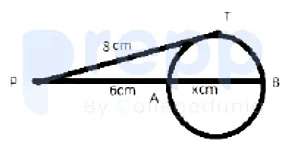
- A
\(\frac{14}{3}\)
- B
\(\frac{4}{3}\)
- C
\(\frac{14}{9}\)
- D
\(\frac{1}{3}\)
Show answer
A. \(\frac{14}{3}\)Given:
PT = 8 cm
PA = 6 cm
Formula used
PT2 = PA × PB
Here, PT is tangent
Calculation:
Let AB be "x"
PT2 = PA × PB
82 = 6(6 + x)
32/3 = 6 + x
x = 14/3
The value of AB is 14/3 cm.
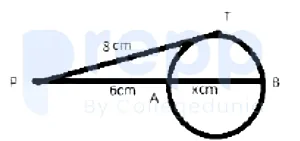 Paper & answer key PDF ↗
 Question 64archived
A shopkeeper offers the following two discount schemes.
A) Buy 3 get 4 free
B) Buy 5 get 6 free
Which scheme has the maximum discount percentage?
- A
A
- B
A does not give any discount
- C
A and B both have the same discount percentage
- D
B
Show answer
A. AUnderstanding Discount Schemes
Discount schemes offered by shopkeepers are designed to attract customers by providing a reduction on the price of goods. Often, these schemes involve getting some items free when you buy a certain number of items. To compare different schemes and find which one is most beneficial for the customer, we need to calculate the discount percentage offered by each scheme.
Calculating Discount Percentage
The discount percentage in a 'buy N get M free' scheme is calculated based on the total number of items the customer receives. The formula is:
$$ \text{Discount Percentage} = \left( \frac{\text{Number of free items}}{\text{Total number of items received}} \right) \times 100 $$
The total number of items received is the sum of the items bought (paid for) and the items received for free.
Analyzing Scheme A: Buy 3 Get 4 Free
In Scheme A, the customer buys 3 items and gets 4 items free.
Number of items paid for = 3
Number of free items = 4
Total number of items received = Number of items paid for + Number of free items = 3 + 4 = 7
Now, let's calculate the discount percentage for Scheme A:
$$ \text{Discount Percentage (A)} = \left( \frac{4}{7} \right) \times 100 $$
$$ \text{Discount Percentage (A)} \approx 0.5714 \times 100 $$
$$ \text{Discount Percentage (A)} \approx 57.14\% $$
Analyzing Scheme B: Buy 5 Get 6 Free
In Scheme B, the customer buys 5 items and gets 6 items free.
Number of items paid for = 5
Number of free items = 6
Total number of items received = Number of items paid for + Number of free items = 5 + 6 = 11
Now, let's calculate the discount percentage for Scheme B:
$$ \text{Discount Percentage (B)} = \left( \frac{6}{11} \right) \times 100 $$
$$ \text{Discount Percentage (B)} \approx 0.5454 \times 100 $$
$$ \text{Discount Percentage (B)} \approx 54.54\% $$
Comparing Discount Percentages
We compare the calculated discount percentages for both schemes:
Discount Percentage (A) ≈ 57.14%
Discount Percentage (B) ≈ 54.54%
Comparing these values, we can see that 57.14% is greater than 54.54%.
Therefore, Scheme A offers a higher discount percentage than Scheme B.
Scheme
Items Paid For
Free Items
Total Items
Discount Percentage
A
3
4
7
$\left( \frac{4}{7} \right) \times 100 \approx 57.14\%$
B
5
6
11
$\left( \frac{6}{11} \right) \times 100 \approx 54.54\%$
Based on the comparison, Scheme A provides the maximum discount percentage.
Conclusion
By calculating the discount percentage for each scheme based on the total items received, we determined that Scheme A (Buy 3 get 4 free) offers a higher discount percentage (approximately 57.14%) compared to Scheme B (Buy 5 get 6 free) which offers approximately 54.54%.
Revision Table: Discount Percentage Calculation
Here's a quick summary of the steps involved in calculating the discount percentage for 'buy N get M free' offers:
Identify the number of items paid for (N).
Identify the number of free items (M).
Calculate the total number of items received (N + M).
Use the formula: $$ \text{Discount} \% = \frac{\text{Free Items}}{\text{Total Items}} \times 100 $$
Additional Information: Real-World Discount Analysis
Understanding how to calculate discount percentages is useful for comparing various offers in real-life shopping scenarios. Sometimes, discounts might be presented as a percentage off the marked price, while other times they are offered through schemes like 'buy one get one free' or 'buy N get M free'. Knowing the formulas helps you determine the actual saving in each case and choose the most advantageous offer.
A 'buy one get one free' offer is a common type of 'buy N get M free' where N=1 and M=1. The total items received are 1+1=2, and the free items are 1. The discount is $(1/2) \times 100 = 50\%$.
Comparing 'buy N get M free' schemes primarily involves comparing the ratios M/(N+M). The larger the ratio, the higher the discount.
Paper & answer key PDF ↗ Question 65archived
The following bar chart represents the gross amount (in Rs. crores) and total cost (Rs. crores) of a firm.
In order to make a profit of 25%, what should the gross amount have been (in Rs. crores) in 2019-2020, if the total cost remained the same?
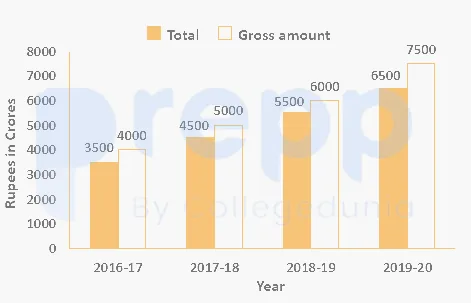
- A
7800
- B
8000
- C
8250
- D
8125
Show answer
D. 8125Calculation:
⇒ 6500 + 6500 × 25/100
⇒ 6500 + 1625
⇒ 8125
The gross amount should be 8125 (in Rs. crores) in 2019-2020, if the total cost remained the same.
Paper & answer key PDF ↗ Question 66archived
In what time will ₹10,000 at 4% per annum, produce the same interest as ₹8,000 does in 4 years at 5% simple interest?
- A
5 years
- B
3 years
- C
4 years
- D
6 years
Show answer
C. 4 yearsUnderstanding Simple Interest Problems
This question involves calculating the time required for an investment to earn a specific amount of simple interest, which is determined by comparing it to the interest earned by another investment under different conditions. Simple interest is calculated only on the principal amount.
Simple Interest Formula
The formula for simple interest (SI) is:
\( \text{SI} = \frac{P \times R \times T}{100} \)
Where:
\( P \) is the Principal amount
\( R \) is the Rate of interest per annum
\( T \) is the Time period in years
Step-by-Step Solution
Let's break the problem into two parts, representing the two different investment scenarios described.
Case 1: The Second Investment
First, we calculate the simple interest earned by the second investment, as all its parameters are given.
Principal (\( P_2 \)): ₹8,000
Rate (\( R_2 \)): 5% per annum
Time (\( T_2 \)): 4 years
Using the simple interest formula:
\( \text{SI}_2 = \frac{P_2 \times R_2 \times T_2}{100} \)
Substitute the values:
\( \text{SI}_2 = \frac{8000 \times 5 \times 4}{100} \)
Calculate the interest:
\( \text{SI}_2 = \frac{8000 \times 20}{100} \)
\( \text{SI}_2 = \frac{160000}{100} \)
\( \text{SI}_2 = 1600 \)
So, the interest earned by the second investment is ₹1,600.
Case 2: The First Investment
The problem states that the first investment produces the same interest as the second one. Therefore, the interest earned by the first investment (\( \text{SI}_1 \)) is also ₹1,600.
We are given the following parameters for the first investment:
Principal (\( P_1 \)): ₹10,000
Rate (\( R_1 \)): 4% per annum
Interest (\( \text{SI}_1 \)): ₹1,600 (same as \( \text{SI}_2 \))
Time (\( T_1 \)): Unknown (let's call it \( T \))
Using the simple interest formula for the first investment:
\( \text{SI}_1 = \frac{P_1 \times R_1 \times T_1}{100} \)
Substitute the known values:
\( 1600 = \frac{10000 \times 4 \times T}{100} \)
Simplify the equation:
\( 1600 = \frac{40000 \times T}{100} \)
\( 1600 = 400 \times T \)
Now, solve for \( T \) by dividing both sides by 400:
\( T = \frac{1600}{400} \)
\( T = 4 \)
The time required for the first investment is 4 years.
Conclusion
The time required for ₹10,000 at 4% per annum simple interest to produce the same interest as ₹8,000 in 4 years at 5% simple interest is 4 years.
Investment
Principal (P)
Rate (R)
Time (T)
Simple Interest (SI)
Second
₹8,000
5%
4 years
\( \frac{8000 \times 5 \times 4}{100} = \) ₹1,600
First
₹10,000
4%
? years
₹1,600 (Same as Second)
Simple Interest Revision Table
Term
Description
Formula
Principal (P)
The initial amount of money invested or borrowed.
-
Rate (R)
The percentage at which interest is charged or earned per year. (Expressed as a percentage)
-
Time (T)
The duration for which the money is invested or borrowed, usually in years.
-
Simple Interest (SI)
The interest calculated only on the principal amount.
\( \text{SI} = \frac{P \times R \times T}{100} \)
Amount (A)
The total sum including the principal and the interest earned.
\( A = P + \text{SI} \) or \( A = P \left(1 + \frac{RT}{100}\right) \)
Additional Information on Simple Interest Calculations
Simple interest is a fundamental concept in finance. It is different from compound interest, where interest is calculated on the principal amount plus any accumulated interest from previous periods. Simple interest is easier to calculate and is often used for short-term loans or deposits.
Key points about simple interest:
The interest amount is the same for every period (usually a year).
It only depends on the initial principal amount, the rate, and the time.
The total amount received back (Principal + Interest) grows linearly over time.
Understanding simple interest helps in evaluating basic loan agreements and investment returns.
Paper & answer key PDF ↗ Question 67archived
A man, a boy and a woman can finish a work in 10 days, 15 days and 30 days, respectively. In how many days can the work be finished by a man, a woman and a boy when all of them work together?
- A
5
- B
6
- C
8
- D
10
Show answer
A. 5Calculating Combined Work Time
This problem involves calculating the time taken by multiple individuals to complete a work when they work together, given their individual work rates. This is a common type of question in the topic of Time and Work in quantitative aptitude.
Understanding Work Rate and Time
The amount of work done by a person in one day (or unit time) is called their work rate or efficiency. If a person can finish a work in $N$ days, their work rate is $\frac{1}{N}$ of the work per day. Conversely, if a person's work rate is $\frac{1}{N}$ per day, they can finish the work in $N$ days.
Individual Work Rates
Let's find the work rate for each individual mentioned in the question:
A man finishes the work in 10 days.
Man's work rate = $\frac{1}{10}$ of the work per day.
A boy finishes the work in 15 days.
Boy's work rate = $\frac{1}{15}$ of the work per day.
A woman finishes the work in 30 days.
Woman's work rate = $\frac{1}{30}$ of the work per day.
Calculating Combined Work Rate
When a man, a boy, and a woman work together, their work rates add up to give the combined work rate. The total work done by them in one day is the sum of their individual work rates.
Combined work rate = Man's rate + Boy's rate + Woman's rate
Combined work rate = $\frac{1}{10} + \frac{1}{15} + \frac{1}{30}$
To add these fractions, we need to find a common denominator. The least common multiple (LCM) of 10, 15, and 30 is 30.
Let's convert each fraction to have a denominator of 30:
$\frac{1}{10} = \frac{1 \times 3}{10 \times 3} = \frac{3}{30}$
$\frac{1}{15} = \frac{1 \times 2}{15 \times 2} = \frac{2}{30}$
$\frac{1}{30} = \frac{1 \times 1}{30 \times 1} = \frac{1}{30}$
Now, add the fractions:
Combined work rate = $\frac{3}{30} + \frac{2}{30} + \frac{1}{30} = \frac{3 + 2 + 1}{30} = \frac{6}{30}$
Simplify the combined work rate fraction:
Combined work rate = $\frac{6}{30} = \frac{1}{5}$ of the work per day.
Calculating Time Taken Together
If the combined work rate is $\frac{1}{5}$ of the work per day, it means they complete $\frac{1}{5}$ of the work each day. To find the total time taken to complete the entire work (which is 1 whole unit of work), we take the reciprocal of the combined work rate.
Time taken together = $\frac{1}{\text{Combined work rate}}$
Time taken together = $\frac{1}{1/5} = 1 \times \frac{5}{1} = 5$ days.
So, a man, a woman, and a boy working together can finish the work in 5 days.
Summary of Steps
Find the individual work rate for each person (1/time taken).
Add the individual work rates to find the combined work rate.
Calculate the time taken together by taking the reciprocal of the combined work rate.
Individual
Time to finish work (Days)
Work Rate (Work/Day)
Man
10
$\frac{1}{10}$
Boy
15
$\frac{1}{15}$
Woman
30
$\frac{1}{30}$
Combined Work Rate = $\frac{1}{10} + \frac{1}{15} + \frac{1}{30} = \frac{3+2+1}{30} = \frac{6}{30} = \frac{1}{5}$ work/day.
Time taken together = $\frac{1}{\text{Combined Work Rate}} = \frac{1}{1/5} = 5$ days.
Revision Table: Work and Time Concepts
Concept
Definition/Formula
Work Rate
Amount of work done per unit time. If time is $T$, rate is $\frac{1}{T}$.
Time Taken
Total time needed to complete the work. If rate is $R$, time is $\frac{1}{R}$.
Work Done
Work Rate $\times$ Time Taken. Often considered as 1 unit for completing the full task.
Combined Rate
Sum of individual rates when multiple people work together.
Additional Information: Time and Work Variations
Problems involving time and work can have several variations:
Working alternately: Individuals might work on different days or shifts. You calculate the work done in a cycle and find how many cycles are needed.
Leaving or joining work: Some people might leave the work before completion, or new people might join. You calculate the work done in different phases.
Efficiency: Problems might mention people's efficiencies relative to each other (e.g., A is twice as efficient as B). Efficiency is directly proportional to work rate.
Work and Wages: Wages are usually distributed in proportion to the work done by each person.
Understanding the concept of work rate as the reciprocal of time taken is fundamental to solving all these variations.
Paper & answer key PDF ↗ Question 68archived
If cos θ = \(\frac{\sqrt{3}}{2}\), then tan2 θ cos2 θ = ?
- A
\(\frac{1}{\sqrt3}\)
- B
\(\frac{1}{4}\)
- C
\(\frac{1}{2}\)
- D
√3
Show answer
B. \(\frac{1}{4}\)Finding the Value of tan² θ cos² θ Given cos θ
The question asks us to find the value of tan2 θ cos2 θ given that cos θ = $\frac{\sqrt{3}}{2}$. The notation "tan2 θ cos2 θ" with the space between the trigonometric function name and the number '2' most likely indicates the square of the trigonometric function, i.e., $(\tan \theta)^2$ and $(\cos \theta)^2$. Therefore, we interpret the expression as $\tan^2 \theta \cos^2 \theta$. Let's proceed with this interpretation.
Step-by-Step Calculation
We are given:
$\cos \theta = \frac{\sqrt{3}}{2}$
We need to find the value of $\tan^2 \theta \cos^2 \theta$.
Let's simplify the expression $\tan^2 \theta \cos^2 \theta$ using fundamental trigonometric identities.
Recall the identity for the tangent function:
$\tan \theta = \frac{\sin \theta}{\cos \theta}$
Squaring both sides gives:
$\tan^2 \theta = \left(\frac{\sin \theta}{\cos \theta}\right)^2 = \frac{\sin^2 \theta}{\cos^2 \theta}$
Now, substitute this into the expression we need to evaluate:
$\tan^2 \theta \cos^2 \theta = \left(\frac{\sin^2 \theta}{\cos^2 \theta}\right) \cos^2 \theta$
We can cancel out the $\cos^2 \theta$ term in the numerator and the denominator, assuming $\cos^2 \theta \neq 0$. Since $\cos \theta = \frac{\sqrt{3}}{2}$, which is not zero, $\cos^2 \theta = \left(\frac{\sqrt{3}}{2}\right)^2 = \frac{3}{4}$, which is also not zero. So, the cancellation is valid.
The expression simplifies to:
$\tan^2 \theta \cos^2 \theta = \sin^2 \theta$
Now we need to find the value of $\sin^2 \theta$. We can use the fundamental trigonometric identity:
$\sin^2 \theta + \cos^2 \theta = 1$
Rearranging this identity to solve for $\sin^2 \theta$:
$\sin^2 \theta = 1 - \cos^2 \theta$
Substitute the given value of $\cos \theta = \frac{\sqrt{3}}{2}$ into this equation:
$\sin^2 \theta = 1 - \left(\frac{\sqrt{3}}{2}\right)^2$
Calculate the square of $\frac{\sqrt{3}}{2}$:
$\left(\frac{\sqrt{3}}{2}\right)^2 = \frac{(\sqrt{3})^2}{2^2} = \frac{3}{4}$
Now substitute this value back into the equation for $\sin^2 \theta$:
$\sin^2 \theta = 1 - \frac{3}{4}$
Perform the subtraction:
$\sin^2 \theta = \frac{4}{4} - \frac{3}{4} = \frac{4-3}{4} = \frac{1}{4}$
So, the value of $\sin^2 \theta$ is $\frac{1}{4}$.
Since $\tan^2 \theta \cos^2 \theta = \sin^2 \theta$, the value of the expression is $\frac{1}{4}$.
Verification with θ Value
We know that $\cos \theta = \frac{\sqrt{3}}{2}$ corresponds to $\theta = 30^\circ$ (or $\frac{\pi}{6}$ radians) in the first quadrant. Let's verify the result using this specific value of $\theta$.
If $\theta = 30^\circ$, then:
$\cos \theta = \cos 30^\circ = \frac{\sqrt{3}}{2}$ (Matches the given condition)
$\sin \theta = \sin 30^\circ = \frac{1}{2}$
$\tan \theta = \tan 30^\circ = \frac{\sin 30^\circ}{\cos 30^\circ} = \frac{1/2}{\sqrt{3}/2} = \frac{1}{\sqrt{3}}$
Now calculate $\tan^2 \theta \cos^2 \theta$ using these values:
$\tan^2 \theta = \left(\frac{1}{\sqrt{3}}\right)^2 = \frac{1^2}{(\sqrt{3})^2} = \frac{1}{3}$
$\cos^2 \theta = \left(\frac{\sqrt{3}}{2}\right)^2 = \frac{3}{4}$
Multiply these values:
$\tan^2 \theta \cos^2 \theta = \frac{1}{3} \times \frac{3}{4} = \frac{1 \times 3}{3 \times 4} = \frac{3}{12} = \frac{1}{4}$
The result matches the value obtained using trigonometric identities.
Note on alternative interpretation: If the question intended $\tan(2\theta) \cos(2\theta)$, this simplifies to $\sin(2\theta)$. For $\cos \theta = \frac{\sqrt{3}}{2}$, $\theta = 30^\circ$ (or $330^\circ$ etc.). If $\theta = 30^\circ$, $2\theta = 60^\circ$, and $\sin(2\theta) = \sin 60^\circ = \frac{\sqrt{3}}{2}$. If $\theta = 330^\circ$, $2\theta = 660^\circ$, and $\sin(2\theta) = \sin 660^\circ = \sin(360^\circ+300^\circ) = \sin 300^\circ = -\frac{\sqrt{3}}{2}$. Neither $\frac{\sqrt{3}}{2}$ nor $-\frac{\sqrt{3}}{2}$ is among the given options. This reinforces the interpretation that the question likely meant $\tan^2 \theta \cos^2 \theta$.
Summary of Steps
Interpret the expression "tan2 θ cos2 θ" as $\tan^2 \theta \cos^2 \theta$.
Use the identity $\tan \theta = \frac{\sin \theta}{\cos \theta}$ to rewrite $\tan^2 \theta \cos^2 \theta$ as $\frac{\sin^2 \theta}{\cos^2 \theta} \cos^2 \theta$.
Simplify the expression to $\sin^2 \theta$.
Use the identity $\sin^2 \theta = 1 - \cos^2 \theta$.
Substitute the given value $\cos \theta = \frac{\sqrt{3}}{2}$ into the expression for $\sin^2 \theta$.
Calculate $\sin^2 \theta = 1 - \left(\frac{\sqrt{3}}{2}\right)^2 = 1 - \frac{3}{4} = \frac{1}{4}$.
The value of $\tan^2 \theta \cos^2 \theta$ is $\frac{1}{4}$.
Given Information
Expression to Find
Key Identities Used
Calculated Value
$\cos \theta = \frac{\sqrt{3}}{2}$
$\tan^2 \theta \cos^2 \theta$
$\tan \theta = \frac{\sin \theta}{\cos \theta}$, $\sin^2 \theta + \cos^2 \theta = 1$
$\frac{1}{4}$
Revision Table: Key Trigonometric Concepts
Concept
Description
Formula/Identity
Cosine (θ)
Ratio of the adjacent side to the hypotenuse in a right triangle.
$\cos \theta$
Tangent (θ)
Ratio of the opposite side to the adjacent side in a right triangle. Also defined using sine and cosine.
$\tan \theta = \frac{\sin \theta}{\cos \theta}$
Pythagorean Identity
Relates sine and cosine squared. Fundamental identity.
$\sin^2 \theta + \cos^2 \theta = 1$
Square of a Function
Notation like $\tan^2 \theta$ means $(\tan \theta)^2$.
$f^2(\theta) = (f(\theta))^2$
Additional Information: Understanding Trigonometric Notation
Trigonometric notation can sometimes be confusing. It's important to understand the standard ways expressions are written.
$\sin^2 \theta$: This means $(\sin \theta)^2$. Similarly for $\cos^2 \theta$, $\tan^2 \theta$, etc.
$\sin 2\theta$: This means $\sin(2 \times \theta)$, i.e., the sine of twice the angle $\theta$.
$\sin(2\theta)$: This is another way to write $\sin 2\theta$, explicitly showing the argument of the function.
In the original question's formatting "tan2 θ cos2 θ", the space between "tan" and "2", and "cos" and "2", along with " θ", strongly suggests that '2' is an exponent applied to the function of $\theta$, not a multiplier of the angle $\theta$. This is why $\tan^2 \theta \cos^2 \theta$ is the most likely correct interpretation leading to one of the given options.
Always double-check the intended meaning of notation, especially in exam questions, but rely on standard mathematical conventions when interpreting.
Paper & answer key PDF ↗ Question 69archived
What is the value of (3x3 + 5x2y+ 12xy2 + 7y3), when x = -4 and y = -1?
- A
-359
- B
-361
- C
-329
- D
-327
Show answer
D. -327Evaluating Polynomial Expressions with Given Values
The question asks us to find the value of a given polynomial expression when specific numerical values for the variables $x$ and $y$ are provided. Evaluating an expression means substituting the given values into the expression and performing the arithmetic operations.
The given polynomial expression is: $\left(3x^3 + 5x^2y+ 12xy^2 + 7y^3\right)$
The given values for the variables are:
$x = -4$
$y = -1$
Now, let's substitute these values into the expression and calculate step-by-step.
Substitute $x = -4$ and $y = -1$ into the expression:
$\left(3(-4)^3 + 5(-4)^2(-1) + 12(-4)(-1)^2 + 7(-1)^3\right)$
First, calculate the powers of $x$ and $y$:
$x^3 = (-4)^3 = (-4) \times (-4) \times (-4) = 16 \times (-4) = -64$
$x^2 = (-4)^2 = (-4) \times (-4) = 16$
$y^2 = (-1)^2 = (-1) \times (-1) = 1$
$y^3 = (-1)^3 = (-1) \times (-1) \times (-1) = 1 \times (-1) = -1$
Now substitute these power values back into the expression:
$\left(3(-64) + 5(16)(-1) + 12(-4)(1) + 7(-1)\right)$
Next, perform the multiplications in each term:
First term: $3 \times (-64) = -192$
Second term: $5 \times (16) \times (-1) = 80 \times (-1) = -80$
Third term: $12 \times (-4) \times (1) = -48 \times 1 = -48$
Fourth term: $7 \times (-1) = -7$
Substitute these results back into the expression:
$(-192) + (-80) + (-48) + (-7)$
Now, perform the addition and subtraction:
$-192 - 80 - 48 - 7$
Combine the negative numbers:
$-192 - 80 = -272$
$-272 - 48 = -320$
$-320 - 7 = -327$
The final value of the expression is $-327$.
Let's summarise the calculation steps in a table:
Expression$3x^3 + 5x^2y+ 12xy^2 + 7y^3$
Substitute $x=-4, y=-1$$3(-4)^3 + 5(-4)^2(-1) + 12(-4)(-1)^2 + 7(-1)^3$
Calculate Powers$3(-64) + 5(16)(-1) + 12(-4)(1) + 7(-1)$
Calculate Products$-192 + (-80) + (-48) + (-7)$
Sum the Terms$-192 - 80 - 48 - 7 = -327$
Comparing this result with the given options:
Option 1: -359
Option 2: -361
Option 3: -329
Option 4: -327
Our calculated value is -327, which matches Option 4.
Revision Table: Evaluating Expressions
Here is a quick revision table on evaluating expressions:
Concept
Description
Polynomial Expression
A mathematical expression involving variables raised to non-negative integer powers, combined using addition, subtraction, and multiplication. Example: $3x^3 + 5x^2y + 12xy^2 + 7y^3$.
Evaluating an Expression
The process of substituting given numerical values for the variables in an expression and calculating the resulting numerical value.
Order of Operations
Follow the standard order (PEMDAS/BODMAS): Parentheses/Brackets, Exponents/Orders, Multiplication and Division (from left to right), Addition and Subtraction (from left to right).
Handling Negative Numbers
Pay close attention to signs when multiplying or raising negative numbers to powers. An even power of a negative number is positive (e.g., $(-4)^2 = 16$), while an odd power is negative (e.g., $(-4)^3 = -64$).
Additional Information: Polynomial Evaluation
Evaluating polynomials is a fundamental skill in algebra. It allows us to find the output value of a polynomial function for specific input values of the variables.
Steps for evaluating a polynomial:
Identify the polynomial expression and the values given for each variable.
Replace each variable in the expression with its given value. Use parentheses, especially when substituting negative numbers, to avoid sign errors.
Calculate the powers of the numbers. Remember that $a^n$ means $a$ multiplied by itself $n$ times.
Perform the multiplications in each term. A term is a product of numbers and variables (or powers of variables).
Finally, perform the additions and subtractions of the resulting numerical terms from left to right.
This process is essential for graphing polynomial functions, solving equations, and many other mathematical applications. Practice with different expressions and values helps build confidence in handling signs and calculations accurately.
Paper & answer key PDF ↗ Question 70archived
If the four numbers, 39, 117, 17 and y are in proportion, then find the value of y.
- A
49
- B
51
- C
57
- D
85
Show answer
B. 51Finding the Value of y in a Proportion
The question asks us to find the value of 'y' if the four numbers 39, 117, 17, and y are in proportion. Understanding the concept of proportion is key to solving this problem.
What is Proportion?
Four numbers, say a, b, c, and d, are said to be in proportion if the ratio of the first two numbers (a and b) is equal to the ratio of the last two numbers (c and d). Mathematically, this is expressed as:
\(\frac{a}{b} = \frac{c}{d}\)
This can also be written as \(a:b :: c:d\), where '\(::\)' means 'is to' and indicates equality of ratios.
Setting up the Proportion
Given the numbers 39, 117, 17, and y are in proportion, we can write the proportion as:
\(\frac{39}{117} = \frac{17}{y}\)
Solving for y
To find the value of y, we can use cross-multiplication. Cross-multiplying the equation gives us:
\(39 \times y = 117 \times 17\)
Now, we need to isolate y. We can do this by dividing both sides of the equation by 39:
\(y = \frac{117 \times 17}{39}\)
Let's simplify the expression. We can notice that 117 is a multiple of 39. Let's divide 117 by 39:
\(\frac{117}{39}\)
We can test small multiples of 39:
\(39 \times 1 = 39\)
\(39 \times 2 = 78\)
\(39 \times 3 = 117\)
So, \(117 \div 39 = 3\).
Substituting this back into our equation for y:
\(y = 3 \times 17\)
Now, calculate the final product:
\(y = 51\)
Conclusion
Thus, the value of y that makes the numbers 39, 117, 17, and y in proportion is 51.
Let's verify this by checking the ratios:
\(\frac{39}{117} = \frac{1}{3}\)
\(\frac{17}{51} = \frac{17}{3 \times 17} = \frac{1}{3}\)
Since both ratios are equal (\(\frac{1}{3}\)), the numbers 39, 117, 17, and 51 are indeed in proportion.
Revision Table: Understanding Proportion Problems
Concept
Description
Formula
Ratio
Comparison of two quantities by division.
\(a:b\) or \(\frac{a}{b}\)
Proportion
An equality of two ratios.
\(a:b :: c:d\) or \(\frac{a}{b} = \frac{c}{d}\)
Terms of Proportion
In \(a:b :: c:d\), a and d are called extreme terms, b and c are called mean terms.
Product of Extremes = Product of Means (\(a \times d = b \times c\))
Additional Information on Proportion and Ratios
Problems involving proportion are common in mathematics and have many real-world applications, such as scaling recipes, calculating distances on maps, converting currencies, and in physics formulas.
Types of Proportion: While the question deals with direct proportion (where the ratio of corresponding terms is constant), there's also inverse proportion (where the product of corresponding terms is constant).
Solving for Unknowns: Using the property that the product of the means equals the product of the extremes (\(a \times d = b \times c\)) is a standard method to solve for an unknown term in a proportion.
Simplifying Ratios: Always simplify ratios to their simplest form before comparing or using them in calculations, as this makes the process easier. For example, simplifying \(\frac{39}{117}\) to \(\frac{1}{3}\) helped us solve the problem more quickly.
Understanding these basic principles of ratios and proportion is fundamental for solving various mathematical problems.
Paper & answer key PDF ↗ Question 71archived
The volume of a sphere of radius 4.2 cm is: \(\left(\text { Use } \pi=\frac{22}{7}\right)\)
- A
310.464 cm3
- B
312.725 cm3
- C
278.234 cm3
- D
297.824 cm3
Show answer
A. 310.464 cm3Calculating Sphere Volume Given Radius
This problem requires us to calculate the volume of a sphere when its radius is known. We are given the radius of the sphere and the value of \(\pi\) to use for the calculation. Understanding the formula for the volume of a sphere is key to solving this problem.
Formula for Sphere Volume
The volume (\(V\)) of a sphere with radius (\(r\)) is given by the formula:
\[ V = \frac{4}{3}\pi r^3 \]
where:
\(V\) is the volume of the sphere.
\(r\) is the radius of the sphere.
\(\pi\) is a mathematical constant, approximately 3.14159.
Given Values
From the question, we are given:
Radius of the sphere, \(r = 4.2\) cm.
Value of \(\pi\) to use, \(\pi = \frac{22}{7}\).
Step-by-Step Volume Calculation
Now, we substitute the given values into the volume formula:
\[ V = \frac{4}{3} \times \pi \times r^3 \]
\[ V = \frac{4}{3} \times \frac{22}{7} \times (4.2)^3 \]
First, let's calculate \( (4.2)^3 \):
\[ (4.2)^3 = 4.2 \times 4.2 \times 4.2 \]
\[ (4.2)^2 = 17.64 \]
\[ (4.2)^3 = 17.64 \times 4.2 \]
Performing the multiplication:
17.64
\(\times\)
4.2
3528
(17.64 \(\times\) 0.2)
7056
(17.64 \(\times\) 4)
\(\rule{3cm}{0.4pt}\)
74.088
(Summing with correct decimal placement)
So, \( (4.2)^3 = 74.088 \).
Now substitute this back into the volume formula:
\[ V = \frac{4}{3} \times \frac{22}{7} \times 74.088 \]
\[ V = \frac{4 \times 22}{3 \times 7} \times 74.088 \]
\[ V = \frac{88}{21} \times 74.088 \]
We can divide 74.088 by 21:
\( \frac{74.088}{21} \)
\( = 3.528 \)
Now, multiply the result by 88:
\[ V = 88 \times 3.528 \]
Performing the multiplication:
3.528
\(\times\)
88
28224
(3.528 \(\times\) 8)
28224
(3.528 \(\times\) 80)
\(\rule{3cm}{0.4pt}\)
310.464
(Summing with correct decimal placement)
So, the volume of the sphere is \( 310.464 \) cm\(^3\).
Comparing with Options
Let's compare our calculated volume with the given options:
Option 1: 310.464 cm\(^3\)
Option 2: 312.725 cm\(^3\)
Option 3: 278.234 cm\(^3\)
Option 4: 297.824 cm\(^3\)
Our calculated volume, 310.464 cm\(^3\), matches Option 1.
Final Answer
The volume of the sphere of radius 4.2 cm is 310.464 cm\(^3\).
Revision Table: Sphere Geometry
Concept
Formula
Notes
Area of Sphere
\( A = 4\pi r^2 \)
\(r\) is the radius
Volume of Sphere
\( V = \frac{4}{3}\pi r^3 \)
\(r\) is the radius
Circumference of Great Circle
\( C = 2\pi r \)
A great circle is a circle on the sphere's surface with the same center as the sphere.
Additional Information: Units and Pi
When calculating volume, the units are cubic units. Since the radius is given in centimeters (cm), the volume is in cubic centimeters (cm\(^3\)). It is important to include the correct units in the final answer.
The value of \(\pi\) can be approximated as 3.14, 3.14159, or as the fraction \(\frac{22}{7}\). The question explicitly stated to use \(\pi = \frac{22}{7}\), which is often done in problems to allow for some simplification when the radius or other dimensions are multiples of 7 or 0.7.
For example, if \(r = 7\) cm, \(V = \frac{4}{3} \times \frac{22}{7} \times 7^3 = \frac{4}{3} \times \frac{22}{7} \times 343 = \frac{4}{3} \times 22 \times 49 = \frac{4312}{3}\) cm\(^3\). If \(r = 4.2 = \frac{42}{10}\) cm, using \(\pi = \frac{22}{7}\) allowed us to potentially simplify \( \frac{42}{10} \) with the \( \frac{1}{7} \) factor, although in this specific calculation, direct multiplication worked well too.
Paper & answer key PDF ↗ Question 72archived
If (a + b + c) = 16, and (a2 + b2 + c2) = 90, find the value of (ab + bc + ca).
- A
84
- B
83
- C
82
- D
81
Show answer
B. 83Solving for \( (ab + bc + ca) \) using Algebraic Identities
The problem provides us with the sum of three variables \( (a + b + c) \) and the sum of their squares \( (a^2 + b^2 + c^2) \). We need to find the value of the sum of the products of these variables taken two at a time, which is \( (ab + bc + ca) \).
Understanding the Problem and Given Values
We are given:
\( a + b + c = 16 \)
\( a^2 + b^2 + c^2 = 90 \)
We need to find the value of \( ab + bc + ca \).
Applying the Relevant Algebraic Identity
There is a standard algebraic identity that relates these three expressions. The identity for the square of the sum of three terms is:
\( (a + b + c)^2 = a^2 + b^2 + c^2 + 2(ab + bc + ca) \)
This identity is key to solving this problem because it includes all the terms we are given and the term we need to find.
Step-by-Step Calculation
We can substitute the given values into the identity:
Given: \( a + b + c = 16 \) and \( a^2 + b^2 + c^2 = 90 \)
The identity is: \( (a + b + c)^2 = (a^2 + b^2 + c^2) + 2(ab + bc + ca) \)
Substitute the given values:
\( (16)^2 = (90) + 2(ab + bc + ca) \)
Calculate \( (16)^2 \):
\( 16 \times 16 = 256 \)
So the equation becomes:
\( 256 = 90 + 2(ab + bc + ca) \)
Now, we need to isolate the term \( 2(ab + bc + ca) \). Subtract 90 from both sides of the equation:
\( 256 - 90 = 2(ab + bc + ca) \)
\( 166 = 2(ab + bc + ca) \)
Finally, to find the value of \( (ab + bc + ca) \), divide both sides by 2:
\( \frac{166}{2} = ab + bc + ca \)
\( 83 = ab + bc + ca \)
Final Answer
The value of \( (ab + bc + ca) \) is 83.
Given
Value
\( a + b + c \)
16
\( a^2 + b^2 + c^2 \)
90
Formula Used
Substitution
Result
\( (a + b + c)^2 \)
\( (16)^2 \)
256
\( (a + b + c)^2 = (a^2 + b^2 + c^2) + 2(ab + bc + ca) \)
\( 256 = 90 + 2(ab + bc + ca) \)
\( 166 = 2(ab + bc + ca) \)
\( ab + bc + ca \)
\( \frac{166}{2} \)
83
Revision Table: Key Concepts
Concept
Description
Formula/Identity
Algebraic Identity
An equation that is true for all possible values of its variables.
Example: \( (x+y)^2 = x^2 + 2xy + y^2 \)
Square of a Trinomial
The result of multiplying a sum of three terms by itself.
\( (a + b + c)^2 = a^2 + b^2 + c^2 + 2(ab + bc + ca) \)
Substitution
Replacing a variable or expression with a known value or equivalent expression.
Used in the solution to plug in given values.
Additional Information: Related Algebraic Identities
Understanding other related algebraic identities can be helpful in solving various algebra problems. Here are a few examples:
Difference of Squares: \( a^2 - b^2 = (a - b)(a + b) \)
Sum of Cubes: \( a^3 + b^3 = (a + b)(a^2 - ab + b^2) \)
Difference of Cubes: \( a^3 - b^3 = (a - b)(a^2 + ab + b^2) \)
Cube of a Binomial: \( (a + b)^3 = a^3 + 3a^2b + 3ab^2 + b^3 = a^3 + b^3 + 3ab(a + b) \)
These identities help simplify expressions and solve equations more efficiently. The identity \( (a + b + c)^2 \) used in this problem is a generalization of \( (a+b)^2 \).
Paper & answer key PDF ↗ Question 73archived
If {(3 sin θ – cos θ) / (cos θ + sin θ)} = 1, then the value of cot θ is:
- A
3
- B
2
- C
0
- D
1
Show answer
D. 1Solving Trigonometric Equations to Find cot θ
The question asks us to find the value of cot θ given a trigonometric equation involving sin θ and cos θ.
The given equation is:
$$ \frac{3 \sin \theta - \cos \theta}{\cos \theta + \sin \theta} = 1 $$
To find the value of cot θ, we first need to manipulate this equation to isolate or find a relationship between sin θ and cos θ.
Here are the steps to solve the equation:
Start with the given equation: $$ \frac{3 \sin \theta - \cos \theta}{\cos \theta + \sin \theta} = 1 $$
Multiply both sides of the equation by the denominator $(\cos \theta + \sin \theta)$ to eliminate the fraction: $$ 3 \sin \theta - \cos \theta = 1 \times (\cos \theta + \sin \theta) $$ This simplifies to: $$ 3 \sin \theta - \cos \theta = \cos \theta + \sin \theta $$
Now, we need to group the terms with sin θ on one side and the terms with cos θ on the other side. Subtract $\sin \theta$ from both sides: $$ 3 \sin \theta - \sin \theta - \cos \theta = \cos \theta $$ And add $\cos \theta$ to both sides: $$ 3 \sin \theta - \sin \theta = \cos \theta + \cos \theta $$
Combine like terms on both sides: $$ (3-1)\sin \theta = (1+1)\cos \theta $$ $$ 2 \sin \theta = 2 \cos \theta $$
Divide both sides by 2: $$ \sin \theta = \cos \theta $$
The question asks for the value of cot θ. Recall that the definition of cot θ is: $$ \cot \theta = \frac{\cos \theta}{\sin \theta} $$
From the simplified equation $\sin \theta = \cos \theta$, we can find the ratio $\frac{\cos \theta}{\sin \theta}$. Divide both sides of $\sin \theta = \cos \theta$ by $\sin \theta$ (assuming $\sin \theta \neq 0$): $$ \frac{\sin \theta}{\sin \theta} = \frac{\cos \theta}{\sin \theta} $$ $$ 1 = \frac{\cos \theta}{\sin \theta} $$
Therefore, the value of cot θ is 1.
Thus, solving the trigonometric equation leads us to the value of cot θ.
The final answer is 1.
Step
Equation
Explanation
1
$$ \frac{3 \sin \theta - \cos \theta}{\cos \theta + \sin \theta} = 1 $$
Starting equation
2
$$ 3 \sin \theta - \cos \theta = \cos \theta + \sin \theta $$
Multiply by denominator
3
$$ 2 \sin \theta = 2 \cos \theta $$
Rearrange and combine terms
4
$$ \sin \theta = \cos \theta $$
Divide by 2
5
$$ \frac{\cos \theta}{\sin \theta} = 1 $$
Divide by $$ \sin \theta $$
6
$$ \cot \theta = 1 $$
Using identity $$ \cot \theta = \frac{\cos \theta}{\sin \theta} $$
Revision Table: Key Trigonometric Concepts
Trigonometric Function
Definition
Relation to sin θ, cos θ
Tangent (θ)
Opposite / Adjacent
$$ \tan \theta = \frac{\sin \theta}{\cos \theta} $$
Cotangent (θ)
Adjacent / Opposite
$$ \cot \theta = \frac{\cos \theta}{\sin \theta} $$
Secant (θ)
Hypotenuse / Adjacent
$$ \sec \theta = \frac{1}{\cos \theta} $$
Cosecant (θ)
Hypotenuse / Opposite
$$ \csc \theta = \frac{1}{\sin \theta} $$
Additional Information: Solving Trigonometric Equations
Solving trigonometric equations involves finding the values of the angle(s) θ that satisfy the given equation. However, sometimes the question asks for the value of a specific trigonometric function of θ without needing to find θ itself.
Key techniques used in solving trigonometric equations often include:
Rearranging the equation to isolate a trigonometric function.
Using trigonometric identities (like $$ \tan \theta = \frac{\sin \theta}{\cos \theta} $$, $$ \cot \theta = \frac{\cos \theta}{\sin \theta} $$, $$ \sin^2 \theta + \cos^2 \theta = 1 $$, etc.).
Factoring trigonometric expressions.
Squaring both sides (use with caution as it can introduce extraneous solutions).
In this particular problem, we simplified the equation until we got a direct relationship between sin θ and cos θ, which allowed us to directly calculate the value of cot θ using its definition.
Paper & answer key PDF ↗ Question 74archived
Two runners, Sony and Mony, start running on a circular track of length 200 m at speeds of 18 and 24 km/h, respectively, in the same direction. After how much time from the start will they meet again at the starting point?
- A
90 sec
- B
110 sec
- C
120 sec
- D
100 sec
Show answer
C. 120 secUnderstanding the Problem: Runners on a Circular Track
This problem involves two runners, Sony and Mony, moving on a circular track. We are given their speeds and the length of the track. They start at the same point and run in the same direction. We need to find out when they will next meet *specifically* at the starting point.
To meet at the starting point again, each runner must complete a whole number of laps. The time taken for them to meet again at the starting point will be a common multiple of the time each runner takes to complete one full lap. The first time they meet again at the starting point after the start will be the least common multiple (LCM) of their individual lap times.
Step 1: Convert Speeds to Consistent Units
The track length is given in meters (m), but the speeds are in kilometers per hour (km/h). To make calculations consistent, we need to convert the speeds from km/h to meters per second (m/s). The conversion factor is:
1 km/h = 1000 meters / 3600 seconds = 5/18 m/s
Sony's speed: $18 \text{ km/h} = 18 \times \frac{5}{18} \text{ m/s} = 5 \text{ m/s}$
Mony's speed: $24 \text{ km/h} = 24 \times \frac{5}{18} \text{ m/s} = \frac{4}{3} \times 5 \text{ m/s} = \frac{20}{3} \text{ m/s}$
Step 2: Calculate Time Taken by Each Runner for One Lap
The time taken to complete one lap is the track length divided by the runner's speed.
Time = Distance / Speed
Time for Sony to complete one lap ($T_{\text{Sony}}$):
$\qquad T_{\text{Sony}} = \frac{\text{Track Length}}{\text{Sony's Speed}} = \frac{200 \text{ m}}{5 \text{ m/s}} = 40 \text{ s}$
Time for Mony to complete one lap ($T_{\text{Mony}}$):
$\qquad T_{\text{Mony}} = \frac{\text{Track Length}}{\text{Mony's Speed}} = \frac{200 \text{ m}}{20/3 \text{ m/s}} = 200 \times \frac{3}{20} \text{ s} = 10 \times 3 \text{ s} = 30 \text{ s}$
Step 3: Find the Time When They Meet Again at the Starting Point
They start together at the starting point. They will be at the starting point again at times that are multiples of their respective lap times. They will meet simultaneously at the starting point at times that are common multiples of their lap times. The first time they meet again at the starting point (after the initial start) is the Least Common Multiple (LCM) of their lap times.
Time to meet again at starting point = $\text{LCM}(T_{\text{Sony}}, T_{\text{Mony}})$
Time to meet again at starting point = $\text{LCM}(40 \text{ s}, 30 \text{ s})$
Step 4: Calculate the LCM(40, 30)
We can find the LCM using prime factorization or by listing multiples.
Using prime factorization:
$40 = 2 \times 2 \times 2 \times 5 = 2^3 \times 5^1$
$30 = 2 \times 3 \times 5 = 2^1 \times 3^1 \times 5^1$
The LCM is found by taking the highest power of all prime factors present in either factorization:
$\text{LCM}(40, 30) = 2^{\max(3,1)} \times 3^{\max(0,1)} \times 5^{\max(1,1)}$
$\text{LCM}(40, 30) = 2^3 \times 3^1 \times 5^1 = 8 \times 3 \times 5 = 120$
Using listing multiples:
Multiples of 40: 40, 80, 120, 160, ...
Multiples of 30: 30, 60, 90, 120, 150, ...
The smallest common multiple is 120.
Therefore, Sony and Mony will meet again at the starting point after 120 seconds.
Revision Table: Key Concepts
Concept
Explanation
Formula/Method
Unit Conversion (km/h to m/s)
Ensuring consistent units for speed and distance.
Speed (m/s) = Speed (km/h) $\times$ $\frac{5}{18}$
Time for One Lap
Time taken to cover the full track length.
Time = Distance / Speed
Meeting at Starting Point (Same Direction)
Occurs at times which are common multiples of individual lap times. First time is LCM.
Time = LCM(Time for Lap 1, Time for Lap 2)
Least Common Multiple (LCM)
The smallest positive integer that is a multiple of two or more integers.
Prime factorization or listing multiples.
Additional Information: Relative Speed vs. Meeting at Start
It's important to distinguish between meeting anywhere on the track and meeting specifically at the starting point.
Meeting Anywhere on the Track: If they run in the same direction, the time taken to meet for the first time (anywhere on the track, after the start) is calculated using their relative speed. The relative speed when moving in the same direction is the difference between their speeds. In this case, relative speed = $\frac{20}{3} - 5 = \frac{20 - 15}{3} = \frac{5}{3} \text{ m/s}$. Time to first meet anywhere = Distance / Relative Speed = $200 \text{ m} / (5/3 \text{ m/s}) = 200 \times \frac{3}{5} = 40 \times 3 = 120 \text{ s}$. Notice that in this specific problem, the first time they meet anywhere is the same as the first time they meet at the start. This happens when the ratio of their speeds simplifies such that the faster runner completes a whole number of extra laps by the time the slower runner completes a whole number of laps, and this meeting happens to coincide with both being at the start.
Meeting at the Starting Point: As calculated above, this depends on the individual times to complete one full lap and finding the LCM of these times. This method guarantees that both runners are simultaneously at the starting line after completing an integer number of laps.
In this question, we were specifically asked about meeting again at the starting point, so the LCM of individual lap times is the correct approach.
Paper & answer key PDF ↗ Question 75archived
What will be the remainder when (265)4081 + 9 is divided by 266?
- A
8
- B
6
- C
1
- D
9
Show answer
A. 8Understanding the Remainder Problem
The question asks for the remainder when a specific expression, \((265)^{4081} + 9\), is divided by 266. This is a classic problem involving modular arithmetic, which deals with remainders after division. We need to find the value of \((265)^{4081} + 9 \pmod{266}\).
Applying Modular Arithmetic to Calculate Remainder
To solve this efficiently, we can use the properties of modular arithmetic. The key idea is that we can find the remainder of each part of the expression first, and then combine them.
Step 1: Find the Remainder of the Base
First, let's find the remainder when the base, 265, is divided by 266.
\(265 \div 266\)
Since 265 is less than 266, the remainder is 265. In modular arithmetic, we can also express this using a negative remainder.
\(265 \equiv 265 \pmod{266}\)
Alternatively, we know that \(266 - 1 = 265\). So, 265 is 1 less than a multiple of 266 (which is \(1 \times 266\)).
\(265 \equiv -1 \pmod{266}\)
Using \(-1\) is often helpful when dealing with powers, as it simplifies calculations significantly.
Step 2: Substitute the Remainder into the Expression
Now we substitute this equivalent value (\(-1\)) back into the original expression \((265)^{4081} + 9 \pmod{266}\).
\((265)^{4081} + 9 \equiv (-1)^{4081} + 9 \pmod{266}\)
Step 3: Calculate the Power of -1
Next, we calculate \( (-1)^{4081} \). The rule is:
\((-1)^{\text{even number}} = 1\)
\((-1)^{\text{odd number}} = -1\)
The exponent is 4081, which is an odd number.
So, \( (-1)^{4081} = -1 \).
Step 4: Complete the Calculation Modulo 266
Substitute the value of \( (-1)^{4081} \) back into the expression:
\((-1)^{4081} + 9 \equiv -1 + 9 \pmod{266}\)
Now, perform the addition:
\(-1 + 9 = 8\)
So, the expression simplifies to:
\(8 \pmod{266}\)
The remainder when 8 is divided by 266 is simply 8, since 8 is less than 266.
Summary of Calculation Steps
Here is a quick summary of the steps taken:
Recognize the expression as a modular arithmetic problem: Find \((265)^{4081} + 9 \pmod{266}\).
Find the remainder of the base modulo the divisor: \(265 \equiv -1 \pmod{266}\).
Substitute the remainder: \((265)^{4081} + 9 \equiv (-1)^{4081} + 9 \pmod{266}\).
Calculate the power: \( (-1)^{4081} = -1 \).
Perform the final addition modulo the divisor: \(-1 + 9 = 8\).
The remainder is 8.
Final Answer
The remainder when \((265)^{4081} + 9\) is divided by 266 is 8.
Revision Table: Remainder Calculation
Operation
Calculation
Modular Equivalent (mod 266)
Base modulo 266
\(265 \div 266\)
\(265 \equiv -1 \pmod{266}\)
Base raised to power
\((265)^{4081}\)
\((-1)^{4081} \equiv -1 \pmod{266}\)
Add 9
\((-1)^{4081} + 9\)
\(-1 + 9 \pmod{266}\)
Final Result
\(8\)
\(8 \pmod{266}\)
Additional Information: Properties of Modular Arithmetic
Modular arithmetic is a system of arithmetic for integers, where numbers "wrap around" upon reaching a certain value—the modulus. Here are some key properties used in solving problems like this:
Congruence: We write \(a \equiv b \pmod{m}\) if \(a\) and \(b\) have the same remainder when divided by \(m\). This is equivalent to saying that \(m\) divides \(a - b\).
Addition Property: If \(a \equiv b \pmod{m}\) and \(c \equiv d \pmod{m}\), then \(a+c \equiv b+d \pmod{m}\).
Multiplication Property: If \(a \equiv b \pmod{m}\) and \(c \equiv d \pmod{m}\), then \(a \times c \equiv b \times d \pmod{m}\).
Exponentiation Property: If \(a \equiv b \pmod{m}\), then \(a^k \equiv b^k \pmod{m}\) for any positive integer \(k\). This property was crucial here, allowing us to replace \(265^{4081}\) with \((-1)^{4081}\) modulo 266.
Using these properties can significantly simplify calculations involving large numbers and exponents when only the remainder is required.
Paper & answer key PDF ↗ Question 76archived
The following sentence has been split into four segments. Identify the segment that contains an error.
Neetu have been / waiting for me / since 10 o’clock / in the morning.
- A
Neetu have been
- B
in the morning
- C
since 10 o’clock
- D
waiting for me
Show answer
A. Neetu have beenIdentify the Grammar Error in the Sentence
The question asks us to find the part of the sentence that contains a grammatical error. The sentence is broken down into four segments, and we need to examine each segment carefully.
The original sentence is:
Neetu have been waiting for me since 10 o’clock in the morning.
Let's look at the segments provided:
Segment 1: Neetu have been
Segment 2: waiting for me
Segment 3: since 10 o’clock
Segment 4: in the morning
Analyzing Each Sentence Segment
We will analyze each segment for potential errors, focusing on common grammar rules like subject-verb agreement, tense usage, and correct phrasing.
Analyzing Segment 1: Neetu have been
This segment includes the subject "Neetu" and the beginning of the verb phrase "have been". "Neetu" is a singular noun, a third-person singular subject. In English grammar, the verb must agree with its subject. For the present perfect continuous tense, which uses "has/have been + -ing verb", the auxiliary verb "have" or "has" is used.
For singular third-person subjects (like he, she, it, or a name like Neetu), we use "has".
For plural subjects (like they, we) or the subject "I" or "you", we use "have".
Since "Neetu" is singular, the correct auxiliary verb should be "has", not "have". Therefore, the segment should be "Neetu has been". This indicates a subject-verb agreement error in the segment "Neetu have been".
Analyzing Segment 2: waiting for me
This segment contains the main verb in the present participle form ("waiting") and a prepositional phrase ("for me"). This part of the verb phrase fits correctly with the tense structure (present perfect continuous: has/have been + -ing verb). There is no apparent error here.
Analyzing Segment 3: since 10 o’clock
This segment is a time expression indicating the starting point of an action that continues up to the present. The preposition "since" is correctly used with a specific point in time ("10 o’clock") when referring to duration in perfect tenses (like present perfect continuous). There is no apparent error here.
Analyzing Segment 4: in the morning
This segment is a common phrase used to specify a time of day. It correctly follows the time "10 o’clock" in the context of referring to a time in the morning. There is no apparent error here.
Identifying the Error Segment
Based on the analysis, the error lies in the first segment, "Neetu have been", due to incorrect subject-verb agreement. The singular subject "Neetu" requires the singular auxiliary verb "has" instead of "have" in the present perfect continuous tense.
The corrected sentence would be:
Neetu has been waiting for me since 10 o’clock in the morning.
Revision Table: Common Subject-Verb Agreement Errors
Subject Type
Incorrect Verb (Example)
Correct Verb (Example)
Rule
Singular Third Person (He, She, It, Name)
He go
She like
It rain
Neetu have
He goes
She likes
It rains
Neetu has
Singular subjects in third person take singular verbs (often ending in -s/-es in simple present; uses 'has' with perfect tenses).
Plural (They, We, You)
They goes
We likes
You has
They go
We like
You have
Plural subjects take plural verbs (base form in simple present; uses 'have' with perfect tenses).
I
I goes
I has
I go
I have
The subject 'I' uses the base form of the verb and 'have' with perfect tenses.
Additional Information: Present Perfect Continuous Tense
The present perfect continuous tense is used to indicate an action that started in the past and is still continuing in the present, or an action that just stopped but has a result in the present. Its structure is:
Subject + has/have been + Verb(-ing) + ...
Key points about this tense:
It emphasizes the duration of the action.
It is often used with time expressions like "since" (followed by a point in time) or "for" (followed by a period of time).
Correct subject-verb agreement with "has" or "have" is crucial. "Has been" is used for singular third-person subjects (he, she, it, singular names), and "have been" is used for other subjects (I, you, we, they, plural nouns).
Example sentences:
She has been studying for three hours. (Singular subject 'She')
They have been playing soccer since noon. (Plural subject 'They')
I have been waiting for you. (Subject 'I')
The children have been building a sandcastle all morning. (Plural subject 'The children')
He has been working at the company since 2010. (Singular subject 'He')
In the given sentence, "Neetu have been waiting...", the singular subject "Neetu" incorrectly uses "have been". The correct form is "Neetu has been waiting". This confirms that the segment "Neetu have been" contains the grammar error.
Paper & answer key PDF ↗ Question 77archived
Select the most appropriate ANTONYM of the underlined word.
Her dog can climb under the fence.
- A
Over
- B
Sink
- C
Behind
- D
Beneath
Show answer
A. OverUnderstanding Antonyms and the Word "Under"
The question asks for the most appropriate antonym of the underlined word, which is "under". An antonym is a word that means the opposite of another word.
Let's first understand the meaning of the word "under".
Under: Means below, beneath, or lower than something else. It can also mean covered by something.
For example, in the sentence "Her dog can climb under the fence," the word "under" indicates the dog is going below the fence.
Analyzing the Options for the Antonym of "Under"
We need to find the word among the options that is the opposite in meaning to "under". Let's look at each option:
Over: This word typically means above, across, or covering something. For example, "The bird flew over the tree." This is the opposite direction or position from "under".
Sink: This is usually a verb meaning to descend or go down, especially into a liquid. It describes an action, not a positional opposite.
Behind: This means at the back of something. For example, "The car is parked behind the building." This describes a different relative position, not the direct opposite of "under".
Beneath: This word means below or under something. For example, "The treasure was buried beneath the ground." "Beneath" is a synonym of "under", not an antonym.
Determining the Correct Antonym
Based on the meanings, the word that is most directly opposite to "under" (meaning below) is "over" (meaning above). If a dog goes "under" a fence, it goes below it. If it went "over" the fence, it would go above it.
Therefore, "Over" is the most appropriate antonym for "under".
Final Answer Explanation
The underlined word is "under". We are looking for its antonym. Let's consider the meaning of "under" and the provided options:
"Under" means below or beneath.
"Over" means above.
"Sink" means to go down into something.
"Behind" means at the back of.
"Beneath" means below (synonym of "under").
Comparing "under" and "over", they represent opposite spatial relationships (below vs. above). The other options do not provide a clear opposite meaning to "under" in the context of spatial position.
Thus, the most appropriate antonym for "under" is "Over".
Revision Table: Antonyms and Synonyms
Word
Meaning
Antonym Example
Synonym Example
Under
Below, beneath
Over
Beneath
Over
Above
Under
Above
Behind
At the back of
In front of
Rear
Beneath
Below, under
Above, Over
Under
Additional Information on Antonyms and Prepositions
Antonyms are words with opposite meanings. Understanding antonyms helps expand vocabulary and improve comprehension.
Prepositions like "under", "over", "behind", "beneath", "above", "below", "in front of", etc., are used to show the relationship between a noun or pronoun and other words in a sentence, often indicating position, direction, or time. In this question, the prepositions describe spatial relationships.
Recognizing the opposite spatial relationships is key to identifying the correct antonym for "under". "Under" and "over" form a common pair of antonyms indicating opposing vertical positions relative to something.
Paper & answer key PDF ↗ Question 78archived
Select the INCORRECTLY spelt word in the given sentence.
The village beggars, no longer ill at ease in the gathering of gliterring dignitaries, sat in their assigned rows and joked with vegetarian Brahmin apprentices.
- A
assigned
- B
apprentices
- C
beggars
- D
gliterring
Show answer
D. gliterringIdentifying the Incorrectly Spelt Word
The question asks us to find the word that is spelt incorrectly in the given sentence.
The sentence is:
"The village beggars, no longer ill at ease in the gathering of gliterring dignitaries, sat in their assigned rows and joked with vegetarian Brahmin apprentices."
Let's examine the words from the options provided and their spelling in the sentence:
assigned: This word appears in the sentence as 'assigned'. The spelling 'assigned' is correct. It means allocated or given to someone for a particular purpose.
apprentices: This word appears in the sentence as 'apprentices'. The spelling 'apprentices' is correct. Apprentices are people learning a trade or skill from a skilled employer.
beggars: This word appears in the sentence as 'beggars'. The spelling 'beggars' is correct. Beggars are people who live by asking for money or food.
gliterring: This word appears in the sentence as 'gliterring'. Let's consider the intended meaning in the context of 'dignitaries'. The word likely intended is 'glittering', which means shining brightly with reflected light. The correct spelling of 'glittering' is G-L-I-T-T-E-R-I-N-G, with a double 't'.
Comparing the spelling in the sentence ('gliterring') with the correct spelling ('glittering'), we see that 'gliterring' is missing one 't'. Therefore, 'gliterring' is the incorrectly spelt word.
The correctly spelt version of 'gliterring' is 'glittering'.
Revision Table: Checking Word Spellings
Word from Option
Spelling in Sentence
Correct Spelling
Is it Incorrectly Spelt?
assigned
assigned
assigned
No
apprentices
apprentices
apprentices
No
beggars
beggars
beggars
No
gliterring
gliterring
glittering
Yes
Based on the analysis, the word 'gliterring' is the only word from the options that is spelt incorrectly in the given sentence.
Additional Information: Improving Spelling Skills
Identifying misspelled words is an important part of improving your English language skills. Paying attention to common spelling patterns and frequently confused words can help you avoid errors.
Strategies for improving spelling include:
Reading regularly to observe correct spellings in context.
Using a dictionary when unsure of a spelling.
Breaking down longer words into smaller parts.
Learning common prefixes and suffixes.
Practicing writing and reviewing your work for errors.
Focusing on words you frequently misspell can also be very effective.
Paper & answer key PDF ↗ Question 79archived
Select the option that expresses the given sentence in passive voice.
The company's board of directors will announce the financial results at the annual meeting tomorrow.
- A
The financial results will have been announced by the company's board of directors at the annual meeting tomorrow.
- B
The financial results are being announced by the company's board of directors at the annual meeting tomorrow.
- C
The company's board of directors announced the financial results at the annual meeting tomorrow.
- D
The financial results will be announced by the company's board of directors at the annual meeting tomorrow.
Show answer
D. The financial results will be announced by the company's board of directors at the annual meeting tomorrow.Understanding Active and Passive Voice
Sentences can be expressed in either active voice or passive voice. The choice of voice affects the focus of the sentence.
Active Voice: The subject performs the action. The focus is on the doer. (Subject + Verb + Object)
Passive Voice: The subject receives the action. The focus is on the action and what is affected by it. (Object + 'be' verb + Past Participle + by + Subject)
The original sentence is: "The company's board of directors will announce the financial results at the annual meeting tomorrow."
Let's identify the components of this active sentence:
Subject: The company's board of directors (the doer)
Verb: will announce (future simple tense)
Object: the financial results (what receives the action)
Other parts: at the annual meeting tomorrow (adverbial phrase indicating time and place)
Converting Future Simple Active to Passive Voice
To convert a sentence from future simple active voice (Subject + will + base verb + Object) to passive voice, we follow these steps:
Make the object of the active sentence the new subject of the passive sentence.
Use the future simple passive verb structure: will be + past participle of the main verb.
(Optional but common when the doer is important) Add "by" followed by the original subject (the agent).
Include any other parts of the sentence.
Applying the Conversion to the Sentence
Original sentence: "The company's board of directors will announce the financial results at the annual meeting tomorrow."
New subject (from the original object): The financial results
Passive verb structure (future simple): will be announced (past participle of 'announce' is 'announced')
Agent: by the company's board of directors
Other parts: at the annual meeting tomorrow
Combining these parts, the passive voice sentence becomes: "The financial results will be announced by the company's board of directors at the annual meeting tomorrow."
Analyzing the Given Options
Let's compare the generated passive sentence with the given options:
Option 1: "The financial results will have been announced by the company's board of directors at the annual meeting tomorrow."
This uses the future perfect passive (will have been announced), which is not the correct tense conversion for future simple active.
Option 2: "The financial results are being announced by the company's board of directors at the annual meeting tomorrow."
This uses the present continuous passive (are being announced), which does not match the future simple tense of the original sentence.
Option 3: "The company's board of directors announced the financial results at the annual meeting tomorrow."
This sentence is still in the active voice and uses the simple past tense ('announced'), not the future simple.
Option 4: "The financial results will be announced by the company's board of directors at the annual meeting tomorrow."
This matches our derived passive sentence. It correctly uses the future simple passive structure (will be announced) and includes all necessary components.
Therefore, option 4 correctly expresses the given sentence in passive voice.
Revision Table: Future Simple Voice Transformation
Voice
Structure
Example (using "announce")
Active (Future Simple)
Subject + will + base verb + Object
They will announce the results.
Passive (Future Simple)
Object + will be + past participle (+ by + Subject)
The results will be announced (by them).
Additional Information on Passive Voice Usage
While the active voice is generally preferred for clarity and directness, the passive voice is useful in certain situations, such as:
When the doer of the action is unknown, unimportant, or obvious from the context.
When you want to emphasize the action itself or the recipient of the action rather than the doer.
In formal or scientific writing where objectivity is desired.
In this specific sentence conversion, retaining the agent ("by the company's board of directors") is important because the source of the announcement is relevant information.
Paper & answer key PDF ↗ Question 80archived
Select the grammatically correct sentence.
- A
The participants of the competition are waiting for their turn curiously.
- B
The participants of the competition has been waiting for their turn curiously.
- C
A participants of the competition is waiting for their turn curiously.
- D
The participants of the competition is waiting for their turn curiously.
Show answer
A. The participants of the competition are waiting for their turn curiously.Analyzing Sentence Structure for Grammatical Correctness
Understanding grammar rules, especially subject-verb agreement, is crucial for constructing correct sentences. Let's examine each option to determine which sentence follows these rules.
Subject-Verb Agreement Explained
The core principle here is that the verb in a sentence must agree in number with its subject. If the subject is singular, the verb must be singular. If the subject is plural, the verb must be plural.
In the given options, the main subject is "The participants". "Participants" is a plural noun, referring to more than one person taking part in the competition.
Evaluating Each Sentence Option
Option 1: "The participants of the competition are waiting for their turn curiously."
The subject is "The participants" (plural). The verb is "are waiting" (plural verb form). The pronoun "their" is also plural, agreeing with "participants". This sentence demonstrates correct subject-verb agreement and pronoun agreement.
Option 2: "The participants of the competition has been waiting for their turn curiously."
The subject is "The participants" (plural). The verb is "has been waiting". "Has been waiting" uses the singular form of the auxiliary verb "has". For a plural subject "participants", the correct form would be "have been waiting" or simply "are waiting" (as in Option 1). This sentence has a subject-verb agreement error.
Option 3: "A participants of the competition is waiting for their turn curiously."
This option contains multiple errors. The indefinite article "A" is used before the plural noun "participants". Articles must agree in number with the noun they modify; it should be "A participant" (singular) or "The participants" (plural). Furthermore, the subject "participants" (plural) is used with the singular verb "is waiting". There is a subject-verb agreement error. The pronoun "their" (plural) also does not agree with the singular article "A" or the singular verb "is waiting".
Option 4: "The participants of the competition is waiting for their turn curiously."
The subject is "The participants" (plural). The verb is "is waiting". "Is waiting" uses the singular form of the verb "is". For the plural subject "participants", the correct verb form is "are waiting". This sentence has a subject-verb agreement error.
Conclusion on Grammatically Correct Sentence
Based on the analysis of subject-verb agreement and other grammatical elements, Option 1 is the only sentence that is grammatically correct.
The subject "The participants" (plural) correctly pairs with the plural verb "are waiting".
Revision Table: Key Grammatical Concepts
Grammar Concept
Explanation
Example
Subject-Verb Agreement
Subject and verb must agree in number (singular/plural).
He <strong>runs</strong>. (Singular subject, singular verb)
They <strong>run</strong>. (Plural subject, plural verb)
Article-Noun Agreement
Articles (a, an, the) must agree with the noun's number and sound.
<strong>A</strong> participant (Singular article, singular noun)
<strong>The</strong> participants (Article 'the' works with singular or plural)
Pronoun Agreement
Pronouns must agree in number and gender with the noun they replace or refer to.
The participant is waiting for <strong>his/her</strong> turn. (Singular noun, singular pronoun)
The participants are waiting for <strong>their</strong> turn. (Plural noun, plural pronoun)
Additional Information: Common Grammar Mistakes
Subject-verb agreement is one of the most frequent grammar errors. It is important to correctly identify the subject of the sentence, especially when there are intervening phrases between the subject and the verb (like "of the competition" in the options). The verb must agree with the main subject, not with a noun in the intervening phrase.
Other common issues include:
Incorrect pronoun usage (like using "he" instead of "him" or "they" instead of "them").
Misplaced modifiers, which make the sentence meaning unclear.
Incorrect use of articles (a, an, the).
Run-on sentences or comma splices.
Sentence fragments.
Practicing sentence construction and identifying the core components (subject, verb) helps improve grammatical accuracy.
Paper & answer key PDF ↗ Question 81archived
Select the most appropriate ANTONYM of the underlined word in the given sentence.
Henry is so servile that other people take advantage of him.
- A
Arrogant
- B
Sheepish
- C
Bickering
- D
Cunning
Show answer
A. ArrogantUnderstanding the Antonym of Servile
The question asks for the most appropriate antonym of the word 'servile' in the given sentence: "Henry is so servile that other people take advantage of him." An antonym is a word that means the opposite of another word.
Let's first understand the meaning of 'servile'. Based on the sentence, 'servile' describes Henry's behaviour which allows others to take advantage of him. This suggests that 'servile' means having or showing an excessive willingness to serve or please others. A servile person might be overly submissive, obedient, or eager to please, often to the point of lacking self-respect or asserting their own needs.
Analysing the Options for the Antonym of Servile
We need to find a word among the options that means the opposite of being servile, submissive, or excessively eager to please.
Let's look at each option:
Arrogant: This means having or revealing an exaggerated sense of one's own importance or abilities. An arrogant person is typically self-important and dismissive of others. This behaviour is the opposite of being submissive or overly eager to please. An arrogant person is unlikely to be easily taken advantage of because they have high self-regard and assertiveness, perhaps excessively so.
Sheepish: This means showing embarrassment from shame or a lack of self-confidence. While a sheepish person might lack confidence, this doesn't necessarily mean they are the opposite of servile. In some situations, sheepishness might even accompany servility.
Bickering: This means arguing about trivial matters. Bickering is a form of conflict or disagreement and is not related to submissiveness or its opposite.
Cunning: This means having or showing skill in achieving one's ends by deceit or evasion. A cunning person is clever and perhaps manipulative. While a cunning person might not be easily taken advantage of, 'cunning' is about being crafty or sly, which is not the direct opposite of being submissive or servile. The opposite of servile should relate to asserting oneself or having high self-importance, rather than being clever or deceitful.
Identifying the Most Appropriate Antonym
Comparing the options, 'Arrogant' stands out as the most appropriate antonym for 'servile'. While 'servile' describes someone who is excessively submissive and lacks self-importance, allowing others to dominate, 'arrogant' describes someone with excessive self-importance who is likely to dominate others and is far from submissive.
Word
Meaning
Relationship to Servile
Servile
Excessively willing to serve or please; submissive
The word we need an antonym for.
Arrogant
Having an exaggerated sense of self-importance; overbearing
Opposite: High self-importance vs. low self-importance/submissiveness.
Sheepish
Showing embarrassment or lack of confidence
Related to lack of confidence, but not a direct opposite of submissive behaviour.
Bickering
Arguing about trivial matters
Unrelated.
Cunning
Skillful in deceit; crafty
Unrelated to submissiveness/dominance dynamic, more about cleverness/deceit.
Therefore, the word that is most opposite in meaning to 'servile' is 'Arrogant'.
Revision Table: Key Vocabulary
Word
Definition
Synonyms
Antonyms
Servile
Having or showing an excessive willingness to serve or please others.
Submissive, obsequious, fawning, slavish
Arrogant, assertive, dominant, proud
Arrogant
Having or revealing an exaggerated sense of one's own importance or abilities.
Haughty, conceited, supercilious, proud
Humble, modest, meek
Additional Information: Exploring Antonyms
Antonyms help enrich our vocabulary and understanding of word relationships. Different types of antonyms exist, such as:
Gradable Antonyms: These are words that represent points along a scale (e.g., hot – cold, big – small). You can be more or less hot or cold.
Complementary Antonyms: These represent binary pairs where if you are one, you cannot be the other (e.g., alive – dead, true – false).
Relational Antonyms: These describe a relationship from opposite perspectives (e.g., buy – sell, teacher – student).
'Servile' and 'Arrogant' can be considered gradable antonyms on a scale of submissiveness/assertiveness or low self-importance/high self-importance.
Paper & answer key PDF ↗ Question 82archived
Select the option that can be used as a one-word substitute for the given group of words.
A thing fit to eat.
- A
Eligible
- B
Digestible
- C
Curable
- D
Edible
Show answer
D. EdibleUnderstanding One-Word Substitutes for Fit to Eat
One-word substitution questions test your vocabulary by asking you to find a single word that accurately replaces a given phrase or group of words. In this case, we need to find a word that means "A thing fit to eat." Let's look at the options provided and their meanings to determine the best fit.
Analysing the Options
Eligible: This word is used to describe someone or something that is suitable or qualified to be chosen for something. For example, someone might be eligible for a scholarship. This does not relate to whether something can be eaten.
Digestible: This means something that is capable of being digested or absorbed by the body after being eaten. While food must be digestible to be nutritious, this word focuses on the process *after* eating, not the fitness *to be* eaten in the first place.
Curable: This term is used for diseases or conditions that can be cured or healed. It is related to health and medicine, not food.
Edible: This word is used to describe something that is fit or suitable to be eaten. It means it is safe and appropriate to consume as food.
Identifying the Correct One-Word Substitute
Comparing the phrase "A thing fit to eat" with the meanings of the options, the word that directly and accurately replaces this phrase is "Edible". Something that is "edible" is, by definition, suitable or fit for consumption as food.
Revision Table: One-Word Substitutes
Phrase/Group of Words
One-Word Substitute
Meaning
A thing fit to eat
Edible
Fit or suitable to be eaten
Capable of being digested
Digestible
Able to be processed by the body after eating
Suitable to be chosen
Eligible
Having the right to do or obtain something
Able to be cured
Curable
Possible to heal or treat successfully
Additional Information on Food and Vocabulary
Understanding terms related to food and consumption is important for vocabulary building. Here are a few more related terms:
Potable: Fit or suitable for drinking (usually refers to water).
Palatable: Pleasant to taste. Something edible might not always be palatable (tasty), but something palatable is usually edible.
Inedible: Not fit to be eaten; not edible.
Gourmet: Relating to or involving the consumption of high-quality food.
Building a strong vocabulary helps in understanding and using the English language more effectively, especially in contexts like one-word substitutions.
Paper & answer key PDF ↗ Question 83archived
Select the most appropriate meaning of the given idiom.
Lily-livered
- A
Brave
- B
Comical
- C
Not brave
- D
Naughty
Show answer
C. Not braveUnderstanding the Idiom: Lily-livered Meaning
The question asks for the most appropriate meaning of the idiom "Lily-livered". Idioms are phrases or expressions whose meaning cannot be deduced simply from the ordinary meanings of their constituent words. They often have a figurative meaning.
What does "Lily-livered" mean?
The idiom "Lily-livered" is used to describe someone who is cowardly or lacks courage. The term likely originated from the belief that the liver was the seat of courage or other emotions, and a "lily-white" or pale liver would indicate a lack of blood, and therefore, a lack of courage or spirit.
Analyzing the Options
Let's examine the given options in relation to the meaning of "Lily-livered":
Brave: This is the opposite of being cowardly or "lily-livered". Someone who is brave shows courage, while someone who is lily-livered does not.
Comical: This means amusing or funny. The idiom "lily-livered" relates to courage, not humor.
Not brave: This phrase directly means lacking courage, which aligns perfectly with the definition of "lily-livered".
Naughty: This usually refers to being disobedient or misbehaving, especially in a playful way. It has no connection to courage or the lack thereof.
Conclusion
Based on the analysis of the options and the established meaning of the idiom "Lily-livered", the most appropriate meaning is "Not brave".
Meaning of Lily-livered and Options Analysis
Term/Option
Meaning
Relevance to "Lily-livered"
Lily-livered
Cowardly, lacking courage
The idiom itself
Brave
Having or showing courage
Opposite meaning
Comical
Amusing, funny
Unrelated meaning
Not brave
Lacking courage
Directly matches meaning
Naughty
Disobedient, misbehaving
Unrelated meaning
Therefore, the correct option that represents the meaning of "Lily-livered" is "Not brave".
Revision Table: Idioms and Meanings
Here's a quick review of the idiom discussed:
Idiom
Meaning
Example Sentence
Lily-livered
Not brave; cowardly
He was too lily-livered to stand up to the bully.
Additional Information: Learning Idioms
Learning idioms is important for understanding and using the English language effectively. Idioms add color and depth to communication. Here are some tips for learning idioms:
Try to understand the figurative meaning, which is often different from the literal meaning of the words.
See the idiom used in different sentences to grasp its context.
Group idioms by theme (e.g., idioms about emotions, idioms about success).
Use new idioms you learn in your own sentences to practice.
Review idioms regularly to remember them.
Paper & answer key PDF ↗ Question 84archived
Select the most appropriate synonym of the given word.
Zealous
- A
Enthusiastic
- B
Detached
- C
Apathetic
- D
Indifferent
Show answer
A. EnthusiasticFinding the Synonym for 'Zealous'
The question asks us to select the most appropriate synonym for the word 'Zealous' from the given options.
Understanding the Word 'Zealous'
The word 'Zealous' is an adjective that describes someone who has or shows great energy or enthusiasm in pursuit of a cause or objective. It implies passion, dedication, and strong feeling towards something.
Analyzing the Options
Let's examine each option to determine which one is closest in meaning to 'Zealous':
Enthusiastic: This word means having or showing intense and eager enjoyment, interest, or approval. Someone who is enthusiastic is full of energy and keen interest, much like someone who is zealous.
Detached: This word means separate or disconnected, often in an emotional sense, implying a lack of involvement or feeling. This is the opposite of being zealous.
Apathetic: This word means showing or feeling no interest, enthusiasm, or concern. This is also the opposite of being zealous.
Indifferent: This word means having no particular interest or sympathy; unconcerned. Similar to apathetic, this word describes a lack of feeling or interest, which is contrary to the meaning of zealous.
Comparing the options, 'Enthusiastic' is the word that best captures the intense energy and interest associated with 'Zealous'. The other options ('Detached', 'Apathetic', 'Indifferent') are antonyms or words with opposite meanings.
Word Analysis: Zealous and Options
Word
Meaning
Relationship to 'Zealous'
Zealous
Having or showing great energy or enthusiasm in pursuit of a cause or objective.
Target word
Enthusiastic
Having or showing intense and eager enjoyment, interest, or approval.
Synonym
Detached
Separate or disconnected; aloof and objective.
Antonym
Apathetic
Showing or feeling no interest, enthusiasm, or concern.
Antonym
Indifferent
Having no particular interest or sympathy; unconcerned.
Antonym
Based on the analysis, 'Enthusiastic' is the most appropriate synonym for 'Zealous'.
Revision Table: Zealous Synonym
Word
Synonym
Antonyms
Zealous
Enthusiastic, Passionate, Fervent, Ardent, Eager
Apathetic, Indifferent, Detached, Uninterested, Lukewarm
Additional Information on Synonyms and Antonyms
Synonyms are words that have similar meanings, while antonyms are words that have opposite meanings. Understanding synonyms and antonyms is crucial for vocabulary building and improving comprehension and expression in language. When identifying synonyms, it's important to consider the context in which a word is used, although in this case, the words are presented without a specific sentence context, requiring knowledge of their general meanings.
Paper & answer key PDF ↗ Question 85archived
Select the most appropriate option that can substitute the underlined word in the given sentence.
She had an ability to persuade others.
- A
halt
- B
suppress
- C
outrage
- D
impress
Show answer
D. impressUnderstanding the Question
The question asks us to find the most appropriate word from the given options that can replace the underlined word "persuade" in the sentence: "She had an ability to persuade others." We need to select the option that best fits the meaning and context of the original sentence, specifically focusing on the ability to influence others.
Analyzing the Word "Persuade"
The word "persuade" means to cause someone to do something through reasoning or argument. It involves influencing someone's thoughts, beliefs, or actions, often through logical appeal, emotional connection, or credibility. Having the ability to persuade means being effective at influencing others in this way.
Evaluating the Options
Let's look at each option and see how well it fits as a substitute for "persuade" in the given sentence:
1. Halt: To halt means to stop something. This word is unrelated to influencing someone's beliefs or actions. Having an ability to halt others is not the same as having an ability to persuade others.
2. Suppress: To suppress means to put an end to something, typically by force, or to prevent something from being expressed. This is the opposite of influencing someone positively or convincing them of something. Having an ability to suppress others is not a substitute for having an ability to persuade others.
3. Outrage: To outrage means to shock or anger someone greatly. This describes a strong negative emotional reaction. It is not related to convincing someone or influencing them in a persuasive manner. Having an ability to outrage others is not a substitute for having an ability to persuade others.
4. Impress: To impress means to make someone feel admiration and respect. While "impress" is not a direct synonym for "persuade," the ability to persuade often relies on making a positive impact on others. Someone who can persuade others effectively often does so by being knowledgeable, charismatic, or credible, qualities that also serve to impress people. In the context of having an ability to influence others positively, "impress" is the closest option among the choices provided, as making a strong positive impression is often a precursor to or a result of successful persuasion. It signifies a positive effect on others, which aligns better with the nature of the ability to persuade than the other options.
Option Analysis for Substituting 'Persuade'
Option
Meaning
Fit as Substitute for "Persuade"
Halt
To stop
Poor fit; unrelated to influencing beliefs/actions.
Suppress
To put an end to, often by force
Poor fit; opposite of positive influence.
Outrage
To shock or anger greatly
Poor fit; negative emotional reaction.
Impress
To make someone feel admiration/respect
Best fit among options; ability to make a positive impact, often linked to influence and persuasion.
Conclusion
Considering the options and the context of the sentence focusing on an "ability" to influence others, "impress" is the most suitable substitute among the choices. While not a perfect synonym for "persuade," having the ability to persuade others is closely related to having the ability to make a strong, positive impression on them, which facilitates influence.
Revision Table - Substituting "Persuade"
Review of Options for "Persuade" Substitute
Word
Core Idea
Relevance to Persuasion
Persuade
Convincing through argument/reason
Directly about influence and change
Halt
Stopping movement/action
No relevance
Suppress
Stopping by force/preventing expression
Opposite effect
Outrage
Causing intense anger/shock
Negative emotional influence
Impress
Making positive impact (admiration/respect)
Often supports or enables persuasion
Additional Information - The Art of Persuasion and Impression
The ability to persuade is a complex skill that often involves various factors, including communication skills, credibility, empathy, and the ability to connect with others. Making a good impression is frequently a key component of effective persuasion. When someone is impressed by another person's knowledge, character, or presentation, they are more likely to be receptive to their arguments and ideas. Therefore, the ability to impress can be seen as contributing significantly to the ability to persuade. In some contexts, having an "ability to persuade" can imply a general capability to positively influence and affect others' perceptions, for which "impress" serves as the best available descriptor among the given options.
Paper & answer key PDF ↗ Question 86archived
Select the most appropriate option that can substitute the underlined segment in the given sentence.
We must remember that what we teach our children is what we inculcate in them.
- A
endanger
- B
inspire
- C
instil
- D
import
Show answer
C. instilUnderstanding the Question: Finding the Right Word
The question asks us to find the most appropriate word to replace the underlined phrase "what we inculcate in them" in the sentence, "We must remember that what we teach our children is what we inculcate in them." This requires understanding the meaning of the word "inculcate" and finding a synonym that fits the context of teaching children.
Meaning of Inculcate
The word 'inculcate' means to instill or implant (an idea, attitude, or habit) by persistent instruction or repetition. It implies teaching something deeply and firmly, often over time, so that it becomes a part of a person's character or mindset.
In the given sentence, "what we teach our children is what we inculcate in them," it means that the lessons we teach our children are what we embed deeply within them, shaping their values, attitudes, and knowledge.
Analyzing the Options
Let's examine each option to see which one best replaces 'inculcate' in this context:
endanger: This means to put someone or something at risk or in danger. This is completely unrelated to teaching or instilling ideas.
inspire: This means to fill someone with the urge or ability to do or feel something, especially something creative. While teaching can inspire, 'inspire' focuses more on motivation and creativity, not the deep, persistent embedding of ideas or habits that 'inculcate' implies.
instil: This means to gradually but firmly establish (an idea or attitude) in a person's mind. This definition is very close to the meaning of 'inculcate'. Both words describe the process of teaching something in a way that it becomes deeply rooted.
import: This means to bring goods or services into a country from abroad, or to signify or imply. In this context, it has no relevant meaning related to teaching or instilling ideas in children.
Comparing Inculcate and Instil
The words 'inculcate' and 'instil' are very close in meaning, particularly when referring to establishing ideas, values, or habits in someone's mind. 'Instil' often carries a nuance of gradual implantation, while 'inculcate' can sometimes imply a more active or forceful method of teaching, but both convey the idea of deep embedding through instruction.
In the context of teaching children, 'instil' is a perfect fit as a substitute for 'inculcate'. The sentence implies that the teaching process leads to the deep embedding of what is taught.
Conclusion
Based on the analysis of the meanings, 'instil' is the most appropriate substitute for 'inculcate' in the given sentence. It accurately reflects the idea that teaching children involves deeply embedding knowledge, values, and habits within them.
Word Meanings Comparison
Word
Meaning Relevant to Teaching
Inculcate
To instill or implant ideas/habits through persistent instruction.
Endanger
To put at risk (Not relevant).
Inspire
To motivate or fill with urge/ability (Related, but not exact synonym for deep embedding).
Instil
To gradually but firmly establish ideas/attitudes in mind (Close synonym).
Import
To bring in from abroad; to signify (Not relevant).
Revision Table: Key Vocabulary
Word
Meaning
Usage Context
Inculcate
To teach and impress by frequent repetitions or admonitions; to cause or influence someone to accept an idea or feeling.
Inculcate values, inculcate discipline, inculcate good habits.
Instil
To make someone think, feel, or behave in a particular way over a period of time. To gradually put an idea or attitude into someone's mind.
Instil confidence, instil fear, instil respect, instil values.
Additional Information: Synonyms and Usage
Understanding synonyms helps in choosing the best word for a specific context. While 'inculcate' and 'instil' are very similar, other words like 'implant', 'ingrain', 'teach', or 'indoctrinate' can sometimes be used depending on the specific nuance required.
'Implant' suggests fixing an idea firmly.
'Ingrain' implies that something becomes deeply fixed or embedded, like a dye in fabric.
'Teach' is a general term for giving instruction.
'Indoctrinate' often implies teaching a specific set of beliefs or principles, sometimes critically or dogmatically.
In the context of the original sentence, which discusses what we teach children, 'instil' is the most natural and accurate substitute for 'inculcate', emphasizing the firm establishment of the lessons taught.
Paper & answer key PDF ↗ Question 87archived
Select the option that expresses the given sentence in passive voice.
He won’t receive any better choice than this from anywhere.
- A
Any better choice won’t be received by him than this from anywhere.
- B
Any better choice wouldn’t have received by him than this from anywhere.
- C
Any better choice shouldn’t be received by him than this from anywhere.
- D
Any better choice won’t have been be received by him than this from anywhere.
Show answer
A. Any better choice won’t be received by him than this from anywhere.Understanding Voice Change: Active to Passive
Voice change involves transforming a sentence from active voice to passive voice or vice versa. The active voice emphasizes the subject performing the action, while the passive voice emphasizes the action itself or the object receiving the action.
In the given question, we need to convert the sentence "He won’t receive any better choice than this from anywhere" from active voice to passive voice.
Analyzing the Active Sentence
Let's break down the structure of the active sentence:
Subject: He
Verb Phrase: won’t receive (This indicates Simple Future Tense, negative form)
Object: any better choice than this from anywhere
The sentence is in the Simple Future Tense (will/won't + base form of the verb).
Rules for Converting Simple Future Active to Passive
The general structure for converting a Simple Future active sentence (Subject + will/won't + Verb + Object) to passive voice is:
Object + will/won't + be + Past Participle of the Verb + by + Subject (optional, if the subject is not important or unknown).
Step-by-Step Conversion
Let's apply the rules to our sentence "He won’t receive any better choice than this from anywhere":
Identify the object: "any better choice than this from anywhere". This becomes the subject of the passive sentence.
Identify the verb and tense: "won’t receive" is Simple Future negative. The passive structure will be "won’t be" followed by the past participle.
Determine the past participle of the main verb "receive": The past participle is "received".
Identify the original subject: "He". In the passive voice, this becomes "by him".
Putting it all together, the passive sentence structure becomes:
Any better choice than this from anywhere + won’t be + received + by him.
Rearranging slightly for better flow, we get: "Any better choice won’t be received by him than this from anywhere."
Evaluating the Options
Now, let's compare our derived passive sentence with the given options:
Option
Sentence
Analysis
1
Any better choice won’t be received by him than this from anywhere.
Matches the passive structure for Simple Future tense (Object + won’t be + Past Participle + by + Subject). Correct.
2
Any better choice wouldn’t have received by him than this from anywhere.
Uses "wouldn’t have received", which is incorrect for Simple Future passive. The structure "have received by him" is also grammatically incorrect for passive voice; it should be "have been received".
3
Any better choice shouldn’t be received by him than this from anywhere.
Uses the modal verb "shouldn’t", which changes the meaning from the original sentence which uses "won’t". The structure itself ("shouldn't be received") is passive, but the modality is wrong.
4
Any better choice won’t have been be received by him than this from anywhere.
Uses "won’t have been received", which is the future perfect passive tense, not the simple future passive. It also has an extra "be". Incorrect tense and structure.
Conclusion on Passive Voice Transformation
Based on the analysis, Option 1 correctly transforms the active voice sentence "He won’t receive any better choice than this from anywhere" into passive voice following the rules for the Simple Future Tense.
Revision Table: Key Tense Conversions (Active to Passive)
Tense
Active Voice Structure
Passive Voice Structure
Simple Present
Subject + Verb(s)/Verb + Object
Object + is/am/are + Past Participle + by + Subject
Simple Past
Subject + Verb(ed) + Object
Object + was/were + Past Participle + by + Subject
Simple Future
Subject + will/won’t + Verb + Object
Object + will/won’t + be + Past Participle + by + Subject
Present Continuous
Subject + is/am/are + Verb(ing) + Object
Object + is/am/are + being + Past Participle + by + Subject
Past Continuous
Subject + was/were + Verb(ing) + Object
Object + was/were + being + Past Participle + by + Subject
Present Perfect
Subject + has/have + Past Participle + Object
Object + has/have + been + Past Participle + by + Subject
Past Perfect
Subject + had + Past Participle + Object
Object + had + been + Past Participle + by + Subject
Future Perfect
Subject + will/won’t + have + Past Participle + Object
Object + will/won’t + have + been + Past Participle + by + Subject
Additional Information on Active and Passive Voice
Active voice is generally preferred for clear and direct communication. Passive voice is used when:
The doer of the action is unknown or unimportant.
The focus is on the action or the receiver of the action rather than the doer.
You want to sound more formal or objective (e.g., in scientific writing).
You want to avoid mentioning the doer.
Changing voice does not change the tense of the sentence. It only changes the structure using the auxiliary verb 'to be' and the past participle.
Paper & answer key PDF ↗ Question 88archived
Select the most appropriate synonym of the given word.
Feeble
- A
Unheedful
- B
Strong
- C
Weak
- D
Baneful
Show answer
C. WeakFinding the Synonym for Feeble
The question asks us to select the most appropriate synonym for the given word "Feeble". A synonym is a word or phrase that means exactly or nearly the same as another word or phrase in the same language.
Understanding the Word Feeble
The word Feeble is an adjective that describes something or someone lacking physical strength, especially as a result of age or illness. It can also mean lacking forcefulness of character or determination, or failing to convince or impress.
Example: The old man's voice was feeble.
Example: He made a feeble excuse for being late.
Analyzing the Options
Let's look at the meaning of each provided option:
Unheedful: Not paying careful attention; careless. This relates to attentiveness, not strength.
Strong: Able to bear great force or pressure; physically powerful. This is the opposite of feeble.
Weak: Lacking physical strength or vigor; easily broken or damaged. This aligns closely with the primary meaning of feeble.
Baneful: Seriously harmful. This relates to being harmful or destructive, not physical weakness.
Comparing Feeble and Options
Comparing the definitions, "Weak" is the word that most closely matches the meaning of "Feeble," particularly in the sense of lacking physical strength or vigor.
Conclusion
Based on the definitions, the most appropriate synonym for "Feeble" is "Weak".
Revision Table: Word Meanings
Word
Meaning
Synonym for Feeble?
Feeble
Lacking physical strength, weak, frail
-
Unheedful
Careless, inattentive
No
Strong
Powerful, robust
No (Antonym)
Weak
Lacking strength, frail
Yes
Baneful
Harmful, destructive
No
Additional Information on Synonyms and Antonyms
Understanding synonyms and antonyms is crucial for vocabulary building and improving language skills.
Synonyms: Words with similar meanings (e.g., happy, joyful, glad). They can often be used interchangeably, though sometimes with subtle differences in nuance or context.
Antonyms: Words with opposite meanings (e.g., hot, cold; fast, slow).
Identifying synonyms helps in expressing ideas in varied ways and understanding the nuances of language.
Paper & answer key PDF ↗ Question 89archived
Select the correct spelling of the underline word.
They denied having any associasion with the terrorists.
- A
asociation
- B
asocciation
- C
assosiation
- D
association
Show answer
D. associationCorrecting Spelling: Finding the Right Word
The question asks us to identify the correct spelling of the underlined word "associasion" in the sentence: "They denied having any associasion with the terrorists." Spelling accurately is crucial for clear communication.
Analyzing the Incorrect Spelling: "Associasion"
The word "associasion" is not the correct spelling in English. It appears to be an attempt to spell a word related to connecting or joining with someone or something. Let's examine the options provided to find the proper spelling.
Understanding the Correct Term: Association
The correct word is "association". It means a group of people organized for a joint purpose, or the act of associating or state of being associated (connected). For instance, a sports club is an association. Having an association with someone means being connected to them.
Evaluating the Spelling Options
Let's look closely at the four options provided:
asociation
asocciation
assosiation
association
We need to determine which of these spellings matches the correct English word "association".
Comparing Spellings for Accuracy
Let's compare the incorrect spelling "associasion" from the sentence with the options and the known correct spelling "association".
Word
Analysis
Correct?
associasion (from question)
Incorrect spelling. Contains 's' instead of 'c' and 's' instead of 't' in the suffix.
No
asociation (Option 1)
Missing the first 's', and has 'c' instead of 't' in the suffix.
No
asocciation (Option 2)
Contains double 'c' and 't', but is missing the first 's'.
No
assosiation (Option 3)
Has double 's' at the start, but contains 's' instead of 'c' and 's' instead of 't' in the suffix.
No
association (Option 4)
Correct spelling of the word meaning connection or a group.
Yes
Based on standard English spelling rules, the word is spelled "association". Option 4 matches this correct spelling exactly.
The Correct Spelling Identified
The correct spelling of the word that fits the context of the sentence "They denied having any ____________ with the terrorists" is "association". This refers to a connection or relationship with the terrorists.
Final Answer on Correct Spelling
Out of the given options, the spelling that is correct is "association".
Revision Table: Common Spelling Issues
Understanding common spelling patterns and tricky parts of words can help avoid errors like "associasion".
Common Issue
Example Incorrect
Example Correct
's' vs 'c' sounds
superseed
supersede
'ion' suffix
informatin
information
Double letters
acomodate
accommodate
Additional Information: Root Words and Suffixes
Many English words are built from root words and suffixes. The word "association" comes from the verb "associate".
The verb is "associate".
The noun form is created by adding the suffix "-ion".
Adding "-ion" often changes the ending of the root verb. For "associate", the final 'e' is dropped, and '-ion' is added, resulting in "association".
Other examples: 'create' > 'creation', 'educate' > 'education'.
Recognizing root words and common suffixes like "-ation", "-ition", "-sion", "-tion" can help improve spelling accuracy.
Paper & answer key PDF ↗ Question 90archived
Select the most appropriate meaning of the underlined idiom in the given sentence.
Pooja tried to explain the problem, but soon she tied herself up in knots.
- A
Be forced to explain your actions and (probably) punished
- B
Become very confused when you are trying to explain something
- C
Make no progress in an argument or discussion
- D
Won’t modify an opinion or agree to even small changes that another person wants
Show answer
B. Become very confused when you are trying to explain somethingUnderstanding the Idiom: "Tied Herself Up in Knots"
The question asks for the most appropriate meaning of the underlined idiom "tied herself up in knots" in the sentence: "Pooja tried to explain the problem, but soon she tied herself up in knots."
Idioms are phrases or expressions whose meaning cannot be deduced simply from the ordinary meanings of the individual words. Understanding idioms is crucial for comprehending spoken and written English.
Meaning of the Idiom "Tied Up in Knots"
The idiom "tied up in knots" means to become very confused or nervous, often to the point where one cannot think clearly or explain something effectively. When someone is trying to explain something complex or difficult, they might become "tied up in knots" if they get confused or flustered by their own explanation or by questions asked.
Analyzing the Sentence
In the sentence, Pooja is trying to explain a problem. The phrase "but soon she tied herself up in knots" indicates something that happened during her attempt to explain. Given the meaning of the idiom, it means that while trying to explain, Pooja became very confused.
Evaluating the Options
Let's examine each option provided:
Option 1: Be forced to explain your actions and (probably) punished. This meaning does not fit the idiom. "Tied up in knots" refers to internal confusion or nervousness, not being held accountable or facing punishment.
Option 2: Become very confused when you are trying to explain something. This meaning perfectly matches the definition of the idiom and the context of the sentence where Pooja is trying to explain a problem and gets confused.
Option 3: Make no progress in an argument or discussion. While being confused might lead to making no progress, the idiom specifically describes the state of confusion or nervousness, not the lack of progress itself, although the latter is often a consequence. Option 2 is a more direct meaning of the idiom.
Option 4: Won’t modify an opinion or agree to even small changes that another person wants. This describes being rigid or inflexible, which is not related to the idiom "tied up in knots".
Conclusion on the Idiom's Meaning
Based on the definition of the idiom and its usage in the given sentence, the most appropriate meaning is becoming very confused when trying to explain something.
Idiom
Common Meaning
Fit with Sentence
Tied up in knots
Very confused or nervous
Pooja got confused while explaining the problem.
Therefore, option 2 accurately describes the meaning of the idiom "tied herself up in knots" in the context of the sentence.
Revision Table: Key Idiom Concepts
Term
Definition
Example
Idiom
A phrase or expression whose meaning cannot be deduced from the literal meaning of the words.
"Break a leg" (meaning good luck)
Context
The circumstances that form the setting for an event, statement, or idea, and in terms of which it can be fully understood.
Understanding the rest of the sentence helps understand the idiom's meaning.
Underlined Idiom
The specific idiomatic phrase being questioned in the sentence.
"tied herself up in knots"
Additional Information on Understanding Idioms
Understanding idioms is vital for fluency in English. Here are some tips:
Look at the context: The surrounding words and the situation often provide clues to an idiom's meaning.
Don't translate literally: Idioms rarely make sense when translated word-for-word.
Learn common idioms: Familiarize yourself with frequently used idioms.
Use resources: Dictionaries and online resources for idioms can be very helpful.
Practice: Pay attention to how native speakers use idioms in conversations and writing.
The idiom "tied up in knots" is often used to describe feeling overwhelmed by complexity, nervousness, or confusion, especially when trying to articulate something.
Paper & answer key PDF ↗ Question 91archived
Sentences of a paragraph are given below in jumbled order. Arrange the sentences in the correct order to form a meaningful and coherent paragraph.
A. In Bihar and Central India, in particular, every district had smelters that used local deposits of ore to produce iron which was widely used for the manufacture of implements and tools of daily use.
B. The smelting was done by men while women worked on the bellows, pumping air that kept the charcoal burning.
C. But iron smelting in India was extremely common till the end of the nineteenth century.
D. Production of Wootz steel required a highly specialised technique of refining iron.
- A
ACDB
- B
DCAB
- C
BCDA
- D
CBDA
Show answer
B. DCABUnderstanding Sentence Arrangement for a Coherent Paragraph
The task requires arranging the given jumbled sentences to form a meaningful and coherent paragraph. To do this, we need to read each sentence carefully and identify the main idea of the paragraph, the possible starting sentence, connecting ideas between sentences, and the concluding sentence.
Here are the jumbled sentences:
A. In Bihar and Central India, in particular, every district had smelters that used local deposits of ore to produce iron which was widely used for the manufacture of implements and tools of daily use.
B. The smelting was done by men while women worked on the bellows, pumping air that kept the charcoal burning.
C. But iron smelting in India was extremely common till the end of the nineteenth century.
D. Production of Wootz steel required a highly specialised technique of refining iron.
Let's analyze the sentences to find the logical flow:
Sentence D introduces the topic of "Wootz steel" and highlights that its production was a "highly specialised technique of refining iron". This seems like a good starting point as it introduces a specific type of metal production related to iron.
Sentence C talks about "iron smelting in India" being "extremely common till the end of the nineteenth century". The word "But" at the beginning of sentence C suggests a contrast with the previous statement. If D comes before C, then C could be contrasting the specialized technique for Wootz steel (mentioned in D) with the more common practice of general iron smelting. This contrast makes sense.
Sentence A provides specific examples of "smelters" and "produce iron" in "Bihar and Central India". This gives geographical detail about the "common iron smelting" mentioned in sentence C. Therefore, A logically follows C.
Sentence B describes the process of "smelting" ("done by men while women worked on the bellows"). This sentence details how the common iron smelting mentioned in A and C was performed. B naturally follows A, providing a description of the activity happening in the smelters mentioned in A.
Based on this analysis, the most logical order for the sentences is D-C-A-B.
D: Introduces the specific, specialized technique of Wootz steel production.
C: Contrasts the specialized Wootz technique with the widespread, common practice of iron smelting across India ("But... iron smelting in India was extremely common...").
A: Provides specific geographical examples and details about this widespread, common iron smelting (location, presence in every district, use of local ore, purpose of iron).
B: Describes the specific tasks involved in the process of this common smelting activity (roles of men and women, use of bellows).
Let's read the paragraph in the DCAB order:
Production of Wootz steel required a highly specialised technique of refining iron. But iron smelting in India was extremely common till the end of the nineteenth century. In Bihar and Central India, in particular, every district had smelters that used local deposits of ore to produce iron which was widely used for the manufacture of implements and tools of daily use. The smelting was done by men while women worked on the bellows, pumping air that kept the charcoal burning.
This sequence forms a cohesive and meaningful paragraph, starting with a specific point about Wootz steel, contrasting it with general iron smelting, giving examples of the common practice, and finally describing the process.
Revision Table: Analyzing Sentence Connectors
Sentence
Potential Clues/Keywords
Connection
D
Wootz steel, highly specialised technique, refining iron
Introduces a specific type of iron processing. Often a good starting point or follows a broader statement about iron/steel.
C
But, iron smelting, extremely common, till the end of the nineteenth century
"But" indicates contrast. "Extremely common" contrasts with "highly specialised" in D. Provides a general historical context for common iron production.
A
In Bihar and Central India, every district, smelters, produce iron, daily use
Gives specific examples ("In particular") related to the "iron smelting" and its widespread nature ("every district") mentioned in C. Mentions "smelters" where smelting happens.
B
The smelting, men, women, bellows, pumping air, charcoal burning
Describes the process ("The smelting") that takes place in the "smelters" mentioned in A. Follows descriptions of smelting activity.
Additional Information on Iron Smelting in India
Iron smelting has a long history in India. Archaeological evidence suggests that iron was used in the Indian subcontinent as early as the second millennium BCE. Indian ironworkers were known for their skill in producing high-quality iron and steel.
Wootz Steel: This was a high-carbon steel developed in India, known for its strength and sharpness. It was famous across the ancient world and was used to make swords, including the legendary Damascus blades. The technique involved controlled heating and cooling of iron in a crucible with carbonaceous material.
Common Iron Smelting: Apart from specialized techniques like Wootz, basic iron smelting from locally available ore was a widespread rural industry in many parts of India for centuries. This process typically involved reducing iron ore in small furnaces using charcoal as fuel, often with the help of bellows to provide air. The iron produced was used for agricultural tools, household implements, weapons, and construction.
Decline: The traditional iron smelting industry in India faced decline during the colonial period, partly due to competition from imported iron and steel produced using industrial methods, and also due to forest regulations that restricted access to charcoal wood.
Understanding the context of iron and steel production in India helps in appreciating the historical significance of the activities described in the jumbled sentences.
Paper & answer key PDF ↗ Question 92archived
Sentences of a paragraph are given below in jumbled order. Arrange the sentences in the correct order to form a meaningful and coherent paragraph.
A. He repeated the experiment, increasing the amount until he had weighed up to a thousand pounds.
B. During the spring of 1717, the iron foundries in a remote district were often visited by a thin, middle-aged man with a notebook.
C. Three cauldrons were next prepared under his directions.
D. He would weigh out two pounds of iron, have them heated till they were red-hot and then weigh them again.
- A
BDAC
- B
ABDC
- C
BCAD
- D
CABD
Show answer
A. BDACUnderstanding Paragraph Cohesion: Arranging Jumbled Sentences
The task is to arrange the given sentences in a logical order to form a coherent and meaningful paragraph. To do this, we look for a sentence that introduces the main topic or character, and then identify how the other sentences follow sequentially, describing actions, events, or details related to the introduction.
Identifying the Topic Sentence
Let's examine each sentence:
A. He repeated the experiment, increasing the amount until he had weighed up to a thousand pounds. (Refers to a previously mentioned "experiment" and "He")
B. During the spring of 1717, the iron foundries in a remote district were often visited by a thin, middle-aged man with a notebook. (Introduces a person and setting, providing context. This is a strong candidate for the opening sentence.)
C. Three cauldrons were next prepared under his directions. (Refers to "his directions" and implies a sequence with "next".)
D. He would weigh out two pounds of iron, have them heated till they were red-hot and then weigh them again. (Describes an action performed by "He".)
Sentence B clearly introduces the main subject – a man visiting iron foundries. This makes it the most suitable opening sentence for the paragraph.
Establishing the Flow: From Introduction to Action
After introducing the man (B), we need to know what he does at the foundries. Sentence D describes an action he performs: weighing iron, heating it, and weighing it again. This action is likely what he was doing during his visits mentioned in B. So, D logically follows B.
So far, the order is BD.
Developing the Narrative: Repeating the Experiment
Sentence D describes a specific action, which sounds like an experiment or a test involving weighing heated iron. Sentence A explicitly mentions "He repeated the experiment, increasing the amount...". This sentence directly follows the description of the initial experimental action in D, showing the continuation and scaling of his work.
The sequence is now BDA.
Completing the Paragraph: The Next Step
Sentence C states, "Three cauldrons were next prepared under his directions." The word "next" indicates that this action happens after the previous events. While sentences D and A focus on the weighing experiment, sentence C introduces a new activity – preparing cauldrons. This could be the next phase of his work or research after completing his weighing tests. Placing C after A provides a plausible sequence of events related to the man's activities at the foundries.
Thus, the logical sequence is BDAC.
The Arranged Paragraph
Putting the sentences in the order BDAC:
During the spring of 1717, the iron foundries in a remote district were often visited by a thin, middle-aged man with a notebook.
He would weigh out two pounds of iron, have them heated till they were red-hot and then weigh them again.
He repeated the experiment, increasing the amount until he had weighed up to a thousand pounds.
Three cauldrons were next prepared under his directions.
This arrangement forms a coherent paragraph that introduces the man, describes his initial experiment, details the extent of his repeated experiments, and then mentions the next step in his activities.
Sentence
Content
Role in Paragraph
B
Man visits foundries in 1717
Introduction of subject and setting
D
He weighs and heats iron
Describes initial action/experiment
A
He repeats/scales the experiment
Shows continuation of the action
C
Cauldrons prepared next
Describes subsequent action
The order BDAC establishes a clear narrative flow, starting with the introduction, moving to the core activity, detailing its scale, and concluding with a subsequent action.
Revision Table: Checking the Flow
Let's quickly review how the sentences connect in the BDAC order:
B to D: B introduces the man visiting the foundries. D explains what he does there - an experiment with iron. The connection is logical; the visit is for the purpose described in D.
D to A: D describes the initial experiment. A describes repeating this experiment on a larger scale. This is a direct continuation of the action described in D.
A to C: A concludes the description of the weighing experiments. C introduces a new action, preparing cauldrons, as the "next" step. While less directly linked than B-D and D-A, it logically follows as something he directs after his weighing work.
The overall flow in BDAC is cohesive and meaningful.
Additional Information: Tips for Sentence Rearrangement
Here are some helpful tips for arranging jumbled sentences to form a coherent paragraph:
Look for the introductory sentence: This sentence usually introduces the main topic, person, or event and provides context. It often stands alone without referring to previous sentences using pronouns like 'he', 'she', 'it', 'they', or conjunctions like 'but', 'so', 'therefore'.
Identify connecting ideas: Look for sentences that logically follow the introductory sentence. These might describe the next event, provide details, or explain the purpose.
Find pronoun references: Sentences using pronouns (he, she, it, they) or demonstratives (this, that, these, those) usually follow sentences that introduce the noun or idea they refer to.
Look for sequence markers: Words like 'first', 'next', 'then', 'finally', 'after this', 'before that' indicate the chronological order of events.
Identify cause and effect: Some sentences explain the reason for an action (cause), while others describe the result (effect). Arrange them accordingly.
Recognize concluding sentences: A sentence that summarizes the main point, provides a conclusion, or describes the final outcome might be the last sentence of the paragraph.
Read the rearranged paragraph: After arranging the sentences, read the entire paragraph aloud to check for smooth transitions and logical flow. Does it make sense as a whole?
Practicing with various examples helps improve your ability to identify these connections and arrange sentences correctly.
Paper & answer key PDF ↗ Question 93archived
Select the most appropriate option to fill in the blank.
She is _________ a peacock in the blue satin saree.
- A
very beautiful as
- B
so beautiful as
- C
as beautiful as
- D
beautiful like
Show answer
C. as beautiful asUnderstanding Comparisons in English Grammar
The question asks us to complete the sentence, "She is _________ a peacock in the blue satin saree," by selecting the most appropriate option. This sentence is making a comparison, highlighting how the subject's appearance, particularly in the blue satin saree, resembles the beauty often associated with a peacock.
Analyzing the Options for Sentence Completion
Let's look at each option and evaluate its grammatical correctness and appropriateness in the context of comparison:
very beautiful as: The structure "very beautiful as a peacock" is not a standard way to express a comparison of equality or similarity in English. 'Very' intensifies 'beautiful', but 'as' requires a specific comparative structure, usually 'as + adjective + as'.
so beautiful as: While "so...as" can be used in comparisons, it is most commonly used in negative comparisons (e.g., "not so beautiful as...") or to indicate degree leading to a result (e.g., "so beautiful that..."). In a positive comparison of equality, "as beautiful as" is the standard and preferred structure.
as beautiful as: This option uses the structure "as + adjective + as," which is the standard grammatical form for making a comparison of equality between two things or people. "She is as beautiful as a peacock" is a common simile used to describe someone's striking beauty.
beautiful like: While "like a peacock" is a correct phrase for comparison (forming a simile), placing "beautiful like" directly before "a peacock" doesn't fit the sentence structure "She is _________ a peacock." You would typically say "She is beautiful like a peacock" or "She looks beautiful like a peacock." The blank requires a phrase that includes the adjective and fits the "as...as" or a similar comparative pattern before the object of comparison ("a peacock").
Choosing the Correct Comparative Structure
The sentence structure points towards a comparison of equality, using the adjective "beautiful". The most appropriate and grammatically correct way to express this comparison, meaning she has the same level of beauty as a peacock (symbolically), is by using the "as + adjective + as" construction.
Therefore, "as beautiful as" is the phrase that correctly completes the sentence to form a standard simile: "She is as beautiful as a peacock in the blue satin saree."
Understanding the "As...As" Construction
The "as...as" construction is used to show that two things are equal in respect to the quality mentioned by the adjective or adverb between "as" and "as".
Formula: as + adjective/adverb + as
Example: He is as tall as his father.
Example: She sings as beautifully as a professional.
In our sentence, the comparison is about beauty, using the adjective "beautiful".
She is as beautiful as a peacock.
Revision Table: Evaluating Comparison Forms
Option
Structure
Grammatically Correct in Sentence?
Reason
very beautiful as
very + adjective + as
No
Incorrect comparative structure.
so beautiful as
so + adjective + as
Less likely/Standard
"As...as" is standard for positive equality; "so...as" more for negative or result.
as beautiful as
as + adjective + as
Yes
Standard structure for comparison of equality (simile).
beautiful like
adjective + like
No (in this structure)
Doesn't fit directly before "a peacock" in this sentence structure.
Additional Information on Similes and Comparisons
A simile is a figure of speech that directly compares two different things by using the words "like" or "as". The purpose is usually to make a description more vivid or emphatic.
Comparing using "as...as": Indicates equality in the quality. Example: Brave as a lion.
Comparing using "like": Indicates similarity. Example: Runs like the wind.
In the given sentence, "She is as beautiful as a peacock" is a classic example of a simile using "as...as" to emphasize her striking beauty by comparing it to the widely perceived beauty of a peacock.
Paper & answer key PDF ↗ Question 94archived
Sentences of a paragraph are given below in jumbled order. Arrange the sentences in the correct order to form a meaningful and coherent paragraph.
A. The top band is made of saffron, which symbolises power and courage.
B. The constituent assembly adopted our national flag, Tiranga, which means tricolour, on 22 July 1947.
C. As a symbol of nationalism and freedom, it is fashioned from khadi, which is domestically spun Indian cotton.
D. It features three horizontal stripes that are all the same width.
- A
CBAD
- B
CBDA
- C
BCDA
- D
BDCA
Show answer
C. BCDAArranging Jumbled Sentences: The Indian National Flag
This exercise involves rearranging jumbled sentences related to India's national flag, the Tiranga, to form a coherent and meaningful paragraph. The goal is to understand the logical sequence of information when describing the flag.
Analyzing Sentence Order for Coherence
We need to determine the best order for the sentences A, B, C, and D. Let's look at what each sentence contributes:
Sentence B: This sentence introduces the national flag, known as Tiranga (meaning tricolour), and provides the historical context of its adoption by the constituent assembly on 22 July 1947. It serves as a strong introductory sentence.
Sentence C: This sentence discusses the material used for the flag, khadi (Indian cotton), and connects it to the symbolism of nationalism and freedom. It highlights the flag's national significance and origin.
Sentence D: This sentence describes the basic physical structure of the flag, mentioning its three horizontal stripes of equal width. It provides a key visual characteristic.
Sentence A: This sentence focuses on a specific detail – the top band (saffron) – and explains its symbolic meaning of power and courage. It offers more specific information about the flag's design and symbolism.
Building the Paragraph with the BCDA Sequence
By placing the sentences in the order B, C, D, A, we create a paragraph that flows logically:
B - Starts with the adoption of the national flag, Tiranga.
C - Follows up by mentioning the flag's material (khadi) and its symbolism (nationalism and freedom).
D - Then describes the general structure (three equal horizontal stripes).
A - Finally, it details a specific part, the top saffron band, and its symbolism (power and courage).
This sequence presents the information chronologically and thematically, starting with the introduction and historical context, moving to material and symbolism, then structural design, and finally a specific colour detail.
The resulting coherent paragraph reads:
B. The constituent assembly adopted our national flag, Tiranga, which means tricolour, on 22 July 1947.
C. As a symbol of nationalism and freedom, it is fashioned from khadi, which is domestically spun Indian cotton.
D. It features three horizontal stripes that are all the same width.
A. The top band is made of saffron, which symbolises power and courage.
Key Aspects of the National Flag Description
The organized paragraph highlights several important facts about the Tiranga:
Adoption: Officially adopted on 22 July 1947.
Name & Meaning: Known as Tiranga, signifying 'tricolour'.
Material: Made from khadi, representing national pride and self-reliance.
Symbolism: Represents nationalism and freedom.
Structure: Comprises three horizontal stripes of equal width.
Top Band: The saffron band symbolizes power and courage.
Arranging the sentences correctly helps in presenting these details in a clear and understandable manner, creating a well-structured description of India's national flag.
Paper & answer key PDF ↗ Question 95archived
Select the most appropriate homonym to fill in the blank.
The hunter dogs followed the hyena’s ________.
- A
sense
- B
scent
- C
cense
- D
cents
Show answer
B. scentUnderstanding Homonyms in English
This question asks us to select the most appropriate homonym to complete the sentence: "The hunter dogs followed the hyena’s ________." Homonyms are words that sound alike or are spelled alike (or both) but have different meanings.
Let's look at the options provided and understand their meanings:
Sense: A faculty by which the body perceives an external stimulus (like sight, smell, touch, taste, hearing). It can also mean a feeling, intuition, or practical judgment.
Scent: A distinctive smell, especially one that is pleasant. It can also mean the smell left by an animal, used for tracking.
Cense: To perfume with incense, often in a ceremonial context.
Cents: The plural of cent, which is a monetary unit (e.g., one hundred cents make one dollar).
Now, let's consider the context of the sentence: "The hunter dogs followed the hyena’s ________." Hunter dogs are typically trained to track animals using their highly developed sense of smell. When a hunter dog follows an animal, it is following the smell the animal leaves behind on its trail. This specific type of smell, used for tracking, is referred to as the animal's scent.
Let's evaluate how each option fits the blank:
Following the hyena’s 'sense' doesn't make sense in this context. Dogs don't follow an animal's ability to perceive the world or its judgment.
Following the hyena’s 'scent' perfectly fits the context. Hunter dogs track animals by their smell, which is called scent.
Following the hyena’s 'cense' would mean the hyena was perfuming things with incense, which is not relevant to hunter dogs tracking.
Following the hyena’s 'cents' means following its money, which is completely unrelated to hunter dogs tracking an animal.
Therefore, the word that correctly completes the sentence, referring to the smell left by the hyena that the dogs tracked, is 'scent'.
Here is a comparison of the relevant meanings:
Word
Meaning relevant to tracking
Sense
Not applicable
Scent
The smell left by an animal; trail
Cense
Not applicable (related to incense)
Cents
Not applicable (monetary unit)
Based on the analysis, the most appropriate homonym to fill the blank is 'scent'.
Revision Table for Homonyms
Homonym
Pronunciation
Common Meaning
Example Sentence
Sense
/sɛns/
One of the five physical faculties (sight, smell, taste, touch, hearing); feeling; judgment
She has a good sense of direction.
Scent
/sɛnt/
A distinctive smell; the smell of an animal for tracking
The dog picked up the rabbit's scent.
Cense
/sɛns/
To perfume with incense
The priest will cense the altar.
Cents
/sɛnts/
Monetary units (plural of cent)
This apple costs fifty cents.
Additional Information on Scent Tracking
Hunter dogs, and many other animals, rely heavily on their olfactory sense (sense of smell) for various purposes, including hunting, navigation, and communication. The 'scent' an animal leaves behind is a complex mix of molecules from its skin, fur, urine, feces, and even breath. This scent trail can persist for varying amounts of time depending on factors like temperature, humidity, wind, and the type of terrain. Hunter dogs are bred and trained to detect these specific scent molecules and follow the trail, which is why 'scent' is the correct term in the context of tracking.
Understanding the specific meaning of homonyms like 'scent', 'sense', 'cense', and 'cents' is crucial for choosing the correct word in different contexts. Always consider the surrounding words and the overall meaning of the sentence.
Paper & answer key PDF ↗ Question 96archived
Select the most appropriate option to fill in blank no. 1.
- A
to consider
- B
considering
- C
consider
- D
considered
Show answer
D. consideredFilling Blank 1 in the Passage
The question asks us to select the most appropriate word to fill in the first blank in the sentence: "Human life is (1) _______ a unique blessing..."
Let's examine the sentence structure around the blank. We have "Human life is..." followed by the blank and then "a unique blessing". The verb "is" is a form of "to be". When a form of "to be" is followed by a verb, it typically forms either a continuous tense (using the present participle, e.g., "is considering") or a passive voice construction (using the past participle, e.g., "is considered").
Analyzing the Options
We need to choose the option that makes the sentence grammatically correct and meaningful in the context of the passage, which discusses the value of human life and its connection to self-awareness and the Divine.
Let's look at each option:
to consider: "Human life is to consider a unique blessing". This phrasing doesn't fit standard English grammar. "Is to consider" usually implies an obligation or future action, which doesn't make sense here.
considering: "Human life is considering a unique blessing". This uses the present participle (-ing). "Is considering" forms the present continuous tense. This would mean "Human life" is actively performing the action of considering. This doesn't make sense because "Human life" (as a concept) cannot perform the action of considering something.
consider: "Human life is consider a unique blessing". This is grammatically incorrect. A bare verb form like "consider" cannot follow "is" in this way.
considered: "Human life is considered a unique blessing". This uses the past participle (-ed). "Is considered" forms the passive voice. This means that human life is thought of, regarded as, or viewed as a unique blessing by people in general (the implied doer of the action). This construction is grammatically correct and makes perfect sense in the context of stating a commonly held view or perspective on human life.
Determining the Correct Option
Based on the grammatical analysis and the intended meaning of the sentence, the passive construction using the past participle is required. The sentence expresses the idea that human life is generally regarded or viewed as a unique blessing.
Therefore, "considered" is the most appropriate word to fill blank number 1.
The completed sentence becomes: "Human life is considered a unique blessing..."
Revision Table: Understanding Verb Forms with 'is'
Verb Form After 'is'
Structure Example
Meaning/Use
Present Participle (-ing)
Subject + is + verb-ing
Present Continuous tense (action happening now) or part of a noun phrase/adjective. (e.g., He is running; Running is fun)
Past Participle (-ed or irregular)
Subject + is + verb-ed
Passive voice (subject receives the action) or part of an adjective. (e.g., The door is closed; He is tired)
Infinitive ('to' + verb)
Subject + is + to + verb
Expresses purpose, future action, or obligation (less common structure compared to others). (e.g., He is to arrive soon; The rule is to follow instructions)
Bare Infinitive (verb base form)
Subject + is + verb (base form)
Generally grammatically incorrect in standard structures following 'is', unless part of specific idioms or structures. (e.g., Human life is consider - incorrect)
Additional Information: Passive Voice Explained
The passive voice is used when the focus is on the action or the recipient of the action, rather than the performer of the action. The structure is typically:
Subject + form of 'be' + past participle of the main verb + (optional: by + doer)
In the sentence "Human life is considered a unique blessing", the subject is "Human life", the form of 'be' is "is", and the past participle is "considered". The implied doer (by whom it is considered) is generally people or humanity, but this is not explicitly stated, which is common in passive voice when the doer is unknown, unimportant, or obvious from context.
Using the passive voice here effectively states how human life is viewed or regarded without needing to name who is doing the considering.
Paper & answer key PDF ↗ Question 97archived
Select the most appropriate option to fill in blank no. 2.
- A
witness
- B
known
- C
awareness
- D
aware
Show answer
C. awarenessPassage Completion: Finding the Right Word for Blank 2
The question asks us to select the most appropriate word to fill in blank number 2 in the provided passage. Let's look at the relevant sentence:
"Human life is (1) _______ a unique blessing, which in turn depends on the (2) ______ of the Self."
We need to fill the blank (2) which comes after the definite article "the" and before the phrase "of the Self". This grammatical structure typically requires a noun or a noun phrase to follow "the". The phrase "the ______ of the Self" implies a quality, state, or action related to the Self.
Analyzing the Options for Blank 2
Let's examine the given options:
witness
known
awareness
aware
Option Analysis:
witness: "Witness" is a noun or verb. While "the witness of the Self" is grammatically possible in certain contexts (e.g., a spiritual witness), in the context of the passage discussing inner peace and peaceful co-existence, it doesn't fit as well as a concept related to understanding or realizing the Self.
known: "Known" is typically used as a past participle or adjective. "The known of the Self" is grammatically incorrect; it should be something like "the knowledge of the Self" if that were the intended meaning.
awareness: "Awareness" is a noun. "The awareness of the Self" is grammatically correct and fits the context perfectly. The passage discusses how human life depends on something related to the Self, leading to peace and co-existence. Awareness of the Self (self-awareness) is a core concept related to inner peace and understanding one's place in the world.
aware: "Aware" is an adjective. It cannot follow "the" in this structure unless part of a larger noun phrase (e.g., "the aware person"), but here it stands alone before "of the Self". "The aware of the Self" is grammatically incorrect.
Connecting Blank 2 to the Passage Context
The sentence immediately following the one with blank (2) is: "He who is not aware of the Self can neither have peace nor can he foster peaceful co- existence." This sentence uses the phrase "aware of the Self". The noun form corresponding to "aware of the Self" is "awareness of the Self". This strongly supports "awareness" as the correct word for blank (2).
Therefore, the phrase "depends on the awareness of the Self" makes complete sense in the passage, linking the unique blessing of human life to inner understanding and realization, which in turn facilitates peace and harmonious co-existence.
Conclusion
Based on grammatical requirements and the context of the passage, the most appropriate word to fill blank number 2 is "awareness".
Blank No.
Contextual Phrase
Most Appropriate Word
Reasoning
2
depends on the ______ of the Self
awareness
Grammatically requires a noun after "the". "Awareness of the Self" fits the context of inner peace and self-realization, supported by the following sentence.
Revision Table: Understanding Passage Completion
Concept
Description
Importance
Contextual Clues
Using surrounding sentences and the overall theme of the passage to determine the meaning and required word type for the blank.
Helps select words that fit both grammatically and logically within the text.
Grammar and Syntax
Analyzing the grammatical structure around the blank (e.g., prepositions, articles, verbs) to identify the required part of speech (noun, verb, adjective, etc.).
Ensures the selected word makes the sentence grammatically correct.
Vocabulary
Understanding the meanings of the option words and how they are typically used in different contexts.
Allows choosing the word that best conveys the intended meaning in the passage.
Additional Information: The Concept of Self-Awareness
Self-awareness is a key concept discussed implicitly in the passage. It refers to the capacity for introspection and the ability to recognize oneself as an individual separate from the environment and other individuals.
In philosophy and spirituality, Self-awareness (or awareness of the Self) often goes deeper, referring to the realization or understanding of one's true nature or essence, sometimes linked to consciousness or the soul.
The passage suggests that this inner awareness is fundamental for personal peace and the ability to co-exist peacefully with others.
Lack of awareness of the Self can lead to inner turmoil and difficulty relating harmoniously with the external world, as the passage implies ("He who is not aware of the Self can neither have peace nor can he foster peaceful co- existence").
Developing awareness of the Self is often a goal in spiritual and psychological practices.
Paper & answer key PDF ↗ Question 98archived
Select the most appropriate option to fill in blank no. 3.
- A
Since
- B
From
- C
As per
- D
For
Show answer
A. SinceUnderstanding the Fill-in-the-Blanks Question
This question requires us to choose the most suitable word to complete the sentence in the provided passage. The passage discusses human life, spirituality, and the challenges of maintaining focus, particularly concerning the mind's wandering. We need to find the word that best connects the idea of God's invisibility with the mind's tendency to wander.
Analyzing Blank No. 3
The sentence in question is: "(3) ______ the formless God is invisible to the naked eye, our mind often wanders wherever it goes." We need to select the correct connector from the given options.
The first part of the sentence states that "the formless God is invisible to the naked eye".
The second part states that "our mind often wanders wherever it goes".
The blank needs a word that logically links these two clauses. The invisibility of God is presented as a reason or condition that contributes to the mind wandering.
Evaluating the Options for Blank No. 3
Let's examine each option:
1. Since: This conjunction is used to indicate a reason or cause. The sentence "Since the formless God is invisible to the naked eye, our mind often wanders..." makes logical sense. It implies that *because* God is invisible, the mind finds it difficult to focus and wanders.
2. From: This is a preposition, typically indicating origin or separation. It doesn't fit grammatically or logically as a connector for these two clauses. "From the formless God is invisible..." is incorrect.
3. As per: This phrase means 'according to'. It doesn't fit the context or grammar. "As per the formless God is invisible..." is nonsensical here.
4. For: While 'for' can sometimes act as a conjunction meaning 'because', it's less common in this specific structure than 'since'. Grammatically, 'since' provides a smoother and more direct causal link in this context.
Choosing the Best Fit for Blank No. 3
The phrase "the formless God is invisible to the naked eye" serves as the reason why the mind might wander. The conjunction 'Since' effectively introduces this reason. Therefore, 'Since' is the most appropriate word to fill in the blank, establishing a clear cause-and-effect relationship.
The completed sentence reads: "Since the formless God is invisible to the naked eye, our mind often wanders wherever it goes." This conveys that the difficulty in perceiving the divine directly contributes to the mind's lack of focus.
Final Answer Determination
Based on the grammatical structure and the logical connection required between the two clauses, 'Since' is the most suitable option.
Paper & answer key PDF ↗ Question 99archived
Select the most appropriate option to fill in blank no. 4.
- A
As a result
- B
As a reaction
- C
Causing
- D
As a reason
Show answer
A. As a resultUnderstanding the Passage and Blank 4
The passage discusses the importance of self-awareness and connection with the Divine for human life and peaceful co-existence. It highlights the challenge of connecting with a formless, invisible God when the mind tends to wander. Blank number 4 is part of a sentence that describes a consequence stemming from the difficulty in focusing on the Divine.
Analyzing the Sentence with Blank 4
Let's look at the sentence where blank 4 is located:
"(3) ______ the formless God is invisible to the naked eye, our mind often wanders wherever it goes. (4) ______ , we are unable to develop any love for the Divine."
The first part of the sentence, leading up to blank 4, describes a situation: God is invisible, and the mind wanders. This situation acts as a cause or a condition.
The second part of the sentence, following blank 4, states: "we are unable to develop any love for the Divine." This describes an outcome or a consequence.
We need a word or phrase in blank 4 that logically connects the preceding cause (invisibility of God and wandering mind) to the subsequent effect (inability to develop love). This indicates a cause-and-effect relationship.
Evaluating the Options for Blank 4
Let's examine each option provided for blank 4:
As a result: This phrase is used to indicate a consequence or effect of something that has just been mentioned. If the mind wanders because God is invisible, then being unable to develop love for the Divine is a direct consequence of this difficulty in focus. This fits the cause-effect relationship.
As a reaction: This phrase suggests a response to an action or event, often immediate or reciprocal. While the inability to love could be seen as a response, 'reaction' typically implies a more active or specific counter-action rather than a lack of outcome from a sustained condition.
Causing: This is a verb form used to indicate what produces an effect. It would typically be used differently in a sentence, like "...our mind often wanders wherever it goes, causing us to be unable..." It does not fit grammatically as a standalone transition phrase followed by a comma at the beginning of the second clause.
As a reason: This phrase is used to introduce a justification or explanation for something. For example, "As a reason for my absence, I was ill." In the context, the wandering mind is a reason *why* we might struggle to develop love, but "As a reason" doesn't function as a transitional phrase connecting the cause (wandering mind) to the effect (inability to love) in this sentence structure. Phrases like "For this reason" or "This is the reason why..." would be more appropriate if this structure were intended.
Selecting the Most Appropriate Option
Based on the analysis, the phrase "As a result" most accurately and logically connects the difficulty in focusing on the invisible Divine (cause) to the inability to develop love for the Divine (effect). The wandering mind, stemming from the invisibility of God, leads to the result of being unable to cultivate divine love.
Therefore, the most appropriate option to fill blank number 4 is "As a result".
Blank
Context
Relationship
Best Fit Option
4
Transition between mind wandering (cause) and inability to develop love (effect).
Cause and Effect
As a result
Revision Table: Understanding Cause and Effect Connectors
Connector Phrase
Meaning
Example Use
As a result
Indicates a consequence or outcome.
He didn't study. As a result, he failed the exam.
As a reaction
Indicates a response to a stimulus.
She heard the noise. As a reaction, she jumped.
Causing
Indicating something is the direct cause (participle).
The rain continued, causing floods in the area.
As a reason
Introducing a justification or explanation (less common as a transition phrase like "As a result").
(More common as "For this reason") He was late. For this reason, he missed the meeting.
Additional Information: Connecting Cause and Effect
Understanding words and phrases that indicate cause and effect is crucial for comprehending and constructing logical arguments in English. These connectors help readers follow the flow of ideas and understand why certain events or situations occur. Some common connectors include:
Introducing a cause: because, since, as, due to, owing to, because of, the reason why.
Introducing an effect: therefore, thus, consequently, hence, so, as a result, as a consequence, leading to, resulting in.
In the given passage, the sentence structure requires a connector that signals the effect, making "As a result" the most suitable choice.
Paper & answer key PDF ↗ Question 100archived
Select the most appropriate option to fill in blank no. 5.
- A
break into
- B
breaks to
- C
break from
- D
breaks into
Show answer
D. breaks intoUnderstanding Passage Completion: Filling Blank 5
The question asks us to select the most appropriate word or phrase to fill in the fifth blank in the provided passage. Let's focus on the sentence containing blank number 5:
"And religion like the white light of heavens (5) _______ multi-coloured fragmentations by the prisms of men and loses its gravity."
Analyzing the Sentence Context
The sentence uses an analogy comparing religion to white light passing through prisms. When white light passes through a prism, it is separated into different colors. The passage suggests that religion, when viewed through the "prisms of men" (interpreted differently by various individuals or groups), similarly breaks apart or divides into "multi-coloured fragmentations" (different interpretations, denominations, or conflicts).
Grammar Analysis for Blank 5
The subject of the verb for blank (5) is "religion", which is a singular noun. In the present tense, a singular subject requires a verb ending in '-s' (or '-es'). The sentence is describing a general truth or characteristic, so the simple present tense is appropriate.
If the verb is 'break', the singular present form is 'breaks'.
If the verb is 'break', the plural present form is 'break'.
Therefore, the verb must be in the singular form, 'breaks'.
Evaluating the Options
Let's look at the given options and see which one fits the grammatical requirement and the meaning derived from the analogy:
<p>break into</p>
<p>breaks to</p>
<p>break from</p>
<p>breaks into</p>
Option 1: break into - This uses the plural verb 'break'. Since 'religion' is singular, this option is grammatically incorrect.
Option 2: breaks to - This uses the singular verb 'breaks', which is grammatically correct. However, the phrase "breaks to" is not the standard idiom used to describe something dividing or separating into parts.
Option 3: break from - This uses the plural verb 'break'. Since 'religion' is singular, this option is grammatically incorrect. Also, "break from" typically means separating oneself from something, which doesn't fit the analogy of light splitting.
Option 4: breaks into - This uses the singular verb 'breaks', which is grammatically correct. The phrase "breaks into" means to divide or separate into parts. This perfectly matches the analogy of white light splitting into "multi-coloured fragmentations".
Selecting the Most Appropriate Option
Based on both grammatical correctness (singular subject 'religion' requiring the singular verb form 'breaks') and the contextual meaning (religion dividing into fragments, like light through a prism), the phrase "breaks into" is the most appropriate choice for blank 5.
The completed sentence is: "And religion like the white light of heavens breaks into multi-coloured fragmentations by the prisms of men and loses its gravity."
Option Analysis for Blank 5
Option
Verb Form
Grammar Correct?
Meaning Fit?
Appropriate?
break into
Plural (break)
No
Yes ("breaks into")
No (Grammar)
breaks to
Singular (breaks)
Yes
No (Idiom)
No (Meaning)
break from
Plural (break)
No
No (Meaning)
No (Grammar & Meaning)
breaks into
Singular (breaks)
Yes
Yes (Idiom & Meaning)
Yes
Thus, option 4 provides the correct verb form and the appropriate phrase to convey the intended meaning in the passage.
Revision Table: Key Learnings
Revision Table: Passage Completion & Grammar
Concept
Explanation
Application in Question
Subject-Verb Agreement
Singular subjects take singular verbs (usually ending in -s in simple present tense). Plural subjects take plural verbs.
'Religion' (singular subject) requires 'breaks' (singular verb), not 'break'.
Contextual Meaning
Understanding the overall theme and analogies used in the passage is crucial for choosing the correct word or phrase.
The analogy of white light breaking into colors through a prism helps determine the meaning required for the blank.
Phrasal Verbs/Idioms
Certain verbs combine with prepositions (like 'into', 'to', 'from') to form phrases with specific meanings.
'Breaks into' means divides into parts, fitting the analogy. 'Breaks to' is not a standard idiom for this context.
Additional Information: Understanding Passage Structure
Passage completion questions test your vocabulary, grammar, and comprehension skills. To effectively solve them:
Read the entire passage once to understand the main topic and flow of ideas.
Read the sentence containing the blank carefully.
Look for grammatical clues (like subject-verb agreement, tense, prepositions needed after verbs or adjectives).
Consider the meaning of the sentence in isolation and within the context of the surrounding sentences.
Evaluate each option provided, checking if it fits both grammatically and contextually.
Substitute the chosen word back into the sentence and read it again to ensure it makes sense and maintains the flow of the passage.
In this specific passage, themes include the importance of self-awareness, the connection between the soul and the divine, the wandering mind, and how human interpretations can fragment religious unity, contrasting with a deeper understanding of existence as spiritual beings.
Paper & answer key PDF ↗ Browser storage is unavailable. You can still browse and practise; progress will last for this visit.