Question 1archived
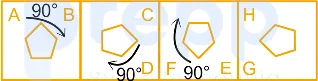
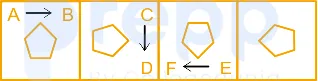
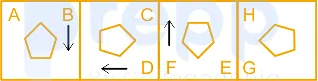
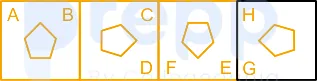
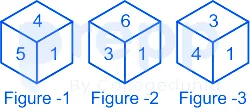
Three different positions of the same dice are shown. Find the number on the face opposite the face showing '1'.
- A
4
- B
3
- C
2
- D
6
Show answer
C. 2The logic followed here is:-
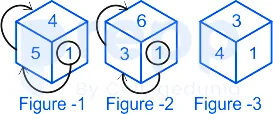
From the given three different cubes, figure 1 and figure 3, the adjacent sides are as shown below :
As 1 is common in both figure 1 and figure 2, it is clear that 3, 4, 5 and 6 are adjacent to it, and the remaining number i.e., 2 will be opposite to it.
Opposite pairs:
3 → 5
4 → 6
1 → 2
So, the opposite side of "1" will be side "2".
Hence, the correct answer is "2".
 Paper & answer key PDF ↗
 Question 2archived
In the following question below are given some statements followed by some conclusions based on those statements. Taking the given statements to be true even if they seem to be at variance from commonly known facts. Read all the conclusions and then decide which of the given conclusion logically follows the given statements.
Statements:
I. Some P are K.
II. No K is T.
Conclusions:
I. All P are T.
II. All T are K.
III. Some P are not T.
- A
Only conclusion II follows
- B
Only conclusion III follows
- C
All conclusion follows
- D
Both conclusions II and III follows
Show answer
B. Only conclusion III followsThe minimum possible Venn diagram for the given statements is shown below:
Conclusions:
I. All P are T → Does not follow (Since some P are K and no K is T. Therefore, the part of P that is in K has a negative or indirect relationship with T, making this definitely false)
II. All T are K → Does not follow (Since no K is T. Therefore, a negative or indirect relationship is given between K and T, making this definitely false)
III. Some P are not T → Follows (Since some P are K and no K is T. Therefore, the part of P that lies within K has a negative or indirect relationship with T, making this definitely true)
∴ Here, only conclusion III follows.
Hence, the correct answer is, "Only conclusion III follows."
 Paper & answer key PDF ↗
 Question 3archived
In a certain code language, ‘FROST’ is written as ‘156’ and ‘CANDLE’ is written as ‘78’. How will ‘SCREAM’ be written in that language?
- A
115
- B
89
- C
118
- D
59
Show answer
C. 118Understanding the Coding Language Pattern
This question involves a coding language where words are converted into numbers based on a specific rule or pattern. We are given two examples, 'FROST' coded as '156' and 'CANDLE' coded as '78'. Our task is to identify this pattern and then apply it to find the code for 'SCREAM'.
Analyzing the Given Examples
Let's look at the relationship between the words and their numerical codes. A common approach in such problems is to consider the alphabetical positions of the letters in the words.
Let's assign numerical values to each letter based on its position in the English alphabet (A=1, B=2, C=3, ..., Z=26).
Example 1: FROST
F is the 6th letter.
R is the 18th letter.
O is the 15th letter.
S is the 19th letter.
T is the 20th letter.
Let's sum the alphabetical positions of the letters in 'FROST':
\( \text{Sum} = 6 + 18 + 15 + 19 + 20 = 78 \)
The given code for 'FROST' is 156. We can see that 156 is double the sum we calculated:
\( 78 \times 2 = 156 \)
This suggests a potential pattern: the code is twice the sum of the alphabetical positions of the letters.
Example 2: CANDLE
Let's test this pattern with the second example, 'CANDLE'.
C is the 3rd letter.
A is the 1st letter.
N is the 14th letter.
D is the 4th letter.
L is the 12th letter.
E is the 5th letter.
Let's sum the alphabetical positions of the letters in 'CANDLE':
\( \text{Sum} = 3 + 1 + 14 + 4 + 12 + 5 = 39 \)
The given code for 'CANDLE' is 78. Let's see if the pattern holds:
\( 39 \times 2 = 78 \)
The pattern holds true for 'CANDLE' as well. The code is indeed twice the sum of the alphabetical positions of the letters.
Identifying the Pattern
Based on the analysis of 'FROST' and 'CANDLE', the pattern in this coding language is:
Code for a word = (Sum of alphabetical positions of its letters) \(\times\) 2
Applying the Pattern to SCREAM
Now, let's apply this pattern to find the code for the word 'SCREAM'.
First, find the alphabetical position of each letter in 'SCREAM':
S is the 19th letter.
C is the 3rd letter.
R is the 18th letter.
E is the 5th letter.
A is the 1st letter.
M is the 13th letter.
Next, calculate the sum of these positions:
\( \text{Sum for SCREAM} = 19 + 3 + 18 + 5 + 1 + 13 = 59 \)
Finally, apply the identified pattern (multiply the sum by 2):
\( \text{Code for SCREAM} = 59 \times 2 = 118 \)
Conclusion
Following the established coding pattern, the word 'SCREAM' is coded as 118.
Let's check the given options:
115
89
118
59
Our calculated code, 118, matches one of the options.
Word
Alphabetical Positions
Sum of Positions
Pattern Applied (\(\times 2\))
Coded Value
FROST
6, 18, 15, 19, 20
78
\(78 \times 2\)
156
CANDLE
3, 1, 14, 4, 12, 5
39
\(39 \times 2\)
78
SCREAM
19, 3, 18, 5, 1, 13
59
\(59 \times 2\)
118
Revision Table: Key Concepts
Concept
Description
Relevance to Problem
Coding Language
A system where information (like words) is represented in a different form (like numbers).
The core topic of the question.
Pattern Recognition
Identifying the underlying rule or logic connecting inputs (words) to outputs (codes).
Crucial skill needed to solve the problem.
Alphabetical Position
The numerical order of a letter in the alphabet (A=1, B=2, etc.).
The basis for the numerical values in this specific coding pattern.
Numerical Operations
Mathematical calculations (addition, multiplication) used to transform the letter values into the final code.
Part of applying the identified pattern.
Additional Information: Types of Coding Patterns
Coding language problems in reasoning tests can use various patterns. Besides using alphabetical positions, other common methods include:
Reverse Alphabetical Position: Assigning Z=1, Y=2, ..., A=26.
Sum of Positions: Simply adding the alphabetical positions.
Difference or Product of Positions: Using other mathematical operations.
Consonants/Vowels Count: The code might be based on the number of consonants or vowels.
Specific Letter Operations: The code might be based on the position of only the first, last, or middle letter.
Combining Positions and Operations: As seen in this problem (sum and then multiplication).
Skipping Letters: The code might involve counting letters by skipping a fixed number.
To solve such problems, it's important to systematically test different common patterns using the given examples until the correct rule is found.
Paper & answer key PDF ↗ Question 4archived
Study the given pattern carefully and select the number that can replace the question mark (?) in it.
First row - 12, 7, 32
Second row - 17, 13, 33
Third row - 14, 8, ?
(NOTE : Operations should be performed on the whole numbers, without breaking down the numbers into its constituent digits. E.g. 13 - Operations on 13 such as adding/subtracting/multiplying etc. to 13 can be performed. Breaking down 13 into 1 and 3 and then performing mathematical operations on 1 and 3 is NOT allowed)
- A
38
- B
35
- C
43
- D
42
Show answer
A. 38Analyzing the Number Pattern
The question asks us to identify the relationship between the numbers in each row of the given pattern and use it to find the missing number in the third row. The pattern is presented in a grid format:
First Number (A)
Second Number (B)
Third Number (C)
12
7
32
17
13
33
14
8
?
We need to find a mathematical operation or combination of operations performed on the first two numbers (A and B) in each row that results in the third number (C). The constraint is that we must use the whole numbers as given, not their individual digits.
Discovering the Pattern Rule
Let's examine the first two rows to find a consistent relationship between A, B, and C.
Row 1: A = 12, B = 7, C = 32
Row 2: A = 17, B = 13, C = 33
We can try different simple operations:
Addition: $12 + 7 = 19 \neq 32$; $17 + 13 = 30 \neq 33$. (Not simple addition)
Subtraction: $12 - 7 = 5 \neq 32$; $17 - 13 = 4 \neq 33$. (Not simple subtraction)
Multiplication: $12 \times 7 = 84 \neq 32$; $17 \times 13 = 221 \neq 33$. (Not simple multiplication)
Let's consider a pattern where the third number C is a linear combination of A and B, in the form $C = xA + yB$. We can use the first two rows to set up a system of equations:
For Row 1: $12x + 7y = 32$
For Row 2: $17x + 13y = 33$
We can solve this system for $x$ and $y$. Let's multiply the first equation by 13 and the second by 7 to eliminate $y$:
$13 \times (12x + 7y) = 13 \times 32 \implies 156x + 91y = 416$
$7 \times (17x + 13y) = 7 \times 33 \implies 119x + 91y = 231$
Now, subtract the second new equation from the first:
$(156x + 91y) - (119x + 91y) = 416 - 231$
$37x = 185$
$x = \frac{185}{37}$
$x = 5$
Substitute the value of $x = 5$ into the first original equation ($12x + 7y = 32$):
$12(5) + 7y = 32$
$60 + 7y = 32$
$7y = 32 - 60$
$7y = -28$
$y = \frac{-28}{7}$
$y = -4$
So, the pattern appears to be $C = 5A - 4B$. Let's verify this rule with the first two rows:
Row 1: $5 \times 12 - 4 \times 7 = 60 - 28 = 32$. This matches the given third number.
Row 2: $5 \times 17 - 4 \times 13 = 85 - 52 = 33$. This matches the given third number.
The pattern $C = 5A - 4B$ is consistent for the first two rows.
Calculating the Missing Number
Now, we apply the discovered pattern to the third row to find the missing number (?).
Row 3: A = 14, B = 8, C = ?
Using the formula $C = 5A - 4B$:
$C = 5 \times 14 - 4 \times 8$
$C = 70 - 32$
$C = 38$
The missing number in the pattern is 38.
Summary of the Solution
The pattern in the grid follows the rule where the third number (C) is calculated using the formula $C = 5 \times (\text{First Number}) - 4 \times (\text{Second Number})$. Applying this rule to the third row with the first number 14 and the second number 8 gives $5 \times 14 - 4 \times 8 = 70 - 32 = 38$.
Number Pattern Revision Table
Row
First Number (A)
Second Number (B)
Pattern: $5A - 4B$
Calculated Third Number
Given Third Number (C)
1
12
7
$5(12) - 4(7) = 60 - 28$
32
32
2
17
13
$5(17) - 4(13) = 85 - 52$
33
33
3
14
8
$5(14) - 4(8) = 70 - 32$
38
?
Additional Information on Number Patterns
Number pattern questions are common in logical reasoning and aptitude tests. They assess your ability to identify underlying mathematical or logical relationships between numbers. Patterns can involve:
Arithmetic progressions (constant difference).
Geometric progressions (constant ratio).
Combinations of arithmetic operations (addition, subtraction, multiplication, division).
Operations on squares, cubes, or other powers.
Relationships between numbers in rows, columns, or diagonals in a grid.
Digit-based logic (though explicitly disallowed in this specific question).
Alternating patterns or multiple interleaved series.
Solving these problems often requires careful observation, hypothesis testing, and systematic checking of potential rules. When dealing with grids, look for relationships within rows, within columns, or even diagonal relationships. Sometimes, the pattern involves a combination of elements from different positions in the grid.
Paper & answer key PDF ↗ Question 5archived
P + Q means ‘P is the father of Q’
P - Q means ‘P is the mother of Q’
P * Q means ‘P is the sister of Q’
P % Q means ‘P is the brother of Q’
If A - B % C * D + E, then how is A related to E?
- A
Mother
- B
Father’s sister
- C
Sister
- D
Father’s mother
Show answer
D. Father’s motherSolving Blood Relation Reasoning Problems
This question asks us to determine the relationship between two individuals, A and E, based on a coded expression representing familial relationships. We are given a set of codes linking symbols (+, -, *, %) to specific blood relations.
Understanding the Blood Relation Codes
Let's first understand what each symbol means according to the problem statement:
P + Q means 'P is the father of Q'
P - Q means 'P is the mother of Q'
P * Q means 'P is the sister of Q'
P % Q means 'P is the brother of Q'
Analyzing the Given Expression: A - B % C * D + E
We need to break down the expression A - B % C * D + E from left to right or segment by segment to build the family tree or chain of relationships. The expression involves the following pairs connected by symbols:
A - B: This means A is the mother of B.
B % C: This means B is the brother of C.
C * D: This means C is the sister of D.
D + E: This means D is the father of E.
Tracing the Family Relationships
Let's combine these relationships to see how everyone is connected, especially focusing on the path from E back to A:
From D + E, we know D is the father of E.
From C * D, we know C is the sister of D. This implies C is E's father's sister, which means C is E's aunt.
From B % C, we know B is the brother of C. Since C is the sister of D, and B is the brother of C, B must also be the brother of D. This implies B is E's father's brother, which means B is E's uncle.
From A - B, we know A is the mother of B. Since B is the son of A and B is the brother of D, A must also be the mother of D.
So, we have established that D is the father of E and A is the mother of D.
Determining the Relationship of A to E
If D is E's father and A is D's mother, then A is the mother of E's father. The mother of one's father is their paternal grandmother.
Therefore, A is E's father's mother.
Comparing with the Options
Let's look at the given options:
Mother
Father’s sister
Sister
Father’s mother
Our derived relationship, "Father's mother", matches option 4.
Expression Segment
Relationship
A - B
A is Mother of B
B % C
B is Brother of C
C * D
C is Sister of D
D + E
D is Father of E
Combining the relationships:
D is Father of E.
C is Sister of D $\implies$ C is E's Father's Sister (Aunt).
B is Brother of C $\implies$ B is also Brother of D (since C is Sister of D). B is E's Father's Brother (Uncle).
A is Mother of B. Since B is Brother of D, A is Mother of D.
A is Mother of D, and D is Father of E. Thus, A is the Mother of E's Father.
Conclusion
Based on the blood relation codes and the expression A - B % C * D + E, A is the father's mother of E.
Revision Table: Blood Relation Codes
Symbol
Relationship
Example (P, Q)
+
Father
P is father of Q
-
Mother
P is mother of Q
*
Sister
P is sister of Q
%
Brother
P is brother of Q
Additional Information on Blood Relations
Blood relation problems in reasoning test your ability to understand and interpret family relationships based on given information or codes. These problems often involve constructing a mental or physical family tree to visualize the connections between different individuals. Key relationships to remember include parent-child, sibling, grandparent-grandchild, uncle/aunt-nephew/niece, and cousin.
When solving such problems, it's helpful to:
Identify the gender where indicated (e.g., mother, father, sister, brother). If gender is not explicitly stated for an individual, do not assume it unless deduced from the relationship (e.g., 'P is brother of Q' tells you P is male, but says nothing about Q's gender).
Break down complex expressions into smaller, manageable segments.
Build the family tree step-by-step, connecting individuals as you go.
Trace the relationship path from the person whose relationship is unknown back to the person you are starting from.
Be careful with the direction of the relationship (e.g., P is mother of Q is different from Q is mother of P).
Paper & answer key PDF ↗ Question 6archived
By Interchanging the given two numbers which of the following equation will be not correct?
9 and 6
- A
7 + 6 × 4 ÷ 9 – 8 = 5
- B
6 × 8 – 9 ÷ 3 + 5 = 75
- C
9 × 7 + 4 ÷ 1 – 6 = 38
- D
7 × 6 ÷ 3 + 9 – 8 = 19
Show answer
C. 9 × 7 + 4 ÷ 1 – 6 = 38Understanding the Problem: Interchanging Numbers in Equations
The question asks us to examine four different mathematical equations. We are given two specific numbers, 9 and 6, that need to be swapped (interchanged) in each of these equations. After performing this interchange, we need to evaluate each new equation and determine which one becomes incorrect, meaning the left side of the equation will no longer equal the right side.
Step-by-Step Evaluation After Interchanging 9 and 6
We will go through each given equation, swap every instance of 9 with 6 and every instance of 6 with 9, and then calculate the result using the correct order of operations (BODMAS/PEMDAS). We will then check if the resulting equation is true.
Analysing Option 1
The original equation is: 7 + 6 × 4 ÷ 9 – 8 = 5
After interchanging 6 and 9, the equation becomes: 7 + 9 × 4 ÷ 6 – 8
Now, let's evaluate this expression:
First, perform multiplication and division from left to right.
7 + 9 × 4 ÷ 6 – 8
7 + 36 ÷ 6 – 8
7 + 6 – 8
Next, perform addition and subtraction from left to right.
7 + 6 – 8
13 – 8
5
The result is 5. So, the equation is 7 + 9 × 4 ÷ 6 – 8 = 5. This is a correct equation.
Analysing Option 2
The original equation is: 6 × 8 – 9 ÷ 3 + 5 = 75
After interchanging 6 and 9, the equation becomes: 9 × 8 – 6 ÷ 3 + 5
Let's evaluate this expression:
First, perform multiplication and division from left to right.
9 × 8 – 6 ÷ 3 + 5
72 – 2 + 5
Next, perform addition and subtraction from left to right.
72 – 2 + 5
70 + 5
75
The result is 75. So, the equation is 9 × 8 – 6 ÷ 3 + 5 = 75. This is a correct equation.
Analysing Option 3
The original equation is: 9 × 7 + 4 ÷ 1 – 6 = 38
After interchanging 6 and 9, the equation becomes: 6 × 7 + 4 ÷ 1 – 9
Let's evaluate this expression:
First, perform multiplication and division from left to right.
6 × 7 + 4 ÷ 1 – 9
42 + 4 – 9
Next, perform addition and subtraction from left to right.
42 + 4 – 9
46 – 9
37
The result is 37. So, the equation is 6 × 7 + 4 ÷ 1 – 9 = 38. Since 37 is not equal to 38, this is an incorrect equation.
Analysing Option 4
The original equation is: 7 × 6 ÷ 3 + 9 – 8 = 19
After interchanging 6 and 9, the equation becomes: 7 × 9 ÷ 3 + 6 – 8
Let's evaluate this expression:
First, perform multiplication and division from left to right.
7 × 9 ÷ 3 + 6 – 8
63 ÷ 3 + 6 – 8
21 + 6 – 8
Next, perform addition and subtraction from left to right.
21 + 6 – 8
27 – 8
19
The result is 19. So, the equation is 7 × 9 ÷ 3 + 6 – 8 = 19. This is a correct equation.
Conclusion: Which Equation is Not Correct?
After interchanging the numbers 9 and 6 in each equation and evaluating them, we found that Options 1, 2, and 4 resulted in correct mathematical statements. Option 3, however, resulted in an incorrect statement (37 = 38 is false).
Therefore, the equation that is not correct after interchanging 9 and 6 is the one from Option 3.
Option
Original Equation
Equation after Interchanging 9 and 6
Calculated Result
Original RHS
Correct/Incorrect
1
$7 + 6 \times 4 \div 9 - 8 = 5$
$7 + 9 \times 4 \div 6 - 8$
$5$
$5$
Correct
2
$6 \times 8 - 9 \div 3 + 5 = 75$
$9 \times 8 - 6 \div 3 + 5$
$75$
$75$
Correct
3
$9 \times 7 + 4 \div 1 - 6 = 38$
$6 \times 7 + 4 \div 1 - 9$
$37$
$38$
Incorrect
4
$7 \times 6 \div 3 + 9 - 8 = 19$
$7 \times 9 \div 3 + 6 - 8$
$19$
$19$
Correct
Revision Table: Key Concepts for Interchanging Numbers
Concept
Explanation
Relevance to Problem
Interchanging Numbers
Swapping the positions of two specific numbers throughout an expression or equation.
The core operation applied to the original equations.
Order of Operations (BODMAS/PEMDAS)
Rules that define the sequence for evaluating mathematical expressions (Brackets/Parentheses, Orders/Exponents, Division/Multiplication, Addition/Subtraction).
Essential for correctly calculating the value of the expressions after interchanging numbers.
Equation Validity
Checking if the left side of an equation equals the right side.
The criteria used to determine if the equation is "correct" or "not correct" after the interchange.
Additional Information: Solving Mathematical Reasoning Problems
Problems involving interchanging numbers and checking equation validity are common in mathematical reasoning and quantitative aptitude sections of exams. Here are some tips for solving such problems efficiently:
Understand the Rule: Clearly identify which numbers or symbols need to be interchanged. Apply the change consistently throughout the entire equation.
Apply Order of Operations: Always follow BODMAS/PEMDAS strictly. Mistakes often happen when this order is not followed. Remember that multiplication and division have equal priority and are done from left to right. Similarly, addition and subtraction have equal priority and are done from left to right.
Be Systematic: Evaluate each option one by one. Don't skip steps in the calculation.
Double-Check Calculations: Even simple arithmetic can lead to errors under time pressure. Review your calculations, especially for multiplication, division, addition, and subtraction.
Focus on the Question: Pay attention to whether the question asks which equation becomes correct or incorrect after the interchange.
Practicing such problems helps improve numerical agility and logical thinking skills required for various competitive exams.
Paper & answer key PDF ↗ Question 7archived
Which of the following calendars will be the same as the calendar for the year 2003?
- A
2014
- B
2013
- C
2012
- D
2011
Show answer
A. 2014Understanding Calendar Repetition
The calendar of a year repeats itself when the total number of odd days from the given year up to the year preceding the repeating year becomes a multiple of 7. Additionally, the repeating year must be of the same type as the original year (both leap years or both non-leap years).
What are Odd Days?
In the context of calendars, odd days are the extra days left after forming complete weeks in a given period.
A normal year has 365 days. $365 = 52 \times 7 + 1$. So, a normal year has 1 odd day.
A leap year has 366 days. $366 = 52 \times 7 + 2$. So, a leap year has 2 odd days.
Leap years occur every four years, except for years divisible by 100 but not by 400. The year 2000 was a leap year (divisible by 400), 2004, 2008, 2012 are leap years (divisible by 4). The year 2003 is a non-leap year.
Calculating Odd Days for Calendar Repetition
We need to find a year Y such that the total number of odd days from the beginning of 2003 to the end of Y-1 is a multiple of 7, and Y is also a non-leap year (like 2003).
Let's calculate the odd days for the years following 2003:
2003: 1 odd day (Non-leap)
2004: 2 odd days (Leap)
2005: 1 odd day (Non-leap)
2006: 1 odd day (Non-leap)
2007: 1 odd day (Non-leap)
2008: 2 odd days (Leap)
2009: 1 odd day (Non-leap)
2010: 1 odd day (Non-leap)
2011: 1 odd day (Non-leap)
2012: 2 odd days (Leap)
2013: 1 odd day (Non-leap)
2014: 1 odd day (Non-leap)
Checking the Options
Let's sum the odd days year by year starting from 2003 to find when the cumulative sum is a multiple of 7.
Year
Odd Days in Year
Cumulative Odd Days (Starting from 2003)
2003
1
1
2004
2
1 + 2 = 3
2005
1
3 + 1 = 4
2006
1
4 + 1 = 5
2007
1
5 + 1 = 6
2008
2
6 + 2 = 8
2009
1
8 + 1 = 9
2010
1
9 + 1 = 10
2011
1
10 + 1 = 11
2012
2
11 + 2 = 13
2013
1
13 + 1 = 14
The cumulative odd days from 2003 up to the end of 2013 is 14. Since $14 \equiv 0 \pmod{7}$, the year following 2013, which is 2014, will have its first day on the same day of the week as the first day of 2003.
We also need to check if the year 2014 is of the same type as 2003. 2003 is a non-leap year, and 2014 is also a non-leap year.
Since the total number of odd days between 2003 and 2013 (inclusive) is a multiple of 7, and both 2003 and 2014 are non-leap years, the calendar for 2014 will be the same as the calendar for 2003.
Let's examine the given options:
2014: Cumulative odd days from 2003 to 2013 is 14, which is a multiple of 7. Both 2003 and 2014 are non-leap years. This option satisfies the conditions.
2013: Cumulative odd days from 2003 to 2012 is 13. Not a multiple of 7.
2012: 2012 is a leap year, while 2003 is a non-leap year. The calendars cannot be the same.
2011: Cumulative odd days from 2003 to 2010 is 10. Not a multiple of 7.
Therefore, the calendar for the year 2014 will be the same as the calendar for the year 2003.
Revision Table: Calendar Repetition Cycles
Here are some common patterns for calendar repetition:
Type of Year
Repetition Cycle
Example
Leap year
Repeats after 28 years
2004 calendar is same as 2032
Year after a leap year
Repeats after 6 years
2001 calendar is same as 2007
Second year after a leap year
Repeats after 11 years
2002 calendar is same as 2013
Third year after a leap year (like 2003)
Repeats after 11 years
2003 calendar is same as 2014
Note that these are general rules, and calculating odd days provides a precise method for verification.
Additional Information on Calendar Calculations
Understanding calendar problems often involves calculating the number of odd days over various periods, such as centuries, specific ranges of years, or even months. The key is to find the total number of odd days modulo 7 to determine the shift in the day of the week.
Number of odd days in 100 years: 5
Number of odd days in 200 years: $5 \times 2 = 10 \equiv 3 \pmod{7}$
Number of odd days in 300 years: $5 \times 3 = 15 \equiv 1 \pmod{7}$
Number of odd days in 400 years: $5 \times 4 + 1$ (for the extra leap year at 400) $= 21 \equiv 0 \pmod{7}$
Since the number of odd days in 400 years is 0, the calendar repeats every 400 years. This forms the basis for longer-term calendar calculations.
Paper & answer key PDF ↗ Question 8archived
Which of the following letter clusters will replace the question mark (?) and complete the following letter cluster series?
DW, FU, HS, JQ, LO, ?
- A
NN
- B
MN
- C
NM
- D
NO
Show answer
C. NMUnderstanding Letter Cluster Series Questions
Letter cluster series questions test your ability to identify patterns within sequences of letters. Each letter cluster in the series follows a specific rule or set of rules. To solve these problems, you need to break down the clusters and analyze the progression of each letter position independently.
Analyzing the Given Letter Cluster Series
The given series is: DW, FU, HS, JQ, LO, ?
Let's examine the pattern in the first letters of each cluster and then the pattern in the second letters.
Pattern in the First Letters
The first letters of the clusters are D, F, H, J, L.
Let's look at their positions in the English alphabet:
D is the 4th letter.
F is the 6th letter.
H is the 8th letter.
J is the 10th letter.
L is the 12th letter.
Observing the positions:
From D (4) to F (6), the position increases by 2 ($\text{6} - \text{4} = \text{2}$).
From F (6) to H (8), the position increases by 2 ($\text{8} - \text{6} = \text{2}$).
From H (8) to J (10), the position increases by 2 ($\text{10} - \text{8} = \text{2}$).
From J (10) to L (12), the position increases by 2 ($\text{12} - \text{10} = \text{2}$).
The pattern for the first letter is consistently adding 2 to the alphabetical position of the previous letter.
Following this pattern, the next first letter should be the letter that is 2 positions after L (12).
$\text{12} + \text{2} = \text{14}$. The 14th letter of the alphabet is N.
Pattern in the Second Letters
The second letters of the clusters are W, U, S, Q, O.
Let's look at their positions in the English alphabet:
W is the 23rd letter.
U is the 21st letter.
S is the 19th letter.
Q is the 17th letter.
O is the 15th letter.
Observing the positions:
From W (23) to U (21), the position decreases by 2 ($\text{21} - \text{23} = -\text{2}$).
From U (21) to S (19), the position decreases by 2 ($\text{19} - \text{21} = -\text{2}$).
From S (19) to Q (17), the position decreases by 2 ($\text{17} - \text{19} = -\text{2}$).
From Q (17) to O (15), the position decreases by 2 ($\text{15} - \text{17} = -\text{2}$).
The pattern for the second letter is consistently subtracting 2 from the alphabetical position of the previous letter.
Following this pattern, the next second letter should be the letter that is 2 positions before O (15).
$\text{15} - \text{2} = \text{13}$. The 13th letter of the alphabet is M.
Completing the Letter Cluster Series
Combining the patterns for the first and second letters:
The next first letter is N.
The next second letter is M.
Therefore, the next letter cluster in the series is NM.
Confirming the Answer
The letter cluster that replaces the question mark (?) and completes the series is NM.
Cluster
1st Letter
Pattern (+2)
2nd Letter
Pattern (-2)
DW
D (4)
W (23)
FU
F (6)
4 + 2 = 6
U (21)
23 - 2 = 21
HS
H (8)
6 + 2 = 8
S (19)
21 - 2 = 19
JQ
J (10)
8 + 2 = 10
Q (17)
19 - 2 = 17
LO
L (12)
10 + 2 = 12
O (15)
17 - 2 = 15
?
N (14)
12 + 2 = 14
M (13)
15 - 2 = 13
Revision Table: Letter Cluster Series Patterns
Component
Pattern Identified
Application
First Letter
Alphabetical position increases by 2 for each subsequent cluster.
Apply +2 to the position of 'L' to find the next first letter.
Second Letter
Alphabetical position decreases by 2 for each subsequent cluster.
Apply -2 to the position of 'O' to find the next second letter.
Additional Information on Letter Series Reasoning
Letter series reasoning is a common type of question in competitive exams. These questions can involve various patterns, including:
Skipping letters (e.g., A, C, E, G...)
Increasing or decreasing gaps between letters (e.g., A, C, F, K...)
Patterns based on alphabetical position (adding/subtracting numbers)
Reversing alphabetical order
Combinations of patterns for different letters in a cluster
Using vowels or consonants
Referring to mirror positions (e.g., A is 1st, Z is 26th; A-Z, B-Y, C-X...)
Practicing different types of letter series helps you quickly identify the underlying rule and solve the problem efficiently.
Paper & answer key PDF ↗ Question 9archived
If S - T means that S is the mother of T, S × T means that S is the father of T, S + T means that S is the sister of T, then which of the following expression shows that P is the mother of R?
- A
Q - P + R
- B
P - Q + R
- C
P × Q + R
- D
R + Q - P
Show answer
B. P - Q + RUnderstanding Blood Relations from Coded Expressions
This question asks us to decode expressions representing family relationships based on a given set of rules and identify which expression signifies that 'P is the mother of R'. This type of problem tests our ability to interpret coded relations and trace family connections.
Decoding the Given Relationships
We are provided with the following rules for decoding the expressions:
S - T means S is the mother of T.
S × T means S is the father of T.
S + T means S is the sister of T.
Our goal is to find the expression where P is the mother of R.
Analyzing Each Option
Let's analyze each given expression step-by-step to determine the relationship between P and R.
Analysis of Option 1: Q - P + R
First part: Q - P. According to the rule S - T means S is the mother of T, this means Q is the mother of P.
Second part: P + R. According to the rule S + T means S is the sister of T, this means P is the sister of R.
Combining the relations: Q is the mother of P, and P is the sister of R. If P is the sister of R, they are in the same generation. Since Q is the mother of P, Q is also the mother of R.
Conclusion for Option 1: This expression shows that Q is the mother of R. This is not what we are looking for.
Analysis of Option 2: P - Q + R
First part: P - Q. According to the rule S - T means S is the mother of T, this means P is the mother of Q.
Second part: Q + R. According to the rule S + T means S is the sister of T, this means Q is the sister of R.
Combining the relations: P is the mother of Q, and Q is the sister of R. If Q is the sister of R, they are in the same generation. Since P is the mother of Q, P is also the mother of R.
Conclusion for Option 2: This expression shows that P is the mother of R. This matches the required relationship.
Analysis of Option 3: P × Q + R
First part: P × Q. According to the rule S × T means S is the father of T, this means P is the father of Q.
Second part: Q + R. According to the rule S + T means S is the sister of T, this means Q is the sister of R.
Combining the relations: P is the father of Q, and Q is the sister of R. If Q is the sister of R, they are in the same generation. Since P is the father of Q, P is also the father of R.
Conclusion for Option 3: This expression shows that P is the father of R. This is not what we are looking for.
Analysis of Option 4: R + Q - P
First part: R + Q. According to the rule S + T means S is the sister of T, this means R is the sister of Q.
Second part: Q - P. According to the rule S - T means S is the mother of T, this means Q is the mother of P.
Combining the relations: R is the sister of Q, and Q is the mother of P. This tells us that Q is the mother of P, and R is Q's sister. This does not establish P as the mother of R. In fact, P is a child of Q, and R is Q's sister, making R P's aunt.
Conclusion for Option 4: This expression shows that Q is the mother of P. This is not what we are looking for.
Summary of Analysis
Let's summarize the relationships derived from each option:
Option
Expression
Step 1 Relation
Step 2 Relation
Final Relation (P to R)
1
Q - P + R
Q is mother of P
P is sister of R
P is sister of R (Q is mother of R)
2
P - Q + R
P is mother of Q
Q is sister of R
P is mother of R
3
P × Q + R
P is father of Q
Q is sister of R
P is father of R
4
R + Q - P
R is sister of Q
Q is mother of P
P is child of Q (R is P's aunt)
From the analysis, only Option 2, P - Q + R, correctly represents the relationship where P is the mother of R.
Conclusion
Based on the step-by-step decoding of each option according to the given rules, the expression P - Q + R is the only one that shows P as the mother of R.
Revision Table: Blood Relation Coding
Symbol
Meaning
-
Mother
×
Father
+
Sister
Additional Information: Solving Coded Blood Relation Problems
Coded blood relation problems are common in reasoning sections of competitive exams. Here are some tips for solving them effectively:
Understand the Codes: Carefully note down what each symbol represents in terms of relationship and gender (if implied).
Break Down the Expression: Analyze the expression segment by segment. For example, in A × B - C, first decode A × B, then use that result to decode the relationship with C.
Draw a Family Tree (Optional but Helpful): For complex expressions, drawing a quick family tree diagram can help visualize the relationships and avoid confusion.
Determine Gender and Generation: Pay attention to the gender of the individuals involved and their relative generations. Symbols like '-' and '×' usually determine the gender of the first person relative to the second, while '+' indicates a same-generation relationship.
Work Backwards or Forwards: You can decode the expression from left to right or right to left, depending on what is easier for the specific problem.
Check the Target Relation: Always keep the required relationship in mind while analyzing options.
Practicing various types of coded blood relation questions will improve speed and accuracy in solving these problems.
Paper & answer key PDF ↗ Question 10archived
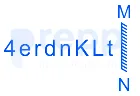
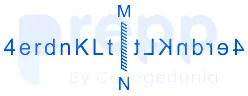
Select the correct mirror image of the given combination when the mirror is placed at MN as shown below.
- A
Option A (shown in image)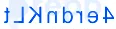
- B
Option B (shown in image)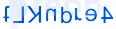
- C
Option C (shown in image)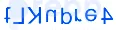
- D
Option D (shown in image)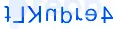
Show answer
A. Option A (shown in image)The logic here followed is
Hence, the correct answer is "Option 1".
 Paper & answer key PDF ↗
 Question 11archived
Select the option that is related to the third word in the same way as the second word is related to the first word.
(The words must be considered as meaningful English words and must not be related to each other based on the number of letters/number of consonants/vowels in the word.)
Flock : Birds :: Swarm : ?
- A
Rain
- B
Bees
- C
Trees
- D
Flowers
Show answer
B. BeesUnderstanding Word Analogies: Flock : Birds :: Swarm : ?
Word analogies test your ability to understand the relationship between a pair of words and apply that same relationship to another pair. In the given analogy, we have "Flock : Birds :: Swarm : ?". The structure "A : B :: C : D" means "A is to B as C is to D". We need to find the word that completes the second pair based on the relationship in the first pair.
Analyzing the First Pair: Flock : Birds
Let's look at the relationship between "Flock" and "Birds".
A "Flock" is a noun that refers to a group of birds.
So, the relationship is that the first word represents a collective noun for the second word.
Essentially, a flock is a collection or a group of birds.
Applying the Relationship to the Second Pair: Swarm : ?
Now, we need to find a word that forms a similar relationship with "Swarm". "Swarm" is also a collective noun. We need to identify what kind of group a "Swarm" typically refers to from the given options.
Let's examine the options:
Rain: A group of raindrops or rain itself is not called a "swarm".
Bees: A "Swarm" is commonly used to describe a large number of insects, especially bees, flying together. This is a very common and specific collective noun for bees.
Trees: A group of trees is typically called a forest, grove, or clump, not a "swarm".
Flowers: A group of flowers can be called a bunch, bouquet, or bed, not a "swarm".
Identifying the Correct Answer
Based on the analysis of the options and the definition of a "Swarm", the word that fits the analogy is "Bees". A swarm is a collective noun for a group of bees.
Therefore, the relationship "Flock is a group of Birds" is parallel to "Swarm is a group of Bees".
Conclusion
The analogy holds true when "Swarm" is related to "Bees" in the same way "Flock" is related to "Birds". Both "Flock" and "Swarm" are collective nouns used for specific groups of animals (birds and bees, respectively).
The completed analogy is: Flock : Birds :: Swarm : Bees.
Pair
Collective Noun
Individual Members
Relationship
First Pair
Flock
Birds
Flock is a group of Birds
Second Pair
Swarm
Bees
Swarm is a group of Bees
Revision Table: Collective Nouns
Understanding collective nouns is key to solving this type of analogy. Here are a few examples:
Collective Noun
Group Of
Flock
Birds, Sheep
Swarm
Bees, Insects
Herd
Cattle, Elephants
School
Fish, Dolphins
Pride
Lions
Pack
Wolves, Dogs
Additional Information on Word Analogies
Word analogies can have various types of relationships, such as:
Part to Whole: e.g., Finger : Hand :: Toe : Foot
Cause and Effect: e.g., Rain : Flood :: Sun : Evaporation
Synonyms: e.g., Happy : Joyful :: Sad : Sorrowful
Antonyms: e.g., Hot : Cold :: Up : Down
Worker and Tool: e.g., Writer : Pen :: Carpenter : Hammer
Action and Object: e.g., Read : Book :: Listen : Music
Category and Item: e.g., Fruit : Apple :: Vegetable : Carrot
Degree of Intensity: e.g., Warm : Hot :: Cool : Freezing
To solve analogies effectively, it's helpful to:
Clearly identify the relationship in the first pair.
Express the relationship as a simple phrase or sentence.
Apply the same relationship to the second pair and test the options.
Ensure the words are used in their common, meaningful English sense.
Paper & answer key PDF ↗ Question 12archived
Select the option that is related to the fourth term in the same way as the first term is related to the second term and the fifth term is related to the sixth term.
8 : 48 :: ? : 143 :: 15 : 195
- A
13
- B
17
- C
19
- D
11
Show answer
A. 13Understanding Numerical Analogy Problems
This question is an example of a numerical analogy. In such problems, we need to find the relationship between the numbers in the first pair and apply that same relationship to the second and third pairs to find the missing term. We are given three pairs: 8 : 48, ? : 143, and 15 : 195.
Analyzing the Pattern in Given Numerical Pairs
Let's look closely at the first pair, 8 and 48. How are they related? We can try different mathematical operations.
Is it a simple multiplication? $8 \times 6 = 48$. But where does 6 come from?
Is it related to squares or cubes? $8^2 = 64$. $64 - 16 = 48$. $16 = 2 \times 8$. So, $8^2 - 2 \times 8 = 48$. This can be written as $8 \times (8 - 2) = 8 \times 6 = 48$.
Let's test this pattern on the third pair, 15 and 195. If the first number is $n$, the second number is $n \times (n-2)$.
For the third pair, the first number is 15. According to the pattern, the second number should be $15 \times (15-2)$.
Calculating this: $15 \times (13) = 195$. This matches the given second number in the third pair.
So, the pattern is confirmed: the second term is obtained by multiplying the first term by (first term minus 2).
Finding the Missing Term in the Analogy
Now, we apply this identified pattern to the second pair: ? : 143. Let the missing term be $x$. According to the pattern, $x \times (x-2)$ should equal 143.
We need to find a number $x$ such that when multiplied by $(x-2)$, the result is 143. We can look at the options provided or solve the equation $x(x-2) = 143$, which is $x^2 - 2x - 143 = 0$.
Let's test the given options to see which one fits the pattern:
Option 1: 13
If $x = 13$, then $x-2 = 13-2 = 11$. Calculate $x \times (x-2) = 13 \times 11 = 143$. This matches the second number in the second pair.
Option 2: 17
If $x = 17$, then $x-2 = 17-2 = 15$. Calculate $x \times (x-2) = 17 \times 15 = 255$. This does not match 143.
Option 3: 19
If $x = 19$, then $x-2 = 19-2 = 17$. Calculate $x \times (x-2) = 19 \times 17 = 323$. This does not match 143.
Option 4: 11
If $x = 11$, then $x-2 = 11-2 = 9$. Calculate $x \times (x-2) = 11 \times 9 = 99$. This does not match 143.
The only option that satisfies the pattern is 13.
Conclusion: The Missing Number is 13
Based on the consistent pattern observed in the first and third pairs, the missing term in the second pair is 13 because $13 \times (13-2) = 13 \times 11 = 143$.
Revision Table: Numerical Analogy Pattern
Pair
First Term (n)
Second Term
Pattern Check: n × (n-2)
1
8
48
$8 \times (8-2) = 8 \times 6 = 48$ (Matches)
2
? (Let's call it x)
143
$x \times (x-2) = 143$ → $13 \times (13-2) = 13 \times 11 = 143$ (Matches when x=13)
3
15
195
$15 \times (15-2) = 15 \times 13 = 195$ (Matches)
Additional Information on Numerical Reasoning
Numerical reasoning questions, like this analogy problem, test your ability to identify patterns and relationships between numbers. These patterns can involve various mathematical operations such as addition, subtraction, multiplication, division, squares, cubes, prime numbers, or combinations of these. To solve these questions effectively, it's helpful to:
Look for common mathematical relationships (e.g., difference, sum, product, quotient).
Consider squares and cubes of the numbers.
Check for patterns involving consecutive numbers or simple sequences (arithmetic, geometric).
Test your hypotheses using the other pairs provided in the analogy.
Practice recognizing common number patterns.
Solving different types of numerical reasoning problems improves your analytical skills and speed, which is beneficial for various competitive exams and aptitude tests.
Paper & answer key PDF ↗ Question 13archived
Read the given statements and conclusions carefully. Assuming that the information given in the statements is true, even if it appears to be at variance with commonly known facts, decide which of the given conclusions logically follow(s) from the statements.
Statements:
• All toys are Lego.
• No block is Lego.
• Some puzzles are blocks.
Conclusions:
I. Some Lego are puzzles.
II. No Lego is a block.
III. Some toys are blocks.
- A
Only conclusion II follows
- B
Only conclusion I follows
- C
Only conclusion I and II follow
- D
Only conclusion I and III follow
Show answer
A. Only conclusion II followsStatements:
All toys are Lego.
No block is Lego.
Some puzzles are blocks.
Conclusion I – Some Lego are puzzles: The puzzles that are blocks cannot be Lego (from Statement 2). The remaining puzzles may or may not be Lego, so this is not certain. Therefore, this does not follow.
Conclusion II – No Lego is a block: "No block is Lego" converts to "No Lego is a block". Therefore, this follows.
Conclusion III – Some toys are blocks: All toys lie inside Lego, and no block lies inside Lego, so toys and blocks are disjoint. Therefore, this does not follow.
Hence, only conclusion II follows.
Paper & answer key PDF ↗ Question 14archived
Select the set in which the numbers are related in the same way as are the numbers of the following set.
(5, 2, 23)
(6, 2, 34)
(NOTE : Operations should be performed on the whole numbers, without breaking down the numbers into its constituent digits. E.g. 13 - Operations on 13 such as adding/subtracting/multiplying etc. to 13 can be performed. Breaking down 13 into 1 and 3 and then performing mathematical operations on 1 and 3 is NOT allowed)
- A
(3, 3, 3)
- B
(3, 2, 9)
- C
(3, 5, 11)
- D
(3, 2, 7)
Show answer
D. (3, 2, 7)Understanding the Relationship in Number Sets
The question asks us to find a set of numbers among the options that shares the same relationship as the numbers in the given sets: (5, 2, 23) and (6, 2, 34). We need to identify the mathematical rule connecting the three numbers in these sets.
Let's consider the first set (5, 2, 23). Let the first number be 'a', the second number be 'b', and the third number be 'c'. So, a=5, b=2, and c=23.
We need to find an operation or combination of operations using 'a' and 'b' that results in 'c'. Let's try some common mathematical operations:
Addition: \(a + b = 5 + 2 = 7\). This is not 23.
Subtraction: \(a - b = 5 - 2 = 3\). This is not 23.
Multiplication: \(a \times b = 5 \times 2 = 10\). This is not 23.
Powers: \(a^b = 5^2 = 25\). This is close to 23. Let's try adjusting this.
Powers: \(b^a = 2^5 = 32\). This is not 23.
Let's consider squares of the numbers. \(a^2 = 5^2 = 25\). If we subtract 'b' from \(a^2\): \(a^2 - b = 25 - 2 = 23\). This matches the third number, 'c'!
So, the possible rule is \(c = a^2 - b\).
Let's verify this rule with the second given set (6, 2, 34). Here, a=6, b=2, and c=34.
Applying the rule \(a^2 - b\): \(6^2 - 2 = 36 - 2 = 34\). This matches the third number, 'c', in the second set as well.
The relationship between the numbers in the given sets is that the third number is obtained by squaring the first number and then subtracting the second number.
\(c = a^2 - b\)
Applying the Relationship to the Options
Now, we will test each option provided to see which set follows the rule \(c = a^2 - b\).
Option 1: (3, 3, 3)
a = 3, b = 3, c = 3
Applying the rule: \(a^2 - b = 3^2 - 3 = 9 - 3 = 6\)
The calculated value (6) does not match the third number in the set (3). This option does not follow the rule.
Option 2: (3, 2, 9)
a = 3, b = 2, c = 9
Applying the rule: \(a^2 - b = 3^2 - 2 = 9 - 2 = 7\)
The calculated value (7) does not match the third number in the set (9). This option does not follow the rule.
Option 3: (3, 5, 11)
a = 3, b = 5, c = 11
Applying the rule: \(a^2 - b = 3^2 - 5 = 9 - 5 = 4\)
The calculated value (4) does not match the third number in the set (11). This option does not follow the rule.
Option 4: (3, 2, 7)
a = 3, b = 2, c = 7
Applying the rule: \(a^2 - b = 3^2 - 2 = 9 - 2 = 7\)
The calculated value (7) matches the third number in the set (7). This option follows the rule.
Conclusion
Based on the analysis, the set (3, 2, 7) follows the same relationship as the given sets (5, 2, 23) and (6, 2, 34), where the third number is equal to the square of the first number minus the second number \(c = a^2 - b\).
Revision Table for Set Relationships
Set
a
b
c
Rule \(a^2 - b\) Calculation
Does it Match c?
(5, 2, 23)
5
2
23
\(5^2 - 2 = 25 - 2 = 23\)
Yes
(6, 2, 34)
6
2
34
\(6^2 - 2 = 36 - 2 = 34\)
Yes
(3, 3, 3)
3
3
3
\(3^2 - 3 = 9 - 3 = 6\)
No
(3, 2, 9)
3
2
9
\(3^2 - 2 = 9 - 2 = 7\)
No
(3, 5, 11)
3
5
11
\(3^2 - 5 = 9 - 5 = 4\)
No
(3, 2, 7)
3
2
7
\(3^2 - 2 = 9 - 2 = 7\)
Yes
Additional Information on Number Puzzles
Number set puzzles often involve finding a specific mathematical relationship between the numbers within a set. These relationships can be simple arithmetic operations, powers, roots, or combinations of these. Here are some common types of patterns to look for:
Arithmetic Operations: Look for sums, differences, products, or quotients between numbers. For example, \(a + b = c\), \(a \times b = c\), or \(a + c = b\).
Powers and Roots: Relationships might involve squares, cubes, square roots, etc. For example, \(a^2 + b = c\), \(a \times b^2 = c\), or \(\sqrt{a} + \sqrt{b} = c\).
Combinations: More complex patterns might combine operations, like the one in this problem \(a^2 - b = c\). Other examples could be \(2a + 3b = c\) or \(a \times b - c = a\).
Position-Based Rules: Sometimes the rule depends on the order of the numbers, as seen in the \(a^2 - b = c\) pattern where the first number (a) is treated differently from the second (b).
When approaching these problems, it's helpful to systematically test different common operations using the numbers from the given sets until a consistent rule is found. Then, apply that rule to the options to identify the set that fits.
Paper & answer key PDF ↗ Question 15archived
Select the option that is related to the third word in the same way as the second word is related to the first word. (The words must be considered as meaningful English words and must not be related to each other based on the number of letters/number of consonants/vowels in the word)
Drama : Stage :: Trial : ?
- A
Police station
- B
Jail
- C
Platform
- D
Court
Show answer
D. CourtAnalogy Reasoning: Drama, Stage, Trial, and Location
This question asks us to find the relationship between the first two words, 'Drama' and 'Stage', and apply that same relationship to the third word, 'Trial', to find the missing fourth word from the options provided. This type of question tests our ability to understand analogies and the relationships between concepts.
Analyzing the Relationship: Drama and Stage
Let's consider the first pair: Drama : Stage.
A Drama is a play or performance.
A Stage is the raised platform in a theatre where plays or other performances, including a Drama, take place.
The relationship is that a Drama is performed on a Stage. The Stage is the location or setting where a Drama happens or is presented.
Applying the Relationship: Trial and ?
Now, we need to apply this same relationship to the third word, Trial. A Trial is a formal examination of evidence in a court of law by a judge, and typically a jury, to decide guilt in a criminal case or responsibility in a civil case.
We are looking for the location or setting where a Trial takes place.
Evaluating the Options
Let's look at the given options:
Police station: A police station is where police officers work and where people might be questioned or held after arrest, but it is not where a Trial is conducted.
Jail: A jail is a place where people are kept while awaiting Trial or after being convicted. It is not the location where the Trial itself happens.
Platform: A platform is a raised surface, often used for standing or presenting, but it is not associated with the location of a Trial.
Court: A Court is a place where legal cases, including a Trial, are heard and decided by a judge or magistrate. This is the primary location for a Trial.
Based on the analysis, the word that represents the location where a Trial takes place, similar to how a Stage is the location for a Drama, is Court.
Conclusion
The analogy holds true:
Drama is performed on a Stage.
A Trial takes place in a Court.
Therefore, the missing word is Court.
The final analogy is Drama : Stage :: Trial : Court.
Revision Table: Key Concepts in Analogies
Concept
Explanation
Example (from question)
Analogy
A comparison between two things for the purpose of explanation or clarification. Often presented as A:B :: C:D, meaning A is to B as C is to D.
Drama : Stage :: Trial : Court
Relationship
The specific connection or link between the first pair of words (A and B) that must be identified and applied to the third word (C) to find the fourth word (D).
Location where the first word (activity) takes place.
Identifying the Relationship
The crucial step of figuring out how the first two words are related (e.g., part-whole, cause-effect, synonym, antonym, location).
Understanding that a Stage is where a Drama is performed.
Applying the Relationship
Using the identified relationship to find the word that correctly completes the second pair.
Finding the location where a Trial takes place.
Additional Information: Legal Settings and Proceedings
Understanding basic terms related to legal settings helps solve analogies involving words like 'Trial'.
Courtroom: This is the specific room within a court building where a trial or hearing is held.
Jurisdiction: The official power to make legal decisions and judgments. Different courts have different jurisdictions (e.g., criminal court, civil court, family court).
Judge: The public official who presides over a court, hears cases, and makes decisions or instructs a jury.
Jury: A body of people (typically 12) sworn to give a verdict in a legal case on the basis of evidence submitted to them in court.
Hearing: A preliminary examination of an issue, often before a trial begins, or a court session for a specific, limited purpose.
While a trial involves many elements and people, the primary location for the proceedings to occur is the Court (or specifically, the courtroom within the court building). This aligns with the relationship observed between Drama and Stage.
Paper & answer key PDF ↗ Question 16archived
Three of the following four letter-clusters are alike in a certain way and one is different. Pick the odd one out.
- A
OQS
- B
JLN
- C
HJL
- D
MOP
Show answer
D. MOPFinding the Odd Letter Cluster
This question asks us to identify the letter cluster that doesn't follow the same pattern as the other three. We are given four letter clusters: OQS, JLN, HJL, and MOP.
Analyzing the Pattern in Letter Clusters
To find the pattern, let's look at the position of each letter in the English alphabet. We'll see how the positions change from one letter to the next within each cluster.
Letter Cluster
Letter Positions
Difference between letters
Pattern
OQS
O=15, Q=17, S=19
Q - O = 17 - 15 = +2
S - Q = 19 - 17 = +2
+2, +2
JLN
J=10, L=12, N=14
L - J = 12 - 10 = +2
N - L = 14 - 12 = +2
+2, +2
HJL
H=8, J=10, L=12
J - H = 10 - 8 = +2
L - J = 12 - 10 = +2
+2, +2
MOP
M=13, O=15, P=16
O - M = 15 - 13 = +2
P - O = 16 - 15 = +1
+2, +1
Looking at the patterns we found:
OQS follows a +2, +2 pattern.
JLN follows a +2, +2 pattern.
HJL follows a +2, +2 pattern.
MOP follows a +2, +1 pattern.
Identifying the Odd Letter Cluster
Three of the letter clusters (OQS, JLN, HJL) show a consistent pattern where the position of each subsequent letter increases by 2. The letter cluster MOP, however, shows an increase of +2 followed by an increase of +1.
Therefore, MOP is the letter cluster that is different from the other three.
Conclusion for Odd One Out
Based on the sequential pattern of letter positions, MOP is the odd one out among the given letter clusters.
Option
Letter Cluster
Pattern
1
OQS
+2, +2
2
JLN
+2, +2
3
HJL
+2, +2
4
MOP
+2, +1
The cluster MOP is the only one with a different pattern (+2, +1) compared to the others (+2, +2).
Revision Table: Letter Cluster Analysis
Concept
Explanation
Application Here
Letter Sequencing
Analyzing patterns based on the order of letters in the alphabet.
Used to find the differences between consecutive letters in each cluster.
Alphabetical Position
Assigning numerical values to letters based on their position (A=1, B=2, ...).
Essential tool for quantifying the differences between letters (e.g., O=15, Q=17).
Pattern Recognition
Identifying a consistent rule or sequence in a set of data.
Used to find the +2, +2 pattern common to three clusters and the different +2, +1 pattern in one.
Odd One Out
Identifying the item in a set that does not fit the pattern of the others.
The main goal of the question, leading to the identification of MOP.
Additional Information: Types of Letter Series Patterns
Letter series and letter cluster questions often involve different types of patterns. Understanding these can help solve similar problems:
Alphabetical Order: Letters follow the standard A-Z sequence, possibly skipping letters or moving backward.
Positional Patterns: Patterns based on the numerical position of letters (A=1, B=2, etc.), involving addition, subtraction, multiplication, division, or sequences like squares, cubes, etc.
Skipping Letters: A fixed number of letters are skipped between consecutive letters in the series or cluster.
Consonants/Vowels: The pattern might involve the sequence of consonants or vowels.
Combination of Patterns: Some series might combine positional changes with other rules.
Reverse Alphabetical Order: Letters follow the Z-A sequence.
Always start by writing down the alphabetical positions of the letters to make the numerical patterns visible.
Paper & answer key PDF ↗ Question 17archived
Select the figure that will replace the question mark (?) in the following figure series.

- A
Option A (shown in image)
- B
Option B (shown in image)
- C
Option C (shown in image)
- D
Option D (shown in image)
Show answer
Question 18archived
In a certain code language, 'YOU’ is written as '71' and 'TOO' is written as '60'. How will 'SIT' be written in that language?
- A
90
- B
96
- C
58
- D
94
Show answer
C. 58Understanding the Code Language Problem
This question asks us to decipher a specific code language where words are converted into numbers. We are given two examples: 'YOU' codes to '71' and 'TOO' codes to '60'. We need to apply the same logic to find the code for 'SIT'. To solve this, we need to identify the pattern or rule used to convert the letters of the word into the corresponding number.
Analyzing the Given Examples: YOU and TOO
Let's examine the examples provided to uncover the coding rule. A common approach in such coding problems is to consider the alphabetical position of each letter (A=1, B=2, ..., Z=26).
Example 1: YOU (Coded as 71)
Y is the 25th letter of the alphabet.
O is the 15th letter of the alphabet.
U is the 21st letter of the alphabet.
Let's sum the numerical positions:
\( \text{Sum} = \text{Position}(Y) + \text{Position}(O) + \text{Position}(U) \)
\( \text{Sum} = 25 + 15 + 21 = 61 \)
The sum is 61, but the code given is 71. This suggests that the code is not just the sum of the letter positions. There might be an additional operation.
\( 61 + ? = 71 \)
The difference is \( 71 - 61 = 10 \).
Example 2: TOO (Coded as 60)
Let's check if adding 10 to the sum of positions works for the word 'TOO'.
T is the 20th letter of the alphabet.
O is the 15th letter of the alphabet.
O is the 15th letter of the alphabet.
Let's sum the numerical positions:
\( \text{Sum} = \text{Position}(T) + \text{Position}(O) + \text{Position}(O) \)
\( \text{Sum} = 20 + 15 + 15 = 50 \)
Now, let's apply the potential rule from the first example (add 10):
\( 50 + 10 = 60 \)
This matches the code given for 'TOO'. So, the pattern seems to be: Sum of the alphabetical positions of the letters + 10.
Applying the Rule to Find the Code for SIT
Now that we have identified the pattern, we can apply it to the word 'SIT' to find its code in this language.
S is the 19th letter of the alphabet.
I is the 9th letter of the alphabet.
T is the 20th letter of the alphabet.
First, sum the numerical positions of the letters in 'SIT':
\( \text{Sum} = \text{Position}(S) + \text{Position}(I) + \text{Position}(T) \)
\( \text{Sum} = 19 + 9 + 20 = 48 \)
Next, apply the established rule by adding 10 to the sum:
\( \text{Code for SIT} = \text{Sum} + 10 \)
\( \text{Code for SIT} = 48 + 10 = 58 \)
Confirming the Answer
The calculated code for 'SIT' is 58. We check this against the given options:
Option 1: 90
Option 2: 96
Option 3: 58
Option 4: 94
Our result, 58, matches Option 3.
Step-by-Step Solution Summary
Determine the alphabetical position of each letter in the given words (YOU and TOO).
Calculate the sum of these positions for each word.
Compare the sum to the given code number to find the pattern (in this case, adding 10).
Determine the alphabetical position of each letter in the word 'SIT'.
Calculate the sum of these positions for 'SIT'.
Apply the discovered pattern (add 10) to the sum for 'SIT' to find its code.
Word
Letter Positions
Sum of Positions
Rule Applied
Code
YOU
Y(25), O(15), U(21)
\(25 + 15 + 21 = 61\)
\(61 + 10\)
71
TOO
T(20), O(15), O(15)
\(20 + 15 + 15 = 50\)
\(50 + 10\)
60
SIT
S(19), I(9), T(20)
\(19 + 9 + 20 = 48\)
\(48 + 10\)
58
Revision Table: Code Language Logic
Concept
Description
Relevance to Problem
Alphabetical Position
The numerical order of a letter in the English alphabet (A=1, B=2, ... Z=26).
Basis for calculating initial numerical values from letters.
Pattern Recognition
Identifying the consistent rule or operation applied in the coding process.
Crucial step in determining how the sum of positions is transformed into the final code.
Arithmetic Operations
Mathematical operations like addition, subtraction, multiplication, division.
Used in the pattern (in this case, addition of 10).
Additional Information: Coding Decoding Tips
Coding and decoding problems are common in reasoning and aptitude tests. Here are some general tips:
Always start by writing down the alphabetical positions (A=1 to Z=26).
Look for simple patterns first: sum of positions, difference, product, or sum/difference with a constant number.
Consider reverse alphabetical positions (A=26, B=25, etc.).
Check for patterns involving consonants and vowels.
Sometimes, the pattern might involve squaring the positions, adding digits, or other numerical manipulations.
Test your hypothesized rule with all given examples before applying it to the word you need to code.
Paper & answer key PDF ↗ Question 19archived
A series is given with one term missing. Select the correct alternative from the given ones that will complete the series.
ABCD, CTFZ, ELIV, GDLR, ?
- A
ITOQ
- B
QMQR
- C
IMOQ
- D
IVON
Show answer
D. IVONAnalyzing the Letter Series Pattern
The question asks us to identify the pattern in the given letter series and find the next term. The series is: ABCD, CTFZ, ELIV, GDLR, ?
To solve letter series problems like this, we typically look at the pattern of each letter position separately across the terms. Let's examine the first, second, third, and fourth letters of each term.
Step-by-Step Pattern Analysis
Let's write down the terms and their corresponding letters by position:
Term
1st Letter
2nd Letter
3rd Letter
4th Letter
ABCD
A
B
C
D
CTFZ
C
T
F
Z
ELIV
E
L
I
V
GDLR
G
D
L
R
?
?
?
?
?
Pattern for the 1st Letter: A, C, E, G, ?
Let's look at the alphabetical positions:
A is the 1st letter.
C is the 3rd letter. (1 + 2)
E is the 5th letter. (3 + 2)
G is the 7th letter. (5 + 2)
The pattern for the first letter is a consistent addition of 2 to the alphabetical position. So, the next first letter will be the 7th letter + 2, which is the 9th letter.
The 9th letter of the alphabet is I.
Next 1st letter: I
Pattern for the 2nd Letter: B, T, L, D, ?
Let's look at the alphabetical positions:
B is the 2nd letter.
T is the 20th letter.
L is the 12th letter.
D is the 4th letter.
Let's find the differences in positions:
B (2) to T (20): $20 - 2 = 18$. Difference is $+18$.
T (20) to L (12): $12 - 20 = -8$. Difference is $-8$.
L (12) to D (4): $4 - 12 = -8$. Difference is $-8$.
The pattern for the second letter appears to be $+18$ initially, followed by a consistent $-8$ for the subsequent steps. Following this pattern, the next step should also be $-8$ from the last letter, D.
D is the 4th letter. We need to subtract 8. When we subtract from a letter position that results in a negative number, we wrap around from Z (position 26). $4 - 8 = -4$. To find the equivalent positive position in a 26-letter alphabet, we add 26: $-4 + 26 = 22$.
The 22nd letter of the alphabet is V.
Next 2nd letter: V
Pattern for the 3rd Letter: C, F, I, L, ?
Let's look at the alphabetical positions:
C is the 3rd letter.
F is the 6th letter. (3 + 3)
I is the 9th letter. (6 + 3)
L is the 12th letter. (9 + 3)
The pattern for the third letter is a consistent addition of 3 to the alphabetical position. So, the next third letter will be the 12th letter + 3, which is the 15th letter.
The 15th letter of the alphabet is O.
Next 3rd letter: O
Pattern for the 4th Letter: D, Z, V, R, ?
Let's look at the alphabetical positions:
D is the 4th letter.
Z is the 26th letter.
V is the 22nd letter.
R is the 18th letter.
Let's find the differences in positions:
D (4) to Z (26): This involves wrapping around. From D back to Z means subtracting 4. Difference is $-4$. (Alternatively, think $4 \to 3 \to 2 \to 1 \to 26$ which is 4 steps backward).
Z (26) to V (22): $22 - 26 = -4$. Difference is $-4$.
V (22) to R (18): $18 - 22 = -4$. Difference is $-4$.
The pattern for the fourth letter is a consistent subtraction of 4 from the alphabetical position, wrapping around from Z if necessary. Following this pattern, the next step should be $-4$ from the last letter, R.
R is the 18th letter. We need to subtract 4. $18 - 4 = 14$.
The 14th letter of the alphabet is N.
Next 4th letter: N
Forming the Next Term
Combining the next letters for each position:
1st letter: I
2nd letter: V
3rd letter: O
4th letter: N
The next term in the series is IVON.
Checking the Options
Let's compare our result with the given options:
ITOQ
QMQR
IMOQ
IVON
Our derived term, IVON, matches the fourth option.
Revision Table: Summary of Letter Series Patterns
Letter Position
Sequence of Letters
Sequence of Positions
Pattern
1st
A, C, E, G, I
1, 3, 5, 7, 9
$+2$ (consistent)
2nd
B, T, L, D, V
2, 20, 12, 4, 22
$+18$, then $-8$ (repeatedly)
3rd
C, F, I, L, O
3, 6, 9, 12, 15
$+3$ (consistent)
4th
D, Z, V, R, N
4, 26, 22, 18, 14
$-4$ (consistent, with wrap-around)
Additional Information on Letter Series Reasoning
Letter series are common types of logical reasoning problems in competitive exams. They test your ability to identify patterns in sequences of letters. The patterns can be based on various rules:
Alphabetical Position: Adding or subtracting a fixed number from the letter's position (like +2, -3, etc.).
Increasing/Decreasing Differences: The difference between consecutive letters might increase or decrease by a constant value (+1, +2, +3... or -1, -2, -3...).
Skip Pattern: Skipping a fixed number of letters between terms.
Combination of Patterns: Different patterns applied to different letter positions within the same term (as seen in this problem).
Reversed Alphabet: Using patterns based on the alphabet in reverse order.
Vowels/Consonants: Patterns related to vowels and consonants.
Solving these problems effectively involves:
Writing down the alphabetical positions of the letters.
Calculating the differences or ratios between consecutive terms or letters.
Looking for repeating patterns or consistent changes.
Considering wrap-around from Z to A (or vice versa) for patterns that involve moving past the ends of the alphabet.
Practice with different types of letter series helps improve pattern recognition skills necessary for logical reasoning tests.
Paper & answer key PDF ↗ Question 20archived
In the following question, four number pairs are given. In each pair the number on left side of (-) is related to the number of the right side of (-) with some Logic/Rule/Relation. Three pairs are similar on basis of same Logic/Rule/Relation. Select the odd one out from the given alternatives. (NOTE: Operations should be performed on the whole numbers, without breaking down the numbers into its constituent digits. E.g.13 - Operations on 13 such as adding/subtracting/multiplying etc. to 13 can be performed. Breaking down 13 into 1 and 3 and then performing mathematical operations on 1 and 3 is not allowed)
- A
10 - 100
- B
8 - 62
- C
6 - 36
- D
4 - 16
Show answer
B. 8 - 62The correct answer is 8 - 62.
Prime Numbers: The numbers might be prime, or based on their position in the prime number sequence. Fibonacci Sequence: Each number is the sum of the two preceding ones. Alternating Patterns: Different rules applied to alternate numbers or pairs. In this specific question, the rule is based on squaring the first number, with one pair deviating slightly from this rule.
Paper & answer key PDF ↗ Question 21archived
Which of the following numbers will replace the question mark (?) in the given series?
31, ?, 40, 49, 61, 76
- A
36
- B
34
- C
35
- D
37
Show answer
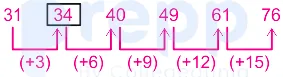
B. 34The logic followed here is : Multiples of 3 are added subsequently.
Hence, "34" is the correct answer.
 Paper & answer key PDF ↗
 Question 22archived
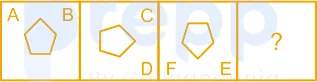
Select the figure from among the given options that can replace the question mark (?) in the following series.
- A
Option A (shown in image)
- B
Option B (shown in image)
- C
Option C (shown in image)
- D
Option D (shown in image)
Show answer
Question 23archived
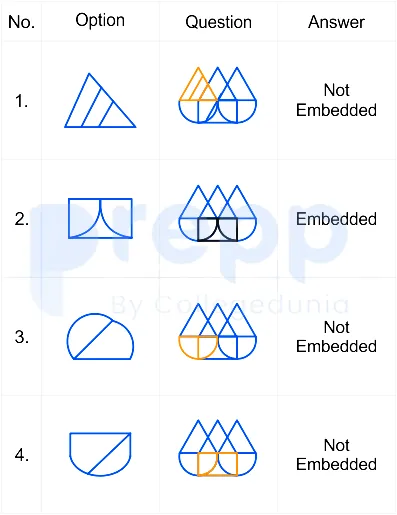
Select the option figure which is embedded in the given figure (rotation is NOT allowed).

- A
Option A (shown in image)
- B
Option B (shown in image)
- C
Option C (shown in image)
- D
Option D (shown in image)
Show answer
B. Option B (shown in image)The image embedded in given figure is as shown below :
∴ Here, Option figure -(2) is embedded in given figure.
Hence, the correct answer is "Option-(2)".
 Paper & answer key PDF ↗
 Question 24archived
By Interchanging the given two numbers which of the following equation will be correct?
2 and 8
- A
8 ÷ 1 + 4 × 2 – 3 = 18
- B
7 × 2 + 6 ÷ 3 – 8 = 60
- C
2 × 4 – 8 + 6 ÷ 3 = 33
- D
8 × 4 + 6 – 2 ÷ 1 = 6
Show answer
D. 8 × 4 + 6 – 2 ÷ 1 = 6Solving Equations by Interchanging Numbers
The problem asks us to determine which of the given equations becomes mathematically correct when the numbers 2 and 8 are interchanged within that equation. We need to substitute 8 for every 2 and 2 for every 8 in each option and then evaluate the resulting expression using the standard order of operations (like BODMAS or PEMDAS).
Evaluating Option 1 after Number Interchange
The original equation is: \(8 \div 1 + 4 \times 2 - 3 = 18\)
After interchanging 2 and 8, the equation becomes:
\(2 \div 1 + 4 \times 8 - 3\)
Now, let's evaluate this expression:
Division: \(2 \div 1 = 2\)
Multiplication: \(4 \times 8 = 32\)
The expression is now: \(2 + 32 - 3\)
Addition: \(2 + 32 = 34\)
Subtraction: \(34 - 3 = 31\)
So, after interchanging 2 and 8, the equation becomes \(31 = 18\), which is incorrect.
Evaluating Option 2 after Number Interchange
The original equation is: \(7 \times 2 + 6 \div 3 - 8 = 60\)
After interchanging 2 and 8, the equation becomes:
\(7 \times 8 + 6 \div 3 - 2\)
Now, let's evaluate this expression:
Multiplication: \(7 \times 8 = 56\)
Division: \(6 \div 3 = 2\)
The expression is now: \(56 + 2 - 2\)
Addition: \(56 + 2 = 58\)
Subtraction: \(58 - 2 = 56\)
So, after interchanging 2 and 8, the equation becomes \(56 = 60\), which is incorrect.
Evaluating Option 3 after Number Interchange
The original equation is: \(2 \times 4 - 8 + 6 \div 3 = 33\)
After interchanging 2 and 8, the equation becomes:
\(8 \times 4 - 2 + 6 \div 3\)
Now, let's evaluate this expression:
Multiplication: \(8 \times 4 = 32\)
Division: \(6 \div 3 = 2\)
The expression is now: \(32 - 2 + 2\)
Subtraction: \(32 - 2 = 30\)
Addition: \(30 + 2 = 32\)
So, after interchanging 2 and 8, the equation becomes \(32 = 33\), which is incorrect.
Evaluating Option 4 after Number Interchange
The original equation is: \(8 \times 4 + 6 - 2 \div 1 = 6\)
After interchanging 2 and 8, the equation becomes:
\(2 \times 4 + 6 - 8 \div 1\)
Now, let's evaluate this expression using the order of operations:
Multiplication: \(2 \times 4 = 8\)
Division: \(8 \div 1 = 8\)
The expression is now: \(8 + 6 - 8\)
Addition: \(8 + 6 = 14\)
Subtraction: \(14 - 8 = 6\)
So, after interchanging 2 and 8, the equation becomes \(6 = 6\), which is correct.
Therefore, interchanging the numbers 2 and 8 makes the fourth equation correct.
Revision Table: Order of Mathematical Operations (BODMAS/PEMDAS)
Rule
Meaning
B or P
Brackets or Parentheses (solve operations inside first)
O or E
Orders or Exponents (powers, square roots, etc.)
D or M
Division and Multiplication (from left to right)
A or S
Addition and Subtraction (from left to right)
Additional Information: Understanding Mathematical Equations
A mathematical equation is a statement that shows that two expressions are equal. It uses an equals sign (\(=\)). To solve or verify an equation, we perform the operations on one or both sides until we can confirm if the equality holds true. When evaluating an expression with multiple operations, it's crucial to follow a specific order to get the correct result. This order is commonly remembered using acronyms like BODMAS (Brackets, Orders, Division and Multiplication, Addition and Subtraction) or PEMDAS (Parentheses, Exponents, Multiplication and Division, Addition and Subtraction).
In this problem, interchanging numbers means swapping their positions. If an equation originally has a '2', it becomes an '8', and if it has an '8', it becomes a '2'. This changes the entire value of the expression, and we must re-evaluate it completely to see if the equality still holds.
Paper & answer key PDF ↗ Question 25archived
Which two signs should be interchanged to make the given equation correct?
95 * 5 + 19 ÷ 2 − 21 = 36
- A
÷ and *
- B
+ and -
- C
÷ and -
- D
+ and *
Show answer
A. ÷ and *Understanding the Equation and the Problem
The given equation is: \(95 \times 5 + 19 \div 2 - 21 = 36\).
Our goal is to find which two mathematical signs, when interchanged, will make this equation correct, meaning the left side evaluates to 36.
Analyzing the Original Equation
Let's first evaluate the given equation with the original signs following the order of operations (Division and Multiplication before Addition and Subtraction):
First, calculate multiplication: \(95 \times 5 = 475\)
Next, calculate division: \(19 \div 2 = 9.5\)
Now, perform addition and subtraction from left to right: \(475 + 9.5 - 21\)
\(475 + 9.5 = 484.5\)
\(484.5 - 21 = 463.5\)
So, the original equation evaluates to \(463.5 = 36\), which is false.
Testing Sign Interchange Options
We need to test each option provided by swapping the indicated signs in the original equation and re-evaluating it.
Evaluating Option 1: Interchange ÷ and *
If we interchange the division (÷) and multiplication (*) signs, the equation becomes:
\(95 \div 5 + 19 \times 2 - 21 = 36\)
Let's evaluate this new equation:
First, perform division and multiplication from left to right:
Division: \(95 \div 5 = 19\)
Multiplication: \(19 \times 2 = 38\)
Now, perform addition and subtraction from left to right: \(19 + 38 - 21\)
Addition: \(19 + 38 = 57\)
Subtraction: \(57 - 21 = 36\)
This evaluation gives us \(36 = 36\), which is true.
Evaluating Other Options
Let's quickly consider what happens with the other options:
Option 2: Interchange + and -
Equation becomes: \(95 \times 5 - 19 \div 2 + 21\). Evaluating this gives \(475 - 9.5 + 21 = 465.5 + 21 = 486.5\). Not 36.
Option 3: Interchange ÷ and -
Equation becomes: \(95 \times 5 + 19 - 2 \div 21\). Evaluating this gives \(475 + 19 - (2 \div 21)\). This results in a value close to \(494\), not 36.
Option 4: Interchange + and *
Equation becomes: \(95 + 5 \times 19 \div 2 - 21\). Evaluating this gives \(95 + (5 \times 19 \div 2) - 21 = 95 + (95 \div 2) - 21 = 95 + 47.5 - 21 = 142.5 - 21 = 121.5\). Not 36.
Conclusion: Correct Sign Interchange
Based on the evaluation of each option, interchanging the division (÷) and multiplication (*) signs makes the equation correct.
Option
Signs Interchanged
New Equation
Result
Correct?
1
÷ and *
\(95 \div 5 + 19 \times 2 - 21\)
\(36\)
Yes
2
+ and -
\(95 \times 5 - 19 \div 2 + 21\)
\(486.5\)
No
3
÷ and -
\(95 \times 5 + 19 - 2 \div 21\)
\(\approx 491.9\)
No
4
+ and *
\(95 + 5 \times 19 \div 2 - 21\)
\(121.5\)
No
Revision Table: Mathematical Operations
Sign
Operation
+
Addition
-
Subtraction
× (or *)
Multiplication
÷ (or /)
Division
Additional Information: Order of Operations
When evaluating mathematical expressions involving multiple operations, we follow a specific order to ensure a consistent result. A common acronym for this order is BODMAS or PEMDAS.
BODMAS: Brackets, Orders (powers/roots), Division, Multiplication, Addition, Subtraction.
PEMDAS: Parentheses, Exponents, Multiplication, Division, Addition, Subtraction.
Division and Multiplication have the same priority, and are performed from left to right. Similarly, Addition and Subtraction have the same priority and are performed from left to right after multiplication and division.
In this problem, we applied this order when evaluating the original and modified equations.
Paper & answer key PDF ↗ Question 26archived
______ is the only continent through which the tropic of cancer, the equator and the tropic of capricorn passes.
- A
North America
- B
Africa
- C
Europe
- D
Asia
Show answer
B. AfricaUnderstanding Major Latitude Lines and Continents
The question asks us to identify the continent that is uniquely crossed by three significant lines of latitude: the Tropic of Cancer, the Equator, and the Tropic of Capricorn.
Let's first define these lines:
The Equator: This is the line of 0 degrees latitude. It divides the Earth into the Northern Hemisphere and the Southern Hemisphere.
The Tropic of Cancer: This is located at approximately \(23.5^\circ\) North latitude. It is the northernmost point where the sun can be directly overhead at noon, which occurs during the June solstice.
The Tropic of Capricorn: This is located at approximately \(23.5^\circ\) South latitude. It is the southernmost point where the sun can be directly overhead at noon, which occurs during the December solstice.
Analyzing Continents and Latitude Lines
Now, let's examine which of these lines pass through the given continents:
Continent
Tropic of Cancer
Equator
Tropic of Capricorn
North America
Yes
No
No
Africa
Yes
Yes
Yes
Europe
No
No
No
Asia
Yes
Partially (Indonesia passes the equator)
No
South America
No
Yes
Yes
Australia
No
No
Yes
From the table and geographical knowledge, we can see:
North America: The Tropic of Cancer passes through Mexico. The Equator and Tropic of Capricorn do not pass through North America.
Africa: The continent of Africa stretches across a vast latitudinal range. The Tropic of Cancer passes through the northern part of Africa (e.g., Egypt, Libya, Algeria). The Equator passes through the central part of Africa (e.g., Democratic Republic of Congo, Uganda, Kenya). The Tropic of Capricorn passes through the southern part of Africa (e.g., Namibia, Botswana, South Africa). Thus, Africa is crossed by all three lines.
Europe: Europe is located entirely in the Northern Hemisphere and is north of the Tropic of Cancer. None of the three lines pass through Europe.
Asia: The Tropic of Cancer passes through the southern part of Asia (e.g., India, China). The Equator passes through some islands of Maritime Southeast Asia which are geographically part of Asia (e.g., Indonesia). However, the Tropic of Capricorn does not pass through mainland Asia or its major island groups.
Based on this analysis, Africa is the only continent that has the Tropic of Cancer, the Equator, and the Tropic of Capricorn running through it.
Conclusion on Latitude Lines and Continents
Therefore, the continent through which all three major latitude lines - the Tropic of Cancer, the Equator, and the Tropic of Capricorn - pass is Africa.
Revision Table: Major Latitude Lines Location
Latitude Line
Approximate Latitude
Hemisphere
Equator
\(0^\circ\)
Divides North & South
Tropic of Cancer
\(23.5^\circ\) North
Northern Hemisphere
Tropic of Capricorn
\(23.5^\circ\) South
Southern Hemisphere
Additional Information: Global Geography Facts
Understanding these latitude lines is fundamental to studying Earth's climate zones. The area between the Tropic of Cancer and the Tropic of Capricorn is known as the tropics, characterized by generally warm temperatures year-round.
The Equator passes through 13 countries.
The Tropic of Cancer passes through 16 countries.
The Tropic of Capricorn passes through 10 countries.
Africa is the second largest continent by area.
Africa is home to a wide range of climates due to its position straddling the equator and tropics.
Paper & answer key PDF ↗ Question 27archived
Which of the following is NOT correct about the jurisdiction of the High Court?
- A
It controls the subordinate courts within its jurisdiction.
- B
It has the power of judicial review.
- C
It provides advisory opinion to the President of India.
- D
It has writ jurisdiction.
Show answer
C. It provides advisory opinion to the President of India.The correct answer is It provides advisory opinion to the President of India.
Any dispute arising out of any pre-constitution treaty, agreement, covenant, engagement, Sanad, or other similar instrument. The Supreme Court is obligated to give its opinion in the second category but may refuse in the first. The opinion given by the Supreme Court is not binding on the President. Understanding the distinct jurisdictions of the High Courts and the Supreme Court is essential for comprehending the Indian judicial system.
Paper & answer key PDF ↗ Question 28archived
Who released a special stamp entitled ‘Wheat Revolution’ in July 1968?
- A
Mahatma Gandhi
- B
Jawaharlal Nehru
- C
Indira Gandhi
- D
Motilal Nehru
Show answer
C. Indira GandhiThe correct answer is Indira Gandhi.
Swaminathan, often called the "Father of the Green Revolution in India." The use of high-yielding varieties of wheat, particularly those developed by Norman Borlaug (who later won the Nobel Peace Prize for his work), along with improved techniques, led to significant increases in yield. The Wheat Revolution was a major success story, transforming India from a food-deficient nation reliant on imports to one with surplus food grain production. The stamp released in 1968 highlighted this agricultural progress and the government's focus on modernizing farming.
Paper & answer key PDF ↗ Question 29archived
Who among the following ruled in India between 1266 and 1287?
- A
Qutub-ud-din-Aybak
- B
Aram Shah
- C
Shams-ud-din-Iltutmish
- D
Ghiyasuddin Balban
Show answer
D. Ghiyasuddin BalbanCorrect answer: Ghiyasuddin Balban
Theory of Kingship: Balban believed in the 'divine right of kings' (Niyabat-i-Khudai) and the concept of the Sultan being the shadow of God on Earth (Zill-i-Ilahi). He maintained strict court discipline.
Military Reforms: He reorganized the army (Diwan-i-Arz) to strengthen it against internal rebellions and external threats, particularly the Mongols.
Suppression of Rebellions: He ruthlessly suppressed revolts, including the rebellion in Bengal.
Spy System: He established an efficient spy system (Barids) to keep track of officials and nobles.
Restoration of Law and Order: He focused on clearing forests and eliminating dacoits to improve trade routes and stability.
His strong and autocratic rule laid the groundwork for future rulers of the Sultanate.
Paper & answer key PDF ↗ Question 30archived
Which of the following is NOT mentioned as a Fundamental Right in the Constitution of India?
- A
Right to education
- B
Right to property
- C
Right to freedom
- D
Right against exploitation
Show answer
B. Right to propertyUnderstanding Fundamental Rights in the Indian Constitution
The question asks us to identify which of the given options is NOT mentioned as a Fundamental Right in the Constitution of India. India's Constitution guarantees certain basic rights to its citizens, known as Fundamental Rights, which are enshrined in Part III of the Constitution.
Examining the Options
Let's look at each option to determine its status under the Indian Constitution:
Right to education: This is a Fundamental Right. Article 21A was inserted into the Constitution by the 86th Amendment Act, 2002, making education a fundamental right for children between the ages of 6 and 14 years.
Right to property: Historically, the Right to Property was a Fundamental Right under Article 19(1)(f) and Article 31. However, it was removed from the list of Fundamental Rights by the 44th Amendment Act, 1978. It was then made a legal right under Article 300A in Part XII of the Constitution. Therefore, it is no longer a Fundamental Right.
Right to freedom: The Right to Freedom is a group of Fundamental Rights guaranteed under Articles 19 to 22 of the Constitution. This includes freedoms like speech and expression, assembly, association, movement, residence, and profession.
Right against exploitation: This is a Fundamental Right guaranteed under Articles 23 and 24 of the Constitution. It prohibits forced labor, human trafficking, and child labor.
Conclusion
Based on the analysis of each option, the Right to property is the one that is no longer listed as a Fundamental Right in the Constitution of India.
Right
Status in Constitution (Current)
Relevant Articles
Right to education
Fundamental Right
Article 21A
Right to property
Legal Right (not Fundamental)
Article 300A (Previously Articles 19(1)(f) & 31)
Right to freedom
Fundamental Right
Articles 19-22
Right against exploitation
Fundamental Right
Articles 23-24
The question specifically asks which is NOT mentioned as a Fundamental Right. The Right to property, while a significant legal right, is not part of Part III (Fundamental Rights) anymore.
Revision Table: Key Fundamental Rights
Category of Fundamental Right
Articles
Brief Description
Right to Equality
14-18
Equality before law, no discrimination on certain grounds, abolition of untouchability, abolition of titles.
Right to Freedom
19-22
Protection of rights regarding freedom of speech, assembly, association, movement, residence, and profession; protection in respect of conviction for offences; protection of life and personal liberty; protection against arrest and detention.
Right against Exploitation
23-24
Prohibition of human trafficking and forced labor; prohibition of employment of children in factories, etc.
Right to Freedom of Religion
25-28
Freedom of conscience and free profession, practice and propagation of religion; freedom to manage religious affairs; freedom as to payment of taxes for promotion of any particular religion; freedom as to attendance at religious instruction or religious worship in certain educational institutions.
Cultural and Educational Rights
29-30
Protection of interests of minorities; right of minorities to establish and administer educational institutions.
Right to Constitutional Remedies
32
Right to move the Supreme Court for the enforcement of Fundamental Rights (includes writs like Habeas Corpus, Mandamus, Prohibition, Certiorari, and Quo Warranto).
Additional Information on Right to Property
The Right to Property was initially considered essential for individual liberty and enterprise. However, over time, it was seen as a hindrance to land reforms and other socio-economic legislations aimed at reducing inequalities.
Key points about its change in status:
Included in Article 19(1)(f) (freedom to acquire, hold, and dispose of property) and Article 31 (compulsory acquisition of property).
Frequent amendments were made to Article 31 and Article 19(1)(f) to allow the state to acquire property for public purposes and implement land reforms.
The 44th Amendment Act, 1978, finally repealed Article 19(1)(f) and Article 31.
A new Article 300A was added under a new chapter, Part XII (Finance, Property, Contracts and Suits).
Article 300A states: "No person shall be deprived of his property save by authority of law."
This change means the Right to Property is now a constitutional right (legal right) but not a fundamental right. It can be regulated by ordinary law, and deprivation of property can be challenged on grounds of legality, but not on the higher standard required for violation of a fundamental right.
Paper & answer key PDF ↗ Question 31archived
In February 2022, Maharashtra government announced ‘Hope Express’ initiative to ______.
- A
prevent cancer
- B
improve drainage system
- C
manage industrial waste
- D
improve air quality
Show answer
A. prevent cancerUnderstanding Maharashtra's 'Hope Express' Initiative
The question asks about the purpose of the 'Hope Express' initiative launched by the Maharashtra government in February 2022. This initiative focuses on a specific area of public health.
Let's analyze the options provided and connect them to the known purpose of the 'Hope Express' initiative:
prevent cancer
improve drainage system
manage industrial waste
improve air quality
The 'Hope Express' initiative is a significant step taken by the Maharashtra government to address a critical health challenge. The name itself, 'Hope Express', suggests a focus on bringing hope to people facing difficult health conditions. It was launched with the goal of improving healthcare services related to early detection and treatment of a specific disease.
Based on the details surrounding its launch in February 2022, the 'Hope Express' initiative was specifically aimed at deploying advanced diagnostic facilities across the state to facilitate early detection of cancer. Early detection is crucial in improving treatment outcomes and increasing survival rates for cancer patients.
Considering this information, let's look at the options again:
prevent cancer: This aligns with the objective of the 'Hope Express' initiative, which focuses on early detection, a key strategy in managing and improving outcomes for cancer. While 'prevention' in a broad sense includes lifestyle changes, early detection programs are often categorized under preventive healthcare as they prevent the disease from progressing to advanced stages.
improve drainage system: This is related to urban or rural infrastructure and sanitation, which is unrelated to a health initiative named 'Hope Express' focusing on specific diseases.
manage industrial waste: This pertains to environmental management and pollution control, which is not the focus of a health initiative like 'Hope Express'.
improve air quality: This is another environmental concern, related to public health indirectly, but not the primary focus of an initiative centered around diagnostics and early detection for a disease like cancer.
Therefore, the 'Hope Express' initiative is directly related to the efforts to prevent or manage cancer through early detection and diagnosis.
Revision Table: Maharashtra Initiatives
Initiative
State
Approx. Launch Time
Primary Focus
Hope Express
Maharashtra
February 2022
Cancer Prevention (through early detection)
(Example: Swachh Bharat Abhiyan)
Nationwide
2014
Sanitation and Cleanliness
Additional Information on Cancer Prevention and Early Detection
Cancer prevention involves reducing the risk of developing cancer through various strategies, including:
Lifestyle Changes: Avoiding tobacco, maintaining a healthy weight, eating a balanced diet, limiting alcohol consumption, and protecting skin from the sun.
Vaccination: Vaccines against certain viruses like HPV (Human Papillomavirus) and Hepatitis B can prevent cancers caused by these infections.
Screening and Early Detection: Regular screening tests (like mammograms for breast cancer, colonoscopies for colorectal cancer, Pap tests for cervical cancer) can find cancer early when it is often easier to treat. Initiatives like 'Hope Express' fall under this category, aiming to make diagnostic facilities accessible for early detection.
Early detection significantly increases the chances of successful treatment and survival rates compared to diagnosing cancer at later stages.
Paper & answer key PDF ↗ Question 32archived
Who among the following was awarded the National Nritya Shiromani Award 2022?
- A
Radha Reddy
- B
Aparna Satheesan
- C
Usha Srinivasan
- D
Deepa Sashindran
Show answer
B. Aparna SatheesanNational Nritya Shiromani Award 2022 Recipient
The National Nritya Shiromani Award is a prestigious recognition given for excellence in classical dance. The question asks about the recipient of this award in the year 2022.
Let's look at the options provided:
Radha Reddy
Aparna Satheesan
Usha Srinivasan
Deepa Sashindran
The National Nritya Shiromani Award 2022 was presented to Aparna Satheesan. Aparna Satheesan is a renowned Kuchipudi dancer. This award recognized her significant contributions and excellence in the field of Indian classical dance.
Therefore, among the given options, Aparna Satheesan is the correct answer as the recipient of the National Nritya Shiromani Award in 2022.
Understanding the National Nritya Shiromani Award
The National Nritya Shiromani Award is typically presented during the Cuttack Mahotsav, an international dance and music festival held in Odisha, India. It aims to honor dancers who have made outstanding contributions to promoting and preserving Indian classical dance forms globally. Receiving this award is a significant achievement in a dancer's career, highlighting their dedication, skill, and impact on the art form.
Revision Table: Key Details
Award
Year
Recipient
Dance Form
National Nritya Shiromani Award
2022
Aparna Satheesan
Kuchipudi (primarily)
Additional Information on Indian Classical Dance Awards
India has a rich tradition of classical dance, recognized through various national and regional awards. These awards play a crucial role in encouraging artists and preserving the cultural heritage of the country. Some other notable awards related to dance include:
Sangeet Natak Akademi Award
Kalidas Samman (for classical dance, music, arts)
Padma Awards (Padma Shri, Padma Bhushan, Padma Vibhushan) which are also conferred upon dancers for their exceptional contributions.
Understanding these awards helps in appreciating the dedication and talent of dancers who contribute to the vibrant landscape of Indian classical arts.
Paper & answer key PDF ↗ Question 33archived
Which food requires a longer small intestine to digest food?
- A
Lamb
- B
Eggs
- C
Grass
- D
Chicken
Show answer
C. GrassThe correct answer is Grass.
Hindgut Fermenters: Animals like horses, rabbits, and elephants have an enlarged cecum or colon where microbial fermentation occurs after the small intestine. This still requires a significant length of intestine for absorption. Specialized Teeth: Herbivores typically have broad, flat molars for grinding tough plant material. These adaptations highlight the complexity involved in extracting nutrients from plant-based diets, particularly those high in cellulose, necessitating a longer digestive tract overall, including a longer small intestine compared to carnivores or omnivores.
Paper & answer key PDF ↗ Question 34archived
Yellow card in badminton indicates ____________.
- A
fault for misconduct
- B
suspension for misconduct
- C
warning for misconduct
- D
disqualified for misconduct
Show answer
C. warning for misconductThe correct answer is warning for misconduct.
Using offensive language or gestures. Behaving in a manner that is disruptive or brings the sport into disrepute. Umpires are trained to apply these penalties consistently. A yellow card is usually the first step for minor issues, giving the player a chance to correct their behavior without immediately affecting the score.
Paper & answer key PDF ↗ Question 35archived
The national Archives of India came up in the ______.
- A
1930
- B
1912
- C
1891
- D
1865
Show answer
C. 1891Understanding the Establishment of the National Archives of India
The question asks about the year in which the National Archives of India was established. Understanding the history of this important institution helps us identify the correct period.
The National Archives of India is the custodian of the non-current records of the Government of India and is a rich source of information for researchers and historians. Its origins can be traced back to the British era in India.
Origins of the National Archives of India
Before being known as the National Archives of India, the institution had a different name and purpose. It was initially established to systematically manage and preserve the official records of the British administration in India.
The idea of an organized record-keeping system gained momentum in the late 19th century.
Official records from various departments were scattered and poorly maintained, leading to calls for a central repository.
This led to the establishment of the Imperial Record Department.
Establishment Year of the Imperial Record Department
The Imperial Record Department, the precursor to the National Archives of India, was established in Kolkata (then Calcutta).
After careful planning and recognizing the need for a central archives, the department was formally set up.
This crucial step in organizing historical records in India took place in the year 1891.
Later, this department was moved to New Delhi and renamed the National Archives of India after the country gained independence.
Analysing the Options
Let's look at the provided options and see which one corresponds to the establishment year of the Imperial Record Department:
Option
Year
Relevance
1
1930
This year is later than the actual establishment.
2
1912
This year is also later than the initial establishment.
3
1891
This year aligns with the establishment of the Imperial Record Department.
4
1865
This year is earlier than the formal establishment of a central archives.
Based on the historical facts, the National Archives of India (which originated as the Imperial Record Department) came up in 1891.
Conclusion on the National Archives Establishment
The establishment of the Imperial Record Department in 1891 marked the beginning of the National Archives of India. Therefore, the correct answer is 1891.
Revision Table: National Archives of India Key Facts
Feature
Detail
Original Name
Imperial Record Department
Establishment Year
1891
Initial Location
Kolkata (Calcutta)
Current Name
National Archives of India
Current Location
New Delhi
Primary Role
Custodian of Government of India's non-current records
Additional Information: Importance of National Archives
National Archives play a vital role in preserving the history and heritage of a nation. They serve several key functions:
Preservation: They house and conserve millions of historical documents, manuscripts, maps, and other records that are crucial for understanding the past.
Accessibility: They provide access to these records for researchers, scholars, students, and the general public (subject to rules and regulations).
Historical Research: Archives are essential resources for historical research, allowing historians to study primary sources and write accurate accounts of events.
Legal and Administrative Value: Many records held in archives have legal and administrative value, serving as evidence of past decisions, rights, and events.
Cultural Heritage: By preserving national records, archives contribute significantly to the cultural heritage and collective memory of a country.
The National Archives of India holds records spanning from the Mughal period to the modern era, making it an invaluable institution for the study of Indian history.
Paper & answer key PDF ↗ Question 36archived
Personal disposable income (PDI) can be defined as ______.
- A
PI + Personal tax payments + Non-tax payments
- B
PI + Personal tax payments - Non-tax payments
- C
PI - Personal tax payments - Non-tax payments
- D
PI - Personal tax payments + Non-tax payments
Show answer
C. PI - Personal tax payments - Non-tax paymentsUnderstanding Personal Disposable Income (PDI) Calculation
Personal Disposable Income (PDI) is a crucial economic indicator that represents the amount of income households and individuals have available to spend or save after paying mandatory personal taxes and non-tax payments to the government. It is derived from Personal Income (PI). Understanding how PDI is calculated helps us analyze consumer behavior and the overall health of the economy.
Components for Calculating Personal Disposable Income
To calculate Personal Disposable Income, we start with Personal Income (PI) and make deductions for certain payments:
Personal Income (PI): This is the total income received by individuals or households from all sources before paying personal income taxes. It includes wages, salaries, rent, interest, dividends, and transfer payments.
Personal tax payments: These are compulsory payments made by individuals to the government, primarily income tax.
Non-tax payments: These include various fees, fines, and other miscellaneous payments made by individuals to the government or other public authorities that are not considered taxes.
The Formula for Personal Disposable Income
Personal Disposable Income is what remains of Personal Income after subtracting these mandatory payments. The standard formula is:
$\text{PDI} = \text{PI} - \text{Personal tax payments} - \text{Non-tax payments}$
This formula shows that the amounts paid out as personal taxes and non-tax payments reduce the income available for individuals to freely dispose of (either spend or save). Therefore, both these amounts are subtracted from Personal Income.
Analyzing the Given Options
Let's examine the provided options based on the standard definition of Personal Disposable Income:
Option 1: $\text{PI} + \text{Personal tax payments} + \text{Non-tax payments}$
This formula adds taxes and non-tax payments to PI, which would result in a figure much higher than the income available for spending or saving. This is incorrect.
Option 2: $\text{PI} + \text{Personal tax payments} - \text{Non-tax payments}$
This formula incorrectly adds personal tax payments to PI. Taxes are deductions, not additions, when calculating disposable income. This is incorrect.
Option 3: $\text{PI} - \text{Personal tax payments} - \text{Non-tax payments}$
This formula correctly subtracts both personal tax payments and non-tax payments from Personal Income. This aligns with the definition of Personal Disposable Income (PDI). This is the correct formula.
Option 4: $\text{PI} - \text{Personal tax payments} + \text{Non-tax payments}$
This formula incorrectly adds non-tax payments back after subtracting taxes. Non-tax payments, like taxes, are deductions that reduce disposable income. This is incorrect.
Based on the standard economic definition and the analysis of the options, Personal Disposable Income is calculated by subtracting personal tax payments and non-tax payments from Personal Income.
Revision Table: Key Income Concepts
Income Concept
Calculation/Definition
National Income (NI)
Net National Product at Factor Cost
Personal Income (PI)
NI - Corporate taxes - Undistributed profits - Net interest payments + Transfer payments
Personal Disposable Income (PDI)
PI - Personal tax payments - Non-tax payments
Additional Information on Personal Disposable Income
Personal Disposable Income is often seen as the actual purchasing power of households. The changes in PDI significantly influence consumption expenditure and saving patterns in the economy. A rise in PDI generally leads to an increase in aggregate demand as households tend to spend more. Conversely, a fall in PDI can lead to decreased spending and saving.
It's important to distinguish between Personal Income and Personal Disposable Income. Personal Income is the income received, while Personal Disposable Income is the income available for spending or saving after mandatory deductions.
Paper & answer key PDF ↗ Question 37archived
In India the 1st census was held in the year ______.
- A
1872
- B
1860
- C
1900
- D
1920
Show answer
A. 1872The correct answer is 1872.
The Census Act of 1948 provides the legal framework for conducting censuses. The data collected during the census is considered confidential and is not made public at the individual level. It is primarily used for administrative purposes, planning, and research. The census is a massive administrative exercise involving millions of enumerators and covering every household in the country.
Paper & answer key PDF ↗ Question 38archived
The Kunbi dance is performed by the tribal community of ______.
- A
Sikkim
- B
Tamil Nadu
- C
Uttar Pradesh
- D
Goa
Show answer
D. GoaThe correct answer is Goa.
Simplicity in Kunbi Dance: The Kunbi dance reflects the simple lifestyle and close relationship with nature of the community. The movements are rhythmic and graceful, often depicting daily activities or celebrating harvest. Importance of Folk Dances: Folk dances like Kunbi are vital for preserving cultural identity, passing down traditions through generations, and celebrating community bonds. Understanding the specific folk dances and the communities they belong to helps in appreciating the vast cultural diversity of India.
Paper & answer key PDF ↗ Question 39archived
A cyclone is known by different names in different parts of the world. In Philippines it is called as _______.
- A
willy - willy
- B
hurricane
- C
typhoon
- D
mango shower
Show answer
C. typhoonThe correct answer is typhoon.
The impact of tropical cyclones can be severe, including: Strong Winds: Can cause widespread structural damage. Heavy Rainfall: Leads to flooding. Storm Surge: A rise in sea level caused by the storm's winds pushing water towards the shore, often the most dangerous aspect for coastal areas. Tropical cyclones are categorized based on their wind speed, such as the Saffir-Simpson Hurricane Wind Scale for hurricanes in the Atlantic and eastern Pacific.
Paper & answer key PDF ↗ Question 40archived
Who among the following defeated Mughal emperor Humayun at Chausa?
- A
Mirza Hakim
- B
Safavid Shah
- C
Sher Shah
- D
Mirza Kamran
Show answer
C. Sher ShahThe correct answer is Sher Shah.
He built forts and cities, such as Shergarh and Sasaram (his birthplace). These reforms laid the groundwork for many administrative practices later adopted by Akbar. Sher Shah died in 1545 during the siege of Kalinjar. His successors were less capable, which eventually allowed Humayun to reclaim his throne in 1555.
Paper & answer key PDF ↗ Question 41archived
Prime Minister Narendra Modi said, “Seema Darshan Project adds a new dimension to the tourism sector”. This project will boost tourism in ______.
- A
Gujarat
- B
Uttar Pradesh
- C
Rajasthan
- D
Jammu and Kashmir
Show answer
A. GujaratUnderstanding the Seema Darshan Project and Tourism
The question asks which state's tourism sector will be boosted by the Seema Darshan Project, based on a statement by Prime Minister Narendra Modi. To answer this, we need to know the location and purpose of the Seema Darshan Project.
What is the Seema Darshan Project?
The Seema Darshan Project is an initiative aimed at promoting tourism at the international border. It allows citizens to visit and experience the border environment, witness the lifestyle of border security forces, and understand the challenges they face. The project was inaugurated at Nadabet, located on the India-Pakistan border in the Banaskantha district of Gujarat.
Key aspects of the project include:
Viewing points for the border.
Exhibitions showcasing the Border Security Force (BSF).
A parade or retreat ceremony similar to the one at Wagah border.
Food courts, rest areas, and other tourist facilities.
Boosting Tourism in Gujarat
Since the Seema Darshan Project is established at Nadabet in Gujarat, it directly attracts tourists to this region within the state. This influx of tourists leads to increased economic activity, development of infrastructure, and promotion of local culture and handicrafts in Gujarat. Therefore, the project significantly boosts tourism in Gujarat.
Analyzing the Options
Let's look at why the other options are not directly associated with the Seema Darshan Project in the context of the question:
Uttar Pradesh: Uttar Pradesh is known for religious and historical tourism (e.g., Varanasi, Ayodhya, Taj Mahal), but the Seema Darshan Project is not located here.
Rajasthan: Rajasthan shares a border with Pakistan and has border tourism sites like the Wagah-like ceremony at Attari (though the main one is in Punjab) and other border areas. While Rajasthan has border tourism potential, the specific Seema Darshan Project mentioned in the question is situated in Gujarat.
Jammu and Kashmir: Jammu and Kashmir also shares a border with Pakistan and is a significant tourist destination (e.g., Srinagar, Gulmarg). However, the Seema Darshan Project initiated at Nadabet is located in Gujarat.
Based on the location of the Seema Darshan Project at Nadabet, Gujarat is the state whose tourism sector is directly boosted by this initiative.
Conclusion
The Seema Darshan Project at Nadabet is located in Gujarat. By developing infrastructure and attractions at the border, it aims to draw tourists to this region, thereby boosting the tourism sector of Gujarat. Prime Minister Narendra Modi's statement highlights this impact on the state's tourism.
Project
Location
State
Impact on Tourism
Seema Darshan Project
Nadabet (India-Pakistan border)
Gujarat
Directly boosts tourism in this state.
Revision Table: Seema Darshan Project Facts
Aspect
Detail
Project Name
Seema Darshan Project
Primary Location
Nadabet
State
Gujarat
Purpose
Promote border tourism, educate public about BSF
Additional Information: Border Tourism in India
Border tourism is a growing sector in India, offering citizens a chance to visit and understand the strategic border areas and the lives of defense personnel. Besides Nadabet in Gujarat, notable border tourism sites or similar initiatives include:
Attari-Wagah border (Punjab): Famous for the daily retreat ceremony.
Saman Burj (Punjab): A historical site near the border.
Longewala (Rajasthan): Site of a famous battle in the 1971 war.
Several locations along the Rajasthan border with cultural significance.
Initiatives being explored in border areas of Jammu & Kashmir, Ladakh, and the Northeast.
These initiatives not only boost tourism but also instill a sense of patriotism and connect citizens with the nation's security efforts.
Paper & answer key PDF ↗ Question 42archived
______ has become the first city in the country to get a processed steel slag (industrial waste) road.
- A
Surat
- B
Chennai
- C
Kanpur
- D
Shimla
Show answer
A. SuratSurat Becomes First City with Steel Slag Road in India
The question asks to identify the first city in India that has constructed a road using processed steel slag, which is a type of industrial waste.
Steel slag is a byproduct generated during the production of steel. Traditionally, large quantities of this material are left as waste, posing environmental and disposal challenges. However, researchers and engineers have explored ways to process and utilize steel slag as a sustainable alternative material in construction, particularly in road building.
Constructing roads using processed steel slag offers several potential benefits:
Sustainability: It provides a valuable use for industrial waste, reducing the need for virgin materials like aggregates.
Cost-effectiveness: Utilizing waste material can potentially lower construction costs.
Durability: Studies suggest that roads built with steel slag can be durable and resistant to wear.
Environmental Impact: Reduces the burden of landfilling large volumes of steel slag.
Based on reports and initiatives, Surat, a city in Gujarat, has pioneered the use of processed steel slag for road construction in India.
This innovative project in Surat involved constructing a road, reportedly in the Hazira industrial area, using 100% processed steel slag aggregates. This initiative was part of a joint effort involving research institutions and government bodies to demonstrate the viability of using steel waste in infrastructure development.
Therefore, Surat holds the distinction of being the first city in the country to successfully build a road entirely from processed steel slag, marking a significant step towards sustainable use of industrial waste.
Analysis of Options
Option
City
Relevance
1
Surat
Correct. Surat is recognized as the first city in India to have a processed steel slag road.
2
Chennai
Incorrect. Chennai is a major city but not the first to build a steel slag road.
3
Kanpur
Incorrect. Kanpur is an industrial city but not the first to build a steel slag road.
4
Shimla
Incorrect. Shimla is a hill station and not associated with pioneering steel slag roads.
Revision Table: Steel Slag Road in Surat
Concept
Detail
City
Surat
Material Used
Processed Steel Slag (Industrial Waste)
Significance
First city in India to use this material for road construction
Location (example)
Hazira Industrial Area (pilot project)
Purpose
Sustainable use of industrial waste, cost-effective construction
Additional Information: Understanding Steel Slag
Steel slag is a coproduct of the steel-making process. It is formed as molten slag separates from the molten steel. It primarily consists of calcium silicates, calcium ferrites, and calcium aluminates, along with oxides of magnesium, manganese, and phosphorus.
There are different types of steel slag depending on the type of steel furnace used (e.g., Basic Oxygen Furnace slag, Electric Arc Furnace slag) and the specific steel produced. For use in road construction, the steel slag needs to be processed, which typically involves cooling, crushing, and screening to obtain the desired aggregate sizes. Proper aging and processing are also crucial to minimize potential issues like expansion due to the presence of free lime.
Utilizing processed steel slag as an aggregate in asphalt or concrete mixes for road construction is a promising way to reduce the consumption of natural aggregates and manage industrial waste sustainably. The Surat project serves as a key example of this approach in India.
Paper & answer key PDF ↗ Question 43archived
Which country hosted the first ever Commonwealth Games in 1930?
- A
Australia
- B
New Zealand
- C
England
- D
Canada
Show answer
D. CanadaThe question asks about the host country for the first-ever Commonwealth Games held in 1930. This requires knowing a key historical fact about this major international multi-sport event.
The Commonwealth Games are held every four years and involve athletes from the Commonwealth of Nations. They were formerly known as the British Empire Games, British Empire and Commonwealth Games, and British Commonwealth Games before adopting the current name.
The idea for a sporting competition that would bring together athletes from across the British Empire was first proposed by Reverend Astley Cooper in 1891. However, it wasn't until the 1928 Summer Olympics in Amsterdam that the concept gained real momentum. Melville Marks Robinson, a sports journalist and editor from Canada, strongly advocated for such a games to be held in Canada.
His efforts were successful, and the city of Hamilton, Ontario, Canada, was chosen to host the inaugural British Empire Games in 1930. Eleven countries sent 400 athletes to compete in six sports and 59 events.
Let's look at the options provided:
Australia: Australia has hosted the Commonwealth Games multiple times, but not the first one.
New Zealand: New Zealand has also hosted the games, but not the inaugural event.
England: England has hosted the games, but the first hosting was by a country outside of the United Kingdom.
Canada: Canada, specifically the city of Hamilton, hosted the very first Commonwealth Games in 1930.
Therefore, the country that hosted the first ever Commonwealth Games in 1930 was Canada.
Revision Table: First Commonwealth Games Facts
Event Name (1930)
British Empire Games
Year
1930
Host Country
Canada
Host City
Hamilton, Ontario
Number of Nations/Territories
11
Number of Athletes
400
Additional Information about Commonwealth Games
The Commonwealth Games are a unique international multi-sport event. Here are some additional points:
Purpose: The games aim to promote friendly competition and unity among member nations of the Commonwealth.
Frequency: They are held every four years, typically in the middle year between Summer Olympic Games.
Evolution: The games have evolved significantly since 1930, both in terms of the number of sports and participating nations.
Inclusivity: The Commonwealth Games are known for their inclusion of para-sports events fully integrated into the main program.
Understanding the history of major sporting events like the Commonwealth Games is important for general knowledge and competitive exams.
Paper & answer key PDF ↗ Question 44archived
The theory of plate tectonics proposes that the earth’s lithosphere is divided into ______ major and some minor plates.
- A
7
- B
6
- C
12
- D
16
Show answer
A. 7Understanding Plate Tectonics and Major Plates
The theory of plate tectonics is a fundamental concept in geology that describes the large-scale motion of Earth's lithosphere. The lithosphere, which is the rigid outer shell of the Earth (composed of the crust and the uppermost part of the mantle), is not a continuous, solid layer. Instead, it is broken into a number of large and small pieces known as tectonic plates.
Number of Major Tectonic Plates
According to the widely accepted theory of plate tectonics, the Earth's lithosphere is divided into a specific number of major tectonic plates and several minor or smaller plates. While there can be slight variations in classifications depending on the source or specific criteria, the most commonly recognized number of major tectonic plates is seven.
These major plates cover most of the Earth's surface. In addition to these seven major plates, there are also numerous smaller plates and microplates.
The Seven Major Tectonic Plates
The seven major tectonic plates typically recognized are:
The African Plate
The Antarctic Plate
The Eurasian Plate
The Indo-Australian Plate (sometimes considered two separate plates: the Indian Plate and the Australian Plate)
The North American Plate
The Pacific Plate
The South American Plate
These plates are constantly moving, albeit very slowly, driven by forces within the Earth, primarily convection currents in the underlying asthenosphere (the weaker, ductile part of the upper mantle).
Conclusion
Based on the theory of plate tectonics, the Earth's lithosphere is divided into seven major plates and several minor plates. Therefore, the correct answer is 7.
Revision Table: Plate Tectonics Key Points
Concept
Description
Plate Tectonics
Theory explaining lithosphere movement.
Lithosphere
Rigid outer layer (crust + upper mantle).
Tectonic Plates
Fragments the lithosphere is broken into.
Major Plates
The largest plates, numbering typically 7.
Minor Plates
Smaller plates, numerous in number.
Additional Information: Plate Boundaries
The interactions between tectonic plates at their edges, known as plate boundaries, are responsible for many of Earth's geological features and events, such as earthquakes, volcanoes, and mountain building. There are three main types of plate boundaries:
Divergent Boundaries: Plates move away from each other. New lithosphere is created (e.g., mid-ocean ridges).
Convergent Boundaries: Plates move towards each other. Can result in subduction (one plate sinks beneath another) or collision (plates crumple up, forming mountains) (e.g., the Himalayas, Andes). Lithosphere is consumed.
Transform Boundaries: Plates slide past each other horizontally. Lithosphere is neither created nor destroyed, but intense earthquakes often occur (e.g., San Andreas Fault).
Understanding the number and movement of tectonic plates is crucial for comprehending Earth's dynamic geological processes.
Paper & answer key PDF ↗ Question 45archived
Why does one get cramps after sudden physical activity?
- A
The build-up of hydrochloric acid in our muscles during sudden activity causes cramps.
- B
The pepsin enzyme releases chemicals that lead to cramps.
- C
The oxygen molecules breaks down.
- D
The build-up of lactic acid in our muscles during sudden activity causes cramps.
Show answer
D. The build-up of lactic acid in our muscles during sudden activity causes cramps.Understanding Muscle Cramps After Sudden Physical Activity
Muscle cramps can be a common experience, especially after engaging in sudden or intense physical activity that your body isn't fully prepared for. This happens because your muscles need energy to work. During normal, sustained activity, your body can usually supply enough oxygen to the muscles. This allows for aerobic respiration, which efficiently produces energy (ATP) using glucose and oxygen.
The Role of Oxygen and Anaerobic Respiration in Muscle Cramps
When you perform sudden, intense physical activity, your muscles' demand for energy increases rapidly. Your body might not be able to supply oxygen quickly enough to meet this high demand. When oxygen supply is insufficient, muscle cells switch to a different process to produce energy, called anaerobic respiration.
Anaerobic respiration in muscle cells primarily involves the conversion of glucose into lactic acid, along with a small amount of energy (ATP). This process is much less efficient at producing energy than aerobic respiration, but it's faster and doesn't require oxygen, allowing the muscles to continue working for a short period under oxygen-limited conditions.
Lactic Acid Build-up and Muscle Cramps
However, the lactic acid produced during anaerobic respiration can accumulate in the muscle tissue. This build-up is associated with muscle fatigue, soreness, and the painful involuntary contractions we experience as muscle cramps. While the exact mechanism by which lactic acid causes cramps is still debated, its accumulation is strongly linked to the onset of cramps during or immediately after intense physical activity.
Analyzing the Options
Let's look at the provided options in the context of why muscle cramps occur after sudden physical activity:
The first option suggests the build-up of hydrochloric acid. Hydrochloric acid is found in the stomach and is involved in digestion, not in muscle function or the cause of cramps during physical activity.
The second option mentions the pepsin enzyme releasing chemicals. Pepsin is also a digestive enzyme found in the stomach and is unrelated to muscle cramps caused by exercise.
The third option states that oxygen molecules break down. Oxygen is used in aerobic respiration to help produce energy. It doesn't break down in a way that causes cramps. Insufficient oxygen supply, not its breakdown, is relevant here.
The fourth option suggests the build-up of lactic acid in our muscles during sudden activity causes cramps. This aligns with our understanding of anaerobic respiration occurring during intense exercise when oxygen is limited, leading to lactic acid accumulation and associated muscle fatigue and cramping.
Conclusion on Muscle Cramps
Based on the process of energy production in muscles during sudden, intense activity, the build-up of lactic acid is the recognized factor among the given options that contributes to muscle cramps.
Revision Table: Muscle Respiration Summary
Process
Oxygen Required?
Energy (ATP) Produced
Byproduct
Activity Level
Linked to Cramps?
Aerobic Respiration
Yes
High
Carbon Dioxide, Water
Sustained, Moderate
No (Sufficient Oxygen)
Anaerobic Respiration (Muscle)
No
Low
Lactic Acid
Sudden, Intense
Yes (Lactic Acid Build-up)
Additional Information on Muscle Cramps and Exercise
While lactic acid build-up is a significant factor discussed, other elements can also contribute to muscle cramps during or after physical activity. These include:
Dehydration: Not drinking enough fluids can affect electrolyte balance, which is crucial for proper muscle function.
Electrolyte Imbalance: Loss of important minerals like sodium, potassium, magnesium, and calcium through sweat can disrupt nerve signals to muscles.
Muscle Fatigue: Overtired muscles are more prone to cramping regardless of lactic acid levels.
Improper Warm-up or Cool-down: Muscles that are suddenly pushed hard or not properly stretched afterward may be more susceptible.
Nerve Issues: Sometimes, cramps can be related to nerve compression or other neurological factors, though exercise-induced cramps are typically tied to muscle condition.
Ensuring proper hydration, nutrition, adequate warm-up, and gradual increases in activity intensity can help reduce the likelihood of experiencing muscle cramps after physical activity.
Paper & answer key PDF ↗ Question 46archived
Match the elements in column A with the element group they belong to, in column B
Column A
(Element)
Column - B
(Group of element in the periodic table)
i.
Na
a.
Alkali metal
ii.
Cu
b.
Alkaline earth metal
iii.
Mg
c.
Transition metal
iv.
He
d.
Zero group element
- A
(i) - (a), (ii) - (d), (iii) - (b), (iv) - (c)
- B
(i) - (a), (ii) - (b), (iii) - (c), (iv) - (d)
- C
(i) - (a), (ii) - (c), (iii) - (b), (iv) - (d)
- D
(i) - (d), (ii) - (a), (iii) - (b), (iv) - (c)
Show answer
C. (i) - (a), (ii) - (c), (iii) - (b), (iv) - (d)Understanding Periodic Table Element Groups
The periodic table organizes elements based on their properties, which are largely determined by their electron configurations. Elements in the same vertical column, known as a group, tend to have similar chemical properties. Different groups have specific names associated with the types of elements they contain. This question asks us to match specific elements to their corresponding groups in the periodic table.
Analyzing Each Element and Its Group
Let's examine each element provided in Column A and determine the element group from Column B it belongs to:
i. Na (Sodium): Sodium is an element with atomic number 11. It is located in the first column (Group 1) of the periodic table, below Lithium. Elements in Group 1, excluding Hydrogen, are known as Alkali metals. They are highly reactive metals. Therefore, Sodium is an Alkali metal.
ii. Cu (Copper): Copper is an element with atomic number 29. It is located in the middle section of the periodic table, specifically in Group 11. Elements in this section (Groups 3 to 12) are generally classified as Transition metals. These metals are known for having variable oxidation states and forming colored compounds. Therefore, Copper is a Transition metal.
iii. Mg (Magnesium): Magnesium is an element with atomic number 12. It is located in the second column (Group 2) of the periodic table, below Beryllium. Elements in Group 2 are known as Alkaline earth metals. They are reactive metals, though generally less reactive than Alkali metals. Therefore, Magnesium is an Alkaline earth metal.
iv. He (Helium): Helium is an element with atomic number 2. It is located in the last column (Group 18) of the periodic table, at the top. Elements in Group 18 are known as Noble gases or Inert gases. They are characterized by their full valence electron shells and very low reactivity. This group is also sometimes referred to as the Zero group due to their valency often being considered zero. Therefore, Helium is a Zero group element (Noble gas).
Matching Elements to Groups
Based on the analysis above, we can create the following matching:
Column A (Element)
Column B (Group of element in the periodic table)
Matching
i. Na
a. Alkali metal
(i) - (a)
ii. Cu
c. Transition metal
(ii) - (c)
iii. Mg
b. Alkaline earth metal
(iii) - (b)
iv. He
d. Zero group element
(iv) - (d)
The correct matching is (i) - (a), (ii) - (c), (iii) - (b), (iv) - (d).
Revision Table: Key Element Groups
Group Number(s)
Common Name
Examples
Group 1 (except H)
Alkali Metals
Li, Na, K, Rb, Cs, Fr
Group 2
Alkaline Earth Metals
Be, Mg, Ca, Sr, Ba, Ra
Groups 3-12
Transition Metals
Sc, Ti, V, Cr, Mn, Fe, Co, Ni, Cu, Zn, etc.
Group 17
Halogens
F, Cl, Br, I, At, Ts
Group 18 (or 0)
Noble Gases (or Zero Group Elements)
He, Ne, Ar, Kr, Xe, Rn, Og
Additional Information: Periodic Table Structure
The periodic table is arranged in periods (rows) and groups (columns). The period number generally corresponds to the highest principal energy level occupied by electrons in an atom of that element. The group number for the main group elements (Groups 1, 2, and 13-18) often indicates the number of valence electrons. Transition metals and inner transition metals (Lanthanides and Actinides) form the central and lower sections of the table. Understanding the structure and key groups helps predict element properties and reactivity.
Paper & answer key PDF ↗ Question 47archived
Abdul Karim Khan and Abdul Wahid Khan were the founders of the ______ gharana.
- A
Jaipur - Atrauli
- B
Gwalior
- C
Agra
- D
Kirana
Show answer
D. KiranaThe correct answer is Kirana.
They developed as musicians passed down their knowledge and techniques through generations of disciples. While gharanas have distinct styles, there is often cross-pollination and influence between them. Understanding the characteristics and founders of different gharanas is essential for appreciating the diversity and richness of Indian classical music. The Kirana gharana, founded by Abdul Karim Khan and Abdul Wahid Khan, remains one of the most influential, known for its profound impact on the vocal music tradition.
Paper & answer key PDF ↗ Question 48archived
Who among the following has the credit to invent and create a new style of ‘Bharatanatyam’?
- A
Yamini Krishnamurthy
- B
Dr Padma Subrahmanyam
- C
Rukmini Devi Arundale
- D
Chinta Ravi Bala Krishna
Show answer
B. Dr Padma SubrahmanyamThe correct answer is Dr Padma Subrahmanyam.
She developed a systematic approach to performing these ancient movements, integrating them seamlessly into the Bharatanatyam framework. This meticulous reconstruction and choreographic application of the Karanas effectively represents the creation of a new stylistic dimension within Bharatanatyam, drawing directly from its earliest classical roots. This innovation is often referred to as the 'Karanas' style or technique. Padma Subrahmanyam is credited with inventing and creating this distinctive new style of Bharatanatyam based on the ancient Karanas.
Paper & answer key PDF ↗ Question 49archived
Puhar or Kaveripattinam, was the port of which of the following dynasty?
- A
Cheras
- B
Cholas
- C
Pandyas
- D
Vakatakas
Show answer
B. CholasUnderstanding Puhar and the Chola Dynasty
The question asks about the ancient port city known as Puhar or Kaveripattinam and its connection to a specific dynasty. Puhar was a very important port city in ancient South India, crucial for trade and commerce.
Puhar's Historical Significance
Puhar, also historically known as Kaveripattinam, was located at the mouth of the Kaveri River. This strategic location made it an ideal spot for a port. It is mentioned in various ancient Tamil texts, highlighting its prominence as a bustling center of trade, connecting the region with other parts of India and even foreign lands.
Connecting Puhar to the Dynasty
Historical evidence and ancient literature, particularly Sangam literature, strongly associate Puhar with the Chola dynasty. The Cholas were a powerful dynasty in South India known for their maritime activities and overseas trade. Puhar served as their main port and capital during the early Chola period. Texts like the Tamil epic 'Silappatikaram' describe the city in detail, portraying it as a prosperous Chola port.
Let's look at why the other options are not the correct dynasty associated primarily with Puhar:
Cheras: The Chera dynasty controlled the western coast of South India (primarily modern-day Kerala). Their major ports were on the Arabian Sea coast, such as Muziris. Puhar was on the eastern Coromandel Coast.
Pandyas: The Pandya dynasty ruled the southern parts of Tamil Nadu. Their prominent port was Korkai, located near the mouth of the Thamirabarani River on the eastern coast, further south from Puhar.
Vakatakas: The Vakataka dynasty was a ruling power in the Deccan region (central India) from the 3rd to 5th centuries. They were not a South Indian coastal power and did not control ports like Puhar.
Based on historical records and literature, Puhar or Kaveripattinam was definitively the port city of the Chola dynasty.
Summary of Puhar's Dynasty Connection
In summary, the ancient port city of Puhar (Kaveripattinam) was a vital center for trade and a capital city for the early Chola dynasty. Its location at the Kaveri delta facilitated extensive maritime activities, contributing significantly to the wealth and power of the Cholas.
Dynasty
Associated Port City(ies)
Region
Cholas
Puhar (Kaveripattinam), Nagapattinam
Eastern Coast (Coromandel)
Cheras
Muziris, Vanchi (Karur)
Western Coast (Malabar)
Pandyas
Korkai, Madurai (Capital)
Southern Tamil Nadu
Vakatakas
Prabhavatigupta (Capital), Nandivardhana
Deccan (Inland)
Revision Table: South Indian Dynasties and Ports
Dynasty
Key Territory
Notable Port(s)
Puhar Connection
Cheras
Kerala and adjacent Tamil Nadu
Muziris, Vanchi
None; Puhar was Chola port
Cholas
Cauvery delta and surrounding regions
Puhar (Kaveripattinam), Nagapattinam
Primary port and capital for early Cholas
Pandyas
Southern Tamil Nadu
Korkai
None; Puhar was Chola port
Vakatakas
Deccan Plateau
Inland power, no major coastal ports
None; entirely different region
Additional Information on Puhar (Kaveripattinam)
Puhar's importance is well documented in ancient Tamil literature. The epic 'Silappatikaram' by Ilango Adigal provides vivid descriptions of Puhar's layout, markets, and life, portraying it as a flourishing city with diverse populations, including foreign merchants. It was a hub for the export of goods like spices, textiles, and pearls, and import of items like horses and precious metals. The city is believed to have been submerged by the sea at some point in history, adding a layer of mystery to its legacy.
Paper & answer key PDF ↗ Question 50archived
National Dairy Research Institute is located at ______ .
- A
Karnal
- B
Anand
- C
Lucknow
- D
Palampur
Show answer
A. KarnalThe correct answer is Karnal.
It has played a vital role in the success of India's dairy sector, contributing significantly to milk production increases through research in animal breeding, nutrition, dairy technology, and dairy economics. While Karnal is the main location, NDRI also has regional stations to cater to specific regional needs: Southern Regional Station: Bengaluru, Karnataka Eastern Regional Station: Kalyani, West Bengal Understanding the locations of such national institutes is important for general knowledge and competitive exams.
Paper & answer key PDF ↗ Question 51archived
The HCF of three numbers 72, 108 and 2010 is:
- A
18
- B
6
- C
12
- D
5
Show answer
B. 6Finding the HCF of 72, 108, and 2010
The Highest Common Factor (HCF) of two or more numbers is the largest positive integer that divides each of the numbers without leaving a remainder. To find the HCF of 72, 108, and 2010, we can use the prime factorization method.
Here's how we find the prime factorization for each number:
Prime Factorization of 72:
$72 = 2 \times 36$
$72 = 2 \times 2 \times 18$
$72 = 2 \times 2 \times 2 \times 9$
$72 = 2 \times 2 \times 2 \times 3 \times 3$
So, $72 = 2^3 \times 3^2$
Prime Factorization of 108:
$108 = 2 \times 54$
$108 = 2 \times 2 \times 27$
$108 = 2 \times 2 \times 3 \times 9$
$108 = 2 \times 2 \times 3 \times 3 \times 3$
So, $108 = 2^2 \times 3^3$
Prime Factorization of 2010:
$2010 = 10 \times 201$
$2010 = (2 \times 5) \times (3 \times 67)$
$2010 = 2^1 \times 3^1 \times 5^1 \times 67^1$
Now, let's list the prime factors for each number:
$72 = 2^3 \times 3^2$
$108 = 2^2 \times 3^3$
$2010 = 2^1 \times 3^1 \times 5^1 \times 67^1$
To find the HCF, we identify the common prime factors present in all three factorizations and take the lowest power of each common factor.
The common prime factors are 2 and 3.
Lowest power of 2 across all factorizations is $2^1$ (from 2010).
Lowest power of 3 across all factorizations is $3^1$ (from 2010).
Now, we multiply these lowest powers together to get the HCF:
HCF $ = 2^1 \times 3^1 = 2 \times 3 = 6$
Thus, the HCF of 72, 108, and 2010 is 6.
Prime Factorization and HCF Calculation
Number
Prime Factorization
72
$2^3 \times 3^2$
108
$2^2 \times 3^3$
2010
$2^1 \times 3^1 \times 5^1 \times 67^1$
Revision Table: HCF and LCM Concepts
Concept
Definition
How to Find (Prime Factorization Method)
HCF (Highest Common Factor)
The largest number that divides into two or more numbers without a remainder. Also known as GCD (Greatest Common Divisor).
Find the prime factorization of each number. Multiply the common prime factors raised to the lowest power they appear in any of the factorizations.
LCM (Least Common Multiple)
The smallest positive integer that is a multiple of two or more numbers.
Find the prime factorization of each number. Multiply all unique prime factors raised to the highest power they appear in any of the factorizations.
Additional Information: Understanding HCF
The HCF is useful in many mathematical problems, such as simplifying fractions or solving problems involving division into equal parts. For example, if you have 72 apples and 108 oranges and want to make identical baskets with both fruits, the maximum number of baskets you can make is the HCF of 72 and 108, which is 36. The number of apples per basket would be $72/36 = 2$ and oranges per basket would be $108/36 = 3$.
For our numbers, 72, 108, and 2010, the HCF being 6 means that 6 is the largest number that can divide all three numbers evenly.
$72 \div 6 = 12$
$108 \div 6 = 18$
$2010 \div 6 = 335$
No number larger than 6 can divide all three numbers without leaving a remainder.
Paper & answer key PDF ↗ Question 52archived
If \(sec \theta + \frac{1}{cos\theta} = 2 \), find the value of \(sec^{55} \theta + \frac{1}{sec ^{55} \theta}\).
- A
2
- B
0
- C
1
- D
55
Show answer
A. 2Understanding the Trigonometric Problem
The question asks us to find the value of a specific expression involving the secant function, given an equation relating the secant and cosine functions. The given equation is \(sec \theta + \frac{1}{cos\theta} = 2\), and we need to determine the value of \(sec^{55} \theta + \frac{1}{sec ^{55} \theta}\).
To solve this, we first need to simplify the given equation and find the value of \(sec \theta\). Then, we can substitute this value into the expression we need to evaluate.
Solving the Given Trigonometric Equation
The fundamental relationship between secant and cosine is that they are reciprocals of each other. That is, \(cos \theta = \frac{1}{sec \theta}\) or equivalently, \(sec \theta = \frac{1}{cos \theta}\).
Let's use this identity in the given equation:
Given equation: \(sec \theta + \frac{1}{cos\theta} = 2 \)
Substitute \( \frac{1}{cos\theta} = sec \theta \):
\[ sec \theta + sec \theta = 2 \]
Combining the terms on the left side:
\[ 2 sec \theta = 2 \]
Now, we can solve for \(sec \theta\) by dividing both sides by 2:
\[ sec \theta = \frac{2}{2} \]
\[ sec \theta = 1 \]
So, the value of \(sec \theta\) is 1.
Evaluating the Required Expression
We need to find the value of the expression \(sec^{55} \theta + \frac{1}{sec ^{55} \theta}\). Since we found that \(sec \theta = 1\), we can substitute this value into the expression.
\[ sec^{55} \theta + \frac{1}{sec ^{55} \theta} = (1)^{55} + \frac{1}{(1)^{55}} \]
We know that any positive integer power of 1 is always 1. That is, for any positive integer \(n\), \(1^n = 1\).
Applying this rule:
\[ (1)^{55} = 1 \]
\[ (1)^{55} = 1 \]
So, the expression becomes:
\[ 1 + \frac{1}{1} \]
\[ 1 + 1 = 2 \]
Thus, the value of \(sec^{55} \theta + \frac{1}{sec ^{55} \theta}\) is 2.
Step-by-Step Solution Summary
Start with the given equation: \(sec \theta + \frac{1}{cos\theta} = 2\).
Use the trigonometric identity \( \frac{1}{cos\theta} = sec \theta \).
Substitute the identity into the equation: \(sec \theta + sec \theta = 2\).
Combine terms: \(2 sec \theta = 2\).
Solve for \(sec \theta\): \(sec \theta = 1\).
Consider the expression to be evaluated: \(sec^{55} \theta + \frac{1}{sec ^{55} \theta}\).
Substitute \(sec \theta = 1\) into the expression: \((1)^{55} + \frac{1}{(1)^{55}}\).
Calculate the powers of 1: \(1 + \frac{1}{1}\).
Perform the addition: \(1 + 1 = 2\).
Revision Table: Key Concepts
Concept
Description
Relation
Secant (\(sec \theta\))
Reciprocal of Cosine
\(sec \theta = \frac{1}{cos \theta}\)
Cosine (\(cos \theta\))
Reciprocal of Secant
\(cos \theta = \frac{1}{sec \theta}\)
Power of 1
1 raised to any positive integer power
\(1^n = 1\) for \(n > 0\)
Additional Information: Trigonometric Identities and Powers
Trigonometric identities are equations that are true for all values of the variables for which both sides of the equation are defined. The identity \(sec \theta = \frac{1}{cos \theta}\) is one of the fundamental reciprocal identities. Mastering these basic identities is crucial for simplifying trigonometric expressions and solving equations.
The problem also involves evaluating a term raised to a high power. Understanding how exponents work, especially with base 1, is important. Any power of 1 is 1, which significantly simplifies calculations involving expressions like \(sec^{55} \theta\) when \(sec \theta = 1\).
Problems like this often appear in competitive exams to test a student's ability to quickly recognize and apply basic trigonometric identities and properties of numbers (like powers of 1).
Paper & answer key PDF ↗ Question 53archived
The following bar chart shows the export of a certain commodity P in crore rupees between 2014 and 2020.
For how many years, there was less export of P than the average export of P?
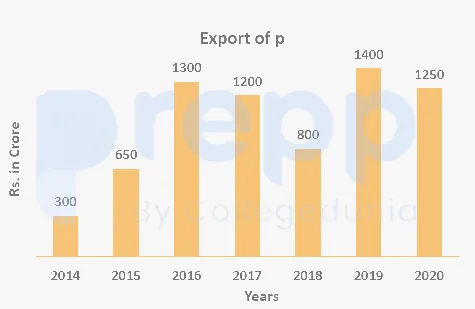
- A
2
- B
1
- C
4
- D
3
Show answer
D. 3Concept used:
Average = (sum of the observations)/(number of o bservations)
Calculation:
Average export of commodity P:
⇒ (300 + 650 + 1300 + 1200 + 800 + 1400 + 1250)/7
⇒ 6900/7 = 985.71
So, there are 3 less exports of P than the average export of P.
∴ The correct option is 4.
Paper & answer key PDF ↗ Question 54archived
The cost price of an article is ₹800. After allowing a discount of 10%, a gain of 12.5% was made. The marked price of the article is:
- A
₹1,300
- B
₹1,200
- C
₹1,000
- D
₹1,100
Show answer
C. ₹1,000Calculating Marked Price from Cost Price, Discount, and Gain
This problem involves finding the marked price (MP) of an article given its cost price (CP), a discount percentage allowed, and the gain percentage made. We need to use the relationships between CP, Selling Price (SP), MP, Discount, and Gain.
Understanding the Key Terms
Cost Price (CP): The price at which an article is bought. Given as ₹800.
Selling Price (SP): The price at which an article is sold.
Marked Price (MP): The price listed on the article, on which discount is usually given.
Discount: A reduction in the marked price. Given as 10%.
Gain: The profit made when the SP is greater than the CP. Given as 12.5%.
Step-by-Step Solution to Find the Marked Price
Step 1: Calculate the Selling Price (SP)
The gain is calculated on the cost price. The selling price is the cost price plus the gain.
Gain percentage is 12.5%.
The formula for Selling Price when there is a gain is:
\( SP = CP + \text{Gain} \)
We can also express this using the gain percentage:
\( SP = CP \times \left(1 + \frac{\text{Gain Percentage}}{100}\right) \)
Given CP = ₹800 and Gain Percentage = 12.5%:
\( SP = 800 \times \left(1 + \frac{12.5}{100}\right) \)
\( SP = 800 \times \left(1 + 0.125\right) \)
\( SP = 800 \times 1.125 \)
Calculating the value:
\( SP = 800 \times \frac{9}{8} \)
\( SP = 100 \times 9 \)
\( SP = 900 \)
So, the Selling Price (SP) of the article is ₹900.
Step 2: Calculate the Marked Price (MP)
The discount is given on the marked price, and the selling price is the marked price minus the discount.
Discount percentage is 10%.
The formula relating SP, MP, and Discount is:
\( SP = MP - \text{Discount} \)
We can express this using the discount percentage:
\( SP = MP \times \left(1 - \frac{\text{Discount Percentage}}{100}\right) \)
We know SP = ₹900 and Discount Percentage = 10%. We need to find MP.
\( 900 = MP \times \left(1 - \frac{10}{100}\right) \)
\( 900 = MP \times \left(1 - 0.1\right) \)
\( 900 = MP \times 0.9 \)
To find MP, we rearrange the formula:
\( MP = \frac{900}{0.9} \)
\( MP = \frac{900}{\frac{9}{10}} \)
\( MP = 900 \times \frac{10}{9} \)
\( MP = 100 \times 10 \)
\( MP = 1000 \)
Thus, the Marked Price (MP) of the article is ₹1,000.
Summary of Calculation Steps
Parameter
Value
Cost Price (CP)
₹800
Gain Percentage
12.5%
Selling Price (SP) Calculation
\(800 \times (1 + 0.125) = 900\)
Selling Price (SP)
₹900
Discount Percentage
10%
Marked Price (MP) Calculation
\(900 = MP \times (1 - 0.1) \implies MP = 900 / 0.9 = 1000\)
Marked Price (MP)
₹1,000
Based on the calculations, the marked price of the article is ₹1,000.
Revision Table: Important Profit and Loss Formulas
Concept
Formula
Selling Price (with Gain)
\(SP = CP \times (1 + \frac{\text{Gain \%}}{100})\)
Selling Price (with Loss)
\(SP = CP \times (1 - \frac{\text{Loss \%}}{100})\)
Selling Price (with Discount)
\(SP = MP \times (1 - \frac{\text{Discount \%}}{100})\)
Gain Amount
\(SP - CP\) (if SP > CP)
Loss Amount
\(CP - SP\) (if CP > SP)
Gain %
\((\frac{\text{Gain}}{\text{CP}}) \times 100\)
Loss %
\((\frac{\text{Loss}}{\text{CP}}) \times 100\)
Discount Amount
\(MP - SP\)
Discount %
\((\frac{\text{Discount}}{\text{MP}}) \times 100\)
Additional Information on Profit, Loss, and Discount Concepts
Understanding the relationship between Cost Price, Selling Price, and Marked Price is fundamental in profit, loss, and discount problems. Gain or loss is always calculated on the Cost Price, while discount is always calculated on the Marked Price.
When SP > CP, there is a Gain or Profit.
When SP < CP, there is a Loss.
When SP = CP, there is neither gain nor loss.
The Marked Price is often higher than the Cost Price to allow for discounts while still making a profit.
Being comfortable with percentage calculations is crucial for solving these types of problems efficiently.
Paper & answer key PDF ↗ Question 55archived
The side of an equilateral triangle is 9 cm. What is the radius of the circle circumscribing this equilateral triangle?
- A
2\(\sqrt{3}\) cm
- B
5 \(\sqrt{3}\)cm
- C
4\(\sqrt{3}\) cm
- D
3\(\sqrt{3}\) cm
Show answer
D. 3\(\sqrt{3}\) cmCalculating the Circumradius of an Equilateral Triangle
The problem asks us to find the radius of the circle that circumscribes an equilateral triangle with a given side length.
Understanding the Geometry
An equilateral triangle is a triangle where all three sides are equal in length, and all three angles are equal to 60 degrees. A circumscribing circle is a circle that passes through all three vertices of the triangle. The center of the circumscribing circle (called the circumcenter) is also the centroid, incenter, and orthocenter for an equilateral triangle.
Given Information
Side length of the equilateral triangle (let's call it 'a') = 9 cm
Goal
Find the radius (let's call it 'R') of the circumscribing circle.
Formula for Circumradius
For an equilateral triangle with side length 'a', the radius of the circumscribing circle (circumradius), R, is given by the formula:
\( R = \frac{a}{\sqrt{3}} \)
Step-by-Step Calculation
Now, we substitute the given side length, a = 9 cm, into the formula:
\( R = \frac{9}{\sqrt{3}} \)
To simplify this expression, we can rationalize the denominator by multiplying both the numerator and the denominator by \(\sqrt{3}\):
\( R = \frac{9}{\sqrt{3}} \times \frac{\sqrt{3}}{\sqrt{3}} \)
\( R = \frac{9\sqrt{3}}{3} \)
Now, we can simplify the fraction by dividing 9 by 3:
\( R = 3\sqrt{3} \)
Final Answer
The radius of the circle circumscribing the equilateral triangle is \(3\sqrt{3}\) cm.
Comparing with Options
Let's check the options provided:
\(2\sqrt{3}\) cm
\(5\sqrt{3}\) cm
\(4\sqrt{3}\) cm
\(3\sqrt{3}\) cm
Our calculated radius matches the fourth option.
Revision Table: Equilateral Triangle Properties
Property
Formula (side = a)
Value for a = 9 cm
Area
\(\frac{\sqrt{3}}{4} a^2\)
\(\frac{\sqrt{3}}{4} (9)^2 = \frac{81\sqrt{3}}{4}\) cm\(^2\)
Perimeter
\(3a\)
\(3 \times 9 = 27\) cm
Height (h)
\(\frac{\sqrt{3}}{2} a\)
\(\frac{\sqrt{3}}{2} \times 9 = \frac{9\sqrt{3}}{2}\) cm
Circumradius (R)
\(\frac{a}{\sqrt{3}}\) or \(\frac{2}{3}h\)
\(\frac{9}{\sqrt{3}} = 3\sqrt{3}\) cm
Inradius (r)
\(\frac{a}{2\sqrt{3}}\) or \(\frac{1}{3}h\)
\(\frac{9}{2\sqrt{3}} = \frac{3\sqrt{3}}{2}\) cm
Additional Information: Circumcenter and Equilateral Triangles
In any triangle, the circumcenter is the intersection point of the perpendicular bisectors of the sides. It is the center of the unique circle that passes through all three vertices.
For an equilateral triangle, the circumcenter coincides with the centroid (intersection of medians), orthocenter (intersection of altitudes), and incenter (intersection of angle bisectors). This is a unique property of equilateral triangles and other regular polygons.
The radius of the circumscribing circle (circumradius, R) is twice the radius of the inscribed circle (inradius, r) in an equilateral triangle. That is, R = 2r.
Also, the circumcenter divides each median (which is also an altitude and perpendicular bisector) in a 2:1 ratio, with the longer part being the circumradius (R) and the shorter part being the inradius (r).
The height (h) of the equilateral triangle is the sum of the circumradius and inradius: \(h = R + r\). Since R = 2r, this means \(h = 2r + r = 3r\), or \(r = h/3\) and \(R = 2h/3\). This confirms the relationship between the height and the circumradius/inradius mentioned in the table.
Paper & answer key PDF ↗ Question 56archived
Shiva’s monthly salary is Rs. 75,000. He spends Rs. 12,000 on household items, Rs. 14,000 on LIC and mutual funds, Rs. 15,000 on his children’s education, and keeps Rs. 10,000 for miscellaneous expenses. His savings are Rs. 21,000 per month and he donates the rest of the amount to an orphanage. The percentage of his income that he donates is:
- A
3%
- B
6%
- C
8%
- D
4%
Show answer
D. 4%Calculating Donation Percentage from Monthly Salary
This problem asks us to determine the percentage of Shiva's monthly income that he donates to an orphanage after accounting for all his expenditures and savings. To solve this, we first need to calculate the total amount of money he spends and saves, then find the amount he donates, and finally express the donated amount as a percentage of his total monthly salary.
Step 1: Identify the Given Information
We are given the following details about Shiva's monthly finances:
Monthly Salary: Rs. 75,000
Spending on Household Items: Rs. 12,000
Spending on LIC and Mutual Funds: Rs. 14,000
Spending on Children's Education: Rs. 15,000
Miscellaneous Expenses: Rs. 10,000
Savings: Rs. 21,000
Amount Donated: The remaining amount
Step 2: Calculate Total Expenditure and Savings
Let's sum up all the amounts Shiva spends and saves:
\(\text{Total Spent and Saved} = \text{Household} + \text{LIC \& Mutual Funds} + \text{Education} + \text{Miscellaneous} + \text{Savings}\)
\(\text{Total Spent and Saved} = 12,000 + 14,000 + 15,000 + 10,000 + 21,000\)
\(\text{Total Spent and Saved} = 26,000 + 15,000 + 10,000 + 21,000\)
\(\text{Total Spent and Saved} = 41,000 + 10,000 + 21,000\)
\(\text{Total Spent and Saved} = 51,000 + 21,000\)
\(\text{Total Spent and Saved} = 72,000\)
So, Shiva spends and saves a total of Rs. 72,000 per month.
Step 3: Calculate the Donated Amount
The amount donated is the difference between his total monthly salary and the total amount he spends and saves.
\(\text{Donated Amount} = \text{Monthly Salary} - \text{Total Spent and Saved}\)
\(\text{Donated Amount} = 75,000 - 72,000\)
\(\text{Donated Amount} = 3,000\)
Shiva donates Rs. 3,000 per month to the orphanage.
Step 4: Calculate the Percentage of Income Donated
To find the percentage of his income that is donated, we use the formula:
\(\text{Percentage Donated} = \left( \frac{\text{Donated Amount}}{\text{Monthly Salary}} \right) \times 100\%\)
Substitute the values we found:
\(\text{Percentage Donated} = \left( \frac{3,000}{75,000} \right) \times 100\%\)
\(\text{Percentage Donated} = \left( \frac{3}{75} \right) \times 100\%\)
Simplify the fraction \(\frac{3}{75}\):
\(\frac{3}{75} = \frac{1}{25}\)
Now, calculate the percentage:
\(\text{Percentage Donated} = \frac{1}{25} \times 100\%\)
\(\text{Percentage Donated} = 0.04 \times 100\%\)
\(\text{Percentage Donated} = 4\%\)
The percentage of Shiva's income that he donates is 4%.
Summary of Calculations
Item
Amount (Rs.)
Monthly Salary
75,000
Household Expenses
12,000
LIC & Mutual Funds
14,000
Children’s Education
15,000
Miscellaneous Expenses
10,000
Savings
21,000
Total Spent & Saved
72,000
Donated Amount
3,000
Percentage Donated = \(\frac{\text{Donated Amount}}{\text{Monthly Salary}} \times 100\% = \frac{3000}{75000} \times 100\% = 4\%\)
Conclusion
After calculating Shiva's total expenditure and savings and subtracting this from his monthly salary, we found the amount donated. Expressing this amount as a percentage of his total salary gives us the final answer.
Revision Table: Monthly Income Allocation
Category
Amount (Rs.)
Percentage of Salary
Household
12,000
\(\frac{12000}{75000} \times 100\% = 16\%\)
LIC & Mutual Funds
14,000
\(\frac{14000}{75000} \times 100\% \approx 18.67\%\)
Education
15,000
\(\frac{15000}{75000} \times 100\% = 20\%\)
Miscellaneous
10,000
\(\frac{10000}{75000} \times 100\% \approx 13.33\%\)
Savings
21,000
\(\frac{21000}{75000} \times 100\% = 28\%\)
Donation
3,000
\(\frac{3000}{75000} \times 100\% = 4\%\)
Total
75,000
\(\mathbf{16\% + 18.67\% + 20\% + 13.33\% + 28\% + 4\% = 100\%}\)
Additional Information: Understanding Personal Finance Basics
This problem illustrates a basic concept in personal finance: how income is allocated among different categories like expenses, savings, and donations. Understanding these allocations helps in managing finances effectively and budgeting.
Income: The total amount of money received (e.g., salary).
Expenditure: Money spent on needs and wants (e.g., household items, education, miscellaneous).
Savings: Money set aside for future use or investment (e.g., LIC, mutual funds, direct savings).
Donation: Money given to charitable causes.
The sum of all expenditures, savings, and donations should equal the total income. Calculating percentages helps in comparing different spending categories relative to the total income.
Paper & answer key PDF ↗ Question 57archived
The following line graph displays the ratio of exports to imports (in terms of money in ₹ crores) of company A from 2010 to 2015.
Study the graph carefully and answer the question based on the given line graph.
In how many years, the export of company A was more than the company's import?
- A
Four
- B
Two
- C
Six
- D
Three
Show answer
A. FourCalculation:
Ratio of export to import in 2010 = E : I = 9 : 10
Ratio of export to import in 2011 = E : I = 12 : 10
Ratio of export to import in 2012 = E : I = 7 : 10
Ratio of export to import in 2013 = E : I = 24 : 10
Ratio of export to import in 2014 = E : I = 35 : 10
Ratio of export to import in 2015 = E : I = 24 : 10
Hence, there are four observations in which the export of company A was more than the company A import
∴ The correct answer is four.
Paper & answer key PDF ↗ Question 58archived
If \(tan40^0 = \alpha\) , then find \(\frac{tan320^0 - tan 310^0}{1 + tan320^0.tan 310^0}\).
- A
\(\frac{1 - \alpha^2}{\alpha}\)
- B
\(\frac{1 + \alpha^2}{2\alpha}\)
- C
\(\frac{1 - \alpha^2}{2\alpha}\)
- D
\(\frac{1 +\alpha^2}{\alpha}\)
Show answer
C. \(\frac{1 - \alpha^2}{2\alpha}\)Solving Trigonometry Problems: Evaluating Tangent Expressions
We are given the value of \(tan40^0\) and asked to evaluate a trigonometric expression involving \(tan320^0\) and \(tan310^0\). This problem requires us to use trigonometric identities, specifically allied angles, to relate the given angles to the angle \(40^0\).
The given information is:
\(tan40^0 = \alpha\)
The expression we need to evaluate is:
\(\frac{tan320^0 - tan 310^0}{1 + tan320^0.tan 310^0}\)
Let's analyze the expression. It matches the form of the tangent subtraction identity:
\(tan(A - B) = \frac{tan A - tan B}{1 + tan A . tan B}\)
Here, \(A = 320^0\) and \(B = 310^0\). So, the expression simplifies to:
\(tan(320^0 - 310^0) = tan(10^0)\)
Now, we need to express \(tan(10^0)\) in terms of \(\alpha = tan(40^0)\).
However, let's look closely at the angles \(320^0\) and \(310^0\). We can express these angles in terms of angles related to \(40^0\) or \(50^0\) using allied angles (angles like \(360^\circ \pm \theta\)).
For \(tan320^0\):
\(320^0 = 360^0 - 40^0\)
Since the tangent function has a period of \(180^0\) and \(360^0 - \theta\) is in the fourth quadrant where tangent is negative:
\(tan(320^0) = tan(360^0 - 40^0) = -tan(40^0)\)
Given \(tan40^0 = \alpha\), we have:
\(tan320^0 = -\alpha\)
For \(tan310^0\):
\(310^0 = 360^0 - 50^0\)
Again, \(360^0 - \theta\) is in the fourth quadrant where tangent is negative:
\(tan(310^0) = tan(360^0 - 50^0) = -tan(50^0)\)
Now, let's relate \(tan(50^0)\) to \(tan(40^0)\). We know that \(50^0 = 90^0 - 40^0\). Using the complementary angle identity \(tan(90^0 - \theta) = cot \theta\):
\(tan(50^0) = tan(90^0 - 40^0) = cot(40^0)\)
And we know \(cot(40^0) = \frac{1}{tan(40^0)}\). Since \(tan(40^0) = \alpha\):
\(tan(50^0) = \frac{1}{\alpha}\)
Substituting this back into the expression for \(tan(310^0)\):
\(tan(310^0) = -tan(50^0) = -\frac{1}{\alpha}\)
Now we substitute the values of \(tan320^0 = -\alpha\) and \(tan310^0 = -\frac{1}{\alpha}\) back into the original expression:
\(\frac{tan320^0 - tan 310^0}{1 + tan320^0.tan 310^0} = \frac{(-\alpha) - (-\frac{1}{\alpha})}{1 + (-\alpha)(-\frac{1}{\alpha})}\)
Simplify the numerator:
\(-\alpha - (-\frac{1}{\alpha}) = -\alpha + \frac{1}{\alpha} = \frac{-\alpha^2 + 1}{\alpha} = \frac{1 - \alpha^2}{\alpha}\)
Simplify the denominator:
\(1 + (-\alpha)(-\frac{1}{\alpha}) = 1 + \alpha \cdot \frac{1}{\alpha} = 1 + 1 = 2\)
Now, combine the simplified numerator and denominator:
\(\frac{\frac{1 - \alpha^2}{\alpha}}{2}\)
Dividing by 2 is the same as multiplying by \(\frac{1}{2}\):
\(\frac{1 - \alpha^2}{\alpha} \times \frac{1}{2} = \frac{1 - \alpha^2}{2\alpha}\)
Thus, the value of the expression is \(\frac{1 - \alpha^2}{2\alpha}\).
Revision Table: Key Trigonometry Concepts
Concept
Description
Relevant Identity
Allied Angles
Angles related as sum or difference of \(90^0\), \(180^0\), \(270^0\), \(360^0\) with angle \(\theta\). Useful for finding trig function values for angles outside \(0^0\) to \(90^0\).
\(tan(360^0 - \theta) = -tan \theta\)
Complementary Angles
Two angles whose sum is \(90^0\). Trig functions of one angle can be related to co-functions of the other.
\(tan(90^0 - \theta) = cot \theta\)
Reciprocal Identities
Relating tangent and cotangent.
\(cot \theta = \frac{1}{tan \theta}\)
Tangent Subtraction Identity
Formula for the tangent of the difference of two angles.
\(tan(A - B) = \frac{tan A - tan B}{1 + tan A . tan B}\)
Additional Information: Understanding Trigonometric Functions in Quadrants
The sign of trigonometric functions depends on the quadrant in which the angle lies. Understanding this helps in using allied angle formulas correctly. The four quadrants cover angles from \(0^0\) to \(360^0\).
Quadrant I (\(0^0\) to \(90^0\)): All trigonometric functions (sine, cosine, tangent, etc.) are positive.
Quadrant II (\(90^0\) to \(180^0\)): Sine and cosecant are positive; others are negative.
Quadrant III (\(180^0\) to \(270^0\)): Tangent and cotangent are positive; others are negative.
Quadrant IV (\(270^0\) to \(360^0\)): Cosine and secant are positive; others are negative.
In this problem, \(320^0\) and \(310^0\) both lie in Quadrant IV (\(270^0\) to \(360^0\)). Therefore, the tangent of both angles is negative, which aligns with our calculations:
\(tan(320^0) = -tan(40^0) = -\alpha\) (since \(40^0\) is in Q I, \(tan40^0\) is positive, but \(320^0\) in Q IV makes \(tan320^0\) negative).
\(tan(310^0) = -tan(50^0)\). \(50^0\) is in Q I, so \(tan50^0\) is positive. However, \(310^0\) in Q IV makes \(tan310^0\) negative. We found \(tan50^0 = 1/\alpha\), so \(tan310^0 = -1/\alpha\).
Using allied angles allows us to reduce trigonometric functions of large angles to functions of acute angles, making calculations easier, especially when related values like \(tan40^0\) are given.
Paper & answer key PDF ↗ Question 59archived
The table given below shows the foreign trade by two countries in 5 different years.
Country
Years
L
M
Y1
250
125
Y2
230
185
Y3
155
275
Y4
145
255
Y5
115
170
What is the total foreign trade by country M in all the 5 years?
- A
1010
- B
1215
- C
505
- D
1005
Show answer
A. 1010Calculating Total Foreign Trade for Country M
The question asks us to find the total foreign trade conducted by country M over a period of 5 different years, based on the data presented in the provided table.
The table gives us the foreign trade values for two countries, L and M, across five years (Y1, Y2, Y3, Y4, and Y5).
Country
Years
L
M
Y1
250
125
Y2
230
185
Y3
155
275
Y4
145
255
Y5
115
170
To find the total foreign trade for country M over all 5 years, we need to sum the foreign trade values for country M for each year.
The foreign trade values for country M in the given years are:
Year Y1: 125
Year Y2: 185
Year Y3: 275
Year Y4: 255
Year Y5: 170
Now, we add these values together to get the total foreign trade for country M:
Total foreign trade for country M $= 125 + 185 + 275 + 255 + 170$
Let's perform the addition:
$125 + 185 = 310$
$310 + 275 = 585$
$585 + 255 = 840$
$840 + 170 = 1010$
So, the total foreign trade by country M in all the 5 years is 1010.
Revision Table: Key Concepts
Understanding how to read and interpret data from tables is crucial for solving such problems. Here are some key concepts:
Data Table: A structured way to organize information in rows and columns.
Rows: Horizontal representation of data, often corresponding to different entities or time points (like years in this case).
Columns: Vertical representation of data, often corresponding to different attributes or categories (like countries in this case).
Summation: The process of adding together a set of numbers to find their total.
Additional Information: Analyzing Tabular Data
Tabular data is a very common format for presenting information in various fields, including economics, statistics, and science. Analyzing tabular data often involves:
Identifying the objective: Clearly understanding what information is being sought (e.g., total, average, difference, percentage).
Locating relevant data: Finding the specific rows and columns that contain the necessary information. In this case, we needed the column for 'M' and all the rows for years Y1 to Y5.
Performing calculations: Applying the required mathematical operations (addition, subtraction, multiplication, division) to the selected data.
Interpreting results: Understanding what the calculated value represents in the context of the problem. The value 1010 represents the sum of all foreign trade values listed for country M across the five years.
Paper & answer key PDF ↗ Question 60archived
A train travels at a speed of 18 m/s in the first 5 minutes, covers 7.5 km in the next 10 minutes and covers 12 km in another 10 minutes. What is its average speed (in km/h, rounded off to 1 decimal place) for the entire journey?
- A
59.8
- B
71.2
- C
45.7
- D
64.6
Show answer
A. 59.8Calculating Average Speed for a Multi-Segment Journey
The problem asks us to find the average speed of a train over its entire journey, which is divided into three distinct parts. To find the average speed, we need the total distance covered and the total time taken for the entire journey. The formula for average speed is:
\[ \text{Average Speed} = \frac{\text{Total Distance}}{\text{Total Time}} \]
Let's analyze each part of the journey and calculate the distance covered and the time taken.
Part 1 of the Journey
Speed = 18 m/s
Time = 5 minutes
First, we need to convert the time to seconds to match the speed units (m/s):
\[ \text{Time}_1 = 5 \, \text{minutes} \times \frac{60 \, \text{seconds}}{1 \, \text{minute}} = 300 \, \text{seconds} \]
Now, we can calculate the distance covered in the first part using the formula: Distance = Speed × Time.
\[ \text{Distance}_1 = 18 \, \text{m/s} \times 300 \, \text{s} = 5400 \, \text{meters} \]
Since the final answer needs to be in km/h, let's convert this distance to kilometers.
\[ \text{Distance}_1 = 5400 \, \text{meters} \times \frac{1 \, \text{km}}{1000 \, \text{meters}} = 5.4 \, \text{km} \]
The time for Part 1 in hours is:
\[ \text{Time}_1 = 5 \, \text{minutes} \times \frac{1 \, \text{hour}}{60 \, \text{minutes}} = \frac{5}{60} \, \text{hours} = \frac{1}{12} \, \text{hours} \]
Part 2 of the Journey
Distance = 7.5 km
Time = 10 minutes
The distance is already in kilometers. Let's convert the time to hours.
\[ \text{Time}_2 = 10 \, \text{minutes} \times \frac{1 \, \text{hour}}{60 \, \text{minutes}} = \frac{10}{60} \, \text{hours} = \frac{1}{6} \, \text{hours} \]
Part 3 of the Journey
Distance = 12 km
Time = 10 minutes
The distance is already in kilometers. Let's convert the time to hours.
\[ \text{Time}_3 = 10 \, \text{minutes} \times \frac{1 \, \text{hour}}{60 \, \text{minutes}} = \frac{10}{60} \, \text{hours} = \frac{1}{6} \, \text{hours} \]
Calculating Total Distance and Total Time
Now, we sum up the distances from each part to find the total distance.
\[ \text{Total Distance} = \text{Distance}_1 + \text{Distance}_2 + \text{Distance}_3 \]
\[ \text{Total Distance} = 5.4 \, \text{km} + 7.5 \, \text{km} + 12 \, \text{km} = 24.9 \, \text{km} \]
Next, we sum up the times from each part to find the total time.
\[ \text{Total Time} = \text{Time}_1 + \text{Time}_2 + \text{Time}_3 \]
\[ \text{Total Time} = 5 \, \text{minutes} + 10 \, \text{minutes} + 10 \, \text{minutes} = 25 \, \text{minutes} \]
Convert the total time to hours for the average speed calculation in km/h.
\[ \text{Total Time} = 25 \, \text{minutes} \times \frac{1 \, \text{hour}}{60 \, \text{minutes}} = \frac{25}{60} \, \text{hours} = \frac{5}{12} \, \text{hours} \]
Calculating Average Speed
Now we use the average speed formula:
\[ \text{Average Speed} = \frac{\text{Total Distance}}{\text{Total Time}} \]
\[ \text{Average Speed} = \frac{24.9 \, \text{km}}{\frac{5}{12} \, \text{hours}} = 24.9 \times \frac{12}{5} \, \text{km/h} \]
\[ \text{Average Speed} = \frac{298.8}{5} \, \text{km/h} = 59.76 \, \text{km/h} \]
Rounding the Average Speed
The question asks to round the average speed to 1 decimal place. 59.76 rounded to 1 decimal place is 59.8 km/h.
The average speed of the train for the entire journey is approximately 59.8 km/h.
Journey Part
Speed
Time
Distance Calculated
Time in Hours
Distance in km
Part 1
18 m/s
5 min
5400 m
5/60 h
5.4 km
Part 2
-
10 min
7.5 km
10/60 h
7.5 km
Part 3
-
10 min
12 km
10/60 h
12 km
Total Distance: \(5.4 + 7.5 + 12 = 24.9\) km
Total Time: \(5 + 10 + 10 = 25\) minutes \( = \frac{25}{60}\) hours \( = \frac{5}{12}\) hours
Average Speed: \(\frac{24.9}{\frac{5}{12}} = 24.9 \times \frac{12}{5} = \frac{298.8}{5} = 59.76\) km/h
Rounded to 1 decimal place: 59.8 km/h.
Average Speed Calculation Summary
The calculation involved converting units (meters per second to kilometers, minutes to hours) and then applying the definition of average speed as total distance divided by total time. Breaking the problem into segments and handling each part's distance and time separately before summing them up is key.
Revision Table: Key Concepts
Concept
Definition/Formula
Units
Speed
Distance / Time
m/s, km/h, etc.
Distance
Speed × Time
meters, kilometers, etc.
Average Speed
Total Distance / Total Time
m/s, km/h, etc.
Unit Conversion
Converting values between different units (e.g., m to km, min to h) using conversion factors (1 km = 1000 m, 1 hour = 60 minutes).
N/A
Additional Information on Motion and Speed
Average speed is different from average velocity. Velocity is a vector quantity (having magnitude and direction), while speed is a scalar quantity (only magnitude). Average velocity is the total displacement divided by the total time. In this problem, we are asked for average speed, which only considers the total distance traveled.
Understanding unit conversions is crucial in physics problems. Make sure all quantities are in consistent units before performing calculations. For example, if speed is in m/s, time should be in seconds and distance in meters. If the desired final unit is km/h, it's often easiest to convert all distances to kilometers and all times to hours before the final calculation, or convert the final result to the desired units.
Paper & answer key PDF ↗ Question 61archived
If, \(\frac{r}{13} + \frac{13}{r} = 1\) then the value of r3 is:
- A
-2157
- B
2197
- C
2157
- D
-2197
Show answer
D. -2197Finding the Value of r³ from the Equation
We are given the equation:
\(\frac{r}{13} + \frac{13}{r} = 1\)
We need to find the value of \(r^3\).
Step-by-Step Solution
To solve for \(r\) or \(r^3\), let's first clear the denominators in the given equation. We can do this by multiplying the entire equation by the least common multiple of the denominators, which is \(13r\).
Multiplying each term by \(13r\):
\(13r \times \frac{r}{13} + 13r \times \frac{13}{r} = 1 \times 13r\)
This simplifies to:
\(r^2 + 13^2 = 13r\)
\(r^2 + 169 = 13r\)
Now, let's rearrange the equation to get a standard form, typically a quadratic equation:
\(r^2 - 13r + 169 = 0\)
This is a quadratic equation of the form \(ar^2 + br + c = 0\), where \(a=1\), \(b=-13\), and \(c=169\). We could solve for \(r\) using the quadratic formula, but finding \(r^3\) directly from complex roots might be complicated. Let's look for another approach.
Observe the form of the equation \(r^2 - 13r + 169 = 0\). This form is related to the sum of cubes factorization formula:
\(a^3 + b^3 = (a+b)(a^2 - ab + b^2)\)
If we compare our equation \(r^2 - 13r + 169 = 0\) with the second factor \((a^2 - ab + b^2)\), it resembles the form with \(a=r\) and \(b=13\). The second factor is \(r^2 - r(13) + 13^2\), which matches \(r^2 - 13r + 169\).
So, if we multiply the equation \(r^2 - 13r + 169 = 0\) by \((r + 13)\), we should get an expression involving \(r^3 + 13^3\):
\((r + 13)(r^2 - 13r + 169) = (r + 13) \times 0\)
Using the sum of cubes formula on the left side:
\(r^3 + 13^3 = 0\)
Now, we just need to calculate \(13^3\):
\(13^3 = 13 \times 13 \times 13\)
\(13 \times 13 = 169\)
\(169 \times 13 = 2197\)
Substituting this value back into the equation \(r^3 + 13^3 = 0\):
\(r^3 + 2197 = 0\)
Solving for \(r^3\):
\(r^3 = -2197\)
Thus, the value of \(r^3\) is \(-2197\).
Detailed Calculation Steps
Start with the given equation: \(\frac{r}{13} + \frac{13}{r} = 1\)
Multiply by \(13r\) to eliminate denominators: \(r^2 + 169 = 13r\)
Rearrange into standard form: \(r^2 - 13r + 169 = 0\)
Recognize the relation to the sum of cubes formula \(a^3 + b^3 = (a+b)(a^2 - ab + b^2)\) with \(a=r\) and \(b=13\). The equation is the factor \((a^2 - ab + b^2)\).
Multiply the equation by \((r+13)\): \((r+13)(r^2 - 13r + 169) = (r+13) \times 0\)
Apply the sum of cubes formula: \(r^3 + 13^3 = 0\)
Calculate \(13^3 = 13 \times 13 \times 13 = 169 \times 13 = 2197\)
Substitute and solve for \(r^3\): \(r^3 + 2197 = 0 \Rightarrow r^3 = -2197\)
Step
Operation
Resulting Equation/Value
1
Original Equation
\(\frac{r}{13} + \frac{13}{r} = 1\)
2
Multiply by \(13r\)
\(r^2 + 169 = 13r\)
3
Rearrange terms
\(r^2 - 13r + 169 = 0\)
4
Recognize pattern \((a^2 - ab + b^2)\) for \(a=r, b=13\)
Corresponds to factor of \(r^3 + 13^3\)
5
Multiply by \((r+13)\)
\((r+13)(r^2 - 13r + 169) = 0\)
6
Apply sum of cubes formula
\(r^3 + 13^3 = 0\)
7
Calculate \(13^3\)
\(13^3 = 2197\)
8
Solve for \(r^3\)
\(r^3 = -2197\)
Revision Table: Key Concepts in Solving Equations
Concept
Description
Application in this Problem
Clearing Denominators
Multiplying an equation by the LCM of denominators to remove fractions.
Multiplied by \(13r\).
Rearranging Equations
Moving terms to one side to get a standard form (e.g., \(ax^2+bx+c=0\)).
Converted to \(r^2 - 13r + 169 = 0\).
Sum of Cubes Formula
\(a^3 + b^3 = (a+b)(a^2 - ab + b^2)\).
Recognized \(r^2 - 13r + 169\) as part of this formula.
Algebraic Manipulation
Performing valid operations (addition, subtraction, multiplication, division) on both sides of an equation.
Used throughout to isolate \(r^3\).
Additional Information: Complex Roots and Related Identities
The quadratic equation \(r^2 - 13r + 169 = 0\) has a negative discriminant (\(\Delta = (-13)^2 - 4(1)(169) = 169 - 676 = -507\)). This means the roots for \(r\) are complex numbers.
The roots can be found using the quadratic formula \(r = \frac{-b \pm \sqrt{\Delta}}{2a}\):
\(r = \frac{13 \pm \sqrt{-507}}{2}\)
\(r = \frac{13 \pm i\sqrt{507}}{2}\)
Calculating \(r^3\) directly from these complex roots would be more involved than using the factorization trick. The trick of multiplying by \((r+13)\) leverages the property that if \(r^2 - 13r + 169 = 0\), then \((r+13)(r^2 - 13r + 169)\) must also be zero, leading directly to \(r^3 + 13^3 = 0\).
This problem demonstrates how recognizing algebraic identities can significantly simplify solving equations, especially when complex numbers might be involved if solving for the variable itself first.
The key identities to remember are:
Difference of Squares: \(a^2 - b^2 = (a-b)(a+b)\)
Sum of Cubes: \(a^3 + b^3 = (a+b)(a^2 - ab + b^2)\)
Difference of Cubes: \(a^3 - b^3 = (a-b)(a^2 + ab + b^2)\)
In this specific problem, the form \(r^2 - 13r + 169\) is the second factor of the sum of cubes with \(a=r\) and \(b=13\).
Paper & answer key PDF ↗ Question 62archived
If \(\frac{a}{b} + \frac{b}{a} = -1\) and a - b = 2, then the value of a3 - b3 is:
- A
0
- B
\(\frac{1}{2}\)
- C
1
- D
1
Show answer
A. 0Evaluating Algebraic Expressions
The problem asks us to find the value of \(a^3 - b^3\) given two conditions:
\(\frac{a}{b} + \frac{b}{a} = -1\)
\(a - b = 2\)
Let's analyze the first condition to simplify it.
Simplifying the First Equation: \(\frac{a}{b} + \frac{b}{a} = -1\)
We can combine the terms on the left side by finding a common denominator, which is \(ab\):
\[ \frac{a}{b} + \frac{b}{a} = \frac{a \cdot a}{b \cdot a} + \frac{b \cdot b}{a \cdot b} = \frac{a^2}{ab} + \frac{b^2}{ab} = \frac{a^2 + b^2}{ab} \]
So, the first equation becomes:
\[ \frac{a^2 + b^2}{ab} = -1 \]
Multiplying both sides by \(ab\) (assuming \(a \neq 0\) and \(b \neq 0\)), we get:
\[ a^2 + b^2 = -ab \]
Rearranging the terms, we move \(-ab\) to the left side:
\[ a^2 + ab + b^2 = 0 \]
This is a significant result derived from the first condition.
Using the Second Equation: \(a - b = 2\)
The second condition directly gives us the value of the difference between \(a\) and \(b\).
Finding the Value of \(a^3 - b^3\)
We need to find the value of \(a^3 - b^3\). We can use the algebraic identity for the difference of cubes, which is:
\[ a^3 - b^3 = (a-b)(a^2 + ab + b^2) \]
Now, we can substitute the results we found from the given conditions into this identity.
From the second condition, we know that \(a - b = 2\).
From the simplified first condition, we found that \(a^2 + ab + b^2 = 0\).
Substitute these values into the difference of cubes formula:
\[ a^3 - b^3 = (a-b)(a^2 + ab + b^2) \]
\[ a^3 - b^3 = (2)(0) \]
\[ a^3 - b^3 = 0 \]
Thus, the value of \(a^3 - b^3\) is 0.
Summary of Steps
Start with the given equations: \(\frac{a}{b} + \frac{b}{a} = -1\) and \(a - b = 2\).
Simplify the first equation to get \(a^2 + ab + b^2 = 0\).
Recall the difference of cubes identity: \(a^3 - b^3 = (a-b)(a^2 + ab + b^2)\).
Substitute the known values \(a-b=2\) and \(a^2 + ab + b^2 = 0\) into the identity.
Calculate the final result: \(a^3 - b^3 = (2)(0) = 0\).
The value of \(a^3 - b^3\) is 0.
Revision Table: Algebraic Identities
Identity
Formula
Difference of Cubes
\(a^3 - b^3 = (a-b)(a^2 + ab + b^2)\)
Sum of Cubes
\(a^3 + b^3 = (a+b)(a^2 - ab + b^2)\)
Square of Difference
\((a-b)^2 = a^2 - 2ab + b^2\)
Square of Sum
\((a+b)^2 = a^2 + 2ab + b^2\)
Additional Information: Significance of \(a^2 + ab + b^2 = 0\)
The expression \(a^2 + ab + b^2\) is part of the difference and sum of cubes formulas. If \(a\) and \(b\) are real numbers, the expression \(a^2 + ab + b^2 = 0\) only holds true when \(a=0\) and \(b=0\).
We can see this by multiplying by 2:
\[ 2a^2 + 2ab + 2b^2 = 0 \]
Rearrange the terms by completing the square:
\[ (a^2 + 2ab + b^2) + a^2 + b^2 = 0 \]
\[ (a+b)^2 + a^2 + b^2 = 0 \]
For real numbers, a square is always non-negative. So, \((a+b)^2 \ge 0\), \(a^2 \ge 0\), and \(b^2 \ge 0\). The sum of non-negative numbers can only be zero if each term is zero.
\[ (a+b)^2 = 0 \implies a+b = 0 \implies a = -b \]
\[ a^2 = 0 \implies a = 0 \]
\[ b^2 = 0 \implies b = 0 \]
If \(a=0\) and \(b=0\), the original condition \(\frac{a}{b} + \frac{b}{a} = -1\) would be undefined (division by zero). However, the problem statement implies that a solution exists. This suggests that either \(a\) and \(b\) are not real numbers (they are complex numbers) or the condition \(\frac{a}{b} + \frac{b}{a} = -1\) is used primarily to derive \(a^2 + ab + b^2 = 0\) for the calculation of \(a^3 - b^3\).
If \(a\) and \(b\) are complex numbers, \(a^2 + ab + b^2 = 0\) can be true for non-zero \(a\) and \(b\). For example, if \(a\) and \(b\) are cube roots of unity. However, the solution for \(a-b=2\) might restrict the possibilities. The structure of the problem suggests using the identity directly with the derived \(a^2+ab+b^2=0\), regardless of whether \(a\) and \(b\) are real or complex, as the identity holds universally.
Paper & answer key PDF ↗ Question 63archived
A person borrowed ₹2,000 at 5% annual simple interest repayable in 3 equal annual installments. What will be the annual installment?
- A
₹730\(\frac{10}{63}\)
- B
₹840\(\frac{9}{61}\)
- C
₹640\(\frac{11}{63}\)
- D
₹250\(\frac{10}{63}\)
Show answer
A. ₹730\(\frac{10}{63}\)Calculating Simple Interest Loan Installments
This question asks us to find the equal annual installment amount required to repay a simple interest loan.
We are given:
Principal amount (P) = ₹2,000
Annual simple interest rate (R) = 5%
Number of equal annual installments (n) = 3
Let the equal annual installment amount be \(x\).
Understanding Simple Interest Installments
In simple interest installment problems, the total amount due at the end of the loan period (if no payments were made) is equal to the sum of the future values of all the installments paid, calculated using the simple interest formula.
The simple interest future value formula is: \(FV = P(1 + \frac{RT}{100})\), where \(P\) is the present value (the installment amount in this case), \(R\) is the rate, and \(T\) is the time from the payment date to the end of the loan term.
Step-by-Step Calculation of the Installment Amount
Step 1: Calculate the total amount due at the end of 3 years without any installments.
Total Simple Interest = \(\frac{P \times R \times T}{100}\)
Total Simple Interest = \(\frac{2000 \times 5 \times 3}{100} = \frac{30000}{100} = 300\)
Total Amount Due = Principal + Total Simple Interest
Total Amount Due = \(2000 + 300 = 2300\)
So, if the loan were repaid as a single sum at the end of 3 years, the total amount payable would be ₹2,300.
Step 2: Calculate the future value of each installment at the end of the loan term (after 3 years).
The first installment is paid at the end of Year 1. It earns simple interest for the remaining 2 years (from end of Year 1 to end of Year 3).
Future Value of 1st Installment = \(x(1 + \frac{5 \times 2}{100}) = x(1 + 0.10) = 1.10x\)
The second installment is paid at the end of Year 2. It earns simple interest for the remaining 1 year (from end of Year 2 to end of Year 3).
Future Value of 2nd Installment = \(x(1 + \frac{5 \times 1}{100}) = x(1 + 0.05) = 1.05x\)
The third installment is paid at the end of Year 3. It earns simple interest for 0 years.
Future Value of 3rd Installment = \(x(1 + \frac{5 \times 0}{100}) = x(1 + 0) = x\)
Step 3: Equate the total amount due to the sum of the future values of the installments.
Sum of Future Values of Installments = \(1.10x + 1.05x + x = 3.15x\)
Total Amount Due = Sum of Future Values of Installments
\(2300 = 3.15x\)
Step 4: Solve for \(x\).
\(x = \frac{2300}{3.15}\)
To remove the decimal, multiply the numerator and denominator by 100:
\(x = \frac{2300 \times 100}{3.15 \times 100} = \frac{230000}{315}\)
Now, simplify the fraction by dividing the numerator and denominator by their greatest common divisor. Both are divisible by 5:
\(230000 \div 5 = 46000\)
\(315 \div 5 = 63\)
So, \(x = \frac{46000}{63}\)
Step 5: Convert the fraction to a mixed number to match the options.
Divide 46000 by 63:
730
6346000
-441
---
190
-189
----
100
-0
--
10
The quotient is 730, and the remainder is 10. So, the mixed number is \(730 \frac{10}{63}\).
Thus, the annual installment amount is ₹\(730 \frac{10}{63}\).
Summary of the Simple Interest Installment Calculation
The annual installment amount is ₹\(730 \frac{10}{63}\).
Let's verify the answer by converting the option back to an improper fraction:
\(730 \frac{10}{63} = \frac{(730 \times 63) + 10}{63} = \frac{45990 + 10}{63} = \frac{46000}{63}\).
This matches our calculated value for \(x\).
Revision Table: Simple Interest Key Concepts
ConceptDescriptionFormula
Simple Interest (SI)Interest calculated only on the principal amount.\(SI = \frac{P \times R \times T}{100}\)
Amount (A)Total sum of principal and interest.\(A = P + SI = P(1 + \frac{RT}{100})\)
Principal (P)The initial amount borrowed or invested.
Rate (R)The percentage at which interest is charged or earned per unit of time (usually per annum).
Time (T)The duration for which the principal is borrowed or invested.
Additional Information: Simple Interest vs. Compound Interest Installments
It's important to distinguish between simple interest and compound interest when dealing with loan installments.
Simple Interest Installments: Interest is typically calculated based on the initial principal amount for the full term or on the reducing balance *before* the installment is applied for that year. The method used in the solution (equating future value of total amount due to sum of future values of installments) is a common approach for simple interest installment problems.
Compound Interest Installments: Interest is calculated on the principal amount plus any accumulated interest from previous periods. The calculation involves concepts like present value or future value of annuities, and the formula \(EMI = P \times \frac{r(1+r)^n}{(1+r)^n - 1}\) (for Equated Monthly Installments) or similar annual installment formulas based on compounding. Compound interest installments are more common in real-world lending scenarios.
This question specifically mentioned "simple interest", guiding us to use the simple interest method described in the solution.
Paper & answer key PDF ↗ Question 64archived
Two persons A and B working separately can sanitise a building in 6 and 10 hours, respectively. They work in stretches of one hour alternately. If A begins at 8 a.m., then when will the work be finished?
- A
9\(\frac{1}{3}\) h
- B
7\(\frac{1}{3}\) h
- C
6\(\frac{1}{3}\) h
- D
8\(\frac{1}{3}\) h
Show answer
B. 7\(\frac{1}{3}\) hSanitising Building Time and Work Problem
This problem involves two individuals, A and B, working alternately to sanitise a building. We are given their individual times to complete the work and the pattern of their work (one hour each, alternately, starting with A). We need to find the total time taken and the finish time starting from 8 a.m.
Work Rate Calculation for A and B
First, let's determine the amount of work each person can do in one hour. This is known as their work rate.
A can sanitise the building in 6 hours. So, A's work rate is \( \frac{1}{6} \) of the building per hour.
B can sanitise the building in 10 hours. So, B's work rate is \( \frac{1}{10} \) of the building per hour.
Work Done in Alternate Hours Cycle
A and B work alternately for one hour each, with A starting. A full cycle of work involves A working for one hour followed by B working for one hour. This cycle takes 2 hours.
In the 1st hour (worked by A), work done = \( \frac{1}{6} \).
In the 2nd hour (worked by B), work done = \( \frac{1}{10} \).
Work done in one cycle (2 hours) = Work by A in 1 hour + Work by B in 1 hour
Work done in one cycle = \( \frac{1}{6} + \frac{1}{10} \)
To add these fractions, we find a common denominator, which is 30.
Work done in one cycle = \( \frac{5}{30} + \frac{3}{30} = \frac{8}{30} = \frac{4}{15} \) of the building.
Progress After Multiple Cycles
Let's see how much work is completed after a few 2-hour cycles. We want to complete as many full cycles as possible without exceeding the total work (which is 1, representing the entire building).
After 1 cycle (2 hours): Work done = \( \frac{4}{15} \)
After 2 cycles (4 hours): Work done = \( 2 \times \frac{4}{15} = \frac{8}{15} \)
After 3 cycles (6 hours): Work done = \( 3 \times \frac{4}{15} = \frac{12}{15} = \frac{4}{5} \)
After 3 cycles (which take a total of 6 hours), \( \frac{4}{5} \) of the building is sanitised. The remaining work is \( 1 - \frac{4}{5} = \frac{1}{5} \).
Completing the Remaining Work Alternately
After 3 full cycles (6 hours), B has just finished their turn. It is now A's turn to work.
A works in the 7th hour. In one hour, A does \( \frac{1}{6} \) of the work.
Work done after 7 hours (6 hours from cycles + 1 hour by A) = Work after 3 cycles + Work by A
Work done after 7 hours = \( \frac{4}{5} + \frac{1}{6} \)
Finding a common denominator (30): \( \frac{24}{30} + \frac{5}{30} = \frac{29}{30} \) of the building.
After 7 hours, \( \frac{29}{30} \) of the building is sanitised. The remaining work is \( 1 - \frac{29}{30} = \frac{1}{30} \).
A has just finished their 1-hour turn (the 7th hour). It is now B's turn to work on the remaining \( \frac{1}{30} \) of the building.
B's work rate is \( \frac{1}{10} \) work per hour.
Time taken by B to complete the remaining \( \frac{1}{30} \) work = \( \frac{\text{Remaining Work}}{\text{B's Rate}} \)
Time taken by B = \( \frac{1/30}{1/10} = \frac{1}{30} \times 10 = \frac{10}{30} = \frac{1}{3} \) hours.
Calculating Total Time and Finish Time
The total time taken to complete the sanitising work is the sum of the time for the full cycles, A's subsequent hour, and B's time for the final remaining work.
Total time = Time for 3 cycles + Time by A + Time by B
Total time = 6 hours + 1 hour + \( \frac{1}{3} \) hour
Total time = \( 7 \frac{1}{3} \) hours.
The work begins at 8 a.m. To find the finish time, we add the total time taken to the start time.
Start time = 8:00 a.m.
Total time = \( 7 \frac{1}{3} \) hours. \( \frac{1}{3} \) hour = \( \frac{1}{3} \times 60 = 20 \) minutes.
Total time = 7 hours and 20 minutes.
Finish time = 8:00 a.m. + 7 hours 20 minutes.
Finish time = 3:20 p.m.
The question asks when the work will be finished in terms of duration from the start time. The total time taken is \( 7\frac{1}{3} \) hours.
Revision Table: Alternate Work Problems
Person
Time to Complete Alone
Hourly Work Rate
A
6 hours
\( \frac{1}{6} \)
B
10 hours
\( \frac{1}{10} \)
Work in 1 Cycle (A+B, 2 hrs)
-
\( \frac{4}{15} \)
Total Time Taken
-
\( 7\frac{1}{3} \) hours
Additional Information: Time and Work Fundamentals
Time and work problems often involve calculating the rate at which work is done. The basic relationship is: Work = Rate × Time. From this, Rate = \( \frac{\text{Work}}{\text{Time}} \) and Time = \( \frac{\text{Work}}{\text{Rate}} \). When multiple people work together or alternately, their individual rates are used to find the combined rate or to calculate work done in specific time intervals.
In alternate work problems, it's crucial to track:
The work rate of each person.
The amount of work done in one full cycle (one turn for each person).
The number of full cycles completed.
The remaining work after full cycles.
Who is scheduled to work on the remaining part.
The time taken by the person whose turn it is to finish the remaining work.
Efficiency is inversely proportional to the time taken. If a person is more efficient, they take less time to complete the same amount of work.
Paper & answer key PDF ↗ Question 65archived
The area of two similar triangles are 324 cm2 and 289 cm2, respectively. What is the ratio of their corresponding altitudes?
- A
\(\frac{17}{18}\)
- B
\(\frac{17}{19}\)
- C
\(\frac{19}{17}\)
- D
\(\frac{18}{17}\)
Show answer
D. \(\frac{18}{17}\)Understanding Similar Triangles and Area Ratio
The question asks for the ratio of the corresponding altitudes of two similar triangles, given their areas. Similar triangles have the same shape but can be of different sizes. A key property of similar triangles relates their areas to the square of the ratio of their corresponding sides, altitudes, medians, or angle bisectors.
Specifically, if two triangles are similar, the ratio of their areas is equal to the square of the ratio of their corresponding altitudes.
Let the two similar triangles be \(\triangle_1\) and \(\triangle_2\). Let their areas be \(A_1\) and \(A_2\), and their corresponding altitudes be \(h_1\) and \(h_2\), respectively.
According to the property of similar triangles:
\[ \frac{A_1}{A_2} = \left(\frac{h_1}{h_2}\right)^2 \]
We are given the areas:
Area of the first triangle \(A_1 = 324 \, \text{cm}^2\)
Area of the second triangle \(A_2 = 289 \, \text{cm}^2\)
We need to find the ratio of their corresponding altitudes, \(\frac{h_1}{h_2}\).
Calculating the Ratio of Corresponding Altitudes
Using the formula, we can substitute the given areas:
\[ \frac{324}{289} = \left(\frac{h_1}{h_2}\right)^2 \]
To find the ratio \(\frac{h_1}{h_2}\), we need to take the square root of both sides of the equation:
\[ \sqrt{\frac{324}{289}} = \sqrt{\left(\frac{h_1}{h_2}\right)^2} \]
\[ \frac{h_1}{h_2} = \sqrt{\frac{324}{289}} \]
Now, we need to find the square root of 324 and the square root of 289.
The square root of 324 is 18, since \(18 \times 18 = 324\).
The square root of 289 is 17, since \(17 \times 17 = 289\).
So, the ratio of the corresponding altitudes is:
\[ \frac{h_1}{h_2} = \frac{18}{17} \]
The ratio of their corresponding altitudes is 18:17.
Summary of the Calculation
Area of first triangle (\(A_1\))
\(324 \, \text{cm}^2\)
Area of second triangle (\(A_2\))
\(289 \, \text{cm}^2\)
Ratio of Areas (\(\frac{A_1}{A_2}\))
\(\frac{324}{289}\)
Relationship between area ratio and altitude ratio
\(\frac{A_1}{A_2} = \left(\frac{h_1}{h_2}\right)^2\)
Ratio of Altitudes (\(\frac{h_1}{h_2}\))
\(\sqrt{\frac{324}{289}} = \frac{\sqrt{324}}{\sqrt{289}} = \frac{18}{17}\)
The ratio of the corresponding altitudes of the two similar triangles is \(\frac{18}{17}\).
Revision Table: Similar Triangles Properties
Property
Relationship
Ratio of corresponding sides
Constant ratio (\(k\))
Ratio of corresponding altitudes
Equal to the ratio of corresponding sides (\(k\))
Ratio of corresponding medians
Equal to the ratio of corresponding sides (\(k\))
Ratio of corresponding angle bisectors
Equal to the ratio of corresponding sides (\(k\))
Ratio of perimeters
Equal to the ratio of corresponding sides (\(k\))
Ratio of areas
Square of the ratio of corresponding sides (\(k^2\))
Additional Information: Understanding Area Ratio Theorem
The theorem on the ratio of areas of two similar triangles is a fundamental concept in geometry. It states that if two triangles are similar, the ratio of their areas is proportional to the square of the ratio of any pair of corresponding linear dimensions. These linear dimensions can be sides, altitudes, medians, angle bisectors, or perimeters.
Let's consider two similar triangles \(\triangle ABC \sim \triangle PQR\).
This means:
Corresponding angles are equal: \(\angle A = \angle P\), \(\angle B = \angle Q\), \(\angle C = \angle R\).
Ratio of corresponding sides is constant: \(\frac{AB}{PQ} = \frac{BC}{QR} = \frac{CA}{RP} = k\), where \(k\) is the scale factor.
If \(h_{AD}\) and \(h_{PS}\) are corresponding altitudes from vertices A and P to sides BC and QR respectively, then \(\frac{h_{AD}}{h_{PS}} = k\).
The theorem states:
\[ \frac{\text{Area}(\triangle ABC)}{\text{Area}(\triangle PQR)} = k^2 = \left(\frac{AB}{PQ}\right)^2 = \left(\frac{BC}{QR}\right)^2 = \left(\frac{CA}{RP}\right)^2 \]
Since the ratio of corresponding altitudes is also equal to \(k\), we can write:
\[ \frac{\text{Area}(\triangle ABC)}{\text{Area}(\triangle PQR)} = \left(\frac{h_{AD}}{h_{PS}}\right)^2 \]
This theorem is very useful for solving problems involving the areas and linear dimensions of similar triangles.
Paper & answer key PDF ↗ Question 66archived
The pie-chart shows marks of a student in different subjects out of 100.
The marks scored in Hindi and Mathematics are more than the marks scored in English and Science by:
- A
35
- B
25
- C
20
- D
30
Show answer
B. 25Calculation:
The marks scored in Hindi and mathematics = 70 + 90 = 160
The marks scored in English and Science = 55 + 80 = 135
The marks scored in Hindi and Mathematics is more than the marks scored in English and Science
⇒ 160 - 135 = 25
∴ The correct answer is 25.
Paper & answer key PDF ↗ Question 67archived
Train A running at 81 km/h takes 72 sec to overtake train B, when both the trains are running in the same direction, but it takes 36 sec to cross each other if the trains are running in the opposite direction. If the length of train B is 600 metres, then find the length of train A. (in metres)
- A
600
- B
480
- C
590
- D
900
Show answer
B. 480Solving Train Length and Speed Problems
This problem involves two trains, Train A and Train B, moving in different directions (same and opposite) and asks us to find the length of Train A given its speed, the length of Train B, and the times taken to overtake and cross each other.
Understanding Relative Speed in Train Problems
When dealing with train problems, especially involving crossing or overtaking, the concept of relative speed is crucial. The total distance covered during crossing or overtaking is always the sum of the lengths of the two trains ($L_A + L_B$).
Same Direction: When two trains move in the same direction, their relative speed is the difference between their speeds ($|V_A - V_B|$). If a faster train overtakes a slower train, the relative speed is $V_{faster} - V_{slower}$.
Opposite Direction: When two trains move in opposite directions, their relative speed is the sum of their speeds ($V_A + V_B$).
The general formula connecting distance, speed, and time is:
$$ \text{Time} = \frac{\text{Distance}}{\text{Speed}} $$
In train problems, this becomes:
$$ \text{Time} = \frac{\text{Sum of Lengths}}{\text{Relative Speed}} $$
Converting Units
The speed of Train A is given in km/h, while time is in seconds and length in metres. We need to convert the speed of Train A to metres per second (m/s).
Speed of Train A ($V_A$) = 81 km/h
Conversion factor: 1 km/h = $\frac{5}{18}$ m/s
$$ V_A = 81 \times \frac{5}{18} \text{ m/s} = \frac{81}{18} \times 5 \text{ m/s} = \frac{9}{2} \times 5 \text{ m/s} = 4.5 \times 5 \text{ m/s} = 22.5 \text{ m/s} $$
Setting Up the Equations
Let $L_A$ be the length of Train A in metres, and $V_B$ be the speed of Train B in m/s.
We are given:
Length of Train B ($L_B$) = 600 metres
Speed of Train A ($V_A$) = 22.5 m/s
Scenario 1: Same Direction (Overtaking)
Time taken = 72 seconds
Relative Speed = $V_A - V_B$ (since Train A overtakes Train B, $V_A$ must be greater than $V_B$)
Total Distance = $L_A + L_B = L_A + 600$
Using the formula:
$$ 72 = \frac{L_A + 600}{V_A - V_B} $$
Substituting $V_A = 22.5$:
$$ 72 = \frac{L_A + 600}{22.5 - V_B} \quad \text{(Equation 1)} $$
Rearranging Equation 1:
$$ 72(22.5 - V_B) = L_A + 600 $$
$$ 1620 - 72V_B = L_A + 600 \quad \text{(Equation 1a)} $$
Scenario 2: Opposite Direction (Crossing)
Time taken = 36 seconds
Relative Speed = $V_A + V_B$
Total Distance = $L_A + L_B = L_A + 600$
Using the formula:
$$ 36 = \frac{L_A + 600}{V_A + V_B} $$
Substituting $V_A = 22.5$:
$$ 36 = \frac{L_A + 600}{22.5 + V_B} \quad \text{(Equation 2)} $$
Rearranging Equation 2:
$$ 36(22.5 + V_B) = L_A + 600 $$
$$ 810 + 36V_B = L_A + 600 \quad \text{(Equation 2a)} $$
Solving for $V_B$ and $L_A$
We now have a system of two linear equations (1a and 2a) with two unknowns ($L_A$ and $V_B$).
$$ 1620 - 72V_B = L_A + 600 \quad \text{(1a)} $$
$$ 810 + 36V_B = L_A + 600 \quad \text{(2a)} $$
Since both equations are equal to $L_A + 600$, we can set them equal to each other:
$$ 1620 - 72V_B = 810 + 36V_B $$
Now, let's solve for $V_B$:
Add $72V_B$ to both sides:
$$ 1620 = 810 + 36V_B + 72V_B $$
$$ 1620 = 810 + 108V_B $$
Subtract 810 from both sides:
$$ 1620 - 810 = 108V_B $$
$$ 810 = 108V_B $$
Divide by 108:
$$ V_B = \frac{810}{108} $$
Simplifying the fraction:
$$ V_B = \frac{81 \times 10}{108} = \frac{9 \times 9 \times 10}{12 \times 9} = \frac{9 \times 10}{12} = \frac{3 \times 3 \times 10}{3 \times 4} = \frac{3 \times 10}{4} = \frac{30}{4} = 7.5 $$
So, the speed of Train B ($V_B$) is 7.5 m/s.
Now substitute the value of $V_B$ into either Equation 1a or 2a to find $L_A$. Let's use Equation 2a:
$$ 810 + 36V_B = L_A + 600 $$
$$ 810 + 36(7.5) = L_A + 600 $$
Calculate $36 \times 7.5$:
$$ 36 \times 7.5 = 36 \times \frac{15}{2} = 18 \times 15 = 270 $$
Substitute this back into the equation:
$$ 810 + 270 = L_A + 600 $$
$$ 1080 = L_A + 600 $$
Subtract 600 from both sides to find $L_A$:
$$ L_A = 1080 - 600 $$
$$ L_A = 480 $$
The length of Train A is 480 metres.
Final Answer
The length of Train A is 480 metres.
Revision Table: Train Problem Concepts
ConceptDescriptionFormula
Relative Speed (Same Direction)Difference in speeds when objects move in the same direction.$|V_1 - V_2|$
Relative Speed (Opposite Direction)Sum of speeds when objects move in opposite directions.$V_1 + V_2$
Distance in Train ProblemsTotal length covered when trains cross or overtake.$L_1 + L_2$
Time FormulaRelation between distance, speed, and time.$\text{Time} = \frac{\text{Distance}}{\text{Speed}}$
Conversion km/h to m/sConverting speed units.$X \text{ km/h} = X \times \frac{5}{18} \text{ m/s}$
Additional Information: Relative Motion
Relative motion is fundamental in physics problems involving multiple moving objects. It describes the motion of one object with respect to another.
In this train problem, when Train A overtakes Train B, the time taken depends on how fast Train A is closing the distance to Train B, which is their relative speed ($V_A - V_B$).
When they move towards each other (opposite direction), they cover the distance between them much faster because their speeds add up, hence the relative speed is ($V_A + V_B$).
The distance they need to cover to completely cross each other is the sum of their lengths. Imagine one train is stationary; the other train needs to travel its own length plus the length of the stationary train to pass it entirely. This total length is constant regardless of the relative speed.
Understanding relative speed simplifies problems where objects are moving relative to each other, allowing us to treat the scenario as one object moving at the relative speed over a specific distance (the sum of lengths).
Paper & answer key PDF ↗ Question 68archived
An airplane goes 14 km due east and then 48 km due north. How far is it from its initial position?
- A
14 km
- B
48 km
- C
50 km
- D
28 km
Show answer
C. 50 kmUnderstanding the Airplane's Journey and Distance
This problem asks us to find the straight-line distance of an airplane from its starting point after it has moved in two perpendicular directions: first east and then north. This type of movement forms the legs of a right-angled triangle, where the distance from the initial position is the hypotenuse.
Let's break down the airplane's movement:
The airplane first travels 14 km due east. This is one leg of our right triangle.
Then, it travels 48 km due north. This is the second leg of our right triangle, perpendicular to the first movement.
The distance from the initial position to the final position is the straight line connecting these two points, which is the hypotenuse of the right triangle.
Applying the Pythagorean Theorem for Distance Calculation
Since the movements are along perpendicular directions (east and north), they form a right angle. We can use the Pythagorean theorem to find the length of the hypotenuse, which is the distance from the initial position.
The Pythagorean theorem states that in a right-angled triangle, the square of the hypotenuse (c) is equal to the sum of the squares of the other two sides (a and b). Mathematically, this is written as:
\(c^2 = a^2 + b^2\)
In our problem:
Side 'a' (movement east) = 14 km
Side 'b' (movement north) = 48 km
Side 'c' (distance from initial position) = ?
Step-by-Step Calculation of the Distance
Let's plug the values into the Pythagorean theorem and calculate the distance from the initial position.
Step 1: Substitute the given distances into the formula.
\(c^2 = (14 \, \text{km})^2 + (48 \, \text{km})^2\)
Step 2: Square each of the distances.
\(14^2 = 14 \times 14 = 196\)
\(48^2 = 48 \times 48 = 2304\)
So, the equation becomes:
\(c^2 = 196 + 2304\)
Step 3: Add the squared values.
\(c^2 = 2500\)
Step 4: Take the square root of both sides to find 'c'.
\(c = \sqrt{2500}\)
Step 5: Calculate the square root.
\(\sqrt{2500} = 50\)
Therefore, the distance from the airplane's initial position is 50 km.
Summary of Airplane Distance Calculation
The problem involves finding the hypotenuse of a right triangle formed by the airplane's eastward and northward movements. Using the Pythagorean theorem, we found the distance from the initial position.
Movement
Distance (km)
East
14
North
48
Distance from Initial Position (Hypotenuse)
50
Revision Table: Airplane Distance Problem
Concept Used
Formula/Principle
Application
Right-angled triangle
Two sides are perpendicular
East and North movements are perpendicular legs.
Pythagorean Theorem
\(c^2 = a^2 + b^2\)
Used to find the hypotenuse (distance from start).
Square Root
Inverse of squaring
Used to find 'c' from \(c^2\).
Additional Information: Displacement vs. Distance
It's important to understand the difference between distance and displacement in physics.
Distance: The total length of the path traveled. In this case, the total distance traveled by the airplane is \(14 \, \text{km} + 48 \, \text{km} = 62 \, \text{km}\).
Displacement: The straight-line distance from the initial position to the final position, along with direction. In this problem, we calculated the magnitude of the displacement, which is the straight-line distance of 50 km from the initial position. The direction would be northeast, specifically at an angle determined by the 14 km east and 48 km north movements.
The question asked for "How far is it from its initial position?", which refers to the magnitude of the displacement, or the straight-line distance.
Paper & answer key PDF ↗ Question 69archived
If ΔABC ≅ ΔPQR and ∠ABC = (x + 60)°, ∠PQR = (85 - 4x)°, and ∠RPQ = (3x + 65)°, then the value of ∠ABC in degree is:
- A
15
- B
5
- C
45
- D
65
Show answer
D. 65Finding Angle Measures in Congruent Triangles
This problem involves finding the measure of an angle in a triangle, given that it is congruent to another triangle and the angle measures are expressed in terms of an unknown variable, \(x\).
We are given that $\Delta ABC \cong \Delta PQR$. This statement of congruence tells us that the two triangles are identical in shape and size. When two triangles are congruent, their corresponding angles and corresponding sides are equal.
The corresponding parts are identified by the order of the vertices in the congruence statement. For $\Delta ABC \cong \Delta PQR$:
Angle $\angle A$ corresponds to Angle $\angle P$, so $\angle A = \angle P$.
Angle $\angle B$ corresponds to Angle $\angle Q$, so $\angle B = \angle Q$.
Angle $\angle C$ corresponds to Angle $\angle R$, so $\angle C = \angle R$.
Side $AB$ corresponds to Side $PQ$, so $AB = PQ$.
Side $BC$ corresponds to Side $QR$, so $BC = QR$.
Side $AC$ corresponds to Side $PR$, so $AC = PR$.
We are given the expressions for $\angle ABC$, $\angle PQR$, and $\angle RPQ$:
$\angle ABC = (x + 60)^\circ$
$\angle PQR = (85 - 4x)^\circ$
$\angle RPQ = (3x + 65)^\circ$
From the congruence statement $\Delta ABC \cong \Delta PQR$, we know that $\angle ABC$ corresponds to $\angle PQR$. Therefore, their measures must be equal:
\(\angle ABC = \angle PQR\)
Substitute the given expressions into this equation:
\(x + 60 = 85 - 4x\)
Now, we need to solve this linear equation for the value of \(x\).
Add \(4x\) to both sides of the equation:
\(x + 4x + 60 = 85 - 4x + 4x\)
\(5x + 60 = 85\)
Subtract \(60\) from both sides of the equation:
\(5x + 60 - 60 = 85 - 60\)
\(5x = 25\)
Divide both sides by \(5\):
\(\frac{5x}{5} = \frac{25}{5}\)
\(x = 5\)
Now that we have the value of \(x\), we can find the value of $\angle ABC$ by substituting \(x = 5\) into the expression for $\angle ABC$:
\(\angle ABC = (x + 60)^\circ\)
\(\angle ABC = (5 + 60)^\circ\)
\(\angle ABC = 65^\circ\)
To check our work, we can also find $\angle PQR$ using \(x=5\):
\(\angle PQR = (85 - 4x)^\circ\)
\(\angle PQR = (85 - 4 \times 5)^\circ\)
\(\angle PQR = (85 - 20)^\circ\)
\(\angle PQR = 65^\circ\)
Since $\angle ABC = 65^\circ$ and $\angle PQR = 65^\circ$, the condition $\angle ABC = \angle PQR$ is satisfied with \(x=5\), confirming our value for \(x\).
The value of $\angle RPQ$ (which is $\angle P$, corresponding to $\angle A$) is \((3x + 65)^\circ = (3 \times 5 + 65)^\circ = (15 + 65)^\circ = 80^\circ\). So, $\angle BAC = 80^\circ$.
In $\Delta ABC$, the angles are $\angle ABC = 65^\circ$, $\angle BAC = 80^\circ$. The third angle, $\angle ACB$, would be $180^\circ - 65^\circ - 80^\circ = 180^\circ - 145^\circ = 35^\circ$. Similarly, in $\Delta PQR$, $\angle PQR = 65^\circ$, $\angle RPQ = 80^\circ$, and $\angle PRQ = 35^\circ$. All corresponding angles are equal, consistent with the congruence.
The value of $\angle ABC$ is \(65^\circ\).
Revision Table: Key Concepts
Concept
Description
Application in Problem
Congruent Triangles
Triangles that have the same size and shape. All corresponding sides and angles are equal.
$\Delta ABC \cong \Delta PQR$ implies corresponding angles and sides are equal.
Corresponding Angles
Angles in the same relative position in two congruent (or similar) figures.
$\angle ABC$ corresponds to $\angle PQR$. $\angle BAC$ corresponds to $\angle RPQ$. $\angle ACB$ corresponds to $\angle PRQ$.
Solving Linear Equations
Finding the value of the unknown variable in an equation.
Used to find the value of \(x\) from the equation $x + 60 = 85 - 4x$.
Substitution
Replacing a variable or expression with its value or equivalent expression.
Used to find the final angle value by substituting the value of \(x\) into the angle expression.
Additional Information: Triangle Congruence Criteria
While this problem primarily used the property of corresponding parts of congruent triangles (often abbreviated as CPCTC - Corresponding Parts of Congruent Triangles are Congruent), it's useful to know the criteria used to prove that two triangles are congruent in the first place. The common congruence postulates/theorems are:
SSS (Side-Side-Side): If three sides of one triangle are congruent to three sides of another triangle, then the triangles are congruent.
SAS (Side-Angle-Side): If two sides and the included angle (the angle between the two sides) of one triangle are congruent to two sides and the included angle of another triangle, then the triangles are congruent.
ASA (Angle-Side-Angle): If two angles and the included side (the side between the two angles) of one triangle are congruent to two angles and the included side of another triangle, then the triangles are congruent.
AAS (Angle-Angle-Side): If two angles and a non-included side of one triangle are congruent to the corresponding two angles and non-included side of another triangle, then the triangles are congruent.
RHS (Right-angle-Hypotenuse-Side): If the hypotenuse and one side of a right-angled triangle are congruent to the hypotenuse and one side of another right-angled triangle, then the triangles are congruent. (This is a special case for right triangles).
Once triangles are proven congruent by any of these criteria, you can then use the property that all corresponding parts are equal (CPCTC).
Paper & answer key PDF ↗ Question 70archived
If the number 6788934a4 is divisible by 11, then find the smallest whole number in the place of a.
- A
3
- B
4
- C
5
- D
2
Show answer
D. 2Understanding Divisibility by 11
The question asks us to find the smallest whole number that can replace the digit 'a' in the number 6788934a4 so that the entire number is divisible by 11. To solve this, we need to apply the divisibility rule for 11.
The rule for divisibility by 11 states that a number is divisible by 11 if the difference between the sum of the digits at the odd places (starting from the rightmost digit) and the sum of the digits at the even places (starting from the rightmost digit) is either 0 or a multiple of 11.
Applying the Divisibility Rule to 6788934a4
Let's identify the digits at the odd and even places in the number 6788934a4, starting from the right.
Place (from right)
Digit
Category
1st
4
Odd Place
2nd
a
Even Place
3rd
4
Odd Place
4th
3
Even Place
5th
9
Odd Place
6th
8
Even Place
7th
8
Odd Place
8th
7
Even Place
9th
6
Odd Place
Now, let's calculate the sum of digits at the odd places and the sum of digits at the even places.
Sum of digits at odd places (1st, 3rd, 5th, 7th, 9th): \(4 + 4 + 9 + 8 + 6 = 31\)
Sum of digits at even places (2nd, 4th, 6th, 8th): \(a + 3 + 8 + 7 = a + 18\)
Next, we find the difference between these two sums:
Difference = (Sum of digits at odd places) - (Sum of digits at even places)
Difference = \((31) - (a + 18)\)
Difference = \(31 - a - 18\)
Difference = \(13 - a\)
Finding the Smallest Whole Number for 'a'
According to the divisibility rule of 11, this difference (\(13 - a\)) must be equal to 0 or a multiple of 11 (like 11, -11, 22, -22, etc.). We are looking for the smallest whole number 'a'. A whole number is 0, 1, 2, 3, and so on. Since 'a' is a single digit in the number 6788934a4, 'a' must be a whole number between 0 and 9 (inclusive).
Let's test possible values for the difference \((13 - a)\) that are multiples of 11, keeping in mind that 'a' must be a single digit from 0 to 9:
If \(13 - a = 0\), then \(a = 13 - 0 = 13\). This is not a single digit (0-9).
If \(13 - a = 11\), then \(a = 13 - 11 = 2\). This is a single digit (0-9) and a whole number.
If \(13 - a = -11\), then \(a = 13 + 11 = 24\). This is not a single digit (0-9).
If \(13 - a = 22\), then \(a = 13 - 22 = -9\). This is not a whole number (must be \(\ge 0\)).
Checking other multiples like 22, -22, 33, -33, etc., will yield values for 'a' that are either negative or greater than 9.
The only single digit whole number we found for 'a' that makes the difference a multiple of 11 is \(a=2\). Since we are looking for the smallest whole number for 'a', and 2 is the only valid option derived from the possible multiples of 11 within the constraint of 'a' being a digit (0-9), the smallest value for 'a' is 2.
Thus, if \(a=2\), the number becomes 678893424. Let's verify the divisibility by 11:
Sum of odd placed digits: \(4 + 4 + 9 + 8 + 6 = 31\)
Sum of even placed digits: \(2 + 3 + 8 + 7 = 20\)
Difference: \(31 - 20 = 11\)
Since the difference is 11, which is a multiple of 11, the number 678893424 is divisible by 11.
Conclusion
The smallest whole number in the place of 'a' that makes the number 6788934a4 divisible by 11 is 2.
Revision Table: Divisibility by 11 Concept
Concept
Explanation
Example
Divisibility Rule of 11
Difference between the sum of digits at odd places (from right) and sum of digits at even places (from right) is 0 or a multiple of 11.
For 121, (1+1) - (2) = 0. Divisible by 11.
Whole Numbers
The set of non-negative integers: {0, 1, 2, 3, ...}
0, 1, 2 are whole numbers. -1, 0.5 are not.
Digits
The single symbols used to write numbers: 0, 1, 2, 3, 4, 5, 6, 7, 8, 9.
In 678, the digits are 6, 7, and 8.
Additional Information: Number Theory Basics
Divisibility rules are part of number theory, a branch of pure mathematics concerned with the properties of integers. Understanding these rules helps simplify calculations and solve problems related to factors and multiples.
When solving problems involving missing digits and divisibility rules, it's important to remember the constraints on the missing digit (usually 0-9) and to consider both positive and negative multiples of the divisor in the difference calculation.
Paper & answer key PDF ↗ Question 71archived
Ram sold an item costing Rs. 1,250 at a gain of 18% to Ramesh. It was again sold by Ramesh to Shyam at a loss of 10%. Find the selling price of Ramesh.
- A
Rs. 1,328.50
- B
Rs. 1,428.50
- C
Rs. 1,427.50
- D
Rs. 1,327.50
Show answer
D. Rs. 1,327.50Understanding the Profit and Loss Scenario
This problem involves a sequence of transactions where an item is sold twice, first with a profit and then with a loss. We need to trace the price of the item as it changes hands from Ram to Ramesh, and then from Ramesh to Shyam. The final price paid by Shyam is the selling price of Ramesh.
Step-by-Step Calculation of Selling Prices
We will calculate the price at each stage of the transaction.
Calculating Ram's Selling Price (Cost Price for Ramesh)
Ram purchased the item for Rs. 1,250. He sold it to Ramesh at a gain of 18%.
The gain amount is 18% of Ram's cost price.
Cost Price for Ram = Rs. 1,250
Gain percentage for Ram = 18%
Gain amount = \( 18\% \text{ of } 1250 = \frac{18}{100} \times 1250 \)
Gain amount = \( 0.18 \times 1250 = 225 \)
Ram's selling price is his cost price plus the gain.
Ram's Selling Price = Ram's Cost Price + Gain Amount
Ram's Selling Price = \( 1250 + 225 = 1475 \)
So, Ram sold the item to Ramesh for Rs. 1,475. This price becomes the cost price for Ramesh.
Calculating Ramesh's Selling Price (Price paid by Shyam)
Ramesh bought the item from Ram for Rs. 1,475. He then sold it to Shyam at a loss of 10%.
The loss amount is 10% of Ramesh's cost price.
Cost Price for Ramesh = Rs. 1,475
Loss percentage for Ramesh = 10%
Loss amount = \( 10\% \text{ of } 1475 = \frac{10}{100} \times 1475 \)
Loss amount = \( 0.10 \times 1475 = 147.50 \)
Ramesh's selling price is his cost price minus the loss.
Ramesh's Selling Price = Ramesh's Cost Price - Loss Amount
Ramesh's Selling Price = \( 1475 - 147.50 = 1327.50 \)
Therefore, Ramesh sold the item to Shyam for Rs. 1,327.50.
Summary of Transactions
Transaction
Role
Cost Price (Rs.)
Gain/Loss (%)
Gain/Loss Amount (Rs.)
Selling Price (Rs.)
Ram to Ramesh
Ram
1250
+18% (Gain)
225
1475
Ramesh to Shyam
Ramesh
1475
-10% (Loss)
147.50
1327.50
Final Answer Explanation
The question asks for the selling price of Ramesh. As calculated in the steps above, Ramesh sold the item for Rs. 1,327.50 after incurring a 10% loss on his purchase price of Rs. 1,475.
Revision Table: Profit and Loss Formulas
Concept
Formula
Gain Amount
Selling Price - Cost Price
Loss Amount
Cost Price - Selling Price
Gain %
\( \left( \frac{\text{Gain Amount}}{\text{Cost Price}} \right) \times 100 \)
Loss %
\( \left( \frac{\text{Loss Amount}}{\text{Cost Price}} \right) \times 100 \)
Selling Price (with Gain %)
\( \text{Cost Price} \times \left( 1 + \frac{\text{Gain \%}}{100} \right) \)
Selling Price (with Loss %)
\( \text{Cost Price} \times \left( 1 - \frac{\text{Loss \%}}{100} \right) \)
Additional Information on Profit and Loss Calculations
Profit and loss calculations are fundamental concepts in commercial mathematics. They are used to determine the financial outcome of a transaction.
Cost Price (CP): The price at which an item is bought.
Selling Price (SP): The price at which an item is sold.
Profit (Gain): Occurs when SP > CP. Profit = SP - CP.
Loss: Occurs when SP < CP. Loss = CP - SP.
Percentages are always calculated with respect to the Cost Price unless otherwise specified.
Successive transactions mean that the selling price of the first transaction becomes the cost price for the next transaction.
Paper & answer key PDF ↗ Question 72archived
The ratio of the present age of father to that of his son is 7 : 2. If after 10 years the ratio of their ages will become 9 : 4, then the present age of the father is:
- A
43 years
- B
35 years
- C
37 years
- D
40 years
Show answer
B. 35 yearsSolving Father-Son Age Ratio Problem
This problem involves ratios of ages at different points in time. We are given the present ratio of the father's age to his son's age and the ratio after 10 years. We need to find the father's present age.
Setting up the Age Ratios
Let the present age of the father be \(F\) and the present age of the son be \(S\). The problem states that the ratio of their present ages is 7 : 2. We can represent their ages using a common multiple, say \(x\).
Present age of Father = \(7x\) years
Present age of Son = \(2x\) years
Ages After 10 Years
After 10 years, the age of the father will increase by 10 years, and the age of the son will also increase by 10 years.
Father's age after 10 years = \(7x + 10\) years
Son's age after 10 years = \(2x + 10\) years
The problem gives us the ratio of their ages after 10 years, which is 9 : 4.
\[ \frac{7x + 10}{2x + 10} = \frac{9}{4} \]
Solving the Age Ratio Equation
Now, we need to solve this equation for \(x\). We can do this by cross-multiplying:
\[ 4 \times (7x + 10) = 9 \times (2x + 10) \]
Distribute the numbers on both sides:
\[ 28x + 40 = 18x + 90 \]
Now, gather the terms with \(x\) on one side and the constant terms on the other side. Subtract \(18x\) from both sides:
\[ 28x - 18x + 40 = 18x - 18x + 90 \]
\[ 10x + 40 = 90 \]
Subtract 40 from both sides:
\[ 10x + 40 - 40 = 90 - 40 \]
\[ 10x = 50 \]
Divide both sides by 10 to find the value of \(x\):
\[ x = \frac{50}{10} \]
\[ x = 5 \]
Calculating the Father's Present Age
We defined the father's present age as \(7x\). Now that we have the value of \(x\), we can calculate the father's present age:
\[ \text{Father's present age} = 7x = 7 \times 5 \]
\[ \text{Father's present age} = 35 \text{ years} \]
Verifying the Solution
Let's check if this value of \(x\) satisfies the condition for the ages after 10 years.
Present age of Father = 35 years
Present age of Son = \(2x = 2 \times 5 = 10\) years
Present ratio = 35 : 10, which simplifies to 7 : 2. This matches the given present ratio.
After 10 years:
Father's age = \(35 + 10 = 45\) years
Son's age = \(10 + 10 = 20\) years
Ratio after 10 years = 45 : 20. Divide both numbers by their greatest common divisor, which is 5:
\[ \frac{45}{5} : \frac{20}{5} = 9 : 4 \]
This matches the given ratio after 10 years. So, our value for \(x\) is correct, and the father's present age is 35 years.
Revision Table: Key Steps for Age Ratio Problems
Step
Description
Example (from this problem)
1
Represent present ages using variables and the given ratio (e.g., \(ax\) and \(bx\)).
Father's age = \(7x\), Son's age = \(2x\)
2
Write expressions for ages after/before a certain number of years.
Ages after 10 years: Father = \(7x + 10\), Son = \(2x + 10\)
3
Set up an equation using the ratio of the ages from Step 2.
\( \frac{7x + 10}{2x + 10} = \frac{9}{4} \)
4
Solve the equation for the variable (e.g., \(x\)) by cross-multiplication and algebraic manipulation.
\(10x = 50 \implies x = 5\)
5
Substitute the value of the variable back into the expressions for the present ages to find the required age(s).
Father's present age = \(7x = 7 \times 5 = 35\)
Additional Information on Age Problems and Ratios
Age-related problems in mathematics often involve setting up equations based on given conditions about ages at different points in time. Ratios are frequently used to express the relationship between two or more ages. Here are some key points:
Ratios: A ratio compares two quantities. If the ratio of A to B is \(a:b\), it means A can be written as \(ak\) and B as \(bk\) for some common factor \(k\). In age problems, this common factor is usually represented by a variable like \(x\).
Changes in Age: When dealing with ages after or before a certain period, remember that everyone's age changes by the same amount. If 10 years pass, everyone's age increases by 10.
Setting up Equations: The core of these problems is translating the word problem into algebraic equations. Look for keywords like "ratio," "after x years," "before y years," "sum of ages," "difference in ages."
Solving Equations: Most age ratio problems lead to linear equations that can be solved using basic algebraic techniques like cross-multiplication, combining like terms, and isolating the variable.
Understanding how to represent ages using variables and how to set up and solve equations is crucial for tackling age-related questions effectively.
Paper & answer key PDF ↗ Question 73archived
If \(tan^2\theta + tan^4\theta = 1\), then:
- A
\(cot^2 \theta+cot^4\theta =1~\)
- B
\(cos^2 \theta+cos^4\theta =1\)
- C
\(sin^2 \theta+sin^4\theta =1\)
- D
\(cosec^2 \theta+sec^4\theta =1\)
Show answer
B. \(cos^2 \theta+cos^4\theta =1\)Solving Trigonometric Identities: If \(tan^2\theta + tan^4\theta = 1\)
We are given a trigonometric equation and asked to find an equivalent expression. The given equation relates powers of the tangent function:
\(tan^2\theta + tan^4\theta = 1\)
To solve this, we can manipulate the given equation using fundamental trigonometric identities to see which of the options it transforms into.
Step-by-Step Derivation
Let's start with the given equation:
\(\tan^2\theta + \tan^4\theta = 1\)
We can factor out a common term from the left side of the equation. Both terms have \(tan^2\theta\) as a factor:
\(\tan^2\theta (1 + \tan^2\theta) = 1\)
Now, recall the fundamental trigonometric identity that relates tangent and secant:
\(1 + \tan^2\theta = \sec^2\theta\)
Substitute this identity into our equation:
\(\tan^2\theta (\sec^2\theta) = 1\)
Next, let's express tangent and secant in terms of sine and cosine. We know that:
\(\tan\theta = \frac{\sin\theta}{\cos\theta}\), so \(\tan^2\theta = \frac{\sin^2\theta}{\cos^2\theta}\)
\(\sec\theta = \frac{1}{\cos\theta}\), so \(\sec^2\theta = \frac{1}{\cos^2\theta}\)
Substitute these expressions into the equation \(\tan^2\theta \sec^2\theta = 1\):
\(\left(\frac{\sin^2\theta}{\cos^2\theta}\right) \left(\frac{1}{\cos^2\theta}\right) = 1\)
Multiply the terms on the left side:
\(\frac{\sin^2\theta}{\cos^4\theta} = 1\)
Now, multiply both sides by \(\cos^4\theta\) to clear the denominator:
\(\sin^2\theta = \cos^4\theta\)
We are getting closer to an expression involving only sine or cosine. Let's use another fundamental identity that relates sine and cosine:
\(\sin^2\theta + \cos^2\theta = 1\)
From this identity, we can express \(\sin^2\theta\) as \(1 - \cos^2\theta\). Substitute this into our equation \(\sin^2\theta = \cos^4\theta\):
\(1 - \cos^2\theta = \cos^4\theta\)
Finally, rearrange the terms to get all cosine terms on one side: Add \(\cos^2\theta\) to both sides of the equation:
\(1 = \cos^2\theta + \cos^4\theta\)
This can be written as:
\(\cos^2\theta + \cos^4\theta = 1\)
Comparing with Options
Let's look at the derived equation and compare it with the given options:
Option 1: \(cot^2 \theta+cot^4\theta =1\)
Option 2: \(cos^2 \theta+cos^4\theta =1\)
Option 3: \(sin^2 \theta+sin^4\theta =1\)
Option 4: \(cosec^2 \theta+sec^4\theta =1\)
Our derived equation, \(\cos^2\theta + \cos^4\theta = 1\), exactly matches Option 2.
Revision Table: Trigonometric Identities
Here is a quick reference for the fundamental identities used in solving this problem.
Identity Type
Identity
Reciprocal Identity
\(\sec\theta = \frac{1}{\cos\theta}\)
Quotient Identity
\(\tan\theta = \frac{\sin\theta}{\cos\theta}\)
Pythagorean Identity
\(\sin^2\theta + \cos^2\theta = 1\)
Pythagorean Identity
\(1 + \tan^2\theta = \sec^2\theta\)
Additional Information: Manipulating Trigonometric Equations
Solving trigonometric equations often involves manipulating them using known identities to simplify or transform the expression into a desired form. Key strategies include:
Expressing all terms in terms of sine and cosine.
Using Pythagorean identities (\(\sin^2\theta + \cos^2\theta = 1\), \(1 + \tan^2\theta = \sec^2\theta\), \(1 + \cot^2\theta = \csc^2\theta\)).
Factoring or expanding expressions.
Rearranging terms to isolate specific trigonometric functions or constants.
In this problem, we transformed the given equation involving tangent into an equivalent equation involving cosine by systematically applying identities and algebraic manipulation.
Paper & answer key PDF ↗ Question 74archived
If the diameter of a solid hemisphere is 12.6 cm, then its volume is (take \(\pi=\frac{22}{7}\)):
- A
1,259 cm3
- B
987 cm3
- C
523.908 cm3
- D
1,235.621 cm3
Show answer
C. 523.908 cm3Understanding the Hemisphere Volume Problem
The question asks us to calculate the volume of a solid hemisphere. We are given the diameter of the hemisphere and asked to use a specific value for \(\pi\).
A hemisphere is half of a sphere. A solid hemisphere includes the flat circular base as well as the curved surface.
We are given:
Diameter of the hemisphere = 12.6 cm
Value of \(\pi\) to use = \(\frac{22}{7}\)
We need to find the volume of this solid hemisphere.
Finding the Radius from Diameter
The formula for the volume of a hemisphere requires the radius (\(r\)), not the diameter (\(d\)). The radius is always half of the diameter.
So, the radius \(r\) is calculated as:
$$r = \frac{\text{Diameter}}{2}$$
Substituting the given diameter:
$$r = \frac{12.6 \text{ cm}}{2} = 6.3 \text{ cm}$$
The radius of the hemisphere is 6.3 cm.
Hemisphere Volume Formula
The volume of a sphere with radius \(r\) is given by the formula \(V_{\text{sphere}} = \frac{4}{3}\pi r^3\).
Since a hemisphere is half of a sphere, the volume of a hemisphere is half the volume of a sphere.
The formula for the volume of a solid hemisphere \(V_{\text{hemisphere}}\) is:
$$V_{\text{hemisphere}} = \frac{1}{2} \times V_{\text{sphere}} = \frac{1}{2} \times \frac{4}{3}\pi r^3$$
Simplifying the formula:
$$V_{\text{hemisphere}} = \frac{2}{3}\pi r^3$$
We will use this formula with \(r = 6.3\) cm and \(\pi = \frac{22}{7}\).
Step-by-Step Hemisphere Volume Calculation
Now, let's plug the values of \(r\) and \(\pi\) into the hemisphere volume formula and calculate the volume.
$$V = \frac{2}{3} \times \pi \times r^3$$
Substitute the values:
$$V = \frac{2}{3} \times \frac{22}{7} \times (6.3)^3$$
$$V = \frac{44}{21} \times (6.3 \times 6.3 \times 6.3)$$
Let's calculate \(6.3^3\):
\(6.3 \times 6.3 = 39.69\)
\(39.69 \times 6.3 = 250.047\)
So, \((6.3)^3 = 250.047\).
Now substitute this back into the volume formula:
$$V = \frac{44}{21} \times 250.047$$
We can perform the multiplication and division:
$$V = \frac{44 \times 250.047}{21}$$
$$V = \frac{11002.068}{21}$$
Performing the division:
$$V \approx 523.908$$
The volume of the solid hemisphere is approximately 523.908 cubic centimeters.
The unit for volume is cubic centimeters (cm\(^3\)) because the radius is in centimeters.
Comparing the Calculated Volume with Options
Let's check the calculated volume against the given options:
1,259 cm\(^3\)
987 cm\(^3\)
523.908 cm\(^3\)
1,235.621 cm\(^3\)
Our calculated volume, 523.908 cm\(^3\), matches one of the options exactly.
Revision Table: Solid Hemisphere Volume Calculation
Concept
Value/Formula
Diameter (\(d\))
12.6 cm
Radius (\(r\))
\(d/2 = 6.3\) cm
Value of \(\pi\)
\(\frac{22}{7}\)
Volume of Hemisphere (\(V\))
\(\frac{2}{3}\pi r^3\)
Calculated Volume
523.908 cm\(^3\)
Additional Information on 3D Shape Volumes
Understanding the volume of different 3D shapes is a core topic in geometry and mensuration. Here are some related concepts:
Sphere Volume: The total space occupied by a sphere is \(V = \frac{4}{3}\pi r^3\), where \(r\) is the radius.
Cylinder Volume: The volume of a cylinder is \(V = \pi r^2 h\), where \(r\) is the radius of the base and \(h\) is the height.
Cone Volume: The volume of a cone is \(V = \frac{1}{3}\pi r^2 h\), which is one-third the volume of a cylinder with the same base radius and height.
Units of Volume: Volume is measured in cubic units (e.g., cm\(^3\), m\(^3\), in\(^3\)). This reflects that volume is a measure of three-dimensional space.
Solid Shapes vs. Hollow Shapes: The formula for volume typically applies to solid shapes, representing the total capacity or amount of material contained within the shape.
Always ensure you use the correct formula for the specific shape and use consistent units for all measurements before performing calculations.
Paper & answer key PDF ↗ Question 75archived
Which of the following statement is correct?
I. The value of 1002 - 992 + 982 - 972 + 962 - 952 + 942 - 932 + ...... + 222 - 212 is 4840.
II. The value of
\(\left(k^2+ \frac{1}{k^2} \right) \left(k- \frac{1}{k} \right) \left(k^4+ \frac{1}{k^4} \right) \) \(\left(k+ \frac{1}{k} \right)\left(k^4- \frac{1}{k^4} \right)\) is \(k^{16}- \frac{1}{k^{16}}\).
- A
Neither I nor II
- B
Both I and II
- C
Only II
- D
Only I
Show answer
D. Only IAnalyzing Mathematical Statements
The question asks us to determine which of the given mathematical statements is correct. We will analyze each statement individually.
Analyzing Statement I: Sum of a Series
Statement I gives the value of the expression \(100^2 - 99^2 + 98^2 - 97^2 + 96^2 - 95^2 + 94^2 - 93^2 + \dots + 22^2 - 21^2\).
This series consists of terms in the form \(a^2 - b^2\), where \(a\) and \(b\) are consecutive integers. We can use the difference of squares formula: \(a^2 - b^2 = (a-b)(a+b)\).
Let's apply this formula to each pair of terms:
\(100^2 - 99^2 = (100 - 99)(100 + 99) = 1 \times 199 = 199\)
\(98^2 - 97^2 = (98 - 97)(98 + 97) = 1 \times 195 = 195\)
\(96^2 - 95^2 = (96 - 95)(96 + 95) = 1 \times 191 = 191\)
...
\(22^2 - 21^2 = (22 - 21)(22 + 21) = 1 \times 43 = 43\)
The given expression is the sum of these results:
\(199 + 195 + 191 + \dots + 43\)
This is an arithmetic progression (AP). Let's identify its properties:
First term (\(a_1\)): \(199\)
Common difference (\(d\)): \(195 - 199 = -4\)
Last term (\(a_n\)): \(43\)
To find the sum of this AP, we first need to determine the number of terms (\(n\)). The terms in the sum correspond to the pairs \((100, 99), (98, 97), \dots, (22, 21)\). The first number in each pair forms the sequence \(100, 98, 96, \dots, 22\). This is also an AP with first term 100, last term 22, and common difference -2.
Using the formula for the \(n\)-th term of an AP, \(a_n = a_1 + (n-1)d\):
\(22 = 100 + (n-1)(-2)\)
\(22 - 100 = -2(n-1)\)
\(-78 = -2(n-1)\)
\(39 = n-1\)
\(n = 40\)
So, there are 40 terms in the sum \(199 + 195 + 191 + \dots + 43\).
Now, we can calculate the sum of this AP using the formula \(S_n = \frac{n}{2}(a_1 + a_n)\):
\(S_{40} = \frac{40}{2}(199 + 43)\)
\(S_{40} = 20(242)\)
\(S_{40} = 4840\)
The calculated value matches the value given in Statement I. Therefore, Statement I is correct.
Analyzing Statement II: Simplifying an Algebraic Expression
Statement II gives the value of the expression \(\left(k^2+ \frac{1}{k^2} \right) \left(k- \frac{1}{k} \right) \left(k^4+ \frac{1}{k^4} \right) \left(k+ \frac{1}{k} \right)\left(k^4- \frac{1}{k^4} \right)\) as \(k^{16}- \frac{1}{k^{16}}\).
Let's simplify the given expression using the difference of squares formula \( (a-b)(a+b) = a^2 - b^2 \) and rearrange the terms strategically:
Expression = \(\left(k- \frac{1}{k} \right) \left(k+ \frac{1}{k} \right) \left(k^2+ \frac{1}{k^2} \right) \left(k^4+ \frac{1}{k^4} \right) \left(k^4- \frac{1}{k^4} \right)\)
First, combine the first two terms:
\(\left(k- \frac{1}{k} \right) \left(k+ \frac{1}{k} \right) = k^2 - \left(\frac{1}{k}\right)^2 = k^2 - \frac{1}{k^2}\)
Substitute this back into the expression:
Expression = \(\left(k^2 - \frac{1}{k^2} \right) \left(k^2+ \frac{1}{k^2} \right) \left(k^4+ \frac{1}{k^4} \right) \left(k^4- \frac{1}{k^4} \right)\)
Next, combine the first two factors (which came from the first three terms of the original rearranged expression):
\(\left(k^2 - \frac{1}{k^2} \right) \left(k^2+ \frac{1}{k^2} \right) = (k^2)^2 - \left(\frac{1}{k^2}\right)^2 = k^4 - \frac{1}{k^4}\)
Substitute this back into the expression:
Expression = \(\left(k^4 - \frac{1}{k^4} \right) \left(k^4+ \frac{1}{k^4} \right) \left(k^4- \frac{1}{k^4} \right)\)
Now, combine the first two factors:
\(\left(k^4 - \frac{1}{k^4} \right) \left(k^4+ \frac{1}{k^4} \right) = (k^4)^2 - \left(\frac{1}{k^4}\right)^2 = k^8 - \frac{1}{k^8}\)
Substitute this back into the expression:
Expression = \(\left(k^8 - \frac{1}{k^8} \right) \left(k^4- \frac{1}{k^4} \right)\)
This is the simplified form of the expression. It is not equal to \(k^{16} - \frac{1}{k^{16}}\). For the expression to simplify to \(k^{16} - \frac{1}{k^{16}}\), the factors would typically be of the form \(\left(k - \frac{1}{k}\right)\left(k + \frac{1}{k}\right)\left(k^2 + \frac{1}{k^2}\right)\left(k^4 + \frac{1}{k^4}\right)\left(k^8 + \frac{1}{k^8}\right)\).
Therefore, Statement II is incorrect.
Conclusion
Based on our analysis, Statement I is correct, and Statement II is incorrect.
The correct option is the one that states only Statement I is correct.
Statement
Analysis Result
Correctness
I. Value of series \(100^2 - 99^2 + \dots + 22^2 - 21^2\) is 4840.
Sum of AP \(199 + 195 + \dots + 43\) with 40 terms. Sum = 4840.
Correct
II. Value of algebraic expression is \(k^{16}- \frac{1}{k^{16}}\).
Simplified expression is \(\left(k^8 - \frac{1}{k^8} \right) \left(k^4- \frac{1}{k^4} \right)\).
Incorrect
Revision Table: Key Concepts Used
Concept
Description
Formula Used
Difference of Squares
Factoring the difference of two perfect squares.
\(a^2 - b^2 = (a-b)(a+b)\)
Arithmetic Progression (AP)
A sequence where the difference between consecutive terms is constant.
\(a_n = a_1 + (n-1)d\) (n-th term)
Sum of Arithmetic Progression
The sum of the terms in an arithmetic progression.
\(S_n = \frac{n}{2}(a_1 + a_n)\) or \(S_n = \frac{n}{2}(2a_1 + (n-1)d)\)
Algebraic Simplification
Rewriting an algebraic expression in a simpler form.
Applying algebraic identities like difference of squares.
Additional Information: Extending Algebraic Identities
The repeated application of the difference of squares formula is a powerful technique in simplifying certain types of algebraic products. Consider the product \(\left(x - y \right)\left(x + y \right)\left(x^2 + y^2 \right)\left(x^4 + y^4 \right)\dots\left(x^{2^m} + y^{2^m} \right)\).
This simplifies as follows:
\(\left(x - y \right)\left(x + y \right) = x^2 - y^2\)
\(\left(x^2 - y^2 \right)\left(x^2 + y^2 \right) = (x^2)^2 - (y^2)^2 = x^4 - y^4\)
\(\left(x^4 - y^4 \right)\left(x^4 + y^4 \right) = (x^4)^2 - (y^4)^2 = x^8 - y^8\)
Continuing this pattern, the entire product simplifies to \(x^{2^{m+1}} - y^{2^{m+1}}\). In Statement II, if the expression had been \(\left(k - \frac{1}{k}\right)\left(k + \frac{1}{k}\right)\left(k^2 + \frac{1}{k^2}\right)\left(k^4 + \frac{1}{k^4}\right)\left(k^8 + \frac{1}{k^8}\right)\), it would simplify to \(k^{16} - \frac{1}{k^{16}}\). The presence of the \(\left(k^4- \frac{1}{k^4}\right)\) term as a separate factor changes the final simplified form.
Paper & answer key PDF ↗ Question 76archived
Select the most appropriate option that can substitute the underlined segment in the given sentence. If there is no need to substitute it, select ‘No substitution required’.
This package is ideal for infant teenager who are just getting started with babysitting.
- A
youngest teenagers
- B
younger teenagers
- C
young teenagers
- D
No substitution required
Show answer
C. young teenagersUnderstanding Word Substitution in Sentences
The original sentence is: "This package is ideal for infant teenager who are just getting started with babysitting."
We need to select the most appropriate option to replace the underlined segment, "infant teenager".
Analyzing the Original Phrase: "Infant Teenager"
The phrase "infant teenager" is contradictory. An infant is a baby, typically under one year old. A teenager is a person between 13 and 19 years old. These two age groups are vastly different. The context of the sentence is about people starting babysitting, which is an activity typically performed by teenagers, not infants.
Therefore, the phrase "infant teenager" is grammatically incorrect and illogical in this context. It must be substituted.
Evaluating the Substitution Options
Let's look at the given options for substitution:
youngest teenagers
younger teenagers
young teenagers
No substitution required
Option 1: Youngest teenagers
"Youngest teenagers" refers to the teenagers who are the youngest in a specific group being discussed, or possibly the youngest of all teenagers (like 13-year-olds). While plausible, it implies a comparison and might be too specific depending on the intended meaning. The original sentence doesn't explicitly set up a comparison to require the superlative 'youngest'.
Option 2: Younger teenagers
"Younger teenagers" uses the comparative form 'younger'. This form is used to compare two things or groups. For example, "She is younger than her brother," or "Younger teenagers might need more guidance than older teenagers." In the context of the given sentence, there's no explicit comparison being made. Using 'younger' here feels incomplete without a point of comparison.
Option 3: Young teenagers
"Young teenagers" uses the simple adjective 'young'. This is a common and natural way to describe teenagers who are at the lower end of the teenage age range (e.g., 13, 14, 15). This age group is highly likely to be "just getting started with babysitting," which fits the context of the sentence perfectly. It is a straightforward description without implying a comparison.
Option 4: No substitution required
As discussed earlier, "infant teenager" is a contradictory phrase. Therefore, substitution is definitely required.
Conclusion on the Best Substitution
Comparing the options, "young teenagers" is the most appropriate and natural fit for the context of the sentence. It accurately describes the group of people likely to be just starting with babysitting and corrects the error in the original phrase.
The sentence with the correct substitution would be: "This package is ideal for young teenagers who are just getting started with babysitting."
Revision Table: Understanding Adjective Usage
Adjective Form
Usage
Example with 'young'
Positive (Base)
Describes a noun without comparison.
A young person.
Comparative
Compares two nouns or groups.
A younger person than him. Younger teenagers.
Superlative
Compares three or more nouns or groups; indicates the extreme degree.
The youngest person in the group. The youngest teenagers.
Additional Information: Avoiding Contradictory Phrases
It's important to use words that logically fit together to form clear and meaningful phrases. A contradictory phrase, like "infant teenager," combines terms that are opposite or incompatible, leading to confusion or nonsense. When describing something, ensure the modifying words (like adjectives or other nouns used as modifiers) make sense with the main noun.
Common issues to watch for:
Combining age extremes (e.g., "old infant").
Using conflicting states or conditions (e.g., "living dead," "known secret").
Using modifiers that negate the meaning of the noun (e.g., "minor major mistake").
Careful word choice ensures that your sentences are clear, logical, and easy for the reader to understand.
Paper & answer key PDF ↗ Question 77archived
Select the option that can be used as a one-word substitute for the given group of words.
Making of a false document with a false signature
- A
Ruse
- B
Forgery
- C
Insincerity
- D
Deception
Show answer
B. ForgeryUnderstanding One-Word Substitution: False Documents and Signatures
The question asks for a single word that accurately describes the action of creating a false document and including a false signature within it. This is a common type of question in vocabulary and English grammar tests, testing your knowledge of specific terms.
Analysing the Definition: Making a False Document with a False Signature
The core elements of the phrase are:
Making: The act of creating or producing something.
False document: A paper or electronic record that is not genuine or authentic.
False signature: A signature that is not the genuine signature of the person it claims to belong to, often created to deceive.
Combining these elements, we are looking for a word that specifically means the creation of an unauthentic document, usually with an unauthentic signature, for the purpose of deception.
Evaluating the Options for One-Word Substitution
Let's look at each option provided:
Ruse: A ruse is a trick or an action intended to deceive someone; a cunning plan. While related to deception, 'ruse' is a method or a trick, not specifically the act of creating a false document or signature.
Forgery: Forgery is the action of forging or producing a copy of a document, signature, banknote, or work of art. This word specifically covers the act of creating a false document or signature with intent to deceive.
Insincerity: Insincerity is the quality of not being open or genuine; hypocrisy. This refers to a lack of honesty in feeling or expression, not the physical creation of false items.
Deception: Deception is the action of deceiving someone. This is a very broad term for misleading someone. While creating a false document with a false signature is a form of deception, 'deception' itself is not the specific term for this particular act.
Determining the Correct One-Word Substitute
Based on the analysis of the options and the definition provided, the word that precisely means the "Making of a false document with a false signature" is Forgery.
Forgery is the legal and general term used to describe this criminal act of falsifying documents, signatures, or other items to deceive.
Conclusion
The most appropriate one-word substitute for the given group of words is Forgery.
Revision Table: Key Vocabulary
Term
Definition
Relation to Question
Forgery
Making a false document or signature to deceive.
Directly matches the description.
Ruse
A trick or plan to deceive.
A method of deception, not the specific act of falsifying documents.
Insincerity
Lack of genuine feeling or expression.
Related to honesty, not the creation of false items.
Deception
The act of misleading someone.
A broad term covering many misleading acts, not specific to documents/signatures.
Additional Information on Forgery and Related Concepts
Forgery is a serious offense in many legal systems. It involves not just creating a false item, but doing so with the intent to defraud or deceive someone else. The forged item could be anything from a signature on a cheque to a historical document or even currency (counterfeiting, which is a type of forgery).
Related concepts include:
Counterfeiting: Specifically making false money or currency.
Falsification: The act of altering information or documents dishonestly. Forgery is a type of falsification involving creation or imitation.
Fraud: Wrongful or criminal deception intended to result in financial or personal gain. Forgery is often committed as a means to commit fraud.
Understanding these distinctions is important for vocabulary building and legal contexts.
Paper & answer key PDF ↗ Question 78archived
The following sentence has been split into four segments. Identify the segment that contains a grammatical error.
There can be precious / diamonds and metals / in the surface / just below you.
- A
diamonds and metals
- B
just below you.
- C
in the surface
- D
There can be precious
Show answer
C. in the surfaceUnderstanding Grammatical Errors in Sentences
The question asks us to identify the segment of the given sentence that contains a grammatical error. The sentence provided is split into four parts:
There can be precious
diamonds and metals
in the surface
just below you.
Analyzing Each Segment for Grammatical Correctness
Let's examine each segment to determine if it is grammatically correct in the context of the whole sentence.
Segment 1: There can be precious
This segment introduces the possibility of something existing. The structure "There can be" is grammatically correct for indicating potential existence. "precious" is an adjective modifying the nouns that follow. This segment appears correct.
Segment 2: diamonds and metals
This segment lists the items that could be present. "diamonds and metals" are common nouns, and the conjunction "and" correctly joins them. This segment appears correct.
Segment 3: in the surface
This segment refers to the location where the diamonds and metals might be found. The preposition used here is "in". We need to consider if "in the surface" is the correct prepositional phrase to describe location in this context.
Segment 4: just below you.
This segment further specifies the location relative to the listener/reader. "just below you" is a grammatically correct phrase to indicate something situated directly beneath someone. The period at the end marks the end of the sentence. This segment appears correct.
Identifying the Grammatical Error
The most likely segment to contain an error is the one involving the preposition: "in the surface". When referring to the outermost layer of something, especially the ground or earth, the standard and correct preposition is "on", not "in". We walk on the surface, things are found on the surface, etc.
Therefore, the phrase should correctly be "on the surface". The use of "in" is a grammatical error in this context.
Correcting the Sentence
The grammatically correct sentence would be:
There can be precious diamonds and metals on the surface just below you.
Conclusion on the Grammatical Error Segment
Based on the analysis of preposition usage, the segment "in the surface" contains the grammatical error.
Segment
Analysis
Grammatical Status
There can be precious
Correct introduction and adjective use.
Correct
diamonds and metals
Correct listing of nouns.
Correct
in the surface
Incorrect preposition 'in'; should be 'on'.
Incorrect
just below you.
Correct adverbial phrase and punctuation.
Correct
The segment with the grammatical error is "in the surface".
Revision Table: Key Grammar Concepts
Grammar Concept
Explanation
Example (Correct)
Example (Incorrect)
Prepositions of Place
Words like 'on', 'in', 'at' used to show location.
The book is on the table.
The book is in the table.
Using 'on' vs. 'in'
'On' is often used for surfaces (horizontal or vertical). 'In' is used for enclosed spaces or volumes.
The picture is on the wall.
He is in the room.
The picture is in the wall.
He is on the room.
'On the surface'
Standard phrase for the outer layer or top of something, especially land or water.
We found the treasure on the surface.
We found the treasure in the surface.
Additional Information: Common Preposition Errors
Prepositions are small but important words in English. They often cause difficulty because their usage can be idiomatic and not always follow strict rules. Here are some common areas where preposition errors occur:
Time: Using 'in', 'on', 'at' with times and dates (e.g., 'at' 3 pm, 'on' Sunday, 'in' July, 'in' 2023).
Place: Using 'in', 'on', 'at' with locations (e.g., 'at' the bus stop, 'in' London, 'on' the third floor).
Phrasal Verbs: Verbs combined with prepositions or adverbs that change their meaning (e.g., 'look after', 'give up', 'take off'). The preposition is fixed.
Adjective + Preposition: Certain adjectives are followed by specific prepositions (e.g., 'fond of', 'afraid of', 'good at').
Noun + Preposition: Certain nouns are followed by specific prepositions (e.g., 'access to', 'cause of', 'solution to').
Paying close attention to context and common English phrasing is key to mastering prepositions. In the original sentence, "on the surface" is the established phrase to describe location on an outer layer.
Paper & answer key PDF ↗ Question 79archived
Sentences of a paragraph are given below in jumbled order. Arrange the sentences in the correct order to form a meaningful and coherent paragraph.
A. A glimpse of its rich cultural heritage can be found through the great monuments and other historical sites it has.
B. India has a vast cultural and linguistic diversity which make the country culturally rich.
C. These monuments and historical sites are the symbols of India’s diversity.
D. Several historical sites and monuments are identified as UN Heritage Sites.
- A
CDAB
- B
BADC
- C
BACD
- D
ABCD
Show answer
C. BACDArranging Jumbled Sentences on India's Cultural Heritage
The question asks us to arrange four jumbled sentences (A, B, C, and D) into a meaningful and coherent paragraph about India's cultural heritage and diversity. Let's analyze each sentence to find the logical flow.
Sentence A: A glimpse of its rich cultural heritage can be found through the great monuments and other historical sites it has.
Sentence B: India has a vast cultural and linguistic diversity which make the country culturally rich.
Sentence C: These monuments and historical sites are the symbols of India’s diversity.
Sentence D: Several historical sites and monuments are identified as UN Heritage Sites.
Step-by-Step Sentence Arrangement
We need to identify the sentence that best introduces the topic of the paragraph. Sentence B introduces the main subject: India's vast cultural and linguistic diversity. This makes it a strong candidate for the opening sentence.
Starting with B: "India has a vast cultural and linguistic diversity which make the country culturally rich." This sets the stage by stating India's cultural richness.
Following B with A: Sentence A says that a glimpse of this richness ("its rich cultural heritage") can be seen through monuments and historical sites. This logically follows B, explaining *how* one can experience the cultural richness introduced in B. So, BA seems a good start.
Following A with C: Sentence C refers to "These monuments and historical sites". This phrase directly refers back to the "great monuments and other historical sites" mentioned in sentence A. Sentence C states that these sites are symbols of India's diversity, linking back to the diversity mentioned initially in B and the sites in A. BAC forms a coherent sequence.
Following C with D: Sentence D provides additional information about some of these historical sites and monuments, stating that several are identified as UN Heritage Sites. This detail fits well after the sites have been introduced (in A) and their symbolic significance discussed (in C). Placing D at the end provides a concluding fact about some of these important sites.
Thus, the most logical sequence is BACD.
Verifying the Ordered Paragraph (BACD)
Let's read the sentences in the proposed order:
India has a vast cultural and linguistic diversity which make the country culturally rich. A glimpse of its rich cultural heritage can be found through the great monuments and other historical sites it has. These monuments and historical sites are the symbols of India’s diversity. Several historical sites and monuments are identified as UN Heritage Sites.
This arrangement forms a coherent and meaningful paragraph. It starts with the general statement about India's diversity, explains how this heritage can be seen (through sites), discusses what these sites symbolize, and adds a specific detail about some of the sites being UN Heritage Sites.
Final Sequence
Based on the logical connections between the sentences, the correct order is BACD.
Sentence
Role in Paragraph
B
Introduces the main topic (India's diversity and richness).
A
Explains how the cultural heritage can be seen (through sites/monuments).
C
Refers back to the sites in A and states what they symbolize (diversity).
D
Adds specific detail about some sites (UN Heritage Sites).
Revision Table: Paragraph Jumbling Strategy
Strategy Step
Description
Identify the Opening Sentence
Look for a sentence that introduces the main topic or subject.
Find Connecting Sentences
Look for links between sentences using pronouns (e.g., 'these', 'this', 'it', 'they'), conjunctions (e.g., 'and', 'but', 'so'), or repeated ideas/keywords.
Look for Concluding Sentences
Identify a sentence that summarizes or provides a final detail/thought.
Form a Logical Flow
Arrange sentences based on identified connections to create a coherent narrative.
Read and Verify
Read the paragraph in the proposed order to ensure it makes sense and flows smoothly.
Additional Information: India's Cultural Heritage and Historical Sites
India's cultural heritage is a blend of various traditions, religions, and historical periods, reflecting its vast diversity. Historical sites and monuments play a crucial role in preserving and showcasing this heritage. They serve not just as tourist attractions but as educational resources that connect present generations to the past.
Some key aspects related to India's cultural sites:
Architectural Variety: Indian monuments range from ancient temples and stupas to medieval forts, palaces, mosques, and colonial-era buildings, each reflecting different architectural styles and influences.
Religious Significance: Many sites are places of worship or have deep religious importance across various faiths like Hinduism, Buddhism, Islam, Sikhism, etc.
Historical Importance: Sites like battlefields, ancient university ruins (like Nalanda), and historical cities (like Hampi) tell the story of India's past empires, rulers, and events.
UNESCO World Heritage Sites: India has numerous sites recognized by UNESCO for their outstanding universal value. These include iconic places like the Taj Mahal, Ajanta Caves, Ellora Caves, Konark Sun Temple, Qutub Minar, and many more. These sites are crucial examples of India's rich cultural heritage and diversity.
Paper & answer key PDF ↗ Question 80archived
Rearrange the parts of the sentence in correct order. apart from generating
P. real income for players, play-to-earn
Q. games also create communities
R. where gamers and creators can meet, share
S. wisdom, and do deals with one another
- A
RSQP
- B
PQRS
- C
PRQS
- D
SPRQ
Show answer
B. PQRSUnderstanding Sentence Rearrangement for Play-to-Earn Games
Sentence rearrangement questions require you to put jumbled parts of a sentence into a logical and grammatically correct order. To solve these, look for clues like:
The beginning of a sentence (often a phrase introducing a topic or a subject).
Connections between parts (pronouns, conjunctions, transition words).
The end of a sentence (often a period or concluding phrase).
Let's examine the given parts of the sentence about play-to-earn games:
P: apart from generating
Q: real income for players, play-to-earn
R: games also create communities
S: where gamers and creators can meet, share wisdom, and do deals with one another
Step-by-Step Rearrangement Process
1. Identify the starting part:
Part P, "apart from generating," is a common introductory phrase, suggesting it starts the sentence or a clause. It introduces something that happens in addition to something else.
2. Connect P to the next part:
P talks about "generating". What is being generated? Looking at the options, part Q mentions "real income for players". Connecting P and Q gives: "apart from generating real income for players, play-to-earn". This seems like a logical flow, setting up the main subject.
3. Identify the subject and verb:
After the introductory phrase ending in Q ("play-to-earn"), we need the main subject and verb. Part R, "games also create communities", fits perfectly after "play-to-earn". So, PQ leads to R: "apart from generating real income for players, play-to-earn games also create communities".
4. Connect R to the final part:
Part R ends with "communities". Part S, "where gamers and creators can meet, share wisdom, and do deals with one another", describes what happens in these communities. The word "where" acts as a connector to describe the place (communities). So, R leads to S.
Putting it all together, the sequence is P $\rightarrow$ Q $\rightarrow$ R $\rightarrow$ S.
The correct order is PQRS.
The Rearranged Sentence
apart from generating real income for players, play-to-earn games also create communities where gamers and creators can meet, share wisdom, and do deals with one another.
This sentence flows logically and is grammatically correct, discussing two benefits of play-to-earn games: generating income and creating communities.
Based on this analysis, the correct sequence is PQRS.
Revision Table: Key Concepts in Sentence Rearrangement
Concept
Explanation
Clues to Look For
Identify Introduction
Find the part that sets up the sentence's topic.
Phrases like "Apart from," "In addition to," time/place indicators, subject nouns.
Find Connections
Link parts using grammatical cues.
Pronouns (it, they, this) referring to earlier nouns, conjunctions (and, but), adverbs (also, however), relative pronouns (who, which, where).
Establish Flow
Ensure logical progression of ideas.
Cause and effect, chronological order, general statement followed by details.
Final Check
Read the rearranged sentence aloud.
Does it make sense? Is it grammatically sound?
Additional Information: Understanding Play-to-Earn Games
Play-to-earn (P2E) games are a type of video game where players can earn rewards with real-world value. These rewards are often in the form of cryptocurrency or Non-Fungible Tokens (NFTs). The model allows players to monetize their time and effort spent in the game. Key aspects include:
Ownership: Players typically own in-game assets, unlike traditional games.
Economy: Games often have their own in-game economy tied to blockchain technology.
Income Generation: Earning can happen through various activities like completing quests, winning battles, trading items, or selling land within the game.
Community Building: Many P2E games build strong online communities where players can interact, strategize, and trade. These communities are vital for the game's ecosystem and player engagement.
The sentence in the question highlights both the financial aspect (generating real income) and the social aspect (creating communities) of these games.
Paper & answer key PDF ↗ Question 81archived
Select the correct indirect form of the given sentence.
Farah said to her aunt, “I am studying contemporary art.”
- A
Farah told her aunt that she was study contemporary art.
- B
Farah told her aunt that she is studying contemporary art.
- C
Farah told her aunt that she had been studying contemporary art.
- D
Farah told her aunt that she was studying contemporary art.
Show answer
D. Farah told her aunt that she was studying contemporary art.Understanding Direct and Indirect Speech Conversion
Converting a sentence from direct speech to indirect speech involves reporting what someone said without using their exact words. This often requires changes to the reporting verb, pronouns, tense of the verb, and time/place adverbs.
The given sentence in direct speech is:
"Farah said to her aunt, “I am studying contemporary art.”"
Steps for Converting Direct Speech to Indirect Speech
Let's break down the conversion process for this specific sentence:
Identify the reporting verb: The reporting verb is "said to". When the direct speech is a statement, "said to" is usually changed to "told" in indirect speech.
Add a conjunction: For statements, the conjunction "that" is typically used to connect the reporting clause to the reported clause.
Change pronouns: The pronoun "I" in the direct speech refers to the speaker, Farah. In indirect speech, this changes to the third-person pronoun "she".
Change the verb tense: The verb in the direct speech is "am studying", which is in the Present Continuous tense. When the reporting verb ("said to") is in the past tense, the tense of the verb in the reported clause usually shifts back one step. Present Continuous shifts to Past Continuous. So, "am studying" becomes "was studying".
Remove quotation marks: The quotation marks around the direct speech are removed in indirect speech.
Applying the Rules to the Sentence
Following the steps above, we convert the sentence:
"Farah said to her aunt, “I am studying contemporary art.”"
becomes:
Farah told her aunt that she was studying contemporary art.
Analyzing the Options for Indirect Speech
Let's examine each option based on the correct conversion rules:
Option 1: <p>Farah told her aunt that she was study contemporary art.</p>
Analysis: The verb form "was study" is grammatically incorrect. The correct past continuous form is "was studying". This option is incorrect.
Option 2: <p>Farah told her aunt that she is studying contemporary art.</p>
Analysis: The tense of the verb ("is studying" - Present Continuous) has not changed. When the reporting verb is in the past tense ("told"), the reported clause tense must usually shift back. This option is incorrect.
Option 3: <p>Farah told her aunt that she had been studying contemporary art.</p>
Analysis: The tense "had been studying" is Past Perfect Continuous. The Present Continuous ("am studying") should shift to Past Continuous ("was studying"), not Past Perfect Continuous. This option is incorrect.
Option 4: <p>Farah told her aunt that she was studying contemporary art.</p>
Analysis: The reporting verb is correctly changed to "told". The conjunction "that" is used. The pronoun "I" is correctly changed to "she". The tense "am studying" (Present Continuous) is correctly changed to "was studying" (Past Continuous). This option follows all the rules for converting this sentence to indirect speech. This option is correct.
Therefore, the correct indirect form of the sentence “Farah said to her aunt, “I am studying contemporary art.”” is “Farah told her aunt that she was studying contemporary art.”
Revision Table: Direct to Indirect Speech Changes (Statements)
Direct Speech Element
Typical Change in Indirect Speech
Example (based on our sentence)
Reporting Verb ("said to" followed by object)
Becomes "told"
"said to her aunt" → "told her aunt"
Quotation Marks
Removed
“...” are gone
Conjunction
Add "that"
... that ...
Pronouns
Change based on speaker/listener
"I" (speaker) → "she"
Verb Tense (Present Continuous)
Shifts to Past Continuous (if reporting verb is past)
"am studying" → "was studying"
Time/Place Adverbs (if any)
Often change (e.g., "now" → "then", "here" → "there")
(None in this sentence)
Additional Information on Direct and Indirect Speech
Understanding how tenses change is crucial for direct to indirect speech conversion. Here are some common tense changes when the reporting verb is in the past tense:
Present Simple → Past Simple (e.g., "I play" → "she played")
Present Continuous → Past Continuous (e.g., "I am playing" → "she was playing")
Present Perfect → Past Perfect (e.g., "I have played" → "she had played")
Past Simple → Past Perfect (e.g., "I played" → "she had played")
Past Continuous → Past Perfect Continuous (e.g., "I was playing" → "she had been playing")
Future (will) → Conditional (would) (e.g., "I will play" → "she would play")
Note that if the reported statement is a universal truth or a fact that is still true, the tense might not change.
Also, different types of sentences (questions, commands, exclamations) have different rules for conversion to indirect speech, using reporting verbs like asked, ordered, requested, exclaimed, etc., and different conjunctions or structures.
Paper & answer key PDF ↗ Question 82archived
Select the correct passive form of the given sentence.
They welcomed Jane and Karan to the gathering.
- A
Jane and Karan is welcomed by them to the gathering.
- B
Jane and Karan had been welcomed by them to the gathering.
- C
Jane and Karan are welcomed by them to the gathering.
- D
Jane and Karan were welcomed by them to the gathering.
Show answer
D. Jane and Karan were welcomed by them to the gathering.Understanding Passive Voice Conversion
The question asks us to convert a sentence from active voice to passive voice. The original sentence is: "They welcomed Jane and Karan to the gathering." We need to find the correct passive form among the given options.
Analyzing the Active Sentence
Let's break down the active sentence:
Subject: They
Verb: welcomed (Past Simple Tense)
Object: Jane and Karan
Prepositional Phrase: to the gathering
The sentence is in the Past Simple tense because the verb "welcomed" is the past tense form of "welcome".
Passive Voice Transformation Rules
To convert a sentence from active to passive voice, we follow these steps:
The object of the active sentence becomes the subject of the passive sentence.
The verb is changed to its passive form: the appropriate tense of the verb "to be" + the past participle of the main verb.
The subject of the active sentence becomes the object of the preposition "by" (the agent), or it can be omitted if unimportant or obvious.
For a sentence in the Past Simple tense (Active: Subject + Verb-ed + Object), the passive form is: Object + was/were + Past Participle + by + Subject.
Applying the Rules to the Sentence
Applying these rules to "They welcomed Jane and Karan to the gathering":
New Subject: Jane and Karan (The object of the active sentence)
Verb Tense: Past Simple
Verb "to be": Since "Jane and Karan" is plural, we use "were".
Past Participle: The past participle of "welcome" is "welcomed".
Agent: by them (The subject of the active sentence)
Rest of the sentence: to the gathering
Combining these elements gives us the passive sentence: "Jane and Karan were welcomed by them to the gathering."
Evaluating the Options
Let's check the given options against our derived passive sentence:
Option 1: "Jane and Karan is welcomed by them to the gathering." - Incorrect. Uses "is" (singular) instead of "were" (plural) and the tense might imply present simple passive, not past simple.
Option 2: "Jane and Karan had been welcomed by them to the gathering." - Incorrect. This is the Past Perfect Passive tense, which doesn't match the original Past Simple tense.
Option 3: "Jane and Karan are welcomed by them to the gathering." - Incorrect. This is the Present Simple Passive tense ("are welcomed"), not the Past Simple Passive.
Option 4: "Jane and Karan were welcomed by them to the gathering." - Correct. Matches the structure and tense (Past Simple Passive) required for the conversion.
Final Conclusion
Based on the rules of passive voice transformation for the Past Simple tense, Option 4 is the grammatically correct passive form of the given active sentence.
Paper & answer key PDF ↗ Question 83archived
Select the most appropriate ANTONYM of the underlined word in the context of the given sentence.
You should donate your old clothes to the poor.
- A
young
- B
new
- C
modern
- D
fresh
Show answer
B. newUnderstanding the Question: Finding the Antonym of 'Old' Clothes
The question asks us to find the most appropriate antonym for the word "old" as used in the sentence, "You should donate your old clothes to the poor." An antonym is a word that has the opposite meaning of another word. We need to consider what "old clothes" means in this context and then find the word from the options that means the opposite.
"Old clothes" typically refers to garments that have been worn for a long time, are no longer new, might be worn out, or are simply not brand new. The opposite of something that is not new is something that is new.
Analyzing the Options for the Antonym of 'Old'
Let's look at each option provided and see which one is the most suitable antonym for "old" when talking about clothes:
young: This word is the antonym of "old" when referring to the age of living beings, like people or animals. For example, the opposite of an old person is a young person. It is not used to describe the condition or age of inanimate objects like clothes.
new: This word means recently made, produced, or acquired; not existing before; different from one of the same type that previously existed. When we talk about clothes, "new" is the direct opposite of "old" or used.
modern: This word means relating to the present or recent times, as opposed to the remote past; characteristic of present and recent time; contemporary. While "modern" clothes are often new, "modern" is the opposite of "traditional" or "outdated," not necessarily the opposite of "old" in terms of wear or age. Old clothes can still be modern in style, and new clothes can be vintage or traditional in style.
fresh: This word can have several meanings, including clean and pleasant; recently made or obtained. While "fresh" can describe clothes that are clean, it is not the primary antonym for "old" in the sense of having been worn for a long time or being in a used condition. Fresh clothes could be old but recently laundered.
Selecting the Most Appropriate Antonym
Considering the context of "old clothes" which implies items that are not new and likely worn or used, the most direct and appropriate antonym is "new". "New clothes" are the opposite of "old clothes" in terms of their condition, age, and state of being unused.
Understanding Antonyms
Antonyms are crucial for expanding vocabulary and understanding the nuances of language. They help us express contrasting ideas clearly.
Examples of Antonym Pairs:
Hot – Cold
Big – Small
Happy – Sad
Fast – Slow
Old – New (for objects)
Old – Young (for living things)
Conclusion
Based on the analysis of the options and the context of the sentence, the most appropriate antonym for "old" when describing clothes is "new". Donating old clothes implies donating used or worn items, and the opposite of such items are new clothes.
Word
Context
Antonym
Old
Describing clothes (worn/used)
New
Old
Describing a person (age)
Young
Modern
Describing style/era
Traditional/Outdated
Fresh
Describing cleanliness/recentness
Stale/Used (depending on context)
Revision Table: Antonyms and Context
Word
Meaning in Context
Most Appropriate Antonym for Context
Old (clothes)
Worn, used, not new
New
Young (person)
Not old in age
Old
Modern (style)
Contemporary, not traditional
Traditional, Outdated
Fresh (bread)
Recently made, not stale
Stale
Additional Information: Types of Antonyms
Antonyms can be categorized into different types:
Gradable Antonyms: These are words that deal with levels of something, like "hot" and "cold". There are degrees between them (warm, cool, etc.).
Complementary Antonyms: These are pairs where if one exists, the other cannot, and there is no middle ground. Examples include "alive" and "dead", or "on" and "off".
Relational Antonyms: These describe a relationship between two items where one word cannot exist without the other, like "teacher" and "student" or "buy" and "sell".
The pair "old" and "new" when referring to objects like clothes can often function as complementary antonyms (it's either new or not new/old) or sometimes gradable (very old, somewhat old, nearly new). In the context of donation, the distinction is usually between worn/used (old) and unused (new).
Paper & answer key PDF ↗ Question 84archived
Select the correct passive form of the given sentence.
Has she completed the record?
- A
Has the record been completed by her?
- B
Has the record completed by her?
- C
Has the record had been completed by her?
- D
Has the record been complete by her?
Show answer
A. Has the record been completed by her?Understanding Active and Passive Voice Conversion
The question asks us to select the correct passive form of the sentence "Has she completed the record?". This involves converting a sentence from active voice to passive voice while keeping the original tense and meaning, specifically in an interrogative (question) form.
Analyzing the Original Sentence
The original sentence is: "Has she completed the record?"
Subject: she
Verb: completed (in the structure 'Has completed')
Object: the record
Tense: Present Perfect (Has/Have + Past Participle)
Sentence Type: Interrogative (Question)
In active voice, the subject performs the action.
Converting to Passive Voice
In passive voice, the object of the active sentence becomes the subject. The structure for passive voice in the Present Perfect tense is:
\(\text{Has/Have} + \text{object} + \text{been} + \text{past participle of main verb} + (\text{by} + \text{original subject})\)
Since the original sentence is an interrogative sentence, the passive sentence must also be a question. The helping verb (Has/Have) comes at the beginning of the sentence, before the new subject.
Let's apply this to "Has she completed the record?":
Identify the object: "the record". This becomes the new subject.
Identify the tense: Present Perfect. The passive structure needs "Has/Have + been + past participle".
Determine the correct helping verb: The new subject is "the record" (singular), so we use "Has".
The past participle of "completed" is "completed".
Add "been" after the new subject.
Add "by" followed by the original subject ("her").
Putting it together, the passive interrogative form is:
Has + the record + been + completed + by her?
So the passive sentence is: "Has the record been completed by her?"
Evaluating the Options
Let's examine each option provided:
Option 1: Has the record been completed by her?
This matches the structure we derived: Has + new subject (the record) + been + past participle (completed) + by + agent (her). This is the correct passive form for a Present Perfect interrogative sentence.
Option 2: Has the record completed by her?
This option is missing the crucial word "been". The passive voice in Present Perfect requires "been" between the helping verb/subject and the past participle.
Option 3: Has the record had been completed by her?
This uses "had been", which is part of the Past Perfect passive structure, not Present Perfect passive. The tense has been changed incorrectly.
Option 4: Has the record been complete by her?
This uses the base form or adjective "complete" instead of the required past participle "completed".
Based on the analysis, Option 1 is the only grammatically correct passive form of the given sentence in the Present Perfect tense and interrogative structure.
Active to Passive Voice Conversion (Present Perfect Interrogative)
Element
Active Voice
Passive Voice
Structure
Has/Have + Subject + Past Participle + Object?
Has/Have + Object (as new subject) + been + Past Participle + (by + Subject)?
Example
Has she completed the record?
Has the record been completed by her?
Revision Table: Key Rules for Voice Change
Key Rules for Active-Passive Voice Transformation
Rule
Description
Subject & Object Swap
The object of the active sentence becomes the subject of the passive sentence, and vice versa (often introduced by 'by').
Verb Form Change
The main verb in the passive voice is always in its past participle form. It is preceded by a form of the verb 'to be'.
'To Be' Verb Form
The form of the verb 'to be' (e.g., is, am, are, was, were, been, being) depends on the tense of the active sentence. For Present Perfect, it's 'been' preceded by 'Has' or 'Have'.
Tense Preservation
The tense of the verb must remain the same during the conversion.
Sentence Type
If the active sentence is a statement, question, or command, the passive sentence should retain the same type.
Additional Information on Active vs. Passive Voice
Understanding when to use active or passive voice is important for clear communication. While active voice is generally preferred because it is direct and clear, passive voice is useful in specific situations:
When the action is more important than the doer of the action (e.g., "The building was completed in 1950").
When the doer of the action is unknown or unimportant (e.g., "My wallet was stolen").
To maintain a consistent focus in a paragraph or text.
In the active voice, the subject performs the action (Subject > Verb > Object). In the passive voice, the subject receives the action (Object > Verb > by + Subject).
Paper & answer key PDF ↗ Question 85archived
Select the sentence with the appropriate use of preposition.
- A
The lion and the unicorn fought between the crown.
- B
The lion and the unicorn fought for the crown.
- C
The lion and the unicorn fought by the crown.
- D
The lion and the unicorn fought up the crown.
Show answer
B. The lion and the unicorn fought for the crown.Understanding Prepositions in Sentences
The question asks us to identify the sentence that uses a preposition correctly. Prepositions are words that connect a noun, pronoun, or phrase to other words in a sentence. They often indicate location, direction, time, or relationship.
Let's examine each sentence option and the preposition used:
Analyzing Each Sentence Option
Option 1: "The lion and the unicorn fought between the crown."
The preposition 'between' usually indicates a position or relationship involving two distinct things or people. In the context of fighting, fighting 'between' something doesn't convey the purpose or object of the fight. It suggests fighting in a space located between the crown, which doesn't make logical sense in this context.
Option 2: "The lion and the unicorn fought for the crown."
The preposition 'for' can be used to indicate purpose, reason, or the object of a struggle or desire. When someone fights 'for' something, it means that thing is the goal or the prize they are fighting to obtain or protect. In this sentence, 'for the crown' clearly indicates that the crown is the reason or object of the fight between the lion and the unicorn. This usage is grammatically correct and makes perfect sense in this context.
Option 3: "The lion and the unicorn fought by the crown."
The preposition 'by' can indicate proximity (near), the agent performing an action (in a passive voice), or a method. Fighting 'by' the crown suggests fighting next to the crown or possibly using the crown in some way, but it does not convey that the crown is the object of the fight itself. This usage is inappropriate in this context.
Option 4: "The lion and the unicorn fought up the crown."
The preposition 'up' typically indicates movement towards a higher position or along something vertical. Fighting 'up' the crown does not make grammatical or logical sense. This is an incorrect use of the preposition 'up'.
Based on the analysis of each preposition's meaning and context, the sentence using 'for' most appropriately describes the relationship between the fight and the crown.
Correct Preposition Usage
The correct sentence is the one where the preposition 'for' indicates that the crown is the object of the fight.
Option 2: "The lion and the unicorn fought for the crown." - This sentence correctly uses the preposition 'for' to show that the crown is the item or goal being contested in the fight.
Revision Table: Common Prepositions and Uses
Preposition
Common Uses
Example Relevant to "Fighting"
For
Purpose, object, reason, duration
Fighting for a cause/prize/country
Between
Position/relationship involving two things, shared by two
Negotiating between two parties; a secret between friends
By
Proximity, agent, method, means
Standing by the door; written by him; travelling by train
Up
Movement to a higher level, along something vertical
Walking up the stairs; climbing up a tree
Additional Information on Prepositions
Prepositions are crucial for forming clear and meaningful sentences. A wrong preposition can completely change the meaning or make a sentence nonsensical. Learning the different senses and common uses of prepositions is key to improving grammar and sentence structure.
Some prepositions have multiple meanings depending on the context. It's important to understand the specific context of the sentence to choose the correct preposition.
Phrasal verbs often combine a verb with a preposition (or adverb) to create a new meaning (e.g., 'look for', 'give up', 'take off'). While related to prepositions, the question focuses on their role as connectors showing relationships.
Paper & answer key PDF ↗ Question 86archived
A sentence has been given with a blank to be filled with an appropriate word. Choose the correct alternative.
To make your own gargle, ______ half a teaspoon of salt in a glass of lukewarm or partly cooled boiled water.
- A
cease
- B
cast
- C
consolidate
- D
dissolve
Show answer
D. dissolveFinding the Right Word for Your Salt Gargle
The question asks us to choose the most appropriate word to complete a sentence about making a salt gargle. The sentence is: "To make your own gargle, ______ half a teaspoon of salt in a glass of lukewarm or partly cooled boiled water."
Let's look at the options provided and see which one fits the meaning of the sentence.
cease: This word means to stop doing something. It doesn't make sense to say "cease salt in water".
cast: This word can mean to throw or to shape something. Neither of these meanings fits the context of preparing a liquid mixture.
consolidate: This word means to combine multiple things into a single, more effective whole. While you are combining salt and water, 'consolidate' isn't the standard verb used for mixing a solid into a liquid until it disappears.
dissolve: This word means to become incorporated into a liquid so as to form a solution. When you put salt in water and stir it, the salt particles spread out and become part of the water mixture, often disappearing from view. This is exactly what you do when making a salt gargle.
Based on the meanings of the words and the context of the sentence, the word that best describes the action of mixing salt into water to make a gargle is 'dissolve'.
Therefore, the completed sentence should be: "To make your own gargle, dissolve half a teaspoon of salt in a glass of lukewarm or partly cooled boiled water."
The correct option is the one containing the word 'dissolve'.
Explanation of Correct Choice: Dissolve
The process of making a salt gargle involves mixing salt crystals into water until they are no longer visible as separate solid particles. This physical process is known as dissolving. The salt is the solute and the water is the solvent, forming a saline solution. The word 'dissolve' accurately describes this action.
Let's briefly explain why the other options are not suitable:
Cease: Implies stopping something. You are starting an action, not stopping one, with the salt.
Cast: Usually refers to throwing something forcefully or shaping molten metal, not gently mixing salt into water.
Consolidate: More often used for combining abstract things (like debts or businesses) or making something physically stronger or more solid. It doesn't precisely describe the act of a solid disappearing into a liquid.
Summary of Options
Option Word
Meaning
Fits the Sentence?
cease
to stop
No
cast
to throw or shape
No
consolidate
combine into a whole
No (in this context)
dissolve
become incorporated into a liquid
Yes
Thus, 'dissolve' is the only word that makes the sentence grammatically correct and logically sound in the context of making a salt gargle.
Revision Table: Understanding Vocabulary
Word
Definition
Example Sentence
Cease
Stop; come to an end.
The rain seemed to cease after an hour.
Cast
Throw (something) forcefully in a specified direction; shape (metal or other material) by pouring it into a mold.
He cast the fishing line into the lake. The artist decided to cast the sculpture in bronze.
Consolidate
Make physically stronger or more solid; combine (a number of things) into a single more effective or coherent whole.
The two companies decided to consolidate their operations.
Dissolve
(with reference to a solid) become incorporated into a liquid so as to form a solution; (with reference to a liquid) absorb a solid or gas and form a solution.
Sugar dissolves easily in hot tea. The water was able to dissolve the salt completely.
Additional Information: Making a Solution
When a substance like salt dissolves in water, it forms a solution. A solution is a homogeneous mixture, meaning the solute (salt) is evenly distributed throughout the solvent (water). This process is important in many areas, including chemistry, biology, and everyday life, like making drinks or preparing medications.
The speed at which a solid dissolves can be affected by several factors:
Temperature: Generally, increasing the temperature of the solvent increases the rate of dissolving. This is why lukewarm water is suggested for the gargle.
Surface Area: Breaking the solute into smaller pieces (like granules of salt instead of a large lump) increases the surface area exposed to the solvent, speeding up dissolving.
Stirring: Stirring or agitating the mixture helps bring fresh solvent into contact with the solute, increasing the rate of dissolving.
Amount of Solute: There is a limit to how much solute can dissolve in a given amount of solvent at a specific temperature. This is called solubility. Once this limit is reached, the solution is saturated, and no more solute will dissolve.
Understanding these concepts helps explain why 'dissolve' is the precise term used when salt is mixed with water for a gargle.
Paper & answer key PDF ↗ Question 87archived
Select the most appropriate option to fill in the blank.
The class teacher made us wait after school to _______ some advice on how to attempt the board exam.
- A
leave
- B
pay
- C
give
- D
deliver
Show answer
C. giveChoosing the Correct Verb for 'Advice'
The task is to select the most appropriate verb to fill in the blank in the sentence: "The class teacher made us wait after school to _______ some advice on how to attempt the board exam." This involves understanding common English collocations, specifically which verb works best with the noun 'advice' in this context.
Analyzing Verb Usage with 'Advice'
The key to solving this question is knowing the standard phrasing used when someone offers guidance or suggestions. Let's look at how each option fits:
leave: The verb 'leave' typically means to depart or to let something remain. "Leave advice" is not a standard English phrase and doesn't make sense in the context of a teacher talking to students.
pay: We might 'pay attention' or 'pay for' something, but we don't 'pay advice'. This option is incorrect.
give: The phrase "give advice" is a very common and natural collocation in English. It means to offer suggestions or guidance. This fits perfectly with a teacher sharing tips on how to approach the board exam.
deliver: While you can 'deliver a speech' or 'deliver a message', and sometimes 'deliver advice', it often implies a more formal or structured presentation. For everyday guidance from a teacher, "give advice" is much more common and idiomatic.
Selecting the Best Verb for the Sentence
The sentence describes the teacher's action of imparting guidance about the board exam. The most natural and frequently used phrasal combination for this action is "give advice". The teacher detained the students after school for the specific purpose of providing them with helpful recommendations.
Therefore, the most suitable option is 'give'.
The completed sentence is:
The class teacher made us wait after school to give some advice on how to attempt the board exam.
Paper & answer key PDF ↗ Question 88archived
Select the sentences that contains no spelling errors.
- A
India has started the largest inocultaion drive in the world against Covid.
- B
India has started the largest inoculation drive in the world against Covid.
- C
India has started the largest inculation drive in the world against Covid.
- D
India has started the largest inokulation drive in the world against Covid.
Show answer
B. India has started the largest inoculation drive in the world against Covid.Identifying Spelling Errors in English Sentences
The question asks us to find the sentence among the given options that has no spelling errors. This requires careful examination of each word in each sentence.
Let's look at the options provided and check the spelling, focusing on the potentially misspelled word related to the medical procedure against Covid:
Option 1: "India has started the largest inocultaion drive in the world against Covid."
Let's check the spelling of the key word. The word "inocultaion" appears in this sentence. The correct spelling for the process of introducing a vaccine or disease agent into a person or animal to create immunity is "inoculation". The letter 'l' and 't' are swapped here, and there's an extra 'a'. So, this sentence contains a spelling error.
Option 2: "India has started the largest inoculation drive in the world against Covid."
Let's check the key word here: "inoculation". This is the correct spelling of the word meaning the act of inoculating. The other words like "India", "has", "started", "the", "largest", "drive", "in", "world", "against", and "Covid" are also spelled correctly. Therefore, this sentence contains no spelling errors.
Option 3: "India has started the largest inculation drive in the world against Covid."
Let's check the key word: "inculation". This is not the correct spelling. The correct spelling is "inoculation". This word seems to be missing the 'o' and 'o' after 'n' and 'c' respectively, and has 'u' instead. So, this sentence contains a spelling error.
Option 4: "India has started the largest inokulation drive in the world against Covid."
Let's check the key word: "inokulation". This is not the correct spelling. The correct spelling is "inoculation". This word incorrectly uses a 'k' instead of a 'c'. So, this sentence contains a spelling error.
Comparing all the options, only Option 2 uses the correct spelling of the word "inoculation". Thus, Option 2 is the sentence that contains no spelling errors.
Correct Spelling Analysis
The word in question is related to administering vaccines. Let's examine the correct spelling:
The correct word is "inoculation".
It is a noun.
It means the act of inoculating someone, especially with a vaccine.
The verb form is "inoculate".
Here is a comparison of the spellings from the options:
Option
Word Spelling
Correct?
Notes
1
inocultaion
No
Misplaced 'l', 't'; extra 'a'
2
inoculation
Yes
Correct spelling
3
inculation
No
Missing 'o's, uses 'u'
4
inokulation
No
Uses 'k' instead of 'c'
Based on this analysis, only Option 2 has the correct spelling.
Revision Table: Spelling and Grammar Check
Regular practice with spelling and grammar rules is essential for identifying errors. Here are some tips:
Learn common prefixes and suffixes.
Pay attention to vowel and consonant combinations.
Use a dictionary or spell checker when unsure, but also understand the rules.
Read widely to become familiar with correct spellings in context.
Practice writing regularly.
Additional Information: Understanding Inoculation and Vaccination
The term "inoculation" is often used interchangeably with "vaccination", especially in general conversation, though "vaccination" specifically refers to using a vaccine. Both involve introducing a substance (like a vaccine or weakened pathogen) into the body to stimulate an immune response and build immunity against a specific disease.
Inoculation: Historically, a broader term for introducing a substance to induce immunity (e.g., early smallpox inoculation involved introducing pus from infected individuals).
Vaccination: A specific type of inoculation that uses a vaccine to protect against a disease. Vaccines contain weakened or inactive parts of a particular organism (antigen) that trigger an immune response.
The "Covid drive" mentioned refers to the large-scale effort to vaccinate the population against the Covid-19 virus.
Paper & answer key PDF ↗ Question 89archived
Select the option that can be used as a one-word substitute for the given group of words.
A list or collection of books or informative graphics
- A
Bale
- B
Hamlet
- C
Gallery
- D
Catalogue
Show answer
D. CatalogueThe question asks us to find a single word that can replace the phrase "A list or collection of books or informative graphics". This is a common type of vocabulary question where we need to identify the most appropriate single word that captures the meaning of a group of words.
Analyzing the One-Word Substitute Options
Let's look at the options provided and understand what each word means:
Bale: This word typically refers to a large bundle of raw or processed material, such as hay, cotton, or paper, tightly wrapped or bound. It has no connection to lists of books or graphics.
Hamlet: A hamlet is a small settlement, typically smaller than a village, and generally without a church. This word refers to a type of geographical location and is unrelated to collections or lists of materials.
Gallery: A gallery can refer to several things, including a room or building used for the exhibition of works of art, or an upper floor in a theatre or church. While a gallery houses a collection, the word itself usually refers to the physical space or the collection on display, not specifically a *list* or *inventory* of items within that collection, although galleries often have catalogues.
Catalogue: A catalogue is defined as a systematic list or inventory of items, often arranged in alphabetical or numerical order, with descriptive details. It is commonly used for lists of books in a library, items for sale, or objects in a museum or gallery exhibition.
Identifying the Correct One-Word Substitute
Comparing the meaning of the options with the given phrase, "A list or collection of books or informative graphics", we can see that the word that best fits this description is "Catalogue". A catalogue is precisely a structured list or collection, particularly of items like books or other informative materials.
Therefore, the most suitable one-word substitute for "A list or collection of books or informative graphics" is Catalogue.
Revision Table: Key Vocabulary
Word
Meaning in Context
Fits "list or collection of books/graphics"?
Bale
Large bundle of material
No
Hamlet
Small village
No
Gallery
Place for exhibiting art/collections (often physical)
Indirectly (houses items that might be listed in a catalogue), but not the list itself.
Catalogue
Systematic list or inventory of items
Yes
Additional Information on Catalogue and Related Concepts
The term "catalogue" is widely used in various contexts:
Library Catalogue: A comprehensive list of all books, journals, and other materials held in a library, allowing users to find specific items.
Museum Catalogue: A list of exhibits and artifacts in a museum, often providing details about each item.
Product Catalogue: A list of goods for sale, often with descriptions and prices.
Exhibition Catalogue: A list of works included in an art exhibition, often with essays or information about the artists.
Understanding the precise definitions of words is crucial for mastering one-word substitutes and improving vocabulary.
Paper & answer key PDF ↗ Question 90archived
Select the most appropriate idiom that can substitute the italicised words in the given sentence.
My mother said, “Make consistent progress for success.”
- A
slow and steady
- B
make a habit
- C
in and outs
- D
do’s and don’ts
Show answer
A. slow and steadyThe question asks us to identify the most fitting idiom to replace the phrase "consistent progress for success" in the given sentence: "My mother said, “Make consistent progress for success.”". This requires understanding the meaning of the original phrase and comparing it with the meanings of the provided idioms.
Understanding the Core Message: Consistent Progress
The phrase "consistent progress for success" highlights the importance of making steady and regular advancements towards a goal. It emphasizes that continuous effort, maintained over time, is a key factor in achieving desired outcomes. The idea is about gradual but persistent movement forward.
Selecting the Most Appropriate Idiom: 'Slow and Steady'
The idiom 'slow and steady' perfectly captures the essence of making consistent progress. It suggests that maintaining a regular, unwavering pace, even if it seems gradual, ultimately leads to success. This concept is famously associated with the proverb "Slow and steady wins the race," which directly relates to achieving success through persistent, consistent effort rather than speed alone. Therefore, 'slow and steady' is the most suitable substitution for "consistent progress for success."
Evaluating Other Idiomatic Choices
Let's examine why the other options are not the best fit for substituting "consistent progress for success":
'Make a habit': This idiom refers to establishing a regular practice or routine. While forming good habits can contribute to progress, the idiom itself doesn't directly mean "making consistent progress towards success."
'In and outs': This phrase means the detailed facts or intricacies of a particular subject or situation. It does not relate to the process of steady advancement or progress.
'Do’s and don’ts': These are guidelines or rules that indicate what actions are advisable or inadvisable. They are instructions, not a description of the progress itself.
Based on this analysis, 'slow and steady' is the idiom that most accurately conveys the meaning of making consistent progress for success.
Paper & answer key PDF ↗ Question 91archived
Select the most appropriate meaning of the underlined idiom in the given sentence.
The intern aspired to understand the ins and outs of the operating systems of the institution.
- A
Stern regulations
- B
Prior conditions
- C
Elaborate theories
- D
Detailed description
Show answer
D. Detailed descriptionUnderstanding the Idiom: Ins and Outs Meaning
The question asks for the meaning of the underlined idiom "ins and outs" in the sentence: "The intern aspired to understand the ins and outs of the operating systems of the institution."
Idioms are phrases or expressions whose meaning cannot be deduced simply from the ordinary meanings of the words that make it up. The idiom "ins and outs" is used to describe the detailed facts about something, especially the complicated details or procedures involved in it.
In the given sentence, the intern wants to understand the workings of the institution's operating systems. Understanding the "ins and outs" of these operating systems means learning all the specific features, procedures, complexities, and details involved in their operation and management.
Analyzing the Options
Let's examine the provided options to find the one that best matches the meaning of "ins and outs" in this context:
Option
Meaning
Relevance to "ins and outs" of operating systems
1. Stern regulations
Strict rules or laws.
Operating systems might have rules for users, but "ins and outs" refers to the system's structure and function, not just regulations. This meaning is not appropriate.
2. Prior conditions
Conditions that existed before something happened.
This relates to history or prerequisites, not the detailed working knowledge of operating systems. This meaning is irrelevant.
3. Elaborate theories
Complex abstract ideas or principles.
While operating systems are based on theories, "ins and outs" implies practical, detailed knowledge of how they function and operate, not just abstract theoretical concepts. This meaning is not the most appropriate.
4. Detailed description
A comprehensive account of all aspects, features, and workings of something.
Understanding the "ins and outs" of operating systems means having a detailed understanding of their components, functions, procedures, advantages, disadvantages, etc. This aligns perfectly with getting a detailed description or understanding all the details.
Conclusion: The Correct Meaning
Based on the analysis, the idiom "ins and outs" means understanding all the intricate details and complexities of something. In the context of operating systems, this means gaining a detailed description or comprehensive knowledge of how they work.
Therefore, the most appropriate meaning of "ins and outs" in the given sentence is "Detailed description".
Revision Table: Key Idioms and Meanings
Idiom
Meaning
Example Usage
Ins and outs
The detailed facts about something, especially the complicated details or procedures involved in it.
She learned the ins and outs of the family business quickly.
Break a leg
Good luck (often used before a performance).
Before the show, the director told the actors to break a leg.
Bite the bullet
To face a difficult or unpleasant situation with courage.
I had to bite the bullet and tell him the truth.
Additional Information: Learning Idioms
Learning idioms is crucial for understanding and using the English language effectively. Idioms are common in everyday conversation and written texts. When encountering an idiom, it's important to look at the context of the sentence to help determine its meaning. Sometimes, breaking down the literal meaning of the words can be misleading, as the idiomatic meaning is often figurative.
Understanding idioms like "ins and outs" helps improve comprehension and makes communication more natural and fluent. Practicing identifying and using common idioms is a good way to enhance your vocabulary and language skills, particularly for exam preparation.
Paper & answer key PDF ↗ Question 92archived
Select the most appropriate synonym for the underlined word in the given sentence.
You also worked with another eccentric genius.
- A
Middle
- B
ecological
- C
Peculiar
- D
Elusive
Show answer
C. PeculiarUnderstanding the Synonym Question
The question asks us to select the most appropriate synonym for the underlined word "eccentric" in the sentence: "You also worked with another eccentric genius."
A synonym is a word that has the same or nearly the same meaning as another word.
Meaning of 'Eccentric'
The word 'eccentric' is used to describe a person or their behaviour that is unconventional, slightly strange, or out of the ordinary. It often suggests behaviour that deviates from what is considered normal or conventional, often in a quirky or peculiar way.
In the given sentence, "eccentric genius" suggests a genius who is not typical or conventional but has unusual or quirky characteristics or behaviours.
Analyzing the Options
Let's examine each option provided to see which one is the most appropriate synonym for "eccentric":
Middle: This word refers to being in the center or average position. It has no relation to unusual or strange behaviour. Thus, it is not a synonym for 'eccentric'.
Ecological: This word relates to ecology, which is the study of the relationships between living organisms and their environment. It is completely unrelated to personal characteristics or behaviour. Thus, it is not a synonym for 'eccentric'.
Peculiar: This word means strange, odd, unusual, or unconventional. It fits perfectly with the meaning of 'eccentric', describing something or someone who is different from what is normal or expected.
Elusive: This word means difficult to find, catch, or achieve. It is often used to describe something that is hard to grasp or pin down. It does not describe a person's behaviour or nature in the way 'eccentric' does. Thus, it is not a synonym for 'eccentric'.
Conclusion
Comparing the options with the meaning of 'eccentric', the word 'Peculiar' is the closest in meaning. An eccentric person is often described as peculiar due to their unusual habits or behaviour.
Therefore, the most appropriate synonym for 'eccentric' in this context is 'Peculiar'.
Revision Table: Analyzing Synonyms
Word
Meaning
Is it a synonym for 'Eccentric'?
Eccentric
Unconventional, slightly strange, out of the ordinary.
(Target word)
Middle
Center, average.
No
Ecological
Related to ecology/environment.
No
Peculiar
Strange, odd, unusual, unconventional.
Yes
Elusive
Difficult to find or catch.
No
Additional Information: Expanding Vocabulary
Understanding synonyms is crucial for improving vocabulary and comprehension. When you encounter a new word like 'eccentric', looking up its synonyms can help you grasp its meaning better and use it in different contexts.
Other words that can sometimes be used as synonyms for 'eccentric' (depending on the specific context and nuance) include:
Quirky
Unconventional
Idiosyncratic
Odd
Strange
Weird (often stronger/more negative than eccentric)
Notice how 'Peculiar' is a very close and commonly used synonym that captures the essence of 'eccentric' well.
Paper & answer key PDF ↗ Question 93archived
Select the most appropriate ANTONYM of the given word.
Incoherent
- A
Gloomy
- B
Apparent
- C
Pensive
- D
Rational
Show answer
D. RationalUnderstanding the Question: Finding the Antonym
The question asks us to identify the most appropriate antonym for the word "Incoherent". An antonym is a word that means the opposite of another word.
Defining 'Incoherent'
The word Incoherent means expressed in an incomprehensible or confusing way; not logical or orderly. When applied to speech or writing, it means unclear, rambling, or lacking structure and sense.
Example: His speech after the accident was incoherent and difficult to follow.
Analyzing the Options
Let's look at the meaning of each provided option:
Gloomy: Dark or poorly lit, especially so as to appear depressing or frightening; feeling distressed or pessimistic. This relates to mood or light, not the clarity or logic of expression.
Apparent: Clearly visible or understood; obvious. This relates to clarity, but often implies something that seems true or real, even if not necessarily so. While somewhat related to clarity, it doesn't directly oppose the lack of logic/order in 'incoherent'.
Pensive: Engaged in, involving, or reflecting deep or serious thought. This relates to thinking deeply, not the clarity or logic of expressed ideas.
Rational: Based on or in accordance with reason or logic. This describes something that is logical, clear, and makes sense, which is the direct opposite of being incoherent.
Identifying the Most Appropriate Antonym
We are looking for the word that is most opposite in meaning to "Incoherent" (confusing, illogical, lacking sense). Let's compare 'Incoherent' with each option:
Incoherent vs. Gloomy: Not opposites.
Incoherent vs. Apparent: While 'apparent' suggests clarity, 'incoherent' specifically highlights lack of logic and order, which 'apparent' doesn't directly oppose.
Incoherent vs. Pensive: Not opposites.
Incoherent vs. Rational: 'Rational' means based on reason and logic, which is the direct opposite of 'incoherent', meaning lacking logic and sense.
Therefore, Rational is the most appropriate antonym for Incoherent.
Conclusion
Based on the definitions, 'Incoherent' describes something confusing, illogical, or lacking structure. 'Rational' describes something based on logic and reason. Thus, 'Rational' is the best antonym.
Word
Meaning
Incoherent
Lacking logic or clarity; confusing
Gloomy
Dark or sad
Apparent
Obvious or seeming true
Pensive
Deep in thought
Rational
Based on reason and logic; clear
Revision Table: Key Vocabulary
Word
Definition
Antonym (if applicable)
Incoherent
Expressed in a confusing way; not logical
Rational, Coherent, Logical
Rational
Based on or in accordance with reason or logic
Irrational, Incoherent, Illogical
Antonym
A word opposite in meaning to another
Synonym
Additional Information: Expanding Vocabulary Skills
Understanding antonyms is a great way to build your vocabulary. When you learn a new word, try to find its opposite. This helps you understand the nuances of meaning and how words relate to each other. For words like 'Incoherent', thinking about situations where someone is speaking or writing clearly and logically helps reinforce the meaning of its antonym, 'Rational'.
Practicing with different types of words and their antonyms can significantly improve your language comprehension and expression skills.
Paper & answer key PDF ↗ Question 94archived
Select the option that is similar in meaning to the underlined word.
He declined the offer to join the Board of Directors.
- A
Delayed
- B
Rejected
- C
Modified
- D
Deferred
Show answer
B. RejectedUnderstanding the Meaning of 'Declined'
The question asks us to find a word that has a similar meaning to the underlined word "declined" in the sentence: "He declined the offer to join the Board of Directors."
In this context, "declined" means to refuse or reject something, specifically an offer or invitation. Let's look at the given options to find the closest synonym.
Analyzing the Options for 'Declined' Synonym
We need to examine each option and determine its meaning, then compare it to the meaning of "declined" in the sentence.
Option 1: Delayed
Meaning: To put off to a later time; postpone.
Comparison: This is not the same as declining. Declining is saying no, while delaying is putting off the decision or action until later.
Option 2: Rejected
Meaning: To dismiss as inadequate, unacceptable, or faulty; to refuse to have or accept (something or someone).
Comparison: This meaning is very close to refusing an offer. When someone rejects an offer, they refuse to accept it.
Option 3: Modified
Meaning: To make partial or minor changes to (something), typically so as to improve it or make it less extreme.
Comparison: This means changing the terms of the offer, not refusing it entirely.
Option 4: Deferred
Meaning: To put off (action or event) to a later time; postpone.
Comparison: Similar to 'Delayed', this means postponing, not refusing.
Identifying the Correct Synonym for 'Declined'
Based on the analysis, the word that is most similar in meaning to "declined" in the context of refusing an offer is "rejected".
Conclusion on 'Declined' and its Synonym
When someone declines an offer, they are saying no to it, which means they are rejecting it. The other options, delayed, modified, and deferred, represent different actions than a refusal.
Word
Meaning in Context
Similarity to Declined
Declined
Refused the offer
--
Delayed
Postponed acceptance/decision
Not similar
Rejected
Refused acceptance
Similar
Modified
Changed the offer terms
Not similar
Deferred
Postponed acceptance/decision
Not similar
Revision Table: Key Vocabulary
Word
Definition
Example Usage
Decline
To refuse something (often politely)
She had to decline the invitation due to prior commitments.
Reject
To refuse to accept (something or someone)
The committee decided to reject the proposal.
Delay
To make someone or something late or slow; to postpone
Traffic delays caused me to miss the train.
Modify
To make partial or minor changes to something
They decided to modify the original plan slightly.
Defer
To put off (an action or event) to a later time; postpone
He decided to defer his enrollment for a year.
Additional Information: Synonyms and Context
Understanding synonyms depends heavily on the context in which a word is used. While "declined" can have other meanings (like decreasing in quantity or quality), in the context of an "offer," it almost always means to refuse or reject it.
Some other words that can sometimes be used similarly to decline (depending on context) include refuse, turn down, or turn away. However, "rejected" is often the most direct synonym for declining an offer.
Being able to identify synonyms is an important skill for vocabulary building and improving reading comprehension.
Paper & answer key PDF ↗ Question 95archived
Identify the spelling error in the given sentence and select the option that rectifies the error.
Success is the continious journey towards the achievement of predetermined goals.
- A
continuous
- B
sucsess
- C
gaols
- D
achivement
Show answer
A. continuousIdentifying and Correcting Spelling Errors
The question asks us to find the spelling mistake in the given sentence and choose the option that corrects it. The sentence is: "Success is the continious journey towards the achievement of predetermined goals."
Analyzing the Sentence for Spelling
Let's examine each word in the sentence carefully to spot any potential spelling errors:
Success: Correctly spelled.
is: Correctly spelled.
the: Correctly spelled.
continious: This word appears to be misspelled. Let's check the correct spelling.
journey: Correctly spelled.
towards: Correctly spelled.
the: Correctly spelled.
achievement: Correctly spelled.
of: Correctly spelled.
predetermined: Correctly spelled.
goals: Correctly spelled.
The word "continious" is indeed misspelled. The standard and correct spelling in English is "continuous".
Evaluating the Options
Now, let's look at the provided options and see which one corrects the identified error:
Option 1: continuous - This is the correct spelling of "continious". It directly addresses the identified error.
Option 2: sucsess - This is a misspelling of "success". The original sentence spells "Success" correctly.
Option 3: gaols - This is a misspelling of "goals". The original sentence spells "goals" correctly.
Option 4: achivement - This is a misspelling of "achievement". The original sentence spells "achievement" correctly.
Based on our analysis, Option 1 provides the correct spelling to replace the misspelled word "continious" in the sentence.
Corrected Sentence
Replacing the misspelled word with the correct one from Option 1, the sentence becomes:
"Success is the continuous journey towards the achievement of predetermined goals."
This sentence is grammatically correct and all words are spelled correctly.
Conclusion on Spelling Error Correction
The spelling error in the given sentence was the word "continious". The correct spelling is "continuous". Option 1 provides this correction.
Revision Table: Common Spelling Errors
Here is a table showing some common spelling errors and their corrections, similar to the error found in the question:
Misspelled Word
Correct Spelling
Example Sentence
acommodate
accommodate
Can you accommodate this request?
definately
definitely
I will definitely be there.
independant
independent
She is a very independent person.
seperate
separate
Let's keep the files separate.
unkown
unknown
The cause remains unknown.
Additional Information: Importance of Correct Spelling
Correct spelling is crucial for clear communication. Misspellings can change the meaning of a sentence or make it difficult for the reader to understand. Paying attention to common errors, like the difference between "continious" and "continuous", helps improve writing quality. Many words in English follow specific patterns, but others, especially those with double letters or tricky vowel combinations, need careful memorization or checking with a dictionary.
Paper & answer key PDF ↗ Question 96archived
Select the most appropriate option to fill in blank number 1.
- A
perspiration
- B
deposition
- C
sediment
- D
pigment
Show answer
D. pigmentUnderstanding the Hummingbird Passage and Fill-in-the-Blank Question
The passage describes various characteristics of a hummingbird, focusing on its brilliant throat color, its feet, and flying ability. It contains five blanks that need to be filled with the most appropriate words from the given options.
Let's focus on the first blank (1) and analyze the sentence:
"A hummingbird’s brilliant throat colour is not caused by feather (1) ______, but rather by iridescence in the arrangement of the feathers."
Analyzing Blank 1 and Options
The sentence clearly states that the throat color is not caused by the word in the blank, but instead by "iridescence in the arrangement of the feathers". This structure sets up a contrast between a common cause of feather color and the specific cause in hummingbirds, which is structural (iridescence).
Let's examine the options for blank (1):
perspiration: This refers to sweat. Sweat is irrelevant to feather color in birds.
deposition: This term is often used in geology or chemistry, referring to the process of depositing material. It doesn't fit the context of feather color.
sediment: This refers to particles that settle at the bottom of a liquid. It is irrelevant to feather color.
pigment: This refers to natural coloring matter in tissues, including feathers. Feather color in most birds is caused by pigments (like melanin or carotenoids). This option represents a common way feathers get color, providing the necessary contrast with "iridescence" mentioned later in the sentence.
Detailed Explanation for Blank 1
The passage explains that the hummingbird's throat color is due to "iridescence in the arrangement of the feathers." Iridescence is a structural phenomenon where the physical structure of the feather (like tiny barbs and barbules) interacts with light, scattering it to create brilliant, shifting colors. This is different from colors caused by pigments, which are chemical compounds absorbed by the feather material.
The sentence structure "not caused by X, but rather by Y" indicates that X is something that *could* cause color but isn't the cause in this case, while Y is the actual cause. Since pigment is the most common cause of feather color in birds, contrasting it with iridescence (a structural cause) makes perfect sense in this context.
Therefore, the most appropriate word to fill blank (1) is 'pigment'. The sentence then reads: "A hummingbird’s brilliant throat colour is not caused by feather pigment, but rather by iridescence in the arrangement of the feathers."
Option
Relevance to Feather Color
Fit in Sentence
perspiration
None
Incorrect
deposition
None
Incorrect
sediment
None
Incorrect
pigment
Common cause of feather color
Correct (provides contrast)
Hummingbird Coloration and Pigments
Hummingbirds are famous for their vibrant, changing colors, especially on their gorgets (throat patches). As the passage correctly states, these colors are primarily structural. The feathers have microscopic layers and structures that refract and reflect light, creating iridescence. While hummingbirds do have some pigments (like melanin, which provides dark colors and structural strength), the brilliant reds, blues, and greens are largely due to this structural iridescence, not pigments like carotenoids which cause bright colors in many other birds.
Revision Table: Key Concepts
Concept
Explanation
Relevance to Passage
Pigment
Natural coloring matter in tissues; chemical compounds that absorb/reflect light wavelengths.
Used as the contrast to the actual cause of hummingbird color.
Iridescence
Color produced by structural features (like feather barbules) interacting with light, causing it to scatter or refract at different angles. Colors appear to change with viewing angle.
The actual cause of the brilliant throat color in hummingbirds as per the passage.
Feather Arrangement
How individual feathers and their parts (barbules, barbicels) are structured.
Key to creating the iridescence in hummingbird feathers.
Additional Information on Bird Coloration
Bird coloration is a fascinating topic resulting from two main mechanisms:
Pigmentary Colors: These colors are produced by chemical pigments deposited in the feathers. Examples include melanins (blacks, grays, browns, some yellows) and carotenoids (yellows, oranges, reds, some blues and greens, obtained from diet). Pigment colors appear the same regardless of the viewing angle.
Structural Colors: These colors are produced by the physical structure of the feather itself, which interacts with light. Iridescence, like that seen in hummingbirds, peacocks, and starlings, is a type of structural color caused by interference and diffraction of light reflecting off microscopic layers or structures. Other structural colors, like the blues in many jays and rollers (which are not iridescent), are caused by the scattering of light by nanoscale structures within the feathers. Structural colors often appear brighter and more saturated than pigment colors.
The passage correctly identifies that hummingbird throat color is primarily structural (iridescence) rather than pigmentary, making 'pigment' the appropriate word to fill the blank and complete the contrasting statement.
Paper & answer key PDF ↗ Question 97archived
Select the most appropriate option to fill in blank number 2.
- A
influence
- B
allure
- C
intimidate
- D
persuade
Show answer
A. influenceHummingbird Throat Colour Analysis
This solution delves into selecting the most appropriate word to fill the second blank within the provided passage concerning a hummingbird's appearance.
Detailed Explanation for Blank 2
The question requires filling the blank numbered (2) in the sentence: "Light level, moisture, angle of viewing, wear and tear and other factors all (2) ______ just how bright and colourful the throat may appear." We must determine which option best describes the relationship between the listed factors and the visual appearance of the hummingbird's throat colour.
Let's evaluate each option in the context of the sentence:
Option 1: influence - This word means to have an effect on the character, development, or behaviour of someone or something. In this sentence, the various conditions mentioned (like light level, moisture, etc.) indeed have an effect on how the throat's colour appears. This option logically fits the context.
Option 2: allure - This term means to powerfully or mysteriously attract or charm. While the colour itself might be alluring, the sentence focuses on the factors that modify its appearance, not on the colour's inherent attractiveness.
Option 3: intimidate - This means to frighten or overawe someone, usually to control them. Environmental factors do not 'intimidate' the colour of a hummingbird's throat.
Option 4: persuade - This means to try to convince someone to do or believe something. The factors mentioned do not persuade the colour to change or appear differently in a communicative sense.
The sentence explains that elements such as light level, moisture, and angle of viewing change or affect the visual perception of the throat's colour. The word influence accurately captures this cause-and-effect relationship, indicating that these factors exert an impact on the perceived brightness and colour intensity.
Contextual Relevance of "Influence"
The passage highlights that the appearance of the hummingbird's throat is variable and depends on external conditions. The sentence structure clearly indicates that these conditions act upon the colour's appearance. Thus, the factors influence the outcome. The completed sentence reads: "Light level, moisture, angle of viewing, wear and tear and other factors all influence just how bright and colourful the throat may appear."
Paper & answer key PDF ↗ Question 98archived
Select the most appropriate option to fill in blank number 3.
- A
migrate
- B
obtrude
- C
forage
- D
scoot
Show answer
D. scootThe question asks us to select the most appropriate word to fill in the third blank in the given passage about hummingbirds. Let's analyze the passage and the options for blank number 3.
The passage snippet for blank 3 is:
Hummingbirds cannot walk or hop, though their feet can be used to (3) ______ sideways while they are perched.
We need a word that describes how hummingbirds use their feet to move sideways when they are perched on something.
Let's examine the options:
migrate: This means to move from one place to another, often seasonally. Hummingbirds do migrate, but this word doesn't describe how they use their feet while perched.
obtrude: This means to become noticeable in an unwelcome way or to impose oneself. This word doesn't fit the context of physical movement with feet while perched.
forage: This means to search for food. Hummingbirds forage for nectar and small insects using their beaks and tongues, not typically by moving sideways with their feet while perched.
scoot: This means to move quickly, especially sideways or along a surface by pushing with one's feet. This precisely describes using feet to move sideways while perched.
Considering the context of the passage, which states that hummingbirds use their feet to move "sideways while they are perched", the word "scoot" is the most fitting option. It accurately describes the short, sideways movement a bird might make on a perch using its feet.
Therefore, the most appropriate option to fill in blank number 3 is "scoot".
Understanding Hummingbird Feet
Hummingbirds have evolved small feet because they spend most of their time flying. Unlike many other birds, they cannot walk or hop on the ground or perches. Their small, lightweight feet are primarily used for perching. While perched, they can use their feet to grip branches and also to make small adjustments to their position, such as scooting sideways.
Analyzing the Passage Blanks (for context)
Let's quickly look at the other blanks for better context, though they aren't required to answer blank 3:
Blank 1: Feather (1) ______. Options might relate to color source, like pigment or structure. The passage says colour is not caused by feather (1) ______ but by iridescence in arrangement. 'Pigment' or similar could fit.
Blank 2: Factors all (2) ______ just how bright... Options might relate to influencing or affecting. 'Affect' or 'influence' could fit.
Blank 4: Lighter for more (4) ______ flying. Options might relate to efficient or agile movement. 'Efficient' or 'agile' could fit.
Blank 5: Feet for itching and (5) ______. Options might relate to another maintenance activity. 'Preening' or 'grooming' could fit.
However, our focus here is solely on blank 3 and how hummingbirds use their feet while perched, and the word 'scoot' fits the description of moving sideways.
Revision Table: Key Terms from Passage
Term
Relevance to Hummingbirds
Hummingbird
Subject of the passage, known for rapid flight and unique hovering abilities.
Feather colour
Explained as being due to iridescence, not pigment, affected by light, angle, etc.
Iridescence
The phenomenon causing the brilliant, shimmering colour of hummingbird throats based on light interaction with feather structure.
Feet
Small and lightweight, used primarily for perching, not walking or hopping. Used to move sideways while perched.
Perched
Resting on a branch or other support. This is when hummingbirds use their feet for grip and sideways movement ('scooting').
Flying
The primary mode of movement for hummingbirds, leading to the evolution of small, lightweight feet.
Additional Information: Hummingbird Movement
Hummingbirds are unique flyers, capable of hovering and flying backward. Their skeletal structure and wing muscles are adapted for this. While they rarely walk, their feet are essential for gripping perches securely, allowing them to rest. The ability to 'scoot' or shift sideways on a perch is a small but useful function of their feet, enabling them to adjust their position for comfort or better viewing.
Their feet are also used for self-grooming activities, like itching, as mentioned in the passage (blank 5).
Paper & answer key PDF ↗ Question 99archived
Select the most appropriate option to fill in blank number 4.
- A
slipshod
- B
efficient
- C
methodical
- D
structured
Show answer
B. efficientUnderstanding the Hummingbird Passage and Blank 4
The question asks us to fill in blank number 4 in the provided passage about hummingbirds. The passage discusses various aspects of hummingbirds, including their colouration, feet, and flying ability. Specifically, blank 4 is related to why hummingbirds have evolved smaller feet.
Let's look at the sentence containing blank 4:
"These birds have evolved smaller feet to be lighter for more (4) ______ flying."
The sentence states that smaller, lighter feet contribute to a certain quality of flying. We need to choose a word that describes how being lighter improves a bird's flight.
Analyzing Options for Blank 4
We are given four options for blank 4:
slipshod
efficient
methodical
structured
Let's evaluate each option in the context of the sentence:
Slipshod: This word means characterized by lack of care, thought, or organization. If a hummingbird's flying were slipshod, it would be messy or careless. Lighter feet would likely make flying easier or better, not more careless. So, this option does not fit.
Efficient: This word means achieving maximum productivity with minimum wasted effort or expense. In the context of flying, being lighter means the bird expends less energy to stay airborne and move. This makes the flight more energy-efficient. This option fits the idea that lighter feet are an advantage for flying.
Methodical: This word means done according to a systematic or established procedure. While flying involves complex movements, describing it as "methodical" doesn't directly relate to the physical advantage of being lighter. This option doesn't fit the context of weight reduction.
Structured: This word means arranged in a definite pattern of organization. Similar to methodical, describing flying as "structured" doesn't explain the benefit of lighter feet in terms of physical performance. This option doesn't fit.
Based on the analysis, the word that best describes the benefit of lighter feet for flying is "efficient". Lighter weight allows the hummingbird to fly using less energy, making their flight more efficient.
Selecting the Most Appropriate Option
Comparing the options, "efficient" is the most logical choice to complete the sentence: "These birds have evolved smaller feet to be lighter for more efficient flying."
Final Answer for Blank 4
The most appropriate option to fill blank number 4 is efficient.
Revision Table: Key Concepts
Term
Meaning in Context
Relevance to Hummingbird Flying
Lighter feet
Reduced body weight
Contributes to easier, less energy-intensive flight.
Efficient flying
Flying with minimal wasted energy
The benefit gained from being lighter, especially for birds that hover and fly rapidly.
Slipshod
Careless or disorganized
Not a benefit of lighter feet; opposite of desirable flight characteristics.
Methodical/Structured
Systematic/Organized
Describes process/pattern, not direct physical advantage of weight reduction for flight.
Additional Information: Hummingbird Adaptations
Hummingbirds possess several unique adaptations that make them incredible flyers:
Hovering Ability: They can hover by beating their wings in a figure-eight pattern, allowing them to feed on nectar from flowers.
High Metabolism: They have one of the highest metabolic rates among vertebrates, requiring frequent feeding.
Wing Structure: Their wings are structured differently from most birds, allowing for backward flight.
Small Size and Weight: Their small size and light weight, including reduced feet size, contribute significantly to their agility and energy efficiency in flight.
These adaptations highlight how crucial efficient flight is for a hummingbird's survival, especially given their high energy needs.
Paper & answer key PDF ↗ Question 100archived
Select the most appropriate option to fill in blank number 5.
- A
preening
- B
devouring
- C
flouncing
- D
scintillating
Show answer
A. preeningUnderstanding the Hummingbird Passage and Blanks
The passage provides interesting facts about hummingbirds, focusing on their appearance (throat colour), locomotion (walking, hopping, perching, flying), and body maintenance (itching). We need to choose the most appropriate word for each blank based on the context.
The passage with the blanks is:
A hummingbird’s brilliant throat colour is not caused by feather (1) ______, but rather by iridescence in the arrangement of the feathers. Light level, moisture, angle of viewing, wear and tear and other factors all (2) ______ just how bright and colourful the throat may appear. Hummingbirds cannot walk or hop, though their feet can be used to (3) ______ sideways while they are perched. These birds have evolved smaller feet to be lighter for more (4) ______ flying. They will use their feet for itching and (5) ______, however.
Let's focus on finding the best fit for blank number 5.
Solving for Blank Number 5: Hummingbird Foot Use
The sentence containing blank 5 reads: "They will use their feet for itching and (5) ______, however." This tells us that hummingbirds use their feet for itching, and for another activity that fits in this context of body maintenance or manipulation using their feet.
Let's examine the options provided for blank 5:
preening: Preening is the act of cleaning and tidying feathers using the beak and claws. Birds often use their feet (claws) to scratch at feathers and use their beak to arrange them. This activity fits perfectly with "itching," as both are related to maintaining feathers and skin.
devouring: Devouring means eating something quickly and hungrily. This action is performed with the beak, not typically the feet.
flouncing: Flouncing means moving with exaggerated or jerky movements, often to attract attention or show annoyance. While feet might be involved in movement, "flouncing" is not a standard term for a specific maintenance activity like itching.
scintillating: Scintillating means sparkling or shining brightly. This is an adjective describing something visually and is not an action performed with feet.
Considering the context of using feet for "itching" (a body maintenance activity), the most logical word to fill the blank is "preening," which is another common bird behaviour involving the feet and relates to maintaining the condition of their feathers.
Determining the Correct Word for Blank 5
Based on the analysis of the options and the context of the passage describing hummingbird behavior related to their feet, the word that best fits with "itching" is "preening". Birds use their feet and claws for both scratching (itching) and for manipulating feathers during preening.
Blank 5 Options Analysis
Option
Meaning/Relevance
Fits Context?
preening
Cleaning/tidying feathers with beak/claws
Yes, fits with 'itching' as body maintenance
devouring
Eating quickly
No, done with beak
flouncing
Exaggerated movement
No, not a maintenance activity
scintillating
Sparkling (adjective)
No, not an action
Revision Table: Hummingbird Passage Blanks
Selected Word for Blank 5
Blank Number
Context Clues
Most Appropriate Word
5
"...itching and ______, however." Refers to using feet for body maintenance.
preening
Additional Information on Hummingbird Behaviour
Hummingbirds are fascinating creatures with unique adaptations, including their tiny feet and their grooming habits. Understanding terms like 'preening' is key to understanding bird behaviour descriptions.
Why small feet? The passage correctly notes that hummingbirds have evolved smaller feet to be lighter, which is crucial for their energy-intensive hovering and rapid flight. While they can perch, their feet are less suited for walking or hopping compared to many other bird species.
Preening in Birds: Preening is a vital behaviour for birds. It involves cleaning, arranging, and waterproofing feathers using the beak and sometimes the feet. This maintains feather structure for flight and insulation and helps remove parasites. Using claws to scratch or manipulate feathers is part of this process, making "itching and preening" a natural pairing of activities.
Iridescent Colour: The passage also mentions the iridescent throat colour. This is a structural colour, not pigment. It depends on how light reflects off the microscopic structure of the feathers, hence why angle of viewing and light conditions affect how bright it appears.
Paper & answer key PDF ↗ Browser storage is unavailable. You can still browse and practise; progress will last for this visit.