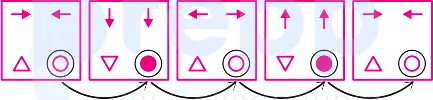
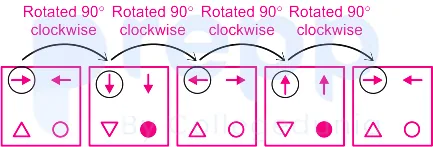
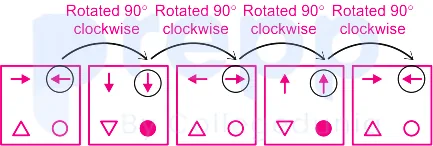
Question 1archived
Which two numbers from amongst the given options should be interchanged to make the given equation correct?
168 ÷ 4 + 216 ÷ ( 78 × 1 - 8) = 14
- A
78 and 216
- B
14 and 8
- C
78 and 14
- D
216 and 168
Show answer
C. 78 and 14Solving the Equation by Swapping Numbers
The problem asks us to find which pair of numbers, when interchanged from the given options, will make the following equation correct:
\( 168 \div 4 + 216 \div ( 78 \times 1 - 8) = 14 \)
We need to test each option by swapping the specified numbers and evaluating the left-hand side (LHS) of the equation to see if it equals the right-hand side (RHS) after the swap.
Testing Option 1: Swapping 78 and 216
If we interchange 78 and 216, the equation becomes:
\( 168 \div 4 + 78 \div ( 216 \times 1 - 8) = 14 \)
Let's calculate the LHS:
Calculate the first term: \( 168 \div 4 = 42 \)
Calculate the expression in the parenthesis: \( 216 \times 1 - 8 = 216 - 8 = 208 \)
Calculate the second term: \( 78 \div 208 \)
So, LHS = \( 42 + 78 \div 208 \approx 42 + 0.375 = 42.375 \)
This does not equal the RHS (14). So, option 1 is incorrect.
Testing Option 2: Swapping 14 and 8
If we interchange 14 and 8, the equation becomes:
\( 168 \div 4 + 216 \div ( 78 \times 1 - 14) = 8 \)
Let's calculate the LHS:
Calculate the first term: \( 168 \div 4 = 42 \)
Calculate the expression in the parenthesis: \( 78 \times 1 - 14 = 78 - 14 = 64 \)
Calculate the second term: \( 216 \div 64 \)
So, LHS = \( 42 + 216 \div 64 = 42 + 3.375 = 45.375 \)
This does not equal the RHS (8). So, option 2 is incorrect.
Testing Option 3: Swapping 78 and 14
If we interchange 78 and 14, the equation becomes:
\( 168 \div 4 + 216 \div ( 14 \times 1 - 8) = 78 \)
Let's calculate the LHS step-by-step following the order of operations (BODMAS/PEMDAS):
Expression within parenthesis: \( 14 \times 1 - 8 \)
Multiplication first: \( 14 \times 1 = 14 \)
Then subtraction: \( 14 - 8 = 6 \)
Now the equation is:
\( 168 \div 4 + 216 \div 6 = 78 \)
Perform divisions:
First term: \( 168 \div 4 = 42 \)
Second term: \( 216 \div 6 = 36 \)
Now the equation is:
\( 42 + 36 = 78 \)
Perform addition: \( 42 + 36 = 78 \)
The LHS is 78, which is equal to the RHS (78). This swap makes the equation correct.
Testing Option 4: Swapping 216 and 168
If we interchange 216 and 168, the equation becomes:
\( 216 \div 4 + 168 \div ( 78 \times 1 - 8) = 14 \)
Let's calculate the LHS:
Calculate the first term: \( 216 \div 4 = 54 \)
Calculate the expression in the parenthesis: \( 78 \times 1 - 8 = 78 - 8 = 70 \)
Calculate the second term: \( 168 \div 70 \)
So, LHS = \( 54 + 168 \div 70 = 54 + 2.4 = 56.4 \)
This does not equal the RHS (14). So, option 4 is incorrect.
Conclusion
Based on the evaluation of each option, interchanging the numbers 78 and 14 makes the given equation correct.
Revision Table: Checking Equation Swaps
Numbers Swapped
New Equation
LHS Calculation
LHS Result
New RHS
Is Equation Correct?
None (Original)
\( 168 \div 4 + 216 \div ( 78 \times 1 - 8) = 14 \)
\( 42 + 216 \div (78-8) = 42 + 216 \div 70 \)
\( 42 + 3.085... \)
14
No
78 and 216
\( 168 \div 4 + 78 \div ( 216 \times 1 - 8) = 14 \)
\( 42 + 78 \div (216-8) = 42 + 78 \div 208 \)
\( 42 + 0.375 \)
14
No
14 and 8
\( 168 \div 4 + 216 \div ( 78 \times 1 - 14) = 8 \)
\( 42 + 216 \div (78-14) = 42 + 216 \div 64 \)
\( 42 + 3.375 \)
8
No
78 and 14
\( 168 \div 4 + 216 \div ( 14 \times 1 - 8) = 78 \)
\( 42 + 216 \div (14-8) = 42 + 216 \div 6 \)
\( 42 + 36 = 78 \)
78
Yes
216 and 168
\( 216 \div 4 + 168 \div ( 78 \times 1 - 8) = 14 \)
\( 54 + 168 \div (78-8) = 54 + 168 \div 70 \)
\( 54 + 2.4 \)
14
No
Additional Information: Order of Operations
When solving mathematical equations or expressions, it is crucial to follow a specific order of operations. This order ensures that everyone gets the same answer for the same problem. A common acronym used to remember this order is BODMAS or PEMDAS.
B/P: Brackets (Parentheses) - Operations inside brackets are performed first.
O/E: Orders (Exponents) - Powers and square roots are calculated next.
D/MD: Division and Multiplication - These are performed from left to right.
A/AS: Addition and Subtraction - These are performed from left to right.
In the equation swapping problem, we consistently applied this order to correctly evaluate the expressions after swapping the numbers.
Paper & answer key PDF ↗ Question 2archived
Select the option that is related to the third word in the same way as the second word is related to the first word. (The words must be considered as meaningful English words and must not be related to each other based on the number of letters/number of consonants/vowels in the word.)
Bees : Swarm :: Monkeys : ?
- A
Troop
- B
Colony
- C
Shoal
- D
Herd
Show answer
A. TroopThis question asks us to find the word that completes the analogy: Bees are to Swarm as Monkeys are to what? The relationship between the first pair of words (Bees : Swarm) is that 'Swarm' is the collective noun used to describe a group of 'Bees'. We need to find the correct collective noun for a group of 'Monkeys' from the given options.
Understanding Collective Nouns for Animals
A collective noun is a word used to name a group of people, animals, or things. Many animals have specific collective nouns used to describe them when they are together in a group.
Analyzing the Analogy: Bees and Swarm
The first part of the analogy is "Bees : Swarm". A large group of bees, especially when they are moving together, is called a swarm. This establishes the pattern: Animal : Collective Noun for that Animal.
Finding the Collective Noun for Monkeys
Now we need to apply the same relationship to the second part of the analogy: "Monkeys : ?". We are looking for the collective noun for monkeys. Let's look at the options provided:
Troop: The word 'Troop' is used as a collective noun for a group of monkeys, baboons, and sometimes gorillas.
Colony: The word 'Colony' is typically used for groups of ants, termites, seabirds, or other animals that live together in large numbers or specific structures. It is not the standard collective noun for monkeys.
Shoal: The word 'Shoal' is used to describe a large number of fish swimming together. It is sometimes used interchangeably with 'school' for fish. It is not used for monkeys.
Herd: The word 'Herd' is commonly used for groups of grazing animals like cattle, sheep, goats, deer, or elephants. It is not the standard collective noun for monkeys.
Comparing the options, 'Troop' is the correct collective noun for a group of monkeys, fitting the pattern established by the first pair, 'Bees : Swarm'.
Therefore, the analogy is completed as Bees : Swarm :: Monkeys : Troop.
Revision Table: Common Animal Collective Nouns
Animal
Collective Noun(s)
Bees
Swarm, Hive, Colony
Monkeys
Troop, Barrel, Tribe
Fish
Shoal, School, Run
Cattle
Herd, Drove
Ants
Colony, Army
Birds
Flock, Flight (in the air)
Additional Information: More Collective Noun Examples
Collective nouns are fascinating and often specific to the type of animal. Here are a few more examples:
A pride of lions
A pack of wolves or dogs
A gaggle of geese
A parliament of owls
A crash of rhinoceroses
An army of caterpillars
A bask of crocodiles
Learning these collective nouns helps expand vocabulary and understand specific terminology used for animal groups.
Paper & answer key PDF ↗ Question 3archived
Select the option that is related to the third word in the same way as the second word is related to the first word.
(The words must be considered as meaningful English words and must not be related to each other based on the number of letters/number of consonants/vowels in the word.)
Calf : Cattle :: Foal : ?
- A
Elephant
- B
Horse
- C
Deer
- D
Kangaroo
Show answer
B. HorseWord Analogy: Calf and Cattle, Foal and Another Animal
The question asks us to find the word that completes the analogy: Calf is to Cattle as Foal is to ?. This type of question tests our ability to identify the relationship between a pair of words and apply the same relationship to another word to find its corresponding pair.
We are given that the words must be considered as meaningful English words and the relationship is not based on superficial characteristics like the number of letters or vowels/consonants.
Identifying the Relationship between Calf and Cattle
Let's look at the first pair: Calf and Cattle.
A Calf is the young one of cattle.
Cattle is a term for domesticated bovine animals.
The relationship between Calf and Cattle is that of a young animal to its parent or species.
Understanding the Term 'Foal'
Now let's consider the third word: Foal.
A Foal is a young horse, donkey, or zebra, typically less than one year old.
The analogy requires us to find the animal whose young one is called a Foal. Based on the definition of 'Foal', it is the young of a horse (or donkey or zebra). We need to check the options provided to see which animal fits this description.
Analyzing the Options
We need to find which of the given options is the adult animal for which 'Foal' is the young one. Let's examine the options:
Option
Animal
Name of Young
1
Elephant
Calf
2
Horse
Foal
3
Deer
Fawn
4
Kangaroo
Joey
Based on our analysis:
The young of an Elephant is called a Calf, not a Foal.
The young of a Horse is called a Foal. This matches the third word in our analogy.
The young of a Deer is called a Fawn, not a Foal.
The young of a Kangaroo is called a Joey, not a Foal.
Determining the Correct Pair for Foal
The relationship between Calf and Cattle is that Calf is the young of Cattle. We are looking for an animal such that Foal is its young. From our analysis of the options, the young of a Horse is called a Foal.
Conclusion: Solving the Analogy
The analogy is Calf : Cattle :: Foal : ?. Since a Calf is the young of Cattle, we need to find the animal whose young is a Foal. This animal is the Horse.
Therefore, the completed analogy is Calf : Cattle :: Foal : Horse.
Revision Table: Common Animal Young
Here is a table listing some common animals and the names of their young ones, which is helpful for solving such analogies.
Adult Animal / Species
Name of Young
Cat
Kitten
Dog
Puppy
Sheep
Lamb
Goat
Kid
Chicken
Chick
Duck
Duckling
Cow / Cattle
Calf
Horse
Foal
Deer
Fawn
Kangaroo
Joey
Lion
Cub
Additional Information: Types of Analogies
Analogies can be based on various relationships between words. Understanding these common relationships can help solve analogy questions quickly.
Parent and Young: The relationship seen in this question (Calf : Cattle).
Part and Whole: Example: Finger : Hand (Finger is part of Hand).
Synonyms: Example: Happy : Joyful (Words with similar meaning).
Antonyms: Example: Hot : Cold (Words with opposite meaning).
Cause and Effect: Example: Rain : Flood (Rain can cause Flood).
Worker and Tool: Example: Carpenter : Hammer (Carpenter uses a Hammer).
Object and Function: Example: Knife : Cut (Knife is used for Cutting).
Practicing with different types of analogies improves verbal reasoning skills.
Paper & answer key PDF ↗ Question 4archived
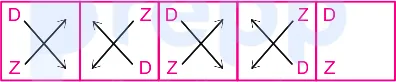
Which figure should replace the question mark (?) if the series were to be continued?
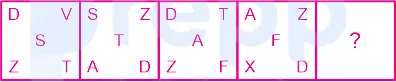
- A
Option A (shown in image)
- B
Option B (shown in image)
- C
Option C (shown in image)
- D
Option D (shown in image)
Show answer
Question 5archived
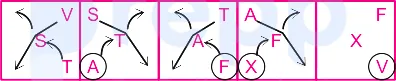
Select the figure from among the given options that can replace the question mark (?) in the following series.

- A
Option A (shown in image)
- B
Option B (shown in image)
- C
Option C (shown in image)
- D
Option D (shown in image)
Show answer
Question 6archived
Select the set in which the numbers are related in the same way as are the numbers of the following sets.
(NOTE: Operations should be performed on the whole numbers, without breaking down the numbers into its constituent digits. E.g. 13 - Operations on 13 such as adding/subtracting/multiplying etc. to 13 can be performed. Breaking down 13 into 1 and 3 and then performing mathematical operations on 1 and 3 is NOT allowed)
(9, 343, 2)
(12, 729, 3)
- A
(98, 49, 92)
- B
(13, 4, 89)
- C
(12, 66, 20)
- D
(12, 125, 7)
Show answer
D. (12, 125, 7)Finding the Number Relationship Pattern in Sets
This question asks us to identify the relationship between the numbers in the given sets and then find which option follows the same relationship. We are given two example sets:
Set 1: (9, 343, 2)
Set 2: (12, 729, 3)
We need to find a rule that connects the three numbers in each set. The rule must apply to both example sets.
Analyzing the Given Number Sets
Let's look at the first set (9, 343, 2). The middle number is 343. We might recognize 343 as a perfect cube. Specifically, $343 = 7 \times 7 \times 7 = 7^3$.
Now, let's see if we can get the number 7 from the other two numbers, 9 and 2. A simple operation combining 9 and 2 could be subtraction: $9 - 2 = 7$.
So, for the first set, the pattern seems to be: (First number - Third number)$^3$ = Second number.
Let's check this pattern with the second set (12, 729, 3). The middle number is 729. This is also a perfect cube: $729 = 9 \times 9 \times 9 = 9^3$.
Can we get 9 from the first and third numbers, 12 and 3? Subtracting the third number from the first gives: $12 - 3 = 9$.
So, for the second set, applying the pattern (First number - Third number)$^3$ = Second number gives: $(12 - 3)^3 = 9^3 = 729$. This matches the middle number in the second set.
The established pattern for the sets is: If a set is (A, B, C), then $(A - C)^3 = B$.
Applying the Number Pattern to Options
Now we will check each option to see which one follows this $(A - C)^3 = B$ pattern.
Option 1: (98, 49, 92)
Here, A = 98, B = 49, C = 92.
Let's apply the pattern: $(A - C)^3 = (98 - 92)^3 = 6^3 = 6 \times 6 \times 6 = 216$.
The calculated value (216) is not equal to the middle number B (49). So, Option 1 does not follow the pattern.
Option 2: (13, 4, 89)
Here, A = 13, B = 4, C = 89.
Let's apply the pattern: $(A - C)^3 = (13 - 89)^3 = (-76)^3$. This is a negative number, which is clearly not equal to 4.
So, Option 2 does not follow the pattern.
Option 3: (12, 66, 20)
Here, A = 12, B = 66, C = 20.
Let's apply the pattern: $(A - C)^3 = (12 - 20)^3 = (-8)^3 = (-8) \times (-8) \times (-8) = 64 \times (-8) = -512$.
The calculated value (-512) is not equal to the middle number B (66). So, Option 3 does not follow the pattern.
Option 4: (12, 125, 7)
Here, A = 12, B = 125, C = 7.
Let's apply the pattern: $(A - C)^3 = (12 - 7)^3 = 5^3 = 5 \times 5 \times 5 = 25 \times 5 = 125$.
The calculated value (125) is equal to the middle number B (125). So, Option 4 follows the pattern.
Based on the analysis, only Option 4 matches the numerical relationship found in the given example sets.
Summary of Pattern Application
Set
A
B
C
Calculated (A - C)$^3$
Matches B?
(9, 343, 2)
9
343
2
$(9 - 2)^3 = 7^3 = 343$
Yes
(12, 729, 3)
12
729
3
$(12 - 3)^3 = 9^3 = 729$
Yes
(98, 49, 92)
98
49
92
$(98 - 92)^3 = 6^3 = 216$
No ($216 \neq 49$)
(13, 4, 89)
13
4
89
$(13 - 89)^3 = (-76)^3 = -438976$
No ($-438976 \neq 4$)
(12, 66, 20)
12
66
20
$(12 - 20)^3 = (-8)^3 = -512$
No ($-512 \neq 66$)
(12, 125, 7)
12
125
7
$(12 - 7)^3 = 5^3 = 125$
Yes
Revision Table: Number Set Patterns
Concept
Description
Example
Number Pattern Recognition
Identifying the mathematical relationship between numbers in a sequence or set.
Finding that (9, 343, 2) follows $(A-C)^3 = B$.
Perfect Cubes
Numbers obtained by multiplying an integer by itself three times (e.g., $1^3=1$, $2^3=8$, $3^3=27$, etc.). Recognizing these is key in cube-based patterns.
343 is $7^3$, 729 is $9^3$, 125 is $5^3$.
Applying a Rule
Testing if a discovered rule or pattern holds true for other given examples or options.
Checking if $(A-C)^3 = B$ works for option sets.
Additional Information: Solving Number Relation Problems
Number relation problems often appear in logical reasoning and quantitative aptitude sections of exams. To solve them effectively, consider the following strategies:
Look for basic operations: Check for addition, subtraction, multiplication, division, squares, cubes, square roots, cube roots, or combinations of these.
Consider positions: The relationship might involve the first, second, and third numbers (as in this case), or perhaps involve differences, sums, or products of specific numbers in the set.
Identify common mathematical properties: Look for prime numbers, composite numbers, odd/even numbers, perfect squares, perfect cubes, etc.
Test your hypothesis: Once you think you've found a pattern, test it rigorously with all the provided example sets to ensure it consistently applies.
Work methodically through options: Apply the verified pattern to each option provided until you find one that fits.
Pay attention to constraints: The note in this question specifically mentioned not breaking down numbers into digits, which is an important constraint to follow.
Practice with various types of number pattern problems helps build speed and recognition skills.
Paper & answer key PDF ↗ Question 7archived
In a certain code language, ‘ORGANIZATION’ is written as ‘ORGANINOITAZ’, ‘MANAGEMENT’ is written as ‘MANAGTNEME’. How will ‘RESOURCE’ be written in that language?
- A
RESOECUR
- B
RESOCERU
- C
RESEOCRU
- D
RESOECRU
Show answer
D. RESOECRUUnderstanding the Code Language Pattern
The question asks us to decipher a specific code language used to transform words. We are given two examples of words and their corresponding encoded forms. By analyzing these examples, we can identify the rule and apply it to encode the word 'RESOURCE'.
Analyzing the Given Examples
Example 1: ORGANIZATION
Original word: ORGANIZATION
Length: 12 letters
Encoded word: ORGANINOITAZ
Let's compare the original and encoded words closely:
ORGANIZATION
ORGANINOITAZ
We can see that the first few letters seem to remain the same. Let's try splitting the word 'ORGANIZATION' into two equal halves. The length is 12, so the split is after the 6th letter:
First half: ORGANI (letters 1-6)
Second half: ZATION (letters 7-12)
Now let's look at the encoded word 'ORGANINOITAZ' and see if it matches this split:
The first 6 letters of the encoded word are ORGANI. This matches the first half of the original word.
The remaining 6 letters of the encoded word are NOITAZ. Let's see how this relates to the second half of the original word, 'ZATION'.
If we reverse the second half 'ZATION', we get NOITAZ. This exactly matches the second part of the encoded word.
So, the pattern for the first example seems to be: split the word into two equal halves, keep the first half as it is, and reverse the second half.
Example 2: MANAGEMENT
Original word: MANAGEMENT
Length: 10 letters
Encoded word: MANAGTNEME
Let's test the pattern identified from the first example (split in half, reverse second half) on this word. The length is 10, so the split is after the 5th letter:
First half: MANAG (letters 1-5)
Second half: EMENT (letters 6-10)
Now, apply the pattern:
Keep the first half unchanged: MANAG
Reverse the second half 'EMENT': The reversal of EMENT is TNEME.
Combine the parts: MANAG + TNEME = MANAGTNEME.
This matches the given encoded word for 'MANAGEMENT'. The pattern holds true for both examples.
Identifying the Encoding Rule
Based on the analysis of both examples, the rule for encoding a word in this language is:
Divide the original word into two equal halves. This rule applies to words with an even number of letters.
The first half of the word remains in its original order.
The second half of the word is completely reversed.
The encoded word is formed by combining the unchanged first half and the reversed second half.
Applying the Rule to RESOURCE
Now we need to apply this pattern to the word 'RESOURCE' to find its encoded form.
Original word: RESOURCE
Length: 8 letters
Following the steps of the encoding rule:
Divide the word 'RESOURCE' into two equal halves. The length is 8, so each half will have \( \frac{8}{2} = 4 \) letters.
First half: RESO (letters 1-4)
Second half: URCE (letters 5-8)
Keep the first half unchanged: RESO
Reverse the second half 'URCE'. The reversal of URCE is ECRU.
Combine the unchanged first half and the reversed second half: RESO + ECRU = RESOECRU.
The encoded word for 'RESOURCE' is RESOECRU.
Comparing with Options
Let's check which of the given options matches our derived encoded word:
Option 1: RESOECUR
Option 2: RESOCERU
Option 3: RESEOCRU
Option 4: RESOECRU
Our result, RESOECRU, matches Option 4.
Therefore, in this code language, 'RESOURCE' is written as 'RESOECRU'.
Original Word
Length
Split Halves (Length/2)
First Half
Second Half
Reversed Second Half
Encoded Word
ORGANIZATION
12
6 | 6
ORGANI
ZATION
NOITAZ
ORGANINOITAZ
MANAGEMENT
10
5 | 5
MANAG
EMENT
TNEME
MANAGTNEME
RESOURCE
8
4 | 4
RESO
URCE
ECRU
RESOECRU
Revision Table: Common Encoding Pattern Types
Encoding and decoding questions often involve patterns related to letter manipulation. Here are some common types:
Reversal: Reversing the entire word or specific segments.
Shifting: Moving letters forward or backward in the alphabet by a fixed number of steps.
Substitution: Replacing letters with other letters, numbers, or symbols based on a defined rule.
Position-based: Rules dependent on the position of letters (e.g., swapping 1st and 2nd, 3rd and 4th, etc.).
Block-based: Dividing the word into smaller blocks and applying a rule within each block or rearranging the blocks.
Vowel/Consonant Rules: Separate rules for vowels and consonants.
Practice helps in quickly identifying the pattern by observing changes between the original and encoded words.
Additional Information: Strategies for Solving Encoding Problems
When tackling encoding and decoding problems, follow a systematic approach:
Write down the original word and the coded word clearly.
Compare their lengths. If lengths are different, the pattern might involve adding/removing letters or using numbers/symbols.
Look for letters that are in the same position in both words.
See if the coded word is a simple reversal of the original word.
Try splitting the word into halves or other equal segments (e.g., 2, 3, or 4 letters per segment) and check for patterns like reversal or swapping within segments.
Analyze the relationship between corresponding letters (e.g., how far apart are they in the alphabet?).
Look for vowel/consonant-specific rules.
If multiple examples are given, analyze each one to find a consistent rule.
Once you believe you've found the rule, apply it to all given examples to confirm it's correct.
Finally, apply the verified rule to the target word to find its encoded or decoded form.
Paper & answer key PDF ↗ Question 8archived
Which number will replace the question mark (?) in the following series?
12, 25, 51, 103, ?, 415, 831
- A
208
- B
207
- C
206
- D
200
Show answer
B. 207Understanding the Number Series Question
The question asks us to find the missing number in a given number series: 12, 25, 51, 103, ?, 415, 831. To solve this, we need to identify the pattern or rule that relates consecutive numbers in the series.
Identifying the Pattern in the Series
Let's examine the relationship between the consecutive terms provided in the series:
From 12 to 25: How do we get from 12 to 25? Let's try simple operations. $12 \times 2 = 24$. If we add 1, we get $24 + 1 = 25$. This matches the second term.
From 25 to 51: Let's see if the same rule applies. $25 \times 2 = 50$. If we add 1, we get $50 + 1 = 51$. This matches the third term.
From 51 to 103: Applying the rule again. $51 \times 2 = 102$. Adding 1 gives $102 + 1 = 103$. This matches the fourth term.
It appears the pattern is to multiply the previous number by 2 and then add 1 to get the next number in the series. Let's formulate this pattern:
Next Number = (Previous Number $\times 2$) + 1
Calculating the Missing Number
Now, we can use this pattern to find the number that replaces the question mark (?). The number before the question mark is 103. Applying our identified pattern:
Previous Number = 103
Missing Number = (103 $\times 2$) + 1
Missing Number = $206 + 1$
Missing Number = 207
So, the missing number is 207.
Verifying the Pattern with Subsequent Terms
Let's check if the number 207 fits correctly in the series by applying the pattern to the subsequent terms.
From 207 to 415: Using 207 as the previous number. $207 \times 2 = 414$. Adding 1 gives $414 + 1 = 415$. This matches the next term in the series.
From 415 to 831: Using 415 as the previous number. $415 \times 2 = 830$. Adding 1 gives $830 + 1 = 831$. This matches the last term in the series.
Since the pattern (Previous Number $\times 2 + 1$) holds true for all the given terms, including the missing one, the calculated number 207 is indeed the correct number to replace the question mark.
The complete series is: 12, 25, 51, 103, 207, 415, 831.
Summary of the Pattern
The rule for this number series is that each term is obtained by multiplying the previous term by 2 and adding 1.
Term
Calculation
Value
1st
-
12
2nd
$(12 \times 2) + 1$
25
3rd
$(25 \times 2) + 1$
51
4th
$(51 \times 2) + 1$
103
5th (?)
$(103 \times 2) + 1$
207
6th
$(207 \times 2) + 1$
415
7th
$(415 \times 2) + 1$
831
Conclusion
Based on the established pattern, the number that replaces the question mark (?) in the series 12, 25, 51, 103, ?, 415, 831 is 207.
Revision Table: Number Series Pattern Analysis
Understanding number series patterns is key to solving such problems. Here's a quick review of the process used:
Examine the differences or ratios between consecutive terms.
Look for simple arithmetic operations (addition, subtraction, multiplication, division) or a combination of operations.
Test the potential pattern across multiple terms in the series.
Apply the confirmed pattern to find the missing term.
Verify the result by checking if the pattern continues with the terms following the missing number.
Additional Information: Types of Number Series
Number series questions can follow various patterns. Some common types include:
Arithmetic Series: A constant difference between consecutive terms (e.g., 2, 4, 6, 8...).
Geometric Series: A constant ratio between consecutive terms (e.g., 3, 6, 12, 24...).
Arithmetic-Geometric Series: A combination of arithmetic and geometric progressions.
Fibonacci Series: Each term is the sum of the two preceding terms (e.g., 0, 1, 1, 2, 3, 5...).
Difference Series: The differences between consecutive terms form their own pattern (e.g., squared numbers, prime numbers).
Mixed Series: Involving multiple patterns or operations like the one solved here (multiply by a number and add/subtract another number).
Practicing different types of series helps in quickly identifying the underlying rule during exams.
Paper & answer key PDF ↗ Question 9archived
In the following question below are given some statements followed by some conclusions based on those statements. Taking the given statements to be true even if they seem to be at variance from commonly known facts. Read all the conclusions and then decide which of the given conclusion logically follows the given statements.
Statements:
I. Some Z are X.
II. Some W are Z.
Conclusions:
I. Some X are not W.
II. Some X are not Z.
- A
Only conclusion I follows
- B
Only conclusion II follows
- C
Both conclusions I and II follows
- D
Neither conclusion follows
Show answer
D. Neither conclusion followsLet's analyze the given statements and conclusions based on the principles of logical reasoning and syllogisms. We will assume the statements are true, even if they contradict common knowledge, and determine which conclusions logically follow.
Syllogism Statements and Conclusions
We are given two statements:
Statement I: Some Z are X.
Statement II: Some W are Z.
And two conclusions:
Conclusion I: Some X are not W.
Conclusion II: Some X are not Z.
Analyzing Statement I: Some Z are X
This statement tells us that there is at least one element that belongs to both the set Z and the set X. It establishes an overlap between Z and X. However, this statement does not provide any information about:
Whether all Z are X.
Whether all X are Z.
The relationship between the elements of X that are not Z.
For example, if Z represents 'Animals' and X represents 'Dogs', the statement "Some Animals are Dogs" is true. In this case, all Dogs (X) are Animals (Z). So, there would be no Dogs (X) that are not Animals (Z).
Analyzing Statement II: Some W are Z
This statement tells us that there is at least one element that belongs to both the set W and the set Z. It establishes an overlap between W and Z. Similar to Statement I, it doesn't specify if all W are Z or if all Z are W, or the nature of elements in W that are not Z.
Combining Statements and Analyzing Conclusions
We have overlaps: (Z and X) and (W and Z). The term 'Z' is common to both statements, acting as a middle term. We need to see if these overlaps necessitate a specific relationship between W and X.
Evaluating Conclusion I: Some X are not W
Does the fact that Some Z are X and Some W are Z force a situation where Some X must not be W?
Let's consider possible scenarios using Venn diagrams or simple examples:
Scenario 1: Maximum overlap
Imagine that the sets W, Z, and X significantly overlap, or even that a portion of Z that is X is also part of W. It's possible that all the elements that are both Z and X are also part of W. In fact, it is even possible that all X are W.
For example, let Z = Students, X = Those who scored > 90%, W = Those who received a scholarship.
Statement I: Some Students are those who scored > 90%. (Some Z are X) - True.
Statement II: Some who received a scholarship are Students. (Some W are Z) - True.
Is Conclusion I necessarily true: Some who scored > 90% are not those who received a scholarship? (Some X are not W). Not necessarily. It could be that every student who scored > 90% also received a scholarship. In this specific scenario, "Some X are not W" would be false.
Since we found a possible scenario where Conclusion I is false while the statements are true, Conclusion I does not logically follow from the statements.
Evaluating Conclusion II: Some X are not Z
Does the fact that Some Z are X necessarily mean Some X are not Z?
Let's revisit Statement I: Some Z are X.
This statement confirms the existence of elements that are in the intersection of Z and X. It says nothing about the elements in X that are outside of this intersection.
Consider the example used before: Z = Animals, X = Dogs.
Statement I: Some Animals are Dogs. (Some Z are X) - True.
Conclusion II: Some Dogs are not Animals. (Some X are not Z) - False, because all Dogs are Animals.
Since it is possible for Statement I to be true while Conclusion II is false (as shown in the Animals/Dogs example where all X are Z), Conclusion II does not logically follow from Statement I. Statement II (Some W are Z) is irrelevant to the relationship between X and Z in this context.
Summary of Conclusions
Based on our analysis:
Conclusion I (Some X are not W) does not logically follow because we can construct scenarios where the statements are true but this conclusion is false.
Conclusion II (Some X are not Z) does not logically follow because Statement I (Some Z are X) does not preclude the possibility that all X are Z.
Therefore, neither of the given conclusions logically follows from the given statements.
Statement Type
Relationship
Some A are B
Partial overlap between A and B. Does not imply anything about 'Some A are not B' or 'Some B are not A', nor does it imply 'All A are B' or 'All B are A'.
Revision Table: Syllogism Rules
When analyzing syllogisms with 'Some' statements:
Two particular premises (like 'Some... are...' and 'Some... are...') do not yield any valid universal conclusions (like 'All...' or 'No...').
Two particular affirmative premises ('Some... are...' and 'Some... are...') do not yield any valid particular negative conclusions (like 'Some... are not...').
In standard syllogisms, two 'Some' premises do not guarantee a conclusion about the relationship between the extreme terms.
Additional Information: Understanding Syllogisms and Validity
A syllogism is a form of deductive reasoning where a conclusion is drawn from two given premises. The validity of a syllogism depends on its logical form, not on the truthfulness of the statements in the real world. A conclusion is valid if it must be true whenever the premises are true. If it is possible for the premises to be true and the conclusion to be false, then the conclusion is not valid.
Statements involving "Some" (like "Some A are B") indicate at least one, and potentially all. This ambiguity means we must consider all possible interpretations consistent with the statement when testing conclusions. If a conclusion is false in even one such interpretation where the premises are true, the conclusion is not logically valid.
Paper & answer key PDF ↗ Question 10archived
In a certain code language, 'ANNUAL' is written as 'CPRYGR' and ‘AMOUNT’ is written as ‘COSYTZ’. How will 'AGENDA' be written in that language?
- A
CIIRHE
- B
CIIRJG
- C
CIKTJG
- D
CIGPFC
Show answer
B. CIIRJGDecoding the Code Language Pattern
This question involves identifying a coding pattern based on the given examples and applying it to a new word. We are given how 'ANNUAL' is coded as 'CPRYGR' and 'AMOUNT' is coded as 'COSYTZ'. Let's analyze the relationship between the letters in the original words and their coded versions.
Analyzing the Coding Pattern: ANNUAL to CPRYGR
Let's look at the position shift for each letter in 'ANNUAL' to get 'CPRYGR':
A (1st letter) to C: This is a shift of $2$ positions forward in the alphabet (A + 2 = C).
N (2nd letter) to P: This is a shift of $2$ positions forward in the alphabet (N + 2 = P).
N (3rd letter) to R: This is a shift of $4$ positions forward in the alphabet (N + 4 = R).
U (4th letter) to Y: This is a shift of $4$ positions forward in the alphabet (U + 4 = Y).
A (5th letter) to G: This is a shift of $6$ positions forward in the alphabet (A + 6 = G).
L (6th letter) to R: This is a shift of $6$ positions forward in the alphabet (L + 6 = R).
It appears the shift value increases by $2$ for every pair of letters. The first two letters have a +2 shift, the next two have a +4 shift, and the final two have a +6 shift.
Verifying the Pattern: AMOUNT to COSYTZ
Let's check if the same pattern holds for 'AMOUNT' being coded as 'COSYTZ':
A (1st letter) to C: Shift of $2$ positions (A + 2 = C).
M (2nd letter) to O: Shift of $2$ positions (M + 2 = O).
O (3rd letter) to S: Shift of $4$ positions (O + 4 = S).
U (4th letter) to Y: Shift of $4$ positions (U + 4 = Y).
N (5th letter) to T: Shift of $6$ positions (N + 6 = T).
T (6th letter) to Z: Shift of $6$ positions (T + 6 = Z).
The pattern is consistent. The first two letters have a +2 shift, the next two have a +4 shift, and the last two have a +6 shift.
Applying the Pattern to AGENDA
Now, we apply this discovered coding pattern to the word 'AGENDA'. The word 'AGENDA' also has six letters.
A (1st letter): Apply a shift of +2. A + 2 = C.
G (2nd letter): Apply a shift of +2. G + 2 = I.
E (3rd letter): Apply a shift of +4. E + 4 = I.
N (4th letter): Apply a shift of +4. N + 4 = R.
D (5th letter): Apply a shift of +6. D + 6 = J.
A (6th letter): Apply a shift of +6. A + 6 = G.
Combining the shifted letters, we get 'CIIRJG'.
Summary of Coding for AGENDA
Original Letter
Position Pair
Shift Value
Coded Letter
A
1st (Pair 1)
+2
C
G
2nd (Pair 1)
+2
I
E
3rd (Pair 2)
+4
I
N
4th (Pair 2)
+4
R
D
5th (Pair 3)
+6
J
A
6th (Pair 3)
+6
G
Therefore, 'AGENDA' will be written as 'CIIRJG' in this code language.
Revision Table: Code Language Example
Original Word
Coded Word
Coding Logic
ANNUAL
CPRYGR
Letters 1&2: +2 shift; Letters 3&4: +4 shift; Letters 5&6: +6 shift
AMOUNT
COSYTZ
Letters 1&2: +2 shift; Letters 3&4: +4 shift; Letters 5&6: +6 shift
AGENDA
CIIRJG
Letters 1&2: +2 shift; Letters 3&4: +4 shift; Letters 5&6: +6 shift
Additional Information: Letter Coding Techniques
Letter coding is a common type of question in competitive exams that tests your ability to find patterns in how letters are transformed into others. Some common techniques include:
Alphabet Position Shift: Shifting letters a fixed number of positions forward or backward in the alphabet (like A+1=B, A+2=C, etc.).
Vowel/Consonant Based Coding: Different rules might apply to vowels and consonants.
Reverse Alphabetical Order: Coding letters by their position from the end of the alphabet (Z=1, Y=2, etc.).
Skipping Letters: The pattern might involve skipping a varying number of letters.
Mixing Patterns: A code might combine several techniques, perhaps applying different rules to different parts of the word or different letter types.
Solving these questions requires careful observation, comparing the original and coded words, and testing potential patterns systematically.
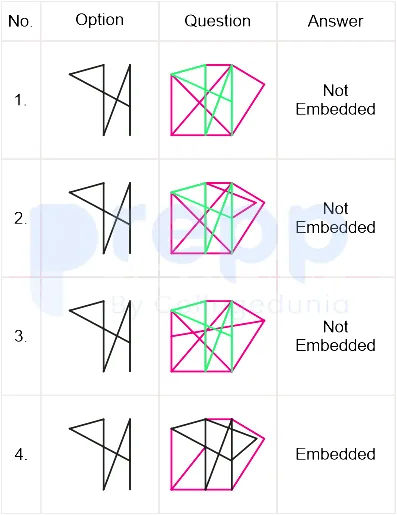
Paper & answer key PDF ↗ Question 11archived
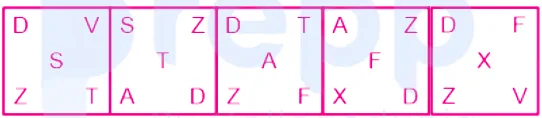
Select the option figure in which the given figure (X) is embedded as its part (rotation is NOT allowed).

- A
Option A (shown in image)
- B
Option B (shown in image)
- C
Option C (shown in image)
- D
Option D (shown in image)
Show answer
D. Option D (shown in image)The pattern followed here is:
Given:
Hence, the correct answer is "Option 4".

 Paper & answer key PDF ↗
 Question 12archived
Three of the following four letter-clusters are alike in a certain way and one is different. Pick the odd one out.
- A
FHG
- B
WZY
- C
LON
- D
ADC
Show answer
A. FHGFinding the Odd Letter Cluster Out
This question asks us to identify the letter cluster that is different from the other three, based on a certain pattern or rule.
To solve this type of reasoning question, we can look at the position of each letter in the English alphabet. Let's write down the letter positions for each cluster:
FHG: F is the 6th letter, H is the 8th letter, G is the 7th letter.
WZY: W is the 23rd letter, Z is the 26th letter, Y is the 25th letter.
LON: L is the 12th letter, O is the 15th letter, N is the 14th letter.
ADC: A is the 1st letter, D is the 4th letter, C is the 3rd letter.
Now, let's examine the differences in the positions between consecutive letters in each cluster:
FHG: From F (6) to H (8) is a difference of ${8 - 6 = +2}$. From H (8) to G (7) is a difference of ${7 - 8 = -1}$. The pattern is (+2, -1).
WZY: From W (23) to Z (26) is a difference of ${26 - 23 = +3}$. From Z (26) to Y (25) is a difference of ${25 - 26 = -1}$. The pattern is (+3, -1).
LON: From L (12) to O (15) is a difference of ${15 - 12 = +3}$. From O (15) to N (14) is a difference of ${14 - 15 = -1}$. The pattern is (+3, -1).
ADC: From A (1) to D (4) is a difference of ${4 - 1 = +3}$. From D (4) to C (3) is a difference of ${3 - 4 = -1}$. The pattern is (+3, -1).
Let's summarize the patterns in a table:
Letter Cluster
Letter Positions
Pattern (Difference in positions)
FHG
6, 8, 7
+2, -1
WZY
23, 26, 25
+3, -1
LON
12, 15, 14
+3, -1
ADC
1, 4, 3
+3, -1
As we can see, the letter clusters WZY, LON, and ADC follow the pattern (+3, -1) in terms of the difference between consecutive letter positions. However, the letter cluster FHG follows the pattern (+2, -1).
Therefore, FHG is the letter cluster that is different from the other three.
Revision Table: Letter Cluster Analysis
Cluster
Letter 1
Letter 2
Letter 3
Pos 1
Pos 2
Pos 3
Pos 2 - Pos 1
Pos 3 - Pos 2
Pattern
FHG
F
H
G
6
8
7
+2
-1
(+2, -1)
WZY
W
Z
Y
23
26
25
+3
-1
(+3, -1)
LON
L
O
N
12
15
14
+3
-1
(+3, -1)
ADC
A
D
C
1
4
3
+3
-1
(+3, -1)
Additional Information: Letter Series Reasoning
Letter series and letter cluster questions are common in logical reasoning sections of competitive exams. These questions test your ability to identify patterns in sequences of letters. Common patterns involve:
Position in the alphabet: Looking at the numerical position (1 for A, 2 for B, etc.) of each letter.
Difference in positions: Calculating the difference between consecutive letter positions (e.g., +2, -3).
Skip pattern: Skipping a fixed number of letters between consecutive letters (e.g., A, D, G... skips 2 letters).
Vowels/Consonants: Patterns based on the presence or absence of vowels and consonants.
Reverse order: Looking at the alphabet in reverse (Z=1, Y=2, etc.).
Combination of patterns: Sometimes a rule might involve adding or subtracting positions, or alternating between different rules.
Practice with various types of letter series and letter cluster problems helps in quickly identifying the underlying pattern during the exam.
Paper & answer key PDF ↗ Question 13archived
If P × Q means that P is the mother of Q, P + Q means that P is the father of Q, P ÷ Q means that P is the sister of Q, then which of the following expression shows that A is the maternal aunt of C?
- A
A ÷ B + C
- B
C × B ÷ A
- C
A ÷ B × C
- D
B ÷ C × A
Show answer
C. A ÷ B × CUnderstanding Blood Relation Coding and Symbols
This question involves interpreting relationships between people based on a given set of coded symbols. Each symbol represents a specific relationship. We are given the following codes:
P × Q means P is the mother of Q.
P + Q means P is the father of Q.
P ÷ Q means P is the sister of Q.
Our goal is to find the expression among the options that correctly represents the relationship where A is the maternal aunt of C. A maternal aunt is the sister of one's mother.
Defining Maternal Aunt in Relationships
For A to be the maternal aunt of C, two relationships must hold true:
There must be a person who is the mother of C. Let's call this person M.
A must be the sister of M.
Combining these, we need an expression where A is the sister of someone (M), and that someone (M) is the mother of C. This translates to: A is the sister of M and M is the mother of C. Using the given symbols, this would look like A ÷ M × C.
Now, let's examine each option to see which one fits this requirement.
Analyzing the Options
Option 1: A ÷ B + C
A ÷ B means A is the sister of B.
B + C means B is the father of C.
Combining these, A is the sister of B, and B is the father of C. This makes A the sister of C's father. A sister of the father is a paternal aunt, not a maternal aunt. So, this option is incorrect.
Option 2: C × B ÷ A
C × B means C is the mother of B.
B ÷ A means B is the sister of A.
Combining these, C is the mother of B, and B is the sister of A. This means C is A's mother's sister (since B is A's sister and C is B's mother, C is also A's mother). So, C is the mother of A, and B is A's sister. This expression does not show A as the maternal aunt of C. So, this option is incorrect.
Option 3: A ÷ B × C
A ÷ B means A is the sister of B.
B × C means B is the mother of C.
Combining these, A is the sister of B, and B is the mother of C. This means A is the sister of C's mother (B). A sister of the mother is the maternal aunt. This matches the requirement that A is the maternal aunt of C. So, this option is correct.
Option 4: B ÷ C × A
B ÷ C means B is the sister of C.
C × A means C is the mother of A.
Combining these, B is the sister of C, and C is the mother of A. This means C is A's mother, and B is C's sister. Since C is A's mother, B is the sister of A's mother, making B the maternal aunt of A. This expression shows that B is the maternal aunt of A, not that A is the maternal aunt of C. So, this option is incorrect.
Conclusion
Based on the analysis of each option and the definitions of the symbols, the expression that shows A is the maternal aunt of C is A ÷ B × C.
Revision Table: Symbol Meanings
Symbol
Relationship Meaning
×
First person is the mother of the second
+
First person is the father of the second
÷
First person is the sister of the second
Additional Information: Blood Relation Concepts
Blood relation questions test your ability to decode relationships presented in various formats, such as sentences, puzzles, or codes like the one in this question. Understanding the basic family tree structure and common relationships is key.
Parent: Mother or Father.
Child: Son or Daughter.
Sibling: Brother or Sister.
Aunt: Sister of parent (maternal if mother's sister, paternal if father's sister).
Uncle: Brother of parent (maternal if mother's brother, paternal if father's brother).
Cousin: Child of Aunt or Uncle.
Grandparent: Parent of parent.
Grandchild: Child of child.
In coded blood relation problems, it's crucial to carefully read the meaning assigned to each symbol or word and apply it consistently throughout the given expression or statements. Breaking down complex expressions into smaller pairs (like A ÷ B and B × C in the correct option) helps in identifying the chain of relationships.
Paper & answer key PDF ↗ Question 14archived
Which of the following letter-clusters will replace the question mark (?) in the given series?
TYG, ?, PSM, NPP, LMS
- A
SVK
- B
SUJ
- C
RVJ
- D
RUK
Show answer
C. RVJThis question asks us to find the missing letter cluster in the given series: TYG, ?, PSM, NPP, LMS. To solve this, we need to identify the pattern followed by the letters in each position across the clusters.
Analyzing the First Letter Pattern
Let's look at the first letter of each cluster in the series:
T (TYG)
? (Missing)
P (PSM)
N (NPP)
L (LMS)
The sequence of first letters is T, ?, P, N, L. Let's write down their alphabetical positions:
T (20), ?, P (16), N (14), L (12)
Observing the sequence from right to left (L, N, P, ?, T):
L (12) to N (14) is an increase of 2 positions (\(14 - 12 = 2\)).
N (14) to P (16) is an increase of 2 positions (\(16 - 14 = 2\)).
This suggests a pattern of increasing by 2 positions.
Following this pattern, the missing first letter should be 2 positions after P (16):
\(16 + 2 = 18\)
The 18th letter of the alphabet is R.
Let's check if R fits the pattern going forward to T (20):
R (18) to T (20) is an increase of 2 positions (\(20 - 18 = 2\)).
So, the first letter of the missing cluster is R.
Analyzing the Second Letter Pattern
Now, let's look at the second letter of each cluster:
Y (TYG)
? (Missing)
S (PSM)
P (NPP)
M (LMS)
The sequence of second letters is Y, ?, S, P, M. Their alphabetical positions are:
Y (25), ?, S (19), P (16), M (13)
Observing the sequence from right to left (M, P, S, ?, Y):
M (13) to P (16) is an increase of 3 positions (\(16 - 13 = 3\)).
P (16) to S (19) is an increase of 3 positions (\(19 - 16 = 3\)).
This suggests a pattern of increasing by 3 positions.
Following this pattern, the missing second letter should be 3 positions after S (19):
\(19 + 3 = 22\)
The 22nd letter of the alphabet is V.
Let's check if V fits the pattern going forward to Y (25):
V (22) to Y (25) is an increase of 3 positions (\(25 - 22 = 3\)).
So, the second letter of the missing cluster is V.
Analyzing the Third Letter Pattern
Finally, let's look at the third letter of each cluster:
G (TYG)
? (Missing)
M (PSM)
P (NPP)
S (LMS)
The sequence of third letters is G, ?, M, P, S. Their alphabetical positions are:
G (7), ?, M (13), P (16), S (19)
Observing the sequence from left to right (G, ?, M, P, S):
M (13) to P (16) is an increase of 3 positions (\(16 - 13 = 3\)).
P (16) to S (19) is an increase of 3 positions (\(19 - 16 = 3\)).
This suggests a pattern of increasing by 3 positions.
Following this pattern, the letter after G (7) should be 3 positions after G:
\(7 + 3 = 10\)
The 10th letter of the alphabet is J.
Let's check if J fits the pattern going forward to M (13):
J (10) to M (13) is an increase of 3 positions (\(13 - 10 = 3\)).
So, the third letter of the missing cluster is J.
Combining the Patterns for the Missing Cluster
By combining the letters we found for each position:
First letter: R
Second letter: V
Third letter: J
The missing letter cluster is RVJ.
The complete series is TYG, RVJ, PSM, NPP, LMS.
Position
Series
Pattern (Alphabetical Position Change)
Missing Letter
First
T (20), ?, P (16), N (14), L (12)
-2 (forward) / +2 (backward)
R (18)
Second
Y (25), ?, S (19), P (16), M (13)
-3 (forward) / +3 (backward)
V (22)
Third
G (7), ?, M (13), P (16), S (19)
+3 (forward) / -3 (backward)
J (10)
Series Pattern Revision
Here is a summary of the patterns found for each letter position:
First Letter: The letters decrease by 2 alphabetical positions each step from T to L. Looking backward, the letters increase by 2 positions (L \(\xrightarrow{+2}\) N \(\xrightarrow{+2}\) P \(\xrightarrow{+2}\) R \(\xrightarrow{+2}\) T).
Second Letter: The letters decrease by 3 alphabetical positions each step from Y to M. Looking backward, the letters increase by 3 positions (M \(\xrightarrow{+3}\) P \(\xrightarrow{+3}\) S \(\xrightarrow{+3}\) V \(\xrightarrow{+3}\) Y).
Third Letter: The letters increase by 3 alphabetical positions each step from G to S (G \(\xrightarrow{+3}\) J \(\xrightarrow{+3}\) M \(\xrightarrow{+3}\) P \(\xrightarrow{+3}\) S). Looking backward, the letters decrease by 3 positions.
The patterns are consistent across the series for each letter position.
Additional Information on Letter Series Questions
Letter series questions are common in logical reasoning tests. They require you to identify the rule governing the sequence of letters or letter clusters. Common patterns include:
Adding or subtracting a fixed number from the alphabetical position of letters.
Adding or subtracting numbers that follow their own pattern (e.g., +1, +2, +3...).
Skipping a fixed number of letters between terms.
Patterns based on vowels or consonants.
Reversing the alphabetical order.
Combinations of these patterns for different positions within a cluster.
Solving these questions involves careful observation, knowing the alphabetical order and positions, and testing potential patterns systematically for each element in the series.
Paper & answer key PDF ↗ Question 15archived
A - B means ‘A is the mother of B’
A * B means ‘A is the husband of B’
A % B means ‘A is the brother of B’
A $ B means ‘A is the sister of B’
If I * J - K % L $ M * N, then how is I related to N?
- A
Brother-in-law
- B
Father-in-law
- C
Brother
- D
Father
Show answer
B. Father-in-lawBlood Relation Problem Solution: Decoding Family Relationships
This question asks us to decipher the relationship between two individuals, I and N, based on a given expression and a set of codes representing different family relationships. Let's break down the problem step by step, analyzing the symbolic representation of the family structure.
Understanding the Relationship Codes
We are given the following codes:
A - B means ‘A is the mother of B’
A * B means ‘A is the husband of B’
A % B means ‘A is the brother of B’
A $ B means ‘A is the sister of B’
Analyzing the Expression: I * J - K % L $ M * N
Let's decode the expression segment by segment:
I * J: According to the code 'A * B means A is the husband of B', I * J means 'I is the husband of J'. This implies that J is the wife of I. We know I is male and J is female.
J - K: According to the code 'A - B means A is the mother of B', J - K means 'J is the mother of K'. K is the child of J. Since I is the husband of J, I is the father of K. The gender of K is not yet known from this segment.
K % L: According to the code 'A % B means A is the brother of B', K % L means 'K is the brother of L'. This tells us K is male. K and L are siblings. Since I and J are the parents of K, they are also the parents of L. The gender of L is not yet known from this segment.
L $ M: According to the code 'A $ B means A is the sister of B', L $ M means 'L is the sister of M'. This tells us L is female. L and M are siblings. Since I and J are the parents of L, they are also the parents of M. The gender of M is not yet known from this segment.
M * N: According to the code 'A * B means A is the husband of B', M * N means 'M is the husband of N'. This implies that N is the wife of M. We know M is male and N is female.
Tracing the Relationship from I to N
Let's connect the decoded segments:
I is the husband of J.
J is the mother of K. Therefore, I is the father of K.
K is the brother of L. So, K and L are children of I and J.
L is the sister of M. So, L and M are children of I and J.
M is the husband of N. So, M is one of the children of I and J, and M is married to N.
Combining these points, we see that M is the son of I (since M is a child of I and is male as per M * N). N is the wife of M.
The relationship between I and N is that I is the father of M, and N is M's wife. This makes I the father of his son's wife.
Determining the Final Relationship
The father of one's son's wife is the father-in-law.
Therefore, I is the father-in-law of N.
Let's summarize the family structure based on the expression:
I and J are a married couple.
K, L, and M are their children.
K is male, L is female, M is male.
M is married to N, and N is female.
This confirms that I is the father of M, and M is married to N. So I is N's father-in-law.
Summary Table of Relationships
Relationship Segment
Meaning
Inferred Genders/Relationships
I * J
I is husband of J
I (Male), J (Female), J is wife of I
J - K
J is mother of K
K is child of I & J, I is father of K
K % L
K is brother of L
K (Male), K & L are siblings, L is child of I & J
L $ M
L is sister of M
L (Female), L & M are siblings, M is child of I & J
M * N
M is husband of N
M (Male), N (Female), N is wife of M
From the table and the breakdown, M is the son of I (M is male, child of I). N is the wife of M. Thus, I is the father of M, who is married to N. I is the father-in-law of N.
Revision Table: Blood Relations Key Terms
Relationship
Description
Mother
Female parent
Father
Male parent
Husband
Male spouse
Wife
Female spouse
Brother
Male sibling
Sister
Female sibling
Son
Male child
Daughter
Female child
Father-in-law
Father of one's spouse
Mother-in-law
Mother of one's spouse
Brother-in-law
Brother of one's spouse or husband of one's sibling
Sister-in-law
Sister of one's spouse or wife of one's sibling
Additional Information: Solving Blood Relation Problems
Blood relation problems are common in reasoning sections of exams. Here are some tips for solving them:
Carefully read and understand the codes or definitions provided for relationships.
Break down complex expressions into smaller segments.
Draw a family tree or diagram to visualize the relationships. Use symbols for gender (e.g., + for male, - for female) and lines to connect spouses (=) and parent-child relationships (|).
Determine the gender of each person whenever possible based on the given relationships. This is crucial as relationships like brother-in-law or aunt depend on gender.
Trace the path from the first person to the second person mentioned in the question.
Combine the individual relationships to find the final relationship.
Practice with various types of problems to improve speed and accuracy.
Paper & answer key PDF ↗ Question 16archived
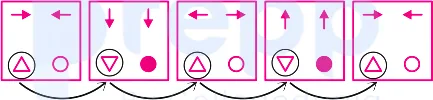
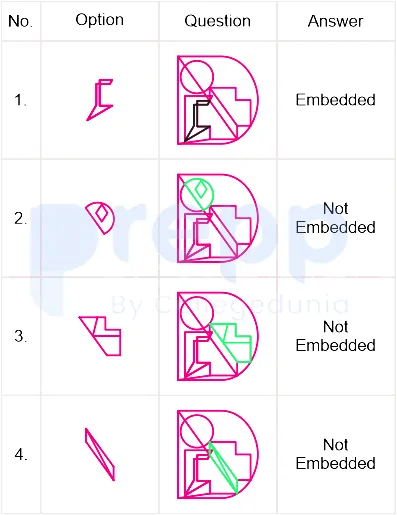
Select the option figure that is embedded in the given figure. (Rotation is not allowed).

- A
Option A (shown in image)
- B
Option B (shown in image)
- C
Option C (shown in image)
- D
Option D (shown in image)
Show answer
A. Option A (shown in image)The pattern followed here is:
Given:
Hence, the correct answer is "Option 1".

 Paper & answer key PDF ↗
 Question 17archived
Select the option that represents the correct order of the given words as they would appear in an English dictionary.
1- Thresh
2- Threadbare
3- Thrice
4- Threw
5- Threat
- A
2, 4, 5, 1, 3
- B
2, 5, 1, 4, 3
- C
2, 5, 4, 1, 3
- D
2, 1, 5, 4, 3
Show answer
B. 2, 5, 1, 4, 3Understanding Dictionary Word Order
This question requires us to arrange a list of words based on the alphabetical order they would appear in an English dictionary. This process involves comparing words letter by letter from the beginning until a difference is found.
Comparing Words Alphabetically
Let's compare the given words step-by-step:
Initial Comparison: All the words start with the same letters "Th".
Third Letter Comparison: The third letter in all words is 'r'. So, we move to the fourth letter.
Thresh
Threadbare
Thrice
Threw
Threat
Fourth Letter Comparison: We compare the fourth letters:
Threadbare
Threat
Thrice
Thresh
Threw
The letter 'e' comes before 'i' in the alphabet. Therefore, 'Thrice' (3) will come after all the words starting with 'Thre'.
Comparing 'Thre' Words: Now we compare the words that start with 'Thre' based on their fifth letter:
Threadbare (2)
Threat (5)
Thresh (1)
Threw (4)
The letter 'a' comes before 's' and 'w'. So, 'Threadbare' (2) and 'Threat' (5) come before 'Thresh' (1) and 'Threw' (4).
Comparing 'Threa' Words: Between 'Threadbare' (2) and 'Threat' (5), we compare the sixth letter:
Threadbare (2)
Threat (5)
The letter 'd' comes before 't'. Thus, 'Threadbare' (2) comes before 'Threat' (5).
Comparing 'Thres' and 'Threw': Now we compare 'Thresh' (1) and 'Threw' (4) based on their fifth letter:
Thresh (1)
Threw (4)
The letter 's' comes before 'w'. Therefore, 'Thresh' (1) comes before 'Threw' (4).
Final Order: Combining these comparisons, the correct alphabetical order is:
Threadbare (2)
Threat (5)
Thresh (1)
Threw (4)
Thrice (3)
Selected Option Verification
The determined order is 2, 5, 1, 4, 3. This matches the sequence provided in the second option.
Option 1: 2, 4, 5, 1, 3 (Incorrect)
Option 2: 2, 5, 1, 4, 3 (Correct)
Option 3: 2, 5, 4, 1, 3 (Incorrect)
Option 4: 2, 1, 5, 4, 3 (Incorrect)
Therefore, the option representing the correct dictionary order of the words is 2, 5, 1, 4, 3.
Paper & answer key PDF ↗ Question 18archived
Select the correct combination of mathematical signs to sequentially replace the & signs, and to balance the given equation.
[{(42 & 26) & (12 & 2)} & (4 & 5)] & 5 & 10
- A
×, ÷, ×, ×, -, +, =
- B
×, -, +, ×, ÷, ×, =
- C
-, +, ×, ×, ÷, ×, =
- D
-, +, ×, ÷, ×, ×, =
Show answer
D. -, +, ×, ÷, ×, ×, =Solving Mathematical Equation by Replacing Operators
The problem asks us to find the correct sequence of mathematical operators to replace the '&' symbols in the given equation so that it balances. The equation is:
\([\{(42 \text{ \& } 26) \text{ \& } (12 \text{ \& } 2)\} \text{ \& } (4 \text{ \& } 5)] \text{ \& } 5 \text{ \& } 10\)
We are given four options, each providing a sequence of seven operators. Since there are eight '&' symbols in the equation, the last '&' symbol must be replaced by the '=' sign to form a solvable equation. Therefore, the sequence from the options will replace the first seven '&' symbols sequentially from left to right.
Analyzing the Options for Operator Replacement
Let's examine the options and how they would fit into the equation:
\(\times, \div, \times, \times, -, +, =\)
\(\times, -, +, \times, \div, \times, =\)
\(-, +, \times, \times, \div, \times, =\)
\(-, +, \times, \div, \times, \times, =\)
We need to test each option by substituting the operators into the equation and evaluating it using the order of operations (BODMAS/PEMDAS) to see which sequence makes the equation true.
Testing the Correct Operator Sequence (Option 4)
Let's apply the sequence from Option 4: \(-, +, \times, \div, \times, \times, =\). Substituting these operators into the equation:
\([\{(42 \text{ \& } 26) \text{ \& } (12 \text{ \& } 2)\} \text{ \& } (4 \text{ \& } 5)] \text{ \& } 5 \text{ \& } 10\)
Becomes:
\([\{(42 - 26) + (12 \times 2)\} \div (4 \times 5)] \times 5 = 10\)
Step-by-Step Equation Evaluation
Now, let's evaluate the expression following the BODMAS/PEMDAS rule (Brackets/Parentheses, Orders/Exponents, Division and Multiplication (from left to right), Addition and Subtraction (from left to right)).
Evaluate the innermost parentheses:
\(42 - 26 = 16\)
\(12 \times 2 = 24\)
\(4 \times 5 = 20\)
The equation is now: \([\{(16) + (24)\} \div (20)] \times 5 = 10\)
Evaluate the curly braces:
\(16 + 24 = 40\)
The equation is now: \([40 \div 20] \times 5 = 10\)
Evaluate the square brackets:
\(40 \div 20 = 2\)
The equation is now: \(2 \times 5 = 10\)
Evaluate the multiplication:
\(2 \times 5 = 10\)
The equation becomes: \(10 = 10\)
Since the left side of the equation equals the right side (\(10 = 10\)), the equation is balanced with the operator sequence \(-, +, \times, \div, \times, \times, =\).
Conclusion
The sequence of mathematical signs \(-, +, \times, \div, \times, \times, =\) correctly balances the given equation. Therefore, Option 4 is the correct combination.
Revision Table: Understanding Operator Sequence Questions
Concept
Explanation
Key Takeaway
Equation Balancing
Finding the operators that make the Left Hand Side (LHS) equal to the Right Hand Side (RHS).
LHS = RHS must be achieved.
Operator Sequence
The specific order in which mathematical operations (+, -, *, /, etc.) are applied.
Operators must be used in the exact order given by the option.
Order of Operations
Rules like BODMAS/PEMDAS dictating the priority of operations (Parentheses, Exponents, Multiplication/Division, Addition/Subtraction).
Essential for correctly evaluating the expression after substituting operators.
Additional Information: BODMAS/PEMDAS Explained
When solving mathematical expressions involving multiple operations, it's crucial to follow a specific order. This order is commonly remembered by mnemonics like BODMAS or PEMDAS.
BODMAS:
Brackets (Parentheses)
Orders (Exponents, Roots)
Division and Multiplication (from left to right)
Addition and Subtraction (from left to right)
PEMDAS:
Parentheses
Exponents
Multiplication and Division (from left to right)
Addition and Subtraction (from left to right)
Both mnemonics represent the same set of rules. Operations within brackets or parentheses are performed first. Then, exponents or orders are calculated. Next, multiplication and division are done from left to right. Finally, addition and subtraction are performed from left to right. Following this order ensures a unique and correct result for any mathematical expression.
Paper & answer key PDF ↗ Question 19archived
Three Statements are given followed by Three conclusions numbered I, II and III. Assuming the statements to be true, even if they seem to be at variance with commonly known facts, decide which of the conclusions logically follow(s) from the statements.
Statements:
Some mobiles are flat.
All flats are TVs.
Some TVs are plastic.
Conclusions:
I. Some mobiles are TVs.
II. Some flats are plastic.
III. All plastic are TVs.
- A
All conclusions follow.
- B
Only conclusion I follows.
- C
Only conclusion III follows.
- D
Only conclusion II follows.
Show answer
B. Only conclusion I follows.Let's analyze the given statements and conclusions using the principles of logical deduction, specifically syllogism. We need to determine which of the conclusions logically follow from the provided statements, assuming the statements are true.
Understanding the Syllogism Statements
We are given three statements:
Statement 1: Some mobiles are flat. (Relationship between Mobiles and Flat)
Statement 2: All flats are TVs. (Relationship between Flat and TVs)
Statement 3: Some TVs are plastic. (Relationship between TVs and Plastic)
These statements establish relationships between different categories: Mobiles, Flat, TVs, and Plastic.
Evaluating Each Conclusion based on Statements
Now, let's examine each conclusion:
Conclusion I: Some mobiles are TVs.
This conclusion links Mobiles and TVs.
We look at the statements involving Mobiles and TVs. Statement 1 relates Mobiles and Flat, and Statement 2 relates Flat and TVs.
Statement 1 says "Some mobiles are flat". This means there is an overlap between the category of Mobiles and the category of Flat. Let's call this overlapping group 'X'. So, these 'X' items are both Mobiles and Flat.
Statement 2 says "All flats are TVs". This means the entire category of Flat is contained within the category of TVs.
Since the group 'X' (which is part of Mobiles) is also part of Flat, and all of Flat is part of TVs, it logically follows that the group 'X' must also be part of TVs.
Therefore, the 'Some mobiles' that are 'flat' must also be 'TVs'.
So, Conclusion I logically follows from the statements.
Conclusion II: Some flats are plastic.
This conclusion links Flats and Plastic.
Statement 2 relates Flat and TVs ("All flats are TVs").
Statement 3 relates TVs and Plastic ("Some TVs are plastic").
Statement 2 tells us all Flats are inside the category of TVs.
Statement 3 tells us there is some overlap between TVs and Plastic.
However, we don't know if the 'some TVs' that are 'plastic' include any of the TVs that are also 'flats'. It's possible that the overlap between TVs and Plastic happens only in the part of TVs that is *not* Flat.
Because we cannot definitively conclude from the statements that there is an overlap between Flats and Plastic, Conclusion II does not logically follow.
Conclusion III: All plastic are TVs.
This conclusion links Plastic and TVs, claiming a universal relationship ("All").
We look at the statement involving Plastic and TVs: Statement 3 ("Some TVs are plastic").
Statement 3 only guarantees that there is *at least one* item that is both a TV and plastic (or some overlap exists). It does not provide any information about the entire category of Plastic.
The statement "Some TVs are plastic" is not the same as "All plastic are TVs". The latter is a converse and is not necessarily true based on the former.
Therefore, we cannot conclude that Conclusion III logically follows.
Summary of Conclusions
Based on our analysis:
Conclusion I: Some mobiles are TVs - Follows
Conclusion II: Some flats are plastic - Does not follow
Conclusion III: All plastic are TVs - Does not follow
Thus, only Conclusion I logically follows from the given statements.
Revision Table: Syllogism Analysis
Statements
Conclusions
Follows?
Reasoning
Some A are B
I. Some A are C
Yes
Via Statement 1 & 2: Some A (Mobiles) are B (Flat), and All B (Flat) are C (TVs). The "Some A" that are B must also be C.
All B are C
II. Some B are D
No
Via Statement 2 & 3: All B (Flat) are C (TVs), and Some C (TVs) are D (Plastic). The overlap between C and D may or may not include the portion of C that is B.
Some C are D
III. All D are C
No
Via Statement 3: Some C (TVs) are D (Plastic). This does not imply that All D (Plastic) are C (TVs).
Additional Information: Syllogism Rules
Syllogism problems test your ability to deduce conclusions from given statements based on logical rules. Key concepts include:
Categorical Propositions: Statements like "All A are B," "No A are B," "Some A are B," and "Some A are not B."
Validity: A syllogism is valid if and only if the conclusion logically follows from the statements, regardless of whether the statements themselves are factually true in the real world.
Common Pitfalls: Assuming converse statements are true (e.g., concluding "All B are A" from "All A are B"), or assuming relationships exist where none are explicitly stated or necessarily implied (like in Conclusion II).
Practicing with different combinations of statements helps in mastering the logical flow and identifying valid conclusions.
Paper & answer key PDF ↗ Question 20archived
By Interchanging the given two numbers which of the following equation will be not correct?
7 and 4
- A
8 ÷ 6 × 9 + 7 - 4 = 12
- B
7 × 8 + 4 - 6 ÷ 3 = 37
- C
9 - 4 × 3 + 6 × 7 ÷ 1 = 12
- D
4 × 8 - 9 ÷ 3 + 7 = 57
Show answer
A. 8 ÷ 6 × 9 + 7 - 4 = 12Understanding the Question: Number Interchange
The question asks us to identify which of the given mathematical equations will become incorrect if we swap the positions of the numbers 7 and 4 in that equation. We need to check each option by performing the interchange and then evaluating the resulting expression according to the order of operations (BODMAS/PEMDAS).
Applying the Interchange and BODMAS Rule
For each equation, we will replace every 7 with a 4 and every 4 with a 7. After the interchange, we will calculate the value of the left side of the modified equation using the BODMAS rule: Brackets, Orders (powers, roots), Division and Multiplication (from left to right), Addition and Subtraction (from left to right). We will then compare this result with the right side of the equation to see if it holds true.
Evaluating Option 1: 8 ÷ 6 × 9 + 7 - 4 = 12
Original equation: \(8 \div 6 \times 9 + 7 - 4 = 12\)
Interchanging 7 and 4, the equation becomes:
\(8 \div 6 \times 9 + 4 - 7 = 12\)
Now, let's evaluate the left side of this new equation using BODMAS:
Perform Division: \(8 \div 6 = \frac{8}{6} = \frac{4}{3}\)
Perform Multiplication: \(\frac{4}{3} \times 9 = 12\)
Perform Addition and Subtraction from left to right: \(12 + 4 - 7 = 16 - 7 = 9\)
The equation simplifies to \(9 = 12\).
This resulting equation is not correct.
Evaluating Option 2: 7 × 8 + 4 - 6 ÷ 3 = 37
Original equation: \(7 \times 8 + 4 - 6 \div 3 = 37\)
Interchanging 7 and 4, the equation becomes:
\(4 \times 8 + 7 - 6 \div 3 = 37\)
Now, let's evaluate the left side:
Perform Division: \(6 \div 3 = 2\)
Perform Multiplication: \(4 \times 8 = 32\)
Perform Addition and Subtraction from left to right: \(32 + 7 - 2 = 39 - 2 = 37\)
The equation simplifies to \(37 = 37\).
This resulting equation is correct.
Evaluating Option 3: 9 - 4 × 3 + 6 × 7 ÷ 1 = 12
Original equation: \(9 - 4 \times 3 + 6 \times 7 \div 1 = 12\)
Interchanging 7 and 4, the equation becomes:
\(9 - 7 \times 3 + 6 \times 4 \div 1 = 12\)
Now, let's evaluate the left side:
Perform Multiplication and Division from left to right: \(7 \times 3 = 21\), \(6 \times 4 = 24\), \(24 \div 1 = 24\)
Perform Addition and Subtraction from left to right: \(9 - 21 + 24 = -12 + 24 = 12\)
The equation simplifies to \(12 = 12\).
This resulting equation is correct.
Evaluating Option 4: 4 × 8 - 9 ÷ 3 + 7 = 57
Original equation: \(4 \times 8 - 9 \div 3 + 7 = 57\)
Interchanging 7 and 4, the equation becomes:
\(7 \times 8 - 9 \div 3 + 4 = 57\)
Now, let's evaluate the left side:
Perform Division: \(9 \div 3 = 3\)
Perform Multiplication: \(7 \times 8 = 56\)
Perform Addition and Subtraction from left to right: \(56 - 3 + 4 = 53 + 4 = 57\)
The equation simplifies to \(57 = 57\).
This resulting equation is correct.
Conclusion: Identifying the Incorrect Equation
After interchanging the numbers 7 and 4 in each option, we found that only the first equation resulted in an incorrect mathematical statement (\(9 = 12\)). The other equations remained correct.
Revision Table: Number Interchange and Equation Verification
Original EquationInterchanged Equation (7 <-> 4)Result After CalculationCorrect?
\(8 \div 6 \times 9 + 7 - 4 = 12\)\(8 \div 6 \times 9 + 4 - 7 = 12\)\(9 = 12\)No
\(7 \times 8 + 4 - 6 \div 3 = 37\)\(4 \times 8 + 7 - 6 \div 3 = 37\)\(37 = 37\)Yes
\(9 - 4 \times 3 + 6 \times 7 \div 1 = 12\)\(9 - 7 \times 3 + 6 \times 4 \div 1 = 12\)\(12 = 12\)Yes
\(4 \times 8 - 9 \div 3 + 7 = 57\)\(7 \times 8 - 9 \div 3 + 4 = 57\)\(57 = 57\)Yes
Additional Information: Order of Operations (BODMAS/PEMDAS)
The order of operations is crucial in mathematics to ensure consistent results. It dictates the sequence in which operations should be performed within an expression.
BODMAS stands for Brackets, Orders, Division, Multiplication, Addition, Subtraction.
PEMDAS stands for Parentheses, Exponents, Multiplication, Division, Addition, Subtraction.
Division and multiplication have the same priority; they are performed from left to right. Similarly, addition and subtraction have the same priority and are performed from left to right. Understanding and applying this order is fundamental for solving mathematical expressions correctly, especially in problems involving multiple operations like the number interchange problem discussed here.
Paper & answer key PDF ↗ Question 21archived
Select the set in which the numbers are related in the same way as are the numbers of the following sets.
(NOTE : Operations should be performed on the whole numbers, without breaking down the numbers into its constituent digits. E.g. 13 - Operations on 13 such as adding/subtracting/multiplying etc. to 13 can be performed. Breaking down 13 into 1 and 3 and then performing mathematical operations on 1 and 3 is NOT allowed)
(3, 16, 6)
(4, 22, 6)
- A
(12, 50, 5)
- B
(9, 70, 8)
- C
(7, 43, 6)
- D
(9, 10, 11)
Show answer
B. (9, 70, 8)Understanding Number Relation Questions
In these types of reasoning questions, we are given a set or sets of numbers and we need to identify the relationship or pattern between them. Then, we have to find another set from the given options that follows the exact same relationship or pattern.
The question provides two example sets: (3, 16, 6) and (4, 22, 6). We are told that operations should be performed on whole numbers, not on individual digits.
Analyzing the Given Number Sets
Let's look closely at the numbers in the first set (3, 16, 6) and the second set (4, 22, 6). We need to find a rule that connects the first number, the middle number, and the third number in both sets.
Let's try to find a relationship between the first number, the third number, and the middle number. Let's denote the first number as F, the middle number as M, and the third number as T.
Pattern Discovery from (3, 16, 6) and (4, 22, 6)
Consider the first set (3, 16, 6). Here, F=3, M=16, T=6.
Consider the second set (4, 22, 6). Here, F=4, M=22, T=6.
Notice that the third number (T) is the same in both example sets (it's 6). This might be a clue that the third number is used in a consistent way in the pattern, or perhaps it indicates a type of relationship that holds true for the first and middle numbers when the third number is present.
Let's try some common arithmetic operations involving the first and third numbers to see if we can arrive at the middle number.
Try multiplying the first and third numbers:
For (3, 16, 6): $3 \times 6 = 18$. The middle number is 16. The difference is $18 - 16 = 2$.
For (4, 22, 6): $4 \times 6 = 24$. The middle number is 22. The difference is $24 - 22 = 2$.
It appears that if we multiply the first number by the third number, and then subtract 2, we get the middle number. Let's state this as a potential pattern:
Pattern: $\text{(First Number} \times \text{Third Number)} - 2 = \text{Middle Number}$
Let's verify this pattern with the given sets:
For (3, 16, 6): $(3 \times 6) - 2 = 18 - 2 = 16$. This matches the middle number.
For (4, 22, 6): $(4 \times 6) - 2 = 24 - 2 = 22$. This matches the middle number.
The pattern seems to hold true for both example sets.
Checking the Options Based on the Pattern
Now, we will apply this pattern to each of the given options to find the set that follows the same rule.
Option Set
First Number
Third Number
Given Middle Number
Calculated Middle Number (F $\times$ T - 2)
Match?
(12, 50, 5)
12
5
50
$(12 \times 5) - 2 = 60 - 2 = 58$
No
(9, 70, 8)
9
8
70
$(9 \times 8) - 2 = 72 - 2 = 70$
Yes
(7, 43, 6)
7
6
43
$(7 \times 6) - 2 = 42 - 2 = 40$
No
(9, 10, 11)
9
11
10
$(9 \times 11) - 2 = 99 - 2 = 97$
No
Based on the application of the pattern $\text{(First Number} \times \text{Third Number)} - 2 = \text{Middle Number}$, only the set (9, 70, 8) produces the correct middle number.
Conclusion
The set in which the numbers are related in the same way as the given sets (3, 16, 6) and (4, 22, 6) is (9, 70, 8).
Revision Table: Key Pattern Summary
Example/Option Set
First Number (F)
Third Number (T)
Middle Number (M)
Pattern Check: (F $\times$ T) - 2
Result
Given Set 1
3
6
16
$(3 \times 6) - 2 = 18 - 2 = 16$
Matches M
Given Set 2
4
6
22
$(4 \times 6) - 2 = 24 - 2 = 22$
Matches M
Option 1
12
5
50
$(12 \times 5) - 2 = 60 - 2 = 58$
Does not match M
Option 2
9
8
70
$(9 \times 8) - 2 = 72 - 2 = 70$
Matches M
Option 3
7
6
43
$(7 \times 6) - 2 = 42 - 2 = 40$
Does not match M
Option 4
9
11
10
$(9 \times 11) - 2 = 99 - 2 = 97$
Does not match M
Additional Information on Number Pattern Reasoning
Number pattern reasoning questions test your ability to find logical rules governing a set of numbers. These patterns can involve various mathematical operations.
Common Operations: Patterns often involve addition, subtraction, multiplication, division, squares, cubes, square roots, or combinations of these.
Look for Relationships: Try to find how numbers relate to their neighbors or how numbers in different positions within the set are connected.
Consider Position: The position of a number (first, middle, last) often matters in defining the rule.
Test Your Pattern: Once you think you've found a pattern using the examples, make sure to test it rigorously on all the examples provided before applying it to the options.
Whole Numbers Rule: Remember the constraint about using only whole number operations if mentioned in the question. This means operations like division should result in whole numbers, or the numbers themselves must be used as whole units.
Practicing different types of number pattern questions helps you become familiar with common patterns and strategies for identifying them quickly.
Paper & answer key PDF ↗ Question 22archived
A series is given with one term missing. Select the correct alternative from the given ones that will complete the series.
TTDS, VMLP, XFTM, ZYBJ, ?
- A
NDMO
- B
TTMO
- C
BQRT
- D
BRJG
Show answer
D. BRJGUnderstanding the Letter Series Pattern
The question asks us to find the missing term in the given letter series: TTDS, VMLP, XFTM, ZYBJ, ?
To solve a letter series problem, we need to identify the pattern by observing how the letters change from one term to the next. We will examine each letter position separately.
Analyzing the First Letter of Each Term
Let's look at the first letter of each term:
T (from TTDS)
V (from VMLP)
X (from XFTM)
Z (from ZYBJ)
? (missing term)
The alphabetical positions of these letters are:
T is the 20th letter.
V is the 22nd letter.
X is the 24th letter.
Z is the 26th letter.
We can see a clear pattern here: the position increases by 2 each time (\(20 \rightarrow 22 \rightarrow 24 \rightarrow 26\)). To find the first letter of the missing term, we add 2 to the position of Z:
\(26 + 2 = 28\)
Since there are only 26 letters in the alphabet, we wrap around. The 28th letter is the same as the \((28 - 26) = 2\)-nd letter. The 2nd letter is B.
So, the first letter of the missing term is B.
Analyzing the Second Letter of Each Term
Let's look at the second letter of each term:
T (from TTDS)
M (from VMLP)
F (from XFTM)
Y (from ZYBJ)
? (missing term)
The alphabetical positions of these letters are:
T is the 20th letter.
M is the 13th letter.
F is the 6th letter.
Y is the 25th letter.
Let's find the difference in positions:
\(20 \rightarrow 13\): \(13 - 20 = -7\)
\(13 \rightarrow 6\): \(6 - 13 = -7\)
\(6 \rightarrow 25\): To get from 6 to 25 by subtracting, we wrap around. \(6 - 7 = -1\). In alphabetical position terms, \(-1\) is equivalent to \(-1 + 26 = 25\), which is Y.
The pattern is subtracting 7 from the position each time (with wrap-around). To find the second letter of the missing term, we subtract 7 from the position of Y:
\(25 - 7 = 18\)
The 18th letter is R.
So, the second letter of the missing term is R.
Analyzing the Third Letter of Each Term
Let's look at the third letter of each term:
D (from TTDS)
L (from VMLP)
T (from XFTM)
B (from ZYBJ)
? (missing term)
The alphabetical positions of these letters are:
D is the 4th letter.
L is the 12th letter.
T is the 20th letter.
B is the 2nd letter.
Let's find the difference in positions:
\(4 \rightarrow 12\): \(12 - 4 = +8\)
\(12 \rightarrow 20\): \(20 - 12 = +8\)
\(20 \rightarrow 2\): To get from 20 to 2 by adding, we wrap around. \(20 + 8 = 28\). In alphabetical position terms, \(28\) is equivalent to \(28 - 26 = 2\), which is B.
The pattern is adding 8 to the position each time (with wrap-around). To find the third letter of the missing term, we add 8 to the position of B:
\(2 + 8 = 10\)
The 10th letter is J.
So, the third letter of the missing term is J.
Analyzing the Fourth Letter of Each Term
Let's look at the fourth letter of each term:
S (from TTDS)
P (from VMLP)
M (from XFTM)
J (from ZYBJ)
? (missing term)
The alphabetical positions of these letters are:
S is the 19th letter.
P is the 16th letter.
M is the 13th letter.
J is the 10th letter.
Let's find the difference in positions:
\(19 \rightarrow 16\): \(16 - 19 = -3\)
\(16 \rightarrow 13\): \(13 - 16 = -3\)
\(13 \rightarrow 10\): \(10 - 13 = -3\)
The pattern is subtracting 3 from the position each time. To find the fourth letter of the missing term, we subtract 3 from the position of J:
\(10 - 3 = 7\)
The 7th letter is G.
So, the fourth letter of the missing term is G.
Combining the Letters
By combining the letters we found for each position, the missing term in the series is:
First letter: B
Second letter: R
Third letter: J
Fourth letter: G
The missing term is BRJG.
Term
1st Letter
2nd Letter
3rd Letter
4th Letter
TTDS
T (20)
T (20)
D (4)
S (19)
VMLP
V (22)
M (13)
L (12)
P (16)
XFTM
X (24)
F (6)
T (20)
M (13)
ZYBJ
Z (26)
Y (25)
B (2)
J (10)
?
B (2)
R (18)
J (10)
G (7)
Let's summarise the patterns for each position:
1st Letter: \(+2\)
2nd Letter: \(-7\)
3rd Letter: \(+8\)
4th Letter: \(-3\)
Revision Table: Letter Series Concepts
Concept
Description
Example Pattern
Alphabetical Position
Assigning a number (1-26) to each letter (A=1, B=2, ..., Z=26).
A=1, C=3, E=5 (+2 pattern)
Difference Series
Finding the difference in alphabetical positions between consecutive terms.
A(1), D(4), G(7) - differences are +3, +3
Wrap-around
When adding/subtracting positions goes beyond Z (26) or before A (1), you wrap around. Position 27 is A (1), Position 0 is Z (26).
Z(26) + 2 = 28 → 2 (B); A(1) - 2 = -1 → 25 (Y)
Multiple Patterns
Different positions within the terms might follow different patterns.
As seen in this problem, each letter position had its own distinct rule.
Additional Information: Solving Letter and Alphanumeric Series
Letter series and alphanumeric series are common types of logical reasoning questions. They test your ability to identify patterns in sequences.
Here are some tips for solving such series:
Write down the alphabetical position for each letter. This makes it easier to see numerical patterns (addition, subtraction, multiplication, division, etc.).
Look for patterns in differences between consecutive terms' letter positions. The differences might be constant, or they might form their own series (e.g., +2, +4, +6...).
Sometimes, the pattern involves alternating operations (e.g., +3, -2, +3, -2...).
For alphanumeric series (involving both letters and numbers), analyze the letter sequence and the number sequence separately. They might follow independent patterns.
Consider patterns involving vowels and consonants, or reversed alphabetical order.
If there are multiple letters in each term, analyze each position separately, as shown in the detailed solution above. Each position might have a unique pattern.
Practice with different types of series is key to becoming proficient in identifying the underlying rules quickly.
Paper & answer key PDF ↗ Question 23archived
Six letters T, P, K, G, R, and U are written on different faces of a dice. Two positions of this dice are shown in the figure. Find the letter on the face opposite to K.

- A
U
- B
P
- C
R
- D
G
Show answer
A. UThe pattern followed here is:
Logic: Two opposite faces of the dice are never adjacent to each other.
⇒ In the given T is common in both the dice.
⇒ Figure is rotated in a clockwise direction from the common letter T.
Clearly, U is on the face opposite to K.
Hence, the correct answer is "U".

 Paper & answer key PDF ↗
 Question 24archived
Select the set in which the numbers are related in the same way as are the numbers of the given set. (NOTE: Operations should be performed on the whole numbers, without breaking down the numbers into its constituent digits. E.g. 13 - Operations on 13 such as adding/subtracting/multiplying etc. to 13 can be performed. Breaking down 13 into 1 and 3 and then performing mathematical operations on 1 and 3 is not allowed.)
(4, 7, 165)
(14, 26, 600)
- A
(23, 29, 567)
- B
(5, 19, 225)
- C
(3, 6, 135)
- D
(17, 6, 325)
Show answer
C. (3, 6, 135)Understanding Number Relationship Problems
This question asks us to identify a set of numbers from the given options that shares the same mathematical relationship as the numbers in the two provided sets. We need to discover the rule connecting the numbers in the examples and then apply that rule to the options to find the matching set. The constraint is to treat each number as a whole entity, not breaking it down into individual digits.
Analyzing the Given Sets
We are given two sets as examples:
Set 1: (4, 7, 165)
Set 2: (14, 26, 600)
Let's represent the numbers in a set as (a, b, c). We need to find a relationship between 'a', 'b', and 'c' that holds true for both Set 1 and Set 2.
Discovering the Number Relationship
Let's try to find a pattern. A common approach is to look at sums, differences, products, or combinations of these between 'a' and 'b' and see how they relate to 'c'.
For Set 1 (4, 7, 165):
Sum of the first two numbers: $4 + 7 = 11$
Product of the first two numbers: $4 \times 7 = 28$
How can we get 165 from 4, 7, 11, or 28?
For Set 2 (14, 26, 600):
Sum of the first two numbers: $14 + 26 = 40$
Product of the first two numbers: $14 \times 26 = 364$
How can we get 600 from 14, 26, 40, or 364?
Let's look for a relationship between the sum of the first two numbers and the third number.
For Set 1, the sum is 11 and the third number is 165. Is $165$ a multiple of $11$? $165 \div 11 = 15$. So, $11 \times 15 = 165$.
For Set 2, the sum is 40 and the third number is 600. Is $600$ a multiple of $40$? $600 \div 40 = 15$. So, $40 \times 15 = 600$.
It appears the relationship is consistent across both given sets: the third number is obtained by multiplying the sum of the first two numbers by 15.
The rule is: $\text{c} = (\text{a} + \text{b}) \times 15$
Testing the Relationship on the Options
Now, we will apply this rule to each of the given options to see which set follows the same pattern.
Option
Set (a, b, c)
Calculation: (a + b) × 15
Result
Matches c?
1
(23, 29, 567)
$(23 + 29) \times 15 = 52 \times 15$
780
No (780 ≠ 567)
2
(5, 19, 225)
$(5 + 19) \times 15 = 24 \times 15$
360
No (360 ≠ 225)
3
(3, 6, 135)
$(3 + 6) \times 15 = 9 \times 15$
135
Yes (135 = 135)
4
(17, 6, 325)
$(17 + 6) \times 15 = 23 \times 15$
345
No (345 ≠ 325)
Conclusion
Based on the analysis, only Option 3, the set (3, 6, 135), satisfies the discovered relationship where the third number is 15 times the sum of the first two numbers. This is the set related in the same way as the given sets (4, 7, 165) and (14, 26, 600).
Revision Table: Number Analogy Concepts
Concept
Description
Example Type
Number Analogy
Identifying the relationship or pattern between numbers in a set or between pairs of numbers.
(a, b, c) where c is derived from a and b.
Pattern Recognition
The process of observing data (numbers in this case) and identifying a repeating relationship or rule.
Discovering that c = (a+b) * 15.
Quantitative Reasoning
The ability to understand and use mathematical concepts and relationships to solve problems.
Applying the derived rule to new sets of numbers.
Additional Information on Number Patterns
Number pattern and analogy questions are common in logical and quantitative reasoning tests. They assess your ability to identify underlying rules governing a sequence or set of numbers.
Common patterns involve basic arithmetic operations (addition, subtraction, multiplication, division).
Other patterns can include squares, cubes, roots, exponents, or combinations of operations.
Sometimes, the pattern might relate numbers based on their position in a sequence (e.g., Fibonacci sequence).
For sets of three numbers (a, b, c), relationships often involve combining 'a' and 'b' to get 'c', or finding a common factor or operation linking all three.
Always check the discovered pattern against all given examples before applying it to the options.
Paper & answer key PDF ↗ Question 25archived
In the following question, four number pairs are given. In each pair the number on left side of (-) is related to the number of the right side of (-) with some Logic/Rule/Relation. Three pairs are similar on basis of same Logic/Rule/Relation. Select the odd one out from the given alternatives. (NOTE: Operations should be performed on the whole numbers, without breaking down the numbers into its constituent digits. E.g.13 - Operations on 13 such as adding/subtracting/multiplying etc. to 13 can be performed. Breaking down 13 into 1 and 3 and then performing mathematical operations on 1 and 3 is not allowed)
- A
22 - 40
- B
24 - 47
- C
18 - 35
- D
16 - 31
Show answer
A. 22 - 40Finding the Odd Number Pair Based on Logic
In this question, we are presented with four pairs of numbers. Our goal is to identify the pair that does not follow the same mathematical rule or logic as the other three pairs. We need to carefully examine each number pair to determine the relationship between the first number and the second number.
Analyzing Each Number Pair Relationship
Let's investigate each pair individually to uncover the underlying pattern:
Pair 1: 22 - 40
Let's explore a common operation like multiplication. If we multiply the first number by 2, we get $22 \times 2 = 44$. To reach 40 from 44, we need to subtract 4: $44 - 4 = 40$.
So, one possible rule for this pair is: First number $\times 2 - 4 = $ Second number.
Pair 2: 24 - 47
Applying a similar approach, let's multiply the first number by 2: $24 \times 2 = 48$. To get 47 from 48, we subtract 1: $48 - 1 = 47$.
This suggests a possible rule: First number $\times 2 - 1 = $ Second number.
Pair 3: 18 - 35
Multiplying the first number by 2 gives us $18 \times 2 = 36$. To obtain 35 from 36, we subtract 1: $36 - 1 = 35$.
This pair appears to follow the rule: First number $\times 2 - 1 = $ Second number.
Pair 4: 16 - 31
Let's multiply the first number by 2: $16 \times 2 = 32$. To arrive at 31 from 32, we subtract 1: $32 - 1 = 31$.
This pair also seems to follow the rule: First number $\times 2 - 1 = $ Second number.
Identifying the Common Logic and the Odd Pair Out
Based on our analysis, we can see a consistent logic being applied to three of the number pairs:
Pair 2 (24 - 47) follows the logic: First number $\times 2 - 1 = $ Second number ($24 \times 2 - 1 = 47$).
Pair 3 (18 - 35) follows the logic: First number $\times 2 - 1 = $ Second number ($18 \times 2 - 1 = 35$).
Pair 4 (16 - 31) follows the logic: First number $\times 2 - 1 = $ Second number ($16 \times 2 - 1 = 31$).
However, Pair 1 (22 - 40) follows a different logic:
Pair 1 (22 - 40) follows the logic: First number $\times 2 - 4 = $ Second number ($22 \times 2 - 4 = 40$).
Since Pairs 2, 3, and 4 share the rule of multiplying the first number by 2 and subtracting 1, while Pair 1 uses a different operation (subtracting 4 after multiplying by 2), Pair 1 is the odd one out.
Conclusion
The number pair that does not fit the common pattern found in the other three pairs is 22 - 40.
Number Pair
Calculation
Identified Logic
22 - 40
$22 \times 2 - 4 = 44 - 4 = 40$
First number $\times 2 - 4$
24 - 47
$24 \times 2 - 1 = 48 - 1 = 47$
First number $\times 2 - 1$
18 - 35
$18 \times 2 - 1 = 36 - 1 = 35$
First number $\times 2 - 1$
16 - 31
$16 \times 2 - 1 = 32 - 1 = 31$
First number $\times 2 - 1$
Revision Table: Number Pattern Logic Summary
This table provides a quick summary of the logic discovered for each number pair, highlighting the difference that makes one pair the odd one out. Understanding how to break down and test different potential rules is crucial for solving such problems.
Additional Information: Mastering Number Pattern Reasoning
Questions involving number patterns, series, and pairs are fundamental in evaluating logical reasoning skills. To improve proficiency in this area, consider the following tips:
Systematically test common arithmetic operations (addition, subtraction, multiplication, division) and their combinations.
Look for patterns involving squares, cubes, prime numbers, or digit manipulation (though digit manipulation was excluded by the problem's rule).
Compare differences or ratios between numbers in sequential elements or pairs.
Practice with a wide variety of problems to recognize common patterns quickly.
Always verify the suspected rule across all given elements before concluding.
Consistent practice helps in developing the intuition required to spot patterns efficiently during exams.
Paper & answer key PDF ↗ Question 26archived
The Nobel Prize in Chemistry 1951 was awarded jointly to Edwin Mattison McMillan and ________ for their discoveries in the chemistry of the transuranium elements
- A
Jacob Berzelius
- B
Leon Jouhaux
- C
Glenn T Seaborg
- D
Albert Schweitzer
Show answer
C. Glenn T SeaborgThe correct answer is Glenn T Seaborg.
Examples include Neptunium (Np), Plutonium (Pu), Americium (Am), Curium (Cm), Berkelium (Bk), Californium (Cf), and many others up to the heaviest known elements. Seaborg was involved in the discovery or co-discovery of ten transuranium elements. Element 106, Seaborgium (Sg), is named in his honor. The study of transuranium elements has advanced our understanding of nuclear structure and forces.
Paper & answer key PDF ↗ Question 27archived
The folk dance Hojagiri originated and is associated with which part of India?
- A
South
- B
North-East
- C
North
- D
West
Show answer
B. North-EastThe correct answer is North-East.
Nagaland: Hornbill dance, Chang Lo or Suapsoa dance. Sikkim: Singhi Chham (Lion dance), Maruni dance. Arunachal Pradesh: Bardo Chham (Deer dance), Ponung dance. Each of these dances tells a story, celebrates a festival, or reflects the community's lifestyle and beliefs, contributing to the rich tapestry of Indian folk traditions.
Paper & answer key PDF ↗ Question 28archived
Which of the following states has maximum literacy rate according to census 2011?
- A
Mizoram
- B
Arunachal Pradesh
- C
Rajasthan
- D
Bihar
Show answer
A. MizoramThe correct answer is Mizoram.
Therefore, Mizoram is the state with the maximum literacy rate among the given choices. A higher literacy rate generally correlates with better socio-economic development. The government uses this data to plan educational policies and programs aimed at improving literacy levels, especially in states and regions with lower rates. The Census 2011 provided a detailed picture of literacy levels which guides ongoing efforts towards achieving universal literacy.
Paper & answer key PDF ↗ Question 29archived
In hockey, what is the meaning if the umpire signals by pointing both arms horizontally toward the centre of the field?
- A
Goal scored
- B
Timing
- C
Ball out of play
- D
Bully
Show answer
A. Goal scoredUnderstanding Hockey Umpire Signals
In the dynamic sport of hockey, umpires use specific hand signals to communicate decisions to players, coaches, and spectators. These signals are part of the official rules and are crucial for game flow and understanding.
The question asks about a particular signal: when the umpire signals by pointing both arms horizontally toward the centre of the field. Let's break down what this common field hockey umpire signal indicates.
The Signal: Both Arms Horizontally Towards Centre
This specific signal involves the umpire extending both arms straight out to the sides, parallel to the ground, and pointing towards the centre of the pitch. This action has a clear and important meaning within the rules of field hockey.
Meaning of the Signal
In field hockey, the signal where the umpire points both arms horizontally toward the centre of the field indicates that a goal has been scored. This signal is given after the ball has legally crossed the goal line between the goalposts and under the crossbar.
Let's look at the options provided and see how they relate to this signal:
Goal scored: This aligns perfectly with the standard interpretation of the umpire's signal described.
Timing: Signals related to timing often involve different hand movements or the use of a whistle, not this specific arm position pointing to the centre.
Ball out of play: Signals for the ball going out of play (over the sideline or backline) typically involve the umpire pointing the arm towards the direction the restart will be taken from (e.g., sideline for a side-in, backline for a 16-yard hit or penalty corner).
Bully: The signal for a bully involves the umpire holding both hands forward at waist height with palms facing inwards, usually before starting the bully procedure.
Therefore, the signal of pointing both arms horizontally toward the centre of the field is definitively the signal for a goal scored in hockey.
Hockey Umpire Signal
Meaning
Both arms horizontally toward the centre
Goal scored
Arm pointing towards sideline
Ball out of play over the sideline (side-in)
Arm pointing towards backline
Ball out of play over the backline (16-yard hit or long corner)
Hands forward at waist height, palms inwards
Bully
Revision Table: Common Hockey Signals
Signal Description
What it means
Both arms pointed horizontally towards the centre of the field
Goal scored
One arm pointed towards the corner flag
Penalty Corner
One arm pointed towards the centre spot (at waist height)
Penalty Stroke
Arm raised vertically above the head
Advantage is being played
Additional Information on Hockey Officiating
Hockey umpires play a vital role in ensuring fair play and upholding the rules of the game. They are responsible for starting and stopping play, signaling decisions, and managing the conduct of players and officials.
Umpires work in pairs, each responsible for roughly half of the field during play.
Signals are a universal language for officials and players worldwide, ensuring clarity regardless of language spoken.
Learning the umpire signals is beneficial for players and spectators alike to better understand the game as it unfolds.
Understanding these signals, like the one for a goal scored, helps everyone involved follow the action and the umpire's decisions during a hockey match.
Paper & answer key PDF ↗ Question 30archived
Who among the following revolutionaries was associated with Swadesh Bandhav Samiti?
- A
Chandrasekhar Azad
- B
Bhagat Singh
- C
Rajguru
- D
Ashwini Kumar Dutta
Show answer
D. Ashwini Kumar DuttaCorrect Answer: Ashwini Kumar DuttaKey Points
Ashwini Kumar Dutta founded the Swadesh Bandhav Samiti on 6 August 1905 after the Partition of Bengal.
The organization was formed to promote the consumption of Swadeshi goods.
It was established in the Barisal district (present-day Bangladesh).
The Samiti published its weekly newspaper called “Barisal Hitaishi”.
The organization also operated its own shops.
Ashwini Kumar Dutta was responsible for the establishment of the Cooperative Hindustan Bank in 1908 to help Indians start their own businesses.
Additional InformationBhagat Singh
Bhagat Singh was born on 27 September 1907 in Banga, Lyallpur district, Punjab Province, British India (now in Faisalabad district, Punjab, Pakistan).
In December 1928, Bhagat Singh and his associate Shivaram Rajguru were members of the Hindustan Socialist Republican Association (HSRA).
He was a famous Indian revolutionary freedom fighter.
He participated in the symbolic bombing of the Central Legislative Assembly in Delhi and also took part in a hunger strike in jail.
Chandrashekhar Azad
Chandrashekhar Tiwari, popularly known as Chandrashekhar Azad, was an Indian revolutionary leader and freedom fighter.
In 1928, Azad reorganized the Hindustan Republican Association (HRA) with Bhagat Singh and other revolutionaries.
On 8–9 September 1928, the organization was renamed as the Hindustan Socialist Republican Association (HSRA).
The primary aim of HSRA was to achieve an independent India based on socialist ideals.
Chandrashekhar Azad was also involved in the Kakori Train Robbery of 1925.
Paper & answer key PDF ↗ Question 31archived
Based on Macaulay’s Minute, the English Education Act was introduced in ________.
- A
1875
- B
1835
- C
1855
- D
1815
Show answer
B. 1835The correct answer is 1835.
The Anglicists: Supported the introduction of Western education, particularly English language, science, and literature. Macaulay was a prominent Anglicist. The English Education Act of 1835 represented a victory for the Anglicists, setting the stage for the modern education system introduced by the British in India. However, it also led to debates about cultural impact and accessibility of education only to an elite.
Paper & answer key PDF ↗ Question 32archived
Which ministry organized ‘Nari Shakti of North East’ on the occasion of International Women’s Day 2022?
- A
Ministry of Development of North Eastern Region
- B
Ministry of Tribal Affairs
- C
Ministry of Women and Child Development
- D
Ministry of Social Justice and Empowerment
Show answer
A. Ministry of Development of North Eastern RegionUnderstanding the 'Nari Shakti of North East' Event
International Women's Day is celebrated globally on March 8th every year. It is a day to recognize the social, economic, cultural, and political achievements of women. In 2022, various events were organized across India to mark this important day. One such significant event was titled ‘Nari Shakti of North East’.
The question asks which specific ministry was responsible for organizing the ‘Nari Shakti of North East’ event on International Women’s Day 2022.
Identifying the Organizing Ministry for 'Nari Shakti of North East'
To determine the organizing ministry, we need to consider the theme and focus of the event – ‘Nari Shakti of North East’. This title clearly highlights two key aspects: 'Nari Shakti' (Women Power) and the 'North East' region of India.
Let's look at the ministries provided in the options:
Ministry of Development of North Eastern Region (DoNER)
Ministry of Tribal Affairs
Ministry of Women and Child Development
Ministry of Social Justice and Empowerment
Considering the explicit focus on the 'North East' region in the event's title, the ministry primarily responsible for the development and welfare of this region is the most likely organizer. This points towards the Ministry of Development of North Eastern Region (DoNER).
The Ministry of DoNER is specifically mandated to deal with the matters relating to the planning, execution, and monitoring of development schemes and projects in the eight states of the North Eastern Region of India. An event celebrating the ‘Nari Shakti of North East’ aligns perfectly with the focus of this ministry.
Analyzing the Options
Let's briefly consider why the other ministries, while also involved in women's welfare or regional development in broader contexts, might not be the *primary* organizer of an event specifically titled ‘Nari Shakti of North East’:
Ministry of Tribal Affairs: While the North East has a significant tribal population and this ministry works for tribal welfare, the event title is about 'Nari Shakti of North East' generally, not exclusively tribal women. The DoNER ministry has a broader regional mandate.
Ministry of Women and Child Development: This ministry is the central government's primary body for women's welfare and empowerment nationwide. However, an event specifically focused on the 'North East' would likely involve the ministry dedicated to that region's development, possibly in collaboration with the Ministry of Women and Child Development, but the primary organizational role for a region-specific event on a national day would often fall to the regional development ministry.
Ministry of Social Justice and Empowerment: This ministry deals with welfare, social justice, and empowerment for various marginalized groups, including scheduled castes, backward classes, persons with disabilities, and senior citizens. While it plays a crucial role in social upliftment, its mandate is very broad and not specifically tied to the North Eastern Region or women's issues as its sole focus.
Based on the title of the event and the mandate of each ministry, the Ministry of Development of North Eastern Region is the most logical and appropriate organizer for an event celebrating the ‘Nari Shakti of North East’ on International Women’s Day.
Conclusion
The event ‘Nari Shakti of North East’ organized on the occasion of International Women’s Day 2022 was focused on the achievements and potential of women from the North Eastern Region. The ministry whose core function is the development of this specific region is the Ministry of Development of North Eastern Region (DoNER).
Therefore, the ministry that organized this event was the Ministry of Development of North Eastern Region.
Revision Table: Key Concepts
Concept
Description
Relevance to Question
International Women's Day
Celebrated on March 8th annually; highlights women's achievements and rights.
The occasion for the 'Nari Shakti of North East' event.
Nari Shakti
Translates to 'Women Power'; refers to women's empowerment and strength.
The theme of the event focusing on women from the North East.
North Eastern Region (India)
Comprises eight states (Arunachal Pradesh, Assam, Manipur, Meghalaya, Mizoram, Nagaland, Sikkim, Tripura).
The specific geographical focus of the event.
Ministry of DoNER
Ministry of Development of North Eastern Region; responsible for development in the North East.
The ministry most likely to organize a region-specific development/empowerment event.
Additional Information: Initiatives for Women in North East
The Government of India, through various ministries including DoNER and Women and Child Development, implements schemes and initiatives aimed at empowering women across the country, including the North Eastern Region. These initiatives often focus on:
Promoting education and skill development for girls and women.
Supporting women entrepreneurs and self-help groups.
Improving healthcare access for women.
Ensuring safety and security.
Enhancing participation in economic and decision-making processes.
Events like ‘Nari Shakti of North East’ serve as platforms to showcase the successes of women from the region, inspire others, and highlight the unique contributions of women to the development of the North East.
Paper & answer key PDF ↗ Question 33archived
Mrinalini Sarabhai was awarded which of the following awards in 1992?
- A
Padma Shri
- B
Padma Bhushan
- C
Kalidas Samman
- D
Padma Vibhushan
Show answer
B. Padma BhushanThe correct answer is Padma Bhushan.
She also received Padma Shri (1965) and Padma Vibhushan (2013). Kalidas Samman is another significant award in arts. Additional Information on Indian Civilian Awards India confers several civilian honours to recognize significant contributions by individuals. The hierarchy of the top civilian awards is as follows: Bharat Ratna Padma Vibhushan Padma Bhushan Padma Shri These awards are announced annually on the eve of Republic Day.
Paper & answer key PDF ↗ Question 34archived
The ________ and ________ determine the corridor for the daily movement in the weighted average call money rate.
- A
Reverse repo, discount rate
- B
Marginal standing facility, Reverse repo rate
- C
Liquidity adjustment facility, repo rate
- D
Bank rate, repo rate
Show answer
B. Marginal standing facility, Reverse repo rateThe correct answer is Marginal Standing Facility (MSF) and Reverse Repo Rate.
Under the RBI's Liquidity Adjustment Facility (LAF) corridor, the MSF rate forms the upper bound (ceiling) and the Reverse Repo Rate forms the lower bound (floor) within which the weighted average call money rate (WACR) is expected to move on a daily basis. The repo rate sits in the middle of this corridor and is the policy signal rate.
Banks will not borrow above the MSF rate (as they can access RBI at MSF) nor lend below the reverse repo rate (as they can park funds with RBI at that rate). Hence the MSF-Reverse Repo pair defines the corridor.
Paper & answer key PDF ↗ Question 35archived
Which of the following countries lies in the east of India?
- A
Sri-Lanka
- B
Nepal
- C
Bangladesh
- D
Afghanistan
Show answer
C. BangladeshBangladesh
Location of Countries Relative to India Country Location Relative to India Sri-Lanka South Nepal North Bangladesh East Afghanistan Northwest Therefore, among the given options, Bangladesh is the country that lies in the east of India.
Paper & answer key PDF ↗ Question 36archived
Which freedom is considered as the ‘Hallmark of Democracy’?
- A
Right against exploitation
- B
Right to freedom of religion
- C
Freedom of assembly
- D
Freedom of speech and expression
Show answer
B. Right to freedom of religionUnderstanding Freedoms in a Democracy: The Hallmark Concept
Democracy is a system of government where power is vested in the people, who rule either directly or through freely elected representatives. A fundamental aspect of any functioning democracy is the protection of individual rights and freedoms. These freedoms are not just privileges; they are essential for citizens to participate effectively in civic life, express their views, and hold their government accountable. Different freedoms contribute to the health of a democracy in various ways.
Examining Key Freedoms and Their Importance
Let's look at some important freedoms often discussed in the context of democracy:
Right against exploitation: This right aims to prevent forced labor, human trafficking, and other forms of exploitation. It ensures basic human dignity, which is foundational for a just society, but it is primarily about protection from abuse, rather than direct participation in the political process.
Right to freedom of religion: This right allows individuals to freely practice, profess, and propagate their religion, or to not follow any religion, without coercion or discrimination. In diverse societies, respecting this freedom is crucial for maintaining social harmony and protecting the conscience of individuals.
Freedom of assembly: This freedom allows people to gather peacefully for various purposes, including protest or discussion of public issues. It is vital for collective action, political expression, and holding demonstrations, making it a key tool for citizen participation and dissent.
Freedom of speech and expression: This freedom is arguably one of the most cited hallmarks of democracy. It allows individuals to express their opinions and ideas publicly without fear of censorship or retaliation. It is essential for open debate, the free flow of information, informed citizenship, and holding power accountable.
The Right to Freedom of Religion as a 'Hallmark of Democracy'
While freedoms like speech and assembly are often highlighted as central to political participation and accountability, the provided correct answer suggests that the 'Hallmark of Democracy' is the Right to freedom of religion. Let's explore why this right can be considered profoundly significant in a democratic framework:
Protection of Conscience: Democracy values individual liberty. The freedom of conscience, of which religious freedom is a key part, is a very personal and deeply held aspect of human identity. Protecting this fundamental inner freedom is seen by some as a test of a society's commitment to liberty itself.
Minority Rights: Religious freedom is particularly important for protecting religious minorities. In a democracy where the majority might hold significant power, safeguarding the rights of minority groups, including their right to practice their faith freely, is a critical measure of the democracy's fairness and inclusivity.
Promoting Tolerance and Pluralism: A democratic society thrives on diversity and mutual respect. Allowing different religious beliefs and practices to coexist peacefully fosters tolerance and pluralism, which are essential values for a stable and inclusive democracy.
Limits on State Power: The state's inability to interfere with an individual's religious beliefs or practices represents a significant limitation on governmental power, reinforcing the idea that there are spheres of private life that the state cannot control – a key principle in liberal democracies.
Considering these points, while other freedoms like speech are crucial for political discourse, the Right to freedom of religion can be seen as a 'Hallmark of Democracy' because of its fundamental nature concerning individual conscience, its vital role in protecting minorities, and its contribution to social harmony and limited government in diverse societies.
Revision Table: Key Democratic Freedoms
Freedom
Significance in Democracy
Relation to 'Hallmark' Concept
Right against exploitation
Ensures basic dignity and justice
Foundational, but less directly linked to political participation/expression
Right to freedom of religion
Protects individual conscience, minority rights, fosters tolerance
Considered a 'Hallmark' due to its protection of deep personal liberty and role in diverse societies
Freedom of assembly
Enables collective action, protest, political expression
Key for political participation and dissent
Freedom of speech and expression
Essential for open debate, information, accountability
Often cited as a primary 'Hallmark' for political discourse and holding power accountable
Additional Information: Why Freedoms Matter
Fundamental freedoms are codified in constitutions and international human rights documents because they are seen as prerequisites for human flourishing and a just society. In a democracy, these freedoms empower citizens and provide checks and balances against potential government overreach. Without these rights, democratic processes like elections can become meaningless, as citizens may not be free to express their true choices or challenge authority.
The concept of a 'Hallmark of Democracy' often refers to the freedom that is considered most indicative or characteristic of a truly democratic system. While interpretations can vary, fundamental freedoms are universally recognized as cornerstones.
Paper & answer key PDF ↗ Question 37archived
Which state government has launched the Kaushalya Matritva Yojana in September 2022?
- A
Chhattisgarh
- B
Odisha
- C
Himachal Pradesh
- D
Kerala
Show answer
A. ChhattisgarhThe question asks about the state government that launched the Kaushalya Matritva Yojana in September 2022.
Kaushalya Matritva Yojana Launch State
The Kaushalya Matritva Yojana is a scheme aimed at providing financial assistance to support women, particularly focusing on maternal health and child welfare.
The government that launched this specific scheme in September 2022 was the state government of Chhattisgarh.
Under this scheme, eligible women in Chhattisgarh receive financial aid upon the birth of their second girl child. The primary objective is to promote the welfare of girl children and encourage responsible family planning.
Key Aspects of Kaushalya Matritva Yojana
Launched by: Chhattisgarh State Government
Launch Date: September 2022
Beneficiaries: Women giving birth to their second girl child.
Benefit: Financial assistance (specified amount given per beneficiary).
Objective: Promote the welfare of girl children and support mothers.
This initiative by the Chhattisgarh government reflects a commitment to addressing gender balance and improving maternal and child health indicators in the state.
Revision Table: State Schemes for Women and Children
Scheme Name
State
Primary Focus
Kaushalya Matritva Yojana
Chhattisgarh
Financial aid for second girl child
Janani Shishu Suraksha Karyakram (JSSK)
National (Implemented by States)
Free services for pregnant women and sick newborns
Pradhan Mantri Matru Vandana Yojana (PMMVY)
National (Implemented by States)
Conditional cash transfer for first living child
Additional Information on Maternal and Child Welfare Schemes
State governments, in addition to central government schemes, often launch their own initiatives tailored to the specific needs of their population. Schemes like the Kaushalya Matritva Yojana are examples of such state-specific efforts.
These schemes play a crucial role in:
Reducing maternal and infant mortality rates.
Improving nutritional status of mothers and children.
Promoting institutional deliveries.
Encouraging gender equality and the value of girl children.
Reducing financial burden on families during pregnancy and childbirth.
Understanding these different levels of government initiatives (central and state) helps in comprehending the comprehensive approach towards public health and welfare in India.
Paper & answer key PDF ↗ Question 38archived
Who among the following was popularly called the ‘Australian Mother of Kathakali’?
- A
Margot Fonteyn
- B
Anna Pavlova
- C
Yelena Andreyanova
- D
Louise Lightfoot
Show answer
D. Louise LightfootLouise Lightfoot: The 'Australian Mother of Kathakali'
The question asks to identify the person popularly known as the 'Australian Mother of Kathakali'. Kathakali is a major classical Indian dance form, originating in Kerala, known for its vibrant costumes, dramatic expressions, and storytelling traditions.
The Significance of the 'Australian Mother of Kathakali' Title
This honorary title is given to individuals who have significantly contributed to the establishment and popularization of Kathakali in Australia. It recognizes their dedication to nurturing this classical Indian art form within the Australian cultural landscape.
Louise Lightfoot's Contribution to Kathakali in Australia
Louise Lightfoot is celebrated as the 'Australian Mother of Kathakali'. She was an Australian dancer and choreographer who developed a deep passion for Kathakali after studying it extensively in India. Her pioneering efforts were crucial in introducing Kathakali to Australia.
Lightfoot founded the "Kathalineum" in Sydney, which served as a theatre and school dedicated to Indian classical arts.
She choreographed and presented Kathakali-inspired works, making the dance form accessible to Australian audiences.
Her lifelong commitment helped foster an appreciation and understanding of Kathakali in Australia, earning her this revered title.
Contextualizing Other Dance Personalities
The other options provided are also distinguished figures in the dance world, but their primary contributions were not centered around promoting Kathakali in Australia:
Margot Fonteyn: A legendary English ballerina, renowned for her partnership with Rudolf Nureyev and her significant role in British ballet.
Anna Pavlova: A celebrated Russian prima ballerina, famous for her global tours and popularizing ballet worldwide, especially her signature role in "The Dying Swan".
Yelena Andreyanova: An influential Russian ballerina and pedagogue, historically important within Russian ballet traditions.
Consequently, Louise Lightfoot's unique role in bringing Kathakali to Australia distinguishes her in this context.
Paper & answer key PDF ↗ Question 39archived
Xuan Zang and other pilgrims spent time studying in Nalanda, the most famous Buddhist monastery, located in which of the following Indian state?
- A
Odisha
- B
Bengal
- C
Bihar
- D
Sikkim
Show answer
C. BiharThe correct answer is Bihar.
Nalanda flourished for several centuries, supported by various Indian dynasties, including the Gupta and Pala empires. It is estimated to have housed thousands of monks, scholars, and students at its peak. The university complex was extensive, featuring stupas, temples, classrooms, libraries, and dormitories. The ruins of Nalanda are now a UNESCO World Heritage Site, recognizing its historical and architectural significance as a major monastic and scholastic institution of ancient India.
Paper & answer key PDF ↗ Question 40archived
Which of the following is NOT correct about the eligibility criteria for being elected as Vice President of India?
- A
He/She should be a citizen of India.
- B
He/She should have completed 35 years of age.
- C
He/She should not hold any office of profit under the Union Government/state government or any subordinate local authority.
- D
He/She should be qualified for election as a member of the Lok Sabha.
Show answer
D. He/She should be qualified for election as a member of the Lok Sabha.Understanding Vice President Eligibility in India
The question asks us to identify the statement that is NOT correct regarding the eligibility criteria for election as the Vice President of India. Let's examine the constitutional requirements for this office.
Eligibility Criteria for Vice President of India
According to Article 66 of the Constitution of India, a person is eligible for election as Vice President if he or she:
Is a citizen of India.
Has completed the age of thirty-five years.
Is qualified for election as a member of the Council of States (Rajya Sabha).
Does not hold any office of profit under the Union Government, any State Government, any local authority, or any other public authority.
Analyzing the Given Options
Now, let's compare the provided options with the constitutional requirements:
He/She should be a citizen of India.
This statement aligns perfectly with the constitutional requirement. Being a citizen of India is mandatory for election as Vice President.
He/She should have completed 35 years of age.
This statement also matches the constitutional requirement. The minimum age for holding the office of Vice President is 35 years.
He/She should not hold any office of profit under the Union Government/state government or any subordinate local authority.
This statement accurately reflects another constitutional requirement. Holding an office of profit disqualifies a person from being elected as Vice President.
He/She should be qualified for election as a member of the Lok Sabha.
This statement is NOT correct. The Constitution requires the Vice President to be qualified for election as a member of the Rajya Sabha (Council of States), not the Lok Sabha (House of the People). Qualification for the Lok Sabha is a requirement for the President of India.
Based on the analysis, the statement that is NOT correct about the eligibility criteria for being elected as Vice President of India is the requirement to be qualified for election as a member of the Lok Sabha.
Eligibility Point
Vice President Requirement
Correct/Incorrect in Option 4
Citizenship
Citizen of India
Covered in Option 1 (Correct)
Age
35 years
Covered in Option 2 (Correct)
Office of Profit
Should not hold
Covered in Option 3 (Correct)
Qualification for Parliament
Qualified for Rajya Sabha
Option 4 says Lok Sabha (Incorrect)
Conclusion
The eligibility criteria for the Vice President of India are clearly defined in the Constitution. While being a citizen, being 35 years old, and not holding an office of profit are correct requirements, being qualified for the Lok Sabha is not. The correct requirement is qualification for the Rajya Sabha.
Revision Table: Vice President Election Key Points
Aspect
Detail
Constitutional Article
Article 63-73 primarily
Eligibility Criteria (Art 66)
Citizen of India, 35 years of age, Qualified for Rajya Sabha, Not holding office of profit
Electoral College (Art 66)
Members of both Houses of Parliament (Lok Sabha & Rajya Sabha)
Method of Election
Proportional Representation by means of the single transferable vote
Term of Office
5 years
Additional Information: President vs. Vice President Eligibility
It's important to distinguish between the eligibility requirements for the President and the Vice President of India:
President: Must be qualified for election as a member of the Lok Sabha.
Vice President: Must be qualified for election as a member of the Rajya Sabha.
This difference reflects their respective roles; the Vice President serves as the ex-officio Chairman of the Rajya Sabha, hence the requirement to be qualified for that house. The President, as the head of state, needs to be qualified for the popular house (Lok Sabha).
An "office of profit" is generally understood as a position that brings to the person holding it some financial gain or advantage. The Parliament can declare certain offices as not being offices of profit.
Paper & answer key PDF ↗ Question 41archived
Baking soda is ________.
- A
sodium carbonate
- B
sodium sulphate
- C
sodium hydrogen carbonate
- D
sodium hydroxide
Show answer
C. sodium hydrogen carbonateUnderstanding Baking Soda: Chemical Composition
The question asks to identify the chemical name of baking soda. Baking soda is a common household item used in baking, cleaning, and other applications. Its chemical composition gives it its unique properties.
Identifying Baking Soda's Chemical Name
Baking soda is the common name for a specific chemical compound. Let's look at the options provided:
sodium carbonate
sodium sulphate
sodium hydrogen carbonate
sodium hydroxide
We need to determine which of these chemical names corresponds to baking soda.
Analyzing the Options for Baking Soda
sodium carbonate: This compound has the chemical formula $\text{Na}_2\text{CO}_3$. It is commonly known as washing soda or soda ash and is used in glass manufacturing, detergents, and water softening. It is not baking soda.
sodium sulphate: This compound has the chemical formula $\text{Na}_2\text{SO}_4$. It is a salt used in the production of detergents, paper, and textiles. It is not baking soda.
sodium hydrogen carbonate: This compound has the chemical formula $\text{NaHCO}_3$. This is the chemical compound that is commonly known as baking soda. It is a white crystalline powder that is slightly alkaline.
sodium hydroxide: This compound has the chemical formula $\text{NaOH}$. It is a strong base commonly known as lye or caustic soda, used in soap making, drain cleaners, and chemical manufacturing. It is highly corrosive and is not baking soda.
Based on the chemical formulas and common names, sodium hydrogen carbonate is the correct chemical name for baking soda.
Common Chemicals and Their Names
Common Name
Chemical Name
Chemical Formula
Uses
Baking Soda
Sodium hydrogen carbonate
$\text{NaHCO}_3$
Baking, cleaning, antacid
Washing Soda / Soda Ash
Sodium carbonate
$\text{Na}_2\text{CO}_3$
Detergents, glass making, water softening
Lye / Caustic Soda
Sodium hydroxide
$\text{NaOH}$
Soap making, drain cleaner, chemical manufacturing
Glauber's Salt
Sodium sulphate (decahydrate)
$\text{Na}_2\text{SO}_4 \cdot 10\text{H}_2\text{O}$
Detergents, paper production
Therefore, baking soda is sodium hydrogen carbonate.
Revision Table: Key Chemical Compounds
Chemical Names and Formulas
Compound Name
Formula
Sodium carbonate
$\text{Na}_2\text{CO}_3$
Sodium sulphate
$\text{Na}_2\text{SO}_4$
Sodium hydrogen carbonate
$\text{NaHCO}_3$
Sodium hydroxide
$\text{NaOH}$
Additional Information on Baking Soda Properties
Baking soda, sodium hydrogen carbonate ($\text{NaHCO}_3$), is a weak base. When it reacts with an acid (like vinegar, lemon juice, or acidic ingredients in baking), it produces carbon dioxide gas. This gas causes dough or batter to rise, which is why it's widely used in baking. It also acts as a leavening agent. Its mild alkalinity also makes it useful for neutralizing odors and cleaning.
Paper & answer key PDF ↗ Question 42archived
Which of the following is NOT ‘The Great Lakes’ of North America?
- A
Superior
- B
Huron
- C
Erie
- D
Victoria
Show answer
D. VictoriaThe correct answer is Victoria.
Continent Superior Yes North America Huron Yes North America Erie Yes North America Ontario Yes North America Michigan Yes North America Victoria No Africa Additional Information on Great Lakes and Lake Victoria The Great Lakes are a vital source of freshwater, transportation, and recreation for both the United States and Canada. They drain into the Atlantic Ocean via the Saint Lawrence River. Lake Victoria, on the other hand, is part of the headwaters of the Nile River. Understanding the geographical location and characteristics of major lakes around the world is important for geography studies.
Paper & answer key PDF ↗ Question 43archived
Which of the following is a plant tissue?
I. Meristematic tissue
II. Permanent tissue
- A
Only II
- B
Both I and II
- C
Neither I nor II
- D
Only I
Show answer
B. Both I and IIThe correct answer is Both I and II.
Plant Tissue Type Characteristic Function Meristematic Tissue Actively dividing cells Growth (increase in length and width) Permanent Tissue Cells that have stopped dividing Protection, support, transport, storage Considering the analysis, both Meristematic tissue and Permanent tissue are indeed types of plant tissue. Simple permanent tissues include parenchyma, collenchyma, and sclerenchyma. Complex permanent tissues include xylem and phloem, which are involved in transport. The transition from meristematic tissue to permanent tissue involves a process called differentiation, where cells lose the ability to divide and specialize to perform specific functions.
Paper & answer key PDF ↗ Question 44archived
In Triple Jump, white flag indicates:
- A
trail is valid
- B
trail is failure
- C
trail with wind support
- D
allow to trial
Show answer
A. trail is validThe correct answer is trail is valid.
The white flag confirms that no such infringements occurred and the jump meets the standards. Context of Officiating Flags Officials use different coloured flags for different signals. While a white flag signals a valid attempt, other colours, often a red flag, are typically used to indicate a foul or an invalid attempt. Therefore, recognizing the meaning of the white flag is essential for understanding the results and officiating process in the Triple Jump.
Paper & answer key PDF ↗ Question 45archived
Which of the following substance has a pH value of about 14?
- A
Blood
- B
Sodium hydroxide
- C
Milk of magnesia
- D
Lemon Juice
Show answer
B. Sodium hydroxideUnderstanding pH and Substance Properties
The pH scale is a measure used to specify the acidity or basicity of an aqueous solution. It ranges typically from 0 to 14. Solutions with a pH less than 7 are considered acidic, a pH of 7 is neutral (like pure water), and solutions with a pH greater than 7 are considered basic or alkaline. The pH value is inversely related to the concentration of hydrogen ions ($H^+$) in the solution.
A pH value of about 14 indicates a very strong basic or alkaline solution, meaning it has a very low concentration of $H^+$ ions and a very high concentration of hydroxide ions ($OH^-$).
Analyzing the Given Substances and Their Typical pH Values
Let's examine the typical pH range for each substance provided in the options:
Blood: Human blood has a tightly regulated pH, typically ranging from 7.35 to 7.45. This is slightly alkaline.
Sodium hydroxide: Sodium hydroxide ($NaOH$) is a very strong base. Solutions of sodium hydroxide, especially at higher concentrations, can have a very high pH, approaching 14. For example, a 1 M solution of NaOH has a pH of 14.
Milk of magnesia: Milk of magnesia is a suspension of magnesium hydroxide ($Mg(OH)_2$). Magnesium hydroxide is a weak base. Its pH is typically around 10 to 11, making it alkaline but not as strongly basic as concentrated sodium hydroxide.
Lemon Juice: Lemon juice is highly acidic due to the presence of citric acid. Its pH is typically around 2 to 3.
Comparing pH Values
We can summarize the approximate pH ranges of the substances:
Substance
Typical pH Range
Nature
Blood
7.35 - 7.45
Slightly Alkaline
Sodium hydroxide
Up to 14 (for concentrated solutions)
Strongly Alkaline (Strong Base)
Milk of magnesia
10 - 11
Alkaline (Weak Base)
Lemon Juice
2 - 3
Acidic
Determining the Substance with pH About 14
Based on the typical pH values, sodium hydroxide is the substance among the options that can have a pH value of about 14, especially when in a concentrated solution. Blood is slightly alkaline, milk of magnesia is a weaker base with a lower alkaline pH, and lemon juice is acidic.
Revision Table: pH Scale and Substances
pH Range
Nature
Examples
0 - < 7
Acidic
Lemon juice, Vinegar, Stomach acid
= 7
Neutral
Pure water
> 7 - 14
Basic (Alkaline)
Blood, Milk of magnesia, Soapy water, Sodium hydroxide
Additional Information on Strong Bases
Strong bases like sodium hydroxide ($NaOH$) completely dissociate in water, releasing a high concentration of hydroxide ions ($OH^-$). This high concentration of $OH^-$ ions leads to a very low concentration of $H^+$ ions, resulting in a high pH value, potentially reaching 14 for a 1 molar solution.
Other examples of strong bases include potassium hydroxide ($KOH$) and barium hydroxide ($Ba(OH)_2$).
Weak bases, like magnesium hydroxide ($Mg(OH)_2$) in milk of magnesia, do not completely dissociate in water, resulting in a lower concentration of $OH^-$ ions compared to strong bases of similar concentration, and thus a lower pH.
Paper & answer key PDF ↗ Question 46archived
Which of the following folk dances does NOT belong to the state of Mizoram?
- A
Munari
- B
Chailam
- C
Zangtalam
- D
Cheraw
Show answer
A. MunariThe correct answer is Munari.
These dances often reflect the local culture, traditions, festivals, and daily lives of the people. They are typically performed in groups, accompanied by traditional music and instruments. Examples of folk dances from other states include: Bhangra and Gidda (Punjab) Garba and Dandiya Raas (Gujarat) Kathakali and Mohiniyattam (Kerala) Bharatnatyam (Tamil Nadu) Bihu (Assam) Ghoomar (Rajasthan) Studying the folk dances helps us understand the cultural richness and diversity of India.
Paper & answer key PDF ↗ Question 47archived
Which crop grows best on black soil?
- A
Cotton
- B
Coffee
- C
Maize
- D
Millets
Show answer
A. CottonThe correct answer is Cotton.
Suitable for drought-resistant crops like barley, jowar, bajra with irrigation. Mountain Soil: Found in hilly regions. Suitable for fruits, tea, coffee, spices. The suitability of a soil type for a particular crop depends on factors like nutrient content, water holding capacity, drainage, and aeration.
Paper & answer key PDF ↗ Question 48archived
Who has been appointed as Secretary to President Droupadi Murmu in August 2022?
- A
Ranjit Rath
- B
Rajesh Verma
- C
Suresh N Patel
- D
Santosh Iyer
Show answer
B. Rajesh VermaUnderstanding Key Appointments: Secretary to President Droupadi Murmu
The question asks about a significant appointment made in August 2022, specifically the Secretary to the President of India, Droupadi Murmu. The role of the Secretary to the President is crucial in managing the administrative and secretarial functions of the President's office.
Let's look at the appointment mentioned in the question.
Appointment of Secretary to President Droupadi Murmu
In August 2022, there was an important bureaucratic appointment concerning the Rashtrapati Bhavan. The individual appointed as the Secretary to President Droupadi Murmu took charge of supporting the President in carrying out her official duties effectively.
Based on the information relevant to appointments made around that time, the correct individual appointed to this role was Rajesh Verma.
Rajesh Verma, an Indian Administrative Service (IAS) officer, assumed the position of Secretary to the President of India, Droupadi Murmu, in August 2022. This appointment was a key change in the administrative setup of the President's Secretariat.
Analyzing the Options
Let's briefly consider the other options provided:
Ranjit Rath: Known for appointments in public sector undertakings, not relevant to the President's Secretariat role in August 2022.
Suresh N Patel: Served as the Central Vigilance Commissioner, a different constitutional role.
Santosh Iyer: Typically associated with the corporate sector.
Therefore, confirming the specific appointment made in August 2022 for the Secretary to President Droupadi Murmu leads us to the correct individual.
Conclusion on the Secretary Appointment
The appointment of Rajesh Verma as Secretary to President Droupadi Murmu was a notable development in the administrative structure surrounding the Indian Presidency in August 2022. His role involves assisting the President in various capacities, ensuring the smooth functioning of the President's office.
Understanding key appointments like this is important for general awareness and competitive exams, as they reflect significant changes in governmental and constitutional bodies.
Revision Table: Key Appointment Details
Position
Appointee
Timeframe
Significance
Secretary to President of India
Rajesh Verma
August 2022
Supports President Droupadi Murmu's official duties
Additional Information: Role of President's Secretary
The Secretary to the President of India holds a high-ranking position within the President's Secretariat. This office is responsible for:
Managing the administrative affairs of Rashtrapati Bhavan.
Handling correspondence and communication on behalf of the President.
Coordinating with various government departments and officials.
Assisting the President in her engagements and functions.
Providing secretarial support for official meetings and events.
The individual appointed to this role is typically a senior and experienced civil servant, often from the Indian Administrative Service (IAS).
Paper & answer key PDF ↗ Question 49archived
Identify the freedom fighter who, as a child, hated going to school and found it suffocating and oppressive.
- A
Mahatma Gandhi
- B
Jawaharlal Nehru
- C
Jyotiba Phule
- D
Rabindranath Tagore
Show answer
D. Rabindranath TagoreIdentifying the Freedom Fighter Who Disliked School
The question asks us to identify a notable freedom fighter from India who, during his childhood, had a strong aversion to formal schooling, finding it to be a suffocating and oppressive experience. This is a specific detail about the personal life and educational background of a prominent historical figure.
Analyzing the Options
Let's briefly look at the options provided:
Mahatma Gandhi: Known for his philosophy of non-violence and his leadership in India's independence movement. While his educational journey had its own challenges, his perspective on his early schooling isn't typically characterized as finding it intensely suffocating or oppressive in the same way as described.
Jawaharlal Nehru: India's first Prime Minister. He received significant parts of his education through private tutors and later attended prestigious institutions in England (Harrow School and Trinity College, Cambridge). His educational experience was quite different from the description.
Jyotiba Phule: A prominent social reformer and writer who worked against caste discrimination and untouchability. He was a pioneer of women's education in India. His focus was on expanding access to education, although his own early educational path faced obstacles.
Rabindranath Tagore: A Nobel laureate, poet, philosopher, and social reformer. He was a key figure in the Bengal Renaissance. His experiences with formal schooling are well-documented, and they align strongly with the description in the question.
Rabindranath Tagore's Childhood Experience with School
Historical accounts and Rabindranath Tagore's own writings frequently mention his profound dislike for the conventional schooling system during his childhood. He found the strict routine, the confinement of classrooms, and the method of teaching to be rigid and unnatural. He felt that school curbed his natural curiosity and freedom of thought, describing it using words like 'cage' or 'prison'. This feeling of being 'suffocated' and 'oppressed' by the structured environment of school is a well-known aspect of his biography. He preferred learning through observation, nature, and informal interactions, which later influenced his own educational philosophy and the establishment of Visva-Bharati University (Shantiniketan), which aimed for a more holistic and nature-integrated learning environment.
Based on historical records of these freedom fighters and their early lives, Rabindranath Tagore's experience is the one that most accurately matches the description of finding school suffocating and oppressive as a child.
Understanding the Correct Figure
The description of a child who hated going to school because it felt suffocating and oppressive directly points to Rabindranath Tagore. His unconventional views on education, stemming from his own challenging childhood experiences within formal institutions, are a significant part of his legacy. He felt that conventional schools often stifled creativity and individuality, a sentiment reflected in the question's wording.
Conclusion
Considering the known biographies and autobiographical accounts of these prominent Indian figures, Rabindranath Tagore is the freedom fighter who is famously associated with having intensely disliked formal schooling as a child, viewing it as oppressive and suffocating.
Freedom Fighter
Known Childhood School Experience
Mahatma Gandhi
Attended schools in India; later studied law in England.
Jawaharlal Nehru
Private tutoring, then prestigious schools in England.
Jyotiba Phule
Attended school but faced early obstacles; later championed education.
Rabindranath Tagore
Found formal schooling rigid and disliked it intensely; preferred learning from nature and experience.
Revision Table: Freedom Fighters and Education
This table summarizes the link between the mentioned freedom fighters and their educational experiences or philosophies.
Freedom Fighter
Key Point Regarding Education
Mahatma Gandhi
Valued education; promoted basic education ('Nayee Talim') linked to manual work.
Jawaharlal Nehru
Highly educated through formal Western institutions.
Jyotiba Phule
Championed mass education, especially for girls and lower castes; founded schools.
Rabindranath Tagore
Disliked traditional schooling as a child; developed alternative, holistic educational philosophy (Shantiniketan).
Additional Information: Rabindranath Tagore's Educational Philosophy
Rabindranath Tagore's negative childhood experience with formal schooling profoundly shaped his views on education. He believed that education should be a joyful and liberating experience, fostering a connection with nature and the world. He founded Shantiniketan (later Visva-Bharati University) as an experimental school where learning happened outdoors, integrated with arts, crafts, music, and close interaction between teachers and students. His philosophy emphasized holistic development, creativity, and a global perspective, standing in contrast to the rote learning and rigid structure he experienced as a child.
Paper & answer key PDF ↗ Question 50archived
Choose the correct pair from the following options.
- A
Sixth Five-Year Plan - Rajiv Gandhi
- B
Fifth Five-Year Plan - Indira Gandhi
- C
Fourth Five-Year Plan - Jawaharlal Nehru
- D
Seventh Five-Year Plan - PV Narasimha Rao
Show answer
B. Fifth Five-Year Plan - Indira GandhiUnderstanding Indian Five-Year Plans and Prime Ministers
India's economic planning historically revolved around Five-Year Plans, outlining development goals and strategies for a specific period. Each plan was implemented under the leadership of the government in power, with the Prime Minister playing a crucial role in setting the agenda and overseeing execution. Identifying the Prime Minister during a particular Five-Year Plan requires understanding the timeline of these plans and the tenures of India's Prime Ministers.
Analyzing the Given Five-Year Plan Pairings
Let's examine each provided option to determine the correct association between the Five-Year Plan and the Prime Minister.
Option 1: Sixth Five-Year Plan - Rajiv Gandhi
The Sixth Five-Year Plan spanned the period from 1980 to 1985.
Rajiv Gandhi became the Prime Minister of India in October 1984.
While Rajiv Gandhi was the Prime Minister during the latter part of the Sixth Plan (1984-1985), the majority of the plan period (1980-1984) was under the premiership of Indira Gandhi. Therefore, this pairing is not the most accurate representation for the entire plan duration.
Option 2: Fifth Five-Year Plan - Indira Gandhi
The Fifth Five-Year Plan covered the period from 1974 to 1979.
Indira Gandhi served as the Prime Minister from 1966 to 1977.
Indira Gandhi was the Prime Minister when the Fifth Five-Year Plan commenced in 1974 and remained in office for a significant portion of its intended duration (until 1977). The plan was terminated prematurely by the subsequent government in 1978. This pairing accurately reflects the Prime Minister during the initiation and most of the implementation phase of the plan.
Option 3: Fourth Five-Year Plan - Jawaharlal Nehru
The Fourth Five-Year Plan was implemented from 1969 to 1974.
Jawaharlal Nehru was the first Prime Minister of India and served until his death in 1964.
Jawaharlal Nehru was not the Prime Minister during the Fourth Five-Year Plan period (1969-1974). Indira Gandhi was the Prime Minister during this time. Therefore, this pairing is incorrect.
Option 4: Seventh Five-Year Plan - PV Narasimha Rao
The Seventh Five-Year Plan was in effect from 1985 to 1990.
PV Narasimha Rao became the Prime Minister in June 1991.
PV Narasimha Rao was not the Prime Minister during the Seventh Five-Year Plan period (1985-1990). Rajiv Gandhi was the Prime Minister for most of this period (1984-1989), followed by V.P. Singh (1989-1990). Therefore, this pairing is incorrect.
Conclusion on Five-Year Plan and PM Pairing
Based on the analysis of the timelines of the Five-Year Plans and the tenures of the Prime Ministers, the pairing of the Fifth Five-Year Plan with Indira Gandhi is the most accurate among the options provided, as she was the Prime Minister for the significant part of this plan's period.
Five-Year Plan
Period
Prime Minister (during plan period)
First Plan
1951-1956
Jawaharlal Nehru
Second Plan
1956-1961
Jawaharlal Nehru
Third Plan
1961-1966
Jawaharlal Nehru (part), Lal Bahadur Shastri (part)
Plan Holidays
1966-1969
Indira Gandhi
Fourth Plan
1969-1974
Indira Gandhi
Fifth Plan
1974-1979 (Terminated 1978)
Indira Gandhi (part), Morarji Desai (part)
Rolling Plan
1978-1980
Morarji Desai (part), Charan Singh (part)
Sixth Plan
1980-1985
Indira Gandhi (part), Rajiv Gandhi (part)
Seventh Plan
1985-1990
Rajiv Gandhi (part), V.P. Singh (part)
Revision Table: Indian Five-Year Plans and Leaders
Plan
Period
Key Leader(s)
Fifth Five-Year Plan
1974-1979 (intended)
Indira Gandhi (during major part)
Sixth Five-Year Plan
1980-1985
Indira Gandhi, Rajiv Gandhi
Fourth Five-Year Plan
1969-1974
Indira Gandhi
Seventh Five-Year Plan
1985-1990
Rajiv Gandhi, V.P. Singh
Additional Information on Indian Economic Planning
India adopted the concept of five-year planning from the Soviet Union. The Planning Commission of India was established in 1950 by a resolution of the Government of India to formulate these plans. Each plan had specific objectives, focusing on different sectors like agriculture, industry, poverty reduction, and infrastructure development.
The Fifth Five-Year Plan focused on 'Garibi Hatao' (Poverty Eradication) and self-reliance. It was initially drafted for 1974-1979 but was cut short by the Janata Party government which came to power in 1977.
The period between the third and fourth plan (1966-1969) is known as the Plan Holiday due to various factors including economic recession and wars.
Following the termination of the Fifth Plan, a Rolling Plan was introduced for 1978-1980, which allowed for annual adjustments to targets and projections.
The Sixth Five-Year Plan emphasized economic liberalization to some extent and poverty reduction.
The Seventh Five-Year Plan aimed at growth in food production, gainful employment, and productivity.
The Planning Commission was replaced by NITI Aayog in 2015.
Understanding the chronology of these plans and the political leadership during their periods is important for studying India's economic history.
Paper & answer key PDF ↗ Question 51archived
If a = 45° and b = 15°, what is the value of \({\cos (a - b ) - \cos (a + b)} \over {\cos(a - b) + \cos(a + b)}\)?
- A
2 - 2√2
- B
3 - √6
- C
3 - √2
- D
2 - √3
Show answer
D. 2 - √3Calculating Trigonometric Expression Value
The problem asks us to find the value of a specific trigonometric expression given the angles \(a = 45^\circ\) and \(b = 15^\circ\). The expression is:
$$ {\cos (a - b ) - \cos (a + b)} \over {\cos(a - b) + \cos (a + b)} $$
Substituting Angle Values
First, substitute the given values of \(a\) and \(b\) into the expression:
\(a - b = 45^\circ - 15^\circ = 30^\circ\)
\(a + b = 45^\circ + 15^\circ = 60^\circ\)
The expression becomes:
$$ {\cos (30^\circ) - \cos (60^\circ)} \over {\cos(30^\circ) + \cos (60^\circ)} $$
Evaluating Cosine Values
We need the standard values for \(\cos(30^\circ)\) and \(\cos(60^\circ)\). These are:
\(\cos(30^\circ) = {\sqrt{3} \over 2}\)
\(\cos(60^\circ) = {1 \over 2}\)
Substituting and Simplifying the Expression
Now, substitute these values into the expression:
$$ { {\sqrt{3} \over 2} - {1 \over 2} } \over { {\sqrt{3} \over 2} + {1 \over 2} } $$
Combine the terms in the numerator and the denominator:
$$ { {\sqrt{3} - 1} \over 2 } \over { {\sqrt{3} + 1} \over 2 } $$
To divide the fractions, multiply the numerator by the reciprocal of the denominator:
$$ { {\sqrt{3} - 1} \over 2 } \times { 2 \over {\sqrt{3} + 1} } $$
The '2' in the numerator and denominator cancel out:
$$ { {\sqrt{3} - 1} \over {\sqrt{3} + 1} } $$
Rationalizing the Denominator
To simplify further, we rationalize the denominator by multiplying both the numerator and the denominator by the conjugate of the denominator, which is \({\sqrt{3} - 1}\):
$$ { ({\sqrt{3} - 1}) \times ({\sqrt{3} - 1}) } \over { ({\sqrt{3} + 1}) \times ({\sqrt{3} - 1}) } $$
In the numerator, we use the formula \((x - y)^2 = x^2 - 2xy + y^2\). In the denominator, we use the formula \((x + y)(x - y) = x^2 - y^2\):
$$ { (\sqrt{3})^2 - 2(\sqrt{3})(1) + (1)^2 } \over { (\sqrt{3})^2 - (1)^2 } $$
$$ { 3 - 2\sqrt{3} + 1 } \over { 3 - 1 } $$
$$ { 4 - 2\sqrt{3} } \over { 2 } $$
Factor out 2 from the numerator:
$$ { 2 (2 - \sqrt{3}) } \over { 2 } $$
Cancel out the 2:
$$ 2 - \sqrt{3} $$
Alternative Method using Trigonometric Identities
The expression can be simplified using sum-to-product formulas or by recognizing a specific form related to the tangent function. Recall the formulas:
\(\cos A - \cos B = -2 \sin\left(\frac{A+B}{2}\right) \sin\left(\frac{A-B}{2}\right)\)
\(\cos A + \cos B = 2 \cos\left(\frac{A+B}{2}\right) \cos\left(\frac{A-B}{2}\right)\)
Let \(A = a-b\) and \(B = a+b\). Then \(\frac{A+B}{2} = \frac{(a-b) + (a+b)}{2} = \frac{2a}{2} = a\) and \(\frac{A-B}{2} = \frac{(a-b) - (a+b)}{2} = \frac{-2b}{2} = -b\).
So the numerator is \(\cos(a-b) - \cos(a+b) = -2 \sin(a) \sin(-b) = -2 \sin(a) (-\sin b) = 2 \sin a \sin b\).
The denominator is \(\cos(a-b) + \cos(a+b) = 2 \cos(a) \cos(-b) = 2 \cos a \cos b\) (since \(\cos(-x) = \cos x\)).
The expression becomes:
$$ { 2 \sin a \sin b } \over { 2 \cos a \cos b } = { \sin a \sin b } \over { \cos a \cos b } = \left({\sin a \over \cos a}\right) \left({\sin b \over \cos b}\right) = \tan a \tan b $$
Now substitute \(a = 45^\circ\) and \(b = 15^\circ\):
$$ \tan(45^\circ) \tan(15^\circ) $$
We know \(\tan(45^\circ) = 1\).
To find \(\tan(15^\circ)\), we use the tangent subtraction formula \(\tan(x - y) = \frac{\tan x - \tan y}{1 + \tan x \tan y}\). Let \(x = 45^\circ\) and \(y = 30^\circ\):
$$ \tan(15^\circ) = \tan(45^\circ - 30^\circ) = { \tan(45^\circ) - \tan(30^\circ) } \over { 1 + \tan(45^\circ) \tan(30^\circ) } $$
Substitute \(\tan(45^\circ) = 1\) and \(\tan(30^\circ) = \frac{1}{\sqrt{3}}\):
$$ { 1 - {1 \over \sqrt{3}} } \over { 1 + 1 \times {1 \over \sqrt{3}} } = { { {\sqrt{3} - 1} \over \sqrt{3} } } \over { { {\sqrt{3} + 1} \over \sqrt{3} } } = { {\sqrt{3} - 1} \over \sqrt{3} } \times { \sqrt{3} \over {\sqrt{3} + 1} } = { {\sqrt{3} - 1} \over {\sqrt{3} + 1} } $$
Rationalizing this is the same as done in the first method, which gives \(2 - \sqrt{3}\).
So, the value of the expression is \(\tan(45^\circ) \tan(15^\circ) = 1 \times (2 - \sqrt{3}) = 2 - \sqrt{3}\).
Final Result
Both methods yield the same result. The value of the expression is \(2 - \sqrt{3}\).
Angle
Cosine Value
Tangent Value
30°
\({\sqrt{3} \over 2}\)
\({1 \over \sqrt{3}}\)
45°
\({1 \over \sqrt{2}}\)
\(1\)
60°
\({1 \over 2}\)
\(\sqrt{3}\)
15°
\({\sqrt{6} + \sqrt{2}} \over 4\)
\(2 - \sqrt{3}\)
Revision Table: Key Trigonometric Concepts
Concept
Description
Relevant Formulae
Sum/Difference Identities for Cosine
Formulas to find the cosine of the sum or difference of two angles.
\(\cos(A \pm B) = \cos A \cos B \mp \sin A \sin B\)
Sum-to-Product Identities
Formulas to convert sums or differences of sines or cosines into products.
\(\cos A - \cos B = -2 \sin\left(\frac{A+B}{2}\right) \sin\left(\frac{A-B}{2}\right)\)
\(\cos A + \cos B = 2 \cos\left(\frac{A+B}{2}\right) \cos\left(\frac{A-B}{2}\right)\)
Tangent Subtraction Formula
Formula to find the tangent of the difference of two angles.
\(\tan(A - B) = \frac{\tan A - \tan B}{1 + \tan A \tan B}\)
Rationalizing Denominators
Process to remove square roots from the denominator of a fraction, often by multiplying by the conjugate.
Example: \({1 \over \sqrt{a}}\) becomes \({ \sqrt{a} \over a }\); \({1 \over \sqrt{a} + \sqrt{b}}\) becomes \({ \sqrt{a} - \sqrt{b} } \over {a - b}\)
Additional Information on Trigonometry Calculations
This problem demonstrates how knowledge of basic trigonometric values and identities is crucial for simplifying expressions and solving problems. The identity \(\frac{\cos A - \cos B}{\cos A + \cos B} = \tan\left(\frac{A+B}{2}\right) \tan\left(\frac{B-A}{2}\right)\) or equivalently \(\tan\left(\frac{A+B}{2}\right) (-\tan\left(\frac{A-B}{2}\right))\) derived from the sum-to-product formulas, or the specific case \(\frac{\cos(x-y) - \cos(x+y)}{\cos(x-y) + \cos(x+y)} = \tan x \tan y\) used here, are very useful shortcuts. Knowing the values of trigonometric functions for common angles like 0°, 30°, 45°, 60°, and 90° is fundamental. For other angles like 15° or 75°, these values can often be derived using sum or difference formulas involving the common angles.
Paper & answer key PDF ↗ Question 52archived
The table given below shows the sales turnover of 5 different companies.
Company
Sales turnover
A
120
B
80
C
200
D
250
E
150
The sales turnover of company A is what percent of the sales turnover of company C?
- A
60 percent
- B
50 percent
- C
40 percent
- D
75 percent
Show answer
A. 60 percentUnderstanding the Sales Turnover Problem
The question asks us to determine what percentage the sales turnover of Company A represents when compared to the sales turnover of Company C, based on the data provided in a table.
Analyzing the Sales Data
We are given a table showing the sales turnover for five different companies (A, B, C, D, and E).
Company
Sales turnover
A
120
B
80
C
200
D
250
E
150
From this table, we need to extract the sales figures for Company A and Company C:
Sales turnover of Company A = 120
Sales turnover of Company C = 200
Calculating the Percentage of Sales Turnover
To find what percentage the sales turnover of Company A is of the sales turnover of Company C, we use the following formula:
$$\text{Percentage} = \left( \frac{\text{Sales Turnover of Company A}}{\text{Sales Turnover of Company C}} \right) \times 100\%$$
Step-by-Step Calculation
Let's plug the values into the formula:
Identify the value for Company A: 120
Identify the value for Company C: 200
Set up the fraction: $\frac{120}{200}$
Simplify the fraction: $\frac{12}{20} = \frac{3}{5}$
Multiply by 100% to get the percentage: $\frac{3}{5} \times 100\%$
Perform the multiplication: $0.6 \times 100\% = 60\%$
So, the sales turnover of Company A is 60 percent of the sales turnover of Company C.
Let's verify this with the numbers directly:
$$\frac{120}{200} \times 100 = \frac{12 \times 10}{20 \times 10} \times 100 = \frac{12}{20} \times 100 = \frac{3}{5} \times 100 = 3 \times \frac{100}{5} = 3 \times 20 = 60$$
The result is 60.
Therefore, the sales turnover of Company A is 60 percent of the sales turnover of Company C.
Revision Table: Key Concepts
Concept
Description
Percentage Calculation
Finding a part as a fraction of a whole, multiplied by 100. Formula: $( \frac{\text{Part}}{\text{Whole}} ) \times 100\%$
Sales Turnover
The total amount of money a company receives from sales during a specific period.
Data Analysis
The process of inspecting, cleaning, transforming, and modeling data to discover useful information.
Additional Information: Working with Percentages
Percentages are a way to express a fraction of 100. They are widely used to compare quantities, show change over time, and represent proportions.
To convert a fraction to a percentage, multiply by 100. Example: $\frac{1}{4} = 0.25 = 0.25 \times 100\% = 25\%$
To convert a decimal to a percentage, multiply by 100. Example: $0.75 = 0.75 \times 100\% = 75\%$
To convert a percentage to a decimal, divide by 100. Example: $50\% = \frac{50}{100} = 0.50$
In this problem, Company C's sales turnover (200) is treated as the 'whole', and Company A's sales turnover (120) is the 'part'. We calculated the part's value relative to the whole, expressed as a percentage.
Paper & answer key PDF ↗ Question 53archived
A triangle and a parallelogram have the same base 28 cm and the same area. If the height of the parallelogram is 12 cm, then find the length of the altitude of the triangle.
- A
28 cm
- B
23 cm
- C
24 cm
- D
21 cm
Show answer
C. 24 cmUnderstanding the Problem: Triangle and Parallelogram Area
This problem involves a triangle and a parallelogram that share two important properties: they have the same base length and the same area. We are given the length of this common base and the height of the parallelogram. Our goal is to find the length of the altitude (height) of the triangle.
Given Information
Common base of the triangle and parallelogram: $b = 28$ cm
Height of the parallelogram: $h_p = 12$ cm
Area of triangle = Area of parallelogram
We need to find the altitude (height) of the triangle, let's call it $h_t$.
Formulas for Area
To solve this problem, we need the formulas for the area of a parallelogram and the area of a triangle:
Area of a parallelogram = base $\times$ height
Area of a triangle = $\frac{1}{2} \times$ base $\times$ height
Calculating the Area of the Parallelogram
Using the given base and height of the parallelogram, we can calculate its area:
Area of parallelogram $= b \times h_p$
Area of parallelogram $= 28 \, \text{cm} \times 12 \, \text{cm}$
Let's perform the multiplication:
$28 \times 12 = (20 + 8) \times 12 = 20 \times 12 + 8 \times 12 = 240 + 96 = 336$
So, the Area of the parallelogram is $336 \, \text{cm}^2$.
Finding the Altitude of the Triangle
We are told that the triangle and the parallelogram have the same area. Therefore, the area of the triangle is also $336 \, \text{cm}^2$.
Now, we use the formula for the area of the triangle:
Area of triangle $= \frac{1}{2} \times b \times h_t$
We know the Area of the triangle ($336 \, \text{cm}^2$) and its base ($b = 28$ cm). We can plug these values into the formula and solve for $h_t$:
$336 = \frac{1}{2} \times 28 \times h_t$
Simplify the equation:
$336 = 14 \times h_t$
Now, isolate $h_t$ by dividing both sides of the equation by 14:
$h_t = \frac{336}{14}$
Let's perform the division:
$336 \div 14 = (280 + 56) \div 14 = 280 \div 14 + 56 \div 14 = 20 + 4 = 24$
So, the altitude of the triangle $h_t = 24$ cm.
Summary of Steps
Identify the given information: base ($28$ cm), parallelogram height ($12$ cm), equal areas.
Use the parallelogram area formula ($base \times height$) to find its area.
Recognize that the triangle's area is the same as the parallelogram's area.
Use the triangle area formula ($\frac{1}{2} \times base \times height$) and the known area and base to set up an equation.
Solve the equation for the triangle's height (altitude).
Shape
Base
Height / Altitude
Area Formula
Calculated Area
Parallelogram
$28$ cm
$12$ cm ($h_p$)
$b \times h_p$
$28 \times 12 = 336 \, \text{cm}^2$
Triangle
$28$ cm ($b$)
$h_t$ (unknown)
$\frac{1}{2} \times b \times h_t$
$336 \, \text{cm}^2$ (same as parallelogram)
Setting the triangle area equal to the parallelogram area:
$\frac{1}{2} \times 28 \times h_t = 336$
$14 \times h_t = 336$
$h_t = \frac{336}{14} = 24$
The length of the altitude of the triangle is $24$ cm.
Revision Table: Geometry Areas
Shape
Area Formula
Perimeter Formula
Triangle
$\frac{1}{2} \times base \times height$
Sum of all three sides
Parallelogram
$base \times height$
$2 \times (side1 + side2)$
Rectangle
$length \times width$
$2 \times (length + width)$
Square
$side \times side$ or $side^2$
$4 \times side$
Circle
$\pi r^2$ (where r is radius)
$2 \pi r$ or $\pi d$ (where d is diameter)
Additional Information: Altitude vs. Height
In geometry, the terms "altitude" and "height" are often used interchangeably, especially in the context of triangles and parallelograms. The altitude is a line segment from a vertex perpendicular to the opposite side (or an extension of the opposite side). The length of this segment is the height. Every triangle has three altitudes. For area calculations, we use the altitude corresponding to the chosen base.
For a parallelogram, the height is the perpendicular distance between a pair of parallel sides (which are acting as bases). A parallelogram also has two possible heights depending on which pair of sides is chosen as the base.
Paper & answer key PDF ↗ Question 54archived
Choose the option in which the numbers are in correct ascending order.
- A
\(4 \over5\), \(2 \over3\), \(1 \over11\) and \(2 \over9\)
- B
\(1 \over11\), \(2 \over9\), \(2 \over3\) and \(4 \over5\)
- C
\(2 \over9\), \(1 \over11\), \(4 \over5\) and \(2 \over3\)
- D
\(2 \over3\), \(4 \over5\), \(1 \over11\) and \(2 \over9\)
Show answer
B. \(1 \over11\), \(2 \over9\), \(2 \over3\) and \(4 \over5\)Understanding the Problem: Ordering Fractions
The question asks us to arrange a given set of fractions in ascending order. Ascending order means arranging numbers from the smallest value to the largest value. To compare fractions and put them in order, we need a way to see their values clearly. One common method is converting the fractions to decimal numbers.
Step-by-Step Solution: Converting Fractions to Decimals
Let's convert each fraction into its decimal equivalent by dividing the numerator by the denominator:
Fraction 1: $\frac{4}{5}$
Calculation: $4 \div 5 = 0.8$
Decimal value: $0.8$
Fraction 2: $\frac{2}{3}$
Calculation: $2 \div 3$
Decimal value: $0.666...$ (a repeating decimal)
Fraction 3: $\frac{1}{11}$
Calculation: $1 \div 11$
Decimal value: $0.0909...$ (a repeating decimal)
Fraction 4: $\frac{2}{9}$
Calculation: $2 \div 9$
Decimal value: $0.222...$ (a repeating decimal)
Comparing Decimal Values for Ascending Order
Now that we have the decimal values, we can easily compare them:
$0.8$ (from $\frac{4}{5}$)
$0.666...$ (from $\frac{2}{3}$)
$0.0909...$ (from $\frac{1}{11}$)
$0.222...$ (from $\frac{2}{9}$)
Arranging these decimal values from smallest to largest (ascending order):
$0.0909... < 0.222... < 0.666... < 0.8$
Final Ascending Order of Fractions
Mapping the decimal values back to their original fractions, the ascending order is:
$\frac{1}{11}, \frac{2}{9}, \frac{2}{3}, \frac{4}{5}$
Checking the Options
Let's look at the provided options and see which one matches the ascending order we found:
Option 1: $\frac{4}{5}, \frac{2}{3}, \frac{1}{11}, \frac{2}{9}$ (This is $0.8, 0.666..., 0.0909..., 0.222...$ - Incorrect order)
Option 2: $\frac{1}{11}, \frac{2}{9}, \frac{2}{3}, \frac{4}{5}$ (This is $0.0909..., 0.222..., 0.666..., 0.8$ - Correct order)
Option 3: $\frac{2}{9}, \frac{1}{11}, \frac{4}{5}, \frac{2}{3}$ (This is $0.222..., 0.0909..., 0.8, 0.666...$ - Incorrect order)
Option 4: $\frac{2}{3}, \frac{4}{5}, \frac{1}{11}, \frac{2}{9}$ (This is $0.666..., 0.8, 0.0909..., 0.222...$ - Incorrect order)
Option 2 presents the fractions in the correct ascending order.
Fraction
Decimal Value (Approx.)
$\frac{4}{5}$
$0.8$
$\frac{2}{3}$
$0.666...$
$\frac{1}{11}$
$0.0909...$
$\frac{2}{9}$
$0.222...$
Ordered decimal values: $0.0909... < 0.222... < 0.666... < 0.8$
Corresponding fractions in ascending order: $\frac{1}{11}, \frac{2}{9}, \frac{2}{3}, \frac{4}{5}$
Revision Table: Key Concepts
Concept
Description
Fraction
A number representing a part of a whole, written as $\frac{\text{Numerator}}{\text{Denominator}}$.
Numerator
The top number in a fraction, indicating how many parts are being considered.
Denominator
The bottom number in a fraction, indicating the total number of equal parts the whole is divided into.
Ascending Order
Arranging numbers from the smallest value to the largest value.
Decimal Conversion
Converting a fraction to a decimal by dividing the numerator by the denominator. Useful for comparing fractions.
Additional Information: Comparing Fractions Methods
Besides converting fractions to decimals, another common method to compare fractions is finding a common denominator.
Method 2: Finding a Common Denominator
To compare $\frac{4}{5}, \frac{2}{3}, \frac{1}{11}, \frac{2}{9}$, we could find the Least Common Multiple (LCM) of the denominators $5, 3, 11, 9$.
Prime factorization: $5=5$, $3=3$, $11=11$, $9=3^2$
LCM is $3^2 \times 5 \times 11 = 9 \times 5 \times 11 = 45 \times 11 = 495$.
Now, convert each fraction to have a denominator of 495:
$\frac{4}{5} = \frac{4 \times 99}{5 \times 99} = \frac{396}{495}$
$\frac{2}{3} = \frac{2 \times 165}{3 \times 165} = \frac{330}{495}$
$\frac{1}{11} = \frac{1 \times 45}{11 \times 45} = \frac{45}{495}$
$\frac{2}{9} = \frac{2 \times 55}{9 \times 55} = \frac{110}{495}$
Comparing the numerators: $45 < 110 < 330 < 396$.
This corresponds to the fractions: $\frac{45}{495}, \frac{110}{495}, \frac{330}{495}, \frac{396}{495}$.
Substituting back the original fractions:
$\frac{1}{11}, \frac{2}{9}, \frac{2}{3}, \frac{4}{5}$
This confirms the order found using the decimal method. Both methods are valid for ordering fractions.
Paper & answer key PDF ↗ Question 55archived
The length of the chord of a circle is 24 cm, and the perpendicular distance between the centre and the chord is 5 cm. The radius of the circle is:
- A
10 cm
- B
13 cm
- C
12 cm
- D
24 cm
Show answer
B. 13 cmUnderstanding the Geometry of a Circle, Chord, and Radius
This problem involves finding the radius of a circle given the length of a chord and the perpendicular distance from the circle's center to that chord. This setup creates a right-angled triangle, allowing us to use the Pythagorean theorem.
Relationship Between Chord, Distance, and Radius
Consider a circle with center O. Let AB be a chord of the circle. If we draw a line segment from the center O perpendicular to the chord AB, let the point of intersection be M. A fundamental property of circles states that the perpendicular from the center to a chord bisects the chord. This means that M is the midpoint of AB, so AM = MB = (1/2) * AB.
In this scenario, we have:
OA (or OB) is the radius of the circle, which we want to find (let's call it 'r').
OM is the perpendicular distance from the center to the chord (given as 5 cm).
AM (or MB) is half the length of the chord (half of 24 cm).
The line segments OM, AM, and OA form a right-angled triangle ▵OMA, with the right angle at M (since OM is perpendicular to AB).
Applying the Pythagorean Theorem
The Pythagorean theorem states that in a right-angled triangle, the square of the hypotenuse (the side opposite the right angle) is equal to the sum of the squares of the other two sides. In ▵OMA, OA is the hypotenuse, OM is one leg, and AM is the other leg.
So, according to the Pythagorean theorem:
\( OA^2 = OM^2 + AM^2 \)
Substituting the variables:
\( r^2 = d^2 + (\frac{c}{2})^2 \)
Where:
\( r \) is the radius (unknown)
\( d \) is the perpendicular distance from the center to the chord (given as 5 cm)
\( c \) is the length of the chord (given as 24 cm)
Step-by-Step Calculation of the Radius
Let's plug in the given values:
Chord length \( c = 24 \) cm
Perpendicular distance \( d = 5 \) cm
Half the chord length \( \frac{c}{2} = \frac{24}{2} = 12 \) cm
Now, substitute these values into the Pythagorean theorem formula:
\( r^2 = d^2 + (\frac{c}{2})^2 \)
\( r^2 = 5^2 + 12^2 \)
Calculate the squares:
\( 5^2 = 5 \times 5 = 25 \)
\( 12^2 = 12 \times 12 = 144 \)
Add the squared values:
\( r^2 = 25 + 144 \)
\( r^2 = 169 \)
To find \( r \), take the square root of both sides:
\( r = \sqrt{169} \)
The square root of 169 is 13.
\( r = 13 \)
So, the radius of the circle is 13 cm.
Calculation Summary
Quantity
Value
Chord Length (\(c\))
24 cm
Perpendicular Distance (\(d\))
5 cm
Half Chord Length (\(c/2\))
12 cm
Pythagorean Relation
\(r^2 = d^2 + (c/2)^2\)
Substitution
\(r^2 = 5^2 + 12^2\)
Calculation
\(r^2 = 25 + 144 = 169\)
Radius (\(r\))
\(r = \sqrt{169} = 13\) cm
Therefore, the radius of the circle is 13 cm.
Revision Table: Key Concepts
Concept
Description
Chord
A line segment connecting two points on the circumference of a circle.
Radius
A line segment from the center of a circle to any point on its circumference. All radii in the same circle have equal length.
Perpendicular Distance
The shortest distance from a point (like the center) to a line segment (like a chord). It forms a 90-degree angle.
Chord Bisector Property
A line from the center of a circle perpendicular to a chord bisects the chord (divides it into two equal parts).
Pythagorean Theorem
In a right-angled triangle with sides \(a\), \(b\), and hypotenuse \(c\), \(a^2 + b^2 = c^2\). In our case, \(d^2 + (c/2)^2 = r^2\).
Additional Information: Circle Geometry and Theorems
Understanding basic circle geometry is crucial for solving problems like this. Here are some related points:
The longest chord in a circle is the diameter, which passes through the center.
The perpendicular bisector of a chord always passes through the center of the circle.
If two chords are equidistant from the center, then they are equal in length. Conversely, if two chords are equal in length, they are equidistant from the center.
Many circle theorems relate angles, arcs, chords, and tangents. The relationship between the chord, its distance from the center, and the radius is a fundamental application of the Pythagorean theorem in circle geometry.
Practicing different problems involving chords, radii, and tangents will help solidify your understanding of these concepts.
Paper & answer key PDF ↗ Question 56archived
A student walked 6 km from his house to reach the metro station, then boarded a metro that has an average speed of 60 km/h, and reached the destination. It took 3 hours for the entire journey. If the average speed of the entire journey is 32 km/h, then the speed of walking is ________.
- A
1.5 km/h
- B
3 km/h
- C
2 km/h
- D
4 km/h
Show answer
D. 4 km/hUnderstanding Speed, Distance, and Time in a Journey
This problem involves calculating the speed of a part of a journey when the total time, average speed, and details of other parts of the journey are known. We need to break down the journey into its components: walking and travelling by metro.
Given Information:
Walking distance = 6 km
Total time for the entire journey = 3 hours
Average speed of the entire journey = 32 km/h
Average speed of the metro journey = 60 km/h
Goal:
Find the speed of walking.
Step-by-Step Solution to Find Walking Speed
Step 1: Calculate the Total Distance of the Journey
The average speed of the entire journey is the total distance covered divided by the total time taken. The formula for average speed is:
\( \text{Average Speed} = \frac{\text{Total Distance}}{\text{Total Time}} \)
We can rearrange this formula to find the total distance:
\( \text{Total Distance} = \text{Average Speed} \times \text{Total Time} \)
Substituting the given values:
\( \text{Total Distance} = 32 \text{ km/h} \times 3 \text{ hours} \)
\( \text{Total Distance} = 96 \text{ km} \)
So, the total distance covered in the entire journey is 96 km.
Step 2: Calculate the Distance Covered by Metro
The total distance is the sum of the distance walked and the distance traveled by metro.
\( \text{Total Distance} = \text{Walking Distance} + \text{Metro Distance} \)
We can find the metro distance:
\( \text{Metro Distance} = \text{Total Distance} - \text{Walking Distance} \)
Substituting the calculated total distance and given walking distance:
\( \text{Metro Distance} = 96 \text{ km} - 6 \text{ km} \)
\( \text{Metro Distance} = 90 \text{ km} \)
The distance covered by the metro is 90 km.
Step 3: Calculate the Time Taken for the Metro Journey
We know the distance covered by metro and the average speed of the metro. The formula for time is:
\( \text{Time} = \frac{\text{Distance}}{\text{Speed}} \)
So, the time taken for the metro journey is:
\( \text{Metro Time} = \frac{\text{Metro Distance}}{\text{Metro Speed}} \)
Substituting the values:
\( \text{Metro Time} = \frac{90 \text{ km}}{60 \text{ km/h}} \)
\( \text{Metro Time} = 1.5 \text{ hours} \)
The metro journey took 1.5 hours.
Step 4: Calculate the Time Taken for Walking
The total time for the journey is the sum of the walking time and the metro time.
\( \text{Total Time} = \text{Walking Time} + \text{Metro Time} \)
We can find the walking time:
\( \text{Walking Time} = \text{Total Time} - \text{Metro Time} \)
Substituting the given total time and the calculated metro time:
\( \text{Walking Time} = 3 \text{ hours} - 1.5 \text{ hours} \)
\( \text{Walking Time} = 1.5 \text{ hours} \)
The student spent 1.5 hours walking.
Step 5: Calculate the Speed of Walking
We know the walking distance and the time taken for walking. Using the speed formula:
\( \text{Speed} = \frac{\text{Distance}}{\text{Time}} \)
The speed of walking is:
\( \text{Walking Speed} = \frac{\text{Walking Distance}}{\text{Walking Time}} \)
Substituting the values:
\( \text{Walking Speed} = \frac{6 \text{ km}}{1.5 \text{ hours}} \)
\( \text{Walking Speed} = 4 \text{ km/h} \)
The speed of walking is 4 km/h.
Summary of Calculations:
Parameter
Calculation
Value
Total Distance
\(32 \text{ km/h} \times 3 \text{ h}\)
96 km
Metro Distance
\(96 \text{ km} - 6 \text{ km}\)
90 km
Metro Time
\(90 \text{ km} / 60 \text{ km/h}\)
1.5 hours
Walking Time
\(3 \text{ hours} - 1.5 \text{ hours}\)
1.5 hours
Walking Speed
\(6 \text{ km} / 1.5 \text{ hours}\)
4 km/h
The calculated walking speed is 4 km/h.
Revision Table: Speed, Distance, and Time Concepts
Concept
Formula
Description
Speed
\( \text{Speed} = \frac{\text{Distance}}{\text{Time}} \)
Rate at which an object moves, distance covered per unit time.
Distance
\( \text{Distance} = \text{Speed} \times \text{Time} \)
Length of the path travelled by an object.
Time
\( \text{Time} = \frac{\text{Distance}}{\text{Speed}} \)
Duration for which motion occurs.
Average Speed
\( \text{Average Speed} = \frac{\text{Total Distance}}{\text{Total Time}} \)
Total distance covered divided by the total time taken, regardless of speed variations.
Additional Information: Journey Calculations
When dealing with journeys that involve different modes of transport or varying speeds, it is crucial to consider each segment separately and then combine the information to find overall values like total distance, total time, or average speed.
Always ensure units are consistent (e.g., km and hours, or meters and seconds).
Total distance is the sum of distances covered in each segment.
Total time is the sum of times taken for each segment.
Average speed for the entire journey is not simply the average of the speeds of individual segments unless the time taken for each segment is the same. Use the total distance/total time formula.
This problem illustrates how to use the overall journey information (total time, average speed) to deduce details about individual segments (walking time, walking speed).
Paper & answer key PDF ↗ Question 57archived
A, B and C can all together do a piece of work in 10 days, in which B takes 3 times as long as A and C together to do the work. In how many days can B alone do the work?
- A
50 days
- B
40 days
- C
10 days
- D
15 days
Show answer
B. 40 daysUnderstanding the Time and Work Problem
This question is about calculating the time taken by individuals or groups to complete a piece of work, which is a common type of problem in quantitative aptitude. The core concept is that the amount of work done is inversely proportional to the time taken. If someone takes longer, their work rate is lower, and vice-versa.
The key relationship is:
$$\text{Work Rate} = \frac{\text{1}}{\text{Time Taken}}$$
When multiple people work together, their individual work rates are added to find the combined work rate.
Analyzing the Given Information
We are given two main pieces of information:
A, B, and C together can complete the work in 10 days.
B takes 3 times as long as A and C together to complete the work.
Setting Up the Equations
Let's define the time taken by each entity:
Let $T_{ABC}$ be the time taken by A, B, and C together. We know $T_{ABC} = 10$ days.
Let $T_{AC}$ be the time taken by A and C together.
Let $T_B$ be the time taken by B alone.
From the given information, $T_B = 3 \times T_{AC}$.
Now, let's express this in terms of work rates:
Combined work rate of A, B, and C is $W_{ABC} = \frac{1}{T_{ABC}} = \frac{1}{10}$ per day.
Combined work rate of A and C is $W_{AC} = \frac{1}{T_{AC}}$ per day.
Work rate of B is $W_B = \frac{1}{T_B}$ per day.
Since $T_B = 3 \times T_{AC}$, we can also say $\frac{1}{T_B} = \frac{1}{3 \times T_{AC}}$. This means $W_B = \frac{1}{3} \times W_{AC}$.
The combined work rate of A, B, and C is the sum of the work rate of B and the combined work rate of A and C:
$$W_{ABC} = W_B + W_{AC}$$
We know $W_{ABC} = \frac{1}{10}$ and $W_B = \frac{1}{3} W_{AC}$. Substituting these into the equation:
$$\frac{1}{10} = \frac{1}{3} W_{AC} + W_{AC}$$
Solving for Work Rates
Combine the terms involving $W_{AC}$:
$$\frac{1}{10} = \left(\frac{1}{3} + 1\right) W_{AC}$$
$$\frac{1}{10} = \left(\frac{1}{3} + \frac{3}{3}\right) W_{AC}$$
$$\frac{1}{10} = \frac{4}{3} W_{AC}$$
Now, solve for $W_{AC}$:
$$W_{AC} = \frac{1}{10} \times \frac{3}{4} = \frac{3}{40} \text{ per day}$$
This means A and C together can do $\frac{3}{40}$ of the work per day. The time they take together is $T_{AC} = \frac{1}{W_{AC}} = \frac{1}{\frac{3}{40}} = \frac{40}{3}$ days.
Now we can find the work rate of B using the relationship $W_B = \frac{1}{3} W_{AC}$:
$$W_B = \frac{1}{3} \times \frac{3}{40} = \frac{1}{40} \text{ per day}$$
This means B can do $\frac{1}{40}$ of the work per day.
Calculating Time Taken by B Alone
The question asks for the number of days B alone can do the work. The time taken by B alone is $T_B = \frac{1}{W_B}$.
$$T_B = \frac{1}{\frac{1}{40}} = 40 \text{ days}$$
So, B alone can complete the work in 40 days.
Summary of Calculation
Entity
Time Taken
Daily Work Rate
A, B, C Together
10 days
$\frac{1}{10}$
A and C Together
$T_{AC}$
$W_{AC} = \frac{1}{T_{AC}}$
B Alone
$T_B$
$W_B = \frac{1}{T_B}$
Given: $T_{ABC} = 10$ days and $T_B = 3 \times T_{AC}$.
Rates: $W_{ABC} = \frac{1}{10}$, $W_{AC} = \frac{1}{T_{AC}}$, $W_B = \frac{1}{T_B}$.
Relationship: $W_B = \frac{1}{3} W_{AC}$.
Combined rate: $W_{ABC} = W_B + W_{AC} \implies \frac{1}{10} = W_B + 3 W_B \implies \frac{1}{10} = 4 W_B$ (Using $W_{AC} = 3 W_B$ which is derived from $T_B = 3 T_{AC} \implies \frac{1}{W_B} = 3 \frac{1}{W_{AC}} \implies W_{AC} = 3 W_B$).
Alternatively, using $W_B = \frac{1}{3} W_{AC}$:
$\frac{1}{10} = \frac{1}{3} W_{AC} + W_{AC} = \frac{4}{3} W_{AC}$
$W_{AC} = \frac{1}{10} \times \frac{3}{4} = \frac{3}{40}$
$W_B = \frac{1}{3} W_{AC} = \frac{1}{3} \times \frac{3}{40} = \frac{1}{40}$
$T_B = \frac{1}{W_B} = \frac{1}{\frac{1}{40}} = 40$ days.
Conclusion
Based on the calculations, B alone can complete the work in 40 days.
Revision Table: Time and Work Concepts
Concept
Explanation
Formula/Relation
Work Rate
The amount of work done per unit of time.
Rate = $\frac{\text{1}}{\text{Time}}$
Total Work
Usually considered as 1 unit of work.
Work = Rate $\times$ Time
Combined Rate (Working Together)
Sum of individual work rates.
$R_{total} = R_1 + R_2 + \dots$
Time Taken Together
Inverse of the combined rate.
$T_{total} = \frac{1}{R_{total}}$
Additional Information: Variations in Time and Work Problems
Time and work problems can have many variations. Some common ones include:
Problems involving efficiency (e.g., A is twice as efficient as B). Efficiency is directly proportional to the work rate.
Problems where people work for a specific number of days and then leave or join.
Problems involving men, women, and children with different work capacities.
Problems related to pipes and cisterns, which use the same principles (inflow is positive work, outflow is negative work).
Understanding the basic concept of work rate and how rates combine is key to solving all these variations.
Paper & answer key PDF ↗ Question 58archived
A sum of Rs. 10 is lent by a child to his friend to be returned in 11 monthly instalments of Rs. 1 each, the interest being simple. The rate of interest is:
- A
\(11{ 9 \over 11}\)%
- B
\(21{ 9 \over 11}\)%
- C
\(10{ 2 \over 11}\)%
- D
\(9{ 1 \over 11}\)%
Show answer
B. \(21{ 9 \over 11}\)%Calculating Simple Interest Rate on a Loan Repaid in Instalments
The problem asks us to find the simple interest rate when a loan of Rs. 10 is repaid over 11 months in equal instalments of Re. 1 each. This is a common scenario involving loans with instalments.
Understanding the Given Information
Principal Amount (Loan) = Rs. 10
Number of Monthly Instalments = 11
Amount of each Instalment = Re. 1
Calculating Total Repayment and Total Interest
The total amount repaid by the friend is the sum of all instalments.
Total Amount Paid = Number of Instalments × Amount per Instalment
Total Amount Paid = \(11 \times 1 = \text{Rs. } 11\)
The total interest paid is the difference between the total amount paid and the original principal amount.
Total Interest Paid = Total Amount Paid - Principal Amount
Total Interest Paid = \(11 - 10 = \text{Rs. } 1\)
Method for Simple Interest with Reducing Principal
When simple interest is applied to a loan repaid in instalments, the interest is often calculated on the reducing principal balance for each period. The total interest is the sum of the interest calculated on the outstanding principal for each period.
In this case, the principal outstanding at the beginning of each month reduces by the instalment amount (implicitly, the instalment covers interest for the month plus a portion of the principal). A simpler way for simple interest calculations in such cases is to consider the total interest earned on the sum of the principals outstanding for each unit of time (here, months).
Listing Principal Outstanding Each Month
Let's list the principal amount outstanding at the beginning of each month:
Beginning of 1st Month: Rs. 10
Beginning of 2nd Month: Rs. 10 - 1 = Rs. 9
Beginning of 3rd Month: Rs. 9 - 1 = Rs. 8
...
Beginning of 11th Month: Rs. 2 - 1 = Rs. 1
The principal amounts outstanding at the beginning of each of the 11 months are: 10, 9, 8, 7, 6, 5, 4, 3, 2, 1.
Sum of Principals
The total principal amount on which interest is effectively charged over the entire period is the sum of the monthly principals for one month each.
Sum of Principals = \(10 + 9 + 8 + 7 + 6 + 5 + 4 + 3 + 2 + 1\)
This is the sum of the first 10 natural numbers. The formula for the sum of the first n natural numbers is \(\frac{n(n+1)}{2}\). However, here the sequence is from 10 down to 1, which is the same sum as 1 to 10.
Sum of Principals = \(\frac{10 \times (10 + 1)}{2} = \frac{10 \times 11}{2} = \frac{110}{2} = 55\)
So, the total principal outstanding for one month equivalent is Rs. 55.
Calculating the Simple Interest Rate
We know the total interest paid is Rs. 1. This interest of Rs. 1 is earned on a total principal equivalent of Rs. 55 over a period of 11 months (or equivalently, on Rs. 55 for 1 month). We want to find the annual simple interest rate (R%).
The simple interest formula is: Interest = \(\frac{P \times R \times T}{100}\)
Here, we can use the sum of principals method: Total Interest = \(\frac{(\text{Sum of monthly principals}) \times R \times (\text{1 month})}{100 \times 12}\)
Total Interest = \(\frac{55 \times R \times 1}{100 \times 12}\)
We know Total Interest = Rs. 1.
\(1 = \frac{55 \times R}{1200}\)
Now, we solve for R:
\(R = \frac{1 \times 1200}{55}\)
\(R = \frac{1200}{55}\)
Simplify the fraction by dividing the numerator and denominator by 5:
\(R = \frac{1200 \div 5}{55 \div 5} = \frac{240}{11}\)
To express this as a mixed fraction, divide 240 by 11:
\(240 \div 11\)
\(240 = 11 \times 21 + 9\)
So, \(\frac{240}{11} = 21 + \frac{9}{11} = 21\frac{9}{11}\)
The annual simple interest rate is \(21\frac{9}{11}\)%. This matches option 2.
Summary of Calculation Steps
Calculate total amount paid: Rs. 1 × 11 = Rs. 11.
Calculate total interest paid: Rs. 11 - Rs. 10 = Rs. 1.
List the principal outstanding at the start of each month: 10, 9, ..., 1.
Calculate the sum of these monthly principals: \(10 + 9 + ... + 1 = 55\).
Use the simple interest formula with the sum of principals for one month's duration to find the annual rate R: \(1 = \frac{55 \times R \times 1}{100 \times 12}\).
Solve for R: \(R = \frac{1200}{55} = \frac{240}{11} = 21\frac{9}{11}\).
Therefore, the rate of simple interest is \(21{ 9 \over 11}\)%. This method correctly accounts for simple interest on the diminishing principal balance over the loan period.
Step
Description
Calculation
Result
1
Total Amount Paid
\(11 \times \text{Re. } 1\)
Rs. 11
2
Total Interest Paid
Rs. 11 - Rs. 10
Rs. 1
3
Sum of Monthly Principals
\(10+9+...+1\)
Rs. 55
4
Apply Simple Interest Formula (\(I = \frac{P_{sum} \times R \times T_{month}}{100 \times 12}\))
\(1 = \frac{55 \times R \times 1}{100 \times 12}\)
\(R = \frac{1200}{55}\)
5
Calculate Rate (R)
\(\frac{240}{11}\)
\(21\frac{9}{11}\)\( \% \)
Revision Table: Simple Interest Rate in Instalments
Concept
Key Point
Application in Problem
Simple Interest
Calculated on the principal amount.
Interest is calculated monthly on the reducing principal.
Instalment Loans
Loan repaid in periodic payments.
11 monthly instalments of Re. 1 cover principal and interest.
Reducing Principal Method
Interest calculated on the outstanding balance.
Sum of monthly outstanding principals used for total interest calculation.
Annual Interest Rate
Rate specified per year.
Calculated using total interest over 11 months equivalent principal.
Additional Information: Loan Interest Calculation Methods
When dealing with loans and instalments, different methods can be used to calculate interest. The problem specifies "simple interest," which, in the context of instalments, usually refers to the method based on the reducing principal balance over time.
Simple Interest on Reducing Principal: This is the method used in the solution above. Interest is calculated on the outstanding principal for each period, and these amounts are summed up, or equivalently, interest is calculated on the sum of the outstanding principals for one period.
Simple Interest on Original Principal: In some simpler contexts, simple interest might be calculated solely on the initial principal amount for the entire duration of the loan. However, this method is less common for instalment loans as it doesn't reflect the fact that the principal balance decreases with each payment. If Rs. 1 interest were on Rs. 10 for 11 months, the rate would be \(1 = \frac{10 \times R \times 11/12}{100}\), leading to \(R = \frac{100 \times 12}{10 \times 11} = \frac{120}{11} = 10\frac{10}{11}\%\), which is not an option. This confirms the reducing principal method is intended.
Compound Interest: In compound interest loans (like most standard bank loans), interest is added to the principal, and subsequent interest is calculated on this new, larger principal. This leads to interest earning interest. While common, it is explicitly not the case here as the problem states "simple interest".
The method used in this problem is the appropriate one for simple interest loans repaid via instalments, where interest accrues on the outstanding principal each period.
Paper & answer key PDF ↗ Question 59archived
The sum of two numbers is 680. If the bigger number is decreased by 15% and the smaller number is increased by 15%, then the resultant numbers are equal. Find the smaller number.
- A
307
- B
285
- C
289
- D
304
Show answer
C. 289Solving the Sum of Two Numbers and Percentage Change Problem
This problem involves finding two numbers based on their sum and how they change after applying percentages. Let's break it down step by step.
Defining the Variables
Let the two numbers be $B$ and $S$. According to the problem statement, one number is bigger and the other is smaller. We will assume $B$ is the bigger number and $S$ is the smaller number, so $B > S$.
Setting up the Equations
Based on the information given, we can form two equations:
The sum of the two numbers is 680:
\(B + S = 680 \quad (1)\)
The bigger number is decreased by 15%, and the smaller number is increased by 15%. The resultant numbers are equal.
Decreasing $B$ by 15% means it becomes \(B - 0.15B = (1 - 0.15)B = 0.85B\).
Increasing $S$ by 15% means it becomes \(S + 0.15S = (1 + 0.15)S = 1.15S\).
Since these resultant numbers are equal:
\(0.85B = 1.15S \quad (2)\)
Solving the Equations to Find the Smaller Number
We now have a system of two linear equations with two variables:
\(B + S = 680\)
\(0.85B = 1.15S\)
We want to find the smaller number, $S$. We can use the substitution method. From equation (1), we can express $B$ in terms of $S$:
\(B = 680 - S\)
Now, substitute this expression for $B$ into equation (2):
\(0.85(680 - S) = 1.15S\)
Distribute 0.85 on the left side:
\(0.85 \times 680 - 0.85S = 1.15S\)
\(578 - 0.85S = 1.15S\)
Now, isolate the term with $S$ by adding $0.85S$ to both sides of the equation:
\(578 = 1.15S + 0.85S\)
Combine the terms on the right side:
\(578 = (1.15 + 0.85)S\)
\(578 = 2.00S\)
\(578 = 2S\)
To find $S$, divide both sides by 2:
\(S = \frac{578}{2}\)
\(S = 289\)
So, the smaller number is 289.
Verifying the Solution
Let's check if this value of $S$ satisfies the original conditions.
The smaller number $S = 289$.
From $B + S = 680$, the bigger number is $B = 680 - S = 680 - 289 = 391$.
Check if $B > S$: $391 > 289$. This is consistent with our assumption that $B$ is the bigger number.
Decrease the bigger number (391) by 15%:
\(391 \times (1 - 0.15) = 391 \times 0.85 = 332.35\)
Increase the smaller number (289) by 15%:
\(289 \times (1 + 0.15) = 289 \times 1.15 = 332.35\)
The resultant numbers, 332.35 and 332.35, are indeed equal. This confirms that our calculated value for the smaller number is correct.
The smaller number is 289.
Revision Table: Key Concepts
Concept
Description
Application in Problem
Forming Equations
Translating word problems into mathematical equations.
\(B + S = 680\), \(0.85B = 1.15S\)
Percentage Change
Calculating the value after an increase or decrease by a percentage.
Decrease by 15%: multiply by \(1 - 0.15\). Increase by 15%: multiply by \(1 + 0.15\).
Substitution Method
Solving a system of equations by expressing one variable in terms of another and substituting it into the other equation.
Used to solve for $S$ from the two equations.
Verification
Checking if the calculated solution satisfies all the original conditions of the problem.
Ensuring the sum is 680 and the resultant numbers are equal after percentage changes.
Additional Information: Solving Number Problems
Number problems often involve setting up equations based on the relationships described between numbers. Here are some key ideas:
Identify the unknowns: Assign variables (like x, y, A, B, etc.) to the numbers you need to find.
Translate words into math: Look for keywords like "sum", "difference", "product", "quotient", "is", "equals", "more than", "less than", "increased by", "decreased by", "percentage of".
"Sum" means addition (+).
"Difference" means subtraction (-).
"Product" means multiplication (\(\times\) or juxtaposition).
"Quotient" means division (\(\div\) or fraction).
"Is" or "equals" means equality (=).
"Increased by x%" means multiply by \((1 + x/100)\).
"Decreased by x%" means multiply by \((1 - x/100)\).
Formulate equations: Write down the mathematical relationships as equations based on the problem statement.
Solve the system of equations: Use methods like substitution or elimination to find the values of the variables.
Check your answer: Substitute the values you found back into the original word problem or equations to make sure they work.
Practice with different types of word problems helps in mastering the translation from language to mathematical expressions and solving techniques.
Paper & answer key PDF ↗ Question 60archived
If a - b = 8 and ab = 9, then the value of a + b is ________.
- A
±9
- B
±7
- C
±8
- D
±10
Show answer
D. ±10Understanding the Algebra Problem
The question asks us to find the value of \(a + b\), given two separate pieces of information about the variables \(a\) and \(b\):
The difference between \(a\) and \(b\) is 8, expressed as \(a - b = 8\).
The product of \(a\) and \(b\) is 9, expressed as \(ab = 9\).
We need to use these two pieces of information to determine the value of their sum, \(a + b\).
Using Algebraic Identities to Find a + b
To solve this problem, we can utilize a common algebraic identity that relates the sum, difference, and product of two variables. We know the following identities:
\((a + b)^2 = a^2 + 2ab + b^2\)
\((a - b)^2 = a^2 - 2ab + b^2\)
Notice that both identities contain the terms \(a^2\) and \(b^2\). We can manipulate these identities to find a relationship between \((a + b)^2\), \((a - b)^2\), and \(ab\).
Let's consider the identity for \((a + b)^2\):
\((a + b)^2 = a^2 + b^2 + 2ab\)
We can also rearrange the identity for \((a - b)^2\):
\((a - b)^2 = a^2 + b^2 - 2ab\)
From this, we can see that \(a^2 + b^2 = (a - b)^2 + 2ab\). Now, substitute this expression for \(a^2 + b^2\) back into the identity for \((a + b)^2\):
\((a + b)^2 = ((a - b)^2 + 2ab) + 2ab\)
Simplifying this gives us the useful identity:
\((a + b)^2 = (a - b)^2 + 4ab\)
This identity directly relates the quantities we are given (\(a - b\) and \(ab\)) to the square of the quantity we want to find (\(a + b\)).
Calculating the Value of a + b
Now we can substitute the given values into the identity \((a + b)^2 = (a - b)^2 + 4ab\).
We are given \(a - b = 8\).
We are given \(ab = 9\).
Substitute these into the equation:
\((a + b)^2 = (8)^2 + 4(9)\)
Now, perform the calculations:
\((a + b)^2 = 64 + 36\)
\((a + b)^2 = 100\)
To find the value of \(a + b\), we need to take the square root of both sides of the equation:
\(a + b = \pm\sqrt{100}\)
\(a + b = \pm 10\)
Therefore, the value of \(a + b\) can be either \(+10\) or \(-10\).
Conclusion
Using the algebraic identity that connects the sum, difference, and product of two numbers, we found that if \(a - b = 8\) and \(ab = 9\), then \(a + b\) must be \(\pm 10\).
Given Information
Target Value
Relevant Identity
\(a - b = 8\)
\(a + b\)
\((a + b)^2 = (a - b)^2 + 4ab\)
\(ab = 9\)
Revision Table: Key Concepts
Concept
Description
Example Use in Problem
Algebraic Identity
An equation that is true for all possible values of the variables it contains.
\((a + b)^2 = (a - b)^2 + 4ab\) is an identity used here.
Difference of Variables
\(a - b\)
Given as 8.
Product of Variables
\(ab\)
Given as 9.
Sum of Variables
\(a + b\)
What we need to find.
Square Root
The value that, when multiplied by itself, gives the original number. A number has both a positive and negative square root.
\(\sqrt{100} = \pm 10\).
Additional Information: Verifying the Solution
We can quickly check if there exist numbers \(a\) and \(b\) that satisfy the initial conditions and the result. We have two possible cases for \(a + b\):
Case 1: \(a + b = 10\)
We have the system of equations:
\(a - b = 8\)
\(a + b = 10\)
Adding the two equations gives \(2a = 18\), so \(a = 9\). Substituting \(a = 9\) into \(a + b = 10\) gives \(9 + b = 10\), so \(b = 1\). Let's check the product: \(ab = 9 \times 1 = 9\). This matches the given condition \(ab=9\). So, \(a=9, b=1\) is a valid solution, and \(a+b=10\).
Case 2: \(a + b = -10\)
We have the system of equations:
\(a - b = 8\)
\(a + b = -10\)
Adding the two equations gives \(2a = -2\), so \(a = -1\). Substituting \(a = -1\) into \(a + b = -10\) gives \(-1 + b = -10\), so \(b = -9\). Let's check the product: \(ab = (-1) \times (-9) = 9\). This also matches the given condition \(ab=9\). So, \(a=-1, b=-9\) is another valid solution, and \(a+b=-10\).
Both cases satisfy the original conditions, confirming that \(a + b\) can indeed be \(\pm 10\).
Paper & answer key PDF ↗ Question 61archived
Select the INCORRECT statement with respect to the properties of a circle.
- A
Two tangents drawn at the end of the diameter of a circle are parallel.
- B
The radius drawn perpendicular to a chord bisects the chord.
- C
The diameter of a circle is the longest chord of a circle.
- D
The perpendicular distance from the centre of a circle increases when the length of a chord increases.
Show answer
D. The perpendicular distance from the centre of a circle increases when the length of a chord increases.Understanding Circle Properties: Identifying the Incorrect Statement
The question asks us to identify the statement that is INCORRECT among the given options regarding the properties of a circle. Let's examine each statement carefully based on standard geometric principles related to circles.
Analyzing Each Statement on Circle Properties
We will evaluate each statement to determine its validity.
Statement 1: Two tangents drawn at the end of the diameter of a circle are parallel.
Let's consider a circle with centre O and a diameter AB. Let tangents be drawn at points A and B. The radius at the point of contact is perpendicular to the tangent. So, OA is perpendicular to the tangent at A, and OB is perpendicular to the tangent at B. Since A, O, and B are collinear (AB is a diameter), OA and OB lie on the same line which is perpendicular to both tangents. Lines perpendicular to the same line are parallel to each other. Therefore, the tangents drawn at the ends of a diameter are indeed parallel.
This statement is CORRECT.
Statement 2: The radius drawn perpendicular to a chord bisects the chord.
This is a fundamental property of circles. If a radius (or part of a radius) is drawn from the center of a circle perpendicular to a chord, it divides the chord into two equal segments. Conversely, a line segment from the center that bisects a chord is perpendicular to the chord.
This statement is CORRECT.
Statement 3: The diameter of a circle is the longest chord of a circle.
A chord is a line segment connecting two points on the circle. The diameter is a special type of chord that passes through the center of the circle. Any chord that does not pass through the center will have a length less than the diameter. The chord passing through the center has the maximum possible length. Therefore, the diameter is the longest chord.
This statement is CORRECT.
Statement 4: The perpendicular distance from the centre of a circle increases when the length of a chord increases.
Let's consider a chord in a circle. The perpendicular distance from the center to the chord can be related to the length of the chord using the Pythagorean theorem. If 'r' is the radius, 'd' is the perpendicular distance from the center to the chord, and 'l' is half the length of the chord (\(l = \frac{\text{chord length}}{2}\)), then in the right-angled triangle formed by the radius, the distance 'd', and half the chord, we have \(r^2 = d^2 + l^2\). This can be rewritten as \(d^2 = r^2 - l^2\).
Since 'r' (the radius) is constant for a given circle, as the length of the chord increases, 'l' (half the chord length) also increases. From the equation \(d^2 = r^2 - l^2\), if \(l\) increases, \(l^2\) increases. Since \(r^2\) is constant, \(r^2 - l^2\) must decrease for \(l^2\) to increase. Therefore, \(d^2\) decreases, which means 'd' (the perpendicular distance) decreases.
Conversely, as the length of the chord decreases (getting closer to a point, or length 0), the distance 'd' increases (approaching the radius 'r' for a point, or 'r' for a tangent). The longest chord (the diameter) has a length of \(2r\), which means \(l = r\). In this case, \(d^2 = r^2 - r^2 = 0\), so \(d = 0\), meaning the distance from the center is 0, as the diameter passes through the center. This shows that the maximum chord length corresponds to the minimum distance (0) from the center.
So, the perpendicular distance from the center of a circle decreases when the length of a chord increases.
This statement is INCORRECT.
Based on our analysis, the INCORRECT statement with respect to the properties of a circle is the fourth statement.
Here's a summary table showing the relationship between chord length and distance from the center:
Chord Property
Length
Distance from Center
Diameter (Longest Chord)
Maximum (\(2r\))
Minimum (\(0\))
Chord of zero length (a point on the circle)
Minimum (\(0\))
Maximum (\(r\))
As Chord Length Increases
Increases
Decreases
As Chord Length Decreases
Decreases
Increases
Identifying the Incorrect Statement
The statement that claims "The perpendicular distance from the centre of a circle increases when the length of a chord increases" is factually wrong. The distance from the center to a chord actually decreases as the chord length increases.
Revision Table: Key Circle Properties
Property
Description
Tangent-Radius Property
A tangent at any point of a circle is perpendicular to the radius through the point of contact.
Diameter Tangents Property
Tangents drawn at the ends of a diameter are parallel.
Chord Bisector Property
A perpendicular from the center to a chord bisects the chord. Conversely, the line joining the center to the midpoint of a chord is perpendicular to the chord.
Longest Chord
The diameter is the longest chord in a circle.
Chord Length vs. Distance
Longer chords are closer to the center (have smaller perpendicular distance). Shorter chords are farther from the center.
Additional Information: Understanding Circle Geometry
Circle geometry deals with the properties of circles and their associated lines and segments like radii, diameters, chords, secants, and tangents. These properties are fundamental in geometry and have numerous applications.
A radius is a line segment from the center to any point on the circle. All radii of the same circle are equal in length.
A diameter is a chord passing through the center. It is twice the length of the radius (\(D = 2r\)).
A chord is a line segment connecting two points on the circle.
A secant is a line that intersects the circle at two points.
A tangent is a line that touches the circle at exactly one point, called the point of contact. The radius at the point of contact is perpendicular to the tangent.
Congruent chords in a circle are equidistant from the center. Conversely, chords equidistant from the center are congruent.
Mastering these basic properties is crucial for solving problems related to circles in geometry.
Paper & answer key PDF ↗ Question 62archived
Sita gets a discount of 20% on Rs. 3,000 juicer mixer machine. Since she pays cash, she gets additional 5% discount too. How much does she pay?
- A
Rs. 2,280
- B
Rs. 2,276
- C
Rs. 2,282
- D
Rs. 2,278
Show answer
A. Rs. 2,280Calculating Consecutive Discounts on a Juicer Mixer
Let's break down how to calculate the final price Sita pays for the juicer mixer machine after receiving two successive discounts. The original price is Rs. 3,000. She first gets a 20% discount, and then an additional 5% discount on the discounted price for paying cash.
Step-by-Step Discount Calculation
When multiple discounts are applied, each subsequent discount is calculated on the price remaining after the previous discount has been taken. This is known as successive or compound discounting.
Step 1: Calculate the First Discount (20%)
The first discount is 20% on the original price of Rs. 3,000.
Discount Amount 1 $=$ 20% of Rs. 3,000
Discount Amount 1 $=$ $\frac{20}{100} \times 3000$
Discount Amount 1 $=$ $0.20 \times 3000$
Discount Amount 1 $=$ Rs. 600
Step 2: Calculate the Price After the First Discount
Subtract the first discount amount from the original price to find the price after the first discount.
Price after Discount 1 $=$ Original Price $-$ Discount Amount 1
Price after Discount 1 $=$ $3000 - 600$
Price after Discount 1 $=$ Rs. 2,400
Step 3: Calculate the Second Discount (Additional 5%)
The additional 5% cash discount is applied to the price *after* the first discount, which is Rs. 2,400.
Discount Amount 2 $=$ 5% of Rs. 2,400
Discount Amount 2 $=$ $\frac{5}{100} \times 2400$
Discount Amount 2 $=$ $0.05 \times 2400$
Discount Amount 2 $=$ Rs. 120
Step 4: Calculate the Final Price Paid
Subtract the second discount amount from the price after the first discount to find the final price Sita pays.
Final Price Paid $=$ Price after Discount 1 $-$ Discount Amount 2
Final Price Paid $=$ $2400 - 120$
Final Price Paid $=$ Rs. 2,280
Therefore, Sita pays Rs. 2,280 for the juicer mixer machine after both discounts are applied.
Calculation Step
Amount/Price
Original Price
Rs. 3,000
First Discount (20% of Rs. 3000)
Rs. 600
Price after First Discount
Rs. $3000 - 600 =$ 2,400
Second Discount (5% of Rs. 2400)
Rs. 120
Final Price Paid
Rs. $2400 - 120 =$ 2,280
Revision Table: Discount Calculation Summary
Item
Value
Original Price
Rs. 3,000
First Discount Percentage
20%
Price After First Discount
Rs. 2,400
Second Discount Percentage (Additional)
5%
Final Price Paid
Rs. 2,280
Additional Information: Understanding Successive Discounts
It is important to note that successive discounts are not simply added together. For example, a 20% discount followed by a 5% discount is not the same as a single 25% discount. The second discount is always calculated on the reduced price after the first discount has been applied.
If a single discount of 25% were applied to Rs. 3000:
Single Discount Amount $=$ 25% of Rs. 3,000
Single Discount Amount $=$ $\frac{25}{100} \times 3000$
Single Discount Amount $=$ $0.25 \times 3000$
Single Discount Amount $=$ Rs. 750
Price with Single 25% Discount $=$ $3000 - 750 =$ Rs. 2,250
Comparing Rs. 2,280 (with successive discounts) and Rs. 2,250 (with a single 25% discount) shows the difference. Successive discounts result in a slightly higher final price (or less total discount) than a single discount equal to the sum of the percentages.
Paper & answer key PDF ↗ Question 63archived
What is the value of cosec 15° sec 15°?
- A
0.5
- B
4
- C
2
- D
1
Show answer
B. 4This question asks us to find the value of the trigonometric expression cosec 15° sec 15°. To solve this, we can use fundamental trigonometric identities and the double angle formula for sine.
Understanding the Expression cosec 15° sec 15°
The expression involves the cosecant and secant functions evaluated at 15°. Let's recall the definitions of these functions in terms of sine and cosine:
cosecant (cosec) is the reciprocal of sine: $\text{cosec } \theta = \frac{1}{\text{sin } \theta}$
secant (sec) is the reciprocal of cosine: $\text{sec } \theta = \frac{1}{\text{cos } \theta}$
Using these definitions, we can rewrite the given expression:
$\text{cosec } 15^{\circ} \text{ sec } 15^{\circ} = \frac{1}{\text{sin } 15^{\circ}} \times \frac{1}{\text{cos } 15^{\circ}} = \frac{1}{\text{sin } 15^{\circ} \text{ cos } 15^{\circ}}$
Applying Trigonometric Identities for cosec 15° sec 15°
Now, we have the term $\text{sin } 15^{\circ} \text{ cos } 15^{\circ}$ in the denominator. This form is related to the double angle identity for sine, which is:
$\text{sin } 2\theta = 2 \text{ sin } \theta \text{ cos } \theta$
We can rearrange this identity to express $\text{sin } \theta \text{ cos } \theta$:
$\text{sin } \theta \text{ cos } \theta = \frac{1}{2} \text{ sin } 2\theta$
Let's apply this identity with $\theta = 15^{\circ}$.
$\text{sin } 15^{\circ} \text{ cos } 15^{\circ} = \frac{1}{2} \text{ sin } (2 \times 15^{\circ}) = \frac{1}{2} \text{ sin } 30^{\circ}$
Evaluating sin 30° and Calculating the Final Value
We know the standard value of $\text{sin } 30^{\circ}$.
$\text{sin } 30^{\circ} = \frac{1}{2}$
Substitute this value back into the expression for $\text{sin } 15^{\circ} \text{ cos } 15^{\circ}$:
$\text{sin } 15^{\circ} \text{ cos } 15^{\circ} = \frac{1}{2} \times \frac{1}{2} = \frac{1}{4}$
Now substitute this back into the original expression $\frac{1}{\text{sin } 15^{\circ} \text{ cos } 15^{\circ}}$:
$\text{cosec } 15^{\circ} \text{ sec } 15^{\circ} = \frac{1}{\frac{1}{4}}$
To divide by a fraction, we multiply by its reciprocal:
$\frac{1}{\frac{1}{4}} = 1 \times \frac{4}{1} = 4$
Therefore, the value of cosec 15° sec 15° is 4.
Step
Calculation
Identity/Value Used
1
$\text{cosec } 15^{\circ} \text{ sec } 15^{\circ} = \frac{1}{\text{sin } 15^{\circ} \text{ cos } 15^{\circ}}$
$\text{cosec } \theta = \frac{1}{\text{sin } \theta}, \text{ sec } \theta = \frac{1}{\text{cos } \theta}$
2
$\text{sin } 15^{\circ} \text{ cos } 15^{\circ} = \frac{1}{2} \text{ sin } (2 \times 15^{\circ}) = \frac{1}{2} \text{ sin } 30^{\circ}$
$\text{sin } 2\theta = 2 \text{ sin } \theta \text{ cos } \theta$
3
$\frac{1}{2} \text{ sin } 30^{\circ} = \frac{1}{2} \times \frac{1}{2} = \frac{1}{4}$
$\text{sin } 30^{\circ} = \frac{1}{2}$
4
$\frac{1}{\frac{1}{4}} = 4$
Arithmetic
Revision Table: Key Trigonometric Concepts
Function
Definition
Related Identity
Cosecant (cosec $\theta$)
$\frac{1}{\text{sin } \theta}$
Used in expressing the given problem
Secant (sec $\theta$)
$\frac{1}{\text{cos } \theta}$
Used in expressing the given problem
Sine Double Angle ($\text{sin } 2\theta$)
$2 \text{ sin } \theta \text{ cos } \theta$
Key to simplifying the denominator $\text{sin } 15^{\circ} \text{ cos } 15^{\circ}$
Sine 30° ($\text{sin } 30^{\circ}$)
$\frac{1}{2}$
A standard trigonometric value needed for calculation
Additional Information: Values for 15° and 75°
While we didn't need the individual values of sin 15° or cos 15° for this particular problem thanks to the double angle identity, it's useful to know them for other trigonometry problems. These values can be derived using sum/difference identities (e.g., $15^{\circ} = 45^{\circ} - 30^{\circ}$).
$\text{sin } 15^{\circ} = \text{sin } (45^{\circ} - 30^{\circ}) = \text{sin } 45^{\circ} \text{ cos } 30^{\circ} - \text{cos } 45^{\circ} \text{ sin } 30^{\circ} = \frac{\sqrt{2}}{2} \cdot \frac{\sqrt{3}}{2} - \frac{\sqrt{2}}{2} \cdot \frac{1}{2} = \frac{\sqrt{6} - \sqrt{2}}{4}$
$\text{cos } 15^{\circ} = \text{cos } (45^{\circ} - 30^{\circ}) = \text{cos } 45^{\circ} \text{ cos } 30^{\circ} + \text{sin } 45^{\circ} \text{ sin } 30^{\circ} = \frac{\sqrt{2}}{2} \cdot \frac{\sqrt{3}}{2} + \frac{\sqrt{2}}{2} \cdot \frac{1}{2} = \frac{\sqrt{6} + \sqrt{2}}{4}$
You can verify that $\text{sin } 15^{\circ} \text{ cos } 15^{\circ} = \left(\frac{\sqrt{6} - \sqrt{2}}{4}\right) \left(\frac{\sqrt{6} + \sqrt{2}}{4}\right) = \frac{(\sqrt{6})^2 - (\sqrt{2})^2}{16} = \frac{6 - 2}{16} = \frac{4}{16} = \frac{1}{4}$, which matches our result from using the double angle identity directly. This confirms the intermediate step in our solution.
Paper & answer key PDF ↗ Question 64archived
The pie chart given below shows the production of 6 different factories. The total production of all these 6 factories is 15000. The production of a particular factory is shown as a percent of total production of all these 6 factories.
J1 = The value of average production of factories F3 and F6.
J2 = The difference between the production of factory F1 and F4.
What is the value of (J2 - J1)?
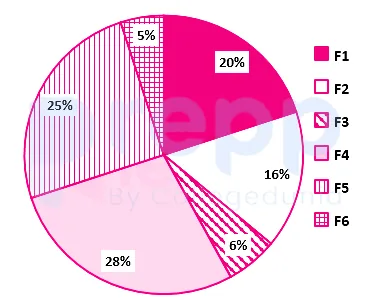
- A
385
- B
395
- C
375
- D
305
Show answer
C. 375Calculation:
So,
J1 = ((6 + 5)/2)% × 15000 = 825
J2 = (28 - 20)% × 15000 = 1200
Now, (J2 - J1)
⇒ 1200 - 825 = 375
∴ The value of (J2 - J1) is 375.
Paper & answer key PDF ↗ Question 65archived
The HCF of two numbers is 17 and the other two factors of their LCM are 11 and 19. The smaller of the two numbers is:
- A
209
- B
187
- C
323
- D
306
Show answer
B. 187Understanding HCF, LCM, and Number Relationships
The problem involves finding the smaller of two numbers given their Highest Common Factor (HCF) and information about their Least Common Multiple (LCM). We need to use the fundamental relationship between two numbers, their HCF, and their LCM.
Key Relationship Between HCF and LCM
For any two positive integers, say 'a' and 'b', the product of the numbers is equal to the product of their HCF and LCM.
\( a \times b = \text{HCF}(a, b) \times \text{LCM}(a, b) \)
Another important concept is that if the HCF of two numbers 'a' and 'b' is \(h\), then the numbers can be expressed as \(a = hx\) and \(b = hy\), where \(x\) and \(y\) are integers that are coprime (their HCF is 1). In this case, their LCM is given by \( \text{LCM}(a, b) = hxy \).
Analyzing the Given Information
We are given:
HCF of the two numbers is 17. So, \(h = 17\).
The other two factors of their LCM are 11 and 19.
The LCM of two numbers is the product of their HCF and the other coprime factors from each number. The statement "other two factors of their LCM are 11 and 19" implies that the LCM can be written as HCF \( \times \) 11 \( \times \) 19. This is because 11 and 19 are given as factors of the LCM besides the HCF, and they must represent the \(x\) and \(y\) parts from the formula \( \text{LCM} = hxy \).
Since 11 and 19 are prime numbers, they are coprime. Therefore, we can consider these as the coprime factors \(x\) and \(y\).
Let \(x = 11\)
Let \(y = 19\)
Using the representation of the numbers \(a = hx\) and \(b = hy\), we can find the two numbers.
Calculating the Two Numbers
The two numbers are:
First number \(a = hx = 17 \times 11\)
Second number \(b = hy = 17 \times 19\)
Let's calculate their values:
\(a = 17 \times 11\)
10
7
11
110
77
\(17 \times 11 = 110 + 77 = 187\)
\(b = 17 \times 19\)
10
7
19
190
133
\(17 \times 19 = 190 + 133 = 323\)
So the two numbers are 187 and 323.
Identifying the Smaller Number
Comparing the two numbers, 187 and 323, the smaller number is 187.
Verification
Let's quickly verify our answer:
Numbers are 187 and 323.
HCF(187, 323): \(187 = 17 \times 11\), \(323 = 17 \times 19\). The common factor is 17. HCF = 17. (Correct)
LCM(187, 323): The LCM is \(17 \times 11 \times 19\). The HCF is 17. The other two factors in the LCM are 11 and 19. (Correct)
The calculations match the given information, and the smaller number is 187.
Revision Table: HCF and LCM Concepts
Concept
Definition
Property
Example
HCF (Highest Common Factor)
Largest positive integer that divides two or more numbers without leaving a remainder.
HCF of \(ax, ay\) is \(a \times\) HCF(\(x, y\))
HCF(12, 18) = 6
LCM (Least Common Multiple)
Smallest positive integer that is a multiple of two or more numbers.
For numbers \(a, b\), \(a \times b = \text{HCF}(a, b) \times \text{LCM}(a, b)\)
LCM(12, 18) = 36
Relationship
Product of numbers = Product of HCF and LCM
If \(a=hx, b=hy\) where HCF(\(x,y\))=1, then LCM(\(a,b\)) = \(hxy\)
Numbers 12 (\(6\times2\)) and 18 (\(6\times3\)). HCF=6, \(x=2, y=3\). LCM = \(6\times2\times3 = 36\). \(12 \times 18 = 216\), \(6 \times 36 = 216\).
Additional Information: Prime Factorization Method
The prime factorization method is often used to find the HCF and LCM of numbers. Let's consider our numbers 187 and 323.
Prime factorization of 187: \(187 = 11 \times 17\)
Prime factorization of 323: \(323 = 17 \times 19\)
To find the HCF, we look for common prime factors and take the lowest power:
Common prime factor is 17.
HCF(187, 323) = \(17^1 = 17\).
To find the LCM, we take all prime factors from both numbers and use the highest power:
Prime factors are 11, 17, and 19.
LCM(187, 323) = \(11^1 \times 17^1 \times 19^1 = 11 \times 17 \times 19 = 187 \times 19 = 3553\).
Notice that the LCM (\(17 \times 11 \times 19\)) consists of the HCF (17) and the 'other' factors (11 and 19), as stated in the problem. This confirms our approach was correct.
Paper & answer key PDF ↗ Question 66archived
\(\rm {\cos A \over {1 - \tan A}} + {\sin A \over {1 - \cot A}}\) = ________.
- A
tan A - cot A
- B
tan A + cot A
- C
sin A - cos A
- D
sin A + cos A
Show answer
D. sin A + cos ASimplifying Trigonometric Expressions: Step-by-Step Guide
We are asked to simplify the given trigonometric expression:
\(\rm {\cos A \over {1 - \tan A}} + {\sin A \over {1 - \cot A}}\)
To simplify this expression, we will first convert \(\rm \tan A\) and \(\rm \cot A\) into their equivalent forms using \(\rm \sin A\) and \(\rm \cos A\). Recall the fundamental trigonometric identities:
\(\rm \tan A = {\sin A \over \cos A}\)
\(\rm \cot A = {\cos A \over \sin A}\)
Step 1: Rewrite the expression using sin and cos
Substitute the identities into the given expression:
\(\rm {\cos A \over {1 - {\sin A \over \cos A}}} + {\sin A \over {1 - {\cos A \over \sin A}}}\)
Step 2: Simplify the denominators
Find a common denominator for the terms within the denominators:
For the first term's denominator: \(\rm {1 - {\sin A \over \cos A}} = {{\cos A - \sin A} \over \cos A}\)
For the second term's denominator: \(\rm {1 - {\cos A \over \sin A}} = {{\sin A - \cos A} \over \sin A}\)
Substitute these back into the main expression:
\(\rm {\cos A \over {{{\cos A - \sin A} \over \cos A}}} + {\sin A \over {{{\sin A - \cos A} \over \sin A}}}\)
Step 3: Simplify the complex fractions
Remember that dividing by a fraction is the same as multiplying by its reciprocal:
\(\rm {\cos A \cdot {\cos A \over {\cos A - \sin A}}} + {\sin A \cdot {\sin A \over {\sin A - \cos A}}}\)
\(\rm {\cos^2 A \over {\cos A - \sin A}} + {\sin^2 A \over {\sin A - \cos A}}\)
Step 4: Combine the fractions
Notice that the denominators are similar, but one is the negative of the other. We can rewrite \(\rm (\sin A - \cos A)\) as \(\rm - (\cos A - \sin A)\). Let's rewrite the second term:
\(\rm {\sin^2 A \over {\sin A - \cos A}} = {\sin^2 A \over - (\cos A - \sin A)} = - {\sin^2 A \over {\cos A - \sin A}}\)
Now the expression becomes:
\(\rm {\cos^2 A \over {\cos A - \sin A}} - {\sin^2 A \over {\cos A - \sin A}}\)
Now that the denominators are the same, we can combine the numerators:
\(\rm {{\cos^2 A - \sin^2 A} \over {\cos A - \sin A}}\)
Step 5: Use the difference of squares identity
Recall the difference of squares identity: \(\rm a^2 - b^2 = (a - b)(a + b)\). Apply this to the numerator, where \(\rm a = \cos A\) and \(\rm b = \sin A\):
\(\rm {\cos^2 A - \sin^2 A} = (\cos A - \sin A)(\cos A + \sin A)\)
Substitute this back into the fraction:
\(\rm {{(\cos A - \sin A)(\cos A + \sin A)} \over {\cos A - \sin A}}\)
Step 6: Cancel common terms
Assuming \(\rm (\cos A - \sin A) \neq 0\), we can cancel out the common factor \(\rm (\cos A - \sin A)\) from the numerator and the denominator:
\(\rm \cos A + \sin A\)
This can also be written as \(\rm \sin A + \cos A\).
Final Simplified Expression
The simplified form of the given expression is \(\rm \sin A + \cos A\).
Comparison with Options
Comparing our simplified expression with the provided options:
Option 1: \(\rm \tan A - \cot A\)
Option 2: \(\rm \tan A + \cot A\)
Option 3: \(\rm \sin A - \cos A\)
Option 4: \(\rm \sin A + \cos A\)
Our result matches Option 4.
Revision Table: Key Trigonometric Identities Used
Identity
Formula
Tangent in terms of Sine and Cosine
\(\rm \tan A = {\sin A \over \cos A}\)
Cotangent in terms of Sine and Cosine
\(\rm \cot A = {\cos A \over \sin A}\)
Difference of Squares
\(\rm a^2 - b^2 = (a - b)(a + b)\)
Additional Information: Understanding Trigonometric Simplification
Simplifying trigonometric expressions is a core skill in trigonometry. It often involves using fundamental identities to rewrite expressions in terms of simpler functions (like sine and cosine) or to combine terms. Key strategies include:
Converting all functions (like tan, cot, sec, cosec) into sin and cos.
Finding common denominators to add or subtract fractions.
Using algebraic techniques like factoring (difference of squares, perfect squares) and expanding.
Applying Pythagorean identities (\(\rm \sin^2 A + \cos^2 A = 1\), etc.).
Using reciprocal identities (\(\rm \sec A = {1 \over \cos A}\), etc.).
Practice with various identities helps in recognizing patterns and choosing the most efficient way to simplify an expression.
Paper & answer key PDF ↗ Question 67archived
If 2p + q = 19 and 8p3 + q3 = 361, then find the value of pq.
- A
56
- B
59
- C
58
- D
57
Show answer
D. 57Finding the Value of pq from Given Algebraic Equations
We are given two equations involving the variables p and q:
Equation 1: \(2p + q = 19\)
Equation 2: \(8p^3 + q^3 = 361\)
We need to find the value of the product \(pq\).
The second equation involves cubic terms, which suggests using an algebraic identity related to cubes. The identity for the cube of a sum, \((a+b)^3\), is useful here:
\((a+b)^3 = a^3 + b^3 + 3ab(a+b)\)
Let's apply this identity to the term \((2p + q)^3\). We can consider \(a = 2p\) and \(b = q\).
So, substituting these into the identity:
\((2p + q)^3 = (2p)^3 + q^3 + 3(2p)(q)(2p+q)\)
Simplifying the terms:
\((2p + q)^3 = 8p^3 + q^3 + 6pq(2p+q)\)
Now, we can substitute the values given in the problem into this expanded equation. From Equation 1, we know that \((2p + q) = 19\). From Equation 2, we know that \((8p^3 + q^3) = 361\).
Substituting these values:
\(19^3 = 361 + 6pq(19)\)
Next, let's calculate the value of \(19^3\).
\(19^2 = 19 \times 19 = 361\)
\(19^3 = 19^2 \times 19 = 361 \times 19\)
Performing the multiplication:
CalculationResult
\(361 \times 19\)\(6859\)
So, the equation becomes:
\(6859 = 361 + 114pq\)
Our goal is to find the value of \(pq\). We need to rearrange the equation to isolate the \(pq\) term.
Subtract 361 from both sides of the equation:
\(6859 - 361 = 114pq\)
\(6498 = 114pq\)
Now, divide both sides by 114 to solve for \(pq\):
\(pq = \frac{6498}{114}\)
Performing the division:
DivisionResult
\(6498 \div 114\)\(57\)
Thus, the value of \(pq\) is 57.
Revision Table: Solving for pq
StepActionResult/Formula
1Identify given equations\(2p+q=19\), \(8p^3+q^3=361\)
2Apply \((a+b)^3\) identity with \(a=2p, b=q\)\((2p+q)^3 = (2p)^3 + q^3 + 3(2p)q(2p+q)\)
3Simplify the identity application\((2p+q)^3 = 8p^3 + q^3 + 6pq(2p+q)\)
4Substitute given values into the equation\(19^3 = 361 + 6pq(19)\)
5Calculate \(19^3\)\(19^3 = 6859\)
6Substitute \(19^3\) value\(6859 = 361 + 114pq\)
7Isolate \(114pq\) term\(6859 - 361 = 114pq \implies 6498 = 114pq\)
8Solve for \(pq\)\(pq = \frac{6498}{114} = 57\)
Additional Information: Useful Algebraic Identities
Algebraic identities are fundamental tools in solving equations and simplifying expressions. They provide shortcuts and standard formulas for common algebraic manipulations.
Some frequently used identities related to powers include:
Square of a Sum: \((x+y)^2 = x^2 + 2xy + y^2\)
Square of a Difference: \((x-y)^2 = x^2 - 2xy + y^2\)
Difference of Squares: \(x^2 - y^2 = (x-y)(x+y)\)
Cube of a Sum: \((x+y)^3 = x^3 + y^3 + 3xy(x+y)\)
Cube of a Difference: \((x-y)^3 = x^3 - y^3 - 3xy(x-y)\)
Sum of Cubes: \(x^3 + y^3 = (x+y)(x^2 - xy + y^2)\)
Difference of Cubes: \(x^3 - y^3 = (x-y)(x^2 + xy + y^2)\)
Understanding and recognizing these identities can significantly simplify problems like the one solved above, where a relationship between linear terms and cubic terms is given.
Paper & answer key PDF ↗ Question 68archived
Which of the following statement is correct?
I. If x = 12, y = -2 and z = -10, then x3 + y3 + z3 = 720
II. If x + y = 48 and 4xy = 128, then s the value of 4x2 + 4y2 is 8960
- A
Neither I nor II
- B
Only I
- C
Both I and II
- D
Only II
Show answer
C. Both I and IIAnalyzing Algebraic Statements
Let's carefully analyze each statement provided in the question to determine its correctness.
Analysis of Statement I: Evaluating $x^3 + y^3 + z^3$
Statement I gives the values $x = 12$, $y = -2$, and $z = -10$. It claims that $x^3 + y^3 + z^3 = 720$ for these values.
We can evaluate this expression directly or use a relevant algebraic identity. A useful identity for the sum of cubes involves the sum of the variables: $x^3 + y^3 + z^3 - 3xyz = (x+y+z)(x^2+y^2+z^2-xy-yz-zx)$.
A special case of this identity is when $x+y+z=0$. In this case, the right side becomes $0$, leading to $x^3 + y^3 + z^3 = 3xyz$.
Let's check the sum of the given values of $x$, $y$, and $z$:
$$x+y+z = 12 + (-2) + (-10) = 12 - 2 - 10 = 12 - 12 = 0$$
Since $x+y+z = 0$, we can use the identity $x^3 + y^3 + z^3 = 3xyz$.
Now, let's calculate $3xyz$ using the given values:
$$3xyz = 3 \times (12) \times (-2) \times (-10)$$
$$3xyz = 3 \times 12 \times ((-2) \times (-10))$$
$$3xyz = 3 \times 12 \times 20$$
$$3xyz = 36 \times 20$$
$$3xyz = 720$$
So, for $x=12$, $y=-2$, and $z=-10$, we found that $x^3 + y^3 + z^3 = 720$. This matches the claim made in Statement I.
Therefore, Statement I is correct.
Analysis of Statement II: Evaluating $4x^2 + 4y^2$
Statement II provides two pieces of information: $x+y = 48$ and $4xy = 128$. It asks for the value of $4x^2 + 4y^2$.
First, let's simplify the second equation to find the value of $xy$:
$$4xy = 128$$
Divide both sides by 4:
$$xy = \frac{128}{4}$$
$$xy = 32$$
We need to find the value of $4x^2 + 4y^2$. We can factor out 4:
$$4x^2 + 4y^2 = 4(x^2 + y^2)$$
Now, we need to find the value of $x^2 + y^2$. We know the algebraic identity $(x+y)^2 = x^2 + y^2 + 2xy$. We can rearrange this identity to solve for $x^2 + y^2$:
$$x^2 + y^2 = (x+y)^2 - 2xy$$
We are given that $x+y = 48$ and we found that $xy = 32$. Substitute these values into the equation for $x^2 + y^2$:
$$x^2 + y^2 = (48)^2 - 2(32)$$
Calculate $(48)^2$:
$$48^2 = (50 - 2)^2 = 50^2 - 2 \times 50 \times 2 + 2^2 = 2500 - 200 + 4 = 2304$$
Calculate $2(32)$:
$$2(32) = 64$$
Now, substitute these values back into the equation for $x^2 + y^2$:
$$x^2 + y^2 = 2304 - 64$$
$$x^2 + y^2 = 2240$$
Finally, calculate $4(x^2 + y^2)$:
$$4(x^2 + y^2) = 4 \times 2240$$
$$4 \times 2240 = 8960$$
So, the value of $4x^2 + 4y^2$ is 8960. This matches the claim made in Statement II.
Therefore, Statement II is correct.
Conclusion
Based on our analysis, both Statement I and Statement II are correct.
Statement I was verified using the special case of the sum of cubes identity when the sum of the variables is zero ($x+y+z=0$). Statement II was verified by using the identity for $(x+y)^2$ to find $x^2+y^2$ and then substituting the given values.
Revision Table: Key Algebraic Concepts
Concept
Description
Relevant Identity/Formula
Sum of Cubes (General)
Relates the sum of cubes to the sum of variables and sums/products of squares.
$x^3 + y^3 + z^3 - 3xyz = (x+y+z)(x^2+y^2+z^2-xy-yz-zx)$
Sum of Cubes (Special Case)
If the sum of three variables is zero, the sum of their cubes equals three times their product.
If $x+y+z=0$, then $x^3 + y^3 + z^3 = 3xyz$
Square of Sum/Difference
Expands the square of the sum or difference of two variables.
$(a+b)^2 = a^2 + b^2 + 2ab$
$(a-b)^2 = a^2 + b^2 - 2ab$
Sum of Squares
Can be found from the square of the sum and the product of the variables.
$a^2 + b^2 = (a+b)^2 - 2ab$
Additional Information: Using Algebraic Identities
Algebraic identities are powerful tools in simplifying expressions and solving equations. They are equations that are true for all values of the variables involved.
Using identities can often save time compared to direct calculation, especially with larger numbers or complex expressions.
Recognizing the form of an expression allows you to apply the appropriate identity. For instance, seeing a sum of three cubes prompts you to consider the $x^3+y^3+z^3$ identity.
For expressions involving $x^2+y^2$ when $x+y$ and $xy$ are known, the identity $(x+y)^2 = x^2+y^2+2xy$ is fundamental.
Practicing with different algebraic problems helps in mastering the application of these identities.
Understanding these core identities is crucial for success in algebra and related fields of mathematics.
Paper & answer key PDF ↗ Question 69archived
A girl purchases 9 mangoes for Rs. 90 and sells 10 mangoes for Rs. 95. Find the gain or loss percentage.
- A
2.5% loss
- B
5% loss
- C
2.5% gain
- D
5% gain
Show answer
B. 5% lossUnderstanding Profit and Loss Percentage
This problem involves calculating the gain or loss percentage when buying and selling a different number of items at different prices. To compare effectively, we need to find the cost price (CP) and selling price (SP) for a single unit of the item (in this case, a single mango).
Calculating Cost Price (CP) per Mango
The girl purchases 9 mangoes for Rs. 90. The cost price for 9 mangoes is Rs. 90.
To find the cost price of one mango, we divide the total cost by the number of mangoes:
CP per mango = Total Cost / Number of mangoes
CP per mango = Rs. 90 / 9
CP per mango = Rs. 10
So, the cost price of one mango is Rs. 10.
Calculating Selling Price (SP) per Mango
The girl sells 10 mangoes for Rs. 95. The selling price for 10 mangoes is Rs. 95.
To find the selling price of one mango, we divide the total selling price by the number of mangoes sold:
SP per mango = Total Selling Price / Number of mangoes sold
SP per mango = Rs. 95 / 10
SP per mango = Rs. 9.50
So, the selling price of one mango is Rs. 9.50.
Determining Gain or Loss
Now, we compare the cost price per mango and the selling price per mango:
CP per mango = Rs. 10
SP per mango = Rs. 9.50
Since the Selling Price (Rs. 9.50) is less than the Cost Price (Rs. 10), there is a loss in this transaction.
Calculating the Loss Amount
The loss per mango is the difference between the Cost Price and the Selling Price:
Loss per mango = CP per mango - SP per mango
Loss per mango = Rs. 10 - Rs. 9.50
Loss per mango = Rs. 0.50
The loss on selling one mango is Rs. 0.50.
Calculating Loss Percentage
The loss percentage is calculated based on the cost price. The formula for loss percentage is:
\(\text{Loss Percentage} = \left( \frac{\text{Loss}}{\text{CP}} \right) \times 100\)
Using the values we calculated:
Loss = Rs. 0.50
CP per mango = Rs. 10
\(\text{Loss Percentage} = \left( \frac{0.50}{10} \right) \times 100\)
\(\text{Loss Percentage} = 0.05 \times 100\)
\(\text{Loss Percentage} = 5\%\)
The loss percentage is 5%.
Therefore, the girl incurs a loss of 5%.
Revision Table: Profit and Loss Key Concepts
Concept
Formula
Condition
Cost Price (CP)
Original price of an item
-
Selling Price (SP)
Price at which item is sold
-
Profit
SP - CP
If SP > CP
Loss
CP - SP
If CP > SP
Profit Percentage
\(\left( \frac{\text{Profit}}{\text{CP}} \right) \times 100\)
Calculated on CP
Loss Percentage
\(\left( \frac{\text{Loss}}{\text{CP}} \right) \times 100\)
Calculated on CP
Additional Information on Profit and Loss Calculation
When dealing with profit and loss problems involving different quantities bought and sold, it's crucial to standardize the comparison. This can be done in two main ways:
Calculate CP and SP per Unit: As shown in this solution, find the cost and selling price for a single item. This makes direct comparison easy.
Calculate CP and SP for a Common Quantity: Find the least common multiple (LCM) of the number of items bought and sold. Then calculate the total CP and total SP for that common quantity. For example, in this problem, the LCM of 9 and 10 is 90. You could calculate the cost of 90 mangoes and the selling price of 90 mangoes to find the total gain or loss for that quantity.
Both methods should yield the same percentage gain or loss. The percentage is always calculated relative to the original cost price (CP).
Paper & answer key PDF ↗ Question 70archived
In the following bar diagram, there are 5 companies A, B, C, D and E. The diagram shows the demand of a product and its production the above five companies.
If x% of the demand of the product by Company C is equal to that of the Company B, then find the value of x.
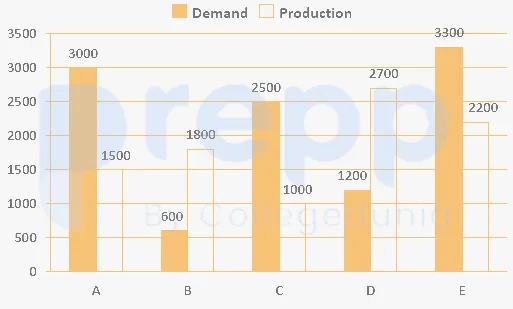
- A
24
- B
22
- C
23
- D
21
Show answer
A. 24Calculation:
According to the question,
x% × 2500 = 600
⇒ x% = 24
∴ The value of x is 24.
Paper & answer key PDF ↗ Question 71archived
A four-digit pin, say abcd, of a lock has different non-zero digits. The digits satisfy b = 2a, c = 2b, d = 2c. The pin is divisible by ________.
- A
2, 3, 5
- B
2, 3, 7
- C
2, 3, 13
- D
2, 3, 11
Show answer
C. 2, 3, 13Finding the Four-Digit Pin
The problem describes a four-digit pin, say \(abcd\), where \(a\), \(b\), \(c\), and \(d\) are distinct non-zero digits. This means each digit must be one of \(1, 2, 3, 4, 5, 6, 7, 8, 9\), and all four digits must be different from each other.
We are given the following relationships between the digits:
\(b = 2a\)
\(c = 2b\)
\(d = 2c\)
We can substitute the first equation into the second, and the second into the third, to express all digits in terms of \(a\):
\(b = 2a\)
\(c = 2b = 2(2a) = 4a\)
\(d = 2c = 2(4a) = 8a\)
Now, we need to find a value for \(a\) such that \(a\), \(b=2a\), \(c=4a\), and \(d=8a\) are all distinct non-zero digits (between 1 and 9 inclusive).
Let's try possible non-zero values for \(a\):
If \(a = 1\):
\(b = 2 \times 1 = 2\)
\(c = 4 \times 1 = 4\)
\(d = 8 \times 1 = 8\)
The digits are 1, 2, 4, and 8. These are all distinct and non-zero. This is a valid set of digits. The pin is 1248.
If \(a = 2\):
\(b = 2 \times 2 = 4\)
\(c = 4 \times 2 = 8\)
\(d = 8 \times 2 = 16\)
The digit \(d\) is 16, which is not a single digit. This is not a valid pin.
If we try any value of \(a\) greater than 1, the value of \(d=8a\) will be 16 or larger, which is not a single digit. Therefore, the only possible value for \(a\) is 1.
The unique four-digit pin that satisfies all the conditions is 1248.
Checking Divisibility of the Pin 1248
The question asks by which numbers the pin 1248 is divisible among the given options. The options involve checking divisibility by 2, 3, and a third number (5, 7, 13, or 11).
Divisibility by 2
A number is divisible by 2 if its last digit is an even number (0, 2, 4, 6, or 8).
The pin is 1248. The last digit is 8, which is an even number.
Therefore, 1248 is divisible by 2.
Divisibility by 3
A number is divisible by 3 if the sum of its digits is divisible by 3.
The sum of the digits of 1248 is \(1 + 2 + 4 + 8 = 15\).
The number 15 is divisible by 3 (\(15 = 3 \times 5\)).
Therefore, 1248 is divisible by 3.
Checking the Third Divisor from Options
Since 1248 is divisible by both 2 and 3, we now check the third number provided in each option.
Divisibility by 5 (Option 1: 2, 3, 5)
A number is divisible by 5 if its last digit is 0 or 5.
The last digit of 1248 is 8. It is not 0 or 5.
Therefore, 1248 is not divisible by 5.
Divisibility by 7 (Option 2: 2, 3, 7)
To check divisibility by 7, we can subtract twice the last digit from the number formed by the remaining digits. We repeat this process until we get a small number.
For 1248: Number is 124, last digit is 8. Calculate \(124 - 2 \times 8 = 124 - 16 = 108\).
For 108: Number is 10, last digit is 8. Calculate \(10 - 2 \times 8 = 10 - 16 = -6\).
Since -6 is not divisible by 7, 1248 is not divisible by 7.
Divisibility by 13 (Option 3: 2, 3, 13)
We can perform division to check if 1248 is divisible by 13.
Divide 1248 by 13:
\(1248 \div 13\)
\(13 \times 90 = 1170\)
\(1248 - 1170 = 78\)
\(13 \times 6 = 78\)
\(78 - 78 = 0\)
Since the remainder is 0, 1248 is divisible by 13 (\(1248 = 13 \times 96\)).
Thus, 1248 is divisible by 2, 3, and 13. This matches Option 3.
Divisibility by 11 (Option 4: 2, 3, 11)
To check divisibility by 11, find the alternating sum of the digits, starting from the rightmost digit.
For 1248: \(8 - 4 + 2 - 1 = 5\).
Since the alternating sum (5) is not 0 or a multiple of 11, 1248 is not divisible by 11.
Conclusion
The unique four-digit pin satisfying the given conditions is 1248. This pin is divisible by 2, 3, and 13.
Revision Table: Pin Calculation and Divisibility Checks
Property/CheckDetailsResult for 1248
DigitsDistinct, Non-zero1, 2, 4, 8 (Distinct, Non-zero)
Relations\(b=2a, c=2b, d=2c\)\(2=2\times1, 4=2\times2, 8=2\times4\) (Satisfied)
Pin NumberDetermined from relations1248
Divisibility by 2Last digit even?Yes (8 is even)
Divisibility by 3Sum of digits divisible by 3?Yes (\(1+2+4+8=15\), 15 is divisible by 3)
Divisibility by 5Last digit 0 or 5?No (Last digit is 8)
Divisibility by 7Check ruleNo (Result of rule application is -6)
Divisibility by 13Exact division?Yes (\(1248 = 13 \times 96\))
Divisibility by 11Alternating sum rule?No (Alternating sum is 5)
Additional Information: Number Theory Concepts
This problem involves basic concepts from number theory, specifically properties of integers and divisibility rules. Understanding these rules helps in quickly determining if one integer can be exactly divided by another without performing long division.
Properties of Digits and Numbers
A number is composed of digits. The place value of each digit is crucial. For a number like \(abcd\), its value is \(1000a + 100b + 10c + d\). The problem constraints on digits (distinct, non-zero) limit the possibilities significantly.
Common Divisibility Rules
Divisibility rules are shortcuts. Some common rules include:
Divisibility by 2: A number is divisible by 2 if its unit digit is 0, 2, 4, 6, or 8.
Divisibility by 3: A number is divisible by 3 if the sum of its digits is divisible by 3.
Divisibility by 4: A number is divisible by 4 if the number formed by its last two digits is divisible by 4.
Divisibility by 5: A number is divisible by 5 if its unit digit is 0 or 5.
Divisibility by 6: A number is divisible by 6 if it is divisible by both 2 and 3.
Divisibility by 9: A number is divisible by 9 if the sum of its digits is divisible by 9.
Divisibility by 10: A number is divisible by 10 if its unit digit is 0.
Divisibility by 11: A number is divisible by 11 if the alternating sum of its digits (starting from the rightmost digit) is 0 or a multiple of 11.
Checking divisibility by prime numbers like 7, 13, 17, etc., sometimes involves more complex rules or direct division, especially for larger numbers.
Paper & answer key PDF ↗ Question 72archived
A horse is grazing in a field. It is tied to a pole with a rope of length 6 m. The horse moves from point A to point B making an arch with an angle of 70°. Find the area of the sector grazed by the horse.
- A
22 m2
- B
21 m2
- C
23 m2
- D
20 m2
Show answer
A. 22 m2Understanding the Horse Grazing Problem
The problem describes a horse tied to a pole with a rope. As the horse grazes, the rope keeps it a fixed distance from the pole. When the horse moves from one point to another while the rope is taut, it follows the path of an arc. The area the horse grazes in this scenario forms a sector of a circle.
In this specific problem:
The pole is the center of the circle.
The length of the rope is the radius of the circle.
The path traced by the horse from point A to point B is an arc of the circle.
The area grazed between the pole, the two points A and B, and the arc connecting them is the area of a sector.
Identifying Given Information for Sector Area
We are given the following information:
Length of the rope (radius of the sector), \(r = 6\) m.
The angle swept by the horse's movement (central angle of the sector), \( \theta = 70^\circ \).
We need to find the area of this sector.
Calculating the Area of the Sector
The formula for the area of a sector of a circle with radius \(r\) and central angle \( \theta \) (in degrees) is:
\[ \text{Area of Sector} = \frac{\theta}{360^\circ} \times \pi r^2 \]
Now, we substitute the given values into the formula:
\[ \text{Area} = \frac{70^\circ}{360^\circ} \times \pi (6 \text{ m})^2 \]
Simplify the fraction and the radius term:
\[ \text{Area} = \frac{70}{360} \times \pi \times 36 \text{ m}^2 \]
\[ \text{Area} = \frac{7}{36} \times \pi \times 36 \text{ m}^2 \]
We can cancel out the 36 in the denominator and numerator:
\[ \text{Area} = 7 \times \pi \text{ m}^2 \]
To get a numerical value, we use the approximate value of \( \pi \approx \frac{22}{7} \), which is commonly used in such problems to yield simple results:
\[ \text{Area} \approx 7 \times \frac{22}{7} \text{ m}^2 \]
\[ \text{Area} \approx 22 \text{ m}^2 \]
So, the area of the sector grazed by the horse is approximately 22 m\(^2\).
Area of Sector Calculation Summary
Parameter
Value
Unit
Radius (r)
6
m
Central Angle (θ)
70
degrees
Formula
\( \frac{\theta}{360^\circ} \times \pi r^2 \)
Calculation
\( \frac{70}{360} \times \pi \times 6^2 = 7 \times \pi \approx 7 \times \frac{22}{7} = 22 \)
Calculated Area
22
m\(^2\)
Based on our calculation, the area grazed by the horse is 22 square meters.
Revision Table: Circle Geometry Formulas
Concept
Formula
Description
Area of Circle
\( \pi r^2 \)
Area covered by a full circle of radius r.
Circumference of Circle
\( 2 \pi r \) or \( \pi d \)
Distance around a full circle of radius r or diameter d.
Area of Sector
\( \frac{\theta}{360^\circ} \times \pi r^2 \)
Area of a part of a circle bounded by two radii and an arc, with central angle \( \theta \) in degrees.
Arc Length
\( \frac{\theta}{360^\circ} \times 2 \pi r \)
Length of the curved part of the sector's boundary, with central angle \( \theta \) in degrees.
Additional Information on Sector and Arc
A sector is essentially a slice of a circle. It is defined by two radii and the arc between them. The size of the sector is determined by the angle between the two radii, called the central angle.
The area of the sector is a fraction of the total area of the circle, determined by the ratio of the central angle to the total angle in a circle (360 degrees).
The arc length is the length of the curved boundary of the sector. It is also a fraction of the total circumference of the circle, determined by the same angle ratio.
Understanding sectors and arcs is crucial in problems involving parts of circles, such as calculating areas for curved regions or distances along curved paths. This horse grazing problem is a classic example of applying the sector area concept.
Paper & answer key PDF ↗ Question 73archived
ΔABC and ΔDEF are similar triangles and their areas are 49 cm2 and 144 cm2 respectively. If EF = 16.80 cm, then find BC.
- A
7.5 cm
- B
9.8 cm
- C
8.7 cm
- D
11.4 cm
Show answer
B. 9.8 cmUnderstanding Similar Triangles and Area
This problem involves similar triangles and how their areas relate to the lengths of their corresponding sides. When two triangles are similar, their corresponding angles are equal, and the ratio of their corresponding sides is constant. A key property of similar triangles states that the ratio of their areas is equal to the square of the ratio of their corresponding sides.
Applying the Area Ratio Property
We are given that ΔABC is similar to ΔDEF (ΔABC ∼ ΔDEF). This means that the vertices correspond in the order given: A corresponds to D, B corresponds to E, and C corresponds to F. Therefore, the corresponding sides are AB and DE, BC and EF, and AC and DF.
We are given:
Area of ΔABC = 49 cm<sup>2</sup>
Area of ΔDEF = 144 cm<sup>2</sup>
EF = 16.80 cm
We need to find the length of side BC, which corresponds to EF.
The property relating the areas and corresponding sides of similar triangles is:
$$ \frac{\text{Area}(\Delta ABC)}{\text{Area}(\Delta DEF)} = \left(\frac{BC}{EF}\right)^2 $$
Solving for the Unknown Side (BC)
Now, let's substitute the given values into the formula:
$$ \frac{49}{144} = \left(\frac{BC}{16.80}\right)^2 $$
To find the ratio of the sides, we need to take the square root of both sides of the equation:
$$ \sqrt{\frac{49}{144}} = \sqrt{\left(\frac{BC}{16.80}\right)^2} $$
$$ \frac{\sqrt{49}}{\sqrt{144}} = \frac{BC}{16.80} $$
$$ \frac{7}{12} = \frac{BC}{16.80} $$
Now, we can solve for BC by multiplying both sides by 16.80:
$$ BC = \frac{7}{12} \times 16.80 $$
Let's perform the calculation:
$$ BC = 7 \times \frac{16.80}{12} $$
Divide 16.80 by 12:
$$ \frac{16.80}{12} = 1.40 $$
Now multiply by 7:
$$ BC = 7 \times 1.40 $$
$$ BC = 9.80 \text{ cm} $$
Final Answer
The length of side BC is 9.80 cm.
Let's verify this with the given options.
The calculated value 9.8 cm matches one of the options.
Revision Table - Similar Triangles Area and Sides
Concept
Description
Formula
Similar Triangles
Triangles with equal corresponding angles and proportional corresponding sides.
ΔABC ∼ ΔDEF means ∠A=∠D, ∠B=∠E, ∠C=∠F and AB/DE = BC/EF = AC/DF = k (scale factor)
Area Ratio Property
The ratio of the areas of two similar triangles is equal to the square of the ratio of their corresponding sides (or the square of the scale factor).
Area(ΔABC) / Area(ΔDEF) = (BC/EF)<sup>2</sup> = k<sup>2</sup>
Additional Information - Properties of Similar Triangles
Understanding similar triangles is fundamental in geometry. Besides the area relationship, similar triangles have other important properties:
Ratio of Perimeters: The ratio of the perimeters of two similar triangles is equal to the ratio of their corresponding sides (the scale factor). If the scale factor is k, the perimeter ratio is also k.
Ratio of Altitudes: The ratio of corresponding altitudes in similar triangles is equal to the ratio of their corresponding sides (the scale factor).
Ratio of Medians: The ratio of corresponding medians in similar triangles is equal to the ratio of their corresponding sides (the scale factor).
Ratio of Angle Bisectors: The ratio of corresponding angle bisectors in similar triangles is equal to the ratio of their corresponding sides (the scale factor).
These properties show that the scale factor k applies linearly to lengths (sides, perimeter, altitude, median, angle bisector) and quadratically to area.
Paper & answer key PDF ↗ Question 74archived
A can of water and milk mixture contains 60% milk. A part of this mixture is replaced by another mixture containing 50% milk and the percentage of milk was found to be 52%. The quantity of mixture replaced is:
- A
\(1 \over 5\)
- B
\(3 \over 5\)
- C
\(4 \over 5\)
- D
\(2 \over 5\)
Show answer
C. \(4 \over 5\)Solving the Mixture Replacement Problem
This problem involves calculating the quantity of a mixture replaced by another mixture with a different concentration of milk. We need to find the fraction of the original mixture that was replaced.
Understanding the Initial State
We start with a can containing a mixture of water and milk. The key information is:
The initial mixture has 60% milk.
Let the total quantity of the initial mixture be represented by $Q$.
Therefore, the initial quantity of milk is $0.60 \times Q$.
Analyzing the Replacement Process
A certain part of this initial mixture is removed and replaced with a different mixture. Let's break down the steps:
Let the quantity of the mixture that is replaced be $x$.
The quantity of the original mixture remaining in the can after replacement is $Q - x$.
The quantity of the new mixture added is $x$.
The new mixture that is added contains 50% milk.
Calculating Milk Quantities
We need to track the amount of milk before and after the replacement:
Milk in the initial mixture: $0.60 \times Q$
Milk removed: Since the mixture removed has 60% milk, the amount of milk removed is $0.60 \times x$.
Milk added: The replacement mixture has 50% milk, so the amount of milk added is $0.50 \times x$.
Determining the Final Milk Percentage
The total quantity of the mixture in the can remains $Q$ (because $x$ was removed and $x$ was added). The final amount of milk in the mixture is:
Final Milk = (Initial Milk) - (Milk Removed) + (Milk Added)
Substituting the values:
Final Milk = $(0.60 \times Q) - (0.60 \times x) + (0.50 \times x)$
Simplifying the expression:
Final Milk = $0.60Q - (0.60 - 0.50)x$
Final Milk = $0.60Q - 0.10x$
Setting Up the Equation for the Final State
We are told that the percentage of milk in the final mixture is 52%. This means the final quantity of milk is $0.52 \times Q$. We can now set up an equation:
$0.52Q = 0.60Q - 0.10x$
Solving for the Replaced Quantity Fraction
Now, we need to solve this equation for the fraction $\frac{x}{Q}$:
Rearrange the equation to isolate the terms with $x$ and $Q$:
$0.10x = 0.60Q - 0.52Q$
Combine the terms involving $Q$:
$0.10x = 0.08Q$
To find the fraction $\frac{x}{Q}$, divide both sides by $Q$ and then by $0.10$:
$\frac{x}{Q} = \frac{0.08}{0.10}$
Simplify the fraction:
$\frac{x}{Q} = \frac{8}{10}$
Reduce the fraction to its simplest form:
$\frac{x}{Q} = \frac{4}{5}$
This means the quantity of mixture replaced ($x$) is $\frac{4}{5}$ of the total initial quantity ($Q$).
Conclusion
The quantity of mixture replaced is $\frac{4}{5}$ of the total mixture.
Paper & answer key PDF ↗ Question 75archived
The number of mobile sim-cards in 4 states/UT are given in the bar diagram. Study the diagram and answer the question.
In which State\UT is there the smallest number of owners of the BSNL Sim-card?
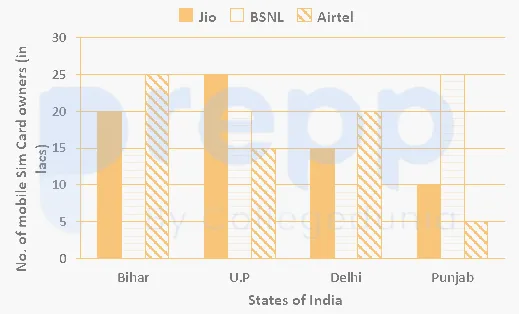
- A
Punjab
- B
UP
- C
Delhi
- D
Bihar
Show answer
C. DelhiCalculation:
From the given chart, this is clear that Delhi has the smallest number of owners of the BSNL Sim-card.
∴ Delhi has the smallest number of owners of the BSNL Sim-card.
Paper & answer key PDF ↗ Question 76archived
Select the option that can be used as a one-word substitute for the given group of words.
A poll taken of voters leaving the voting place that is usually used for predicting the winners.
- A
Consensus
- B
Results
- C
Census
- D
Exit poll
Show answer
D. Exit pollFinding the One-Word Substitute for Voter Prediction Polls
The question asks for a single term that accurately describes a specific type of poll: one that is taken from voters immediately after they leave the voting place and is commonly used to predict election winners. We need to find the best match among the given options.
Understanding the Key Description
The core elements of the description are:
A poll or survey.
Taken from voters.
Conducted right after they leave the voting place.
Its primary purpose is predicting election outcomes.
This combination points towards a survey method used for forecasting election results based on immediate voter feedback.
Evaluating the Term Options
Let's look at each option provided:
Consensus: This term refers to a general agreement among a group of people. It doesn't involve polling voters or predicting election results. Therefore, it is not a suitable substitute.
Results: This word signifies the final outcome or conclusion of an event, such as an election. While related to elections, 'results' represent the final count, not the specific method of polling voters leaving the voting place to predict those results.
Census: A census is an official count or survey of an entire population, usually conducted periodically (e.g., every ten years) by the government to gather demographic data. It is not specifically related to polling voters after they vote to predict winners.
Exit poll: This term precisely matches the description. An exit poll is a survey conducted by researchers or media organizations asking voters about their choices as they leave a polling place. The data collected from an exit poll is aggregated and analyzed to provide an early indication and prediction of election outcomes.
Identifying the Correct Substitute
Based on the analysis, the term 'Exit poll' is the most accurate and specific one-word substitute for the given group of words, as it perfectly encapsulates the process of polling voters immediately after they vote for the purpose of predicting winners.
Paper & answer key PDF ↗ Question 77archived
Select the most appropriate ANTONYM of the given word.
Intense
- A
Thrifty
- B
Moderate
- C
Stately
- D
Lavish
Show answer
B. ModerateThe correct answer is Moderate.
Antonyms provide contrast, helping to define the boundaries of a word's meaning. While some words have clear antonyms (like 'hot' and 'cold'), others might have several possible antonyms depending on the specific context in which the word is used. For 'intense', words like 'mild', 'gentle', or 'weak' could also be considered antonyms in certain contexts, but 'moderate' directly contrasts the 'extreme' aspect often associated with 'intense'.
Paper & answer key PDF ↗ Question 78archived
The following sentence has been split into four segments. Identify the segment that contains a grammatical error.
Usually, Ratheesh hasn’t/take part in these types/of events because of/his hectic schedule.
- A
take part in these types
- B
of events because of
- C
his hectic schedule
- D
Usually, Ratheesh hasn’t
Show answer
D. Usually, Ratheesh hasn’tUnderstanding Grammatical Errors in Sentence Segments
The question asks us to identify the segment of the given sentence that contains a grammatical error. Let's look at the sentence split into its four parts:
Segment 1: Usually, Ratheesh hasn’t
Segment 2: take part in these types
Segment 3: of events because of
Segment 4: his hectic schedule.
Analyzing the Sentence Structure
The sentence uses the present perfect tense structure, indicated by the auxiliary verb “hasn’t” (which is a contraction of “has not”). The general structure for the present perfect tense is:
Subject + has/have + Past Participle of the main verb + rest of the sentence.
In this sentence, the subject is “Ratheesh” and the auxiliary verb is “hasn’t”. The main verb phrase is “take part”. According to the present perfect tense rule, the main verb following “hasn’t” should be in its past participle form.
Identifying the Verb Form Error
The verb “take” has the following forms:
Base Form: take
Past Simple Form: took
Past Participle Form: taken
In the given sentence, “hasn’t” is followed by the base form “take”. The correct structure requires the past participle, which is “taken”. Therefore, the phrase “hasn’t take part” is grammatically incorrect. It should be “hasn’t taken part”.
Locating the Segment with the Error
The grammatical error lies in the combination of “hasn’t” and “take”. Segment 1 ends with “hasn’t” and Segment 2 begins with “take part”. The error occurs because the auxiliary verb in Segment 1 (“hasn’t”) requires a past participle, but is followed by a base form (“take”) which is in Segment 2. However, grammar questions asking for the segment with the error typically pinpoint the segment where the incorrect verb form or the structure triggering the error is located.
Since Segment 1 contains the auxiliary verb “hasn’t” which dictates the need for a past participle, and the subsequent verb form is incorrect, the error is considered to be associated with or originating from the segment containing this auxiliary. The presence of “hasn’t” in Segment 1 in this context, leading to an incorrect construction with the following verb, makes Segment 1 the location of the grammatical error.
Let's examine the segments based on this understanding:
Segment 1: “Usually, Ratheesh hasn’t” - Contains the auxiliary verb that requires a past participle.
Segment 2: “take part in these types” - Contains the incorrect base form “take”.
Segment 3: “of events because of” - Grammatically correct part of a prepositional phrase.
Segment 4: “his hectic schedule.” - Grammatically correct part.
The error is the failure to use the past participle form after “hasn’t”. While the incorrect verb form “take” is in Segment 2, the segment containing the auxiliary verb “hasn’t” (Segment 1) is where the structure requiring the correct form is established. Therefore, Segment 1 is identified as containing the grammatical error in this split.
Conclusion
Based on the analysis of the present perfect tense structure and the requirement for a past participle after “has/have/had”, the segment containing the error is the one with the auxiliary verb “hasn’t” that is followed by an incorrect verb form.
The segments are:
Segment 1: Usually, Ratheesh hasn’t
Segment 2: take part in these types
Segment 3: of events because of
Segment 4: his hectic schedule.
The error is in Segment 1, "Usually, Ratheesh hasn’t", because the verb phrase beginning here (“hasn’t take”) uses the wrong form of the main verb. The correct sentence would be “Usually, Ratheesh hasn’t taken part in these types of events because of his hectic schedule.”
Looking at the options provided:
Option 1: take part in these types (Segment 2)
Option 2: of events because of (Segment 3)
Option 3: his hectic schedule (Segment 4)
Option 4: Usually, Ratheesh hasn’t (Segment 1)
The segment containing the grammatical error is Segment 1, which corresponds to Option 4.
Revision Table: Sentence Segments and Errors
Segment
Text
Grammatical Analysis
Error Present?
1
Usually, Ratheesh hasn’t
Contains the auxiliary “hasn’t” (has not), requiring a past participle verb form subsequently.
Yes, initiates an incorrect verb structure.
2
take part in these types
Contains the base form “take” which is incorrect after “hasn’t”.
Part of the erroneous phrase, but the error is pinpointed to Segment 1 in this split.
3
of events because of
Prepositional phrase segment, grammatically sound.
No
4
his hectic schedule.
Part of the concluding phrase, grammatically sound.
No
Additional Information: Present Perfect Tense and Verb Forms
The present perfect tense is used to describe actions that happened at an unspecified time before now, or actions that began in the past and continue to the present, or actions that have a result in the present.
Key aspects of the Present Perfect Tense:
Form: Subject + has/have + Past Participle of the main verb.
Use “has” with singular subjects (he, she, it, singular noun like Ratheesh).
Use “have” with plural subjects (they, we, you, I, plural nouns).
The negative form is created by adding “not” between the auxiliary (has/have) and the past participle (e.g., has not taken, haven't finished).
Always use the past participle form of the main verb. Common examples include:
go → gone
eat → eaten
write → written
do → done
see → seen
Understanding the correct past participle forms of irregular verbs is crucial for using the present perfect tense correctly. In this case, the irregular verb is “take”, whose past participle is “taken”.
Paper & answer key PDF ↗ Question 79archived
Select the most appropriate option to fill in the blank.
There was a ________ accident last night and the inspector on deputy was unable to raise help when she called from the mountains.
- A
goofy
- B
gloomy
- C
serious
- D
harsh
Show answer
C. seriousUnderstanding Sentence Completion
This question asks us to choose the most appropriate word to fill in the blank in the given sentence: "There was a ________ accident last night and the inspector on deputy was unable to raise help when she called from the mountains." We need to select a word from the options that logically fits the context and explains why the inspector couldn't get help.
Analyzing the Options for the Accident
Let's look at the provided options and consider how each word would describe an "accident" and whether that description explains the difficulty in raising help:
goofy: This means silly or ridiculous. A "goofy accident" doesn't suggest a situation where getting help would be impossible or difficult, especially from the mountains. This word doesn't fit the serious consequence mentioned.
gloomy: This describes a dark or depressing atmosphere or mood. An accident isn't typically described as "gloomy." While the *aftermath* might be gloomy, the accident itself isn't the mood. This doesn't explain the inability to get help.
serious: This means important, significant, or severe. A "serious accident" implies significant damage, injury, or disruption. A severe accident, especially in a remote location like the mountains, could easily disrupt communication or access, making it very difficult to raise help. This word provides a strong reason for the stated consequence.
harsh: This means rough, cruel, or severe, often applying to conditions or treatment. While "harsh" can sometimes relate to severity, "serious" is the more standard and fitting descriptor for the severity of an accident itself that leads to such consequences. "Harsh conditions" might hinder rescue, but "harsh accident" is less common terminology to describe the event causing the difficulty.
Identifying the Best Fit for the Sentence
The sentence links the type of accident directly to the inability of the inspector to raise help. A word that describes the severity or significance of the accident is required to establish this cause-and-effect relationship. Among the options, "serious" is the word that most strongly implies a significant event that could lead to the described difficulty in getting assistance, especially from a remote location like the mountains.
A serious accident would likely involve circumstances (like damage to vehicles, injury, or being stranded in a difficult location) that would make communication or rescue efforts challenging. The other options ("goofy," "gloomy," "harsh") do not adequately explain why raising help would be difficult in the context of an accident.
The Completed Sentence
Using the most appropriate word, the completed sentence is:
There was a serious accident last night and the inspector on deputy was unable to raise help when she called from the mountains.
Option
Meaning
Fits Context?
Reason
goofy
Silly, ridiculous
No
Does not explain difficulty in getting help.
gloomy
Dark, depressing mood
No
Describes mood, not the nature of the accident itself.
serious
Severe, important, significant
Yes
A serious accident provides a logical reason for being unable to raise help.
harsh
Rough, cruel, severe (often conditions)
Less appropriate
While related to severity, "serious" is a more standard descriptor for the accident itself causing this consequence.
Based on the analysis, "serious" is the most suitable word to fill the blank, as it logically connects the accident to the consequence of being unable to raise help.
Revision Table: Accident Severity and Help
Concept
Key Points
Relation to Question
Accident Severity
Describes the impact or scale of an accident (minor, serious, fatal).
The blank requires a word indicating severity.
Raising Help
Seeking assistance (e.g., emergency services, rescue).
The consequence mentioned in the sentence is the inability to do this.
Context Clues
Words in the sentence that help determine the meaning (e.g., "unable to raise help," "from the mountains").
These clues point towards a severe event.
Additional Information: Choosing Vocabulary
When completing sentences, it's important to consider:
Meaning: What does each word option mean precisely?
Connotation: What feelings or ideas does the word suggest?
Context: How does the word interact with the other words in the sentence? Does it make logical sense in the overall situation described?
Usage: Is this word commonly used in this way? (e.g., we say "serious accident" more often than "gloomy accident").
In this specific sentence completion task, the consequence ("unable to raise help") is a critical context clue. It strongly suggests that the accident itself must have been significant enough to cause this difficulty. "Serious" directly implies this necessary level of significance or severity.
Paper & answer key PDF ↗ Question 80archived
Select the most appropriate synonym of the given word.
Distant
- A
Farsighted
- B
Faraway
- C
Futuristic
- D
Forward
Show answer
B. FarawayUnderstanding the Question: Finding the Best Synonym for Distant
The question asks for the most appropriate synonym for the word "Distant". A synonym is a word or phrase that means exactly or nearly the same as another word or phrase in the same language. We need to find the option that is closest in meaning to "Distant".
Analyzing the Word "Distant"
The word "Distant" means:
Far away in space or time.
Reserved or aloof in manner.
In the context of common usage, it often refers to physical distance.
Evaluating the Options
Let's look at each option provided and determine its meaning:
Farsighted: This word primarily means:
Having the ability to see distant objects clearly but having difficulty seeing near objects (literally).
Having a good understanding of the potential consequences of future actions; planning for the future (figuratively).
This is not a direct synonym for "Distant".
Faraway: This word means:
Situated at a great distance; remote.
This meaning is very close to the primary meaning of "Distant".
Futuristic: This word means:
Having or involving very modern or advanced features or technology.
Relating to or characteristic of the future.
This relates to time (the future) but not necessarily physical distance, and certainly not the primary sense of "Distant" meaning physically far.
Forward: This word means:
In the direction that one is facing or travelling; towards the front.
Onward so as to make progress.
Relating to the future.
This describes direction or progress, not distance.
Comparing "Distant" and the Options
Let's compare the meanings:
Word
Primary Meaning
Is it a Synonym for Distant?
Distant
Far away (in space or time)
-
Farsighted
Seeing far clearly (literally); planning for the future (figuratively)
No
Faraway
Situated at a great distance; remote
Yes
Futuristic
Relating to the future or advanced technology
No
Forward
Towards the front; onward; relating to the future
No
Conclusion: Selecting the Most Appropriate Synonym
Based on the analysis, "Faraway" has the meaning "situated at a great distance," which is the most direct synonym for "Distant" meaning "far away in space." The other options, "Farsighted," "Futuristic," and "Forward," have meanings that are not synonymous with "Distant."
Therefore, the most appropriate synonym for "Distant" is "Faraway".
Revision Table: Key Vocabulary
Word
Meaning
Example Sentence
Distant
Far away in space or time; aloof
The distant mountains were covered in snow.
Synonym
A word with the same or similar meaning
"Big" is a synonym for "large".
Farsighted
Can see far clearly; plans for the future
She is a farsighted leader who thinks long-term.
Faraway
Located at a great distance; remote
They live in a faraway village.
Futuristic
Relating to the future; advanced design
The architect designed a futuristic building.
Forward
Towards the front; onward
We decided to move forward with the plan.
Additional Information: Exploring Synonyms and Antonyms
Understanding synonyms helps improve your vocabulary and writing skills. Knowing words with similar meanings allows you to express yourself more precisely and avoid repetition. Antonyms are words with opposite meanings.
For the word "Distant":
Synonyms: remote, far, faraway, out of the way, secluded, isolated.
Antonyms: near, close, nearby, adjacent, immediate.
Looking at this list, "faraway" is clearly listed as a common synonym for "distant." This further supports our choice.
When choosing a synonym, it's important to consider the specific context in which the word is used, as sometimes synonyms have slightly different connotations or are appropriate in different situations.
Paper & answer key PDF ↗ Question 81archived
Select the most appropriate option that can substitute the underlined segment in the given sentence.
They decided to have a meeting to discuss about the project.
- A
to discuss through the project
- B
to discuss the project
- C
to discuss over the project
- D
to discuss beyond the project
Show answer
B. to discuss the projectUnderstanding Verb Usage: The Case of 'Discuss'
The question asks us to find the most appropriate replacement for the underlined phrase "to discuss about the project" in the sentence, "They decided to have a meeting to discuss about the project." This involves understanding the correct grammatical usage of the verb 'discuss'.
Analyzing the Verb 'Discuss'
The verb 'discuss' is a transitive verb. A transitive verb is a verb that requires a direct object to complete its meaning. It means "to talk about something." Because 'discuss' already incorporates the meaning of 'about', it should not be followed by the preposition 'about'.
Consider the structure:
Correct: Subject + discuss + direct object.
Incorrect: Subject + discuss + about + direct object.
In the given sentence, "the project" is the direct object of the verb "discuss". Therefore, the correct form should be "discuss the project".
Evaluating the Options
Let's look at each option provided:
to discuss through the project: Using "discuss through" is not standard English grammar in this context. While you might "work through" or "go through" a project, "discuss through" is grammatically incorrect for simply talking about it.
to discuss the project: This option follows the correct grammatical structure for the transitive verb 'discuss'. It takes the direct object "the project" without an intervening preposition. This is the standard and correct usage.
to discuss over the project: "Discuss over" is sometimes used informally, but it is not the standard or most appropriate formal usage. The verb 'discuss' itself is sufficient and correct when followed by its direct object.
to discuss beyond the project: "Discuss beyond the project" implies talking about things that are outside the scope of the project itself, which changes the intended meaning of the original sentence. The original sentence implies discussing the project itself.
Identifying the Correct Substitution
Based on the analysis of the verb 'discuss' and the evaluation of the options, the most appropriate substitution for "to discuss about the project" is "to discuss the project". This corrects the grammatical error by removing the unnecessary preposition 'about'.
The corrected sentence is: "They decided to have a meeting to discuss the project."
Revision Table: Correct Verb Usage
Verb
Correct Usage
Incorrect Usage
Explanation
Discuss
discuss something
discuss about something
'Discuss' is transitive and means 'to talk about', so 'about' is redundant.
Enter
enter a room
enter into a room
'Enter' is transitive (usually means 'to go into').
Marry
marry someone
marry with someone
'Marry' is transitive.
Additional Information: Transitive vs. Intransitive Verbs
Understanding transitive and intransitive verbs is key to avoiding preposition errors like the one seen with 'discuss'.
Transitive verbs: These verbs need a direct object to make sense. The action of the verb is performed upon something or someone. Examples: eat (eat an apple), read (read a book), buy (buy a car), discuss (discuss a topic).
Intransitive verbs: These verbs do not need a direct object. The action is complete in itself or is performed by the subject. Examples: sleep (He sleeps), arrive (They arrived), run (She runs). Sometimes, intransitive verbs are followed by a prepositional phrase, but the preposition is not part of the verb's core requirement for an object.
Knowing whether a verb is transitive or intransitive helps determine if a preposition is needed or if it's redundant.
Paper & answer key PDF ↗ Question 82archived
Select the option that can be used as a one-word substitute for the given group of words.
A formal statement testifying to someone's character and qualifications
- A
Document
- B
Affidavit
- C
Testimonial
- D
Manuscript
Show answer
C. TestimonialFinding the One-Word Substitute for Character and Qualifications Statement
The question asks us to find a single word that replaces the phrase "A formal statement testifying to someone's character and qualifications". This phrase describes a written statement given by someone who knows the person well, confirming their good qualities and suitability for a task, job, or role.
Analyzing the Options for the Correct One-Word Substitute
Let's look at the given options and see which one best fits the definition provided:
Document: A document is a broad term for any written paper, record, or evidence. While a statement about character and qualifications is a type of document, the word "document" itself is too general and doesn't specifically describe the purpose of testifying to character and qualifications.
Affidavit: An affidavit is a written statement confirmed by oath or affirmation, used as evidence in court. While it is a formal statement, its primary purpose is for legal proceedings under oath, not typically for general testimony about character and qualifications outside of a legal context.
Testimonial: A testimonial is a formal statement testifying to someone's character and qualifications; a public tribute to someone and their achievements. This definition perfectly matches the phrase given in the question. It is specifically used to vouch for a person's abilities, conduct, or skills, often to support an application or recommendation.
Manuscript: A manuscript is an original text written by an author, typically before it is published. This word relates to writing but has no connection to a statement about character or qualifications.
Identifying the Correct One-Word Substitute
Based on the analysis of each option, the word that precisely means "A formal statement testifying to someone's character and qualifications" is 'Testimonial'.
A testimonial serves as a recommendation or endorsement of a person's character, skills, or past performance, often written by a former employer, colleague, or client. It is used to support applications for jobs, admissions, or other opportunities where proof of character and capability is needed.
Conclusion: The Best One-Word Substitute
The one-word substitute that accurately describes a formal statement testifying to someone's character and qualifications is Testimonial.
Phrase
One-Word Substitute
A formal statement testifying to someone's character and qualifications
Testimonial
Revision Table: Key Vocabulary for Statements and Documents
Let's quickly review the terms discussed and related vocabulary:
Testimonial: Formal statement praising character/qualifications.
Affidavit: Sworn statement for legal use.
Document: Any written paper or record.
Manuscript: Original handwritten or typed text before publication.
Certificate: An official document attesting a fact, often related to qualifications or completion of a course.
Reference: A statement from someone who knows you well, commenting on your character and abilities, usually for employment or admission. (Similar purpose to testimonial, often less formal).
Additional Information on Character and Qualification Statements
Understanding terms like 'testimonial' is crucial for vocabulary questions and real-world situations like job applications. While 'testimonial' specifically implies a positive formal statement, other related terms include 'reference letter' or 'letter of recommendation', which serve a similar purpose of providing information about a person's character, skills, and experience.
These statements are important because they offer insights into a person's suitability beyond what is provided in a resume or application form. They add credibility and provide examples of past behaviour and performance.
Paper & answer key PDF ↗ Question 83archived
Select the INCORRECTLY spelt word in the following sentence.
The poor woman is in excruciating mental anguish, and her loved ones appear to have assisted in exarcerbating her traumatic experiences.
- A
anguish
- B
excruciating
- C
exarcerbating
- D
traumatic
Show answer
C. exarcerbatingIdentifying the Incorrectly Spelt Word
The question asks us to identify the word that is spelt incorrectly within the provided sentence. The sentence is: "The poor woman is in excruciating mental anguish, and her loved ones appear to have assisted in exarcerbating her traumatic experiences." We are given four options, which are words extracted from this sentence.
Analysing the Words for Spelling Errors
Let's examine each word from the options and check its standard English spelling:
anguish: This word means severe mental or physical pain or suffering. The spelling 'a-n-g-u-i-s-h' is correct.
excruciating: This word means intensely painful or agonizing. The spelling 'e-x-c-r-u-c-i-a-t-i-n-g' is correct.
exarcerbating: This word appears in the sentence. The intended word is likely related to making something worse. Let's check the correct spelling for this concept.
traumatic: This word relates to a deeply distressing or disturbing experience. The spelling 't-r-a-u-m-a-t-i-c' is correct.
Identifying the Misspelled Word
Upon reviewing standard English spellings, we find that 'exarcerbating' is not a correctly spelt word. The correct spelling for the verb meaning to make a problem, bad situation, or negative feeling worse is 'exacerbating'. The letter 'r' is incorrectly placed or added in the provided word 'exarcerbating'.
Therefore, the incorrectly spelt word in the sentence is "exarcerbating".
Comparison of Incorrect and Correct Spelling
Incorrect Spelling
Correct Spelling
Meaning
exarcerbating
exacerbating
Making a problem or situation worse
Conclusion
Based on the analysis of the spelling of each word, the word "exarcerbating" is incorrectly spelt. The correct spelling is "exacerbating".
Revision Table: English Spelling Practice
Word
Correct Spelling
In Sentence Context
anguish
anguish
mental anguish (correctly spelt)
excruciating
excruciating
excruciating mental anguish (correctly spelt)
exarcerbating
exacerbating
assisted in exarcerbating (incorrectly spelt)
traumatic
traumatic
traumatic experiences (correctly spelt)
Additional Information: Common Spelling Errors
Misspellings like 'exarcerbating' for 'exacerbating' are common. They often involve adding, removing, or transposing letters, or confusion with similar-sounding words. Improving spelling requires careful attention to words, regular practice, and sometimes understanding the origin or root of words.
Focusing on commonly misspelled words and understanding their correct letter sequences is key to improving written communication skills for exams and general use.
Paper & answer key PDF ↗ Question 84archived
Select the most appropriate option to fill in the blank.
As there were reports of manipulation of scores in the previous exams, the aspirants demanded a process to ensure ________ assessment for selection.
- A
will o’ the wisp
- B
hole and corner
- C
well off
- D
fair and square
Show answer
D. fair and squareLet's analyze the given sentence and the options to determine the most appropriate idiom to fill the blank.
The sentence discusses reports of manipulation of scores in previous exams. Because of this, the aspirants (people taking the exams) are demanding a specific type of assessment process for selection. The key context is the need to prevent dishonesty and ensure trustworthiness in the selection process.
We need to choose an idiom that describes an assessment process that is honest, just, and free from cheating or manipulation.
Understanding the Idiom Options
Let's look at the meaning of each idiom provided in the options:
will o’ the wisp: This idiom refers to something that is elusive, deceptive, or impossible to attain or achieve. It comes from a mysterious light sometimes seen over marshy ground, thought to mislead travelers.
hole and corner: This idiom describes something that is secret or clandestine, often with the implication that it is done to conceal something improper or illegal.
well off: This idiom means having enough money to live comfortably or being wealthy.
fair and square: This idiom means honestly, justly, and according to the rules, without cheating or deception.
Evaluating Options in Context
Now let's consider how each idiom fits or doesn't fit the blank:
will o’ the wisp: Demanding an "elusive or impossible" assessment process doesn't make sense in this context. Aspirants would demand a practical and reliable process, not something unattainable.
hole and corner: A "secret or clandestine" assessment process is the opposite of what would be demanded after reports of manipulation. Transparency and openness would be expected, not secrecy.
well off: A "wealthy or prosperous" assessment process is irrelevant to the issue of score manipulation. The financial status of the process doesn't address its fairness or honesty.
fair and square: A "fair and square" assessment process means it is conducted honestly, justly, and without manipulation. This directly addresses the concerns raised by the reports of score manipulation and is precisely what aspirants would demand to ensure a trustworthy selection.
Based on the analysis, the idiom that best fits the context of demanding an honest and just process after reports of manipulation is "fair and square".
Conclusion: Choosing the Right Idiom
The sentence requires an idiom that signifies honesty and justice in the assessment process. The idiom "fair and square" perfectly conveys this meaning. The aspirants want an assessment where selection is done transparently and without any cheating or manipulation, ensuring everyone is treated justly.
Therefore, the most appropriate option to fill the blank is "fair and square".
Idiom
Meaning
Fit in Context?
will o’ the wisp
Elusive, unattainable
No (doesn't address fairness)
hole and corner
Secret, clandestine
No (opposite of desired transparency)
well off
Wealthy, prosperous
No (irrelevant to fairness)
fair and square
Honestly, justly, without cheating
Yes (directly addresses need for honest assessment)
Revision Table: Understanding Key Idioms
Here is a quick summary of the idioms discussed:
Will o’ the wisp: Something hard to find or achieve.
Hole and corner: Done in secret, often improperly.
Well off: Rich, having enough money.
Fair and square: Honestly and fairly.
Additional Information: Ensuring Fair Assessments
Ensuring fair assessment processes is crucial for maintaining trust in examinations and selection procedures. A fair assessment means that:
All candidates are treated equally.
The rules are applied consistently.
Results accurately reflect a candidate's performance or knowledge, without bias or manipulation.
The demand for a "fair and square" assessment process highlights the importance placed on integrity and transparency in selection systems, especially in educational and professional contexts where competition is high.
Paper & answer key PDF ↗ Question 85archived
Select the most appropriate option to fill in the blank.
The party was a ________ hour for everyone, except Mukesh.
- A
welcome
- B
happy
- C
dry
- D
stable
Show answer
B. happyUnderstanding the Sentence and Finding the Right Word
The question asks us to fill in the blank in the sentence: "The party was a ________ hour for everyone, except Mukesh." We need to choose the word from the options that best fits the meaning and context of this sentence.
Let's break down the sentence:
"The party was a ________ hour for everyone..." This part suggests that for most people, the party had a certain quality related to an "hour" (meaning the duration or experience of the party).
"...except Mukesh." This phrase is crucial. It indicates that Mukesh's experience at the party was different from everyone else's. If the party was one way for "everyone", it must have been the opposite or simply not that way for Mukesh.
Given that Mukesh is the exception, the word in the blank must describe the party in a way that was true for the majority but not for him. This suggests the blank should be filled with a word describing a positive experience, as parties are typically associated with positive feelings or events, and the contrast highlights Mukesh's different, likely less positive, experience.
Analyzing the Options
Let's look at the options provided:
welcome
happy
dry
stable
We will evaluate each option:
welcome: The phrase "a welcome hour" can be used to describe a time that is appreciated or received with pleasure. This is a possible fit, suggesting the party was a welcome break or time for everyone else.
happy: The phrase "a happy hour" is commonly used to mean a time of celebration, enjoyment, or happiness. In the context of a party, this fits very well. It suggests the party made everyone happy, but not Mukesh.
dry: The word "dry" in relation to a party often implies boring, lacking excitement, or perhaps lacking alcoholic drinks. If the party was "a dry hour", it would mean it was boring for everyone. This contradicts the "except Mukesh" part, as it would imply Mukesh enjoyed the boring party, which is less likely the intended meaning.
stable: The word "stable" means steady or not likely to change. It doesn't fit the context of describing the nature or feeling of an "hour" spent at a party.
Determining the Most Appropriate Word
Comparing the options, "happy" fits the context most naturally and is a common phrase used to describe a period of enjoyable time, especially at an event like a party. The contrast "except Mukesh" strongly supports the idea that the party was positive for others but not for him. "Happy hour" perfectly captures the idea of a period of time dedicated to enjoyment and revelry, which is typical of a party setting for most attendees.
Therefore, "happy" is the most appropriate word to fill in the blank.
Conclusion
The sentence "The party was a happy hour for everyone, except Mukesh" makes logical sense. It indicates that the party was an enjoyable time for most people present, but for some reason, Mukesh did not share in that happiness.
Option Analysis Table
Option
Fit in Sentence
Reasoning
welcome
Possible
Means a time received with pleasure. Plausible but perhaps less common than 'happy hour'.
happy
Best Fit
Refers to a time of enjoyment/celebration ('happy hour'). Fits the contrast with Mukesh.
dry
Poor Fit
Implies boring/lacking excitement. Contradicts the positive implication for 'everyone except Mukesh'.
stable
Incorrect
Doesn't describe the nature of an 'hour' at a party.
Revision Table: Checking Key Concepts
Key Concepts Revision
Concept
Relevance to Question
Notes
Context Clues
Essential
"Except Mukesh" is a key clue indicating contrast.
Vocabulary
Essential
Understanding the meaning of options like 'welcome', 'happy', 'dry', 'stable'.
Common Phrases/Idioms
Helpful
"Happy hour" is a common phrase related to enjoyable time.
Sentence Structure
Important
Identifies the relationship between the party, the hour, and the people involved.
Additional Information: Understanding Fill in the Blanks
Fill-in-the-blank questions test your vocabulary and understanding of sentence structure and context. To answer them effectively, follow these steps:
Read the sentence carefully to understand its overall meaning.
Look for any context clues within the sentence (like conjunctions, prepositions, or contrasting phrases like "except").
Consider the part of speech needed for the blank (e.g., noun, adjective, verb). In this case, an adjective is needed to describe "hour".
Examine each option and try fitting it into the blank.
Evaluate if the resulting sentence makes grammatical sense and logical sense in terms of meaning.
Choose the option that fits best both grammatically and contextually.
Practicing with different types of sentences and expanding your vocabulary will improve your ability to answer these questions.
Paper & answer key PDF ↗ Question 86archived
Select the option that expresses the given sentence in passive voice.
Suman was taking a nap
- A
A nap was being taken by Suman.
- B
A nap has been taken by Suman.
- C
A nap is being taken by Suman.
- D
A nap was taken by Suman.
Show answer
A. A nap was being taken by Suman.Converting Active Voice to Passive Voice: Suman was taking a nap
Understanding how to change sentences from active voice to passive voice is a fundamental concept in English grammar. The active voice emphasizes the subject performing the action, while the passive voice emphasizes the action itself or the object receiving the action.
Analyzing the Given Sentence and Identifying the Tense
The sentence provided is:
Suman was taking a nap.
Let's break down its components:
Subject: Suman
Verb Phrase: was taking
Object: a nap
The verb phrase "was taking" indicates that the action was ongoing in the past. This structure (Subject + was/were + Present Participle V-ing) is characteristic of the Past Continuous Tense.
Transforming Past Continuous Active to Passive Voice
To convert a sentence from active voice in the Past Continuous tense to passive voice, we follow a specific structure. The general formula is:
Active Voice (Past Continuous): $\text{Subject} + \text{was/were} + \text{V-ing (Present Participle)} + \text{Object}$
Passive Voice (Past Continuous): $\text{Object} + \text{was/were} + \text{being} + \text{Past Participle (V3)} + \text{by} + \text{Subject (Optional, if agent is not important)}$
Applying the Rules to "Suman was taking a nap"
Let's apply the passive voice structure for the Past Continuous tense to our sentence:
Identify the Object: The object is "a nap". This becomes the new subject in the passive voice.
Determine the correct form of 'to be' for the new subject in the Past Continuous tense: Since "a nap" is singular, we use "was".
Add "being": This is essential for the continuous aspect in the passive voice.
Use the Past Participle (V3) of the main verb: The main verb is "taking" (from "to take"). The past participle of "take" is "taken".
Add "by" followed by the original subject: "by Suman".
Combining these steps, the passive voice sentence is:
A nap was being taken by Suman.
Comparing with the Options
Let's examine the given options and compare them to our derived passive sentence:
Option
Sentence
Analysis
1
A nap was being taken by Suman.
Matches the correct passive voice structure for Past Continuous.
2
A nap has been taken by Suman.
Uses the passive voice structure for Present Perfect Tense (has/have + been + V3). Incorrect tense transformation.
3
A nap is being taken by Suman.
Uses the passive voice structure for Present Continuous Tense (is/am/are + being + V3). Incorrect tense transformation.
4
A nap was taken by Suman.
Uses the passive voice structure for Simple Past Tense (was/were + V3). Incorrect tense transformation; it loses the continuous aspect.
Based on this comparison, only Option 1 correctly transforms the sentence "Suman was taking a nap" into the passive voice while maintaining the original tense (Past Continuous) and meaning.
Revision Table: Active vs. Passive Voice Tense Transformations
Here is a quick guide on how active voice sentences are typically transformed into passive voice for common tenses:
Tense
Active Voice Structure
Passive Voice Structure
Example (Active)
Example (Passive)
Simple Present
Subject + V1/Vs/Ves + Object
Object + is/am/are + V3 + by + Subject
She writes a letter.
A letter is written by her.
Present Continuous
Subject + is/am/are + V-ing + Object
Object + is/am/are + being + V3 + by + Subject
She is writing a letter.
A letter is being written by her.
Present Perfect
Subject + has/have + V3 + Object
Object + has/have + been + V3 + by + Subject
She has written a letter.
A letter has been written by her.
Simple Past
Subject + V2 + Object
Object + was/were + V3 + by + Subject
She wrote a letter.
A letter was written by her.
Past Continuous
Subject + was/were + V-ing + Object
Object + was/were + being + V3 + by + Subject
She was writing a letter.
A letter was being written by her.
Past Perfect
Subject + had + V3 + Object
Object + had + been + V3 + by + Subject
She had written a letter.
A letter had been written by her.
Additional Information on Voice Change
Changing the voice of a sentence is a common grammatical transformation. Here are a few points to remember:
Not all sentences with verbs can be changed into passive voice. Only transitive verbs (verbs that take an object) can be used in the passive voice. Intransitive verbs (verbs that do not take an object, e.g., 'go', 'come', 'sleep', 'happen') cannot form a passive structure. For example, "He sleeps" cannot be made passive.
The 'by + agent' phrase (e.g., "by Suman") is often omitted in the passive voice when the agent is unknown, obvious, or unimportant. For example, "The road is being repaired" (by someone, but who is not important).
The passive voice is frequently used in formal writing, scientific reports, and news reports, where the action or the recipient of the action is more important than the doer.
Paper & answer key PDF ↗ Question 87archived
Select the most appropriate meaning of the given idiom.
Hold water
- A
A diluted argument
- B
Appear to be of no value
- C
Stop emphasising a point
- D
Appear to be valid or reasonable
Show answer
D. Appear to be valid or reasonableUnderstanding the Idiom: Hold Water
Idioms are phrases or expressions whose meaning cannot be deduced from the ordinary meanings of the individual words. The idiom "Hold water" is commonly used in English.
What Does 'Hold Water' Mean?
The idiom "Hold water" is typically used to describe an argument, a statement, a theory, or a reason. If something "holds water," it means it is:
Valid
Sound
Reasonable
Logical
Credible
Well-supported
It suggests that the argument or statement is strong enough to withstand scrutiny or testing, much like a container that doesn't leak holds water.
Analyzing the Options for 'Hold Water'
Let's look at the given options and see which one best fits the meaning of the idiom "Hold water".
A diluted argument
A diluted argument is one that has been weakened or made less effective. This is the opposite of something that "holds water," which is strong and valid.
Appear to be of no value
If something appears to be of no value, it means it is worthless or useless. This meaning does not align with the idiom "Hold water," which implies validity and worth.
Stop emphasising a point
This phrase relates to communication style, specifically reducing the focus on a particular idea. This has no connection to the validity or soundness of an argument or statement.
Appear to be valid or reasonable
This option perfectly matches the core meaning of "Hold water." If an argument or explanation "holds water," it means it seems logical, sound, and acceptable after consideration.
Conclusion on the Meaning of Hold Water
Based on the analysis, the most appropriate meaning of the idiom "Hold water" is that something appears to be valid or reasonable. It implies that an idea, argument, or explanation is sound and logical.
Example:
After examining all the evidence, the lawyer's defense didn't seem to hold water.
This sentence means that the lawyer's defense did not appear to be valid or reasonable given the evidence.
Revision Table: Idiom Hold Water
Idiom
Meaning
Hold water
Appear to be valid or reasonable
Additional Information on Validity and Reasoning
The concept of "holding water" is closely related to critical thinking and logic. When we evaluate an argument or statement, we are essentially checking if it "holds water." This involves:
Examining Evidence: Is the statement supported by facts or reliable information?
Checking for Consistency: Are there contradictions within the argument?
Evaluating Logic: Do the conclusions logically follow from the premises?
Considering Alternatives: Are there other explanations that might "hold more water"?
Understanding whether something "holds water" is crucial in many areas, from academic discussions to everyday decision-making and legal proceedings.
Paper & answer key PDF ↗ Question 88archived
Select the INCORRECTLY spelt word in the following sentence.
Rajib's research aims to identify the strings that connect man and nature in order to provide a comprehensive examination and asessment of a variety of ecological issues.
- A
strings
- B
ecological
- C
asessment
- D
comprehensive
Show answer
C. asessmentFinding the Incorrectly Spelt Word
The question asks us to identify the word that is spelt incorrectly within the provided sentence:
"Rajib's research aims to identify the strings that connect man and nature in order to provide a comprehensive examination and asessment of a variety of ecological issues."
We need to check the spelling of the words given in the options against their usage in the sentence.
Analyzing Each Word Option
Let's examine each word from the options:
strings: This word appears in the sentence. The spelling 'strings' is the correct plural form of 'string'. It is spelt correctly.
ecological: This word appears in the sentence. The spelling 'ecological' is the correct spelling for the adjective related to ecology. It is spelt correctly.
asessment: This word appears in the sentence. Let's consider its common spelling. The correct spelling of the noun meaning 'an evaluation or estimation' is 'assessment'. The word in the sentence is missing one 's'. Therefore, it is spelt incorrectly.
comprehensive: This word appears in the sentence. The spelling 'comprehensive' is the correct spelling for the adjective meaning 'including all or nearly all elements or aspects of something'. It is spelt correctly.
Identifying the Incorrectly Spelt Word
Based on our analysis, the word 'asessment' in the sentence is spelt incorrectly. The correct spelling should be 'assessment'.
The sentence should correctly read:
"Rajib's research aims to identify the strings that connect man and nature in order to provide a comprehensive examination and assessment of a variety of ecological issues."
Conclusion
The word that is incorrectly spelt in the sentence is 'asessment'.
Revision Table: Common Misspellings
Reviewing commonly misspelled words can help improve spelling accuracy. Here is the incorrect word and its correct spelling:
Incorrect Spelling
Correct Spelling
asessment
assessment
Additional Information on English Spelling
English spelling can be tricky due to its history and influences from various languages. Here are a few points to remember:
Double Letters: Many words in English contain double letters (like 'ss' in 'assessment'). Pay close attention to words like 'accommodate', 'recommend', 'possession', etc.
Silent Letters: Some letters are written but not pronounced (e.g., the 'k' in 'know', the 'p' in 'psychology').
Vowel Combinations: Different combinations of vowels can produce the same sound, and the same combination can produce different sounds (e.g., 'ough' in 'through', 'tough', 'though').
Word Roots, Prefixes, and Suffixes: Understanding how words are built can help with spelling. For example, adding suffixes like '-ment' to verbs to form nouns can sometimes affect the base word. However, in the case of 'assess', the 'ss' is part of the root word, and the suffix '-ment' is simply added.
Practice: The best way to improve spelling is through reading and writing practice. When you encounter a word you are unsure about, look up its correct spelling.
Paper & answer key PDF ↗ Question 89archived
Select the most appropriate ANTONYM of the underlined word.
The concert sounded was in cacophony with every instrument playing in synchronisation.
- A
harmony
- B
alimony
- C
bedlam
- D
sound
Show answer
A. harmonyFinding the Antonym of Cacophony
The question asks for the most appropriate antonym (opposite word) for the word "cacophony". Understanding the meaning of "cacophony" is key to solving this problem.
Understanding the Meaning of Cacophony
The word 'cacophony' refers to a harsh, jarring, or unpleasant mixture of sounds. Think of a lot of noise that doesn't sound good together.
The sentence provided, "The concert sounded was in cacophony with every instrument playing in synchronisation," contains a contradiction. If instruments are playing in synchronisation, the sound would typically be organised and pleasant, which is the opposite of cacophony. However, we need to focus on the meaning of the word 'cacophony' itself and find its direct antonym among the options.
Analysing the Options
Let's look at each option provided:
harmony: Harmony refers to the combination of sounds considered pleasing to the ear. It implies agreement, balance, and a pleasant arrangement of sounds. This is the direct opposite of a harsh, unpleasant mix of sounds.
alimony: Alimony is a financial support payment made to a former spouse. This word has absolutely no relation to sound or acoustics.
bedlam: Bedlam means a state or scene of uproar and confusion. While often associated with noise, it describes a chaotic situation, which is related to the feeling a cacophony might create, but it is not a direct opposite of the sound itself; it can even be considered somewhat synonymous with the chaotic aspect of cacophony.
sound: Sound is a general term for anything that can be heard. It is too broad and does not specifically represent the opposite of a harsh or unpleasant sound. Pleasant sounds, unpleasant sounds, loud sounds, soft sounds are all types of sound.
Identifying the Antonym of Cacophony
Comparing the meanings, 'harmony' is the most fitting antonym for 'cacophony'. Cacophony is unpleasant, harsh sound; harmony is pleasant, agreeable sound.
Conclusion
Based on the analysis of the meanings of the words, 'harmony' is the most appropriate antonym for 'cacophony'.
Word Meanings and Relationships
Word
Meaning
Relationship to Cacophony
Cacophony
Harsh, unpleasant mix of sounds
The word in question
Harmony
Pleasant, agreeable combination of sounds
Antonym
Alimony
Financial support (unrelated)
No relation
Bedlam
Uproar and confusion (related concept, not direct sound antonym)
Somewhat related (chaos/noise)
Sound
Anything that can be heard (general term)
Too general
Revision Table: Antonym of Cacophony
This table summarises the antonym relationship:
Word
Antonym
Cacophony
Harmony
Additional Information: Understanding Sound Words
Understanding words related to sound quality is important for vocabulary building. Here are a few related terms:
Euphony: This word refers to sounds that are pleasing to the ear, often through a harmonious combination of words or musical notes. It is also an antonym of cacophony, similar to harmony.
Discord: This refers to a lack of harmony or agreement, often used for sounds that are unpleasant or clashing. It is a synonym for cacophony.
Melody: A sequence of single notes that is musically satisfying. While distinct from harmony (which involves multiple notes played simultaneously), it contributes to pleasant sound.
When studying vocabulary, try to group words by meaning or relationship (synonyms, antonyms) to help remember them better.
Paper & answer key PDF ↗ Question 90archived
Rearrange the parts of the sentence in correct order.
Back in April
P. an afternoon walking around
Q. the Tillman Sand Ridge Heritage Preserve
R. I was visiting family in South Carolina
S. and my brother and I spent
- A
RSPQ
- B
QPRS
- C
PQRS
- D
RQPS
Show answer
A. RSPQUnderstanding Sentence Rearrangement
Sentence rearrangement questions ask you to put jumbled parts of a sentence back into their correct, logical order. To solve these questions, you need to look for clues like connecting words, pronouns, sequence of events, and grammatical structure.
The given sentence starts with the phrase "Back in April". We have four parts to arrange:
P: an afternoon walking around
Q: the Tillman Sand Ridge Heritage Preserve
R: I was visiting family in South Carolina
S: and my brother and I spent
Step-by-Step Analysis for Rearranging Sentence Parts
Let's examine how the parts can logically connect after the initial phrase "Back in April".
The phrase "Back in April" sets a time context. What happened back in April? We need a subject and a main verb.
Looking at the parts, R ("I was visiting family in South Carolina") provides a subject ("I") and a main action ("was visiting family"). This seems like a good start for the main clause of the sentence after the introductory time phrase. So, R is likely the first part in the sequence after "Back in April".
So far: "Back in April, I was visiting family in South Carolina..."
What could follow "South Carolina"? Part S ("and my brother and I spent") introduces another subject ("my brother and I") and verb ("spent"), connected by "and". This suggests that spending time is an activity related to or happening during the visit. This connects well to the previous part R.
So far: "Back in April, I was visiting family in South Carolina and my brother and I spent..."
What did they spend? They spent time. Part P ("an afternoon walking around") tells us what kind of time they spent and what they were doing. "spent an afternoon walking around" makes grammatical sense and follows logically.
So far: "Back in April, I was visiting family in South Carolina and my brother and I spent an afternoon walking around..."
Walking around where? Part Q ("the Tillman Sand Ridge Heritage Preserve") provides the location where they were walking around. This fits perfectly after "walking around".
Putting it all together: "Back in April, I was visiting family in South Carolina and my brother and I spent an afternoon walking around the Tillman Sand Ridge Heritage Preserve."
Identifying the Correct Sequence (RSPQ)
Based on the logical flow and grammatical connections, the parts arrange in the order R, S, P, Q.
R: I was visiting family in South Carolina
S: and my brother and I spent
P: an afternoon walking around
Q: the Tillman Sand Ridge Heritage Preserve
The sequence RSPQ forms a complete and grammatically correct sentence.
Checking Other Options
Let's quickly look at why the other options might not work:
QPRS: "Back in April, the Tillman Sand Ridge Heritage Preserve...". Starts with a location, which doesn't make sense after the time phrase without a preceding clause.
PQRS: "Back in April, an afternoon walking around...". Starts with a time/activity phrase that doesn't fit after "Back in April" without a main subject and verb.
RQPS: "Back in April, I was visiting family in South Carolina the Tillman Sand Ridge Heritage Preserve...". Puts R and Q together, which doesn't make grammatical sense ("visiting family in South Carolina the Tillman Sand Ridge Heritage Preserve" is incorrect phrasing).
Thus, the sequence RSPQ is the only one that creates a coherent sentence.
Revision Table: Sentence Rearrangement
Clue Type
How it Helps
Example from Question
Introductory Phrases
Set the context (time, place, situation). The first part often follows logically.
"Back in April..." suggests a main event or state followed it.
Subject and Verb
Sentences need a subject performing an action. Look for parts introducing the main subject and verb.
R ("I was visiting...") introduces the main subject "I" and verb "was visiting".
Connecting Words
Words like 'and', 'but', 'because', 'therefore' link clauses or ideas.
S ("and my brother and I spent") connects the visit (R) to spending time.
Pronouns
Pronouns (he, she, it, they) refer to nouns already mentioned. The part introducing the noun must come before the pronoun.
Not explicitly used as a primary clue in this specific problem, but a common technique.
Logical Flow
Events or ideas should follow a sensible order (e.g., cause before effect, general statement before specific detail, action before location of action).
Visiting family (R) enables spending time (S), spending time involves an activity (P), and the activity happens at a location (Q).
Additional Information: English Grammar for Sentence Structure
Understanding basic sentence structure is key to solving sentence rearrangement puzzles. A typical English sentence includes a subject and a predicate (verb and related elements). Complex sentences can include multiple clauses linked by conjunctions.
Independent Clause: A complete thought that can stand alone as a sentence (e.g., "I was visiting family").
Dependent Clause: Contains a subject and verb but does not express a complete thought; relies on an independent clause (e.g., "when I arrived").
Conjunctions: Words like 'and', 'but', 'or', 'so' (coordinating conjunctions) link equal parts. Words like 'because', 'although', 'when', 'if' (subordinating conjunctions) introduce dependent clauses. In this question, 'and' links two clauses.
Phrases: Groups of words without a subject-verb pair that function as a single part of speech (e.g., "Back in April" - adverbial phrase; "walking around the preserve" - participial phrase).
By identifying these components and how they connect, you can effectively rearrange jumbled sentence parts.
Paper & answer key PDF ↗ Question 91archived
Select the appropriate adverb for the underlined word in the sentence.
I complete forgot her birthday, and I don’t know how to make it up to her.
- A
completeness
- B
completed
- C
completing
- D
completely
Show answer
D. completelySelecting the Appropriate Adverb to Modify a Verb
The question asks us to select the appropriate adverb for the underlined word "forgot" in the sentence: "I complete forgot her birthday, and I don’t know how to make it up to her."
First, let's identify the underlined word and its role in the sentence. The word "forgot" is a verb, indicating the action of forgetting.
We are looking for a word that modifies this verb, describing how the forgetting happened. Words that modify verbs are typically adverbs.
Understanding Adverbs
Adverbs are words that describe or modify verbs, adjectives, other adverbs, or entire clauses. They often answer questions like:
How? (e.g., quickly, slowly, completely)
When? (e.g., yesterday, soon, never)
Where? (e.g., here, there, everywhere)
To what extent? (e.g., very, almost, completely)
In our sentence, the word we need should tell us how the forgetting occurred.
Analyzing the Options
Let's look at the provided options and determine their parts of speech:
completeness: This word is a noun, referring to the state or quality of being complete. It cannot modify a verb.
completed: This word is typically the past tense or past participle of the verb "complete." It can function as part of a verb phrase or as an adjective. It does not function as an adverb modifying "forgot" in this context.
completing: This word is the present participle of the verb "complete." It can function as part of a verb phrase or as a gerund (a noun). It does not function as an adverb modifying "forgot" in this context.
completely: This word ends in "-ly," which is a common suffix for adverbs. "Completely" means entirely, totally, or fully. It describes the extent to which the action (forgetting) was performed.
Comparing the options, only "completely" is an adverb suitable for modifying the verb "forgot." The sentence should read: "I completely forgot her birthday..."
Word
Part of Speech
Function in this context
forgot
Verb
The action performed.
complete (as intended to modify forgot)
(Incorrect usage)
Needs to be an adverb.
completeness
Noun
Cannot modify a verb.
completed
Verb/Adjective
Cannot modify a verb in this way.
completing
Verb/Gerund
Cannot modify a verb in this way.
completely
Adverb
Modifies the verb 'forgot', describing the extent of forgetting.
Therefore, the appropriate adverb to modify "forgot" is "completely."
Revision Table: Parts of Speech
Part of Speech
Function
Examples
Noun
Names a person, place, thing, or idea
cat, London, book, happiness
Pronoun
Replaces a noun
he, she, it, they, I
Verb
Describes an action or state of being
run, eat, is, seems
Adjective
Describes a noun or pronoun
happy, big, red, interesting
Adverb
Describes a verb, adjective, or other adverb
quickly, very, completely, here
Preposition
Shows the relationship between a noun/pronoun and other words
in, on, at, by, with
Conjunction
Connects words, phrases, or clauses
and, but, or, so
Interjection
Expresses strong emotion
Oh!, Wow!, Ouch!
Additional Information: Modifying Words
Understanding which words modify others is crucial for correct sentence structure and meaning. Verbs are typically modified by adverbs, while nouns are typically modified by adjectives.
Adverb modifying a Verb: She sang beautifully. (How did she sing?)
Adverb modifying an Adjective: That is a very beautiful song. (How beautiful is it?)
Adverb modifying an Adverb: She sang very beautifully. (How beautifully did she sing?)
Adjective modifying a Noun: It was a beautiful song. (What kind of song?)
In the given sentence, the word "complete" was intended to modify the verb "forgot", so it needed to be in its adverbial form, which is "completely".
Paper & answer key PDF ↗ Question 92archived
Select the correct direct form of the given sentence.
My teacher forbids to trust one’s relatives.
- A
My teacher says, “Never trust your relatives.”
- B
My teacher says, “Never trust my relatives.”
- C
My teacher says, “Never trusted your relatives.”
- D
My teacher said “Never trust your relatives.”
Show answer
A. My teacher says, “Never trust your relatives.”Understanding Direct and Indirect Speech Conversion
The question asks us to convert a sentence given in indirect speech into its direct speech form. The sentence is: "My teacher forbids to trust one’s relatives."
Let's break down the sentence and the process of converting indirect speech to direct speech, especially when the indirect speech uses a verb like 'forbids'.
Analysing the Indirect Speech Sentence
Reporting Verb: 'forbids'. This verb is in the present tense. In indirect speech, 'forbids' is often used to report a negative command or prohibition.
Reported Action: 'to trust one’s relatives'. This is the action that is being forbidden.
Meaning of 'forbids to trust': This structure implies a command like "Do not trust" or "Never trust".
Pronoun 'one’s relatives': In indirect speech, 'one's relatives' often refers to the relatives of the person being addressed in the original direct speech.
Rules for Converting Indirect Speech to Direct Speech (with 'forbids')
When the indirect speech uses a verb like 'forbid' (or 'prohibit', 'prevent'), the direct speech usually contains a negative imperative (command), such as 'Do not...' or 'Never...'.
The tense of the reporting verb in direct speech should generally match the tense implied by the indirect speech reporting verb, considering the context. Since 'forbids' is present tense, the direct speech reporting verb should likely be 'says'.
Pronouns need to be adjusted from indirect speech to direct speech based on who is speaking and who is being addressed.
Applying the Rules and Analysing Options
Based on the analysis, the original direct speech likely involved the teacher giving a present-tense command or prohibition ("Never trust..." or "Do not trust...") and addressing someone whose relatives are in question ("your relatives"). The reporting verb should be in the present tense, like 'says'.
Let's examine the given options:
My teacher says, “Never trust your relatives.”
Reporting verb: 'says' (present tense, matches 'forbids').
Quoted speech: "Never trust your relatives." (This is a negative imperative, matching the meaning of 'forbids to trust').
Pronoun: 'your relatives' (correctly transforms 'one’s relatives' to refer to the listener's relatives).
This option aligns perfectly with the expected direct speech form.
My teacher says, “Never trust my relatives.”
Reporting verb: 'says' (correct).
Quoted speech: "Never trust my relatives." ('my relatives' is incorrect; 'one’s relatives' in the indirect form refers to the relatives of the person being spoken to, not the teacher).
My teacher says, “Never trusted your relatives.”
Reporting verb: 'says' (correct).
Quoted speech: "Never trusted your relatives." ('trusted' is in the past tense; the prohibition 'forbids to trust' refers to the act of trusting in general or from now on, requiring a present or imperative form like 'trust').
My teacher said “Never trust your relatives.”
Reporting verb: 'said' (past tense). The reporting verb in the indirect speech is 'forbids' (present tense). While sometimes reporting verbs can shift, the most direct conversion from 'forbids' (present) would typically use 'says' (present).
Comparing the options, option 1 is the most accurate conversion based on the rules of direct and indirect speech, correctly transforming the reporting verb, the imperative, and the pronoun.
Conclusion
The indirect speech sentence "My teacher forbids to trust one’s relatives" is correctly converted to the direct speech sentence "My teacher says, “Never trust your relatives.” ".
Indirect Speech Element
Direct Speech Equivalent
My teacher forbids
My teacher says, "Never / Do not...
to trust
trust
one’s relatives
your relatives
Revision Table: Direct and Indirect Speech Key Points
Feature
Direct Speech
Indirect Speech
Quotation Marks
Used ("...")
Not used
Reporting Verb Tense
Present or Past (often matches the time of speaking)
Often shifts (e.g., Present becomes Past, Past Simple becomes Past Perfect) unless reporting a universal truth or the reporting verb is Present/Future.
Pronouns
Original speaker/listener's perspective (I, you, we, my, your, etc.)
Adjusted based on reporter's perspective (he, she, they, his, her, their, etc.)
Time/Place Adverbs
Original (now, here, today)
Shifted (then, there, that day)
Imperatives
Direct commands (Go!, Don't talk!)
Introduced with verbs like ask, tell, command, forbid + to-infinitive (asked to go, told not to talk, forbade to talk)
Additional Information: Reporting Prohibitions
When reporting a prohibition (a negative command) in indirect speech, several structures can be used, often involving verbs like 'forbid', 'prohibit', 'tell not to', 'ask not to'.
Direct: The teacher said, "Don't talk loudly."
Indirect: The teacher told us not to talk loudly.
Direct: My mother said, "Never touch that wire!"
Indirect: My mother forbade me to touch that wire. / My mother warned me never to touch that wire.
In our specific question, "My teacher forbids to trust one’s relatives", the indirect form "forbids to trust" strongly suggests a direct imperative like "Never trust". The present tense 'forbids' also points towards a present tense reporting verb 'says' in the direct speech for the most direct and common conversion.
Paper & answer key PDF ↗ Question 93archived
Select the most appropriate ANTONYM of the given word.
Repulsive
- A
Steadfast
- B
Superfluous
- C
Pleasant
- D
Hopeless
Show answer
C. PleasantFinding the Antonym of Repulsive
To find the most appropriate antonym for the word "Repulsive", we first need to understand what the word means. An antonym is a word that has the opposite meaning of another word.
Understanding the Word Repulsive
The word Repulsive means causing strong dislike or aversion; disgusting. Something that is repulsive makes you want to push it away or avoid it because it is unpleasant or offensive.
Analyzing the Options for Antonym
Let's look at the given options and determine their meanings to find the one that is most opposite to "Repulsive".
Steadfast: This means loyal, faithful, and unwavering. It describes a person's character or commitment. This is not related to causing dislike or aversion.
Superfluous: This means unnecessary, especially through being more than enough. It refers to quantity or usefulness. This is not related to causing dislike or aversion.
Pleasant: This means giving a sense of happy satisfaction or enjoyment; agreeable or enjoyable. Something that is pleasant makes you feel good or welcome. This is directly opposite to something that causes strong dislike or aversion.
Hopeless: This means feeling or causing despair about something; without hope. It refers to a lack of hope or possibility. This is not related to causing dislike or aversion.
Identifying the Most Appropriate Antonym
Comparing the meanings, "Repulsive" describes something that is highly unpleasant and causes aversion. "Pleasant" describes something that is agreeable and causes satisfaction or enjoyment. Therefore, "Pleasant" is the most appropriate antonym for "Repulsive".
Conclusion
Based on the definitions and analysis of the options, the word that is most opposite in meaning to Repulsive is Pleasant.
Revision Table: Antonym Analysis
Word
Meaning
Relationship to Repulsive
Repulsive
Causing strong dislike; disgusting
The base word
Steadfast
Loyal; unwavering
Not an antonym
Superfluous
More than enough; unnecessary
Not an antonym
Pleasant
Agreeable; enjoyable
Most appropriate antonym
Hopeless
Without hope; despairing
Not an antonym
Additional Information: Expanding Vocabulary
Understanding antonyms is a key part of building a strong vocabulary for exams like competitive tests. Knowing synonyms and antonyms helps you understand the nuances of words and use them effectively.
Synonyms for Repulsive: Disgusting, revolting, offensive, vile, loathsome, repellent.
Other Antonyms for Repulsive (depending on context): Appealing, attractive, agreeable, delightful, pleasant, lovely.
Always consider the specific context in which a word is used when choosing the best synonym or antonym.
Paper & answer key PDF ↗ Question 94archived
Select the correct passive voice form for the given sentence.
Sudha was writing a letter to her husband.
- A
A letter were been written by Sudha to her husband.
- B
A letter were being written by Sudha to her husband.
- C
A letter was been written by Sudha to her husband.
- D
A letter was being written by Sudha to her husband.
Show answer
D. A letter was being written by Sudha to her husband.Converting Past Continuous Active to Passive Voice
The question asks us to select the correct passive voice form for the sentence: "Sudha was writing a letter to her husband." This sentence is in the active voice, specifically in the past continuous tense. To convert an active voice sentence into the passive voice, we typically make the object of the active sentence the subject of the passive sentence.
Understanding Active and Passive Voice
In the active voice, the subject performs the action. For example, "Sudha (subject) was writing (verb) a letter (object)."
In the passive voice, the subject receives the action. The focus is on the action and the object that is acted upon. The doer of the action (the original subject) is often mentioned using "by" or omitted if not important. For example, "A letter (subject) was being written (verb)."
Rule for Past Continuous Passive Voice
The general structure for converting a sentence from Past Continuous Active to Past Continuous Passive is:
Active: Subject + was/were + Verb(-ing) + Object
Passive: Object (becomes new subject) + was/were + being + Past Participle (V3) + by + Subject (becomes new object)
We use 'was' if the new subject is singular and 'were' if the new subject is plural.
Applying the Rule to the Sentence
Let's apply the rule to the given sentence:
Original sentence: "Sudha was writing a letter to her husband."
Original Subject: Sudha
Verb: was writing (Past Continuous Active)
Original Object: a letter
Other part: to her husband
Converting to passive voice:
The original object "a letter" becomes the new subject. "A letter" is singular.
The verb form needs to be Past Continuous Passive. The structure is 'was/were + being + Past Participle (V3)'. Since the new subject "A letter" is singular, we use 'was'. The past participle of 'writing' is 'written'. So, the verb phrase is "was being written".
The original subject "Sudha" becomes the object of the preposition "by". So, "by Sudha".
The phrase "to her husband" remains in the sentence.
Putting it all together, the passive voice sentence is: "A letter was being written by Sudha to her husband."
Analyzing the Options
Let's look at the given options and compare them to the correct structure:
A letter were been written by Sudha to her husband.
Incorrect. Uses 'were' with a singular subject "A letter" and uses "been" instead of "being". The structure is wrong.
A letter were being written by Sudha to her husband.
Incorrect. Uses 'were' with a singular subject "A letter". The structure for Past Continuous Passive ('being' + V3) is present, but the auxiliary verb ('was'/'were') is incorrect for the subject.
A letter was been written by Sudha to her husband.
Incorrect. Uses "been" instead of "being". The structure for Past Continuous Passive is wrong.
A letter was being written by Sudha to her husband.
Correct. Uses 'was' with the singular subject "A letter", uses 'being' and the past participle 'written'. This follows the correct structure for Past Continuous Passive voice.
Based on the analysis, option 4 correctly transforms the sentence into the passive voice following the rules for the past continuous tense.
Revision Table: Past Continuous Voice
Voice
Structure
Example
Active
Subject + was/were + Verb(-ing) + Object
She was reading a book.
Passive
Object (new subject) + was/were + being + Past Participle (V3) + (by Subject)
A book was being read by her.
Additional Information on Voice Change
Understanding voice change is important for varying sentence structure and focusing on different aspects of an action. Here are some key points:
Not all active sentences can be easily converted to passive voice. Sentences with intransitive verbs (verbs that do not take a direct object, like "sleep", "walk", "arrive") generally cannot form a passive voice.
When converting to passive voice, ensure the tense remains the same as the original active voice sentence. In this case, it was Past Continuous.
The choice between 'was' and 'were' in the passive voice depends on the number (singular or plural) of the new subject (which was the object in the active voice).
The 'by' phrase is often omitted in passive voice when the doer of the action is unknown, unimportant, or obvious from the context.
Paper & answer key PDF ↗ Question 95archived
Select the option that can be used as a one-word substitute for the given group of words.
Something that is very small/little
- A
Few
- B
Tiny
- C
Thin
- D
Slender
Show answer
B. TinyThe correct answer is Tiny.
Words can have subtle differences in meaning, and context is key. "Small" and "little" are general terms for not large. "Tiny," "minute," and "minuscule" are synonyms for "extremely small." Words like "few," "little" (when referring to quantity), "thin," and "slender" describe specific aspects (number, quantity, dimension) rather than overall extreme smallness in size. One-word substitutions often test vocabulary range and the ability to identify the most accurate and concise word for a given description.
Paper & answer key PDF ↗ Question 96archived
Select the most appropriate option to fill in blank no. 1.
- A
broke for
- B
broke in
- C
broke out
- D
broke at
Show answer
C. broke outUnderstanding the Passage and Blank 1
The passage describes the Great Fire of London in 1666 and its impact. We need to choose the most appropriate word or phrase to fill in blank number 1, which completes the sentence: "A great fire (1) ________ in London in 1666". This sentence tells us about how the fire started or began.
Analyzing the Options for Blank 1
Let's look at the options provided and consider their meanings:
broke for: This phrase doesn't form a standard phrasal verb that fits the context of a fire starting.
broke in: The phrasal verb 'broke in' typically means to enter a building illegally, usually by force. It can also mean to interrupt a conversation or activity. Neither meaning applies to how a fire begins.
broke out: The phrasal verb 'broke out' is commonly used to describe something negative, like a fire, war, or disease, starting suddenly. This meaning fits perfectly with how a fire starts.
broke at: This phrase is not a standard phrasal verb used to describe a fire starting. 'Broke at' might be used in contexts like 'the wave broke at the shore' or 'the rope broke at the knot', but not for a fire originating.
Selecting the Correct Phrasal Verb
Based on the analysis, the phrasal verb that correctly describes a fire starting suddenly is 'broke out'. Therefore, the sentence should read: "A great fire broke out in London in 1666".
Why 'Broke Out' is the Best Fit
The context requires a phrase that signifies the beginning of the fire. 'Broke out' is the standard idiom used in English for events like fires, wars, or epidemics that start suddenly and often unexpectedly. The other options do not convey this meaning appropriately in this context.
Meaning of Options for Blank 1
Option
Common Meaning(s)
Fits the Context of a Fire Starting?
broke for
Not a standard phrasal verb in this context.
No
broke in
Enter illegally; interrupt.
No
broke out
Start suddenly (used for fires, wars, diseases, etc.).
Yes
broke at
Not a standard phrasal verb in this context.
No
Revision Table: Key Phrasal Verbs with 'Break'
Here are some common phrasal verbs using 'break' and their meanings:
Common Phrasal Verbs with 'Break'
Phrasal Verb
Meaning
Example Sentence
Break down
Stop functioning (machinery); become emotionally distressed; analyze something into parts.
My car broke down on the way.
Break in
Enter illegally; interrupt; train a new horse/person/equipment.
Someone broke in last night.
Break out
Start suddenly (fire, war, disease); escape from confinement.
A fire broke out in the building.
Break up
End a relationship; divide into smaller parts; laugh uncontrollably.
They decided to break up.
Break with
End a connection; abandon a tradition.
She decided to break with tradition.
Additional Information: The Great Fire of London
The Great Fire of London was a major fire that swept through the central parts of London from Sunday, 2 September to Thursday, 6 September 1666. It destroyed vast areas of the city, including many homes, businesses, and historical buildings like St. Paul's Cathedral. The fire started in a bakery on Pudding Lane. One significant consequence was the subsequent rebuilding of London with wider streets and buildings made of brick or stone, aimed at preventing such a disaster from happening again.
Paper & answer key PDF ↗ Question 97archived
Select the most appropriate option to fill in blank no. 2.
- A
destroyed
- B
smashed
- C
shattered
- D
demolished
Show answer
A. destroyedUnderstanding the Great Fire of London Passage
The question asks us to complete a passage about the Great Fire of London in 1666 by selecting the most appropriate word for each blank. We need to focus specifically on blank number 2.
Let's look at the sentence containing blank 2:
"A great fire (1) ________ in London in 1666 which (2) ________ the city and made around 1,00,000 people homeless."
The sentence tells us that a fire in 1666 did something significant to the city of London, resulting in a large number of people losing their homes. We need a word that describes the impact of a devastating fire on an urban area.
Analysing Options for Blank 2
Let's examine the given options for blank 2:
destroyed
smashed
shattered
demolished
Now, let's consider how each word fits the context of a fire affecting a city:
destroyed: This word means to ruin or damage something severely. A fire, especially a great fire, can certainly destroy buildings and parts of a city, leading to homelessness. This word aligns well with the consequence mentioned (making people homeless).
smashed: This word typically means to break something into pieces suddenly and violently. While fire causes damage, "smashed" isn't the usual term for the overall effect of a fire on a city's structure.
shattered: This word means to break into many small pieces, usually glass or a hard material. It's not appropriate for describing the impact of a fire on a city.
demolished: This word means to pull or knock down a building or structure. While buildings destroyed by fire might need to be demolished afterwards, the fire itself is what causes the initial destruction, not the demolition. Demolition is often a deliberate action.
Selecting the Most Appropriate Word for Blank 2
Based on the analysis, the word that best describes what the Great Fire did to the city of London, leading to widespread homelessness, is "destroyed". It accurately conveys the severe damage and ruin caused by the fire.
Detailed Explanation for Blank 2
The sentence describes a cause and effect relationship: the great fire happened, which (2) ________ the city, and as a result, people became homeless. The action described by the word in blank (2) must be something that directly leads to the destruction of homes and the displacement of people.
If the fire "smashed" or "shattered" the city, it doesn't quite capture the pervasive ruin caused by burning.
If the fire "demolished" the city, it suggests the fire performed the act of pulling down buildings, which isn't accurate. The fire burns and ruins, making structures collapse or unsafe, which might then require demolition, but the fire's primary action is destructive burning.
If the fire "destroyed" the city, it means it ruined buildings and infrastructure through burning. This directly explains why 100,000 people became homeless.
Therefore, "destroyed" is the most suitable word to fill blank 2 in the passage about the Great Fire of London.
Option
Meaning
Fit in Context (Blank 2)
destroyed
ruined, damaged severely
Best fit. A fire severely damages a city.
smashed
broken into pieces violently
Poor fit. Not typical for overall fire damage to a city.
shattered
broken into small pieces
Poor fit. Not appropriate for a city.
demolished
pulled down deliberately
Poor fit. Fire causes destruction, not deliberate demolition.
The correct choice for blank 2 is 'destroyed'.
Revision Table: Great Fire of London Keywords
Term
Relevance to Passage
Great Fire of London
Main subject of the passage.
1666
Year the fire occurred.
Destroyed
Describes the effect of the fire on the city.
Homeless
Consequence of the fire's destruction.
London
Location of the event.
Pudding Lane
Where the fire is said to have started.
Wider streets
Improvement made after the fire.
Improved water supplies
Improvement made after the fire.
Bricks instead of wood
Change in building materials after the fire.
Additional Information: The Great Fire of London
The Great Fire of London was a major fire that swept through the central parts of the English city of London from Sunday, 2 September to Thursday, 6 September 1666. It is estimated to have destroyed the homes of up to 80,000 of the city's 100,000 inhabitants.
The fire started at the bakery of Thomas Farriner on Pudding Lane.
The fire spread rapidly due to strong winds and the prevalent use of combustible building materials like wood and thatch roofs.
Although the human death toll was surprisingly low (officially recorded in single figures, though this is debated), the destruction of property was immense. St Paul's Cathedral was among the buildings lost.
The fire led to significant changes in London's rebuilding, including the implementation of building codes that encouraged the use of non-combustible materials like brick and stone, wider streets, and improved public services like water supply for firefighting.
The event is a significant point in London's history, marking a transition from its medieval structure to a more modern city layout.
Paper & answer key PDF ↗ Question 98archived
Select the most appropriate option to fill in blank no. 3.
- A
glided
- B
carried
- C
swept
- D
pulled
Show answer
C. sweptAnalyzing the Passage and the Blank
The passage describes the Great Fire of London in 1666. We are asked to fill in the third blank, which is in the sentence: "It (3) ________ through the crowded streets and wooden houses." This sentence describes how the fire moved.
We need to choose a word that accurately reflects the rapid and destructive movement of a large fire through a city.
Examining the Options for Blank 3
Let's look at the options provided for blank number 3:
glided
carried
swept
pulled
Now, let's consider what each word means and whether it fits the context of a fire spreading:
Glided: This word suggests smooth, quiet, and effortless movement. A fire, especially a large and destructive one, moves forcefully and is anything but gentle or quiet. So, "glided" is not appropriate.
Carried: This word typically means to transport something from one place to another. While wind might carry embers, the fire itself isn't usually described as being "carried through" streets and houses in this way. It doesn't fit the active spread of the fire itself.
Swept: This word means to move rapidly and forcefully, often covering a wide area or removing things in its path. Phrases like "a fire swept through the town" are very common and accurately describe the quick, destructive spread of a fire. This seems like a strong candidate.
Pulled: This word means to exert force on something to move it towards oneself. Fire doesn't "pull" through streets and houses; it spreads or moves through them. So, "pulled" is not appropriate.
Selecting the Most Appropriate Word
Comparing the meanings and common usage of the words, "swept" is the most fitting choice to describe how the Great Fire moved through the crowded streets and wooden houses of London. It conveys the speed and destructive power of the fire's progression.
Conclusion for Blank 3
Based on the analysis, the most appropriate word to fill in blank number 3 is "swept". The sentence then reads: "It swept through the crowded streets and wooden houses."
Revision Table: Word Meanings
Word
Common Meaning
Fit in Passage?
Glided
Moved smoothly and effortlessly
No - fire movement is forceful
Carried
Transported; held and moved
No - doesn't describe fire's own spread
Swept
Moved rapidly and forcefully; covered an area quickly
Yes - fits the description of a spreading fire
Pulled
Drew towards oneself
No - doesn't describe fire movement
Additional Information: The Great Fire of London
The Great Fire of London is a significant historical event. It started on September 2, 1666, in a baker's shop on Pudding Lane. The fire spread rapidly because most buildings were made of timber and the streets were narrow, allowing the flames to jump easily. Strong winds also contributed to its spread. While devastating, the fire led to significant rebuilding efforts in London, resulting in wider streets, brick buildings, and improved urban planning, which helped prevent similar large-scale fires in the future.
Understanding the context of the passage, such as the nature of a large fire and the structure of 17th-century London, helps in choosing the most appropriate vocabulary word like "swept" to describe the event.
Paper & answer key PDF ↗ Question 99archived
Select the most appropriate option to fill in blank no. 4.
- A
rebuilt
- B
innovated
- C
modelled
- D
restored
Show answer
A. rebuiltUnderstanding the Passage and Blank 4
The passage describes the devastating Great Fire of London in 1666, which caused widespread destruction and left many people without homes. It then discusses the aftermath of the fire and how the city changed.
The sentence containing blank number 4 is: "However, after the fire, London was (4) ________ with wider streets and improved water supplies." This sentence talks about what happened to the city after it was damaged by the fire.
Analyzing Options for Blank 4
Let's look at the given options and consider which one best fits the context of a city recovering from a major fire and undergoing changes:
rebuilt: This means to build something again after it has been damaged or destroyed. A city destroyed by fire would need to be built again. The phrase "rebuilt with wider streets and improved water supplies" makes sense because it indicates the city was constructed anew, incorporating improvements.
innovated: This means introducing new methods or ideas. While London's reconstruction might have involved innovative techniques, saying the city was "innovated with wider streets" isn't the most natural phrasing. Innovation is more about the process or ideas rather than the physical state of being constructed again.
modelled: This means creating a pattern or likeness of something, or basing something on a particular model. A city isn't "modelled with" infrastructure; a building or a plan might be modelled. This option doesn't fit the context of physical reconstruction after destruction.
restored: This means bringing something back to its original state. The passage specifically mentions "wider streets and improved water supplies," which suggests changes were made, not just a return to the previous, likely less efficient, layout and supply system. If London were merely restored, it would imply recreating the old, crowded streets susceptible to fire spread.
Selecting the Most Appropriate Word
Considering the impact of the fire (destruction) and the subsequent actions (construction with improvements like wider streets), the word that best describes what happened to London is "rebuilt". The city was destroyed and then constructed again, incorporating better planning.
Final Answer for Blank 4
The most appropriate word to fill in blank number 4 is "rebuilt".
The completed sentence reads: "However, after the fire, London was rebuilt with wider streets and improved water supplies."
This accurately reflects the historical fact that after the Great Fire, London underwent significant reconstruction based on new plans that included wider streets and better infrastructure to prevent future fires.
Blank No.
Context
Most Appropriate Option
Reasoning
4
Describing London after the fire, with improvements (wider streets, better water supplies)
rebuilt
The city was destroyed and then constructed again, incorporating new and improved features, which fits the meaning of 'rebuilt'.
Revision Table: Great Fire of London Key Facts
Understanding the key events of the Great Fire of London helps in comprehending the passage.
Event
Date
Impact
Great Fire of London Starts
September 2, 1666
Began in Pudding Lane.
Fire Spreads
Over several days
Destroyed a large part of the city, especially within the old Roman wall. Affected crowded wooden houses.
Result
Aftermath
~1,00,000 people left homeless. Large area of London destroyed.
Rebuilding Efforts
Following years
City was rebuilt with changes like wider streets and buildings made of brick or stone to reduce fire risk.
Additional Information: Post-Fire London Reconstruction
The Great Fire of London was a catastrophic event, but it also led to significant urban planning improvements during the reconstruction phase. Key aspects included:
Material Change: A law was passed mandating that new buildings be constructed using less flammable materials like brick and stone instead of wood.
Street Planning: Although ambitious plans for a completely new street layout were proposed (like by Christopher Wren), the city was largely rebuilt on its old foundations. However, some streets were widened, and firebreaks were incorporated.
Infrastructure: Improvements were made to public infrastructure, including water supply systems, although challenges remained.
The rebuilding process took many years and transformed the appearance of central London, making it more resilient to future fires compared to the medieval city that burned.
Paper & answer key PDF ↗ Question 100archived
Select the most appropriate option to fill in blank no. 5.
- A
organised
- B
erected
- C
fabricated
- D
located
Show answer
B. erectedUnderstanding the Passage and Blank 5
The passage describes the Great Fire of London in 1666, its devastating impact on the city and its inhabitants, and the subsequent rebuilding efforts. The task is to select the most appropriate word to fill in the blank number 5, which completes the sentence about how new buildings were constructed after the fire.
Let's look at the sentence containing blank 5:
"New buildings were (5) ________ using bricks instead of wood."
This sentence talks about the action taken with the new buildings using bricks as the material.
Analyzing Options for Blank 5
We need to choose a word that describes the process of building or putting up new structures. Let's examine the given options:
organised: This word means to arrange or structure something in a systematic way. While building requires organisation, "organised" doesn't describe the physical act of constructing a building.
erected: This word means to construct or build something, especially a building or structure. This is a common term used for putting up buildings.
fabricated: This word means to construct or manufacture, typically from raw materials or pre-made components. While buildings are fabricated, "erected" is more specific to the act of putting the structure up.
located: This word means to be situated or placed in a particular position. It describes where something is, not how it was built.
Choosing the Most Appropriate Word for Blank 5
The sentence states that "New buildings were (5) ________ using bricks instead of wood." We are looking for a word that signifies the construction of these new buildings. Based on the analysis of the options:
"organised" is about planning and structure.
"erected" is about the physical act of building/putting up a structure.
"fabricated" is about making/manufacturing, often components, but "erected" fits the overall structure better.
"located" is about position.
The most fitting word to describe the construction of new buildings is "erected". It accurately conveys the action of putting up the structures using bricks as the building material.
Completing the Passage with the Chosen Word
Let's place "erected" into the sentence:
"New buildings were erected using bricks instead of wood."
This makes grammatical and contextual sense, describing the rebuilding of London after the fire with improved construction materials.
Conclusion
Based on the context of the passage and the meaning of the options, the most appropriate word to fill in blank number 5 is "erected".
Blank No.
Sentence Fragment
Most Appropriate Word
Reasoning
5
New buildings were (5) ________ using bricks instead of wood.
erected
Describes the physical act of constructing buildings.
Revision Table: Key Terms in Passage
Term
Context in Passage
Meaning
Great fire
Occurred in London in 1666.
A large, destructive fire.
devastated
Used to describe the impact on the city.
Destroyed or ruined.
homeless
Impact on the population.
Without a home.
crowded streets
Describes conditions contributing to fire spread.
Streets with many people or buildings close together.
wooden houses
Describes building material contributing to fire spread.
Houses built of wood, which is highly flammable.
rebuilt
Describes the action taken after the fire.
Constructed again after being destroyed.
wider streets
Improvement made during rebuilding.
Streets with increased width.
improved water supplies
Improvement made during rebuilding.
Better systems for providing water.
bricks
New building material used.
Hard blocks of baked clay used for building walls.
erected
How new buildings were constructed.
Built or put up (a building).
Additional Information: Great Fire of London and Building Terms
The Great Fire of London was a major fire that swept through the central parts of the city from Sunday, 2 September to Thursday, 6 September 1666. It destroyed the homes and workplaces of most of the City residents, but the death toll was relatively low.
Key aspects of the rebuilding after the Great Fire:
A significant decision was made to rebuild using less flammable materials, primarily bricks and stone, instead of wood.
New regulations mandated wider streets and prohibited overhanging buildings to prevent fire from easily spreading across them.
Improved access to the Thames and better water supply systems were planned to aid fire fighting.
Sir Christopher Wren was a key figure in the rebuilding, designing many new churches, including the iconic St Paul's Cathedral.
Understanding building terminology:
Construct: A general term meaning to build or make something, typically a large structure.
Erect: Specifically means to build a structure, especially a building, by raising its component parts into position.
Build: A very common term meaning to construct something, typically a building or structure.
Fabricate: To construct or manufacture, often from raw materials or pre-made parts. Can apply to buildings but also other manufactured goods.
In the context of putting up a building, "erected" is a precise and commonly used term, fitting the sentence perfectly.
Paper & answer key PDF ↗ Browser storage is unavailable. You can still browse and practise; progress will last for this visit.