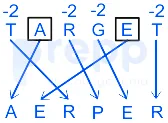
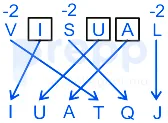
Question 1archived
Three statements are given followed by three conclusions numbered I, II and III. Assuming the statements to be true, even if they seem to be at variance with commonly known facts, decide which of the conclusions logically follow(s) from the statements.
Statements:
Some spices are medicines.
All medicines are chemicals.
No chemical is cheap.
Conclusions:
I. Some medicines are cheap.
II. Some chemicals are spices.
III. No medicine is cheap.
- A
Only conclusions I and III follow.
- B
Only conclusions II and III follow.
- C
Only conclusions I and II follow.
- D
All conclusions follow.
Show answer
B. Only conclusions II and III follow.Analyzing Statements and Conclusions in Logical Reasoning
This problem requires us to evaluate which conclusions logically follow from a given set of statements, assuming the statements are true. This type of question falls under the category of logical reasoning, specifically syllogisms.
Understanding the Statements
We are given three statements:
Statement 1: Some spices are medicines.
Statement 2: All medicines are chemicals.
Statement 3: No chemical is cheap.
Evaluating the Conclusions
We need to check each conclusion based on the given statements.
Conclusion I: Some medicines are cheap.
Let's analyze this based on the statements:
Statement 2 says "All medicines are chemicals."
Statement 3 says "No chemical is cheap."
If all medicines are chemicals, and none of the chemicals are cheap, then it logically follows that none of the medicines can be cheap. Therefore, the conclusion "Some medicines are cheap" directly contradicts the information derived from the statements.
Conclusion I does not follow.
Conclusion II: Some chemicals are spices.
Let's analyze this based on the statements:
Statement 1 says "Some spices are medicines." This means there is at least one spice that is also a medicine.
Statement 2 says "All medicines are chemicals." This means everything that is a medicine is also a chemical.
Since there are some spices that are medicines (Statement 1), and all medicines are chemicals (Statement 2), these 'some spices' that are medicines must also be chemicals. Therefore, some spices are chemicals. If some spices are chemicals, it logically follows that some chemicals are spices.
Conclusion II follows.
Conclusion III: No medicine is cheap.
Let's analyze this based on the statements:
Statement 2 says "All medicines are chemicals."
Statement 3 says "No chemical is cheap."
If every single medicine belongs to the category of chemicals (Statement 2), and nothing in the category of chemicals is cheap (Statement 3), then nothing in the category of medicines can be cheap either. This means "No medicine is cheap."
Conclusion III follows.
Summary of Conclusions
Based on the analysis:
Conclusion I: Some medicines are cheap. (Does not follow)
Conclusion II: Some chemicals are spices. (Follows)
Conclusion III: No medicine is cheap. (Follows)
Therefore, only conclusions II and III logically follow from the given statements.
Revision Table: Syllogism Analysis
Statement/Conclusion
Relationship
Analysis based on given Statements
Follows?
Statement 1
Some Spices are Medicines (S → M)
Given
-
Statement 2
All Medicines are Chemicals (M → C)
Given
-
Statement 3
No Chemical is Cheap (C → Not Cheap)
Given
-
Conclusion I
Some Medicines are Cheap (M → Cheap)
All M are C, No C is Cheap → No M is Cheap. Contradicts conclusion.
No
Conclusion II
Some Chemicals are Spices (C → S)
Some S are M, All M are C → Some S are C → Some C are S.
Yes
Conclusion III
No Medicine is Cheap (M → Not Cheap)
All M are C, No C is Cheap → No M is Cheap.
Yes
Additional Information on Syllogisms
Syllogisms are a form of deductive reasoning where a conclusion is drawn from two or more premises (statements). Understanding the relationship between categories described in the statements is key.
Universal Affirmative (All A are B): Every member of category A is also a member of category B.
Universal Negative (No A is B): No member of category A is a member of category B.
Particular Affirmative (Some A are B): At least one member of category A is also a member of category B. 'Some' means 'at least one' and can include 'all'.
Particular Negative (Some A are not B): At least one member of category A is not a member of category B.
Visual aids like Venn diagrams can often help represent the relationships between categories and verify conclusions. In this problem, the relationships are:
Some Spices overlap with Medicines.
The entire set of Medicines is inside the set of Chemicals.
The set of Chemicals and the set of Cheap things have no overlap.
Combining these: Since Medicines are inside Chemicals, and Chemicals don't overlap with Cheap, Medicines cannot overlap with Cheap. Also, since Some Spices overlap with Medicines, and Medicines are inside Chemicals, that overlap of Spices and Medicines must also be within Chemicals, meaning Some Spices are Chemicals, and thus Some Chemicals are Spices.
Paper & answer key PDF ↗ Question 2archived
Select the correct combination of mathematical signs to sequentially replace the * signs and to balance the given equation.
50 * 25 * 10 * 2 * 175
- A
+, ÷, ×, =
- B
−, ×, ÷, =
- C
−, ×, +, =
- D
+, ×, ÷, =
Show answer
D. +, ×, ÷, =Finding the Correct Mathematical Signs to Balance the Equation
The question asks us to find the correct combination of mathematical signs from the given options that, when sequentially placed in the position of the asterisks (*), will balance the equation:
\(50 * 25 * 10 * 2 * 175\)
To solve this, we need to test each option by substituting the signs into the equation and evaluating if the left side equals the right side (175).
We must also remember the order of operations, often remembered by acronyms like BODMAS or PEMDAS:
B/P: Brackets/Parentheses
O/E: Orders/Exponents
D/M: Division and Multiplication (from left to right)
A/S: Addition and Subtraction (from left to right)
Testing the Given Mathematical Sign Combinations
Option 1: \(+, \div, \times, =\)
Substitute the signs into the equation:
\(50 + 25 \div 10 \times 2 = 175\)
Following the order of operations:
First, perform division: \(25 \div 10 = 2.5\)
Next, perform multiplication: \(2.5 \times 2 = 5\)
Finally, perform addition: \(50 + 5 = 55\)
The equation becomes \(55 = 175\), which is false. So, Option 1 is not correct.
Option 2: \( -, \times, \div, =\)
Substitute the signs into the equation:
\(50 - 25 \times 10 \div 2 = 175\)
Following the order of operations (Multiplication and Division from left to right):
Perform multiplication: \(25 \times 10 = 250\)
Perform division: \(250 \div 2 = 125\)
Perform subtraction: \(50 - 125 = -75\)
The equation becomes \(-75 = 175\), which is false. So, Option 2 is not correct.
Option 3: \( -, \times, +, =\)
Substitute the signs into the equation:
\(50 - 25 \times 10 + 2 = 175\)
Following the order of operations (Multiplication first, then Addition and Subtraction from left to right):
Perform multiplication: \(25 \times 10 = 250\)
Perform subtraction: \(50 - 250 = -200\)
Perform addition: \(-200 + 2 = -198\)
The equation becomes \(-198 = 175\), which is false. So, Option 3 is not correct.
Option 4: \(+, \times, \div, =\)
Substitute the signs into the equation:
\(50 + 25 \times 10 \div 2 = 175\)
Following the order of operations (Multiplication and Division from left to right):
Perform multiplication: \(25 \times 10 = 250\)
Perform division: \(250 \div 2 = 125\)
Perform addition: \(50 + 125 = 175\)
The equation becomes \(175 = 175\), which is true. So, Option 4 is correct.
Conclusion on Balancing the Equation
The combination of mathematical signs \(+, \times, \div, =\) when sequentially placed in the equation \(50 * 25 * 10 * 2 * 175\) balances the equation, resulting in \(50 + 25 \times 10 \div 2 = 175\).
Revision Table: Mathematical Signs and Order of Operations
Operation
Symbol Examples
BODMAS/PEMDAS Order
Brackets/Parentheses
(), [], {}
First
Orders/Exponents
\(x^2, \sqrt{x}\)
Second
Division and Multiplication
\(\div, /\) and \(\times, *\)
Third (from left to right)
Addition and Subtraction
\(+\) and \(-\)
Fourth (from left to right)
Additional Information on Equation Balancing and Logic Puzzles
Equation balancing problems are common in logic and quantitative aptitude sections of exams. They test your understanding of basic arithmetic operations and the correct order in which they should be performed. Successfully solving these requires careful substitution and step-by-step calculation according to the BODMAS/PEMDAS rule.
These types of questions help improve numerical reasoning skills and attention to detail. While simple, they emphasize the importance of following standard mathematical conventions precisely to arrive at the correct result.
Paper & answer key PDF ↗ Question 3archived
If R ÷ S means that R is the mother of S, R × S means that R is the father of S, R - S means that R is the sister of S, then which of the following expression shows that P is the father of R?
- A
P × Q ÷ R
- B
Q × P - R
- C
R × Q - P
- D
P × Q - R
Show answer
D. P × Q - RUnderstanding Blood Relation Codes
This question asks us to identify the expression that represents the relationship where P is the father of R, based on the given code language for blood relations.
The given codes are:
R ÷ S means R is the mother of S.
R × S means R is the father of S.
R - S means R is the sister of S.
We need to analyze each given option to determine the relationship between P and R in each expression.
Analyzing Each Option
Option 1: P × Q ÷ R
Let's break down this expression:
P × Q: According to the code 'R × S means R is the father of S', P × Q means P is the father of Q.
Q ÷ R: According to the code 'R ÷ S means R is the mother of S', Q ÷ R means Q is the mother of R.
Combining these, P is the father of Q, and Q is the mother of R. This means P is Q's parent, and Q is R's parent. Specifically, P is the father of Q, and Q is the mother of R. Therefore, P is the father of Q, and Q is R's mother. P is married to Q (since P is Q's father and Q is R's mother, implying P is R's father). If P is the father of Q and Q is the mother of R, then P is the maternal grandfather of R. This does not show P as the father of R.
Option 2: Q × P - R
Let's break down this expression:
Q × P: According to the code 'R × S means R is the father of S', Q × P means Q is the father of P.
P - R: According to the code 'R - S means R is the sister of S', P - R means P is the sister of R.
Combining these, Q is the father of P, and P is the sister of R. This means P is Q's child (specifically daughter, as P is a sister) and P is a sibling of R. If Q is the father of P, and P is R's sister, then Q is also the father of R. This expression shows Q as the father of P and R, and P is R's sister. This does not show P as the father of R.
Option 3: R × Q - P
Let's break down this expression:
R × Q: According to the code 'R × S means R is the father of S', R × Q means R is the father of Q.
Q - P: According to the code 'R - S means R is the sister of S', Q - P means Q is the sister of P.
Combining these, R is the father of Q, and Q is the sister of P. This means R is Q's parent, and Q is a sibling of P. If R is the father of Q, and Q is the sister of P, then R is also the father of P. This expression shows R as the father of Q and P. This does not show P as the father of R.
Option 4: P × Q - R
Let's break down this expression:
P × Q: According to the code 'R × S means R is the father of S', P × Q means P is the father of Q.
Q - R: According to the code 'R - S means R is the sister of S', Q - R means Q is the sister of R.
Combining these, P is the father of Q, and Q is the sister of R. If P is the father of Q, and Q is the sister of R, it means Q and R are siblings, and P is the father of Q. Since Q is a child of P, and R is Q's sibling, R is also a child of P. Therefore, P is the father of R. This expression correctly shows P as the father of R.
Summary Table of Relationships
Expression
Relationship 1
Relationship 2
Implied Relationship between P and R
P is Father of R?
P × Q ÷ R
P is father of Q
Q is mother of R
P is maternal grandfather of R
No
Q × P - R
Q is father of P
P is sister of R
Q is father of P and R; P is R's sister
No
R × Q - P
R is father of Q
Q is sister of P
R is father of Q and P; Q is P's sister
No
P × Q - R
P is father of Q
Q is sister of R
P is father of Q and R; Q is R's sister
Yes
Based on the analysis of each option, the expression P × Q - R correctly represents the relationship where P is the father of R.
Revision Table: Key Blood Relation Codes
Symbol
Meaning (R <symbol> S)
÷
R is the mother of S
×
R is the father of S
-
R is the sister of S
Additional Information: Solving Blood Relation Puzzles
Blood relation questions test your ability to understand and decode relationships described in a coded language or through a series of statements. Here are some tips for solving them:
Decode Symbols: Clearly write down the meaning of each symbol or code given in the question.
Break Down Expressions: For coded expressions, break them down into smaller parts based on the operators (symbols). Analyze the relationship for each part sequentially.
Build a Family Tree: For more complex questions, drawing a simple family tree or diagram can help visualize the relationships. Use symbols for gender (e.g., + for male, - for female) and connections (e.g., horizontal line for siblings, vertical line for parent-child).
Track Gender: Pay close attention to gender information provided by the codes or statements. This is crucial for determining relationships accurately (e.g., 'sister' implies female, 'father' implies male).
Eliminate Options: Once you analyze an option and find it doesn't match the target relationship, eliminate it.
Work Backwards (Sometimes): In some cases, it might be helpful to start from the desired relationship and see which expression could lead to it.
Practicing different types of blood relation questions will improve your speed and accuracy in decoding complex relationships.
Paper & answer key PDF ↗ Question 4archived
Which two signs and two numbers should be interchanged in the following equation to make it correct?
10 × 11 + 19 - 323 ÷ 3 = 50
- A
10 and 19, - and +
- B
3 and 19, - and ×
- C
10 and 11, - and ÷
- D
10 and 323, + and ÷
Show answer
B. 3 and 19, - and ×Solving Mathematical Equations by Interchanging Signs and Numbers
The problem asks us to determine which interchange of two signs and two numbers will make the given mathematical equation correct. We are given the equation: \(10 \times 11 + 19 - 323 \div 3 = 50\).
To solve this type of logical puzzle, we need to test the interchanged equation based on the options provided and check if it evaluates to the right-hand side value, which is 50.
Testing the Interchange of 3 and 19, and - and ×
Let's consider the interchange proposed: swapping the number 3 with the number 19, and swapping the subtraction sign (-) with the multiplication sign (×). This means:
Every '3' in the equation becomes '19'.
Every '19' in the equation becomes '3'.
Every '-' sign becomes a '×' sign.
Every '×' sign becomes a '-' sign.
The original equation is:
\(10 \times 11 + 19 - 323 \div 3 = 50\)
Applying the proposed interchanges (3 <-> 19 and - <-> ×), the equation becomes:
\(10 \mathbf{-} 11 + \mathbf{3} \mathbf{\times} 323 \div \mathbf{19} = ?\)
Now, let's evaluate this new equation using the order of operations (BODMAS/PEMDAS).
Evaluating the Modified Equation Using BODMAS
The BODMAS (or PEMDAS) rule helps us determine the correct sequence of operations:
Brackets (Parentheses)
Orders (Exponents, Roots)
Division and Multiplication (from left to right)
Addition and Subtraction (from left to right)
Our modified equation is: \(10 - 11 + 3 \times 323 \div 19\)
Let's perform the operations step-by-step:
Step 1: Perform Division and Multiplication from left to right.
First, the Division: \(323 \div 19\)
\(323 \div 19 = 17\)
The equation becomes: \(10 - 11 + 3 \times 17\)
Next, the Multiplication: \(3 \times 17\)
\(3 \times 17 = 51\)
The equation becomes: \(10 - 11 + 51\)
Step 2: Perform Addition and Subtraction from left to right.
First, the Subtraction: \(10 - 11\)
\(10 - 11 = -1\)
The equation becomes: \(-1 + 51\)
Next, the Addition: \(-1 + 51\)
\(-1 + 51 = 50\)
The result of the modified equation is 50. This matches the right-hand side of the original equation.
Therefore, interchanging the numbers 3 and 19, and the signs - and × makes the equation correct.
Summary of the Interchange
Original
Interchange
Result After Swap
10
Remains 10
10
×
Swaps with -
-
11
Remains 11
11
+
Remains +
+
19
Swaps with 3
3
-
Swaps with ×
×
323
Remains 323
323
÷
Remains ÷
÷
3
Swaps with 19
19
The modified equation is \(10 - 11 + 3 \times 323 \div 19 = 50\).
Revision Table: Key Concepts Used
Concept
Description
Equation Solving
The process of finding values or conditions that make an equation true.
Sign and Number Interchange
Swapping the positions or identities of operators and operands in an expression.
Order of Operations (BODMAS/PEMDAS)
Rules specifying the sequence in which mathematical operations should be performed to evaluate an expression.
Additional Information: Understanding Order of Operations
The order of operations is crucial in evaluating mathematical expressions unambiguously. Without a standard order, the same expression could yield different results. BODMAS and PEMDAS are mnemonics used worldwide to remember this order:
BODMAS: Brackets, Orders (powers, roots), Division, Multiplication, Addition, Subtraction.
PEMDAS: Parentheses, Exponents, Multiplication, Division, Addition, Subtraction.
Division and Multiplication have the same priority and are performed from left to right as they appear. Similarly, Addition and Subtraction have the same priority and are performed from left to right.
For example, in \(10 - 11 + 51\), subtraction comes before addition when reading left to right, so \(10 - 11\) is calculated first.
Paper & answer key PDF ↗ Question 5archived
In a certain code language, 'CAKES’ is written as 'FXNBV' and 'ABUSE' is written as 'DYXPH'. How will 'BARKS' be written in that language?
- A
EXVHU
- B
EXUIU
- C
EXUIV
- D
EXUHV
Show answer
D. EXUHVSolving Letter Coding Questions
This question involves a type of coding language puzzle where letters in a word are transformed into other letters based on a specific rule or pattern. To solve this, we need to identify the rule applied to the given examples and then use that rule to code the target word.
Analyzing the Given Coding Examples
We are given two examples of words coded into new words:
'CAKES' is coded as 'FXNBV'
'ABUSE' is coded as 'DYXPH'
Let's look at the letter-by-letter transformation for 'CAKES' to 'FXNBV':
C to F
A to X
K to N
E to B
S to V
To find the pattern, we can look at the positions of these letters in the English alphabet (A=1, B=2, ..., Z=26):
Original Letter
Position
Coded Letter
Position
Shift
C
3
F
6
$6 - 3 = +3$
A
1
X
24
$24 - 1 = +23$ (or $1 - 3 = -2$ mod 26, which is 24)
K
11
N
14
$14 - 11 = +3$
E
5
B
2
$2 - 5 = -3$
S
19
V
22
$22 - 19 = +3$
The pattern observed is a sequence of shifts: $+3, -3, +3, -3, +3$. Let's verify this pattern with the second example, 'ABUSE' to 'DYXPH'.
Original Letter
Position
Coded Letter
Position
Shift
A
1
D
4
$4 - 1 = +3$
B
2
Y
25
$25 - 2 = +23$ (or $2 - 3 = -1$ mod 26, which is 25)
U
21
X
24
$24 - 21 = +3$
S
19
P
16
$16 - 19 = -3$
E
5
H
8
$8 - 5 = +3$
The second example also follows the same $+3, -3, +3, -3, +3$ shift pattern. This confirms our identified rule for this code language.
Applying the Pattern to Code 'BARKS'
Now we apply the $+3, -3, +3, -3, +3$ shift rule to the word 'BARKS':
B: Position 2. Shift $+3 \implies 2 + 3 = 5$. The 5th letter is E.
A: Position 1. Shift $-3 \implies 1 - 3 = -2$. In a 26-letter alphabet cycle, this is $26 - 2 = 24$. The 24th letter is X.
R: Position 18. Shift $+3 \implies 18 + 3 = 21$. The 21st letter is U.
K: Position 11. Shift $-3 \implies 11 - 3 = 8$. The 8th letter is H.
S: Position 19. Shift $+3 \implies 19 + 3 = 22$. The 22nd letter is V.
Combining the coded letters, 'BARKS' is written as 'EXUHV'.
Final Coded Word for BARKS
Based on the $+3, -3, +3, -3, +3$ coding pattern derived from 'CAKES' and 'ABUSE', the word 'BARKS' is coded as EXUHV.
Original Word
Coded Word
BARKS
EXUHV
Revision Table: Letter Coding Patterns
Concept
Description
Example
Letter Position
Assigning a numerical value to each letter (A=1, B=2, ..., Z=26).
C = 3, S = 19
Constant Shift
Adding or subtracting the same number for every letter.
A $+2 \implies$ C, B $+2 \implies$ D (e.g., AB $\implies$ CD)
Varying Shift
Adding or subtracting different numbers, or following a pattern like $+3, -3, +3, ...$
Used in this problem: $+3, -3, +3, -3, +3$.
Alphabetical Cycle
When a shift goes beyond Z (26) or below A (1), you wrap around (e.g., Z $+1 \implies$ A, A $-1 \implies$ Z).
A $-3 \implies$ X (wraps around from Z to Y to X).
Additional Information: Types of Coding-Decoding
Coding-decoding questions test your ability to identify patterns and rules in letter or number sequences. Common types include:
Letter Coding: Letters are replaced by other letters based on specific rules (like shifts, reversal, or swapping). This problem is an example of letter coding with shifts.
Number Coding: Words are assigned numerical values based on letter positions, sum of positions, or other arithmetic operations.
Symbol Coding: Letters or words are replaced by symbols.
Mixed Coding: A combination of letters, numbers, and symbols.
Substitution Coding: Direct substitution of one word/letter/number for another, where the code is given explicitly.
Practicing different types helps you quickly identify the pattern in coding-decoding problems.
Paper & answer key PDF ↗ Question 6archived
What was the day of the week on 26th November 1994?
- A
Friday
- B
Wednesday
- C
Saturday
- D
Thursday
Show answer
C. SaturdayFinding the Day of the Week for 26th November 1994
To determine the day of the week for a specific date, we use the concept of 'odd days'. Odd days are the number of days left after forming complete weeks from a given period.
Here's how we calculate the day for 26th November 1994:
We need to calculate the total number of odd days from the beginning of the calendar epoch (usually considered Year 0 or Year 1, depending on convention; for these types of problems, the logic relies on relative odd days over centuries/years, often starting calculations from a known point like a century divisible by 400) up to the day before the target date (i.e., up to 25th November 1994, or equivalently, the end of 1993 plus the days in 1994 up to 26th November).
Let's break down the period up to 26th November 1994:
Years completed before 1994: 1993 years.
Days in the year 1994 up to 26th November.
Calculating Odd Days in 1993 Years
We can divide 1993 years into centuries and remaining years:
\(1993 \text{ years} = 1600 \text{ years} + 300 \text{ years} + 93 \text{ years}\)
Odd days in 1600 years: A century year is a leap year if it is divisible by 400. Odd days in 400 years are 0. Therefore, odd days in $1600 = 4 \times 400$ years is $4 \times 0 = 0$.
Odd days in 300 years: The number of odd days in 100 years is 5. The number of odd days in 200 years is $2 \times 5 = 10 \equiv 3 \pmod{7}$. The number of odd days in 300 years is $3 \times 5 = 15 \equiv 1 \pmod{7}$.
Odd days in 93 years (1901 to 1993): We need to find the number of leap years and ordinary years in this period. A year is a leap year if it is divisible by 4, unless it is a century year not divisible by 400. In the years 1901 to 1993, the leap years are 1904, 1908, ..., 1992.
Number of leap years = $\lfloor \frac{93}{4} \rfloor = 23$ leap years.
Number of ordinary years = Total years - Leap years = $93 - 23 = 70$ ordinary years.
Odd days in 93 years = (Number of leap years $\times$ 2) + (Number of ordinary years $\times$ 1)
Odd days in 93 years = $(23 \times 2) + (70 \times 1) = 46 + 70 = 116$ odd days.
To find the equivalent odd days within a week: $116 \pmod{7}$. $116 = 16 \times 7 + 4$. So, $116 \equiv 4 \pmod{7}$.
Odd days in 93 years = 4.
Total odd days up to the end of 1993 = Odd days in 1600 years + Odd days in 300 years + Odd days in 93 years = $0 + 1 + 4 = 5$ odd days.
Calculating Odd Days in 1994 up to 26th November
1994 is not a leap year (1994 is not divisible by 4).
We sum the number of days in each month from January to October and add the days in November up to the 26th. Then we find the total odd days.
January (31 days): $31 \pmod{7} = 3$ odd days
February (28 days): $28 \pmod{7} = 0$ odd days (1994 is ordinary)
March (31 days): $31 \pmod{7} = 3$ odd days
April (30 days): $30 \pmod{7} = 2$ odd days
May (31 days): $31 \pmod{7} = 3$ odd days
June (30 days): $30 \pmod{7} = 2$ odd days
July (31 days): $31 \pmod{7} = 3$ odd days
August (31 days): $31 \pmod{7} = 3$ odd days
September (30 days): $30 \pmod{7} = 2$ odd days
October (31 days): $31 \pmod{7} = 3$ odd days
November (26 days): $26 \pmod{7} = 5$ odd days
Total odd days in 1994 up to 26th November = $3 + 0 + 3 + 2 + 3 + 2 + 3 + 3 + 2 + 3 + 5 = 29$ odd days.
To find the equivalent odd days within a week: $29 \pmod{7}$. $29 = 4 \times 7 + 1$. So, $29 \equiv 1 \pmod{7}$.
Odd days in 1994 up to 26th November = 1 odd day.
Total Odd Days and Determining the Day
Total odd days up to 26th November 1994 = Total odd days up to end of 1993 + Odd days in 1994 up to 26th November.
Total odd days = $5 + 1 = 6$ odd days.
We map the total odd days to the day of the week using the following convention:
Odd Days
Day of the Week
0
Sunday
1
Monday
2
Tuesday
3
Wednesday
4
Thursday
5
Friday
6
Saturday
Since the total number of odd days is 6, the day of the week on 26th November 1994 was Saturday.
Revision Table: Calendar Concepts
Concept
Description
Ordinary Year
365 days; 1 odd day ($365 \pmod{7} = 1$)
Leap Year
366 days (Feb has 29 days); 2 odd days ($366 \pmod{7} = 2$)
Leap Year Rule
Divisible by 4, unless a century year not divisible by 400.
Odd Days in 100 years
5
Odd Days in 200 years
$5 \times 2 = 10 \equiv 3 \pmod{7}$
Odd Days in 300 years
$5 \times 3 = 15 \equiv 1 \pmod{7}$
Odd Days in 400 years
$5 \times 4 + 1 (\text{for the leap century year}) = 21 \equiv 0 \pmod{7}$
Additional Information: Calendar Calculations
Calendar calculations are a common topic in logical reasoning and quantitative aptitude sections of various exams. Understanding the concept of odd days is crucial for solving problems related to finding the day of the week for a given date, determining the number of leap years in a period, or finding the day of the week after a certain number of days.
The cycle of odd days repeats every 400 years. This means the number of odd days accumulated at the end of every 400-year period is 0. This property is very useful when dealing with centuries.
Remembering the number of odd days in standard periods like 100, 200, 300, and 400 years, and the number of odd days in each month, simplifies these calculations significantly.
Paper & answer key PDF ↗ Question 7archived
A series is given with one term missing. Select the correct alternative from the given ones that will complete the series.
COMB, GIUR, KCCH, OWKX, ?
- A
SRQM
- B
MNQR
- C
SQSN
- D
SMRQ
Show answer
C. SQSNSolving the Letter Series: COMB, GIUR, KCCH, OWKX, ?
This problem asks us to find the next term in the given series of letter groups: COMB, GIUR, KCCH, OWKX, ?. To solve this, we need to identify the pattern or rule that connects consecutive terms in the series.
Let's examine the changes in the letters at each position from one term to the next. We can use the alphabetical position of each letter (A=1, B=2, ..., Z=26).
Analyzing the Pattern in Each Position
We will compare the letters in the 1st, 2nd, 3rd, and 4th positions across the terms:
Position
COMB
GIUR
KCCH
OWKX
Next Term
1st Letter
C (3)
G (7)
K (11)
O (15)
?
2nd Letter
O (15)
I (9)
C (3)
W (23)
?
3rd Letter
M (13)
U (21)
C (3)
K (11)
?
4th Letter
B (2)
R (18)
H (8)
X (24)
?
Let's find the difference in the alphabetical position for each position:
1st Position:
C (3) to G (7): ${7 - 3 = +4}$
G (7) to K (11): ${11 - 7 = +4}$
K (11) to O (15): ${15 - 11 = +4}$
The pattern for the 1st letter is consistently adding 4 to the alphabetical position.
2nd Position:
O (15) to I (9): ${9 - 15 = -6}$
I (9) to C (3): ${3 - 9 = -6}$
C (3) to W (23): Here we wrap around the alphabet. Moving from C (3) backwards by 6 positions gives us ${3 - 6 = -3}$. Wrapping around (adding 26) gives ${-3 + 26 = 23}$, which is W. So the pattern is -6.
W (23) backwards by 6: ${23 - 6 = 17}$. Letter 17 is Q.
The pattern for the 2nd letter is consistently subtracting 6 from the alphabetical position (wrapping around if necessary).
3rd Position:
M (13) to U (21): ${21 - 13 = +8}$
U (21) to C (3): Here we wrap around. ${21 + 8 = 29}$. Wrapping around gives ${29 - 26 = 3}$, which is C. So the pattern is +8.
C (3) to K (11): ${11 - 3 = +8}$
K (11) forwards by 8: ${11 + 8 = 19}$. Letter 19 is S.
The pattern for the 3rd letter is consistently adding 8 to the alphabetical position (wrapping around if necessary).
4th Position:
B (2) to R (18): ${18 - 2 = +16}$
R (18) to H (8): Here we wrap around. ${18 + 16 = 34}$. Wrapping around gives ${34 - 26 = 8}$, which is H. So the pattern is +16.
H (8) to X (24): ${24 - 8 = +16}$
X (24) forwards by 16: ${24 + 16 = 40}$. Wrapping around gives ${40 - 26 = 14}$. Letter 14 is N.
The pattern for the 4th letter is consistently adding 16 to the alphabetical position (wrapping around if necessary).
Applying the Pattern to Find the Next Term
The last term is OWKX. We apply the identified pattern (+4, -6, +8, +16) to its letters:
1st letter: O (15). ${15 + 4 = 19}$. The 19th letter is S.
2nd letter: W (23). ${23 - 6 = 17}$. The 17th letter is Q.
3rd letter: K (11). ${11 + 8 = 19}$. The 19th letter is S.
4th letter: X (24). ${24 + 16 = 40}$. ${40 - 26 = 14}$. The 14th letter is N.
Combining these letters, the next term in the series is SQSN.
Comparing with Options
The calculated next term is SQSN, which matches one of the given options.
Revision Table - Letter Series Patterns
Pattern Type
Description
Example
Arithmetic Progression
A fixed value is added or subtracted to the letter's position.
A, D, G, J... (+3)
Geometric Progression
The difference/addition follows a multiplication pattern (less common for letters).
A, C, G, O... (Add 2, then 4, then 8...)
Alternating Pattern
Different rules apply to alternate terms or positions.
AB, CD, EF, GH... (Each pair is consecutive)
Position-specific Pattern
Each position in a term follows a different rule (like in this problem).
COMB, GIUR... (1st letter +4, 2nd -6, etc.)
Reverse Alphabetical Order
Series moves backwards through the alphabet.
Z, Y, X, W... (-1)
Additional Information - Logical Reasoning Series
Series completion questions are common in logical reasoning tests. They can involve numbers, letters, words, or a combination of these. The key to solving them is careful observation and identifying the underlying rule or pattern. Sometimes the pattern is simple arithmetic, sometimes it involves complex sequences, squares, cubes, prime numbers, or specific properties of letters (like vowels/consonants). For letter series, it's often helpful to write down the alphabetical positions of the letters to make calculations easier. Remember to consider wrap-around effects when adding or subtracting positions that go beyond Z or before A.
Paper & answer key PDF ↗ Question 8archived
Select the set in which the numbers are related in the same way as are the numbers of the following set.
(NOTE: Operations should be performed on the whole numbers, without breaking down the numbers into its constituent digits.)
(12, 313, 13)
(11, 185, 8)
- A
(12, 158, 12)
- B
(4, 125, 11)
- C
(9, 90, 3)
- D
(15, 150, 10)
Show answer
C. (9, 90, 3)This question asks us to find a set of numbers among the given options that shares the same relationship between its elements as seen in the two provided sets. We need to identify the logical rule or pattern connecting the numbers in the example sets and then apply it to the options.
Analyzing the Given Sets to Find the Relationship
The given sets are:
(12, 313, 13)
(11, 185, 8)
Let's look at the numbers in the first set: 12, 313, and 13. Let's call the numbers A, B, and C respectively. So, A=12, B=313, and C=13.
We need to find a relationship between 12, 313, and 13. The middle number, 313, is significantly larger than 12 and 13. This suggests operations like multiplication, squaring, or cubing might be involved.
Let's try common operations involving the first and third numbers (A and C) to see if they produce the middle number (B).
Sum: $12 + 13 = 25$ (Not 313)
Product: $12 \times 13 = 156$ (Not 313)
Difference of squares: $|13^2 - 12^2| = |169 - 144| = 25$ (Not 313)
Sum of squares: $12^2 + 13^2 = 144 + 169 = 313$ (This matches the middle number!)
So, the potential relationship is: The middle number is the sum of the squares of the first and third numbers.
Let's test this relationship with the second given set: (11, 185, 8). Here, A=11, B=185, and C=8.
According to our potential rule, $B = A^2 + C^2$.
Let's calculate $11^2 + 8^2$:
$11^2 = 121$
$8^2 = 64$}
$11^2 + 8^2 = 121 + 64 = 185$
This matches the middle number (185) in the second set. The relationship $B = A^2 + C^2$ seems to be the correct pattern.
Checking Options Based on the Identified Relationship
Now we will apply the relationship $B = A^2 + C^2$ to each of the given options to find the set that follows the same rule.
Option 1: (12, 158, 12)
A=12, B=158, C=12
Check if $B = A^2 + C^2$:
$12^2 + 12^2 = 144 + 144 = 288$
Is $288 = 158$? No. This set does not follow the relationship.
Option 2: (4, 125, 11)
A=4, B=125, C=11
Check if $B = A^2 + C^2$:
$4^2 + 11^2 = 16 + 121 = 137$
Is $137 = 125$? No. This set does not follow the relationship.
Option 3: (9, 90, 3)
A=9, B=90, C=3
Check if $B = A^2 + C^2$:
$9^2 + 3^2 = 81 + 9 = 90$
Is $90 = 90$? Yes. This set follows the relationship $B = A^2 + C^2$.
Option 4: (15, 150, 10)
A=15, B=150, C=10
Check if $B = A^2 + C^2$:
$15^2 + 10^2 = 225 + 100 = 325$
Is $325 = 150$? No. This set does not follow the relationship.
Conclusion: Identifying the Correct Set
Based on our analysis, only Option 3 follows the same numerical relationship ($B = A^2 + C^2$) as the two sets provided in the question. Therefore, the set (9, 90, 3) is the correct answer.
Relationship Analysis and Revision Table
Here is a summary of how the relationship $B = A^2 + C^2$ applies to the given sets and the options:
Set
A
C
Calculate $A^2 + C^2$
B
Follows Rule? ($A^2 + C^2 = B$)
(12, 313, 13)
12
13
$12^2 + 13^2 = 144 + 169 = 313$
313
Yes
(11, 185, 8)
11
8
$11^2 + 8^2 = 121 + 64 = 185$
185
Yes
(12, 158, 12)
12
12
$12^2 + 12^2 = 144 + 144 = 288$
158
No
(4, 125, 11)
4
11
$4^2 + 11^2 = 16 + 121 = 137$
125
No
(9, 90, 3)
9
3
$9^2 + 3^2 = 81 + 9 = 90$
90
Yes
(15, 150, 10)
15
10
$15^2 + 10^2 = 225 + 100 = 325$
150
No
Additional Information: Number Analogies and Patterns
Number analogy or number pattern questions are common in logical reasoning and quantitative aptitude tests. They require you to identify the relationship between numbers in a given set and apply that same relationship to find a missing number or a matching set from options.
Strategies to solve such problems often involve considering:
Basic arithmetic operations: addition, subtraction, multiplication, division.
Powers and roots: squares, cubes, square roots, cube roots.
Combinations of operations: e.g., $A \times B + C$, $(A+C)^2$, $A^2 + C^2$, $A^3 - C$.
Prime numbers, composite numbers, odd/even numbers.
Digit-based operations (though excluded by the specific rule in this question).
It's helpful to systematically test common patterns when trying to decipher the rule in the given sets. Once a pattern is found, verify it with all provided examples before applying it to the options.
Paper & answer key PDF ↗ Question 9archived
Select the set in which the numbers are related in the same way as are the numbers of the given set.
(NOTE: Operations should be performed on the whole numbers, without breaking down the numbers into its constituent digits. E.g. 13 - Operations on 13 such as adding / subtracting / multiplying etc. to 13 can be performed. Breaking down 13 into 1 and 3 and then performing mathematical operations on 1 and 3 is not allowed.)
(6, 17, 408)
(13, 27, 1404)
- A
(9, 27, 245)
- B
(17, 28, 952)
- C
(5, 82, 1200)
- D
(4, 26, 416)
Show answer
D. (4, 26, 416)The question asks us to identify the set of numbers from the given options that shares the same relationship as the numbers in the two provided sets: (6, 17, 408) and (13, 27, 1404). We need to find the specific pattern or rule that connects the three numbers in each given set.
Analyzing the Relationship in the Given Sets
Let's examine the first set (6, 17, 408). Let the three numbers be denoted as the first number ($a$), the second number ($b$), and the third number ($c$). So, for this set, $a=6$, $b=17$, and $c=408$. We need to find a relationship between $a$, $b$, and $c$.
Let's try simple operations involving the first two numbers ($a$ and $b$) and see if we can arrive at the third number ($c$).
Adding the first two numbers: $a + b = 6 + 17 = 23$. This is not 408.
Multiplying the first two numbers: $a \times b = 6 \times 17 = 102$. This is not 408. However, 102 seems related to 408. Let's see if multiplying 102 by some factor gives 408. $408 / 102 = 4$.
This suggests a potential relationship: $c = (a \times b) \times 4$. Let's test this pattern with the second given set.
The second set is (13, 27, 1404). Here, $a=13$, $b=27$, and $c=1404$.
Using the potential pattern $c = (a \times b) \times 4$:
Calculate the product of the first two numbers: $a \times b = 13 \times 27 = 351$.
Multiply the product by 4: $351 \times 4 = 1404$.
This matches the third number in the second set ($c=1404$). Therefore, the established relationship is $c = a \times b \times 4$. The third number in the set is equal to the product of the first two numbers multiplied by 4.
Applying the Pattern to the Options
Now we will apply this relationship ($c = a \times b \times 4$) to each of the given options to find the set that follows the same rule.
Option 1: (9, 27, 245)
First number ($a$): 9
Second number ($b$): 27
Third number ($c$): 245
Expected third number based on the pattern: $a \times b \times 4 = 9 \times 27 \times 4$
Calculation: $9 \times 27 = 243$. $243 \times 4 = 972$.
Comparison: The calculated third number (972) is not equal to the given third number (245). This option does not follow the pattern.
Option 2: (17, 28, 952)
First number ($a$): 17
Second number ($b$): 28
Third number ($c$): 952
Expected third number based on the pattern: $a \times b \times 4 = 17 \times 28 \times 4$
Calculation: $17 \times 28 = 476$. $476 \times 4 = 1904$.
Comparison: The calculated third number (1904) is not equal to the given third number (952). This option does not follow the pattern.
Option 3: (5, 82, 1200)
First number ($a$): 5
Second number ($b$): 82
Third number ($c$): 1200
Expected third number based on the pattern: $a \times b \times 4 = 5 \times 82 \times 4$
Calculation: $5 \times 82 = 410$. $410 \times 4 = 1640$.
Comparison: The calculated third number (1640) is not equal to the given third number (1200). This option does not follow the pattern.
Option 4: (4, 26, 416)
First number ($a$): 4
Second number ($b$): 26
Third number ($c$): 416
Expected third number based on the pattern: $a \times b \times 4 = 4 \times 26 \times 4$
Calculation: $4 \times 26 = 104$. $104 \times 4 = 416$.
Comparison: The calculated third number (416) is equal to the given third number (416). This option follows the pattern.
Conclusion
Based on the analysis, only the set (4, 26, 416) follows the same relationship ($c = a \times b \times 4$) as the numbers in the given sets (6, 17, 408) and (13, 27, 1404).
Set
First Number ($a$)
Second Number ($b$)
Third Number ($c$)
$a \times b$
$a \times b \times 4$
Matches $c$?
Given Set 1
6
17
408
$6 \times 17 = 102$
$102 \times 4 = 408$
Yes
Given Set 2
13
27
1404
$13 \times 27 = 351$
$351 \times 4 = 1404$
Yes
Option 1
9
27
245
$9 \times 27 = 243$
$243 \times 4 = 972$
No ($972 \neq 245$)
Option 2
17
28
952
$17 \times 28 = 476$
$476 \times 4 = 1904$
No ($1904 \neq 952$)
Option 3
5
82
1200
$5 \times 82 = 410$
$410 \times 4 = 1640$
No ($1640 \neq 1200$)
Option 4
4
26
416
$4 \times 26 = 104$
$104 \times 4 = 416$
Yes
Revision Table: Number Analogy Practice
Reviewing the steps helps in solving number analogy questions quickly during exams.
Understand the question: Find the pattern in the given sets.
Analyze given sets: Test common mathematical operations (addition, subtraction, multiplication, division, squares, cubes, combinations) between the numbers in the sets.
Identify the pattern: Express the relationship mathematically, if possible (e.g., $c = a \times b \times k$).
Test the pattern: Verify the pattern with all given example sets.
Apply to options: Use the confirmed pattern to check each option set.
Select the answer: Choose the option set that fits the pattern.
Additional Information: Reasoning Skills for Number Sets
Questions involving related number sets test logical reasoning and pattern recognition skills. The key is to systematically try different relationships between the numbers. Common patterns include arithmetic progressions, geometric progressions, squares, cubes, or combinations of arithmetic operations like the one found in this problem ($a \times b \times k$). Sometimes, the pattern might involve sums of digits or relationships between place values, but the question explicitly forbids breaking down numbers into constituent digits, simplifying the types of patterns we need to look for. Practice with various types of number series and set-based problems helps improve the ability to spot patterns faster.
Paper & answer key PDF ↗ Question 10archived
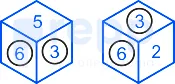
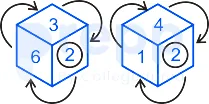
Three different positions of the same dice are shown. Find the number on the face opposite the face showing '2'.

- A
6
- B
5
- C
4
- D
3
Show answer
B. 5The pattern followed here is:
Logic: No two opposite faces are adjacent to each other.
Let's find which number is faced opposite to face having '2'.
We are taking both dice figures (1) & (2) together.
Here, 6 and 3 are common in both dice and 5 is opposite to 2.
Now, we are taking dice figures (2) & (3) together.
Here, 2 is common in both the dice and the rotated clockwise direction.
Opposite pairs:
⇒ 5 ⇔ 2
⇒ 6 ⇔ 1
⇒ 3 ⇔ 4
Clearly, 5 is the opposite of 2.
Hence, the correct answer is "5".
 Paper & answer key PDF ↗
 Question 11archived
In the following question below are given some statements followed by some conclusions based on those statements. Taking the given statements to be true even if they seem to be at variance from commonly known facts. Read all the conclusions and then decide which of the given conclusion logically follows the given statements.
Statements:
I. All W are L.
II. All L are M.
Conclusions:
I. No L is W.
II. No M is L.
III. No M is W.
- A
Only conclusion II follows
- B
Only conclusion I follows
- C
All conclusion follows
- D
Neither conclusion follows
Show answer
D. Neither conclusion followsThe pattern followed here is:
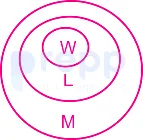
The least possible Venn diagram according to the given statements is shown below.
Statements:
I. All W are L.
II. All L are M.
Conclusions:
I. No L is W → does not follow → since all W are L and all L are M. Therefore, no L is W, it certainly does not follow.
II. No M is L → does not follow → since all W are L and all L are M.
III. No M is W → does not follow → since all W are L and all L are M. Therefore, no M is W, it certainly does not follow.
Thus, none of the conclusions follow.
Therefore, the correct answer is "Option 4".
 Paper & answer key PDF ↗
 Question 12archived
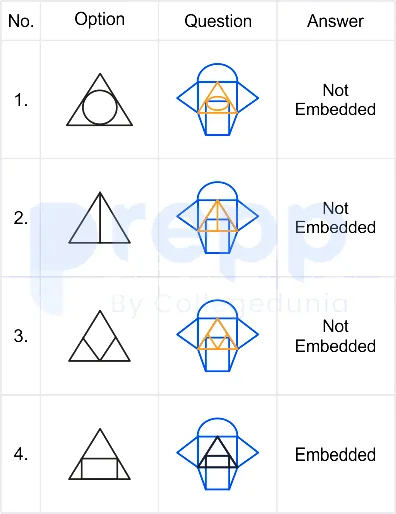
Select the option figure which is embedded in the given figure (rotation is NOT allowed).

- A
Option A (shown in image)
- B
Option B (shown in image)
- C
Option C (shown in image)
- D
Option D (shown in image)
Show answer
D. Option D (shown in image)The pattern followed here is:
Hence, the correct answer is "Option 4".

 Paper & answer key PDF ↗
 Question 13archived
Which figure should replace the question mark (?) if the series were to be continued?

- A
Option A (shown in image)
- B
Option B (shown in image)
- C
Option C (shown in image)
- D
Option D (shown in image)
Show answer
Question 14archived
Four letter-clusters have been given out of which three are alike in some manner and one is different. Select the one that is different.
- A
LJI
- B
GDA
- C
NLK
- D
TRQ
Show answer
B. GDAUnderstanding Letter Cluster Patterns
This question asks us to identify the letter cluster that is different from the others based on a hidden pattern. To solve this type of problem, we need to examine the relationship between the letters within each cluster, usually by looking at their positions in the English alphabet.
Analyzing Each Letter Cluster
Let's assign a numerical value to each letter based on its position in the alphabet (A=1, B=2, ..., Z=26).
Option 1: LJI
L is the 12th letter.
J is the 10th letter.
I is the 9th letter.
Let's look at the differences between consecutive letters:
L to J: ${12 - 10 = 2}$
J to I: ${10 - 9 = 1}$
The pattern for LJI is a drop of 2 positions, then a drop of 1 position.
Option 2: GDA
G is the 7th letter.
D is the 4th letter.
A is the 1st letter.
Let's look at the differences between consecutive letters:
G to D: ${7 - 4 = 3}$
D to A: ${4 - 1 = 3}$
The pattern for GDA is a drop of 3 positions, then a drop of 3 positions.
Option 3: NLK
N is the 14th letter.
L is the 12th letter.
K is the 11th letter.
Let's look at the differences between consecutive letters:
N to L: ${14 - 12 = 2}$
L to K: ${12 - 11 = 1}$
The pattern for NLK is a drop of 2 positions, then a drop of 1 position.
Option 4: TRQ
T is the 20th letter.
R is the 18th letter.
Q is the 17th letter.
Let's look at the differences between consecutive letters:
T to R: ${20 - 18 = 2}$
R to Q: ${18 - 17 = 1}$
The pattern for TRQ is a drop of 2 positions, then a drop of 1 position.
Comparing the Patterns
Let's summarize the patterns we found for each letter cluster:
Letter Cluster
Letter Positions
Pattern (Differences)
LJI
12, 10, 9
-2, -1
GDA
7, 4, 1
-3, -3
NLK
14, 12, 11
-2, -1
TRQ
20, 18, 17
-2, -1
As we can see, the letter clusters LJI, NLK, and TRQ all follow the same pattern where the second letter is 2 positions before the first, and the third letter is 1 position before the second. The letter cluster GDA follows a different pattern, where both steps involve a drop of 3 positions.
Identifying the Different Letter Cluster
Since GDA has a pattern (-3, -3) that is different from the pattern (-2, -1) found in the other three letter clusters (LJI, NLK, TRQ), GDA is the one that is different.
Revision Table: Letter Cluster Patterns
Concept
Key Idea
Application in this Problem
Alphabetical Position
Assigning a number to each letter based on its order in the alphabet.
Used to convert letter clusters into numerical sequences (e.g., LJI → 12, 10, 9).
Pattern Recognition
Finding a consistent rule or sequence in the numbers or items.
Identified the numerical differences between consecutive letters (-2, -1) and (-3, -3).
Odd One Out
Selecting the item that doesn't fit the pattern shared by the others.
GDA was the cluster with the unique pattern.
Additional Information: Solving Reasoning Questions
Reasoning questions, especially those involving letter patterns or series, often require you to look for relationships based on:
Alphabetical order: Like we did here, using the position number.
Vowels and Consonants: Sometimes the pattern is based on whether letters are vowels or consonants.
Reverse alphabetical order: The pattern might run backward from Z to A.
Skipping letters: Patterns can involve skipping a fixed number of letters (e.g., A, C, E...).
Combination of rules: More complex patterns might combine these ideas.
Always try to convert letters to numbers or look for simple relationships first when tackling letter pattern problems.
Paper & answer key PDF ↗ Question 15archived
What should come in place of the question mark (?) to complete the following letter cluster series?
RD, JF, DJ, ZP, ?
- A
XY
- B
YY
- C
XX
- D
WX
Show answer
C. XXSolving the Letter Cluster Series Pattern
Let's analyze the given letter cluster series: RD, JF, DJ, ZP, ? We need to find the next term that completes this series. Each term consists of two letters. We will examine the pattern for the first letter and the second letter separately.
Analyzing the First Letters in the Series
The first letters are R, J, D, Z, ?. Let's find the position of each letter in the English alphabet, where A=1, B=2, ..., Z=26.
R is the 18th letter.
J is the 10th letter.
D is the 4th letter.
Z is the 26th letter.
Now, let's look at the difference or step between consecutive first letters:
From R (18) to J (10): The difference is $10 - 18 = -8$. This means moving back 8 positions in the alphabet.
From J (10) to D (4): The difference is $4 - 10 = -6$. This means moving back 6 positions.
From D (4) to Z (26): Moving back from D: D → C → B → A → Z. This is moving back 4 positions. $4 - 4 = 0$, and Z is the 26th letter, which can be thought of as position 0 or 26 in a cycle. The difference is $-4$.
The pattern of steps for the first letters is moving back by 8, then 6, then 4 positions. This sequence of backward steps is decreasing by 2 each time ($8, 6, 4$). The next step should be moving back by 2 positions.
So, the next first letter will be the letter 2 positions before Z. Moving back 2 from Z (26) gives us position $26 - 2 = 24$. The 24th letter is X.
Thus, the first letter of the next term is X.
Analyzing the Second Letters in the Series
The second letters are D, F, J, P, ?. Let's find the position of each letter in the English alphabet:
D is the 4th letter.
F is the 6th letter.
J is the 10th letter.
P is the 16th letter.
Now, let's look at the difference or step between consecutive second letters:
From D (4) to F (6): The difference is $6 - 4 = +2$. This means moving forward 2 positions.
From F (6) to J (10): The difference is $10 - 6 = +4$. This means moving forward 4 positions.
From J (10) to P (16): The difference is $16 - 10 = +6$. This means moving forward 6 positions.
The pattern of steps for the second letters is moving forward by 2, then 4, then 6 positions. This sequence of forward steps is increasing by 2 each time ($2, 4, 6$). The next step should be moving forward by 8 positions.
So, the next second letter will be the letter 8 positions after P. Moving forward 8 from P (16) gives us position $16 + 8 = 24$. The 24th letter is X.
Thus, the second letter of the next term is X.
Completing the Letter Cluster Series
The first letter of the next term is X, and the second letter is X. Combining these, the next term in the series is XX.
The completed series is: RD, JF, DJ, ZP, XX.
Let's summarize the patterns found:
Position
Term
First Letter
Pattern (First Letter)
Second Letter
Pattern (Second Letter)
1st
RD
R (18)
-
D (4)
-
2nd
JF
J (10)
$18 \xrightarrow{-8} 10$
F (6)
$4 \xrightarrow{+2} 6$
3rd
DJ
D (4)
$10 \xrightarrow{-6} 4$
J (10)
$6 \xrightarrow{+4} 10$
4th
ZP
Z (26)
$4 \xrightarrow{-4} 26$ (wrapping around)
P (16)
$10 \xrightarrow{+6} 16$
5th
?
X (24)
$26 \xrightarrow{-2} 24$
X (24)
$16 \xrightarrow{+8} 24$
Revision Table: Letter Cluster Series Patterns
Letter Set
Series
Pattern Observed
Next Step
First Letters
R, J, D, Z, ?
Decreasing backward steps: -8, -6, -4
-2
Second Letters
D, F, J, P, ?
Increasing forward steps: +2, +4, +6
+8
Additional Information on Solving Letter Series Questions
Solving letter series questions often involves identifying patterns based on:
Alphabetical Position: Assigning a numerical value to each letter (A=1, B=2, etc.) is a common first step.
Steps/Differences: Look for arithmetic progressions (constant difference), geometric progressions, or other sequences in the numerical values between consecutive letters. These steps can be forward or backward.
Skipping Letters: The pattern might involve skipping a fixed or varying number of letters between terms.
Combined Patterns: In letter cluster series, there might be independent patterns for different letters within the clusters, as seen in this problem.
Reverse Alphabetical Order: Sometimes the pattern uses the alphabet in reverse (Z=1, Y=2, etc.).
Vowel/Consonant Patterns: The series might alternate between vowels and consonants or follow a specific sequence related to them.
Always check for simple patterns first and then look for more complex ones if needed. Writing down the letter positions is usually very helpful.
Paper & answer key PDF ↗ Question 16archived
Select the option that is related to the fifth letter-cluster in the same way as the second letter-cluster is related to the first letter-cluster and the fourth letter-cluster is related to the third letter-cluster.
STABLE : AEQRZJ :: TARGET : AERPER :: VISUAL : ?
- A
IUATQJ
- B
UATWJQ
- C
HATQUI
- D
TAUIQJ
Show answer
Question 17archived
By interchanging the given two signs and numbers which of the following equation will be not correct?
× and +, 7 and 4
I. 7 × 8 + 4 – 6 ÷ 3 = 57
II. 4 × 8 – 9 ÷ 3 + 7 = 3
- A
Only II
- B
Only I
- C
Neither I nor II
- D
Both I and II
Show answer
B. Only IUnderstanding the Problem: Interchanging Signs and Numbers
The question asks us to analyze two mathematical equations after performing specific interchanges: swapping the sign of multiplication ($\times$) with addition ($+$), and swapping the number 7 with the number 4. We need to determine which of the given equations becomes incorrect after these interchanges.
Let's break down the required interchanges:
Sign interchange: $\times \leftrightarrow +$
Number interchange: $7 \leftrightarrow 4$
We will apply these rules to each equation one by one and evaluate the result using the order of operations (BODMAS/PEMDAS).
Analyzing Equation I after Interchange
The original Equation I is: $7 \times 8 + 4 – 6 \div 3 = 57$.
Applying the interchanges:
Replace 7 with 4.
Replace 4 with 7.
Replace $\times$ with $+$.
Replace $+$ with $\times$.
The new Equation I becomes:
$4 + 8 \times 7 – 6 \div 3$
Now, let's evaluate this expression using BODMAS (Brackets, Orders, Division and Multiplication, Addition and Subtraction):
First, perform Division and Multiplication from left to right:
$4 + (8 \times 7) – (6 \div 3)$
$4 + 56 – 2$
Next, perform Addition and Subtraction from left to right:
$(4 + 56) – 2$
$60 – 2$
$58$
The original equation claimed the result was 57. After the interchanges, the result is 58.
Since $58 \neq 57$, Equation I is not correct after the interchanging the given two signs and numbers.
Analyzing Equation II after Interchange
The original Equation II is: $4 \times 8 – 9 \div 3 + 7 = 3$.
Applying the interchanges:
Replace 4 with 7.
Replace 7 with 4.
Replace $\times$ with $+$.
Replace $+$ with $\times$.
The new Equation II becomes:
$7 + 8 – 9 \div 3 \times 4$
Now, let's evaluate this expression using BODMAS (Brackets, Orders, Division and Multiplication, Addition and Subtraction). Division and Multiplication are done from left to right:
$7 + 8 – (9 \div 3) \times 4$
$7 + 8 – 3 \times 4$
$7 + 8 – (3 \times 4)$
$7 + 8 – 12$
Next, perform Addition and Subtraction from left to right:
$(7 + 8) – 12$
$15 – 12$
$3$
The original equation claimed the result was 3. After the interchanges, the result is 3.
Since $3 = 3$, Equation II is correct after the interchanging the given two signs and numbers.
Conclusion: Which Equation is Not Correct?
Based on our analysis:
Equation I becomes $4 + 8 \times 7 – 6 \div 3 = 58$, which is not equal to the original claimed result of 57. So, Equation I is not correct.
Equation II becomes $7 + 8 – 9 \div 3 \times 4 = 3$, which is equal to the original claimed result of 3. So, Equation II is correct.
The question asks which equation will be not correct. Only Equation I fits this description.
Equation
Original
Interchanges ($\times \leftrightarrow +$, $7 \leftrightarrow 4$)
Evaluated Result
Original Claimed Result
Correct / Not Correct
I
$7 \times 8 + 4 – 6 \div 3 = 57$
$4 + 8 \times 7 – 6 \div 3$
$58$
$57$
Not Correct
II
$4 \times 8 – 9 \div 3 + 7 = 3$
$7 + 8 – 9 \div 3 \times 4$
$3$
$3$
Correct
Therefore, only Equation I is not correct after applying the specified interchanges.
Revision Table: Interchanging Mathematical Operations
Problems involving interchanging signs and numbers require careful application of the new rules and strict adherence to the order of operations (BODMAS/PEMDAS).
Identify the specific signs and numbers to be interchanged.
Rewrite the expression or equation with the swapped elements.
Evaluate the new expression step-by-step following the BODMAS/PEMDAS rule.
Compare the calculated result with the given result to check if the equation holds true or is incorrect.
Additional Information: Order of Operations (BODMAS/PEMDAS)
The order of operations is a rule that tells us the sequence in which to perform operations in an expression. This ensures a unique and correct result.
BODMAS stands for:
Brackets ()
Orders (powers, roots)
Division ($\div$) and Multiplication ($\times$) (from left to right)
Addition ($+$) and Subtraction (–) (from left to right)
PEMDAS is another common acronym, standing for Parentheses, Exponents, Multiplication and Division (left to right), Addition and Subtraction (left to right).
In this problem, we used Division and Multiplication before Addition and Subtraction, following the order of operations correctly for both equations after the interchange.
Paper & answer key PDF ↗ Question 18archived
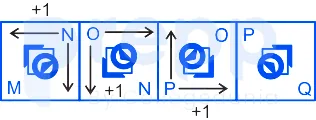
Select the figure from among the given options that can replace the question mark (?) in the following series.

- A
Option A (shown in image)
- B
Option B (shown in image)
- C
Option C (shown in image)
- D
Option D (shown in image)
Show answer
A. Option A (shown in image)The pattern followed here is:
1) Middle figure is rotated in a 90º anti-clockwise direction.
2) Addition of + 1 and shifted right-hand side and same letter shifted toward the left-hand side.
Hence, the correct answer is "Option 1".

 Paper & answer key PDF ↗
 Question 19archived
In a certain code language, 'ENGINE' is written as ‘ENIGNE’ and 'TRAIN’ is written as 'NIART'. How will 'LEVEL' be written in that language?
- A
LEELV
- B
LEVEL
- C
LEEVL
- D
LELEV
Show answer
B. LEVELThis problem involves understanding a specific code language where words are transformed based on a certain rule. We need to figure out this rule by analyzing the given examples and then apply it to the target word 'LEVEL'.
Decoding the Pattern in 'ENGINE'
First, let's look at the transformation of the word 'ENGINE'.
Original word: ENGINE
Coded word: ENIGNE
Let's examine the letter positions:
Original: E (1) N (2) G (3) I (4) N (5) E (6)
Coded: E (1) N (2) I (4) G (3) N (5) E (6)
Comparing the original and coded words, we see that the letters at positions 1, 2, 5, and 6 remain in their original places. The letters at the 3rd position ('G') and the 4th position ('I') are swapped.
Decoding the Pattern in 'TRAIN'
Next, let's analyze the transformation of the word 'TRAIN'.
Original word: TRAIN
Coded word: NIART
Let's examine the letter positions:
Original: T (1) R (2) A (3) I (4) N (5)
Coded: N (5) I (4) A (3) R (2) T (1)
In this case, the entire word 'TRAIN' appears to be reversed to get 'NIART'.
Identifying the Coding Rule
We have two different transformations:
'ENGINE' (6 letters, even length) had its 3rd and 4th letters swapped.
'TRAIN' (5 letters, odd length) was completely reversed.
Based on these examples, we can infer a possible rule related to the length of the word:
If the word has an even length, the middle two letters are swapped.
If the word has an odd length, the entire word is reversed.
Applying the Rule to 'LEVEL'
Now, we need to apply this identified rule to the word 'LEVEL'.
The word is LEVEL.
The length of the word 'LEVEL' is 5 letters.
Since 5 is an odd number, we apply the rule for odd-length words.
The rule for odd-length words is to reverse the entire word.
Reversing the word 'LEVEL' results in:
L (1) E (2) V (3) E (4) L (5)
Reversed: L (5) E (4) V (3) E (2) L (1)
Therefore, the coded word is 'LEVEL'.
Final Coded Word for 'LEVEL'
Following the derived coding rules based on word length, the word 'LEVEL' is coded as 'LEVEL'. This matches option 2.
Paper & answer key PDF ↗ Question 20archived
Select the odd group of numbers. (NOTE: Operations should be performed on the whole numbers, without breaking down the numbers into its constituent digits. E.g.13 - Operations on 13 such as adding /subtracting /multiplying etc. to 13 can be performed. Breaking down 13 into 1 and 3 and then performing mathematical operations on 1 and 3 is not allowed)
- A
(600 - 120 - 24)
- B
(400 - 80 - 14)
- C
(300 - 60 - 12)
- D
(500 - 100 - 20)
Show answer
B. (400 - 80 - 14)The question asks us to select the group of numbers that is different from the others. This usually means finding a pattern or rule that applies to three of the groups, while the remaining group does not follow that rule. The instructions state that operations should be performed on the whole numbers provided, not on their individual digits.
Analyzing the Number Groups to Find the Pattern
Let's look at each group, given in the format (N1 - N2 - N3), and try to find a relationship between the three numbers.
Group 1: (600 - 120 - 24)
Check the relationship between the first and second number: \(600 \div 120 = 5\). This means \(N_2 = N_1 \div 5\).
Check the relationship between the second and third number: \(120 \div 24 = 5\). This means \(N_3 = N_2 \div 5\).
This group follows a clear pattern: the second number is the first divided by 5, and the third number is the second divided by 5.
Group 2: (400 - 80 - 14)
Check the relationship between the first and second number: \(400 \div 80 = 5\). This means \(N_2 = N_1 \div 5\).
Check the relationship between the second and third number: \(80 \div 14\). \(80 \div 14 = 40/7\), which is approximately 5.71 and not exactly 5. This means \(N_3 \neq N_2 \div 5\).
This group follows the first part of the pattern but not the second part.
Group 3: (300 - 60 - 12)
Check the relationship between the first and second number: \(300 \div 60 = 5\). This means \(N_2 = N_1 \div 5\).
Check the relationship between the second and third number: \(60 \div 12 = 5\). This means \(N_3 = N_2 \div 5\).
This group follows the same pattern as Group 1.
Group 4: (500 - 100 - 20)
Check the relationship between the first and second number: \(500 \div 100 = 5\). This means \(N_2 = N_1 \div 5\).
Check the relationship between the second and third number: \(100 \div 20 = 5\). This means \(N_3 = N_2 \div 5\).
This group follows the same pattern as Group 1 and Group 3.
Identifying the Odd Group of Numbers
Based on our analysis, three of the groups (Group 1, Group 3, and Group 4) follow the pattern where each subsequent number is obtained by dividing the previous number by 5. Group 2, however, only follows the first division (\(N_1 \div 5 = N_2\)) but not the second (\(N_2 \div 5 = N_3\)).
Therefore, the group (400 - 80 - 14) is the odd one out because the third number, 14, is not the result of dividing the second number, 80, by 5 (which would be 16).
Here is a summary in a table:
Group
Numbers (N1 - N2 - N3)
Check N1 ÷ 5 = N2
Check N2 ÷ 5 = N3
Follows Pattern (N2=N1/5, N3=N2/5)?
1
(600 - 120 - 24)
\(600 \div 5 = 120\) (Yes)
\(120 \div 5 = 24\) (Yes)
Yes
2
(400 - 80 - 14)
\(400 \div 5 = 80\) (Yes)
\(80 \div 5 = 16\). N3 is 14 (No)
No
3
(300 - 60 - 12)
\(300 \div 5 = 60\) (Yes)
\(60 \div 5 = 12\) (Yes)
Yes
4
(500 - 100 - 20)
\(500 \div 5 = 100\) (Yes)
\(100 \div 5 = 20\) (Yes)
Yes
Revision Table: Understanding Odd Group Out Questions
Concept
Description
Approach Strategy
Objective
Find the single item (number, pair, group) that does not share the common property, pattern, or rule with the others.
Systematically analyze each option to identify the underlying rule.
Types of Patterns
Can involve arithmetic operations (+, -, ×, ÷), ratios, squares, cubes, prime numbers, divisibility rules, etc.
Consider simple operations first, then more complex ones. Apply the same check to all options.
Whole Number Rule
When specified, operations apply only to the complete number, not its constituent digits.
Strictly follow the rule. E.g., for 13, use 13 as a whole; do not separate into 1 and 3.
Additional Information: Tips for Number Pattern Problems
Solving number pattern and odd group out problems requires keen observation and systematic checking. Here are some tips:
Always look for simple arithmetic relations (addition, subtraction, multiplication, division) first between consecutive numbers or corresponding elements in groups.
Check for constant differences or constant ratios.
Consider squares, cubes, or other powers of numbers.
Look for patterns related to prime numbers, composite numbers, odd/even numbers.
If the pattern isn't immediately obvious, calculate differences or ratios between terms and see if those form a pattern.
Test the potential pattern on all given options to confirm it holds for most and fails for only one.
Pay close attention to any specific rules provided in the question, like the rule about using whole numbers here.
Practice is key to recognizing different types of number patterns quickly.
Paper & answer key PDF ↗ Question 21archived
Select the option that is related to the fourth term in the same way as the first term is related to the second term and the fifth term is related to the sixth term.
8 : 96 :: ? : 54 :: 12 : 216
- A
8
- B
6
- C
10
- D
4
Show answer
B. 6Logical Reasoning: Number Analogy Solution
This question is based on the concept of number analogy, where we need to find the relationship between the numbers in the given pairs and apply the same relationship to find the missing term.
Analyzing the Given Number Pairs
We are given three pairs related by the '::' symbol:
8 : 96
? : 54
12 : 216
We need to find the pattern connecting the first number to the second number in the known pairs (8:96 and 12:216).
Finding the Relationship Pattern
Let's examine the first pair, 8 and 96. How can 8 be related to 96? We can try various operations:
Multiplication: $8 \times 12 = 96$. The multiplier is 12.
Squaring: $8^2 = 64$. $96 - 64 = 32$. $32 = 4 \times 8$. So, $8^2 + 4 \times 8 = 96$. Notice that 4 is half of 8. This suggests a potential pattern: $N^2 + (N/2) \times N$.
Multiplication based on the number itself: $8 \times (8 + \text{something})$. $96 / 8 = 12$. So, $8 \times (8 + 4) = 96$. Again, 4 is half of 8. This suggests the pattern: $N \times (N + N/2)$.
Let's check the second known pair, 12 and 216, with the pattern $N \times (N + N/2)$:
For $N=12$: $12 \times (12 + 12/2) = 12 \times (12 + 6) = 12 \times 18 = 216$. This matches the given pair!
So, the established pattern is that the second term is obtained by multiplying the first term (N) by the sum of the first term (N) and half of the first term (N/2). Mathematically, this is $N \times (N + N/2)$ or $N \times (3N/2)$ or $1.5 \times N^2$. Let's use $N \times (N + N/2)$.
Applying the Pattern to the Missing Term
Now, we apply this pattern to the second pair: ? : 54. Let the missing term be N.
According to the pattern:
$N \times (N + N/2) = 54$
Let's solve for N:
$N \times (3N/2) = 54$
$\frac{3N^2}{2} = 54$
$3N^2 = 54 \times 2$
$3N^2 = 108$
$N^2 = \frac{108}{3}$
$N^2 = 36$
$N = \sqrt{36}$
$N = 6$ (Assuming the positive value as is standard in these types of problems)
Verifying the Answer
Let's check if N=6 fits the pattern:
$6 \times (6 + 6/2) = 6 \times (6 + 3) = 6 \times 9 = 54$. This matches the given second term!
Therefore, the missing term is 6.
Pair
First Term (N)
Relationship Applied: $N \times (N + N/2)$
Calculated Second Term
Given Second Term
1st
8
$8 \times (8 + 8/2) = 8 \times 12$
96
96
3rd
12
$12 \times (12 + 12/2) = 12 \times 18$
216
216
2nd
? (N)
$N \times (N + N/2) = 54$
54
54
Conclusion
The relationship between the terms in each pair is $N : N \times (N + N/2)$. Applying this relationship to the second pair, we found that the missing term is 6.
Revision Table: Number Analogy Patterns
Common Pattern Type
Description
Example
Arithmetic Operations
Adding, subtracting, multiplying, or dividing by a constant or variable number.
N : N+k, N : N*k
Square/Cube Relations
Relating to the square or cube of the number, often with additions/subtractions.
N : N$^2$+k, N : N$^3$-k
Combinations
Combining multiple operations or involving relations with N/2, N+1, N-1, etc.
N : N$^2$+N, N : N*(N+1), N : N*(N/2)
Additional Information: Solving Logical Reasoning Problems
Logical reasoning questions, especially number analogies, require careful observation to identify the underlying pattern or rule. Here are some tips:
Look for simple arithmetic relations first.
Consider squares, cubes, square roots, or cube roots.
Check for patterns involving the number itself, its half, or its neighbors (N+1, N-1).
Sometimes the pattern involves the sum or product of digits.
Practice with various types of problems to become familiar with common patterns.
Identifying the relationship accurately is key to solving number analogy questions correctly.
Paper & answer key PDF ↗ Question 22archived
A & B means ‘A is the son of B’
A # B means ‘A is the sister of B’
A @ B means ‘A is the brother of B’
A % B means ‘A is the father of B’
A - B means ‘A is the daughter of B’
A * B means ‘A is the wife of B’
If C # D @ E % Z & L # M - N * P, then how is L related to P?
- A
Wife
- B
Daughter
- C
Daughter-in-law
- D
Sister
Show answer
B. DaughterUnderstanding Blood Relation Codes
This problem uses specific symbols to represent blood relationships. Decoding these symbols correctly is the first step to solving the puzzle.
SymbolMeaningExample: A & B
&son ofA is the son of B
#sister ofA is the sister of B
@brother ofA is the brother of B
%father ofA is the father of B
-daughter ofA is the daughter of B
*wife ofA is the wife of B
Analyzing the Blood Relation Expression: C # D @ E % Z & L # M - N * P
Let's break down the given expression segment by segment and determine the relationship and gender of each person where possible:
C # D: C is the sister of D. This tells us C is female.
D @ E: D is the brother of E. This tells us D is male. Since C is the sister of D and D is the brother of E, C, D, and E are siblings. C is female, D is male, E is male.
E % Z: E is the father of Z. This tells us E is male (which we already knew) and Z is a child of E. Z's gender is not yet determined by this part alone.
Z & L: Z is the son of L. This tells us Z is male. We know Z is the son of E (from E % Z) and also the son of L. This means E and L are the parents of Z. Since E is male (father), L must be female (mother). So, E and L are married.
L # M: L is the sister of M. This tells us L is female (which we already knew) and M is a sibling of L. M's gender is not yet determined by this part alone.
M - N: M is the daughter of N. This tells us M is female. Since L is the sister of M, and M is the daughter of N, it means L is also a daughter of N. Both L and M are female.
N * P: N is the wife of P. This tells us N is female and P is male. N and P are married.
Tracing the Relationship of L to P
We want to find out how L is related to P. Let's connect the relationships we've found:
We know from M - N that M is the daughter of N.
We know from L # M that L is the sister of M.
If L is M's sister and M is N's daughter, then L must also be N's daughter.
We know from N * P that N is the wife of P. This means P is N's husband.
If L is the daughter of N, and N is married to P, then P is the father of N's children. Therefore, L is the daughter of P.
Based on the step-by-step analysis of the blood relation expression, L is the daughter of P.
Blood Relation Problem Revision Table
SymbolMeaningGender Implied (First Person)
&son ofMale
#sister ofFemale
@brother ofMale
%father ofMale
-daughter ofFemale
*wife ofFemale
Additional Information on Solving Blood Relation Reasoning Questions
Solving blood relation questions with codes requires careful attention to detail. Here are some general tips:
Decode First: Always start by writing down the meaning of each symbol and the gender it implies for the first person in the pair (A in 'A symbol B').
Build Connections: Link the relationships together sequentially as given in the expression.
Track Genders: Keep track of the gender of each person as you deduce it. This helps eliminate incorrect relationship possibilities.
Visualize: If the expression is long, drawing a simple diagram or family tree can make the connections clearer and help avoid mistakes. Use standard symbols for family members and relationships.
Question the Relationship: Finally, focus on the specific relationship asked in the question (e.g., L to P) and trace the path in your diagram or notes.
Paper & answer key PDF ↗ Question 23archived
Select the option that is related to the third word in the same way as the second word is related to the first word. (The words must be considered as meaningful English words and must not be related to each other based on the number of letters/number of consonants/vowels in the word.)
Panel : Jurors :: Portfolio : ?
- A
Trustees
- B
Securities
- C
Administration
- D
Companies
Show answer
B. SecuritiesThe correct answer is Securities.
Some examples include: Part-to-Whole: Finger : Hand (A finger is part of a hand) Cause and Effect: Rain : Flood (Rain can cause a flood) Synonyms: Happy : Joyful (Words with similar meanings) Antonyms: Hot : Cold (Words with opposite meanings) Worker and Tool: Carpenter : Hammer (A carpenter uses a hammer) Action and Object: Read : Book (You read a book) Category and Item: Color : Red (Red is a type of color) Collection and Item: Panel : Jurors (A panel is a collection of jurors) In this question, the relationship was Collection/Group and the Items/Members within that collection/group.
Paper & answer key PDF ↗ Question 24archived
Which number will replace the question mark (?) in the following series?
1, 4, 13, 40, ?, 364
- A
132
- B
121
- C
120
- D
124
Show answer
B. 121Solving the Number Series Pattern
The question asks us to find the missing number in the given series: 1, 4, 13, 40, ?, 364.
To solve this number series puzzle, we need to identify the underlying pattern that relates consecutive terms.
Identifying the Pattern in the Number Series
Let's examine the relationship between each pair of consecutive numbers:
From 1 to 4: We can see that $1 \times 3 = 3$, and $3 + 1 = 4$.
From 4 to 13: Let's test the same pattern. $4 \times 3 = 12$, and $12 + 1 = 13$. This fits the pattern.
From 13 to 40: Applying the pattern again, $13 \times 3 = 39$, and $39 + 1 = 40$. This also fits the pattern.
It appears the pattern is to multiply the previous number by 3 and then add 1.
Mathematically, if $a_n$ is the n-th term in the series, the pattern can be described by the recurrence relation:
$$a_{n} = 3 \times a_{n-1} + 1$$
where $a_1 = 1$.
Calculating the Missing Number
Following the identified pattern, the number replacing the question mark (?) is the term after 40. We apply the rule to 40:
Missing Number = $40 \times 3 + 1$
First, multiply 40 by 3: $40 \times 3 = 120$.
Then, add 1 to the result: $120 + 1 = 121$.
So, the missing number is 121.
Verifying the Next Term in the Series
To be sure the pattern holds, let's check if applying the rule to 121 gives the next number in the series, which is 364:
Next Term = $121 \times 3 + 1$
Multiply 121 by 3: $121 \times 3 = 363$.
Add 1 to the result: $363 + 1 = 364$.
Since this matches the last number in the given series, our pattern is correct.
The complete series with the missing number is: 1, 4, 13, 40, 121, 364.
Summary of the Pattern
Step
Calculation
Result
1 to 4
$1 \times 3 + 1$
4
4 to 13
$4 \times 3 + 1$
13
13 to 40
$13 \times 3 + 1$
40
40 to ?
$40 \times 3 + 1$
121
? to 364
$121 \times 3 + 1$
364
The number that replaces the question mark is 121.
Revision Table for Number Series
Understanding different types of number series patterns is key to solving such problems quickly. Here's a brief revision guide:
Arithmetic Series: Each term is obtained by adding a constant difference to the previous term (e.g., 2, 5, 8, 11...).
Geometric Series: Each term is obtained by multiplying the previous term by a constant ratio (e.g., 3, 6, 12, 24...).
Difference Series: The differences between consecutive terms follow a pattern (e.g., 1, 3, 6, 10... where differences are 2, 3, 4...).
Product/Ratio Series: The ratio or product between terms follows a pattern.
Mixed Series: A combination of arithmetic and geometric operations, or other rules, as seen in this problem ($a_n = 3 \times a_{n-1} + 1$).
Fibonacci-like Series: Each term is the sum of the previous two terms (e.g., 1, 1, 2, 3, 5, 8...).
Additional Information on Number Series Questions
Number series questions are common in aptitude tests and exams. They assess your logical reasoning and pattern recognition skills.
Tips for solving number series:
Look at the differences between consecutive numbers.
Look at the ratios between consecutive numbers.
Check for patterns involving multiplication, division, addition, subtraction, squares, cubes, or a combination of these operations.
Sometimes the pattern involves alternating operations or involves prime numbers, odd/even numbers, etc.
If the numbers grow or shrink rapidly, consider multiplication, division, squares, or cubes.
If the numbers grow or shrink slowly, consider addition or subtraction.
Always check the pattern for at least the first few terms and verify it with the last given term if possible.
Paper & answer key PDF ↗ Question 25archived
Select the correct mirror image of the given combination when the mirror is placed at 'PQ' as shown below.

- A
Option A (shown in image)
- B
Option B (shown in image)
- C
Option C (shown in image)
- D
Option D (shown in image)
Show answer
Question 26archived
Which of the following statement is correct?
I. The biggest state of India in terms of area is Uttar Pradesh.
II. Rajasthan is the state of India which have highest population among all other states of India.
- A
Only I
- B
Neither I nor II
- C
Only II
- D
Both I and II
Show answer
B. Neither I nor IIThe correct answer is Neither I nor II.
Uttar Pradesh is located in northern India and is a major agricultural and political state. Area is typically measured in square kilometers ($\text{km}^2$). Population data is usually based on the decadal Census conducted by the Government of India. The latest complete census was conducted in 2011.
Paper & answer key PDF ↗ Question 27archived
Who among the following is Telangana’s first Sangeet Natak Akademi Award winner?
- A
Padmaja Reddy
- B
Yamini Reddy
- C
Deepa Sashindran
- D
Shantala Shivalingappa
Show answer
A. Padmaja ReddyThe correct answer is Padmaja Reddy.
The awards cover various categories within music, dance, and drama, as well as folk/traditional/tribal arts and puppetry. The Akademi also confers fellowships (Akademi Ratna) for exceptional lifetime achievement. The awards are given annually, usually announced towards the end of the year or early the following year. Winning this award brings national recognition and prestige to the artist and their art form.
Paper & answer key PDF ↗ Question 28archived
Who among the following became the first Asian to win the award for best sound for the documentary 'India’s Daughter' at the coveted Motion Picture Sound Editors’ 63rd annual Golden Reel Awards?
- A
Justin Jose
- B
Resul Pookutty
- C
P.M.Satheesh
- D
Boby John
Show answer
B. Resul PookuttyUnderstanding the Motion Picture Sound Editors Golden Reel Awards
The Motion Picture Sound Editors (MPSE) Golden Reel Awards are prestigious awards given annually to recognize outstanding achievement in sound editing in film, television, and other media. Winning a Golden Reel Award is a significant recognition for sound professionals globally.
Analyzing the 'India's Daughter' Documentary Sound Award
The question specifically asks about the award for best sound for the documentary 'India’s Daughter' at the 63rd annual Golden Reel Awards. It highlights the achievement of becoming the first Asian to win this particular award.
The documentary 'India’s Daughter', directed by Leslee Udwin, is a film based on the 2012 Delhi gang rape case. The sound design and editing played a crucial role in conveying the film's powerful narrative.
Identifying the First Asian Winner
Among the options provided, we need to identify the individual who won the award for best sound for 'India’s Daughter' at the 63rd Golden Reel Awards and was the first Asian to do so.
Let's look at the options:
Justin Jose
Resul Pookutty
P.M.Satheesh
Boby John
Research indicates that the sound team for 'India’s Daughter' won the Golden Reel Award for Best Sound and Music Editing: Television Documentary & Long Form. The individual who was part of this team and is known for his significant achievements in sound design and for being the first Asian to achieve this particular feat at the 63rd MPSE awards is Resul Pookutty.
Resul Pookutty is a celebrated Indian film sound designer, sound editor, and audio mixer.
Option Analysis
Justin Jose: While also a talented sound designer, he was not the recipient of this specific award for 'India's Daughter'.
Resul Pookutty: He was part of the sound team for 'India's Daughter' that won the Golden Reel Award, and he is recognized as the first Asian to achieve this honor at the 63rd ceremony.
P.M.Satheesh: Another accomplished sound designer, but not the winner of this specific award for 'India's Daughter'.
Boby John: Also a professional in the sound field, but not associated with winning this specific award.
Based on the facts surrounding the 63rd Motion Picture Sound Editors Golden Reel Awards and the documentary 'India’s Daughter', Resul Pookutty was the winner, making him the first Asian to receive this accolade at that ceremony.
Revision Table
Award
Documentary
Winner (Key Individual)
Significance
MPSE 63rd Golden Reel Award (Best Sound/Music Editing: Television Documentary & Long Form)
India’s Daughter
Resul Pookutty (as part of the sound team)
First Asian to win this particular award at the 63rd ceremony.
Additional Information on Resul Pookutty and Golden Reel Awards
Resul Pookutty has received numerous awards for his work in sound design, including an Academy Award for Best Sound Mixing for the film 'Slumdog Millionaire' in 2009. His win for 'India's Daughter' further cemented his reputation as a leading figure in global sound design. The Golden Reel Awards cover a wide range of categories across film and television, recognizing the intricate work involved in creating the soundscape for visual media.
Paper & answer key PDF ↗ Question 29archived
Which of the following is known as ‘Plaster of Paris’?
- A
2CaSO4⋅2H2O
- B
2MgSO 4 ⋅ H 2 O
- C
2MgSO 4 ⋅ 7H 2 O
- D
CaSO 4 ⋅1/2 H 2 O
Show answer
D. CaSO 4 ⋅1/2 H 2 OIdentifying the Chemical Formula of Plaster of Paris
The question asks to identify the chemical formula of Plaster of Paris from the given options. Plaster of Paris is a well-known material used in various applications, including construction, art, and medical casts. Its chemical composition is specifically defined by the presence of calcium sulfate and a certain amount of water molecules.
Let's examine the options provided:
2CaSO4⋅2H2O: This formula represents calcium sulfate dihydrate, which is commonly known as gypsum. Gypsum is the raw material from which Plaster of Paris is made.
2MgSO4⋅H2O: This formula involves magnesium sulfate with one molecule of water. This is not related to Plaster of Paris.
2MgSO4⋅7H2O: This formula represents magnesium sulfate heptahydrate, commonly known as Epsom salt. This is also not related to Plaster of Paris.
CaSO4⋅1/2 H2O: This formula represents calcium sulfate hemihydrate. This is the correct chemical formula for Plaster of Paris. It contains calcium sulfate and half a molecule of water per molecule of calcium sulfate.
Plaster of Paris is produced by heating gypsum (calcium sulfate dihydrate) to remove some of the water molecules. The heating process, called calcination, results in calcium sulfate hemihydrate.
The chemical reaction for the formation of Plaster of Paris from gypsum is:
\(\text{CaSO}_4\text{·}2\text{H}_2\text{O(s)} \xrightarrow{\text{Heat}} \text{CaSO}_4\text{·}\frac{1}{2}\text{H}_2\text{O(s)} + 1\frac{1}{2}\text{H}_2\text{O(g)}\)
Therefore, the chemical formula for Plaster of Paris is calcium sulfate hemihydrate, which is represented as \(\text{CaSO}_4\text{·}\frac{1}{2}\text{H}_2\text{O}\).
Revision Table: Understanding Calcium Sulfates
Common Name
Chemical Name
Chemical Formula
Gypsum
Calcium Sulfate Dihydrate
\(\text{CaSO}_4\text{·}2\text{H}_2\text{O}\)
Plaster of Paris
Calcium Sulfate Hemihydrate
\(\text{CaSO}_4\text{·}\frac{1}{2}\text{H}_2\text{O}\)
Additional Information on Plaster of Paris and Gypsum
Setting of Plaster of Paris: Plaster of Paris has a unique property of setting into a hard mass when mixed with water. When water is added to Plaster of Paris (\(\text{CaSO}_4\text{·}\frac{1}{2}\text{H}_2\text{O}\)), it rehydrates and reforms into gypsum (\(\text{CaSO}_4\text{·}2\text{H}_2\text{O}\)). This process is exothermic (releases heat) and causes the mixture to solidify and expand slightly, making it useful for casting and molding.
The setting reaction is:
\(\text{CaSO}_4\text{·}\frac{1}{2}\text{H}_2\text{O(s)} + 1\frac{1}{2}\text{H}_2\text{O(l)} \rightarrow \text{CaSO}_4\text{·}2\text{H}_2\text{O(s)}\)
Uses of Plaster of Paris:
Used in medical casts to immobilize fractured bones.
Used in making molds and casts for sculptures and decorative items.
Used as a fire-resistant material.
Used in dentistry for making impressions.
Used in the construction industry for plastering walls and ceilings.
Gypsum: Gypsum (\(\text{CaSO}_4\text{·}2\text{H}_2\text{O}\)) is a naturally occurring mineral. It is widely used in the production of drywall (gypsum board), cement, and as a soil conditioner.
Paper & answer key PDF ↗ Question 30archived
______ is the centre for the Indian Institution of Soil Science.
- A
Porbandar
- B
Bhopal
- C
Vishakhapatnam
- D
Bhubaneswar
Show answer
B. BhopalThe correct answer is Bhopal.
Providing technical backstopping for national soil health programs. Developing strategies for climate-smart soil management practices. Capacity building and training in soil science. Its work directly impacts agricultural productivity and environmental sustainability across India.
Paper & answer key PDF ↗ Question 31archived
In 1873, the Satyashodhak Samaj was established in ______.
- A
Bihar Province
- B
Madras Presidency
- C
Bombay Presidency
- D
Punjab Province
Show answer
C. Bombay PresidencyThe correct answer is Bombay Presidency.
Along with establishing the Satyashodhak Samaj, he and his wife Savitribai Phule were pioneers of women's education in India, opening one of the first schools for girls in 1848. He also wrote extensively on the caste system and social inequality, notably in his book 'Gulamgiri' (Slavery). His work through the Satyashodhak Samaj aimed to empower the marginalized sections of society by promoting education, equality, and rational thinking, questioning traditional authorities and social hierarchies.
Paper & answer key PDF ↗ Question 32archived
_______ are those where a monthly instalment is deposited in the accounts every month.
- A
savings bank deposits
- B
reinvestment deposits
- C
fixed deposits
- D
recurring deposits
Show answer
D. recurring depositsThe correct answer is recurring deposits.
Goal-Oriented: Ideal for saving towards specific short-term or medium-term goals like buying a gadget, funding a vacation, or making a down payment. Predictable Returns: The interest rate is usually fixed for the entire tenure, providing predictability in the maturity amount. Lower Minimum Amount: Compared to fixed deposits, recurring deposits often have lower minimum monthly instalment requirements, making them accessible to more people. In summary, recurring deposits are the specific type of bank account designed for saving through fixed monthly instalments over a set period.
Paper & answer key PDF ↗ Question 33archived
When a magnesium ribbon is burnt in oxygen, it gets converted to ______.
- A
magnesium peroxide
- B
magnesium hydroxide
- C
magnesium carbonate
- D
magnesium oxide
Show answer
D. magnesium oxideThe correct answer is magnesium oxide.
Key Points
Concept:
This is a redox type of reaction.
Redox is a reaction in which oxidation and reduction occur simultaneously.
Reduction is a reaction in which there is a gain of hydrogen.
Reduction can also be defined as the gain of electrons.
A reaction in which there is a gain of oxygen or a loss of hydrogen is called an oxidation reaction.
Oxidation can also be defined in terms of a decrease in electrons.
Magnesium is designated as Mg.
Magnesium oxide is MgO.
Explanation:
Magnesium belongs to group 2 and is also part of the s block elements.
The atomic number of Mg is 12.
Its electronic configuration, Mg = 12 = 2,8,2 shows that it has 2 valence electrons.
Thus, oxidation of Mg occurs by losing 2 electrons, forming the Mg, Mg+2 ion.
These 2 electrons are gained by oxygen atoms forming O-2 ions, resulting in reduction.
When magnesium ribbon is burned in the presence of oxygen, it reacts with elemental oxygen to form magnesium oxide.
Magnesium oxide is thus a white, odorless powder.
Reaction:
2Mg → 2Mg+2 + 4e- ---------half oxidation reaction.
O2 + 4e- → 2O-2 -------------half reduction reaction.
2Mg + O2 → 2MgO
Additional Information:
Magnesium oxide can also be used as a laxative for a short term, to quickly empty the intestines (before surgery) but should not be used repeatedly.
When magnesium oxide is mixed with water, it is called magnesium hydroxide - this mixture helps neutralize stomach acid (acidity).
MgO is a solid that is physically and chemically stable at high temperatures.
 Paper & answer key PDF ↗
 Question 34archived
Which of the following rocks may contain fossils of plants, animals and other microorganisms that once lived on them?
- A
Metamorphic rocks
- B
Intrusive igneous rocks
- C
Sedimentary rocks
- D
Extrusive igneous rocks
Show answer
C. Sedimentary rocksThe correct answer is Sedimentary rocks.
Presence of Minerals: Minerals from groundwater can seep into the porous remains and replace the organic material or fill the spaces within the remains, turning them into rock (permineralization). Stable Environment: Tectonic activity, erosion, and weathering can destroy fossils even after they form. Sedimentary environments like oceans, lakes, and riverbeds are common places for these conditions to be met, making sedimentary rocks the primary record of past life on Earth.
Paper & answer key PDF ↗ Question 35archived
Bade Ghulam Ali Khan was a prominent singer of the ______ gharana.
- A
Rampur Sahaswan
- B
Patiala
- C
Benaras
- D
Bhendi Bazaar
Show answer
B. PatialaUnderstanding Bade Ghulam Ali Khan and His Gharana
The question asks about the specific gharana (school of musical thought) to which the renowned vocalist Bade Ghulam Ali Khan belonged. Gharanas are crucial to understanding Indian classical music traditions, representing distinct styles, techniques, and lineages of musicianship.
Analyzing the Options
Let's look at the provided options and their relevance:
Rampur Sahaswan gharana: Known for its powerful and intricate vocalizations, with prominent figures like Ustad Mushtaq Hussain Khan. While important, this is not the gharana of Bade Ghulam Ali Khan.
Patiala gharana: This gharana is known for its focus on emotion and technical virtuosity, often incorporating elements of folk music and intricate taans (rapid melodic figures). This gharana was significantly shaped by Bade Ghulam Ali Khan himself.
Benaras gharana (or Benares gharana): Primarily known for its unique thumri and dadra styles, though it also has traditions in khayal singing. Not directly associated with Bade Ghulam Ali Khan.
Bhendi Bazaar gharana: Known for its distinct vocal training methods and the development of the merukhand technique. Not the gharana of Bade Ghulam Ali Khan.
Bade Ghulam Ali Khan's Association
Bade Ghulam Ali Khan (1902–1968) was one of the most celebrated vocalists of the 20th century in Indian classical music. He is widely regarded as a master of the Patiala gharana. Although his father, Ali Baksh Khan, was a co-founder of the Patiala gharana along with Fateh Ali Khan, Bade Ghulam Ali Khan developed and popularized the gharana's style, making it synonymous with his name for many. His music was characterized by a unique blend of classical purity, emotional depth, and unparalleled vocal control, especially in his taans.
Conclusion
Based on his lineage and musical style, Bade Ghulam Ali Khan was a towering figure of the Patiala gharana.
Gharana
Key Characteristic (Vocal)
Prominent Figures (Examples)
Patiala
Emotional expression, intricate taans, fusion elements
Bade Ghulam Ali Khan, Fateh Ali Khan & Ali Baksh Khan
Rampur Sahaswan
Powerful voice, systematic raga development, intricate taans
Ustad Mushtaq Hussain Khan, Ghulam Mustafa Khan
Benaras
Emphasis on thumri, dadra; lyrical and expressive style
Girija Devi, Rajan & Sajan Mishra
Bhendi Bazaar
Merukhand technique, open vowel singing
Aman Ali Khan, Lata Mangeshkar (trained here initially)
Revision Table: Famous Indian Classical Gharanas
Gharana
Focus Area
Gwalior Gharana
Oldest Khayal Gharana; Clarity of notes, Vilambit Laya (slow tempo)
Kirana Gharana
Emphasis on Swara (note) purity and emotional bhava
Agra Gharana
Nomenclature 'Nauhar Bani'; Powerful and resonant voice usage
Patiala Gharana
Technical virtuosity, intricate taans, emotional expression
Jaipur-Atrauli Gharana
Complex raga structures, intricate Sargam patterns
Additional Information on Indian Classical Music Gharanas
Gharanas in Indian classical music represent a pedagogical and performance lineage or school. The term 'gharana' literally means 'house' or 'family' and signifies a system of musical education and style developed and preserved through generations of musicians, often belonging to the same family or discipleship.
Key aspects that differentiate gharanas include:
Style of voice production and usage.
Approach to raga development (vistaar).
Types and patterns of taans (rapid runs).
Emphasis on certain aspects like rhythm (laya), melody (swara), or emotional expression (bhava).
Repertoire of ragas and compositions.
Studying gharanas helps understand the rich diversity and historical evolution within Hindustani classical music. Musicians typically train rigorously under a guru from a specific gharana, inheriting its traditions and techniques, though many later develop their own unique style influenced by multiple gharanas.
Paper & answer key PDF ↗ Question 36archived
Union Government has launched the Eighth Edition of Swachh Survekshan SS-2023 under Swachh Bharat Mission Urban 2.0. It is curated towards achieving circularity in ________.
- A
industrial management
- B
waste management
- C
roads management
- D
rainwater management
Show answer
B. waste managementUnderstanding Swachh Survekshan SS-2023 and Circularity
The Union Government launched the Eighth Edition of Swachh Survekshan (SS-2023) as part of the Swachh Bharat Mission Urban 2.0. This nationwide survey assesses the cleanliness, sanitation, and citizen feedback in urban areas. The Swachh Bharat Mission Urban 2.0 has a strong focus on sustainable sanitation and waste management practices, aiming for a circular economy approach in specific areas.
Focus on Circularity in Swachh Survekshan SS-2023
The term 'circularity' in the context of urban development and environmental initiatives like Swachh Bharat Mission Urban 2.0 refers to adopting principles of a circular economy. This involves designing out waste and pollution, keeping products and materials in use, and regenerating natural systems. For Swachh Survekshan SS-2023, this principle is primarily applied to the management of materials that are typically discarded.
Swachh Survekshan evaluates cities based on various parameters, including:
Segregation of waste at source
Processing of wet and dry waste
Remediation of legacy dumpsites
Plastic waste management
Construction and demolition waste management
Sanitation infrastructure
Citizen engagement
These parameters directly relate to how waste is handled and processed, moving away from linear models (take-make-dispose) towards a circular approach where waste is seen as a resource.
Analyzing the Options
Let's look at the given options in the context of Swachh Survekshan SS-2023 and circularity:
industrial management: While important for overall sustainability, industrial management is not the primary focus area for assessment under Swachh Survekshan, which is centered on urban cleanliness and municipal services.
waste management: This aligns perfectly with the goals of Swachh Bharat Mission Urban 2.0 and Swachh Survekshan SS-2023. Achieving circularity in waste management means reducing waste generation, maximizing reuse and recycling, and recovering value from waste materials. This is a core objective of the mission.
roads management: Managing roads is crucial for urban infrastructure, but it is not directly related to the cleanliness and sanitation assessment conducted under Swachh Survekshan SS-2023 or the concept of circularity as applied in this context.
rainwater management: Rainwater harvesting and management are vital for water conservation and urban planning, but they are not the central theme of Swachh Survekshan, nor is 'circularity' in this context typically applied to rainwater management in the same way as it is to waste.
Therefore, the Eighth Edition of Swachh Survekshan SS-2023, under Swachh Bharat Mission Urban 2.0, is curated towards achieving circularity specifically in waste management.
Swachh Survekshan Objectives
The main objectives of Swachh Survekshan are to encourage large scale citizen participation, ensure sustainability of sanitation practices, and to assess and rank cities based on their sanitation and cleanliness performance. SS-2023 emphasizes moving towards a 'clean city' model that incorporates advanced waste processing technologies and community involvement.
Importance of Circularity in Waste Management
Implementing circularity in waste management helps in reducing the environmental impact of waste disposal, conserving natural resources, creating economic opportunities through recycling and resource recovery, and building more sustainable and resilient urban areas. Swachh Survekshan SS-2023 acts as a catalyst for cities to adopt such practices.
Initiative
Focus Area
Concept of Circularity
Swachh Bharat Mission Urban 2.0
Urban Cleanliness, Sanitation, Solid Waste Management
Achieving circularity in Waste Management
Swachh Survekshan SS-2023
Assessment & Ranking of Urban Areas
Evaluating progress towards circularity in waste handling & processing
Revision Table: Key Aspects of Swachh Survekshan SS-2023
Feature
Description
Mission
Swachh Bharat Mission Urban 2.0
Survey Edition
Eighth Edition (SS-2023)
Primary Goal
Assess urban cleanliness and sanitation progress
Curated Towards
Achieving circularity
Area of Circularity Focus
Waste Management
Additional Information: The Circular Economy and Waste
A circular economy aims to keep resources in use for as long as possible, extract maximum value from them whilst in use, and then recover and regenerate products and materials at the end of each service life. When applied to waste management, this involves:
Reduce: Minimizing the amount of waste generated in the first place.
Reuse: Finding ways to use items again for the same or a different purpose.
Recycle: Processing materials to create new products.
Recover: Extracting energy or materials from waste that cannot be reused or recycled (e.g., waste-to-energy).
Swachh Survekshan SS-2023 encourages cities to adopt these principles to improve their waste management systems and move towards a more sustainable model.
Paper & answer key PDF ↗ Question 37archived
Which of the following is NOT a way in which a batsman can get out in a game of cricket?
- A
Bowled
- B
Leg bye
- C
Stumped
- D
Leg before wicket
Show answer
B. Leg byeUnderstanding Ways to Get Out in Cricket
In a game of cricket, a batsman's primary goal is to score runs, but there are many ways their innings can come to an end. These are known as dismissals or ways a batsman can get 'out'. The question asks us to identify which of the given options is *not* a way a batsman can be dismissed.
Let's look at each option provided and understand what it means in the context of cricket rules:
Bowled: This is a very common method of dismissal. A batsman is out 'bowled' if the bowler delivers the ball, and it hits the wickets and dislodges a bail (or all the wickets), even if the ball first touches the bat or the batsman's body (except the hand holding the bat), as long as no fielder has touched the ball after it left the bowler's hand.
Leg bye: This is a way of scoring runs, not a way to get out. A 'leg bye' occurs when the ball hits the batsman's body (usually the leg) when they are attempting to play a shot or avoid being hit, and the ball then goes away, allowing the batsmen to run. Runs scored this way are added to the team's total as 'extras' and are not credited to the batsman. The batsman is not out as a result of a leg bye, unless another form of dismissal (like run out) occurs while they are running the leg byes.
Stumped: This is a method of dismissal that typically involves the wicket-keeper. A batsman is out 'stumped' if they come out of their crease to play a ball, and the wicket-keeper gathers the ball and knocks the bails off the wickets with the ball or the hand holding the ball, while the batsman is still outside their crease and has not attempted a run.
Leg before wicket (LBW): This is another common dismissal. A batsman can be out 'leg before wicket' if the ball, pitched on or outside off stump or in line with the stumps, hits the batsman's body (typically the leg) before hitting the bat, and in the umpire's judgment, the ball would have gone on to hit the wickets. There are specific rules regarding where the ball pitches and where it hits the batsman relative to the wickets.
Analyzing the Options for Cricket Dismissal
Based on the definitions:
Bowled is a valid dismissal.
Leg bye is a method of scoring runs, not a dismissal.
Stumped is a valid dismissal.
Leg before wicket (LBW) is a valid dismissal.
Therefore, the option that is NOT a way a batsman can get out in a game of cricket is 'Leg bye'.
Summary of Cricket Dismissals
Term
Is it a Way to Get Out?
Brief Explanation
Bowled
Yes
Ball hits wickets after bowler delivers it.
Leg bye
No
Runs scored off the batsman's body (not bat), not a dismissal itself.
Stumped
Yes
Wicket-keeper dislodges bails while batsman is out of crease and not running.
Leg before wicket (LBW)
Yes
Ball hits batsman's body, judged to be going on to hit wickets.
Understanding the various ways a batsman can be dismissed is fundamental to following the game of cricket. While bowled, stumped, and LBW are common dismissals, a leg bye is simply a way to add runs to the team's score under specific circumstances.
Additional Information on Cricket Terms
Apart from dismissals like Bowled, Stumped, and LBW, there are several other ways a batsman can get out, including:
Caught: A fielder catches the ball after it has been hit by the batsman's bat (or hand holding the bat) before it bounces.
Run Out: A fielder or bowler breaks the wickets with the ball (or throwing the ball onto the wickets) while the batsman is running between the wickets and is out of their ground (crease).
Hit Wicket: The batsman breaks their own wickets with their bat or body while playing a shot or starting a run.
Handled the Ball: If the batsman deliberately touches the ball with their hand that is not holding the bat, without the permission of the opposition. (This is now covered under 'Obstructing the field').
Obstructing the Field: A batsman deliberately obstructs or distracts the fielding side by word or action.
Hit the Ball Twice: If a batsman hits the ball twice, except for the purpose of guarding their wicket after a first hit. (This is now covered under 'Obstructing the field').
Timed Out: A new batsman fails to be ready to face the next ball within a specified time limit after the previous batsman was dismissed.
Leg byes, along with Byes (runs scored when the ball passes the wicket-keeper and the batsman hasn't hit it with the bat or been hit by it), are types of 'extras' scored by the batting team, not the individual batsman.
Paper & answer key PDF ↗ Question 38archived
Ziyauddin Barani wrote his chronicle first in 1356 and another version _____ years later.
- A
three
- B
eight
- C
two
- D
five
Show answer
C. twoZiyauddin Barani's Chronicle and Its Versions
Ziyauddin Barani was a very important historian who lived during the Delhi Sultanate period. He is best known for his historical work, often referred to as a chronicle, which covered the history of the sultans of Delhi.
Understanding Ziyauddin Barani's Tarikh-i-Firoz Shahi
Barani's most famous work is the 'Tarikh-i-Firoz Shahi' (History of Firoz Shah). This chronicle is a primary source for understanding the reigns of various Delhi Sultans, from Ghiyas ud din Balban to the first six years of Firoz Shah Tughluq's reign.
Historians note that Ziyauddin Barani actually wrote different versions of this important chronicle. The question specifically asks about the time difference between the first and a later version he wrote.
The first version of Ziyauddin Barani's chronicle was completed in the year 1356 CE.
According to historical accounts, Ziyauddin Barani presented a second, slightly revised version of his chronicle just a few years after the first.
This second version is documented to have been completed in 1358 CE.
Calculating the Time Difference Between Chronicle Versions
To find the difference in years between the two versions mentioned by Ziyauddin Barani, we perform a simple calculation:
\( \text{Year of second version} - \text{Year of first version} = \text{Difference in years} \)
\( 1358 - 1356 = 2 \)
So, the second version of Ziyauddin Barani's chronicle was written 2 years after the first version.
Let's compare this result with the given options:
three
eight
two
five
The calculated difference of 2 years matches option 3.
Ziyauddin Barani's Chronicle Versions
Version
Year of Completion
First Version
1356 CE
Second Version
1358 CE
Revision Table: Key Facts on Ziyauddin Barani's Chronicle
Summary of Ziyauddin Barani's Work
Historian
Famous Work
Topic Covered
First Version Year
Second Version Year
Time Difference
Ziyauddin Barani
Tarikh-i-Firoz Shahi
History of Delhi Sultans (Balban to early Firoz Shah Tughluq)
1356
1358
2 years
Additional Information: Significance of Historical Chronicles
Historical chronicles like Ziyauddin Barani's 'Tarikh-i-Firoz Shahi' are invaluable resources for historians studying past periods. They provide detailed accounts of political events, administrative policies, social conditions, and even the daily lives of people during the time they were written.
Writing multiple versions of a historical work could be due to various reasons, such as:
Adding new information that became available.
Making corrections to previous entries.
Revising interpretations of events.
Tailoring the content or style for different patrons or audiences.
Barani's different versions of the chronicle offer unique insights into his evolving perspectives and the process of historical writing in that era.
Paper & answer key PDF ↗ Question 39archived
If the State government dissolves the Panchayati Raj Institutions before the end of their five-year term, fresh elections should ordinarily be held within _____.
- A
one month
- B
six months
- C
one year
- D
three months
Show answer
B. six monthsPanchayati Raj Dissolution and Election Timeline Explained
The Panchayati Raj Institutions (PRIs) in India are units of local self-governance at the village, intermediate, and district levels. These institutions have a fixed term of five years from the date appointed for their first meeting.
However, there might be circumstances where a State government dissolves a Panchayati Raj Institution before its full five-year term is completed. In such a scenario, the Constitution of India mandates a specific timeframe within which fresh elections must be conducted to reconstitute the dissolved body.
The relevant constitutional provision ensures that there is no prolonged period without a democratically elected local body. According to the provisions related to the duration of Panchayats (similar provisions apply to Municipalities and are linked to Panchayats regarding elections after dissolution), if a Panchayat is dissolved before the expiration of its five-year term, an election to constitute a new Panchayat shall be completed:
Before the expiration of a period of six months from the date of its dissolution.
Provided that where the remainder of the period for which the dissolved Panchayat would have continued is less than six months, it shall not be necessary to hold any election for constituting the Panchayat for such period.
This means that ordinarily, fresh elections must be held within six months of the dissolution date. The only exception is if the remaining term of the dissolved body was less than six months; in that case, an election is not required for that short period.
Analyzing the Options for Panchayati Raj Elections
Let's look at the given options in light of the constitutional requirement for fresh elections after the dissolution of Panchayati Raj Institutions:
one month: This period is too short for conducting elections across a state or relevant local area.
six months: This aligns with the constitutional mandate for holding fresh elections after dissolution.
one year: This period is longer than the constitutionally stipulated limit.
three months: This is shorter than the maximum period allowed but not the mandatory timeline specified for fresh elections after dissolution.
Therefore, the correct timeline for holding fresh elections after the dissolution of a Panchayati Raj Institution by the State government is six months.
Step-by-Step Explanation
Understand the normal term of a Panchayati Raj Institution: It is five years.
Consider the situation: The State government dissolves the PRI before its term ends.
Identify the constitutional requirement: Elections must be held to form a new body.
Recall the timeframe: The election must be completed within six months from the date of dissolution.
Note the exception: If the remaining term was less than six months, no election is needed for that period.
Conclude the ordinary timeline: Fresh elections must be held within six months.
Revision Table: Key Facts on Panchayati Raj Elections
Aspect
Details
Normal Term
5 years
Dissolution by State Govt.
Possible before term end
Requirement after Dissolution
Hold fresh elections
Time Limit for Fresh Elections
Within six months from dissolution date
Exception
If remaining term < 6 months, no election needed for that period
Additional Information on Panchayati Raj and Elections
The system of Panchayati Raj was constitutionalized through the 73rd Amendment Act, 1992. This amendment added Part IX to the Constitution, titled "The Panchayats," and a new Eleventh Schedule. Key provisions include:
A three-tier structure (village, intermediate, and district levels) in states with a population above 20 lakhs.
Regular elections every five years.
Reservation of seats for Scheduled Castes, Scheduled Tribes, and women.
Constitution of State Election Commission to conduct Panchayat elections.
Constitution of State Finance Commission to review the financial position of Panchayats.
The provision for holding fresh elections within six months of dissolution is crucial for ensuring the continuous functioning of local self-governance institutions, upholding democratic principles at the grassroots level, and preventing prolonged administrative rule in place of elected representatives.
Paper & answer key PDF ↗ Question 40archived
Which of the following categories did Ram Sahay Panday receive the Padma Shri 2022 in?
- A
Carnatic Music
- B
Distinguished service in the field of art
- C
Instrumentalist
- D
Singing
Show answer
B. Distinguished service in the field of artUnderstanding the Padma Shri Award for Ram Sahay Panday
The question asks about the specific category under which Shri Ram Sahay Panday was recognized with the prestigious Padma Shri award in the year 2022. The Padma Shri is one of the highest civilian awards in India, conferred for distinguished service in various fields.
To answer this question, we need to identify the specific area of contribution for which Ram Sahay Panday received this honour in 2022.
Identifying the Award Category for Ram Sahay Panday
Shri Ram Sahay Panday is a renowned folk artist from Madhya Pradesh, known for his Rai dance, a traditional folk dance popular in the Bundelkhand region. His significant contribution to the promotion and preservation of this folk art form led to his recognition at the national level.
Considering his extensive work and dedication to folk art, the category under which he was awarded the Padma Shri in 2022 was related to his distinguished service in the field of art.
Analyzing the Options
Let's look at the provided options:
Carnatic Music: This category relates to classical music from South India. Ram Sahay Panday is associated with folk art and dance, not Carnatic music.
Distinguished service in the field of art: This category broadly covers contributions to various art forms, including folk art. This aligns with Ram Sahay Panday's work.
Instrumentalist: While some artists might be instrumentalists, Ram Sahay Panday is primarily known as a folk dancer and artist.
Singing: This category pertains to vocal music. Ram Sahay Panday's main contribution is in dance and folk art performance.
Based on his background and contributions, the most fitting category among the options is "Distinguished service in the field of art".
Conclusion on Ram Sahay Panday's Award
Therefore, Ram Sahay Panday received the Padma Shri in 2022 for his distinguished service in the field of art, specifically recognizing his contributions to folk art and dance.
Recipient
Award
Year
Category
Ram Sahay Panday
Padma Shri
2022
Distinguished service in the field of art
Revision Table: Ram Sahay Panday Padma Shri
Key Detail
Information
Recipient
Ram Sahay Panday
Award
Padma Shri
Year
2022
Award Category
Distinguished service in the field of art
Known for
Rai dance (Folk art of Bundelkhand)
Additional Information: Padma Awards and Art Recognition
The Padma Awards, including the Padma Shri, Padma Bhushan, and Padma Vibhushan, are announced annually on Republic Day. They are given for achievements in various disciplines/fields of activities, such as art, social work, public affairs, science and engineering, trade and industry, medicine, literature and education, sports, and civil service.
The field of 'Art' is broad and includes various forms like music, dance, theatre, painting, sculpture, photography, folk art, etc.
Recognizing artists like Ram Sahay Panday with the Padma Shri highlights the importance of preserving and promoting traditional and folk art forms in India.
These awards honour individuals who have made significant contributions and rendered distinguished service to the nation in their respective areas.
Paper & answer key PDF ↗ Question 41archived
Which of the following Articles states that a State shall not discriminate against any citizen on grounds only of religion, race, caste, sex, place of birth or any of them?
- A
Article 15
- B
Article 59
- C
Article 25
- D
Article 40
Show answer
A. Article 15The correct answer is Article 15.
Additional Information: Article 15 Details It is important to note that while Article 15 prohibits discrimination, it also contains clauses allowing the State to make special provisions for: Women and children. Any socially and educationally backward classes of citizens or for the Scheduled Castes and the Scheduled Tribes. These exceptions are designed to address historical inequalities and promote affirmative action, ensuring substantive equality rather than just formal equality. The core principle of Article 15 remains the strong prohibition of discrimination by the State on the grounds mentioned in the question.
Paper & answer key PDF ↗ Question 42archived
The Paramhans Mandali was established to work for the abolition of caste in ______.
- A
1830
- B
1840
- C
1820
- D
1850
Show answer
B. 1840Understanding the Paramhans Mandali and Caste Abolition
The question asks about the establishment year of the Paramhans Mandali, a group dedicated to the abolition of the caste system in India. This organization played a significant role in the social reform movements of the 19th century.
The Paramhans Mandali was a secret socio-religious group that originated in Maharashtra. Its primary objective was to challenge and dismantle the rigid caste distinctions prevalent in society. Members of the Mandali believed in the equality of all human beings, regardless of their caste background.
To achieve their goal of caste abolition, members of the Paramhans Mandali would meet secretly and often shared food prepared by people of different castes, including lower castes. This was a radical act at the time, as inter-caste dining was strictly prohibited by traditional norms. These secret meetings helped foster a sense of brotherhood and equality among members, directly opposing the hierarchical structure of the caste system.
The establishment of the Paramhans Mandali was a key development in the history of social reform in India. Historical records indicate that the Paramhans Mandali was established in the year that corresponds to one of the given options.
Let's look at the options provided for the establishment year:
1830
1840
1820
1850
Based on historical accounts of social reform movements in Maharashtra and the founding of organizations dedicated to combating the caste system, the Paramhans Mandali was founded in the year 1840. This period saw the rise of various reformist groups responding to social inequalities.
Therefore, the Paramhans Mandali, dedicated to the abolition of caste, was established in 1840.
Revision Table: Paramhans Mandali Facts
Aspect
Detail
Organization Name
Paramhans Mandali
Primary Goal
Abolition of Caste System
Region
Maharashtra, India
Established Year
1840
Nature
Secret socio-religious group
Additional Information on Social Reform and Caste Abolition
The abolition of caste was a major focus for many social reformers in 19th and 20th century India. The Paramhans Mandali was one of the early organizations to take concrete steps against caste discrimination.
Other notable figures and movements that worked towards caste abolition and social equality include:
Jyotirao Phule and Savitribai Phule: Pioneers in promoting education for lower castes and women, and founders of the Satyashodhak Samaj.
B.R. Ambedkar: A key figure who championed the rights of Dalits (formerly untouchables) and played a crucial role in drafting the Indian Constitution which outlawed caste discrimination.
The Brahmo Samaj and Arya Samaj: Although their focus was broader, they also addressed social issues including aspects of the caste system.
The efforts of organizations like the Paramhans Mandali laid the groundwork for later, larger movements for social justice and caste abolition. Understanding the establishment year of such groups helps trace the history and evolution of these important social reforms.
Paper & answer key PDF ↗ Question 43archived
What is the suffix for -OH group according to IUPAC?
- A
-ols
- B
-ene
- C
-one
- D
-anes
Show answer
A. -olsUnderstanding the suffix used for different functional groups is crucial in organic chemistry nomenclature, specifically according to the International Union of Pure and Applied Chemistry (IUPAC) rules. The question asks for the IUPAC suffix for the -OH group.
Understanding the -OH Functional Group
The -OH group is known as the hydroxyl group. Organic compounds containing a hydroxyl group directly attached to a saturated carbon atom are called alcohols. The presence of this functional group significantly influences the chemical and physical properties of the molecule.
IUPAC Nomenclature for Alcohols
According to IUPAC rules, when the -OH group is the highest priority functional group in a molecule, the suffix '-ol' is added to the name of the parent alkane, replacing the terminal '-e'. For example, methane becomes methanol when an -OH group replaces a hydrogen atom.
Let's look at the options provided and determine which one corresponds to the -OH group suffix:
Option 1: -ols - This is the plural form of the suffix '-ol', which is indeed used for compounds containing the -OH group (alcohols). While the suffix itself is '-ol', listing it as '-ols' indicates its association with the class of compounds.
Option 2: -ene - This suffix is used to indicate the presence of a carbon-carbon double bond (\(\text{C}=\text{C}\)) in a molecule. Compounds containing double bonds are called alkenes.
Option 3: -one - This suffix is used to indicate the presence of a carbonyl group (\(\text{C}=\text{O}\)) where the carbon atom is bonded to two other carbon atoms. Compounds containing this functional group are called ketones.
Option 4: -anes - This is the suffix (or part of the suffix) used for saturated hydrocarbons containing only single bonds (\(\text{C}-\text{C}\) and \(\text{C}-\text{H}\)). Compounds in this class are called alkanes.
Based on the IUPAC rules, the characteristic suffix for the -OH group, which defines the alcohol functional group, is '-ol'. Option 1, '-ols', correctly points to this functional group class.
Examples of IUPAC Naming with -OH Group
Here are a few examples to illustrate the use of the '-ol' suffix:
\(\text{CH}_3\text{OH}\): Methanol (derived from methane)
\(\text{CH}_3\text{CH}_2\text{OH}\): Ethanol (derived from ethane)
\(\text{CH}_3\text{CH}_2\text{CH}_2\text{OH}\): Propan-1-ol (derived from propane, with the -OH on the first carbon)
These examples clearly show that the '-ol' suffix is appended to the parent hydrocarbon name to denote the presence of the -OH group.
Functional Group
Structure
Class of Compound
IUPAC Suffix
Hydroxyl group
-OH
Alcohol
-ol
Carbon-carbon double bond
\(\text{C}=\text{C}\)
Alkene
-ene
Carbonyl group (in ketones)
\(\text{C}=\text{O}\) (C bonded to 2 carbons)
Ketone
-one
Single bonds only
\(\text{C}-\text{C}\), \(\text{C}-\text{H}\)
Alkane
-ane
The table summarizes the suffixes discussed and confirms that '-ol' (or '-ols' as presented in the option) is associated with the -OH group.
Revision Table: IUPAC Functional Group Suffixes
Functional Group Type
Suffix
Example Class
Alcohol
-ol
Methanol, Ethanol
Alkene
-ene
Ethene, Propene
Alkyne
-yne
Ethyne, Propyne
Ketone
-one
Propanone, Butanone
Aldehyde
-al
Ethanal, Propanal
Carboxylic Acid
-oic acid
Ethanoic acid, Propanoic acid
Ester
-oate
Methyl ethanoate
Amine
-amine
Methanamine, Ethanamine
Additional Information: IUPAC Nomenclature Basics
IUPAC nomenclature provides a systematic way to name chemical compounds to ensure that each compound has a unique name. Naming organic compounds involves several steps:
Identify the longest carbon chain containing the principal functional group. This chain is the parent hydrocarbon.
Identify the principal functional group. This determines the suffix of the name (e.g., -ol for alcohol, -one for ketone, -oic acid for carboxylic acid).
Number the carbon chain starting from the end that gives the principal functional group the lowest possible number.
Identify and name any substituent groups (like alkyl groups, halogens) attached to the parent chain.
Indicate the position of the functional group and substituents by using numbers.
Assemble the name in alphabetical order of substituents, followed by the parent chain name with the functional group suffix.
For compounds with the -OH group (alcohols), '-ol' is the primary suffix when it's the highest priority group. If another group like a carboxylic acid is present, the -OH group is treated as a substituent and named as 'hydroxy'.
Paper & answer key PDF ↗ Question 44archived
What is the duration of the lunch interval in a cricket test match?
- A
25 minutes
- B
35 minutes
- C
30 minutes
- D
40 minutes
Show answer
D. 40 minutesUnderstanding Cricket Test Match Intervals
Cricket test matches are known for their longer format and scheduled breaks. These breaks, or intervals, are a standard part of the game's structure, allowing players and officials time off the field.
Key Intervals in Test Cricket
There are primarily two main intervals during a day's play in a test match, besides shorter drinks breaks:
Lunch Interval: This interval typically occurs after the first session of the day.
Tea Interval: This interval occurs after the second session of the day.
Duration of the Lunch Interval
The question specifically asks about the duration of the lunch interval in a cricket test match. According to the standard Laws of Cricket that apply to test matches, the duration of the lunch interval is fixed.
Let's clarify the standard durations:
The regulated duration for the lunch interval in a test match is 40 minutes.
The regulated duration for the tea interval in a test match is 20 minutes.
Therefore, the lunch interval in a cricket test match lasts for 40 minutes.
Revision Table: Standard Test Cricket Intervals
Interval Type
Standard Duration
Lunch
40 minutes
Tea
20 minutes
Additional Information: Rules on Cricket Test Match Breaks
Understanding the rules regarding intervals is important for anyone following or involved in cricket. These intervals are mandatory unless specific circumstances arise, such as delays due to weather, which might lead to minor adjustments made by the match officials in accordance with the playing conditions. However, the standard prescribed duration remains 40 minutes for lunch and 20 minutes for tea.
The timing of these intervals is usually fixed before the start of play each day, although adjustments can be made for unforeseen reasons like rain or if a team is nearing the end of an innings just before the scheduled interval.
Other important aspects of test match timing include the scheduled close of play, minimum overs to be bowled per day, and rules surrounding bad light.
Paper & answer key PDF ↗ Question 45archived
In 1653, which French scientist observed that if some pressure is applied to any point of an incompressible fluid, the same pressure is transmitted to all points of the fluid and to the walls of the vessel?
- A
Daniel Bernoulli
- B
Evangelista Torricelli
- C
Blaise Pascal
- D
Eugene Bourdon
Show answer
C. Blaise PascalThe correct answer is Option 3: Blaise Pascal.
Explanation of Pascal's Principle
This fundamental principle in fluid mechanics is known as Pascal's Law (or Pascal's Principle), formulated by the French mathematician, physicist, and philosopher Blaise Pascal in 1653.
The law states that a change in pressure applied to an enclosed, incompressible fluid is transmitted undiminished to every portion of the fluid and to the walls of its container.
$$P = \frac{F_1}{A_1} = \frac{F_2}{A_2}$$
This behavior is the foundational scientific principle behind modern hydraulic systems, including hydraulic jacks, car brakes, and heavy machinery lifts, where a small force applied over a small area generates a much larger force over a larger area.
Paper & answer key PDF ↗ Question 46archived
Identify a marine alga that is used as food.
- A
Ulothrix
- B
Sargassum
- C
Spirogyra
- D
Volvox
Show answer
B. SargassumThe correct answer is Sargassum.
Other well-known edible seaweeds include: Nori (Porphyra species) - used in sushi wraps. Kelp (Laminaria species) - used in soups and stocks. Wakame (Undaria pinnatifida) - common in miso soup and salads. Understanding the habitat and uses of different algal genera is important for identifying them correctly.
Paper & answer key PDF ↗ Question 47archived
Himachal Pradesh Chief Minister has launched a 'Naari Ko Naman' scheme that will allow women passengers in the state to pay only ______ of the fare for their travel within the state.
- A
40%
- B
20%
- C
30%
- D
50%
Show answer
D. 50%Understanding the 'Naari Ko Naman' Scheme in Himachal Pradesh
The 'Naari Ko Naman' scheme is an initiative launched by the government of Himachal Pradesh. The primary objective of this scheme is to provide financial relief and encourage travel for women within the state.
A key benefit of the 'Naari Ko Naman' scheme is the significant reduction in bus fares for women passengers travelling on buses operated by the Himachal Road Transport Corporation (HRTC).
Himachal Pradesh Women Bus Fare Concession
Under the 'Naari Ko Naman' scheme, women passengers are offered a concession on their bus fares. This means they do not have to pay the full price for their travel within the state boundaries.
The scheme specifically allows women passengers to pay only a certain percentage of the actual fare for their journey within Himachal Pradesh.
Let's look at the options provided:
40% of the fare
20% of the fare
30% of the fare
50% of the fare
The 'Naari Ko Naman' scheme provides a 50% concession on bus fares for women passengers travelling on HRTC buses within Himachal Pradesh.
Therefore, women passengers under this scheme pay only 50% of the standard fare.
Analysing the Scheme's Benefit
The 50% fare concession under the 'Naari Ko Naman' scheme directly impacts the cost of travel for women in Himachal Pradesh, making public transport more affordable and accessible for daily commutes, visits, and other travel needs within the state.
Revision Table: Naari Ko Naman Scheme
Scheme Name
State
Beneficiary
Benefit (Bus Fare)
Naari Ko Naman
Himachal Pradesh
Women passengers
50% concession on HRTC bus fare within state
Additional Information: Women Empowerment Schemes
Government schemes focusing on women's empowerment and welfare often include provisions for affordable transportation, financial assistance, education, and healthcare. These schemes aim to improve the socio-economic status of women and promote gender equality. The 'Naari Ko Naman' scheme is an example of a targeted benefit to ease the financial burden of travel for women in Himachal Pradesh.
Paper & answer key PDF ↗ Question 48archived
What was the duration of Rolling Plan in India?
- A
1975 to 1977
- B
1977 to 1979
- C
1976 to 1978
- D
1978 to 1980
Show answer
D. 1978 to 1980Understanding the Rolling Plan Duration in India
The question asks about the specific timeframe during which the Rolling Plan was implemented in India. Economic planning in India has primarily been characterized by Five-Year Plans, but there have been periods of deviation, such as the Rolling Plan.
The Rolling Plan was a concept introduced in India to address some perceived rigidities of the fixed Five-Year Plans. Unlike a conventional five-year plan with a fixed start and end date, the Rolling Plan involves planning for a certain number of years (e.g., five years) with annual adjustments based on the economy's performance and changing conditions.
Duration of the Rolling Plan in India
In India, the Rolling Plan was implemented by the Janata Party government. It was introduced after the termination of the Fifth Five-Year Plan one year early. The Rolling Plan officially ran for a specific period before the Sixth Five-Year Plan was introduced by the subsequent government.
Based on historical records of Indian economic planning, the duration of the Rolling Plan in India was from 1978 to 1980.
Key Features of the Rolling Plan
It involved preparing a plan for the current year, which included the annual budget.
A perspective plan for a fixed number of years, say 3, 4, or 5 years, was prepared, which was revised every year according to the requirements of the economy.
A ten or fifteen-year perspective plan was also kept in consideration.
This structure allowed for flexibility and adaptation to changing circumstances, unlike the more rigid fixed-term plans.
Comparison with Five-Year Plans
To better understand the context, here is a simple comparison of the plan periods around the Rolling Plan era:
Plan Type
Duration
Key Event/Context
Fifth Five-Year Plan
1974-1978
Terminated one year early
Rolling Plan
1978-1980
Introduced by Janata Party government
Sixth Five-Year Plan
1980-1985
Introduced by Congress government
The Rolling Plan, though intended to be a more continuous and flexible process, lasted for two years in India before the traditional Five-Year Plan system was reinstated.
Analyzing the Options
Let's look at the given options in light of our understanding of the Rolling Plan's duration:
1975 to 1977: This period falls within the Fifth Five-Year Plan.
1977 to 1979: This period partially overlaps with the end of the Fifth Plan and the beginning of the Rolling Plan, but doesn't cover the full established period of the Rolling Plan.
1976 to 1978: This period also falls within the Fifth Five-Year Plan and its early termination.
1978 to 1980: This duration precisely matches the historical period when the Rolling Plan was active in India.
Therefore, the duration of the Rolling Plan in India was from 1978 to 1980.
Revision Table: Indian Economic Plans
Plan Period
Type
1951-1956
First Five-Year Plan
1956-1961
Second Five-Year Plan
1961-1966
Third Five-Year Plan
1966-1969
Annual Plans (Plan Holiday)
1969-1974
Fourth Five-Year Plan
1974-1978
Fifth Five-Year Plan (Terminated)
1978-1980
Rolling Plan
1980-1985
Sixth Five-Year Plan
Additional Information on Rolling Plan Concepts
The concept of a Rolling Plan was popularised by Gunnar Myrdal. The main advantage of the Rolling Plan was its flexibility. It could be revised every year, allowing for adjustment to the nation's changing needs and resources. However, a major criticism was that it lacked a fixed target in terms of expenditure and objectives for a longer term, which could lead to instability and uncertainty in the economy. Different plans by successive governments could change priorities frequently, making long-term policy implementation difficult.
Paper & answer key PDF ↗ Question 49archived
Who among the following was the founder of the Kanva dynasty?
- A
Narayana
- B
Susharman
- C
Vasudeva
- D
Devabhuti
Show answer
C. VasudevaFinding the Founder of the Kanva Dynasty
The question asks about the founder of the Kanva dynasty. This dynasty followed the Sunga dynasty in ancient India. Understanding the transition between these two dynasties is key to identifying the founder of the Kanva rule.
The Sunga dynasty came to an end when its last ruler, Devabhuti, was overthrown. Historical accounts suggest that Devabhuti was known for his weak administration and indulgence.
The minister responsible for overthrowing Devabhuti was Vasudeva Kanva. After removing Devabhuti, Vasudeva established a new ruling line, which came to be known as the Kanva dynasty.
Therefore, Vasudeva is recognized as the founder of the Kanva dynasty.
Let's look at the options provided:
Narayana
Susharman
Vasudeva
Devabhuti
Based on historical records, Vasudeva was the minister who founded the Kanva dynasty after the fall of the Sunga dynasty. Devabhuti was the last ruler of the Sunga dynasty, not the founder of the Kanva dynasty. Narayana and Susharman were later rulers of the Kanva dynasty, but not its founder.
Thus, the founder of the Kanva dynasty is Vasudeva.
Kanva Dynasty Overview
The Kanva dynasty ruled for a relatively short period, approximately from 73 BCE to 28 BCE. They ruled over a region primarily centered around Magadha. While they succeeded the Sungas, their territory was likely smaller than that of the later Sungas. The dynasty had a few rulers.
Key Rulers of the Kanva Dynasty
Ruler
Relationship/Title
Vasudeva
Founder
Bhumimitra
Son of Vasudeva
Narayana
Son of Bhumimitra
Susharman
Son of Narayana (Last ruler)
The Kanva dynasty eventually came to an end and was succeeded by the Satavahana dynasty in the Deccan region, although the exact nature of this transition and its impact on Magadha is debated among historians.
Revision Table: Sunga to Kanva Transition
Summary of Dynasty Transition
Aspect
Sunga Dynasty (End)
Kanva Dynasty (Beginning)
Last Ruler
Devabhuti
N/A (Founded by Vasudeva)
Minister who overthrew last ruler
Vasudeva Kanva (of Devabhuti)
N/A
Founder
Pushyamitra Sunga
Vasudeva Kanva
Approximate Period
c. 185 - 73 BCE
c. 73 - 28 BCE
Preceded By
Maurya Dynasty
Sunga Dynasty
Succeeded By
Kanva Dynasty
Satavahana Dynasty (in parts)
Additional Information on the Kanva Dynasty
The rise of the Kanvas marks a shift in the power dynamics following the decline of the Mauryan and then Sunga empires. While they ruled from Pataliputra, their influence is thought to have been limited compared to their predecessors. The Satavahana inscription from the time of the ruler Simuka is sometimes cited in relation to the end of the Kanva rule, suggesting the Satavahanas expanded their influence northwards.
The history of this period relies heavily on texts like the Puranas, which provide lists of rulers and their reign durations. However, the exact dates and events sometimes vary between different texts, leading to historical debates.
Understanding the sequence of dynasties like the Mauryas, Sungas, Kanvas, and then others in different regions is crucial for grasping the political history of ancient India during this period.
Paper & answer key PDF ↗ Question 50archived
Who has been named as the new chief minister of Tripura in May 2022?
- A
Rajiv Rajan
- B
Sangeeta Singh
- C
Mahesh Verma
- D
Manik Saha
Show answer
D. Manik SahaTripura's New Chief Minister in May 2022
The question asks about the person who assumed the role of the new chief minister for the state of Tripura in May 2022. This change in leadership is a significant event in state politics, influencing governance and policy decisions.
Identifying the Tripura Chief Minister
In May 2022, there was a change in the leadership of the Tripura state government. The individual who was appointed as the new chief minister during this period was Manik Saha.
Manik Saha took oath as the 11th Chief Minister of Tripura on May 15, 2022, succeeding Biplab Kumar Deb.
Analyzing the Options
Let's look at the given options to confirm the correct individual:
Rajiv Rajan: This name is not associated with the Chief Ministership of Tripura in May 2022.
Sangeeta Singh: This name is not associated with the Chief Ministership of Tripura in May 2022.
Mahesh Verma: This name is not associated with the Chief Ministership of Tripura in May 2022.
Manik Saha: This name correctly identifies the person who became the new Chief Minister of Tripura in May 2022.
Based on the information regarding the political developments in Tripura during May 2022, Manik Saha is the correct person who was appointed as the new chief minister.
Revision Table: Tripura Chief Minister Change
Detail
Information
State
Tripura
Event
Appointment of new Chief Minister
Month/Year
May 2022
New Chief Minister
Manik Saha
Predecessor
Biplab Kumar Deb
Additional Information: Role of a Chief Minister
The Chief Minister is the elected head of government of a state in India. They are the leader of the legislative assembly and head the state council of ministers. The Chief Minister plays a crucial role in the administration and governance of the state, including:
Advising the Governor on the appointment of other ministers.
Presiding over the meetings of the Council of Ministers.
Communicating decisions of the Council of Ministers to the Governor.
Formulating state policies and overseeing their implementation.
The appointment of a new Chief Minister, like Manik Saha in Tripura in May 2022, can lead to changes in government priorities and administrative approach.
Paper & answer key PDF ↗ Question 51archived
The HCF of three numbers 98, 175 and 210 will be:
- A
6
- B
3
- C
5
- D
7
Show answer
D. 7Finding the HCF of 98, 175, and 210
The problem asks us to find the Highest Common Factor (HCF) of three numbers: 98, 175, and 210.
The HCF of a set of numbers is the largest positive integer that divides each number exactly without leaving a remainder. To find the HCF, we can use the method of prime factorization.
Understanding Prime Factorization
Prime factorization is the process of breaking down a number into its prime factors, which are prime numbers that multiply together to give the original number. Every composite number has a unique prime factorization.
Step-by-Step Prime Factorization
Let's find the prime factors for each of the given numbers:
1. Prime Factorization of 98:
Divide 98 by the smallest prime number, 2: $98 \div 2 = 49$.
49 is not divisible by 2 or 3. The next prime number is 5, which does not divide 49. The next prime number is 7.
Divide 49 by 7: $49 \div 7 = 7$.
7 is a prime number.
So, the prime factorization of 98 is $2 \times 7 \times 7 = 2 \times 7^2$.
2. Prime Factorization of 175:
175 is an odd number, so it's not divisible by 2. The sum of its digits is $1+7+5 = 13$, which is not divisible by 3, so 175 is not divisible by 3.
175 ends in 5, so it is divisible by 5: $175 \div 5 = 35$.
35 ends in 5, so it is divisible by 5: $35 \div 5 = 7$.
7 is a prime number.
So, the prime factorization of 175 is $5 \times 5 \times 7 = 5^2 \times 7$.
3. Prime Factorization of 210:
210 is an even number, so it's divisible by 2: $210 \div 2 = 105$.
The sum of the digits of 105 is $1+0+5=6$, which is divisible by 3, so 105 is divisible by 3: $105 \div 3 = 35$.
35 is divisible by 5: $35 \div 5 = 7$.
7 is a prime number.
So, the prime factorization of 210 is $2 \times 3 \times 5 \times 7$.
Identifying Common Factors for HCF
Now, let's look at the prime factorizations of all three numbers and identify the prime factors that are common to all of them. For the HCF, we take the lowest power of each common prime factor.
Prime factors of 98: $2^1, 7^2$
Prime factors of 175: $5^2, 7^1$
Prime factors of 210: $2^1, 3^1, 5^1, 7^1$
Comparing the prime factors:
The prime factor 2 appears in 98 and 210, but not in 175. So, 2 is not a common factor for all three.
The prime factor 3 appears in 210, but not in 98 or 175. So, 3 is not a common factor for all three.
The prime factor 5 appears in 175 and 210, but not in 98. So, 5 is not a common factor for all three.
The prime factor 7 appears in 98 ($7^2$), 175 ($7^1$), and 210 ($7^1$). It is a common factor. The lowest power of 7 that appears in all three factorizations is $7^1$.
The only common prime factor is 7, and its lowest power is 1.
Calculating the HCF
The HCF is the product of the common prime factors raised to their lowest powers.
HCF$(98, 175, 210) = 7^1 = 7$.
Therefore, the HCF of 98, 175, and 210 is 7.
Revision Table: Understanding HCF and Prime Factorization
ConceptDefinition/ExplanationExample
HCF (Highest Common Factor)The largest number that divides two or more numbers exactly. Also known as Greatest Common Divisor (GCD).HCF(12, 18) = 6 (6 divides both 12 and 18, and is the largest such number).
Prime NumberA natural number greater than 1 that has no positive divisors other than 1 and itself.Examples: 2, 3, 5, 7, 11, 13, ...
Composite NumberA natural number greater than 1 that is not prime (it has divisors other than 1 and itself).Examples: 4, 6, 8, 9, 10, 12, ...
Prime FactorizationExpressing a composite number as a product of its prime factors.Prime factors of 30 are $2 \times 3 \times 5$.
Additional Information: HCF vs. LCM
The HCF is the largest number that divides the given numbers. A related concept is the Least Common Multiple (LCM), which is the smallest positive integer that is a multiple of two or more numbers.
For example, let's consider 6 and 8:
Factors of 6: 1, 2, 3, 6
Factors of 8: 1, 2, 4, 8
Common factors: 1, 2
HCF(6, 8) = 2
Multiples of 6: 6, 12, 18, 24, 30, ...
Multiples of 8: 8, 16, 24, 32, ...
Common multiples: 24, 48, ...
LCM(6, 8) = 24
While HCF is found using the lowest powers of common prime factors, LCM is found using the highest powers of all prime factors involved in the numbers' factorizations.
Paper & answer key PDF ↗ Question 52archived
If two circles of radii 18 cm and 8 cm touch externally, then the length of a direct common tangent is:
- A
24 cm
- B
14 cm
- C
16 cm
- D
12 cm
Show answer
A. 24 cmLet's find the length of the direct common tangent between two circles that touch externally. We are given the radii of the two circles.
Understanding Direct Common Tangents
A direct common tangent is a line segment that is tangent to both circles and on the same side of the line joining the centers of the circles. When two circles touch externally, the distance between their centers is equal to the sum of their radii.
Given Information:
Radius of the first circle, \(r_1 = 18\) cm
Radius of the second circle, \(r_2 = 8\) cm
Since the circles touch externally, the distance between their centers (\(d\)) is:
\(d = r_1 + r_2\)
\(d = 18 \text{ cm} + 8 \text{ cm} = 26 \text{ cm}\)
Formula for Direct Common Tangent Length
The length of a direct common tangent (\(L\)) between two circles with radii \(r_1\) and \(r_2\) and distance between centers \(d\) is given by the formula:
\(L = \sqrt{d^2 - (r_1 - r_2)^2}\)
Calculating the Length
We can substitute the values we have into the formula. Since the circles touch externally, \(d = r_1 + r_2\).
So the formula becomes:
\(L = \sqrt{(r_1 + r_2)^2 - (r_1 - r_2)^2}\)
Using the algebraic identity \( (a+b)^2 - (a-b)^2 = 4ab \), this simplifies to:
\(L = \sqrt{4r_1 r_2}\)
\(L = 2\sqrt{r_1 r_2}\)
Now, substitute the given radii \(r_1 = 18\) cm and \(r_2 = 8\) cm:
\(L = 2\sqrt{18 \times 8}\)
\(L = 2\sqrt{144}\)
Since \(\sqrt{144} = 12\), we get:
\(L = 2 \times 12\)
\(L = 24\) cm
Alternatively, using the original formula with \(d = 26\), \(r_1 = 18\), \(r_2 = 8\):
\(r_1 - r_2 = 18 - 8 = 10\) cm
\(L = \sqrt{26^2 - 10^2}\)
\(L = \sqrt{676 - 100}\)
\(L = \sqrt{576}\)
To find \(\sqrt{576}\), we can note that \(20^2 = 400\) and \(30^2 = 900\). The number ends in 6, so the root must end in 4 or 6. Let's check \(24^2\): \(24 \times 24 = 576\).
\(L = 24\) cm
Both methods yield the same result. The length of the direct common tangent is 24 cm.
Parameter
Value
Radius of first circle (\(r_1\))
18 cm
Radius of second circle (\(r_2\))
8 cm
Distance between centers (\(d\))
\(r_1 + r_2 = 18 + 8 = 26\) cm (since they touch externally)
Length of direct common tangent (\(L\))
\(\sqrt{d^2 - (r_1 - r_2)^2} = 24\) cm
Revision Table: Circle Tangents
Type of Tangent
Description
Formula for Length (\(L\))
Condition on \(d\)
Direct Common Tangent
Tangent lies on the same side of the line joining centers.
\(L = \sqrt{d^2 - (r_1 - r_2)^2}\)
\(d > r_1 + r_2\) (for distinct circles)
\(d = r_1 + r_2\) (for externally touching circles)
Transverse Common Tangent
Tangent lies on opposite sides of the line joining centers.
\(L = \sqrt{d^2 - (r_1 + r_2)^2}\)
\(d > r_1 + r_2\)
Additional Information on Circles and Tangents
When two circles touch internally, the distance between their centers is the difference of their radii, \(d = |r_1 - r_2|\). In this case, there is only one common tangent (a direct common tangent) at the point of contact.
If one circle is completely inside another without touching, there are no common tangents.
If two circles intersect at two distinct points, they have two direct common tangents but no transverse common tangents.
If two circles are separate from each other, they have two direct common tangents and two transverse common tangents.
A tangent to a circle is always perpendicular to the radius at the point of contact.
Paper & answer key PDF ↗ Question 53archived
The table given below shows the number of tractor sold by two companies.
Company
TractorPQ
T16090
T24050
T380100
T490120
T5110150
Number of tractor T5 sold by both companies is how much percent more than the number of tractor T2 sold by both companies?
- A
162.66 percent
- B
172.44 percent
- C
266.32 percent
- D
188.88 percent
Show answer
D. 188.88 percentCalculating Percentage Increase in Tractor Sales
The problem asks us to find the percentage by which the total number of T5 tractors sold by both companies (P and Q) is more than the total number of T2 tractors sold by both companies.
Analyzing Tractor Sales Data
Let's first extract the relevant data from the provided table:
Company
Tractor T2
Tractor T5
P
40
110
Q
50
150
Calculating Total Tractor Sales for T2 and T5
Now, we calculate the total number of T2 tractors sold by both companies P and Q:
Total T2 sold = Number of T2 sold by P + Number of T2 sold by Q
Total T2 sold = 40 + 50 = 90 tractors
Next, we calculate the total number of T5 tractors sold by both companies P and Q:
Total T5 sold = Number of T5 sold by P + Number of T5 sold by Q
Total T5 sold = 110 + 150 = 260 tractors
Finding the Difference in Sales
The difference between the total number of T5 tractors sold and the total number of T2 tractors sold is:
Difference = Total T5 sold - Total T2 sold
Difference = 260 - 90 = 170 tractors
Calculating the Percentage Increase
To find out how much percent more the number of T5 tractors sold is compared to the number of T2 tractors sold, we use the percentage increase formula:
Percentage Increase = \(\left( \frac{\text{Difference}}{\text{Original Value}} \right) \times 100\)
Here, the original value (the base for comparison) is the total number of T2 tractors sold.
Percentage Increase = \(\left( \frac{\text{Total T5 sold} - \text{Total T2 sold}}{\text{Total T2 sold}} \right) \times 100\)
Substitute the calculated values:
Percentage Increase = \(\left( \frac{260 - 90}{90} \right) \times 100\)
Percentage Increase = \(\left( \frac{170}{90} \right) \times 100\)
Percentage Increase = \(\left( \frac{17}{9} \right) \times 100\)
Percentage Increase = \(\frac{1700}{9}\)
Now, perform the division:
\(\frac{1700}{9} \approx 188.888...\)
Rounded to two decimal places, the percentage increase is approximately 188.88 percent.
Conclusion on Tractor Sales Percentage Increase
The number of tractor T5 sold by both companies is approximately 188.88 percent more than the number of tractor T2 sold by both companies.
Revision Table: Key Calculations
Description
Calculation
Result
Total T2 Tractors Sold
\(40 + 50\)
\(90\)
Total T5 Tractors Sold
\(110 + 150\)
\(260\)
Difference (T5 - T2)
\(260 - 90\)
\(170\)
Percentage Increase
\(\left( \frac{170}{90} \right) \times 100\)
\(\approx 188.88\%\)
Additional Information: Understanding Percentage Change
Percentage change is a way to express the change in a value over time. It is calculated relative to the original value.
If the new value is greater than the original value, it's a percentage increase.
If the new value is less than the original value, it's a percentage decrease.
The formula for percentage change is:
Percentage Change = \(\left( \frac{\text{New Value} - \text{Original Value}}{\text{Original Value}} \right) \times 100\)
In this problem, the 'Original Value' is the total T2 sales, and the 'New Value' is the total T5 sales. Since the result is positive, it indicates a percentage increase.
Paper & answer key PDF ↗ Question 54archived
Raghav purchased a shirt at Rs. 1,500 and marked up the price of the shirt by 40%. What is the discount percentage he has to offer in order to get a profit of Rs. 75?
- A
25%
- B
15%
- C
75%
- D
50%
Show answer
A. 25%Understanding the Problem: Shirt Pricing and Profit
The question asks us to determine the discount percentage Raghav needs to offer on a shirt, after marking up its price, to achieve a specific profit.
Here's what we know:
Cost Price (CP) of the shirt = Rs. 1500
Raghav marked up the price by 40%.
He wants to make a Profit of Rs. 75.
We need to find the Marked Price (MP), the Selling Price (SP) that gives the desired profit, the discount amount, and finally the discount percentage.
Step-by-Step Calculation for Discount Percentage
1. Calculate the Marked Price (MP)
The marked price is the cost price plus the markup amount.
Markup percentage = 40%
Markup Amount = 40% of CP
Markup Amount = $\frac{40}{100} \times 1500$
Markup Amount = $0.40 \times 1500$
Markup Amount = Rs. 600
Marked Price (MP) = Cost Price (CP) + Markup Amount
MP = $1500 + 600$
MP = Rs. 2100
2. Calculate the Selling Price (SP)
The selling price is the cost price plus the desired profit.
Desired Profit = Rs. 75
Selling Price (SP) = Cost Price (CP) + Profit
SP = $1500 + 75$
SP = Rs. 1575
3. Calculate the Discount Amount
The discount is the difference between the Marked Price and the Selling Price.
Discount Amount = Marked Price (MP) - Selling Price (SP)
Discount Amount = $2100 - 1575$
Discount Amount = Rs. 525
4. Calculate the Discount Percentage
The discount percentage is calculated on the Marked Price.
Discount Percentage = $\left( \frac{\text{Discount Amount}}{\text{Marked Price (MP)}} \right) \times 100\%$
Discount Percentage = $\left( \frac{525}{2100} \right) \times 100\%$
Discount Percentage = $\left( \frac{1}{4} \right) \times 100\%$
Discount Percentage = $0.25 \times 100\%$
Discount Percentage = 25%
So, Raghav has to offer a 25% discount on the marked price of Rs. 2100 to get a profit of Rs. 75.
Summary of Calculations: Shirt Pricing
Item
Value (Rs.)
Notes
Cost Price (CP)
1500
Given
Markup Percentage
40%
Given
Markup Amount
600
40% of 1500
Marked Price (MP)
2100
CP + Markup
Desired Profit
75
Given
Selling Price (SP)
1575
CP + Profit
Discount Amount
525
MP - SP
Discount Percentage
25%
(Discount Amount / MP) × 100%
Revision Table: Profit, Loss, Markup, and Discount Terms
Term
Definition
Relation
Cost Price (CP)
The price at which an article is purchased.
Base for calculating profit/loss.
Selling Price (SP)
The price at which an article is sold.
Profit = SP - CP (if SP > CP)
Loss = CP - SP (if CP > SP)
Profit
The gain obtained when SP > CP.
Profit Percentage = $\left(\frac{\text{Profit}}{\text{CP}}\right) \times 100\%$
Loss
The deficit incurred when CP > SP.
Loss Percentage = $\left(\frac{\text{Loss}}{\text{CP}}\right) \times 100\%$
Marked Price (MP)
The price printed on the article or displayed.
Often higher than CP (markup).
Discount
The reduction offered on the Marked Price.
Discount = MP - SP
Discount Percentage
Discount expressed as a percentage of MP.
Discount Percentage = $\left(\frac{\text{Discount}}{\text{MP}}\right) \times 100\%$
Markup
The increase in price from CP to MP.
Markup Percentage = $\left(\frac{\text{Markup Amount}}{\text{CP}}\right) \times 100\%$
Additional Information: Discount Calculation Logic
It's important to remember that discount is always calculated on the Marked Price (MP), while profit or loss is calculated on the Cost Price (CP).
In this problem, we first used the CP and the desired profit to find the necessary SP. Then, knowing the MP (after markup), we calculated the discount required to bring the price down from MP to SP. This discount amount, when expressed as a percentage of the MP, gave us the final answer.
Paper & answer key PDF ↗ Question 55archived
What is the ASA congruence rule of triangles, where A and S represents angle and side of triangle respectively?
- A
Two triangles are said to be congruent if all three sides of both the triangles are equal.
- B
Two triangles are said to be congruent if 2 angles and the included side of one triangle are equal to 2 angles and the included side of the other triangle.
- C
Two triangles are said to be congruent if 2 sides and the included angle of one triangle are equal to 2 sides and the included angle of the other triangle.
- D
Two triangles are said to be congruent if any pair of 2 angles and any 1 pair of sides of both the triangles are equal.
Show answer
B. Two triangles are said to be congruent if 2 angles and the included side of one triangle are equal to 2 angles and the included side of the other triangle.Understanding Triangle Congruence and the ASA Rule
In geometry, congruence means that two figures have the same shape and size. For triangles, this means that all corresponding sides and all corresponding angles are equal. We don't always need to check all six parts (three sides and three angles) to determine if two triangles are congruent. There are specific rules, known as congruence criteria or congruence rules, that allow us to prove congruence based on fewer measurements. The question asks about the ASA congruence rule for triangles.
What is the ASA Congruence Rule?
The ASA congruence rule is one of the fundamental criteria for proving triangle congruence. ASA stands for Angle-Side-Angle. This rule specifies the minimum conditions under which two triangles can be declared congruent.
According to the ASA congruence rule, two triangles are congruent if:
Two angles of one triangle are equal to two corresponding angles of the other triangle.
The side included between these two angles of one triangle is equal to the corresponding included side of the other triangle.
The term 'included side' is very important here. If we are talking about angles $\angle A$ and $\angle B$ of a triangle, the included side is the side that connects the vertices A and B, which is side AB. Similarly, for angles $\angle B$ and $\angle C$, the included side is BC, and for angles $\angle C$ and $\angle A$, the included side is CA.
So, if we have two triangles, say $\triangle ABC$ and $\triangle PQR$, the ASA rule states that $\triangle ABC \cong \triangle PQR$ if:
$\angle B = \angle Q$ (An angle)
$BC = QR$ (The included side)
$\angle C = \angle R$ (Another angle)
Or, alternatively:
$\angle A = \angle P$
$AB = PQ$
$\angle B = \angle Q$
And similarly for the third pair of angles and included side.
Analyzing the Options
Let's look at the given options and compare them to the definition of the ASA congruence rule:
Two triangles are said to be congruent if all three sides of both the triangles are equal.
This describes the SSS (Side-Side-Side) congruence rule, not the ASA rule.
Two triangles are said to be congruent if 2 angles and the included side of one triangle are equal to 2 angles and the included side of the other triangle.
This statement perfectly matches the definition of the ASA (Angle-Side-Angle) congruence rule, which requires two corresponding angles and the side specifically located between them to be equal in both triangles.
Two triangles are said to be congruent if 2 sides and the included angle of one triangle are equal to 2 sides and the included angle of the other triangle.
This describes the SAS (Side-Angle-Side) congruence rule, not the ASA rule. The 'A' here is the angle included between the two specified sides.
Two triangles are said to be congruent if any pair of 2 angles and any 1 pair of sides of both the triangles are equal.
This statement is too general and is not always true. For example, having two angles and a non-included side equal is the AAS (Angle-Angle-Side) congruence rule, which is valid, but this option says "any 1 pair of sides," which could imply the non-included side (AAS) or potentially an included side (ASA). However, the wording "any pair of 2 angles and any 1 pair of sides" doesn't precisely define the required positional relationship (like 'included') needed for a specific rule like ASA or SAS. It's vague and covers cases beyond just ASA. While AAS is a valid rule, this option's description doesn't specifically define ASA.
Comparison of Triangle Congruence Rules
It's helpful to compare the different congruence rules to better understand the ASA rule.
Rule
Description
Key Feature
SSS
Three sides are equal.
Only sides are considered.
SAS
Two sides and the included angle are equal.
Angle must be between the two sides.
ASA
Two angles and the included side are equal.
Side must be between the two angles.
AAS (or SAA)
Two angles and a non-included side are equal.
Side is not between the two angles. (Note: AAS can be derived from ASA using the angle sum property of a triangle).
RHS
For right triangles: Right angle, Hypotenuse, and one Side are equal.
Specific to right triangles.
Based on the analysis, the statement that correctly defines the ASA congruence rule is the one that mentions two angles and the included side being equal.
Conclusion on ASA Congruence Rule
The ASA congruence rule is a powerful tool in geometry for proving that two triangles are identical in size and shape. It requires checking specific corresponding parts: two angles and the side positioned precisely between those two angles in both triangles. If these three corresponding parts are equal, the triangles are congruent by ASA.
Revision Table: Triangle Congruence Criteria
Congruence Rule
Condition for Congruence
SSS
Side-Side-Side: All three corresponding sides are equal.
SAS
Side-Angle-Side: Two corresponding sides and the angle included between them are equal.
ASA
Angle-Side-Angle: Two corresponding angles and the side included between them are equal.
AAS
Angle-Angle-Side: Two corresponding angles and a non-included side are equal.
RHS
Right angle-Hypotenuse-Side: In two right triangles, the hypotenuse and one side are equal.
Additional Information on Triangle Congruence
Understanding congruence is fundamental in geometry for proving theorems and solving problems related to shapes. When two triangles are proven congruent using a rule like ASA, it implies that all their corresponding parts (sides and angles) are equal. This is often referred to as CPCTC, which stands for "Corresponding Parts of Congruent Triangles are Congruent." For example, if $\triangle ABC \cong \triangle PQR$ by ASA, then not only are the parts used in the ASA criteria equal ($\angle B = \angle Q$, $BC = QR$, $\angle C = \angle R$), but the other corresponding parts are also equal: $AB = PQ$, $AC = PR$, and $\angle A = \angle P$. The ASA congruence rule is a direct consequence of the Angle-Side-Angle theorem, which can be proven using other axioms or postulates in geometry.
Paper & answer key PDF ↗ Question 56archived
If the seven-digit number 52A6B7C is divisible by 33, and A, B, C are primes, then the maximum value of 2A + 3B + C is:
- A
32
- B
23
- C
27
- D
34
Show answer
B. 23Solving the Divisibility Problem with Prime Digits
We are given a seven-digit number, 52A6B7C, which is divisible by 33. The digits A, B, and C are prime numbers. Our goal is to find the maximum possible value of the expression 2A + 3B + C.
Understanding Divisibility by 33
A number is divisible by 33 if and only if it is divisible by both 3 and 11. We will use the divisibility rules for 3 and 11 to find the possible values of A, B, and C.
Divisibility Rule for 3
A number is divisible by 3 if the sum of its digits is divisible by 3.
The sum of the digits of 52A6B7C is \(5 + 2 + A + 6 + B + 7 + C = 20 + A + B + C\).
For the number to be divisible by 3, \(20 + A + B + C\) must be divisible by 3.
We can rewrite this as \(18 + 2 + A + B + C\). Since 18 is divisible by 3, this means \(2 + A + B + C\) must be divisible by 3. Alternatively, we can say \(A + B + C\) must leave the same remainder as \(20\) when divided by 3, which is 2. So, \(A + B + C \equiv 2 \pmod{3}\).
Divisibility Rule for 11
A number is divisible by 11 if the alternating sum of its digits is divisible by 11. Starting from the rightmost digit and moving left, we alternate adding and subtracting digits.
For 52A6B7C, the alternating sum is \(C - 7 + B - 6 + A - 2 + 5 = A + B + C - 10\).
For the number to be divisible by 11, \(A + B + C - 10\) must be divisible by 11.
This means \(A + B + C - 10 = 11k\) for some integer \(k\).
Identifying Possible Values for A, B, C
We know that A, B, and C are prime numbers. Since they are single digits within the number 52A6B7C, they must be single-digit prime numbers. The single-digit prime numbers are 2, 3, 5, and 7.
So, A, B, C must be chosen from the set {2, 3, 5, 7}.
Combining the Conditions
Let's look at the condition from the divisibility rule for 11: \(A + B + C - 10\) must be a multiple of 11.
Since A, B, and C are single-digit primes, their minimum sum is \(2 + 2 + 2 = 6\) and their maximum sum is \(7 + 7 + 7 = 21\).
So, \(A + B + C - 10\) must be between \(6 - 10 = -4\) and \(21 - 10 = 11\).
The possible multiples of 11 in the range [-4, 11] are 0 and 11.
If \(A + B + C - 10 = 0\), then \(A + B + C = 10\).
If \(A + B + C - 10 = 11\), then \(A + B + C = 21\).
Now let's check these possibilities against the divisibility rule for 3: \(20 + A + B + C\) must be divisible by 3.
Case 1: \(A + B + C = 10\). Sum of digits = \(20 + 10 = 30\). Since 30 is divisible by 3, \(A + B + C = 10\) is a valid condition.
Case 2: \(A + B + C = 21\). Sum of digits = \(20 + 21 = 41\). Since 41 is not divisible by 3, \(A + B + C = 21\) is not a valid condition.
Therefore, we must have \(A + B + C = 10\).
Now we need to find three prime numbers from the set {2, 3, 5, 7} that add up to 10.
Let's list combinations:
If we use 7, the remaining two primes must sum to \(10 - 7 = 3\). The only prime pair summing to 3 is 2+1, but 1 is not prime. So 7 cannot be one of the primes.
The primes must be from the set {2, 3, 5}. Let's check combinations of these three primes: \(2 + 3 + 5 = 10\). This works.
So, the digits A, B, and C must be a permutation of the prime numbers 2, 3, and 5.
Maximizing the Expression 2A + 3B + C
We need to find the maximum value of the expression \(2A + 3B + C\), where {A, B, C} is a permutation of {2, 3, 5}.
To maximize a sum of the form \(w_1 x_1 + w_2 x_2 + w_3 x_3\), where \(x_1, x_2, x_3\) are fixed numbers (the primes 2, 3, 5) and \(w_1, w_2, w_3\) are fixed coefficients (2, 3, 1 for A, B, C respectively), we should assign the largest available number to the largest coefficient, the second largest number to the second largest coefficient, and so on.
The coefficients for A, B, and C are 2, 3, and 1 (since C has a coefficient of 1).
The primes we can use for A, B, C are 2, 3, and 5.
To maximize \(2A + 3B + C\):
The largest coefficient is 3, which is multiplied by B. So, B should be the largest prime, 5.
The next largest coefficient is 2, which is multiplied by A. The remaining primes are 2 and 3. So, A should be the larger of these, which is 3.
The smallest coefficient is 1, which is multiplied by C. The remaining prime is 2. So, C should be 2.
Proposed values: A=3, B=5, C=2.
Let's verify these values satisfy A+B+C = 10: \(3 + 5 + 2 = 10\). Yes.
Now, calculate the value of the expression with these values:
\(2A + 3B + C = 2(3) + 3(5) + 2\)
\(= 6 + 15 + 2\)
\(= 23\)
Let's quickly check another assignment to confirm this is the maximum, for example, assigning the largest prime 5 to A (coefficient 2) instead of B (coefficient 3):
A=5 (coeff 2), B=3 (coeff 3), C=2 (coeff 1): \(2(5) + 3(3) + 2 = 10 + 9 + 2 = 21\). This is smaller than 23.
A=2 (coeff 2), B=5 (coeff 3), C=3 (coeff 1): \(2(2) + 3(5) + 3 = 4 + 15 + 3 = 22\). This is smaller than 23.
The assignment A=3, B=5, C=2 indeed gives the maximum value.
The maximum value of 2A + 3B + C is 23.
Revision Table: Key Concepts Review
Concept
Explanation
Application in Problem
Divisibility by 33
A number must be divisible by both 3 and 11.
Used to derive conditions on A, B, C.
Divisibility by 3
Sum of digits is divisible by 3.
\(20 + A + B + C\) must be divisible by 3.
Divisibility by 11
Alternating sum of digits is divisible by 11.
\(A + B + C - 10\) must be divisible by 11.
Prime Numbers
Natural numbers greater than 1 with no positive divisors other than 1 and itself. Single-digit primes are 2, 3, 5, 7.
A, B, C are primes from {2, 3, 5, 7}.
Maximizing Linear Expression
Assign larger values to variables with larger coefficients.
Used to determine which prime goes to A, B, C to maximize \(2A + 3B + C\).
Additional Information: Divisibility Rules and Number Properties
Divisibility rules are useful shortcuts to determine if a number is divisible by another number without performing long division.
For example, the rule for 4: A number is divisible by 4 if the number formed by its last two digits is divisible by 4.
The rule for 9: A number is divisible by 9 if the sum of its digits is divisible by 9.
Prime numbers are fundamental building blocks in number theory. The first few prime numbers are 2, 3, 5, 7, 11, 13, 17, 19, and so on. The number 1 is not considered prime.
Understanding how to combine different mathematical concepts, such as divisibility rules and properties of prime numbers, is crucial for solving complex quantitative aptitude problems.
Paper & answer key PDF ↗ Question 57archived
The diameters of two circles are 12 cm and 20 cm, respectively and the distance between their centres is 16 cm. Find the number of common tangents to the circles.
- A
2
- B
3
- C
1
- D
4
Show answer
B. 3Finding Common Tangents for Circles
This problem asks us to determine the number of common tangents that can be drawn to two circles given their diameters and the distance between their centres.
Understanding the Circle Properties
We are given the diameters of the two circles and the distance between their centres. To solve this, we first need to find the radius of each circle. The radius is half of the diameter.
Diameter of the first circle = 12 cm
Radius of the first circle, $r_1 = \frac{12}{2} = 6$ cm
Diameter of the second circle = 20 cm
Radius of the second circle, $r_2 = \frac{20}{2} = 10$ cm
The distance between the centres of the two circles is given as $d = 16$ cm.
Relationship Between Distance and Radii for Common Tangents
The number of common tangents that can be drawn to two circles depends on how the distance between their centres ($d$) compares to the sum and difference of their radii ($r_1$ and $r_2$). Let's assume $r_2 \ge r_1$ for consistency.
We need to calculate the sum and the difference of the radii:
Sum of radii: $r_1 + r_2 = 6 + 10 = 16$ cm
Difference of radii: $|r_2 - r_1| = |10 - 6| = 4$ cm
Now, we compare the distance between centres ($d = 16$ cm) with the sum and difference of the radii.
We observe that the distance between the centres is equal to the sum of their radii:
\(d = r_1 + r_2\)
\(16 \text{ cm} = 6 \text{ cm} + 10 \text{ cm}\)
\(16 \text{ cm} = 16 \text{ cm}\)
Case Analysis for Number of Common Tangents
Based on the relationship between $d$, $r_1$, and $r_2$, we can determine the number of common tangents. Here's a summary of the different cases:
Relationship between \(d\) and \(r_1, r_2\)
Position of Circles
Number of Common Tangents
\(d > r_1 + r_2\)
Circles are separate
4 (2 direct, 2 transverse)
\(d = r_1 + r_2\)
Circles touch externally
3 (2 direct, 1 transverse)
\(|r_2 - r_1| < d < r_1 + r_2\)
Circles intersect at two points
2 (2 direct)
\(d = |r_2 - r_1|\)
Circles touch internally
1 (1 direct)
\(d < |r_2 - r_1|\)
One circle is inside the other (not touching)
0
\(d = 0\)
Concentric circles
0
In our case, we found that \(d = r_1 + r_2\). This corresponds to the case where the two circles touch each other externally.
Conclusion on Number of Common Tangents
When two circles touch externally, they have exactly three common tangents:
Two direct common tangents (external tangents) that do not cross the segment joining the centres.
One transverse common tangent (internal tangent) that passes through the point of contact of the two circles and crosses the segment joining the centres.
Therefore, for the given circles with diameters 12 cm and 20 cm, and the distance between their centres being 16 cm, the number of common tangents is 3.
Revision Table: Circle Tangents
Circle Position
Condition on \(d, r_1, r_2\)
Number of Common Tangents
Separate
\(d > r_1 + r_2\)
4
Touching Externally
\(d = r_1 + r_2\)
3
Intersecting
\(|r_2 - r_1| < d < r_1 + r_2\)
2
Touching Internally
\(d = |r_2 - r_1|\)
1
One inside other (not touching)
\(d < |r_2 - r_1|\)
0
Concentric
\(d = 0\)
0
Additional Information: Types of Common Tangents
Common Tangent: A line that is tangent to two circles simultaneously.
Direct Common Tangent (External Tangent): A common tangent such that both circles lie on the same side of the tangent line. There can be at most two direct common tangents.
Transverse Common Tangent (Internal Tangent): A common tangent such that the two circles lie on opposite sides of the tangent line. There can be at most two transverse common tangents.
The number of common tangents is a classic geometry problem that helps understand the relative positions of two circles.
Paper & answer key PDF ↗ Question 58archived
If tan3θ⋅tan7θ = 1, where 7θ is an acute angle, then find the value of cot15θ.
- A
1
- B
-1
- C
\(-\sqrt3\)
- D
\(\sqrt3\)
Show answer
B. -1Solving Trigonometric Equations: Finding cot15θ
We are given a trigonometric equation involving tangent functions and asked to find the value of a cotangent expression involving the same angle parameter θ.
Analyzing the Given Trigonometric Equation
The equation provided is:
\(\tan(3\theta) \cdot \tan(7\theta) = 1\)
We are also told that \(7\theta\) is an acute angle. This means \(0^\circ < 7\theta < 90^\circ\). Since \(3\theta < 7\theta\), \(3\theta\) must also be acute.
Using Trigonometric Identities
Recall a fundamental trigonometric identity: \(\tan(x) \cdot \cot(x) = 1\). This can be rewritten as \(\tan(x) = \frac{1}{\cot(x)}\) or \(\cot(x) = \frac{1}{\tan(x)}\).
Using this, we can rewrite the given equation:
\(\tan(3\theta) = \frac{1}{\tan(7\theta)}\)
Which implies:
\(\tan(3\theta) = \cot(7\theta)\)
Now, recall the complementary angle identity for tangent and cotangent: \(\cot(x) = \tan(90^\circ - x)\) or \(\tan(x) = \cot(90^\circ - x)\) for acute angles \(x\).
Applying this identity, we can replace \(\cot(7\theta)\):
\(\tan(3\theta) = \tan(90^\circ - 7\theta)\)
Finding the Value of θ
If \(\tan(A) = \tan(B)\) and angles \(A\) and \(B\) are acute, then \(A = B\). In our case, \(3\theta\) and \(90^\circ - 7\theta\) must be equal.
\(3\theta = 90^\circ - 7\theta\)
Now, we solve for θ:
\(3\theta + 7\theta = 90^\circ\)
\(10\theta = 90^\circ\)
\(\theta = \frac{90^\circ}{10}\)
\(\theta = 9^\circ\)
Let's verify the condition that \(7\theta\) is acute: \(7\theta = 7 \times 9^\circ = 63^\circ\). Since \(0^\circ < 63^\circ < 90^\circ\), this condition is satisfied.
Calculating cot15θ
We need to find the value of \(\cot(15\theta)\). Substitute the value of \(\theta = 9^\circ\):
\(15\theta = 15 \times 9^\circ = 135^\circ\)
So, we need to calculate \(\cot(135^\circ)\).
The angle \(135^\circ\) is in the second quadrant. We can express it in terms of a reference angle in the first quadrant. Using the identity \(\cot(180^\circ - x) = -\cot(x)\):
\(\cot(135^\circ) = \cot(180^\circ - 45^\circ)\)
\(\cot(135^\circ) = -\cot(45^\circ)\)
We know that \(\cot(45^\circ) = 1\).
Therefore:
\(\cot(135^\circ) = -1\)
Summary of Steps
Used the identity \(\tan A \cdot \tan B = 1 \implies A + B = 90^\circ\) for acute angles.
Applied this to \(3\theta\) and \(7\theta\) to find \(3\theta + 7\theta = 90^\circ\).
Solved for \(\theta\), finding \(\theta = 9^\circ\).
Calculated the angle \(15\theta = 15 \times 9^\circ = 135^\circ\).
Evaluated \(\cot(135^\circ)\) using quadrant rules and standard angle values.
Key Angle Values
Angle (x)
\(\tan(x)\)
\(\cot(x)\)
\(0^\circ\)
0
Undefined
\(30^\circ\)
\(\frac{1}{\sqrt{3}}\)
\(\sqrt{3}\)
\(45^\circ\)
1
1
\(60^\circ\)
\(\sqrt{3}\)
\(\frac{1}{\sqrt{3}}\)
\(90^\circ\)
Undefined
0
\(135^\circ\)
-1
-1
Revision Table: Important Trigonometric Identities
Useful Trigonometric Identities
Category
Identity
Reciprocal Identity
\(\tan(x) = \frac{1}{\cot(x)}\)
Complementary Angle Identity
\(\cot(x) = \tan(90^\circ - x)\)
Angle Subtraction (for \(\cot\))
\(\cot(180^\circ - x) = -\cot(x)\)
Additional Information: Acute Angles and Quadrants
An acute angle is an angle measuring between \(0^\circ\) and \(90^\circ\).
Trigonometric functions behave differently in different quadrants:
Quadrant I (\(0^\circ\) to \(90^\circ\)): All trigonometric functions are positive.
Quadrant II (\(90^\circ\) to \(180^\circ\)): Sine and cosecant are positive; others (cosine, secant, tangent, cotangent) are negative.
Quadrant III (\(180^\circ\) to \(270^\circ\)): Tangent and cotangent are positive; others are negative.
Quadrant IV (\(270^\circ\) to \(360^\circ\)): Cosine and secant are positive; others are negative.
When finding the value of a trigonometric function for an angle outside the first quadrant, we often use a reference angle (the acute angle made with the x-axis) and consider the sign based on the quadrant. For \(135^\circ\), the reference angle is \(180^\circ - 135^\circ = 45^\circ\). Since \(135^\circ\) is in the second quadrant, where cotangent is negative, \(\cot(135^\circ) = -\cot(45^\circ) = -1\).
Paper & answer key PDF ↗ Question 59archived
The table given below shows the number of scissor sold by five shopkeepers.
ShopkeepersScissors
P30
Q50
R45
S25
T70
What are the ratio of number of scissor sold by R to the sold by S?
- A
5 ∶ 8
- B
8 ∶ 3
- C
9 ∶ 5
- D
5 ∶ 9
Show answer
C. 9 ∶ 5Calculating Ratio of Scissors Sold by Shopkeepers R and S
The question asks us to find the ratio of the number of scissors sold by shopkeeper R to the number of scissors sold by shopkeeper S. We are provided with a table showing the number of scissors sold by five different shopkeepers.
Shopkeepers
Scissors Sold
P
30
Q
50
R
45
S
25
T
70
Identifying the Number of Scissors Sold
From the table, we can find the number of scissors sold by shopkeeper R and shopkeeper S:
Number of scissors sold by R = 45
Number of scissors sold by S = 25
Setting up the Ratio
The ratio of the number of scissors sold by R to the number of scissors sold by S is expressed as R : S.
This can be written as:
\(\text{Ratio (R : S)} = \frac{\text{Number of scissors sold by R}}{\text{Number of scissors sold by S}}\)
Substituting the values from the table:
\(\text{Ratio} = \frac{45}{25}\)
Simplifying the Ratio
To simplify the ratio \(\frac{45}{25}\), we need to find the greatest common divisor (GCD) of 45 and 25. Both numbers are divisible by 5.
Divide the numerator by 5: \(45 \div 5 = 9\)
Divide the denominator by 5: \(25 \div 5 = 5\)
So, the simplified ratio is \(\frac{9}{5}\).
Final Ratio
The ratio of the number of scissors sold by R to the number of scissors sold by S is 9 : 5.
Revision Table: Key Data Points
Shopkeeper
Scissors Sold
R
45
S
25
Ratio Calculation Summary:
R's sales: 45
S's sales: 25
Initial Ratio: 45 : 25
Simplified Ratio (dividing by 5): 9 : 5
Additional Information: Understanding Ratios
A ratio is a way to compare two or more quantities of the same kind. It indicates how many times one quantity contains the other. Ratios can be written in several ways:
Using the word "to" (e.g., 9 to 5)
Using a colon (e.g., 9 : 5)
As a fraction (e.g., \(\frac{9}{5}\))
When comparing quantities in a ratio, it's important that they are in the same units. In this case, both quantities are numbers of scissors sold, so the units are the same (or unitless in the ratio form).
Simplifying a ratio means dividing all parts of the ratio by their greatest common divisor (GCD). This presents the ratio in its simplest form without changing the relationship between the quantities.
For example, the ratio 45:25 represents the same relationship as 9:5. For every 9 scissors R sold, S sold 5 scissors.
Paper & answer key PDF ↗ Question 60archived
A watch is sold at a profit of 25%. Had it been sold for Rs. 120 less then, there would have been a loss of 15%. What is the cost price in rupees?
- A
Rs. 400
- B
Rs. 350
- C
Rs. 200
- D
Rs. 300
Show answer
D. Rs. 300Finding the Cost Price of a Watch using Profit and Loss Percentages
This problem involves calculating the original cost price (CP) of a watch based on two different selling scenarios: one with a profit and another with a loss, where the difference in selling price is given.
Understanding the Concepts: Cost Price, Selling Price, Profit, and Loss
Let's first define the key terms:
Cost Price (CP): The price at which an article is purchased. This is what we need to find.
Selling Price (SP): The price at which an article is sold.
Profit: Occurs when SP > CP. Profit = SP - CP.
Loss: Occurs when CP > SP. Loss = CP - SP.
Profit Percentage: $(\text{Profit} / \text{CP}) \times 100\%$.
Loss Percentage: $(\text{Loss} / \text{CP}) \times 100\%$.
The selling price can be calculated from the cost price and profit/loss percentage using the following formulas:
If there is a profit of $P\%$, then $SP = CP \times (1 + P/100)$.
If there is a loss of $L\%$, then $SP = CP \times (1 - L/100)$.
Setting Up the Problem
Let the Cost Price (CP) of the watch be $x$ rupees.
Scenario 1: 25% Profit
The watch is sold at a profit of 25%. Using the formula for SP with profit:
$SP_{1} = x \times (1 + 25/100)$
$SP_{1} = x \times (1 + 0.25)$
$SP_{1} = 1.25x$
Scenario 2: 15% Loss
If the watch had been sold for Rs. 120 less than $SP_1$, there would have been a loss of 15%. Let the new selling price be $SP_2$.
$SP_2 = SP_1 - 120$
We also know that $SP_2$ corresponds to a 15% loss on the Cost Price $x$. Using the formula for SP with loss:
$SP_{2} = x \times (1 - 15/100)$
$SP_{2} = x \times (1 - 0.15)$
$SP_{2} = 0.85x$
Solving for the Cost Price (CP)
We now have two expressions for $SP_2$: $SP_1 - 120$ and $0.85x$. We also know $SP_1 = 1.25x$. Let's substitute $SP_1$ into the first expression for $SP_2$:
$SP_2 = 1.25x - 120$
Now, we can equate the two expressions for $SP_2$:
$1.25x - 120 = 0.85x$
To solve for $x$, let's rearrange the equation. Subtract $0.85x$ from both sides:
$1.25x - 0.85x - 120 = 0$
$0.40x - 120 = 0$
Add 120 to both sides:
$0.40x = 120$
To isolate $x$, divide both sides by 0.40:
$x = \frac{120}{0.40}$
To simplify the division, we can multiply the numerator and denominator by 100 to remove the decimal:
$x = \frac{120 \times 100}{0.40 \times 100}$
$x = \frac{12000}{40}$
$x = \frac{1200}{4}$
$x = 300$
So, the Cost Price (CP) of the watch is Rs. 300.
Verification
Let's verify the result:
CP = Rs. 300
Initial Profit = 25% of 300 = $0.25 \times 300 = 75$
$SP_1 = CP + \text{Profit} = 300 + 75 = 375$
$SP_2 = SP_1 - 120 = 375 - 120 = 255$
Now check the loss percentage for $SP_2$: Loss = CP - $SP_2 = 300 - 255 = 45$
Loss Percentage = $(\text{Loss} / \text{CP}) \times 100\% = (45 / 300) \times 100\% = (45/3) \% = 15\%$
The calculated loss percentage matches the problem statement (15% loss), so our calculated Cost Price of Rs. 300 is correct.
Step-by-Step Summary
Assume Cost Price = $x$.
Calculate Selling Price 1 ($SP_1$) with 25% profit: $SP_1 = 1.25x$.
Calculate Selling Price 2 ($SP_2$) with 15% loss: $SP_2 = 0.85x$.
Relate the two selling prices using the given difference: $SP_1 - SP_2 = 120$.
Substitute the expressions for $SP_1$ and $SP_2$ into the equation: $1.25x - 0.85x = 120$.
Solve the linear equation for $x$: $0.40x = 120 \implies x = 300$.
The Cost Price is Rs. 300.
Calculation Summary
Item
Value (in terms of CP)
Calculation
Initial SP ($SP_1$)
$1.25 \times CP$
$CP + 25\%$ of $CP$
New SP ($SP_2$)
$0.85 \times CP$
$CP - 15\%$ of $CP$
Difference ($SP_1 - SP_2$)
$1.25 \times CP - 0.85 \times CP = 0.40 \times CP$
Given as Rs. 120
Equating Difference
$0.40 \times CP = 120$
Solving for CP
Cost Price (CP)
$120 / 0.40 = 300$
Result
Revision Table: Key Profit and Loss Formulas
Profit and Loss Formulas
Concept
Formula
Profit
$SP - CP$ (if $SP > CP$)
Loss
$CP - SP$ (if $CP > SP$)
Profit %
$\left(\frac{\text{Profit}}{CP}\right) \times 100$
Loss %
$\left(\frac{\text{Loss}}{CP}\right) \times 100$
SP (with Profit %)
$CP \times \left(1 + \frac{\text{Profit \%}}{100}\right)$
SP (with Loss %)
$CP \times \left(1 - \frac{\text{Loss \%}}{100}\right)$
Additional Information: Solving Profit and Loss Problems
Profit and loss problems often involve relating cost price, selling price, percentage profit or loss, and sometimes additional costs like overheads. A common approach is to set up equations based on the given information and solve for the unknown variable, which is usually the cost price or selling price.
In this specific problem, we used the percentage change relative to the cost price to express the selling prices. The difference between the two selling prices was given directly, providing a crucial link to form an equation to find the cost price.
Understanding the relationship between the percentage change (profit or loss) and the multiplier applied to the cost price to get the selling price ($1 + P/100$ or $1 - L/100$) is fundamental to solving such problems efficiently.
Practice with different types of profit and loss questions, including those with successive profits/losses, discounts, and marked prices, will help build proficiency.
Paper & answer key PDF ↗ Question 61archived
Some students went on a field trip. At a speed of 6 km/h, they travelled by bikes for 2 hours; then at a speed of 2 km/h, they walked for another hour; then they took rest for an hour and had lunch for half an hour; then at a speed of 1 m/s, they walked for an hour to visit a garden; and finally at a speed 4 km/h, they returned home in 3 hours. Their average speed, in km/h, (rounded off to two places of decimal) is:
- A
3.48
- B
129.23
- C
0.28
- D
251.62
Show answer
A. 3.48Calculating Average Speed for a Field Trip
Let's break down the field trip into different segments and calculate the distance covered and time taken for each part. To find the average speed, we need to calculate the total distance travelled and divide it by the total time taken for the entire journey, including stops.
Step-by-Step Calculation of Distance and Time
Here’s how we calculate the distance and time for each segment:
Segment 1: Travel by bikes
Speed = 6 km/h
Time = 2 hours
Distance = Speed \(\times\) Time = \(6 \text{ km/h} \times 2 \text{ h} = 12 \text{ km}\)
Segment 2: Walk 1
Speed = 2 km/h
Time = 1 hour
Distance = Speed \(\times\) Time = \(2 \text{ km/h} \times 1 \text{ h} = 2 \text{ km}\)
Segment 3: Rest and Lunch
Time = 1 hour (rest) + 0.5 hour (lunch) = 1.5 hours
Distance = 0 km (no travel during rest/lunch)
Segment 4: Walk to Garden
Speed = 1 m/s
We need to convert this speed to km/h.
1 km = 1000 m, so 1 m = \(1/1000\) km.
1 hour = 3600 seconds, so 1 second = \(1/3600\) hour.
Speed in km/h = \(\frac{1 \text{ m}}{1 \text{ s}} = \frac{1/1000 \text{ km}}{1/3600 \text{ h}} = \frac{1}{1000} \times \frac{3600}{1} \text{ km/h} = \frac{3600}{1000} \text{ km/h} = 3.6 \text{ km/h}\).
Time = 1 hour
Distance = Speed \(\times\) Time = \(3.6 \text{ km/h} \times 1 \text{ h} = 3.6 \text{ km}\)
Segment 5: Return Home
Speed = 4 km/h
Time = 3 hours
Distance = Speed \(\times\) Time = \(4 \text{ km/h} \times 3 \text{ h} = 12 \text{ km}\)
Calculating Total Distance and Total Time
Now, let's find the total distance covered and the total time taken for the entire field trip.
Total Distance = Distance (Bike) + Distance (Walk 1) + Distance (Rest/Lunch) + Distance (Walk to Garden) + Distance (Return)
Total Distance = \(12 \text{ km} + 2 \text{ km} + 0 \text{ km} + 3.6 \text{ km} + 12 \text{ km} = 29.6 \text{ km}\)
Total Time = Time (Bike) + Time (Walk 1) + Time (Rest/Lunch) + Time (Walk to Garden) + Time (Return)
Total Time = \(2 \text{ h} + 1 \text{ h} + 1.5 \text{ h} + 1 \text{ h} + 3 \text{ h} = 8.5 \text{ h}\)
Calculating Average Speed
The formula for average speed is:
Average Speed = \(\frac{\text{Total Distance}}{\text{Total Time}}\)
Using our calculated values:
Average Speed = \(\frac{29.6 \text{ km}}{8.5 \text{ h}}\)
Average Speed \(\approx 3.48235 \text{ km/h}\)
Rounding the Average Speed
We need to round the average speed to two places of decimal:
Average Speed \(\approx 3.48 \text{ km/h}\)
Summary of Calculations
Segment
Speed
Time
Distance
Bike
6 km/h
2 h
12 km
Walk 1
2 km/h
1 h
2 km
Rest/Lunch
-
1.5 h
0 km
Walk to Garden
1 m/s (3.6 km/h)
1 h
3.6 km
Return Home
4 km/h
3 h
12 km
Total
8.5 h
29.6 km
Average Speed = \(\frac{29.6 \text{ km}}{8.5 \text{ h}} \approx 3.48 \text{ km/h}\)
Revision Table: Key Concepts for Speed, Distance, Time
Concept
Formula
Units (Standard)
Speed
\(\frac{\text{Distance}}{\text{Time}}\)
m/s or km/h
Distance
Speed \(\times\) Time
meters or kilometers
Time
\(\frac{\text{Distance}}{\text{Speed}}\)
seconds or hours
Average Speed
\(\frac{\text{Total Distance}}{\text{Total Time}}\)
m/s or km/h
Additional Information: Understanding Average Speed
Average speed is different from average velocity. Velocity is a vector quantity (has direction), while speed is a scalar quantity (only magnitude). Average speed considers the total distance covered over the total time taken, regardless of the path taken or changes in direction. In this field trip example, even though the students travelled in different ways (bike, walk) and rested, the total distance travelled and the total time elapsed from start to finish determine the average speed.
It is crucial to ensure all quantities are in consistent units before calculation. In this problem, converting the speed from m/s to km/h was necessary because other speeds were given in km/h and times in hours.
Paper & answer key PDF ↗ Question 62archived
If the side of an equilateral triangle is 16 cm, then what is its area?
- A
\(81\sqrt3\) cm2
- B
\(48\sqrt3\)cm2
- C
\(32\sqrt3\)cm2
- D
\(64\sqrt3\)cm2
Show answer
D. \(64\sqrt3\)cm2The area of an equilateral triangle can be calculated using the formula:
$$\text{Area} = \frac{\sqrt{3}}{4} \times s^2$$
where $s$ is the length of the side of the triangle.
Given:
$\text{Side } (s) = 16\text{ cm}$
Substituting the value into the formula:
$$\text{Area} = \frac{\sqrt{3}}{4} \times (16)^2$$
$$\text{Area} = \frac{\sqrt{3}}{4} \times 256$$
$$\text{Area} = 64\sqrt{3}\text{ cm}^2$$
Paper & answer key PDF ↗ Question 63archived
In a proportion, the 1st, 2nd and 4th terms are 51, 68 and 108, respectively. What is the 3rd term?
- A
84
- B
83
- C
82
- D
81
Show answer
D. 81Understanding Proportions and Finding the Missing Term
A proportion is a statement that two ratios are equal. If we have four quantities, say $a, b, c,$ and $d$, they are said to be in proportion if the ratio of the first to the second is equal to the ratio of the third to the fourth. This is written as $a:b :: c:d$ or $\frac{a}{b} = \frac{c}{d}$.
In this proportion, $a$ is the 1st term, $b$ is the 2nd term, $c$ is the 3rd term, and $d$ is the 4th term.
The problem gives us the 1st, 2nd, and 4th terms of a proportion. We are given:
1st term ($a$) = 51
2nd term ($b$) = 68
4th term ($d$) = 108
We need to find the 3rd term ($c$).
Using the definition of a proportion, we can set up the equation:
$\frac{a}{b} = \frac{c}{d}$
Substitute the given values into the equation:
$\frac{51}{68} = \frac{c}{108}$
Solving for the 3rd Term in the Proportion
To find the value of $c$, we can use cross-multiplication. Cross-multiplication involves multiplying the numerator of one fraction by the denominator of the other fraction and setting the products equal:
$51 \times 108 = 68 \times c$
Now, we need to calculate the product on the left side:
$51 \times 108 = 5508$
So, the equation becomes:
$5508 = 68c$
To isolate $c$, we need to divide both sides of the equation by 68:
$c = \frac{5508}{68}$
Performing the division:
$5508 \div 68 = 81$
Therefore, the 3rd term ($c$) is 81.
Let's verify this by plugging the value of $c=81$ back into the proportion equation:
$\frac{51}{68} = \frac{81}{108}$
We can simplify both fractions:
For $\frac{51}{68}$: Both 51 and 68 are divisible by 17. $51 \div 17 = 3$ and $68 \div 17 = 4$. So, $\frac{51}{68} = \frac{3}{4}$.
For $\frac{81}{108}$: Both 81 and 108 are divisible by 27. $81 \div 27 = 3$ and $108 \div 27 = 4$. So, $\frac{81}{108} = \frac{3}{4}$.
Since $\frac{3}{4} = \frac{3}{4}$, the proportion is valid, and our calculated 3rd term is correct.
Term
Value
1st term
51
2nd term
68
3rd term
81
4th term
108
The 3rd term in the proportion is 81.
Revision Table: Key Concepts in Proportion
Concept
Description
Formula/Relationship
Ratio
A comparison of two quantities by division.
$a:b$ or $\frac{a}{b}$
Proportion
An equality between two ratios.
$a:b :: c:d$ or $\frac{a}{b} = \frac{c}{d}$
Terms of a Proportion
The four numbers in the proportion ($a, b, c, d$). $a$ and $d$ are extremes, $b$ and $c$ are means.
$a$ (1st), $b$ (2nd), $c$ (3rd), $d$ (4th)
Product of Means equals Product of Extremes
In a proportion, the product of the middle terms (means) equals the product of the outer terms (extremes).
$b \times c = a \times d$ (from $\frac{a}{b} = \frac{c}{d} \implies ad = bc$)
Additional Information: Applications of Proportions
Proportions are widely used in various fields to solve problems involving relationships between quantities. Some common applications include:
Scaling: Maps and architectural drawings use proportions to represent larger areas or structures on a smaller scale.
Cooking: Recipes often require adjusting ingredient amounts proportionally when changing the number of servings.
Chemistry: Stoichiometry uses proportions to determine the amounts of reactants and products in chemical reactions.
Physics: Many physical laws involve proportional relationships, such as Ohm's Law ($V \propto I$ if $R$ is constant).
Unit Conversion: Converting between different units of measurement (e.g., inches to centimeters) involves proportions.
Similarity: Similar geometric figures have corresponding sides that are proportional.
Understanding how to set up and solve proportions is a fundamental skill in mathematics with practical relevance in everyday life and science.
Paper & answer key PDF ↗ Question 64archived
Find the value of secθ - tanθ, if secθ + tanθ = \(\sqrt5\).
- A
5
- B
\(5\frac{1}{5}\)
- C
\(\frac{\sqrt5}{5}\)
- D
\(\sqrt5\)
Show answer
C. \(\frac{\sqrt5}{5}\)Finding the Value of secθ - tanθ
This problem requires us to find the value of the expression \( \sec\theta - \tan\theta \) given that \( \sec\theta + \tan\theta = \sqrt{5} \). We will use a key trigonometric identity to solve this efficiently.
Understanding the Relationship Between Secant and Tangent
A fundamental trigonometric identity connects secant and tangent:
\[ \sec^2\theta - \tan^2\theta = 1 \]
This identity is always true for angles \( \theta \) where \( \sec\theta \) and \( \tan\theta \) are defined.
Applying the Difference of Squares Identity
The left side of the identity \( \sec^2\theta - \tan^2\theta \) is in the form of a difference of squares, \( a^2 - b^2 \), which can be factored as \( (a - b)(a + b) \). Applying this to our identity:
\[ \sec^2\theta - \tan^2\theta = (\sec\theta - \tan\theta)(\sec\theta + \tan\theta) \]
So, the trigonometric identity becomes:
\[ (\sec\theta - \tan\theta)(\sec\theta + \tan\theta) = 1 \]
Using the Given Information to Solve
We are given that \( \sec\theta + \tan\theta = \sqrt{5} \). We can substitute this value into the factored identity:
\[ (\sec\theta - \tan\theta)(\sqrt{5}) = 1 \]
Now, to find the value of \( \sec\theta - \tan\theta \), we can divide both sides of the equation by \( \sqrt{5} \):
\[ \sec\theta - \tan\theta = \frac{1}{\sqrt{5}} \]
Rationalizing the Result
To present the answer in a standard form, we should rationalize the denominator. We multiply the numerator and the denominator by \( \sqrt{5} \):
\[ \sec\theta - \tan\theta = \frac{1}{\sqrt{5}} \times \frac{\sqrt{5}}{\sqrt{5}} \]
\[ \sec\theta - \tan\theta = \frac{\sqrt{5}}{5} \]
Thus, the value of \( \sec\theta - \tan\theta \) is \( \frac{\sqrt{5}}{5} \).
Key Steps Reviewed
Start with the given equation: \( \sec\theta + \tan\theta = \sqrt{5} \).
Recall the identity: \( \sec^2\theta - \tan^2\theta = 1 \).
Factor the identity: \( (\sec\theta - \tan\theta)(\sec\theta + \tan\theta) = 1 \).
Substitute the given value into the factored identity.
Solve the resulting equation for \( \sec\theta - \tan\theta \).
Rationalize the denominator to get the final simplified answer.
Given
Identity Used
Result
\( \sec\theta + \tan\theta = \sqrt{5} \)
\( \sec^2\theta - \tan^2\theta = 1 \)
\( \sec\theta - \tan\theta = \frac{\sqrt{5}}{5} \)
Revision Table: Important Trigonometric Identities
Identity Type
Identity
Relation
Pythagorean
\( \sin^2\theta + \cos^2\theta = 1 \)
Basic identity
Derived Pythagorean
\( \sec^2\theta - \tan^2\theta = 1 \)
Derived by dividing \( \sin^2\theta + \cos^2\theta = 1 \) by \( \cos^2\theta \)
Derived Pythagorean
\( \csc^2\theta - \cot^2\theta = 1 \)
Derived by dividing \( \sin^2\theta + \cos^2\theta = 1 \) by \( \sin^2\theta \)
Reciprocal
\( \sec\theta = \frac{1}{\cos\theta} \)
Reciprocal of cosine
Ratio
\( \tan\theta = \frac{\sin\theta}{\cos\theta} \)
Ratio of sine to cosine
Additional Information: Reciprocal Relationship
A useful observation from this problem is the reciprocal relationship between \( \sec\theta + \tan\theta \) and \( \sec\theta - \tan\theta \). From the identity \( (\sec\theta - \tan\theta)(\sec\theta + \tan\theta) = 1 \), it directly follows that:
\[ \sec\theta - \tan\theta = \frac{1}{\sec\theta + \tan\theta} \]
and also
\[ \sec\theta + \tan\theta = \frac{1}{\sec\theta - \tan\theta} \]
This means if you are given the value of one expression (like \( \sec\theta + \tan\theta = \sqrt{5} \)), the value of the other expression \( \sec\theta - \tan\theta \) is simply its reciprocal (\( \frac{1}{\sqrt{5}} \), which rationalizes to \( \frac{\sqrt{5}}{5} \)). This reciprocal relationship is a direct consequence of the \( \sec^2\theta - \tan^2\theta = 1 \) identity and is often used in solving problems involving these terms.
Paper & answer key PDF ↗ Question 65archived
The production of ABC Ltd is as follows.
Product20212022
A120150
B160200
C250300
D6090
E3050
F110132
For which product did the company record the highest growth rate?
- A
F
- B
E
- C
D
- D
B
Show answer
B. ECalculating Production Growth Rate for ABC Ltd
The question asks us to determine which product from ABC Ltd experienced the highest growth rate in production between the years 2021 and 2022. To find this, we need to calculate the percentage growth rate for each product individually.
Understanding Growth Rate
The growth rate measures the percentage change in a value over a specific period. The formula for calculating the growth rate is:
Growth Rate \( = \frac{\text{Production in 2022} - \text{Production in 2021}}{\text{Production in 2021}} \times 100\% \)
Production Data for ABC Ltd
Here is the given production data for products A through F for the years 2021 and 2022:
Product
Production in 2021
Production in 2022
A
120
150
B
160
200
C
250
300
D
60
90
E
30
50
F
110
132
Calculating Growth Rate for Each Product
Now, let's apply the growth rate formula to each product using the data from the table.
Product A Growth Rate
Production in 2021 = 120
Production in 2022 = 150
Growth Rate \( = \frac{150 - 120}{120} \times 100\% = \frac{30}{120} \times 100\% = \frac{1}{4} \times 100\% = 0.25 \times 100\% = 25\% \)
Product B Growth Rate
Production in 2021 = 160
Production in 2022 = 200
Growth Rate \( = \frac{200 - 160}{160} \times 100\% = \frac{40}{160} \times 100\% = \frac{1}{4} \times 100\% = 0.25 \times 100\% = 25\% \)
Product C Growth Rate
Production in 2021 = 250
Production in 2022 = 300
Growth Rate \( = \frac{300 - 250}{250} \times 100\% = \frac{50}{250} \times 100\% = \frac{1}{5} \times 100\% = 0.2 \times 100\% = 20\% \)
Product D Growth Rate
Production in 2021 = 60
Production in 2022 = 90
Growth Rate \( = \frac{90 - 60}{60} \times 100\% = \frac{30}{60} \times 100\% = \frac{1}{2} \times 100\% = 0.5 \times 100\% = 50\% \)
Product E Growth Rate
Production in 2021 = 30
Production in 2022 = 50
Growth Rate \( = \frac{50 - 30}{30} \times 100\% = \frac{20}{30} \times 100\% = \frac{2}{3} \times 100\% \approx 0.6667 \times 100\% \approx 66.67\% \)
Product F Growth Rate
Production in 2021 = 110
Production in 2022 = 132
Growth Rate \( = \frac{132 - 110}{110} \times 100\% = \frac{22}{110} \times 100\% = \frac{1}{5} \times 100\% = 0.2 \times 100\% = 20\% \)
Comparing the Growth Rates
Let's summarize the calculated growth rates for each product:
Product A: 25%
Product B: 25%
Product C: 20%
Product D: 50%
Product E: approximately 66.67%
Product F: 20%
Comparing these percentages, Product E has the highest growth rate (approximately 66.67%).
Conclusion on Highest Growth Rate
Based on our calculations, Product E recorded the highest growth rate in production from 2021 to 2022.
Revision Table: Production Growth Rate Analysis
Product
Production Change (2022 - 2021)
Percentage Growth Rate
A
150 - 120 = 30
\(\frac{30}{120} \times 100\% = 25\%\)
B
200 - 160 = 40
\(\frac{40}{160} \times 100\% = 25\%\)
C
300 - 250 = 50
\(\frac{50}{250} \times 100\% = 20\%\)
D
90 - 60 = 30
\(\frac{30}{60} \times 100\% = 50\%\)
E
50 - 30 = 20
\(\frac{20}{30} \times 100\% \approx 66.67\%\)
F
132 - 110 = 22
\(\frac{22}{110} \times 100\% = 20\%\)
Additional Information: Interpreting Growth Rates
A growth rate is a key performance indicator (KPI) used to evaluate how quickly something is increasing or decreasing in value over time. A positive growth rate indicates an increase, while a negative growth rate indicates a decrease. Comparing growth rates across different products or periods helps businesses understand performance trends and identify areas of success or concern. For example, Product E shows strong performance with over 60% growth, indicating significant expansion in its production volume. In contrast, products like C and F had more modest 20% growth.
Paper & answer key PDF ↗ Question 66archived
A person deposited ₹15,600 in a fixed deposit at 10% per annum simple interest. After every second year he adds his interest earned to the principal. The interest at the end of 4 years is:
- A
₹6,655
- B
₹6,864
- C
₹3,975
- D
₹3,744
Show answer
B. ₹6,864Calculating Simple Interest with Periodic Principal Changes
This problem involves calculating simple interest over a period of 4 years where the principal amount changes after the first two years due to the addition of earned interest.
Understanding the Problem Setup
We are given the following information:
Initial Principal: ₹15,600
Annual Simple Interest Rate: 10%
Interest earned is added to the principal every second year.
We need to find the total interest earned at the end of 4 years.
The calculation needs to be done in two stages: the first two years and the next two years, as the principal changes after the second year.
Step-by-Step Interest Calculation
Calculation for the First 2 Years
For the first two years, the principal remains the initial amount.
Principal (P1) = ₹15,600
Rate (R) = 10% per annum
Time (T1) = 2 years
Using the simple interest formula, $\text{SI} = \frac{P \times R \times T}{100}$, we calculate the interest for the first 2 years:
$\text{Interest (Year 1-2)} = \frac{15600 \times 10 \times 2}{100}$
$\text{Interest (Year 1-2)} = \frac{15600 \times 20}{100}$
$\text{Interest (Year 1-2)} = 156 \times 20$
$\text{Interest (Year 1-2)} = \text{₹}3120$
So, the interest earned in the first two years is ₹3,120.
Calculating the New Principal After 2 Years
As per the problem, the interest earned after the second year is added to the principal. The new principal for the subsequent period will be the sum of the initial principal and the interest earned in the first two years.
New Principal (P2) = Initial Principal + Interest (Year 1-2)
P2 = ₹15,600 + ₹3,120
P2 = ₹18,720
The new principal for the next calculation period is ₹18,720.
Calculation for the Next 2 Years (Years 3 and 4)
For the next two years (years 3 and 4), the principal is the updated amount.
Principal (P2) = ₹18,720
Rate (R) = 10% per annum (rate remains the same)
Time (T2) = 2 years (for the next period of 2 years)
Using the simple interest formula again:
$\text{Interest (Year 3-4)} = \frac{P_{2} \times R \times T_{2}}{100}$
$\text{Interest (Year 3-4)} = \frac{18720 \times 10 \times 2}{100}$
$\text{Interest (Year 3-4)} = \frac{18720 \times 20}{100}$
$\text{Interest (Year 3-4)} = 187.2 \times 20$
$\text{Interest (Year 3-4)} = \text{₹}3744$
So, the interest earned in the next two years is ₹3,744.
Total Interest at the End of 4 Years
The total interest earned over the 4 years is the sum of the interest earned in the first two years and the interest earned in the subsequent two years.
Total Interest = Interest (Year 1-2) + Interest (Year 3-4)
Total Interest = ₹3,120 + ₹3,744
Total Interest = ₹6,864
The total interest at the end of 4 years is ₹6,864.
Period
Principal
Rate
Time
Simple Interest
Year 1-2
₹15,600
10%
2 Years
$\frac{15600 \times 10 \times 2}{100} = \text{₹}3120$
Year 3-4
₹15,600 + ₹3120 = ₹18,720
10%
2 Years
$\frac{18720 \times 10 \times 2}{100} = \text{₹}3744$
Total
4 Years
₹3120 + ₹3744 = ₹6864
Revision Table: Simple Interest Concepts
Term
Definition
Formula Role
Principal (P)
The initial amount of money deposited or borrowed.
The base amount on which interest is calculated.
Rate (R)
The percentage at which interest is charged or earned per year.
Used as R/100 in the formula.
Time (T)
The duration for which the money is deposited or borrowed, usually in years.
The period over which interest accrues.
Simple Interest (SI)
Interest calculated only on the initial principal amount for the entire duration.
$\text{SI} = \frac{P \times R \times T}{100}$
Additional Information: Simple vs. Compound Interest
This problem uses simple interest, but the principal changes periodically, mimicking a feature of compound interest where interest is added to the principal. However, simple interest is calculated for each period (the 2-year blocks here) only on the principal applicable at the start of that period, not on previously accumulated interest *within* that period.
Simple Interest: Interest is calculated only on the original principal amount. It remains constant each year for a given principal and rate.
Compound Interest: Interest is calculated on the initial principal plus all accumulated interest from previous periods. The principal effectively grows over time, leading to higher interest earnings over longer periods compared to simple interest.
In this specific problem, the periodic addition of simple interest to the principal results in a calculation that is not purely simple interest over 4 years on the initial principal, nor is it standard compound interest. It is a simple interest calculation applied to a periodically changing principal.
Paper & answer key PDF ↗ Question 67archived
If p = 8.15, q = 9.06 and r = -17.21, then the value of p3 + q3 + r3 - 3pqr is:
- A
-3.81
- B
-5.62
- C
4.75
- D
0
Show answer
D. 0Understanding the Algebraic Expression p<sup>3</sup> + q<sup>3</sup> + r<sup>3</sup> - 3pqr
The problem asks us to find the value of the expression \(p^3 + q^3 + r^3 - 3pqr\) given specific values for p, q, and r. This expression is related to a fundamental algebraic identity.
Given Values
\(p = 8.15\)
\(q = 9.06\)
\(r = -17.21\)
Key Algebraic Identity
The relevant algebraic identity is:
$$a^3 + b^3 + c^3 - 3abc = (a+b+c)(a^2 + b^2 + c^2 - ab - bc - ca)$$
There is a very important special case of this identity. If \(a+b+c = 0\), then the first factor on the right side of the equation becomes zero. This leads to:
$$ \text{If } a+b+c = 0, \text{ then } a^3 + b^3 + c^3 - 3abc = (0)(a^2 + b^2 + c^2 - ab - bc - ca) = 0 $$
So, if the sum of the three terms (p, q, and r in our case) is zero, the entire expression \(p^3 + q^3 + r^3 - 3pqr\) evaluates to zero.
Checking the Sum of p, q, and r
Let's calculate the sum of the given values of p, q, and r:
$$p + q + r = 8.15 + 9.06 + (-17.21)$$
First, add the positive values:
$$8.15 + 9.06 = 17.21$$
Now, substitute this sum back into the expression for \(p+q+r\):
$$p + q + r = 17.21 - 17.21$$
$$p + q + r = 0$$
We can see that the sum of p, q, and r is indeed 0.
Evaluating the Expression p<sup>3</sup> + q<sup>3</sup> + r<sup>3</sup> - 3pqr
Since we have found that \(p + q + r = 0\), we can apply the special case of the algebraic identity:
If \(p+q+r = 0\), then \(p^3 + q^3 + r^3 - 3pqr = 0\).
Therefore, the value of the expression \(p^3 + q^3 + r^3 - 3pqr\) for the given values of p, q, and r is 0.
Term
Value
p
8.15
q
9.06
r
-17.21
p + q + r
\(8.15 + 9.06 + (-17.21) = 17.21 - 17.21 = 0\)
p<sup>3</sup> + q<sup>3</sup> + r<sup>3</sup> - 3pqr
0 (because p+q+r=0)
Revision Table: Algebraic Identities
Identity
Formula
Sum of Cubes (special case)
If \(a+b+c = 0\), then \(a^3 + b^3 + c^3 = 3abc\)
Difference of Cubes
\(a^3 - b^3 = (a-b)(a^2 + ab + b^2)\)
Sum of Cubes
\(a^3 + b^3 = (a+b)(a^2 - ab + b^2)\)
General Sum of Cubes Identity
\(a^3 + b^3 + c^3 - 3abc = (a+b+c)(a^2 + b^2 + c^2 - ab - bc - ca)\)
Additional Information: The General Identity Explained
The general algebraic identity \(a^3 + b^3 + c^3 - 3abc = (a+b+c)(a^2 + b^2 + c^2 - ab - bc - ca)\) is useful even when \(a+b+c\) is not zero. The second factor, \(a^2 + b^2 + c^2 - ab - bc - ca\), can also be written in another form:
$$a^2 + b^2 + c^2 - ab - bc - ca = \frac{1}{2} [(a-b)^2 + (b-c)^2 + (c-a)^2]$$
Using this, the identity can also be written as:
$$a^3 + b^3 + c^3 - 3abc = \frac{1}{2}(a+b+c)[(a-b)^2 + (b-c)^2 + (c-a)^2]$$
This form clearly shows why, if \(a+b+c=0\), the entire expression is zero. It also shows that if \(a^3 + b^3 + c^3 - 3abc = 0\) and \(a+b+c \neq 0\), then it must be that \((a-b)^2 + (b-c)^2 + (c-a)^2 = 0\). This implies \(a-b=0\), \(b-c=0\), and \(c-a=0\), which means \(a=b=c\). So, if \(a^3 + b^3 + c^3 = 3abc\), then either \(a+b+c=0\) or \(a=b=c\).
Paper & answer key PDF ↗ Question 68archived
Out of an earning of Rs. 720, Pankaj spends 65%. How much does he save?
- A
Rs. 250
- B
Rs. 252
- C
Rs. 253
- D
Rs. 251
Show answer
B. Rs. 252Calculating Savings from Earnings: A Percentage Problem
This problem asks us to determine how much Pankaj saves from his total earnings after spending a certain percentage. We are given Pankaj's total earning and the percentage he spends. To find the amount he saves, we can either calculate the amount spent and subtract it from the total earning, or calculate the percentage saved and find that percentage of the total earning.
Given Information:
Total Earning = Rs. 720
Percentage Spent = 65%
Method 1: Calculate Amount Spent, then Amount Saved
First, let's calculate the amount Pankaj spends. The amount spent is 65% of his total earning, Rs. 720.
Amount Spent $= 65\% \text{ of } 720$
To calculate a percentage of a number, we convert the percentage to a decimal or a fraction and multiply it by the number.
Amount Spent $= \frac{65}{100} \times 720$
Now, let's perform the calculation:
Amount Spent $= \frac{65 \times 720}{100}$
Amount Spent $= \frac{65 \times 72}{10}$
Amount Spent $= 65 \times 7.2$
Amount Spent $= 468$
So, Pankaj spends Rs. 468.
Next, we calculate the amount saved by subtracting the amount spent from the total earning:
Amount Saved = Total Earning - Amount Spent
Amount Saved $= 720 - 468$
Amount Saved $= 252$
Using this method, Pankaj saves Rs. 252.
Method 2: Calculate Percentage Saved, then Amount Saved
Alternatively, if Pankaj spends 65% of his earning, the remaining percentage is what he saves. The total earning represents 100%.
Percentage Saved = 100% - Percentage Spent
Percentage Saved $= 100\% - 65\%$
Percentage Saved $= 35\%$
So, Pankaj saves 35% of his total earning.
Now, we calculate the amount saved, which is 35% of Rs. 720.
Amount Saved $= 35\% \text{ of } 720$
Amount Saved $= \frac{35}{100} \times 720$
Amount Saved $= \frac{35 \times 720}{100}$
Amount Saved $= \frac{35 \times 72}{10}$
Amount Saved $= 35 \times 7.2$
Amount Saved $= 252$
Using this method, Pankaj also saves Rs. 252.
Both methods give us the same result. Pankaj saves Rs. 252.
Comparing with Options
Let's look at the given options:
Rs. 250
Rs. 252
Rs. 253
Rs. 251
Our calculated amount saved is Rs. 252, which matches one of the options.
Therefore, Pankaj saves Rs. 252.
Revision Table: Percentage and Savings Calculation
Concept
Formula / Explanation
Percentage Spent
Given as 65%
Amount Spent
Percentage Spent / 100 × Total Earning
Percentage Saved
100% - Percentage Spent
Amount Saved
Total Earning - Amount Spent
Amount Saved (Alternative)
Percentage Saved / 100 × Total Earning
Additional Information on Earning, Spending, and Saving
Understanding the relationship between earning, spending, and saving is fundamental in personal finance and basic arithmetic problems.
Earning: This is the total money received, often referred to as income. In this problem, the total earning is Rs. 720.
Spending: This is the portion of the earning that is used to buy goods or services. It is also called expenditure. In this problem, Pankaj spends 65% of his earning.
Saving: This is the portion of the earning that is not spent but kept aside for future use. It is the difference between the total earning and the amount spent.
The basic relationship is: Earning = Spending + Saving
From this relationship, we can derive: Saving = Earning - Spending
Percentages are a way to represent a part of a whole in terms of 100. When dealing with percentages of money, 100% usually represents the total amount (in this case, the total earning).
If a part is expressed as a percentage of the whole, the remaining part is 100% minus that percentage. This is why if 65% is spent, then 100% - 65% = 35% is saved.
Paper & answer key PDF ↗ Question 69archived
Ram starts from point A at 8 a.m. and reaches point B at 2 p.m. on the same day. On the same day, Raju starts from point B at 8 a.m. and reaches point A at 6 p.m. on the same day. Both points A and B are separated by only a straight line track. At what time they both meet?
- A
11:45 a.m.
- B
9:42 a.m
- C
10:42 a m.
- D
12:42 p.m.
Show answer
A. 11:45 a.m.Determining the Meeting Time for Ram and Raju
This problem involves calculating when two people, Ram and Raju, traveling towards each other on a straight track, will meet. We are given their starting points, destinations, and travel times.
Understanding the Travel Details
Ram starts from point A at 8:00 a.m. and reaches point B at 2:00 p.m. on the same day.
Raju starts from point B at 8:00 a.m. and reaches point A at 6:00 p.m. on the same day.
Both individuals start their journeys simultaneously at 8:00 a.m.
The objective is to find the specific time when they meet while traveling towards each other.
Calculating Individual Travel Durations
First, let's determine how long each person took to complete their journey:
Ram's Travel Time: Ram traveled from 8:00 a.m. to 2:00 p.m. The total duration is 6 hours.
Raju's Travel Time: Raju traveled from 8:00 a.m. to 6:00 p.m. The total duration is 10 hours.
Calculating Speeds Based on Distance
To find the meeting time, we need to know their speeds. Let's assume the distance between point A and point B is '$D$' kilometers.
We can calculate their speeds using the formula: Speed = Distance / Time.
Ram's Speed ($S_R$): Ram covers distance $D$ in 6 hours. So, his speed is $S_R = \frac{D}{6}$ km/hr.
Raju's Speed ($S_{Ra}$): Raju covers distance $D$ in 10 hours. So, his speed is $S_{Ra} = \frac{D}{10}$ km/hr.
Calculating the Meeting Time
When two people travel towards each other, the time it takes for them to meet is calculated by dividing the total distance between them by their combined (relative) speed.
Relative Speed ($S_{rel}$): Since they are moving towards each other, their speeds add up.
$$ S_{rel} = S_R + S_{Ra} $$
$$ S_{rel} = \frac{D}{6} + \frac{D}{10} $$
To add these fractions, we find a common denominator, which is 30.
$$ S_{rel} = \frac{5D}{30} + \frac{3D}{30} = \frac{8D}{30} = \frac{4D}{15} \text{ km/hr} $$
Time to Meet ($T_{meet}$): The time it takes for them to meet is the total distance divided by their relative speed.
$$ T_{meet} = \frac{\text{Total Distance}}{\text{Relative Speed}} $$
$$ T_{meet} = \frac{D}{S_{rel}} = \frac{D}{\frac{4D}{15}} $$
$$ T_{meet} = D \times \frac{15}{4D} $$
$$ T_{meet} = \frac{15}{4} \text{ hours} $$
Converting Time Duration: Let's convert $\frac{15}{4}$ hours into hours and minutes.
$$ \frac{15}{4} \text{ hours} = 3 \frac{3}{4} \text{ hours} $$
To convert the fraction of an hour ($\frac{3}{4}$) into minutes, we multiply by 60:
$$ \frac{3}{4} \times 60 \text{ minutes} = 3 \times 15 \text{ minutes} = 45 \text{ minutes} $$
So, the time duration until they meet is 3 hours and 45 minutes.
Final Meeting Time Calculation
Both Ram and Raju started their journeys at 8:00 a.m. They will meet after 3 hours and 45 minutes from their start time.
Meeting Time = Start Time + Time to Meet
Meeting Time = 8:00 a.m. + 3 hours 45 minutes
Meeting Time = 11:45 a.m.
Therefore, Ram and Raju will meet at 11:45 a.m.
Paper & answer key PDF ↗ Question 70archived
A is 40% more efficient than B. How much time will both, working together, take to finish the work, which B alone can finish in 36 days?
- A
18 days
- B
\(9\frac{1}{3}\)days
- C
15 days
- D
\(11\frac{2}{3}\)days
Show answer
C. 15 daysUnderstanding Time and Work Problems
Time and Work problems involve calculating the time taken by individuals or groups to complete a certain task, often considering their efficiency. Efficiency is inversely proportional to the time taken to complete a fixed amount of work. More efficient means less time, and less efficient means more time.
Analyzing the Given Information
A is 40% more efficient than B.
B alone can finish the work in 36 days.
We need to find the time taken for A and B to work together and finish the same work.
Step-by-Step Solution
Step 1: Define Efficiency
Let's assume B's efficiency is 'E' units of work per day. Efficiency can be thought of as the amount of work done per unit of time (in this case, per day).
Step 2: Calculate A's Efficiency
A is 40% more efficient than B. This means A's efficiency is B's efficiency plus 40% of B's efficiency.
A's Efficiency = E + 40% of E
A's Efficiency = \(E + \frac{40}{100}E\)
A's Efficiency = \(E + 0.4E\)
A's Efficiency = \(1.4E\) units of work per day.
Step 3: Calculate the Total Work
The total amount of work is the amount of work needed to complete the task. We can calculate the total work using the information about B.
Total Work = B's Efficiency \(\times\) Time B takes
Total Work = \(E \times 36\) units.
Step 4: Calculate the Combined Efficiency of A and B
When A and B work together, their efficiencies combine. We add their individual efficiencies to find their combined efficiency.
Combined Efficiency = A's Efficiency + B's Efficiency
Combined Efficiency = \(1.4E + E\)
Combined Efficiency = \(2.4E\) units of work per day.
Step 5: Calculate the Time Taken When Working Together
The time taken to complete the total work when working together is the total work divided by their combined efficiency.
Time Together = \(\frac{\text{Total Work}}{\text{Combined Efficiency}}\)
Time Together = \(\frac{36E}{2.4E}\)
We can cancel out the 'E' from the numerator and denominator.
Time Together = \(\frac{36}{2.4}\)
To simplify the division, multiply both numerator and denominator by 10 to remove the decimal.
Time Together = \(\frac{36 \times 10}{2.4 \times 10}\)
Time Together = \(\frac{360}{24}\)
Now, perform the division.
\(\frac{360}{24} = 15\)
So, A and B working together will take 15 days to finish the work.
Summary of Calculations
Parameter
Value
Unit
B's Efficiency (assumed)
\(E\)
Work/Day
A's Efficiency
\(1.4E\)
Work/Day
Time B takes
\(36\)
Days
Total Work
\(36E\)
Units
Combined Efficiency (A + B)
\(2.4E\)
Work/Day
Time Together
\(15\)
Days
The time taken by A and B working together is 15 days.
Revision Table: Key Concepts in Time and Work
Concept
Description
Formula (assuming W = Work, T = Time, E = Efficiency)
Efficiency
Rate at which work is done.
\(E = \frac{W}{T}\)
Total Work
The total amount of task to be completed.
\(W = E \times T\)
Time Taken
Duration required to complete the work.
\(T = \frac{W}{E}\)
Combined Efficiency
Sum of individual efficiencies when people work together.
\(E_{\text{combined}} = E_1 + E_2 + \dots\)
Efficiency & Time Relation
For the same work, efficiency is inversely proportional to time.
\(E \propto \frac{1}{T}\)
Additional Information: Efficiency Percentage Calculation
When we say 'A is P% more efficient than B', it means A's efficiency is B's efficiency plus P% of B's efficiency.
If B's efficiency is \(E_B\), then A's efficiency \(E_A\) is calculated as:
\(E_A = E_B + P\% \text{ of } E_B\)
\(E_A = E_B + \frac{P}{100} \times E_B\)
\(E_A = E_B \left(1 + \frac{P}{100}\right)\)
In this problem, P = 40, so \(E_A = E_B \left(1 + \frac{40}{100}\right) = E_B (1 + 0.4) = 1.4 E_B\), which matches our calculation.
Similarly, if A is P% less efficient than B, \(E_A = E_B \left(1 - \frac{P}{100}\right)\).
Understanding the relationship between efficiency, time, and work is crucial for solving time and work problems efficiently.
Paper & answer key PDF ↗ Question 71archived
The value of \(\frac{1.6\times1.6\times1.6-0.6\times0.6\times0.6}{1.6\times1.6+1.6\times0.6+0.6\times0.6}\) is:
- A
0
- B
1
- C
-1
- D
2
Show answer
B. 1Evaluating Algebraic Expressions
The problem asks us to find the value of the given mathematical expression:
\[ \frac{1.6\times1.6\times1.6-0.6\times0.6\times0.6}{1.6\times1.6+1.6\times0.6+0.6\times0.6} \]
Let's simplify the expression by using algebraic identities. We can observe a pattern similar to the difference of cubes formula.
Let \(a = 1.6\) and \(b = 0.6\).
Then, the expression can be written as:
\[ \frac{a \times a \times a - b \times b \times b}{a \times a + a \times b + b \times b} = \frac{a^3 - b^3}{a^2 + ab + b^2} \]
Applying the Difference of Cubes Formula
The difference of cubes formula is given by:
\[ a^3 - b^3 = (a-b)(a^2 + ab + b^2) \]
Using this identity, we can substitute the numerator of our expression:
\[ \frac{(a-b)(a^2 + ab + b^2)}{a^2 + ab + b^2} \]
Simplifying the Expression
Now, we can see that the term \((a^2 + ab + b^2)\) appears in both the numerator and the denominator. Assuming that the denominator \((a^2 + ab + b^2)\) is not zero, we can cancel out this common term.
Let's check if the denominator is zero for \(a=1.6\) and \(b=0.6\):
\[ a^2 + ab + b^2 = (1.6)^2 + (1.6)(0.6) + (0.6)^2 \]
\[ = 2.56 + 0.96 + 0.36 \]
\[ = 3.88 \]
Since \(3.88 \neq 0\), we can cancel the term.
After canceling the common term, the expression simplifies to:
\[ a-b \]
Calculating the Final Value
Now, we substitute back the values of \(a\) and \(b\):
\[ a-b = 1.6 - 0.6 \]
\[ 1.6 - 0.6 = 1.0 \]
So, the value of the given expression is 1.
Step-by-Step Calculation Summary
Step
Description
Expression/Value
1
Identify the pattern using \(a\) and \(b\)
\(\frac{a^3 - b^3}{a^2 + ab + b^2}\) where \(a=1.6, b=0.6\)
2
Apply difference of cubes formula (\(a^3 - b^3\))
\((a-b)(a^2 + ab + b^2)\)
3
Substitute formula into the fraction
\(\frac{(a-b)(a^2 + ab + b^2)}{a^2 + ab + b^2}\)
4
Cancel the common term \((a^2 + ab + b^2)\)
\(a-b\)
5
Substitute values of \(a\) and \(b\)
\(1.6 - 0.6\)
6
Calculate the result
\(1.0\)
Revision Table: Algebraic Identities
Identity
Formula
Difference of Cubes
\(a^3 - b^3 = (a-b)(a^2 + ab + b^2)\)
Sum of Cubes
\(a^3 + b^3 = (a+b)(a^2 - ab + b^2)\)
Difference of Squares
\(a^2 - b^2 = (a-b)(a+b)\)
Perfect Square Trinomial
\((a+b)^2 = a^2 + 2ab + b^2\)
Perfect Square Trinomial
\((a-b)^2 = a^2 - 2ab + b^2\)
Additional Information: Why Denominator is Non-Zero
In the expression \(\frac{a^3 - b^3}{a^2 + ab + b^2}\), for the simplification to \(a-b\) to be valid, the denominator \(a^2 + ab + b^2\) must not be equal to zero. Let's consider the properties of the term \(a^2 + ab + b^2\).
We can rewrite \(a^2 + ab + b^2\) as:
\[ a^2 + ab + b^2 = \left(a^2 + ab + \frac{b^2}{4}\right) + \frac{3b^2}{4} \]
\[ = \left(a + \frac{b}{2}\right)^2 + \frac{3b^2}{4} \]
The term \(\left(a + \frac{b}{2}\right)^2\) is always greater than or equal to zero for real numbers \(a\) and \(b\), as it is a square. The term \(\frac{3b^2}{4}\) is also always greater than or equal to zero for real \(b\).
The sum \(\left(a + \frac{b}{2}\right)^2 + \frac{3b^2}{4}\) can only be zero if and only if both terms are zero simultaneously. This happens only when:
\(\left(a + \frac{b}{2}\right)^2 = 0 \implies a + \frac{b}{2} = 0 \implies a = -\frac{b}{2}\)
\(\frac{3b^2}{4} = 0 \implies b^2 = 0 \implies b = 0\)
If \(b=0\), then \(a = -\frac{0}{2} = 0\). So, \(a^2 + ab + b^2 = 0\) only when \(a=0\) and \(b=0\).
In our problem, \(a = 1.6\) and \(b = 0.6\), neither of which is zero. Therefore, the denominator \(a^2 + ab + b^2\) is not zero, and the simplification is valid.
Paper & answer key PDF ↗ Question 72archived
Area of the floor of a cubical room is 64 m2. The length of the longest rod that can be kept in the room is:
- A
\(16\sqrt3\) m
- B
\(4\sqrt3\) m
- C
\(12\sqrt3\) m
- D
\(8\sqrt3\) m
Show answer
D. \(8\sqrt3\) mCalculating the Length of the Longest Rod in a Cubical Room
The question asks for the length of the longest rod that can be kept inside a cubical room, given the area of its floor. The longest rod that can fit into a cubical room is along its space diagonal.
Understanding the Geometry of a Cubical Room
A cubical room is a cube, which is a three-dimensional shape with six equal square faces. All edges are of the same length. The floor of the room is one of these square faces.
Let the side length of the cubical room be \(s\) meters.
The floor of the room is a square with side length \(s\).
The area of the floor is the area of this square.
Step-by-Step Calculation
Step 1: Find the Side Length of the Room
The area of the floor is given as 64 m2.
The area of a square is calculated by the formula:
\(\text{Area} = \text{side} \times \text{side} = s^2\)
We are given:
\(s^2 = 64\) m2
To find the side length \(s\), we take the square root of the area:
\(s = \sqrt{64}\)
\(s = 8\) meters
So, the side length of the cubical room is 8 meters.
Step 2: Calculate the Length of the Longest Rod (Space Diagonal)
The longest rod that can be kept in a cube is its space diagonal. The formula for the space diagonal \(D\) of a cube with side length \(s\) is:
\(D = s\sqrt{3}\)
We found the side length \(s\) to be 8 meters.
Substitute the value of \(s\) into the formula:
\(D = 8\sqrt{3}\)
Therefore, the length of the longest rod that can be kept in the room is \(8\sqrt{3}\) meters.
Summary of Results
Parameter
Value
Area of the floor
64 m\(^2\)
Side length of the cube (\(s\))
8 m
Formula for Space Diagonal
\(s\sqrt{3}\)
Length of the longest rod
\(8\sqrt{3}\) m
Comparing this result with the given options, we find that \(8\sqrt{3}\) meters is one of the options.
Revision Table: Cube Properties
Property
Formula (Side \(s\))
Volume
\(s^3\)
Surface Area
\(6s^2\)
Face Diagonal
\(s\sqrt{2}\)
Space Diagonal (Longest Rod)
\(s\sqrt{3}\)
Additional Information: Understanding Diagonals
In a cube, there are two types of diagonals:
Face Diagonal: A diagonal on one of the square faces. Its length is found using the Pythagorean theorem on a square face: \(\sqrt{s^2 + s^2} = \sqrt{2s^2} = s\sqrt{2}\).
Space Diagonal: A diagonal connecting opposite vertices that do not lie on the same face. This is the longest straight line segment that can be drawn inside the cube. Its length is found using the Pythagorean theorem in three dimensions: \(\sqrt{s^2 + s^2 + s^2} = \sqrt{3s^2} = s\sqrt{3}\). The longest rod in a room follows this space diagonal.
Paper & answer key PDF ↗ Question 73archived
If 2 sinθ + 2 sin2θ = 2, then the value of 2 cos4θ + 2 cos2θ is:
- A
4
- B
2
- C
1
- D
0
Show answer
B. 2Analysing the Given Trigonometric Equation
The problem provides us with a trigonometric equation: \( 2 \sin\theta + 2 \sin^2\theta = 2 \). Our first step is to simplify this equation to find a relationship between \(\sin\theta\) and \(\cos\theta\) or a constant value involving \(\sin\theta\).
Let's divide the entire equation by 2:
\(\frac{2 \sin\theta}{2} + \frac{2 \sin^2\theta}{2} = \frac{2}{2}\)
\(\sin\theta + \sin^2\theta = 1\)
This simplified form is very useful. We know the fundamental trigonometric identity \(\sin^2\theta + \cos^2\theta = 1\). From this identity, we can express \(\sin^2\theta\) as \(1 - \cos^2\theta\) or \(\cos^2\theta\) as \(1 - \sin^2\theta\).
Looking at our simplified equation \(\sin\theta + \sin^2\theta = 1\), we can rearrange it to isolate \(\sin\theta\):
\(\sin\theta = 1 - \sin^2\theta\)
Comparing this with the identity \(\cos^2\theta = 1 - \sin^2\theta\), we see a direct relationship:
\(\sin\theta = \cos^2\theta\)
This relationship between \(\sin\theta\) and \(\cos^2\theta\) will be key to evaluating the expression we need to find.
Evaluating the Required Trigonometric Expression
We are asked to find the value of the expression \( 2 \cos^4\theta + 2 \cos^2\theta \).
Let's factor out the common term, which is 2:
\( 2 \cos^4\theta + 2 \cos^2\theta = 2 (\cos^4\theta + \cos^2\theta) \)
Now, we can use the relationship we derived from the given equation: \(\cos^2\theta = \sin\theta\). Let's substitute this into the expression.
First, consider the term \(\cos^4\theta\). This can be written as \((\cos^2\theta)^2\). Since \(\cos^2\theta = \sin\theta\), we have:
\(\cos^4\theta = (\cos^2\theta)^2 = (\sin\theta)^2 = \sin^2\theta\)
Now substitute \(\cos^4\theta = \sin^2\theta\) and \(\cos^2\theta = \sin\theta\) into the factored expression:
\( 2 (\cos^4\theta + \cos^2\theta) = 2 (\sin^2\theta + \sin\theta) \)
Look closely at the term inside the parenthesis: \( \sin^2\theta + \sin\theta \). Do we know the value of this? Yes! From our analysis of the given equation, we found that \( \sin\theta + \sin^2\theta = 1 \).
So, we can substitute this value into the expression:
\( 2 (\sin^2\theta + \sin\theta) = 2 (1) \)
\( 2 (1) = 2 \)
Therefore, the value of \( 2 \cos^4\theta + 2 \cos^2\theta \) is 2.
Revision Table: Key Trigonometric Relationships
Understanding fundamental identities is crucial for solving trigonometric problems. Here's a summary of the key identity used:
Relationship/Identity
Description
\( \sin^2\theta + \cos^2\theta = 1 \)
The Pythagorean identity relating sine and cosine.
\( \sin\theta + \sin^2\theta = 1 \)
Derived directly from the given equation.
\( \sin\theta = \cos^2\theta \)
Derived by combining the given equation result with the Pythagorean identity.
Additional Information: Connecting Trigonometric Forms
This problem elegantly shows how an expression involving powers of \(\cos\theta\) can be evaluated using an equation involving \(\sin\theta\) by finding a common link (\(\sin\theta = \cos^2\theta\)). Many trigonometric problems require you to convert expressions between different forms (like sine to cosine, or powers using identities) to simplify them or relate them back to given conditions.
The condition \(\sin\theta = \cos^2\theta\) implies specific values for \(\theta\). For example, if \(\theta\) is in the first quadrant, \(\sin\theta\) would be positive, and \(\cos\theta\) would also be positive, satisfying the relation. However, we did not need to find the specific value of \(\theta\) to solve this problem; simply using the relationship \(\sin\theta = \cos^2\theta\) and the result from the original equation was sufficient.
Paper & answer key PDF ↗ Question 74archived
If x4 + \(\frac{16}{x^4}\) = 15617, x > 0, then find the value of x + \(\frac{2}{x}\).
- A
\(\sqrt{121}\)
- B
\(\sqrt{129}\)
- C
\(\sqrt{123}\)
- D
\(\sqrt{127}\)
Show answer
B. \(\sqrt{129}\)Solving the Algebraic Equation: Finding \(x + \frac{2}{x}\)
We are given the equation \(x^4 + \frac{16}{x^4} = 15617\) and that \(x > 0\). Our goal is to find the value of \(x + \frac{2}{x}\).
Let's think about how the expression \(x + \frac{2}{x}\) relates to the given equation \(x^4 + \frac{16}{x^4}\). We can try squaring the expression we want to find:
\[ \left(x + \frac{2}{x}\right)^2 = x^2 + 2 \left(x\right) \left(\frac{2}{x}\right) + \left(\frac{2}{x}\right)^2 \]
\[ \left(x + \frac{2}{x}\right)^2 = x^2 + 4 + \frac{4}{x^2} \]
\[ \left(x + \frac{2}{x}\right)^2 = x^2 + \frac{4}{x^2} + 4 \]
This new expression involves \(x^2 + \frac{4}{x^2}\). Let's see if we can find the value of \(x^2 + \frac{4}{x^2}\) from the original equation \(x^4 + \frac{16}{x^4} = 15617\).
Consider squaring \(x^2 + \frac{4}{x^2}\):
\[ \left(x^2 + \frac{4}{x^2}\right)^2 = \left(x^2\right)^2 + 2 \left(x^2\right) \left(\frac{4}{x^2}\right) + \left(\frac{4}{x^2}\right)^2 \]
\[ \left(x^2 + \frac{4}{x^2}\right)^2 = x^4 + 8 + \frac{16}{x^4} \]
We know that \(x^4 + \frac{16}{x^4} = 15617\). Substitute this value into the equation:
\[ \left(x^2 + \frac{4}{x^2}\right)^2 = 15617 + 8 \]
\[ \left(x^2 + \frac{4}{x^2}\right)^2 = 15625 \]
Now, we need to find the value of \(x^2 + \frac{4}{x^2}\) by taking the square root of both sides. Since \(x > 0\), \(x^2 > 0\) and \(\frac{4}{x^2} > 0\), so \(x^2 + \frac{4}{x^2}\) must be positive.
\[ x^2 + \frac{4}{x^2} = \sqrt{15625} \]
Let's calculate \(\sqrt{15625}\). We know that \(120^2 = 14400\) and \(130^2 = 16900\). Since 15625 ends in 5, its square root must end in 5. Let's try 125:
\[ 125 \times 125 = 15625 \]
So, \(x^2 + \frac{4}{x^2} = 125\).
Now we can use the relationship we found earlier: \(\left(x + \frac{2}{x}\right)^2 = x^2 + \frac{4}{x^2} + 4\). Substitute the value \(x^2 + \frac{4}{x^2} = 125\):
\[ \left(x + \frac{2}{x}\right)^2 = 125 + 4 \]
\[ \left(x + \frac{2}{x}\right)^2 = 129 \]
Finally, take the square root of both sides to find the value of \(x + \frac{2}{x}\). Since \(x > 0\), \(x + \frac{2}{x}\) must be positive.
\[ x + \frac{2}{x} = \sqrt{129} \]
The value of \(x + \frac{2}{x}\) is \(\sqrt{129}\).
Revision Table: Key Steps for Solving the Equation
Identify the target expression \(x + \frac{2}{x}\).
Square the target expression: \((x + \frac{2}{x})^2 = x^2 + \frac{4}{x^2} + 4\).
Identify the relationship between the given expression \(x^4 + \frac{16}{x^4}\) and \(x^2 + \frac{4}{x^2}\).
Square \(x^2 + \frac{4}{x^2}\): \((x^2 + \frac{4}{x^2})^2 = x^4 + \frac{16}{x^4} + 8\).
Substitute the given value \(x^4 + \frac{16}{x^4} = 15617\) into the squared expression for \(x^2 + \frac{4}{x^2}\) to find \(x^2 + \frac{4}{x^2}\).
Substitute the value of \(x^2 + \frac{4}{x^2}\) into the squared expression for \(x + \frac{2}{x}\) to find \((x + \frac{2}{x})^2\).
Take the positive square root to find \(x + \frac{2}{x}\) (since \(x > 0\)).
Additional Information on Algebraic Identities and Solving Equations
This problem demonstrates the application of algebraic identities in solving equations. Specifically, we used the identity \((a+b)^2 = a^2 + 2ab + b^2\) twice.
In the first step, we used it with \(a=x^2\) and \(b=\frac{4}{x^2}\) to relate \(x^4 + \frac{16}{x^4}\) to \(x^2 + \frac{4}{x^2}\):
\[ \left(x^2 + \frac{4}{x^2}\right)^2 = (x^2)^2 + 2(x^2)\left(\frac{4}{x^2}\right) + \left(\frac{4}{x^2}\right)^2 = x^4 + 8 + \frac{16}{x^4} \]
In the second step, we used it with \(a=x\) and \(b=\frac{2}{x}\) to relate \(x + \frac{2}{x}\) to \(x^2 + \frac{4}{x^2}\):
\[ \left(x + \frac{2}{x}\right)^2 = x^2 + 2(x)\left(\frac{2}{x}\right) + \left(\frac{2}{x}\right)^2 = x^2 + 4 + \frac{4}{x^2} \]
Recognizing these patterns and working backward from the desired expression (\(x + \frac{2}{x}\)) or forward from the given expression (\(x^4 + \frac{16}{x^4}\)) is a common strategy for solving such algebraic problems. The condition \(x > 0\) is important because it ensures that both \(x + \frac{2}{x}\) and \(x^2 + \frac{4}{x^2}\) are positive, allowing us to take the positive square root.
Paper & answer key PDF ↗ Question 75archived
The pie chart given below shows the marks obtained by student Q in 6 different subjects. The total marks obtained by the student in these subjects is 700. Marks obtained in a particular subject is shown as a percent of total marks obtained in all these 6 subjects.
What is total marks obtained in Q, S and U?
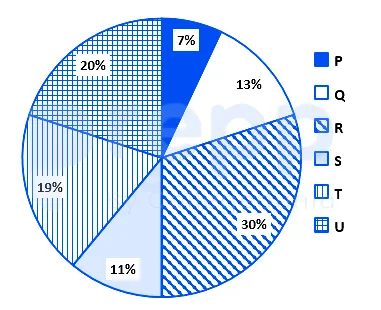
- A
312
- B
306
- C
294
- D
308
Show answer
D. 308Calculation:
Marks obtained in Q = 700 × 13%
⇒ 91
Marks obtained in S = 700 × 11%
⇒ 77
Marks obtained in U = 700 × 20%
⇒ 140
Total marks obtained in Q, S and U = 91 + 77 + 140
⇒ 308
∴ The required answer is 308.
Paper & answer key PDF ↗ Question 76archived
Select the most appropriate ANTONYM of the given word.
Feud
- A
Harmony
- B
Distrust
- C
Unfriendliness
- D
Destruct
Show answer
A. HarmonyThe correct answer is Harmony.
Sometimes, a word can have multiple antonyms depending on the specific shade of meaning being contrasted. Antonyms can be absolute (e.g., alive/dead) or gradable (e.g., hot/cold, where there are degrees in between). Synonyms rarely have exactly the same meaning; they often differ in nuance, connotation, or typical usage context. Using a thesaurus is a common way to find synonyms and antonyms, but it's important to understand the context in which a word is used to choose the most appropriate alternative.
Paper & answer key PDF ↗ Question 77archived
Select the option that expresses the given sentence in active voice.
I don’t like being seen in tears by people.
- A
I don’t like people had been seeing me in tears.
- B
I don’t like people seeing me in tears.
- C
I don’t like people to see me in tears.
- D
I don’t like myself to be seen in tears.
Show answer
B. I don’t like people seeing me in tears.Understanding Active and Passive Voice
The question asks to convert a sentence from passive voice to active voice. Let's first understand the difference between these two voices.
Active Voice: The subject of the sentence performs the action. The structure is typically Subject + Verb + Object. Example: People see me. (Subject: People, Verb: see, Object: me)
Passive Voice: The subject of the sentence receives the action. The structure is typically Object of active voice + Be verb + Past Participle + (by + Subject of active voice). Example: I am seen by people. (Subject: I, receives the action 'seen')
In the given sentence, "I don’t like being seen in tears by people," the main verb is "don't like." The part "being seen in tears by people" is a gerund phrase acting as the object of "don't like." This gerund phrase is in the passive voice because the subject 'I' (implied before 'being seen') is receiving the action 'seen', and the agent 'people' is performing the action.
The passive structure within the gerund phrase is: being seen (passive gerund) + by people (agent).
To convert this part to active voice, the agent ("people") needs to become the performer of the action, and the receiver of the action ("me", which is implied as the subject of 'being seen') needs to become the object.
The active equivalent of "being seen by people" would be "people seeing me".
Analyzing the Options for Active Voice Conversion
We need to find the option where the part "being seen in tears by people" is correctly converted to active voice while keeping the main clause "I don't like" the same.
Let's examine each option:
I don’t like people had been seeing me in tears.
The main clause "I don't like" is correct.
The phrase "people had been seeing me" is in the active voice, but the tense ("had been seeing" - past perfect continuous) does not match the meaning of the original sentence, which expresses a general dislike or dislike of the situation.
This option changes the intended meaning and tense.
I don’t like people seeing me in tears.
The main clause "I don't like" is correct.
The phrase "people seeing me in tears" is in the active voice. "People" is the subject performing the action "seeing," and "me" is the object receiving the action. This structure correctly reflects the agent ("people") performing the action ("seeing") upon the receiver ("me") from the original passive phrase "being seen by people".
This option accurately converts the passive gerund phrase to an active construction.
I don’t like people to see me in tears.
The main clause "I don't like" is correct.
The phrase "people to see me in tears" uses an infinitive structure ("to see"). While "like" can be followed by an infinitive, the gerund phrase structure "people seeing me" (Option 2) is a more direct and common active transformation of a passive gerund phrase like "being seen by people." The passive gerund "being seen" focuses on the ongoing state or act of being seen, which is better captured by the gerund/present participle "seeing" in the active form.
This option is active but less accurate than Option 2 in mirroring the nature of the passive gerund used in the original sentence.
I don’t like myself to be seen in tears.
The main clause "I don't like" is correct.
The phrase "myself to be seen in tears" is in the passive voice ("to be seen").
The agent "people" is missing from this phrase.
This option does not convert the sentence to active voice performed by "people."
Comparing the options, Option 2 provides the most accurate and natural conversion of the passive gerund phrase "being seen in tears by people" into an active voice structure, while preserving the overall meaning of the sentence.
Conclusion on Active Voice Conversion
The sentence "I don’t like being seen in tears by people" is in the passive voice. To convert it to active voice, the agent ("people") becomes the subject of the action ("seeing"), and the object ("me") becomes the direct object of the action. The correct active voice sentence is "I don’t like people seeing me in tears."
Original Sentence (Passive)
Equivalent Active Phrase
being seen in tears by people
people seeing me in tears
Revision Table: Active vs. Passive Voice Key Points
Feature
Active Voice
Passive Voice
Focus
Subject performing action
Subject receiving action
Typical Structure
Subject + Verb + Object
Object + Be verb + Past Participle (+ by Subject)
Example (Simple)
The dog chased the ball.
The ball was chased by the dog.
Example (with gerund)
I like them helping me.
I like being helped by them.
Additional Information: Gerunds and Infinitives with 'Like'
Verbs like 'like', 'love', 'hate', 'prefer', 'dislike' can sometimes be followed by either a gerund (-ing form) or an infinitive (to + base verb), often with a slight difference in meaning.
Like + Gerund: Refers to the enjoyment or dislike of the action itself or the experience. Example: I like swimming (I enjoy the activity of swimming).
Like + Infinitive: Can refer to a preference or habit, sometimes suggesting a choice or opinion. Example: I like to swim every morning (It's a habit or something I think is good to do).
When these verbs are followed by a structure involving an object performing an action, the gerund form is often used, especially when talking about the action as an event or situation.
Structure: Subject + like/dislike + Object + Gerund/Present Participle
Example: I saw him running. (He was running, and I saw it).
Example: I heard them singing. (They were singing, and I heard it).
Similarly, I don't like people seeing me in tears fits this pattern, where "people seeing me" is the event or situation that is disliked. This aligns well as the active counterpart to the passive gerund structure in the original sentence.
Paper & answer key PDF ↗ Question 78archived
Select the most appropriate meaning of the given idiom.
Eat humble pie
- A
To apologise humbly
- B
To live in penury
- C
To live a life of humility
- D
To enjoy life to the fullest
Show answer
A. To apologise humblyUnderstanding the Idiom: Eat Humble Pie
Idioms are phrases whose meaning cannot be deduced from the literal meaning of the words themselves. They are an important part of language, adding color and expressiveness. The idiom "Eat humble pie" is commonly used in English. Let's explore its meaning.
What Does 'Eat Humble Pie' Mean?
The idiom "Eat humble pie" means to have to admit that you were wrong or defeated and to apologize or show humility in a difficult situation. It often implies a feeling of embarrassment or humiliation as one is forced to concede their error or loss.
Analyzing the Options for 'Eat Humble Pie'
Let's look at the given options and see which one best fits the meaning of the idiom "Eat humble pie":
Option 1: To apologise humbly
This option suggests the act of apologizing in a modest and respectful manner, often after being proven wrong or defeated. This aligns closely with the core meaning of eating humble pie.
Option 2: To live in penury
Penury means extreme poverty. This option is completely unrelated to the meaning of the idiom "Eat humble pie".
Option 3: To live a life of humility
Living a life of humility means having a modest view of one's own importance throughout life. While humility is part of eating humble pie, the idiom refers to a specific act of admitting defeat or error and showing humility in that moment, rather than a general lifestyle.
Option 4: To enjoy life to the fullest
This phrase means to experience as much of life as possible. This is the opposite of the feeling associated with eating humble pie, which is often unpleasant or humbling.
Conclusion on the Meaning of Eat Humble Pie
Based on the analysis, the most appropriate meaning of the idiom "Eat humble pie" is to acknowledge one's mistake or defeat and apologize in a humble manner.
Idiom
Meaning
Eat humble pie
To admit defeat or error and apologize humbly.
Examples of Using 'Eat Humble Pie'
Here are a couple of examples to illustrate how the idiom is used in sentences:
After confidently predicting his team would win, he had to eat humble pie when they lost badly.
She had to eat humble pie and admit that her initial plan was flawed.
Revision Table: Common Idioms
Idiom
Meaning
Break a leg
Good luck
Bite the bullet
Endure a difficult situation
Cost an arm and a leg
Very expensive
Let the cat out of the bag
Reveal a secret
Additional Information on Idioms and Phrases
Understanding idioms is crucial for mastering a language as they are frequently used in everyday conversation and literature. Learning idioms like "Eat humble pie" helps improve comprehension and fluency. It's helpful to learn idioms in context and practice using them.
Many idioms have interesting origins, often related to historical events, customs, or observations of life. While the origin of "Eat humble pie" is debated, it's often linked to "umbles pie," a pie made from the edible offal of an animal (heart, liver, entrails), traditionally considered a dish for the poor or servants, thus symbolizing a lower status or humiliation compared to those who ate the main cuts of meat.
Paper & answer key PDF ↗ Question 79archived
Select the INCORRECTLY spelt word in the following sentence.
It is a deeply regrettable fact that deforestation has had a substantial consequenses on the environment.
- A
deforestation
- B
substantial
- C
regrettable
- D
consequenses
Show answer
D. consequensesAnalyzing the Sentence for Spelling Errors
The given sentence is: "It is a deeply regrettable fact that deforestation has had a substantial consequenses on the environment." We need to identify the word that is spelled incorrectly among the options provided.
Let's examine each word mentioned in the options within the context of the sentence:
deforestation: This word refers to the clearing of forests. In the sentence, it fits grammatically and its spelling is correct.
substantial: This word means of considerable importance, size, or worth. In the sentence, it is used to describe the impact of deforestation and its spelling is correct.
regrettable: This word means giving rise to regret; unfortunate. In the sentence, it is used to describe the fact about deforestation and its spelling is correct.
consequenses: This word is intended to mean a result or effect of an action or condition. Let's check its spelling.
Identifying the Misspelled Word: Consequenses
The word "consequenses" as written in the sentence is not the correct English spelling. The correct spelling for the plural form meaning results or effects is "consequences". The letter 'e' should follow the 'quence' part, not 's'.
Therefore, the incorrectly spelled word in the sentence is consequenses.
Correcting the Sentence
The sentence with the correct spelling would be:
It is a deeply regrettable fact that deforestation has had a substantial consequences on the environment.
Revision Table: Common Spelling Issues
Common Misspelling
Correct Spelling
Note
accomodate
accommodate
Two 'c's, two 'm's
recieve
receive
'i' before 'e' except after 'c'
seperate
separate
'a' before 'r'
definately
definitely
Contains 'i'
untill
until
One 'l'
Additional Information: Spelling Consequences
Understanding common spelling patterns and root words can help avoid errors. The word "consequence" comes from Latin roots meaning "to follow with". Many English words follow predictable patterns, but others have irregular spellings that need to be memorized or checked.
Paying attention to prefixes, suffixes, and common letter combinations is crucial for accurate spelling in English. For example, words ending in a soft 'c' sound followed by 'e' often use '-ce', while plural forms or verbs might use '-ces' or '-cing', but the core spelling should be known.
Regular practice and using spell-checking tools are good ways to improve spelling skills.
Paper & answer key PDF ↗ Question 80archived
Select the sentence with the appropriate use of preposition.
- A
Are you interested along with modern art?
- B
Are you interested into modern art?
- C
Are you interested with modern art?
- D
Are you interested in modern art?
Show answer
D. Are you interested in modern art?Understanding Prepositions with 'Interested'
The question asks us to identify the sentence that uses a preposition correctly with the word "interested". Prepositions are words that link a noun, pronoun, or phrase to other words in a sentence. Choosing the right preposition is crucial for clear and grammatically correct communication. In English, certain adjectives are typically followed by specific prepositions. "Interested" is one such adjective.
Analyzing Each Option for Preposition Usage
Let's look at each sentence provided and examine the preposition used with "interested".
Are you interested along with modern art?
Are you interested into modern art?
Are you interested with modern art?
Are you interested in modern art?
We need to determine which of these sentences follows the standard grammatical rules and common usage of the word "interested".
Examining Common Prepositional Phrases with 'Interested'
The adjective "interested" is most commonly followed by the preposition "in" when referring to the subject or topic that someone finds engaging or appealing. For example, you can be interested in history, interested in sports, or interested in learning new things.
"Interested along with" is not a standard phrase. "Along with" usually means together with someone or something else, indicating accompaniment or inclusion. It doesn't fit the context of expressing interest in a subject like modern art.
"Interested into" is also incorrect. The preposition "into" typically indicates movement towards the inside of something, a change of state, or involvement in an activity (e.g., "get into trouble", "look into the matter"). It is not used after "interested" to indicate the object of interest.
"Interested with" is generally incorrect in this context. While "with" can express association or possession, it is not the standard preposition used after "interested" to mean having an interest in a topic. You might say you are "bored with" or "happy with" something, but not usually "interested with".
"Interested in" is the correct and standard idiomatic phrase. When you are "interested in" something, it means you want to know more about it, you find it engaging, or you care about it. This fits perfectly with the idea of finding "modern art" appealing or worthy of attention.
Conclusion on the Correct Preposition
Based on the analysis of how "interested" is used with prepositions, the phrase "interested in" is the correct and appropriate choice when asking if someone finds modern art engaging or appealing. Therefore, the sentence that uses the preposition correctly is the one that includes "interested in modern art".
Revision Table: Adjective + Preposition Examples
Adjective
Common Preposition
Example Sentence
Interested
in
She is interested in science.
Afraid
of
He is afraid of heights.
Good
at
They are good at playing chess.
Fond
of
I am fond of old movies.
Tired
of
We are tired of waiting.
Additional Information on English Prepositions
English prepositions can be tricky because their usage is often idiomatic, meaning the correct choice is based on common practice rather than strict logical rules. While some prepositions follow clear rules (like "on" for surfaces, "in" for enclosed spaces), many are tied to specific verbs, adjectives, or nouns.
Using the wrong preposition can change the meaning of a sentence or make it sound unnatural to native speakers.
Learning adjective-preposition combinations is often done through exposure and practice, as well as by consulting dictionaries or grammar resources.
Phrases like "interested in", "dependent on", "responsible for", and "aware of" are fixed combinations that need to be learned.
Paper & answer key PDF ↗ Question 81archived
Select the option that can be used as a one-word substitute for the underlined group of words.
While I was travelling in Europe, I met a man who drew maps.
- A
Cartographer
- B
Geographer
- C
Arbitrator
- D
Anthropologist
Show answer
A. CartographerUnderstanding One-Word Substitutes: Man Who Drew Maps
One-word substitution is a vocabulary exercise where a single word replaces a phrase or a clause without changing the meaning of the sentence. This question asks us to find a single word that accurately describes 'a man who drew maps'. Let's examine the provided options to determine the best fit.
Analyzing the Options for 'a man who drew maps'
Here are the meanings of the given options:
Cartographer: A person who makes or draws maps.
Geographer: A person who studies geography, which includes the earth's surface, physical features, divisions, products, population, etc.
Arbitrator: An independent person or body officially appointed to settle a dispute.
Anthropologist: A person who studies human societies, cultures, and their development.
Identifying the Correct One-Word Substitute
Comparing the phrase 'a man who drew maps' with the definitions:
The phrase specifically refers to the action of drawing maps.
A Cartographer is defined as someone who makes or draws maps.
A Geographer studies geographical aspects but doesn't necessarily draw maps.
An Arbitrator resolves disputes.
An Anthropologist studies human cultures.
Based on the definitions, the word that precisely matches 'a man who drew maps' is Cartographer.
Phrase
One-Word Substitute
Definition
A man who drew maps
Cartographer
A person who makes or draws maps.
Therefore, the correct one-word substitute for 'a man who drew maps' is Cartographer.
Revision Table: Understanding Key Terms
Term
Meaning
Relation to Maps/Geography
Cartographer
One who draws or makes maps.
Directly involved in creating maps.
Geographer
One who studies geography.
Studies the earth's features, often using maps as tools.
Arbitrator
One who settles a dispute.
Not related to maps or geography.
Anthropologist
One who studies human societies and cultures.
Not directly related to maps or geography.
Additional Information: Related Concepts
Understanding related fields can help clarify these terms:
Cartography: This is the art, science, and technology of making maps. A cartographer practices cartography.
Geography: This is the study of the physical features of the earth and its atmosphere, and of human activity as it affects and is affected by these. Geographers study geography.
Arbitration: This is a form of alternative dispute resolution where a neutral third party (the arbitrator) hears evidence and makes a binding decision.
Anthropology: This is the study of humanity, in all its aspects, from prehistoric origins to contemporary variations.
Knowing the distinctions between these roles and fields is crucial for vocabulary questions involving professions and areas of study.
Paper & answer key PDF ↗ Question 82archived
Select the most appropriate option that can substitute the underlined segment in the given sentence. If there is no need to substitute it, select ‘No substitution’.
Scores given by the members are to be consolidated and sent in the head office immediately.
- A
No substitution
- B
after the head office
- C
at the head office
- D
to the head office
Show answer
D. to the head officeAnalyzing the Sentence Correction Question
The question asks us to find the most appropriate substitute for the underlined segment "in the head office" in the sentence: "Scores given by the members are to be consolidated and sent in the head office immediately." We need to determine which preposition correctly indicates the destination where the scores are being sent.
Understanding Prepositions for Destination
Prepositions like "to", "at", and "in" are used to indicate location or direction. When indicating the destination of something being sent, the preposition "to" is typically used. Let's look at the common uses of these prepositions:
To: Indicates movement towards a destination or the recipient of something. Example: Send the letter to your friend; Go to the market.
In: Indicates location within a space, container, or area. Example: The keys are in the drawer; He lives in London. It can also indicate the final state of something. Example: Break the chocolate in half.
At: Indicates a specific point, location, or building. Example: Meet me at the station; He is at the office.
Analyzing the Options
Let's examine each option provided:
No substitution: The original phrase is "in the head office". Using "in" here suggests the scores are already *inside* or *within* the head office while being sent, which doesn't make grammatical sense when indicating the destination of the sending action. You send something *to* a location, not *in* a location.
after the head office: The phrase "after the head office" indicates a location subsequent to the head office or a time after some event related to the head office. It does not fit the context of sending items *to* a place.
at the head office: While "at" can indicate a location, "sent at the head office" is less common and less precise for indicating the destination of something being transferred compared to "to the head office". "At" is more suitable for saying where something *is* located or where an action *takes place*, not typically the endpoint of a sending action. For example, you might say "The meeting is held at the head office," but you "send documents to the head office."
to the head office: This option uses the preposition "to". "Sent to the head office" correctly indicates that the head office is the destination where the consolidated scores are to be sent. This aligns with the standard usage of "to" for indicating the recipient or destination of a transfer.
Conclusion
Based on the analysis of how prepositions are used to indicate destination, "to the head office" is the most appropriate substitute for the underlined segment. The scores are being sent *to* the destination, which is the head office.
Original Segment
Proposed Substitution
Correctness
Reason
in the head office
No substitution
Incorrect
"In" indicates location within, not destination of sending.
in the head office
after the head office
Incorrect
"After" indicates sequence (time or location), not destination of sending.
in the head office
at the head office
Less appropriate
"At" indicates location or point; "to" is standard for destination of sending.
in the head office
to the head office
Correct
"To" correctly indicates the destination of the sending action.
Therefore, the sentence should be: "Scores given by the members are to be consolidated and sent to the head office immediately."
Revision Table: Prepositions for Movement and Location
Preposition
Common Use
Example for Movement
Example for Location
To
Destination, direction, recipient
Sent to London
(Not typically for static location)
In
Inside a space, container, area
Put it in the box
It is in the box
At
Specific point, location, building
Arrive at the station
Waiting at the station
Additional Information: Sentence Structure and Prepositional Phrases
In the given sentence, "to the head office" is a prepositional phrase acting as an adverbial phrase modifying the verb "sent". It tells us where the scores are being sent. Prepositional phrases consist of a preposition (like 'to', 'in', 'at') and its object (like 'the head office'), which is usually a noun or pronoun. Choosing the correct preposition is crucial for conveying the intended meaning and ensuring grammatical correctness in English.
Paper & answer key PDF ↗ Question 83archived
Select the most appropriate ANTONYM of the given word.
Abominable
- A
Worthy
- B
Delectable
- C
Admirable
- D
Detestable
Show answer
C. AdmirableUnderstanding the Antonym of Abominable
The question asks us to identify the most appropriate antonym for the word "Abominable". An antonym is a word that has the opposite meaning of another word. To find the correct antonym, we first need to understand the meaning of "Abominable".
Meaning of Abominable
The word "Abominable" is an adjective used to describe something that is extremely bad, unpleasant, offensive, or causing moral revulsion. It suggests something detestable, loathsome, or vile.
Analyzing the Options
Let's examine each of the given options:
Worthy: This word means deserving effort, attention, or respect. While it suggests something positive, it is not a direct opposite of "Abominable" in the sense of causing revulsion or being extremely unpleasant.
Delectable: This word is typically used to describe food or drink that is delicious or highly pleasant to taste. It relates to taste and pleasure, not the strong negative moral or emotional sense of "Abominable".
Admirable: This word means arousing or deserving respect, approval, or praise. It describes something highly pleasing, excellent, or inspiring. This is a strong candidate for the opposite of something that causes revulsion or intense dislike.
Detestable: This word means deserving intense dislike or hatred. It is very close in meaning to "Abominable". Therefore, "Detestable" is a synonym, not an antonym, of "Abominable".
Identifying the Most Appropriate Antonym
Comparing the options, "Admirable" stands out as the word with the most opposite meaning to "Abominable". While "Abominable" describes something that causes intense negative feelings like revulsion or disgust, "Admirable" describes something that causes intense positive feelings like respect and approval.
Here's a quick comparison:
Word
Meaning
Feeling Evoked
Abominable
Extremely bad, unpleasant, causing revulsion
Negative (Disgust, revulsion, hatred)
Admirable
Deserving respect, approval, praise
Positive (Respect, approval, inspiration)
Based on this analysis, "Admirable" is the most fitting antonym for "Abominable".
Revision Table: Abominable Antonym
Word
Type
Meaning
Relationship to Abominable
Abominable
Adjective
Causing moral revulsion; very unpleasant
The core word
Worthy
Adjective
Deserving respect or attention
Not a direct antonym
Delectable
Adjective
Delicious (food/drink)
Unrelated meaning
Admirable
Adjective
Deserving respect and approval
Most appropriate antonym
Detestable
Adjective
Deserving intense dislike
Synonym
Additional Information: Understanding Antonyms
Antonyms are crucial for expanding vocabulary and understanding the nuances of language. They help us express contrasting ideas effectively.
Antonyms can be absolute opposites (like hot/cold) or relative opposites (like happy/sad, where there's a spectrum).
Sometimes, a word can have multiple antonyms depending on the specific context in which it is used.
Synonyms, on the other hand, are words that have similar meanings (e.g., abominable, detestable, loathsome).
Learning words along with their synonyms and antonyms is an effective way to improve language proficiency.
Paper & answer key PDF ↗ Question 84archived
Select the sentences that contains no spelling errors.
- A
I saw the dress catalouge pieces of Asha’s corchiture collection.
- B
I saw the dress catalougue pieces of Asha’s couture collection.
- C
I saw the dress catalougue pieces of Asha’s corchiture collection.
- D
I saw the dress catalogue pieces of Asha’s couture collection.
Show answer
D. I saw the dress catalogue pieces of Asha’s couture collection.Identifying Sentences with Correct Spelling
The question asks us to select the sentence that contains no spelling errors. To do this, we need to examine each option carefully and check the spelling of the words used.
Analyzing the Sentences
Let's look at the key words that vary across the options: "catalogue" and "couture". We need to determine the correct spelling of these words.
The correct spelling is "catalogue", not "catalouge" or "catalougue".
The correct spelling is "couture", not "corchiture".
Now, let's review each sentence option:
I saw the dress catalouge pieces of Asha’s corchiture collection.
Analysis: This sentence uses "catalouge" (incorrect) and "corchiture" (incorrect).
I saw the dress catalougue pieces of Asha’s couture collection.
Analysis: This sentence uses "catalougue" (incorrect) and "couture" (correct).
I saw the dress catalougue pieces of Asha’s corchiture collection.
Analysis: This sentence uses "catalougue" (incorrect) and "corchiture" (incorrect).
I saw the dress catalogue pieces of Asha’s couture collection.
Analysis: This sentence uses "catalogue" (correct) and "couture" (correct). All words appear to be spelled correctly.
Identifying the Correctly Spelled Sentence
Based on our analysis, only the fourth sentence uses the correct spellings for both "catalogue" and "couture". Therefore, this is the sentence that contains no spelling errors among the given options.
Revision Table: Common Spelling Errors
Commonly Misspelled Word
Incorrect Spellings Seen
Correct Spelling
Catalogue
Catalouge, Catalougue
Catalogue
Couture
Corchiture
Couture
Additional Information: Checking Spelling Accuracy
Checking for spelling errors is a crucial part of writing. Misspellings can change the meaning of a sentence or make your writing difficult to understand. Here are some tips for avoiding spelling mistakes:
Use a dictionary or spell checker.
Learn common spelling rules (though English has many exceptions!).
Practice recognizing commonly confused words (like "their," "there," and "they're").
Read your writing aloud to catch errors you might otherwise miss.
Proofread your work slowly and carefully, perhaps more than once.
In this specific question, the errors involved incorrect letter combinations in "catalogue" and a completely different, incorrect word for "couture". Paying attention to the visual form of words helps in identifying such errors.
Paper & answer key PDF ↗ Question 85archived
Select the most appropriate meaning of the underlined idiom in the given sentence.
After the government interventions, the enrolment and retention of female students have increased by leaps and bounds.
- A
Systematically
- B
Swiftly
- C
Intermittently
- D
Gradually
Show answer
B. SwiftlyUnderstanding the Idiom 'By Leaps and Bounds'
The question asks for the meaning of the underlined idiom "by leaps and bounds" in the given sentence: "After the government interventions, the enrolment and retention of female students have increased by leaps and bounds."
An idiom is a phrase or expression whose meaning cannot be deduced simply from the meaning of its individual words. The idiom "by leaps and bounds" is commonly used in English.
Meaning of 'By Leaps and Bounds'
The idiom "by leaps and bounds" is used to describe something that is happening or increasing very quickly or rapidly. It implies a significant, speedy, and energetic pace of progress or growth.
"Leaps" suggests jumping over distances quickly.
"Bounds" also suggests moving quickly and energetically.
Combined, they create a sense of rapid, substantial progress.
Analyzing the Options
Let's examine the provided options to find the one that best matches the meaning of "by leaps and bounds".
Systematically: This means in an organized or methodical way. While growth might be systematic, "by leaps and bounds" specifically refers to the speed of that growth, not its method. So, this option is not the most appropriate meaning.
Swiftly: This means quickly or rapidly. This aligns perfectly with the meaning of "by leaps and bounds," which describes a fast pace of increase or progress.
Intermittently: This means occurring at irregular intervals; not continuous or steady. The idiom "by leaps and bounds" suggests continuous, rapid growth, not growth that stops and starts. So, this option is incorrect.
Gradually: This means slowly or step-by-step. This is the opposite of "by leaps and bounds," which signifies rapid movement or increase. So, this option is incorrect.
Identifying the Correct Meaning
Comparing the idiom's meaning with the options, "swiftly" is the word that most accurately captures the sense of rapid increase conveyed by "by leaps and bounds." The sentence indicates that the enrolment and retention of female students increased very quickly after the government interventions.
Therefore, the most appropriate meaning of "by leaps and bounds" in the given sentence is "swiftly".
Revision Table: Idioms and Meanings
Idiom
Meaning
Example Usage
By leaps and bounds
Very quickly; rapidly
Her English improved by leaps and bounds after she started practicing daily.
Break a leg
Good luck (used typically before a performance)
You have a presentation today? Break a leg!
Let the cat out of the bag
To reveal a secret
He accidentally let the cat out of the bag about the surprise party.
Additional Information on English Idioms
Idioms are an important part of the English language. They add colour and expressiveness but can be tricky because their meaning isn't literal. Learning common idioms helps in understanding native speakers and improves fluency.
Idioms often have historical origins that explain their non-literal meanings.
Context is crucial for understanding the meaning of an idiom.
Regular exposure to English through reading, listening, and conversation is the best way to learn idioms naturally.
Many online resources and dictionaries are dedicated to explaining idioms.
Paper & answer key PDF ↗ Question 86archived
Select the most appropriate option to fill in the blank and complete the collocation.
I had a nice ______ on my birthday with all my friends and relatives.
- A
opportunity
- B
day
- C
experience
- D
time
Show answer
D. timeUnderstanding English Collocations
This question asks us to choose the most appropriate word to complete the sentence: "I had a nice ______ on my birthday with all my friends and relatives." This is an example of a collocation question, where we need to find the word that naturally pairs with "had a nice" in this context.
Collocations are words that often go together. For example, we say "make a mistake" not "do a mistake," or "heavy rain" not "strong rain." Choosing the right collocation makes your English sound more natural and fluent.
Analyzing the Options for Collocation
Let's look at the options provided and see which one forms the most common and natural collocation with "had a nice" in the context of a birthday celebration:
opportunity: "Opportunity" means a chance to do something. While you might have had an opportunity on your birthday (e.g., an opportunity to meet someone), "had a nice opportunity" is not a common way to describe enjoying the birthday celebration itself.
day: You can certainly say "I had a nice day." This is a general phrase referring to the entire day being pleasant. While a birthday is a day, describing the *enjoyment* of the celebration with friends and relatives often uses a more specific phrase.
experience: "Experience" refers to something that happened to you, often something notable, memorable, or new. A birthday can be an experience, but "had a nice experience" is perhaps less common than other options when simply talking about enjoying a regular annual celebration with loved ones.
time: "Had a nice time" is a very common and natural phrase used to describe enjoying a specific event, gathering, or period. Saying "I had a nice time on my birthday" perfectly fits the context of enjoying the celebration with friends and relatives. This collocation is widely used in English.
Selecting the Most Appropriate Collocation
Comparing the options, "had a nice time" is the most standard and frequently used collocation to express enjoyment during an event or celebration like a birthday party with friends and relatives. While other options like "day" or "experience" might be technically possible in some contexts, "time" is the most appropriate and natural fit here.
Therefore, the sentence completed with the most appropriate collocation is: "I had a nice time on my birthday with all my friends and relatives."
Revision Table: Evaluating Collocations
Phrase
Common Collocation?
Fits the Context (Birthday Celebration)?
had a nice opportunity
Less common for enjoyment of an event
No, doesn't describe enjoyment
had a nice day
Common, but general
Possible, but less specific than 'time' for the *celebration*
had a nice experience
Possible, but often for notable/new things
Less common than 'time' for a typical celebration
had a nice time
Very common and natural
Yes, perfectly fits enjoying an event
Additional Information on Collocations
Understanding collocations is crucial for improving fluency and naturalness in English. There are many types of collocations, such as:
Adjective + Noun (e.g., heavy rain, strong tea, deep sleep)
Noun + Noun (e.g., a sense of humour, a series of events, a brand new car)
Verb + Noun (e.g., make a mistake, take a break, pay attention)
Adverb + Adjective (e.g., completely satisfied, deeply concerned, strongly oppose)
Verb + Adverb (e.g., speak loudly, work hard, arrive late)
Learning collocations as chunks of language rather than individual words helps speakers and writers use English more effectively. Resources like collocation dictionaries or simply paying attention to how native speakers use words together can be very helpful.
Paper & answer key PDF ↗ Question 87archived
Select the correct passive voice form for the given sentence.
My brother likes cricket.
- A
Cricket was like by my brother.
- B
Cricket is like by my brother.
- C
Cricket is liked by my brother.
- D
Cricket was liked by my brother.
Show answer
C. Cricket is liked by my brother.Understanding Sentence Transformation: Active to Passive Voice
The question asks us to convert a sentence from active voice to passive voice. The given sentence is "My brother likes cricket." This sentence is in the simple present tense.
Identifying the Active Voice Components
In the active voice sentence, the subject performs the action. Let's break down the given sentence:
Subject: My brother
Verb: likes (simple present tense)
Object: cricket
The structure is: Subject + Verb (Present Tense) + Object.
Rules for Converting Simple Present Active to Passive Voice
To convert a simple present tense sentence from active voice to passive voice, we follow this structure:
Passive Voice Structure: Object + is/am/are + Past Participle of the Verb + by + Subject
Let's apply this rule to our sentence:
The object of the active sentence ("cricket") becomes the subject of the passive sentence.
The verb "likes" is in the simple present tense. We need the simple present form of 'to be' (is/am/are) that agrees with the new subject ("cricket") and the past participle of "likes," which is "liked." Since "cricket" is singular, we use "is."
The subject of the active sentence ("My brother") becomes part of a 'by' phrase ("by my brother").
Applying the Rules to "My brother likes cricket"
Following the steps:
1. New Subject (original object): Cricket
2. 'to be' verb (simple present, agreeing with 'Cricket'): is
3. Past Participle of 'likes': liked
4. 'by' phrase (original subject): by my brother
Combining these parts, we get the passive voice sentence:
Cricket is liked by my brother.
Analyzing the Options
Let's examine the given options:
Option 1: Cricket was like by my brother.
This uses "was," which is past tense. The original sentence is simple present.
"like" is the base form, not the past participle ("liked").
Incorrect structure.
Option 2: Cricket is like by my brother.
This uses "is" (correct tense) but "like" instead of the past participle "liked."
Incorrect structure.
Option 3: Cricket is liked by my brother.
This uses "is" (correct tense for simple present passive).
This uses "liked" (correct past participle of "likes").
This follows the structure: Object + is + Past Participle + by + Subject. This matches our derived passive sentence.
This option is correct.
Option 4: Cricket was liked by my brother.
This uses "was," which is past tense. The original sentence is simple present.
This structure would be correct for a simple past active sentence like "My brother liked cricket."
Incorrect tense.
Based on the analysis, Option 3 is the correct passive voice form for the sentence "My brother likes cricket."
Feature
Active Voice: My brother likes cricket.
Passive Voice: Cricket is liked by my brother.
Subject
My brother (performs action)
Cricket (receives action)
Verb Tense
Simple Present (likes)
Simple Present Passive (is liked)
Object/Recipient
cricket (receives action)
by my brother (performer of action in 'by' phrase)
Revision Table: Active vs. Passive Voice
Voice
Focus
Structure (Simple Present)
Example
Active
Subject performing the action
Subject + Verb (base or s/es) + Object
She reads a book.
Passive
Action and the recipient of the action
Object + is/am/are + Past Participle + (by + Subject)
A book is read by her.
Additional Information: Why use Passive Voice?
Passive voice is often used when:
The doer of the action (the subject in active voice) is unknown, unimportant, or obvious from the context. For example: "The window was broken." (We don't know or care who broke it).
You want to emphasize the action itself or the receiver of the action rather than the doer. For example: "The new policy was announced today." (The announcement is more important than who announced it).
In scientific or technical writing, where the process or result is more important than the person who performed the action. For example: "The experiment was conducted at room temperature."
To avoid assigning blame. For example: "Mistakes were made."
In the sentence "Cricket is liked by my brother," while the doer ("my brother") is included, the focus shifts slightly to "cricket" and the fact that it is liked.
Paper & answer key PDF ↗ Question 88archived
Select the correct indirect form of the given sentence.
He says to Gayatri, “You are writing an apology to the warden.”
- A
He told Gayatri that she is writing an apology to the warden.
- B
He tells Gayatri that she is writing an apology to the warden.
- C
He says to Gayatri that she was writing an apology to the warden.
- D
He tells Gayatri that she was writing an apology to the warden.
Show answer
B. He tells Gayatri that she is writing an apology to the warden.Converting Direct Speech to Indirect Speech
The question asks us to convert a sentence from direct speech to indirect speech. The given sentence is: He says to Gayatri, “You are writing an apology to the warden.”
Let's analyze the sentence and the rules for conversion:
The reporting verb is “says”, which is in the present tense.
The reported speech is “You are writing an apology to the warden.”
When the reporting verb is in the present or future tense, the tense of the verb in the reported speech does not change. Only pronouns and sometimes time/place adverbs change.
Step-by-Step Conversion
Reporting Verb: “says to” in direct speech changes to “tells” in indirect speech when followed by an object (Gayatri).
Connective: We use “that” to connect the reporting clause and the reported clause.
Pronoun Change: The pronoun “You” in the reported speech refers to Gayatri (the object of the reporting verb). Since Gayatri is a female, “You” changes to “she”.
Verb Tense: The verb in the reported speech is “are writing” (Present Continuous). Since the reporting verb (“says”) is in the present tense, the tense of the reported verb does not change. “are writing” becomes “is writing” when the subject changes from “You” (plural/singular second person) to “she” (singular third person).
Remaining Part: “an apology to the warden” remains unchanged.
Combining these parts, the indirect form of the sentence is: He tells Gayatri that she is writing an apology to the warden.
Evaluating the Options
Let's compare our derived sentence with the given options:
Option 1: He told Gayatri that she is writing an apology to the warden.
This option incorrectly uses “told” instead of “tells”.
Option 2: He tells Gayatri that she is writing an apology to the warden.
This matches our derived sentence. “says to” became “tells”, “You” became “she”, and the tense “are writing” correctly remained Present Continuous (“is writing”) because the reporting verb is in the present tense.
Option 3: He says to Gayatri that she was writing an apology to the warden.
This option incorrectly keeps “says to” and incorrectly changes the tense from Present Continuous to Past Continuous (“was writing”).
Option 4: He tells Gayatri that she was writing an apology to the warden.
This option correctly uses “tells” but incorrectly changes the tense from Present Continuous to Past Continuous (“was writing”).
Based on the analysis, Option 2 is the correct indirect form of the given sentence.
Direct Speech Element
Change in Indirect Speech
Result
He says to Gayatri
Reporting verb (present) + object
He tells Gayatri
, “ ”
Removed, add connective
that
You
Pronoun change (refers to Gayatri)
she
are writing
Verb tense (Present Continuous), reporting verb is present, subject changes to 'she'
is writing
an apology to the warden.
No change
an apology to the warden.
Revision Table: Direct to Indirect Speech Rules
Reporting Verb Tense
Reported Speech Tense Change
Example (Direct to Indirect)
Present/Future
No change in tense
He says, “I am happy.” → He says that he is happy.
Past
Usually changes (e.g., Present Simple to Past Simple, Present Continuous to Past Continuous, etc.)
He said, “I am happy.” → He said that he was happy.
Additional Information on Reporting Verbs
The choice of reporting verb in indirect speech often depends on the type of sentence or the intention of the speaker. Common reporting verbs include:
Statements: say, tell, state, remark, add, reply, promise, etc.
Questions: ask, inquire, wonder, demand, etc.
Commands/Requests: tell, order, ask, request, advise, forbid, etc.
When “say” is followed by an object (like “says to Gayatri”), it changes to “tell” followed by the object (“tells Gayatri”). If “say” is not followed by an object, it remains “say” or “says” in indirect speech.
For example:
Direct: He says, “I am tired.”
Indirect: He says that he is tired. (No object after 'says')
Paper & answer key PDF ↗ Question 89archived
Select the most appropriate option that can substitute the underlined segment in the given sentence.
You must aware of friends who speak against you.
- A
caution of
- B
beware of
- C
scarce of
- D
careful of
Show answer
B. beware ofUnderstanding Sentence Correction and Phrasal Verbs
The question asks us to find the most appropriate phrase to replace the underlined segment "aware of" in the sentence: "You must aware of friends who speak against you." We need to choose an option that makes the sentence grammatically correct and conveys the intended meaning of being careful or cautious about such friends.
Analyzing the Original Sentence and Grammatical Issues
The original sentence "You must aware of friends who speak against you" is grammatically incorrect. The phrase "aware of" is an adjective phrase that typically follows the verb "to be". For example, you would say "You must be aware of the risks" or "He was aware of the problem". In the given sentence, "You must" is followed directly by "aware of" without a main verb or a complete phrasal verb that fits the structure.
We are looking for a phrase that can follow "You must" and express the need to be careful or cautious about the friends mentioned.
Evaluating the Options for Sentence Correction
Let's look at each option and see if it fits grammatically and semantically in the sentence "You must _____ friends who speak against you."
Option 1: caution of
If we substitute, the sentence becomes "You must caution of friends who speak against you." The word "caution" can be a noun (e.g., "exercise caution") or a verb (e.g., "He cautioned them"). The phrase "caution of" is not a standard idiomatic expression that means 'be careful about'. This option does not fit grammatically or make sense in the context.
Option 2: beware of
If we substitute, the sentence becomes "You must beware of friends who speak against you." "Beware of" is a phrasal verb or an imperative phrase meaning 'be cautious and watchful of (someone or something dangerous)'. This phrase fits perfectly after "You must" and conveys the intended meaning of being careful about friends who might harm you by speaking against you. "Beware of" acts like a main verb here, similar to how other verbs would follow "must" (e.g., "You must study", "You must leave").
Option 3: scarce of
If we substitute, the sentence becomes "You must scarce of friends who speak against you." "Scarce of" means lacking in something (e.g., "water is scarce of supply"). This phrase has no relevance to the context of being careful about friends. This option is incorrect.
Option 4: careful of
If we substitute, the sentence becomes "You must careful of friends who speak against you." The phrase "careful of" is often used after the verb "to be" (e.g., "Be careful of the dog"). Just like "aware of", "careful of" is an adjective phrase. It cannot directly follow "You must". It would need to be "You must be careful of..." for grammatical correctness. Since the option is just "careful of", it does not fit the structure "You must _____".
Conclusion on the Most Appropriate Substitution
Based on the analysis, the phrase "beware of" is the only option that correctly completes the sentence "You must _____ friends who speak against you" both grammatically and semantically. It correctly follows "You must" and conveys the necessary warning or caution about the friends.
Option
Substitution
Grammatically Correct?
Meaning in Context
caution of
You must caution of...
No
Doesn't fit; 'caution of' is not standard.
beware of
You must beware of...
Yes
Be cautious/watchful of (dangerous friends).
scarce of
You must scarce of...
No
Means 'lacking in', irrelevant here.
careful of
You must careful of...
No
Requires 'be' (You must be careful of...).
Therefore, the most appropriate option to substitute the underlined segment "aware of" is "beware of".
Revision Table: Substituting 'Aware Of'
Original Phrase
Incorrect Sentence
Correct Substitution
Corrected Sentence
aware of
You must aware of friends who speak against you.
beware of
You must beware of friends who speak against you.
Additional Information on 'Beware Of' and Modals
The phrase "beware of" is interesting because it often functions like an imperative verb phrase, but it can also follow modal verbs like "must", "should", or even "can" in certain contexts, acting as a verb form expressing necessity or warning.
'Beware of' as an Imperative: Often seen on signs: "Beware of Dog."
'Beware of' with Modals: As in this sentence, "You must beware of..." or "You should beware of..." This structure is correct.
This is different from adjective phrases like "aware of" or "careful of", which typically require a form of the verb "to be" before them when used with a subject (e.g., "He is careful of his health").
Understanding how different types of phrases function grammatically is key to mastering sentence correction exercises.
Paper & answer key PDF ↗ Question 90archived
Select the most appropriate meaning of the underlined word in a sentence.
The good weather has been a boon for many businesses located near the beach.
- A
luck
- B
Signal
- C
fortune
- D
beneficial
Show answer
D. beneficialUnderstanding the Word 'Boon' in a Sentence
The question asks us to find the most appropriate meaning of the underlined word "boon" in the sentence: "The good weather has been a boon for many businesses located near the beach." To answer this, we need to understand the context and the general meaning of the word.
What Does 'Boon' Mean?
The word 'boon' is typically used to describe something that is very helpful, beneficial, or a great advantage. It's like receiving a gift or a blessing that brings positive results.
Analyzing the Sentence Context
The sentence talks about "good weather" and its effect on "businesses located near the beach". Good weather, such as sunshine and warmth, usually attracts more people to the beach. More people at the beach means more potential customers for nearby businesses (like restaurants, shops, ice cream stands, etc.). Therefore, the good weather is causing a positive effect or providing an advantage to these businesses.
Given this context, "boon" must mean something that represents this positive effect or advantage that the good weather provides.
Evaluating the Options
Let's look at the given options and see which one best fits the meaning of "boon" in this sentence:
Option
Meaning
Fit in Sentence?
1. luck
Success or failure brought by chance rather than through one's own actions.
While good weather can be seen as lucky, "boon" describes the positive *impact* of the weather, not just the luck itself. It's about the benefit it brings.
2. Signal
A sign or gesture that conveys information.
Good weather is not a signal in this context. It's a condition that has a positive effect.
3. fortune
Chance or luck; also refers to wealth or prosperity.
Similar to 'luck', 'fortune' relates to chance outcomes or wealth. "Boon" is closer to the source of the prosperity or positive outcome (the helpful condition), rather than just the outcome itself or the luck.
4. beneficial
Favorable or advantageous; resulting in good.
This word directly means something that is helpful or advantageous and brings good results. This perfectly describes the effect of good weather on beach businesses in the sentence.
Why 'Beneficial' is the Best Fit
Based on the analysis, the good weather is something that is helpful and advantageous for the businesses. It brings them more customers and potentially more sales. The word "beneficial" means exactly this – producing good or favorable results. Therefore, "beneficial" is the most appropriate meaning of "boon" in the context of the given sentence.
The sentence essentially means: "The good weather has been beneficial for many businesses located near the beach."
Revision Table: Key Vocabulary
Word
Meaning in Context
Synonyms
Boon
Something helpful, beneficial, or advantageous; a blessing.
Benefit, advantage, help, blessing, gift.
Additional Information: Related Concepts
Understanding vocabulary in context is crucial for comprehension. Words can have multiple meanings, but the surrounding words and the overall sentence structure help determine the intended meaning. When you encounter an unfamiliar word, look for clues in the sentence. Ask yourself:
What is the subject?
What is happening?
What is the object or recipient of the action?
How does the unfamiliar word connect these elements?
In this case, the subject is "good weather," the action is "has been," and the recipient is "many businesses near the beach." "Boon" describes the relationship – what the good weather has been for the businesses. By seeing the positive impact on the businesses, we deduce that "boon" must indicate something positive and helpful.
Paper & answer key PDF ↗ Question 91archived
Sentences of a paragraph are given below in jumbled order. Arrange the sentences in the correct order to form a meaningful and coherent paragraph.
A. While India is home to 75 per cent of tigers in the world, the Global Tiger Day - as it is also known - sees awareness events organised in the country, as well as neighbouring Bangladesh and Nepal.
B. Its primary objective is to preserve the natural habitat of the tiger.
C. International Tiger Day was initiated in 2010, at the Saint Petersburg Tiger Summit.
D. This annual event, observed on 29 July, aims to create awareness on tiger conservation.
- A
DCAB
- B
BADC
- C
CDBA
- D
CDAB
Show answer
C. CDBAArranging Jumbled Sentences for Coherent Paragraphs
This section focuses on the task of arranging jumbled sentences to create a meaningful and coherent paragraph, specifically addressing the topic of Tiger Conservation and Global Tiger Day.
Understanding the Sentences
We are given four sentences related to International Tiger Day. Let's analyze each one to understand its content and potential position in a logical sequence:
Sentence A: Discusses India's significant tiger population (75%) and mentions awareness events organized in India, Bangladesh, and Nepal on Global Tiger Day.
Sentence B: States the main goal of preserving the tiger's natural habitat.
Sentence C: Introduces the origin of International Tiger Day, mentioning the year 2010 and the Saint Petersburg Tiger Summit.
Sentence D: Provides details about the day, specifying it's an annual event on July 29th aimed at raising awareness for tiger conservation.
Establishing the Logical Flow
To construct a coherent paragraph, we need to find a logical order for these sentences. A good paragraph usually starts with an introduction, followed by details, explanations, and supporting information.
Start with the Introduction (Sentence C): Sentence C is the most suitable starting point as it introduces the subject, "International Tiger Day," and provides its origin (when and where it was initiated).
Provide Further Details (Sentence D): Sentence D logically follows C by elaborating on the day. It specifies that it's an "annual event" on "29 July" and states its primary aim: "to create awareness on tiger conservation."
Explain the Objective (Sentence B): After mentioning the aim of conservation, Sentence B provides a more specific objective: "Its primary objective is to preserve the natural habitat of the tiger." This clarifies the conservation goal mentioned in D.
Add Supporting Context (Sentence A): Sentence A provides specific context relevant to the awareness campaign. It highlights India's role ("home to 75 per cent of tigers") and mentions where these awareness events occur, including neighboring countries. This supports the idea of "awareness events" mentioned in D.
The Correct Sentence Order
Based on the logical flow identified above, the correct sequence of the sentences is C, D, B, and A. Let's assemble the paragraph:
C: International Tiger Day was initiated in 2010, at the Saint Petersburg Tiger Summit.
D: This annual event, observed on 29 July, aims to create awareness on tiger conservation.
B: Its primary objective is to preserve the natural habitat of the tiger.
A: While India is home to 75 per cent of tigers in the world, the Global Tiger Day - as it is also known - sees awareness events organised in the country, as well as neighbouring Bangladesh and Nepal.
Final Coherent Paragraph
Putting these sentences together in the order CDBA results in a well-structured and informative paragraph about Global Tiger Day and tiger conservation efforts.
Keywords for SEO:
Jumbled sentences, paragraph arrangement, sentence ordering, Global Tiger Day, Tiger Conservation, Saint Petersburg Tiger Summit, India tigers, awareness events, natural habitat preservation.
Paper & answer key PDF ↗ Question 92archived
Select the option that can be used as a one-word substitute for the given group of words.
One who runs away from law
- A
Fatalist
- B
Convict
- C
Fugitive
- D
Lunatic
Show answer
C. FugitiveThe correct answer is 'Fugitive'.
Key Points
The most appropriate word for the given group of words is 'Fugitive'.
Fugitive - भगोड़ा (bhagoda)
Meaning in English: A person who has escaped from captivity or is in hiding to avoid arrest, prosecution, or punishment.
Example: The police are searching for the fugitive who escaped from prison last week.
Correct Answer:Option 3
Additional Information
Let's look at the meaning of other words:
Fatalist - नियति-वादी (niyati-vaadi). Meaning in English: A person who believes that all events are predetermined and therefore inevitable.
Convict - अपराधी (apraadhi). Meaning in English: A person found guilty of a crime and sentenced by a court.
Lunatic - पागल (paagal). Meaning in English: A person who is mentally ill, especially one who is insane.
Paper & answer key PDF ↗ Question 93archived
Select the option that can be used as a one-word substitute for the given group of words.
Words that begin with the same letter, syllable or sound
- A
Metaphor
- B
Pun
- C
Hyperbole
- D
Alliteration
Show answer
D. AlliterationThe question asks for a single word that describes words beginning with the same letter, syllable, or sound. Let's examine the provided options to identify the correct term that matches this description.
Understanding Alliteration: Same Sounds in Words
The term that precisely fits the description "Words that begin with the same letter, syllable or sound" is Alliteration.
Alliteration is a literary device characterized by the repetition of initial consonant sounds in words that are close together or adjacent. While the question mentions letter, syllable, or sound, the core concept of alliteration focuses on the repetition of the initial *sound*, even if the letters are slightly different (e.g., "city" and "cypress" both start with a /s/ sound, or "knowledge" and "knight" both start with a /n/ sound, although they start with different letters). However, the most common form involves the same initial letter.
Examples of Alliteration
Peter Piper picked a peck of pickled peppers. (Repetition of the 'p' sound)
She sells seashells by the seashore. (Repetition of the 's' sound)
Big bad bears. (Repetition of the 'b' sound)
Why Other Options Are Incorrect
Let's look at the other options to understand why they don't fit the given definition.
Metaphor
A Metaphor is a figure of speech that directly compares two unlike things without using "like" or "as". It implies that one thing is another thing to suggest a similarity. It is not related to the repetition of sounds at the beginning of words.
Example: "The world is a stage." (Comparing the world to a stage)
Pun
A Pun is a form of wordplay that exploits multiple meanings of a word or words that sound similar but have different meanings, often for humorous effect. It relies on the ambiguity or similarity of word sounds or meanings, not the repetition of initial sounds.
Example: "I'm reading a book about anti-gravity. It's impossible to put down!" (Playing on "put down" meaning both place down and criticize)
Hyperbole
Hyperbole is the use of exaggeration for emphasis or effect. It is not meant to be taken literally. It is a statement that overstates the truth.
Example: "I'm so hungry I could eat a horse." (An extreme exaggeration of hunger)
Conclusion
Based on the definitions, the only word that describes the phenomenon of words beginning with the same letter, syllable, or sound (specifically initial sounds) is Alliteration.
Revision Table: Literary Devices
Term
Definition
Example
Alliteration
Repetition of initial consonant sounds in close words.
Freddie fried fish.
Metaphor
Direct comparison of two unlike things (without "like" or "as").
He is a walking encyclopedia.
Pun
Wordplay using multiple meanings or similar-sounding words.
The bicyclist was tired because he was two tired.
Hyperbole
Extreme exaggeration for emphasis.
It rained cats and dogs.
Additional Information on Alliteration and Literary Techniques
Alliteration is frequently used in poetry, prose, advertising, and even everyday phrases. It adds rhythm, musicality, and emphasis to language, making phrases more memorable and engaging. Understanding literary devices like alliteration, metaphor, pun, and hyperbole helps in analyzing texts and appreciating the nuances of language. These techniques are powerful tools writers use to create vivid imagery, convey emotions, and structure their work effectively.
When studying literary devices, it's helpful to identify the specific sound or letter being repeated in alliteration or the type of comparison being made in a metaphor. Recognizing these patterns enhances reading comprehension and writing skills.
Paper & answer key PDF ↗ Question 94archived
Fill in the blank with the correct collocation.
A gaggle of journalists sit in a/an _______ foyer waiting impatiently.
- A
attic
- B
hotel
- C
ranch
- D
croft
Show answer
B. hotelUnderstanding Collocations in English
The question asks us to complete a sentence by choosing the correct word that forms a natural pair or group of words with 'foyer'. This natural pairing of words is called a collocation.
A collocation is a sequence of words or terms that co-occur more often than would be expected by chance. For example, 'heavy rain' is a common collocation, while 'heavy sun' is not.
The sentence describes a "gaggle of journalists" waiting impatiently in a foyer. We need to identify which type of foyer is most commonly associated with journalists gathering.
Analyzing the Options
Let's look at each option:
attic: An attic is a space directly below the roof of a house or other building. Attics typically do not have foyers. It's highly unlikely a large group of journalists would gather in an attic.
hotel: A hotel is a place that provides accommodation, meals, and other services for travellers and tourists. Hotels often have large entrance areas called lobbies or foyers where people wait, meet, or check in. Journalists frequently gather in hotel lobbies/foyers, especially when covering events held at the hotel or waiting to meet guests staying there. The phrase 'hotel foyer' or 'hotel lobby' is a very common collocation.
ranch: A ranch is a large area of land, especially in North America, where cattle or sheep are raised. A ranch house might have an entrance hall or foyer, but it's not a typical public space where a "gaggle of journalists" would normally gather unless a very specific event was taking place. 'Ranch foyer' is not a widely recognized or common collocation describing a public waiting area.
croft: A croft is a small rented farm, especially in Scotland. Similar to a ranch house, a croft house would have an entrance, but 'croft foyer' is not a standard term, and a croft is not a place where a large group of journalists would typically assemble.
Identifying the Correct Collocation
Considering the context of journalists waiting in a foyer, the most natural and common location among the given options is a hotel. Journalists often gather in hotel foyers (or lobbies) for various reasons related to reporting. The term 'hotel foyer' (or 'hotel lobby') is a standard collocation in English.
Therefore, 'hotel' is the correct word to fill in the blank.
The completed sentence is: "A gaggle of journalists sit in a/an hotel foyer waiting impatiently."
Option
Commonly has a Foyer?
Likely place for journalists?
Common Collocation with 'foyer'?
attic
No
No
No
hotel
Yes (Lobby/Foyer)
Yes
Yes ('hotel foyer' / 'hotel lobby')
ranch
Unlikely (specific house)
Unlikely (public gathering)
No
croft
Unlikely (specific house)
Unlikely (public gathering)
No
Revision Table: Key Concepts
Term
Definition
Example
Collocation
Words that frequently occur together in a natural way
'heavy rain', 'make a decision', 'fast food'
Foyer
An entrance hall or lobby in a public building such as a hotel or theatre, or in someone's house
Waiting in the hotel foyer; The house has a small foyer.
Gaggle (of journalists)
Used informally to describe a group of noisy or talkative people; originally used for a group of geese.
A gaggle of tourists; a gaggle of schoolchildren.
Additional Information: Understanding Collocations Better
Learning collocations is important for sounding more natural in English. Instead of just learning individual words, learning which words go together helps you build better sentences.
There are different types of collocations, such as:
Adjective + Noun (e.g., strong tea)
Noun + Noun (e.g., tea break)
Verb + Noun (e.g., take a break)
Adverb + Adjective (e.g., fully aware)
Verb + Adverb (e.g., speak softly)
Recognizing collocations like 'hotel foyer' helps in choosing the most appropriate word in context, as shown in this question about journalists waiting impatiently.
Paper & answer key PDF ↗ Question 95archived
Select the most appropriate synonym of the underlined word.
Although Edward had noble blood, his ignoble qualities made him incapable of taking over the kingdom.
- A
Salient
- B
Strange
- C
Ostentatious
- D
Unworthy
Show answer
D. UnworthyFinding the Synonym for Ignoble
The question asks us to find the most appropriate synonym for the underlined word "ignoble" in the given sentence:
Although Edward had noble blood, his ignoble qualities made him incapable of taking over the kingdom.
To find the correct synonym, we need to understand the meaning of "ignoble" in this context. The sentence contrasts "noble blood" with "ignoble qualities," suggesting that "ignoble" is the opposite of "noble."
Noble typically refers to qualities like high moral character, honor, courage, and virtue, often associated with aristocracy or high birth.
Therefore, ignoble would refer to qualities that are the opposite: dishonorable, base, mean, low in character, or lacking virtue. These qualities would make someone unsuitable for a position of responsibility like ruling a kingdom.
Now let's examine the given options:
1. Salient: This word means most noticeable or important; prominent. This is not related to the moral character or worthiness of a person.
2. Strange: This word means unusual, surprising, or difficult to understand. This describes something as odd or unfamiliar, not necessarily low in character.
3. Ostentatious: This word means characterized by vulgar or pretentious display; designed to impress or attract notice. This describes being showy, which is different from being dishonorable or low in character.
4. Unworthy: This word means not deserving or not meriting; lacking in value or merit. Someone with "unworthy qualities" has characteristics that make them not deserving of respect, trust, or a high position. This meaning aligns perfectly with the context where such qualities make Edward incapable of taking over the kingdom.
Comparing the meaning of "ignoble" in the sentence with the options, "unworthy" is the closest synonym that fits the context. Ignoble qualities are those that make a person unworthy of a noble position or responsibility.
Therefore, the most appropriate synonym for "ignoble" is "Unworthy".
Revision Table: Understanding Key Vocabulary
Word
Meaning
Example Sentence
Ignoble
Not noble; mean, base, or dishonorable in character or purpose.
His ignoble actions brought shame upon his family name.
Noble
Having or showing fine personal qualities or high moral principles and ideals.
She was a woman of noble character, always helping others.
Salient
Most noticeable or important.
The salient points of the report were discussed in the meeting.
Strange
Unusual or surprising; difficult to understand or explain.
It was a strange coincidence running into him there.
Ostentatious
Characterized by vulgar or pretentious display; designed to impress or attract notice.
The politician lived an ostentatious lifestyle.
Unworthy
Not deserving; not meriting.
He felt unworthy of her kindness.
Additional Information: Context Clues in Vocabulary Questions
When you encounter a vocabulary question, especially one asking for a synonym, paying close attention to the context in which the word is used is crucial. The surrounding words and the overall meaning of the sentence can provide significant clues about the meaning of the unfamiliar word.
Look for contrasting words (like "noble" and "ignoble" in this case).
Look for words that explain the consequence of the word's meaning (like "made him incapable of taking over the kingdom" which explains the effect of "ignoble qualities").
Consider the general tone and subject matter of the sentence.
Using context clues helps you confirm the meaning you might already know or figure out the meaning if you are unsure. In this example, the contrast with "noble blood" and the consequence of being "incapable of taking over the kingdom" strongly suggest that "ignoble qualities" are negative characteristics that make a person unfit for leadership, pointing towards meanings like base, dishonorable, or unworthy.
Paper & answer key PDF ↗ Question 96archived
Select the most appropriate option to fill in blank number 1.
- A
prevail
- B
sustain
- C
entail
- D
assail
Show answer
A. prevailUnderstanding Blank 1 in the Passage
The passage describes the typical state of hygienic conditions at local dhabas and fast food joints. We need to choose a word for blank (1) that accurately reflects how poor hygienic conditions exist in such places.
The sentence is: "At most of the local dhabas and fast food joints, poor hygienic conditions (1) _______."
Analyzing the Options for Blank 1
Let's look at the meaning of each option provided for blank (1):
Prevail: This word means to be widespread or current in a particular area or at a particular time; to exist generally.
Sustain: This word means to maintain or keep something going.
Entail: This word means to involve something as a necessary or inevitable consequence.
Assail: This word means to make a concerted or violent attack on.
Evaluating Which Word Fits Blank 1
We are talking about poor hygienic conditions. We need a word that describes how these conditions are found in the mentioned places.
If poor hygienic conditions 'prevail', it means they are common or widespread there. This fits the typical context described.
If poor hygienic conditions 'sustain', it doesn't grammatically make sense in this sentence. Conditions are not typically said to 'sustain' themselves.
If poor hygienic conditions 'entail', it means they lead to or involve something else. The sentence structure here suggests describing the existence of the conditions, not what they lead to.
If poor hygienic conditions 'assail', it implies the conditions are attacking something. This is not the correct meaning in this context.
The word that best describes the common existence of poor hygienic conditions at dhabas and fast food joints is "prevail".
Conclusion for Blank 1
Based on the analysis of the options and the meaning required by the sentence, the most appropriate word to fill blank (1) is "prevail". The phrase "poor hygienic conditions prevail" means that poor hygiene is commonly found or is widespread in those places.
The completed part of the sentence is: "At most of the local dhabas and fast food joints, poor hygienic conditions prevail."
Revision Table: Understanding Verb Meanings
Word
Meaning
Contextual Use Example
Prevail
To be widespread or common; to exist generally.
Silence prevailed in the room.
Sustain
To maintain; to keep in existence.
He sustained injuries in the accident. (also means support)
Entail
To involve as a necessary consequence.
The job will entail a lot of travel.
Assail
To attack vigorously.
He was assailed with questions.
Additional Information on Usage of 'Prevail'
"Prevail" is often used to describe conditions, beliefs, or situations that are common or dominant in a particular place or time. It can also mean to triumph or be victorious (e.g., "Justice will prevail"). In the context of the passage about hygienic conditions, the first meaning (widespread existence) is the relevant one.
Understanding the precise meanings of verbs is crucial for filling blanks correctly in passages like this. Always consider how the verb fits grammatically and semantically within the sentence structure and the overall context of the passage.
Paper & answer key PDF ↗ Question 97archived
Select the most appropriate option to fill in blank number 2.
- A
contamination
- B
perfection
- C
purification
- D
concentration
Show answer
A. contaminationUnderstanding the Passage Context
The passage describes the negative consequences of poor hygienic conditions in local eateries. It talks about problems that arise due to these conditions, specifically mentioning poor quality packaging and storage. Blank number 2 is asking for the result or consequence that 'occurs due to' these poor conditions.
Analyzing Options for Blank Number 2
Let's look at the options provided for blank number 2 and see which word logically fits the context:
contamination: This refers to the action or state of making or being made impure by polluting or poisoning. When food is stored or packaged poorly in unhygienic conditions, it becomes contaminated. This aligns perfectly with the description.
perfection: This means the state, quality, or fact of being perfect. Poor hygienic conditions lead to problems, not perfection. This option is incorrect.
purification: This is the removal of contaminants from something. Poor hygienic conditions introduce contaminants; they do not cause purification. This option is incorrect.
concentration: This usually refers to the amount of a substance in a mixture or the act of focusing. Neither meaning fits the context of food being negatively affected by poor hygiene or storage. This option is incorrect.
Selecting the Most Appropriate Word for Blank 2
Based on the analysis, the word that best describes the negative outcome resulting from poor hygienic conditions, poor packaging, and poor storage is 'contamination'. The sentence structure "The _______ occurs due to..." requires a noun that represents something that happens as a result of these conditions.
Let's insert 'contamination' into the sentence:
"The contamination occurs due to poor quality packaging material or poor storage conditions."
This sentence makes complete sense in the context of the passage which discusses poor hygienic conditions affecting food quality.
Revision Table: Key Terms
Term
Relevance in Passage
Hygienic conditions
The primary factor discussed as being poor.
Packaging material
A cause of the problem mentioned in relation to blank 2.
Storage conditions
Another cause of the problem mentioned in relation to blank 2.
Contamination
The likely consequence resulting from poor conditions, fitting blank 2.
Additional Information: Food Safety and Contamination
Food contamination is a major public health issue, often linked to poor hygiene practices at various stages, from preparation to storage and serving. Contaminants can be biological (like bacteria, viruses, parasites), chemical (like pesticides, cleaning agents), or physical (like dirt, hair). Poor packaging can expose food to contaminants, while improper storage temperatures or conditions can allow harmful microorganisms to multiply. Ensuring food safety requires attention to cleanliness, proper handling, correct cooking temperatures, and safe storage.
Paper & answer key PDF ↗ Question 98archived
Select the most appropriate option to fill in blank number 3.
- A
sterile
- B
unhygienic
- C
neat
- D
energetic
Show answer
B. unhygienicUnderstanding the Passage and the Blank
The passage describes the poor hygienic conditions often found at local dhabas and fast food joints. It mentions that these conditions lead to issues. The blank numbered 3 refers specifically to the cause related to storage conditions.
Let's look at the sentence where blank 3 appears:
"The (2) _______ occurs due to poor quality packaging material or (3) _______ storage conditions."
This sentence explains the reasons for the "occurrence" mentioned earlier, which is the issue stemming from poor hygienic conditions. The blank 3 needs a word that describes storage conditions that would contribute to poor hygiene and contamination.
Analyzing Options for Blank 3
We need to select the most appropriate word from the given options to describe the storage conditions that cause hygienic problems.
sterile: This means completely free from bacteria or other living microorganisms; totally clean. Sterile storage conditions would prevent hygienic issues, not cause them. So, this option is incorrect.
unhygienic: This means not clean or sanitary; likely to cause disease. Unhygienic storage conditions would involve dirt, pests, improper temperature control, etc., which directly contribute to poor hygiene and food contamination. This fits the context perfectly as a cause of the problems described.
neat: This means orderly and tidy. While neatness can sometimes be related to hygiene, 'neat' primarily describes appearance, not necessarily the level of cleanliness required to prevent contamination. Storage can be neat but still unhygienic if not properly cleaned or temperature-controlled. So, this option is less precise than 'unhygienic'.
energetic: This means having or showing great energy. This word describes a state of being for people or animals, not storage conditions. It is completely irrelevant to the context.
Selecting the Correct Option
Based on the analysis, the word that best describes storage conditions leading to poor hygiene and food issues is "unhygienic". Unhygienic storage conditions are a common cause of contamination in food establishments.
Therefore, the most appropriate option to fill blank number 3 is "unhygienic".
Putting it Together (Partial Passage)
Let's insert "unhygienic" into the sentence:
"The (2) _______ occurs due to poor quality packaging material or unhygienic storage conditions."
This makes perfect sense in the context of explaining the causes of poor hygienic conditions at food joints.
Revision Table: Understanding Key Terms
Term
Definition
Relevance to Passage
Hygienic
Relating to or conducive to health; sanitary.
The passage discusses poor hygienic conditions.
Unhygienic
Not hygienic; not clean or sanitary.
Describes the storage conditions that cause problems.
Sterile
Free from bacteria or other living microorganisms.
An opposite concept to unhygienic, not applicable here.
Storage Conditions
The environment and methods used to keep food before preparation or serving.
The specific cause of hygiene issues being discussed in blank 3.
Additional Information: Food Safety and Hygiene
Food safety and hygiene are crucial to prevent foodborne illnesses. Poor practices at any stage, from storage to preparation and serving, can lead to contamination.
Temperature Control: Storing food at incorrect temperatures (danger zone between °C and °C) allows bacteria to multiply rapidly.
Cross-Contamination: Transfer of harmful bacteria from one food item to another, often through unwashed hands, surfaces, or utensils.
Proper Storage: Keeping raw and cooked foods separate, storing food in clean containers, and ensuring storage areas are clean and pest-free are all part of hygienic storage conditions.
Packaging Material: Using inappropriate or contaminated packaging can also compromise food safety.
The passage highlights how a combination of factors like poor packaging and unhygienic storage conditions contribute significantly to overall poor hygienic standards in food service.
Paper & answer key PDF ↗ Question 99archived
Select the most appropriate option to fill in blank number 4.
- A
condition
- B
proportion
- C
nutrition
- D
production
Show answer
C. nutritionUnderstanding the Passage and Fill in the Blank Question
The passage discusses the poor conditions of food at local dhabas and fast food joints. It highlights issues related to hygiene, storage, preparation, and the quality of the food itself. The question asks us to fill in blank number 4 based on the context of the sentence:
"Food cooked may not be washed or cleaned properly. It is low in (4) ________, rich in oil content especially trans fats which make one (5) ______, lousy and dull."
We need to find the most appropriate word that describes something beneficial that unhealthy food is often "low in".
Analyzing Options for Blank 4
Let's look at the given options for blank number 4:
condition: This refers to the state or quality of something. While food condition is important, saying food is "low in condition" doesn't fit the common description of unhealthy food that is high in fats.
proportion: This refers to the relative size or amount of parts. Food might have incorrect proportions of ingredients, but being "low in proportion" generally doesn't make sense as a general description of unhealthy food in this context.
nutrition: This refers to the substances in food that are necessary for health and growth. Unhealthy food, like fast food high in fats, is often low in essential nutrients (vitamins, minerals, fiber) compared to its calorie content. Being "low in nutrition" directly links to poor health outcomes mentioned later in the sentence ("lousy and dull").
production: This refers to the process of making food. Food cannot be "low in production".
Determining the Best Fit
Considering the context of the sentence – describing food that is high in unhealthy fats and leads to feeling "lousy and dull" – the most logical contrast to "rich in oil content" and cause for feeling unwell is a lack of essential nutrients. Food that is detrimental to health is often described as being "low in nutrition".
Therefore, the most appropriate word to fill in blank number 4 is "nutrition".
Complete Sentence with Blank 4 Filled
Let's reread the sentence with "nutrition" in place of blank 4:
"Food cooked may not be washed or cleaned properly. It is low in nutrition, rich in oil content especially trans fats which make one (5) ______, lousy and dull."
This sentence makes perfect sense, highlighting that the food lacks nutritional value while being high in unhealthy fats, contributing to poor health and energy levels.
Revision Table: Understanding Food Quality
Aspect of Food Quality
Relevance to Passage
Why it fits/doesn't fit Blank 4
Hygiene
Explicitly mentioned as poor.
Relates to cleanliness, not something the food is "low in".
Storage Conditions
Mentioned as potentially poor.
Relates to food safety/spoilage, not something the food is "low in".
Oil/Trans Fats Content
Explicitly mentioned as high ("rich in").
This is something the food is high in, not low in.
Nutrition
Implied by negative health effects ("lousy and dull").
Something unhealthy food is often "low in", providing essential nutrients. Fits the contrast with high fat content.
Additional Information: Nutrition and Fast Food
Fast food and food from many local dhabas can sometimes be high in calories, unhealthy fats (like trans fats and saturated fats), sodium, and sugar, while being low in essential nutrients like vitamins, minerals, fiber, and protein. This imbalance means that despite providing energy (calories), the food doesn't provide the necessary building blocks and protective substances our bodies need to function optimally. Consuming food low in nutrition frequently can lead to various health problems over time, including weight gain, lethargy (feeling "lousy and dull"), and increased risk of chronic diseases.
Paper & answer key PDF ↗ Question 100archived
Select the most appropriate option to fill in blank number 5.
- A
smart
- B
skinny
- C
obese
- D
affluent
Show answer
C. obeseUnderstanding the Passage and the Blank
The passage discusses the hygienic conditions and quality of food available at local dhabas and fast food joints. It highlights issues like poor hygiene, use of poor packaging materials, and incorrect storage. The food itself is described as potentially not being washed or cleaned properly, low in nutritional value, and high in oil content, especially trans fats. The final sentence talks about the effect this type of food has on a person, stating it makes them '_______, lousy and dull'. We need to select the most appropriate word to fill this blank from the given options.
Analyzing the Options for Blank 5
Let's look at the options provided for blank number 5:
smart: This means intelligent or clever. Eating unhealthy food does not typically make someone smarter.
skinny: This means thin. Food high in oil and trans fats is generally associated with weight gain, not becoming thin.
obese: This describes someone who is significantly overweight, often due to consuming excess calories, especially from fats and unhealthy foods. This aligns with the description of the food being rich in oil content and trans fats.
affluent: This means having a lot of money; wealthy. This is completely unrelated to the effect of food on a person's physical state or health in this context.
Why 'obese' is the Most Appropriate Word
The passage links the consumption of food that is "low in _______, rich in oil content especially trans fats" with the consequence of becoming "_______, lousy and dull". Food high in fats, particularly unhealthy trans fats, and low in nutritional value is a primary contributor to weight gain and obesity. Obesity is also often associated with feelings of lethargy or being 'lousy and dull'. Therefore, 'obese' is the most logical and fitting word to describe the physical state resulting from consuming the type of food described in the passage, aligning with the subsequent description of feeling 'lousy and dull'.
Understanding Trans Fats and Health
Trans fats are a type of unsaturated fat that is found in small amounts naturally but is often artificially created for use in packaged foods, baked goods, and fried foods. Consuming too many trans fats can raise bad cholesterol levels and lower good cholesterol levels, increasing the risk of heart disease. Foods high in trans fats are typically high in calories and unhealthy fats, contributing to weight gain and related health issues, including obesity.
Filling the Blank
Considering the effects of food rich in oil and trans fats, the word that best completes the sentence describing the state of a person consuming such food, along with feeling 'lousy and dull', is 'obese'.
So, the completed part of the sentence would be: "It is low in ________, rich in oil content especially trans fats which make one obese, lousy and dull."
The final answer choice is obese.
Revision Table: Key Concepts
Term
Definition/Relevance
Hygiene
Cleanliness, especially conditions and practices to maintain health and prevent disease. Poor hygiene leads to contamination.
Trans Fats
Unsaturated fatty acids with a specific molecular structure, linked to increased risk of heart disease. Found in many processed and fried foods.
Obese
Having excessive body fat; a medical condition that increases the risk of health problems. Often linked to poor diet and lack of exercise.
Nutritional Value
The quality of food in terms of the nutrients (vitamins, minerals, protein, etc.) it provides. Low nutritional value food is often called 'empty calories'.
Additional Information: Effects of Unhealthy Food
Consuming unhealthy food regularly, especially food that is high in unhealthy fats, sugar, and low in essential nutrients, can have several negative effects on health:
Weight gain and increased risk of obesity.
Increased risk of heart disease, high blood pressure, and high cholesterol.
Increased risk of type 2 diabetes.
Lack of energy, leading to feelings of lethargy or being 'lousy and dull'.
Poor concentration and impact on mental well-being.
Digestive problems.
Maintaining a balanced diet rich in fruits, vegetables, lean proteins, and whole grains, while limiting intake of unhealthy fats, sugars, and processed foods, is crucial for overall health and well-being.
Paper & answer key PDF ↗ Browser storage is unavailable. You can still browse and practise; progress will last for this visit.