Question 1archived
A series is given with one term missing. Select the correct alternative from the given ones that will complete the series.
ABCD, AXUR, ATMF, APET, ?
- A
RATM
- B
ALWH
- C
ALHR
- D
AMNO
Show answer
B. ALWHUnderstanding Letter Series Patterns
This question asks us to identify the pattern in the given letter series and find the missing term. The series is: ABCD, AXUR, ATMF, APET, ?
Let's analyze the pattern by looking at the progression of each letter position across the terms.
Analyzing the First Letter
Term 1: ABCD (First letter is A)
Term 2: AXUR (First letter is A)
Term 3: ATMF (First letter is A)
Term 4: APET (First letter is A)
The first letter in each term is consistently 'A'. So, the first letter of the missing term will also be 'A'.
Analyzing the Second Letter
Term 1: ABCD (Second letter is B)
Term 2: AXUR (Second letter is X)
Term 3: ATMF (Second letter is T)
Term 4: APET (Second letter is P)
Let's find the difference in alphabetical position:
B to X: B is the 2nd letter, X is the 24th. The difference is 24 - 2 = 22 (forward) or 2 - 24 = -22 (backward). Counting backward from B: B -> A -> Z -> Y -> X is a movement of 4 steps backward.
X to T: X is the 24th letter, T is the 20th. The difference is 20 - 24 = -4 steps.
T to P: T is the 20th letter, P is the 16th. The difference is 16 - 20 = -4 steps.
The pattern for the second letter is a movement of 4 steps backward in the alphabet (wrapping around from A to Z if necessary). So, the next second letter should be 4 steps backward from P (16th letter).
P (16) - 4 steps = L (12th letter).
The second letter of the missing term is 'L'.
Analyzing the Third Letter
Term 1: ABCD (Third letter is C)
Term 2: AXUR (Third letter is U)
Term 3: ATMF (Third letter is M)
Term 4: APET (Third letter is E)
Let's find the difference in alphabetical position:
C to U: C is 3rd, U is 21st. Difference is 21 - 3 = 18 (forward). Counting backward from C: C -> B -> A -> Z -> Y -> X -> W -> V -> U is 8 steps backward.
U to M: U is 21st, M is 13th. Difference is 13 - 21 = -8 steps.
M to E: M is 13th, E is 5th. Difference is 5 - 13 = -8 steps.
The pattern for the third letter is a movement of 8 steps backward in the alphabet. So, the next third letter should be 8 steps backward from E (5th letter).
E (5) - 8 steps: E -> D -> C -> B -> A -> Z -> Y -> X -> W.
The third letter of the missing term is 'W'.
Analyzing the Fourth Letter
Term 1: ABCD (Fourth letter is D)
Term 2: AXUR (Fourth letter is R)
Term 3: ATMF (Fourth letter is F)
Term 4: APET (Fourth letter is T)
Let's find the difference in alphabetical position:
D to R: D is 4th, R is 18th. Difference is 18 - 4 = +14 (forward). Counting backward from D: D -> C -> B -> A -> Z -> Y -> X -> W -> V -> U -> T -> S -> R is 12 steps backward.
R to F: R is 18th, F is 6th. Difference is 6 - 18 = -12 steps.
F to T: F is 6th, T is 20th. Difference is 20 - 6 = +14 (forward). Counting backward from F: F -> E -> D -> C -> B -> A -> Z -> Y -> X -> W -> V -> U -> T is 12 steps backward.
The pattern for the fourth letter is a movement of 12 steps backward in the alphabet. So, the next fourth letter should be 12 steps backward from T (20th letter).
T (20) - 12 steps = H (8th letter).
The fourth letter of the missing term is 'H'.
Combining the Letters
Combining the letters we found for each position:
First letter: A
Second letter: L
Third letter: W
Fourth letter: H
The missing term in the series is ALWH.
Term
1st Letter
2nd Letter
3rd Letter
4th Letter
ABCD
A
B (2)
C (3)
D (4)
AXUR
A
X (24)
U (21)
R (18)
ATMF
A
T (20)
M (13)
F (6)
APET
A
P (16)
E (5)
T (20)
?
A (Constant)
L (12)
(-4 from P)
W (23)
(-8 from E)
H (8)
(-12 from T)
The pattern of backward steps for the 2nd, 3rd, and 4th letters is 4, 8, 12. This is an arithmetic progression with a common difference of 4.
Revision Table: Letter Series Pattern
Understanding different types of patterns is key to solving letter series questions. Patterns can involve:
Constant step forward or backward (like -4, -8, -12 in this case).
Increasing or decreasing steps (e.g., +1, +2, +3...).
Alternating patterns (e.g., +2, -1, +2, -1...).
Skipping letters.
Using prime numbers, square numbers, etc. for steps.
Combinations of patterns across different letter positions.
Additional Information: Solving Letter Series
Here are some tips for approaching letter series problems in logical reasoning:
Write down the alphabetical position of each letter (A=1, B=2, ... Z=26). This makes it easier to find numerical differences.
Look at each letter position separately across the series.
Calculate the difference between consecutive letters for each position. Look for arithmetic or other identifiable progressions in these differences.
Consider backward movements (wrapping around from A to Z). A backward step of 1 is equivalent to a forward step of 25 (e.g., B to A is -1).
Practice with various types of letter series to become familiar with common patterns.
By carefully analyzing each letter's progression and identifying the underlying numerical or positional pattern, we can reliably determine the missing term in a letter series.
Paper & answer key PDF ↗ Question 2archived
Three of the following letter-clusters are alike in some manner and hence form a group. Which letter-cluster does not belong to that group?
- A
UCF
- B
ZXA
- C
NJM
- D
HDX
Show answer
D. HDXFinding the Odd Letter Cluster
The question asks us to identify the letter-cluster that does not follow the same pattern as the others in the given set. This type of problem involves recognizing a rule or relationship between the letters within each cluster, usually based on their positions in the English alphabet.
Let's list the given letter-clusters:
UCF
ZXA
NJM
HDX
To find the pattern, we will assign numerical values to each letter based on its position in the alphabet (A=1, B=2, ..., Z=26).
Letter
Position Value
A
1
B
2
C
3
D
4
E
5
F
6
G
7
H
8
I
9
J
10
K
11
L
12
M
13
N
14
O
15
P
16
Q
17
R
18
S
19
T
20
U
21
V
22
W
23
X
24
Y
25
Z
26
Now let's find the positional values for each letter-cluster:
UCF: U=21, C=3, F=6
ZXA: Z=26, X=24, A=1
NJM: N=14, J=10, M=13
HDX: H=8, D=4, X=24
Analyzing the Pattern in Letter Clusters
We will examine the differences between consecutive letters within each cluster, considering the alphabet to be cyclic (after Z comes A).
1. UCF (21, 3, 6):
Difference between U and C: From U (21) to C (3). Going forward: U(21) → V(22) → W(23) → X(24) → Y(25) → Z(26) → A(1) → B(2) → C(3). This is a difference of $+8$. Cyclically, this can be calculated as $(3 - 21) \pmod{26} = -18 \pmod{26} = 8$. So, $\text{U} \xrightarrow{+8} \text{C}$.
Difference between C and F: From C (3) to F (6). C(3) → D(4) → E(5) → F(6). This is a difference of $+3$. $(6 - 3) \pmod{26} = 3$. So, $\text{C} \xrightarrow{+3} \text{F}$.
Pattern for UCF: $+8, +3$.
2. ZXA (26, 24, 1):
Difference between Z and X: From Z (26) to X (24). Z(26) → Y(25) → X(24). This is a difference of $-2$. $(24 - 26) \pmod{26} = -2 \pmod{26} = 24$. Going backward is $-2$. So, $\text{Z} \xrightarrow{-2} \text{X}$.
Difference between X and A: From X (24) to A (1). X(24) → Y(25) → Z(26) → A(1). This is a difference of $+3$. $(1 - 24) \pmod{26} = -23 \pmod{26} = 3$. So, $\text{X} \xrightarrow{+3} \text{A}$.
Pattern for ZXA: $-2, +3$.
3. NJM (14, 10, 13):
Difference between N and J: From N (14) to J (10). N(14) → M(13) → L(12) → K(11) → J(10). This is a difference of $-4$. $(10 - 14) \pmod{26} = -4 \pmod{26} = 22$. Going backward is $-4$. So, $\text{N} \xrightarrow{-4} \text{J}$.
Difference between J and M: From J (10) to M (13). J(10) → K(11) → L(12) → M(13). This is a difference of $+3$. $(13 - 10) \pmod{26} = 3$. So, $\text{J} \xrightarrow{+3} \text{M}$.
Pattern for NJM: $-4, +3$.
4. HDX (8, 4, 24):
Difference between H and D: From H (8) to D (4). H(8) → G(7) → F(6) → E(5) → D(4). This is a difference of $-4$. $(4 - 8) \pmod{26} = -4 \pmod{26} = 22$. Going backward is $-4$. So, $\text{H} \xrightarrow{-4} \text{D}$.
Difference between D and X: From D (4) to X (24). D(4) → C(3) → B(2) → A(1) → Z(26) → Y(25) → X(24). This is a difference of $-4$ (cyclically). $(24 - 4) \pmod{26} = 20$. Going backward is $-4$. So, $\text{D} \xrightarrow{-4} \text{X}$.
Pattern for HDX: $-4, -4$.
Identifying the Odd Letter Cluster Out
Let's summarize the patterns we found:
UCF: $+8, +3$
ZXA: $-2, +3$
NJM: $-4, +3$
HDX: $-4, -4$
Upon comparing the patterns, we can see that in UCF, ZXA, and NJM, the difference between the second and third letters is $+3$. In contrast, in HDX, the difference between the second and third letters is $-4$.
Therefore, HDX does not follow the same pattern as the other three letter-clusters.
Revision Table - Letter Cluster Pattern Analysis
Letter Cluster
Positional Values
Pattern (Cyclic Differences)
Second Difference
UCF
21, 3, 6
$+8, +3$
$+3$
ZXA
26, 24, 1
$-2, +3$
$+3$
NJM
14, 10, 13
$-4, +3$
$+3$
HDX
8, 4, 24
$-4, -4$
$-4$
Additional Information - Letter Series Reasoning
Letter series and letter cluster problems are common in logical reasoning sections of various competitive exams. They test your ability to identify patterns based on:
Positional values of letters in the alphabet.
Differences or sums of positional values.
Skip patterns (e.g., skipping a fixed number of letters).
Vowel/Consonant patterns.
Reversal of alphabet or specific letter groups.
Practicing these types of questions helps improve analytical skills and pattern recognition speed.
Paper & answer key PDF ↗ Question 3archived
In the following question below are given some statements followed by some conclusions based on those statements. Taking the given statements to be true even if they seem to be at variance from commonly known facts. Read all the conclusions and then decide which of the given conclusion logically follows the given statements.
Statements:
I. All S are B.
II. Some B are C.
Conclusions:
I. All S are C.
II. No C is B.
III. All B are S.
- A
All conclusion follows
- B
Only conclusion I follows
- C
Neither conclusion follows
- D
Only conclusion II follows
Show answer
C. Neither conclusion followsNeither conclusion follows
Since none of the given conclusions logically follow from the statements, the correct option is the one indicating that neither conclusion follows.
Paper & answer key PDF ↗ Question 4archived
Three statements are given, followed by three conclusions numbered I, II and III.Assuming the statements to be true, even if they seem to be at variance with commonly known facts, decide which of the conclusions logically follow(s) from the statements.
Statements:
No cup is a plate.
All cups are utensils.
Some bottles are cups.
Conclusions:
I. Some utensils are not plates.
II. Some bottles are not plates.
III. No bottle is a plate.
- A
Only conclusions I and II follow
- B
Only conclusions II and III follow
- C
All conclusions follow
- D
Only conclusions I and III follow
Show answer
A. Only conclusions I and II followAnalyzing Statements and Conclusions in Logical Reasoning
This problem requires us to analyze a set of statements and determine which of the given conclusions logically follow from them, assuming the statements are true. This type of question tests our ability to apply logical deduction principles, often visualized using methods like Venn diagrams.
Understanding the Given Statements
We have three statements:
No cup is a plate.
All cups are utensils.
Some bottles are cups.
Let's break down what each statement tells us about the relationships between the categories: Cups, Plates, Utensils, and Bottles.
Statement 1 establishes a complete separation between the category of 'cups' and the category of 'plates'. There is absolutely no overlap between them.
Statement 2 says that the category of 'cups' is entirely contained within the category of 'utensils'. Every single cup is also a utensil.
Statement 3 indicates that there is an overlap between the category of 'bottles' and the category of 'cups'. Some, but not necessarily all, bottles are also cups.
Combining the Statements
Now, let's see how these statements connect:
From Statement 3 ("Some bottles are cups") and Statement 2 ("All cups are utensils"), we know that the 'some bottles' that are cups must also be utensils. So, some bottles are utensils.
From Statement 3 ("Some bottles are cups") and Statement 1 ("No cup is a plate"), we know that the 'some bottles' that are cups cannot be plates, because no cup can be a plate. So, some bottles are not plates.
From Statement 2 ("All cups are utensils") and Statement 1 ("No cup is a plate"), we know that the entire group of 'cups' (which is inside 'utensils') has no overlap with 'plates'. Since cups are part of utensils, the portion of utensils that consists of cups is not plates. So, some utensils (specifically, the cups) are not plates.
Evaluating the Conclusions
We now evaluate each conclusion based on the combined information from the statements.
Conclusion I: Some utensils are not plates.
From our analysis, we saw that 'All cups are utensils' and 'No cup is a plate'.
This means the category 'Cups' is within 'Utensils', and 'Cups' have no relationship with 'Plates'.
Therefore, the items that are cups (and are also utensils) are not plates. This confirms that some utensils are not plates (at least the ones that are cups).
Conclusion I logically follows.
Conclusion II: Some bottles are not plates.
From our analysis, we know that 'Some bottles are cups' and 'No cup is a plate'.
The bottles that fall into the 'cups' category cannot be 'plates' because no cup is a plate.
Since 'some bottles' are cups, it means those specific bottles are not plates.
Therefore, some bottles are not plates.
Conclusion II logically follows.
Conclusion III: No bottle is a plate.
We know 'Some bottles are cups' and 'No cup is a plate'. This tells us the bottles that are cups are not plates.
However, the statements do not give us any information about the bottles that are not cups.
It is possible that some bottles exist that are not cups, and these non-cup bottles might be plates. The statements do not rule this out.
Since we cannot definitively say that no bottle is a plate based on the given statements, this conclusion does not logically follow.
Conclusion III does not logically follow.
Summary of Conclusions
Based on our evaluation:
Conclusion
Follows?
Reasoning
I. Some utensils are not plates.
Yes
Cups are utensils, and no cups are plates. Thus, some utensils (cups) are not plates.
II. Some bottles are not plates.
Yes
Some bottles are cups, and no cups are plates. Thus, some bottles (those that are cups) are not plates.
III. No bottle is a plate.
No
Statements don't provide information about bottles that are NOT cups. They could be plates.
Therefore, only conclusions I and II logically follow from the given statements.
Revision Table: Logical Reasoning Concepts
Statement Type
Relationship
Keywords
All A are B
A is a subset of B
Universal affirmative, inclusion
No A is B
A and B are disjoint sets
Universal negative, exclusion
Some A are B
A and B have overlap
Particular affirmative, intersection
Some A are not B
A and B have partial exclusion
Particular negative, partial exclusion
Additional Information: Understanding Syllogisms
This question is based on the principles of syllogisms, a form of logical reasoning where a conclusion is derived from two or more premises (statements). Syllogisms involve quantifiers like "all", "some", and "no". To solve these problems effectively, it is helpful to:
Identify the terms involved (e.g., Cup, Plate, Utensil, Bottle).
Represent the relationships between these terms using diagrams (like Venn diagrams) or symbolic logic.
Trace the flow of relationships from the statements to see if they support the conclusions.
Pay close attention to the quantifiers ("some", "all", "no") as they define the extent of the relationship. "Some" means "at least one", and it does not imply "not all". "No" implies complete absence of overlap.
Assume the statements are true, even if they contradict real-world knowledge. The task is to find what *logically follows* from the given premises alone.
Paper & answer key PDF ↗ Question 5archived
A # B means ‘A is the sister of B’.
A @ B means ‘A is the son of B’.
A & B means ‘A is the father of B’.
A % B means ‘A is the mother of B’.
If W @ Q % T & Y @ M % K, then how is W related to K?
- A
Father
- B
Mother’s brother
- C
Father’s brother
- D
Brother
Show answer
C. Father’s brotherUnderstanding Blood Relation Puzzles
Blood relation questions test your ability to understand and interpret relationships within a family. These puzzles often use codes or symbols to represent relationships. To solve them, you need to decode the symbols and build a family tree or chain of relationships.
Decoding the Symbols in the Blood Relation Question
The question provides a set of symbols and their corresponding blood relations:
A # B means ‘A is the sister of B’.
A @ B means ‘A is the son of B’.
A & B means ‘A is the father of B’.
A % B means ‘A is the mother of B’.
Analyzing the Given Expression: W @ Q % T & Y @ M % K
We need to break down the expression W @ Q % T & Y @ M % K into individual relationships and connect them:
W @ Q: This means W is the son of Q. (Q is a parent of W).
Q % T: This means Q is the mother of T. (T is a child of Q). Since Q is the mother of T and also a parent of W, W and T are siblings.
T & Y: This means T is the father of Y. (Y is a child of T).
Y @ M: This means Y is the son of M. (M is a parent of Y). Since T is the father of Y and Y is the son of M, T and M are the parents of Y. This implies T and M are husband and wife, with T being the father and M being the mother.
M % K: This means M is the mother of K. (K is a child of M). Since M is the mother of Y and also the mother of K, Y and K are siblings.
Building the Family Tree and Connecting Relationships
Let's connect the relationships step-by-step to see how W is related to K:
From (1), W is the son of Q.
From (2), Q is the mother of T.
Combining (1) and (2): W and T are siblings, and Q is their mother. W is male (son).
From (3), T is the father of Y.
From (4), Y is the son of M.
Combining (3) and (4): T and M are the parents of Y (T is the father, M is the mother). So, T and M are married.
From (5), M is the mother of K.
Combining the information:
W and T are siblings (W is male).
T is married to M.
T and M are parents of Y and K (since M is mother of Y and K, and T is father of Y and married to M, T must also be father of K).
So, T is K's father.
We need to find W's relation to K. We know W is T's sibling (and W is male). T is K's father.
Therefore, W is the brother of K's father.
Determining the Relationship Between W and K
Based on our analysis:
W is the brother of T.
T is the father of K.
This means W is the brother of K's father. The brother of one's father is their paternal uncle. However, looking at the options provided, the relationship is described directly as 'Father's brother'.
Let's summarize the key relations traced from W to K:
Relation
Interpretation
Connection
W @ Q
W is son of Q
Q is W's parent
Q % T
Q is mother of T
Q is W's mother; T is W's sibling
T & Y
T is father of Y
T is W's sibling; T is Y's parent
Y @ M
Y is son of M
Y is T's child; M is Y's parent
M % K
M is mother of K
M is Y's mother; M is T's wife; M is K's mother
From the table and our steps:
W is the son of Q.
Q is the mother of T.
So, W and T are siblings. W is male.
T is the father of Y.
Y is the son of M. M is the mother of K.
T is married to M. T and M are parents of Y and K.
T is K's father.
W is T's brother.
Therefore, W is K's father's brother.
Conclusion on the Relationship
Based on the decoded expression, W is the male sibling of T, and T is the father of K. This establishes that W is K's father's brother.
Revision Table: Blood Relation Symbols
Symbol
Relationship
#
Sister
@
Son
&
Father
%
Mother
Additional Information on Solving Blood Relation Problems
Solving blood relation puzzles effectively often involves these steps:
Identify all individuals: Note down everyone mentioned in the expression.
Decode symbols: Write down what each symbol means in terms of relationship.
Break down the expression: Analyze the expression segment by segment (e.g., A @ B, then B % C, etc.).
Build a diagram or family tree: Draw a simple diagram to visually represent the relationships. Use symbols for gender (e.g., + for male, - for female) and lines to connect generations or spouses.
Trace the relationship: Starting from one person, follow the connections step-by-step to reach the other person.
Determine gender: Pay attention to symbols that indicate gender (son, daughter, mother, father, sister, brother) as it's crucial for the final answer.
Check the options: Once you determine the relationship, match it with the given options.
Practice with different types of expressions and symbol definitions will improve speed and accuracy in solving blood relation questions.
Paper & answer key PDF ↗ Question 6archived
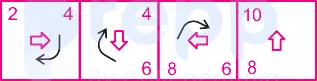
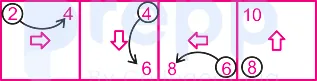
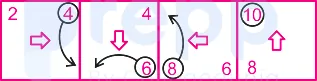
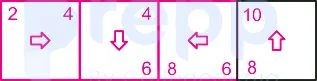
Select the figure can replace the question mark (?) in the following figure series.

- A
Option A (shown in image)
- B
Option B (shown in image)
- C
Option C (shown in image)
- D
Option D (shown in image)
Show answer
Question 7archived
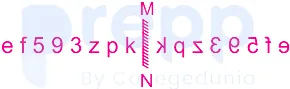
Select the correct mirror image of the given combination when the mirror is placed at MN as shown below.
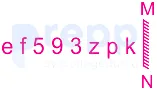
- A
Option A (shown in image)
- B
Option B (shown in image)
- C
Option C (shown in image)
- D
Option D (shown in image)
Show answer
Question 8archived
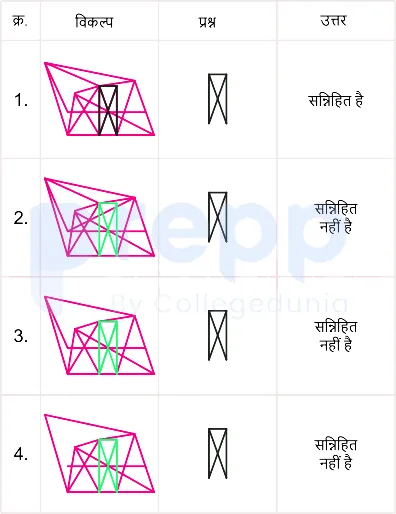
Select the option figure in which the given figure (X) is embedded as its part (rotation is NOT allowed).

- A
Option A (shown in image)
- B
Option B (shown in image)
- C
Option C (shown in image)
- D
Option D (shown in image)
Show answer
A. Option A (shown in image)Given:
The image must not to be rotated
Hence, the correct answer is "Option - (1)".

 Paper & answer key PDF ↗
 Question 9archived
Select the option that is related to the fifth letter-cluster in the same way as the second letter-cluster is related to the first letter-cluster and the fourth letter-cluster is related to the third letter-cluster.
WITNESS : SSENTIW :: SILENCE : ECNELIS :: PROTECT : ?
- A
PROCETT
- B
TCETORP
- C
CETPROT
- D
RPOTCET
Show answer
B. TCETORPCorrect answer: TCETORP
Solving letter reasoning and analogy questions effectively requires practice and recognizing different types of patterns. Here are some tips:
Count the number of letters in each cluster.
Compare corresponding letters and look for shifts in alphabetical position.
Check if the second cluster is the reverse of the first.
Look for rearrangement of letters within the cluster.
Consider patterns based on vowels and consonants.
If no clear pattern emerges with individual letters, look at blocks of letters or other structural relationships.
Paper & answer key PDF ↗ Question 10archived
In a certain code language, 'HABIT’ is written as 'ITAHB' and 'BASED' is written as 'EDABS'. How will 'GAMES' be written in that language
- A
ESAGM
- B
ESGAM
- C
ESAMG
- D
SEAGM
Show answer
A. ESAGMUnderstanding the Coding Pattern
This question involves a coding-decoding pattern where the letters of a word are rearranged according to a specific rule to form the coded word. We need to identify this rule by examining the given examples.
Analyzing the Code for 'HABIT' and 'BASED'
Let's look at the first example:
Original word: HABIT
Coded word: ITAHB
Both words have 5 letters. The letters are the same, just in a different order. Let's assign positions to the letters in the original word (1st, 2nd, 3rd, 4th, 5th) and see where they move in the coded word.
Original Position
1
2
3
4
5
Letter (HABIT)
H
A
B
I
T
Coded Position
?
?
?
?
?
Coded Letter (ITAHB)
I
T
A
H
B
By comparing the letters, we can see where each original letter moves:
H (original position 1) is at position 4 in ITAHB.
A (original position 2) is at position 3 in ITAHB.
B (original position 3) is at position 5 in ITAHB.
I (original position 4) is at position 1 in ITAHB.
T (original position 5) is at position 2 in ITAHB.
So, the mapping of original positions to coded positions is: \(1 \to 4\), \(2 \to 3\), \(3 \to 5\), \(4 \to 1\), \(5 \to 2\).
Let's check this pattern with the second example:
Original word: BASED
Coded word: EDABS
Original Position
1
2
3
4
5
Letter (BASED)
B
A
S
E
D
Coded Position
?
?
?
?
?
Coded Letter (EDABS)
E
D
A
B
S
Applying the pattern \(1 \to 4\), \(2 \to 3\), \(3 \to 5\), \(4 \to 1\), \(5 \to 2\) to BASED:
Letter at original position 1 (B) moves to coded position 4.
Letter at original position 2 (A) moves to coded position 3.
Letter at original position 3 (S) moves to coded position 5.
Letter at original position 4 (E) moves to coded position 1.
Letter at original position 5 (D) moves to coded position 2.
Placing the letters in their new positions (1, 2, 3, 4, 5): E (from pos 4), D (from pos 5), A (from pos 2), B (from pos 1), S (from pos 3). This gives us EDABS, which matches the given coded word.
Applying the Code to 'GAMES'
Now, we apply the same position mapping rule \(1 \to 4\), \(2 \to 3\), \(3 \to 5\), \(4 \to 1\), \(5 \to 2\) to the word 'GAMES'.
Original Position
1
2
3
4
5
Letter (GAMES)
G
A
M
E
S
Coded Position
?
?
?
?
?
Let's determine which letter goes to which coded position:
The letter at original position 1 (G) goes to coded position 4.
The letter at original position 2 (A) goes to coded position 3.
The letter at original position 3 (M) goes to coded position 5.
The letter at original position 4 (E) goes to coded position 1.
The letter at original position 5 (S) goes to coded position 2.
Now, let's construct the coded word by placing the letters in their coded positions (1, 2, 3, 4, 5):
Coded Position 1: Letter from original position 4 (E)
Coded Position 2: Letter from original position 5 (S)
Coded Position 3: Letter from original position 2 (A)
Coded Position 4: Letter from original position 1 (G)
Coded Position 5: Letter from original position 3 (M)
Combining these letters in order (Position 1 to Position 5), we get ESAGM.
Comparing this with the given options, we find that ESAGM matches option 1.
Revision Table: Coding Decoding Patterns
Concept
Description
Example Type
Letter Coding
Letters are replaced by other letters, numbers, or symbols based on a pattern.
Alphabet shift, position change, reverse order.
Position Change
Letters in a word are rearranged according to a specific rule based on their original positions.
The pattern observed in this problem (\(1 \to 4, 2 \to 3, 3 \to 5, 4 \to 1, 5 \to 2\)).
Mixed Coding
Combines elements of letter coding and number/symbol coding.
Words coded as a mix of letters and numbers.
Additional Information: Logical Reasoning in Codes
Coding-decoding questions are a key part of logical reasoning tests. They assess your ability to identify patterns and apply rules. To solve these problems effectively:
Look for the pattern: Carefully compare the original word(s) and their coded form(s). See how letters, numbers, or symbols change.
Check all examples: If multiple examples are given (like HABIT/ITAHB and BASED/EDABS), ensure the pattern you find works for all of them.
Break it down: Sometimes, the word might be split into parts (e.g., halves, thirds) and the parts rearranged or reversed.
Check letter positions: Consider the positions of letters in the alphabet or their positions within the word itself, as seen in this question.
Practice: The more you practice different types of coding-decoding problems, the better you become at quickly spotting the pattern.
Paper & answer key PDF ↗ Question 11archived
Select the odd group of numbers. (NOTE: Operations should be performed on the whole numbers, without breaking down the numbers into its constituent digits. E.g.13– Operations on 13 such as adding /subtracting /multiplying etc. to 13 can be performed. Breaking down 13 into 1 and 3 and then performing mathematical operations on 1 and 3 is not allowed)
- A
(16 – 20 – 24)
- B
(23 – 27 –31)
- C
(11 – 15 – 19)
- D
(12 – 14 – 18)
Show answer
D. (12 – 14 – 18)Finding the Odd Group of Numbers
The question asks us to identify the group of numbers that does not follow the same pattern as the others. We are specifically instructed to perform operations on the whole numbers within each group, not on their individual digits.
Let's examine each group and determine the relationship between the numbers.
Analyzing Group 1: (16 – 20 – 24)
Difference between the second and first number: ${20 - 16 = 4}$
Difference between the third and second number: ${24 - 20 = 4}$
Pattern: The numbers in this group increase by a constant difference of 4.
Analyzing Group 2: (23 – 27 – 31)
Difference between the second and first number: ${27 - 23 = 4}$
Difference between the third and second number: ${31 - 27 = 4}$
Pattern: The numbers in this group increase by a constant difference of 4.
Analyzing Group 3: (11 – 15 – 19)
Difference between the second and first number: ${15 - 11 = 4}$
Difference between the third and second number: ${19 - 15 = 4}$
Pattern: The numbers in this group increase by a constant difference of 4.
Analyzing Group 4: (12 – 14 – 18)
Difference between the second and first number: ${14 - 12 = 2}$
Difference between the third and second number: ${18 - 14 = 4}$
Pattern: The numbers in this group increase by a difference of 2, then by a difference of 4.
Comparing the Patterns of the Groups
Let's put the patterns we found into a table for easy comparison:
Group
Numbers
Difference 1 (2nd - 1st)
Difference 2 (3rd - 2nd)
Pattern
1
(16 – 20 – 24)
${4}$
${4}$
Constant difference of 4
2
(23 – 27 – 31)
${4}$
${4}$
Constant difference of 4
3
(11 – 15 – 19)
${4}$
${4}$
Constant difference of 4
4
(12 – 14 – 18)
${2}$
${4}$
Difference of 2, then 4
From the table, we can clearly see that Groups 1, 2, and 3 all follow the same pattern: each subsequent number is obtained by adding 4 to the previous number. Group 4, however, follows a different pattern, where the first difference is 2 and the second difference is 4.
Therefore, Group 4 is the odd one out among the given options.
Revision Table: Understanding Odd Group Questions
Concept
Explanation
Key Skill
Odd Group Out
Finding the item (in this case, a group of numbers) that does not fit a pattern or rule followed by the other items.
Pattern recognition
Number Patterns
Identifying the relationship between numbers in a sequence or group (e.g., arithmetic progression, geometric progression, differences, sums, etc.).
Logical deduction
Given Constraints
Paying close attention to specific rules mentioned in the question (like operating on whole numbers vs. digits).
Careful reading
Additional Information: Solving Number Series Problems
Finding the odd group of numbers is a common type of logical reasoning question, often related to number series. Here are some approaches to solve such problems:
Look for Differences: Calculate the difference between consecutive numbers. Is it constant? Is there a pattern in the differences themselves? (As done in this problem).
Look for Ratios: If the differences are not constant, check if there is a constant ratio between consecutive numbers (geometric progression).
Look for Sums or Products: Sometimes the next number is the sum or product of the previous numbers.
Check for Squares, Cubes, Primes: Numbers might be squares, cubes, prime numbers, or related to them (e.g., $n^2+1$, $n^3-1$).
Combine Operations: The pattern might involve a combination of operations (e.g., multiply by 2 and add 1).
Consider Alternating Patterns: There might be two different patterns applied alternately.
Always apply the same potential pattern to all options to confirm which one is different.
Paper & answer key PDF ↗ Question 12archived
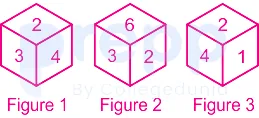
Three different positions of the same dice are shown. Find the number on the face opposite the face showing '2'.
- A
4
- B
3
- C
5
- D
6
Show answer
C. 5The logic followed here is:-
From the given three different cubes, figure 2 and figure 3, the adjacent sides are as shown below :
As 2 is common in both figure 2 and figure 3, it is clear that 1, 3, 4, and 6 are adjacent to it, and the remaining number i.e., 5 will be opposite to it.
Opposite pairs:
1 → 3
4 → 6
2 → 5
So, the opposite side of "2" will be side "5".
Hence, the correct answer is "5".
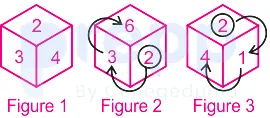 Paper & answer key PDF ↗
 Question 13archived
Which of the following numbers will replace the question mark (?) in the given series?
25, 15, ?, −5, −15
- A
20
- B
5
- C
10
- D
−1
Show answer
B. 5Solving the Number Series Pattern
The question asks us to find the missing number in the given series: 25, 15, ?, −5, −15.
To solve a number series problem, we need to identify the pattern or rule that connects the consecutive terms.
Identifying the Pattern in the Series
Let's look at the differences between the given consecutive terms:
Difference between the first and second term: $15 - 25 = -10$
Difference between the fourth and fifth term: $-15 - (-5) = -15 + 5 = -10$
From these calculations, it appears that each term is obtained by subtracting 10 from the previous term. This indicates a consistent difference pattern, characteristic of an arithmetic progression.
Applying the Pattern to Find the Missing Number
Assuming the pattern is subtracting 10 from the previous term, we can find the missing number (?) by applying this rule to the second term (15).
Second term: 15
Pattern: Subtract 10
Missing term = $15 - 10 = 5$
So, the missing number should be 5.
Verifying the Pattern with the Found Number
Let's check if the pattern holds true for the terms after the missing number if we replace '?' with 5.
The series becomes: 25, 15, 5, −5, −15
Difference between the second and third term: $5 - 15 = -10$
Difference between the third and fourth term: $-5 - 5 = -10$
The pattern of subtracting 10 is consistent throughout the series when 5 replaces the question mark.
Therefore, the number that replaces the question mark is 5.
Revision Table: Number Series Analysis
Term Number
Term Value
Difference from Previous Term
1
25
-
2
15
$15 - 25 = -10$
3
? (Calculated as 5)
$5 - 15 = -10$
4
−5
$-5 - 5 = -10$
5
−15
$-15 - (-5) = -10$
Additional Information: Types of Number Series
Number series problems test your ability to identify patterns. Common patterns include:
Arithmetic Series: Each term is obtained by adding or subtracting a constant value (called the common difference) from the previous term. The given series is an example of an arithmetic series with a common difference of -10.
Geometric Series: Each term is obtained by multiplying or dividing the previous term by a constant value (called the common ratio).
Square or Cube Series: Terms are related to squares or cubes of natural numbers.
Fibonacci Series: Each term is the sum of the two preceding terms (starting usually from 0 and 1, or 1 and 1).
Mixed Series: A combination of two or more patterns or alternating patterns.
Understanding these basic types helps in quickly identifying the rule governing a given number series.
Paper & answer key PDF ↗ Question 14archived
Select the set in which the numbers are NOT related in the same way as are the numbers of the given set.
(NOTE: Operations should be performed on the whole numbers, without breaking down the numbers into its constituent digits. E.g. 13 – Operations on 13 such as adding / subtracting / multiplying etc. to 13 can be performed. Breaking down 13 into 1 and 3 and then performing mathematical operations on 1 and 3 is not allowed)
(168, 122, 290)
- A
(198, 112, 310)
- B
(226, 148, 374)
- C
(236, 118, 356)
- D
(126, 132, 258)
Show answer
C. (236, 118, 356)Understanding the Number Relationship in the Given Set
The question asks us to identify a set of numbers from the options that does NOT share the same mathematical relationship as the given set: (168, 122, 290).
We need to find the pattern or rule that connects the three numbers in the given set. Let's examine the numbers:
First number: 168
Second number: 122
Third number: 290
Let's try common arithmetic operations. Could the third number be the sum of the first two?
Calculation:
\( 168 + 122 = 290 \)
Yes, the sum of the first two numbers (168 and 122) is equal to the third number (290). So, the relationship in the given set is: First Number + Second Number = Third Number.
We are instructed that operations should be performed on whole numbers, not breaking them into digits, and this calculation follows that rule.
Analyzing Options for the Same Number Relationship
Now, let's check each option to see if the same relationship (First Number + Second Number = Third Number) holds true.
Option 1: (198, 112, 310)
Let's add the first two numbers:
\( 198 + 112 \)
Calculation:
1
9
8
+
1
1
2
3
1
0
\( 198 + 112 = 310 \)
The third number in this set is 310. Since \( 198 + 112 = 310 \), this set follows the same relationship as the given set.
Option 2: (226, 148, 374)
Let's add the first two numbers:
\( 226 + 148 \)
Calculation:
2
2
6
+
1
4
8
3
7
4
\( 226 + 148 = 374 \)
The third number in this set is 374. Since \( 226 + 148 = 374 \), this set follows the same relationship as the given set.
Option 3: (236, 118, 356)
Let's add the first two numbers:
\( 236 + 118 \)
Calculation:
2
3
6
+
1
1
8
3
5
4
\( 236 + 118 = 354 \)
The third number in this set is 356. Since \( 236 + 118 = 354 \) and \( 354 \neq 356 \), this set does NOT follow the same relationship as the given set.
Option 4: (126, 132, 258)
Let's add the first two numbers:
\( 126 + 132 \)
Calculation:
1
2
6
+
1
3
2
2
5
8
\( 126 + 132 = 258 \)
The third number in this set is 258. Since \( 126 + 132 = 258 \), this set follows the same relationship as the given set.
Conclusion on the Number Set Relationship
We analyzed the given set (168, 122, 290) and found the relationship: First Number + Second Number = Third Number. We then checked each option against this rule.
Option 1: (198, 112, 310) follows the rule (\( 198 + 112 = 310 \)).
Option 2: (226, 148, 374) follows the rule (\( 226 + 148 = 374 \)).
Option 3: (236, 118, 356) does NOT follow the rule (\( 236 + 118 = 354 \), which is not 356).
Option 4: (126, 132, 258) follows the rule (\( 126 + 132 = 258 \)).
The question asks for the set in which the numbers are NOT related in the same way. This is Option 3.
Revision Table: Checking Number Relationships
Set
First Number
Second Number
Sum (First + Second)
Third Number
Relation Holds?
Given Set
168
122
\(168 + 122 = 290\)
290
Yes
Option 1
198
112
\(198 + 112 = 310\)
310
Yes
Option 2
226
148
\(226 + 148 = 374\)
374
Yes
Option 3
236
118
\(236 + 118 = 354\)
356
No
Option 4
126
132
\(126 + 132 = 258\)
258
Yes
Additional Information: Number Analogies and Patterns
This type of problem is common in reasoning and quantitative aptitude tests. It falls under the category of number analogy or pattern identification. The key is to find the underlying mathematical rule connecting the numbers in the given set and then apply that rule to the options. Common relationships often involve basic arithmetic operations like addition, subtraction, multiplication, division, squares, cubes, or a combination of these.
It's important to test simple relationships first (like addition or subtraction) before moving to more complex ones. Also, remember the instruction about operating on whole numbers, which means you treat numbers like 168 as 'one hundred sixty-eight' rather than considering the digits 1, 6, and 8 separately.
Practicing different types of number pattern problems helps in quickly identifying the relationship in such questions.
Paper & answer key PDF ↗ Question 15archived
Which of the following interchange of numbers and mathematical signs would make the given equation correct?
72 ÷ 6 − 20 + 30 × 5 = 70
- A
5 and 20, − and ×
- B
20 and 30, × and ÷
- C
5 and 70, + and −
- D
6 and 20, + and ÷
Show answer
A. 5 and 20, − and ×The problem asks us to find which interchange of numbers and mathematical signs will make the given equation correct. The equation is:
\(72 \div 6 - 20 + 30 \times 5 = 70\)
Analyzing the Original Equation
First, let's evaluate the original equation using the order of operations (BODMAS/PEMDAS):
Division: \(72 \div 6 = 12\)
Multiplication: \(30 \times 5 = 150\)
The equation becomes: \(12 - 20 + 150\)
Addition and Subtraction (from left to right): \(12 - 20 = -8\)
\(-8 + 150 = 142\)
So, the original equation evaluates to 142, which is not equal to 70. We need to find an interchange that makes the left side equal to 70.
Testing the Interchange Options
We will test each option provided by performing the specified interchange and then evaluating the new equation.
Option 1: Interchange 5 and 20, and − and ×
Original equation: \(72 \div 6 - 20 + 30 \times 5 = 70\)
Interchange 5 with 20, and the sign − with the sign ×.
The new equation becomes:
\(72 \div 6 \times 5 + 30 - 20 = 70\)
Let's evaluate this new equation using the order of operations:
Division: \(72 \div 6 = 12\)
Multiplication: \(12 \times 5 = 60\)
The equation is now: \(60 + 30 - 20\)
Addition: \(60 + 30 = 90\)
Subtraction: \(90 - 20 = 70\)
The result is 70. This matches the target value on the right side of the original equation. Therefore, this interchange makes the equation correct.
Option 2: Interchange 20 and 30, and × and ÷
Original equation: \(72 \div 6 - 20 + 30 \times 5 = 70\)
Interchange 20 with 30, and the sign × with the sign ÷.
The new equation becomes:
\(72 \times 6 - 30 + 20 \div 5 = 70\)
Let's evaluate this new equation:
Division: \(20 \div 5 = 4\)
Multiplication: \(72 \times 6 = 432\)
The equation is now: \(432 - 30 + 4\)
Subtraction: \(432 - 30 = 402\)
Addition: \(402 + 4 = 406\)
The result is 406, which is not equal to 70. This interchange does not make the equation correct.
Option 3: Interchange 5 and 70, and + and −
Original equation: \(72 \div 6 - 20 + 30 \times 5 = 70\)
Interchange 5 with 70, and the sign + with the sign −. Note that 70 is the target value, not a number within the equation's left side. We will interpret this as swapping the number 5 on the left side with 70, and swapping the + sign with the - sign on the left side.
The new equation becomes:
\(72 \div 6 + 20 - 30 \times 70 = 70\)
Let's evaluate this new equation:
Division: \(72 \div 6 = 12\)
Multiplication: \(30 \times 70 = 2100\)
The equation is now: \(12 + 20 - 2100\)
Addition: \(12 + 20 = 32\)
Subtraction: \(32 - 2100 = -2068\)
The result is -2068, which is not equal to 70. This interchange does not make the equation correct based on this interpretation.
Option 4: Interchange 6 and 20, and + and ÷
Original equation: \(72 \div 6 - 20 + 30 \times 5 = 70\)
Interchange 6 with 20, and the sign + with the sign ÷.
The new equation becomes:
\(72 \div 20 - 6 \div 30 \times 5 = 70\)
Let's evaluate this new equation:
Division 1: \(72 \div 20 = 3.6\)
Division 2: \(6 \div 30 = 0.2\)
The equation is now: \(3.6 - 0.2 \times 5\)
Multiplication: \(0.2 \times 5 = 1\)
Subtraction: \(3.6 - 1 = 2.6\)
The result is 2.6, which is not equal to 70. This interchange does not make the equation correct.
Based on the evaluation of each option, the interchange specified in Option 1 is the only one that makes the given equation correct.
Revision Table: Equation Interchange
Interchange
New Equation
Evaluation Result
Correct?
Original
\(72 \div 6 - 20 + 30 \times 5\)
142
No
5 <--> 20, − <--> ×
\(72 \div 6 \times 5 + 30 - 20\)
70
Yes
20 <--> 30, × <--> ÷
\(72 \times 6 - 30 + 20 \div 5\)
406
No
5 <--> 70, + <--> −
\(72 \div 6 + 20 - 30 \times 70\)
-2068
No
6 <--> 20, + <--> ÷
\(72 \div 20 - 6 \div 30 \times 5\)
2.6
No
Additional Information on Order of Operations
The order of operations is a rule used in mathematics to clarify which procedures should be performed first in a given mathematical expression. Common mnemonics to remember this order are BODMAS or PEMDAS.
BODMAS: Brackets, Orders (powers and square roots), Division and Multiplication (from left to right), Addition and Subtraction (from left to right).
PEMDAS: Parentheses, Exponents, Multiplication and Division (from left to right), Addition and Subtraction (from left to right).
Applying this order consistently is crucial when solving equations involving multiple operations, as demonstrated in the solution above where division and multiplication were performed before addition and subtraction in each step.
Paper & answer key PDF ↗ Question 16archived
Select the figure among the given option that can replace the question mark (?) in the following series.

- A
Option A (shown in image)
- B
Option B (shown in image)
- C
Option C (shown in image)
- D
Option D (shown in image)
Show answer
Question 17archived
Select the word-pair that best represents a similar relationship to the one expressed in the pair of words given below. (The words must be considered as meaningful English words and must not be related to each other based on the number of letters/number of consonants/vowels in the word.)
Lion : Roar
- A
Hen : Crow
- B
Owl : Bleat
- C
Horse : Neigh
- D
Goat : Hoot
Show answer
C. Horse : NeighThis question asks us to identify a word-pair that shares the same relationship as the given pair, "Lion : Roar". This type of question is known as a word analogy.
Understanding the Relationship in Lion : Roar
Let's first examine the relationship between the words "Lion" and "Roar".
A Lion is an animal.
A Roar is the specific sound that a Lion makes.
So, the relationship in the given pair is Animal : Sound it makes.
Analyzing the Options for Animal Sounds
We need to look at the options and find the pair where the first word is an animal and the second word is the characteristic sound that animal makes.
Option Pair
Animal
Sound Given
Correct Sound of Animal
Relationship Match?
Hen : Crow
Hen
Crow
Cluck (A rooster crows)
No
Owl : Bleat
Owl
Bleat
Hoot
No
Horse : Neigh
Horse
Neigh
Neigh
Yes
Goat : Hoot
Goat
Hoot
Bleat
No
Evaluating Each Option
Option 1: Hen : Crow
A hen makes a clucking sound. A crowing sound is made by a rooster, not a hen. So, this pair does not fit the Animal : Sound relationship accurately.
Option 2: Owl : Bleat
An owl makes a hooting sound. A bleating sound is made by a goat or sheep. So, this pair does not fit the relationship.
Option 3: Horse : Neigh
A horse makes a neighing sound. This pair correctly represents the Animal : Sound it makes relationship, similar to "Lion : Roar".
Option 4: Goat : Hoot
A goat makes a bleating sound. A hooting sound is made by an owl. So, this pair does not fit the relationship.
Conclusion for the Word Analogy
Based on the analysis of each option, the pair "Horse : Neigh" is the only one that accurately reflects the same Animal : Sound relationship found in the original pair "Lion : Roar". A horse is an animal, and neigh is the sound a horse makes.
Revision Table: Animal Sounds Review
Animal
Sound
Lion
Roar
Horse
Neigh
Hen
Cluck
Rooster
Crow
Owl
Hoot
Goat
Bleat
Sheep
Bleat
Additional Information on Analogies
Analogies questions test your ability to identify the relationship between a pair of words and find another pair that has the same relationship. Common types of relationships include:
Part : Whole (e.g., Finger : Hand)
Cause : Effect (e.g., Rain : Flood)
Synonyms (e.g., Happy : Joyful)
Antonyms (e.g., Hot : Cold)
Worker : Tool (e.g., Carpenter : Hammer)
Action : Object (e.g., Read : Book)
Animal : Habitat (e.g., Fish : Water)
Animal : Sound (as seen in this question)
Solving analogies requires careful observation of the first pair to determine the exact relationship before examining the options.
Paper & answer key PDF ↗ Question 18archived
Select the correct combination of mathematical signs to sequentially replace the @ signs and to balance the given equation.
[{(14 @ 6) @ (2 @ 3)} @ (1 @ 7)] @ 2 @ 4
- A
×, ÷, ×, ×, −, +, =
- B
−, +, ×, ×, ×, ×, =
- C
×, −, +, ×, ÷, ×, =
- D
−, +, ×, ÷, ×, ×, =
Show answer
D. −, +, ×, ÷, ×, ×, =Balancing Mathematical Equations by Substituting Signs
The question asks us to find the correct combination of mathematical signs to replace the '@' symbols in the given equation so that it balances. We are provided with a complex expression involving nested brackets and several '@' placeholders.
The equation structure is given as:
\({[\{(14 @ 6) @ (2 @ 3)\} @ (1 @ 7)] @ 2 @ 4}\)
Let's carefully identify the positions of the '@' symbols within the structure. There are a total of seven '@' symbols:
Between 14 and 6
Between the result of \((14 @ 6)\) and the result of \((2 @ 3)\)
Between 2 and 3
Between the result of \(\{(14 @ 6) @ (2 @ 3)\}\) and the result of \((1 @ 7)\)
Between 1 and 7
Between the result of the entire expression within the square brackets \([\dots]\) and the number 2
Between 2 and 4
The options provided contain a sequence of seven mathematical signs. The last sign in each option is '=', which indicates that the last '@' symbol represents the equality sign, and the number '4' is on the right side of the equation. Thus, the equation we need to balance is:
\({[\{(14 @ 6) @ (2 @ 3)\} @ (1 @ 7)] @ 2 = 4}\)
We need to test the given options by substituting the signs sequentially into the positions of the '@' symbols. Let's use the signs from one of the options and evaluate the left side of the equation to see if it equals 4.
Let's consider the sequence of signs: \(\minus, +, \times, \div, \times, \times, =\). Substituting these signs into the equation gives:
\({[\{(14 - 6) + (2 \times 3)\} \div (1 \times 7)] \times 2 = 4}\)
Step-by-Step Evaluation Using BODMAS/PEMDAS
We will evaluate the left side of this equation following the standard order of operations (Brackets/Parentheses, Orders/Exponents, Division & Multiplication, Addition & Subtraction):
Evaluate the expressions inside the innermost parentheses first:
Calculate \((14 - 6)\): \(14 - 6 = 8\)
Calculate \((2 \times 3)\): \(2 \times 3 = 6\)
Calculate \((1 \times 7)\): \(1 \times 7 = 7\)
Substitute these calculated values back into the equation:
\({[\{(8) + (6)\} \div (7)] \times 2 = 4}\)
Next, evaluate the expression within the curly braces \(\{\}\):
Calculate \(\{(8) + (6)\}\): \(8 + 6 = 14\)
Substitute this value back:
\({[\{14\} \div (7)] \times 2 = 4}\)
Now, evaluate the expression within the square brackets \(\lbrack\rbrack\):
Calculate \([\text{14} \div \text{7}]\): \(14 \div 7 = 2\)
Substitute this result back into the equation:
\({2 \times 2 = 4}\)
Finally, perform the multiplication on the left side:
Calculate \({2 \times 2}\): \(2 \times 2 = 4\)
After performing all operations on the left side, we get the value 4. The equation becomes:
\({4 = 4}\)
Since the left side of the equation is equal to the right side, the equation is balanced with the sequence of signs \(\minus, +, \times, \div, \times, \times, =\).
The correspondence between the '@' positions and the signs used is:
@ Position
Mathematical Sign
1st @ (between 14 and 6)
\(\minus\)
2nd @ (between (14-6) and (2x3))
\(+\)
3rd @ (between 2 and 3)
\(\times\)
4th @ (between {(14-6)+(2x3)} and (1x7))
\(\div\)
5th @ (between 1 and 7)
\(\times\)
6th @ (between [...] and 2)
\(\times\)
7th @ (between 2 and 4)
\(=\)
This sequence of signs successfully balances the given equation, making the statement true.
Revision Table: Key Concepts for Equation Balancing
Concept
Relevance to Balancing Equations
Substituting Signs
The core task is replacing placeholders (@) with operators (+, -, ×, ÷) and the equality sign (=).
Order of Operations (BODMAS/PEMDAS)
Crucially important for evaluating the mathematical expression correctly after substitution. Determines the sequence of calculations (Brackets/Parentheses first, then Orders/Exponents, then Division/Multiplication from left to right, then Addition/Subtraction from left to right).
Evaluating Expressions
Calculating the numerical value of the expression on the left side of the equation.
Equality (=)
The symbol that signifies that the value on the left side is the same as the value on the right side. The goal is to achieve a true equality.
Additional Information: Importance of Brackets in Expressions
Brackets, parentheses, and braces are used in mathematical expressions to group terms and dictate the order in which operations should be performed, overriding the default BODMAS/PEMDAS order if necessary. Operations within the innermost brackets are always performed first.
Parentheses (): Used for the innermost grouping.
Curly Braces {}: Used for the next level of grouping outside parentheses.
Square Brackets []: Used for the outermost level of grouping in complex expressions.
In the given problem, the structure \({[\{(...)\}] \dots}\) clearly shows the nesting levels, guiding the evaluation process from the inside out. Ignoring or misinterpreting the brackets would lead to incorrect results when evaluating the expression and attempting to balance the equation.
Paper & answer key PDF ↗ Question 19archived
In a certain code language, 'ABACK’ is written as 'MECDC' and 'CABAL' is written as 'NCDCE'. How will 'EAGER' be written in that language?
- A
TGICG
- B
TGCIG
- C
TCIDG
- D
TFICG
Show answer
A. TGICGUnderstanding Coding Decoding Patterns
This question asks us to decipher a specific code language based on two examples and then apply the logic to a new word. The examples are:
'ABACK' is coded as 'MECDC'
'CABAL' is coded as 'NCDCE'
We need to find the code for the word 'EAGER'.
Analyzing the Example Codes
Let's look at the letters in the original words and their corresponding letters in the coded words based on their position:
Position
ABACK
MECDC
CABAL
NCDCE
1
A
M
C
N
2
B
E
A
C
3
A
C
B
D
4
C
D
A
C
5
K
C
L
E
Now let's examine the shift in alphabetical position for each letter. We can represent A=1, B=2, C=3, ..., Z=26.
Position
ABACK (Value)
MECDC (Value)
Shift (MECDC - ABACK)
CABAL (Value)
NCDCE (Value)
Shift (NCDCE - CABAL)
1
A (1)
M (13)
\(+12\)
C (3)
N (14)
\(+11\)
2
B (2)
E (5)
\(+3\)
A (1)
C (3)
\(+2\)
3
A (1)
C (3)
\(+2\)
B (2)
D (4)
\(+2\)
4
C (3)
D (4)
\(+1\)
A (1)
C (3)
\(+2\)
5
K (11)
C (3)
\(-8\) or \(+18\)
L (12)
E (5)
\(-7\) or \(+19\)
Identifying Positional Code Shifts
Looking at the shifts, we can observe some patterns:
Position 3: The shift is consistently \(+2\) for both 'ABACK' (A \(\to\) C) and 'CABAL' (B \(\to\) D). This is a strong indicator of a fixed shift for this position.
Position 2: The shifts are \(+3\) (B \(\to\) E) and \(+2\) (A \(\to\) C). The shift is \(+2\) when the source letter is A.
The shifts for other positions (1, 4, 5) appear more variable or follow a less obvious pattern from these two examples.
Applying the Pattern to EAGER
Now, let's consider the word 'EAGER' and apply the patterns identified:
EAGER: E (Position 1), A (Position 2), G (Position 3), E (Position 4), R (Position 5)
Position 3: The letter is G (alphabetical value 7). Based on the consistent \(+2\) shift at position 3, the coded letter will be G \(+ 2\) = I (alphabetical value \(7+2=9\)).
Position 2: The letter is A (alphabetical value 1). In the example 'CABAL', the letter A at position 2 was coded as C (alphabetical value 3), which is a \(+2\) shift. Assuming this positional rule for A holds, the coded letter for A in 'EAGER' at position 2 will be A \(+ 2\) = C (alphabetical value \(1+2=3\)).
So, the coded word for 'EAGER' should have 'C' at the second position and 'I' at the third position.
Checking the Options
Let's look at the given options and see which one fits this pattern:
Option 1: TGICG (Second letter G, Third letter I)
Option 2: TGCIG (Second letter C, Third letter I)
Option 3: TCIDG (Second letter C, Third letter I)
Option 4: TFICG (Second letter F, Third letter I)
Based on our derivation, the second letter should be 'C' and the third letter should be 'I'. Options 2 and 3 match the third letter ('I'). Option 3 matches the second letter ('C') and the third letter ('I').
Let's re-check Option 2: TGCIG. Second letter is G, third letter is C. This does not match our derived pattern (C at pos 2, I at pos 3).
Let's re-check Option 3: TCIDG. Second letter is C, third letter is I. This matches our derived pattern (C at pos 2, I at pos 3).
Therefore, based on the consistent and probable patterns identified from the examples, the code for 'EAGER' is most likely 'TCIDG'. The mappings for the other positions (1, 4, and 5) might follow more complex rules, but the strong positional patterns at 2 and 3 are sufficient to identify the correct option.
Revision Table - Key Findings
Position
Pattern Observed from Examples
Application to EAGER
Coded Letter (from TCIDG)
1
Variable shift (+12, +11)
EAGER (E)
T (+15 shift from E)
2
Shift +3 (B), +2 (A). A \(\to\) C (+2) observed.
EAGER (A) \(\to\) A \(+ 2\)
C (+2 shift from A)
3
Consistent shift \(+2\) (A \(\to\) C, B \(\to\) D)
EAGER (G) \(\to\) G \(+ 2\)
I (+2 shift from G)
4
Variable shift (+1, +2)
EAGER (E)
D (-1 shift from E)
5
Variable shift (-8/+18, -7/+19)
EAGER (R)
G (-11/+15 shift from R)
Additional Information - Coding Decoding Concepts
Coding-decoding questions test your ability to identify logical rules and patterns in letter or number sequences. Common types of patterns include:
Letter Shifting: Each letter is shifted by a fixed number of positions in the alphabet (e.g., A \(\to\) C is a +2 shift). The shift can be forward or backward.
Positional Shifting: The shift amount varies depending on the position of the letter in the word.
Direct Letter Substitution: Each letter in the original word is directly substituted by a specific letter in the code, regardless of its position.
Reversal: The letters of the word are reversed, and then a substitution or shift might be applied.
Mixed Patterns: A combination of the above rules might be used, possibly involving vowel/consonant specific rules, or rules based on the alphabetical value of the letters.
Solving these problems requires careful observation, breaking down the examples, analyzing differences (like alphabetical shifts), and systematically testing potential rules against the given examples before applying them to the target word.
Paper & answer key PDF ↗ Question 20archived
After arranging the given words according to dictionary order, which word will come at ‘Fifth’ position?
1. Overload
2. Overplay
3. Overlook
4. Overlain
5. Overland
- A
Overlain
- B
Overplay
- C
Overload
- D
Overland
Show answer
B. OverplayAccording to the sequence in the dictionary:
4. Overlain
5. Overland
1. Overload
3. Overlook
2. Overplay
Hence, the correct option is "Overplay".
Paper & answer key PDF ↗ Question 21archived
Select the set in which the numbers are related in the same way as are the numbers of the following sets.
(NOTE : Operations should be performed on the whole numbers, without breaking down the numbers into its constituent digits. E.g. 13 – Operations on 13 such as adding /deleting /multiplying etc. to 13 can be performed. Breaking down 13 into 1 and 3 and then performing mathematical operations on 1 and 3 is NOT allowed)
(8, 540, 60)
(9, 70, 7)
- A
(12, 56, 60)
- B
(8, 63, 7)
- C
(9, 54, 12)
- D
(9, 45, 7)
Show answer
B. (8, 63, 7)Understanding Number Relationships in Sets
The problem asks us to find a numerical relationship or pattern that connects the three numbers in the given sets. Once we identify this pattern, we need to find which of the provided options follows the exact same relationship.
We are given two example sets:
Set 1: (8, 540, 60)
Set 2: (9, 70, 7)
The constraint is that operations must be performed on the whole numbers as given (e.g., 13 as a whole number), and we cannot break them down into individual digits (e.g., treating 13 as 1 and 3).
Analyzing the First Set: (8, 540, 60)
Let's look at the numbers in the first set: 8 (first number), 540 (middle number), and 60 (third number). We need to find how 8, 540, and 60 are related. Let's try some common mathematical operations involving the first and third numbers to see if we can arrive at the middle number or a value related to it.
Addition: $8 + 60 = 68$ (Not 540)
Subtraction: $|8 - 60| = 52$ (Not 540)
Multiplication: $8 \times 60 = 480$ (Close to 540, but not exactly 540)
The product $8 \times 60 = 480$ is 60 less than 540. Notice that 60 is the third number in the set. This suggests a possible relationship: Middle Number = (First Number $\times$ Third Number) + Third Number.
Let's test this potential rule with the first set:
Middle Number = $(8 \times 60) + 60 = 480 + 60 = 540$.
This relationship holds true for the first set.
Another way to express this rule by factoring out the third number is: Middle Number = Third Number $\times$ (First Number + 1).
Let's test this version of the rule with the first set:
Middle Number = $60 \times (8 + 1) = 60 \times 9 = 540$.
This confirms the rule for the first set.
Verifying the Rule with the Second Set: (9, 70, 7)
Now, let's apply the identified rule, Middle Number = Third Number $\times$ (First Number + 1), to the second set (9, 70, 7). Here, the first number is 9, the middle number is 70, and the third number is 7.
According to the rule:
Calculated Middle Number = Third Number $\times$ (First Number + 1)
Calculated Middle Number = $7 \times (9 + 1) = 7 \times 10 = 70$.
The calculated middle number (70) matches the given middle number (70) in the second set. This strongly suggests that the rule Middle Number = Third Number $\times$ (First Number + 1) is the correct relationship for these sets.
Applying the Pattern to the Options
We will now apply the rule Middle Number = Third Number $\times$ (First Number + 1) to each of the given options to find the set that follows the same pattern.
Option 1: (12, 56, 60)
First Number = 12
Middle Number = 56
Third Number = 60
Let's apply the rule:
Calculated Middle Number = $60 \times (12 + 1) = 60 \times 13 = 780$.
The calculated middle number (780) does not match the given middle number (56). So, this option does not follow the pattern.
Option 2: (8, 63, 7)
First Number = 8
Middle Number = 63
Third Number = 7
Let's apply the rule:
Calculated Middle Number = $7 \times (8 + 1) = 7 \times 9 = 63$.
The calculated middle number (63) matches the given middle number (63). So, this option follows the pattern.
Option 3: (9, 54, 12)
First Number = 9
Middle Number = 54
Third Number = 12
Let's apply the rule:
Calculated Middle Number = $12 \times (9 + 1) = 12 \times 10 = 120$.
The calculated middle number (120) does not match the given middle number (54). So, this option does not follow the pattern.
Option 4: (9, 45, 7)
First Number = 9
Middle Number = 45
Third Number = 7
Let's apply the rule:
Calculated Middle Number = $7 \times (9 + 1) = 7 \times 10 = 70$.
The calculated middle number (70) does not match the given middle number (45). So, this option does not follow the pattern.
Conclusion on Matching Set
Based on our analysis, only Option 2, the set (8, 63, 7), follows the same numerical relationship as the given sets (8, 540, 60) and (9, 70, 7).
The relationship is: Middle Number = Third Number $\times$ (First Number + 1).
Revision Table: Checking the Rule
SetFirst No. (F)Middle No. (M)Third No. (T)Rule: T × (F + 1)Calculated MMatches M?
(8, 540, 60)854060$60 \times (8 + 1) = 60 \times 9$540Yes
(9, 70, 7)9707$7 \times (9 + 1) = 7 \times 10$70Yes
Option 1: (12, 56, 60)125660$60 \times (12 + 1) = 60 \times 13$780No
Option 2: (8, 63, 7)8637$7 \times (8 + 1) = 7 \times 9$63Yes
Option 3: (9, 54, 12)95412$12 \times (9 + 1) = 12 \times 10$120No
Option 4: (9, 45, 7)9457$7 \times (9 + 1) = 7 \times 10$70No
Additional Information on Number Pattern Recognition
Number pattern recognition questions are common in logical reasoning and quantitative aptitude tests. They require you to identify a mathematical relationship between a given set of numbers and apply it to other sets. Here are some common types of relationships to look for:
Arithmetic Operations: Addition, subtraction, multiplication, division between numbers or their parts.
Powers and Roots: Squares, cubes, square roots, cube roots of numbers.
Series: Relationships based on arithmetic progression, geometric progression, or other types of series.
Combinations: Relationships involving multiple operations or combining values derived from the numbers (like sum of digits, product of digits, but this was disallowed in this specific question).
Positional Relationships: How the position of the number in the set (first, middle, last) affects the relationship.
Solving these problems often involves trial and error, systematically testing potential relationships until one fits all the given examples. It's helpful to start with simpler operations before moving to more complex ones.
Paper & answer key PDF ↗ Question 22archived
Which two signs should be interchanged to make the given equation correct?
34 ÷ 16 + 4 × 8 − 6 = 60
- A
− and ×
- B
+ and ×
- C
÷ and −
- D
÷ and +
Show answer
D. ÷ and +Understanding the Equation Puzzle
The problem asks us to find which two mathematical signs in the given equation must be swapped to make the equation correct. The original equation is: \(34 \div 16 + 4 \times 8 - 6 = 60\).
To solve this type of puzzle, we need to systematically test each option by swapping the specified signs and then evaluating the resulting equation using the order of operations (BODMAS/PEMDAS). Remember, the order of operations is: Brackets, Orders (powers/roots), Division and Multiplication (from left to right), Addition and Subtraction (from left to right).
Evaluating Option 1: Interchanging − and ×
If we interchange the minus (\(-\)) and multiply (\(\times\)) signs, the equation becomes:
\(34 \div 16 + 4 - 8 \times 6\)
Let's evaluate this expression step-by-step:
First, perform division: \(34 \div 16 = 2.125\)
Next, perform multiplication: \(8 \times 6 = 48\)
The equation is now: \(2.125 + 4 - 48\)
Perform addition: \(2.125 + 4 = 6.125\)
Finally, perform subtraction: \(6.125 - 48 = -41.875\)
Since \(-41.875\) is not equal to \(60\), interchanging − and × is incorrect.
Evaluating Option 2: Interchanging + and ×
If we interchange the plus (\(+\)) and multiply (\(\times\)) signs, the equation becomes:
\(34 \div 16 \times 4 + 8 - 6\)
Let's evaluate this expression step-by-step following BODMAS:
First, perform division: \(34 \div 16 = 2.125\)
Next, perform multiplication: \(2.125 \times 4 = 8.5\)
The equation is now: \(8.5 + 8 - 6\)
Perform addition: \(8.5 + 8 = 16.5\)
Finally, perform subtraction: \(16.5 - 6 = 10.5\)
Since \(10.5\) is not equal to \(60\), interchanging + and × is incorrect.
Evaluating Option 3: Interchanging ÷ and −
If we interchange the divide (\(\div\)) and minus (\(-\)) signs, the equation becomes:
\(34 - 16 + 4 \times 8 \div 6\)
Let's evaluate this expression step-by-step:
First, perform multiplication and division from left to right: \(4 \times 8 = 32\)
Then, \(32 \div 6 = 5.333...\) (approximately)
The equation is now: \(34 - 16 + 5.333...\)
Perform subtraction and addition from left to right: \(34 - 16 = 18\)
Finally, perform addition: \(18 + 5.333... = 23.333...\) (approximately)
Since \(23.333...\) is not equal to \(60\), interchanging ÷ and − is incorrect.
Evaluating Option 4: Interchanging ÷ and +
If we interchange the divide (\(\div\)) and plus (\(+\)) signs, the equation becomes:
\(34 + 16 \div 4 \times 8 - 6\)
Let's evaluate this expression step-by-step following BODMAS:
First, perform division: \(16 \div 4 = 4\)
Next, perform multiplication: \(4 \times 8 = 32\)
The equation is now: \(34 + 32 - 6\)
Perform addition: \(34 + 32 = 66\)
Finally, perform subtraction: \(66 - 6 = 60\)
Since \(60\) is equal to \(60\), interchanging ÷ and + makes the equation correct.
Conclusion
By testing each option and applying the correct order of operations, we found that interchanging the divide (\(\div\)) and plus (\(+\)) signs makes the given equation \(34 \div 16 + 4 \times 8 - 6 = 60\) correct. The resulting equation is \(34 + 16 \div 4 \times 8 - 6 = 60\), which simplifies to \(34 + 4 \times 8 - 6 = 34 + 32 - 6 = 66 - 6 = 60\).
Option
Signs Interchanged
New Equation
Result
Correct?
1
− and ×
\(34 \div 16 + 4 - 8 \times 6\)
\(-41.875\)
No
2
+ and ×
\(34 \div 16 \times 4 + 8 - 6\)
\(10.5\)
No
3
÷ and −
\(34 - 16 + 4 \times 8 \div 6\)
\(23.333...\)
No
4
÷ and +
\(34 + 16 \div 4 \times 8 - 6\)
\(60\)
Yes
Revision Table: Key Concepts
Here's a quick review of the concepts used in solving this problem:
Concept
Description
Importance
Order of Operations (BODMAS/PEMDAS)
Rules for evaluating expressions: Brackets, Orders, Division/Multiplication, Addition/Subtraction.
Ensures consistent and correct evaluation of mathematical expressions.
Sign Interchange Puzzles
Problems where signs in an equation are swapped to make it correct.
Tests understanding of operations and logical reasoning.
Systematic Testing
Checking each given option methodically.
Necessary approach when multiple possibilities exist.
Additional Information: Solving Equation Puzzles
Equation puzzles involving sign interchanges are common in logical reasoning sections of competitive exams. Here are some tips:
Always follow the BODMAS/PEMDAS rule strictly after swapping the signs.
Pay attention to the specific signs that need to be interchanged.
If the numbers involved are integers, look for swaps that might result in integer divisions, as fractions might make calculations more complex unless the target value is also a fraction.
Practice evaluating expressions with different combinations of operators.
Sometimes, a quick estimation can help eliminate options where the result is obviously too large or too small.
Paper & answer key PDF ↗ Question 23archived
If A × B means that A is the father of B, A – B means that A is the mother of B, A ÷ B means that A is the brother of B then which of the following expression shows that P is the paternal uncle of R?
- A
P ÷ Q × R
- B
P ÷ Q – R
- C
Q ÷ P × R
- D
P × Q ÷ R
Show answer
A. P ÷ Q × RUnderstanding Blood Relations and Symbols
This question involves understanding blood relations based on a set of defined symbols. We are given the meaning of three symbols:
A × B means A is the father of B
A – B means A is the mother of B
A ÷ B means A is the brother of B
Our goal is to find the expression where P is the paternal uncle of R. A paternal uncle is the brother of one's father. So, we are looking for an expression that shows P is the brother of R's father.
Analyzing the Expressions
Let's break down each given expression to determine the relationship between P and R.
Expression 1: P ÷ Q × R
This expression can be broken down into two parts:
P ÷ Q: According to the definition, A ÷ B means A is the brother of B. So, P is the brother of Q.
Q × R: According to the definition, A × B means A is the father of B. So, Q is the father of R.
Combining these relationships: P is the brother of Q, and Q is the father of R. This means P is the brother of R's father. Therefore, P is the paternal uncle of R.
Part
Relationship
P ÷ Q
P is the brother of Q
Q × R
Q is the father of R
Combined
P is the brother of R's father (Paternal Uncle of R)
Expression 2: P ÷ Q – R
Let's break down this expression:
P ÷ Q: P is the brother of Q.
Q – R: According to the definition, A – B means A is the mother of B. So, Q is the mother of R.
Combining these: P is the brother of Q, and Q is the mother of R. This means P is the brother of R's mother. Therefore, P is the maternal uncle of R. This is not the required relationship.
Expression 3: Q ÷ P × R
Let's break down this expression:
Q ÷ P: Q is the brother of P.
P × R: P is the father of R.
Combining these: Q is the brother of P, and P is the father of R. This means Q is the brother of R's father, making Q the paternal uncle of R. P is the father of R. This is not the required relationship (P as paternal uncle of R).
Expression 4: P × Q ÷ R
Let's break down this expression:
P × Q: P is the father of Q.
Q ÷ R: Q is the brother of R.
Combining these: P is the father of Q, and Q is the brother of R. Since Q is the brother of R, P is the father of R's brother, which means P is also the father of R. This is not the required relationship.
Conclusion
Based on the analysis of each expression using the given blood relation symbols, the expression P ÷ Q × R correctly shows that P is the paternal uncle of R because it translates to "P is the brother of Q, and Q is the father of R".
Expression
Relationships
Relationship between P and R
P ÷ Q × R
P is brother of Q; Q is father of R
P is paternal uncle of R
P ÷ Q – R
P is brother of Q; Q is mother of R
P is maternal uncle of R
Q ÷ P × R
Q is brother of P; P is father of R
P is father of R (Q is paternal uncle of R)
P × Q ÷ R
P is father of Q; Q is brother of R
P is father of R
Blood Relation Symbol Summary
Understanding the symbols is key to solving blood relation questions quickly. Here's a summary:
× : Represents 'father' when read from left to right (A is father of B).
– : Represents 'mother' when read from left to right (A is mother of B).
÷ : Represents 'brother' when read from left to right (A is brother of B).
Always read the relationships sequentially from left to right within the expression.
Revision Table: Blood Relation Concepts
Relationship
Definition
Father
Male parent
Mother
Female parent
Brother
Male sibling
Sister
Female sibling
Paternal Uncle
Father's brother
Maternal Uncle
Mother's brother
Paternal Aunt
Father's sister
Maternal Aunt
Mother's sister
Additional Information on Blood Relation Puzzles
Blood relation questions often appear in reasoning sections of competitive exams. They test your ability to decode relationships based on given information. There are generally three types of blood relation problems:
Decoding problems: Like the one discussed here, where relationships are given in coded form (using symbols or artificial relations).
Dialogue or conversation based problems: A person introduces or talks about another person, describing their relationship with others.
Family tree based problems: Information is given in a paragraph, and you need to draw a family tree diagram to figure out the relationships.
For decoding problems, always list down the meaning of each symbol first. Then, break down the given expression into smaller parts and determine the relationship for each part sequentially. Finally, combine these individual relationships to find the overall relationship you are looking for. Drawing a diagram or mental map for each option can help in complex cases, but for simple expressions like these, step-by-step analysis is often sufficient.
Paper & answer key PDF ↗ Question 24archived
Which letter cluster will replace the question mark (?) to complete the given series?
VSNY, UQLU, ?, SMHM, RKFI
- A
TOJQ
- B
TOJR
- C
TOKQ
- D
TPJQ
Show answer
A. TOJQSolving Letter Cluster Series Reasoning Questions
This question asks us to find the missing term in the given letter cluster series: VSNY, UQLU, ?, SMHM, RKFI. To solve this type of letter series problem, we need to analyze the pattern or rule that governs the progression from one letter cluster to the next. We can examine the change in letters at each corresponding position across the clusters.
Analyzing the Pattern in the Letter Series
Let's break down the given series and look at the letters at each position separately.
Position
Cluster 1 (VSNY)
Cluster 2 (UQLU)
Cluster 3 (?)
Cluster 4 (SMHM)
Cluster 5 (RKFI)
Pattern
1st Letter
V
U
?
S
R
2nd Letter
S
Q
?
M
K
3rd Letter
N
L
?
H
F
4th Letter
Y
U
?
M
I
Now, let's analyze the pattern for each letter position:
Pattern for the 1st Letter: V, U, ?, S, R
Let's look at the alphabetical positions of these letters:
V is the 22nd letter.
U is the 21st letter. ($22 - 1 = 21$)
S is the 19th letter.
R is the 18th letter. ($19 - 1 = 18$)
The pattern appears to be a decrease of 1 in the alphabetical position for the first letter of each subsequent cluster.
From V (22) to U (21) is a decrease of 1.
Following this pattern, from U (21) to the next letter should be a decrease of 1. $21 - 1 = 20$. The 20th letter is T.
Let's check the next step: From T (20) to S (19) is a decrease of 1.
From S (19) to R (18) is a decrease of 1.
The pattern holds. The first letter of the missing cluster is T.
Pattern for the 2nd Letter: S, Q, ?, M, K
Let's look at the alphabetical positions of these letters:
S is the 19th letter.
Q is the 17th letter. ($19 - 2 = 17$)
M is the 13th letter.
K is the 11th letter. ($13 - 2 = 11$)
The pattern appears to be a decrease of 2 in the alphabetical position for the second letter of each subsequent cluster.
From S (19) to Q (17) is a decrease of 2.
Following this pattern, from Q (17) to the next letter should be a decrease of 2. $17 - 2 = 15$. The 15th letter is O.
Let's check the next step: From O (15) to M (13) is a decrease of 2.
From M (13) to K (11) is a decrease of 2.
The pattern holds. The second letter of the missing cluster is O.
Pattern for the 3rd Letter: N, L, ?, H, F
Let's look at the alphabetical positions of these letters:
N is the 14th letter.
L is the 12th letter. ($14 - 2 = 12$)
H is the 8th letter.
F is the 6th letter. ($8 - 2 = 6$)
The pattern appears to be a decrease of 2 in the alphabetical position for the third letter of each subsequent cluster.
From N (14) to L (12) is a decrease of 2.
Following this pattern, from L (12) to the next letter should be a decrease of 2. $12 - 2 = 10$. The 10th letter is J.
Let's check the next step: From J (10) to H (8) is a decrease of 2.
From H (8) to F (6) is a decrease of 2.
The pattern holds. The third letter of the missing cluster is J.
Pattern for the 4th Letter: Y, U, ?, M, I
Let's look at the alphabetical positions of these letters:
Y is the 25th letter.
U is the 21st letter. ($25 - 4 = 21$)
M is the 13th letter.
I is the 9th letter. ($13 - 4 = 9$)
The pattern appears to be a decrease of 4 in the alphabetical position for the fourth letter of each subsequent cluster.
From Y (25) to U (21) is a decrease of 4.
Following this pattern, from U (21) to the next letter should be a decrease of 4. $21 - 4 = 17$. The 17th letter is Q.
Let's check the next step: From Q (17) to M (13) is a decrease of 4.
From M (13) to I (9) is a decrease of 4.
The pattern holds. The fourth letter of the missing cluster is Q.
Forming the Missing Letter Cluster
Combining the letters we found for each position:
1st letter: T
2nd letter: O
3rd letter: J
4th letter: Q
The missing letter cluster is TOJQ.
Checking the Options
Let's compare our derived cluster TOJQ with the given options:
Option 1: TOJQ (Matches our result)
Option 2: TOJR (Does not match)
Option 3: TOKQ (Does not match)
Option 4: TPJQ (Does not match)
The cluster that replaces the question mark is TOJQ.
Revision Table: Letter Series Pattern Summary
Position
Letters in Series
Pattern (Alphabetical Position Change)
Missing Letter
1st
V, U, ?, S, R
-1, -1, -1, -1
T (21 - 1 = 20)
2nd
S, Q, ?, M, K
-2, -2, -2, -2
O (17 - 2 = 15)
3rd
N, L, ?, H, F
-2, -2, -2, -2
J (12 - 2 = 10)
4th
Y, U, ?, M, I
-4, -4, -4, -4
Q (21 - 4 = 17)
Additional Information on Letter Series Reasoning
Letter series problems are common in verbal reasoning tests. They require identifying a pattern in a sequence of letters. The pattern can involve various rules, such as:
Alphabetical Position: Letters change based on adding or subtracting a fixed number or a varying number to their position in the alphabet (A=1, B=2, ... Z=26).
Skipping Letters: A fixed number of letters are skipped between consecutive terms.
Reverse Alphabetical Order: Patterns moving backward through the alphabet.
Combination of Rules: Different positions within a cluster might follow different rules simultaneously, as seen in this problem.
To solve these problems effectively, it's helpful to know the alphabetical order and practice identifying different types of patterns.
Paper & answer key PDF ↗ Question 25archived
Select the option that is related to the third term in the same way as the second term is related to the first term and the sixth term is related to the fifth term.
14 : 400 :: 37 : ? :: 42 : 2304
- A
1333
- B
1764
- C
1849
- D
1521
Show answer
C. 1849Understanding Number Analogies and Patterns
Number analogy questions test your ability to find the relationship or pattern between a pair of numbers and apply that same relationship to another number or pair to find the missing element. In this question, we are given two complete pairs and one incomplete pair in the format A : B :: C : ? :: D : E.
We need to find the relationship between the first pair (14 and 400) and verify it with the second complete pair (42 and 2304). Once the relationship is confirmed, we will apply it to the third term (37) to find the missing fourth term.
Analyzing the Given Number Pairs
Let's look at the given pairs:
First pair: 14 : 400
Second complete pair: 42 : 2304
Incomplete pair: 37 : ?
Finding the Relationship Pattern
Let's examine the first pair, 14 and 400. We need to find an operation or a series of operations that transforms 14 into 400.
Addition: $14 + 386 = 400$. This is a large difference, but possible.
Multiplication: $14 \times X = 400$. $X = 400/14$, which is not a whole number.
Squaring: $14^2 = 196$. Not 400.
Let's consider squaring a number related to 14. What if we add a constant to 14 and then square it?
Consider $(14 + k)^2 = 400$. Since $\sqrt{400} = 20$, we can say $14 + k = 20$. This gives $k = 20 - 14 = 6$.
So, the potential relationship is $(Number + 6)^2 = Result$.
Verifying the Relationship with the Second Complete Pair
Let's test if the relationship $(Number + 6)^2 = Result$ holds true for the pair 42 : 2304.
Apply the rule to the first number, 42: $(42 + 6)^2$
$(42 + 6)^2 = 48^2$
Calculate $48^2$: $48 \times 48$.
Calculation of $48^2$:
48
x
48
2304
Alternatively, $48^2 = (50-2)^2 = 50^2 - 2 \times 50 \times 2 + 2^2 = 2500 - 200 + 4 = 2304$.
Since $(42 + 6)^2 = 2304$, the relationship $(Number + 6)^2 = Result$ is confirmed for both given pairs.
Applying the Pattern to Find the Missing Term
Now, we apply the same relationship to the third term, 37, to find the missing fourth term.
The third term is 37.
The rule is $(Number + 6)^2 = Result$.
So, the missing term is $(37 + 6)^2$.
$(37 + 6)^2 = 43^2$.
Calculate $43^2$:
43
x
43
1849
Alternatively, $43^2 = (40+3)^2 = 40^2 + 2 \times 40 \times 3 + 3^2 = 1600 + 240 + 9 = 1849$.
The missing term is 1849.
Conclusion
The relationship in the analogy 14 : 400 :: 37 : ? :: 42 : 2304 is that the second number is the square of the first number plus 6, i.e., $(First\ Number + 6)^2 = Second\ Number$. Applying this rule to 37, we get $(37 + 6)^2 = 43^2 = 1849$.
The correct option is the one containing 1849.
Revision Table: Analogy Pattern Summary
First Term
Operation
Second Term
Calculation
14
$(14 + 6)^2$
400
$20^2 = 400$
37
$(37 + 6)^2$
?
$43^2 = 1849$
42
$(42 + 6)^2$
2304
$48^2 = 2304$
Additional Information: Tips for Solving Analogies
When solving number analogies or pattern recognition questions, consider these common relationships:
Basic arithmetic operations: Addition, subtraction, multiplication, division.
Powers and roots: Squares, cubes, square roots, cube roots.
Sequences: Arithmetic progressions, geometric progressions.
Combinations of operations: Adding/subtracting a constant before/after multiplication/division or squaring/cubing.
Digit operations: Sum of digits, product of digits, reversing digits.
Always test your assumed relationship on all given pairs to confirm its validity before applying it to find the missing term.
Paper & answer key PDF ↗ Question 26archived
Which of the following players is associated with billiards?
- A
Neeraj Chopra
- B
Sankalp Gupta
- C
Pankaj Advani
- D
Manish Narwal
Show answer
C. Pankaj AdvaniThe correct answer is Pankaj Advani.
Pankaj Advani is an Indian cue-sports player widely considered one of the greatest billiards and snooker players of all time. He has won 28 World Championship titles across billiards and snooker in various formats and is the only player to hold world titles in all formats of billiards. He was awarded the Padma Shri (2009), Padma Bhushan (2018) and the Rajiv Gandhi Khel Ratna.
The other options play different sports: Neeraj Chopra — javelin throw (Olympic gold, Tokyo 2020); Sankalp Gupta — chess Grandmaster; Manish Narwal — para-shooter (Paralympic gold, Tokyo 2020).
Paper & answer key PDF ↗ Question 27archived
Name an alkylbenzene widely used as a chemical intermediate in the production of phenol.
- A
Cumene
- B
Furan
- C
Styrene
- D
Toluene
Show answer
A. CumeneThe correct answer is Cumene.
Cleavage of Cumene Hydroperoxide: Cumene hydroperoxide is treated with a dilute acid (like sulfuric acid) at a moderate temperature. This causes it to decompose into phenol and acetone. This step is an acid-catalyzed rearrangement. The reaction sequence highlights the crucial role of cumene as the precursor that is transformed directly into phenol and acetone, making it a central intermediate in this economical and widely used process.
Paper & answer key PDF ↗ Question 28archived
Fundamental Duties are contained within which Article of the Constitution of India?
- A
Article 492
- B
Article 51A
- C
Article 50A
- D
Article 44
Show answer
B. Article 51AThe correct answer is Article 51A.
To strive towards excellence in all spheres of individual and collective activity so that the nation constantly rises to higher levels of endeavour and achievement. To provide opportunities for education by the parent or guardian to his child or, as the case may be, ward between the age of six and fourteen years (added by the 86th Amendment Act, 2002). Understanding Fundamental Duties is crucial for comprehending the responsibilities that balance the rights guaranteed by the Constitution.
Paper & answer key PDF ↗ Question 29archived
Which Indian religious festival has recently been included in the representative list of intangible cultural heritage of humanity by UNESCO, an organisation of the United Nations?
- A
Durga Puja
- B
Ramnavami
- C
Janmashtami
- D
Mahashtami
Show answer
A. Durga PujaThe correct answer is Durga Puja.
Some examples include: Kutiyattam (Sanskrit Theatre) Ramlila (Traditional Performance of the Ramayana) Vedic Chanting Ramlila Nawruz (Nowruz) Mudiyettu (Ritual theatre and dance drama from Kerala) Kalbelia folk songs and dances of Rajasthan Chhau dance Buddhist chanting of Ladakh Sankirtana (Ritual singing, drumming and dancing of Manipur) Traditional brass and copper craft of utensil making among the Thatheras of Jandiala Guru, Punjab Yoga Kumbh Mela The inclusion of Durga Puja highlights the diverse cultural landscape of India and the global recognition of its unique traditions and community-driven festivals.
Paper & answer key PDF ↗ Question 30archived
Which of the following pairs of ‘Ruler – Ruling period’ is correctly matched?
I. Sher Shah Suri – 1540-1545
II. Akbar – 1556-1605
- A
Neither I nor II
- B
Only II
- C
Only I
- D
Both I and II
Show answer
D. Both I and IIUnderstanding Ruler & Ruling Period Match
The question asks us to identify which of the given pairs of ‘Ruler – Ruling period’ are correctly matched based on historical facts. We need to examine each statement provided.
Analyzing Statement I: Sher Shah Suri – 1540-1545
Statement I pairs Sher Shah Suri with the ruling period 1540-1545. Let's verify this historical period.
Sher Shah Suri was the founder of the Sur Empire in India.
He rose to power after defeating the Mughal emperor Humayun at the Battle of Chausa (1539) and the Battle of Kannauj (1540).
After these victories, he established his rule, which lasted until his death in 1545.
Based on historical records, Sher Shah Suri's rule spanned from 1540 to 1545. Therefore, Statement I is a correctly matched pair.
Analyzing Statement II: Akbar – 1556-1605
Statement II pairs Akbar with the ruling period 1556-1605. Let's verify this historical period for Emperor Akbar.
Akbar, also known as Akbar the Great, was the third Mughal emperor.
He succeeded his father, Humayun, to the throne in 1556 at a young age.
His long and influential reign continued until his death in 1605.
Historical evidence confirms that Akbar's reign began in 1556 and ended in 1605. Thus, Statement II is also a correctly matched pair.
Conclusion on Ruler & Ruling Period Pairs
We have analyzed both statements:
Statement I: Sher Shah Suri – 1540-1545 is historically accurate.
Statement II: Akbar – 1556-1605 is historically accurate.
Since both statements are correctly matched, the option that indicates both I and II are correct is the correct answer.
Statement
Ruler
Ruling Period Provided
Historical Ruling Period
Match Status
I
Sher Shah Suri
1540-1545
1540-1545
Correct Match
II
Akbar
1556-1605
1556-1605
Correct Match
Revision Table: Key Rulers and Periods
Understanding the timelines of significant rulers is crucial for history studies. Here is a brief table for quick revision:
Ruler
Dynasty/Empire
Approximate Ruling Period
Babur
Mughal
1526-1530
Humayun
Mughal
1530-1540, 1555-1556
Sher Shah Suri
Sur
1540-1545
Akbar
Mughal
1556-1605
Jahangir
Mughal
1605-1627
Shah Jahan
Mughal
1628-1658
Aurangzeb
Mughal
1658-1707
Additional Information: Significance of these Rulers
Both Sher Shah Suri and Akbar were pivotal figures in Indian history, albeit from different dynasties, though their periods overlap slightly or are consecutive.
Sher Shah Suri: Known for his administrative reforms, revenue system, construction of roads (like the Grand Trunk Road), and currency reform. He laid groundwork that was later adopted by the Mughals.
Akbar: Famous for expanding the Mughal Empire, his administrative system (Mansabdari), religious tolerance (Din-i Ilahi - though more a socio-religious path than a religion), and patronage of arts and culture. His reign is considered a golden age for the Mughal Empire.
Studying their ruling periods and contributions helps in understanding the transition and developments in the Indian subcontinent during the 16th century.
Paper & answer key PDF ↗ Question 31archived
On 5 April 2022, who was appointed as the Chairman of the Union Public Service Commission?
- A
S Raju
- B
Suman K Bery
- C
Manoj Soni
- D
Ashwin Yardi
Show answer
C. Manoj SoniUnderstanding the UPSC Chairman Appointment
The question asks about a specific appointment made on 5 April 2022, concerning the Chairman of the Union Public Service Commission (UPSC). The UPSC is a crucial constitutional body responsible for conducting examinations for recruitment to various Central Civil Services and posts in India.
Identifying the Appointed UPSC Chairman in April 2022
On 5 April 2022, a significant appointment was made regarding the leadership of the UPSC. The individual who took charge as the Chairman on that date was Manoj Soni.
Let's look at the provided options to identify the correct person:
S Raju
Suman K Bery
Manoj Soni
Ashwin Yardi
Based on official records and news reports from April 2022, Dr. Manoj Soni was appointed as the Chairman of the UPSC.
Analysing the Options
Let's briefly consider why the other options are not the correct answer for the UPSC Chairman appointment on 5 April 2022:
S Raju: S Raju was appointed as the Director General of the Geological Survey of India (GSI) around the same time in April 2022. His appointment was not related to the UPSC Chairman position.
Suman K Bery: Suman K Bery was appointed as the Vice Chairman of NITI Aayog in April 2022, succeeding Dr. Rajiv Kumar. His role is with NITI Aayog, not UPSC.
Manoj Soni: Dr. Manoj Soni, who was already a member of the UPSC, was appointed as the Chairman of the Union Public Service Commission on 5 April 2022. He succeeded Pradip Kumar Joshi.
Ashwin Yardi: Ashwin Yardi is associated with the IT services industry and does not hold a position related to the UPSC or NITI Aayog as per public information relevant to this timeframe.
Therefore, the only individual among the options who was appointed as the Chairman of the Union Public Service Commission on 5 April 2022 was Manoj Soni.
Summary of Key Appointments in April 2022
Person
Position Appointed
Body/Organisation
Appointment Date (Approx.)
S Raju
Director General
Geological Survey of India (GSI)
April 2022
Suman K Bery
Vice Chairman
NITI Aayog
April 2022
Manoj Soni
Chairman
Union Public Service Commission (UPSC)
5 April 2022
Ashwin Yardi
Not relevant to these specific government appointments in April 2022
Conclusion on UPSC Chairman Appointment
Based on the analysis, Dr. Manoj Soni was appointed as the Chairman of the Union Public Service Commission on 5 April 2022.
Revision Table: Important Appointments
Reviewing key appointments helps in remembering important personnel changes in government bodies.
UPSC Chairman: Manoj Soni (from 5 April 2022)
NITI Aayog Vice Chairman: Suman K Bery (from April 2022)
Geological Survey of India DG: S Raju (from April 2022)
Additional Information: Union Public Service Commission (UPSC)
The UPSC is a central recruiting agency in India. It is an independent constitutional body established under Article 315 of the Constitution of India. The Commission consists of a Chairman and other members appointed by the President of India. They hold office for a term of six years or until they attain the age of 65 years, whichever is earlier. The Chairman and members can be removed from office by the President under specific circumstances, such as proven misbehaviour or incapacity, after an inquiry by the Supreme Court.
Key functions of UPSC include:
Conducting examinations for appointments to the services of the Union.
Advising the President on all matters relating to methods of recruitment to civil services and for civil posts.
Advising on disciplinary matters affecting a person serving under the Government of India in a civil capacity.
Paper & answer key PDF ↗ Question 32archived
The Planning commission of India has divided India into how many Agro-climatic Zones?
- A
15
- B
25
- C
18
- D
20
Show answer
A. 15The correct answer is 15.
While the 131 zones by ICAR provide a more granular view, the 15-zone classification is widely referenced, especially in the context of national-level planning discussions that originated from the Planning Commission's work. These zones represent distinct regions where climate and land suitability are broadly similar, allowing for homogeneous agricultural strategies within each zone compared to others. Examples of these zones include the Himalayan region, the Indo-Gangetic plains, the Deccan Plateau, Coastal regions, etc., each having unique agricultural challenges and opportunities.
Paper & answer key PDF ↗ Question 33archived
Who among the following headed the National Income Committee?
- A
PC Mahalanobis
- B
VKRV Rao
- C
DR Gadgil
- D
BR Ambedkar
Show answer
A. PC MahalanobisUnderstanding the National Income Committee
The National Income Committee was an important body formed in India shortly after gaining independence. Its primary goal was to estimate the national income of the country. Accurately calculating national income is crucial for economic planning and understanding the economic health of a nation. India needed reliable data to formulate its development policies.
Composition and Purpose of the Committee
The Government of India appointed the National Income Committee in 1949. The committee was tasked with the responsibility of estimating the national income for the Indian Union and to suggest ways to improve the collection of national income data in the future.
The committee comprised distinguished economists of the time. The members were:
Professor PC Mahalanobis
Professor DR Gadgil
Professor VKRV Rao
Each member contributed their expertise to the significant task of estimating India's national income during its early years.
Identifying the Head of the National Income Committee
The question asks who headed the National Income Committee. Based on the composition and records, the committee was chaired by Professor PC Mahalanobis. He was a renowned statistician who made significant contributions to India's statistical system and economic planning. The other two members, DR Gadgil and VKRV Rao, also played vital roles in the committee's work.
Therefore, the individual who headed the National Income Committee was PC Mahalanobis.
Revision Table: Key National Income Concepts
Understanding various national income concepts is fundamental to macroeconomics. Here is a quick look at some key terms:
Concept
Brief Description
GDP (Gross Domestic Product)
Total value of all final goods and services produced within a country's geographical boundaries in a specific period.
GNP (Gross National Product)
Total value of all final goods and services produced by the residents of a country (both domestically and abroad) in a specific period.
NNP (Net National Product)
GNP minus depreciation (consumption of fixed capital). Represents the net output available for consumption or investment.
National Income (NI)
NNP at Factor Cost. Sum of all factor incomes (wages, rent, interest, profit) earned by residents of a country.
Additional Information: Methods of National Income Estimation
Economists use different methods to estimate national income, depending on the availability of data and the structure of the economy. The primary methods include:
Income Method: Summing up all factor incomes earned by residents (wages, salaries, rent, interest, profits).
Expenditure Method: Summing up all final expenditures on goods and services in the economy (Consumption + Investment + Government Spending + Net Exports).
Product or Value-Added Method: Summing up the net value added by all producing units in the economy. Value added is the difference between the value of output and the value of intermediate consumption.
The National Income Committee likely used a combination of these methods, adapting them to the specific data available for the Indian economy at that time.
Paper & answer key PDF ↗ Question 34archived
The mass number of titanium is ____________.
- A
44.56
- B
49.82
- C
41.33
- D
47.78
Show answer
D. 47.78Understanding the Mass of Titanium
The question asks about the mass number of titanium. In chemistry, the mass number is a fundamental property of an atom. However, elements in nature often exist as a mixture of different isotopes.
What is Mass Number?
The mass number (symbol A) of an atomic nucleus is the total number of protons and neutrons in the nucleus. It is a count of nucleons (protons and neutrons). For a specific isotope of an element, the mass number is always a whole number.
For example, a common isotope of titanium has 22 protons and 26 neutrons. Its mass number is \(22 + 26 = 48\).
Titanium and its Isotopes
Titanium (Ti) is element number 22 on the periodic table, meaning every titanium atom has 22 protons. Titanium exists naturally as a mixture of five stable isotopes:
Titanium-46 (46Ti): Mass number 46 (22 protons, 24 neutrons)
Titanium-47 (47Ti): Mass number 47 (22 protons, 25 neutrons)
Titanium-48 (48Ti): Mass number 48 (22 protons, 26 neutrons)
Titanium-49 (49Ti): Mass number 49 (22 protons, 27 neutrons)
Titanium-50 (50Ti): Mass number 50 (22 protons, 28 neutrons)
Each of these isotopes has a distinct integer mass number.
Average Atomic Mass vs. Mass Number
The options provided are decimal numbers. This suggests the question might be referring to the average atomic mass of titanium, also known as the atomic weight. The average atomic mass of an element is the weighted average of the masses of its isotopes, taking into account their natural abundances.
The average atomic mass is calculated using the formula:
\[ \text{Average Atomic Mass} = \sum (\text{Isotopic Mass} \times \text{Natural Abundance}) \]
Since natural titanium is a mixture of isotopes, its average atomic mass is not a whole number and typically falls between the mass numbers of its isotopes, weighted towards the most abundant ones.
The most abundant isotope of titanium is 48Ti, which accounts for about 73.8% of natural titanium. The standard atomic weight of Titanium is approximately \(47.867\) atomic mass units (amu).
Analyzing the Provided Options
The options given are:
44.56
49.82
41.33
47.78
Given that the standard average atomic mass of titanium is around \(47.867\), the value closest to this among the options is 47.78. While the term "mass number" strictly refers to an integer for a specific isotope, the context of decimal options indicates the question likely intends to ask for a value representing the average mass of titanium atoms as found in nature, possibly rounded or based on a specific calculation method.
Based on the options provided, the value indicated as the mass of titanium is 47.78.
Concept
Description
Typical Value
Mass Number
Sum of protons and neutrons in a specific isotope (always an integer)
For 48Ti, it is 48
Average Atomic Mass (Atomic Weight)
Weighted average mass of all naturally occurring isotopes
For Titanium, approximately \(47.867\) amu
Conclusion on Titanium Mass
Although the mass number of a specific titanium isotope is an integer, the options provided are decimal values, pointing towards the average atomic mass. Comparing the options to the known average atomic mass of titanium, 47.78 is presented as a possible value.
Revision Table: Titanium Mass Concepts
Term
Definition
Relevant to Titanium
Titanium (Ti)
Chemical element with atomic number 22
Question is about its mass
Mass Number
Protons + Neutrons (integer for an isotope)
Isotopes exist with mass numbers 46, 47, 48, 49, 50
Isotope
Atoms of the same element with different numbers of neutrons
Titanium has 5 stable isotopes
Average Atomic Mass
Weighted average of isotopic masses (decimal)
Standard value is approx. \(47.867\) amu
Additional Information on Titanium Isotopes
The natural abundance of titanium isotopes plays a key role in determining its average atomic mass. The precise value can vary slightly depending on the sample source due to minor variations in isotopic composition, although these variations are generally small for titanium. The mass spectrometers are used to measure the relative abundance and masses of isotopes very accurately.
The term "atomic weight" is often used interchangeably with "average atomic mass" and is listed on the periodic table for each element.
Paper & answer key PDF ↗ Question 35archived
The _________ Cabinet approved the country’s first-of-its-kind gene bank programme in the State.
- A
Rajasthan
- B
Maharashtra
- C
Andhra Pradesh
- D
Odisha
Show answer
B. MaharashtraUnderstanding the Gene Bank Programme Approval
The question asks which state's Cabinet gave the green light to the country's pioneering gene bank programme within that state. A gene bank is essentially a type of biobank that stores genetic material of plants, animals, or other organisms. These banks play a crucial role in conserving biodiversity, especially for species that are endangered or have important genetic traits for agriculture or research.
India's first-of-its-kind state-level gene bank programme was indeed approved by a specific state cabinet. This programme is significant because it focuses on preserving genetic resources unique to that state, including endemic flora and fauna, agricultural crops, and livestock breeds.
Identifying the State Cabinet
Let's look at the options provided:
Rajasthan
Maharashtra
Andhra Pradesh
Odisha
Based on information about recent state government initiatives, the Maharashtra Cabinet approved the state's first-of-its-kind gene bank programme. This initiative is a major step towards conserving the rich biodiversity found within Maharashtra.
Significance of Maharashtra's Gene Bank Programme
The approval of the gene bank programme by the Maharashtra Cabinet highlights the state government's commitment to environmental conservation and agricultural sustainability. By preserving genetic material, the programme aims to:
Safeguard endangered species.
Maintain genetic diversity in crops and livestock for future breeding programmes.
Provide resources for scientific research and biotechnology.
Protect traditional varieties of crops and indigenous animal breeds.
This programme is considered 'first-of-its-kind' at the state level in India, making Maharashtra a pioneer in this specific approach to biodiversity conservation.
Revision Table: Maharashtra Gene Bank
Aspect
Details
State
Maharashtra
Initiative
State Gene Bank Programme
Significance
First-of-its-kind at state level in India
Purpose
Biodiversity conservation, genetic resource preservation
Additional Information on Gene Banks and Conservation
Gene banks are critical tools in the global effort to prevent genetic erosion and species loss. They complement in-situ conservation (conserving species in their natural habitats) by providing ex-situ conservation (conserving species outside their natural habitats). Types of gene banks include seed banks, field gene banks, cryobanks, and in-vitro banks, each suitable for different types of genetic material.
India, being a country with vast biodiversity, has several national-level gene banks, such as the National Bureau of Plant Genetic Resources (NBPGR). State-level initiatives like the one approved by the Maharashtra Cabinet are important because they can focus more specifically on regional biodiversity and tailor conservation efforts to local needs and ecosystems.
The success of such a programme depends on several factors:
Proper collection and storage techniques.
Accessibility of stored material for research and breeding.
Sufficient funding and infrastructure.
Collaboration between government bodies, research institutions, and local communities.
Maharashtra's gene bank programme represents a significant step towards decentralized and localized biodiversity conservation efforts in India.
Paper & answer key PDF ↗ Question 36archived
In which year did AEB de Chancourtois organize the elements by atomic weight, by graphing the elements around a cylinder with a circumference of 16 units, corresponding to the weight of oxygen (O)?
- A
1862
- B
1860
- C
1870
- D
1868
Show answer
A. 1862AEB de Chancourtois and the Telluric Helix
The question asks about the specific year when the French geologist Alexandre-Émile Béguyer de Chancourtois organized the chemical elements based on their atomic weight using a unique graphical method. This method involved plotting the elements on a cylinder with a circumference related to the atomic weight of oxygen.
De Chancourtois's Method of Element Organization
In the mid-19th century, scientists were actively searching for a way to organize the known chemical elements. While many focused on chemical properties, de Chancourtois approached the problem from a geological perspective, considering the elements' relative abundance and properties within minerals.
His innovative method, known as the "telluric helix" or "screw," involved:
Arranging the elements in increasing order of their atomic weights.
Plotting these elements on a line that spiraled around a cylinder.
Setting the circumference of the cylinder to 16 units. This was significant because the atomic weight of oxygen was approximately 16 at the time (using hydrogen as 1).
When elements were plotted in this manner, de Chancourtois observed that elements with similar properties often fell vertically aligned on the surface of the cylinder, indicating a periodic recurrence of properties.
The Year of Publication: 1862
Alexandre-Émile Béguyer de Chancourtois presented his work and published a paper detailing his telluric helix in the year 1862. His paper was titled "Vis tellurique ou Classement général des corps simples, présentant le rapport de leurs propriétés particulières avec le poids atomique relatif" (Telluric screw or general classification of simple bodies, presenting the relationship of their particular properties with relative atomic weight).
Unfortunately, his work did not gain widespread recognition at the time. This was partly because his paper was primarily geological and published in a geological journal, making it less likely to be seen by chemists. Additionally, his diagram was complex and difficult to understand without the accompanying explanatory text, which was omitted from the initial publication.
Comparison with Contemporaries
De Chancourtois's work in 1862 predates Dimitri Mendeleev's more famous periodic table, which was published in 1869. Both scientists independently recognized the periodic nature of elemental properties when arranged by atomic weight, but their methods of representation and the reception of their work differed significantly.
Summary of AEB de Chancourtois's Work
Let's summarize the key aspects of de Chancourtois's contribution:
Scientist: Alexandre-Émile Béguyer de Chancourtois
Year: 1862
Method: Telluric helix (plotting elements on a cylinder)
Basis for Organization: Increasing atomic weight
Cylinder Circumference: 16 units (related to oxygen's atomic weight)
Key Observation: Elements with similar properties aligned vertically.
Therefore, the year AEB de Chancourtois organized the elements using his telluric helix method with a cylinder circumference of 16 units was 1862.
Scientist
Year
Method/Contribution
AEB de Chancourtois
1862
Telluric Helix (elements on a cylinder by atomic weight)
John Newlands
1864
Law of Octaves (elements by atomic weight)
Dimitri Mendeleev
1869
Periodic Table (based on atomic weight and properties, predicting new elements)
Lothar Meyer
1870
Periodic Chart (based on atomic volume vs. atomic weight)
Revision Table: Key Milestones in Periodic Table Development
Year
Scientist
Contribution
1829
Johann Wolfgang Döbereiner
Law of Triads
1862
AEB de Chancourtois
Telluric Helix classification
1864
John Newlands
Law of Octaves
1869
Dimitri Mendeleev
First widely accepted Periodic Table
1870
Lothar Meyer
Published similar periodic classification independently
Additional Information on Early Element Classifications
The development of the periodic table was a gradual process with many scientists contributing ideas. Before the modern periodic law based on atomic number, early attempts like de Chancourtois's telluric helix focused on atomic weight and chemical properties.
Atomic Weight Basis: Early classifications relied heavily on atomic weight as the primary ordering principle because the concept of atomic number wasn't established yet.
Predictive Power: While de Chancourtois observed periodicity, Mendeleev's table gained fame partly due to its ability to predict the existence and properties of undiscovered elements.
Visual Representations: Different scientists used different ways to visualize the relationships, from Döbereiner's simple triads to Newlands' linear 'octaves' and de Chancourtois's three-dimensional helix.
Recognition: Scientific recognition depends not only on the discovery or idea but also on effective communication and context within the scientific community of the time. De Chancourtois's work, though insightful, lacked this initial broad impact compared to Mendeleev's.
Paper & answer key PDF ↗ Question 37archived
A booklet released by the Lok Sabha Secretariat has listed out words and expressions that would be considered unparliamentary in both the Lok Sabha and Rajya Sabha.Which of the following words is NOT declared unparliamentary?
- A
Shakuni
- B
Nautanki
- C
Chakkar
- D
Girgit
Show answer
C. ChakkarUnderstanding Unparliamentary Words in Indian Parliament
The functioning of the Lok Sabha and the Rajya Sabha, the two houses of the Indian Parliament, is governed by rules and traditions designed to ensure smooth proceedings and maintain decorum. One aspect of maintaining decorum involves regulating the language used by Members of Parliament. The Lok Sabha Secretariat periodically releases booklets listing words and expressions that are considered unparliamentary.
Why are Words Declared Unparliamentary?
Words and phrases are deemed unparliamentary if they are considered:
Offensive or abusive.
Defamatory or indecent.
Reflective of poor taste or behaviour.
Disruptive to the proceedings of the House.
Casting aspersions on individuals or institutions without proper basis.
The presiding officers (Speaker in Lok Sabha, Chairman in Rajya Sabha) have the authority to expunge such words from the records of Parliament.
Analyzing the Given Words
The question asks which of the given words is NOT declared unparliamentary in the context of a booklet released by the Lok Sabha Secretariat for both the Lok Sabha and Rajya Sabha.
Let's look at the words provided:
Shakuni
Nautanki
Chakkar
Girgit
Based on reports and lists of unparliamentary words released over time, words like 'Shakuni', 'Nautanki', and 'Girgit' have been included in the list of expressions considered unparliamentary when used in certain contexts within Parliament. These words are often used metaphorically to criticise or demean opponents, and their use is seen as derogatory or undignified for parliamentary discourse.
Shakuni: Often used metaphorically to imply cunning, deceit, or instigation of conflict.
Nautanki: Used to describe someone's actions as dramatic, theatrical, or insincere, implying a lack of seriousness.
Girgit: Used to liken someone to a chameleon, implying they change loyalties or colours frequently.
The word 'Chakkar', meaning a round, turn, or a complex situation/problem, is generally considered a common Hindi/Urdu word and does not carry the same level of derogatory or offensive connotation in the parliamentary context as the other words listed. Therefore, 'Chakkar' is typically NOT found in the list of words declared unparliamentary.
Thus, among the options provided, 'Chakkar' is the word that is NOT declared unparliamentary according to the context described in the question.
Word
Considered Unparliamentary?
Typical Connotation (in this context)
Shakuni
Yes
Cunning, deceitful person
Nautanki
Yes
Dramatic, insincere act
Chakkar
No
Round, turn, complex situation
Girgit
Yes
Person who changes loyalty often
Revision Table: Key Concepts
Term
Explanation
Unparliamentary Words
Words or expressions deemed inappropriate for use in Parliament due to being offensive, abusive, indecent, or disruptive.
Lok Sabha Secretariat
Administrative body supporting the functioning of the Lok Sabha, responsible for various publications including lists of unparliamentary words.
Expunging Words
The act by the presiding officer of removing unparliamentary words from the official records of parliamentary proceedings.
Additional Information on Parliamentary Decorum
Maintaining decorum and dignity is crucial for the effective functioning of Parliament. The rules regarding language are part of broader rules governing the conduct of Members of Parliament (MPs). These rules cover various aspects, including:
How MPs should address each other and the chair.
Rules about interrupting other members.
Guidelines on relevance and repetition in speeches.
Prohibition of personal attacks or making unsubstantiated allegations.
The list of unparliamentary words is not static and can be updated periodically based on the usage and evolving standards of parliamentary language. The aim is always to facilitate respectful and constructive debate on matters of national importance within the Lok Sabha and Rajya Sabha.
Paper & answer key PDF ↗ Question 38archived
The shape of peninsular plateau in India is ______.
- A
Linear
- B
Rectangular
- C
Circular
- D
Triangular
Show answer
D. TriangularThe question asks about the characteristic shape of the Peninsular Plateau region of India. This geographical feature is one of the major physiographic divisions of the country.
Understanding the Shape of India's Peninsular Plateau
The Peninsular Plateau is a tableland composed of old crystalline, igneous, and metamorphic rocks. It was formed due to the breaking and drifting of the Gondwana land, making it a part of the oldest landmass. When we look at the geographical extent of this plateau on a map of India, we can observe a distinct shape.
Here's how we can describe its shape:
It broadens out in the north, covering a vast area south of the great Northern Plains.
It tapers or narrows down towards the south, ending at the southern tip of the Indian peninsula.
This structure, wide at the base in the north and narrowing to a point in the south, gives it a characteristic form.
Let's consider the general boundaries that contribute to its shape:
To the west, it is bordered by the Western Ghats.
To the east, it is bordered by the Eastern Ghats.
To the north, its boundary is marked by the Aravalli hills, the Vindhya and Satpura ranges, and the Chota Nagpur plateau.
When these boundaries are visualised, particularly the convergence towards the south between the Western and Eastern Ghats, the shape clearly resembles a triangle.
Analyzing the Options for Peninsular Plateau Shape
Let's consider the given options in the context of the Peninsular Plateau's geography:
Linear: This shape would imply a long, narrow strip, which doesn't describe the broad expanse of the plateau.
Rectangular: A rectangular shape would suggest roughly equal width throughout its length, which is not the case as it tapers southwards.
Circular: A circular shape is obviously incorrect as the plateau extends from north to south over a significant area.
Triangular: This shape accurately reflects the plateau's form, being wider in the north and narrowing towards the south, bounded by the Ghats and northern hill ranges.
Based on its geographical characteristics and boundaries, the Peninsular Plateau of India is best described as having a triangular shape.
Revision Table: Peninsular Plateau Shape Facts
Feature
Description
General Shape
Triangular
Northern Part
Wider base
Southern Part
Narrows down/Tapers
Western Boundary
Western Ghats
Eastern Boundary
Eastern Ghats
Additional Information: Key Features of the Peninsular Plateau
The Peninsular Plateau is a region with diverse relief. It is broadly divided into two parts:
The Central Highlands: Lie to the north of the Narmada river, covering a major portion of the Malwa plateau.
The Deccan Plateau: Lies to the south of the Narmada river and is triangular in shape. It is higher in the west and slopes gently eastwards.
Important features within the plateau include:
Black soil area known as Deccan Trap.
Presence of various hill ranges like the Vindhyas, Satpuras, Aravallis, Western Ghats, and Eastern Ghats.
Numerous rivers flow through it, most notably the eastward-flowing Mahanadi, Godavari, Krishna, and Kaveri, and the westward-flowing Narmada and Tapi.
Understanding these features helps to appreciate the complexity and importance of the Peninsular Plateau in India's geography, but its overall macroscopic shape remains predominantly triangular.
Paper & answer key PDF ↗ Question 39archived
Which of the following cities hosted the finals of IPL 2022?
- A
Kolkata
- B
Ahmedabad
- C
Mumbai
- D
Hyderabad
Show answer
B. AhmedabadFinding the IPL 2022 Final Host City
The question asks about the city that had the honor of hosting the final match of the Indian Premier League (IPL) in its 2022 season.
The options provided are potential cities where the IPL 2022 final could have been held:
Kolkata
Ahmedabad
Mumbai
Hyderabad
The final match of the IPL 2022 season was a major event, concluding the tournament. The Board of Control for Cricket in India (BCCI) determines the venues for such important matches well in advance.
Let's consider the historical context of IPL finals and the venues used. While cities like Kolkata, Mumbai, and Hyderabad have hosted IPL finals before, the 2022 final was specifically allocated to a particular city.
The final match of IPL 2022 was played between Gujarat Titans and Rajasthan Royals.
Based on the official records and announcements regarding the IPL 2022 schedule and venues, the final match was held in the city of Ahmedabad.
The specific venue for the final in Ahmedabad was the Narendra Modi Stadium, which is one of the largest cricket stadiums in the world.
Therefore, the city that hosted the finals of IPL 2022 was Ahmedabad.
IPL 2022 Key Venues Analysis
IPL 2022 featured league stage matches across multiple venues in Mumbai and Pune, but the playoffs, including the final, were held at different locations. The Eliminator and Qualifier 2 matches were held in Kolkata, while Qualifier 1 and the Final were held in Ahmedabad.
Here is a quick look at the playoff venues:
Qualifier 1: Kolkata
Eliminator: Kolkata
Qualifier 2: Ahmedabad
Final: Ahmedabad
This confirms that Ahmedabad hosted the IPL 2022 final.
Revision Table: IPL Finals Host Cities
Year
Final Host City
Winning Team
2022
Ahmedabad
Gujarat Titans
2021
Dubai
Chennai Super Kings
2020
Dubai
Mumbai Indians
2019
Hyderabad
Mumbai Indians
2018
Mumbai
Chennai Super Kings
2017
Hyderabad
Mumbai Indians
2016
Bengaluru
Sunrisers Hyderabad
Additional Information on IPL 2022 Final
The IPL 2022 season was notable as it saw the introduction of two new teams, Gujarat Titans and Lucknow Super Giants. Gujarat Titans, one of the new franchises, went on to win the tournament in their debut season, defeating Rajasthan Royals in the final held in Ahmedabad.
The final match in Ahmedabad was attended by a large crowd, setting a record for attendance at a cricket match due to the stadium's vast capacity.
Understanding the venues for major sporting events like the IPL final is important for sports knowledge and general awareness.
Paper & answer key PDF ↗ Question 40archived
In which of the following years, did Subhas Chandra Bose refer to Mahatma Gandhi as the “Father of the Nation”?
- A
1942
- B
1944
- C
1939
- D
1941
Show answer
B. 1944The correct answer is 1944.
Additional Information on Bose and Gandhi While their strategies differed significantly, Subhas Chandra Bose held Mahatma Gandhi in high regard as a leader of the Indian independence movement. Bose's decision to refer to Gandhi as “Father of the Nation” in 1944 was a recognition of Gandhi's immense contribution and standing among the Indian people, even as Bose pursued a different path to freedom. This address also highlights the complex nature of relationships among independence leaders, who, despite ideological differences, shared the common goal of freeing India from British rule.
Paper & answer key PDF ↗ Question 41archived
The Green Revolution in India started in _______________.
- A
1940s
- B
1990s
- C
1950s
- D
1960s
Show answer
D. 1960sThe correct answer is 1960s.
Regional disparities (benefiting primarily areas with assured irrigation). Increased income inequality among farmers. Loss of traditional seed varieties. Understanding the decade the Green Revolution started in India is important for studying India's post-independence agricultural history and its journey towards food security.
Paper & answer key PDF ↗ Question 42archived
The Sattriya dance form was introduced in the 15th century AD by the great Vaishnava saint and reformer of Assam, ________.
- A
Chaitanya Mahaprabhu
- B
Mahapurusha Sankaradeva
- C
Vallabhacharya
- D
Sant Namdev
Show answer
B. Mahapurusha SankaradevaThe correct answer is Mahapurusha Sankaradeva.
Ankiya Naat: A form of theatrical performance, often based on stories from Hindu epics, performed in Bhaona style. Borgeets: Devotional songs composed by Sankaradeva and his chief disciple Madhavadeva. Sattras: Monasteries established as centres of religious and cultural activities. Sattriya dance remains a living tradition, evolving while preserving its core devotional and artistic principles established by Mahapurusha Sankaradeva.
Paper & answer key PDF ↗ Question 43archived
T Balasaraswati, a ___________ dancer was also an actress.
- A
Bharatanatyam
- B
Kuchipudi
- C
Manipuri
- D
Kathakali
Show answer
A. BharatanatyamThe correct answer is Bharatanatyam.
Nritya: Expressive dance, conveying meaning and emotion through gestures and facial expressions. Natya: Dramatic representation or storytelling. T Balasaraswati excelled particularly in conveying emotion (bhava) through Nritya, making her performances deeply moving and spiritual. Her legacy continues to influence Bharatanatyam practitioners worldwide.
Paper & answer key PDF ↗ Question 44archived
Who runs the government at the national level under the parliamentary system?
- A
The President and Council of Ministers
- B
The Prime Minister and Council of Ministers
- C
The Prime Minister
- D
The President
Show answer
B. The Prime Minister and Council of MinistersUnderstanding the Executive in a Parliamentary System
In a parliamentary system of government, the executive branch is typically bifurcated, meaning it has two heads: the head of state and the head of government.
The head of state is usually a ceremonial figure, such as a President or a Monarch, who represents the nation. The head of government is the political leader who is responsible for the day-to-day administration and policy-making of the government.
Role of the Prime Minister and Council of Ministers
At the national level in a parliamentary system:
The Prime Minister is the head of government. They are the leader of the majority party or coalition in the parliament.
The Council of Ministers (often referred to as the Cabinet) is a group of senior ministers, chosen by the Prime Minister, who head various government departments and collectively formulate and implement government policies.
The Prime Minister and the Council of Ministers work together to run the national administration and are collectively responsible to the parliament. This means they must maintain the confidence of the legislature to stay in power.
Analyzing the Options
Let's examine each option in the context of who runs the government at the national level under the parliamentary system:
The President and Council of Ministers: While the Council of Ministers is part of the executive that runs the government, the President in a parliamentary system is primarily the head of state, with ceremonial duties. The President acts on the aid and advice of the Council of Ministers. They don't actively 'run' the government in the executive sense that the Prime Minister and Council of Ministers do.
The Prime Minister and Council of Ministers: This option accurately identifies the key political executive bodies responsible for running the government in a parliamentary system. The Prime Minister leads the Council of Ministers, and together they exercise real executive power.
The Prime Minister: While the Prime Minister is the principal figure and leader of the government, executive power is exercised collectively by the Council of Ministers headed by the Prime Minister. So, stating just the Prime Minister is not a complete description of the executive that runs the government.
The President: As explained, the President in a parliamentary system is typically the head of state, not the head of government. They do not run the government's daily administration or make key policy decisions independently.
Therefore, the entity that runs the government at the national level under the parliamentary system is the Prime Minister and the Council of Ministers.
Executive Head
Role in Parliamentary System
Head of State (e.g., President)
Ceremonial duties, represents nation, acts on advice of government
Head of Government (Prime Minister)
Leads the government, heads the Council of Ministers, responsible for administration and policy
Council of Ministers
Exercises executive power collectively, formulates and implements policy, responsible to Parliament
Revision Table: Parliamentary Executive
Feature
Description
Dual Executive
Head of State (nominal) and Head of Government (real)
Head of State
President or Monarch (ceremonial)
Head of Government
Prime Minister (actual executive)
Real Executive Power
Prime Minister and Council of Ministers
Accountability
Executive is collectively responsible to the Legislature (Parliament)
Additional Information: Cabinet Government
The parliamentary system is often referred to as 'Cabinet Government' because the Cabinet, which is the inner core of the Council of Ministers headed by the Prime Minister, plays a central role in policy-making and administration. The Cabinet is the most powerful executive body, taking major decisions on behalf of the government. The principle of collective responsibility is crucial, meaning that the entire Council of Ministers is responsible for the decisions taken by the Cabinet and must stand or fall together on them.
This system ensures a close relationship and coordination between the legislative and executive branches, unlike systems with a strict separation of powers, such as the presidential system.
Paper & answer key PDF ↗ Question 45archived
Identify the INCORRECT pair.
- A
Ustad Allarakha Khan – Tabla
- B
Ravi Shankar – Sitar
- C
Mogubai Kurdikar – Vocal
- D
Ustad Vilayat Khan – Sarod
Show answer
D. Ustad Vilayat Khan – SarodIdentifying the Incorrect Pair of Indian Musicians and Instruments
The question asks us to identify the pair that incorrectly matches a famous Indian musician with their primary instrument or vocal style. Let's examine each option provided.
Analyzing Each Musician and Their Art Form
We will look at each option to determine if the association between the musician and the instrument or vocal style is correct based on their known contributions to Indian classical music.
Option 1: Ustad Allarakha Khan – Tabla
Ustad Allarakha Khan (1919 – 2000) was a legendary Indian tabla player. He is widely regarded as one of the most important figures in the history of the tabla, particularly for popularizing it internationally. He was the father of Ustad Zakir Hussain, another world-renowned tabla player.
This pair correctly associates Ustad Allarakha Khan with the Tabla.
Option 2: Ravi Shankar – Sitar
Ravi Shankar (1920 – 2012) was an iconic Indian sitarist and composer. He is arguably the most famous sitar player in the world, known for his collaborations with Western musicians and his significant role in introducing Indian classical music to a global audience.
This pair correctly associates Ravi Shankar with the Sitar.
Option 3: Mogubai Kurdikar – Vocal
Mogubai Kurdikar (1904 – 2001) was an eminent Indian classical vocalist who belonged to the Jaipur-Atrauli Gharana. She was a disciple of Ustad Alladiya Khan and is known for her mastery of khyal and thumri forms. Her daughter, Kishori Amonkar, is also a celebrated vocalist.
This pair correctly associates Mogubai Kurdikar with Vocal music.
Option 4: Ustad Vilayat Khan – Sarod
Ustad Vilayat Khan (1928 – 2004) was a distinguished Indian classical musician. However, he was primarily known as a virtuoso of the Sitar, not the Sarod. He belonged to the Etawah Gharana and was famous for developing the 'Gayaki Ang' (singing style) on the sitar.
This pair incorrectly associates Ustad Vilayat Khan with the Sarod. His main instrument was the Sitar.
Identifying the Incorrect Association
Based on the analysis, three of the pairs correctly match the musician with their primary art form (instrument or vocal). The pair that presents an incorrect association is Ustad Vilayat Khan matched with the Sarod.
Therefore, the incorrect pair is Ustad Vilayat Khan – Sarod.
Musician
Associated Art Form (Provided)
Actual Art Form
Correctness of Pair
Ustad Allarakha Khan
Tabla
Tabla
Correct
Ravi Shankar
Sitar
Sitar
Correct
Mogubai Kurdikar
Vocal
Vocal
Correct
Ustad Vilayat Khan
Sarod
Sitar
Incorrect
Revision Table: Key Indian Classical Musicians
Musician
Known For
Instrument/Style
Gharana (if applicable)
Ustad Allarakha Khan
Master Percussionist
Tabla
Punjab Gharana
Ravi Shankar
Global Ambassador of Indian Music
Sitar
Maihar Gharana
Mogubai Kurdikar
Eminent Classical Singer
Vocal
Jaipur-Atrauli Gharana
Ustad Vilayat Khan
Sitar Maestro (Gayaki Ang)
Sitar
Etawah Gharana (Imdadkhani Gharana)
Ustad Amjad Ali Khan
Sarod Maestro
Sarod
Seniya Bangash Gharana
Additional Information on Indian Classical Instruments
Indian classical music features a rich variety of instruments. Understanding these instruments helps in appreciating the performances of the musicians.
Tabla: A pair of drums (tabla and dagga) used as the primary percussion instrument in North Indian classical music.
Sitar: A plucked string instrument with a long neck and movable frets, used in Hindustani classical music. It has melody strings and sympathetic strings.
Sarod: A plucked string instrument, shorter than the sitar, with a fretless fingerboard covered in metal and sympathetic strings. It produces a deep, resonant sound.
Vocal: Refers to singing, which is a central element of Indian classical music. Various gharanas (schools or lineages) have developed distinct vocal styles.
While Ustad Vilayat Khan is renowned for the Sitar, the Sarod is famously played by maestros like Ustad Amjad Ali Khan. Confusing these instruments and their prominent players is a common point of error when learning about Indian classical music.
Paper & answer key PDF ↗ Question 46archived
In 1498, Vasco da Gama, a Portuguese explorer had discovered a route to ______.
- A
India
- B
Australia
- C
China
- D
Japan
Show answer
A. IndiaExploring Vasco da Gama's Historic Voyage to India
The question asks about the significant discovery made by the Portuguese explorer Vasco da Gama in the year 1498. This event is a cornerstone of the Age of Discovery, fundamentally altering global trade and interactions.
Vasco da Gama was a key figure in Portugal's efforts to find a sea route to the East. European nations at the time were eager to access valuable spices and goods from Asia without relying on the overland routes, which were long, dangerous, and controlled by intermediaries who significantly increased costs.
The Discovery of the Sea Route to India
Before Vasco da Gama's voyage, European attempts to reach Asia by sea involved navigating around Africa. Bartolomeu Dias had successfully rounded the Cape of Good Hope in 1488, proving that a southern route was possible. Building on this knowledge, Vasco da Gama led an expedition commissioned by the Portuguese crown.
His fleet departed in 1497, rounded the Cape, and sailed up the eastern coast of Africa before crossing the Indian Ocean. In 1498, after a long and challenging journey, Vasco da Gama successfully reached Calicut (now Kozhikode) on the southwestern coast of India. This achievement marked the first time a European explorer had reached India by sea, establishing a direct maritime link between Europe and Asia.
This discovery had profound implications, paving the way for direct trade between Portugal and India, bypassing the traditional land routes and intermediaries like the Venetian and Arab merchants. It also initiated a period of intense European maritime activity in the Indian Ocean.
Analyzing the Options
Let's look at the provided options in the context of Vasco da Gama's 1498 voyage:
India: As discussed, Vasco da Gama's primary goal was to find a sea route to the lucrative markets of India, known for its spices and other goods. He successfully reached Calicut, India, in 1498.
Australia: Australia was not known to Europeans in 1498. It was first sighted by Europeans much later, in the early 17th century, primarily by Dutch explorers.
China: While China was a major destination for goods desired by Europeans, Vasco da Gama's 1498 voyage did not reach China. Subsequent Portuguese expeditions would later establish contact with China, but the initial breakthrough in 1498 was reaching India.
Japan: Like Australia and China, Japan was not the destination of Vasco da Gama's 1498 voyage. Europeans would reach Japan later in the 16th century.
Based on historical facts, Vasco da Gama's expedition in 1498 successfully discovered a sea route to India.
Revision Table: Key Facts
Explorer
Nationality
Year of Key Discovery
Discovery
Vasco da Gama
Portuguese
1498
Sea route to India (via Cape of Good Hope)
Additional Information on the Age of Discovery
Vasco da Gama's voyage was part of a larger historical period known as the Age of Discovery (or Age of Exploration). This era, roughly from the 15th to the 17th centuries, saw European ships crisscross the world's oceans in search of new trading routes, lands, and resources.
Key motivations included:
Economic gain (access to spices, silk, precious metals).
Religious zeal (spreading Christianity).
Technological advancements (improved ships, navigation tools like the compass and astrolabe).
Political competition among European states.
Other famous explorers from this period include Christopher Columbus (reaching the Americas), Ferdinand Magellan (first circumnavigation of the Earth), and others who explored different parts of Africa, Asia, and the Americas. Vasco da Gama's opening of the sea route to India was crucial as it broke the existing monopolies on East-West trade.
Paper & answer key PDF ↗ Question 47archived
El-Nino develops in which of these oceans?
- A
Arctic Ocean
- B
Indian Ocean
- C
Atlantic Ocean
- D
Pacific Ocean
Show answer
D. Pacific OceanUnderstanding El Niño Development
El Niño is a significant climate pattern that occurs periodically, typically every few years. It is characterized by a warming of the ocean surface temperatures in the central and eastern tropical Pacific Ocean. This warming is a major part of a larger climate phenomenon called the El Niño-Southern Oscillation (ENSO).
El Niño's Origin Ocean
The question asks about the specific ocean where El Niño develops. Based on scientific understanding, El Niño originates in the Pacific Ocean.
The warming associated with El Niño primarily takes place in the equatorial region of the Pacific Ocean, specifically extending from the coast of South America westward towards the central Pacific.
This warming is linked to changes in atmospheric pressure patterns and trade winds across the Pacific basin.
Therefore, the Pacific Ocean is the correct answer for where El Niño develops.
Impact of El Niño
While El Niño develops in the Pacific Ocean, its effects are felt globally. It can influence weather patterns, leading to increased rainfall in some areas and drought in others, impacting ecosystems, agriculture, and economies worldwide.
Revision Table: Key Facts on El Niño
Aspect
Description
Phenomenon
El Niño
Development Location
Tropical Pacific Ocean (central and eastern parts)
Key Feature
Warming of sea surface temperatures
Related Phenomenon
La Niña (cooling of sea surface temperatures in the same region)
Additional Information on ENSO
El Niño is one phase of the El Niño-Southern Oscillation (ENSO). ENSO has three phases:
El Niño: Characterized by warmer-than-average sea surface temperatures in the central and eastern tropical Pacific.
La Niña: Characterized by colder-than-average sea surface temperatures in the central and eastern tropical Pacific.
Neutral: Conditions are near average in the central and eastern tropical Pacific.
The Southern Oscillation refers to the atmospheric pressure changes that accompany these ocean temperature shifts across the Pacific basin. The interplay between ocean temperatures and atmospheric pressure is what defines the ENSO cycle.
Paper & answer key PDF ↗ Question 48archived
The border line which separate Indian and Pakistan is known as ______.
- A
Lahore line
- B
McMahon line
- C
Radcliffe line
- D
Delhi line
Show answer
C. Radcliffe lineUnderstanding the India-Pakistan Border Line
Border lines are boundaries that separate countries. They are important for defining territory and sovereignty. Different countries have different border lines, often named after the person who demarcated them or the region they traverse.
Identifying the India-Pakistan Border
The question asks about the specific border line that separates India and Pakistan. This is a significant geographical and political boundary. Let's look at the options provided:
Lahore line: This term is not commonly used to describe a specific border line between India and Pakistan. Lahore is a major city in Pakistan, close to the border, but "Lahore line" doesn't denote the entire border.
McMahon line: The McMahon Line is a boundary between India and China (specifically marking the border of Arunachal Pradesh and Tibet), drawn by Sir Henry McMahon during the Simla Convention of 1914. It is not the border between India and Pakistan.
Radcliffe line: The Radcliffe Line was the boundary demarcation line between the Indian and Pakistani parts of the Punjab and Bengal provinces of British India. It was drawn by Sir Cyril Radcliffe as part of the partition of India in 1947. This line divides India and Pakistan.
Delhi line: Similar to the "Lahore line", "Delhi line" is not a recognized name for the border between India and Pakistan. Delhi is the capital of India, located far from the main border areas with Pakistan.
Based on historical and geographical knowledge, the border line separating India and Pakistan is known as the Radcliffe Line.
Detailed Explanation of the Radcliffe Line
The Radcliffe Line was established on 17 August 1947, a few days after the partition of British India. Sir Cyril Radcliffe was appointed to chair two Boundary Commissions, one for Punjab and one for Bengal, to draw the borders between the new nations of India and Pakistan. The task was challenging due to complex demographics and geographical features, leading to significant disputes and difficulties during and after the partition.
The Radcliffe Line remains the basis of the current border between India and Pakistan in Punjab and Bengal (which was later split into East Pakistan, now Bangladesh, and the Indian state of West Bengal).
Comparing Border Lines
It's useful to distinguish between different important border lines in the region:
Border Line Name
Countries Separated
Context/History
Radcliffe Line
India and Pakistan
Partition of British India in 1947
McMahon Line
India and China
Simla Convention of 1914
Durand Line
Pakistan and Afghanistan
Established in 1893
Conclusion on India-Pakistan Border
The border line separating India and Pakistan is the Radcliffe Line, named after its architect, Sir Cyril Radcliffe. The other options provided either refer to different border lines or are not recognized names for the India-Pakistan border.
Revision Table: Important Border Lines
Reviewing key border lines helps consolidate understanding:
Radcliffe Line: India-Pakistan (and originally India-East Pakistan/Bangladesh)
McMahon Line: India-China
Durand Line: Pakistan-Afghanistan
Line of Control (LoC): Demarcation line between Indian and Pakistani controlled parts of Jammu and Kashmir
Line of Actual Control (LAC): Demarcation line between Indian and Chinese controlled territory
Additional Information: Impact of Border Demarcation
The process of drawing borders, especially during partition, had immense and lasting impacts. The Radcliffe Line, despite efforts to follow geographical features and demographics, led to the division of villages, communities, and families, resulting in mass migration, violence, and ongoing political tensions between India and Pakistan. Understanding the history behind these borders is crucial for understanding regional geopolitics.
Paper & answer key PDF ↗ Question 49archived
Identify animals that are NOT triploblastic.
- A
Molluscs
- B
Chordates
- C
Coelenterates
- D
Platyhelminthes
Show answer
C. CoelenteratesUnderstanding Germ Layers in Animal Classification
Animal bodies develop from embryonic layers called germ layers. These layers give rise to different tissues and organs in the adult animal. Based on the number of germ layers present during embryonic development, animals can be classified as diploblastic or triploblastic.
What are Diploblastic and Triploblastic Animals?
Diploblastic animals: These animals develop from two primary germ layers: the ectoderm and the endoderm. They have a layer of undifferentiated jelly-like substance called mesoglea between the ectoderm and the endoderm, but no true mesoderm.
Triploblastic animals: These animals develop from three primary germ layers: the ectoderm, the mesoderm, and the endoderm. The mesoderm develops between the ectoderm and the endoderm and gives rise to muscles, connective tissues, and internal organs.
Analyzing the Given Options
We need to identify which of the given animals are NOT triploblastic. This means we are looking for a diploblastic animal among the options.
Molluscs: Molluscs (Phylum Mollusca), such as snails, clams, and octopuses, are invertebrates. They are known to develop from three germ layers: ectoderm, mesoderm, and endoderm. Therefore, molluscs are triploblastic.
Chordates: Chordates (Phylum Chordata), which include vertebrates like fish, amphibians, reptiles, birds, and mammals, as well as some invertebrates, are characterized by having a notochord, dorsal hollow nerve cord, pharyngeal slits, and a post-anal tail at some stage of their life. All chordates are triploblastic animals, exhibiting well-developed mesoderm.
Coelenterates: Coelenterates is an older term that primarily refers to animals in the Phylum Cnidaria (like jellyfish, sea anemones, corals) and sometimes Phylum Ctenophora (comb jellies). Cnidarians and Ctenophores are characterized by having a relatively simple body plan derived from only two germ layers: ectoderm and endoderm, with mesoglea in between. Thus, coelenterates (specifically Cnidarians and Ctenophores) are diploblastic, NOT triploblastic.
Platyhelminthes: Platyhelminthes (Phylum Platyhelminthes), commonly known as flatworms, are a group of simple invertebrates. They are significant because they are the first group in the animal kingdom to show true triploblasty, meaning they develop from three germ layers: ectoderm, mesoderm, and endoderm. Therefore, platyhelminthes are triploblastic.
Based on the analysis, Coelenterates are the animals among the options that are NOT triploblastic; they are diploblastic.
Comparison of Germ Layers
Characteristic
Diploblastic
Triploblastic
Germ Layers Present
Ectoderm, Endoderm, Mesoglea (non-cellular)
Ectoderm, Mesoderm, Endoderm
Presence of Mesoderm
Absent
Present
Examples (from options)
Coelenterates (Cnidarians/Ctenophores)
Molluscs, Chordates, Platyhelminthes
Conclusion on Triploblastic vs. Non-Triploblastic Animals
To identify animals that are NOT triploblastic from the given options, we examine the embryonic development of each group. Molluscs, Chordates, and Platyhelminthes all develop a mesoderm layer, making them triploblastic. Coelenterates, specifically animals like jellyfish and corals (Cnidarians), develop only from the ectoderm and endoderm and have mesoglea instead of true mesoderm, making them diploblastic. Therefore, Coelenterates are the group that is NOT triploblastic.
Revision Table: Animal Phyla and Germ Layers
Germ Layers in Various Animal Phyla
Phylum
Germ Layers
Classification
Porifera (Sponges)
No true germ layers
-
Cnidaria (Coelenterates)
Ectoderm, Endoderm
Diploblastic
Ctenophora (Comb Jellies)
Ectoderm, Endoderm
Diploblastic
Platyhelminthes (Flatworms)
Ectoderm, Mesoderm, Endoderm
Triploblastic
Nematoda (Roundworms)
Ectoderm, Mesoderm, Endoderm
Triploblastic
Annelida (Segmented worms)
Ectoderm, Mesoderm, Endoderm
Triploblastic
Arthropoda (Insects, spiders, crustaceans)
Ectoderm, Mesoderm, Endoderm
Triploblastic
Mollusca (Snails, clams, octopuses)
Ectoderm, Mesoderm, Endoderm
Triploblastic
Echinodermata (Starfish, sea urchins)
Ectoderm, Mesoderm, Endoderm
Triploblastic
Chordata (Vertebrates, etc.)
Ectoderm, Mesoderm, Endoderm
Triploblastic
Additional Information on Animal Body Plan
The number of germ layers is a fundamental characteristic used in the classification of animals. The development of a third germ layer, the mesoderm, is a key evolutionary step as it allows for the formation of more complex tissues and organs, including muscles, connective tissues, coelom (body cavity), and circulatory system, leading to more complex body organizations observed in triploblastic animals.
Diploblastic animals typically have simpler body structures, often with radial symmetry (like Cnidarians) or biradial symmetry (like Ctenophores). Triploblastic animals show a greater variety in body symmetry, including bilateral symmetry, which is associated with active locomotion and cephalization (development of a head region).
Understanding the distinction between diploblastic and triploblastic organisms helps in appreciating the diversity and evolutionary history of the animal kingdom.
Paper & answer key PDF ↗ Question 50archived
Which of the following statement is correct with respect to the Shaka dynasty?
I. Some kingdoms of Shakas lasted for about 500 years.
II. The Shakas were followed by the Kushanas about 2200 years ago.
- A
Neither I nor II
- B
Only I
- C
Both I and II
- D
Only II
Show answer
B. Only IThe correct answer is Only I.
The reign of Kanishka is notable for promoting Buddhism and fostering trade along the Silk Routes. Interactions: The Shakas and Kushanas were contemporaries. The Kushanas conquered some Shaka territories in the northwest, but the Shaka Western Satraps maintained their rule in western India for a considerable time, even after the peak of Kushana power. Their history is intertwined, reflecting the dynamic political landscape of post-Mauryan India.
Paper & answer key PDF ↗ Question 51archived
If sin2 θ − 3 sin θ + 2 = 0, then find the value of θ (0° ≤ θ ≤ 90°).
- A
45°
- B
0°
- C
60°
- D
90°
Show answer
D. 90°Solving the Trigonometric Equation for θ
The question asks us to find the value of $\theta$ within the range $0^\circ \le \theta \le 90^\circ$ for which the given trigonometric equation $\sin^2 \theta - 3 \sin \theta + 2 = 0$ holds true.
The given equation is:
$$ \sin^2 \theta - 3 \sin \theta + 2 = 0 $$
This equation looks like a quadratic equation if we consider $\sin \theta$ as a variable. Let $x = \sin \theta$. Substituting $x$ into the equation, we get:
$$ x^2 - 3x + 2 = 0 $$
Now, we need to solve this quadratic equation for $x$. We can factor the quadratic expression:
We are looking for two numbers that multiply to $2$ and add up to $-3$. These numbers are $-1$ and $-2$.
$$ x^2 - 1x - 2x + 2 = 0 $$
$$ x(x - 1) - 2(x - 1) = 0 $$
$$ (x - 1)(x - 2) = 0 $$
This gives us two possible solutions for $x$:
$x - 1 = 0 \implies x = 1$
$x - 2 = 0 \implies x = 2$
Now, we substitute back $x = \sin \theta$:
$\sin \theta = 1$
$\sin \theta = 2$
Analyzing the Values of sin θ
We know that the value of the sine function, $\sin \theta$, can only range between $-1$ and $1$ for any real angle $\theta$. That is, $-1 \le \sin \theta \le 1$.
Let's examine our solutions for $\sin \theta$:
Case 1: $\sin \theta = 1$
This value is within the valid range $[-1, 1]$. We need to find the angle $\theta$ between $0^\circ$ and $90^\circ$ for which $\sin \theta = 1$. Looking at standard trigonometric values, we know that $\sin 90^\circ = 1$. Since the range specified is $0^\circ \le \theta \le 90^\circ$, $\theta = 90^\circ$ is a valid solution.
Case 2: $\sin \theta = 2$
This value is outside the valid range $[-1, 1]$ for $\sin \theta$. There is no real angle $\theta$ for which $\sin \theta$ is equal to $2$. Therefore, $\sin \theta = 2$ does not give a valid solution for $\theta$.
Based on our analysis, the only valid solution for $\sin \theta$ is $1$, which corresponds to $\theta = 90^\circ$ in the given range $0^\circ \le \theta \le 90^\circ$.
Conclusion for the Value of θ
The value of $\theta$ that satisfies the equation $\sin^2 \theta - 3 \sin \theta + 2 = 0$ in the range $0^\circ \le \theta \le 90^\circ$ is $\theta = 90^\circ$.
Revision Table: Common Trigonometric Values (0° to 90°)
θ
$\sin \theta$
$\cos \theta$
$\tan \theta$
$0^\circ$
$0$
$1$
$0$
$30^\circ$
$\frac{1}{2}$
$\frac{\sqrt{3}}{2}$
$\frac{1}{\sqrt{3}}$
$45^\circ$
$\frac{1}{\sqrt{2}}$
$\frac{1}{\sqrt{2}}$
$1$
$60^\circ$
$\frac{\sqrt{3}}{2}$
$\frac{1}{2}$
$\sqrt{3}$
$90^\circ$
$1$
$0$
Undefined
Additional Information: Quadratic Equations and Trigonometry
This problem combined two important concepts: solving quadratic equations and understanding trigonometric functions.
Quadratic Equations: An equation of the form $ax^2 + bx + c = 0$, where $a \ne 0$, is a quadratic equation. They can often be solved by factoring, using the quadratic formula ($x = \frac{-b \pm \sqrt{b^2 - 4ac}}{2a}$), or completing the square. In this problem, the variable was $\sin \theta$ instead of a simple $x$.
Range of Sine Function: The sine function, $\sin \theta$, takes values between $-1$ and $1$ for any real angle $\theta$. Graphically, the sine wave oscillates between $y=-1$ and $y=1$. Understanding this range is crucial when solving trigonometric equations, as it helps filter out invalid solutions obtained from algebraic steps.
Solving Trigonometric Equations: These often require algebraic manipulation to isolate the trigonometric function, followed by finding the angles that satisfy the resulting equation within a specified domain (like $0^\circ \le \theta \le 90^\circ$). Knowledge of inverse trigonometric functions and unit circle or standard angle values is helpful.
Always remember to check if the solutions obtained for the trigonometric function (like $\sin \theta$ or $\cos \theta$) are within their valid range before finding the angle $\theta$.
Paper & answer key PDF ↗ Question 52archived
The LCM of 1.2 and 2.7 is:
- A
5.4
- B
10.8
- C
1.08
- D
32.4
Show answer
B. 10.8Understanding the Least Common Multiple (LCM) for Decimals
The Least Common Multiple (LCM) is the smallest positive integer that is a multiple of two or more numbers. Finding the LCM is straightforward for integers, but how do we find the LCM for decimal numbers like 1.2 and 2.7?
To find the LCM of decimals, we can convert them into integers by multiplying them by a suitable power of 10. After finding the LCM of the resulting integers, we divide the result by the same power of 10 used initially.
Step-by-Step LCM Calculation for 1.2 and 2.7
Let's find the LCM of 1.2 and 2.7 using the conversion method.
Step 1: Convert Decimals to Integers
To convert 1.2 and 2.7 into integers, we need to multiply both numbers by a power of 10 such that all decimal places are removed. In this case, multiplying by 10 is sufficient.
\(1.2 \times 10 = 12\)
\(2.7 \times 10 = 27\)
Now, the problem reduces to finding the LCM of the integers 12 and 27.
Step 2: Find the LCM of the Integers (12 and 27)
We can find the LCM of 12 and 27 using prime factorization or listing multiples.
Method A: Prime Factorization
Prime factorization of 12: \(12 = 2 \times 2 \times 3 = 2^2 \times 3^1\)
Prime factorization of 27: \(27 = 3 \times 3 \times 3 = 3^3\)
To find the LCM, take the highest power of all prime factors that appear in either factorization:
Highest power of 2 is \(2^2\).
Highest power of 3 is \(3^3\).
\(\text{LCM}(12, 27) = 2^2 \times 3^3 = 4 \times 27 = 108\).
Method B: Listing Multiples (for smaller numbers)
List multiples of 12:
12, 24, 36, 48, 60, 72, 84, 96, 108, ...
List multiples of 27:
27, 54, 81, 108, ...
The smallest common multiple is 108.
So, \(\text{LCM}(12, 27) = 108\).
Step 3: Convert the LCM back to the original scale
Since we multiplied the original numbers (1.2 and 2.7) by 10 in Step 1 to get integers, we now need to divide the LCM of the integers (108) by the same factor (10) to get the LCM of the original decimal numbers.
\(\text{LCM}(1.2, 2.7) = \frac{\text{LCM}(12, 27)}{10} = \frac{108}{10} = 10.8\).
Final Answer for LCM of 1.2 and 2.7
The Least Common Multiple of 1.2 and 2.7 is 10.8.
Revision Table: Key Concepts for LCM of Decimals
Concept
Description
Application to 1.2 and 2.7
LCM
Smallest positive multiple shared by two or more numbers.
Finding the smallest number that is a multiple of both 1.2 and 2.7.
Decimal to Integer Conversion
Multiply decimal numbers by a power of 10 to remove the decimal point.
\(1.2 \times 10 = 12\), \(2.7 \times 10 = 27\).
LCM of Integers
Find the LCM of the converted integer values.
\(\text{LCM}(12, 27) = 108\).
Integer LCM to Decimal LCM
Divide the LCM of integers by the same power of 10 used for conversion.
\(108 \div 10 = 10.8\).
Additional Information: LCM and HCF of Fractions
Another way to approach finding the LCM of decimals is to first convert them into fractions. For example, \(1.2 = \frac{12}{10} = \frac{6}{5}\) and \(2.7 = \frac{27}{10}\).
The formula for the LCM of two fractions \(\frac{a}{b}\) and \(\frac{c}{d}\) is:
\(\text{LCM}\left(\frac{a}{b}, \frac{c}{d}\right) = \frac{\text{LCM}(a, c)}{\text{HCF}(b, d)}\)
Using this formula for \(\frac{6}{5}\) and \(\frac{27}{10}\):
Numerator LCM: \(\text{LCM}(6, 27) = 54\) (as calculated before).
Denominator HCF: HCF (Highest Common Factor) of 5 and 10 is 5.
\(\text{LCM}\left(\frac{6}{5}, \frac{27}{10}\right) = \frac{54}{5} = 10.8\).
Both methods yield the same result, 10.8.
Similarly, you can find the HCF of decimals by converting them to fractions and using the formula:
\(\text{HCF}\left(\frac{a}{b}, \frac{c}{d}\right) = \frac{\text{HCF}(a, c)}{\text{LCM}(b, d)}\)
Or, by converting to integers, finding the HCF, and then dividing by the power of 10. For 1.2 (12) and 2.7 (27), HCF(12, 27) = 3. Dividing by 10 gives 0.3. So, HCF(1.2, 2.7) = 0.3.
Paper & answer key PDF ↗ Question 53archived
The radius of a right circular cylinder is four times of its height. If the height of the cylinder is 14 cm, then what is the volume of cylinder?
- A
15468 cm3
- B
14262 cm3
- C
137984 cm3
- D
11296 cm3
Show answer
C. 137984 cm3Calculating the Volume of a Right Circular Cylinder
The problem asks us to find the volume of a right circular cylinder given its height and a relationship between its radius and height.
We are given the following information about the right circular cylinder:
The height of the cylinder, \(h = 14 \, \text{cm}\).
The radius (\(r\)) of the cylinder is four times its height (\(h\)).
First, let's determine the radius of the cylinder using the given relationship:
Radius, \(r = 4 \times h\)
Substitute the given height, \(h = 14 \, \text{cm}\):
\(r = 4 \times 14 \, \text{cm}\)
\(r = 56 \, \text{cm}\)
Now that we have both the radius (\(r\)) and the height (\(h\)), we can calculate the volume of the right circular cylinder using the formula:
\(V = \pi r^2 h\)
We will use the value of \(\pi\) as \(22/7\) for this calculation, as it often yields integer results in such problems.
Substitute the values of \(r = 56 \, \text{cm}\) and \(h = 14 \, \text{cm}\) into the volume formula:
\(V = \frac{22}{7} \times (56 \, \text{cm})^2 \times 14 \, \text{cm}\)
\(V = \frac{22}{7} \times (56 \times 56) \, \text{cm}^2 \times 14 \, \text{cm}\)
\(V = \frac{22}{7} \times 3136 \, \text{cm}^2 \times 14 \, \text{cm}\)
We can simplify the calculation by dividing 14 by 7:
\(V = 22 \times 3136 \, \text{cm}^2 \times \frac{14}{7} \, \text{cm}\)
\(V = 22 \times 3136 \, \text{cm}^2 \times 2 \, \text{cm}\)
Now, multiply the numbers together:
\(V = 22 \times (3136 \times 2) \, \text{cm}^3\)
\(V = 22 \times 6272 \, \text{cm}^3\)
Let's perform the final multiplication:
\(22 \times 6272 = (20 + 2) \times 6272\)
\(= 20 \times 6272 + 2 \times 6272\)
\(= 125440 + 12544\)
\(= 137984\)
So, the volume of the cylinder is \(137984 \, \text{cm}^3\).
Let's summarise the key values:
Parameter
Value
Height (\(h\))
14 cm
Radius (\(r = 4h\))
56 cm
\(\pi\) (assumed)
\(22/7\)
Volume (\(V\))
\(137984 \, \text{cm}^3\)
Comparing this result with the given options, we find that the calculated volume matches one of the options.
Revision Table: Cylinder Volume Calculation Steps
Step
Description
Formula/Calculation
1
Identify given height.
\(h = 14 \, \text{cm}\)
2
Calculate radius from height relationship.
\(r = 4h = 4 \times 14 = 56 \, \text{cm}\)
3
Recall volume formula for cylinder.
\(V = \pi r^2 h\)
4
Substitute values and calculate.
\(V = \frac{22}{7} \times (56)^2 \times 14 = \frac{22}{7} \times 3136 \times 14 = 22 \times 3136 \times 2 = 137984 \, \text{cm}^3\)
Additional Information on Right Circular Cylinders
A right circular cylinder is a three-dimensional solid with two parallel circular bases of the same size, connected by a curved surface. The axis joining the centers of the bases is perpendicular to the bases. Key properties and formulas include:
Base: A circle.
Area of Base: \(A_{\text{base}} = \pi r^2\), where \(r\) is the radius of the base.
Lateral Surface Area: The area of the curved surface. \(A_{\text{lateral}} = 2\pi r h\), where \(h\) is the height. This is equal to the circumference of the base multiplied by the height.
Total Surface Area: The sum of the areas of the two bases and the lateral surface area. \(A_{\text{total}} = 2 \times A_{\text{base}} + A_{\text{lateral}} = 2\pi r^2 + 2\pi r h = 2\pi r (r + h)\).
Volume: The space occupied by the cylinder. \(V = (\text{Area of Base}) \times \text{height} = \pi r^2 h\).
Understanding these formulas is crucial for solving problems involving cylinders.
Paper & answer key PDF ↗ Question 54archived
What is the rate of interest per annum for simple interest at which Rs. 880 amounts to Rs. 913 in 1\(\frac{1}{2}\) years?
- A
\(2\frac{2}{3}\)%
- B
\(2\frac{1}{4}\)%
- C
\(2\frac{1}{2}\)%
- D
\(2\frac{1}{3}\)%
Show answer
C. \(2\frac{1}{2}\)%Finding the Simple Interest Rate
This problem asks us to find the annual rate of simple interest given the principal amount, the final amount (principal + interest), and the time period.
We are given:
Principal amount (P) = Rs. 880
Amount (A) = Rs. 913
Time period (T) = 1\(\frac{1}{2}\) years
The time period needs to be converted into a single fraction or decimal for calculations.
\(1\frac{1}{2}\) years is equal to \(\frac{3}{2}\) years or 1.5 years.
Calculating the Simple Interest Earned
Simple interest (SI) is the difference between the amount received at the end of the period and the initial principal amount.
SI = Amount - Principal
SI = Rs. 913 - Rs. 880
SI = Rs. 33
So, the simple interest earned on Rs. 880 over 1\(\frac{1}{2}\) years is Rs. 33.
Using the Simple Interest Formula to Find the Rate
The formula for simple interest is:
\(\text{SI} = \frac{\text{P} \times \text{R} \times \text{T}}{100}\)
Where:
SI = Simple Interest
P = Principal amount
R = Rate of interest per annum (in percentage)
T = Time period (in years)
We need to find the rate (R). We can rearrange the formula to solve for R:
\(\text{R} = \frac{\text{SI} \times 100}{\text{P} \times \text{T}}\)
Now, let's plug in the values we know:
SI = 33
P = 880
T = \(\frac{3}{2}\) years
\(\text{R} = \frac{33 \times 100}{880 \times \frac{3}{2}}\)
Let's calculate the denominator first:
\(880 \times \frac{3}{2} = \frac{880}{2} \times 3 = 440 \times 3 = 1320\)
Now substitute this back into the formula for R:
\(\text{R} = \frac{33 \times 100}{1320}\)
\(\text{R} = \frac{3300}{1320}\)
We can simplify this fraction by dividing both the numerator and the denominator by common factors. First, cancel out a 0 from both:
\(\text{R} = \frac{330}{132}\)
Both 330 and 132 are divisible by 6:
\(\text{R} = \frac{330 \div 6}{132 \div 6} = \frac{55}{22}\)
Both 55 and 22 are divisible by 11:
\(\text{R} = \frac{55 \div 11}{22 \div 11} = \frac{5}{2}\)
The rate is \(\frac{5}{2}\) percent per annum. We can express this as a mixed fraction:
\(\frac{5}{2} = 2\frac{1}{2}\)
So, the rate of interest is \(2\frac{1}{2}\)% per annum.
Verification
Let's verify the result using the calculated rate:
P = 880, R = \(2\frac{1}{2}\)% = \(\frac{5}{2}\)%, T = \(\frac{3}{2}\) years
\(\text{SI} = \frac{\text{P} \times \text{R} \times \text{T}}{100} = \frac{880 \times \frac{5}{2} \times \frac{3}{2}}{100}\)
\(\text{SI} = \frac{880 \times 5 \times 3}{2 \times 2 \times 100} = \frac{880 \times 15}{4 \times 100}\)
\(\text{SI} = \frac{880}{4} \times \frac{15}{100} = 220 \times \frac{15}{100}\)
\(\text{SI} = 2.20 \times 15\)
\(\text{SI} = 33\)
The calculated simple interest is Rs. 33, which matches the difference between the amount (Rs. 913) and the principal (Rs. 880).
Summary of Calculations
Variable
Value
Principal (P)
Rs. 880
Amount (A)
Rs. 913
Time (T)
\(1\frac{1}{2}\) years (\(\frac{3}{2}\) years)
Simple Interest (SI)
Rs. 33
Rate (R)
\(2\frac{1}{2}\)%
The rate of interest per annum is \(2\frac{1}{2}\)%.
Revision Table: Simple Interest Concepts
Key Simple Interest Terms
Term
Definition
Formula
Principal (P)
The initial amount of money borrowed or invested.
-
Amount (A)
The total sum at the end of the time period, including principal and interest.
\(A = P + SI\)
Simple Interest (SI)
Interest calculated only on the principal amount.
\(SI = A - P\) or \(SI = \frac{P \times R \times T}{100}\)
Rate (R)
The percentage at which interest is calculated per annum.
\(R = \frac{SI \times 100}{P \times T}\)
Time (T)
The duration for which the money is borrowed or invested, usually in years.
-
Additional Information: Simple vs. Compound Interest
It's important to distinguish between simple interest and compound interest when dealing with financial calculations.
Simple Interest: As seen in this problem, simple interest is calculated solely on the initial principal amount. The interest earned in previous periods is not added to the principal for calculating the interest in the current period. This makes simple interest calculations relatively straightforward.
Compound Interest: Compound interest is calculated on the principal amount and also on the accumulated interest from previous periods. This means that the interest "compounds" over time, leading to faster growth of the investment or debt compared to simple interest. The formula for compound interest is more complex: \(A = P(1 + \frac{R}{100})^T\).
Most banking and financial transactions involving loans and investments use compound interest, but simple interest is often used for short-term loans or in specific scenarios like the one presented in this problem.
Paper & answer key PDF ↗ Question 55archived
A number is decreased by 20% to get another number. The number so obtained is increased by 200% to get a third number. The difference of the third number and the original number is what percentage more or less than the difference of second and the third number?
- A
More, 15.7 Percent
- B
Less, 15.7 Percent
- C
More, 12.5 Percent
- D
Less, 12.5 Percent
Show answer
D. Less, 12.5 PercentUnderstanding Percentage Changes and Differences
This problem involves a sequence of operations on a number using percentages and then comparing the differences between the resulting numbers. Let's break it down step by step to find the solution.
Step 1: Define the Original Number
Let the original number be represented by a variable. A common way to handle percentage problems is to assume a base value, like 100, or use a variable. Using a variable makes the solution general. Let the original number be \(x\).
Step 2: Calculate the Second Number
The question states that the original number is decreased by 20% to get the second number. A decrease of 20% means the number becomes \(100\% - 20\% = 80\%\) of the original number.
Second number = Original number - 20% of Original number
Second number = \(x - 0.20x = 0.80x\)
So, the second number is \(0.80x\).
Step 3: Calculate the Third Number
The number so obtained (the second number) is increased by 200% to get the third number. An increase of 200% means adding 200% of the second number to the second number. \(200\%\) of a number is \(2\) times the number.
Third number = Second number + 200% of Second number
Third number = \(0.80x + 200\% \text{ of } 0.80x\)
Third number = \(0.80x + 2.00 \times 0.80x\)
Third number = \(0.80x + 1.60x\)
Third number = \(2.40x\)
So, the third number is \(2.40x\).
Step 4: Calculate the First Difference
The first difference is the difference between the third number and the original number.
Difference 1 = Third number - Original number
Difference 1 = \(2.40x - x = 1.40x\)
Step 5: Calculate the Second Difference
The second difference is the difference between the second and the third number.
Difference 2 = Second number - Third number
Difference 2 = \(0.80x - 2.40x = -1.60x\)
When comparing differences using percentages in this context, we usually compare the magnitudes. The magnitude of the second difference is \(| -1.60x | = 1.60x\).
Step 6: Compare the Differences as a Percentage
We need to determine if the first difference (\(1.40x\)) is what percentage more or less than the second difference (\(1.60x\)).
First, compare the values: \(1.40x\) is smaller than \(1.60x\). So, the first difference is less than the second difference.
Next, calculate the amount by which the first difference is less than the second difference: Amount less = Second difference - First difference = \(1.60x - 1.40x = 0.20x\).
Finally, calculate this amount as a percentage of the second difference:
Percentage difference = \(\frac{\text{Amount less}}{\text{Second difference}} \times 100\%\)
Percentage difference = \(\frac{0.20x}{1.60x} \times 100\%\)
Percentage difference = \(\frac{0.20}{1.60} \times 100\%\)
Percentage difference = \(\frac{20}{160} \times 100\%\)
Percentage difference = \(\frac{1}{8} \times 100\%\)
Percentage difference = \(12.5\%\)
So, the difference of the third number and the original number (\(1.40x\)) is 12.5% less than the difference of the second and the third number (\(1.60x\)).
Description
Value
Calculation
Original Number
\(x\)
Assumed
Second Number
\(0.80x\)
\(x \times (1 - 20\%)\)
Third Number
\(2.40x\)
\(0.80x \times (1 + 200\%)\)
Difference 1 (Third - Original)
\(1.40x\)
\(2.40x - x\)
Difference 2 (Second - Third)
\(-1.60x\)
\(0.80x - 2.40x\)
Magnitude of Difference 2
\(1.60x\)
\(|-1.60x|\)
Amount Difference 1 is Less by
\(0.20x\)
\(1.60x - 1.40x\)
Percentage Less than Difference 2
\(12.5\%\)
\(\frac{0.20x}{1.60x} \times 100\%\)
Conclusion on Percentage Difference
The difference of the third number and the original number is 12.5% less than the difference of the second and the third number (magnitude). This matches one of the given options.
Revision Table: Key Calculations
Step
Concept
Formula / Calculation
Decrease by R%
New Value
Original Value \(\times (1 - \frac{R}{100})\)
Increase by R%
New Value
Original Value \(\times (1 + \frac{R}{100})\)
Percentage Difference
\(\frac{| \text{Value 1} - \text{Value 2} |}{\text{Base Value}} \times 100\%\)
Here Base Value is Difference 2
Additional Information on Percentage Concepts
Percentage is a way of expressing a part of a whole in terms of 100. It is denoted by the symbol '%'.
Percentage Increase: When a quantity increases, the percentage increase is calculated based on the original quantity. Formula: \(\frac{\text{Increase}}{\text{Original Quantity}} \times 100\%\).
Percentage Decrease: When a quantity decreases, the percentage decrease is calculated based on the original quantity. Formula: \(\frac{\text{Decrease}}{\text{Original Quantity}} \times 100\%\).
Percentage Point Difference: This is the simple arithmetic difference between two percentages. For example, the difference between 20% and 30% is 10 percentage points.
Percentage Change vs. Percentage Point Change: It's crucial not to confuse percentage change (which is relative to a base) with percentage point change (an absolute difference).
In this problem, we used percentage changes to find new numbers and then calculated a percentage difference between two derived quantities (differences between numbers). The base for the final percentage comparison was the magnitude of the difference between the second and third numbers.
Paper & answer key PDF ↗ Question 56archived
Any six-digit number that is formed by repeating a three-digit number, is always divisible by:
- A
111
- B
1001
- C
19
- D
101
Show answer
B. 1001Understanding Divisibility of Repeating Three-Digit Numbers
Let's explore the divisibility property of any six-digit number formed by repeating a three-digit number. Consider a general three-digit number, which we can represent as \(abc\), where \(a\), \(b\), and \(c\) are digits and \(a \neq 0\).
The six-digit number formed by repeating this three-digit number would be \(abcabc\).
Representing the Six-Digit Number Algebraically
We can express the three-digit number \(abc\) in terms of its digits and powers of 10:
\[ abc = 100a + 10b + c \]
Now, let's express the six-digit number \(abcabc\) based on its place values:
\[ abcabc = a \times 100000 + b \times 10000 + c \times 1000 + a \times 100 + b \times 10 + c \]
Factoring the Six-Digit Number
We can regroup the terms to see the pattern related to the three-digit number \(abc\):
\[ abcabc = (a \times 100000 + b \times 10000 + c \times 1000) + (a \times 100 + b \times 10 + c) \]
Factor out 1000 from the first group:
\[ abcabc = 1000 \times (a \times 100 + b \times 10 + c) + (a \times 100 + b \times 10 + c) \]
Notice that the term \((a \times 100 + b \times 10 + c)\) is exactly the three-digit number \(abc\). So, we can substitute \(abc\) back into the expression:
\[ abcabc = 1000 \times abc + abc \]
Now, we can factor out \(abc\):
\[ abcabc = abc \times (1000 + 1) \]
\[ abcabc = abc \times 1001 \]
Conclusion on Divisibility
The expression \(abcabc = abc \times 1001\) clearly shows that any six-digit number formed by repeating a three-digit number is a product of the original three-digit number and 1001. This means that such a number is always divisible by 1001.
We can also find the prime factors of 1001:
\[ 1001 = 7 \times 143 \]
\[ 143 = 11 \times 13 \]
So, \(1001 = 7 \times 11 \times 13\). This implies that any six-digit number formed by repeating a three-digit number is also always divisible by 7, 11, and 13.
Checking the Given Options
We need to find which of the given options always divides the six-digit number \(abcabc\).
Option 1: 111. Is \(1001\) divisible by \(111\)? \(1001 \div 111 \approx 9.01\). No, it is not.
Option 2: 1001. Is \(1001\) divisible by \(1001\)? Yes, \(1001 \div 1001 = 1\). The number is \(abc \times 1001\), so it's clearly divisible by 1001.
Option 3: 19. Is \(1001\) divisible by \(19\)? \(1001 \div 19 \approx 52.68\). No, it is not.
Option 4: 101. Is \(1001\) divisible by \(101\)? \(1001 \div 101 \approx 9.91\). No, it is not.
Based on our derivation and checking the options, the number that always divides a six-digit number formed by repeating a three-digit number is 1001.
Summary of Divisibility
Any number of the form \(abcabc\) can be written as \(abc \times 1001\). Therefore, it is always divisible by 1001. Since \(1001 = 7 \times 11 \times 13\), the number is also always divisible by 7, 11, and 13.
Number Form
Algebraic Representation
Factors
Always Divisible By
Six-digit number by repeating three digits (abcabc)
\(abc \times 1001\)
\(1001 = 7 \times 11 \times 13\)
7, 11, 13, 77, 91, 143, 1001
The option that appears in the list of numbers that always divide \(abcabc\) is 1001.
Revision Table: Repeating Number Divisibility
Concept
Explanation
Example
Three-digit number
A number from 100 to 999
123, 456, 987
Six-digit number by repeating
Formed by taking a three-digit number and writing it twice
123123, 456456, 987987
Algebraic form
\(abcabc\) can be written as \(1000 \times abc + abc\)
\(123123 = 1000 \times 123 + 123\)
Factored form
\(abcabc = abc \times 1001\)
\(123123 = 123 \times 1001\)
Key Divisor
Always divisible by 1001
\(123123 \div 1001 = 123\)
Additional Information: Number Properties and Divisibility Rules
Understanding number properties and divisibility rules helps in solving many problems in arithmetic and number theory. The number 1001 has special properties. It is sometimes referred to as the "thousand and one" number or related to palindrome-like structures because multiplying a three-digit number by 1001 creates a six-digit number of the form \(abcabc\).
Let's look at other similar patterns:
Repeating a two-digit number (\(abab\)): \(abab = 1000a + 100b + 10a + b = 1010a + 101b = 101(10a + b) = 101 \times ab\). Such a number is always divisible by 101.
Repeating a four-digit number (\(abcdabcd\)): \(abcdabcd = 10000 \times abcd + abcd = abcd \times (10000 + 1) = abcd \times 10001\). Such a number is always divisible by 10001.
These patterns arise because the structure of the repeated number allows for factoring out powers of 10 plus one (e.g., \(10^3+1=1001\) for three digits, \(10^2+1=101\) for two digits, \(10^4+1=10001\) for four digits).
The divisibility rule by 1001 also implies divisibility by its prime factors 7, 11, and 13. For example, if a number is divisible by 1001, it must be divisible by 7, 11, and 13 individually. This is a fundamental concept in number theory: if a number is divisible by a composite number, it is also divisible by all of that composite number's prime factors.
Paper & answer key PDF ↗ Question 57archived
The printed price of a TV set is ₹14,500. It is sold for ₹10,000 with two consecutive discounts. If the first discount is 10%, then what is the second discount?
- A
23.37%
- B
25.37%
- C
20.37%
- D
27.37%
Show answer
A. 23.37%Calculating the Second Consecutive Discount on a TV Set
Let's break down how to find the second discount percentage when two consecutive discounts are applied to an item.
We are given the following information for the TV set:
Printed Price (Marked Price): \(\text{₹}14,500\)
Final Selling Price: \(\text{₹}10,000\)
First Discount Percentage: \(10\%\)
We need to find the second discount percentage.
Step-by-Step Calculation
Step 1: Calculate the Price After the First Discount
The first discount is applied to the Marked Price. The value of the first discount is \(10\%\) of \(\text{₹}14,500\).
Amount of First Discount \(= 10\%\) of \(\text{₹}14,500\)
Amount of First Discount \(= \frac{10}{100} \times 14,500\)
Amount of First Discount \(= 0.10 \times 14,500 = 1,450\)
The price after the first discount is the Marked Price minus the amount of the first discount.
Price after First Discount \(= \text{₹}14,500 - \text{₹}1,450 = \text{₹}13,050\)
Step 2: Calculate the Amount of the Second Discount
The second discount is applied to the price after the first discount (\(\text{₹}13,050\)) to reach the final selling price (\(\text{₹}10,000\)).
The amount of the second discount is the difference between the price after the first discount and the final selling price.
Amount of Second Discount \(= \text{₹}13,050 - \text{₹}10,000 = \text{₹}3,050\)
Step 3: Calculate the Second Discount Percentage
The second discount percentage is calculated with respect to the price *after the first discount*. This price acts as the new base for the second discount.
Second Discount Percentage \(= \left( \frac{\text{Amount of Second Discount}}{\text{Price after First Discount}} \right) \times 100\%\)
Second Discount Percentage \(= \left( \frac{3,050}{13,050} \right) \times 100\%\)
Let's calculate the value:
Second Discount Percentage \(\approx 0.233716 \times 100\%\)
Second Discount Percentage \(\approx 23.37\%\)
Therefore, the second discount is approximately \(23.37\%\).
Understanding Consecutive Discounts
Consecutive discounts mean that the second discount is applied not on the original marked price, but on the price that results after the first discount has been applied. This is a common practice in retail sales.
Summary of Discount Calculation
Marked Price
\(\text{₹}14,500\)
First Discount (10%)
\(10\%\) of \(\text{₹}14,500 = \text{₹}1,450\)
Price after First Discount
\(\text{₹}14,500 - \text{₹}1,450 = \text{₹}13,050\)
Selling Price
\(\text{₹}10,000\)
Amount of Second Discount
\(\text{₹}13,050 - \text{₹}10,000 = \text{₹}3,050\)
Second Discount Percentage
\((\text{₹}3,050 / \text{₹}13,050) \times 100\%\)
Result
\(\approx 23.37\%\)
Revision Table: Key Concepts for Discounts
Term
Definition
Calculation Note
Marked Price (MP)
The original price listed on the product.
Starting point for the first discount.
Selling Price (SP)
The final price at which the product is sold after all discounts.
The final price after all discounts are applied.
Discount
A reduction in price given on the Marked Price or an intermediate price.
Expressed in value or percentage.
Discount Percentage
The discount amount expressed as a percentage of the price it is applied to.
Discount % \(= (\text{Discount Amount} / \text{Base Price}) \times 100\%\)
Consecutive Discounts
Applying one discount after another, where each subsequent discount is applied to the price remaining after the previous discount.
Order matters. The second discount is on the price after the first discount.
Additional Information on Discounts and Pricing
Understanding discounts is essential in profit and loss calculations. Here are a few related points:
Single Equivalent Discount: Two consecutive discounts \(d_1\%\) and \(d_2\%\) are equivalent to a single discount of \(\left( d_1 + d_2 - \frac{d_1 d_2}{100} \right)\%\). However, this formula finds a single discount relative to the original Marked Price. Our problem required finding the *second* discount percentage itself, not the equivalent single discount.
Base for Discount: It is crucial to identify the base price on which a discount is calculated. The first discount is usually on the Marked Price. Subsequent discounts are on the price remaining after the previous discount.
Profit Calculation: After finding the Selling Price, profit or loss is calculated based on the difference between the Selling Price and the Cost Price (the price at which the seller bought the item). Cost Price was not relevant to finding the second discount here.
By carefully calculating the price after the first discount, we could accurately determine the amount and percentage of the second discount required to reach the final selling price.
Paper & answer key PDF ↗ Question 58archived
If \(a + \frac{1}{a} = 5 \) , then what is the value of \({a^3} + \frac{1}{{{a^3}}}\)?
- A
110
- B
15
- C
105
- D
–10
Show answer
A. 110Understanding the Problem: Finding \(a^3 + \frac{1}{a^3}\)
The question asks us to find the value of the expression \(a^3 + \frac{1}{a^3}\), given that we know the value of \(a + \frac{1}{a}\). This is a common type of algebraic problem that can be solved using algebraic identities.
We are given:
\(a + \frac{1}{a} = 5\)
We need to find the value of:
\(a^3 + \frac{1}{a^3}\)
Using Algebraic Identities to Solve for \(a^3 + \frac{1}{a^3}\)
To find the value of \(a^3 + \frac{1}{a^3}\), we can use the algebraic identity for the cube of a sum:
The identity is: \((x+y)^3 = x^3 + y^3 + 3xy(x+y)\)
Let's apply this identity by setting \(x = a\) and \(y = \frac{1}{a}\). When we do this, the term \(xy\) becomes \(a \times \frac{1}{a}\), which simplifies to 1.
Substituting \(x=a\) and \(y=\frac{1}{a}\) into the identity, we get:
\(\left(a + \frac{1}{a}\right)^3 = a^3 + \left(\frac{1}{a}\right)^3 + 3 \left(a\right) \left(\frac{1}{a}\right) \left(a + \frac{1}{a}\right)\)
\(\left(a + \frac{1}{a}\right)^3 = a^3 + \frac{1}{a^3} + 3 (1) \left(a + \frac{1}{a}\right)\)
\(\left(a + \frac{1}{a}\right)^3 = a^3 + \frac{1}{a^3} + 3 \left(a + \frac{1}{a}\right)\)
Calculating the Value of \(a^3 + \frac{1}{a^3}\)
Now we can use the given information that \(a + \frac{1}{a} = 5\) and substitute this value into the derived equation.
\((5)^3 = a^3 + \frac{1}{a^3} + 3 (5)\)
Calculate the values:
\(5^3 = 5 \times 5 \times 5 = 25 \times 5 = 125\)
\(3 \times 5 = 15\)
Substitute these values back into the equation:
\(125 = a^3 + \frac{1}{a^3} + 15\)
Now, we need to isolate \(a^3 + \frac{1}{a^3}\). We can do this by subtracting 15 from both sides of the equation:
\(125 - 15 = a^3 + \frac{1}{a^3}\)
\(110 = a^3 + \frac{1}{a^3}\)
So, the value of \(a^3 + \frac{1}{a^3}\) is 110.
Summary of Steps to find \(a^3 + \frac{1}{a^3}\)
Here's a quick recap of the steps:
Start with the given equation: \(a + \frac{1}{a} = 5\).
Recognize the need for an identity involving cubes.
Use the identity \((x+y)^3 = x^3 + y^3 + 3xy(x+y)\).
Substitute \(x=a\) and \(y=\frac{1}{a}\) into the identity.
Simplify the expression to get \(\left(a + \frac{1}{a}\right)^3 = a^3 + \frac{1}{a^3} + 3 \left(a + \frac{1}{a}\right)\).
Substitute the given value \(a + \frac{1}{a} = 5\) into the simplified equation.
Solve for \(a^3 + \frac{1}{a^3}\).
Following these steps leads to the result \(a^3 + \frac{1}{a^3} = 110\).
Revision Table - Algebra Identities
Identity
Formula
Square of Sum
\((x+y)^2 = x^2 + 2xy + y^2\)
Square of Difference
\((x-y)^2 = x^2 - 2xy + y^2\)
Difference of Squares
\(x^2 - y^2 = (x-y)(x+y)\)
Cube of Sum
\((x+y)^3 = x^3 + y^3 + 3xy(x+y)\)
Cube of Difference
\((x-y)^3 = x^3 - y^3 - 3xy(x-y)\)
Sum of Cubes
\(x^3 + y^3 = (x+y)(x^2 - xy + y^2)\)
Difference of Cubes
\(x^3 - y^3 = (x-y)(x^2 + xy + y^2)\)
Additional Information - Solving \(a^2 + \frac{1}{a^2}\)
Similarly, if you were asked to find \(a^2 + \frac{1}{a^2}\) given \(a + \frac{1}{a} = 5\), you would use the identity for the square of a sum:
\((x+y)^2 = x^2 + y^2 + 2xy\)
Setting \(x=a\) and \(y=\frac{1}{a}\), we get:
\(\left(a + \frac{1}{a}\right)^2 = a^2 + \left(\frac{1}{a}\right)^2 + 2 \left(a\right) \left(\frac{1}{a}\right)\)
\(\left(a + \frac{1}{a}\right)^2 = a^2 + \frac{1}{a^2} + 2(1)\)
\(\left(a + \frac{1}{a}\right)^2 = a^2 + \frac{1}{a^2} + 2\)
Substitute \(a + \frac{1}{a} = 5\):
\((5)^2 = a^2 + \frac{1}{a^2} + 2\)
\(25 = a^2 + \frac{1}{a^2} + 2\)
Solve for \(a^2 + \frac{1}{a^2}\):
\(25 - 2 = a^2 + \frac{1}{a^2}\)
\(23 = a^2 + \frac{1}{a^2}\)
This shows how different identities are used depending on the power required.
Paper & answer key PDF ↗ Question 59archived
The area of a triangle is 96 cm2 and the ratio of its sides is 6 ∶ 8 ∶ 10. What is the perimeter of the triangle?
- A
48 cm
- B
56 cm
- C
64 cm
- D
44 cm
Show answer
A. 48 cmThe correct answer is 48 cm.
For a triangle with sides $a, b, c$ where $c$ is the longest side: If $a^2 + b^2 = c^2$, it's a right triangle . If $a^2 + b^2 > c^2$, it's an acute triangle (all angles less than 90°). If $a^2 + b^2 < c^2$, it's an obtuse triangle (one angle greater than 90°). In this problem, $12^2 + 16^2 = 144 + 256 = 400$ and $20^2 = 400$, so $12^2 + 16^2 = 20^2$, confirming it's a right triangle.
Paper & answer key PDF ↗ Question 60archived
The radii of the ends of a frustum of a cone 7 cm high are 5 cm and 3 cm. Find its volume correct to one decimal place. (use \(\pi = \frac{{22}}{7}\))
- A
345.6 cm3
- B
359.3 cm3
- C
379.3 cm3
- D
369.3 cm3
Show answer
B. 359.3 cm3Understanding the Frustum of a Cone
A frustum of a cone is the part of a cone that remains when the top part is cut off by a plane parallel to the base. It has two circular bases of different radii and a height.
To find the volume of a frustum of a cone, we use a specific formula that takes into account the radii of both bases and the height of the frustum.
Calculating the Volume of the Frustum
The question asks us to calculate the volume of a frustum of a cone with given dimensions. We are provided with:
Height (\(h\)) = 7 cm
Radius of the larger base (\(R\)) = 5 cm
Radius of the smaller base (\(r\)) = 3 cm
Value of \(\pi = \frac{{22}}{7}\)
The formula for the volume (\(V\)) of a frustum of a cone is:
\(V = \frac{1}{3}\pi h (R^2 + Rr + r^2)\)
Applying the Formula to Find the Frustum Volume
Now, let's substitute the given values into the formula:
\(V = \frac{1}{3} \times \frac{22}{7} \times 7 \times (5^2 + 5 \times 3 + 3^2)\)
First, calculate the terms inside the parenthesis:
\(R^2 = 5^2 = 25\)
\(Rr = 5 \times 3 = 15\)
\(r^2 = 3^2 = 9\)
Sum these values:
\(R^2 + Rr + r^2 = 25 + 15 + 9 = 49\)
Now, substitute this sum back into the volume formula:
\(V = \frac{1}{3} \times \frac{22}{7} \times 7 \times 49\)
We can cancel out the 7 in the numerator and the denominator:
\(V = \frac{1}{3} \times 22 \times 49\)
Multiply 22 by 49:
\(22 \times 49 = 1078\)
Now, divide by 3:
\(V = \frac{1078}{3}\)
Performing the division:
\(1078 \div 3 \approx 359.333...\)
The question asks for the volume correct to one decimal place. Rounding 359.333... to one decimal place gives 359.3 cm\(^3\).
Summary of Calculations
Parameter
Value
Height (\(h\))
7 cm
Larger Radius (\(R\))
5 cm
Smaller Radius (\(r\))
3 cm
\(\pi\)
\(\frac{{22}}{7}\)
Formula
\(V = \frac{1}{3}\pi h (R^2 + Rr + r^2)\)
Calculation
\(V = \frac{1}{3} \times \frac{22}{7} \times 7 \times (5^2 + 5 \times 3 + 3^2)\)
\(V = \frac{22}{3} \times (25 + 15 + 9)\)
\(V = \frac{22}{3} \times 49\)
\(V = \frac{1078}{3}\)
\(V \approx 359.333...\)
Rounded Volume (1 d.p.)
359.3 cm\(^3\)
Therefore, the volume of the frustum of the cone is approximately 359.3 cm\(^3\).
Revision Table: Frustum of Cone Formulas
Aspect
Formula
Description
Volume
\(V = \frac{1}{3}\pi h (R^2 + Rr + r^2)\)
\(h\) = height, \(R\) = radius of larger base, \(r\) = radius of smaller base
Slant Height
\(l = \sqrt{h^2 + (R-r)^2}\)
\(h\) = height, \(R\) = radius of larger base, \(r\) = radius of smaller base
Curved Surface Area
\(CSA = \pi l (R+r)\)
\(l\) = slant height, \(R\) = radius of larger base, \(r\) = radius of smaller base
Total Surface Area
\(TSA = \pi (R^2 + r^2 + l(R+r))\)
\(R\) = radius of larger base, \(r\) = radius of smaller base, \(l\) = slant height
Additional Information: Understanding Solid Shapes and Volume
Solid shapes, also known as 3D shapes, occupy space and have volume. Common solid shapes include cubes, cuboids, cylinders, cones, spheres, and frustums.
Volume: Volume is the amount of three-dimensional space a solid object occupies. It is measured in cubic units (like cm\(^3\), m\(^3\)).
Cone: A cone is a three-dimensional geometric shape that tapers smoothly from a flat base (usually circular) to a point called the apex or vertex. Its volume is \(\frac{1}{3}\pi r^2 h\).
Frustum: As discussed, a frustum is derived from a cone by cutting off the top part parallel to the base. The volume of a frustum can also be thought of as the volume of the original larger cone minus the volume of the smaller cone that was removed. The formula used here is a direct way to calculate it without needing the height of the original cone.
Understanding the formulas for these basic shapes is crucial in geometry and mensuration problems.
Paper & answer key PDF ↗ Question 61archived
A boat covers a certain distance against the stream in 9 hours 36 min and it covers the same distance along the stream in 6 hours. What is the ratio of the speed of the boat in still water to that of the stream?
- A
13 ∶ 3
- B
9 ∶ 2
- C
11 ∶ 6
- D
8 ∶ 5
Show answer
A. 13 ∶ 3Calculating Boat and Stream Speed Ratios
This problem involves understanding the concepts of boat speed in still water and the speed of the stream, and how they affect the boat's speed when moving upstream (against the current) and downstream (with the current).
Let's define our variables:
Let \(B\) be the speed of the boat in still water.
Let \(S\) be the speed of the stream.
When the boat moves downstream (along the stream), the speed of the stream adds to the boat's speed in still water. So, the downstream speed is \(B + S\).
When the boat moves upstream (against the stream), the speed of the stream opposes the boat's speed in still water. So, the upstream speed is \(B - S\).
The problem states that the boat covers a certain distance against the stream in 9 hours 36 minutes. First, let's convert the time into hours:
9 hours 36 minutes = 9 hours + \(\frac{36}{60}\) hours
\(\frac{36}{60}\) hours = \(\frac{6}{10}\) hours = 0.6 hours
So, the upstream time is 9 + 0.6 = 9.6 hours.
The problem also states that the boat covers the same distance along the stream in 6 hours.
The distance covered is the same in both cases. We know that Distance = Speed \(\times\) Time.
Distance upstream = Upstream Speed \(\times\) Upstream Time = \((B - S) \times 9.6\)
Distance downstream = Downstream Speed \(\times\) Downstream Time = \((B + S) \times 6\)
Since the distance is the same, we can set the two expressions for distance equal to each other:
\((B - S) \times 9.6 = (B + S) \times 6\)
Now, we need to solve this equation to find the ratio of \(B\) to \(S\).
Expand both sides of the equation:
\(9.6B - 9.6S = 6B + 6S\)
Collect the terms with \(B\) on one side and the terms with \(S\) on the other side:
\(9.6B - 6B = 6S + 9.6S\)
Simplify both sides:
\(3.6B = 15.6S\)
To find the ratio \(B : S\), we can write this equation as a fraction:
\(\frac{B}{S} = \frac{15.6}{3.6}\)
To simplify the fraction \(\frac{15.6}{3.6}\), we can multiply the numerator and the denominator by 10 to remove the decimals:
\(\frac{B}{S} = \frac{156}{36}\)
Now, we simplify the fraction \(\frac{156}{36}\) by finding the greatest common divisor (GCD) of 156 and 36. Both numbers are divisible by 12.
\(156 \div 12 = 13\)
\(36 \div 12 = 3\)
So, the simplified fraction is:
\(\frac{B}{S} = \frac{13}{3}\)
This means the ratio of the speed of the boat in still water to that of the stream is \(13:3\).
Let's check if this ratio makes sense with the given times. If \(B=13k\) and \(S=3k\) for some constant \(k > 0\):
Downstream speed = \(B + S = 13k + 3k = 16k\)
Upstream speed = \(B - S = 13k - 3k = 10k\)
The ratio of speeds is \(\frac{\text{Downstream Speed}}{\text{Upstream Speed}} = \frac{16k}{10k} = \frac{16}{10} = \frac{8}{5}\).
The ratio of times for the same distance should be the inverse of the speed ratio:
\(\frac{\text{Upstream Time}}{\text{Downstream Time}} = \frac{\text{Downstream Speed}}{\text{Upstream Speed}}\)
Upstream Time = 9.6 hours
Downstream Time = 6 hours
Ratio of times = \(\frac{9.6}{6} = \frac{96}{60}\). Both are divisible by 12. \(\frac{96 \div 12}{60 \div 12} = \frac{8}{5}\).
The ratio of times matches the inverse ratio of speeds (\(\frac{8}{5}\)), confirming our calculation for the ratio \(B:S\) is correct.
Revision Table: Boat and Stream Problem
Concept
Formula
Application in this problem
Upstream Speed
\(B - S\)
Speed against the current
Downstream Speed
\(B + S\)
Speed with the current
Distance
Speed \(\times\) Time
Distance upstream = Distance downstream
Time Conversion
Minutes to Hours
36 minutes = \(\frac{36}{60}\) hours = 0.6 hours
Additional Information on Boat and Stream Concepts
Boat and stream problems are common in quantitative aptitude sections of many exams. The key is to remember how the speed of the stream affects the boat's speed in different directions.
If a boat travels from point A to point B downstream and returns from B to A upstream, the distance is the same for both legs of the journey.
If the time taken downstream is \(T_d\) and the time taken upstream is \(T_u\), and the distance is \(D\), then \(D = (B+S) \times T_d\) and \(D = (B-S) \times T_u\). Equating these gives \((B+S)T_d = (B-S)T_u\).
From the equation \((B+S)T_d = (B-S)T_u\), we can derive the ratio of speeds: \(\frac{B+S}{B-S} = \frac{T_u}{T_d}\).
Using the componendo and dividendo rule on \(\frac{B+S}{B-S} = \frac{T_u}{T_d}\), we can directly find the ratio of \(B\) to \(S\):
\(\frac{(B+S) + (B-S)}{(B+S) - (B-S)} = \frac{T_u + T_d}{T_u - T_d}\)
\(\frac{2B}{2S} = \frac{T_u + T_d}{T_u - T_d}\)
\(\frac{B}{S} = \frac{T_u + T_d}{T_u - T_d}\)
Let's apply this shortcut to our problem:
\(T_u\) = 9.6 hours
\(T_d\) = 6 hours
\(\frac{B}{S} = \frac{9.6 + 6}{9.6 - 6}\)
\(\frac{B}{S} = \frac{15.6}{3.6}\)
\(\frac{B}{S} = \frac{156}{36} = \frac{13}{3}\)
This confirms the ratio \(13:3\) using a standard formula for such problems.
Paper & answer key PDF ↗ Question 62archived
Raju, Shobh and Mohan can do a work in 15 days, 20 days and 25 days respectively. In how many days,will the work be finished, if they do it on alternate days, Starting from Raju?
- A
\(15\frac{9}{{10}}\) days
- B
\(18\frac{7}{{10}}\) days
- C
\(21\frac{7}{{10}}\) days
- D
\(18\frac{9}{{10}}\) days
Show answer
D. \(18\frac{9}{{10}}\) daysUnderstanding the Work and Time Problem
This problem involves three people, Raju, Shobh, and Mohan, working on the same task on alternate days. To solve this, we first need to determine how much work each person can do in a single day and then analyze the work done over a cycle of days.
Calculating Individual Work Rates
The work rate is the amount of work done per unit of time (in this case, per day). It is the reciprocal of the time taken to complete the entire work.
Raju can do the work in 15 days. So, Raju's work rate is \( \frac{1}{15} \) of the work per day.
Shobh can do the work in 20 days. So, Shobh's work rate is \( \frac{1}{20} \) of the work per day.
Mohan can do the work in 25 days. So, Mohan's work rate is \( \frac{1}{25} \) of the work per day.
Finding the Total Work Units using LCM
To make calculations easier, we can consider the total work as a specific number of units. This number is typically the Least Common Multiple (LCM) of the individual times taken. This LCM represents the total work units.
We need to find the LCM of 15, 20, and 25.
Prime factorization of 15: \( 3 \times 5 \)
Prime factorization of 20: \( 2^2 \times 5 \)
Prime factorization of 25: \( 5^2 \)
LCM (15, 20, 25) = \( 2^2 \times 3 \times 5^2 = 4 \times 3 \times 25 = 12 \times 25 = 300 \).
Let's assume the total work is 300 units.
Calculating Efficiency (Units per Day)
Now we can find how many units of work each person completes per day:
Raju's efficiency: Total work / Time taken by Raju = \( \frac{300 \text{ units}}{15 \text{ days}} = 20 \text{ units/day} \)
Shobh's efficiency: Total work / Time taken by Shobh = \( \frac{300 \text{ units}}{20 \text{ days}} = 15 \text{ units/day} \)
Mohan's efficiency: Total work / Time taken by Mohan = \( \frac{300 \text{ units}}{25 \text{ days}} = 12 \text{ units/day} \)
Analyzing the Work Cycle
The workers do the work on alternate days, starting with Raju. The sequence of workers is Raju, Shobh, Mohan, Raju, Shobh, Mohan, and so on. This forms a repeating cycle of 3 days.
Day 1: Raju works, completes 20 units.
Day 2: Shobh works, completes 15 units.
Day 3: Mohan works, completes 12 units.
Work done in one 3-day cycle = Work by Raju + Work by Shobh + Work by Mohan
Work in one cycle = \( 20 \text{ units} + 15 \text{ units} + 12 \text{ units} = 47 \text{ units} \).
Calculating Full Cycles and Remaining Work
The total work is 300 units. Each 3-day cycle completes 47 units. We need to find how many full cycles are completed before the remaining work is small enough to be done by the next person in sequence.
Number of full cycles = \( \text{Total Work} / \text{Work per Cycle} = \frac{300}{47} \)
Dividing 300 by 47: \( 300 = 6 \times 47 + 18 \)
This means 6 full cycles are completed, and 18 units of work remain.
Work done in 6 full cycles = \( 6 \times 47 \text{ units} = 282 \text{ units} \).
Days taken for 6 full cycles = \( 6 \text{ cycles} \times 3 \text{ days/cycle} = 18 \text{ days} \).
Remaining work = Total work - Work done in 6 cycles = \( 300 \text{ units} - 282 \text{ units} = 18 \text{ units} \).
Finishing the Remaining Work
After 18 days (6 full cycles), 18 units of work are left. The next day is Day 19, which starts a new cycle. The worker for Day 19 is Raju.
Raju's efficiency is 20 units/day.
Remaining work is 18 units.
Time taken by Raju to complete the remaining 18 units = \( \frac{\text{Remaining Work}}{\text{Raju's Efficiency}} = \frac{18 \text{ units}}{20 \text{ units/day}} = \frac{18}{20} \text{ days} = \frac{9}{10} \text{ days} \).
Total Time to Finish the Work
The total time is the sum of the time taken for the full cycles and the time taken for the remaining work.
Total time = Days for full cycles + Time for remaining work
Total time = \( 18 \text{ days} + \frac{9}{10} \text{ days} = 18\frac{9}{10} \text{ days} \).
Thus, the work will be finished in \( 18\frac{9}{10} \) days.
Person
Time to Complete Work (Days)
Work Rate (Fraction/Day)
Efficiency (Units/Day, assuming 300 units)
Raju
15
\( \frac{1}{15} \)
20
Shobh
20
\( \frac{1}{20} \)
15
Mohan
25
\( \frac{1}{25} \)
12
Cycle Details
Units of Work
Days Taken
One Cycle (Raju, Shobh, Mohan)
\( 20 + 15 + 12 = 47 \)
3
6 Full Cycles
\( 6 \times 47 = 282 \)
\( 6 \times 3 = 18 \)
Remaining Work
\( 300 - 282 = 18 \)
-
Time for Remaining Work (by Raju)
18
\( \frac{18}{20} = \frac{9}{10} \)
Total Time
-
\( 18 + \frac{9}{10} = 18\frac{9}{10} \)
Revision Table: Work and Time Concepts
Understanding key concepts is crucial for solving work and time problems.
Work Rate: Amount of work done per unit time. If a person takes 'd' days to complete a work, their rate is \( \frac{1}{d} \) work per day.
Total Work: Can be represented as '1' unit of work or, for easier calculation, as the LCM of the individual times.
Efficiency: Amount of work units completed per unit time (when using LCM method). It is inversely proportional to the time taken.
Alternate Days Work: When individuals work on different days, the total work done and time taken are calculated by analyzing repeating cycles of workers.
Additional Information: Solving Alternate Day Problems
Problems involving work done on alternate days require careful tracking of who works on which day and how much work is completed in each cycle. Here's a general approach:
Calculate the individual work rates or efficiency units per day.
Determine the total work units (often using LCM).
Identify the work cycle and calculate the total work done in one cycle.
Calculate how many full cycles are needed to complete most of the work without exceeding the total. Find the time taken for these full cycles.
Calculate the remaining work.
Determine which person works on the day after the full cycles are completed.
Calculate the time taken by that person to complete the remaining work.
Add the time for full cycles and the time for the remaining work to get the total time.
Paper & answer key PDF ↗ Question 63archived
What is the value of a2 + b2 + c2 - 2ab - 2bc + 2ca ?
- A
(2a + b + c)2
- B
(a – b + c)2
- C
(a – b – 2c)2
- D
(a + 2b – c)2
Show answer
B. (a – b + c)2Evaluating Algebraic Expressions
The question asks for the value of the expression \(a^2 + b^2 + c^2 - 2ab - 2bc + 2ca\). We are given four options, each in the form of a squared expression. To find the correct value, we need to expand each option and see which one matches the given algebraic expression.
We can use the algebraic identity for squaring a trinomial: \((x+y+z)^2 = x^2+y^2+z^2+2xy+2yz+2zx\).
Let's expand each option using this identity or by multiplying the expression by itself.
Expanding Option 1: \( (2a + b + c)^2 \)
Using the identity \((x+y+z)^2\), where \(x = 2a\), \(y = b\), and \(z = c\):
\((2a + b + c)^2 = (2a)^2 + (b)^2 + (c)^2 + 2(2a)(b) + 2(b)(c) + 2(c)(2a)\)
\(= 4a^2 + b^2 + c^2 + 4ab + 2bc + 4ca\)
Comparing this to the given expression \(a^2 + b^2 + c^2 - 2ab - 2bc + 2ca\), we see it does not match.
Expanding Option 2: \( (a - b + c)^2 \)
Using the identity \((x+y+z)^2\), where \(x = a\), \(y = -b\), and \(z = c\):
\((a - b + c)^2 = (a)^2 + (-b)^2 + (c)^2 + 2(a)(-b) + 2(-b)(c) + 2(c)(a)\)
\(= a^2 + b^2 + c^2 - 2ab - 2bc + 2ca\)
Comparing this to the given expression \(a^2 + b^2 + c^2 - 2ab - 2bc + 2ca\), we see that it matches exactly.
Expanding Option 3: \( (a - b - 2c)^2 \)
Using the identity \((x+y+z)^2\), where \(x = a\), \(y = -b\), and \(z = -2c\):
\((a - b - 2c)^2 = (a)^2 + (-b)^2 + (-2c)^2 + 2(a)(-b) + 2(-b)(-2c) + 2(-2c)(a)\)
\(= a^2 + b^2 + 4c^2 - 2ab + 4bc - 4ca\)
Comparing this to the given expression \(a^2 + b^2 + c^2 - 2ab - 2bc + 2ca\), we see it does not match, particularly due to the \(4c^2\) and different coefficients for the product terms.
Expanding Option 4: \( (a + 2b - c)^2 \)
Using the identity \((x+y+z)^2\), where \(x = a\), \(y = 2b\), and \(z = -c\):
\((a + 2b - c)^2 = (a)^2 + (2b)^2 + (-c)^2 + 2(a)(2b) + 2(2b)(-c) + 2(-c)(a)\)
\(= a^2 + 4b^2 + c^2 + 4ab - 4bc - 2ca\)
Comparing this to the given expression \(a^2 + b^2 + c^2 - 2ab - 2bc + 2ca\), we see it does not match.
Summary of Expansions
Option
Expression
Expanded Form
Given Expression
\(a^2 + b^2 + c^2 - 2ab - 2bc + 2ca\)
\(a^2 + b^2 + c^2 - 2ab - 2bc + 2ca\)
Option 1
\((2a + b + c)^2\)
\(4a^2 + b^2 + c^2 + 4ab + 2bc + 4ca\)
Option 2
\((a - b + c)^2\)
\(a^2 + b^2 + c^2 - 2ab - 2bc + 2ca\)
Option 3
\((a - b - 2c)^2\)
\(a^2 + b^2 + 4c^2 - 2ab + 4bc - 4ca\)
Option 4
\((a + 2b - c)^2\)
\(a^2 + 4b^2 + c^2 + 4ab - 4bc - 2ca\)
Based on the expansions, Option 2, \((a - b + c)^2\), matches the given expression \(a^2 + b^2 + c^2 - 2ab - 2bc + 2ca\).
Revision Table: Algebraic Identities and Expansion
Identity
Formula
Square of a binomial
\((x+y)^2 = x^2 + 2xy + y^2\)
Square of a binomial
\((x-y)^2 = x^2 - 2xy + y^2\)
Square of a trinomial
\((x+y+z)^2 = x^2 + y^2 + z^2 + 2xy + 2yz + 2zx\)
Additional Information: Recognizing Patterns in Algebraic Expressions
Being able to recognize patterns in algebraic expressions is key to solving such problems efficiently. The given expression \(a^2 + b^2 + c^2 - 2ab - 2bc + 2ca\) strongly resembles the expansion of a trinomial squared. The presence of squared terms (\(a^2\), \(b^2\), \(c^2\)) and double product terms (\(2ab\), \(2bc\), \(2ca\)) is a clear indicator.
The signs of the double product terms tell us about the signs within the squared trinomial:
The term \(-2ab\) suggests that one of \(a\) or \(b\) is negative relative to the other.
The term \(-2bc\) suggests that one of \(b\) or \(c\) is negative relative to the other.
The term \(+2ca\) suggests that \(c\) and \(a\) have the same sign relative to each other.
Let's consider the possible combinations of signs for \(a, b, c\). If we assume \(a\) is positive, then for \(-2ab\) to be negative, \(b\) must be negative. For \(-2bc\) to be negative, if \(b\) is negative, \(c\) must be positive. For \(+2ca\) to be positive, if \(c\) is positive and \(a\) is positive, this works. So, a possible combination is \(+a, -b, +c\), which corresponds to \((a - b + c)^2\). This confirms our expansion result.
Another possibility could be \(-a, +b, -c\), corresponding to \((-a + b - c)^2\). Expanding this gives \( (-a)^2 + (b)^2 + (-c)^2 + 2(-a)(b) + 2(b)(-c) + 2(-c)(-a) = a^2 + b^2 + c^2 - 2ab - 2bc + 2ca \). This also matches. However, \((-a + b - c)^2\) is the same as \((-(a - b + c))^2 = (a - b + c)^2\). Therefore, the expression uniquely corresponds to \((a - b + c)^2\).
Paper & answer key PDF ↗ Question 64archived
A jeep travels to a place 300 km away at an average speed of 60 km/h and returns at a speed of 30 km/h. What is the average speed (in km/h) for the whole journey?
- A
75
- B
80
- C
40
- D
60
Show answer
C. 40Calculating Average Speed for a Round Trip
The problem asks us to find the average speed of a jeep for its entire journey. The journey involves traveling to a destination and then returning. The distance is the same for both parts of the journey, but the speed is different.
To calculate the average speed for the whole journey, we need to use the formula:
$$\text{Average Speed} = \frac{\text{Total Distance}}{\text{Total Time}}$$
First, let's find the total distance covered and the total time taken for the journey.
Step 1: Calculate the time taken for the outward journey
The distance to the place is 300 km, and the speed during the outward journey is 60 km/h.
$$\text{Time} = \frac{\text{Distance}}{\text{Speed}}$$
Time for outward journey $= \frac{300 \text{ km}}{60 \text{ km/h}} = 5 \text{ hours}$
Step 2: Calculate the time taken for the return journey
The distance for the return journey is also 300 km (as it's the same place), and the speed during the return journey is 30 km/h.
Time for return journey $= \frac{300 \text{ km}}{30 \text{ km/h}} = 10 \text{ hours}$
Step 3: Calculate the total distance for the whole journey
The total distance is the sum of the distance traveled to the place and the distance traveled back.
Total Distance = Distance (outward) + Distance (return)
Total Distance $= 300 \text{ km} + 300 \text{ km} = 600 \text{ km}$
Step 4: Calculate the total time for the whole journey
The total time is the sum of the time taken for the outward journey and the time taken for the return journey.
Total Time = Time (outward) + Time (return)
Total Time $= 5 \text{ hours} + 10 \text{ hours} = 15 \text{ hours}$
Step 5: Calculate the average speed for the whole journey
Now, we use the average speed formula with the total distance and total time.
$$\text{Average Speed} = \frac{\text{Total Distance}}{\text{Total Time}}$$
Average Speed $= \frac{600 \text{ km}}{15 \text{ hours}}$
Average Speed $= 40 \text{ km/h}$
Therefore, the average speed for the whole journey is 40 km/h.
Summary of Calculations
Parameter
Outward Journey
Return Journey
Whole Journey
Distance
300 km
300 km
600 km
Speed
60 km/h
30 km/h
40 km/h (Calculated)
Time
5 hours
10 hours
15 hours
Revision Table: Speed, Distance, and Time Formulas
Concept
Formula
Notes
Speed
$$\text{Speed} = \frac{\text{Distance}}{\text{Time}}$$
Measures how fast an object is moving.
Distance
$$\text{Distance} = \text{Speed} \times \text{Time}$$
Measures the length of the path traveled.
Time
$$\text{Time} = \frac{\text{Distance}}{\text{Speed}}$$
Measures the duration of the journey.
Average Speed
$$\text{Average Speed} = \frac{\text{Total Distance}}{\text{Total Time}}$$
Important for journeys with varying speeds or stops.
Additional Information: Why Average Speed isn't Just the Average of Speeds
It's a common mistake to think that the average speed for the whole journey is simply the average of the two speeds (60 km/h and 30 km/h). Let's see why that's not the case here.
Simple average of speeds $= \frac{60 \text{ km/h} + 30 \text{ km/h}}{2} = \frac{90 \text{ km/h}}{2} = 45 \text{ km/h}$.
This is different from the calculated average speed of 40 km/h. The reason is that the jeep spent more time traveling at the slower speed (10 hours) than at the faster speed (5 hours). Average speed is weighted by time. When equal distances are covered at different speeds, the average speed is the harmonic mean of the speeds, not the arithmetic mean.
For two speeds $v_1$ and $v_2$ covering the same distance $d$, the average speed $v_{avg}$ is given by:
$$v_{avg} = \frac{2d}{\frac{d}{v_1} + \frac{d}{v_2}} = \frac{2}{\frac{1}{v_1} + \frac{1}{v_2}}$$
Let's check this formula with our speeds, $v_1 = 60$ km/h and $v_2 = 30$ km/h:
$$v_{avg} = \frac{2}{\frac{1}{60} + \frac{1}{30}} = \frac{2}{\frac{1}{60} + \frac{2}{60}} = \frac{2}{\frac{3}{60}} = \frac{2 \times 60}{3} = \frac{120}{3} = 40 \text{ km/h}$$
This confirms our result using the total distance and total time method. Always use the total distance divided by total time formula for average speed, especially when speeds vary.
Paper & answer key PDF ↗ Question 65archived
The table given below shows the number of people in different states.
StateNumber of people
F474
G500
H444
I495
J580
What is the average number of people in all the states?
- A
396.5
- B
482.5
- C
498.6
- D
476.6
Show answer
C. 498.6Understanding the Question: Calculating Average People in States
The question asks us to find the average number of people across several states based on the data provided in a table. Calculating the average is a fundamental concept in statistics and arithmetic.
Data Analysis from the Table
The table gives us the number of people residing in five different states. Let's list the data points clearly:
State
Number of People
F
474
G
500
H
444
I
495
J
580
From this table, we have the number of people for each of the 5 states.
What is Average?
The average (or arithmetic mean) of a set of numbers is calculated by summing all the numbers in the set and then dividing by the total count of numbers in the set.
The formula for the average is:
$$ \text{Average} = \frac{\text{Sum of all values}}{\text{Number of values}} $$
Step-by-Step Average Calculation
Let's apply the formula to find the average number of people in the states:
Find the sum of the number of people in all states.
Count the total number of states.
Divide the sum by the number of states.
Step 1: Summing the Number of People
We add the number of people from each state:
Sum = 474 (State F) + 500 (State G) + 444 (State H) + 495 (State I) + 580 (State J)
Let's calculate the sum:
$$ \text{Sum} = 474 + 500 + 444 + 495 + 580 $$
$$ \text{Sum} = 974 + 444 + 495 + 580 $$
$$ \text{Sum} = 1418 + 495 + 580 $$
$$ \text{Sum} = 1913 + 580 $$
$$ \text{Sum} = 2493 $$
The total number of people across the five states is 2493.
Step 2: Counting the Number of States
The states given are F, G, H, I, and J. There are exactly 5 states mentioned in the table.
Number of states = 5
Step 3: Calculating the Average
Now, we divide the total sum by the number of states:
$$ \text{Average} = \frac{\text{Sum}}{\text{Number of states}} $$
$$ \text{Average} = \frac{2493}{5} $$
Let's perform the division:
$$ 2493 \div 5 $$
$$ 24 \div 5 = 4 \text{ with remainder } 4 $$
$$ 49 \div 5 = 9 \text{ with remainder } 4 $$
$$ 43 \div 5 = 8 \text{ with remainder } 3 $$
Place a decimal point and add a zero.
$$ 30 \div 5 = 6 \text{ with remainder } 0 $$
So, $$ \frac{2493}{5} = 498.6 $$
The average number of people in all the states is 498.6.
Conclusion
Based on our calculation, the average number of people in the given states is 498.6.
Revision Table: Key Concepts
Concept
Description
Formula
Average (Arithmetic Mean)
A measure of central tendency representing the sum of values divided by the count of values.
$$ \text{Average} = \frac{\sum x}{n} $$ (where $$ \sum x $$ is the sum of values, $$ n $$ is the number of values)
Summation
Adding together all the values in a set.
$$ \sum $$ (Sigma symbol)
Additional Information: Measures of Central Tendency
The average (mean) is one of several ways to describe the "center" or typical value of a dataset. Other common measures of central tendency include:
Median: The middle value in a dataset that is ordered from least to greatest. If there's an even number of values, the median is the average of the two middle values.
Mode: The value that appears most frequently in a dataset. A dataset can have one mode (unimodal), multiple modes (multimodal), or no mode.
Choosing the right measure of central tendency depends on the nature of the data and what aspect of the "center" you want to emphasize. The mean is sensitive to extreme values (outliers), while the median is not.
Paper & answer key PDF ↗ Question 66archived
The average age of a man and his son is 55 years. The ratio of their ages is 7 ∶ 4,respectively. What will be the ratio of their ages after 6 years?
- A
1 ∶ 2
- B
12 ∶ 7
- C
25 ∶ 17
- D
38 ∶ 23
Show answer
D. 38 ∶ 23Understanding the Age Ratio Problem
This problem involves finding the future age ratio of a man and his son, given their current average age and the ratio of their current ages. We need to first determine their current ages and then calculate their ages after a specified period to find the new ratio.
Step-by-Step Solution for Man and Son Age Ratio
Let the current age of the man be $M$ years and the current age of the son be $S$ years.
Using the average age:
The average age of the man and his son is given as 55 years.
The formula for average is:
$$ \text{Average Age} = \frac{\text{Sum of Ages}}{\text{Number of People}} $$
In this case, we have:
$$ 55 = \frac{M + S}{2} $$
Multiplying both sides by 2, we get the sum of their current ages:
$$ M + S = 55 \times 2 $$
$$ M + S = 110 \quad \text{(Equation 1)} $$
Using the ratio of current ages:
The ratio of their current ages is given as 7 ∶ 4.
This can be written as:
$$ \frac{M}{S} = \frac{7}{4} $$
From this ratio, we can express $M$ in terms of $S$ (or vice versa) by cross-multiplying:
$$ 4M = 7S $$
$$ M = \frac{7}{4}S \quad \text{(Equation 2)} $$
Finding the current ages:
Now substitute the expression for $M$ from Equation 2 into Equation 1:
$$ \left(\frac{7}{4}S\right) + S = 110 $$
To add the terms with $S$, find a common denominator (which is 4):
$$ \frac{7S}{4} + \frac{4S}{4} = 110 $$
$$ \frac{7S + 4S}{4} = 110 $$
$$ \frac{11S}{4} = 110 $$
Multiply both sides by 4:
$$ 11S = 110 \times 4 $$
$$ 11S = 440 $$
Divide both sides by 11 to find the son's current age ($S$):
$$ S = \frac{440}{11} $$
$$ S = 40 \text{ years} $$
Now substitute the value of $S$ back into Equation 1 to find the man's current age ($M$):
$$ M + 40 = 110 $$
$$ M = 110 - 40 $$
$$ M = 70 \text{ years} $$
So, the man's current age is 70 years and the son's current age is 40 years. We can quickly check the ratio: 70:40 simplifies to 7:4, which matches the given information.
Calculating ages after 6 years:
We need to find their ages after 6 years.
Man's age after 6 years = Current age of man + 6 years
$$ M_{\text{future}} = M + 6 = 70 + 6 = 76 \text{ years} $$
Son's age after 6 years = Current age of son + 6 years
$$ S_{\text{future}} = S + 6 = 40 + 6 = 46 \text{ years} $$
Finding the ratio after 6 years:
The ratio of their ages after 6 years is $M_{\text{future}}$ ∶ $S_{\text{future}}$.
$$ \text{Ratio} = 76 \text{ ∶ } 46 $$
To simplify this ratio, find the greatest common divisor (GCD) of 76 and 46. Both numbers are even, so they are divisible by 2.
$$ 76 \div 2 = 38 $$
$$ 46 \div 2 = 23 $$
The numbers 38 and 23 have no common factors other than 1, so the simplified ratio is 38 ∶ 23.
Summary of Ages
Person
Current Age
Age after 6 Years
Man
70 years
76 years
Son
40 years
46 years
The ratio of their ages after 6 years is 76 ∶ 46, which simplifies to 38 ∶ 23.
Conclusion on the Age Ratio
Based on the calculations, the ratio of the man's age to the son's age after 6 years will be 38 ∶ 23.
Revision Table: Key Concepts
Concept
Explanation
How it Applied Here
Average
Sum of values divided by the number of values.
Used to find the sum of current ages.
Ratio
A comparison of two quantities.
Used to set up an equation relating the current ages.
Solving Equations
Finding unknown values that satisfy an equation.
Used substitution to find individual current ages.
Future Age
Current age plus the number of years passed.
Used to calculate ages after 6 years.
Simplifying Ratio
Dividing both parts of a ratio by their GCD.
Used to get the final ratio in its simplest form.
Additional Information: Working with Age Problems and Ratios
Age-based problems often involve setting up equations based on given information like sums, differences, averages, or ratios of ages at different points in time (past, present, or future). Here are some tips:
Always define variables for the current ages.
Translate each piece of information (average, sum, difference, ratio) into an algebraic equation.
If a problem mentions a future or past age, add or subtract the required number of years from the current age variables.
Use methods like substitution or elimination to solve the system of equations and find the current ages.
Once current ages are known, it's easy to calculate ages at any other time and find their ratio or difference.
Remember that a ratio $a:b$ can be written as a fraction $\frac{a}{b}$. This is useful for setting up equations.
Always simplify ratios to their lowest terms by dividing both numbers by their greatest common divisor.
Understanding how to translate word problems into algebraic expressions is crucial for solving these types of quantitative aptitude questions.
Paper & answer key PDF ↗ Question 67archived
\(\triangle\)ABC is a right-angle triangle at B and tan A = \(\frac{3}{4}\), then sin A + sin B + sin C will be equal to:
- A
2\(\frac{4}{5}\)
- B
\(2\frac{2}{5}\)
- C
\(3\frac{1}{5}\)
- D
\(1\frac{1}{5}\)
Show answer
B. \(2\frac{2}{5}\)Solving the Right-Angle Triangle Problem
The problem asks us to find the value of \(\sin A + \sin B + \sin C\) for a right-angle triangle \(\triangle\)ABC, where the right angle is at B, and we are given that \(\tan A = \frac{3}{4}\).
Understanding the Given Information
We have a right-angled triangle at vertex B. This means the angle at B, \(\angle B\), is \(90^{\circ}\). We are also given the value of \(\tan A\), which is the ratio of the side opposite to angle A to the side adjacent to angle A.
\(\angle B = 90^{\circ}\)
\(\tan A = \frac{\text{Opposite Side to A}}{\text{Adjacent Side to A}} = \frac{3}{4}\)
In \(\triangle\)ABC, with the right angle at B:
The side opposite to A is BC.
The side adjacent to A is AB.
The hypotenuse is AC.
So, \(\frac{BC}{AB} = \frac{3}{4}\). We can assume BC = \(3k\) and AB = \(4k\) for some positive constant \(k\).
Finding the Hypotenuse using the Pythagorean Theorem
For a right-angled triangle, the square of the hypotenuse is equal to the sum of the squares of the other two sides (\(a^2 + b^2 = c^2\)). In \(\triangle\)ABC:
\(AC^2 = AB^2 + BC^2\)
Substitute the values \(AB = 4k\) and \(BC = 3k\):
\(AC^2 = (4k)^2 + (3k)^2\)
\(AC^2 = 16k^2 + 9k^2\)
\(AC^2 = 25k^2\)
Taking the square root of both sides:
\(AC = \sqrt{25k^2} = 5k\)
So, the lengths of the sides of the triangle can be considered as AB = \(4k\), BC = \(3k\), and AC = \(5k\).
Side
Length
AB (Adjacent to A)
\(4k\)
BC (Opposite to A)
\(3k\)
AC (Hypotenuse)
\(5k\)
Calculating the Sine Values
Now we can find the sine of each angle:
For angle A:
\(\sin A = \frac{\text{Opposite Side to A}}{\text{Hypotenuse}} = \frac{BC}{AC} = \frac{3k}{5k} = \frac{3}{5}\)
For angle B:
Since \(\angle B = 90^{\circ}\), we know the value of \(\sin B\):
\(\sin B = \sin 90^{\circ} = 1\)
For angle C:
In a right-angled triangle at B, angles A and C are complementary, meaning \(A + C = 90^{\circ}\). Therefore, \(C = 90^{\circ} - A\).
Using trigonometric identities, \(\sin C = \sin (90^{\circ} - A) = \cos A\).
We can find \(\cos A\) from the side lengths:
\(\cos A = \frac{\text{Adjacent Side to A}}{\text{Hypotenuse}} = \frac{AB}{AC} = \frac{4k}{5k} = \frac{4}{5}\)
So, \(\sin C = \frac{4}{5}\).
Alternatively, we can find \(\sin C\) directly using the sides relative to angle C:
\(\sin C = \frac{\text{Opposite Side to C}}{\text{Hypotenuse}} = \frac{AB}{AC} = \frac{4k}{5k} = \frac{4}{5}\)
Both methods give the same result.
Calculating the Sum sin A + sin B + sin C
Now we add the values we found:
\(\sin A = \frac{3}{5}\)
\(\sin B = 1\)
\(\sin C = \frac{4}{5}\)
Sum = \(\sin A + \sin B + \sin C = \frac{3}{5} + 1 + \frac{4}{5}\)
Combine the fractions first:
Sum = \(\left(\frac{3}{5} + \frac{4}{5}\right) + 1 = \frac{3+4}{5} + 1 = \frac{7}{5} + 1\)
To add \(\frac{7}{5}\) and 1, convert 1 to a fraction with a denominator of 5:
\(1 = \frac{5}{5}\)
Sum = \(\frac{7}{5} + \frac{5}{5} = \frac{7+5}{5} = \frac{12}{5}\)
Converting the Result to a Mixed Number
The sum is \(\frac{12}{5}\). To convert this improper fraction to a mixed number, divide 12 by 5:
\(12 \div 5\)
12 divided by 5 is 2 with a remainder of 2.
So, \(\frac{12}{5} = 2\) and \(\frac{2}{5}\), which is written as \(2\frac{2}{5}\).
Therefore, \(\sin A + \sin B + \sin C = 2\frac{2}{5}\).
Revision Table: Right Triangle Trigonometry
Concept
Definition/Formula
Applied to \(\triangle\)ABC (B=90°)
Tangent (tan A)
\(\frac{\text{Opposite}}{\text{Adjacent}}\)
\(\frac{BC}{AB} = \frac{3}{4}\) (Given)
Pythagorean Theorem
\(a^2 + b^2 = c^2\)
\(AB^2 + BC^2 = AC^2\)
Sine (sin A)
\(\frac{\text{Opposite}}{\text{Hypotenuse}}\)
\(\frac{BC}{AC}\)
Sine (sin B)
\(\sin 90^{\circ}\)
\(1\)
Sine (sin C)
\(\frac{\text{Opposite}}{\text{Hypotenuse}}\)
\(\frac{AB}{AC}\) (or \(\cos A\))
Angle Sum Property
\(A+B+C=180^{\circ}\)
\(A+90^{\circ}+C=180^{\circ} \Rightarrow A+C=90^{\circ}\)
Additional Information: Trigonometric Ratios
Trigonometric ratios relate the angles of a right-angled triangle to the ratios of the lengths of its sides. The primary ratios are sine, cosine, and tangent.
Sine (sin): Ratio of the length of the side opposite the angle to the length of the hypotenuse. \(\sin \theta = \frac{\text{Opposite}}{\text{Hypotenuse}}\)
Cosine (cos): Ratio of the length of the side adjacent to the angle to the length of the hypotenuse. \(\cos \theta = \frac{\text{Adjacent}}{\text{Hypotenuse}}\)
Tangent (tan): Ratio of the length of the side opposite the angle to the length of the side adjacent to the angle. \(\tan \theta = \frac{\text{Opposite}}{\text{Adjacent}}\)
These ratios are constant for a given angle, regardless of the size of the right triangle.
Understanding these fundamental trigonometric ratios and the Pythagorean theorem is crucial for solving problems involving right-angled triangles.
Paper & answer key PDF ↗ Question 68archived
A dishonest dealer professes to sell his goods at cost price but uses a false weight and thus gains 15%. For a kilogram, he uses a weight of _________ (rounded off to one digit after decimal).
- A
833.3 gm
- B
876.7 gm
- C
869.6 gm
- D
898.33 gm
Show answer
C. 869.6 gmUnderstanding the Dishonest Dealer Problem
This problem involves a common scenario with dishonest dealers who use false weights to make a profit while claiming to sell goods at the cost price. The key to solving such problems is to understand that the profit is made because the customer pays for a larger quantity than they actually receive.
Calculating Gain Percentage with False Weights
When a dealer uses a false weight, the gain percentage is calculated based on the difference between what the customer pays for and the actual cost of the quantity delivered. The customer pays based on the declared weight (e.g., 1 kg), but the dealer's cost is based on the false weight actually given. The profit is the difference between the selling price (based on declared weight at cost price) and the cost price of the actual weight delivered.
Let's define the terms:
Cost Price (CP): The price at which the dealer buys the goods.
Selling Price (SP): The price at which the dealer sells the goods.
True Weight: The weight the dealer claims to sell (e.g., 1 kg or 1000 gm).
False Weight: The actual weight the dealer gives to the customer.
The dealer professes to sell at cost price. This means the Selling Price for the claimed quantity is equal to the Cost Price of that claimed quantity.
Let the cost price per gram be $\text{Re } 1$. So, the cost of 1000 gm is $\text{Rs } 1000$.
The dealer claims to sell 1000 gm at cost price. So, the selling price for the customer is $\text{Rs } 1000$.
Let the false weight used for 1000 gm be $W$ grams.
The dealer actually sells $W$ grams. The cost to the dealer for $W$ grams is $W \times \text{CP per gram} = \text{Rs } W$ (assuming CP per gram is Re 1).
The profit made by the dealer on selling $W$ grams is:
\text{Profit} = \text{Selling Price} - \text{Actual Cost} = 1000 - W
The profit percentage is given as 15%. The profit percentage is always calculated on the actual cost of the quantity sold, which is the cost of $W$ grams.
\text{Gain}\% = \frac{\text{Profit}}{\text{Actual Cost}} \times 100
$15 = \frac{1000 - W}{W} \times 100$
Solving for the False Weight
Now, let's solve the equation for $W$, the false weight:
$15 = \frac{1000 - W}{W} \times 100$
Divide both sides by 100:
$\frac{15}{100} = \frac{1000 - W}{W}$
$0.15 = \frac{1000 - W}{W}$
Multiply both sides by $W$:
$0.15W = 1000 - W$
Add $W$ to both sides:
$0.15W + W = 1000$
$(0.15 + 1)W = 1000$
$1.15W = 1000$
Divide both sides by 1.15:
$W = \frac{1000}{1.15}$
Let's perform the calculation:
$W \approx 869.5652...$
The question asks to round off the answer to one digit after the decimal.
Rounding $869.5652...$ to one decimal place gives $869.6$ gm.
Conclusion
For a kilogram (1000 gm), the dishonest dealer uses a false weight of 869.6 gm to gain 15% while selling at the cost price.
Revision Table: Dishonest Dealer Concepts
Concept
Explanation
Formula (Gain %)
Selling at Cost Price with False Weight
Dealer claims to sell at the same price they bought it for per unit of claimed weight, but gives less quantity than claimed.
$\text{Gain}\% = \frac{\text{True Weight} - \text{False Weight}}{\text{False Weight}} \times 100$
(when selling at CP)
Gain Calculation
Profit is earned on the cost of the actual quantity delivered.
Finding False Weight
Rearrange the gain formula to solve for the unknown false weight.
$\text{False Weight} = \text{True Weight} \times \frac{100}{100 + \text{Gain}\%}$
(when selling at CP)
Additional Information on Profit and Loss with False Weights
Problems involving false weights are common in profit and loss. They test the understanding that profit is always calculated on the actual cost incurred by the seller.
If a dealer gains $X$% by using a false weight while selling at cost price, it means they are giving less weight than claimed. The ratio of weights is related to the profit percentage.
The formula used above, $\text{False Weight} = \text{True Weight} \times \frac{100}{100 + \text{Gain}\%}$, is a direct application of the profit percentage formula when the SP of the true weight equals the CP of the false weight.
Alternatively, you can think of it as the dealer selling $(100 + \text{Gain}\%)$ of the actual weight for the price of 100 units of claimed weight. If the gain is 15%, they sell 115 units' worth of price for 100 units of claimed weight, but actually deliver less than 100 units of actual weight. The cost of the actual weight delivered is what the profit is based on.
Understanding the relationship between the weight difference and the profit percentage is crucial for solving these types of quantitative aptitude questions.
Paper & answer key PDF ↗ Question 69archived
Study the given graph and table and answer the following question.
Data of different states regarding population of states in the year 1998
Total population of the given states = 32760000
StateSex and literacy wise Population Ratio
SexLiteracy
MFLiterateIlliterate
Arunachal Pradesh5327
Madhya Pradesh3114
Delhi2321
Goa3532
Bihar3441
Uttar Pradesh3272
Telangana3494
What was the number of males in Bihar in the year 1998?
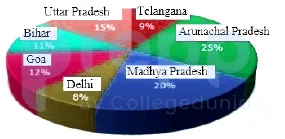
- A
13,44,500
- B
16,44,400
- C
14,44,400
- D
15,44,400
Show answer
D. 15,44,400Calculation:
Now, the number of males in Bihar in the year 1998
⇒ 32760000 × 11% × 3/(3 + 4)
⇒ 1544400
∴ T he number of males in Bihar in the year 1998 is 15,44,400.
Paper & answer key PDF ↗ Question 70archived
If \(\frac{x}{8} + \frac{8}{x} = 1\), then the value of x3 is :
- A
-256
- B
-512
- C
256
- D
512
Show answer
B. -512Finding the Value of x<sup>3</sup> from an Algebraic Equation
We are given the equation:\[ \frac{x}{8} + \frac{8}{x} = 1 \]The goal is to find the value of \(x^3\).
Solving the Given Algebraic Equation
To solve the equation, we first eliminate the denominators. We can do this by multiplying the entire equation by the least common multiple of the denominators, which is \(8x\), assuming \(x \neq 0\). If \(x=0\), the original equation is undefined.
Multiply both sides by \(8x\):\[ 8x \left( \frac{x}{8} + \frac{8}{x} \right) = 1 \cdot (8x) \]\[ 8x \left( \frac{x}{8} \right) + 8x \left( \frac{8}{x} \right) = 8x \]\[ x^2 + 64 = 8x \]Now, rearrange the terms to form a standard quadratic equation by moving all terms to one side:
\[ x^2 - 8x + 64 = 0 \]
This is a quadratic equation in the form \(ax^2 + bx + c = 0\), where \(a=1\), \(b=-8\), and \(c=64\).
Connecting the Quadratic Equation to Finding x<sup>3</sup>
We need to find \(x^3\). Let's consider the sum of cubes algebraic identity:\[ a^3 + b^3 = (a+b)(a^2 - ab + b^2) \]
If we compare the quadratic equation \(x^2 - 8x + 64 = 0\) with the term \((a^2 - ab + b^2)\) in the identity, it looks very similar. If we let \(a=x\) and \(b=8\), the term \((a^2 - ab + b^2)\) becomes \((x^2 - x \cdot 8 + 8^2)\), which is \((x^2 - 8x + 64)\).
So, using the identity with \(a=x\) and \(b=8\), we have:\[ x^3 + 8^3 = (x+8)(x^2 - 8x + 64) \]
We know from our algebraic manipulation that \(x^2 - 8x + 64 = 0\). Substitute this into the identity:
\[ x^3 + 8^3 = (x+8) \cdot 0 \]\[ x^3 + 512 = 0 \]
Now, we can solve for \(x^3\):
\[ x^3 = -512 \]
Thus, the value of \(x^3\) is -512.
This solution shows how a seemingly simple equation leads to a quadratic form that, while having complex roots, directly relates to an algebraic identity to find the required power of x.
Summary of Steps
Start with the given equation \(\frac{x}{8} + \frac{8}{x} = 1\).
Multiply by \(8x\) to clear denominators, resulting in \(x^2 + 64 = 8x\).
Rearrange into a quadratic equation \(x^2 - 8x + 64 = 0\).
Recognize that this quadratic expression is part of the algebraic identity for the sum of cubes: \(x^3 + 8^3 = (x+8)(x^2 - 8x + 64)\).
Substitute \(x^2 - 8x + 64 = 0\) into the identity: \(x^3 + 8^3 = (x+8)(0)\).
Simplify to find \(x^3 + 512 = 0\).
Solve for \(x^3\): \(x^3 = -512\).
Revision Table: Key Algebraic Concepts
Concept
Description
Application in Problem
Algebraic Equation
A statement that two algebraic expressions are equal.
The given relationship \(\frac{x}{8} + \frac{8}{x} = 1\).
Quadratic Equation
An equation of the form \(ax^2 + bx + c = 0\).
Rearranging the given equation yields \(x^2 - 8x + 64 = 0\).
Least Common Multiple (LCM)
The smallest positive number divisible by a set of numbers (or expressions).
Used to find the common denominator (\(8x\)) to clear fractions.
Algebraic Identity (Sum of Cubes)
An equation that is true for all values of the variables involved, e.g., \(a^3 + b^3 = (a+b)(a^2 - ab + b^2)\).
Used to relate the quadratic expression \(x^2 - 8x + 64\) to \(x^3\).
Additional Information: Complex Roots and the Problem
It's worth noting that the quadratic equation \(x^2 - 8x + 64 = 0\) has a negative discriminant (\((-8)^2 - 4(1)(64) = 64 - 256 = -192\)). This means the roots for \(x\) are complex numbers.
The roots are \(x = \frac{8 \pm \sqrt{-192}}{2} = \frac{8 \pm \sqrt{64 \cdot -3}}{2} = \frac{8 \pm 8i\sqrt{3}}{2} = 4 \pm 4i\sqrt{3}\).
Even though \(x\) is a complex number, its cube, \(x^3\), turns out to be a real number, -512, as shown using the algebraic identity. This demonstrates that sometimes, working with related algebraic identities can simplify finding values of powers of variables, even if the variable itself is complex.
Paper & answer key PDF ↗ Question 71archived
A coconut tree swings with the wind in such a manner that the angle covered by its trunk is 18 degrees. If the topmost portion of the tree covers a distance of 44 metres,find the length of the tree.
- A
120 metres
- B
210 metres
- C
140 metres
- D
70 metres
Show answer
C. 140 metresUnderstanding the Coconut Tree Swing Problem
The problem describes a coconut tree swinging in the wind. This movement can be modeled as a sector of a circle. The base of the tree acts as the center of the circle, the length of the tree acts as the radius, and the distance covered by the topmost portion of the tree is the arc length.
We are given the following information:
The angle covered by the trunk (angle of the sector), $\theta = 18$ degrees.
The distance covered by the topmost portion (arc length), $L = 44$ metres.
We need to find the length of the tree, which corresponds to the radius $r$ of the sector.
Converting Angle to Radians
The formula relating arc length, radius, and angle requires the angle to be in radians. We are given the angle in degrees, so we must first convert it to radians. The conversion formula is:
$\theta_{\text{radians}} = \theta_{\text{degrees}} \times \frac{\pi}{180^\circ}$
Substituting the given angle:
$\theta = 18^\circ \times \frac{\pi}{180^\circ} = \frac{18\pi}{180} = \frac{\pi}{10}$ radians.
Using the Arc Length Formula
The relationship between the arc length ($L$), radius ($r$), and the angle ($\theta$) in radians is given by the formula:
$L = r\theta$
We know $L = 44$ metres and we just calculated $\theta = \frac{\pi}{10}$ radians. We need to find $r$. Rearranging the formula to solve for $r$:
$r = \frac{L}{\theta}$
Substitute the known values into this equation:
$r = \frac{44}{\frac{\pi}{10}}$
$r = 44 \times \frac{10}{\pi}$
$r = \frac{440}{\pi}$
Calculating the Length of the Tree
To find the numerical value of $r$, we can use the approximation $\pi \approx \frac{22}{7}$.
$r = \frac{440}{\frac{22}{7}}$
$r = 440 \times \frac{7}{22}$
Now, we can simplify the expression:
$r = \frac{440}{22} \times 7$
$r = 20 \times 7$
$r = 140$
So, the length of the coconut tree is 140 metres.
Given Information
Value
Angle of swing ($\theta$)
$18^\circ$
Distance covered (Arc Length, $L$)
$44$ m
Calculation Step
Result
Angle in Radians
$\theta = \frac{\pi}{10}$ radians
Formula for Radius
$r = \frac{L}{\theta}$
Substitute Values
$r = \frac{44}{\pi/10} = \frac{440}{\pi}$
Using $\pi \approx 22/7$
$r = \frac{440}{22/7} = 440 \times \frac{7}{22} = 140$ m
The calculated length of the tree is 140 metres.
Revision Table: Coconut Tree Angle and Distance
Concept
Description
Arc Length ($L$)
The distance along the curved edge of a sector.
Radius ($r$)
The distance from the center to any point on the circumference (or the length of the tree in this case).
Angle ($\theta$)
The angle of the sector, measured from the center. Must be in radians for the formula $L = r\theta$.
Degrees to Radians
To convert degrees to radians, multiply the angle in degrees by $\frac{\pi}{180}$.
Additional Information: Angles and Circular Motion
In many physics and geometry problems involving rotation or swinging, angles are measured in radians because it simplifies formulas relating linear and angular quantities. The radian is defined such that an angle of 1 radian subtends an arc length equal to the radius of the circle.
The full circle is $360^\circ$, which is equal to $2\pi$ radians. This gives us the conversion factors:
$1$ radian $= \frac{180^\circ}{\pi} \approx 57.3^\circ$
$1^\circ = \frac{\pi}{180}$ radians $\approx 0.01745$ radians
Understanding the relationship between degrees and radians is crucial for solving problems involving circular motion, oscillations, and waves.
Paper & answer key PDF ↗ Question 72archived
The following table shows the exports of three companies P, Q and R from 2015 to 2019.
Company/ years ⇒20152016201720182019
P20001000200030004000
Q40005000400050003000
R30002000400040005000
Which of the following years has the highest total exports from the three companies together?
- A
2019
- B
2017
- C
2015
- D
2016
Show answer
A. 2019Analyzing Company Exports Data
The question asks us to find the year with the highest total exports combined from three companies: P, Q, and R. We are provided with a table showing the export values for each company from 2015 to 2019.
Company / Year →
2015
2016
2017
2018
2019
P
2000
1000
2000
3000
4000
Q
4000
5000
4000
5000
3000
R
3000
2000
4000
4000
5000
Calculating Total Exports per Year
To find the year with the highest total exports, we need to sum the exports of companies P, Q, and R for each year listed in the table. We will perform this calculation for each year from 2015 to 2019.
For the year 2015, the total exports are the sum of exports of P, Q, and R in 2015:
\(\text{Total exports}_{2015} = \text{Exports}_P + \text{Exports}_Q + \text{Exports}_R = 2000 + 4000 + 3000 = 9000\)
For the year 2016, the total exports are the sum of exports of P, Q, and R in 2016:
\(\text{Total exports}_{2016} = \text{Exports}_P + \text{Exports}_Q + \text{Exports}_R = 1000 + 5000 + 2000 = 8000\)
For the year 2017, the total exports are the sum of exports of P, Q, and R in 2017:
\(\text{Total exports}_{2017} = \text{Exports}_P + \text{Exports}_Q + \text{Exports}_R = 2000 + 4000 + 4000 = 10000\)
For the year 2018, the total exports are the sum of exports of P, Q, and R in 2018:
\(\text{Total exports}_{2018} = \text{Exports}_P + \text{Exports}_Q + \text{Exports}_R = 3000 + 5000 + 4000 = 12000\)
For the year 2019, the total exports are the sum of exports of P, Q, and R in 2019:
\(\text{Total exports}_{2019} = \text{Exports}_P + \text{Exports}_Q + \text{Exports}_R = 4000 + 3000 + 5000 = 12000\)
Comparing Total Exports Across Years
Now, let's list the total exports calculated for each year:
2015: 9000
2016: 8000
2017: 10000
2018: 12000
2019: 12000
Comparing these values, we can see that the highest total export value is 12000. This total export value occurred in both the year 2018 and the year 2019.
Identifying the Year from Options
The question asks which of the given options has the highest total exports. The options are 2019, 2017, 2015, and 2016. Let's look at the total exports for these specific years:
2019: 12000
2017: 10000
2015: 9000
2016: 8000
Comparing the total exports for the years provided in the options, we find that the year 2019 has the highest total exports among the given choices (12000).
Conclusion
Based on the calculations, the year 2019 has the highest total exports from the three companies among the given options.
Revision Table: Company Export Data Analysis
Year
Exports P
Exports Q
Exports R
Total Exports (P+Q+R)
2015
2000
4000
3000
9000
2016
1000
5000
2000
8000
2017
2000
4000
4000
10000
2018
3000
5000
4000
12000
2019
4000
3000
5000
12000
Additional Information: Data Interpretation from Tables
Data interpretation questions often involve extracting information from tables, charts, or graphs and performing calculations or comparisons. When working with tables, it's important to carefully read the row and column headers to understand what the data represents.
Rows: Typically represent categories (like Company P, Q, R in this case).
Columns: Typically represent variables or time periods (like the years 2015-2019 here).
Cells: Contain the specific data value for the intersection of a row and a column (e.g., Exports of Company P in 2015).
Common tasks in table-based data interpretation include:
Finding maximum or minimum values in a row or column.
Calculating sums or averages of rows, columns, or specific sets of cells.
Comparing values across different categories or time periods.
Calculating percentages, ratios, or rates of change.
In this problem, we performed a summation across rows for each column to find the total exports per year, and then compared these sums to find the maximum.
Paper & answer key PDF ↗ Question 73archived
If C1, C2 be the centres of two circles and r1, r2 be the respective radii such that the distance between the centres is equal to the sum of the radii of the two circles, find the number of common tangents.
- A
4
- B
2
- C
1
- D
3
Show answer
D. 3Understanding the Problem: Circles Touching Externally
The question describes two circles with centres C1 and C2, and radii r1 and r2 respectively. A crucial piece of information is given: the distance between their centres, denoted as C1C2, is equal to the sum of their radii. Mathematically, this is expressed as:
\(C_1C_2 = r_1 + r_2\)
This specific condition tells us how the two circles are positioned relative to each other. When the distance between the centres of two circles is exactly equal to the sum of their radii, the circles touch each other at exactly one point, and this contact point lies on the line segment connecting their centres. This configuration is known as two circles touching externally.
Identifying Common Tangents for Externally Touching Circles
A common tangent to two circles is a line that is tangent to both circles simultaneously. There are different types of common tangents depending on how the circles are positioned relative to the tangent line.
For two circles that touch externally (\(C_1C_2 = r_1 + r_2\)), we can identify specific common tangents:
Direct Common Tangents: These tangents are such that both circles lie on the same side of the tangent line. For circles touching externally, there are always two direct common tangents. These tangents intersect at a point on the line joining the centres, outside the segment C1C2.
Transverse Common Tangents: These tangents are such that the two circles lie on opposite sides of the tangent line. For circles touching externally, there is exactly one transverse common tangent. This tangent passes through the point where the two circles touch, and it is perpendicular to the line joining the centres C1 and C2 at that point of contact.
Calculating the Total Number of Common Tangents
Based on the identification above, for two circles touching externally:
Number of direct common tangents = 2
Number of transverse common tangents = 1
The total number of common tangents is the sum of the direct and transverse common tangents.
Total common tangents = Number of direct tangents + Number of transverse tangents
Total common tangents = \(2 + 1 = 3\)
Therefore, when the distance between the centres of two circles is equal to the sum of their radii, there are 3 common tangents.
Summary of Common Tangents Based on Circle Positions
The number of common tangents depends on the relative position of the two circles. Here is a summary table:
Relative Position
Condition on C1C2
Number of Direct Tangents
Number of Transverse Tangents
Total Common Tangents
Circles are separate (neither touching nor intersecting)
\(C_1C_2 > r_1 + r_2\)
2
2
4
Circles touch externally
\(C_1C_2 = r_1 + r_2\)
2
1
3
Circles intersect at two distinct points
\(|r_1 - r_2| < C_1C_2 < r_1 + r_2\)
2
0
2
Circles touch internally
\(C_1C_2 = |r_1 - r_2|\)
1
0
1
One circle lies completely inside the other (without touching)
\(C_1C_2 < |r_1 - r_2|\)
0
0
0
In this problem, the condition \(C_1C_2 = r_1 + r_2\) corresponds to the second case in the table: circles touching externally. This case has 3 common tangents.
Revision Table: Circle Geometry Key Points
Concept
Description
Relevance to Problem
Circle Centre (C)
The central point equidistant from all points on the circle.
C1 and C2 are given as centres.
Radius (r)
The distance from the centre to any point on the circle.
r1 and r2 are given as radii.
Distance between Centres (C1C2)
The length of the line segment connecting the two centres.
The problem gives a specific condition for this distance.
Common Tangent
A line that is tangent to two circles simultaneously.
The goal is to find the number of these lines.
Circles Touching Externally
Two circles meeting at exactly one point, with each circle outside the other.
This configuration is defined by the given condition \(C_1C_2 = r_1 + r_2\).
Additional Information: Types of Common Tangents Explained
Let's look closer at the types of common tangents:
Direct (or External) Common Tangents: These tangents keep both circles on the same side. Imagine the tangent line; both circles will be either "above" it or "below" it. They look like belts connecting the two circles from the outside.
Transverse (or Internal) Common Tangents: These tangents pass between the two circles, keeping them on opposite sides of the line. They look like a crossover belt connecting the circles. The point where a transverse common tangent intersects the line segment connecting the centres is called the center of similitude (specifically, the internal center of similitude).
The number of these tangents depends entirely on how the circles are positioned relative to each other. The condition \(C_1C_2 = r_1 + r_2\) is a key geometric relationship that precisely defines the "externally touching" position, leading to a specific number of common tangents.
Paper & answer key PDF ↗ Question 74archived
\(\frac{{1 + \sin \theta }}{{\cos \theta }}\) is equal to which of the following (where \(\theta \ne \frac{\pi }{2}\))?
- A
\(\frac{{1 + \cos \theta }}{{\sin \theta }}\)
- B
\(\frac{{\tan \theta + 1}}{{\tan \theta - 1}}\)
- C
\(\frac{{\tan \theta - 1}}{{\tan \theta + 1}}\)
- D
\(\frac{{\cos \theta }}{{1 - \sin \theta }}\)
Show answer
D. \(\frac{{\cos \theta }}{{1 - \sin \theta }}\)Simplify Trigonometric Expression: \( \frac{{1 + \sin \theta }}{{\cos \theta }} \)
The question asks us to find an expression that is equivalent to \( \frac{{1 + \sin \theta }}{{\cos \theta }} \), given that \( \theta \ne \frac{\pi }{2} \). This means \(\cos \theta \ne 0\), so the original expression is well-defined.
We need to manipulate the given expression using trigonometric identities to see which of the options it matches. A common technique when dealing with expressions involving \(1 \pm \sin \theta\) or \(1 \pm \cos \theta\) in the denominator or numerator is to multiply by the conjugate.
Step-by-Step Simplification of \( \frac{{1 + \sin \theta }}{{\cos \theta }} \)
Let's multiply the numerator and the denominator of the expression \( \frac{{1 + \sin \theta }}{{\cos \theta }} \) by the conjugate of the numerator, which is \( 1 - \sin \theta \). This is a valid operation as long as \( 1 - \sin \theta \ne 0 \), which is true for most values of \( \theta \), and allows us to potentially use the identity \( \sin^2 \theta + \cos^2 \theta = 1 \).
So, we have:
\( \frac{{1 + \sin \theta }}{{\cos \theta }} = \frac{{1 + \sin \theta }}{{\cos \theta }} \times \frac{{1 - \sin \theta }}{{1 - \sin \theta }} \)
Now, let's perform the multiplication:
The numerator becomes \( (1 + \sin \theta)(1 - \sin \theta) \). Using the difference of squares formula \( (a+b)(a-b) = a^2 - b^2 \), this simplifies to \( 1^2 - \sin^2 \theta = 1 - \sin^2 \theta \).
The denominator becomes \( \cos \theta (1 - \sin \theta) \).
So the expression is now:
\( \frac{{1 - \sin^2 \theta}}{{\cos \theta (1 - \sin \theta )}} \)
Recall the fundamental trigonometric identity: \( \sin^2 \theta + \cos^2 \theta = 1 \). From this, we can rearrange to get \( 1 - \sin^2 \theta = \cos^2 \theta \).
Substitute \( \cos^2 \theta \) for \( 1 - \sin^2 \theta \) in the numerator:
\( \frac{{\cos^2 \theta}}{{\cos \theta (1 - \sin \theta )}} \)
We can write \( \cos^2 \theta \) as \( \cos \theta \cdot \cos \theta \). So the expression is:
\( \frac{{\cos \theta \cdot \cos \theta}}{{\cos \theta (1 - \sin \theta )}} \)
Since \( \theta \ne \frac{\pi}{2} \), we know that \( \cos \theta \ne 0 \). Therefore, we can cancel out a \( \cos \theta \) term from the numerator and the denominator:
\( \frac{{\cancel{{\cos \theta}} \cdot \cos \theta}}{{\cancel{{\cos \theta}} (1 - \sin \theta )}} = \frac{{\cos \theta }}{{1 - \sin \theta }} \)
This simplified form \( \frac{{\cos \theta }}{{1 - \sin \theta }} \) matches one of the given options.
Comparing with Options
Let's compare our result \( \frac{{\cos \theta }}{{1 - \sin \theta }} \) with the given options:
\( \frac{{1 + \cos \theta }}{{\sin \theta }} \) - Does not match.
\( \frac{{\tan \theta + 1}}{{\tan \theta - 1}} \) - Does not match.
\( \frac{{\tan \theta - 1}}{{\tan \theta + 1}} \) - Does not match.
\( \frac{{\cos \theta }}{{1 - \sin \theta }} \) - Matches our derived expression.
Thus, \( \frac{{1 + \sin \theta }}{{\cos \theta }} \) is equal to \( \frac{{\cos \theta }}{{1 - \sin \theta }} \).
Revision Table: Key Trigonometry Concepts
Concept
Description
Formula/Identity
Reciprocal Identity
Secant is the reciprocal of cosine.
\( \sec \theta = \frac{1}{{\cos \theta }} \)
Ratio Identity
Tangent is the ratio of sine to cosine.
\( \tan \theta = \frac{{\sin \theta }}{{\cos \theta }} \)
Pythagorean Identity
Relates sine and cosine squared.
\( \sin^2 \theta + \cos^2 \theta = 1 \)
Difference of Squares
Algebraic identity used for simplification.
\( a^2 - b^2 = (a+b)(a-b) \)
Additional Information: Alternative Simplification Method
We can also express the original term \( \frac{{1 + \sin \theta }}{{\cos \theta }} \) in terms of tangent and secant using ratio and reciprocal identities:
\( \frac{{1 + \sin \theta }}{{\cos \theta }} = \frac{1}{{\cos \theta }} + \frac{{\sin \theta }}{{\cos \theta }} = \sec \theta + \tan \theta \)
Let's verify if the equivalent expression \( \frac{{\cos \theta }}{{1 - \sin \theta }} \) also equals \( \sec \theta + \tan \theta \). We can multiply its numerator and denominator by the conjugate of the denominator, \( 1 + \sin \theta \):
\( \frac{{\cos \theta }}{{1 - \sin \theta }} = \frac{{\cos \theta }}{{1 - \sin \theta }} \times \frac{{1 + \sin \theta }}{{1 + \sin \theta }} \)
This gives:
\( \frac{{\cos \theta (1 + \sin \theta )}}{{(1 - \sin \theta)(1 + \sin \theta) }} = \frac{{\cos \theta (1 + \sin \theta )}}{{1 - \sin^2 \theta }} \)
Using the identity \( 1 - \sin^2 \theta = \cos^2 \theta \), we get:
\( \frac{{\cos \theta (1 + \sin \theta )}}{{\cos^2 \theta }} = \frac{{\cos \theta (1 + \sin \theta )}}{{\cos \theta \cdot \cos \theta }} \)
Again, cancelling out a \( \cos \theta \) term (since \( \cos \theta \ne 0 \)):
\( \frac{{\cancel{{\cos \theta}} (1 + \sin \theta )}}{{\cancel{{\cos \theta}} \cdot \cos \theta }} = \frac{{1 + \sin \theta }}{{\cos \theta }} \)
Separating the terms:
\( \frac{1}{{\cos \theta }} + \frac{{\sin \theta }}{{\cos \theta }} = \sec \theta + \tan \theta \)
Both expressions simplify to \( \sec \theta + \tan \theta \), confirming their equivalence.
Paper & answer key PDF ↗ Question 75archived
Study the given graph and answer the following question.
If 35% of the lecturers recruited in state B in the year 2021 were male, what was the number of females in state B in that year?
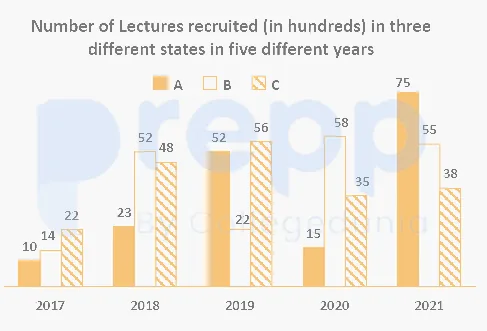
- A
3845
- B
3575
- C
3590
- D
5500
Show answer
B. 3575Calculation:
Number of lecturers recruited in state B in 2021 = 5500
Number of male lecturers among them = 5500 × 35% = 1925
Now, the number of female lecturers among them = 5500 - 1925 = 3575
∴ The number of female lecturers of state B in that year was 3575.
Paper & answer key PDF ↗ Question 76archived
Rearrange the parts of the sentence in correct order.
Peer pressure
P. when it comes to choosing the right
Q. course and, therefore, career path
R. and lack of guidance are some of
S. the reasons for indecisiveness
- A
SPQR
- B
QSPR
- C
RSPQ
- D
PQRS
Show answer
C. RSPQSolving Sentence Rearrangement Problems
Sentence rearrangement questions require you to reorder jumbled parts of a sentence to form a grammatically correct and meaningful sentence. The key is to identify the logical flow and grammatical connections between the different parts.
Analyzing the Given Sentence Parts
We are given the starting phrase "Peer pressure" and four parts labeled P, Q, R, and S:
P. when it comes to choosing the right
Q. course and, therefore, career path
R. and lack of guidance are some of
S. the reasons for indecisiveness
Step-by-Step Rearrangement Process
Let's examine how the parts can connect logically, starting with the initial phrase "Peer pressure".
The phrase "Peer pressure" needs to be followed by a subject continuation or a verb phrase. Looking at the options, part R, "and lack of guidance are some of", seems like a good fit to continue the subject: "Peer pressure and lack of guidance". This forms a compound subject, and "are some of" acts as the verb phrase. So, R is likely the next part.
Now we have "Peer pressure and lack of guidance are some of...". What are they some of? Part S, "the reasons for indecisiveness", logically follows "some of". This explains what peer pressure and lack of guidance are. So, S follows R.
The sentence fragment is now "Peer pressure and lack of guidance are some of the reasons for indecisiveness". This sentence seems complete, but we still have parts P and Q. These remaining parts must further specify the context of this indecisiveness.
Part P, "when it comes to choosing the right", specifies when this indecisiveness occurs. It logically follows the statement about indecisiveness. So, P follows S.
The sentence fragment is now "Peer pressure and lack of guidance are some of the reasons for indecisiveness when it comes to choosing the right...". What is being chosen? Part Q, "course and, therefore, career path", completes the phrase "choosing the right". So, Q follows P.
Forming the Complete Sentence
Following the logical connections, the order of the parts is R, S, P, Q. Let's assemble the full sentence:
Peer pressure [R] and lack of guidance are some of [S] the reasons for indecisiveness [P] when it comes to choosing the right [Q] course and, therefore, career path.
The complete sentence reads: "Peer pressure and lack of guidance are some of the reasons for indecisiveness when it comes to choosing the right course and, therefore, career path." This is a grammatically correct and coherent sentence.
Evaluating Options
Let's quickly look at why the other options don't work:
SPQR: "Peer pressure the reasons for indecisiveness when it comes to choosing the right course and, therefore, career path and lack of guidance are some of" - Illogical flow.
QSPR: "Peer pressure course and, therefore, career path the reasons for indecisiveness when it comes to choosing the right and lack of guidance are some of" - Grammatically incorrect start.
PQRS: "Peer pressure when it comes to choosing the right course and, therefore, career path and lack of guidance are some of the reasons for indecisiveness" - While parts P and Q could possibly follow "Peer pressure" in some context, the continuation with R and S doesn't fit well after P and Q, creating a convoluted structure.
The only option that forms a meaningful and grammatically correct sentence is RSPQ.
Revision Table: Key Points
Sentence Part
Content
Function/Connection
Start
Peer pressure
Initial subject
R
and lack of guidance are some of
Completes the compound subject and introduces the verb phrase
S
the reasons for indecisiveness
Explains what 'some of' refers to
P
when it comes to choosing the right
Specifies the context/time of the indecisiveness
Q
course and, therefore, career path
Completes the phrase 'choosing the right'
Additional Information: Tips for Sentence Rearrangement
Solving sentence rearrangement questions efficiently involves a few strategies:
Find the starting sentence/phrase: Look for independent clauses or introductory phrases. Often, the part starting with a subject or a clear topic is the beginning.
Identify connecting words: Look for conjunctions (and, but, or), prepositions (in, on, at, for, with), adverbs (therefore, however, consequently), and pronouns (he, she, it, they, this, that) that link one part to another.
Look for logical sequences: Sentences often follow cause-and-effect, general-to-specific, or chronological order.
Check grammatical consistency: Ensure subject-verb agreement, pronoun references, and verb tenses are consistent across connected parts.
Read the assembled sentence: After arranging, read the full sentence to check if it makes sense and flows well.
Practicing with different types of sentence rearrangement exercises helps improve your ability to quickly identify these connections.
Paper & answer key PDF ↗ Question 77archived
Select the most appropriate ANTONYM of the word ‘STRANGE’ from the given sentence.
The intriguing journal took a back place once more to the more mundane events at the Ouray inn.
- A
Events
- B
Intriguing
- C
Mundane
- D
Place
Show answer
C. MundaneUnderstanding the Question: Finding the Antonym of Strange
The question asks us to find the most appropriate antonym of the word ‘STRANGE’ from the given options. An antonym is a word that has the opposite meaning of another word.
First, let's understand the meaning of the word ‘STRANGE’.
STRANGE: unusual, unfamiliar, surprising, difficult to understand or explain. It can also mean not known or seen before, or slightly odd or eccentric.
So, we are looking for a word that means the opposite of unusual, unfamiliar, or odd. We are looking for a word that means ordinary, familiar, or typical.
Analysing the Options for the Antonym of Strange
Let's examine the meaning of each option provided and see which one is the best antonym for ‘STRANGE’.
The sentence provided is: "The intriguing journal took a back place once more to the more mundane events at the Ouray inn." We will look at the options based on their general meaning, although the sentence provides context for some words.
Option 1: Events
The word ‘Events’ refers to occurrences or happenings. This word is a noun and describes things that happen. It does not have an opposite meaning to ‘STRANGE’.
Option 2: Intriguing
The word ‘Intriguing’ means arousing curiosity or interest; fascinating. Something intriguing might be unusual or strange, but ‘intriguing’ itself is closer in meaning to ‘interesting’ than an opposite of ‘STRANGE’. In the sentence, the journal is described as intriguing, contrasting with the mundane events.
Option 3: Mundane
The word ‘Mundane’ means ordinary, commonplace, routine, or dull. It refers to things that are not exciting or special. Let’s compare its meaning to ‘STRANGE’:
STRANGE: unusual, unfamiliar, odd.
MUNDANE: ordinary, commonplace, routine.
These two meanings are clearly opposite. If something is strange, it is unusual; if something is mundane, it is ordinary. Therefore, ‘Mundane’ is an antonym of ‘STRANGE’.
In the sentence, ‘mundane events’ are contrasted with the ‘intriguing journal’. This usage of ‘mundane’ fits its meaning of ordinary or routine.
Option 4: Place
The word ‘Place’ refers to a location or position. It is a noun and has no opposite meaning related to the adjective ‘STRANGE’.
Detailed Comparison: Strange vs. Mundane
To further clarify why ‘Mundane’ is the correct antonym, let's look at a simple comparison:
Word
Meaning
Antonym
STRANGE
Unusual, unfamiliar, odd
Ordinary, commonplace, routine
MUNDANE
Ordinary, commonplace, routine
Unusual, exciting, extraordinary
As the table shows, the core meanings of ‘STRANGE’ (unusual/odd) and ‘Mundane’ (ordinary/commonplace) are directly opposed. Therefore, ‘Mundane’ serves as an appropriate antonym for ‘STRANGE’.
Conclusion: Identifying the Correct Antonym
Based on the analysis of the meanings of the word ‘STRANGE’ and the given options, ‘Mundane’ is the word that has the opposite meaning of ‘STRANGE’.
Revision Table: Vocabulary - Strange and Antonyms
Word
Type
Meaning
Example Sentence Usage
Antonym(s)
STRANGE
Adjective
Unusual, unfamiliar, odd
It was a very strange dream.
Ordinary, Common, Normal, Mundane
MUNDANE
Adjective
Ordinary, commonplace, routine
They discussed mundane matters like groceries.
Extraordinary, Unusual, Exciting, Strange
EVENTS
Noun
Occurrences or happenings
Many interesting events took place.
-
INTRIGUING
Adjective
Arousing curiosity; fascinating
An intriguing mystery novel.
Boring, Uninteresting
PLACE
Noun
A location or position
This is a beautiful place.
-
Additional Information: Understanding Antonyms
Antonyms are words with opposite meanings. They are important for understanding vocabulary and expressing contrasting ideas. There are different types of antonyms:
Gradable Antonyms: These are words that represent concepts on a scale. For example, 'hot' and 'cold' are gradable antonyms because things can be hotter or colder. Other examples include 'big'/'small', 'fast'/'slow'.
Complementary Antonyms: These are word pairs where the meaning of one is the opposite of the other, and they represent an either/or relationship. If something is not one, it must be the other. For example, 'alive'/'dead', 'on'/'off'.
Relational Antonyms: These are word pairs that describe a relationship where one term cannot exist without the other. For example, 'teacher'/'student', 'buy'/'sell', 'husband'/'wife'.
Identifying antonyms helps improve reading comprehension and writing skills by allowing for more precise and varied language use. In this case, 'STRANGE' and 'MUNDANE' function as gradable antonyms, as something can be more or less strange or mundane.
Paper & answer key PDF ↗ Question 78archived
Select the sentences that contains no spelling errors.
- A
People suffering from edzema have allergies with red and itchy skin.
- B
People suffering from ekzema have allergies with red and itchy skin.
- C
People suffering from eczema have allergies with red and itchy skin.
- D
People suffering from ekezema have allergies with red and itchy skin.
Show answer
C. People suffering from eczema have allergies with red and itchy skin.Identifying Sentences with Correct Spelling
The question asks us to select the sentence that is free from any spelling errors. We need to carefully examine the spelling of the key medical term used in each sentence, which relates to a skin condition causing red and itchy skin.
Analyzing Spelling Variations in Options
Let's look at each sentence provided:
Option 1: "People suffering from edzema have allergies with red and itchy skin." The word "edzema" contains a spelling mistake.
Option 2: "People suffering from ekzema have allergies with red and itchy skin." The word "ekzema" is also incorrectly spelled.
Option 3: "People suffering from eczema have allergies with red and itchy skin." This sentence uses the correct spelling for the medical condition.
Option 4: "People suffering from ekezema have allergies with red and itchy skin." The spelling "ekezema" is incorrect.
Confirming the Correct Spelling
The medical term for the condition described (red and itchy skin) is spelled correctly as eczema. The variations like "edzema", "ekzema", and "ekezema" are common misspellings.
Therefore, the sentence that contains no spelling errors is the one using the word "eczema".
Paper & answer key PDF ↗ Question 79archived
Select the option that expresses the given sentence in active voice.
Three novels and two story books had been written by him before 2020.
- A
He has been writing three novels and two story books before 2020.
- B
He had been writing three novels and two story books before 2020.
- C
He had written three novels and two story books before 2020.
- D
He wrote three novels and two story books before 2020.
Show answer
C. He had written three novels and two story books before 2020.Understanding Active and Passive Voice
Voice in grammar refers to the form of a verb that shows whether the subject of the sentence performs the action (active voice) or is acted upon (passive voice).
Active Voice: The subject performs the action. Example: "He wrote a book." (He is the subject, and he performs the action of writing).
Passive Voice: The subject receives the action. The agent (the one performing the action) is often mentioned after "by" or omitted. Example: "A book was written by him." (A book is the subject, and it receives the action of being written. The agent is "him").
The given sentence is: "Three novels and two story books had been written by him before 2020."
Let's analyze this sentence:
Subject: "Three novels and two story books"
Verb: "had been written" (This is the passive form of the Past Perfect tense)
Agent: "him" (The person performing the action)
This sentence is in the passive voice because the subject ("Three novels and two story books") is receiving the action ("had been written"). The agent performing the action is "him", introduced by "by".
Converting Passive Voice (Past Perfect) to Active Voice
To change a sentence from passive voice (Past Perfect) to active voice, follow these steps:
Identify the agent in the passive sentence (usually after "by"). This agent will become the subject of the active sentence. In this case, the agent is "him", so the new subject will be "He".
Identify the verb in the passive sentence and determine its tense. The verb "had been written" is in the Past Perfect Passive tense.
Convert the verb to the corresponding active voice tense. The active voice form of the Past Perfect tense is "had + past participle". The past participle of "write" is "written". So the active verb will be "had written".
Identify the subject of the passive sentence. This will become the object of the active sentence. In this case, the subject is "Three novels and two story books".
Rearrange the sentence structure: Subject (agent) + Verb (active form) + Object (original subject) + Rest of the sentence.
Applying these steps to the given sentence:
Agent becomes new subject: "He"
Passive verb "had been written" becomes active verb: "had written"
Original subject becomes new object: "three novels and two story books"
Rest of the sentence: "before 2020"
Putting it together, the active voice sentence is: "He had written three novels and two story books before 2020."
Analyzing the Options
Let's examine each option to see which one matches our converted sentence:
Option 1: "He has been writing three novels and two story books before 2020."
Voice: Active
Tense: Present Perfect Continuous ("has been writing"). This is not the correct tense conversion from Past Perfect Passive.
Option 2: "He had been writing three novels and two story books before 2020."
Voice: Active
Tense: Past Perfect Continuous ("had been writing"). This is also not the correct tense conversion from Past Perfect Passive.
Option 3: "He had written three novels and two story books before 2020."
Voice: Active
Tense: Past Perfect ("had written"). This correctly matches the active voice equivalent of the Past Perfect Passive tense.
Option 4: "He wrote three novels and two story books before 2020."
Voice: Active
Tense: Simple Past ("wrote"). This is not the correct tense conversion from Past Perfect Passive.
Based on the analysis, Option 3 correctly expresses the given sentence in the active voice using the Past Perfect tense.
Tense
Active Voice Structure
Passive Voice Structure
Example (Active to Passive)
Past Perfect
Subject + had + Past Participle + Object
Subject + had been + Past Participle + by + Agent
He had written books. > Books had been written by him.
Revision Table: Active and Passive Voice Tenses
Tense
Active Voice Example
Passive Voice Example
Simple Present
He writes books.
Books are written by him.
Present Continuous
He is writing books.
Books are being written by him.
Present Perfect
He has written books.
Books have been written by him.
Simple Past
He wrote books.
Books were written by him.
Past Continuous
He was writing books.
Books were being written by him.
Past Perfect
He had written books.
Books had been written by him.
Simple Future
He will write books.
Books will be written by him.
Future Perfect
He will have written books.
Books will have been written by him.
Additional Information on Voice Transformation
When transforming a sentence from passive voice to active voice, or vice versa, it is crucial to maintain the original tense of the sentence. The voice changes, but the time frame of the action remains the same. The Past Perfect tense is used to indicate an action that was completed before another action or point in time in the past. In the given sentence, the action of writing was completed "before 2020".
The active voice is generally preferred in writing because it is often clearer, more direct, and more concise than the passive voice. However, the passive voice is useful when the doer of the action is unknown, unimportant, or when you want to emphasize the action or the recipient of the action rather than the doer.
For example, in a news report, you might say "The ancient artifact was discovered" (passive) if the focus is on the artifact and the discovery itself, rather than who discovered it.
In our example, changing to active voice puts the focus back on "He" as the person who performed the action of writing the novels and story books.
Paper & answer key PDF ↗ Question 80archived
Select the most appropriate synonym of the given word.
Irrevocable
- A
Unmediated
- B
Congruent
- C
Irreversible
- D
Irresponsive
Show answer
C. IrreversibleUnderstanding the Word Irrevocable
The question asks for the most appropriate synonym for the word Irrevocable. A synonym is a word that has the same or nearly the same meaning as another word.
Let's first understand the meaning of Irrevocable.
Irrevocable means not able to be changed, reversed, or recovered; final.
Think about an irrevocable decision. Once made, you cannot change it back.
Analyzing the Options for Irrevocable Synonym
Now let's look at the provided options and their meanings to find the best synonym for Irrevocable:
Unmediated
Congruent
Irreversible
Irresponsive
Meaning of Each Option
Unmediated: This means direct, without an intermediary or mediator. For example, unmediated access means direct access. This meaning is different from irrevocable.
Congruent: This means in agreement or harmony; corresponding. For example, congruent ideas align well. This meaning is also different from irrevocable.
Irreversible: This means not able to be changed back to a previous state or condition. For example, an irreversible process cannot be undone. This meaning is very close to irrevocable.
Irresponsive: This means not responding or failing to react to something. For example, an irresponsive person does not reply or show emotion. This meaning is different from irrevocable.
Comparing Meanings to find the Synonym for Irrevocable
Let's compare the meanings:
Word
Meaning
Related to Irrevocable?
Irrevocable
Not able to be changed, reversed, or recovered; final.
---
Unmediated
Direct, without an intermediary.
No
Congruent
In agreement or harmony.
No
Irreversible
Not able to be changed back or reversed.
Yes
Irresponsive
Not responding or reacting.
No
From the comparison, it is clear that Irreversible has the meaning 'not able to be changed back or reversed', which is the most appropriate synonym for Irrevocable ('not able to be changed, reversed, or recovered; final'). Both words convey the idea of something that cannot be undone or altered once it has happened or been decided.
Conclusion: The Correct Synonym for Irrevocable
Based on the meanings, the word that is most appropriate as a synonym for Irrevocable is Irreversible.
Revision Table: Synonyms and Antonyms
Word
Meaning
Synonyms (Examples)
Antonyms (Examples)
Irrevocable
Cannot be changed or reversed.
Irreversible, Unalterable, Final, Binding
Revocable, Mutable, Changeable, Alterable
Irreversible
Cannot be changed back.
Irrevocable, Unalterable, Permanent
Reversible, Changeable
Unmediated
Direct.
Direct, Immediate
Mediated, Indirect
Congruent
In agreement, corresponding.
Agreeing, Consistent, Harmonious
Incongruent, Disagreeing
Irresponsive
Not responding.
Unresponsive, Inert
Responsive, Reactive
Additional Information on Word Meanings
Understanding word meanings and their nuances is crucial for vocabulary building and competitive exams. Let's reinforce the distinction between the options.
Irrevocable vs. Irreversible: These are very close and often interchangeable, especially in the context of actions, decisions, or processes that cannot be undone. 'Irrevocable' often applies strongly to decisions, laws, or commitments, while 'Irreversible' is frequently used for physical or biological processes (like irreversible damage). However, as synonyms, they are the closest pair among the options.
Irrevocable vs. Unmediated: An unmediated event happens directly. An irrevocable event cannot be undone. These concepts are not related.
Irrevocable vs. Congruent: Congruent describes agreement or correspondence. Irrevocable describes permanence or finality. These concepts are unrelated.
Irrevocable vs. Irresponsive: Irresponsive describes a lack of reaction. Irrevocable describes something that cannot be reversed. These concepts are unrelated.
Therefore, Irreversible is the most suitable synonym for Irrevocable from the given choices.
Paper & answer key PDF ↗ Question 81archived
Select the most appropriate option to fill in the blank.
The sergeant could not stand the weather because it was __________ cold.
- A
bitterly
- B
carefully
- C
smoothly
- D
cautiously
Show answer
A. bitterlyUnderstanding the Sentence Completion Question
The question asks us to select the most appropriate word to fill the blank in the sentence: "The sergeant could not stand the weather because it was __________ cold." We need a word that describes the intensity or nature of the cold weather, explaining why the sergeant found it unbearable.
The word modifying "cold" will be an adverb, as "cold" is acting as an adjective describing the weather. The blank requires an adverb that conveys a degree or quality of coldness that is difficult to tolerate.
Analyzing the Options
Let's examine each provided option:
bitterly: The adverb "bitterly" is often used to describe extreme or unpleasant cold. "Bitterly cold" is a common phrase meaning very cold and harsh.
carefully: The adverb "carefully" describes performing an action with caution or attention to detail. It is not used to describe weather conditions.
smoothly: The adverb "smoothly" describes something happening without problems or difficulty, or a surface that is even and regular. It is not used to describe weather conditions.
cautiously: The adverb "cautiously" describes performing an action in a way that avoids potential danger or risk. It is not used to describe weather conditions.
Evaluating the Options in Context
We need an adverb that makes sense in the context of cold weather being unbearable for the sergeant.
If the weather was "carefully cold," "smoothly cold," or "cautiously cold," these descriptions do not logically explain why someone would be unable to stand it. These adverbs describe manner or quality in ways unrelated to temperature or its effect on a person.
If the weather was "bitterly cold," this means the cold was severe, sharp, and uncomfortable. This intensity of cold weather would certainly be a valid reason for someone, like a sergeant, to find it unbearable.
Conclusion
Comparing the options, "bitterly" is the only adverb that appropriately describes a degree of coldness that would make the weather unbearable. The phrase "bitterly cold" is a standard English idiom used for intensely cold weather.
Revision Table: Adverbs Describing Cold
Here is a simple comparison of how adverbs can modify adjectives like 'cold':
Adverb
Typical Use with "cold"
Meaning
bitterly
bitterly cold
Extremely, intensely, and unpleasantly cold.
very
very cold
To a high degree.
extremely
extremely cold
To a very high degree.
mildly
mildly cold
Slightly cold (opposite of bitterly).
unbearably
unbearably cold
So cold it cannot be endured.
Additional Information: Adverbs and Adjectives
Adverbs often modify adjectives to indicate the degree or intensity of the quality described by the adjective. In this sentence, the adverb modifies the adjective "cold".
Adverbs answer questions like "how?", "when?", "where?", or "to what extent?".
In the phrase "bitterly cold", "bitterly" answers "to what extent?" or "how?" cold it was.
Understanding which adverbs appropriately pair with certain adjectives or types of concepts (like weather) is important for accurate and natural language use.
Paper & answer key PDF ↗ Question 82archived
The following sentence has been divided into segments. One of them may contain an error. Select the segment that contains the error from the given options. If you don’t find any error, mark ‘No error’ as your answer.
No talking / on the dinner table / is an absolute rule.
- A
No talking
- B
on the dinner table
- C
No Error
- D
is an absolute rule.
Show answer
B. on the dinner tableIdentifying Grammar Errors in Sentences
The question asks us to find a segment in the given sentence that contains a grammatical error. The sentence provided is broken into three parts:
No talking
on the dinner table
is an absolute rule.
Let's examine each segment to determine if it contains an error in grammar or usage.
Analyzing Each Sentence Segment
Segment 1: No talking
This segment acts as the subject of the sentence. The word "talking" is a gerund, which is the -ing form of a verb used as a noun. Gerunds can function as subjects of sentences, which is grammatically correct. "No talking" means the prohibition of talking. This segment appears to be grammatically sound in its function as the subject.
Segment 2: on the dinner table
This segment is a prepositional phrase consisting of the preposition "on", the article "the", and the noun phrase "dinner table". Prepositional phrases often provide information about location, time, or manner. The phrase modifies or relates to the action (talking) or the subject (talking). However, when referring to being seated at a table for a meal or activity, the correct preposition is typically "at", not "on". We sit at a table, and activities done while seated for a meal happen at the dinner table. Using "on" would imply being physically positioned on top of the table surface, which is not the intended meaning in this context.
Therefore, the use of the preposition "on" in this segment is incorrect. It should be "at the dinner table".
Segment 3: is an absolute rule.
This segment is the predicate of the sentence. "is" is the verb, and "an absolute rule" is the subject complement. The subject is "No talking" (singular gerund phrase), and the singular verb "is" agrees with the singular subject. This segment correctly completes the sentence, stating what "No talking at the dinner table" represents. This segment is grammatically correct.
Identifying the Error Segment
Based on our analysis, the error lies in the second segment, "on the dinner table", due to the incorrect preposition "on" instead of "at".
The corrected sentence would be: "No talking at the dinner table is an absolute rule."
Conclusion
The segment containing the error is "on the dinner table".
The option corresponding to this segment is the one to select.
Segment
Analysis
Contains Error?
No talking
Gerund phrase as subject, grammatically correct.
No
on the dinner table
Incorrect preposition "on" used instead of "at" for location during a meal.
Yes
is an absolute rule.
Correct verb agreement and predicate structure.
No
Revision Table: Common Prepositions of Place
Preposition
Typical Usage
Examples
At
Specific point or location (e.g., house number, station); referring to an event or gathering; referring to being present for an activity at a location (like eating at a table).
at the bus stop, at the party, at the dinner table, at home, at school.
On
Surface; a street name; referring to a day or date.
on the table (physically on the surface), on the floor, on Oxford Street, on Monday, on July 15th.
In
Enclosed space; a city, country, or continent; a period of time.
in the box, in the room, in London, in India, in 2023, in the morning.
Additional Information: Gerunds as Subjects and Prepositional Phrases
A gerund is a verb form ending in "-ing" that functions as a noun. Gerunds can play various roles in a sentence that nouns can play, including the subject.
Subject: Reading is my hobby. (Reading is a gerund acting as the subject)
Object: I enjoy swimming. (Swimming is a gerund acting as the object of the verb 'enjoy')
Object of Preposition: I am good at solving problems. (Solving is a gerund acting as the object of the preposition 'at')
In the sentence "No talking is an absolute rule," the gerund "talking" is the core of the subject phrase "No talking". The "no" indicates a prohibition related to the action of talking. This is a valid way to form a subject.
Prepositional phrases like "at the dinner table" function adjectivally or adverbially, modifying other parts of the sentence. In this case, "at the dinner table" tells us the context or location where the "talking" is prohibited. Choosing the correct preposition is crucial for conveying the intended meaning accurately.
Paper & answer key PDF ↗ Question 83archived
Select the most appropriate meaning of the underlined idiom.
The sailor tells great tales of adventure that you should take with a grain of salt.
- A
Great admiration
- B
Great patriotism
- C
Not take too seriously
- D
Be afraid to refrain from
Show answer
C. Not take too seriouslyUnderstanding the Idiom: Take With a Grain of Salt
The question asks for the meaning of the underlined idiom "take with a grain of salt" in the given sentence:
The sailor tells great tales of adventure that you should take with a grain of salt.
Idioms are phrases or expressions whose meaning cannot be deduced from the literal meaning of their individual words. Understanding common English idioms is important for language comprehension.
Meaning of "Take With a Grain of Salt"
The idiom "take with a grain of salt" means to listen to something with a degree of skepticism or doubt. It suggests that you should not completely believe everything that is said, because the information might be exaggerated, inaccurate, or unreliable.
In the context of the sentence, the sailor's tales of adventure are presented in a way that suggests they might be embellished or not entirely true. Therefore, the listener should not fully accept them as factual without question.
Analyzing the Options
Let's look at the provided options and compare them to the meaning of the idiom:
Option 1: Great admiration
This option suggests having high regard or respect for something. The idiom "take with a grain of salt" implies doubt or skepticism, which is the opposite of admiration. So, this option is incorrect.
Option 2: Great patriotism
This option relates to love or devotion to one's country. The idiom has no connection to patriotism. So, this option is incorrect.
Option 3: Not take too seriously
This option suggests treating something with caution or skepticism, acknowledging that it might not be completely true or reliable. This aligns perfectly with the meaning of "take with a grain of salt". If you don't take something too seriously, you are likely questioning its absolute truthfulness or accuracy.
Option 4: Be afraid to refrain from
This option implies being scared or hesitant to stop doing something. This meaning is unrelated to the idiom "take with a grain of salt", which is about how you receive information. So, this option is incorrect.
Conclusion
Based on the analysis of the idiom's meaning and the provided options, the most appropriate meaning of "take with a grain of salt" is to "not take too seriously". This implies treating the information with skepticism and not accepting it as completely true or accurate.
Revision Table: Understanding Idioms
Idiom
Literal Interpretation
Actual Meaning
Take with a grain of salt
Physically consuming something with salt
Be skeptical; don't completely believe something
Break a leg
Wishing injury
Good luck
Bite the bullet
Physically biting a bullet
Endure a difficult situation
Additional Information on English Idioms
English is rich in idioms, which add color and expressiveness to the language. Learning idioms is key to achieving fluency and understanding native speakers. Here are some points about idioms:
Idioms are fixed expressions; changing the words usually changes or destroys the meaning. For example, "take with a pinch of salt" is sometimes used with the same meaning, but "take with a spoonful of sugar" is completely different.
The origin of many idioms is historical, cultural, or comes from specific professions or activities (like sailing, cooking, or theatre). The origin of "take with a grain of salt" is debated but often linked to ancient beliefs about salt as an antidote to poison, suggesting a small amount of salt makes something dangerous harmless, or by extension, makes something questionable acceptable or palatable in small doses of belief.
Context is crucial for understanding idioms. The surrounding words and the situation help determine the intended meaning.
Using idioms correctly can make your language sound more natural and sophisticated, but misusing them can cause confusion.
Mastering idioms requires exposure through reading, listening, and practice.
Paper & answer key PDF ↗ Question 84archived
Rearrange the parts of the sentence in correct order.
Birds’ heart, lungs and
P. uptake and intensive exertion compared
Q. to humans, which enables them to function
R. efficiently at these very high altitudes
S. muscles are more efficient for oxygen
- A
QRPS
- B
PRQS
- C
SPQR
- D
QSRP
Show answer
C. SPQRRearranging Sentence Parts for Bird Physiology Explanation
The task is to rearrange the given parts to form a grammatically correct and meaningful sentence starting with "Birds’ heart, lungs and". Let's look at the parts provided:
P. uptake and intensive exertion compared
Q. to humans, which enables them to function
R. efficiently at these very high altitudes
S. muscles are more efficient for oxygen
We need to find the logical flow that connects the beginning of the sentence ("Birds’ heart, lungs and") to the end of the complete sentence.
Step-by-Step Sentence Construction
1. The sentence starts by listing organs: "Birds’ heart, lungs and...". The next logical step is to mention the third item in the list of organs. Part S mentions "muscles". This fits perfectly.
So, the beginning becomes: "Birds’ heart, lungs and muscles are more efficient for oxygen..."
2. Part S ends with "...more efficient for oxygen". What about oxygen? Part P talks about "uptake and intensive exertion compared". This describes what the oxygen efficiency is related to – how oxygen is taken up and used during tough physical activity.
The sentence continues: "...are more efficient for oxygen uptake and intensive exertion compared..."
3. Part P ends with "...compared". Compared to whom or what? Part Q says "to humans, which enables them to function". This provides the comparison point and introduces the consequence of this efficiency.
The sentence now reads: "...compared to humans, which enables them to function..."
4. Part Q ends with "...to function". How do they function? Part R says "efficiently at these very high altitudes". This specifies the condition under which they function efficiently because of their superior oxygen efficiency.
Completing the sentence: "...which enables them to function efficiently at these very high altitudes."
Putting the Parts Together: SPQR
Combining the parts in the order S, P, Q, and R gives the complete sentence:
Birds’ heart, lungs and S (muscles are more efficient for oxygen) P (uptake and intensive exertion compared) Q (to humans, which enables them to function) R (efficiently at these very high altitudes).
The complete sentence is: Birds’ heart, lungs and muscles are more efficient for oxygen uptake and intensive exertion compared to humans, which enables them to function efficiently at these very high altitudes.
This sentence flows logically and is grammatically correct, explaining why birds can perform well in high altitude environments where oxygen is scarce, contrasting their physiology with that of humans.
Part
Text
Connection
Initial
Birds’ heart, lungs and
Connects to the third body part
S
muscles are more efficient for oxygen
Describes the efficiency related to oxygen
P
uptake and intensive exertion compared
Explains the context of oxygen efficiency and sets up a comparison
Q
to humans, which enables them to function
Provides the comparison subject and introduces the outcome (function)
R
efficiently at these very high altitudes
Describes how and where they function effectively
Verification of the SPQR Order
The order SPQR creates a coherent and meaningful sentence that describes the physiological adaptations of birds allowing them to thrive in high-altitude environments. Each part follows logically from the preceding one, completing the thought about the efficiency of their organs for oxygen use and its consequence.
Revision Table: Key Sentence Rearrangement Concepts
Concept
Description
How it Applies Here
Identifying Opening/Closing
Look for parts that seem to start or end a sentence or clause.
The question gives the start. Parts P, Q, R describe consequences or comparisons, helping find flow.
Finding Connections
Identify words/phrases that link parts (e.g., pronouns, conjunctions, comparative words like 'compared').
'and' links the initial phrase to S. 'compared' in P links to 'to humans' in Q. 'which' in Q links back to the comparison. 'to function' in Q links to 'efficiently' in R.
Checking Grammatical Flow
Read the combined parts to see if they form grammatically correct clauses and sentences.
Connecting 'and' to 'muscles', 'oxygen' to 'uptake', 'compared' to 'to humans', and 'function' to 'efficiently' creates smooth transitions.
Ensuring Logical Meaning
Verify that the rearranged sentence makes sense in context.
The final sentence correctly explains bird adaptations for high altitude, which is a known biological fact.
Additional Information: Bird Physiology at High Altitude
Birds are remarkably adapted to high-altitude flight, where oxygen levels are significantly lower than at sea level. Their adaptations involve several physiological systems:
Respiratory System: Birds have a highly efficient respiratory system with air sacs that ensure a continuous flow of oxygenated air over the lungs during both inhalation and exhalation. This is much more efficient than the tidal breathing system of mammals.
Circulatory System: Their hearts are proportionally larger than those of mammals and can pump blood more effectively. Blood contains hemoglobin with a higher affinity for oxygen, meaning it can pick up oxygen more readily from the thin air.
Muscles: Bird muscles have a high density of mitochondria (the cell's powerhouses) and a rich supply of capillaries, which allows for efficient oxygen use and sustained activity. Myoglobin, a protein in muscle, also helps store oxygen.
These combined adaptations, as the rearranged sentence suggests, allow birds to perform strenuous activities like flight at altitudes that would be impossible for most humans without supplemental oxygen.
Paper & answer key PDF ↗ Question 85archived
Select the option that can be used as a one-word substitute for the given group of words.
Something that is capable of being accomplished
- A
Feasible
- B
Untenable
- C
Irrevocable
- D
Eligible
Show answer
A. FeasibleFinding the One-Word Substitute for 'Capable of Being Accomplished'
The question asks for a single word that means "Something that is capable of being accomplished". This is a common type of vocabulary question that tests your understanding of word meanings and synonyms.
Let's look at the meaning of the phrase "capable of being accomplished". This phrase describes something that is possible to do, complete, or achieve. It suggests that there are no insurmountable obstacles or difficulties preventing its completion.
Analyzing the Options
We need to examine each given option to see which word best fits the meaning of "Something that is capable of being accomplished".
Feasible: This word means possible to do easily or conveniently; likely to succeed. If something is feasible, it is capable of being done or accomplished.
Untenable: This word means not able to be maintained or defended against attack or objection. It is often used to describe positions, arguments, or situations that cannot be supported. It does not mean capable of being accomplished.
Irrevocable: This word means not able to be changed, reversed, or recovered; final. Actions or decisions that are irrevocable cannot be undone. It does not relate to something being capable of being accomplished.
Eligible: This word means having the right to do or obtain something; satisfying the appropriate conditions. It is used to describe people or things that meet certain criteria, not necessarily whether something can be accomplished.
Determining the Correct Word
Comparing the definitions, the word that directly matches the meaning of "Something that is capable of being accomplished" is 'Feasible'. If a task or project is feasible, it means it can be completed or achieved.
Word
Meaning
Fits "Capable of being accomplished"?
Feasible
Possible to do easily or conveniently; likely to succeed.
Yes
Untenable
Not able to be maintained or defended.
No
Irrevocable
Not able to be changed or reversed; final.
No
Eligible
Having the right or meeting conditions.
No
Therefore, 'Feasible' is the appropriate one-word substitute for "Something that is capable of being accomplished".
Revision Table: One-Word Substitutes
Here is a quick review of the words discussed and their meanings:
Feasible: Can be done; practical.
Untenable: Cannot be defended or supported.
Irrevocable: Cannot be changed or reversed.
Eligible: Qualified or fit to be chosen.
Additional Information: Understanding Feasibility
The concept of feasibility is important in many areas, such as business, project management, and engineering. Before starting a new project, a 'feasibility study' is often conducted to determine if the project is realistic and can be accomplished successfully with the available resources and constraints. Synonyms for feasible include 'practicable', 'workable', 'achievable', and 'possible'. Antonyms include 'infeasible', 'impracticable', and 'impossible'.
Paper & answer key PDF ↗ Question 86archived
Select the option that expresses the given sentence in passive voice.
They were preparing banners with different designs for the sports meet.
- A
Banners were being prepared by them with different designs for the sports meet.
- B
Banners have prepared by them with different designs for the sports meet.
- C
Banners had been prepared by them with different designs for the sports meet.
- D
Banners were prepared by them with different designs for the sports meet.
Show answer
A. Banners were being prepared by them with different designs for the sports meet.Understanding Active and Passive Voice Transformation
Active and passive voice are two ways of structuring a sentence. In the active voice, the subject performs the action. In the passive voice, the subject receives the action, and the focus shifts to the action itself and the object of the active sentence.
The given sentence is: "They were preparing banners with different designs for the sports meet."
Let's break down the active sentence:
Subject: They
Verb: were preparing (Past Continuous Tense)
Object: banners with different designs
Adverbial Phrase: for the sports meet
Converting Past Continuous Active to Passive Voice
The rule for transforming a sentence from Past Continuous active voice to passive voice is as follows:
Active Structure: Subject + was/were + verb-ing + Object
Passive Structure: Object + was/were + being + Past Participle of the verb + by + Subject (optional)
Applying the Passive Voice Rule
Let's apply this rule to the given sentence: "They were preparing banners with different designs for the sports meet."
Identify the object of the active sentence: "banners with different designs". This will become the subject of the passive sentence. Since "banners" is plural, we will use "were".
Identify the verb tense: "were preparing" is Past Continuous.
Use the passive structure for Past Continuous: was/were + being + Past Participle. The past participle of "prepare" is "prepared". So, the passive verb will be "were being prepared" (since the new subject "banners" is plural).
Identify the subject of the active sentence: "They". This becomes the object of the passive sentence, introduced by "by": "by them".
Keep the rest of the sentence components: "with different designs for the sports meet".
Putting it all together, the passive voice sentence is: "Banners with different designs were being prepared by them for the sports meet."
Now, let's examine the given options based on this transformation.
Analysing the Options for Passive Voice Conversion
Let's evaluate each option:
Option 1: "Banners were being prepared by them with different designs for the sports meet."
Subject: Banners (plural)
Verb: were being prepared (Correct Past Continuous Passive form)
Agent: by them
Rest of the sentence: with different designs for the sports meet
This structure perfectly matches the passive voice rule for the original active sentence.
Option 2: "Banners have prepared by them with different designs for the sports meet."
The verb "have prepared" is Present Perfect Active (incorrect tense and voice structure for passive). The passive form would be "have been prepared".
Option 3: "Banners had been prepared by them with different designs for the sports meet."
The verb "had been prepared" is Past Perfect Passive. The original sentence is Past Continuous, not Past Perfect.
Option 4: "Banners were prepared by them with different designs for the sports meet."
The verb "were prepared" is Simple Past Passive. The original sentence is Past Continuous, which requires "being" in the passive form.
Based on the analysis, Option 1 correctly transforms the active voice sentence into the passive voice, maintaining the Past Continuous tense.
Original Sentence (Active)
Passive Voice Conversion (Past Continuous)
Subject + was/were + verb-ing + Object
Object + was/were + being + Past Participle + by + Subject
They + were + preparing + banners with different designs
Banners with different designs + were + being + prepared + by them
Revision Table: Active and Passive Voice Rules
Here is a quick revision table for transforming different tenses from active to passive voice:
Tense
Active Voice Structure
Passive Voice Structure
Example (Active → Passive)
Simple Present
Subject + verb(s)/verb + Object
Object + is/am/are + Past Participle + by + Subject
She writes a letter. → A letter is written by her.
Present Continuous
Subject + is/am/are + verb-ing + Object
Object + is/am/are + being + Past Participle + by + Subject
She is writing a letter. → A letter is being written by her.
Present Perfect
Subject + has/have + Past Participle + Object
Object + has/have + been + Past Participle + by + Subject
She has written a letter. → A letter has been written by her.
Simple Past
Subject + verb-ed (Past Tense) + Object
Object + was/were + Past Participle + by + Subject
She wrote a letter. → A letter was written by her.
Past Continuous
Subject + was/were + verb-ing + Object
Object + was/were + being + Past Participle + by + Subject
She was writing a letter. → A letter was being written by her.
Past Perfect
Subject + had + Past Participle + Object
Object + had + been + Past Participle + by + Subject
She had written a letter. → A letter had been written by her.
Simple Future
Subject + will + verb + Object
Object + will + be + Past Participle + by + Subject
She will write a letter. → A letter will be written by her.
Future Perfect
Subject + will have + Past Participle + Object
Object + will have + been + Past Participle + by + Subject
She will have written a letter. → A letter will have been written by her.
Additional Information: Key Points about Passive Voice
Passive voice is often used when the action is more important than the doer of the action, or when the doer is unknown or obvious.
Sentences with intransitive verbs (verbs that do not take an object) cannot be changed into the passive voice.
The 'by + agent' phrase (e.g., 'by them') can be omitted in passive sentences if the doer is unimportant, unknown, or clear from the context.
Modal verbs (like can, could, should, must) also have passive forms: Modal + be + Past Participle (e.g., The work must be finished).
Paper & answer key PDF ↗ Question 87archived
Select the most appropriate meaning of the underlined idiom in the given sentence.
The anxious duke was found strolling in the garden to and fro.
- A
From north to south
- B
From west to east
- C
Forward and backward
- D
Upward and downward
Show answer
C. Forward and backwardUnderstanding the Idiom 'To and Fro'
The question asks us to find the most appropriate meaning of the underlined idiom 'to and fro' in the given sentence: "The anxious duke was found strolling in the garden to and fro."
An idiom is a phrase or expression whose meaning cannot be deduced simply from the ordinary meanings of its words. We need to understand the specific meaning that 'to and fro' conveys.
Meaning of 'To and Fro' Explained
The idiom 'to and fro' means moving repeatedly from one place to another and back again. It describes a movement back and forth, often in a limited area.
Analyzing the Sentence: Strolling 'To and Fro'
The sentence describes an "anxious duke" who is "strolling in the garden to and fro".
'Anxious' suggests he might be worried or restless.
'Strolling' means walking in a leisurely way.
'To and fro' describes the pattern of his movement while strolling.
Putting it together, the anxious duke is walking back and forth in the garden, perhaps because he is restless or thinking deeply about something making him anxious.
Evaluating the Options for the Meaning of 'To and Fro'
Let's look at the provided options and see which one best matches the meaning of 'to and fro' and the context of the sentence:
Option
Meaning
Does it fit 'to and fro'?
From north to south
Movement in a specific cardinal direction (vertical on a map).
No. 'To and fro' doesn't specify compass directions.
From west to east
Movement in a specific cardinal direction (horizontal on a map).
No. 'To and fro' doesn't specify compass directions.
Forward and backward
Movement first in one direction (forward) and then the opposite (backward), repeatedly.
Yes. This perfectly describes the back and forth movement of strolling 'to and fro'.
Upward and downward
Movement in a vertical direction.
No. Strolling in a garden is typically horizontal movement, not vertical like climbing stairs or going up/down a hill significantly.
The Correct Meaning of the Idiom 'To and Fro'
Based on the common meaning of the idiom and how it's used to describe movement, the phrase 'to and fro' most accurately means moving 'forward and backward' or back and forth.
Revision Table: Key Concepts
Concept
Description
Idiom
A phrase with a meaning that isn't obvious from individual words.
'To and fro' meaning
Moving back and forth repeatedly.
Context
Sentence helps understand how the idiom is used (e.g., strolling).
Additional Information: Other Uses of 'To and Fro'
While commonly used for physical movement of people or objects (like a pendulum swinging to and fro), 'to and fro' can also be used to describe:
Movement of ideas or communication: Ideas can pass 'to and fro' in a discussion.
Movement of things like wind or water: The waves moved 'to and fro'.
The core meaning of repeated movement back and forth remains consistent.
Paper & answer key PDF ↗ Question 88archived
The question below consists of a set of labeled sentences. Out of the four options given, select the most logical order of the sentences to form a coherent paragraph.
P. Basically, “smart farming” is applying information and data technologies for optimizing complex farming systems.
Q. With these tools, farmers can monitor field conditions without going to the field.
R. The focus is on access to data and how farmers can use the collected information intelligently.
S. The technology used in smart farming range from IoT and robotics to drones and AI.
- A
RSQP
- B
PQSR
- C
PRSQ
- D
SPQR
Show answer
C. PRSQUnderstanding Paragraph Reordering
The question asks us to arrange a set of labeled sentences (P, Q, R, S) into the most logical order to form a coherent paragraph about smart farming.
Let's analyze each sentence:
Sentence P: Basically, “smart farming” is applying information and data technologies for optimizing complex farming systems. This sentence provides a basic definition of smart farming. It's a good candidate for an opening sentence as it introduces the topic.
Sentence Q: With these tools, farmers can monitor field conditions without going to the field. This sentence talks about a benefit or application of certain tools related to smart farming. The phrase "these tools" suggests it should follow sentences that introduce or describe the tools/technology.
Sentence R: The focus is on access to data and how farmers can use the collected information intelligently. This sentence elaborates on the 'information and data' aspect mentioned in the definition of smart farming (Sentence P). It focuses on the core concept of data usage.
Sentence S: The technology used in smart farming range from IoT and robotics to drones and AI. This sentence lists specific types of technology used in smart farming. It would logically follow a sentence that introduces the concept of using technology or data.
Step-by-Step Analysis for Logical Order (PRSQ)
Let's examine the proposed correct order, PRSQ, and see if it creates a smooth, logical flow describing smart farming.
P → R: Sentence P defines smart farming as applying "information and data technologies". Sentence R immediately follows by focusing on "access to data and how farmers can use the collected information intelligently". This transition is logical as R elaborates on the data aspect introduced in P's definition.
R → S: Sentence R talks about using "collected information intelligently", which implies the need for specific tools or technologies to collect and process this information. Sentence S provides examples of the "technology used in smart farming" (IoT, robotics, drones, AI). This move from the concept of data usage to the specific technologies enabling it is logical.
S → Q: Sentence S lists various "technology used in smart farming". Sentence Q starts with "With these tools...", referring back to the technologies listed in S. It then describes a specific capability these tools provide: monitoring field conditions remotely. This is a clear cause-and-effect or application relationship.
The order PRSQ flows coherently:
Start with the definition (P).
Expand on the data/information aspect (R).
List the technologies that handle this data (S).
Describe a key benefit/application enabled by these technologies (Q).
This sequence introduces the topic, explains a core concept, lists the tools, and then provides an example of their use, forming a well-structured paragraph about smart farming.
Examining Other Options
Let's briefly consider why the other options are less logical:
RSQP: Starts with R (focus on data) and S (technologies) before defining smart farming (P). This is counter-intuitive.
PQSR: P (definition) is good, but Q (benefit) comes before S (technologies) and R (data focus), which feels premature.
SPQR: Starts with S (list of technologies) before defining smart farming (P). Defining the term first is generally better.
Therefore, the order PRSQ is the most logical arrangement for these sentences to form a coherent paragraph about smart farming.
Sentence
Content
Role in Paragraph
P
Definition of Smart Farming
Introduction
R
Focus on Data Access and Use
Elaboration on Data Aspect
S
Examples of Technologies Used
Details on Technology
Q
Benefit: Remote Monitoring
Application/Outcome
Revision Table: Smart Farming Paragraph
Order
Flow Check
Logical?
PRSQ
Definition → Data Focus → Technologies → Benefit
Yes
RSQP
Data Focus → Technologies → Benefit → Definition
No (Definition comes too late)
PQSR
Definition → Benefit → Technologies → Data Focus
Less (Benefit before tech/data)
SPQR
Technologies → Definition → Benefit → Data Focus
Less (Starts with details before definition)
Additional Information on Smart Farming
Smart farming, also known as digital farming or precision agriculture, is revolutionizing how food is produced. It integrates advanced technologies like the Internet of Things (IoT), Artificial Intelligence (AI), Big Data analytics, automation, and sensors into traditional farming practices. The goal is to make farming more efficient, sustainable, and predictable.
Key aspects of smart farming include:
Data Collection: Using sensors (soil, weather), drones, satellites, and connected devices to gather vast amounts of data from the field.
Data Analysis: Applying AI and machine learning algorithms to analyze the collected data to gain actionable insights.
Decision Making: Using these insights to make informed decisions about irrigation, fertilization, pest control, and harvesting.
Automation & Robotics: Implementing automated systems and robots for tasks like planting, weeding, and harvesting.
Improved Efficiency: Optimizing resource usage (water, fertilizers, pesticides) reduces waste and costs.
Increased Yields: Making precise adjustments based on real-time data helps improve crop health and productivity.
Sustainability: Reduced chemical usage and optimized resource management contribute to more environmentally friendly practices.
Smart farming requires farmers to develop new skills related to technology and data management, but it offers significant potential to address challenges like climate change and food security.
Paper & answer key PDF ↗ Question 89archived
Select the most appropriate ANTONYM of the given word.
Encourage
- A
Boost
- B
Inspire
- C
Energise
- D
Dishearten
Show answer
D. DisheartenUnderstanding the Antonym of Encourage
The question asks us to select the most appropriate antonym for the word "Encourage". An antonym is a word that means the opposite of another word.
Let's first understand the meaning of the word "Encourage".
Encourage: To give someone support, confidence, or hope. It means to stimulate the development or activity of something, or to persuade someone to do or continue to do something by giving them support and confidence.
Now let's look at the given options and their meanings:
1. Boost: To help or encourage something to increase or improve. This is similar in meaning to "Encourage".
2. Inspire: To fill someone with the urge or ability to do or feel something, especially to do something creative. This is also similar in meaning to "Encourage", often by motivating someone.
3. Energise: To give vitality and enthusiasm to someone or something. This is again similar to "Encourage" as it involves giving a positive impetus.
4. Dishearten: To cause someone to lose determination or confidence. This means to make someone feel less hopeful or enthusiastic.
Comparing the meanings, "Dishearten" means to make someone lose confidence or hope, which is the direct opposite of "Encourage", which means to give someone confidence and hope.
Analyzing Options for Antonym of Encourage
Word
Meaning
Relationship to 'Encourage'
Encourage
Give support, confidence, or hope
Base word
Boost
Help to increase or improve
Similar (Synonym)
Inspire
Fill with urge or ability; motivate
Similar (Synonym)
Energise
Give vitality and enthusiasm
Similar (Synonym)
Dishearten
Cause to lose determination or confidence
Opposite (Antonym)
Based on the analysis, "Dishearten" is the most appropriate antonym of "Encourage".
Conclusion: Finding the Antonym
The word "Encourage" implies giving positive support, confidence, and hope. The word "Dishearten" implies taking away confidence and hope, leaving someone feeling discouraged or less determined. Therefore, "Dishearten" is the clear antonym.
Revision Table: Encourage Antonyms and Synonyms
Word
Type
Examples
Encourage
Verb
Support, Motivate, Inspire, Boost, Energise, Uplift, Stimulate
Dishearten
Verb
Discourage, Deter, Demoralise, Depress, Daunt
Additional Information on Antonyms and Synonyms
Antonyms and synonyms are important concepts in vocabulary building. Understanding them helps improve language skills and comprehension.
Synonym: A word or phrase that means exactly or nearly the same as another word or phrase in the same language. Examples: happy/joyful, big/large.
Antonym: A word opposite in meaning to another. Examples: hot/cold, fast/slow.
Knowing synonyms and antonyms helps in expressing ideas more precisely and avoiding repetition.
In this case, identifying the core meaning of "Encourage" – giving confidence and hope – allows us to find the word that represents the opposite action, which is "Dishearten".
Paper & answer key PDF ↗ Question 90archived
Select the option that can be used as a one-word substitute for the given group of words.
The scientific study of plants and their structure
- A
Plantation
- B
Environment
- C
Biology
- D
Botany
Show answer
D. BotanyUnderstanding the Scientific Study of Plants
The question asks for a single word that describes the scientific study of plants and their structure. This field of science focuses specifically on plant life.
Analyzing the Options for Plant Study
Let's look at the given options and determine which one accurately fits the description:
Option
Definition/Meaning
Relevance to the Question
Plantation
An area where trees or other plants are cultivated, often for commercial purposes.
This refers to a place where plants are grown, not the scientific study itself.
Environment
The surroundings or conditions in which a person, animal, or plant lives or operates.
This relates to the context where plants exist, not the scientific discipline studying them.
Biology
The study of living organisms, encompassing both plants and animals.
This is a broader field. While plants are living organisms studied in biology, the question asks for the specific study of plants.
Botany
The scientific study of plants, including their structure, properties, and biochemical processes.
This term precisely matches the description provided in the question.
Identifying the Correct Term for Plant Science
Based on the analysis, the term that specifically refers to the scientific study of plants and their structure is Botany.
Conclusion: The Science of Plants
The scientific study of plants and their structure is known as Botany. This field explores various aspects of plant life, from microscopic structures to ecological roles.
Revision Table: Key Terms in Biological Study
Term
Area of Study
Botany
Scientific study of plants
Zoology
Scientific study of animals
Microbiology
Scientific study of microorganisms
Ecology
Scientific study of the relationships between living organisms and their environment
Additional Information: Branches of Botany
Botany is a vast field and includes many specialized branches, such as:
Plant Anatomy: Study of the structure of plants.
Plant Physiology: Study of the functions and processes of plants.
Plant Taxonomy: Study of classifying and naming plants.
Plant Ecology: Study of the interactions between plants and their environment.
Paleobotany: Study of fossil plants.
Paper & answer key PDF ↗ Question 91archived
The following sentence has been split into four segments. Identify the segment thatcontains a grammatical error.
The number of students / attending their classes / are constantly decreasing / in our university.
- A
The number of students
- B
attending their classes
- C
in our university
- D
are constantly decreasing
Show answer
D. are constantly decreasingIdentifying Grammatical Errors in Sentences
Let's analyze the given sentence, which is split into four parts, to find the segment containing a grammatical error. The sentence is:
The number of students / attending their classes / are constantly decreasing / in our university.
The segments are:
Segment 1: The number of students
Segment 2: attending their classes
Segment 3: are constantly decreasing
Segment 4: in our university
Analyzing Each Segment for Grammatical Accuracy
We need to examine each segment in the context of the full sentence to determine if there is a grammatical issue.
Segment 1: The number of students
This segment introduces the subject of the sentence. The phrase "The number of + plural noun" acts as a singular unit.
Segment 2: attending their classes
This is a participial phrase modifying "students". It is grammatically correct in its form.
Segment 3: are constantly decreasing
This segment contains the main verb of the sentence, "are constantly decreasing". We need to check if this verb agrees with the subject.
Segment 4: in our university
This is a prepositional phrase indicating location. It is grammatically correct.
Focusing on Subject-Verb Agreement
The main subject of the sentence is the phrase "The number of students". In English grammar, when "the number of" is followed by a plural noun, the subject is considered singular, and the verb must agree with this singular subject. The phrase "a number of + plural noun", conversely, takes a plural verb.
In our sentence, the subject is "The number of students". Therefore, the verb should be singular.
The verb used in Segment 3 is "are constantly decreasing". "Are" is a plural verb form.
To correct the sentence and ensure subject-verb agreement, the plural verb "are" must be replaced with the singular verb "is". The correct verb phrase should be "is constantly decreasing".
Identifying the Error Segment
Based on the analysis of subject-verb agreement, the segment containing the error is the one with the incorrect verb form.
Segment 3: are constantly decreasing
This segment uses the plural verb "are" when the singular subject "The number of students" requires a singular verb "is".
The corrected sentence would be: "The number of students attending their classes is constantly decreasing in our university."
Segment
Text
Analysis
Error?
1
The number of students
Subject phrase (singular)
No
2
attending their classes
Participial phrase modifying students
No
3
are constantly decreasing
Main verb (plural)
Yes (Requires singular verb)
4
in our university
Prepositional phrase
No
Therefore, the segment with the grammatical error is "are constantly decreasing".
Revision Table: Common Subject-Verb Agreement Issues
Subject Type
Verb Form
Example
Singular Noun
Singular Verb
The dog barks.
Plural Noun
Plural Verb
The dogs bark.
"The number of" + Plural Noun
Singular Verb
The number of errors is low.
"A number of" + Plural Noun
Plural Verb
A number of errors are present.
Indefinite Pronouns (e.g., everyone, nobody)
Singular Verb
Everyone is here.
Additional Information: Understanding 'The Number Of' vs 'A Number Of'
It is a common point of confusion for students learning English grammar. The distinction between "the number of" and "a number of" in subject-verb agreement is important.
The number of: This phrase refers to a specific, countable quantity. It functions as a singular subject, focusing on the count itself. Think of it like saying "The count of students". Thus, it takes a singular verb. For example, "The number of cars on the road is increasing."
A number of: This phrase means "several" or "many". It acts as a quantifier for a plural noun and functions as a plural subject, focusing on the individual items or people. Thus, it takes a plural verb. For example, "A number of cars are parked illegally."
Remembering this rule will help you correctly identify and fix subject-verb agreement errors in similar sentences.
Paper & answer key PDF ↗ Question 92archived
Select the INCORRECTLY spelt word in the following sentence.
The problematic and convoluted situation concerning Rakhtim’s job is likely to exhilarate in the forseeable future.
- A
convoluted
- B
forseeable
- C
problematic
- D
exhilarate
Show answer
B. forseeableLet's carefully examine the given sentence and the spelling of each word provided in the options to identify the incorrectly spelt word.
The sentence is: "The problematic and convoluted situation concerning Rakhtim’s job is likely to exhilarate in the forseeable future."
We need to check the spelling of the words listed in the options within the context of this sentence.
Identifying the Incorrectly Spelt Word
Let's check the spelling of each word from the options:
convoluted: This word means complex or complicated. The spelling 'c-o-n-v-o-l-u-t-e-d' is correct.
forseeable: This word is intended to mean something that can be foreseen or predicted. Let's check its standard spelling. The correct spelling is 'f-o-r-e-s-e-e-a-b-l-e'. It should have 'e' after 'for'. Therefore, 'forseeable' is incorrectly spelt.
problematic: This word means constituting or presenting a problem. The spelling 'p-r-o-b-l-e-m-a-t-i-c' is correct.
exhilarate: This word means to make someone feel very happy, animated, or elated. The spelling 'e-x-h-i-l-a-r-a-t-e' is correct.
Based on our analysis, the word 'forseeable' is incorrectly spelt in the sentence. The correct spelling is 'foreseeable'.
Correcting the Spelling Error
The incorrectly spelt word is 'forseeable'. The correct spelling adds an extra 'e' after 'for', making it 'foreseeable'.
The corrected sentence would be: "The problematic and convoluted situation concerning Rakhtim’s job is likely to exhilarate in the foreseeable future."
Why 'Foreseeable' is Spelt with an Extra 'e'
The word 'foreseeable' comes from the verb 'foresee'. The verb 'foresee' means to predict or know in advance. When forming the adjective 'foreseeable', we add the suffix '-able' to the verb 'foresee'. The spelling of the base verb 'foresee' is retained before adding the suffix, resulting in 'foreseeable'. Many words formed by adding '-able' or '-ing' to verbs ending in 'ee' keep both 'e's (e.g., agree > agreeable, seeing; free > freeing).
Word from Sentence
Spelling in Sentence
Correct Spelling
Is it Incorrectly Spelt?
problematic
problematic
problematic
No
convoluted
convoluted
convoluted
No
exhilarate
exhilarate
exhilarate
No
forseeable
forseeable
foreseeable
Yes
Revision Table: Common Spelling Errors
Common Misspelling
Correct Spelling
Tip to Remember
recieve
receive
'i' before 'e' except after 'c' (usually)
beleive
believe
'i' before 'e'
seperate
separate
Remember 'a rat' in 'separate'
definately
definitely
Ends with '-itely'
occurred
occurred
Double the 'r' in two-syllable words stressed on the second syllable
acommodate
accommodate
Needs two 'c's and two 'm's
Additional Information on Spelling and Vocabulary
Correct spelling is crucial for clear communication in writing. Misspelling a word can sometimes change the meaning or make your writing difficult to understand. Expanding your vocabulary and learning common spelling rules can significantly improve your writing skills.
Vocabulary in context: Understanding the meaning of words like 'problematic', 'convoluted', and 'exhilarate' helps in using them correctly in sentences.
Suffixes: Learning how suffixes like '-able', '-ing', '-ly' are added to base words helps in predicting and understanding spellings.
Root words: Knowing root words (like 'see' in 'foresee') can also help in spelling related words.
Proofreading: Always proofread your writing to catch spelling errors.
In this question, identifying the incorrectly spelt word 'forseeable' required checking the standard spelling of common English words.
Paper & answer key PDF ↗ Question 93archived
Select the most appropriate ANTONYM of the given word.
Appropriate
- A
Transparent
- B
Improper
- C
Salient
- D
Disturbing
Show answer
B. ImproperUnderstanding Antonyms: Finding the Opposite of Appropriate
The question asks us to find the most appropriate antonym for the word "Appropriate". An antonym is a word that means the opposite of another word.
Let's first understand the meaning of the word "Appropriate".
Meaning of Appropriate
The word Appropriate means suitable or proper in the circumstances. Something that is appropriate fits the situation well or is considered right for a particular purpose or occasion.
Examples of using "Appropriate":
Wearing a suit is appropriate for a formal wedding.
Using polite language is appropriate in a job interview.
It is not appropriate to shout in a library.
Analyzing the Options
Now let's look at the given options and determine which one is the most suitable antonym for "Appropriate".
Transparent: This word means easy to see through, either literally (like clear glass) or figuratively (like an honest process). Its meaning is not related to suitability or propriety. Therefore, "Transparent" is not an antonym of "Appropriate".
Improper: This word means not in accordance with accepted standards or rules; not proper or suitable. This meaning is the direct opposite of "Appropriate".
Salient: This word means most noticeable or important. It refers to prominence or significance, not suitability. Therefore, "Salient" is not an antonym of "Appropriate".
Disturbing: This word means causing anxiety; worrying; unsettling. It describes something that is bothersome or upsetting. This meaning is not related to suitability. Therefore, "Disturbing" is not an antonym of "Appropriate".
Identifying the Correct Antonym
Based on the analysis, the word that means the opposite of "Appropriate" (suitable, proper) is "Improper" (not suitable, not proper).
Here is a quick comparison:
Word
Meaning
Relationship to "Appropriate"
Appropriate
Suitable or proper
Base word
Transparent
Easy to see through; obvious
Not an antonym
Improper
Not suitable or proper
Antonym
Salient
Most noticeable or important
Not an antonym
Disturbing
Causing anxiety or worry
Not an antonym
Thus, the most appropriate antonym of "Appropriate" is "Improper".
Revision Table: Vocabulary Building
Word
Type
Meaning
Example Sentence
Synonyms
Antonyms
Appropriate
Adjective
Suitable or proper in the circumstances
That shirt is not appropriate for a job interview.
Suitable, proper, fitting, apposite
Improper, unsuitable, inappropriate, unfitting
Improper
Adjective
Not in accordance with accepted standards; not proper
Making noise during the lecture was very improper behaviour.
Unsuitable, inappropriate, incorrect, indecent
Proper, appropriate, suitable, correct
Transparent
Adjective
Easy to see through; obvious or easily understood
The water was so clear it was completely transparent.
Clear, see-through, translucent; obvious, open
Opaque, cloudy; unclear, hidden
Salient
Adjective
Most noticeable or important
The salient features of the report were highlighted.
Prominent, important, main, principal
Insignificant, minor, inconspicuous
Disturbing
Adjective
Causing anxiety, worry, or uneasiness
She heard a disturbing noise from upstairs.
Worrying, unsettling, bothersome, troubling
Calming, soothing, reassuring, pleasant
Additional Information: Mastering Antonyms
Understanding antonyms is a key part of building a strong vocabulary. It helps you express opposite ideas clearly and accurately. Here are some tips:
Learn word roots and prefixes: Many antonyms are formed by adding prefixes like 'un-' (unhappy), 'in-' (invisible), 'im-' (impossible), 'dis-' (disagree), or 'non-' (non-essential) to a word. Knowing these can help you guess the meaning of unfamiliar antonyms.
Context is important: The best antonym for a word can sometimes depend on how the word is used in a sentence.
Use a thesaurus: A thesaurus is a great tool for finding both synonyms and antonyms.
Practice regularly: Try to find antonyms for new words you learn. This will help you remember both the word and its opposite.
Finding the antonym of "Appropriate" means finding a word that describes something as not suitable or not proper, which is exactly what "Improper" means.
Paper & answer key PDF ↗ Question 94archived
A sentence has been given with a blank to be filled with an appropriate word. Choose the correct alternative.
Kajol is one age-defying beauty and her sari collection is worth _________.
- A
bookmarking
- B
repudiating
- C
flirting
- D
renouncing
Show answer
A. bookmarkingAnalyzing the Sentence and Options
The sentence provided is: "Kajol is one age-defying beauty and her sari collection is worth _________." We need to select the most appropriate word from the given options to fill the blank. The phrase "worth _________" suggests that the sari collection has a quality that makes it valuable or notable in some way.
Let's examine each option:
bookmarking: The word "bookmarking" typically refers to saving a website or information for future reference. In this context, when applied to a collection like saris, it implies that the collection is so impressive or desirable that it is worth noting or remembering, perhaps as inspiration or simply because it is highly valued. It suggests the collection is something one would want to 'save' or keep track of mentally, much like bookmarking something online.
repudiating: To repudiate means to reject or refuse to accept something. It does not fit the context of appreciating or valuing a sari collection.
flirting: Flirting involves playful behavior suggesting attraction to someone. This word is completely irrelevant to describing a sari collection.
renouncing: To renounce means to formally give up or abandon something. This word is also inappropriate for describing the quality of a sari collection.
Choosing the Correct Word
Based on the analysis, only "bookmarking" makes sense in the context of the sentence. The phrase "worth bookmarking" is used metaphorically here to mean that the sari collection is so remarkable and admirable that it's worth remembering, noting down, or taking inspiration from, similar to how you would bookmark something interesting or valuable online.
Therefore, the most appropriate word to complete the sentence is "bookmarking".
The completed sentence is:
Kajol is one age-defying beauty and her sari collection is worth bookmarking.
Revision Table: Understanding the Options
Word
Meaning
Fit in Sentence Context
bookmarking
Saving for future reference (metaphorically, worth noting/remembering due to value/appeal)
Fits well; implies the collection is notable and valuable.
repudiating
Rejecting or refusing to accept
Does not fit; sentence suggests admiration.
flirting
Behaving playfully to show attraction
Does not fit; irrelevant to a collection.
renouncing
Giving up or abandoning
Does not fit; irrelevant to a collection.
Additional Information: Figurative Language
This question uses "bookmarking" in a figurative sense. While "bookmarking" literally means saving a digital link, it is used here to convey that the sari collection is so good, inspiring, or noteworthy that it should be 'saved' in one's memory or noted down for its value. This kind of figurative language helps make descriptions more vivid and relatable by using familiar actions or objects to describe abstract qualities or impressions.
Understanding vocabulary and how words can be used both literally and figuratively is important for mastering English comprehension and usage.
Paper & answer key PDF ↗ Question 95archived
Select the correct indirect form of the given sentence.
Ramita said, “I wish I didn’t have to meet my step-mother.”
- A
Ramita said she wished she hadn’t have to meet her step-mother.
- B
Ramita said she wished she didn’t meet her step-mother.
- C
Ramita said she wished she didn’t have to meet her step-mother.
- D
Ramita said she wished hadn’t met her step-mother.
Show answer
C. Ramita said she wished she didn’t have to meet her step-mother.Understanding Indirect Speech with 'Wish' Sentences
This question asks us to convert a sentence from direct speech into its correct indirect form. The original sentence, spoken by Ramita, is: “I wish I didn’t have to meet my step-mother.”
When we convert sentences with 'wish' from direct to indirect speech, we generally follow the standard rules of reported speech (changing pronouns, reporting verb) but the tense following 'wish' needs careful consideration, especially when the 'wish' expresses a desire about the present or future using a past simple tense.
Rules for Reporting Sentences with 'Wish + Past Simple'
The reporting verb (like 'said') is used.
A connective like 'that' can often be used, but it is optional after verbs like 'said'.
Pronouns change according to the speaker and listener (here, 'I' changes to 'she' because Ramita is the speaker).
The tense following 'wish' (which is already in the past simple for a present/future wish) typically does not backshift further into the past perfect when reporting the wish itself. The structure 'subject + wished + subject + past simple' is usually maintained.
Possessive pronouns change as needed ('my' changes to 'her').
Applying the Rules to Ramita's Sentence
Let's apply these rules step-by-step to the sentence “I wish I didn’t have to meet my step-mother.”:
Reporting verb: "Ramita said" remains "Ramita said".
Connective: 'that' can be inserted (optional).
Pronoun change: "I wish" becomes "she wished". The second "I" in "I didn't have to meet" also changes to "she".
Tense after 'wish': The original is "didn't have to meet", which is past simple used after 'wish' to express a desire about the present/future. This tense typically remains past simple in indirect speech when reporting this type of wish. So, "didn't have to meet" remains "didn't have to meet".
Possessive pronoun: "my step-mother" becomes "her step-mother".
Combining these changes, the indirect form is: Ramita said (that) she wished she didn’t have to meet her step-mother.
Analyzing the Options
Let's look at the given options and see which one matches our derivation:
Option
Sentence
Analysis
1
Ramita said she wished she hadn’t have to meet her step-mother.
Incorrect. "hadn't have to meet" is grammatically incorrect. The tense after 'wished' is also not correctly formed or appropriate.
2
Ramita said she wished she didn’t meet her step-mother.
Incorrect meaning. The original sentence was about an obligation she wished she didn't have (“didn’t have to meet”), not just about not meeting her (“didn’t meet”). This changes the nuance.
3
Ramita said she wished she didn’t have to meet her step-mother.
Correct. This matches our step-by-step conversion. The reporting verb, pronoun changes, the structure 'wished + past simple' (referring to a present/future desire/regret), and the possessive pronoun are all correct.
4
Ramita said she wished hadn’t met her step-mother.
Incorrect. Missing the subject 'she' after 'wished'. Also, "hadn't met" changes the meaning to a wish about a past event (that she hadn't met her), not a wish about a present/future obligation to meet.
Based on the analysis, Option 3 correctly transforms the direct speech sentence into indirect speech while preserving the original meaning and following the rules for reporting sentences with 'wish + past simple'.
Revision Table: Reporting 'Wish' Sentences
Direct Speech Structure
Reported Speech Structure (with 'said')
Example Transformation
Subject + wish(es) + Past Simple (for present/future wish)
Subject + said + (that) + Subject + wished + Past Simple
"I wish I knew." → He said he wished he knew.
Subject + wish(es) + Past Perfect (for past wish/regret)
Subject + said + (that) + Subject + wished + Past Perfect
"I wish I hadn't gone." → She said she wished she hadn't gone.
Subject + wish(es) + would/could + Base Verb (for wish about future/others' actions)
Subject + said + (that) + Subject + wished + would/could + Base Verb
"I wish he would come." → He said he wished he would come.
In Ramita's sentence, "didn't have to meet" is a past simple structure used after 'wish' to express a wish about a present/future obligation. Thus, the rule for 'wish + past simple' applying to present/future wishes is relevant here, where the past simple tense following 'wished' is generally maintained.
Additional Information on Reported Speech
Converting direct speech to indirect speech involves several changes:
Reporting Verb: 'Said', 'told', 'asked', 'ordered', etc., are used. 'Told' is used when there is an object (e.g., 'told me').
Connective: 'That' is used for statements. 'If' or 'whether' is used for yes/no questions. Wh-words (what, where, why) are used for wh-questions.
Pronoun Changes: Depend on the subject and object of the reporting verb and the speaker/listener.
Tense Changes (Backshifting):
Present Simple → Past Simple
Present Continuous → Past Continuous
Present Perfect → Past Perfect
Past Simple → Past Perfect (often, but not always)
Past Continuous → Past Perfect Continuous
Will → Would
Can → Could
May → Might
Must/Have to → Had to (or remains Must)
Tense backshifting does not occur if the statement is a universal truth, a hypothetical situation, or if the direct speech reports a wish using structures like 'wish + past simple' or 'wish + past perfect' (the tense after 'wish' often remains unchanged).
Time and Place References: Words like 'now', 'here', 'today', 'tomorrow', 'this', 'these' change to 'then', 'there', 'that day', 'the next day', 'that', 'those' respectively.
Understanding these rules is crucial for accurate narration change.
Paper & answer key PDF ↗ Question 96archived
Select the most appropriate option to fill in blank 1.
- A
interprets
- B
suggests
- C
dreams
- D
focuses
Show answer
B. suggestsLet's analyze the provided passage and determine the most fitting word for Blank 1. The passage discusses the benefits of music on mood, pain, and health. The first sentence of the second paragraph focuses on how research supports these benefits.
Analyzing the Passage Blank 1
The sentence containing Blank 1 is: "Research (1)______ that music can benefit our physical and mental health in numerous ways." We need to find a word that accurately describes what research does when it indicates or shows findings. Let's look at the options:
Interprets: This means to explain the meaning of something. While research does interpret data, saying research "interprets that" a fact is true is not the most common phrasing. Research findings are often interpreted, but research itself doesn't typically "interpret that" a result exists in this structure.
Suggests: This means to indicate or show something, often indirectly. Research findings often *suggest* conclusions or relationships. This fits perfectly with the structure "Research suggests that..." to introduce a finding or indication from studies.
Dreams: This word is completely out of context for describing what research does. Research is based on evidence and study, not dreaming.
Focuses: This means to concentrate attention on something. Research *focuses on* specific topics or questions. However, saying research "focuses that" something benefits is grammatically incorrect and doesn't convey the meaning needed here.
Based on the analysis, the word that best fits the context and grammatical structure is "suggests". Research findings often "suggest" or indicate that something is true or likely.
Filling Blank 1
Substituting "suggests" into the sentence gives: "Research suggests that music can benefit our physical and mental health in numerous ways." This sentence is grammatically correct and makes logical sense within the passage, indicating that studies show or imply the various health benefits of music.
Therefore, the most appropriate option to fill Blank 1 is "suggests".
The completed sentence for Blank 1 is:
"Research suggests that music can benefit our physical and mental health in numerous ways."
Revision Table: Understanding Contextual Vocabulary
Choosing the right word in fill-in-the-blank questions often depends on understanding the context and the precise meaning of the vocabulary options. Here’s a quick review of the relevant meanings:
Word
Common Meaning in this Context
Fit in Sentence "Research ______ that..."
Interprets
Explains the meaning of data or findings.
Poor fit ("interprets that" structure is awkward).
Suggests
Indicates or shows something as likely or possible; implies.
Excellent fit ("suggests that" is standard phrasing for research findings).
Dreams
Imagines while sleeping; hopes for.
No fit (Irrelevant to research).
Focuses
Concentrates attention on something.
Poor fit ("focuses that" structure is incorrect).
Additional Information: The Language of Research Findings
When reporting research findings, specific verbs are commonly used to describe what the research indicates. Understanding these verbs is crucial for comprehension and for questions like this fill-in-the-blank. Some common verbs used to describe what research shows or implies include:
Suggests
Indicates
Shows
Demonstrates
Reveals
Supports
Implies
Found (past tense of find)
The choice of verb can sometimes imply the strength of the evidence (e.g., "demonstrates" might suggest stronger evidence than "suggests"), but "suggests" is a very common and appropriate verb to introduce findings from studies, especially when summarizing research broadly as in this passage.
Paper & answer key PDF ↗ Question 97archived
Select the most appropriate option to fill in blank 2.
- A
provide
- B
furnish
- C
exhaust
- D
boost
Show answer
D. boostUnderstanding the Cloze Test Passage
This question asks us to fill in the blanks in a given passage about music and its effects on the brain and mood. We need to read the passage carefully and choose the most appropriate word from the options for each blank.
Analyzing Blank 2
The sentence containing blank 2 is: "Music can (2)______ the brain’s production of the hormone dopamine."
We need a verb that describes how music affects the production level of dopamine in the brain. Dopamine is a neurotransmitter associated with pleasure, reward, and mood regulation. The context of the passage suggests positive effects of music on mood and anxiety, which implies an increase in beneficial substances like dopamine.
Evaluating the Options for Blank 2
Let's look at the options provided:
provide: This means to make something available or supply it. While music might "provide" a stimulus, it doesn't directly "provide" the production itself.
furnish: Similar to provide, often used for supplying tangible things. It doesn't fit the action on a biological process like hormone production.
exhaust: This means to use something up completely or deplete it. Exhausting dopamine production would lead to negative effects, contradicting the positive tone of the passage.
boost: This means to increase or improve something. Boosting the production of dopamine aligns perfectly with the idea that music improves mood and helps with anxiety/depression, as dopamine is linked to positive feelings.
Selecting the Most Appropriate Word
Comparing the options, "boost" is the only word that logically fits the context of music positively affecting the brain's production of dopamine to improve mood and reduce negative feelings. Music increases or elevates the level of dopamine production.
Inserting "boost" into the sentence, it reads: "Music can boost the brain’s production of the hormone dopamine." This makes complete sense in the context of the passage.
Final Answer for Blank 2
The most appropriate word to fill blank 2 is "boost".
Blank Number
Sentence
Options
Most Appropriate Word
Reasoning
2
Music can ______ the brain’s production of the hormone dopamine.
provide, furnish, exhaust, boost
boost
'Boost' means to increase, which fits the context of music enhancing dopamine production for positive mood effects.
Revision Table: Understanding Cloze Test Strategies
Here's a quick summary of how to approach cloze test questions like this:
Read the entire passage first to understand the main topic and flow.
Read the sentence with the blank carefully.
Look at the words before and after the blank to identify the required part of speech (verb, noun, adjective, etc.).
Consider the meaning and tone of the sentence and the whole passage.
Evaluate each option provided, checking if it fits grammatically and contextually.
Try inserting your chosen word back into the sentence to see if it reads smoothly and makes sense.
Additional Information: Music, Dopamine, and the Brain
Music has a profound impact on the brain, influencing various regions including the amygdala, which processes emotions. When we listen to music we enjoy, especially music with a buildup and resolution (like anticipation leading to a peak moment), the brain releases dopamine. This dopamine release in areas associated with pleasure and reward contributes to the positive feelings and mood improvements often experienced when listening to music. Research continues to explore how music therapy can leverage these neurological effects to help individuals manage conditions like anxiety, depression, and chronic pain.
Paper & answer key PDF ↗ Question 98archived
Select the most appropriate option to fill in blank 3.
- A
intensify
- B
amend
- C
enhance
- D
relieve
Show answer
D. relieveAnalyzing the Passage and Blank 3
The passage discusses the various benefits of music on both physical and mental health. It highlights how music can improve mood, reduce pain and anxiety, and facilitate emotional expression. The sentence in question is:
"This increased dopamine production helps (3)________ feelings of anxiety and depression."
We need to select the most appropriate word for blank (3) that describes how increased dopamine production positively impacts feelings of anxiety and depression, according to the context of the passage which emphasizes music's beneficial effects.
Let's look at the options provided for blank (3):
intensify
amend
enhance
relieve
Evaluating Options for Blank 3
We will analyze each option to see which one best fits the context of increased dopamine production affecting feelings of anxiety and depression in a beneficial way:
intensify: This means to make something stronger or more intense. If increased dopamine production were to "intensify" feelings of anxiety and depression, it would make these negative feelings worse, which contradicts the passage's theme of music improving mood and reducing anxiety. Therefore, this option is incorrect.
amend: This typically means to make minor changes to improve something, often used for texts, laws, or agreements. It doesn't fit the context of directly affecting feelings like anxiety and depression. Therefore, this option is incorrect.
enhance: This means to improve or make something better or more attractive. While dopamine enhances mood and positive feelings, saying it "enhances" anxiety and depression would imply making them better or stronger, which is not the intended meaning. The goal is to reduce these negative feelings. Therefore, this option is incorrect in this context.
relieve: This means to alleviate, lessen, or reduce pain, discomfort, burden, or stress. Increased dopamine production is known to be associated with feelings of pleasure and reward, which can counteract negative emotional states like anxiety and depression. If dopamine "relieves" feelings of anxiety and depression, it means it helps to lessen or reduce them, aligning perfectly with the passage's description of music's benefits on mental health.
Selecting the Most Appropriate Word for Blank 3
Based on the analysis, the word that best fits the blank to indicate a positive effect of increased dopamine production on feelings of anxiety and depression is "relieve". It correctly conveys that dopamine helps to reduce or lessen these negative emotions, consistent with the passage's overall message about music's health benefits.
The completed sentence section reads: "This increased dopamine production helps relieve feelings of anxiety and depression."
Revision Table: Key Vocabulary
Word
Meaning in Context
Relation to Passage
Anxiety
A feeling of worry, nervousness, or unease.
Music helps decrease this feeling.
Depression
Feelings of severe despondency and dejection.
Music helps relieve these feelings.
Dopamine
A neurotransmitter associated with pleasure and reward.
Increased production helps relieve anxiety/depression.
Relieve
To lessen or reduce something undesirable.
Describes how dopamine affects anxiety/depression.
Intensify
To make or become more intense.
Opposite effect of what is needed for anxiety/depression relief.
Enhance
To improve or make better.
Doesn't directly describe reducing negative feelings.
Additional Information: Music and Mental Well-being
The passage highlights important aspects of how music impacts mental health. Here are some related concepts:
Amygdala and Emotion Processing: The passage correctly notes that the amygdala, a part of the brain, is involved in processing emotions. Music's direct processing by the amygdala is believed to contribute to its powerful effect on mood and emotional responses.
Stress Reduction: Music is often used as a tool for stress reduction. Listening to calming music can lower heart rate and blood pressure, which are physical symptoms of stress.
Pain Management: The passage mentions music therapy assisting in pain management. Music can distract from pain signals and potentially alter the perception of pain by competing with pain pathways in the brain.
Emotional Expression: Music provides a non-verbal outlet for expressing and processing emotions, which can be particularly helpful for individuals who find it difficult to articulate their feelings verbally.
Music Therapy: This is a clinical use of music interventions to accomplish individualized goals within a therapeutic relationship. It can be used for a wide range of needs, including mental health, physical rehabilitation, and emotional support.
Paper & answer key PDF ↗ Question 99archived
Select the most appropriate option to fill in blank 4.
- A
involved
- B
concerned
- C
obsessed
- D
accompanied
Show answer
A. involvedUnderstanding the Passage and Blank 4
The passage discusses how music impacts our mental and physical health. It explains that music can influence mood, pain, and emotional expression. The sentence containing blank 4 specifically mentions the amygdala and its role.
Let's look at the sentence: "Music is processed directly by the amygdala, which is the part of the brain (4)________ in mood and emotions."
We need a word that describes the relationship between the amygdala and mood/emotions. The amygdala is a specific region of the brain, and the sentence is stating its function or area of influence.
Analyzing Options for Blank 4
Let's evaluate each option to see which one fits best in the context of the sentence:
involved: If the amygdala is "involved in mood and emotions," it means it plays a role or is concerned with these processes. This fits the description of a brain region's function.
concerned: If the amygdala is "concerned in mood and emotions," this phrasing is less common in scientific descriptions of brain function. While "concerned with" might sometimes be used, "concerned in" is awkward here, and "concerned" alone doesn't fit grammatically or contextually as well as "involved."
obsessed: "Obsessed" means preoccupied or fixated. A part of the brain cannot be "obsessed" in this sense. This word is completely inappropriate for describing a biological function or role of a brain region.
accompanied: "Accompanied" means to go somewhere with someone or something as a companion. A part of the brain is not "accompanied" in mood and emotions. This word doesn't fit the context at all.
Comparing the options, "involved" is the most suitable word to describe the function or role of the amygdala in processing mood and emotions. It accurately conveys that the amygdala is a key component or participant in these processes.
Step-by-Step Filling of Blank 4
Read the sentence with the blank: "Music is processed directly by the amygdala, which is the part of the brain (4)________ in mood and emotions."
Consider the meaning required: We need a word describing the amygdala's connection or function regarding mood and emotions.
Test each option:
"part of the brain involved in mood and emotions" - Makes sense.
"part of the brain concerned in mood and emotions" - Awkward phrasing.
"part of the brain obsessed in mood and emotions" - Doesn't make sense.
"part of the brain accompanied in mood and emotions" - Doesn't make sense.
Select the best fit: "involved" clearly and correctly describes the amygdala's role.
Summary of Option Analysis
Option
Word
Suitability for Blank 4
Reasoning
1
involved
Most Appropriate
Correctly describes the amygdala's role/function in mood and emotions.
2
concerned
Less Appropriate
Grammatically awkward in this specific phrasing ("concerned in").
3
obsessed
Inappropriate
Meaning doesn't apply to a brain region's function.
4
accompanied
Inappropriate
Meaning doesn't fit the context of brain function.
Therefore, the most appropriate option to fill blank 4 is "involved". The sentence then reads: "Music is processed directly by the amygdala, which is the part of the brain involved in mood and emotions."
Revision Table: Music, Brain, and Mood
Concept
Description
Relation to Passage
Amygdala
A region in the brain's limbic system, primarily associated with processing emotions, especially fear and pleasure, and memory.
Mentioned as the part of the brain directly processing music and involved in mood and emotions.
Dopamine
A neurotransmitter associated with pleasure, reward, and motivation.
Passage states music can increase dopamine production, helping reduce anxiety/depression.
Music Therapy
Clinical use of music interventions to accomplish individualized goals within a therapeutic relationship.
Passage suggests music therapy can assist in pain management by reducing stress and providing a competing stimulus.
Pain Pathways
Nerve routes that transmit pain signals from the body to the brain.
Music can interfere with these pathways, providing a competing stimulus to manage pain.
Additional Information: Music's Impact on Mental Health
Music has a profound impact on the human brain and body, affecting various systems including those related to mood, stress, and pain perception. The passage highlights several key aspects:
Emotional Regulation: The direct processing of music by the amygdala underscores its close link to our emotional responses. Listening to music can help individuals process and regulate their feelings.
Neurochemical Effects: The release of dopamine, a "feel-good" neurotransmitter, explains why music can be pleasurable and motivating. This neurochemical effect contributes to reducing symptoms of anxiety and depression.
Stress Reduction: Music can activate the body's relaxation response, lowering stress hormones like cortisol. Reduced stress levels are beneficial for overall physical and mental health.
Pain Management: Music doesn't eliminate pain signals but can modify their perception. By engaging attention and reducing anxiety, music acts as a distraction and can raise the pain threshold, making discomfort more manageable.
Cognitive Benefits: While not the main focus of this passage, music engagement (listening, playing, creating) is also linked to cognitive benefits, including improved memory and attention in certain contexts.
Understanding how music interacts with brain structures like the amygdala and influences neurochemicals like dopamine helps explain its therapeutic potential in various health contexts.
Paper & answer key PDF ↗ Question 100archived
Select the most appropriate option to fill in blank 5.
- A
deter
- B
signals
- C
deform
- D
substance
Show answer
B. signalsThis question requires us to fill in the blanks in a passage discussing the benefits of music, specifically focusing on how music can improve mood, decrease pain and anxiety, and facilitate emotional expression. We are asked to select the most appropriate word for blank number 5.
Let's look at the sentence containing blank 5:
"By reducing stress levels and providing a strong competing stimulus to the pain (5)________ that enter the brain, music therapy can assist in pain management."
Analyzing the Options for Blank 5
The options provided for blank 5 are:
deter
signals
deform
substance
We need to choose the word that makes the most sense in the context of pain traveling to the brain and how music might interfere with this process.
Evaluating Each Option for Pain Transmission
Let's examine how well each word fits the blank:
Deter: "pain deter that enter the brain". 'Deter' is typically used as a verb meaning to prevent or discourage. It doesn't fit grammatically as a noun describing what enters the brain.
Signals: "pain signals that enter the brain". This fits well. Pain is transmitted through the nervous system as electrical or chemical signals that travel to the brain, where they are interpreted as pain. Music can act as a competing sensory stimulus, interfering with the processing of these pain signals.
Deform: "pain deform that enter the brain". 'Deform' is a verb meaning to distort or misshape, or sometimes an adjective. It does not fit grammatically or logically as something related to pain entering the brain.
Substance: "pain substance that enter the brain". While chemical substances are involved in the pain pathway (like neurotransmitters), the primary way pain information travels to the brain is via neural signals. "Pain substance that enter the brain" is not the most accurate or standard description compared to "pain signals".
Why 'Signals' is the Correct Choice
In the field of neuroscience and pain physiology, pain information is communicated from the site of injury or stimulation to the brain through nerve impulses known as 'pain signals'. These signals travel along specific pathways to reach different areas of the brain involved in perceiving and processing pain. Music therapy is understood to potentially modulate pain perception by engaging competing neural pathways or by emotional/cognitive distraction, essentially competing with the pain signals for the brain's attention and processing resources.
Therefore, providing a competing stimulus to the 'pain signals' that enter the brain is a scientifically accurate description of one way music therapy might help in pain management.
Thus, the word that best fits blank 5 is 'signals'.
The completed phrase is: "...providing a strong competing stimulus to the pain signals that enter the brain..."
Revision Table: Key Terms from the Passage
Term
Context in Passage
Dopamine
Hormone whose production can be increased by music, helping with anxiety and depression.
Amygdala
Part of the brain involved in mood and emotions, processed directly by music.
Pain Signals
Information about pain transmitted to the brain, potentially modulated by music therapy.
Competing Stimulus
Something (like music) that occupies brain processing and reduces the impact of another stimulus (like pain signals).
Additional Information on Music and the Brain
Music has a profound effect on the brain. When we listen to music, various areas of the brain are activated. These include areas involved in processing sound (auditory cortex), emotions (amygdala, limbic system), memory (hippocampus), reward (nucleus accumbens, releasing dopamine), and even movement (motor cortex, cerebellum) if we tap along or dance. This widespread engagement is what allows music therapy to be effective for such a broad range of conditions, from neurological disorders to mental health issues and pain management.
The ability of music to act as a competing stimulus for pain signals is one example of how one sensory input can influence the processing of another within the complex neural networks of the brain.
Paper & answer key PDF ↗ Browser storage is unavailable. You can still browse and practise; progress will last for this visit.