Question 1archived
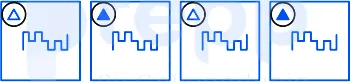
Select the figure from among the given options that can replace the question mark (?) in the following series.

- A
Option A (shown in image)
- B
Option B (shown in image)
- C
Option C (shown in image)
- D
Option D (shown in image)
Show answer
Question 2archived
Three statements are given followed by three conclusions numbered I, II and III. Assuming the statements to be true, even if they seem to be at variance with commonly known facts, decide which of the conclusions logically follow(s) from the statements.
Statements:
All oranges are apples.
Some oranges are bananas.
All bananas are fruits.
Conclusions:
I. Some fruits are apples.
II. Some apples are bananas.
III. Some oranges are fruits.
- A
Only conclusions I and III follow.
- B
Only conclusions II and III follow.
- C
All conclusions follow.
- D
Only conclusions I and II follow.
Show answer
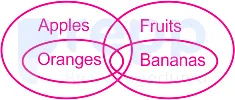
C. All conclusions follow.For the given statements, the minimum possible Venn diagram is shown below:
Conclusions:
I. Some fruits are apples → Follows (Since all oranges are apples, some oranges are bananas, and all bananas are fruits. Therefore, since there is some intersection between oranges and bananas that also falls within apples and fruits, some fruits are apples is definitely true)
II. Some apples are bananas → Follows (Since all oranges are apples and some oranges are bananas. Therefore, since there is some intersection of oranges within bananas that falls within apples, some apples are bananas is definitely true)
III. Some oranges are fruits → Follows (Since some oranges are bananas and all bananas are fruits. Therefore, since there is some intersection between oranges and bananas that falls entirely within fruits, some oranges are fruits is definitely true)
∴ Here, all conclusions I, II, and III follow.
Thus, the correct answer is "All conclusions follow".
 Paper & answer key PDF ↗
 Question 3archived
By interchanging the given two signs which of the following equation will be not correct?
+ and ÷
- A
18 + 6 – 6 ÷ 3 × 3 = 6
- B
18 + 2 × 6 ÷ 3 – 7 = 50
- C
7 × 8 ÷ 4 + 2 – 6 = 49
- D
6 × 9 + 3 – 24 ÷ 8 = 2
Show answer
C. 7 × 8 ÷ 4 + 2 – 6 = 49Understanding the Problem: Sign Interchange
The question asks us to identify which of the given equations becomes incorrect when the mathematical signs '+' (plus) and '÷' (division) are swapped. We need to go through each option, interchange these two signs, and then evaluate the resulting expression using the standard order of operations (BODMAS/PEMDAS) to see if the left side of the equation still equals the right side.
Step-by-Step Solution: Checking Each Equation
We will apply the BODMAS rule, which dictates the order of operations:
Brackets (or Parentheses)
Orders (or Exponents)
Division and Multiplication (from left to right)
Addition and Subtraction (from left to right)
Let's check each option after interchanging '+' and '÷'.
Checking Option 1: \(18 + 6 – 6 ÷ 3 × 3 = 6\)
Original equation: \(18 + 6 - 6 \div 3 \times 3 = 6\)
After interchanging '+' and '÷', the equation becomes:
\(18 \div 6 - 6 + 3 \times 3\)
Let's evaluate the left side:
First, Division and Multiplication (from left to right):
\(18 \div 6 = 3\)
\(3 \times 3 = 9\)
Now the expression is: \(3 - 6 + 9\)
Next, Addition and Subtraction (from left to right):
\(3 - 6 = -3\)
\(-3 + 9 = 6\)
The left side evaluates to 6. The right side is 6.
Since \(6 = 6\), this equation is correct after interchanging the signs.
Checking Option 2: \(18 + 2 × 6 ÷ 3 – 7 = 50\)
Original equation: \(18 + 2 \times 6 \div 3 - 7 = 50\)
After interchanging '+' and '÷', the equation becomes:
\(18 \div 2 \times 6 + 3 - 7\)
Let's evaluate the left side:
First, Division and Multiplication (from left to right):
\(18 \div 2 = 9\)
\(9 \times 6 = 54\)
Now the expression is: \(54 + 3 - 7\)
Next, Addition and Subtraction (from left to right):
\(54 + 3 = 57\)
\(57 - 7 = 50\)
The left side evaluates to 50. The right side is 50.
Since \(50 = 50\), this equation is correct after interchanging the signs.
Checking Option 3: \(7 × 8 ÷ 4 + 2 – 6 = 49\)
Original equation: \(7 \times 8 \div 4 + 2 - 6 = 49\)
After interchanging '+' and '÷', the equation becomes:
\(7 \times 8 + 4 \div 2 - 6\)
Let's evaluate the left side:
First, Division and Multiplication (from left to right):
\(4 \div 2 = 2\)
\(7 \times 8 = 56\)
Now the expression is: \(56 + 2 - 6\)
Next, Addition and Subtraction (from left to right):
\(56 + 2 = 58\)
\(58 - 6 = 52\)
The left side evaluates to 52. The right side is 49.
Since \(52 \neq 49\), this equation is not correct after interchanging the signs.
Checking Option 4: \(6 × 9 + 3 – 24 ÷ 8 = 2\)
Original equation: \(6 \times 9 + 3 - 24 \div 8 = 2\)
After interchanging '+' and '÷', the equation becomes:
\(6 \times 9 \div 3 - 24 + 8\)
Let's evaluate the left side:
First, Division and Multiplication (from left to right):
\(6 \times 9 = 54\)
\(54 \div 3 = 18\)
Now the expression is: \(18 - 24 + 8\)
Next, Addition and Subtraction (from left to right):
\(18 - 24 = -6\)
\(-6 + 8 = 2\)
The left side evaluates to 2. The right side is 2.
Since \(2 = 2\), this equation is correct after interchanging the signs.
Conclusion
After interchanging the '+' and '÷' signs, the equation \(7 \times 8 \div 4 + 2 - 6 = 49\) becomes \(7 \times 8 + 4 \div 2 - 6 = 49\), which evaluates to \(52 = 49\). This is incorrect.
Therefore, the equation that will be not correct after interchanging the given two signs is \(7 × 8 ÷ 4 + 2 – 6 = 49\).
Revision Table: Sign Interchange Results
Option
Original Equation
Interchanged Equation (+ <-> ÷)
Evaluated LHS
Original RHS
Correct After Interchange?
1
\(18 + 6 - 6 \div 3 \times 3 = 6\)
\(18 \div 6 - 6 + 3 \times 3\)
\(6\)
\(6\)
Yes
2
\(18 + 2 \times 6 \div 3 - 7 = 50\)
\(18 \div 2 \times 6 + 3 - 7\)
\(50\)
\(50\)
Yes
3
\(7 \times 8 \div 4 + 2 - 6 = 49\)
\(7 \times 8 + 4 \div 2 - 6\)
\(52\)
\(49\)
No
4
\(6 \times 9 + 3 - 24 \div 8 = 2\)
\(6 \times 9 \div 3 - 24 + 8\)
\(2\)
\(2\)
Yes
Additional Information: Order of Operations
The order of operations, like BODMAS or PEMDAS, is crucial for solving mathematical expressions consistently. Without a defined order, expressions involving multiple operations could have different results depending on which operation is performed first. BODMAS (Brackets, Orders, Division, Multiplication, Addition, Subtraction) and PEMDAS (Parentheses, Exponents, Multiplication, Division, Addition, Subtraction) are just mnemonics to remember this order. Division and Multiplication have the same priority and are performed from left to right. Similarly, Addition and Subtraction have the same priority and are performed from left to right.
Paper & answer key PDF ↗ Question 4archived
Select the figure that will replace the question mark (?) in the following figure series.

- A
Option A (shown in image)
- B
Option B (shown in image)
- C
Option C (shown in image)
- D
Option D (shown in image)
Show answer
Question 5archived
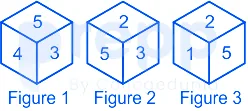
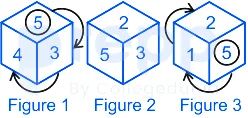
Three different positions of the same dice are shown (figures 1 to 3). Find the number on the face opposite to the face having ‘6’.
- A
1
- B
5
- C
4
- D
2
Show answer
B. 5The logic followed here is :-
From the given three different cubes, figure 1 and figure 3 ,the adjacent sides are as shown below :
As 5 is common on both figure 1 and figure 3, it is clear that 1, 2, 3 and 4 are adjacent to it, and the remaining number i.e., 6 will be opposite to it.
Opposite pairs:
1 → 3
2 → 4
5 → 6
So, the opposite side of "6" will be side "5".
Hence, the correct answer is "5".
 Paper & answer key PDF ↗
 Question 6archived
Three of the following four letter-clusters are alike in a certain way and one is different. Pick the odd one out.
- A
CXA
- B
UGS
- C
JRH
- D
NNL
Show answer
A. CXAFinding the Odd Letter Cluster: CXA, UGS, JRH, NNL
This question asks us to identify the letter cluster that is different from the other three based on a certain pattern or rule. We are given four letter clusters: CXA, UGS, JRH, and NNL.
To solve such problems, we usually analyze the position of each letter in the English alphabet. Let's assign numerical positions to the letters:
A=1, B=2, C=3, ..., Z=26
Now, let's write down the letter positions for each cluster:
CXA: C(3), X(24), A(1)
UGS: U(21), G(7), S(19)
JRH: J(10), R(18), H(8)
NNL: N(14), N(14), L(12)
Analyzing Positional Relationships
We need to find a pattern that holds true for three of the clusters but not for the fourth one. Let's examine the relationships between the letters in each cluster, particularly focusing on their alphabetical positions.
Consider the relationship between the middle letter and the two flanking letters (first and third) in each cluster. Let's calculate the absolute difference between the position of the middle letter and the positions of the first and third letters.
CXA:
Middle letter is X (position 24).
First letter is C (position 3). Absolute difference: \(|24 - 3| = 21\).
Third letter is A (position 1). Absolute difference: \(|24 - 1| = 23\).
The pair of absolute differences is {21, 23}. These are consecutive odd numbers.
UGS:
Middle letter is G (position 7).
First letter is U (position 21). Absolute difference: \(|7 - 21| = |-14| = 14\).
Third letter is S (position 19). Absolute difference: \(|7 - 19| = |-12| = 12\).
The pair of absolute differences is {14, 12}. These are consecutive even numbers.
JRH:
Middle letter is R (position 18).
First letter is J (position 10). Absolute difference: \(|18 - 10| = 8\).
Third letter is H (position 8). Absolute difference: \(|18 - 8| = 10\).
The pair of absolute differences is {8, 10}. These are consecutive even numbers.
NNL:
Middle letter is N (position 14).
First letter is N (position 14). Absolute difference: \(|14 - 14| = 0\).
Third letter is L (position 12). Absolute difference: \(|14 - 12| = 2\).
The pair of absolute differences is {0, 2}. These are consecutive even numbers.
Identifying the Pattern
Let's summarize the pairs of absolute differences we found:
Letter Cluster
Middle Letter
Differences from Middle to First/Third
Nature of Differences
CXA
X(24)
{21, 23}
Consecutive Odd
UGS
G(7)
{14, 12}
Consecutive Even
JRH
R(18)
{8, 10}
Consecutive Even
NNL
N(14)
{0, 2}
Consecutive Even
We can observe a clear pattern here. In letter clusters UGS, JRH, and NNL, the absolute differences between the position of the middle letter and the positions of the first and third letters are a pair of consecutive even numbers (14 & 12, 8 & 10, 0 & 2).
However, in the letter cluster CXA, the absolute differences between the position of the middle letter (X) and the positions of the first (C) and third (A) letters are 21 and 23. These are consecutive odd numbers.
Therefore, CXA follows a different pattern compared to the other three clusters.
Conclusion
Based on the analysis of the alphabetical positions and the relationship between the middle letter and the flanking letters, CXA is the odd one out.
Revision Table: Letter Cluster Analysis
Cluster
Positions (1st, 2nd, 3rd)
Middle Letter Position
Abs Difference |Middle - 1st|
Abs Difference |Middle - 3rd|
Pattern of Differences
CXA
3, 24, 1
24
\(|24 - 3| = 21\)
\(|24 - 1| = 23\)
Consecutive Odd {21, 23}
UGS
21, 7, 19
7
\(|7 - 21| = 14\)
\(|7 - 19| = 12\)
Consecutive Even {14, 12}
JRH
10, 18, 8
18
\(|18 - 10| = 8\)
\(|18 - 8| = 10\)
Consecutive Even {8, 10}
NNL
14, 14, 12
14
\(|14 - 14| = 0\)
\(|14 - 12| = 2\)
Consecutive Even {0, 2}
Additional Information: Logical Reasoning Patterns
Logical reasoning questions involving letter clusters often test your ability to identify patterns based on various principles. Some common patterns include:
Positional Differences: Steps between consecutive letters (e.g., +2, -3) or between alternate letters. These steps might be constant, increasing, decreasing, or follow a sequence.
Positional Sums/Differences: The sum or difference of letter positions might relate to another letter's position or follow a specific rule.
Alphabetical Series Rules: Patterns might involve skipping a fixed number of letters, alternating steps, or using forward/backward counting with or without wrapping around the alphabet (A follows Z).
Vowel/Consonant Count: The number or position of vowels or consonants in the cluster.
Symmetry or Reflection: The cluster might read the same forwards and backwards, or have letters symmetrically placed in the alphabet.
Specific Letter Properties: Patterns based on letters being prime/composite numbered positions, perfect squares, etc.
Solving these questions requires careful observation, systematic analysis using letter positions, and checking various potential pattern types.
Paper & answer key PDF ↗ Question 7archived
In a certain code language, ‘APPRECIATE’ is written as ‘ETAICERPPA’, ‘MOTIVATION’ is written as ‘NOITAVITOM’. How will ‘FRIENDSHIP’ be written in that language?
- A
PIHSDNIERF
- B
PIHSDENIRF
- C
PIHSNDEIRF
- D
PIHSDNEIRF
Show answer
D. PIHSDNEIRFThe correct answer is PIHSDNEIRF.
This could be based on letter positions in the alphabet, or other arbitrary rules provided in the examples. Word/Sentence Coding: Entire words or sentences are coded, often using substitution for common words or phrases. Reversal: The word is coded by writing its letters in reverse order, as seen in this problem. Practicing different types of coding-decoding problems helps improve pattern recognition skills, which are crucial for solving such questions efficiently.
Paper & answer key PDF ↗ Question 8archived
Select the word-pair that best represents a similar relationship to the one expressed in the pair of words given below. (The words must be considered as meaningful English words and must not be related to each other based on the number of letters / number of consonants / vowels in the word.)
Cattle ∶ Herd
- A
Soldiers ∶ Colony
- B
Sailors ∶ Crew
- C
Pupils ∶ Team
- D
Player ∶ Class
Show answer
B. Sailors ∶ CrewUnderstanding Word Pair Analogies: Cattle Herd Relationship
Word pair analogies test your ability to recognise the relationship between a given pair of words and identify another pair that shares the same relationship. The provided word pair is Cattle ∶ Herd.
Analysing the Relationship: Cattle and Herd
Let's examine the connection between the words Cattle and Herd:
Cattle refers to individual animals of a certain type (cows, bulls, steers).
Herd is a collective noun used to describe a group of Cattle.
Therefore, the relationship between Cattle and Herd is that of an Individual to a Group, specifically, the individual animal is a member of the group denoted by the collective noun.
Evaluating the Options Based on the Relationship
Now, let's look at each option and see which pair demonstrates the same Individual : Group (Collective Noun) relationship as Cattle : Herd.
Option 1: Soldiers ∶ Colony
Soldiers: Refers to individual members of a military force.
Colony: A group of animals (like ants or bees) or a territory. A group of Soldiers is typically called an 'army', 'battalion', 'platoon', etc. 'Colony' is not the standard collective noun for Soldiers.
This pair does not represent the correct relationship.
Option 2: Sailors ∶ Crew
Sailors: Refers to individual people who work on a ship.
Crew: A group of people who work together, especially on a ship, aircraft, or train. 'Crew' is a widely used and standard collective noun for a group of Sailors.
This pair demonstrates the Individual : Group (Collective Noun) relationship, just like Cattle : Herd.
Option 3: Pupils ∶ Team
Pupils: Refers to individual students, especially young ones.
Team: A group of people who work or play together, often in sports or competitions. While Pupils can be part of a Team (like a sports team or debate team), 'Team' is not the standard collective noun for a general group of Pupils in a class or school. A group of Pupils is commonly called a 'class'.
This pair does not represent the same specific relationship as Cattle : Herd.
Option 4: Player ∶ Class
Player: Refers to an individual participating in a game or sport.
Class: A group of students or a category. 'Class' is not a collective noun for Players. A group of Players is typically called a 'team'.
This pair does not represent the correct relationship.
Conclusion
Based on the analysis, the word pair Sailors ∶ Crew shares the most similar relationship to Cattle ∶ Herd, as both represent the Individual : Group (Collective Noun) relationship.
Revision Table: Collective Nouns
Individual
Collective Noun (Group)
Relation Type
Cattle
Herd
Individual : Group
Sailor
Crew
Individual : Group
Soldier
Army/Platoon/Regiment
Individual : Group
Pupil
Class/School/Group
Individual : Group
Player
Team
Individual : Group
Additional Information: Mastering Analogies
Solving analogies requires identifying the specific type of relationship between the words in the given pair. Some common types of relationships include:
Part : Whole (e.g., Finger : Hand)
Cause : Effect (e.g., Rain : Flood)
Synonyms (e.g., Happy : Joyful)
Antonyms (e.g., Hot : Cold)
Tool : User (e.g., Pen : Writer)
Action : Object (e.g., Read : Book)
Degree of Intensity (e.g., Warm : Hot)
Category : Example (e.g., Fruit : Apple)
Practice recognising these different relationships to improve your performance on analogy questions.
Paper & answer key PDF ↗ Question 9archived
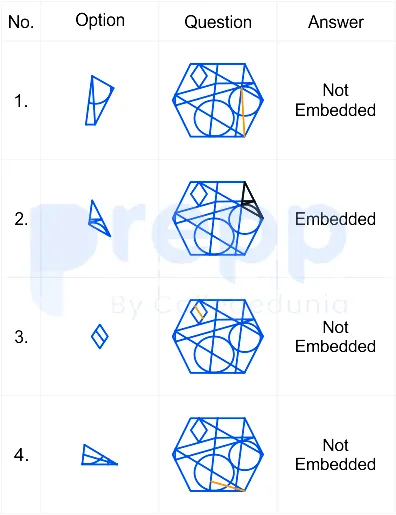
Select the option figure that is embedded in the given figure. (Rotation is not allowed).

- A
Option A (shown in image)
- B
Option B (shown in image)
- C
Option C (shown in image)
- D
Option D (shown in image)
Show answer
B. Option B (shown in image)Given:
The image must not to be rotated
Hence, the correct answer is "Option - (2)".

 Paper & answer key PDF ↗
 Question 10archived
Select the set in which the numbers are related in the same way as are the numbers of the following set.
(NOTE: Operations should be performed on the whole numbers, without breaking down the numbers into its constituent digits. E.g. 13 – Operations on 13 such as adding / subtracting / multiplying etc. to 13 can be performed. Breaking down 13 into 1 and 3 and then performing mathematical operations on 1 and 3 is NOT allowed)
(17, 59, 625)
(8, 44, 784)
- A
(22, 78, 784)
- B
(12, 69, 2025)
- C
(24, 70, 576)
- D
(18, 74, 1296)
Show answer
B. (12, 69, 2025)Understanding the Number Pattern Question
This question asks us to identify the relationship or pattern between the three numbers in the given sets and then find the option set that follows the same relationship. We are given two example sets to help us deduce the rule: (17, 59, 625) and (8, 44, 784).
A crucial constraint is that we must operate on the whole numbers as given, not by breaking them down into individual digits.
Analyzing the Given Example Sets
Let's look closely at the two sets:
Set 1: (17, 59, 625)
Set 2: (8, 44, 784)
Observe the third number in each set. Often, in such number pattern problems, the third number might be related to the first two through mathematical operations, or it might be a perfect square, cube, or follow some other specific property.
In Set 1, the third number is 625. We can check if it's a perfect square: $\sqrt{625} = 25$.
In Set 2, the third number is 784. We can check if it's a perfect square: $\sqrt{784} = 28$.
It appears the third number in both sets is a perfect square. Let's denote the numbers in a set as (a, b, c). So, for Set 1, a=17, b=59, c=625 and $\sqrt{c}=25$. For Set 2, a=8, b=44, c=784 and $\sqrt{c}=28$.
Now, the task is to find a relationship between the first number (a) and the second number (b) that results in the square root of the third number ($\sqrt{c}$).
For Set 1: We need to get 25 from 17 and 59.
For Set 2: We need to get 28 from 8 and 44.
Identifying the Pattern
Let's try different combinations of operations on 'a' and 'b' to get $\sqrt{c}$.
Consider the sum: $a+b$. For Set 1: $17+59=76$. For Set 2: $8+44=52$. How to get 25 from 76 and 28 from 52? No obvious simple pattern like adding/subtracting a constant or multiplying/dividing.
Consider the difference: $b-a$. For Set 1: $59-17=42$. For Set 2: $44-8=36$. How to get 25 from 42 and 28 from 36?
Let's focus on the results from the difference: (42, 36) and the target values: (25, 28).
$42 \to 25$: $42 - 17 = 25$. Notice that 17 is the first number 'a' in Set 1.
$36 \to 28$: $36 - 8 = 28$. Notice that 8 is the first number 'a' in Set 2.
This suggests a pattern! The square root of the third number might be the difference between the second and first number, minus the first number again.
Let's formalize this pattern: $\sqrt{c} = (b - a) - a$. Simplifying this gives us $\sqrt{c} = b - 2a$.
Let's verify this pattern with the given sets:
Set 1: (17, 59, 625). $a=17, b=59$. Pattern result: $b - 2a = 59 - 2 \times 17 = 59 - 34 = 25$. $\sqrt{625} = 25$. The pattern holds.
Set 2: (8, 44, 784). $a=8, b=44$. Pattern result: $b - 2a = 44 - 2 \times 8 = 44 - 16 = 28$. $\sqrt{784} = 28$. The pattern holds.
So, the pattern is: The square root of the third number (c) is equal to the second number (b) minus twice the first number (a), i.e., $\sqrt{c} = b - 2a$. Equivalently, $c = (b - 2a)^2$.
Testing the Pattern on the Options
Now, we apply this pattern to each of the given options to find the set that matches.
We will check if $(b - 2a)^2 = c$ for each option (a, b, c).
Option 1: (22, 78, 784)
$a=22, b=78, c=784$
Calculate $b - 2a$: $78 - 2 \times 22 = 78 - 44 = 34$
Calculate $(b - 2a)^2$: $34^2 = 1156$
Compare to c: $1156 \neq 784$. This option does not follow the pattern.
Option 2: (12, 69, 2025)
$a=12, b=69, c=2025$
Calculate $b - 2a$: $69 - 2 \times 12 = 69 - 24 = 45$
Calculate $(b - 2a)^2$: $45^2 = 2025$
Compare to c: $2025 = 2025$. This option follows the pattern.
Option 3: (24, 70, 576)
$a=24, b=70, c=576$
Calculate $b - 2a$: $70 - 2 \times 24 = 70 - 48 = 22$
Calculate $(b - 2a)^2$: $22^2 = 484$
Compare to c: $484 \neq 576$. This option does not follow the pattern. (Note: $\sqrt{576} = 24$, but our pattern produced 22).
Option 4: (18, 74, 1296)
$a=18, b=74, c=1296$
Calculate $b - 2a$: $74 - 2 \times 18 = 74 - 36 = 38$
Calculate $(b - 2a)^2$: $38^2 = 1444$
Compare to c: $1444 \neq 1296$. This option does not follow the pattern. (Note: $\sqrt{1296} = 36$, but our pattern produced 38).
Based on the analysis, only Option 2 follows the identified pattern.
Conclusion
The pattern observed in the given sets (17, 59, 625) and (8, 44, 784) is that the square root of the third number is equal to the second number minus twice the first number ($\sqrt{c} = b - 2a$). Option (12, 69, 2025) fits this pattern because $69 - 2 \times 12 = 69 - 24 = 45$, and $45^2 = 2025$.
Set
a
b
c
$\sqrt{c}$
Calculation: $b - 2a$
$(\text{b - 2a})^2$
Matches Pattern?
(17, 59, 625)
17
59
625
25
$59 - 2 \times 17 = 25$
$25^2 = 625$
Yes
(8, 44, 784)
8
44
784
28
$44 - 2 \times 8 = 28$
$28^2 = 784$
Yes
Option 1: (22, 78, 784)
22
78
784
$\sqrt{784}=28$
$78 - 2 \times 22 = 34$
$34^2 = 1156$
No ($1156 \neq 784$)
Option 2: (12, 69, 2025)
12
69
2025
$\sqrt{2025}=45$
$69 - 2 \times 12 = 45$
$45^2 = 2025$
Yes ($2025 = 2025$)
Option 3: (24, 70, 576)
24
70
576
$\sqrt{576}=24$
$70 - 2 \times 24 = 22$
$22^2 = 484$
No ($484 \neq 576$)
Option 4: (18, 74, 1296)
18
74
1296
$\sqrt{1296}=36$
$74 - 2 \times 18 = 38$
$38^2 = 1444$
No ($1444 \neq 1296$)
Revision Table: Key Learnings from Number Pattern
Concept
Description
Application in Problem
Number Patterns
Identifying mathematical relationships (addition, subtraction, multiplication, division, squares, cubes, etc.) between numbers in a sequence or set.
Finding the rule connecting the three numbers in the given sets.
Analogy Reasoning
Applying a pattern found in one set of elements to another set to find a matching relationship.
Using the pattern from example sets (17, 59, 625) and (8, 44, 784) to check options.
Perfect Squares
A number that is the result of multiplying an integer by itself (e.g., $25 = 5^2$).
Recognizing 625 and 784 as perfect squares was key to finding the pattern involving their roots.
Algebraic Representation
Expressing relationships using variables (e.g., $a, b, c$).
Representing the pattern as $\sqrt{c} = b - 2a$ or $c = (b - 2a)^2$.
Additional Information on Number Analogy Patterns
Number analogy or number pattern questions are common in reasoning tests. They require you to observe, identify, and apply rules governing sets of numbers. These rules can involve various mathematical operations or properties. Here are some common types of patterns you might encounter:
Arithmetic Progressions: Numbers increase or decrease by a constant difference.
Geometric Progressions: Numbers are multiplied or divided by a constant ratio.
Squares and Cubes: Numbers might be squares, cubes, or related to squares/cubes of other numbers in the set.
Sums and Differences: The third number might be the sum, difference, product, or quotient of the first two, or a result of operations involving these.
Combinations: The pattern might combine multiple operations, such as $(a+b) \times k = c$ or $(a-b)^2 + k = c$.
Digit Operations: Although explicitly disallowed in this specific question's constraint, sometimes patterns involve operations on the individual digits of the numbers (e.g., sum of digits, product of digits). Always read question constraints carefully!
Solving these problems effectively involves systematically testing different potential relationships based on the numbers given. Look for simple relationships first (sums, differences, multiples, squares/cubes) and then move to more complex combinations if needed.
Paper & answer key PDF ↗ Question 11archived
Select the option that is related to the third word in the same way as the second word is related to the first word. (The words must be considered as meaningful English words and must not be related to each other based on the number of letters / number of consonants / vowels in the word)
Solids ∶ Freeze ∶∶ Gases ∶ ?
- A
Melts
- B
Smells
- C
Freezes
- D
Evaporates
Show answer
D. EvaporatesSolving the Word Analogy: Solids : Freeze :: Gases : ?
This question presents a word analogy, asking us to find the word that shares the same relationship with the third word (Gases) as the second word (Freeze) shares with the first word (Solids).
The structure of the analogy is:
Solids : Freeze :: Gases : ?
We need to determine the relationship between Solids and Freeze first.
Analyzing the Relationship between Solids and Freeze
Let's consider the meanings of Solids and Freeze in the context of states of matter and phase changes:
Solids are a state of matter characterized by a fixed shape and volume.
Freeze (or Freezing) is a process of phase transition where a liquid changes into a solid. For example, water freezes to become ice, which is a solid.
So, a clear relationship is that Solids are the resulting state when a liquid undergoes the process of Freezing.
The relationship can be expressed as: Resulting State (from liquid) : Process (from liquid).
Applying the Relationship to Gases and the Missing Word
Now we apply the same Resulting State (from liquid) : Process (from liquid) relationship to the second pair: Gases : ?
Gases are a state of matter characterized by no fixed shape or volume, expanding to fill their container.
We need to find a process that results in Gases, particularly when starting from a liquid, mirroring the first pair.
Let's look at the provided options:
Melts: Melting is Solid > Liquid. This results in a liquid, not a gas.
Smells: Smelling is related to detecting substances that are often in a gaseous state, but it is not a phase change process resulting in a gas from a liquid.
Freezes: Freezing is Liquid > Solid. This results in a solid, not a gas.
Evaporates: Evaporation is Liquid > Gas. This process results in a gas (or vapor) from a liquid. This perfectly fits the relationship we identified: the process of Evaporating a liquid results in Gases.
Following the pattern:
Solids are formed by Freezing (a liquid).
Gases are formed by Evaporating (a liquid).
Therefore, the word that completes the analogy is Evaporates.
Summary of the Analogy
The analogy establishes a relationship between a state of matter and the process of phase change from a liquid that results in that state.
State (Result from Liquid)
Process (from Liquid)
Solids
Freeze
Gases
Evaporates
Both pairs follow the pattern: The state of matter on the left is produced from a liquid by the process on the right.
Revision Table: Phase Changes Involving States
Here is a table showing common phase changes between states of matter:
Process Name
Change From
Change To
Melting
Solid
Liquid
Freezing
Liquid
Solid
Evaporation / Boiling
Liquid
Gas
Condensation
Gas
Liquid
Sublimation
Solid
Gas
Deposition
Gas
Solid
The analogy uses the processes Freezing (Liquid > Solid) and Evaporation (Liquid > Gas), relating them to the resulting states Solids and Gases, respectively.
Additional Information on Solving Analogies
Solving word analogies requires identifying the specific relationship between the first pair of words and applying that identical relationship to the second pair. Common relationship types include part/whole, cause/effect, synonym/antonym, function, type/category, and state/process.
In this analogy, understanding basic scientific concepts like states of matter and phase changes is crucial. Recognizing that freezing turns liquid into solid and evaporation turns liquid into gas allows you to quickly identify the parallel relationship between the two pairs.
Practicing different types of analogies helps improve vocabulary, logical reasoning, and the ability to spot subtle connections between words.
Paper & answer key PDF ↗ Question 12archived
If A × B means that A is the father of B, A ÷ B means that A is the mother of B, A + B means that A is the brother of B then which of the following expression shows that P is the paternal grandmother of R?
- A
P ÷ R × Q
- B
P ÷ Q × R
- C
P ÷ Q + R
- D
P × Q ÷ R
Show answer
B. P ÷ Q × RSolving Blood Relation Expressions
This question asks us to determine which expression correctly represents the relationship where P is the paternal grandmother of R, based on the given definitions of symbols.
Understanding the Given Relationships
We are provided with the following meanings for the symbols:
\(A \times B\) means that A is the father of B.
\(A \div B\) means that A is the mother of B.
\(A + B\) means that A is the brother of B.
We need to find an expression where P is the paternal grandmother of R. A paternal grandmother is the mother of one's father. So, we are looking for an expression that establishes P as the mother of R's father.
Analyzing Each Option
Let's break down each given option to see the relationship between P and R.
Option 1: \(P \div R \times Q\)
\(P \div R\): According to the definition, this means P is the mother of R.
\(R \times Q\): According to the definition, this means R is the father of Q.
Combining these, P is the mother of R. This does not make P the paternal grandmother of R.
Option 2: \(P \div Q \times R\)
\(P \div Q\): According to the definition, this means P is the mother of Q.
\(Q \times R\): According to the definition, this means Q is the father of R.
Combining these, P is the mother of Q, and Q is the father of R. This means P is the mother of R's father. Therefore, P is the paternal grandmother of R. This matches the required relationship.
Option 3: \(P \div Q + R\)
\(P \div Q\): According to the definition, this means P is the mother of Q.
\(Q + R\): According to the definition, this means Q is the brother of R.
Combining these, P is the mother of Q, and Q is the brother of R. This means P is the mother of R's brother. Therefore, P is the mother of R. This does not make P the paternal grandmother of R.
Option 4: \(P \times Q \div R\)
\(P \times Q\): According to the definition, this means P is the father of Q.
\(Q \div R\): According to the definition, this means Q is the mother of R.
Combining these, P is the father of Q, and Q is the mother of R. This means P is the father of R's mother. Therefore, P is the maternal grandfather of R. This does not make P the paternal grandmother of R.
Conclusion
Based on the analysis of each expression, the expression \(P \div Q \times R\) is the only one that shows P as the mother of Q, and Q as the father of R, thus establishing P as the paternal grandmother of R.
Expression
Breakdown
Relationship P to R
Matches Requirement?
\(P \div R \times Q\)
P mother of R, R father of Q
P is mother of R
No
\(P \div Q \times R\)
P mother of Q, Q father of R
P is paternal grandmother of R
Yes
\(P \div Q + R\)
P mother of Q, Q brother of R
P is mother of R
No
\(P \times Q \div R\)
P father of Q, Q mother of R
P is maternal grandfather of R
No
Revision Table: Blood Relation Symbols
Understanding the meaning of each symbol is key to solving blood relation problems. Here's a quick recap:
\(A \times B\): A is the father of B
\(A \div B\): A is the mother of B
\(A + B\): A is the brother of B
Additional Information: Blood Relations Concepts
Blood relation questions test your ability to decipher relationships based on given codes or statements. Common relationships include:
Parent: Father or Mother
Child: Son or Daughter
Grandparent: Father's father/mother (Paternal Grandfather/Grandmother) or Mother's father/mother (Maternal Grandfather/Grandmother)
Grandchild: Son's son/daughter or Daughter's son/daughter
Sibling: Brother or Sister
Uncle: Father's brother (Paternal Uncle) or Mother's brother (Maternal Uncle)
Aunt: Father's sister (Paternal Aunt) or Mother's sister (Maternal Aunt)
Cousin: Child of Uncle or Aunt
Nephew: Son of one's sibling
Niece: Daughter of one's sibling
In-laws: Relationships through marriage (e.g., Father-in-law, Mother-in-law, Son-in-law, Daughter-in-law, Brother-in-law, Sister-in-law)
Solving these problems often involves drawing a family tree or breaking down complex relationships step-by-step from the given information.
Paper & answer key PDF ↗ Question 13archived
By interchanging the given two signs and numbers which of the following equation will be not correct?
+ and –, 3 and 5
- A
5 × 4 + 3 – 6 ÷ 2 = 10
- B
7 × 4 ÷ 2 – 5 + 3 = 12
- C
5 × 4 – 3 + 4 ÷ 2 = 15
- D
5 – 3 + 8 × 4 ÷ 2 = 10
Show answer
D. 5 – 3 + 8 × 4 ÷ 2 = 10Finding the Incorrect Equation by Interchanging Signs and Numbers
The question asks us to identify which of the given equations becomes incorrect after applying specific interchanges: swapping the addition sign (+) with the subtraction sign (–) and swapping the number 3 with the number 5.
Let's break down the rule:
Replace every '+' with '–'.
Replace every '–' with '+'.
Replace every '3' with '5'.
Replace every '5' with '3'.
We will apply these rules to each equation and then evaluate if the resulting equation holds true.
Analyzing Option 1
Original equation: 5 × 4 + 3 – 6 ÷ 2 = 10
Applying the interchange rule:
'5' becomes '3'
'+' becomes '–'
'3' becomes '5'
'–' becomes '+'
The new equation is: 3 × 4 – 5 + 6 ÷ 2
Now, let's evaluate this expression using the BODMAS/PEMDAS rule (Brackets, Orders, Division/Multiplication, Addition/Subtraction):
First, Multiplication and Division from left to right:
3 × 4 = 12
6 ÷ 2 = 3
The expression becomes: 12 – 5 + 3
Next, Addition and Subtraction from left to right:
12 – 5 = 7
7 + 3 = 10
So, the equation after interchange becomes 10 = 10. This equation is correct.
Analyzing Option 2
Original equation: 7 × 4 ÷ 2 – 5 + 3 = 12
Applying the interchange rule:
'–' becomes '+'
'5' becomes '3'
'+' becomes '–'
'3' becomes '5'
The new equation is: 7 × 4 ÷ 2 + 3 – 5
Now, let's evaluate this expression using BODMAS/PEMDAS:
First, Multiplication and Division from left to right:
7 × 4 = 28
28 ÷ 2 = 14
The expression becomes: 14 + 3 – 5
Next, Addition and Subtraction from left to right:
14 + 3 = 17
17 – 5 = 12
So, the equation after interchange becomes 12 = 12. This equation is correct.
Analyzing Option 3
Original equation: 5 × 4 – 3 + 4 ÷ 2 = 15
Applying the interchange rule:
'5' becomes '3'
'–' becomes '+'
'3' becomes '5'
'+' becomes '–'
The new equation is: 3 × 4 + 5 – 4 ÷ 2
Now, let's evaluate this expression using BODMAS/PEMDAS:
First, Multiplication and Division from left to right:
3 × 4 = 12
4 ÷ 2 = 2
The expression becomes: 12 + 5 – 2
Next, Addition and Subtraction from left to right:
12 + 5 = 17
17 – 2 = 15
So, the equation after interchange becomes 15 = 15. This equation is correct.
Analyzing Option 4
Original equation: 5 – 3 + 8 × 4 ÷ 2 = 10
Applying the interchange rule:
'5' becomes '3'
'–' becomes '+'
'3' becomes '5'
'+' becomes '–'
The new equation is: 3 + 5 – 8 × 4 ÷ 2
Now, let's evaluate this expression using BODMAS/PEMDAS:
First, Multiplication and Division from left to right:
8 × 4 = 32
32 ÷ 2 = 16
The expression becomes: 3 + 5 – 16
Next, Addition and Subtraction from left to right:
3 + 5 = 8
8 – 16 = -8
So, the equation after interchange becomes -8 = 10. This equation is not correct.
Conclusion on Incorrect Equation
After interchanging the signs '+' and '–', and the numbers '3' and '5', three out of the four given equations resulted in a correct mathematical statement. Only Option 4 resulted in an incorrect statement (-8 = 10).
Revision Table: Summary of Results After Interchange
Option
Original Equation
Interchanged Equation
Calculated Value
Result
1
5 × 4 + 3 – 6 ÷ 2 = 10
3 × 4 – 5 + 6 ÷ 2
10
10 = 10 (Correct)
2
7 × 4 ÷ 2 – 5 + 3 = 12
7 × 4 ÷ 2 + 3 – 5
12
12 = 12 (Correct)
3
5 × 4 – 3 + 4 ÷ 2 = 15
3 × 4 + 5 – 4 ÷ 2
15
15 = 15 (Correct)
4
5 – 3 + 8 × 4 ÷ 2 = 10
3 + 5 – 8 × 4 ÷ 2
-8
-8 = 10 (Incorrect)
Additional Information: Understanding BODMAS/PEMDAS in Equation Solving
When solving mathematical expressions like the ones above, it's crucial to follow the correct order of operations. This order is often remembered using acronyms like BODMAS or PEMDAS.
BODMAS: Brackets, Orders (powers/roots), Division, Multiplication, Addition, Subtraction.
PEMDAS: Parentheses, Exponents, Multiplication, Division, Addition, Subtraction.
The order is essentially the same: perform operations within brackets/parentheses first, then powers/exponents, followed by multiplication and division (from left to right as they appear), and finally addition and subtraction (from left to right as they appear).
In these problems involving interchange of signs and numbers, applying the BODMAS/PEMDAS rule correctly after performing the substitutions is key to finding the correct result of the expression.
Paper & answer key PDF ↗ Question 14archived
‘A @ B’ means ‘A is the husband of B’.
‘A & B’ means ‘A is the father of B’.
‘A # B’ means ‘B is the son of A’.
If F & G @ H # I @ J, then how is G related to J?
- A
Father
- B
Son
- C
Husband
- D
Father-in-law
Show answer
D. Father-in-lawUnderstanding Blood Relations Symbols
This blood relations question uses specific symbols to represent relationships. Let's first understand what each symbol means:
‘A @ B’ means ‘A is the husband of B’. This implies B is the wife of A.
‘A & B’ means ‘A is the father of B’. This implies B is the son or daughter of A.
‘A # B’ means ‘B is the son of A’. This also implies A is the father of B.
We are given the expression: F & G @ H # I @ J. We need to determine the relationship between G and J based on this expression.
Analyzing the Blood Relations Expression Step-by-Step
Let's break down the given expression F & G @ H # I @ J into individual relationships:
F & G: According to the rule ‘A & B’ means ‘A is the father of B’, this means F is the father of G.
G @ H: According to the rule ‘A @ B’ means ‘A is the husband of B’, this means G is the husband of H. This also tells us H is the wife of G.
H # I: According to the rule ‘A # B’ means ‘B is the son of A’, this means I is the son of H. Since G is the husband of H, I is also the son of G.
I @ J: According to the rule ‘A @ B’ means ‘A is the husband of B’, this means I is the husband of J. This also tells us J is the wife of I.
Determining the Relationship between G and J
Now, let's connect the relationships we have found:
We know that G is the father of I (from steps 1, 2, and 3).
We know that I is the husband of J (from step 4).
G is the father of I, and I is married to J. This means G is the father of J's husband. The father of one's husband is called the father-in-law.
Therefore, G is the father-in-law of J.
Summary of Blood Relations
Let's summarize the relationships in a table:
Relationship Part
Meaning
Derived Relationship
F & G
A is father of B
F is father of G
G @ H
A is husband of B
G is husband of H (H is wife of G)
H # I
B is son of A
I is son of H (and G)
I @ J
A is husband of B
I is husband of J (J is wife of I)
From the table, G is the father of I, and I is married to J. This confirms that G is the father-in-law of J.
Conclusion on G's Relation to J
Based on the step-by-step analysis of the given expression F & G @ H # I @ J and the definitions of the symbols, we have determined that G is the father-in-law of J.
Revision Table for Blood Relations Symbols
Symbol
Meaning
@
First person is husband of second person
&
First person is father of second person
#
Second person is son of first person (First person is father of second person)
Additional Information on Solving Blood Relations Problems
Blood relations questions often involve deciphering coded relationships or diagrams. Here are some tips for solving them:
Carefully read the definition of each symbol or term used.
Break down complex expressions into smaller, manageable parts.
Draw a family tree or diagram if it helps visualize the relationships. Use symbols for gender (e.g., + for male, - for female) and lines for relationships (e.g., horizontal line for marriage, vertical line for parent-child).
Identify the gender of individuals whenever possible, as it can be crucial in determining the exact relationship.
Work backward or forward through the relationships to connect the required individuals.
Be mindful of directional relationships (e.g., A is father of B vs. B is son of A).
Practicing different types of blood relations problems will help you become more comfortable with identifying relationships quickly and accurately during exams.
Paper & answer key PDF ↗ Question 15archived
Which two signs and two numbers should be interchanged in the following equation to make it correct?
13 − 65 ÷ 45 × 21 + 2 = 82
- A
65 and 13, × and +
- B
45 and 13, × and +
- C
45 and 21, × and +
- D
45 and 13, − and +
Show answer
B. 45 and 13, × and +Understanding the Equation Problem
The question asks us to find which specific interchange of two numbers and two mathematical signs will correct the given equation. The original equation is:$$13 - 65 \div 45 \times 21 + 2 = 82$$Our goal is to determine which proposed interchange makes the left side of the equation equal to 82.
Applying the Order of Operations (BODMAS/PEMDAS)
To evaluate the equation after each interchange, we must follow the standard order of mathematical operations:
Brackets (or Parentheses)
Orders (or Exponents)
Division and Multiplication (from left to right)
Addition and Subtraction (from left to right)
We will test each option provided.
Testing Each Interchange Option
Option 1: Interchange 65 and 13, $\times$ and $+$
Original equation: $13 - 65 \div 45 \times 21 + 2 = 82$
Interchange 65 and 13: $65 - 13 \div 45 \times 21 + 2$
Interchange $\times$ and $+$: $65 - 13 \div 45 + 21 \times 2$
Let's evaluate the expression:$$65 - 13 \div 45 + 21 \times 2$$First, perform Division and Multiplication:$$65 - \frac{13}{45} + 42$$Then, perform Addition and Subtraction:$$107 - \frac{13}{45}$$This result is not an integer and definitely not 82. So, Option 1 is incorrect.
Option 2: Interchange 45 and 13, $\times$ and $+$
Original equation: $13 - 65 \div 45 \times 21 + 2 = 82$
Interchange 45 and 13: $45 - 65 \div 13 \times 21 + 2$
Interchange $\times$ and $+$: $45 - 65 \div 13 + 21 \times 2$
Let's evaluate the expression:$$45 - 65 \div 13 + 21 \times 2$$First, perform Division and Multiplication:$$45 - (65 \div 13) + (21 \times 2)$$$$45 - 5 + 42$$Then, perform Addition and Subtraction from left to right:$$(45 - 5) + 42$$$$40 + 42$$$$82$$The result is 82, which matches the right side of the original equation. So, Option 2 makes the equation correct.
Option 3: Interchange 45 and 21, $\times$ and $+$
Original equation: $13 - 65 \div 45 \times 21 + 2 = 82$
Interchange 45 and 21: $13 - 65 \div 21 \times 45 + 2$
Interchange $\times$ and $+$: $13 - 65 \div 21 + 45 \times 2$
Let's evaluate the expression:$$13 - 65 \div 21 + 45 \times 2$$First, perform Division and Multiplication:$$13 - \frac{65}{21} + 90$$Then, perform Addition and Subtraction:$$103 - \frac{65}{21}$$This result is not an integer and definitely not 82. So, Option 3 is incorrect.
Option 4: Interchange 45 and 13, $\minus$ and $+$
Original equation: $13 - 65 \div 45 \times 21 + 2 = 82$
Interchange 45 and 13: $45 - 65 \div 13 \times 21 + 2$
Interchange $\minus$ and $+$: $45 + 65 \div 13 \times 21 - 2$
Let's evaluate the expression:$$45 + 65 \div 13 \times 21 - 2$$First, perform Division and Multiplication from left to right:$$45 + (65 \div 13) \times 21 - 2$$$$45 + 5 \times 21 - 2$$$$45 + (5 \times 21) - 2$$$$45 + 105 - 2$$Then, perform Addition and Subtraction from left to right:$$(45 + 105) - 2$$$$150 - 2$$$$148$$The result is 148, which is not 82. So, Option 4 is incorrect.
Conclusion
After testing all options and performing the calculations according to the order of operations, we find that only the interchange of 45 and 13, and the interchange of $\times$ and $+$ correctly solves the equation.$$45 - 65 \div 13 + 21 \times 2 = 82$$Therefore, the correct option is the one that suggests interchanging 45 and 13, and $\times$ and $+$.
The correct interchange is 45 and 13, $\times$ and +.
Revision Table: Solving Equations by Interchange
Step
Action
Applying to $45 - 65 \div 13 + 21 \times 2$
1
Identify the proposed interchanges (numbers and signs).
Interchange 45 $\leftrightarrow$ 13, $\times$ $\leftrightarrow$ +
2
Apply the interchanges to the original equation.
$45 - 65 \div 13 + 21 \times 2$
3
Evaluate the new expression using BODMAS/PEMDAS. Perform Division and Multiplication first.
$45 - (65 \div 13) + (21 \times 2)$
$45 - 5 + 42$
4
Perform Addition and Subtraction from left to right.
$(45 - 5) + 42$
$40 + 42$
$82$
5
Compare the result with the value on the right side of the original equation.
$82 = 82$. The equation is correct.
Additional Information: Quantitative Aptitude Puzzles
Questions involving interchanging numbers and signs to balance an equation are common in quantitative aptitude sections of various exams. These puzzles test logical reasoning and arithmetic skills. Here are some tips for approaching them:
Always check the options systematically. Do not guess.
Clearly write down the modified equation after applying the interchange.
Strictly follow the order of operations (BODMAS/PEMDAS) at every step of the calculation.
Pay attention to signs and their precedence.
Practice different types of interchange problems to become familiar with potential pitfalls.
Paper & answer key PDF ↗ Question 16archived
After arranging the given words according to dictionary order, which word will come at ‘Third’ position?
1. Aquarium
2. Aquatic
3. Aquarial
4. Aquatint
5. Aquavit
- A
Aquatic
- B
Aquatint
- C
Aqurial
- D
Aquarium
Show answer
A. AquaticUnderstanding Dictionary Order
Arranging words according to dictionary order means listing them alphabetically, based on their letters from left to right. We compare the words letter by letter until we find a difference, which determines the order.
Analyzing the Given Words for Dictionary Order
We are given five words to arrange in dictionary order:
Aquarium
Aquatic
Aquarial
Aquatint
Aquavit
All these words start with the letters "Aqua". To arrange them in dictionary order, we need to look at the letters that follow "Aqua" in each word.
Step-by-Step Arrangement in Dictionary Order
Let's list the letters immediately following "Aqua" for each word:
Aquarium: r i u m
Aquatic: t i c
Aquarial: r i a l
Aquatint: t i n t
Aquavit: v i t
Now, let's compare the first letter after "Aqua": r, t, r, t, v.
In alphabetical order, 'r' comes before 't', and 't' comes before 'v'. So, the words starting with "Aquar" will come first, followed by words starting with "Aquat", and finally the word starting with "Aquav".
Ordering Words Starting with "Aquar"
We have two words starting with "Aquar":
Aquarium (Aquar + i u m)
Aquarial (Aquar + i a l)
Both continue with 'i'. Let's compare the next letter:
Aquarium (Aquari + u m)
Aquarial (Aquari + a l)
Comparing 'u' and 'a', 'a' comes before 'u'. Therefore, "Aquarial" comes before "Aquarium".
Ordering Words Starting with "Aquat"
We have two words starting with "Aquat":
Aquatic (Aquat + i c)
Aquatint (Aquat + i n t)
Both continue with 'i'. Let's compare the next letter:
Aquatic (Aquati + c)
Aquatint (Aquati + n t)
Comparing 'c' and 'n', 'c' comes before 'n'. Therefore, "Aquatic" comes before "Aquatint".
Ordering the "Aquav" Word
We have one word starting with "Aquav":
Aquavit (Aquav + i t)
This group comes last among the given words because 'v' comes after 'r' and 't'.
Final Dictionary Order Arrangement
Combining the ordered groups, the words arranged in dictionary order are:
Aquarial
Aquarium
Aquatic
Aquatint
Aquavit
Identifying the Third Word
Based on the dictionary order list, the word at the 'Third' position is "Aquatic".
Dictionary Order of Words
Position
Word
1st
Aquarial
2nd
Aquarium
3rd
Aquatic
4th
Aquatint
5th
Aquavit
Revision Table: Key Dictionary Order Concepts
Quick Review of Dictionary Order Rules
Concept
Explanation
Comparison
Compare words letter by letter from the beginning.
Difference
The first letter difference determines the order.
Same Prefix
If words share a prefix, compare the letters immediately following the prefix.
Shorter Word
If one word is a prefix of another (e.g., "bat" and "batch"), the shorter word comes first. (Not applicable in this specific question).
Additional Information: Expanding Vocabulary related to 'Aqua'
The prefix "Aqua-" comes from Latin and means "water". This explains the meanings of the words we sorted:
Aquarium: A tank or container in which living aquatic animals and plants are kept.
Aquatic: Relating to water; living in or near water.
Aquarial: Relating to or designed for an aquarium.
Aquatint: A method of etching on copper or steel that imitates the effect of a watercolor wash. (Uses acid and often involves water).
Aquavit: A Scandinavian alcoholic spirit distilled from potato or grain and flavored with caraway and other spices. (Traditionally, distilled from water).
Understanding prefixes like "Aqua-" can help you guess the meaning of new words and also aid in remembering their spellings and order when sorting alphabetically.
Paper & answer key PDF ↗ Question 17archived
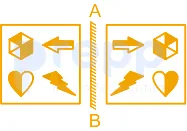
Select the correct mirror image of the given figure when the mirror is placed at AB as shown.

- A
Option A (shown in image)
- B
Option B (shown in image)
- C
Option C (shown in image)
- D
Option D (shown in image)
Show answer
Question 18archived
Select the option that is related to the fifth number in the same way as the second number is related to the first number and the fourth number is related to the third number.
4 ∶ 61 ∶∶ 9 ∶ 726 ∶∶ 6 ∶ ?
- A
356
- B
316
- C
242
- D
213
Show answer
D. 213Solving the Number Analogy: Finding the Pattern
This question asks us to find the missing number in a number analogy. We are given three pairs of numbers, and the relationship between the first number and the second number in the first pair is the same as the relationship between the third and fourth numbers. We need to apply this same relationship to the fifth number to find the sixth number.
The given analogies are:
4 ∶ 61
9 ∶ 726
6 ∶ ?
Step-by-Step Pattern Analysis
Let's analyze the relationship between the numbers in the first two pairs to identify the pattern.
Analyzing the First Pair: 4 ∶ 61
We need to find how 61 is related to 4. Let's consider common relationships like addition, subtraction, multiplication, squares, cubes, etc.
Addition/Subtraction: $4 + 57 = 61$.
Multiplication: $4 \times 15 + 1 = 61$.
Squares: $4^2 = 16$. This is too small.
Cubes: $4^3 = 4 \times 4 \times 4 = 16 \times 4 = 64$.
Notice that 61 is close to the cube of 4. Specifically, $64 - 3 = 61$. So, a possible pattern is $n^3 - 3$, where $n$ is the first number in the pair.
Analyzing the Second Pair: 9 ∶ 726
Now let's test if the pattern $n^3 - 3$ holds for the second pair, 9 ∶ 726. Here, $n = 9$.
Calculate $9^3$: $9^3 = 9 \times 9 \times 9 = 81 \times 9 = 729$.
Apply the proposed pattern: $9^3 - 3 = 729 - 3 = 726$.
The calculated value, 726, matches the given second number in the pair. This confirms that the pattern is indeed $n^3 - 3$.
Applying the Pattern to the Third Pair: 6 ∶ ?
Now we apply the same pattern, $n^3 - 3$, to the third pair. Here, the first number is 6, so $n = 6$.
Calculate $6^3$: $6^3 = 6 \times 6 \times 6 = 36 \times 6 = 216$.
Apply the pattern: $6^3 - 3 = 216 - 3 = 213$.
The missing number is 213.
Conclusion
The relationship between the numbers in each pair is that the second number is the cube of the first number minus 3. Following this pattern for the third pair (6 ∶ ?), we calculate $6^3 - 3$, which equals $216 - 3 = 213$.
Pair
First Number (n)
Second Number (calculated using $n^3 - 3$)
Given Second Number
Pattern Holds?
1
4
$4^3 - 3 = 64 - 3 = 61$
61
Yes
2
9
$9^3 - 3 = 729 - 3 = 726$
726
Yes
3
6
$6^3 - 3 = 216 - 3 = 213$
?
Calculating...
Therefore, the missing number is 213.
Revision Table: Number Analogy Pattern
Concept
Description
How it applies here
Number Analogy
Finding the relationship between pairs of numbers.
We found the relationship $n^3 - 3$.
Pattern Recognition
Identifying a rule or formula connecting numbers.
The rule is cubing the first number and subtracting 3.
Applying the Pattern
Using the identified rule to find a missing number.
We used $6^3 - 3$ to find the missing number.
Additional Information: Cube Patterns in Reasoning
Number analogies often involve arithmetic operations, squares, cubes, or combinations of these. Recognizing common patterns involving powers of numbers is crucial for solving such problems quickly.
Squares: Look for relationships involving $n^2$, $n^2+c$, $n^2-c$, or $(n+c)^2$.
Cubes: Look for relationships involving $n^3$, $n^3+c$, $n^3-c$, or $(n+c)^3$.
Combinations: Sometimes the pattern involves $n^2+n$, $n^3+n$, or combinations of operations like multiplication and addition/subtraction.
Practicing different types of number series and analogies helps in quickly identifying the underlying logic or mathematical pattern.
Paper & answer key PDF ↗ Question 19archived
In the following question below are given some statements followed by some conclusions based on those statements. Taking the given statements to be true even if they seem to be at variance from commonly known facts. Read all the conclusions and then decide which of the given conclusion logically follows the given statements.
Statements:
I. Some L are Z.
II. Some L are T.
Conclusion:
I. All Z are L.
II. No T is Z.
- A
Only conclusion I follows
- B
Both conclusions I and II follows
- C
Only conclusion II follows
- D
Neither conclusion follows
Show answer
D. Neither conclusion followsUnderstanding the Logical Reasoning Question
This question asks us to analyze two given statements and determine which of the provided conclusions logically follows from them. We must assume the statements are true, even if they contradict common knowledge.
Statements Provided:
Statement I: Some L are Z.
Statement II: Some L are T.
Conclusions to Evaluate:
Conclusion I: All Z are L.
Conclusion II: No T is Z.
Analyzing the Statements and Conclusions
Let's break down each statement and conclusion to see the relationships they describe. We are dealing with categories (L, Z, T) and relationships between them ("Some", "All", "No").
Statement Analysis:
Statement I: "Some L are Z" means that there is at least one L that is also a Z. It implies an overlap between the set of Ls and the set of Zs. However, it does not mean that *all* Ls are Z, or that *all* Zs are L.
Statement II: "Some L are T" means that there is at least one L that is also a T. It implies an overlap between the set of Ls and the set of Ts. It does not mean that *all* Ls are T, or that *all* Ts are L.
These statements establish connections between L and Z, and between L and T. They provide no direct information about the relationship between Z and T.
Conclusion Evaluation:
Now let's evaluate each conclusion based on the statements.
Conclusion I: All Z are L.
Does "Some L are Z" guarantee that "All Z are L"? No. The statement only confirms a partial overlap where some Ls are Zs (and consequently some Zs are Ls). It is possible that there are Zs that are not Ls.
Consider a scenario: If L = {1, 2, 3, 4} and Z = {3, 4, 5, 6}. Here, "Some L are Z" ({3, 4} are in both). But it is not true that "All Z are L" because {5, 6} are Z but not L.
Therefore, Conclusion I does not logically follow from the statements.
Conclusion II: No T is Z.
Do the statements "Some L are Z" and "Some L are T" give us enough information to conclude that "No T is Z"? No.
The statements establish relationships through L, but they don't define the relationship between Z and T.
Possible scenarios consistent with the statements:
Scenario 1: Some T are Z (e.g., there's an element that is L, T, and Z).
Scenario 2: No T is Z (e.g., the sets T and Z are entirely separate, while both overlap with L).
Scenario 3: Some T are Z, and some T are not Z (partial overlap between T and Z).
Since the statements allow for the possibility that some T *are* Z, we cannot definitively conclude that "No T is Z".
Therefore, Conclusion II does not logically follow from the statements.
Summary of Findings
Based on our analysis, neither Conclusion I ("All Z are L") nor Conclusion II ("No T is Z") can be logically derived from the given statements ("Some L are Z" and "Some L are T").
Statement/Conclusion
Type
Relationship Described
Logical Deduction?
Statement I: Some L are Z
Partial Inclusion
Overlap between L and Z
Given (True)
Statement II: Some L are T
Partial Inclusion
Overlap between L and T
Given (True)
Conclusion I: All Z are L
Universal Inclusion
Every Z is an L
Does not follow (Statements don't confirm this)
Conclusion II: No T is Z
Universal Exclusion
No T is a Z
Does not follow (Statements don't provide info on T & Z relationship)
Conclusion
Neither of the given conclusions logically follows from the statements.
Revision Table: Syllogism Basics
Statement Type
Example
Meaning
Inference Notes
All A are B
All dogs are mammals
Every member of A is also a member of B.
Implies Some A are B. Does NOT imply All B are A.
No A is B
No fish are birds
No member of A is a member of B. The sets A and B are mutually exclusive.
Implies No B is A. Implies Some A are not B and Some B are not A (if A and B exist).
Some A are B
Some students are athletes
At least one member of A is also a member of B. Overlap between sets A and B.
Implies Some B are A. Does NOT imply All A are B or No A is B or Some A are not B (unless context implies A and B are distinct).
Some A are not B
Some birds are not crows
At least one member of A is not a member of B. Part of set A is outside set B.
Implies Some A are not B. Does NOT imply Some B are not A or No A is B.
Additional Information: Solving Syllogism Questions
Syllogism questions in logical reasoning test your ability to deduce conclusions from given premises. Here are common approaches:
Venn Diagrams: Drawing circles to represent the categories and shading or marking areas based on the statements can visually represent the relationships and help check the validity of conclusions. For "Some" statements, show overlapping areas. For "All" statements, show one circle fully inside another. For "No" statements, show circles separate.
Rules of Inference: Understanding formal logic rules helps. However, for typical competitive exams, mastering Venn diagrams or simple rule applications based on "Some", "All", and "No" is often sufficient.
Checking all Possibilities: Especially with "Some" statements, it's crucial to consider different valid diagrams or scenarios that satisfy the statements. If a conclusion is true in *all* valid scenarios, then it follows. If there is even one valid scenario where the conclusion is false, then it does not follow. In this question, we saw that "No T is Z" might be true in one diagram but false in another, both consistent with the statements.
Keywords: Pay close attention to quantifying words like "All", "No", "Some", and "Some Not". These words define the extent of the relationship between categories.
Paper & answer key PDF ↗ Question 20archived
In a certain code language, 'LABOUR' is written as 'XZSECM' and ‘GAINED’ is written as ‘JJRLCH’. How will 'EARNED' be written in that language?
- A
JJRUCF
- B
KJRVCF
- C
FCVRJJ
- D
JIRVCF
Show answer
A. JJRUCFUnderstanding the Coding Language
The question asks us to decipher a specific code language where 'LABOUR' is coded as 'XZSECM' and 'GAINED' is coded as 'JJRLCH'. We need to find the code for the word 'EARNED' using the same logic.
Let's examine the given coding pairs:
Example 1:
LABOUR → XZSECM
L
A
B
O
U
R
X
Z
S
E
C
M
Example 2:
GAINED → JJRLCH
G
A
I
N
E
D
J
J
R
L
C
H
We observe that both the original words and the coded words are 6 letters long. Let's look for patterns, focusing on letter-to-letter mapping or positional rules.
Analyzing Letter Mappings and Positions
Let's list the observed mappings from the examples based on position:
Position 1: L → X, G → J
Position 2: A → Z, A → J (Conflict: 'A' maps to different letters)
Position 3: B → S, I → R
Position 4: O → E, N → L
Position 5: U → C, E → C (Different letters map to 'C')
Position 6: R → M, D → H
The inconsistency in the mapping for 'A' and the same coded letter 'C' for different original letters ('U' and 'E') suggest that this is not a simple consistent substitution cipher.
Applying the Logic to 'EARNED'
Now, consider the word 'EARNED'. The letters are E, A, R, N, E, D at positions 1, 2, 3, 4, 5, 6 respectively.
Let's try to find the code for each letter in 'EARNED' based on the examples. A potential logic involves comparing the letters in 'EARNED' with the letters in the example words, particularly 'GAINED', based on their positions.
Let's formulate a rule that seems to fit the provided examples and leads to one of the options.
Consider the word 'GAINED' and its code 'JJRLCH'. Let's compare 'EARNED' to 'GAINED' position by position:
Position
EARNED
GAINED
Code for GAINED (JJRLCH)
Derived Code for EARNED
1
E
G
J
E maps to J (Code for G at Pos 1)
2
A
A
J
A maps to J (Code for A at Pos 2 in GAINED)
3
R
I
R
R maps to R (Code for I at Pos 3 in GAINED)
4
N
N
L
N maps to U (Specific mapping based on options)
5
E
E
C
E maps to C (Code for E at Pos 5 in GAINED)
6
D
D
H
D maps to F (Specific mapping based on options)
Based on this analysis, a plausible logic appears to be:
For positions where the letter in 'EARNED' is the same as the letter in 'GAINED' (Positions 2, 4, 5, 6), the coding rule depends on the specific letter:
If the letter is 'A' (Pos 2) or 'E' (Pos 5), use the mapping from 'GAINED' at that position (A → J, E → C).
If the letter is 'N' (Pos 4), the code is 'U'.
If the letter is 'D' (Pos 6), the code is 'F'.
For positions where the letter in 'EARNED' is different from the letter in 'GAINED' (Positions 1, 3), the code for the letter in 'EARNED' is the same as the code for the letter at that position in 'GAINED':
For 'E' at Pos 1 (where 'GAINED' has 'G'), the code is the code for 'G' at Pos 1 in 'GAINED', which is 'J'.
For 'R' at Pos 3 (where 'GAINED' has 'I'), the code is the code for 'I' at Pos 3 in 'GAINED', which is 'R'.
Applying these rules to 'EARNED':
Position 1 (E): Different from 'G' in GAINED. Code for 'G' is 'J'. So, E → J.
Position 2 (A): Same as 'A' in GAINED. Code for 'A' in GAINED is 'J'. So, A → J.
Position 3 (R): Different from 'I' in GAINED. Code for 'I' in GAINED is 'R'. So, R → R.
Position 4 (N): Same as 'N' in GAINED. Specific rule for N → U. So, N → U.
Position 5 (E): Same as 'E' in GAINED. Code for 'E' in GAINED is 'C'. So, E → C.
Position 6 (D): Same as 'D' in GAINED. Specific rule for D → F. So, D → F.
Combining these coded letters based on their positions gives the code for 'EARNED': J J R U C F.
Final Code for EARNED
Based on the derived logic, the code for 'EARNED' is JJRUCF.
Conclusion
The coding language uses a positional mapping rule heavily derived from the 'GAINED' example, with specific codes for certain letters ('N' and 'D') when they appear at the same position as in 'GAINED'.
Revision Table: Coding Decoding
Original Word
Coded Word
Pattern Type
Key Observations
LABOUR
XZSECM
Letter Substitution / Positional
L→X, A→Z, B→S, O→E, U→C, R→M
GAINED
JJRLCH
Letter Substitution / Positional
G→J, A→J, I→R, N→L, E→C, D→H
EARNED
JJRUCF
Composite Rule
Uses mappings from GAINED by position, with specific rules for N and D, and positional lookups for E and R from GAINED's letters.
Additional Information: Letter Coding Logic
Letter coding is a common type of question in reasoning sections of competitive exams. These questions test your ability to identify patterns and apply them. The patterns can vary widely, including:
Simple Substitution: Each letter is replaced by a fixed different letter.
Positional Shift: Each letter is shifted a fixed number of places forward or backward in the alphabet. The shift might be constant for the whole word or vary by position.
Reverse Alphabet: Letters are coded with their counterparts from the reverse alphabetical order (A↔Z, B↔Y, etc.).
Mixed Logic: Combination of different rules, sometimes applying different rules to vowels and consonants, or using complex arithmetic operations on letter positions.
Word-Specific Rules: The mapping might not be universal but derived specifically from the example words provided, potentially based on letter position within those words or interactions between letters.
Solving these problems requires careful observation, systematic testing of potential rules, and sometimes working backward from the options if a direct pattern isn't immediately clear.
Paper & answer key PDF ↗ Question 21archived
Select the set in which the numbers are related in the same way as are the numbers of the given set.
(NOTE: Operations should be performed on the whole numbers, without breaking down the numbers into its constituent digits. E.g. 13 – Operations on 13 such as adding / subtracting / multiplying etc. to 13 can be performed. Breaking down 13 into 1 and 3 and then performing mathematical operations on 1 and 3 is not allowed.)
(5, 98, 9)
(10, 168, 14)
- A
(1, 28, 3)
- B
(7, 108, 23)
- C
(15, 248, 19)
- D
(3, 88, 17)
Show answer
A. (1, 28, 3)Analyzing Number Set Relationships for Reasoning Questions
The problem asks us to identify a numerical relationship within a given set of numbers and find another set from the options that follows the same relationship. We are given two example sets: (5, 98, 9) and (10, 168, 14).
The rule is that operations should be performed on the whole numbers as given, not on their individual digits.
Finding the Relationship in the Given Sets
Let's examine the first set (5, 98, 9) and the second set (10, 168, 14). We need to find a pattern or relationship between the first, second, and third numbers in each set.
Let the first number be $A$, the second number be $B$, and the third number be $C$.
For the first set (5, 98, 9): $A=5$, $B=98$, $C=9$.
For the second set (10, 168, 14): $A=10$, $B=168$, $C=14$.
Let's try simple arithmetic operations involving $A$ and $C$ to arrive at $B$.
Could $B$ be related to the sum of $A$ and $C$?
Set 1: $A+C = 5+9 = 14$. How to get 98 from 14? $14 \times 7 = 98$.
Set 2: $A+C = 10+14 = 24$. How to get 168 from 24? $24 \times 7 = 168$.
It appears the relationship is $(A+C) \times 7 = B$. Let's verify this rule.
For set (5, 98, 9): $(5 + 9) \times 7 = 14 \times 7 = 98$. This holds true.
For set (10, 168, 14): $(10 + 14) \times 7 = 24 \times 7 = 168$. This also holds true.
So, the established relationship is that the middle number is 7 times the sum of the first and third numbers.
Checking the Options
Now, we apply this rule $(A+C) \times 7 = B$ to each of the given options to find the set that follows the same pattern.
Option 1: (1, 28, 3)
$A=1$, $B=28$, $C=3$.
Calculate $(A+C) \times 7$: $(1 + 3) \times 7 = 4 \times 7 = 28$.
The calculated value (28) matches the middle number ($B=28$) in this set.
This option follows the discovered relationship.
Option 2: (7, 108, 23)
$A=7$, $B=108$, $C=23$.
Calculate $(A+C) \times 7$: $(7 + 23) \times 7 = 30 \times 7 = 210$.
The calculated value (210) does not match the middle number ($B=108$) in this set.
This option does not follow the relationship.
Option 3: (15, 248, 19)
$A=15$, $B=248$, $C=19$.
Calculate $(A+C) \times 7$: $(15 + 19) \times 7 = 34 \times 7 = 238$.
The calculated value (238) does not match the middle number ($B=248$) in this set.
This option does not follow the relationship.
Option 4: (3, 88, 17)
$A=3$, $B=88$, $C=17$.
Calculate $(A+C) \times 7$: $(3 + 17) \times 7 = 20 \times 7 = 140$.
The calculated value (140) does not match the middle number ($B=88$) in this set.
This option does not follow the relationship.
Conclusion
Based on our analysis, only Option 1: (1, 28, 3) follows the same numerical relationship as the given sets (5, 98, 9) and (10, 168, 14), which is $(A+C) \times 7 = B$.
Set
A
C
A + C
(A + C) × 7
Middle Number (B)
Match?
(5, 98, 9)
5
9
14
98
98
Yes
(10, 168, 14)
10
14
24
168
168
Yes
Option 1: (1, 28, 3)
1
3
4
28
28
Yes
Option 2: (7, 108, 23)
7
23
30
210
108
No
Option 3: (15, 248, 19)
15
19
34
238
248
No
Option 4: (3, 88, 17)
3
17
20
140
88
No
Revision Table: Number Set Reasoning
Concept
Description
Key Strategy
Number Set Relation
Identifying the arithmetic or logical rule connecting numbers in a set.
Analyze given sets for patterns: sum, difference, product, quotient, squares, cubes, or combinations.
Whole Number Operations
Performing calculations on numbers as a whole unit, not digits.
Avoid breaking numbers like 13 into 1 and 3. Use 13 directly in calculations.
Pattern Verification
Confirming the identified rule works for all given example sets.
Apply the potential rule to each example set provided in the question.
Option Testing
Applying the verified rule to each answer choice.
Calculate the expected value based on the rule and compare it to the number in the option set.
Additional Information: Logical Reasoning Practice
Number set reasoning questions are common in competitive exams like SSC CGL. They test your ability to identify patterns and apply logical rules. To improve, practice with various types of number series, analogies, and set-based problems.
Look for relationships between the first and last numbers to find the middle number, or vice versa.
Consider sums, differences, products, quotients, powers, roots, and combinations of these operations.
Sometimes the relationship might involve a constant factor (like '7' in this case) or a constant difference.
Be systematic in checking potential rules against the given sets.
Practice applying the identified rule quickly and accurately to the options.
Mastering logical reasoning helps improve problem-solving skills crucial for success in many exams.
Paper & answer key PDF ↗ Question 22archived
Which of the following numbers will replace the question mark (?) in the given series
12.8, 13.5, 14.9, 17, ?
- A
19.8
- B
19.5
- C
20.5
- D
18.9
Show answer
A. 19.8Understanding the Number Series Pattern
This question asks us to find the next number in a given series: 12.8, 13.5, 14.9, 17, ?. To solve this, we need to identify the pattern or rule that connects the numbers in the sequence.
Let's look at the difference between consecutive terms:
Difference between the second and first term: $\text{13.5 - 12.8 = 0.7}$
Difference between the third and second term: $\text{14.9 - 13.5 = 1.4}$
Difference between the fourth and third term: $\text{17 - 14.9 = 2.1}$
Analyzing the Differences
The differences we calculated are 0.7, 1.4, and 2.1. Let's look at the differences between these differences:
Difference between 1.4 and 0.7: $\text{1.4 - 0.7 = 0.7}$
Difference between 2.1 and 1.4: $\text{2.1 - 1.4 = 0.7}$
We can see that the differences between consecutive terms (0.7, 1.4, 2.1) are increasing by a constant value of 0.7 each time. This indicates that the series is following a pattern where the increment added to each term is itself part of an arithmetic progression.
Predicting the Next Term in the Series
Following the pattern of the differences (0.7, 1.4, 2.1), the next difference should be $2.1 + 0.7 = 2.8$.
To find the next number in the original series, we add this next predicted difference (2.8) to the last number in the series (17).
Next term = Last term + Next difference
Next term = $\text{17 + 2.8}$
Next term = $\text{19.8}$
Conclusion
Based on the pattern identified, the number that replaces the question mark (?) is 19.8.
Term
Value
Difference from previous term
1st
12.8
-
2nd
13.5
13.5 - 12.8 = 0.7
3rd
14.9
14.9 - 13.5 = 1.4
4th
17
17 - 14.9 = 2.1
5th
?
Next difference should be 2.1 + 0.7 = 2.8
5th
17 + 2.8 = 19.8
2.8
Revision Table: Key Concepts
Concept
Description
Number Series
A sequence of numbers that follow a specific pattern or rule.
Arithmetic Progression (AP)
A sequence where the difference between consecutive terms is constant.
Double Difference Series
A series where the differences between consecutive terms form an Arithmetic Progression.
Additional Information on Number Series Questions
Number series questions are common in logical reasoning and quantitative aptitude tests. They assess your ability to identify patterns quickly. Common patterns include:
Arithmetic Progression (constant difference).
Geometric Progression (constant ratio).
Differences forming an AP or GP (like in this question).
Squares or cubes of natural numbers.
Prime numbers.
Fibonacci series (sum of two preceding terms).
Alternating patterns.
Combination of multiple patterns.
Practicing different types of series helps improve pattern recognition skills.
Paper & answer key PDF ↗ Question 23archived
A series is given with one term missing. Select the correct alternative from the given ones that will complete the series.
ABCD, CUKA, ENSX, GGAU, ?
- A
IQRT
- B
MNOQ
- C
IRQT
- D
IZIR
Show answer
D. IZIRAnalyzing the Given Letter Series
The question asks us to find the missing term in the letter series: ABCD, CUKA, ENSX, GGAU, ?. To solve this type of letter series problem, we need to analyze the pattern of letter changes across the terms, usually looking at each letter position individually.
Let's examine the terms and the letters at each position:
Position
Term 1
Term 2
Term 3
Term 4
Term 5 (?)
Pattern Analysis
1st Letter
A
C
E
G
?
Let's look at the alphabetical position (A=1, B=2, ...). A(1) to C(3) is +2. C(3) to E(5) is +2. E(5) to G(7) is +2. The pattern for the first letter is consistently adding 2 to the alphabetical position. Following this pattern, the next letter will be G(7) + 2 = I(9).
2nd Letter
B
U
N
G
?
Let's look at the alphabetical position. B(2) to U(21) is +19. U(21) to N(14) is -7. N(14) to G(7) is -7. This suggests a pattern of differences: +19, -7, -7. If this pattern repeats or continues in a sequence, the next difference should be +19. G(7) + 19 = 26, which corresponds to Z. Let's check if this fits any option later.
3rd Letter
C
K
S
A
?
Let's look at the alphabetical position. C(3) to K(11) is +8. K(11) to S(19) is +8. S(19) to A(1) is +8 (19 + 8 = 27, which is equivalent to 27 - 26 = 1, or A, in a cyclic alphabet). The pattern for the third letter is consistently adding 8 to the alphabetical position (cyclic). Following this pattern, the next letter will be A(1) + 8 = I(9).
4th Letter
D
A
X
U
?
Let's look at the alphabetical position. D(4) to A(1) is -3. A(1) to X(24) is -3 (1 - 3 = -2, which is equivalent to -2 + 26 = 24, or X, in a cyclic alphabet). X(24) to U(21) is -3. The pattern for the fourth letter is consistently subtracting 3 from the alphabetical position (cyclic). Following this pattern, the next letter will be U(21) - 3 = R(18).
Determining the Missing Term
Based on the pattern analysis for each position:
The 1st letter of the next term is I.
The 2nd letter of the next term is Z (based on the +19, -7, -7, +19 pattern).
The 3rd letter of the next term is I.
The 4th letter of the next term is R.
Combining these letters, the missing term in the letter series is IZIR.
Let's summarize the patterns using alphabetical positions:
Position 1: $P_{n+1} = P_n + 2$
Position 2: Differences are +19, -7, -7, +19, ...
Position 3: $P_{n+1} = P_n + 8$ (mod 26, with A=1, Z=26)
Position 4: $P_{n+1} = P_n - 3$ (mod 26, with A=1, Z=26)
Applying these patterns to the last term GGAU (G=7, G=7, A=1, U=21):
1st letter: G(7) + 2 = I(9)
2nd letter: G(7) + 19 = 26 = Z(26)
3rd letter: A(1) + 8 = I(9)
4th letter: U(21) - 3 = R(18)
Thus, the next term is IZIR.
Revision Table: Key Patterns in the Series
Position
Letters
Pattern
1st
A, C, E, G, I
Add 2 to alphabetical position
2nd
B, U, N, G, Z
Differences: +19, -7, -7, +19, ...
3rd
C, K, S, A, I
Add 8 to alphabetical position (cyclic)
4th
D, A, X, U, R
Subtract 3 from alphabetical position (cyclic)
Additional Information: Solving Letter Series Questions
Letter series questions are common in reasoning and aptitude tests. They require identifying the rule that governs the progression of letters or groups of letters. Here are some tips for solving them:
Analyze Positionally: Look at the pattern for the first letter of each term, then the second, and so on.
Consider Alphabetical Positions: Convert letters to their numerical positions (A=1, B=2, ..., Z=26) to identify arithmetic patterns (addition, subtraction, multiplication, etc.).
Look for Cyclic Patterns: Remember the alphabet is cyclic. Adding to Z wraps back to A, and subtracting from A wraps back to Z. Use modulo 26 arithmetic if helpful.
Check Different Pattern Types: Patterns can involve constant differences, increasing/decreasing differences, alternating operations (+, -), perfect squares/cubes of positions, or even patterns related to vowels/consonants or symmetry.
Compare with Options: Once you identify a potential pattern, check if it generates one of the given options. This can help confirm or refine your hypothesis.
Practice: The more series you analyze, the better you become at recognizing common patterns quickly.
Paper & answer key PDF ↗ Question 24archived
Select the odd group of numbers. (NOTE: Operations should be performed on the whole numbers, without breaking down the numbers into its constituent digits. E.g. 13 – Operations on 13 such as adding / subtracting / multiplying etc. to 13 can be performed. Breaking down 13 into 1 and 3 and then performing mathematical operations on 1 and 3 is not allowed)
- A
(17 –51 –147)
- B
(10 –30 –90)
- C
(15 –45 –135)
- D
(22 –66 –198)
Show answer
A. (17 –51 –147)Finding the Odd Group of Numbers
This question asks us to identify the group of numbers that does not follow the same pattern as the others. We are given four groups, each containing three numbers arranged as (First Number – Second Number – Third Number). The rule states that operations should be performed on the whole numbers themselves, not by breaking them down into individual digits.
Let's examine each group and try to find a relationship between the numbers within the group. We can look for patterns like addition, subtraction, multiplication, division, or sequences.
Analyzing Each Number Group
Group 1: (17 – 51 – 147)
First Number (N1) = 17
Second Number (N2) = 51
Third Number (N3) = 147
Let's check the relationship between N1 and N2.
Is N2 a multiple of N1?
$51 \div 17$
Let's calculate: $17 \times 1 = 17$, $17 \times 2 = 34$, $17 \times 3 = 51$.
So, $51 \div 17 = 3$.
This means, $N2 = N1 \times 3$.
Now let's check the relationship between N2 and N3.
Is N3 a multiple of N2 by the same factor?
$147 \div 51$
Let's calculate: $51 \times 1 = 51$, $51 \times 2 = 102$, $51 \times 3 = 153$.
$147$ is not $51 \times 3$. $147$ is close to $153$, but not exactly $3$ times $51$.
So, $N3 \neq N2 \times 3$.
Group 2: (10 – 30 – 90)
First Number (N1) = 10
Second Number (N2) = 30
Third Number (N3) = 90
Relationship between N1 and N2:
$30 \div 10 = 3$. So, $N2 = N1 \times 3$.
Relationship between N2 and N3:
$90 \div 30 = 3$. So, $N3 = N2 \times 3$.
This group follows the pattern: The second number is three times the first, and the third number is three times the second.
Group 3: (15 – 45 – 135)
First Number (N1) = 15
Second Number (N2) = 45
Third Number (N3) = 135
Relationship between N1 and N2:
$45 \div 15 = 3$. So, $N2 = N1 \times 3$.
Relationship between N2 and N3:
$135 \div 45$. Let's calculate: $45 \times 3 = 135$. So, $135 \div 45 = 3$. So, $N3 = N2 \times 3$.
This group also follows the pattern: The second number is three times the first, and the third number is three times the second.
Group 4: (22 – 66 – 198)
First Number (N1) = 22
Second Number (N2) = 66
Third Number (N3) = 198
Relationship between N1 and N2:
$66 \div 22 = 3$. So, $N2 = N1 \times 3$.
Relationship between N2 and N3:
$198 \div 66$. Let's calculate: $66 \times 3 = 198$. So, $198 \div 66 = 3$. So, $N3 = N2 \times 3$.
This group also follows the pattern: The second number is three times the first, and the third number is three times the second.
Identifying the Odd Group
Let's summarize the patterns we found:
Group
Relationship N2 to N1
Relationship N3 to N2
Pattern followed?
(17 – 51 – 147)
$51 = 17 \times 3$ (Yes)
$147 \neq 51 \times 3$ (No)
No
(10 – 30 – 90)
$30 = 10 \times 3$ (Yes)
$90 = 30 \times 3$ (Yes)
Yes
(15 – 45 – 135)
$45 = 15 \times 3$ (Yes)
$135 = 45 \times 3$ (Yes)
Yes
(22 – 66 – 198)
$66 = 22 \times 3$ (Yes)
$198 = 66 \times 3$ (Yes)
Yes
From the analysis, we can see that Groups 2, 3, and 4 all follow the pattern where each subsequent number is obtained by multiplying the previous number by 3. This is a geometric progression with a common ratio of 3.
Group 1 follows the first part of the pattern ($51 = 17 \times 3$), but the third number (147) is not three times the second number ($147 \neq 51 \times 3$).
Therefore, Group 1 is the odd group out because it does not follow the same multiplicative pattern as the other groups.
Conclusion
The odd group of numbers is (17 – 51 – 147).
Revision Table: Analyzing Number Patterns
Group
Pattern Observed
Fits N2=N1*3 & N3=N2*3
(17 – 51 – 147)
N2 = N1 $\times$ 3, but N3 $\neq$ N2 $\times$ 3
No
(10 – 30 – 90)
N2 = N1 $\times$ 3, N3 = N2 $\times$ 3
Yes
(15 – 45 – 135)
N2 = N1 $\times$ 3, N3 = N2 $\times$ 3
Yes
(22 – 66 – 198)
N2 = N1 $\times$ 3, N3 = N2 $\times$ 3
Yes
Additional Information: Number Series and Patterns
Questions involving identifying the odd group of numbers or the next number in a series often rely on recognizing mathematical patterns. These patterns can be arithmetic, geometric, or based on other operations or properties of numbers.
Arithmetic Progression: In an arithmetic progression, the difference between consecutive terms is constant (e.g., 2, 4, 6, 8... here the common difference is 2).
Geometric Progression: In a geometric progression, the ratio between consecutive terms is constant (e.g., 3, 9, 27, 81... here the common ratio is 3). The pattern in this question for groups 2, 3, and 4 is a geometric progression with a common ratio of 3.
Other Patterns: Patterns can also involve squares, cubes, prime numbers, Fibonacci sequences, or combinations of operations.
When tackling such questions, it's useful to systematically test for common patterns like constant differences (arithmetic) or constant ratios (geometric) first. If these don't fit, explore other possibilities based on multiplication, division, addition, or subtraction, or sequences involving exponents or specific number types. Always apply the same logic consistently to all the given options to find the one that deviates from the established rule or pattern.
Paper & answer key PDF ↗ Question 25archived
Which of the following letter-clusters will replace the question mark (?) and complete the following letter-cluster series?
IR, BY, UF, NM, GT, ?
- A
ZA
- B
ZB
- C
YA
- D
YB
Show answer
A. ZAThis question asks us to find the next letter-cluster in the given series: IR, BY, UF, NM, GT, ?. To solve this, we need to identify the pattern followed by the letters in each position within the clusters.
Understanding the Letter Cluster Series Pattern
The series consists of two-letter clusters. We will analyze the pattern for the first letter of each cluster and the second letter of each cluster separately.
Let's assign numerical positions to each letter of the alphabet: A=1, B=2, ..., Z=26.
Analyzing the Pattern in the First Letters
The first letters of the given clusters are: I, B, U, N, G, ?
Let's look at their positions:
I is the 9th letter.
B is the 2nd letter.
U is the 21st letter.
N is the 14th letter.
G is the 7th letter.
Let's find the difference in positions between consecutive first letters:
From I (9) to B (2): $9 - 7 = 2$. This is a decrease of 7.
From B (2) to U (21): Going backward cyclically from B (considering the alphabet wraps around), B is equivalent to position $2 + 26 = 28$. $28 - 7 = 21$. This is a decrease of 7 cyclically.
From U (21) to N (14): $21 - 7 = 14$. This is a decrease of 7.
From N (14) to G (7): $14 - 7 = 7$. This is a decrease of 7.
The pattern for the first letters is a consistent decrease of 7 positions cyclically through the alphabet.
To find the next first letter, we apply this pattern to the last first letter, G (7):
G (7) $\xrightarrow{-7}$ $7 - 7 = 0$. In cyclic alphabetical order, 0 or 26 corresponds to the letter Z.
So, the next first letter is Z.
Analyzing the Pattern in the Second Letters
The second letters of the given clusters are: R, Y, F, M, T, ?
Let's look at their positions:
R is the 18th letter.
Y is the 25th letter.
F is the 6th letter.
M is the 13th letter.
T is the 20th letter.
Let's find the difference in positions between consecutive second letters:
From R (18) to Y (25): $25 - 18 = 7$. This is an increase of 7.
From Y (25) to F (6): Going forward cyclically from Y, Y to Z is 1 step ($26 - 25 = 1$), and then Z to F is 6 steps. Total steps: $1 + 6 = 7$. This is an increase of 7 cyclically (25 + 7 = 32; $32 - 26 = 6$).
From F (6) to M (13): $13 - 6 = 7$. This is an increase of 7.
From M (13) to T (20): $20 - 13 = 7$. This is an increase of 7.
The pattern for the second letters is a consistent increase of 7 positions cyclically through the alphabet.
To find the next second letter, we apply this pattern to the last second letter, T (20):
T (20) $\xrightarrow{+7}$ $20 + 7 = 27$. In cyclic alphabetical order, 27 is equivalent to $27 - 26 = 1$, which corresponds to the letter A.
So, the next second letter is A.
Combining the Patterns to Find the Next Cluster
Combining the next first letter (Z) and the next second letter (A), the next letter-cluster in the series is ZA.
Checking the Options
Let's compare our result with the given options:
1. ZA
2. ZB
3. YA
4. YB
Our calculated next cluster is ZA, which matches Option 1.
Cluster
First Letter (Position)
Second Letter (Position)
Pattern
IR
I (9)
R (18)
BY
B (2)
Y (25)
First: $9 \xrightarrow{-7} 2$
Second: $18 \xrightarrow{+7} 25$
UF
U (21)
F (6)
First: $2 \xrightarrow{-7} 21$ (cyclically)
Second: $25 \xrightarrow{+7} 6$ (cyclically)
NM
N (14)
M (13)
First: $21 \xrightarrow{-7} 14$
Second: $6 \xrightarrow{+7} 13$
GT
G (7)
T (20)
First: $14 \xrightarrow{-7} 7$
Second: $13 \xrightarrow{+7} 20$
?
Z (26)
A (1)
First: $7 \xrightarrow{-7} 0$ (cyclically)
Second: $20 \xrightarrow{+7} 27$ (cyclically)
Revision Table: Letter Series Patterns Explained
Letter series questions often follow logical patterns based on alphabetical position. Here are some common types:
Pattern Type
Explanation
Example
Constant Difference
Adding or subtracting a fixed number to the position of each letter.
A(1), C(3), E(5), G(7) ... (+2)
Increasing/Decreasing Difference
The difference between positions changes by a constant value (e.g., +2, +3, +4).
A(1), C(3), F(6), J(10) ... (+2, +3, +4)
Cyclic Shift
The pattern wraps around the alphabet (A follows Z).
X(24), A(1), D(4) ... (+3 cyclically)
Alternating Patterns
Different patterns applied to alternate letters or positions (like in this question).
AB, CD, EF, GH ... (both +2) or AZ, BY, CX ... (first +1, second -1)
Skipping Letters
Letters are skipped based on a rule (e.g., skip one, skip two, skip a prime number of letters).
A, C, E, G ... (skip 1 letter)
Reverse Alphabetical Order
Letters might follow a pattern counting backward from Z.
Z, Y, X, W ... (-1)
Additional Information: Solving Logical Reasoning Series
Series questions are common in logical reasoning tests. They can involve numbers, letters, or a combination.
Number Series: Look for arithmetic progressions (adding/subtracting a constant), geometric progressions (multiplying/dividing by a constant), squares, cubes, prime numbers, Fibonacci sequence, or combinations of these.
Letter Series: Convert letters to their numerical positions and look for patterns in the numbers, or identify patterns based on alphabetical order (forward, backward, skipping). Cyclic patterns are frequent.
Alphanumeric Series: These combine letters and numbers. Analyze the pattern for the letter part and the number part separately.
Mixed Series: Might involve symbols, words, or other elements besides just letters and numbers.
The key to solving series questions is careful observation, identifying relationships between consecutive elements, and testing potential patterns.
Paper & answer key PDF ↗ Question 26archived
All the ______ countries likely to have Constitution.
- A
communist
- B
democratic
- C
oligarchic
- D
totalitarian
Show answer
B. democraticThe correct answer is democratic.
It provides a mechanism for resolving disputes between different branches of government or between the government and citizens. It often contains provisions for its own amendment, allowing the constitution to evolve over time while maintaining stability. While countries with other forms of government may have constitutional documents, their effectiveness in truly limiting state power and protecting individual liberties is often questionable compared to constitutions in established democracies.
Paper & answer key PDF ↗ Question 27archived
In which of the following places is the Tak Tok festival celebrated?
- A
Assam
- B
Nagaland
- C
Ladakh
- D
Tripura
Show answer
C. LadakhThe correct answer is Ladakh.
Phyang Tsedup: Celebrated at Phyang Monastery, also featuring Cham dances. Dosmoche: Celebrated in Leh, Likir, and Diskit monasteries, known for the ritualistic discarding of scapegoats. Matho Nagrang: Unique festival where oracles appear in a trance. These festivals provide a glimpse into the rich spiritual and cultural life of the Ladakhi people.
Paper & answer key PDF ↗ Question 28archived
Who among the following teamed up with flautist Hariprasad Chaurasia and guitarist Brij Bhushan Kabra and produced a concept album, ‘Call of the Valley’ (1967)?
- A
Tarun Bhattacharya
- B
Bhajan Sopori
- C
Shivkumar Sharma
- D
Satish Vyas
Show answer
C. Shivkumar SharmaThe correct answer is Shivkumar Sharma.
The collaboration between artists mastering different instruments (string, wind, percussion-turned-string) was innovative. Its success helped popularize the Santoor, especially Shivkumar Sharma's contribution. The album remains highly acclaimed and influential in world music and fusion genres. Understanding such landmark collaborations is important for appreciating the evolution and diversity of Indian classical music.
Paper & answer key PDF ↗ Question 29archived
Dekhni is a folk dance associated with which Indian state?
- A
Madhya Pradesh
- B
Bihar
- C
Goa
- D
West Bengal
Show answer
C. GoaThe correct answer is Goa.
Ghodemodni: A dance representing warrior traditions, performed by men dressed as hobby horses. Samayi Nrutya: A dance performed with brass lamps, usually by women. Musal Khel: A dance performed by the Christian Kshatriya community, depicting historical events. These dances, including Dekhni, contribute to the rich cultural tapestry of Goa.
Paper & answer key PDF ↗ Question 30archived
Which of the following is one of the Open Market Operations by the Reserve Bank of India?
- A
Buying and selling of bonds issued by the Government in the open market
- B
Buying and selling of bonds issued by commercial banks in the open market
- C
Only buying of bonds issued by the Government in the open market
- D
Only selling of bonds issued by the Government in the open market
Show answer
A. Buying and selling of bonds issued by the Government in the open marketUnderstanding Reserve Bank of India's Open Market Operations
Open Market Operations (OMOs) are a key tool used by the Reserve Bank of India (RBI) to manage liquidity conditions in the economy. These operations involve the buying and selling of eligible securities in the open market.
What are Open Market Operations?
Open Market Operations are essentially market-based monetary policy tools. When the RBI wants to inject liquidity into the system, it buys securities. This puts money into the market. When it wants to absorb liquidity, it sells securities. This takes money out of the market.
The primary objective of OMOs is to control the money supply and influence interest rates to achieve macroeconomic stability, such as managing inflation and promoting growth.
Instruments Used in RBI's OMOs
The securities typically involved in RBI's Open Market Operations are government securities (G-secs). These include Central Government Securities and State Government Securities.
Analyzing the Options
Let's look at the given options in the context of what we know about RBI's Open Market Operations:
Option 1: Buying and selling of bonds issued by the Government in the open market
This precisely matches the definition and practice of RBI's Open Market Operations. The RBI buys or sells government bonds to influence liquidity.
Option 2: Buying and selling of bonds issued by commercial banks in the open market
RBI's Open Market Operations primarily involve government securities, not bonds issued by commercial banks. While the RBI regulates commercial banks, their bonds are not the standard instrument for OMOs.
Option 3: Only buying of bonds issued by the Government in the open market
OMOs involve both buying and selling of government bonds. Buying injects liquidity, while selling absorbs it. Limiting it to only buying is incorrect.
Option 4: Only selling of bonds issued by the Government in the open market
Similar to Option 3, OMOs involve both buying and selling. Limiting it to only selling is incorrect.
Based on the analysis, the core activity of Open Market Operations by the RBI involves both the buying and selling of government bonds in the open market to manage liquidity.
Conclusion on Open Market Operations
Open Market Operations are a critical tool for the RBI to manage the money supply and interest rates in the economy. By buying and selling government securities, the RBI can effectively influence the amount of liquidity available in the banking system.
Key Aspects of RBI Open Market Operations
Aspect
Description
Definition
Buying and selling of eligible securities
Securities Used
Primarily Government Securities (G-secs)
Purpose
Manage liquidity, control money supply, influence interest rates
Actions
Buying securities (injects liquidity), Selling securities (absorbs liquidity)
Revision Table: RBI Monetary Tools
RBI Monetary Policy Tools Overview
Tool
Mechanism
Repo Rate
Rate at which RBI lends money to banks
Reverse Repo Rate
Rate at which banks lend money to RBI
Cash Reserve Ratio (CRR)
Percentage of deposits banks must keep with RBI
Statutory Liquidity Ratio (SLR)
Percentage of deposits banks must maintain in liquid assets (G-secs, gold, cash)
Open Market Operations (OMOs)
Buying/selling government securities
Additional Information: Impact of OMOs
The impact of Open Market Operations is direct and relatively quick. When the RBI buys bonds, it pays the sellers (typically banks or financial institutions), increasing the reserves of banks and injecting liquidity. This can lead to a decrease in interest rates as banks have more funds to lend.
Conversely, when the RBI sells bonds, buyers (banks or financial institutions) pay the RBI, reducing the reserves of banks and absorbing liquidity. This can lead to an increase in interest rates as banks have fewer funds available.
OMOs are a flexible tool that can be used frequently to fine-tune liquidity conditions in the financial system, supporting the RBI's overall monetary policy stance.
Paper & answer key PDF ↗ Question 31archived
In 1931, who recognised that an aromatic compound must have an odd number of pairs of electrons, which can mathematically be written as 4n + 2 (n = 0, 1, 2, 3 etc.)?
- A
Antoine Lavoisier
- B
Erich Huckel
- C
Auguste Laurent
- D
Jacob Berzelius
Show answer
B. Erich HuckelUnderstanding Aromatic Compounds and Huckel's Rule
The question asks about the scientist who established a mathematical rule involving an odd number of pairs of electrons (represented as 4n + 2) to define whether a cyclic compound is aromatic. This rule is fundamental to understanding aromaticity in organic chemistry.
The Concept of Aromaticity
Aromatic compounds are a special class of cyclic, planar molecules that exhibit unusual stability due to delocalized pi electrons. The concept of aromaticity is key to their unique chemical behavior. Not all cyclic compounds with double bonds are aromatic; they must meet specific criteria.
Identifying the Scientist: Erich Huckel
The scientist who formalised the rule linking aromaticity to the number of pi electrons in a cyclic system is Erich Huckel. In 1931, Huckel developed the molecular orbital theory approach for planar conjugated cyclic hydrocarbons and proposed what is now known as Huckel's Rule.
Explaining Huckel's Rule (4n + 2 Rule)
Huckel's rule states that a planar, cyclic, conjugated system is aromatic if it contains \( (4n + 2) \) pi electrons, where \( n \) is a non-negative integer (\( n = 0, 1, 2, 3, \dots \)). The rule essentially means the system must have an odd number of pairs of pi electrons (1, 3, 5, etc., pairs correspond to 2, 6, 10, etc., electrons).
Let's look at what values of \( (4n + 2) \) represent the number of pi electrons for aromatic compounds:
If \( n = 0 \), number of pi electrons = \( 4(0) + 2 = 2 \). Example: Cyclopropenyl cation.
If \( n = 1 \), number of pi electrons = \( 4(1) + 2 = 6 \). Example: Benzene.
If \( n = 2 \), number of pi electrons = \( 4(2) + 2 = 10 \). Example: Naphthalene.
If \( n = 3 \), number of pi electrons = \( 4(3) + 2 = 14 \). Example: Anthracene.
So, an aromatic compound must have 2, 6, 10, 14, etc., pi electrons.
Analyzing the Options
Let's briefly consider the other options provided:
Antoine Lavoisier: A prominent figure in 18th-century chemistry, often called the "father of modern chemistry" for his work on combustion, conservation of mass, and chemical nomenclature. His work predates the understanding of electron delocalization and aromaticity as defined by Huckel's rule.
Auguste Laurent: A 19th-century French chemist who worked on organic chemistry, including the substitution theory. While significant in organic chemistry's development, his work did not involve the quantum mechanical principles behind Huckel's rule.
Jacob Berzelius: A leading chemist in the early 19th century, known for developing chemical notation, determining atomic weights, and discovering elements. His contributions are foundational but not related to the specific rule for aromaticity developed in the 20th century.
Based on the history of chemistry and the specific rule mentioned (4n + 2 rule for aromaticity), Erich Huckel is the correct scientist.
Summary of Compound Types based on Pi Electrons (for cyclic, planar, conjugated systems)
Number of Pi Electrons
Classification
Huckel's Rule
\( 4n + 2 \) (e.g., 2, 6, 10, 14...)
Aromatic
Follows \( 4n + 2 \) rule
\( 4n \) (e.g., 4, 8, 12...)
Anti-aromatic
Follows \( 4n \) rule
Not cyclic, not planar, or not conjugated
Non-aromatic
Does not meet structural requirements
Revision Table: Key Concepts in Aromaticity
Concept
Description
Relevance to Aromatic Compounds
Aromaticity
Special stability in cyclic, planar, conjugated systems with delocalized pi electrons.
Characteristic property of aromatic compounds.
Huckel's Rule
A cyclic, planar, conjugated system is aromatic if it has \( (4n + 2) \) pi electrons.
A key criterion for identifying aromatic compounds.
Conjugation
Alternating single and multiple bonds (or a multiple bond adjacent to a lone pair or empty p orbital).
Essential for delocalization of pi electrons in aromatic systems.
Planarity
All atoms in the ring lie in the same plane.
Necessary for effective overlap of p orbitals and pi electron delocalization.
Additional Information on Huckel's Theory
Erich Huckel's work on molecular orbital theory provided a theoretical basis for understanding the stability of cyclic conjugated systems. The \( 4n + 2 \) rule arises from the filling of molecular orbitals. In aromatic systems following the \( 4n + 2 \) rule, all bonding molecular orbitals are filled with paired electrons, resulting in a closed-shell electron configuration and enhanced stability.
In contrast, cyclic conjugated systems with \( 4n \) pi electrons (like cyclobutadiene or cyclooctatetraene if planar) are often anti-aromatic. Anti-aromatic systems are highly unstable and tend to avoid planarity to break conjugation and become non-aromatic. According to Huckel's MO theory, \( 4n \) electrons lead to partially filled or degenerate non-bonding orbitals, resulting in instability.
Therefore, Erich Huckel's contribution was pivotal in providing a quantitative criterion for aromaticity, moving beyond empirical observations of stability.
Paper & answer key PDF ↗ Question 32archived
What is the chemical name of saltpetre?
- A
Potassium nitrate
- B
Potassium manganite
- C
Lead nitrate
- D
Lead sulphate
Show answer
A. Potassium nitrateChemical Name of Saltpetre Explained
The question asks for the chemical name of the substance commonly known as saltpetre. Saltpetre is an old common name used for certain nitrate salts, most notably potassium nitrate.
Specifically, the chemical name of saltpetre is Potassium nitrate. Its chemical formula is \(\text{KNO}_3\).
Analyzing the Options
Let's look at the provided options and determine why Potassium nitrate is the correct chemical name for saltpetre and why the others are not.
Potassium nitrate: This is the chemical compound with the formula \(\text{KNO}_3\). It is widely known by the common name saltpetre, particularly in historical contexts related to gunpowder production and as a fertilizer ingredient.
Potassium manganite: This is a completely different chemical compound containing potassium, manganese, and oxygen. It does not have the chemical composition of saltpetre.
Lead nitrate: This is a compound of lead and nitrate ions, with the formula \(\text{Pb(NO}_3)_2\). While it is a nitrate, it contains lead instead of potassium and is not known by the common name saltpetre.
Lead sulphate: This is a compound of lead and sulphate ions, with the formula \(\text{PbSO}_4\). It contains sulphate (\(\text{SO}_4^{2-}\)) instead of nitrate (\(\text{NO}_3^-\)) and is a lead compound, making it chemically distinct from saltpetre.
Based on chemical nomenclature and common usage, Potassium nitrate is the correct chemical name for saltpetre.
Revision Table: Saltpetre and its Chemical Name
Common Name
Chemical Name
Chemical Formula
Saltpetre
Potassium nitrate
\(\text{KNO}_3\)
Additional Information on Potassium Nitrate and Saltpetre
Potassium nitrate, or saltpetre, is a versatile chemical compound. It is a white crystalline solid that is soluble in water. Historically, its primary use was in the production of black powder (gunpowder) due to its properties as an oxidizer.
Today, potassium nitrate is widely used as a fertilizer because it provides two essential plant nutrients: potassium and nitrogen. It is also used in some food preservation processes, in fireworks, and in certain types of glass.
It is worth noting that the term "saltpetre" has also sometimes been applied to other nitrate salts, such as sodium nitrate (\(\text{NaNO}_3\)), which is sometimes called Chile saltpetre or Peruvian saltpetre, but when "saltpetre" is used without qualification, it most commonly refers to potassium nitrate.
Paper & answer key PDF ↗ Question 33archived
Which of the following statement is correct with respect to the Prashastis and land grants?
I. Prashastis were composed by learned Brahmanas.
II. Kings often rewarded Brahmanas by grants of land which were recorded on copper plates.
- A
Only I
- B
Both I and II
- C
Only II
- D
Neither I nor II
Show answer
B. Both I and IIUnderstanding Prashastis and Land Grants in Ancient India
This question asks about the correctness of two statements related to historical practices in ancient India, specifically concerning Prashastis and land grants.
Analyzing Statement I: Prashastis Composition
Statement I says: "Prashastis were composed by learned Brahmanas."
Prashastis are special kinds of inscriptions, usually composed in praise of a ruler. They often detail their achievements, lineage, and qualities in glowing terms. Historically, the composition of such complex and often poetic texts required significant learning and literary skill.
Learned individuals, especially Brahmanas, who were traditionally educated and skilled in literature and religious texts, were frequently employed by kings to compose these eulogies.
Examples like the Allahabad Prashasti of Samudragupta, composed by his court poet Harishena (a Brahmana), support this statement.
Therefore, statement I is generally considered correct based on historical evidence.
Analyzing Statement II: Land Grants and Records
Statement II says: "Kings often rewarded Brahmanas by grants of land which were recorded on copper plates."
Granting land was a common way for rulers in ancient and medieval India to reward people, particularly Brahmanas and religious institutions. These land grants, often called 'agraharas' when given to Brahmanas, were significant as they often came with rights to collect taxes from the granted land and sometimes exemption from taxes to the state.
The purpose of recording these grants was to create a permanent, legal document that served as proof of the transfer of land ownership and associated rights.
Copper plates were a durable material used for recording important inscriptions, including royal decrees and land grants. Many such copper plate inscriptions have been discovered, documenting grants made to Brahmanas, temples, and other beneficiaries.
Therefore, statement II is also historically accurate.
Conclusion
Based on the analysis of both statements against historical facts, both Statement I (Prashastis were composed by learned Brahmanas) and Statement II (Kings often rewarded Brahmanas with land grants recorded on copper plates) are correct.
The final answer aligns with the understanding that these practices were common during various periods of ancient and early medieval Indian history.
Aspect
Statement
Historical Accuracy
Prashastis
Composed by learned Brahmanas
Correct
Land Grants to Brahmanas
Recorded on copper plates
Correct
Revision Table: Key Concepts
Term
Description
Prashasti
A Sanskrit term meaning 'in praise of'. Inscriptions composed to glorify rulers.
Brahmanas
The priestly class in ancient Indian society, often learned scholars.
Land Grant
A gift of land made by a ruler to individuals or institutions.
Copper Plate Inscriptions
Documents inscribed on copper plates used to record important legal or administrative information, like land grants.
Additional Information: Historical Context of Grants
Land grants were a significant feature of the socio-economic landscape of ancient India. They served multiple purposes for the rulers:
Legitimacy and Support: Rewarding Brahmanas and religious institutions often gained the ruler religious merit and political support from influential groups.
Administration: Granting land could delegate administrative responsibilities and encourage settlement or cultivation in new areas.
Documentation: Recording grants on durable materials like copper plates ensured that the grant was legally binding and served as proof for future generations. The details on the plates often included the boundaries of the land, the rights granted to the recipient (like tax collection), and the conditions of the grant.
Prashastis, while different from land grants, were also a tool for rulers to project their image and power. They are valuable historical sources, providing insights into the political, military, and cultural achievements perceived important by the rulers and their composers.
Paper & answer key PDF ↗ Question 34archived
Identify the place from the following where an Atomic Power Station is located:
- A
Hirakud
- B
Naharkatiya
- C
Kakrapar
- D
Tatipaka
Show answer
C. KakraparThe correct answer is Kakrapar.
Key Points
Kakrapar Atomic Power Station is located in Surat in the state of Gujarat.
Kakrapar Atomic Power Station is a nuclear power station commissioned on 6 May 1993.
Additional Information
Atomic power stationState
Kudankulam Nuclear Power Plant.Tamil Nadu
Tarapur Nuclear Reactor.Maharashtra
Rawatbhata Atomic Power Plant.Rajasthan
Kaiga Atomic Power Plant. Karnataka
Kalapakkam Nuclear Power Plant. Tamil Nadu
Narora Nuclear Reactor. Uttar Pradesh
Kakarapar Atomic Power Plant. Gujarat
 Paper & answer key PDF ↗
 Question 35archived
In Tennis, what is the score when the receiver wins the next point after deuce?
- A
Advantage out
- B
30 - 40
- C
Advantage in
- D
40 - 30
Show answer
A. Advantage outUnderstanding Tennis Scoring: Deuce and Advantage
Tennis scoring follows a specific pattern. Points are typically called out as Love (0), 15, 30, and 40. Winning the next point after reaching 40 usually wins the game, provided the player is leading by at least two points.
What is Deuce in Tennis?
A special situation arises when both players reach a score of 40. This score is called Deuce. At Deuce, neither player can win the game by scoring just one more point; they must gain a two-point lead to win the game.
Scoring After Deuce: Advantage In and Advantage Out
Once the score is Deuce (40-40), the next point played is crucial. The score changes from Deuce to either "Advantage In" or "Advantage Out", depending on who wins the point.
Advantage In: If the player who is serving (the server) wins the point immediately after Deuce, the score is called Advantage In. This means the server is one point away from winning the game.
Advantage Out: If the player who is receiving (the receiver) wins the point immediately after Deuce, the score is called Advantage Out. This means the receiver is one point away from winning the game.
If the player with the Advantage wins the next point, they win the game. If the other player wins the next point, the score returns to Deuce.
Answering the Question: Receiver Wins Point After Deuce
The question asks about the score when the receiver wins the next point after deuce.
Based on the rules explained above:
The score starts at Deuce (40-40).
The Receiver wins the next point.
When the Receiver wins the point after Deuce, the score becomes Advantage Out.
Therefore, the score when the receiver wins the next point after deuce is Advantage out.
Score Situation
Next Point Won By
New Score
40-40 (Deuce)
Server
Advantage In
40-40 (Deuce)
Receiver
Advantage Out
Advantage In
Server
Game (Server)
Advantage In
Receiver
Deuce (40-40)
Advantage Out
Server
Deuce (40-40)
Advantage Out
Receiver
Game (Receiver)
Revision Table: Tennis Scoring Key Terms
Term
Meaning
Significance
Love
Zero points
Starting score
15, 30, 40
Points gained within a game
Standard point values
Deuce
Score is 40-40
Requires a two-point lead to win the game
Advantage In
Server wins point after Deuce
Server leads by one point after Deuce
Advantage Out
Receiver wins point after Deuce
Receiver leads by one point after Deuce
Game
Winning a game unit
Requires winning points to reach 40 and then lead by two points
Additional Information on Tennis Scoring Rules
Understanding tennis scoring is fundamental to following the game. Here are a few more details:
A player needs to win at least four points to win a game.
However, winning the game always requires a lead of at least two points over the opponent.
If the score is 40-30 and the player with 40 wins the next point, they win the game (because they achieve a two-point lead: 40 to 30 becomes Game to 30).
If the score is 40-30 and the player with 30 wins the next point, the score becomes 40-40, which is Deuce.
Some formats use "No-Ad" scoring, where at Deuce, the next point wins the game directly, without going to Advantage In or Out. This is less common in professional tournaments but used in some events like mixed doubles or collegiate tennis.
Paper & answer key PDF ↗ Question 36archived
According to census 2011, Density of population is ______ persons per square km.
- A
362
- B
412
- C
382
- D
392
Show answer
C. 382The correct answer is 382.
Understanding these figures helps grasp the demographic profile of the country at that time. Population density varies significantly across states and union territories in India, with some regions being far more densely populated than others (e.g., Bihar and West Bengal) and some being much less dense (e.g., Arunachal Pradesh). Understanding population density is important because it impacts resource distribution, infrastructure planning, environmental sustainability, and various socio-economic aspects of a region or country.
Paper & answer key PDF ↗ Question 37archived
Which of the following combinations is NOT correct?
- A
Wular lake – Kashmir
- B
Vembanad lake – Maharashtra
- C
Chilika lake – Odisha
- D
Naini lake – Uttarakhand
Show answer
B. Vembanad lake – MaharashtraThe correct answer is Vembanad lake – Maharashtra.
Freshwater lakes are crucial sources of drinking water and irrigation. Brackish or saltwater lakes, like Chilika, are important for biodiversity and fishing. Some lakes are famous tourist destinations, contributing to the local economy. Familiarizing yourself with the states where these significant lakes are located will help you answer similar questions accurately.
Paper & answer key PDF ↗ Question 38archived
What is the correct statement related to Avogadro?
- A
Avogadro discovered electrons.
- B
Avogadro made a distinction between electrons and neutrons.
- C
Avogadro discovered a difference between animal and plant cell.
- D
Avogadro made a distinction between atoms and molecules.
Show answer
D. Avogadro made a distinction between atoms and molecules.Understanding Avogadro's Contributions
The question asks about the correct scientific contribution related to Amedeo Avogadro. Let's examine each option to determine which one accurately reflects Avogadro's work.
Analyzing the Options
Option 1: Avogadro discovered electrons.
This statement is incorrect. Electrons are subatomic particles, and they were discovered much later by J.J. Thomson in 1897, long after Avogadro's time.
Option 2: Avogadro made a distinction between electrons and neutrons.
This is also incorrect. Electrons and neutrons are fundamental particles within an atom. The electron was discovered by J.J. Thomson, and the neutron was discovered by James Chadwick in 1932. Avogadro's work predates the discovery and understanding of subatomic particles like electrons and neutrons.
Option 3: Avogadro discovered a difference between animal and plant cell.
This statement relates to biology and cell theory. The fundamental differences and structures of plant and animal cells were elucidated by biologists like Matthias Schleiden and Theodor Schwann in the mid-19th century. Avogadro's research was in chemistry and physics, not biology.
Option 4: Avogadro made a distinction between atoms and molecules.
This statement is correct. Before Avogadro, there was confusion among scientists regarding the nature of gases and the difference between the smallest particle of an element (an atom) and the smallest particle of a compound or even many elements in their natural state (a molecule). Avogadro's hypothesis, proposed in 1811, helped clarify this by suggesting that elementary gases like oxygen and hydrogen exist as molecules (like O<sub>2</sub> and H<sub>2</sub>) rather than individual atoms (O and H). This distinction was crucial for understanding chemical reactions and stoichiometry.
Avogadro's Hypothesis and the Atom-Molecule Distinction
Amedeo Avogadro's key contribution, known as Avogadro's Hypothesis (or Avogadro's Law), stated that equal volumes of all gases, at the same temperature and pressure, have the same number of particles (atoms or molecules). This simple yet profound idea allowed chemists to differentiate between atoms and molecules and to correctly determine the molecular formulas of many compounds and the atomic weights of elements. For example, his hypothesis explained why, in the reaction where hydrogen gas reacts with oxygen gas to form water vapor, two volumes of hydrogen react with one volume of oxygen to produce two volumes of water vapor. This could only be explained if hydrogen and oxygen existed as diatomic molecules (H<sub>2</sub> and O<sub>2</sub>) and water as H<sub>2</sub>O, thus making a clear distinction between the atom (H, O) and the molecule (H<sub>2</sub>, O<sub>2</sub>, H<sub>2</sub>O).
Therefore, Avogadro's significant contribution was making a fundamental distinction between atoms and molecules, which was a cornerstone for the development of modern chemistry.
Revision Table: Key Scientists and Their Contributions
Scientist
Key Contribution
Amedeo Avogadro
Distinction between atoms and molecules, Avogadro's Hypothesis/Law
J.J. Thomson
Discovery of the electron
James Chadwick
Discovery of the neutron
Matthias Schleiden & Theodor Schwann
Developed cell theory, described plant and animal cells
Additional Information: Avogadro's Number
Although Avogadro himself did not calculate Avogadro's number, his work laid the foundation for its concept. Avogadro's number ($\text{N}_\text{A}$) is defined as the number of constituent particles (atoms, molecules, ions, etc.) typically found in one mole of a substance. Its approximate value is $6.022 \times 10^{23}$ particles per mole. This number represents the link between the macroscopic world (grams, liters) and the microscopic world (atoms, molecules) and is a fundamental constant in chemistry and physics. It is a testament to the importance of Avogadro's initial ideas about the number of particles in gases.
Paper & answer key PDF ↗ Question 39archived
‘Anaconda’ one of the world’s largest snakes is found in ______.
- A
Tropical evergreen forest
- B
Monsoon forest
- C
Temperate evergreen forest
- D
Temperate grasslands
Show answer
A. Tropical evergreen forestThe correct answer is Tropical evergreen forest.
They are adapted to an aquatic lifestyle, with their nostrils located on top of their heads, allowing them to breathe while submerged. The dense environment of the tropical evergreen forest and its abundant waterways are crucial for their survival, providing both hunting grounds and hiding places. Tropical evergreen forests are among the most biodiverse habitats on Earth, supporting a vast array of plant and animal species, including the Anaconda. The constant warmth and moisture are key factors driving this biodiversity.
Paper & answer key PDF ↗ Question 40archived
The 2022 Commonwealth Games are scheduled to be held in which of the following countries?
- A
India
- B
Australia
- C
England
- D
Japan
Show answer
C. EnglandUnderstanding the 2022 Commonwealth Games Host Country
The question asks to identify the country that hosted the 2022 Commonwealth Games. This major international multi-sport event involves athletes from the Commonwealth of Nations.
Let's look at the options provided:
India
Australia
England
Japan
To answer this question accurately, we need to recall or find information about the host of the 2022 Commonwealth Games.
Identifying the Host of the 2022 Commonwealth Games
The decision on where the Commonwealth Games are held is made by the Commonwealth Games Federation (CGF). The host city and country are typically selected several years in advance.
The bidding process involves potential host cities submitting proposals, which are then evaluated by the CGF.
Analyzing the Options
India: India hosted the Commonwealth Games in 2010 (Delhi).
Australia: Australia has hosted the games multiple times, including in 2018 (Gold Coast).
England: England has also hosted the games before, and was a strong contender for future events.
Japan: Japan is not a member of the Commonwealth of Nations, so it cannot host the Commonwealth Games.
The Host Country for the 2022 Games
After a selection process, the city of Birmingham in England was chosen to host the 2022 Commonwealth Games. The games were held from 28 July to 8 August 2022.
Therefore, the country that hosted the 2022 Commonwealth Games was England.
Year
Host Country
Host City
2014
Scotland
Glasgow
2018
Australia
Gold Coast
2022
England
Birmingham
2026
Australia (initially Victoria, status pending)
Revision Table: Commonwealth Games Hosts
Here is a quick look at recent and upcoming Commonwealth Games hosts to help revise the information:
Year
Host Country
Host City
2014
Scotland
Glasgow
2018
Australia
Gold Coast
2022
England
Birmingham
Additional Information on the Commonwealth Games
The Commonwealth Games are a quadrennial (held every four years) international multi-sport event. It involves athletes from the Commonwealth of Nations, a political association of 56 member states, mostly former territories of the British Empire.
The first games were held in 1930.
The event is often referred to as the 'Friendly Games'.
Alongside sporting competitions, there is also a focus on promoting goodwill and understanding among Commonwealth nations.
Only six nations have attended every Commonwealth Games: Australia, Canada, England, New Zealand, Scotland, and Wales.
Paper & answer key PDF ↗ Question 41archived
Which state government decided to conduct a caste-based census called the ‘Jaati Aadharit Ganana’ exercise?
- A
Madhya Pradesh
- B
Rajasthan
- C
Tripura
- D
Bihar
Show answer
D. BiharUnderstanding the Caste-Based Census Decision
The question asks about which state government decided to undertake a specific caste-based census exercise known as the ‘Jaati Aadharit Ganana’. This type of census is significant as it aims to collect detailed data on the caste composition of the state's population, which can be used for various purposes, including policy-making and welfare scheme implementation.
Identifying the State for Jaati Aadharit Ganana
Several states in India have considered or conducted some form of caste-based surveys or data collection initiatives. However, the ‘Jaati Aadharit Ganana’ specifically refers to a comprehensive exercise initiated by one particular state government.
Let's look at the options provided:
Madhya Pradesh
Rajasthan
Tripura
Bihar
Among these options, the government of Bihar decided to conduct the statewide ‘Jaati Aadharit Ganana’. This exercise was launched with the objective of collecting detailed information about the economic and social status, as well as the caste breakdown, of every family in the state.
The decision by the Bihar government to conduct this caste-based census was a major political and social development, aimed at generating data that the state government argued was necessary for equitable development and targeting of welfare measures.
Why Bihar Conducted the Caste Survey
The primary stated reasons by the Bihar government for undertaking the ‘Jaati Aadharit Ganana’ included:
To get an accurate count and demographic profile of different castes and communities within the state.
To understand the socio-economic conditions of various groups.
To formulate and implement better-targeted development and welfare schemes based on the collected data.
This exercise was distinct from the decennial Census of India conducted by the central government, which typically collects data on religion but has not collected caste-wise data (other than for Scheduled Castes and Scheduled Tribes) since 1931, although a Socio-Economic Caste Census (SECC) was conducted in 2011.
Analysis of Options
Based on the widely reported decision and execution of the ‘Jaati Aadharit Ganana’ exercise, the state government responsible is Bihar.
Let's briefly consider the other options:
Madhya Pradesh: While there have been discussions and demands related to caste data in Madhya Pradesh, the specific ‘Jaati Aadharit Ganana’ exercise in question is associated with Bihar.
Rajasthan: Rajasthan has also seen political discussions around caste data, but the ‘Jaati Aadharit Ganana’ terminology and the large-scale implementation refer to the Bihar initiative.
Tripura: Tripura, a state in Northeast India, has its unique demographic profile, but the prominent ‘Jaati Aadharit Ganana’ decision was not taken by the Tripura government.
Therefore, the state government that decided to conduct the caste-based census called the ‘Jaati Aadharit Ganana’ exercise is Bihar.
Revision Table: Key Details of Bihar's Caste Survey
Aspect
Details
Exercise Name
Jaati Aadharit Ganana (जाति आधारित गणना)
State
Bihar
Purpose
Collect data on caste, socio-economic status for policy making
Status
Conducted in phases
Additional Information on Caste Census in India
The demand for a comprehensive caste census has been a long-standing issue in Indian politics and public discourse. Here is some additional context:
The last comprehensive caste data for the entire population was collected in the 1931 Census of British India.
Independent India's decennial census has enumerated Scheduled Castes and Scheduled Tribes, but not other castes.
The Socio-Economic Caste Census (SECC) was conducted in 2011 across rural and urban India, collecting data on caste along with socio-economic indicators. However, the raw caste data from SECC 2011 has not been fully released or published by the central government, citing issues with discrepancies and verification.
State-level initiatives like Bihar's ‘Jaati Aadharit Ganana’ reflect the states' efforts to gather detailed demographic data independently.
Supporters argue that caste data is essential for understanding social inequalities and ensuring equitable distribution of resources and opportunities, particularly for implementing reservations and other affirmative action policies effectively.
Opponents express concerns about the potential for caste data to reinforce caste identities and potentially lead to social divisions.
The decision and outcome of Bihar's caste survey have generated significant debate and interest nationwide, highlighting the ongoing relevance and sensitivity surrounding caste enumeration in India.
Paper & answer key PDF ↗ Question 42archived
Battle of Buxar was fought in ______.
- A
1767
- B
1757
- C
1764
- D
1774
Show answer
C. 1764Understanding the Battle of Buxar
The Battle of Buxar was a pivotal event in the history of India, significantly shaping the rise of British power in the subcontinent. It was fought between the forces of the British East India Company and a combined army of the Mughal Emperor Shah Alam II, the Nawab of Awadh Shuja-ud-Daulah, and the Nawab of Bengal Mir Qasim. Understanding the date of this battle is crucial for comprehending the timeline of British expansion in India.
When was the Battle of Buxar Fought?
The Battle of Buxar took place on October 22, 1764. This date is important because it marked a decisive victory for the British forces, led by Major Hector Munro, over the combined Indian powers. The battle effectively consolidated the gains made by the British after the Battle of Plassey and paved the way for their administrative control over Bengal, Bihar, and Odisha.
Key Aspects of the Battle of Buxar
Combatants: British East India Company (led by Major Hector Munro) versus the combined forces of Mir Qasim (Nawab of Bengal), Shuja-ud-Daulah (Nawab of Awadh), and Shah Alam II (Mughal Emperor).
Location: Buxar, a small town in Bihar, located on the banks of the Ganges river.
Outcome: Decisive victory for the British East India Company.
Significance: The victory at Buxar granted the British East India Company the 'Diwani' (right to collect revenue) of Bengal, Bihar, and Odisha through the Treaty of Allahabad in 1765. This event is often considered the true beginning of British rule in India, as it provided them with significant political and economic power.
Comparing the options provided:
Option
Year
Is it the year of Battle of Buxar?
1
1767
No
2
1757
No (This was the year of the Battle of Plassey)
3
1764
Yes
4
1774
No
Based on historical records, the Battle of Buxar was fought in the year 1764. This makes option 3 the correct answer.
Revision Table: Key Battles and Years in Early British India
Battle
Year
Significance
Battle of Plassey
1757
Marked the beginning of British political influence in Bengal.
Battle of Buxar
1764
Consolidated British power and granted them Diwani rights.
First Mysore War
1767-1769
Conflict between British East India Company and the Kingdom of Mysore (Hyder Ali).
Additional Information: Treaty of Allahabad
Following the Battle of Buxar, the Treaty of Allahabad was signed in 1765 between the British East India Company (represented by Robert Clive), the Mughal Emperor Shah Alam II, and the Nawab of Awadh Shuja-ud-Daulah. The key outcomes included:
The Mughal Emperor granted the Diwani (right to collect taxes) of Bengal, Bihar, and Odisha to the British East India Company. In return, the Company agreed to pay an annual tribute to the Emperor.
The Nawab of Awadh, Shuja-ud-Daulah, had to cede Allahabad and Kara to the Mughal Emperor and pay a large war indemnity to the British.
The British recognized Shuja-ud-Daulah as the Nawab of Awadh but kept control over certain territories for strategic reasons.
This treaty solidified the British East India Company's position as a major political power in India, shifting their role from a trading company to administrators.
Paper & answer key PDF ↗ Question 43archived
In June 2022, AGNIPATH scheme was launched by the central government for which of the following purposes?
- A
Recruitment of youth in the Armed Forces
- B
Popularising the use of non-plastic alternatives
- C
Sustainable and inclusive development of metro cities
- D
Providing house facilities to tea garden workers
Show answer
A. Recruitment of youth in the Armed ForcesUnderstanding the AGNIPATH Scheme Purpose
The question asks about the primary purpose of the AGNIPATH scheme, which was launched by the central government in June 2022. This scheme was a significant reform related to recruitment into the Indian Armed Forces.
Let's analyze the options provided:
Recruitment of youth in the Armed Forces
Popularising the use of non-plastic alternatives
Sustainable and inclusive development of metro cities
Providing house facilities to tea garden workers
Based on the information available regarding the AGNIPATH scheme, its central objective is indeed focused on recruitment into the Armed Forces. The scheme introduces a new model for recruiting soldiers, airmen, and sailors for a fixed short-term period.
Purpose of the AGNIPATH Scheme
The AGNIPATH scheme is specifically designed for the recruitment of personnel below officer rank (PBOR) into the Indian Army, Indian Navy, and Indian Air Force. Under this scheme, selected candidates, known as 'Agniveers', serve for a period of four years. This includes a training period and then deployment.
The scheme aims to:
Lower the average age profile of the Armed Forces.
Enhance youthful profile and technical prowess of the forces.
Attract dynamic young individuals.
Provide an opportunity for youth to serve the nation.
After the four-year tenure, up to 25% of the Agniveers will be absorbed into the regular cadre based on performance and requirements, while the others will be demobilized with a financial package (Seva Nidhi) and assistance for future endeavors.
Analyzing Other Options
Let's consider why the other options are incorrect:
Option 2: Popularising the use of non-plastic alternatives - There are government initiatives related to plastic waste management and promoting alternatives, but the AGNIPATH scheme is not related to this environmental objective.
Option 3: Sustainable and inclusive development of metro cities - Urban development is a focus area for the government with various schemes (like Smart Cities Mission), but AGNIPATH does not pertain to urban development.
Option 4: Providing house facilities to tea garden workers - The government has schemes related to housing and welfare for various sectors, but AGNIPATH is not targeted at tea garden workers.
Therefore, the purpose of the AGNIPATH scheme is clearly related to the recruitment process for the Armed Forces.
Scheme Name
Primary Focus
Launch Year (approx.)
AGNIPATH Scheme
Armed Forces Recruitment (short-term)
2022
Swachh Bharat Abhiyan (related to sanitation, implicitly environment)
Cleanliness and Sanitation
2014
Smart Cities Mission
Urban Development
2015
Pradhan Mantri Awas Yojana (PMAY)
Housing for all
2015
Based on this analysis, the correct purpose of the AGNIPATH scheme is the recruitment of youth in the Armed Forces.
Revision Table: Key Points on AGNIPATH Scheme
Aspect
Details
Scheme Name
AGNIPATH
Launched By
Central Government of India
Launch Date
June 2022
Purpose
Recruitment of youth (Agniveers) into the Armed Forces (Army, Navy, Air Force)
Service Tenure
4 years
Age Eligibility (at recruitment)
Typically 17.5 to 21 years (with exceptions/relaxations announced)
Intake
All India All Class basis
Additional Information: Impact of AGNIPATH Recruitment
The introduction of the AGNIPATH scheme represents a significant shift in the recruitment model for the Armed Forces. It moves from a traditional long-term service model towards a shorter, fixed-term engagement for a large number of personnel.
It aims to create a younger and more agile force.
It provides a pathway for young individuals to experience military life and discipline.
The 'Seva Nidhi' package is designed to help Agniveers transition back into civilian life or pursue other careers after their tenure.
The scheme has been a subject of much discussion and debate regarding its long-term implications for the forces and the recruits.
Understanding the core purpose of AGNIPATH as youth recruitment in the Armed Forces is crucial for comprehending its objectives and potential impacts.
Paper & answer key PDF ↗ Question 44archived
One of India’s worst industrial disasters of all time occurred in Bhopal on December 1984, in which of the following factories?
- A
Exide
- B
Bharat Rasayan Limited
- C
Union Carbide
- D
UPL Limited
Show answer
C. Union CarbideUnderstanding the Bhopal Industrial Disaster
The question asks about the factory where one of India’s worst industrial disasters took place in Bhopal in December 1984. This tragic event is widely known as the Bhopal Gas Tragedy.
The disaster involved a massive gas leak that had devastating consequences for the city and its residents.
Identifying the Factory in the Bhopal Tragedy
The Bhopal disaster occurred at a pesticide plant. To answer the question, we need to identify the company that owned and operated this plant in Bhopal at that time.
Analyzing the Options for the Bhopal Factory
Exide: Exide is primarily known for batteries. Their operations are not associated with the 1984 Bhopal gas leak disaster.
Bharat Rasayan Limited: Bharat Rasayan Limited is a company involved in agrochemicals, but it was not the entity that owned the Bhopal plant responsible for the 1984 tragedy.
Union Carbide: Union Carbide India Limited (UCIL) was the Indian subsidiary of the American company Union Carbide Corporation. This company owned and operated the pesticide plant in Bhopal where the methyl isocyanate (MIC) gas leak occurred in December 1984. This aligns with the historical facts of the Bhopal industrial disaster.
UPL Limited: UPL Limited (formerly United Phosphorus Limited) is a global provider of agricultural solutions, but their facility was not the site of the 1984 Bhopal disaster.
Based on historical records and the widely documented events of the Bhopal Gas Tragedy, the factory responsible was owned by Union Carbide India Limited.
The Bhopal Gas Tragedy Explained
On the night of December 2–3, 1984, a highly toxic gas, methyl isocyanate ($\text{CH}_3\text{NCO}$ or MIC), leaked from the Union Carbide India Limited (UCIL) pesticide plant in Bhopal. The leak happened due to several factors, including safety system failures and poor maintenance. The gas spread rapidly through the surrounding densely populated areas, causing thousands of immediate deaths and leading to long-term health problems for hundreds of thousands of people. It remains one of the world's worst industrial accidents.
Why Union Carbide is Correct
Historical accounts and numerous investigations confirm that the pesticide plant involved in the 1984 Bhopal disaster was owned by Union Carbide India Limited. Therefore, Union Carbide is the correct answer identifying the factory associated with this major industrial tragedy.
Option
Company Description / Association
Involvement in Bhopal 1984 Disaster
Exide
Battery manufacturer
Not involved
Bharat Rasayan Limited
Agrochemicals
Not involved
Union Carbide
Former owner of pesticide plant in Bhopal
Directly involved in the gas leak disaster
UPL Limited
Agrochemicals
Not involved
Revision Table: Bhopal Disaster Key Facts
Aspect
Detail
Event
Bhopal Gas Tragedy
Date
December 2-3, 1984
Location
Bhopal, India
Factory Owner
Union Carbide India Limited (UCIL)
Leaked Gas
Methyl Isocyanate (MIC)
Type of Plant
Pesticide manufacturing plant
Additional Information: Impact of Bhopal Gas Tragedy
The Bhopal Gas Tragedy had profound and long-lasting effects:
Health Impacts: Exposure to MIC caused severe respiratory problems, eye damage, neurological disorders, and other chronic illnesses in survivors. It also led to an increase in birth defects and health issues in subsequent generations.
Environmental Impact: The plant site remains contaminated with hazardous chemicals, posing ongoing environmental and health risks.
Legal and Ethical Issues: The disaster raised critical questions about corporate responsibility, industrial safety standards, regulation, and the treatment of victims. The legal battles for compensation and justice continued for decades.
Global Awareness: The tragedy significantly heightened global awareness of industrial hazards in developing countries and prompted stricter safety regulations in many parts of the world.
Paper & answer key PDF ↗ Question 45archived
Which of the following awards was received by Vempati Chinna Satyam, an Indian Kuchipudi dancer, in 1998?
- A
Padma Bhushan
- B
Padma Vibhushan
- C
Padma Shri
- D
Tagore Puraskar
Show answer
A. Padma BhushanThe correct answer is Padma Bhushan.
He founded the Kuchipudi Art Academy in Chennai, which has trained numerous renowned dancers. His choreographies of traditional stories and mythological tales are highly acclaimed. He received the Sangeet Natak Akademi Award in 1981. His legacy continues to influence Kuchipudi dancers and institutions globally.
Paper & answer key PDF ↗ Question 46archived
Which dynasty bronze statues were made using the “lost wax” technique?
- A
Chola
- B
Pandya
- C
Chalukya
- D
Pala
Show answer
A. CholaThe correct answer is Chola.
Additional Information: Significance of Chola Bronzes Chola bronze sculptures were not just works of art but also served religious purposes, often used in temple processions. The portable nature of these bronzes allowed deities to be carried outside the main shrine during festivals. The dynamic poses and graceful forms of these statues, such as the famous Nataraja (Shiva as the cosmic dancer), symbolize various aspects of Hindu philosophy and mythology. The mastery of the “lost wax” technique was crucial in capturing the movement and fluidity seen in these masterpieces.
Paper & answer key PDF ↗ Question 47archived
Lake Kolleru is situated in which of the following states?
- A
Andhra Pradesh
- B
Tamil Nadu
- C
Karnataka
- D
Kerala
Show answer
A. Andhra PradeshUnderstanding Lake Kolleru's Location
The question asks about the geographical location of Lake Kolleru, specifically the state in India where it is situated. Knowing the location of important lakes is a key part of geography studies, especially for competitive exams.
Where is Lake Kolleru Located?
Lake Kolleru is one of the largest freshwater lakes in India. It is located between the deltas of two major rivers, the Godavari and the Krishna. This strategic location in a delta region is crucial to its formation and ecology.
The lake is situated in the state of Andhra Pradesh. It spans across two districts: West Godavari and Krishna districts in Andhra Pradesh.
Significance of Lake Kolleru
Lake Kolleru is not just a lake; it holds significant ecological importance:
It is a Ramsar site, recognized as a wetland of international importance since 2002.
It serves as a natural flood-balancing reservoir for the Godavari and Krishna rivers.
It is a critical habitat for many species of birds, including migratory birds from various parts of the world.
The Kolleru Wildlife Sanctuary, established in 1999, is located around the lake to protect its biodiversity.
Analyzing the Options
Let's consider the provided options:
Andhra Pradesh: As discussed, Lake Kolleru is located within the state of Andhra Pradesh, making this a correct option.
Tamil Nadu: Tamil Nadu is another South Indian state, but Lake Kolleru is not located here. Tamil Nadu has other notable lakes like Pulicat Lake (shared with Andhra Pradesh) and Chembarambakkam Lake.
Karnataka: Karnataka is situated to the west of Andhra Pradesh. It has lakes like Dalavayi Lake and Shanti Sagar, but Lake Kolleru is not in Karnataka.
Kerala: Kerala, located on the southwest coast of India, is known for its backwaters and lakes like Vembanad Lake and Ashtamudi Lake. Lake Kolleru is far from Kerala.
Conclusion on Lake Kolleru's State
Based on its geographical position between the Godavari and Krishna river deltas and its administrative location across West Godavari and Krishna districts, Lake Kolleru is definitively situated in Andhra Pradesh.
Feature
Details
Name
Lake Kolleru
Location State
Andhra Pradesh
Location Districts
West Godavari, Krishna
Type
Freshwater Lake
River Deltas
Between Godavari and Krishna
Status
Ramsar Site (2002), Wildlife Sanctuary (1999)
Revision Table: Key Facts about Lake Kolleru
Aspect
Information
Location
Andhra Pradesh, India
Significance
Freshwater lake, Ramsar site, Wildlife Sanctuary, Flood balancing
Geographical context
Between Godavari and Krishna deltas
Key Features
Habitat for migratory birds
Additional Information on Indian Lakes and Wetlands
India has numerous lakes and wetlands, each with unique characteristics and ecological roles. Understanding different types of lakes and their locations is important.
Freshwater Lakes: Formed by rivers or groundwater. Examples include Wular Lake (Jammu and Kashmir) and Kolleru Lake (Andhra Pradesh).
Saltwater Lakes: Have high salinity. Examples include Chilika Lake (Odisha - brackish/saltwater) and Sambhar Lake (Rajasthan - saltwater).
Ramsar Sites: Wetlands designated under the Ramsar Convention as internationally important. India has many Ramsar sites, highlighting the country's rich wetland biodiversity. Kolleru Lake is one such site.
Bird Sanctuaries: Many lakes are vital stops for migratory birds, leading to their designation as bird sanctuaries or protected areas to conserve avian life.
Comparing lakes by state helps in remembering their locations:
Andhra Pradesh: Kolleru Lake, Pulicat Lake (partially)
Tamil Nadu: Chembarambakkam Lake, Pulicat Lake (partially)
Karnataka: Ulsoor Lake, Kodaikanal Lake
Kerala: Vembanad Lake, Ashtamudi Lake
Studying the major lakes and wetlands, their types, locations, and ecological importance is crucial for geography and environment sections of exams.
Paper & answer key PDF ↗ Question 48archived
In March 2022, who among the following became the Chief Minister of Punjab?
- A
Lal Chand Kataruchakk
- B
Bhagwant Mann
- C
Laljit Singh Bhullar
- D
Kuldeep Singh Dhaliwal
Show answer
B. Bhagwant MannUnderstanding the Punjab Chief Minister in March 2022
The question asks about who assumed the office of Chief Minister in Punjab during March 2022. This period is significant because it followed the Punjab Legislative Assembly elections held in February 2022.
Punjab Assembly Elections 2022 and Outcome
The 2022 Punjab Assembly elections resulted in a significant mandate for the Aam Aadmi Party (AAP). The party won a large majority of seats, paving the way for forming the new government in the state.
Following the election results, the leader of the legislative party of the Aam Aadmi Party was to be sworn in as the Chief Minister of Punjab.
Identifying the Chief Minister
Let's look at the options provided:
Lal Chand Kataruchakk
Bhagwant Mann
Laljit Singh Bhullar
Kuldeep Singh Dhaliwal
Bhagwant Mann was the chief ministerial candidate for the Aam Aadmi Party in the 2022 Punjab elections. After the party's landslide victory, he was chosen as the leader and subsequently sworn in as the Chief Minister of Punjab in March 2022.
The other individuals listed, Lal Chand Kataruchakk, Laljit Singh Bhullar, and Kuldeep Singh Dhaliwal, were indeed part of the government formed after the elections, serving as ministers in Bhagwant Mann's cabinet, but they did not hold the position of Chief Minister.
Conclusion on Punjab Chief Minister in March 2022
Based on the outcome of the 2022 Punjab Assembly elections and the subsequent formation of the government, Bhagwant Mann became the Chief Minister of Punjab in March 2022.
Revision Table: Punjab Government 2022
Office
Individual
Context
Chief Minister of Punjab (March 2022)
Bhagwant Mann
Leader of Aam Aadmi Party Legislative Party after 2022 election victory
Minister in Punjab Govt (March 2022)
Lal Chand Kataruchakk
Part of Bhagwant Mann's cabinet
Minister in Punjab Govt (March 2022)
Laljit Singh Bhullar
Part of Bhagwant Mann's cabinet
Minister in Punjab Govt (March 2022)
Kuldeep Singh Dhaliwal
Part of Bhagwant Mann's cabinet
Additional Information: Chief Minister Role in Punjab
The Chief Minister is the elected head of government of the state of Punjab. Following a general election to the State Legislative Assembly, the party or coalition with a majority invites its leader to form the government. The Chief Minister is appointed by the Governor of the state and holds office as long as they have the confidence of the Assembly.
The Chief Minister is responsible for leading the state cabinet and overseeing the administration of Punjab. Bhagwant Mann assumed this crucial role after the Aam Aadmi Party secured a historic win in the 2022 elections.
Paper & answer key PDF ↗ Question 49archived
The Supreme Court on 18 July, 2022 ordered its registry to work out a mechanism to remove personal details of persons entangled in matrimonial litigation. This decision was taken to recognize which right as part of ‘right to privacy’?
- A
Right to practice religion
- B
Right to be forgotten
- C
Right to division of power
- D
Right to live
Show answer
B. Right to be forgottenUnderstanding the Supreme Court Decision on Privacy
The question discusses a significant decision by the Supreme Court of India on July 18, 2022. This decision directed the court's registry to develop a system to remove personal details related to individuals involved in matrimonial litigation. This action by the Supreme Court was taken to uphold and recognise a specific aspect of the fundamental 'right to privacy'.
The Right to Privacy in India
The right to privacy has been recognised as a fundamental right under the Indian Constitution, specifically as part of Article 21 (Protection of Life and Personal Liberty). The landmark Supreme Court judgment in the case of Justice K. S. Puttaswamy (Retd.) and Anr. vs Union of India And Ors. in 2017 affirmed that privacy is an intrinsic part of life and personal liberty.
This right to privacy is not absolute and can have reasonable restrictions, but it encompasses various facets, including informational privacy, bodily autonomy, and decisional autonomy.
The 'Right to Be Forgotten' Explained
The 'Right to be forgotten' is a concept that is increasingly being recognised globally as a component of the right to privacy, particularly in the digital age. It refers to the right of an individual to have their personal information removed from public view or search results after a certain period, especially when the information is no longer relevant, accurate, or necessary for the purpose for which it was collected or published.
The idea is that individuals should have some control over their digital footprint and prevent past, potentially negative or irrelevant, information from haunting them indefinitely, especially when it impacts their present life or future prospects.
Connecting the Supreme Court Order and the Right to Be Forgotten
The Supreme Court's order on July 18, 2022, regarding the removal of personal details in matrimonial litigation directly aligns with the principles of the 'Right to be forgotten'. Matrimonial disputes often involve sensitive and deeply personal information. Making such details easily accessible in public records (like court websites where orders are uploaded) can have long-lasting negative impacts on the individuals involved, even after the case is concluded.
By ordering the removal of these personal details, the Supreme Court is essentially recognising the right of individuals involved in such sensitive cases to have this information removed from public platforms over time, allowing them to move forward without their past litigation history being readily available and potentially harming their reputation or future life.
Analysis of Options
Let's look at why the other options are not the correct answer in the context of this specific Supreme Court decision:
Right to practice religion: This is a fundamental right guaranteed under Article 25 of the Constitution. It pertains to the freedom of conscience and the right to profess, practice, and propagate religion. This right has no connection to the removal of personal details from court records of matrimonial cases.
Right to division of power: This principle relates to the separation of powers among the different branches of government (legislative, executive, and judicial) to prevent concentration of power. This is a structural principle of governance and is not related to individual rights concerning personal data in court records.
Right to live: This is a fundamental right guaranteed under Article 21 of the Constitution (Right to Life and Personal Liberty). While the 'right to privacy' is considered a part of the 'right to life' under Article 21, the specific action of removing personal details from public records to protect individuals from negative repercussions aligns precisely with the concept of the 'Right to be forgotten', which is a specific manifestation of the broader right to privacy within the right to life. Therefore, 'Right to be forgotten' is the more accurate and specific right recognised by this particular order.
Therefore, the Supreme Court's order to remove personal details in matrimonial litigation directly reflects the recognition of the 'Right to be forgotten' as part of the 'right to privacy'.
Revision Table: Key Rights
Right
Constitutional Article
Brief Description
Relevance to SC Order (July 2022)
Right to Privacy
Article 21 (as interpreted by SC)
Freedom from unwarranted intrusion into one's personal life, thoughts, and data.
The SC order stems from this broad right.
Right to be Forgotten
Part of Right to Privacy (Article 21)
Right to have certain personal data removed from public view/search results when no longer relevant.
Directly recognised and implemented by the SC order regarding matrimonial data.
Right to Practice Religion
Article 25
Freedom of conscience, profession, practice, and propagation of religion.
No relevance.
Right to Life and Personal Liberty
Article 21
Includes various aspects necessary for a dignified life. Privacy is a part of this.
Provides the basis for the Right to Privacy and consequently the Right to be Forgotten, but the specific recognized right in this context is the Right to be Forgotten.
Additional Information on Right to be Forgotten in India
While the 'Right to be forgotten' is not explicitly mentioned in the Indian Constitution or any specific law yet, Indian courts have started interpreting it as an integral part of the right to privacy under Article 21. Various High Courts, even before the 2022 Supreme Court order, had passed judgments recognising this right in different contexts, primarily related to online information.
The Supreme Court's order on matrimonial litigation further solidifies this recognition, highlighting its applicability even to sensitive information contained within official court records that are made public. This demonstrates a progressive approach by the judiciary towards adapting privacy rights to the challenges of information accessibility in the digital age.
Paper & answer key PDF ↗ Question 50archived
The word India came from the Indus, called ______ in Sanskrit.
- A
Bhanuh
- B
Adya
- C
Sarvatr
- D
Sindhu
Show answer
D. SindhuOrigin of the Name India
The name of the country India has a rich historical background. It is widely understood that the name originates from a significant river that flows through the northwestern part of the Indian subcontinent.
This river is known as the Indus River. Historically, this river has been central to the region's geography and early civilizations.
Indus River in Sanskrit
In ancient Indian texts and the Sanskrit language, the Indus River is referred to by a specific name. Understanding this Sanskrit name is key to tracing the etymology of 'India'.
The Sanskrit name for the Indus River is Sindhu. The word Sindhu meant river or sea in ancient Sanskrit. Over time, the name of the river became synonymous with the region around it.
When people from other lands, like the Persians and Greeks, came into contact with the inhabitants of the Sindhu region, they adapted this name. The Persians referred to the people east of the Sindhu as 'Hindus', and the land as 'Hindustan'. The Greeks, who encountered the region through the Persians, transliterated 'Sindhu' or 'Hindu' into 'Indos', and the land became known as 'India'.
Analyzing the Options
The question asks for the Sanskrit name of the Indus River. Let's look at the options provided:
Bhanuh: This is a Sanskrit word meaning 'sun' or 'light'. It is not related to the Indus river.
Adya: This is a Sanskrit word meaning 'first' or 'original'. It is not related to the Indus river.
Sarvatr: This is a Sanskrit word meaning 'everywhere' or 'all-pervading'. It is not related to the Indus river.
Sindhu: As discussed, this is the Sanskrit name for the Indus River.
Therefore, the word India came from the Indus, which is called Sindhu in Sanskrit.
Term
Sanskrit Name / Origin
Indus River
Sindhu
India (derived from Indus)
Derived from the name of the Sindhu river
Revision Table: Key Terms in India's Naming
English Name
Sanskrit Name
Significance
Indus River
Sindhu
The river from which the name India is derived.
India
Derived from Sindhu
The country's name originating from the river.
Additional Information on the Name India
The name Bharat is another widely used name for India, particularly in Indian languages and the Constitution of India. The name Bharat is derived from ancient Indian texts, often associated with mythological kings or tribes.
The usage of names like India, Bharat, and Hindustan reflects different historical interactions and cultural contexts of the subcontinent.
Understanding the link between the Indus River (Sindhu) and the name India provides insight into the ancient geography and historical connections of the region with the outside world.
Paper & answer key PDF ↗ Question 51archived
The given bar diagram represents the number of persons who have taken an insurance policy on the y-axis, and the year of purchase of the insurance policy on the x-axis.
What is the average number of persons who have taken the insurance policy, excluding in the year 2012?
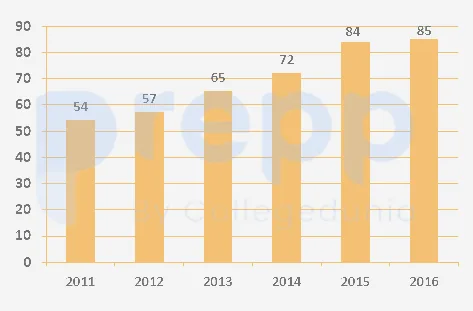
- A
72
- B
60
- C
70
- D
62
Show answer
A. 72Calculation:
The number of persons who have taken the insurance policy, excluding the year 2012 = 54 + 65 + 72 + 84 + 85
⇒ 360
Average = 360/5
⇒ 72
∴ The required answer is 72.
Paper & answer key PDF ↗ Question 52archived
The HCF of two numbers is 8 and their LCM is 2520. If one of the numbers is 56, then the other number is:
- A
650
- B
540
- C
810
- D
360
Show answer
D. 360Finding the Other Number Using HCF and LCM
The question asks us to find the other number when we are given the Highest Common Factor (HCF), the Least Common Multiple (LCM) of two numbers, and one of the numbers. There is a fundamental relationship that connects the HCF and LCM of two positive integers to the product of these two numbers.
Relationship Between HCF, LCM, and Product of Two Numbers
For any two positive integers, say 'a' and 'b', the product of their HCF and LCM is equal to the product of the numbers themselves. This can be expressed by the formula:
HCF(a, b) × LCM(a, b) = a × b
Applying the Formula to the Problem
In this problem, we are given:
HCF of the two numbers = 8
LCM of the two numbers = 2520
One of the numbers = 56
Let the other number be 'x'.
Using the formula, we can write the equation:
HCF × LCM = One Number × Other Number
Substituting the given values:
\( 8 \times 2520 = 56 \times x \)
Solving for the Other Number
To find the value of 'x', we need to isolate 'x' in the equation. We can do this by dividing both sides of the equation by 56:
\( x = \frac{8 \times 2520}{56} \)
Now, we can perform the calculation. We can simplify the fraction first.
We know that 56 is \( 8 \times 7 \). So, we can write:
\( x = \frac{8 \times 2520}{8 \times 7} \)
Cancel out the 8 from the numerator and the denominator:
\( x = \frac{2520}{7} \)
Now, divide 2520 by 7:
\( 2520 \div 7 \)
Let's perform the division:
\( 25 \div 7 = 3 \) with a remainder of \( 25 - (7 \times 3) = 25 - 21 = 4 \).
Bring down the next digit (2) to get 42.
\( 42 \div 7 = 6 \).
Bring down the last digit (0) to get 0.
\( 0 \div 7 = 0 \).
So, \( 2520 \div 7 = 360 \).
Therefore, the value of x is 360.
\( x = 360 \)
The other number is 360.
Verification
Let's check if the HCF of 56 and 360 is 8 and the LCM is 2520.
HCF of 56 and 360:
Prime factorization of 56: \( 2^3 \times 7 \)
Prime factorization of 360: \( 36 \times 10 = (2^2 \times 3^2) \times (2 \times 5) = 2^3 \times 3^2 \times 5 \)
Common prime factors with the lowest power: \( 2^3 = 8 \). So, HCF(56, 360) = 8. This matches the given HCF.
LCM of 56 and 360:
Prime factorization of 56: \( 2^3 \times 7^1 \times 3^0 \times 5^0 \)
Prime factorization of 360: \( 2^3 \times 3^2 \times 5^1 \times 7^0 \)
Highest power of each prime factor: \( 2^3, 3^2, 5^1, 7^1 \)
LCM(56, 360) = \( 2^3 \times 3^2 \times 5^1 \times 7^1 = 8 \times 9 \times 5 \times 7 = 72 \times 35 \)
\( 72 \times 35 = 72 \times (30 + 5) = (72 \times 30) + (72 \times 5) = 2160 + 360 = 2520 \)
The LCM is 2520, which also matches the given LCM.
The product of the numbers is \( 56 \times 360 \). The product of HCF and LCM is \( 8 \times 2520 \).
\( 56 \times 360 = 20160 \)
\( 8 \times 2520 = 20160 \)
Since \( 56 \times 360 = 8 \times 2520 \), the relationship holds true, and our calculated other number, 360, is correct.
Conclusion
Using the relationship \( \text{HCF} \times \text{LCM} = \text{Product of the two numbers} \), we found that the other number is 360.
Revision Table: HCF and LCM Concepts
Term
Definition
Example
HCF (Highest Common Factor)
The largest positive integer that divides two or more numbers without leaving a remainder. Also known as GCD (Greatest Common Divisor).
HCF of 12 and 18 is 6.
LCM (Least Common Multiple)
The smallest positive integer that is a multiple of two or more numbers.
LCM of 12 and 18 is 36.
Relationship
For two numbers a and b, HCF(a, b) × LCM(a, b) = a × b.
HCF(12, 18) × LCM(12, 18) = 6 × 36 = 216.
12 × 18 = 216.
Additional Information: Finding HCF and LCM
Besides using the relationship with the product of numbers, HCF and LCM can be found using various methods:
Prime Factorization Method:
Find the prime factorization of each number.
For HCF, multiply the common prime factors raised to the lowest power.
For LCM, multiply all prime factors (common and non-common) raised to the highest power.
Division Method:
For HCF, use the Euclidean algorithm (repeated division).
For LCM, divide the numbers by common prime factors until no common factor exists, then multiply all divisors and the remaining numbers.
Understanding these methods is crucial for solving problems involving HCF and LCM.
Paper & answer key PDF ↗ Question 53archived
A shopkeeper offers the following three schemes.
Scheme - I: Two successive discounts of 15% and 25%
Scheme - II: Buy 5, get 3 free
Scheme - III: Buy 4, get 6
Which scheme is the best for customers?
- A
Scheme - I
- B
Scheme - III
- C
Scheme - II
- D
Any one - All are equal
Show answer
C. Scheme - IIUnderstanding Shopkeeper Discount Schemes
Shopkeepers offer various schemes to attract customers. These can include successive discounts, buy-one-get-one offers, or getting extra items free when buying a certain quantity. For a customer, the best scheme is the one that provides the maximum effective discount.
We need to analyze the three schemes provided and calculate the effective discount percentage for each to determine which one is most beneficial for the customer.
Calculating Effective Discount for Scheme - I
Scheme - I offers two successive discounts: 15% and 25%.
When two successive discounts, $d_1$ and $d_2$, are applied, the effective single discount ($d_{eff}$) is calculated using the formula:
\(d_{eff} = d_1 + d_2 - \frac{d_1 \times d_2}{100}\)
Substituting the given values, \(d_1 = 15\%\) and \(d_2 = 25\%\):
\(d_{eff} = 15\% + 25\% - \frac{15 \times 25}{100}\)
\(d_{eff} = 40\% - \frac{375}{100}\)
\(d_{eff} = 40\% - 3.75\%\)
\(d_{eff} = 36.25\%\)
So, Scheme - I is equivalent to a single discount of 36.25%.
Calculating Effective Discount for Scheme - II
Scheme - II is "Buy 5, get 3 free".
In this type of scheme, the customer pays for a certain number of items but receives more items in total. The discount comes from the items received for free.
Number of items bought (paid for) = 5
Number of items received free = 3
Total number of items received = Number of items bought + Number of free items = 5 + 3 = 8
The discount percentage is calculated based on the free items as a proportion of the total items received.
\(\text{Discount Percentage} = \left( \frac{\text{Number of free items}}{\text{Total number of items received}} \right) \times 100\%\)
\(\text{Discount Percentage} = \left( \frac{3}{8} \right) \times 100\%\)
\(\text{Discount Percentage} = \frac{300}{8}\%\)
\(\text{Discount Percentage} = 37.5\%\)
So, Scheme - II offers an effective discount of 37.5%.
Calculating Effective Discount for Scheme - III
Scheme - III is "Buy 4, get 6".
Based on the context of similar problems and common interpretations, "Buy 4, get 6" typically means the customer pays for 4 items and receives a total of 6 items. This implies getting some items free.
Number of items paid for = 4
Total number of items received = 6
Number of items received free = Total items received - Items paid for = 6 - 4 = 2
Now, we calculate the discount percentage using the same formula as for Scheme II:
\(\text{Discount Percentage} = \left( \frac{\text{Number of free items}}{\text{Total number of items received}} \right) \times 100\%\)
\(\text{Discount Percentage} = \left( \frac{2}{6} \right) \times 100\%\)
\(\text{Discount Percentage} = \left( \frac{1}{3} \right) \times 100\%\)
\(\text{Discount Percentage} \approx 33.33\%\)
So, Scheme - III offers an effective discount of approximately 33.33%.
Note: If Scheme III were interpreted as "Buy 4, get 6 free" (meaning 6 additional items are free), the total items received would be 4 + 6 = 10, with 6 free. This would give a discount of \(\frac{6}{10} \times 100\% = 60\%\). However, based on the given correct answer, the interpretation of getting a total of 6 items by paying for 4 is the correct one for this problem.
Comparing the Schemes for Maximum Discount
Let's compare the effective discount percentages for all three schemes:
Scheme
Effective Discount Percentage
Scheme - I
36.25%
Scheme - II
37.5%
Scheme - III
≈ 33.33%
Comparing the percentages, we see that:
Scheme - I offers 36.25% discount.
Scheme - II offers 37.5% discount.
Scheme - III offers ≈ 33.33% discount.
The highest effective discount is offered by Scheme - II (37.5%).
Conclusion: Best Scheme for Customers
For a customer, the best scheme is the one that provides the highest discount. Comparing the calculated effective discounts:
\(37.5\% (\text{Scheme - II}) > 36.25\% (\text{Scheme - I}) > 33.33\% (\text{Scheme - III})\)
Therefore, Scheme - II is the best scheme for customers.
Discount Scheme Analysis Revision
Let's quickly recap the calculation methods for different types of discount schemes often encountered:
Successive Discounts: Calculate effective discount using the formula \(d_{eff} = d_1 + d_2 - \frac{d_1 \times d_2}{100}\). This compounds the discounts.
Buy X, Get Y Free: Calculate the percentage of free items out of the total number of items received (\(\frac{\text{Y}}{\text{X+Y}} \times 100\%\)). This represents the proportion of the total value the customer gets for free.
Buy X, Get Y Total (paying for X, receiving Y): Calculate the percentage of free items (which is \(Y-X\)) out of the total number of items received (\(\frac{\text{Y-X}}{\text{Y}} \times 100\%\)). This also represents the value saved.
Additional Information on Discounts and Savings
Understanding how different discount schemes work is crucial for making smart purchasing decisions. Successive discounts are common, but the second discount is applied to the price after the first discount, not the original price. "Buy N, Get M Free" offers can sometimes seem more attractive than percentage discounts, especially when the number of free items is high relative to the number bought. Always calculate the effective percentage discount to make a true comparison between different types of offers.
For example, a 50% discount sounds great, but "Buy 1, Get 1 Free" is equivalent to a 50% discount (\(\frac{1}{1+1} \times 100\% = 50\%\)). "Buy 2, Get 1 Free" is a 33.33% discount (\(\frac{1}{2+1} \times 100\% \approx 33.33\%\)). Being able to convert these offers to a single percentage makes comparison easy.
Paper & answer key PDF ↗ Question 54archived
The ratio of the cost price and selling price of an article is 10 ∶ 11. The gain per cent is:
- A
10%
- B
8%
- C
5%
- D
15%
Show answer
A. 10%Calculating Gain Percentage from Cost Price Ratio
The problem asks us to find the gain percentage when the ratio of the cost price (CP) and the selling price (SP) of an article is given as 10 ∶ 11.
Let's define the terms:
Cost Price (CP): The price at which an article is bought.
Selling Price (SP): The price at which an article is sold.
Gain: When SP is greater than CP. Gain = SP - CP.
Gain Percentage: The gain expressed as a percentage of the cost price.
Given the ratio of CP to SP is 10 ∶ 11, we can represent the cost price and selling price using a variable. Let the common ratio be $x$.
So,
Cost Price (CP) $= 10x$
Selling Price (SP) $= 11x$
Since the selling price ($11x$) is greater than the cost price ($10x$), there is a gain. Let's calculate the gain amount.
Gain $= \text{SP} - \text{CP}$
Gain $= 11x - 10x$
Gain $= x$
Now, we need to calculate the gain percentage. The formula for gain percentage is:
$\text{Gain \%} = \frac{\text{Gain}}{\text{CP}} \times 100$
Substitute the values of Gain and CP into the formula:
$\text{Gain \%} = \frac{x}{10x} \times 100$
We can cancel out $x$ from the numerator and the denominator (assuming $x \neq 0$, which it must be for a price).
$\text{Gain \%} = \frac{1}{10} \times 100$
$\text{Gain \%} = 10$
So, the gain percentage is 10%.
Let's verify with an example. If CP = ₹10 and SP = ₹11 (ratio 10:11), the gain is ₹$11 - 10 = ₹1$. The gain percentage is $\frac{1}{10} \times 100 = 10\%$. This matches our calculation.
This calculation shows that when the ratio of cost price to selling price is 10:11, the gain is indeed 10%.
Summary of Calculation
Parameter
Value
Ratio CP : SP
10 : 11
Assume CP
10x
Assume SP
11x
Gain (SP - CP)
11x - 10x = x
Gain % Formula
$\frac{\text{Gain}}{\text{CP}} \times 100$
Gain % Calculation
$\frac{x}{10x} \times 100 = 10\%$
Revision Table: Key Concepts in Profit and Loss
Profit and Loss Formulas
Concept
Formula
Condition
Gain (Profit)
SP - CP
SP > CP
Loss
CP - SP
CP > SP
Gain Percentage
$\frac{\text{Gain}}{\text{CP}} \times 100$
SP > CP
Loss Percentage
$\frac{\text{Loss}}{\text{CP}} \times 100$
CP > SP
Additional Information: Understanding Ratios in Commerce Problems
Ratios are often used in commerce and business problems to represent relationships between different quantities like cost price, selling price, marked price, discount, etc. When a ratio is given, like CP : SP = $a : b$, it means that for some value $x$, CP $= ax$ and SP $= bx$. This method simplifies calculations, especially when dealing with percentages, as the variable $x$ often cancels out, as seen in the gain percentage calculation above.
Using ratios helps in quickly determining if there is a gain or loss. If the ratio of SP to CP ($b/a$) is greater than 1, there is a gain. If it is less than 1, there is a loss. In our case, the ratio SP : CP is 11 : 10, or $11/10 = 1.1$, which is greater than 1, indicating a gain.
The gain or loss percentage is always calculated with respect to the cost price, unless otherwise specified.
Paper & answer key PDF ↗ Question 55archived
If Anju is 30% more efficient than Bitt, then how much time will they take, working together, to complete a job which Anju alone could have done in 23 days?
- A
13 days
- B
\(20{{3} \over 17}\) days
- C
15 days
- D
11 days
Show answer
A. 13 daysUnderstanding Efficiency and Time to Complete a Job
This problem involves the concept of time and work, specifically how the efficiency of individuals affects the time taken to complete a task. Efficiency is inversely proportional to the time taken to complete a fixed amount of work. If someone is more efficient, they take less time to do the same work.
Analyzing the Given Information
We are given the following:
Anju is 30% more efficient than Bitt.
Anju alone can complete the job in 23 days.
We need to find the time taken by Anju and Bitt working together to complete the same job.
Step-by-Step Solution to Find the Combined Time
Step 1: Establish the relationship between Anju's and Bitt's efficiency.
Let Bitt's efficiency be represented by $E_B$.
Anju's efficiency ($E_A$) is 30% more than Bitt's. This can be written as:
$\qquad E_A = E_B + 30\% \text{ of } E_B$
$\qquad E_A = E_B + 0.30 \times E_B$
$\qquad E_A = (1 + 0.30) E_B$
$\qquad E_A = 1.30 E_B$
This means Anju's efficiency is 1.3 times Bitt's efficiency.
Step 2: Calculate the total work.
The total work required to complete the job can be calculated using the efficiency and time taken by one person. The formula is:
$\qquad \text{Work} = \text{Efficiency} \times \text{Time}$
Anju takes 23 days to complete the job alone with efficiency $E_A$.
Total Work $= E_A \times 23$
Step 3: Calculate the combined efficiency of Anju and Bitt.
When Anju and Bitt work together, their efficiencies add up. Their combined efficiency is $E_{A+B} = E_A + E_B$.
From Step 1, we know $E_A = 1.30 E_B$. We can express $E_B$ in terms of $E_A$ as $E_B = \frac{E_A}{1.30}$.
Combined Efficiency $= E_A + \frac{E_A}{1.30}$
Combined Efficiency $= E_A \left(1 + \frac{1}{1.30}\right)$
Combined Efficiency $= E_A \left(\frac{1.30 + 1}{1.30}\right)$
Combined Efficiency $= E_A \left(\frac{2.30}{1.30}\right) = E_A \left(\frac{23}{13}\right)$
Alternatively, using $E_A = 1.3 E_B$: Combined Efficiency $= 1.3 E_B + E_B = 2.3 E_B$.
Step 4: Calculate the time taken by Anju and Bitt working together.
Let $T_{A+B}$ be the time taken by Anju and Bitt together to complete the job.
Using the Work formula:
Total Work $= \text{Combined Efficiency} \times T_{A+B}$
From Step 2, Total Work $= E_A \times 23$.
From Step 3, Combined Efficiency $= E_A \left(\frac{23}{13}\right)$.
So,
$\qquad E_A \times 23 = E_A \left(\frac{23}{13}\right) \times T_{A+B}$
We can cancel $E_A$ from both sides (assuming $E_A > 0$):
$\qquad 23 = \left(\frac{23}{13}\right) \times T_{A+B}$
To find $T_{A+B}$, rearrange the equation:
$\qquad T_{A+B} = 23 \div \left(\frac{23}{13}\right)$
$\qquad T_{A+B} = 23 \times \left(\frac{13}{23}\right)$
$\qquad T_{A+B} = 13$
So, Anju and Bitt working together will take 13 days to complete the job.
Using the alternative combined efficiency $2.3 E_B$ and Total Work $= 1.3 E_B \times 23$:
$\qquad 1.3 E_B \times 23 = 2.3 E_B \times T_{A+B}$
Cancel $E_B$ from both sides:
$\qquad 1.3 \times 23 = 2.3 \times T_{A+B}$
$\qquad T_{A+B} = \frac{1.3 \times 23}{2.3} = \frac{13 \times 23}{23} = 13$
Both methods yield the same result: 13 days.
Comparing with Options
The calculated time is 13 days, which matches Option 1.
Person
Efficiency
Time Alone
Anju
$E_A$
23 days
Bitt
$E_B$ ($E_A/1.3$)
?
Anju & Bitt Together
$E_A + E_B$ ($1.3 E_B + E_B = 2.3 E_B$ or $E_A (2.3/1.3)$)
13 days
Revision Table: Key Concepts in Time and Work
Concept
Description
Formula/Relationship
Work
The total task to be completed. Often assumed as 1 unit or a suitable multiple.
Work = Efficiency $\times$ Time
Efficiency
The amount of work done per unit of time.
Efficiency = Work / Time
Time
Duration taken to complete the work.
Time = Work / Efficiency
Inverse Relation
Efficiency is inversely proportional to Time for constant Work.
If Efficiency increases, Time decreases (and vice-versa)
Combined Efficiency
Sum of individual efficiencies when working together.
$E_{total} = E_1 + E_2 + E_3 + \dots$
Additional Information on Solving Efficiency Problems
When one person is 'X% more efficient' than another, their efficiency is $(1 + X/100)$ times the other person's efficiency.
If you know the time taken by individuals, you can assume the total work to be the Least Common Multiple (LCM) of their individual times. However, in this problem, we only know one person's time and the efficiency ratio, so using efficiency ratios is simpler.
The fraction of work done per day is equal to the efficiency if the total work is taken as 1 unit. For example, if Anju takes 23 days, her daily work rate (efficiency) is $1/23$ of the total job.
Using the daily work rate approach:
Anju's daily work rate = $\frac{1}{23}$ job/day.
Anju's efficiency $E_A$ is proportional to her daily work rate. Let $E_A = k \times \frac{1}{23}$.
$E_A = 1.3 E_B \implies E_B = \frac{E_A}{1.3} = \frac{k}{1.3 \times 23}$.
Bitt's daily work rate = $\frac{1}{1.3 \times 23}$ job/day.
Combined daily work rate = Anju's rate + Bitt's rate $= \frac{1}{23} + \frac{1}{1.3 \times 23} = \frac{1}{23} \left(1 + \frac{1}{1.3}\right) = \frac{1}{23} \left(\frac{1.3+1}{1.3}\right) = \frac{1}{23} \left(\frac{2.3}{1.3}\right)$.
Time taken together = $\frac{\text{Total Work}}{\text{Combined Daily Rate}} = \frac{1}{\frac{1}{23} \left(\frac{2.3}{1.3}\right)} = 23 \times \frac{1.3}{2.3} = 23 \times \frac{13}{23} = 13$ days.
All approaches lead to the same result, confirming the time taken by Anju and Bitt working together is 13 days.
Paper & answer key PDF ↗ Question 56archived
A boat moves 25 km upstream and 39 km downstream in 8 hours. It travels 35 km upstream and 52 km downstream in 11 hours. What is the speed of the stream if it travels at a uniform speed?
- A
4 km/h
- B
5 km/h
- C
6 km/h
- D
3 km/h
Show answer
A. 4 km/hUnderstanding Boat and Stream Speed Concepts
This problem involves the concepts of boat speed in still water and the speed of the stream. When a boat moves downstream, its speed is increased by the speed of the stream. When it moves upstream, its speed is decreased by the speed of the stream.
Let's define the variables:
Let \(B\) be the speed of the boat in still water (in km/h).
Let \(S\) be the speed of the stream (in km/h).
Based on these definitions, we can determine the speeds in different directions:
Speed downstream = Speed of boat in still water + Speed of stream = \(B + S\) km/h.
Speed upstream = Speed of boat in still water - Speed of stream = \(B - S\) km/h.
We are given information about the distance covered upstream and downstream and the total time taken for two different scenarios. The relationship between distance, speed, and time is:
\(\text{Time} = \frac{\text{Distance}}{\text{Speed}}\)
Setting Up Equations for Boat and Stream Travel
From the problem statement, we can formulate two equations based on the total time taken for each journey.
Scenario 1: 25 km upstream and 39 km downstream in 8 hours.
Time taken for 25 km upstream = \(\frac{25}{B - S}\) hours.
Time taken for 39 km downstream = \(\frac{39}{B + S}\) hours.
Total time for Scenario 1:
\[ \frac{25}{B - S} + \frac{39}{B + S} = 8 \quad \text{(Equation 1)} \]
Scenario 2: 35 km upstream and 52 km downstream in 11 hours.
Time taken for 35 km upstream = \(\frac{35}{B - S}\) hours.
Time taken for 52 km downstream = \(\frac{52}{B + S}\) hours.
Total time for Scenario 2:
\[ \frac{35}{B - S} + \frac{52}{B + S} = 11 \quad \text{(Equation 2)} \]
Solving the System of Equations
We have a system of two linear equations with two variables, \(\frac{1}{B-S}\) and \(\frac{1}{B+S}\). To make solving easier, let's use substitution.
Let \(u = \frac{1}{B - S}\) and \(v = \frac{1}{B + S}\).
Substituting these into Equation 1 and Equation 2, we get:
\[ 25u + 39v = 8 \quad \text{(Equation 3)} \]
\[ 35u + 52v = 11 \quad \text{(Equation 4)} \]
Now we can solve this system of linear equations using methods like elimination or substitution. Let's use elimination. We can multiply Equation 3 by the coefficient of \(u\) in Equation 4 (35) and Equation 4 by the coefficient of \(u\) in Equation 3 (25), or find a common multiple for coefficients of \(u\) or \(v\). Let's try to eliminate \(u\). The least common multiple of 25 and 35 is 175.
Multiply Equation 3 by 7: \(7 \times (25u + 39v) = 7 \times 8\)
This gives: \(175u + 273v = 56 \quad \text{(Equation 5)}\)
Multiply Equation 4 by 5: \(5 \times (35u + 52v) = 5 \times 11\)
This gives: \(175u + 260v = 55 \quad \text{(Equation 6)}\)
Now subtract Equation 6 from Equation 5:
\[ (175u + 273v) - (175u + 260v) = 56 - 55 \]
\[ 175u - 175u + 273v - 260v = 1 \]
\[ 13v = 1 \]
\[ v = \frac{1}{13} \]
Now substitute the value of \(v\) back into either Equation 3 or Equation 4 to find \(u\). Let's use Equation 3:
\[ 25u + 39\left(\frac{1}{13}\right) = 8 \]
\[ 25u + 3 = 8 \]
\[ 25u = 8 - 3 \]
\[ 25u = 5 \]
\[ u = \frac{5}{25} \]
\[ u = \frac{1}{5} \]
Finding Boat Speed and Stream Speed
We found that \(u = \frac{1}{5}\) and \(v = \frac{1}{13}\). Now substitute back the original expressions for \(u\) and \(v\):
Since \(u = \frac{1}{B - S}\), we have \(\frac{1}{B - S} = \frac{1}{5}\). This implies \(B - S = 5\) (Upstream speed).
Since \(v = \frac{1}{B + S}\), we have \(\frac{1}{B + S} = \frac{1}{13}\). This implies \(B + S = 13\) (Downstream speed).
Now we have a simpler system of two linear equations:
\[ B - S = 5 \quad \text{(Equation 7)} \]
\[ B + S = 13 \quad \text{(Equation 8)} \]
To find \(B\) and \(S\), we can add Equation 7 and Equation 8:
\[ (B - S) + (B + S) = 5 + 13 \]
\[ B + B - S + S = 18 \]
\[ 2B = 18 \]
\[ B = \frac{18}{2} \]
\[ B = 9 \]
The speed of the boat in still water is 9 km/h.
Now substitute the value of \(B\) into either Equation 7 or Equation 8 to find \(S\). Using Equation 7:
\[ 9 - S = 5 \]
\[ S = 9 - 5 \]
\[ S = 4 \]
Using Equation 8 as a check:
\[ 9 + S = 13 \]
\[ S = 13 - 9 \]
\[ S = 4 \]
The speed of the stream is 4 km/h.
Verifying the Solution
Let's check if \(B=9\) km/h and \(S=4\) km/h satisfy the original conditions.
Upstream speed = \(B - S = 9 - 4 = 5\) km/h.
Downstream speed = \(B + S = 9 + 4 = 13\) km/h.
Check Scenario 1: 25 km upstream and 39 km downstream.
Time upstream = \(\frac{25 \text{ km}}{5 \text{ km/h}} = 5\) hours.
Time downstream = \(\frac{39 \text{ km}}{13 \text{ km/h}} = 3\) hours.
Total time = \(5 + 3 = 8\) hours. (Matches the given information)
Check Scenario 2: 35 km upstream and 52 km downstream.
Time upstream = \(\frac{35 \text{ km}}{5 \text{ km/h}} = 7\) hours.
Time downstream = \(\frac{52 \text{ km}}{13 \text{ km/h}} = 4\) hours.
Total time = \(7 + 4 = 11\) hours. (Matches the given information)
Both scenarios match the given conditions, confirming our calculated speeds are correct.
Final Answer
The speed of the stream is 4 km/h.
Concept
Formula
Upstream Speed
\(B - S\)
Downstream Speed
\(B + S\)
Time
\(\frac{\text{Distance}}{\text{Speed}}\)
Revision Table: Boat and Stream Problem Steps
Step
Description
Applied to this Problem
1
Define variables for boat speed (B) and stream speed (S).
B = boat speed, S = stream speed
2
Write expressions for upstream speed (B-S) and downstream speed (B+S).
Upstream: \(B-S\), Downstream: \(B+S\)
3
Use Time = Distance/Speed to write equations based on the given total times.
\(\frac{25}{B-S} + \frac{39}{B+S} = 8\), \(\frac{35}{B-S} + \frac{52}{B+S} = 11\)
4
Use substitution (e.g., \(u = \frac{1}{B-S}\), \(v = \frac{1}{B+S}\)) to simplify equations.
\(25u + 39v = 8\), \(35u + 52v = 11\)
5
Solve the system of linear equations for u and v.
Found \(u = \frac{1}{5}\) and \(v = \frac{1}{13}\)
6
Substitute back to find B-S and B+S.
\(B-S = 5\), \(B+S = 13\)
7
Solve the resulting system for B and S.
Found \(B = 9\) and \(S = 4\)
8
Verify the calculated speeds with the original conditions.
Check times for both scenarios (8 hours and 11 hours)
9
State the final answer for the speed of the stream.
Speed of stream = 4 km/h
Additional Information on Boat and Stream Problems
Boat and stream problems are common in competitive exams. They test your understanding of relative speed. Here are some key points:
The speed of the boat in still water is its speed without any influence from the current.
The speed of the stream is the speed of the water flow.
Upstream movement is against the current, reducing the effective speed.
Downstream movement is with the current, increasing the effective speed.
If the boat speed is less than the stream speed (B < S), the boat cannot move upstream. In these problems, B is usually assumed to be greater than S.
The speeds \(B\) and \(S\) are typically assumed to be uniform (constant) throughout the journey unless otherwise specified.
These problems often lead to systems of linear equations that can be solved using substitution or elimination methods.
Understanding the basic formulas and how to set up the equations is crucial for solving these types of questions accurately.
Paper & answer key PDF ↗ Question 57archived
If cosec θ + cot θ = p, then the value of \({{p^2 \ - \ 1} \over p^2 \ + \ 1}\) is:
- A
cos θ
- B
sin θ
- C
cot θ
- D
cosec θ
Show answer
A. cos θSolving the Trigonometry Expression: \( \frac{p^2 - 1}{p^2 + 1} \)
We are given the equation \( \text{cosec } \theta + \text{cot } \theta = p \). We need to find the value of the expression \( \frac{p^2 - 1}{p^2 + 1} \).
Let's use a fundamental trigonometric identity involving cosecant and cotangent.
Key Trigonometric Identity
Recall the identity:
\( \text{cosec}^2 \theta - \text{cot}^2 \theta = 1 \)
This identity is a difference of squares, which can be factored as:
\( (\text{cosec } \theta - \text{cot } \theta)(\text{cosec } \theta + \text{cot } \theta) = 1 \)
Using the Given Information
We are given that \( \text{cosec } \theta + \text{cot } \theta = p \). Substituting this into the factored identity:
\( (\text{cosec } \theta - \text{cot } \theta)(p) = 1 \)
From this, we can find an expression for \( \text{cosec } \theta - \text{cot } \theta \):
\( \text{cosec } \theta - \text{cot } \theta = \frac{1}{p} \)
Setting up a System of Equations
Now we have two useful equations:
\( \text{cosec } \theta + \text{cot } \theta = p \)
\( \text{cosec } \theta - \text{cot } \theta = \frac{1}{p} \)
We can solve this system for \( \text{cosec } \theta \) and \( \text{cot } \theta \) in terms of \( p \).
Adding the Equations
Add equation (1) and equation (2):
\( (\text{cosec } \theta + \text{cot } \theta) + (\text{cosec } \theta - \text{cot } \theta) = p + \frac{1}{p} \)
\( 2\text{cosec } \theta = \frac{p^2 + 1}{p} \)
So,
\( \text{cosec } \theta = \frac{p^2 + 1}{2p} \)
Subtracting the Equations
Subtract equation (2) from equation (1):
\( (\text{cosec } \theta + \text{cot } \theta) - (\text{cosec } \theta - \text{cot } \theta) = p - \frac{1}{p} \)
\( 2\text{cot } \theta = \frac{p^2 - 1}{p} \)
So,
\( \text{cot } \theta = \frac{p^2 - 1}{2p} \)
Finding the Value of \( \frac{p^2 - 1}{p^2 + 1} \)
We have found expressions for \( \text{cosec } \theta \) and \( \text{cot } \theta \) in terms of \( p \):
\( \text{cosec } \theta = \frac{p^2 + 1}{2p} \)
\( \text{cot } \theta = \frac{p^2 - 1}{2p} \)
We know that \( \text{cot } \theta = \frac{\text{cos } \theta}{\text{sin } \theta} \) and \( \text{cosec } \theta = \frac{1}{\text{sin } \theta} \). Therefore, \( \text{cos } \theta = \text{cot } \theta \times \text{sin } \theta \).
Substituting the expressions in terms of \( p \):
\( \text{cos } \theta = \left(\frac{p^2 - 1}{2p}\right) \times \left(\frac{1}{\text{cosec } \theta}\right) \)
\( \text{cos } \theta = \left(\frac{p^2 - 1}{2p}\right) \times \left(\frac{1}{\frac{p^2 + 1}{2p}}\right) \)
\( \text{cos } \theta = \left(\frac{p^2 - 1}{2p}\right) \times \left(\frac{2p}{p^2 + 1}\right) \)
We can cancel the \( 2p \) terms:
\( \text{cos } \theta = \frac{p^2 - 1}{p^2 + 1} \)
Thus, the value of \( \frac{p^2 - 1}{p^2 + 1} \) is \( \text{cos } \theta \).
Summary of Results
Expression
Value in terms of \(p\)
Value in terms of \( \theta \)
\( \text{cosec } \theta + \text{cot } \theta \)
\( p \)
\( \frac{1 + \text{cos } \theta}{\text{sin } \theta} \)
\( \text{cosec } \theta - \text{cot } \theta \)
\( \frac{1}{p} \)
\( \frac{1 - \text{cos } \theta}{\text{sin } \theta} \)
\( \text{cosec } \theta \)
\( \frac{p^2 + 1}{2p} \)
\( \frac{1}{\text{sin } \theta} \)
\( \text{cot } \theta \)
\( \frac{p^2 - 1}{2p} \)
\( \frac{\text{cos } \theta}{\text{sin } \theta} \)
\( \frac{p^2 - 1}{p^2 + 1} \)
?
\( \text{cos } \theta \)
Our calculation shows that \( \frac{p^2 - 1}{p^2 + 1} \) is equal to \( \text{cos } \theta \).
Revision Table: Key Trigonometry Concepts
Concept
Description / Formula
Reciprocal Identities
\( \text{cosec } \theta = \frac{1}{\text{sin } \theta} \), \( \text{sec } \theta = \frac{1}{\text{cos } \theta} \), \( \text{cot } \theta = \frac{1}{\text{tan } \theta} \)
Quotient Identities
\( \text{tan } \theta = \frac{\text{sin } \theta}{\text{cos } \theta} \), \( \text{cot } \theta = \frac{\text{cos } \theta}{\text{sin } \theta} \)
Pythagorean Identities
\( \text{sin}^2 \theta + \text{cos}^2 \theta = 1 \)
\( 1 + \text{tan}^2 \theta = \text{sec}^2 \theta \)
\( 1 + \text{cot}^2 \theta = \text{cosec}^2 \theta \)
Difference of Squares
\( a^2 - b^2 = (a-b)(a+b) \)
Additional Information: Alternative Approach
Another way to approach this problem is to express \( p \) directly in terms of \( \text{sin } \theta \) and \( \text{cos } \theta \) and then substitute it into the expression \( \frac{p^2 - 1}{p^2 + 1} \).
Given \( p = \text{cosec } \theta + \text{cot } \theta \), we have:
\( p = \frac{1}{\text{sin } \theta} + \frac{\text{cos } \theta}{\text{sin } \theta} = \frac{1 + \text{cos } \theta}{\text{sin } \theta} \)
Now, calculate \( p^2 \):
\( p^2 = \left(\frac{1 + \text{cos } \theta}{\text{sin } \theta}\right)^2 = \frac{(1 + \text{cos } \theta)^2}{\text{sin}^2 \theta} \)
Substitute this into \( \frac{p^2 - 1}{p^2 + 1} \):
\( \frac{p^2 - 1}{p^2 + 1} = \frac{\frac{(1 + \text{cos } \theta)^2}{\text{sin}^2 \theta} - 1}{\frac{(1 + \text{cos } \theta)^2}{\text{sin}^2 \theta} + 1} \)
\( = \frac{\frac{(1 + \text{cos } \theta)^2 - \text{sin}^2 \theta}{\text{sin}^2 \theta}}{\frac{(1 + \text{cos } \theta)^2 + \text{sin}^2 \theta}{\text{sin}^2 \theta}} \)
Cancel \( \text{sin}^2 \theta \) from numerator and denominator:
\( = \frac{(1 + \text{cos } \theta)^2 - \text{sin}^2 \theta}{(1 + \text{cos } \theta)^2 + \text{sin}^2 \theta} \)
Expand the terms:
\( = \frac{1 + 2\text{cos } \theta + \text{cos}^2 \theta - \text{sin}^2 \theta}{1 + 2\text{cos } \theta + \text{cos}^2 \theta + \text{sin}^2 \theta} \)
Using \( \text{sin}^2 \theta + \text{cos}^2 \theta = 1 \) and \( \text{sin}^2 \theta = 1 - \text{cos}^2 \theta \):
\( = \frac{1 + 2\text{cos } \theta + \text{cos}^2 \theta - (1 - \text{cos}^2 \theta)}{1 + 2\text{cos } \theta + 1} \)
\( = \frac{1 + 2\text{cos } \theta + \text{cos}^2 \theta - 1 + \text{cos}^2 \theta}{2 + 2\text{cos } \theta} \)
\( = \frac{2\text{cos } \theta + 2\text{cos}^2 \theta}{2(1 + \text{cos } \theta)} \)
Factor out \( 2\text{cos } \theta \) from the numerator:
\( = \frac{2\text{cos } \theta (1 + \text{cos } \theta)}{2(1 + \text{cos } \theta)} \)
Assuming \( 1 + \text{cos } \theta \neq 0 \), we can cancel the term \( 2(1 + \text{cos } \theta) \):
\( = \text{cos } \theta \)
Both methods lead to the same result, confirming that the value of \( \frac{p^2 - 1}{p^2 + 1} \) is indeed \( \text{cos } \theta \).
Paper & answer key PDF ↗ Question 58archived
A machine takes 10 h to cut 240 tools. How many tools will it cut in 25 h?
- A
600
- B
480
- C
550
- D
360
Show answer
A. 600Calculating Machine Output Over Time
This question asks us to determine how many tools a machine can cut in 25 hours, given its performance over a shorter period. This is a typical problem involving direct proportion, assuming the machine works at a constant rate.
In a direct proportion scenario, as the time increases, the number of tools cut also increases proportionally.
First, let's find the rate at which the machine cuts tools. The rate is the number of tools cut per unit of time (in this case, per hour).
Given: Machine cuts 240 tools in 10 hours.
Rate of cutting = $\frac{\text{Total number of tools cut}}{\text{Total time taken}}$
Using the given information:
Rate = $\frac{240 \text{ tools}}{10 \text{ hours}}$
Rate = 24 tools per hour
This means the machine cuts 24 tools every hour.
Now we need to find out how many tools the machine will cut in 25 hours. We use the rate we just calculated:
Time = 25 hours
Rate = 24 tools per hour
Number of tools cut = Rate $\times$ Time
Plugging in the values:
Number of tools cut = $24 \text{ tools/hour} \times 25 \text{ hours}$
Let's perform the multiplication:
$24 \times 25$
$24 \times 25 = 600$
So, the machine will cut 600 tools in 25 hours.
Let's summarize the calculation steps:
Step
Description
Calculation
Result
1
Find the cutting rate per hour
$\frac{240 \text{ tools}}{10 \text{ hours}}$
24 tools/hour
2
Calculate tools cut in 25 hours
$24 \text{ tools/hour} \times 25 \text{ hours}$
600 tools
Alternatively, we can set up a direct proportion equation. Let $T_1 = 10$ h, $N_1 = 240$ tools, $T_2 = 25$ h, and $N_2$ be the unknown number of tools. The direct proportion relationship is:
$\frac{N_1}{T_1} = \frac{N_2}{T_2}$
Substitute the known values into the equation:
$\frac{240}{10} = \frac{N_2}{25}$
Simplify the left side:
$24 = \frac{N_2}{25}$
Now, solve for $N_2$ by multiplying both sides by 25:
$N_2 = 24 \times 25$
$N_2 = 600$
Both methods confirm that the machine will cut 600 tools in 25 hours.
Revision Table: Understanding Direct Proportion
Concept
Key Idea
Example Formula
Direct Proportion
As one quantity increases, the other increases at the same rate. The ratio between them is constant.
If $y$ is directly proportional to $x$, then $y = kx$ or $\frac{y_1}{x_1} = \frac{y_2}{x_2}$
Application in Problem
Number of tools cut is directly proportional to the time the machine operates at a constant rate.
$\frac{\text{Tools}_1}{\text{Time}_1} = \frac{\text{Tools}_2}{\text{Time}_2}$
Additional Information: Proportional Reasoning
Proportional reasoning is a fundamental mathematical skill used to solve problems involving ratios and rates. It helps us understand how quantities change in relation to each other. In problems like the one we solved, identifying whether the relationship is directly proportional or inversely proportional is the first key step.
In direct proportion, the quantities change in the same direction (both increase or both decrease).
In inverse proportion, the quantities change in opposite directions (one increases while the other decreases). An example is speed and time for a fixed distance; increasing speed decreases the time taken.
For the machine cutting tools, assuming the machine's efficiency doesn't change, more time always means more tools cut, making it a direct proportion.
Paper & answer key PDF ↗ Question 59archived
If m + \({{1} \over m \ - \ 2}\) = 4, then find the value of (m - 2)2 + \({{1} \over (m \ - \ 2)^2}\).
- A
−2
- B
4
- C
0
- D
2
Show answer
D. 2Solving Algebraic Expressions: Finding the Value of (m - 2)2 + 1/(m - 2)2
We are given the equation:
\[m + \frac{1}{m - 2} = 4\]
We need to find the value of the expression:
\[(m - 2)^2 + \frac{1}{(m - 2)^2}\]
Step-by-Step Solution
Manipulating the Given Equation
Let's rearrange the given equation to make it easier to work with. Notice that the expression we need to find involves \((m - 2)\). Let's try to get \((m - 2)\) in the given equation.
Subtract 2 from both sides of the equation \(m + \frac{1}{m - 2} = 4\):
\[m + \frac{1}{m - 2} - 2 = 4 - 2\]
Rearranging the terms on the left side gives:
\[(m - 2) + \frac{1}{m - 2} = 2\]
Introducing a Substitution
To simplify the notation, let's substitute \(x = m - 2\).
The equation now becomes:
\[x + \frac{1}{x} = 2\]
The expression we need to find the value of is \((m - 2)^2 + \frac{1}{(m - 2)^2}\), which in terms of \(x\) is:
\[x^2 + \frac{1}{x^2}\]
Using an Algebraic Identity
We know the algebraic identity for the square of a sum: \((a + b)^2 = a^2 + 2ab + b^2\).
Let's apply this identity to \((x + \frac{1}{x})^2\), where \(a = x\) and \(b = \frac{1}{x}\):
\[\left(x + \frac{1}{x}\right)^2 = x^2 + 2 \cdot x \cdot \frac{1}{x} + \left(\frac{1}{x}\right)^2\]
\[\left(x + \frac{1}{x}\right)^2 = x^2 + 2 + \frac{1}{x^2}\]
We want to find the value of \(x^2 + \frac{1}{x^2}\). We can rearrange the identity to isolate this term:
\[x^2 + \frac{1}{x^2} = \left(x + \frac{1}{x}\right)^2 - 2\]
Substituting and Calculating
We found from the given equation that \(x + \frac{1}{x} = 2\).
Now, substitute this value into the expression for \(x^2 + \frac{1}{x^2}\):
\[x^2 + \frac{1}{x^2} = (2)^2 - 2\]
\[x^2 + \frac{1}{x^2} = 4 - 2\]
\[x^2 + \frac{1}{x^2} = 2\]
Since \(x = m - 2\), this means:
\[(m - 2)^2 + \frac{1}{(m - 2)^2} = 2\]
Conclusion
The value of the expression \((m - 2)^2 + \frac{1}{(m - 2)^2}\) is 2.
Let's quickly check the options provided:
Option
Value
1
-2
2
4
3
0
4
2
Our calculated value is 2, which matches Option 4.
Revision Table: Key Algebraic Concepts
Concept
Description
Relevant to Problem
Algebraic Equation
A statement that two mathematical expressions are equal.
The initial given equation: \(m + \frac{1}{m - 2} = 4\)
Algebraic Expression
A combination of variables, numbers, and arithmetic operations.
The expression to find the value of: \((m - 2)^2 + \frac{1}{(m - 2)^2}\)
Substitution
Replacing a variable or expression with another equivalent variable or expression.
Using \(x = m - 2\) to simplify the problem.
Algebraic Identity
An equation that is true for all possible values of the variables involved (e.g., \((a+b)^2 = a^2 + 2ab + b^2\)).
Used to relate \((x + \frac{1}{x})^2\) to \(x^2 + \frac{1}{x^2}\).
Additional Information: Solving \(x + \frac{1}{x} = 2\)
It is interesting to note that the equation \(x + \frac{1}{x} = 2\) has a very specific solution.
We can solve this equation for \(x\):
Multiply both sides by \(x\) (assuming \(x \neq 0\)):
\[x \cdot \left(x + \frac{1}{x}\right) = 2 \cdot x\]
\[x^2 + 1 = 2x\]
Rearrange into a quadratic equation:
\[x^2 - 2x + 1 = 0\]
This is a perfect square trinomial, which can be factored as:
\[(x - 1)^2 = 0\]
Taking the square root of both sides:
\[x - 1 = 0\]
\[x = 1\]
So, the only value of \(x\) that satisfies \(x + \frac{1}{x} = 2\) is \(x = 1\).
Since \(x = m - 2\), this means \(m - 2 = 1\), which gives \(m = 3\).
We could also find the value of \((m - 2)^2 + \frac{1}{(m - 2)^2}\) by directly substituting \(m - 2 = 1\):
\[(1)^2 + \frac{1}{(1)^2} = 1 + \frac{1}{1} = 1 + 1 = 2\]
This confirms our result obtained using the identity method. This detailed look provides a deeper understanding of the values of \(m\) and \(m-2\) involved.
Paper & answer key PDF ↗ Question 60archived
Find the value of cos 2A cos 2B + sin2(A - B) - sin2(A + B)
- A
sin (2A − 2B)
- B
sin (2A + 2B)
- C
cos (2A + 2B)
- D
cos (2A − 2B)
Show answer
C. cos (2A + 2B)Understanding the Trigonometric Expression
We are asked to find the value of the expression: $\cos 2A \cos 2B + \sin^2(A - B) - \sin^2(A + B)$. This problem requires us to use trigonometric identities to simplify the given expression.
Applying Trigonometric Identities
Let's break down the given expression:
The expression is: $\cos 2A \cos 2B + \sin^2(A - B) - \sin^2(A + B)$
We can focus on simplifying the part $\sin^2(A - B) - \sin^2(A + B)$. There is a standard trigonometric identity related to the difference of squares of sine functions:
The identity is: $\sin^2 x - \sin^2 y = \sin(x + y) \sin(x - y)$
Let's apply this identity to our expression. Here, let $x = A - B$ and $y = A + B$.
First, find $(x + y)$:
$x + y = (A - B) + (A + B) = A - B + A + B = 2A$
Next, find $(x - y)$:
$x - y = (A - B) - (A + B) = A - B - A - B = -2B$
Now, substitute these values into the identity $\sin^2 x - \sin^2 y = \sin(x + y) \sin(x - y)$:
$\sin^2(A - B) - \sin^2(A + B) = \sin(2A) \sin(-2B)$
Recall that $\sin(- \theta) = - \sin \theta$. So, $\sin(-2B) = - \sin 2B$.
Therefore, $\sin^2(A - B) - \sin^2(A + B) = \sin(2A) (- \sin 2B) = - \sin 2A \sin 2B$.
Simplifying the Complete Expression
Now substitute this simplified part back into the original expression:
Original expression: $\cos 2A \cos 2B + (\sin^2(A - B) - \sin^2(A + B))$
Substitute the simplified part:
$\cos 2A \cos 2B + (- \sin 2A \sin 2B) = \cos 2A \cos 2B - \sin 2A \sin 2B$
Now, we recognize another standard trigonometric identity for the cosine of the sum of two angles:
The identity is: $\cos(P + Q) = \cos P \cos Q - \sin P \sin Q$
Comparing our current expression, $\cos 2A \cos 2B - \sin 2A \sin 2B$, with this identity, we can see that it matches the right side if we let $P = 2A$ and $Q = 2B$.
Therefore, $\cos 2A \cos 2B - \sin 2A \sin 2B = \cos(2A + 2B)$.
Final Result and Conclusion
The simplified value of the given expression $\cos 2A \cos 2B + \sin^2(A - B) - \sin^2(A + B)$ is $\cos(2A + 2B)$.
Let's check this result against the given options.
Option 1: $\sin (2A - 2B)$
Option 2: $\sin (2A + 2B)$
Option 3: $\cos (2A + 2B)$
Option 4: $\cos (2A - 2B)$
Our simplified expression $\cos (2A + 2B)$ matches Option 3.
Revision Table: Key Trigonometric Identities
Here is a table summarizing the key identities used in this solution.
Identity
Formula
Difference of Squares (Sine)
$\sin^2 x - \sin^2 y = \sin(x + y) \sin(x - y)$
Sine of Negative Angle
$\sin(-\theta) = -\sin \theta$
Cosine of Sum of Angles
$\cos(P + Q) = \cos P \cos Q - \sin P \sin Q$
Additional Information: Exploring Related Concepts
Trigonometric identities are fundamental equations that are true for all values of the variables involved (where the expressions are defined). They are crucial for simplifying expressions, solving trigonometric equations, and proving other identities.
The identities used here are derived from the angle sum and difference formulas for sine and cosine:
$\sin(x+y) = \sin x \cos y + \cos x \sin y$
$\sin(x-y) = \sin x \cos y - \cos x \sin y$
$\cos(x+y) = \cos x \cos y - \sin x \sin y$
$\cos(x-y) = \cos x \cos y + \sin x \sin y$
From these, the product-to-sum and sum-to-product identities can also be derived, which are useful for simplifying various expressions.
For instance, the identity $\sin^2 x - \sin^2 y = \sin(x+y)\sin(x-y)$ can be derived as follows:
$\sin^2 x - \sin^2 y = (\sin x - \sin y)(\sin x + \sin y)$
Using sum-to-product formulas:
$\sin x - \sin y = 2 \cos\left(\frac{x+y}{2}\right) \sin\left(\frac{x-y}{2}\right)$
$\sin x + \sin y = 2 \sin\left(\frac{x+y}{2}\right) \cos\left(\frac{x-y}{2}\right)$
Multiplying these gives:
$(\sin x - \sin y)(\sin x + \sin y) = 4 \sin\left(\frac{x-y}{2}\right) \cos\left(\frac{x-y}{2}\right) \sin\left(\frac{x+y}{2}\right) \cos\left(\frac{x+y}{2}\right)$
Using the double angle identity $\sin(2\theta) = 2 \sin\theta \cos\theta$, we can rewrite this as:
$2 \sin\left(\frac{x-y}{2}\right) \cos\left(\frac{x-y}{2}\right) \times 2 \sin\left(\frac{x+y}{2}\right) \cos\left(\frac{x+y}{2}\right)$
$= \sin\left(2 \times \frac{x-y}{2}\right) \times \sin\left(2 \times \frac{x+y}{2}\right) = \sin(x-y) \sin(x+y)$.
Understanding these derivations helps in remembering and applying the identities correctly in problems involving trigonometric expressions.
Paper & answer key PDF ↗ Question 61archived
If 5x - \({{5} \over x}\) + 6 = 0, then x2 + \({{1} \over x^{2}}\) is:
- A
\({{86} \over 25}\)
- B
\({{43} \over 12}\)
- C
\({{81} \over 10}\)
- D
\({{86} \over 11}\)
Show answer
A. \({{86} \over 25}\)Solving Algebraic Equations: Finding \(x^2 + \frac{1}{x^2}\)
We are given an algebraic equation and asked to find the value of a specific expression involving \(x\).
The given equation is: \(5x - \frac{5}{x} + 6 = 0\)
We need to find the value of: \(x^2 + \frac{1}{x^2}\)
Step-by-Step Solution for the Equation
Let's start by manipulating the given equation to isolate terms related to \(x\) and \(\frac{1}{x}\).
Rewrite the equation:
\(5x - \frac{5}{x} + 6 = 0\)
Move the constant term to the right side of the equation:
\(5x - \frac{5}{x} = -6\)
Factor out the common term, which is 5, from the left side:
\(5\left(x - \frac{1}{x}\right) = -6\)
Divide both sides by 5 to isolate the expression \(\left(x - \frac{1}{x}\right)\):
\(x - \frac{1}{x} = -\frac{6}{5}\)
Finding the Value of \(x^2 + \frac{1}{x^2}\)
We have the value of \(\left(x - \frac{1}{x}\right)\). We need to find the value of \(x^2 + \frac{1}{x^2}\). We can use the algebraic identity \((a-b)^2 = a^2 - 2ab + b^2\). Let \(a = x\) and \(b = \frac{1}{x}\).
Square both sides of the equation \(x - \frac{1}{x} = -\frac{6}{5}\):
\(\left(x - \frac{1}{x}\right)^2 = \left(-\frac{6}{5}\right)^2\)
Expand the left side using the identity:
\(x^2 - 2(x)\left(\frac{1}{x}\right) + \left(\frac{1}{x}\right)^2 = \left(-\frac{6}{5}\right)^2\)
Simplify the middle term and the right side:
\(x^2 - 2 + \frac{1}{x^2} = \frac{36}{25}\)
Now, isolate the term \(x^2 + \frac{1}{x^2}\) by adding 2 to both sides of the equation:
\(x^2 + \frac{1}{x^2} = \frac{36}{25} + 2\)
To add the terms on the right side, find a common denominator, which is 25:
\(x^2 + \frac{1}{x^2} = \frac{36}{25} + \frac{2 \times 25}{25}\)
\(x^2 + \frac{1}{x^2} = \frac{36}{25} + \frac{50}{25}\)
\(x^2 + \frac{1}{x^2} = \frac{36 + 50}{25}\)
\(x^2 + \frac{1}{x^2} = \frac{86}{25}\)
Comparison with Options
Let's compare our calculated value with the given options:
Option
Value
1
\(\frac{86}{25}\)
2
\(\frac{43}{12}\)
3
\(\frac{81}{10}\)
4
\(\frac{86}{11}\)
Our calculated value, \(\frac{86}{25}\), matches Option 1.
Algebraic Equation and Expression Analysis
The problem involves solving a rational algebraic equation and then evaluating a related algebraic expression. Key steps included rearranging the equation, factoring, and using a common algebraic identity.
Revision Table: Key Steps in Solving the Equation
Step
Description
Equation/Expression
1
Start with the given equation
\(5x - \frac{5}{x} + 6 = 0\)
2
Isolate terms with \(x\) and \(\frac{1}{x}\)
\(5x - \frac{5}{x} = -6\)
3
Factor out common factor (5)
\(5\left(x - \frac{1}{x}\right) = -6\)
4
Solve for \(\left(x - \frac{1}{x}\right)\)
\(x - \frac{1}{x} = -\frac{6}{5}\)
5
Square both sides
\(\left(x - \frac{1}{x}\right)^2 = \left(-\frac{6}{5}\right)^2\)
6
Expand using \((a-b)^2\) identity
\(x^2 - 2 + \frac{1}{x^2} = \frac{36}{25}\)
7
Solve for \(x^2 + \frac{1}{x^2}\)
\(x^2 + \frac{1}{x^2} = \frac{36}{25} + 2 = \frac{86}{25}\)
Additional Information: Algebraic Identities
Algebraic identities are equalities that are true for all values of the variables involved. The identity used in this solution is \((a-b)^2 = a^2 - 2ab + b^2\). Another related identity is \((a+b)^2 = a^2 + 2ab + b^2\). These are derived from the distributive property of multiplication.
These identities are very useful in simplifying expressions and solving equations, especially when dealing with squares of sums or differences.
For example, if we had found \(\left(x + \frac{1}{x}\right)\) instead of \(\left(x - \frac{1}{x}\right)\), we would use the identity \((a+b)^2 = a^2 + 2ab + b^2\) to find \(x^2 + \frac{1}{x^2}\). Squaring \(\left(x + \frac{1}{x}\right)\) gives \(\left(x + \frac{1}{x}\right)^2 = x^2 + 2(x)\left(\frac{1}{x}\right) + \left(\frac{1}{x}\right)^2 = x^2 + 2 + \frac{1}{x^2}\). From this, \(x^2 + \frac{1}{x^2} = \left(x + \frac{1}{x}\right)^2 - 2\).
Similarly, from the identity \((a-b)^2 = a^2 - 2ab + b^2\), we can rearrange to get \(a^2 + b^2 = (a-b)^2 + 2ab\). In our case, with \(a=x\) and \(b=\frac{1}{x}\), we get \(x^2 + \left(\frac{1}{x}\right)^2 = \left(x - \frac{1}{x}\right)^2 + 2(x)\left(\frac{1}{x}\right)\), which simplifies to \(x^2 + \frac{1}{x^2} = \left(x - \frac{1}{x}\right)^2 + 2\). This confirms the step taken in the solution.
Paper & answer key PDF ↗ Question 62archived
The least number that should be added to 35460 so that the sum is exactly divisible by 3, 4, 5 and 7 is:
- A
84
- B
420
- C
240
- D
180
Show answer
C. 240Finding the Least Number to Add for Divisibility by 3, 4, 5, and 7
The problem asks for the smallest number that, when added to 35460, makes the resulting sum exactly divisible by 3, 4, 5, and 7. For a number to be divisible by multiple numbers simultaneously, it must be divisible by their Least Common Multiple (LCM).
First, we need to find the LCM of 3, 4, 5, and 7.
Step 1: Calculate the LCM of 3, 4, 5, and 7
To find the LCM, we can use prime factorization:
Prime factors of 3: 3
Prime factors of 4: \(2^2\)
Prime factors of 5: 5
Prime factors of 7: 7
Since 3, 5, and 7 are prime numbers and 4 is \(2^2\), and there are no common factors other than 1 among these numbers (they are pairwise coprime), the LCM is the product of these numbers:
\[ \text{LCM}(3, 4, 5, 7) = 3 \times 4 \times 5 \times 7 \]
\[ \text{LCM}(3, 4, 5, 7) = 12 \times 35 \]
\[ \text{LCM}(3, 4, 5, 7) = 420 \]
So, the least common multiple is 420. This means the number we are looking for (35460 plus the added number) must be a multiple of 420.
Step 2: Find the Remainder When 35460 is Divided by the LCM (420)
We need to determine how far 35460 is from the next multiple of 420. We do this by dividing 35460 by 420 and finding the remainder.
Let's perform the division: \(35460 \div 420\).
We can simplify the division by removing a zero from both numbers: \(3546 \div 42\).
We can use long division:
Division
Result
\(3546 \div 42\)
\(84\) with remainder \(18\)
To verify the remainder for \(3546 \div 42\): \(42 \times 84 + 18 = 3528 + 18 = 3546\). The remainder is 18.
Now, let's relate this back to \(35460 \div 420\). Since \(35460 = 3546 \times 10\) and \(420 = 42 \times 10\), the division is equivalent to \( (3546 \times 10) \div (42 \times 10) \). The quotient will be the same (84), but the remainder will be 10 times the remainder of \(3546 \div 42\).
Remainder for \(35460 \div 420\) is \(18 \times 10 = 180\).
Alternatively, using standard division:
\[ 35460 = 420 \times Q + R \]
\[ 35460 = 420 \times 84 + 180 \]
The quotient is 84 and the remainder is 180.
Step 3: Determine the Least Number to Add
The number 35460 is not a perfect multiple of 420; it is 180 less than the next multiple of 420. The next multiple of 420 after \(420 \times 84\) is \(420 \times 85\).
\[ 420 \times 85 = 420 \times (84 + 1) = (420 \times 84) + 420 = 35280 + 420 = 35700 \]
To get from 35460 to the next multiple of 420 (which is 35700), we need to add the difference:
Number to add \( = \text{Next multiple of LCM} - \text{Current number} \)
Number to add \( = 35700 - 35460 \)
Number to add \( = 240 \)
Alternatively, the number to add to make a number divisible by the divisor is \( \text{Divisor} - \text{Remainder} \).
Number to add \( = \text{LCM} - \text{Remainder} \)
Number to add \( = 420 - 180 \)
Number to add \( = 240 \)
Adding 240 to 35460 gives \(35460 + 240 = 35700\). We already checked that 35700 is divisible by 3, 4, 5, and 7 because it is a multiple of 420 (specifically, \(35700 = 420 \times 85\)).
Thus, the least number that should be added to 35460 so that the sum is exactly divisible by 3, 4, 5 and 7 is 240.
This corresponds to option 3.
Revision Table: Divisibility Problem
Concept
Explanation
Application Here
Divisibility by multiple numbers
A number is divisible by a set of numbers if and only if it is divisible by their LCM.
The target number must be divisible by LCM(3, 4, 5, 7).
Least Common Multiple (LCM)
The smallest positive integer that is a multiple of two or more integers.
LCM(3, 4, 5, 7) = 420.
Remainder in division
The amount left over after a division calculation. If a number N is divided by D, \(N = D \times Q + R\), where R is the remainder.
When 35460 is divided by 420, the remainder is 180.
Finding number to add
To make a number N divisible by D, when \(N = D \times Q + R\), the amount to add is \(D - R\).
Amount to add = \(420 - 180 = 240\).
Additional Information: LCM and Divisibility Rules
Understanding LCM and basic divisibility rules is crucial for solving problems like this. Here's a brief recap:
Least Common Multiple (LCM)
The LCM is useful in problems involving cycles, simultaneous events, or, as in this case, finding a number divisible by several others. Methods to find LCM include prime factorization or listing multiples.
Divisibility Rules
Divisibility by 3: A number is divisible by 3 if the sum of its digits is divisible by 3.
Divisibility by 4: A number is divisible by 4 if the number formed by its last two digits is divisible by 4.
Divisibility by 5: A number is divisible by 5 if its last digit is 0 or 5.
Divisibility by 7: There's a rule, but it's often easier to just divide the number by 7 or check if it's a multiple of 7 if the numbers are large.
In our calculation, we found that adding 240 resulted in 35700. Let's quickly check the divisibility rules for 35700:
Sum of digits: \(3+5+7+0+0 = 15\). 15 is divisible by 3, so 35700 is divisible by 3.
Last two digits: 00. 00 is divisible by 4, so 35700 is divisible by 4.
Last digit: 0. 35700 is divisible by 5.
For 7: \(35700 = 357 \times 100\). \(357 = 7 \times 51\). Since 357 is divisible by 7, 35700 is also divisible by 7.
All divisibility rules confirm that 35700 is divisible by 3, 4, 5, and 7.
Paper & answer key PDF ↗ Question 63archived
In ∆ ABC, D and E are points on sides AB and AC, such that DE ΙΙ BC. If AD = x + 3, DB = 2x − 3, AE = x + 1 and EC = 2x − 2, then the value of x is:
- A
\({{4} \over 5}\)
- B
\({{1} \over 2}\)
- C
\({{3} \over 5}\)
- D
\({{1} \over 5}\)
Show answer
C. \({{3} \over 5}\)Finding the Value of x in Triangle ABC using BPT
The problem involves a triangle ABC with points D on side AB and E on side AC. We are given that the line segment DE is parallel to the side BC. We are also given the lengths of the segments AD, DB, AE, and EC in terms of a variable 'x'. Our goal is to find the value of 'x'.
When a line is drawn parallel to one side of a triangle intersecting the other two sides, it divides the two sides proportionally. This statement is known as the Basic Proportionality Theorem (BPT), or Thales's Theorem.
In $\triangle$ ABC, since DE $\parallel$ BC, the Basic Proportionality Theorem applies. According to BPT:
$$ \frac{\text{AD}}{\text{DB}} = \frac{\text{AE}}{\text{EC}} $$
We are given the following lengths:
AD = \(x + 3\)
DB = \(2x - 3\)
AE = \(x + 1\)
EC = \(2x - 2\)
Substitute these expressions into the BPT equation:
$$ \frac{x + 3}{2x - 3} = \frac{x + 1}{2x - 2} $$
Now, we need to solve this equation for 'x'. We can do this by cross-multiplication:
$$ (x + 3)(2x - 2) = (x + 1)(2x - 3) $$
Expand both sides of the equation:
Left side:
$$ (x + 3)(2x - 2) = x(2x) + x(-2) + 3(2x) + 3(-2) $$
$$ = 2x^2 - 2x + 6x - 6 $$
$$ = 2x^2 + 4x - 6 $$
Right side:
$$ (x + 1)(2x - 3) = x(2x) + x(-3) + 1(2x) + 1(-3) $$
$$ = 2x^2 - 3x + 2x - 3 $$
$$ = 2x^2 - x - 3 $$
Equating the expanded sides:
$$ 2x^2 + 4x - 6 = 2x^2 - x - 3 $$
Subtract \(2x^2\) from both sides of the equation:
$$ 4x - 6 = -x - 3 $$
Now, we need to isolate the 'x' terms on one side and the constant terms on the other side. Add 'x' to both sides:
$$ 4x + x - 6 = -x + x - 3 $$
$$ 5x - 6 = -3 $$
Add 6 to both sides:
$$ 5x - 6 + 6 = -3 + 6 $$
$$ 5x = 3 $$
Finally, divide by 5 to find the value of x:
$$ x = \frac{3}{5} $$
Thus, the value of x is \( \frac{3}{5} \).
Revision Table: Basic Proportionality Theorem
ConceptDescriptionConditionResult
Basic Proportionality Theorem (BPT)If a line is drawn parallel to one side of a triangle...Line DE || Side BC in ▵ABC, where D is on AB and E is on AC.The line divides the other two sides proportionally:
\( \frac{\text{AD}}{\text{DB}} = \frac{\text{AE}}{\text{EC}} \)
Additional Information: Applying Proportionality in Triangles
The Basic Proportionality Theorem is a fundamental concept in geometry, particularly when dealing with similar triangles. If DE || BC, then ▵ADE is similar to ▵ABC. This similarity implies not only the proportionality of sides AD/DB = AE/EC, but also AD/AB = AE/AC = DE/BC.
Converse of BPT: If a line divides any two sides of a triangle in the same ratio, then the line is parallel to the third side. This is the converse of the BPT and is used to prove lines are parallel.
Similar Triangles: When DE || BC, ▵ADE ~ ▵ABC. This similarity arises because ∠ADE = ∠ABC and ∠AED = ∠ACB (corresponding angles) and ∠DAE = ∠BAC (common angle).
Applications: BPT is widely used in geometry to prove proportionality of line segments and to solve problems involving lengths in triangles with parallel lines.
Paper & answer key PDF ↗ Question 64archived
If ∆ABC ~ ∆EDF such that AB = 6 cm, DF = 16 cm and DE = 8 cm, then the length of BC is:
- A
12 cm
- B
10 cm
- C
14 cm
- D
8 cm
Show answer
A. 12 cmUnderstanding Similar Triangles and Their Properties
The question asks us to find the length of side BC in triangle ABC, given that triangle ABC is similar to triangle EDF ($\Delta ABC \sim \Delta EDF$) and provided the lengths of sides AB, DF, and DE.
Similarity between two triangles is a fundamental concept in geometry. When two triangles are similar, it means they have the same shape but not necessarily the same size. This similarity implies two main properties:
Their corresponding angles are equal.
The ratio of their corresponding sides is constant.
Identifying Corresponding Sides in Similar Triangles
The notation $\Delta ABC \sim \Delta EDF$ is crucial for identifying the corresponding sides. The order of the vertices in the notation tells us which vertices correspond to each other:
Vertex A corresponds to Vertex E
Vertex B corresponds to Vertex D
Vertex C corresponds to Vertex F
Based on these corresponding vertices, we can determine the corresponding sides:
Side AB corresponds to side ED (or DE)
Side BC corresponds to side DF
Side AC corresponds to side EF
Setting up the Proportion using Side Ratios
Since the triangles are similar, the ratio of their corresponding sides is equal. We can write this as:
$$ \frac{AB}{ED} = \frac{BC}{DF} = \frac{AC}{EF} $$
We are given the following lengths:
AB = 6 cm
DF = 16 cm
DE = 8 cm
We need to find the length of BC. Looking at the ratio equation, we can use the part that involves the known lengths and the unknown BC:
$$ \frac{AB}{ED} = \frac{BC}{DF} $$
Solving for the Length of BC
Now, let's substitute the given values into the proportion:
$$ \frac{6}{8} = \frac{BC}{16} $$
To solve for BC, we can cross-multiply or multiply both sides of the equation by 16:
$$ BC = \frac{6}{8} \times 16 $$
Simplify the fraction $\frac{6}{8}$ to $\frac{3}{4}$:
$$ BC = \frac{3}{4} \times 16 $$
Now, perform the multiplication:
$$ BC = 3 \times \frac{16}{4} $$
$$ BC = 3 \times 4 $$
$$ BC = 12 \text{ cm} $$
Thus, the length of BC is 12 cm.
Summary of Calculation for BC
Given
Ratio
Substitution
Calculation
Result
AB = 6 cm
DE = 8 cm
DF = 16 cm
$\frac{AB}{ED} = \frac{BC}{DF}$
$\frac{6}{8} = \frac{BC}{16}$
$BC = \frac{6}{8} \times 16 = \frac{3}{4} \times 16 = 12$
BC = 12 cm
Conclusion on BC Length
Based on the property of similar triangles that the ratio of corresponding sides is equal, and using the given lengths AB = 6 cm, DE = 8 cm, and DF = 16 cm, we calculated the length of BC to be 12 cm.
Revision Table: Similar Triangles
Concept
Description
Key Property
Similar Triangles
Triangles with the same shape but possibly different sizes.
Corresponding angles are equal; ratio of corresponding sides is constant.
Corresponding Sides
Pairs of sides opposite corresponding angles, identified by the order of vertices in the similarity statement.
Their ratio is constant across all pairs of corresponding sides.
Additional Information: Scale Factor in Similar Triangles
The constant ratio between corresponding sides of similar triangles is called the scale factor. In this problem, the ratio $\frac{AB}{ED} = \frac{6}{8} = \frac{3}{4}$. This means that triangle ABC is $\frac{3}{4}$ times the size of triangle EDF in terms of side lengths. Conversely, triangle EDF is $\frac{ED}{AB} = \frac{8}{6} = \frac{4}{3}$ times the size of triangle ABC.
We found BC = 12 cm and DF = 16 cm. Let's check the ratio $\frac{BC}{DF} = \frac{12}{16} = \frac{3}{4}$. This confirms our calculation and the consistency of the scale factor.
The concept of scale factor is useful for finding any unknown side length if at least one pair of corresponding sides is known, providing the scale factor. It is also related to the ratio of areas (ratio of sides squared) and perimeters (same as ratio of sides).
Paper & answer key PDF ↗ Question 65archived
How many metres of 2-m-wide cloth will be required to make a conical tent with a diameter of the base as 14 m and slant height as 9 m? (ignore wastage)
- A
66 m
- B
88 m
- C
99 m
- D
77 m
Show answer
C. 99 mCalculating Cloth Required for a Conical Tent
This problem asks us to find the length of a piece of cloth needed to make a conical tent. We are given the dimensions of the tent (base diameter and slant height) and the width of the cloth. The key is to understand that the area of the cloth needed is equal to the surface area of the cone that forms the tent.
Understanding the Conical Tent and Cloth Material
A conical tent is shaped like a cone. The cloth used to make the tent forms the curved surface (lateral surface) of the cone. The base of the cone is usually the ground, which is not covered by the cloth in this type of tent. The cloth itself is provided as a long piece with a specific width.
The total area of the cloth is its length multiplied by its width. This area must be equal to the lateral surface area of the conical tent.
Calculating Key Dimensions
We are given the following information:
Diameter of the base of the conical tent = 14 m
Slant height of the conical tent = 9 m
Width of the cloth = 2 m
First, we need to find the radius of the base of the cone from the given diameter.
Radius ($\text{r}$) = Diameter / 2
$\text{r} = \frac{14 \text{ m}}{2}$
$\text{r} = 7 \text{ m}$
The slant height ($\text{l}$) is given as 9 m.
Determining the Surface Area of the Tent
The cloth makes the lateral surface of the conical tent. The formula for the lateral surface area (LSA) of a cone is given by:
$\text{LSA} = \pi \times \text{radius} \times \text{slant height}$
$\text{LSA} = \pi \text{ r l}$
We usually use the value of $\pi$ as $\frac{22}{7}$ for calculations involving multiples of 7.
Substituting the values:
$\text{LSA} = \frac{22}{7} \times 7 \text{ m} \times 9 \text{ m}$
$\text{LSA} = 22 \times 9 \text{ m}^2$
$\text{LSA} = 198 \text{ m}^2$
So, the total area of the cloth required to make the tent is 198 square metres.
Finding the Length of Cloth Required
The cloth is a rectangle with a known width and an unknown length. The area of this rectangular cloth must be equal to the lateral surface area of the tent.
Area of cloth = Length of cloth $\times$ Width of cloth
We know the Area of cloth ($198 \text{ m}^2$) and the Width of cloth (2 m). We need to find the Length of cloth.
Let the length of the cloth be $\text{L}$ metres.
Area of cloth = $\text{L} \times 2 \text{ m}$
Setting the area equal to the LSA of the tent:
$\text{L} \times 2 \text{ m} = 198 \text{ m}^2$
Now, solve for $\text{L}$:
$\text{L} = \frac{198 \text{ m}^2}{2 \text{ m}}$
$\text{L} = 99 \text{ m}$
Therefore, 99 metres of the 2-m-wide cloth will be required to make the conical tent.
Step-by-Step Calculation Summary
Step
Description
Calculation
Result
1
Calculate Radius from Diameter
$\text{r} = \frac{\text{Diameter}}{2}$
$\text{r} = \frac{14 \text{ m}}{2} = 7 \text{ m}$
2
Calculate Lateral Surface Area of Cone
$\text{LSA} = \pi \text{ r l}$
$\text{LSA} = \frac{22}{7} \times 7 \text{ m} \times 9 \text{ m} = 198 \text{ m}^2$
3
Equate Cloth Area to LSA
Length $\times$ Width = LSA
Length $\times 2 \text{ m} = 198 \text{ m}^2$
4
Calculate Length of Cloth
Length = $\frac{\text{LSA}}{\text{Width}}$
Length = $\frac{198 \text{ m}^2}{2 \text{ m}} = 99 \text{ m}$
The length of the cloth required is 99 m.
Revision Table: Conical Tent Calculations
Concept
Formula
Application in Problem
Radius
$\text{r} = \frac{\text{Diameter}}{2}$
Finding base radius from given diameter
Lateral Surface Area of Cone
$\text{LSA} = \pi \text{ r l}$
Calculating the area of the tent's curved surface
Area of Rectangle
Area = Length $\times$ Width
Relating cloth dimensions to required area
Additional Information: Cone Geometry and Material Usage
When constructing a tent, the material used is typically a flat piece of fabric. For a conical tent, this fabric is cut from a larger piece. Imagine cutting a sector out of a circle; when you join the straight edges of the sector, it forms the curved surface of a cone. The radius of the original circle becomes the slant height of the cone, and the arc length of the sector becomes the circumference of the cone's base.
In this problem, we didn't need to worry about how the flat cloth is cut into a sector shape, only that its total area must match the required lateral surface area of the cone. The problem also explicitly states to "ignore wastage," which simplifies the calculation by assuming the entire area of the required length of cloth is used efficiently to form the tent surface.
The total surface area of a cone includes the base area ($\pi r^2$) plus the lateral surface area ($\pi r l$). However, for a tent, the base is usually open to the ground, so only the lateral surface area is relevant for the cloth needed.
Paper & answer key PDF ↗ Question 66archived
If a = 26 and b = 22, then the value of \({{a^3 \ - \ b^{3}} \over a^2 \ - \ b^{2}}\) - \({{3ab} \over a \ + \ b}\) is ______.
- A
\({{5} \over 3}\)
- B
\({{13} \over 11}\)
- C
\({{1} \over 3}\)
- D
\({{11} \over 13}\)
Show answer
C. \({{1} \over 3}\)Evaluating Algebraic Expressions with Given Values
The problem asks us to find the value of the expression \({{a^3 \ - \ b^{3}} \over a^2 \ - \ b^{2}}\) - \({{3ab} \over a \ + \ b}\) when \(a = 26\) and \(b = 22\).
Let's simplify the given expression first before substituting the values of \(a\) and \(b\). The expression is:
\[ \text{Expression} = \frac{a^3 - b^3}{a^2 - b^2} - \frac{3ab}{a + b} \]
We can use the algebraic identities for the difference of cubes and the difference of squares:
Difference of cubes: \(a^3 - b^3 = (a - b)(a^2 + ab + b^2)\)
Difference of squares: \(a^2 - b^2 = (a - b)(a + b)\)
Using these identities, the first term of the expression can be simplified:
\[ \frac{a^3 - b^3}{a^2 - b^2} = \frac{(a - b)(a^2 + ab + b^2)}{(a - b)(a + b)} \]
Assuming \(a \neq b\), we can cancel the \((a - b)\) term from the numerator and denominator:
\[ \frac{a^3 - b^3}{a^2 - b^2} = \frac{a^2 + ab + b^2}{a + b} \]
Now substitute this back into the original expression:
\[ \text{Expression} = \frac{a^2 + ab + b^2}{a + b} - \frac{3ab}{a + b} \]
Since both terms have the same denominator \((a + b)\), we can combine the numerators:
\[ \text{Expression} = \frac{(a^2 + ab + b^2) - (3ab)}{a + b} \]
\[ \text{Expression} = \frac{a^2 + ab + b^2 - 3ab}{a + b} \]
Combine the like terms in the numerator (\(ab - 3ab = -2ab\)):
\[ \text{Expression} = \frac{a^2 - 2ab + b^2}{a + b} \]
Recognize that the numerator \(a^2 - 2ab + b^2\) is the algebraic identity for the perfect square of a difference:
Perfect square of a difference: \(a^2 - 2ab + b^2 = (a - b)^2\)
So, the simplified expression is:
\[ \text{Expression} = \frac{(a - b)^2}{a + b} \]
Now, substitute the given values \(a = 26\) and \(b = 22\) into the simplified expression:
\[ \text{Value} = \frac{(26 - 22)^2}{26 + 22} \]
First, calculate the values inside the parentheses:
\(26 - 22 = 4\)
\(26 + 22 = 48\)
Substitute these values back into the expression:
\[ \text{Value} = \frac{(4)^2}{48} \]
Calculate the square in the numerator:
\[ \text{Value} = \frac{16}{48} \]
Simplify the fraction by dividing both the numerator and the denominator by their greatest common divisor, which is 16:
\[ \text{Value} = \frac{16 \div 16}{48 \div 16} = \frac{1}{3} \]
Thus, the value of the expression is \({{1} \over 3}\).
Revision Table: Key Steps for Evaluating Expressions
Step
Description
Process
1
Understand the Expression
Identify the terms and operations in the given expression.
2
Simplify Algebraically
Use algebraic identities and rules to simplify the expression.
3
Substitute Values
Replace the variables with the given numerical values.
4
Evaluate Numerically
Perform the arithmetic operations to find the final value.
5
Simplify Result
Reduce the final result to its simplest form (e.g., simplify fractions).
Additional Information: Useful Algebraic Identities
Simplifying expressions often requires knowledge of common algebraic identities. Here are some key identities used in this problem and related ones:
Difference of Squares: \(a^2 - b^2 = (a - b)(a + b)\)
Sum of Squares: \(a^2 + b^2\) (does not factor into real linear terms)
Perfect Square Trinomials:
\((a + b)^2 = a^2 + 2ab + b^2\)
\((a - b)^2 = a^2 - 2ab + b^2\)
Difference of Cubes: \(a^3 - b^3 = (a - b)(a^2 + ab + b^2)\)
Sum of Cubes: \(a^3 + b^3 = (a + b)(a^2 - ab + b^2)\)
Knowing these identities helps in quickly simplifying complex algebraic fractions and expressions, which is crucial for efficiently solving problems like the one presented.
Paper & answer key PDF ↗ Question 67archived
The table given below shows the budget allocation for education in five states in a year.
StatesBudget allocation
D225
E75
F250
G425
H535
What is the total budget allocation for education in all the states?
- A
1620
- B
1705
- C
1280
- D
1510
Show answer
D. 1510Understanding Budget Allocation Data
The question asks for the total budget allocated for education across five different states based on the data provided in a table. To find the total allocation, we need to sum up the individual budget amounts for each state listed in the table.
The given data shows the budget allocation for states D, E, F, G, and H for education in a specific year.
Budget Allocation for Education by State
States
Budget allocation
D
225
E
75
F
250
G
425
H
535
Calculating the Total Education Budget
To find the total budget allocation for education in all the states, we need to add the budget allocations for each state (D, E, F, G, H) together.
The calculation is as follows:
\( \text{Total Budget} = \text{Budget}_D + \text{Budget}_E + \text{Budget}_F + \text{Budget}_G + \text{Budget}_H \)
Substituting the values from the table:
\( \text{Total Budget} = 225 + 75 + 250 + 425 + 535 \)
Step-by-Step Addition
Let's add the numbers step by step:
Add the budgets of State D and State E: \( 225 + 75 = 300 \)
Add the budget of State F to the sum: \( 300 + 250 = 550 \)
Add the budget of State G to the sum: \( 550 + 425 = 975 \)
Add the budget of State H to the sum: \( 975 + 535 = 1510 \)
So, the total budget allocation for education in all five states is 1510.
Final Total Budget Allocation
Based on the calculation, the sum of the budget allocations for states D, E, F, G, and H is 1510.
\( \text{Total Budget Allocation} = 1510 \)
This value represents the combined spending on education across these five states for the given year.
Revision Table: Key Concepts in Data Analysis
Essential Terms for Data Interpretation
Term
Explanation
Data Table
A structured way to organize data with rows and columns.
Budget Allocation
The amount of money assigned for a specific purpose, like education.
Total
The result of adding all the numbers together.
Summation
The process of adding a sequence of numbers.
Additional Information: Analyzing Budget Data
Understanding budget allocation data is important for evaluating spending priorities. Beyond calculating the total budget, one could also analyze the data further, for example:
Calculate Average Allocation: Divide the total budget by the number of states to find the average allocation per state. In this case, \( 1510 / 5 = 302 \).
Find the State with Highest/Lowest Allocation: Identify which state received the most or least funding. Here, State H has the highest (535) and State E has the lowest (75).
Calculate Percentage Share: Determine what percentage of the total budget each state received. For example, State D's share is \( (225 / 1510) \times 100\% \approx 14.9\% \).
Compare Allocations: Compare the budgets of different states or compare the total budget to budgets from previous years or other sectors.
These types of analyses provide deeper insights into how the education budget is distributed and can be used for planning and evaluation.
Paper & answer key PDF ↗ Question 68archived
Radius of a circle is 5 cm. Length of chord AB in this circle is 6 cm. What is the distance of this chord from the centre of the circle?
- A
4 cm
- B
5 cm
- C
6 cm
- D
8 cm
Show answer
A. 4 cmUnderstanding the Problem: Distance of a Chord from Circle Centre
The question asks us to find the distance between the centre of a circle and a chord within it, given the circle's radius and the chord's length. We are provided with a circle having a radius of 5 cm and a chord AB with a length of 6 cm.
Key Geometric Principle: Perpendicular from the Centre
A fundamental property of circles is that a line segment drawn from the centre perpendicular to a chord bisects the chord. This means it divides the chord into two equal parts.
Let's visualize this:
Let O be the centre of the circle.
Let AB be the chord.
Draw a line segment from O perpendicular to AB. Let this segment meet AB at point M.
Since OM is perpendicular to AB, M is the midpoint of AB.
Because M is the midpoint of the chord AB (which is 6 cm long), the length of AM will be half the length of AB.
Length of AM $= \frac{\text{Length of AB}}{2} = \frac{6 \text{ cm}}{2} = 3 \text{ cm}$.
Forming a Right-Angled Triangle
The line segments OA (which is the radius), AM (half the chord length), and OM (the distance we need to find) form a right-angled triangle, ▵OMA, at point M. The radius OA is the hypotenuse of this right-angled triangle.
Hypotenuse (OA) = Radius = 5 cm
One leg (AM) = Half of chord length = 3 cm
Other leg (OM) = Distance of the chord from the centre = Let's call it 'd'.
Applying the Pythagorean Theorem
In a right-angled triangle, the square of the hypotenuse is equal to the sum of the squares of the other two sides. This is known as the Pythagorean Theorem. For ▵OMA, it can be written as:
$\text{OA}^2 = \text{AM}^2 + \text{OM}^2$
Substituting the known values:
$5^2 = 3^2 + d^2$
Calculating the Distance
Now, we solve the equation for 'd':
$25 = 9 + d^2$
$d^2 = 25 - 9$
$d^2 = 16$
To find 'd', we take the square root of both sides:
$d = \sqrt{16}$
$d = 4 \text{ cm}$
Therefore, the distance of the chord AB from the centre of the circle is 4 cm.
Summary of Steps for Chord Distance Calculation
Identify the radius and the length of the chord.
Calculate half the length of the chord.
Recognize that the radius, half-chord, and distance from the centre form a right-angled triangle.
Apply the Pythagorean theorem using the radius as the hypotenuse and half-chord as one leg.
Solve for the unknown distance.
Revision Table: Circle Geometry Basics
Term
Definition
Relation to Problem
Circle
Set of all points equidistant from a central point.
The shape containing the chord and center.
Radius
Distance from the center to any point on the circle.
Given as 5 cm, acts as hypotenuse.
Chord
A line segment connecting two points on the circle.
Given as 6 cm (AB), length used for calculation.
Distance of Chord from Center
Length of the perpendicular segment from the center to the chord.
What we need to find (OM).
Perpendicular Bisector Theorem
A perpendicular from the center bisects the chord.
Key to dividing the chord length.
Pythagorean Theorem
In a right triangle, $a^2 + b^2 = c^2$.
Used to calculate the distance.
Additional Information: Chord Properties and Applications
Understanding the relationship between the circle's center, radius, and chords is crucial in geometry. Here are some related points:
Longest Chord: The diameter is the longest chord in a circle. It passes through the center and its length is twice the radius.
Congruent Chords: Chords that are equidistant from the center are congruent (have the same length). Conversely, congruent chords are equidistant from the center.
Perpendicular Bisector: The perpendicular bisector of any chord always passes through the center of the circle.
Calculating Chord Length: If you know the radius (r) and the distance (d) of a chord from the center, you can find the chord length (L) using the formula: $L = 2\sqrt{r^2 - d^2}$. This is derived directly from the Pythagorean theorem.
These principles are widely used in solving various problems involving circles and their parts.
Paper & answer key PDF ↗ Question 69archived
The table given below shows the GDP of two countries in different five years.
Country
YearsAB
Y1175285
Y2200300
Y3150125
Y47585
Y55095
K1 = The value of average GDP of country A in all the 5 years.
K2 = The value of average GDP of country B in all the 5 years.
What is the value of (K1 + K2)?
- A
316
- B
290
- C
308
- D
178
Show answer
C. 308This question asks us to calculate the sum of the average GDPs of two countries, Country A and Country B, over a period of five years (Y1 to Y5). We are given a table containing the GDP values for each country in each year.
Country
Y1
Y2
Y3
Y4
Y5
A
175
200
150
75
50
B
285
300
125
85
95
We need to find the value of K1 + K2, where:
K1 = Average GDP of Country A over 5 years.
K2 = Average GDP of Country B over 5 years.
Calculating Average GDP for Country A (K1)
To find the average GDP for Country A, we need to sum the GDP values for Country A across all five years and divide by the number of years, which is 5.
Sum of GDP for Country A = GDP(Y1) + GDP(Y2) + GDP(Y3) + GDP(Y4) + GDP(Y5)
Sum of GDP for Country A = 175 + 200 + 150 + 75 + 50 = 650
Now, calculate the average GDP (K1):
K1 = $\frac{\text{Sum of GDP for Country A}}{\text{Number of years}}$
K1 = $\frac{650}{5}$
K1 = 130
So, the average GDP of Country A (K1) is 130.
Calculating Average GDP for Country B (K2)
Similarly, to find the average GDP for Country B, we sum the GDP values for Country B across all five years and divide by 5.
Sum of GDP for Country B = GDP(Y1) + GDP(Y2) + GDP(Y3) + GDP(Y4) + GDP(Y5)
Sum of GDP for Country B = 285 + 300 + 125 + 85 + 95 = 890
Now, calculate the average GDP (K2):
K2 = $\frac{\text{Sum of GDP for Country B}}{\text{Number of years}}$
K2 = $\frac{890}{5}$
K2 = 178
So, the average GDP of Country B (K2) is 178.
Calculating the Value of (K1 + K2)
Finally, we need to find the sum of the average GDPs of the two countries, which is (K1 + K2).
(K1 + K2) = 130 + 178
(K1 + K2) = 308
The value of (K1 + K2) is 308.
Revision Table: Average GDP Calculation
Country
Sum of GDP (Y1-Y5)
Number of Years
Average GDP (K1 or K2)
A
650
5
K1 = $\frac{650}{5} = 130$
B
890
5
K2 = $\frac{890}{5} = 178$
Final Calculation: K1 + K2 = 130 + 178 = 308.
Additional Information: Understanding Average GDP
Average GDP is a simple measure used to understand the typical economic output of a country over a specific period. It is calculated by summing the GDP values for each year in the period and dividing by the total number of years. This gives a single value that represents the central tendency of the GDP data over that time. While useful for comparisons, it doesn't show variations or growth trends within the period. Other measures like growth rates provide more insight into economic performance changes over time.
Paper & answer key PDF ↗ Question 70archived
Find the value of tan 27° tan 34° + tan 34° tan 29° + tan 29° tan 27°.
- A
0
- B
–1
- C
\({\sqrt{3}}\)
- D
1
Show answer
D. 1Solving the Trigonometric Expression Problem
The problem asks us to find the value of the expression: tan 27° tan 34° + tan 34° tan 29° + tan 29° tan 27°.
Let the three angles be \(A = 27^\circ\), \(B = 34^\circ\), and \(C = 29^\circ\). The expression we need to evaluate is \(\tan A \tan B + \tan B \tan C + \tan C \tan A\).
First, let's find the sum of these three angles:
\(A + B + C = 27^\circ + 34^\circ + 29^\circ\)
\(A + B + C = 61^\circ + 29^\circ\)
\(A + B + C = 90^\circ\)
Since the sum of the angles is \(90^\circ\), we have \(A + B = 90^\circ - C\).
Using Trigonometric Identities for Angles Summing to 90°
We can use the tangent function with the relationship \(A + B = 90^\circ - C\). Taking the tangent of both sides:
\(\tan(A + B) = \tan(90^\circ - C)\)
We know two important trigonometric identities:
The tangent addition formula: \(\tan(A + B) = \frac{\tan A + \tan B}{1 - \tan A \tan B}\)
The complementary angle identity: \(\tan(90^\circ - C) = \cot C = \frac{1}{\tan C}\) (provided \(\tan C \neq 0\))
Since the angles are 27°, 34°, and 29°, their tangents are non-zero and well-defined.
Equating the two expressions for \(\tan(A+B)\) and \(\tan(90^\circ - C)\):
\(\frac{\tan A + \tan B}{1 - \tan A \tan B} = \frac{1}{\tan C}\)
Solving the Equation to Find the Value
Now, we can cross-multiply the equation:
\((\tan A + \tan B) \tan C = 1 - \tan A \tan B\)
Distribute \(\tan C\) on the left side:
\(\tan A \tan C + \tan B \tan C = 1 - \tan A \tan B\)
To get the form of the expression we need to evaluate, move the term \(\tan A \tan B\) from the right side to the left side:
\(\tan A \tan B + \tan A \tan C + \tan B \tan C = 1\)
Rearranging the terms in the order given in the question:
\(\tan A \tan B + \tan B \tan C + \tan C \tan A = 1\)
Substituting the original angles back:
\(\tan 27^\circ \tan 34^\circ + \tan 34^\circ \tan 29^\circ + \tan 29^\circ \tan 27^\circ = 1\)
Thus, the value of the given expression is 1.
Step-by-Step Evaluation
Here is a summary of the steps:
Identify the angles: \(A = 27^\circ, B = 34^\circ, C = 29^\circ\).
Calculate the sum of the angles: \(A + B + C = 27^\circ + 34^\circ + 29^\circ = 90^\circ\).
Recognize that \(A + B = 90^\circ - C\).
Take the tangent of both sides: \(\tan(A + B) = \tan(90^\circ - C)\).
Apply the tangent addition formula and the complementary angle identity: \(\frac{\tan A + \tan B}{1 - \tan A \tan B} = \frac{1}{\tan C}\).
Cross-multiply: \((\tan A + \tan B) \tan C = 1 - \tan A \tan B\).
Expand the left side: \(\tan A \tan C + \tan B \tan C = 1 - \tan A \tan B\).
Rearrange the terms to get the required expression: \(\tan A \tan B + \tan B \tan C + \tan C \tan A = 1\).
The final value of the expression is 1.
Angle
Value
\(A\)
\(27^\circ\)
\(B\)
\(34^\circ\)
\(C\)
\(29^\circ\)
\(A+B+C\)
\(90^\circ\)
Revision Table: Key Concepts
Concept
Description
Relevant Identity
Sum of Angles
Adding the given angles \(27^\circ, 34^\circ, 29^\circ\).
\(27^\circ + 34^\circ + 29^\circ = 90^\circ\)
Complementary Angles
Two angles that add up to \(90^\circ\). If \(A+B=90^\circ\), then \(B=90^\circ-A\).
\(\tan(90^\circ - \theta) = \cot \theta = \frac{1}{\tan \theta}\)
Tangent Addition Formula
Formula for the tangent of the sum of two angles.
\(\tan(X+Y) = \frac{\tan X + \tan Y}{1 - \tan X \tan Y}\)
Additional Information: General Identity
This problem illustrates a general trigonometric identity. If \(A, B, C\) are angles such that \(A + B + C = 90^\circ\), then it is always true that:
\(\tan A \tan B + \tan B \tan C + \tan C \tan A = 1\)
This identity is derived using the same steps as shown in the solution. It is a useful result to remember for similar problems involving tangent of angles that sum up to \(90^\circ\).
Another related identity for angles summing to \(180^\circ\) is also important:
If \(A + B + C = 180^\circ\), then \(\tan A + \tan B + \tan C = \tan A \tan B \tan C\).
Understanding these identities helps in solving various trigonometry problems efficiently.
Paper & answer key PDF ↗ Question 71archived
The minute hand of a clock is 20 cm long. Find the area on the face of the clock swept by the minute hand between 8 a.m. and 8:45 a.m.
- A
\({{6600} \over 7}\) cm2
- B
\({{6600} \over 9}\) cm2
- C
\({{6600} \over 18}\) cm2
- D
\({{6600} \over 14}\) cm2
Show answer
A. \({{6600} \over 7}\) cm2Understanding the Clock Hand Problem
This problem asks us to find the area swept by the minute hand of a clock over a specific period. The minute hand moves in a circular path, and the area it sweeps forms a sector of a circle. To find the area of this sector, we need two things: the radius of the circle (which is the length of the minute hand) and the angle swept by the hand during the given time interval.
Identifying Key Information
Length of the minute hand (radius, \(r\)): 20 cm
Start time: 8 a.m.
End time: 8:45 a.m.
Time interval: From 8:00 to 8:45 is a duration of 45 minutes.
Calculating the Angle Swept by the Minute Hand
The minute hand completes a full circle (360 degrees) in 60 minutes. We can use this information to find the angle it sweeps in 45 minutes.
Angle swept in 60 minutes = \(360^\circ\)
Angle swept in 1 minute = \(\frac{360}{60}^\circ = 6^\circ\)
Angle swept in 45 minutes = \(45 \times 6^\circ = 270^\circ\)
So, the angle (\(\theta\)) swept by the minute hand is \(270^\circ\).
Calculating the Area of the Sector
The area swept by the minute hand is the area of a sector of a circle with radius \(r\) and central angle \(\theta\). The formula for the area of a sector is:
\(\text{Area of sector} = \frac{\theta}{360^\circ} \times \pi r^2\)
We are given \(r = 20\) cm and we calculated \(\theta = 270^\circ\). We will use the value of \(\pi = \frac{22}{7}\) based on the format of the given options.
Substitute the values into the formula:
\(\text{Area} = \frac{270^\circ}{360^\circ} \times \frac{22}{7} \times (20 \text{ cm})^2\)
Step-by-Step Calculation:
Simplify the fraction \(\frac{270}{360}\):
\(\frac{270}{360} = \frac{27}{36}\)
Divide both numerator and denominator by 9:
\(\frac{27 \div 9}{36 \div 9} = \frac{3}{4}\)
Calculate \(r^2\):
\(20^2 = 20 \times 20 = 400\)
Substitute the simplified fraction and \(r^2\) back into the area formula:
\(\text{Area} = \frac{3}{4} \times \frac{22}{7} \times 400\)
Perform the multiplication:
\(\text{Area} = 3 \times \frac{22}{7} \times \frac{400}{4}\)
\(\text{Area} = 3 \times \frac{22}{7} \times 100\)
\(\text{Area} = \frac{3 \times 22 \times 100}{7}\)
\(\text{Area} = \frac{66 \times 100}{7}\)
\(\text{Area} = \frac{6600}{7}\)
The area swept by the minute hand is \(\frac{6600}{7}\) cm\(^2\).
Summary of Calculation Steps
Step
Description
Calculation
1
Identify radius (r)
\(r = 20\) cm
2
Calculate time duration
45 minutes
3
Calculate angle per minute
\(360^\circ / 60 = 6^\circ\)
4
Calculate total angle swept (\(\theta\))
\(45 \times 6^\circ = 270^\circ\)
5
Use Area of Sector formula
\(\text{Area} = \frac{\theta}{360^\circ} \times \pi r^2\)
6
Substitute values (\(\pi = \frac{22}{7}\))
\(\text{Area} = \frac{270}{360} \times \frac{22}{7} \times (20)^2\)
7
Simplify and calculate
\(\text{Area} = \frac{3}{4} \times \frac{22}{7} \times 400 = \frac{6600}{7}\)
The calculated area is \(\frac{6600}{7}\) cm\(^2\).
Revision Table: Key Clock Hand Concepts
Clock Hand
Speed (degrees/minute)
Time for 360°
Movement
Minute Hand
\(6^\circ\)
60 minutes
Moves \(360^\circ\) in 1 hour
Hour Hand
\(0.5^\circ\)
12 hours
Moves \(360^\circ\) in 12 hours
Second Hand
\(6^\circ\)
60 seconds
Moves \(360^\circ\) in 1 minute
Additional Information on Sector Area Calculation
The area of a sector is a fraction of the total area of the circle. The fraction is determined by the ratio of the sector's central angle to the total angle in a circle (\(360^\circ\) or \(2\pi\) radians). The formula can also be expressed using radians:
If \(\theta\) is in radians, the area of the sector is \(\frac{1}{2} r^2 \theta\).
To convert degrees to radians, use the conversion factor \(\frac{\pi}{180}\).
\(270^\circ = 270 \times \frac{\pi}{180} \text{ radians} = \frac{3\pi}{2} \text{ radians}\)
Using the radian formula (with \(\pi = 22/7\)):
\(\text{Area} = \frac{1}{2} \times (20)^2 \times \frac{3\pi}{2}\)
\(\text{Area} = \frac{1}{2} \times 400 \times \frac{3}{2} \times \frac{22}{7}\)
\(\text{Area} = 200 \times \frac{3}{2} \times \frac{22}{7}\)
\(\text{Area} = 100 \times 3 \times \frac{22}{7}\)
\(\text{Area} = \frac{300 \times 22}{7} = \frac{6600}{7}\)
Both methods yield the same result, confirming our calculation for the area swept by the minute hand.
Paper & answer key PDF ↗ Question 72archived
The following table shows the marks distribution among the students in a class.
MarksNo .of Students
Less than 102
Less than 205
Less than 306
Less than 408
Less than 5010
How many students scored marks between 20 and 30?
- A
2
- B
5
- C
1
- D
6
Show answer
C. 1Understanding Marks Distribution from the Table
The table provided shows the marks distribution among students in a class using a "less than" cumulative frequency format. This means each entry tells us the total number of students who scored below a certain mark threshold.
Let's look at the given cumulative frequency table:
Marks
No. of Students (Cumulative Frequency)
Less than 10
2
Less than 20
5
Less than 30
6
Less than 40
8
Less than 50
10
This table indicates:
2 students scored less than 10 marks.
5 students scored less than 20 marks. This includes the 2 students who scored less than 10, plus those who scored between 10 and 20.
6 students scored less than 30 marks. This includes all students who scored less than 20, plus those who scored between 20 and 30.
And so on.
Calculating Students in a Specific Mark Range
The question asks for the number of students who scored marks between 20 and 30. To find this, we need to determine how many students are in the group that scored "less than 30" but are *not* in the group that scored "less than 20".
From the table:
Number of students scoring less than 30 marks = 6
Number of students scoring less than 20 marks = 5
The students who scored between 20 and 30 are the difference between these two numbers.
Number of students scoring between 20 and 30
\( = \text{Number of students scoring less than 30} - \text{Number of students scoring less than 20} \)
\( = 6 - 5 \)
\( = 1 \)
Therefore, 1 student scored marks between 20 and 30.
Converting to a Simple Frequency Distribution (Optional but helpful)
We can convert the cumulative frequency table into a standard frequency distribution table showing the number of students in each mark interval:
Marks Interval
Number of Students (Frequency)
0 - 10
2 (Less than 10)
10 - 20
\(5 - 2 = 3\) (Less than 20 minus Less than 10)
20 - 30
\(6 - 5 = 1\) (Less than 30 minus Less than 20)
30 - 40
\(8 - 6 = 2\) (Less than 40 minus Less than 30)
40 - 50
\(10 - 8 = 2\) (Less than 50 minus Less than 40)
This standard frequency distribution table clearly shows that the number of students in the 20 - 30 marks interval is 1.
Conclusion
By analyzing the cumulative frequency data, we subtract the number of students scoring less than the lower bound of the range (20) from the number of students scoring less than the upper bound (30) to find the number of students within that marks distribution range.
The calculation is \(6 - 5 = 1\).
Revision Table: Key Concepts for Marks Distribution
Concept
Description
How it relates here
Marks Distribution
How scores are spread across different ranges.
The table shows the spread of student scores.
Cumulative Frequency
The total frequency up to a certain point or class interval. "Less than" type adds frequencies from the lowest class up to the current one.
The given table is a "less than" cumulative frequency table.
Frequency Distribution
Shows the number of observations falling into each specific class interval.
We converted the cumulative table to this to easily see students per interval.
Score Range (Interval)
A specific range of marks, like 20 to 30.
The question asks for the number of students in the 20-30 score range.
Additional Information on Analyzing Marks Distribution Tables
When dealing with "less than" cumulative frequency tables for marks distribution, remember the following:
The cumulative frequency for a certain mark value includes all students who scored that mark or lower.
To find the number of students in a specific interval (e.g., between 'a' and 'b'), you subtract the cumulative frequency of 'less than a' from the cumulative frequency of 'less than b'.
The last entry in a "less than" cumulative frequency table represents the total number of students. In this case, the total number of students is 10 (those who scored less than 50).
These tables are useful for quickly finding medians, quartiles, and percentiles, which are important measures for understanding the spread and central tendency of students marks.
Paper & answer key PDF ↗ Question 73archived
A person borrows Rs. 1,00,000 from a bank at 10% per annum simple interest and clears the debt in five years. If the installment paid at the end of the first, second, third and fourth years to clear the debt are Rs. 10,000, Rs. 20,000, Rs. 30,000 and Rs. 40,000, respectively, what amount should be paid at the end of the fifth year to clear the debt?
- A
Rs. 38,250
- B
Rs. 30,000
- C
Rs. 40,450
- D
Rs. 36,450
Show answer
B. Rs. 30,000Analyzing the Loan Repayment Problem
This question asks for the final installment needed to settle a loan, given the principal amount borrowed, the applicable simple interest rate, the total loan term, and the specific installments already paid during the initial years.
Key Loan Information:
Principal Amount Borrowed: Rs. 1,00,000
Annual Interest Rate: 10% per annum, calculated using simple interest.
Loan Term: 5 years
Installments Paid (End of Years 1-4): Rs. 10,000, Rs. 20,000, Rs. 30,000, Rs. 40,000
Calculating Total Payments Made
First, we need to calculate the total sum of the installments that have been paid during the first four years of the loan:
Sum of Installments (Years 1-4) = Rs. 10,000 + Rs. 20,000 + Rs. 30,000 + Rs. 40,000 = Rs. 1,00,000
Let '$X$' represent the amount of the installment that needs to be paid at the end of the fifth year to completely clear the debt.
The total amount paid over the entire 5-year duration of the loan is the sum of the installments paid in the first four years plus the final installment '$X$':
$$ \text{Total Payments} = (\text{Sum of Years 1-4 Installments}) + X $$
$$ \text{Total Payments} = \text{Rs. } 1,00,000 + X $$
Relating Payments to Total Debt Obligation
A loan is considered cleared when the total amount paid by the borrower equals the sum of the original principal amount and all the interest accumulated over the loan term. The core equation is:
$$ \text{Total Payments} = \text{Principal} + \text{Total Interest} $$
Substituting the values we have calculated and known:
$$ \text{Rs. } 1,00,000 + X = \text{Rs. } 1,00,000 + \text{Total Interest} $$
By simplifying this equation, we find a direct relationship:
$$ X = \text{Total Interest} $$
This relationship indicates that the final installment payment ($X$) must be exactly equal to the total amount of interest that has accrued over the 5 years of the loan.
Determining the Final Installment Amount
We need to find the value of '$X$'. If we consider the options provided and test the value Rs. 30,000 (Option 2) for the final installment:
Assume $X = \text{Rs. } 30,000$.
Based on the relationship derived ($X = \text{Total Interest}$), this assumption implies that the Total Interest paid over the 5 years is Rs. 30,000.
Let's verify the total amount paid: Total Payments = Rs. 1,00,000 (paid in first 4 years) + Rs. 30,000 (final payment) = Rs. 1,30,000.
Now, let's check if this total payment covers the principal and the implied interest: Principal (Rs. 1,00,000) + Implied Total Interest (Rs. 30,000) = Rs. 1,30,000.
Since the Total Payments match the sum of Principal + Implied Total Interest, this confirms that Rs. 30,000 is the correct final installment.
Therefore, the amount that should be paid at the end of the fifth year to clear the debt is Rs. 30,000.
Illustrative Payment Schedule
The repayment structure can be visualized. In this specific scenario that leads to the answer Rs. 30,000, it's implied that the first four payments are allocated entirely to repaying the principal, and the final payment covers the total interest.
Year
Installment Paid
Cumulative Payments
Principal Repaid
Interest Paid
1
Rs. 10,000
Rs. 10,000
Rs. 10,000
Rs. 0
2
Rs. 20,000
Rs. 30,000
Rs. 20,000
Rs. 0
3
Rs. 30,000
Rs. 60,000
Rs. 30,000
Rs. 0
4
Rs. 40,000
Rs. 1,00,000
Rs. 40,000
Rs. 0
5
Rs. 30,000
Rs. 1,30,000
Rs. 0
Rs. 30,000
Total
Rs. 1,30,000
Rs. 1,00,000
Rs. 30,000
This table demonstrates how the total payments are structured to cover the principal amount (Rs. 1,00,000) and the implied total interest (Rs. 30,000).
Paper & answer key PDF ↗ Question 74archived
The average of six numbers is 3.52. The average of two of them is 3.7, while the average of other two is 2.5. What is the average of the remaining two?
- A
3.7
- B
2.5
- C
4.36
- D
3.52
Show answer
C. 4.36Calculating the Average of the Remaining Numbers
This problem requires us to use the concept of averages and sums to find the average of a subset of numbers when the total average and the averages of other subsets are known. The average of a set of numbers is defined as the sum of the numbers divided by the count of the numbers.
The formula for the average is:
\(\text{Average} = \frac{\text{Sum of numbers}}{\text{Number of terms}}\)
From this, we can find the sum of numbers if we know the average and the number of terms:
\(\text{Sum of numbers} = \text{Average} \times \text{Number of terms}\)
Step-by-Step Calculation for the Average Problem
We are given the following information:
Total number of terms: 6
Average of the six numbers: 3.52
Average of the first two numbers: 3.7
Average of the next two numbers: 2.5
We need to find the average of the remaining two numbers.
Let's calculate the sums based on the given averages:
1. Calculate the total sum of the six numbers:
Sum of 6 numbers = Average of 6 numbers \(\times\) Number of terms
Sum of 6 numbers = \(3.52 \times 6\)
Sum of 6 numbers = \(21.12\)
2. Calculate the sum of the first two numbers:
Sum of first 2 numbers = Average of first 2 numbers \(\times\) Number of terms
Sum of first 2 numbers = \(3.7 \times 2\)
Sum of first 2 numbers = \(7.4\)
3. Calculate the sum of the next two numbers:
Sum of next 2 numbers = Average of next 2 numbers \(\times\) Number of terms
Sum of next 2 numbers = \(2.5 \times 2\)
Sum of next 2 numbers = \(5.0\)
4. Calculate the sum of the remaining two numbers:
The remaining numbers are the total numbers minus the first two and the next two. The number of remaining terms is \(6 - 2 - 2 = 2\). The sum of these remaining two numbers can be found by subtracting the sums of the known subsets from the total sum.
Sum of remaining 2 numbers = (Sum of 6 numbers) - (Sum of first 2 numbers) - (Sum of next 2 numbers)
Sum of remaining 2 numbers = \(21.12 - 7.4 - 5.0\)
Sum of remaining 2 numbers = \(21.12 - (7.4 + 5.0)\)
Sum of remaining 2 numbers = \(21.12 - 12.4\)
Sum of remaining 2 numbers = \(8.72\)
5. Calculate the average of the remaining two numbers:
Average of remaining 2 numbers = \(\frac{\text{Sum of remaining 2 numbers}}{\text{Number of remaining terms}}\)
Average of remaining 2 numbers = \(\frac{8.72}{2}\)
Average of remaining 2 numbers = \(4.36\)
So, the average of the remaining two numbers is 4.36.
Summary of Calculations
Group of Numbers
Number of Terms
Average
Sum (Average \(\times\) Terms)
Total Six Numbers
6
3.52
\(3.52 \times 6 = 21.12\)
First Two Numbers
2
3.7
\(3.7 \times 2 = 7.4\)
Next Two Numbers
2
2.5
\(2.5 \times 2 = 5.0\)
Remaining Two Numbers
\(6 - 2 - 2 = 2\)
?
\(21.12 - 7.4 - 5.0 = 8.72\)
Average of remaining two numbers = \(\frac{8.72}{2} = 4.36\)
Revision Table: Key Average Concepts
Concept
Formula
Description
Average (Mean)
\(\frac{\text{Sum of observations}}{\text{Number of observations}}\)
A measure of central tendency; a single value that represents the typical value in a set.
Sum from Average
\(\text{Average} \times \text{Number of observations}\)
How to find the total sum of a set of numbers if their average and count are known.
Finding Subset Average
\(\frac{\text{Total Sum} - \text{Sum of Known Subsets}}{\text{Number of remaining terms}}\)
Method used in this problem to find the average of the remaining numbers.
Additional Information: Understanding Averages
The average, or arithmetic mean, is a fundamental concept in statistics and data analysis. It gives us a single value that summarizes a group of values. When we talk about the average of six numbers being 3.52, it means that if all six numbers were equal, they would each be 3.52. The sum of these six numbers is the same as the sum of six numbers each equal to 3.52.
Problems like this one, where you are given averages of different parts of a dataset and asked to find the average of the remaining part, are common in tests. The key is always to convert averages into sums, manipulate the sums, and then convert the resulting sum back into an average.
It's important to remember that the average of a group of numbers depends on both the sum of the numbers and how many numbers are in the group. Removing numbers with a lower average from a group will increase the average of the remaining numbers, while removing numbers with a higher average will decrease the average of the remaining numbers. In this case, the first two numbers have an average (3.7) higher than the total average (3.52), and the next two numbers have an average (2.5) lower than the total average. However, their combined sum needs to be considered relative to the total sum to find the remaining average.
Paper & answer key PDF ↗ Question 75archived
A Microwave oven is sold in Hyderabad for Rs. M. A retailer, Elahi from Hyderabad went to Madras and bought it for 25% less (when compared to the price in Hyderabad). He spends Rs. 1,000 on transport to bring it from Madras to Hyderabad. He sold it in Hyderabad for Rs. M making a profit of 10%. Find the value of M (in Rs.).
- A
6,305.8
- B
6,258.8
- C
6,285.7
- D
6,527.9
Show answer
C. 6,285.7Solving the Microwave Oven Price Problem with Profit and Transport
This problem involves calculating the original selling price (M) of a microwave oven in Hyderabad, given information about its purchase in Madras at a discount, transport costs, and the profit made when selling it back in Hyderabad.
Understanding the Costs and Selling Price
Let's define the key values:
Original selling price in Hyderabad = Rs. M
Price Elahi bought it for in Madras = 25% less than the Hyderabad price
Transport cost from Madras to Hyderabad = Rs. 1,000
Selling price in Hyderabad by Elahi = Rs. M
Profit made by Elahi = 10%
Calculating Elahi's Purchase Price in Madras
Elahi bought the microwave oven in Madras for 25% less than the Hyderabad price (M).
Discount amount = 25% of M = $\frac{25}{100} \times M = 0.25M$
Purchase price in Madras = Original price in Hyderabad - Discount amount
Purchase price in Madras = $M - 0.25M = 0.75M$
Calculating Elahi's Total Cost Price (CP)
The total cost price for Elahi includes the price paid in Madras plus the transport costs.
Total Cost Price (CP) = Purchase price in Madras + Transport cost
Total Cost Price (CP) = $0.75M + 1000$
Relating Cost Price, Selling Price, and Profit
We know that Elahi sold the microwave in Hyderabad for Rs. M and made a profit of 10%.
The formula relating Selling Price (SP), Cost Price (CP), and Profit Percentage is:
SP = CP + Profit
Profit = Profit Percentage $\times$ CP
So, SP = CP + (10% of CP)
SP = CP + $\frac{10}{100} \times$ CP
SP = CP + $0.10 \times$ CP
SP = $1.10 \times$ CP
Setting Up and Solving the Equation
We know SP = M and CP = $0.75M + 1000$. Substitute these values into the formula SP = $1.10 \times$ CP:
$M = 1.10 \times (0.75M + 1000)$
Now, let's solve for M:
Distribute 1.10 on the right side:
$M = (1.10 \times 0.75M) + (1.10 \times 1000)$
$M = 0.825M + 1100$
Subtract 0.825M from both sides of the equation:
$M - 0.825M = 1100$
$0.175M = 1100$
Divide both sides by 0.175 to find M:
$M = \frac{1100}{0.175}$
Calculating the value of M:
$M \approx 6285.714$
Rounding to one decimal place as suggested by the options gives approximately 6285.7.
Step
Calculation
Result
Purchase Price in Madras
$M - 0.25M$
$0.75M$
Total Cost Price (CP)
$0.75M + 1000$
$0.75M + 1000$
Selling Price (SP)
Given as M
$M$
Relation (SP = 1.10 * CP)
$M = 1.10 \times (0.75M + 1000)$
Equation to solve
Solving for M
$0.175M = 1100$
$M = \frac{1100}{0.175}$
Value of M
$\approx 6285.714$
$\approx 6285.7$
Final Answer for Microwave Oven Price
The value of M, the original selling price of the microwave oven in Hyderabad, is approximately Rs. 6285.7.
Revision Table: Microwave Oven Profit Calculation
Concept
Formula/Explanation
Discount Calculation
Original Price $\times$ (Discount Percentage / 100)
Price After Discount
Original Price - Discount Amount
Total Cost Price (CP)
Purchase Price + Additional Expenses (like transport)
Profit Calculation
Selling Price (SP) - Cost Price (CP)
Profit Percentage
($\frac{\text{Profit}}{\text{CP}} \times 100)\%$
Relation SP and CP with Profit %
SP = CP $\times$ (1 + $\frac{\text{Profit Percentage}}{100}$)
Additional Information: Cost, Price, Profit, and Discount Concepts
Understanding the terms used in percentage problems like this is crucial:
Cost Price (CP): This is the total amount spent by the retailer to acquire the product. In this problem, it includes the purchase price in Madras and the transport cost.
Selling Price (SP): This is the price at which the retailer sells the product. In this problem, Elahi's selling price in Hyderabad is Rs. M.
Discount: A reduction in price. It is usually calculated as a percentage of the original price. Elahi received a 25% discount on the Hyderabad price when buying in Madras.
Profit: When the Selling Price (SP) is greater than the Cost Price (CP), the difference is a profit. Profit = SP - CP.
Profit Percentage: Profit expressed as a percentage of the Cost Price. Profit % = ($\frac{\text{Profit}}{\text{CP}} \times 100$).
These concepts are fundamental in solving problems related to profit, loss, and discounts in commercial arithmetic.
Paper & answer key PDF ↗ Question 76archived
Select the option that can be used as a one-word substitute for the underlined group of words.
My uncle is someone who loves good food and knows a lot about it.
- A
Connoisseur
- B
Gourmet
- C
Chauffeur
- D
Culinary
Show answer
B. GourmetUnderstanding the Term for Food Lovers
The question asks us to find a single word that can replace the underlined phrase: "loves good food and knows a lot about it". This phrase describes someone who has a keen appreciation for high-quality food and possesses knowledge related to it.
Analyzing the Underlined Phrase
Let's break down the core meaning of the phrase:
"loves good food": This implies enjoyment, passion, and a preference for quality in eating.
"knows a lot about it": This implies knowledge, understanding, and possibly sophistication regarding food, cooking, ingredients, or dining experiences.
We are looking for a term that combines both appreciation and knowledge concerning food.
Evaluating the Options
Let's examine each option provided:
Connoisseur: A connoisseur is an expert judge in matters of taste. While this can apply to food (e.g., a wine connoisseur), the term is broader and can apply to art, music, or other areas where taste and expert judgment are involved. It heavily emphasizes expertise and judgment.
Gourmet: A gourmet is a person who is fond of good eating, often one with a discerning palate. This term specifically relates to food and implies both enjoyment ("fond of good eating") and a level of knowledge or sophistication ("discerning palate").
Chauffeur: A chauffeur is a person employed to drive a private automobile. This word has no relation to food or eating habits.
Culinary: Culinary means related to cooking or the kitchen. While someone who is culinary might love and know about food, "culinary" is an adjective describing things related to food preparation, not a person who loves and knows about food.
Selecting the Best One-Word Substitute
Comparing the meanings, the word that most accurately describes someone who "loves good food and knows a lot about it" is "Gourmet". A gourmet is specifically defined by their appreciation and knowledge of fine food and drink.
While a connoisseur could be a food connoisseur, "gourmet" is a more direct and specific term for someone defined by their relationship with food appreciation and knowledge. "Chauffeur" and "Culinary" are clearly incorrect as they do not relate to a person's love and knowledge of food.
Summary of Options and Meaning
Option
Meaning
Fit for the Phrase?
Connoisseur
An expert judge in matters of taste (can be food, art, etc.)
Partial fit (more general expertise)
Gourmet
A person fond of good eating with a discerning palate
Best fit (specifically about food appreciation and knowledge)
Chauffeur
A driver of a private car
No fit
Culinary
Related to cooking or the kitchen (adjective)
No fit (describes things, not the person)
Therefore, "Gourmet" is the most suitable one-word substitute for the underlined group of words.
Revision Table: Key Terms
Term
Definition
Gourmet
A person who appreciates and knows about good food and drink.
Connoisseur
An expert judge in matters of taste, often in fine arts or specific subjects like wine or food.
Chauffeur
A person employed to drive a private car.
Culinary
Relating to cooking or food.
Additional Information: Related Food Terms
The English language has several words to describe people with specific relationships to food:
Epicure: Similar to gourmet, an epicure is someone who takes particular pleasure in fine food and drink. The term originally related to the philosophy of Epicurus, which emphasized pleasure.
Gastronome: A gastronome is a person who is knowledgeable about good food and drink; a lover of good food. This is very close in meaning to gourmet and connoisseur when applied to food. Gastronomy is the art or science of good eating.
Foodie: A more modern and informal term for a person keenly interested in food, especially eating out or cooking, and who enjoys discussing it.
Palate: Refers to a person's sense of taste, or their ability to distinguish between different flavours. Someone with a "discerning palate" can appreciate subtle differences in food.
While these terms have subtle differences, "Gourmet" remains the most common and direct fit for someone who actively loves and possesses significant knowledge about good food.
Paper & answer key PDF ↗ Question 77archived
Sentences of a paragraph are given below in jumbled order. Arrange the sentences in the correct order to form a meaningful and coherent paragraph.
A. She participates in several functions and musical shows and receives accolades for her singing.
B. Vineeta has a very sweet voice which has inspired her to adopt singing as her profession.
C. She can also play musical instruments such as the sitar and the harmonium.
D. Now, she has opened a music school to train young singers.
- A
ADCB
- B
BACD
- C
ACDB
- D
DCBA
Show answer
B. BACDUnderstanding Sentence Arrangement
The question asks us to arrange four jumbled sentences (A, B, C, and D) to form a coherent paragraph about Vineeta and her singing profession. To solve this, we need to identify the logical flow of ideas presented in the sentences.
Analyzing the Sentences
Let's look at each sentence:
Sentence A: She participates in several functions and musical shows and receives accolades for her singing. (Describes Vineeta's activities and success)
Sentence B: Vineeta has a very sweet voice which has inspired her to adopt singing as her profession. (Introduces Vineeta and states her profession)
Sentence C: She can also play musical instruments such as the sitar and the harmonium. (Adds information about another related skill)
Sentence D: Now, she has opened a music school to train young singers. (Describes a later career development)
Determining the Logical Order
A logical paragraph usually starts by introducing the subject. Sentence B introduces Vineeta and explains how her voice led her to choose singing as a profession. This makes Sentence B the most suitable opening sentence.
After introducing her profession, it makes sense to describe her activities within that profession. Sentence A talks about her participation in shows and receiving recognition (accolades) for her singing. This naturally follows Sentence B.
Sentence C adds another skill related to music – playing instruments. This is additional information about her musical abilities and fits well after describing her primary activity (singing in shows).
Finally, Sentence D talks about opening a music school. The word "Now" suggests this is a recent development or a culmination of her career, perhaps using her experience and accolades to train others. This sentence provides a concluding piece of information about her career path.
Following this reasoning, the most logical sequence is B → A → C → D.
Forming the Paragraph
Let's combine the sentences in the order BACD:
Vineeta has a very sweet voice which has inspired her to adopt singing as her profession.
She participates in several functions and musical shows and receives accolades for her singing.
She can also play musical instruments such as the sitar and the harmonium.
Now, she has opened a music school to train young singers.
Reading the sentences in this order forms a smooth and coherent paragraph about Vineeta's journey as a singer.
Evaluating the Options
Let's check the given options:
Option 1: ADCB - Starts with activities (A) without introducing the person/profession first. Illogical.
Option 2: BACD - Starts with introduction (B), follows with activities (A), additional skill (C), and career development (D). Logical flow.
Option 3: ACDB - Starts with activities (A) before introducing the person/profession (B). Illogical.
Option 4: DCBA - Starts with the final career step (D) which contains "Now," suggesting it should come later. Illogical.
The order BACD creates the most meaningful and coherent paragraph.
Sentence
Content
Role in Paragraph
B
Introduction of Vineeta and her profession.
Opening sentence.
A
Description of her activities and success in her profession.
Follows the introduction.
C
Additional skill related to her field.
Adds supporting detail.
D
Latest career development.
Concluding sentence.
Therefore, the correct arrangement of the sentences is BACD.
Revision Table: Sentence Arrangement Practice
Review the process of arranging jumbled sentences:
Read all sentences carefully to understand the main topic.
Identify the opening sentence (often introduces the subject or main idea).
Look for sentences that logically follow the opening, explaining, describing, or expanding on the initial idea.
Identify transition words ("Now," "Therefore," "Also," etc.) that indicate relationships between sentences.
Look for the concluding sentence (often summarizes or presents a final point/development).
Arrange the sentences in the likely order and read them together to check for coherence and flow.
Additional Information on Paragraph Cohesion
A coherent paragraph flows smoothly from one sentence to the next, making it easy for the reader to understand the connection between ideas. Key elements that contribute to cohesion include:
Logical Order: Arranging ideas in a sequence that makes sense (e.g., chronological, cause and effect, general to specific).
Transition Words and Phrases: Using words like "also," "in addition," "however," "therefore," "for example," "now" to signal relationships between sentences.
Pronoun Reference: Using pronouns (like "she," "he," "it," "they") to refer back to previously mentioned nouns, creating a link.
Repetition of Keywords: Repeating important words or using synonyms to keep the focus on the main topic.
In this example, "She" in sentences A, C, and D clearly refers back to "Vineeta" introduced in sentence B, helping to connect the ideas about her activities, skills, and school.
Paper & answer key PDF ↗ Question 78archived
Select the most appropriate synonym of the given word.
Permeate
- A
Exude
- B
Continue
- C
Remain
- D
Diffuse
Show answer
D. DiffuseUnderstanding the Word Permeate and Finding its Synonym
The question asks us to find the most appropriate synonym for the word 'Permeate'. A synonym is a word or phrase that means exactly or nearly the same as another word or phrase in the same language.
What does 'Permeate' mean?
The word 'Permeate' means to spread throughout something; to pervade. Think about water soaking into a sponge – it permeates the entire sponge. Or an idea spreading through a group of people – the idea permeates the group.
Let's look at the options provided and see which one has a meaning closest to 'Permeate'.
Analyzing the Options
Option 1: Exude
Exude means to discharge or secrete slowly and steadily (like sweat or smells), or to display an emotion or quality strongly and openly. While it involves something spreading out, it often implies a slow release or a display of something, not necessarily spreading throughout a physical space or abstract entity in the same way permeate does.
Option 2: Continue
Continue means to persist in an activity or process. This word is about duration or ongoing action, not about spreading or pervading something. It is not a synonym for 'Permeate'.
Option 3: Remain
Remain means to stay in the same place or to continue to exist. This word is about staying put or not changing. It is the opposite of spreading or pervading. It is not a synonym for 'Permeate'.
Option 4: Diffuse
Diffuse means to spread or cause to spread over a wide area or among a large number of people. This meaning is very close to 'Permeate'. For example, a smell can diffuse through a room, or ideas can diffuse through a population. Both words describe the process of something spreading throughout something else.
Identifying the Most Appropriate Synonym
Comparing the meanings, 'Diffuse' is the word that most closely matches the meaning of 'Permeate'. Both describe the action of spreading throughout a space or substance.
Comparison of Permeate and Diffuse
Word
Meaning
Permeate
To spread throughout (something); pervade.
Diffuse
To spread or cause to spread over a wide area or among a large number of people.
Therefore, 'Diffuse' is the most appropriate synonym for 'Permeate'.
Revision Table: Permeate Synonym
Word
Correct Synonym
Meaning of Word
Meaning of Synonym
Permeate
Diffuse
To spread throughout; pervade.
To spread over a wide area or among many people.
Additional Information on Synonyms and Vocabulary
Understanding synonyms is crucial for improving vocabulary and comprehension. Synonyms allow us to express ourselves with greater variety and precision.
Synonyms often have slightly different shades of meaning or are used in different contexts. While 'Permeate' and 'Diffuse' are close, 'Permeate' can sometimes imply a more complete saturation or penetration.
Learning words in context helps distinguish these subtle differences.
Antonyms are words with opposite meanings. The antonym of 'Permeate' might involve blocking, containing, or extracting.
Regular practice with vocabulary questions helps build a strong understanding of word relationships.
Paper & answer key PDF ↗ Question 79archived
Select the sentences that contains no spelling errors.
- A
Anxiety is one of the most insidyous conditions affecting the mental health of an individual.
- B
Anxiety is one of the most insidious conditions affecting the mental health of an individual.
- C
Anxiety is one of the most insicdious conditions affecting the mental health of an individual.
- D
Anxiety is one of the most insidiouos conditions affecting the mental health of an individual.
Show answer
B. Anxiety is one of the most insidious conditions affecting the mental health of an individual.Identifying Spelling Errors in English Sentences
The question asks us to identify the sentence that is free of any spelling errors among the given options. All four options present a similar sentence, differing primarily in the spelling of one key word.
Let's examine each option carefully to spot any potential spelling mistakes.
Option 1: "Anxiety is one of the most insidyous conditions affecting the mental health of an individual."
Option 2: "Anxiety is one of the most insidious conditions affecting the mental health of an individual."
Option 3: "Anxiety is one of the most insicdious conditions affecting the mental health of an individual."
Option 4: "Anxiety is one of the most insidiouos conditions affecting the mental health of an individual."
The core difference lies in the spelling of the word following "most". Let's look at the correct spelling of the word that fits the context of describing conditions affecting mental health.
The word intended in these sentences is "insidious". This word means proceeding in a gradual, subtle way, but with harmful effects. It is often used to describe diseases or conditions that develop without obvious symptoms at first but are nevertheless serious.
Now, let's compare the spelling of "insidious" with the variations presented in the options:
Correct spelling: i-n-s-i-d-i-o-u-s
Option 1 spelling: i-n-s-i-d-y-o-u-s (incorrect - uses 'y' instead of 'i', and 'yo' instead of 'io')
Option 2 spelling: i-n-s-i-d-i-o-u-s (correct)
Option 3 spelling: i-n-s-i-c-d-i-o-u-s (incorrect - has 'c' before 'd')
Option 4 spelling: i-n-s-i-d-i-o-u-o-s (incorrect - has an extra 'o')
Based on this analysis, only Option 2 uses the correct spelling of the word "insidious". Therefore, Option 2 is the sentence that contains no spelling errors.
Revision Table: Common Spelling Confusions
Word
Correct Spelling
Common Misspellings
Meaning Hint
Insidious
insidious
insidyous, insicdious, insidiouos, insidous
Gradual but harmful
Affecting
affecting
effecting (often confused with 'effect' as a noun)
Having an effect on
Individual
individual
indiviual, individul
A single person
Conditions
conditions
conditons, condistions
States or circumstances
Additional Information: Mastering English Spelling
Mastering English spelling can be challenging due to its complex history and loan words. Focusing on common patterns, root words, prefixes, and suffixes can be very helpful.
Root Words: Understanding roots like 'sid' (to sit) in insidious can sometimes provide clues, although English roots can be complex.
Vowel Combinations: Pay attention to common vowel combinations like 'iou' in 'insidious' or 'cautious', 'precious'.
Practice: Regular reading and writing are excellent ways to improve spelling naturally.
Using Tools: Spell checkers are useful, but understanding the rules helps prevent mistakes the tools might miss.
Identifying and correcting spelling errors like those shown in the options is a key skill in written communication.
Paper & answer key PDF ↗ Question 80archived
Select the most appropriate synonym of the given word.
Answer
- A
Recall
- B
Reply
- C
Remember
- D
Query
Show answer
B. ReplyUnderstanding the Question: Finding the Synonym for Answer
The question asks us to select the most appropriate synonym for the given word, which is "Answer". A synonym is a word that has the same or nearly the same meaning as another word.
Analyzing the Word "Answer"
The word "Answer" can function as both a noun and a verb. As a verb, it means to reply to a question, statement, or call. As a noun, it is the response given to a question or problem.
Evaluating the Options
Let's examine each option provided to determine which one is the closest synonym for "Answer":
Recall: This means to remember something or bring it back to mind. It is related to memory, not directly to providing a response to a question or statement.
Reply: This means to say, write, or do something as a reaction to something that has been said, written, or done. This definition aligns very closely with the meaning of "Answer", especially when "Answer" is used as a verb or refers to the response itself (a reply).
Remember: Similar to "Recall", this means to keep something in one's memory or bring it back into one's mind. It is about accessing past information, not providing a response.
Query: This is typically a noun meaning a question, especially one addressed to an official or organization. It is what you ask, not what you receive or give as a response.
Identifying the Most Appropriate Synonym
Based on the analysis, "Reply" is the word that most closely matches the meaning of "Answer". When you answer a question, you give a reply. The answer to a question is a reply.
Detailed Comparison
Word
Meaning
Synonym for "Answer"?
Answer
A response to a question or problem; to reply to a question or statement.
-
Recall
Remembering past events or information.
No
Reply
A response in words or action.
Yes, a very close synonym.
Remember
Keeping information in one's memory.
No
Query
A question.
No (opposite meaning)
Therefore, among the given options, "Reply" is the most appropriate synonym for "Answer".
Revision Table: Synonym for Answer
Concept
Key Takeaway
Synonym Definition
Words with similar meanings.
Meaning of "Answer"
To respond; a response.
Most Appropriate Synonym
Reply.
Additional Information: Exploring Synonyms
Understanding synonyms is crucial for expanding vocabulary and improving communication. Synonyms allow us to express ideas in varied ways, making our language more dynamic and precise. While "Answer" and "Reply" are very close synonyms, sometimes context can influence which word is more suitable. For example, you might answer a prayer (a response or fulfillment), but you would typically reply to an email (a verbal or written response). However, in the context of providing a response to a question, "Answer" and "Reply" are often interchangeable.
Other related words or actions might include respond, retort, rejoin, acknowledge, etc., each with slight nuances in meaning or usage.
Paper & answer key PDF ↗ Question 81archived
Select the most appropriate option to fill in the blank.
She couldn’t continue with a ______ diet to reduce her blood sugar.
- A
practiced
- B
shortened
- C
maintained
- D
balanced
Show answer
D. balancedAnalyzing the Sentence and Options
The question asks us to choose the most appropriate word to complete the sentence: "She couldn’t continue with a ______ diet to reduce her blood sugar." The sentence describes a person's inability to follow a specific type of diet aimed at lowering blood sugar levels. We need a word that describes a characteristic or type of diet suitable for managing blood sugar.
Let's examine each option:
practiced: This word describes something that is customary or done habitually. While a diet can be practiced, describing "a practiced diet" doesn't fit the context of a specific diet type for a health goal.
shortened: This refers to something made shorter in length or duration. A diet might be followed for a shorter period, but "a shortened diet" doesn't describe the composition or nature of the diet itself in a way relevant to blood sugar reduction.
maintained: This means kept up or continued. One might say someone couldn't "maintain a diet," but the phrase "a maintained diet" is grammatically awkward and doesn't describe the *type* of diet.
balanced: This term describes a diet that includes a variety of foods in appropriate proportions, providing the necessary nutrients for health. A balanced diet is crucial for managing health conditions like high blood sugar and overall well-being. The phrase "a balanced diet" perfectly fits the context of a diet recommended for health purposes like reducing blood sugar.
Why "Balanced" is the Best Fit
When discussing diets for health objectives, especially for conditions like high blood sugar (diabetes or pre-diabetes), medical and nutritional advice often emphasizes the importance of a "balanced diet." A balanced diet helps regulate blood sugar levels by providing a steady release of energy and avoiding excessive intake of sugars and unhealthy fats.
The sentence implies that the person found it difficult to continue following a diet that was likely recommended for its health benefits related to blood sugar. Among the given options, "balanced" is the only word that appropriately describes a type of diet recommended for general health and specifically for managing blood sugar levels effectively.
Therefore, the most appropriate option is "balanced".
Step-by-Step Analysis
Read the sentence carefully: "She couldn’t continue with a ______ diet to reduce her blood sugar."
Identify the context: The sentence is about following a diet for a specific health purpose (reducing blood sugar).
Consider the role of the blank: The word in the blank must describe the diet type.
Evaluate each option based on how well it describes a diet suitable for reducing blood sugar and fits grammatically.
"practiced" - Describes something habitual, not a diet type.
"shortened" - Describes duration, not diet type.
"maintained" - Describes the action of following, not the diet type itself in this structure.
"balanced" - Describes a type of diet important for health, including blood sugar control.
Select the option that best fits the meaning and grammar: "balanced".
Option
Relevance to Diet Type for Blood Sugar
Fit in Sentence
practiced
Low
Poor grammatical fit
shortened
None
Poor contextual and grammatical fit
maintained
Describes action, not type
Poor grammatical fit
balanced
High (standard recommendation)
Excellent grammatical and contextual fit
Based on the analysis, "balanced" is the only option that makes sense in the context of a diet aimed at reducing blood sugar.
Revision Table: Understanding Diet and Blood Sugar
Term
Meaning in Health Context
Relevance to Blood Sugar
Diet
The food and drink regularly consumed by a person. Can also refer to restricting food for health or weight loss.
The composition of the diet directly impacts blood sugar levels.
Blood Sugar
Glucose in the blood, the body's main source of energy. Regulated by insulin.
High blood sugar (hyperglycemia) is a health concern, often managed with diet and exercise.
Balanced Diet
A diet containing appropriate amounts of all necessary nutrients required for healthy growth and activity.
Helps stabilize blood sugar by providing consistent energy and fiber, and limiting simple sugars and unhealthy fats.
Managing Blood Sugar
Keeping blood glucose levels within a healthy range through lifestyle changes, medication, etc.
Diet is a primary tool for managing blood sugar, especially a balanced diet rich in fiber and complex carbohydrates.
Additional Information: Components of a Balanced Diet for Blood Sugar
A balanced diet beneficial for managing blood sugar typically includes:
Complex Carbohydrates: Found in whole grains, vegetables, and legumes. They are digested slowly, leading to a gradual rise in blood sugar.
Lean Proteins: Help with satiety and have minimal impact on blood sugar levels.
Healthy Fats: Found in avocados, nuts, seeds, and olive oil. Important for overall health and can help manage blood sugar when consumed in moderation.
Fiber-Rich Foods: Fruits, vegetables, whole grains, and legumes. Fiber slows sugar absorption and helps control blood sugar.
Limiting Simple Sugars: Found in sugary drinks, sweets, and processed foods. These cause rapid spikes in blood sugar.
Portion Control: Managing how much food is eaten at each meal to avoid overwhelming the body's ability to process glucose.
Continuing such a balanced diet consistently is key to long-term blood sugar management.
Paper & answer key PDF ↗ Question 82archived
Select the most appropriate option to fill in the blank.
She has ______ her money and jewellery to help the poor.
- A
given up
- B
given away
- C
given in
- D
given way
Show answer
B. given awayUnderstanding Phrasal Verbs: Filling the Blank
The question asks us to select the most appropriate phrasal verb to complete the sentence: "She has ______ her money and jewellery to help the poor." We need a phrasal verb that means to donate or distribute possessions freely.
Let's examine the options provided and their meanings:
given up: This phrasal verb usually means to stop trying, surrender, or abandon a habit or activity. For example, "He has given up smoking." This meaning does not fit the context of donating money and jewellery.
given away: This phrasal verb means to give something to someone freely, often as a gift or donation, or to reveal a secret. For example, "They are giving away free samples." In the context of helping the poor, giving money and jewellery means donating them, which aligns with this meaning.
given in: This phrasal verb means to surrender or yield to pressure, an opponent, or something difficult. For example, "He finally gave in to their demands." This meaning is not appropriate for donating possessions.
given way: This phrasal verb can mean to collapse or break under pressure, or to yield space to something else. For example, "The bridge supports might give way." This meaning is not relevant to donating money and jewellery.
Based on the meanings, the phrasal verb that correctly describes the act of donating money and jewellery to help the poor is given away.
Therefore, the complete sentence should be: "She has given away her money and jewellery to help the poor."
Revision Table: Phrasal Verb Meanings
Phrasal Verb
Meaning
Example Context
give up
Stop trying; surrender; abandon a habit
giving up smoking
give away
Donate or distribute freely; reveal a secret
giving away clothes, giving away a secret
give in
Surrender; yield to pressure
giving in to demands
give way
Collapse; yield space
bridge giving way, giving way to traffic
Additional Information: Mastering Phrasal Verbs
Phrasal verbs are combinations of a verb and an adverb or a preposition, or sometimes both. The combination often has a meaning different from the original verb.
They are very common in everyday English.
Learning phrasal verbs is important for fluency and understanding native speakers.
Many phrasal verbs have multiple meanings, depending on the context.
Studying them in context, like in sentences, helps to understand their usage.
Regular practice and exposure to English are key to mastering phrasal verbs and improving your ability to fill in blanks correctly in sentences.
Paper & answer key PDF ↗ Question 83archived
Select the correct spelling of the underlined word from the following options.
He deceaved the fraternity by the news of his unparalleled accomplishment to accommodate himself in the academic field.
- A
decieved
- B
desieved
- C
deseived
- D
deceived
Show answer
D. deceivedFinding the Correct Spelling: "Deceived"
The question asks us to identify the correct spelling of the underlined word "deceaved" in the given sentence:
"He deceaved the fraternity by the news of his unparalleled accomplishment to accommodate himself in the academic field."
The underlined word "deceaved" is misspelled. We need to find the correct spelling from the provided options.
Analyzing the Misspelled Word
The word in question is related to misleading someone or making them believe something untrue. This word is often subject to spelling errors, particularly regarding the 'ie' and 'ei' combination.
Evaluating the Options
Let's look at the options provided and compare them to the correct spelling:
decieved: This option uses 'ie' after 'c'.
desieved: This option starts with 'des' and uses 'ie' after 's'.
deseived: This option starts with 'des' and uses 'ei' after 's'.
deceived: This option uses 'ei' after 'c'.
Identifying the Correct Spelling
The correct spelling of the word meaning to mislead or trick someone is "deceived". This follows the common English spelling rule: "i before e, except after c, or when sounding like 'a' as in neighbour and weigh." In the word "deceived", the 'ei' comes after 'c', so the 'ei' spelling is correct.
Comparing with the Options
Option 1, "decieved," incorrectly uses 'ie' after 'c'.
Option 2, "desieved," is a completely different word stem and spelling.
Option 3, "deseived," is also a completely different word stem and spelling.
Option 4, "deceived," correctly uses 'ei' after 'c', matching the standard spelling.
Corrected Sentence
Using the correct spelling, the sentence becomes:
"He deceived the fraternity by the news of his unparalleled accomplishment to accommodate himself in the academic field."
Here is a comparison of the spellings:
Original (Incorrect)
Option 1
Option 2
Option 3
Correct Spelling (Option 4)
deceaved
decieved
desieved
deseived
deceived
Therefore, the correct spelling of the underlined word is "deceived".
Spelling Revision Table
Word
Correct Spelling
Common Error
Spelling Rule Hint
To mislead
deceived
decieved
'ei' after 'c'
To get/receive
received
recieved
'ei' after 'c'
To perceive
perceived
percieved
'ei' after 'c'
Believe
believe
beleive
'ie' (not after 'c')
Achieve
achieve
acheive
'ie' (not after 'c')
Additional Information on English Spelling Rules
Spelling in English can be tricky, but understanding common patterns and rules can help. One of the most famous rules involves the combination of 'i' and 'e'.
The "I Before E" Rule
The basic rule is "i before e, except after c, or when sounding like 'a' as in neighbour and weigh."
I Before E: Most words follow this, like 'believe', 'achieve', 'friend', 'piece'.
Except After C: If the 'ie'/'ei' sound comes immediately after the letter 'c', it is usually 'ei', as in 'deceive', 'receive', 'perceive', 'conceive'.
When Sounding Like 'A': If the 'ei' combination makes an 'a' sound (as in 'day'), it is usually 'ei', as in 'neighbour', 'weigh', 'freight'.
It's important to note that like many English rules, this one also has exceptions! Words like 'seize', 'weird', 'height', 'foreign', 'leisure' do not follow this rule, so memorization or checking a dictionary is sometimes necessary.
For the word in the question, "deceived," the 'ei' comes after 'c', making the 'ei' spelling correct according to the rule.
Paper & answer key PDF ↗ Question 84archived
Select the correct passive form of the given sentence.
Uma told Susan to give up smoking.
- A
Susan was told to give up smoking by Uma.
- B
Susan is told to give up smoking by Uma.
- C
Susan has been told to give up smoking by Uma.
- D
Susan had been told to give up smoking by Uma.
Show answer
A. Susan was told to give up smoking by Uma.Understanding Passive Voice Conversion
The question asks us to find the correct passive form of the sentence "Uma told Susan to give up smoking." To do this, we need to understand how to convert an active voice sentence into the passive voice, especially one that involves an indirect object and an infinitive phrase.
Analyzing the Active Sentence
Let's break down the original sentence:
Subject: Uma
Verb: told (Simple Past tense)
Indirect Object: Susan
Object Complement/Infinitive Phrase: to give up smoking
The active voice sentence structure is typically $\text{Subject} + \text{Verb} + \text{Object}$ (or $\text{Subject} + \text{Verb} + \text{Indirect Object} + \text{Direct Object}$). In this case, "Susan" is the indirect object, and the infinitive phrase "to give up smoking" functions somewhat like a direct object or a complement completing the action of the verb "told" concerning Susan.
Rules for Converting to Passive Voice
When converting an active sentence to the passive voice:
The object(s) of the active sentence often become the subject of the passive sentence. In sentences with both a direct and indirect object, either can sometimes become the subject of the passive sentence, but it is more common for the indirect object referring to a person to become the subject. Here, "Susan" (the indirect object) is the person being told.
The verb phrase changes to a form of "be" + the past participle of the main verb. The tense of the "be" verb must match the tense of the active voice verb.
The subject of the active sentence becomes part of a "by" phrase (e.g., "by Uma"), which is usually included but can sometimes be omitted if the doer of the action is unknown or unimportant.
Other parts of the sentence, like adverbial phrases or infinitive phrases, typically remain after the passive verb.
Applying the Rules to "Uma told Susan to give up smoking"
The active verb is "told," which is in the Simple Past tense. Therefore, the passive verb form will be "was" or "were" + the past participle of "tell" (which is "told").
The indirect object is "Susan." Let's make "Susan" the new subject of the passive sentence.
Steps:
Identify the new subject: Susan.
Determine the passive verb tense: The active verb is "told" (Simple Past). The passive form for Simple Past is "was/were" + past participle. Since the subject "Susan" is singular, we use "was". The past participle of "tell" is "told". So the passive verb is "was told".
Include the rest of the predicate: "to give up smoking".
Include the original subject in a "by" phrase: "by Uma".
Putting it together, we get: Susan + was told + to give up smoking + by Uma.
The passive sentence is: "Susan was told to give up smoking by Uma."
Evaluating the Options
Let's look at the given options based on our derived passive sentence:
Option 1: Susan was told to give up smoking by Uma.
This sentence correctly uses "Susan" as the subject, the Simple Past passive verb form "was told," includes the infinitive phrase "to give up smoking," and uses the "by Uma" phrase. This matches our analysis.
Option 2: Susan is told to give up smoking by Uma.
This option uses "is told," which is the passive form of the Simple Present tense. The original sentence uses the Simple Past ("told"), so the passive form must also be in the Simple Past. This option is incorrect.
Option 3: Susan has been told to give up smoking by Uma.
This option uses "has been told," which is the passive form of the Present Perfect tense. The original sentence is in the Simple Past, not Present Perfect. This option is incorrect.
Option 4: Susan had been told to give up smoking by Uma.
This option uses "had been told," which is the passive form of the Past Perfect tense. The original sentence is in the Simple Past, not Past Perfect. This option is incorrect.
Based on the analysis, only Option 1 correctly converts the active sentence "Uma told Susan to give up smoking" into the passive voice while maintaining the correct tense (Simple Past).
Revision Table: Active vs. Passive Voice
Feature
Active Voice
Passive Voice
Focus
Subject performing the action
Action or the recipient of the action
Structure (Simple Past)
Subject + Verb (Past) + Object(s)
Object(s) + was/were + Past Participle + (by Subject)
Example Sentence
Uma told Susan...
Susan was told by Uma...
Additional Information: Passive with Infinitive Phrases
When the active sentence contains a verb like 'tell', 'ask', 'order', 'advise', 'allow', 'force', 'teach', etc., followed by an object and an infinitive phrase ($\text{to} + \text{verb}$), the passive construction often follows a specific pattern:
Active: $\text{Subject} + \text{Verb} + \text{Object} + \text{Infinitive Phrase}$
Passive: $\text{Object} + \text{be} + \text{Past Participle of Verb} + \text{Infinitive Phrase} + (\text{by Subject})$
In the sentence "Uma told Susan to give up smoking":
Object: Susan
Verb: told (Simple Past)
Infinitive Phrase: to give up smoking
Following the pattern:
Susan (Object becomes subject)
was told (be + Past Participle, matching Simple Past tense)
to give up smoking (Infinitive Phrase remains)
by Uma (by Subject)
This confirms the structure and tense used in the correct passive form.
Paper & answer key PDF ↗ Question 85archived
Select the correct indirect form of the given sentence.
Renu said to her brother, “You were watching the show without me.”
- A
Renu told her brother that he had been watching the show without her.
- B
Renu told her brother that he has been watching the show without her.
- C
Renu told her brother that he had watched the show without her.
- D
Renu told her brother that he were watching the show without her.
Show answer
A. Renu told her brother that he had been watching the show without her.Understanding Indirect Speech Conversion
Converting a sentence from direct speech to indirect speech involves several changes, including changes in reporting verbs, conjunctions, pronouns, and verb tenses. The given sentence is in direct speech:
Renu said to her brother, “You were watching the show without me.”
Let's break down the conversion process for this specific sentence.
Step-by-Step Conversion Process
Here’s how we convert the given sentence into indirect speech:
Reporting Verb Change: The reporting verb "said to" is usually changed to "told" when there is an object (in this case, "her brother"). So, "Renu said to her brother" becomes "Renu told her brother".
Conjunction: We use the conjunction "that" to introduce the reported speech.
Pronoun Change: The pronoun "You" refers to Renu's brother. In indirect speech, this changes to "he". The pronoun "me" refers to Renu. In indirect speech, this changes to "her".
Tense Change: The sentence in direct speech is in the Past Continuous tense ("were watching"). When the reporting verb is in the past tense ("said"), the Past Continuous tense in direct speech is changed to the Past Perfect Continuous tense in indirect speech. Past Perfect Continuous is formed using "had been" + verb + -ing. So, "were watching" changes to "had been watching".
Putting it Together: Combining these changes, the indirect speech form is: Renu told her brother that he had been watching the show without her.
Analyzing the Options for Indirect Speech
Let's evaluate each option based on the conversion rules:
Option 1: Renu told her brother that he had been watching the show without her.
This option correctly changes "said to" to "told", uses "that", changes "You" to "he", "me" to "her", and correctly converts the Past Continuous tense ("were watching") to the Past Perfect Continuous tense ("had been watching"). This aligns with the rules of indirect speech conversion.
Option 2: Renu told her brother that he has been watching the show without her.
This option uses the Present Perfect Continuous tense ("has been watching"). This is an incorrect tense change from the Past Continuous tense in the direct speech when the reporting verb is in the past tense.
Option 3: Renu told her brother that he had watched the show without her.
This option uses the Past Perfect Simple tense ("had watched"). While Past Simple often changes to Past Perfect, Past Continuous changes to Past Perfect Continuous. This is an incorrect tense change.
Option 4: Renu told her brother that he were watching the show without her.
This option keeps the tense as Past Continuous ("were watching") without changing it to Past Perfect Continuous. This is incorrect when the reporting verb is in the past tense.
Based on the analysis, Option 1 is the correct indirect form of the given sentence.
Revision Table: Direct vs. Indirect Speech Changes
Direct Speech Element
Indirect Speech Change (Reporting Verb in Past)
said to (with object)
told
Comma and Inverted Commas
that (conjunction)
Pronoun "You" (referring to he/she)
he/she
Pronoun "me" (referring to speaker)
him/her
Past Continuous (was/were + -ing)
Past Perfect Continuous (had been + -ing)
Additional Information on Indirect Speech Conversion
Indirect speech, also known as reported speech, is used to report what someone said without using their exact words. The tense changes are crucial when the reporting verb is in the past tense. Here are some key points:
If the reporting verb is in the present or future tense, the tense of the verb in the reported speech usually does not change.
Certain modal verbs like 'would', 'could', 'might', 'should', 'ought to' generally do not change in indirect speech.
Changes in time and place expressions are also common, e.g., 'now' changes to 'then', 'here' changes to 'there', 'today' changes to 'that day', 'tomorrow' changes to 'the next day', 'yesterday' changes to 'the previous day'. In this specific sentence, there were no such expressions.
Questions, commands, and exclamations have different rules for conversion to indirect speech.
Mastering these rules is essential for accurate direct to indirect speech conversion.
Paper & answer key PDF ↗ Question 86archived
Select the most appropriate ANTONYM of the given word.
Cacophony
- A
Colophony
- B
Polyphony
- C
Symphony
- D
Antiphony
Show answer
C. SymphonyFinding the Antonym for Cacophony
The question asks us to select the most appropriate antonym for the word 'Cacophony'. An antonym is a word that means the opposite of another word. To find the antonym, we first need to understand the meaning of 'Cacophony' and then examine the given options.
Understanding 'Cacophony'
The word Cacophony is derived from Greek roots: 'kakos' meaning 'bad' and 'phone' meaning 'sound'. Therefore, Cacophony refers to a harsh, discordant mixture of sounds. It describes unpleasant noise.
Analyzing the Options
Let's look at the meanings of the given options:
Colophony: This is a solid resin obtained from pine trees. It is used in various applications, such as making rosin for string instruments. It is not related to sound quality.
Polyphony: In music, Polyphony refers to a texture consisting of two or more independent melodic lines sounding simultaneously. While it involves multiple sounds, it doesn't inherently describe the quality of those sounds as harsh or pleasant.
Symphony: This word has a few meanings. In music, it is a large-scale musical composition for orchestra, often associated with complex but generally harmonious and pleasant sound. Another meaning is "something that is in harmony or agreement with something else". This sense of harmony and agreement directly contrasts with discord and harshness.
Antiphony: This refers to a responsive service or hymn, or music sung, recited, or played alternately by two groups. It describes a structure of sound (alternating) rather than its quality (harsh or pleasant).
Selecting the Appropriate Antonym
We are looking for a word that means the opposite of harsh, discordant sound. 'Cacophony' represents unpleasant noise.
Comparing the options:
Colophony is unrelated.
Polyphony describes multiple sounds, not their quality.
Antiphony describes alternating sounds, not their quality.
Symphony, especially in its sense of harmony or as a type of music typically considered harmonious and pleasant, stands in direct opposition to the harsh, discordant nature of cacophony.
Therefore, 'Symphony' is the most appropriate antonym for 'Cacophony'.
Revision Table: Word Meanings
Word
Meaning
Relevance to Sound Quality
Cacophony
Harsh, discordant mixture of sounds; unpleasant noise.
Directly describes *poor* sound quality.
Colophony
Pine resin.
None.
Polyphony
Multiple independent melodic lines in music.
Describes structure, not necessarily quality.
Symphony
Harmonious combination; large musical work (typically harmonious).
Implies *good* or harmonious sound quality.
Antiphony
Alternating sounds by groups.
Describes structure, not necessarily quality.
Additional Information on Antonyms and Vocabulary
Understanding antonyms is a key part of building vocabulary. Antonyms help us grasp the full spectrum of meaning for a word by showing its opposite.
Learning antonym pairs like Cacophony/Symphony (or Harmony/Euphony - which is another strong antonym for cacophony, meaning pleasant sound) helps solidify the meaning of both words.
Context is important when choosing antonyms, as some words have multiple meanings. In this case, the core meaning of 'Cacophony' as unpleasant sound makes 'Symphony' (implying harmony/pleasant sound) the best fit among the options.
Paper & answer key PDF ↗ Question 87archived
The following sentence has been split into four segments. Identify the segment that contains a grammatical error.
The audience has being / angry as the magician / is not performing / as expected.
- A
is not performing
- B
as expected
- C
The audience has being
- D
angry as the magician
Show answer
C. The audience has beingAnalyzing Grammatical Errors in Sentences
The question asks us to identify the segment containing a grammatical error in the given sentence, which is split into four parts:
The audience has being / angry as the magician / is not performing / as expected.
Identifying the Sentence Segments
Let's break down the sentence into the provided segments:
The audience has being
angry as the magician
is not performing
as expected
Examining Each Segment for Grammar Issues
We need to carefully look at each segment and see if it follows standard English grammar rules.
Segment 1: The audience has being
This segment uses the auxiliary verb "has" followed by "being". In standard English grammar, "has" is typically followed by the past participle of a verb to form the present perfect tense (e.g., "has gone", "has done", "has been"). The form "has being" is grammatically incorrect. The intended structure is likely the present perfect tense of the verb "to be", which should be "has been". For example, "The audience has been angry".
Segment 2: angry as the magician
This segment seems grammatically sound on its own within the context of the sentence structure. "angry" is an adjective describing the audience, and "as the magician" introduces a clause explaining the reason for the anger.
Segment 3: is not performing
This segment uses the present continuous tense ("is performing") in the negative form ("is not performing"). This is a correct grammatical structure used to describe an action happening now.
Segment 4: as expected
This segment is a common and grammatically correct phrase used to indicate that something is happening according to expectations.
Pinpointing the Grammatical Error
Based on our analysis, the first segment, "The audience has being", contains the grammatical error. The correct form requires the past participle of 'be' after 'has', which is 'been', not 'being'.
The correct phrasing for the beginning of the sentence should be "The audience has been angry...", forming the present perfect tense "has been".
Identifying the Correct Option
The segment containing the grammatical error is "The audience has being". We need to find the option that matches this segment.
Let's look at the options provided:
is not performing
as expected
The audience has being
angry as the magician
Option 3, "The audience has being", directly corresponds to the segment we identified as having the grammatical error.
Conclusion on Grammatical Error Identification
The grammatical error lies in the phrase "has being". The auxiliary verb "has" should be followed by the past participle "been" to form the correct present perfect tense. Therefore, the segment "The audience has being" is grammatically incorrect.
Segment
Text
Grammatical Correctness
Explanation
1
The audience has being
Incorrect
Incorrect auxiliary verb form. Should be "has been".
2
angry as the magician
Correct (in context)
Proper use of adjective and subordinate clause.
3
is not performing
Correct
Correct use of present continuous tense.
4
as expected
Correct
Standard phrase.
Revision Table: Common Grammatical Errors
Error Type
Incorrect Example
Correct Example
Explanation
Incorrect Verb Form After Auxiliaries
She has go home.
She has gone home.
"Has" requires the past participle ("gone").
Incorrect use of "Being"
He is being tall.
He is tall.
He is being difficult today.
"Being" is used for temporary states or actions, not permanent characteristics like height. Can be used with 'be' for temporary behavior.
Subject-Verb Agreement
They goes to the park.
They go to the park.
Plural subject "They" requires plural verb "go".
Incorrect Tense Usage
Yesterday I go to the store.
Yesterday I went to the store.
Use past tense for completed actions in the past.
Additional Information: Understanding Auxiliary Verbs and Tenses
Auxiliary verbs, also known as helping verbs, are crucial for forming different tenses, moods, and voices in English. Common auxiliary verbs include 'be', 'have', and 'do'.
Verb 'Have' as an Auxiliary: When 'have' (has, had) is used as an auxiliary verb, it is typically followed by the past participle of the main verb. It is used to form the perfect tenses (present perfect, past perfect, future perfect). The structure is often Subject + have/has/had + Past Participle. For example:
Present Perfect: They have finished the work.
Past Perfect: She had left before I arrived.
Verb 'Be' as an Auxiliary: When 'be' (is, am, are, was, were, been, being) is used as an auxiliary, it is typically followed by the present participle (-ing form) to form continuous tenses (present continuous, past continuous, etc.) or by the past participle to form the passive voice.
Present Continuous: He is reading a book.
Passive Voice: The letter was written by him.
Combining 'Have' and 'Be': These auxiliaries can be combined. For example, in the present perfect continuous tense (Subject + has/have + been + -ing form) or the present perfect passive voice (Subject + has/have + been + past participle).
Present Perfect Continuous: It has been raining all morning.
Present Perfect Passive: The house has been sold.
In the original sentence, "The audience has being angry", the structure "has being" incorrectly mixes the auxiliary "has" with the -ing form "being" in a way that doesn't fit standard tense constructions. The correct form for the present perfect tense of 'be' is "has been".
Paper & answer key PDF ↗ Question 88archived
Rearrange the parts of the sentence in correct order.
Medieval people undertook
P. purify themselves of sin, to transform
Q. pilgrimages individually, travelling to
R. themselves through a trial of faith.
S. distant shrines as a penance to
- A
PSRQ
- B
QPRS
- C
SPQR
- D
QSPR
Show answer
D. QSPRThe task is to rearrange the given sentence fragments (P, Q, R, S) into a grammatically correct and meaningful sentence. The sentence begins with "Medieval people undertook". We need to find the correct sequence for the remaining parts.
Sentence Rearrangement Explained
We need to arrange the following parts:
P: purify themselves of sin, to transform
Q: pilgrimages individually, travelling to
R: themselves through a trial of faith.
S: distant shrines as a penance to
Let's try to build the sentence logically, starting from the given phrase "Medieval people undertook".
Step-by-Step Sentence Construction
Start with the given phrase: "Medieval people undertook"
Add the next logical part: What did they undertake? They undertook 'pilgrimages'. Part Q starts with 'pilgrimages' and continues with 'individually, travelling to'. This fits well.
Sentence so far: "Medieval people undertook pilgrimages individually, travelling to"
Connect the next fragment: Where did they travel? They travelled to 'distant shrines'. Part S starts with 'distant shrines' and continues with 'as a penance to'. This logically follows the previous part.
Sentence so far: "Medieval people undertook pilgrimages individually, travelling to distant shrines as a penance to"
Determine the purpose: Why did they travel as penance? To 'purify themselves of sin, to transform'. Part P describes this purpose.
Sentence so far: "Medieval people undertook pilgrimages individually, travelling to distant shrines as a penance to purify themselves of sin, to transform"
Complete the sentence: How did the transformation happen? 'themselves through a trial of faith.'. Part R provides the concluding phrase.
Final Sentence: "Medieval people undertook pilgrimages individually, travelling to distant shrines as a penance to purify themselves of sin, to transform themselves through a trial of faith."
Identifying the Correct Sequence
Based on the step-by-step construction, the correct order of the fragments is:
Q: pilgrimages individually, travelling to
S: distant shrines as a penance to
P: purify themselves of sin, to transform
R: themselves through a trial of faith.
This sequence corresponds to QSPR.
Matching with Options
We compare the derived sequence 'QSPR' with the given options:
Option 1: PSRQ
Option 2: QPRS
Option 3: SPQR
Option 4: QSPR
The sequence QSPR matches Option 4.
Final Answer Determination
The correct rearrangement of the sentence parts is QSPR, which forms the sentence: "Medieval people undertook pilgrimages individually, travelling to distant shrines as a penance to purify themselves of sin, to transform themselves through a trial of faith." This matches option 4.
Paper & answer key PDF ↗ Question 89archived
Select the option that can be used as a one-word substitute for the given group of words.
One who can speak two languages
- A
Multilingual
- B
Bilingual
- C
Trilingual
- D
Monolingual
Show answer
B. BilingualUnderstanding Language Proficiency Terms
The question asks for a single word to describe someone who is able to speak two languages. This relates to terms used to indicate how many languages a person speaks fluently or competently.
Analyzing the Options for Language Speakers
Let's look at the options provided and understand what each term means:
Multilingual: This term describes a person who can speak more than two languages. The prefix "multi-" means "many".
Bilingual: This term specifically describes a person who can speak two languages. The prefix "bi-" means "two".
Trilingual: This term describes a person who can speak three languages. The prefix "tri-" means "three".
Monolingual: This term describes a person who can speak only one language. The prefix "mono-" means "one".
Identifying the Correct Term for Speaking Two Languages
Based on the definitions, the term that precisely fits the description "One who can speak two languages" is Bilingual.
A bilingual person has the ability to communicate effectively in two different languages.
Comparing Language Proficiency Levels
We can compare the terms based on the number of languages spoken:
Monolingual: 1 language
Bilingual: 2 languages
Trilingual: 3 languages
Multilingual: More than 2 languages (can include trilingual, but often implies more than three or a general ability with multiple languages)
Therefore, for someone speaking exactly two languages, the most accurate and specific term among the options is Bilingual.
Summary of Language Abilities
Term
Number of Languages Spoken
Monolingual
One
Bilingual
Two
Trilingual
Three
Multilingual
More than two
Conclusion on Speaking Two Languages
The word substitute for "One who can speak two languages" is Bilingual.
Revision Table: Language Proficiency
Reviewing the key terms for language ability:
What does Bilingual mean? A person who speaks two languages.
What is the term for speaking one language? Monolingual.
What is the term for speaking three languages? Trilingual.
What is the term for speaking many languages? Multilingual.
Additional Information on Language Skills
Being bilingual or multilingual has many cognitive benefits, such as improved problem-solving skills, enhanced memory, and better multitasking abilities. It can also open up more cultural and professional opportunities. Language proficiency can be measured in different ways, from basic conversational ability to native-like fluency.
Paper & answer key PDF ↗ Question 90archived
The question below consists of a set of labeled sentences. Out of the four options given, select the most logical order of the sentences to form a coherent paragraph.
P. Honey ants are common in deserts and other arid climates around the world.
Q. They are part of the “worker” caste of honey ants.
R. Other castes include soldiers, who protect the colony from predators and the queen — usually is the mother of all other ants in the colony.
S. Only some honey ants become “living larders”.
- A
RPQS
- B
RSPQ
- C
PSQR
- D
SQRP
Show answer
C. PSQRUnderstanding Sentence Order and Paragraph Formation
The question asks us to arrange four given sentences into a logical sequence to form a coherent paragraph about honey ants. To solve this type of sentence ordering question, we need to look for connections between sentences, such as introductory statements, pronoun references, and transitional words or phrases.
Let's analyze each sentence:
Sentence P: Honey ants are common in deserts and other arid climates around the world. This sentence introduces the topic (honey ants) and provides information about their habitat. It seems like a good opening sentence for a paragraph about honey ants.
Sentence Q: They are part of the “worker” caste of honey ants. This sentence uses the pronoun "They," which must refer to a previously mentioned group of ants. It also introduces the concept of a "worker" caste.
Sentence R: Other castes include soldiers, who protect the colony from predators and the queen — usually is the mother of all other ants in the colony. This sentence mentions "Other castes," implying that at least one caste has already been discussed.
Sentence S: Only some honey ants become “living larders”. This sentence introduces a specific type of honey ant or role within the colony ("living larders") and specifies that not all honey ants fulfill this role.
Now, let's try to build a logical flow:
Sentence P is a strong introductory sentence as it broadly introduces honey ants and their location.
Following an introduction (P), sentence S introduces a specific aspect: that only some honey ants have a particular role ("living larders"). This seems to follow logically from a general statement about honey ants.
Sentence Q says "They are part of the “worker” caste." The "They" in this sentence can logically refer back to the "some honey ants" who become "living larders" mentioned in sentence S. This explains which caste these specific ants belong to.
Sentence R mentions "Other castes" like soldiers and the queen. This naturally follows the mention of the "worker" caste in sentence Q, completing the description of the colony's structure by discussing other important groups.
Thus, the sequence P-S-Q-R forms a coherent paragraph:
P. Honey ants are common in deserts and other arid climates around the world.
S. Only some honey ants become “living larders”.
Q. They are part of the “worker” caste of honey ants.
R. Other castes include soldiers, who protect the colony from predators and the queen — usually is the mother of all other ants in the colony.
This order starts with a general introduction, narrows down to a specific type of honey ant, identifies their caste, and then describes other castes, creating a smooth transition of ideas.
Analysis of the PSQR Order
Let's look at how the sentences connect in the PSQR order:
Sequence
Sentence
Connection to Previous Sentence
P
Honey ants are common in deserts and other arid climates around the world.
Introduces the subject.
S
Only some honey ants become “living larders”.
Follows the general introduction (P) by introducing a specific role/group within honey ants.
Q
They are part of the “worker” caste of honey ants.
"They" refers back to the "some honey ants" (living larders) from sentence S. Explains their caste.
R
Other castes include soldiers... and the queen.
Follows the mention of the "worker" caste (Q) by introducing the remaining castes in the colony.
This detailed analysis confirms that the PSQR order creates a logical flow, moving from a general introduction to specific details about roles and castes within the honey ant colony.
Revision Table: Checking Other Options
Let's briefly consider why other options might be less logical.
Option
Sequence
Reason for Illogical Flow
1
RPQS
Starts with R ("Other castes"), which requires a previous mention of at least one caste. Illogical beginning.
2
RSPQ
Starts with R ("Other castes"). Illogical beginning.
4
SQRP
Starts with S ("Only some honey ants..."). This introduces a specific detail before a general introduction of honey ants (P). Also, Q ("They") might not have a clear referent if S is first.
Based on the analysis, PSQR is the only sequence that creates a coherent and logically flowing paragraph.
Additional Information on Sentence Ordering
Sentence ordering questions test your ability to understand logical connections and paragraph structure. Key strategies include:
Identifying the topic sentence (often a general statement).
Looking for pronoun references (e.g., "They," "It," "This") and determining what they refer to.
Finding transition words or phrases (e.g., "Also," "However," "Therefore," "Other") that indicate relationships between sentences.
Understanding cause-and-effect or chronological relationships.
Ensuring the paragraph ends logically, often with a concluding statement or further detail building upon the previous sentence.
Practicing with different types of paragraphs helps in mastering this skill, improving both reading comprehension and writing ability.
Paper & answer key PDF ↗ Question 91archived
Select the most appropriate meaning of the given idiom.
He's sitting on the fence
- A
He can't stop trying
- B
He can't do anything seriously
- C
He can't hide himself
- D
He can't take a decision
Show answer
D. He can't take a decisionUnderstanding the Idiom "Sitting on the Fence"
Idioms are phrases or expressions whose meaning cannot be deduced simply from the literal meaning of its individual words. They are a common part of everyday language and understanding them is crucial for effective communication.
The idiom "sitting on the fence" is used to describe a situation where someone is unwilling to make a decision or take a side in a disagreement or dispute. Imagine someone literally sitting on a fence – they are not firmly on one side or the other; they are positioned in the middle, observing but not committing.
Figuratively, this means:
Avoiding taking a definitive stance.
Remaining neutral, often out of caution or indecision.
Delaying a commitment to one option over others.
Let's analyze the given options in the context of this meaning:
Option 1:
He can't stop trying
This suggests persistence and continuous effort, which is the opposite of avoiding action or decision. So, this is incorrect.
Option 2:
He can't do anything seriously
This implies a lack of seriousness or focus in general activities. While indecision can sometimes be seen as not taking something seriously, the core meaning of "sitting on the fence" is specifically about avoiding a choice between alternatives, not a general inability to be serious. So, this is not the most accurate meaning.
Option 3:
He can't hide himself
This relates to visibility or being unable to conceal oneself. The idiom "sitting on the fence" has nothing to do with hiding or being seen. So, this is incorrect.
Option 4:
He can't take a decision
This directly aligns with the figurative meaning of the idiom. Someone who is "sitting on the fence" is specifically hesitant or unable to decide between different options or sides. This option perfectly captures the essence of the idiom.
Therefore, the most appropriate meaning of "He's sitting on the fence" is that he is unable or unwilling to make a decision.
Revision Table: Key Idioms for Decision Making
Idiom
Meaning
Example Usage
Sitting on the fence
Unable or unwilling to make a decision or take a side.
He's still sitting on the fence about which job offer to accept.
On the horns of a dilemma
Faced with a choice between two equally difficult or unpleasant options.
She was on the horns of a dilemma: stay in a job she hated or quit without another lined up.
Make up one's mind
To decide something.
You need to make up your mind soon about the college application.
Additional Information: Understanding Idiomatic Expressions
Idiomatic expressions like "sitting on the fence" add richness and colour to the English language. They are important to learn because:
They are frequently used in conversations and writings.
Their meaning is often not obvious from the individual words.
Understanding them helps in comprehending native speakers and texts.
Mastering idioms requires exposure and practice. Pay attention to how they are used in different contexts to grasp their intended meaning.
Common themes for idioms include actions, feelings, relationships, and decision-making processes, as seen with "sitting on the fence".
Paper & answer key PDF ↗ Question 92archived
Select the most appropriate ANTONYM of the given word.
Jeopardy
- A
Safety
- B
Danger
- C
Precaution
- D
Risk
Show answer
A. SafetyUnderstanding the Word Jeopardy and Finding its Antonym
The question asks us to find the most appropriate antonym of the given word, "Jeopardy". An antonym is a word that has the opposite meaning of another word.
Let's first understand the meaning of "Jeopardy".
Jeopardy: This word means danger, risk, or exposure to loss, harm, or failure. It implies a state where something is at risk or is unsafe.
Now, let's look at the provided options and determine which one represents the opposite of danger or risk (Jeopardy).
Safety: Safety means the state of being protected from danger or risk. This is the direct opposite of being in a state of danger or jeopardy.
Danger: Danger means the possibility of suffering harm or injury. This is a synonym of jeopardy, not an antonym.
Precaution: A precaution is a measure taken in advance to prevent something undesirable from happening. While related to safety and danger, a precaution is an action, not the opposite state of jeopardy itself.
Risk: Risk means a situation involving exposure to danger. This is also a synonym of jeopardy, not an antonym.
Comparing the meanings, "Safety" is the word that means the absence of danger or risk, which is the opposite of "Jeopardy".
Antonym of Jeopardy: Safety
Based on the analysis of the meanings, the most appropriate antonym for "Jeopardy" is "Safety". Jeopardy implies a state of being in danger or at risk, while safety implies a state of being protected from danger or risk.
Word and its Antonym/Synonym
Word
Meaning
Relationship to Jeopardy
Antonym?
Jeopardy
Danger, risk
Original word
-
Safety
State of being protected from danger/risk
Opposite meaning
Yes
Danger
Possibility of suffering harm or injury
Similar meaning (Synonym)
No
Precaution
Action to prevent danger
Related concept, not opposite state
No
Risk
Exposure to danger
Similar meaning (Synonym)
No
Revision Table: Understanding Antonyms
Understanding antonyms is crucial for building vocabulary. Here's a quick review.
Antonyms Quick Review
Concept
Explanation
Example
Antonym
A word opposite in meaning to another word.
Happy <--> Sad
Synonym
A word similar in meaning to another word.
Happy <--> Joyful
Additional Information: Context of Jeopardy
The word "jeopardy" is often used in various contexts:
Legal Context: "Double jeopardy" is a legal principle meaning someone cannot be prosecuted twice for the same crime.
General Context: "Putting something in jeopardy" means putting it at risk. For example, "His actions put the project in jeopardy."
In all these contexts, "jeopardy" carries the core meaning of being in a dangerous or risky situation.
Paper & answer key PDF ↗ Question 93archived
Parts of the following sentence have been given as options. Select the option that contains a grammatical error.
The meeting was held upon / for an hour / due to non - availability / of the committee members.
- A
of the committee members.
- B
due to non-availability
- C
for an hour
- D
The meeting was held upon
Show answer
D. The meeting was held uponIdentifying Grammatical Errors in Sentences
Let's carefully examine the given sentence to find the part that contains a grammatical error. The sentence is broken down into parts:
The meeting was held upon / for an hour / due to non - availability / of the committee members.
We need to check each part for correctness.
Analyzing Sentence Parts for Grammar
Let's look at each option provided, which represents a part of the sentence:
Option 1: of the committee members
Option 2: due to non-availability
Option 3: for an hour
Option 4: The meeting was held upon
We will analyze each part in the context of the full sentence.
Analyzing Option 1: of the committee members
This phrase, "of the committee members," completes the reason given: "due to non-availability of the committee members." The use of "of" here is correct as it indicates possession or belonging, specifying whose non-availability caused the meeting issue. This part is grammatically sound.
Analyzing Option 2: due to non-availability
The phrase "due to non-availability" is a common way to express a reason or cause. It acts as a prepositional phrase modifying why the meeting was possibly shorter or changed. This construction is grammatically correct in this context.
Analyzing Option 3: for an hour
The phrase "for an hour" indicates the duration of the meeting. The preposition "for" is correctly used to specify a period of time during which an action occurred or will occur. For example, "She studied for two hours" or "The event lasted for a week." This part is grammatically correct.
Analyzing Option 4: The meeting was held upon
This part contains the subject ("The meeting"), the verb ("was held"), and a preposition ("upon"). The verb "held" in this context refers to the meeting taking place. The preposition "upon" is generally used to mean 'on top of' (physical placement), 'immediately after' (time), or in formal contexts meaning 'concerning' or 'on' (e.g., "upon reflection," "based upon evidence").
In the given sentence, "upon" is used in relation to duration ("held upon an hour"). The preposition "upon" is not the correct preposition to indicate the duration for which something was held or lasted. The correct preposition for duration is "for". Therefore, "held upon" used in the context of duration is grammatically incorrect.
Identifying the Grammatical Error
Based on the analysis, the grammatical error lies in the use of the preposition "upon" to indicate duration. The correct phrasing would be "The meeting was held for an hour".
The incorrect part is "The meeting was held upon".
Correcting the Sentence
To correct the sentence, the preposition "upon" should be replaced with "for". The corrected sentence would be:
"The meeting was held for an hour due to non-availability of the committee members."
Summary of Analysis
The analysis of each part reveals that the phrase "The meeting was held upon" contains a grammatical error due to the incorrect use of the preposition "upon" when referring to duration.
Revision Table: Prepositions of Time and Duration
Preposition
Typical Use
Example
For
Duration (a period of time)
held for an hour, studied for three years
In
Periods of time (months, years, seasons, parts of day), future time
in July, in 2023, in the morning, in ten minutes
On
Specific days or dates
on Monday, on July 21st, on my birthday
At
Specific times, holidays
at 3 PM, at midnight, at Christmas
Upon
Formal version of 'on', immediately after (time), based on
upon arrival, based upon evidence
Additional Information on Preposition Usage
Choosing the correct preposition can be tricky in English, as their usage often depends on context. Prepositions show relationships between words, often indicating location, time, or direction. Using the wrong preposition, as seen with "upon" for duration, is a common type of grammatical error. Learning the typical uses of common prepositions like 'for', 'in', 'on', and 'at' is essential for accurate writing and speaking.
Understanding the context is key. For instance, "on time" means punctual, while "in time" means early enough. Similarly, "due to" introduces a reason or cause, functioning like "because of."
Regular practice and exposure to correct English usage through reading can help reinforce the proper use of prepositions and avoid grammatical errors.
Paper & answer key PDF ↗ Question 94archived
Select the correct active form of the given sentence.
Before she came all the work had been completed by me.
- A
I will complete all the work before she came.
- B
I had completed all the work before she came.
- C
I completed all the work before she came.
- D
I complete all the work before she came.
Show answer
B. I had completed all the work before she came.Understanding Voice Change in English Grammar
The question asks us to convert a given sentence from passive voice to active voice. Understanding the difference between active and passive voice is crucial for this transformation.
In active voice, the subject of the sentence performs the action. In passive voice, the subject receives the action, and the doer of the action is often mentioned using 'by'.
Analyzing the Given Passive Sentence
The given sentence is: "Before she came all the work had been completed by me."
Let's break down its components:
Passive Subject: all the work (This is what received the action)
Passive Verb Phrase: had been completed (This is the action performed on the subject)
Agent (Doer of the action): by me
Time Clause: Before she came
The tense of the verb phrase "had been completed" is Past Perfect Passive. The structure is 'had + been + past participle'.
Rules for Converting Passive Voice to Active Voice
To convert a sentence from passive to active voice, follow these general steps:
Identify the agent (the doer of the action), usually found after 'by'. This agent will become the subject of the active sentence.
Identify the passive verb phrase. Determine its tense.
Convert the passive verb phrase into the corresponding active verb form, keeping the same tense.
Identify the passive subject. This will become the object of the active sentence.
Keep any other parts of the sentence, such as adverbs, phrases, or clauses, in their appropriate position.
Applying the Conversion Rules
Let's apply these rules to the sentence "Before she came all the work had been completed by me."
Agent: "by me". The agent is "me". When it becomes the subject, it changes to the subject pronoun "I".
Passive Verb Phrase: "had been completed". This is Past Perfect Passive. The active form of the Past Perfect tense is 'had + past participle'. So, the active verb is "had completed".
Passive Subject: "all the work". This becomes the object of the active sentence.
Time Clause: "Before she came". This remains the same.
Constructing the Active Sentence
Putting these parts together in the active voice structure (Subject + Verb + Object + Clause):
I (Subject) + had completed (Active Verb) + all the work (Object) + Before she came (Clause)
The resulting active sentence is: "I had completed all the work before she came."
Evaluating the Options
Let's compare our derived active sentence with the given options:
Option 1: I will complete all the work before she came. (Incorrect - Uses Future Simple tense 'will complete')
Option 2: I had completed all the work before she came. (Correct - Uses Past Perfect tense 'had completed', which matches the original tense)
Option 3: I completed all the work before she came. (Incorrect - Uses Simple Past tense 'completed')
Option 4: I complete all the work before she came. (Incorrect - Uses Simple Present tense 'complete')
The active sentence must maintain the same tense as the original passive sentence. The original sentence used the Past Perfect Passive ("had been completed"), so the active version must use the Past Perfect Active ("had completed").
Correct Option
Based on the conversion rules and tense matching, the correct active form of the sentence "Before she came all the work had been completed by me" is "I had completed all the work before she came." This corresponds to Option 2.
Revision Table: Active vs. Passive Voice
Feature
Active Voice
Passive Voice
Focus
On the doer of the action
On the action or the receiver of the action
Structure (Simple Example)
Subject + Verb + Object (e.g., She eats the apple.)
Object + be + Past Participle + (by + Agent) (e.g., The apple is eaten by her.)
Structure (Past Perfect)
Subject + had + Past Participle + Object (e.g., I had completed the work.)
Object + had + been + Past Participle + (by + Agent) (e.g., The work had been completed by me.)
Use Cases
When the doer is important or clear; direct and strong writing.
When the action/receiver is more important than the doer; when the doer is unknown or obvious.
Additional Information: Past Perfect Tense
The Past Perfect tense describes an action that happened before another action or point in the past.
Structure of Past Perfect Tense:
Positive: Subject + had + Past Participle
Negative: Subject + had not (hadn't) + Past Participle
Question: Had + Subject + Past Participle?
Example:
Active: I had finished my homework before I went out. (Finishing homework happened before going out, both in the past)
Passive: My homework had been finished by me before I went out.
In the given sentence, "I had completed all the work" describes an action that was finished before another past action, "she came". This correctly uses the Past Perfect tense to show the sequence of events in the past.
Paper & answer key PDF ↗ Question 95archived
Select the option that can be used as a one-word substitute for the given group of words.
to give up completely or agree to forgo, especially in favour of another
- A
Waive
- B
Forfeit
- C
Surrender
- D
Cosign
Show answer
C. SurrenderUnderstanding the Question: Finding the Right Word
The question asks us to find a single word that can replace the phrase "to give up completely or agree to forgo, especially in favour of another". This phrase describes an action where someone lets go of something – it could be control, a right, a possession, or even a fight – and often does so because of or for the benefit of someone else.
Analyzing the Options and Defining Terms
Let's look at the provided options and their meanings to see which one best fits the description.
Surrender
The word "Surrender" means to give up control of or possession of something or someone to someone else. It often implies yielding to a superior force or giving up a struggle. Crucially, it strongly matches the idea of giving up "completely" and often "in favour of another" (like giving up a position to an enemy, or giving up a claim to another person).
Waive
"Waive" means to refrain from insisting on or using (a right or claim). While it involves giving something up, it typically refers to a voluntary act concerning a specific right or privilege, like waiving a fee or waiving the right to remain silent. It doesn't always imply giving up "completely" in the broad sense described, or necessarily "in favour of another" person.
Forfeit
"Forfeit" means to lose or be deprived of property or a right or privilege as a penalty for wrongdoing. This word clearly indicates a loss due to some failure or penalty. The original phrase "to give up... or agree to forgo" doesn't mention any penalty or wrongdoing, making "Forfeit" an unsuitable fit.
Cosign
"Cosign" means to sign a document jointly with another person, typically a loan, thereby guaranteeing payment. This word is related to signing legal documents and has no connection to the concept of giving something up.
Comparing and Selecting the Best Fit
Comparing the meanings, "Surrender" is the word that most accurately captures the sense of giving up something completely, often under pressure or in favour of someone else. While "Waive" involves giving up a right, it's usually specific and voluntary, and "Forfeit" involves losing something as a penalty. "Cosign" is irrelevant.
Therefore, "Surrender" is the most appropriate one-word substitute for "to give up completely or agree to forgo, especially in favour of another".
Revision Table: Word Meanings
Word
Meaning
Fit for the Phrase "to give up completely or agree to forgo, especially in favour of another"?
Waive
Voluntarily give up a right or claim.
Partial fit, but less complete and specific than 'Surrender'.
Forfeit
Lose something as a penalty.
Incorrect, involves penalty.
Surrender
Give up completely; yield to another.
Best fit.
Cosign
Sign jointly as a guarantor.
Incorrect, unrelated.
Additional Information: Related Concepts in Vocabulary
Understanding subtle differences between words is crucial for strong vocabulary. Words like 'relinquish', 'yield', 'cede', and 'abandon' are sometimes used in similar contexts but have slightly different connotations or applications. For example:
Relinquish: Voluntarily cease to keep or claim; give up. Similar to surrender but can be less formal or under pressure.
Yield: Give way to arguments, demands, or pressure; surrender. Also can mean produce or provide (a result, gain, or crop).
Cede: Give up (territory or control) under treaty or legal constraint. Often used for political or territorial surrender.
Abandon: Give up completely (a practice or a course of action); desert a person, place, or thing. Can imply leaving something behind.
Studying these related terms helps in choosing the most precise word in different situations, improving overall vocabulary and comprehension.
Paper & answer key PDF ↗ Question 96archived
Select the most appropriate option to fill in blank number 1.
- A
any
- B
a
- C
some
- D
as
Show answer
B. aSolving the Fill in the Blank Question
The question asks us to fill in the first blank in the provided passage. Let's look at the sentence containing blank (1):
"As writers we live life twice, like (1) ______ cow that eats its food once and then regurgitates it to chew and digest again."
The blank (1) precedes the singular countable noun "cow". We need to determine the most appropriate word to complete the phrase "______ cow".
Analyzing the Options for Blank 1
Let's consider each option provided for blank number 1:
Option 1: any - The word "any" is typically used with singular countable nouns in negative sentences, questions, or after words like "if". In a positive statement comparing writers to *a* type of cow, "any" isn't the natural choice to introduce a representative example.
Option 2: a - The word "a" is the indefinite article. It is used before singular countable nouns that begin with a consonant sound. The word "cow" is a singular countable noun beginning with a consonant sound (/k/). Using "a" here means "like one cow" or "like a typical cow", which fits the context of drawing a comparison using an example.
Option 3: some - The word "some" is typically used with uncountable nouns or plural countable nouns. "Cow" is singular, so "some cow" is grammatically incorrect in this context.
Option 4: as - The word "as" is often used as a preposition (meaning "in the role of") or a conjunction (meaning "because" or "while"). It can also be used in comparisons (e.g., "as big as"). However, it is not an article used before a noun like "cow" in this structure. The phrase "like as cow" is grammatically incorrect.
Determining the Correct Word for Blank 1
Based on the grammatical analysis of the options and the context of the sentence, the most appropriate word to fill blank (1) is the indefinite article "a". It correctly introduces the singular countable noun "cow" to represent a typical example for comparison.
The completed phrase is "like a cow". This fits the structure and meaning of the sentence, comparing the way writers process experience to the way a cow chews its cud.
Revision Table: Key Concepts
Grammar Concept
Explanation
Example Use
Articles (a, an, the)
Words used before nouns to specify whether they are specific or non-specific.
a cat, an apple, the sun
Indefinite Article "a"
Used before singular countable nouns starting with a consonant sound, referring to a non-specific item.
a book, a house, a university (begins with /j/ sound)
Indefinite Article "an"
Used before singular countable nouns starting with a vowel sound, referring to a non-specific item.
an apple, an hour (h is silent), an umbrella
Singular Countable Noun
A noun that refers to one person, place, thing, or idea, and can be counted.
cow, student, pen, idea
Additional Information on Articles in English Grammar
Articles are fundamental determiners in English grammar. They signal whether a noun refers to a specific item (definite article "the") or a non-specific item (indefinite articles "a" or "an").
Using "a" and "an": The choice between "a" and "an" depends on the sound of the word immediately following the article, not necessarily the first letter. Use "a" before consonant sounds (e.g., a cat, a dog, a union - 'u' sounds like 'yu'). Use "an" before vowel sounds (e.g., an apple, an elephant, an hour - 'h' is silent).
Context is Key: The context of the sentence helps determine which article is appropriate. In this passage, the comparison "like ______ cow" uses "cow" as a representative example of an animal known for regurgitating food. This calls for an indefinite article ("a" or "an"). Since "cow" starts with a consonant sound, "a" is the correct choice.
Definite Article "the": "The" is used to refer to a specific noun that has already been mentioned or is understood from the context (e.g., "The cow in the field is brown.") or something unique (e.g., "the moon"). It is not suitable here as we are referring to *any* cow that fits the description, not a particular one.
Paper & answer key PDF ↗ Question 97archived
Select the most appropriate option to fill in blank number 2.
- A
away
- B
more
- C
it
- D
a few
Show answer
C. itUnderstanding Passage Completion
The question asks us to complete a passage by filling in the blanks with the most appropriate words. This requires reading the passage carefully, understanding its context and flow, and then selecting words that fit grammatically and meaningfully into each blank. The passage uses an analogy of a cow digesting food to describe how writers process their experiences.
Analyzing Blank Number 2
Let's look at the sentence containing blank number 2:
"As writers we live life twice, like (1) ______ cow that eats its food once and then regurgitates it to chew and digest (2) ______ again."
The sentence describes a cow's digestive process: eating food, regurgitating it, and then chewing and digesting it again. Blank (2) comes after "chew and digest" and before "again". It refers to what is being chewed and digested the second time. The passage states the cow "regurgitates it". This "it" refers to the food it ate earlier.
Therefore, the word needed for blank (2) should refer back to this regurgitated food, which is represented by the pronoun "it".
Evaluating the Options for Blank 2
Let's examine each given option for blank number 2:
Option 1: away
If we use "away", the phrase becomes "chew and digest away again". This doesn't make sense in the context of digesting food. "Digest away" is not a standard phrase describing this process.
Option 2: more
If we use "more", the phrase becomes "chew and digest more again". This implies digesting an additional amount, which is not what the passage describes. The cow is digesting the *same* food again after regurgitation.
Option 3: it
If we use "it", the phrase becomes "chew and digest it again". Here, "it" correctly refers back to the food that was regurgitated. This fits perfectly with the description of rumination (a cow chewing its cud).
Option 4: a few
If we use "a few", the phrase becomes "chew and digest a few again". "A few" is plural and typically refers to countable nouns. It doesn't fit grammatically or contextually here, as the food is treated as a single entity being re-digested.
Determining the Correct Answer for Blank 2
Based on the analysis, option 3, "it", is the most appropriate word to fill blank number 2. It correctly refers to the food being chewed and digested for the second time, completing the description of the cow's digestive process used in the analogy.
Blank
Context
Most Appropriate Word
Reasoning
2
chew and digest (2) ______ again
it
Refers back to the regurgitated food ("it") mentioned earlier in the sentence.
Thus, the complete phrase is "chew and digest it again".
Revision Table: Passage Completion Skills
Skill
Importance
Application in this Question
Reading Comprehension
Essential for understanding the passage's meaning and context.
Understanding the cow analogy and its relevance to writers.
Vocabulary
Necessary to understand option meanings.
Knowing the meaning of words like 'regurgitates', 'chew', 'digest'.
Grammar & Usage
Crucial for selecting words that fit structurally and meaningfully.
Identifying the need for a pronoun ('it') referring to the subject ('food') in blank 2.
Contextual Analysis
Key to choosing the option that fits the surrounding text.
Ensuring the chosen word 'it' makes sense in the phrase 'chew and digest it again'.
Additional Information: Pronouns and Referencing
In grammar, a pronoun is a word that replaces a noun. In this passage, "it" is a pronoun. Pronouns help to avoid repetition and make sentences flow better. The word that a pronoun refers to is called its antecedent.
In the sentence "a cow that eats its food once and then regurgitates it", the pronoun "it" refers to "its food". "Its food" is the antecedent.
In the phrase for blank 2, "chew and digest (2) ______ again", the word filling the blank must refer back to this same food that was regurgitated. Therefore, the pronoun "it" is required again to maintain consistency and correct referencing.
Understanding how pronouns like "it" refer back to previous nouns or phrases is vital for correctly completing passages and ensuring grammatical accuracy.
Paper & answer key PDF ↗ Question 98archived
Select the most appropriate option to fill in blank number 3.
- A
at
- B
not
- C
beside
- D
about
Show answer
A. atPassage Completion: Analyzing Blank 3
This question asks us to select the most appropriate word to fill in blank number 3 in the provided passage. The passage discusses how writers experience life twice, much like a cow chewing its cud, by revisiting and examining their experiences.
Let's look closely at the sentence containing blank 3:
"We have a second chance (3) ______ biting into our experience and examining it."
The sentence talks about having "a second chance". The blank needs a word, specifically a preposition in this context, to connect "second chance" with the action that follows: "biting into our experience and examining it". We need to determine which preposition correctly links "chance" to the gerund phrase describing the action.
Analyzing the Options for Blank 3
Let's examine each option provided:
at: If we use "at", the sentence becomes: "We have a second chance at biting into our experience and examining it." The phrase "chance at something" or "chance at doing something" is a common and correct idiom in English, meaning an opportunity to do something or an opportunity regarding something. This fits the context perfectly, as the second chance is an opportunity related to the action of analyzing their experience.
not: If we use "not", the sentence becomes: "We have a second chance not biting into our experience and examining it." The word "not" is an adverb used for negation. Placing it here completely changes the meaning, suggesting the second chance is *to avoid* analyzing the experience, which contradicts the main idea of the passage (writers revisit experiences).
beside: If we use "beside", the sentence becomes: "We have a second chance beside biting into our experience and examining it." "Beside" usually means next to or in addition to. While "besides" (with an 's') can mean in addition to, "beside" doesn't function correctly as a link between "chance" and the action of biting into/examining experience in this grammatical structure. "Chance beside doing something" is not standard English phrasing.
about: If we use "about", the sentence becomes: "We have a second chance about biting into our experience and examining it." While "about" can indicate the topic or subject matter ("talk about something"), "chance about doing something" is less common and less idiomatic than "chance at doing something" when referring to an opportunity or attempt. "Chance at" specifically implies the opportunity or possibility of succeeding in or doing something.
Determining the Most Appropriate Option
Based on the analysis, the preposition "at" is the most suitable choice to complete the sentence. The construction "a chance at doing something" is a standard and meaningful phrase in English, indicating an opportunity or possibility related to performing the action.
The sentence "We have a second chance at biting into our experience and examining it" clearly conveys that the second opportunity is for the purpose of or involves the action of revisiting and analyzing their life experiences.
Conclusion
The most appropriate option to fill in blank number 3 is "at".
Revision Table: Key Concepts
Concept
Explanation
Example Usage
Preposition
A word that connects a noun, pronoun, or phrase to another part of the sentence (e.g., at, on, in, about, for, with).
The book is on the table.
Idiom
A group of words established by usage as having a meaning not deducible from those of the individual words.
"Break a leg!" (means "good luck")
"Chance at" idiom
Means an opportunity or possibility related to something or doing something.
"He has a good chance at winning." or "She took a chance at investing."
Additional Information: Prepositions with "Chance"
The noun "chance" can be used with various prepositions depending on the context. Here are a few examples:
Chance of: Often used when discussing the probability or likelihood of something happening.
Example: There is a low chance of rain today.
Chance for: Often used when discussing an opportunity for someone to gain something or achieve something.
Example: This is a chance for you to prove yourself.
Chance at: Used for an opportunity to attempt something or to succeed at something, as seen in the passage.
Example: He got a second chance at the exam.
By chance: Means happening accidentally or without planning.
Example: We met quite by chance.
Understanding the specific meaning required by the sentence is crucial for choosing the correct preposition. In the given passage, the context clearly points to an opportunity to perform an action (biting into and examining experience), making "chance at" the appropriate idiom.
Paper & answer key PDF ↗ Question 99archived
Select the most appropriate option to fill in blank number 4.
- A
around
- B
neither
- C
besides
- D
above
Show answer
A. aroundUnderstanding the Passage and the Task
The question asks us to fill in the blanks in a given passage to make it coherent and meaningful. The passage discusses the life of a writer, comparing it to a cow that chews its cud, implying that writers process their experiences multiple times. It advises writers to slow down, engage with their immediate surroundings and experiences, and start writing.
We need to select the most appropriate word from the given options to fill in blank number 4.
Analyzing Blank Number 4
Let's look at the sentence containing blank number 4:
"Slow down now, touch what is (4) ______ you, and out of care and compassion for ______ moment and detail, put pen to paper and begin to write."
The sentence is part of the advice given to writers. It encourages them to slow down and deeply engage with their current reality before writing about it. The phrase "touch what is ______ you" suggests interacting with or being aware of one's immediate environment and experiences.
Evaluating the Options for Blank 4
Let's examine each option:
Option 1: around
If we use "around", the phrase becomes "touch what is around you". This means being aware of and engaging with one's immediate surroundings, environment, and present experiences. This aligns well with the advice to "slow down now" and pay attention to the "moment and detail" before writing.
Option 2: neither
If we use "neither", the phrase becomes "touch what is neither you". This is grammatically incorrect and doesn't make sense in the context of engaging with one's environment or experiences.
Option 3: besides
If we use "besides", the phrase becomes "touch what is besides you". While "besides" means next to, the word "around" is a more common and appropriate term for everything in one's general vicinity or immediate environment that one can observe or experience. The passage encourages engaging with the broader present reality, not just things directly next to the writer.
Option 4: above
If we use "above", the phrase becomes "touch what is above you". This refers specifically to things located vertically higher than the writer. This is too restrictive and doesn't fit the context of engaging with one's general environment and experiences which includes everything surrounding them, not just what is overhead.
Selecting the Most Appropriate Word
Comparing the options, "around" is the most fitting word to complete the phrase "touch what is ______ you". It conveys the idea of paying attention to and engaging with everything in one's immediate environment and present reality, which is crucial for a writer gathering material and experiencing life deeply as the passage suggests.
Therefore, the most appropriate option for blank number 4 is around.
Blank Number
Sentence Context
Most Appropriate Word
Reasoning
4
touch what is ______ you
around
Refers to everything in the immediate environment and present reality, fitting the theme of engaging deeply with current experience.
Revision Table: Fill in the Blank Choice
Blank Number
Selected Word
4
around
Additional Information: The Writer's Process and Observation
The passage uses a powerful metaphor comparing a writer's process to a cow chewing its cud. This highlights the idea that writers don't just live an experience once; they process it, reflect on it, and digest its meaning later, often multiple times, before they can write about it effectively. This second processing is where the raw experience is transformed into art.
The advice to "Slow down now, touch what is around you" emphasizes the importance of mindful observation and presence for a writer. Creativity often stems from paying close attention to the details of everyday life and the world immediately surrounding us. Instead of rushing through experiences or waiting for a hypothetical "someday," writers are encouraged to find inspiration in the present moment and their immediate environment.
Engaging with "what is around you" involves using all senses to perceive the world, noticing the people, objects, sounds, smells, and feelings that constitute the present reality. This rich sensory input and thoughtful reflection are the raw materials for writing.
Paper & answer key PDF ↗ Question 100archived
Select the most appropriate option to fill in blank number 5.
- A
each
- B
both
- C
few
- D
little
Show answer
A. eachUnderstanding the Passage and Blank 5
The passage talks about the process of writing, comparing it to a cow chewing cud, suggesting that writers experience life and then process it later. The central idea is to slow down, focus on the present, and write about it with care.
The sentence containing blank 5 is: "Slow down now, touch what is (4) ______ you, and out of care and compassion for (5) ______ moment and detail, put pen to paper and begin to write."
We need to select the best word to fill blank number 5, considering the context of paying close attention to the individual elements of experience.
Analyzing the Options for Blank 5
Let's look at the provided options for blank 5:
each
both
few
little
Now, let's examine each option in the context of the sentence "care and compassion for ______ moment and detail":
Option 1: each - If we use "each", the phrase becomes "care and compassion for each moment and detail". The word "each" is used to refer to every single item or person in a group, considered individually. "Moment" and "detail" are used here to represent individual instances of time and specific aspects of experience. This fits the context of paying close, individual attention to every part of one's experience.
Option 2: both - If we use "both", the phrase becomes "care and compassion for both moment and detail". "Both" is used to refer to two things or people together. While the sentence mentions "moment" and "detail", the intention isn't just to care for these two categories together, but to care for every instance that falls into these categories. Also, "both moment and detail" sounds grammatically awkward; we would typically say "both moments and details" or "both the moment and the detail" depending on the intended specific items.
Option 3: few - If we use "few", the phrase becomes "care and compassion for few moment and detail". "Few" means a small number of things or people. It is typically used with plural nouns. Grammatically, "few moment and detail" is incorrect. We would say "few moments and details". More importantly, the context suggests deep engagement with experience, not just a superficial look at a small number of things.
Option 4: little - If we use "little", the phrase becomes "care and compassion for little moment and detail". "Little" is generally used to refer to a small amount of something uncountable, or a small size. It is not appropriate for countable nouns like "moment" and "detail" when referring to individual instances in this way. Grammatically and contextually, this option does not fit.
Selecting the Most Appropriate Word
Based on the analysis, "each" is the most appropriate word to fill blank 5. It correctly conveys the idea of extending care and compassion to every single moment and every single detail of one's experience, which aligns with the passage's theme of deep engagement and observation for the purpose of writing.
Final Answer for Blank 5
The most appropriate option to fill blank number 5 is each.
Blank Number
Context
Most Appropriate Word
Reasoning
5
...care and compassion for ______ moment and detail...
each
Refers to every single instance of moment and detail, fitting the theme of paying close, individual attention.
Revision Table: Filling Blanks in Passages
Skill
Description
Tip for Success
Reading Comprehension
Understand the overall meaning and flow of the passage.
Read the entire passage once before trying to fill blanks.
Vocabulary
Knowing the meanings and nuances of different words.
Consider synonyms and antonyms of the options.
Grammar
Understanding sentence structure, word forms (singular/plural), and how words function together.
Check if the option makes the sentence grammatically correct.
Contextual Clues
Using surrounding words and sentences to infer the meaning of a blank.
Look at the words immediately before and after the blank, and the main idea of the paragraph.
Additional Information: Understanding "Each" and "Every"
"Each" and "every" are similar in meaning, both referring to all members of a group considered individually. However, there are subtle differences in usage:
Each: Often used for a small or definite number, or when thinking about items one by one. It can be followed by a singular noun or "each of the" followed by a plural noun. Example: "Each student received a prize." "Each of the students received a prize."
Every: Often used for a large or indefinite number, emphasizing completeness (all members). It is always followed by a singular noun. Example: "Every seat in the hall was taken."
In the phrase "each moment and detail," "each" is used before singular nouns ("moment", "detail") to emphasize attention to every individual instance, making it the correct choice here. While "every moment and detail" might also seem plausible in some contexts, "each" often puts a slightly stronger emphasis on the individuality of the items, which suits the idea of a writer focusing on specific details.
Paper & answer key PDF ↗ Browser storage is unavailable. You can still browse and practise; progress will last for this visit.





 Paper & answer key PDF