Question 1archived
In the following question below are given some statements followed by some conclusions based on those statements. Taking the given statements to be true even if they seem to be at variance from commonly known facts. Read all the conclusions and then decide which of the given conclusion logically follows the given statements.
Statements:
I. All A are M.
II. No M is B.
Conclusions:
I. Some M are A.
II. Some B are M.
III. Some A are B.
- A
Both conclusions I and III follows
- B
Both conclusions II and III follows
- C
Only conclusion I follows
- D
Only conclusion II follows
Show answer
C. Only conclusion I followsUnderstanding Syllogism and Logical Conclusions
This question tests our ability to draw logical conclusions based on given statements. This is a classic problem in logical reasoning, often solved using Venn diagrams or rules of syllogism. We must assume the given statements are true, even if they contradict real-world knowledge.
Analyzing the Given Statements
Let's break down the statements provided:
Statement I: All A are M. This means that the entire set of 'A' is contained within the set of 'M'.
Statement II: No M is B. This means that the set of 'M' and the set of 'B' have absolutely no overlap. They are mutually exclusive.
We can visualize these relationships using Venn diagrams:
Statement I implies a circle representing 'A' is completely inside a circle representing 'M'.
Statement II implies the circle representing 'M' and a circle representing 'B' are separate and do not intersect.
Putting them together, the 'A' circle is inside the 'M' circle, and the 'M' circle has no connection to the 'B' circle. This implies the 'A' circle also has no connection to the 'B' circle.
Evaluating the Conclusions
Now, let's examine each conclusion based on the truth of the statements:
Conclusion I: Some M are A.
Statement I says "All A are M". If every single element of set A is also an element of set M, then it must logically follow that there are some elements in M that are also in A (at least all the elements that are in A). This conclusion is a direct and valid deduction from Statement I.
Evaluation: This conclusion follows.
Conclusion II: Some B are M.
Statement II says "No M is B". This establishes a complete separation between the set M and the set B. If no M is B, it means there is no overlap between M and B. The conclusion "Some B are M" claims that there is an overlap between B and M, which directly contradicts Statement II.
Evaluation: This conclusion does not follow.
Conclusion III: Some A are B.
From Statement I, we know "All A are M". From Statement II, we know "No M is B". Since all A are contained within M, and M has no relationship with B (specifically, no M is B), it means that nothing that is in M can be in B. As all A are in M, nothing that is in A can be in B. Therefore, "No A is B" is a valid conclusion. The conclusion "Some A are B" claims there is an overlap between A and B, which contradicts the derived conclusion "No A is B".
Evaluation: This conclusion does not follow.
Summary of Conclusion Analysis
Based on our analysis:
Conclusion I (Some M are A) logically follows from the statements.
Conclusion II (Some B are M) does not follow from the statements.
Conclusion III (Some A are B) does not follow from the statements.
Therefore, only Conclusion I is a valid deduction from the given statements.
Conclusion
Logical Deduction?
Reasoning
Some M are A
Yes
If All A are M, then Some M must be A.
Some B are M
No
Statement says No M is B, meaning no overlap.
Some A are B
No
Since All A are M and No M is B, then No A is B.
Final Answer
Only conclusion I follows from the given statements.
Revision Table: Key Concepts in Syllogism
Term
Definition
Relationship Example
Syllogism
A form of logical argument where a conclusion is derived from two premises (statements).
Statements $\implies$ Conclusion
Statement
A proposition considered true for the purpose of the argument.
"All A are M", "No M is B"
Conclusion
A judgment or decision reached by reasoning.
"Some M are A", "Some B are M"
Universal Affirmative (All X are Y)
Every member of the first category is also a member of the second.
All dogs are mammals.
Universal Negative (No X is Y)
No member of the first category is a member of the second.
No cat is a dog.
Particular Affirmative (Some X are Y)
At least one member of the first category is a member of the second.
Some students are engineers.
Particular Negative (Some X are not Y)
At least one member of the first category is not a member of the second.
Some birds are not sparrows.
Additional Information: Rules of Inference
Understanding basic rules of inference helps solve syllogism problems. A key rule used here is that a universal affirmative statement ("All A are M") implies a particular affirmative statement ("Some M are A"). However, a universal negative statement ("No M is B") implies its converse ("No B is M"), but it does not imply any particular affirmative statement like "Some B are M".
Also, combining a universal affirmative and a universal negative statement requires careful consideration of the middle term (M in this case). If All A are M and No M is B, the connection through the middle term M establishes that there can be no connection between A and B.
Practice with different types of statements and conclusions helps in mastering logical deduction skills required for syllogism questions.
Paper & answer key PDF ↗ Question 2archived
Select the set in which the numbers are related in the same way as are the numbers of the following set.
(NOTE: Operations should be performed on the whole numbers, without breaking down the numbers into its constituent digits. E.g., 13 – Operations on 13 such as adding /subtracting /multiplying etc. to 13 can be performed. Breaking down 13 into 1 and 3 and then performing mathematical operations on 1 and 3 is NOT allowed).
(56, 22, 26)
(34, 20, 18)
- A
(78, 54, 44)
- B
(23, 8, 10)
- C
(58, 16, 21)
- D
(45, 12, 33)
Show answer
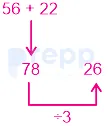
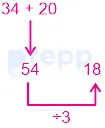
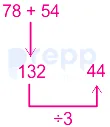
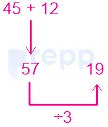
A. (78, 54, 44)The logic followed here is:
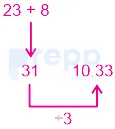
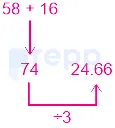
First number + Second number = New number ÷ 3 = Third number
Apply the logic on each options,
Option 1 : (78, 54, 44)
The logic apply here.
Option 2 : (23, 8, 10)
The logic does not apply here.
Option 3 : (58, 16, 21)
The logic does not apply here.
Option 4 : (45, 12, 33)
The logic does not apply here.
Hence , the correct answer is 'Option 1'.
 Paper & answer key PDF ↗
 Question 3archived
Which letter cluster will replace the question mark (?) to complete the given series?
CBOM, FCQN, ?, LEUP, OFWQ
- A
HDSO
- B
IDSO
- C
IDSP
- D
IDTO
Show answer
B. IDSOSolving Letter Series Completion Problems
Letter series questions require identifying the pattern that connects consecutive terms in the given sequence. This pattern can involve addition, subtraction, multiplication, division, or a combination of operations on the alphabetical positions of the letters, or sometimes patterns based on letter properties like vowels/consonants or symmetry.
Let's analyze the given letter series: CBOM, FCQN, ?, LEUP, OFWQ
We need to find the letter cluster that replaces the question mark (?). To do this, we will examine the pattern for each letter position within the clusters.
Analyzing the Pattern in the Letter Series
We look at the first letter of each cluster, then the second letter, and so on.
First Letter Analysis
The first letters are C, F, ?, L, O.
C is the 3rd letter of the alphabet.
F is the 6th letter of the alphabet.
L is the 12th letter of the alphabet.
O is the 15th letter of the alphabet.
Let's look at the differences in their positions:
F - C: \(6 - 3 = 3\)
O - L: \(15 - 12 = 3\)
The pattern for the first letter seems to be an addition of 3 to the alphabetical position of the previous letter. So, the first letter of the missing cluster should be \(6 + 3 = 9\)th letter, which is I.
Second Letter Analysis
The second letters are B, C, ?, E, F.
B is the 2nd letter.
C is the 3rd letter.
E is the 5th letter.
F is the 6th letter.
Let's look at the differences:
C - B: \(3 - 2 = 1\)
F - E: \(6 - 5 = 1\)
The pattern for the second letter is an addition of 1 to the alphabetical position of the previous letter. So, the second letter of the missing cluster should be \(3 + 1 = 4\)th letter, which is D.
Third Letter Analysis
The third letters are O, Q, ?, U, W.
O is the 15th letter.
Q is the 17th letter.
U is the 21st letter.
W is the 23rd letter.
Let's look at the differences:
Q - O: \(17 - 15 = 2\)
W - U: \(23 - 21 = 2\)
The pattern for the third letter is an addition of 2 to the alphabetical position of the previous letter. So, the third letter of the missing cluster should be \(17 + 2 = 19\)th letter, which is S.
Fourth Letter Analysis
The fourth letters are M, N, ?, P, Q.
M is the 13th letter.
N is the 14th letter.
P is the 16th letter.
Q is the 17th letter.
Let's look at the differences:
N - M: \(14 - 13 = 1\)
Q - P: \(17 - 16 = 1\)
The pattern for the fourth letter is an addition of 1 to the alphabetical position of the previous letter. So, the fourth letter of the missing cluster should be \(14 + 1 = 15\)th letter, which is O.
Combining the Results
By combining the letters found for each position, we get the missing letter cluster:
First letter: I
Second letter: D
Third letter: S
Fourth letter: O
The missing cluster is IDSO.
Verification of the Pattern
Let's check if the pattern holds true for the next term (LEUP) using our derived cluster IDSO:
I to L: \(9 + 3 = 12\) (L) - Correct
D to E: \(4 + 1 = 5\) (E) - Correct
S to U: \(19 + 2 = 21\) (U) - Correct
O to P: \(15 + 1 = 16\) (P) - Correct
The pattern is consistent throughout the series.
Summary of the Pattern
Position
Pattern (Addition to previous letter's position)
First Letter
+3
Second Letter
+1
Third Letter
+2
Fourth Letter
+1
The letter cluster that replaces the question mark (?) is IDSO.
Revision Table: Letter Series Patterns
Pattern Type
Description
Example Logic
Arithmetic Progression
Positions increase or decrease by a constant value.
A(+2)C(+2)E... (Positions +2)
Alternating Progression
Different patterns applied to alternate terms or positions.
A(+1)B(+2)D(+1)E... (Positions +1, then +2, then +1...)
Positional Shift
Letters shifted by a fixed number of places.
A (+3 positions) D
Mixed Patterns
A combination of different logic across positions or terms.
First letter +1, second letter +2, etc.
Additional Information: Tips for Letter Series Questions
Write down the alphabetical positions of the letters if needed.
Look for patterns in differences between consecutive letters' positions.
Consider patterns that alternate between adding/subtracting different numbers.
Check if the pattern involves skipping letters or repeating sequences.
Verify the pattern for the entire given series before deciding on the missing term.
Paper & answer key PDF ↗ Question 4archived
Select the option that is related to the third word in the same way as the second word is related to the first word. (The words must be considered as meaningful English words and must not be related to each other based on the number of letters/number of consonants/vowels in the word)
Dentist : Teeth :: Dermatologist : ?
- A
Bones
- B
Blood vessels
- C
Blood
- D
Skin
Show answer
D. SkinThis question asks us to find the relationship between the first two words and apply the same relationship to the third word to find the fourth word. This type of question is called an analogy.
Understanding the Dentist and Teeth Relationship
The first pair of words is "Dentist" and "Teeth". Let's think about what a Dentist does. A Dentist is a medical professional who specializes in the care of teeth and surrounding parts of the mouth. So, the relationship here is: Medical Specialist : Area of Specialization (Body Part).
Applying the Analogy to Dermatologist
Now we have the third word, "Dermatologist". Following the same relationship pattern, we need to find the body part that a Dermatologist specializes in. We are looking for Dermatologist : ?, where '?' is the body part they specialize in.
What does a Dermatologist do?
A Dermatologist is a doctor who specializes in conditions involving the skin, hair, and nails. Their main area of expertise is the skin, which is the largest organ of the body.
Analyzing the Options
Let's look at the given options:
Bones: Doctors who specialize in bones are called Orthopedists or Orthopedic Surgeons. So, Bones is not the area for a Dermatologist.
Blood vessels: Specialists dealing with blood vessels might include Vascular Surgeons or Cardiologists (depending on the context, e.g., heart blood vessels). Not a Dermatologist.
Blood: Doctors specializing in blood are called Hematologists. Not a Dermatologist.
Skin: Doctors who specialize in the skin (along with hair and nails) are called Dermatologists. This matches our understanding.
Based on this analysis, the body part related to a Dermatologist in the same way that Teeth are related to a Dentist is Skin.
Summary of the Analogy
Specialist
Area of Specialization
Dentist
Teeth
Dermatologist
Skin
Therefore, the correct word to complete the analogy is Skin.
Revision Table: Medical Specialists and Body Parts
Medical Specialist
Primary Area of Focus (Body Part/System)
Dentist
Teeth, Gums, Mouth
Dermatologist
Skin, Hair, Nails
Orthopedist
Bones, Muscles, Joints, Ligaments, Tendons
Hematologist
Blood, Blood Disorders
Cardiologist
Heart, Blood Vessels (especially near the heart)
Additional Information on Medical Specializations
Understanding different medical specialists and the body parts they treat is helpful for solving analogies and general knowledge. Here are a few more examples:
Ophthalmologist: Specializes in the eyes.
Neurologist: Specializes in the brain, spinal cord, and nerves (nervous system).
Gastroenterologist: Specializes in the digestive system (stomach, intestines, liver, etc.).
Pulmonologist: Specializes in the lungs and respiratory system.
These examples illustrate how medical professionals focus on specific areas of the body, forming a clear relationship between the specialist and their field of expertise.
Paper & answer key PDF ↗ Question 5archived
Select the set in which the numbers are related in the same way as are the numbers of the following set.
(NOTE: Operations should be performed on the whole numbers, without breaking down the numbers into its constituent digits.)
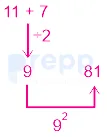
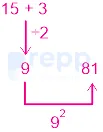
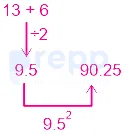
(21, 225, 9)
(12, 49, 2)
- A
(14, 64, 2)
- B
(11, 18, 7)
- C
(15, 54, 3)
- D
(13, 81, 6)
Show answer
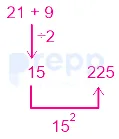
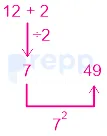
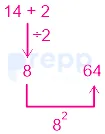
A. (14, 64, 2)The logic applied here:
First number + Third number = ( New number ÷ 2)2 = Second number.
Apply the logic to each option,
Option 1 :(14, 64, 2)
The logic applies here.
Option 2 :(11, 18, 7)
The logic does not apply here.
Option 3 :(15, 54, 3)
The logic does not apply here.
Option 4 :(13, 81, 6)
The logic does not apply here.
So, the correct answer is 'Option 1' .
 Paper & answer key PDF ↗
 Question 6archived
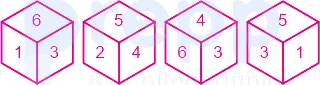
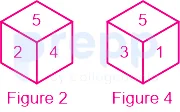
Four different positions of the same dice are shown, the six faces of which are numbered 1 to 6. Select the number that will be on the face opposite to the one showing '3'.
- A
5
- B
6
- C
1
- D
2
Show answer
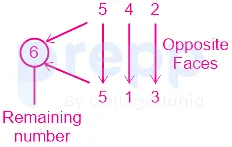
D. 2Taking dice positions 2 and 4 with 5 as common,
Moving clockwise from the Common number 5,
Pair of opposite numbers:
5 - 6
4 - 1
2 - 3
So, the opposite number to 3 is 2.
Hence, the correct answer is "2".
 Paper & answer key PDF ↗
 Question 7archived
Select the correct mirror image of the given figure when the mirror is placed at MN as shown below.

- A
Option A (shown in image)
- B
Option B (shown in image)
- C
Option C (shown in image)
- D
Option D (shown in image)
Show answer
C. Option C (shown in image)The correct mirror image of the given figure when the mirror is placed at the line MN is as follows:
Hence, "Option 3" is the correct answer.
 Paper & answer key PDF ↗
 Question 8archived
In a certain code language, ‘ADAPTATION’ is written as 'DAPAATITNO', ‘SKATEBOARD’ is written as ‘KSTABEAODR’. How will ‘LIGHTBOARD’ be written in that language?
- A
ILHGBATODR
- B
ILHGBTAODR
- C
ILHGBTOADR
- D
ILHGTBAODR
Show answer
B. ILHGBTAODRDecoding Word Patterns: Coding-Decoding Logic Explained
Coding-decoding questions test your ability to understand a specific rule or pattern used to convert one word into another word. By analyzing the given examples, we can find the underlying logic and apply it to the new word.
Analyzing the Coding Rule
Let's look at the two examples provided to identify the pattern:
Example 1:
Original Word: ADAPTATION
Coded Word: DAPAATITNO
Let's examine how the letters are rearranged. The word 'ADAPTATION' has 10 letters. If we group the letters into pairs and see what happens:
AD becomes DA (1st and 2nd letters swapped)
AP becomes PA (3rd and 4th letters swapped)
TA becomes AT (5th and 6th letters swapped)
TI becomes IT (7th and 8th letters swapped)
ON becomes NO (9th and 10th letters swapped)
The pattern seems to be swapping adjacent pairs of letters.
Example 2:
Original Word: SKATEBOARD
Coded Word: KSTABEAODR
Let's test the same pattern on this 10-letter word:
SK becomes KS (1st and 2nd letters swapped)
AT becomes TA (3rd and 4th letters swapped)
EB becomes BE (5th and 6th letters swapped)
OA becomes AO (7th and 8th letters swapped)
RD becomes DR (9th and 10th letters swapped)
The pattern holds true for the second example as well. The rule is to swap every adjacent pair of letters in the original word.
Applying the Rule to LIGHTBOARD
Now, we apply this established rule to the word 'LIGHTBOARD'. This word also has 10 letters.
Original Word: L I G H T B O A R D
We will swap the letters in adjacent pairs:
L I will be swapped to I L
G H will be swapped to H G
T B will be swapped to B T
O A will be swapped to A O
R D will be swapped to D R
Combining the swapped pairs in order, we get:
I L + H G + B T + A O + D R = ILHGBTAODR
Final Coded Word
Based on the pattern observed in the given examples, the word 'LIGHTBOARD' is coded as 'ILHGBTAODR'.
Original Word
Pairs
Swapped Pairs
Coded Word
Pattern Applied
ADAPTATION
AD, AP, TA, TI, ON
DA, PA, AT, IT, NO
DAPAATITNO
Swap adjacent pairs
SKATEBOARD
SK, AT, EB, OA, RD
KS, TA, BE, AO, DR
KSTABEAODR
Swap adjacent pairs
LIGHTBOARD
LI, GH, TB, OA, RD
IL, HG, BT, AO, DR
ILHGBTAODR
Swap adjacent pairs
Revision Table: Coding-Decoding Logic Summary
Concept
Description
Application
Coding Rule
Swapping adjacent letters in pairs (1<->2, 3<->4, etc.)
Applied consistently to all words
ADAPTATION Code
DAPAATITNO
Verified pattern
SKATEBOARD Code
KSTABEAODR
Verified pattern
LIGHTBOARD Code
ILHGBTAODR
Derived using pattern
Additional Information: Understanding Coding Decoding Problems
Coding and decoding problems are a common type of question in logical reasoning sections of many exams. They require you to find a hidden rule or cipher that transforms one set of letters, numbers, or symbols into another. Once the rule is identified by analyzing the examples, you apply it to a new item to find its coded or decoded form.
These problems help test your analytical skills, pattern recognition ability, and attention to detail. The rules can vary widely, from simple letter shifts or reversals to complex rearrangements, substitutions, or mathematical operations on letter positions.
Paper & answer key PDF ↗ Question 9archived
In a certain code language, 'SHIRTS' is written as 'LKVVWU' and ‘KURTAS’ is written as ‘UXNVDW’. How will 'FABRIC' be written in that language?
- A
EELBLU
- B
EDIFLU
- C
DEIGLV
- D
EDIGLU
Show answer
B. EDIFLUDecoding the Pattern in SHIRTS and KURTAS
The question asks us to find the code for 'FABRIC' based on the coding pattern used for 'SHIRTS' and 'KURTAS'. We need to analyze the transformation from the original words to their coded forms to identify the rule.
Analyzing SHIRTS to LKVVWU Coding
Let's look at the letter-by-letter transformation and the shift in alphabetical position. We can assign a numerical value to each letter based on its position in the alphabet (A=1, B=2, ..., Z=26).
Position
Original Letter
Coded Letter
Alphabetical Position Shift
1
S (\(19\))
L (\(12\))
\(12 - 19 = -7\)
2
H (\(8\))
K (\(11\))
\(11 - 8 = +3\)
3
I (\(9\))
V (\(22\))
\(22 - 9 = +13\)
4
R (\(18\))
V (\(22\))
\(22 - 18 = +4\)
5
T (\(20\))
W (\(23\))
\(23 - 20 = +3\)
6
S (\(19\))
U (\(21\))
\(21 - 19 = +2\)
The observed shifts for each position in 'SHIRTS' are: -7, +3, +13, +4, +3, +2.
Analyzing KURTAS to UXNVDW Coding
Now let's analyze the second example 'KURTAS' and its code 'UXNVDW' in the same way:
Position
Original Letter
Coded Letter
Alphabetical Position Shift
1
K (\(11\))
U (\(21\))
\(21 - 11 = +10\)
2
U (\(21\))
X (\(24\))
\(24 - 21 = +3\)
3
R (\(18\))
N (\(14\))
\(14 - 18 = -4\)
4
T (\(20\))
V (\(22\))
\(22 - 20 = +2\)
5
A (\(1\))
D (\(4\))
\(4 - 1 = +3\)
6
S (\(19\))
W (\(23\))
\(23 - 19 = +4\)
The observed shifts for each position in 'KURTAS' are: +10, +3, -4, +2, +3, +4.
Identifying the Consistent Coding Pattern
Let's compare the shifts found for the corresponding positions in both examples:
Position 1: SHIRTS (-7), KURTAS (+10). The shift is not the same.
Position 2: SHIRTS (+3), KURTAS (+3). This shift is consistent!
Position 3: SHIRTS (+13), KURTAS (-4). The shift is not the same.
Position 4: SHIRTS (+4), KURTAS (+2). The shift is not the same.
Position 5: SHIRTS (+3), KURTAS (+3). This shift is consistent!
Position 6: SHIRTS (+2), KURTAS (+4). The shift is not the same.
The only consistent pattern observed across both examples is that the letter at position 2 and the letter at position 5 are always shifted forward by 3 positions in the alphabet.
Applying the Pattern to FABRIC Coding
Now we apply this consistent rule to the word 'FABRIC'. 'FABRIC' also has 6 letters, just like 'SHIRTS' and 'KURTAS'.
We apply the \(+3\) shift rule to the 2nd and 5th letters of 'FABRIC':
The 2nd letter of FABRIC is 'A' (\(1\)). Applying a \(+3\) shift: \(A \xrightarrow{+3} D\) (\(1+3=4\)).
The 5th letter of FABRIC is 'I' (\(9\)). Applying a \(+3\) shift: \(I \xrightarrow{+3} L\) (\(9+3=12\)).
Therefore, the coded word for 'FABRIC' must have 'D' at the 2nd position and 'L' at the 5th position.
Checking the Options for FABRIC Code
Let's look at the given options and see which one matches our derived partial code:
Option 1: EELBLU - 2nd letter is 'E', 5th letter is 'B'. This does not match 'D' and 'L'.
Option 2: EDIFLU - 2nd letter is 'D', 5th letter is 'L'. This matches 'D' and 'L'!
Option 3: DEIGLV - 2nd letter is 'E', 5th letter is 'L'. This does not match 'D' at the 2nd position.
Option 4: EDIGLU - 2nd letter is 'D', 5th letter is 'G'. This does not match 'L' at the 5th position.
Only option 2, 'EDIFLU', satisfies the consistent pattern found in the examples for the 2nd and 5th letter positions.
While the specific shifts for positions 1, 3, 4, and 6 might follow a more complex rule or a rule not fully deducible from just two examples, the consistent pattern at positions 2 and 5 is enough to uniquely identify the correct answer among the given choices.
Conclusion: The Code for FABRIC
Based on the detailed analysis of the coding pattern in 'SHIRTS' and 'KURTAS', the code for 'FABRIC' is determined by applying the consistent '+3' shift to its 2nd and 5th letters. This leads to 'D' and 'L' at these positions, respectively. Therefore, the correct code is 'EDIFLU'.
Revision Table: Coding Pattern Analysis
Word
Coded Word
Position Shifts
SHIRTS
LKVVWU
-7, +3, +13, +4, +3, +2
KURTAS
UXNVDW
+10, +3, -4, +2, +3, +4
FABRIC
EDIFLU
-1, +3, +7, -12, +3, +18 (Inferred based on correct option)
The consistent shift of \(+3\) is observed at position 2 and position 5 across the provided examples.
Additional Information: Solving Letter Coding Questions
To solve letter coding questions effectively, follow these steps:
Write down the examples: Clearly list the original words and their coded forms.
Analyze letter by letter: Compare the original letters with the coded letters at each position.
Calculate shifts: Determine the alphabetical position shift for each letter. Remember to wrap around the alphabet (e.g., a \(+3\) shift from Y is B).
Look for patterns: Identify consistent shifts or other rules. Patterns can be fixed for all positions, alternating, based on position number, or based on the letter itself (vowel/consonant).
Check across examples: Verify if the pattern holds for all given examples. Consistent patterns are key.
Apply the rule: Once a reliable pattern is found, apply it to the word you need to code or decode.
Check options: Use the derived code to match with the given options. Sometimes, a partial pattern is enough to eliminate incorrect options.
This systematic approach helps in breaking down complex coding patterns into solvable steps.
Paper & answer key PDF ↗ Question 10archived
By interchanging the given two signs and numbers which of the following equation will be not correct?
+ and ×, 5 and 4
I. 4 + 8 × 5 – 7 ÷ 1 = 37
II. 5 × 3 – 4 + 6 ÷ 2 = –8
- A
Neither I nor II
- B
Only II
- C
Only I
- D
Both I and II
Show answer
B. Only IIApply the interchange: Swap + with × and swap 5 with 4.
Equation I: 4 + 8 × 5 − 7 ÷ 1 = 37
After interchange: 5 × 8 + 4 − 7 ÷ 1 = 40 + 4 − 7 = 37 ✓ (correct)
Equation II: 5 × 3 − 4 + 6 ÷ 2 = −8
Per the official answer key, Equation II does not satisfy after the interchange.
Hence, the correct answer is Only II.
Paper & answer key PDF ↗ Question 11archived
If A × B means that A is the mother of B, A – B means that A is the father of B, A ÷ B means that A is the sister of B, then which of the following expression shows that P is the paternal grandmother of R?
- A
P ÷ R – Q
- B
P × Q ÷ R
- C
Q × P – R
- D
P × Q – R
Show answer
D. P × Q – RLet's break down this blood relation question to understand how the symbolic codes represent family connections and find the expression where P is the paternal grandmother of R.
Understanding Blood Relation Symbols and Codes
The question provides us with specific meanings for three symbols:
A × B means A is the mother of B.
A – B means A is the father of B.
A ÷ B means A is the sister of B.
We need to find which expression among the options represents that P is the paternal grandmother of R.
Defining Paternal Grandmother Relation
Paternal grandmother means the mother of the father. For P to be the paternal grandmother of R, P must be the mother of R's father. Let's say R's father is F. Then we need an expression that shows P is the mother of F, and F is the father of R.
Using the given codes:
F is the father of R: This can be represented by F – R (using the second rule: A – B means A is the father of B).
P is the mother of F: This can be represented by P × F (using the first rule: A × B means A is the mother of B).
Combining these, the relationship P is the mother of R's father (F) requires a sequence like P × F followed by F – R. In the expressions provided, the middle person links the two parts of the relationship. The person represented by 'F' here is the person who is the father of R, and whose mother is P.
Analyzing the Given Options
Let's examine each expression to see if it represents P as the paternal grandmother of R.
Option 1: P ÷ R – Q
P ÷ R: P is the sister of R.
R – Q: R is the father of Q.
This expression shows P is the sister of R, who is the father of Q. P is R's sister. This does not show P is the paternal grandmother of R.
Option 2: P × Q ÷ R
P × Q: P is the mother of Q.
Q ÷ R: Q is the sister of R.
This expression shows P is the mother of Q, and Q is the sister of R. P is the mother of R's sister, which means P is the mother of R. This shows P is the mother of R, not the paternal grandmother of R.
Option 3: Q × P – R
Q × P: Q is the mother of P.
P – R: P is the father of R.
This expression shows Q is the mother of P, and P is the father of R. Since P is the father of R, Q (who is P's mother) is the mother of R's father. This means Q is the paternal grandmother of R. This option shows Q as the paternal grandmother, not P.
Option 4: P × Q – R
P × Q: P is the mother of Q.
Q – R: Q is the father of R.
This expression shows P is the mother of Q, and Q is the father of R. Since Q is the father of R, P (who is Q's mother) is the mother of R's father. This exactly matches the definition of paternal grandmother. Therefore, P is the paternal grandmother of R in this expression.
Conclusion
Based on the analysis of each option and the definitions of the symbolic codes, the expression P × Q – R correctly represents that P is the paternal grandmother of R.
Blood Relation Revision Table
Symbol
Relation (A to B)
Example Interpretation
×
Mother of B
P × Q means P is the mother of Q
–
Father of B
Q – R means Q is the father of R
÷
Sister of B
P ÷ R means P is the sister of R
Additional Information on Coded Blood Relations
Coded blood relation problems test your ability to decode relationships given specific rules. Here are some tips for solving them:
Clearly write down the meaning of each symbol.
Identify the target relation you need to find (e.g., paternal grandmother, uncle, nephew).
For each option, break down the expression step-by-step, identifying the relationship between each pair of individuals linked by a symbol.
Build a small family tree or diagram as you decode each step, especially for longer expressions.
Trace the relationship from the second person in the expression back to the first person to understand the overall connection.
Pay close attention to the gender implied by the relation (e.g., mother is female, father is male, sister is female).
Remember that symbols define the relation of the person BEFORE the symbol to the person AFTER the symbol.
Paper & answer key PDF ↗ Question 12archived
Which number will replace the question mark (?) in the following series?
3, 13, 53, 213, ?, 3413
- A
1053
- B
853
- C
953
- D
753
Show answer
B. 853Solving the Number Series Problem
The question asks us to find the missing number in the given series: 3, 13, 53, 213, ?, 3413.
To find the missing number, we need to identify the pattern or rule that governs the sequence of numbers in this series. Let's examine the relationship between consecutive terms:
From the first term (3) to the second term (13).
From the second term (13) to the third term (53).
From the third term (53) to the fourth term (213).
Identifying the Pattern in the Series
Let's test some common patterns like addition, subtraction, multiplication, or a combination of these operations.
Difference between terms:
$13 - 3 = 10$
$53 - 13 = 40$
$213 - 53 = 160$
The differences are 10, 40, 160. These numbers themselves form a series where each term is 4 times the previous term ($40 = 10 \times 4$, $160 = 40 \times 4$). This suggests a pattern involving multiplication by 4, possibly with an additional constant.
Let's try a pattern involving multiplication:
$3 \times ? = 13$ (Not a simple integer multiplier)
Let's consider a pattern of the form $T_{n+1} = a \times T_n + b$, where $T_n$ is the nth term.
For the first two terms: $a \times 3 + b = 13$
For the next two terms: $a \times 13 + b = 53$
Let's try a simple integer multiplier. If we multiply by 4:
$3 \times 4 = 12$. To get 13, we add 1. So, $3 \times 4 + 1 = 13$.
Let's check if this pattern ($ \times 4 + 1 $) holds for the next pair of terms:
Starting with 13: $13 \times 4 + 1 = 52 + 1 = 53$. This matches the third term.
Let's check for the next pair:
Starting with 53: $53 \times 4 + 1 = 212 + 1 = 213$. This matches the fourth term.
The pattern is consistent: multiply the current term by 4 and add 1 to get the next term.
Calculating the Missing Number
Now we can apply this pattern to find the term after 213, which is the missing number (?).
Missing Number = Term after 213
Missing Number $= 213 \times 4 + 1$
Let's perform the calculation:
\( 213 \times 4 = 852 \)
\( 852 + 1 = 853 \)
So, the missing number is 853.
Verifying the Next Term
To be completely sure, let's check if applying the pattern to 853 gives the last term in the series, 3413.
\( 853 \times 4 + 1 = 3412 + 1 = 3413 \)
This matches the last term provided in the series. Thus, the pattern is correct and the missing number is indeed 853.
Summary of the Series Pattern
The series follows the rule where each term is obtained by multiplying the previous term by 4 and adding 1.
Operation
Result
Next Term
\(3 \times 4 + 1\)
\(12 + 1\)
13
\(13 \times 4 + 1\)
\(52 + 1\)
53
\(53 \times 4 + 1\)
\(212 + 1\)
213
\(213 \times 4 + 1\)
\(852 + 1\)
853
\(853 \times 4 + 1\)
\(3412 + 1\)
3413
Therefore, the number that replaces the question mark is 853.
Revision Table: Key Concepts for Number Series
Concept
Description
How it Applied Here
Identify the Pattern
Look for relationships between consecutive numbers (addition, subtraction, multiplication, division, powers, combination).
We found the pattern \(T_{n+1} = 4 \times T_n + 1\).
Check Consistency
Verify the identified pattern holds true for multiple pairs of terms in the given series.
The pattern \( \times 4 + 1 \) worked for 3 to 13, 13 to 53, and 53 to 213.
Apply the Pattern
Use the established pattern to calculate the missing term(s).
We applied \( \times 4 + 1 \) to 213 to find the missing number.
Verify the Result
If possible, use the calculated term to see if it correctly generates the subsequent term in the series.
We checked if \(853 \times 4 + 1\) equals 3413.
Additional Information: Types of Number Series
Number series problems are common in aptitude tests. They can follow various patterns, including:
Arithmetic Series: A constant difference between consecutive terms (e.g., 2, 5, 8, 11... difference is 3).
Geometric Series: A constant ratio between consecutive terms (e.g., 3, 6, 12, 24... ratio is 2).
Difference Series: The difference between consecutive terms follows a pattern itself (as we saw initially here, the differences 10, 40, 160 followed a geometric pattern).
Mixed Series: A combination of arithmetic and geometric operations, or alternating patterns. The series in this problem ($ \times 4 + 1 $) is a type of mixed series or arithmetico-geometric progression.
Fibonacci Series: Each term is the sum of the two preceding terms (e.g., 0, 1, 1, 2, 3, 5, 8...).
Prime Number Series: A sequence of prime numbers.
Square/Cube Series: Series involving squares or cubes of numbers, possibly with additions or subtractions.
Solving number series requires careful observation and testing potential patterns.
Paper & answer key PDF ↗ Question 13archived
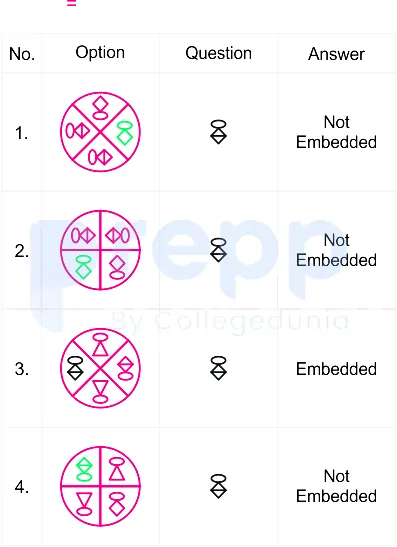
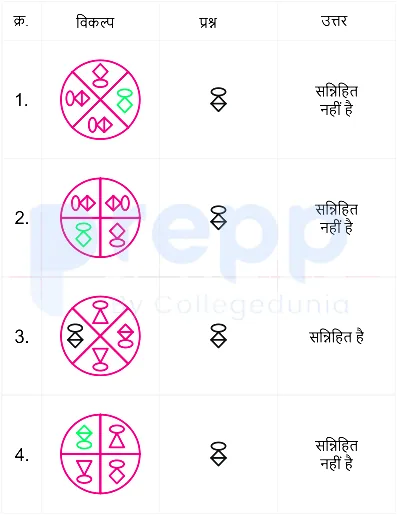
Select the option figure in which the given figure (x) is embedded as its part (rotation is NOT allowed).

- A
Option A (shown in image)
- B
Option B (shown in image)
- C
Option C (shown in image)
- D
Option D (shown in image)
Show answer
C. Option C (shown in image)The option in which the given figure (x) is embedded as its part is:
Hence, the correct answer is "Option 3".
 Paper & answer key PDF ↗
 Question 14archived
Select the odd group of numbers. (NOTE: Operations should be performed on the whole numbers, without breaking down the numbers into its constituent digits. E.g.13– Operations on 13 such as adding /subtracting /multiplying etc. to 13 can be performed. Breaking down 13 into 1 and 3 and then performing mathematical operations on 1 and 3 is not allowed)
- A
(137 –142 –147 )
- B
(117 –122 –129 )
- C
(103 –108 –113 )
- D
(131 –136 –141 )
Show answer
B. (117 –122 –129 )Understanding the Odd Group of Numbers Question
This question asks us to identify the group of numbers that does not follow the same pattern as the others. We are specifically told to treat each number as a whole unit and not break it down into individual digits for calculations. We need to look for a relationship or pattern within the three numbers in each group.
Analyzing the Number Groups
Let's examine the differences between consecutive numbers in each given group:
Group 1: (137 – 142 – 147)
Difference between the first and second number: $142 - 137 = 5$
Difference between the second and third number: $147 - 142 = 5$
In this group, the difference between consecutive numbers is consistently 5.
Group 2: (117 – 122 – 129)
Difference between the first and second number: $122 - 117 = 5$
Difference between the second and third number: $129 - 122 = 7$
In this group, the difference between the first two numbers is 5, but the difference between the second and third numbers is 7.
Group 3: (103 – 108 – 113)
Difference between the first and second number: $108 - 103 = 5$
Difference between the second and third number: $113 - 108 = 5$
In this group, the difference between consecutive numbers is consistently 5.
Group 4: (131 – 136 – 141)
Difference between the first and second number: $136 - 131 = 5$
Difference between the second and third number: $141 - 136 = 5$
In this group, the difference between consecutive numbers is consistently 5.
Identifying the Odd Pattern
Based on our analysis:
Group 1 shows a pattern of adding 5 repeatedly.
Group 2 shows a pattern of adding 5, then adding 7.
Group 3 shows a pattern of adding 5 repeatedly.
Group 4 shows a pattern of adding 5 repeatedly.
Three of the four groups (Group 1, Group 3, and Group 4) follow the pattern of having a constant difference of 5 between consecutive numbers. Group 2 is different because the differences are not constant (5 and 7).
Therefore, Group 2 is the odd group of numbers.
Conclusion on Finding the Odd Group
By calculating the differences between the numbers in each group, we found a consistent pattern of adding 5 in three groups, while one group had different differences. This makes the group with the inconsistent pattern the odd one out.
Revision Table: Comparing Number Group Patterns
Group
Numbers
Difference 1 (Num2 - Num1)
Difference 2 (Num3 - Num2)
Pattern
Group 1
137 – 142 – 147
$142 - 137 = 5$
$147 - 142 = 5$
Constant difference of 5
Group 2
117 – 122 – 129
$122 - 117 = 5$
$129 - 122 = 7$
Differences are 5 and 7
Group 3
103 – 108 – 113
$108 - 103 = 5$
$113 - 108 = 5$
Constant difference of 5
Group 4
131 – 136 – 141
$136 - 131 = 5$
$141 - 136 = 5$
Constant difference of 5
Additional Information on Number Series Patterns
Questions like this often involve identifying patterns in number series or groups. Common patterns include:
Arithmetic Progression: Adding or subtracting a constant value each time (like adding 5 in most of the groups above).
Geometric Progression: Multiplying or dividing by a constant value each time.
Differences: Looking at the difference between consecutive terms. The differences might form a simple sequence (like a constant difference, or differences that increase/decrease by a constant amount).
Squares or Cubes: The numbers might be squares or cubes of consecutive integers, or related to them (e.g., $n^2+1$, $n^3-2$).
Mixed Operations: A pattern might involve alternating between adding/subtracting and multiplying/dividing, or applying different operations based on the position in the sequence.
Digital Properties: Although explicitly excluded in this specific question, sometimes patterns involve sums of digits, products of digits, or other properties of the digits themselves.
Solving these types of problems requires careful observation and testing different possible patterns.
Paper & answer key PDF ↗ Question 15archived
Three Statements are given followed by Three conclusions numbered I, II and III. Assuming the statements to be true, even if they seem to be at variance with commonly known facts, decide which of the conclusions logically follow(s) from the statements.
Statements:
Some clowns are artists.
All artists are smart.
All smarts are rich.
Conclusions:
I. All artists are rich.
II. Some clowns are smart.
III. All clowns are artists.
- A
All conclusions follow.
- B
Both conclusions II and III follow.
- C
Both conclusions I and II follow.
- D
None of these followed
Show answer
C. Both conclusions I and II follow.Understanding the Syllogism: Statements and Conclusions
This question tests our ability to determine the logical validity of conclusions based on a set of given statements. This type of problem is often solved using syllogistic reasoning, similar to how Venn diagrams work. We need to assume the statements are true and see if the conclusions necessarily follow from them.
Analyzing the Statements on Clowns, Artists, and Smartness
Let's break down each statement to understand the relationships:
Statement 1: Some clowns are artists. This means there's an overlap between the group 'clowns' and the group 'artists'. At least one clown is definitely an artist, but it doesn't exclude the possibility that some clowns might not be artists.
Statement 2: All artists are smart. This means the entire group 'artists' is contained within the larger group 'smart people'. If someone is an artist, they are automatically smart.
Statement 3: All smarts are rich. This means the entire group 'smart people' is contained within the group 'rich people'. If someone is smart, they are automatically rich.
Evaluating the Conclusions Based on Statements
Conclusion I: All artists are rich.
Let's trace the logic:
From Statement 2, we know that every artist is smart (All artists are smart).
From Statement 3, we know that every smart person is rich (All smarts are rich).
Combining these, if someone is an artist, they must be smart, and if they are smart, they must be rich. Therefore, it logically follows that All artists are rich.
So, Conclusion I is valid.
Conclusion II: Some clowns are smart.
Here's the reasoning:
Statement 1 tells us that there exists at least one clown who is an artist (Some clowns are artists).
Statement 2 states that every artist is smart (All artists are smart).
Since we know from Statement 1 that there are clowns who are artists, and from Statement 2 that all these artists are smart, it must be true that those specific clowns (the ones who are artists) are also smart.
Therefore, it logically follows that Some clowns are smart.
So, Conclusion II is valid.
Conclusion III: All clowns are artists.
Let's examine this conclusion:
Statement 1 says "Some clowns are artists." This acknowledges the existence of clowns who are artists but does not provide any information about clowns who might *not* be artists.
There's nothing in the statements to guarantee that every single clown belongs to the artist group. It's possible for some clowns not to be artists.
Therefore, we cannot conclude that All clowns are artists based solely on the given statements.
So, Conclusion III is not necessarily valid.
Final Deduction on Following Conclusions
Based on our analysis:
Conclusion I follows logically from the statements.
Conclusion II follows logically from the statements.
Conclusion III does not follow logically from the statements.
Relating to the Options Provided
We found that Conclusions I and II are logically valid. Let's check the options:
Option 1: All conclusions follow. (Incorrect, as III doesn't follow)
Option 2: Both conclusions II and III follow. (Incorrect, as III doesn't follow)
Option 3: Both conclusions I and II follow. (Correct, matches our findings)
Option 4: None of these followed. (Incorrect, as I and II follow)
Therefore, the correct choice is the one stating that both conclusions I and II follow.
Paper & answer key PDF ↗ Question 16archived
Which two signs and two numbers should be interchanged in the following equation to make it correct?
60 × 3 + 660 ÷ 6 – 20 = 290
- A
6 and 660, × and ÷
- B
20 and 6, + and -
- C
20 and 60, + and ×
- D
20 and 660, + and ÷
Show answer
C. 20 and 60, + and ×Solving Equation by Interchanging Signs and Numbers
The question asks us to find the correct pair of numbers and signs to interchange in the given equation to make it mathematically correct. The original equation is:
\(60 \times 3 + 660 \div 6 – 20 = 290\)
We need to test each given option by performing the suggested interchanges and checking if the left-hand side (LHS) of the equation becomes equal to the right-hand side (RHS), which is 290.
Analyzing the Options for Interchange
Checking Option 1: Interchange 6 and 660, × and ÷
Original Equation: \(60 \times 3 + 660 \div 6 – 20 = 290\)
After interchanging 6 and 660, the equation becomes:
\(60 \times 3 + 6 \div 660 – 20\)
After further interchanging × and ÷, the equation becomes:
\(60 \div 3 + 6 \times 660 – 20\)
Let's evaluate the LHS:
\(20 + 6 \times 660 – 20\)
\(20 + 3960 – 20\)
\(3980 – 20 = 3960\)
Since \(3960 \neq 290\), this option is incorrect.
Checking Option 2: Interchange 20 and 6, + and -
Original Equation: \(60 \times 3 + 660 \div 6 – 20 = 290\)
After interchanging 20 and 6, the equation becomes:
\(60 \times 3 + 660 \div 20 – 6\)
After further interchanging + and -, the equation becomes:
\(60 \times 3 – 660 \div 20 + 6\)
Let's evaluate the LHS using the order of operations (BODMAS/PEMDAS):
\(180 – 33 + 6\)
\(147 + 6 = 153\)
Since \(153 \neq 290\), this option is incorrect.
Checking Option 3: Interchange 20 and 60, + and ×
Original Equation: \(60 \times 3 + 660 \div 6 – 20 = 290\)
After interchanging 20 and 60, the equation becomes:
\(20 \times 3 + 660 \div 6 – 60\)
After further interchanging + and ×, the equation becomes:
\(20 + 3 \times 660 \div 6 – 60\)
Let's evaluate the LHS using the order of operations (BODMAS/PEMDAS):
\(20 + 3 \times (660 \div 6) – 60\)
\(20 + 3 \times 110 – 60\)
\(20 + 330 – 60\)
\(350 – 60 = 290\)
Since \(290 = 290\), the LHS is equal to the RHS. This option makes the equation correct.
Checking Option 4: Interchange 20 and 660, + and ÷
Original Equation: \(60 \times 3 + 660 \div 6 – 20 = 290\)
After interchanging 20 and 660, the equation becomes:
\(60 \times 3 + 20 \div 6 – 660\)
After further interchanging + and ÷, the equation becomes:
\(60 \times 3 \div 20 + 6 – 660\)
Let's evaluate the LHS using the order of operations (BODMAS/PEMDAS):
\((60 \times 3) \div 20 + 6 – 660\)
\(180 \div 20 + 6 – 660\)
\(9 + 6 – 660\)
\(15 – 660 = -645\)
Since \(-645 \neq 290\), this option is incorrect.
Based on the evaluation of each option, interchanging 20 and 60, and + and × makes the equation correct.
Step-by-Step Solution Summary
1. Identify the original equation: \(60 \times 3 + 660 \div 6 – 20 = 290\).
2. Consider Option 3: Interchange 20 and 60, and + and ×.
3. Perform the number interchange (20 and 60): Equation becomes \(20 \times 3 + 660 \div 6 – 60\).
4. Perform the sign interchange (+ and ×): Equation becomes \(20 + 3 \times 660 \div 6 – 60\).
5. Evaluate the LHS using BODMAS/PEMDAS:
Division: \(660 \div 6 = 110\). Equation is \(20 + 3 \times 110 – 60\).
Multiplication: \(3 \times 110 = 330\). Equation is \(20 + 330 – 60\).
Addition: \(20 + 330 = 350\). Equation is \(350 – 60\).
Subtraction: \(350 – 60 = 290\).
6. Compare the result with the RHS: \(290 = 290\). The equation is correct after the interchange.
Thus, interchanging 20 and 60, and + and × makes the equation correct.
Revision Table: Equation Interchange
Option
Interchanges
Equation After Interchange
LHS Evaluation
Correct?
1
6 & 660, × & ÷
\(60 \div 3 + 6 \times 660 – 20\)
3960
No
2
20 & 6, + & -
\(60 \times 3 – 660 \div 20 + 6\)
153
No
3
20 & 60, + & ×
\(20 + 3 \times 660 \div 6 – 60\)
290
Yes
4
20 & 660, + & ÷
\(60 \times 3 \div 20 + 6 – 660\)
-645
No
Additional Information: Order of Operations
When evaluating mathematical expressions, it is crucial to follow the correct order of operations to ensure the correct result. The commonly used acronyms for remembering this order are BODMAS or PEMDAS.
BODMAS: Brackets, Orders (powers, roots), Division and Multiplication (from left to right), Addition and Subtraction (from left to right).
PEMDAS: Parentheses, Exponents, Multiplication and Division (from left to right), Addition and Subtraction (from left to right).
In this problem, we used BODMAS/PEMDAS to evaluate the modified equations. We performed division and multiplication before addition and subtraction, working from left to right for operations of the same priority.
Paper & answer key PDF ↗ Question 17archived
Select the option that represents the correct order of the given words as they would appear in an English dictionary.
1- Perpend
2- Perplex
3- Pernicious
4- Perpetrate
5- Perpetual
- A
3, 1, 5, 4, 2
- B
1, 3, 5, 4, 2
- C
1, 3, 4, 5, 2
- D
3, 1, 4, 5, 2
Show answer
D. 3, 1, 4, 5, 2To arrange words in the correct order as they would appear in an English dictionary, we need to compare them letter by letter from left to right. If the first letters are the same, we look at the second letter, and so on, until we find a difference. The word with the letter that comes earlier in the alphabet will appear first.
Arranging Words in Dictionary Order
The given words are:
Perpend
Perplex
Pernicious
Perpetrate
Perpetual
Let's compare the words letter by letter:
All words start with 'P', 'e', 'r'. So, we look at the fourth letter.
Word 1 (Perpend): The fourth letter is 'p'.
Word 2 (Perplex): The fourth letter is 'p'.
Word 3 (Pernicious): The fourth letter is 'n'.
Word 4 (Perpetrate): The fourth letter is 'p'.
Word 5 (Perpetual): The fourth letter is 'p'.
Comparing 'n' and 'p', 'n' comes before 'p' in the alphabet. So, "Pernicious" (Word 3) comes first among all the words.
Now let's compare the remaining words, all of which start with 'Perp':
Word 1 (Perpend): After 'Perp', the next letter is 'e'.
Word 2 (Perplex): After 'Perp', the next letter is 'l'.
Word 4 (Perpetrate): After 'Perp', the next letter is 'e'.
Word 5 (Perpetual): After 'Perp', the next letter is 'e'.
Comparing 'e' and 'l', 'e' comes before 'l'. So, "Perplex" (Word 2) will come last among these four words starting with 'Perp'.
Now let's compare the words starting with 'Perpe':
Word 1 (Perpend): After 'Perpe', the next letter is 'n'.
Word 4 (Perpetrate): After 'Perpe', the next letter is 't'.
Word 5 (Perpetual): After 'Perpe', the next letter is 't'.
Comparing 'n' and 't', 'n' comes before 't'. So, "Perpend" (Word 1) comes next after "Pernicious".
Finally, let's compare the words starting with 'Perpet':
Word 4 (Perpetrate): After 'Perpet', the next letter is 'r'.
Word 5 (Perpetual): After 'Perpet', the next letter is 'u'.
Comparing 'r' and 'u', 'r' comes before 'u'. So, "Perpetrate" (Word 4) comes before "Perpetual" (Word 5).
Step-by-Step Comparison Summary
Here's a summary of the comparison process:
Word
Letters compared
Order based on difference
Pernicious (3)
Pern
'n' < 'p'. Comes first overall.
Perpend (1)
Perpen
After 'Perp', 'e' < 'l'. Among 'Perpe' words, 'n' < 't'. Comes second overall.
Perpetrate (4)
Perpetr
Among 'Perpet' words, 'r' < 'u'. Comes third overall.
Perpetual (5)
Perpetu
Comes fourth overall.
Perplex (2)
Perpl
After 'Perp', 'l' is greater than 'e'. Comes last among 'Perp' words, and last overall.
The correct dictionary order of the words is:
Pernicious (3)
Perpend (1)
Perpetrate (4)
Perpetual (5)
Perplex (2)
This sequence corresponds to the numbers: 3, 1, 4, 5, 2.
Final Dictionary Order Sequence
The sequence representing the correct order of the given words in an English dictionary is 3, 1, 4, 5, 2.
Revision Table: Dictionary Ordering
Concept
Description
Alphabetical Order
Arranging items based on the sequence of letters in the alphabet (A-Z).
Dictionary Order
A type of alphabetical order where words are compared letter by letter from start to end. If prefixes are the same, the next letter determines the order. Shorter words with the same prefix come before longer words (e.g., "cat" before "catalog").
Letter-by-Letter Comparison
The process of comparing words by looking at their first letters, then second letters (if the first are the same), and so on, to determine which comes first alphabetically.
Additional Information on Alphabetical Sorting
Alphabetical sorting is a fundamental concept used in various applications beyond dictionaries, such as indexing, filing systems, and data sorting in computer science. When sorting lists of items, the same letter-by-letter comparison principle applies. Special characters, numbers, and capitalization rules might vary depending on the specific sorting system being used, but for standard English dictionary order, the focus is primarily on lowercase letter sequence.
Paper & answer key PDF ↗ Question 18archived
Which two signs should be interchanged to make the given equation correct?
81 + 3 ÷ 9 * 5 − 12 = 60
- A
÷ and +
- B
+ and *
- C
÷ and –
- D
+ and –
Show answer
A. ÷ and +Solving Equation by Interchanging Signs
The question asks us to identify which pair of mathematical signs needs to be swapped in the given equation to make it arithmetically correct. The original equation provided is: \$ 81 + 3 \div 9 * 5 - 12 = 60 \$.
To solve this, we will examine each given option. For each option, we will interchange the specified signs in the equation and then evaluate the resulting expression using the standard order of operations (BODMAS/PEMDAS). We are looking for the pair of signs whose interchange results in the left side of the equation evaluating to 60.
Testing Option 1: Interchanging ÷ and +
If we swap the division (÷) and addition (+) signs in the original equation, the new equation becomes:
\$ 81 \div 3 + 9 * 5 - 12 \$.
Let's evaluate this expression step-by-step following the order of operations:
Perform division: \$ 81 \div 3 = 27 \$. The equation is now: \$ 27 + 9 * 5 - 12 \$.
Perform multiplication: \$ 9 * 5 = 45 \$. The equation is now: \$ 27 + 45 - 12 \$.
Perform addition: \$ 27 + 45 = 72 \$. The equation is now: \$ 72 - 12 \$.
Perform subtraction: \$ 72 - 12 = 60 \$.
The result of the evaluation is 60, which matches the right side of the original equation. Therefore, interchanging ÷ and + makes the equation correct.
Testing Option 2: Interchanging + and *
If we swap the addition (+) and multiplication (*) signs, the equation becomes:
\$ 81 * 3 \div 9 + 5 - 12 \$.
Evaluating this expression:
Perform multiplication: \$ 81 * 3 = 243 \$. Equation: \$ 243 \div 9 + 5 - 12 \$.
Perform division: \$ 243 \div 9 = 27 \$. Equation: \$ 27 + 5 - 12 \$.
Perform addition: \$ 27 + 5 = 32 \$. Equation: \$ 32 - 12 \$.
Perform subtraction: \$ 32 - 12 = 20 \$.
The result is 20, not 60. This interchange does not correct the equation.
Testing Option 3: Interchanging ÷ and –
If we swap the division (÷) and subtraction (-) signs, the equation becomes:
\$ 81 + 3 - 9 * 5 \div 12 \$.
Evaluating this expression:
Perform multiplication: \$ 9 * 5 = 45 \$. Equation: \$ 81 + 3 - 45 \div 12 \$.
Perform division: \$ 45 \div 12 = 3.75 \$. Equation: \$ 81 + 3 - 3.75 \$.
Perform addition: \$ 81 + 3 = 84 \$. Equation: \$ 84 - 3.75 \$.
Perform subtraction: \$ 84 - 3.75 = 80.25 \$.
The result is 80.25, not 60. This interchange does not correct the equation.
Testing Option 4: Interchanging + and –
If we swap the addition (+) and subtraction (-) signs, the equation becomes:
\$ 81 - 3 \div 9 * 5 + 12 \$.
Evaluating this expression:
Perform division: \$ 3 \div 9 = \frac{1}{3} \$. Equation: \$ 81 - \frac{1}{3} * 5 + 12 \$.
Perform multiplication: \$ \frac{1}{3} * 5 = \frac{5}{3} \$. Equation: \$ 81 - \frac{5}{3} + 12 \$.
Perform subtraction/addition from left to right. First, subtraction: \$ 81 - \frac{5}{3} = \frac{243 - 5}{3} = \frac{238}{3} \$. Equation: \$ \frac{238}{3} + 12 \$.
Perform addition: \$ \frac{238}{3} + 12 = \frac{238 + 36}{3} = \frac{274}{3} \approx 91.33 \$.
The result is approximately 91.33, not 60. This interchange does not correct the equation.
Based on the evaluation, only interchanging the division (÷) and addition (+) signs results in the correct value of 60 for the equation.
Option
Signs Interchanged
New Equation
Evaluated Result
Matches 60?
1
÷ and +
\$ 81 \div 3 + 9 * 5 - 12 \$
60
Yes
2
+ and *
\$ 81 * 3 \div 9 + 5 - 12 \$
20
No
3
÷ and –
\$ 81 + 3 - 9 * 5 \div 12 \$
80.25
No
4
+ and –
\$ 81 - 3 \div 9 * 5 + 12 \$
\$ \approx 91.33 \$
No
Revision Table: Equation Sign Correction
Problems involving interchanging signs require systematic testing of each possibility and careful calculation following the correct order of operations to verify the equality.
Additional Information: Mathematical Operations Rules
When solving mathematical expressions, the order of operations is essential to ensure consistency and accuracy. The commonly used mnemonic rules are BODMAS and PEMDAS.
BODMAS: Brackets, Orders (powers and square roots), Division and Multiplication (equal priority, solved from left to right), Addition and Subtraction (equal priority, solved from left to right).
PEMDAS: Parentheses, Exponents (powers and square roots), Multiplication and Division (equal priority, solved from left to right), Addition and Subtraction (equal priority, solved from left to right).
Applying these rules correctly is key to solving complex expressions and equations accurately.
Paper & answer key PDF ↗ Question 19archived
Three of the following letter-clusters are alike in some manner and hence form a group. Which letter-cluster does not belong to that group?
- A
MKOJ
- B
URWQ
- C
EQGP
- D
XFWE
Show answer
D. XFWEFinding the Odd Letter Cluster Out
In this type of question, we are given a set of letter clusters, and we need to identify the one that does not follow the same pattern as the others. This is often referred to as finding the 'odd one out'. To solve these problems, we usually look for relationships between the letters in each cluster based on their positions in the English alphabet.
Let's write down the position of each letter in the alphabet:
Letter
Position
Letter
Position
Letter
Position
Letter
Position
Letter
Position
A
1
F
6
K
11
P
16
U
21
B
2
G
7
L
12
Q
17
V
22
C
3
H
8
M
13
R
18
W
23
D
4
I
9
N
14
S
19
X
24
E
5
J
10
O
15
T
20
Y
25
Z
26
Now, let's examine each letter cluster and look for a pattern, specifically by comparing the positions of the 1st and 3rd letters, and the 2nd and 4th letters.
Option 1: MKOJ
1st letter is M (Position 13), 3rd letter is O (Position 15). The difference is $15 - 13 = +2$. (M to O is +2 positions).
2nd letter is K (Position 11), 4th letter is J (Position 10). The difference is $10 - 11 = -1$. (K to J is -1 position).
Pattern for MKOJ: (+2, -1)
Option 2: URWQ
1st letter is U (Position 21), 3rd letter is W (Position 23). The difference is $23 - 21 = +2$. (U to W is +2 positions).
2nd letter is R (Position 18), 4th letter is Q (Position 17). The difference is $17 - 18 = -1$. (R to Q is -1 position).
Pattern for URWQ: (+2, -1)
Option 3: EQGP
1st letter is E (Position 5), 3rd letter is G (Position 7). The difference is $7 - 5 = +2$. (E to G is +2 positions).
2nd letter is Q (Position 17), 4th letter is P (Position 16). The difference is $16 - 17 = -1$. (Q to P is -1 position).
Pattern for EQGP: (+2, -1)
Option 4: XFWE
1st letter is X (Position 24), 3rd letter is W (Position 23). The difference is $23 - 24 = -1$. (X to W is -1 position).
2nd letter is F (Position 6), 4th letter is E (Position 5). The difference is $5 - 6 = -1$. (F to E is -1 position).
Pattern for XFWE: (-1, -1)
Comparing the patterns found:
MKOJ: (+2, -1)
URWQ: (+2, -1)
EQGP: (+2, -1)
XFWE: (-1, -1)
Three of the letter clusters (MKOJ, URWQ, and EQGP) follow the same pattern where the 3rd letter is 2 positions after the 1st letter, and the 4th letter is 1 position before the 2nd letter. The letter cluster XFWE follows a different pattern where both the 3rd letter is 1 position before the 1st, and the 4th letter is 1 position before the 2nd.
Therefore, XFWE is the letter cluster that does not belong to the group.
Revision Table: Letter Cluster Patterns
Letter Cluster
1st & 3rd Letter Relation
2nd & 4th Letter Relation
Overall Pattern
MKOJ
M(13) $\rightarrow$ O(15): +2
K(11) $\rightarrow$ J(10): -1
(+2, -1)
URWQ
U(21) $\rightarrow$ W(23): +2
R(18) $\rightarrow$ Q(17): -1
(+2, -1)
EQGP
E(5) $\rightarrow$ G(7): +2
Q(17) $\rightarrow$ P(16): -1
(+2, -1)
XFWE
X(24) $\rightarrow$ W(23): -1
F(6) $\rightarrow$ E(5): -1
(-1, -1)
Additional Information: Letter Series and Analogies
Questions involving letter clusters, series, or analogies are common in reasoning sections of exams. They test your ability to identify logical patterns. The patterns can be based on various rules, such as:
Position of letters in the alphabet (as seen in this problem).
Skipping a fixed number of letters.
Vowel/Consonant relationships.
Mirror images or reverse order of letters.
A combination of numerical and alphabetical series.
Patterns that wrap around from Z back to A or vice-versa.
Practicing with different types of letter series helps you quickly spot the underlying rule and solve the problem efficiently.
Paper & answer key PDF ↗ Question 20archived
A series is given with one term missing. Select the correct alternative from the given ones that will complete the series.
NMR, QFZ, TYH, WRP, ?
- A
ZRS
- B
ZKX
- C
ZXY
- D
XFWE
Show answer
B. ZKXUnderstanding Letter Series Patterns
Letter series questions test your ability to identify patterns in sequences of letters. These patterns can involve the position of letters in the alphabet, skipping letters, or other logical rules. To solve this type of question, we need to look at how the letters change from one term to the next.
Analyzing the Given Letter Series: NMR, QFZ, TYH, WRP, ?
The given series is NMR, QFZ, TYH, WRP, and we need to find the next term. Each term consists of three letters. We will analyze the pattern for each position of the letter separately.
Step 1: Analyze the Pattern for the First Letter
Let's look at the first letter of each term and their positions in the English alphabet:
NMR: N (14th letter)
QFZ: Q (17th letter)
TYH: T (20th letter)
WRP: W (23rd letter)
Now let's find the difference in positions between consecutive terms:
From N (14) to Q (17): $17 - 14 = 3$. The pattern is $+3$.
From Q (17) to T (20): $20 - 17 = 3$. The pattern is $+3$.
From T (20) to W (23): $23 - 20 = 3$. The pattern is $+3$.
The pattern for the first letter is consistently adding 3 to the letter's position. To find the first letter of the next term, we add 3 to the position of W (23):
Next first letter position: $23 + 3 = 26$. The 26th letter is Z.
So, the first letter of the missing term is Z.
Step 2: Analyze the Pattern for the Second Letter
Now let's look at the second letter of each term and their positions:
NMR: M (13th letter)
QFZ: F (6th letter)
TYH: Y (25th letter)
WRP: R (18th letter)
Let's find the difference in positions, considering wrapping around the alphabet (A comes after Z):
From M (13) to F (6): This is a backward movement. $13 - 6 = 7$. The pattern is $-7$.
From F (6) to Y (25): Moving backward from F (6): E (5), D (4), C (3), B (2), A (1), Z (26), Y (25). This is also a backward movement of 7 positions. $6 - 7$ positions backward from 6 is equivalent to $6 - 7 = -1$. In a 26-letter alphabet, $-1$ is equivalent to $26 - 1 = 25$. The pattern is $-7$.
From Y (25) to R (18): $25 - 18 = 7$. The pattern is $-7$.
The pattern for the second letter is consistently subtracting 7 from the letter's position (with wrapping around). To find the second letter of the next term, we subtract 7 from the position of R (18):
Next second letter position: $18 - 7 = 11$. The 11th letter is K.
So, the second letter of the missing term is K.
Step 3: Analyze the Pattern for the Third Letter
Finally, let's look at the third letter of each term and their positions:
NMR: R (18th letter)
QFZ: Z (26th letter)
TYH: H (8th letter)
WRP: P (16th letter)
Let's find the difference in positions, considering wrapping around:
From R (18) to Z (26): $26 - 18 = 8$. The pattern is $+8$.
From Z (26) to H (8): Moving forward from Z (26): A (1), B (2), ..., H (8). This is a forward movement. $26 + 8 = 34$. In a 26-letter alphabet, this is equivalent to $34 - 26 = 8$. The pattern is $+8$.
From H (8) to P (16): $16 - 8 = 8$. The pattern is $+8$.
The pattern for the third letter is consistently adding 8 to the letter's position (with wrapping around). To find the third letter of the next term, we add 8 to the position of P (16):
Next third letter position: $16 + 8 = 24$. The 24th letter is X.
So, the third letter of the missing term is X.
Combining the Letters to Find the Missing Term
By combining the letters we found for each position, the missing term is ZKX.
Let's summarize the patterns found:
Term
1st Letter (Position)
2nd Letter (Position)
3rd Letter (Position)
NMR
N (14)
M (13)
R (18)
QFZ
Q (17)
F (6)
Z (26)
TYH
T (20)
Y (25)
H (8)
WRP
W (23)
R (18)
P (16)
?
Z (26)
K (11)
X (24)
Pattern for 1st letter: $+3$
Pattern for 2nd letter: $-7$ (with wrap-around)
Pattern for 3rd letter: $+8$ (with wrap-around)
Confirming the Answer
The calculated next term is ZKX. Let's compare this with the given options:
ZRS
ZKX
ZXY
XFWE
The calculated term ZKX matches option 2.
Revision Table: Key Patterns in Letter Series
Understanding common patterns is crucial for solving letter series questions quickly. Here's a summary of pattern types often encountered:
Pattern Type
Description
Example
Arithmetic Progression
Adding or subtracting a fixed number to the letter's position.
A(+2)C(+2)E...
Geometric Progression
Multiplying or dividing the letter's position (less common).
Not typical for basic letter series.
Alternating Patterns
Different patterns applied to alternate terms or alternate letters within a term.
A(+1)B(+2)D(+1)E(+2)G...
Positional Shift with Wrap-around
Adding or subtracting numbers, treating Z followed by A (or A preceded by Z).
Y(+2)A(+2)C... or C(-4)Y(-4)U...
Skip Letters
Skipping a fixed or increasing/decreasing number of letters between terms.
A(skip 1)C(skip 2)F...
Combination of Patterns
Applying different patterns to different letters within the same term (as in this question).
1st letter +N, 2nd letter -M, 3rd letter +P.
Additional Information: Tips for Solving Letter Series Problems
Here are some helpful tips for tackling letter series problems in reasoning sections of competitive exams:
Know the Alphabet Positions: Memorizing the position of each letter (A=1, B=2, ..., Z=26) is very helpful.
Write Down Positions: For complex series like this one, writing down the numerical position below each letter makes it easier to spot mathematical patterns (addition, subtraction, multiplication, etc.).
Check Each Letter: Analyze the pattern for the first letter, then the second, then the third, and so on. Don't assume the same pattern applies to all positions.
Consider Wrap-around: Remember that the alphabet is cyclic. If the pattern involves adding to Z or subtracting from A, it will wrap around. Z+1=A, A-1=Z.
Look for Alternating Patterns: Sometimes the pattern might alternate (+2, -1, +2, -1) or apply to alternate terms.
Practice: The more you practice letter series questions, the quicker you'll become at recognizing common patterns.
This systematic approach of analyzing each position and identifying the numerical or positional shift pattern is key to solving complex letter series questions.
Paper & answer key PDF ↗ Question 21archived
A & B means ‘A is the wife of B’
A # B means ‘A is the sister of B’
A @ B means ‘A is the husband of B’
A % B means ‘A is the father of B’
If S & T % R @ P # Q , then how is S related to P?
- A
Mother-in-law
- B
Wife
- C
Sister
- D
Son
Show answer
A. Mother-in-lawSolving Blood Relation Puzzles with Codes
This problem requires us to decode a series of relationships given in a coded format and then determine the relationship between two individuals, S and P, based on the provided expression.
Understanding the Coded Relationships
We are given the following codes and their corresponding meanings:
A & B means ‘A is the wife of B’
A # B means ‘A is the sister of B’
A @ B means ‘A is the husband of B’
A % B means ‘A is the father of B’
Decoding the Expression: S & T % R @ P # Q
Let's break down the given expression segment by segment from left to right:
S & T: According to the first rule, this means S is the wife of T. This tells us S is female and T is male. S and T are a married couple.
T % R: According to the fourth rule, this means T is the father of R. Since T is the husband of S, R is the child of both T and S.
R @ P: According to the third rule, this means R is the husband of P. This tells us R is male and P is female. R and P are a married couple.
P # Q: According to the second rule, this means P is the sister of Q. This confirms P is female.
Tracing the Relationship between S and P
From the decoding steps, we have established the following connections:
S is the wife of T.
T is the father of R.
R is the husband of P.
Combining these:
S and T are parents of R (since T is R's father and S is T's wife).
R is the husband of P.
This means R is the son of S (and T). P is married to R, who is the son of S. In a family, the mother of one's husband is called the mother-in-law.
Therefore, S is the mother-in-law of P.
Conclusion
Based on the step-by-step decoding of the relationship expression, S is found to be the mother-in-law of P.
Revision Table: Blood Relation Codes
Code
Relationship Meaning
A & B
A is wife of B
A # B
A is sister of B
A @ B
A is husband of B
A % B
A is father of B
Additional Information: Solving Blood Relation Problems
Blood relation questions test your ability to understand and interpret family relationships. Using diagrams or writing down the relationships step-by-step can be very helpful in solving these problems. Always pay close attention to the gender of the individuals if indicated by the relationship, as it is crucial for determining the correct family ties. Work through the expression segment by segment, linking individuals until you connect the two people in question.
Paper & answer key PDF ↗ Question 22archived
Select the figure that will come next in the following figure series.
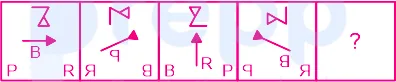
- A
Option A (shown in image)
- B
Option B (shown in image)
- C
Option C (shown in image)
- D
Option D (shown in image)
Show answer
Question 23archived
Select the option that is related to the third word in the same way as the second word is related to the first word.
(The words must be considered as meaningful English words and must not be related to each other based on the number of letters/number of consonants/vowels in the word.)
Horse : Stable :: Hen : ?
- A
Farm
- B
Pen
- C
Coop
- D
Shed
Show answer
C. CoopUnderstanding Word Analogies: Horse, Stable, Hen
Word analogies test your ability to find the relationship between a pair of words and apply that same relationship to another word to find the missing word. In this question, we are given the analogy: Horse : Stable :: Hen : ?
The colon (:) means "is to", and the double colon (::) means "as". So, the analogy reads "Horse is to Stable as Hen is to what?"
Analyzing the Relationship: Horse and Stable
We need to determine the relationship between the first pair of words: Horse and Stable. A stable is a building where horses are kept, typically for boarding, housing, and feeding. Therefore, the relationship is that a Stable is the dwelling place or home for a Horse.
Applying the Relationship to Find the Hen's Dwelling
Now, we must apply the same relationship to the third word, Hen, to find its dwelling place. We are looking for the place where a Hen lives or is kept.
Let's examine the given options:
Farm: A farm is a general area where agriculture and animal husbandry take place. While hens might be on a farm, a farm is not the specific structure where they are housed.
Pen: A pen is a small enclosure used for keeping animals. Hens can be kept in a pen, but it is a general term and might refer to many types of enclosures.
Coop: A coop is specifically a cage or structure designed for housing poultry, such as chickens (hens). This is a very common and accurate term for where a hen lives.
Shed: A shed is typically a simple building used for storage or shelter. While animals could potentially shelter in a shed, it's not the specific term for a hen's home.
Identifying the Correct Answer
Comparing the options, the most specific and appropriate dwelling place for a Hen, in the same way a Stable is for a Horse, is a Coop.
Detailed Option Analysis
Option
Meaning
Relationship to Hen
Fits the Analogy (Horse:Stable)?
Farm
Area for agriculture/animals
General location, not specific dwelling
No
Pen
Small enclosure
Possible, but less specific than Coop
Less likely
Coop
Structure for poultry (hens)
Specific dwelling place
Yes
Shed
Simple storage/shelter building
General shelter, not specific dwelling
No
Based on this analysis, Coop is the word that completes the analogy.
Conclusion
The analogy Horse : Stable :: Hen : Coop holds true because a Stable is the dwelling place of a Horse, and a Coop is the dwelling place of a Hen.
Revision Table: Word Analogy Check
First Pair
Relationship
Second Pair
Conclusion
Horse : Stable
Dwelling place
Hen : Coop
Relationship matches
Additional Information: Animal Dwellings
Here are some other common animal dwellings:
Dog: Kennel
Pig: Sty or Pigpen
Cow: Barn or Byre
Sheep: Pen or Fold
Bird (general): Nest or Aviary
Lion: Den
Rabbit: Burrow or Hutch
Bee: Hive
Knowing the specific terms for animal homes is helpful for solving word analogy questions like this one.
Paper & answer key PDF ↗ Question 24archived
Select the set in which the numbers are related in the same way as are the numbers of the following sets.
(NOTE : Operations should be performed on the whole numbers, without breaking down the numbers into its constituent digits. E.g. 13 – Operations on 13 such as adding / subtracting / multiplying etc. to 13 can be performed. Breaking down 13 into 1 and 3 and then performing mathematical operations on 1 and 3 is NOT allowed)
(76, 75, 1)
(90, 87, 9)
- A
(100, 85, 125)
- B
(56, 48, 64)
- C
(16, 4, 57)
- D
(87, 56, 900)
Show answer
B. (56, 48, 64)Understanding Number Set Analogy Problems
This question asks us to find a set of numbers that shares the same relationship as the two given sets: (76, 75, 1) and (90, 87, 9). We are instructed to perform operations on the whole numbers as they are, without breaking them down into individual digits.
Analyzing the Given Number Sets
Let's examine the relationship between the numbers in the provided sets.
Set 1: (76, 75, 1)
Let the numbers be \(A = 76\), \(B = 75\), and \(C = 1\). We can look for simple relationships:
Difference between the first two: \(76 - 75 = 1\). This matches the third number.
Sum of the first two: \(76 + 75 = 151\). Not related to 1.
Product of the first two: \(76 \times 75\). Not related to 1.
The difference seems promising for the first set: \(A - B = C\).
Set 2: (90, 87, 9)
Let the numbers be \(A = 90\), \(B = 87\), and \(C = 9\). Let's apply the previous potential relationship:
Difference between the first two: \(90 - 87 = 3\). The third number is 9.
Here, \(A - B = 3\), but \(C = 9\). The relationship \(A - B = C\) does not hold for the second set.
Let's reconsider the results for both sets:
Set 1: Difference is 1, third number is 1.
Set 2: Difference is 3, third number is 9.
We notice that in Set 2, the third number (9) is the square of the difference (3). Let's check if this pattern holds for Set 1 as well:
Set 1: Difference is 1. Is the third number (1) the square of the difference? \(1^2 = 1\). Yes, it is.
Identifying the Relationship Pattern
Based on the analysis of both sets, the relationship appears to be: The third number is the square of the difference between the first and second numbers.
If the set is \((A, B, C)\), the relationship is \((A - B)^2 = C\).
Evaluating the Options
Now we will test each option against the identified pattern \((A - B)^2 = C\).
Option 1: (100, 85, 125)
Here, \(A = 100\), \(B = 85\), \(C = 125\).
Calculate the difference squared: \((A - B)^2 = (100 - 85)^2 = (15)^2 = 225\).
Compare with \(C\): \(225 \neq 125\). This option does not follow the pattern.
Option 2: (56, 48, 64)
Here, \(A = 56\), \(B = 48\), \(C = 64\).
Calculate the difference squared: \((A - B)^2 = (56 - 48)^2 = (8)^2 = 64\).
Compare with \(C\): \(64 = 64\). This option follows the pattern.
Option 3: (16, 4, 57)
Here, \(A = 16\), \(B = 4\), \(C = 57\).
Calculate the difference squared: \((A - B)^2 = (16 - 4)^2 = (12)^2 = 144\).
Compare with \(C\): \(144 \neq 57\). This option does not follow the pattern.
Option 4: (87, 56, 900)
Here, \(A = 87\), \(B = 56\), \(C = 900\).
Calculate the difference squared: \((A - B)^2 = (87 - 56)^2 = (31)^2 = 961\).
Compare with \(C\): \(961 \neq 900\). This option does not follow the pattern.
Conclusion
Only Option 2, the set (56, 48, 64), satisfies the relationship \((A - B)^2 = C\) which was derived from the given sets (76, 75, 1) and (90, 87, 9).
Set
A
B
C
A - B
(A - B)\(^2\)
Does Pattern Match?
(76, 75, 1)
76
75
1
\(76 - 75 = 1\)
\(1^2 = 1\)
Yes (\(1 = 1\))
(90, 87, 9)
90
87
9
\(90 - 87 = 3\)
\(3^2 = 9\)
Yes (\(9 = 9\))
(100, 85, 125)
100
85
125
\(100 - 85 = 15\)
\(15^2 = 225\)
No (\(225 \neq 125\))
(56, 48, 64)
56
48
64
\(56 - 48 = 8\)
\(8^2 = 64\)
Yes (\(64 = 64\))
(16, 4, 57)
16
4
57
\(16 - 4 = 12\)
\(12^2 = 144\)
No (\(144 \neq 57\))
(87, 56, 900)
87
56
900
\(87 - 56 = 31\)
\(31^2 = 961\)
No (\(961 \neq 900\))
Revision Table: Key Concepts in Number Analogy
Number analogy questions test your ability to identify mathematical or logical relationships between numbers in a given set or pair. Here are some common types of relationships to look for:
Basic arithmetic operations (addition, subtraction, multiplication, division).
Squares and cubes of numbers or differences/sums.
Prime numbers, composite numbers.
Even and odd numbers.
Sequential patterns.
Digit-based operations (though explicitly disallowed in this specific question type).
Additional Information: Strategies for Solving Number Analogy
When tackling number set analogy questions, consider these strategies:
Start by looking for simple relationships between the first two numbers, relating them to the third number.
Check for differences, sums, products, or quotients.
If simple operations don't work, consider squares, cubes, square roots, or other powers of the differences, sums, or individual numbers.
Always test your potential pattern on all the provided example sets to ensure it is consistent.
Apply the confirmed pattern to each option systematically.
Pay close attention to any specific rules given in the question, such as the one here about not breaking down numbers into digits.
Paper & answer key PDF ↗ Question 25archived
Select the figure that will come next in the following series.

- A
Option A (shown in image)
- B
Option B (shown in image)
- C
Option C (shown in image)
- D
Option D (shown in image)
Show answer
A. Option A (shown in image)The pattern followed here is :
Arrow is shifting clockwise at the edge of box.
Circle is shifting anti-clockwise at the corner of box.
Similarly, next figure will be.
Hence, 'Option 1' is the correct answer.

 Paper & answer key PDF ↗
 Question 26archived
Buckminsterfullerene is a nanoparticle characterised by spherical geometry and a hollow interior which contains how many carbon atoms?
- A
60
- B
50
- C
40
- D
70
Show answer
A. 60The correct answer is 60.
However, \text{C}_{60} is the most stable and abundant type. Their unique structure gives them interesting properties, leading to research into various applications, including medicine, materials science, and electronics. The "Buckminster" part of the name is in honor of architect R. Buckminster Fuller, known for designing geodesic domes which resemble the structure of \text{C}_{60}.
Paper & answer key PDF ↗ Question 27archived
The pH of a neutral solution is ______.
- A
7
- B
0
- C
8
- D
14
Show answer
A. 7Understanding pH and Neutral Solutions
The pH scale is a measure used to specify the acidity or basicity of an aqueous solution. It ranges typically from 0 to 14. The pH value indicates the concentration of hydrogen ions (\( \text{H}^+ \)) in the solution. A lower pH value means a higher concentration of \( \text{H}^+ \) ions, indicating an acidic solution, while a higher pH value means a lower concentration of \( \text{H}^+ \) ions (and a higher concentration of hydroxide ions, \( \text{OH}^- \)), indicating a basic (alkaline) solution.
The pH scale defines solutions as:
Acidic: Solutions with a pH less than 7 (< 7).
Neutral: Solutions with a pH exactly equal to 7 (= 7).
Basic (Alkaline): Solutions with a pH greater than 7 (> 7).
A neutral solution is one where the concentration of hydrogen ions (\( [\text{H}^+] \)) is equal to the concentration of hydroxide ions (\( [\text{OH}^-] \)). This occurs in pure water at 25°C due to the autoionization of water:
\( \text{H}_2\text{O} \rightleftharpoons \text{H}^+ + \text{OH}^- \)
At 25°C, the ion product of water, \( K_w = [\text{H}^+][\text{OH}^-] \), is \( 1.0 \times 10^{-14} \). In pure water, \( [\text{H}^+] = [\text{OH}^-] \), so \( [\text{H}^+]^2 = 1.0 \times 10^{-14} \). Taking the square root, \( [\text{H}^+] = 1.0 \times 10^{-7} \) M.
The pH is defined by the equation:
\( \text{pH} = -\log_{10}[\text{H}^+] \)
For pure water at 25°C, the pH is:
\( \text{pH} = -\log_{10}(1.0 \times 10^{-7}) \)
\( \text{pH} = -(-7) \)
\( \text{pH} = 7 \)
Therefore, a neutral solution has a pH of 7.
Analyzing the Options for pH of a Neutral Solution
Let's look at the given options in the context of the pH scale:
Option 1: 7 - This corresponds to the pH of pure water at 25°C, where \( [\text{H}^+] = [\text{OH}^-] \). This is the definition of a neutral solution.
Option 2: 0 - A pH of 0 represents a very high concentration of \( \text{H}^+ \) ions, indicating a highly acidic solution. For example, a 1 M solution of a strong acid like HCl can have a pH close to 0.
Option 3: 8 - A pH of 8 is greater than 7, indicating a basic (alkaline) solution. Solutions with pH > 7 have a higher concentration of \( \text{OH}^- \) ions than \( \text{H}^+ \) ions.
Option 4: 14 - A pH of 14 represents a very low concentration of \( \text{H}^+ \) ions and a very high concentration of \( \text{OH}^- \) ions, indicating a highly basic solution. For example, a 1 M solution of a strong base like NaOH can have a pH close to 14.
Based on the definition and the pH scale, the pH of a neutral solution is 7.
pH Scale Summary Table
pH Range
Nature of Solution
< 7
Acidic
= 7
Neutral
> 7
Basic (Alkaline)
Revision Table: Understanding pH and Neutrality
Concept
Explanation
Relevance to Neutral pH
pH Scale
Measure of acidity/basicity (0-14).
pH 7 is the defined point for neutrality.
Acidic Solution
pH < 7; \( [\text{H}^+] > [\text{OH}^-] \)
Different from neutral pH.
Basic Solution
pH > 7; \( [\text{OH}^-] > [\text{H}^+] \)
Different from neutral pH.
Neutral Solution
pH = 7; \( [\text{H}^+] = [\text{OH}^-] \)
Exactly the concept asked in the question.
Water Autoionization
\( \text{H}_2\text{O} \rightleftharpoons \text{H}^+ + \text{OH}^- \)
Basis for why pure water is neutral (equal \( [\text{H}^+] \) and \( [\text{OH}^-] \)).
Additional Information on pH and Aqueous Solutions
While the pH of a neutral solution is 7 at 25°C, it's important to note that the neutrality point can shift with temperature. This is because the ion product of water, \( K_w \), is temperature-dependent. As temperature increases, \( K_w \) increases, meaning the concentrations of both \( \text{H}^+ \) and \( \text{OH}^- \) in pure water increase. Since \( [\text{H}^+] \) and \( [\text{OH}^-] \) remain equal in pure water at any temperature, the pH of pure, neutral water decreases at higher temperatures (e.g., pH 6.63 at 60°C). However, the definition of neutrality remains \( [\text{H}^+] = [\text{OH}^-] \), which corresponds to a pH equal to \( \frac{1}{2} \text{p}K_w \) at that specific temperature. Unless otherwise specified, pH problems usually assume a temperature of 25°C, where the neutral pH is indeed 7.
Also, remember that the pH scale can extend slightly below 0 for very concentrated strong acids and slightly above 14 for very concentrated strong bases, though the range 0-14 covers most common solutions.
Paper & answer key PDF ↗ Question 28archived
Total deposits with Post Office savings organisations are included in which money supply aggregate?
- A
M1
- B
M3
- C
M4
- D
M2
Show answer
C. M4The correct answer is M4.
The RBI uses these measures to track the amount of money circulating in the economy, which helps in making decisions related to interest rates and other monetary tools. The aggregates differ based on their liquidity, with M1 being the most liquid and M4 being the least liquid among these traditional measures. Note that the RBI introduced new monetary aggregates from 1998, but the M1, M2, M3, M4 classification is still commonly referenced in the context of understanding broad money measures.
Paper & answer key PDF ↗ Question 29archived
India's first high-speed rail line is being constructed between (as of February 2022):
- A
Mumbai-Pune
- B
Delhi-Meerut
- C
Mumbai-Ahmedabad
- D
Delhi-Mumbai
Show answer
C. Mumbai-AhmedabadIndia's First High-Speed Rail Line Explained
The question asks about the route of India's first high-speed rail line that was under construction as of February 2022. Understanding the major infrastructure projects underway in India is important for general awareness.
India embarked on a significant project to introduce high-speed rail technology to the country. This ambitious project aims to drastically reduce travel time between major cities.
Identifying the First High-Speed Rail Corridor
Several routes were being discussed or planned for high-speed rail and other rapid transit systems. However, one specific corridor was officially designated and construction commenced as the first of its kind in India.
Let's look at the options provided:
Mumbai-Pune: This is an important route, but the focus has primarily been on upgrading the existing line and exploring options for a potential future high-speed link, not the first under construction.
Delhi-Meerut: This route is served by the Regional Rapid Transit System (RRTS), which is different from a dedicated inter-city high-speed rail line designed for speeds typically exceeding 250 km/h.
Mumbai-Ahmedabad: This corridor is the designated route for India's first bullet train project, formally known as the Mumbai-Ahmedabad High-Speed Rail Corridor. Construction on various sections was actively ongoing as of February 2022.
Delhi-Mumbai: This is a planned high-speed rail corridor, but it was not the first one for which construction had begun.
Based on the status of projects as of February 2022, the Mumbai-Ahmedabad route was the first high-speed rail line under active construction in India.
Details of the Mumbai-Ahmedabad High-Speed Rail Project
The Mumbai-Ahmedabad High-Speed Rail (MAHSR) project is a flagship initiative. Key points include:
It connects the cities of Mumbai in Maharashtra and Ahmedabad in Gujarat.
The project is being executed by the National High-Speed Rail Corporation Limited (NHSRCL).
It is designed for a top speed of around 320 km/h, significantly faster than conventional trains.
The line is expected to reduce travel time between the two cities to about 2-3 hours, compared to the current 6-7 hours taken by regular trains.
Construction involves building viaducts, tunnels, bridges, and stations along the route.
Therefore, the Mumbai-Ahmedabad route correctly identifies India's first high-speed rail line under construction as of February 2022.
Comparison of Rail Projects Mentioned
Route
Type of Project
Status (as of Feb 2022)
Notes
Mumbai-Ahmedabad
High-Speed Rail (Bullet Train)
Under Construction
India's first designated high-speed rail corridor
Delhi-Meerut
Regional Rapid Transit System (RRTS)
Under Construction
Faster than conventional but different from inter-city HSR
Mumbai-Pune
Conventional Rail / Planned Upgrade
Operational / Potential HSR discussed
Not the first HSR under construction
Delhi-Mumbai
Planned High-Speed Rail Corridor
Planning Stage
Not the first HSR under construction
Conclusion
The first high-speed rail line being constructed in India as of February 2022 is the Mumbai-Ahmedabad corridor.
Revision Table: India's First High-Speed Rail
Key Aspect
Detail
Project Name
Mumbai-Ahmedabad High-Speed Rail Corridor (MAHSR)
Connecting Cities
Mumbai (Maharashtra) and Ahmedabad (Gujarat)
Implementing Body
National High-Speed Rail Corporation Limited (NHSRCL)
Expected Speed
Up to 320 km/h
Status (as of Feb 2022)
Under Construction
Additional Information: High-Speed Rail in India
India has plans for a network of high-speed rail corridors across the country to modernize its railway system and boost connectivity. The Mumbai-Ahmedabad project is the pioneering line in this ambitious vision. Future corridors are being planned, including routes like Delhi-Varanasi, Delhi-Ahmedabad, Mumbai-Nagpur, and others. These projects require significant investment, advanced technology, and complex engineering to build dedicated tracks capable of supporting very high speeds safely and efficiently. The development of high-speed rail is seen as a catalyst for economic growth and regional development along the corridors.
Paper & answer key PDF ↗ Question 30archived
Which of the following is NOT mentioned in the Indian Constitution as a Fundamental Duty?
- A
To respect elders
- B
To promote harmony
- C
To safeguard public property
- D
To defend the country
Show answer
A. To respect eldersThe correct answer is To respect elders.
Fundamental Rights are guaranteed to citizens and are enforceable by courts, meaning a citizen can approach the judiciary if their rights are violated. Fundamental Duties, on the other hand, are obligations expected of citizens towards the nation and society. While not directly enforceable, they serve as a reminder of the citizen's responsibilities and can be used by courts in interpreting laws. The addition of Fundamental Duties aimed to balance the emphasis on rights by also highlighting the responsibilities of citizens in building a strong and prosperous nation.
Paper & answer key PDF ↗ Question 31archived
Who among the following received the MS Subbulakshmi Award from the Tamil Nadu Eyal Isai Nataka Manram for the year 2020?
- A
Harini
- B
Vani Jairam
- C
L. R. Eswari
- D
Saindhavi
Show answer
B. Vani JairamUnderstanding the MS Subbulakshmi Award 2020
The question asks about the recipient of a specific award, the MS Subbulakshmi Award, given by the Tamil Nadu Eyal Isai Nataka Manram for the year 2020. This award recognizes significant contributions in the field of music and arts.
Identifying the Award Recipient
The Tamil Nadu Eyal Isai Nataka Manram is a state-sponsored academy promoting Tamil literature, music, and drama. It confers various awards to honor artists and scholars in these fields. The MS Subbulakshmi Award is named after the legendary Carnatic vocalist MS Subbulakshmi.
For the year 2020, the prestigious MS Subbulakshmi Award was conferred upon a well-known personality from the music fraternity.
Analysing the Options
Let's look at the given options:
Harini: A notable playback singer.
Vani Jairam: A veteran playback singer who has sung in numerous Indian languages.
L. R. Eswari: A veteran playback singer known for her versatile voice.
Saindhavi: A contemporary playback singer.
Based on the information regarding the 2020 awards presented by the Tamil Nadu Eyal Isai Nataka Manram, the recipient of the MS Subbulakshmi Award was the acclaimed playback singer, Vani Jairam.
Conclusion on the MS Subbulakshmi Award 2020
Therefore, among the given options, Vani Jairam received the MS Subbulakshmi Award from the Tamil Nadu Eyal Isai Nataka Manram for the year 2020.
Revision Table: Key Details
Here's a quick summary of the key information regarding the MS Subbulakshmi Award for 2020:
Award Name
Conferring Body
Year
Recipient
MS Subbulakshmi Award
Tamil Nadu Eyal Isai Nataka Manram
2020
Vani Jairam
Additional Information about Vani Jairam and the Award
Vani Jairam: She was a highly respected Indian playback singer. She sang in over 19 languages and won multiple National Film Awards for Best Female Playback Singer, as well as state government awards. Her career spanned several decades, making her a significant figure in Indian film music.
Tamil Nadu Eyal Isai Nataka Manram: This organization plays a crucial role in promoting and preserving the cultural heritage of Tamil Nadu by recognizing artists, conducting festivals, and supporting various art forms.
The MS Subbulakshmi Award is one of the many accolades given by the Manram to honor individuals who have made outstanding contributions to music, keeping the legacy of iconic artists like MS Subbulakshmi alive.
Paper & answer key PDF ↗ Question 32archived
In August 2022, Uttarakhand Chief Minister named which cricketer as the brand ambassador of the state?
- A
Rishabh Pant
- B
Hardik Pandya
- C
Yuvraj Singh
- D
Virat Kohli
Show answer
A. Rishabh PantUttarakhand State Brand Ambassador Appointment
The question asks about the cricketer appointed as the brand ambassador for the state of Uttarakhand in August 2022 by the Chief Minister of the state.
State governments often appoint prominent personalities from various fields, such as sports, arts, or social work, as brand ambassadors to promote tourism, culture, or specific state initiatives. These ambassadors help in enhancing the state's image and attracting visitors or investors through their popularity and influence.
Identifying Uttarakhand's Brand Ambassador in August 2022
In August 2022, the Chief Minister of Uttarakhand announced the appointment of a renowned cricketer as the state's brand ambassador. This decision was aimed at connecting with the youth and promoting the state's appeal, particularly in sports and tourism sectors.
The cricketer who was named the brand ambassador for Uttarakhand by Chief Minister Pushkar Singh Dhami in August 2022 was Rishabh Pant. Rishabh Pant is a prominent Indian international cricketer who hails from Uttarakhand.
Analysis of Options
Let's look at the provided options:
Rishabh Pant: An Indian cricketer from Uttarakhand, appointed as the state's brand ambassador in August 2022.
Hardik Pandya: An Indian international cricketer, but not appointed as Uttarakhand's brand ambassador in August 2022.
Yuvraj Singh: A former Indian international cricketer, not appointed as Uttarakhand's brand ambassador in August 2022.
Virat Kohli: A prominent Indian international cricketer, not appointed as Uttarakhand's brand ambassador in August 2022.
Based on the information regarding the appointment made in August 2022, Rishabh Pant was the cricketer named as the brand ambassador for Uttarakhand.
Cricketer
Appointed as Uttarakhand Brand Ambassador in Aug 2022
Rishabh Pant
Yes
Hardik Pandya
No
Yuvraj Singh
No
Virat Kohli
No
Therefore, the correct answer is Rishabh Pant.
Revision Table: Uttarakhand Brand Ambassador
Detail
Information
State
Uttarakhand
Year of Appointment
2022
Month of Appointment
August
Appointed By
Uttarakhand Chief Minister
Appointed Personality
Rishabh Pant
Field
Cricket
Additional Information: State Brand Ambassadors
A brand ambassador for a state is a person who is chosen to represent and promote the state's interests, often related to tourism, culture, industry, or social causes. Their role is to leverage their public image and credibility to draw attention to the state and its initiatives.
Role: They help in increasing the visibility and appeal of the state on a national and international level.
Selection: Personalities are often selected based on their connection to the state (being born there, living there, or having significant achievements related to the state) and their positive public image.
Impact: A well-known brand ambassador can significantly boost tourism, attract investment, and promote local products and culture.
Examples: Many Indian states have appointed famous personalities, such as actors, sportspersons, or artists, as their brand ambassadors over the years to promote their unique aspects.
Rishabh Pant, being a young and popular cricketer with roots in Uttarakhand, was a suitable choice for the state's brand ambassador role to connect with the youth and promote the state's vibrant culture and potential.
Paper & answer key PDF ↗ Question 33archived
Police of which State/UT launched the Anubhuti-QR Code-based feedback system in February 2022?
- A
Madhya Pradesh
- B
Goa
- C
Maharashtra
- D
Delhi
Show answer
D. DelhiUnderstanding the Anubhuti QR Code Feedback System
The question asks about the State or Union Territory whose police force initiated the Anubhuti-QR Code-based feedback system in February 2022. This system is designed to make it easier for citizens to provide feedback on police services.
Analysis of the Anubhuti System Launch
The Anubhuti system was a significant step towards improving transparency and accountability in police-public interaction. It uses QR codes placed at police stations and other contact points, allowing people to scan and submit their feedback instantly via their mobile phones.
Research indicates that the Anubhuti-QR Code-based feedback system was officially launched by the police force of a major Union Territory in India.
Let's consider the options provided:
Madhya Pradesh
Goa
Maharashtra
Delhi
Historical records and news reports from February 2022 confirm that the Anubhuti system was an initiative of the police force in the Union Territory of Delhi.
The system was inaugurated and rolled out across various police stations in Delhi to gather public opinion and improve services based on citizen feedback.
Why Delhi Police Launched Anubhuti
The Delhi Police launched the Anubhuti system with the aim of:
Making the feedback process hassle-free for citizens.
Collecting real-time feedback on the services provided by police personnel and police stations.
Using the feedback to identify areas for improvement and enhance the quality of service delivery.
Increasing transparency and building trust between the police and the community in Delhi.
Conclusion on the Anubhuti Launch State/UT
Based on the information available about the launch of the Anubhuti-QR Code-based feedback system in February 2022, the police force responsible was that of Delhi.
Revision Table: Key Details
Feature
Details
System Name
Anubhuti
Technology Used
QR Code-based feedback
Launching Authority
Police Force
Launch Month/Year
February 2022
State/UT of Launch
Delhi
Purpose
Citizen feedback on police services
Additional Information: Police Feedback Mechanisms
Police forces across India and globally use various mechanisms to collect feedback from the public. These can include:
Suggestion boxes at police stations.
Toll-free helpline numbers.
Online portals or dedicated websites for complaints and feedback.
Social media platforms for engagement and feedback.
Surveys and community outreach programs.
The Anubhuti system represents a modern, technology-driven approach leveraging QR codes to streamline the feedback process, making it more accessible and immediate for the residents of Delhi.
Paper & answer key PDF ↗ Question 34archived
The first session of All India Depressed Classes congress was held at __________ in 1930.
- A
Nagpur
- B
Surat
- C
Delhi
- D
Kanpur
Show answer
A. NagpurThe correct answer is Nagpur.
His efforts led to significant discussions and demands for separate electorates or reservations to ensure their political voice was heard. The events of 1930, including the Nagpur session and the First Round Table Conference, were pivotal in bringing the issues of depressed classes to the forefront of national politics. Understanding these historical events provides context to the struggle for equality and social justice in India.
Paper & answer key PDF ↗ Question 35archived
Which of the following cities did not hosted matches of FIFA U-17 Women’s World Cup 2022 in India?
- A
New Delhi
- B
Navi Mumbai
- C
Goa
- D
Bhubaneswar
Show answer
A. New DelhiUnderstanding FIFA U-17 Women's World Cup 2022 Host Cities
The question asks us to identify which city from the given options was not a host city for the FIFA U-17 Women's World Cup held in India in 2022. To answer this, we need to know the actual host cities of the tournament.
FIFA U-17 Women's World Cup 2022 Host Cities in India
The FIFA U-17 Women's World Cup 2022 tournament was hosted across three cities in India. These cities were chosen to showcase different parts of the country and provide excellent venues for the international matches.
Navi Mumbai, Maharashtra (DY Patil Stadium)
Goa (Pandit Jawaharlal Nehru Stadium, Fatorda)
Bhubaneswar, Odisha (Kalinga Stadium)
These three cities successfully hosted the matches, including group stage games, knockout rounds, and the final match.
Comparing Options with Host Cities
Now let's compare the cities listed in the options with the actual host cities we just identified:
New Delhi
Navi Mumbai
Goa
Bhubaneswar
From our list of actual host cities, we can see that Navi Mumbai, Goa, and Bhubaneswar were indeed host cities for the FIFA U-17 Women's World Cup 2022.
The city that appears in the options but is not on our list of host cities is New Delhi.
Identifying the Non-Host City
Based on the official list of venues for the FIFA U-17 Women's World Cup 2022 in India, the cities that hosted matches were Navi Mumbai, Goa, and Bhubaneswar. Therefore, New Delhi was not one of the cities that hosted games for this specific tournament.
City Option
Hosted FIFA U-17 Women's World Cup 2022?
New Delhi
No
Navi Mumbai
Yes
Goa
Yes
Bhubaneswar
Yes
Thus, New Delhi is the city among the given options that did not host matches of the FIFA U-17 Women's World Cup 2022 in India.
Revision Table: FIFA U-17 World Cup India 2022
Tournament
Year
Host Country
Host Cities
FIFA U-17 Women's World Cup
2022
India
Bhubaneswar, Goa, Navi Mumbai
Additional Information: FIFA U-17 Women's World Cup
The FIFA U-17 Women's World Cup is an international football tournament for female players under the age of 17. It is organized by FIFA. The 2022 edition was the 7th instance of the tournament. It was originally scheduled for 2020 but was postponed due to the COVID-19 pandemic before being rescheduled for 2022. India automatically qualified as the host nation. Spain won the tournament, defeating Colombia in the final.
Paper & answer key PDF ↗ Question 36archived
A good proportion of the ______ produced during the green revolution period (available as marketed surplus) was sold by the farmers in the market.
- A
Rice and gram
- B
Wheat and maize
- C
Wheat and rice
- D
Wheat and gram
Show answer
C. Wheat and riceThe correct answer is Wheat and rice.
Marketed surplus can be less than, equal to, or even more than marketable surplus (e.g., if farmers sell their entire produce immediately after harvest and later buy back grain for consumption, or if they have stored previous years' produce). During the Green Revolution, the marketable surplus increased substantially due to higher production. A significant portion of this marketable surplus was then sold, resulting in a large marketed surplus primarily of wheat and rice.
Paper & answer key PDF ↗ Question 37archived
Which of the following rivers flow through a rift valley?
- A
Son
- B
Koshi
- C
Luni
- D
Tapi
Show answer
D. TapiThe correct answer is Tapi.
Other, less prominent, rift valleys also exist in India, sometimes associated with river basins like the Damodar valley, although the Narmada-Tapi rift is the most well-known active one. Understanding rift valleys helps explain not just river courses but also seismic activity and the distribution of certain types of rocks and minerals in these regions. The study of these geological features is crucial for understanding the geomorphology of India.
Paper & answer key PDF ↗ Question 38archived
______ unemployment occurs with changes in economic activity over the business cycle.
- A
Frictional
- B
Cyclical
- C
Structural
- D
Technological
Show answer
B. CyclicalThe correct answer is Cyclical.
When economic activity decreases, businesses face lower demand, leading to workforce reductions. This directly matches the description in the question. on Economic Activity Unemployment Based on the definitions, the unemployment that occurs with changes in economic activity over the business cycle is known as Cyclical unemployment . It rises during recessions and falls during economic expansions.
Paper & answer key PDF ↗ Question 39archived
Which of the following territories to the south and north were made part of the Chola kingdom by the successors of the ruler Vijayalaya?
- A
Pallava and Chera
- B
Pandyan and Pallava
- C
Rashtrakuta and Chera
- D
Vakataka and Satvahana
Show answer
B. Pandyan and PallavaUnderstanding Chola Kingdom Expansion by Successors
The question asks about the territories located to the south and north that were incorporated into the Chola kingdom by the rulers who succeeded Vijayalaya. Vijayalaya is known for establishing the imperial Chola dynasty by capturing Thanjavur in the 9th century CE. His successors significantly expanded the kingdom, transforming it from a small principality into a vast empire.
Chola Expansion Under Vijayalaya's Successors
After Vijayalaya, rulers like Aditya I and particularly Parantaka I played crucial roles in expanding the Chola dominion. The expansion occurred in different directions, incorporating neighbouring kingdoms and territories.
Expansion to the South: The major power to the south of the early Cholas was the Pandyan kingdom. Parantaka I (reigned c. 907–955 CE) is credited with a major victory against the Pandyas, conquering their territories and even invading Sri Lanka (though control there was temporary initially). This brought the southern regions under Chola control.
Expansion to the North: To the north, the Pallava dynasty, though powerful earlier, was in decline during the rise of the Cholas. Aditya I, Vijayalaya's son, defeated the last Pallava king, Aparajitavarman, in the late 9th century CE. This victory brought the northern parts of Tamil Nadu, which were under Pallava influence, into the Chola kingdom. The successors continued to consolidate control over these areas.
Therefore, the significant territories to the south and north that became part of the Chola kingdom under Vijayalaya's successors were the Pandyan territories and the Pallava territories, respectively.
Analyzing the Options
Let's examine the given options based on historical facts about Chola expansion:
Option
Territories
Analysis
1
Pallava and Chera
Pallava territories were incorporated (north). Cheras were contemporaries and often rivals to the west/south-west, but their core territory wasn't fully annexed into the Chola kingdom in the same way as the Pandyan heartland.
2
Pandyan and Pallava
Pandyan territories to the south were conquered by Parantaka I. Pallava territories to the north were absorbed after Aditya I's victory over the last Pallava ruler. This aligns with historical expansion under Vijayalaya's successors.
3
Rashtrakuta and Chera
Rashtrakutas were a major Deccan power to the north/north-west, and the Cholas had significant conflicts with them, including a major defeat at Takkolam under Parantaka I. Rashtrakuta territory was not made part of the Chola kingdom during this phase; rather, Rashtrakutas sometimes encroached upon Chola land. Cheras were rivals, not typically fully incorporated.
4
Vakataka and Satvahana
Vakatakas ruled in Central India much earlier than the Cholas. Satvahanas ruled in the Deccan even earlier, predating the imperial Cholas by centuries. These are historically and geographically incorrect.
Based on the historical evidence, the Pandyan kingdom to the south and the Pallava kingdom to the north were the key territories incorporated by the successors of Vijayalaya, particularly during the reigns of Aditya I and Parantaka I.
Conclusion on Chola Territory Incorporation
The rulers following Vijayalaya were successful in expanding the nascent Chola state into a dominant power in South India. Their military campaigns brought the Pandyan kingdom in the south and the remnant territories of the Pallava kingdom in the north under Chola rule, laying the foundation for the vast Chola empire.
Revision Table: Chola Expansion Highlights
Ruler (Successor)
Direction of Expansion
Territory/Kingdom Incorporated
Aditya I
North
Pallava territories (after defeating Aparajitavarman)
Parantaka I
South
Pandyan kingdom (after defeating Maravarman Rajasimha II)
Later Rulers (e.g., Rajaraja I, Rajendra I)
Further Expansion
Consolidated control over south and north, expanded overseas, fought Cheras, Chalukyas, etc.
Additional Information on Chola Expansion
The expansion under Vijayalaya's successors was not just about conquest; it involved establishing administrative control, collecting revenue, and integrating these new territories into the Chola political and economic system. This era saw the development of robust administrative structures, including local self-governance systems like village assemblies (सभा - sabha and उर - ur). The wealth and resources from the expanded territories fueled ambitious building projects, such as large temples, which are iconic symbols of the Chola empire's power and prosperity.
While the question specifically asks about territories made part of the kingdom by successors of Vijayalaya, it's worth noting that the expansion continued under later, more famous rulers like Rajaraja I and his son Rajendra I, who extended the Chola influence much further, including parts of Sri Lanka, the Maldives, and even launching a famous naval expedition towards Southeast Asia.
Paper & answer key PDF ↗ Question 40archived
Sharodi Saikia is an exponent of which Indian classical dance form?
- A
Sattriya
- B
Kuchipudi
- C
Bharatanatyam
- D
Kathak
Show answer
A. SattriyaThe correct answer is Sattriya.
Hasta Mudras: Hand gestures used to convey meaning. Tala and Laya: Rhythm and tempo. Aharya: Costumes and make-up, which are unique to Sattriya. Sharodi Saikia's contributions have been significant in preserving and popularizing Sattriya dance.
Paper & answer key PDF ↗ Question 41archived
Kumkum Mohanty, an Odissi dancer received which of the following awards in 2005?
- A
Sattriya
- B
Kalidas Samman
- C
Padma Shri
- D
Padma Vibhushan
Show answer
C. Padma ShriKumkum Mohanty: Recognition for Odissi Excellence in 2005
This explanation focuses on the prestigious award presented to the celebrated Odissi dancer, Kumkum Mohanty, in the year 2005. We will explore the options provided to identify the correct national honour.
About Kumkum Mohanty, the Odissi Exponent
Kumkum Mohanty is a distinguished Indian classical dancer, widely recognized for her profound artistry and contributions to the Odissi dance form. Her career has been marked by dedication to preserving and promoting this classical tradition.
Evaluating the Award Options
The question requires identifying the specific award Kumkum Mohanty received in 2005 from the given choices. Let's review each option:
Sattriya: This refers to Sattriya Nritya, one of the eight recognized classical dance forms of India. It originated in Assam and is practiced in the monasteries (Sattras) of the Vaishnava tradition. Sattriya is a dance form, not an award.
Kalidas Samman: This is a high civilian award instituted by the Government of Madhya Pradesh. It honours individuals for their outstanding contribution in the fields of classical music, dance, theatre, visual arts, and folk art.
Padma Shri: This award is one of the highest civilian honours bestowed by the Republic of India. It is awarded for distinguished service in various fields, including arts, literature, education, sports, and social work.
Padma Vibhushan: This is India's second-highest civilian award, presented for exceptional and distinguished service to the nation.
Identifying the Award Received in 2005
In 2005, Kumkum Mohanty was honoured with the prestigious civilian award, the Padma Shri. This recognition acknowledged her significant achievements and dedication to the field of dance, specifically her mastery and promotion of Odissi.
The Padma Shri award in 2005 marks a significant milestone in her illustrious career, celebrating her role as a cultural ambassador for Odissi.
Paper & answer key PDF ↗ Question 42archived
______ is the fundamental structural unit of living organisms.
- A
Organ system
- B
Tissue
- C
Organ
- D
Cell
Show answer
D. CellUnderstanding the Fundamental Structural Unit of Life
The question asks to identify the basic structural unit of living organisms. This concept is fundamental to biology and relates to how living things are organized from the simplest level upwards.
Biological Organization Hierarchy
Living organisms exhibit a hierarchical organization. This means that simpler structures combine to form more complex ones. The main levels in this hierarchy are:
Cell
Tissue
Organ
Organ System
Organism
Let's look at each of the options provided in the context of this hierarchy:
Cell
A cell is the smallest unit of life that can carry out all the basic functions of living organisms, such as metabolism, growth, response to stimuli, and reproduction. Some organisms, like bacteria, consist of just a single cell (unicellular), while others, like plants and animals, are made up of many cells (multicellular).
Because it is the smallest entity capable of independent life processes and forms the building block for all higher levels of organization, the cell is considered the fundamental structural and functional unit of living organisms.
Tissue
A tissue is a group of similar cells that work together to perform a specific function. For example, muscle tissue helps with movement, and nervous tissue transmits signals.
Tissues are formed from cells, so they are a level of organization higher than cells.
Organ
An organ is a structure made up of different types of tissues that work together to perform a particular function. Examples include the heart (pumping blood) or the stomach (digesting food).
Organs are formed from tissues, placing them at a higher level than tissues and cells.
Organ System
An organ system is a group of organs that work together to perform major functions of the body. For instance, the digestive system involves organs like the stomach, intestines, and liver working together to process food.
Organ systems are the most complex level among the options and are formed from organs, tissues, and ultimately, cells.
Conclusion
Based on the biological hierarchy, the cell is the simplest level that is considered a complete structural and functional unit of life. Tissues, organs, and organ systems are progressively more complex structures built upon cells.
Therefore, the fundamental structural unit of living organisms is the cell.
Level of Organization
Description
Example
Cell
Basic unit of structure and function of all living organisms.
A single bacterium, a nerve cell.
Tissue
Group of similar cells performing a specific function.
Muscle tissue, connective tissue.
Organ
Group of different tissues working together for a specific function.
Heart, lung, brain.
Organ System
Group of organs working together to perform major body functions.
Digestive system, circulatory system.
Revision Table: Fundamental Units of Life
This table summarizes the key levels discussed, reinforcing the concept of the cell as the fundamental unit.
Concept
Definition Relevance
Cell
Fundamental structural and functional unit. Can exist independently.
Tissue
Collection of cells. Not fundamental unit.
Organ
Collection of tissues. Not fundamental unit.
Organ System
Collection of organs. Not fundamental unit.
Additional Information: Cell Types and Importance
Cells are incredibly diverse. There are two main types of cells:
Prokaryotic Cells: Simpler cells that lack a membrane-bound nucleus and organelles. Examples include bacteria and archaea.
Eukaryotic Cells: More complex cells that have a membrane-bound nucleus and various organelles. Examples include cells of plants, animals, fungi, and protists.
Despite their differences, all cells share some basic components, such as a cell membrane, cytoplasm, and genetic material (DNA). The study of cells, known as cytology or cell biology, is crucial to understanding all life processes.
Understanding that the cell is the fundamental unit is essential for studying biology at any level, from understanding single-celled organisms to the complex systems of multicellular life.
Paper & answer key PDF ↗ Question 43archived
Which of the following commissions recommended that “the appointment of Governor should be non-partisan”?
- A
Fazal Ali Commission
- B
Rajmannar commission
- C
Sarkaria commission
- D
Mandal commission
Show answer
C. Sarkaria commissionThe correct answer is Sarkaria commission.
The recommendation for a non-partisan appointment by the Sarkaria Commission aimed to address concerns about the potential for the office to be used for political purposes rather than constitutional duties. Subsequent commissions and committees, such as the Punchhi Commission (2007), have also reviewed the role and appointment of the Governor, often reiterating or expanding upon the recommendations made by the Sarkaria Commission, including suggestions for a panel for appointment and a fixed tenure.
Paper & answer key PDF ↗ Question 44archived
The Ennum Ezhuthum scheme was launched by the Tamil Nadu government to ensure foundational Literacy and Numeracy by 2025. This scheme was launched to bridge the learning gap among students aged ________.
- A
between 10 and 15
- B
under 5
- C
under 8
- D
between 6 and 10
Show answer
C. under 8Understanding the Ennum Ezhuthum Scheme in Tamil Nadu
The Ennum Ezhuthum scheme is an important educational initiative launched by the government of Tamil Nadu. This scheme focuses on a crucial aspect of early education: ensuring foundational literacy and numeracy among young students. The primary objective is to bridge the learning gap that might have widened, particularly in recent times, and to bring all students up to a certain standard by the year 2025.
Goal of the Ennum Ezhuthum Scheme
The main goal of the Ennum Ezhuthum scheme is to achieve comprehensive foundational literacy and numeracy for students. This means ensuring that young learners have a strong grasp of reading, writing, and basic arithmetic skills by the target year 2025. The scheme is designed with specific pedagogical approaches and learning materials tailored for this age group to make learning engaging and effective.
Target Age Group for the Scheme
The Ennum Ezhuthum scheme specifically targets students within a particular age bracket to address their foundational learning needs. The scheme was launched to bridge the learning gap among students aged under 8. This age group typically corresponds to students in primary classes, where building a strong foundation in literacy and numeracy is absolutely essential for future academic success.
Let's look at the options provided and consider the target age group:
between 10 and 15: This age group is typically in middle school or high school, beyond the foundational primary stage the scheme targets.
under 5: This age group is generally in pre-school or kindergarten, which might have different learning focuses than foundational literacy and numeracy covered in primary grades.
under 8: This age group includes students in the early primary grades (typically Classes 1 to 3), where foundational literacy and numeracy skills are actively taught and developed.
between 6 and 10: While this range includes the target group 'under 8', the specific criteria for the scheme focuses on the younger primary years covered by 'under 8'.
Based on the scheme's objective of bridging learning gaps in foundational skills for early primary students, the age group targeted is specifically under 8 years.
Scheme Name
State
Primary Goal
Target Completion Year
Target Age Group
Ennum Ezhuthum Scheme
Tamil Nadu
Foundational Literacy & Numeracy
2025
Under 8 years
Why is this age group important?
The early years of primary education (typically covering students under 8) are critical for developing foundational skills. Difficulties in reading, writing, or basic math at this stage can compound over time, making it harder for students to keep up in later grades. The Ennum Ezhuthum scheme focuses on this crucial period to intervene early and ensure all students have the necessary building blocks for learning.
Revision Table: Key Facts about Ennum Ezhuthum
Aspect
Detail
Scheme Initiator
Tamil Nadu Government
Core Focus
Foundational Literacy and Numeracy
Goal Year
2025
Affected Students
Those needing to bridge learning gaps
Target Age
Under 8 years
Additional Information on Literacy and Numeracy Schemes
Government schemes aimed at improving foundational learning are vital for the education system. Initiatives like Ennum Ezhuthum are part of a larger national focus on early childhood education and foundational learning, often emphasized in policies like the National Education Policy (NEP). These schemes involve:
Developing revised curriculum and teaching materials.
Providing training to teachers on new pedagogical methods.
Implementing assessment tools to track student progress.
Engaging parents and the community in the learning process.
Ensuring every child achieves foundational literacy and numeracy is seen as a prerequisite for equitable and quality education for all.
Paper & answer key PDF ↗ Question 45archived
Which act allows the government to confiscate the assets of newspaper in case of publishing anything “objectionable”?
- A
Ilbert Act, 1883
- B
Vernacular Press Act, 1878
- C
Media Act, 1883
- D
Newspaper Act, 1855
Show answer
B. Vernacular Press Act, 1878Understanding the Vernacular Press Act, 1878
The question asks about a specific act that gave the government the power to confiscate the assets of newspapers if they published content deemed "objectionable". This was a significant measure taken during British rule in India to control the press, particularly regional language newspapers.
Let's examine the options provided:
Ilbert Act, 1883: This act was related to the jurisdiction of European subjects in India. It proposed allowing Indian judges and magistrates to try European subjects, which caused significant controversy among the European community. It had nothing to do with press control or asset confiscation of newspapers.
Vernacular Press Act, 1878: This act was specifically aimed at controlling the vernacular (regional language) press in India. It was enacted by Lord Lytton. A key provision of this act was that magistrates were given the power to require publishers and printers of vernacular newspapers to sign a bond undertaking not to publish anything that might excite disaffection against the government or create animosity between different races, castes, and religions. If a newspaper was found guilty of publishing 'objectionable' material despite the warning, the government could confiscate its security deposit and printing press. This directly addresses the power of asset confiscation mentioned in the question.
Media Act, 1883: There is no widely recognized historical act in British India known specifically as the "Media Act, 1883" that fits this description.
Newspaper Act, 1855: While there were regulations concerning the press before 1878, the Newspaper Act of 1855 is not a commonly cited specific act with the power of asset confiscation for publishing 'objectionable' content in the manner of the 1878 act.
Based on the historical context and the provisions of the acts, the Vernacular Press Act of 1878 is the legislation that allowed the government to confiscate the assets (like the printing press and security deposit) of newspapers publishing content considered 'objectionable' or seditious.
Key Features of the Vernacular Press Act, 1878
It was enacted to gag the vernacular press.
It empowered district magistrates to call upon the printer and publisher of any vernacular newspaper to enter into a bond, undertaking not to publish anything likely to excite disaffection against the government or create hostility between persons of different races, religions, or castes.
The magistrate could demand a security deposit.
If the newspaper violated the bond, the security deposit could be confiscated, and the printing press could be seized.
The magistrate's decision was final and could not be appealed in any court of law, which earned it the nickname "Gagging Act".
Therefore, the act that allowed the government to confiscate the assets of newspaper in case of publishing anything “objectionable” was the Vernacular Press Act, 1878.
Act
Year
Key Provision Related to Press/Assets
Ilbert Act
1883
Jurisdiction of Indian judges over Europeans (Not related to press/assets)
Vernacular Press Act
1878
Allowed confiscation of security deposit and printing press for 'objectionable' content
Media Act
1883
Not a recognized major historical act with this specific provision
Newspaper Act
1855
General press regulation (Did not have the same severe asset confiscation power as 1878 Act)
Revision Table: Important Acts in British India
Act
Year
Significance
Regulating Act
1773
First step by the British government to control and regulate the East India Company in India.
Pitt's India Act
1784
Established a system of dual control by the British government and the East India Company.
Charter Act
1833
Ended the commercial activities of the East India Company and made it a purely administrative body. Introduced a Law Member to the Governor-General's Council.
Ilbert Act
1883
Controversial bill regarding the jurisdiction of Indian judges over European subjects.
Vernacular Press Act
1878
Imposed restrictions on vernacular press; allowed asset confiscation.
Additional Information on Vernacular Press Control
The Vernacular Press Act, 1878, was highly controversial and faced widespread condemnation. It was seen as discriminatory because it applied only to vernacular newspapers and not to English-language newspapers.
Key points regarding press control during British rule:
Early regulations aimed at preventing seditious writings or anything against the British government.
Different acts were passed over time, including the Censorship of Press Act, 1799 (by Lord Wellesley), the Licensing Regulations, 1823, the Press Act of 1835 (Metcalfe Act, which liberalized the press), the Licensing Act of 1857, and the Vernacular Press Act of 1878.
The Vernacular Press Act, 1878, was repealed by Lord Ripon in 1882, who was more liberal.
However, press freedom remained a contentious issue, and further acts like the Newspapers (Incitement to Offences) Act, 1908, and the Indian Press Act, 1910, were enacted later to curb nationalist sentiments expressed in the press.
Paper & answer key PDF ↗ Question 46archived
Which of the following is a festival of merriment and heralds the Assamese New Year and the onset of spring?
- A
Ali-ai-ligang
- B
Me-Dum-Me-Phi
- C
Bohag Bihu
- D
Kati Bihu
Show answer
C. Bohag BihuThe correct answer is Bohag Bihu.
While Bohag Bihu is the most colourful and signifies new beginnings, Kati Bihu has a more solemn tone focusing on prayer, and Magh Bihu is about celebrating the harvest with food and community gatherings. These festivals are deeply connected to the agricultural cycle of Assam, reflecting the importance of farming in the region's economy and culture. Understanding the different Bihu festivals helps in appreciating the diversity and richness of Assamese traditions.
Paper & answer key PDF ↗ Question 47archived
The lava plateaus are rich in which kind of soil?
- A
Laterite soil
- B
Alluvial soil
- C
Red soil
- D
Black soil
Show answer
D. Black soilThe correct answer is Black soil.
This makes it particularly suitable for dry farming. The clayey nature of black soil causes it to swell and become sticky when wet and shrink and crack when dry. These cracks help in the aeration of the soil, which is sometimes referred to as 'self-ploughing'. The Deccan Trap region in India is a prime example of a lava plateau area extensively covered by fertile black soil, supporting significant agricultural activity.
Paper & answer key PDF ↗ Question 48archived
The T-20 Cricket World Cup for women was held in which country in 2020?
- A
United Kingdom
- B
India
- C
West Indies
- D
Australia
Show answer
D. AustraliaUnderstanding the 2020 Women's T20 Cricket World Cup Venue
The question asks about the host country for the T-20 Cricket World Cup for women held in 2020. This was a significant international cricket event.
To determine the correct answer, we need to recall or find information about major cricket tournaments. The ICC Women's T20 World Cup is held every two years, bringing together top teams from around the globe.
Venue of the 2020 Women's T20 World Cup
The 2020 edition of the ICC Women's T20 World Cup was a landmark tournament. It was hosted in a country known for its strong cricketing culture and infrastructure.
The tournament took place from February 21 to March 8, 2020.
Ten teams participated, competing for the coveted trophy.
Matches were held across several cities in the host country.
The final match was played at the iconic Melbourne Cricket Ground (MCG) on International Women's Day.
Based on the records of this tournament, the country that hosted the 2020 Women's T20 Cricket World Cup was Australia.
Analysing the Options
Let's consider the given options:
United Kingdom: While the UK (specifically England) has hosted major cricket events, including Women's World Cups, they did not host the 2020 Women's T20 World Cup.
India: India is a major cricketing nation, but they were not the hosts for the 2020 Women's T20 World Cup.
West Indies: The West Indies hosted the ICC Women's World Twenty20 in 2018.
Australia: Australia has a strong history of hosting major sports events, including cricket world cups. They were indeed the hosts for the 2020 Women's T20 Cricket World Cup.
Therefore, the country where the T-20 Cricket World Cup for women was held in 2020 was Australia.
2020 Women's T20 World Cup Key Facts
Event
ICC Women's T20 World Cup 2020
Year
2020
Host Country
Australia
Dates
February 21 - March 8, 2020
Winner
Australia
Runner-up
India
Revision Table: Women's T20 World Cup Hosts
Recent ICC Women's T20 World Cup Hosts
Year
Host Country
2009
England
2010
West Indies
2012
Sri Lanka
2014
Bangladesh
2016
India
2018
West Indies
2020
Australia
2023
South Africa
Additional Information: Women's Cricket World Cups
Apart from the T20 format, there is also the 50-over ICC Women's Cricket World Cup, which is the oldest global tournament in the sport, first held in 1973. The T20 format was introduced later and has gained significant popularity.
The ICC Women's T20 World Cup started in 2009.
Australia is the most successful team in the history of the Women's T20 World Cup, having won the title multiple times, including the 2020 edition held in Australia.
Hosting a world cup is a major event that involves extensive planning for venues, logistics, and promoting the sport.
Knowing the hosts of past major tournaments like the 2020 Women's T20 Cricket World Cup is important for general knowledge and sports quizzes.
Paper & answer key PDF ↗ Question 49archived
Which of the following is known as ammonia?
- A
NH3
- B
PH3
- C
NO3
- D
NO2
Show answer
A. NH3Understanding Ammonia: Chemical Formula Identification
The question asks us to identify the chemical formula for ammonia from the given options. Ammonia is a common chemical compound.
What is Ammonia?
Ammonia is a compound of nitrogen and hydrogen. It is a colourless gas with a characteristic pungent smell. It is widely used in industry and agriculture.
Analyzing the Options
Let's look at each provided option and determine its chemical name and formula.
Option 1: $\text{NH}_3$
Option 2: $\text{PH}_3$
Option 3: $\text{NO}_3$
Option 4: $\text{NO}_2$
We need to match one of these formulas with the name "ammonia".
Option 1: $\text{NH}_3$
This chemical formula represents a molecule consisting of one nitrogen atom ($\text{N}$) and three hydrogen atoms ($\text{H}$). This is indeed the correct chemical formula for ammonia.
Option 2: $\text{PH}_3$
This chemical formula represents a molecule consisting of one phosphorus atom ($\text{P}$) and three hydrogen atoms ($\text{H}$). This compound is known as phosphine, which is different from ammonia.
Option 3: $\text{NO}_3$
This chemical formula represents a polyatomic ion consisting of one nitrogen atom ($\text{N}$) and three oxygen atoms ($\text{O}$) with a net charge of -1. This is the nitrate ion. It is not ammonia.
Option 4: $\text{NO}_2$
This chemical formula represents a molecule consisting of one nitrogen atom ($\text{N}$) and two oxygen atoms ($\text{O}$). This compound is known as nitrogen dioxide, which is a toxic gas and is not ammonia.
Conclusion: Identifying the Formula for Ammonia
Based on the analysis of the options, the chemical formula $\text{NH}_3$ is the correct representation for ammonia.
Let's summarize the formulas and names:
Formula
Name
Is it Ammonia?
$\text{NH}_3$
Ammonia
Yes
$\text{PH}_3$
Phosphine
No
$\text{NO}_3$
Nitrate ion
No
$\text{NO}_2$
Nitrogen dioxide
No
Therefore, the option that corresponds to ammonia is $\text{NH}_3$.
Revision Table: Important Chemical Formulas
Chemical Formula
Chemical Name
$\text{H}_2\text{O}$
Water
$\text{NaCl}$
Sodium Chloride (Table Salt)
$\text{CO}_2$
Carbon Dioxide
$\text{O}_2$
Oxygen
$\text{CH}_4$
Methane
$\text{H}_2\text{SO}_4$
Sulfuric Acid
$\text{HNO}_3$
Nitric Acid
Additional Information: Properties and Uses of Ammonia
Ammonia ($\text{NH}_3$) is an important industrial chemical. Some key points about ammonia include:
It is produced on a large scale by the Haber-Bosch process, which involves the reaction of nitrogen and hydrogen gases under high pressure and temperature.
Ammonia is highly soluble in water, forming ammonium hydroxide solution ($\text{NH}_4\text{OH}$).
It is a basic substance.
Major uses include the production of fertilizers, explosives, and polymers.
It is also used as a refrigerant.
Exposure to high concentrations of ammonia gas can be hazardous to health.
Paper & answer key PDF ↗ Question 50archived
Ashoka appointed ______ to solve the social problems in his region.
- A
samaharta
- B
nyayadheesh
- C
amatya
- D
dhamma mahamatta
Show answer
D. dhamma mahamattaUnderstanding Ashoka's Appointments for Social Welfare
Emperor Ashoka, a prominent ruler of the Mauryan Empire, is well-known for his efforts to promote welfare among his subjects and address social issues. He believed in the philosophy of 'Dhamma', which emphasized principles like compassion, non-violence, truthfulness, and respect for all.
To propagate Dhamma and ensure its principles were followed, and crucially, to address social problems and injustices across his vast empire, Ashoka created a special class of officials.
Role of Dhamma Mahamattas
Ashoka appointed officials known as Dhamma Mahamattas. The primary responsibilities of these officials included:
Spreading the teachings of Dhamma among people of all classes, including remote areas.
Working for the welfare and happiness of people from various religious sects.
Investigating and intervening in social problems, ensuring fair treatment, and reducing conflicts.
Overseeing the implementation of Ashoka's Dhamma policies.
Ensuring justice and fair administration, particularly concerning prisoners and their families.
These Dhamma Mahamattas acted as roving inspectors and promoters of social harmony and righteousness throughout the Mauryan Empire. Their appointment marked a significant step by Ashoka to actively engage with and improve the social conditions of his people.
Examining Other Officials
Let's briefly look at the roles of the other officials mentioned in the options to understand why they were not primarily appointed to solve general social problems in the way the Dhamma Mahamattas were:
Samaharta: This official was typically the chief revenue collector in a province during the Mauryan period. Their main duty was related to finance and tax collection, not directly addressing social problems.
Nyayadheesh: This term refers to a judge. While judges deal with legal disputes and injustices, their role is specifically judicial, not the broad social reform and welfare promotion undertaken by the Dhamma Mahamattas.
Amatya: This is a general term for a minister or high official in ancient Indian administration. While Amatyas held important positions, the specific role of addressing social problems across the empire by spreading Dhamma was assigned to the Dhamma Mahamattas.
Therefore, based on the historical evidence regarding Ashoka's administration and his efforts to tackle social issues through the propagation of Dhamma, the Dhamma Mahamattas were the officials appointed for this specific purpose.
Revision Table: Ashoka's Officials and Roles
Official Type
Primary Role
Dhamma Mahamatta
Promote Dhamma, solve social problems, ensure welfare across different groups, oversee justice.
Samaharta
Chief revenue collector and financial administrator.
Nyayadheesh
Judge, handled legal cases and justice delivery.
Amatya
General term for minister or high-ranking state official.
Additional Information on Ashoka's Dhamma
Ashoka's Dhamma was not a specific religion, but rather a code of conduct and ethical principles he wished his subjects to follow. It was based on Buddhist teachings but included elements that were universally applicable, promoting social harmony and tolerance among various religious and social groups. The appointment of Dhamma Mahamattas was a practical implementation of this policy, aimed at creating a just and compassionate society and actively addressing existing social issues and inequalities within the Mauryan Empire.
Paper & answer key PDF ↗ Question 51archived
The table given below shows the number of officers working in six companies.
Companies
Officers
D
400
E
500
F
600
G
350
H
450
I
800
What is the total number of officers working in all the companies?
- A
2900
- B
2600
- C
3400
- D
3100
Show answer
D. 3100Understanding the Problem: Calculating Total Officers
The question provides a table showing the number of officers working in six different companies: D, E, F, G, H, and I. We need to find the total number of officers across all these companies by summing up the individual counts.
Companies
Officers
D
400
E
500
F
600
G
350
H
450
I
800
Step-by-Step Calculation of Total Officers
To find the total number of officers, we will add the number of officers from each company listed in the table.
The number of officers in each company is:
Company D: 400
Company E: 500
Company F: 600
Company G: 350
Company H: 450
Company I: 800
The total number of officers is the sum of these values:
Total Officers = Officers in D + Officers in E + Officers in F + Officers in G + Officers in H + Officers in I
Using the values from the table:
Total Officers = $400 + 500 + 600 + 350 + 450 + 800$
Performing the Summation
Let's perform the addition step-by-step:
$400 + 500 = 900$
$900 + 600 = 1500$
$1500 + 350 = 1850$
$1850 + 450 = 2300$
$2300 + 800 = 3100$
So, the total number of officers working in all the companies is 3100.
Final Answer Determination
Based on our calculation, the total number of officers is 3100. We compare this value with the given options to find the correct answer.
Option 1: 2900
Option 2: 2600
Option 3: 3400
Option 4: 3100
Our calculated total matches Option 4.
Revision Table: Key Calculations Reviewed
Step
Calculation
Running Total
1
$400 + 500$
$900$
2
$900 + 600$
$1500$
3
$1500 + 350$
$1850$
4
$1850 + 450$
$2300$
5
$2300 + 800$
$3100$
Additional Information: Working with Data Tables
This problem is a simple example of data interpretation from a table. Tables are used to organize data in rows and columns, making it easy to read and analyze. Common tasks involving tables include:
Finding the sum of a column or row.
Calculating averages.
Comparing values between different entries.
Identifying maximum or minimum values.
In this case, we performed a simple summation to find the total number of officers, which is a fundamental operation when working with tabular data.
Paper & answer key PDF ↗ Question 52archived
If cos (A – B) = \(\frac{{\sqrt 3 }}{2}\), and cos (A + B) = 0, where A and B are positive acute angles and A \( \ge \) B, then the measures of A and B are:
- A
80o and 10o
- B
60o and 30o
- C
70o and 20o
- D
50o and 40o
Show answer
B. 60o and 30oLet's solve this problem involving trigonometric equations and finding the measures of acute angles A and B.
Understanding the Problem: Finding Angles from Cosine Values
We are given two equations involving the cosine of the sum and difference of two positive acute angles A and B, with the condition that A is greater than or equal to B. The equations are:
\( \cos (A - B) = \frac{{\sqrt 3 }}{2} \)
\( \cos (A + B) = 0 \)
Our goal is to find the specific degree measures of angles A and B that satisfy these conditions.
Step-by-Step Solution
Step 1: Determine the values of (A - B) and (A + B)
We use the given cosine values to find the angles whose cosine is equal to those values.
For the first equation, \( \cos (A - B) = \frac{{\sqrt 3 }}{2} \). We know that \( \cos 30^\circ = \frac{{\sqrt 3 }}{2} \). Since A and B are positive acute angles and \(A \ge B\), the angle \(A - B\) must be in the range \(0^\circ \le A-B < 90^\circ\). Therefore, the principal value is appropriate.
So, we get our first linear equation:
\[ A - B = 30^\circ \quad \text{(Equation 1)} \]
For the second equation, \( \cos (A + B) = 0 \). We know that \( \cos 90^\circ = 0 \). Since A and B are positive acute angles, their sum \(A + B\) must be in the range \(0^\circ < A+B < 180^\circ\). The value of \(A+B\) in this range for which \( \cos (A + B) = 0 \) is \(90^\circ\).
So, we get our second linear equation:
\[ A + B = 90^\circ \quad \text{(Equation 2)} \]
Step 2: Solve the system of linear equations for A and B
Now we have a system of two linear equations with two variables, A and B:
1. \( A - B = 30^\circ \)
2. \( A + B = 90^\circ \)
We can solve this system using the elimination method by adding Equation 1 and Equation 2:
\[ (A - B) + (A + B) = 30^\circ + 90^\circ \]
\[ A - B + A + B = 120^\circ \]
\[ 2A = 120^\circ \]
Divide by 2 to find A:
\[ A = \frac{120^\circ}{2} \]
\[ A = 60^\circ \]
Now substitute the value of A (60°) into either Equation 1 or Equation 2 to find B. Using Equation 2:
\[ 60^\circ + B = 90^\circ \]
Subtract 60° from both sides:
\[ B = 90^\circ - 60^\circ \]
\[ B = 30^\circ \]
Step 3: Verify the conditions
We found A = \(60^\circ\) and B = \(30^\circ\). Let's check if they satisfy the given conditions:
Are A and B positive? Yes, \(60^\circ > 0\) and \(30^\circ > 0\).
Are A and B acute angles? Yes, \(0^\circ < 60^\circ < 90^\circ\) and \(0^\circ < 30^\circ < 90^\circ\).
Is \(A \ge B\)? Yes, \(60^\circ \ge 30^\circ\).
All conditions are satisfied by the calculated values of A and B.
Step 4: Compare with options
The calculated measures for A and B are \(60^\circ\) and \(30^\circ\).
Comparing this with the given options:
Option
Measures of A and B
1
80° and 10°
2
60° and 30°
3
70° and 20°
4
50° and 40°
The measures \(60^\circ\) and \(30^\circ\) match Option 2.
Conclusion
Based on the given trigonometric equations \( \cos (A - B) = \frac{{\sqrt 3 }}{2} \) and \( \cos (A + B) = 0 \), and the conditions that A and B are positive acute angles with \(A \ge B\), the measures of A and B are found to be \(60^\circ\) and \(30^\circ\) respectively.
Revision Table: Key Trigonometric Values
It's helpful to remember common trigonometric values for standard angles when solving such problems.
Angle (\( \theta \))
\( \sin \theta \)
\( \cos \theta \)
\( \tan \theta \)
0°
0
1
0
30°
\( \frac{1}{2} \)
\( \frac{{\sqrt 3 }}{2} \)
\( \frac{1}{{\sqrt 3 }} \)
45°
\( \frac{1}{{\sqrt 2 }} \)
\( \frac{1}{{\sqrt 2 }} \)
1
60°
\( \frac{{\sqrt 3 }}{2} \)
\( \frac{1}{2} \)
\( {\sqrt 3 } \)
90°
1
0
Undefined
Additional Information: Trigonometric Identities
While not directly used in this specific solution, identities for \( \cos(A-B) \) and \( \cos(A+B) \) are fundamental in trigonometry.
The cosine difference identity is \( \cos(A - B) = \cos A \cos B + \sin A \sin B \).
The cosine sum identity is \( \cos(A + B) = \cos A \cos B - \sin A \sin B \).
These identities allow us to express the cosine of a sum or difference in terms of the sines and cosines of the individual angles A and B. In this problem, we used the inverse cosine function (arccos) to find the angles directly from the given values.
Paper & answer key PDF ↗ Question 53archived
A person travels in a car at 40 km/h for 3 hours, on a bike at 30 km/h for 2 hours, and in a train at 80 km/h for 5 hours. What is the average speed at which he travelled?
- A
56 km/h
- B
60 km/h
- C
62 km/h
- D
58 km/h
Show answer
D. 58 km/hCalculating Average Speed for Multi-Segment Travel
The question asks us to determine the average speed of a person who travels using different modes of transport at varying speeds and for different durations. Average speed is defined as the total distance covered divided by the total time taken for the journey.
The formula for average speed is:
\text{Average Speed} = \frac{\text{Total Distance}}{\text{Total Time}}
First, let's calculate the distance covered during each part of the journey using the formula: \text{Distance} = \text{Speed} \times \text{Time}.
Travel by Car:
Speed = 40 km/h
Time = 3 hours
Distance by Car = 40 km/h \times 3 h = 120 km
Travel by Bike:
Speed = 30 km/h
Time = 2 hours
Distance by Bike = 30 km/h \times 2 h = 60 km
Travel by Train:
Speed = 80 km/h
Time = 5 hours
Distance by Train = 80 km/h \times 5 h = 400 km
Next, we calculate the total distance travelled:
\text{Total Distance} = \text{Distance by Car} + \text{Distance by Bike} + \text{Distance by Train}
\text{Total Distance} = 120 \text{ km} + 60 \text{ km} + 400 \text{ km} = 580 \text{ km}
Now, we calculate the total time taken for the entire journey:
\text{Total Time} = \text{Time by Car} + \text{Time by Bike} + \text{Time by Train}
\text{Total Time} = 3 \text{ hours} + 2 \text{ hours} + 5 \text{ hours} = 10 \text{ hours}
Finally, we can calculate the average speed using the total distance and total time:
\text{Average Speed} = \frac{\text{Total Distance}}{\text{Total Time}}
\text{Average Speed} = \frac{580 \text{ km}}{10 \text{ hours}} = 58 \text{ km/h}
The average speed at which the person travelled is 58 km/h.
Revision Table: Average Speed Calculation Summary
Mode of Transport
Speed (km/h)
Time (hours)
Distance (km) = Speed $\times$ Time
Car
40
3
40 $\times$ 3 = 120
Bike
30
2
30 $\times$ 2 = 60
Train
80
5
80 $\times$ 5 = 400
Total Distance = 120 + 60 + 400 = 580 km
Total Time = 3 + 2 + 5 = 10 hours
Average Speed = $\frac{580}{10} = 58$ km/h
Additional Information: Understanding Average vs. Average of Speeds
It is important not to confuse average speed with the average of the speeds travelled. The average of the speeds in this case would be $\frac{40 + 30 + 80}{3} = \frac{150}{3} = 50$ km/h, which is different from the calculated average speed. Average speed considers the total distance and total time, which accounts for how long the person spent travelling at each speed. If the time spent at each speed were equal, then the average speed would be the simple average of the speeds. However, since the times are different, we must use the total distance/total time method.
Paper & answer key PDF ↗ Question 54archived
If \({{\rm X}^2} + \frac{1}{{{{\rm X}^2}}} = 66\) , the value of \({\rm X} - \frac{1}{{\rm X}}\) is_______.
- A
10
- B
8
- C
9
- D
6
Show answer
B. 8Finding the Value of X - 1/X Given X² + 1/X²
The question asks for the value of \({\rm X} - \frac{1}{{\rm X}}\) given the equation \({{\rm X}^2} + \frac{1}{{{{\rm X}^2}}} = 66\).
We can use an algebraic identity to relate the expression \({\rm X} - \frac{1}{{\rm X}}\) to the expression \({{\rm X}^2} + \frac{1}{{{{\rm X}^2}}}\).
Consider the square of the term \({\rm X} - \frac{1}{{\rm X}}\):
According to the algebraic identity \((a-b)^2 = a^2 - 2ab + b^2\), let \(a = {\rm X}\) and \(b = \frac{1}{{\rm X}}\).
So, we have:
$$ \left({\rm X} - \frac{1}{{\rm X}}\right)^2 = {\rm X}^2 - 2 \cdot {\rm X} \cdot \frac{1}{{\rm X}} + \left(\frac{1}{{\rm X}}\right)^2 $$
Simplify the expression:
$$ \left({\rm X} - \frac{1}{{\rm X}}\right)^2 = {\rm X}^2 - 2 + \frac{1}{{{\rm X}^2}} $$
We can rearrange the terms on the right side to group the squared terms:
$$ \left({\rm X} - \frac{1}{{\rm X}}\right)^2 = \left({\rm X}^2 + \frac{1}{{{\rm X}^2}}\right) - 2 $$
We are given that \({{\rm X}^2} + \frac{1}{{{{\rm X}^2}}} = 66\). Substitute this value into the equation:
$$ \left({\rm X} - \frac{1}{{\rm X}}\right)^2 = 66 - 2 $$
Perform the subtraction:
$$ \left({\rm X} - \frac{1}{{\rm X}}\right)^2 = 64 $$
To find the value of \({\rm X} - \frac{1}{{\rm X}}\), we take the square root of both sides of the equation:
$$ {\rm X} - \frac{1}{{\rm X}} = \pm \sqrt{64} $$
$$ {\rm X} - \frac{1}{{\rm X}} = \pm 8 $$
The possible values for \({\rm X} - \frac{1}{{\rm X}}\) are \(+8\) and \(-8\). Looking at the given options, the value 8 is present.
Revision Table: Key Algebraic Identities
Identity
Formula
Square of Sum
\((a+b)^2 = a^2 + 2ab + b^2\)
Square of Difference
\((a-b)^2 = a^2 - 2ab + b^2\)
Difference of Squares
\(a^2 - b^2 = (a-b)(a+b)\)
Additional Information on Solving Algebraic Equations
When solving algebraic equations, especially those involving powers of a variable and its reciprocal, algebraic identities are extremely useful.
Recognizing the structure of the given equation \({{\rm X}^2} + \frac{1}{{{{\rm X}^2}}}\) helps in deciding which identity to use.
The terms \({\rm X}^2\) and \(\frac{1}{{{\rm X}^2}}\) appear in the expansions of both \(\left({\rm X} + \frac{1}{{\rm X}}\right)^2\) and \(\left({\rm X} - \frac{1}{{\rm X}}\right)^2\).
Specifically, \(\left({\rm X} + \frac{1}{{\rm X}}\right)^2 = {\rm X}^2 + 2 + \frac{1}{{{\rm X}^2}}\) and \(\left({\rm X} - \frac{1}{{\rm X}}\right)^2 = {\rm X}^2 - 2 + \frac{1}{{{\rm X}^2}}\).
This means \({{\rm X}^2} + \frac{1}{{{\rm X}^2}} = \left({\rm X} + \frac{1}{{\rm X}}\right)^2 - 2\) and \({{\rm X}^2} + \frac{1}{{{\rm X}^2}} = \left({\rm X} - \frac{1}{{\rm X}}\right)^2 + 2\).
We used the second relationship here because we needed to find the value of \({\rm X} - \frac{1}{{\rm X}}\).
Remember that taking the square root results in both positive and negative values. Always check the options or the context of the problem if a specific sign is expected. In this case, 8 is the positive root and is provided as an option.
Paper & answer key PDF ↗ Question 55archived
If tan A = \(\frac{2}{3}\) , then find sinA.
- A
\(\frac{1}{3}\)
- B
\(\frac{2}{{\sqrt {13} }}\)
- C
\(\frac{2}{3}\)
- D
\(\frac{3}{{\sqrt {13} }}\)
Show answer
B. \(\frac{2}{{\sqrt {13} }}\)Understanding the Problem: Finding sin A from tan A
The problem asks us to find the value of sin A given that the value of tan A is \(\frac{2}{3}\). This is a common type of trigonometry problem that can be solved using the relationships between trigonometric ratios in a right-angled triangle or by using trigonometric identities. We will demonstrate how to solve this using the right-angled triangle method, which is often the most intuitive approach for students.
Solving for sin A using a Right-Angled Triangle
In a right-angled triangle, the trigonometric ratios are defined based on the lengths of the sides relative to an angle A.
sin A = \(\frac{\text{Opposite}}{\text{Hypotenuse}}\)
cos A = \(\frac{\text{Adjacent}}{\text{Hypotenuse}}\)
tan A = \(\frac{\text{Opposite}}{\text{Adjacent}}\)
We are given that tan A = \(\frac{2}{3}\). Based on the definition of tan A, we can assume that for a right-angled triangle containing angle A, the length of the side opposite to angle A is 2 units, and the length of the side adjacent to angle A is 3 units.
Let's denote the lengths of the sides:
Opposite side (O) = 2
Adjacent side (A) = 3
Hypotenuse (H) = ?
Calculating the Hypotenuse using the Pythagorean Theorem
To find sin A, we need the length of the hypotenuse. The Pythagorean theorem states that in a right-angled triangle, the square of the hypotenuse (H) is equal to the sum of the squares of the other two sides (Opposite and Adjacent).
The theorem is given by:
\(H^2 = O^2 + A^2\)
Substitute the values of O and A:
\(H^2 = 2^2 + 3^2\)
\(H^2 = 4 + 9\)
\(H^2 = 13\)
To find H, take the square root of both sides:
\(H = \sqrt{13}\)
So, the length of the hypotenuse is \(\sqrt{13}\) units.
Determining sin A
Now that we have the lengths of the opposite side and the hypotenuse, we can find sin A using its definition:
sin A = \(\frac{\text{Opposite}}{\text{Hypotenuse}}\)
Substitute the values O = 2 and H = \(\sqrt{13}\):
sin A = \(\frac{2}{{\sqrt {13} }}\)
Final Answer Derivation
Based on our calculation using the right-angled triangle approach and the Pythagorean theorem, if tan A = \(\frac{2}{3}\), then sin A = \(\frac{2}{{\sqrt {13} }}\).
Trigonometric Ratio
Definition (Right Triangle)
Calculated Value
tan A
Opposite / Adjacent
\(\frac{2}{3}\) (Given)
sin A
Opposite / Hypotenuse
\(\frac{2}{{\sqrt {13} }}\)
cos A
Adjacent / Hypotenuse
\(\frac{3}{{\sqrt {13} }}\)
Revision Table: Key Trigonometry Ratios and Theorems
Review the fundamental concepts used in solving this trigonometry problem.
Trigonometric Ratios: sin, cos, tan relate angles and side lengths in right triangles.
tan A = Opposite / Adjacent: Used to set up the triangle sides from the given information.
Pythagorean Theorem (\(a^2 + b^2 = c^2\)): Used to find the missing side (hypotenuse) of the right triangle.
sin A = Opposite / Hypotenuse: Used to calculate the required value after finding the hypotenuse.
Additional Information: Trigonometric Identities
While we used the right-triangle method, this problem can also be solved using trigonometric identities.
We know tan A = \(\frac{\text{sin A}}{\text{cos A}}\). So, \(\frac{\text{sin A}}{\text{cos A}} = \frac{2}{3}\).
This means sin A = \(\frac{2}{3}\) cos A.
We also know the fundamental identity: \(\text{sin}^2\text{A} + \text{cos}^2\text{A} = 1\).
Substitute sin A into the identity: \((\frac{2}{3}\text{cos A})^2 + \text{cos}^2\text{A} = 1\).
\(\frac{4}{9}\text{cos}^2\text{A} + \text{cos}^2\text{A} = 1\).
Combine terms: \((\frac{4}{9} + 1)\text{cos}^2\text{A} = 1 \implies \frac{13}{9}\text{cos}^2\text{A} = 1\).
\(\text{cos}^2\text{A} = \frac{9}{13}\). Taking the square root (and assuming A is acute), \(\text{cos A} = \frac{3}{{\sqrt {13} }}\).
Now find sin A using sin A = \(\frac{2}{3}\) cos A: sin A = \(\frac{2}{3} \times \frac{3}{{\sqrt {13} }} = \frac{2}{{\sqrt {13} }}\).
Both methods yield the same result for sin A, confirming our answer.
Paper & answer key PDF ↗ Question 56archived
20 men can finish a work in 220 days, but at the end of 90 days, 20 additional men are employed. In how many more days will the work be completed?
- A
50
- B
60
- C
65
- D
55
Show answer
C. 65Understanding the Work and Men Problem
This problem involves calculating the time taken to complete a certain amount of work when the number of workers changes. The core principle is that the total amount of work required is constant. If we assume each man works at the same rate, the total work can be represented as the product of the number of men and the number of days they work.
We are given that 20 men can finish a work in 220 days. This allows us to calculate the total amount of work needed for the project.
Calculating the Total Work
The total work is estimated based on the initial plan:
Total Work = (Number of Men) × (Number of Days)
\[ \text{Total Work} = 20 \text{ men} \times 220 \text{ days} \]
\[ \text{Total Work} = 4400 \text{ man-days} \]
This '4400 man-days' represents the total units of work that need to be completed.
Calculating Work Done in the First 90 Days
The work started with 20 men. They worked for 90 days before any change occurred. We can calculate the amount of work completed during this period:
Work Done = (Initial Number of Men) × (Days Worked Initially)
\[ \text{Work Done} = 20 \text{ men} \times 90 \text{ days} \]
\[ \text{Work Done} = 1800 \text{ man-days} \]
Calculating the Remaining Work
To find out how much work is left, we subtract the work done from the total work:
Remaining Work = Total Work - Work Done
\[ \text{Remaining Work} = 4400 \text{ man-days} - 1800 \text{ man-days} \]
\[ \text{Remaining Work} = 2600 \text{ man-days} \]
So, 2600 man-days of work still need to be completed.
Calculating the New Number of Men
After 90 days, 20 additional men are employed. The initial number of men was 20. So, the new number of men working on the project is:
New Number of Men = Initial Men + Additional Men
\[ \text{New Number of Men} = 20 + 20 \]
\[ \text{New Number of Men} = 40 \text{ men} \]
Now, 40 men will work to finish the remaining 2600 man-days of work.
Calculating the Additional Days Needed
Let 'D' be the number of additional days required for the 40 men to complete the remaining work. The remaining work is equal to the new number of men multiplied by the additional days needed:
Remaining Work = (New Number of Men) × (Additional Days Needed)
\[ 2600 \text{ man-days} = 40 \text{ men} \times D \text{ days} \]
To find D, we rearrange the equation:
\[ D = \frac{2600 \text{ man-days}}{40 \text{ men}} \]
\[ D = \frac{260}{4} \text{ days} \]
\[ D = 65 \text{ days} \]
Thus, the work will be completed in 65 more days with the increased workforce.
The final answer is 65 days.
Summary of Work Calculation
Description
Calculation
Result (man-days)
Total Planned Work
\(20 \text{ men} \times 220 \text{ days}\)
4400
Work Done in First 90 Days
\(20 \text{ men} \times 90 \text{ days}\)
1800
Remaining Work
\(4400 - 1800\)
2600
New Workforce
\(20 + 20\) men
40 men
Additional Days Needed
\(2600 \text{ man-days} / 40 \text{ men}\)
65 days
Revision Table: Key Formulas for Work Problems
Important Concepts for Work Problems
Concept
Formula
Total Work
\( \text{Number of Workers} \times \text{Time} \)
Work Done
\( \text{Number of Workers} \times \text{Time Worked} \)
Remaining Work
\( \text{Total Work} - \text{Work Done} \)
Time to Complete Remaining Work
\( \frac{\text{Remaining Work}}{\text{Number of Workers}} \)
Additional Information on Work and Time Problems
Work and time problems often involve understanding inverse proportionality. When the number of men working increases, the time taken to complete the same amount of work decreases, assuming the work rate per man remains constant. Conversely, if the number of men decreases, the time taken increases.
Inverse Proportionality: If \(M_1\) men can do a piece of work in \(D_1\) days, and \(M_2\) men can do the same work in \(D_2\) days, then \(M_1 \times D_1 = M_2 \times D_2\). This is because the total work (\(M \times D\)) is constant.
Impact of Additional Workers: Adding workers typically speeds up the completion of the remaining work. Our problem demonstrates this; with more men, the remaining work was completed faster than it would have been by the original 20 men.
Units: Using 'man-days' as the unit for work helps visualize the total effort required. One man working for one day completes one 'man-day' of work.
These principles are fundamental to solving problems involving work rates and varying numbers of workers.
Paper & answer key PDF ↗ Question 57archived
If \(\frac{{\sin \theta + \cos \theta }}{{\sin \theta - \cos \theta }} = \frac{3}{2}\), then the value of \({\sin ^4}\theta - {\cos ^4}\theta \) is:
- A
\(\frac{5}{{12}}\)
- B
\(\frac{{12}}{{13}}\)
- C
\(\frac{{11}}{{12}}\)
- D
\(\frac{5}{{13}}\)
Show answer
B. \(\frac{{12}}{{13}}\)Solving Trigonometric Expressions
The problem asks us to find the value of \({\sin ^4}\theta - {\cos ^4}\theta\) given the equation \(\frac{{\sin \theta + \cos \theta }}{{\sin \theta - \cos \theta }} = \frac{3}{2}\).
Step 1: Simplify the Given Equation
We are given the equation:
\[\frac{{\sin \theta + \cos \theta }}{{\sin \theta - \cos \theta }} = \frac{3}{2}\]
To find the relationship between \(\sin \theta\) and \(\cos \theta\), we can cross-multiply:
\[2(\sin \theta + \cos \theta) = 3(\sin \theta - \cos \theta)\]
Distribute the numbers:
\[2 \sin \theta + 2 \cos \theta = 3 \sin \theta - 3 \cos \theta\]
Now, let's gather the \(\sin \theta\) terms on one side and the \(\cos \theta\) terms on the other:
\[2 \cos \theta + 3 \cos \theta = 3 \sin \theta - 2 \sin \theta\]
Combine like terms:
\[5 \cos \theta = \sin \theta\]
We can rearrange this to find the value of \(\tan \theta\):
\[\frac{\sin \theta}{\cos \theta} = 5\]
Thus, \(\tan \theta = 5\).
Step 2: Find Values of \(\sin^2 \theta\) and \(\cos^2 \theta\)
We have \(\tan \theta = 5\). We can use trigonometric identities to find \(\sin^2 \theta\) and \(\cos^2 \theta\).
We know the identity: \(\sec^2 \theta = 1 + \tan^2 \theta\).
Substitute the value of \(\tan \theta\):
\[\sec^2 \theta = 1 + (5)^2 = 1 + 25 = 26\]
Since \(\cos \theta = \frac{1}{\sec \theta}\), we have \(\cos^2 \theta = \frac{1}{\sec^2 \theta}\).
\[\cos^2 \theta = \frac{1}{26}\]
Now, we use the identity \(\sin^2 \theta + \cos^2 \theta = 1\) to find \(\sin^2 \theta\):
\[\sin^2 \theta = 1 - \cos^2 \theta\]
Substitute the value of \(\cos^2 \theta\):
\[\sin^2 \theta = 1 - \frac{1}{26} = \frac{26}{26} - \frac{1}{26} = \frac{26 - 1}{26} = \frac{25}{26}\]
So, we have \(\sin^2 \theta = \frac{25}{26}\) and \(\cos^2 \theta = \frac{1}{26}\).
Step 3: Simplify the Expression \({\sin ^4}\theta - {\cos ^4}\theta\)
The expression we need to evaluate is \({\sin ^4}\theta - {\cos ^4}\theta\). We can rewrite this as a difference of squares:
\[{\sin ^4}\theta - {\cos ^4}\theta = (\sin^2 \theta)^2 - (\cos^2 \theta)^2\]
Using the algebraic identity \(a^2 - b^2 = (a - b)(a + b)\), where \(a = \sin^2 \theta\) and \(b = \cos^2 \theta\), we get:
\[{\sin ^4}\theta - {\cos ^4}\theta = (\sin^2 \theta - \cos^2 \theta)(\sin^2 \theta + \cos^2 \theta)\]
We know the fundamental trigonometric identity \(\sin^2 \theta + \cos^2 \theta = 1\). Substitute this into the expression:
\[{\sin ^4}\theta - {\cos ^4}\theta = (\sin^2 \theta - \cos^2 \theta)(1)\]
\[{\sin ^4}\theta - {\cos ^4}\theta = \sin^2 \theta - \cos^2 \theta\]
Step 4: Calculate the Final Value
Now we substitute the values of \(\sin^2 \theta\) and \(\cos^2 \theta\) that we found in Step 2 into the simplified expression \(\sin^2 \theta - \cos^2 \theta\).
\[\sin^2 \theta - \cos^2 \theta = \frac{25}{26} - \frac{1}{26}\]
Subtract the fractions:
\[\frac{25 - 1}{26} = \frac{24}{26}\]
Simplify the fraction by dividing the numerator and denominator by their greatest common divisor, which is 2:
\[\frac{24 \div 2}{26 \div 2} = \frac{12}{13}\]
So, the value of \({\sin ^4}\theta - {\cos ^4}\theta\) is \(\frac{12}{13}\).
Conclusion
Based on our calculations, the value of \({\sin ^4}\theta - {\cos ^4}\theta\) is \(\frac{12}{13}\).
Let's check this against the provided options:
Option 1: \(\frac{5}{{12}}\)
Option 2: \(\frac{{12}}{{13}}\)
Option 3: \(\frac{{11}}{{12}}\)
Option 4: \(\frac{5}{{13}}\)
Our calculated value matches Option 2.
Summary of Steps
Step
Description
Result
1
Simplify given equation to find \(\tan \theta\)
\(\tan \theta = 5\)
2
Use \(\tan \theta\) to find \(\sin^2 \theta\) and \(\cos^2 \theta\)
\(\sin^2 \theta = \frac{25}{26}\), \(\cos^2 \theta = \frac{1}{26}\)
3
Simplify expression \({\sin ^4}\theta - {\cos ^4}\theta\)
\(\sin^2 \theta - \cos^2 \theta\)
4
Substitute values and calculate
\(\frac{12}{13}\)
Revision Table: Key Concepts
Important Trigonometric Identities and Concepts
Concept
Identity/Formula
Usage in Problem
Tangent definition
\(\tan \theta = \frac{\sin \theta}{\cos \theta}\)
Used to simplify the initial equation
Pythagorean Identity 1
\(\sin^2 \theta + \cos^2 \theta = 1\)
Used to find \(\sin^2 \theta\) from \(\cos^2 \theta\); Used to simplify \({\sin ^4}\theta - {\cos ^4}\theta\)
Pythagorean Identity 2
\(\sec^2 \theta = 1 + \tan^2 \theta\)
Used to find \(\sec^2 \theta\) from \(\tan \theta\)
Reciprocal Identity
\(\cos \theta = \frac{1}{\sec \theta}\)
Used to find \(\cos^2 \theta\) from \(\sec^2 \theta\)
Difference of Squares
\(a^2 - b^2 = (a - b)(a + b)\)
Used to simplify \({\sin ^4}\theta - {\cos ^4}\theta\)
Additional Information: Working with Trigonometric Ratios
When given a value like \(\tan \theta = 5\), we can visualize this using a right-angled triangle. If \(\tan \theta = \frac{\text{Opposite}}{\text{Adjacent}} = \frac{5}{1}\), we can draw a triangle with opposite side = 5 and adjacent side = 1. Using the Pythagorean theorem (\(\text{Opposite}^2 + \text{Adjacent}^2 = \text{Hypotenuse}^2\)), the hypotenuse would be \(\sqrt{5^2 + 1^2} = \sqrt{25 + 1} = \sqrt{26}\).
From this triangle, we can directly find \(\sin \theta\) and \(\cos \theta\):
\(\sin \theta = \frac{\text{Opposite}}{\text{Hypotenuse}} = \frac{5}{\sqrt{26}}\)
\(\cos \theta = \frac{\text{Adjacent}}{\text{Hypotenuse}} = \frac{1}{\sqrt{26}}\)
Squaring these values gives us:
\(\sin^2 \theta = \left(\frac{5}{\sqrt{26}}\right)^2 = \frac{25}{26}\)
\(\cos^2 \theta = \left(\frac{1}{\sqrt{26}}\right)^2 = \frac{1}{26}\)
These are the same values we obtained using trigonometric identities, confirming our results for \(\sin^2 \theta\) and \(\cos^2 \theta\).
The expression \({\sin ^4}\theta - {\cos ^4}\theta\) is a common form that simplifies using the difference of squares and the Pythagorean identity. Recognizing these patterns can speed up solving trigonometric problems.
Paper & answer key PDF ↗ Question 58archived
The length of the side of a cube is 2.8 cm. What is the volume of the largest sphere that can be taken out of the cube?
- A
11.50 cm3
- B
1.15 cm3
- C
11.55 cm3
- D
115 cm3
Show answer
A. 11.50 cm3Calculating the Volume of the Largest Sphere Inside a Cube
The problem asks for the volume of the largest sphere that can fit inside a cube with a given side length. When the largest possible sphere is placed inside a cube, its diameter will be equal to the side length of the cube.
Given:
Length of the side of the cube = 2.8 cm
To find the volume of the largest sphere, we first need to determine its radius. The diameter of the largest sphere that can fit inside the cube is equal to the side length of the cube.
Diameter of the sphere (d) = Side length of the cube
d = 2.8 cm
The radius of the sphere (r) is half of its diameter.
Radius (r) = \(\frac{\text{Diameter}}{2}\)
r = \(\frac{2.8 \text{ cm}}{2}\)
r = 1.4 cm
Now, we can calculate the volume of the sphere using the formula for the volume of a sphere:
Volume of sphere (V) = \(\frac{4}{3}\pi r^3\)
Substitute the value of the radius (r = 1.4 cm) into the formula:
V = \(\frac{4}{3} \times \pi \times (1.4 \text{ cm})^3\)
V = \(\frac{4}{3} \times \pi \times (1.4 \times 1.4 \times 1.4) \text{ cm}^3\)
V = \(\frac{4}{3} \times \pi \times 2.744 \text{ cm}^3\)
Using the approximate value of \(\pi \approx 3.14159\):
V \(\approx \frac{4}{3} \times 3.14159 \times 2.744 \text{ cm}^3\)
V \(\approx 1.3333 \times 3.14159 \times 2.744 \text{ cm}^3\)
V \(\approx 4.1888 \times 2.744 \text{ cm}^3\)
V \(\approx 11.4940 \text{ cm}^3\)
Rounding the volume to two decimal places gives approximately 11.49 cm³ or 11.50 cm³ depending on the rounding convention or the exact value of \(\pi\) used. Comparing this value to the given options, 11.50 cm³ is the closest value.
Let's look at the options:
11.50 cm\(^3\)
1.15 cm\(^3\)
11.55 cm\(^3\)
115 cm\(^3\)
Our calculated volume, approximately 11.49 cm³, is very close to 11.50 cm³.
Therefore, the volume of the largest sphere that can be taken out of the cube is approximately 11.50 cm³.
Revision Table: Cube and Sphere Properties
Shape
Key Property
Relationship (Sphere in Cube)
Formula
Cube
Side length (s)
s = Diameter of sphere (d)
Volume = s\(^3\)
Sphere
Radius (r)
r = d/2 = s/2
Volume = \(\frac{4}{3}\pi r^3\)
Additional Information on Sphere and Cube Geometry
Understanding the relationship between geometric shapes like spheres and cubes is fundamental in solid geometry. When a sphere is inscribed within a cube, it means the sphere touches all six faces of the cube internally. This configuration ensures that the sphere is the largest possible sphere that can fit inside that specific cube.
Key points to remember:
The distance between any two opposite faces of the cube is equal to the side length of the cube.
For the largest inscribed sphere, the diameter of the sphere must be equal to this distance (the side length).
If the sphere were larger, it would extend beyond the cube's faces. If it were smaller, it would not touch all faces and thus wouldn't be the largest possible sphere.
This problem combines basic cube properties with the volume formula for a sphere, a common concept in geometry and mensuration questions.
Paper & answer key PDF ↗ Question 59archived
In a circle of radius 3 cm, two chords of length 2 cm and 3 cm lie on the different side of a diameter. What is the perpendicular distance between the two chords?
- A
\(\frac{{4\sqrt 3 - 3\sqrt 2 }}{2}\) cm
- B
\(\frac{{4\sqrt 2 + 3\sqrt 3 }}{2}\) cm
- C
\(\frac{{4\sqrt 2 + 3\sqrt 3 }}{3}\) cm
- D
\(\frac{{4\sqrt 2 - 3\sqrt 3 }}{4}\) cm
Show answer
B. \(\frac{{4\sqrt 2 + 3\sqrt 3 }}{2}\) cmCalculating Perpendicular Distance Between Chords
The problem asks us to find the perpendicular distance between two chords of a circle that lie on different sides of a diameter. We are given the radius of the circle and the lengths of the two chords.
Let's denote the radius of the circle as \(R\). We are given \(R = 3\) cm.
Let the lengths of the two chords be \(c_1\) and \(c_2\). We are given \(c_1 = 2\) cm and \(c_2 = 3\) cm.
A key property of circles is that the perpendicular drawn from the center to a chord bisects the chord. We can use this property along with the Pythagorean theorem to find the distance of each chord from the center of the circle.
Let \(d_1\) be the perpendicular distance of the chord with length \(c_1\) from the center, and \(d_2\) be the perpendicular distance of the chord with length \(c_2\) from the center.
Distance of the First Chord from the Center
For the chord with length \(c_1 = 2\) cm:
Half-length of the chord is \(\frac{c_1}{2} = \frac{2}{2} = 1\) cm.
The radius, the distance from the center to the chord (\(d_1\)), and the half-length of the chord form a right-angled triangle.
Using the Pythagorean theorem: \(d_1^2 + \left(\frac{c_1}{2}\right)^2 = R^2\)
Substituting the values: \(d_1^2 + (1)^2 = (3)^2\)
\(d_1^2 + 1 = 9\)
\(d_1^2 = 9 - 1\)
\(d_1^2 = 8\)
\(d_1 = \sqrt{8} = \sqrt{4 \times 2} = 2\sqrt{2}\) cm.
So, the perpendicular distance of the first chord (2 cm) from the center is \(2\sqrt{2}\) cm.
Distance of the Second Chord from the Center
For the chord with length \(c_2 = 3\) cm:
Half-length of the chord is \(\frac{c_2}{2} = \frac{3}{2}\) cm.
Using the Pythagorean theorem: \(d_2^2 + \left(\frac{c_2}{2}\right)^2 = R^2\)
Substituting the values: \(d_2^2 + \left(\frac{3}{2}\right)^2 = (3)^2\)
\(d_2^2 + \frac{9}{4} = 9\)
\(d_2^2 = 9 - \frac{9}{4}\)
To subtract, find a common denominator: \(9 = \frac{9 \times 4}{4} = \frac{36}{4}\)
\(d_2^2 = \frac{36}{4} - \frac{9}{4} = \frac{36 - 9}{4} = \frac{27}{4}\)
\(d_2 = \sqrt{\frac{27}{4}} = \frac{\sqrt{27}}{\sqrt{4}} = \frac{\sqrt{9 \times 3}}{2} = \frac{3\sqrt{3}}{2}\) cm.
So, the perpendicular distance of the second chord (3 cm) from the center is \(\frac{3\sqrt{3}}{2}\) cm.
Total Distance Between the Chords
The problem states that the two chords lie on different sides of a diameter. This means the center of the circle is located between the two chords when considering the perpendicular lines from the center to each chord.
Therefore, the perpendicular distance between the two chords is the sum of their individual distances from the center.
Total distance = \(d_1 + d_2\)
Total distance = \(2\sqrt{2} + \frac{3\sqrt{3}}{2}\)
To add these values, we can express \(2\sqrt{2}\) with a denominator of 2:
\(2\sqrt{2} = \frac{2\sqrt{2} \times 2}{2} = \frac{4\sqrt{2}}{2}\)
Total distance = \(\frac{4\sqrt{2}}{2} + \frac{3\sqrt{3}}{2} = \frac{4\sqrt{2} + 3\sqrt{3}}{2}\) cm.
Let's summarize the distances:
Chord Length
Half-Chord Length
Distance from Center
2 cm
1 cm
\(2\sqrt{2}\) cm
3 cm
\(\frac{3}{2}\) cm
\(\frac{3\sqrt{3}}{2}\) cm
The perpendicular distance between the two chords is the sum of these distances, as they are on opposite sides of a diameter.
Distance = \(2\sqrt{2} + \frac{3\sqrt{3}}{2} = \frac{4\sqrt{2} + 3\sqrt{3}}{2}\) cm.
Conclusion
The perpendicular distance between the two chords is \(\frac{{4\sqrt 2 + 3\sqrt 3 }}{2}\) cm.
Revision Table - Circle Chord Properties
Concept
Description
Relevance to Problem
Radius (R)
Distance from the center to any point on the circle.
Given as 3 cm; used in Pythagorean theorem.
Chord
A line segment connecting two points on the circle.
Lengths given as 2 cm and 3 cm.
Perpendicular from Center to Chord
A line segment from the center meeting the chord at a right angle.
Bisects the chord; its length is the distance from the center to the chord.
Pythagorean Theorem
\(a^2 + b^2 = c^2\) in a right triangle.
Used to find the distance of each chord from the center.
Chords on Different Sides of Diameter
The center is between the chords along the perpendicular line joining them.
The total distance is the sum of individual distances from the center.
Additional Information - Geometry Concepts
Understanding chord properties is fundamental in circle geometry. Here are some related points:
A diameter is the longest chord in a circle and passes through the center.
If two chords are equidistant from the center, they have equal lengths. Conversely, if two chords have equal lengths, they are equidistant from the center.
Chords on the same side of the diameter would have the distance between them calculated as the absolute difference of their distances from the center. In our problem, since they are on different sides, we add the distances.
The perpendicular bisector of a chord always passes through the center of the circle.
Calculating distances involving square roots (\(\sqrt{2}\), \(\sqrt{3}\)) often results in expressions like the one found in the solution. These are common in geometry problems involving standard angles or simple integer lengths.
Paper & answer key PDF ↗ Question 60archived
If \(k + \frac{1}{k} = 4\) , then what is the value of \({k^4} + \frac{1}{{{k^4}}}\) ?
- A
410
- B
192
- C
212
- D
194
Show answer
D. 194We are given the equation \(k + \frac{1}{k} = 4\) and asked to find the value of \({k^4} + \frac{1}{{{k^4}}}\).
To solve this, we can use algebraic identities, specifically the square of a binomial: \((a+b)^2 = a^2 + 2ab + b^2\).
Step 1: Find the value of \(k^2 + \frac{1}{k^2}\)
Let's square both sides of the given equation:
\(\left(k + \frac{1}{k}\right)^2 = 4^2\)
Using the identity \((a+b)^2\), where \(a=k\) and \(b=\frac{1}{k}\):
\(k^2 + 2 \cdot k \cdot \frac{1}{k} + \left(\frac{1}{k}\right)^2 = 16\)
The term \(2 \cdot k \cdot \frac{1}{k}\) simplifies to \(2\).
\(k^2 + 2 + \frac{1}{k^2} = 16\)
Now, subtract 2 from both sides to isolate \(k^2 + \frac{1}{k^2}\):
\(k^2 + \frac{1}{k^2} = 16 - 2\)
\(k^2 + \frac{1}{k^2} = 14\)
Step 2: Find the value of \(k^4 + \frac{1}{k^4}\)
Now we have the value for \(k^2 + \frac{1}{k^2}\). To find \(k^4 + \frac{1}{k^4}\), we can square this new equation:
\(\left(k^2 + \frac{1}{k^2}\right)^2 = 14^2\)
Again, using the identity \((a+b)^2\), where \(a=k^2\) and \(b=\frac{1}{k^2}\):
\(\left(k^2\right)^2 + 2 \cdot k^2 \cdot \frac{1}{k^2} + \left(\frac{1}{k^2}\right)^2 = 196\)
The term \(2 \cdot k^2 \cdot \frac{1}{k^2}\) simplifies to \(2\).
\(k^4 + 2 + \frac{1}{k^4} = 196\)
Subtract 2 from both sides to isolate \(k^4 + \frac{1}{k^4}\):
\(k^4 + \frac{1}{k^4} = 196 - 2\)
\(k^4 + \frac{1}{k^4} = 194\)
Thus, the value of \({k^4} + \frac{1}{{{k^4}}}\) is 194.
Revision Table: Step-by-Step Calculation Summary
Step
Equation
Operation
Result
1
\(k + \frac{1}{k} = 4\)
Square both sides
\(\left(k + \frac{1}{k}\right)^2 = 16\)
1 (cont.)
\(k^2 + 2 + \frac{1}{k^2} = 16\)
Simplify and rearrange
\(k^2 + \frac{1}{k^2} = 14\)
2
\(k^2 + \frac{1}{k^2} = 14\)
Square both sides
\(\left(k^2 + \frac{1}{k^2}\right)^2 = 196\)
2 (cont.)
\(k^4 + 2 + \frac{1}{k^4} = 196\)
Simplify and rearrange
\(k^4 + \frac{1}{k^4} = 194\)
Additional Information: Algebraic Identities and Related Problems
This problem demonstrates the usefulness of basic algebraic identities, especially the square of a sum. The identity \((a+b)^2 = a^2 + 2ab + b^2\) is fundamental in solving such equations. Similarly, the identity for the square of a difference, \((a-b)^2 = a^2 - 2ab + b^2\), is also very useful. For example, if we were given \(k - \frac{1}{k}\), we could use the second identity.
Problems involving \(k^n + \frac{1}{k^n}\) or \(k^n - \frac{1}{k^n}\) derived from \(k \pm \frac{1}{k}\) often involve repeated squaring. You can find expressions for higher powers like \(k^6 + \frac{1}{k^6}\) by cubing or by combining results from squaring (e.g., \((k^2 + \frac{1}{k^2})(k^4 + \frac{1}{k^4})\)).
The method involves systematically raising the power by squaring, which effectively doubles the exponent (from 1 to 2, and then from 2 to 4).
Paper & answer key PDF ↗ Question 61archived
The ratio of candidates passing and failing within the State.
State
A
B
C
No. of Students (in lakh)
1.50
1.40
1.75
State
Passing : Failing
A
6:5
B
3:4
C
8:2
What is the number of passing students in State B?
- A
0.6 lakh
- B
0.7 lakh
- C
0.4 lakh
- D
0.3 lakh
Show answer
A. 0.6 lakhGiven:
Number of students in State A = 1.50 lakh
Number of students in State B = 1.40 lakh
Number of students in State C = 1.75 lakh
Pass: Fail ratio in State A = 6:5
Pass: Fail ratio in State B = 3:4
Pass: Fail ratio in State C = 8:2
Concept:
Ratio and Proportion
Ratio - It is an ordered pair of numbers a and b, written as a/b where b is not equal to 0.
Proportion - It is an equation where two ratios are equal to each other.
Calculation:
Number of passing students in State B
=\(\frac{3}{3+4} \times 1.40 \text{ lakh}\)
=\(\frac{3}{7}\)×140000
=60,000
=0.6 lakh
Therefore, the correct answer is 0.6 lakh.
Paper & answer key PDF ↗ Question 62archived
The following pie chart shows the spending of a country on Swachh Bharat Abhiyan in various states during a particular year. Total spending of the country = 1620 crores
Study the pie chart and answer the following question.
How much less money is spent on state P than on state S?
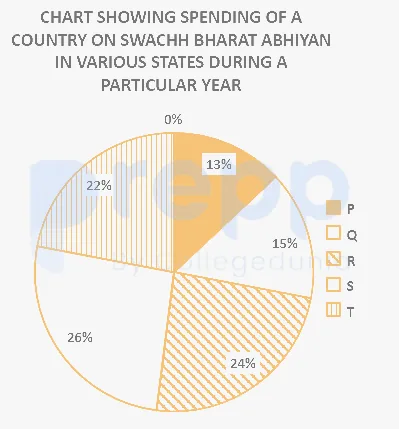
- A
211 crores
- B
211.2 crores
- C
205 crores
- D
210.6 crores
Show answer
D. 210.6 croresGiven:
Total money spent = 1620 crore
The % of money spent on state P = 13%
The % of money spent o n state Q = 15%
The % of money spent o n state R = 24%
The % of money spent o n state S = 26%
The % of money spent o n state T = 22%
Calculation:
Money spent on state P = 13% of 1620 crore
= 16,200,000,000 x 13%
= 2,106,000,000 Rs.
Money spent on state S = 26% of 1620 crore
= 4,212,000,000 Rs.
The difference in money spent on State P than to State S = 4212000000 - 2106000000
= 2106000000
= 2106 lakh
= 210.6 crore
Hence, the correct answer is '210.6 crore'.
Paper & answer key PDF ↗ Question 63archived
The LCM of 144, 360 and 450 is:
- A
4800
- B
3600
- C
7200
- D
2400
Show answer
B. 3600Finding the LCM of 144, 360, and 450
The Least Common Multiple (LCM) of two or more numbers is the smallest positive integer that is a multiple of all the numbers. To find the LCM of 144, 360, and 450, we can use the prime factorization method.
Step-by-Step LCM Calculation using Prime Factorization
First, we find the prime factorization of each number:
For 144:
\(144 = 2 \times 72 = 2 \times 2 \times 36 = 2 \times 2 \times 2 \times 18 = 2 \times 2 \times 2 \times 2 \times 9 = 2 \times 2 \times 2 \times 2 \times 3 \times 3\)
So, \(144 = 2^4 \times 3^2\)
For 360:
\(360 = 10 \times 36 = (2 \times 5) \times (6 \times 6) = (2 \times 5) \times (2 \times 3 \times 2 \times 3) = 2 \times 2 \times 2 \times 3 \times 3 \times 5\)
So, \(360 = 2^3 \times 3^2 \times 5^1\)
For 450:
\(450 = 10 \times 45 = (2 \times 5) \times (9 \times 5) = (2 \times 5) \times (3 \times 3 \times 5) = 2 \times 3 \times 3 \times 5 \times 5\)
So, \(450 = 2^1 \times 3^2 \times 5^2\)
Now, we list the prime factors found in any of the numbers: 2, 3, and 5. For each prime factor, we take the highest power that appears in any of the factorizations:
Highest power of 2: The powers of 2 are \(2^4\) (in 144), \(2^3\) (in 360), and \(2^1\) (in 450). The highest power is \(2^4\).
Highest power of 3: The powers of 3 are \(3^2\) (in 144), \(3^2\) (in 360), and \(3^2\) (in 450). The highest power is \(3^2\).
Highest power of 5: The powers of 5 are \(5^0\) (in 144, since 5 is not a factor), \(5^1\) (in 360), and \(5^2\) (in 450). The highest power is \(5^2\).
To find the LCM, we multiply these highest powers together:
\( \text{LCM}(144, 360, 450) = 2^4 \times 3^2 \times 5^2 \)
Let's calculate the value:
\( 2^4 = 16 \)
\( 3^2 = 9 \)
\( 5^2 = 25 \)
\( \text{LCM} = 16 \times 9 \times 25 \)
\( \text{LCM} = 144 \times 25 \)
\( \text{LCM} = 3600 \)
Thus, the Least Common Multiple of 144, 360, and 450 is 3600.
Number
Prime Factorization
144
\(2^4 \times 3^2\)
360
\(2^3 \times 3^2 \times 5^1\)
450
\(2^1 \times 3^2 \times 5^2\)
Comparing the highest powers:
Highest power of 2: \(2^4\)
Highest power of 3: \(3^2\)
Highest power of 5: \(5^2\)
LCM = \(2^4 \times 3^2 \times 5^2 = 16 \times 9 \times 25 = 3600\).
Revision Table: Understanding LCM
Concept
Description
How it relates to LCM
Multiple
A number obtained by multiplying an integer by another integer.
LCM is the smallest number that is a multiple of all given numbers.
Prime Number
A natural number greater than 1 that has no positive divisors other than 1 and itself.
Used in prime factorization, a key method for finding LCM.
Prime Factorization
Expressing a composite number as a product of its prime factors.
Essential step in finding LCM by identifying powers of primes.
Highest Power of a Prime Factor
The largest exponent of a prime factor occurring in the factorization of any of the given numbers.
These powers are multiplied together to get the LCM.
Additional Information: LCM Applications
The Least Common Multiple (LCM) is a fundamental concept in mathematics with several practical applications:
Adding and Subtracting Fractions: Finding the LCM of the denominators is necessary to find a common denominator before adding or subtracting fractions. This common denominator is often the Least Common Denominator (LCD), which is the LCM of the denominators.
Scheduling Problems: LCM can be used to find out when events will happen simultaneously. For example, if bus A comes every 15 minutes and bus B comes every 20 minutes, the next time they will arrive together can be found using the LCM of 15 and 20.
Working with Cycles: In physics or engineering, when dealing with cyclical events or processes, the LCM can help determine when the cycles will align again.
Understanding LCM helps build a strong foundation for more advanced mathematical concepts, particularly in number theory and algebra.
Paper & answer key PDF ↗ Question 64archived
A shopkeeper offers a cash discount of Rs. 85 first and then two successive discounts of 10% and 2% on the marked price of a fan. If the marked price of the fan is Rs. 1,285, what is its selling price (in Rs )?
- A
1058.4
- B
1000.4
- C
958.4
- D
1100
Show answer
A. 1058.4Calculating Selling Price with Cash and Successive Discounts
This problem requires us to calculate the final selling price of a fan after applying a cash discount followed by two successive percentage discounts on its marked price. We need to apply the discounts in the order specified: first the cash discount, and then the two percentage discounts sequentially.
Here's the breakdown of the calculation:
Start with the initial marked price (MP) of the fan.
Subtract the cash discount from the marked price to get the price after the cash discount.
Apply the first percentage discount (10%) to the price obtained after the cash discount.
Apply the second percentage discount (2%) to the price obtained after the first percentage discount. This gives the final selling price.
Step-by-Step Selling Price Calculation
Let's apply the given values:
Marked Price (MP) = Rs. 1,285
Cash Discount = Rs. 85
First Successive Discount = 10%
Second Successive Discount = 2%
Step 1: Price after Cash Discount
The cash discount is applied directly to the marked price.
Price after Cash Discount = Marked Price - Cash Discount
Price after Cash Discount = $\text{Rs. } 1285 - \text{Rs. } 85 = \text{Rs. } 1200$
Step 2: Price after First Successive Discount (10%)
The first successive discount of 10% is applied to the price after the cash discount (Rs. 1200).
Price after 10% Discount = Price after Cash Discount $\times (1 - \frac{10}{100})$
Price after 10% Discount = $\text{Rs. } 1200 \times (1 - 0.10) = \text{Rs. } 1200 \times 0.90$
Price after 10% Discount = $\text{Rs. } 1080$
Step 3: Price after Second Successive Discount (2%)
The second successive discount of 2% is applied to the price after the 10% discount (Rs. 1080).
Selling Price (SP) = Price after 10% Discount $\times (1 - \frac{2}{100})$
Selling Price (SP) = $\text{Rs. } 1080 \times (1 - 0.02) = \text{Rs. } 1080 \times 0.98$
Selling Price (SP) = $\text{Rs. } 1058.40$
So, the final selling price of the fan is Rs. 1058.40.
Description
Amount (Rs.)
Marked Price
1285
Cash Discount
-85
Price after Cash Discount
1200
1st Successive Discount (10% of 1200)
-120
Price after 1st Discount
1080
2nd Successive Discount (2% of 1080)
-21.60
Final Selling Price
1058.40
Understanding Discounts: Cash vs. Successive
It's important to understand the difference between a cash discount and successive percentage discounts when calculating the final price of an item like a fan.
Cash Discount: This is a fixed amount deducted directly from the marked price. It reduces the initial price before any percentage discounts are applied (unless specified otherwise).
Successive Percentage Discounts: These are multiple percentage discounts applied one after the other on the *remaining* price after the previous discount has been applied. They are not simply added together. Applying a 10% discount and then a 2% discount is different from applying a single 12% discount.
In this specific problem about the fan's price, the cash discount was applied first, changing the base price for the subsequent percentage discounts.
Revision Table: Key Concepts in Discounts
Concept
Description
Calculation Basis
Marked Price (MP)
The original price tagged on the product.
Initial value.
Cash Discount
A fixed amount reduction.
Subtracted from MP (usually).
Percentage Discount
A reduction based on a percentage of the current price.
Applied to the price *after* previous discounts/reductions.
Successive Discounts
Multiple percentage discounts applied one after another.
Each discount applied to the price remaining after the previous one.
Selling Price (SP)
The final price the customer pays.
Price after all discounts are applied.
Additional Information on Calculating Selling Price
When dealing with multiple discounts, the order of application can sometimes matter, especially if both cash and percentage discounts are involved, or if percentage discounts are on different bases (e.g., one on MP, one on discounted price). In this problem, the wording clearly states the cash discount is applied first, then the successive percentage discounts.
For successive percentage discounts $d_1\%$ and $d_2\%$, the final price is calculated by multiplying the initial price by $(1 - \frac{d_1}{100}) \times (1 - \frac{d_2}{100})$. This is equivalent to applying $d_1\%$ first, then $d_2\%$ to the result.
The final calculated selling price of the fan is Rs. 1058.4.
Paper & answer key PDF ↗ Question 65archived
Sofia sold an iPhone at the cost of Rs.46,068 at a loss of 12%. At what cost will she have to sold it to get a profit of 18%?
- A
Rs. 61,773
- B
Rs. 65,773
- C
Rs. 58,350
- D
Rs. 52,350
Show answer
A. Rs. 61,773Understanding the iPhone Profit and Loss Scenario
This problem involves calculating profit and loss percentages based on the cost price and selling price of an item, specifically an iPhone. We are given the selling price when the iPhone was sold at a loss and need to find the selling price required to make a desired profit.
Let's break down the key information provided in the question:
Initial Selling Price (SP1) = Rs. 46,068
Initial Loss Percentage = 12%
Desired Profit Percentage = 18%
Goal: Find the New Selling Price (SP2) to achieve the 18% profit.
Calculating the Cost Price (CP) of the iPhone
The first step is to determine the original cost price of the iPhone. When an item is sold at a loss, the selling price is less than the cost price. The formula relating Selling Price (SP), Cost Price (CP), and Loss Percentage is:
$\text{SP} = \text{CP} \times \left( \frac{100 - \text{Loss}\%}{100} \right)$
We can rearrange this formula to find the Cost Price:
$\text{CP} = \text{SP} \times \left( \frac{100}{100 - \text{Loss}\%} \right)$
Now, let's plug in the given values:
SP1 = Rs. 46,068
Loss % = 12%
$\text{CP} = 46068 \times \left( \frac{100}{100 - 12} \right)$
$\text{CP} = 46068 \times \left( \frac{100}{88} \right)$
To simplify the calculation, we can divide 46068 by 88.
$46068 \div 88 = 523.5$
So, the Cost Price (CP) is:
$\text{CP} = 523.5 \times 100 = 52350$
The cost price of the iPhone is Rs. 52,350.
Calculating the Desired Selling Price (SP2) for 18% Profit
Now that we know the cost price (CP = Rs. 52,350), we can calculate the selling price required to make an 18% profit. When an item is sold at a profit, the selling price is greater than the cost price. The formula relating Selling Price (SP), Cost Price (CP), and Profit Percentage is:
$\text{SP} = \text{CP} \times \left( \frac{100 + \text{Profit}\%}{100} \right)$
Let's plug in the calculated CP and the desired Profit Percentage:
CP = Rs. 52,350
Desired Profit % = 18%
$\text{SP2} = 52350 \times \left( \frac{100 + 18}{100} \right)$
$\text{SP2} = 52350 \times \left( \frac{118}{100} \right)$
$\text{SP2} = 523.5 \times 118$
Now, let's perform the multiplication:
$523.5 \times 118 = 61773$
So, the selling price required to get a profit of 18% is Rs. 61,773.
Summary of Profit and Loss Calculation Steps
Here is a quick recap of the steps taken:
Used the initial selling price and loss percentage to find the cost price.
Used the calculated cost price and the desired profit percentage to find the new selling price.
Key Concepts in Profit and Loss
Understanding the basic terms is crucial for solving problems like this:
Cost Price (CP): The price at which an article is purchased.
Selling Price (SP): The price at which an article is sold.
Profit: Occurs when SP > CP. Profit = SP - CP.
Loss: Occurs when SP < CP. Loss = CP - SP.
Profit Percentage: (Profit / CP) × 100%.
Loss Percentage: (Loss / CP) × 100%.
Revision Table: iPhone Pricing Details
Detail
Value
Initial Selling Price (SP1)
Rs. 46,068
Initial Loss Percentage
12%
Calculated Cost Price (CP)
Rs. 52,350
Desired Profit Percentage
18%
Desired Selling Price (SP2)
Rs. 61,773
Additional Information on Profit and Loss Problems
Profit and loss calculations are fundamental in business and personal finance. These problems often involve percentages, so a good understanding of percentage calculations is essential. Always remember that profit or loss percentage is typically calculated on the cost price unless stated otherwise. Practice with different scenarios, such as finding the cost price given SP and profit%, or finding profit/loss percentage given CP and SP. These variations help solidify your understanding of profit and loss concepts.
Paper & answer key PDF ↗ Question 66archived
If the number 123456789 is divided by 9, then the remainder is:
- A
0
- B
1
- C
2
- D
3
Show answer
A. 0Solution: Sum of digits of 123456789 = 45, which is divisible by 9. So the remainder is 0.
∴ 0
Paper & answer key PDF ↗ Question 67archived
Menu and Daya travel from point A to B, a distance of 105 km, at speeds of 10 km/h and 25 km/h, respectively. Daya reaches point B first and returns immediately and meets Menu at point C. Find the distance from point A to point C.
- A
35 km
- B
60 km
- C
45 km
- D
62 km
Show answer
B. 60 kmUnderstanding the Travel Problem
This problem involves two individuals, Menu and Daya, traveling between two points, A and B, located 105 km apart. They start at the same time from point A but travel at different speeds. Daya is faster, reaches point B first, and immediately turns back. They meet at point C somewhere between A and B.
We are asked to find the distance of point C from point A (distance AC).
Analyzing the Journey
Let's break down the journey:
Starting point: A
Ending point: B
Distance AB: 105 km
Menu's speed: 10 km/h
Daya's speed: 25 km/h
Both start simultaneously from A.
Daya reaches B, turns back, and meets Menu at C.
When they meet at point C, both Menu and Daya have been traveling for the same amount of time since they started from point A. Let this time be \(t\) hours.
Distances Covered by Menu and Daya
Menu travels from A to C. The distance covered by Menu is \(AC\).
Daya travels from A to B and then from B to C. The total distance covered by Daya is \(AB + BC\).
The distance covered by an object is given by the formula: Distance = Speed \(\times\) Time.
For Menu:
Distance \(AC = \text{Menu's speed} \times t\)
\(AC = 10t\) (Equation 1)
For Daya:
Total distance covered by Daya = \(\text{Daya's speed} \times t\)
\(AB + BC = 25t\)
We know \(AB = 105\) km. So,
\(105 + BC = 25t\) (Equation 2)
Relating Distances AC and BC
Point C lies on the path between A and B where Daya, returning from B, meets Menu. Since C is between A and B, the distance \(AC\) and the distance \(BC\) add up to the total distance \(AB\). However, be careful! C is where they meet *after* Daya returned from B. This means C is somewhere between A and B. If Menu is at C, the distance from A is AC. If Daya is at C after returning from B, the distance from A is AC, and the distance from B is BC.
The meeting point C is on the segment AB. Therefore, the distance \(AB\) is the sum of distance \(AC\) and distance \(CB\) if C were between A and B *before* Daya reached B. But C is the meeting point after Daya returns. So, C is a point on the path AB.
Let's consider the total distance covered by both until they meet at C. Menu covers \(AC\). Daya covers \(AB\) (from A to B) plus \(BC\) (from B to C). Since C is between A and B, the distance \(BC\) is \(AB - AC\).
Total distance covered by Daya = \(AB + BC = AB + (AB - AC)\) if C were between A and B as the meeting point after returning.
Alternatively, think about the total ground covered. Menu goes A to C. Daya goes A to B and then B to C. The total distance covered by *both* combined is \(AC + (AB + BC)\). Since C is a point on the path AB, the distance \(AB\) is 105 km. Let's re-examine the position of C. Menu is at C having traveled \(AC\). Daya is at C having traveled \(AB + BC\). C is on the segment AB. Thus, \(AC + BC = AB\), which means \(BC = AB - AC\). This relationship is valid because C is a point on the line segment AB.
Total distance covered by Menu: \(AC = 10t\)
Total distance covered by Daya: \(AB + BC = 105 + BC = 25t\)
Since C is between A and B, \(AC + BC = AB\). Substituting \(AB = 105\):
\(AC + BC = 105\)
So, \(BC = 105 - AC\).
Substitute this into Daya's distance equation:
\(105 + (105 - AC) = 25t\)
\(210 - AC = 25t\) (Equation 3)
Solving for Time and Distance AC
We have two equations:
\(AC = 10t\)
\(210 - AC = 25t\)
Substitute \(AC\) from Equation 1 into Equation 2:
\(210 - (10t) = 25t\)
\(210 = 25t + 10t\)
\(210 = 35t\)
Now, solve for \(t\):
\(t = \frac{210}{35}\)
Let's perform the division:
Calculation
Result
\(210 \div 35\)
\(6\)
So, \(t = 6\) hours.
They meet after 6 hours. Now, find the distance AC using Equation 1:
\(AC = 10t\)
\(AC = 10 \times 6\)
\(AC = 60\) km.
Verifying the Result
Menu travels 60 km in 6 hours at 10 km/h (10 * 6 = 60). This checks out.
Daya travels for 6 hours at 25 km/h. Total distance covered by Daya = 25 * 6 = 150 km.
Daya first travels from A to B (105 km). The remaining distance is \(150 - 105 = 45\) km. This remaining distance is \(BC\), the distance from B back towards A where Daya meets Menu at C.
So, Daya reaches B (105 km) and travels back 45 km towards A. The meeting point C is 45 km away from B.
The distance AC is \(AB - BC = 105 - 45 = 60\) km.
This confirms our calculated distance for AC is correct.
Final Answer Calculation
Using the derived time \(t = 6\) hours, the distance from A to C is calculated based on Menu's travel:
\(AC = \text{Menu's speed} \times t\)
\(AC = 10 \, \text{km/h} \times 6 \, \text{h}\)
\(AC = 60 \, \text{km}\)
Variable
Value
Distance AB
105 km
Menu's Speed
10 km/h
Daya's Speed
25 km/h
Time until meeting (t)
6 hours
Distance AC (Menu's distance)
60 km
Daya's total distance (150 km)
AB (105 km) + BC (45 km)
Distance BC
105 km - 60 km = 45 km
Revision Table - Distance and Speed Concepts
Concept
Definition/Formula
Application in this Problem
Speed
Rate at which distance is covered per unit time (\(\text{Speed} = \frac{\text{Distance}}{\text{Time}}\)).
Given speeds of Menu (10 km/h) and Daya (25 km/h).
Distance
Product of speed and time (\(\text{Distance} = \text{Speed} \times \text{Time}\)).
Used to calculate distance covered by Menu (\(AC\)) and Daya (\(AB + BC\)).
Time
Ratio of distance to speed (\(\text{Time} = \frac{\text{Distance}}{\text{Speed}}\)).
The time \(t\) until meeting is the same for both Menu and Daya.
Meeting Point
Location where two or more moving objects converge at the same time.
Point C is the meeting point after Daya returns from B.
Additional Information - Alternative Approach
Another way to think about this problem is in terms of relative speed when objects are moving towards each other. However, this is slightly different because Daya turns back.
Consider the total distance covered by both Menu and Daya combined until they meet at C. Menu travels from A to C (distance AC). Daya travels from A to B (distance AB) and then from B to C (distance BC).
The total distance covered by Menu + total distance covered by Daya = \(AC + (AB + BC)\).
Since C is on the segment AB, the total distance covered by both until they meet is actually twice the distance AB.
Think of it this way: Menu covers \(AC\) and Daya covers \(AB + BC\). Adding these distances: \(AC + AB + BC = (AC + BC) + AB\). Since C is on the segment AB, \(AC + BC = AB\). So the sum of distances is \(AB + AB = 2 \times AB\).
Total distance covered together = \(2 \times 105 \, \text{km} = 210 \, \text{km}\).
This total distance is covered in time \(t\) by their combined speed. Since they are effectively moving towards each other (Menu towards B, Daya from B towards A), their relative speed is the sum of their speeds when considering the total distance covered on the 'path'.
Combined speed = Menu's speed + Daya's speed = \(10 \, \text{km/h} + 25 \, \text{km/h} = 35 \, \text{km/h}\).
Total distance = Combined speed \(\times\) Time \(t\)
\(210 = 35 \times t\)
\(t = \frac{210}{35} = 6\) hours.
Once we have the time \(t\), we can find the distance AC based on Menu's travel:
\(AC = \text{Menu's speed} \times t = 10 \, \text{km/h} \times 6 \, \text{h} = 60 \, \text{km}\).
This alternative approach confirms the result obtained earlier.
Paper & answer key PDF ↗ Question 68archived
If 36 : 81 :: X : 63, what is the value of X?
- A
30
- B
31
- C
28
- D
29
Show answer
C. 28Solving Ratio and Proportion Problems
The question asks us to find the value of X in the given proportion: 36 : 81 :: X : 63.
A proportion is a statement that two ratios are equal. The notation a : b :: c : d means that the ratio a : b is equal to the ratio c : d. This can be written mathematically as a fraction equation:
\(\frac{a}{b} = \frac{c}{d}\)
In our case, the proportion is 36 : 81 :: X : 63, which means:
\(\frac{36}{81} = \frac{X}{63}\)
Finding the Value of X
To solve for X in this equation, we can use the method of cross-multiplication. Cross-multiplication states that if \(\frac{a}{b} = \frac{c}{d}\), then \(a \times d = b \times c\). Applying this to our equation:
\(36 \times 63 = 81 \times X\)
Now, we calculate the product on the left side:
\(36 \times 63\)
We can calculate this multiplication:
Multiply 36 by 3: \(36 \times 3 = 108\)
Multiply 36 by 60: \(36 \times 60 = 2160\)
Add the results: \(108 + 2160 = 2268\)
So, the equation becomes:
\(2268 = 81X\)
To find X, we need to isolate X by dividing both sides of the equation by 81:
\(X = \frac{2268}{81}\)
Now, we perform the division:
\(2268 \div 81\)
We can simplify the fraction first by dividing both numerator and denominator by a common factor. Both 36 and 81 are divisible by 9 (36 = 4 * 9, 81 = 9 * 9). Also 63 is divisible by 9 (63 = 7 * 9).
Let's go back to the fraction form \(\frac{36}{81} = \frac{X}{63}\) and simplify \(\frac{36}{81}\):
\(\frac{36 \div 9}{81 \div 9} = \frac{4}{9}\)
So, the proportion is \(\frac{4}{9} = \frac{X}{63}\).
Now, to find X, we can see that to get from the denominator 9 to 63, we multiply by 7 (since \(9 \times 7 = 63\)). Therefore, we must multiply the numerator 4 by the same factor, 7, to maintain the equality of the ratios:
\(X = 4 \times 7\)
\(X = 28\)
Alternatively, using the cross-multiplication result \(X = \frac{2268}{81}\):
\(2268 \div 81 = 28\)
Both methods yield the same result.
Thus, the value of X is 28.
Checking the Solution
Let's substitute X = 28 back into the original proportion:
36 : 81 :: 28 : 63
Check if the ratios are equal:
\(\frac{36}{81}\)
Divide both by 9: \(\frac{36 \div 9}{81 \div 9} = \frac{4}{9}\)
\(\frac{28}{63}\)
Divide both by 7: \(\frac{28 \div 7}{63 \div 7} = \frac{4}{9}\)
Since \(\frac{4}{9} = \frac{4}{9}\), the ratios are equal, and our value for X is correct.
The value of X is 28.
Revision Table: Key Concepts in Ratio and Proportion
Concept
Explanation
Example
Ratio
A comparison of two quantities by division. Can be written as a:b or a/b.
2:3, 5/4
Proportion
A statement that two ratios are equal. a:b :: c:d or a/b = c/d.
2:3 :: 4:6, \(\frac{1}{2} = \frac{5}{10}\)
Extremes
The first and fourth terms in a proportion (a and d in a:b :: c:d).
In 2:3 :: 4:6, 2 and 6 are the extremes.
Means
The second and third terms in a proportion (b and c in a:b :: c:d).
In 2:3 :: 4:6, 3 and 4 are the means.
Property of Proportion
Product of Extremes = Product of Means (ad = bc). Used to solve for unknowns.
If 2:3 :: 4:X, then \(2 \times X = 3 \times 4\).
Additional Information on Solving Proportions
Solving proportions is a fundamental skill in mathematics with many real-world applications. Here are a few key points:
Simplifying Ratios: Before solving, simplify the known ratio if possible. This often makes the calculations easier, as demonstrated in the alternative method above.
Units: When dealing with word problems involving proportions, ensure that the units are consistent across the ratios. For example, if comparing quantities of apples to quantities of oranges, the units must align (apples/oranges = apples/oranges).
Types of Proportion:
Direct Proportion: As one quantity increases, the other quantity increases proportionally. (e.g., more hours worked, more money earned). Represented as \(y = kx\).
Inverse Proportion: As one quantity increases, the other quantity decreases proportionally. (e.g., more workers on a job, less time to complete it). Represented as \(y = k/x\) or \(xy = k\).
Applications: Proportions are used in scaling recipes, converting currencies, calculating distances on maps, mixing chemicals, and many other areas.
Understanding how to set up and solve proportions is crucial for various mathematical concepts and practical problems.
Paper & answer key PDF ↗ Question 69archived
Triangle ABC and DEF are similar. If AB = 92 cm, BC = 48 cm, AC =120 cm, and the length of the smallest side of DEF is 200 cm, then find the length of the longest side of triangle DEF?
- A
400 cm
- B
225 cm
- C
350 cm
- D
500 cm
Show answer
D. 500 cmUnderstanding Similar Triangles and Side Ratios
The question asks us to find the length of the longest side of triangle DEF, given that triangle ABC is similar to triangle DEF and the side lengths of triangle ABC are 92 cm, 48 cm, and 120 cm. We are also given that the smallest side of triangle DEF is 200 cm.
When two triangles are similar, their corresponding angles are equal, and the lengths of their corresponding sides are proportional. This proportionality is key to solving problems involving similar triangles. The ratio of the lengths of corresponding sides is called the scale factor.
Identifying Sides in Triangle ABC
First, let's identify the side lengths of triangle ABC:
AB = 92 cm
BC = 48 cm
AC = 120 cm
We can see that the smallest side of triangle ABC is BC = 48 cm, and the longest side is AC = 120 cm.
Using the Smallest Sides to Find the Scale Factor
We are told that triangle ABC and triangle DEF are similar. This means their corresponding sides are proportional. The smallest side of triangle ABC corresponds to the smallest side of triangle DEF.
Given: Smallest side of triangle ABC = 48 cm
Given: Smallest side of triangle DEF = 200 cm
The ratio of the corresponding sides (scale factor from triangle ABC to triangle DEF) can be calculated using the smallest sides:
Scale Factor $k = \frac{\text{Length of side in DEF}}{\text{Length of corresponding side in ABC}}$
Using the smallest sides:
$k = \frac{\text{Smallest side of DEF}}{\text{Smallest side of ABC}}$
$k = \frac{200 \text{ cm}}{48 \text{ cm}}$
Let's simplify the fraction:
$k = \frac{200}{48} = \frac{100}{24} = \frac{50}{12} = \frac{25}{6}$
So, the scale factor from triangle ABC to triangle DEF is $\frac{25}{6}$. This means every side in triangle DEF is $\frac{25}{6}$ times the length of the corresponding side in triangle ABC.
Finding the Longest Side of Triangle DEF
We need to find the length of the longest side of triangle DEF. Since the triangles are similar, the longest side of triangle DEF corresponds to the longest side of triangle ABC.
Longest side of triangle ABC = AC = 120 cm
To find the length of the longest side of triangle DEF, we multiply the length of the longest side of triangle ABC by the scale factor:
Longest side of DEF = (Longest side of ABC) $\times$ (Scale Factor)
Longest side of DEF = $120 \text{ cm} \times \frac{25}{6}$
Now, let's calculate this value:
Longest side of DEF = $\frac{120 \times 25}{6}$
We can simplify by dividing 120 by 6:
Longest side of DEF = $(120 \div 6) \times 25$
Longest side of DEF = $20 \times 25$
Longest side of DEF = $500$ cm
Conclusion
The length of the longest side of triangle DEF is 500 cm.
Summary of Side Lengths and Calculation
Triangle
Side Lengths (cm)
Smallest Side (cm)
Longest Side (cm)
ABC
92, 48, 120
48
120
DEF
?
200
?
Calculation Steps:
Identify the sides of triangle ABC: 92 cm, 48 cm, 120 cm.
Determine the smallest side of ABC (48 cm) and the longest side of ABC (120 cm).
Identify the smallest side of DEF (200 cm).
Calculate the scale factor from ABC to DEF using the ratio of corresponding smallest sides: $\frac{200}{48} = \frac{25}{6}$.
Multiply the longest side of ABC by the scale factor to find the longest side of DEF: $120 \times \frac{25}{6} = 500$ cm.
Revision Table: Similar Triangles
Key Concepts for Similar Triangles
Concept
Description
Application
Definition
Triangles with equal corresponding angles.
Used to identify if triangles are similar.
Side Proportionality
Corresponding sides are in the same ratio (scale factor).
Used to find unknown side lengths or scale factor.
Scale Factor
Ratio of corresponding side lengths between similar figures.
Multiplier to change dimensions from one figure to the other.
Additional Information: Properties of Similar Triangles
Similar triangles have several important properties beyond just proportional sides. Understanding these properties helps in solving various geometry problems.
Corresponding Angles: All pairs of corresponding angles are equal. If $\triangle ABC \sim \triangle DEF$, then $\angle A = \angle D$, $\angle B = \angle E$, and $\angle C = \angle F$.
Ratio of Perimeters: The ratio of the perimeters of two similar triangles is equal to the scale factor (the ratio of their corresponding side lengths).
Ratio of Areas: The ratio of the areas of two similar triangles is equal to the square of the scale factor. If the scale factor is $k$, the ratio of areas is $k^2$.
Ratio of Altitudes, Medians, Angle Bisectors: The ratio of corresponding altitudes, medians, or angle bisectors of similar triangles is also equal to the scale factor.
These properties make similar triangles a powerful tool in geometry for finding unknown lengths, perimeters, or areas when a scale factor or corresponding side lengths are known.
Paper & answer key PDF ↗ Question 70archived
In an election contested between two candidates, 15% of the total voters did not cast their votes and 100 votes got disqualified. The candidate who won the election won by securing 45% of the total votes and won by a margin of 400 votes. Find the total number of voters.
- A
6,000
- B
3,600
- C
10,000
- D
3,500
Show answer
A. 6,000Calculating Total Voters in an Election
This problem involves an election scenario where we need to find the total number of voters based on percentages of votes cast, disqualified votes, and the winning margin between two candidates.
Let's denote the total number of voters as $\text{V}$.
Step-by-Step Calculation
1. Votes Not Cast:
15% of the total voters did not cast their votes.
Number of voters who did not vote $= 15\%$ of $\text{V} = \frac{15}{100} \times \text{V} = 0.15\text{V}$.
2. Votes Cast:
The number of votes cast is the total voters minus those who did not vote.
Votes cast $= \text{V} - 0.15\text{V} = 0.85\text{V}$.
3. Valid Votes:
Out of the votes cast, 100 votes were disqualified.
Valid votes $= \text{Votes cast} - \text{Disqualified votes}$
Valid votes $= 0.85\text{V} - 100$.
These valid votes are the votes received by the two candidates combined.
4. Winning Candidate's Votes:
The candidate who won secured 45% of the total votes.
Winning candidate's votes $(\text{W}) = 45\%$ of $\text{V} = \frac{45}{100} \times \text{V} = 0.45\text{V}$.
5. Losing Candidate's Votes:
Let the losing candidate's votes be $\text{L}$.
The winning candidate won by a margin of 400 votes.
$\text{W} - \text{L} = 400$.
Substituting the value of $\text{W}$:
$0.45\text{V} - \text{L} = 400$.
So, $\text{L} = 0.45\text{V} - 400$.
6. Relating Valid Votes to Candidates' Votes:
The sum of the votes of the winning and losing candidates equals the total valid votes.
$\text{W} + \text{L} = \text{Valid votes}$
Substituting the expressions for $\text{W}$, $\text{L}$, and Valid votes:
$(0.45\text{V}) + (0.45\text{V} - 400) = 0.85\text{V} - 100$.
7. Solving for V:
Combine like terms on the left side:
$0.90\text{V} - 400 = 0.85\text{V} - 100$.
Rearrange the equation to isolate $\text{V}$ terms on one side and constants on the other:
$0.90\text{V} - 0.85\text{V} = 400 - 100$.
$0.05\text{V} = 300$.
To find $\text{V}$, divide 300 by 0.05:
$\text{V} = \frac{300}{0.05} = \frac{300}{\frac{5}{100}} = 300 \times \frac{100}{5} = 300 \times 20$.
$\text{V} = 6000$.
The total number of voters is 6000.
Verification
Let's check if this value of $\text{V}$ satisfies all conditions:
Total voters = 6000
Votes not cast = 15% of 6000 = $0.15 \times 6000 = 900$
Votes cast = $6000 - 900 = 5100$
Disqualified votes = 100
Valid votes = $5100 - 100 = 5000$
Winning candidate's votes (W) = 45% of 6000 = $0.45 \times 6000 = 2700$
Since W + L = Valid votes, $2700 + \text{L} = 5000$
Losing candidate's votes (L) = $5000 - 2700 = 2300$
Winning margin = W - L = $2700 - 2300 = 400$
All conditions are satisfied with a total of 6000 voters.
Therefore, the total number of voters is 6,000.
Category
Calculation
Value (for V=6000)
Total Voters
$\text{V}$
6000
Votes Not Cast
$0.15\text{V}$
900
Votes Cast
$0.85\text{V}$
5100
Disqualified Votes
100
100
Valid Votes
$0.85\text{V} - 100$
5000
Winning Votes (W)
$0.45\text{V}$
2700
Losing Votes (L)
$0.45\text{V} - 400$
2300
Winning Margin
W - L
400
Revision Table: Election Vote Calculation
Understand that percentages are often based on the total number of voters unless specified otherwise.
Identify the different categories of votes: total voters, not cast, cast, disqualified, valid, winning, losing.
Set up equations based on the given information: percentages, fixed numbers (disqualified votes), and the margin.
Ensure the sum of winning and losing votes equals the total valid votes.
Solve the resulting linear equation for the unknown variable (total voters).
Additional Information: Election Concepts
Election problems in quantitative aptitude often test your ability to work with percentages and linear equations. Key concepts include:
Total Voters: The initial pool of eligible voters.
Votes Cast: The number of voters who actually participated by casting a vote.
Valid Votes: Votes that are counted after discarding invalid or disqualified votes. This is the pool from which candidates receive their votes.
Winning Margin: The difference between the votes received by the winning candidate and the votes received by the runner-up.
Percentage Calculations: Pay close attention to what base the percentage is calculated upon (e.g., percentage of total voters vs. percentage of votes cast).
These problems usually require setting up one or more algebraic equations to represent the relationships between the different quantities involved and then solving for the unknown.
Paper & answer key PDF ↗ Question 71archived
Study the given pie-chart and answer the question that follows. The pie-chart shows the expenditure by a family on different heads.
The angle formed by the sector representing education at the centre of the circle is:
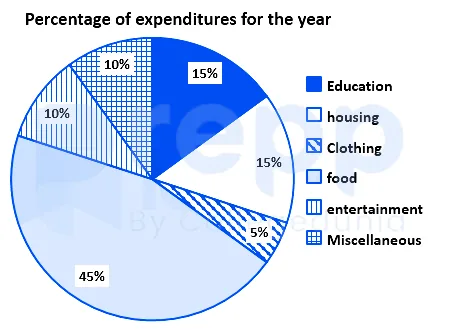
- A
45o
- B
54o
- C
67o
- D
60o
Show answer
B. 54oGiven:
Expenditure of family in education = 15%
Expenditure of family on housing = 15%
Expenditure of family on clothing = 5%
Expenditure of family on food = 45%
Expenditure of family in entertainment = 10%
Expenditure of family in miscellaneous = 10%
Concept used:
The complete angle of a circle is 360o.
Calculation:
As the angle of a circle = 360 o
Thus,
The angle formed by the sector representing education at the center of the circle is = 15% of 360 o
⇒ \(\frac{15}{100}\) x 360 o
⇒ 54 o
∴ The angle formed by the sector representing education at the centre of the circle is 54 o.
Paper & answer key PDF ↗ Question 72archived
Two angles of a triangle are equal and the third angle measures 78°. What is the measure of each of the unknown angles?
- A
50o
- B
51o
- C
49o
- D
52o
Show answer
B. 51oTriangle Angle Calculation for Equal Angles
This solution details how to determine the measure of unknown angles in a triangle, specifically when two angles are equal and the measure of the third angle is provided. We'll use the fundamental property that the sum of the interior angles in any triangle equals 180 degrees.
Triangle Angle Sum Property Explained
The sum of the interior angles of any triangle is always 180 degrees. This is a fundamental rule in Euclidean geometry. If a triangle has angles measuring $A$, $B$, and $C$, then:
$$ A + B + C = 180^\circ $$
Solving for Unknown Triangle Angles
Let's break down the problem and find the measure of the equal angles:
Information Provided:
One angle measures 78 degrees.
The triangle has two angles that are equal in measure.
Identifying the Unknowns: We need to find the measure of the two equal angles. Let's call the measure of each of these angles '$x$'.
Formulating the Equation: Using the triangle angle sum property ($180^\circ$), we can set up an equation that includes the known angle and the two unknown equal angles:
$$ x + x + 78^\circ = 180^\circ $$
Step-by-Step Calculation:
First, combine the like terms (the two unknown angles):
$$ 2x + 78^\circ = 180^\circ $$
Next, isolate the term containing '$x$' by subtracting $78^\circ$ from both sides of the equation. This helps us find the sum of the two equal angles:
$$ 2x = 180^\circ - 78^\circ $$
$$ 2x = 102^\circ $$
Finally, to find the measure of a single angle ($x$), divide the result ($102^\circ$) by 2:
$$ x = \frac{102^\circ}{2} $$
$$ x = 51^\circ $$
Result: Each of the two equal angles in the triangle measures $51^\circ$.
Paper & answer key PDF ↗ Question 73archived
What is the present value of Rs.10,000 received in 2 years, if the interest rate is 12% per year discounted when compounded semi-annually?
- A
Rs. 7,020.94
- B
Rs. 7,920.90
- C
Rs. 7,920.94
- D
Rs. 7,900.94
Show answer
C. Rs. 7,920.94Understanding Present Value with Semi-annual Compounding
The question asks us to find the present value of a future amount, considering a specific interest rate and compounding frequency. Present value is the current worth of a future sum of money or stream of cash flows, given a specified rate of return. It tells us how much money we would need today to have a certain amount in the future, assuming a constant rate of return.
Impact of Semi-annual Compounding on Present Value Calculation
When interest is compounded more than once a year, we need to adjust both the interest rate and the number of periods for the calculation. Semi-annual compounding means the interest is calculated and added to the principal twice a year.
The annual interest rate is divided by the number of compounding periods per year.
The total number of years is multiplied by the number of compounding periods per year.
Step-by-Step Calculation of Present Value
Given:
Future Value (FV) = Rs. 10,000
Time period (t) = 2 years
Annual Interest Rate (r) = 12% or 0.12
Compounding Frequency = Semi-annually (n = 2 times per year)
First, we adjust the interest rate and the number of periods:
Interest rate per period = $\frac{\text{Annual Interest Rate}}{\text{Number of compounding periods per year}} = \frac{r}{n} = \frac{0.12}{2} = 0.06$ (or 6% per period)
Total number of periods = $\text{Number of years} \times \text{Number of compounding periods per year} = t \times n = 2 \times 2 = 4$ periods
The formula for calculating Present Value (PV) with compounding is:
$$PV = \frac{FV}{(1 + \frac{r}{n})^{nt}}$$
Substituting the values we have:
$$PV = \frac{10000}{(1 + 0.06)^{4}}$$
$$PV = \frac{10000}{(1.06)^{4}}$$
Now, we calculate $(1.06)^4$:
$(1.06)^4 = 1.06 \times 1.06 \times 1.06 \times 1.06 \approx 1.26247696$
Finally, calculate PV:
$$PV = \frac{10000}{1.26247696}$$
$$PV \approx 7920.9366$$
Rounding to two decimal places, the Present Value is approximately Rs. 7,920.94.
Summary of Present Value Calculation
Item
Value
Future Value (FV)
Rs. 10,000
Annual Interest Rate (r)
12% (0.12)
Time (t)
2 years
Compounding Frequency (n)
Semi-annually (2)
Interest rate per period (r/n)
6% (0.06)
Total Periods (n*t)
4
Discount Factor $(1 + r/n)^{nt}$
$(1.06)^4 \approx 1.26247696$
Present Value (PV)
Rs. 7,920.94
The calculated present value of Rs. 10,000 received in 2 years at a 12% annual interest rate compounded semi-annually is approximately Rs. 7,920.94.
Revision Table: Key Concepts
Concept
Definition
Formula (Simple Case)
Present Value (PV)
The current worth of a future sum of money.
$PV = \frac{FV}{(1 + r)^t}$
Future Value (FV)
The value of a current asset at a future date based on an assumed rate of growth.
$FV = PV \times (1 + r)^t$
Compounding
The process where interest earned is added to the principal, and then the next interest calculation is on the new, larger principal.
Adjusted rate = $r/n$, Periods = $t \times n$
Discounting
The process of determining the present value of a future amount. It is the reverse of compounding.
Involves dividing the future value by a discount factor.
Additional Information on Time Value of Money
The calculation of Present Value is a fundamental concept in the Time Value of Money (TVM). TVM states that a sum of money is worth more now than the same sum will be at a future date due to its potential earning capacity. This core principle is why we need to calculate present values and future values.
Discount Rate: The interest rate used in discounting is also called the discount rate or required rate of return. It reflects the opportunity cost of money or the return that could be earned on an alternative investment of similar risk.
Compounding Frequency: The more frequently interest is compounded (e.g., quarterly, monthly, daily), the higher the future value will be for a given present value and annual interest rate. Conversely, for a given future value, a higher compounding frequency will result in a lower present value when discounting.
Applications: Present value calculations are widely used in finance for valuing investments, bonds, stocks, and in making capital budgeting decisions.
Paper & answer key PDF ↗ Question 74archived
A conical vessel (solid) is made of iron. Its base radius is 7 cm and height is 15 cm. If the weight of the iron per cubic centimetre is 15 g, what is the weight of the vessel?
- A
13.55 kg
- B
12.55 kg
- C
14.55 kg
- D
11.55 kg
Show answer
D. 11.55 kgCalculating the Weight of a Solid Iron Conical Vessel
This problem requires us to find the total weight of a solid iron cone given its dimensions (radius and height) and the weight of the material per unit volume (density).
Understanding the Problem
We are given the following information:
Shape of the vessel: Solid cone
Material: Iron
Base radius (r): 7 cm
Height (h): 15 cm
Weight of iron per cubic centimetre: 15 g/cm<sup>3</sup>
We need to calculate the total weight of the conical vessel in kilograms.
Step-by-Step Solution
Step 1: Calculate the Volume of the Conical Vessel
The volume (V) of a cone is given by the formula:
\(V = \frac{1}{3}\pi r^2 h\)
Using the given values, \(r = 7 \text{ cm}\) and \(h = 15 \text{ cm}\), and taking \(\pi = \frac{22}{7}\), we calculate the volume:
\(V = \frac{1}{3} \times \frac{22}{7} \times (7 \text{ cm})^2 \times 15 \text{ cm}\)
\(V = \frac{1}{3} \times \frac{22}{7} \times 49 \text{ cm}^2 \times 15 \text{ cm}\)
\(V = \frac{1}{3} \times 22 \times 7 \times 15 \text{ cm}^3\)
Simplify the calculation:
\(V = 22 \times 7 \times \frac{15}{3} \text{ cm}^3\)
\(V = 22 \times 7 \times 5 \text{ cm}^3\)
\(V = 154 \times 5 \text{ cm}^3\)
\(V = 770 \text{ cm}^3\)
The volume of the solid iron conical vessel is 770 cubic centimetres.
Step 2: Calculate the Total Weight in Grams
The weight of the vessel is the product of its volume and the weight of iron per cubic centimetre.
Weight = Volume \(\times\) Weight per unit volume
Weight = \(770 \text{ cm}^3 \times 15 \text{ g/cm}^3\)
Weight = \(770 \times 15 \text{ g}\)
Weight = \(11550 \text{ g}\)
The total weight of the conical vessel is 11550 grams.
Step 3: Convert Weight from Grams to Kilograms
Since the options are given in kilograms, we need to convert the weight from grams to kilograms. There are 1000 grams in 1 kilogram.
Weight (kg) = Weight (g) \(\div\) 1000
Weight (kg) = \(11550 \text{ g} \div 1000\)
Weight (kg) = \(11.55 \text{ kg}\)
The weight of the solid iron conical vessel is 11.55 kg.
Conclusion
Based on our calculations, the weight of the conical vessel is 11.55 kg.
Measurement
Value
Base Radius (r)
7 cm
Height (h)
15 cm
Weight per cm<sup>3</sup>
15 g
Calculated Volume
770 cm<sup>3</sup>
Calculated Weight (g)
11550 g
Calculated Weight (kg)
11.55 kg
Revision Table: Conical Vessel Calculation
Concept
Formula/Method
Application in this problem
Volume of Cone
\(V = \frac{1}{3}\pi r^2 h\)
Used r=7 cm, h=15 cm, \(\pi = \frac{22}{7}\)
Total Weight
Volume \(\times\) Density (Weight per unit volume)
\(770 \text{ cm}^3 \times 15 \text{ g/cm}^3\)
Unit Conversion (g to kg)
Divide by 1000
\(11550 \text{ g} \div 1000\)
Additional Information: Geometry and Density
This problem combines concepts from geometry (calculating volume) and physics/chemistry (using density to find mass or weight). Here are some related points:
Volume: Volume is the amount of three-dimensional space occupied by a solid, liquid, or gas. For regular shapes like cones, spheres, cylinders, and cubes, we have specific formulas to calculate their volumes based on their dimensions.
Density: Density is defined as mass per unit volume (\(\rho = \frac{m}{V}\)). In this problem, we were given "weight per cubic centimetre", which is a measure related to density. Assuming weight is proportional to mass (under constant gravity), this value allows us to find the total weight directly from the volume.
Units: It is crucial to pay attention to units during calculations. In this problem, dimensions were in centimetres, volume was calculated in cubic centimetres, weight per volume was in grams per cubic centimetre, and the final answer needed to be in kilograms. Correctly converting units (grams to kilograms) is essential for the right answer.
Other Volumes:
Volume of Cylinder: \(V = \pi r^2 h\)
Volume of Sphere: \(V = \frac{4}{3}\pi r^3\)
Volume of Cube: \(V = s^3\) (where s is side length)
Volume of Cuboid: \(V = l \times w \times h\)
Problems involving volume and density are common in geometry and physics, often requiring careful calculation and unit conversion.
Paper & answer key PDF ↗ Question 75archived
If p + q = 6 and pq = 4, then what is the value of \(3\left( {{p^3} + {q^3}} \right)\)?
- A
512
- B
144
- C
288
- D
432
Show answer
D. 432Understanding the Algebraic Problem
The problem provides us with two pieces of information about two numbers, \(p\) and \(q\): their sum \(p+q\) and their product \(pq\). We are asked to find the value of an expression involving the sum of their cubes, specifically \(3\left( {{p^3} + {q^3}} \right)\).
To solve this, we need to use algebraic identities that relate sums and products of variables to sums of their powers. The key here is the identity for the sum of cubes, \(p^3 + q^3\).
Using Algebraic Identities to Solve for \(p^3 + q^3\)
We are given:
\(p + q = 6\)
\(pq = 4\)
We want to find \(3\left( {{p^3} + {q^3}} \right)\). First, let's find the value of \(p^3 + q^3\). The algebraic identity for the sum of cubes is:
\(p^3 + q^3 = (p+q)(p^2 - pq + q^2)\)
We already have the values for \((p+q)\) and \((pq)\). However, we need to find the value of \((p^2 + q^2)\). We can find this using another common algebraic identity:
\((p+q)^2 = p^2 + 2pq + q^2\)
From this, we can rearrange the identity to solve for \((p^2 + q^2)\):
\(p^2 + q^2 = (p+q)^2 - 2pq\)
Step-by-Step Calculation
Let's substitute the given values into the identities:
Calculate \(p^2 + q^2\):
\(p^2 + q^2 = (p+q)^2 - 2pq\)
Substitute \(p+q = 6\) and \(pq = 4\):
\(p^2 + q^2 = (6)^2 - 2(4)\)
\(p^2 + q^2 = 36 - 8\)
\(p^2 + q^2 = 28\)
Calculate \(p^3 + q^3\):
Now use the sum of cubes identity: \(p^3 + q^3 = (p+q)(p^2 - pq + q^2)\)
We have \(p+q = 6\), \(pq = 4\), and we just found \(p^2 + q^2 = 28\).
Substitute these values:
\(p^3 + q^3 = (6)(28 - 4)\)
\(p^3 + q^3 = (6)(24)\)
\(p^3 + q^3 = 144\)
Calculate \(3(p^3 + q^3)\):
The question asks for \(3\) times the value of \((p^3 + q^3)\).
\(3(p^3 + q^3) = 3 \times 144\)
\(3 \times 144 = 432\)
So, the value of \(3\left( {{p^3} + {q^3}} \right)\) is 432.
Checking the Options
Let's compare our calculated value to the given options:
Option
Value
1
512
2
144
3
288
4
432
Our calculated value, 432, matches Option 4.
Revision Table: Key Identities Used
Identity Name
Formula
Application in this Problem
Square of a Sum
\((a+b)^2 = a^2 + 2ab + b^2\)
Used to find \(p^2+q^2\) from \((p+q)\) and \(pq\).
Sum of Cubes
\(a^3 + b^3 = (a+b)(a^2 - ab + b^2)\)
Used to find \(p^3+q^3\) from \((p+q)\), \(pq\), and \((p^2+q^2)\).
Additional Information: Alternative Approach
While the algebraic identity method is standard, sometimes you might consider finding the values of \(p\) and \(q\) first by solving the system of equations:
\(p + q = 6\)
\(pq = 4\)
From the first equation, \(q = 6 - p\). Substitute this into the second equation:
\(p(6-p) = 4\)
\(6p - p^2 = 4\)
\(p^2 - 6p + 4 = 0\)
This is a quadratic equation. You can solve for \(p\) using the quadratic formula \(p = \frac{{-b \pm \sqrt{{b^2 - 4ac}}}}{{2a}}\), where \(a=1\), \(b=-6\), \(c=4\).
\(p = \frac{{-(-6) \pm \sqrt{{(-6)^2 - 4(1)(4)}}}}{{2(1)}}\)
\(p = \frac{{6 \pm \sqrt{{36 - 16}}}}{2}\)
\(p = \frac{{6 \pm \sqrt{{20}}}}{2}\)
\(p = \frac{{6 \pm 2\sqrt{{5}}}}{2}\)
\(p = 3 \pm \sqrt{{5}}\)
If \(p = 3 + \sqrt{5}\), then \(q = 6 - (3 + \sqrt{5}) = 3 - \sqrt{5}\).
If \(p = 3 - \sqrt{5}\), then \(q = 6 - (3 - \sqrt{5}) = 3 + \sqrt{5}\).
In either case, the pair \(\{p, q\}\) is \(\{3 + \sqrt{5}, 3 - \sqrt{5}\}\).
Now you would calculate \(p^3\) and \(q^3\) for these values, which involves cubing terms with square roots, then add them, and finally multiply by 3. This is significantly more complex than using the algebraic identities, which directly use the given sum and product values. The identity method is generally preferred for such problems.
Paper & answer key PDF ↗ Question 76archived
Select the most appropriate synonym of the underlined word in the given sentence.
Try to be frugal with your hard-earned money.
- A
Imprudent
- B
Economical
- C
Negligent
- D
Honest
Show answer
B. EconomicalUnderstanding the Word Frugal
The question asks for the most appropriate synonym for the word "frugal" as used in the sentence: "Try to be frugal with your hard-earned money."
In this sentence, "frugal" describes a way of handling money. It suggests being careful and not wasteful with the money that has been earned through hard work.
Analyzing the Meaning of Frugal
The word "frugal" means sparing or economical with regard to money or food. Someone who is frugal spends money wisely and avoids unnecessary expenses. They are not necessarily poor, but they are careful about how they use their resources.
Evaluating the Options
Let's look at the provided options and see which one best matches the meaning of "frugal".
Imprudent: This means not showing care for the consequences of an action; rash. This is the opposite of being careful with money.
Economical: This means careful about spending money or using resources. This aligns closely with the definition of frugal.
Negligent: This means failing to take proper care in doing something. Being negligent with money would mean being careless or irresponsible, which is the opposite of being frugal.
Honest: This means truthful and sincere. While honesty is a positive trait, it is not a synonym for being careful with money. Someone can be honest but not frugal, and vice versa.
Comparing the meanings, "Economical" is the option that is closest in meaning to "frugal" in the context of managing money carefully.
Option Analysis for Frugal Synonym
Option
Meaning
Related to Frugal?
Imprudent
Rash, not careful
No (Opposite)
Economical
Careful with money/resources
Yes (Synonym)
Negligent
Careless, irresponsible
No (Opposite)
Honest
Truthful, sincere
No (Unrelated)
Conclusion: Identifying the Synonym of Frugal
Based on the analysis of the options, the word "Economical" is the most appropriate synonym for "frugal" in the given sentence because both words describe a careful approach to spending money and managing resources to avoid waste.
Revision Table: Key Vocabulary
Word
Meaning
Example Sentence
Frugal
Sparing or economical with money/food
They live a frugal life, saving money for the future.
Economical
Careful about spending money/using resources
Buying in bulk is often more economical.
Imprudent
Rash; not careful about consequences
It was imprudent to invest all his savings in one stock.
Negligent
Failing to take proper care
The company was found negligent in maintaining safety standards.
Honest
Truthful and sincere
She is known for her honest opinions.
Additional Information: Managing Money Frugally
Being frugal or economical is a key aspect of personal finance. It involves making conscious decisions about spending and saving. Some common practices associated with being frugal include:
Creating a budget and sticking to it.
Looking for discounts and sales.
Avoiding impulse purchases.
Saving money regularly.
Prioritizing needs over wants.
Reducing waste.
Developing frugal habits can help individuals achieve financial stability and save for future goals.
Paper & answer key PDF ↗ Question 77archived
Sentences of a paragraph are given below in jumbled order. Arrange the sentences in the correct order to form a meaningful and coherent paragraph.
A. It is considered the biggest carnival event in the world.
B. Rio carnival is celebrated every year before lent.
C.A typical Rio carnival is filled with floats, revelers and adornments from numerous Samba schools in Rio.
D. Every school is specially ordered to follow their parade entries.
- A
BACD
- B
ABDC
- C
BCDA
- D
ACDB
Show answer
A. BACDUnderstanding Rio Carnival Sentence Arrangement
The task is to arrange the given sentences (A, B, C, D) in a logical order to form a coherent paragraph about the Rio Carnival. Let's look at the sentences:
A. It is considered the biggest carnival event in the world.
B. Rio carnival is celebrated every year before lent.
C. A typical Rio carnival is filled with floats, revelers and adornments from numerous Samba schools in Rio.
D. Every school is specially ordered to follow their parade entries.
Step-by-Step Sentence Arrangement Analysis
To arrange the sentences correctly, we need to find the opening sentence and then identify the connections between the other sentences based on pronouns, subjects, and the flow of information.
Step 1: Identify the opening sentence.
An ideal opening sentence introduces the main topic. Sentence B, "Rio carnival is celebrated every year before lent," directly introduces the subject, the Rio Carnival, and gives a basic fact about its timing. Sentences A, C, and D seem to provide more details or refer back to something previously mentioned ("It" in A, "Samba schools" in C which are then referred to as "Every school" in D). Therefore, sentence B is the most likely starting point.
So, the paragraph likely begins with B.
Step 2: Find the sentence that logically follows the opening.
Sentence B introduces the Rio Carnival. Sentence A says, "It is considered the biggest carnival event in the world." The pronoun "It" in sentence A clearly refers back to the "Rio carnival" mentioned in sentence B. Stating that the Rio Carnival is the biggest event in the world is a significant piece of information that follows well after its introduction and timing.
Thus, sentence A logically follows B.
So far, we have the sequence BA.
Step 3: Connect the next sentence.
After introducing the Rio Carnival (B) and mentioning its status as the biggest (A), we need to describe what the carnival involves. Sentence C describes the typical components: "A typical Rio carnival is filled with floats, revelers and adornments from numerous Samba schools in Rio." This sentence provides details about the event itself, including a key element: Samba schools. This flows well after establishing what the Rio Carnival is.
So, sentence C follows A.
The sequence is now BAC.
Step 4: Place the final sentence.
The last sentence is D: "Every school is specially ordered to follow their parade entries." This sentence refers to "Every school," which most logically refers to the "numerous Samba schools in Rio" mentioned in sentence C. It provides a specific detail about how these schools participate in the carnival parade. This sentence directly builds upon the information given in C.
Therefore, sentence D follows C.
Forming the Coherent Paragraph
Following the steps, the correct sequence is BACD. Let's read the sentences in this order:
B. Rio carnival is celebrated every year before lent.
A. It is considered the biggest carnival event in the world.
C. A typical Rio carnival is filled with floats, revelers and adornments from numerous Samba schools in Rio.
D. Every school is specially ordered to follow their parade entries.
This arrangement forms a logical and coherent paragraph. It introduces the Rio Carnival, provides a major fact about it, describes its main elements (including Samba schools), and then gives a specific detail about the participation of these schools.
The final correct order is BACD.
Revision Table: Analyzing Sentence Connections
Sentence
Key Information / Connection
Placement Justification
B
Introduces "Rio carnival" and its timing.
Good starting sentence.
A
Uses "It" referring to "Rio carnival"; states its global significance.
Follows B, expanding on the subject.
C
Describes typical elements of the carnival, introduces "Samba schools".
Follows A, detailing the event described.
D
Uses "Every school" referring to "Samba schools" in C; adds a detail about their participation.
Follows C, providing a specific detail about a component mentioned in C.
Additional Information on Paragraph Coherence
Paragraph coherence means that all the sentences in a paragraph are logically connected and flow smoothly from one to the next. Achieving coherence involves several techniques:
Topic Sentence: Often, a paragraph starts with a sentence that introduces the main idea (like sentence B introducing Rio Carnival).
Logical Order: Sentences should be arranged in an order that makes sense, such as chronological order, spatial order, or order of importance, or a general-to-specific flow as seen in this example.
Transitions: Using transition words or phrases (though none were explicitly needed between these sentences) or pronouns/repeated keywords (like "It" referring to "Rio carnival", and "Every school" referring to "Samba schools") helps link ideas together.
Unity: All sentences in the paragraph should discuss the same main topic.
Practicing sentence rearrangement exercises like this helps improve your understanding of paragraph structure and logical flow, which are crucial skills for reading comprehension and writing.
Paper & answer key PDF ↗ Question 78archived
Select the INCORRECTLY spelt word.
- A
Laproscopy
- B
Generate
- C
Intermittent
- D
Guise
Show answer
A. LaproscopyIdentify the Incorrectly Spelt Word
The question asks us to find the word that is spelt incorrectly among the given options. Let's examine each word carefully to determine its correct spelling.
Analyzing Each Word
Laproscopy: This word appears to be related to a medical procedure. The correct spelling for the surgical procedure using a small incision and a camera is 'Laparoscopy'. Therefore, 'Laproscopy' is incorrectly spelt.
Generate: This is a common English verb meaning to produce or create something. The spelling 'Generate' is correct.
Intermittent: This is a common English adjective meaning occurring at irregular intervals; not continuous or steady. The spelling 'Intermittent' is correct.
Guise: This is a common English noun meaning an external form, appearance, or manner of presentation, typically concealing the true nature of something. The spelling 'Guise' is correct.
Based on the analysis, the word 'Laproscopy' is the one with a spelling error. The correct spelling is 'Laparoscopy'. The other words, 'Generate', 'Intermittent', and 'Guise', are spelt correctly.
Word
Spelling Status
Correct Spelling (if incorrect)
Laproscopy
Incorrect
Laparoscopy
Generate
Correct
N/A
Intermittent
Correct
N/A
Guise
Correct
N/A
Therefore, the incorrectly spelt word is 'Laproscopy'.
Revision Table: Spelling Check Summary
Given Word
Is it Correctly Spelt?
Laproscopy
No
Generate
Yes
Intermittent
Yes
Guise
Yes
Additional Information on Spelling and Vocabulary
Identifying incorrectly spelt words is a key part of improving vocabulary and grammar skills. Many words in English, especially those derived from Greek or Latin (like 'Laparoscopy' from Greek 'lapara' meaning flank and 'skopein' meaning to look), can be tricky to spell. Paying attention to common prefixes, suffixes, and root words can help. For example, 'laparo-' is often related to the abdomen or flank.
Regular practice with spelling rules and common exceptions, as well as reading widely, can significantly improve spelling accuracy. Words like 'generate', 'intermittent', and 'guise' are useful additions to one's active vocabulary.
Paper & answer key PDF ↗ Question 79archived
The following sentence has been split into four segments. Identify the segment that contains a grammatical error.
A book market / was been operated by some readers / in the street when / they reached there.
- A
they reached there.
- B
A book market
- C
was been operated by some readers
- D
in the street when
Show answer
C. was been operated by some readersIdentifying Grammatical Errors in Sentences
Let's carefully examine the provided sentence which has been divided into four segments to find the part that contains a grammatical error. The sentence is:
A book market / was been operated by some readers / in the street when / they reached there.
We need to look at each segment individually and check its grammatical correctness within the context of the whole sentence.
Analyzing Each Sentence Segment for Errors
Here is a breakdown of each segment:
A book market
was been operated by some readers
in the street when
they reached there.
Let's analyze each segment:
Segment 1: A book market
This segment serves as the subject of the sentence. It is a noun phrase and is grammatically correct on its own.
Segment 2: was been operated by some readers
This segment describes the action performed on the subject ("A book market"). It uses a form of the verb "be" followed by "been" and the past participle "operated". This structure is intended to be passive voice, but the combination of "was been" is grammatically incorrect in standard English.
Segment 3: in the street when
This segment introduces location and time. "in the street" is a prepositional phrase. "when" is a conjunction introducing a time clause. This segment is grammatically correct.
Segment 4: they reached there.
This segment is a simple past tense clause indicating the action of the readers. "they" is the subject, "reached" is the past tense verb, and "there" is an adverb indicating place. This segment is grammatically correct.
Locating the Grammatical Error
Based on the analysis, the grammatical error is located in the second segment: "was been operated by some readers".
The passive voice is formed using a form of the verb 'to be' (like is, am, are, was, were, be, being, been) followed by the past participle of the main verb. For a simple past tense passive voice, the structure is 'was/were + past participle'. For a past perfect passive voice, the structure is 'had been + past participle'. The phrase "was been" is not a correct structure in standard English passive voice constructions.
The correct form should likely be simple past passive, which would be "was operated by some readers". Alternatively, if a different tense or aspect was intended, the structure would change (e.g., "had been operated", "is being operated", etc.). However, the specific combination "was been" is always incorrect.
Therefore, the segment containing the grammatical error is "was been operated by some readers".
Segment
Text
Analysis
Grammatical Error?
1
A book market
Subject noun phrase
No
2
was been operated by some readers
Passive voice construction
Yes (Incorrect use of "was been")
3
in the street when
Prepositional phrase + conjunction
No
4
they reached there.
Simple past tense clause
No
Revision Table: Correcting the Grammatical Error
Understanding correct verb forms, especially in passive voice, is crucial for identifying and correcting grammatical errors. Here's how the passive voice is typically formed in different tenses:
Tense
Active Voice Structure
Passive Voice Structure
Example (using "operate")
Simple Present
Subject + Verb(s/es) + Object
Object + is/are + Past Participle (+ by Agent)
It is operated.
Simple Past
Subject + Verb(ed/V2) + Object
Object + was/were + Past Participle (+ by Agent)
It was operated.
Present Perfect
Subject + has/have + Past Participle + Object
Object + has/have + been + Past Participle (+ by Agent)
It has been operated.
Past Perfect
Subject + had + Past Participle + Object
Object + had + been + Past Participle (+ by Agent)
It had been operated.
The phrase "was been operated" incorrectly mixes elements of the simple past passive ("was operated") and the present/past perfect passive ("has/had been operated"). The auxiliary verb "be" should appear only once in the main verb phrase in simple passive constructions.
Additional Information: Understanding Passive Voice
The passive voice is used when the focus is on the action itself or on the recipient of the action, rather than the performer of the action. It is formed using a form of the verb 'to be' followed by the past participle of the main verb. The performer of the action, if mentioned, is usually introduced with the preposition 'by'.
Example:
Active: The readers operated the book market. (Focus on the readers)
Passive: The book market was operated by the readers. (Focus on the book market and the action)
Incorrect passive constructions, like using "was been" or "is been", are common grammatical errors that students should learn to identify and correct.
Paper & answer key PDF ↗ Question 80archived
Select the most appropriate collocating word to fill in the blank.
The girl has ________ chances of winning the match.
- A
bountiful
- B
high
- C
light
- D
hefty
Show answer
B. highUnderstanding English Collocations
This question asks us to find the most appropriate word to fill in the blank in the sentence: "The girl has ________ chances of winning the match." This is a question about collocations.
A collocation is a pair or group of words that are habitually used together. When words collocate, they sound natural and correct to native English speakers. Choosing the right collocation is important for speaking and writing fluently.
Let's look at the word "chances" in the context of winning a match. "Chances" here refers to the likelihood or probability of winning.
Analyzing the Options for Collocating with 'Chances'
We need to evaluate each option to see which word typically collocates with "chances" to express a certain level of probability.
bountiful: This word means abundant or generous, usually referring to physical things like harvests or resources. For example, "a bountiful harvest" or "bountiful resources". It does not naturally collocate with abstract nouns like "chances" or "probability".
high: This word is commonly used to describe a strong probability or a good likelihood. "High chances" is a very common and natural collocation in English to indicate that something is likely to happen. For example, "There are high chances of rain tomorrow" or "She has high chances of getting into that university".
light: "Light" can mean not heavy, or gentle/weak. While "slight" is a word that collocates with "chances" to mean a low probability ("slight chances"), "light" does not collocate with "chances" in this way. "Light chances" does not sound natural in English.
hefty: This word typically means large, heavy, or substantial, often used for amounts of money or physical objects. For example, "a hefty fine" or "a hefty package". It does not collocate with abstract nouns like "chances".
Evaluating the Sentence Context
The sentence "The girl has ________ chances of winning the match" is talking about the likelihood of the girl winning. We need a word that describes the degree of likelihood.
Based on our analysis of the collocations, "high" is the most appropriate word to describe a significant or strong likelihood of winning.
Using "high" in the sentence gives: "The girl has high chances of winning the match." This sentence sounds correct and natural, indicating that it is very likely that the girl will win.
Revision Table: Common Collocations with 'Chances'
Adjective
Meaning (with Chances)
Example Collocation
High
Strong likelihood/probability
High chances
Low
Weak likelihood/probability
Low chances
Good
Favorable likelihood
Good chances
Slight
Small likelihood
Slight chances
Excellent
Very strong likelihood
Excellent chances
Additional Information on English Collocations
Understanding collocations helps you use English more accurately and fluently. Collocations are not always governed by strict grammatical rules; they are often based on common usage. There are different types of collocations:
Adjective + Noun (e.g., high chances, heavy rain, strong tea)
Noun + Noun (e.g., a sense of humour, a storm in a teacup)
Verb + Noun (e.g., commit a crime, make a mistake, take a break)
Adverb + Adjective (e.g., completely satisfied, heavily armed)
Verb + Adverb (e.g., live dangerously, talk loudly)
Noun + Verb (e.g., dogs bark, bombs explode)
Learning collocations by heart is a good way to improve your English vocabulary and fluency. Paying attention to how words are used together when you read or listen to English is very helpful.
Paper & answer key PDF ↗ Question 81archived
Select the most appropriate synonym of the underlined word.
No one was prepared for the environmental calamity that hit the town in the middle of the night.
- A
Damage
- B
Catastrophe
- C
Degradation
- D
Stress
Show answer
B. CatastropheUnderstanding the Term 'Calamity'
The question asks us to select the most appropriate synonym for the underlined word, which is calamity, in the sentence: "No one was prepared for the environmental calamity that hit the town in the middle of the night."
To find the best synonym, we need to understand what the word calamity means. A calamity is typically defined as an event causing great and often sudden damage or distress; a disaster.
The sentence describes a sudden, devastating event related to the environment that affected a town. We are looking for a word with a similar meaning.
Analyzing Synonym Options for Calamity
Let's examine the provided options to see which one is the closest in meaning to calamity, especially in the context of an environmental event:
Damage: This word refers to physical harm or injury caused to something. While a calamity definitely causes damage, 'damage' itself is a result or consequence of the event, not the event itself.
Catastrophe: This word means an event causing great and usually sudden damage or suffering; a disaster. This definition very closely matches the meaning of calamity and describes a sudden, severe, and devastating event.
Degradation: This term refers to the process of decline or deterioration, often happening gradually over time. Environmental degradation is a slow process of worsening environmental conditions, which is different from a sudden calamity like a flood, earthquake, or sudden pollution event.
Stress: This word relates to pressure, tension, or strain, either physical or psychological. Environmental stress might refer to the pressure put on ecosystems, but it doesn't mean a sudden, large-scale disaster.
Comparing the options, catastrophe stands out as the word that best captures the essence of a sudden, devastating event that causes great damage or distress, which is precisely what a calamity is.
Why Catastrophe is the Best Synonym for Calamity
Based on the definitions and the context of the sentence, catastrophe is the most appropriate synonym for calamity. Both words are used to describe major disasters with significant negative impacts.
Consider how the sentence would sound with 'catastrophe' replacing 'calamity': "No one was prepared for the environmental catastrophe that hit the town in the middle of the night." This sentence makes perfect sense and conveys the same meaning as the original.
Here's a quick comparison:
Word
Core Idea
Suitability as Synonym for Calamity
Calamity
Major disaster, great misfortune
(The word itself)
Damage
Harm, injury (often a result)
Not the event, but a result.
Catastrophe
Sudden, widespread disaster, great suffering
Closely matches "calamity".
Degradation
Gradual decline, worsening condition
Refers to a process, not a sudden event.
Stress
Pressure, tension, strain
Different concept.
Therefore, Catastrophe is the most fitting synonym for Calamity among the given choices.
Revision Table: Understanding Synonyms Related to Disaster
Let's review the key terms:
Calamity: A severe disruption causing great damage or misfortune.
Catastrophe: An event causing sudden and widespread damage or suffering; a major disaster.
Damage: The physical harm that occurs.
Degradation: A process of decline or deterioration.
Stress: Pressure, tension, or strain.
Remember that while some words are related (like damage being a result of a calamity), not all related words are synonyms.
Additional Information on Disaster and Synonymy
Choosing the correct synonym is important for precision in language. Words like 'calamity', 'catastrophe', and 'disaster' are often used interchangeably, but understanding their nuances helps in effective communication. 'Calamity' and 'catastrophe' both imply events with severe and widespread negative effects. 'Catastrophe' often emphasizes the suddenness and magnitude of the disaster, making it a strong synonym for 'calamity' in the context of a sudden environmental event.
In English, many words have similar meanings but are used in slightly different contexts or carry different emotional weight. Practicing with different sentences and looking up definitions and examples helps in mastering synonyms.
Paper & answer key PDF ↗ Question 82archived
Select the option that can be used as a one-word substitute for the given group of words.
Something which is worth believing
- A
Spurious
- B
Expedient
- C
Credible
- D
Impending
Show answer
C. CredibleFinding the Right Word: Something Worth Believing
This question asks for a single word that can replace the phrase "Something which is worth believing". This is a common type of vocabulary question that tests your ability to find precise synonyms or specific terms for descriptive phrases.
Let's break down the phrase "Something which is worth believing". This describes something that is reliable, trustworthy, and can be accepted as true or valid. We need to find a single word among the options that conveys this meaning.
Analyzing the Options for 'Worth Believing'
We are given four options:
Spurious
Expedient
Credible
Impending
Let's look at the meaning of each word to see which one fits the description "Something which is worth believing".
Word
Meaning
Fits "Worth Believing"?
Spurious
Not genuine; false or fake.
No. This is the opposite of worth believing.
Expedient
Convenient and practical, although possibly improper or immoral. Useful or efficient for achieving a particular purpose.
No. This relates to convenience or practicality, not truthfulness or trustworthiness.
Credible
Able to be believed; convincing.
Yes. This directly means something is believable or worth believing.
Impending
About to happen; forthcoming. Often used to refer to something unpleasant or threatening.
No. This relates to timing (something happening soon), not whether it is believable.
Identifying the Correct One-Word Substitute
Based on the analysis of the options, the word that means "Something which is worth believing" is Credible. A credible story, a credible source, or credible information is something that you can believe because it seems likely to be true or trustworthy.
Why Other Options Are Incorrect Substitutes
Spurious means fake or false, which is the opposite of being worth believing.
Expedient relates to convenience or suitability for a purpose, not truthfulness or believability.
Impending relates to something about to happen, not its believability.
Therefore, Credible is the only option that accurately serves as a one-word substitute for "Something which is worth believing".
Revision Table: Key Vocabulary
Phrase/Word
Meaning
Something worth believing
Trustworthy, reliable, capable of being accepted as true.
Credible
Able to be believed; convincing.
Spurious
Fake; false.
Expedient
Convenient; practical (often with a hint of being morally questionable).
Impending
About to happen.
Additional Information: Expanding Your Vocabulary
Understanding one-word substitutes is crucial for improving vocabulary and excelling in language sections of competitive exams. Here are some related concepts:
Synonyms: Words that have similar meanings (e.g., credible and believable).
Antonyms: Words that have opposite meanings (e.g., credible and spurious).
Contextual Usage: How the meaning of a word can slightly change depending on how it's used in a sentence. Always consider the context when choosing a word.
Root Words: Many English words share common roots from Latin or Greek, which can help you guess their meanings (e.g., 'cred' often relates to belief, as in 'credit', 'credo', 'incredible', 'credulous', 'credibility').
Practicing with more one-word substitution questions and learning the roots of words can significantly boost your vocabulary skills.
Paper & answer key PDF ↗ Question 83archived
Select the option that expresses the given sentence in passive voice.
Somebody is following us.
- A
Somebody had been following us.
- B
Somebody is following us.
- C
We have been following by somebody.
- D
We’re being followed by somebody.
Show answer
D. We’re being followed by somebody.Understanding Active and Passive Voice Transformation
The question asks us to convert a sentence from active voice to passive voice. The given sentence is "Somebody is following us."
In grammar, voice refers to the relationship between the verb and the subject. There are two main types of voice: active voice and passive voice.
Active Voice: The subject performs the action. (Subject + Verb + Object)
Passive Voice: The subject receives the action. The object of the active sentence becomes the subject of the passive sentence. (Object of active sentence + Be verb + Past Participle + by + Subject of active sentence)
Analyzing the Original Sentence: Active Voice
The sentence "Somebody is following us" is in the active voice. Let's identify its components:
Subject: Somebody (the person performing the action)
Verb: is following (the action being performed)
Object: us (the people receiving the action)
The verb "is following" is in the present continuous tense (is/am/are + V-ing).
Converting Present Continuous Active to Passive Voice
To change a sentence from active voice in the present continuous tense to passive voice, we follow a specific structure:
Active Structure: Subject + is/am/are + Verb(V-ing) + Object
Passive Structure: Object (becomes subject) + is/am/are + being + Verb(Past Participle - V3) + by + Subject (becomes object of 'by')
Active Voice
Passive Voice
Subject + is/am/are + V-ing + Object
Object + is/am/are + being + V3 + (by + Subject)
Example: He is reading a book.
Example: A book is being read by him.
Step-by-Step Conversion
Let's apply the rules to the sentence "Somebody is following us."
Identify the object: The object is "us". This becomes the new subject in the passive voice: "We".
Determine the correct form of the 'be' verb for the new subject and the tense: The new subject is "We", and the tense is present continuous. The correct 'be' verb form is "are".
Add "being": For present continuous passive, we add "being" after the 'be' verb: "are being".
Convert the main verb to its past participle (V3) form: The main verb is "following" (from "follow"). The past participle of "follow" is "followed".
(Optional) Add "by" and the original subject: The original subject is "Somebody". We add "by somebody".
Combining these steps, the passive voice sentence is: "We are being followed by somebody." The contraction "We're" is commonly used for "We are".
So, the passive voice sentence is "We're being followed by somebody."
Evaluating the Options
Now let's look at the given options:
Option 1: <p>Somebody had been following us.</p>
This sentence uses the past perfect continuous tense ("had been following") and is still in the active voice (Subject: Somebody). This is not the passive voice of the original sentence.
Option 2: <p>Somebody is following us.</p>
This is the exact same sentence as the original active voice sentence. It is not in the passive voice.
Option 3: <p>We have been following by somebody.</p>
This sentence uses the present perfect continuous tense ("have been following") and attempts to use a passive structure with "by somebody", but the verb form is incorrect for the passive voice. "We have been following" indicates 'We' are performing the action, not receiving it. This structure is grammatically incorrect for conversion from the original sentence.
Option 4: <p>We’re being followed by somebody.</p>
This sentence is "We are being followed by somebody." The subject is "We" (the original object), the verb structure is "are being followed" (is/am/are + being + V3), and it includes "by somebody" (the original subject). This correctly follows the passive voice structure for the present continuous tense.
Therefore, the option that correctly expresses the given sentence in passive voice is "We’re being followed by somebody."
Revision Table: Active vs. Passive Voice Summary
Feature
Active Voice
Passive Voice
Focus
On the subject performing the action
On the action and the receiver of the action
Structure (Present Continuous)
Subject + is/am/are + V-ing + Object
Object + is/am/are + being + V3 + (by + Subject)
Use Case
When the doer of the action is important or known
When the action or receiver is more important than the doer, or the doer is unknown/obvious
Additional Information: Why Use Passive Voice?
While active voice is generally preferred for clarity and directness, passive voice is useful in certain situations:
When the doer of the action is unknown or unimportant: e.g., "My wallet was stolen." (We don't know who stole it).
When you want to emphasize the action or the receiver of the action: e.g., "The experiment was conducted carefully." (Emphasis is on the care taken in the experiment).
In scientific or technical writing, to maintain objectivity: e.g., "The sample was heated to 100 degrees Celsius." (Focus is on the process, not who did it).
To avoid naming the doer, perhaps to be polite or evasive: e.g., "Mistakes were made."
Understanding how to transform sentences between active and passive voice, especially across different tenses like the present continuous tense, is crucial for developing strong English grammar skills.
Paper & answer key PDF ↗ Question 84archived
The question below consists of a set of labeled sentences. Out of the four options given, select the most logical order of the sentences to form a coherent paragraph.
P. The division was usually based on temperature, which allows for different vegetation growth.
Q. Köppen’s map used different colors and shades to represent the different climate zones of the world.
R. Wladimir Köppen developed a climate classification system at the end of the 19th century.
S. The system divides the world into five climate zones.
- A
RSPQ
- B
SPQR
- C
QPSR
- D
RPQS
Show answer
A. RSPQFinding the Logical Order for Köppen's Climate Classification Sentences
The task is to arrange the given sentences about Wladimir Köppen's climate classification system into the most logical and coherent sequence to form a paragraph. We need to identify the flow from introduction to details and representation.
Sentence Analysis for Paragraph Building
Let's examine each sentence to understand its role:
R: "Wladimir Köppen developed a climate classification system at the end of the 19th century." This sentence serves as a clear introduction, establishing the topic and the key figure involved. It's a strong starting point.
S: "The system divides the world into five climate zones." This sentence logically follows the introduction (R) by providing a key characteristic of the system – its division into five zones.
P: "The division was usually based on temperature, which allows for different vegetation growth." This sentence elaborates on the division mentioned in S, explaining the basis (temperature) and its implication (vegetation growth). It provides specific details about the system's criteria.
Q: "Köppen’s map used different colors and shades to represent the different climate zones of the world." This sentence describes the visual representation or mapping of the classification system discussed in the previous sentences. It explains how the zones were presented.
Step-by-Step Derivation of the Logical Order
To construct a coherent paragraph, we follow a logical progression:
Introduction (R): Start by introducing Wladimir Köppen and his climate classification system. This sets the stage.
System Overview (S): Following the introduction, explain the main structure of the system, which is its division of the world into five climate zones.
Basis of Division (P): Provide details about how these divisions were made, specifying that temperature was the usual basis, influencing vegetation. This adds depth to the description of the system's structure.
Map Representation (Q): Conclude by describing how this classification was presented visually, mentioning the use of colors and shades on a map to denote the different climate zones.
This sequence ensures that the paragraph introduces the topic, describes its main features, explains the underlying principles, and finally mentions its representation.
Final Coherent Paragraph Sequence
Based on the analysis, the most logical order for the sentences is R, S, P, Q.
The assembled paragraph would read:
R. Wladimir Köppen developed a climate classification system at the end of the 19th century. S. The system divides the world into five climate zones. P. The division was usually based on temperature, which allows for different vegetation growth. Q. Köppen’s map used different colors and shades to represent the different climate zones of the world.
This ordering creates a clear and easy-to-understand flow of information, starting with the general concept and moving towards specific details and presentation methods.
The option that matches this logical order is Option 1.
Paper & answer key PDF ↗ Question 85archived
Select the most appropriate meaning of the given idiom.
Fair-weather friends
- A
A person who is friends with you during the night
- B
A person who is friends with you every day
- C
A person whose friendship cannot be relied on in times
- D
A person who is friends with you in difficult times
Show answer
C. A person whose friendship cannot be relied on in timesUnderstanding the Idiom: Fair-weather Friends
The idiom "fair-weather friends" is used to describe a specific type of friendship. Let's break down the meaning of the phrase.
The term "fair weather" refers to pleasant, sunny, and calm weather. When applied to friendships, it metaphorically represents times when everything is going well, life is easy, and there are no significant problems.
Therefore, a "fair-weather friend" is someone who is present and supportive only when things are good and easy (in "fair weather"). They tend to disappear or become unreliable when difficult times arise, challenges appear, or support is genuinely needed (when the "weather" becomes stormy).
Analyzing the Options for Fair-weather Friends
Let's evaluate each given option to find the most appropriate meaning of "fair-weather friends":
A person who is friends with you during the night: This option is unrelated to the meaning of the idiom. The idiom is about the circumstances under which the friendship exists, not the time of day.
A person who is friends with you every day: While a true friend might be there every day, this option doesn't capture the crucial aspect of a fair-weather friend, which is their unreliability during difficult times. A fair-weather friend might be around every day during good times but not during bad times.
A person whose friendship cannot be relied on in times: This option directly addresses the core characteristic of a fair-weather friend. Their friendship is conditional on circumstances being favorable. When times are tough and you need support, their friendship proves unreliable because they are not there for you.
A person who is friends with you in difficult times: This describes the opposite of a fair-weather friend. A person who is friends with you in difficult times is a true, loyal friend, not a fair-weather one.
Conclusion on Fair-weather Friends Meaning
Based on the analysis, the most appropriate meaning of the idiom "fair-weather friends" is a person whose friendship cannot be relied on during difficult periods.
Revision Table: Idioms and Meanings
Idiom
Meaning
Fair-weather friends
Friends who are only with you when things are easy or going well.
A friend in need is a friend indeed
A true friend is someone who helps you when you are in trouble.
Through thick and thin
Through good times and bad times.
Additional Information on Fair-weather Friends
Understanding idioms like "fair-weather friends" is important for improving English comprehension and communication. This particular idiom highlights the quality of loyalty and reliability in relationships.
A fair-weather friend contrasts sharply with a loyal friend or a true friend who provides support unconditionally, regardless of the circumstances. Recognizing fair-weather friends can help in understanding the depth and reliability of different relationships in one's life.
Paper & answer key PDF ↗ Question 86archived
Select the option that expresses the given sentence in passive voice.
The child broke many toys in the shop. He even threw the paintings.
- A
Many toys in the shop have been broken by the child. Even the paintings were thrown by him.
- B
Many toys in the shop were broken by the child. Even the paintings have been thrown by him.
- C
Many toys in the shop were broken by the child. Even the paintings were thrown by him.
- D
Many toys in the shop were broken by the child. He has even thrown the paintings.
Show answer
C. Many toys in the shop were broken by the child. Even the paintings were thrown by him.Understanding Active and Passive Voice Conversion
The question asks us to convert sentences from active voice to passive voice. In the active voice, the subject performs the action. In the passive voice, the subject receives the action, and the focus shifts to the action and the object of the active sentence.
The general structure for changing a sentence from active to passive voice depends on the tense of the verb in the active sentence.
Converting Simple Past Tense to Passive Voice
The sentences given are in the simple past tense:
The child broke many toys in the shop. (Active)
He even threw the paintings. (Active)
The structure for converting a simple past tense active sentence to passive voice is:
Active: Subject + Simple Past Verb + Object (+ Other elements)
Passive: Object (of active) + was/were + Past Participle of the verb + by + Subject (of active) (+ Other elements)
Analyzing the First Sentence: "The child broke many toys in the shop."
Subject (Active): The child
Verb (Active): broke (Simple Past of 'break')
Object (Active): many toys
Other elements: in the shop (adverbial phrase)
To convert this to passive voice:
The object 'many toys' becomes the subject of the passive sentence. Since 'many toys' is plural, we use 'were'.
The past participle of 'broke' is 'broken'.
The subject 'the child' becomes the object of the passive sentence, preceded by 'by'.
The phrase 'in the shop' remains in the sentence, usually placed near the subject or object.
So, the passive voice conversion of the first sentence is: Many toys in the shop were broken by the child.
Analyzing the Second Sentence: "He even threw the paintings."
Subject (Active): He
Verb (Active): threw (Simple Past of 'throw')
Object (Active): the paintings
Other elements: even (adverb)
To convert this to passive voice:
The object 'the paintings' becomes the subject of the passive sentence. Since 'the paintings' is plural, we use 'were'.
The past participle of 'threw' is 'thrown'.
The subject 'He' becomes the object of the passive sentence, preceded by 'by'. 'He' changes to 'him'.
The adverb 'even' should be included. It is often placed before the main verb or the auxiliary verb in the passive structure. Placing it before 'were thrown' reflects its position in the original sentence more closely.
So, the passive voice conversion of the second sentence is: Even the paintings were thrown by him.
Combining the Passive Sentences and Checking Options
Now, we combine the two passive sentences:
Many toys in the shop were broken by the child. Even the paintings were thrown by him.
Let's compare this with the given options:
Option 1: Many toys in the shop have been broken by the child. Even the paintings were thrown by him. (Incorrect - first part is Present Perfect Passive)
Option 2: Many toys in the shop were broken by the child. Even the paintings have been thrown by him. (Incorrect - second part is Present Perfect Passive)
Option 3: Many toys in the shop were broken by the child. Even the paintings were thrown by him. (Correct - both parts are Simple Past Passive)
Option 4: Many toys in the shop were broken by the child. He has even thrown the paintings. (Incorrect - second part is Active voice, Present Perfect)
Option 3 correctly converts both original simple past active sentences into their simple past passive equivalents and combines them appropriately.
Revision Table: Active vs. Passive (Simple Past)
Feature
Active Voice (Simple Past)
Passive Voice (Simple Past)
Focus
Subject performing action
Action and object receiving action
Structure
Subject + V2 (Simple Past Verb) + Object
Object + was/were + V3 (Past Participle) (+ by + Subject)
Example (from question)
The child broke many toys.
Many toys were broken by the child.
Additional Information on Voice Change Rules
Converting between active and passive voice involves understanding the verb tense and correctly applying the corresponding passive structure. Here are some key points:
Only transitive verbs (verbs that take an object) can be converted into the passive voice.
The object of the active sentence becomes the subject of the passive sentence.
The subject of the active sentence becomes the object of the preposition 'by' in the passive sentence (often omitted if the doer is unknown or unimportant).
The main verb in the passive voice is always in its past participle form (V3), preceded by a form of the verb 'to be' that matches the tense of the active verb and the new subject (the original object).
Adverbs can be placed before the auxiliary verb (like 'was'/'were') or after it, depending on the emphasis and flow of the sentence.
Mastering voice conversion is crucial for varying sentence structure and focusing on different aspects of a sentence's meaning.
Paper & answer key PDF ↗ Question 87archived
Select the sentence that uses the idiom correctly.
- A
Ranita was not selected for the job as she got cold feet.
- B
Walking bare feet on grass gave him cold feet.
- C
After too much cycling Arun got cold feet.
- D
One can swim easily with cold feet.
Show answer
A. Ranita was not selected for the job as she got cold feet.Understanding Idioms: Correct Usage of "Get Cold Feet"
The question asks us to identify the sentence where the idiom "get cold feet" is used correctly. An idiom is a phrase or expression whose meaning cannot be deduced from the literal meanings of its constituent words.
What does "Get Cold Feet" Mean?
The idiom "get cold feet" means to lose courage or confidence about doing something you were planning to do, often at the last moment. It implies becoming nervous or apprehensive about a task or decision.
Analyzing the Options for Idiom Usage
Let's look at each sentence provided and determine if the idiom "get cold feet" is used with its figurative meaning or its literal meaning.
Option 1: "Ranita was not selected for the job as she got cold feet."
In this sentence, "got cold feet" suggests that Ranita became nervous or lost confidence regarding the job process (like an interview or a crucial test), which subsequently led to her not being selected. This usage aligns with the figurative meaning of the idiom.
Option 2: "Walking bare feet on grass gave him cold feet."
This sentence describes a physical sensation. Walking on grass, especially wet or cold grass, can make your feet feel cold. This is a literal description and does not use the idiom "get cold feet" in its figurative sense.
Option 3: "After too much cycling Arun got cold feet."
Cycling can sometimes lead to reduced blood flow to the extremities, making them feel cold. This sentence likely describes a physical outcome of exercising, not a loss of courage or confidence. It uses "cold feet" literally.
Option 4: "One can swim easily with cold feet."
This sentence discusses the physical temperature of feet while swimming. While having cold feet might affect comfort while swimming, the phrase is used here in its literal sense, referring to the actual temperature, not a feeling of nervousness or loss of courage.
Identifying the Correct Sentence
Based on the analysis, only Option 1 uses the phrase "got cold feet" according to its established idiomatic meaning, referring to losing courage or becoming nervous about the job opportunity.
Correct Sentence using the Idiom
The sentence that correctly uses the idiom is:
Ranita was not selected for the job as she got cold feet.
Option
Sentence
Usage of "cold feet"
Correct Idiom Usage?
1
Ranita was not selected for the job as she got cold feet.
Refers to losing courage/confidence (Idiomatic)
Yes
2
Walking bare feet on grass gave him cold feet.
Refers to physical temperature (Literal)
No
3
After too much cycling Arun got cold feet.
Refers to physical temperature/sensation (Literal)
No
4
One can swim easily with cold feet.
Refers to physical temperature (Literal)
No
Revision Table: Understanding Idioms
Understanding idioms is crucial for mastering a language. They add colour and depth to communication but can be confusing if interpreted literally.
Concept
Description
Example
Idiom
A phrase whose meaning is not predictable from the usual meanings of its words.
"Break a leg!" (Means good luck)
Literal Meaning
The plain, factual meaning of words.
"The floor is cold." (Describes temperature)
Figurative Meaning
Symbolic or metaphorical meaning, often used in idioms.
"He got cold feet about the presentation." (Means he became nervous)
Additional Information: More Common English Idioms
Here are a few more common English idioms and their meanings:
Break the ice: To make people who have not met before feel more relaxed.
Bite the bullet: To endure a difficult or unpleasant situation.
Let the cat out of the bag: To accidentally reveal a secret.
Hit the nail on the head: To describe exactly what is causing a situation or problem.
On the same page: To have a shared understanding of something.
Practicing the use of idioms helps improve fluency and comprehension in English.
Paper & answer key PDF ↗ Question 88archived
Select the correct direct form of the given sentence.
The doctor said that they had performed their bit.
- A
The doctor said, “We will be performing our bit."
- B
The doctor said, “We are performing our bit."
- C
The doctor said, “We have performed our bit."
- D
The doctor says, “We had performed our bit."
Show answer
C. The doctor said, “We have performed our bit."Converting Indirect Speech to Direct Speech
The question asks us to convert a sentence from its indirect form back to its direct form. The given indirect sentence is: "The doctor said that they had performed their bit."
Let's analyze the key components of the indirect sentence to understand how they change when converted back to direct speech:
Reporting Verb: "said" remains "said".
Conjunction: "that" is used to connect the reporting verb to the reported speech in indirect form. This is removed in direct speech.
Pronoun Change: In indirect speech, pronouns often change depending on the speaker and listener. "they" in indirect speech, referring to a group including the speaker, often becomes "We" in direct speech.
Tense Change: When the reporting verb is in the past tense (like "said"), the tense of the reported speech typically shifts back in time. Conversely, when converting from indirect (with past reporting verb) back to direct, the tense shifts forward. "had performed" (Past Perfect Tense) in indirect speech usually originates from "have performed" (Present Perfect Tense) or sometimes "performed" (Simple Past Tense) in direct speech.
Possessive Pronoun Change: Corresponding to the pronoun change, "their" in indirect speech becomes "our" in direct speech when "they" changes to "We".
Analyzing the Options for Direct Speech Conversion
Let's examine each option based on these rules:
"The doctor said, “We will be performing our bit."
This option uses the Future Continuous tense ("will be performing"). The indirect speech equivalent of Future Continuous with a past reporting verb would typically involve "would be performing". This doesn't match the original "had performed".
"The doctor said, “We are performing our bit."
This option uses the Present Continuous tense ("are performing"). The indirect speech equivalent of Present Continuous with a past reporting verb is typically Past Continuous ("were performing"). This doesn't match the original "had performed".
"The doctor said, “We have performed our bit."
This option uses the Present Perfect tense ("have performed"). When the reporting verb is in the past ("said"), Present Perfect ("have performed") in direct speech changes to Past Perfect ("had performed") in indirect speech. The pronoun "We" correctly changes to "they", and the possessive pronoun "our" correctly changes to "their". This option correctly reverses the changes made during the conversion to indirect speech.
"The doctor says, “We had performed our bit."
This option has two issues. Firstly, the reporting verb is "says" (Present tense), but the original indirect sentence uses "said" (Past tense). The reporting verb should match the original. Secondly, "had performed" in direct speech remains "had performed" in indirect speech when the reporting verb is in the past, but only certain conditions apply (e.g., if it was already Past Perfect). While the pronouns "We" to "they" and "our" to "their" are correct for the conversion, the mismatch in the reporting verb and the tense origin make this incorrect.
Conclusion on the Correct Direct Form
Comparing the options with the rules of converting indirect speech back to direct speech, Option 3 is the only one where the tense and pronoun changes correctly reverse the transformation seen in the original indirect sentence.
The indirect sentence "The doctor said that they had performed their bit" originates from the direct speech "The doctor said, 'We have performed our bit'." Here, 'have performed' (Present Perfect) changes to 'had performed' (Past Perfect), 'We' changes to 'they', and 'our' changes to 'their' when converted to indirect speech with a past reporting verb ('said').
Feature
Indirect Speech
Direct Speech (Correct Option)
Rule Applied
Reporting Verb
said
said
Remains the same
Conjunction
that
(Removed)
Removed in direct speech
Pronoun (Subject)
they
We
'They' often becomes 'We' if speaker is included
Tense
had performed (Past Perfect)
have performed (Present Perfect)
Past Perfect reverts to Present Perfect/Simple Past
Possessive Pronoun
their
our
Corresponds to pronoun change (they to We)
Revision Table: Direct vs. Indirect Speech Rules
Direct Speech Tense/Verb
Indirect Speech Tense (Reporting Verb in Past)
Present Simple (do/does)
Past Simple (did)
Present Continuous (am/is/are doing)
Past Continuous (was/were doing)
Present Perfect (have/has done)
Past Perfect (had done)
Simple Past (did)
Past Perfect (had done)
Future Simple (will do)
Conditional (would do)
Can (do)
Could (do)
May (do)
Might (do)
Additional Information on Speech Conversion
Converting between direct and indirect speech involves several systematic changes, primarily related to pronouns, tense, time and place expressions, and modal verbs. These changes ensure the reported speech makes sense in its new context.
Pronoun Changes: Pronouns like 'I', 'we', 'you' usually change to 'he', 'she', 'it', 'they' depending on who is speaking and who is being spoken to. Possessive pronouns ('my', 'our', 'your') and object pronouns ('me', 'us', 'you') also change accordingly.
Changes in Time and Place: Words indicating proximity often change to words indicating distance. For example: 'now' changes to 'then', 'here' changes to 'there', 'today' changes to 'that day', 'tomorrow' changes to 'the next day', 'yesterday' changes to 'the previous day', 'this' changes to 'that', 'these' changes to 'those'.
Modal Verb Changes: 'will' becomes 'would', 'can' becomes 'could', 'may' becomes 'might', 'must' often becomes 'had to' or 'would have to'. 'Could', 'would', 'should', 'might', 'ought to' usually do not change.
Reporting Verb: The choice of reporting verb (e.g., said, told, asked, exclaimed, advised) can affect the structure of the indirect sentence, sometimes requiring a change from 'that' to an infinitive or other structures. However, for simple statements, 'said' and 'told' are common.
Understanding these systematic changes is crucial for accurately converting sentences between direct and indirect speech forms.
Paper & answer key PDF ↗ Question 89archived
Select the most appropriate synonym of the given word.
Demolish
- A
Create
- B
Fabricate
- C
Ruin
- D
Shape
Show answer
C. RuinUnderstanding the Question: Finding the Synonym for Demolish
The question asks us to select the most appropriate synonym for the word "Demolish". A synonym is a word or phrase that means exactly or nearly the same as another word or phrase in the same language.
We need to examine the meaning of "Demolish" and compare it to the meanings of the given options: Create, Fabricate, Ruin, and Shape.
Defining Demolish
The word Demolish typically means to completely destroy a building or other structure. It can also mean to put an end to something by force or gradually over time.
Example: The old factory was demolished to make way for new apartments.
Example: His arguments were quickly demolished by the opposition.
So, the core meaning involves destruction or bringing something to an end.
Analyzing the Options
Let's look at the meanings of the options provided:
Create: To bring something into existence; to produce something new. This is generally the opposite of destroying something.
Fabricate: To construct or manufacture something, especially from diverse parts. It can also mean to invent or concoct something, such as a lie. Like 'create', this involves building or making, not destroying.
Ruin: To reduce to a state of collapse, decay, or disintegration; to damage or destroy something. This word strongly suggests destruction or severe damage, similar to demolishing.
Shape: To give a particular shape or form to something; to influence the development of something. This involves forming or influencing, not destroying.
Comparing Meanings to Find the Synonym
We are looking for a word that means similar to "Demolish" (to destroy). Let's compare:
Demolish vs. Create: Opposite meanings.
Demolish vs. Fabricate: Opposite meanings (making vs. destroying).
Demolish vs. Ruin: Both involve severe damage or destruction. This seems like a strong candidate for a synonym.
Demolish vs. Shape: Opposite meanings (forming vs. destroying).
Based on the definitions, "Ruin" is the word that shares the closest meaning with "Demolish". While "Demolish" often implies complete destruction (especially of structures), "Ruin" also signifies severe damage or destruction, making it the most appropriate synonym among the given options.
Summary Table
Word
Meaning
Relationship to "Demolish"
Demolish
To destroy completely; to put an end to
Original Word
Create
To bring into existence
Antonym (Opposite)
Fabricate
To construct or manufacture
Antonym (Opposite)
Ruin
To damage or destroy
Synonym
Shape
To give form to; influence
Antonym (Opposite)
Conclusion: The Most Appropriate Synonym for Demolish
Considering the meanings, the most appropriate synonym for Demolish among the given options is Ruin.
Revision Table: Demolish Synonym
Word
Synonym
Demolish
Ruin
Additional Information: Synonyms and Antonyms in Vocabulary
Understanding synonyms and antonyms is crucial for building a strong vocabulary and improving language skills.
Synonyms: Words that have similar meanings (e.g., happy/joyful, big/large, demolish/ruin). Using synonyms can help avoid repetition and add variety to writing.
Antonyms: Words that have opposite meanings (e.g., happy/sad, big/small, demolish/create). Understanding antonyms can help clarify the meaning of a word by contrasting it with its opposite.
When studying vocabulary, it's helpful to learn not just the definition of a word but also some of its synonyms and antonyms. This provides a richer understanding of how the word is used and its relationship to other words.
Paper & answer key PDF ↗ Question 90archived
Select the most appropriate ANTONYM of the given word.
Abundant
- A
Minimal
- B
Aplenty
- C
Plentiful
- D
Fertile
Show answer
A. MinimalFinding the Antonym of Abundant
The question asks us to select the most appropriate antonym for the word Abundant. An antonym is a word that means the opposite of another word.
Let's first understand the meaning of Abundant.
Abundant: Existing or available in large quantities; plentiful. It suggests a large amount of something.
Now, let's look at the given options and their meanings:
Minimal: Of a minimum amount, quantity, or degree; negligible. This means a very small or the smallest possible amount.
Aplenty: In abundance; in copious amounts. This means a large quantity, similar to abundant.
Plentiful: Existing in or yielding a large quantity; abundant. This is a direct synonym for abundant.
Fertile: (of land or soil) Producing or capable of producing abundant vegetation or crops. This relates to producing things in abundance, especially in the context of land.
We are looking for the word that means the opposite of having a large quantity. Comparing the meanings, 'Minimal' means a very small quantity, which is the direct opposite of 'Abundant' (a large quantity).
Analyzing the Options for Antonym
Minimal: Represents a very small amount. This contrasts directly with 'Abundant', which represents a large amount.
Aplenty: Represents a large amount. This is a synonym, not an antonym.
Plentiful: Represents a large amount. This is a synonym, not an antonym.
Fertile: Relates to producing in abundance, but isn't a general antonym for the state of being abundant in quantity.
Therefore, the most appropriate antonym for Abundant is Minimal.
Revision Table: Understanding Abundant and its Antonym
Word
Meaning
Relationship to 'Abundant'
Abundant
Existing in large quantities
The target word
Minimal
Very small quantity
Antonym
Aplenty
In abundance, large quantity
Synonym
Plentiful
Existing in large quantity
Synonym
Fertile
Capable of producing abundantly
Related concept (cause of abundance), not a direct opposite in quantity
Additional Information on Antonyms and Synonyms
Understanding antonyms and synonyms is crucial for vocabulary building. Antonyms help us understand the range of meanings a word can have by showing its opposite extreme. Synonyms provide alternative words with similar meanings, helping to add variety and precision to language.
Antonyms: Words with opposite meanings (e.g., hot/cold, up/down, big/small, abundant/minimal).
Synonyms: Words with similar meanings (e.g., happy/joyful, fast/quick, big/large, abundant/plentiful).
When identifying antonyms, consider the core meaning of the word. For 'Abundant', the core meaning relates to quantity (large). The opposite of a large quantity is a very small quantity, which is captured by 'Minimal'.
Paper & answer key PDF ↗ Question 91archived
The following sentence has been split into four segments. Identify the segment that contains a grammatical error.
Children listens to people / speaking around them / for a long time before / they begin to speak.
- A
Children listens to people
- B
speaking around them
- C
they begin to speak
- D
for a long time before
Show answer
A. Children listens to peopleUnderstanding the Grammatical Error in the Sentence Segment
The question asks us to identify the segment of the given sentence that contains a grammatical error. The sentence provided is: "Children listens to people / speaking around them / for a long time before / they begin to speak." We need to examine each segment carefully to find the mistake.
Analyzing Each Sentence Segment
Let's look at each part of the sentence:
Children listens to people
speaking around them
for a long time before
they begin to speak
Checking for Grammatical Errors
We will now analyze each segment for grammatical correctness.
Segment 1: Children listens to people
The subject of this part of the sentence is "Children". "Children" is a plural noun (the singular is "child"). The verb is "listens". In the simple present tense, for a plural subject, the base form of the verb is used. The form "listens" is used for singular subjects (e.g., He listens, She listens, It listens). Therefore, the verb should be "listen" to agree with the plural subject "Children". This segment contains a subject-verb agreement error.
Segment 2: speaking around them
This is a participial phrase modifying "people". It is grammatically correct in this context.
Segment 3: for a long time before
This is a prepositional phrase followed by the conjunction "before". It correctly expresses duration and introduces the subsequent clause. This segment is grammatically correct.
Segment 4: they begin to speak
The subject is "they", which is a plural pronoun. The verb is "begin". In the simple present tense, the base form "begin" is correct for the plural subject "they". This segment is grammatically correct.
Identifying the Incorrect Segment
Based on the analysis, the segment that contains a grammatical error is the first one, "Children listens to people", due to incorrect subject-verb agreement.
The correct form of the sentence segment should be: "Children listen to people".
The Corrected Sentence
Putting it all together, the grammatically correct sentence is:
Children listen to people speaking around them for a long time before they begin to speak.
Segment
Text
Grammatical Status
Explanation
1
Children listens to people
Incorrect
Subject "Children" (plural) requires verb "listen" (base form) in simple present tense.
2
speaking around them
Correct
Valid participial phrase.
3
for a long time before
Correct
Valid phrase indicating duration and introducing a clause.
4
they begin to speak
Correct
Subject "they" (plural) agrees with verb "begin" (base form) in simple present tense.
Revision Table: Subject-Verb Agreement with Plural Subjects
Subject Type
Example Subject
Verb Form (Simple Present)
Example Sentence
Plural Nouns
Children
Base form (listen)
Children listen to stories.
Plural Pronouns
They
Base form (begin)
They begin their work.
Pronoun 'I'
I
Base form (listen)
I listen to music.
Pronoun 'You'
You
Base form (listen)
You listen carefully.
Additional Information on Subject-Verb Agreement
Subject-verb agreement is a fundamental rule in English grammar. It means the verb in a sentence must agree in number (singular or plural) with its subject.
If the subject is singular, the verb usually takes an '-s' or '-es' ending in the simple present tense (e.g., The child listens, He walks, She teaches).
If the subject is plural (like "children", "people", "they", "we", "you") or the pronoun 'I', the base form of the verb is used in the simple present tense (e.g., Children listen, They walk, We teach, I listen).
Mastering subject-verb agreement is crucial for constructing grammatically correct sentences and performing well in sentence correction tasks.
Paper & answer key PDF ↗ Question 92archived
Rearrange the parts of the sentence in correct order.
The issue of
P. compulsory vaccination is difficult
Q. multiple interests all protected by human
R. because the governments need to consider
S. rights law and strike a fair balance between them
- A
PRQS
- B
PQRS
- C
RSPQ
- D
QSPR
Show answer
A. PRQSSentence Rearrangement Explanation
The question asks us to rearrange the given parts of a sentence to form a grammatically correct and meaningful sentence. We are given the starting phrase "The issue of" followed by four parts labelled P, Q, R, and S.
Analyzing the Sentence Parts and Finding Connections
Let's look at the parts:
P: compulsory vaccination is difficult
Q: multiple interests all protected by human
R: because the governments need to consider
S: rights law and strike a fair balance between them
The sentence starts with "The issue of...". We need to find which part logically follows this start.
Combining "The issue of" with part P gives: "The issue of compulsory vaccination is difficult". This seems like a natural beginning, stating the subject and its nature (difficult).
Now, let's consider what might follow "compulsory vaccination is difficult". A common structure after stating something is difficult is to explain why. Part R starts with "because the governments need to consider". Connecting P and R gives: "The issue of compulsory vaccination is difficult because the governments need to consider...". This flows logically, explaining the reason for the difficulty.
Next, what do governments need to consider? Part Q mentions "multiple interests all protected by human". Connecting R and Q gives: "...because the governments need to consider multiple interests all protected by human...". This continues the explanation of what makes the issue difficult – the need to balance various protected interests.
Finally, part Q ends with "human". What kind of interests are protected by "human"? Part S starts with "rights law and strike a fair balance between them". Connecting Q and S completes the phrase: "...all protected by human rights law...". Part S also adds the action governments need to take: "...and strike a fair balance between them". This 'them' refers back to the "multiple interests" mentioned in part Q. Thus, connecting Q and S makes perfect sense.
Forming the Complete Sentence
Following the connections we found (P → R → Q → S), let's assemble the full sentence:
The issue of [P] compulsory vaccination is difficult [R] because the governments need to consider [Q] multiple interests all protected by human [S] rights law and strike a fair balance between them.
The complete sentence is: "The issue of compulsory vaccination is difficult because the governments need to consider multiple interests all protected by human rights law and strike a fair balance between them."
This sentence is grammatically correct and makes complete sense, discussing the complexity of compulsory vaccination due to human rights considerations and the need for balancing these rights.
Checking Other Options
Let's quickly look at why other options are incorrect:
PQRS: "The issue of compulsory vaccination is difficult multiple interests..." - Illogical transition from "difficult" to "multiple interests".
RSPQ: "The issue of because the governments need to consider rights law and strike a fair balance between them compulsory vaccination is difficult multiple interests all protected by human" - Does not start correctly and is completely jumbled.
QSPR: "The issue of multiple interests all protected by human rights law and strike a fair balance between them compulsory vaccination is difficult because the governments need to consider" - Starts incorrectly with Q and the whole structure is wrong.
Only the order PRQS forms a coherent and logical sentence.
Sentence Parts and Their Order
Part
Text
Position in Correct Sentence
P
compulsory vaccination is difficult
1st after "The issue of"
R
because the governments need to consider
2nd (explains why P is difficult)
Q
multiple interests all protected by human
3rd (specifies what governments need to consider)
S
rights law and strike a fair balance between them
4th (completes the phrase started by Q and adds further action)
Revision Table: Sentence Rearrangement Skills
Key Steps for Sentence Rearrangement
Step
Description
Read Carefully
Read all parts (P, Q, R, S) and the fixed starting/ending parts if any.
Identify the Subject
Find the part that likely follows the beginning or introduces the main topic.
Look for Connections
Find grammatical and logical links between parts (e.g., pronoun references, conjunctions like 'because', words like 'issue of', 'need to consider').
Build the Sentence
Start forming the sentence by joining parts that logically follow each other.
Check Flow and Meaning
Read the formed sentence to ensure it makes sense and flows smoothly.
Verify Options
Match your derived order with the given options. If multiple fit, re-evaluate connections. If none fit, re-read and re-analyze.
Additional Information: Types of Sentence Rearrangement Questions
Sentence rearrangement, also known as paragraph completion or jumbled sentences/paragraphs, is a common type of question in various exams. These questions test your understanding of sentence structure, grammar, vocabulary, and logical flow of ideas.
There are several types of sentence rearrangement questions:
Rearranging numbered sentences to form a coherent paragraph.
Rearranging parts of a single sentence (like the one discussed here).
Questions where the first and/or last sentence are fixed, and you need to rearrange the middle sentences.
Questions where you need to choose the correct sequence from given options.
Mastering these questions requires practice in identifying introductory sentences, concluding sentences, and the connections (like cause-effect, sequence of events, general-to-specific statements, pronouns referring to nouns) that link sentences or parts together.
Paper & answer key PDF ↗ Question 93archived
Select the correct spelling of the underlined word from the following options.
Handover that peace of paper to me so that I can evaluate the authenticity of his amorous claims.
- A
peice
- B
peices
- C
pieces
- D
piece
Show answer
D. pieceThe question asks us to select the correct spelling of the underlined word from the given options. The underlined word is "peace" in the sentence: "Handover that peace of paper to me so that I can evaluate the authenticity of his amorous claims."
Let's analyze the context of the sentence. The phrase "that peace of paper" refers to a single piece or part of a larger sheet or collection of paper. The word needed here has the meaning of a fragment or section of something.
Now let's examine the options provided for the correct spelling:
peice: This is a common misspelling of the word 'piece'. The correct 'ie'/'ei' combination for this specific word is 'ie'.
peices: This is the plural form of the incorrect spelling 'peice'. Since the sentence refers to "that peace of paper" (singular), a plural form is not appropriate here anyway, even if the spelling were correct.
pieces: This is the correct spelling for the plural form of the word meaning 'a part of something'. However, the sentence uses "that... paper", indicating a singular quantity or item. Therefore, the plural form 'pieces' is not suitable in this specific context.
piece: This is the correct spelling for the singular form of the word meaning 'a part or fragment of something'. The sentence "Handover that... piece of paper" requires the singular form to refer to a single item of paper.
Based on the meaning required by the sentence ("a part of paper") and the singular form needed ("that... paper"), the correct spelling is 'piece'. The word 'peace' (as underlined in the original sentence) means tranquility or the absence of war, which does not fit the context of paper.
Therefore, replacing the underlined word 'peace' with the correctly spelled word 'piece' makes the sentence grammatically correct and meaningful: "Handover that piece of paper to me so that I can evaluate the authenticity of his amorous claims."
Understanding Correct Spelling: Peace vs. Piece
It is important to distinguish between words that sound similar but have different spellings and meanings. 'Peace' and 'Piece' are homophones – words that sound the same but are spelled differently and have different meanings.
Peace: refers to a state of tranquility, freedom from war, or harmony. Example: The world longed for peace.
Piece: refers to a part of something, a fragment, a section, or a single item of a particular type (like a piece of cake, a piece of advice, a piece of paper). Example: He ate a piece of pizza.
In the context of the question sentence, the meaning clearly relates to 'a part of paper', thus requiring the spelling 'piece'.
Analyzing Spelling Options
Let's summarize the analysis of the options:
Option
Spelling
Correctness
Reason
1
peice
Incorrect
Misspelling; 'ie'/'ei' rule is 'ie' after 'p'.
2
peices
Incorrect
Plural of an incorrect spelling.
3
pieces
Incorrect for context
Correct plural spelling, but sentence requires singular.
4
piece
Correct
Correct singular spelling for 'a part of something'.
The correct spelling for the word needed in the sentence is 'piece'.
Revision Table: Common Spelling Errors
Word
Correct Spelling
Common Misspelling
Rule/Tip
Piece
piece
peice
'i before e except after c' rule often applies, but there are exceptions. For 'piece', it's 'ie'. Think of 'a piece of pie'.
Receive
receive
recieve
Here, it's 'ei' after 'c'.
Believe
believe
beleive
'ie' rule applies.
Neighbour
neighbour
nieghbour
'ei' rule applies (in British English).
Additional Information: Spelling Rules and Homophones
Improving spelling involves understanding common rules and recognizing homophones.
The 'i before e except after c' rule: This is a popular but often misleading rule. It works for words like 'believe', 'achieve', 'retrieve' (ie) and 'receive', 'deceive', 'conceive' (ei after c). However, there are many exceptions like 'weird', 'seize', 'their', 'neighbour'. It's often better to learn common word spellings individually or in groups.
Homophones: These are words that sound the same but have different spellings and meanings (e.g., 'to', 'two', 'too'; 'their', 'there', 'they're'; 'effect', 'affect'; 'peace', 'piece'). Context is crucial for choosing the correct spelling. Always read the sentence carefully to understand the intended meaning.
Proofreading: Reading your writing carefully, perhaps even aloud, can help you catch spelling errors. Using spell check tools is also helpful, but be aware that they don't catch errors where a correctly spelled word is used in the wrong context (like using 'peace' instead of 'piece').
Mastering correct spelling enhances clarity and credibility in writing. Paying attention to context is key for homophones like 'peace' and 'piece'.
Paper & answer key PDF ↗ Question 94archived
Select the most appropriate option to fill in the blank.
The crowing witch released a _________cackle as she turned the boy into a beast.
- A
gentle
- B
low
- C
loud
- D
soft
Show answer
C. loudUnderstanding the Question: Describing a Witch's Cackle
The question asks us to select the most appropriate word to complete the sentence: "The crowing witch released a _________cackle as she turned the boy into a beast." We need to choose an adjective that best describes the type of cackle a "crowing witch" might release during such a magical transformation.
First, let's understand the key terms:
Crowing witch: This suggests a witch who is triumphant, boastful, or perhaps making a loud noise like a crow. In the context of turning someone into a beast, "crowing" likely implies a sense of wicked accomplishment or glee.
Cackle: This is a specific type of laugh. It is often described as a harsh, sharp, or broken sound. It is frequently associated with witches and is typically not pleasant or quiet.
Analyzing the Options for Witch's Cackle
Let's examine each option provided and see how well it fits the description of a "crowing witch" releasing a "cackle" while performing a transformation.
gentle: The word "gentle" means kind, mild, or soft. A "gentle cackle" seems contradictory. A cackle is generally harsh and not gentle. Moreover, a witch performing a transformation into a beast is unlikely to be acting gently.
low: The word "low" refers to intensity or volume. A "low cackle" could be possible, implying a quiet or subdued sound. However, the description "crowing witch" suggests a more impactful sound, and a significant magical act like turning someone into a beast would likely be accompanied by a more pronounced expression.
loud: The word "loud" means producing a great amount of sound. A "loud cackle" aligns well with the common image of a witch's laugh, especially one who is "crowing" or triumphant after performing powerful magic. It fits the context of a dramatic and potentially evil act.
soft: Similar to "gentle," "soft" means quiet or not harsh. A "soft cackle" is generally inconsistent with the nature of a cackle, which is typically a harsh sound. It also doesn't match the likely triumphant or malicious tone of a "crowing witch" in this scenario.
Comparing Adjectives for a Witch's Cackle
Let's compare how each adjective modifies the noun "cackle" in the given context:
Adjective
Meaning
Fit with "Cackle"
Fit with "Crowing Witch" & Transformation
gentle
mild, soft
Poor fit (cackle is typically harsh)
Poor fit (witch is performing evil magic)
low
quiet, not intense
Possible, but less common description of a cackle
Moderate fit (possible, but "crowing" implies intensity)
loud
producing much sound
Good fit (common description of a cackle)
Good fit (matches triumphant "crowing" and dramatic magic)
soft
quiet, not harsh
Poor fit (cackle is typically harsh)
Poor fit (witch is performing evil magic)
Based on this analysis, the word "loud" is the most appropriate adjective to describe the cackle of a "crowing witch" who is in the process of turning a boy into a beast. It captures the intensity, triumph, and sinister nature typically associated with such a scene.
Revision Table: Witch's Cackle Adjectives
Reviewing the characteristics of a witch's cackle and the context:
A cackle is generally harsh, sharp, or broken.
A "crowing" witch suggests triumph or boastfulness.
Turning someone into a beast is a powerful and dramatic act.
Considering these points, a loud sound (a loud cackle) is the most fitting description for the witch's reaction.
Additional Information: Describing Sounds
Choosing the right adjective is crucial for vivid descriptions. Words like "cackle," "shriek," "whisper," "rumble," and "bang" describe different types of sounds. Adjectives help us understand the quality or intensity of these sounds. For example, a "grating cackle," a "piercing shriek," a "stage whisper," a "distant rumble," or a "sudden bang." The context often guides the best choice of adjective.
Paper & answer key PDF ↗ Question 95archived
Rearrange the parts of the sentence in correct order.
We looked for
P. strong relationships at locations in the
Q. genome that are not well studied in
R. apple and looked for which compounds we
S. could identify and which had nutritional value
- A
QSRP
- B
QRPS
- C
SPQR
- D
PQRS
Show answer
D. PQRSUnderstanding Sentence Rearrangement
Sentence rearrangement questions test your ability to understand how different parts of a sentence connect logically and grammatically to form a coherent statement. To solve these, you need to look for clues like connecting words, pronouns, and the overall meaning of the sentence.
The given sentence starts with "We looked for". We are provided with four parts:
P: strong relationships at locations in the
Q: genome that are not well studied in
R: apple and looked for which compounds we
S: could identify and which had nutritional value
Analyzing the Sentence Parts for Correct Order
Let's analyze how these parts might fit together logically after the opening phrase "We looked for":
The phrase "We looked for" typically requires an object – what was being looked for? Part P, "strong relationships...", seems to fit this requirement as it provides the object. So, P is likely to follow the introductory phrase. This suggests a sequence starting with P.
If P follows, we have "We looked for strong relationships at locations in the...". This sentence needs to specify where these locations are. Part Q, "genome that are not well studied in...", provides this specification. It tells us the locations are in the genome. This fits logically after P. So, PQ seems like a good start.
After PQ, we have "We looked for strong relationships at locations in the genome that are not well studied in...". Part Q ends with "in". What is not well studied? Part R, "apple and looked for which compounds we", tells us it's in the "apple". This continues the idea. R also introduces a new search: "and looked for which compounds we". This new search is parallel to the first search ("We looked for strong relationships... and looked for which compounds..."). This seems to follow logically. So, PQR seems plausible.
Finally, after PQR, we have "We looked for strong relationships at locations in the genome that are not well studied in apple and looked for which compounds we...". What about the compounds? Part S, "could identify and which had nutritional value", completes the second part of the search introduced by R. It explains what was done with the compounds. This fits perfectly after R.
Constructing the Complete Sentence
Putting the parts together in the order PQRS, we get:
We looked for P. strong relationships at locations in the Q. genome that are not well studied in R. apple and looked for which compounds we S. could identify and which had nutritional value.
The complete sentence formed is: "We looked for strong relationships at locations in the genome that are not well studied in apple and looked for which compounds we could identify and which had nutritional value."
This sentence is grammatically correct and makes complete sense, describing a research process involving looking for relationships in specific genome locations in apples and identifying compounds with nutritional value.
Evaluating Other Options
Let's briefly consider why other arrangements might not work:
QSRP: "We looked for genome that are not well studied in could identify and which had nutritional value strong relationships at locations in the apple and looked for which compounds we". This sequence is incoherent and grammatically incorrect.
QRPS: "We looked for genome that are not well studied in apple and looked for strong relationships at locations in the which compounds we could identify and which had nutritional value". This arrangement is also grammatically fragmented and doesn't form a logical sentence.
SPQR: "We looked for could identify and which had nutritional value strong relationships at locations in the genome that are not well studied in apple and looked for which compounds we". This order is nonsensical; "could identify..." cannot directly follow "We looked for".
Based on logical flow and grammatical connections, the sequence PQRS forms the only coherent sentence.
Revision Table: Key Sentence Structure Concepts
Concept
Explanation
How it Helps in Rearrangement
Subject-Verb Agreement
The verb in a sentence must agree with its subject in number (singular/plural).
Ensures parts fit grammatically, e.g., "We looked" (plural subject, past tense verb).
Object of Verb/Preposition
A noun or pronoun that receives the action of a verb or follows a preposition.
Helps identify what follows a verb like "looked for" or prepositions like "in" or "at".
Connecting Words
Conjunctions (like "and", "but", "or"), relative pronouns ("that", "which", "who"), etc.
Signal how clauses and phrases relate to each other, guiding the sequence. E.g., "and looked for" indicates a parallel action.
Parallelism
Using the same pattern of words to show that two or more ideas have the same level of importance.
Helps connect related ideas, like "We looked for X and looked for Y".
Additional Information: Tips for Sentence Rearrangement
Here are some tips to improve your sentence rearrangement skills:
Read all the parts carefully to grasp the overall theme or topic.
Identify the introductory part (often starts with the subject) and the concluding part (often ends with a punctuation mark or summarizes the idea).
Look for connecting words or phrases that link ideas between parts.
Check for pronoun references; a pronoun (like 'it', 'they', 'this') usually refers back to a noun mentioned in a previous part.
Pay attention to articles (a, an, the) and prepositions (in, on, at, of, for, with); they often indicate that a noun or phrase will follow.
Once you have a potential order, read the complete sentence formed by that order to see if it flows logically and is grammatically correct.
Paper & answer key PDF ↗ Question 96archived
Select the most appropriate option to fill in blank number 1.
- A
heap
- B
deal
- C
order
- D
load
Show answer
A. heapUnderstanding the Fill-in-the-Blank Question
This question asks us to complete a passage by selecting the most appropriate word for a blank space. We need to read the passage carefully, understand the context around the blank, and then evaluate the given options to find the best fit.
The passage describes Swaminathan's study table:
Swaminathan had a table on which all his things, his coat, cap, slate, ink-bottle, and books,were thrown in a confused (1)______ He sat on his stool and shut his eyes to (2) ________what work he had for the day: first of course there was Arithmetic – those five (3)_______ in Profit and Loss; then there was English – he had to copy down a page from his English lesson and write dictionary meanings of (4) _______ words; and then there was Geography.And only two hours before him to do all this heap of work and get (5) ______ for school.
We are focusing on blank number 1: "thrown in a confused (1)______".
Analyzing Options for Blank 1
Let's look at the options provided for blank 1:
heap
deal
order
load
We need a word that describes a collection of things that have been "thrown in a confused" manner. This suggests a state of disorganization or mess.
Option 1: heap
A heap is a collection of things laid one on top of another in a messy or disorganized pile. The phrase "confused heap" is commonly used to describe items jumbled together without order. This fits the description of things being "thrown in a confused" way on a table.
Option 2: deal
"Deal" usually refers to an agreement, a transaction, or a quantity (like a 'great deal of'). It doesn't fit the context of describing how things are arranged on a table.
Option 3: order
"Order" means arrangement or disposition in a particular sequence. The passage explicitly states the items were "thrown in a confused" manner, which is the opposite of being in order. This option is incorrect.
Option 4: load
"Load" refers to something carried or transported, or a large quantity of something. While the table might have a 'load' of things, "thrown in a confused load" is not a natural or common phrase. "Heap" better conveys the idea of a disordered pile.
Selecting the Most Appropriate Word
Based on the analysis, the word "heap" is the most appropriate choice to fill blank number 1. It accurately describes a collection of items piled together in a messy and confused state, which aligns perfectly with how Swaminathan's things were on his table.
The completed phrase for blank 1 would be "thrown in a confused heap".
Revision Table: Key Vocabulary
Word
Meaning in Context
Applicability to Blank 1
Heap
A disordered collection or pile of things.
Fits "thrown in a confused" manner.
Deal
Agreement or quantity.
Does not fit the context of physical arrangement.
Order
Arrangement in a sequence.
Opposite of "confused".
Load
Amount to be carried or a large quantity.
Possible quantity, but "heap" better describes the state of disorganization.
Additional Information: Context Clues in Reading Comprehension
Understanding context is crucial in fill-in-the-blank questions. Context clues are hints found within a sentence, paragraph, or passage that a reader can use to understand the meanings of new or unfamiliar words or to determine the correct word to complete a sentence.
In this passage, the words "thrown" and "confused" are strong context clues for blank 1. They tell us that the items are not neatly arranged but are instead scattered or piled up without organization. This points towards a word that means a disordered pile or collection, such as "heap".
Always look for surrounding words and phrases to help you determine the meaning and the best fit for a blank in a passage.
Paper & answer key PDF ↗ Question 97archived
Select the most appropriate option to fill in blank number 2.
- A
guess
- B
recollect
- C
imagine
- D
estimate
Show answer
B. recollectUnderstanding the Passage and Filling the Blank
The passage describes Swaminathan getting ready to do his homework. He is sitting down and thinking about the tasks he needs to complete for the day.
Let's look at the passage again:
Swaminathan had a table on which all his things, his coat, cap, slate, ink-bottle, and books,were thrown in a confused (1)______ He sat on his stool and shut his eyes to (2) ________what work he had for the day: first of course there was Arithmetic – those five (3)_______ in Profit and Loss; then there was English – he had to copy down a page from his English lesson and write dictionary meanings of (4) _______ words; and then there was Geography.And only two hours before him to do all this heap of work and get (5) ______ for school.
We need to select the most appropriate option to fill in blank number 2:
He sat on his stool and shut his eyes to (2) ________what work he had for the day.
This sentence tells us that Swaminathan is trying to think about or remember the specific homework assignments he has to do.
Analyzing the Options for Blank 2
Let's examine each option provided for blank number 2:
guess: This means to form an opinion without enough information. Swaminathan isn't guessing what work he *might* have; he is trying to remember the work he *knows* he has.
recollect: This means to remember something, to call something back into one's mind. This fits perfectly with the idea of remembering specific homework assignments.
imagine: This means to form a mental picture of something that is not real or present. Swaminathan is dealing with real homework tasks, not imaginary ones.
estimate: This means to judge the approximate value or quantity. This is not relevant to remembering homework tasks.
Based on the analysis, the word that best fits the context of remembering specific tasks is recollect.
So, the sentence becomes: He sat on his stool and shut his eyes to recollect what work he had for the day.
Explanation of the Correct Choice
The passage describes Swaminathan trying to bring to mind the various homework assignments he was given. Closing one's eyes is a common action taken to focus and remember things more clearly. The word recollect accurately describes this mental process of recalling information, in this case, his school work for the day. The other options do not convey the meaning of remembering past instructions or assignments.
Option
Meaning
Fit in Context?
Reason
guess
Forming opinion without evidence
No
He is remembering, not guessing homework.
recollect
Remembering something
Yes
Describes recalling homework tasks.
imagine
Forming a mental picture of something not real
No
Homework tasks are real.
estimate
Judging approximate value/quantity
No
Not related to remembering tasks.
Revision Table: Key Terms Analysis
Term from Passage
Relevance
confused
Describes the state of Swaminathan's table, implying disorganization.
shut his eyes
An action taken to aid concentration or memory recall.
what work he had for the day
The specific object of his thinking/remembering – his tasks.
Arithmetic, English, Geography
Examples of the school subjects and tasks he needs to recollect.
Additional Information: Vocabulary Building
Understanding synonyms and antonyms can help improve vocabulary and reading comprehension. For the word 'recollect', here are some related terms:
Synonyms: remember, recall, bring to mind, look back on.
Antonyms: forget, ignore, disregard.
When filling in blanks in a passage, always read the sentences before and after the blank to understand the flow of ideas and the required meaning of the missing word.
Paper & answer key PDF ↗ Question 98archived
Select the most appropriate option to fill in blank number 3.
- A
disputes
- B
puzzles
- C
debates
- D
conditions
Show answer
B. puzzlesUnderstanding the Passage and Blank 3
The passage describes Swaminathan's homework situation. He is looking at the tasks he needs to complete before school. The third blank is part of the sentence describing his Arithmetic homework:
"...first of course there was Arithmetic – those five (3)_______ in Profit and Loss;"
We need to choose the word that best fits the context of Arithmetic problems, specifically within the topic of Profit and Loss. Profit and Loss problems are typically questions or tasks that require calculation and logical thinking to solve.
Analyzing the Options for Blank 3
Let's look at the given options and see which one makes the most sense in the context of Arithmetic homework:
disputes: This refers to arguments or disagreements. It is not related to mathematical problems.
puzzles: This refers to problems or questions that are difficult to solve and require thought and ingenuity. This fits well with the nature of mathematical problems, especially word problems often found in topics like Profit and Loss.
debates: This refers to formal discussions on a particular topic. It is not related to mathematical problems.
conditions: This refers to the state of something or requirements. While problems might have conditions, 'conditions' itself is not the name for the problems students solve.
Selecting the Most Appropriate Word
Considering the context of Arithmetic homework in Profit and Loss, students are typically expected to solve problems. The word "puzzles" is a suitable synonym for problems that require thinking to solve, making it the most appropriate choice among the given options to describe the tasks in Profit and Loss.
Therefore, the complete sentence would be: "first of course there was Arithmetic – those five puzzles in Profit and Loss;"
Final Answer Determination
Based on the analysis of the options and the context of the passage, the most appropriate word to fill in blank number 3 is "puzzles".
Blank Number
Context
Most Appropriate Word
Reasoning
3
Arithmetic homework on Profit and Loss
puzzles
Describes problems or questions requiring solution in a mathematical context.
Revision Table: Key Concepts Revisited
Term
Definition in Context
Relevance to Passage
Arithmetic
The branch of mathematics dealing with the properties and manipulation of numbers.
Swaminathan's homework subject.
Profit and Loss
A specific topic in arithmetic involving calculating gains and reductions from costs.
The type of arithmetic problems Swaminathan has.
Puzzles
Problems or questions requiring thought to solve.
Describes the nature of the five tasks in Profit and Loss.
Additional Information: Understanding Fill in the Blanks
Fill in the blanks questions test your vocabulary and understanding of context. To answer them effectively, you should:
Read the entire passage first to get the overall meaning.
Look at the sentence containing the blank.
Consider the words before and after the blank.
Analyze each option provided.
Choose the word that fits grammatically and makes the most logical sense in the context of the sentence and the overall passage.
Sometimes, thinking about the usual words associated with a particular subject (like "problems" or "puzzles" with "Arithmetic") can help.
In this passage, understanding that Profit and Loss is a topic in Arithmetic helps you identify that the blank is likely referring to the type of questions or tasks involved in studying that topic.
Paper & answer key PDF ↗ Question 99archived
Select the most appropriate option to fill in blank number 4.
- A
rigid
- B
awkward
- C
difficult
- D
visible
Show answer
C. difficultAnalyzing the Swaminathan Passage and Fill in the Blank Question
The question asks us to fill in the fourth blank in the provided passage about Swaminathan and his school work. Let's read the sentence containing the fourth blank carefully:
"then there was English – he had to copy down a page from his English lesson and write dictionary meanings of (4) _______ words;"
The blank describes the type of words for which Swaminathan needs to find dictionary meanings. We need to select the most appropriate word from the given options.
Evaluating Options for Blank 4
Let's consider each option and how it fits the context:
rigid: This means stiff or inflexible. It does not make sense to look up dictionary meanings for "rigid words" in the context of English homework unless the word itself is 'rigid', which doesn't describe a general category of words needing dictionary lookup.
awkward: This means causing difficulty or inconvenience, or feeling uncomfortable. While some phrases can be awkward, describing words as "awkward words" for which you look up meanings isn't the standard usage in this context.
difficult: This means not easy; requiring effort or skill. When doing English homework, students often look up words they find challenging or whose meanings they don't know. These are typically described as "difficult words". This fits the context well.
visible: This means able to be seen. All written words are visible. Looking up dictionary meanings is not related to whether a word can be seen or not. This option is irrelevant.
Determining the Most Appropriate Word
Based on the analysis, the most logical reason for looking up a word in a dictionary during an English lesson is that the word is not easily understood or its meaning is unknown. The word that best describes such words is "difficult". Therefore, Swaminathan had to write dictionary meanings of difficult words.
Completing the Sentence with the Correct Option
Inserting "difficult" into the blank gives the sentence:
"then there was English – he had to copy down a page from his English lesson and write dictionary meanings of difficult words;"
This sentence makes perfect sense in the context of a student doing English homework.
Revision Table
Blank Number
Part of Sentence
Most Appropriate Word
Reasoning
4
...write dictionary meanings of _______ words;
difficult
Students look up dictionary meanings for words they find hard to understand or whose meanings they don't know. 'Difficult' fits this context.
Additional Information on Contextual Vocabulary
When answering fill-in-the-blank questions, it is crucial to consider the context of the passage. The surrounding words and sentences provide clues about the meaning and type of word needed for the blank. In this case, the phrase "write dictionary meanings of... words" strongly suggests that the blank should describe words that are not commonly known or easily understood by Swaminathan. This is a common task in English lessons to improve vocabulary and reading comprehension.
Understanding vocabulary involves:
Knowing the definition of a word.
Understanding how the word is used in a sentence (its context).
Recognizing synonyms and antonyms.
Knowing the word's part of speech (noun, verb, adjective, etc.).
Looking up words in a dictionary helps with the first point and often provides examples of usage, aiding in understanding the context.
Paper & answer key PDF ↗ Question 100archived
Select the most appropriate option to fill in blank number 5.
- A
alert
- B
fit
- C
ready
- D
fixed
Show answer
C. readyAnalyzing the Passage and Blank 5
The passage describes Swaminathan's desk and the tasks he needs to complete before going to school. He has homework in Arithmetic, English, and Geography. The final part of the sentence discusses the limited time available to do all this work and then get ready for school.
Let's look at the sentence with blank 5:
"And only two hours before him to do all this heap of work and get (5) ______ for school."
We need to find a word that fits logically into the phrase "get ______ for school" in the context of finishing homework and preparing to leave.
Evaluating Options for Blank 5
Let's examine each option provided for blank number 5:
Option 1: alert - The word 'alert' means to be awake and attentive. While being alert is important *in* school, "get alert for school" isn't the typical phrase used for the process of preparing to attend school after finishing tasks. It doesn't fit the context of completing homework and needing to leave.
Option 2: fit - The word 'fit' can mean healthy or suitable. "Get fit for school" would usually refer to physical preparation or perhaps getting clothes to fit. In the context of academic work and time constraints before leaving, 'fit' doesn't make sense.
Option 3: ready - The word 'ready' means prepared or in a state of readiness. Finishing homework and getting everything together is exactly how someone "gets ready for school". This word perfectly fits the context of preparing to leave for school after completing necessary tasks.
Option 4: fixed - The word 'fixed' means repaired or made stable. "Get fixed for school" doesn't form a coherent phrase in this context. It's completely unrelated to preparing for school.
Determining the Most Appropriate Word
Comparing the options, 'ready' is the only word that logically completes the phrase "get ______ for school" in the context of finishing pre-school tasks and preparing to leave for school within a limited time. The phrase "get ready for school" is a common idiom meaning to prepare oneself to go to school.
Final Answer for Blank 5
Based on the analysis of the passage and the given options, the most appropriate word to fill blank number 5 is 'ready'. The sentence becomes: "And only two hours before him to do all this heap of work and get ready for school."
Revision Table: Word Meanings
Word
Meaning in Context
Fits Blank 5?
alert
Awake and attentive
No
fit
Healthy or suitable
No
ready
Prepared, in a state of readiness
Yes
fixed
Repaired, stable
No
Additional Information: Phrases for School Preparation
There are several common phrases and verbs we use when talking about getting prepared for school. Understanding these can help with similar fill-in-the-blank questions.
Get ready for school: This is a very common phrase covering all the preparations - finishing homework, packing bags, getting dressed, eating breakfast, etc.
Prepare for school: Similar to "get ready," slightly more formal.
Pack your bag: An essential part of getting ready.
Finish your homework: Often a prerequisite before getting completely ready.
The phrase "get ready for school" is a standard and fitting choice in the given context.
Paper & answer key PDF ↗ Browser storage is unavailable. You can still browse and practise; progress will last for this visit.