Question 1archived
Select the odd group of numbers. (NOTE: Operations should be performed on the whole numbers, without breaking down the numbers into its constituent digits. E.g.13–Operations on 13 such as adding /subtracting /multiplying etc. to 13 can be performed. Breaking down 13 into 1 and 3 and then performing mathematical operations on 1 and 3 is not allowed)
- A
(400 – 40 – 4)
- B
(300 – 30 – 7)
- C
(1000 – 100 – 10)
- D
(500 – 50 – 5)
Show answer
B. (300 – 30 – 7)Identifying the Odd Group of Numbers
The question asks us to select the group of numbers that is different from the others based on a pattern. We are given four groups of numbers, presented in the format (a – b – c). The rule is that operations should be performed on the whole numbers themselves, not by breaking them into individual digits.
Analyzing the Number Groups for Patterns
Let's examine each group to find a relationship or pattern between the three numbers (a, b, and c) in each group. The hyphens might indicate subtraction, but we should also look for structural patterns between the numbers themselves, as the goal is to identify the 'odd group'.
Let's consider the numbers in each group:
Group 1: (400, 40, 4)
Group 2: (300, 30, 7)
Group 3: (1000, 100, 10)
Group 4: (500, 50, 5)
Looking at Group 1, 3, and 4, a clear pattern emerges related to powers of 10:
In Group 1 (400, 40, 4), the second number (40) is the first number (400) divided by 10 ($$400 \div 10 = 40$$), and the third number (4) is the second number (40) divided by 10 ($$40 \div 10 = 4$$).
In Group 3 (1000, 100, 10), the second number (100) is the first number (1000) divided by 10 ($$1000 \div 10 = 100$$), and the third number (10) is the second number (100) divided by 10 ($$100 \div 10 = 10$$).
In Group 4 (500, 50, 5), the second number (50) is the first number (500) divided by 10 ($$500 \div 10 = 50$$), and the third number (5) is the second number (50) divided by 10 ($$50 \div 10 = 5$$).
This consistent pattern in groups 1, 3, and 4 suggests the pattern is: if the numbers are a, b, and c, then $$b = a \div 10$$ and $$c = b \div 10$$.
Applying the Pattern to Find the Odd Group
Now, let's test this pattern on Group 2: (300, 30, 7).
The first number is 300.
The second number is 30. Is $$30 = 300 \div 10$$? Yes, it is.
The third number is 7. Is $$7 = 30 \div 10$$? No, $$30 \div 10 = 3$$.
Since the third number in Group 2 (7) does not follow the pattern established by the other groups (where the third number is the second number divided by 10), Group 2 is the odd group of numbers.
Let's summarize the pattern check in a table:
Group
Numbers (a, b, c)
Check $$b = a \div 10$$
Check $$c = b \div 10$$
Follows Pattern?
1
(400, 40, 4)
$$400 \div 10 = 40$$ (Yes)
$$40 \div 10 = 4$$ (Yes)
Yes
2
(300, 30, 7)
$$300 \div 10 = 30$$ (Yes)
$$30 \div 10 = 3$$, but c is 7 (No)
No
3
(1000, 100, 10)
$$1000 \div 10 = 100$$ (Yes)
$$100 \div 10 = 10$$ (Yes)
Yes
4
(500, 50, 5)
$$500 \div 10 = 50$$ (Yes)
$$50 \div 10 = 5$$ (Yes)
Yes
As shown in the table, only Group 2 does not follow the pattern where each subsequent number is one-tenth of the preceding number.
Conclusion on Odd Group Selection
Therefore, the odd group of numbers is (300 – 30 – 7).
Revision Table: Odd Group Identification
Review the key steps for identifying the odd group:
Examine all groups of numbers provided.
Look for a consistent mathematical relationship or pattern among the numbers within each group.
Test the hypothesized pattern on all groups.
Identify the group that does not follow the pattern observed in the majority of the other groups.
Confirm that the pattern uses operations on whole numbers as specified.
Additional Information: Number Pattern Reasoning
Number pattern reasoning is a common type of question in logical aptitude tests. These questions assess your ability to identify rules and relationships governing sequences or groups of numbers. The patterns can involve various mathematical operations like addition, subtraction, multiplication, division, squaring, cubing, or a combination of these. Sometimes, the pattern might relate to the digits of the numbers, but in this specific question, that was ruled out. Identifying the odd one out requires careful observation and testing of potential patterns against all given options. Practice with different types of number puzzles helps improve pattern recognition skills.
Paper & answer key PDF ↗ Question 2archived
Which two signs should be interchanged to make the given equation correct?
108 ÷ 2 * 10 + 70 – 10 = 480
- A
+ and –
- B
÷ and *
- C
+ and *
- D
÷ and –
Show answer
A. + and –Finding the Correct Sign Interchange for the Equation
The problem asks us to determine which pair of mathematical signs, when swapped in the given equation, makes the equation true. The equation provided is: $$108 \div 2 * 10 + 70 - 10 = 480$$
To solve this type of problem, we need to test each option by interchanging the specified signs and then evaluating the resulting expression using the correct order of operations (BODMAS/PEMDAS: Brackets, Orders, Division and Multiplication (from left to right), Addition and Subtraction (from left to right)).
Testing Option 1: Interchange + and –
If we interchange the '+' and '–' signs, the equation becomes:
$$108 \div 2 * 10 - 70 + 10$$
Now, let's evaluate this expression step-by-step following BODMAS:
Division: $$108 \div 2 = 54$$ The expression becomes: $$54 * 10 - 70 + 10$$
Multiplication: $$54 * 10 = 540$$ The expression becomes: $$540 - 70 + 10$$
Subtraction and Addition (from left to right):
$$540 - 70 = 470$$ The expression becomes: $$470 + 10$$
$$470 + 10 = 480$$
The result is 480, which matches the right side of the original equation (480). Therefore, interchanging '+' and '–' makes the equation correct.
Testing Other Options
Although we found the correct interchange, let's quickly test the other options to demonstrate why they are incorrect.
Testing Option 2: Interchange ÷ and *
If we interchange '÷' and '*', the equation becomes:
$$108 * 2 \div 10 + 70 - 10$$
Evaluating using BODMAS:
Multiplication/Division (from left to right):
$$108 * 2 = 216$$ The expression becomes: $$216 \div 10 + 70 - 10$$
$$216 \div 10 = 21.6$$ The expression becomes: $$21.6 + 70 - 10$$
Addition/Subtraction (from left to right):
$$21.6 + 70 = 91.6$$ The expression becomes: $$91.6 - 10$$
$$91.6 - 10 = 81.6$$
The result is 81.6, which is not equal to 480.
Testing Option 3: Interchange + and *
If we interchange '+' and '*', the equation becomes:
$$108 \div 2 + 10 * 70 - 10$$
Evaluating using BODMAS:
Division: $$108 \div 2 = 54$$ The expression becomes: $$54 + 10 * 70 - 10$$
Multiplication: $$10 * 70 = 700$$ The expression becomes: $$54 + 700 - 10$$
Addition/Subtraction (from left to right):
$$54 + 700 = 754$$ The expression becomes: $$754 - 10$$
$$754 - 10 = 744$$
The result is 744, which is not equal to 480.
Testing Option 4: Interchange ÷ and –
If we interchange '÷' and '–', the equation becomes:
$$108 - 2 * 10 + 70 \div 10$$
Evaluating using BODMAS:
Multiplication/Division (from left to right):
$$2 * 10 = 20$$ The expression becomes: $$108 - 20 + 70 \div 10$$
$$70 \div 10 = 7$$ The expression becomes: $$108 - 20 + 7$$
Subtraction/Addition (from left to right):
$$108 - 20 = 88$$ The expression becomes: $$88 + 7$$
$$88 + 7 = 95$$
The result is 95, which is not equal to 480.
Based on the evaluation of each option, interchanging the '+' and '–' signs is the only swap that makes the equation correct.
Revision Table: Equation Sign Interchange
Original Equation
Signs Interchanged
New Equation
Evaluation Result
Correct?
$108 \div 2 * 10 + 70 - 10$
None
$108 \div 2 * 10 + 70 - 10$
$54 * 10 + 70 - 10 = 540 + 70 - 10 = 610 - 10 = 600$
No ($600 \neq 480$)
$108 \div 2 * 10 + 70 - 10$
+ and –
$108 \div 2 * 10 - 70 + 10$
$54 * 10 - 70 + 10 = 540 - 70 + 10 = 470 + 10 = 480$
Yes ($480 = 480$)
$108 \div 2 * 10 + 70 - 10$
÷ and *
$108 * 2 \div 10 + 70 - 10$
$216 \div 10 + 70 - 10 = 21.6 + 70 - 10 = 91.6 - 10 = 81.6$
No ($81.6 \neq 480$)
$108 \div 2 * 10 + 70 - 10$
+ and *
$108 \div 2 + 10 * 70 - 10$
$54 + 700 - 10 = 754 - 10 = 744$
No ($744 \neq 480$)
$108 \div 2 * 10 + 70 - 10$
÷ and –
$108 - 2 * 10 + 70 \div 10$
$108 - 20 + 7 = 88 + 7 = 95$
No ($95 \neq 480$)
Additional Information on Order of Operations
The order of operations is a rule that tells us the sequence in which to perform mathematical operations in an expression. It is often remembered using acronyms like BODMAS or PEMDAS.
BODMAS: Brackets, Orders (powers, square roots), Division and Multiplication (from left to right), Addition and Subtraction (from left to right).
PEMDAS: Parentheses, Exponents, Multiplication and Division (from left to right), Addition and Subtraction (from left to right).
Following this order ensures that everyone evaluates the same expression in the same way, leading to a consistent result. In the problem above, we used Division and Multiplication before Addition and Subtraction, and handled operations of the same priority (like multiplication and division, or addition and subtraction) from left to right.
Paper & answer key PDF ↗ Question 3archived
In the following question below are given some statements followed by some conclusions based on those statements. Taking the given statements to be true even if they seem to be at variance from commonly known facts. Read all the conclusions and then decide which of the given conclusion logically follows the given statements.
Statements:
I. All N are K.
II. All K are P.
Conclusion:
I. Some P are not K.
II. No P is N.
- A
Only conclusion II follows
- B
Both conclusions I and II follows
- C
Only conclusion I follows
- D
Neither conclusion follows
Show answer
D. Neither conclusion followsAnalyzing Logical Conclusions from Syllogism Statements
The question asks us to analyze two statements and determine which of the given conclusions logically follow based on these statements. We must assume the statements are true, even if they contradict common knowledge.
The given statements are:
Statement I: All N are K.
Statement II: All K are P.
The given conclusions are:
Conclusion I: Some P are not K.
Conclusion II: No P is N.
Step-by-Step Logical Analysis
Let's analyze the relationship between N, K, and P based on the given statements.
Statement I says, "All N are K." This means that the set of N is completely contained within the set of K. Every element that is in N is also in K.
Statement II says, "All K are P." This means that the set of K is completely contained within the set of P. Every element that is in K is also in P.
Combining these two statements, if all N are K, and all K are P, then it logically follows that all N must also be P. We can represent this relationship as a nested structure: N ⊂ K ⊂ P. The set N is inside K, and the set K is inside P.
Evaluating Conclusion I: Some P are not K
Conclusion I states, "Some P are not K." This conclusion claims that there exists at least one element in the set P that is not in the set K.
From the statements, we know that "All K are P." This means K is a subset of P. While this relationship allows for the possibility that P might be larger than K (meaning there could be some P outside of K), it does not guarantee it.
Consider a scenario where the set K is identical to the set P (K=P). In this case, "All K are P" is true (since all of K is indeed P). However, the conclusion "Some P are not K" would be false because every element in P is also in K. Since there is a possible scenario (consistent with the statements) where Conclusion I is false, it does not logically follow from the statements.
Evaluating Conclusion II: No P is N
Conclusion II states, "No P is N." This conclusion claims that there is no overlap between the set P and the set N. In other words, no element that is in P is also in N.
From our analysis of the statements, we deduced that "All N are P." This means that the set N is completely contained within the set P. Every element in N is also in P. This implies that there is a definite overlap between P and N; specifically, the entire set N is part of P.
The conclusion "No P is N" directly contradicts the logical deduction that "All N are P." Therefore, Conclusion II does not logically follow from the statements; in fact, it is false based on the given statements.
Summary of Conclusions Analysis
Based on the logical analysis of the statements:
Conclusion I ("Some P are not K") is not necessarily true because it is possible for K and P to be the same set while still satisfying the statements.
Conclusion II ("No P is N") is false because the statements logically imply that "All N are P".
Since neither conclusion can be definitively proven to be true based on the given statements, neither conclusion logically follows.
Revision Table: Syllogism Statements and Conclusions
Statement/Conclusion
Details
Follows Logically?
Statement I: All N are K
N is a subset of K (N ⊂ K)
Given as True
Statement II: All K are P
K is a subset of P (K ⊂ P)
Given as True
Combined Logic
N is inside K, and K is inside P. Thus, N is inside P (N ⊂ P). It follows that All N are P.
Derived
Conclusion I: Some P are not K
Claims existence of P elements outside K. Not guaranteed by All K are P. Could be false if K=P.
No
Conclusion II: No P is N
Claims no overlap between P and N. Contradicts the derived logic All N are P.
No
Additional Information on Syllogism and Logic
Syllogism is a form of logical reasoning where a conclusion is derived from two or more premises (statements). Categorical syllogisms, like this one, use statements about categories or sets (e.g., All N are K, Some P are not K).
Key types of categorical statements include:
Universal Affirmative (A): All S are P (e.g., All dogs are animals)
Universal Negative (E): No S is P (e.g., No dog is a cat)
Particular Affirmative (I): Some S are P (e.g., Some dogs are friendly)
Particular Negative (O): Some S are not P (e.g., Some dogs are not brown)
To determine if a conclusion logically follows, we check if the conclusion must be true whenever the premises are true. If there is any possibility, consistent with the premises, where the conclusion is false, then the conclusion does not logically follow.
In this problem, the statements are of type A. The conclusions are of type O and E. By using techniques like Venn diagrams (mentally or on paper) or set theory representation, we can visualize the relationships and test the validity of the conclusions.
Paper & answer key PDF ↗ Question 4archived
A @ B means ‘A is the sister of B’.
A & B means ‘A is the brother of B’.
A # B means ‘A is the wife of B’.
A ^ B means ‘A is the mother of B’.
A + B means ‘A is the father of B’.
If H @ V @ U # W & E ^ X # Z & R ^ S, then which of the following statements is NOT correct?
- A
Z is the maternal grandfather of S.
- B
W is the husband of U.
- C
E is the mother-in-law of Z.
- D
U is the sister of H.
Show answer
A. Z is the maternal grandfather of S.Solving Blood Relation Puzzles
Blood relation problems test your ability to understand and decode relationships based on given information. In this question, symbols represent specific relationships, and we need to build a family structure from a coded expression to determine the correct relationships between individuals.
Understanding the Coded Relationships
Let's first understand what each symbol in the problem represents:
@ means 'A is the sister of B'. (A is female)
& means 'A is the brother of B'. (A is male)
# means 'A is the wife of B'. (A is female, B is male)
^ means 'A is the mother of B'. (A is female)
+ means 'A is the father of B'. (A is male)
Analyzing the Coded Expression H @ V @ U # W & E ^ X # Z & R ^ S
We will break down the given expression step by step to build the relationships:
H @ V: H is the sister of V. (H is female)
V @ U: V is the sister of U. (V is female)
From steps 1 and 2, H and V are sisters, and V and U are sisters. This means H, V, and U are all sisters. (H, V, U are female)
U # W: U is the wife of W. (U is female, W is male)
W & E: W is the brother of E. (W is male)
From steps 4 and 5, U is married to W, and W is the brother of E. (W is male, E's gender is unknown from this part alone)
E ^ X: E is the mother of X. (E is female)
From step 6 and 7, W is the brother of E, and E is the mother of X. E is female. (E is female, X's gender is unknown from this part alone)
X # Z: X is the wife of Z. (X is female, Z is male)
From step 7 and 9, E is the mother of X, and X is the wife of Z. X is female, Z is male.
Z & R: Z is the brother of R. (Z is male)
From step 9 and 11, Z is married to X and Z is the brother of R. (Z is male, R's gender is unknown from this part alone)
R ^ S: R is the mother of S. (R is female)
From step 11 and 13, Z is the brother of R, and R is the mother of S. R is female. (R is female, S's gender is unknown)
Summarizing the Derived Relationships
Based on the analysis of the coded expression, here are the key relationships:
H, V, and U are sisters. (All female)
U is the wife of W. (U is female, W is male)
W is the brother of E. (W is male, E is female)
E is the mother of X. (E is female, X is female)
X is the wife of Z. (X is female, Z is male)
Z is the brother of R. (Z is male, R is female)
R is the mother of S. (R is female, S's gender is unknown)
Evaluating the Given Statements
Now let's examine each statement provided in the options and check its correctness against the derived relationships:
Statement 1: Z is the maternal grandfather of S.
S's mother is R (R ^ S). Z is the brother of R (Z & R). This means Z is S's mother's brother. A mother's brother is the maternal uncle. Therefore, Z is the maternal uncle of S, not the maternal grandfather. This statement is NOT correct.
Statement 2: W is the husband of U.
The expression U # W means 'U is the wife of W'. If U is the wife of W, it means W is the husband of U. This statement is correct.
Statement 3: E is the mother-in-law of Z.
Z is married to X (X # Z), which means Z is the husband of X. The mother-in-law of a husband is the mother of his wife. X's mother is E (E ^ X). Therefore, E is the mother of X, who is Z's wife. This makes E the mother-in-law of Z. This statement is correct.
Statement 4: U is the sister of H.
We deduced earlier that H, V, and U are all sisters based on H @ V and V @ U, and confirming U's female gender from U # W. If H, V, and U are sisters, then U is indeed the sister of H. This statement is correct.
Identifying the Incorrect Statement
Based on our evaluation, the statement that is NOT correct is "Z is the maternal grandfather of S", as Z is the maternal uncle of S.
Statement
Relationship Check
Correct?
Z is the maternal grandfather of S.
S's mother is R. Z is R's brother. Z is S's maternal uncle.
No
W is the husband of U.
U # W means U is wife of W.
Yes
E is the mother-in-law of Z.
Z's wife is X. E is mother of X. E is Z's mother-in-law.
Yes
U is the sister of H.
H @ V means H sister of V. V @ U means V sister of U. U # W means U is female. H, V, U are sisters.
Yes
Blood Relation Revision Table
Here's a quick summary of common blood relationships:
Relationship
Description
Mother's brother
Maternal Uncle
Mother's sister
Maternal Aunt
Father's brother
Paternal Uncle
Father's sister
Paternal Aunt
Mother's father
Maternal Grandfather
Mother's mother
Maternal Grandmother
Father's father
Paternal Grandfather
Father's mother
Paternal Grandmother
Son's wife
Daughter-in-law
Daughter's husband
Son-in-law
Husband's/Wife's brother
Brother-in-law
Husband's/Wife's sister
Sister-in-law
Additional Information on Blood Relations
Solving blood relation problems often involves drawing a family tree or diagram. This helps visualize the connections between individuals and generations. Remember to pay close attention to the gender indicators provided by the symbols, as they are crucial for correctly identifying relationships like uncle vs. aunt, grandfather vs. grandmother, etc. Some relationships like 'sibling' might require deducing gender from other parts of the expression.
Paper & answer key PDF ↗ Question 5archived
If A – B means that A is the brother of B, A + B means that A is the sister of B, A ÷ B means that A is the father of B then which of the following expression shows that P is the paternal uncle of R?
- A
P + Q ÷ R
- B
P ÷ Q – R
- C
P – Q ÷ R
- D
P – Q + R
Show answer
C. P – Q ÷ RDecoding Symbolic Relationships: Finding the Paternal Uncle
This question asks us to identify a specific family relationship using a set of defined symbols. We are given three rules:
$A \text{ -- } B$ means that A is the brother of B.
$A + B$ means that A is the sister of B.
$A \div B$ means that A is the father of B.
We need to find which expression shows that P is the paternal uncle of R. A paternal uncle is the brother of one's father. Therefore, we are looking for an expression where P is the brother of R's father.
Let's break down what "P is the paternal uncle of R" means using the given symbols. It means:
There is someone who is the father of R. Let's call this person X. According to the rules, this is represented as $X \div R$.
P is the brother of this person X. According to the rules, this is represented as $P \text{ -- } X$.
Combining these two parts, the relationship we are looking for is represented by an expression like $P \text{ -- } X \div R$. We need to examine the given options to see which one matches this structure, where X is represented by the intermediate variable (Q in the options).
Analyzing Each Relationship Expression Option
Let's examine each option provided and determine the relationship between P and R:
Option 1: $P + Q \div R$
First, consider $Q \div R$. According to the rule, this means Q is the father of R.
Next, consider $P + Q$. According to the rule, this means P is the sister of Q.
So, P is the sister of Q, and Q is the father of R. This means P is the sister of R's father. This relationship is R's paternal aunt.
This option does not show P as the paternal uncle of R.
Option 2: $P \div Q \text{ -- } R$
First, consider $Q \text{ -- } R$. According to the rule, this means Q is the brother of R.
Next, consider $P \div Q$. According to the rule, this means P is the father of Q.
So, P is the father of Q, and Q is the brother of R. This means P is the father of R's brother. This relationship is R's father.
This option does not show P as the paternal uncle of R.
Option 3: $P \text{ -- } Q \div R$
First, consider $Q \div R$. According to the rule, this means Q is the father of R.
Next, consider $P \text{ -- } Q$. According to the rule, this means P is the brother of Q.
So, P is the brother of Q, and Q is the father of R. This means P is the brother of R's father. This relationship is R's paternal uncle.
This option shows P as the paternal uncle of R, which is the relationship we are looking for.
Option 4: $P \text{ -- } Q + R$
First, consider $Q + R$. According to the rule, this means Q is the sister of R.
Next, consider $P \text{ -- } Q$. According to the rule, this means P is the brother of Q.
So, P is the brother of Q, and Q is the sister of R. This means P is the brother of R's sister. This relationship is R's brother.
This option does not show P as the paternal uncle of R.
Conclusion on Paternal Uncle Relationship
Based on the analysis of each option, the expression $P \text{ -- } Q \div R$ correctly represents the relationship where P is the paternal uncle of R. This is because $Q \div R$ establishes Q as the father of R, and $P \text{ -- } Q$ establishes P as the brother of Q (R's father), making P the paternal uncle of R.
Expression
Relationship Breakdown
Relationship between P and R
$P + Q \div R$
Q is father of R ($Q \div R$); P is sister of Q ($P + Q$)
P is R's paternal aunt
$P \div Q \text{ -- } R$
Q is brother of R ($Q \text{ -- } R$); P is father of Q ($P \div Q$)
P is R's father
$P \text{ -- } Q \div R$
Q is father of R ($Q \div R$); P is brother of Q ($P \text{ -- } Q$)
P is R's paternal uncle
$P \text{ -- } Q + R$
Q is sister of R ($Q + R$); P is brother of Q ($P \text{ -- } Q$)
P is R's brother
Revision Table: Symbolic Relationships
Symbol
Relationship
–
Brother
+
Sister
÷
Father
Additional Information on Blood Relations Logic
Problems involving symbolic blood relations require careful step-by-step analysis. Here are some tips for solving such logic puzzles:
Understand the Symbols: Clearly define what each symbol represents in terms of family relationships (e.g., brother, sister, father, mother, son, daughter, etc.).
Break Down the Expression: For a complex expression like $P \text{ -- } Q \div R$, analyze it part by part, usually from right to left or left to right depending on how the relationship chain is described. In $P \text{ -- } Q \div R$, we first find the relationship between Q and R ($Q \div R$), then the relationship between P and Q ($P \text{ -- } Q$).
Chain the Relationships: Combine the individual relationships to form the final relationship between the first and last person in the expression. For $P \text{ -- } Q \div R$: Q is R's father, and P is Q's brother. Therefore, P is the brother of R's father.
Define Target Relationship: Clearly understand the target relationship you are looking for (e.g., paternal uncle, maternal aunt, nephew, niece). Define this relationship in terms of basic relations (e.g., paternal uncle = brother of father).
Draw a Family Tree (Optional): For more complex problems, drawing a simple diagram or family tree based on the expression parts can help visualize the relationships and avoid confusion.
Check Genders: Pay attention to the gender implied by the relationship symbols. For example, "brother" implies male, "sister" implies female, "father" implies male. This can help eliminate incorrect options.
Practicing various types of blood relation questions will improve your ability to quickly decode these symbolic expressions and solve reasoning puzzles.
Paper & answer key PDF ↗ Question 6archived
Which two signs and two numbers should be interchanged in the following equation to make it correct?
189 ÷ 2 × 30 + 18 – 5 = 159
- A
189, 30 and +, ÷
- B
18, 30 and ÷, −
- C
2, 30 and ÷, ×
- D
30, 18 and −, ×
Show answer
B. 18, 30 and ÷, −Equation Interchange Problem Analysis
This problem requires us to find the correct pair of numbers and signs that, when swapped in the given mathematical equation, make the equation true. We are given the equation: 189 ÷ 2 × 30 + 18 – 5 = 159. We need to test each option provided to see which interchange makes the left side of the equation equal to 159.
Testing Each Option for Equation Correctness
We will systematically test each option by performing the specified interchanges and then evaluating the resulting equation using the order of operations (BODMAS/PEMDAS).
Option 1: Interchange 189 and 30, and signs + and ÷
Original Equation: 189 ÷ 2 × 30 + 18 – 5 = 159
Interchange 189 <—> 30 and + <—> ÷.
New Equation: 30 + 2 × 189 ÷ 18 – 5
Let's evaluate this:
First, perform division: 189 ÷ 18 = 10.5
Equation becomes: 30 + 2 × 10.5 – 5
Next, perform multiplication: 2 × 10.5 = 21
Equation becomes: 30 + 21 – 5
Finally, perform addition and subtraction from left to right: 30 + 21 = 51, then 51 – 5 = 46
Result for Option 1: 46. This does not equal 159.
Option 2: Interchange 18 and 30, and signs ÷ and –
Original Equation: 189 ÷ 2 × 30 + 18 – 5 = 159
Interchange 18 <—> 30 and ÷ <—> –.
New Equation: 189 – 2 × 18 + 30 ÷ 5
Let's evaluate this:
First, perform division: 30 ÷ 5 = 6
Equation becomes: 189 – 2 × 18 + 6
Next, perform multiplication: 2 × 18 = 36
Equation becomes: 189 – 36 + 6
Finally, perform subtraction and addition from left to right: 189 – 36 = 153, then 153 + 6 = 159
Result for Option 2: 159. This equals 159.
Option 3: Interchange 2 and 30, and signs ÷ and ×
Original Equation: 189 ÷ 2 × 30 + 18 – 5 = 159
Interchange 2 <—> 30 and ÷ <—> ×.
New Equation: 189 × 30 ÷ 2 + 18 – 5
Let's evaluate this:
Perform multiplication and division from left to right: 189 × 30 = 5670
Equation becomes: 5670 ÷ 2 + 18 – 5
Next, perform division: 5670 ÷ 2 = 2835
Equation becomes: 2835 + 18 – 5
Finally, perform addition and subtraction from left to right: 2835 + 18 = 2853, then 2853 – 5 = 2848
Result for Option 3: 2848. This does not equal 159.
Option 4: Interchange 30 and 18, and signs – and ×
Original Equation: 189 ÷ 2 × 30 + 18 – 5 = 159
Interchange 30 <—> 18 and – <—> ×.
New Equation: 189 ÷ 2 – 18 + 30 × 5
Let's evaluate this:
First, perform division: 189 ÷ 2 = 94.5
Equation becomes: 94.5 – 18 + 30 × 5
Next, perform multiplication: 30 × 5 = 150
Equation becomes: 94.5 – 18 + 150
Finally, perform subtraction and addition from left to right: 94.5 – 18 = 76.5, then 76.5 + 150 = 226.5
Result for Option 4: 226.5. This does not equal 159.
Verification of the Correct Interchange (Option 2)
As shown in the testing phase, Option 2 makes the equation correct. Let's write down the steps clearly.
Original Equation: 189 ÷ 2 × 30 + 18 – 5 = 159
Interchange 18 and 30. Interchange ÷ and –.
New Equation: 189 – 2 × 18 + 30 ÷ 5
Evaluate using BODMAS/PEMDAS:
Division: 30 ÷ 5 = 6
Equation becomes: 189 – 2 × 18 + 6
Multiplication: 2 × 18 = 36
Equation becomes: 189 – 36 + 6
Subtraction: 189 – 36 = 153
Equation becomes: 153 + 6
Addition: 153 + 6 = 159
The left side of the equation becomes 159, which equals the right side (159). Thus, the equation is correct after these interchanges.
Order of Operations (BODMAS/PEMDAS)
Remember the order of operations to solve mathematical expressions:
Brackets (Parentheses)
Orders (Exponents, Powers, Square Roots)
Division and Multiplication (from left to right)
Addition and Subtraction (from left to right)
Revision Table: Summarizing Interchanges and Results
Option
Interchange
New Equation (after swap)
Calculated Result
Correct?
1
189 <—> 30, + <—> ÷
30 + 2 × 189 ÷ 18 – 5
46
No
2
18 <—> 30, ÷ <—> –
189 – 2 × 18 + 30 ÷ 5
159
Yes
3
2 <—> 30, ÷ <—> ×
189 × 30 ÷ 2 + 18 – 5
2848
No
4
30 <—> 18, – <—> ×
189 ÷ 2 – 18 + 30 × 5
226.5
No
Additional Information on Equation Solving
Solving equation interchange problems like this is a common type of question in logical reasoning and quantitative aptitude tests. The key is to methodically apply the proposed interchanges for each option and then carefully evaluate the new equation following the correct order of operations (BODMAS/PEMDAS). Even a small mistake in calculation or order of operations can lead to an incorrect result. Practicing with different combinations of numbers and signs helps in quickly solving such problems during exams.
Always double-check the calculations, especially when dealing with multiple operations. Understanding how interchanging numbers and signs affects the overall value of the expression is crucial.
Paper & answer key PDF ↗ Question 7archived
Select the option figure in which the given figure (X) is embedded as its part (rotation is NOT allowed).

- A
Option A (shown in image)
- B
Option B (shown in image)
- C
Option C (shown in image)
- D
Option D (shown in image)
Show answer
B. Option B (shown in image)The option in which the given figure is embedded is,
Hence, the correct answer is 'Option 2'.
 Paper & answer key PDF ↗
 Question 8archived
Select the figure that will come next in the following figure series.

- A
Option A (shown in image)
- B
Option B (shown in image)
- C
Option C (shown in image)
- D
Option D (shown in image)
Show answer
Question 9archived
Which letter cluster will replace the question mark (?) to complete the given series?
LAFI, MCGL, ?, OGIR, PIJU
- A
NFHO
- B
NFIO
- C
NEHO
- D
NEIO
Show answer
C. NEHOThis question asks us to find the missing letter cluster in a given series: LAFI, MCGL, ?, OGIR, PIJU. To solve this type of letter series problem, we need to identify the pattern or rule that connects consecutive terms in the series. We can do this by examining the position of each letter in the alphabet.
Analyzing the Letter Series Pattern
Let's look at each letter's position in the alphabet for each term in the series. We assign numerical values to letters, where A=1, B=2, C=3, and so on, up to Z=26.
Term
1st Letter
2nd Letter
3rd Letter
4th Letter
LAFI
L (12)
A (1)
F (6)
I (9)
MCGL
M (13)
C (3)
G (7)
L (12)
?
?
?
?
?
OGIR
O (15)
G (7)
I (9)
R (18)
PIJU
P (16)
I (9)
J (10)
U (21)
Now, let's examine the progression of letters for each position:
First Letter: L (12), M (13), ?, O (15), P (16). The numerical values are 12, 13, ?, 15, 16. The pattern is adding 1 to the previous value. So, the missing value is $13 + 1 = 14$. The 14th letter is N.
Second Letter: A (1), C (3), ?, G (7), I (9). The numerical values are 1, 3, ?, 7, 9. The pattern is adding 2 to the previous value. So, the missing value is $3 + 2 = 5$. The 5th letter is E.
Third Letter: F (6), G (7), ?, I (9), J (10). The numerical values are 6, 7, ?, 9, 10. The pattern is adding 1 to the previous value. So, the missing value is $7 + 1 = 8$. The 8th letter is H.
Fourth Letter: I (9), L (12), ?, R (18), U (21). The numerical values are 9, 12, ?, 18, 21. The pattern is adding 3 to the previous value. So, the missing value is $12 + 3 = 15$. The 15th letter is O.
Finding the Missing Letter Cluster
By combining the missing letters for each position, we get the missing letter cluster:
First letter: N
Second letter: E
Third letter: H
Fourth letter: O
The missing letter cluster is NEHO.
Let's verify this with the options provided. The cluster NEHO is one of the options.
Conclusion on the Letter Series
The pattern in the given letter series LAFI, MCGL, ?, OGIR, PIJU is consistent for each letter position, following simple addition rules for their alphabetical values. The missing letter cluster that fits this pattern is NEHO.
Position
LAFI
MCGL
NEHO
OGIR
PIJU
Pattern
1st Letter
L (12)
M (13)
N (14)
O (15)
P (16)
$+1$
2nd Letter
A (1)
C (3)
E (5)
G (7)
I (9)
$+2$
3rd Letter
F (6)
G (7)
H (8)
I (9)
J (10)
$+1$
4th Letter
I (9)
L (12)
O (15)
R (18)
U (21)
$+3$
Revision Table: Letter Series Patterns
Letter series questions often follow different patterns. Here are some common types:
Constant Addition/Subtraction: A fixed number is added or subtracted to the letter position for each step.
Increasing/Decreasing Addition/Subtraction: The number added or subtracted changes by a fixed amount (e.g., add 1, then 2, then 3...).
Alternating Patterns: Different rules apply to alternate terms or alternate letter positions.
Skipping Letters: A fixed number of letters are skipped between consecutive terms.
Combination of Patterns: Different patterns might apply to different letter positions within the same term, as seen in this question.
Additional Information: Solving Letter Series
Solving letter series questions requires careful observation and systematic analysis. Always consider the alphabetical position of each letter. Writing down the numerical values can make the pattern easier to spot. Look for simple arithmetic progressions, skipping patterns, or repeating sequences. Sometimes, the pattern might involve squares, cubes, or prime numbers related to the letter positions. Practice with various types of series is key to improving pattern recognition skills.
Paper & answer key PDF ↗ Question 10archived
Select the correct mirror image of the given figure when the mirror is placed at the right side of the figure.

- A
Option A (shown in image)
- B
Option B (shown in image)
- C
Option C (shown in image)
- D
Option D (shown in image)
Show answer
C. Option C (shown in image)The correct mirror image of the given figure when the mirror is placed at the right side of the figure is :
Hence, 'Option 3' is the correct answer.
Additional Information
In the Mirror image left side and right side changed vice-versa where the top and bottom remain the same.
The reflection of an object into the water is its water image. It appears by inverting an object vertically i.e. upside down.
The water image of the figure looks like the mirror image of the figure in case the mirror is horizontally at the bottom of the figure.
The water image is just a reflection where the top and bottom parts of the images changed and the left and right sides of the image remain the same.

 Paper & answer key PDF ↗
 Question 11archived
Select the option that is related to the third word in the same way as the second word is related to the first word.
(The words must be considered as meaningful English words and must not be related to each other based on the number of letters/number of consonants/vowels in the word.)
Birds : Nest :: Rabbits : ?
- A
Garden
- B
Burrow
- C
Den
- D
Cage
Show answer
B. BurrowSolving the Animal Home Analogy: Birds and Rabbits
This question asks us to find the relationship between the first pair of words, "Birds" and "Nest", and then apply the same relationship to the third word, "Rabbits", to find the fourth word from the given options.
Understanding the Relationship: Birds and Nest
Let's analyze the connection between "Birds" and "Nest". A nest is the structure or place where birds typically build their homes, lay eggs, and raise their young. So, the relationship is: Animal : Dwelling Place (Home).
Applying the Analogy to Rabbits
Now we need to find the natural dwelling place or home for "Rabbits" among the given options. We are looking for the structure where rabbits typically live in the wild.
Analyzing the Options for Rabbit Homes
Let's consider each option:
Garden: A garden is a cultivated area, often where people grow plants. Rabbits might visit a garden to eat plants, but it is not their primary home structure.
Burrow: A burrow is an underground tunnel or hole dug by a small animal, like a rabbit or badger, for shelter and living. This fits the description of a rabbit's natural home.
Den: A den is typically the lair or resting place of larger wild mammals, such as lions, bears, or foxes. While some animals use dens, the term 'burrow' is much more specific and common for rabbits.
Cage: A cage is an artificial enclosure used to keep animals confined, usually by humans. It is not a natural dwelling place for rabbits in the wild.
Identifying the Correct Home for Rabbits
Based on the analysis of the options and the established relationship (Animal : Dwelling Place), the most appropriate natural home for rabbits among the choices is a burrow.
Conclusion
The relationship is that the second word is the home of the first word. Birds live in a Nest. Similarly, Rabbits live in a Burrow.
Therefore, the option that completes the analogy "Birds : Nest :: Rabbits : ?" is Burrow.
Revision Table: Understanding Analogies
Analogy Type
Description
Example
Part to Whole
One word is a part of the other.
Finger : Hand
Cause and Effect
One word is the cause, the other is the effect.
Rain : Flood
Object and Function
One word is an object, the other is its use.
Knife : Cut
Animal and Home
One word is an animal, the other is its dwelling.
Bird : Nest
Additional Information: Common Animal Homes
Here are some common examples of animals and their natural homes:
Beaver : Lodge
Bee : Hive
Spider : Web
Ant : Ant colony / Anthill
Lion : Den / Lair
Horse : Stable (often domestic)
Dog : Kennel (often domestic)
Understanding different types of relationships between words, like the Animal and Home relationship seen in this question, is key to solving word analogies.
Paper & answer key PDF ↗ Question 12archived
Select the set in which the numbers are related in the same way as are the numbers of the following sets.
(NOTE : Operations should be performed on the whole numbers, without breaking down the numbers into its constituent digits. E.g. 13 – Operations on 13 such as adding / subtracting / multiplying etc. to 13 can be performed. Breaking down 13 into 1 and 3 and then performing mathematical operations on 1 and 3 is NOT allowed)
(4, 9, 16)
(25, 36, 49)
- A
(49, 64, 81)
- B
(1, 16, 49)
- C
(36, 81, 49)
- D
(49, 36, 81)
Show answer
A. (49, 64, 81)(49, 64, 81)
Thus, this set consists of the squares of consecutive integers.
Paper & answer key PDF ↗ Question 13archived
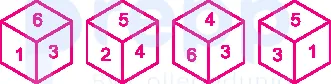
Four different positions of the same dice are shown, the six faces of which are numbered 1 to 6. Select the number that will be on the face opposite to the one showing '2'.
- A
5
- B
3
- C
4
- D
6
Show answer
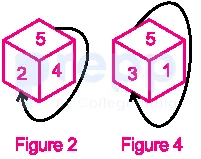
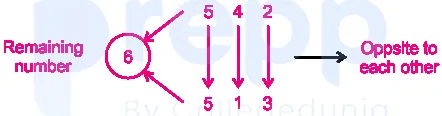
B. 3Taking dice positions 2 and 4 with 5 as common,
Moving clockwise from the Common number 5,
Pair of opposite numbers:
5 - 6
4 - 1
2 - 3
So, the opposite number to 2 is 3.
Hence, the correct answer is "3".
 Paper & answer key PDF ↗
 Question 14archived
Three statements are given followed by three conclusions numbered I, II and III. Assuming the statements to be true, even if they seem to be at variance with commonly known facts, decide which of the conclusions logically follow(s) from the statements.
Statements:
All gorillas are bears.
All pigs are bears.
All bears are tigers.
Conclusions:
I. All pigs are tigers.
II. All tigers are gorillas.
III. Some tigers are pigs.
- A
Only conclusions I and II follow
- B
Only conclusions I and III follow
- C
All conclusions follow
- D
Only conclusions II and III follow
Show answer
B. Only conclusions I and III followUnderstanding Syllogism Statements and Conclusions
This question requires us to analyze given statements and determine which of the provided conclusions logically follow. We will use the principles of logical deduction to evaluate each conclusion based on the truth of the statements.
Analyzing the Syllogism Statements
We are given three statements:
Statement 1: All gorillas are bears. ($\text{Gorillas} \rightarrow \text{Bears}$)
Statement 2: All pigs are bears. ($\text{Pigs} \rightarrow \text{Bears}$)
Statement 3: All bears are tigers. ($\text{Bears} \rightarrow \text{Tigers}$)
These statements establish relationships between the categories of gorillas, bears, pigs, and tigers. Let's visualize or combine these relationships:
From Statement 1 and Statement 3: If all gorillas are bears, and all bears are tigers, then it logically follows that all gorillas are tigers. ($\text{Gorillas} \rightarrow \text{Bears} \rightarrow \text{Tigers} \implies \text{Gorillas} \rightarrow \text{Tigers}$)
From Statement 2 and Statement 3: If all pigs are bears, and all bears are tigers, then it logically follows that all pigs are tigers. ($\text{Pigs} \rightarrow \text{Bears} \rightarrow \text{Tigers} \implies \text{Pigs} \rightarrow \text{Tigers}$)
The relationship between gorillas and pigs is not directly given, other than the fact that both are subsets of bears.
Evaluating the Conclusions
Now let's examine each conclusion based on our analysis of the statements.
Conclusion I: All pigs are tigers.
As derived from statements 2 and 3, we found that "All pigs are bears" and "All bears are tigers" logically leads to "All pigs are tigers" using the transitive property of implication. Therefore, this conclusion follows from the statements.
Conclusion II: All tigers are gorillas.
The statements tell us that all gorillas are bears and all bears are tigers, which implies all gorillas are tigers. However, this does not mean that all tigers must be gorillas. There might be tigers that are bears but not gorillas (based on Statement 2), or even tigers that are not bears at all (as Statement 3 only says all bears are tigers, not that all tigers are bears). Thus, this conclusion does not logically follow from the given statements.
Conclusion III: Some tigers are pigs.
We established that "All pigs are tigers" (Conclusion I follows). If it is true that all members of the category 'pigs' are also members of the category 'tigers', then assuming there is at least one pig, there must be some tigers that are pigs. The statement "All P are T" implies "Some T are P" (assuming P is not an empty set, which is the standard assumption in such syllogism problems). Therefore, this conclusion follows from the statements.
Summary of Conclusions
Based on our evaluation:
Conclusion I (All pigs are tigers) follows.
Conclusion II (All tigers are gorillas) does not follow.
Conclusion III (Some tigers are pigs) follows.
Thus, only conclusions I and III logically follow from the given statements.
Revision Table: Syllogism Analysis
Statement/Conclusion
Relationship
Logical Status
Explanation
Statement 1
All Gorillas are Bears
Given True
Foundation of the argument
Statement 2
All Pigs are Bears
Given True
Foundation of the argument
Statement 3
All Bears are Tigers
Given True
Foundation of the argument
Conclusion I
All Pigs are Tigers
Follows
Pigs → Bears → Tigers $\implies$ Pigs → Tigers
Conclusion II
All Tigers are Gorillas
Does Not Follow
Inverse of Gorillas → Tigers; not necessarily true.
Conclusion III
Some Tigers are Pigs
Follows
"All Pigs are Tigers" implies "Some Tigers are Pigs" (assuming pigs exist).
Additional Information: Types of Syllogisms
Syllogisms are a form of logical argument that applies deductive reasoning to arrive at a conclusion based on two or more propositions that are assumed to be true. They typically consist of three parts: a major premise, a minor premise, and a conclusion. In this problem, we have three premises instead of two, but the principle of logical deduction remains the same.
Key concepts in syllogisms include:
Categorical Propositions: Statements that relate two categories. They are often in the form "All A are B", "No A are B", "Some A are B", or "Some A are not B". Our statements are of the "All A are B" type.
Validity: A syllogism is valid if its conclusion logically follows from its premises. Validity is about the structure of the argument, not the truth of the premises themselves in the real world. We assume the premises are true for the purpose of determining validity.
Transitivity: As seen in our analysis, if A $\rightarrow$ B and B $\rightarrow$ C, then A $\rightarrow$ C. This property is often used in solving syllogism problems.
Paper & answer key PDF ↗ Question 15archived
Based on the position in the English alphabetical order, three of the following letter-clusters are alike in some manner and one is different. Select the odd letter-cluster.
- A
OIGE
- B
QKJH
- C
SMLJ
- D
WQPN
Show answer
A. OIGEFinding the Odd Letter Cluster Based on Alphabetical Position
This question asks us to identify the letter cluster that is different from the other three, based on the positions of the letters in the English alphabetical order. To solve this type of reasoning problem, we first need to know the position number for each letter of the alphabet.
Alphabetical Position of Letters
The positions are as follows: A=1, B=2, C=3, and so on, up to Z=26. Let's find the positions for the letters in each given cluster:
Letter Cluster
Letters
Alphabetical Positions
OIGE
O, I, G, E
15, 9, 7, 5
QKJH
Q, K, J, H
17, 11, 10, 8
SMLJ
S, M, L, J
19, 13, 12, 10
WQPN
W, Q, P, N
23, 17, 16, 14
Analyzing the Pattern in Letter Positions
Now, let's look at the differences between the consecutive letter positions within each cluster to find a pattern.
OIGE (15, 9, 7, 5):
15 to 9: $9 - 15 = -6$
9 to 7: $7 - 9 = -2$
7 to 5: $5 - 7 = -2$
Pattern: $-6, -2, -2$
QKJH (17, 11, 10, 8):
17 to 11: $11 - 17 = -6$
11 to 10: $10 - 11 = -1$
10 to 8: $8 - 10 = -2$
Pattern: $-6, -1, -2$
SMLJ (19, 13, 12, 10):
19 to 13: $13 - 19 = -6$
13 to 12: $12 - 13 = -1$
12 to 10: $10 - 12 = -2$
Pattern: $-6, -1, -2$
WQPN (23, 17, 16, 14):
23 to 17: $17 - 23 = -6$
17 to 16: $16 - 17 = -1$
16 to 14: $14 - 16 = -2$
Pattern: $-6, -1, -2$
Identifying the Odd Letter-Cluster
By comparing the patterns derived from the differences in alphabetical positions, we can see:
QKJH, SMLJ, and WQPN all follow the same pattern of differences: $-6, -1, -2$.
OIGE follows a different pattern: $-6, -2, -2$.
Therefore, based on the pattern in the alphabetical positions, OIGE is the letter-cluster that is different from the rest.
Revision Table: Key Concepts
Concept
Description
Relevance to Problem
Alphabetical Order
The standard order of letters A through Z.
Basis for assigning numerical positions to letters.
Letter Position
The numerical value assigned to each letter based on its place in the alphabet (A=1, B=2, etc.).
Essential for converting letter clusters into numerical sequences for pattern analysis.
Pattern Recognition
Identifying recurring sequences or rules in a set of data.
Crucial skill used to find the rule connecting letters within a cluster and identify the one that doesn't follow the rule.
Odd One Out
A type of question where one item in a group is different from the others based on a specific criteria or pattern.
The specific type of reasoning problem presented in the question.
Additional Information: Letter Reasoning Tips
Solving letter-based reasoning questions often involves understanding several concepts related to the English alphabet. Here are some helpful tips:
Know Alphabetical Positions: Memorizing or quickly being able to list the positions (A=1 to Z=26) is fundamental.
Know Reverse Alphabetical Positions: Sometimes patterns are based on position from the end (Z=1, Y=2, etc.). This can also be derived by subtracting the forward position from 27 ($27 - \text{Forward Position}$).
Understand Letter Pairing: Some patterns involve pairs of letters whose positions add up to 27 (e.g., A and Z, B and Y, C and X).
Vowel/Consonant Classification: Sometimes the pattern is simply based on whether letters are vowels (A, E, I, O, U) or consonants.
Look for Skips or Differences: Check the difference in position between consecutive letters. This is a very common type of pattern, as seen in this problem.
Consider Groups: Sometimes letters are grouped (e.g., first half A-M, second half N-Z).
Practice: Regularly solving various types of letter series and letter analogy problems helps in quickly identifying the underlying pattern.
Paper & answer key PDF ↗ Question 16archived
Select the set in which the numbers are related in the same way as are the numbers of the following set.
(NOTE: Operations should be performed on the whole numbers, without breaking down the numbers into its constituent digits.)
(12, 51, 5)
(8, 30, 2)
- A
(14, 120, 16)
- B
(13, 10, 7)
- C
(19, 44, 3)
- D
(11, 51, 6)
Show answer
D. (11, 51, 6)Identifying the Number Relation Pattern
The question asks us to identify the pair of sets where the numbers exhibit the same relationship. We are given two example sets: (12, 51, 5) and (8, 30, 2). A key instruction is to perform operations on the whole numbers without splitting them into digits.
Analyzing the Example Sets
Let's examine the relationship between the numbers in the first given set (12, 51, 5). Let the numbers be represented as A, B, and C, so A=12, B=51, and C=5.
We look for a mathematical operation linking A, C to B.
Consider adding A and C: $A + C = 12 + 5 = 17$.
Now, let's see how 17 relates to B (51). We notice that $17 \times 3 = 51$.
So, the potential pattern is: (First Number + Third Number) multiplied by 3 equals the Second Number. Mathematically, this can be expressed as: $$(A + C) \times 3 = B$$
Let's verify this pattern using the second example set (8, 30, 2). Here, A=8, B=30, and C=2.
Applying the derived pattern: $(A + C) \times 3 = B$.
Substitute the values: $(8 + 2) \times 3$.
Calculate the sum: $8 + 2 = 10$.
Multiply by 3: $10 \times 3 = 30$.
Compare with B: $30$. The result matches the second number (B).
Since the pattern $(A + C) \times 3 = B$ holds true for both example sets, this is the relationship we need to find in the options.
Evaluating Options Based on the Number Relation
Now, we will check each option to see which one follows the established pattern: $(A + C) \times 3 = B$.
Option 1 Evaluation: (14, 120, 16)
Here, A=14, B=120, C=16.
Calculate $(A + C) \times 3$: $(14 + 16) \times 3$.
Sum: $14 + 16 = 30$.
Multiply: $30 \times 3 = 90$.
Result: $90$. This does not equal B (120). So, Option 1 is incorrect.
Option 2 Evaluation: (13, 10, 7)
Here, A=13, B=10, C=7.
Calculate $(A + C) \times 3$: $(13 + 7) \times 3$.
Sum: $13 + 7 = 20$.
Multiply: $20 \times 3 = 60$.
Result: $60$. This does not equal B (10). So, Option 2 is incorrect.
Option 3 Evaluation: (19, 44, 3)
Here, A=19, B=44, C=3.
Calculate $(A + C) \times 3$: $(19 + 3) \times 3$.
Sum: $19 + 3 = 22$.
Multiply: $22 \times 3 = 66$.
Result: $66$. This does not equal B (44). So, Option 3 is incorrect.
Option 4 Evaluation: (11, 51, 6)
Here, A=11, B=51, C=6.
Calculate $(A + C) \times 3$: $(11 + 6) \times 3$.
Sum: $11 + 6 = 17$.
Multiply: $17 \times 3 = 51$.
Result: $51$. This equals B (51). So, Option 4 is correct.
Conclusion
The set (11, 51, 6) follows the same mathematical relationship ($(A + C) \times 3 = B$) as the example sets provided in the question.
Paper & answer key PDF ↗ Question 17archived
In a certain code language, 'LUNGS' is written as ‘OXQJV’ and ‘POWER’ is written as ‘SRZHU’, how will 'ELOQUENT' be written in that language?
- A
HORTXHQW
- B
HOQSXHQW
- C
FMPPRHQW
- D
FMPRVFOU
Show answer
A. HORTXHQWUnderstanding the Coding Pattern
This problem involves decoding a pattern used to transform words. We are given two examples: 'LUNGS' coded as ‘OXQJV’ and ‘POWER’ coded as ‘SRZHU’. Our task is to find the rule applied and then use it to code the word 'ELOQUENT'.
Analyzing the First Example: LUNGS to OXQJV
Let's examine the relationship between each letter in 'LUNGS' and its corresponding letter in ‘OXQJV’ based on their positions in the English alphabet.
Original Letter
Coded Letter
Position Shift
L
O
O is 3 letters after L (\(L \xrightarrow{+3} O\))
U
X
X is 3 letters after U (\(U \xrightarrow{+3} X\))
N
Q
Q is 3 letters after N (\(N \xrightarrow{+3} Q\))
G
J
J is 3 letters after G (\(G \xrightarrow{+3} J\))
S
V
V is 3 letters after S (\(S \xrightarrow{+3} V\))
From this analysis, it appears there is a consistent shift of +3 positions forward in the alphabet for each letter.
Verifying the Pattern with the Second Example: POWER to SRZHU
Let's check if the same +3 shift rule applies to the second example, 'POWER' coded as ‘SRZHU’.
Original Letter
Coded Letter
Position Shift
P
S
S is 3 letters after P (\(P \xrightarrow{+3} S\))
O
R
R is 3 letters after O (\(O \xrightarrow{+3} R\))
W
Z
Z is 3 letters after W (\(W \xrightarrow{+3} Z\))
E
H
H is 3 letters after E (\(E \xrightarrow{+3} H\))
R
U
U is 3 letters after R (\(R \xrightarrow{+3} U\))
The second example also perfectly matches the +3 shift pattern. The rule is confirmed: each letter in the original word is replaced by the letter that is three positions after it in the English alphabet.
Applying the Coding Pattern to ELOQUENT
Now, we apply the established +3 shift rule to the word 'ELOQUENT'.
Original Letter
Position Shift
Coded Letter
E
\(E \xrightarrow{+3}\)
H
L
\(L \xrightarrow{+3}\)
O
O
\(O \xrightarrow{+3}\)
R
Q
\(Q \xrightarrow{+3}\)
T
U
\(U \xrightarrow{+3}\)
X
E
\(E \xrightarrow{+3}\)
H
N
\(N \xrightarrow{+3}\)
Q
T
\(T \xrightarrow{+3}\)
W
Combining the coded letters, we get HORTXHQW.
Conclusion: Coded Word for ELOQUENT
Based on the consistent +3 letter shift coding pattern observed in the examples, the word 'ELOQUENT' is coded as ‘HORTXHQW’.
Coding Decoding Revision Table
Concept
Description
Coding
A process of converting a word, number, or series of characters into a code based on a specific rule.
Decoding
The process of converting the coded message back into its original form using the same rule.
Letter Coding
Codes where letters are replaced by other letters based on a set pattern (like shifting, skipping, or swapping).
Number Coding
Codes where words are converted into numbers or vice versa.
Symbol Coding
Codes where words are converted into symbols or vice versa.
Additional Information on Coding Decoding
Coding and decoding questions are common in logical reasoning sections of competitive exams. They test your ability to identify patterns and apply rules. Common types of letter coding patterns include:
Letter Shifting: Each letter is shifted a fixed number of positions forward or backward in the alphabet.
Alphabetical Position: Letters are coded based on their position in the alphabet (e.g., A=1, B=2).
Reverse Alphabetical Position: Letters are coded based on their position from the end of the alphabet (e.g., Z=1, Y=2).
Jumbling/Substitution: Letters within the word are rearranged or directly substituted with other letters based on a specific rule or pattern.
Opposite Letters: Letters are replaced by their opposite letters (A is opposite Z, B is opposite Y, etc.).
Practicing different types of coding-decoding problems helps improve pattern recognition skills.
Paper & answer key PDF ↗ Question 18archived
By Interchanging the given two numbers which of the following equation will be correct?
7 and 3
- A
3 ÷ 1 – 7 × 2 + 4 = 8
- B
3 × 2 + 7 – 6 ÷ 3 = 18
- C
3 + 7 × 4 – 6 ÷ 2 = 20
- D
7 + 3 × 2 – 4 ÷ 1 = 13
Show answer
D. 7 + 3 × 2 – 4 ÷ 1 = 13D/M: Division and Multiplication - These are done from left to right as they appear in the expression. A/S: Addition and Subtraction - These are done last, also from left to right as they appear. In this problem, we applied the BODMAS/PEMDAS rule to correctly evaluate each modified equation after interchanging 7 and 3. Hence, the correct answer is 7 + 3 × 2 – 4 ÷ 1 = 13.
Paper & answer key PDF ↗ Question 19archived
Select the option that is related to the fifth letter-cluster in the same way as the second letter-cluster is related to the first letter-cluster and the fourth letter-cluster is related to the third letter-cluster.
BASE : EASB :: MINE : EINM :: CALM : ?
- A
AMLC
- B
MACL
- C
AMCL
- D
MALC
Show answer
D. MALCSolving Letter-Cluster Analogy Problems
Letter-cluster analogy questions test your ability to find the relationship between groups of letters and apply that relationship to a new group. In this specific problem, we need to find the pattern connecting the first letter-cluster to the second and the third letter-cluster to the fourth, then use that same pattern for the fifth letter-cluster.
Analyzing the Given Letter-Cluster Pairs
Let's look at the first pair: BASE is related to EASB.
The letters in BASE are B, A, S, E in order.
The letters in EASB are E, A, S, B in order.
Comparing the positions of the letters:
The letter 'B' (1st in BASE) is now in the 4th position in EASB.
The letter 'A' (2nd in BASE) is still in the 2nd position in EASB.
The letter 'S' (3rd in BASE) is still in the 3rd position in EASB.
The letter 'E' (4th in BASE) is now in the 1st position in EASB.
So, the transformation pattern seems to be that the 4th letter comes first, followed by the 2nd and 3rd letters in their original positions, and finally the 1st letter goes to the last position. Let's represent the positions (1, 2, 3, 4): The new order of letters corresponds to the original positions 4, 2, 3, 1.
Now, let's check this pattern with the second pair: MINE is related to EINM.
The letters in MINE are M, I, N, E in order (1st, 2nd, 3rd, 4th).
Let's apply the pattern (4, 2, 3, 1) to MINE:
4th letter of MINE is E.
2nd letter of MINE is I.
3rd letter of MINE is N.
1st letter of MINE is M.
Putting these letters together in the order 4th, 2nd, 3rd, 1st gives us EINM. This matches the second letter-cluster provided in the pair. The pattern (4, 2, 3, 1) is consistent.
Applying the Pattern to the Fifth Letter-Cluster
The fifth letter-cluster is CALM. We need to apply the same pattern (4, 2, 3, 1) to find the related letter-cluster.
The letters in CALM are C, A, L, M in order (1st, 2nd, 3rd, 4th).
Let's apply the pattern (4, 2, 3, 1) to CALM:
4th letter of CALM is M.
2nd letter of CALM is A.
3rd letter of CALM is L.
1st letter of CALM is C.
Arranging these letters in the order 4th, 2nd, 3rd, 1st gives us MALC.
Step-by-Step Derivation
Here is a breakdown of the transformation for each pair:
Original Word
Letter Positions
Transformed Word
New Order (based on original positions)
BASE
B(1), A(2), S(3), E(4)
EASB
E (4th), A (2nd), S (3rd), B (1st) → 4, 2, 3, 1
MINE
M(1), I(2), N(3), E(4)
EINM
E (4th), I (2nd), N (3rd), M (1st) → 4, 2, 3, 1
CALM
C(1), A(2), L(3), M(4)
?
M (4th), A (2nd), L (3rd), C (1st) → 4, 2, 3, 1
The transformed letter-cluster for CALM is MALC.
Conclusion
Following the identified pattern where the letters from the original cluster rearrange according to the sequence of their original positions (4th, 2nd, 3rd, 1st), the cluster related to CALM is MALC.
Letter Analogy Revision Table
Understanding letter analogies is key in reasoning tests. The pattern can involve position changes, letter-to-letter transformations (like alphabetical shifts), or a combination. Always analyze the first given pair thoroughly to find the rule.
Analogy Type
Description
Example (Pattern)
Position Change
Letters of the word rearrange their positions.
BASE → EASB (4, 2, 3, 1)
Letter Shift
Each letter is shifted forward or backward in the alphabet by a fixed number of positions.
CAT → EGV (+2 shift for each letter)
Mixed
Combination of position changes and letter shifts.
N/A in this problem type
Additional Reasoning Information
Letter-cluster analogy is a common type of verbal reasoning question. These questions assess your logical deduction skills and pattern recognition. To solve them effectively, systematic analysis is crucial. Write down the letters and their positions to visualize the transformation. Practice with different types of letter analogies to become familiar with various patterns like reversal, grouping, or specific letter exchanges. Always verify the pattern with the second pair before applying it to the third or target cluster.
Paper & answer key PDF ↗ Question 20archived
A series is given with one term missing. Select the correct alternative from the given ones that will complete the series.
ABNC, HGWN, OLFY, VQOJ, ?
- A
TDMR
- B
CMRQ
- C
CVXU
- D
CNTD
Show answer
C. CVXUSolving Letter Series Reasoning Questions
This question asks us to find the missing term in a given letter series: ABNC, HGWN, OLFY, VQOJ, ?. To solve this type of reasoning problem, we need to analyze the pattern in which the letters change from one term to the next.
Let's break down each term into its individual letters and look at the position of each letter in the English alphabet (A=1, B=2, ..., Z=26).
Analyzing the Letter Pattern
We will examine the pattern for the first, second, third, and fourth letters separately.
Term
1st Letter
2nd Letter
3rd Letter
4th Letter
ABNC
A (1)
B (2)
N (14)
C (3)
HGWN
H (8)
G (7)
W (23)
N (14)
OLFY
O (15)
L (12)
F (6)
Y (25)
VQOJ
V (22)
Q (17)
O (15)
J (10)
?
?
?
?
?
Pattern for the First Letter
A to H: 1 to 8. Increase of $8 - 1 = 7$.
H to O: 8 to 15. Increase of $15 - 8 = 7$.
O to V: 15 to 22. Increase of $22 - 15 = 7$.
The pattern for the first letter is a consistent increase of 7 positions. So, the next first letter will be 7 positions after V (22).
Position: $22 + 7 = 29$. Since there are 26 letters, we wrap around: $29 - 26 = 3$. The 3rd letter is C.
Next 1st letter: C.
Pattern for the Second Letter
B to G: 2 to 7. Increase of $7 - 2 = 5$.
G to L: 7 to 12. Increase of $12 - 7 = 5$.
L to Q: 12 to 17. Increase of $17 - 12 = 5$.
The pattern for the second letter is a consistent increase of 5 positions. So, the next second letter will be 5 positions after Q (17).
Position: $17 + 5 = 22$. The 22nd letter is V.
Next 2nd letter: V.
Pattern for the Third Letter
N to W: 14 to 23. Increase of $23 - 14 = 9$.
W to F: 23 to 6. W(23), X(24), Y(25), Z(26), A(1), B(2), C(3), D(4), E(5), F(6). This is an increase of 9 positions ($23 + 9 = 32$; $32 - 26 = 6$).
F to O: 6 to 15. Increase of $15 - 6 = 9$.
The pattern for the third letter is a consistent increase of 9 positions. So, the next third letter will be 9 positions after O (15).
Position: $15 + 9 = 24$. The 24th letter is X.
Next 3rd letter: X.
Pattern for the Fourth Letter
C to N: 3 to 14. Increase of $14 - 3 = 11$.
N to Y: 14 to 25. Increase of $25 - 14 = 11$.
Y to J: 25 to 10. Y(25), Z(26), A(1), B(2), ..., J(10). This is an increase of 11 positions ($25 + 11 = 36$; $36 - 26 = 10$).
The pattern for the fourth letter is a consistent increase of 11 positions. So, the next fourth letter will be 11 positions after J (10).
Position: $10 + 11 = 21$. The 21st letter is U.
Next 4th letter: U.
Constructing the Next Term
Combining the next letters for each position, we get:
1st letter: C
2nd letter: V
3rd letter: X
4th letter: U
The next term in the series is CVXU.
Conclusion
By analyzing the increase in alphabetical position for each corresponding letter in the series terms, we found that the increases are consistently +7, +5, +9, and +11 for the first, second, third, and fourth letters, respectively. Applying these patterns allows us to predict the next term in the series.
Revision Table: Letter Series Patterns
Letter Position
Pattern (Increase)
Calculation for Next Term
Next Letter
1st
+7
$V(22) + 7 = 29 \equiv 3 \pmod{26}$
C
2nd
+5
$Q(17) + 5 = 22$
V
3rd
+9
$O(15) + 9 = 24$
X
4th
+11
$J(10) + 11 = 21$
U
Additional Information on Letter Series Reasoning
Letter series questions are common in reasoning tests. They test your ability to identify patterns in sequences of letters. The patterns can involve:
Adding or subtracting a fixed number of positions.
Adding or subtracting a sequence of numbers (e.g., +1, +2, +3...).
Skipping letters in a specific pattern.
Using vowel/consonant sequences.
Using reversed alphabetical order.
Combining multiple patterns within a single term or series.
Solving these problems usually requires writing down the alphabet and its position numbers or practicing to quickly recall them. Breaking down multi-letter terms into individual letter series is a key strategy.
Paper & answer key PDF ↗ Question 21archived
After arranging the given words according to dictionary order, which word will come at ‘Third’ position?
1. Telescope
2. Telephone
3. Telegram
4. Telecast
5. Telepath
- A
Telepath
- B
Telegram
- C
Telephone
- D
Telecast
Show answer
A. TelepathUnderstanding Dictionary Order for Word Arrangement
Arranging words in dictionary order, also known as alphabetical order, involves comparing words letter by letter from the beginning. The word with the letter that comes earlier in the alphabet at the first point of difference is placed earlier in the list.
Applying Dictionary Order to the Words
We are given the following five words:
Telescope
Telephone
Telegram
Telecast
Telepath
Let's arrange these words based on the rules of dictionary order:
All the words begin with the letters "Tele". So, we need to look at the fifth letter of each word to determine their order initially.
Telescope: The fifth letter is 's'.
Telephone: The fifth letter is 'p'.
Telegram: The fifth letter is 'g'.
Telecast: The fifth letter is 'c'.
Telepath: The fifth letter is 'p'.
Now, let's compare these fifth letters alphabetically: 'c', 'g', 'p', 'p', 's'.
Based on the fifth letter, the initial order is:
Telecast (starts with 'c')
Telegram (starts with 'g')
Telephone and Telepath (both start with 'p')
Telescope (starts with 's')
We have two words starting with 'Telep': Telephone and Telepath. To order these two words, we need to look at the sixth letter.
Telephone: The sixth letter is 'h'.
Telepath: The sixth letter is 'p'.
Comparing 'h' and 'p' alphabetically, 'h' comes before 'p'. Therefore, Telephone comes before Telepath.
Combining all the comparisons, the words in correct dictionary order are:
Telecast
Telegram
Telephone
Telepath
Telescope
Identifying the Word at the Third Position
After arranging the words in dictionary order, we can see which word is located at each position in the ordered list.
1st position: Telecast
2nd position: Telegram
3rd position: Telephone
4th position: Telepath
5th position: Telescope
The word that comes at the 'Third' position is Telephone.
Let's double-check the order based on the letters at the point of difference:
Word
Fifth Letter
Sixth Letter (if needed)
Dictionary Rank
Telecast
c
-
1
Telegram
g
-
2
Telephone
p
h
3
Telepath
p
p
4
Telescope
s
-
5
The table confirms that Telephone is at the third position.
Revision Table: Key Concepts for Word Arrangement
Understanding the basics of dictionary order is crucial for solving such word arrangement questions.
Concept
Explanation
Alphabetical Order
Arranging items based on the sequence of letters in the alphabet (A, B, C, ... Z).
Letter-by-Letter Comparison
Starting from the first letter, compare corresponding letters of two words. The word with the letter that appears earlier in the alphabet at the first point of difference comes first.
Handling Identical Prefixes
If words share a common prefix (like "Tele" here), compare the letters immediately following the prefix.
Comparing Words with Shared Letters
If words are identical up to a certain point (like "Telep"), continue comparing the next letters until a difference is found.
Shorter Word Rule
If one word is a prefix of another (e.g., "car" and "carpet"), the shorter word comes first in dictionary order. This rule wasn't needed in this specific problem as no word was a prefix of another.
Additional Information: Practice with Dictionary Ordering
Practicing word arrangement helps improve vocabulary and logical reasoning skills. These types of questions often appear in verbal ability sections of competitive exams.
Always compare from the leftmost letter.
If letters are the same, move to the next letter to the right.
Continue until a difference is found or one word ends.
Remember the alphabetical sequence of all letters.
Consider another example: Cat, Car, Card. Ordered: Car, Card, Cat.
Car vs Card: 'Car' is a prefix of 'Card'. 'Car' comes first.
Car vs Cat: 'C', 'a', 'r' are the same. Next letters 'd' (Card) vs 't' (Cat). 'd' comes before 't'.
Card vs Cat: 'C', 'a' are the same. Next letters 'r' (Card) vs 't' (Cat). 'r' comes before 't'.
Correct Order: Car, Card, Cat.
Applying these consistent rules helps accurately determine the position of words in a dictionary arrangement.
Paper & answer key PDF ↗ Question 22archived
Select the set in which the numbers are related in the same way as are the numbers of the following set.
(NOTE: Operations should be performed on the whole numbers, without breaking down the numbers into its constituent digits. E.g., 13 – Operations on 13 such as adding /subtracting /multiplying etc. to 13 can be performed. Breaking down 13 into 1 and 3 and then performing mathematical operations on 1 and 3 is NOT allowed).
(52, 10, 41)
(46, 18, 50)
- A
(68, 26, 73)
- B
(19, 33, 69)
- C
(41, 17, 36)
- D
(23, 18, 40)
Show answer
A. (68, 26, 73)Understanding Numerical Relationships in Sets
The problem asks us to identify a set of numbers from the given options that shares the same numerical relationship as the two example sets: (52, 10, 41) and (46, 18, 50). We are instructed to perform operations only on the whole numbers provided, not on their individual digits.
Analyzing the Given Sets to Find the Relationship
Let's represent the numbers in each set as (A, B, C). We need to find a consistent mathematical relationship between A, B, and C that holds true for both (52, 10, 41) and (46, 18, 50).
Let's test various simple arithmetic operations:
Sum of numbers:
Set 1: $52 + 10 + 41 = 103$
Set 2: $46 + 18 + 50 = 114$
The sum is not constant.
Differences between pairs:
Set 1: $|52 - 10| = 42$, $|10 - 41| = 31$, $|52 - 41| = 11$
Set 2: $|46 - 18| = 28$, $|18 - 50| = 32$, $|46 - 50| = 4$
Differences are not consistent across sets.
Sums of pairs:
Set 1: $52 + 10 = 62$, $10 + 41 = 51$, $52 + 41 = 93$
Set 2: $46 + 18 = 64$, $18 + 50 = 68$, $46 + 50 = 96$
Sums are not directly related by a simple constant or factor.
We need a relationship that connects all three numbers in a consistent way for both sets. Let's explore linear relationships of the form $\text{A} = m\text{B} + k\text{C}$.
For Set 1 (52, 10, 41):
$\qquad 52 = m(10) + k(41) \quad \dots (1)$
For Set 2 (46, 18, 50):
$\qquad 46 = m(18) + k(50) \quad \dots (2)$
We can solve these two linear equations simultaneously to find the values of $m$ and $k$.
Multiply equation (1) by 18 and equation (2) by 10 to eliminate $m$:
$\qquad 18 \times (52 = 10m + 41k) \implies 936 = 180m + 738k \quad \dots (3)$
$\qquad 10 \times (46 = 18m + 50k) \implies 460 = 180m + 500k \quad \dots (4)$
Subtract equation (4) from equation (3):
$\qquad (936 - 460) = (180m - 180m) + (738k - 500k)$
$\qquad 476 = 238k$
Solving for $k$:
$\qquad k = \frac{476}{238} = 2$
Now substitute the value of $k=2$ into equation (1):
$\qquad 52 = 10m + 41(2)$
$\qquad 52 = 10m + 82$
$\qquad 10m = 52 - 82$
$\qquad 10m = -30$
Solving for $m$:
$\qquad m = \frac{-30}{10} = -3$
So, the relationship is $\text{A} = -3\text{B} + 2\text{C}$, which can be rewritten as $\text{A} = 2\text{C} - 3\text{B}$.
Verifying the Relationship A = 2C - 3B
Let's check this relationship for the given sets:
For Set 1 (52, 10, 41):
$\qquad \text{A} = 52, \text{B} = 10, \text{C} = 41$
$\qquad 2\text{C} - 3\text{B} = 2(41) - 3(10) = 82 - 30 = 52$. This matches A.
For Set 2 (46, 18, 50):
$\qquad \text{A} = 46, \text{B} = 18, \text{C} = 50$
$\qquad 2\text{C} - 3\text{B} = 2(50) - 3(18) = 100 - 54 = 46$. This matches A.
The relationship $\text{A} = 2\text{C} - 3\text{B}$ holds for both given sets.
Testing Options Against the Relationship A = 2C - 3B
Now we will check each option to see which set follows the same relationship.
Let the numbers in each option be (A, B, C).
Option 1: (68, 26, 73)
$\qquad \text{A} = 68, \text{B} = 26, \text{C} = 73$
Check if $A = 2C - 3B$:
$\qquad 2\text{C} - 3\text{B} = 2(73) - 3(26) = 146 - 78 = 68$
Since $68 = 68$, the relationship holds for Option 1.
Option 2: (19, 33, 69)
$\qquad \text{A} = 19, \text{B} = 33, \text{C} = 69$
Check if $A = 2C - 3B$:
$\qquad 2\text{C} - 3\text{B} = 2(69) - 3(33) = 138 - 99 = 39$
Since $19 \neq 39$, the relationship does not hold for Option 2.
Option 3: (41, 17, 36)
$\qquad \text{A} = 41, \text{B} = 17, \text{C} = 36$
Check if $A = 2C - 3B$:
$\qquad 2\text{C} - 3\text{B} = 2(36) - 3(17) = 72 - 51 = 21$
Since $41 \neq 21$, the relationship does not hold for Option 3.
Option 4: (23, 18, 40)
$\qquad \text{A} = 23, \text{B} = 18, \text{C} = 40$
Check if $A = 2C - 3B$:
$\qquad 2\text{C} - 3\text{B} = 2(40) - 3(18) = 80 - 54 = 26$
Since $23 \neq 26$, the relationship does not hold for Option 4.
Only Option 1 follows the same relationship $\text{A} = 2\text{C} - 3\text{B}$ as the given sets (52, 10, 41) and (46, 18, 50).
Conclusion on the Set Relation
The set of numbers (68, 26, 73) is related in the same way as the numbers in the given sets (52, 10, 41) and (46, 18, 50) because they all satisfy the relationship $\text{A} = 2\text{C} - 3\text{B}$.
Revision Table: Key Concepts and Steps
Concept/Step
Description
Identify the Pattern
Analyze the given sets (52, 10, 41) and (46, 18, 50) to find a consistent mathematical relationship between the numbers (A, B, C).
Formulate Equations
Represent the relationship as an algebraic equation, e.g., $A = mB + kC$, using the numbers from the given sets.
Solve Simultaneous Equations
Use the two sets to form two equations and solve for the unknown coefficients ($m$ and $k$).
Determine Relationship
Substitute the found values of $m$ and $k$ back into the equation to get the general relationship ($A = 2C - 3B$).
Verify Relationship
Confirm the derived relationship holds true for both initial sets.
Test Options
Apply the discovered relationship to each option provided to find the set that satisfies it.
Additional Information: Solving Numerical Reasoning Problems
Numerical reasoning problems often require identifying patterns or rules governing a set of numbers. These rules can involve basic arithmetic operations (addition, subtraction, multiplication, division) applied to the numbers as a whole. More complex relationships might involve linear combinations of the numbers, squares, cubes, or other mathematical functions, but usually within the constraint of using the whole numbers.
When faced with three numbers (A, B, C), common approaches include checking relations like:
$\text{A} + \text{B} = \text{C}$ or $\text{A} - \text{B} = \text{C}$ (or variations involving constants like $\text{A} + \text{B} = \text{C} + k$)
$\text{A} = k \times \text{B}$ or $\text{A} = \text{B} / k$
$\text{A} + \text{C} = k \times \text{B}$ or $\text{A} - \text{C} = k \times \text{B}$
Linear combinations like $\text{A} = m\text{B} + k\text{C}$.
If two example sets are provided, they are crucial for testing if a potential relationship is consistent. If a relationship works for one set but not the other, it is not the correct pattern. Systems of equations can be useful in finding the coefficients ($m, k$) in linear relationships when two examples are given.
Paper & answer key PDF ↗ Question 23archived
In the following question, select the missing number from the given series.
98, 70, 42, 14, ?, – 42
- A
–10
- B
–14
- C
0
- D
–15
Show answer
B. –14Finding the Missing Number in the Series
The question asks us to identify the missing number in the given series: 98, 70, 42, 14, ?, – 42.
To find the missing number, we need to analyze the pattern in the given number series. Let's look at the difference between consecutive terms.
Analyzing the Number Series Pattern
We calculate the difference between each adjacent pair of numbers:
Difference between the first and second term: \(70 - 98\)
Difference between the second and third term: \(42 - 70\)
Difference between the third and fourth term: \(14 - 42\)
Calculating the Differences
Let's perform the calculations:
\(70 - 98 = -28\)
\(42 - 70 = -28\)
\(14 - 42 = -28\)
The difference between consecutive terms is consistently -28. This indicates that the given series is an arithmetic progression with a common difference of -28.
Determining the Missing Term
Since the common difference is -28, the missing term is obtained by subtracting 28 from the term preceding it, which is 14.
Missing term \( = 14 - 28 \)
Missing term \( = -14 \)
Verifying the Pattern
To confirm our finding, let's check if subtracting 28 from the missing term (-14) gives the last term in the series (-42):
\(-14 - 28 = -42\)
This matches the last term provided in the series, confirming that the pattern holds true.
Thus, the missing number in the series is -14.
Summary of the Number Series Analysis
Term Position
Term Value
Difference from Previous Term
1st
98
-
2nd
70
\(70 - 98 = -28\)
3rd
42
\(42 - 70 = -28\)
4th
14
\(14 - 42 = -28\)
5th (Missing)
-14
\( -14 - 14 = -28\)
6th
-42
\( -42 - (-14) = -42 + 14 = -28\)
The pattern clearly shows a constant difference of -28 between consecutive terms.
Revision Table: Number Series Concepts
Concept
Description
Example
Number Series
A sequence of numbers that follow a specific pattern or rule.
2, 4, 6, 8, ... (pattern: adding 2)
Arithmetic Progression (AP)
A series where the difference between consecutive terms is constant. This constant difference is called the common difference.
5, 10, 15, 20, ... (common difference: 5)
Common Difference
The constant value added to each term to get the next term in an arithmetic progression. It can be positive, negative, or zero.
In 3, 0, -3, -6, ... the common difference is -3.
Additional Information on Series Patterns
Number series questions in logical reasoning or quantitative aptitude often involve different types of patterns, not just arithmetic progressions. Some common patterns include:
Geometric Progression: Each term is multiplied by a constant ratio to get the next term (e.g., 2, 4, 8, 16... multiplying by 2).
Difference Series: The differences between consecutive terms form a separate series with its own pattern (e.g., 1, 3, 6, 10, 15... differences are 2, 3, 4, 5...).
Mixed Series: Two or more patterns are combined or interleaved.
Square/Cube Series: Terms are related to squares or cubes of natural numbers (e.g., 1, 4, 9, 16... squares of 1, 2, 3, 4...).
Fibonacci Series: Each term is the sum of the two preceding terms (e.g., 0, 1, 1, 2, 3, 5, 8...).
Identifying the pattern is the key step in solving any number series problem. It often involves checking for common differences, common ratios, or other mathematical relationships between terms.
Paper & answer key PDF ↗ Question 24archived
Select the figure from among the given options that can replace the question mark (?) in the following series.

- A
Option A (shown in image)
- B
Option B (shown in image)
- C
Option C (shown in image)
- D
Option D (shown in image)
Show answer
D. Option D (shown in image)Here is the logic followed:
Pattern of Shapes (Triangle, Round and Square): In each successive box, the shapes are moving in circular motion from left to right. Thus, the pattern of shapes in the following box will be square, triangle and circle from left to right.
Color pattern: In consecutive boxes, the rightmost shape is filled with black. Thus, the round shape in the following box will be filled with black.
Letter pattern: In each successive box, the characters are increasing with 3 place values. Thus, the following box will contain the letter M.
Hence, the correct answer is 'option 4'.
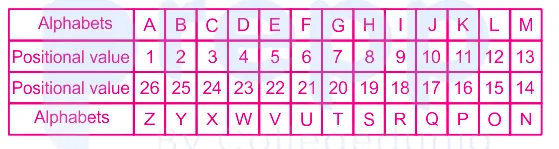
 Paper & answer key PDF ↗
 Question 25archived
In a certain code language, ‘TRIGONOMETRY’ is written as ‘YRTEMOTRIGON’, ‘ACCELERATION’ is written as ‘NOITARACCELE’. How will ‘APPRECIATION’ be written in that language?
- A
NOITAIAPPREC
- B
NOITIAAPPREC
- C
NOITAIAPRPEC
- D
NOITAIPAPREC
Show answer
A. NOITAIAPPRECUnderstanding the Coding Pattern
This question asks us to decipher a specific coding pattern applied to words and then use that pattern to code another word. We are given two examples:
'TRIGONOMETRY' is coded as 'YRTEMOTRIGON'
'ACCELERATION' is coded as 'NOITARACCELE'
We need to find out how 'APPRECIATION' will be written in this language.
Analyzing the Given Examples
Let's look closely at the first example: 'TRIGONOMETRY' and its code 'YRTEMOTRIGON'.
The word 'TRIGONOMETRY' has 12 letters.
Let's try splitting the word into two equal halves: TRIGON | OMETRY.
The first half is 'TRIGON'.
The second half is 'OMETRY'.
Now let's look at the coded word: 'YRTEMOTRIGON'.
Notice that the first part of the coded word, 'YRTEMO', is the reverse of the second half of the original word, 'OMETRY'.
Notice that the second part of the coded word, 'TRIGON', is exactly the first half of the original word.
So, the pattern seems to be: Reverse the second half of the word and place it before the first half.
Let's test this pattern with the second example: 'ACCELERATION' and its code 'NOITARACCELE'.
The word 'ACCELERATION' has 12 letters.
Split the word into two equal halves: ACCELE | RATION.
The first half is 'ACCELE'.
The second half is 'RATION'.
Apply the pattern: Reverse the second half ('RATION' reversed is 'NOITAR').
Place the reversed second half before the first half: NOITAR + ACCELE = NOITARACCELE.
This matches the given coded word for 'ACCELERATION'. The pattern holds true for both examples.
Applying the Pattern to 'APPRECIATION'
Now we apply the same pattern to the word 'APPRECIATION'.
The word 'APPRECIATION' has 12 letters.
Split the word into two equal halves: APPREC | IATION.
The first half is 'APPREC'.
The second half is 'IATION'.
Reverse the second half: 'IATION' reversed is 'NOITAI'.
Combine the reversed second half and the first half: NOITAI + APPREC.
The coded word for 'APPRECIATION' is 'NOITAIAPPREC'.
Let's summarize the process in a table:
Original Word
Split (Half 1 | Half 2)
Reversed Half 2
Coded Word (Reversed Half 2 + Half 1)
TRIGONOMETRY
TRIGON | OMETRY
YRTEMO
YRTEMOTRIGON
ACCELERATION
ACCELE | RATION
NOITAR
NOITARACCELE
APPRECIATION
APPREC | IATION
NOITAI
NOITAIAPPREC
The coded word for 'APPRECIATION' is 'NOITAIAPPREC'.
Revision Table: Coding Pattern Summary
Step
Description
1
Split the original word into two equal halves.
2
Reverse the second half of the word.
3
Place the reversed second half at the beginning, followed by the first half.
Additional Information: Letter Coding Basics
Letter coding is a common type of question in reasoning ability. It involves changing the positions or values of letters in a word according to a specific rule or pattern. Identifying the pattern is key to solving these problems.
Common patterns include:
Reversal of the entire word or parts of the word.
Shifting letters forward or backward in the alphabet by a fixed number of positions.
Assigning numerical values to letters and performing operations.
Swapping positions of letters (e.g., first and last, second and second last).
Combination of multiple patterns.
Practice with various examples helps in quickly identifying the underlying logic.
Paper & answer key PDF ↗ Question 26archived
The Harappan brought Gold from present-day _______ in India.
- A
Telangana
- B
Tamil Nadu
- C
Karnataka
- D
Kerala
Show answer
C. KarnatakaThe correct answer is Karnataka.
They used standardized weights and measures, and many seals likely served as markers for trade goods. Their trade routes extended to modern-day Afghanistan, Iran, and even Mesopotamia (modern Iraq). The need for resources like gold, silver, copper, tin, and precious stones drove much of this long-distance trade. The procurement of gold from a distant region like Karnataka highlights the extensive reach and economic organization of the Harappan civilization.
Paper & answer key PDF ↗ Question 27archived
Which of the following is NOT the component of the capital expenditure of the Government?
- A
Expenditure on the acquisition of machinery
- B
Expenditure on the acquisition of land
- C
Expenditure on the acquisition of building
- D
Interest payments
Show answer
D. Interest paymentsThe correct answer is Interest payments.
Capital expenditure is often seen as an investment in the future, potentially boosting long-term growth and productivity. Revenue expenditure is necessary for day-to-day operations and providing public services, but high levels of non-developmental revenue spending (like interest payments on high debt) can strain government finances and limit resources available for capital investment. The balance between these two types of spending is a key aspect of budget planning.
Paper & answer key PDF ↗ Question 28archived
Which of the following has become the first state in the country to get the L-root server?
- A
Karnataka
- B
Maharashtra
- C
Rajasthan
- D
Andhra Pradesh
Show answer
C. RajasthanUnderstanding L-Root Servers and DNS
The internet relies heavily on the Domain Name System (DNS), which acts like a phonebook, translating human-readable domain names (like google.com) into machine-readable IP addresses (like 172.217.160.142). Root servers are at the top of the DNS hierarchy. There are 13 sets of root servers globally, labeled A through M.
The L-root server is one of these sets of root servers, managed by ICANN (Internet Corporation for Assigned Names and Numbers). Having a local replica of a root server like the L-root within a state or country significantly improves internet performance, reduces latency, and enhances network stability and resilience, especially during potential disruptions.
Rajasthan: India's First State with L-Root Server
Rajasthan has achieved a significant milestone by becoming the first state in India to get the L-root server. This server has been installed at the National Level Domain Service (NLDS) in Jaipur, in collaboration with the Internet Corporation for Assigned Names and Numbers (ICANN).
Significance of the L-Root Server in Rajasthan
The installation of the L-root server brings several benefits to Rajasthan:
Improved Internet Speed: DNS queries can be resolved locally, leading to faster website loading times for users in the state.
Enhanced Network Reliability: Reduces dependency on root servers located outside the state or country, making the internet more resilient to outages or attacks.
Reduced Latency: Data travels shorter distances to resolve domain names.
Promotion of Digital India: This initiative aligns with the Digital India program by strengthening internet infrastructure at the state level.
Facilitating Innovation: A robust internet infrastructure supports technological advancements and digital services within the state.
Comparison with Other States
While other states are also working towards strengthening their digital infrastructure, Rajasthan's installation of the L-root server marks it as the pioneer in this specific aspect among Indian states.
Aspect
Details
State
Rajasthan
Achievement
First state in India to get L-root server
Location of Installation
National Level Domain Service (NLDS), Jaipur
Collaborator
ICANN (Internet Corporation for Assigned Names and Numbers)
Revision Table: Key Points about L-Root Server in Rajasthan
Keyword
Explanation
Rajasthan
The state that achieved the milestone.
L-root server
One of the 13 sets of global root servers; improves DNS resolution.
First State India
Highlights the pioneering status of Rajasthan.
DNS
Domain Name System, essential for internet navigation.
ICANN
Organization managing the L-root server.
NLDS Jaipur
Location where the server is installed.
Additional Information: The Importance of Root Servers
Root servers are critical to the functioning of the internet. They handle requests for top-level domains (like .com, .org, .in) and direct the query to the appropriate server for that domain. While end-users typically interact with local DNS servers provided by their ISP, these local servers rely on root servers to find the authoritative servers for various domains.
Having distributed instances of root servers, including L-root, globally and now within a state like Rajasthan, reduces the load on centralized servers and makes the entire internet infrastructure more robust and resistant to failures or cyberattacks. It's a key step towards decentralizing and fortifying the digital backbone.
Paper & answer key PDF ↗ Question 29archived
Which minorities are mentioned in article 30 of the Indian Constitution?
- A
Linguistic and religious
- B
Religious, cultural and linguistic
- C
Cultural and linguistic
- D
Religious and cultural
Show answer
A. Linguistic and religiousThe correct answer is Linguistic and religious.
While related to culture and language, Article 29 focuses on protecting existing cultural/linguistic identity and non-discrimination in admission, whereas Article 30 empowers minorities to run their own institutions. Definition of Minority: The Indian Constitution does not explicitly define "minority". The determination of minority status has been a subject of judicial interpretation, generally based on population relative to the total population of a state or the country. Understanding the precise wording of constitutional articles like Article 30 is essential for correctly identifying the specific rights and the groups they apply to.
Paper & answer key PDF ↗ Question 30archived
Which of the following climate type is found under the cold climates?
- A
Humid subtropical
- B
Highland
- C
Humid continental
- D
Tundra
Show answer
D. TundraUnderstanding Cold Climate Types
Climate classification systems categorize the world's diverse climates based on temperature, precipitation, and vegetation. These systems help us understand the different environmental conditions found across the globe. The question asks to identify a specific climate type that falls under the broad category of cold climates.
Let's examine the given options in the context of common climate classifications:
Humid Subtropical: This climate is characterized by hot, humid summers and mild winters. It is typically found on the eastern sides of continents, between 20° and 35° latitude. This climate type belongs to the warm temperate climates, not cold climates.
Highland: Highland climates are found in mountainous regions. Their characteristics are heavily influenced by altitude, which causes temperatures to decrease with increasing elevation. While mountainous areas can be very cold, "Highland" refers to the effect of topography on climate rather than a specific latitude-based cold climate zone. It can encompass various temperature and precipitation regimes depending on the specific location and altitude.
Humid Continental: This climate type is found in the mid-latitudes, typically between 30° and 60° North latitude. It experiences large seasonal temperature variations, with warm to hot summers and significantly cold winters. It is classified under continental or cold temperate climates in many systems, including Köppen (D climates).
Tundra: The Tundra climate is found in high latitudes, near the poles, or at high altitudes. It is characterized by extremely cold temperatures throughout the year, with very short, cool summers and long, frigid winters. Permafrost (permanently frozen ground) is common. This climate type is part of the polar climates (Köppen E climates), which are definitively classified as cold climates.
Comparing the options, both Humid Continental and Tundra climates experience cold temperatures, especially during winter. However, Tundra climate is characterized by persistently low temperatures throughout the year, even in summer, making it a primary example of a cold or polar climate. Humid Continental climates have warmer summers, distinguishing them from the consistently cold conditions of the Tundra.
Therefore, among the given options, Tundra is a climate type explicitly categorized under cold or polar climates, known for its extremely low temperatures year-round.
Climate Type
General Characteristics
Broad Category
Humid Subtropical
Hot, humid summers; mild winters
Warm Temperate
Highland
Varies with altitude; often colder at higher elevations
Altitude-dependent / Various
Humid Continental
Large seasonal temp variation; warm/hot summers, cold winters
Continental / Cold Temperate
Tundra
Extremely cold year-round; short, cool summers; permafrost
Polar / Cold
Revision Table: Cold Climates
This table summarizes key aspects of cold climate types.
Climate Classification Group
Example Type
Temperature Characteristics
Continental / Cold Temperate (e.g., Köppen D)
Humid Continental
Warm/Hot summers, very cold winters. Average temperature of warmest month > 10°C, average temperature of coldest month < 0°C or < -3°C depending on subtype.
Polar (e.g., Köppen E)
Tundra (ET)
Extremely cold year-round. Average temperature of warmest month < 10°C but > 0°C. Long, very cold winters.
Polar (e.g., Köppen E)
Ice Cap (EF)
Extremely cold year-round. Average temperature of warmest month < 0°C. Permanent ice and snow cover.
Additional Information on Cold Climate Types
Cold climates cover significant portions of the Earth's surface, particularly at high latitudes and high altitudes. They are characterized by low temperatures for much of the year, which significantly influences the types of ecosystems and human activities possible in these regions.
Tundra Climate (ET): Found in northern North America, Europe, and Asia, and on various islands near the poles. Vegetation consists mainly of mosses, lichens, grasses, and low shrubs. Agriculture is generally impossible due to the cold and permafrost.
Humid Continental Climate (Dfa, Dfb, Dwa, Dwb): Covers large areas of eastern North America, Europe, and Asia. Supports extensive forests (deciduous and coniferous). Productive agriculture is possible during the warmer summer months.
Subarctic Climate (Dfc, Dfd, Dwc, Dwd): Also a cold continental climate, found poleward of the humid continental climate. Features extremely cold winters and short, mild summers. Dominated by coniferous forests (Taiga).
Ice Cap Climate (EF): The coldest climate type, found in Greenland and Antarctica. Characterized by permanent ice and snow; no significant vegetation exists.
Understanding these climate types is crucial for studying geography, ecology, and the potential impacts of climate change, as cold regions are particularly sensitive to warming temperatures.
Paper & answer key PDF ↗ Question 31archived
The Hindu College was established in Banaras in ______.
- A
1771
- B
1801
- C
1781
- D
1791
Show answer
D. 1791Establishment Year of Hindu College in Banaras
The question asks for the establishment year of the Hindu College located in Banaras.
The Hindu College at Banaras, which later became part of the Banaras Sanskrit College, was a significant educational institution established during the British rule in India. Its main objective was to promote the study of Sanskrit literature, Hindu laws, and philosophy.
Let's look at the options provided:
Option 1: \(1771\)
Option 2: \(1801\)
Option 3: \(1781\)
Option 4: \(1791\)
Historical records indicate that the Hindu College in Banaras was established in the year \(1791\). The establishment was initiated by Jonathan Duncan, who was the Resident at Banaras at that time. The purpose was to create a residential college for the study of Hindu subjects, similar to the Calcutta Madrasa established for Muslim studies.
Comparing this historical fact with the given options, we find that the year \(1791\) matches the correct establishment year of the Hindu College in Banaras.
Therefore, the correct answer is \(1791\).
Analyzing the Options
Let's briefly consider the other options and why they are not correct for the establishment of the Hindu College in Banaras:
\(1771\): This year is not historically associated with the founding of Hindu College, Banaras.
\(1801\): This year is later than the actual establishment date.
\(1781\): While \(1781\) is notable for the establishment of the Calcutta Madrasa by Warren Hastings, it is not the year the Hindu College in Banaras was founded.
\(1791\): This year is historically confirmed as the establishment year of the Hindu College, Banaras, by Jonathan Duncan.
Key Details about Hindu College, Banaras
Established in: \(1791\)
Location: Banaras (now Varanasi)
Founder/Initiator: Jonathan Duncan (Resident at Banaras)
Purpose: To encourage the study of Sanskrit literature, Hindu laws, and philosophy among Indians, and also to train individuals for the judicial administration.
Revision Table: Early Educational Institutions
Institution
Location
Year of Establishment
Established By
Calcutta Madrasa
Calcutta (Kolkata)
\(1781\)
Warren Hastings
Hindu College
Banaras (Varanasi)
\(1791\)
Jonathan Duncan
Fort William College
Calcutta (Kolkata)
\(1800\)
Lord Wellesley
Additional Information: Significance of Hindu College, Banaras
The establishment of institutions like the Hindu College in Banaras reflected the British policy of encouraging indigenous learning, partly to facilitate better governance and administration. The college played a role in preserving and promoting traditional Indian learning, particularly Sanskrit studies, at a time when educational systems were undergoing change.
Later, the Hindu College in Banaras evolved and integrated with other institutions, contributing to the educational landscape of the region and eventually becoming part of the larger Sanskrit education system.
Paper & answer key PDF ↗ Question 32archived
The mass number of potassium is ______________.
- A
39
- B
40
- C
38
- D
37
Show answer
A. 39The correct answer is 39.
Notice this value is very close to 39, which is because Potassium-39 is by far the most abundant isotope. Potassium-40 is particularly interesting because it is a radioactive isotope with a very long half-life. Its decay contributes to the natural radioactivity in the environment and is used in dating methods and studies of biological potassium metabolism. Understanding the difference between mass number (specific isotope) and average atomic mass (weighted average of all isotopes) is crucial in chemistry.
Paper & answer key PDF ↗ Question 33archived
As of April 2022, who among the following musicians is NOT a recipient of the Bharat Ratna?
- A
Zakir Hussain
- B
Ravi Shankar
- C
Bismillah Khan
- D
Lata Mangeshkar
Show answer
A. Zakir HussainIdentifying Bharat Ratna Recipients Among Musicians
The question asks us to identify which of the listed musicians was NOT a recipient of India's highest civilian award, the Bharat Ratna, as of April 2022.
Let's examine each option:
Zakir Hussain: Zakir Hussain is a world-renowned tabla virtuoso. As of April 2022, he had received other prestigious Indian civilian awards like the Padma Shri (1988) and the Padma Bhushan (2002). He was later awarded the Padma Vibhushan in 2023. However, he was not a recipient of the Bharat Ratna as of the specified date.
Ravi Shankar: Pandit Ravi Shankar was a legendary sitar maestro and composer. He was awarded the Bharat Ratna in 1999.
Bismillah Khan: Ustad Bismillah Khan was a celebrated shehnai player. He was awarded the Bharat Ratna in 2001.
Lata Mangeshkar: Lata Mangeshkar was an iconic playback singer. She was awarded the Bharat Ratna in 2001.
Based on the information regarding the recipients of the Bharat Ratna as of April 2022, we can see that Ravi Shankar, Bismillah Khan, and Lata Mangeshkar had all received the award. Zakir Hussain, while a highly acclaimed musician, had not received the Bharat Ratna by that time.
Therefore, Zakir Hussain is the musician among the given options who was NOT a recipient of the Bharat Ratna as of April 2022.
Musician
Bharat Ratna Recipient (as of April 2022)?
Year of Award (if applicable)
Zakir Hussain
No
N/A
Ravi Shankar
Yes
1999
Bismillah Khan
Yes
2001
Lata Mangeshkar
Yes
2001
Revision Table: Bharat Ratna Status of Musicians
This table helps summarize the status of each musician regarding the Bharat Ratna award as per the question's timeframe.
Musician Name
Bharat Ratna Status (April 2022)
Zakir Hussain
Not a Recipient
Ravi Shankar
Recipient (Awarded in 1999)
Bismillah Khan
Recipient (Awarded in 2001)
Lata Mangeshkar
Recipient (Awarded in 2001)
Additional Information on Bharat Ratna Award
The Bharat Ratna is the highest civilian award of the Republic of India. Instituted in 1954, the award is conferred "for the highest degrees of national service". This service includes artistic, literary, and scientific achievements, as well as "recognition of public service of the highest order." There is no formal provision that recipients must be Indian citizens. The award is conferred by the President of India.
Several eminent personalities from the field of music have been honored with the Bharat Ratna over the years for their immense contributions to Indian arts and culture.
Paper & answer key PDF ↗ Question 34archived
What do you call the rate of formation of new organic matter by consumers?
- A
Tertiary productivity
- B
Primary productivity
- C
Net productivity
- D
Secondary productivity
Show answer
D. Secondary productivityUnderstanding Ecosystem Productivity: Primary vs. Secondary
Ecosystems function based on the flow of energy and the cycling of matter. Productivity is a key concept in understanding how much energy is captured and how much organic matter is created at different levels within an ecosystem.
Let's break down the different types of productivity mentioned in the options:
Primary Productivity Explained
What it is: Primary productivity is the rate at which producers (like plants, algae, and some bacteria) convert light energy (or chemical energy in some cases) into organic compounds. This process is mainly photosynthesis.
Who does it: Autotrophs (organisms that make their own food).
Output: The total amount of organic matter produced by producers is called Gross Primary Productivity (GPP). When you subtract the energy producers use for respiration, you get Net Primary Productivity (NPP = GPP - Respiration). NPP is the organic matter available to consumers.
Secondary Productivity Explained
What it is: Secondary productivity is the rate at which consumers assimilate energy and convert it into their own biomass (new organic matter). This happens when consumers eat producers or other consumers.
Who does it: Heterotrophs (organisms that consume other organisms for energy). This includes herbivores, carnivores, and omnivores.
Output: It measures the rate of biomass increase at the consumer level. Similar to primary productivity, there's Gross Secondary Productivity (GSP, total energy assimilated) and Net Secondary Productivity (NSP = GSP - Respiration), which is the energy converted into consumer biomass.
Other Types of Productivity
Tertiary Productivity: While not a standard term in the same way as primary and secondary, it can be used to refer to the rate of biomass formation by tertiary consumers (carnivores that eat other carnivores). It's essentially a type of secondary productivity occurring at a higher trophic level.
Net Productivity: This is a general term referring to the productivity remaining after accounting for respiration losses. It can be Net Primary Productivity (NPP) or Net Secondary Productivity (NSP). The question specifically asks about the rate of formation of new organic matter *by consumers*, which is covered by secondary productivity.
Identifying the Rate of Organic Matter Formation by Consumers
The question asks for the rate of formation of new organic matter specifically by consumers. Based on our definitions:
Primary productivity is by producers.
Secondary productivity is by consumers.
Net productivity is a general term (NPP or NSP) but the core process by consumers is secondary productivity.
Tertiary productivity is a specific type of secondary productivity at a higher level.
Therefore, the term that directly describes the rate of formation of new organic matter by consumers is secondary productivity.
Types of Productivity in Ecosystems
Type of Productivity
Organisms Involved
What is Measured
Primary Productivity
Producers (Plants, Algae, etc.)
Rate of conversion of light/chemical energy into organic matter
Secondary Productivity
Consumers (Herbivores, Carnivores, etc.)
Rate of assimilation of energy & conversion into consumer biomass
Net Productivity
Producers or Consumers
Productivity remaining after respiration (e.g., NPP, NSP)
Revision Table: Key Productivity Terms
Term
Definition
Key Characteristic
Primary Productivity
Rate of organic matter synthesis by producers.
Basis of energy input for most ecosystems.
Gross Primary Productivity (GPP)
Total rate of photosynthesis/chemosynthesis.
Total energy captured by producers.
Net Primary Productivity (NPP)
GPP - Respiration by producers.
Energy available to herbivores.
\(\text{NPP} = \text{GPP} - \text{R}_\text{p}\)
Secondary Productivity
Rate of organic matter synthesis by consumers.
Energy conversion at consumer trophic levels.
Gross Secondary Productivity (GSP)
Total energy assimilated by consumers.
Energy consumed and digested by consumers.
Net Secondary Productivity (NSP)
GSP - Respiration by consumers.
Energy converted into consumer biomass.
\(\text{NSP} = \text{GSP} - \text{R}_\text{c}\)
Additional Information on Ecosystem Productivity
Understanding productivity is crucial for studying energy flow and biomass accumulation in different ecosystems. Productivity rates vary greatly depending on factors like climate, nutrient availability, and the types of organisms present.
Ecosystems with high primary productivity, like tropical rainforests or algal beds, can often support higher levels of secondary productivity.
Energy transfer between trophic levels is inefficient; typically, only about 10% of the energy from one trophic level is converted into biomass at the next level (the 10% law). This limits the amount of secondary productivity relative to primary productivity.
Measuring secondary productivity can be more complex than primary productivity, as it involves tracking consumption rates, assimilation efficiency, and respiration losses of various consumer populations.
Paper & answer key PDF ↗ Question 35archived
Quwwat al-Islam mosque and minaret, built during the last decade of the ______ century.
- A
eleventh
- B
thirteenth
- C
fourteenth
- D
twelfth
Show answer
D. twelfthThe correct answer is twelfth.
Alai Minar: An unfinished minaret also started by Alauddin Khalji, intended to be twice the height of the Qutb Minar. Iron Pillar of Delhi: A metallurgical marvel from ancient times, located within the mosque courtyard. It predates the mosque significantly. The complex illustrates the architectural evolution and historical layers from the Mamluk, Khalji, and Tughlaq dynasties.
Paper & answer key PDF ↗ Question 36archived
What is the structure of the Indian judiciary?
- A
Four-tier
- B
Two-tier
- C
Three-tier
- D
Five-tier
Show answer
C. Three-tierThe correct answer is Three-tier.
The Supreme Court has wide original, appellate, and advisory jurisdiction, while High Courts have appellate and some original jurisdiction. Subordinate courts handle most of the initial cases. Judicial Review: The Indian judiciary, particularly the Supreme Court and High Courts, has the power of judicial review, allowing them to examine the constitutionality of laws and executive actions. Understanding the structure and functioning of the Indian judiciary is fundamental to comprehending the justice delivery system in India.
Paper & answer key PDF ↗ Question 37archived
Who took charge as the chairman of The Insurance Regulatory and Development Authority of India in March 2022?
- A
Debasish Panda
- B
Ajay Bhushan Pandey
- C
Sanjeev Sanyal
- D
Ashwin Yardi
Show answer
A. Debasish PandaUnderstanding the IRDAI Chairman Appointment
The question asks about a significant appointment in the Indian regulatory landscape, specifically who became the chairman of The Insurance Regulatory and Development Authority of India (IRDAI) in March 2022.
IRDAI is the statutory body regulating and promoting the insurance and re-insurance industries in India. The chairman is a key figure leading this important institution.
Analyzing the Options
Let's look at the individuals mentioned in the options and their roles:
Debasish Panda: Known for his background in the financial sector, previously serving as Secretary, Department of Financial Services, under the Ministry of Finance.
Ajay Bhushan Pandey: A former Finance Secretary of India.
Sanjeev Sanyal: An economist, former Principal Economic Adviser to the Government of India.
Ashwin Yardi: Associated with the corporate sector, often in IT services leadership roles.
Identifying the New IRDAI Chairman in March 2022
Based on official announcements and public records, Debasish Panda was appointed as the Chairman of IRDAI in March 2022. His appointment was for a period of three years.
Therefore, the individual who took charge as the chairman of The Insurance Regulatory and Development Authority of India in March 2022 was Debasish Panda.
Summary of the Appointment
Here is a quick summary:
Regulatory Body
Position
Appointee
Appointment Date (Key)
IRDAI (Insurance Regulatory and Development Authority of India)
Chairman
Debasish Panda
March 2022
Revision Table: Key Regulatory Appointments
Authority
Key Role
Individual (March 2022 context)
IRDAI
Chairman
Debasish Panda
RBI (Reserve Bank of India)
Governor
Shaktikanta Das (Continuing)
SEBI (Securities and Exchange Board of India)
Chairperson
Madhabi Puri Buch (Appointed March 2022)
Note: While the question focuses on IRDAI, knowing other key appointments around the same time can be helpful for exam preparation.
Additional Information on IRDAI and its Role
The Insurance Regulatory and Development Authority of India (IRDAI) plays a crucial role in the financial sector. Established under the IRDA Act, 1999, its main objectives include:
Protecting the interests of policyholders.
Regulating, promoting, and ensuring the orderly growth of the insurance industry.
Licensing and regulating insurance companies and intermediaries.
Specifying the code of conduct for surveyors and loss assessors.
Promoting efficiency in the conduct of insurance business.
Levying fees and other charges for carrying out the purposes of the Act.
The appointment of a new chairman is an important event for the regulatory body as it sets the direction for the industry's oversight and development.
Paper & answer key PDF ↗ Question 38archived
______ is a city located on the confluence of river Yamuna and Ganga.
- A
Allahabad
- B
Agra
- C
Kanpur
- D
Lucknow
Show answer
A. AllahabadThe correct answer is Allahabad.
It is considered one of the holiest spots in India. Millions of pilgrims gather here, especially during the Kumbh Mela and Magh Mela, to bathe in the sacred waters. It is believed that bathing at the Sangam cleanses sins and helps attain salvation. The distinct colors of the Ganga (lighter) and Yamuna (darker) waters are often visible at the point of confluence.
Paper & answer key PDF ↗ Question 39archived
Where was the FIH Women’s Indoor Hockey World Cup 2015 held?
- A
Vienna, Austria
- B
Poznan, Poland
- C
Leipzig, Germany
- D
Berlin, Germany
Show answer
C. Leipzig, GermanyFIH Women's Indoor Hockey World Cup 2015 Location
The question asks about the location where the FIH Women's Indoor Hockey World Cup was held in 2015. This is an important event in the world of indoor hockey, bringing together top teams from around the globe.
Let's examine the provided options for the host city and country:
Vienna, Austria
Poznan, Poland
Leipzig, Germany
Berlin, Germany
To answer this question accurately, we need to recall or find information about the specific location of the 2015 edition of this tournament.
Identifying the Host City
Major international sports events like the FIH World Cups are typically held in specific cities chosen after a bidding process. The 2015 FIH Women's Indoor Hockey World Cup was the fourth edition of the tournament.
Based on historical records of the event, the tournament in 2015 was indeed held in Germany.
Evaluating the German Options
Two of the options are cities in Germany: Leipzig and Berlin. We need to pinpoint the correct host city between these two.
Historical sports data confirms that the FIH Women's Indoor Hockey World Cup in 2015 took place in the city of Leipzig, located in Germany.
Confirming the Location
Therefore, the correct location for the FIH Women's Indoor Hockey World Cup 2015 was Leipzig, Germany.
Summary of the Event Location
The tournament was a significant event for indoor hockey enthusiasts. Knowing the host city is key information related to the history of the sport and its major championships.
The correct location among the given options is Leipzig, Germany.
Revision Table: FIH Indoor Hockey World Cups
Here is a brief look at some editions of the FIH Indoor Hockey World Cup for context:
Year
Men's Host City
Women's Host City
2003
Leipzig, Germany
Leipzig, Germany
2007
Vienna, Austria
Vienna, Austria
2011
Poznan, Poland
Poznan, Poland
2015
Leipzig, Germany
Leipzig, Germany
2018
Berlin, Germany
Berlin, Germany
Additional Information about Indoor Hockey World Cup
The FIH Indoor Hockey World Cup is the premier international championship for indoor field hockey. Organized by the International Hockey Federation (FIH), the tournament features both men's and women's competitions held concurrently in the same venue.
Frequency: Typically held every four years.
Format: Teams compete in pools, followed by knockout stages.
Significance: It is the highest level of competition for indoor hockey teams representing their nations.
Rules: Indoor hockey has different rules from field hockey, including fewer players on the pitch, boards along the sidelines, and specific rules regarding hitting the ball.
Understanding the history and locations of major sports tournaments like this is helpful for sports general knowledge and for following the development of different sports.
Paper & answer key PDF ↗ Question 40archived
Which enzyme in the pancreatic juice helps in breaking down fats?
- A
Protease
- B
Pepsin
- C
Lipase
- D
Amylase
Show answer
C. LipaseThe correct answer is Lipase.
Based on the functions of these enzymes, the enzyme in pancreatic juice that breaks down fats is Lipase. However, the majority of fat digestion occurs in the small intestine thanks to pancreatic lipase and the emulsifying action of bile. Efficient fat digestion is crucial for absorbing essential fatty acids and fat-soluble vitamins (A, D, E, K). Problems with pancreatic function, such as in pancreatitis or cystic fibrosis, can impair lipase production and lead to malabsorption of fats.
Paper & answer key PDF ↗ Question 41archived
Who was the recipient of the National Devdasi Award in 2016?
- A
Geeta Kapoor
- B
R Muthukannammal
- C
Prerana Deshpande
- D
Dr Sohini Ray
Show answer
C. Prerana DeshpandeUnderstanding the National Devdasi Award
The question asks about the recipient of a specific award given in 2016, the National Devdasi Award. To answer this, we need to identify which of the given individuals was honored with this award in that particular year.
Let's look at the options provided:
Geeta Kapoor
R Muthukannammal
Prerana Deshpande
Dr Sohini Ray
We need to determine which of these personalities is associated with the National Devdasi Award received in 2016.
Identifying the 2016 National Devdasi Award Recipient
Research indicates that the National Devdasi Award is presented to individuals who have significantly contributed to the art form, particularly focusing on the Devdasi tradition, often referring to classical dance forms rooted in temple traditions.
Upon checking the recipients of the National Devdasi Award for the year 2016, it is found that the award was conferred upon Prerana Deshpande.
Prerana Deshpande is a renowned Kathak dancer, guru, and choreographer. Her work often involves preserving and promoting classical Indian dance forms.
Analyzing the Options
Geeta Kapoor: Geeta Kapoor is a popular Bollywood choreographer and television personality. She is not typically associated with classical Indian dance awards like the National Devdasi Award.
R Muthukannammal: R Muthukannammal is a well-known exponent of the traditional Sadir dance, considered a precursor to Bharatanatyam, and is one of the last living representatives of the Devdasi tradition from Tamil Nadu. While she is historically significant and might have received various honors, the 2016 National Devdasi Award is specifically linked elsewhere.
Prerana Deshpande: As mentioned above, Prerana Deshpande, a prominent Kathak exponent, was the recipient of the National Devdasi Award in 2016.
Dr Sohini Ray: Dr Sohini Ray is an Odissi dancer, choreographer, and anthropologist. While contributing to classical dance, the 2016 award recipient was Prerana Deshpande.
Conclusion: 2016 National Devdasi Award Winner
Based on the information, the recipient of the National Devdasi Award in 2016 was Prerana Deshpande.
National Devdasi Award 2016 Information
Award
Year
Recipient
Known For
National Devdasi Award
2016
Prerana Deshpande
Kathak Dance
Revision Table: Important Dance Awards
Key Indian Dance Awards
Award Name
Focus Area
Significance
Sangeet Natak Akademi Award
Music, Dance, Drama
Prestigious national award
Kalidas Samman
Arts (Music, Dance, Theatre, Plastic Arts)
Award from Madhya Pradesh government
National Devdasi Award
Classical Dance (often linked to tradition)
Specific recognition for contributions
Additional Information: Prerana Deshpande's Contribution
Prerana Deshpande is recognized for her technical brilliance and expressive performance in Kathak. She is the founder-director of the 'Centre for Indian Classical Dances' in Pune. Receiving the National Devdasi Award highlights her significant contribution and standing in the field of classical Indian dance, particularly Kathak, which has historical connections to temple dance traditions in some regions.
Paper & answer key PDF ↗ Question 42archived
Name the two states in which land reform were successful?
- A
Uttar Pradesh and Bihar
- B
West Bengal and Kerala
- C
Maharashtra and Tamil Nadu
- D
Karnataka and West Bengal
Show answer
B. West Bengal and KeralaThe correct answer is West Bengal and Kerala.
Loopholes in Laws: Landowners exploited loopholes in ceiling laws to retain large holdings. Lack of Implementation: Insufficient political will and administrative capacity in many states hampered effective implementation. Benami Transactions: Land was often transferred fictitiously to circumvent ceiling laws. Despite these challenges, land reforms, where successful, significantly impacted the agrarian structure, reduced rural inequality, and contributed to poverty reduction in specific regions like West Bengal and Kerala.
Paper & answer key PDF ↗ Question 43archived
In which game/sport is the area of bout called a ring?
- A
Taekwondo
- B
Judo
- C
Karate
- D
Boxing
Show answer
D. BoxingUnderstanding Sport Bout Areas: The Boxing Ring
The question asks to identify the game or sport where the competitive area for a bout is specifically referred to as a "ring". Let's examine the options provided to determine the correct terminology used in each sport.
Analysis of Sport Bout Areas
Different combat sports and martial arts use various terms for the space where competitors face off. Here’s a look at the areas used in the given options:
Taekwondo: Competitions typically take place on a matted area, often square or octagonal, known as a mat or sometimes a court.
Judo: Similar to Taekwondo, Judo contests are held on a matted area. This area is called a mat or tatami. The main competition area is within a larger safety area.
Karate: Depending on the style and competition format (e.g., Kumite or Kata), Karate is usually performed on a matted area, also referred to as a mat or court.
Boxing: Boxing matches are traditionally held within a roped-off square area. This area is universally known as a boxing ring or simply a ring.
Based on this analysis, the term "ring" is specifically used to describe the competitive area in Boxing.
Sport
Name of Bout Area
Taekwondo
Mat or Court
Judo
Mat or Tatami
Karate
Mat or Court
Boxing
Ring
Conclusion on the Bout Area Name
Comparing the terminology used in each sport, it is clear that Boxing is the sport where the bout area is called a ring. The other sports listed use terms like mat, tatami, or court for their competitive spaces.
Revision Table: Sport Bout Area Terminology
Sport
Bout Area Term
Boxing
Ring
Judo
Mat (Tatami)
Karate
Mat (Court)
Taekwondo
Mat (Court)
Additional Information on Combat Sport Spaces
Understanding the specific names for competitive spaces in different sports is important. While many martial arts use matted areas, sports involving striking, like Boxing, Kickboxing, and MMA (Mixed Martial Arts), often use a ring or a cage. A standard boxing ring is a raised platform with ropes surrounding it. MMA can use either a ring or a fenced area called a cage (often octagonal, known as "the Octagon" in one major promotion). Wrestling typically uses a mat.
Knowing these terms helps distinguish between different sports and their unique setups for competition.
Paper & answer key PDF ↗ Question 44archived
According to census 2011, which state has lowest literacy rate in India?
- A
Uttar Pradesh
- B
Lakshadweep
- C
Mizoram
- D
Bihar
Show answer
D. BiharUnderstanding Literacy Rate in India According to Census 2011
The Census of India is conducted every 10 years and provides valuable data about the population, including literacy rates. Literacy rate is a key indicator of socio-economic progress. According to the Census 2011, a person aged 7 years and above who can both read and write with understanding in any language is considered literate.
Lowest Literacy Rate in Census 2011
The question asks about the state with the lowest literacy rate as per the Census 2011 data. Various states across India have different literacy levels. Comparing the literacy rates of all states and union territories reveals significant variations.
Based on the data released from the Census 2011, the state that recorded the lowest literacy rate was Bihar.
State/Union Territory
Approximate Literacy Rate (Census 2011)
Bihar
61.8%
Kerala
94.0%
Lakshadweep
91.8%
Mizoram
91.3%
Uttar Pradesh
67.7%
As shown in the table, Bihar had the lowest literacy rate among major states and union territories according to the Census 2011 figures. In contrast, states like Kerala and Union Territories like Lakshadweep recorded very high literacy rates.
Therefore, among the options provided and based on the Census 2011 data, Bihar had the lowest literacy rate.
Revision Table: Key Census 2011 Data
Metric
Value/Finding (Census 2011)
Lowest Literacy Rate State
Bihar
Approximate Literacy Rate (Bihar)
61.8%
Highest Literacy Rate State
Kerala
Approximate Literacy Rate (Kerala)
94.0%
Definition of Literate Person
Aged 7+ who can read & write with understanding in any language
Additional Information: Literacy Trends and Factors
Understanding literacy rates involves looking at various factors and trends:
Gender Disparity: Literacy rates often show a gap between males and females, with female literacy generally lower than male literacy, although this gap has been narrowing over the years.
Rural vs. Urban: Urban areas typically have higher literacy rates compared to rural areas due to better access to educational facilities.
Factors Affecting Literacy: Socio-economic conditions, availability of schools, government policies, awareness about education, and cultural factors all play a role in determining literacy levels in a region.
Progress Over Time: India's overall literacy rate has significantly increased since independence, but disparities between states and within populations groups persist.
Census Data Importance: Census data is crucial for policymakers to understand the educational status of the population and plan targeted interventions and schemes to improve literacy and educational attainment across the country.
Paper & answer key PDF ↗ Question 45archived
Ekaharya is the solo artist in which Indian classical dance form?
- A
Kathak
- B
Bharatanatyam
- C
Kuchipudi
- D
Mohiniyattam
Show answer
B. BharatanatyamThe correct answer is Bharatanatyam.
Kathakali: From Kerala, a dramatic dance form with elaborate costumes, makeup, and facial expressions, telling stories from epics. Sattriya: From Assam, developed in Vaishnava monasteries (satras), focusing on mythological stories. Manipuri: From Manipur, characterized by gentle, flowing movements, devotional themes (especially Radha-Krishna), and unique costumes. Understanding the key characteristics and traditional performance structures like Ekaharya helps differentiate these rich artistic traditions.
Paper & answer key PDF ↗ Question 46archived
Who has taken over as President of Financial Action Task Force in July 2022?
- A
T Raja Kumar
- B
Sanjiv Kapoor
- C
Ashwani Bhatia
- D
Mahesh Verma
Show answer
A. T Raja KumarUnderstanding the Financial Action Task Force (FATF) Leadership Change
The Financial Action Task Force (FATF) is an intergovernmental organization founded in 1989 to combat money laundering and terrorist financing. It sets international standards and promotes the effective implementation of legal, regulatory, and operational measures for combating these financial crimes.
Leadership of the FATF changes periodically. The question specifically asks about the individual who took over as President of the Financial Action Task Force in July 2022.
Identifying the New FATF President
Based on the information available regarding the leadership transition at the Financial Action Task Force in July 2022, the individual who assumed the role of President is Mr. T Raja Kumar.
Mr. T Raja Kumar is from Singapore. His term as President began on 1 July 2022 and concluded on 30 June 2024. He succeeded Dr. Marcus Pleyer of Germany.
Let's look at the options provided:
T Raja Kumar: This name is associated with the presidency of the Financial Action Task Force starting July 2022.
Sanjiv Kapoor: This name is typically associated with the airline industry.
Ashwani Bhatia: This name is associated with banking and financial services in India, but not the FATF presidency.
Mahesh Verma: This name is associated with various fields, including dentistry and academics in India, but not the FATF presidency.
Comparing the options with the known information confirms that T Raja Kumar took office as the President of the Financial Action Task Force in July 2022.
FATF President's Role and Tenure
The President of the Financial Action Task Force is a key leadership role. The President convenes and chairs the plenary meetings of the FATF, oversees the FATF Secretariat, and represents the FATF externally. The tenure for the FATF President is typically two years.
Revision Table: Key FATF Leadership Details
Topic
Detail
Organization
Financial Action Task Force (FATF)
Leadership Role
President
Start Date of Term (Question Focus)
July 2022
President who took over in July 2022
T Raja Kumar
Country of T Raja Kumar
Singapore
Previous President
Dr. Marcus Pleyer (Germany)
Standard Presidential Term
Two years
Additional Information: The Work of the FATF
The Financial Action Task Force (FATF) plays a crucial role in protecting the integrity of the global financial system. Its main activities include:
Setting standards (FATF Recommendations) for countries to combat money laundering and terrorist financing.
Evaluating countries' compliance with these standards through peer reviews.
Identifying jurisdictions with weak measures and working with them to address deficiencies.
Studying money laundering and terrorist financing trends and developing countermeasures.
Understanding the leadership and functions of organizations like the FATF is important for comprehending international efforts against financial crime.
Paper & answer key PDF ↗ Question 47archived
Salamander belongs to which of the following classes?
- A
Pieces
- B
Reptiles
- C
Aves
- D
Amphibian
Show answer
D. AmphibianThe correct answer is Amphibian.
Some salamanders, like mudpuppies, remain aquatic throughout their lives, retaining gills even as adults (neoteny). Others, like the spotted salamander, follow the typical amphibian pattern of metamorphosis. Their permeable skin makes them particularly vulnerable to environmental pollutants and dehydration, making them important indicators of ecosystem health. Understanding the characteristics of Amphibians helps clarify why Salamanders are classified in this group and not with Fishes, Reptiles, or Birds.
Paper & answer key PDF ↗ Question 48archived
Which festival is celebrated on the last day of the holy month of Ramadan?
- A
Milad-un-Nabi
- B
Eid-ul-Fitr
- C
Shab-e-Barat
- D
Eid-ul-zuha
Show answer
B. Eid-ul-FitrUnderstanding the End of Ramadan and Islamic Festivals
The question asks about the festival that marks the conclusion of the holy month of Ramadan. Ramadan is a significant month for Muslims worldwide, observed with fasting, prayer, reflection, and community.
Let's look at the options provided and determine which festival is celebrated immediately after Ramadan ends.
Analyzing the Options
Milad-un-Nabi: This festival commemorates the birth of the Prophet Muhammad. It is celebrated on the 12th day of Rabi' al-awwal, the third month of the Islamic calendar. This is not related to the end of Ramadan.
Eid-ul-Fitr: This festival is known as the "Festival of Breaking the Fast". It is celebrated to mark the end of the month of Ramadan and the completion of the month-long fasting period. It begins on the first day of Shawwal, the month that follows Ramadan in the Islamic calendar.
Shab-e-Barat: This is the "Night of Forgiveness", observed on the 15th night of Sha'ban, the month preceding Ramadan. It is a night for prayer and seeking forgiveness. It is not celebrated at the end of Ramadan.
Eid-ul-Zuha (also known as Eid-ul-Adha): This is the "Festival of Sacrifice". It commemorates Prophet Ibrahim's willingness to sacrifice his son. It is celebrated on the 10th day of Dhu al-Hijjah, the twelfth month of the Islamic calendar, roughly 70 days after Eid-ul-Fitr. This is not celebrated at the end of Ramadan.
Based on the analysis, Eid-ul-Fitr is the festival specifically celebrated on the last day of fasting/beginning of the month following Ramadan, signifying the end of the holy month of Ramadan.
Comparison of Festivals
Festival
Significance
When Celebrated
Relation to Ramadan
Milad-un-Nabi
Birth of Prophet Muhammad
12th Rabi' al-awwal
Not related
Eid-ul-Fitr
Breaking the Fast
1st Shawwal (after Ramadan)
Marks the end of Ramadan
Shab-e-Barat
Night of Forgiveness
15th Sha'ban (before Ramadan)
Before Ramadan
Eid-ul-Adha
Festival of Sacrifice
10th Dhu al-Hijjah
About 70 days after Eid-ul-Fitr
Therefore, the festival celebrated on the last day of the holy month of Ramadan (or precisely, on the first day after Ramadan ends, signifying its conclusion) is Eid-ul-Fitr.
Revision Table: Ramadan End Festival
Key Term
Explanation
Ramadan
Holy month of fasting, prayer, reflection.
Eid-ul-Fitr
Festival marking the end of Ramadan.
Shawwal
The month that follows Ramadan.
Fasting
Refraining from food and drink from dawn till sunset during Ramadan.
Additional Information: Eid-ul-Fitr and Ramadan
Eid-ul-Fitr is a time of joy, gratitude, and community gatherings. Muslims celebrate by offering special prayers called Salat al-Eid in congregation. It is customary to visit family and friends, exchange gifts, and give charity.
An important aspect of Eid-ul-Fitr is the giving of charity, specifically Zakat al-Fitr, which is a small amount of food or its equivalent value given to the poor and needy before the Eid prayer. This ensures that everyone can partake in the celebration.
The sighting of the new moon determines the exact start of Eid-ul-Fitr, just as it determines the start and end of Ramadan.
Paper & answer key PDF ↗ Question 49archived
The craftspersons of Bidar were so famed for their inlay work in ______.
- A
Gold and Bronze
- B
Bronze and Silver
- C
Gold and Copper
- D
Copper and Silver
Show answer
D. Copper and SilverThe correct answer is Copper and Silver.
Onto this, thin pieces of silver are carefully hammered and integrated. The subsequent finishing process involves polishing and oxidizing the metal surface. This treatment darkens the copper-zinc alloy, causing the inlaid silver designs to gleam brightly against the contrasting dark background. This remarkable combination of copper in the base alloy and silver for the inlay is what defines the celebrated Bidriware craft.
Paper & answer key PDF ↗ Question 50archived
The group of islands which form part of India and lie to the southeast of Indian mainland in Bay of Bengal is ______.
- A
Lakshadweep islands
- B
Andaman and Nicobar islands
- C
Mannar island
- D
Maldive islands
Show answer
B. Andaman and Nicobar islandsUnderstanding Island Groups of India
India has several island groups, each located in different seas surrounding the mainland. Understanding their geographical locations is crucial for answering questions related to India's physical geography. The question asks about a group of islands that are part of India and located to the southeast of the Indian mainland in the Bay of Bengal.
Location Analysis: Identifying the Bay of Bengal Islands
Let's examine the location of the islands mentioned in the options:
Lakshadweep islands: These islands are located in the Arabian Sea, which is to the west of the Indian mainland. Therefore, they do not fit the description of being in the Bay of Bengal or to the southeast.
Andaman and Nicobar islands: This is a group of islands located in the Bay of Bengal, southeast of the Indian mainland. They form a union territory of India. This location matches the description provided in the question.
Mannar island: Mannar Island is located in the Gulf of Mannar, off the northwestern coast of Sri Lanka. While relatively south of India, it is not a group of islands belonging to India located in the Bay of Bengal southeast of the mainland.
Maldive islands: The Maldives is an independent island nation located in the Indian Ocean, southwest of India and Sri Lanka. It is not part of India and is not located in the Bay of Bengal.
Based on the geographical locations, the group of islands that belongs to India and is situated to the southeast of the Indian mainland in the Bay of Bengal is the Andaman and Nicobar islands.
Geographical Context of Andaman and Nicobar Islands
The Andaman and Nicobar Islands are an archipelago located roughly between the Indian subcontinent to the west and Myanmar and Thailand to the north and east. They lie in the Bay of Bengal, separating it from the Andaman Sea. This position confirms their location southeast of mainland India.
Major Island Groups of India - Location Summary
Island Group
Location Relative to Mainland India
Body of Water
Part of India?
Andaman and Nicobar islands
Southeast
Bay of Bengal
Yes
Lakshadweep islands
West
Arabian Sea
Yes
Mannar island
South (near Sri Lanka)
Gulf of Mannar
No (part of Sri Lanka)
Maldive islands
Southwest
Indian Ocean
No (Independent Nation)
Therefore, the Andaman and Nicobar islands correctly fit all the criteria mentioned in the question.
Revision Table: Key Indian Island Facts
Indian Island Groups for Exam Prep
Feature
Andaman and Nicobar
Lakshadweep
Location Sea
Bay of Bengal
Arabian Sea
Direction from Mainland India
Southeast
West
Type of Islands
Volcanic and coral
Coral
Capital
Port Blair
Kavaratti
Additional Information: Significance of Andaman and Nicobar Islands
The Andaman and Nicobar Islands are strategically important for India. They consist of approximately 572 islands, islets, and rocks. They are known for their rich biodiversity, dense forests, and pristine beaches. The islands also have historical significance, particularly for their role during India's freedom struggle. The Cellular Jail in Port Blair is a prominent historical site.
Understanding the locations of major geographical features like island groups is fundamental for mastering Indian geography.
Paper & answer key PDF ↗ Question 51archived
Evaluate the expression \(\frac{{{{\sin }^2}{{63}^°} + {{\sin }^2}{{27}^°}}}{{{{\cos }^2}{{17}^°} + {{\cos }^2}{{73}^°}}}\).
- A
0
- B
3
- C
1
- D
2
Show answer
C. 1Evaluating Trigonometric Expressions with Complementary Angles
This question asks us to evaluate a trigonometric expression involving squares of sine and cosine functions at specific angles. The key to solving this problem lies in recognizing the relationship between the angles involved and applying fundamental trigonometric identities, particularly the complementary angle identities.
Understanding Complementary Angles in Trigonometry
Two angles are said to be complementary if their sum is \(90^\circ\). There are specific identities that relate the trigonometric ratios of complementary angles:
\(\sin (90^\circ - \theta) = \cos \theta\)
\(\cos (90^\circ - \theta) = \sin \theta\)
\(\tan (90^\circ - \theta) = \cot \theta\)
\(\cot (90^\circ - \theta) = \tan \theta\)
\(\sec (90^\circ - \theta) = \csc \theta\)
\(\csc (90^\circ - \theta) = \sec \theta\)
Another crucial identity is the Pythagorean identity:
\(\sin^2 \theta + \cos^2 \theta = 1\)
Analyzing the Given Trigonometric Expression
The expression we need to evaluate is:
\(\frac{{{{\sin }^2}{{63}^°} + {{\sin }^2}{{27}^°}}}{{{{\cos }^2}{{17}^°} + {{\cos }^2}{{73}^°}}}\)
Let's examine the angles in the numerator and the denominator separately.
Numerator Analysis
The numerator is \({{\sin }^2}{{63}^°} + {{\sin }^2}{{27}^°}\). Notice that \(63^\circ + 27^\circ = 90^\circ\). Thus, \(27^\circ\) and \(63^\circ\) are complementary angles. We can rewrite \({{\sin }^2}{{27}^°}\) using the complementary angle identity:
\(27^\circ = 90^\circ - 63^\circ\)
So, \(\sin(27^\circ) = \sin(90^\circ - 63^\circ) = \cos(63^\circ)\).
Squaring both sides, we get \({{\sin }^2}{{27}^°} = {{\cos }^2}{{63}^°}\).
Substituting this into the numerator:
\({{\sin }^2}{{63}^°} + {{\sin }^2}{{27}^°} = {{\sin }^2}{{63}^°} + {{\cos }^2}{{63}^°}\)
Using the Pythagorean identity \(\sin^2 \theta + \cos^2 \theta = 1\) with \(\theta = 63^\circ\), the numerator simplifies to:
\({{\sin }^2}{{63}^°} + {{\cos }^2}{{63}^°} = 1\)
So, the value of the numerator is 1.
Denominator Analysis
The denominator is \({{\cos }^2}{{17}^°} + {{\cos }^2}{{73}^°}\). Notice that \(17^\circ + 73^\circ = 90^\circ\). Thus, \(17^\circ\) and \(73^\circ\) are complementary angles. We can rewrite \({{\cos }^2}{{73}^°}\) using the complementary angle identity:
\(73^\circ = 90^\circ - 17^\circ\)
So, \(\cos(73^\circ) = \cos(90^\circ - 17^\circ) = \sin(17^\circ)\).
Squaring both sides, we get \({{\cos }^2}{{73}^°} = {{\sin }^2}{{17}^°}\).
Substituting this into the denominator:
\({{\cos }^2}{{17}^°} + {{\cos }^2}{{73}^°} = {{\cos }^2}{{17}^°} + {{\sin }^2}{{17}^°}\)
Using the Pythagorean identity \(\cos^2 \theta + \sin^2 \theta = 1\) with \(\theta = 17^\circ\), the denominator simplifies to:
\({{\cos }^2}{{17}^°} + {{\sin }^2}{{17}^°} = 1\)
So, the value of the denominator is 1.
Step-by-Step Evaluation of the Expression
Now we can combine the simplified numerator and denominator to evaluate the entire expression:
Expression = \(\frac{{{{\sin }^2}{{63}^°} + {{\sin }^2}{{27}^°}}}{{{{\cos }^2}{{17}^°} + {{\cos }^2}{{73}^°}}}\)
Step 1: Use complementary angle identity for the numerator.
\({{\sin }^2}{{27}^°} = {{\sin }^2}{(90^\circ - 63^\circ)} = {{\cos }^2}{{63}^°}\)
Numerator becomes \({{\sin }^2}{{63}^°} + {{\cos }^2}{{63}^°}\).
Step 2: Use Pythagorean identity for the numerator.
\({{\sin }^2}{{63}^°} + {{\cos }^2}{{63}^°} = 1\)
Step 3: Use complementary angle identity for the denominator.
\({{\cos }^2}{{73}^°} = {{\cos }^2}{(90^\circ - 17^\circ)} = {{\sin }^2}{{17}^°}\)
Denominator becomes \({{\cos }^2}{{17}^°} + {{\sin }^2}{{17}^°}\).
Step 4: Use Pythagorean identity for the denominator.
\({{\cos }^2}{{17}^°} + {{\sin }^2}{{17}^°} = 1\)
Step 5: Calculate the value of the expression.
Expression = \(\frac{\text{Numerator}}{\text{Denominator}} = \frac{1}{1} = 1\)
Therefore, the value of the given trigonometric expression is 1.
Revision Table: Key Trigonometric Identities
Identity Type
Identity
Pythagorean Identity
\(\sin^2 \theta + \cos^2 \theta = 1\)
Complementary Angle Identity (Sine & Cosine)
\(\sin (90^\circ - \theta) = \cos \theta\)
\(\cos (90^\circ - \theta) = \sin \theta\)
Additional Information on Trigonometric Evaluation
Evaluating trigonometric expressions often involves recognizing patterns and applying identities. For angles that are not standard (like 30°, 45°, 60°), looking for relationships like complementarity (\(\theta\) and \(90^\circ - \theta\)), supplementary (\(\theta\) and \(180^\circ - \theta\)), or negative angles (\(-\theta\)) can help simplify the expression. Always keep the fundamental identities like Pythagorean identities and quotient identities in mind. Practice with various angle combinations will improve your ability to spot which identity is most useful.
Paper & answer key PDF ↗ Question 52archived
If a : b = 4 : 5 and b : c = 3 : 10, then a : c is:
- A
4 : 10
- B
5 : 3
- C
25 : 6
- D
6 : 25
Show answer
D. 6 : 25Understanding Ratios and Combining Them
This question asks us to find the ratio of 'a' to 'c' given the ratio of 'a' to 'b' and the ratio of 'b' to 'c'. This is a common type of problem involving combining ratios. The key idea is to link the two ratios through the common term, which is 'b' in this case.
Given Ratios
We are given the following ratios:
The ratio of a to b is 4 : 5. We can write this as a/b = 4/5.
The ratio of b to c is 3 : 10. We can write this as b/c = 3/10.
Finding the Ratio of a to c
To find the ratio a : c, which is equivalent to finding the value of a/c, we can use the property that allows us to multiply fractions. If we multiply the fraction a/b by the fraction b/c, the 'b' terms cancel out, leaving us with a/c:
$\frac{a}{c} = \frac{a}{b} \times \frac{b}{c}$
Step-by-Step Calculation
Let's substitute the given values into the equation:
$\frac{a}{c} = \frac{4}{5} \times \frac{3}{10}$
Now, we multiply the numerators together and the denominators together:
Numerator: $4 \times 3 = 12$
Denominator: $5 \times 10 = 50$
So, we get the fraction:
$\frac{a}{c} = \frac{12}{50}$
The ratio a : c is 12 : 50. However, ratios are usually expressed in their simplest form. To simplify the ratio 12 : 50, we find the greatest common divisor (GCD) of 12 and 50 and divide both numbers by it.
The divisors of 12 are 1, 2, 3, 4, 6, 12.
The divisors of 50 are 1, 2, 5, 10, 25, 50.
The greatest common divisor of 12 and 50 is 2.
Divide both parts of the ratio by 2:
$12 \div 2 = 6$
$50 \div 2 = 25$
So, the simplified ratio a : c is 6 : 25.
Let's verify the steps:
Step
Description
Calculation
1
Write ratios as fractions
$\frac{a}{b} = \frac{4}{5}$, $\frac{b}{c} = \frac{3}{10}$
2
Multiply fractions to find a/c
$\frac{a}{c} = \frac{a}{b} \times \frac{b}{c}$
3
Substitute values
$\frac{a}{c} = \frac{4}{5} \times \frac{3}{10}$
4
Multiply fractions
$\frac{a}{c} = \frac{12}{50}$
5
Simplify the ratio
$\frac{12 \div 2}{50 \div 2} = \frac{6}{25}$
Therefore, the ratio a : c is 6 : 25.
Revision Table: Key Ratio Concepts
Concept
Description
Ratio
A comparison of two quantities of the same kind, expressed as a : b or $\frac{a}{b}$.
Simplifying Ratios
Dividing both terms of a ratio by their greatest common divisor to get the simplest form.
Combining Ratios
Finding a new ratio (e.g., a : c) from two ratios with a common term (e.g., a : b and b : c). This can be done by multiplying the fractional forms or by finding a common value for the shared term.
Additional Information: Alternative Method for Combining Ratios
Another way to combine ratios like a : b and b : c is to make the common term 'b' have the same value in both ratios. This involves finding the least common multiple (LCM) of the values of 'b' in the two ratios.
Given:
a : b = 4 : 5
b : c = 3 : 10
The values of 'b' are 5 and 3. The LCM of 5 and 3 is 15.
Now, we adjust both ratios so that the 'b' term becomes 15:
For a : b = 4 : 5, multiply both parts by 3 to make 'b' 15: (4 × 3) : (5 × 3) = 12 : 15. So, a : b = 12 : 15. This means a = 12 units when b = 15 units.
For b : c = 3 : 10, multiply both parts by 5 to make 'b' 15: (3 × 5) : (10 × 5) = 15 : 50. So, b : c = 15 : 50. This means c = 50 units when b = 15 units.
Now that 'b' has the same value (15) in both adjusted ratios, we can directly find the ratio a : c.
When b = 15, a = 12 and c = 50.
So, a : c = 12 : 50.
Simplifying 12 : 50 by dividing both by their GCD (2) gives 6 : 25.
Both methods yield the same result, confirming that a : c = 6 : 25.
Paper & answer key PDF ↗ Question 53archived
While finding the average marks of a class, Vikas's marks were wrongly entered as 98 in place of 89. Due to this error, the average marks of the class were 0.25 more than the actual average. What is the number of students in the class?
- A
32
- B
38
- C
34
- D
36
Show answer
D. 36Finding the Number of Students in the Class from Average Marks Error
This problem involves calculating the number of students in a class based on how a single error in entering marks affected the class average. We are given the incorrect entry, the correct entry, and the resulting change in the average.
Understanding the Impact of the Error on Total Marks
The core of the problem is the difference between the wrongly entered marks and the correct marks. This difference directly affects the total sum of marks for the class.
Correct marks of Vikas: 89
Wrongly entered marks of Vikas: 98
Difference in marks = Wrong marks - Correct marks
Difference in marks = \(98 - 89 = 9\)
Since the marks entered (98) were higher than the actual marks (89), the total sum of marks for the class was recorded as higher than the actual total sum. The increase in the total sum is equal to this difference, which is 9.
Relating Change in Sum to Change in Average
The average of a set of numbers is the sum of the numbers divided by the count of the numbers. In this case, the average marks of the class are the total sum of marks divided by the number of students.
Let:
\(N\) = Number of students in the class
\(S_{actual}\) = Actual total sum of marks for the class
\(S_{wrong}\) = Total sum of marks with the error
\(A_{actual}\) = Actual average marks of the class
\(A_{wrong}\) = Wrong average marks of the class
We know that:
\(S_{wrong} = S_{actual} + 9\)
\(A_{actual} = \frac{S_{actual}}{N}\)
\(A_{wrong} = \frac{S_{wrong}}{N} = \frac{S_{actual} + 9}{N} = \frac{S_{actual}}{N} + \frac{9}{N}\)
The problem states that the average marks due to the error were 0.25 more than the actual average. This means:
\(A_{wrong} = A_{actual} + 0.25\)
Calculating the Number of Students
Now we can substitute the expressions for \(A_{wrong}\) and \(A_{actual}\) into the equation relating the averages:
\(\frac{S_{actual}}{N} + \frac{9}{N} = \frac{S_{actual}}{N} + 0.25\)
We can subtract \(\frac{S_{actual}}{N}\) from both sides of the equation:
\(\frac{9}{N} = 0.25\)
Now, we need to solve for \(N\). We can rewrite 0.25 as a fraction:
\(\frac{9}{N} = \frac{1}{4}\)
To find \(N\), we can cross-multiply:
\(9 \times 4 = N \times 1\)
\(36 = N\)
So, the number of students in the class is 36.
Error in Marks
\(98 - 89 = 9\)
Increase in Total Sum
\(9\)
Increase in Average
\(0.25\)
Relationship
Increase in Average = \(\frac{\text{Increase in Sum}}{\text{Number of Students}}\)
Equation
\(0.25 = \frac{9}{N}\)
Solving for N
\(N = \frac{9}{0.25} = \frac{9}{\frac{1}{4}} = 9 \times 4 = 36\)
The number of students in the class is 36.
Revision Table: Average Calculation and Errors
Concept
Formula
Impact of Error
Average
\(\text{Average} = \frac{\text{Sum of values}}{\text{Number of values}}\)
An error in a value affects the sum, thus affecting the average.
Change in Sum
\(S_{new} - S_{old}\)
If one value changes by \(\Delta v\), the sum changes by \(\Delta v\).
Change in Average
\(A_{new} - A_{old}\)
If sum changes by \(\Delta S\) and number of items is \(N\), average changes by \(\frac{\Delta S}{N}\).
Additional Information: Average and Related Concepts
The concept of average is fundamental in statistics and data analysis. It represents a central value for a set of numbers.
Arithmetic Mean: The type of average discussed here is the arithmetic mean, which is the most common type.
Weighted Average: When different values have different importance or frequencies, a weighted average is used, where each value is multiplied by its weight before summing, and the total is divided by the sum of weights.
Applications: Averages are used in many real-world scenarios, such as calculating average speed, average income, average temperature, and average marks in exams, as seen in this problem about class average.
Impact of Outliers: The arithmetic mean can be sensitive to extreme values (outliers). A single very high or very low score can significantly affect the average. In this problem, the error of 9 marks had a noticeable effect on the average of the class.
Understanding how errors or changes in individual data points affect the average is a crucial skill for solving problems related to averages and data interpretation.
Paper & answer key PDF ↗ Question 54archived
A certain sum of money is given at a certain rate for 3 years. Had it been given at 5% higher rate, it would have fetched Rs. 600 more. Find the sum.
- A
Rs. 8,000
- B
Rs. 5,000
- C
Rs. 6,000
- D
Rs. 4,000
Show answer
D. Rs. 4,000Understanding the Simple Interest Problem
This question involves a concept from simple interest. We are given information about a sum of money, the time period, and how a change in the interest rate affects the total simple interest earned. Our goal is to find the original sum of money.
Key Concepts for Simple Interest
The formula for calculating Simple Interest (SI) is:
\( SI = \frac{P \times R \times T}{100} \)
Where:
\( P \) is the Principal sum of money
\( R \) is the Rate of interest per annum
\( T \) is the Time period in years
Analyzing the Given Information
Let the original sum of money be \( P \) (in Rs.).
Let the original rate of interest be \( R \) (% per annum).
The time period is \( T = 3 \) years.
According to the problem, if the rate was 5% higher, the simple interest would be Rs. 600 more.
Original Rate: \( R \) %
Increased Rate: \( (R + 5) \) %
Time: 3 years
Difference in Simple Interest: Rs. 600
Setting up the Equations
Using the simple interest formula, we can write the original simple interest (\( SI_1 \)) and the simple interest with the increased rate (\( SI_2 \)):
Original Simple Interest (\( SI_1 \)):
\( SI_1 = \frac{P \times R \times 3}{100} \)
Simple Interest with increased rate (\( SI_2 \)):
\( SI_2 = \frac{P \times (R + 5) \times 3}{100} \)
The problem states that \( SI_2 \) is Rs. 600 more than \( SI_1 \). So, we have:
\( SI_2 - SI_1 = 600 \)
Solving for the Principal Sum (P)
Now, substitute the expressions for \( SI_1 \) and \( SI_2 \) into the difference equation:
\( \frac{P \times (R + 5) \times 3}{100} - \frac{P \times R \times 3}{100} = 600 \)
Let's simplify the equation:
\( \frac{3P(R + 5) - 3PR}{100} = 600 \)
Multiply both sides by 100:
\( 3P(R + 5) - 3PR = 600 \times 100 \)
\( 3PR + 15P - 3PR = 60000 \)
Notice that the \( 3PR \) terms cancel out:
\( 15P = 60000 \)
Now, solve for \( P \) by dividing 60000 by 15:
\( P = \frac{60000}{15} \)
\( P = 4000 \)
So, the original sum of money is Rs. 4,000.
Verification
Let's check if this answer makes sense. The extra interest comes only from the extra 5% rate for 3 years on the principal. The simple interest generated by the extra 5% rate would be:
Extra SI \( = \frac{P \times \text{Extra Rate} \times T}{100} \)
Extra SI \( = \frac{4000 \times 5 \times 3}{100} \)
Extra SI \( = \frac{4000 \times 15}{100} \)
Extra SI \( = \frac{60000}{100} \)
Extra SI \( = 600 \)
This matches the given difference in simple interest (Rs. 600). Thus, the calculated sum is correct.
Summary of the Calculation Steps
Identify the knowns and unknowns.
Use the simple interest formula for both scenarios (original rate and increased rate).
Set up an equation based on the difference in simple interest.
Solve the equation for the unknown principal (P).
Calculation Summary
Parameter
Original Scenario
Increased Rate Scenario
Difference
Principal (P)
\( P \)
\( P \)
-
Rate (R)
\( R\% \)
\( (R+5)\% \)
\( 5\% \)
Time (T)
3 years
3 years
-
Simple Interest (SI)
\( \frac{P \times R \times 3}{100} \)
\( \frac{P \times (R+5) \times 3}{100} \)
Rs. 600
The difference in simple interest is caused solely by the 5% increase in the rate over 3 years. The interest generated by this extra rate on the principal P is \( \frac{P \times 5 \times 3}{100} \), which is equal to Rs. 600.
\( \frac{15P}{100} = 600 \)
\( 15P = 60000 \)
\( P = 4000 \)
Revision Table: Simple Interest Concepts
Simple Interest Formula Components
Term
Definition
Unit
Principal (P)
The initial sum of money borrowed or invested.
Currency (e.g., Rs., $)
Rate (R)
The percentage at which interest is charged or earned per year.
% per annum
Time (T)
The duration for which the money is borrowed or invested.
Years (usually)
Simple Interest (SI)
The interest calculated only on the principal amount.
Currency (e.g., Rs., $)
Amount (A)
The total sum including principal and interest (A = P + SI).
Currency (e.g., Rs., $)
Additional Information: Simple vs. Compound Interest
It is important to distinguish between simple interest and compound interest.
Simple Interest: Interest is calculated only on the original principal amount. The interest earned does not get added back to the principal for calculating future interest. It is a fixed amount for a fixed principal and rate over time.
Compound Interest: Interest is calculated on the principal amount plus the accumulated interest from previous periods. Interest earns interest. This leads to exponential growth of the amount over time.
This problem specifically deals with simple interest, as indicated by the direct application of the SI formula where the interest difference is simply proportional to the rate difference.
Paper & answer key PDF ↗ Question 55archived
The given bar graph shows the profit (in Rs. lakhs) made by a company from 2001-2002 to 2008-2009.
The ratio of the number of years in which the company's profit is above the average profit, to those in which the profit is below the average is:
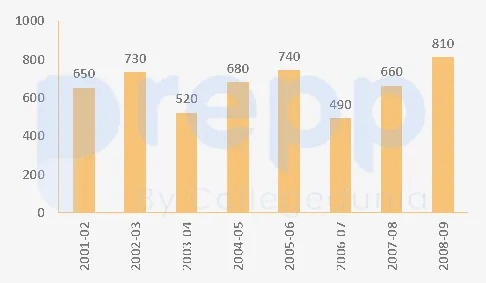
- A
5 : 3
- B
4 : 3
- C
3 : 5
- D
3 : 4
Show answer
B. 4 : 3Given:
Company's profit in 2001-02 = Rs. 650 lakhs
Company's profit in 2002-03 = Rs. 730 lakhs
Company's profit in 2003-04 = Rs. 520 lakhs
Company's profit in 2004-05 = Rs. 680 lakhs
Company's profit in 2005-06 = Rs. 740 lakhs
Company's profit in 2006-07 =Rs. 490 lakhs
Company's profit in 2007-08 = Rs. 660 lakhs
Company's profit in 2008-09 = Rs. 810 lakhs
Concept used:
Average profit = \(Sum \: of \: profits \over No. \:of \: years\)
Calculation:
Average profit = \(650+730+520 +680 +740+490+660+810 \over 8\)
⇒ \(5280 \over 8 \)
⇒ 660
Thus, number of years in which the company's profit is above the average profit = 4
and number of years in which the company's profit is below the average profit = 3
Ratio = 4 : 3
∴ The ratio of the number of years in which the company's profit is above the average profit, to those in which the profit is below the average is 4 : 3.
Paper & answer key PDF ↗ Question 56archived
A thief stole jewellery from a shop at 8:15 p.m. and left on a bike at a speed of 60 km/h. The police were informed at 8:30 p.m. If the police want to arrest the thief at 9:00 p.m., what should be the minimum speed of the police jeep?
- A
60 km/h
- B
75 km/h
- C
80 km/h
- D
90 km/h
Show answer
D. 90 km/hUnderstanding the Thief and Police Chase Scenario
This problem involves a classic relative speed scenario where the police are chasing a thief. We are given the thief's speed, the times they started, and the time the police want to make the arrest. We need to find the minimum speed the police jeep must travel to achieve this.
Let's break down the information given:
Thief starts stealing and leaves the shop: 8:15 p.m.
Thief's speed: 60 km/h
Police are informed: 8:30 p.m.
Police aim to arrest the thief: 9:00 p.m.
The police start chasing the thief later than the thief leaves. This means the thief gets a head start, covering some distance before the police even begin their chase.
Calculating the Thief's Head Start Distance
The time difference between the thief leaving and the police being informed is the head start time.
Head start time = Time police informed - Time thief left
Head start time = 8:30 p.m. - 8:15 p.m. = 15 minutes
To work with speed in km/h, we should convert the time to hours:
15 minutes = $\frac{15}{60}$ hours = 0.25 hours
Now, we can calculate the distance the thief covered during this head start using the formula: Distance = Speed × Time.
Distance covered by thief during head start = $60 \, \text{km/h} \times 0.25 \, \text{h} = 15 \, \text{km}$.
So, when the police started their chase at 8:30 p.m., the thief was already 15 km away from the shop.
Determining the Time Available for the Police Chase
The police start at 8:30 p.m. and want to catch the thief by 9:00 p.m. The duration of the chase is the time available for the police jeep to cover the distance.
Chase duration = Target arrest time - Time police started
Chase duration = 9:00 p.m. - 8:30 p.m. = 30 minutes
Convert the chase duration to hours:
30 minutes = $\frac{30}{60}$ hours = 0.5 hours
Both the police and the thief will be traveling for these 30 minutes (0.5 hours) from 8:30 p.m. until 9:00 p.m.
Calculating the Total Distance the Police Jeep Must Cover
For the police to catch the thief at 9:00 p.m., they must cover the initial head start distance plus the additional distance the thief travels between 8:30 p.m. and 9:00 p.m.
Distance covered by thief from 8:30 p.m. to 9:00 p.m. = Thief's speed × Chase duration
Distance covered by thief (8:30-9:00) = $60 \, \text{km/h} \times 0.5 \, \text{h} = 30 \, \text{km}$.
At 9:00 p.m., the total distance the thief is from the shop is the sum of the head start distance and the distance covered during the chase time.
Total distance of thief from shop at 9:00 p.m. = Head start distance + Distance covered (8:30-9:00)
Total distance = $15 \, \text{km} + 30 \, \text{km} = 45 \, \text{km}$.
For the police to catch the thief at 9:00 p.m., the police jeep must cover this total distance of 45 km in the chase duration of 0.5 hours.
Finding the Minimum Speed of the Police Jeep
The minimum speed required for the police jeep is calculated using the formula: Speed = Distance / Time.
Speed of police jeep = $\frac{\text{Total distance to cover}}{\text{Chase duration}}$
Speed of police jeep = $\frac{45 \, \text{km}}{0.5 \, \text{h}} = \frac{45}{1/2} \, \text{km/h} = 45 \times 2 \, \text{km/h} = 90 \, \text{km/h}$.
Therefore, the minimum speed of the police jeep must be 90 km/h to catch the thief exactly at 9:00 p.m.
If the police jeep travels at a speed less than 90 km/h, it will not be able to cover the 45 km distance in 0.5 hours and thus will not catch the thief by 9:00 p.m.
Summary of Calculations
Item
Value
Calculation/Reason
Thief leaves shop
8:15 p.m.
Given
Police informed
8:30 p.m.
Given
Thief's speed
60 km/h
Given
Target arrest time
9:00 p.m.
Given
Head start time for thief
15 minutes (0.25 h)
8:30 p.m. - 8:15 p.m.
Distance thief covered (8:15-8:30)
15 km
60 km/h × 0.25 h
Chase duration for police
30 minutes (0.5 h)
9:00 p.m. - 8:30 p.m.
Distance thief covers (8:30-9:00)
30 km
60 km/h × 0.5 h
Total distance for police to cover
45 km
15 km + 30 km
Required Police Jeep Speed
90 km/h
45 km / 0.5 h
Final Answer Determination
Based on the calculations, the minimum speed the police jeep needs to travel is 90 km/h to cover the 45 km distance in 0.5 hours and apprehend the thief by 9:00 p.m.
Revision Table: Key Concepts in Speed, Distance, and Time
Concept
Formula
Notes
Speed
Speed = $\frac{\text{Distance}}{\text{Time}}$
Rate of covering distance. Units like km/h, m/s, etc.
Distance
Distance = Speed × Time
Total length covered. Units like km, meters, miles, etc.
Time
Time = $\frac{\text{Distance}}{\text{Speed}}$
Duration taken to cover distance. Units like hours, minutes, seconds, etc. Ensure consistent units for speed and time.
Unit Conversion
e.g., 1 hour = 60 minutes
Essential for calculations involving different time units.
Additional Information: Relative Speed in Chase Problems
Chase problems like this one can also be solved using the concept of relative speed. When two objects are moving in the same direction, their relative speed is the difference between their speeds. The time it takes for the faster object (police) to catch the slower object (thief) is given by the initial distance between them divided by their relative speed.
In this problem:
Initial distance between police and thief at 8:30 p.m. = 15 km (the head start distance).
Time to catch = 0.5 hours (from 8:30 p.m. to 9:00 p.m.).
Thief's speed = 60 km/h.
Let police speed be $V_p$ km/h.
Relative speed = $V_p - 60$ km/h (since police are faster and chasing).
Using the relative speed formula: Time = $\frac{\text{Distance}}{\text{Relative Speed}}$
$0.5 = \frac{15}{V_p - 60}$
Now, we solve for $V_p$:
$0.5 \times (V_p - 60) = 15$
$0.5 V_p - 0.5 \times 60 = 15$
$0.5 V_p - 30 = 15$
$0.5 V_p = 15 + 30$
$0.5 V_p = 45$
$V_p = \frac{45}{0.5} = \frac{45}{1/2} = 45 \times 2 = 90$
So, the police speed $V_p$ must be 90 km/h. This method confirms the result obtained earlier and provides an alternative approach to solving such chase problems.
Paper & answer key PDF ↗ Question 57archived
The table given below shows the number of officers working in six companies.
CompaniesOfficers
P150
Q250
R350
S100
T200
U550
What is the ratio of number of officers working in Q to the number of officers working in R?
- A
7 : 5
- B
6 : 7
- C
7 : 4
- D
5 : 7
Show answer
D. 5 : 7Ratio of Officers in Companies Q and R from Table Data
The problem asks us to find the ratio of the number of officers working in Company Q to the number of officers working in Company R, based on the information provided in the table.
First, let's look at the given table showing the number of officers in six different companies:
Companies
Officers
P
150
Q
250
R
350
S
100
T
200
U
550
From the table, we can find the number of officers for Company Q and Company R:
Number of officers in Company Q = 250
Number of officers in Company R = 350
We need to find the ratio of the number of officers in Q to the number of officers in R. The ratio is expressed as:
Ratio = (Number of officers in Q) : (Number of officers in R)
Ratio = 250 : 350
To simplify the ratio, we need to find the greatest common divisor (GCD) of 250 and 350. Both numbers are divisible by 10. Dividing both by 10, we get:
Ratio = $\frac{250}{10} : \frac{350}{10} = 25 : 35$
Now, both 25 and 35 are divisible by 5. Dividing both by 5, we get:
Ratio = $\frac{25}{5} : \frac{35}{5} = 5 : 7$
So, the ratio of the number of officers working in Q to the number of officers working in R is 5 : 7.
Revision Table: Ratio Calculation from Table Data
Step
Description
Value/Calculation
1
Identify officers in Company Q
250
2
Identify officers in Company R
350
3
Form the initial ratio (Q : R)
250 : 350
4
Simplify the ratio (divide by 10)
25 : 35
5
Further simplify the ratio (divide by 5)
5 : 7
Additional Information: Understanding Ratios
A ratio is a comparison of two quantities. It tells us how much of one quantity there is compared to another quantity. Ratios can be written in several ways, such as a : b, a/b, or "a to b". In this problem, we compared the number of officers in two different companies using a ratio.
Ratios can be simplified by dividing both parts of the ratio by their greatest common divisor (GCD).
The order of the quantities in a ratio is important. The ratio of Q to R (250 : 350 or 5 : 7) is different from the ratio of R to Q (350 : 250 or 7 : 5).
Ratios are often used to compare parts of a whole or to show relationships between different quantities.
Paper & answer key PDF ↗ Question 58archived
If \(K + \frac{1}{K} = 3 \), then what is the value of \({k^2} + \frac{1}{{{k^2}}}\)?
- A
9
- B
6
- C
7
- D
5
Show answer
C. 7Understanding the Algebra Problem
The question asks us to determine the value of the expression \({k^2} + \frac{1}{{{k^2}}}\), given a specific relationship between \(K\) and its reciprocal, which is \(K + \frac{1}{K} = 3 \). This is a common type of algebraic problem that can be solved using fundamental algebraic identities.
We are provided with the equation:
\(K + \frac{1}{K} = 3 \)
We need to calculate the value of the expression:
\({k^2} + \frac{1}{{{k^2}}}\)
Solving the Expression \(k^2 + \frac{1}{k^2}\)
To find the value of \({k^2} + \frac{1}{{{k^2}}}\) from the given equation \(K + \frac{1}{K} = 3 \), the most efficient approach is to square both sides of the original equation.
Let's recall the algebraic identity for the square of a sum:
\((a+b)^2 = a^2 + 2ab + b^2\)
Applying this identity to our given equation, where \(a = K\) and \(b = \frac{1}{K}\), we square both sides:
\((K + \frac{1}{K})^2 = 3^2\)
Now, expand the left side of the equation using the identity:
\(K^2 + 2 \cdot K \cdot \frac{1}{K} + (\frac{1}{K})^2 = 3^2\)
Let's simplify the terms:
The term \(2 \cdot K \cdot \frac{1}{K}\) simplifies to \(2 \cdot 1 = 2\), assuming \(K \neq 0\).
The term \((\frac{1}{K})^2\) simplifies to \(\frac{1^2}{K^2} = \frac{1}{K^2}\).
The right side \(3^2\) is \(9\).
Substituting these simplified terms back into the equation, we get:
\(K^2 + 2 + \frac{1}{K^2} = 9\)
We are looking for the value of \({k^2} + \frac{1}{{{k^2}}}\). We can rearrange the equation to isolate this term by subtracting 2 from both sides:
\(K^2 + \frac{1}{K^2} = 9 - 2\)
Performing the subtraction, we find the value:
\(K^2 + \frac{1}{K^2} = 7\)
Therefore, the value of \({k^2} + \frac{1}{{{k^2}}}\) is 7.
Step-by-Step Algebraic Solution
Start with the given equation: \(K + \frac{1}{K} = 3 \).
Square both sides to introduce the squared terms: \((K + \frac{1}{K})^2 = 3^2\).
Expand the left side using the identity \((a+b)^2 = a^2 + 2ab + b^2\): \(K^2 + 2(K)(\frac{1}{K}) + (\frac{1}{K})^2 = 9\).
Simplify the expression by canceling \(K\) and \(\frac{1}{K}\) in the middle term: \(K^2 + 2 + \frac{1}{K^2} = 9\).
Isolate the desired expression \({k^2} + \frac{1}{{{k^2}}}\) by subtracting 2 from both sides: \(K^2 + \frac{1}{K^2} = 9 - 2\).
Calculate the final result: \(K^2 + \frac{1}{K^2} = 7\).
Revision Table: Algebraic Concepts
Concept
Explanation
Related Formula/Identity
Reciprocal
For a number \(x\), its reciprocal is \(\frac{1}{x}\) (provided \(x \ne 0\)). The product of a number and its reciprocal is 1.
\(x \cdot \frac{1}{x} = 1\)
Squaring an Equation
An operation where both sides of an equation are squared. If \(A=B\), then \(A^2=B^2\). This is useful for transforming equations and sometimes helps reveal required terms like squared variables.
If \(x = y\), then \(x^2 = y^2\).
Square of Sum Identity
A fundamental identity in algebra used to expand expressions of the form \((a+b)^2\).
\((a+b)^2 = a^2 + 2ab + b^2\)
Additional Information: Exploring Related Identities
Algebraic identities are powerful tools for simplifying expressions and solving equations. Understanding related identities can help tackle variations of this problem.
Square of a Difference:
The identity for the square of a difference is \((a-b)^2 = a^2 - 2ab + b^2\). If the question involved \(K - \frac{1}{K}\), you would use this identity.
For example, if \(K - \frac{1}{K} = c\), squaring gives:
\((K - \frac{1}{K})^2 = c^2\)
\(K^2 - 2(K)(\frac{1}{K}) + (\frac{1}{K})^2 = c^2\)
\(K^2 - 2 + \frac{1}{K^2} = c^2\)
\({k^2} + \frac{1}{{{k^2}}} = c^2 + 2\)
Connecting Sum and Difference Squares:
There's a relationship between \((a+b)^2\) and \((a-b)^2\):
\((a+b)^2 - (a-b)^2 = 4ab\)
\((a+b)^2 = (a-b)^2 + 4ab\)
\((a-b)^2 = (a+b)^2 - 4ab\)
These can be used to find the value of \((K - \frac{1}{K})\) if you know \((K + \frac{1}{K})\) and vice versa. In our case, \(a=K\) and \(b=\frac{1}{K}\), so \(4ab = 4(K)(\frac{1}{K}) = 4\).
\((K + \frac{1}{K})^2 = (K - \frac{1}{K})^2 + 4\)
Mastering these identities provides a strong foundation for solving more complex algebraic problems involving powers of variables and their reciprocals.
Paper & answer key PDF ↗ Question 59archived
What is the value of a2 + b2 + c2, if a + b + c = 9 and ab + bc + ca = 23?
- A
22
- B
32
- C
49
- D
35
Show answer
D. 35Understanding the Algebra Problem
The problem asks us to find the value of $a^2 + b^2 + c^2$, given two pieces of information about the variables $a$, $b$, and $c$. We are told that the sum of the variables is $a + b + c = 9$, and the sum of their pairwise products is $ab + bc + ca = 23$. This type of question often requires the use of a standard algebraic identity.
Identifying the Key Algebraic Identity
To relate the given quantities $(a+b+c)$ and $(ab+bc+ca)$ to the desired quantity $(a^2+b^2+c^2)$, we can use the algebraic identity for the square of the sum of three terms. The identity is:
$(a+b+c)^2 = a^2 + b^2 + c^2 + 2ab + 2bc + 2ca$
This can be rewritten as:
$(a+b+c)^2 = a^2 + b^2 + c^2 + 2(ab + bc + ca)$
Applying the Identity to Find $a^2 + b^2 + c^2$
Our goal is to find $a^2 + b^2 + c^2$. We can rearrange the identity to isolate this term:
$a^2 + b^2 + c^2 = (a+b+c)^2 - 2(ab + bc + ca)$
Now, we can substitute the given values into this rearranged formula:
We are given $a + b + c = 9$.
We are given $ab + bc + ca = 23$.
Substitute these values into the equation:
$a^2 + b^2 + c^2 = (9)^2 - 2(23)$
Performing the Calculation
Let's calculate the values step-by-step:
Calculate the square of the sum: $(9)^2 = 9 \times 9 = 81$.
Calculate twice the sum of pairwise products: $2(23) = 2 \times 23 = 46$.
Now, substitute these results back into the equation for $a^2 + b^2 + c^2$:
$a^2 + b^2 + c^2 = 81 - 46$
Finally, perform the subtraction:
$81 - 46 = 35$
So, the value of $a^2 + b^2 + c^2$ is 35.
Conclusion on the Value of $a^2 + b^2 + c^2$
Using the algebraic identity $(a+b+c)^2 = a^2 + b^2 + c^2 + 2(ab + bc + ca)$ and the given values $a+b+c=9$ and $ab+bc+ca=23$, we calculated that $a^2 + b^2 + c^2 = 35$. This matches one of the provided options.
Given Information
Required Value
Relevant Identity
Calculation Steps
Final Result
$a + b + c = 9$
$a^2 + b^2 + c^2$
$(a+b+c)^2 = a^2 + b^2 + c^2 + 2(ab + bc + ca)$
$(9)^2 - 2(23) = 81 - 46 = 35$
35
$ab + bc + ca = 23$
$a^2 + b^2 + c^2 = (a+b+c)^2 - 2(ab + bc + ca)$
Revision Table: Key Concepts
Concept
Description
Formula/Example
Algebraic Identity
An equation that is true for all possible values of its variables.
Example: $(x+y)^2 = x^2 + 2xy + y^2$
Square of a Trinomial
The expansion of $(a+b+c)^2$.
$(a+b+c)^2 = a^2 + b^2 + c^2 + 2ab + 2bc + 2ca$
Rearranging Formulas
Manipulating an equation to solve for a specific variable or expression.
From $X = Y + Z$, we can get $Y = X - Z$.
Additional Information: Related Algebraic Identities
Understanding various algebraic identities is crucial for solving many problems in algebra. Here are a few other common identities:
Square of a Binomial:
$(a+b)^2 = a^2 + 2ab + b^2$
$(a-b)^2 = a^2 - 2ab + b^2$
Difference of Squares:
$a^2 - b^2 = (a+b)(a-b)$
Cube of a Binomial:
$(a+b)^3 = a^3 + 3a^2b + 3ab^2 + b^3 = a^3 + b^3 + 3ab(a+b)$
$(a-b)^3 = a^3 - 3a^2b + 3ab^2 - b^3 = a^3 - b^3 - 3ab(a-b)$
Sum and Difference of Cubes:
$a^3 + b^3 = (a+b)(a^2 - ab + b^2)$
$a^3 - b^3 = (a-b)(a^2 + ab + b^2)$
Sum of Squares (another form):
$a^2 + b^2 = (a+b)^2 - 2ab$
$a^2 + b^2 = (a-b)^2 + 2ab$
These identities help simplify expressions and solve equations more efficiently. The identity used in this problem is particularly useful when dealing with sums and sums of squares of three variables.
Paper & answer key PDF ↗ Question 60archived
If α is an acute angle, tan (4α − 50°) = cot (50° − α), then find the value of α (in degrees).
- A
60°
- B
45°
- C
30°
- D
90°
Show answer
C. 30°Solving Trigonometric Equations for Acute Angles
The question asks us to find the value of the acute angle $\alpha$ given the trigonometric equation:
$$\tan(4\alpha - 50^\circ) = \cot(50^\circ - \alpha)$$
where $\alpha$ is an acute angle. An acute angle is an angle greater than $0^\circ$ and less than $90^\circ$.
Using Complementary Angle Identity
To solve this equation, we can use the complementary angle identity that relates tangent and cotangent:
$$ \cot(\theta) = \tan(90^\circ - \theta) $$
We can apply this identity to the right side of the given equation. Let $\theta = 50^\circ - \alpha$. Then, $\cot(50^\circ - \alpha)$ can be written as:
$$ \cot(50^\circ - \alpha) = \tan(90^\circ - (50^\circ - \alpha)) $$
Now, simplify the argument of the tangent function on the right side:
$$ 90^\circ - (50^\circ - \alpha) = 90^\circ - 50^\circ + \alpha = 40^\circ + \alpha $$
So, the equation becomes:
$$ \tan(4\alpha - 50^\circ) = \tan(40^\circ + \alpha) $$
Equating the Angles
If $\tan A = \tan B$, then the general solution is $A = n \cdot 180^\circ + B$, where $n$ is an integer. However, in problems involving specific angle values and constraints like $\alpha$ being acute, we often consider the primary case where the angles are equal or differ by $180^\circ$. Given that $\alpha$ is acute, $4\alpha - 50^\circ$ and $50^\circ - \alpha$ should correspond to angles where the tangent and cotangent are defined and the equality holds in a straightforward manner. For angles in the first quadrant (or related by $90^\circ$ complementary identity), we typically equate the arguments:
$$ 4\alpha - 50^\circ = 40^\circ + \alpha $$
Solving for $\alpha$
Now, we solve this linear equation for $\alpha$:
Combine terms with $\alpha$ on one side and constant terms on the other:
$4\alpha - \alpha = 40^\circ + 50^\circ$
Simplify both sides:
$3\alpha = 90^\circ$
Divide by 3 to find $\alpha$:
$\alpha = \frac{90^\circ}{3}$
$\alpha = 30^\circ$
Checking the Solution
We found $\alpha = 30^\circ$. Let's check if this value satisfies the condition that $\alpha$ is an acute angle. $30^\circ$ is greater than $0^\circ$ and less than $90^\circ$, so it is an acute angle. This solution is valid based on the problem statement.
Let's also substitute $\alpha = 30^\circ$ back into the original equation to verify:
Left side: $\tan(4\alpha - 50^\circ) = \tan(4(30^\circ) - 50^\circ) = \tan(120^\circ - 50^\circ) = \tan(70^\circ)$
Right side: $\cot(50^\circ - \alpha) = \cot(50^\circ - 30^\circ) = \cot(20^\circ)$
Using the identity $\tan \theta = \cot(90^\circ - \theta)$, we have $\tan(70^\circ) = \cot(90^\circ - 70^\circ) = \cot(20^\circ)$.
Since $\tan(70^\circ) = \cot(20^\circ)$, the equation holds true for $\alpha = 30^\circ$.
Step-by-Step Solution
Start with the given equation: $\tan(4\alpha - 50^\circ) = \cot(50^\circ - \alpha)$.
Use the identity $\cot(\theta) = \tan(90^\circ - \theta)$ to rewrite the right side: $\cot(50^\circ - \alpha) = \tan(90^\circ - (50^\circ - \alpha)) = \tan(40^\circ + \alpha)$.
Equate the arguments of the tangent functions: $4\alpha - 50^\circ = 40^\circ + \alpha$.
Solve the linear equation for $\alpha$: $3\alpha = 90^\circ$, which gives $\alpha = 30^\circ$.
Verify that $\alpha = 30^\circ$ is an acute angle, which it is.
Confirm the solution by substituting $\alpha = 30^\circ$ back into the original equation.
Thus, the value of $\alpha$ is $30^\circ$.
Concept
Explanation
Formula
Acute Angle
An angle $\theta$ such that $0^\circ < \theta < 90^\circ$.
$0^\circ < \alpha < 90^\circ$
Complementary Angles
Two angles whose sum is $90^\circ$.
$\theta + \phi = 90^\circ$
Tangent-Cotangent Identity
The tangent of an angle is equal to the cotangent of its complementary angle.
$\tan(\theta) = \cot(90^\circ - \theta)$ or $\cot(\theta) = \tan(90^\circ - \theta)$
Revision Table: Trigonometric Identities and Angles
Identity
Formula
Notes
Reciprocal Identity
$\cot(\theta) = \frac{1}{\tan(\theta)}$
Valid when $\tan(\theta) \ne 0$
Complementary Identity
$\tan(90^\circ - \theta) = \cot(\theta)$
Used to convert between tan and cot
Complementary Identity
$\cot(90^\circ - \theta) = \tan(\theta)$
Used to convert between cot and tan
Additional Information: Angles and Trigonometry
In trigonometry, angles are often classified based on their measure:
Acute Angle: An angle between $0^\circ$ and $90^\circ$.
Right Angle: An angle exactly equal to $90^\circ$.
Obtuse Angle: An angle between $90^\circ$ and $180^\circ$.
Straight Angle: An angle exactly equal to $180^\circ$.
The trigonometric functions like sine, cosine, tangent, cotangent, secant, and cosecant have specific relationships based on complementary angles ($90^\circ$ sum). These identities are crucial for solving trigonometric equations.
$\sin(90^\circ - \theta) = \cos(\theta)$
$\cos(90^\circ - \theta) = \sin(\theta)$
$\tan(90^\circ - \theta) = \cot(\theta)$
$\cot(90^\circ - \theta) = \tan(\theta)$
$\sec(90^\circ - \theta) = \csc(\theta)$
$\csc(90^\circ - \theta) = \sec(\theta)$
Understanding these identities allows us to convert trigonometric functions into their complementary forms, simplifying equations and making them solvable.
When solving trigonometric equations like $\tan A = \tan B$, the general solution is $A = n \cdot 180^\circ + B$, where $n$ is any integer. However, specific constraints on the variable (like $\alpha$ being acute) help us find the particular solution that fits the criteria. In this problem, $\alpha = 30^\circ$ is the only acute solution.
Paper & answer key PDF ↗ Question 61archived
in the following figure, if l || m, then find the measures of angles marked by a and b.
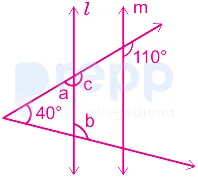
- A
a = 90° and b = 90°
- B
a = 55° and b = 125°
- C
a = 70° and b = 110°
- D
a = 60° and b = 120°
Show answer
C. a = 70° and b = 110°Given:
l || m
Concept used:
For two parallel lines,
Corresponding angles are equal.
Vertically opposite angles are equal.
Calculation:
∠ 110° = ∠ p (Vertically opposite angles)
∠ p + ∠r1 + ∠r2 + ∠110° = 360°
⇒ ∠110° + ∠r1 + ∠r2 + ∠110° = 360° (∠r 1 = ∠r2, vertically opposite angles)
⇒ 2∠r1 = 140°
⇒ ∠r1 = 70°
Now, ∠r 1 = ∠a (Corresponding angles)
∠a = 70°
Also, ∠a + ∠b = 18 0° (supplementary angles )
⇒ ∠b = 18 0° - 7 0° = 11 0°
∴ The measure of angles marked by a and b is 70 ° and 110 ° respectively.
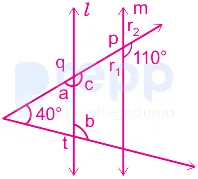 Paper & answer key PDF ↗
 Question 62archived
The radius of a circle with centre at O is 6 cm and the central angle of a sector is 40°. Find the area of the sector.
- A
6πcm2
- B
5πcm2
- C
4πcm2
- D
8πcm2
Show answer
C. 4πcm2Understanding the Area of a Sector
A sector of a circle is like a slice of pizza or pie. It is a region bounded by two radii of the circle and the intercepted arc. To find the area of a sector, we need to know the radius of the circle and the central angle that the sector subtends.
The problem asks us to find the area of a sector of a circle. We are given the following information:
Radius of the circle (r): 6 cm
Central angle of the sector (\(\theta\)): 40°
Formula for Sector Area Calculation
The area of a sector is a fraction of the total area of the circle. The fraction is determined by the ratio of the central angle of the sector to the total angle in a circle (360°).
The formula for the area of a sector is:
Area of Sector \( = \frac{\theta}{360^\circ} \times \text{Area of the entire circle} \)
The area of the entire circle is given by the formula \( \pi r^2 \). So, the formula for the area of a sector becomes:
Area of Sector \( = \frac{\theta}{360^\circ} \times \pi r^2 \)
Step-by-Step Area Calculation
Now, let's use the given values in the formula to calculate the area of the sector.
Given:
\( r = 6 \) cm
\( \theta = 40^\circ \)
Substitute these values into the formula:
Area of Sector \( = \frac{40^\circ}{360^\circ} \times \pi (6 \text{ cm})^2 \)
First, simplify the fraction \( \frac{40^\circ}{360^\circ} \):
\( \frac{40^\circ}{360^\circ} = \frac{40}{360} = \frac{4}{36} = \frac{1}{9} \)
Next, calculate the area of the circle, \( \pi r^2 \):
\( \pi (6 \text{ cm})^2 = \pi (36 \text{ cm}^2) = 36\pi \text{ cm}^2 \)
Now, multiply the simplified fraction by the area of the circle:
Area of Sector \( = \frac{1}{9} \times 36\pi \text{ cm}^2 \)
Area of Sector \( = \frac{36\pi}{9} \text{ cm}^2 \)
Area of Sector \( = 4\pi \text{ cm}^2 \)
Thus, the area of the sector with a radius of 6 cm and a central angle of 40° is \( 4\pi \text{ cm}^2 \).
Sector Area Result Summary
Based on our calculation using the sector area formula, the area is \( 4\pi \text{ cm}^2 \).
Revision Table: Circle and Sector Formulas
Concept
Formula
Description
Area of Circle
\( A = \pi r^2 \)
The total area enclosed by the circle boundary.
Circumference of Circle
\( C = 2\pi r \) or \( C = \pi d \)
The distance around the circle.
Area of Sector
\( A_{sector} = \frac{\theta}{360^\circ} \times \pi r^2 \)
The area of a part of the circle defined by a central angle \(\theta\) and radius \(r\).
Arc Length of Sector
\( L_{arc} = \frac{\theta}{360^\circ} \times 2\pi r \)
The length of the curved boundary of the sector.
Additional Information on Circle Geometry
Understanding sectors is part of learning about the geometry of circles. Here are a few more points:
A sector's size depends directly on its central angle. A larger angle means a larger sector area and arc length.
A sector with a central angle of 360° is the entire circle itself.
A sector with a central angle of 180° is called a semicircle, and its area is half the area of the circle.
The unit for area is always square units (like cm2, m2, etc.), as we are measuring a two-dimensional space.
Remembering the formulas for the area of a circle and the fraction represented by the central angle is key to solving sector problems.
Paper & answer key PDF ↗ Question 63archived
A and B can complete a piece of work in 13 and 17 days respectively. A begins to do the work, and they work alternatively one at a time for one day each. The whole work will be completed in:
- A
\(17\frac{{11}}{{17}}\) days
- B
\(17\frac{{17}}{{19}}\) days
- C
\(14\frac{{11}}{{17}}\) days
- D
\(11\frac{{11}}{{17}}\) days
Show answer
C. \(14\frac{{11}}{{17}}\) daysUnderstanding the Work and Time Problem
This problem involves two individuals, A and B, working on a piece of work. The key information is that they work alternatively, one day at a time. We are given the time each person takes to complete the entire work alone and asked to find the total time taken when they work in this alternative manner, with A starting the work.
Calculating Individual Work Rates
First, let's determine how much work A and B can each complete in a single day. This is their work rate.
A can complete the work in 13 days. So, A's work rate is \( \frac{1}{13} \) of the total work per day.
B can complete the work in 17 days. So, B's work rate is \( \frac{1}{17} \) of the total work per day.
Work Done in One Alternative Cycle
Since A and B work alternatively, one cycle of work involves A working on the first day and B working on the second day. A full cycle thus takes 2 days.
Work done in one cycle (2 days) = Work done by A on Day 1 + Work done by B on Day 2
Work done in one cycle = \( \frac{1}{13} + \frac{1}{17} \)
To add these fractions, we find a common denominator, which is \( 13 \times 17 = 221 \).
Work done in one cycle = \( \frac{1 \times 17}{13 \times 17} + \frac{1 \times 13}{17 \times 13} = \frac{17}{221} + \frac{13}{221} = \frac{17 + 13}{221} = \frac{30}{221} \)
So, in every 2-day cycle, \( \frac{30}{221} \) of the total work is completed.
Determining the Number of Full Cycles
The total work is considered as 1 unit. We need to find out how many 2-day cycles are required to complete the work. We can figure out how many full cycles finish as much work as possible without exceeding the total work.
Let 'n' be the number of full cycles. The work done in 'n' cycles is \( n \times \frac{30}{221} \). We want this to be close to, but not more than, 1.
We can estimate the number of cycles by dividing the total work (1) by the work done per cycle (\( \frac{30}{221} \)).
Estimated cycles = \( \frac{1}{\frac{30}{221}} = \frac{221}{30} \)
\( \frac{221}{30} = 7 \) with a remainder of \( 11 \) (\( 7 \times 30 = 210, 221 - 210 = 11 \)). This means \( \frac{221}{30} = 7\frac{11}{30} \).
They will complete 7 full cycles, which takes \( 7 \times 2 = 14 \) days.
Work done in 7 full cycles = \( 7 \times \frac{30}{221} = \frac{210}{221} \).
Calculating Remaining Work and Final Day
After 7 cycles (14 days), the remaining work is:
Remaining work = Total work - Work done in 7 cycles = \( 1 - \frac{210}{221} = \frac{221}{221} - \frac{210}{221} = \frac{221 - 210}{221} = \frac{11}{221} \)
After 7 full cycles (ending on Day 14, which was B's turn), it is A's turn to work on Day 15.
A's work rate is \( \frac{1}{13} \) per day. We can write this with the same denominator as the remaining work fraction: \( \frac{1}{13} = \frac{1 \times 17}{13 \times 17} = \frac{17}{221} \).
A needs to complete the remaining \( \frac{11}{221} \) work.
Time taken by A to complete the remaining work = \( \frac{\text{Remaining Work}}{\text{A's Work Rate}} = \frac{\frac{11}{221}}{\frac{17}{221}} = \frac{11}{221} \times \frac{221}{17} = \frac{11}{17} \) days.
So, A will take \( \frac{11}{17} \) of the next day (Day 15) to finish the work.
Total Time Taken for Work Completion
Total time = Days for 7 full cycles + Time taken by A for the remaining work
Total time = \( 14 \) days + \( \frac{11}{17} \) days
Total time = \( 14\frac{11}{17} \) days.
Summary of Steps
Calculate individual work rates of A and B.
Calculate the combined work done in one 2-day cycle.
Determine the number of full cycles completed.
Calculate the work done in those full cycles and the remaining work.
Identify whose turn it is after the full cycles.
Calculate the time taken by that person to complete the remaining work.
Add the time for full cycles and the time for remaining work to find the total time.
Person
Time to Complete Alone
Daily Work Rate
A
13 days
\( \frac{1}{13} \)
B
17 days
\( \frac{1}{17} \)
Cycle
Days
Work Done
Cumulative Work
Cycle 1
2 (Day 1: A, Day 2: B)
\( \frac{1}{13} + \frac{1}{17} = \frac{30}{221} \)
\( \frac{30}{221} \)
Cycle 2
4 (Day 3: A, Day 4: B)
\( \frac{30}{221} \)
\( \frac{60}{221} \)
...
...
...
...
Cycle 7
14 (Day 13: A, Day 14: B)
\( \frac{30}{221} \)
\( 7 \times \frac{30}{221} = \frac{210}{221} \)
Day 15 (A's turn)
\( \frac{11}{17} \) day
\( \frac{11}{221} \) (remaining work)
\( \frac{210}{221} + \frac{11}{221} = \frac{221}{221} = 1 \) (Total Work)
The total time taken is 14 days for the full cycles plus \( \frac{11}{17} \) of the next day, which is \( 14\frac{11}{17} \) days.
Revision Table: Key Concepts
Concept
Explanation
Formula/Method
Work Rate
The amount of work done per unit of time (e.g., per day).
\( \text{Rate} = \frac{1}{\text{Time to complete work}} \)
Total Work
Usually represented as 1 unit or the Least Common Multiple (LCM) of the individual times.
1 unit (for simplicity)
Work in Alternative Days
Calculate work done over a cycle of days (usually 2 days).
Sum of work rates for the cycle duration.
Total Time (Alternative Work)
Sum of time for full cycles and time for remaining work.
Time = (Number of full cycles \( \times \) Cycle duration) + \( \frac{\text{Remaining work}}{\text{Rate of person on turn}} \)
Additional Information on Alternative Work Problems
Alternative work problems are common in the quantitative aptitude section of many exams. Here are some additional points to consider:
Starting Person Matters: The total time taken can change depending on who starts the work. Always note who begins the task.
Identifying the Cycle: The cycle length is determined by how many different people work consecutively before the pattern repeats. In this case, A then B, so the cycle is 2 days.
Calculating Remaining Work: Always calculate the remaining work after the full cycles are completed.
Whose Turn is Next: After 'n' full cycles, the person who started the work will be the one to work on the \((2n + 1)^{\text{th}}\) day.
Time for Remaining Work: The time taken to complete the remaining work is found by dividing the remaining work by the work rate of the person whose turn it is.
LCM Method: Another approach is to assume total work is the LCM of the individual times (LCM of 13 and 17 is 221 units). A's efficiency is 221/13 = 17 units/day. B's efficiency is 221/17 = 13 units/day. Work in 2 days = 17 + 13 = 30 units. Number of cycles = 221 / 30 = 7 with remainder 11. Work done in 7 cycles = 7 * 30 = 210 units. Remaining work = 221 - 210 = 11 units. It's A's turn. Time for remaining work = 11 units / 17 units/day = \( \frac{11}{17} \) days. Total time = \( (7 \times 2) \) days + \( \frac{11}{17} \) days = \( 14\frac{11}{17} \) days. Both methods yield the same result.
Paper & answer key PDF ↗ Question 64archived
Nihit starts a business with Rs. 700. After 5 months Amit and Patel joined him with Rs. 300 and Rs. 400 respectively. At the end of the year, the business gave a profit of Rs. 627. Find the share of Patel in the profit.
- A
Rs. 127
- B
Rs. 145
- C
Rs. 132
- D
Rs. 156
Show answer
C. Rs. 132Understanding Partnership Profit Sharing
In a business partnership, profits are typically shared among partners based on the amount of capital they invest and the duration for which their capital remains in the business. The profit share of each partner is proportional to their equivalent capital, which is calculated as the product of the investment amount and the time period of the investment.
Calculating Equivalent Capital for Each Partner
Let's calculate the equivalent capital contribution for each partner: Nihit, Amit, and Patel.
Nihit starts the business with Rs. 700 and stays for the entire year (12 months).
Amit and Patel join after 5 months. This means they are in the business for \(12 - 5 = 7\) months.
Now, we calculate the equivalent capital:
Nihit's Equivalent Capital: Investment \(\times\) Time = Rs. \(700 \times 12\) months = Rs. \(8400\)
Amit's Equivalent Capital: Investment \(\times\) Time = Rs. \(300 \times 7\) months = Rs. \(2100\)
Patel's Equivalent Capital: Investment \(\times\) Time = Rs. \(400 \times 7\) months = Rs. \(2800\)
Determining the Profit Sharing Ratio
The profit will be shared among Nihit, Amit, and Patel in the ratio of their equivalent capital contributions. The ratio is:
Nihit : Amit : Patel = \(8400 : 2100 : 2800\)
We can simplify this ratio by dividing each number by a common factor. All numbers are divisible by 100:
\(84 : 21 : 28\)
These numbers are all divisible by 7:
\(84 \div 7 = 12\)
\(21 \div 7 = 3\)
\(28 \div 7 = 4\)
So, the simplified profit sharing ratio is \(12 : 3 : 4\).
Calculating Total Ratio Parts
To find the total number of parts in the ratio, we sum the individual parts:
Total parts = \(12 + 3 + 4 = 19\)
Calculating Patel's Share in the Profit
The total profit at the end of the year is Rs. 627.
Patel's share corresponds to 4 parts out of the total 19 parts.
Patel's Share = \(\left( \frac{\text{Patel's Ratio Part}}{\text{Total Ratio Parts}} \right) \times \text{Total Profit}\)
Patel's Share = \(\left( \frac{4}{19} \right) \times 627\)
Now, we calculate the value:
\(627 \div 19 = 33\)
Patel's Share = \(4 \times 33 = 132\)
So, Patel's share in the profit is Rs. 132.
Summary of Partnership Details and Profit Share
Partner
Investment (Rs.)
Time in Business (Months)
Equivalent Capital (Rs.)
Ratio Part
Profit Share (Rs.)
Nihit
700
12
8400
12
\(\frac{12}{19} \times 627 = 396\)
Amit
300
7
2100
3
\(\frac{3}{19} \times 627 = 99\)
Patel
400
7
2800
4
\(\frac{4}{19} \times 627 = 132\)
The total profit shared is \(396 + 99 + 132 = 627\), which matches the given total profit.
Therefore, the share of Patel in the profit is Rs. 132.
Revision Table: Key Concepts in Partnership Problems
Concept
Description
Calculation
Partnership
Business started by two or more people.
N/A
Capital
Money invested by a partner.
Given in question.
Time Period
Duration for which capital is invested.
Usually in months or years.
Equivalent Capital
Product of investment and time period. Used for profit sharing.
Investment \(\times\) Time
Profit Sharing Ratio
Ratio of equivalent capital of all partners.
Ratio of (Investment \(\times\) Time) for each partner.
Profit Share
Individual partner's part of the total profit.
\(\left( \frac{\text{Partner's Ratio Part}}{\text{Total Ratio Parts}} \right) \times \text{Total Profit}\)
Additional Information: Types of Partners and Profit Sharing Scenarios
Partnership problems can involve different scenarios. Here are a few points:
Simple Partnership: When all partners invest for the same duration, profit is shared solely based on the investment amount ratio.
Compound Partnership: When partners invest different amounts for different durations, as in this problem, profit is shared based on the equivalent capital (investment \(\times\) time) ratio.
Active Partner: Participates in the day-to-day running of the business. May receive a salary or extra share besides profit.
Sleeping Partner: Only invests capital and does not participate in management. Shares profit according to investment.
Understanding the difference between simple and compound partnerships is crucial for solving profit sharing problems accurately. Always calculate the equivalent capital based on the time each investment is in the business.
Paper & answer key PDF ↗ Question 65archived
There are two circles which touch each other externally. The radius of the first circle with centre O is 17 cm and radius of the second circle with centre A is 7 cm. BC is a direct common tangent to these two circles, where B and C are points on the circles with centres O and A, respectively. The length of BC is:
- A
\(2\sqrt {118} \) cm
- B
\(2\sqrt {119} \) cm
- C
\(2\sqrt {113} \) cm
- D
\(2\sqrt {117} \) cm
Show answer
B. \(2\sqrt {119} \) cmUnderstanding the Problem: Circles and Common Tangents
The question asks for the length of a direct common tangent between two circles that touch each other externally. We are given the radii of the two circles and the locations of their centers and the points of tangency.
Let's break down the given information:
Circle 1: Centre O, Radius \(r_1 = 17\) cm.
Circle 2: Centre A, Radius \(r_2 = 7\) cm.
The circles touch each other externally. This means the distance between their centers, OA, is equal to the sum of their radii.
BC is a direct common tangent. B is on the circle with centre O, and C is on the circle with centre A.
At the points of tangency, the radius is perpendicular to the tangent. So, OB is perpendicular to BC, and AC is perpendicular to BC.
Calculating the Distance Between Centers
Since the circles touch externally, the distance between their centers O and A is the sum of their radii:
Distance \(OA = r_1 + r_2 = 17\) cm \(+ 7\) cm \(= 24\) cm.
Finding the Length of the Direct Common Tangent (BC)
To find the length of the direct common tangent BC, we can use a geometric construction. Draw a line segment from A parallel to BC, meeting the radius OB at point D.
Since AD is parallel to BC and OB and AC are perpendicular to BC, AD is also perpendicular to OB (or its extension). This creates a rectangle ACBD. However, OB and AC are radii of different lengths, so ACBD is not a rectangle. Instead, consider the line through A parallel to BC. Let this line intersect OB at D.
Because AD is parallel to BC, and OB is perpendicular to BC, AD is perpendicular to OB. Thus, triangle ODA is a right-angled triangle with the right angle at D.
Let's determine the lengths of the sides of triangle ODA:
OA is the distance between the centers, which we calculated as 24 cm.
AD is parallel to BC, and AC is perpendicular to BC, and BD is part of OB and perpendicular to AD. This forms a rectangle ACDB, so AD = BC and DB = AC.
The length BD is equal to the radius of the second circle, AC, which is 7 cm.
The length OD is the difference between the radius of the first circle (OB) and the length BD. \(OD = OB - DB = 17\) cm \( - 7\) cm \(= 10\) cm.
Now we have a right-angled triangle ODA with hypotenuse OA = 24 cm, one leg OD = 10 cm, and the other leg AD (which is the length of the tangent BC) is unknown.
We can use the Pythagorean theorem in triangle ODA:
\(OA^2 = OD^2 + AD^2\)
\(24^2 = 10^2 + AD^2\)
\(576 = 100 + AD^2\)
\(AD^2 = 576 - 100\)
\(AD^2 = 476\)
\(AD = \sqrt{476}\)
Now, we need to simplify the square root of 476. Let's find the prime factorization of 476:
\(476 = 2 \times 238 = 2 \times 2 \times 119 = 2^2 \times 119\)
So, \(AD = \sqrt{2^2 \times 119} = \sqrt{2^2} \times \sqrt{119} = 2\sqrt{119}\) cm.
Since AD is equal to the length of the direct common tangent BC, the length of BC is \(2\sqrt{119}\) cm.
Summary of Calculation Steps
Identify the radii of the two circles: \(r_1 = 17\) cm, \(r_2 = 7\) cm.
Calculate the distance between the centers (OA) as the sum of radii: \(OA = r_1 + r_2 = 17 + 7 = 24\) cm.
Construct a right triangle by drawing a line from A parallel to BC, meeting OB at D.
Determine the sides of the triangle ODA: \(OA = 24\) cm, \(OD = r_1 - r_2 = 17 - 7 = 10\) cm, \(AD = BC\).
Apply the Pythagorean theorem: \(OA^2 = OD^2 + AD^2\).
Substitute values: \(24^2 = 10^2 + AD^2\).
Solve for \(AD\): \(576 = 100 + AD^2 \implies AD^2 = 476 \implies AD = \sqrt{476}\).
Simplify the square root: \(\sqrt{476} = \sqrt{4 \times 119} = 2\sqrt{119}\) cm.
The length of the common tangent BC is \(2\sqrt{119}\) cm.
Item
Value
Radius 1 (\(r_1\))
17 cm
Radius 2 (\(r_2\))
7 cm
Distance between centers (OA)
\(r_1 + r_2 = 24\) cm
Difference in radii (OD)
\(r_1 - r_2 = 10\) cm
Length of tangent (BC or AD)
\(\sqrt{OA^2 - OD^2} = \sqrt{24^2 - 10^2}\)
Calculated Length
\(2\sqrt{119}\) cm
Revision Table: Key Concepts for Direct Common Tangent
Concept
Description
Relevance to Problem
Circles Touching Externally
Distance between centers equals sum of radii.
Used to find OA = 24 cm.
Direct Common Tangent
A line segment tangent to both circles on the same side of the line joining centers.
BC is this tangent.
Radius at Tangency Point
Radius is perpendicular to the tangent at the point of contact.
Used to establish right angles at B and C, aiding construction of triangle ODA.
Pythagorean Theorem
In a right triangle, \(a^2 + b^2 = c^2\).
Used to calculate the length AD (which equals BC) in triangle ODA.
Additional Information: Types of Common Tangents
When dealing with two circles, there can be different types of common tangents depending on the position of the circles relative to each other.
Direct Common Tangents: These tangents keep both circles on the same side of the tangent line. If the circles do not intersect and are separate, there are two direct common tangents. If they touch externally, there are two direct common tangents (though the construction method shown is for the length of one). If they intersect at two points, there are two direct common tangents. If one circle is inside the other and they touch internally, there is one direct common tangent. If one circle is completely inside the other without touching, there are no common tangents.
Transverse Common Tangents: These tangents keep the circles on opposite sides of the tangent line. These exist only if the circles do not overlap significantly. If circles are separate, there are two transverse common tangents. If they touch externally, there are two direct but no transverse common tangents. If they intersect, or one is inside the other, there are no transverse common tangents.
The length of a direct common tangent (L) between two circles with radii \(r_1\) and \(r_2\) and distance between centers \(d\) is given by the formula:
\(L = \sqrt{d^2 - (r_1 - r_2)^2}\)
In our problem, \(d = OA = 24\) cm, \(r_1 = 17\) cm, \(r_2 = 7\) cm.
\(L = \sqrt{24^2 - (17 - 7)^2} = \sqrt{24^2 - 10^2} = \sqrt{576 - 100} = \sqrt{476} = 2\sqrt{119}\) cm.
This formula matches the result obtained using the geometric construction and Pythagorean theorem.
Paper & answer key PDF ↗ Question 66archived
In a ΔPRQ, AB is drawn parallel to QR, cutting sides at A and B where length of PQ = 6 cm, length of QR = 8 cm and length of QA = 3 cm. What is the length of AB?
- A
4.0 cm
- B
4.2 cm
- C
5.0 cm
- D
2.4 cm
Show answer
A. 4.0 cm$\Delta$PRQ: Calculating AB Length Parallel to QR
This solution provides a detailed explanation to find the length of the line segment AB within a triangle $\Delta$PRQ. We will use the properties of parallel lines and triangles, specifically the Basic Proportionality Theorem (BPT).
Setup and Given Values for $\Delta$PRQ
The problem involves a triangle named $\Delta$PRQ. Inside this triangle, a line segment AB is drawn such that it is parallel to the side QR (AB || QR). The points A and B are located on the sides PQ and PR, respectively.
The following lengths are provided:
Length of side PQ = $6$ cm
Length of side QR = $8$ cm
Length of segment QA = $3$ cm
Our objective is to determine the length of the segment AB.
Proportionality Theorem Application to Parallel Lines
The core geometric principle relevant here is the Basic Proportionality Theorem (BPT), also known as Thales's Theorem. This theorem states that if a line is drawn parallel to one side of a triangle, and this line intersects the other two sides, then it divides those two sides into proportional segments. Additionally, the smaller triangle formed by the parallel line is similar to the original triangle.
In $\Delta$PRQ, since AB is parallel to QR (AB || QR), and A lies on PQ while B lies on PR, the BPT implies that the ratios of corresponding sides are equal:
$$ \frac{PA}{PQ} = \frac{PB}{PR} = \frac{AB}{QR} $$
AB Length Calculation Steps
Let's calculate the length of AB step-by-step:
Step 1: Calculate the length of segment PA
We are given that point A lies on the side PQ. The total length of side PQ is $6$ cm. We are also given the length of the segment QA as $3$ cm. Since A is located on PQ, the side PQ can be seen as the sum of segments PA and AQ (or QA).
We can write this relationship as: $PQ = PA + QA$.
Substituting the given values: $6 \text{ cm} = PA + 3 \text{ cm}$.
To find PA, we rearrange the equation: $PA = 6 \text{ cm} - 3 \text{ cm}$.
Therefore, $PA = 3 \text{ cm}$. This indicates that point A is the midpoint of the side PQ.
Step 2: Utilize the BPT Ratio
According to the Basic Proportionality Theorem, the ratio of the segments on side PQ is equal to the ratio of the parallel segment AB to the base QR. We use the relevant part of the theorem:
$$ \frac{PA}{PQ} = \frac{AB}{QR} $$
Step 3: Substitute Values and Solve for AB
Now, we substitute the known values into the equation. We found PA = $3$ cm, and we are given PQ = $6$ cm and QR = $8$ cm.
$$ \frac{3 \text{ cm}}{6 \text{ cm}} = \frac{AB}{8 \text{ cm}} $$
Simplify the fraction on the left side:
$$ \frac{1}{2} = \frac{AB}{8 \text{ cm}} $$
To find the length of AB, we multiply both sides of the equation by $8$ cm:
$$ AB = \frac{1}{2} \times 8 \text{ cm} $$
Performing the multiplication gives:
$$ AB = 4 \text{ cm} $$
Final Result for AB Length
Following the steps using the Basic Proportionality Theorem, the calculated length of the segment AB is $4.0$ cm.
Summary
In conclusion, for the given triangle $\Delta$PRQ where AB is parallel to QR, and with the provided lengths PQ = $6$ cm, QR = $8$ cm, and QA = $3$ cm, the length of the segment AB is found to be $4.0$ cm.
Paper & answer key PDF ↗ Question 67archived
The pie chart given below shows the number of boys in 8 schools. The total number of boys in all these 8 school is 10,000. Number of boys in a particular school is shown as a percent of total number of boys in all these 8 schools.
What is the ratio of total central angle formed by sector C, D and F to the total central angle formed by sector A, G and H?
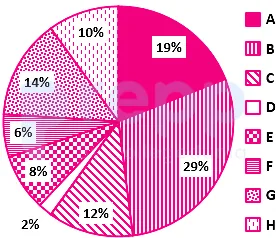
- A
20 : 43
- B
44 : 21
- C
17 : 39
- D
19 : 44
Show answer
A. 20 : 43Given:
Sector C = 12%
Sector D = 2%
Sector F = 6%
Sector A = 19%
Sector G = 14%
Sector H = 10%
Formula used:
Angle= \({percent\: of \:sector\over 100}\)× 360
Calculation:
Angle of following sectors:
C = \({12\over100}\)× 360 = 43.2
D = \({2\over100}\)× 360 = 7.2
F = \({6\over100}\)× 360 = 21.6
Total= 72
A = \({19\over100}\)× 360 = 68.4
G = \({14\over100}\)× 360 = 50.4
H = \({10\over100}\)× 360 = 36
Total= 154.8
Ratio= 72:154.8 = 20:43
∴ The ratio of total central angle formed by sector C, D and F to the total central angle formed by sector A, G and H is20:43.
Paper & answer key PDF ↗ Question 68archived
If x + \(\frac{1}{x}\) = \(2\sqrt 5 \:\) where x > 1, then the value of x3 - \(\frac{1}{{{x^3}}}\) is:
- A
82
- B
76
- C
86
- D
78
Show answer
B. 76Finding x³ - 1/x³ Given x + 1/x
The problem asks us to find the value of \(x^3 - \frac{1}{x^3}\) given that \(x + \frac{1}{x} = 2\sqrt 5\) and \(x > 1\). To solve this, we will use algebraic identities to relate the given expression \(x + \frac{1}{x}\) to the expression we need to find, \(x^3 - \frac{1}{x^3}\).
Step 1: Find the value of \(x - \frac{1}{x}\)
We are given \(x + \frac{1}{x} = 2\sqrt 5\). To find \(x^3 - \frac{1}{x^3}\), it's helpful to first find the value of \(x - \frac{1}{x}\). We can use the identity:
\((a - b)^2 = (a + b)^2 - 4ab\)
Letting \(a = x\) and \(b = \frac{1}{x}\), the identity becomes:
\( \left(x - \frac{1}{x}\right)^2 = \left(x + \frac{1}{x}\right)^2 - 4 \left(x\right) \left(\frac{1}{x}\right) \)
Substitute the given value \(x + \frac{1}{x} = 2\sqrt 5\):
\( \left(x - \frac{1}{x}\right)^2 = \left(2\sqrt 5\right)^2 - 4(1) \)
\( \left(x - \frac{1}{x}\right)^2 = (4 \times 5) - 4 \)
\( \left(x - \frac{1}{x}\right)^2 = 20 - 4 \)
\( \left(x - \frac{1}{x}\right)^2 = 16 \)
Taking the square root of both sides:
\( x - \frac{1}{x} = \pm \sqrt{16} = \pm 4 \)
We are given that \(x > 1\). If \(x > 1\), then \(0 < \frac{1}{x} < 1\). Therefore, \(x - \frac{1}{x}\) must be positive.
So, \( x - \frac{1}{x} = 4 \).
Step 2: Calculate the value of \(x^3 - \frac{1}{x^3}\)
Now that we have the value of \(x - \frac{1}{x}\), we can find \(x^3 - \frac{1}{x^3}\) using the identity for the difference of cubes or a related identity. One useful identity is:
\( a^3 - b^3 = (a - b)^3 + 3ab(a - b) \)
Letting \(a = x\) and \(b = \frac{1}{x}\), the identity becomes:
\( x^3 - \frac{1}{x^3} = \left(x - \frac{1}{x}\right)^3 + 3 \left(x\right) \left(\frac{1}{x}\right) \left(x - \frac{1}{x}\right) \)
\( x^3 - \frac{1}{x^3} = \left(x - \frac{1}{x}\right)^3 + 3(1) \left(x - \frac{1}{x}\right) \)
\( x^3 - \frac{1}{x^3} = \left(x - \frac{1}{x}\right)^3 + 3\left(x - \frac{1}{x}\right) \)
Substitute the value we found in Step 1, \(x - \frac{1}{x} = 4\):
\( x^3 - \frac{1}{x^3} = (4)^3 + 3(4) \)
\( x^3 - \frac{1}{x^3} = 64 + 12 \)
\( x^3 - \frac{1}{x^3} = 76 \)
Final Answer Calculation
Based on our calculations using algebraic identities and the given condition \(x > 1\), the value of \(x^3 - \frac{1}{x^3}\) is 76.
Revision Table: Algebraic Identities
Understanding key algebraic identities is crucial for solving problems like this. Here are the identities used:
Identity
Formula
Square of a Difference
\((a - b)^2 = (a + b)^2 - 4ab\)
Difference of Cubes (derived form)
\(a^3 - b^3 = (a - b)^3 + 3ab(a - b)\)
Additional Information: Solving \(x + \frac{1}{x}\) Type Problems
Problems involving expressions like \(x + \frac{1}{x}\), \(x - \frac{1}{x}\), \(x^2 + \frac{1}{x^2}\), \(x^3 + \frac{1}{x^3}\), \(x^3 - \frac{1}{x^3}\), etc., are common in algebra. Knowing the relationships between these expressions through algebraic identities is key. Some common relationships derived from fundamental identities are:
\(x^2 + \frac{1}{x^2} = \left(x + \frac{1}{x}\right)^2 - 2\)
\(x^2 + \frac{1}{x^2} = \left(x - \frac{1}{x}\right)^2 + 2\)
\(\left(x + \frac{1}{x}\right)^2 = \left(x - \frac{1}{x}\right)^2 + 4\)
\(\left(x - \frac{1}{x}\right)^2 = \left(x + \frac{1}{x}\right)^2 - 4\)
\(x^3 + \frac{1}{x^3} = \left(x + \frac{1}{x}\right)^3 - 3\left(x + \frac{1}{x}\right)\)
\(x^3 - \frac{1}{x^3} = \left(x - \frac{1}{x}\right)^3 + 3\left(x - \frac{1}{x}\right)\)
These identities allow you to quickly find the value of one expression if the value of another is known. The condition \(x > 1\) (or \(0 < x < 1\)) is often given to help determine the sign when taking a square root, as seen in this problem.
Paper & answer key PDF ↗ Question 69archived
If 7-digit number 678p37q is divisible by 75 and p is not a composite, then the values of p and q are:
- A
p = 5, q = 5
- B
p = 3, q = 0
- C
p = 3, q = 5
- D
p = 2, q = 5
Show answer
C. p = 3, q = 5Finding the Values of p and q in a 7-Digit Number Divisible by 75
We are given a 7-digit number 678p37q and told that it is divisible by 75. We are also given the condition that 'p' is not a composite number. We need to find the values of the digits 'p' and 'q'.
A number is divisible by 75 if and only if it is divisible by both 3 and 25. This is because 75 can be factored into its prime factors as $3 \times 25 = 3 \times 5^2$. Since 3 and 25 are coprime (their greatest common divisor is 1), the divisibility by 75 depends on divisibility by both 3 and 25.
Step 1: Apply Divisibility Rule for 25
For a number to be divisible by 25, the number formed by its last two digits must be divisible by 25. In the given number 678p37q, the last two digits form the number 7q.
The possible two-digit numbers ending in any digit 'q' that are divisible by 25 are 00, 25, 50, and 75.
Looking at the last two digits, 7q, we need this number to be one of these multiples of 25. The only possibility where the tens digit is 7 is 75.
Therefore, the number 7q must be 75. This implies that the digit q must be 5.
So, the number becomes 678p375.
Step 2: Apply Divisibility Rule for 3
For a number to be divisible by 3, the sum of its digits must be divisible by 3. The number is 678p375. Let's find the sum of its digits:
Sum of digits = $6 + 7 + 8 + p + 3 + 7 + 5$
Sum of digits = $36 + p$
For the number to be divisible by 3, the sum of the digits, $36 + p$, must be divisible by 3. Since 36 is divisible by 3, $36+p$ will be divisible by 3 if and only if 'p' is divisible by 3.
The digit 'p' can be any single digit from 0 to 9. The single digits that are divisible by 3 are 0, 3, 6, and 9.
Step 3: Apply the Condition on 'p'
We are given that 'p' is not a composite number. Let's review what a composite number is.
A composite number is a positive integer that has at least one divisor other than 1 and itself.
Prime numbers are positive integers greater than 1 that have no positive divisors other than 1 and themselves (e.g., 2, 3, 5, 7, 11...).
The number 1 is neither prime nor composite.
The number 0 is also not considered composite.
The possible single digits for 'p' (0-9) are:
Digit
Classification
Is it Composite?
0
Neither prime nor composite
No
1
Neither prime nor composite
No
2
Prime
No
3
Prime
No
4
Composite ($2 \times 2$)
Yes
5
Prime
No
6
Composite ($2 \times 3$)
Yes
7
Prime
No
8
Composite ($2 \times 4$ or $2 \times 2 \times 2$)
Yes
9
Composite ($3 \times 3$)
Yes
So, the single digits that are not composite are 0, 1, 2, 3, 5, 7.
Step 4: Combine Conditions to Find 'p' and 'q'
From Step 1, we know that $q = 5$.
From Step 2, we know that 'p' must be one of {0, 3, 6, 9}.
From Step 3, we know that 'p' must be one of {0, 1, 2, 3, 5, 7} (not composite).
We need the value of 'p' that satisfies both conditions. Looking for the intersection of the two sets {0, 3, 6, 9} and {0, 1, 2, 3, 5, 7}, the common values are 0 and 3.
So, possible values for (p, q) are (0, 5) and (3, 5).
Step 5: Check the Options
Let's look at the given options:
$p=5, q=5$: Here $p=5$. 5 is not divisible by 3. Sum of digits $36+5=41$, not divisible by 3. This option is incorrect.
$p=3, q=0$: Here $q=0$. Last two digits are 70, which is not divisible by 25. This option is incorrect.
$p=3, q=5$: Here $q=5$. Last two digits are 75, divisible by 25. Here $p=3$. 3 is divisible by 3 and is not a composite number. Sum of digits $36+3=39$, divisible by 3. This option satisfies all conditions.
$p=2, q=5$: Here $q=5$. Last two digits are 75, divisible by 25. Here $p=2$. 2 is not divisible by 3. Sum of digits $36+2=38$, not divisible by 3. This option is incorrect.
The values $p=3$ and $q=5$ fulfill all the given conditions: the number 6783375 is divisible by both 3 (sum of digits 39) and 25 (ends in 75), making it divisible by 75, and p=3 is not a composite number.
Revision Table: Divisibility Rules and Number Types
Concept
Rule/Definition
Application in Problem
Divisibility by 75
Divisible by both 3 and 25
Required for 678p37q
Divisibility by 25
Last two digits form a number divisible by 25 (00, 25, 50, 75)
Applied to 7q, giving q=5
Divisibility by 3
Sum of digits is divisible by 3
Applied to 6+7+8+p+3+7+q, giving 36+p divisible by 3
Composite Number
Positive integer > 1 with divisors other than 1 and itself
'p' must not be composite (0, 1, 2, 3, 5, 7)
Additional Information: Prime vs. Composite Numbers
Understanding the difference between prime and composite numbers is fundamental in number theory. Let's clarify this further for single-digit numbers (0-9) as relevant to this problem:
Prime Numbers: These are positive integers greater than 1 that only have two distinct positive divisors: 1 and themselves. Examples: 2, 3, 5, 7. (Note: 1 is not prime).
Composite Numbers: These are positive integers greater than 1 that have more than two positive divisors. Examples: 4 (divisors 1, 2, 4), 6 (divisors 1, 2, 3, 6), 8 (divisors 1, 2, 4, 8), 9 (divisors 1, 3, 9).
Special Cases:
The number 1 is unique. It is neither prime nor composite because it only has one positive divisor (itself).
The number 0 is also neither prime nor composite. Prime and composite definitions typically apply to positive integers greater than 1.
In this problem, the condition that 'p' is not a composite number means 'p' must be 0, 1, 2, 3, 5, or 7, as these are the single digits (0-9) that do not fit the definition of a composite number.
By combining this condition with the divisibility rules for 75, we could definitively determine the values of p and q.
Paper & answer key PDF ↗ Question 70archived
If Tan A Tan B + \(\frac{{\cos x}}{{\cos A\cos B}}\) = 1, then x = ?
- A
B
- B
A
- C
A + B
- D
A - B
Show answer
C. A + BSolving the Trigonometric Equation for x
We are given a trigonometric equation involving angles A, B, and x:
\[ \tan A \tan B + \frac{\cos x}{\cos A\cos B} = 1 \]Let's solve this equation step-by-step to find the value of x.
Step-by-Step Derivation of x
The goal is to isolate \(\cos x\) and then determine x. We start by expressing tangent in terms of sine and cosine.
Rewrite the equation using the identity \(\tan \theta = \frac{\sin \theta}{\cos \theta}\):
\[ \frac{\sin A}{\cos A} \cdot \frac{\sin B}{\cos B} + \frac{\cos x}{\cos A\cos B} = 1 \]
Combine the terms on the left side since they have a common denominator \(\cos A \cos B\):
\[ \frac{\sin A \sin B}{\cos A \cos B} + \frac{\cos x}{\cos A\cos B} = 1 \]
\[ \frac{\sin A \sin B + \cos x}{\cos A\cos B} = 1 \]
Multiply both sides of the equation by \(\cos A \cos B\) to eliminate the denominator:
\[ \sin A \sin B + \cos x = \cos A \cos B \]
Rearrange the equation to isolate \(\cos x\) on one side:
\[ \cos x = \cos A \cos B - \sin A \sin B \]
Recognize the right side of the equation. It matches the angle addition formula for cosine:
\[ \cos(A+B) = \cos A \cos B - \sin A \sin B \]
Substitute this identity back into the equation for \(\cos x\):
\[ \cos x = \cos(A+B) \]
From the equation \(\cos x = \cos(A+B)\), one possible solution for x is \(x = A+B\). This solution is present among the given options.
Verification with Trigonometric Identities
The key identity used in solving this equation is the cosine addition formula:
\[ \cos(A+B) = \cos A \cos B - \sin A \sin B \]
By manipulating the original equation and using the relationship between tangent, sine, and cosine, we were able to arrive at the form \(\cos x = \cos(A+B)\), which directly gives \(x = A+B\) as a solution.
Revision Table: Key Trigonometric Identities
Identity Type
Formula
Tangent in terms of Sine and Cosine
\( \tan \theta = \frac{\sin \theta}{\cos \theta} \)
Cosine Addition Formula
\( \cos(A+B) = \cos A \cos B - \sin A \sin B \)
Cosine Subtraction Formula
\( \cos(A-B) = \cos A \cos B + \sin A \sin B \)
Additional Information: General Solutions for Trigonometric Equations
When solving equations involving trigonometric functions like \(\cos x = \cos \alpha\), the general solution is not just \(x = \alpha\). The general solution for \(\cos x = \cos \alpha\) is given by \(x = 2n\pi \pm \alpha\), where \(n\) is an integer (\(n \in \mathbb{Z}\)).
In this problem, we found \(\cos x = \cos(A+B)\). Therefore, the general solution for x is \(x = 2n\pi \pm (A+B)\), where \(n \in \mathbb{Z}\).
The options provided are specific values, not general forms. The option \(A+B\) corresponds to the case where \(n=0\) and we take the positive sign, i.e., \(x = 2(0)\pi + (A+B) = A+B\).
Understanding general solutions is important for solving trigonometric equations thoroughly, but for multiple-choice questions like this, identifying the specific solution among the options is sufficient.
Paper & answer key PDF ↗ Question 71archived
If the cost of 20 books is equal to the selling price of 18 books, then the gain percentage is:
- A
\(11\frac{1}{9}\% \)
- B
\(11\frac{1}{3}\% \)
- C
\(11\frac{2}{9}\% \)
- D
\(10\frac{1}{9}\% \)
Show answer
A. \(11\frac{1}{9}\% \)Calculating Gain Percentage in Profit and Loss
This question involves finding the gain percentage when the cost price of a certain number of items is equal to the selling price of a different number of items. Specifically, we are given that the cost of 20 books is equal to the selling price of 18 books.
Let's denote:
Cost Price of one book as CP
Selling Price of one book as SP
According to the problem statement:
The cost of 20 books = \(20 \times \text{CP}\)
The selling price of 18 books = \(18 \times \text{SP}\)
The question states that these two values are equal:
\(20 \times \text{CP} = 18 \times \text{SP}\)
To find the gain or loss, we need to compare the Selling Price (SP) and the Cost Price (CP) of a single item or the same number of items. Let's find the ratio of SP to CP from the equation:
\(\frac{\text{SP}}{\text{CP}} = \frac{20}{18}\)
Simplifying the fraction:
\(\frac{\text{SP}}{\text{CP}} = \frac{10}{9}\)
This relationship tells us that the Selling Price is \(\frac{10}{9}\) times the Cost Price (\(\text{SP} = \frac{10}{9}\text{CP}\)). Since \(\frac{10}{9} > 1\), the Selling Price is greater than the Cost Price, which indicates a gain (profit).
The gain per book can be calculated as the difference between the Selling Price and the Cost Price:
\(\text{Gain} = \text{SP} - \text{CP}\)
Substitute the relationship between SP and CP:
\(\text{Gain} = \frac{10}{9}\text{CP} - \text{CP}\)
\(\text{Gain} = \left(\frac{10}{9} - 1\right)\text{CP}\)
\(\text{Gain} = \left(\frac{10 - 9}{9}\right)\text{CP}\)
\(\text{Gain} = \frac{1}{9}\text{CP}\)
Now, we need to calculate the gain percentage. The gain percentage is calculated on the Cost Price:
\(\text{Gain Percentage} = \frac{\text{Gain}}{\text{CP}} \times 100\%\)
Substitute the value of Gain we found:
\(\text{Gain Percentage} = \frac{\frac{1}{9}\text{CP}}{\text{CP}} \times 100\%\)
The CP terms cancel out:
\(\text{Gain Percentage} = \frac{1}{9} \times 100\%\)
\(\text{Gain Percentage} = \frac{100}{9}\%\)
To express this fraction as a mixed number, we divide 100 by 9:
\(100 \div 9\)
\(100 = 9 \times 11 + 1\)
So, \(\frac{100}{9} = 11\) with a remainder of \(1\). This can be written as the mixed number \(11\frac{1}{9}\).
Therefore, the gain percentage is \(11\frac{1}{9}\%\).
Let's summarise the steps:
Set up the equation based on the given condition: \(20 \times \text{CP} = 18 \times \text{SP}\).
Find the ratio of SP to CP: \(\frac{\text{SP}}{\text{CP}} = \frac{18}{20} = \frac{9}{10}\) Oh, wait. I made a mistake in calculating the ratio. Let's correct that.
Let's redo the steps from the equation \(20 \times \text{CP} = 18 \times \text{SP}\).
\(\frac{\text{SP}}{\text{CP}} = \frac{20}{18} = \frac{10}{9}\)
This is correct. My previous calculation \(\frac{\text{SP}}{\text{CP}} = \frac{18}{20}\) was wrong. Let's continue with \(\frac{\text{SP}}{\text{CP}} = \frac{10}{9}\).
The ratio \(\frac{\text{SP}}{\text{CP}} = \frac{10}{9}\) means if CP is 9 units, SP is 10 units.
Gain = SP - CP = \(10 - 9 = 1\) unit.
Gain percentage = \(\frac{\text{Gain}}{\text{CP}} \times 100\%\).
Gain percentage = \(\frac{1}{9} \times 100\%\).
Gain percentage = \(\frac{100}{9}\%\).
Converting \(\frac{100}{9}\) to a mixed number:
\(100 \div 9 = 11\) with a remainder of \(1\).
So, \(\frac{100}{9}\% = 11\frac{1}{9}\%\).
Alternatively, we can assume a value for CP or SP. Let's assume the total cost of 20 books is Rs. 180.
Total Cost Price of 20 books = Rs. 180
CP of 1 book = Rs. \(\frac{180}{20}\) = Rs. 9
Since the cost of 20 books is equal to the selling price of 18 books:
Total Selling Price of 18 books = Rs. 180
SP of 1 book = Rs. \(\frac{180}{18}\) = Rs. 10
Now we have the CP and SP of one book:
CP of 1 book = Rs. 9
SP of 1 book = Rs. 10
Gain per book = SP - CP = Rs. \(10 - 9\) = Rs. 1.
Gain Percentage = \(\frac{\text{Gain}}{\text{CP}} \times 100\%\)
Gain Percentage = \(\frac{1}{9} \times 100\%\)
Gain Percentage = \(\frac{100}{9}\%\)
Gain Percentage = \(11\frac{1}{9}\%\)
Both methods yield the same result.
Concept
Formula
Gain (Profit)
SP - CP (when SP > CP)
Loss
CP - SP (when CP > SP)
Gain Percentage
\(\left(\frac{\text{Gain}}{\text{CP}}\right) \times 100\%\)
Loss Percentage
\(\left(\frac{\text{Loss}}{\text{CP}}\right) \times 100\%\)
Revision Table: Key Profit and Loss Concepts
Term
Definition
Relevance to Question
Cost Price (CP)
The price at which an article is purchased.
Used as the base for calculating gain percentage.
Selling Price (SP)
The price at which an article is sold.
Compared with CP to determine gain or loss.
Gain (Profit)
The excess of SP over CP.
Occurs because SP of 1 book (Rs. 10) is greater than CP of 1 book (Rs. 9).
Gain Percentage
Gain expressed as a percentage of CP.
The value we need to find.
Additional Information: Profit and Loss Basics
Profit and Loss is a fundamental topic in arithmetic that deals with the calculation of gain or loss in a business transaction. It is widely used in commerce and everyday financial calculations.
Profit: When the Selling Price (SP) of an article is more than its Cost Price (CP), there is a profit or gain. Profit = SP - CP.
Loss: When the Selling Price (SP) of an article is less than its Cost Price (CP), there is a loss. Loss = CP - SP.
Profit Percentage: Calculated on the CP. Formula is \(\left(\frac{\text{Profit}}{\text{CP}}\right) \times 100\%\).
Loss Percentage: Calculated on the CP. Formula is \(\left(\frac{\text{Loss}}{\text{CP}}\right) \times 100\%\).
In problems like this one, where the cost of a certain quantity equals the selling price of another quantity, finding the ratio of SP to CP is a common first step. If \(\frac{\text{SP}}{\text{CP}} = \frac{a}{b}\), then gain percentage is \(\left(\frac{a-b}{b}\right) \times 100\%\) if \(a > b\), and loss percentage is \(\left(\frac{b-a}{b}\right) \times 100\%\) if \(b > a\). In our case, \(\frac{\text{SP}}{\text{CP}} = \frac{10}{9}\), so \(a=10\) and \(b=9\). The gain percentage is \(\left(\frac{10-9}{9}\right) \times 100\% = \frac{1}{9} \times 100\%\).
Paper & answer key PDF ↗ Question 72archived
A cuboid of sides 12 cm, 18 cm and 27 cm is melted to form a cube. What is the ratio of the total surface area of the cuboid to that of the cube?
- A
18 : 17
- B
17 : 19
- C
19 : 18
- D
19 : 17
Show answer
C. 19 : 18Calculating Surface Area Ratio of Cuboid and Cube
This problem asks us to find the ratio of the total surface area of a cuboid to that of a cube formed by melting the cuboid. When a solid shape is melted and recast into another shape, its volume remains constant.
Step 1: Calculate the Volume of the Cuboid
The dimensions of the cuboid are given as 12 cm, 18 cm, and 27 cm. The formula for the volume of a cuboid is:
\(\text{Volume of Cuboid} = \text{length} \times \text{width} \times \text{height}\)
Using the given dimensions (let's use l=27 cm, w=18 cm, h=12 cm):
\(\text{Volume of Cuboid} = 27 \, \text{cm} \times 18 \, \text{cm} \times 12 \, \text{cm}\)
\(\text{Volume of Cuboid} = 486 \, \text{cm}^2 \times 12 \, \text{cm}\)
\(\text{Volume of Cuboid} = 5832 \, \text{cm}^3\)
Alternatively, we can express the dimensions as prime factors to easily find the cube root later:
\(27 = 3^3\)
\(18 = 2 \times 3^2\)
\(12 = 2^2 \times 3\)
Volume of Cuboid = \((3^3) \times (2 \times 3^2) \times (2^2 \times 3) = 2^{1+2} \times 3^{3+2+1} = 2^3 \times 3^6\)
\(\text{Volume of Cuboid} = (2 \times 3^2)^3 = (2 \times 9)^3 = 18^3 = 5832 \, \text{cm}^3\)
Step 2: Determine the Side Length of the Cube
Since the cuboid is melted to form a cube, the volume of the cube is equal to the volume of the cuboid.
\(\text{Volume of Cube} = \text{Volume of Cuboid} = 5832 \, \text{cm}^3\)
The volume of a cube with side length 's' is \(s^3\). To find the side length, we take the cube root of the volume:
\(s^3 = 5832 \, \text{cm}^3\)
\(s = \sqrt[3]{5832} \, \text{cm}\)
From our calculation in Step 1, we know that \(5832 = 18^3\).
\(s = \sqrt[3]{18^3} \, \text{cm}\)
\(s = 18 \, \text{cm}\)
The side length of the cube is 18 cm.
Step 3: Calculate the Total Surface Area of the Cuboid
The formula for the total surface area of a cuboid with dimensions l, w, and h is:
\(\text{Total Surface Area of Cuboid} = 2(lw + lh + wh)\)
Using l = 27 cm, w = 18 cm, and h = 12 cm:
\(\text{Total Surface Area of Cuboid} = 2(27 \times 18 + 27 \times 12 + 18 \times 12)\)
\(\text{Total Surface Area of Cuboid} = 2(486 + 324 + 216)\)
\(\text{Total Surface Area of Cuboid} = 2(1026)\)
\(\text{Total Surface Area of Cuboid} = 2052 \, \text{cm}^2\)
Step 4: Calculate the Total Surface Area of the Cube
The formula for the total surface area of a cube with side length 's' is:
\(\text{Total Surface Area of Cube} = 6s^2\)
Using the side length \(s = 18\) cm:
\(\text{Total Surface Area of Cube} = 6 \times (18 \, \text{cm})^2\)
\(\text{Total Surface Area of Cube} = 6 \times 324 \, \text{cm}^2\)
\(\text{Total Surface Area of Cube} = 1944 \, \text{cm}^2\)
Step 5: Find the Ratio of Surface Areas
The required ratio is the total surface area of the cuboid to that of the cube:
\(\text{Ratio} = \frac{\text{Total Surface Area of Cuboid}}{\text{Total Surface Area of Cube}}\)
\(\text{Ratio} = \frac{2052}{1944}\)
Now, we simplify this ratio:
Divide both numbers by their common factors. Let's start by dividing by 2 repeatedly:
\(2052 \div 2 = 1026\), \(1944 \div 2 = 972\). Ratio is \(1026 : 972\).
\(1026 \div 2 = 513\), \(972 \div 2 = 486\). Ratio is \(513 : 486\).
Check for divisibility by 9 (sum of digits 5+1+3=9, 4+8+6=18):
\(513 \div 9 = 57\), \(486 \div 9 = 54\). Ratio is \(57 : 54\).
Both 57 and 54 are divisible by 3:
\(57 \div 3 = 19\), \(54 \div 3 = 18\). Ratio is \(19 : 18\).
The simplified ratio is 19:18.
Final Ratio
The ratio of the total surface area of the cuboid to that of the cube is 19:18.
Revision Table: Properties of Cuboid and Cube
Shape
Volume Formula
Total Surface Area Formula
Key Concept
Cuboid (l, w, h)
\(l \times w \times h\)
\(2(lw + lh + wh)\)
Volume is conserved when material is reshaped.
Cube (s)
\(s^3\)
\(6s^2\)
Surface area changes even if volume is constant.
Additional Information: Volume Conservation and Surface Area Change
Understanding the difference between volume and surface area is crucial in problems like this. Volume is a measure of the space a three-dimensional object occupies. When you melt a solid and form a new shape from the same material, the total amount of material, and thus the volume, stays the same. This is the principle of volume conservation.
Surface area is the measure of the total area covering the outer surface of a 3D object. When you change the shape of an object, even while keeping the volume constant, the arrangement of the surface changes, and therefore, the total surface area usually changes as well. This problem is a classic example showing that melting and recasting conserves volume but alters surface area, leading to a different ratio.
Paper & answer key PDF ↗ Question 73archived
A dealer offers 45% discount on a packet. She offers a further discount of 25% on the reduced price on cash payment. What does a customer has to pay for the packet of ₹2,800, in cash, to avail both discounts?
- A
₹1,480
- B
₹1,350
- C
₹1,155
- D
₹1,230
Show answer
C. ₹1,155The correct answer is ₹1,155.
In this problem, the equivalent single discount would be $(45 + 25 - \frac{45 \times 25}{100})\% = (70 - 11.25)\% = 58.75\%$. The final price is then $2800 \times (1 - 0.5875) = 2800 \times 0.4125 = 1155$. This confirms the step-by-step calculation. Understanding successive discounts is a key concept in commercial arithmetic and is frequently tested in exams related to percentages and profit/loss.
Paper & answer key PDF ↗ Question 74archived
If the HCF of xy3, x2y and x3y4 is xy, then their LCM is _______.
- A
x3y4
- B
x3y3
- C
x4y3
- D
x4y4
Show answer
A. x3y4Finding the LCM of Algebraic Expressions
The problem asks us to find the Least Common Multiple (LCM) of three algebraic expressions: $xy^3$, $x^2y$, and $x^3y^4$, given that their Highest Common Factor (HCF) is $xy$. Understanding how to find HCF and LCM of monomials is key here.
Understanding HCF and LCM for Monomials
For monomials (expressions with a single term like $ax^ny^m$), we find the HCF and LCM by looking at the prime factors and the powers of the variables involved. In this case, the coefficients are 1, and the variables are $x$ and $y$.
To find the HCF of monomials, we take the common variables and raise each to the lowest power it appears in any of the given monomials.
To find the LCM of monomials, we take all the variables that appear in any of the given monomials and raise each to the highest power it appears in any of the given monomials.
Analyzing the Given Expressions and Their Powers
Let's list the given expressions and the powers of $x$ and $y$ in each:
Expression
Power of x
Power of y
$xy^3$
1
3
$x^2y$
2
1
$x^3y^4$
3
4
Verifying the Given HCF
The HCF is found by taking the lowest power of each common variable ($x$ and $y$ are common to all).
Lowest power of $x$ among 1, 2, and 3 is 1 ($x^1$).
Lowest power of $y$ among 3, 1, and 4 is 1 ($y^1$).
So, HCF $= x^1 y^1 = xy$. This matches the HCF given in the question.
Calculating the LCM
The LCM is found by taking the highest power of each variable present (only $x$ and $y$ are present).
Highest power of $x$ among 1, 2, and 3 is 3 ($x^3$).
Highest power of $y$ among 3, 1, and 4 is 4 ($y^4$).
So, LCM $= x^3 y^4$.
Conclusion
The LCM of $xy^3$, $x^2y$, and $x^3y^4$ is $x^3y^4$. Comparing this with the given options, we find that it matches the first option.
Revision Table: HCF vs. LCM for Monomials
Feature
HCF
LCM
Variable Powers
Lowest power of common variables
Highest power of all variables present
Purpose
Largest expression that divides all given expressions
Smallest expression that is divisible by all given expressions
Example (using $x^2y^3$, $x^3y$)
$x^{\min(2,3)}y^{\min(3,1)} = x^2y^1 = x^2y$
$x^{\max(2,3)}y^{\max(3,1)} = x^3y^3$
Additional Information: Relation between HCF and LCM
For two positive integers, there is a well-known relationship: Product of the numbers = HCF $\times$ LCM.
However, this simple relationship does not directly apply to algebraic expressions or to more than two numbers/expressions in the same way without careful consideration or modifications. The fundamental methods of finding HCF (using lowest powers of common factors) and LCM (using highest powers of all factors) based on factorization are universally applicable to both integers and algebraic expressions.
In this specific problem, we found the LCM directly by applying the rule for monomials, which is the standard and correct approach.
Paper & answer key PDF ↗ Question 75archived
The following graph shows the results of students in a school.
In which years is the difference in number of students who passed to those who failed maximum?
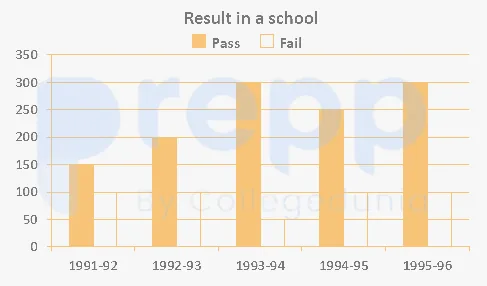
- A
1991 - 92
- B
1993 - 94
- C
1992 - 93
- D
1994 - 95
Show answer
B. 1993 - 94Given:
Concept used:
Calculate the difference in number of students who passed to those who failed and compare them to find maximum failed.
Calculation:
Difference in number of students who passed to those who failed in 1991-92 = 150 - 100 = 50
Difference in number of students who passed to those who failed in 1992-93 = 200 - 100 = 100
Difference in number of students who passed to those who failed in 1993-94 = 300 - 50 = 250
Difference in number of students who passed to those who failed in 1994-95 = 250 - 100 = 150
Therefore, the difference in number of students who passed to those who failed maximum in '1993-94'.
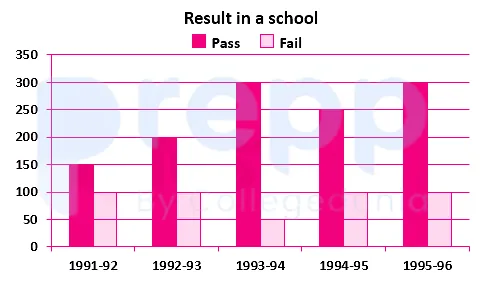 Paper & answer key PDF ↗
 Question 76archived
Select the option that expresses the given sentence in passive voice.
One should keep one’s promises.
- A
Promises should be kept.
- B
One should keep their promises.
- C
One’s promises should be kept by one.
- D
Promises should be kept by one.
Show answer
A. Promises should be kept.Understanding Active and Passive Voice
The question asks us to convert a sentence from active voice to passive voice. Let's first understand what active and passive voice mean.
Active Voice: The subject of the sentence performs the action. The structure is typically Subject + Verb + Object.
Passive Voice: The subject of the sentence receives the action. The structure is typically Object + 'be' (in appropriate form) + Past Participle of the verb + (by + Subject).
The original sentence is: "One should keep one’s promises."
In this active sentence:
Subject: One
Verb: should keep (a modal verb 'should' + base verb 'keep')
Object: one’s promises
We need to convert this to passive voice. The object ("one’s promises") becomes the subject in the passive voice, the verb is transformed, and the original subject ('one') is either included in a 'by' phrase or, more commonly, omitted when it's a general or indefinite subject like 'one', 'people', 'somebody', etc.
Converting the Sentence to Passive Voice
When converting a sentence with a modal verb (like should, could, would, will, can, may, might, must) to passive voice, the structure is:
Modal Verb + be + Past Participle of the Main Verb
Let's apply this to our sentence:
Identify the object: "one’s promises". This becomes the new subject in passive voice: "Promises".
Identify the modal verb: "should".
Identify the main verb: "keep". Its past participle is "kept".
Form the passive verb phrase using the modal structure: "should be kept".
Consider the original subject: "one". When the subject is 'one' (meaning anyone in general), the 'by one' phrase is usually omitted in the passive voice because it doesn't add specific information.
Putting it together, the passive voice sentence is: "Promises should be kept."
Analyzing the Options
Let's look at the given options and see which one matches our conversion:
Option 1: Promises should be kept.
This follows the structure: Object (Promises) + Modal Verb (should) + be + Past Participle (kept). The 'by one' is correctly omitted. This is the standard and most common way to express this sentence in passive voice.
Option 2: One should keep their promises.
This sentence is still in the active voice. The subject ('One') is performing the action ('should keep'). The possessive pronoun has changed from 'one's' to 'their', but the voice remains active.
Option 3: One’s promises should be kept by one.
This sentence is in the passive voice (Object + should be + kept + by subject). However, including 'by one' is redundant and awkward because 'one' refers to a general, unspecified person. While grammatically structured in passive voice, it's not the preferred or most natural form.
Option 4: Promises should be kept by one.
Similar to Option 3, this sentence is in passive voice but includes the unnecessary 'by one' phrase. Omitting 'by one' is standard practice when the active subject is a general pronoun like 'one'.
Based on the analysis, Option 1 is the correct and most appropriate passive voice conversion of the given sentence.
Sentence
Voice
Analysis
One should keep one’s promises.
Active
Original sentence. Subject ('One') performs the action ('should keep').
Promises should be kept.
Passive
Object ('Promises') is the subject. Uses 'should be' + past participle. 'by one' omitted as subject is general. Correct passive form.
One should keep their promises.
Active
Subject ('One') performs the action. Still active voice.
One’s promises should be kept by one.
Passive
Passive voice, but includes unnecessary 'by one' phrase. Awkward phrasing.
Promises should be kept by one.
Passive
Passive voice, but includes unnecessary 'by one' phrase. Awkward phrasing.
Revision Table: Key Points for Passive Voice with Modals
Concept
Explanation
Example
Active Structure
Subject + Modal + Base Verb + Object
One should keep promises.
Passive Structure
Object + Modal + be + Past Participle + (by Subject)
Promises should be kept (by one).
Omitting 'by Subject'
Omitted if the subject is general (one, people, somebody, nobody) or unknown.
Promises should be kept. (Preferred)
Incorrect Passive
Including unnecessary 'by subject' when the subject is general.
Promises should be kept by one. (Less preferred)
Additional Information: When to Use Passive Voice
While active voice is generally preferred for clarity and directness, passive voice is useful in certain situations:
When the doer of the action is unknown or unimportant: "The window was broken last night." (We don't know who broke it).
When you want to emphasize the action or the recipient of the action rather than the doer: "The new policy was announced yesterday." (Emphasis is on the policy and the announcement).
In scientific or technical writing, to maintain objectivity: "The samples were heated to 100°C."
To avoid blaming someone: "Mistakes were made."
In the given sentence, using the passive voice "Promises should be kept" emphasizes the importance of keeping promises rather than who exactly should keep them (as 'one' refers to anyone).
Paper & answer key PDF ↗ Question 77archived
Select the most appropriate option that can substitute the underlined segment in the given sentence. If there is no need to substitute it, select ‘No substitution’.
It was an horrible day at the office for Roy, but he didn’t allow it to spoil his evening plans.
- A
was a horrible day at the office
- B
were a horrible day at office
- C
No substitution
- D
horrible day at the office
Show answer
A. was a horrible day at the officeThe question asks us to find the most appropriate substitution for the underlined segment "was an horrible day at the office" in the sentence "It was an horrible day at the office for Roy, but he didn’t allow it to spoil his evening plans."
Let's carefully examine the underlined part: "was an horrible day at the office". The issue lies with the use of the indefinite article "an" before the word "horrible".
The choice between the indefinite articles "a" and "an" depends on the sound of the word immediately following the article. We use "a" before words that start with a consonant sound, and "an" before words that start with a vowel sound.
While "horrible" starts with the letter 'h', the 'h' is pronounced in this word (like in "house," "happy," etc.). The sound is a consonant sound. Therefore, the correct indefinite article to use before "horrible" is "a", not "an".
So, "an horrible day" is grammatically incorrect. It should be "a horrible day".
Analyzing the Substitution Options
Let's look at the given options:
was a horrible day at the office: This option changes "an horrible" to "a horrible". The verb "was" is correct for the subject "It". The phrase "at the office" is also correct. This option correctly uses the article "a" before "horrible".
were a horrible day at office: This option changes the verb "was" to "were". The subject is "It", which is singular, so the verb should be singular "was". "Were" is incorrect here. It also removes "the" before "office".
No substitution: This option suggests the original sentence is correct. However, as discussed, "an horrible day" is grammatically incorrect because "horrible" starts with a consonant sound.
horrible day at the office: This option removes the verb "was" and the article "a". The sentence would become "It horrible day at the office...", which is grammatically incomplete.
Determining the Correct Substitution
Based on our analysis of the original sentence and the options, only option 1 corrects the grammatical error regarding the article used before "horrible" while maintaining the correct subject-verb agreement and sentence structure.
The phrase should be "a horrible day" because the word "horrible" begins with a pronounced 'h', which is a consonant sound.
Therefore, the most appropriate option to substitute the underlined segment is "was a horrible day at the office".
Original Segment
Error
Correction Needed
was an horrible day at the office
Incorrect article "an" before "horrible"
Should be "a horrible day"
Revision Table: Identifying the Error
Part of Segment
Original
Correct Form
Reason
Verb
was
was
Correct subject-verb agreement with 'It'
Article + Adjective
an horrible
a horrible
'horrible' starts with a consonant sound ('h'), requiring 'a'
Noun
day
day
Correct noun
Prepositional Phrase
at the office
at the office
Correct phrase structure
Additional Information on Article Usage
The choice between 'a' and 'an' is determined by the initial sound of the word that immediately follows the article. Here are some points to remember:
Use 'a' before words starting with a consonant sound (e.g., a cat, a house, a unique idea - 'unique' starts with a 'yoo' sound).
Use 'an' before words starting with a vowel sound (e.g., an apple, an hour - 'h' is silent, an umbrella, an honest person - 'h' is silent).
Be careful with words starting with 'h'. If the 'h' is pronounced (like in horrible, house, happy), use 'a'. If the 'h' is silent (like in hour, honest, honor), use 'an'.
Be careful with words starting with vowels that have a consonant sound (like 'u' in 'university' or 'eu' in 'European', which sound like 'yoo'). Use 'a' before these words (e.g., a university, a European trip).
In this specific question, the word "horrible" starts with a pronounced 'h' sound, which is a consonant sound. Thus, "a horrible day" is the correct phrasing.
Paper & answer key PDF ↗ Question 78archived
Identify the most appropriate ANTONYM of the underlined word in the given sentence.
A balloon contracts when air is blown into it.
- A
Controls
- B
Repulses
- C
Shrinks
- D
Expands
Show answer
D. ExpandsFinding the Antonym of 'Contracts'
The question asks us to find the most appropriate antonym (a word that means the opposite) of the underlined word 'contracts' in the sentence: "A balloon contracts when air is blown into it."
First, let's understand what 'contracts' means in this context. When something contracts, it becomes smaller in size or volume, or it tightens. The sentence provided is actually incorrect in how a balloon behaves when air is blown into it. A balloon typically expands.
Now let's look at the given options and their meanings:
Controls: This means to have power over or direct the actions of something. It is not related to size or volume.
Repulses: This means to drive back or resist someone or something, or to cause aversion. It is not related to size or volume.
Shrinks: This means to become smaller in size or volume. This is a synonym of 'contracts', not an antonym.
Expands: This means to become larger in size or volume. This is the opposite of becoming smaller (contracting).
Therefore, the word that means the opposite of 'contracts' is 'expands'.
Detailed Analysis of Options
Let's break down why each option is or isn't the correct antonym for 'contracts' in the context of size/volume change:
Controls: Function/action, not size change.
Repulses: Force/feeling, not size change.
Shrinks: Decreases in size. This is a synonym of contracts, not an antonym.
Expands: Increases in size. This is the direct opposite of shrinking or contracting.
So, when something contracts, it gets smaller. When it expands, it gets larger. These are opposite actions.
Conclusion
Based on the meanings of the words, 'expands' is the most appropriate antonym for 'contracts'.
Revision Table: Understanding Antonyms
Word
Meaning (in context)
Antonym
Example Antonym Sentence
Contracts
Becomes smaller in size/volume
Expands
A balloon expands when air is blown into it.
Additional Information: Words and Their Opposites
Understanding antonyms is crucial for building vocabulary and comprehending text. Antonyms are words with opposite meanings. Identifying antonyms helps clarify the meaning of the original word by showing what it is not.
Examples of common antonym pairs:
Hot - Cold
Big - Small
Up - Down
Fast - Slow
Happy - Sad
Sometimes a word can have different antonyms depending on the specific meaning used. For example, 'contract' can also mean a formal agreement (antonym could be 'break' or 'cancel'), but in the context of size, its antonym is 'expand'. Always consider the context of the sentence when identifying antonyms.
Paper & answer key PDF ↗ Question 79archived
Select the most appropriate synonym of the given word.
Empty
- A
Priceless
- B
Vacant
- C
Packed
- D
Filled
Show answer
B. VacantFinding the Best Synonym for Empty
The question asks us to select the most appropriate synonym for the word "Empty" from the given options. A synonym is a word that has the same or nearly the same meaning as another word.
Let's analyze the meaning of the word "Empty" and then examine each option.
Meaning of Empty
The word Empty typically means containing nothing; not filled or occupied. For example, an empty box has nothing inside, and an empty room has no furniture or people.
Analyzing the Options
We need to find the word among the options that is closest in meaning to "Empty".
Priceless: This means extremely valuable or precious. It has no relation to something being empty or filled.
Vacant: This means not filled, used, or occupied; empty. For example, a vacant seat is an empty seat, and a vacant position is an unfilled job role. This word is very close in meaning to "Empty".
Packed: This means filled with many things, especially in a confined space, or crowded with people. This is the opposite of "Empty".
Filled: This means full, or containing as much or as many as possible. This is also the opposite of "Empty".
Comparing the meanings, we can see that "Vacant" is the word that is most similar in meaning to "Empty".
Word
Meaning Related to "Empty"
Relationship to "Empty"
Empty
Containing nothing; not filled or occupied.
Base word
Priceless
Extremely valuable.
Unrelated
Vacant
Not filled, used, or occupied; empty.
Synonym
Packed
Filled tightly; crowded.
Antonym
Filled
Containing as much or as many as possible; full.
Antonym
Conclusion: Identifying the Synonym
Based on the analysis, "Vacant" is the only option that shares a similar meaning with "Empty". The other options are either unrelated or antonyms (opposites) of "Empty".
Revision Table: Key Vocabulary
Word
Meaning
Example Usage
Empty
Containing nothing; not filled or occupied.
The glass was empty.
Vacant
Not filled, used, or occupied.
The house has been vacant for a year.
Priceless
Extremely valuable; beyond price.
That painting is priceless.
Packed
Filled tightly; crowded.
The train was packed with commuters.
Filled
Containing as much or as many as possible; full.
She filled the bottle with water.
Additional Information: Expanding Vocabulary
Understanding synonyms and antonyms is crucial for building a strong vocabulary and improving language skills. Synonyms help you express yourself with variety and precision, while antonyms help clarify meanings by providing contrast.
Here are a few more words related to the concept of "Empty" or "Full":
Synonyms for Empty: Unoccupied, void, hollow, barren, deserted.
Antonyms for Empty: Full, occupied, crowded, complete, abundant.
Learning words in groups (synonyms, antonyms, related concepts) can make vocabulary acquisition more effective.
Paper & answer key PDF ↗ Question 80archived
Select the most appropriate synonym of the given word.
Wavering
- A
Sickly
- B
Drenching
- C
Fluctuating
- D
Unconvincing
Show answer
C. FluctuatingUnderstanding the Word "Wavering" and its Synonyms
The question asks for the most appropriate synonym for the word "Wavering". To answer this, we need to understand the meaning of "Wavering" and compare it with the meanings of the given options.
The word Wavering typically means:
Hesitating or feeling undecided.
Shaking with a slight side-to-side motion.
Becoming unsteady or unreliable.
Changing or fluctuating between states, opinions, or directions.
Let's look at the options provided:
Sickly: This relates to being ill or unhealthy. It has no connection to the meaning of wavering.
Drenching: This means soaking thoroughly with liquid. It is irrelevant to the meaning of wavering.
Fluctuating: This means rising and falling irregularly in number or amount, or changing irregularly. This meaning strongly aligns with the idea of something that is not steady, is changing, or is undecided, which are key aspects of wavering.
Unconvincing: This means not capable of causing someone to believe that something is true or probable. While someone who is wavering might seem unconvincing, the word "unconvincing" itself describes the *effect* or *perception* rather than the *act* or *state* of wavering. Fluctuating is a more direct synonym for the sense of changing or being unsteady.
Comparing the options, "Fluctuating" is the closest synonym for "Wavering", especially in the sense of changing or being unsteady.
Why Fluctuating is the Best Synonym for Wavering
When something is wavering, it is often moving back and forth, or changing its position, state, or opinion. This is precisely what happens when something is fluctuating. For example:
A wavering flame moves back and forth.
Wavering support for a policy changes over time.
Wavering confidence goes up and down.
In all these cases, "fluctuating" can be used as a synonym. A fluctuating flame, fluctuating support, or fluctuating confidence all describe the same instability or change depicted by "wavering".
Definitions of the Options
Word
Definition
Wavering
Hesitating, undecided, changing, unsteady, fluctuating.
Sickly
In poor health; weak or faint.
Drenching
Soaking completely with liquid.
Fluctuating
Rising and falling irregularly; changing or varying.
Unconvincing
Not believable or persuasive.
Based on these definitions, "Fluctuating" is the most appropriate synonym for "Wavering".
Revision Table: Understanding Vocabulary
Word
Core Meaning
Relationship to Wavering
Wavering
Unsteady, changing, undecided
The target word
Sickly
Illness
No relation
Drenching
Soaking wet
No relation
Fluctuating
Changing irregularly
Strong synonym
Unconvincing
Not believable
Indirect relation (might be a result)
Additional Information on Synonyms and Vocabulary Building
Understanding synonyms is a key part of building strong vocabulary. Synonyms are words that have similar meanings. However, they may not always be perfectly interchangeable, as they can have different nuances or be used in different contexts.
To improve your vocabulary and synonym knowledge:
Read widely from different sources.
Look up words you don't know and note down their meanings and synonyms.
Use new words and their synonyms in your writing and speaking.
Use a thesaurus, but be careful to understand the context in which a synonym can be used.
Practice answering synonym questions.
In the case of "Wavering", while "fluctuating" is the best fit among the options provided, other synonyms depending on the context could include "hesitating", "oscillating", "swaying", or "undecided".
Paper & answer key PDF ↗ Question 81archived
Select the most appropriate collocation to substitute the underlined word in the given sentence.
The MNC is about to be bankrupt, according to reliable sources.
- A
take bankrupt
- B
go bankrupt
- C
come bankrupt
- D
give bankrupt
Show answer
B. go bankruptUnderstanding Collocations: The Case of 'Bankrupt'
This question asks us to find the most suitable word to combine with 'bankrupt' in the sentence "The MNC is about to be bankrupt, according to reliable sources." This concept is known as understanding collocations.
A collocation is a pair or group of words that are habitually used together by native speakers. The combination sounds 'right' and natural, whereas other combinations, though possibly grammatically correct, may sound unnatural or awkward.
Analysing the Sentence and Underlined Phrase
The original sentence is: "The MNC is about to be bankrupt, according to reliable sources." The underlined part is 'be bankrupt'. We need to find a different verb that typically collocates with 'bankrupt' in this context, meaning the company is on the verge of failing financially.
Evaluating the Options for Collocating with 'Bankrupt'
Let's look at the options provided:
take bankrupt
go bankrupt
come bankrupt
give bankrupt
We need to consider which verb naturally precedes 'bankrupt' when describing the state of becoming financially ruined.
Take bankrupt: This combination is not a standard English collocation. You might 'take' action or 'take control', but you don't 'take bankrupt'.
Go bankrupt: This is a very common and standard collocation in English. 'Go bankrupt' means to become legally unable to pay your debts; to become financially ruined. For example, "Many small businesses go bankrupt during a recession."
Come bankrupt: While 'come' can be used with some states (e.g., 'come alive', 'come true'), 'come bankrupt' is not a standard or natural-sounding collocation.
Give bankrupt: This combination does not make sense in standard English. You might 'give' money or 'give' notice, but you don't 'give bankrupt'.
Based on standard English usage, the verb that correctly describes the process of becoming bankrupt is 'go'. Therefore, 'go bankrupt' is the appropriate collocation.
Determining the Correct Substitution
The sentence states the MNC is "about to be bankrupt". The options provide alternative verbs to use with 'bankrupt'. The phrase 'is about to be bankrupt' means the company is on the verge of becoming bankrupt. The correct collocation for becoming bankrupt is 'go bankrupt'. Therefore, substituting 'be bankrupt' with 'go bankrupt' fits the meaning and uses a natural English phrase.
The most appropriate collocation to substitute the underlined word 'be bankrupt' is 'go bankrupt'.
Collocation Analysis for 'Bankrupt'
Option
Collocation?
Notes
take bankrupt
No
Not a standard English phrase.
go bankrupt
Yes
Standard collocation meaning 'to become bankrupt'.
come bankrupt
No
Not a standard English phrase.
give bankrupt
No
Not a standard English phrase.
Revision Table: Key Collocations
Common Collocations with Verbs of Change
Verb
Common Collocations
Meaning
Go
go bankrupt, go mad, go blind, go grey, go bad (food)
Often used for changes to a worse state or condition.
Become
become rich, become famous, become a doctor, become clear
Used for more general changes, often formal.
Get
get married, get angry, get cold, get tired, get better
Used for changes in state, often informal.
Additional Information: More Business Collocations
Collocations are crucial for sounding natural in English. Here are a few other common business-related collocations:
Launch a product
Meet a deadline
Sign a contract
Make a profit
Lose money
Raise capital
conduct a meeting
Draw up a plan
Learning collocations helps improve fluency and accuracy in English.
Paper & answer key PDF ↗ Question 82archived
In the given sentence, one word may have been incorrectly spelt. Select the correctly spelt word from the given alternatives. If there is no error, select ‘No error’ as your answer.
The staff members were attempting to manoeuvre the board of directors for the abolition of pay disparity
- A
manouever
- B
maneouver
- C
manouvre
- D
No error
Show answer
D. No errorUnderstanding Spelling Errors in English
The question asks us to identify if there is a spelling error in the given sentence and, if so, select the correct spelling from the provided options. If there is no error, we should select 'No error'.
Let's look at the sentence provided:
"The staff members were attempting to manoeuvre the board of directors for the abolition of pay disparity"
We need to examine each word to check for potential misspellings. The word that is likely being tested here, based on the options, is "manoeuvre".
Analyzing the Word 'Manoeuvre'
The word "manoeuvre" refers to a movement or series of moves requiring skill and care, or a carefully planned scheme or action, typically one involving deception. In the context of the sentence, it means the staff members were trying to influence or skillfully direct the board of directors.
The spelling of this word can vary slightly depending on whether British English or American English is used:
British English: manoeuvre
American English: maneuver
Both spellings are considered correct in their respective dialects.
The sentence uses the spelling "manoeuvre". This is the standard British English spelling.
Evaluating the Provided Options
Let's compare the provided options to the word in the sentence and the standard spellings:
Option
Spelling
Analysis
1
manouever
Incorrect spelling. It has an extra 'e' after 'ou'.
2
maneouver
Incorrect spelling. The 'oeu' sequence is incorrect.
3
manouvre
Incorrect spelling. It is missing the 'e' after 'uvr'.
4
No error
Indicates that the word in the sentence is correctly spelt.
The options present variations of the word "manoeuvre". Comparing these options to the word "manoeuvre" used in the sentence:
The spelling "manouever" is not a standard spelling.
The spelling "maneouver" is not a standard spelling.
The spelling "manouvre" is not a standard spelling.
The word used in the sentence is "manoeuvre". As discussed earlier, "manoeuvre" is the correct spelling in British English. Therefore, the word in the sentence is correctly spelt.
Conclusion on Spelling Error
Since the word "manoeuvre" is correctly spelt in the sentence according to standard British English, there is no spelling error in the sentence.
Therefore, the correct answer is 'No error'.
Revision Table: Common Spelling Variations
Word
British English Spelling
American English Spelling
Manoeuvre/Maneuver
manoeuvre
maneuver
Colour/Color
colour
color
Centre/Center
centre
center
Defence/Defense
defence
defense
Additional Information: Understanding Dialectal Differences
English has different standard dialects, primarily British English and American English. These dialects often have variations in spelling, vocabulary, and pronunciation. When checking for spelling errors, it's important to consider which dialect is being used or expected.
In many international exams or contexts, either British or American spelling is accepted, or the specific dialect expected is mentioned. If the context doesn't specify, standard spellings from either major dialect are usually considered correct.
The word "manoeuvre" (British English) and "maneuver" (American English) both mean the same thing. Recognizing these differences is key to correctly identifying spelling errors.
Paper & answer key PDF ↗ Question 83archived
Select the correct active form of the given sentence.
Her wooden almirah has been destroyed by the termites.
- A
The termites destroyed her wooden almirah.
- B
The termites could destroy her wooden almirah.
- C
The termites had destroyed her wooden almirah.
- D
The termites have destroyed her wooden almirah.
Show answer
D. The termites have destroyed her wooden almirah.Understanding Voice Conversion: Passive to Active
The question asks us to convert a sentence from the passive voice to the active voice while maintaining the original meaning and tense.
Analyzing the Given Passive Sentence
The sentence provided is: "Her wooden almirah has been destroyed by the termites."
Let's break down this sentence:
Subject: Her wooden almirah (the thing being acted upon)
Verb Phrase: has been destroyed (Passive voice, Present Perfect tense)
Agent: the termites (the entity performing the action)
The structure follows the pattern for the Present Perfect Passive voice: Subject + has/have + been + Past Participle (V3) + by + Agent.
Converting to Active Voice
To convert a passive sentence to active voice, we follow these steps:
Make the agent of the passive sentence the subject of the active sentence.
Remove 'by'.
Change the verb form from passive to active while keeping the tense the same. The structure for Present Perfect Active is: Subject + has/have + Past Participle (V3) + Object.
Make the subject of the passive sentence the object of the active sentence.
Applying these steps to our sentence:
New Subject (from Agent): The termites
Original Verb (destroy) in Present Perfect Active: Since "termites" is plural, we use "have". The past participle of 'destroy' is 'destroyed'. So, the verb phrase is "have destroyed".
New Object (from Original Subject): her wooden almirah
Combining these parts, the active sentence becomes: "The termites have destroyed her wooden almirah."
Evaluating the Options
Let's examine each given option based on our conversion rules:
Option 1: The termites destroyed her wooden almirah.
Analysis: The verb "destroyed" is in the Simple Past tense. The original sentence is in the Present Perfect tense. This option changes the tense, so it is incorrect.
Option 2: The termites could destroy her wooden almirah.
Analysis: This sentence uses a modal verb "could", which expresses possibility or ability, not a completed action in the Present Perfect tense. This option changes the meaning and tense, so it is incorrect.
Option 3: The termites had destroyed her wooden almirah.
Analysis: The verb "had destroyed" is in the Past Perfect tense. The original sentence is in the Present Perfect tense. This option changes the tense, so it is incorrect.
Option 4: The termites have destroyed her wooden almirah.
Analysis: The verb "have destroyed" is in the Present Perfect tense. The subject "The termites" is the agent from the passive sentence, and the object "her wooden almirah" is the subject from the passive sentence. This sentence correctly converts the passive voice sentence to active voice while keeping the Present Perfect tense. This option is correct.
Correct Active Voice Sentence
Based on our analysis, the correct active form of the sentence "Her wooden almirah has been destroyed by the termites" is "The termites have destroyed her wooden almirah."
Revision Table: Active vs. Passive Voice
Feature
Active Voice
Passive Voice
Focus
The doer of the action (Subject)
The receiver of the action (Subject)
Structure (General)
Subject + Verb + Object
Object + be + Past Participle (+ by + Subject)
Structure (Present Perfect)
Subject + have/has + V3 + Object
Object + have/has + been + V3 (+ by + Subject)
Example (from question)
The termites have destroyed her wooden almirah.
Her wooden almirah has been destroyed by the termites.
Additional Information on Voice Conversion
Understanding active and passive voice is key to clear communication. Active voice is generally more direct and concise, while passive voice is useful when the action is more important than the doer, or when the doer is unknown or irrelevant.
When converting from passive to active, always identify the agent (the doer) if present. This becomes the new subject.
The tense of the verb must remain consistent during the conversion. Pay close attention to the auxiliary verbs used in the passive form (like 'is', 'are', 'was', 'were', 'be', 'being', 'been') to determine the original tense.
The original subject of the passive sentence becomes the object of the active sentence.
Some passive sentences do not mention the agent (e.g., "The window was broken"). In such cases, when converting to active, you might need to introduce a generic subject like "Someone" or "They" if the doer is unknown.
Paper & answer key PDF ↗ Question 84archived
Choose the correct meaning of the given idiom.
Down the tubes
- A
Minting money
- B
Failing completely
- C
Being informal
- D
Going to swim
Show answer
B. Failing completelyUnderstanding the Idiom: Down the Tubes
Idioms are phrases where the meaning isn't obvious from the individual words. They add color and expressiveness to language. The idiom "Down the tubes" is commonly used in English.
Let's explore the meaning of "Down the tubes". This idiom is used to describe something that is deteriorating rapidly, failing completely, or being ruined. Imagine something flowing down a drainpipe or tube; it's gone, lost, or heading towards destruction.
Analyzing the Options for 'Down the Tubes'
We are given four options for the meaning of the idiom "Down the tubes". Let's examine each one:
Option 1: Minting money - This means making a lot of money, which is the opposite of failing.
Option 2: Failing completely - This implies something is going wrong, deteriorating, or being ruined. This aligns with the negative connotation of "Down the tubes".
Option 3: Being informal - This refers to a casual style or manner, which is unrelated to the state of success or failure.
Option 4: Going to swim - This is a literal interpretation of "tubes" (like inner tubes for swimming) and is not the idiomatic meaning. Idioms have figurative meanings, not literal ones.
Why 'Failing Completely' is the Correct Meaning
Based on the common usage and understanding of the idiom "Down the tubes", it signifies a state of total failure, ruin, or decline. When a business, project, or situation is said to be "going down the tubes", it means it is failing disastrously and is likely beyond saving.
Let's consider an example:
"After they lost their biggest client, the company started going down the tubes."
In this sentence, "going down the tubes" clearly indicates that the company is failing completely after a major setback.
Comparison with Other Options
Comparing "Failing completely" with the other options:
Option
Meaning
Relevance to "Down the Tubes"
Minting money
Making a lot of money
Opposite meaning
Failing completely
Becoming ruined or unsuccessful
Correct meaning
Being informal
Casual or relaxed
Unrelated meaning
Going to swim
Engaging in swimming
Literal interpretation (incorrect)
As the table shows, only "Failing completely" captures the sense of ruin or collapse implied by the idiom "Down the tubes".
Conclusion on 'Down the Tubes' Meaning
Therefore, the correct meaning of the idiom "Down the tubes" is Failing completely. This idiom is a useful way to express the idea that something is in a state of irreversible decline or ruin.
Revision Table: Understanding Idioms
Idiom
Meaning
Example Usage
Down the tubes
Failing completely; being ruined
"Without funding, the project went down the tubes."
Break a leg
Good luck (used especially before a performance)
"You have a big test tomorrow. Break a leg!"
Piece of cake
Something very easy to do
"The math problem was a piece of cake."
Additional Information on English Idioms
Idioms are an important part of mastering English. They often don't follow standard grammatical rules and their meanings are figurative, not literal. Learning common idioms helps in understanding native speakers and makes your own language more natural and expressive.
Idioms often originate from specific historical contexts, activities, or observations.
Using idioms correctly requires understanding their cultural context and specific meaning.
Practicing with idioms in sentences helps reinforce their meaning and usage.
Many idioms have synonyms or similar expressions. For "down the tubes", phrases like "going to ruin", "collapsing", or "falling apart" have similar meanings.
Mastering idioms like "Down the tubes" enhances your English proficiency and performance in language tests.
Paper & answer key PDF ↗ Question 85archived
Rearrange the parts of the sentence in correct order.
The researchers
P. decision centers called the orbitofrontal
Q. analyzed the electrical activity recorded
R. cortex and dorsal anterior cingulate cortex
S. from neurons in two of the brain's
- A
QSPR
- B
RSPQ
- C
RPQS
- D
PQSR
Show answer
A. QSPRObjective: Sentence Part Rearrangement
The goal is to correctly arrange the given segments of a sentence to form a coherent statement. The sentence is broken down into four parts:
P: The researchers
Q: decision centers called the orbitofrontal
R: analyzed the electrical activity recorded
S: cortex and dorsal anterior cingulate cortex from neurons in two of the brain's
Determining the Correct Sequence: QSPR
Based on the provided options, the correct order to rearrange these segments is QSPR.
Assembling the sentence in this specific order:
Starting with Q: decision centers called the orbitofrontal
Followed by S: cortex and dorsal anterior cingulate cortex from neurons in two of the brain's
Then P: The researchers
Finally R: analyzed the electrical activity recorded
This results in the following sentence structure:
"decision centers called the orbitofrontal cortex and dorsal anterior cingulate cortex from neurons in two of the brain's The researchers analyzed the electrical activity recorded."
Structure Breakdown of the QSPR Sentence
The QSPR sequence organizes the information by first presenting the subjects of study and then the action taken.
The phrase formed by Q and S ("decision centers called the orbitofrontal cortex and dorsal anterior cingulate cortex from neurons in two of the brain's") identifies the specific areas of the brain and the source of the data (neurons).
The phrase formed by P and R ("The researchers analyzed the electrical activity recorded") identifies who performed the analysis and what they analyzed.
This structure emphasizes the neural correlates studied. Important keywords involved are researchers, electrical activity, neurons, and key brain regions like the orbitofrontal cortex and dorsal anterior cingulate cortex, which are described as decision centers.
Paper & answer key PDF ↗ Question 86archived
Select the appropriate adverb for the underlined word in the sentence.
We considered in brief the long term solution to the problem.
- A
briefly
- B
briefless
- C
brief
- D
briefness
Show answer
A. brieflyFinding the Right Adverb for 'Considered'
The question asks us to select an appropriate adverb to replace the phrase "in brief" in the sentence: "We considered in brief the long term solution to the problem." We need an adverb that can effectively modify the verb "considered," indicating how the consideration took place.
Understanding Adverbs
Adverbs are words that modify verbs, adjectives, other adverbs, or sometimes entire sentences. They often answer questions like how, when, where, or to what extent something is done.
Adverbs modifying verbs typically describe the manner, time, or place of the action.
Examples: quickly (manner), yesterday (time), here (place).
Analyzing the Sentence: "We considered in brief the long term solution..."
In this sentence, "considered" is the verb. The phrase "in brief" functions like an adverbial phrase, telling us *how* the solution was considered. It means the consideration was done in a concise or short manner.
We are looking for a single adverb that can convey this meaning and grammatically fit into the sentence to modify "considered".
Evaluating the Options for Adverbial Modification
Let's look at the given options and determine if they are suitable adverbs that can replace "in brief" and modify the verb "considered":
briefly: This word is an adverb. It means "for a short time" or "in a few words; concisely". This meaning aligns perfectly with the original phrase "in brief" and can modify the verb "considered" to indicate the manner of consideration (done concisely or for a short time).
briefless: This word is an adjective. It typically describes a barrister who has no 'briefs' or cases. It cannot function as an adverb modifying a verb like "considered".
brief: This word is commonly used as an adjective (meaning short in duration or extent) or a noun (like a summary or instructions). It cannot function as an adverb modifying "considered" in this context. While "in brief" is an adverbial phrase derived from "brief", "brief" alone is not an adverb here.
briefness: This word is a noun, meaning the quality of being brief. Nouns cannot modify verbs.
Based on the analysis, the only option that is an adverb and accurately replaces the meaning and function of "in brief" to modify the verb "considered" is "briefly".
Selecting the Appropriate Adverb
Replacing "in brief" with "briefly", the sentence becomes: "We considered briefly the long term solution to the problem." This sentence is grammatically correct and retains the intended meaning.
Therefore, the appropriate adverb is "briefly".
Option
Word Type
Meaning/Function
Suitable as Adverb for 'Considered'?
briefly
Adverb
For a short time; concisely
Yes
briefless
Adjective
Having no briefs (cases)
No
brief
Adjective/Noun
Short; summary
No (not as adverb here)
briefness
Noun
Quality of being brief
No
Revision Table: Adverb Replacement
This table summarizes why 'briefly' is the correct choice for replacing 'in brief' when modifying the verb 'considered'.
Additional Information: Adverbs and Adverbial Phrases
Adverbial phrases are groups of two or more words that function like an adverb, modifying a verb, adjective, or other adverb. "In brief" is an example of an adverbial phrase. Many adverbial phrases can be replaced by a single adverb that carries a similar meaning.
Example Adverbial Phrase: He spoke in a loud voice.
Equivalent Adverb: He spoke loudly.
Example Adverbial Phrase: She arrived at noon.
Equivalent Adverb: She arrived then.
Understanding the function of phrases and how they can sometimes be replaced by single words (like adverbs) is important for improving sentence conciseness and variety.
Paper & answer key PDF ↗ Question 87archived
Select the most appropriate option that can substitute the underlined segment in the given sentence.
My uncle is a colonel who gets extremely angry over petty issues every now and then.
- A
furious
- B
fierce
- C
heated
- D
violent
Show answer
A. furiousThe question asks us to find the most suitable word from the given options to replace the underlined phrase "gets extremely angry" in the sentence: "My uncle is a colonel who gets extremely angry over petty issues every now and then."
We need to analyze the meaning of the phrase "gets extremely angry" and compare it with the meanings of the words provided in the options.
The phrase "gets extremely angry" describes a state of intense anger. Let's look at the options:
Analyzing Option 1: Furious
The word "furious" means extremely angry. This word directly conveys the idea of being very angry, which matches the meaning of "gets extremely angry".
Analyzing Option 2: Fierce
The word "fierce" typically describes something that is wild, violent, or intense in nature, often associated with animals or emotions like determination. While anger can be intense, "fierce" is not the most direct synonym for "extremely angry" when describing a person's emotional state in this context.
Analyzing Option 3: Heated
The word "heated" can describe a discussion or argument that is passionate or angry. It can also describe a person becoming angry or excited. However, "heated" often suggests a temporary state or a specific interaction, and might not fully capture the intensity implied by "extremely angry" in general behaviour.
Analyzing Option 4: Violent
The word "violent" describes behavior involving physical force intended to hurt, damage, or kill someone or something. While extreme anger can sometimes lead to violent behaviour, "violent" itself describes the action, not just the emotion of being extremely angry. The sentence describes the uncle's emotion ("gets extremely angry"), not necessarily that he becomes physically violent.
Comparing the Options
Let's compare how each option fits the meaning of "gets extremely angry":
Word
Meaning
Fit with "gets extremely angry"
Furious
Extremely angry
Strong fit. Directly describes intense anger.
Fierce
Wild, intense, sometimes violent in nature/emotion
Less direct fit. More about intensity/nature than the specific state of extreme anger in a person.
Heated
Passionate, angry, excited (often in arguments/discussions)
Partial fit. Can imply anger, but might not always mean *extremely* angry and is often context-specific.
Violent
Using physical force to harm
Poor fit. Describes action, not the emotion itself.
Based on the analysis, "furious" is the most appropriate word to substitute "gets extremely angry" as it accurately conveys the meaning of being intensely or extremely angry.
Revision Table: Understanding Anger Synonyms
Here is a quick look at some words related to anger and their general intensity:
Annoyed: Mild irritation.
Angry: A strong feeling of displeasure.
Irritated: Feeling slight anger; impatient or angry.
Enraged: Made very angry; filled with rage.
Furious: Extremely angry.
Incensed: Very angry; enraged.
Wrathful: Full of intense anger.
"Extremely angry" aligns best with words like furious, enraged, incensed, and wrathful.
Additional Information: Context is Key
When choosing the best word to substitute a phrase, especially involving emotions, it's important to consider the context of the sentence. In this sentence, the phrase describes the uncle's general tendency to react strongly to minor issues. "Furious" fits this description well because it highlights the intensity of his anger.
Understanding the nuances between similar words is crucial for improving vocabulary and sentence construction. For example, while someone might have a "fierce" temper, saying they "get fierce" over petty issues isn't as common or precise as saying they "get furious". Similarly, while an argument might get "heated", a person's emotional state over minor issues is better described with words like "angry" or "furious".
Paper & answer key PDF ↗ Question 88archived
Select the correct direct form of the given sentence.
Rohan asked me if Rohit still cried.
- A
Rohan said to me, “Did Rohit still cry?”
- B
Rohan says to me, “Does Rohit still cry?”
- C
Rohan said to me, “Does Rohit still cry?”
- D
Rohan said to me, “Has Rohit still cried?”
Show answer
C. Rohan said to me, “Does Rohit still cry?”Understanding Indirect to Direct Speech Conversion
Converting a sentence from indirect speech back to its direct form requires careful attention to reporting verbs, conjunctions, pronouns, and tense changes. The given sentence is in indirect speech, and we need to find the original direct speech question.
The given indirect speech sentence is: Rohan asked me if Rohit still cried.
Analyzing the Indirect Speech Sentence
Let's break down the indirect speech sentence:
Reporting Clause: "Rohan asked me"
Conjunction: "if"
Reported Clause: "Rohit still cried"
The reporting verb "asked" indicates that the original direct speech was a question. The presence of the conjunction "if" tells us it was a 'yes/no' question.
The verb in the reported clause is "cried," which is in the Past Simple tense. When converting from direct to indirect speech with a past reporting verb ("asked"), the tense of the verb in the reported clause usually shifts backward. Therefore, the original direct speech verb must have been in a tense that changes to Past Simple when reported with a past tense verb.
Identifying the Correct Direct Speech Tense
Let's consider the possible original tenses in direct speech that would result in Past Simple ("cried") in indirect speech:
Present Simple: A Present Simple verb in direct speech changes to Past Simple in indirect speech (e.g., "Does he cry?" → "if he cried").
Past Simple: A Past Simple verb in direct speech typically changes to Past Perfect in indirect speech, but it can sometimes remain Past Simple, especially in certain contexts (e.g., "Did he cry?" → "if he had cried" or "if he cried").
Present Perfect: A Present Perfect verb in direct speech changes to Past Perfect in indirect speech (e.g., "Has he cried?" → "if he had cried").
Given the options, we need to find the direct speech question that correctly transforms into "if Rohit still cried" when the reporting verb is "said" (which becomes "asked" in indirect speech for a question).
Evaluating the Options for Direct Speech
Let's look at the provided options:
Rohan said to me, “Did Rohit still cry?”
Direct speech verb: "Did... cry" (Past Simple).
Indirect conversion: "Rohan asked me if Rohit still cried" or typically "Rohan asked me if Rohit had still cried". While "cried" is possible, "had cried" is the standard backshift from Past Simple.
Rohan says to me, “Does Rohit still cry?”
Reporting verb: "says" (Present tense). This does not match the past tense reporting verb "asked" in the original indirect sentence.
Rohan said to me, “Does Rohit still cry?”
Reporting verb: "said to me" (Past tense, correct for "asked me").
Direct speech verb: "Does... cry" (Present Simple).
Indirect conversion: With the past reporting verb "said", the Present Simple "Does Rohit still cry?" correctly changes to Past Simple "Rohit still cried". Thus, "Rohan said to me, “Does Rohit still cry?”" becomes "Rohan asked me if Rohit still cried." This matches the given indirect sentence exactly.
Rohan said to me, “Has Rohit still cried?”
Reporting verb: "said to me" (Past tense, correct for "asked me").
Direct speech verb: "Has... cried" (Present Perfect).
Indirect conversion: With the past reporting verb "said", the Present Perfect "Has Rohit still cried?" correctly changes to Past Perfect "Rohit had still cried". This does not match the given indirect sentence "Rohit still cried".
Based on the standard rules of tense backshift from direct to indirect speech, the Present Simple question "Does Rohit still cry?" is the direct form that converts to "Rohit still cried" when the reporting verb is in the past tense ("said" which becomes "asked").
Conclusion: The Correct Direct Form
Comparing the conversion results with the given indirect sentence, Option 3 is the only one that correctly transforms into "Rohan asked me if Rohit still cried." The Present Simple question "Does Rohit still cry?" correctly becomes a Past Simple statement "Rohit still cried" in the reported clause when the reporting verb is in the past.
The correct direct form of the sentence "Rohan asked me if Rohit still cried" is "Rohan said to me, “Does Rohit still cry?”"
Revision Table: Direct and Indirect Speech Changes
Aspect
Direct Speech (Question)
Indirect Speech (Reported Question)
Reporting Verb
Said to (Person)
Asked (Person)
Sentence Type
Question (?)
Statement (.) introduced by 'if'/'whether'
Conjunction
None (Starts with Aux/Wh-word)
If / Whether (for Yes/No questions)
Tense Change (Common Backshift)
Present Simple (Does/Do + Base Verb)
Past Simple (Verb + ed / Irregular form)
Example Verb
Does Rohit still cry?
Rohit still cried.
Additional Information: More on Narration Change
Narration change involves converting speech from direct to indirect form and vice versa. Key elements that change include the reporting verb, conjunctions, pronouns, adverbs of time and place, and verb tenses. The tense changes, also known as backshift, occur when the reporting verb is in the past tense.
Statements: Introduced by 'that' in indirect speech. 'Said to' changes to 'told'.
Commands/Requests: The verb changes to an infinitive (to + base verb). 'Said to' changes to 'ordered', 'requested', 'advised', etc.
Wh-Questions: Introduced by the Wh-word (what, where, why, how, etc.) in indirect speech.
Understanding these rules is crucial for accurate sentence transformations.
Paper & answer key PDF ↗ Question 89archived
Select the INCORRECTLY spelt word in the following sentence.
In the coming millenium, some noticeable technological advancements will be accomplished.
- A
noticeable
- B
technological
- C
advancements
- D
millenium
Show answer
D. milleniumFinding the Incorrectly Spelt Word
The question asks us to identify the word that is spelt incorrectly in the given sentence: "In the coming millenium, some noticeable technological advancements will be accomplished." To do this, we need to carefully examine the spelling of each word in the sentence and compare it to the correct spelling.
Analyzing Sentence Words and Spellings
Let's look at the potential words that might be incorrectly spelt, as suggested by the options provided:
noticeable: This word means easy to see or recognize. Its spelling is correct with the 'e' retained before the suffix '-able'.
technological: This word relates to technology. Its spelling is correct.
advancements: This refers to progress or improvements. Its spelling is correct.
millenium: This word refers to a period of one thousand years. Let's check its spelling.
Identifying the Incorrect Spelling: Millenium vs. Millennium
The spelling of the word referring to a thousand-year period is often confused. The correct spelling is millennium, with a double 'n'. The sentence uses the spelling 'millenium', which has only one 'n'.
Therefore, the word millenium is the incorrectly spelt word in the sentence.
Correcting the Word
The sentence, with the corrected spelling, would be:
"In the coming millennium, some noticeable technological advancements will be accomplished."
Common Spelling Errors
Spelling errors involving double consonants are quite common. Words like 'millennium' (double n), 'committee' (double m, double t, double e), and 'occurrence' (double c, double r) often cause confusion.
Correcting the Spelling
Incorrect Spelling
Correct Spelling
Word Type
millenium
millennium
Noun
Revision Table: Spelling Check
Spelling Analysis
Word from Sentence
Is Spelling Correct?
Notes
coming
Yes
millenium
No
Should be millennium (double n)
some
Yes
noticeable
Yes
technological
Yes
advancements
Yes
will
Yes
be
Yes
accomplished
Yes
Additional Information on Millennium and Advancements
The word 'millennium' is derived from Latin, where 'mille' means thousand and 'annus' means year. The doubling of the 'n' is retained in the English spelling.
The sentence discusses 'technological advancements' expected in the 'millennium'. This highlights how technology is constantly evolving, leading to significant progress over long periods.
Understanding common root words and suffix rules can help improve spelling accuracy. For example, knowing that 'noticeable' comes from 'notice' and retains the 'e' helps avoid misspelling it as 'noticable'.
Paper & answer key PDF ↗ Question 90archived
Select the most appropriate option to fill in the blank.
APJ Abdul Kalam’s house, located on Mosque Street was within the reach of the famous temple of Rameswaram. It was just ________ from it.
- A
a stone’s throw away
- B
at one’s fingertip
- C
at arm’s length
- D
from pillar to post
Show answer
A. a stone’s throw awayUnderstanding the Distance: APJ Abdul Kalam's House and Rameswaram Temple
The question describes the location of APJ Abdul Kalam’s house on Mosque Street relative to the famous temple of Rameswaram. It asks for the most appropriate idiom to describe the short distance between them. We need to select an idiom that means 'very close' or 'within easy reach'.
Analyzing the Idioms Provided in the Options
Let's look at the meaning of each idiom:
Option 1: a stone’s throw away
This idiom means a very short distance away. Imagine how far you can throw a stone – not very far at all. So, if something is a stone's throw away, it is quite close.
Option 2: at one’s fingertip
This idiom usually refers to something being readily available or accessible, often information or resources that can be found or used easily, like information on the internet being at your fingertips.
Option 3: at arm’s length
This idiom means keeping something or someone at a distance, either physically or figuratively, to avoid getting too involved or to maintain personal space.
Option 4: from pillar to post
This idiom means moving from one place to another repeatedly, often in a difficult or unsuccessful search or effort.
Selecting the Most Appropriate Idiom
The context states that APJ Abdul Kalam’s house was "within the reach of the famous temple of Rameswaram" and was "just ________ from it". We are looking for an idiom that signifies a very short physical distance.
Comparing the meanings:
"a stone’s throw away" accurately describes a very short physical distance.
"at one’s fingertip" relates to accessibility, not physical distance.
"at arm’s length" relates to keeping distance, the opposite of being close.
"from pillar to post" describes movement or searching, not the distance between two fixed points.
Therefore, "a stone’s throw away" is the most fitting idiom to describe the short distance between APJ Abdul Kalam's house on Mosque Street and the Rameswaram temple.
Conclusion
Based on the analysis of the idioms, the blank should be filled with "a stone’s throw away" to indicate that APJ Abdul Kalam's house was very close to the Rameswaram temple.
Idiom
Meaning
Appropriateness in Context
a stone’s throw away
A very short distance
Fits the description of being "within reach" and "just from it".
at one’s fingertip
Readily available/accessible (often info)
Not related to physical distance.
at arm’s length
At a distance
Contradicts the idea of being "within reach".
from pillar to post
Moving from place to place aimlessly
Not related to the distance between two fixed points.
Revision Table: Common Distance and Proximity Idioms
Idiom
Meaning
A stone's throw away
A very short distance
Within spitting distance
Very close (informal)
On the doorstep of
Very close to or on the verge of
Around the corner
Very close by or happening soon
Just down the street
A short distance along the road
Additional Information: APJ Abdul Kalam and Rameswaram
Dr. APJ Abdul Kalam, the former President of India, was born and raised in Rameswaram, Tamil Nadu. His autobiography, 'Wings of Fire', provides insights into his childhood, including his life on Mosque Street and the vibrant, multi-faith community in Rameswaram, where his house was indeed located very close to the famous Ramanathaswamy Temple, a significant Hindu pilgrimage site.
Paper & answer key PDF ↗ Question 91archived
Sentences of a paragraph are given below in jumbled order. Arrange the sentences in the correct order to form a meaningful and coherent paragraph.
A. On my way to school, I met my uncle who had returned from England.
B. Then I invited him to my place.
C. He was very pleased to see me and asked about my parents.
D. On he asking me about my parents, I told him my father recalls him frequently.
- A
CABD
- B
ABCD
- C
ACDB
- D
BACD
Show answer
C. ACDBUnderstanding Sentence Rearrangement
Sentence rearrangement questions require you to arrange a set of jumbled sentences into a coherent and meaningful paragraph. To solve these, you need to identify the logical connections between sentences, look for introductory and concluding sentences, and spot transition words or phrases.
Analysing the Jumbled Sentences
Let's look at the given sentences:
A. On my way to school, I met my uncle who had returned from England.
B. Then I invited him to my place.
C. He was very pleased to see me and asked about my parents.
D. On he asking me about my parents, I told him my father recalls him frequently.
Finding the Logical Flow
We need to find the sentence that starts the sequence and then identify how the other sentences follow logically.
Sentence A sets the scene: meeting the uncle. This seems like a good starting point as it introduces the main characters (I and the uncle) and the situation (meeting on the way to school).
After meeting the uncle (A), what happens next? The uncle's reaction (C) - he was pleased and asked about parents - logically follows the meeting.
Sentence D is a direct response to the uncle asking about parents mentioned in C. It starts with "On he asking me...". This clearly indicates D follows C.
Sentence B describes an action taken after the conversation ("Then I invited him..."). This action logically follows the interaction described in A, C, and D.
Based on this analysis, the most logical sequence is A followed by C, then D, and finally B.
Step-by-Step Derivation of the Correct Order
Let's build the paragraph step-by-step:
Start with A: "On my way to school, I met my uncle who had returned from England." - This introduces the event.
Follow with C: "He was very pleased to see me and asked about my parents." - This describes the uncle's immediate reaction after meeting.
Follow with D: "On he asking me about my parents, I told him my father recalls him frequently." - This is the response to the question asked in C.
End with B: "Then I invited him to my place." - This is a subsequent action taken after the conversation.
The resulting order is ACDB.
Forming the Coherent Paragraph
Putting the sentences in the order ACDB gives us:
On my way to school, I met my uncle who had returned from England. He was very pleased to see me and asked about my parents. On he asking me about my parents, I told him my father recalls him frequently. Then I invited him to my place.
This sequence forms a smooth and logical paragraph describing the meeting, the conversation, and the subsequent invitation.
Identifying the Correct Option
Comparing our derived order (ACDB) with the given options, we find that option 3 matches this sequence.
Sentence
Order
Reasoning
A
1st
Introduces the meeting event.
C
2nd
Uncle's reaction and question following the meeting (A).
D
3rd
Response to the question asked in C.
B
4th
Subsequent action after the conversation (A, C, D).
Revision Table: Key Concepts in Sentence Ordering
Concept
Explanation
How it Helps
Identifying the Introduction
Look for sentences that introduce the main topic, characters, or setting.
Often the first sentence of the paragraph.
Identifying Logical Connectors
Words or phrases like "then", "after that", "therefore", "however", "similarly", "on he asking" which link sentences.
Show the relationship (cause-effect, sequence, contrast, etc.) between sentences.
Pronoun Reference
Pronouns (he, she, it, they, this) often refer to nouns mentioned in previous sentences.
Helps link sentences by identifying who or what is being discussed.
Chronological Order
Arranging events in the order they happened.
Useful for narratives or process descriptions.
Cause and Effect
One sentence describes a cause, and another describes its effect.
Helps establish a logical flow.
Additional Information: Tips for Paragraph Jumbles
Mastering sentence rearrangement improves reading comprehension and logical reasoning skills. Here are a few more tips:
Read all the sentences carefully to get a general understanding of the topic.
Look for the central idea or theme.
Identify sentences that seem to start or end the paragraph.
Pay close attention to transition words and phrases.
Check pronoun references to see if they have a clear antecedent in a preceding sentence.
Once you have a potential order, read the sentences in that sequence to see if it flows smoothly and makes sense.
Eliminate options that start with sentences that are clearly not introductory.
Practicing with different types of paragraphs (narrative, descriptive, argumentative) will help you become more proficient in sentence ordering.
Paper & answer key PDF ↗ Question 92archived
Select the most appropriate ANTONYM of the given word.
part
- A
Fragment
- B
Joint
- C
Bit
- D
Whole
Show answer
D. WholeFinding the Antonym of 'Part'
The question asks us to identify the most appropriate antonym for the word 'part'. An antonym is a word that means the opposite of another word. Let's look at the meaning of 'part' and then examine the given options.
The word 'part' generally refers to:
A piece or segment of something.
A component of a larger whole.
A portion or share.
So, 'part' signifies something that is incomplete in itself, belonging to a larger entity.
Analyzing the Options for 'Part' Antonym
Let's evaluate each option to see which one represents the opposite of 'part':
Fragment: A fragment is a small part broken off or separated from something. This word is very similar in meaning to 'part'; it is essentially a type of part. Therefore, 'fragment' is a synonym or near-synonym, not an antonym.
Joint: A joint is a point at which two or more things are joined. While it relates to connection, it doesn't represent the opposite concept of 'part' in the sense of a portion or piece.
Bit: A bit is a small piece, part, or quantity of something. Similar to 'fragment', 'bit' is also a synonym or near-synonym of 'part'.
Whole: A whole is a thing that is complete in itself; all of something. If 'part' is a piece or portion of something larger, then the 'whole' is the complete entity from which the part is taken. This word directly contrasts with the meaning of 'part'.
Determining the Most Appropriate Antonym
Based on the analysis, the word that means the complete opposite of a 'part' is 'whole'. A part is incomplete and belongs to something larger, while a whole is complete and encompasses all of its parts.
Word
Meaning
Relationship to 'Part'
Part
A piece, portion, or component of a larger entity.
The word in question.
Fragment
A small piece broken off.
Synonym/Near-synonym
Joint
A connection point.
Related, but not an antonym
Bit
A small piece or amount.
Synonym/Near-synonym
Whole
A complete entity.
Antonym
Therefore, 'whole' is the most appropriate antonym for 'part'.
Revision Table: Understanding Antonyms
Concept
Explanation
Example (Antonym Pair)
Antonym
A word that has the opposite meaning of another word.
Hot – Cold
Synonym
A word that has the same or a very similar meaning to another word.
Big – Large
Part vs. Whole
'Part' is a component of something larger; 'Whole' is the complete entity.
Part – Whole
Additional Information on Vocabulary Building
Understanding synonyms and antonyms is a crucial part of building a strong vocabulary. Learning antonyms helps clarify the meaning of a word by showing what it is not. When you learn a new word like 'part', thinking about its opposite, 'whole', can reinforce your understanding of both terms.
Strategies for learning vocabulary include:
Using flashcards with words, definitions, and antonyms/synonyms.
Reading widely and noting down new words in context.
Using new words in your own sentences.
Using a thesaurus to find related words.
Paper & answer key PDF ↗ Question 93archived
The following sentence has been split into four segments. Identify the segment that contains a grammatical error.
The scooter that / I am using / these days is belonging / to my brother.
- A
to my brother
- B
I am using
- C
The scooter that
- D
these days is belonging
Show answer
D. these days is belongingIdentifying Grammatical Errors in Sentences
Let's carefully examine the given sentence to find the segment containing a grammatical error. The sentence is:
"The scooter that / I am using / these days is belonging / to my brother."
The sentence is divided into four segments. We need to analyze each segment for any grammatical inconsistencies.
Analyzing Sentence Segments
We will break down the sentence and look at each part:
Segment 1: The scooter that - This part introduces the subject ("The scooter") and begins a relative clause ("that..."). This segment is grammatically correct.
Segment 2: I am using - This is part of the relative clause modifying "scooter". "I am using" employs the present continuous tense, which is appropriate here to describe an action happening over a period ("these days"). This segment is grammatically correct.
Segment 3: these days is belonging - This segment contains the main verb phrase for the subject "The scooter". The verb is "belonging", used with "is" in the present continuous form. The phrase "these days" indicates a temporary or ongoing situation, but the verb "belong" is a stative verb.
Segment 4: to my brother - This is a prepositional phrase indicating possession. It follows the verb and completes the idea of belonging. This segment is grammatically correct.
Identifying the Error with Stative Verbs
The error lies in Segment 3: these days is belonging.
The verb "belong" is a stative verb. Stative verbs describe states or conditions, not actions. They are generally not used in continuous tenses (like present continuous, past continuous, etc.). Instead, they are typically used in simple tenses (like simple present, simple past).
Some common stative verbs include: belong, know, understand, believe, seem, appear, have (for possession), own, like, love, hate, want, need, prefer, see, hear, smell, taste, feel (for perception).
In this sentence, "the scooter" is in a state of belonging to the brother. The correct way to express this in the present tense is by using the simple present tense of "belong", which is "belongs".
Therefore, the phrase "is belonging" should be corrected to "belongs".
The corrected sentence would read: "The scooter that I am using these days belongs to my brother."
The segment containing the grammatical error is "these days is belonging".
Grammar Revision Table
Concept
Incorrect Usage
Correct Usage
Explanation
Stative Verbs
Using in continuous tenses (e.g., is belonging, am knowing)
Using in simple tenses (e.g., belongs, know)
Stative verbs describe states, not actions, and typically do not take continuous forms.
Example with 'belong'
The book is belonging to me.
The book belongs to me.
'Belong' is a stative verb.
Additional Information on Stative Verbs
Understanding stative verbs is crucial for correct English grammar. While most verbs describe actions (dynamic verbs) and can be used in continuous tenses, stative verbs describe states of being, thoughts, feelings, senses, or possession.
Here are a few more examples of stative verbs and how they are typically used:
Knowledge/Thought: know, understand, believe, remember, forget, think (when expressing opinion)
Feelings: love, hate, like, dislike, prefer, want, need, wish
Senses: see, hear, smell, taste, feel (when describing a physical sensation)
Possession: have, own, possess, belong
Appearance/State: seem, appear, look (when describing appearance), sound, weigh, measure, consist of, contain
For instance, you would say "I know the answer," not "I am knowing the answer." Similarly, "She seems tired," not "She is seeming tired." While some stative verbs can occasionally be used in continuous forms with a different meaning (e.g., "I am thinking about it" - refers to the process of thinking; "He is having a party" - 'have' as part of an idiom, not possession), 'belong' rarely falls into this category and is almost always used in the simple tense when indicating possession.
Paper & answer key PDF ↗ Question 94archived
Select the option that can be used as a one-word substitute for the given group of words.
To keep postponing doing a task later because you’re lazy
- A
Procrastinate
- B
Multi-task
- C
Leave
- D
Diligent
Show answer
A. ProcrastinateUnderstanding One-Word Substitutions for Postponing Tasks
The question asks for a single word that replaces the phrase "To keep postponing doing a task later because you’re lazy." This is a common type of vocabulary question designed to test your knowledge of precise word meanings.
Analyzing the Phrase: Postponing Tasks Due to Laziness
The core meaning of the phrase is about delaying actions that need to be done. The key element is the reason for the delay: laziness. It's not just delaying for practical reasons (like waiting for information); it's delaying because of a lack of willingness to act.
Evaluating the Options for Postponing Tasks
Let's look at each option provided:
Procrastinate: The definition of procrastinate is "to delay or postpone action; put off doing something." Often, this delay is due to unwillingness, discomfort, or laziness. This word perfectly captures the idea of postponing a task specifically because one is lazy or unmotivated.
Multi-task: This means to deal with more than one task at the same time. This is the opposite of postponing a task; it's actively working on multiple tasks simultaneously.
Leave: To leave a task means to stop doing it or to go away from it. While you might leave a task undone, this word doesn't specifically mean postponing it with the intention of doing it later, nor does it inherently imply the reason is laziness.
Diligent: Diligent means having or showing care and conscientiousness in one's work or duties. A diligent person is hardworking and unlikely to postpone tasks due to laziness. This word is an antonym (opposite) of the concept described in the phrase.
Based on the analysis, the word that precisely matches the meaning of "To keep postponing doing a task later because you’re lazy" is 'Procrastinate'.
Correct One-Word Substitute
The one-word substitute for "To keep postponing doing a task later because you’re lazy" is Procrastinate.
Summary of Options for Postponing Tasks
Option
Meaning
Fits the Phrase?
Procrastinate
To delay or postpone a task, often due to laziness or unwillingness.
Yes
Multi-task
To work on several tasks at once.
No
Leave
To stop doing or abandon a task.
No (doesn't imply postponement due to laziness)
Diligent
Hardworking and careful.
No (opposite meaning)
Revision Table: Key Vocabulary for Postponing
Vocabulary Related to Tasks and Delay
Word
Definition
Procrastinate
To delay or postpone action.
Multi-task
To handle more than one task at the same time.
Diligent
Showing care and conscientiousness in one's work.
Additional Information: Understanding Procrastination
Procrastination is a common human behaviour. It's often linked to poor time management, fear of failure, perfectionism, or simply lacking motivation, especially when a task is perceived as unpleasant or difficult. While the question specifically links it to laziness, procrastination can have other psychological roots. Overcoming procrastination often involves techniques like breaking tasks into smaller steps, setting deadlines, and minimizing distractions.
Paper & answer key PDF ↗ Question 95archived
Select the most appropriate collocating word to fill in the blank.
There is ________ traffic every morning.
- A
long
- B
heavy
- C
big
- D
lengthy
Show answer
B. heavyUnderstanding English Collocations: The Case of Traffic
The question asks us to select the most appropriate word to collocate with "traffic". Collocations are words that often go together in a specific language. Native speakers use these combinations naturally, and using the correct collocations makes your English sound more fluent and natural.
In this question, we are looking for the word that typically describes a large amount or intensity of traffic, particularly the kind that causes delays during peak times like the morning commute mentioned in the sentence "There is ________ traffic every morning."
Analyzing the Options for Traffic Collocation
Let's examine the given options and see how well they collocate with the word "traffic":
long: We can talk about a "long queue" or a "long delay" caused by traffic, but "long traffic" itself is not a standard collocation. Traffic can last for a long time (long delay), or a queue of cars can be long, but the traffic volume isn't described as "long".
heavy: This is a very common and correct collocation for traffic. "Heavy traffic" means there are a lot of vehicles on the road, moving slowly or stopped, often causing congestion. This phrase is used to describe high traffic volume and density.
big: While "big" can describe size or importance, it is not the word typically used to describe the volume of traffic. We might talk about a "big city" or a "big problem", but not "big traffic".
lengthy: Similar to "long", "lengthy" describes duration or extent. A journey might be "lengthy" because of traffic, or a delay might be "lengthy", but "lengthy traffic" is not a standard collocation for the volume of traffic.
Why 'Heavy Traffic' is the Correct Choice
The phrase "heavy traffic" is the established and commonly used collocation in English to describe a situation where there is a high volume of vehicles on the road, leading to slow movement or congestion. It accurately captures the idea of a large, dense flow of traffic. The sentence "There is ________ traffic every morning" perfectly fits the description of a rush hour phenomenon where traffic volume is typically high.
Consider these common collocations:
Word
Common Traffic Collocation
Meaning
Heavy
Heavy traffic
A large volume of vehicles, often causing delays.
Light
Light traffic
A small volume of vehicles, moving freely.
Busy
Busy road/junction
A road or area with a lot of traffic.
Traffic
Traffic jam
A long line of vehicles that cannot move or move very slowly.
Traffic
Traffic congestion
The condition of having too much traffic.
From the table and our analysis, it is clear that "heavy" is the standard word used to describe a large volume of traffic.
Conclusion
Based on the analysis of common English collocations, the most appropriate word to fill the blank in the sentence "There is ________ traffic every morning" is "heavy". This phrase accurately describes the high volume of traffic typically experienced during morning rush hour.
Revision Table: Traffic Collocations
Collocation
Usage
Heavy traffic
Describes a large volume of cars, slow movement.
Light traffic
Describes a small volume of cars, easy movement.
Traffic jam
A situation where traffic is stopped.
Traffic congestion
A general term for roads with too much traffic.
Additional Information: Learning Collocations
Learning collocations is a crucial part of improving English fluency. Instead of learning individual words, try to learn chunks of words that naturally go together. This helps in speaking and writing more naturally. Some ways to learn collocations include:
Reading extensively and noticing how words are used together.
Using a dictionary specifically designed for collocations.
Practicing using new collocations in sentences.
Paying attention to common phrases in everyday conversations.
Mastering collocations like "heavy traffic" makes your English sound more authentic and improves comprehension.
Paper & answer key PDF ↗ Question 96archived
Select the most appropriate option to fill in blank number 1.
- A
to
- B
from
- C
through
- D
of
Show answer
A. toUnderstanding the Passage and Finding the Right Word
The passage discusses how human activities and natural events like deforestation, wildfires, and pollution negatively impact animals and their homes. The first blank appears in the sentence: "Deforestation, wildfires and pollution cause animals (1) _________ lose their homes." We need to choose the most appropriate word to complete this sentence grammatically and meaningfully.
Analyzing Blank (1)
The sentence structure involves the verb "cause" followed by an object ("animals") and then an action ("lose their homes"). In English, when the verb "cause" is followed by an object and indicates that the object is prompted or forced to do something, the structure is typically "cause + object + to + verb (infinitive form)".
Let's look at the options provided for blank (1):
to
from
through
of
Evaluating the Options for Blank (1)
We will test each option in the sentence fragment: "cause animals _________ lose their homes."
Using "to": "cause animals to lose their homes." This fits the standard grammatical structure "cause + object + to + verb". It logically conveys that deforestation, wildfires, and pollution lead animals to the state of losing their homes.
Using "from": "cause animals from lose their homes." This is grammatically incorrect. "From" typically indicates origin or separation, which doesn't fit here.
Using "through": "cause animals through lose their homes." This is also grammatically incorrect. "Through" usually indicates movement within something, a means by which something is done, or completion, none of which apply correctly here.
Using "of": "cause animals of lose their homes." This is grammatically incorrect. "Of" is used for possession, relationships, or specifying quantity, which doesn't make sense in this context.
Based on the grammatical analysis and how the verb "cause" is used with an object and an action, "to" is the only option that correctly completes the sentence.
Analysis of Options for Blank 1
Option
Placement in Sentence
Grammatical Correctness
Meaningful Fit
to
cause animals to lose their homes
Correct
Yes, fits standard structure 'cause + object + to + verb'
from
cause animals from lose their homes
Incorrect
No
through
cause animals through lose their homes
Incorrect
No
of
cause animals of lose their homes
Incorrect
No
Therefore, the most appropriate word to fill in blank number 1 is "to".
Revision Table: Key Concepts Reviewed
Reviewing Grammar Structures for "Cause"
Structure
Example
Explanation
Cause + Noun/Pronoun
The fire caused panic.
"Cause" directly followed by the effect.
Cause + Object + to + Verb
The news caused us to worry.
"Cause" followed by the object experiencing the effect, and then "to" + infinitive verb for the action/state.
Additional Information: Understanding Verb Patterns
English verbs often follow specific patterns when followed by other verbs or objects. The verb "cause" is one such verb that frequently uses the "to + infinitive" structure when indicating that someone or something is made to do something. Other verbs that follow similar patterns include "ask", "tell", "persuade", "force", "enable", etc., which often take the form "verb + object + to + infinitive". Recognizing these common verb patterns helps in accurately filling blanks in sentences and understanding sentence structure.
In this passage, deforestation, wildfires, and pollution are the causes, animals are the object affected, and losing their homes is the action animals are caused to do. This aligns perfectly with the "cause + object + to + verb" structure.
Paper & answer key PDF ↗ Question 97archived
Select the most appropriate option to fill in blank number 2.
- A
effected
- B
obsoleted
- C
intensified
- D
affected
Show answer
D. affectedUnderstanding the Passage and Blank 2
The passage discusses how environmental problems like deforestation, wildfires, and pollution negatively impact animals. It explains how these issues lead to animals losing their homes and being harmed. The question asks us to choose the most appropriate word to fill blank number 2, which describes how animals are influenced by their surroundings.
Analyzing Blank Number 2
The sentence containing blank number 2 is: "Animals may be (2) _________ by their surroundings."
We need a word that describes the relationship where the surroundings have an impact or influence on the animals.
The options provided for blank number 2 are:
effected
obsoleted
intensified
affected
Evaluating the Options for Blank 2
Let's look at each option and see if it fits the context of how animals interact with their surroundings:
Effected: The word 'effected' is typically used as a verb meaning to bring about or accomplish something. For example, "The new policy effected changes in the department." It doesn't make sense to say animals are "brought about" or "accomplished" by their surroundings in this context.
Obsoleted: The word 'obsoleted' means to make something obsolete or outdated. For example, "Old technology is quickly obsoleted by new inventions." This word is completely out of place when describing how animals are influenced by their environment.
Intensified: The word 'intensified' means to make or become more intense, stronger, or more extreme. For example, "The storm intensified overnight." While surroundings might intensify certain aspects of an animal's life (like hunger or thirst), saying animals are "intensified" by their surroundings doesn't convey the general influence or impact intended in the sentence.
Affected: The word 'affected' is commonly used as a verb meaning to influence, act upon, or cause a change in someone or something. For example, "The weather affected our plans." In the sentence "Animals may be _________ by their surroundings," 'affected' perfectly describes how the environment influences or impacts the animals, for better or worse. This fits the context of the passage which talks about negative environmental impacts.
Based on the analysis, 'affected' is the only word that correctly conveys the meaning of animals being influenced or acted upon by their surroundings.
Revision Table: Key Vocabulary
Word
Meaning/Usage
Fits Blank 2?
Effected
Brought about; accomplished (verb)
No
Obsoleted
Made obsolete/outdated (verb)
No
Intensified
Made or became stronger/more extreme (verb)
No
Affected
Influenced; acted upon; caused a change in (verb)
Yes
Additional Information: 'Affect' vs. 'Effect'
The words 'affect' and 'effect' are often confused because they sound similar but have different grammatical uses and meanings.
Affect: This is most commonly used as a verb meaning to influence or produce a change in something. For example, "Smoking can seriously affect your health."
Effect: This is most commonly used as a noun meaning a result or consequence of an action. For example, "The effect of the medicine was immediate." It can also be a verb meaning to bring something about (as seen in the 'effected' option), but this usage is less common and doesn't fit the context of being acted upon 'by'.
In the sentence "Animals may be _________ by their surroundings," we need a verb that shows the surroundings acting upon the animals. Therefore, 'affected' (the past participle of the verb 'affect') is the correct choice.
Paper & answer key PDF ↗ Question 98archived
Select the most appropriate option to fill in blank number 3.
- A
apprehensive
- B
unaware
- C
bad
- D
conscious
Show answer
B. unawareUnderstanding the Passage and the Blank
The passage discusses how human activities and natural events negatively impact animal habitats. It specifically mentions deforestation, wildfires, and pollution as causes for animals losing their homes and becoming threatened.
The question asks us to fill in blank number 3 in the sentence: "Most individuals are (3) __________ that they are taking down an animal's home when they cut down trees for wood."
We need to find a word that describes the state of mind of people who cut down trees and how aware they are of the consequences for animals.
Analyzing the Options for Blank 3
Let's look at the meanings of the given options:
Apprehensive: Feeling or showing anxiety or fear about something unpleasant that might happen. This relates to feeling nervous about a future event, which doesn't fit the context of knowing or not knowing about habitat destruction.
Unaware: Having no knowledge of a situation or fact. If someone is unaware, they don't realize what is happening. This seems plausible in the context of unintentionally destroying homes.
Bad: Of poor quality or low standard; undesirable or unpleasant. This word describes quality or moral character and does not fit grammatically or contextually in the blank.
Conscious: Aware of and responding to one's surroundings; awake; having knowledge of something. If someone is conscious of something, they know about it. This is the opposite of what is needed if people are *not* realizing they are destroying homes.
Selecting the Most Appropriate Word
The sentence states that "Most individuals are (3) __________ that they are taking down an animal's home when they cut down trees for wood." The intended meaning is likely that people often do not realize the impact their actions (like cutting trees) have on animal habitats. Therefore, a word meaning 'not knowing' or 'not realizing' is required.
Comparing the options:
'Apprehensive' doesn't fit the meaning of knowledge or awareness.
'Bad' is grammatically incorrect and doesn't fit the context.
'Conscious' means aware, which contradicts the likely intent that people *don't* know.
'Unaware' means not having knowledge, which perfectly fits the idea that people might not realize they are destroying animal homes when cutting trees.
Thus, the most appropriate word to fill blank 3 is "unaware". The sentence then reads: "Most individuals are unaware that they are taking down an animal's home when they cut down trees for wood."
Understanding the Completed Passage Snippet
Let's look at the snippet with "unaware" filled in:
"Most individuals are unaware that they are taking down an animal's home when they cut down trees for wood."
This sentence makes logical sense in the context of explaining why habitat destruction occurs – sometimes it's due to lack of awareness about the consequences for animals.
Blank Number
Original Sentence Part
Most Appropriate Option
Reasoning
3
Most individuals are __________ that they are taking down an animal's home...
unaware
Indicates lack of knowledge about the consequences of cutting trees on animal homes.
Revision Table: Key Concepts
Term
Definition/Context in Passage
Deforestation
Clearing of forests for other land uses (like wood). Leads to habitat loss for animals.
Wildfires
Uncontrolled fires in a wild area. Destroy habitats and directly harm animals.
Pollution
Contamination of the environment. Harms animals through direct contact, ingestion, and habitat degradation.
Habitat Loss
Animals losing the natural environment they need to survive (food, shelter, water). A major threat to biodiversity.
Poaching
Illegal hunting or capturing of wild animals. A direct threat to animal populations.
Smuggling
Illegal movement of goods (including animals or animal parts) across borders. Contributes to poaching and endangerment.
Additional Information: Threats to Animal Habitats
Animal habitats are facing numerous threats globally. Understanding these threats helps us appreciate the importance of conservation efforts. Some major threats include:
Habitat Destruction: This is the primary cause of species extinction. It includes deforestation, clearing land for agriculture, urbanization, and mining.
Habitat Fragmentation: Large habitats are broken into smaller, isolated pieces. This can limit animal movement, reduce genetic diversity, and make populations more vulnerable.
Climate Change: Rising temperatures, changing weather patterns, and extreme events alter habitats, making them unsuitable for many species.
Invasive Species: Non-native species can outcompete native species for resources or prey on them, disrupting the ecosystem.
Overexploitation: Excessive hunting, fishing, or harvesting of species faster than they can reproduce.
Pollution: Air, water, and soil pollution can directly harm animals or degrade their habitats, making them uninhabitable.
Raising awareness about these issues, as suggested by the passage, is a crucial step in protecting animals and their homes.
Paper & answer key PDF ↗ Question 99archived
Select the most appropriate option to fill in blank number 4.
- A
environment
- B
habitat
- C
husbandry
- D
domain
Show answer
B. habitatUnderstanding Environmental Impact on Animal Habitats
The passage discusses how various environmental issues like deforestation, wildfires, and pollution negatively affect animals. It specifically mentions that these events cause animals to lose their homes and become affected by their surroundings. We need to find the most appropriate word to fill in blank number 4, which refers to something "lost as a result of wildfires."
Analyzing the Passage and Blank 4
The sentence containing blank 4 is: "Animal (4)___________ is also lost as a result of wildfires." The surrounding sentences talk about animals losing their homes due to deforestation and being affected by their surroundings. Wildfires are known to destroy the natural areas where animals live.
Evaluating the Options for Blank 4
Let's look at the given options:
Option 1: environment - An environment is the surroundings or conditions in which a person, animal, or plant lives or operates. While true that parts of the environment are lost, "animal environment is lost" is less precise than other options in the context of their dwelling place.
Option 2: habitat - A habitat is the natural home or environment of an animal, plant, or other organism. Wildfires directly destroy the physical space and resources that constitute an animal's habitat. This fits perfectly with the idea of animals losing their homes.
Option 3: husbandry - Animal husbandry is the science of breeding and caring for farm animals. This term is completely unrelated to the impact of wildfires on wild animals' homes.
Option 4: domain - A domain can refer to a territory or sphere of influence. While an animal's domain might be affected, "habitat" specifically refers to the place where it lives, which is what is destroyed by wildfires. Habitat is the more accurate and common term used in this context.
Selecting the Best Option for Blank 4
Considering the context of animals losing their homes and the destructive nature of wildfires, the word that best describes the natural living area of an animal that is destroyed by such events is 'habitat'. Therefore, "Animal habitat is also lost as a result of wildfires" makes the most sense in the passage.
Conclusion for Blank 4
Based on the analysis of the passage and the options, the most appropriate word to fill in blank number 4 is 'habitat'.
Blank Number
Context
Most Appropriate Word
Reasoning
4
Animal ______ is also lost as a result of wildfires.
habitat
Wildfires destroy the natural living area (habitat) of animals, causing them to lose their homes.
Revision Table: Understanding Environmental Terms
Term
Definition
Relevance to Passage
Deforestation
Clearing of forests for other land use.
Mentioned as a cause for animals losing homes.
Wildfires
Uncontrolled fires in natural areas.
Mentioned as a cause for animals losing homes/habitat.
Pollution
Contamination of the environment.
Mentioned as harmful to animals and their environments, forcing relocation.
Habitat
The natural home or environment of an animal or plant.
The specific term for the "home" animals lose due to deforestation and wildfires.
Environment
The surroundings or conditions in which a person, animal, or plant lives or operates.
Broader term; encompasses habitat but also other surrounding factors.
Poaching
Illegal hunting or capturing of wild animals.
Mentioned as a cause for animals becoming endangered.
Smuggling
Illegal transport of goods, including animals.
Mentioned as a cause for animals becoming endangered.
Additional Information on Animal Habitat Loss
Animal habitat loss is a major threat to biodiversity globally. It occurs when natural habitats are destroyed or fragmented, making them unable to support the wildlife that lives there. This can happen due to various human activities and natural disasters.
Causes: Deforestation (cutting down forests), urbanization (building cities), agriculture (converting land for farming), pollution (contaminating air, water, and soil), and natural events like wildfires and floods can all lead to habitat loss.
Impact: When animals lose their habitat, they lose their food sources, shelter, breeding grounds, and protection from predators. This forces them to relocate, often into unsuitable areas, or it can lead to decreased populations and even extinction.
Conservation: Efforts to protect animal habitats include establishing protected areas (like national parks), restoring damaged ecosystems, sustainable land use planning, and combating pollution and climate change. Protecting habitats is crucial for preserving wildlife.
Paper & answer key PDF ↗ Question 100archived
Select the most appropriate option to fill in blank number 5.
- A
wild
- B
endangered
- C
infused
- D
destructive
Show answer
B. endangeredUnderstanding the Passage and Blank 5
The passage discusses various threats to animals and their homes, including deforestation, wildfires, pollution, poaching, and smuggling. It highlights how these activities negatively impact animal populations and survival. Blank number 5 is in the sentence: "The main causes of an animal becoming (5)_________ are poaching and smuggling." We need to determine what state or status an animal reaches primarily due to poaching and smuggling.
Analyzing Blank 5: Effects of Poaching and Smuggling
Poaching refers to illegally hunting or capturing wild animals, often for their parts (like ivory, horns, skins) or for the exotic pet trade. Smuggling involves illegally transporting these animals or their parts across borders. These activities directly reduce the number of individuals in a species' population.
Consider the effects of poaching and smuggling:
Killing or capturing animals reduces their numbers in the wild.
This makes it harder for remaining animals to find mates and reproduce.
If enough animals are removed, the population can shrink severely.
When a species' population drops to a very low level and faces a high risk of extinction in the wild, it is often classified as 'endangered'.
Evaluating the Options for Blank 5
Let's look at the provided options and see which one best fits the result of extensive poaching and smuggling:
wild: Animals are typically already wild before being poached or smuggled. This word describes their natural state, not a state caused by poaching/smuggling.
endangered: Poaching and smuggling are well-known significant drivers leading to species becoming endangered, as they drastically reduce populations. This fits the context perfectly.
infused: This word means 'to steep, soak, or saturate' or 'to fill with a quality'. It does not relate to the conservation status of an animal population affected by illegal hunting and trade.
destructive: This describes something causing damage. While poaching and smuggling are destructive actions, the blank asks what the animal becomes as a result, not what the cause is. An animal might be destructive, but poaching doesn't make it so; rather, it might make the species vulnerable or rare.
Determining the Most Appropriate Word
Based on the analysis, poaching and smuggling are direct causes of population decline, which leads to a species being classified as endangered. The word "endangered" accurately describes the state of an animal population when threatened by such activities.
Conclusion
The sentence states that poaching and smuggling are the main causes of an animal becoming a certain status. Among the given options, 'endangered' is the classification used for species facing a very high risk of extinction in the wild, often due to human activities like poaching and smuggling.
Therefore, the most appropriate option for blank number 5 is 'endangered'.
Blank Number
Context
Most Appropriate Word
Reasoning
5
Main causes are poaching and smuggling
endangered
Poaching and smuggling reduce animal populations, leading to species becoming endangered.
Revision Table: Key Terms and Concepts
Term
Explanation
Relevance to Passage
Deforestation
Clearing forests for other land use.
Causes animals to lose homes.
Wildfires
Uncontrolled fires in natural areas.
Causes animals to lose homes and habitat.
Pollution
Introduction of harmful substances into the environment.
Harms animals directly and pollutes their homes (rivers, etc.).
Poaching
Illegal hunting or capture of wild animals.
Main cause of animals becoming endangered (Blank 5).
Smuggling
Illegal transport of goods, including animals or animal parts.
Main cause of animals becoming endangered (Blank 5).
Endangered
A species facing a very high risk of extinction in the wild.
The status an animal becomes due to poaching and smuggling (Blank 5).
Additional Information: Conservation Status
Conservation status is a measure of the likelihood that a species will continue to exist in the wild. Various organizations, like the International Union for Conservation of Nature (IUCN), assess and classify species based on factors like population size, rate of decline, geographical distribution, and threats.
Common conservation statuses include:
Least Concern: Widespread and abundant populations.
Near Threatened: Likely to become endangered in the near future.
Vulnerable: High risk of extinction in the wild.
Endangered: Very high risk of extinction in the wild.
Critically Endangered: Extremely high risk of extinction in the wild.
Extinct in the Wild: Known only to survive in captivity or cultivation.
Extinct: No known living individuals.
Poaching and smuggling directly contribute to the decline of populations, often pushing species from Vulnerable to Endangered or even Critically Endangered status.
Paper & answer key PDF ↗ Browser storage is unavailable. You can still browse and practise; progress will last for this visit.