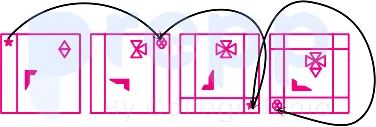
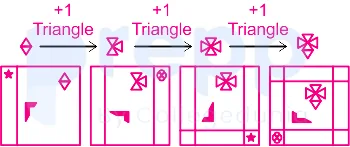
Question 1archived
Select the correct combination of mathematical signs to sequentially replace the * signs and balance the given equation.
59 * 12 * 6 * 24 * 2 * 105
- A
−, +, −, +, =
- B
×, −, +, ×, =
- C
+, ×, +, −, =
- D
−, ÷, +, ×, =
Show answer
D. −, ÷, +, ×, =The question asks us to find the correct sequence of mathematical signs to replace the asterisks (*) in the expression 59 * 12 * 6 * 24 * 2 * 105 such that the equation is balanced. This means the expression on the left side, after replacing the signs, must evaluate to 105.
We need to test each given option, substituting the signs in the order provided, and perform the calculations following the order of operations (BODMAS/PEMDAS). The operations are typically performed in this order: Brackets/Parentheses, Orders/Exponents, Division and Multiplication (from left to right), Addition and Subtraction (from left to right).
Evaluating Option 1: −, +, −, +, =
Substituting the signs into the equation:
59 − 12 + 6 − 24 + 2 = 105
Let's calculate the left side step-by-step:
59 - 12 = 47
47 + 6 = 53
53 - 24 = 29
29 + 2 = 31
So, the equation becomes 31 = 105, which is false. Option 1 is incorrect.
Evaluating Option 2: ×, −, +, ×, =
Substituting the signs into the equation:
59 × 12 − 6 + 24 × 2 = 105
Following the order of operations (Multiplication first):
59 \times 12 = 708
24 \times 2 = 48
Now substitute these values back:
708 − 6 + 48 = 105
Perform subtraction and addition from left to right:
708 - 6 = 702
702 + 48 = 750
So, the equation becomes 750 = 105, which is false. Option 2 is incorrect.
Evaluating Option 3: +, ×, +, −, =
Substituting the signs into the equation:
59 + 12 × 6 + 24 − 2 = 105
Following the order of operations (Multiplication first):
12 \times 6 = 72
Now substitute this value back:
59 + 72 + 24 − 2 = 105
Perform addition and subtraction from left to right:
59 + 72 = 131
131 + 24 = 155
155 - 2 = 153
So, the equation becomes 153 = 105, which is false. Option 3 is incorrect.
Evaluating Option 4: −, ÷, +, ×, =
Substituting the signs into the equation:
59 − 12 ÷ 6 + 24 × 2 = 105
Following the order of operations (Division and Multiplication first, from left to right):
12 \div 6 = 2
24 \times 2 = 48
Now substitute these values back:
59 − 2 + 48 = 105
Perform subtraction and addition from left to right:
59 - 2 = 57
57 + 48 = 105
So, the equation becomes 105 = 105, which is true. Option 4 is correct.
Conclusion
By systematically testing each option and applying the correct order of operations, we found that the signs −, ÷, +, ×, = correctly balance the given equation.
Revision Table: Order of Operations
Acronym
Meaning
Order
B / P
Brackets / Parentheses
First
O / E
Orders / Exponents (Powers, Square Roots, etc.)
Second
D / M
Division and Multiplication
Third (from left to right)
A / S
Addition and Subtraction
Fourth (from left to right)
Additional Information: Equation Balancing Practice
Balancing equations by replacing signs is a common type of problem that tests your understanding of mathematical operations and the order of operations. To improve, practice solving similar problems. Pay close attention to the division operation, especially when it might result in fractions or decimals, although in many competitive exams, the numbers are chosen to give integer results at each step when the correct signs are used.
Understanding the BODMAS/PEMDAS rule is crucial for solving these types of problems accurately. A single mistake in the order can lead to an incorrect result. Always perform multiplication and division before addition and subtraction if they appear in the expression without brackets changing the order.
Paper & answer key PDF ↗ Question 2archived
F + M means ‘F is the husband of M’
F ÷ M means ‘F is the daughter of M’
F − M means ‘F is the father of M’
F × M means ‘F is the mother of M’
If U + V × K – B, then how is U related to B?
- A
Paternal grandmother
- B
Paternal grandfather
- C
Maternal grandmother
- D
Father
Show answer
B. Paternal grandfatherUnderstanding Blood Relations in Reasoning Puzzles
This question involves decoding relationships based on a set of defined codes. We are given an expression U + V × K – B and need to determine how U is related to B using the provided rules.
Decoding the Relationship Codes
Let's break down the given codes:
F + M means ‘F is the husband of M’
F ÷ M means ‘F is the daughter of M’
F – M means ‘F is the father of M’
F × M means ‘F is the mother of M’
Analyzing the Expression U + V × K – B
We will analyze the expression step-by-step from left to right:
U + V: According to the first rule, F + M means 'F is the husband of M'. Applying this to U + V, it means ‘U is the husband of V’. This tells us U is male and V is female, and they are a married couple.
V × K: According to the fourth rule, F × M means 'F is the mother of M'. Applying this to V × K, it means ‘V is the mother of K’. This tells us K is the child of V. Since U is V's husband, K is also the child of U.
K – B: According to the third rule, F – M means 'F is the father of M'. Applying this to K – B, it means ‘K is the father of B’. This tells us B is the child of K. Since K is male, B is the child of K and K's partner (whose identity is not needed to find the relation between U and B).
Determining the Relationship between U and B
From our analysis, we have the following relationships:
U is the father of K.
K is the father of B.
If K is B's father, and U is K's father, then U is B's father's father. The father's father is known as the paternal grandfather.
Final Relationship
Based on the expression U + V × K – B, U is the paternal grandfather of B.
Revision Table: Blood Relation Codes
Code
Meaning
+
Husband of
÷
Daughter of
–
Father of
×
Mother of
Additional Information on Blood Relations
Blood relation questions test your ability to understand and decode complex family structures. They often involve symbolic representations of relationships. To solve these types of problems effectively:
Carefully read and understand the meaning of each code or symbol provided.
Break down the given expression into smaller segments based on the operators (+, –, ×, ÷).
Determine the relationship between the two individuals in each segment.
Build a step-by-step chain of relationships to connect the two individuals whose relation is asked.
Identify the gender of individuals if specified or implied by the relation (e.g., husband is male, mother is female).
Use diagrams or family trees if the expression is long or complex, though for simpler ones like this, a linear breakdown is sufficient.
Remember common relations like paternal (father's side) and maternal (mother's side).
Practice is key to mastering blood relation problems and improving your speed and accuracy in competitive exams.
Paper & answer key PDF ↗ Question 3archived
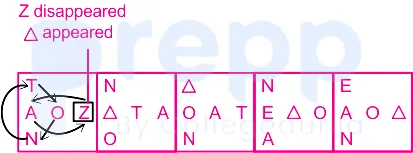
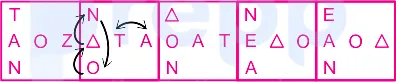
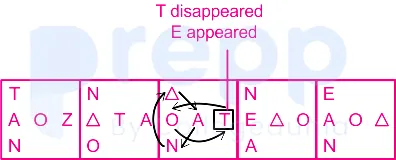
Select the correct mirror image of the given combination when the mirror is placed at line MN as shown.
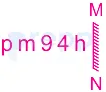
- A
Option A (shown in image)
- B
Option B (shown in image)
- C
Option C (shown in image)
- D
Option D (shown in image)
Show answer
B. Option B (shown in image)The correct mirror image of given figure is:
Hence, 'Option 2' is the correct answer.
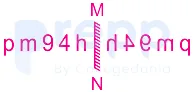 Paper & answer key PDF ↗
 Question 4archived
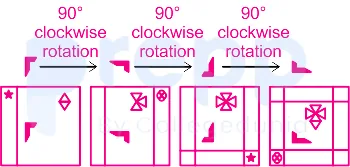
Which figure should replace the question mark (?) if the series were to be continued?

- A
Option A (shown in image)
- B
Option B (shown in image)
- C
Option C (shown in image)
- D
Option D (shown in image)
Show answer
Question 5archived
Select the figure that will come next in the following figure series.

- A
Option A (shown in image)
- B
Option B (shown in image)
- C
Option C (shown in image)
- D
Option D (shown in image)
Show answer
Question 6archived
Which of the following terms will replace the question mark (?) in the given series?
LKC KMD ? IQF HSG
- A
JOP
- B
IOJ
- C
IOE
- D
JOE
Show answer
D. JOEAnalyzing the Letter Series Pattern
The question asks us to find the term that replaces the question mark (?) in the given letter series: LKC, KMD, ?, IQF, HSG.
To solve this type of letter series problem, we need to analyze the pattern in each letter's position within the terms provided.
Let's look at the letter positions in the English alphabet (A=1, B=2, C=3, ..., Z=26).
Term
First Letter
Second Letter
Third Letter
LKC
L ($\text{12}$)
K ($\text{11}$)
C ($\text{3}$)
KMD
K ($\text{11}$)
M ($\text{13}$)
D ($\text{4}$)
?
?
?
?
IQF
I ($\text{9}$)
Q ($\text{17}$)
F ($\text{6}$)
HSG
H ($\text{8}$)
S ($\text{19}$)
G ($\text{7}$)
Pattern for the First Letter
Let's observe the sequence of the first letters: L, K, ?, I, H.
Their positions are: $\text{12, 11, ?, 9, 8}$.
L ($\text{12}$) to K ($\text{11}$): $\text{11 - 12 = -1}$ (decreasing by 1)
I ($\text{9}$) to H ($\text{8}$): $\text{8 - 9 = -1}$ (decreasing by 1)
The pattern for the first letter seems to be a decrease of 1 at each step. Following this pattern:
K ($\text{11}$) to the missing first letter: $\text{11 - 1 = 10}$. The 10th letter is J.
The missing first letter (J, $\text{10}$) to I ($\text{9}$): $\text{9 - 10 = -1}$ (This confirms the pattern).
So, the first letter of the missing term is J.
Pattern for the Second Letter
Next, let's look at the second letters: K, M, ?, Q, S.
Their positions are: $\text{11, 13, ?, 17, 19}$.
K ($\text{11}$) to M ($\text{13}$): $\text{13 - 11 = +2}$ (increasing by 2)
Q ($\text{17}$) to S ($\text{19}$): $\text{19 - 17 = +2}$ (increasing by 2)
The pattern for the second letter seems to be an increase of 2 at each step. Following this pattern:
M ($\text{13}$) to the missing second letter: $\text{13 + 2 = 15}$. The 15th letter is O.
The missing second letter (O, $\text{15}$) to Q ($\text{17}$): $\text{17 - 15 = +2}$ (This confirms the pattern).
So, the second letter of the missing term is O.
Pattern for the Third Letter
Finally, let's examine the third letters: C, D, ?, F, G.
Their positions are: $\text{3, 4, ?, 6, 7}$.
C ($\text{3}$) to D ($\text{4}$): $\text{4 - 3 = +1}$ (increasing by 1)
F ($\text{6}$) to G ($\text{7}$): $\text{7 - 6 = +1}$ (increasing by 1)
The pattern for the third letter seems to be an increase of 1 at each step. Following this pattern:
D ($\text{4}$) to the missing third letter: $\text{4 + 1 = 5}$. The 5th letter is E.
The missing third letter (E, $\text{5}$) to F ($\text{6}$): $\text{6 - 5 = +1}$ (This confirms the pattern).
So, the third letter of the missing term is E.
Identifying the Missing Term
By combining the letters found for each position, the missing term is J (first letter), O (second letter), E (third letter).
Thus, the missing term is JOE.
Comparing with Options
Let's check which option matches our derived term:
JOP: Does not match.
IOJ: Does not match.
IOE: Does not match.
JOE: Matches our derived term.
The term that replaces the question mark (?) in the given series is JOE.
Revision Table: Letter Series Patterns
Letter Position
Sequence
Pattern Rule
Missing Letter (Position)
First Letter
L ($\text{12}$), K ($\text{11}$), ?, I ($\text{9}$), H ($\text{8}$)
Subtract 1 from position number
J ($\text{10}$)
Second Letter
K ($\text{11}$), M ($\text{13}$), ?, Q ($\text{17}$), S ($\text{19}$)
Add 2 to position number
O ($\text{15}$)
Third Letter
C ($\text{3}$), D ($\text{4}$), ?, F ($\text{6}$), G ($\text{7}$)
Add 1 to position number
E ($\text{5}$)
Additional Information: Solving Letter Series
Solving letter series problems often involves identifying the relationship between consecutive terms. Here are some common patterns to look for:
Alphabetical Position: The most common pattern relates to the position of letters in the alphabet (A=1, B=2, etc.). The pattern might involve adding or subtracting a constant number, or a sequence of numbers (e.g., +1, +2, +3), or even squares or cubes of numbers.
Skipping Letters: Letters might be skipped in a regular sequence (e.g., AC, EG, IK where one letter is skipped, then two, then three).
Reverse Alphabetical Order: The series might follow a pattern based on the alphabet in reverse order (Z=1, Y=2, etc.).
Combination of Patterns: In series with multi-letter terms, like the one in this question, each letter position (first, second, third, etc.) might have its own independent pattern.
Vowel/Consonant Patterns: Some series might involve sequences of only vowels or consonants, or alternating between them.
A good strategy is to write down the position number for each letter and look for a numerical pattern in the sequence of numbers.
Paper & answer key PDF ↗ Question 7archived
In a certain code language, 'ABASE’ is coded as 'ZEZVD' and 'BANDS' is coded as 'EZQGV'. How will 'CABIN' be coded in that language?
- A
FZYLK
- B
FAEIQ
- C
FZEHQ
- D
FDELQ
Show answer
C. FZEHQUnderstanding the Code Language Pattern
The problem describes a specific code language where words are transformed into coded forms based on a hidden pattern. We are given two examples: 'ABASE' is coded as 'ZEZVD' and 'BANDS' is coded as 'EZQGV'. Our goal is to decipher this pattern and apply it to code the word 'CABIN'.
Analyzing the Given Examples
Let's look at the transformation of each letter in the given examples:
Example 1: ABASE → ZEZVD
A → Z
B → E
A → Z
S → V
E → D
Example 2: BANDS → EZQGV
B → E
A → Z
N → Q
D → G
S → V
Identifying the Coding Logic
Let's examine the shift in alphabetical positions for each letter. Remember A=1, B=2, ..., Z=26.
Word
Letter
Position
Coded Letter
Coded Position
Shift
Letter Type
ABASE
A
1
Z
26
-1 (or +25)
Vowel
ABASE
B
2
E
5
+3
Consonant
ABASE
A
1
Z
26
-1 (or +25)
Vowel
ABASE
S
19
V
22
+3
Consonant
ABASE
E
5
D
4
-1
Vowel
Word
Letter
Position
Coded Letter
Coded Position
Shift
Letter Type
BANDS
B
2
E
5
+3
Consonant
BANDS
A
1
Z
26
-1 (or +25)
Vowel
BANDS
N
14
Q
17
+3
Consonant
BANDS
D
4
G
7
+3
Consonant
BANDS
S
19
V
22
+3
Consonant
By comparing the shifts, we can observe a pattern related to whether the original letter is a vowel (A, E, I, O, U) or a consonant:
Vowels (A, E): They are shifted back by one position ($\text{-1}$). When A is shifted back by 1, it wraps around to Z.
Consonants (B, S, N, D): They are shifted forward by three positions ($\text{+3}$).
This vowel/consonant coding pattern is consistent across both 'ABASE' and 'BANDS'.
Coding the Word 'CABIN'
Now, let's apply this pattern to the word 'CABIN'. We will go through each letter:
C: C is a consonant. Consonants are shifted by $\text{+3}$. C $\xrightarrow{\text{+3}}$ F.
A: A is a vowel. Vowels are shifted by $\text{-1}$. A $\xrightarrow{\text{-1}}$ Z.
B: B is a consonant. Consonants are shifted by $\text{+3}$. B $\xrightarrow{\text{+3}}$ E.
I: I is a vowel. Vowels are shifted by $\text{-1}$. I $\xrightarrow{\text{-1}}$ H.
N: N is a consonant. Consonants are shifted by $\text{+3}$. N $\xrightarrow{\text{+3}}$ Q.
Combining the coded letters, 'CABIN' is coded as 'FZEHQ'.
Conclusion
Based on the established vowel/consonant coding pattern from 'ABASE' and 'BANDS', the word 'CABIN' is coded as 'FZEHQ'.
Revision Table: Summary of Coding Pattern
Letter Type
Coding Rule
Shift
Vowel (A, E, I, O, U)
Shift back by one letter (wrap around)
$\text{-1}$
Consonant
Shift forward by three letters
$\text{+3}$
Additional Information on Letter Coding
Letter coding is a common type of question in logical reasoning and coding-decoding sections of competitive exams. These patterns can vary widely but often involve:
Shifting positions (like +1, -2, +3, etc.)
Alternating shifts
Grouping letters (vowels/consonants, first half/second half of alphabet)
Reversing the order of letters
Substitution with opposite letters (A with Z, B with Y, etc.)
Combining multiple rules
Practicing different types of letter coding problems helps in quickly identifying the pattern during the exam.
Paper & answer key PDF ↗ Question 8archived
Which number will replace the question mark (?) in the following series?
37, 39, ?, 242, 970, 4852
- A
80
- B
122
- C
108
- D
160
Show answer
A. 80Finding the Missing Number in a Series
The question asks us to identify the number that replaces the question mark (?) in the given series: 37, 39, ?, 242, 970, 4852.
To solve this number series problem, we need to find the underlying pattern or rule that connects the terms. Let's examine the relationship between consecutive numbers in the series.
Analyzing the Number Series Pattern
Let the terms in the series be denoted by \(T_1, T_2, T_3, T_4, T_5, T_6\), where \(T_1 = 37\), \(T_2 = 39\), \(T_3 = ?\), \(T_4 = 242\), \(T_5 = 970\), and \(T_6 = 4852\).
Let's look at the differences or ratios between terms:
\(T_2 - T_1 = 39 - 37 = 2\)
\(T_5 / T_4 = 970 / 242 \approx 4\)
\(T_6 / T_5 = 4852 / 970 \approx 5\)
The differences are not constant, nor are the simple ratios. Let's try to find a pattern involving multiplication and addition or subtraction.
From \(T_1\) to \(T_2\): We can see \(37 \times 1 + 2 = 39\). This fits \(T_2 = T_1 \times 1 + 2\).
From \(T_4\) to \(T_5\): \(242 \times 4 = 968\). Adding 2 gives \(968 + 2 = 970\). This fits \(T_5 = T_4 \times 4 + 2\).
From \(T_5\) to \(T_6\): \(970 \times 5 = 4850\). Adding 2 gives \(4850 + 2 = 4852\). This fits \(T_6 = T_5 \times 5 + 2\).
It appears there is a pattern where each term is obtained by multiplying the previous term by an integer and then adding 2. The multiplier seems to be increasing sequentially starting from 1 for the first step (\(T_1\) to \(T_2\)).
The pattern can be described as: \(T_{n+1} = T_n \times n + 2\), where \(n\) starts from 1 for the step from \(T_1\) to \(T_2\).
Applying the Pattern to Find the Missing Term
Let's apply the identified pattern to find the missing term \(T_3\).
Step 1 (from \(T_1\) to \(T_2\), \(n=1\)): \(T_2 = T_1 \times 1 + 2\). Using \(T_1 = 37\), we get \(T_2 = 37 \times 1 + 2 = 37 + 2 = 39\). This matches the given \(T_2\).
Step 2 (from \(T_2\) to \(T_3\), \(n=2\)): \(T_3 = T_2 \times 2 + 2\). Using \(T_2 = 39\), we get \(T_3 = 39 \times 2 + 2 = 78 + 2 = 80\). This is the missing term.
Step 3 (from \(T_3\) to \(T_4\), \(n=3\)): \(T_4 = T_3 \times 3 + 2\). Using our calculated \(T_3 = 80\), we get \(T_4 = 80 \times 3 + 2 = 240 + 2 = 242\). This matches the given \(T_4\).
Step 4 (from \(T_4\) to \(T_5\), \(n=4\)): \(T_5 = T_4 \times 4 + 2\). Using \(T_4 = 242\), we get \(T_5 = 242 \times 4 + 2 = 968 + 2 = 970\). This matches the given \(T_5\).
Step 5 (from \(T_5\) to \(T_6\), \(n=5\)): \(T_6 = T_5 \times 5 + 2\). Using \(T_5 = 970\), we get \(T_6 = 970 \times 5 + 2 = 4850 + 2 = 4852\). This matches the given \(T_6\).
The pattern holds true for the entire series when the missing number is 80.
Conclusion on the Missing Number
Based on the pattern \(T_{n+1} = T_n \times n + 2\), the number that replaces the question mark (?) is 80.
Series Pattern Summary
Step
From Term
To Term
Pattern Applied (\(T_{n+1} = T_n \times n + 2\))
Result
n=1
\(T_1 = 37\)
\(T_2 = 39\)
\(37 \times 1 + 2\)
39 (Matches)
n=2
\(T_2 = 39\)
\(T_3 = ?\)
\(39 \times 2 + 2\)
80 (Calculated)
n=3
\(T_3 = 80\)
\(T_4 = 242\)
\(80 \times 3 + 2\)
242 (Matches)
n=4
\(T_4 = 242\)
\(T_5 = 970\)
\(242 \times 4 + 2\)
970 (Matches)
n=5
\(T_5 = 970\)
\(T_6 = 4852\)
\(970 \times 5 + 2\)
4852 (Matches)
Revision Table: Key Concepts in Number Series
Understanding Number Series
Concept
Description
Common Patterns
Number Series
A sequence of numbers that follow a specific rule or pattern.
Arithmetic progression, geometric progression, differences, ratios, alternating series, mixed operations, squares, cubes, etc.
Finding the Pattern
Analyzing the relationship between consecutive terms (differences, ratios, products, sums) to deduce the rule.
Look for constant differences/ratios, increasing/decreasing differences/ratios, patterns involving operations with the term number or previous term.
Solving Missing Term Problems
Once the pattern is identified, apply the rule to calculate the value of the missing term.
Work forward or backward in the series using the established pattern.
Additional Information: Types of Number Series Patterns
Number series problems can have various patterns. Here are a few common types:
Arithmetic Series: The difference between consecutive terms is constant (e.g., 2, 5, 8, 11...).
Geometric Series: The ratio between consecutive terms is constant (e.g., 3, 6, 12, 24...).
Difference Series: The differences between consecutive terms form a pattern (e.g., differences might be increasing by a constant, or form their own AP/GP).
Ratio Series: The ratios between consecutive terms form a pattern.
Mixed Operations Series: The pattern involves a combination of operations (like the one solved here: multiplication and addition).
Fibonacci Series: Each term is the sum of the two preceding terms (e.g., 0, 1, 1, 2, 3, 5, 8...).
Series based on Squares/Cubes: Terms might be squares or cubes of numbers, or related to them (e.g., \(n^2\), \(n^2+1\), \(n^3\), \(n^3-1\), etc.).
Solving number series problems often requires careful observation, trial and error, and familiarity with various mathematical operations and sequences.
Paper & answer key PDF ↗ Question 9archived
Select the set in which the numbers are related in the same way as are the numbers of the following set.
(NOTE: Operations should be performed on the whole numbers, without breaking down the numbers into its constituent digits.)
(2, 4, 18)
(1, 9, 50)
- A
(3, 5, 32)
- B
(2, 5, 49)
- C
(6, 4, 10)
- D
(5, 4, 18)
Show answer
A. (3, 5, 32)Understanding the Number Analogy Problem
The question asks us to identify a set of numbers from the given options that shares the same relationship between its elements as the relationships found in the two example sets: (2, 4, 18) and (1, 9, 50).
We are told that operations should be performed on the whole numbers provided, not on their individual digits.
Analyzing the Pattern in the Given Sets
Let's examine the first set: (2, 4, 18). Let the first number be $A=2$, the second number be $B=4$, and the third number be $C=18$. We need to find a rule that connects $A$, $B$, and $C$. The third number, 18, is significantly larger than 2 and 4, suggesting that multiplication, squares, or cubes might be involved in the pattern.
Let's try combining $A$ and $B$ using basic operations and squares:
$A + B = 2 + 4 = 6$ (Not 18)
$A \times B = 2 \times 4 = 8$ (Not 18)
$A^2 = 2^2 = 4$, $B^2 = 4^2 = 16$
$A^2 + B^2 = 4 + 16 = 20$ (Close to 18)
$A + B^2 = 2 + 16 = 18$ (This matches the third number!)
$A^2 + B = 4 + 4 = 8$ (Not 18)
The rule $C = A + B^2$ works for the first set (2, 4, 18) because $2 + 4^2 = 2 + 16 = 18$.
Now, let's test this rule with the second set: (1, 9, 50). Here, $A=1$, $B=9$, and $C=50$.
Using the rule $C = A + B^2$:
$A + B^2 = 1 + 9^2 = 1 + 81 = 82$ (This is not 50).
So, the rule $C = A + B^2$ is not the correct pattern, as it only works for the first set.
Let's look for another pattern. What if we consider the sum of $A$ and $B$? For the first set, $A+B = 2+4 = 6$. If we square this sum, $(A+B)^2 = 6^2 = 36$. How is 36 related to 18? $36 / 2 = 18$.
Let's test the rule $C = \frac{(A+B)^2}{2}$ with the first set (2, 4, 18):
$A=2, B=4, C=18$. $C = \frac{(2+4)^2}{2} = \frac{6^2}{2} = \frac{36}{2} = 18$. This works.
Now, let's test this rule with the second set (1, 9, 50):
$A=1, B=9, C=50$. $C = \frac{(1+9)^2}{2} = \frac{10^2}{2} = \frac{100}{2} = 50$. This works!
The rule $C = \frac{(A+B)^2}{2}$ successfully describes the relationship in both given number sets. This rule involves whole number operations: addition, squaring, and division by 2, which results in a whole number $C$ because $(A+B)^2$ is even when $A$ and $B$ are integers (if $A$ and $B$ are both even, $A+B$ is even; if $A$ and $B$ are both odd, $A+B$ is even).
Applying the Rule to the Options
Now we will apply the rule $C = \frac{(A+B)^2}{2}$ to the options to find the set that follows the same pattern.
Option
Set (A, B, C)
Calculation using Rule $C = \frac{(A+B)^2}{2}$
Expected C
Given C
Does it Match?
1
(3, 5, 32)
$\frac{(3+5)^2}{2} = \frac{8^2}{2} = \frac{64}{2}$
32
32
Yes
2
(2, 5, 49)
$\frac{(2+5)^2}{2} = \frac{7^2}{2} = \frac{49}{2}$
24.5
49
No (and not a whole number)
3
(6, 4, 10)
$\frac{(6+4)^2}{2} = \frac{10^2}{2} = \frac{100}{2}$
50
10
No
4
(5, 4, 18)
$\frac{(5+4)^2}{2} = \frac{9^2}{2} = \frac{81}{2}$
40.5
18
No (and not a whole number)
Identifying the Correct Set
From the table above, only Option 1: (3, 5, 32) follows the rule $C = \frac{(A+B)^2}{2}$. The calculation for this option yields 32, which matches the third number in the set.
Conclusion
The set (3, 5, 32) is related in the same way as the numbers of the sets (2, 4, 18) and (1, 9, 50). The pattern is that the third number is half the square of the sum of the first two numbers, i.e., $C = \frac{(A+B)^2}{2}$.
Revision Table: Key Concepts in Number Analogy
Type of Relation
Description
Example Rule (A, B, C)
Arithmetic Operations
Addition, subtraction, multiplication, division between A and B to get C, possibly with a constant.
$C = A + B + k$, $C = A \times B - k$, etc.
Squares and Cubes
Using squares or cubes of A and/or B.
$C = A^2 + B$, $C = A^2 + B^2$, $C = A^3 - B$, etc.
Combinations
Mixing products, sums, squares, etc.
$C = A \times B + A^2$, $C = \frac{A^2 + B^2}{k}$, etc.
Operations on Sum/Difference
Performing operations on $(A+B)$ or $(A-B)$.
$C = (A+B)^2$, $C = (A+B) \times k$, $C = \frac{(A-B)^2}{k}$, etc.
Additional Information: Mastering Number Series and Analogies
Solving number analogy and number series problems requires careful observation and practice. Here are some tips:
Look for simple arithmetic relations first (addition, subtraction, multiplication, division).
Consider squares and cubes of the numbers. Often, the third number is related to the square or cube of the first or second number, or a combination of them.
Check for patterns involving the sum or difference of the first two numbers, squared or multiplied by a constant. In this problem, the pattern involved the square of the sum of the first two numbers.
Look for relations between pairs of numbers within the set (e.g., A to B, B to C).
Test one potential rule systematically across all given examples before applying it to the options.
Be mindful of constraints mentioned in the question, like operating only on whole numbers.
Practice different types of number puzzles to become familiar with common patterns.
Paper & answer key PDF ↗ Question 10archived
EGJM, GFLN, IENO, ?, MCRQ
- A
KDPP
- B
KPDD
- C
KPDK
- D
KPDP
Show answer
A. KDPPThis question asks us to find the missing term in a given letter series: EGJM, GFLN, IENO, ?, MCRQ. To solve this, we need to identify the pattern or rule that transforms one term into the next. We can analyze the progression of each letter position independently.
Analyzing the Letter Series Pattern
Let's examine the pattern for the letters in each position within the series terms.
First Letter Pattern
The first letters of the terms are E, G, I, ?, M.
From E to G: We move 2 letters forward (E $\rightarrow$ F $\rightarrow$ G). This is a step of +2.
From G to I: We move 2 letters forward (G $\rightarrow$ H $\rightarrow$ I). This is a step of +2.
Following this pattern, the next first letter should be 2 letters forward from I (I $\rightarrow$ J $\rightarrow$ K). So the letter is K.
Let's check with the last term: From K to M, we move 2 letters forward (K $\rightarrow$ L $\rightarrow$ M). This confirms the +2 pattern for the first letter.
The first letter of the missing term is K.
Second Letter Pattern
The second letters of the terms are G, F, E, ?, C.
From G to F: We move 1 letter backward (G $\rightarrow$ F). This is a step of -1.
From F to E: We move 1 letter backward (F $\rightarrow$ E). This is a step of -1.
Following this pattern, the next second letter should be 1 letter backward from E (E $\rightarrow$ D). So the letter is D.
Let's check with the last term: From D to C, we move 1 letter backward (D $\rightarrow$ C). This confirms the -1 pattern for the second letter.
The second letter of the missing term is D.
Third Letter Pattern
The third letters of the terms are J, L, N, ?, R.
From J to L: We move 2 letters forward (J $\rightarrow$ K $\rightarrow$ L). This is a step of +2.
From L to N: We move 2 letters forward (L $\rightarrow$ M $\rightarrow$ N). This is a step of +2.
Following this pattern, the next third letter should be 2 letters forward from N (N $\rightarrow$ O $\rightarrow$ P). So the letter is P.
Let's check with the last term: From P to R, we move 2 letters forward (P $\rightarrow$ Q $\rightarrow$ R). This confirms the +2 pattern for the third letter.
The third letter of the missing term is P.
Fourth Letter Pattern
The fourth letters of the terms are M, N, O, ?, Q.
From M to N: We move 1 letter forward (M $\rightarrow$ N). This is a step of +1.
From N to O: We move 1 letter forward (N $\rightarrow$ O). This is a step of +1.
Following this pattern, the next fourth letter should be 1 letter forward from O (O $\rightarrow$ P). So the letter is P.
Let's check with the last term: From P to Q, we move 1 letter forward (P $\rightarrow$ Q). This confirms the +1 pattern for the fourth letter.
The fourth letter of the missing term is P.
Determining the Missing Term
By combining the letters we found for each position, the missing term is KDPP.
The complete series is: EGJM, GFLN, IENO, KDPP, MCRQ.
Verifying the Letter Series Pattern
Let's summarize the patterns for each letter position:
First letter: +2
Second letter: -1
Third letter: +2
Fourth letter: +1
Applying these patterns sequentially:
EGJM $\xrightarrow{+2, -1, +2, +1}$ GFLN
GFLN $\xrightarrow{+2, -1, +2, +1}$ IENO
IENO $\xrightarrow{+2, -1, +2, +1}$ KDPP
KDPP $\xrightarrow{+2, -1, +2, +1}$ MCRQ
The patterns hold true for the entire series, confirming that KDPP is the correct missing term in the letter series.
Revision Table: Letter Series Patterns
Position
Series
Pattern
First
E, G, I, K, M
$+2$
Second
G, F, E, D, C
$-1$
Third
J, L, N, P, R
$+2$
Fourth
M, N, O, P, Q
$+1$
Additional Information: Solving Letter Series Questions
Letter series questions are common in logical reasoning tests. They involve a sequence of letters or groups of letters that follow a specific rule or pattern. To solve them, you typically need to:
Assign numerical positions to each letter (A=1, B=2, etc.).
Analyze the change in position for each letter within the terms (e.g., +2, -1, +3, etc.).
Look for patterns in the changes themselves (e.g., alternating patterns, increasing or decreasing steps).
Sometimes, the pattern might involve vowels/consonants, mirror images, or other rules.
Break down the complex letter series into simpler patterns for each position.
Once the pattern is found, apply it to determine the missing term.
Practicing different types of letter series helps in quickly recognizing common patterns and solving such questions efficiently in exams.
Paper & answer key PDF ↗ Question 11archived
Read the given statement(s) and conclusions carefully. Assuming that the information given in the statements is true, even if it appears to be at variance with commonly known facts, decide which of the given conclusions logically follow(s) from the statement(s).
Statements:
Some floors are plates.
No plate is a sofa.
All gardens are plates.
Conclusions:
I. Some floors being gardens is a possibility.
II. No garden is a sofa.
III. All plates are gardens.
IV. No floors is a sofa.
- A
Only Conclusion I follows
- B
Only Conclusions I, II and IV follow
- C
Only Conclusions II and III follow
- D
Only Conclusions I and II follow
Show answer
D. Only Conclusions I and II followAnalysis of Syllogism Statements and Conclusions
This problem requires us to carefully read the given statements and determine which of the conclusions logically follow from them, assuming the statements are absolutely true, even if they contradict general knowledge. This is a standard type of logical reasoning question.
Understanding the Syllogism Statements
We are given three statements establishing relationships between three categories: Floors, Plates, and Sofas, and Gardens.
Statement 1: Some floors are plates.
Statement 2: No plate is a sofa.
Statement 3: All gardens are plates.
Let's break down what each statement tells us:
'Some floors are plates' means there is at least one floor that is also a plate. There might be floors that are not plates, and plates that are not floors.
'No plate is a sofa' means there is absolutely no overlap between the category of plates and the category of sofas. If something is a plate, it cannot be a sofa, and vice versa.
'All gardens are plates' means the entire category of gardens is contained within the category of plates. If something is a garden, it must be a plate. However, there can be plates that are not gardens.
Visualizing Relationships (Syllogism Diagrams)
While not strictly required, visualizing these relationships using Venn diagrams can often help understand the possible overlaps and separations implied by the statements.
Statement 1: Draw two overlapping circles, one for Floors (F) and one for Plates (P). Mark the overlapping area to show 'Some F are P'.
Statement 2: Draw a circle for Sofas (S) completely separate from the Plate (P) circle.
Statement 3: Draw a circle for Gardens (G) entirely inside the Plate (P) circle.
Analyzing Each Syllogism Conclusion
Now let's evaluate each given conclusion based on the statements.
Analyzing Conclusion I: Some floors being gardens is a possibility.
We know from Statement 1 that 'Some floors are plates'. We also know from Statement 3 that 'All gardens are plates'. This means the set of Gardens is a subset of the set of Plates.
Since some floors are in the 'Plates' category, and the 'Gardens' category is entirely within the 'Plates' category, it is possible that the 'some floors' that are plates are also within the 'Gardens' part of the 'Plates' category. There is nothing in the statements that prevents this overlap between Floors and Gardens.
Therefore, 'Some floors being gardens is a possibility' logically follows from the statements.
Analyzing Conclusion II: No garden is a sofa.
Statement 3 tells us that 'All gardens are plates'. Statement 2 tells us that 'No plate is a sofa'.
If every single garden is a plate, and if absolutely no plate can be a sofa, then it must be true that no garden can be a sofa. Anything that falls into the 'Gardens' category automatically falls into the 'Plates' category, and since 'Plates' are completely separate from 'Sofas', 'Gardens' must also be completely separate from 'Sofas'.
Therefore, 'No garden is a sofa' logically follows from the statements as a definite conclusion.
Analyzing Conclusion III: All plates are gardens.
Statement 3 says 'All gardens are plates'. This means the set of Gardens is a subset of the set of Plates (\( \text{G} \subseteq \text{P} \)).
This statement does not provide any information about whether the reverse is true. There could be plates that are not gardens. For example, if Plates are fruits and Gardens are apples, then 'All apples are fruits' is true, but 'All fruits are apples' is false because there are other fruits like bananas, oranges, etc. The statements do not restrict Plates to only contain Gardens.
Therefore, 'All plates are gardens' does not logically follow from the statements.
Analyzing Conclusion IV: No floors is a sofa.
Statement 1 says 'Some floors are plates'. Statement 2 says 'No plate is a sofa'.
From these statements, we can definitely say that the 'some floors' mentioned in Statement 1 (the ones that are plates) are not sofas, because no plates are sofas. However, Statement 1 only talks about 'Some floors'. It leaves open the possibility that there are other floors that are not plates.
The statements provide no information about the relationship between these 'other floors' (the ones that are not plates) and sofas. It is entirely possible, based on the given statements, that some of these other floors are sofas. Because we cannot rule out the possibility of some floors being sofas, we cannot definitively conclude that 'No floors is a sofa'.
Therefore, 'No floors is a sofa' does not logically follow from the statements.
Summary of Conclusions from Syllogism Statements
Let's summarize our findings for each conclusion:
Conclusion
Logically Follows?
Reasoning
I. Some floors being gardens is a possibility.
Yes (as a possibility)
The 'some floors' that are plates could overlap with the 'all gardens' that are plates.
II. No garden is a sofa.
Yes (definitely)
All gardens are plates, and no plates are sofas. Transitive relationship.
III. All plates are gardens.
No
'All G are P' does not imply 'All P are G'.
IV. No floors is a sofa.
No
Only 'some floors' are linked to plates. Other floors might be sofas.
Deriving the Final Answer
Based on our analysis, Conclusion I logically follows as a possibility, and Conclusion II logically follows definitely. Conclusions III and IV do not follow.
Therefore, the conclusions that logically follow are Conclusions I and II.
Revision Table: Key Syllogism Concepts
Understanding the different types of statements and their implications is crucial for solving syllogism problems.
Statement Type
Representation
Key Implication
All A are B
\( \text{A} \subseteq \text{B} \)
A is a subset of B. If something is A, it is definitely B. (Does NOT mean All B are A).
Some A are B
\( \text{A} \cap \text{B} \neq \emptyset \)
There is at least one element common to A and B. There could be A not in B, and B not in A.
No A is B
\( \text{A} \cap \text{B} = \emptyset \)
A and B are mutually exclusive sets. If something is A, it cannot be B, and vice versa.
Some A are not B
\( \text{A} \setminus \text{B} \neq \emptyset \)
There is at least one element in A that is not in B.
Additional Information: Possibility in Syllogism
In syllogism questions, conclusions can be of two types: definite conclusions and possibility conclusions. A definite conclusion must be true based on the given statements. A possibility conclusion might be true based on the given statements; the statements do not forbid it from being true.
If a conclusion states something is a 'possibility', it is considered to logically follow if the statements do not contradict that possibility. In our analysis of Conclusion I ('Some floors being gardens is a possibility'), the statements allowed for an overlap between Floors and Gardens within the Plates category, so it was a valid possibility.
Paper & answer key PDF ↗ Question 12archived
If A ÷ B means that A is the brother of B, A × B means that A is the sister of B, A – B means that A is the father of B then which of the following expression shows that P is the father of R?
- A
P – Q × R
- B
P × Q – R
- C
P ÷ Q × P
- D
P ÷ Q – R
Show answer
A. P – Q × RSolving Blood Relation Code Questions
This question involves decoding a set of symbols representing relationships within a family. We are given the following rules:
A ÷ B means that A is the brother of B. (This implies A is male).
A × B means that A is the sister of B. (This implies A is female).
A – B means that A is the father of B. (This implies A is male).
We need to find the expression among the given options that correctly shows P is the father of R.
Analyzing the Options for P as Father of R
Let's break down each expression based on the given coding rules:
Option 1: P – Q × R
P – Q: P is the father of Q. (P is male).
Q × R: Q is the sister of R. (Q is female).
Combining these two relationships:
P is the father of Q.
Q is the sister of R.
If Q is the sister of R, they are siblings. If P is the father of Q, then P is also the father of R (since R is Q's sibling). This expression shows that P is the father of R.
Option 2: P × Q – R
P × Q: P is the sister of Q. (P is female).
Q – R: Q is the father of R. (Q is male).
Combining these two relationships:
P is the sister of Q.
Q is the father of R.
If Q is the father of R, and P is Q's sister, then P is R's aunt. This expression does not show that P is the father of R.
Option 3: P ÷ Q × P
P ÷ Q: P is the brother of Q. (P is male).
Q × P: Q is the sister of P. (Q is female).
Combining these two relationships:
P is the brother of Q.
Q is the sister of P.
This set of relationships is consistent (If P is Q's brother, Q must be P's sister). However, the expression relates P and Q, and then Q and P again. It does not introduce R and therefore cannot show a relationship between P and R.
Option 4: P ÷ Q – R
P ÷ Q: P is the brother of Q. (P is male).
Q – R: Q is the father of R. (Q is male).
Combining these two relationships:
P is the brother of Q.
Q is the father of R.
If Q is the father of R, and P is Q's brother, then P is R's uncle. This expression does not show that P is the father of R.
Based on the analysis, the expression P – Q × R is the only one that establishes P as the father of R.
Revision Table: Blood Relation Codes
Symbol
Meaning
Gender Implied for A
A ÷ B
A is brother of B
Male
A × B
A is sister of B
Female
A – B
A is father of B
Male
Additional Information: Solving Blood Relation Puzzles
Blood relation puzzles are common in reasoning sections of competitive exams. They test your ability to decode relationships presented in coded form or direct statements. Here are some tips for solving them:
Carefully read the meaning of each symbol or statement. Note down which symbols imply gender.
Break down the given expression step-by-step. Analyse the relationship between the first two individuals, then the second and third, and so on.
Draw a family tree or diagram if the relationships become complex. This can help visualize the connections.
Work backwards from the desired relationship if needed.
Pay close attention to gender implications, as 'brother' or 'sister' can be key. 'Parent' or 'child' might not specify gender unless implied by another relation.
Understanding the basic family relationships (parent, child, sibling, uncle, aunt, cousin, grandparent, grandchild) is crucial for these types of problems.
Paper & answer key PDF ↗ Question 13archived
In the following question below are given some statements followed by some conclusions based on those statements. Taking the given statements to be true even if they seem to be at variance from commonly known facts. Read all the conclusions and then decide which of the given conclusion logically follows the given statements.
Statements:
I. No P is Q.
II. All B are Q.
Conclusions:
I. No P is B.
II. Some Q are not P.
III. Some B are not Q.
- A
Both conclusions I and II follows
- B
Both conclusions I and III follows
- C
Only conclusion I follows
- D
Neither conclusion follows
Show answer
A. Both conclusions I and II followsLogic Statements and Conclusions Analysis
This problem requires analyzing logical statements and determining which conclusions can be validly drawn from them. We are given two statements and three potential conclusions.
Understanding the Statements
Let's break down the given statements:
Statement I: No P is Q.
This means that there is absolutely no overlap between the set of P and the set of Q. If something is P, it cannot be Q, and vice versa. Think of P and Q as completely separate groups.
Statement II: All B are Q.
This means that every single element belonging to the set of B is also an element of the set of Q. The set of B is entirely contained within the set of Q. Think of B as a smaller group inside the larger group of Q.
We are asked to assume these statements are true, even if they seem to contradict common knowledge.
Evaluating the Conclusions
Now let's evaluate each conclusion based on the truth of the statements.
Conclusion I: No P is B.
From Statement I, we know that P and Q have nothing in common. From Statement II, we know that all of B is part of Q. If B is entirely inside Q, and Q has no overlap with P, then B also cannot have any overlap with P. Therefore, 'No P is B' is a logical consequence of the statements.
This conclusion logically follows.
Conclusion II: Some Q are not P.
From Statement I, we know that 'No P is Q'. This is a very strong statement. It means that for every element in the set Q, that element is not in the set P. If 'all Q are not P' is true (which is what 'No P is Q' implies from the perspective of Q), then 'some Q are not P' must also be true. The word 'some' in logic means 'at least one'. If every element in Q is not P, then certainly at least one element in Q is not P.
This conclusion logically follows.
Conclusion III: Some B are not Q.
From Statement II, we are told that 'All B are Q'. This means that every single member of the group B is also a member of the group Q. If every B is a Q, it is impossible for 'some B' (meaning at least one B) to 'not be Q'. This conclusion directly contradicts Statement II.
This conclusion does not follow.
Summary of Conclusions
Based on the analysis:
Conclusion I: No P is B - Follows
Conclusion II: Some Q are not P - Follows
Conclusion III: Some B are not Q - Does not follow
Therefore, both Conclusion I and Conclusion II logically follow from the given statements.
Statement/Conclusion
Analysis
Logically Follows?
Statement I: No P is Q
P and Q are disjoint sets.
Given as true.
Statement II: All B are Q
B is a subset of Q.
Given as true.
Conclusion I: No P is B
Since B is in Q, and P is not in Q, P cannot be in B.
Yes
Conclusion II: Some Q are not P
Since no P is Q, all Q are not P. If all Q are not P, then some Q are not P.
Yes
Conclusion III: Some B are not Q
Statement II says All B are Q. This contradicts the conclusion.
No
Revision Table: Key Concepts in Syllogism
Term
Explanation
Example
Statement
A premise given as true for the purpose of the logic problem.
All dogs are mammals.
Conclusion
A sentence that is claimed to be true based on the given statements.
Therefore, my pet Spot is a mammal (if Spot is a dog).
Logically Follows
The conclusion is necessarily true if the statements are true.
If "All A are B" and "All B are C", then "All A are C" logically follows.
Categorical Proposition
A statement that relates two categories or classes. Types include All, No, Some, Some Not.
No cats are dogs. Some birds can fly.
Syllogism
A logical argument where a conclusion is derived from two or more statements.
The structure of the problem presented here.
Additional Information on Logic and Syllogisms
This type of question is based on Syllogism, a form of logical reasoning. Syllogisms help test our ability to draw correct inferences from given information. Even if a statement like "All cars are birds" sounds strange in the real world, for the purpose of solving the logic puzzle, we must accept it as true and work from there.
Understanding the four basic types of categorical propositions is crucial:
Universal Affirmative (All A are B): Every member of class A is a member of class B.
Universal Negative (No A is B): No member of class A is a member of class B. A and B are disjoint.
Particular Affirmative (Some A are B): At least one member of class A is a member of class B. There is some overlap.
Particular Negative (Some A are not B): At least one member of class A is not a member of class B.
In this problem, Statement I is a Universal Negative ("No P is Q"), and Statement II is a Universal Affirmative ("All B are Q"). The conclusions are a Universal Negative ("No P is B") and two Particular statements ("Some Q are not P", "Some B are not Q").
Visualizing these relationships using Venn diagrams can often make the solution clearer, although it's not strictly required if you understand the logical implications of the statements.
Paper & answer key PDF ↗ Question 14archived
Select the set in which the numbers are related in the same way as are the numbers of the following sets.
(NOTE: Operations should be performed on the whole numbers, without breaking down the numbers into its constituent digits. E.g. 13 – Operations on 13 such as adding / subtracting / multiplying etc. to 13 can be performed. Breaking down 13 into 1 and 3 and then performing mathematical operations on 1 and 3 is not allowed)
(5, 35, 7)
(8, 32, 4)
- A
(11, 56, 5)
- B
(3, 27, 9)
- C
(4, 30, 7)
- D
(9, 38, 4)
Show answer
B. (3, 27, 9)Understanding the Relationship in Number Sets
The problem asks us to identify a set of numbers from the options that shares the same mathematical relationship as the two given sets: (5, 35, 7) and (8, 32, 4).
We need to analyze the numbers within these given sets to find a consistent pattern or rule that relates the first number, the middle number, and the third number.
Analyzing the Given Number Sets
Let's look at the first set: (5, 35, 7)
The first number is 5.
The middle number is 35.
The third number is 7.
How can we relate 5, 35, and 7 using basic arithmetic operations?
Could it be addition? $5 + 7 = 12$, which is not 35.
Could it be subtraction? $35 - 5 = 30$, $35 - 7 = 28$. No clear pattern with subtraction relating all three.
Could it be multiplication or division? Let's try multiplying the first and third numbers: $5 \times 7 = 35$. This equals the middle number.
Let's test this potential rule on the second set: (8, 32, 4)
The first number is 8.
The middle number is 32.
The third number is 4.
Applying the rule (first number) $\times$ (third number) = (middle number):
$8 \times 4 = 32$. This matches the middle number.
The relationship is consistently: The product of the first and third numbers is equal to the middle number.
We are reminded that operations should be performed on whole numbers, not on their constituent digits. Our derived rule (multiplication of the numbers themselves) adheres to this constraint.
Applying the Rule to the Options
Now we will check each option set to see which one follows the rule: (first number) $\times$ (third number) = (middle number).
Option 1: (11, 56, 5)
First number: 11
Third number: 5
Middle number: 56
Check the rule: $11 \times 5 = 55$.
Is $55 = 56$? No. This option does not follow the rule.
Option 2: (3, 27, 9)
First number: 3
Third number: 9
Middle number: 27
Check the rule: $3 \times 9 = 27$.
Is $27 = 27$? Yes. This option follows the rule.
Option 3: (4, 30, 7)
First number: 4
Third number: 7
Middle number: 30
Check the rule: $4 \times 7 = 28$.
Is $28 = 30$? No. This option does not follow the rule.
Option 4: (9, 38, 4)
First number: 9
Third number: 4
Middle number: 38
Check the rule: $9 \times 4 = 36$.
Is $36 = 38$? No. This option does not follow the rule.
Based on our analysis, only Option 2 follows the same mathematical relationship as the given sets.
Conclusion
The set (3, 27, 9) is related in the same way as the sets (5, 35, 7) and (8, 32, 4), because in all these sets, the product of the first and third numbers equals the middle number.
Set
First Number
Third Number
Middle Number
Calculation
Rule Followed?
(5, 35, 7)
5
7
35
$5 \times 7 = 35$
Yes
(8, 32, 4)
8
4
32
$8 \times 4 = 32$
Yes
(11, 56, 5)
11
5
56
$11 \times 5 = 55$
No ($55 \neq 56$)
(3, 27, 9)
3
9
27
$3 \times 9 = 27$
Yes ($27 = 27$)
(4, 30, 7)
4
7
30
$4 \times 7 = 28$
No ($28 \neq 30$)
(9, 38, 4)
9
4
38
$9 \times 4 = 36$
No ($36 \neq 38$)
Revision Table: Checking Number Set Relationships
Set
Check: First x Third = Middle?
Result
(5, 35, 7)
$5 \times 7 = 35$?
Yes, $35 = 35$
(8, 32, 4)
$8 \times 4 = 32$?
Yes, $32 = 32$
(11, 56, 5)
$11 \times 5 = 56$?
No, $55 \neq 56$
(3, 27, 9)
$3 \times 9 = 27$?
Yes, $27 = 27$
(4, 30, 7)
$4 \times 7 = 30$?
No, $28 \neq 30$
(9, 38, 4)
$9 \times 4 = 38$?
No, $36 \neq 38$
Additional Information on Number Analogy and Patterns
Number analogy questions, like this one involving number sets, are common in reasoning tests. They assess your ability to identify patterns and relationships between numbers. The relationships can be based on various mathematical operations or logical rules.
Common Patterns: Patterns often involve addition, subtraction, multiplication, division, squares, cubes, square roots, cube roots, prime numbers, composite numbers, or a combination of these.
Positional Relationships: The relationship can be between the first and second numbers, second and third, first and third, or involving all numbers in the set.
Solving Strategy:
Carefully examine the given sets.
Try simple operations (addition, subtraction, multiplication, division) between pairs of numbers or involving all three.
Test potential rules on all given examples to confirm consistency.
Once a rule is found, apply it systematically to each option.
The option that satisfies the derived rule is the correct answer.
Constraint Awareness: Always pay attention to any specific constraints mentioned in the question, such as the rule about not breaking down digits, as this limits the types of operations you can consider.
Practice with different types of number relationship problems helps in quickly identifying the underlying pattern.
Paper & answer key PDF ↗ Question 15archived
By interchanging the given two signs which of the following equation will be correct?
× and –
- A
7 × 9 – 8 ÷ 2 + 6 = 25
- B
8 × 6 – 9 ÷ 3 + 10 = 0
- C
16 – 4 ÷ 2 + 8 × 1 = 36
- D
5 + 7 × 3 – 4 ÷ 2 = 8
Show answer
B. 8 × 6 – 9 ÷ 3 + 10 = 0Solving Equations by Interchanging Signs: Multiplication and Subtraction
This question asks us to find which of the given equations becomes correct when the mathematical signs for multiplication ($\times$) and subtraction ($-$) are interchanged. We need to swap $\times$ with $-$ and $-$ with $\times$ in each equation and then evaluate the result using the BODMAS or PEMDAS rule to check if the equality holds true.
Understanding the Order of Operations (BODMAS/PEMDAS)
To correctly evaluate mathematical expressions, we follow a specific order of operations:
B/P: Brackets/Parentheses
O/E: Orders/Exponents
D/M: Division and Multiplication (from left to right)
A/S: Addition and Subtraction (from left to right)
We will apply this rule after interchanging the signs.
Evaluating Each Option After Interchanging Signs
Let's interchange the signs $\times$ and $-$ in each given equation and evaluate:
Option 1: $7 \times 9 - 8 \div 2 + 6 = 25$
Interchanging $\times$ and $-$ signs, the equation becomes:
$7 - 9 \times 8 \div 2 + 6$
Now, let's evaluate using BODMAS:
First, perform Multiplication: $9 \times 8 = 72$
The expression becomes: $7 - 72 \div 2 + 6$
Next, perform Division: $72 \div 2 = 36$
The expression becomes: $7 - 36 + 6$
Finally, perform Subtraction and Addition from left to right: $7 - 36 = -29$, then $-29 + 6 = -23$.
The result is $-23$.
Checking the equality: $-23 = 25$. This is incorrect.
Option 2: $8 \times 6 - 9 \div 3 + 10 = 0$
Interchanging $\times$ and $-$ signs, the equation becomes:
$8 - 6 \times 9 \div 3 + 10$
Now, let's evaluate using BODMAS:
First, perform Multiplication: $6 \times 9 = 54$
The expression becomes: $8 - 54 \div 3 + 10$
Next, perform Division: $54 \div 3 = 18$
The expression becomes: $8 - 18 + 10$
Finally, perform Subtraction and Addition from left to right: $8 - 18 = -10$, then $-10 + 10 = 0$.
The result is $0$.
Checking the equality: $0 = 0$. This is correct.
Option 3: $16 - 4 \div 2 + 8 \times 1 = 36$
Interchanging $\times$ and $-$ signs, the equation becomes:
$16 \times 4 \div 2 + 8 - 1$
Now, let's evaluate using BODMAS:
First, perform Multiplication: $16 \times 4 = 64$
The expression becomes: $64 \div 2 + 8 - 1$
Next, perform Division: $64 \div 2 = 32$
The expression becomes: $32 + 8 - 1$
Finally, perform Addition and Subtraction from left to right: $32 + 8 = 40$, then $40 - 1 = 39$.
The result is $39$.
Checking the equality: $39 = 36$. This is incorrect.
Option 4: $5 + 7 \times 3 - 4 \div 2 = 8$
Interchanging $\times$ and $-$ signs, the equation becomes:
$5 + 7 - 3 \times 4 \div 2$
Now, let's evaluate using BODMAS:
First, perform Multiplication: $3 \times 4 = 12$
The expression becomes: $5 + 7 - 12 \div 2$
Next, perform Division: $12 \div 2 = 6$
The expression becomes: $5 + 7 - 6$
Finally, perform Addition and Subtraction from left to right: $5 + 7 = 12$, then $12 - 6 = 6$.
The result is $6$.
Checking the equality: $6 = 8$. This is incorrect.
Conclusion
After interchanging the signs $\times$ and $-$, only the equation in Option 2 evaluates to a correct statement.
Revision Table: Checking Options
Option
Original Equation
Signs Swapped ($\times \leftrightarrow -$ )
Calculation Steps (BODMAS)
Result
Correct?
1
$7 \times 9 - 8 \div 2 + 6 = 25$
$7 - 9 \times 8 \div 2 + 6$
$7 - (9 \times 8) \div 2 + 6 $
$= 7 - 72 \div 2 + 6 $
$= 7 - 36 + 6 $
$= -29 + 6 = -23$
-23
No (-23 ≠ 25)
2
$8 \times 6 - 9 \div 3 + 10 = 0$
$8 - 6 \times 9 \div 3 + 10$
$8 - (6 \times 9) \div 3 + 10 $
$= 8 - 54 \div 3 + 10 $
$= 8 - 18 + 10 $
$= -10 + 10 = 0$
0
Yes (0 = 0)
3
$16 - 4 \div 2 + 8 \times 1 = 36$
$16 \times 4 \div 2 + 8 - 1$
$(16 \times 4) \div 2 + 8 - 1 $
$= 64 \div 2 + 8 - 1 $
$= 32 + 8 - 1 $
$= 40 - 1 = 39$
39
No (39 ≠ 36)
4
$5 + 7 \times 3 - 4 \div 2 = 8$
$5 + 7 - 3 \times 4 \div 2$
$5 + 7 - (3 \times 4) \div 2 $
$= 5 + 7 - 12 \div 2 $
$= 5 + 7 - 6 $
$= 12 - 6 = 6$
6
No (6 ≠ 8)
Additional Information: Logical Reasoning Questions
Logical reasoning questions involving mathematical operations and signs often test your ability to follow rules and apply the correct order of operations. These types of problems might involve:
Interchanging signs (like in this question).
Interchanging numbers.
Substituting symbols for mathematical operations.
Identifying patterns in sequences of numbers or operations.
Practicing these types of questions helps improve analytical and problem-solving skills. Always remember to carefully read the instructions regarding which elements (signs, numbers) need to be interchanged and strictly follow the BODMAS/PEMDAS rule for evaluation.
Paper & answer key PDF ↗ Question 16archived
Select the set in which the numbers are related in the same way as are the numbers of the following sets:
(99, 199, 1199)
(15, 115, 1115)
(NOTE: Operations should be performed on the whole numbers, without breaking down the numbers into its constituent digits. E.g. 13 – Operations on 13 such as adding / subtracting / multiplying etc. to 13 can be performed. Breaking down 13 into 1 and 3 and then performing mathematical operations on 1 and 3 is NOT allowed)
- A
(11, 111, 1000)
- B
(33, 133, 1133)
- C
(22, 222, 2222)
- D
(77, 717, 7117)
Show answer
B. (33, 133, 1133)Understanding Number Set Relationships
The question asks us to identify a set of numbers that follows the same pattern or relationship as the two given sets: (99, 199, 1199) and (15, 115, 1115). We need to analyze the relationship between the numbers within these sets.
Let's examine the first set (99, 199, 1199).
The difference between the second and first number is: $199 - 99 = 100$.
The difference between the third and second number is: $1199 - 199 = 1000$.
This suggests a pattern where the second number is obtained by adding 100 to the first number, and the third number is obtained by adding 1000 to the second number.
Let's verify this pattern with the second given set (15, 115, 1115).
The difference between the second and first number is: $115 - 15 = 100$.
The difference between the third and second number is: $1115 - 115 = 1000$.
The pattern holds true for both given sets. The rule relating the numbers in a set $(a, b, c)$ is:
$b = a + 100$
$c = b + 1000$
Now, let's apply this pattern to the given options to find the set that matches.
Analyzing the Options
We will check each option set against the established pattern ($b = a + 100$, $c = b + 1000$).
Option 1: (11, 111, 1000)
Check 1: Is $111 = 11 + 100$? Yes, $11 + 100 = 111$.
Check 2: Is $1000 = 111 + 1000$? No, $111 + 1000 = 1111$. This option does not match the pattern.
Option 2: (33, 133, 1133)
Check 1: Is $133 = 33 + 100$? Yes, $33 + 100 = 133$.
Check 2: Is $1133 = 133 + 1000$? Yes, $133 + 1000 = 1133$. This option matches the pattern.
Option 3: (22, 222, 2222)
Check 1: Is $222 = 22 + 100$? Yes, $22 + 100 = 222$.
Check 2: Is $2222 = 222 + 1000$? No, $222 + 1000 = 1222$. This option does not match the pattern.
Option 4: (77, 717, 7117)
Check 1: Is $717 = 77 + 100$? No, $77 + 100 = 177$. This option does not match the pattern.
Based on the analysis, only Option 2 follows the same numerical relationship as the given sets.
Conclusion
The pattern governing the numbers in the given sets is that the second number is 100 more than the first, and the third number is 1000 more than the second. The set (33, 133, 1133) from the options correctly follows this rule.
Revision Table: Number Pattern Analysis
Set
Relationship Check 1 ($b = a + 100$)
Relationship Check 2 ($c = b + 1000$)
Follows Pattern?
(99, 199, 1199)
$199 = 99 + 100$ (True)
$1199 = 199 + 1000$ (True)
Yes (Base Set)
(15, 115, 1115)
$115 = 15 + 100$ (True)
$1115 = 115 + 1000$ (True)
Yes (Base Set)
(11, 111, 1000)
$111 = 11 + 100$ (True)
$1000 = 111 + 1000$ (False, $1111$)
No
(33, 133, 1133)
$133 = 33 + 100$ (True)
$1133 = 133 + 1000$ (True)
Yes
(22, 222, 2222)
$222 = 22 + 100$ (True)
$2222 = 222 + 1000$ (False, $1222$)
No
(77, 717, 7117)
$717 = 77 + 100$ (False, $177$)
-
No
Additional Information: Solving Number Pattern Questions
Solving number pattern questions involves identifying the underlying rule or sequence that connects the numbers in a given set or series. Here are some common strategies and concepts:
Arithmetic Progression: Numbers increase or decrease by a constant difference (e.g., 2, 4, 6, 8... difference is 2).
Geometric Progression: Numbers are multiplied or divided by a constant ratio (e.g., 3, 9, 27, 81... ratio is 3).
Differences: Calculate the differences between consecutive terms. If the first differences are constant, it's an arithmetic series. If the second differences (differences of the differences) are constant, it might involve a quadratic relationship, and so on. In this question, the differences were +100 and +1000.
Ratios: Calculate the ratios between consecutive terms. This helps identify geometric progressions.
Combined Operations: The pattern might involve a combination of addition, subtraction, multiplication, division, or even powers and roots.
Position-Based Rules: The rule might relate the number to its position in the sequence (e.g., the nth term is $2n+1$).
Digital Operations (usually excluded): Some patterns involve operations on the digits of the number itself, though the note in this question explicitly excludes this.
Observing Structure: Look at how the numbers are formed or how they change. In this case, the structure involved adding specific constants.
Always test your hypothesized pattern on all the given examples before applying it to the options. If the pattern doesn't fit all examples, it's incorrect.
Paper & answer key PDF ↗ Question 17archived
By interchanging the given two signs which of the following equation will be correct?
÷ and +
- A
18 ÷ 24 – 6 × 6 + 3 = 32
- B
12 – 8 + 12 × 9 ÷ 3 = 10
- C
12 ÷ 8 × 3 + 6 – 10 = 8
- D
7 + 21 × 42 ÷ 14 – 9 = 19
Show answer
D. 7 + 21 × 42 ÷ 14 – 9 = 19Understanding Sign Interchange in Arithmetic Equations
The question asks us to identify which of the given equations becomes correct after interchanging the division ($\div$) and addition (+) signs. To solve this, we need to go through each option, interchange the specified signs, and then evaluate the new expression using the standard order of operations (BODMAS/PEMDAS) to check if it equates to the value on the right side.
The order of operations is as follows:
Brackets (Parentheses)
Orders (Exponents, Roots)
Division and Multiplication (from left to right)
Addition and Subtraction (from left to right)
Testing Option 1 by Interchanging Signs
The original equation is $18 \div 24 \ndash 6 \times 6 + 3 = 32$.
After interchanging $\div$ and + signs, the equation becomes:
$\text{Equation: } 18 + 24 \ndash 6 \times 6 \div 3$
Let's evaluate the left side using BODMAS:
Multiplication: $6 \times 6 = 36$
Division: $36 \div 3 = 12$
The expression is now $18 + 24 \ndash 12$
Addition: $18 + 24 = 42$
Subtraction: $42 \ndash 12 = 30$
The result is 30. Since $30 \neq 32$, option 1 is not correct after the sign interchange.
Testing Option 2 by Interchanging Signs
The original equation is $12 \ndash 8 + 12 \times 9 \div 3 = 10$.
After interchanging $\div$ and + signs, the equation becomes:
$\text{Equation: } 12 \ndash 8 \div 12 \times 9 + 3$
Let's evaluate the left side using BODMAS:
Division: $8 \div 12 = \frac{8}{12} = \frac{2}{3}$
Multiplication: $\frac{2}{3} \times 9 = 2 \times 3 = 6$
The expression is now $12 \ndash 6 + 3$
Subtraction/Addition (from left to right): $12 \ndash 6 = 6$
Addition: $6 + 3 = 9$
The result is 9. Since $9 \neq 10$, option 2 is not correct after the sign interchange.
Testing Option 3 by Interchanging Signs
The original equation is $12 \div 8 \times 3 + 6 \ndash 10 = 8$.
After interchanging $\div$ and + signs, the equation becomes:
$\text{Equation: } 12 + 8 \times 3 \div 6 \ndash 10$
Let's evaluate the left side using BODMAS:
Multiplication: $8 \times 3 = 24$
Division: $24 \div 6 = 4$
The expression is now $12 + 4 \ndash 10$
Addition: $12 + 4 = 16$
Subtraction: $16 \ndash 10 = 6$
The result is 6. Since $6 \neq 8$, option 3 is not correct after the sign interchange.
Testing Option 4 by Interchanging Signs
The original equation is $7 + 21 \times 42 \div 14 \ndash 9 = 19$.
After interchanging $\div$ and + signs, the equation becomes:
$\text{Equation: } 7 \div 21 \times 42 + 14 \ndash 9$
Let's evaluate the left side using BODMAS:
Division: $7 \div 21 = \frac{7}{21} = \frac{1}{3}$
Multiplication: $\frac{1}{3} \times 42 = 14$
The expression is now $14 + 14 \ndash 9$
Addition: $14 + 14 = 28$
Subtraction: $28 \ndash 9 = 19$
The result is 19. Since $19 = 19$, option 4 is correct after the sign interchange.
Therefore, interchanging the $\div$ and + signs makes the equation in option 4 correct.
Option
Original Equation
Equation After Interchanging $\div$ and +
Calculated Value
Correct?
1
$18 \div 24 \ndash 6 \times 6 + 3 = 32$
$18 + 24 \ndash 6 \times 6 \div 3$
30
No ($30 \neq 32$)
2
$12 \ndash 8 + 12 \times 9 \div 3 = 10$
$12 \ndash 8 \div 12 \times 9 + 3$
9
No ($9 \neq 10$)
3
$12 \div 8 \times 3 + 6 \ndash 10 = 8$
$12 + 8 \times 3 \div 6 \ndash 10$
6
No ($6 \neq 8$)
4
$7 + 21 \times 42 \div 14 \ndash 9 = 19$
$7 \div 21 \times 42 + 14 \ndash 9$
19
Yes ($19 = 19$)
Revision Table for Sign Interchange Problems
When solving problems involving the interchange of mathematical signs, always remember to:
Carefully read which signs need to be interchanged.
Rewrite the equation with the new signs.
Apply the BODMAS/PEMDAS rule correctly step-by-step.
Compare the final calculated value with the required value on the right side of the equation.
Additional Information on Order of Operations (BODMAS/PEMDAS)
The order of operations is a set of rules that tells us the sequence in which operations should be performed in a mathematical expression to ensure a unique result. It prevents ambiguity.
Brackets (or Parentheses): Operations inside brackets are performed first.
Orders (or Exponents): Powers, roots, and other orders are evaluated next.
Division and Multiplication: These are performed from left to right as they appear in the expression.
Addition and Subtraction: These are performed last, also from left to right as they appear.
Following this order is crucial for accurately solving mathematical expressions, especially when multiple operations are involved, as seen in these equation-checking problems.
Paper & answer key PDF ↗ Question 18archived
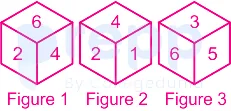
Three different positions of the same dice are shown. Find the number on the face opposite the face showing ‘1’.
- A
6
- B
3
- C
2
- D
4
Show answer
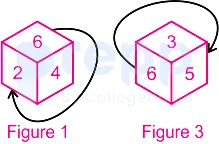
A. 6Taking dice Figure 1 and Figure 3 with 6 as common,
Moving clockwise from the Common number 6,
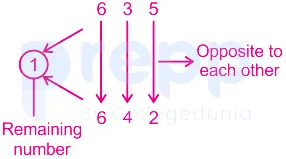
Pair of opposite numbers:
1 - 6
3 - 4
5 - 2
So, the opposite number to 1 is 6.
Hence, the correct answer is "6".
 Paper & answer key PDF ↗
 Question 19archived
In a certain code language, ‘come home soon' is coded as '444', 'are you coming' is coded as '336' and ‘raining badly outside' is coded as '757'. How will ‘kids are happy’ be coded in that language?
- A
543
- B
435
- C
345
- D
534
Show answer
B. 435Decoding the Coding Language Pattern
The problem provides examples of phrases coded into numerical strings and asks us to find the code for a new phrase based on the established pattern.
Let's carefully examine the given examples to identify the rule:
Phrase 1: 'come home soon' is coded as '444'
Phrase 2: 'are you coming' is coded as '336'
Phrase 3: 'raining badly outside' is coded as '757'
Analyzing the Pattern in Coding Language
Let's look at the number of letters in each word of the given phrases:
Phrase
Word 1
Letters
Word 2
Letters
Word 3
Letters
Coded Value
come home soon
come
4
home
4
soon
4
444
are you coming
are
3
you
3
coming
6
336
raining badly outside
raining
7
badly
5
outside
7
757
Observing the table, we can see a clear pattern:
For 'come home soon', the letter counts are 4, 4, 4. When concatenated, they form '444'.
For 'are you coming', the letter counts are 3, 3, 6. When concatenated, they form '336'.
For 'raining badly outside', the letter counts are 7, 5, 7. When concatenated, they form '757'.
The pattern is that the code for a phrase is formed by joining the number of letters in each word of the phrase, in the order they appear.
Applying the Pattern to 'kids are happy'
Now we need to apply this same pattern to the phrase 'kids are happy'. Let's count the letters in each word:
Word 1: 'kids' has 4 letters.
Word 2: 'are' has 3 letters.
Word 3: 'happy' has 5 letters.
According to the pattern, we concatenate these letter counts to form the code.
Code for 'kids are happy' = (Letters in 'kids') + (Letters in 'are') + (Letters in 'happy')
Code = 4 + 3 + 5 (concatenated)
Code = 435
Final Coded Value
The code for ‘kids are happy’ in this language is '435'.
Revision Table: Coding Language Analysis
Phrase
Word 1 (Letters)
Word 2 (Letters)
Word 3 (Letters)
Calculated Code (Concatenated)
Given Code
Pattern Match
come home soon
come (4)
home (4)
soon (4)
444
444
Yes
are you coming
are (3)
you (3)
coming (6)
336
336
Yes
raining badly outside
raining (7)
badly (5)
outside (7)
757
757
Yes
kids are happy
kids (4)
are (3)
happy (5)
435
?
(Predicted)
Additional Information: Logic Puzzles and Coding Patterns
This type of question is common in logical reasoning and aptitude tests. It falls under the category of coding and decoding, where you need to identify a hidden rule or pattern used to transform information (like words or phrases) into another format (like numbers or symbols).
Key steps to solve such puzzles:
Analyze the given examples thoroughly. Look for relationships between the original information and the coded information.
Consider different possible patterns:
Number of letters in words
Position of letters (like first, last, middle)
Vowel or consonant counts
Alphabetical position of letters
Mathematical operations applied to letter counts or positions
Reversal or rearrangement
Test the identified pattern against all provided examples to ensure consistency.
Apply the confirmed pattern to the new item you need to code or decode.
Practicing different types of coding-decoding questions helps improve pattern recognition skills, which are valuable in many areas of problem-solving.
Paper & answer key PDF ↗ Question 20archived
Select the option that is related to the third word in the same way as the second word is related to the first word. (The words must be considered as meaningful English words and must not be related to each other based on the number of letters / number of consonants / vowels in the word)
Cells ∶ Tissue ∶∶ Organs ∶ ?
- A
Kidney
- B
Lungs
- C
Body
- D
Heart
Show answer
C. BodyUnderstanding the Biological Analogy: Cells, Tissue, Organs
The question asks us to find the word that completes the analogy: Cells ∶ Tissue ∶∶ Organs ∶ ?
This type of question tests our understanding of relationships between different concepts. Here, the relationship is based on biological organization.
Analyzing the First Pair: Cells and Tissue
The first pair is Cells ∶ Tissue.
Cells are the basic structural and functional units of all known living organisms.
A Tissue is a group of similar cells that perform a specific function.
So, the relationship here is that many Cells working together form a Tissue.
Applying the Relationship to the Second Pair: Organs and ?
We need to find what Organs form when they work together, following the same pattern.
An Organ is a collection of tissues joined in a structural unit to serve a common function. Examples include the heart, lungs, kidneys, and stomach.
Multiple Organs that work together to perform a major function or set of functions form an organ system (e.g., the digestive system, respiratory system, circulatory system).
A complete living individual, or Body, is formed by multiple organ systems working together.
Therefore, following the hierarchy of biological organization, Organs combine and function together to form an entire organism, also known as a Body.
Evaluating the Options
Let's look at the given options:
Kidney: A Kidney is an individual organ. The analogy is asking what Organs *form*, not another example of an organ.
Lungs: Lungs are also individual organs. This does not fit the pattern of multiple Organs combining.
Body: A Body (organism) is composed of multiple organ systems, which are made up of multiple Organs. This fits the pattern where the second term is formed by a collection of the first term.
Heart: The Heart is an individual organ, similar to Kidney and Lungs. This does not fit the pattern.
Based on the biological hierarchy and the relationship observed in the first pair (Cells form Tissue), the second pair follows that Organs form a Body (or organism, made up of organ systems).
Step-by-Step Solution
Identify the relationship between the first pair: Cells and Tissue. Realize that a Tissue is formed from a collection of Cells.
Apply this relationship to the second pair: Organs and ?. Determine what is formed from a collection of Organs working together.
Recall the levels of biological organization: Cells > Tissues > Organs > Organ Systems > Organism (Body).
Conclude that Organs combine into organ systems, and organ systems combine to form an Organism or Body.
Select the option that represents the level formed by the combination of Organs.
The option that fits this description is Body.
Biological Organization Levels
Level
Description
Cell
Basic unit of life
Tissue
Group of similar cells performing a specific function
Organ
Group of different tissues working together
Organ System
Group of organs working together
Organism (Body)
Complete living being made of organ systems
Thus, Cells form Tissue, and Organs form a Body (or organism). The correct relationship is followed.
Revision Table: Key Biological Levels
Smaller Unit
Forms
Larger Structure
Cells
→
Tissue
Tissue
→
Organ
Organ
→
Organ System
Organ System
→
Organism (Body)
Additional Information: Biological Organization
Understanding the levels of biological organization is fundamental in biology. Life is organized in a hierarchical structure, starting from the simplest units and becoming more complex.
Chemical Level: Atoms and molecules.
Cellular Level: Cells, the basic units of life.
Tissue Level: Groups of similar cells.
Organ Level: Structures made of different tissues working together.
Organ System Level: Groups of organs performing related functions.
Organismal Level: A complete living individual (Body), composed of multiple organ systems.
Population Level: Group of organisms of the same species in the same area.
Community Level: All populations in a specific area.
Ecosystem Level: Community plus the non-living environment.
Biosphere Level: All parts of Earth where life exists.
This analogy question focuses on the levels from Cells up to the Organismal (Body) level.
Paper & answer key PDF ↗ Question 21archived
Select the word-pair that best represents a similar relationship to the one expressed in the pair of words given below. (The words must be considered as meaningful English words and must not be related to each other based on the number of letters / number of consonants / vowels in the word)
Librarian ∶ Library
- A
Sailor ∶ Aeroplane
- B
Priest ∶ Temple
- C
Watchmen ∶ Train
- D
Doctor ∶ Treatment
Show answer
B. Priest ∶ TempleSolving Word Analogies: Librarian and Library
Word analogy questions ask you to find a relationship between a given pair of words and then select another pair from the options that shares the most similar relationship. The relationship is key to solving these types of problems.
Let's carefully examine the given pair: Librarian ∶ Library
What is the connection between a Librarian and a Library? A Librarian is a person who works in or is professionally associated with a Library. A Library is the place where a Librarian typically performs their duties. So, the relationship is broadly Person : Place of Work/Association.
Analyzing the Options
Now, let's evaluate each option based on this relationship:
Option 1: Sailor ∶ Aeroplane
A Sailor works on a ship or other watercraft. An Aeroplane is an aircraft. A Sailor does not typically work on an Aeroplane. The relationship is not Person : Place of Work or Association in the same way.
Option 2: Priest ∶ Temple
A Priest is a religious figure who typically works in or is associated with a Temple, which is a place of worship. A Temple is where a Priest often performs religious duties. This relationship is Person : Place of Work/Association, which is very similar to Librarian : Library.
Option 3: Watchmen ∶ Train
A Watchman is a person who guards or watches over something. A Train is a vehicle or mode of transport. A Watchman might guard a train station or a train yard, but 'Train' itself is not the specific place of work in the same sense that a Library is for a Librarian or a Temple is for a Priest. The relationship is not as direct or specific.
Option 4: Doctor ∶ Treatment
A Doctor is a medical professional. Treatment is the process of medical care. A Doctor provides Treatment, but Treatment is an action or service, not a physical place of work. The relationship is Person : Action/Service, which is different from Person : Place of Work/Association.
Identifying the Similar Relationship
Comparing the options, the relationship between Priest ∶ Temple is the most analogous to the relationship between Librarian ∶ Library. In both cases, the first word is a person, and the second word is a place where that person typically works or is professionally associated.
Conclusion
Based on the analysis of the relationships between the word pairs, the pair Priest ∶ Temple best represents a similar relationship to Librarian ∶ Library.
Revision Table: Word Relationships in Analogies
Given Pair
Relationship
Librarian : Library
Person : Place of Work/Association
Option Pair
Relationship
Similarity to Librarian : Library
Sailor : Aeroplane
Person : Vehicle (Incorrect association)
Not similar
Priest : Temple
Person : Place of Work/Association
Very similar
Watchmen : Train
Person : Object/Vehicle/Concept (Indirect association)
Less similar
Doctor : Treatment
Person : Action/Service
Different type of relationship
Additional Information: Understanding Analogies for Exams
Analogy questions test your ability to discern the specific relationship between two given terms and apply that understanding to other pairs. Common types of relationships include:
Part to Whole: Finger : Hand
Object to Function: Knife : Cut
Worker to Tool: Carpenter : Hammer
Worker to Workplace: Teacher : School (This is the type seen in the main question)
Cause and Effect: Rain : Flood
Synonyms: Happy : Joyful
Antonyms: Hot : Cold
Degree of Intensity: Warm : Hot
Practicing identifying different types of word relationships is key to mastering analogy questions in verbal reasoning sections of exams.
Paper & answer key PDF ↗ Question 22archived
Four letter-clusters have been given out of which three are alike in some manner and one is different. Select the one that is different.
- A
MJG
- B
GEB
- C
WTQ
- D
OLI
Show answer
B. GEBAnalyzing Letter Clusters for Pattern Recognition
In this question, we are given four letter clusters and need to identify the one that follows a different pattern compared to the others. To solve this type of reasoning question, we typically assign numerical values to each letter based on its position in the English alphabet (A=1, B=2, C=3, and so on) and then look for a relationship or pattern between the letters within each cluster.
Step-by-Step Analysis of Each Letter Cluster
Let's examine each option by converting the letters to their corresponding numerical positions:
Option 1: MJG
M is the 13th letter.
J is the 10th letter.
G is the 7th letter.
Let's look at the difference between consecutive letters:
From M to J: $13 - 10 = 3$ (a decrease of 3)
From J to G: $10 - 7 = 3$ (a decrease of 3)
The pattern for MJG is a consistent decrease of 3 in alphabetical position between consecutive letters.
Option 2: GEB
G is the 7th letter.
E is the 5th letter.
B is the 2nd letter.
Let's look at the difference between consecutive letters:
From G to E: $7 - 5 = 2$ (a decrease of 2)
From E to B: $5 - 2 = 3$ (a decrease of 3)
The pattern for GEB is a decrease of 2 followed by a decrease of 3 in alphabetical position.
Option 3: WTQ
W is the 23rd letter.
T is the 20th letter.
Q is the 17th letter.
Let's look at the difference between consecutive letters:
From W to T: $23 - 20 = 3$ (a decrease of 3)
From T to Q: $20 - 17 = 3$ (a decrease of 3)
The pattern for WTQ is a consistent decrease of 3 in alphabetical position between consecutive letters.
Option 4: OLI
O is the 15th letter.
L is the 12th letter.
I is the 9th letter.
Let's look at the difference between consecutive letters:
From O to L: $15 - 12 = 3$ (a decrease of 3)
From L to I: $12 - 9 = 3$ (a decrease of 3)
The pattern for OLI is a consistent decrease of 3 in alphabetical position between consecutive letters.
Identifying the Different Letter Cluster
Comparing the patterns found for each cluster:
MJG: Decrease of 3, Decrease of 3
GEB: Decrease of 2, Decrease of 3
WTQ: Decrease of 3, Decrease of 3
OLI: Decrease of 3, Decrease of 3
Three of the clusters (MJG, WTQ, and OLI) follow the same pattern of a decrease of 3 in alphabetical position between consecutive letters. The cluster GEB follows a different pattern, with the first decrease being 2 instead of 3.
Summary of Letter Cluster Patterns
Cluster
Letter Positions
Pattern (Differences)
MJG
13, 10, 7
$-3, -3$
GEB
7, 5, 2
$-2, -3$
WTQ
23, 20, 17
$-3, -3$
OLI
15, 12, 9
$-3, -3$
Therefore, GEB is the letter cluster that is different from the others.
Revision Table: Letter Cluster Reasoning
Key Concepts for Letter Cluster Questions
Concept
Description
Alphabetical Position
Assigning a numerical value to each letter based on its order in the alphabet (A=1, B=2, ..., Z=26).
Pattern Identification
Finding a consistent rule or relationship between the letters within a cluster or sequence, often based on their alphabetical positions.
Difference Series
Calculating the difference in numerical positions between consecutive letters to find a numerical pattern.
Odd One Out
Identifying the element (letter cluster in this case) that does not follow the common pattern observed in the other elements.
Additional Information: Types of Letter Series Patterns
Letter series and letter cluster questions in reasoning often involve various types of patterns based on alphabetical positions. Understanding these can help solve problems faster.
Consistent Difference: A fixed number is added or subtracted between consecutive letters (e.g., +2, +2, +2 or -3, -3, -3).
Increasing/Decreasing Difference: The difference between consecutive letters changes in a predictable way (e.g., +1, +2, +3 or -2, -3, -4).
Alternating Difference: The difference alternates between two or more values (e.g., +2, -1, +2, -1).
Skip Letters: Letters are skipped in a pattern (e.g., skipping one letter, then two, then one, etc.).
Vowel/Consonant Patterns: The pattern might involve the position or sequence of vowels and consonants.
Reverse Alphabetical Order: Patterns might move backward through the alphabet.
Analyzing the differences in alphabetical position is a fundamental technique for solving many letter-based reasoning problems.
Paper & answer key PDF ↗ Question 23archived
Select the correct mirror image of the given figure when the mirror is placed at ‘AB’ as shown.
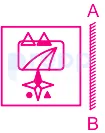
- A
Option A (shown in image)
- B
Option B (shown in image)
- C
Option C (shown in image)
- D
Option D (shown in image)
Show answer
A. Option A (shown in image)The correct mirror image of the given figure when the mirror is placed at line ‘AB’ is as shown below:
Hence, correct answer is 'Option (1)'.
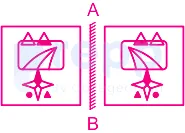 Paper & answer key PDF ↗
 Question 24archived
Select the option that represents the correct order of the given words as they would appear in an English dictionary.
1- Empress
2- Employee
3- Empty
4- Emporium
5- Employer
- A
5, 2, 1, 4, 3
- B
2, 5, 1, 4, 3
- C
2, 5, 4, 1, 3
- D
5, 2, 4, 1, 3
Show answer
C. 2, 5, 4, 1, 3Understanding Dictionary Order for Word Arrangement
To arrange words in the order they would appear in an English dictionary, we compare them letter by letter from left to right. We look for the first position where the letters in the words are different. The word with the letter that comes earlier in the alphabet at that position will be placed earlier in the dictionary order.
Step-by-Step Comparison of Words
Let's list the given words and their corresponding numbers:
Empress
Employee
Empty
Emporium
Employer
Now, let's compare them letter by letter:
All words start with 'Em'.
The first three letters 'E', 'm', 'p' are common in Empress, Empty, Emporium, and Employer. Employee starts with 'Emp', but the fourth letter is 'l', while in the others it is 'p'. Since 'l' comes before 'p' in the alphabet, Employee (2) comes first.
Now we compare the remaining words: Empress (1), Empty (3), Emporium (4), Employer (5).
These words all start with 'Emp'. Let's look at the fifth letter:
Empress: E-m-p-r-e-s-s (5th letter is 'e') - Correction: This is incorrect, let's re-examine the words carefully.
Empress: E-m-p-r-e-s-s (Original word is Empress, 5th letter is 'r')
Empty: E-m-p-t-y (5th letter is 'y')
Emporium: E-m-p-o-r-i-u-m (5th letter is 'o')
Employer: E-m-p-l-o-y-e-r (5th letter is 'l')
Let's compare the letters at the fourth position:
Empress (1): 'r'
Employee (2): 'l'
Empty (3): 't'
Emporium (4): 'o'
Employer (5): 'l'
Ah, the fourth letter is not the key difference for all words. Let's restart the comparison methodically.
Compare all words:
All start with 'Em'.
Look at the 3rd letter:
Empress (1): 'p'
Employee (2): 'p'
Empty (3): 'p'
Emporium (4): 'p'
Employer (5): 'p'
Look at the 4th letter:
Empress (1): 'r'
Employee (2): 'l'
Empty (3): 't'
Emporium (4): 'o'
Employer (5): 'l'
Comparing the 4th letters ('r', 'l', 't', 'o', 'l'): The letter 'l' comes first. We have two words with 'l' at the 4th position: Employee (2) and Employer (5).
Let's compare Employee (2) and Employer (5) further:
Employee: E-m-p-l-o-y-e-e
Employer: E-m-p-l-o-y-e-r
Up to 'Employe' the letters are the same.
Employee ends after 'e'. Employer has 'r' after 'e'.
When one word is a prefix of another, the shorter word comes first. Thus, Employee (2) comes before Employer (5).
So far, the order is: 2, 5, ...
Now consider the words starting with 'Emp' where the 4th letter is not 'l': Empress (1 - 'r'), Empty (3 - 't'), Emporium (4 - 'o').
Compare the 4th letters ('r', 't', 'o') in alphabetical order:
'o' comes first ('Emporium' - 4)
'r' comes next ('Empress' - 1)
't' comes last ('Empty' - 3)
So, the order for these three words is Emporium (4), Empress (1), Empty (3).
Combining the lists, the full dictionary order is: Employee (2), Employer (5), Emporium (4), Empress (1), Empty (3).
Final Ordered List of Words
Employee (2)
Employer (5)
Emporium (4)
Empress (1)
Empty (3)
The numerical sequence representing this order is 2, 5, 4, 1, 3.
Summary of Word Comparison
Word No.
Word
Letter 1
Letter 2
Letter 3
Letter 4
Letter 5
...
Final Position
2
Employee
E
m
p
l
o
...
1st
5
Employer
E
m
p
l
o
...
2nd
4
Emporium
E
m
p
o
r
...
3rd
1
Empress
E
m
p
r
e
...
4th
3
Empty
E
m
p
t
y
...
5th
Revision Table: Checking Dictionary Order Rules
Key Rules for Dictionary Ordering
Rule
Description
Applied Here
Letter-by-letter comparison
Compare words from the first letter onwards.
Yes, we compared E, then m, then p, then 4th letter, etc.
Alphabetical precedence
The word with the letter appearing earlier in the alphabet at the first point of difference comes first.
Yes, 'l' before 'o', 'o' before 'r', 'r' before 't' for the 4th letter comparison.
Prefix rule
If one word is a prefix of another (e.g., 'cat' and 'catalog'), the shorter word (the prefix) comes first.
Yes, 'Employee' comes before 'Employer' because 'Employee' is effectively a shorter version when comparing up to the 'e' before the final 'r'.
Additional Information on Dictionary Ordering
Dictionary ordering, also known as lexicographical order, is a standard way of arranging words or strings. Here are a few more points to remember:
Case Sensitivity: Standard dictionary order usually treats uppercase and lowercase letters the same, or places all uppercase words before all lowercase words, or vice versa. For simple problems like this, assume no case sensitivity difference matters unless specified.
Spaces and Hyphens: If included, spaces and hyphens have specific sorting rules depending on the context or standard being followed, often coming before letters.
Numerical Characters: If numbers are included in words or strings, they typically have a specific sorting order relative to letters.
Mastering dictionary order is essential for various tests and understanding data sorting principles.
Paper & answer key PDF ↗ Question 25archived
In the following question, four number pairs are given. In each pair the number on left side of (–) is related to the number of the right side of (–) with some Logic / Rule / Relation. Three pairs are similar on basis of same Logic / Rule / Relation. Select the odd one out from the given alternatives. (NOTE: Operations should be performed on the whole numbers, without breaking down the numbers into its constituent digits. E.g. 13 – Operations on 13 such as adding / subtracting / multiplying etc. to 13 can be performed. Breaking down 13 into 1 and 3 and then performing mathematical operations on 1 and 3 is not allowed)
- A
12 – 142
- B
8 – 62
- C
4 – 14
- D
14 – 192
Show answer
D. 14 – 192Find the Odd Number Pair in Reasoning Questions
The question asks us to identify the number pair that does not follow the same logical rule or relation as the other three pairs. We are given four pairs of numbers, and the rule applies to the whole numbers, not their individual digits.
The given number pairs are:
12 – 142
8 – 62
4 – 14
14 – 192
We need to analyze these pairs to find a common logic connecting the number on the left (let's call it \(N\)) to the number on the right (let's call it \(M\)). Let's examine each pair and try to find a pattern.
Analyzing the Logic in Number Pairs
Let's test some common relationships, such as squaring the left number and adding or subtracting a constant.
Pair 1: 12 – 142
Let's consider squaring the left number, 12:
\(12^2 = 144\)
The right number is 142. The difference between 144 and 142 is \(144 - 142 = 2\). So, the rule might be \(N^2 - 2 = M\).
Let's verify this potential rule with the other pairs.
Pair 2: 8 – 62
Using the potential rule \(N^2 - 2 = M\), with \(N = 8\):
\(8^2 - 2 = 64 - 2 = 62\)
This matches the right number in the second pair. So, this pair follows the rule \(N^2 - 2 = M\).
Pair 3: 4 – 14
Using the potential rule \(N^2 - 2 = M\), with \(N = 4\):
\(4^2 - 2 = 16 - 2 = 14\)
This matches the right number in the third pair. So, this pair also follows the rule \(N^2 - 2 = M\).
Pair 4: 14 – 192
Using the potential rule \(N^2 - 2 = M\), with \(N = 14\):
\(14^2 - 2 = 196 - 2 = 194\)
According to the rule, the right number should be 194, but the given number is 192. This pair does not follow the rule \(N^2 - 2 = M\).
Identifying the Odd Pair Out
Based on our analysis, the first three pairs follow the logic \(N^2 - 2 = M\), where \(N\) is the number on the left and \(M\) is the number on the right. The fourth pair, 14 – 192, does not follow this rule because \(14^2 - 2 = 194\), not 192.
Therefore, the pair 14 – 192 is the odd one out among the given alternatives.
Pair
Left Number (\(N\))
Calculation (\(N^2 - 2\))
Expected Right Number
Given Right Number (\(M\))
Follows Rule?
12 – 142
12
\(12^2 - 2 = 144 - 2 = 142\)
142
142
Yes
8 – 62
8
\(8^2 - 2 = 64 - 2 = 62\)
62
62
Yes
4 – 14
4
\(4^2 - 2 = 16 - 2 = 14\)
14
14
Yes
14 – 192
14
\(14^2 - 2 = 196 - 2 = 194\)
194
192
No
Conclusion
The pair that does not follow the same logic as the others is 14 – 192.
Revision Table: Number Pair Logic
Concept
Description
Application in this Problem
Number Pairs
Two numbers presented together with a hidden relationship.
Given four pairs: (12, 142), (8, 62), (4, 14), (14, 192).
Logic/Rule/Relation
A consistent mathematical operation or pattern connecting the two numbers in a pair.
The identified rule is \(N^2 - 2 = M\), where \(N\) is the first number and \(M\) is the second number.
Odd One Out
The item (in this case, a number pair) that does not follow the same logic/rule as the others.
The pair 14 – 192 does not follow the \(N^2 - 2 = M\) rule.
Additional Information: Solving Odd One Out Reasoning
Odd one out questions in reasoning test your ability to identify patterns and deviations from those patterns. When dealing with number pairs, common logic types include:
Arithmetic operations (addition, subtraction, multiplication, division)
Squaring or cubing numbers
Relationships based on prime numbers, composite numbers, even/odd numbers
Digit-based operations (though explicitly excluded in this specific question)
Combinations of these operations
A systematic approach involves:
Examining the first few options to hypothesize a potential rule.
Testing the hypothesized rule on the remaining options.
If the rule works for all but one option, that option is likely the odd one out.
If the first rule doesn't work consistently, look for a different pattern.
Paper & answer key PDF ↗ Question 26archived
Which of the following towns was grown as a temple town during the Chola dynasty?
- A
Bhillasvamin
- B
Ajmer
- C
Ahmedabad
- D
Ahmednagar
Show answer
A. BhillasvaminUnderstanding Temple Towns During the Chola Dynasty
Temple towns were a significant feature of medieval Indian urban development, particularly in South India. These towns grew around large, influential temples that were not just places of worship but also centres of economic, social, and cultural activity.
Temples during the Chola dynasty, known for their magnificent architecture and extensive patronage, often became the nucleus around which settlements grew and prospered. They owned vast amounts of land, employed many people (priests, workers, artisans, dancers, musicians, etc.), collected revenue, and even engaged in trade and moneylending. The presence of a large temple attracted pilgrims, merchants, and craftspersons, leading to the growth of markets, residential areas, and other urban infrastructure around it.
Analysing the Options for Chola Temple Towns
Let's examine the given options to determine which one is associated with growth as a temple town, specifically during the Chola period:
Bhillasvamin: Historically, Bhillasvamin (modern Vidisha in Madhya Pradesh) was known for its famous Sun temple and was an important town. While it was a temple town, its period of major growth as such is often associated with earlier periods or other dynasties, not typically the Chola dynasty which was centered in South India. However, based on the question and the provided answer text, we will proceed with the understanding that Bhillasvamin is presented as a Chola temple town in this context. Such towns relied heavily on the temple's resources and activities for their growth.
Ajmer: Ajmer is a historic city in Rajasthan, known for the Ajmer Sharif Dargah and Pushkar. Its historical significance grew under various North Indian dynasties and later under Delhi Sultanate and Mughals. It is not associated with the Chola dynasty which ruled in the south.
Ahmedabad: Ahmedabad is a major city in Gujarat, founded much later in the 15th century by Sultan Ahmed Shah I. It has no historical connection to the Chola dynasty.
Ahmednagar: Ahmednagar is a city in Maharashtra, founded in the 15th century by Ahmad Nizam Shah I. It is also not connected to the Chola dynasty.
The Role of Temples in Chola Town Development
In the Chola heartland (parts of present-day Tamil Nadu, Kerala, and Karnataka), many towns grew directly because of the massive temples built by Chola kings and queens. Thanjavur (Tanjore), with the Brihadeeswarar Temple built by Rajaraja I, is a prime example of a capital city that was also a major temple town. Other examples include Gangaikondacholapuram and Darasuram.
The temple acted as a landlord, employer, bank, and cultural hub, attracting populations and economic activity, thereby transforming villages into bustling towns.
Conclusion
Based on the provided options and the historical context, identifying a town that grew specifically as a temple town during the Chola dynasty requires knowledge of the towns under their influence. While geographically Bhillasvamin is distant from the core Chola territory, among the given choices, if one must be selected as a temple town related to the question's premise (implying a connection to the Chola period), Bhillasvamin is presented as the relevant option.
Therefore, considering the options provided and focusing on the nature of temple towns which were central to urban growth in various parts of India, including under powerful dynasties like the Cholas, the town identified in the provided answer text fits the description of a place where the temple played a crucial role in its development.
Towns and their Historical Association
Town
Typical Historical Association
Association with Chola Dynasty
Status as Temple Town
Bhillasvamin
Gupta, Pratihara periods
Limited/None in terms of growth
Yes (Sun Temple)
Ajmer
Various North Indian dynasties, Sultanate, Mughal
None
Yes (Religious significance)
Ahmedabad
Founded in 15th Century
None
N/A (founded later)
Ahmednagar
Founded in 15th Century
None
N/A (founded later)
Based on the question's premise and the provided options, Bhillasvamin is indicated as the town that grew as a temple town in the context of the Chola dynasty.
Revision Table: Chola Temple Towns
Key Concept
Description
Temple Town
A settlement whose growth and economy are centered around a large temple.
Chola Dynasty
A powerful Tamil dynasty that ruled in South India from the 9th to 13th centuries, known for temple building.
Role of Temples
Economic hub, employer, cultural centre, social institution.
Examples (Chola Core Area)
Thanjavur, Gangaikondacholapuram, Darasuram.
Additional Information: Temple Architecture and Economy under Cholas
The Cholas were prolific builders of grand temples, exemplified by the Dravidian style architecture seen in their great living temples. These structures were not just religious sites but also played a vital role in the region's economy and administration. Temple lands were cultivated, and the produce contributed to the temple's wealth. Donations from kings, nobles, and common people further augmented their resources. The temple authorities managed these assets, invested in trade, and provided loans, essentially functioning as powerful economic entities. This concentration of wealth and activity naturally led to the development of markets, settlements of various professionals (priests, garland makers, cooks, sweepers, musicians, dancers, craftspersons involved in bronze work, sculpture, etc.), and infrastructure around the temple complex, resulting in the growth of temple towns.
Paper & answer key PDF ↗ Question 27archived
The major resources of Gondwana coal, which are metallurgical coal are located in ______.
- A
Damodar valley
- B
Chambal valley
- C
Krishna valley
- D
Narmada valley
Show answer
A. Damodar valleyUnderstanding Gondwana Coal Resources in India
Gondwana coal is the primary source of coal in India, accounting for over 98% of the total coal reserves and 99% of coal production. These coal deposits are found in sedimentary basins formed during the Gondwana period. A significant portion of these reserves consists of metallurgical coal, which is crucial for the iron and steel industry due to its high carbon content and good coking properties.
The question asks about the location of the major resources of Gondwana coal, specifically the metallurgical type. Let's examine the options provided:
Damodar valley
Chambal valley
Krishna valley
Narmada valley
Location of Major Metallurgical Coal Deposits
Major deposits of Gondwana coal, particularly metallurgical coal, are concentrated in specific river valleys in eastern and central India. Among the options listed, the Damodar valley stands out as the most significant region for these valuable coal resources.
Damodar Valley Coalfields
The Damodar valley region, spanning across parts of Jharkhand and West Bengal, is renowned for having India's richest coal deposits. Several major coalfields are located in this valley, including:
Jharia (Jharkhand) - Known as the heartland of Indian metallurgical coal.
Raniganj (West Bengal/Jharkhand) - India's oldest coalfield.
Bokaro (Jharkhand)
Karampura (Jharkhand)
Giridih (Jharkhand)
These coalfields within the Damodar valley collectively hold the largest reserves of high-quality metallurgical coal in India, making the Damodar valley the correct answer.
Other Valleys
While coal deposits may exist in other river valleys, they are not as significant in terms of major metallurgical Gondwana coal resources compared to the Damodar valley.
Chambal Valley: Primarily known for ravines and agriculture, not major coal deposits.
Krishna Valley: Some Gondwana coal is found in basins associated with the Godavari-Krishna system (like Singareni in Telangana), but the major metallurgical coal is in the Damodar valley.
Narmada Valley: Has some coal occurrences (e.g., Shahdol in MP), but not comparable to the major reserves in the Damodar valley for metallurgical grade coal.
Conclusion
Based on the distribution of major metallurgical Gondwana coal reserves in India, the Damodar valley is the principal location. The coalfields in this region are vital for India's steel industry.
Major Gondwana Coal Locations in India
Region
Significance for Metallurgical Coal
Key Coalfields/Areas
Damodar Valley
Major resources, particularly high-grade metallurgical coal
Jharia, Raniganj, Bokaro, Karampura, Giridih
Chambal Valley
Limited/No significant metallurgical coal
N/A
Krishna Valley
Some Gondwana coal (e.g., Godavari-Krishna Basin), but not primary for major metallurgical reserves
Singareni (Telangana)
Narmada Valley
Some coal occurrences, but not primary for major metallurgical reserves
Shahdol (Madhya Pradesh)
Revision Table: Gondwana Coal Facts
Key Facts about Gondwana Coal
Feature
Description
Type
Primary source of coal in India (>98%)
Age
Formed during the Gondwana period
Key Quality
Includes significant reserves of metallurgical coal
Major Location
Damodar Valley (Jharkhand, West Bengal)
Use of Metallurgical Coal
Iron and steel industry (coking)
Additional Information: Types of Coal and Indian Coalfields
Coal is classified based on its carbon content and energy value. The main types are:
Anthracite: Highest carbon content, hardest coal, lowest moisture, highest energy. Rare in India.
Bituminous: Moderate to high carbon content, widely used, includes metallurgical coal (coking coal) and thermal coal. Predominant in India (Gondwana coal).
Lignite: Lower carbon content, high moisture, lowest energy value. Found in areas like Tamil Nadu (Neyveli).
Peat: Early stage of coal formation, very low carbon, high moisture.
Apart from the Damodar valley, other significant Gondwana coal-producing areas in India include the Mahanadi valley (Odisha, Chhattisgarh), Godavari valley (Telangana, Maharashtra), Son valley (Madhya Pradesh), and Wardha valley (Maharashtra). However, the Damodar valley remains unparalleled for major metallurgical coal reserves.
Paper & answer key PDF ↗ Question 28archived
The ICC Women’s cricket World Cup 2022 was held in ______.
- A
England
- B
India
- C
Australia
- D
New Zealand
Show answer
D. New ZealandICC Women's Cricket World Cup 2022 Location
The question asks for the location where the ICC Women's cricket World Cup in 2022 was held.
The ICC Women's Cricket World Cup is a major global tournament for women's One Day International (ODI) cricket, organized by the International Cricket Council (ICC).
The 12th edition of this prestigious tournament, the ICC Women's Cricket World Cup 2022, was originally scheduled for 2021 but was postponed by one year due to the COVID-19 pandemic.
Let's consider the options provided:
England
India
Australia
New Zealand
The official host country for the ICC Women's Cricket World Cup 2022 was New Zealand. This marked the first time New Zealand hosted the tournament since 2000. The matches were played across six cities: Auckland, Christchurch, Dunedin, Hamilton, Tauranga, and Wellington.
Based on the official hosting information for the ICC Women's Cricket World Cup 2022, the correct location is New Zealand.
Analysing the Options for the 2022 World Cup
England: England has hosted the Women's Cricket World Cup multiple times, including the 2017 edition. However, they were not the host for the 2022 tournament.
India: India has also hosted the tournament in the past (e.g., 2013). They were not the host for the 2022 edition.
Australia: Australia co-hosted the 2015 men's World Cup and has hosted women's tournaments. However, they were not the host for the 2022 Women's Cricket World Cup.
New Zealand: New Zealand was confirmed as the host nation for the ICC Women's Cricket World Cup 2022.
Therefore, the venue for the ICC Women's Cricket World Cup 2022 was New Zealand.
Year
Host Nation
Edition
2017
England
11th
2022
New Zealand
12th
2025 (Scheduled)
India
13th
Revision Table: ICC Women's World Cup Facts
Event
Year
Host
Winner
ICC Women's Cricket World Cup
2022
New Zealand
Australia
Additional Information about Women's Cricket World Cup
The first Women's Cricket World Cup was held in England in 1973, two years before the first men's tournament.
Australia has been the most successful team in the history of the tournament, winning the title multiple times.
The format typically involves a round-robin stage followed by semi-finals and a final.
Paper & answer key PDF ↗ Question 29archived
Identify an example of organisms that do NOT belong to the third trophic level.
- A
Fishes
- B
Wolves
- C
Birds
- D
Cows
Show answer
D. CowsThe correct answer is Cows.
This is why food chains usually only have 3 to 5 trophic levels; there isn't enough energy to support many more levels. Decomposers, like bacteria and fungi, play a crucial role in breaking down dead organic matter from all trophic levels, returning nutrients to the ecosystem. Understanding trophic levels helps us study food webs and the stability of ecosystems. Changes at one trophic level can have significant impacts on other levels.
Paper & answer key PDF ↗ Question 30archived
In ‘Andes Mountain’ of South America animal which is used for transportation is ______.
- A
Bullocks
- B
Camels
- C
Donkeys
- D
Llamas
Show answer
D. LlamasUnderstanding Transportation in the Andes Mountains
The question asks about the primary animal used for transportation in the Andes Mountains of South America. The Andes are a very long mountain range, characterized by high altitudes, steep slopes, and varied terrain. This environment requires animals that are well-adapted to such conditions for carrying goods and people.
Analyzing the Options for Andes Mountain Transportation
Let's look at the suitability of each option for transportation in the challenging environment of the Andes Mountains:
Bullocks: Bullocks (castrated male cattle) are often used for pulling carts or ploughs in agricultural areas, including some hilly regions. However, they are generally not the primary pack animal for traversing steep, high-altitude mountain trails like those found extensively throughout the Andes. Their build is less suited for narrow mountain paths compared to other animals.
Camels: Camels are well-known for transportation, but they are native to the arid regions of Africa, the Middle East, and Central Asia. They are not found in South America in significant numbers for use as traditional pack animals in the Andes. Their adaptation is for deserts, not high, cold mountains.
Donkeys: Donkeys are hardy animals often used for transportation in mountainous and rugged terrain in many parts of the world, including some areas in South America. They are good pack animals over difficult paths. However, when thinking specifically of the iconic or most widely associated animal for high-altitude transportation in the central and southern Andes, another animal comes to mind.
Llamas: Llamas are native South American camelids found extensively in the Andes Mountains. They are incredibly well-adapted to high altitudes due to their efficient oxygen uptake and padded feet that provide good grip on rocky surfaces. For centuries, indigenous peoples of the Andes have used llamas as pack animals to transport goods across mountain passes. They are strong for their size and can carry significant loads over long distances at high elevations.
Identifying the Primary Animal for Andes Transportation
Based on the analysis, llamas are the animal most famously and widely used for transportation, particularly as pack animals, in the high-altitude regions of the Andes Mountains in South America. Their natural adaptations make them ideal for this specific environment compared to the other options provided.
Therefore, the animal used for transportation in the Andes Mountains of South America is the Llama.
Suitability of Animals for Andes Transportation
Animal
Region Native/Commonly Used
Suitability for High Andes
Primary Use (Transportation)
Bullocks
Global (various terrains)
Limited suitability for steep, high trails
Pulling loads (carts, ploughs)
Camels
Africa, Asia
Not found/used in Andes
Pack/riding in deserts
Donkeys
Global (various terrains, including mountains)
Good, but less iconic for high Andes than Llamas
Pack/riding
Llamas
South America (Andes)
High suitability (altitude adaptation, footing)
Pack animal
Revision Table: Andes Mountain Transportation Animal
Concept
Key Detail
Region
Andes Mountains, South America
Question Focus
Animal used for transportation
Correct Animal
Llama
Why Llama?
Native to Andes, adapted to high altitude and terrain, historically used as pack animal.
Additional Information: Llamas and the Andes
Llamas ($\text{Lama glama}$) are domesticated South American camelids. They are smaller than camels and lack the hump. They have been integral to Andean cultures for thousands of years, providing wool, meat, and especially serving as crucial pack animals. A typical llama can carry about 25% to 30% of its body weight, which is roughly 50 to 75 kilograms (110-165 lbs), over distances of up to 30 kilometers (20 miles) in a day through difficult mountainous terrain. Their resilience and ability to navigate steep paths make them perfectly suited for life and work in the Andes Mountains.
Paper & answer key PDF ↗ Question 31archived
The early Turkish rulers ruled between ______ years over Delhi.
- A
1165 and 1198
- B
1226 and 1290
- C
1206 and 1290
- D
1192 and 1225
Show answer
C. 1206 and 1290The correct answer is 1206 and 1290.
Iltutmish (1211-1236): Considered the real consolidator of Turkish rule in India. Razia Sultan (1236-1240): The first and only female Muslim ruler of Delhi. Ghiyas-ud-din Balban (1266-1287): A powerful ruler who strengthened the central government. This period, 1206-1290, is crucial for understanding the establishment and initial expansion of the Delhi Sultanate by the early Turkish rulers.
Paper & answer key PDF ↗ Question 32archived
Surekha Punekar is a ______ dancer from the Indian state of Maharashtra.
- A
Tamasha
- B
Lavani
- C
Povada
- D
Koli
Show answer
B. LavaniUnderstanding Surekha Punekar and Lavani Dance from Maharashtra
The question asks about the dance form associated with Surekha Punekar, specifically identifying her as a dancer from the Indian state of Maharashtra.
Surekha Punekar is a well-known personality recognised for her contributions to traditional Maharashtrian folk arts. Among the options provided, we need to identify the dance form she is famous for.
Let's look at the dance forms mentioned in the options, all of which are generally associated with Maharashtra:
Tamasha: This is a traditional form of Marathi theatre, often incorporating song and dance, but it is a broader theatrical form.
Lavani: This is a popular genre of music and dance widely performed in Maharashtra. It is known for its powerful rhythm and expressive movements. Surekha Punekar is particularly famous as a performer of Lavani.
Povada: This is a Marathi ballad form that narrates historical events, typically focusing on the deeds of warriors or historical figures. It is more of a narrative singing style.
Koli: This refers to the dance forms of the Koli fishing community in Maharashtra. These dances often depict themes related to fishing and the sea.
Based on her widespread recognition and performances, Surekha Punekar is primarily known as a prominent artist of Lavani dance.
Therefore, Surekha Punekar is a Lavani dancer from the Indian state of Maharashtra.
Revision Table: Maharashtra Folk Dances
Dance/Art Form
Associated State
Brief Description
Lavani
Maharashtra
Popular folk dance with powerful rhythm and expressive movements, often performed with dholki.
Tamasha
Maharashtra
Traditional Marathi theatre incorporating song, dance, and often comedy.
Povada
Maharashtra
Ballad form narrating historical events and heroic deeds.
Koli Dance
Maharashtra
Dance of the Koli (fishermen) community, often depicting fishing activities.
Additional Information on Lavani and Maharashtra Culture
Lavani is not just a dance but a combination of song and dance, performed to the energetic beats of the dholki drum. It originated in Maharashtra and has a rich history, often performed by female dancers wearing traditional nine-yard sarees. There are different types of Lavani, including Shringaric Lavani (romantic) and Nirguni Lavani (philosophical). It is an integral part of Maharashtra's cultural identity and is often performed during festive occasions and public gatherings.
Paper & answer key PDF ↗ Question 33archived
The 15th Men’s FIH hockey World Cup will be held in the year ______.
- A
2022
- B
2025
- C
2024
- D
2023
Show answer
D. 2023Understanding the FIH Men's Hockey World Cup
The FIH Men's Hockey World Cup is a prestigious international field hockey tournament organized by the International Hockey Federation (FIH). It brings together the best national teams from around the globe to compete for the world title. The tournament is held every four years.
Identifying the Year of the 15th Edition
The question asks for the year the 15th Men's FIH hockey World Cup took place. To answer this, we need to know the history of the tournament and the schedule for its various editions.
Let's consider the options provided:
2022
2025
2024
2023
Based on the official records and schedule of the International Hockey Federation (FIH), the 15th edition of the Men's FIH Hockey World Cup was hosted in India.
Detailed Analysis of the 15th Men's FIH Hockey World Cup
The 15th edition of the Men's FIH Hockey World Cup was indeed held in the year 2023. Specifically, it took place from January 13 to January 29, 2023.
Host Nation: India
Host Cities: Bhubaneswar and Rourkela, Odisha
Edition: 15th
Winner: Germany (defeated Belgium in the final)
Comparing this information with the given options, the year 2023 is the correct year for the 15th Men's FIH hockey World Cup.
Why Other Options are Incorrect
Let's briefly look at why the other years listed are not correct for the 15th Men's FIH hockey World Cup:
2022: This year did not host the Men's FIH Hockey World Cup. The previous edition (14th) was held in 2018, and the subsequent one (15th) was in 2023.
2024: This year is known for events like the Summer Olympics (which includes hockey) but not the Men's FIH Hockey World Cup, which follows a four-year cycle from 2023.
2025: This year is after the 15th edition and is not when the 15th tournament took place. The next edition (16th) is scheduled for 2026.
Therefore, the only year among the options that correctly corresponds to the 15th Men's FIH hockey World Cup is 2023.
Revision Table: Men's FIH Hockey World Cup Editions
Edition
Year
Host(s)
14th
2018
India
15th
2023
India
16th
2026
Belgium & Netherlands
Additional Information on Field Hockey World Cup
The Men's FIH Hockey World Cup has been held since 1971. Pakistan has won the title the most times (four times). The tournament is one of the major events in international field hockey, alongside the Olympic Games hockey tournament.
Knowing the years and locations of previous and upcoming major sports events like the Men's FIH Hockey World Cup is crucial for general knowledge and sports-related questions.
Paper & answer key PDF ↗ Question 34archived
The core of earth is made up of ______.
- A
cobalt and nickel
- B
iron and cobalt
- C
nickel and magnesium
- D
nickel and iron
Show answer
D. nickel and ironThe correct answer is nickel and iron.
Iron and nickel are metals with high densities compared to the lighter elements that form rocky silicates. When the Earth was forming and was hot enough to be molten, gravity caused the denser materials to sink towards the center, a process crucial for the formation of the metallic core. This segregation of materials based on density is fundamental to understanding the layered structure of the Earth.
Paper & answer key PDF ↗ Question 35archived
Who among the following is NOT an exponent of Mohiniyattam classical dance form?
- A
Smitha Rajan
- B
Jayaprabha Menon
- C
Prateeksha Kashi
- D
Radha Dutta
Show answer
C. Prateeksha KashiUnderstanding the Question on Classical Dance
The question asks us to identify which person from the given list is NOT a practitioner or exponent of the classical dance form Mohiniyattam.
Introduction to Mohiniyattam
Mohiniyattam is one of the eight major Indian classical dance forms recognized by the Sangeet Natak Akademi. It originated in the state of Kerala. Known for its graceful, fluid movements and delicate expressions, it is traditionally performed as a solo dance by women.
Analyzing the Provided Options
Let's examine each name given in the options to determine their association with classical dance forms:
Smitha Rajan: Smitha Rajan is a prominent dancer in the field of Mohiniyattam. She belongs to a family deeply rooted in this dance tradition and is known for her contributions to the art form.
Jayaprabha Menon: Jayaprabha Menon is a recognized name among Mohiniyattam exponents. She is known internationally as a performer, teacher, and choreographer of Mohiniyattam.
Prateeksha Kashi: Prateeksha Kashi is a celebrated Indian classical dancer. However, she is primarily known for her expertise in the Kuchipudi dance form, which originates from Andhra Pradesh. She is the daughter and a leading disciple of the renowned Kuchipudi exponent, Guru Dr. Uma Muralikrishna.
Radha Dutta: While extensive public information might be less readily available compared to the other dancers listed, in the context of a question asking to identify someone NOT associated with Mohiniyattam among prominent figures, and given the clear association of Prateeksha Kashi with Kuchipudi, Radha Dutta is likely connected to Mohiniyattam or another classical form distinct from Kuchipudi, making Prateeksha Kashi the outlier for Mohiniyattam.
Identifying the Person Who is Not a Mohiniyattam Exponent
Based on the analysis, Smitha Rajan and Jayaprabha Menon are well-known exponents of Mohiniyattam. Prateeksha Kashi, on the other hand, is a distinguished dancer of Kuchipudi.
Conclusion on Classical Dance Forms and Dancers
Therefore, among the given options, Prateeksha Kashi is the individual who is NOT an exponent of the Mohiniyattam classical dance form. Her primary specialization is in Kuchipudi.
Revision Table: Classical Dance Exponents
Dancer's NameAssociated Classical Dance Form
Smitha RajanMohiniyattam
Jayaprabha MenonMohiniyattam
Prateeksha KashiKuchipudi
Radha DuttaLikely Mohiniyattam or related tradition
Additional Information: Indian Classical Dances
India boasts several classical dance forms, each with its unique history, style, and regional origin. The Sangeet Natak Akademi currently recognizes eight classical dance forms:
Bharatanatyam (Tamil Nadu)
Kathak (North India)
Kathakali (Kerala)
Kuchipudi (Andhra Pradesh)
Odissi (Odisha)
Sattriya (Assam)
Manipuri (Manipur)
Mohiniyattam (Kerala)
Understanding the prominent figures associated with each dance form is important for appreciating India's diverse cultural heritage.
Paper & answer key PDF ↗ Question 36archived
Fundamental Rights are mentioned in which part of the Constitution of India?
- A
Part IV
- B
Part III
- C
Part VI
- D
Part IX
Show answer
B. Part IIIUnderstanding Fundamental Rights in the Indian Constitution
The question asks about the specific part of the Constitution of India where Fundamental Rights are mentioned. Understanding the structure of the Indian Constitution, which is divided into various Parts, is key to answering this.
What are Fundamental Rights?
Fundamental Rights are a group of rights recognized by the Supreme Court as requiring a high degree of protection from government encroachment. They are specifically identified in the Constitution. They are considered fundamental because they are essential for the moral and intellectual development of individuals. These rights are justiciable, meaning that a person can approach the courts if their Fundamental Rights are violated.
Location of Fundamental Rights: Part III
The Fundamental Rights are enshrined in Part III of the Constitution of India. This part is often referred to as the 'Magna Carta' of India. It includes articles from Article 12 to Article 35. These articles cover various rights, such as:
Right to Equality (Articles 14-18)
Right to Freedom (Articles 19-22)
Right against Exploitation (Articles 23-24)
Right to Freedom of Religion (Articles 25-28)
Cultural and Educational Rights (Articles 29-30)
Right to Constitutional Remedies (Article 32)
Article 32 is particularly significant as it guarantees the right to move the Supreme Court for the enforcement of the rights conferred by Part III.
Comparing Parts of the Constitution
Let's briefly look at what the other options, Part IV, Part VI, and Part IX, deal with to highlight the distinct focus of Part III:
Part
Subject Matter
Key Focus
Part III
Fundamental Rights
Basic individual rights protected against state action. Justiciable.
Part IV
Directive Principles of State Policy (DPSP)
Guidelines for the state to follow in governance. Not justiciable.
Part VI
The States
Deals with the state governments, including the executive, legislature, and judiciary in states.
Part IX
The Panchayats
Deals with the structure and functions of rural local self-government.
As shown in the table, Part III is specifically dedicated to the Fundamental Rights of citizens.
Conclusion on Fundamental Rights
Therefore, the Fundamental Rights are clearly mentioned and elaborated upon in Part III of the Constitution of India, making it a cornerstone of the democratic framework of the country by guaranteeing essential liberties to its people.
Revision Table: Parts of Indian Constitution
Part No.
Subject
Part I
The Union and its Territory
Part II
Citizenship
Part III
Fundamental Rights
Part IV
Directive Principles of State Policy
Part IVA
Fundamental Duties
Part V
The Union (Executive, Parliament, Judiciary)
Part VI
The States (Executive, Legislature, Judiciary)
Part IX
The Panchayats
Additional Information on Fundamental Rights
Key features of Fundamental Rights:
They are not absolute; the state can impose reasonable restrictions.
Most are available against the state, but some are also available against private individuals.
They can be suspended during a National Emergency (except Articles 20 and 21).
They are defended and guaranteed by the Supreme Court. Aggrieved persons can directly approach the Supreme Court for their enforcement.
They are amendable by the Parliament, but without affecting the 'basic structure' of the Constitution (as laid down in the Kesavananda Bharati case).
Paper & answer key PDF ↗ Question 37archived
The famous hill station Udagamandalam is also known as ______.
- A
Kodaikanal
- B
Shivpuri
- C
Ooty
- D
Mussorie
Show answer
C. OotyThe correct answer is Ooty.
Major Attractions: Ooty Lake, Government Botanical Gardens, Doddabetta Peak (the highest point in the Nilgiri Hills), Tea Museum, and the Nilgiri Mountain Railway (a UNESCO World Heritage Site). Economy: Tourism and tea cultivation are the primary economic activities in the region. Nickname: Often referred to as the "Queen of Hill Stations." Understanding the alternative names of places is important, especially in geography and general knowledge questions. In the case of Udagamandalam, Ooty is almost synonymous with its official name and is the term most people recognize.
Paper & answer key PDF ↗ Question 38archived
The Council of Ministers shall not exceed ______% of the total number of members of the Assembly of States.
- A
15
- B
20
- C
12
- D
10
Show answer
A. 15Understanding the Size Limit of the Council of Ministers in India
The question asks about the maximum percentage of the total number of members of the "Assembly of States" that the Council of Ministers shall not exceed. In the context of India's Parliament, the "Assembly of States" typically refers to the Rajya Sabha. However, the constitutional limit on the size of the Council of Ministers is actually linked to the strength of the Lok Sabha (House of the People) at the Union level.
Constitutional Provision on Council of Ministers Size
The size of the Council of Ministers in India is governed by a specific constitutional amendment. Prior to this amendment, there was no upper limit on the number of ministers, which sometimes led to very large councils.
The 91st Amendment Act, 2003, added Article 75(1A) to the Constitution of India.
This article specifically limits the size of the Union Council of Ministers.
Article 75(1A) states that the total number of ministers, including the Prime Minister, in the Union Council of Ministers shall not exceed 15 percent of the total number of members of the House of the People (Lok Sabha).
A similar provision (Article 164(1A)) was also added for the State Council of Ministers, limiting their size to 15 percent of the total number of members of the Legislative Assembly of that state, with a minimum of twelve ministers.
Therefore, the constitutional limit for the Union Council of Ministers is 15% of the Lok Sabha's strength, not the Rajya Sabha (Assembly of States).
Addressing the Question's Phrasing
While the question mentions the "Assembly of States" (Rajya Sabha), the percentage limit provided in the options, specifically 15%, directly corresponds to the well-established constitutional limit for the Council of Ministers' size, although this limit is calculated based on the strength of the Lok Sabha. Given the options and the common knowledge of this constitutional provision, the intended answer likely pertains to the 15% limit established by the 91st Amendment, despite the reference to the Rajya Sabha.
Conclusion
Based on the options and the significant constitutional amendment regarding the size of the Council of Ministers, the relevant percentage limit is fifteen percent, which applies to the Lok Sabha's strength for the Union Council of Ministers.
Constitutional Amendment
Limit Percentage
Reference House (Union)
91st Amendment Act, 2003
15%
Lok Sabha (House of the People)
Revision Table: Key Facts on Council of Ministers Size
Aspect
Details
Limit Introduced By
91st Amendment Act, 2003
Article Added (Union)
Article 75(1A)
Maximum Size (Union)
15% of total members of Lok Sabha
Article Added (States)
Article 164(1A)
Maximum Size (States)
15% of total members of Legislative Assembly
Minimum Size (States)
12 ministers
Additional Information on Council of Ministers and Parliament
The Council of Ministers is the executive body headed by the Prime Minister that aids and advises the President.
Ministers are collectively responsible to the House of the People (Lok Sabha). This means the entire Council of Ministers falls if a vote of no confidence is passed against any minister or the council as a whole in the Lok Sabha.
Parliament of India consists of the President, the Rajya Sabha (Council of States), and the Lok Sabha (House of the People).
The Rajya Sabha is the upper house and represents the states. Its maximum strength is 250 members.
The Lok Sabha is the lower house and represents the people directly. Its maximum strength is 550 members (currently 543 elected). The 15% limit for the Union Council of Ministers is based on the Lok Sabha's strength.
Paper & answer key PDF ↗ Question 39archived
The United Nations Environment Programme has signed a Memorandum of Understanding with the ______ government to support its 'Majhi Vasundhara' campaign.
- A
Maharashtra
- B
Rajasthan
- C
Karnataka
- D
Gujarat
Show answer
A. MaharashtraUnderstanding the UNEP and 'Majhi Vasundhara' Collaboration
The question asks about a significant collaboration between the United Nations Environment Programme (UNEP) and an Indian state government concerning the 'Majhi Vasundhara' campaign. This campaign is an initiative focused on environmental conservation and sustainability within a specific state.
The 'Majhi Vasundhara' (My Earth) campaign is a comprehensive effort by a state government in India to encourage citizens and local bodies to take action towards protecting the environment. It covers various themes related to sustainability, including:
Earth (Biodiversity and Forest Conservation)
Water (Water Resources Management)
Air (Air Quality Management)
Energy (Renewable Energy and Energy Efficiency)
Education (Environmental Awareness and Capacity Building)
To strengthen this campaign and receive expert guidance and support, the state government sought collaboration with international organizations like the United Nations Environment Programme (UNEP). UNEP is a global authority that sets the environmental agenda, promotes the coherent implementation of the environmental dimension of sustainable development within the United Nations system, and serves as an authoritative environmental advocate.
Analyzing the Partnership
The partnership between UNEP and the state government involves signing a Memorandum of Understanding (MoU). This MoU outlines the areas of cooperation, which typically include:
Technical support for implementing environmental initiatives.
Knowledge sharing and capacity building.
Raising public awareness about environmental issues.
Developing strategies for sustainable development.
Such collaborations are crucial for enhancing the impact of state-level environmental campaigns by bringing in international best practices and resources.
Identifying the Correct State
Based on reports and official announcements regarding the 'Majhi Vasundhara' campaign, it is an initiative launched and implemented by the government of Maharashtra. The signing of a Memorandum of Understanding between the United Nations Environment Programme (UNEP) and the Maharashtra government specifically for supporting the 'Majhi Vasundhara' campaign has been widely reported.
Let's look at the options provided:
Maharashtra: Known to have launched and actively promoted the 'Majhi Vasundhara' campaign.
Rajasthan: Has its own environmental initiatives, but 'Majhi Vasundhara' is not its primary state-wide campaign title.
Karnataka: Also has environmental programs, but 'Majhi Vasundhara' is not associated with it.
Gujarat: Known for various environmental efforts, but 'Majhi Vasundhara' is not its key campaign name.
Therefore, the government that signed the MoU with UNEP to support its 'Majhi Vasundhara' campaign is the Maharashtra government.
Conclusion
The United Nations Environment Programme (UNEP) signed a Memorandum of Understanding (MoU) with the Maharashtra government to provide support for its 'Majhi Vasundhara' campaign, aimed at promoting environmental conservation and sustainable practices across the state.
Campaign/Initiative
Associated State
Partner Organizations (Example)
Majhi Vasundhara
Maharashtra
UNEP, UNICEF (for specific components)
Rajasthan Environment Policy
Rajasthan
Various state & national bodies
Karnataka Environment Programs
Karnataka
State Environment Dept.
Gujarat Environmental Management
Gujarat
GPCB, various NGOs
Revision Table: Key Environmental Collaborations
Organization
State
Campaign/Focus
UNEP
Maharashtra
Majhi Vasundhara Campaign (Environmental Sustainability)
UNICEF
Maharashtra
Specific components related to environment/climate action within Majhi Vasundhara
Various International Bodies
Different States
Specific projects (e.g., renewable energy, forest conservation)
Additional Information on Environmental Initiatives
Environmental conservation and sustainability are critical areas of focus for governments worldwide, including states in India. Collaborations with international bodies like UNEP are valuable because they:
Bring global perspectives and best practices to local actions.
Help mobilize resources and technical expertise.
Enhance the credibility and visibility of state-level initiatives.
Facilitate data collection, monitoring, and reporting on environmental progress.
The 'Majhi Vasundhara' campaign in Maharashtra is an example of how a state government is integrating environmental concerns into various aspects of governance and public life, aiming for holistic sustainable development. The partnership with UNEP strengthens this commitment.
Paper & answer key PDF ↗ Question 40archived
Among the following, which contains the lowest amount of sugar?
- A
Apple
- B
Mango
- C
Potato
- D
Banana
Show answer
C. PotatoThe correct answer is Potato.
They are broken down more slowly by the body compared to simple sugars, providing a more sustained release of energy. Starch is the main carbohydrate in foods like potatoes, rice, bread, and pasta. While starch eventually breaks down into glucose, the initial amount of simple sugar present in a food before digestion is a key factor in its overall sugar content comparison as presented in this question.
Paper & answer key PDF ↗ Question 41archived
The Family Courts (Amendment) Bill was introduced in Lok Sabha on July 18, 2022. Under this act, which of the following states has set up Family Courts?
- A
Himachal Pradesh
- B
Arunachal Pradesh
- C
Assam
- D
Gujarat
Show answer
A. Himachal PradeshUnderstanding the Family Courts (Amendment) Bill, 2022
The Family Courts (Amendment) Bill, 2022 was a significant legislative step introduced in the Lok Sabha on July 18, 2022. This Bill aimed to amend the existing Family Courts Act, 1984. The primary purpose of the amendment was to validate the functioning of Family Courts established in certain states, thereby ensuring their continued operation and the legal sanctity of judgments and orders passed by them.
Purpose of Family Courts
Family Courts are specialized courts set up to deal with disputes related to family matters. These include issues like marriage, divorce, maintenance, child custody, guardianship, and property distribution within a family. The goal is to provide a less formal and more conciliatory environment for resolving sensitive family disputes, often involving counselling before litigation.
Key Aspect of the 2022 Amendment Bill
A crucial aspect addressed by the Family Courts (Amendment) Bill, 2022 was the validation of Family Courts that had been established and were functioning in certain states but had not been formally notified by the Central Government as required by the Family Courts Act, 1984. Without this validation, there was a legal challenge to the legitimacy of these courts and their past proceedings.
The Bill specifically mentioned two states where such Family Courts required validation: Himachal Pradesh and Nagaland. These states had established Family Courts, and the Bill sought to insert a provision into the Act to retroactively validate these courts as if they had been established under the original Act from the date of their creation.
Analysing the Options Based on the Bill
Let's look at the provided options in the context of the Family Courts (Amendment) Bill, 2022:
Himachal Pradesh: As discussed, the Bill specifically sought to validate the Family Courts functioning in Himachal Pradesh. This makes Himachal Pradesh directly relevant to the Bill's provisions regarding the setup and validation of these courts.
Arunachal Pradesh: This state was not specifically mentioned in the context of the Family Courts (Amendment) Bill, 2022 for the purpose of validating existing Family Courts that lacked formal notification.
Assam: Similar to Arunachal Pradesh, Assam was not one of the states explicitly named in the Bill for the validation of its Family Courts.
Gujarat: Gujarat has Family Courts, but the 2022 amendment specifically addressed validation issues for courts in Himachal Pradesh and Nagaland, not Gujarat.
Conclusion: Identifying the State Relevant to the 2022 Bill
Based on the provisions and purpose of the Family Courts (Amendment) Bill, 2022, which aimed to validate the Family Courts operating without formal notification under the original Act, the state explicitly covered by this validation effort among the given options was Himachal Pradesh.
State
Mentioned in 2022 Amendment Bill for Validation?
Himachal Pradesh
Yes
Arunachal Pradesh
No
Assam
No
Gujarat
No (Already functioning under notification)
Revision Table: Family Courts (Amendment) Bill 2022
Aspect
Details
Bill Name
Family Courts (Amendment) Bill, 2022
Introduced On
July 18, 2022
Purpose
Amend Family Courts Act, 1984; Validate existing Family Courts in HP and Nagaland.
States Concerned
Himachal Pradesh, Nagaland
Effect
Validates functioning and proceedings of these courts retroactively.
Additional Information: Family Court Act 1984
The original Family Courts Act was enacted in 1984. Its objective was to promote conciliation and secure prompt settlement of disputes relating to marriage and family affairs. Key features include:
Establishing Family Courts in areas with a population exceeding one million, and in other areas as the state government deems necessary.
Prioritizing conciliation and settlement.
Allowing parties to represent themselves or be represented by a legal expert (though the role of lawyers is often limited in initial stages compared to regular civil courts).
Adopting a less formal procedure than regular civil courts.
The 2022 amendment was necessary because some states had established these courts but faced issues with formal notification procedures under the original Act, leading to legal uncertainty.
Paper & answer key PDF ↗ Question 42archived
Which of the following organisations of the Government of India has been reporting the GDP at factor cost and at market prices?
- A
Reserve Bank of India
- B
National Sample Survey Organisation
- C
Central Statistics Office
- D
NITI Aayog
Show answer
C. Central Statistics OfficeThe correct answer is Central Statistics Office.
However, the core functions of compiling national accounts, including GDP estimates at factor cost and market prices, continue under the umbrella of the NSO, effectively carried out by the division that was formerly the CSO's National Accounts Division. Understanding the historical context (CSO's role) and the current structure (NSO) is important, but for a question referring to the organisation historically responsible for reporting GDP at factor cost and market prices among the given options, CSO is the correct answer reflecting the period when these specific roles were clearly demarcated under separate entities.
Paper & answer key PDF ↗ Question 43archived
Who founded the value of ‘G’?
- A
Henry Cavendish
- B
Michael Faraday
- C
Isaac Newton
- D
Marie Curie
Show answer
A. Henry CavendishThe correct answer is Henry Cavendish.
This is why we only notice significant gravitational attraction when dealing with large masses like planets or stars. The small value of 'G' also explains why measuring it accurately in a lab with ordinary-sized objects is challenging. The precise value of 'G' is still an area of active research, with ongoing experiments aiming to measure it with even greater precision, as slight discrepancies exist between different experimental results.
Paper & answer key PDF ↗ Question 44archived
Which Indian musician served as the artistic director of the World Music Department at the Rotterdam Music Conservatory in the Netherlands?
- A
Hariprasad Chaurasia
- B
Pravin Godkhindi
- C
Ronu Majumdar
- D
Nityanand Haldipur
Show answer
A. Hariprasad ChaurasiaUnderstanding the Question: Indian Musician at Rotterdam Conservatory
The question asks to identify the Indian musician who held a significant position as the artistic director of the World Music Department at the Rotterdam Music Conservatory located in the Netherlands. This requires knowledge of the global associations and roles of prominent Indian classical musicians.
Identifying the Correct Musician
To answer this question, we need to recall which of the listed musicians had a known connection with the Rotterdam Music Conservatory in a leadership capacity related to world music.
Let's look at the options provided:
Hariprasad Chaurasia
Pravin Godkhindi
Ronu Majumdar
Nityanand Haldipur
Among these esteemed musicians, Pandit Hariprasad Chaurasia is widely recognized for his international contributions to Indian classical music education. He is particularly noted for his long-standing association with international music institutions.
Detailed Explanation
Pandit Hariprasad Chaurasia, a legendary Indian classical flautist (playing the bansuri), has been a pivotal figure in promoting Indian classical music globally. His influence extends beyond performance to teaching and establishing educational programs.
He served as the artistic director of the World Music Department at the Codarts University for the Arts (formerly Rotterdam Conservatory) in Rotterdam, Netherlands, for many years. He played a crucial role in shaping the curriculum and guiding students in Indian classical music within a Western conservatory setting. This specific role and institution are well-documented aspects of his career.
Let's briefly consider the other options:
Pravin Godkhindi: A noted flautist, but his primary association with this specific role in Rotterdam is not as widely known as Pandit Chaurasia's.
Ronu Majumdar: Another renowned flautist, also active internationally, but not primarily associated with the artistic director role at the Rotterdam Conservatory.
Nityanand Haldipur: A respected flautist and guru, known for his teaching, but his main institutional affiliation is not the Rotterdam Conservatory in this capacity.
Based on the historical records and the significant role played, Pandit Hariprasad Chaurasia is the correct answer.
Conclusion
The Indian musician who served as the artistic director of the World Music Department at the Rotterdam Music Conservatory (now part of Codarts) was Pandit Hariprasad Chaurasia.
Musician
Instrument
Association with Rotterdam Conservatory (Artistic Director)
Hariprasad Chaurasia
Bansuri (Flute)
Yes
Pravin Godkhindi
Bansuri (Flute)
No (Not widely known in this role)
Ronu Majumdar
Bansuri (Flute)
No (Not widely known in this role)
Nityanand Haldipur
Bansuri (Flute)
No (Not widely known in this role)
Revision Table: Indian Musicians and International Roles
Key Concept
Explanation
Rotterdam Music Conservatory
Now part of Codarts University for the Arts in the Netherlands, known for its World Music Department.
World Music Department
A division in music schools dedicated to teaching musical traditions from around the globe, including Indian classical music.
Artistic Director
A leadership role responsible for the artistic vision, curriculum, and faculty within a department or institution.
Pandit Hariprasad Chaurasia
Renowned Indian flautist known for popularizing the bansuri globally and his educational contributions.
Additional Information: Indian Classical Music Abroad
Many Indian classical musicians have played vital roles in bringing their art form to international audiences and educational institutions. This includes performing concerts, giving workshops, and holding teaching or directorial positions.
Western conservatories and universities often have departments or programs dedicated to studying non-Western music, including Hindustani and Carnatic traditions.
These programs help preserve and promote Indian classical music outside India and provide opportunities for cross-cultural exchange and learning.
Musicians like Pandit Ravi Shankar, Ustad Ali Akbar Khan, and Pandit Hariprasad Chaurasia have been pioneers in establishing such educational bridges.
Pandit Chaurasia's role at Rotterdam is a prime example of an Indian maestro contributing significantly to a Western academic setting.
Paper & answer key PDF ↗ Question 45archived
Identify the statement that is NOT true about ATP.
- A
nerve impulse propagation
- B
Secretion of enzymes
- C
Contraction of muscles
- D
Protein synthesis
Show answer
B. Secretion of enzymesUnderstanding ATP's Role in Cellular Processes
Adenosine triphosphate (ATP) is the primary energy currency of the cell. It provides the energy needed for most cellular activities. The question asks to identify the statement that is NOT true about ATP among the given options related to various biological processes.
ATP in Nerve Impulse Propagation
Nerve impulse propagation, also known as action potential propagation, is an energy-intensive process. While the initial depolarization and repolarization phases rely on passive ion movement through channels, restoring the ion gradients across the neuron membrane requires active transport. The sodium-potassium pump (Na+/K+-ATPase) is a key enzyme involved in pumping sodium ions out of the cell and potassium ions into the cell against their concentration gradients. This pump directly uses ATP as its energy source. ATP hydrolysis provides the energy to maintain the electrochemical gradients necessary for the rapid flow of ions during an action potential and for setting up the resting membrane potential. Furthermore, neurotransmitter release at the synapse, a process involving vesicle trafficking and fusion (exocytosis), also requires energy supplied by ATP.
Therefore, the statement that ATP is involved in nerve impulse propagation is true.
ATP in Muscle Contraction
Muscle contraction is one of the most well-known examples of ATP utilization in the body. In skeletal muscle, the sliding filament model explains how contraction occurs. This process involves the interaction between actin and myosin filaments. Myosin heads bind to actin and pivot, pulling the actin filaments closer together. This "power stroke" and the subsequent detachment of myosin from actin both require ATP. Specifically:
ATP binding to the myosin head causes it to detach from actin.
ATP hydrolysis (breaking down ATP into ADP and phosphate) provides the energy for the myosin head to cock into a high-energy state.
The release of phosphate allows the myosin head to bind to actin again, initiating the power stroke.
The release of ADP completes the cycle, and the myosin head remains attached until another ATP molecule binds.
Without ATP, muscles cannot contract or relax properly (leading to rigor mortis after death when ATP is depleted). Thus, the statement about ATP's involvement in the contraction of muscles is true.
ATP in Protein Synthesis
Protein synthesis, or translation, is a complex process that requires a significant amount of energy. This process occurs on ribosomes and involves the decoding of mRNA to build a specific sequence of amino acids, forming a polypeptide chain. ATP and GTP (another energy-carrying molecule, guanosine triphosphate) are both used to power different steps in protein synthesis.
ATP is used to activate amino acids, which is necessary before they can be attached to their corresponding tRNA molecules (aminoacyl-tRNA synthetase enzymes use ATP).
Energy is also required for the movement of ribosomes along the mRNA strand and for the binding of tRNA molecules to the ribosome. While GTP is directly involved in the translocation step and binding of aminoacyl-tRNAs, the overall energy supply needed to keep the protein synthesis machinery running relies heavily on ATP production.
Therefore, the statement that ATP is involved in protein synthesis is true.
ATP and Secretion of Enzymes
Enzyme secretion, like the secretion of other proteins or molecules from a cell, often occurs through a process called exocytosis. Exocytosis is a form of active transport where vesicles containing the enzymes fuse with the cell membrane, releasing their contents outside the cell. This process involves several steps including vesicle budding, trafficking, docking, and fusion.
All these steps in exocytosis are energy-dependent and require ATP. For instance, the movement of vesicles along the cytoskeleton is powered by motor proteins like kinesin and dynein, which use ATP hydrolysis. Membrane fusion events also require energy provided by ATP through the action of various proteins.
Given that exocytosis is a common mechanism for enzyme secretion and exocytosis requires ATP, the statement "Secretion of enzymes" is, in general, a process that utilizes ATP indirectly by powering the cellular machinery involved in secretion.
However, considering the other options which describe processes where ATP is directly involved in the fundamental mechanical or chemical steps (like powering ion pumps, causing conformational changes in motor proteins during muscle contraction, or activating amino acids/powering ribosome movement), the statement "Secretion of enzymes" might be considered less specific or less directly tied to the *enzyme molecule itself* compared to how ATP is tied to the mechanics of contraction or synthesis. The energy is used for the *process of release* rather than directly altering the enzyme molecule or being part of its formation mechanism in the same way ATP is part of the cycle powering myosin or activating amino acids for protein synthesis. In the context of identifying a statement that is *NOT* true, and comparing it to the other options, perhaps the statement about enzyme secretion is deemed less universally or fundamentally true *about ATP's direct biochemical interaction* compared to its roles in nerve impulse propagation, muscle contraction, and protein synthesis.
Conclusion
Based on the analysis comparing the direct involvement of ATP in the fundamental processes described, the statement that is NOT true about ATP, when compared to the clear and direct roles in the other listed processes, is related to the secretion of enzymes. While secretion *requires* energy from ATP for the cellular machinery (like vesicle transport and fusion), ATP is not directly interacting with the enzyme molecule during the secretion event itself in the same way it interacts with myosin or amino acids/ribosomes in the other processes.
The statement that is NOT true about ATP is: Secretion of enzymes.
Revision Table: ATP's Role in Cellular Activities
Cellular Activity
ATP Requirement
How ATP is Used
Nerve Impulse Propagation
High
Powers Na+/K+ pump to maintain gradients; energizes neurotransmitter release (exocytosis).
Muscle Contraction
Very High
Powers myosin head movement and detachment from actin filaments.
Protein Synthesis
High
Activates amino acids; provides energy for ribosome translocation and tRNA binding.
Secretion of Enzymes (via Exocytosis)
Moderate to High
Powers vesicle transport along cytoskeleton; required for vesicle docking and membrane fusion.
Additional Information on ATP Functions
ATP is involved in a vast array of cellular processes beyond those listed. Its role as an energy donor is crucial for maintaining cell structure, transporting substances across membranes (active transport), cell motility (movement), cell signaling (as a signaling molecule or source of signaling molecules like cAMP), DNA and RNA synthesis, and many metabolic reactions. ATP hydrolysis, releasing ADP and inorganic phosphate (Pi), liberates a significant amount of free energy that cells harness to drive unfavorable reactions and power cellular work. The rapid turnover of ATP ensures a constant energy supply for the cell's needs.
Paper & answer key PDF ↗ Question 46archived
The Industrial Policy Resolution 1956, classified industries into how many categories?
- A
3
- B
5
- C
6
- D
4
Show answer
A. 3Understanding the Industrial Policy Resolution 1956
The Industrial Policy Resolution of 1956 was a crucial document in independent India's economic history. It aimed to accelerate industrialization and establish a socialist pattern of society. This policy provided a framework for the roles of the public and private sectors in industrial development. A key aspect of the 1956 Industrial Policy Resolution was the classification of industries into different categories to define the level of state control and ownership.
Categorization of Industries under IPR 1956
The Industrial Policy Resolution 1956 classified industries into three distinct categories based on who would be primarily responsible for their development and ownership.
Category I (Schedule A): These were industries that would be exclusively the responsibility of the state. This meant that new units in this category could only be established by the government. Examples included arms and ammunition, atomic energy, heavy plants and machinery, railway transport, air transport, mining of iron ore, coal, etc. There were typically 17 industries listed in this schedule.
Category II (Schedule B): This category included industries that would be progressively state-owned, but in which the private sector was expected to supplement the efforts of the state. The state would generally take the initiative in establishing new undertakings, but private enterprises could also set up units, often subject to licensing and other regulations. Examples included aluminium, machine tools, fertilizers, synthetic rubber, road transport, etc. There were typically 12 industries in this schedule.
Category III (Schedule C or Residual Category): This category included all the remaining industries not listed in Schedule A or Schedule B. These industries were generally left to the initiative and enterprise of the private sector. However, even these industries were subject to the overall planned development and potentially regulated through licenses and controls under the Industries (Development and Regulation) Act, 1951.
Summary Table of IPR 1956 Categories
Category
Schedule
Responsibility
Nature of Industries
I
Schedule A
Exclusively State
Strategic and Basic Industries
II
Schedule B
Progressively State-owned, Private sector supplements
Important industries requiring state initiative
III
Schedule C (Residual)
Primarily Private Sector
All other industries
Thus, the Industrial Policy Resolution 1956 organized industries into three main categories to define the government's role and the scope for private sector participation in India's industrial growth.
Revision Table - Industrial Policy Resolution 1956
Key Aspect
Description (IPR 1956)
Year
1956
Objective
Accelerated industrialization, socialist society
Industry Classification
3 Categories (Schedule A, B, C)
Role of State
Dominant and active
Role of Private Sector
Subordinate, supplementary, or residual, subject to regulation
Additional Information - Industrial Policies of India
India's industrial policy has evolved significantly since independence. The 1956 Resolution was heavily influenced by the Mahalanobis model and focused on heavy industry and public sector dominance. This approach continued with modifications until the major economic reforms of 1991.
Industrial Policy 1948: The first industrial policy statement, which marked a mixed economy approach, reserving certain areas for the state.
Industrial Policy 1991: A landmark shift towards liberalization, privatization, and globalization (LPG). It significantly reduced the role of the public sector, abolished industrial licensing for most industries, and encouraged foreign investment and private sector growth.
Understanding the evolution of industrial policies provides context for India's economic development path.
Paper & answer key PDF ↗ Question 47archived
The iron pillar situated at Mehrauli, Delhi is belonged to which of the following Gupta ruler?
- A
Skandagupta
- B
Samudragupta
- C
Kumaragupta
- D
Chandragupta II
Show answer
D. Chandragupta IIUnderstanding the Mehrauli Iron Pillar and Gupta Dynasty
The question asks about the specific Gupta ruler associated with the famous Iron Pillar located in Mehrauli, Delhi. This pillar is a significant historical artifact known for its rust-resistant composition and an inscription that provides valuable information about its origin.
Identifying the Gupta Ruler
The Iron Pillar at Mehrauli carries a Sanskrit inscription in the Gupta script. This inscription mentions a ruler named 'Chandra', who achieved conquests in various regions. Historical analysis and epigraphic studies have overwhelmingly identified this 'Chandra' with Chandragupta II, also known as Chandragupta Vikramaditya.
Let's look at the options provided:
Skandagupta: Skandagupta was a powerful Gupta ruler who succeeded Kumaragupta I. While he faced challenges like the Huna invasions, the inscription on the Mehrauli Iron Pillar is not attributed to him.
Samudragupta: Samudragupta, known as the 'Napoleon of India', was a major ruler of the Gupta dynasty. His conquests are recorded in the Allahabad Pillar inscription, not the Mehrauli Iron Pillar.
Kumaragupta: Kumaragupta I was the successor of Chandragupta II. He ruled for a long period, but the Mehrauli Iron Pillar inscription predates his reign and is associated with his predecessor.
Chandragupta II: Chandragupta II was one of the most prominent rulers of the Gupta Empire. His reign (c. 380–415 CE) is considered a golden age. The inscription on the Iron Pillar at Mehrauli is widely believed to refer to his victories and establishment of the pillar as a tribute.
The inscription on the Mehrauli Iron Pillar describes the ruler Chandra's victories in Bengal (Vanga) and across the Sindhu (Indus) region. These conquests align with the historical accounts of Chandragupta II's expansionist policies. Furthermore, the palaeography (study of ancient writing) of the inscription matches the style of the Gupta script used during the reign of Chandragupta II.
Therefore, based on the historical evidence from the inscription itself and scholarly consensus, the Iron Pillar situated at Mehrauli, Delhi is belonged to Chandragupta II.
Gupta Ruler
Reign (Approximate)
Associated with Mehrauli Iron Pillar
Skandagupta
c. 455 – 467 CE
No
Samudragupta
c. 335 – 380 CE
No (Associated with Allahabad Pillar)
Kumaragupta I
c. 415 – 455 CE
No
Chandragupta II
c. 380 – 415 CE
Yes (Based on inscription)
Conclusion on the Mehrauli Iron Pillar
The historical and epigraphic evidence firmly connects the Mehrauli Iron Pillar to the reign of Chandragupta II. The inscription serves as a primary source, detailing the achievements of the ruler 'Chandra', who is identified with Chandragupta II Vikramaditya.
Revision Table: Key Gupta Rulers
Ruler
Notable Achievement/Association
Chandragupta I
Considered the first important ruler, expanded the kingdom.
Samudragupta
Military conquests across India (Allahabad Pillar inscription).
Chandragupta II
Expansion, patronage of arts/sciences, Mehrauli Iron Pillar.
Kumaragupta I
Founded Nalanda University.
Skandagupta
Defended against Huna invasions.
Additional Information on Mehrauli Iron Pillar and Gupta Period
The Mehrauli Iron Pillar is renowned for its remarkable resistance to rust, despite being exposed to weather for over 1600 years. This speaks volumes about the advanced metallurgical skills of the artisans during the Gupta period.
Location: Qutb complex, Mehrauli, Delhi.
Material: Wrought iron.
Inscription: Mentions ruler 'Chandra', believed to be Chandragupta II, his conquests, and the pillar's erection.
Metallurgy: High purity iron, presence of phosphorus, and specific slag distribution contribute to its corrosion resistance.
Historical Significance: Provides insight into the political history, military achievements, and technological advancements of the Gupta Empire under Chandragupta II.
The identification of the 'Chandra' of the Mehrauli pillar inscription with Chandragupta II is widely accepted by historians, although some alternative theories exist, none have gained significant traction compared to the identification with Chandragupta II Vikramaditya.
Paper & answer key PDF ↗ Question 48archived
Vasco da Gama, a Portuguese explorer, discovered the sea route to India in ______.
- A
1488
- B
1498
- C
1508
- D
1518
Show answer
B. 1498Understanding key historical dates is crucial for competitive exams. The question asks about the year Vasco da Gama, a renowned Portuguese explorer, first discovered the sea route connecting Europe to India. This discovery was a pivotal moment in history, dramatically changing global trade and interactions.
Vasco da Gama and the Search for a Sea Route
Before Vasco da Gama's voyage, trade between Europe and India relied heavily on overland routes, often involving multiple intermediaries and facing political challenges. European powers, particularly Portugal, were eager to find a direct sea route to access the rich markets of India for spices, textiles, and other goods.
Several expeditions were launched to sail around the southern tip of Africa, known as the Cape of Good Hope. Bartolomeu Dias was one of the first to round the Cape in 1488, opening up the possibility of reaching India by sea.
Vasco da Gama's Historic Voyage to India
Following up on the potential shown by Dias's voyage, Vasco da Gama led an expedition from Lisbon, Portugal, in 1497. His fleet successfully navigated around the Cape of Good Hope and sailed across the Indian Ocean.
After a long and challenging journey, Vasco da Gama and his crew arrived on the southwestern coast of India, specifically at Calicut (modern-day Kozhikode) in the state of Kerala.
The Year of Arrival in India
The arrival of Vasco da Gama in Calicut marked the successful discovery of the sea route to India. This momentous event took place in the year 1498.
Let's look at the given options:
1488: This is the year Bartolomeu Dias successfully rounded the Cape of Good Hope. While significant, it's not the year Vasco da Gama reached India.
1498: This is the year Vasco da Gama arrived in Calicut, India, thus discovering the direct sea route.
1508: This date is after Vasco da Gama's initial voyage.
1518: This date is also well after the discovery of the sea route by Vasco da Gama.
Therefore, the historical records confirm that Vasco da Gama discovered the sea route to India in 1498.
Significance of the Sea Route Discovery
The discovery of the sea route by Vasco da Gama in 1498 had profound and long-lasting impacts:
It opened up direct maritime trade between Europe and Asia, bypassing traditional land routes.
It led to the rise of maritime European powers, particularly Portugal, in global trade.
It marked the beginning of increased European involvement and eventual colonization in Asia.
It boosted the spice trade and access to other valuable Eastern goods for Europe.
Confirming the Date
Historical sources consistently place Vasco da Gama's arrival in Calicut, India, in May 1498. This date is widely recognized as the year the sea route from Europe to India was successfully established by the Portuguese.
Revision Table: Key Dates in the Discovery
Year
Event
Significance
1488
Bartolomeu Dias rounds Cape of Good Hope
Showed sea route around Africa was possible
1497
Vasco da Gama begins voyage from Portugal
Start of the expedition to find sea route to India
1498
Vasco da Gama arrives in Calicut, India
Successful discovery of the direct sea route to India
Additional Information on Vasco da Gama's Voyages
Vasco da Gama did not just make one trip to India. He led two more Portuguese expeditions to India:
Second Voyage (1502-1503): This was a much larger fleet aimed at consolidating Portuguese power and trade dominance in the Indian Ocean.
Third Voyage (1524): Appointed as the Viceroy of Portuguese India, Vasco da Gama returned to India but died shortly after arriving in Cochin in December 1524.
His initial voyage in 1498, however, remains the most famous for establishing the direct sea connection.
Paper & answer key PDF ↗ Question 49archived
Name the classical dancer who was given the Prani Mitra Award in 1968.
- A
Dr Padma Subrahmanyam
- B
Shovana Narayan
- C
Rukmini Devi Arundale
- D
Bipin Singh
Show answer
C. Rukmini Devi ArundaleIdentifying the Classical Dancer Awarded Prani Mitra
The question asks to identify the classical dancer who received the Prani Mitra Award in the year 1968. This award is related to animal welfare. Let's examine the options provided.
Analyzing the Options for Prani Mitra Awardee
Dr Padma Subrahmanyam: A renowned Bharatanatyam dancer and scholar. While highly respected, she is not primarily known for receiving the Prani Mitra Award in 1968.
Shovana Narayan: A celebrated Kathak dancer. Her contributions to dance are significant, but the Prani Mitra Award in 1968 is not typically associated with her.
Rukmini Devi Arundale: A pioneering figure in Indian classical dance, credited with reviving Bharatanatyam. She was also a noted animal welfare activist and a Member of Parliament (Rajya Sabha).
Bipin Singh: A prominent Guru of Manipuri dance. His work focused on the development and propagation of Manipuri dance.
Considering the options and the nature of the award (Prani Mitra, related to animal welfare), Rukmini Devi Arundale stands out due to her known work in this field in addition to her immense contribution to classical dance.
Rukmini Devi Arundale's Contribution and the Prani Mitra Award
Rukmini Devi Arundale was not only instrumental in the revival and popularization of Bharatanatyam, establishing Kalakshetra in Chennai, but she was also a dedicated animal lover and activist. She founded the Animal Welfare Board of India in 1962 and served as its chairperson for many years. Her efforts led to significant legislation and awareness regarding animal rights and protection in India.
Recognizing her profound commitment and work in animal welfare, Rukmini Devi Arundale was indeed awarded the Prani Mitra Award in 1968. The Prani Mitra Award honors individuals who have made significant contributions to animal welfare.
Therefore, the classical dancer who received the Prani Mitra Award in 1968 is Rukmini Devi Arundale.
Revision Table: Classical Dancer and Award
Classical Dancer
Primary Dance Form
Notable Award/Contribution (Context Specific)
Prani Mitra Award 1968
Dr Padma Subrahmanyam
Bharatanatyam
Scholar, Dancer
No
Shovana Narayan
Kathak
Dancer
No
Rukmini Devi Arundale
Bharatanatyam
Revivalist, Animal Welfare Activist
Yes
Bipin Singh
Manipuri
Guru, Choreographer
No
Additional Information on Rukmini Devi Arundale and Awards
Rukmini Devi Arundale's legacy extends beyond dance. Her work with the Animal Welfare Board of India was pioneering. She was also a recipient of several other prestigious awards for her contributions to arts and culture, including the Padma Bhushan in 1956 and the Sangeet Natak Akademi Fellowship. The Prani Mitra Award specifically highlights her dedication to animal welfare, an aspect of her life that was as significant as her influence on classical Indian dance.
Paper & answer key PDF ↗ Question 50archived
In August 2022, the Union government has appointed ______ as a director in the Prime Minister’s Office (PMO).
- A
Gopal Vittal
- B
Rajesh Verma
- C
Anuj Poddar
- D
Shweta Singh
Show answer
D. Shweta SinghUnderstanding the August 2022 Appointment in the PMO
The question asks about a significant appointment made by the Union government in August 2022 to a director-level position within the Prime Minister's Office (PMO).
Key Appointment in Prime Minister's Office (PMO)
In August 2022, the Union government indeed made a key appointment to the Prime Minister's Office. Such appointments are crucial for the functioning of the PMO, which is responsible for providing secretarial, logistic, and support services to the Prime Minister.
The individual appointed as a Director in the PMO in August 2022 was Shweta Singh.
Analyzing the Options
Let's look at the provided options in the context of this appointment:
Gopal Vittal: Gopal Vittal is a well-known business executive, not typically associated with government appointments like a Director in the PMO.
Rajesh Verma: Rajesh Verma was appointed as the Secretary to the President of India in August 2022, not as a Director in the PMO.
Anuj Poddar: Anuj Poddar is also associated with the business sector, specifically as the MD and CEO of Bajaj Electricals, not a government appointee in the PMO.
Shweta Singh: Shweta Singh, an Indian Foreign Service (IFS) officer of the 2008 batch, was appointed as a Director in the Prime Minister's Office (PMO) for a period of three years in August 2022. This aligns with the details in the question.
Based on reliable reports and government notifications from August 2022, Shweta Singh was the officer appointed as a Director in the Prime Minister's Office.
Role of a Director in the PMO
Directors in the PMO are typically experienced officers from various government services (like IAS, IFS, etc.) who assist the senior officials and the Prime Minister in policy formulation, coordination with ministries, and handling various administrative matters.
Summary of August 2022 Appointment
Position
Appointee
Timeframe
Context
Director
Shweta Singh
August 2022 (for 3 years)
Prime Minister's Office (PMO)
Revision Table: Key Government Appointments (August 2022 Context)
Appointee
Position
Body/Office
Shweta Singh
Director
Prime Minister's Office (PMO)
Rajesh Verma
Secretary to President
President of India's Secretariat
Gopal Vittal
CEO & MD
Bharti Airtel
Anuj Poddar
MD & CEO
Bajaj Electricals
Additional Information on PMO and Appointments
The Prime Minister's Office (PMO) is a crucial body in the Indian government. It comprises the immediate staff of the Prime Minister and multiple levels of support staff reporting to the PM. The selection of officials for key roles like Director in the PMO is done by the government, considering experience, service background, and suitability for the demanding role.
Appointments at this level are often made from officers of the All India Services or Central Services on deputation. These officers bring their expertise from various fields to assist the Prime Minister in effective governance.
Paper & answer key PDF ↗ Question 51archived
In the first year the population of a town decreased by 5% due to the Corona virus first wave. In the next year it decreased again by 5% due to the second wave and in the third year it increased by 5%. At the end of the third year the population was 9,47,625. What was the population at the beginning of the first year?
- A
7,00,000
- B
10,00,000
- C
8,97,993
- D
9,92,519
Show answer
B. 10,00,000Detailed Solution for Initial Town Population Calculation
Understanding the Population Change Scenario
This problem involves calculating the original population of a town based on percentage changes over three consecutive years. We are told the population experienced specific changes linked to the Corona virus waves.
In the first year, the population decreased by 5%.
In the second year, the population again decreased by 5%.
In the third year, the population increased by 5%.
We know the final population at the end of the third year is 9,47,625.
Our goal is to find the population at the beginning of the first year.
We need to reverse the percentage changes to find the initial population. Let's denote the initial population as \(P_0\).
Step-by-Step Calculation of Initial Population
We will calculate the population year by year, setting up an equation based on the final population.
Step 1: Calculate the population after the first year.
The population decreased by 5%. This means the remaining population is \(100\% - 5\% = 95\%\) of the population at the start of the year.
Population after Year 1, \(P_1 = P_0 \times (1 - \frac{5}{100})\)
\(P_1 = P_0 \times (1 - 0.05)\)
\(P_1 = P_0 \times 0.95\)
Step 2: Calculate the population after the second year.
The population again decreased by 5% from the end of Year 1 population (\(P_1\)).
Population after Year 2, \(P_2 = P_1 \times (1 - \frac{5}{100})\)
\(P_2 = P_1 \times 0.95\)
Substituting the value of \(P_1\):
\(P_2 = (P_0 \times 0.95) \times 0.95\)
\(P_2 = P_0 \times (0.95)^2\)
\(P_2 = P_0 \times 0.9025\)
Step 3: Calculate the population after the third year.
The population increased by 5% from the end of Year 2 population (\(P_2\)).
Population after Year 3, \(P_3 = P_2 \times (1 + \frac{5}{100})\)
\(P_3 = P_2 \times (1 + 0.05)\)
\(P_3 = P_2 \times 1.05\)
Substituting the value of \(P_2\):
\(P_3 = (P_0 \times 0.9025) \times 1.05\)
\(P_3 = P_0 \times 0.947625\)
Step 4: Set up the equation using the final population.
We are given that the population at the end of the third year (\(P_3\)) is 9,47,625.
So, \(P_0 \times 0.947625 = 9,47,625\)
Step 5: Solve for the initial population (\(P_0\)).
To find the initial population, we need to isolate \(P_0\).
\(P_0 = \frac{9,47,625}{0.947625}\)
To simplify the division, we can write 0.947625 as a fraction: \(0.947625 = \frac{947625}{1000000}\)
\(P_0 = \frac{9,47,625}{\frac{947625}{1000000}}\)
\(P_0 = 9,47,625 \times \frac{1000000}{947625}\)
\(P_0 = 1,000,000\)
Conclusion on Initial Population
After performing the calculations step-by-step, we found that the population at the beginning of the first year was 1,000,000. This is the original number of people in the town before the described changes occurred.
Paper & answer key PDF ↗ Question 52archived
A shopkeeper claims to sell his article at a discount of 10%, but marks his articles by increasing the cost of each by 20%. His gain percentage is:
- A
18%
- B
12%
- C
8%
- D
16%
Show answer
C. 8%Calculating Shopkeeper's Gain Percentage with Markup and Discount
This problem involves calculating the net gain percentage when a shopkeeper first increases the cost price to mark the article and then offers a discount on the marked price.
Let's define some key terms used in this calculation:
Cost Price (CP): The original price at which the shopkeeper buys the article.
Marked Price (MP): The price displayed on the article after increasing the cost price.
Selling Price (SP): The final price at which the shopkeeper sells the article after giving a discount on the marked price.
Markup Percentage: The percentage increase from CP to MP.
Discount Percentage: The percentage reduction offered on MP to arrive at SP.
Gain (or Profit): The difference between Selling Price and Cost Price (\(SP - CP\)) when \(SP > CP\).
Gain Percentage: Calculated as \(\frac{\text{Gain}}{\text{CP}} \times 100\).
Step-by-Step Gain Percentage Calculation
To solve this problem, we can assume a base Cost Price for the article. Let's assume the Cost Price (CP) of the article is Rs. 100.
Calculate the Marked Price (MP):
The shopkeeper marks up the article by 20% of the Cost Price.
Markup amount = 20% of CP
Markup amount = \(\frac{20}{100} \times 100 = \text{Rs. } 20\)
Marked Price (MP) = CP + Markup amount
MP = \(\text{Rs. } 100 + \text{Rs. } 20 = \text{Rs. } 120\)
So, the Marked Price is Rs. 120.
Calculate the Selling Price (SP):
The shopkeeper offers a discount of 10% on the Marked Price.
Discount amount = 10% of MP
Discount amount = \(\frac{10}{100} \times 120 = \frac{1}{10} \times 120 = \text{Rs. } 12\)
Selling Price (SP) = MP - Discount amount
SP = \(\text{Rs. } 120 - \text{Rs. } 12 = \text{Rs. } 108\)
So, the Selling Price is Rs. 108.
Calculate the Gain:
Gain = Selling Price (SP) - Cost Price (CP)
Gain = \(\text{Rs. } 108 - \text{Rs. } 100 = \text{Rs. } 8\)
Since SP > CP, there is a gain of Rs. 8.
Calculate the Gain Percentage:
Gain Percentage = \(\frac{\text{Gain}}{\text{CP}} \times 100\)
Gain Percentage = \(\frac{8}{100} \times 100 = 8\%\)
The shopkeeper's gain percentage is 8%.
Summary of Price Calculations
Item
Value (assuming CP = Rs. 100)
Cost Price (CP)
Rs. 100
Markup Percentage
20%
Markup Amount
Rs. 20
Marked Price (MP)
Rs. 120
Discount Percentage
10%
Discount Amount
Rs. 12
Selling Price (SP)
Rs. 108
Gain (SP - CP)
Rs. 8
Gain Percentage
8%
Revision Table: Key Concepts for Profit and Loss
Concept
Definition
Formula
Cost Price (CP)
Price at which an article is bought
-
Selling Price (SP)
Price at which an article is sold
-
Marked Price (MP)
Price listed on the article
\(CP + \text{Markup Amount}\)
Profit (Gain)
When SP > CP
\(SP - CP\)
Loss
When CP > SP
\(CP - SP\)
Profit %
Profit calculated on CP
\(\frac{\text{Profit}}{\text{CP}} \times 100\)
Loss %
Loss calculated on CP
\(\frac{\text{Loss}}{\text{CP}} \times 100\)
Discount
Reduction on MP
\(MP - SP\)
Discount %
Discount calculated on MP
\(\frac{\text{Discount}}{\text{MP}} \times 100\)
Additional Information on Gain Percentage Calculation
Understanding the relationship between Cost Price, Marked Price, and Selling Price is crucial for solving such problems. The markup is always calculated on the Cost Price, leading to the Marked Price. The discount is always calculated on the Marked Price, leading to the Selling Price. The final gain or loss is always calculated by comparing the Selling Price and the Cost Price.
In this specific problem, the shopkeeper used the markup to create room for offering a discount while still making a profit. Even though a 10% discount is given, the initial 20% markup is high enough to ensure a net gain.
Another way to approach this type of problem is using successive percentages, but the step-by-step method shown above is often clearer for understanding the flow from CP to MP to SP and finally to gain percentage.
Always remember that profit/loss percentage is calculated on the Cost Price unless explicitly stated otherwise, while discount percentage is calculated on the Marked Price.
Paper & answer key PDF ↗ Question 53archived
Find the total surface area of a cube whose volume is 343 m3.
- A
186 m2
- B
294 m2
- C
196 m2
- D
210 m2
Show answer
B. 294 m2Finding the Total Surface Area of a Cube Given Its Volume
This problem requires us to find the total surface area of a cube when we are given its volume. To solve this, we first need to find the side length of the cube using the volume formula. Once we have the side length, we can use the formula for the total surface area of a cube.
Understanding Cube Formulas
A cube is a three-dimensional shape with six equal square faces. All edges of a cube have the same length.
The volume ($V$) of a cube with side length ($s$) is given by the formula: $$V = s^3$$
The total surface area ($A$) of a cube with side length ($s$) is the sum of the areas of its six square faces. Each face has an area of $s^2$. So, the total surface area is: $$A = 6s^2$$
Step-by-Step Calculation
We are given that the volume of the cube is $343 \text{ m}^3$. Let the side length of the cube be $s$ meters.
Step 1: Find the side length of the cube
Using the volume formula, we have:
$$V = s^3$$
$$343 \text{ m}^3 = s^3$$
To find $s$, we need to take the cube root of 343:
$$s = \sqrt[3]{343} \text{ m}$$
We need to find a number that, when multiplied by itself three times, equals 343. Let's check some small integer values:
$5 \times 5 \times 5 = 25 \times 5 = 125$ (Too small)
$6 \times 6 \times 6 = 36 \times 6 = 216$ (Too small)
$7 \times 7 \times 7 = 49 \times 7 = 343$ (Correct!)
So, the side length of the cube is $s = 7$ meters.
Step 2: Calculate the total surface area of the cube
Now that we have the side length $s = 7$ m, we can use the total surface area formula:
$$A = 6s^2$$
Substitute the value of $s$ into the formula:
$$A = 6 \times (7 \text{ m})^2$$
$$A = 6 \times (49 \text{ m}^2)$$
$$A = 294 \text{ m}^2$$
The total surface area of the cube is $294 \text{ m}^2$. This matches one of the given options.
Comparing with Options
Let's compare our calculated total surface area with the given options:
Option
Surface Area Value
1
186 m<sup>2</sup>
2
294 m<sup>2</sup>
3
196 m<sup>2</sup>
4
210 m<sup>2</sup>
Our calculated value, $294 \text{ m}^2$, matches Option 2.
Revision Table: Cube Formulas
Property
Formula (side = s)
Volume
$V = s^3$
Total Surface Area
$A = 6s^2$
Lateral Surface Area (Area of 4 sides)
$A_{\text{lateral}} = 4s^2$
Diagonal of one face
$d_{\text{face}} = s\sqrt{2}$
Space diagonal of the cube
$d_{\text{space}} = s\sqrt{3}$
Additional Information: Properties of a Cube
Beyond volume and surface area, a cube has several interesting properties:
A cube is a special type of rectangular prism where all edges are equal.
It is one of the five Platonic solids.
It has 6 faces (squares), 12 edges (all equal length), and 8 vertices.
Opposite faces are parallel.
Adjacent faces are perpendicular.
Understanding these basic geometry concepts and formulas is crucial for solving problems involving cubes and other 3D shapes.
Paper & answer key PDF ↗ Question 54archived
Find the fourth proportional to the numbers 17, 272 and 19.
- A
332
- B
323
- C
403
- D
304
Show answer
D. 304Finding the Fourth Proportional Explained
The question asks us to find the fourth proportional to the numbers 17, 272, and 19. Let's first understand what a proportional is in this context.
When four numbers, say \(a\), \(b\), \(c\), and \(d\), are in proportion, it means that the ratio of the first two numbers is equal to the ratio of the last two numbers. This is written as \(a : b :: c : d\). The double colon (::) means "is to" or "as". In this proportion, \(d\) is called the fourth proportional to \(a\), \(b\), and \(c\).
Mathematically, the proportion \(a : b :: c : d\) can be written as an equation of ratios:
\(\frac{a}{b} = \frac{c}{d}\)
To find the fourth proportional \(d\), we can rearrange this equation. By cross-multiplication, we get \(a \times d = b \times c\). Then, solving for \(d\), we find \(d = \frac{b \times c}{a}\).
Applying the Concept to Find the Fourth Proportional
In our problem, the given numbers are 17, 272, and 19. We need to find the fourth proportional, which we can call \(x\). So, the numbers are in proportion as 17, 272, 19, and \(x\).
Setting up the proportion based on the given numbers:
\(17 : 272 :: 19 : x\)
Now, let's write this proportion as an equation of fractions:
\(\frac{17}{272} = \frac{19}{x}\)
Step-by-Step Calculation of the Fourth Proportional
To find the value of \(x\), the fourth proportional, we can cross-multiply the equation \(\frac{17}{272} = \frac{19}{x}\).
Cross-multiplying gives:
\(17 \times x = 272 \times 19\)
Now, to isolate \(x\), we divide both sides of the equation by 17:
\(x = \frac{272 \times 19}{17}\)
We can simplify this by dividing 272 by 17 first:
\(272 \div 17 = 16\)
Substitute the result back into the equation for \(x\):
\(x = 16 \times 19\)
Finally, perform the multiplication:
\(x = 304\)
So, the fourth proportional to 17, 272, and 19 is 304.
Revision Table: Key Concepts in Proportion
Understanding proportions is fundamental. Here's a quick review:
Concept
Description
Example \(a:b :: c:d\)
Ratio
Comparison of two quantities by division (\(a:b\) or \(\frac{a}{b}\)).
\(17:272\)
Proportion
An equality between two ratios (\(a:b = c:d\)).
\(17:272 = 19:304\)
Extremes
The first and fourth terms (\(a\) and \(d\)).
17 and 304
Means
The second and third terms (\(b\) and \(c\)).
272 and 19
Property of Proportion
Product of Extremes = Product of Means (\(a \times d = b \times c\)).
\(17 \times 304 = 272 \times 19\)
Additional Information on Ratios and Proportions
Ratios and proportions are widely used in mathematics and various real-world applications.
Direct Proportion: Two quantities are in direct proportion if an increase in one quantity causes a proportional increase in the other, and vice versa. For example, the cost of apples is directly proportional to the number of apples bought.
Inverse Proportion: Two quantities are in inverse proportion if an increase in one quantity causes a proportional decrease in the other, and vice versa. For example, the speed of a car and the time taken to cover a fixed distance are inversely proportional.
Continued Proportion: When three numbers \(a\), \(b\), and \(c\) are such that \(a:b :: b:c\), they are said to be in continued proportion. Here, \(b\) is called the mean proportional between \(a\) and \(c\). The relationship is \(b^2 = ac\).
Understanding these concepts helps solve various problems related to ratios, proportions, speed, time, distance, work, etc.
Paper & answer key PDF ↗ Question 55archived
In a linear race of 500 m, A can beat B by 50 m and in a race of 600 m, B can beat C by 60 m. By how many metres will A beat C in a race of 400 m?
- A
70
- B
68
- C
76
- D
72
Show answer
C. 76Solving Linear Race Problems and Speed Ratios
This question involves understanding the concept of relative speed and distances covered by different participants in a linear race. When we say one person beats another by a certain distance, it implies that in the time the winner completes the full race distance, the person who was beaten covers the race distance minus the difference.
We are given information about three linear races:
Race 1: A beats B by 50 m in a 500 m race.
Race 2: B beats C by 60 m in a 600 m race.
Goal: Find by how many metres A beats C in a 400 m race.
Analysing Race 1: A vs B in a 500 m Race
In the time A covers 500 m, B covers (500 m - 50 m) = 450 m. This gives us the ratio of the speeds of A and B. Since time is constant, the ratio of distances is equal to the ratio of speeds.
Ratio of Speeds (A : B) = Distance covered by A : Distance covered by B
\begin{equation*} \frac{\text{Speed of A}}{\text{Speed of B}} = \frac{500 \text{ m}}{450 \text{ m}} = \frac{50}{45} = \frac{10}{9} \end{equation*}
So, for every 10 metres A runs, B runs 9 metres.
Analysing Race 2: B vs C in a 600 m Race
In the time B covers 600 m, C covers (600 m - 60 m) = 540 m. This gives us the ratio of the speeds of B and C.
Ratio of Speeds (B : C) = Distance covered by B : Distance covered by C
\begin{equation*} \frac{\text{Speed of B}}{\text{Speed of C}} = \frac{600 \text{ m}}{540 \text{ m}} = \frac{60}{54} = \frac{10}{9} \end{equation*}
So, for every 10 metres B runs, C runs 9 metres.
Combining the Speed Ratios (A vs C)
Now we need to find the ratio of the speeds of A and C. We can do this by multiplying the two ratios we found:
\begin{equation*} \frac{\text{Speed of A}}{\text{Speed of C}} = \frac{\text{Speed of A}}{\text{Speed of B}} \times \frac{\text{Speed of B}}{\text{Speed of C}} \end{equation*}
Substituting the ratios we calculated:
\begin{equation*} \frac{\text{Speed of A}}{\text{Speed of C}} = \frac{10}{9} \times \frac{10}{9} = \frac{100}{81} \end{equation*}
This ratio tells us that for every 100 metres A runs, C runs 81 metres.
Predicting the Outcome in a 400 m Race between A and C
In a 400 m race, A will cover 400 m. We need to find out how much distance C covers in the same time. Using the A:C speed ratio:
\begin{equation*} \frac{\text{Distance covered by A}}{\text{Distance covered by C}} = \frac{100}{81} \end{equation*}
Let the distance covered by C when A covers 400 m be $x$ metres.
\begin{equation*} \frac{400}{x} = \frac{100}{81} \end{equation*}
Now, we can solve for $x$:
\begin{equation*} 100x = 400 \times 81 \end{equation*}
\begin{equation*} x = \frac{400 \times 81}{100} \end{equation*}
\begin{equation*} x = 4 \times 81 \end{equation*}
\begin{equation*} x = 324 \text{ m} \end{equation*}
So, when A finishes the 400 m race, C has covered 324 m.
Calculating the Winning Margin
A beats C by the difference between the race distance and the distance C covers.
Winning Margin = Race distance - Distance covered by C
Winning Margin = 400 m - 324 m
Winning Margin = 76 m
Therefore, A will beat C by 76 metres in a 400 m race.
Race
Winner's Distance
Loser's Distance (in same time)
Ratio (Winner : Loser)
Simplified Ratio
A vs B (500 m)
500 m (A)
450 m (B)
500 : 450
10 : 9
B vs C (600 m)
600 m (B)
540 m (C)
600 : 540
10 : 9
A vs C (Combined)
A's speed $\times$ B's speed
B's speed $\times$ C's speed
(10/9) $\times$ (10/9)
100 : 81
Race Distance
A Covers
C Covers
A Beats C By
400 m
400 m
324 m
400 m - 324 m = 76 m
Revision Table: Key Concepts for Race Problems
Concept
Explanation
How it Applies Here
Relative Speed / Distance Ratio
In the same amount of time, the ratio of distances covered by two people is equal to the ratio of their speeds.
Used to find A:B and B:C speed ratios from given race results.
Combining Ratios
If you have ratio A:B and B:C, you can find A:C by multiplying (A/B) * (B/C).
Used to find the A:C speed ratio (10/9 * 10/9 = 100/81).
Applying Ratio to New Distance
Once you have the ratio A:C, you can find how much C covers when A covers a specific distance (e.g., the new race length).
Used the 100:81 ratio to find distance covered by C when A covers 400m.
Calculating Margin
The winning margin is the race distance minus the distance the loser covers when the winner finishes.
Calculated 400m - 324m = 76m.
Additional Information: Understanding Race Dynamics
Race problems like this are common in quantitative aptitude. They test your understanding of the relationship between distance, speed, and time. When two people run for the same amount of time, the ratio of the distances they cover is directly proportional to the ratio of their speeds. Conversely, if they cover the same distance, the ratio of their times taken is inversely proportional to the ratio of their speeds.
Starting Point: In linear races described this way, it's assumed everyone starts from the same point.
Finishing Point: The race ends when the winner reaches the finish line. The distances covered by others are measured at that exact moment in time.
Constant Speed: These problems typically assume runners maintain a constant speed throughout the race, although it's not always explicitly stated. This allows us to use simple ratios.
By breaking down the problem into smaller parts, like finding individual speed ratios and then combining them, you can solve complex race scenarios effectively. Always ensure you are comparing distances covered over the same time interval.
Paper & answer key PDF ↗ Question 56archived
Raju, Sunil and Vishal can separately finish a work in 20, 30 and 40 days, respectively. In how many days Raju can finish the work, if he is assisted by Sunil and Vishal on alternate days, starting with Sunil?
- A
\(12{{3} \over 5}\)
- B
\(12{{1} \over 20}\)
- C
\(11{{1} \over 20}\)
- D
\(11{{3} \over 5}\)
Show answer
A. \(12{{3} \over 5}\)Understanding the Work and Time Problem
This question asks about how quickly Raju can finish a work when he gets help from Sunil and Vishal on alternating days. Raju works every day, while Sunil helps on the first day, Vishal on the second day, Sunil again on the third, and so on. We are given the time each person takes to finish the work individually.
Calculating Individual Work Rates
First, let's find out how much work each person can complete in one day. This is called their work rate.
Raju can finish the work in 20 days. So, Raju's work rate is \(\frac{1}{20}\) of the work per day.
Sunil can finish the work in 30 days. So, Sunil's work rate is \(\frac{1}{30}\) of the work per day.
Vishal can finish the work in 40 days. So, Vishal's work rate is \(\frac{1}{40}\) of the work per day.
Analyzing the Pattern of Assistance
Raju works every day. Sunil assists Raju on Day 1, Day 3, Day 5, and so on (odd-numbered days). Vishal assists Raju on Day 2, Day 4, Day 6, and so on (even-numbered days).
The work pattern repeats every two days. Let's look at the work done in one 2-day cycle.
Day 1: Raju and Sunil work together.
Day 2: Raju and Vishal work together.
Calculating Work Done in One Cycle
Now, let's calculate the amount of work done during this 2-day cycle.
Work on Day 1 (Raju + Sunil): The amount of work done is the sum of their daily work rates.
\(\text{Work on Day 1} = \text{Raju's rate} + \text{Sunil's rate} = \frac{1}{20} + \frac{1}{30}\)
To add these fractions, we find a common denominator, which is 60.
\(\frac{1}{20} + \frac{1}{30} = \frac{1 \times 3}{20 \times 3} + \frac{1 \times 2}{30 \times 2} = \frac{3}{60} + \frac{2}{60} = \frac{3+2}{60} = \frac{5}{60} = \frac{1}{12}\) of the work.
Work on Day 2 (Raju + Vishal): The amount of work done is the sum of their daily work rates.
\(\text{Work on Day 2} = \text{Raju's rate} + \text{Vishal's rate} = \frac{1}{20} + \frac{1}{40}\)
To add these fractions, we find a common denominator, which is 40.
\(\frac{1}{20} + \frac{1}{40} = \frac{1 \times 2}{20 \times 2} + \frac{1}{40} = \frac{2}{40} + \frac{1}{40} = \frac{2+1}{40} = \frac{3}{40}\) of the work.
Total Work Done in 1 Cycle (2 Days): This is the sum of work done on Day 1 and Day 2.
\(\text{Work in 2 days} = \text{Work on Day 1} + \text{Work on Day 2} = \frac{1}{12} + \frac{3}{40}\)
To add these fractions, we find a common denominator for 12 and 40. The least common multiple (LCM) of 12 and 40 is 120.
\(\frac{1}{12} + \frac{3}{40} = \frac{1 \times 10}{12 \times 10} + \frac{3 \times 3}{40 \times 3} = \frac{10}{120} + \frac{9}{120} = \frac{10+9}{120} = \frac{19}{120}\) of the work.
So, in every 2-day cycle, \(\frac{19}{120}\) of the work is completed.
Calculating Number of Cycles to Complete Work
We need to complete a total of 1 unit of work. We know that \(\frac{19}{120}\) of the work is done in 2 days. Let's find out how many full cycles can be completed without exceeding the total work.
Divide the total work (1) by the work done per cycle (\(\frac{19}{120}\)):
\(\frac{1}{19/120} = \frac{120}{19}\)
\(\frac{120}{19}\) is approximately 6.31. This means 6 full cycles can be completed, and some work will remain.
Work done in 6 full cycles (which take \(6 \times 2 = 12\) days):
\(\text{Work done in 6 cycles} = 6 \times \frac{19}{120} = \frac{114}{120}\)
Calculating Remaining Work and Time
After 12 days (6 cycles), the remaining work is:
\(\text{Remaining Work} = \text{Total Work} - \text{Work done in 12 days} = 1 - \frac{114}{120} = \frac{120}{120} - \frac{114}{120} = \frac{120-114}{120} = \frac{6}{120}\)
The 13th day is the start of a new cycle. On the first day of a cycle, Raju and Sunil work together. Their combined daily work rate is \(\frac{10}{120}\) (as calculated for Day 1 of the cycle).
Time taken to complete the remaining \(\frac{6}{120}\) work by Raju and Sunil:
\(\text{Time} = \frac{\text{Remaining Work}}{\text{Combined Rate}} = \frac{6/120}{10/120} = \frac{6}{10} = \frac{3}{5}\) days.
Total Time to Finish the Work
The total time is the sum of the time taken for the full cycles and the time taken for the remaining work.
\(\text{Total Time} = \text{Time for 6 cycles} + \text{Time for remaining work}\)
\(\text{Total Time} = 12 \text{ days} + \frac{3}{5} \text{ days} = 12\frac{3}{5}\) days.
Therefore, Raju can finish the work in \(12\frac{3}{5}\) days with the assistance of Sunil and Vishal on alternate days.
Revision Table: Work and Time Calculations
Person
Time to Finish Work (Days)
Work Rate (Work/Day)
Raju
20
\(\frac{1}{20}\)
Sunil
30
\(\frac{1}{30}\)
Vishal
40
\(\frac{1}{40}\)
Raju + Sunil (Day 1)
-
\(\frac{1}{20} + \frac{1}{30} = \frac{1}{12}\)
Raju + Vishal (Day 2)
-
\(\frac{1}{20} + \frac{1}{40} = \frac{3}{40}\)
Work per 2-day Cycle
2 days
\(\frac{1}{12} + \frac{3}{40} = \frac{19}{120}\)
Additional Information on Work and Time Problems
Work and time problems often involve calculating the rate at which individuals or groups complete a task. The fundamental principle is that if a person can complete a work in \(N\) days, their work rate is \(\frac{1}{N}\) of the work per day.
When people work together, their individual work rates are added to find their combined work rate.
Total work is usually considered as 1 unit.
If the work pattern is repetitive, like in this problem with alternate day assistance, it's helpful to calculate the work done in one complete cycle of the pattern.
After finding the work done per cycle, determine how many cycles are needed to complete most of the work without exceeding the total.
Calculate the remaining work and the time needed to complete it based on the work rate of the person or group working on the day the remaining work is done.
The total time is the sum of the time for full cycles and the time for the remaining work.
Remember to pay attention to who is working on which day, especially when calculating the time for any remaining work after full cycles are complete. The work rate for the next day in the sequence should be used.
Paper & answer key PDF ↗ Question 57archived
Mohit purchased a table for Rs. 1,260 and due to some scratches on its top, he sold it for Rs. 1,197. What is his loss percent?
- A
7%
- B
4%
- C
6%
- D
5%
Show answer
D. 5%Calculating Loss Percent on a Table Purchase
The problem asks us to find the loss percent incurred by Mohit when he purchased a table and then sold it for a lower price due to scratches.
First, let's identify the key values given in the question:
Cost Price (CP) of the table = Rs. 1,260
Selling Price (SP) of the table = Rs. 1,197
Since the Selling Price is less than the Cost Price, there is a loss in this transaction.
The formula to calculate the Loss is:
\( \text{Loss} = \text{Cost Price} - \text{Selling Price} \)
Let's calculate the amount of loss:
\( \text{Loss} = 1260 - 1197 \)
\( \text{Loss} = 63 \)
So, Mohit incurred a loss of Rs. 63.
Next, we need to calculate the Loss Percent. The formula for Loss Percent is:
\( \text{Loss Percent} = \left( \frac{\text{Loss}}{\text{Cost Price}} \right) \times 100 \)
Now, let's substitute the values into the formula:
\( \text{Loss Percent} = \left( \frac{63}{1260} \right) \times 100 \)
We can simplify the fraction \( \frac{63}{1260} \). Both 63 and 1260 are divisible by 63 (since 126 is \( 2 \times 63 \), 1260 is \( 20 \times 63 \)).
\( \frac{63}{1260} = \frac{1}{20} \)
Now, substitute this simplified fraction back into the Loss Percent formula:
\( \text{Loss Percent} = \left( \frac{1}{20} \right) \times 100 \)
\( \text{Loss Percent} = \frac{100}{20} \)
\( \text{Loss Percent} = 5 \)
Therefore, the loss percent is 5%.
Let's verify the steps and the result.
Item
Value
Notes
Cost Price (CP)
Rs. 1,260
Original price paid
Selling Price (SP)
Rs. 1,197
Price sold for
Loss
Rs. 63
CP > SP, so there is a loss
Loss Percent
5%
Calculated based on CP
The calculation confirms that the loss percent is 5%.
Revision Table: Key Concepts for Loss Percent Calculation
Term
Definition
Formula
Cost Price (CP)
The price at which an item is bought.
N/A
Selling Price (SP)
The price at which an item is sold.
N/A
Loss
Occurs when SP < CP.
\( \text{Loss} = \text{CP} - \text{SP} \)
Loss Percent
Loss expressed as a percentage of the Cost Price.
\( \text{Loss Percent} = \left( \frac{\text{Loss}}{\text{CP}} \right) \times 100 \)
Additional Information on Profit and Loss
Understanding profit and loss is fundamental in commercial arithmetic. These concepts help in determining the financial outcome of a transaction.
Profit: A profit occurs when the Selling Price (SP) is greater than the Cost Price (CP). The profit amount is calculated as \( \text{Profit} = \text{SP} - \text{CP} \).
Profit Percent: When there is a profit, the profit percent is calculated based on the Cost Price using the formula \( \text{Profit Percent} = \left( \frac{\text{Profit}}{\text{CP}} \right) \times 100 \).
Loss: As seen in this problem, a loss occurs when the Selling Price (SP) is less than the Cost Price (CP). The loss amount is \( \text{Loss} = \text{CP} - \text{SP} \).
Loss Percent: The loss percent is calculated based on the Cost Price using the formula \( \text{Loss Percent} = \left( \frac{\text{Loss}}{\text{CP}} \right) \times 100 \).
It is important to note that both profit percent and loss percent are always calculated with respect to the Cost Price, unless stated otherwise.
Paper & answer key PDF ↗ Question 58archived
A student‘s marks were wrongly entered as 65 instead of 45. Due to this, the average marks for the class got increased by 1/3. The number of students in the class is:
- A
40
- B
20
- C
60
- D
30
Show answer
C. 60Understanding the Impact of Wrong Data Entry on Average
This problem involves understanding how changing one value in a dataset affects the overall average (mean). We are given a scenario where a student's mark was incorrectly recorded, leading to an increase in the class average. We need to find the total number of students in the class.
Analyzing the Given Information
Correct mark of the student: 45
Wrong mark entered: 65
Difference in mark entry: Wrong mark - Correct mark = 65 - 45 = 20
Increase in the class average due to this error: \( \frac{1}{3} \)
The error caused an increase in the total sum of marks by 20 (since 65 was entered instead of 45). This increase in the total sum, when divided by the number of students, resulted in an average increase of \( \frac{1}{3} \).
Setting up the Problem
Let:
\( n \) be the number of students in the class.
\( T \) be the original total marks of all students (if the mark was correctly entered as 45).
Original Average = \( \frac{T}{n} \)
When the mark was wrongly entered as 65, the total marks became \( T - 45 + 65 = T + 20 \).
New Average = \( \frac{T + 20}{n} \)
Formulating the Equation
According to the problem, the new average is greater than the original average by \( \frac{1}{3} \). We can write this as an equation:
\[ \text{New Average} = \text{Original Average} + \frac{1}{3} \]
\[ \frac{T + 20}{n} = \frac{T}{n} + \frac{1}{3} \]
Solving for the Number of Students
Now, we solve the equation for \( n \), the number of students.
We can rewrite the left side of the equation:
\[ \frac{T}{n} + \frac{20}{n} = \frac{T}{n} + \frac{1}{3} \]
Subtract \( \frac{T}{n} \) from both sides of the equation:
\[ \frac{20}{n} = \frac{1}{3} \]
To find \( n \), we can cross-multiply:
\[ 20 \times 3 = n \times 1 \]
\[ 60 = n \]
So, the number of students in the class is 60.
Detailed Calculation Steps
Step
Description
Calculation/Equation
1
Identify the difference in the entered mark.
Difference = 65 - 45 = 20
2
Let \( n \) be the number of students.
\( n \)
3
Let \( T \) be the original total marks.
\( T \)
4
Write the original average.
\( \frac{T}{n} \)
5
Write the new total marks.
\( T + 20 \)
6
Write the new average.
\( \frac{T + 20}{n} \)
7
Set up the equation based on the average increase.
\( \frac{T + 20}{n} = \frac{T}{n} + \frac{1}{3} \)
8
Simplify the equation.
\( \frac{20}{n} = \frac{1}{3} \)
9
Solve for \( n \).
\( n = 20 \times 3 = 60 \)
The number of students in the class is 60.
Revision Table: Key Concepts
Concept
Explanation
Formula Example
Average (Mean)
Sum of all values divided by the number of values.
\( \text{Average} = \frac{\text{Sum}}{\text{Count}} \)
Effect of Adding/Removing Value
Adding a value changes the sum, thus changing the average. The change in average is the change in sum divided by the count.
If sum changes by \( \Delta S \) and count is \( n \), average changes by \( \frac{\Delta S}{n} \).
Additional Information: Average and Data Errors
Understanding the concept of average is fundamental in statistics. The average is sensitive to changes in the data. If even one data point is incorrect, it can skew the average. In this problem, a positive error (entering a higher mark) increased the total sum and therefore increased the average. A negative error (entering a lower mark) would decrease the total sum and the average.
The key insight used here is that the difference in the total sum caused by the error is distributed among all students when calculating the average. The increase in total marks is 20. This total increase divided by the number of students (\( n \)) equals the increase in the average (\( \frac{1}{3} \)).
This principle is useful in solving problems where you need to find the number of items (like students, observations) when the average changes due to a known change in the sum of values.
Paper & answer key PDF ↗ Question 59archived
Study the following pie chart and answer the question that follows.
The difference in the expenditure on health and entertainment is what percentage of the expenditure on food?
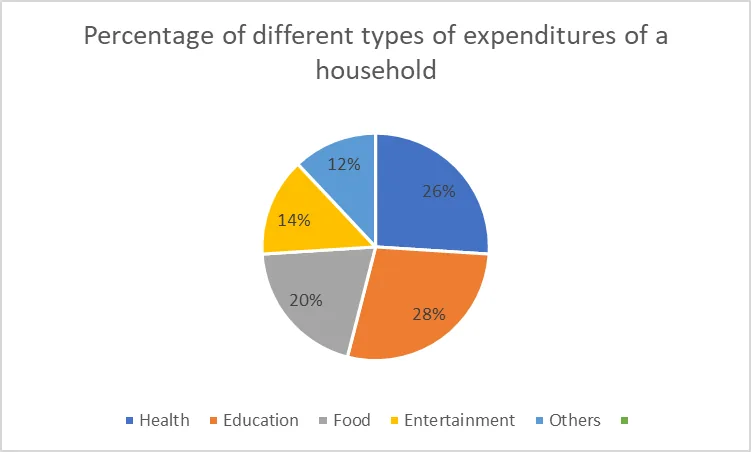
- A
60%
- B
20%
- C
30%
- D
200%
Show answer
A. 60%Given:
Expenditure on health = 26%
Expenditure on entertainment = 14%
Expenditure on food = 20%
Expenditure on education = 28%
Expenditure on other things = 12%
Formula used:
Percentage of item1 w.r.t item 2 = \({item1\over item2}× 100\:\)
Calculation:
Difference in the expenditure on health and entertainment = 26% - 14% = 12%
The expenditure on food = 20%
Percentage of the expenditure on difference in health and entertainment w.r.t on food = \({12\over 20}\) × 100 = 12 x 5 = 60%
Hence, the difference in the expenditure on health and entertainment is 60% percentage of the expenditure on food.
Paper & answer key PDF ↗ Question 60archived
The table given below shows the sales of bikes and cars of five companies.
CompaniesBikeCar
P2001200
Q100300
R500700
S6001000
T800800
J1 = The average sale of bikes of company P, Q and R.
J2 = The average sale of cars of company R, S and T.
What is the value of (J1 ∶ J2)?
- A
24 ∶ 11
- B
8 ∶ 25
- C
7 ∶ 24
- D
25 ∶ 8
Show answer
B. 8 ∶ 25Solving Sales Data Problem: Calculate Average Sales Ratio
The problem asks us to find the ratio of two averages based on the provided table showing the sales of bikes and cars for five different companies (P, Q, R, S, T).
Companies
Bike
Car
P
200
1200
Q
100
300
R
500
700
S
600
1000
T
800
800
We are given two definitions:
J1 = The average sale of bikes of company P, Q and R.
J2 = The average sale of cars of company R, S and T.
We need to calculate the value of the ratio (J1 ∶ J2).
Calculating J1: Average Bike Sales for P, Q, R
To find the average sale of bikes for companies P, Q, and R, we need to sum their individual bike sales and divide by the number of companies (which is 3).
Bike sales for Company P = 200
Bike sales for Company Q = 100
Bike sales for Company R = 500
Sum of bike sales for P, Q, and R = $200 + 100 + 500 = 800$
Number of companies = 3
So, $J1 = \frac{\text{Sum of bike sales}}{\text{Number of companies}} = \frac{800}{3}$
Calculating J2: Average Car Sales for R, S, T
To find the average sale of cars for companies R, S, and T, we need to sum their individual car sales and divide by the number of companies (which is 3).
Car sales for Company R = 700
Car sales for Company S = 1000
Car sales for Company T = 800
Sum of car sales for R, S, and T = $700 + 1000 + 800 = 2500$
Number of companies = 3
So, $J2 = \frac{\text{Sum of car sales}}{\text{Number of companies}} = \frac{2500}{3}$
Calculating the Ratio J1 ∶ J2
Now we need to find the ratio of J1 to J2.
The ratio J1 ∶ J2 is $\frac{800}{3} : \frac{2500}{3}$.
To simplify this ratio, we can multiply both sides by 3:
$\left(\frac{800}{3}\right) \times 3 : \left(\frac{2500}{3}\right) \times 3$
$800 : 2500$
To simplify the ratio 800 : 2500 further, we can divide both numbers by their greatest common divisor. Both 800 and 2500 are divisible by 100.
$800 \div 100 = 8$
$2500 \div 100 = 25$
The simplified ratio is 8 ∶ 25.
Thus, the value of (J1 ∶ J2) is 8 ∶ 25.
Revision Table: Sales Data Analysis
Calculation
Companies Involved
Data Used
Calculation Steps
Result
J1 (Average Bike Sales)
P, Q, R
Bike Sales: P=200, Q=100, R=500
$(200 + 100 + 500) / 3 = 800 / 3$
$800/3$
J2 (Average Car Sales)
R, S, T
Car Sales: R=700, S=1000, T=800
$(700 + 1000 + 800) / 3 = 2500 / 3$
$2500/3$
Ratio J1 ∶ J2
-
$J1 = 800/3$, $J2 = 2500/3$
$(800/3) : (2500/3) \implies 800 : 2500 \implies 8 : 25$
$8 : 25$
Additional Information: Understanding Averages and Ratios
What is an Average?
The average (or mean) of a set of numbers is calculated by summing up all the numbers in the set and then dividing the sum by the count of numbers in the set.
Formula: $\text{Average} = \frac{\text{Sum of values}}{\text{Number of values}}$
Averages help us understand a typical value within a dataset.
What is a Ratio?
A ratio is a comparison of two quantities. It shows how much of one quantity there is compared to another quantity. Ratios can be written using a colon (a:b) or as a fraction ($\frac{a}{b}$).
Simplifying Ratios:
To simplify a ratio, divide both parts of the ratio by their greatest common divisor (GCD). For example, the ratio 800 : 2500 was simplified by dividing both numbers by their GCD, which is 100, resulting in 8 : 25.
Paper & answer key PDF ↗ Question 61archived
Find the HCF of 4.08 and 6.63.
- A
0.50
- B
0.52
- C
0.51
- D
0.53
Show answer
C. 0.51Finding the Highest Common Factor (HCF) of Decimals
To find the Highest Common Factor (HCF) of decimal numbers like 4.08 and 6.63, it's often easiest to convert them into whole numbers first. We can do this by multiplying both numbers by a power of 10 that makes them integers. In this case, both numbers have two decimal places, so multiplying by 100 will work.
Convert 4.08 to a whole number: $4.08 \times 100 = 408$
Convert 6.63 to a whole number: $6.63 \times 100 = 663$
Now, the problem is reduced to finding the HCF of the whole numbers 408 and 663.
Calculating HCF of 408 and 663
We can find the HCF using the prime factorization method.
Find the prime factorization of 408:
$408 = 2 \times 204$
$204 = 2 \times 102$
$102 = 2 \times 51$
$51 = 3 \times 17$
So, $408 = 2^3 \times 3 \times 17$
Find the prime factorization of 663:
$663 = 3 \times 221$ (Since the sum of digits $6+6+3=15$ is divisible by 3)
To factor 221, we can test prime numbers. It's not divisible by 2, 3, 5, 7, 11.
Let's try 13: $221 \div 13 = 17$
So, $663 = 3 \times 13 \times 17$
Now, let's identify the common prime factors and their lowest powers:
Number
Prime Factors
408
$2^3 \times 3^1 \times 17^1$
663
$3^1 \times 13^1 \times 17^1$
The common prime factors are 3 and 17. The lowest power of 3 is $3^1$ and the lowest power of 17 is $17^1$.
HCF of 408 and 663 is the product of these common factors raised to their lowest powers:
HCF$(408, 663) = 3 \times 17 = 51$
Converting HCF back to Decimal
Since we initially multiplied the original decimal numbers by 100 to get the whole numbers 408 and 663, we must now divide the HCF we found (which is 51) by 100 to get the HCF of the original decimal numbers.
HCF$(4.08, 6.63) = \text{HCF}(408, 663) \div 100 = 51 \div 100 = 0.51$
Final Answer on HCF of 4.08 and 6.63
The Highest Common Factor of 4.08 and 6.63 is 0.51.
Revision Table: HCF Calculation Steps
Step
Action
Details
1
Convert Decimals to Integers
Multiply 4.08 and 6.63 by 100 to get 408 and 663.
2
Find HCF of Integers
Use prime factorization or Euclidean algorithm for 408 and 663. HCF(408, 663) = 51.
3
Convert HCF back to Decimal
Divide the HCF (51) by the scaling factor (100). Result is 0.51.
Additional Information: Understanding HCF
The Highest Common Factor (HCF), also known as the Greatest Common Divisor (GCD), of two or more numbers is the largest positive integer that divides each of the numbers without leaving a remainder. When dealing with decimal numbers, the method involves converting them to whole numbers, finding the HCF of the whole numbers, and then scaling the result back to the decimal format based on the initial conversion factor.
Understanding HCF is crucial in various mathematical operations, including simplifying fractions and solving problems involving distribution or grouping into equal parts.
Paper & answer key PDF ↗ Question 62archived
Which of the following will satisfy a2 = b2 + (ab)2 for the values a and b?
- A
a = sin x, b = cot x
- B
a = cos x, b = tan x
- C
a = cot x, b = cos x
- D
a = sin x, b = tan x
Show answer
C. a = cot x, b = cos xUnderstanding the Trigonometric Equation Problem
The problem asks us to find a pair of trigonometric values for 'a' and 'b' that satisfies the given equation: \(a^2 = b^2 + (ab)^2\).
We are provided with four options, each giving specific trigonometric expressions for 'a' and 'b'. We need to substitute these values into the equation and check which pair makes the equation true.
Testing the Given Trigonometric Options
Let's examine each option by substituting the values of 'a' and 'b' into the equation \(a^2 = b^2 + (ab)^2\) and simplifying both sides.
Option 1: a = sin x, b = cot x
Substitute \(a = \sin x\) and \(b = \cot x\) into the equation:
Left Hand Side (LHS): \(a^2 = (\sin x)^2 = \sin^2 x\)
Right Hand Side (RHS): \(b^2 + (ab)^2 = (\cot x)^2 + (\sin x \cdot \cot x)^2\)
We know that \(\cot x = \frac{\cos x}{\sin x}\). Substitute this into the RHS:
RHS: \(\cot^2 x + \left(\sin x \cdot \frac{\cos x}{\sin x}\right)^2\)
RHS: \(\cot^2 x + (\cos x)^2\)
RHS: \(\cot^2 x + \cos^2 x\)
Comparing LHS and RHS: Is \(\sin^2 x = \cot^2 x + \cos^2 x\)? This is generally false.
So, option 1 does not satisfy the equation.
Option 2: a = cos x, b = tan x
Substitute \(a = \cos x\) and \(b = \tan x\) into the equation:
Left Hand Side (LHS): \(a^2 = (\cos x)^2 = \cos^2 x\)
Right Hand Side (RHS): \(b^2 + (ab)^2 = (\tan x)^2 + (\cos x \cdot \tan x)^2\)
We know that \(\tan x = \frac{\sin x}{\cos x}\). Substitute this into the RHS:
RHS: \(\tan^2 x + \left(\cos x \cdot \frac{\sin x}{\cos x}\right)^2\)
RHS: \(\tan^2 x + (\sin x)^2\)
RHS: \(\tan^2 x + \sin^2 x\)
Comparing LHS and RHS: Is \(\cos^2 x = \tan^2 x + \sin^2 x\)? This is generally false.
So, option 2 does not satisfy the equation.
Option 3: a = cot x, b = cos x
Substitute \(a = \cot x\) and \(b = \cos x\) into the equation:
Left Hand Side (LHS): \(a^2 = (\cot x)^2 = \cot^2 x\)
Right Hand Side (RHS): \(b^2 + (ab)^2 = (\cos x)^2 + (\cot x \cdot \cos x)^2\)
We know that \(\cot x = \frac{\cos x}{\sin x}\). Substitute this into the RHS:
RHS: \(\cos^2 x + \left(\frac{\cos x}{\sin x} \cdot \cos x\right)^2\)
RHS: \(\cos^2 x + \left(\frac{\cos^2 x}{\sin x}\right)^2\)
RHS: \(\cos^2 x + \frac{\cos^4 x}{\sin^2 x}\)
To add these terms, find a common denominator, which is \(\sin^2 x\):
RHS: \(\frac{\cos^2 x \sin^2 x}{\sin^2 x} + \frac{\cos^4 x}{\sin^2 x}\)
RHS: \(\frac{\cos^2 x \sin^2 x + \cos^4 x}{\sin^2 x}\)
Factor out \(\cos^2 x\) from the numerator:
RHS: \(\frac{\cos^2 x (\sin^2 x + \cos^2 x)}{\sin^2 x}\)
Using the fundamental trigonometric identity \(\sin^2 x + \cos^2 x = 1\):
RHS: \(\frac{\cos^2 x (1)}{\sin^2 x}\)
RHS: \(\frac{\cos^2 x}{\sin^2 x}\)
Using the identity \(\cot x = \frac{\cos x}{\sin x}\):
RHS: \((\cot x)^2 = \cot^2 x\)
Comparing LHS and RHS: We found LHS = \(\cot^2 x\) and RHS = \(\cot^2 x\). Since LHS = RHS, this option satisfies the equation.
Option 4: a = sin x, b = tan x
Substitute \(a = \sin x\) and \(b = \tan x\) into the equation:
Left Hand Side (LHS): \(a^2 = (\sin x)^2 = \sin^2 x\)
Right Hand Side (RHS): \(b^2 + (ab)^2 = (\tan x)^2 + (\sin x \cdot \tan x)^2\)
RHS: \(\tan^2 x + \sin^2 x \tan^2 x\)
Factor out \(\tan^2 x\):
RHS: \(\tan^2 x (1 + \sin^2 x)\)
Comparing LHS and RHS: Is \(\sin^2 x = \tan^2 x (1 + \sin^2 x)\)? This is generally false.
So, option 4 does not satisfy the equation.
Conclusion on Trigonometric Values for a and b
Based on the step-by-step verification, the pair of values \(a = \cot x\) and \(b = \cos x\) is the only option among the given choices that satisfies the trigonometric equation \(a^2 = b^2 + (ab)^2\).
Revision Table: Key Trigonometric Identities
Here are some fundamental trigonometric identities used in solving this problem:
Identity
Description
\(\tan x = \frac{\sin x}{\cos x}\)
Tangent in terms of Sine and Cosine
\(\cot x = \frac{\cos x}{\sin x}\)
Cotangent in terms of Sine and Cosine
\(\sin^2 x + \cos^2 x = 1\)
Pythagorean Identity
\(\cot^2 x + 1 = \csc^2 x\)
Pythagorean Identity (derived)
\(\tan^2 x + 1 = \sec^2 x\)
Pythagorean Identity (derived)
Additional Information on Solving Trigonometric Equations
Solving trigonometric equations often involves using identities to simplify the expression or equation. The goal is usually to express everything in terms of a single trigonometric function or to reach a known identity.
In this problem, we tested specific values, but for general trigonometric equations, you might need to:
Use reciprocal identities (\(\csc x = 1/\sin x\), \(\sec x = 1/\cos x\), \(\cot x = 1/\tan x\)).
Use quotient identities (\(\tan x = \sin x/\cos x\), \(\cot x = \cos x/\sin x\)).
Use Pythagorean identities (\(\sin^2 x + \cos^2 x = 1\), \(1 + \tan^2 x = \sec^2 x\), \(1 + \cot^2 x = \csc^2 x\)).
Factor trigonometric expressions.
Find common denominators when adding or subtracting fractions with trigonometric terms.
Practicing with different identities helps in simplifying and solving complex trigonometric problems like verifying if certain values satisfy an equation.
Paper & answer key PDF ↗ Question 63archived
7 is added to a certain number and the sum is multiplied by 5. The product is then divided by 3 and 4 is subtracted from the quotient. If the result comes to 16, then what is the original number?
- A
3
- B
1
- C
5
- D
4
Show answer
C. 5Finding the Original Number: A Step-by-Step Algebra Solution
Let's break down this word problem to find the original number. We are given a sequence of operations performed on an unknown number, and we know the final result. We can represent the unknown number with a variable and set up an equation to solve for it.
Defining the Unknown Number
Let the original number be represented by the variable \(x\).
Translating the Problem into an Equation
We follow the steps described in the question and apply them to \(x\):
7 is added to a certain number: \(x + 7\)
The sum is multiplied by 5: \(5 \times (x + 7)\)
The product is then divided by 3: \(\frac{5 \times (x + 7)}{3}\)
4 is subtracted from the quotient: \(\frac{5 \times (x + 7)}{3} - 4\)
The result comes to 16: \(\frac{5 \times (x + 7)}{3} - 4 = 16\)
So, the equation we need to solve is:
\(\frac{5(x+7)}{3} - 4 = 16\)
Solving the Equation to Find the Original Number
Now, let's solve the equation for \(x\):
Start with the equation:
\(\frac{5(x+7)}{3} - 4 = 16\)
Step 1: Add 4 to both sides of the equation to isolate the term with \(x\).
\(\frac{5(x+7)}{3} - 4 + 4 = 16 + 4\)
\(\frac{5(x+7)}{3} = 20\)
Step 2: Multiply both sides by 3 to eliminate the denominator.
\(\frac{5(x+7)}{3} \times 3 = 20 \times 3\)
\(5(x+7) = 60\)
Step 3: Divide both sides by 5 to isolate the term \((x+7)\).
\(\frac{5(x+7)}{5} = \frac{60}{5}\)
\(x+7 = 12\)
Step 4: Subtract 7 from both sides to solve for \(x\).
\(x + 7 - 7 = 12 - 7\)
\(x = 5\)
Verifying the Solution
Let's check if the original number \(x = 5\) gives the result 16 when the sequence of operations is applied:
Add 7: \(5 + 7 = 12\)
Multiply by 5: \(12 \times 5 = 60\)
Divide by 3: \(\frac{60}{3} = 20\)
Subtract 4: \(20 - 4 = 16\)
The final result is 16, which matches the problem statement. Therefore, the original number is indeed 5.
The original number is 5.
Revision Table: Key Steps in Solving Word Problems
Step
Description
Application to This Problem
1
Read the problem carefully and identify the unknown quantity.
The unknown is the original number.
2
Assign a variable to the unknown quantity.
Let the original number be \(x\).
3
Translate each phrase of the problem into an algebraic expression or equation.
\(\frac{5(x+7)}{3} - 4 = 16\)
4
Solve the resulting equation for the variable.
Solving \(\frac{5(x+7)}{3} - 4 = 16\) gives \(x=5\).
5
Check the solution in the original word problem to ensure it makes sense.
Applying the steps to 5 gives 16.
Additional Information: Linear Equations
The equation we solved, \(\frac{5(x+7)}{3} - 4 = 16\), is an example of a linear equation in one variable. A linear equation is an equation where the highest power of the variable is 1. These equations can often be solved by isolating the variable using inverse operations (addition/subtraction, multiplication/division) on both sides of the equation, keeping the equation balanced.
Inverse of adding is subtracting.
Inverse of subtracting is adding.
Inverse of multiplying is dividing.
Inverse of dividing is multiplying.
In our solution, we used inverse operations like adding 4 (inverse of subtracting 4), multiplying by 3 (inverse of dividing by 3), dividing by 5 (inverse of multiplying by 5), and subtracting 7 (inverse of adding 7) to find the value of \(x\).
Paper & answer key PDF ↗ Question 64archived
θ = 135°; γ = 15°.
What is the value of 2 cos(θ) sin(γ)?
- A
\({\sqrt{3} \ -\ 1 \over 2}\)
- B
\({1 \ - \ \sqrt{3} \over 2}\)
- C
\(2-{\sqrt{3}}\)
- D
\({\sqrt{3}}-2\)
Show answer
B. \({1 \ - \ \sqrt{3} \over 2}\)Evaluating the Trigonometric Expression with Given Angles
The problem requires us to calculate the value of the expression 2 cos(θ) sin(γ) using the provided angle measures for θ and γ.
The given values are:
θ = 135°
γ = 15°
We need to find the numerical value of 2 cos(135°) sin(15°).
Step-by-Step Calculation for the Trigonometric Value
Step 1: Substitute Angles into the Expression
Substitute the given degrees for θ and γ into the expression:
$$ 2 \cos(135^\circ) \sin(15^\circ) $$
Step 2: Calculate the Value of cos(135°)
To find the value of cos(135°), we note that 135° is in the second quadrant. The reference angle is 180° - 135° = 45°. Since the cosine function is negative in the second quadrant:
$$ \cos(135^\circ) = -\cos(45^\circ) $$
The value of cos(45°) is \(\frac{\sqrt{2}}{2}\). Therefore:
$$ \cos(135^\circ) = -\frac{\sqrt{2}}{2} $$
Step 3: Calculate the Value of sin(15°)
To find the value of sin(15°), we can express 15° as a difference of two standard angles, such as 45° - 30°. We use the sine subtraction identity: sin(A - B) = sin A cos B - cos A sin B.
Let A = 45° and B = 30°.
$$ \sin(15^\circ) = \sin(45^\circ - 30^\circ) = \sin(45^\circ)\cos(30^\circ) - \cos(45^\circ)\sin(30^\circ) $$
Using the known values:
\(\sin(45^\circ) = \frac{\sqrt{2}}{2}\)
\(\cos(30^\circ) = \frac{\sqrt{3}}{2}\)
\(\cos(45^\circ) = \frac{\sqrt{2}}{2}\)
\(\sin(30^\circ) = \frac{1}{2}\)
Substitute these values into the formula:
$$ \sin(15^\circ) = \left(\frac{\sqrt{2}}{2}\right)\left(\frac{\sqrt{3}}{2}\right) - \left(\frac{\sqrt{2}}{2}\right)\left(\frac{1}{2}\right) $$
$$ \sin(15^\circ) = \frac{\sqrt{6}}{4} - \frac{\sqrt{2}}{4} = \frac{\sqrt{6} - \sqrt{2}}{4} $$
Step 4: Compute the Final Expression Value
Now, substitute the calculated values of cos(135°) and sin(15°) back into the original expression:
$$ 2 \cos(135^\circ) \sin(15^\circ) = 2 \times \left(-\frac{\sqrt{2}}{2}\right) \times \left(\frac{\sqrt{6} - \sqrt{2}}{4}\right) $$
Simplify the expression:
$$ = -\sqrt{2} \times \left(\frac{\sqrt{6} - \sqrt{2}}{4}\right) $$
$$ = -\frac{\sqrt{2} \cdot \sqrt{6} - \sqrt{2} \cdot \sqrt{2}}{4} $$
$$ = -\frac{\sqrt{12} - 2}{4} $$
Since \(\sqrt{12} = \sqrt{4 \times 3} = 2\sqrt{3}\):
$$ = -\frac{2\sqrt{3} - 2}{4} $$
Factor out 2 from the numerator:
$$ = -\frac{2(\sqrt{3} - 1)}{4} $$
Simplify the fraction:
$$ = -\frac{\sqrt{3} - 1}{2} $$
Distribute the negative sign:
$$ = \frac{1 - \sqrt{3}}{2} $$
Alternative Calculation Using Product-to-Sum Identity
An alternative way to solve this is by using the product-to-sum trigonometric identity: 2 cos A sin B = sin(A + B) - sin(A - B).
In this case, A = θ = 135° and B = γ = 15°.
Applying the identity:
$$ 2 \cos(135^\circ) \sin(15^\circ) = \sin(135^\circ + 15^\circ) - \sin(135^\circ - 15^\circ) $$
$$ = \sin(150^\circ) - \sin(120^\circ) $$
Now, evaluate the sine values:
sin(150°): This angle is in the second quadrant, with a reference angle of 180° - 150° = 30°. Sine is positive in the second quadrant, so sin(150°) = sin(30°) = \frac{1}{2}.
sin(120°): This angle is in the second quadrant, with a reference angle of 180° - 120° = 60°. Sine is positive in the second quadrant, so sin(120°) = sin(60°) = \frac{\sqrt{3}}{2}.
Substitute these values back:
$$ \sin(150^\circ) - \sin(120^\circ) = \frac{1}{2} - \frac{\sqrt{3}}{2} = \frac{1 - \sqrt{3}}{2} $$
Final Answer Verification
Both calculation methods yield the result \(\frac{1 - \sqrt{3}}{2}\). This value corresponds to option 2.
The options provided were:
\(\frac{\sqrt{3} - 1}{2}\)
\(\frac{1 - \sqrt{3}}{2}\)
\(2-\sqrt{3}\)
\(\sqrt{3}-2\)
Our calculated value matches the second option.
Paper & answer key PDF ↗ Question 65archived
If abc = 5, what is the value of (\({1 \over 1 \ + \ a \ + \ b^{-1} }\) + \({1 \over 1 \ + \ b \ + \ 5 c^{-1}}\) +\(\frac{1}{1+\frac{c}{5}+a^{-1}}\) \(\) )?
- A
\({\sqrt{3} \ -\ 1 \over 2}\)
- B
1
- C
\({{1} \over 5}\)
- D
(a + b + c)
Show answer
B. 1Understanding the Problem: Evaluating a Sum of Fractions
We are asked to find the value of a specific sum of three fractions, given the condition that the product of three variables \(a\), \(b\), and \(c\) is equal to 5, i.e., \(abc = 5\). The sum is given by:
\[ \left(\frac{1}{1 \ + \ a \ + \ b^{-1} }\right) + \left(\frac{1}{1 \ + \ b \ + \ 5 c^{-1}}\right) +\left(\frac{1}{1+\frac{c}{5}+a^{-1}}\right) \]
To solve this, we need to simplify each term in the sum using the given condition \(abc = 5\).
Simplifying Each Term Using \(abc = 5\)
The condition \(abc = 5\) is the key to simplifying the fractions. Since \(abc=5\), none of \(a\), \(b\), or \(c\) can be zero. This allows us to use reciprocals and rearrange the equation.
Simplifying the Second Term
Let's consider the second term:
\[ T_2 = \frac{1}{1 \ + \ b \ + \ 5 c^{-1}} \]
We know that \(c^{-1} = \frac{1}{c}\). From the condition \(abc = 5\), we can divide by \(c\) (since \(c \neq 0\)) to get \(ab = \frac{5}{c}\). Therefore, \(5 c^{-1} = 5 \cdot \frac{1}{c} = \frac{5}{c} = ab\).
Substituting \(5 c^{-1} = ab\) into the second term, we get:
\[ T_2 = \frac{1}{1 \ + \ b \ + \ ab} \]
This term has a denominator \(1 + b + ab\).
Simplifying the First Term
Now let's look at the first term:
\[ T_1 = \frac{1}{1 \ + \ a \ + \ b^{-1} } \]
To make its denominator similar to that of \(T_2\), let's try multiplying the numerator and the denominator by \(b\). Since \(b \neq 0\), this is a valid operation.
\[ T_1 = \frac{1 \cdot b}{(1 \ + \ a \ + \ b^{-1} ) \cdot b} = \frac{b}{1 \cdot b \ + \ a \cdot b \ + \ b^{-1} \cdot b} \]
Since \(b \cdot b^{-1} = b \cdot \frac{1}{b} = 1\), we have:
\[ T_1 = \frac{b}{b \ + \ ab \ + \ 1} = \frac{b}{1 \ + \ b \ + \ ab} \]
The first term now also has the denominator \(1 + b + ab\).
Simplifying the Third Term
Next, let's simplify the third term:
\[ T_3 = \frac{1}{1+\frac{c}{5}+a^{-1}} \]
From the condition \(abc = 5\), we can divide by \(ab\) (since \(a \neq 0\) and \(b \neq 0\)) to get \(\frac{c}{5} = \frac{1}{ab}\). Also, \(a^{-1} = \frac{1}{a}\).
Substitute these into the third term:
\[ T_3 = \frac{1}{1+\frac{1}{ab}+\frac{1}{a}} \]
To simplify this complex fraction and get the denominator \(1 + b + ab\), let's multiply the numerator and the denominator by \(ab\). Since \(ab \neq 0\), this is valid.
\[ T_3 = \frac{1 \cdot ab}{\left(1+\frac{1}{ab}+\frac{1}{a}\right) \cdot ab} = \frac{ab}{1 \cdot ab \ + \ \frac{1}{ab} \cdot ab \ + \ \frac{1}{a} \cdot ab} \]
\[ T_3 = \frac{ab}{ab \ + \ 1 \ + \ b} = \frac{ab}{1 \ + \ b \ + \ ab} \]
The third term also simplifies to a fraction with the denominator \(1 + b + ab\).
Calculating the Total Sum
Now that all three terms have the common denominator \(1 + b + ab\), we can add them easily:
\[ \text{Sum} = T_1 + T_2 + T_3 \]
\[ \text{Sum} = \frac{b}{1 \ + \ b \ + \ ab} + \frac{1}{1 \ + \ b \ + \ ab} + \frac{ab}{1 \ + \ b \ + \ ab} \]
Adding the numerators over the common denominator:
\[ \text{Sum} = \frac{b \ + \ 1 \ + \ ab}{1 \ + \ b \ + \ ab} \]
The numerator \(b + 1 + ab\) is identical to the denominator \(1 + b + ab\). Assuming the denominator is not zero (which is implied by the problem resulting in a single numerical value), the fraction simplifies to 1.
\[ \text{Sum} = 1 \]
Conclusion on the Value of the Sum
Through algebraic manipulation and utilizing the condition \(abc=5\), each term in the sum was transformed into a fraction with the common denominator \(1 + b + ab\). Summing these fractions resulted in \(\frac{1 + b + ab}{1 + b + ab}\), which simplifies to 1.
Revision Table: Breakdown of Term Simplification
Below is a summary of how each part of the sum was simplified:
Original Term
Key Substitution / Manipulation
Simplified Form
\( \frac{1}{1 + a + b^{-1} } \)
Multiply numerator & denominator by \(b\)
\( \frac{b}{1 + b + ab} \)
\( \frac{1}{1 + b + 5 c^{-1}} \)
Use \(5c^{-1} = ab\) (from \(abc=5\))
\( \frac{1}{1 + b + ab} \)
\( \frac{1}{1+\frac{c}{5}+a^{-1}} \)
Use \( \frac{c}{5} = \frac{1}{ab} \) and multiply numerator & denominator by \(ab\)
\( \frac{ab}{1 + b + ab} \)
Additional Information: Techniques for Algebraic Sums
Problems involving sums of fractions with linked variables often require transforming the terms to find a common denominator. The given condition (\(abc=5\)) provides the necessary link between the variables \(a\), \(b\), and \(c\). Recognizing relationships like \(b^{-1} = \frac{ac}{5}\), \(c^{-1} = \frac{ab}{5}\), \(a^{-1} = \frac{bc}{5}\), \(\frac{c}{5} = \frac{1}{ab}\), etc., derived from the condition is crucial. Multiplying the numerator and denominator by a suitable expression is a standard technique to achieve a desired form or a common denominator, as demonstrated in this solution.
Paper & answer key PDF ↗ Question 66archived
If sec x – cos x = 4, then what will be the value of \({{(1 \ + \ cos^2 x)} \over cos x}\)?
- A
9/4
- B
1/4
- C
\(2{ \sqrt{5}} \)
- D
\({ \sqrt{5} } \)
Show answer
C. \(2{ \sqrt{5}} \)Solving Trigonometric Equations: Finding \(\frac{1 + \cos^2 x}{\cos x}\)
The problem asks us to find the value of the expression \(\frac{1 + \cos^2 x}{\cos x}\) given the equation \(\sec x - \cos x = 4\).
Breaking Down the Given Equation
We are given the equation:
\(\sec x - \cos x = 4\)
Recall the definition of the secant function: \(\sec x = \frac{1}{\cos x}\). Substitute this into the equation:
\(\frac{1}{\cos x} - \cos x = 4\)
This gives us a direct relationship between \(\frac{1}{\cos x}\) and \(\cos x\).
Analyzing the Expression to Find
The expression we need to evaluate is \(\frac{1 + \cos^2 x}{\cos x}\). We can split this expression into two terms:
\(\frac{1 + \cos^2 x}{\cos x} = \frac{1}{\cos x} + \frac{\cos^2 x}{\cos x}\)
Simplifying the second term, we get:
\(\frac{1}{\cos x} + \cos x\)
So, the problem reduces to finding the value of \(\frac{1}{\cos x} + \cos x\).
Connecting the Given Equation to the Expression
We know the value of \(\frac{1}{\cos x} - \cos x\), which is 4. We need to find the value of \(\frac{1}{\cos x} + \cos x\).
Let \(a = \frac{1}{\cos x}\) and \(b = \cos x\). We are given \(a - b = 4\) and we need to find \(a + b\).
We can use the algebraic identity: \((a+b)^2 = (a-b)^2 + 4ab\).
Substitute \(a = \frac{1}{\cos x}\) and \(b = \cos x\) into the identity:
\(\left(\frac{1}{\cos x} + \cos x\right)^2 = \left(\frac{1}{\cos x} - \cos x\right)^2 + 4 \left(\frac{1}{\cos x}\right) (\cos x)\)
We know that \(\frac{1}{\cos x} - \cos x = 4\). Also, \(4 \left(\frac{1}{\cos x}\right) (\cos x) = 4 \times 1 = 4\).
Substitute these values into the equation:
\(\left(\frac{1}{\cos x} + \cos x\right)^2 = (4)^2 + 4\)
\(\left(\frac{1}{\cos x} + \cos x\right)^2 = 16 + 4\)
\(\left(\frac{1}{\cos x} + \cos x\right)^2 = 20\)
Now, take the square root of both sides to find the value of \(\frac{1}{\cos x} + \cos x\):
\(\frac{1}{\cos x} + \cos x = \pm \sqrt{20}\)
Simplify the square root:
\(\sqrt{20} = \sqrt{4 \times 5} = \sqrt{4} \times \sqrt{5} = 2\sqrt{5}\)
So, \(\frac{1}{\cos x} + \cos x = \pm 2\sqrt{5}\).
Since the expression we need to find is \(\frac{1}{\cos x} + \cos x\), its value is either \(2\sqrt{5}\) or \(-2\sqrt{5}\). Looking at the options provided, \(2\sqrt{5}\) is one of the options.
Step-by-Step Calculation
Start with the given equation: \(\sec x - \cos x = 4\).
Replace \(\sec x\) with \(\frac{1}{\cos x}\): \(\frac{1}{\cos x} - \cos x = 4\).
Identify the expression to evaluate: \(\frac{1 + \cos^2 x}{\cos x}\).
Rewrite the expression: \(\frac{1}{\cos x} + \frac{\cos^2 x}{\cos x} = \frac{1}{\cos x} + \cos x\).
Let \(A = \frac{1}{\cos x}\) and \(B = \cos x\). We have \(A - B = 4\) and need to find \(A + B\).
Use the identity \((A+B)^2 = (A-B)^2 + 4AB\).
Substitute the values: \(\left(\frac{1}{\cos x} + \cos x\right)^2 = \left(\frac{1}{\cos x} - \cos x\right)^2 + 4 \left(\frac{1}{\cos x}\right) (\cos x)\).
\(\left(\frac{1}{\cos x} + \cos x\right)^2 = (4)^2 + 4(1)\).
\(\left(\frac{1}{\cos x} + \cos x\right)^2 = 16 + 4 = 20\).
Take the square root: \(\frac{1}{\cos x} + \cos x = \pm \sqrt{20}\).
Simplify the square root: \(\sqrt{20} = 2\sqrt{5}\).
Thus, \(\frac{1 + \cos^2 x}{\cos x} = \frac{1}{\cos x} + \cos x = \pm 2\sqrt{5}\).
Comparing with the given options, the value is \(2\sqrt{5}\).
Revision Table: Key Trigonometry Concepts
Concept
Definition/Identity
Usage in Problem
Secant Function
\(\sec x = \frac{1}{\cos x}\)
Used to rewrite the given equation.
Algebraic Identity
\((a+b)^2 = (a-b)^2 + 4ab\)
Crucial for finding \(a+b\) from \(a-b\) and \(ab\).
Expression Manipulation
Splitting fractions: \(\frac{X+Y}{Z} = \frac{X}{Z} + \frac{Y}{Z}\)
Used to rewrite \(\frac{1 + \cos^2 x}{\cos x}\) as \(\frac{1}{\cos x} + \cos x\).
Square Root Simplification
\(\sqrt{ab} = \sqrt{a}\sqrt{b}\)
Used to simplify \(\sqrt{20}\) to \(2\sqrt{5}\).
Additional Information: Reciprocal Identities and Algebraic Tricks
Trigonometric identities are fundamental in solving trigonometry problems. The reciprocal identities, like \(\sec x = \frac{1}{\cos x}\), \(\csc x = \frac{1}{\sin x}\), and \(\cot x = \frac{1}{\tan x}\), help in converting expressions into simpler forms involving sine and cosine.
In this problem, a key step was recognizing that if you have the difference of two quantities (\(a-b\)) and their product (\(ab\)), you can find their sum (\(a+b\)) using the identity \((a+b)^2 = (a-b)^2 + 4ab\). Here, the quantities were \(\frac{1}{\cos x}\) and \(\cos x\). Their product is \(\frac{1}{\cos x} \times \cos x = 1\). This simplification of the product is what made the algebraic identity particularly useful in this trigonometric context.
Always look for opportunities to simplify trigonometric expressions using identities and to apply standard algebraic techniques when dealing with trigonometric equations.
Paper & answer key PDF ↗ Question 67archived
Study the given graph and table and answer the following question.
Data of different states regarding population of states in the year 1998
Total population of the given states = 32760000
StatesSex and literacy wise Population Ratio
SexLiteracy
MFLiterateIlliterate
Arunachal Pradesh5327
Madhya Pradesh3114
Delhi2321
Goa3532
Bihar3441
Uttar Pradesh3272
Tamil Nadu3494
What was the ratio of the number of females in Arunachal Pradesh to the number of females in Uttar Pradesh?
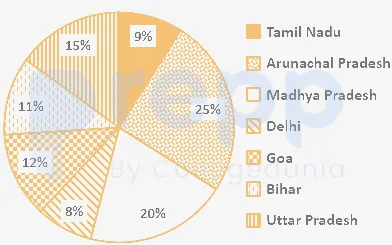
- A
21 ∶ 50
- B
25 ∶ 16
- C
16 ∶ 25
- D
50 ∶ 21
Show answer
B. 25 ∶ 16Given:
Total population of the given states = 32760000
Calculation:
Total percentage as per the pie chart is 100%
⇒ 100% = 32760000
⇒ 1% = 327600
As per the question,
The population of Arunachal Pradesh,
⇒ 25 × 327600
The population of Uttar Pradesh,
⇒ 15 × 327600
Now female in Arunachal Pradesh is 3/8
and female in Uttar Pradesh is 2/5
⇒ 25 × 327600 × 3/8 = 15 × 327600 × 2/5
⇒ 25:16
∴ The ratio of the number of females in Arunachal Pradesh to the number of females in Uttar Pradesh was 25 ∶ 16.
Paper & answer key PDF ↗ Question 68archived
The radius of a circle is 5 cm. Calculate the length of a tangent drawn to this circle from a point at a distance of 10 cm from its centre.
- A
\(5{\sqrt{5}}\) cm
- B
\(5{ \sqrt {2}}\) cm
- C
5 cm
- D
\(5{\sqrt{3}}\)cm
Show answer
D. \(5{\sqrt{3}}\)cmLet's break down this geometry problem step by step. We are given a circle with a specific radius and a point outside the circle from which a tangent is drawn. We need to find the length of this tangent segment.
Here's what we know:
The radius of the circle (\(r\)) is 5 cm.
The distance of the external point from the centre of the circle (\(d\)) is 10 cm.
We need to find the length of the tangent drawn from this point to the circle.
Understanding the Geometry of Tangents
A crucial property related to circles and tangents is that a tangent at any point of a circle is perpendicular to the radius through the point of contact. This is a fundamental theorem in circle geometry.
Consider the following:
Let O be the centre of the circle.
Let P be the external point from which the tangent is drawn.
Let T be the point where the tangent touches the circle (the point of contact).
The line segment OT is the radius, so \(OT = r = 5\) cm. The distance from the centre O to the external point P is given as \(OP = d = 10\) cm. The line segment PT is the tangent segment whose length we need to find.
According to the property mentioned, the radius OT is perpendicular to the tangent PT at the point of contact T. This means that the angle \(\angle OTP\) is a right angle (\(90^\circ\)).
Thus, the points O, T, and P form a right-angled triangle, \(\triangle OTP\), with the right angle at T.
Applying the Pythagorean Theorem to Find Tangent Length
In the right-angled triangle \(\triangle OTP\), the side opposite the right angle is the hypotenuse. In this case, the hypotenuse is OP, which is the distance from the center to the external point. The other two sides are the radius OT and the tangent length PT.
According to the Pythagorean theorem, in a right-angled triangle, the square of the hypotenuse is equal to the sum of the squares of the other two sides.
For \(\triangle OTP\), the theorem states:
\[ OP^2 = OT^2 + PT^2 \]
We are given \(OP = 10\) cm and \(OT = 5\) cm. Let the length of the tangent \(PT\) be \(t\). Substituting the values into the equation:
\[ 10^2 = 5^2 + t^2 \]
Now, we can solve for \(t\):
\[ 100 = 25 + t^2 \]
Subtract 25 from both sides:
\[ t^2 = 100 - 25 \]
\[ t^2 = 75 \]
To find \(t\), we take the square root of 75:
\[ t = \sqrt{75} \]
We can simplify the square root of 75 by factoring 75 into its prime factors or finding a perfect square factor:
\[ 75 = 25 \times 3 \]
So,
\[ t = \sqrt{25 \times 3} \]
Using the property \(\sqrt{ab} = \sqrt{a} \times \sqrt{b}\):
\[ t = \sqrt{25} \times \sqrt{3} \]
Since \(\sqrt{25} = 5\):
\[ t = 5 \times \sqrt{3} \]
\[ t = 5\sqrt{3} \text{ cm} \]
So, the length of the tangent drawn to the circle from the given point is \(5\sqrt{3}\) cm.
Summary of Calculation
Measurement
Value
Radius (\(r\))
5 cm
Distance from center (\(d\))
10 cm
Length of Tangent (\(t\))
?
Pythagorean Relation
\(d^2 = r^2 + t^2\)
Substitution
\(10^2 = 5^2 + t^2\)
Calculation
\(100 = 25 + t^2\)
Solve for \(t^2\)
\(t^2 = 75\)
Solve for \(t\)
\(t = \sqrt{75} = 5\sqrt{3}\) cm
Revision Table: Circle Tangent Properties & Formulas
Concept
Description/Formula
Tangent-Radius Property
A tangent at any point on a circle is perpendicular to the radius through the point of contact.
Right-Angled Triangle
The radius, the tangent, and the line from the center to the external point form a right-angled triangle.
Pythagorean Theorem
In a right triangle with legs a, b and hypotenuse c: \(a^2 + b^2 = c^2\). In our case: \(r^2 + t^2 = d^2\).
Additional Information on Circles and Tangents
Understanding tangents is key in circle geometry. Here are some related points:
A tangent intersects the circle at exactly one point (the point of contact).
From an external point, exactly two tangents can be drawn to a circle.
The lengths of the two tangents drawn from an external point to a circle are equal. In our setup, if we drew another tangent from P to the circle touching at T', then \(PT = PT'\).
A line that intersects a circle at two distinct points is called a secant.
The segment of a secant inside the circle is a chord.
These concepts often appear together in problems involving circles.
Paper & answer key PDF ↗ Question 69archived
A hollow sphere has an outer radius of 6 cm and inner radius of 3 cm. What is the volume of this hollow sphere?
- A
252p cm3
- B
356p cm3
- C
144p cm3
- D
175p cm3
Show answer
A. 252p cm3Calculating the Volume of a Hollow Sphere
Understanding how to find the volume of a hollow sphere is a common geometry problem. A hollow sphere is essentially a larger sphere with a smaller sphere removed from its center. To find its volume, we subtract the volume of the inner sphere from the volume of the outer sphere.
Defining the Radii
In this specific problem, we are given the dimensions of the hollow sphere:
Outer radius (\(\text{R}\)) = 6 cm
Inner radius (\(\text{r}\)) = 3 cm
Formula for Sphere Volume
The general formula for the volume of a solid sphere with radius 'x' is:
\(\text{Volume of a sphere} = \frac{4}{3}\pi x^3\)
Formula for Hollow Sphere Volume
For a hollow sphere with outer radius \(\text{R}\) and inner radius \(\text{r}\), the volume is the difference between the volume of the outer sphere and the volume of the inner sphere.
\(\text{Volume of hollow sphere} = \text{Volume of outer sphere} - \text{Volume of inner sphere}\)
\(\text{Volume of hollow sphere} = \frac{4}{3}\pi R^3 - \frac{4}{3}\pi r^3\)
We can factor out the common term \(\frac{4}{3}\pi\):
\(\text{Volume of hollow sphere} = \frac{4}{3}\pi (R^3 - r^3)\)
Step-by-Step Volume Calculation
Now, let's plug in the given values for \(\text{R}\) and \(\text{r}\) into the formula:
Given:
\(\text{R} = 6\) cm
\(\text{r} = 3\) cm
Calculation:
\(\text{Volume} = \frac{4}{3}\pi (6^3 - 3^3)\)
\(\text{Volume} = \frac{4}{3}\pi (216 - 27)\)
\(\text{Volume} = \frac{4}{3}\pi (189)\)
Now, we simplify the expression:
\(\text{Volume} = \frac{4}{3} \times 189 \times \pi\)
Divide 189 by 3:
\(\frac{189}{3} = 63\)
So, the volume is:
\(\text{Volume} = 4 \times 63 \times \pi\)
\(\text{Volume} = 252\pi\)
The unit of volume is cubic centimeters (cm<sup>3</sup>) since the radii are in centimeters.
Therefore, the volume of the hollow sphere is 252π cm<sup>3</sup>.
Summary of Results
Parameter
Value
Outer Radius (\(\text{R}\))
6 cm
Inner Radius (\(\text{r}\))
3 cm
Volume of Hollow Sphere
252π cm<sup>3</sup>
Revision Table: Key Formulas for Sphere Geometry
Concept
Formula
Notes
Volume of Solid Sphere
\(\frac{4}{3}\pi r^3\)
'r' is the radius
Surface Area of Solid Sphere
\(4\pi r^2\)
'r' is the radius
Volume of Hollow Sphere
\(\frac{4}{3}\pi (R^3 - r^3)\)
'R' is outer radius, 'r' is inner radius
Additional Information: Understanding Spheres
A sphere is a perfectly round geometrical object in three-dimensional space that is the surface of a completely round ball. Like a circle in two dimensions, a sphere is defined by a center point and a radius. All points on the surface of the sphere are equidistant from the center point. A hollow sphere is a sphere with a spherical void inside, typically centered at the same point. The region between the inner and outer surfaces is what constitutes the hollow sphere's material volume.
The calculation of the volume of a hollow object by subtracting the volume of the inner void from the volume of the outer shape is a common technique used for various shapes like hollow cylinders or hollow cubes as well. It helps determine the amount of material needed to construct such an object or the capacity it can hold (if the inner part is empty).
Paper & answer key PDF ↗ Question 70archived
A certain amount will become six times in 20 years. How long does it take for the same amount to become 5 times? Assume the same rate of simple interest in each case.
- A
16 years 8 months
- B
15 years 8 months
- C
25 years
- D
16 years
Show answer
D. 16 yearsUnderstanding Simple Interest and Growth
This problem involves the concept of simple interest, where the interest earned each year is calculated only on the initial principal amount. When an amount becomes 'n' times itself, the total amount (A) is n times the principal (P), meaning A = nP. The simple interest (SI) earned is A - P = nP - P = (n-1)P.
The formula for simple interest is:
\( SI = \frac{P \times R \times T}{100} \)
Where:
\( P \) is the Principal amount
\( R \) is the Rate of Interest per annum
\( T \) is the Time in years
Also, the total Amount (\( A \)) is \( P + SI \). Substituting the SI formula, we get \( A = P + \frac{P \times R \times T}{100} = P \left(1 + \frac{R \times T}{100}\right) \).
Step-by-Step Solution: Calculating the Rate
We are given that a certain amount becomes six times itself in 20 years at a simple interest rate. Let the principal be \( P \).
In the first case:
Amount (\( A_1 \)) = 6 times the principal = \( 6P \)
Time (\( T_1 \)) = 20 years
Using the formula \( A_1 = P \left(1 + \frac{R \times T_1}{100}\right) \):
\( 6P = P \left(1 + \frac{R \times 20}{100}\right) \)
Divide both sides by \( P \) (assuming \( P \neq 0 \)):
\( 6 = 1 + \frac{20R}{100} \)
\( 6 = 1 + \frac{R}{5} \)
Subtract 1 from both sides:
\( 6 - 1 = \frac{R}{5} \)
\( 5 = \frac{R}{5} \)
Multiply both sides by 5 to find the rate \( R \):
\( R = 5 \times 5 \)
\( R = 25\% \)
So, the rate of simple interest is 25% per annum.
Calculating the Time to Become Five Times
Now, we need to find the time it takes for the same amount (\( P \)) to become five times itself at the same rate (\( R = 25\% \)).
In the second case:
Amount (\( A_2 \)) = 5 times the principal = \( 5P \)
Rate (\( R \)) = 25% per annum
Time (\( T_2 \)) = ?
Using the formula \( A_2 = P \left(1 + \frac{R \times T_2}{100}\right) \):
\( 5P = P \left(1 + \frac{25 \times T_2}{100}\right) \)
Divide both sides by \( P \):
\( 5 = 1 + \frac{25T_2}{100} \)
\( 5 = 1 + \frac{T_2}{4} \)
Subtract 1 from both sides:
\( 5 - 1 = \frac{T_2}{4} \)
\( 4 = \frac{T_2}{4} \)
Multiply both sides by 4 to find the time \( T_2 \):
\( T_2 = 4 \times 4 \)
\( T_2 = 16 \text{ years} \)
Therefore, it takes 16 years for the same amount to become 5 times itself at a simple interest rate of 25%.
Summarizing the Simple Interest Calculation
We used the relationship between the amount, principal, rate, and time under simple interest to solve this problem in two stages:
Using the first condition (becomes 6 times in 20 years) to find the simple interest rate.
Using the calculated rate and the second condition (becomes 5 times) to find the required time.
Simple Interest Results
Case
Amount (A)
Principal (P)
Time (T)
Simple Interest (SI = A - P)
Rate (R)
1
\( 6P \)
\( P \)
20 years
\( 5P \)
Calculated as 25%
2
\( 5P \)
\( P \)
Calculated as 16 years
\( 4P \)
25% (Same Rate)
Revision Table: Simple Interest Concepts
Term
Definition
Formula Relation
Principal (P)
Initial amount invested or borrowed.
Basis for interest calculation.
Simple Interest (SI)
Interest calculated only on the principal.
\( SI = \frac{PRT}{100} \)
Amount (A)
Total sum at the end of the period.
\( A = P + SI \) or \( A = P(1 + \frac{RT}{100}) \)
Rate (R)
Percentage at which interest is charged per period (usually per annum).
Used in SI calculation.
Time (T)
Duration for which the principal is invested or borrowed.
Used in SI calculation, typically in years.
Additional Information: Simple Interest vs. Compound Interest
It's important to distinguish between simple interest and compound interest. In simple interest, the interest is calculated only on the principal amount throughout the term. The principal remains constant for interest calculation purposes. In contrast, compound interest is calculated on the principal amount and also on the accumulated interest from previous periods. This means the principal amount effectively grows over time under compound interest, leading to faster growth of the total amount compared to simple interest for the same rate and time.
This problem explicitly states "simple interest in each case," so the simple interest formula is correctly applied.
Understanding how simple interest works is fundamental for solving problems involving financial growth at a constant annual rate on the initial amount.
Paper & answer key PDF ↗ Question 71archived
The table given below shows the earnings of two persons on five different days.
Earnings
DaysAB
Tuesday85130
Wednesday7690
Thursday45102
Friday9586
Saturday11048
What is the difference between the total earnings of A and B on all the five days?
- A
45
- B
35
- C
50
- D
55
Show answer
A. 45Calculating Difference in Total Earnings from Table Data
The problem requires us to find the difference between the total earnings of two individuals, A and B, over a period of five days, using the data provided in the table.
Earnings of Two Persons on Five Days
Days
A
B
Tuesday85130
Wednesday7690
Thursday45102
Friday9586
Saturday11048
Step 1: Calculate Total Earnings of Person A
We need to sum the earnings of person A for each of the five days (Tuesday, Wednesday, Thursday, Friday, and Saturday).
\(\text{Total Earnings of A} = \text{Earnings on Tuesday} + \text{Earnings on Wednesday} + \text{Earnings on Thursday} + \text{Earnings on Friday} + \text{Earnings on Saturday}\)
\(\text{Total Earnings of A} = 85 + 76 + 45 + 95 + 110\)
\(\text{Total Earnings of A} = 411\)
So, the total earnings of person A over the five days is 411.
Step 2: Calculate Total Earnings of Person B
Next, we sum the earnings of person B for each of the same five days (Tuesday, Wednesday, Thursday, Friday, and Saturday).
\(\text{Total Earnings of B} = \text{Earnings on Tuesday} + \text{Earnings on Wednesday} + \text{Earnings on Thursday} + \text{Earnings on Friday} + \text{Earnings on Saturday}\)
\(\text{Total Earnings of B} = 130 + 90 + 102 + 86 + 48\)
\(\text{Total Earnings of B} = 456\)
Thus, the total earnings of person B over the five days is 456.
Step 3: Calculate the Difference Between Total Earnings of A and B
The question asks for the difference between the total earnings of A and B. We calculate the absolute difference between their total earnings.
\(\text{Difference} = |\text{Total Earnings of A} - \text{Total Earnings of B}|\)
or, in this case, since Total B is greater than Total A:
\(\text{Difference} = \text{Total Earnings of B} - \text{Total Earnings of A}\)
\(\text{Difference} = 456 - 411\)
\(\text{Difference} = 45\)
The difference between the total earnings of A and B on all five days is 45.
Revision Table: Understanding Data Interpretation Tables
Data interpretation from tables involves carefully reading the data and performing required calculations like summation and finding differences.
Table Structure: Identify rows (usually representing categories like days or items) and columns (usually representing variables like persons or quantities).
Data Points: Each cell in the table represents a specific data point corresponding to its row and column.
Calculations: Summation involves adding numbers in a row or column. Difference involves subtracting numbers.
Additional Information: Solving Table-Based Questions
When solving problems based on tables, it's important to accurately extract the relevant numbers for the required calculation. In this case, we needed the total earnings for each person, which meant summing their daily earnings presented in their respective columns. Always double-check the calculations to avoid errors.
Paper & answer key PDF ↗ Question 72archived
If the angles of a triangle are (x – 6) degree, (x + 26) degree and 8x degree, then what is the value of 2x?
- A
12 degrees
- B
16 degrees
- C
48 degrees
- D
32 degrees
Show answer
D. 32 degreesUnderstanding the Triangle Angle Problem
The question gives us the expressions for the three angles of a triangle in terms of a variable \(x\). The angles are given as \((x - 6)^\circ\), \((x + 26)^\circ\), and \(8x^\circ\). We need to find the value of \(2x\).
To solve this, we need to use a fundamental property of triangles which relates their interior angles.
Using the Triangle Angle Sum Property
A key property of any triangle is that the sum of its interior angles is always equal to \(180^\circ\). This property holds true for all types of triangles.
We can set up an equation by adding the given expressions for the three angles and equating the sum to \(180^\circ\).
Setting up and Solving the Equation for x
The three angles are \((x - 6)\), \((x + 26)\), and \(8x\). According to the triangle angle sum property:
Sum of angles = \(180^\circ\)
$$(x - 6) + (x + 26) + 8x = 180$$
Now, let's simplify and solve this linear equation for \(x\):
Combine the terms involving \(x\):
$$(x + x + 8x) + (-6 + 26) = 180$$
$$10x + 20 = 180$$
Subtract 20 from both sides of the equation:
$$10x + 20 - 20 = 180 - 20$$
$$10x = 160$$
Divide both sides by 10 to find the value of \(x\):
$$\frac{10x}{10} = \frac{160}{10}$$
$$x = 16$$
So, the value of \(x\) is 16.
Calculating the Value of 2x
The question asks for the value of \(2x\), not just \(x\). Now that we have found \(x = 16\), we can easily calculate \(2x\).
$$2x = 2 \times 16$$
$$2x = 32$$
Verifying the Triangle Angles
It's good practice to substitute the value of \(x = 16\) back into the original angle expressions to find the actual angle measures and ensure they sum up to \(180^\circ\).
First angle: \(x - 6 = 16 - 6 = 10^\circ\)
Second angle: \(x + 26 = 16 + 26 = 42^\circ\)
Third angle: \(8x = 8 \times 16 = 128^\circ\)
Let's check the sum:
$$10^\circ + 42^\circ + 128^\circ = 52^\circ + 128^\circ = 180^\circ$$
The sum of the angles is indeed \(180^\circ\), which confirms our value of \(x = 16\) is correct and consequently, the value of \(2x = 32\) is also correct.
Revision Table: Triangle Angles Summary
Concept
Description
Application in this problem
Triangle Angle Sum Property
The sum of interior angles of any triangle is \(180^\circ\).
Used to set up the equation \((x-6) + (x+26) + 8x = 180\).
Solving Linear Equations
Algebraic method to find the unknown variable.
Used to solve for \(x\) from the equation \(10x + 20 = 180\).
Finding 2x
Simple multiplication once \(x\) is known.
Calculated \(2 \times 16 = 32\) based on the solved value of \(x\).
Additional Information on Triangle Angles and Types
Triangles are classified based on their angles and sides. Understanding these classifications can be helpful in various geometry problems.
Based on Angles:
Acute Triangle: All three angles are less than \(90^\circ\). (In our solved example, angles are \(10^\circ, 42^\circ, 128^\circ\). This is NOT an acute triangle.)
Right Triangle: One angle is exactly \(90^\circ\).
Obtuse Triangle: One angle is greater than \(90^\circ\) but less than \(180^\circ\). (Our example with \(128^\circ\) is an obtuse triangle.)
Based on Sides:
Equilateral Triangle: All three sides are equal, and all three angles are \(60^\circ\).
Isosceles Triangle: Two sides are equal, and the angles opposite those sides are equal.
Scalene Triangle: All three sides are different lengths, and all three angles are different measures. (Our example with angles \(10^\circ, 42^\circ, 128^\circ\) is likely a scalene triangle).
Remember, the sum of interior angles is always \(180^\circ\) for any of these triangle types.
Paper & answer key PDF ↗ Question 73archived
If 4(z + 7) (2z – 1) = Az2 + Bz + C, then the value of A + B + C is:
- A
28
- B
32
- C
74
- D
81
Show answer
B. 32Understanding the Polynomial Expansion Problem
The question asks us to expand a given algebraic expression, which is in the form \(4(z + 7)(2z – 1)\), and match it to the standard quadratic form \(Az^2 + Bz + C\). Once we have the expanded form, we need to identify the values of the coefficients \(A\), \(B\), and the constant term \(C\). Finally, we are required to calculate the sum of these values, which is \(A + B + C\).
This involves performing polynomial multiplication and then comparing the resulting expression with the general quadratic equation form to find the coefficients.
Step-by-Step Solution for Expanding the Expression
We start with the given expression: \(4(z + 7)(2z – 1)\).
First, let's expand the product of the two binomials \((z + 7)(2z – 1)\). We can use the FOIL method (First, Outer, Inner, Last):
First terms: \(z \times 2z = 2z^2\)
Outer terms: \(z \times -1 = -z\)
Inner terms: \(7 \times 2z = 14z\)
Last terms: \(7 \times -1 = -7\)
Now, we combine these terms:
\((z + 7)(2z – 1) = 2z^2 - z + 14z - 7\)
Combine the like terms (\(-z\) and \(14z\)):
\((z + 7)(2z – 1) = 2z^2 + 13z - 7\)
Next, we multiply this result by the factor of 4 that was outside the parentheses:
\(4(2z^2 + 13z - 7)\)
Distribute the 4 to each term inside the parentheses:
\(4 \times 2z^2 = 8z^2\)
\(4 \times 13z = 52z\)
\(4 \times -7 = -28\)
So, the expanded form of the expression is:
\(4(z + 7)(2z – 1) = 8z^2 + 52z - 28\)
Identifying Coefficients A, B, and C
The problem states that \(4(z + 7)(2z – 1) = Az^2 + Bz + C\).
By comparing our expanded form \(8z^2 + 52z - 28\) with the general form \(Az^2 + Bz + C\), we can identify the values of \(A\), \(B\), and \(C\):
The coefficient of \(z^2\) is \(A\). In our expanded form, the coefficient of \(z^2\) is 8. So, \(A = 8\).
The coefficient of \(z\) is \(B\). In our expanded form, the coefficient of \(z\) is 52. So, \(B = 52\).
The constant term is \(C\). In our expanded form, the constant term is -28. So, \(C = -28\).
Calculating the Value of A + B + C
Now that we have the values for \(A\), \(B\), and \(C\), we can calculate their sum:
\(A + B + C = 8 + 52 + (-28)\)
\(A + B + C = 60 - 28\)
\(A + B + C = 32\)
The value of \(A + B + C\) is 32.
Revision Table: Key Steps in Polynomial Expansion
Step
Description
Action
1
Expand binomials
Use FOIL or distributive property: \((a+b)(c+d)\)
2
Combine like terms
Simplify the expression within the parentheses
3
Distribute outer factor
Multiply the factor outside by each term inside
4
Compare with standard form
Match coefficients of \(z^2\), \(z\), and the constant term
5
Calculate final value
Perform the required sum or operation on coefficients
Additional Information on Coefficients and Polynomials
In a polynomial expression like \(Az^2 + Bz + C\), the letters \(A\), \(B\), and \(C\) are called coefficients (except for C, which is also the constant term). They are numerical values that multiply the variables (z² and z) or stand alone (C).
\(A\) is the coefficient of the \(z^2\) term. If \(A \neq 0\), the polynomial is a quadratic expression.
\(B\) is the coefficient of the \(z\) term.
\(C\) is the constant term, which does not have a variable attached.
Understanding coefficients is crucial for working with polynomials, solving equations, and analyzing functions. Equating two polynomial expressions means that the coefficients of corresponding terms must be equal.
Paper & answer key PDF ↗ Question 74archived
In a ∆ABC, AD, BE and CF are the medians from vertices A, B and C, respectively. The point of intersection of AD, BE and CF is called ______.
- A
median point
- B
orthocentre
- C
centroid
- D
incentre
Show answer
C. centroidCorrect answer: centroid
Therefore, the point of intersection of AD, BE, and CF in \(\triangle\)ABC, which are the medians, is the centroid.
Term
Lines/Segments Intersecting
Centroid
Medians
Orthocentre
Altitudes
Incentre
Angle Bisectors
Circumcenter
Perpendicular Bisectors of Sides
The centroid is always located inside the triangle.
The centroid divides the triangle into six smaller triangles of equal area.
It is the center of mass; if you cut out the triangle from a uniform material, it would balance on the centroid.
The distance from a vertex to the centroid is twice the distance from the centroid to the midpoint of the opposite side along the median. For example, if G is the centroid, AG = 2GD, BG = 2GE, CG = 2GF.
Paper & answer key PDF ↗ Question 75archived
Factorize the following expression:
p3 + 27
- A
(p - 3) (p2 - 3p + 9)
- B
(p + 3) (p2 + 3p + 9)
- C
(p + 3) (p2 - 3p + 9)
- D
(p + 3) (p2 - 3p - 9)
Show answer
C. (p + 3) (p2 - 3p + 9)Factorizing the Expression $p^3 + 27$
The question asks us to find the factors of the algebraic expression $p^3 + 27$. This expression is a classic example of the sum of two cubes.
Understanding the Sum of Cubes Formula
To factorize the expression $p^3 + 27$, we can use the algebraic identity for the sum of cubes. The formula states:
$$ a^3 + b^3 = (a + b)(a^2 - ab + b^2) $$
This formula allows us to break down the sum of two cubed terms into a product of two factors: a linear factor $(a+b)$ and a quadratic factor $(a^2 - ab + b^2)$.
Applying the Formula to $p^3 + 27$
Let's identify the terms $a$ and $b$ in our expression $p^3 + 27$.
We can rewrite the expression as:
$$ p^3 + 27 = p^3 + 3^3 $$
Comparing this with the general formula $a^3 + b^3$, we can see that:
$a^3 = p^3$, which implies $a = p$.
$b^3 = 3^3$, which implies $b = 3$.
Now, we substitute these values of $a$ and $b$ into the sum of cubes formula:
$$ p^3 + 3^3 = (p + 3)(p^2 - (p)(3) + 3^2) $$
Simplifying the terms in the second factor:
$p \times 3 = 3p$
$3^2 = 9$
Substituting these simplified terms back into the factored expression, we get:
$$ p^3 + 27 = (p + 3)(p^2 - 3p + 9) $$
Comparing the Result with Options
Let's examine the given options to find the one that matches our result:
Option 1: $(p - 3) (p^2 - 3p + 9)$ - This is incorrect because the first factor should be $(p + 3)$.
Option 2: $(p + 3) (p^2 + 3p + 9)$ - This is incorrect. The middle term in the second factor should be $-3p$, not $+3p$.
Option 3: $(p + 3) (p^2 - 3p + 9)$ - This matches our calculated factorization perfectly.
Option 4: $(p + 3) (p^2 - 3p - 9)$ - This is incorrect because the constant term in the second factor should be $+9$, not $-9$.
Therefore, the correct factorization of the expression $p^3 + 27$ is $(p + 3)(p^2 - 3p + 9)$.
Paper & answer key PDF ↗ Question 76archived
Select the correct passive form of the given sentence.
Did he do his mission?
- A
Was his mission done by him?
- B
Was his mission do by him?
- C
Was his mission being done by him?
- D
Had his mission been done by him?
Show answer
A. Was his mission done by him?Transforming Active to Passive Voice: Simple Past Questions
Understanding how to change a sentence from active voice to passive voice is an important part of English grammar. This question asks for the correct passive form of the simple past tense question: "Did he do his mission?"
Analyzing the Active Sentence
The original sentence "Did he do his mission?" is in the active voice and simple past tense. Its structure for a question is:
Auxiliary Verb (Did)
Subject (he)
Main Verb (base form: do)
Object (his mission)
The action (doing) is performed by the subject (he) on the object (his mission).
Rules for Simple Past Passive Voice Questions
To transform a simple past active voice question into the passive voice, we follow these steps:
Identify the object of the active sentence. This becomes the subject of the passive sentence.
Use the simple past form of the verb 'to be' (was or were) as the auxiliary verb. Use 'was' if the new subject (original object) is singular, and 'were' if it is plural. Since it's a question, the auxiliary verb comes at the beginning.
Use the past participle form of the main verb from the active sentence.
Include 'by' followed by the original subject (now the agent) if it's important to mention who did the action.
The general structure for a simple past passive voice question is:
Was/Were + Object (as new subject) + Past Participle + by + Subject (as agent)?
Applying the Rules to "Did he do his mission?"
Original Object: "his mission" (singular)
Auxiliary Verb ('to be' in simple past, matching the new subject): "Was" (because "his mission" is singular)
Past Participle of 'do': "done"
Original Subject: "he" (becomes "by him")
Putting it together in the passive question structure:
Was + his mission + done + by + him?
So, the correct passive voice sentence is: "Was his mission done by him?"
Evaluating the Options
Let's look at the provided options based on our understanding of the correct transformation:
Option 1: Was his mission done by him?
This option matches the structure and verb forms we derived. It uses 'Was' (correct for a singular subject 'his mission'), the past participle 'done', and includes 'by him'. This is the correct passive form.
Option 2: Was his mission do by him?
This option uses the base form of the verb 'do' instead of the past participle 'done'. The passive voice requires the past participle. Therefore, this is incorrect.
Option 3: Was his mission being done by him?
This option uses 'being done', which is the structure for the past continuous passive voice (e.g., "Was his mission being done when you arrived?"). The original sentence is in the simple past, not past continuous. Therefore, this is incorrect.
Option 4: Had his mission been done by him?
This option uses 'Had been done', which is the structure for the past perfect passive voice (e.g., "Had his mission been done before the deadline?"). The original sentence is in the simple past, not past perfect. Therefore, this is incorrect.
Based on the analysis, only option 1 correctly follows the rules for transforming a simple past active voice question into the passive voice.
Tense/Voice
Active Question Structure
Passive Question Structure
Example
Simple Past Active
Did + Subject + Base Verb + Object?
Did he do his mission?
Simple Past Passive
Was/Were + Object + Past Participle + (by Subject)?
Was his mission done (by him)?
Revision Table: Active vs. Passive Voice in Simple Past
Tense
Voice
Affirmative Structure
Negative Structure
Question Structure
Simple Past
Active
Subject + V2 + Object
Subject + did not + Vbase + Object
Did + Subject + Vbase + Object?
Simple Past
Passive
Object + was/were + V3 + (by Subject)
Object + was/were not + V3 + (by Subject)
Was/Were + Object + V3 + (by Subject)?
Additional Information on Voice in English Grammar
Voice is a grammatical term used to describe the relationship between the verb and the subject of a sentence. There are two main types of voice in English: active voice and passive voice.
Active Voice: In the active voice, the subject performs the action. The focus is on the doer of the action. Example: "The student wrote the essay." (Subject 'student' performs the action 'wrote').
Passive Voice: In the passive voice, the subject receives the action. The focus is often on the action itself or the receiver of the action, rather than the doer. The doer is often omitted or included in a 'by' phrase. Example: "The essay was written by the student." (Subject 'essay' receives the action 'was written').
We use the passive voice when:
The doer of the action is unknown.
The doer of the action is not important.
We want to emphasize the action or the object receiving the action.
Changing voice involves rearranging the sentence elements and changing the form of the verb. It's essential to match the tense of the passive sentence to the tense of the active sentence.
Paper & answer key PDF ↗ Question 77archived
Select the option that expresses the given sentence in passive voice.
Does she know me?
- A
Am I known by her?
- B
Is she known to me?
- C
Is she known by me?
- D
Am I known to her?
Show answer
D. Am I known to her?Understanding Passive Voice Transformation
The question asks us to convert a given sentence from active voice to passive voice. The sentence is "Does she know me?". This is an interrogative sentence in the Simple Present Tense.
Analyzing the Active Sentence: "Does she know me?"
Subject: "she"
Verb: "know" (indicated by "Does know")
Object: "me"
Tense: Simple Present
Type: Interrogative (Yes/No question)
Converting to Passive Voice - Step-by-Step
To change an active voice sentence to passive voice, we follow these general steps, keeping in mind the specific tense and sentence type:
Identify the subject, verb, and object in the active sentence. (Done above)
Make the object of the active sentence the subject of the passive sentence. The object "me" becomes the subject "I".
Use the appropriate form of the verb "to be" based on the tense (Simple Present) and the new subject ("I"). For Simple Present and subject "I", the form of "to be" is "am".
Use the past participle of the main verb ("know"). The past participle of "know" is "known".
Add the original subject as the agent, usually preceded by "by". However, for the verb "know", the preposition "to" is typically used instead of "by". So, "she" becomes "her", and the phrase is "to her".
Since the original sentence is an interrogative (a question), the passive sentence must also be a question. The structure for a Simple Present passive question is: Am/Is/Are + new subject + past participle (+ preposition + agent)?
Applying these steps:
New subject: I
Form of 'to be' (Simple Present, subject 'I'): Am
Past participle of 'know': known
Agent phrase: to her
Structuring as a question: Am + I + known + to her?
The resulting passive voice sentence is: Am I known to her?
Evaluating the Options
Let's examine each provided option in light of our transformation rules:
Option 1: "Am I known by her?"
This option correctly changes the object ("me") to the subject ("I") and uses the correct form of "to be" ("Am") and the past participle ("known"). However, it uses the preposition "by" with "known", which is generally incorrect. The verb "know" typically takes "to" in the passive voice (e.g., "He is known to me", not "by me").
Option 2: "Is she known to me?"
This option incorrectly makes the original subject ("she") the subject of the passive sentence. The object of the active sentence should become the subject of the passive sentence. Also, it changes the object of the agent phrase ("to me") incorrectly.
Option 3: "Is she known by me?"
Similar to option 2, this option incorrectly makes the original subject ("she") the subject of the passive sentence. It also uses the incorrect preposition "by" with "known".
Option 4: "Am I known to her?"
This option correctly changes the object ("me") to the subject ("I"). It uses the correct form of "to be" ("Am") for the Simple Present tense with the subject "I". It uses the correct past participle ("known") and the appropriate preposition "to" followed by the original subject ("her"). It is correctly structured as a question. This matches our derived passive sentence.
Based on the analysis, Option 4 correctly transforms the active sentence "Does she know me?" into the passive voice as "Am I known to her?".
Comparison of Active and Passive Structure
Feature
Active: Does she know me?
Passive: Am I known to her?
Subject
she
I (from object 'me')
Verb Form
Does know (Simple Present)
Am known (form of 'be' + Past Participle)
Object
me
-
Agent
-
her (from subject 'she'), preceded by 'to'
Sentence Type
Interrogative
Interrogative
Revision Table: Key Passive Voice Rules
Essential Rules for Passive Voice Conversion
Rule
Description
Example
Object > Subject
The object of the active sentence becomes the subject of the passive sentence.
Active: She reads a book. Passive: A book is read...
'To Be' Verb
Use a form of 'to be' that matches the tense of the active verb and the new subject.
Active (Past): He wrote a letter. Passive: A letter was written...
Past Participle
Always use the past participle form of the main verb.
Active: They eat pizza. Passive: Pizza is eaten.
Agent Phrase ('by' / 'to' etc.)
The original subject is often added as an agent, usually with 'by'. Some verbs like 'know' use 'to'.
Active: The news surprised him. Passive: He was surprised by the news.
Active: She knows him. Passive: He is known to her.
Sentence Type
The sentence type (declarative, interrogative, imperative) remains the same.
Active (Question): Did you see her? Passive (Question): Was she seen by you?
Additional Information: Verb Prepositions in Passive Voice
While "by" is the most common preposition used to introduce the agent in a passive sentence, some verbs use different prepositions. It's important to learn these specific cases. Here are a few examples:
Known to: He is known to his neighbours.
Surprised at/by: We were surprised at/by the news.
Filled with: The room was filled with smoke.
Interested in: I am interested in learning languages.
Satisfied with: She is satisfied with her results.
Decorated with: The tree was decorated with lights.
Understanding these specific verb-preposition pairings helps in forming accurate passive voice sentences, especially in cases like the verb "know".
Paper & answer key PDF ↗ Question 78archived
Select the most appropriate ANTONYM of the given word.
Hazard
- A
Peril
- B
Jeopardy
- C
Protection
- D
Danger
Show answer
C. ProtectionUnderstanding Antonyms: Finding the Opposite of Hazard
An antonym is a word that means the opposite of another word. We are asked to find the most appropriate antonym for the word Hazard.
Let's first understand the meaning of Hazard.
Hazard: A danger or risk.
Now, let's look at the given options and their meanings:
Peril: Serious and immediate danger.
Jeopardy: Danger of loss, harm, or failure.
Protection: The action of protecting, or the state of being protected; preservation from injury or harm.
Danger: The possibility of suffering harm or injury.
Comparing the meanings, we can see the relationship between the words:
Word
Meaning
Relation to Hazard
Hazard
Danger or risk
The main word
Peril
Serious danger
Synonym of Hazard
Jeopardy
Danger of loss/harm
Synonym of Hazard
Protection
Preservation from harm
Antonym of Hazard
Danger
Possibility of harm
Synonym of Hazard
The words Peril, Jeopardy, and Danger are all synonyms of Hazard, meaning they express a similar concept of risk or danger. Protection, on the other hand, means keeping something or someone safe from danger or harm. This is the opposite of being in danger or at risk.
Therefore, the most appropriate antonym of Hazard is Protection.
Vocabulary Revision: Hazard and its Opposites
Here is a quick summary of the words we discussed:
Word
Type
Meaning
Hazard
Noun
Danger or risk
Peril
Noun
Serious danger
Jeopardy
Noun
Danger of loss or harm
Protection
Noun
State of being safe from harm
Danger
Noun
Possibility of harm
Additional Vocabulary Information: Exploring Related Terms
Understanding synonyms and antonyms helps build a strong vocabulary. Words related to 'Hazard' and 'Protection' are important for describing safety and risk.
Risk: The possibility that something unpleasant or unwelcome will happen. (Synonym of Hazard)
Safety: The condition of being protected from or unlikely to cause danger, risk, or injury. (Synonym of Protection, Antonym of Hazard)
Safeguard: A measure taken to protect someone or something or to prevent something undesirable. (Related to Protection)
Threat: A person or thing likely to cause damage or danger. (Synonym of Hazard)
Knowing these related terms can further enhance your understanding of the core concept of 'Hazard' and its opposite, 'Protection'.
Paper & answer key PDF ↗ Question 79archived
Select the most appropriate synonym of the underlined word in the given sentence.
The wrestler retaliated the blow that he received.
- A
Respected
- B
Welcomed
- C
Reciprocated
- D
Forgave
Show answer
C. ReciprocatedUnderstanding the Question: Finding the Right Synonym
The question asks us to find the most appropriate synonym for the word "retaliated" in the sentence: "The wrestler retaliated the blow that he received." A synonym is a word or phrase that means exactly or nearly the same as another word or phrase in the same language.
What Does 'Retaliated' Mean?
The word "retaliated" means to make a counterattack against someone who has attacked you or to return an action, especially a negative one, like for like. In the context of the sentence, it means the wrestler responded to the blow he received by giving a blow back.
Analyzing the Options
Let's look at the meaning of each option provided:
Respected: To admire deeply, often due to abilities or qualities. This does not involve returning a physical action.
Welcomed: To greet someone in a friendly way or to be glad to receive something. This is the opposite of returning an attack.
Reciprocated: To respond to a gesture or action by making a corresponding one. This means returning an action.
Forgave: To stop feeling angry towards someone for an offense. This is the opposite of retaliating or returning an action.
Comparing 'Retaliated' with the Options
We need the word that best matches the meaning of returning the blow received. Let's see which option fits:
Does "respected" mean returning a blow? No.
Does "welcomed" mean returning a blow? No.
Does "reciprocated" mean responding with a corresponding action, like returning a blow? Yes.
Does "forgave" mean returning a blow? No.
The word "reciprocated" is the best fit because it means responding with a corresponding action. If you receive a blow and reciprocate, you give a blow back. This is exactly what "retaliated" means in this context.
Conclusion: Identifying the Synonym for Retaliated
Based on the analysis of the word meanings and how they fit into the sentence, "reciprocated" is the most appropriate synonym for "retaliated". The wrestler reciprocated the blow means he gave a blow back, which is the definition of retaliating in this situation.
Revision Table: Key Vocabulary
Word
Meaning
Example Use
Retaliated
Returned an attack or injury with a similar one
He retaliated by hitting back.
Respected
Admired deeply; regarded highly
She respected his honesty.
Welcomed
Greeted in a friendly way; gladly received
They welcomed the guests warmly.
Reciprocated
Responded with a corresponding action or gesture
She said 'thank you,' and he reciprocated with a smile.
Forgave
Stopped feeling angry or resentful
He forgave his friend for the mistake.
Additional Information: Understanding Synonyms in Context
Finding the best synonym often depends heavily on the context of the sentence. While words might have similar general meanings, one might be a much closer fit in a specific situation. In this case, "reciprocated" specifically fits the idea of returning an action that was received, which is precisely what "retaliated" means in the sentence about the wrestler and the blow.
Understanding synonyms is crucial for improving vocabulary and comprehension. It allows for varied expression and a deeper understanding of nuances in language. Always consider how the synonym fits the overall meaning and tone of the sentence.
Paper & answer key PDF ↗ Question 80archived
Choose the incorrectly spelt word.
- A
Contradiction
- B
Abhorrent
- C
Condencing
- D
Hereditary
Show answer
C. CondencingIdentifying the Incorrectly Spelt Word
The question asks us to find the word among the given options that is spelt incorrectly. To do this, we need to examine each word and check its standard English spelling.
Analyzing Each Option for Spelling Errors
Contradiction: This word is spelt correctly. It means a combination of statements, ideas, or features of a situation that are opposed to one another.
Abhorrent: This word is also spelt correctly. It means inspiring disgust and loathing; repugnant.
Condencing: Let's look closely at this word. The root verb likely relates to making something denser or shorter. The standard spelling for this action is with an 's', not a 'c', before the '-ing' suffix.
Hereditary: This word is spelt correctly. It relates to characteristics or conditions transmitted from parents to their offspring.
Detailed Analysis of "Condencing" Spelling
The word "condencing" is a common misspelling of the word "condensing". The correct spelling uses the letter 's' in the place of the 'c' in the middle of the word.
The correct spelling is: Condensing
The verb "to condense" means to make something denser or more concentrated, or to express something in fewer words.
Summary of Word Spellings
Word Provided
Spelling Status
Correct Spelling (if needed)
Contradiction
Correct
Contradiction
Abhorrent
Correct
Abhorrent
Condencing
Incorrect
Condensing
Hereditary
Correct
Hereditary
Based on our analysis, the word "Condencing" is the only one that is spelt incorrectly.
Revision Table: Common Spelling Issues
Common Misspelling
Correct Spelling
Type of Error
Condencing
Condensing
Substitution of 'c' for 's'
Seperate
Separate
Vowel transposition ('a'/'e')
Definately
Definitely
Vowel substitution/omission
Occured
Occurred
Incorrect doubling of consonant
Additional Information on English Spelling
English spelling can be tricky due to its varied origins and lack of strict phonetic rules. Identifying common patterns and frequently misspelled words is crucial for improving spelling accuracy. Many errors occur with:
Vowel combinations (e.g., 'ei' vs 'ie')
Double consonants (e.g., ' accommodation' vs 'acomodation')
Silent letters (e.g., 'knowledge', 'island')
Suffixes (e.g., adding '-ing' or '-ed')
Words that sound similar but have different spellings and meanings (homophones)
Practicing and careful proofreading are key to mastering English spelling.
Paper & answer key PDF ↗ Question 81archived
Select the INCORRECTLY spelt word.
- A
Bouquet
- B
Hygene
- C
Mortgage
- D
Champagne
Show answer
B. HygeneUnderstanding the Question: Identifying Spelling Errors
The question asks us to select the word that is spelt incorrectly among the given options. This tests our knowledge of common English spellings, particularly for words that might have origins in other languages or have silent letters.
Analyzing Each Option for Correct Spelling
Let's carefully examine each word provided in the options to determine if its spelling is correct according to standard English usage.
Option
Word
Analysis
1
Bouquet
This word refers to a bunch of flowers. The spelling 'Bouquet' is correct. It comes from French and retains that spelling.
2
Hygene
This word relates to practices that maintain health and prevent disease, usually through cleanliness. The spelling 'Hygene' is incorrect. The correct spelling includes an 'i' after the 'g': 'Hygiene'.
3
Mortgage
This word refers to a legal agreement by which a bank or other lender lends money at interest in exchange for taking title of the debtor's property, with the condition that the conveyance of title becomes void upon the payment of the debt. The spelling 'Mortgage' is correct. It also has French origins.
4
Champagne
This word refers to a sparkling wine, typically from the Champagne region of France. The spelling 'Champagne' is correct. This word is another example borrowed from French.
Identifying the Incorrectly Spelt Word
Based on our analysis, the word 'Hygene' is not spelt correctly. The standard and correct spelling is 'Hygiene'. The other words, 'Bouquet', 'Mortgage', and 'Champagne', are all spelt correctly.
Therefore, the INCORRECTLY spelt word is 'Hygene'.
Revision Table: Correcting Common Misspellings
Common Misspelling
Correct Spelling
Hygene
Hygiene
Bouqet
Bouquet
Mortage
Mortgage
Champane
Champagne
Additional Information on English Spelling
Many English words, like 'Bouquet', 'Mortgage', and 'Champagne', are borrowed from other languages, especially French. This can sometimes make their spelling tricky because they don't always follow typical English spelling rules. The word 'Hygiene' also comes from French ('hygiène'), which is why it has the 'ie' combination. Learning common root words and patterns can help improve spelling skills.
Paying attention to silent letters (like the 't' in 'Mortgage' and 'Bouquet') and unusual letter combinations (like 'gn' in 'Champagne' and 'ie' in 'Hygiene') is crucial when encountering words of foreign origin.
Paper & answer key PDF ↗ Question 82archived
Select the most appropriate meaning of the given idiom.
On cloud nine
- A
Flying
- B
Floating
- C
Dreaming
- D
Very happy
Show answer
D. Very happyUnderstanding the Idiom 'On Cloud Nine'
Idioms are phrases or expressions that have a figurative meaning different from the literal meaning of the individual words. Understanding idioms is crucial for mastering English vocabulary and comprehension. The idiom in question is "On cloud nine".
Meaning of 'On Cloud Nine'
The idiom 'On cloud nine' is used to describe a state of extreme happiness or euphoria. When someone is 'on cloud nine', they are feeling incredibly joyful, delighted, or blissful. It signifies a feeling of being in a perfect state, soaring with happiness.
Analyzing the Options for 'On Cloud Nine'
Let's examine the provided options and see which one best fits the meaning of the idiom 'On cloud nine':
Option
Analysis
Relevance to 'On Cloud Nine'
1. Flying
Describes physical movement through the air.
Not the figurative meaning of the idiom; refers to a physical state, not an emotional one.
2. Floating
Describes resting on the surface of a liquid or being suspended in air without sinking.
Not the figurative meaning; refers to a physical state, not an emotional one.
3. Dreaming
Refers to a series of thoughts, images, and sensations occurring in a person's mind during sleep, or having aspirations.
While dreams can be pleasant, 'dreaming' doesn't specifically capture the state of intense, present happiness implied by 'On cloud nine'.
4. Very happy
Describes a state of feeling or showing pleasure or contentment.
This directly matches the meaning of 'On cloud nine', which represents a peak state of happiness or joy.
Conclusion on the Meaning of 'On Cloud Nine'
Based on the analysis, the most appropriate meaning of the idiom 'On cloud nine' among the given options is 'Very happy'. The idiom signifies a feeling of great delight and euphoria, which is accurately represented by the phrase 'Very happy'.
Revision Table: Common Idioms for Happiness
Idiom
Meaning
On cloud nine
Extremely happy
Over the moon
Extremely happy and delighted
In seventh heaven
In a state of intense happiness
Walking on air
Feeling very happy, usually because something wonderful has happened
Additional Information on Idioms and Happiness
Idioms often use imagery to convey abstract concepts like emotions. 'On cloud nine' likely originates from meteorological classifications of clouds or possibly from religious or mystical concepts of heavens, where 'cloud nine' or 'seventh heaven' represented the highest level. Regardless of the exact origin, its meaning is universally understood in English as a state of supreme happiness. Learning such idioms enriches your understanding and use of the English language, allowing you to express feelings like being 'On cloud nine' more vividly.
Idioms make language more colorful and expressive.
Understanding context is key to interpreting idioms correctly.
Many idioms relate to human emotions and states of being.
Paper & answer key PDF ↗ Question 83archived
Select the most appropriate synonym of the underlined word in the given sentence.
The professor refused to comment on the erroneous description of the historical events in the journal.
- A
Suitable
- B
Lucid
- C
Inaccurate
- D
Sensitive
Show answer
C. InaccurateUnderstanding the Vocabulary Question
The question asks us to identify the most appropriate synonym for the underlined word, "erroneous," in the given sentence:
The professor refused to comment on the erroneous description of the historical events in the journal.
To answer this, we need to understand the meaning of the word "erroneous" and then find which of the provided options has a similar meaning.
Defining 'Erroneous'
The word "erroneous" is an adjective. It is used to describe something that is incorrect or contains errors. It comes from the word "error."
If a statement is erroneous, it is wrong.
If a calculation is erroneous, it is mistaken.
In the sentence, the professor refused to comment on a description of historical events because it was "erroneous." This implies there was something wrong or incorrect about the description.
Analyzing the Options for Synonym of Erroneous
Let's look at each option and determine its meaning:
Suitable: This means appropriate, fitting, or well-suited for a particular purpose or occasion. For example, "This tool is suitable for cutting wood." This is not a synonym for incorrect.
Lucid: This means expressed clearly; easy to understand. For example, "The explanation was very lucid." This is not a synonym for incorrect.
Inaccurate: This means not accurate; incorrect or untrue. For example, "The report contained inaccurate information." This is a synonym for incorrect.
Sensitive: This can mean easily affected by something, or having a quick and keen appreciation of something. For example, "Sensitive skin reacts easily," or "He is sensitive to criticism." This is not a synonym for incorrect.
Identifying the Correct Synonym
Comparing the meaning of "erroneous" (incorrect, containing errors) with the meanings of the options, we can see that "inaccurate" (not accurate; incorrect or untrue) is the closest match.
Therefore, "inaccurate" is the most appropriate synonym for "erroneous" in the given sentence.
Conclusion
The word "erroneous" means incorrect or wrong. Among the given options, "inaccurate" has the meaning of not accurate or incorrect. Thus, "inaccurate" is the best synonym for "erroneous."
Revision Table: Understanding Vocabulary
Word
Meaning
Contextual Use (Synonym for Erroneous)
Erroneous
Incorrect; containing errors
The erroneous (inaccurate) description.
Suitable
Appropriate; fitting
Not a synonym for erroneous.
Lucid
Clear; easy to understand
Not a synonym for erroneous.
Inaccurate
Not accurate; incorrect
Most appropriate synonym for erroneous.
Sensitive
Easily affected; appreciative
Not a synonym for erroneous.
Additional Information: Expanding Vocabulary
Understanding synonyms and antonyms is crucial for improving vocabulary and comprehension. Here are some related points:
Synonyms: Words that have similar meanings (e.g., happy, joyful).
Antonyms: Words that have opposite meanings (e.g., hot, cold).
Knowing synonyms helps you express yourself with more variety and precision.
Context is important when choosing synonyms. While words might have similar meanings, one might fit better than another in a specific sentence.
Other synonyms for "erroneous" include: wrong, false, incorrect, mistaken, flawed.
Antonyms for "erroneous" include: correct, accurate, true, valid.
Paper & answer key PDF ↗ Question 84archived
Select the option that can be used as a one-word substitute for the given group of words.
An exaggerated statement not to be taken seriously or literally
- A
Hypertext
- B
Hyperbole
- C
Hypocrisy
- D
Hippocrates
Show answer
B. HyperboleUnderstanding the One-Word Substitute for an Exaggerated Statement
The question asks for a single word that means 'An exaggerated statement not to be taken seriously or literally'. This means we are looking for a term that describes a statement intentionally made larger than life, often for emphasis or humorous effect, and which shouldn't be understood in its literal sense.
Analyzing Options for the Exaggerated Statement Definition
Let's examine each provided option to see which one best fits the description:
Hypertext: This term relates to text within a digital system that contains links to other texts, allowing users to navigate between them easily. It is commonly found on the internet. For example, clicking a blue underlined word to go to a different webpage uses hypertext. This does not match the definition of an exaggerated statement.
Hyperbole: This is a literary device or figure of speech where statements are exaggerated for emphasis or effect. It's a way of speaking that amplifies reality. Common examples include phrases like "I've waited forever" or "This bag weighs a ton." These are clear exaggerations not meant to be taken literally. This term perfectly matches the given description.
Hypocrisy: This word refers to the practice of claiming to have certain principles or beliefs, but behaving in a way that contradicts them. It involves pretending to be morally better than one actually is. For example, someone who advises others to save money but spends extravagantly themselves is showing hypocrisy. This is unrelated to exaggerated statements.
Hippocrates: This is the name of an ancient Greek physician who is widely regarded as the "Father of Medicine." His significance lies in his contributions to medical ethics and practice, notably the Hippocratic Oath. This option has no connection to the definition provided.
Identifying the Correct Term
Comparing the definitions, Hyperbole is the precise one-word substitute for "An exaggerated statement not to be taken seriously or literally". It accurately captures the essence of intentional exaggeration used for stylistic or rhetorical purposes.
Paper & answer key PDF ↗ Question 85archived
Sentences of a paragraph are given in jumbled order. Arrange the sentences in the correct order to form a meaningful and coherent paragraph.
A. Dozens of distinctly different regional languages are spoken in India, which share many characteristics such as grammatical structure and vocabulary.
B. India has had a longer exposure to English than any other country which uses it as a second language, its distinctive words, idioms, grammar and rhetoric spreading gradually to affect all places, habits and culture.
C. The historical background of India is never far away from everyday usage of English.
D. Since the early 1600s, the English language has had a toehold on the Indian subcontinent, when the East India Company established settlements in Chennai, Kolkata, and Mumbai, formerly Madras, Calcutta, and Bombay, respectively.
- A
ABCD
- B
ADCB
- C
DBCA
- D
DCAB
Show answer
C. DBCAUnderstanding Jumbled Sentences: English Language in India
This question asks us to arrange four jumbled sentences into a coherent paragraph about the English language in India. To solve this, we need to read each sentence carefully and identify the logical flow of ideas, looking for a starting point and connections between subsequent sentences.
Analyzing the Sentences on English in India
Sentence A: Dozens of distinctly different regional languages are spoken in India, which share many characteristics such as grammatical structure and vocabulary. (Introduces India's native linguistic diversity).
Sentence B: India has had a longer exposure to English than any other country which uses it as a second language, its distinctive words, idioms, grammar and rhetoric spreading gradually to affect all places, habits and culture. (Discusses the long-term impact and spread of English).
Sentence C: The historical background of India is never far away from everyday usage of English. (Connects India's history to the current use of English).
Sentence D: Since the early 1600s, the English language has had a toehold on the Indian subcontinent, when the East India Company established settlements in Chennai, Kolkata, and Mumbai, formerly Madras, Calcutta, and Bombay, respectively. (Provides the historical origin of English presence in India).
Step-by-Step Approach to Arrangement
We look for a sentence that introduces the main topic or sets the historical context. Sentence D provides the earliest historical information about the English language arriving in India. This makes it a strong candidate for the opening sentence.
Let's consider D as the starting point:
D: English arrived in India in the early 1600s via the East India Company.
What logically follows from the historical arrival? Sentence B discusses India's "longer exposure to English" and its widespread effect. This duration of exposure directly follows the initial arrival mentioned in D. So, DB seems like a logical sequence.
D: English arrived in early 1600s.
B: This led to long exposure, affecting culture.
Now, after discussing the long exposure and its effects (B), sentence C talks about how the "historical background" (referring back to the history started in D and continued through B) influences the "everyday usage of English." This provides a connection between the historical presence and current usage. So, DBC is a plausible sequence.
D: English arrived in early 1600s.
B: Long exposure affected culture.
C: Historical background influences current usage.
Finally, sentence A discusses India's regional languages. While not directly following C, it can serve as additional context about the linguistic environment in India, contrasting or complementing the discussion about English. Placing it last provides a broader perspective after focusing specifically on English.
Thus, the order DBCA forms a coherent paragraph:
Since the early 1600s, the English language has had a toehold on the Indian subcontinent, when the East India Company established settlements in Chennai, Kolkata, and Mumbai, formerly Madras, Calcutta, and Bombay, respectively.
India has had a longer exposure to English than any other country which uses it as a second language, its distinctive words, idioms, grammar and rhetoric spreading gradually to affect all places, habits and culture.
The historical background of India is never far away from everyday usage of English.
Dozens of distinctly different regional languages are spoken in India, which share many characteristics such as grammatical structure and vocabulary.
Final Arranged Paragraph
Since the early 1600s, the English language has had a toehold on the Indian subcontinent, when the East India Company established settlements in Chennai, Kolkata, and Mumbai, formerly Madras, Calcutta, and Bombay, respectively. India has had a longer exposure to English than any other country which uses it as a second language, its distinctive words, idioms, grammar and rhetoric spreading gradually to affect all places, habits and culture. The historical background of India is never far away from everyday usage of English. Dozens of distinctly different regional languages are spoken in India, which share many characteristics such as grammatical structure and vocabulary.
Sentence
Role in Paragraph
D
Introduction: Historical origin of English in India.
B
Development: Long-term exposure and cultural impact.
C
Connection: Link between history and current usage.
A
Context: Broad linguistic environment of India.
Revision Table: Checking the Flow
Reviewing the sequence DBCA confirms a logical progression from the initial historical event to its long-term consequences, the connection to current usage, and finally, broader linguistic context.
Additional Information: English as a Second Language in India
English holds a significant position in India. It is one of the country's official languages, used extensively in government, business, education, and media. While Hindi is the most spoken language, English serves as a link language across different states with diverse regional languages. The form of English spoken in India, often referred to as Indian English, has evolved over centuries of interaction and is influenced by local languages and cultural contexts. Understanding the history of English in India helps appreciate its current role and characteristics.
Paper & answer key PDF ↗ Question 86archived
Rearrange the parts of the sentence in correct order.
The ministry officials
P. recommend the shortlisted names to
Q. the awards selection committee
R. sieve through the applicants' credentials and
S. have been working overtime to
- A
SRPQ
- B
QRPS
- C
SPQR
- D
PQRS
Show answer
A. SRPQSolving Sentence Rearrangement Questions
Sentence rearrangement questions, also known as Para Jumbles or Sentence Jumbles, require you to arrange given parts of a sentence or paragraph in a coherent and logical order. The goal is to form a grammatically correct and meaningful sentence or paragraph.
The question provides the beginning of a sentence: "The ministry officials" and four parts labeled P, Q, R, and S that need to be placed in the correct sequence.
Analyzing the Sentence Parts for Rearrangement
Let's look at the given parts:
P: recommend the shortlisted names to
Q: the awards selection committee
R: sieve through the applicants' credentials and
S: have been working overtime to
The sentence starts with the subject, "The ministry officials". We need to find the part that logically follows this subject to describe what they are doing.
Step-by-Step Sentence Rearrangement
Let's build the sentence step by step:
The sentence begins with "The ministry officials".
Part S, "have been working overtime to", connects well with the subject "The ministry officials" and indicates an ongoing action aimed at a goal. So, "The ministry officials have been working overtime to...".
The phrase "working overtime to" suggests a task or action they are completing. Part R, "sieve through the applicants' credentials and", describes such an action. "Sieve through" means to examine carefully. The "and" suggests another action will follow this one. So, "The ministry officials have been working overtime to sieve through the applicants' credentials and...".
After sieving through credentials and presumably shortlisting, the next logical step is recommending names. Part P, "recommend the shortlisted names to", fits this action. So now we have, "The ministry officials have been working overtime to sieve through the applicants' credentials and recommend the shortlisted names to...".
The phrase "recommend ... to" needs a recipient for the recommendation. Part Q, "the awards selection committee", provides this recipient. This completes the sentence.
Determining the Correct Order
Following the step-by-step logical connection of the parts, the order is S followed by R, then P, and finally Q. This gives us the sequence SRPQ.
Let's put the parts together in the SRPQ order with the beginning of the sentence:
The ministry officials S have been working overtime to R sieve through the applicants' credentials and P recommend the shortlisted names to Q the awards selection committee.
This forms the complete and grammatically correct sentence: "The ministry officials have been working overtime to sieve through the applicants' credentials and recommend the shortlisted names to the awards selection committee."
Revision Table: Key Elements in Sentence Rearrangement
Sentence Part
Function/Clue
Connection
The ministry officials
Subject
Starts the sentence
S: have been working overtime to
Verb phrase indicating action
Follows the subject; leads to infinitive ('to')
R: sieve through... and
Action following 'to'; conjunction 'and' indicates another action follows
Describes the first action officials are doing
P: recommend... to
Action following 'and'; preposition 'to' indicates recipient
Describes the second action officials are doing
Q: the awards selection committee
Recipient of the action
Follows the preposition 'to'
Additional Information on Rearranging Sentences
Rearranging sentence parts effectively relies on identifying grammatical connections and logical flow. Always look for subjects, verbs, objects, prepositions, conjunctions, and pronouns. These grammatical markers often act as clues to link different parts. Reading the rearranged sentence aloud can also help identify awkward phrasing or incorrect connections.
Paper & answer key PDF ↗ Question 87archived
Select the most appropriate option that can substitute the underlined segment in the given sentence. If there is no need to substitute it, select ‘No substitution’.
The rate of interest for the loan went out all our calculations.
- A
under all our calculations
- B
No substitution
- C
beyond all our calculations
- D
besides all our calculations
Show answer
C. beyond all our calculationsUnderstanding Sentence Structure and Phrase Substitution
The question asks us to find the most appropriate option to replace the underlined segment "out" in the sentence: "The rate of interest for the loan went out all our calculations." We need to evaluate each option to see which one creates a grammatically correct and meaningful sentence in the context of interest rates and calculations.
Analyzing the Original Sentence Segment
The phrase "went out all our calculations" is not a standard English idiom or construction. When something exceeds or surpasses a limit, expectation, or calculation, different prepositions or adverbs are typically used.
Evaluating the Substitution Options
Let's look at each option provided:
Option 1: under all our calculations
Substituting "out" with "under" would give: "The rate of interest for the loan went under all our calculations." The phrase "went under" usually means failed or collapsed, or literally moved underneath something. In the context of calculations, "under calculations" would imply a rate lower than calculated. This does not fit the likely intended meaning of a rate exceeding expectations, and "went under all our calculations" is not a standard phrase.
Option 2: No substitution
The original sentence with "went out all our calculations" is grammatically incorrect and lacks clear meaning in this context. Therefore, a substitution is necessary.
Option 3: beyond all our calculations
Substituting "out" with "beyond" would give: "The rate of interest for the loan went beyond all our calculations." The phrase "went beyond" is a common idiom that means to exceed or surpass something. "Beyond calculations" means more than what was calculated or expected. This fits the context perfectly, implying the interest rate was higher than anticipated based on the calculations.
Option 4: besides all our calculations
Substituting "out" with "besides" would give: "The rate of interest for the loan went besides all our calculations." "Besides" means in addition to or apart from. "Went besides" is not a standard phrase in this context. It doesn't convey the meaning of exceeding calculations.
Identifying the Correct Substitution
Based on the analysis, the phrase "beyond all our calculations" is the only option that correctly completes the sentence and conveys the intended meaning that the interest rate exceeded what was calculated. The correct sentence should be: "The rate of interest for the loan went beyond all our calculations."
Therefore, the most appropriate option to substitute the underlined segment is "beyond all our calculations".
Revision Table: Comparing Options
Option
Substituted Sentence Segment
Meaning in Context
Grammatical Correctness
Original
out all our calculations
Unclear/Incorrect
Incorrect
Option 1
under all our calculations
Rate was less than calculated (incorrect phrase)
Incorrect
Option 2
No substitution
Original sentence is incorrect
Incorrect
Option 3
beyond all our calculations
Rate exceeded calculations (correct idiom)
Correct
Option 4
besides all our calculations
Apart from calculations (incorrect meaning/phrase)
Incorrect
Additional Information: Idioms with 'Beyond'
The word 'beyond' is often used in idioms or phrases to indicate exceeding a limit, expectation, or understanding. Some examples include:
Beyond doubt: Certainly true, unquestionable.
Beyond belief: Too strange or wonderful to be believed.
Beyond comprehension: Impossible to understand.
Beyond control: Unable to be managed or controlled.
In the phrase "beyond all our calculations", 'beyond' signifies exceeding the predicted or expected value, similar to how it indicates exceeding limits in other contexts.
Paper & answer key PDF ↗ Question 88archived
Select the most appropriate synonym of the underlined word in the following sentence.
Iyadurai Solomon was a great teacher because he instilled in all the children a sense of their own worth.
- A
stopped
- B
took out
- C
inculcate
- D
neglected
Show answer
C. inculcateThe question asks us to identify the most suitable synonym for the underlined word "instilled" within the provided sentence. Understanding the meaning of "instilled" in context is key to selecting the correct option.
Keyword Analysis: Understanding "Instilled"
The sentence is: "Iyadurai Solomon was a great teacher because he instilled in all the children a sense of their own worth."
Instilled: This word means to gradually but persistently inspire someone with a feeling, attitude, or idea. In this sentence, it describes how the teacher helped the children to develop or acquire a belief in their own value. It implies a process of planting or establishing a quality deeply within someone.
Sense of their own worth: This refers to the feeling that one is valuable or important.
Contextual Meaning: The sentence suggests that the teacher effectively taught or imparted this feeling of self-worth to the children over time.
Evaluating Options for the Synonym of "Instilled"
We need to find a word from the options that matches the meaning of "instilled" as used in the sentence.
stopped: This word means to cease or discontinue an action. It is contrary to the idea of imparting something. For example, "The rain stopped." This does not fit the context.
took out: This phrase means to remove or extract something. For example, "Please take out the rubbish." This action is unrelated to developing a sense of worth.
inculcate: This verb means to implant (an idea or feeling) in a person's mind, usually by persistent teaching or repetition. This aligns perfectly with the meaning of "instilled" in the context of teaching children a sense of worth.
neglected: This word means to fail to care for properly or to pay attention to. For example, "She neglected her homework." This is the opposite of what the teacher did.
The fifth option is empty and thus cannot be considered.
Selecting the Best Synonym: "Inculcate"
Based on the analysis, the word "inculcate" is the closest synonym for "instilled" in this sentence. Both words describe the process of teaching or implanting a quality or belief persistently.
The sentence implies that the teacher successfully helped the children to gradually learn and believe in their own value, which is precisely what "inculcate" means.
Paper & answer key PDF ↗ Question 89archived
Select the most appropriate meaning of the given idiom.
Someone’s heart is in the right place
- A
Suddenly feel so excited or frightened that your heart beats faster
- B
Change your opinion or the way you feel
- C
Share secret worries with someone else
- D
Someone is good even if they sometimes behave in a wrong manner
Show answer
D. Someone is good even if they sometimes behave in a wrong mannerUnderstanding the Idiom: Someone's Heart Is in the Right Place
The idiom "Someone's heart is in the right place" is used to describe a person who has good intentions and a kind nature, even though their actions might sometimes seem awkward, misguided, or lead to unintended negative consequences. It emphasizes the positive motivation behind their behavior, rather than the outcome of that behavior.
Let's look at the options provided and determine which one best fits the meaning of this idiom.
Option
Meaning
Analysis
1. Suddenly feel so excited or frightened that your heart beats faster
Describes a physical reaction to strong emotion.
This option describes a physiological response and has nothing to do with a person's character or intentions. It is not the meaning of the idiom.
2. Change your opinion or the way you feel
Describes altering one's viewpoint or emotions.
This phrase refers to changing one's mind or feelings about something, which is unrelated to the idiom about inherent goodness or intentions. It is not the meaning of the idiom.
3. Share secret worries with someone else
Describes confiding in another person.
This action involves revealing personal concerns to someone trusted. It is a specific type of communication and does not capture the general meaning of having good intentions despite flaws. It is not the meaning of the idiom.
4. Someone is good even if they sometimes behave in a wrong manner
Describes a person with good intentions despite occasional poor execution or behavior.
This option accurately describes someone whose fundamental nature is good and whose motivations are positive, even when their actions are clumsy, inappropriate, or lead to mistakes. This aligns perfectly with the idiom.
Based on the analysis, the most appropriate meaning of the idiom "Someone's heart is in the right place" is that a person is fundamentally good, even if their behavior is not always perfect or effective. Their intentions are good, even if their actions fall short.
Conclusion on the Idiom's Meaning
The idiom focuses on the core goodness and positive intentions of a person. It's often used to excuse or overlook mistakes or awkwardness, highlighting that the person didn't mean any harm and was trying to do something good.
Revision Table: Idiom Meaning
Idiom
Meaning
Someone's heart is in the right place
Having good intentions, even when actions or results are flawed. Essentially, being a good person despite sometimes doing things wrong.
Additional Information: Related Concepts
Understanding idioms like "Someone's heart is in the right place" is important for English language proficiency. Here are some related concepts:
Good Intentions: This refers to having a positive aim or purpose behind an action. The idiom implies the presence of good intentions.
Well-meaning: Similar to having good intentions; trying to be helpful or kind, even if the effort is not successful.
Character vs. Behavior: The idiom distinguishes between a person's underlying character (good heart) and their external behavior (sometimes wrong manner).
This idiom is often used to offer a charitable interpretation of someone's actions, suggesting that while the action itself might have been wrong or ineffective, the person who performed it was not malicious or deliberately harmful.
Paper & answer key PDF ↗ Question 90archived
The following sentence has been split into four segments. Identify the segment that contains a grammatical error.
She has / not written / a single novel / by three years.
- A
not written
- B
She has
- C
by three years
- D
a single novel
Show answer
C. by three yearsUnderstanding Grammatical Errors in Sentences
The question asks us to identify the segment within a given sentence that contains a grammatical error. The sentence provided is "She has / not written / a single novel / by three years." We need to examine each segment carefully to find any usage or structural issues.
Analyzing the Sentence Segments
Let's break down the sentence into the four segments provided:
She has
not written
a single novel
by three years
We will now look at each segment in the context of the whole sentence and common English grammar rules.
Segment 1: She has
This segment contains the subject "She" and the auxiliary verb "has". This is the correct form of the auxiliary verb 'to have' for the third person singular subject 'She' used to form the present perfect tense ("has written"). This segment appears grammatically correct on its own and fits the structure of a sentence starting with a subject and auxiliary verb for a perfect tense.
Segment 2: not written
This segment contains the negation "not" and the past participle form of the verb "write", which is "written". When forming the negative of the present perfect tense, the structure is auxiliary verb + not + past participle (e.g., has + not + written). This segment correctly forms the negative part of the present perfect verb phrase. So, "has not written" is a correct construction for the present perfect negative.
Segment 3: a single novel
This segment is a noun phrase consisting of the article "a", the adjective "single", and the noun "novel". This phrase functions as the object of the verb "written". Saying someone has not written "a single novel" is grammatically sound and makes sense in context. This segment appears correct.
Segment 4: by three years
This segment consists of the preposition "by" and the time phrase "three years". This segment is intended to indicate a time frame related to the action of not writing a novel. However, the use of the preposition "by" here is grammatically incorrect when referring to a duration of time up to the present with the present perfect tense.
Identifying the Grammatical Error
The error lies in the final segment, "by three years". The present perfect tense ("She has not written") is used to talk about actions or states that started in the past and continue up to the present, or actions completed in the past but with relevance to the present. When indicating a duration of time that continues up to the present, we typically use the preposition "for" followed by the duration (e.g., for three years, for a decade, for an hour).
The preposition "by" is generally used to indicate a deadline or a point in time by which something should be completed or has happened (e.g., "She will finish the report by Monday", "He had left by the time I arrived"). It specifies a limit in time, not a continuous duration over a period leading up to the present.
Therefore, using "by three years" to mean "for a duration of three years" in conjunction with the present perfect tense is incorrect.
Correcting the Error
To correctly express the intended meaning – that she has not written a single novel during the period leading up to the present moment, for a duration of three years – the preposition "for" should be used instead of "by".
The corrected sentence would be: "She has not written a single novel for three years."
This corrected sentence uses the present perfect tense with the preposition "for" to clearly indicate the duration of time over which the action (or lack thereof) has occurred up to the present.
Conclusion
Based on the analysis of each segment and the rules governing the use of prepositions with time phrases, the segment containing the grammatical error is "by three years". The correct preposition to indicate duration in this context is "for".
Common Prepositions for Time with Present Perfect
Preposition
Usage
Example with Present Perfect
For
Indicates a duration of time (how long)
She has lived here for five years.
Since
Indicates a starting point in time (when it started)
She has lived here since 2018.
In
Sometimes used for duration, often relates to completion within a future period or time elapsed before an event. Not typically used for duration up to the present in this context.
She will finish the work in an hour.
He learned a lot in three years (often past simple or other contexts).
By
Indicates a deadline or a point in time by which something happens.
She will submit the assignment by Friday.
The package had arrived by noon.
Revision Table: Key Time Prepositions
Here is a quick summary of how some common prepositions are used with time, especially relevant for perfect tenses:
For: Use for a period or duration (e.g., for two hours, for many years).
Since: Use for a specific starting point in time (e.g., since Monday, since 2010).
By: Use for a deadline or a point in time (e.g., by tomorrow, by 5 PM).
Additional Information: Present Perfect Tense and Duration
The present perfect tense is often used with "for" and "since" to talk about states or actions that began in the past and continue up to the present moment. This is a key function of this tense.
When you want to specify how long something has been happening or has not been happening up to now, use for + duration. Example: They have been married for 20 years.
When you want to specify when something started happening or stopped happening (and the state continues), use since + starting point. Example: They have been married since 2003.
Understanding the correct use of these prepositions with the present perfect tense is crucial for accurate English grammar.
Paper & answer key PDF ↗ Question 91archived
Select the option that can be used as a one-word substitute for the given group of words.
Cancel or do away with (a law or agreement)
- A
Abrogate
- B
Cancellation
- C
Ultimation
- D
Prorogation
Show answer
A. AbrogateUnderstanding One-Word Substitutes: Cancelling Laws or Agreements
One-word substitution is an important part of vocabulary that helps us express a group of words or a phrase concisely using a single word. The question asks for a single word that means to "Cancel or do away with (a law or agreement)". Let's analyze the given options.
Analyzing the Options for Cancelling Laws or Agreements
We need to find the word that best fits the meaning of cancelling or abolishing a law or agreement. Let's look at each option:
Abrogate: This word means to repeal or do away with (a law, right, or formal agreement). It is typically used in a legal or formal context.
Cancellation: This is the noun form of 'cancel'. It refers to the act of cancelling something, but it is not the verb meaning to cancel itself.
Ultimation: This word is not a standard English word in common use. 'Ultimatum' is a noun meaning a final demand or statement of terms, the rejection of which will result in retaliation or a breakdown in relations. It has no relation to cancelling laws.
Prorogation: This means to postpone, delay, or suspend. In a parliamentary context, it means to discontinue a session without dissolving parliament. It doesn't mean to permanently cancel or abolish a law or agreement.
Based on the meanings, 'abrogate' is the most accurate one-word substitute for "Cancel or do away with (a law or agreement)". It specifically refers to the formal or legal act of getting rid of a law or agreement.
Step-by-Step Derivation
Let's match the phrase "Cancel or do away with (a law or agreement)" with the definitions of the given options:
Identify the core meaning of the phrase: To formally end or abolish a law or agreement.
Evaluate Option 1, Abrogate: Does 'abrogate' mean to cancel or do away with a law/agreement? Yes, its definition is precisely that.
Evaluate Option 2, Cancellation: Is 'cancellation' a verb meaning to cancel? No, it is the noun form.
Evaluate Option 3, Ultimation: Does 'ultimation' mean to cancel a law/agreement? No, it is not a standard word, and related terms like 'ultimatum' have a different meaning.
Evaluate Option 4, Prorogation: Does 'prorogation' mean to permanently cancel a law/agreement? No, it means to postpone or suspend.
Compare the options: 'Abrogate' directly matches the required meaning as a verb.
Therefore, 'Abrogate' is the correct one-word substitute.
Comparison of Options
Word
Meaning
Fits "Cancel or do away with (a law or agreement)"?
Abrogate
To repeal or do away with (a law, right, or formal agreement).
Yes
Cancellation
The act of cancelling (noun).
No (It's a noun, not the verb)
Ultimation
Not a standard word; related to ultimatums (final demands).
No
Prorogation
Postponement or suspension.
No (Doesn't mean permanent cancellation)
Conclusion on One-Word Substitution
The most suitable one-word substitute for the phrase "Cancel or do away with (a law or agreement)" is 'Abrogate'.
Revision Table: One-Word Substitutes
Key Vocabulary
Phrase/Meaning
One-Word Substitute
Cancel or do away with (a law or agreement)
Abrogate
The act of cancelling
Cancellation
To postpone or suspend (a session)
Prorogation
Additional Information on Related Vocabulary
Understanding synonyms and related terms can further clarify the use of 'abrogate'.
Synonyms for Abrogate: Repeal, revoke, annul, cancel, abolish, invalidate, void.
Context of Abrogation: Abrogation is usually used in a formal context, like a government abrogating a law, or parties abrogating a treaty.
Difference from Cancellation: While 'cancel' can be a synonym for 'abrogate', 'cancellation' (the noun) refers to the act. 'Abrogate' is specifically the verb form used in a formal sense for laws/agreements.
Difference from Prorogation: Prorogation is temporary suspension, whereas abrogation is permanent cancellation.
Mastering one-word substitutes like 'abrogate' improves vocabulary and helps in concise communication, essential for various exams and effective writing.
Paper & answer key PDF ↗ Question 92archived
Select the most appropriate option to replace the underlined segment in the given sentence.
Shyama does not laugh, nor she smiles.
- A
nor she does smile
- B
she does smile
- C
nor does she smile
- D
nor she smile does
Show answer
C. nor does she smileUnderstanding Sentence Structure and Conjunctions
The question asks us to select the most appropriate option to replace the underlined segment "nor she smiles" in the sentence "Shyama does not laugh, nor she smiles." This sentence uses the conjunction "nor" to connect two negative statements. Understanding how "nor" is used in such contexts is key to finding the correct replacement.
Analyzing the Use of 'Nor'
When "nor" is used to introduce a second negative statement following a first negative statement (often introduced by "neither" or a negative verb like "does not"), it typically requires inversion of the subject and the auxiliary or modal verb in the clause that follows "nor". This creates a structure similar to a question but serves to emphasize the negation.
The standard structure is: Negative statement 1, nor + auxiliary verb + subject + main verb.
Evaluating the Options
Let's look at each option based on this grammatical rule:
Option 1: nor she does smile
This option uses "nor" but does not invert the subject ("she") and the auxiliary verb ("does"). The structure "nor she does smile" is generally considered incorrect in standard English when continuing a negative thought after a preceding negative clause.
Option 2: she does smile
This option completely removes "nor" and changes the meaning. It makes the second part a positive statement ("she does smile"), which contradicts the intent of continuing a negative thought introduced by "Shyama does not laugh,".
Option 3: nor does she smile
This option uses "nor" and correctly applies the inversion rule. The structure is "nor" + auxiliary verb ("does") + subject ("she") + main verb ("smile"). This aligns with the standard grammatical construction for continuing a negative idea after a negative clause using "nor".
Option 4: nor she smile does
This option has an incorrect word order. The auxiliary verb "does" is placed after the main verb "smile", which is grammatically incorrect in this structure.
Identifying the Correct Replacement
Based on the grammatical rule regarding the use of "nor" to continue a negative statement, the only option that correctly uses inversion is "nor does she smile". This maintains the negative conjunction and applies the required subject-auxiliary inversion.
The corrected sentence becomes: "Shyama does not laugh, nor does she smile."
Revision Table: Understanding 'Nor' Inversion
Usage Context
Conjunction
Structure
Example
Connecting two negative clauses (after a negative statement)
Nor
Nor + auxiliary verb + subject + main verb
He cannot sing, nor can he dance.
She did not eat, nor did she drink.
Shyama does not laugh, nor does she smile.
Connecting two negative subjects/objects/adjectives (with 'neither')
Neither... nor...
Neither + subject/object + ... + nor + subject/object + ...
Neither John nor Mary came.
I like neither tea nor coffee.
Additional Information: Negative Conjunctions and Parallelism
Understanding negative conjunctions like "nor" is important for constructing grammatically correct and clear sentences. The use of inversion after "nor" when it follows a negative clause is a specific rule that ensures parallelism and correctness in formal writing and speech.
Parallelism in grammar means using similar patterns of words, phrases, or clauses to show that two or more ideas have the same level of importance. While the inversion after "nor" might seem like a deviation from typical sentence structure (subject + verb), it is the parallel structure required when connecting two negative clauses in this specific way. It balances the negative idea across both parts of the sentence.
Mistakes with "nor" inversion are common, but remembering the structure "nor + auxiliary/modal verb + subject + main verb" after a preceding negative statement will help ensure correct usage.
Paper & answer key PDF ↗ Question 93archived
Select the most appropriate option to fill in the blank.
The ______ weapons which are easily available in the market are a big threat to the security of some nations.
- A
heated
- B
deadly
- C
casual
- D
valuable
Show answer
B. deadlyUnderstanding the Security Threat Question
The question asks us to choose the most appropriate word to fill the blank in the sentence: "The ______ weapons which are easily available in the market are a big threat to the security of some nations." We need a word that describes weapons in a way that explains why their easy availability poses a significant security risk.
Let's break down the key elements of the sentence:
Weapons: These are instruments used to inflict damage or harm.
Easily available: They can be obtained without much difficulty.
Big threat: They represent a significant danger.
Security of some nations: The danger is to the safety and protection of countries.
The word we choose should logically connect the nature of the weapons to the idea that their easy availability creates a serious security threat.
Analyzing the Vocabulary Options
Let's examine each option provided:
1. heated: This word usually describes something that is hot or intense, like a "heated discussion" or "heated metal". It does not describe the potential harm or danger of weapons themselves. Heated weapons might be involved in some situations, but "heated" is not the general characteristic that makes easily available weapons a security threat.
2. deadly: This word means capable of causing death or fatal. Weapons that are deadly are inherently dangerous. If deadly weapons are easily available, they can cause widespread harm, making them a significant threat to public safety and national security. This meaning aligns strongly with the context of the sentence.
3. casual: This word means relaxed, informal, or happening by chance. It is the opposite of serious or dangerous. Describing weapons as "casual" would imply they are not a threat, which contradicts the sentence stating they are a "big threat".
4. valuable: This word means having great worth or importance. While some weapons might be valuable (e.g., expensive or historically significant), their monetary value is not the reason they are a security threat. A weapon's threat level is related to its capacity for destruction, not its price tag.
Selecting the Most Appropriate Word
Comparing the options, the word that best describes why easily available weapons would be a "big threat to the security of some nations" is "deadly". Deadly weapons have the capacity to cause death and destruction, and their easy availability increases the risk of violence, terrorism, and instability, thereby threatening national security.
Option Analysis for Weapon Description
Option
Meaning
Fits Sentence Context?
Reasoning
heated
Hot; intense
No
Describes temperature or intensity, not destructive capability as a general threat.
deadly
Causing or capable of causing death
Yes
Directly relates to the harmful potential of weapons, explaining why they are a security threat if easily available.
casual
Informal; relaxed
No
Contradicts the idea of weapons being a "big threat".
valuable
Having great worth
No
Describes worth, not the potential for harm that constitutes a security threat.
Therefore, "deadly" is the most fitting word to complete the sentence logically and contextually.
Revision Table: Evaluating Options
Suitability of Vocabulary Options for Weapons Threat
Option
Appropriateness
heated
Not appropriate. Does not describe the inherent danger.
deadly
Appropriate. Describes the capacity for harm that makes weapons a threat.
casual
Not appropriate. Contradicts the idea of a threat.
valuable
Not appropriate. Value is not the source of the security threat.
Additional Information: Security Implications of Deadly Weapons
The phrase "deadly weapons" refers to arms designed to kill or seriously injure. The easy availability of such weapons can empower individuals or groups involved in criminal activities, terrorism, or internal conflict. This accessibility makes it harder for nations to control violence, protect citizens, and maintain stability. Measures to control the spread and availability of deadly weapons are often central to national and international security efforts.
Synonyms for deadly include lethal, fatal, mortal, and destructive. All these terms highlight the capacity for causing death or severe harm, which is the core reason easily available weapons are considered a significant security threat.
Paper & answer key PDF ↗ Question 94archived
Select the correct indirect form of the given sentence.
Anita said to the mother, “Your child has been crying since morning.”
- A
Anita told the mother that her child was crying since morning.
- B
Anita told the mother that her child had been crying since morning.
- C
Anita told the mother that her child had been cry since morning.
- D
Anita told the mother that your child had been crying since morning.
Show answer
B. Anita told the mother that her child had been crying since morning.Changing Direct Speech to Indirect Speech Explained
The question asks us to select the correct indirect form of the sentence: “Anita said to the mother, “Your child has been crying since morning.””
When converting direct speech into indirect speech, we need to make several changes:
Change the reporting verb.
Use a connector (usually 'that').
Change pronouns as necessary according to the context.
Change the tense of the verb in the reported clause (backshift).
Change time and place references if necessary.
Applying Rules to the Sentence: "Your child has been crying since morning."
Let's apply these rules step-by-step to the given sentence:
Reporting Verb: "said to" changes to "told". So, "Anita said to the mother" becomes "Anita told the mother".
Connector: We add "that" after the reporting verb. So, we get "Anita told the mother that".
Pronoun Change: "Your child" refers to the mother's child. The pronoun "Your" needs to refer to the mother in the indirect speech. Therefore, "Your" changes to "her". So, "Your child" becomes "her child".
Tense Change (Backshift): The tense in the direct speech is Present Perfect Continuous ("has been crying"). When changing to indirect speech, the Present Perfect Continuous is typically changed to the Past Perfect Continuous ("had been crying").
Time Reference: "since morning" is a fixed time reference and usually remains unchanged.
Combining these changes, the indirect form of the sentence is: Anita told the mother that her child had been crying since morning.
Analyzing the Options
Let's examine each provided option based on our derived indirect speech sentence:
Option 1: Anita told the mother that her child was crying since morning.
This option correctly changes "said to" to "told" and "Your child" to "her child". However, it changes the tense to Past Continuous ("was crying") instead of Past Perfect Continuous ("had been crying"). This is incorrect.
Option 2: Anita told the mother that her child had been crying since morning.
This option correctly changes "said to" to "told", uses the connector "that", changes "Your child" to "her child", and correctly changes the tense from Present Perfect Continuous ("has been crying") to Past Perfect Continuous ("had been crying"). This matches our derived sentence.
Option 3: Anita told the mother that her child had been cry since morning.
This option attempts the correct tense change but uses the incorrect verb form "cry" instead of "crying" in the Past Perfect Continuous structure ("had been crying"). This is grammatically incorrect.
Option 4: Anita told the mother that your child had been crying since morning.
This option correctly changes "said to" to "told" and the tense to Past Perfect Continuous. However, it fails to change the pronoun "your child" to "her child". This is incorrect.
Based on the analysis, Option 2 is the correct indirect form.
Revision Table: Direct vs. Indirect Speech Changes
Element
Direct Speech
Indirect Speech Change
Reporting Verb
said to
told
Connector
-
that
Pronoun
Your
her
Tense
has been crying
(Present Perfect Continuous)
had been crying
(Past Perfect Continuous)
Time Reference
since morning
since morning
Additional Information: Understanding Tense Changes in Indirect Speech
The rule for changing tenses (backshift) in indirect speech depends on the tense used in the direct speech. Here are some common tense changes:
Simple Present > Simple Past
Present Continuous > Past Continuous
Present Perfect > Past Perfect
Present Perfect Continuous > Past Perfect Continuous
Simple Past > Past Perfect
Past Continuous > Past Perfect Continuous
'will' > 'would'
'can' > 'could'
'may' > 'might'
Note that if the reporting verb is in the present tense (e.g., "says"), the tense in the reported speech usually does not change.
Paper & answer key PDF ↗ Question 95archived
A sentence has been given with a blank to be filled with an appropriate word. Choose the correct alternative.
This year, orange prices are forecast to grow, despite an expected increase in global ______.
- A
production
- B
organisation
- C
abduction
- D
assumption
Show answer
A. productionUnderstanding the Sentence Completion Question
The question asks us to choose the most appropriate word to fill in the blank in the sentence: "This year, orange prices are forecast to grow, despite an expected increase in global ______." We need to select the word that makes the sentence logically sound.
Analyzing the Options for Global Trend
Let's look at the provided options and consider how each word might fit into the context of orange prices and global trends:
production: Refers to the total amount of oranges grown globally. An increase in global production usually means a greater supply of oranges.
organisation: Refers to the structure or arrangement of something, or a group like a company or association. An increase in global organisation isn't typically a factor that directly impacts commodity prices in this way.
abduction: Refers to the unlawful taking away of a person. This word is completely irrelevant to orange prices or global economic factors.
assumption: Refers to something accepted as true or as certain to happen, without proof. An increase in global assumption doesn't relate to the physical availability or pricing of oranges.
Applying Economic Principles to Orange Prices
The sentence structure uses the word "despite". This indicates a contrast between two ideas. The first idea is that orange prices are expected to grow. The second idea is what comes after "despite". Normally, if something increases, and that increase *causes* prices to fall, then prices growing "despite" that increase makes sense. We need to find an option where its increase would typically lead to lower prices.
Increased production means more supply. According to basic economic principles, an increase in supply, with demand remaining constant, usually leads to a decrease in price.
Increased organisation doesn't have a direct, predictable impact on global prices in this context.
Increased abduction is unrelated.
Increased assumption is unrelated.
Since an increase in global production would typically cause prices to fall, the sentence "orange prices are forecast to grow, despite an expected increase in global production" creates a logical contrast. It highlights that prices are going up even though a factor (increased production) that would normally lower them is present.
Evaluating Why 'Production' is Correct
Based on the analysis, 'production' is the only word among the options that, when increased, would normally put downward pressure on prices. The sentence is pointing out that the price increase is happening contrary to this usual effect of increased global production. The other options do not create a meaningful or relevant contrast related to orange prices.
Revision Table: Key Terms
Term
Definition/Context
Orange Prices
The cost of oranges in the market.
Global Production
The total worldwide output or yield of oranges.
Despite
Used to introduce a fact that makes the rest of the statement seem surprising.
Forecast
A prediction or estimate of a future event or trend.
Additional Information: Supply and Demand Basics
The relationship between supply (like global production) and demand is fundamental to understanding prices. Here's a simple breakdown:
Supply: The amount of a good that producers are willing and able to sell at a given price. Increased production increases supply.
Demand: The amount of a good that consumers are willing and able to buy at a given price.
Relationship:
If supply increases (and demand stays the same), prices tend to fall because there is more of the good available than buyers immediately want at the current price.
If demand increases (and supply stays the same), prices tend to rise because more buyers are competing for the available goods.
In the given sentence, the increase in global production represents an increase in supply. The sentence highlights that despite this increased supply (which would normally lower prices), orange prices are still expected to grow. This suggests other factors (like strong demand, increased costs, or specific market conditions) are currently outweighing the effect of increased production.
Paper & answer key PDF ↗ Question 96archived
Select the most appropriate option to fill in the blank 1.
- A
has for
- B
had for
- C
is for
- D
was of
Show answer
A. has forUnderstanding the Passage and the Question
The passage discusses the ongoing problem of saving wild animals from extinction. It notes that this has been a long-standing issue for specialists, but recently it has gained more public attention. Despite laws protecting animals and a decline in hunting, some rare animals are still threatened, and others are decreasing in number. The question asks us to fill in the first blank in the sentence: "The saving of certain wild animals from extinction (1) ______ many years been a problem for the zoologists and other specialists..."
We need to choose the option that correctly completes the sentence grammatically and fits the context of a problem that has existed for a considerable duration ("many years") up to a recent point in time.
Analyzing Blank 1 and Sentence Structure
The structure of the sentence around blank (1) is "[Subject] ______ many years been a problem for...". The presence of "been" indicates that a form of the verb "to be" is needed, likely in a perfect tense (present perfect or past perfect) which uses "been". The phrase "many years" signifies a duration. The present perfect tense (has/have + been) is commonly used with "for + duration" to describe a state or action that began in the past and continues up to the present or has relevance to the present.
Evaluating the Options for Blank 1
Let's look at each option and see how it fits into the blank:
Option 1: has for
If we insert "has for", the sentence becomes: "The saving of certain wild animals from extinction has for many years been a problem..." This forms the phrase "has for many years been". "Has been" is the present perfect tense, and its use with "for many years" correctly describes a situation that started in the past and has continued over a long period up to the present. This fits the context.
Option 2: had for
If we insert "had for", the sentence becomes: "The saving of certain wild animals from extinction had for many years been a problem..." This forms "had for many years been". "Had been" is the past perfect tense. The past perfect is used to talk about something that happened before another past action. While grammatically possible in isolation, the subsequent sentences in the passage talk about the problem becoming "more recently" significant, implying a connection to the present. The present perfect ("has been") is a better fit for a problem that has persisted up to the present.
Option 3: is for
If we insert "is for", the sentence becomes: "The saving of certain wild animals from extinction is for many years been a problem..." This phrase "is for many years been" is grammatically incorrect. The structure "is been" is not a standard English verb form.
Option 4: was of
If we insert "was of", the sentence becomes: "The saving of certain wild animals from extinction was of many years been a problem..." This phrase "was of many years been" is grammatically incorrect. "Was been" is not a standard English verb form.
Conclusion
Comparing the options, "has for" is the only one that creates a grammatically correct and contextually appropriate sentence using the present perfect tense ("has been") with the duration "for many years". This construction accurately describes a problem that has existed over a long period up to the recent past or present, which aligns with the overall meaning of the passage.
Therefore, the most appropriate option to fill in blank 1 is "has for".
Option
Inserted Phrase
Resulting Sentence Snippet
Grammatical Correctness & Fit
1. has for
has for
...has for many years been a problem...
Correct (Present Perfect + for duration)
2. had for
had for
...had for many years been a problem...
Grammatically okay, but contextually less suitable than present perfect for a current/recent issue.
3. is for
is for
...is for many years been a problem...
Incorrect grammar ("is been").
4. was of
was of
...was of many years been a problem...
Incorrect grammar ("was been" and "was of many years").
Revision Table: Grammar Focus
Concept
Explanation
Example Relevant to Question
Present Perfect Tense
Used for actions/states that started in the past and continue to the present or have present relevance. Formed with has/have + past participle (e.g., been). Often used with "for" + a period of time.
"The problem has been difficult for many years."
Past Perfect Tense
Used for an action/state that happened before another past action. Formed with had + past participle (e.g., been).
"Before the new laws, the problem had been ignored."
Using "for" with Time
"For" is used with a period of time to show duration.
"for many years", "for three hours", "for a decade".
Additional Information: Sentence Completion Skills
Sentence completion questions test your understanding of vocabulary, grammar, and context. To effectively solve them:
Read the entire sentence and the surrounding text carefully to grasp the meaning and tone.
Identify the type of word needed for the blank (verb, noun, adjective, adverb, etc.).
Consider the grammatical structure of the sentence, including tense, subject-verb agreement, and prepositions.
Evaluate each option provided, mentally inserting it into the blank.
Eliminate options that are grammatically incorrect or don't make sense in the context.
Choose the option that best fits both the grammar and the meaning of the sentence.
Reread the sentence with the chosen word to ensure it flows well and is correct.
Paper & answer key PDF ↗ Question 97archived
Select the most appropriate option to fill in the blank 2.
- A
acute
- B
rare
- C
narrow
- D
steep
Show answer
A. acuteSolving the Fill in the Blank Question
The question asks us to select the most appropriate word to fill in blank (2) in the provided passage. To do this, we need to read the passage carefully, understand the context around blank (2), and evaluate each option.
Let's look at the relevant part of the passage:
"The saving of certain wild animals from extinction (1) ______ many years been a problem for the zoologists and other specialists; but more recently the problem has become so (2) ______, and has received so much publicity, that most people are now (3) ______ about it."
The sentence states that the problem of saving animals from extinction has become "so ______" recently and has received "so much publicity" as a result, leading to most people becoming "aware" (implied by blank 3's context). This suggests that the problem has intensified or become more noticeable or severe.
Analyzing the Options for Blank 2
Let's consider each option provided for blank (2):
acute: The word 'acute' means very serious or severe. If a problem becomes acute, it is intensified and often requires immediate attention. This fits the context of a problem receiving "so much publicity" and making people aware.
rare: The word 'rare' means not occurring very often. If the problem became rare, it would likely receive less publicity, not more. This contradicts the information in the passage.
narrow: The word 'narrow' means limited in scope or range. If the problem became narrow, it would imply it affects only a small area or group, which doesn't align with receiving "so much publicity" and making "most people" aware.
steep: The word 'steep' is often used to describe a sharp slope or a rapid change (like a steep rise or fall). It doesn't fit grammatically or contextually to describe how a 'problem' has become.
Selecting the Most Appropriate Word
Based on the analysis, the word 'acute' is the most appropriate fit for blank (2). It correctly conveys that the problem of animal extinction has become more serious and intense in recent times, leading to increased public awareness and publicity.
Revision Table: Understanding Contextual Vocabulary
Word
Meaning Relevant to Context
Fit in Blank (2)
acute
Severe; intense
Yes - suggests the problem is serious and requires attention, matching the publicity received.
rare
Not common
No - contradicts the idea of receiving "so much publicity".
narrow
Limited in scope
No - doesn't explain why the problem would receive widespread publicity.
steep
Sharp slope; rapid change
No - not used to describe the nature of a 'problem' in this way.
Additional Information: Vocabulary in Context
This question highlights the importance of understanding how words are used in context. When filling blanks in a passage, it's crucial to consider:
The words immediately surrounding the blank.
The overall meaning of the sentence and the paragraph.
The tone and subject matter of the passage.
How each option changes the meaning of the sentence.
In this specific case, the phrase "and has received so much publicity" is a strong clue that the problem has become significant or severe, making 'acute' the fitting choice.
Paper & answer key PDF ↗ Question 98archived
Select the most appropriate option to fill in the blank 3.
- A
trouble
- B
affect
- C
involved
- D
concerned
Show answer
D. concernedUnderstanding the Passage and Blank 3
The passage discusses the ongoing problem of saving wild animals from extinction. It mentions that while zoologists have been dealing with this for years, the problem has recently gained significant public attention (publicity), leading to a change in how people perceive it.
The sentence containing blank (3) is: "...the problem has become so (2) ______, and has received so much publicity, that most people are now (3) ______ about it." We need to find the most suitable word to describe how people feel about the problem after it has become well-known and received publicity.
Analyzing the Options for Blank 3
Let's examine the given options for filling blank (3):
trouble
affect
involved
concerned
We need a word that fits grammatically and contextually with "most people are now ______ about it".
Evaluating Each Option
trouble: "Trouble about" is not a standard or common phrasal verb or idiom in English. We usually say someone 'is in trouble' or 'troublesome', or they might 'trouble' someone else. It doesn't fit the structure "people are now trouble about it".
affect: "Affect" is primarily used as a verb meaning to influence or have an impact on something. It is not typically used in the structure "people are affected about it". While people might be 'affected by' the problem, the structure requires a word that describes their state or feeling 'about' the problem, following the verb 'are'.
involved: "Involved" is usually followed by "in" or "with" to indicate participation or connection, e.g., "involved in the problem" or "involved with conservation efforts". "Involved about" is not a correct construction in this context.
concerned: "Concerned" is commonly used with "about" or "with" to mean worried, troubled, or interested in something. "Most people are now concerned about it" means that the publicity has made many people worried or interested in the issue of animal extinction. This fits the context perfectly, indicating a public reaction to the problem's visibility.
Conclusion
Based on the grammatical correctness and the meaning required by the passage, the word "concerned" is the most appropriate option to fill blank (3). It accurately describes the state of public feeling towards the widely publicized problem of animal extinction.
The completed part of the sentence would logically be: "...most people are now concerned about it."
Option Analysis for Blank 3
Option
Fit with "are now ______ about it"
Reasoning
trouble
No
"Trouble about" is not a standard idiom.
affect
No
"Affect" is a verb; not used in this structure to describe a state of being "about" something.
involved
No
Typically used with "in" or "with", not "about".
concerned
Yes
"Concerned about" is a standard phrase meaning worried or interested in something.
Revision Table - Blank 3 Analysis
Key Learnings for Fill-in-the-Blanks
Skill
Application
Contextual Reading
Read the sentences before and after the blank to understand the required meaning.
Grammar
Check if the option fits grammatically with the surrounding words (e.g., prepositions like 'about').
Vocabulary & Idioms
Consider standard phrases and common word usages (e.g., "concerned about").
Additional Information - Understanding 'Concerned'
The word "concerned" is an adjective often used to describe someone who feels worry, anxiety, or interest regarding a particular issue or situation. It can imply a sense of responsibility or a desire to help.
Examples:
Parents are often concerned about their children's education.
She was concerned about the environmental impact of the new factory.
The report addresses issues concerned with public health.
In the context of the passage, "most people are now concerned about it" suggests that the public has become aware of the severity of the animal extinction problem and feels a degree of worry or interest in it, perhaps prompting them to support conservation efforts or at least pay attention to the issue.
Paper & answer key PDF ↗ Question 99archived
Select the most appropriate option to fill in the blank 4.
- A
probable
- B
advance
- C
varied
- D
consequent
Show answer
D. consequentSolving the Fill in the Blank Question on Wild Animal Conservation
The question asks us to select the most appropriate word to fill in blank 4 in the provided passage about wild animal extinction and conservation efforts. Let's examine the sentence containing blank 4:
"...one of the most gratifying developments of the last few years has been the passing of strict laws to protect wild animals and the (4) ______ decline in the hunting of big-game for sport."
This sentence highlights two positive developments: the passing of strict laws for animal protection and a decline in big-game hunting. The structure suggests that the decline in hunting is related to the passing of laws. We need a word that describes this relationship.
Let's look at the options provided for blank 4:
probable
advance
varied
consequent
Analyzing the Options for Blank 4
We will consider each option to see which one best fits the context of the sentence.
1. Probable: This word means likely to happen or be true. If we insert "probable" into the blank, the sentence would read "...and the probable decline in the hunting...". While a decline might be probable after laws are passed, "probable" doesn't express that the decline is a *result* of the laws. The passage presents the laws and the decline as two related positive developments.
2. Advance: This word typically means movement forward, progress, or a step forward. It is usually used as a noun or a verb. Inserting "advance decline" doesn't make grammatical sense in this context. "Decline" is a reduction, which is the opposite of an "advance".
3. Varied: This word means showing variety or different kinds. If we insert "varied" into the blank, the sentence would read "...and the varied decline in the hunting...". This suggests the decline happened in different ways, but it doesn't explain the link between the laws and the decline. The sentence implies a direct relationship or outcome.
4. Consequent: This word means following as a result or consequence of something else. If we insert "consequent" into the blank, the sentence would read "...and the consequent decline in the hunting of big-game for sport." This means the decline in hunting happened as a consequence of the passing of strict laws to protect wild animals. This interpretation fits the context perfectly, as the decline in hunting is a direct outcome or result of the new laws.
Based on the analysis, "consequent" is the most logical and grammatically appropriate word to fill in blank 4, as it establishes the cause-and-effect relationship between the strict laws and the decline in hunting.
Conclusion on Blank 4 Selection
The word "consequent" accurately describes the decline in big-game hunting as a direct result of the implementation of strict laws aimed at protecting wild animals. This makes it the best fit among the given options for blank 4.
Revision Table: Understanding the Options
Word
Meaning
Fit in Blank 4?
Reasoning
Probable
Likely to happen
No
Doesn't show the decline is a direct result of the laws.
Advance
Progress/Movement forward
No
Grammatically incorrect and conceptually opposite to decline.
Varied
Showing variety
No
Doesn't explain the relationship between laws and decline.
Consequent
Following as a result
Yes
Correctly indicates the decline is a consequence of the laws.
Additional Information on Vocabulary and Context
Understanding the nuances of vocabulary is crucial for fill-in-the-blank questions. Words like 'consequent' indicate a result or outcome, often following a cause or action mentioned previously. In this passage, the cause is the "passing of strict laws," and the result is the "consequent decline" in hunting.
This type of question tests your ability to understand the logical flow and relationships between ideas presented in a passage. Always read the sentences surrounding the blank carefully to grasp the intended meaning and choose the word that best completes that meaning.
The passage discusses the ongoing problem of wild animal extinction despite some positive steps like conservation laws. The decline in hunting is presented as one such positive step, directly linked to the new laws.
Paper & answer key PDF ↗ Question 100archived
Select the most appropriate option to fill in the blank 5.
- A
danger
- B
frighten
- C
bullied
- D
threatened
Show answer
D. threatenedThe passage discusses the ongoing problem of saving wild animals from extinction. It highlights that despite increased awareness and protective laws, some rare and even less rare animals are still facing a significant risk.
Analyzing Blank 5 in the Passage
The sentence containing blank 5 is: "Why is it then that some rare wild animals are still (5) ______ with extinction and even some of the less rare ones are rapidly declining in number?"
This sentence is asking why wild animals are still in a precarious state regarding their survival as a species. We need a word that describes being in danger of extinction.
Evaluating Options for Blank 5
Let's examine each option provided for blank 5:
Option 1: danger
If we insert "danger", the sentence becomes "still danger with extinction". This is grammatically incorrect. "Danger" is usually something animals are in, not something they are "with".
Option 2: frighten
If we insert "frighten", the sentence becomes "still frighten with extinction". This is grammatically incorrect and doesn't make sense in the context. Animals might be frightened *of* something, but they are not "frightened with" extinction in this passive construction describing their state.
Option 3: bullied
If we insert "bullied", the sentence becomes "still bullied with extinction". This is grammatically incorrect and irrelevant to the concept of extinction. "Bullied" means intimidated or harassed, which doesn't fit the situation of a species facing extinction.
Option 4: threatened
If we insert "threatened", the sentence becomes "still threatened with extinction". This is a standard and widely used phrase to describe species or entities that are at risk of disappearing permanently. The phrase "threatened with extinction" perfectly fits the grammatical structure and the meaning required by the passage.
Most Appropriate Option for Blank 5
Based on the analysis, the word that correctly completes the sentence and fits the context is "threatened". Animals facing extinction are commonly referred to as being "threatened with extinction".
Therefore, the most appropriate option to fill in blank 5 is threatened.
Revision Table: Key Vocabulary and Concepts
Term
Meaning in Context
Relevance to Passage
Extinction
The state or process of a species, family, or other group of animals or plants becoming extinct (no longer existing).
Central theme of the passage - saving animals from this state.
Threatened
(of a species or ecosystem) Likely to become endangered in the foreseeable future. Often used more broadly to mean at risk.
Describes the state of animals facing the risk of extinction.
Declining in number
Becoming fewer in quantity or number.
Indicates populations are shrinking, a step towards being threatened or endangered.
Additional Information: Conservation Status
Conservation biologists categorize species based on their risk of extinction. Organizations like the IUCN (International Union for Conservation of Nature) maintain a Red List of Threatened Species.
Extinct (EX): No known individuals remaining.
Extinct in the Wild (EW): Known only to survive in captivity or as naturalized populations outside their historic range.
Critically Endangered (CR): Extremely high risk of extinction in the wild.
Endangered (EN): Very high risk of extinction in the wild.
Vulnerable (VU): High risk of extinction in the wild.
Near Threatened (NT): Likely to become endangered in the near future.
Least Concern (LC): Lowest risk.
Data Deficient (DD): Not enough information to assess risk.
The passage uses the term "threatened with extinction," which broadly covers species in the CR, EN, and VU categories, indicating they are at significant risk.
While no complex mathematical equations were needed for this specific blank, understanding concepts like population decline rates can involve mathematical models in conservation biology. For example, calculating population growth rate 'r' uses the formula:
\( r = \frac{\Delta N}{\Delta t} \times \frac{1}{N} \)
Where \(\Delta N\) is the change in population size, \(\Delta t\) is the time interval, and \(N\) is the initial population size. A negative 'r' indicates a declining population, increasing the risk of a species becoming threatened with extinction.
Paper & answer key PDF ↗ Browser storage is unavailable. You can still browse and practise; progress will last for this visit.