Question 1archived
A # B means 'A is the brother of B'.
A @ B means 'A is the son of B'.
A & B means 'A is the father of B'.
A % B means 'A is the mother of B'.
If W # Q @ T & Y @ M % K % L, then how is K related to W?
- A
Sister
- B
Sister-in-law
- C
Mother
- D
Daughter
Show answer
A. SisterUnderstanding Blood Relation Symbols
In blood relation puzzles, specific symbols are used to represent relationships. Understanding these symbols is the first step to solving the problem. Let's look at the symbols provided:
# means 'A is the brother of B'
@ means 'A is the son of B'
& means 'A is the father of B'
% means 'A is the mother of B'
Decoding the Blood Relation Expression
The given expression is W # Q @ T & Y @ M % K % L. We need to break this down segment by segment to build the family tree or understand the connections between individuals.
Segment
Relationship
Inference (Gender/Connection)
W # Q
W is the brother of Q
W is male. W and Q are siblings.
Q @ T
Q is the son of T
Q is male. T is the parent of Q.
T & Y
T is the father of Y
T is male. T is the parent of Y.
Y @ M
Y is the son of M
Y is male. M is the parent of Y.
M % K
M is the mother of K
M is female. M is the parent of K.
K % L
K is the mother of L
K is female. K is the parent of L.
Building the Family Connections
Now, let's combine the inferences:
W is the brother of Q. (W is male)
Q is the son of T. Since W is Q's brother, W is also the son of T. (W, Q are children of T. T is male)
T is the father of Y. Since W and Q are sons of T, and T is also the father of Y, W, Q, and Y must be siblings. (W, Q, Y are children of T. T is male, W is male, Q is male)
Y is the son of M. We already know T is the father of Y. If T is the father and M is the mother of the same person (Y), then T and M are likely spouses. (T is male, M is female. T and M are parents of Y).
If T and M are parents of Y, and T is the father of W and Q, then M must also be the mother of W and Q (assuming T and M are a couple with these children). So, W, Q, and Y are children of both T and M. (W, Q, Y are siblings. Parents are T (male) and M (female). W, Q, Y are all male from the given expressions).
M is the mother of K. This means K is a child of M. Since W, Q, and Y are also children of M, K is a sibling of W, Q, and Y.
K is the mother of L. This tells us K is female.
Determining the Relationship between K and W
From the combined connections, we know:
W is a child of M.
K is a child of M.
Therefore, W and K are siblings, sharing M as a parent.
W is identified as male (W # Q implies W is a brother).
K is identified as female (K % L implies K is a mother).
Since W and K are siblings and K is female, K is the sister of W.
Revision Table: Key Symbols and Meanings
Symbol
Meaning
Example (A [Symbol] B)
#
Brother
A is the brother of B
@
Son
A is the son of B
&
Father
A is the father of B
%
Mother
A is the mother of B
Additional Information on Blood Relation Puzzles
Blood relation questions test your ability to decipher coded relationships and build a family structure. Key strategies include:
Break down complex expressions into smaller parts.
Identify the gender of individuals whenever possible based on the relationship symbol (e.g., brother implies male, mother implies female).
Connect the segments to form a complete family tree or relationship chain.
Work from both ends of the expression if helpful.
Be careful with gender. Some relations (like sibling, child, parent) don't specify gender unless another symbol or part of the expression clarifies it.
Paper & answer key PDF ↗ Question 2archived
In a certain code language, 'PEPPER' is coded as 76 and 'CUCUMBER' is coded as 86. How will 'CAULIFLOWER' be coded in that language?
- A
125
- B
126
- C
116
- D
106
Show answer
A. 125Decoding the Word Coding Pattern
This question presents a word coding problem where words are coded into numerical values. We are given two examples: 'PEPPER' coded as 76 and 'CUCUMBER' coded as 86. Our task is to find the code for 'CAULIFLOWER' using the same pattern.
Analyzing the Given Word Codes
Let's examine the provided examples to understand the coding rule. A common method in such problems is to assign numerical values to letters based on their position in the English alphabet (A=1, B=2, ..., Z=26) and then perform some operation (like summing, multiplying, etc.).
Coding of 'PEPPER'
Let's find the alphabetical position value for each letter in 'PEPPER':
P = 16
E = 5
P = 16
P = 16
E = 5
R = 18
Now, let's try summing these values:
$$
\text{Sum} = 16 + 5 + 16 + 16 + 5 + 18
$$
$$
\text{Sum} = 76
$$
Letter
Alphabetical Position
P
16
E
5
P
16
P
16
E
5
R
18
Total Sum
76
The calculated sum is 76, which exactly matches the given code for 'PEPPER'.
Coding of 'CUCUMBER'
Let's apply the same method to 'CUCUMBER':
C = 3
U = 21
C = 3
U = 21
M = 13
B = 2
E = 5
R = 18
Let's sum these values:
$$
\text{Sum} = 3 + 21 + 3 + 21 + 13 + 2 + 5 + 18
$$
$$
\text{Sum} = 86
$$
Letter
Alphabetical Position
C
3
U
21
C
3
U
21
M
13
B
2
E
5
R
18
Total Sum
86
The calculated sum is 86, which matches the given code for 'CUCUMBER'.
Based on the analysis of both examples, it appears the coding pattern is simply the sum of the alphabetical positions of all the letters in the word.
Calculating the Code for 'CAULIFLOWER'
Now we apply this established pattern to find the code for 'CAULIFLOWER'. Let's list the alphabetical position of each letter:
C = 3
A = 1
U = 21
L = 12
I = 9
F = 6
L = 12
O = 15
W = 23
E = 5
R = 18
Next, we sum these values:
$$
\text{Sum} = 3 + 1 + 21 + 12 + 9 + 6 + 12 + 15 + 23 + 5 + 18
$$
Let's add them step by step:
$$
\text{Sum} = 4 + 21 + 12 + 9 + 6 + 12 + 15 + 23 + 5 + 18
$$
$$
\text{Sum} = 25 + 12 + 9 + 6 + 12 + 15 + 23 + 5 + 18
$$
$$
\text{Sum} = 37 + 9 + 6 + 12 + 15 + 23 + 5 + 18
$$
$$
\text{Sum} = 46 + 6 + 12 + 15 + 23 + 5 + 18
$$
$$
\text{Sum} = 52 + 12 + 15 + 23 + 5 + 18
$$
$$
\text{Sum} = 64 + 15 + 23 + 5 + 18
$$
$$
\text{Sum} = 79 + 23 + 5 + 18
$$
$$
\text{Sum} = 102 + 5 + 18
$$
$$
\text{Sum} = 107 + 18
$$
$$
\text{Sum} = 125
$$
Letter
Alphabetical Position
C
3
A
1
U
21
L
12
I
9
F
6
L
12
O
15
W
23
E
5
R
18
Total Sum
125
The sum of the alphabetical positions of the letters in 'CAULIFLOWER' is 125.
Conclusion
Following the pattern observed in the examples, the code for 'CAULIFLOWER' is 125.
Revision Table: Word Coding Analysis
Word
Letter Values (Alphabetical Position)
Sum of Values
Given Code
Pattern Match
PEPPER
16, 5, 16, 16, 5, 18
76
76
Yes
CUCUMBER
3, 21, 3, 21, 13, 2, 5, 18
86
86
Yes
CAULIFLOWER
3, 1, 21, 12, 9, 6, 12, 15, 23, 5, 18
125
?
Predicted: 125
Additional Information: Word Coding Patterns
Word coding questions in reasoning often use various patterns beyond simple summing of alphabetical positions. Here are a few common types:
Sum of position values: As seen in this problem (A=1, B=2, ...).
Sum of reverse position values: (A=26, B=25, ...).
Sum of position values with a constant addition/subtraction: The sum is calculated, and then a fixed number is added or subtracted.
Sum based on vowels/consonants: Different rules or values might be applied to vowels and consonants.
Position in alphabetical order within the word: Assigning values based on the order in which letters appear alphabetically within the specific word.
Product of position values: Multiplying the values instead of summing them (less common for longer words due to large numbers).
Combination of rules: A mix of the above, or more complex rules involving the number of letters, number of vowels, etc.
Solving these problems requires carefully analyzing the given examples to identify the specific rule being used.
Paper & answer key PDF ↗ Question 3archived
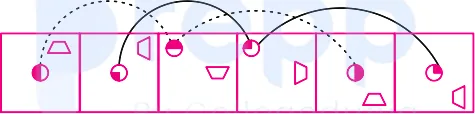
Select the figure that will replace the question mark (?) in the following figure series.

- A
Option A (shown in image)
- B
Option B (shown in image)
- C
Option C (shown in image)
- D
Option D (shown in image)
Show answer
Question 4archived
If A - B means that A is the father of B, A + B means that A is the mother of B, A × B means that A is the brother of B then which of the following expression shows that Q is the brother of P?
- A
P × Q - R
- B
P × Q + R
- C
R + P × Q
- D
Q - P - R
Show answer
A. P × Q - RUnderstanding Blood Relations Coding
This question involves decoding relationships expressed using specific symbols. We are given the meaning of three symbols:
A - B means A is the father of B. This tells us A's gender (male) and the father-child relationship.
A + B means A is the mother of B. This tells us A's gender (female) and the mother-child relationship.
A × B means A is the brother of B. This tells us A's gender (male) and the sibling relationship between A and B.
The goal is to find the expression among the options that shows Q is the brother of P. This means we need an expression where P and Q are siblings, and Q is male.
Analyzing Each Option for the Blood Relation
Let's examine each given expression step-by-step to determine the relationship between P and Q.
Option 1: P × Q - R
P × Q: According to the definition, A × B means A is the brother of B. So, P × Q means P is the brother of Q. This tells us P is male and P and Q are siblings.
Q - R: According to the definition, A - B means A is the father of B. So, Q - R means Q is the father of R. This tells us Q is male.
Combining these, we have P is the brother of Q, and Q is the father of R. Since P is the brother of Q, P and Q are siblings. The second part, Q is the father of R, confirms that Q is male. If P and Q are siblings and Q is male, then Q is the brother of P. This expression shows that Q is the brother of P.
Option 2: P × Q + R
P × Q: P is the brother of Q. (P is male, P and Q are siblings)
Q + R: According to the definition, A + B means A is the mother of B. So, Q + R means Q is the mother of R. This tells us Q is female.
In this case, P is the brother of Q, making them siblings. However, Q is the mother of R, meaning Q is female. If P is the brother of Q and Q is female, then Q must be the sister of P. This expression does not show Q is the brother of P.
Option 3: R + P × Q
R + P: R is the mother of P. (R is female)
P × Q: P is the brother of Q. (P is male, P and Q are siblings)
Here, R is the mother of P, and P is the brother of Q. From P × Q, we know P and Q are siblings and P is male. The relationship between R and P establishes the parentage of P. However, we do not get information about Q's gender from this expression. Q could be a brother or a sister of P. Therefore, this expression does not definitively show that Q is the brother of P.
Option 4: Q - P - R
Q - P: Q is the father of P. (Q is male)
P - R: P is the father of R. (P is male)
This expression states that Q is the father of P, and P is the father of R. This means Q is P's parent, not P's sibling. Q is the father of P, which makes P the son of Q. This does not show Q is the brother of P.
Identifying the Correct Expression
Based on the analysis, only the expression P × Q - R satisfies the condition that Q is the brother of P.
In P × Q - R:
P × Q implies P is the brother of Q. This establishes P and Q as siblings. P is male.
Q - R implies Q is the father of R. This establishes Q's gender as male.
Since P and Q are siblings and Q is male, it follows that Q is the brother of P. The relationship asked is $\text{Q is the brother of P}$.
Conclusion
After analyzing all the given options based on the defined symbolic relationships, the expression P × Q - R correctly shows that Q is the brother of P.
Expression
Relationships
Conclusion on Q and P
Does it show Q is brother of P?
P × Q - R
P is brother of Q; Q is father of R
P, Q are siblings; Q is male
Yes (If siblings and Q is male, Q is brother of P)
P × Q + R
P is brother of Q; Q is mother of R
P, Q are siblings; Q is female
No (Q is sister of P)
R + P × Q
R is mother of P; P is brother of Q
P, Q are siblings; P is male; R is P's mother
No (Q's gender is not determined)
Q - P - R
Q is father of P; P is father of R
Q is father of P
No (Q is P's father)
Revision Table for Blood Relation Concepts
Symbol
Meaning (A [Symbol] B)
Information Gained
-
A is the father of B
A is male; Parent-child relation
+
A is the mother of B
A is female; Parent-child relation
×
A is the brother of B
A is male; Sibling relation
Additional Information on Blood Relations Logic
Blood relations questions often test your ability to decode symbolic representations of family relationships and trace the connections between individuals. Key steps usually involve:
Understanding the exact meaning of each symbol and which person (before or after the symbol) its meaning applies to.
Breaking down a complex expression into smaller, two-person relationships.
Drawing a family tree or diagram if the relationships become complicated, though often not necessary for simpler expressions.
Paying close attention to gender. Some symbols (like 'father', 'mother', 'brother', 'sister') specify gender, which is crucial for determining relationships like 'brother' or 'sister'.
Inferring relationships. For example, if X is the father of Y and Y is the brother of Z, then X is also the father of Z, and Y and Z are siblings.
Practice with different types of symbols and relationship structures helps improve speed and accuracy in solving these problems.
Paper & answer key PDF ↗ Question 5archived
By interchanging the given two signs which of the following equation will be not correct?
+ and ÷
- A
12 ÷ 8 × 12 + 6 - 7 = 21
- B
9 - 3 + 12 × 8 ÷ 4 = 11
- C
46 + 23 ÷ 14 × 5 - 6 = 66
- D
6 + 20 ÷ 12 × 7 - 11 = 70
Show answer
D. 6 + 20 ÷ 12 × 7 - 11 = 70Solving Reasoning Problems by Interchanging Signs
The problem asks us to identify which of the given equations will become incorrect after interchanging two specific mathematical signs: '+' (addition) and '÷' (division). We need to replace every '+' sign with '÷' and every '÷' sign with '+' in each equation and then evaluate the new expression to see if it still equals the value given on the right side of the equals sign. We must follow the order of operations (BODMAS/PEMDAS) during evaluation.
Understanding BODMAS/PEMDAS Rule
The BODMAS or PEMDAS rule dictates the order in which operations should be performed in a mathematical expression:
Brackets (Parentheses)
Orders (Exponents, Square Roots, etc.)
Division and Multiplication (from left to right)
Addition and Subtraction (from left to right)
We will apply this rule to evaluate each equation after interchanging the signs.
Analyzing Each Equation with Interchanged Signs
Let's examine each given equation one by one after interchanging the '+' and '÷' signs.
Equation 1: 12 ÷ 8 × 12 + 6 - 7 = 21
Original equation: $12 \div 8 \times 12 + 6 - 7 = 21$
After interchanging '+' and '÷': $12 + 8 \times 12 \div 6 - 7$
Evaluating the new expression:
First, perform division: $12 \div 6 = 2$
The expression becomes: $12 + 8 \times 2 - 7$
Next, perform multiplication: $8 \times 2 = 16$
The expression becomes: $12 + 16 - 7$
Finally, perform addition and subtraction from left to right: $12 + 16 = 28$, then $28 - 7 = 21$
The result is 21. The equation becomes $21 = 21$, which is correct.
Equation 2: 9 - 3 + 12 × 8 ÷ 4 = 11
Original equation: $9 - 3 + 12 \times 8 \div 4 = 11$
After interchanging '+' and '÷': $9 - 3 \div 12 \times 8 + 4$
Evaluating the new expression:
First, perform division: $3 \div 12 = \frac{3}{12} = \frac{1}{4} = 0.25$
The expression becomes: $9 - 0.25 \times 8 + 4$
Next, perform multiplication: $0.25 \times 8 = 2$
The expression becomes: $9 - 2 + 4$
Finally, perform subtraction and addition from left to right: $9 - 2 = 7$, then $7 + 4 = 11$
The result is 11. The equation becomes $11 = 11$, which is correct.
Equation 3: 46 + 23 ÷ 14 × 5 - 6 = 66
Original equation: $46 + 23 \div 14 \times 5 - 6 = 66$
After interchanging '+' and '÷': $46 \div 23 + 14 \times 5 - 6$
Evaluating the new expression:
First, perform division: $46 \div 23 = 2$
The expression becomes: $2 + 14 \times 5 - 6$
Next, perform multiplication: $14 \times 5 = 70$
The expression becomes: $2 + 70 - 6$
Finally, perform addition and subtraction from left to right: $2 + 70 = 72$, then $72 - 6 = 66$
The result is 66. The equation becomes $66 = 66$, which is correct.
Equation 4: 6 + 20 ÷ 12 × 7 - 11 = 70
Original equation: $6 + 20 \div 12 \times 7 - 11 = 70$
After interchanging '+' and '÷': $6 \div 20 + 12 \times 7 - 11$
Evaluating the new expression:
First, perform division: $6 \div 20 = \frac{6}{20} = \frac{3}{10} = 0.3$
The expression becomes: $0.3 + 12 \times 7 - 11$
Next, perform multiplication: $12 \times 7 = 84$
The expression becomes: $0.3 + 84 - 11$
Finally, perform addition and subtraction from left to right: $0.3 + 84 = 84.3$, then $84.3 - 11 = 73.3$
The result is 73.3. The equation becomes $73.3 = 70$, which is not correct.
Conclusion
After interchanging the '+' and '÷' signs, three of the equations result in a correct mathematical equality. However, the fourth equation ($6 + 20 \div 12 \times 7 - 11 = 70$) results in $73.3 = 70$, which is incorrect. Therefore, this is the equation that will be not correct after the sign interchange.
Equation
Original Expression
Expression After Sign Interchange (+ ⇆ ÷)
Evaluated Result
Is Equation Correct?
1
$12 \div 8 \times 12 + 6 - 7$
$12 + 8 \times 12 \div 6 - 7$
21
Yes ($21 = 21$)
2
$9 - 3 + 12 \times 8 \div 4$
$9 - 3 \div 12 \times 8 + 4$
11
Yes ($11 = 11$)
3
$46 + 23 \div 14 \times 5 - 6$
$46 \div 23 + 14 \times 5 - 6$
66
Yes ($66 = 66$)
4
$6 + 20 \div 12 \times 7 - 11$
$6 \div 20 + 12 \times 7 - 11$
73.3
No ($73.3 \neq 70$)
The equation that will be not correct after interchanging the given two signs (+ and ÷) is the fourth equation.
Revision Table: Key Concepts for Interchanging Signs Problems
Concept
Description
Sign Interchange
Replacing given mathematical operators with others as specified in the problem.
Order of Operations
The standard rule (BODMAS/PEMDAS) that governs the sequence of calculations in an expression.
Equation Verification
Checking if the value of the expression on the left side of the equals sign is equal to the value on the right side after performing operations.
Mathematical Reasoning
Problems that test logical and arithmetic skills by manipulating mathematical expressions based on given conditions.
Additional Information: Solving Mathematical Reasoning Questions
Mathematical reasoning questions often involve manipulating equations or expressions based on given rules, such as interchanging signs, changing numbers, or defining new operators. To solve these questions effectively, follow these steps:
Read Carefully: Understand exactly which signs or numbers need to be interchanged.
Apply Changes: Rewrite the equation or expression with the specified changes.
Follow Order of Operations: Always use BODMAS/PEMDAS to evaluate the modified expression. This is crucial for arriving at the correct result.
Verify the Condition: Check if the evaluated result satisfies the condition given in the question (e.g., does it equal the right side of the equation? Is it greater than/less than a certain value?).
Test All Options (if needed): If the question asks which option satisfies or does not satisfy a condition, you often need to apply the changes and evaluate each option.
Practice with different types of sign interchange and operator-based problems will help improve speed and accuracy.
Paper & answer key PDF ↗ Question 6archived
Select the option that is related to the third term in the same way as the second term is related to the first term and the sixth term is related to the fifth term.
4 : 84 :: 11 : ? :: 13 : 2379
- A
1221
- B
1463
- C
1440
- D
819
Show answer
B. 1463Understanding Number Analogy Problems
This question requires us to identify the relationship between numbers in given pairs and use that relationship to find a missing number. The structure provided is a number analogy:
4 : 84 :: 11 : ? :: 13 : 2379
This means that 4 is related to 84 in the same way that 11 is related to the missing term, and 13 is related to 2379.
Analyzing the Number Relationship
We need to find the mathematical pattern connecting the first number to the second number in the pairs (4, 84) and (13, 2379). Let the first number in a pair be \(n\) and the second number be related to \(n\).
Examining the Pair 4 : 84
Here, \(n=4\). We look for a relationship that transforms 4 into 84. Let's consider common mathematical operations and powers:
What about \(4^2\)? \(4^2 = 16\). 84 is not directly related to 16 by a simple multiple or addition.
What about \(4^3\)? \(4^3 = 4 \times 4 \times 4 = 16 \times 4 = 64\).
The difference between 84 and 64 is \(84 - 64 = 20\). We can observe that 20 is \(5 \times 4\). So, it looks like the relationship might be \(n^3 + 5n\). Let's test this hypothesis with the next pair.
Examining the Pair 13 : 2379
Here, \(n=13\). We apply the potential pattern \(n^3 + 5n\) to 13:
Calculate \(13^3\): \(13 \times 13 \times 13\). \(13^2 = 169\). \(13^3 = 169 \times 13\).
\(169 \times 10 = 1690\)
\(169 \times 3 = 507\)
\(1690 + 507 = 2197\). So, \(13^3 = 2197\).
Calculate \(5 \times 13 = 65\).
According to the pattern \(n^3 + 5n\), the result should be \(2197 + 65 = 2262\).
The calculated value 2262 does not match the given value 2379. This means the pattern \(n^3 + 5n\) is incorrect.
Let's revisit the difference for \(n=13\): \(2379 - 13^3 = 2379 - 2197 = 182\). How is 182 related to 13? \(182 \div 13 = 14\). So, for \(n=13\), the relationship is \(13^3 + 14 \times 13\).
Now we have two observations for the multiplier of \(n\) that is added to \(n^3\):
When \(n=4\), the multiplier is 5.
When \(n=13\), the multiplier is 14.
Notice that 5 is \(4+1\) and 14 is \(13+1\). This suggests that the multiplier of \(n\) is \((n+1)\).
The consistent pattern appears to be \(n : n^3 + (n+1)n\).
Let's re-verify this pattern with the given pairs:
For \(n=4\): \(4^3 + (4+1) \times 4 = 64 + 5 \times 4 = 64 + 20 = 84\). This matches the first pair.
For \(n=13\): \(13^3 + (13+1) \times 13 = 2197 + 14 \times 13 = 2197 + 182 = 2379\). This matches the third pair.
The pattern \(n^3 + (n+1)n\) is confirmed.
Calculating the Missing Term for 11
Now we apply this pattern to the pair 11 : ?. Here \(n=11\). We need to calculate \(11^3 + (11+1) \times 11\).
Calculate \(11^3\): \(11 \times 11 \times 11 = 121 \times 11 = 1331\).
Calculate \((11+1) \times 11\): \(12 \times 11 = 132\).
Add the results: \(1331 + 132 = 1463\).
The missing term in the analogy is 1463.
Verification with Options
Let's compare our result with the given options:
1221
1463
1440
819
Our calculated value, 1463, matches Option 2.
Analogy Pattern: \(n : n^3 + (n+1)n\)
First Term (n)
Pattern Application
Result
Corresponding Second Term
4
\(4^3 + (4+1) \times 4 = 64 + 5 \times 4\)
\(64 + 20 = 84\)
84 (Matches)
11
\(11^3 + (11+1) \times 11 = 1331 + 12 \times 11\)
\(1331 + 132 = 1463\)
? (Missing Term)
13
\(13^3 + (13+1) \times 13 = 2197 + 14 \times 13\)
\(2197 + 182 = 2379\)
2379 (Matches)
The number analogy follows the rule \(n : n^3 + (n+1)n\).
Revision Table: Key Concepts in Number Puzzles
Concept
Explanation
Importance in Solving
Identifying Patterns
Recognizing underlying mathematical relationships between numbers (arithmetic, powers, etc.).
Crucial first step to solve analogies and series.
Testing Hypotheses
Applying a potential pattern found from one example to other examples to check for consistency.
Ensures the pattern is universally applicable to the problem set.
Mathematical Operations
Using addition, subtraction, multiplication, division, powers, roots.
The building blocks of most number patterns.
Additional Information: Strategies for Number Analogy Questions
To effectively solve number analogy problems, consider the following strategies:
Start by examining the simplest relationships: addition, subtraction, multiplication, division.
Look at squares and cubes of the numbers, and see if the second term is close to one of these powers.
Check for combinations of operations, like multiplying by a constant and then adding/subtracting something, or patterns involving \(n^2+n\), \(n^2-n\), \(n^3+n\), \(n^3-n\), etc.
Sometimes the multiplier or added/subtracted value is related to the number \(n\) itself, as seen in this problem where the multiplier was \((n+1)\).
If direct operations don't work, look at the difference between the numbers. The differences might form a pattern.
Always test the pattern you find on all the given pairs to ensure it holds true for the entire analogy.
Work systematically and don't be afraid to try different approaches if the first few don't lead to a consistent pattern.
Consistent practice improves your ability to spot complex patterns quickly.
Paper & answer key PDF ↗ Question 7archived
Select the option that represents the correct order of the given words as they would appear in an English dictionary.
1. Effluent
2. Edifice
3. Effleurage
4. Edacious
5. Effeminate
6. Eccentric
7. Effulgent
- A
6, 4, 2, 5, 3, 1, 7
- B
6, 4, 2, 3, 5, 1, 7
- C
6, 4, 2, 5, 1, 3, 7
- D
6, 4, 2, 5, 7, 3, 1
Show answer
A. 6, 4, 2, 5, 3, 1, 7Understanding Dictionary Order
Arranging words in dictionary order, also known as alphabetical order, involves comparing words letter by letter from left to right. If the first letters are different, the word with the letter that comes earlier in the alphabet comes first. If the first letters are the same, you move to the second letter, and so on, until you find a difference.
Step-by-Step Word Comparison for Dictionary Order
Let's arrange the given words according to dictionary order:
Effluent
Edifice
Effleurage
Edacious
Effeminate
Eccentric
Effulgent
We will compare the words based on their letters:
All words start with the letter 'E'. We need to look at the second letter.
The second letters are: 'c' (Eccentric), 'd' (Edifice, Edacious), 'f' (Effluent, Effleurage, Effeminate, Effulgent).
According to the alphabet, 'c' comes before 'd', and 'd' comes before 'f'.
Comparing based on the second letter:
The word starting with 'Ec' ('Eccentric') will come first.
Eccentric (6)
Next are the words starting with 'Ed': 'Edifice' (2) and 'Edacious' (4). We compare their third letters.
Edacious: E-d-a
Edifice: E-d-i
'a' comes before 'i'. So, 'Edacious' comes before 'Edifice'.
Edacious (4)
Edifice (2)
Finally, we compare the words starting with 'Eff': 'Effluent' (1), 'Effleurage' (3), 'Effeminate' (5), 'Effulgent' (7). The third letter 'f' is the same for all. We compare their fourth letters.
Effluent: E-f-f-l
Effleurage: E-f-f-l
Effeminate: E-f-f-e
Effulgent: E-f-f-l
'e' comes before 'l'. So, 'Effeminate' comes first among these words.
Effeminate (5)
Now we compare the remaining words starting with 'Effl': 'Effluent' (1), 'Effleurage' (3), 'Effulgent' (7). The fifth letters are:
Effluent: E-f-f-l-u
Effleurage: E-f-f-l-e
Effulgent: E-f-f-l-u
'e' comes before 'u'. So, 'Effleurage' comes next.
Effleurage (3)
Finally, we compare 'Effluent' (1) and 'Effulgent' (7), both starting with 'Efflu'. We compare their sixth letters.
Effluent: E-f-f-l-u-e
Effulgent: E-f-f-l-u-g
'e' comes before 'g'. So, 'Effluent' comes before 'Effulgent'.
Effluent (1)
Effulgent (7)
Final Dictionary Order
Combining all the sorted groups, the correct dictionary order is:
Eccentric (6)
Edacious (4)
Edifice (2)
Effeminate (5)
Effleurage (3)
Effluent (1)
Effulgent (7)
The sequence of numbers representing the correct order is 6, 4, 2, 5, 3, 1, 7.
Original Number
Word
Step 1 (2nd Letter)
Step 2 (3rd Letter)
Step 3 (4th Letter)
Step 4 (5th Letter)
Step 5 (6th Letter)
Dictionary Order Rank
1
Effluent
f
f
l
u
e
6
2
Edifice
d
i
3
3
Effleurage
f
f
l
e
u
5
4
Edacious
d
a
2
5
Effeminate
f
f
e
m
4
6
Eccentric
c
c
1
7
Effulgent
f
f
l
u
g
7
Based on the dictionary order ranks:
Rank 1: Eccentric (6)
Rank 2: Edacious (4)
Rank 3: Edifice (2)
Rank 4: Effeminate (5)
Rank 5: Effleurage (3)
Rank 6: Effluent (1)
Rank 7: Effulgent (7)
The correct order of the given numbers is 6, 4, 2, 5, 3, 1, 7.
Revision Table: Checking Dictionary Order Logic
Comparison Pair
Logic
Order
Eccentric vs Edacious
'c' < 'd' (2nd letter)
Eccentric then Edacious
Edacious vs Edifice
'a' < 'i' (3rd letter)
Edacious then Edifice
Edifice vs Effeminate
'd' < 'f' (2nd letter)
Edifice then Effeminate
Effeminate vs Effleurage
'e' < 'l' (4th letter)
Effeminate then Effleurage
Effleurage vs Effluent
'e' < 'u' (5th letter)
Effleurage then Effluent
Effluent vs Effulgent
'e' < 'g' (6th letter)
Effluent then Effulgent
Additional Information: Alphabetical Sorting
Alphabetical sorting is a fundamental concept used in dictionaries, encyclopedias, indexes, and databases. It helps in organizing information logically for easy retrieval. The sorting process relies on the standard order of letters in the alphabet (a-z).
When words are identical up to a certain point, the next differing letter determines the order.
Shorter words typically come before longer words if the longer word starts with the entire shorter word (e.g., "car" before "carpet"). However, in this specific list, all words are distinct at some point before the end.
Punctuation and spaces are usually ignored or handled with specific rules in more complex sorting scenarios, but for standard dictionary order of words, only the letters matter.
Paper & answer key PDF ↗ Question 8archived
Which letter-cluster will replace the question mark (?) to complete the given series?
XDNC, VGOE, ?, RMQI, PPRK
- A
TJRG
- B
TKPG
- C
TJPG
- D
TJQG
Show answer
C. TJPGSolving Letter-Cluster Series Puzzles
This question asks us to find the letter-cluster that completes the given series: XDNC, VGOE, ?, RMQI, PPRK.
To solve this type of letter-cluster series problem, we need to analyze the pattern for each letter position across the clusters. Let's examine the first, second, third, and fourth letters separately.
Analyzing the First Letter Pattern
The first letters of the clusters are: X, V, ?, R, P.
Let's look at their positions in the English alphabet (A=1, B=2, ..., Z=26):
X is the 24th letter.
V is the 22nd letter.
R is the 18th letter.
P is the 16th letter.
Now let's find the difference in their positions:
V to X: \(22 - 24 = -2\)
P to R: \(16 - 18 = -2\)
It appears there is a consistent difference of -2 between consecutive first letters. Applying this pattern:
From X to V, the difference is -2.
From V, the next letter should be \(22 - 2 = 20\). The 20th letter is T.
From T, the next letter should be \(20 - 2 = 18\). The 18th letter is R, which matches the series.
From R to P, the difference is -2, which also matches the series.
So, the first letter of the missing cluster is T.
Analyzing the Second Letter Pattern
The second letters of the clusters are: D, G, ?, M, R.
Let's look at their positions in the English alphabet:
D is the 4th letter.
G is the 7th letter.
M is the 13th letter.
R is the 18th letter.
Let's find the difference in their positions:
G to D: \(7 - 4 = +3\)
R to M: \(18 - 13 = +5\)
The differences are +3 and +5. Let's look at the gap between G and M, which spans the missing letter. The total difference from G to M is \(13 - 7 = +6\). If the increments are increasing, it could be +3, then an unknown step, then another unknown step that sums to +6, then +5. However, if we look closely at the options for the second letter (J, K, J, J - positions 10, 11, 10, 10), if the second letter is J (10), the pattern would be:
D to G: \(7 - 4 = +3\)
G to J: \(10 - 7 = +3\)
J to M: \(13 - 10 = +3\)
M to R: \(18 - 13 = +5\)
This pattern shows a consistent increase of +3 for the first three steps, followed by a +5 step. This is a plausible pattern for a series.
So, the second letter of the missing cluster is J.
Analyzing the Third Letter Pattern
The third letters of the clusters are: N, O, ?, Q, K.
Let's look at their positions in the English alphabet:
N is the 14th letter.
O is the 15th letter.
Q is the 17th letter.
K is the 11th letter.
Let's find the difference in their positions:
O to N: \(15 - 14 = +1\)
K to Q: \(11 - 17 = -6\)
The differences are +1 and -6. Let's consider the steps between O and Q, which spans the missing letter. The total difference from O to Q is \(17 - 15 = +2\). If the pattern involves small positive steps followed by a large negative step, let's see if a constant small step works between O and Q.
From N to O, the difference is +1.
From O, if the next step is +1, the letter is \(15 + 1 = 16\). The 16th letter is P.
From P, if the next step is +1, the letter is \(16 + 1 = 17\). The 17th letter is Q, which matches the series.
From Q to K, the difference is \(11 - 17 = -6\), which matches the series.
This pattern shows a +1 increase for the first three steps, followed by a -6 step. This is a consistent pattern.
So, the third letter of the missing cluster is P.
Analyzing the Fourth Letter Pattern
The fourth letters of the clusters are: C, E, ?, I, K.
Let's look at their positions in the English alphabet:
C is the 3rd letter.
E is the 5th letter.
I is the 9th letter.
K is the 11th letter.
Let's find the difference in their positions:
E to C: \(5 - 3 = +2\)
K to I: \(11 - 9 = +2\)
It appears there is a consistent difference of +2 between consecutive fourth letters. Applying this pattern:
From C to E, the difference is +2.
From E, the next letter should be \(5 + 2 = 7\). The 7th letter is G.
From G, the next letter should be \(7 + 2 = 9\). The 9th letter is I, which matches the series.
From I to K, the difference is +2, which also matches the series.
So, the fourth letter of the missing cluster is G.
Combining the Patterns
By analyzing each letter position independently, we found the following letters for the missing cluster:
First letter: T
Second letter: J
Third letter: P
Fourth letter: G
Combining these letters gives the cluster TJPG.
Therefore, the letter-cluster TJPG will replace the question mark (?) to complete the given series.
Revision Table: Letter Series Patterns
Let's summarize the patterns observed for each letter position:
Position
Letters in Series
Alphabet Position
Pattern/Difference
1st
X, V, T, R, P
24, 22, 20, 18, 16
Constant -2
2nd
D, G, J, M, R
4, 7, 10, 13, 18
+3, +3, +3, +5
3rd
N, O, P, Q, K
14, 15, 16, 17, 11
+1, +1, +1, -6
4th
C, E, G, I, K
3, 5, 7, 9, 11
Constant +2
Additional Information: Series Completion Reasoning
Series completion questions are common in reasoning tests. They involve identifying a pattern in a sequence of numbers, letters, or figures and predicting the next term or finding the missing term. For letter series, the patterns can be based on:
Alphabetical position (forward or backward).
Differences in alphabetical position (constant or varying by a rule).
Skipping letters in the alphabet.
A combination of these or other logical rules.
When dealing with letter clusters, it's crucial to analyze each letter position separately as the pattern for each position might be different, as seen in this example.
Paper & answer key PDF ↗ Question 9archived
Select the set in which the numbers are related in the same way as are the numbers of the given set.
(NOTE: Operations should be performed on the whole numbers, without breaking down the numbers into its constituent digits. E.g. 13 - Operations on 13 such as adding / subtracting / multiplying etc. to 13 can be performed. Breaking down 13 into 1 and 3 and then performing mathematical operations on 1 and 3 is not allowed.)
(3, 13, 18)
(29, 39, 44)
- A
(17, 27, 42)
- B
(25, 30, 55)
- C
(26, 30, 47)
- D
(16, 26, 31)
Show answer
D. (16, 26, 31)Finding the Number Relationship in Sets
The question asks us to identify a set of numbers from the given options that shares the same mathematical relationship as the two provided sets: (3, 13, 18) and (29, 39, 44). The rule is that operations must be performed on the whole numbers themselves, not by breaking them down into individual digits. Let's analyze the relationship between the numbers in the given sets.
Analyzing the Given Sets (3, 13, 18) and (29, 39, 44)
Let's look at the differences between the numbers in the first given set (3, 13, 18):
Difference between the second and first number: \(13 - 3 = 10\)
Difference between the third and second number: \(18 - 13 = 5\)
Difference between the third and first number: \(18 - 3 = 15\)
Now let's look at the differences between the numbers in the second given set (29, 39, 44):
Difference between the second and first number: \(39 - 29 = 10\)
Difference between the third and second number: \(44 - 39 = 5\)
Difference between the third and first number: \(44 - 29 = 15\)
We can see a consistent pattern in both given sets. If we represent the first number as \(x\), the second number is \(x + 10\), and the third number is \(x + 15\). This also means the third number is \( (x + 10) + 5 \), confirming the difference of 5 between the second and third numbers. So the relationship is \( (x, x+10, x+15) \).
Checking the Options for the Same Number Relationship
Now, we will check each option to see which set follows the same relationship pattern \( (x, x+10, x+15) \).
Option 1: (17, 27, 42)
First number \(x = 17\)
Second number: \(17 + 10 = 27\). This matches the second number in the set.
Third number: \(27 + 5 = 32\). The third number in the set is 42. This does not match.
Alternatively, third number: \(17 + 15 = 32\). The third number in the set is 42. This does not match.
Option 1 does not follow the pattern \( (x, x+10, x+15) \).
Option 2: (25, 30, 55)
First number \(x = 25\)
Second number: \(25 + 10 = 35\). The second number in the set is 30. This does not match.
Option 2 does not follow the pattern \( (x, x+10, x+15) \).
Option 3: (26, 30, 47)
First number \(x = 26\)
Second number: \(26 + 10 = 36\). The second number in the set is 30. This does not match.
Option 3 does not follow the pattern \( (x, x+10, x+15) \).
Option 4: (16, 26, 31)
First number \(x = 16\)
Second number: \(16 + 10 = 26\). This matches the second number in the set.
Third number: \(26 + 5 = 31\). This matches the third number in the set.
Alternatively, third number: \(16 + 15 = 31\). This matches the third number in the set.
Option 4 follows the pattern \( (x, x+10, x+15) \).
Conclusion
Based on the analysis of the given sets (3, 13, 18) and (29, 39, 44), the established pattern is that the second number is 10 greater than the first, and the third number is 5 greater than the second (or 15 greater than the first). Among the given options, only the set (16, 26, 31) follows this exact pattern.
\(26 = 16 + 10\)
\(31 = 26 + 5\)
\(31 = 16 + 15\)
Set
Relationship Check (\(x\), \(x+10\), \(x+15\))
Follows Pattern?
(3, 13, 18)
\(3, 3+10=13, 3+15=18\)
Yes
(29, 39, 44)
\(29, 29+10=39, 29+15=44\)
Yes
(17, 27, 42)
\(17, 17+10=27, 17+15=32\) (42 given)
No
(25, 30, 55)
\(25, 25+10=35\) (30 given)
No
(26, 30, 47)
\(26, 26+10=36\) (30 given)
No
(16, 26, 31)
\(16, 16+10=26, 16+15=31\)
Yes
Revision Table: Number Sets and Relationships
This table summarizes the analysis of each option against the identified number relationship.
Set
Difference 1 (Second - First)
Difference 2 (Third - Second)
Difference 3 (Third - First)
Pattern (\(+10\), \(+5\), \(+15\)) Match?
(3, 13, 18)
\(10\)
\(5\)
\(15\)
Yes
(29, 39, 44)
\(10\)
\(5\)
\(15\)
Yes
(17, 27, 42)
\(10\)
\(15\)
\(25\)
No
(25, 30, 55)
\(5\)
\(25\)
\(30\)
No
(26, 30, 47)
\(4\)
\(17\)
\(21\)
No
(16, 26, 31)
\(10\)
\(5\)
\(15\)
Yes
Additional Information on Number Series and Patterns
Number series and patterns questions are common in logical reasoning tests. They require identifying a rule or relationship that connects the numbers in a sequence or a set. This relationship can be based on arithmetic operations (addition, subtraction, multiplication, division), powers, roots, or a combination of these.
Arithmetic Progression: A sequence where the difference between consecutive terms is constant (e.g., 2, 5, 8, 11... here difference is 3). The given sets have a pattern that includes arithmetic differences between elements.
Geometric Progression: A sequence where each term after the first is found by multiplying the previous one by a fixed, non-zero number called the common ratio.
Mixed Series: Sometimes, a series might combine different patterns or operations.
Set-based Patterns: Like in this question, the pattern applies to a fixed group of numbers within a set, rather than a continuous sequence. The rule must hold true for all given example sets and be found in exactly one of the options.
It is crucial to test the identified pattern rigorously across all provided examples before applying it to the options. Also, always remember the constraints given in the question, such as operating on whole numbers versus digits.
Paper & answer key PDF ↗ Question 10archived
In the following question, select the missing number from the given series.
7, 21, 63, 189, 567, ?
- A
1701
- B
1800
- C
1720
- D
1781
Show answer
A. 1701Finding the Missing Number in a Series
The question asks us to identify the pattern in the given number series and find the next number.
The series is: 7, 21, 63, 189, 567, ?
Analyzing the Number Series Pattern
Let's examine the relationship between consecutive terms in the series:
The second term (21) compared to the first term (7): \(21 \div 7 = 3\)
The third term (63) compared to the second term (21): \(63 \div 21 = 3\)
The fourth term (189) compared to the third term (63): \(189 \div 63 = 3\)
The fifth term (567) compared to the fourth term (189): \(567 \div 189 = 3\)
From this analysis, it is clear that each term in the series is obtained by multiplying the previous term by 3.
This type of series where each term is found by multiplying the previous term by a constant value is called a geometric progression.
Calculating the Missing Number
To find the missing number, we need to apply the same pattern to the last given term (567).
The missing number will be the fifth term multiplied by 3.
Missing Number = \(567 \times 3\)
Let's perform the multiplication:
\(567 \times 3 = 1701\)
So, the next number in the series is 1701.
Verification with Options
We check the calculated missing number against the provided options:
Option
Value
Matches Calculation?
1
1701
Yes
2
1800
No
3
1720
No
4
1781
No
Our calculated value, 1701, matches Option 1.
Conclusion: The Missing Number
Following the established pattern of multiplying by 3, the missing number in the series 7, 21, 63, 189, 567, ? is 1701.
Revision Table: Number Series Patterns
Understanding common number series patterns is crucial for solving these types of questions.
Pattern Type
Description
Example
Arithmetic Progression (AP)
Adding or subtracting a constant value (common difference).
2, 5, 8, 11, ... (common difference +3)
Geometric Progression (GP)
Multiplying or dividing by a constant value (common ratio).
7, 21, 63, 189, ... (common ratio \(\times 3\))
Difference Series
Pattern found in the difference between consecutive terms.
1, 2, 4, 7, 11, ... (differences: 1, 2, 3, 4, ...)
Mixed Series
Combination of different patterns or alternating patterns.
3, 6, 4, 8, 6, 12, ... (alternating \(\times 2\), \(-2\))
Additional Information: Geometric Progression Explained
A Geometric Progression (GP) is a sequence of non-zero numbers where each term after the first is found by multiplying the previous one by a fixed, non-zero number called the common ratio.
In the series 7, 21, 63, 189, 567, ..., the first term (a) is 7, and the common ratio (r) is 3.
The formula for the nth term of a GP is \(a_n = a \times r^{n-1}\).
1st term (\(n=1\)): \(a_1 = 7 \times 3^{1-1} = 7 \times 3^0 = 7 \times 1 = 7\)
2nd term (\(n=2\)): \(a_2 = 7 \times 3^{2-1} = 7 \times 3^1 = 7 \times 3 = 21\)
3rd term (\(n=3\)): \(a_3 = 7 \times 3^{3-1} = 7 \times 3^2 = 7 \times 9 = 63\)
4th term (\(n=4\)): \(a_4 = 7 \times 3^{4-1} = 7 \times 3^3 = 7 \times 27 = 189\)
5th term (\(n=5\)): \(a_5 = 7 \times 3^{5-1} = 7 \times 3^4 = 7 \times 81 = 567\)
6th term (\(n=6\)): \(a_6 = 7 \times 3^{6-1} = 7 \times 3^5 = 7 \times 243 = 1701\)
This formula confirms our pattern and calculation for the 6th term.
Paper & answer key PDF ↗ Question 11archived
A series is given with one term missing. Select the correct alternative from the given ones that will complete the series.
NTRQ, GOIF, ZJZU, SEQJ, ?
- A
LZHY
- B
QNRT
- C
LMRC
- D
LXYQ
Show answer
A. LZHYUnderstanding the Letter Series Pattern
This question asks us to find the next term in a given letter series: NTRQ, GOIF, ZJZU, SEQJ, ?. To solve this, we need to identify the pattern that governs the progression from one term to the next. In letter series, the pattern often involves the positional value of the letters in the English alphabet (A=1, B=2, ..., Z=26) and can include addition, subtraction, multiplication, or even specific sequences or rules.
Analyzing the Pattern Letter by Letter
Let's examine each letter position in the series independently and determine the rule applied between consecutive terms.
We will assign numerical values to each letter based on its position in the alphabet:
NTRQ: N(14), T(20), R(18), Q(17)
GOIF: G(7), O(15), I(9), F(6)
ZJZU: Z(26), J(10), Z(26), U(21)
SEQJ: S(19), E(5), Q(17), J(10)
First Letter Analysis: N, G, Z, S, ?
Let's look at the difference in the numerical values of the first letter of each term:
N (14) to G (7): \(14 - 7 = 7\). This difference is -7.
G (7) to Z (26): Moving from G (7) backwards to Z (26) involves wrapping around the alphabet. G(7) → F(6) → E(5) → D(4) → C(3) → B(2) → A(1) → Z(26). This is a step of 7 letters backward. This corresponds to \((7 - 26) \pmod{26}\). \(7 - 26 = -19\). \(-19 \pmod{26} = 7\). Alternatively, counting backwards: G(7) is 7 steps from A. A is 1 step from Z. So G is \(7+1=8\) steps from Z forwards, or \(26-7=19\) steps forwards from G to Z. Backwards from G to Z is 7 steps. So, this is a difference of -7.
Z (26) to S (19): \(26 - 19 = 7\). This difference is -7.
The pattern for the first letter is a consistent subtraction of 7, with wrapping around from A to Z.
Applying this to the last term's first letter, S (19): \(19 - 7 = 12\). The 12th letter is L.
Second Letter Analysis: T, O, J, E, ?
Let's look at the difference in the numerical values of the second letter of each term:
T (20) to O (15): \(20 - 15 = 5\). This difference is -5.
O (15) to J (10): \(15 - 10 = 5\). This difference is -5.
J (10) to E (5): \(10 - 5 = 5\). This difference is -5.
The pattern for the second letter is a consistent subtraction of 5.
Applying this to the last term's second letter, E (5): \(5 - 5 = 0\). When we subtract 5 from E(5) wrapping around from A to Z, E(5) → D(4) → C(3) → B(2) → A(1) → Z(26). The result is Z.
Third Letter Analysis: R, I, Z, Q, ?
Let's look at the difference in the numerical values of the third letter of each term:
R (18) to I (9): \(18 - 9 = 9\). This difference is -9.
I (9) to Z (26): Moving from I (9) backwards to Z (26) involves wrapping around. I(9) → H(8) → G(7) → F(6) → E(5) → D(4) → C(3) → B(2) → A(1) → Z(26). This is a step of 9 letters backward. This corresponds to a difference of -9.
Z (26) to Q (17): \(26 - 17 = 9\). This difference is -9.
The pattern for the third letter is a consistent subtraction of 9, with wrapping around from A to Z.
Applying this to the last term's third letter, Q (17): \(17 - 9 = 8\). The 8th letter is H.
Fourth Letter Analysis: Q, F, U, J, ?
Let's look at the difference in the numerical values of the fourth letter of each term:
Q (17) to F (6): \(17 - 6 = 11\). This difference is -11.
F (6) to U (21): Moving from F (6) backwards to U (21) involves wrapping around. F(6) → E(5) → D(4) → C(3) → B(2) → A(1) → Z(26) → Y(25) → X(24) → W(23) → V(22) → U(21). This is a step of 11 letters backward. This corresponds to a difference of -11.
U (21) to J (10): \(21 - 10 = 11\). This difference is -11.
The pattern for the fourth letter is a consistent subtraction of 11, with wrapping around from A to Z.
Applying this to the last term's fourth letter, J (10): \(10 - 11\). Subtracting 11 from J(10) wrapping around from A to Z, J(10) → I(9) → H(8) → G(7) → F(6) → E(5) → D(4) → C(3) → B(2) → A(1) → Z(26) → Y(25). The result is Y.
Constructing the Next Term
Based on our analysis, the pattern for each letter position in the series NTRQ, GOIF, ZJZU, SEQJ is a subtraction of a specific number (with wrapping) from the previous term's letter value:
First letter: -7
Second letter: -5
Third letter: -9
Fourth letter: -11
Applying these differences to the last term, SEQJ:
S (19) - 7 → 12 (L)
E (5) - 5 → Z
Q (17) - 9 → 8 (H)
J (10) - 11 → Y
Combining these letters gives the next term: LZHY.
Comparing with Options
Let's compare our calculated next term with the given options:
Option 1: LZHY
Option 2: QNRT
Option 3: LMRC
Option 4: LXYQ
Our calculated term, LZHY, matches Option 1.
Revision Table: Letter Series Pattern Summary
Term
1st Letter
2nd Letter
3rd Letter
4th Letter
NTRQ
N (14)
T (20)
R (18)
Q (17)
GOIF
G (7)
O (15)
I (9)
F (6)
Difference
-7
-5
-9
-11
ZJZU
Z (26)
J (10)
Z (26)
U (21)
Difference
-7
-5
-9
-11
SEQJ
S (19)
E (5)
Q (17)
J (10)
Difference
-7
-5
-9
-11
Next Term
L (12)
Z
H (8)
Y
Additional Information: Solving Letter Series Questions
Solving letter series questions often requires identifying the underlying pattern, which can be based on various rules:
Positional Value: The most common method is to look at the numerical position of each letter in the alphabet (A=1, B=2, ..., Z=26).
Arithmetic Progression: Differences between consecutive letters might follow an arithmetic progression (e.g., add 2, add 3, add 4...).
Geometric Progression: Differences or positional values might follow a geometric progression.
Alternating Patterns: The pattern might alternate between two different rules or apply to alternate terms.
Specific Sequences: The letters might form a known sequence (e.g., skip a letter, skip two letters, etc.).
Reversal or Rearrangement: Sometimes letters within a term or the pattern itself involves reversal or rearrangement.
Vowel/Consonant Patterns: The pattern might involve the sequence of vowels or consonants.
It's crucial to check the pattern consistently across all given terms before applying it to find the missing term. If a pattern doesn't hold for all terms, look for a different rule.
Paper & answer key PDF ↗ Question 12archived
By Interchanging the given two numbers which of the following equation will be correct?
5 and 8
- A
5 × 2 - 8 + 9 ÷ 1 = 20
- B
8 + 5 × 4 - 9 ÷ 3 = 30
- C
5 × 7 + 8 - 3 ÷ 1 = 55
- D
8 - 5 × 2 + 6 ÷ 2 = -9
Show answer
A. 5 × 2 - 8 + 9 ÷ 1 = 20Solving Equations by Interchanging Numbers
The question asks us to find which equation becomes correct after interchanging the numbers 5 and 8 in the given expressions. We need to examine each option, swap the positions of 5 and 8, and then evaluate the resulting equation using the order of operations (BODMAS/PEMDAS).
Evaluating Option 1 after Interchanging 5 and 8
The original equation in Option 1 is 5 × 2 - 8 + 9 ÷ 1 = 20.
After interchanging 5 and 8, the equation becomes:
\(8 \times 2 - 5 + 9 \div 1 = ?\)
Let's evaluate this expression following BODMAS (Brackets, Orders/Exponents, Division and Multiplication (from left to right), Addition and Subtraction (from left to right)):
First, perform the division: \(9 \div 1 = 9\). The equation is now \(8 \times 2 - 5 + 9 = ?\)
Next, perform the multiplication: \(8 \times 2 = 16\). The equation is now \(16 - 5 + 9 = ?\)
Now, perform addition and subtraction from left to right:
\(16 - 5 = 11\). The equation is now \(11 + 9 = ?\)
\(11 + 9 = 20\).
So, the result of the left side is 20. The equation becomes \(20 = 20\), which is a correct statement.
Thus, interchanging 5 and 8 makes the equation in Option 1 correct.
Evaluating Other Options (for completeness)
Let's also check the other options to confirm they are incorrect after interchanging 5 and 8.
Option 2 Analysis
Original equation: \(8 + 5 \times 4 - 9 \div 3 = 30\)
After interchanging 5 and 8: \(5 + 8 \times 4 - 9 \div 3 = ?\)
Evaluating:
Division: \(9 \div 3 = 3\) → \(5 + 8 \times 4 - 3 = ?\)
Multiplication: \(8 \times 4 = 32\) → \(5 + 32 - 3 = ?\)
Addition/Subtraction: \(5 + 32 = 37\) → \(37 - 3 = ?\)
\(37 - 3 = 34\)
Result: \(34 \neq 30\). Incorrect.
Option 3 Analysis
Original equation: \(5 \times 7 + 8 - 3 \div 1 = 55\)
After interchanging 5 and 8: \(8 \times 7 + 5 - 3 \div 1 = ?\)
Evaluating:
Division: \(3 \div 1 = 3\) → \(8 \times 7 + 5 - 3 = ?\)
Multiplication: \(8 \times 7 = 56\) → \(56 + 5 - 3 = ?\)
Addition/Subtraction: \(56 + 5 = 61\) → \(61 - 3 = ?\)
\(61 - 3 = 58\)
Result: \(58 \neq 55\). Incorrect.
Option 4 Analysis
Original equation: \(8 - 5 \times 2 + 6 \div 2 = -9\)
After interchanging 5 and 8: \(5 - 8 \times 2 + 6 \div 2 = ?\)
Evaluating:
Division: \(6 \div 2 = 3\) → \(5 - 8 \times 2 + 3 = ?\)
Multiplication: \(8 \times 2 = 16\) → \(5 - 16 + 3 = ?\)
Addition/Subtraction: \(5 - 16 = -11\) → \(-11 + 3 = ?\)
\(-11 + 3 = -8\)
Result: \(-8 \neq -9\). Incorrect.
Based on our evaluation, only the equation in Option 1 becomes correct after interchanging the numbers 5 and 8.
Option
Original Equation
Equation after Interchanging 5 and 8
Calculation Result
Correct?
1
\(5 \times 2 - 8 + 9 \div 1 = 20\)
\(8 \times 2 - 5 + 9 \div 1 = ?\)
20
Yes (20 = 20)
2
\(8 + 5 \times 4 - 9 \div 3 = 30\)
\(5 + 8 \times 4 - 9 \div 3 = ?\)
34
No (34 ≠ 30)
3
\(5 \times 7 + 8 - 3 \div 1 = 55\)
\(8 \times 7 + 5 - 3 \div 1 = ?\)
58
No (58 ≠ 55)
4
\(8 - 5 \times 2 + 6 \div 2 = -9\)
\(5 - 8 \times 2 + 6 \div 2 = ?\)
-8
No (-8 ≠ -9)
Revision Table: Checking Equation Interchanges
Concept
Description
Application in Problem
Interchanging Numbers
Swapping the positions of two specific numbers within an expression or equation.
Swapping 5 and 8 in each given equation.
Order of Operations (BODMAS/PEMDAS)
Rules governing the sequence in which mathematical operations should be performed to ensure a unique result (Brackets, Orders, Division/Multiplication, Addition/Subtraction).
Used to evaluate the modified equations correctly after interchanging 5 and 8.
Equation Verification
Checking if the left side of an equation equals the right side after performing all calculations.
Comparing the calculated result of the left side to the given value on the right side for each modified equation.
Additional Information: The Importance of BODMAS/PEMDAS
When solving mathematical expressions or equations, the order of operations is crucial. Without a standard order, the same expression could yield different results depending on which operation is performed first.
Brackets (or Parentheses)
Orders (or Exponents/Indices)
Division and Multiplication (These have equal priority and are performed from left to right)
Addition and Subtraction (These have equal priority and are performed from left to right)
In this problem, applying BODMAS correctly after interchanging the numbers is essential to determine if the resulting equation holds true.
Paper & answer key PDF ↗ Question 13archived
Select the option in which the given figure is embedded (rotation is NOT allowed).

- A
Option A (shown in image)
- B
Option B (shown in image)
- C
Option C (shown in image)
- D
Option D (shown in image)
Show answer
B. Option B (shown in image)The option in which the given figure is embedded when rotation is not allowed is shown below :
Hence, th correct answer is 'Option 2'.
 Paper & answer key PDF ↗
 Question 14archived
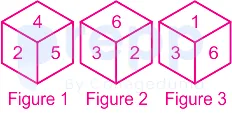
Three different positions of the same dice are shown. Find the number on the face opposite the face showing '2'.
- A
1
- B
6
- C
3
- D
4
Show answer
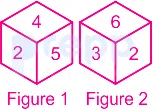
A. 1Taking dice position 1 and 2 with 2 as common.
Moving clockwise from common number 2
pair of opposite numbers
3 - 4
5 - 6
the number on the face opposite the face showing '2' is '1'
Hence, the correct answer is "Option 1".
 Paper & answer key PDF ↗
 Question 15archived
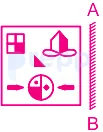
Select the correct mirror image of the given figure when the mirror is placed at AB as shown.
- A
Option A (shown in image)
- B
Option B (shown in image)
- C
Option C (shown in image)
- D
Option D (shown in image)
Show answer
B. Option B (shown in image)In the mirror image right changes to left and left changes to right vice versa.
The correct mirror image of the given figure when mirror is placed at line AB will be :
Hence, the correct answer is 'Option 2'.
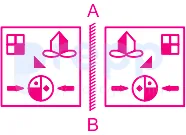 Paper & answer key PDF ↗
 Question 16archived
In a certain code language, health is wealth' is coded as '626', 'exercise regularly' is coded as '89' and 'bring good food' is coded as '544'. How will 'balanced diet is key' be coded in that language?
- A
8423
- B
7312
- C
3721
- D
4832
Show answer
A. 8423Understanding the Code Language Pattern
The question asks us to decipher a specific code language and then apply that pattern to a new phrase. We are given examples of phrases and their corresponding codes. Let's carefully examine these examples to find the logic behind the coding.
Analyzing the Given Examples
We have the following coded phrases:
'health is wealth' is coded as '626'
'exercise regularly' is coded as '89'
'bring good food' is coded as '544'
Let's look at the words in each phrase and the numbers in their code. A common pattern in such coding questions involves counting letters, positions, or performing simple arithmetic operations on them.
Example 1: 'health is wealth' -> '626'
Let's count the number of letters in each word:
'health' has 6 letters.
'is' has 2 letters.
'wealth' has 6 letters.
If we arrange these counts in the order of the words, we get 6, 2, 6. Concatenating these numbers gives '626'. This matches the given code.
Example 2: 'exercise regularly' -> '89'
Let's count the number of letters in each word:
'exercise' has 8 letters.
'regularly' has 9 letters.
Arranging these counts gives 8, 9. Concatenating these numbers gives '89'. This matches the given code.
Example 3: 'bring good food' -> '544'
Let's count the number of letters in each word:
'bring' has 5 letters.
'good' has 4 letters.
'food' has 4 letters.
Arranging these counts gives 5, 4, 4. Concatenating these numbers gives '544'. This matches the given code.
Identifying the Coding Pattern Logic
Based on the analysis of the examples, the pattern is clear: the code for a phrase is formed by taking the number of letters in each word of the phrase, in the order they appear, and joining these numbers together (concatenating them) to form a single numerical string.
Applying the Pattern to 'balanced diet is key'
Now, let's apply this same logical reasoning and coding pattern to the phrase 'balanced diet is key'. We need to count the letters in each word:
'balanced'
'diet'
'is'
'key'
Counting the letters in each word:
'balanced' has 8 letters.
'diet' has 4 letters.
'is' has 2 letters.
'key' has 3 letters.
Now, we arrange these letter counts in order: 8, 4, 2, 3. Concatenating these numbers gives the code for the phrase 'balanced diet is key'.
Code = 8423
Comparing with Options
Let's compare the derived code '8423' with the given options:
8423
7312
3721
4832
Our derived code '8423' matches option 1.
Step-by-Step Solution Summary
Here is a quick summary of the steps taken to solve this code language question:
Examine the provided examples ('health is wealth' -> '626', 'exercise regularly' -> '89', 'bring good food' -> '544').
Analyze each example to find a relationship between the words and the code.
Identify the pattern: the code is formed by concatenating the number of letters in each word.
Apply the identified pattern to the phrase 'balanced diet is key'.
Count the letters in each word of 'balanced diet is key' (balanced=8, diet=4, is=2, key=3).
Concatenate the letter counts in order (8423).
Match the resulting code with the given options.
Coding Pattern Analysis
Phrase
Words
Letter Count per Word
Code
health is wealth
health, is, wealth
6, 2, 6
626
exercise regularly
exercise, regularly
8, 9
89
bring good food
bring, good, food
5, 4, 4
544
balanced diet is key
balanced, diet, is, key
8, 4, 2, 3
8423
Revision Table: Code Language Patterns
Summary of Word and Code Mapping
Phrase
Word 1 (Letters)
Word 2 (Letters)
Word 3 (Letters)
Word 4 (Letters)
Resulting Code
health is wealth
health (6)
is (2)
wealth (6)
N/A
626
exercise regularly
exercise (8)
regularly (9)
N/A
N/A
89
bring good food
bring (5)
good (4)
food (4)
N/A
544
balanced diet is key
balanced (8)
diet (4)
is (2)
key (3)
8423
Additional Information on Code Language and Logical Reasoning
Code language questions are a common type of logical reasoning problem. They test your ability to observe patterns, deduce rules, and apply them consistently. While this particular problem used letter counting, other patterns in coding language might involve:
Position of Letters: Using the alphabetical position of the first or last letter of a word (e.g., A=1, B=2, etc.).
Vowel/Consonant Count: Using the number of vowels or consonants in a word.
Arithmetic Operations: Summing or subtracting letter values (e.g., sum of positions, product of values).
Substituting Letters: Replacing letters with other letters based on a specific shift or pattern (like in Caesar cipher).
Symbol Coding: Assigning specific symbols to letters or words.
Combination of Rules: Using multiple rules for different parts of a word or phrase.
To solve such coding questions, always start by carefully analyzing the given examples. Look for simple, consistent patterns first, such as letter counts or positions, before considering more complex rules. Practice with various types of coding problems helps in quickly identifying the underlying logic. Logical reasoning skills are crucial for success in many competitive exams.
Paper & answer key PDF ↗ Question 17archived
In the following question below are given some statements followed by some conclusions based on those statements. Taking the given statements to be true even if they seem to be at variance from commonly known facts. Read all the conclusions and then decide which of the given conclusion logically follows the given statements.
Statements:
I. Some G are U.
II. Some S are U.
Conclusion:
I. No S is G.
II. No U is G.
- A
Only conclusion I follows
- B
Only conclusion II follows
- C
Neither conclusion follows
- D
Both conclusions I and II follows
Show answer
C. Neither conclusion followsUnderstanding Statements and Conclusions in Logical Reasoning
This question asks us to analyze given statements and determine which of the provided conclusions logically follow. In these types of problems, we must assume the statements are absolutely true, regardless of whether they align with real-world facts.
Analyzing the Given Statements
We are given two statements:
Statement I: Some G are U.
Statement II: Some S are U.
Let's break down what these statements mean:
"Some G are U" means there is an intersection between the set of Gs and the set of Us. There is at least one element that belongs to both G and U. This can be represented using set notation as \(G \cap U \neq \emptyset\).
"Some S are U" means there is an intersection between the set of Ss and the set of Us. There is at least one element that belongs to both S and U. This can be represented using set notation as \(S \cap U \neq \emptyset\).
These statements establish a relationship between G and U, and between S and U. However, they provide no direct information about the relationship between G and S.
Analyzing the Given Conclusions
We need to evaluate each conclusion based solely on the information provided in the statements.
Conclusion I: No S is G.
This conclusion claims there is absolutely no overlap between the set of Ss and the set of Gs. In set notation, this would mean \(S \cap G = \emptyset\).
Let's consider if this conclusion must be true based on the statements. We know Some G are U (\(G \cap U \neq \emptyset\)) and Some S are U (\(S \cap U \neq \emptyset\)). It is possible to draw scenarios (like Venn diagrams) where:
Some G are U, Some S are U, AND No S is G.
Some G are U, Some S are U, AND Some S ARE G (for example, if the 'some U' that are G are the same as the 'some U' that are S, and these elements are also in S and G).
Since the statements allow for the possibility that "Some S are G" (e.g., if the intersection of G and U overlaps with the intersection of S and U, which in turn overlaps G and S), the conclusion "No S is G" is not necessarily true. Therefore, Conclusion I does not logically follow from the statements.
Conclusion II: No U is G.
This conclusion claims there is absolutely no overlap between the set of Us and the set of Gs. In set notation, this would mean \(U \cap G = \emptyset\).
Now, let's look at Statement I: "Some G are U". This statement explicitly tells us that there is an overlap between G and U (\(G \cap U \neq \emptyset\)). This directly contradicts the conclusion "No U is G" (\(U \cap G = \emptyset\)). If Statement I is true, then Conclusion II must be false.
Therefore, Conclusion II does not logically follow from the statements; in fact, it is contradicted by Statement I.
Determining Which Conclusion(s) Follow
Based on our analysis:
Conclusion I ("No S is G") does not necessarily follow because the statements allow for the possibility that Some S are G.
Conclusion II ("No U is G") does not follow because it is directly contradicted by Statement I ("Some G are U").
Since neither conclusion logically follows from the given statements, the correct answer is that neither conclusion follows.
Revision Table: Statements and Conclusions Analysis
Statement/Conclusion
Set Notation
Analysis Based on Statements I & II
Logically Follows?
Statement I: Some G are U
\(G \cap U \neq \emptyset\)
Given as true
N/A
Statement II: Some S are U
\(S \cap U \neq \emptyset\)
Given as true
N/A
Conclusion I: No S is G
\(S \cap G = \emptyset\)
Not necessarily true. Could be Some S are G.
No
Conclusion II: No U is G
\(U \cap G = \emptyset\)
Directly contradicts Statement I (\(G \cap U \neq \emptyset\))
No
Additional Information on Syllogisms
This question is an example of a basic syllogism problem often found in logical reasoning tests. Syllogisms involve drawing conclusions from two or more premises (statements).
Types of Statements: Common types include "All A are B", "No A is B", "Some A are B", and "Some A are not B".
"Some" statements: In logic, "Some A are B" means at least one A is B. It does not exclude the possibility that "All A are B".
Negative Conclusions: Conclusions using "No" or "Some...not" often require careful analysis. If the statements are all positive ("Some A are B", "Some C are B"), it is generally not possible to draw a definite negative conclusion ("No A is C" or "Some A are not C") unless other specific rules or diagrams force it.
Mediate Inference: Conclusions drawn from two premises rely on a middle term (in this case, 'U') that connects the other two terms (G and S). However, simply having a middle term doesn't guarantee a valid conclusion about the other two terms, especially with "Some" statements.
Mastering these types of questions involves understanding the exact meaning of logical quantifiers ("All", "No", "Some") and practicing with different statement combinations, often visualized using Venn diagrams.
Paper & answer key PDF ↗ Question 18archived
Select the odd group of numbers. (NOTE: Operations should be performed on the whole numbers, without breaking down the numbers into its constituent digits. E.g.13 - Operations on 13 such as adding /subtracting / multiplying etc. to 13 can be performed. Breaking down 13 into 1 and 3 and then performing mathematical operations on 1 and 3 is not allowed)
- A
18 - 329
- B
16 - 263
- C
14 - 201
- D
12 - 149
Show answer
B. 16 - 263Finding the Odd Group of Numbers
The question asks us to identify the group of numbers that does not follow the same pattern or rule as the others. We are instructed to treat each number as a whole and not break it down into its individual digits.
Let's examine each option and look for a relationship between the first number and the second number in each pair. Let the first number be $x$ and the second number be $y$.
Analyzing Option 1: 18 - 329
Here, $x = 18$ and $y = 329$. Let's consider squaring the first number:
$\qquad 18^2 = 18 \times 18 = 324$
The second number, 329, is close to 324. The difference is:
$\qquad 329 - 324 = 5$
So, for this group, the relationship appears to be $y = x^2 + 5$.
Analyzing Option 2: 16 - 263
Here, $x = 16$ and $y = 263$. Let's square the first number:
$\qquad 16^2 = 16 \times 16 = 256$
The second number, 263, is close to 256. The difference is:
$\qquad 263 - 256 = 7$
So, for this group, the relationship appears to be $y = x^2 + 7$.
Analyzing Option 3: 14 - 201
Here, $x = 14$ and $y = 201$. Let's square the first number:
$\qquad 14^2 = 14 \times 14 = 196$
The second number, 201, is close to 196. The difference is:
$\qquad 201 - 196 = 5$
So, for this group, the relationship appears to be $y = x^2 + 5$.
Analyzing Option 4: 12 - 149
Here, $x = 12$ and $y = 149$. Let's square the first number:
$\qquad 12^2 = 12 \times 12 = 144$
The second number, 149, is close to 144. The difference is:
$\qquad 149 - 144 = 5$
So, for this group, the relationship appears to be $y = x^2 + 5$.
Comparing the Patterns
Let's summarize the relationships found for each group of numbers:
Option 1 (18 - 329): $329 = 18^2 + 5$
Option 2 (16 - 263): $263 = 16^2 + 7$
Option 3 (14 - 201): $201 = 14^2 + 5$
Option 4 (12 - 149): $149 = 12^2 + 5$
We can clearly see that Options 1, 3, and 4 follow the pattern where the second number is the square of the first number plus 5 ($y = x^2 + 5$).
However, Option 2 follows a different pattern where the second number is the square of the first number plus 7 ($y = x^2 + 7$).
Therefore, the group of numbers 16 - 263 is the odd one out as it does not follow the pattern exhibited by the other three groups.
This type of problem tests your ability to identify numerical patterns based on mathematical operations performed on the whole numbers.
The final answer is the group that deviates from the established pattern.
Group
First Number ($x$)
Second Number ($y$)
$x^2$
Difference ($y - x^2$)
Pattern
18 - 329
18
329
324
5
$y = x^2 + 5$
16 - 263
16
263
256
7
$y = x^2 + 7$
14 - 201
14
201
196
5
$y = x^2 + 5$
12 - 149
12
149
144
5
$y = x^2 + 5$
The table clearly shows that the group 16 - 263 is the only one where the difference is 7, while in all other groups, the difference is 5.
Revision Table: Odd Group of Numbers Reasoning
Review the key steps involved in solving this type of reasoning question:
Understand the rule: Operations apply to whole numbers, not individual digits.
Examine each option: Look at the relationship between the given numbers.
Hypothesize patterns: Try common operations like addition, subtraction, multiplication, division, squares, cubes.
Test the pattern: Check if the hypothesized pattern holds for other options.
Identify the outlier: The group that does not fit the common pattern is the odd one out.
Additional Information: Number Reasoning Patterns
Number reasoning questions often involve identifying patterns based on:
Arithmetic progressions (constant difference)
Geometric progressions (constant ratio)
Squares or cubes of numbers
Prime numbers
Combinations of operations (like $x^2 + k$, $x^3 - k$, etc.)
Differences between consecutive terms forming a pattern
Sum or product of digits (though explicitly disallowed in this specific question)
Practicing various types of number series and group patterns helps in quickly recognizing the underlying rule in such problems.
Paper & answer key PDF ↗ Question 19archived
Read the given statements and conclusions carefully. Assuming that the information given in the statements is true, even if it appears to be at variance with commonly known facts, decide which of the given conclusions logically follow(s) from the statements.
Statements:
All the medicines are capsules.
Some capsules are bangles.
Some bangles are toothpastes.
Conclusions:
I. Some bangles are medicines.
II. Some toothpastes are capsules.
Ill. Some medicines are bangles.
IV. Some medicines are toothpastes.
- A
Only conclusions III and IV follow
- B
None of the conclusions follow
- C
Only conclusions II and III follow
- D
Only conclusions I and II follow
Show answer
B. None of the conclusions followSyllogism Statements and Conclusions Analysis
Let's carefully examine the given statements and conclusions using the principles of logical reasoning, specifically syllogisms.
Understanding the Statements
We are given the following three statements:
All the medicines are capsules. (All M are C)
Some capsules are bangles. (Some C are B)
Some bangles are toothpastes. (Some B are T)
We must assume these statements are true, even if they contradict common knowledge.
Analyzing the Conclusions
We need to determine which of the following conclusions logically and necessarily follow from the statements:
Conclusion I: Some bangles are medicines. (Some B are M)
Conclusion II: Some toothpastes are capsules. (Some T are C)
Conclusion III: Some medicines are bangles. (Some M are B)
Conclusion IV: Some medicines are toothpastes. (Some M are T)
Using Logical Reasoning and Venn Diagrams to Test Conclusions
We can use rules of inference or visualize the relationships with Venn diagrams to see if the conclusions are necessarily true based *only* on the statements.
Analyzing Statement Combinations
Statements 1 & 2: "All M are C" and "Some C are B". The middle term is 'Capsules' (C). There is no valid universal conclusion when one statement is 'All' and the other is 'Some'. A 'Some' conclusion might be possible, but it must necessarily follow.
Statements 2 & 3: "Some C are B" and "Some B are T". The middle term is 'Bangles' (B). Two 'Some' statements ("Some + Some") do not yield any valid definite conclusion according to the rules of syllogism.
Statements 1 & 3: These statements share no common term, so no direct conclusion can be drawn between Medicines and Toothpastes without involving the intermediate statements.
Evaluating Each Conclusion
Let's evaluate each conclusion:
Conclusion I: Some bangles are medicines. (Some B are M)
This would follow if we could establish a definite link between Bangles and Medicines. From "All Medicines are Capsules", we know "Some Capsules are Medicines". We also know "Some Capsules are Bangles". However, the capsules that are Medicines could be entirely different from the capsules that are Bangles. Therefore, we cannot definitively say that some bangles are medicines. This conclusion does not necessarily follow.
Conclusion II: Some toothpastes are capsules. (Some T are C)
We have "Some Capsules are Bangles" and "Some Bangles are Toothpastes". From these two 'Some' statements involving a common term (Bangles), no definite conclusion can be drawn between Capsules and Toothpastes. The bangles that are capsules might be different from the bangles that are toothpastes. There is no guaranteed overlap between the set of Toothpastes and the set of Capsules. This conclusion does not necessarily follow.
Conclusion III: Some medicines are bangles. (Some M are B)
This is equivalent to Conclusion I, just stated in reverse (Some A are B implies Some B are A, but we are checking if M and B have a necessary relationship). From "All Medicines are Capsules" and "Some Capsules are Bangles", we cannot conclude that some medicines must be bangles for the same reasons as Conclusion I. The Bangles could be some subset of Capsules that does not include any Medicines. This conclusion does not necessarily follow.
Conclusion IV: Some medicines are toothpastes. (Some M are T)
Connecting Medicines to Toothpastes requires linking M to C, C to B, and B to T. We have "All M are C", "Some C are B", and "Some B are T". Following the chain, there is no definite rule that connects a universal statement ("All M are C") with two subsequent 'Some' statements ("Some C are B", "Some B are T") to produce a definite conclusion between the first and last terms (M and T). It is possible to draw Venn diagrams based on the statements where the Medicine circle and the Toothpaste circle do not overlap at all. This conclusion does not necessarily follow.
Summary of Conclusions
Based on the logical analysis of the statements, none of the given conclusions logically and necessarily follow from the provided statements.
Revision Table: Syllogism Statement Types
Understanding the different types of statements is crucial in syllogisms.
TypeQuantifierCopulaRelationship
AAllareUniversal Affirmative
ENoisUniversal Negative
ISomeareParticular Affirmative
OSomeare notParticular Negative
In this problem, we have an A type, an I type, and another I type statement. Combining these types requires specific rules for valid inferences, which were not met by the conclusions tested.
Additional Information: Validity in Logical Reasoning
In logical reasoning problems like these, validity is key:
Validity: An argument (statements leading to a conclusion) is valid if the conclusion must be true whenever the statements are true.
Truth vs. Validity: The truth of the statements is assumed. We only assess whether the conclusion is logically derived from them, regardless of whether the conclusion seems true in the real world.
Rules of Inference: Syllogisms follow specific rules about how premises of certain types combine to yield a valid conclusion. Breaking these rules (like trying to get a definite conclusion from two 'Some' premises) results in an invalid argument.
Counter-Examples: If you can draw even one Venn diagram that satisfies all the statements but makes the conclusion false, then the conclusion does not necessarily follow and is therefore invalid.
Focus on the logical structure and rules rather than real-world facts when solving syllogism questions.
Paper & answer key PDF ↗ Question 20archived
Three of the following four letter-clusters are alike in a certain way and one is different. Pick the odd one out.
- A
UVD
- B
PQI
- C
JKZ
- D
EFT
Show answer
C. JKZAnalyzing Letter Clusters for Patterns
The question asks us to identify the letter cluster that is different from the other three based on a certain pattern or rule. We are given four letter clusters: UVD, PQI, JKZ, and EFT. To solve this type of logical reasoning problem involving letter clusters, we often look at the positions of the letters in the English alphabet.
Assigning Positional Values to Letters
Let's assign numerical values to each letter based on its position in the standard English alphabet, where A=1, B=2, ..., Z=26.
Letter
Positional Value
A
1
B
2
...
...
J
10
K
11
...
...
P
16
Q
17
...
...
U
21
V
22
...
...
Z
26
Analyzing Each Letter Cluster
Now let's break down each given letter cluster and look for relationships between the letters using their positional values.
UVD:
U is the 21st letter.
V is the 22nd letter.
D is the 4th letter.
Notice that U and V are consecutive letters in the alphabet ($U+1 = V$).
PQI:
P is the 16th letter.
Q is the 17th letter.
I is the 9th letter.
P and Q are consecutive letters ($P+1 = Q$).
JKZ:
J is the 10th letter.
K is the 11th letter.
Z is the 26th letter.
J and K are consecutive letters ($J+1 = K$).
EFT:
E is the 5th letter.
F is the 6th letter.
T is the 20th letter.
E and F are consecutive letters ($E+1 = F$).
Identifying the Pattern
We see that in all four letter clusters, the first two letters are consecutive in the alphabet. This means the difference between the positional values of the second and first letter is always 1. Let's look for a pattern involving the third letter. Let's consider the sum of the positional values of the first and third letters in each cluster:
For UVD: Positional value of U + Positional value of D = $21 + 4 = 25$.
For PQI: Positional value of P + Positional value of I = $16 + 9 = 25$.
For JKZ: Positional value of J + Positional value of Z = $10 + 26 = 36$.
For EFT: Positional value of E + Positional value of T = $5 + 20 = 25$.
Finding the Odd One Out
From the sums calculated above, we can see a clear pattern:
UVD follows the pattern: Sum of 1st and 3rd letter positions = 25.
PQI follows the pattern: Sum of 1st and 3rd letter positions = 25.
EFT follows the pattern: Sum of 1st and 3rd letter positions = 25.
JKZ does not follow the pattern: Sum of 1st and 3rd letter positions = 36.
Therefore, the letter cluster JKZ is different from the other three because the sum of the positional values of its first and third letters is 36, while for the other three clusters (UVD, PQI, and EFT), the sum is 25.
Revision Table: Letter Cluster Analysis
Letter Cluster
1st Letter (Position)
2nd Letter (Position)
3rd Letter (Position)
Sum of 1st and 3rd Positions
Pattern Followed (Sum=25?)
UVD
U (21)
V (22)
D (4)
$21 + 4 = 25$
Yes
PQI
P (16)
Q (17)
I (9)
$16 + 9 = 25$
Yes
JKZ
J (10)
K (11)
Z (26)
$10 + 26 = 36$
No
EFT
E (5)
F (6)
T (20)
$5 + 20 = 25$
Yes
Additional Information: Solving Letter Series Questions
Letter series and letter cluster questions are common in logical reasoning sections of competitive exams. They test your ability to identify patterns based on the sequence and properties of letters. Here are some common patterns to look for:
Positional values of letters (A=1, B=2, etc.).
Difference or sum between consecutive letters' positions.
Sum or difference between alternate letters' positions.
Vowels and Consonants.
Reverse alphabetical order (Z=1, Y=2, etc.).
Specific letter patterns (e.g., letters skipped).
Combination of these patterns.
Always start by writing down the positional values of the letters to make it easier to spot numerical relationships.
Paper & answer key PDF ↗ Question 21archived
Select the figure from among the given options that can replace the question mark (?) in the following series.

- A
Option A (shown in image)
- B
Option B (shown in image)
- C
Option C (shown in image)
- D
Option D (shown in image)
Show answer
Question 22archived
If '+' means '÷', '-' means '+', '×' means '-' and '÷' means '×', what will be the value of the following expression?
[{(34 × 12) - (4 ÷ 3)} + (12 - 5)] ÷ 5
- A
10
- B
1
- C
2
- D
20
Show answer
A. 10Understanding Symbol Substitution in Expressions
This guide demonstrates how to solve a mathematical expression where the standard operators (+, -, ×, ÷) are replaced with different ones. We need to carefully apply the given substitutions and follow the order of operations (PEMDAS/BODMAS).
Operator Replacement Rules
The problem defines the following operator substitutions:
'+' means '÷'
'-' means '+'
'×' means '-'
'÷' means '×'
The Expression and Applying Substitutions
The given expression is:
[{(34 × 12) - (4 ÷ 3)} + (12 - 5)] ÷ 5
First, we substitute the operators as per the rules:
Replace '×' with '-': (34 - 12)
Replace '÷' with '×': (4 × 3)
Replace '-' with '+': (12 + 5)
Replace the final '÷' with '×': ... × 5
Replace '+' with '÷': The '+' inside the main bracket becomes '÷'
Applying all substitutions results in the new expression:
[{(34 - 12) + (4 × 3)} + (12 + 5)] × 5
Step-by-Step Evaluation
Now, we evaluate the modified expression following the order of operations (Parentheses/Brackets first):
Evaluate inside the innermost parentheses:
Calculate \( 34 - 12 \): The result is 22.
Calculate \( 4 \times 3 \): The result is 12.
Calculate \( 12 + 5 \): The result is 17.
Substitute these results back: [{22 + 12} + 17] × 5
Evaluate inside the next level of parentheses/brackets:
Calculate \( 22 + 12 \): The result is 34.
Substitute this result back: [34 + 17] × 5
Evaluate inside the remaining brackets:
Calculate \( 34 + 17 \): The result is 51.
Substitute this result back: 51 × 5
Perform the final multiplication:
Calculate \( 51 \times 5 \): The result is 255.
Following these steps, the final value of the expression is 255.
Paper & answer key PDF ↗ Question 23archived
Select the option that is related to the third word in the same way as the second word is related to the first word. (The words must be considered as meaningful English words and must not be related to each other based on the number of letters/number of consonants/vowels in the word)
Kite : Diamond :: Ball : ?
- A
Triangle
- B
Square
- C
Round
- D
Pentagon
Show answer
C. RoundUnderstanding Analogy Questions
Analogy questions test your ability to understand the relationship between a pair of words and apply that same relationship to a new pair. In this question, we are given the pair 'Kite : Diamond' and asked to find the word that completes the analogy 'Ball : ?'. We must consider the words as meaningful English words.
Analyzing the First Pair: Kite and Diamond
The first pair is 'Kite : Diamond'. Let's think about the common relationship between a kite and a diamond.
A kite is an object often flown in the air.
The shape of a typical flying kite is often a diamond shape (a rhombus or sometimes a quadrilateral with two pairs of equal-length sides meeting at unequal angles).
A diamond is also a geometric shape, specifically a rhombus or even used colloquially to refer to a square turned on its corner.
The most likely relationship here is that the first word ('Kite') refers to an object, and the second word ('Diamond') refers to its typical or characteristic shape.
Applying the Relationship to the Second Pair: Ball
Now we need to apply this relationship to the second word, 'Ball'. We are looking for a word that describes the typical shape of a ball.
A ball is a spherical or round object used in games or sports.
We need to find a word among the options that describes the shape of a ball.
Evaluating the Options
Let's look at the given options:
Triangle: A triangle is a polygon with three sides. A ball is not triangular.
Square: A square is a polygon with four equal sides and four right angles. A ball is not square.
Round: 'Round' is an adjective describing something that is circular or spherical in shape. A ball is typically round.
Pentagon: A pentagon is a polygon with five sides. A ball is not a pentagonal.
Based on the analysis of the first pair (Object : Typical Shape), the word that describes the typical shape of a Ball is 'Round'.
Step-by-Step Solution
Here's how we can break down the solution:
Identify the relationship between 'Kite' and 'Diamond'. The typical shape of a kite is a diamond (rhombus). Relationship: Object to Typical Shape.
Apply this relationship to 'Ball'. We need the typical shape of a ball.
Examine the options to find the word that describes the typical shape of a ball.
'Round' describes the shape of a ball.
Thus, the word related to 'Ball' in the same way that 'Diamond' is related to 'Kite' is 'Round'.
Conclusion
The analogy holds true: Kite is to Diamond (typical shape) as Ball is to Round (typical shape).
Pair
Relationship
Kite : Diamond
Object : Typical Shape (A kite is typically diamond-shaped)
Ball : Round
Object : Typical Shape (A ball is typically round/spherical)
Revision Table: Key Concepts in Analogies
Concept
Description
Example (from this question)
Analogy
A comparison between two things, typically for the purpose of explanation or clarification.
Kite : Diamond :: Ball : Round
Relationship
The way in which two or more things are connected. Identifying this is key to solving analogies.
Object to its typical shape.
Shape Recognition
Understanding common geometric or physical shapes.
Knowing the shape of a kite, diamond, and ball.
Additional Information: Types of Analogies
Analogies can be based on various relationships. Some common types include:
Part to Whole (e.g., Finger : Hand)
Cause and Effect (e.g., Sun : Heat)
Synonyms (e.g., Happy : Joyful)
Antonyms (e.g., Hot : Cold)
Worker and Tool (e.g., Carpenter : Hammer)
Object and Function (e.g., Knife : Cut)
Object and Characteristic/Shape (e.g., Kite : Diamond)
Measurement (e.g., Length : Meter)
Solving analogies requires careful observation and logical deduction to identify the specific relationship presented in the first pair and applying it consistently to the second.
Paper & answer key PDF ↗ Question 24archived
Select the word-pair that best represents a similar relationship to the one expressed in the given pair of words.
(The words must be considered as meaningful English words and must not be related to each other based on the number of letters/number of consonants/vowels in the word)
Money plant : Climber
- A
Rose : Shrub
- B
Peas : Green
- C
Basil : Tree
- D
Banyan : Roots
Show answer
A. Rose : ShrubUnderstanding Word Analogies: Money Plant and Climber
Word analogies require you to find the relationship between a given pair of words and then select another pair from the options that shares the most similar relationship. The given pair is "Money plant : Climber".
Analyzing the Given Word Pair: Money Plant : Climber
Let's break down the relationship between 'Money plant' and 'Climber'.
A Money plant is a specific type of plant.
A Climber describes the growth habit or type of plant.
So, the relationship is: Specific type of plant : Classification/Growth Habit. A Money plant is classified as a climber because it grows by climbing or twining around a support.
Evaluating the Options
Now, let's examine each option to see which one exhibits a similar relationship.
Option 1: Rose : Shrub
A Rose is a specific type of plant.
A Shrub is a classification describing a woody plant, typically smaller than a tree, with multiple stems arising near the ground.
This pair represents the relationship: Specific type of plant : Classification/Growth Habit. A Rose is classified as a shrub.
This relationship appears to be very similar to the original pair (Money plant : Climber).
Option 2: Peas : Green
Peas are a specific type of plant (or seed from a plant).
Green is a color.
This pair represents the relationship: Specific type of plant : Characteristic (Color). The relationship is about a characteristic of the plant, not its classification or growth habit.
This relationship is different from the original pair.
Option 3: Basil : Tree
Basil is a specific type of plant (a herb).
A Tree is a classification describing a large woody plant, usually with a single trunk.
This pair represents the relationship: Specific type of plant : Classification. However, Basil is typically a small herb, not a tree. While 'Tree' is a classification, it is an incorrect classification for Basil. The analogy requires a correct and meaningful relationship.
This relationship is not similar because the classification provided is incorrect for the plant.
Option 4: Banyan : Roots
A Banyan is a specific type of plant (a tree).
Roots are parts of the plant that typically grow underground.
This pair represents the relationship: Specific type of plant : Part of the plant. The relationship is about a component of the plant, not its classification or growth habit.
This relationship is different from the original pair.
Conclusion
Comparing the relationships:
Money plant : Climber (Specific Plant : Classification/Growth Habit)
Rose : Shrub (Specific Plant : Classification/Growth Habit)
Peas : Green (Specific Plant : Characteristic)
Basil : Tree (Specific Plant : Incorrect Classification)
Banyan : Roots (Specific Plant : Part)
The pair "Rose : Shrub" demonstrates the most similar relationship to "Money plant : Climber", both representing a specific plant and its general classification or growth form.
Pair
Relationship Type
Money plant : Climber
Specific Plant : Classification/Growth Habit
Rose : Shrub
Specific Plant : Classification/Growth Habit
Peas : Green
Specific Plant : Characteristic
Basil : Tree
Specific Plant : Incorrect Classification
Banyan : Roots
Specific Plant : Part
Revision Table: Plant Classifications and Growth Habits
Here's a quick overview of some common plant classifications based on their structure and growth habit:
Classification
Description
Examples
Tree
Large, woody plant usually with a single trunk and crown.
Oak, Maple, Banyan
Shrub
Woody plant, smaller than a tree, typically with multiple stems from the base.
Rose, Lilac, Forsythia
Herb
Non-woody plant, often with soft stems.
Basil, Mint, Parsley
Climber (or Vine)
Plant that grows upwards by clinging or twining.
Money plant, Ivy, Grapevine
Creeper
Plant that grows along the ground.
Strawberry, Pumpkin vine
Additional Information: Solving Word Analogies
Successfully solving word analogies involves identifying the precise relationship between the first pair of words. Here are some common types of relationships found in analogies:
Part to Whole: e.g., Finger : Hand (Finger is part of a Hand)
Cause and Effect: e.g., Study : Pass (Studying can cause you to Pass)
Synonyms: e.g., Happy : Joyful (Words with similar meanings)
Antonyms: e.g., Hot : Cold (Words with opposite meanings)
Worker and Tool: e.g., Carpenter : Saw (Carpenter uses a Saw)
Action and Object: e.g., Read : Book (You read a Book)
Classification/Type: e.g., Dog : Mammal (Dog is a type of Mammal)
Specific to General: e.g., Apple : Fruit (Apple is a specific type of Fruit)
Location: e.g., Bird : Nest (Bird lives in a Nest)
Degree: e.g., Warm : Hot (Hot is a greater degree of Warm)
Once you identify the relationship, test it against each option to find the pair that shares the exact same or the most similar relationship.
Paper & answer key PDF ↗ Question 25archived
Select the option that is related to the third number in the same way as the second number is related to the first number and the sixth number is related to the fifth number.
15 : 125 :: 27 : ? :: 36 : 1728
- A
689
- B
749
- C
790
- D
729
Show answer
D. 729Understanding Number Analogies and Patterns
Number analogies test your ability to find relationships between pairs of numbers. You need to identify the pattern or rule applied to the first number to get the second number in a pair, and then apply that same rule to a different number to find a missing value.
The given analogy is: 15 : 125 :: 27 : ? :: 36 : 1728
This means that the relationship between 15 and 125 is the same as the relationship between 27 and the missing number, and also the same as the relationship between 36 and 1728. We need to discover this common relationship or number pattern.
Analyzing the Given Number Pairs to Find the Relationship
Let's examine the pairs where both numbers are provided:
Pair 1: 15 : 125
Pair 2: 36 : 1728
Analyzing the First Pair: 15 and 125
We look for a connection between 15 and 125. We might notice that 125 is a power of a number. Specifically, $125 = 5 \times 5 \times 5 = 5^3$.
Now, how is 15 related to 5? If we divide 15 by 3, we get 5. So, it seems the relationship might be: divide the first number by 3, and then cube the result.
Let's test this potential pattern:
Pattern: $(\text{First Number} / 3)^3 = \text{Second Number}$
For the first pair (15 : 125):
$(15 / 3)^3 = 5^3 = 125$.
This pattern holds true for the first pair.
Analyzing the Second Pair: 36 and 1728
Let's verify if this same pattern applies to the second complete pair (36 : 1728).
According to our potential pattern, we should divide the first number (36) by 3 and then cube the result.
$(36 / 3)^3 = 12^3$.
Now, we calculate $12^3$:
$12^3 = 12 \times 12 \times 12 = 144 \times 12 = 1728$.
The result, 1728, matches the second number in the pair (36 : 1728). This confirms that our discovered number pattern is consistent across the given pairs.
Applying the Number Pattern to Find the Missing Number
The established number pattern is to take the first number, divide it by 3, and then cube the result to get the second number.
The analogy is 27 : ?. We need to find the number related to 27 using the same pattern.
Applying the pattern to 27:
$(\text{Third Number} / 3)^3 = \text{Missing Number}$
$(27 / 3)^3 = \text{Missing Number}$
Calculation Steps for the Missing Number
Let's perform the calculation step-by-step:
Divide the third number (27) by 3: $27 / 3 = 9$.
Cube the result (9): $9^3 = 9 \times 9 \times 9$.
Calculating $9^3$:
$9 \times 9 = 81$
$81 \times 9 = 729$
So, $(27 / 3)^3 = 729$.
The missing number in the analogy 27 : ? is 729.
The complete analogy follows the pattern $(\text{Number} / 3)^3$:
First Number
Calculation
Second Number
15
$(15 / 3)^3 = 5^3$
125
27
$(27 / 3)^3 = 9^3$
729
36
$(36 / 3)^3 = 12^3$
1728
The missing number that completes the analogy is 729.
Revision Table: Key Learnings from Number Analogies
Concept
Description
Application in Problem
Number Analogy
Finding the relationship between numbers in a pair to apply elsewhere.
Identified pattern 15:125, 36:1728.
Pattern Recognition
Identifying the mathematical operation(s) connecting the numbers.
Discovered the $(x/3)^3$ rule.
Mathematical Operations
Using arithmetic operations (division) and powers (cubing).
Applied division by 3 and cubing.
Additional Information: Exploring Number Patterns
Number patterns in analogies can involve various mathematical operations, including:
Basic arithmetic: addition, subtraction, multiplication, division.
Powers and roots: squares, cubes, square roots, cube roots, etc.
Prime numbers, composite numbers, odd/even numbers.
Sequences like Fibonacci or arithmetic/geometric progressions.
Combinations of operations (e.g., multiply by 2 and add 5).
Solving number analogies often requires careful observation, testing hypotheses about the relationship, and performing calculations accurately. Sometimes, the pattern might relate digits within the numbers themselves rather than the numbers as a whole.
Paper & answer key PDF ↗ Question 26archived
Who has been signed on as a brand ambassador of lubricant manufacturer Gulf Oil India in October 2022?
- A
Sonu Sood
- B
Rishabh Pant
- C
Sania Nehwal
- D
Smriti Mandhana
Show answer
D. Smriti MandhanaUnderstanding Brand Ambassadors in Business
The question asks about the individual signed as a brand ambassador by lubricant manufacturer Gulf Oil India in October 2022. Brand ambassadors are individuals who represent and promote a company or product. They often have a strong public image or connection with the target audience, helping to build brand recognition and trust.
Gulf Oil India's Choice of Brand Ambassador
In October 2022, Gulf Oil India, a prominent lubricant manufacturer, signed on a new brand ambassador. The selection of a brand ambassador is a strategic decision aimed at connecting with consumers, enhancing brand visibility, and reinforcing brand values.
Let's examine the options provided in the question:
Sonu Sood
Rishabh Pant
Sania Nehwal
Smriti Mandhana
Among these options, the correct answer regarding who became the brand ambassador for Gulf Oil India in October 2022 is Smriti Mandhana.
Smriti Mandhana is a well-known figure in Indian sports, specifically cricket. Her association with Gulf Oil India as a brand ambassador helps the company reach a wide audience and potentially associate its brand with qualities like performance, endurance, and reliability, which are often linked to sports and athletes.
Why Smriti Mandhana for Gulf Oil India?
Companies like Gulf Oil India often choose brand ambassadors who resonate with their customer base or embody characteristics that align with their brand messaging. Athletes are frequently chosen due to their popularity, discipline, and perceived performance capabilities. Smriti Mandhana's status as a leading cricketer likely contributed to this decision by Gulf Oil India.
Aspect
Details
Company
Gulf Oil India (Lubricant Manufacturer)
Event
Signing of Brand Ambassador
Date
October 2022
Brand Ambassador
Smriti Mandhana
Revision Table: Gulf Oil India Brand Ambassador
Company
Brand Ambassador (October 2022)
Industry
Gulf Oil India
Smriti Mandhana
Lubricants
Additional Information on Brand Endorsements
Brand endorsements are a common marketing strategy where a celebrity or public figure uses their fame to help promote a product or service. This collaboration benefits both parties: the brand gains credibility and exposure, while the ambassador receives payment and further public visibility.
Impact on Sales: A popular brand ambassador can significantly influence consumer purchasing decisions.
Brand Image: The ambassador's public image can rub off on the brand, shaping consumer perception.
Target Audience: Brands often select ambassadors who are popular with their specific target demographic.
The association of Smriti Mandhana with Gulf Oil India serves as an example of how companies in various sectors, including manufacturing and automotive-related industries like lubricants, leverage sports personalities for marketing purposes.
Paper & answer key PDF ↗ Question 27archived
The motion of the body moving along a circular path is an example of ______.
- A
decelerated motion
- B
accelerated motion
- C
non-uniform motion
- D
uniform motion
Show answer
B. accelerated motionThe correct answer is accelerated motion.
If the speed is changing (non-uniform circular motion), there is also a tangential acceleration $a_t$, which is parallel or anti-parallel to the velocity vector and changes the speed. The total acceleration is the vector sum of the centripetal and tangential accelerations. The fact that there is always a centripetal acceleration (due to the change in direction) means that any motion along a circular path is accelerated motion.
Paper & answer key PDF ↗ Question 28archived
Which of the following bills can be initiated only in the Lok Sabha?
- A
Private members bill
- B
Constitution amendment bill
- C
Government bill
- D
Money bill
Show answer
D. Money billThe correct answer is Money bill.
All other mentioned bills can be initiated in either the Lok Sabha or the Rajya Sabha. The unique position of the Lok Sabha in initiating Money Bills highlights its primary role in controlling government finance and expenditure, reflecting the principle of parliamentary control over the executive, particularly regarding taxation and spending. This is a crucial aspect of the financial powers of the Lok Sabha in the Indian parliamentary system.
Paper & answer key PDF ↗ Question 29archived
Where does the headquarters of the Indian Council of Agricultural Research Institute located?
- A
Amritsar
- B
Surat
- C
Lucknow
- D
New Delhi
Show answer
D. New DelhiThe correct answer is New Delhi.
These centres work on various aspects of agriculture, including crop sciences, horticulture, animal sciences, fisheries, agricultural engineering, and natural resource management. Examples of some ICAR institutes located in other parts of India include: Indian Agricultural Research Institute (IARI), Pusa, New Delhi (often referred to as the ICAR-IARI) National Dairy Research Institute (NDRI), Karnal Central Rice Research Institute (CRRI), Cuttack Indian Veterinary Research Institute (IVRI), Izatnagar However, the main headquarters, housing the central administration and the Director General's office, remains in New Delhi.
Paper & answer key PDF ↗ Question 30archived
From which year did Sangeet Natak Akademi, New Delhi, institute the Ustad Bismillah Khan Yuva Puraskar?
- A
2001
- B
2005
- C
2004
- D
2006
Show answer
D. 2006Sangeet Natak Akademi Ustad Bismillah Khan Yuva Puraskar Institution Year
The question asks about the year from which the Sangeet Natak Akademi, located in New Delhi, began instituting the Ustad Bismillah Khan Yuva Puraskar. This award is a significant recognition in the field of Indian arts.
The Sangeet Natak Akademi, India's national academy of music, dance, and drama, confers various awards to recognize talent and contribution in the performing arts. One such award is the Ustad Bismillah Khan Yuva Puraskar.
The Ustad Bismillah Khan Yuva Puraskar is specifically aimed at identifying and encouraging young talents in diverse fields of performing arts across India. It is named after the legendary Shehnai maestro, Ustad Bismillah Khan.
According to the information available from the Sangeet Natak Akademi, this particular award, the Ustad Bismillah Khan Yuva Puraskar, was instituted relatively recently compared to the main Akademi Awards.
Let's look at the options provided:
2001
2005
2004
2006
Research into the history and awards of the Sangeet Natak Akademi confirms the year of institution for the Ustad Bismillah Khan Yuva Puraskar.
The Ustad Bismillah Khan Yuva Puraskar was instituted by the Sangeet Natak Akademi in the year 2006. This award is given to artists below the age of 40.
Therefore, the year from which the Sangeet Natak Akademi instituted the Ustad Bismillah Khan Yuva Puraskar is 2006.
Key Facts about Ustad Bismillah Khan Yuva Puraskar
Instituted by: Sangeet Natak Akademi, New Delhi
Named after: Ustad Bismillah Khan
Purpose: To identify and encourage young talents in performing arts
Age Criteria: Given to artists below the age of 40
Institution Year: 2006
Revision Table: Sangeet Natak Akademi Awards
Award Name
Instituted Year
Purpose
Sangeet Natak Akademi Award (Main)
1952 (First given in 1953)
Highest Indian recognition for practicing artists, gurus, and scholars
Ustad Bismillah Khan Yuva Puraskar
2006
Recognizing promising young talents (< 40 years)
Sangeet Natak Akademi Tagore Award
2011 (for Tagore's 150th birth anniversary)
One-time award series to commemorate Rabindranath Tagore
Additional Information: Sangeet Natak Akademi and Ustad Bismillah Khan
The Sangeet Natak Akademi is an autonomous body of the Ministry of Culture, Government of India. It was set up in 1953 with the aim of preserving and promoting the vast intangible heritage of India's diverse culture expressed in forms of music, dance, and drama.
Ustad Bismillah Khan (1916-2006) was an Indian musician who played the shehnai. He was credited with popularizing the shehnai, a double reed conical oboe, as a concert instrument. He was awarded India's highest civilian honour, the Bharat Ratna, in 2001. Naming the Yuva Puraskar after him honours his immense contribution to Indian music and inspires young artists.
Understanding the background of the Sangeet Natak Akademi and the significance of figures like Ustad Bismillah Khan helps appreciate the importance of awards like the Ustad Bismillah Khan Yuva Puraskar in fostering cultural growth in India.
Paper & answer key PDF ↗ Question 31archived
Which of the following are food preservatives?
- A
Salt, sodium nitrite, spices and vinegar
- B
Gypsum, soda and methyl alcohol
- C
Gypsum, salt and formic acid
- D
Formic acid, vinegar and methyl alcohol
Show answer
A. Salt, sodium nitrite, spices and vinegarUnderstanding Food Preservatives
Food preservatives are substances added to food products to inhibit spoilage, prevent the growth of microorganisms like bacteria, yeasts, and molds, and delay oxidative changes. This helps to extend the shelf life of food, making it safer and more available for consumption over time.
Let's analyze the given options to identify which combination primarily consists of common food preservatives.
Analyzing Option 1: Salt, Sodium Nitrite, Spices and Vinegar
Salt (Sodium Chloride): Salt has been used for centuries as a natural food preservative. It works by drawing out water from food through osmosis, creating an environment that is too dry for many microorganisms to grow. High salt concentrations can also directly inhibit microbial enzymes.
Sodium Nitrite: Sodium nitrite is a chemical preservative commonly used in cured meats like bacon, ham, and hot dogs. It helps prevent the growth of harmful bacteria, particularly Clostridium botulinum, which causes botulism. It also contributes to the characteristic red color and flavor of cured meats.
Spices: Many spices possess natural antimicrobial properties. For example, cloves, cinnamon, mustard, and garlic contain compounds that can inhibit the growth of bacteria and fungi, contributing to the preservation of food.
Vinegar (Acetic Acid): Vinegar is another traditional preservative. Its acidity creates an environment where many spoilage-causing microorganisms cannot survive or reproduce effectively. Pickling uses vinegar as a primary preserving agent.
All the substances listed in Option 1 are known and commonly used food preservatives, either natural or chemical.
Analyzing Option 2: Gypsum, Soda and Methyl Alcohol
Gypsum (Calcium Sulfate): Gypsum is a mineral used in various industries, including as a food additive (e.g., in tofu or baking) primarily as a firming agent or calcium source, not as a primary preservative to prevent microbial spoilage.
Soda (e.g., Baking Soda or Washing Soda): While baking soda (sodium bicarbonate) can sometimes be used in cleaning or to adjust pH, it is not a primary food preservative in the typical sense of inhibiting microbial growth to extend shelf life significantly in a wide range of foods. Washing soda (sodium carbonate) is not a food additive.
Methyl Alcohol (Methanol): Methyl alcohol is a highly toxic substance and is definitely not used as a food preservative. It is poisonous if ingested.
Option 2 includes substances that are not food preservatives and one (methyl alcohol) that is toxic.
Analyzing Option 3: Gypsum, Salt and Formic Acid
Gypsum: As discussed, gypsum is not a primary food preservative.
Salt: Salt is a well-known food preservative.
Formic Acid: Formic acid (E236) can be used as a food preservative, primarily as an antibacterial agent, but its use is less common and more restricted compared to acetic acid (vinegar) and its salts.
While salt and potentially formic acid have preservative properties, the inclusion of gypsum makes this option incorrect as a whole group of food preservatives.
Analyzing Option 4: Formic Acid, Vinegar and Methyl Alcohol
Formic Acid: Can be used as a preservative.
Vinegar: Is a common food preservative.
Methyl Alcohol: Is toxic and not used as a food preservative.
The presence of methyl alcohol makes this option incorrect.
Conclusion
Based on the analysis, the combination of Salt, Sodium Nitrite, Spices, and Vinegar in Option 1 represents substances widely recognized and used as food preservatives. The other options contain substances that are either not preservatives or are toxic.
Revision Table: Common Food Preservatives
Substance
Type
Mechanism
Examples of Use
Salt
Natural/Chemical
Dehydrates microbes, inhibits enzymes
Cured meats, pickles, preserved fish
Sodium Nitrite
Chemical
Inhibits bacteria (especially C. botulinum), color/flavor
Cured meats
Vinegar (Acetic Acid)
Natural/Chemical
Increases acidity (lowers pH)
Pickles, chutneys, salad dressings
Spices (e.g., Clove, Cinnamon)
Natural
Antimicrobial compounds
Various food preparations
Formic Acid
Chemical
Antibacterial agent
Some food products (restricted use)
Additional Information on Food Preservation
Food preservation methods aim to prevent or slow down food spoilage caused by microbial growth, enzymatic activity, and oxidation. Preservatives are one tool used in this process.
Preservatives can be broadly categorized into:
Natural Preservatives: Substances found naturally or produced through natural processes. Examples include salt, sugar, vinegar, spices, and some oils.
Chemical Preservatives: Synthetic substances added to food to inhibit microbial growth or oxidation. Examples include sodium nitrite, sulfur dioxide, benzoic acid, sorbic acid, and their salts. These are regulated by food safety authorities.
Understanding different types of food preservatives helps in appreciating how various foods are kept safe and fresh for longer periods.
Paper & answer key PDF ↗ Question 32archived
Who among the following was conferred with the Padma Shri Award, 2021, for populating folk dance in rural Karnataka, Tamil Nadu, and Andhra Pradesh?
- A
Rama Swamy Annavarapu
- B
P Anitha
- C
Pappammal
- D
Mathu B Manjamma Jogati
Show answer
D. Mathu B Manjamma JogatiUnderstanding the Padma Shri Award for Folk Dance
The question asks about the recipient of the Padma Shri Award in 2021 who was recognised for their significant contribution to popularising folk dance forms in rural areas across Karnataka, Tamil Nadu, and Andhra Pradesh. The Padma Awards are among the highest civilian honours in India, awarded annually on Republic Day. The Padma Shri is the fourth-highest award in this category, given for distinguished service in any field.
Identifying the 2021 Padma Shri Awardee
To answer this question, we need to identify the person among the options who received the Padma Shri in 2021 for their work in promoting folk dance, particularly in the specified regions: rural Karnataka, Tamil Nadu, and Andhra Pradesh.
Let's look at the options provided:
Rama Swamy Annavarapu
P Anitha
Pappammal
Mathu B Manjamma Jogati
Researching the Padma Shri Awardees list for 2021 confirms that Mathu B Manjamma Jogati was indeed conferred with the Padma Shri award in 2021. This award recognised her immense contribution to the field of art, specifically for her efforts in preserving and promoting the folk dance form known as Jogati Nritya.
Mathu B Manjamma Jogati is a transgender folk dancer and singer from Karnataka. She is a leading exponent of Jogati Nritya, a traditional folk dance form. Her dedication has been instrumental in keeping this art form alive and popularising it, not just in Karnataka but also in surrounding regions like parts of Andhra Pradesh and Tamil Nadu where similar cultural exchanges occur.
Let's briefly consider the other options based on publicly available information regarding 2021 Padma Awardees:
Rama Swamy Annavarapu was conferred the Padma Shri in 2021 for his contributions to Art (Violin) in Andhra Pradesh. While related to art, it is not for folk dance popularisation across the specified rural regions.
P Anitha was awarded the Padma Shri in 2021 for her achievements in Sports (Basketball). This is a different field entirely.
Pappammal received the Padma Shri in 2021 for her work in the field of Others (Agriculture). This is also unrelated to folk dance.
Therefore, based on the award citations and fields of work, Mathu B Manjamma Jogati is the correct answer as she received the Padma Shri for her work in folk dance, specifically Jogati Nritya, and her influence and efforts extend to the rural regions mentioned.
Conclusion
The individual who was conferred with the Padma Shri Award, 2021, for populating folk dance in rural Karnataka, Tamil Nadu, and Andhra Pradesh is Mathu B Manjamma Jogati. Her dedication to the Jogati Nritya folk dance form has been widely recognised.
Awardee (2021 Padma Shri)
Field of Contribution
Relevant to Question?
Rama Swamy Annavarapu
Art (Violin)
No (Different art form)
P Anitha
Sports (Basketball)
No (Different field)
Pappammal
Others (Agriculture)
No (Different field)
Mathu B Manjamma Jogati
Art (Folk Dance - Jogati Nritya)
Yes (Matches field and impact region)
Revision Table: Padma Shri 2021 Folk Dance Awardee
Key Detail
Information
Award
Padma Shri (2021)
Recipient
Mathu B Manjamma Jogati
Contribution
Popularising Folk Dance (Jogati Nritya)
Regions Impacted
Rural Karnataka, Tamil Nadu, and Andhra Pradesh
Additional Information: Padma Awards and Jogati Nritya
The Padma Awards are given in three categories: Padma Vibhushan (for exceptional and distinguished service), Padma Bhushan (for distinguished service of high order), and Padma Shri (for distinguished service). These awards are announced every year on the occasion of Republic Day.
Jogati Nritya is a traditional folk dance performed by the Jogappa community, who are devotees of the goddess Yellamma. It involves music, dance, and storytelling. Mathu B Manjamma Jogati's work has been crucial in bringing recognition and respect to this art form and the community that performs it, especially in rural areas.
Paper & answer key PDF ↗ Question 33archived
Which of the following Chola ruler built a temple for goddess Nishumbhasudini?
- A
Aditya I
- B
Rajendra II
- C
Vijayalaya
- D
Rajaraja I
Show answer
C. VijayalayaThe correct answer is Vijayalaya.
The construction of large temples like the Brihadeeswarar temple under Rajaraja I showcased the immense power and wealth of the empire. Temples built by rulers like Vijayalaya for deities such as Nishumbhasudini highlight the importance of warrior goddesses in consolidating power and seeking blessings for victory. Understanding the specific contributions of each Chola ruler helps in appreciating the dynasty's overall impact on South Indian history, culture, and architecture.
Paper & answer key PDF ↗ Question 34archived
Which of the following line separates Pakistan and Afghanistan?
- A
McMohan line
- B
Jinnah line
- C
Durand line
- D
Radcliffe line
Show answer
C. Durand lineThe correct answer is Durand line.
The borders discussed, like the Durand Line and Radcliffe Line, are artificial borders created during colonial times, which have often led to complex geopolitical issues and disputes after decolonization. The Radcliffe Line, for instance, divided communities and led to significant migration and conflict during the partition of India. The Durand Line also divides the Pashtun ethnic group, contributing to ongoing political and social challenges in the region. Understanding the history and nature of these border lines is essential for comprehending the political geography of South Asia.
Paper & answer key PDF ↗ Question 35archived
The Phase-I programme of 'Sagar Parikrama' has been organized in Gujarat, started on 5th March, 2022 from ______.
- A
Kheda
- B
Porbandar
- C
Banaskantha
- D
Mandvi
Show answer
D. MandviUnderstanding the Sagar Parikrama Programme Phase-I
The question asks about the starting point of the Phase-I programme of 'Sagar Parikrama' in Gujarat, which commenced on 5th March, 2022.
The 'Sagar Parikrama' is an initiative by the Government of India aimed at understanding the challenges, experiences, and aspirations of the fishers and coastal communities, and to promote various schemes and programs related to fisheries development.
Sagar Parikrama Phase-I in Gujarat
The first phase, Phase-I, of the Sagar Parikrama programme was indeed organized in Gujarat. It began on 5th March, 2022.
The journey of Sagar Parikrama Phase-I started from a specific location in Gujarat. Let's examine the options provided:
Kheda
Porbandar
Banaskantha
Mandvi
Based on the information available regarding the launch of Sagar Parikrama Phase-I, the programme commenced from Mandvi in Gujarat on 5th March, 2022.
Key Details of Sagar Parikrama Phase-I Launch
The inaugural phase covered coastal areas in Gujarat to interact directly with fisher folks, fishermen, and other stakeholders involved in the fisheries sector.
The primary objectives included:
Facilitating interaction with fishers and coastal communities.
Understanding their issues and concerns.
Assessing the impact of fisheries schemes.
Promoting sustainable fishing practices.
Showcasing best practices in fisheries and aquaculture.
The starting point was strategically chosen to cover significant fishing hubs along the Gujarat coastline.
Therefore, the Phase-I programme of 'Sagar Parikrama', organized in Gujarat and started on 5th March, 2022, began from Mandvi.
Sagar Parikrama Start Point Confirmation
Official reports and press releases confirming the launch event specify Mandvi as the starting location for the first leg of the Sagar Parikrama journey in Gujarat.
Programme
Phase
State
Start Date
Starting Point
Sagar Parikrama
Phase-I
Gujarat
5th March, 2022
Mandvi
Conclusion on Sagar Parikrama Phase-I Origin
The journey of Sagar Parikrama's first phase in Gujarat, starting on March 5th, 2022, commenced from Mandvi. This programme is crucial for engaging with coastal communities and improving the fisheries sector.
Revision Table: Sagar Parikrama Key Facts
Detail
Description
Programme Name
Sagar Parikrama
Purpose
Connect with fishers & coastal communities, understand issues, promote schemes
Phase-I State
Gujarat
Phase-I Start Date
5th March, 2022
Phase-I Starting Point
Mandvi
Additional Information: Sagar Parikrama Objectives
The Sagar Parikrama initiative is part of the broader efforts by the Ministry of Fisheries, Animal Husbandry and Dairying to improve the lives and livelihoods of people dependent on fishing and marine resources.
It facilitates direct interaction between government officials and stakeholders.
It helps in identifying ground-level challenges and successes.
It aims to boost the Blue Economy by supporting sustainable practices and infrastructure development.
The programme involves visits to fishing villages, fish landing centres, and interactions with fisher associations and entrepreneurs.
Subsequent phases of Sagar Parikrama have covered other coastal states and Union Territories of India, continuing the mission to outreach and engage with the coastal population.
Paper & answer key PDF ↗ Question 36archived
Who was Player of the Match in the final of U-19 World Cup cricket, 2022?
- A
James Rew
- B
Nishant Sindhu
- C
Raj Bawa
- D
Yash Dhull
Show answer
C. Raj BawaU-19 Cricket World Cup 2022 Final: Player of the Match
The question asks about the Player of the Match in the final match of the U-19 Cricket World Cup held in 2022.
The U-19 Cricket World Cup is a major international tournament for under-19 players, organized by the International Cricket Council (ICC). The 2022 edition was hosted in the West Indies.
Analyzing the U-19 World Cup 2022 Final
The final match of the ICC U-19 Cricket World Cup 2022 was played between India and England on February 5, 2022, at the Sir Vivian Richards Stadium in North Sound, Antigua.
India won the final, securing their record fifth U-19 World Cup title. The match saw significant performances from players on both sides.
Identifying the Player of the Match
In cricket, the Player of the Match award is given to the player whose performance had the biggest impact on the outcome of the specific match. For the final of the U-19 World Cup 2022, this award was presented to an Indian player who excelled with both bat and ball.
Let's look at the performance of the key players from the match, particularly focusing on the options provided:
Raj Bawa: Raj Bawa delivered a remarkable all-round performance in the final. He took 5 wickets for 31 runs with the ball, becoming the first Indian bowler to take a five-wicket haul in a U-19 World Cup final. Later, while chasing, he scored a crucial 35 runs. His impactful contribution in both innings was pivotal to India's victory.
Nishant Sindhu: Nishant Sindhu played a crucial role in the chase, scoring an unbeaten half-century (50*). His calm innings helped India stabilize and reach the target.
Yash Dhull: Yash Dhull was the captain of the Indian team. While he had a successful tournament, he was dismissed relatively early in the final match for 17 runs.
James Rew: James Rew was a standout performer for England in the final, scoring a brilliant 95 runs. His innings was vital in setting a competitive total.
Considering the exceptional all-round display, especially the five-wicket haul which is rare in a final, Raj Bawa's performance was judged as the most impactful.
Conclusion
Based on his match-winning all-round contribution (5 wickets and 35 runs) in the final of the U-19 World Cup 2022 against England, Raj Bawa was awarded the Player of the Match.
Revision Table: U-19 World Cup 2022 Final Details
Event
Details
Tournament
ICC Men's U-19 Cricket World Cup 2022
Final Match
India vs England
Date
February 5, 2022
Venue
Sir Vivian Richards Stadium, Antigua
Winner
India
Player of the Match (Final)
Raj Bawa
Additional Information: U-19 Cricket World Cup
The U-19 Cricket World Cup is a biennial tournament that provides a platform for young cricketers to showcase their talent on a global stage. Many future international stars have emerged from this competition. India is the most successful team in the history of the tournament, having won the title multiple times.
Performances in the final often leave a lasting impression and are key moments in the young careers of these players.
Paper & answer key PDF ↗ Question 37archived
Warren Hastings became the first Governor General of Bengal in which year?
- A
1767
- B
1757
- C
1773
- D
1783
Show answer
C. 1773Understanding Warren Hastings and the Governor General Position
The question asks about the specific year when Warren Hastings became the first Governor General of Bengal. This is a key event in the history of British rule in India, marking a significant change in the administrative structure of the British East India Company's territories.
Before the position of Governor General was created, the British East India Company had Governors for different presidencies like Bengal, Madras, and Bombay. Warren Hastings was the Governor of Bengal before becoming the Governor General.
The Role of The Regulating Act 1773
The creation of the post of Governor General of Bengal was a direct result of legislation passed by the British Parliament. Following concerns about the administration and finances of the East India Company, the British government decided to introduce more control over the Company's affairs in India.
The significant act passed to achieve this was the Regulating Act of 1773. This Act made several changes to the Company's governance, including:
Establishing a council of four members to assist the Governor General.
Subordinating the presidencies of Bombay and Madras to the Governor General of Bengal in certain matters.
Creating a Supreme Court in Calcutta.
Crucially, the Regulating Act of 1773 redesignated the Governor of Bengal as the Governor General of Bengal, effectively making him the chief executive authority over the Company's territories in India.
Warren Hastings Becomes First Governor General
At the time the Regulating Act of 1773 was passed, Warren Hastings was serving as the Governor of Bengal. Consequently, he was appointed as the first person to hold the new position of Governor General of Bengal under the provisions of this Act.
Analyzing the Options
1767: This year falls before the passing of the Regulating Act of 1773. While important events related to the Company's expansion occurred around this time, the post of Governor General of Bengal did not exist yet.
1757: This year is famous for the Battle of Plassey, a pivotal event that significantly increased the British East India Company's influence and control in Bengal. However, this was long before the creation of the Governor General position.
1773: This is the year the Regulating Act was passed, which created the position of Governor General of Bengal. Warren Hastings, being the Governor at the time, was appointed the first Governor General in this very year.
1783: By 1783, Warren Hastings was already serving as the Governor General. His tenure continued until 1785. This year is related to the end phase of his term, not its beginning as the first Governor General.
Based on the historical context and the impact of the Regulating Act, Warren Hastings became the first Governor General of Bengal in 1773.
Revision Table: Key Dates and Positions
Year
Significant Event / Position
Context
1757
Battle of Plassey
British East India Company gains significant control in Bengal.
1772
Warren Hastings becomes Governor of Bengal
Before the position was elevated.
1773
Regulating Act passed
Created the position of Governor General of Bengal.
1773
Warren Hastings becomes the first Governor General of Bengal
Appointment under the new Act.
1785
Warren Hastings leaves India
His tenure as Governor General ends.
Additional Information on the Governor General of Bengal
The creation of the Governor General of Bengal position in 1773 was a crucial step towards centralizing the British administration in India. Warren Hastings faced numerous challenges during his tenure, including internal conflicts within his council and external conflicts like the First Anglo-Maratha War and the Second Anglo-Mysore War.
The Regulating Act was later followed by other acts, such as Pitt's India Act of 1784, which further modified the relationship between the British government and the East India Company. The title of Governor General of Bengal was later changed to Governor General of India in 1833, and William Bentinck was the first to hold this title.
Paper & answer key PDF ↗ Question 38archived
When expenditure exceeds revenue, the budget is said to be in ______.
- A
deficit
- B
surplus
- C
reserve
- D
debt
Show answer
A. deficitThe correct answer is deficit.
Potential need to raise taxes or cut spending in the future to reduce the deficit. Possible inflation if the deficit is financed by printing more money (though less common now). Crowding out private investment if government borrowing drives up interest rates. Understanding whether a budget is in deficit, surplus, or balanced is crucial for analyzing the financial health of governments and organizations.
Paper & answer key PDF ↗ Question 39archived
Who wrote the book titled 'Gift to Monotheism'?
- A
Swami Vivekanand
- B
Dayanand Saraswati
- C
Kehsavchand Sen
- D
Rajaram Mohan Rai
Show answer
D. Rajaram Mohan RaiThe correct answer is Rajaram Mohan Rai.
The book is significant because it represents one of the first attempts by an Indian intellectual to critically analyze different religious systems from a comparative perspective, advocating for rationalism and universalism rooted in monotheism. His efforts led to the foundation of the Brahmo Sabha in 1828, which aimed to promote the worship of the Eternal Unsearchable Immutable Being who is the Author and Preserver of the Universe. This organization became the Brahmo Samaj, a pivotal force in the socio-religious reform movement in Bengal.
Paper & answer key PDF ↗ Question 40archived
Yamini Krishnamurthy is famous for which dance form?
- A
Manipuri
- B
Odissi
- C
Bharatanatyam
- D
Yakshagana
Show answer
C. BharatanatyamUnderstanding Yamini Krishnamurthy and Indian Dance Forms
The question asks about the specific dance form for which the renowned artist Yamini Krishnamurthy is famous. Yamini Krishnamurthy is a celebrated figure in the world of Indian classical dance, known for her captivating performances.
Yamini Krishnamurthy's Famous Dance Form: Bharatanatyam
Yamini Krishnamurthy is primarily famous for her mastery of the Bharatanatyam dance form. Bharatanatyam is one of the oldest classical dance traditions of India, originating from Tamil Nadu. It is known for its intricate footwork, expressive gestures (mudras), and devotional themes.
Throughout her long and distinguished career, Yamini Krishnamurthy has been a leading exponent of Bharatanatyam, popularizing the dance form both in India and internationally. While she also learned and performed Kuchipudi, she is most widely recognized and celebrated for her contributions to Bharatanatyam.
Analysing the Given Dance Form Options
Let's look at the other dance forms provided in the options and why they are not the primary dance form Yamini Krishnamurthy is famous for:
Manipuri: This classical dance form originates from Manipur in Northeast India. It is distinct from Bharatanatyam, known for its fluid, graceful movements and devotional themes centered around Radha and Krishna. Yamini Krishnamurthy is not known for this form.
Odissi: This classical dance form hails from the state of Odisha in East India. It is characterized by its tribhanga posture (triple bend) and graceful movements, often depicting themes from the life of Lord Krishna and other deities. Yamini Krishnamurthy's fame is not associated with Odissi.
Yakshagana: This is a traditional folk theatre form originating in Karnataka. It combines dance, music, dialogue, costume, makeup, and stage techniques to tell stories, primarily from Hindu epics. It is different from the classical solo dance forms like Bharatanatyam. Yamini Krishnamurthy is not famous for Yakshagana.
Considering her significant contributions and recognition in the field, Yamini Krishnamurthy's fame is overwhelmingly linked to Bharatanatyam.
Key Indian Classical Dance Forms
Dance Form
Origin State
Key Features
Bharatanatyam
Tamil Nadu
Intricate footwork, hand gestures (mudras), facial expressions (abhinaya)
Kathak
Uttar Pradesh
Storytelling, intricate spins (chakkar), rhythmic footwork
Kathakali
Kerala
Story play, elaborate makeup and costumes, expressive eye movements
Kuchipudi
Andhra Pradesh
Blend of Nritta (pure dance), Nritya (expressive dance), and Natya (drama)
Odissi
Odisha
Tribhanga posture, graceful movements, devotional themes
Manipuri
Manipur
Fluid movements, gentle expressions, devotional themes (Radha-Krishna)
Mohiniyattam
Kerala
Graceful, feminine style, gentle and swaying movements
Sattriya
Assam
Originated in monasteries, devotional themes, storytelling
Revision Table: Famous Dancers and Forms
Dancer
Famous For
Yamini Krishnamurthy
Bharatanatyam, Kuchipudi
Rukmini Devi Arundale
Bharatanatyam
Birju Maharaj
Kathak
Kalamandalam Gopi
Kathakali
Kelucharan Mohapatra
Odissi
Additional Information on Bharatanatyam
Bharatanatyam is considered one of the fundamental Indian classical dance styles, from which many other dance forms are believed to have evolved. Its theoretical basis is traced back to the ancient Sanskrit text, the 'Natya Shastra'. The term 'Bharatanatyam' is sometimes explained as a combination of Bha (Bhava or expression), Ra (Raga or melody), Ta (Tala or rhythm), and Natyam (dance). It is traditionally performed by a solo female dancer. A typical Bharatanatyam performance includes several sections like Alarippu, Jatiswaram, Shabdam, Varnam, Padam, Tillana, and Mangalam, each having a specific purpose and structure.
Paper & answer key PDF ↗ Question 41archived
What is the set of ecosystem called?
- A
Stratosphere
- B
Hydrosphere
- C
Biome
- D
Atmosphere
Show answer
C. BiomeUnderstanding Ecosystems and Biomes
The question asks for the term that describes a set of ecosystems. To answer this, we need to understand what an ecosystem is and how it relates to larger biological classifications.
What is an Ecosystem?
An ecosystem is a geographical area where plants, animals, and other organisms, as well as weather and landscape, work together to form a bubble of life. Ecosystems contain biotic factors (living things) and abiotic factors (non-living things like water, soil, air, and sunlight) that interact with each other.
What is a Biome?
A biome is a large region of Earth that has a certain climate and certain types of living things. Biomes are made up of many similar ecosystems. Think of it like a large-scale ecosystem. For example, a forest biome contains many individual forest ecosystems, and a desert biome contains many individual desert ecosystems.
Biomes are typically defined by factors such as climate (temperature and rainfall) and the types of plant and animal communities that live there. Examples of major biomes include forests, grasslands, deserts, tundras, and aquatic biomes.
Analyzing the Options
Let's look at the given options:
Stratosphere: This is a layer of the Earth's atmosphere, located above the troposphere and below the mesosphere. It is not a term used to describe a collection of ecosystems.
Hydrosphere: This term refers to all the water on Earth, including oceans, lakes, rivers, and groundwater. While water is a crucial abiotic factor within ecosystems and biomes, the hydrosphere itself is not a set of ecosystems; rather, various aquatic ecosystems exist within the hydrosphere.
Biome: As discussed, a biome is defined as a large geographical area characterized by specific climate and ecological communities, essentially representing a collection or set of similar ecosystems.
Atmosphere: This is the layer of gases surrounding the Earth. Like the hydrosphere, it is a vital component influencing ecosystems and biomes (providing air, regulating temperature, weather), but it is not a set of ecosystems itself.
Based on the definitions, a biome is the term used to describe a large collection or set of similar ecosystems within a specific climate zone.
Term
Definition
Relation to Ecosystems
Ecosystem
An area with interacting biotic and abiotic factors.
The basic unit.
Biome
A large area with similar climate and ecological communities.
A collection of similar ecosystems.
Stratosphere
Layer of atmosphere.
Part of the physical environment, not a collection of ecosystems.
Hydrosphere
All water on Earth.
Contains aquatic ecosystems, but not a collection of terrestrial/aquatic ecosystems in general.
Atmosphere
Layer of gases around Earth.
Part of the physical environment, not a collection of ecosystems.
Therefore, the correct term for a set of ecosystems is a biome.
Revision Table: Key Terms
Term
Brief Description
Ecosystem
Community of living organisms interacting with their physical environment.
Biome
Large geographic area with distinct climate and dominant life forms (a set of ecosystems).
Biotic Factors
Living components of an ecosystem (plants, animals, microorganisms).
Abiotic Factors
Non-living components of an ecosystem (water, soil, sunlight, temperature).
Additional Information: Types of Biomes and Global Ecosystems
Biomes help us classify the vast diversity of life on Earth into manageable categories. Major types of terrestrial biomes include:
Tropical Rainforest
Temperate Forest
Boreal Forest (Taiga)
Grassland
Savanna
Desert
Tundra
Chaparral
Aquatic biomes are also recognized, though sometimes classified differently. These include:
Freshwater (lakes, rivers, wetlands)
Marine (oceans, coral reefs, estuaries)
Understanding biomes helps scientists study global patterns of biodiversity, climate change impacts, and the distribution of species across the planet. Each biome consists of numerous interconnected ecosystems that share similar characteristics.
Paper & answer key PDF ↗ Question 42archived
Who choreographed the Bollywood song 'Mohe Rang Do Laal' from Bajirao Mastani?
- A
Saroj Khan
- B
Farah Khan
- C
Ganesh Acharya
- D
Birju Maharaj
Show answer
D. Birju MaharajSolving the Choreography Question: 'Mohe Rang Do Laal'
Let's break down the question about the choreographer of the popular Bollywood song 'Mohe Rang Do Laal' from the film 'Bajirao Mastani'. This song is known for its beautiful classical dance sequence.
Identifying the Song and Film
The song in question is 'Mohe Rang Do Laal', featured in the 2015 Bollywood historical romance film 'Bajirao Mastani', directed by Sanjay Leela Bhansali. The song is performed onscreen by Deepika Padukone.
Analyzing the Dance Style
The dance in 'Mohe Rang Do Laal' is predominantly based on Kathak, a classical Indian dance form characterized by intricate footwork, spins (chakkar), and expressive facial movements (abhinaya).
Considering the Options
We are given four options for the choreographer:
Saroj Khan
Farah Khan
Ganesh Acharya
Birju Maharaj
All four are highly respected choreographers in the Indian film industry, but they specialize in different styles or eras of choreography.
Saroj Khan: Known for her extensive work on mainstream Bollywood songs, often featuring expressive and intricate movements, but primarily in semi-classical or folk styles.
Farah Khan: Famous for large-scale, elaborate song-and-dance sequences, often blending various styles with a focus on entertainment value.
Ganesh Acharya: Recognizable for his energetic, often folk-infused or popular street styles of choreography.
Birju Maharaj: A legendary maestro of Kathak dance, highly acclaimed for his technical brilliance and expressive power in this classical form.
Determining the Choreographer
Given that 'Mohe Rang Do Laal' is deeply rooted in Kathak classical dance, the choreographer would likely be someone with a strong background in this specific art form. Among the options, Birju Maharaj is the only one who is a celebrated Kathak exponent.
Birju Maharaj was specifically associated with choreographing sequences in films that required authentic classical Indian dance, particularly Kathak. His contribution to 'Mohe Rang Do Laal' involved bringing the purity and complexity of Kathak to the screen, guiding the actress through the nuances of the form.
Therefore, the choreographer of 'Mohe Rang Do Laal' from 'Bajirao Mastani' is Birju Maharaj.
Revision Table: Understanding Bollywood Choreography Styles
Bollywood choreography is diverse, incorporating classical, folk, and modern styles. Here's a look at how different choreographers often contribute:
Choreographer
Key Styles Often Used
Notable Work (Examples)
Birju Maharaj
Kathak, Classical Indian Dance
'Mohe Rang Do Laal' (Bajirao Mastani), 'Kaahe Chhed Mohe' (Devdas)
Saroj Khan
Semi-Classical, Folk, Popular Bollywood
'Ek Do Teen' (Tezaab), 'Dhak Dhak Karne Laga' (Beta)
Farah Khan
Large-scale Bollywood, Western fusion, Item Numbers
'Om Shanti Om' (Om Shanti Om), 'Chaiyya Chaiyya' (Dil Se..)
Ganesh Acharya
Folk, Street, High Energy Bollywood
'Malhari' (Bajirao Mastani - other songs), 'Chikni Chameli' (Agneepath)
Additional Information: Birju Maharaj and Kathak in Film
Pandit Birju Maharaj (1938-2022) was a direct descendant of the Kalka-Bindadin Gharana of Lucknow. He was a master of Kathak dance, known for his intricate footwork, subtle expressions, and narrative abilities.
While primarily a classical performer and guru, he also lent his expertise to Hindi cinema on several occasions to ensure the authenticity of classical dance sequences. His choreography in films like 'Shatranj Ke Khilari' (for which he also composed and sang) and 'Devdas' and 'Bajirao Mastani' are celebrated for bringing genuine Kathak artistry to a wider audience. His work in 'Mohe Rang Do Laal' is a prime example of his ability to adapt classical Kathak for the narrative and visual medium of film without compromising its essence.
Paper & answer key PDF ↗ Question 43archived
Which of the following is a strong reducing agent used to reduce aldehydes, ketones, esters, carboxylic acid chlorides, carboxylic acids and even carboxylate salts to alcohols?
- A
Titanium hydride
- B
Lithium aluminum hydride
- C
Calcium hydride
- D
Bismuth hydride
Show answer
B. Lithium aluminum hydrideLithium Aluminum Hydride: A Potent Reducing Agent
In organic chemistry, reducing agents are essential tools for transforming functional groups into a more reduced state, often involving the addition of hydrogen atoms or the removal of oxygen atoms. The question requires us to identify a strong reducing agent that is capable of reducing a wide variety of organic functional groups – namely aldehydes, ketones, esters, carboxylic acid chlorides, carboxylic acids, and carboxylate salts – ultimately converting them into alcohols.
Versatility of Lithium Aluminum Hydride (LiAlH$_4$)
Lithium aluminum hydride, known by its chemical formula LiAlH$_4$, is widely recognized as one of the most powerful and versatile reducing agents employed in synthetic organic chemistry. Its potent reducing ability allows it to participate in a broad spectrum of chemical transformations.
Extensive Functional Group Reduction: LiAlH$_4$ effectively reduces a comprehensive range of carbonyl compounds and their derivatives to alcohols. Specifically, it facilitates the conversion of:
Aldehydes into primary alcohols
Ketones into secondary alcohols
Esters into primary alcohols
Carboxylic acid chlorides into primary alcohols
Carboxylic Acids into primary alcohols
Carboxylate Salts into primary alcohols
Hydride Transfer Mechanism: The chemical reactivity of LiAlH$_4$ stems from the aluminum hydride ion (AlH$_4^-$), which acts as a highly effective source of hydride ions (H$^-$). These hydride ions readily attack the electrophilic carbon atom found in carbonyl groups, initiating the reduction process.
Requirement for Anhydrous Conditions: It is crucial to note that LiAlH$_4$ is highly reactive and reacts vigorously, often violently, with protic solvents such as water, alcohols, and even atmospheric moisture. Therefore, any chemical reaction involving LiAlH$_4$ must be conducted under strictly anhydrous (water-free) conditions. Typically, such reactions are carried out in dry ethereal solvents, like diethyl ether or tetrahydrofuran (THF), which do not react with the reagent.
Comparison with Other Hydride Reagents
To better understand why LiAlH$_4$ is the correct choice, let's briefly compare its properties with the other options provided:
Titanium Hydride (TiH$_x$): Titanium hydrides are not generally utilized as common, strong reducing agents for the wide array of functional groups mentioned in the question (like esters or carboxylic acids). Their applications are often more specialized, potentially in materials science or specific catalytic reductions, rather than serving as general-purpose reagents for these comprehensive reductions.
Calcium Hydride (CaH$_2$): Calcium hydride is indeed a reducing agent, but it is considerably less reactive and less potent compared to LiAlH$_4$. While CaH$_2$ can be used for specific reductions, such as converting alkynes to alkanes, it typically lacks the necessary strength to efficiently reduce esters or carboxylic acids under standard laboratory conditions. It is also often employed as a drying agent for solvents.
Bismuth Hydride (BiH$_3$): Bismuth hydride is known for its instability and pyrophoric nature (it can ignite spontaneously in air). Due to these properties, it is not a practical or commonly used reagent for performing the broad range of reductions described in standard organic synthesis procedures.
Conclusion on Reducing Power
Considering its well-established ability to effectively and efficiently reduce aldehydes, ketones, esters, carboxylic acid chlorides, carboxylic acids, and carboxylate salts to their corresponding alcohols, Lithium aluminum hydride (LiAlH$_4$) is the most appropriate and widely recognized strong reducing agent among the given options for these specific chemical transformations.
Paper & answer key PDF ↗ Question 44archived
The headwaters of the river Ganga is called ______.
- A
Mandakini
- B
Alaknanda
- C
Bhagirathi
- D
Sursari
Show answer
C. BhagirathiUnderstanding the Headwaters of the Ganga River
The Ganga River, also known as the Ganges, is one of the most significant rivers in the Indian subcontinent. It holds immense cultural, spiritual, and economic importance. Identifying the true source or headwater of a large river system like the Ganga can be complex as it is formed by the confluence of several tributaries originating in the Himalayas.
What are Headwaters?
The term 'headwaters' refers to the furthest source of a river or stream. For large river systems formed by the joining of multiple streams, the headwaters are often considered to be the point where the main stem river begins or the stream furthest from the mouth.
Formation of the Ganga River
The Ganga River officially gets its name at Devprayag, where two major rivers meet: the Alaknanda and the Bhagirathi. Both these rivers originate in the Garhwal Himalayas.
Alaknanda River: This river originates from the Satopanth Glacier and Bhagirath Kharak Glacier in Uttarakhand. It is joined by several tributaries before reaching Devprayag, including the Mandakini at Rudraprayag, the Pindar at Karnaprayag, the Nandakini at Nandprayag, and the Dhauliganga at Vishnuprayag. The Alaknanda is often considered the longer of the two main streams before Devprayag and carries more water.
Bhagirathi River: This river originates from the Gomukh snout of the Gangotri Glacier. It is named after the mythological King Bhagirath, who is said to have brought the river from the heavens to earth. The Bhagirathi flows down through a narrow valley and is considered the traditional and mythological source stream of the Ganga.
Identifying the Ganga's Headwaters
While the Alaknanda is hydrologically larger before the confluence at Devprayag, tradition, mythology, and naming conventions strongly associate the Bhagirathi with the origin of the Ganga. The river system downstream of Devprayag is known as the Ganga, continuing the name associated with the Bhagirathi's legendary descent.
Therefore, based on historical significance, mythology, and traditional naming, the Bhagirathi is widely considered the headwater of the Ganga River.
Examining the Options
Mandakini: The Mandakini is a tributary of the Alaknanda River. It meets the Alaknanda at Rudraprayag. While important, it is not considered the primary headwater of the main Ganga stem.
Alaknanda: The Alaknanda is a major river that contributes significantly to the flow of the Ganga. It is longer and carries more water than the Bhagirathi before their confluence. However, traditionally and mythologically, the Bhagirathi is regarded as the source stream.
Bhagirathi: This river originates from the Gangotri Glacier and is traditionally considered the source and headwater of the Ganga River, named after King Bhagirath.
Sursari: 'Sursari' is another name for the Ganga itself, particularly referencing its divine origin (Sur meaning deity, Sari meaning river). It is a synonym for the Ganga, not its headwater.
Considering the traditional and widely accepted view, the headwater of the river Ganga is the Bhagirathi.
River/Term
Description
Relation to Ganga
Bhagirathi
Originates from Gangotri Glacier (Gomukh).
Traditionally considered the headwater/source. Meets Alaknanda at Devprayag to form Ganga.
Alaknanda
Originates from Satopanth Glacier.
Major river contributing to Ganga. Meets Bhagirathi at Devprayag. Hydrologically larger before confluence.
Mandakini
Originates from Kedarnath area.
Tributary of Alaknanda. Meets Alaknanda at Rudraprayag.
Sursari
Meaning "River of Deities".
Another name for the Ganga River. Not a specific headwater river.
Revision Table: Key Ganga Headwater Facts
Concept
Detail
Headwater definition
Furthest source of a river.
Traditional Ganga Headwater
Bhagirathi
Origin of Bhagirathi
Gangotri Glacier (Gomukh)
Origin of Alaknanda
Satopanth Glacier
Ganga starts at
Devprayag (Confluence of Bhagirathi & Alaknanda)
Additional Information: The Panch Prayag (Five Confluences)
The Alaknanda River is central to the formation of the Ganga and is joined by several tributaries at specific points known as 'Prayag' or confluences before meeting the Bhagirathi at Devprayag. These five major confluences are significant pilgrimage sites:
Vishnuprayag: Dhauliganga meets Alaknanda.
Nandprayag: Nandakini meets Alaknanda.
Karnaprayag: Pindar meets Alaknanda.
Rudraprayag: Mandakini meets Alaknanda.
Devprayag: Bhagirathi meets Alaknanda (where the river becomes Ganga).
Understanding these confluences helps in appreciating the complex river system that forms the mighty Ganga.
Paper & answer key PDF ↗ Question 45archived
In hockey, what is the meaning of the signal if the umpire points both arms horizontally towards the goal?
- A
Free hit
- B
Penalty corner
- C
Penalty stroke
- D
Goal scored
Show answer
B. Penalty cornerUnderstanding Hockey Umpire Signals
In the sport of hockey, umpires use specific hand signals to communicate decisions to players, coaches, and spectators. Understanding these signals is crucial for everyone involved in the game, especially for players to react correctly and promptly to rulings.
Hockey Umpire Signal for Penalty Corner
The question asks about the meaning of a specific umpire signal: pointing both arms horizontally towards the goal. This is a distinct signal used by field hockey umpires.
When an umpire points both arms horizontally directly towards one of the goals, this signal indicates that a Penalty Corner has been awarded against the defending team.
What is a Penalty Corner?
A penalty corner is a method used to restart play in hockey after certain fouls or breaches of the rules have been committed by the defending team within their own circle, or for intentional fouls outside the circle but within the attacking half that prevent a probable goal. It's a significant opportunity for the attacking team to score.
Distinguishing Hockey Signals
It's helpful to compare this signal with other common hockey umpire signals to avoid confusion:
Penalty Corner: Both arms pointed horizontally towards the goal.
Goal Scored: Both arms raised vertically above the head.
Free Hit: One arm extended horizontally in the direction the hit is to be taken.
Penalty Stroke: One arm raised vertically holding a finger up.
The signal of pointing both arms horizontally towards the goal is uniquely associated with the award of a penalty corner in field hockey.
Revision Table: Hockey Signals
Umpire Signal
Meaning
Both arms horizontal towards goal
Penalty Corner
Both arms raised vertically
Goal Scored
One arm extended horizontally
Free Hit
One arm raised vertically with finger up
Penalty Stroke
Additional Information on Hockey Rules
Penalty corners are a tactical part of hockey. During a penalty corner:
The ball is placed on the back line, 10 meters from the goal post, on either side of the goal.
One attacker pushes or hits the ball out to their teammates waiting outside the circle.
Before a shot at goal can be taken, the ball must travel outside the circle and then be brought back in.
Only five defenders (including the goalkeeper) are allowed to defend the goal line and the goal at the start of the penalty corner. The remaining defenders must wait beyond the center line.
All other attackers must be outside the circle when the corner begins.
Successfully executing or defending a penalty corner requires specific skills and strategies, making the umpire's clear signal essential for the game's flow.
Paper & answer key PDF ↗ Question 46archived
Government of India has appointed _______ as Controller General of Accounts in October 2022
- A
Vinayak Godse
- B
Sandeep Bakshi
- C
Bharati Das
- D
KG Mohan
Show answer
C. Bharati DasUnderstanding the Controller General of Accounts Appointment
The question asks about the individual appointed as the Controller General of Accounts (CGA) by the Government of India in October 2022. The Controller General of Accounts is a vital position within the Indian government's financial administration.
The Controller General of Accounts is the principal advisor on accounting matters to the Union Government. This office is responsible for establishing and maintaining a technically sound management accounting system, preparing and submitting accounts of the Union Government to Parliament, and controlling disbursements and receipts of the government.
Based on official appointments made in October 2022, the person appointed to this significant role was Bharati Das.
Let's look at the appointment details:
Appointed as: Controller General of Accounts (CGA)
Appointing Authority: Government of India
Time of Appointment: October 2022
Appointee: Bharati Das
Therefore, Bharati Das assumed the charge as the Controller General of Accounts (CGA) in October 2022.
Key Information about the Controller General of Accounts
Here is a summary of the key information related to the appointment mentioned in the question:
Position
Appointee (October 2022)
Responsibility
Controller General of Accounts (CGA)
Bharati Das
Principal advisor to the Union Government on accounting matters, prepares Union Government accounts.
Revision Table: Important Appointments
Position
Appointee (October 2022)
Controller General of Accounts (CGA)
Bharati Das
Additional Information on Controller General of Accounts (CGA)
The office of the Controller General of Accounts (CGA) is part of the Department of Expenditure, Ministry of Finance. The CGA heads the Department of Government Accounts. Key functions of the CGA include:
Compiling and consolidating the accounts of the Union Government.
Preparing the annual accounts, including the Union Government Finance Accounts and Appropriation Accounts.
Providing management accounting services to the various Ministries and Departments of the Union Government.
Handling payments, receipts, and accounting through the Central Government Accounts (Receipts and Payments) Rules, 1983.
Prescribing the form of accounts for the Union and State Governments as per the Constitution of India.
The appointment of the Controller General of Accounts is crucial for maintaining transparency and accountability in the government's financial transactions and reporting.
Paper & answer key PDF ↗ Question 47archived
Low annual range of temperature and high annual rainfall are characteristics of a _______.
- A
Mediterranean climate
- B
temperate climate
- C
tropical humid climate
- D
cold climate
Show answer
C. tropical humid climateUnderstanding Climate Characteristics: Temperature and Rainfall
Climate is described by long-term patterns of temperature, humidity, atmospheric pressure, wind, precipitation, atmospheric particle count, and numerous other meteorological variables in a given region. Two crucial factors used to classify climates are temperature and rainfall patterns.
The question asks to identify the climate type characterized by a low annual range of temperature and high annual rainfall. Let's break down these terms:
Annual range of temperature: This is the difference between the average temperature of the hottest month and the average temperature of the coldest month in a year. A low annual range means temperatures don't change drastically throughout the year.
High annual rainfall: This indicates that the region receives a large amount of precipitation throughout the year.
Analyzing the Options
We need to examine each climate type provided in the options to see which one best matches the description.
Climate Type
Typical Location
Annual Temperature Range
Annual Rainfall
Key Characteristics
Mediterranean climate
Around the Mediterranean Sea, California, parts of Australia, South Africa, Chile. Typically 30° to 45° latitude.
Moderate to High (Hot, dry summers and mild, wet winters)
Moderate (Concentrated in winter)
Distinct wet and dry seasons, summer drought.
Temperate climate
Mid-latitudes, roughly 40° to 60° latitude.
High (Clear distinction between warm summers and cold winters)
Moderate (Spread throughout the year or seasonal)
Four distinct seasons.
Tropical humid climate
Near the equator, roughly 0° to 15° latitude. Includes tropical rainforest, monsoon, and savanna climates.
Low (Temperatures are high and relatively consistent throughout the year)
High (Often very high, with rainfall occurring year-round or having a significant wet season)
High temperatures, high humidity, significant rainfall.
Cold climate
High latitudes, roughly above 60°. Includes subarctic and tundra climates.
Very High (Extreme difference between very cold winters and cool/mild summers)
Low to Moderate (Often low precipitation, much falls as snow)
Long, harsh winters; short summers.
Characteristics of Tropical Humid Climate
The tropical humid climate is typically found in regions close to the equator. Here's why it fits the description:
Low annual range of temperature: Because these regions are close to the equator, they receive direct sunlight throughout the year. There is little variation in the length of day and night, and the sun's angle doesn't change dramatically seasonally. This results in consistently high temperatures year-round, leading to a low difference between the hottest and coldest months' average temperatures. The daily temperature range (difference between day and night) is often much greater than the annual range.
High annual rainfall: High temperatures lead to significant evaporation. The warm, moist air rises, cools, and condenses, causing frequent and heavy rainfall, often daily convectional rain or significant rainfall during monsoon seasons depending on the specific type of tropical humid climate. The total annual rainfall is typically very high.
Comparing this with the other options:
Mediterranean and Temperate climates have noticeable differences between summer and winter temperatures, resulting in moderate to high annual temperature ranges. Their rainfall patterns are also different.
Cold climates experience extreme temperature differences between seasons, leading to a very high annual temperature range, and generally have lower annual precipitation compared to tropical humid regions.
Therefore, the characteristics of a low annual range of temperature and high annual rainfall are most typical of a tropical humid climate.
Revision Table: Climate Types Summary
Climate Type
Temperature Range
Rainfall Level
Mediterranean
Moderate to High
Moderate (Seasonal)
Temperate
High
Moderate
Tropical Humid
Low
High
Cold
Very High
Low to Moderate
Additional Information: Factors Influencing Tropical Humid Climate
Several factors contribute to the characteristics of a tropical humid climate:
Latitude: Proximity to the equator means consistent solar radiation throughout the year.
Convectional Rainfall: Intense heating of the ground causes air to rise rapidly, forming cumulonimbus clouds and leading to heavy showers, often in the afternoon.
Intertropical Convergence Zone (ITCZ): A band near the equator where trade winds converge. This convergence causes air to rise, leading to widespread cloudiness and heavy precipitation in tropical humid regions. The migration of the ITCZ seasonally influences rainfall patterns within the tropical zone (e.g., monsoon climates).
Humidity: High temperatures and high rainfall result in consistently high levels of humidity in these regions.
Understanding these factors helps explain why tropical humid climates have a low annual range of temperature and high annual rainfall.
Paper & answer key PDF ↗ Question 48archived
In ancient times, the area to the south of the Ganga was known as ______.
- A
Magadha
- B
Kosala
- C
Anga
- D
Matsya
Show answer
A. MagadhaIn ancient geography, the region south of the Ganga (in modern Bihar/Jharkhand) was known as Magadha. Its natural boundaries were the Ganga in the north, the Son in the west and the hills of Chota Nagpur in the south. Fertile alluvium, iron-ore deposits and control of river trade helped Magadha rise into the pre-eminent Mahajanapada.
Kosala lay north of the Ganga in eastern UP (capital Shravasti); Anga was east of Magadha near Bhagalpur; Matsya was in modern Rajasthan.
Hence the correct answer is Magadha.
Paper & answer key PDF ↗ Question 49archived
_______ port, situated at the head of Gulf of Kuctch has been developed as a major port to cater to the needs of western and north-western parts of the country and also to reduce the pressure at Mumbai port.
- A
Ahmedabad
- B
Kandla
- C
Kochchi
- D
Kolkata
Show answer
B. KandlaUnderstanding the Port Question
The question asks to identify a major port in India based on specific characteristics:
It is located at the head of the Gulf of Kutch.
It serves the needs of the western and north-western parts of the country.
It was developed to reduce pressure on the Mumbai port.
We need to evaluate the given options against these criteria to find the correct port.
Analyzing the Options for the Major Port
Let's examine each option:
Ahmedabad: Ahmedabad is a major city in Gujarat but is located inland, not at the head of the Gulf of Kutch. It is not a port. Therefore, this option is incorrect.
Kandla: Kandla Port, now officially known as Deendayal Port, is located on the Gulf of Kutch in Gujarat. It was developed after India's independence to handle trade, particularly from the western and north-western hinterlands, especially after the loss of Karachi port to Pakistan. It is a major port and plays a significant role in reducing the traffic burden on Mumbai port. This option fits all the descriptions provided in the question.
Kochchi: Kochchi (Kochi) Port is a major port situated on the south-west coast of India in Kerala. It is located on the Arabian Sea and serves the southern parts of the country. It is not located at the head of the Gulf of Kutch and does not primarily serve western and north-western India or relieve pressure on Mumbai port in the manner described. Therefore, this option is incorrect.
Kolkata: Kolkata Port is a major riverine port located on the Hooghly River in West Bengal, on the eastern side of India. It serves the eastern and north-eastern parts of the country. It is far from the Gulf of Kutch and does not fit the description. Therefore, this option is incorrect.
Identifying the Correct Port
Based on the analysis, Kandla Port is the only option that matches all the characteristics mentioned in the question: its location at the head of the Gulf of Kutch, its role in catering to western and north-western India, and its function in reducing the pressure on Mumbai port.
Revision Table: Key Ports of India
Port Name
Location
Key Region Served
Notes
Kandla (Deendayal Port)
Gulf of Kutch, Gujarat
Western and North-Western India
Developed post-independence, relieves Mumbai port
Mumbai Port
Maharashtra
Western India
One of the oldest and busiest ports
Kochchi Port
Kerala
South-Western India
Located on the Arabian Sea
Kolkata Port
West Bengal
Eastern and North-Eastern India
Riverine port on Hooghly River
Additional Information on Kandla Port
Kandla Port, now known as Deendayal Port, is one of the twelve major ports of India. Its development was crucial after the partition of India in 1947, as the major port of Karachi went to Pakistan. Kandla was envisioned to replace Karachi and handle the trade requirements of the vast hinterland comprising Rajasthan, Haryana, Punjab, Himachal Pradesh, Jammu & Kashmir, and Uttar Pradesh. Its strategic location in the Gulf of Kutch makes it easily accessible from western India. The port primarily handles crude oil, petroleum products, fertilizers, salt, food grains, and other cargo. Its development significantly contributed to easing the congestion at Mumbai Port and boosting the economy of the western region.
Paper & answer key PDF ↗ Question 50archived
In which of the following years was the Citizenship Act passed by the Indian Parliament?
- A
1950
- B
1945
- C
1955
- D
1948
Show answer
C. 1955Understanding the Indian Citizenship Act
The question asks about the specific year in which the Citizenship Act was enacted by the Indian Parliament. This Act is a crucial piece of legislation that governs how Indian citizenship is acquired, determined, and terminated.
Following India's independence and the adoption of its Constitution, the need arose for a comprehensive law on citizenship. The Constitution itself laid down some provisions regarding citizenship at the commencement of the Constitution (Article 5 to 11), but it also empowered Parliament to make further laws on the subject.
Acting upon this constitutional mandate, the Indian Parliament debated and passed the Citizenship Act.
The Citizenship Act was passed by the Indian Parliament in the year 1955.
This Act is the primary law dealing with Indian citizenship. It provides for citizenship by:
Birth
Descent
Registration
Naturalisation
Incorporation of territory
Over the years, the Citizenship Act, 1955, has been amended multiple times to address changing circumstances and policy needs. Significant amendments include those in 1986, 1992, 2003, 2005, and 2019.
Therefore, the correct year the Citizenship Act was originally passed by the Indian Parliament is 1955.
Revision Table: Key Facts on Citizenship Act
Aspect
Details
Name of the Act
The Citizenship Act
Year Passed
1955
Governing Body
Parliament of India
Purpose
To provide for acquisition and termination of Indian citizenship
Basis of Authority
Article 11 of the Constitution of India
Additional Information: Basis of Citizenship in India
The concept of citizenship in India is primarily governed by two sources:
Constitutional Provisions: Articles 5 to 11 of the Constitution of India deal with citizenship at the commencement of the Constitution. Article 11 specifically grants Parliament the power to regulate the right of citizenship by law.
The Citizenship Act, 1955: This is the main statutory law enacted by Parliament under the power given by Article 11. It elaborates on the modes of acquiring and losing citizenship after the Constitution came into force.
The Citizenship Act, 1955, as amended from time to time, defines who is considered a citizen of India and the conditions under which citizenship can be obtained or lost.
Paper & answer key PDF ↗ Question 51archived
The table given below shows the production and consumption of coals of 6 different countries.
CountryProductionConsumption
P170132
Q336248
R244185
S330245
T275226
U195174
What is the value of total consumption of coal of all the 6 countries?
- A
1010
- B
401
- C
1210
- D
201
Show answer
C. 1210Calculating Total Coal Consumption from Table Data
The question asks us to find the total consumption of coal across all six countries (P, Q, R, S, T, U) based on the data provided in the table. The table shows the production and consumption figures for each country.
Understanding the Coal Production and Consumption Table
The table presents two key pieces of information for each country:
Production: The amount of coal produced by the country.
Consumption: The amount of coal consumed by the country.
We are interested in the 'Consumption' column to answer this specific question about total coal consumption.
Country
Production
Consumption
P
170
132
Q
336
248
R
244
185
S
330
245
T
275
226
U
195
174
Steps to Calculate Total Coal Consumption
To find the total consumption of coal for all 6 countries, we need to sum the individual consumption values listed in the 'Consumption' column for each country.
Consumption by Country P: 132
Consumption by Country Q: 248
Consumption by Country R: 185
Consumption by Country S: 245
Consumption by Country T: 226
Consumption by Country U: 174
Total Consumption = Consumption (P) + Consumption (Q) + Consumption (R) + Consumption (S) + Consumption (T) + Consumption (U)
Let's perform the summation:
Total Consumption $= 132 + 248 + 185 + 245 + 226 + 174$
Adding these values:
$132 + 248 = 380$
$380 + 185 = 565$
$565 + 245 = 810$
$810 + 226 = 1036$
$1036 + 174 = 1210$
Result
The total consumption of coal of all the 6 countries is 1210.
Revision Table: Key Data Points
Country
Consumption Value
P
132
Q
248
R
185
S
245
T
226
U
174
Total
1210
Additional Information: Analyzing Tables and Data
Data interpretation questions often involve extracting specific information from tables, charts, or graphs and performing calculations or comparisons. For a table like this, common questions might ask for:
Total production across all countries.
The difference between production and consumption for a specific country (surplus or deficit).
The country with the highest/lowest production or consumption.
The ratio of production to consumption for a country.
Percentage increase or decrease between two values.
Always read the question carefully to identify exactly which data points are needed for the calculation.
Paper & answer key PDF ↗ Question 52archived
If x4 + \(\frac{1}{{{x^4}}}\) = 194 and x3 + \(\frac{1}{{{x^3}}}\) = ?
- A
52
- B
58
- C
76
- D
67
Show answer
A. 52Solving Algebraic Expressions: Finding x³ + 1/x³
We are given the equation \(x^4 + \frac{1}{{{x^4}}} = 194\) and asked to find the value of \(x^3 + \frac{1}{{{x^3}}}\). To solve this problem, we need to work our way down from the power of 4 to the power of 3 by using algebraic identities.
Step 1: Find the value of x² + 1/x²
We know the identity \((a+b)^2 = a^2 + b^2 + 2ab\). Let's apply this to \(x^2 + \frac{1}{x^2}\):
\(\left( {{x^2} + \frac{1}{{{x^2}}}} \right)^2 = \left( {{x^2}} \right)^2 + \left( {\frac{1}{{{x^2}}}} \right)^2 + 2 \cdot {x^2} \cdot \frac{1}{{{x^2}}}\)
\(\left( {{x^2} + \frac{1}{{{x^2}}}} \right)^2 = {x^4} + \frac{1}{{{x^4}}} + 2\)
We are given \(x^4 + \frac{1}{{{x^4}}} = 194\). Substituting this value:
\(\left( {{x^2} + \frac{1}{{{x^2}}}} \right)^2 = 194 + 2\)
\(\left( {{x^2} + \frac{1}{{{x^2}}}} \right)^2 = 196\)
Taking the square root of both sides (and assuming \(x^2 + \frac{1}{x^2}\) is positive, which it must be for real x):
\({x^2} + \frac{1}{{{x^2}}} = \sqrt{196}\)
\({x^2} + \frac{1}{{{x^2}}} = 14\)
Step 2: Find the value of x + 1/x
Now, let's use the same identity for \(x + \frac{1}{x}\):
\(\left( {x + \frac{1}{x}} \right)^2 = x^2 + \left( {\frac{1}{x}} \right)^2 + 2 \cdot x \cdot \frac{1}{x}\)
\(\left( {x + \frac{1}{x}} \right)^2 = x^2 + \frac{1}{x^2} + 2\)
We just found that \(x^2 + \frac{1}{x^2} = 14\). Substituting this value:
\(\left( {x + \frac{1}{x}} \right)^2 = 14 + 2\)
\(\left( {x + \frac{1}{x}} \right)^2 = 16\)
Taking the square root of both sides (and assuming \(x + \frac{1}{x}\) is positive, which leads to the primary root result):
\(x + \frac{1}{x} = \sqrt{16}\)
\(x + \frac{1}{x} = 4\)
Step 3: Find the value of x³ + 1/x³
Finally, we use the identity for the sum of cubes or the cube of a sum: \((a+b)^3 = a^3 + b^3 + 3ab(a+b)\). Let's rearrange this to find \(a^3 + b^3\): \(a^3 + b^3 = (a+b)^3 - 3ab(a+b)\). Apply this to \(x^3 + \frac{1}{x^3}\):
\({x^3} + \frac{1}{{{x^3}}} = \left( {x + \frac{1}{x}} \right)^3 - 3 \cdot x \cdot \frac{1}{x} \cdot \left( {x + \frac{1}{x}} \right)\)
\({x^3} + \frac{1}{{{x^3}}} = \left( {x + \frac{1}{x}} \right)^3 - 3\left( {x + \frac{1}{x}} \right)\)
We found that \(x + \frac{1}{x} = 4\). Substituting this value:
\({x^3} + \frac{1}{{{x^3}}} = \left( 4 \right)^3 - 3\left( 4 \right)\)
\({x^3} + \frac{1}{{{x^3}}} = 64 - 12\)
\({x^3} + \frac{1}{{{x^3}}} = 52\)
Thus, the value of \(x^3 + \frac{1}{x^3}\) is 52.
Summary of Steps
Here's a quick recap of the algebraic manipulation steps:
Start with the given equation \(x^4 + \frac{1}{x^4} = 194\).
Use the identity \((a+b)^2 = a^2 + b^2 + 2ab\) to find \(x^2 + \frac{1}{x^2}\).
\({x^2} + \frac{1}{{{x^2}}} = \sqrt{x^4 + \frac{1}{x^4} + 2} = \sqrt{194 + 2} = \sqrt{196} = 14\).
Use the identity \((a+b)^2 = a^2 + b^2 + 2ab\) again to find \(x + \frac{1}{x}\).
\(x + \frac{1}{x} = \sqrt{x^2 + \frac{1}{x^2} + 2} = \sqrt{14 + 2} = \sqrt{16} = 4\).
Use the identity \(a^3 + b^3 = (a+b)^3 - 3ab(a+b)\) to find \(x^3 + \frac{1}{x^3}\).
\({x^3} + \frac{1}{{{x^3}}} = \left( {x + \frac{1}{x}} \right)^3 - 3\left( {x + \frac{1}{x}} \right) = \left( 4 \right)^3 - 3\left( 4 \right) = 64 - 12 = 52\).
Given
Identity Used
Derived Value
\(x^4 + \frac{1}{x^4} = 194\)
\(\left( {{a^2} + \frac{1}{{{a^2}}}} \right)^2 = {a^4} + \frac{1}{{{a^4}}} + 2\)
\(x^2 + \frac{1}{x^2} = 14\)
\(x^2 + \frac{1}{x^2} = 14\)
\(\left( {a + \frac{1}{a}} \right)^2 = {a^2} + \frac{1}{{{a^2}}} + 2\)
\(x + \frac{1}{x} = 4\)
\(x + \frac{1}{x} = 4\)
\({a^3} + \frac{1}{{{a^3}}} = \left( {a + \frac{1}{a}} \right)^3 - 3\left( {a + \frac{1}{a}} \right)\)
\(x^3 + \frac{1}{x^3} = 52\)
Revision Table: Key Algebraic Identities
Understanding basic algebraic identities is crucial for solving problems involving powers of variables and their reciprocals, like this algebraic expression problem.
Identity
Formula
Use Case
Square of Sum
\((a+b)^2 = a^2 + b^2 + 2ab\)
Relating powers like \(x^2 + \frac{1}{x^2}\) to \(x + \frac{1}{x}\).
Square of Difference
\((a-b)^2 = a^2 + b^2 - 2ab\)
Useful if the given expression involves subtraction, like \(x^4 + \frac{1}{x^4}\) relating to \(x^2 - \frac{1}{x^2}\).
Cube of Sum
\((a+b)^3 = a^3 + b^3 + 3ab(a+b)\)
Relating powers like \(x^3 + \frac{1}{x^3}\) to \(x + \frac{1}{x}\).
Cube of Difference
\((a-b)^3 = a^3 - b^3 - 3ab(a-b)\)
Relating powers like \(x^3 - \frac{1}{x^3}\) to \(x - \frac{1}{x}\).
Additional Information on Algebraic Expressions
Problems like finding \(x^n + \frac{1}{x^n}\) based on \(x + \frac{1}{x}\) or \(x - \frac{1}{x}\) are common in algebra. The key is to repeatedly apply the fundamental identities. For example, if you know \(x + \frac{1}{x}\), you can find \(x^2 + \frac{1}{x^2}\), then \(x^3 + \frac{1}{x^3}\), \(x^4 + \frac{1}{x^4}\), and so on, or vice versa, by carefully manipulating the identities.
Note that when taking the square root, there are generally two possibilities (positive and negative). However, in problems typical at this level, assuming the positive root is usually sufficient unless specific constraints on \(x\) are given that would force a negative value for \(x + \frac{1}{x}\) (e.g., \(x\) is negative). Here, we derived 4, which is consistent with the provided answer.
Paper & answer key PDF ↗ Question 53archived
Simplify the given expression.
(5x + 8y) (25x2 + 64y2 - 40xy)
- A
125x3 - 512y3
- B
25x3 + 64y3
- C
125x3 + 512y3
- D
25x3 - 64y3
Show answer
C. 125x3 + 512y3Understanding the Problem: Simplifying Algebraic Expressions
The task is to simplify the given algebraic expression: \((5x + 8y) (25x^2 + 64y^2 - 40xy)\). This involves multiplying the two factors provided.
The expression is presented as the product of a binomial \((5x + 8y)\) and a trinomial \((25x^2 + 64y^2 - 40xy)\).
Recognizing Standard Algebraic Identities
When asked to simplify products of polynomials, it's often helpful to look for patterns that match standard algebraic identities. A common identity that involves a binomial and a trinomial factor is the sum of cubes identity:
\(a^3 + b^3 = (a+b)(a^2 - ab + b^2)\)
Let's see if the given expression fits this form.
Applying the Sum of Cubes Identity to Simplify
Let's compare the given expression, \((5x + 8y) (25x^2 + 64y^2 - 40xy)\), with the identity \((a+b)(a^2 - ab + b^2)\).
Consider the first factor: \((5x + 8y)\). This part looks like \((a+b)\).
Let's assume \(a = 5x\) and \(b = 8y\).
Now, let's check if the second factor, \((25x^2 + 64y^2 - 40xy)\), matches the form \((a^2 - ab + b^2)\) with these values of 'a' and 'b'.
Calculate \(a^2\): \((5x)^2 = 25x^2\). This matches the first term in the second factor.
Calculate \(b^2\): \((8y)^2 = 64y^2\). This matches the second term in the second factor (after rearranging terms).
Calculate \(ab\): \((5x)(8y) = 40xy\). The third term in the second factor is \(-40xy\), which is exactly \(-ab\).
So, the second factor \((25x^2 + 64y^2 - 40xy)\) can be rewritten as \((25x^2 - 40xy + 64y^2)\), which perfectly matches \(a^2 - ab + b^2\) when \(a=5x\) and \(b=8y\).
Therefore, the given expression \((5x + 8y) (25x^2 + 64y^2 - 40xy)\) is indeed in the form \((a+b)(a^2 - ab + b^2)\) with \(a = 5x\) and \(b = 8y\).
Step-by-Step Simplification Process
Using the sum of cubes identity, \((a+b)(a^2 - ab + b^2) = a^3 + b^3\):
Given expression: \((5x + 8y) (25x^2 + 64y^2 - 40xy)\)
Substitute \(a = 5x\) and \(b = 8y\):
\(= (5x)^3 + (8y)^3\)
Now, calculate the cube of each term:
\((5x)^3 = 5^3 \times x^3 = 125 \times x^3 = 125x^3\)
\((8y)^3 = 8^3 \times y^3 = 512 \times y^3 = 512y^3\)
Combine the results:
\(= 125x^3 + 512y^3\)
Final Simplified Algebraic Expression
The simplified form of the expression \((5x + 8y) (25x^2 + 64y^2 - 40xy)\) is \(125x^3 + 512y^3\).
Revision Table: Useful Algebraic Identities for Simplification
Identity Name
Formula
Sum of Cubes
\(a^3 + b^3 = (a+b)(a^2 - ab + b^2)\)
Difference of Cubes
\(a^3 - b^3 = (a-b)(a^2 + ab + b^2)\)
Square of a Binomial (Sum)
\((a+b)^2 = a^2 + 2ab + b^2\)
Square of a Binomial (Difference)
\((a-b)^2 = a^2 - 2ab + b^2\)
Difference of Squares
\(a^2 - b^2 = (a-b)(a+b)\)
Additional Information: Importance of Algebraic Identities
Algebraic identities are fundamental tools in mathematics for simplifying expressions, solving equations, and factoring polynomials. They provide shortcuts that can save significant time compared to direct multiplication or other longer methods.
For instance, in this problem, performing the multiplication directly would involve multiplying each of the two terms in the first factor by each of the three terms in the second factor, resulting in six terms, which would then need to be combined. Recognizing the sum of cubes identity allows us to bypass this lengthy process and arrive at the simplified form directly.
Mastering these identities is crucial for success in algebra and related fields of mathematics.
Paper & answer key PDF ↗ Question 54archived
A civil contractor planned to build an over bridge of 3 km distance in 600 days. For this purpose, he employed 90 workers. After 200 days of work, it was observed that only 0.5 km of the bridge was completed. What is the number of extra workers required to complete the work in time?
- A
100
- B
140
- C
125
- D
135
Show answer
D. 135Calculating Extra Workers for Bridge Construction
This problem involves the concept of work, time, and the number of workers. We are given the total work (distance of the bridge), the planned time, and the initial number of workers. We are also told how much work was completed in a certain amount of time with the initial number of workers. We need to find the number of additional workers required to complete the remaining work within the remaining time.
Understanding the Problem Scenario
Total planned distance of the over bridge = 3 km
Total planned time for construction = 600 days
Initial number of workers employed = 90
Work completed after 200 days = 0.5 km
Identifying Remaining Work and Time
First, let's determine how much work is left and how much time is left to complete the project as planned.
Time elapsed = 200 days
Remaining time = Total planned time - Time elapsed = 600 days - 200 days = 400 days
Work completed = 0.5 km
Remaining work = Total distance - Work completed = 3 km - 0.5 km = 2.5 km
So, the contractor needs to complete 2.5 km of the bridge in the next 400 days.
Relationship Between Work, Workers, and Time
The amount of work done is directly proportional to the number of workers and the time they spend. Assuming the efficiency of the workers remains constant, we can use the formula:
\(\frac{\text{Work}_1}{\text{Workers}_1 \times \text{Time}_1} = \frac{\text{Work}_2}{\text{Workers}_2 \times \text{Time}_2}\)
Here, subscript 1 refers to the first phase of the work (the first 200 days), and subscript 2 refers to the second phase (the remaining work and time).
Applying the Formula
Let's plug in the values we know:
\(\text{Work}_1 = 0.5\) km
\(\text{Workers}_1 = 90\)
\(\text{Time}_1 = 200\) days
\(\text{Work}_2 = 2.5\) km
\(\text{Time}_2 = 400\) days
\(\text{Workers}_2 =\) Total workers required for the second phase (unknown)
Setting up the equation:
\(\frac{0.5}{90 \times 200} = \frac{2.5}{\text{Workers}_2 \times 400}\)
Simplify the denominators:
\(\frac{0.5}{18000} = \frac{2.5}{400 \times \text{Workers}_2}\)
Solving for Total Workers Required (\(\text{Workers}_2\))
Now, let's solve for \(\text{Workers}_2\). We can cross-multiply:
\(0.5 \times (400 \times \text{Workers}_2) = 2.5 \times 18000\)
\(200 \times \text{Workers}_2 = 45000\)
Now, isolate \(\text{Workers}_2\):
\(\text{Workers}_2 = \frac{45000}{200}\)
\(\text{Workers}_2 = 225\)
This means that a total of 225 workers are needed during the second phase to complete the remaining 2.5 km of the bridge in the remaining 400 days.
Calculating Extra Workers Required
The contractor started with 90 workers and now needs a total of 225 workers for the rest of the project. The number of extra workers required is the difference between the total needed and the number already present.
Extra workers = Total workers needed - Initial workers
Extra workers = 225 - 90
Extra workers = 135
Therefore, 135 extra workers are required to complete the over bridge project on time.
Revision Table: Bridge Project Workers
Phase
Work Done (km)
Time Taken (days)
Number of Workers
Phase 1 (Initial)
0.5
200
90
Phase 2 (Remaining)
2.5
400
225 (Calculated)
Total Project
3
600 (Planned)
N/A
Additional Information: Time and Work Concepts
Problems involving time and work often assume that all workers have the same efficiency unless stated otherwise. The core idea is that the total amount of work done is proportional to the combined effort (number of workers) and the duration of that effort (time). If the number of workers increases, the time taken to complete the same work decreases proportionally, and vice-versa. If the work increases, either the number of workers or the time (or both) must increase.
Key points to remember:
Work is often represented as a quantity (like distance, amount of production, etc.) or simply as '1' unit representing the completion of a task.
The product of the number of workers and time is sometimes referred to as 'mandays' or 'man-hours', representing the total effort required for a certain amount of work. \( \text{Work} \propto \text{Workers} \times \text{Time} \).
If efficiency changes, the formula needs to be adjusted, often by including an efficiency factor. However, in this problem, efficiency is assumed constant.
When a part of the work is completed, the remaining work needs to be calculated based on the total work planned.
Similarly, when some time has passed, the remaining time is the total planned time minus the time elapsed.
Paper & answer key PDF ↗ Question 55archived
A shopkeeper bought a cycle for Rs. 1,200 and sold it for Rs. 1,500. Find his profit/loss percentage.
- A
3% profit
- B
15% profit
- C
30% loss
- D
25% profit
Show answer
D. 25% profitCalculating Profit Percentage on a Cycle Sale
This question asks us to determine the profit or loss percentage when a shopkeeper buys a cycle for a certain price and sells it for another price. To solve this, we first need to identify the cost price and the selling price, calculate the profit or loss amount, and then calculate the percentage relative to the cost price.
Understanding Cost Price and Selling Price
Cost Price (CP): This is the price at which the shopkeeper bought the cycle. In this case, the Cost Price is Rs. 1,200.
Selling Price (SP): This is the price at which the shopkeeper sold the cycle. In this case, the Selling Price is Rs. 1,500.
Calculating Profit or Loss
To determine if there was a profit or loss, we compare the Selling Price (SP) and the Cost Price (CP).
If SP > CP, there is a Profit.
If SP < CP, there is a Loss.
If SP = CP, there is neither profit nor loss (break-even).
In this problem, SP (Rs. 1,500) is greater than CP (Rs. 1,200). Therefore, the shopkeeper made a profit.
The amount of profit is calculated as:
\(\text{Profit} = \text{Selling Price} - \text{Cost Price}\)
\(\text{Profit} = \text{Rs. } 1,500 - \text{Rs. } 1,200\)
\(\text{Profit} = \text{Rs. } 300\)
Calculating Profit Percentage
The profit or loss percentage is always calculated with respect to the Cost Price. The formula for Profit Percentage is:
\(\text{Profit Percentage} = \left( \frac{\text{Profit}}{\text{Cost Price}} \right) \times 100\%\)
Now, let's plug in the values we have:
\(\text{Profit Percentage} = \left( \frac{\text{Rs. } 300}{\text{Rs. } 1,200} \right) \times 100\%\)
Simplify the fraction:
\(\frac{300}{1200} = \frac{3}{12} = \frac{1}{4}\)
So, the calculation becomes:
\(\text{Profit Percentage} = \frac{1}{4} \times 100\%\)
\(\text{Profit Percentage} = 25\%\)
The shopkeeper made a profit of 25%.
Step-by-Step Calculation Summary
Identify Cost Price (CP) and Selling Price (SP).
Compare SP and CP to determine if it's a profit or loss.
Calculate the amount of profit or loss (SP - CP or CP - SP).
Use the appropriate percentage formula:
Profit Percentage = (Profit / CP) × 100%
Loss Percentage = (Loss / CP) × 100%
Perform the calculation.
Item
Value
Cost Price (CP)
Rs. 1,200
Selling Price (SP)
Rs. 1,500
Profit (SP - CP)
Rs. 300
Profit Percentage
25%
Conclusion
Based on the calculations, the shopkeeper made a 25% profit on the sale of the cycle.
Revision Table: Profit and Loss Concepts
Concept
Formula
Condition
Profit
SP - CP
SP > CP
Loss
CP - SP
CP > SP
Profit %
(Profit / CP) × 100%
Valid when SP > CP
Loss %
(Loss / CP) × 100%
Valid when CP > SP
Additional Information: Applications of Profit and Loss Percentage
Profit and loss percentage calculations are fundamental concepts in business and everyday finance. They are used by:
Shopkeepers and Businesses: To set prices, evaluate performance, and manage inventory.
Consumers: To understand discounts and deals.
Investors: To evaluate the profitability of ventures.
Economists: To study market trends and economic health.
These calculations help in making informed decisions about buying and selling goods and services.
Paper & answer key PDF ↗ Question 56archived
9435 is added to 7593, then 2607 subtracted from the sum. The result is divisible by:
- A
4
- B
10
- C
3
- D
5
Show answer
C. 3Solving the Arithmetic and Divisibility Problem
The question asks us to perform two mathematical operations and then determine which of the given options the final result is divisible by. First, we need to add 9435 to 7593. Then, we need to subtract 2607 from the sum obtained.
Step 1: Perform the Addition
We add the two numbers:
\(9435 + 7593\)
Let's perform the addition:
Thousands
Hundreds
Tens
Ones
9
4
3
5
+
7
5
9
3
Sum
17
0
2
8
So, the sum of 9435 and 7593 is 17028.
\(9435 + 7593 = 17028\)
Step 2: Perform the Subtraction
Next, we subtract 2607 from the sum, 17028:
\(17028 - 2607\)
Let's perform the subtraction:
Ten Thousands
Thousands
Hundreds
Tens
Ones
1
7
0
2
8
-
2
6
0
7
Result
1
4
4
2
1
The result after subtracting 2607 from 17028 is 14421.
\(17028 - 2607 = 14421\)
Step 3: Check Divisibility of the Result
The final result is 14421. We now need to check if this number is divisible by any of the given options: 4, 10, 3, or 5. Let's examine the divisibility rules for each option:
Divisibility by 4: A number is divisible by 4 if the number formed by its last two digits is divisible by 4. The last two digits of 14421 are 21. Is 21 divisible by 4? \(21 \div 4 = 5\) with a remainder of 1. So, 21 is not divisible by 4. Therefore, 14421 is not divisible by 4.
Divisibility by 10: A number is divisible by 10 if its last digit is 0. The last digit of 14421 is 1. Since it is not 0, 14421 is not divisible by 10.
Divisibility by 3: A number is divisible by 3 if the sum of its digits is divisible by 3. The digits of 14421 are 1, 4, 4, 2, and 1. The sum of the digits is \(1 + 4 + 4 + 2 + 1 = 12\). Is 12 divisible by 3? Yes, \(12 \div 3 = 4\). Since the sum of the digits (12) is divisible by 3, the number 14421 is divisible by 3.
Divisibility by 5: A number is divisible by 5 if its last digit is 0 or 5. The last digit of 14421 is 1. Since it is neither 0 nor 5, 14421 is not divisible by 5.
Conclusion
Based on the divisibility checks, the number 14421 is divisible by 3. Therefore, the result of the arithmetic operations is divisible by 3.
Revision Table: Arithmetic Problem Steps
Operation
Numbers Involved
Result
Addition
\(9435 + 7593\)
\(17028\)
Subtraction
\(17028 - 2607\)
\(14421\)
Additional Information: Understanding Divisibility Rules
Divisibility rules are shortcuts to determine if a number is divisible by another number without performing the actual division. They are very useful in solving problems involving factors and multiples.
Divisibility by 3: Sum of digits must be divisible by 3. Example: For 123, \(1+2+3=6\). Since 6 is divisible by 3, 123 is divisible by 3.
Divisibility by 4: The number formed by the last two digits must be divisible by 4. Example: For 1516, the last two digits form 16. Since 16 is divisible by 4, 1516 is divisible by 4.
Divisibility by 5: The last digit must be 0 or 5. Example: 175 ends in 5 (divisible by 5); 280 ends in 0 (divisible by 5).
Divisibility by 10: The last digit must be 0. Example: 350 ends in 0 (divisible by 10); 990 ends in 0 (divisible by 10).
Paper & answer key PDF ↗ Question 57archived
In △XYZ, XO is the median and XO = \(\frac{1}{2}\) YZ. If ∠YXO = 30°, then what is the value of ∠XYZ?
- A
15°
- B
90°
- C
30°
- D
60°
Show answer
C. 30°Understanding the Geometry Problem
The question asks us to find the value of angle ∠XYZ in a triangle △XYZ. We are given two key pieces of information about the triangle:
XO is the median to the side YZ. This means O is the midpoint of the side YZ.
The length of the median XO is half the length of the side YZ, i.e., XO = \(\frac{1}{2}\) YZ.
The angle ∠YXO is given as 30°.
Analyzing the Median and Side Length Relationship
We are told that XO is the median to side YZ, and XO = \(\frac{1}{2}\) YZ.
Since O is the midpoint of YZ, we know that YO = OZ = \(\frac{1}{2}\) YZ.
Combining this with the given condition XO = \(\frac{1}{2}\) YZ, we get the relationship:
XO = YO = OZ
This is a crucial property in geometry. When the median to one side of a triangle is exactly half the length of that side, it implies that the angle opposite that side is a right angle (90°).
In △XYZ, XO is the median to side YZ, and XO = \(\frac{1}{2}\) YZ. This means that the angle opposite the side YZ, which is ∠YXZ, must be 90°.
\(\therefore \ang;YXZ = 90°\)
Also, the point O, which is the midpoint of the hypotenuse in a right-angled triangle, is the circumcenter of the triangle. The circumcenter is equidistant from all three vertices, which is why XO = YO = OZ holds true.
Using the Given Angle ∠YXO
We are given that ∠YXO = 30°.
Consider the triangle △YXO.
From our previous analysis, we know that XO = YO.
Since two sides of △YXO (XO and YO) are equal, △YXO is an isosceles triangle.
In an isosceles triangle, the angles opposite the equal sides are also equal.
The side XO is opposite the angle ∠XYO.
The side YO is opposite the angle ∠YXO.
Therefore, ∠XYO = ∠YXO.
We are given ∠YXO = 30°, so ∠XYO = 30°.
The angle ∠XYO is the same as the angle ∠XYZ in the larger triangle △XYZ.
\(\therefore \ang;XYZ = 30°\)
Verification of Angles in Triangle XYZ
We have found:
∠YXZ = 90° (from the median property)
∠XYZ = 30° (from △YXO being isosceles)
Let's find the third angle, ∠XZY, in △XYZ using the angle sum property of a triangle:
\(\ang;XYZ + \ang;YXZ + \ang;XZY = 180°\)
\(30° + 90° + \ang;XZY = 180°\)
\(120° + \ang;XZY = 180°\)
\(\ang;XZY = 180° - 120°\)
\(\ang;XZY = 60°\)
Now, let's check this with △XZO. We know XO = OZ, so △XZO is isosceles, and ∠OZX = ∠OXZ.
∠OZX is the same as ∠XZY, which we found to be 60°.
So, ∠OZX = 60°.
This means ∠OXZ must also be 60°.
Now, look at the angle ∠YXZ. It is the sum of ∠YXO and ∠OXZ.
∠YXO = 30° (given)
∠OXZ = 60° (derived)
∠YXZ = ∠YXO + ∠OXZ = 30° + 60° = 90°.
This is consistent with our initial finding that △XYZ is a right-angled triangle at X. All angles add up correctly, and the properties of the triangles (△YXO and △XZO being isosceles) are consistent with the angles derived.
Conclusion
Based on the given information and geometric properties, the value of ∠XYZ is 30°.
Revision Table: Key Steps
Step
Description
Result
1
Identify median and its length relationship to the side YZ.
XO is median to YZ, XO = \(\frac{1}{2}\) YZ.
2
Deduce triangle type from median property.
△XYZ is a right-angled triangle at X, ∠YXZ = 90°. O is the circumcenter, XO = YO = OZ.
3
Focus on triangle △YXO.
XO = YO. △YXO is isosceles.
4
Apply isosceles triangle property using given angle.
∠YXO = 30°. Angles opposite equal sides are equal, so ∠XYO = ∠YXO.
5
Determine ∠XYZ.
∠XYO = 30°. Since ∠XYO is ∠XYZ, ∠XYZ = 30°.
Additional Information: Median and Right Triangles
The property used here, where the median to a side is half the length of that side, is a defining characteristic of right-angled triangles. Specifically, it relates to the median drawn to the hypotenuse.
In any right-angled triangle, the median drawn from the vertex with the right angle to the hypotenuse is always half the length of the hypotenuse.
Conversely, if a median in a triangle is half the length of the side it bisects, then the angle opposite that side is a right angle.
This property is directly linked to the circumcenter of a right-angled triangle, which always lies at the midpoint of the hypotenuse. Since the circumcenter is equidistant from all vertices, the distance from the circumcenter (midpoint of hypotenuse) to the three vertices is equal, explaining why the median (distance from vertex X to O) is equal to half the hypotenuse (YO = OZ).
Paper & answer key PDF ↗ Question 58archived
Find the LCM of 186.6 and 373.2.
- A
373.2
- B
398.2
- C
186.6
- D
276.6
Show answer
A. 373.2Finding the LCM of Decimal Numbers
To find the Least Common Multiple (LCM) of decimal numbers like 186.6 and 373.2, we can follow a systematic approach. One common method is to convert the decimal numbers into whole numbers by multiplying them by a power of 10, find the LCM of the resulting whole numbers, and then divide the result by the same power of 10.
Step-by-Step LCM Calculation
Let's find the LCM of 186.6 and 373.2.
Convert to Whole Numbers: Multiply both numbers by 10 to remove the decimal point.
$186.6 \times 10 = 1866$
$373.2 \times 10 = 3732$
Now, we need to find the LCM of the whole numbers 1866 and 3732.
Find the LCM of Whole Numbers: We can find the LCM by observing the relationship between 1866 and 3732 or by using prime factorization.
Let's check if one number is a multiple of the other. Divide the larger number by the smaller number: $\frac{3732}{1866}$.
Performing the division: $3732 \div 1866 = 2$.
This means 3732 is exactly $2 \times 1866$.
When one number is a multiple of another number, the larger number is the LCM.
Therefore, the LCM of 1866 and 3732 is 3732.
Alternatively, using prime factorization:
Prime factorization of 1866: $1866 = 2 \times 933 = 2 \times 3 \times 311$. (311 is a prime number)
Prime factorization of 3732: $3732 = 2 \times 1866 = 2 \times (2 \times 3 \times 311) = 2^2 \times 3 \times 311$.
To find the LCM, take the highest power of each prime factor present in either factorization:
LCM($1866, 3732$) = $2^{\max(1, 2)} \times 3^{\max(1, 1)} \times 311^{\max(1, 1)} = 2^2 \times 3^1 \times 311^1 = 4 \times 3 \times 311 = 12 \times 311 = 3732$.
Both methods confirm the LCM of 1866 and 3732 is 3732.
Adjust for Decimal Point: Since we multiplied the original numbers by 10, we now need to divide the LCM of the whole numbers by 10 to get the LCM of the original decimal numbers.
LCM of 186.6 and 373.2 = $\frac{\text{LCM}(1866, 3732)}{10} = \frac{3732}{10} = 373.2$.
Thus, the LCM of 186.6 and 373.2 is 373.2.
Summary of LCM Calculation Steps
Step
Action
Result
1
Convert decimals to whole numbers (multiply by 10)
1866, 3732
2
Find LCM of whole numbers
3732
3
Convert back to decimal (divide by 10)
373.2
Revision Table: Key Concepts for LCM
Term
Definition
How it relates here
LCM (Least Common Multiple)
The smallest positive integer that is a multiple of two or more numbers.
We are finding the LCM of two decimal numbers.
Decimal Number
A number that includes a fractional part, represented by a decimal point.
The numbers 186.6 and 373.2 are decimals.
Whole Number
A number without fractions or decimals (0, 1, 2, 3, ...).
We convert decimals to whole numbers (1866, 3732) for easier calculation.
Multiple
A number that can be divided by another number without a remainder. For example, 6 is a multiple of 2 and 3.
373.2 is a multiple of 186.6 ($373.2 = 2 \times 186.6$).
Additional Information on LCM of Decimals
Finding the LCM is typically done for integers. However, the concept can be extended to rational numbers (which include decimals) using fractions. To find the LCM of two rational numbers $\frac{a}{b}$ and $\frac{c}{d}$, the formula is:
$\text{LCM}\left(\frac{a}{b}, \frac{c}{d}\right) = \frac{\text{LCM}(a, c)}{\text{GCF}(b, d)}$
Where GCF is the Greatest Common Factor. Let's apply this to 186.6 and 373.2:
$186.6 = \frac{1866}{10}$
$373.2 = \frac{3732}{10}$
Using the formula:
LCM($\frac{1866}{10}, \frac{3732}{10}$) = $\frac{\text{LCM}(1866, 3732)}{\text{GCF}(10, 10)}$
We already found LCM(1866, 3732) = 3732.
The GCF of two identical numbers is the number itself, so GCF(10, 10) = 10.
LCM($186.6, 373.2$) = $\frac{3732}{10} = 373.2$.
This method confirms the previous result. Understanding the relationship between LCM and GCF is fundamental when working with rational numbers or decimals.
Paper & answer key PDF ↗ Question 59archived
A copper sphere of diameter 18 metre is drawn into a cylindrical wire of length 12 metre. What is the radius of the wire?
- A
5 metre
- B
9 metre
- C
3 metre
- D
12 metre
Show answer
B. 9 metreSolving the Copper Sphere to Wire Conversion Problem
This problem asks us to find the radius of a cylindrical wire formed by drawing a copper sphere. The key principle here is the conservation of volume. When a material is reshaped, its volume remains constant.
Understanding the Shapes and Volumes
We are starting with a sphere and transforming it into a cylinder. We need the formulas for the volumes of these shapes:
Volume of a sphere: The formula for the volume of a sphere with radius \(R\) is \(V_{\text{sphere}} = \frac{4}{3}\pi R^3\).
Volume of a cylinder: The formula for the volume of a cylinder with radius \(r\) and height (or length) \(h\) is \(V_{\text{cylinder}} = \pi r^2 h\).
Setting up the Conservation of Volume Equation
Since the copper sphere is drawn into the copper wire, the volume of the copper remains the same. Therefore, we can equate the volume of the sphere to the volume of the cylindrical wire:
\[ V_{\text{sphere}} = V_{\text{cylinder}} \] \[ \frac{4}{3}\pi R^3 = \pi r^2 h \]
Using the Given Information
We are given the following information:
Diameter of the copper sphere = 18 metre
Length of the cylindrical wire (\(h\)) = 12 metre
First, let's find the radius of the sphere (\(R\)). The radius is half the diameter:
\[ R = \frac{\text{Diameter}}{2} = \frac{18 \text{ metre}}{2} = 9 \text{ metre} \]
Solving for the Radius of the Wire
Now we can plug the known values into our volume equation:
\[ \frac{4}{3}\pi R^3 = \pi r^2 h \] \[ \frac{4}{3}\pi (9 \text{ metre})^3 = \pi r^2 (12 \text{ metre}) \]
We can cancel \(\pi\) from both sides of the equation:
\[ \frac{4}{3} (9)^3 = r^2 (12) \] \[ \frac{4}{3} (729) = 12 r^2 \]
Calculate the left side:
\[ 4 \times \frac{729}{3} = 12 r^2 \] \[ 4 \times 243 = 12 r^2 \] \[ 972 = 12 r^2 \]
Now, isolate \(r^2\) by dividing both sides by 12:
\[ r^2 = \frac{972}{12} \] \[ r^2 = 81 \]
Finally, take the square root of both sides to find \(r\):
\[ r = \sqrt{81} \] \[ r = 9 \text{ metre} \]
So, the radius of the cylindrical wire is 9 metre.
Summary of Calculation
Item
Value / Formula
Sphere Diameter
18 m
Sphere Radius (R)
\(18/2 = 9\) m
Cylinder Length (h)
12 m
Volume of Sphere
\(\frac{4}{3}\pi R^3\)
Volume of Cylinder
\(\pi r^2 h\)
Conservation of Volume
\(\frac{4}{3}\pi R^3 = \pi r^2 h\)
Substitution
\(\frac{4}{3}\pi (9)^3 = \pi r^2 (12)\)
Solving for \(r\)
\(r^2 = 81 \Rightarrow r = 9\) m
The calculated radius of the wire is 9 metre.
Revision Table: Volume Conservation
Concept
Description
Application in this problem
Volume Conservation
The total volume of a material remains constant when it changes shape or is reshaped.
The volume of the copper sphere is equal to the volume of the copper wire.
Sphere Volume
Formula: \(\frac{4}{3}\pi R^3\)
Used the given diameter to find radius \(R\), then calculated the sphere's volume (or set up the equation using \(R\)).
Cylinder Volume
Formula: \(\pi r^2 h\)
Used the given length \(h\) and the unknown radius \(r\).
Additional Information: Reshaping Solids Problems
Problems involving reshaping one solid into another are common in geometry and mensuration. The core idea is always the conservation of volume. Here are some points to remember:
Always identify the initial and final shapes.
Recall or look up the volume formulas for both shapes.
Convert all given dimensions to a consistent unit (in this case, metres were already consistent).
Equate the initial volume to the final volume.
Solve the resulting equation for the unknown dimension.
Common shapes involved include cubes, cuboids, cylinders, spheres, cones, and sometimes combinations of these.
These problems test your understanding of basic geometric volumes and algebraic manipulation.
Paper & answer key PDF ↗ Question 60archived
The length and breadth of a cuboid is increased by 20% and 25%, respectively, while its height is reduced by 30%. What must be the total percentage increase/decrease in the volume of the cuboid?
- A
Increase by 5%
- B
Increase by 3%
- C
Decrease by 2%
- D
Decrease by 4%
Show answer
A. Increase by 5%Increase by 5%
A multiplier of 1.05 corresponds to a 5% increase (since 1.05 = 1 + 0.05).
Paper & answer key PDF ↗ Question 61archived
Find the fourth proportional to the numbers 24, 192 and 27.
- A
216
- B
108
- C
162
- D
170.67
Show answer
A. 216Understanding Fourth Proportional in Ratios
The question asks us to find the fourth proportional to the numbers 24, 192, and 27. Let's first understand what a fourth proportional is.
When four numbers, say $a, b, c,$ and $d$, are in proportion, it means that the ratio of the first two numbers is equal to the ratio of the last two numbers. This can be written as:
$\frac{a}{b} = \frac{c}{d}$
In this proportion, $d$ is called the fourth proportional to $a, b,$ and $c$.
In our question, the given numbers are 24, 192, and 27. We need to find the fourth proportional, let's call it $x$. So, we can set up the proportion using these numbers:
24 is to 192 as 27 is to $x$.
Mathematically, this is written as:
$\frac{24}{192} = \frac{27}{x}$
Calculating the Fourth Proportional Step-by-Step
To find the value of $x$, we can use cross-multiplication. According to the property of proportions, the product of the means is equal to the product of the extremes. In the proportion $\frac{a}{b} = \frac{c}{d}$, $a$ and $d$ are the extremes, and $b$ and $c$ are the means. So, $a \times d = b \times c$.
Applying this to our equation $\frac{24}{192} = \frac{27}{x}$:
The product of the extremes is $24 \times x$.
The product of the means is $192 \times 27$.
Setting these equal to each other gives:
$24 \times x = 192 \times 27$
Now, we need to solve for $x$. To isolate $x$, divide both sides of the equation by 24:
$x = \frac{192 \times 27}{24}$
We can simplify this expression by dividing 192 by 24:
$192 \div 24 = 8$
Alternatively, you can simplify step-by-step:
Divide 24 and 192 by 12: $24 \div 12 = 2$ and $192 \div 12 = 16$. The expression becomes $\frac{16 \times 27}{2}$.
Divide 16 by 2: $16 \div 2 = 8$. The expression becomes $8 \times 27$.
Now, calculate the final product:
$x = 8 \times 27$
$8 \times 27 = 8 \times (20 + 7) = (8 \times 20) + (8 \times 7) = 160 + 56 = 216$.
So, the value of the fourth proportional $x$ is 216.
Therefore, the fourth proportional to 24, 192, and 27 is 216.
Revision Table: Key Concepts
Concept
Definition/Formula
Example
Ratio
Comparison of two quantities ($a:b$ or $\frac{a}{b}$)
$24:192$
Proportion
Equality of two ratios ($\frac{a}{b} = \frac{c}{d}$)
$\frac{24}{192} = \frac{27}{216}$
Fourth Proportional
The term $d$ in the proportion $\frac{a}{b} = \frac{c}{d}$
In $\frac{24}{192} = \frac{27}{216}$, 216 is the fourth proportional.
Property of Proportion
Product of extremes = Product of means ($a \times d = b \times c$)
$24 \times 216 = 192 \times 27$ ($5184 = 5184$)
Additional Information: Types of Proportions
Understanding proportions is fundamental in mathematics. There are different types based on how quantities relate:
Direct Proportion: Two quantities are in direct proportion if an increase in one quantity causes a proportional increase in the other, and a decrease causes a proportional decrease. Example: The cost of purchasing more items (if the price per item is constant).
Inverse Proportion: Two quantities are in inverse proportion if an increase in one quantity causes a proportional decrease in the other, and vice versa. Example: The time taken to complete a work decreases as the number of workers increases.
Compound Proportion: This involves the relation between three or more quantities, where some may be directly proportional and others inversely proportional.
Finding the fourth proportional is a specific application of simple direct proportion involving four terms $a, b, c, d$ where $a:b = c:d$.
Paper & answer key PDF ↗ Question 62archived
The following bar graph shows the sales of books (in thousands) from six branches of a publishing company during two consecutive years 2018 and 2019.
What is the average sales of all the branches (in thousands) for the year 2018 ?
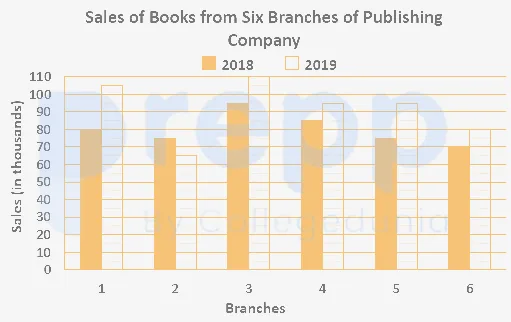
- A
84
- B
78
- C
80
- D
86
Show answer
C. 80Given:
Calculations
Total Sales in year 2018
= 80 + 75 + 95 + 85 + 75 + 70
= 480
Average sales
= 480/6
= 80
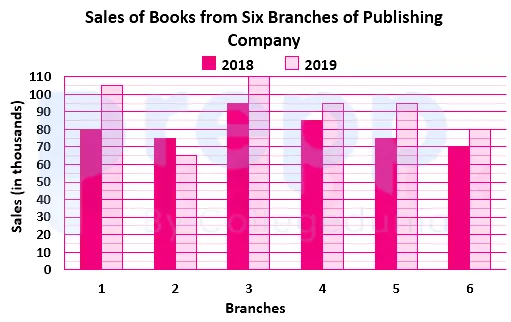 Paper & answer key PDF ↗
 Question 63archived
The below bar graph represents the number of students who qualified in the GATE exam, the GMAT exam, the CAT exam and those who qualified in none of these exams. (Given that there are no students who passed two or more exams.)
The percentage of students who qualified in at least one of the three exams in 2018 was:
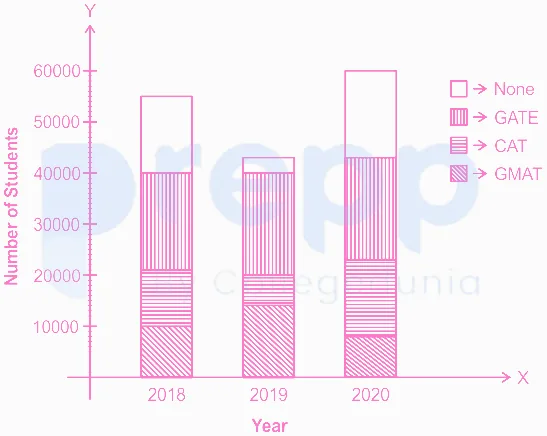
- A
72.72%
- B
77.67%
- C
83.83%
- D
67.67%
Show answer
A. 72.72%Given:
Calculations:
According to question,
Total number of students who atleast qualified in one subject in 2018
= 40000
Total students in years 2018 = 55000
Percentage required
= \(\frac{40000 × 100}{55000}\)
= 72.72%
⇒ Hence, The Required value is 72.72%.
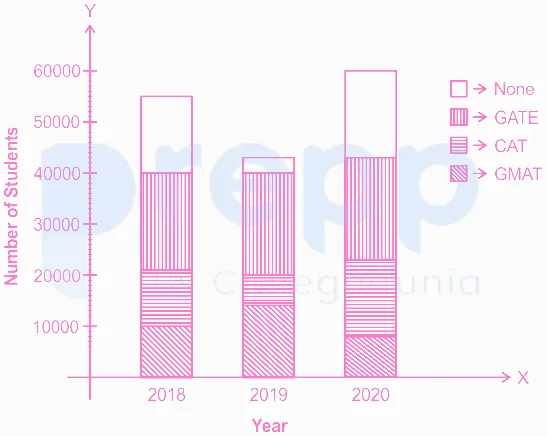 Paper & answer key PDF ↗
 Question 64archived
Given:
The pie chart given below shows the number of television sold by 8 different companies. The total number of television sold by all these 8 companies is 21000. The number of television sold by a particular company is shown as a percent of total number of television sold by all these 8 companies.
J1 = The value of the average number of television sold by P and W.
J2 = The value of the average number of television sold by Q, R, S and V.
What is the value of (J2 – J1)?
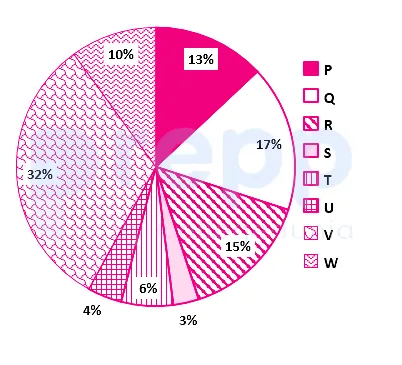
- A
5630
- B
2046
- C
1102.5
- D
3260
Show answer
C. 1102.5J1 = The value of average number of television sold by P and W.
J2 = The value of average number of television sold by Q, R, S and V.
Calculations:
J1
= 11.5 % of 21000
= 2415
J2
= Average of Q, R, S and V
= (32 + 3 + 15 + 17)% of 21000/4
= 0.67 × 21000/4
= 14070/4
= 3517.5
The value of (J2 - J1)
= 1102.5
Hence, The Required value is 1102.5.
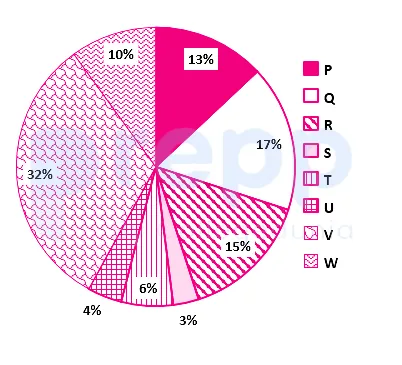 Paper & answer key PDF ↗
 Question 65archived
The length of the altitude of an equilateral triangle is 6\(\sqrt 3\) m. The perimeter of the equilateral triangle (in m) is:
- A
12\(\sqrt 2\)
- B
36\(\sqrt 2\)
- C
36
- D
24\(\sqrt 3\)
Show answer
C. 36The correct answer is 36.
Substituting a = \frac{2h}{\sqrt{3}} , we get \text{Area} = \frac{1}{2} \times \frac{2h}{\sqrt{3}} \times h = \frac{h^2}{\sqrt{3}} . Using h = 6\sqrt{3} , Area = \frac{(6\sqrt{3})^2}{\sqrt{3}} = \frac{36 \times 3}{\sqrt{3}} = \frac{108}{\sqrt{3}} = \frac{108\sqrt{3}}{3} = 36\sqrt{3} m 2 . This also matches the area formula using the side: \frac{\sqrt{3}}{4} a^2 = \frac{\sqrt{3}}{4} (12)^2 = \frac{\sqrt{3}}{4} \times 144 = 36\sqrt{3} m 2 .
Paper & answer key PDF ↗ Question 66archived
cos(30° + θ) - sin(60° - θ) = _______.
- A
\(\frac{{\sqrt 3 }}{2}\)
- B
0
- C
\(\frac{{ 1 }}{2}\)
- D
\(\frac{{1 }}{\sqrt2}\)
Show answer
B. 0Solving Trigonometric Expressions
We are asked to find the value of the trigonometric expression: \( \cos(30^\circ + \theta) - \sin(60^\circ - \theta) \).
To solve this, we can use the concept of complementary angles and trigonometric identities. Recall the co-function identity:
\( \sin(90^\circ - x) = \cos(x) \)
\( \cos(90^\circ - x) = \sin(x) \)
Let's look at the second term in the given expression, \( \sin(60^\circ - \theta) \). We can try to express \( 60^\circ - \theta \) as \( 90^\circ - \text{something} \).
Let \( x = 30^\circ + \theta \). Then, consider \( 90^\circ - x \):
\( 90^\circ - (30^\circ + \theta) = 90^\circ - 30^\circ - \theta = 60^\circ - \theta \)
So, the angle \( 60^\circ - \theta \) is the complement of the angle \( 30^\circ + \theta \).
Using the co-function identity \( \sin(90^\circ - x) = \cos(x) \), we can write:
\( \sin(60^\circ - \theta) = \sin(90^\circ - (30^\circ + \theta)) \)
Applying the identity with \( x = 30^\circ + \theta \):
\( \sin(90^\circ - (30^\circ + \theta)) = \cos(30^\circ + \theta) \)
Now, substitute this back into the original expression:
The expression is \( \cos(30^\circ + \theta) - \sin(60^\circ - \theta) \)
Replace \( \sin(60^\circ - \theta) \) with \( \cos(30^\circ + \theta) \):
\( \cos(30^\circ + \theta) - \cos(30^\circ + \theta) \)
Subtracting a term from itself results in 0.
\( \cos(30^\circ + \theta) - \cos(30^\circ + \theta) = 0 \)
Thus, the value of the expression \( \cos(30^\circ + \theta) - \sin(60^\circ - \theta) \) is 0.
Revision Table: Key Trigonometric Identities
Identity Type
Identity
Pythagorean Identity
\( \sin^2 x + \cos^2 x = 1 \)
Co-function Identity
\( \sin(90^\circ - x) = \cos(x) \)
Co-function Identity
\( \cos(90^\circ - x) = \sin(x) \)
Co-function Identity
\( \tan(90^\circ - x) = \cot(x) \)
Additional Information: Understanding Co-function Identities
Co-function identities show the relationship between trigonometric functions of complementary angles. Complementary angles are two angles that add up to \( 90^\circ \).
In a right-angled triangle, if one acute angle is \( x \), the other acute angle is \( 90^\circ - x \). The sine of one acute angle is equal to the cosine of the other acute angle, and vice versa. Similarly for tangent and cotangent, and secant and cosecant.
\( \sin x = \cos(90^\circ - x) \)
\( \cos x = \sin(90^\circ - x) \)
\( \tan x = \cot(90^\circ - x) \)
\( \cot x = \tan(90^\circ - x) \)
\( \sec x = \csc(90^\circ - x) \)
\( \csc x = \sec(90^\circ - x) \)
These identities are fundamental in simplifying trigonometric expressions and solving trigonometric equations, just as we used \( \sin(60^\circ - \theta) = \cos(30^\circ + \theta) \) because \( (60^\circ - \theta) + (30^\circ + \theta) = 90^\circ \).
Paper & answer key PDF ↗ Question 67archived
A starts from a point at a speed of 34 m/s. After 5 seconds, B starts chasing A from the same point at a speed of 44 m/s. What will be the distance travelled by B before A is caught by B?
- A
748 metres
- B
862 metres
- C
675 metres
- D
549 metres
Show answer
A. 748 metresUnderstanding the Speed, Distance, and Time Chasing Problem
This problem involves two individuals, A and B, moving at different speeds from the same starting point. A starts first, and then B starts chasing A after a delay. We need to find the distance B travels before catching up to A.
To solve this, we first need to determine how far A has travelled in the time before B starts. Then, we calculate the relative speed at which B gains on A. Using the initial distance between A and B and the relative speed, we can find the time it takes for B to catch A. Finally, we use B's speed and this time to find the distance B has travelled.
Step 1: Calculate the Distance A Travels Before B Starts
A starts with a speed of 34 m/s.
B starts 5 seconds after A.
In these 5 seconds, A travels a certain distance.
Distance = Speed $\times$ Time
Distance travelled by A in 5 seconds = $34 \text{ m/s} \times 5 \text{ s} = 170 \text{ metres}$
So, when B starts, A is 170 metres ahead of B.
Step 2: Determine the Relative Speed of B with Respect to A
A's speed = 34 m/s
B's speed = 44 m/s
Since B is chasing A in the same direction, the relative speed at which B closes the distance with A is the difference between their speeds.
Relative Speed = Speed of B $-$ Speed of A
Relative Speed = $44 \text{ m/s} - 34 \text{ m/s} = 10 \text{ m/s}$
This means B gains 10 metres on A every second.
Step 3: Calculate the Time Taken for B to Catch A
When B starts, A is 170 metres ahead.
B needs to cover this initial distance of 170 metres relative to A.
B closes the distance at a relative speed of 10 m/s.
Time taken to catch up = Total distance to cover / Relative Speed
Time taken = $170 \text{ metres} / 10 \text{ m/s} = 17 \text{ seconds}$
So, it will take 17 seconds for B to catch up to A after B starts.
Step 4: Calculate the Distance Travelled by B Before Catching A
B travels for 17 seconds at a speed of 44 m/s to catch A.
Distance travelled by B = Speed of B $\times$ Time taken by B
Distance travelled by B = $44 \text{ m/s} \times 17 \text{ s}$
Let's calculate $44 \times 17$:
$44 \times 10 = 440$
$44 \times 7 = 308$
$440 + 308 = 748$
Distance travelled by B = 748 metres.
Summary of the Solution Steps:
Here is a quick summary of the steps and results:
Description
Calculation
Result
Distance A travelled before B starts
$34 \text{ m/s} \times 5 \text{ s}$
170 metres
Relative speed (B - A)
$44 \text{ m/s} - 34 \text{ m/s}$
10 m/s
Time taken for B to catch A
$170 \text{ metres} / 10 \text{ m/s}$
17 seconds
Distance travelled by B
$44 \text{ m/s} \times 17 \text{ s}$
748 metres
The distance travelled by B before A is caught by B is 748 metres.
Revision Table: Speed, Distance, Time Concepts
Concept
Formula
Explanation
Speed
$\text{Speed} = \frac{\text{Distance}}{\text{Time}}$
How fast an object is moving. Units like m/s or km/h.
Distance
$\text{Distance} = \text{Speed} \times \text{Time}$
The total length covered by a moving object. Units like metres or kilometres.
Time
$\text{Time} = \frac{\text{Distance}}{\text{Speed}}$
The duration of motion. Units like seconds or hours.
Relative Speed (Same Direction)
$|\text{Speed}_1 - \text{Speed}_2|$
The difference in speeds when objects move in the same direction. Used to find time to catch up.
Relative Speed (Opposite Direction)
$\text{Speed}_1 + \text{Speed}_2$
The sum of speeds when objects move towards each other. Used to find time to meet.
Additional Information: Chasing Problems in Motion
Chasing problems are common types of questions in speed, distance, and time. They usually involve two objects or people starting from the same point or different points and one trying to catch the other. The key to solving these problems is often the concept of relative speed.
When the objects move in the same direction, the relative speed is the difference between their speeds. The faster object "gains" on the slower one at this relative speed.
The distance that needs to be covered at the relative speed is the initial gap between the two objects. If they start from the same point but at different times, the initial gap is the distance the first object travelled during the head start time.
Once the time to catch up is calculated using the relative speed and initial distance, you can find the distance travelled by either object during that time using their respective speeds. The distance travelled by the chasing object is usually what is asked in these types of questions.
Understanding the head start and how it creates the initial distance is crucial for setting up the problem correctly.
Paper & answer key PDF ↗ Question 68archived
The average of the first 7 non-zero multiples of 17 is:
- A
67
- B
68
- C
69
- D
66
Show answer
B. 68Calculating the Average of First 7 Non-Zero Multiples of 17
This question asks for the average of a specific set of numbers: the first 7 non-zero multiples of 17. To find the average, we need to identify these numbers, sum them up, and then divide by the count of the numbers.
Understanding Non-Zero Multiples
A multiple of 17 is a number that can be obtained by multiplying 17 by an integer. Non-zero multiples exclude the result of multiplying 17 by 0 (which is 0). So, the non-zero multiples of 17 are $17 \times 1$, $17 \times 2$, $17 \times 3$, and so on.
Identifying the First 7 Non-Zero Multiples of 17
The first 7 non-zero multiples of 17 are:
$17 \times 1 = 17$
$17 \times 2 = 34$
$17 \times 3 = 51$
$17 \times 4 = 68$
$17 \times 5 = 85$
$17 \times 6 = 102$
$17 \times 7 = 119$
So, the set of numbers is $\{17, 34, 51, 68, 85, 102, 119\}$. There are 7 numbers in this set.
Method 1: Summing and Averaging the Multiples
The average of a set of numbers is calculated using the formula:
$$ \text{Average} = \frac{\text{Sum of numbers}}{\text{Count of numbers}} $$
First, let's find the sum of these 7 multiples:
$$ \text{Sum} = 17 + 34 + 51 + 68 + 85 + 102 + 119 $$
We can factor out 17:
$$ \text{Sum} = 17 \times (1 + 2 + 3 + 4 + 5 + 6 + 7) $$
The sum of the first 7 natural numbers $(1+2+3+4+5+6+7)$ is $\frac{7 \times (7+1)}{2} = \frac{7 \times 8}{2} = \frac{56}{2} = 28$.
So, the sum of the multiples is:
$$ \text{Sum} = 17 \times 28 $$
Let's perform the multiplication:
Operation
Result
$17 \times 20$
$340$
$17 \times 8$
$136$
Total Sum ($340 + 136$)
$476$
The sum of the first 7 non-zero multiples of 17 is 476.
Now, we can calculate the average. The count of numbers is 7.
$$ \text{Average} = \frac{476}{7} $$
Performing the division:
Operation
Result
$476 \div 7$
$68$
The average of the first 7 non-zero multiples of 17 is 68.
Method 2: Using Properties of Arithmetic Progression
The first 7 non-zero multiples of 17 (17, 34, 51, 68, 85, 102, 119) form an arithmetic progression (AP). In an AP, the difference between consecutive terms is constant (in this case, the common difference is 17).
For an arithmetic progression with an odd number of terms, the average is equal to the middle term. There are 7 terms, so the middle term is the $(\frac{7+1}{2}) = 4\text{th}$ term.
The 4th term is the 4th non-zero multiple of 17, which is $17 \times 4 = 68$.
Alternatively, for any arithmetic progression, the average is also the average of the first and the last term.
First term = 17 (1st multiple)
Last term = 119 (7th multiple)
$$ \text{Average} = \frac{\text{First term} + \text{Last term}}{2} $$
$$ \text{Average} = \frac{17 + 119}{2} = \frac{136}{2} = 68 $$
Both methods confirm that the average of the first 7 non-zero multiples of 17 is 68.
Conclusion on Average Calculation
We have successfully calculated the average of the specified set of numbers using two different methods, both yielding the same result. The first 7 non-zero multiples of 17 are 17, 34, 51, 68, 85, 102, and 119. Their average is 68.
Revision Table: Key Concepts for Average of Multiples
Concept
Definition/Calculation
Example (using 17)
Multiple
Product of a number and an integer.
$17 \times 3 = 51$ (51 is a multiple of 17)
Non-zero Multiple
Multiple obtained by multiplying by a non-zero integer ($1, 2, 3, ...$).
$17 \times 1 = 17$ (17 is the first non-zero multiple of 17)
Average (Mean)
Sum of numbers divided by the count of numbers.
Average of {1, 2, 3} = $(1+2+3)/3 = 6/3 = 2$
Arithmetic Progression (AP)
A sequence where the difference between consecutive terms is constant.
17, 34, 51, ... (Common difference = 17)
Average of an AP (Odd terms)
The middle term. Also, (First Term + Last Term) / 2.
Average of {17, 34, 51} = 34 (middle term) or $(17+51)/2 = 68/2 = 34$
Additional Information on Averages and Multiples
Understanding averages and multiples is fundamental in number theory and arithmetic. Multiples are essentially the results of multiplication tables for a given number. The concept of non-zero multiples is important when the context specifically excludes the number 0.
Averages, or means, are a measure of central tendency. They give us a single value that represents the center of a dataset. For evenly spaced sets of numbers, like multiples or numbers in an arithmetic progression, calculating the average is simpler because of their inherent pattern. The properties of arithmetic progressions, such as the average being the middle term (for odd count) or the average of the first and last terms, provide convenient shortcuts.
This type of problem often appears in competitive exams to test basic arithmetic skills and understanding of number properties. Practicing with different numbers and counts of multiples can help solidify the concept.
Paper & answer key PDF ↗ Question 69archived
Find the value of the following expression.
5 (sin4 θ + cos4 θ) + 3(sin6 θ + cos6 θ) + 19sin2 θ cos2 θ
- A
8
- B
5
- C
6
- D
7
Show answer
A. 8Understanding the Trigonometric Expression
The question asks us to find the value of a given trigonometric expression: \text{5 (sin<sup>4</sup> θ + cos<sup>4</sup> θ) + 3(sin<sup>6</sup> θ + cos<sup>6</sup> θ) + 19sin<sup>2</sup> θ cos<sup>2</sup> θ}.
To simplify this expression, we will use fundamental trigonometric identities. The goal is to reduce the terms involving higher powers of \sin \theta and \cos \theta to simpler forms, preferably in terms of \sin^2 \theta \cos^2 \theta, which appears in the last term.
Applying Trigonometric Identities to Simplify Powers
We know the fundamental identity: \sin^2 \theta + \cos^2 \theta = 1.
Let's simplify the terms with powers 4 and 6:
For the term \sin^4 \theta + \cos^4 \theta:
We can write \sin^4 \theta + \cos^4 \theta as (\sin^2 \theta)^2 + (\cos^2 \theta)^2. Using the algebraic identity a^2 + b^2 = (a+b)^2 - 2ab, where a = \sin^2 \theta and b = \cos^2 \theta, we get:
\sin^4 \theta + \cos^4 \theta = (\sin^2 \theta + \cos^2 \theta)^2 - 2\sin^2 \theta \cos^2 \theta
Since \sin^2 \theta + \cos^2 \theta = 1, this simplifies to:
\sin^4 \theta + \cos^4 \theta = (1)^2 - 2\sin^2 \theta \cos^2 \theta = 1 - 2\sin^2 \theta \cos^2 \theta
For the term \sin^6 \theta + \cos^6 \theta:
We can write \sin^6 \theta + \cos^6 \theta as (\sin^2 \theta)^3 + (\cos^2 \theta)^3. Using the algebraic identity a^3 + b^3 = (a+b)(a^2 - ab + b^2), where a = \sin^2 \theta and b = \cos^2 \theta, we get:
\sin^6 \theta + \cos^6 \theta = (\sin^2 \theta + \cos^2 \theta)((\sin^2 \theta)^2 - \sin^2 \theta \cos^2 \theta + (\cos^2 \theta)^2)
Since \sin^2 \theta + \cos^2 \theta = 1, this becomes:
\sin^6 \theta + \cos^6 \theta = 1 \cdot (\sin^4 \theta - \sin^2 \theta \cos^2 \theta + \cos^4 \theta)
We already found that \sin^4 \theta + \cos^4 \theta = 1 - 2\sin^2 \theta \cos^2 \theta. Substitute this into the expression:
\sin^6 \theta + \cos^6 \theta = (1 - 2\sin^2 \theta \cos^2 \theta) - \sin^2 \theta \cos^2 \theta
Combine the terms with \sin^2 \theta \cos^2 \theta:
\sin^6 \theta + \cos^6 \theta = 1 - 3\sin^2 \theta \cos^2 \theta
Substituting Simplified Terms Back into the Expression
Now, substitute these simplified forms back into the original expression:
Original Expression: 5 (\sin^4 \theta + \cos^4 \theta) + 3(\sin^6 \theta + \cos^6 \theta) + 19\sin^2 \theta \cos^2 \theta
Substitute the simplified terms:
5 (1 - 2\sin^2 \theta \cos^2 \theta) + 3(1 - 3\sin^2 \theta \cos^2 \theta) + 19\sin^2 \theta \cos^2 \theta
Distribute the constants 5 and 3:
(5 \cdot 1 - 5 \cdot 2\sin^2 \theta \cos^2 \theta) + (3 \cdot 1 - 3 \cdot 3\sin^2 \theta \cos^2 \theta) + 19\sin^2 \theta \cos^2 \theta
5 - 10\sin^2 \theta \cos^2 \theta + 3 - 9\sin^2 \theta \cos^2 \theta + 19\sin^2 \theta \cos^2 \theta
Combining Like Terms
Now, group the constant terms and the terms involving \sin^2 \theta \cos^2 \theta:
Constant terms: 5 + 3 = 8
Terms with \sin^2 \theta \cos^2 \theta: -10\sin^2 \theta \cos^2 \theta - 9\sin^2 \theta \cos^2 \theta + 19\sin^2 \theta \cos^2 \theta
Combine the coefficients of \sin^2 \theta \cos^2 \theta:
(-10 - 9 + 19)\sin^2 \theta \cos^2 \theta = (-19 + 19)\sin^2 \theta \cos^2 \theta = 0 \cdot \sin^2 \theta \cos^2 \theta = 0
So, the expression simplifies to:
8 + 0 = 8
The value of the expression is 8.
Final Value of the Expression
After simplifying using trigonometric identities, the expression evaluates to a constant value, independent of \theta.
The value is 8.
Step
Expression
Identity/Operation Used
1
\sin^4 \theta + \cos^4 \theta
Rewrite as (\sin^2 \theta)^2 + (\cos^2 \theta)^2
2
(\sin^2 \theta + \cos^2 \theta)^2 - 2\sin^2 \theta \cos^2 \theta
a^2+b^2=(a+b)^2-2ab
3
1 - 2\sin^2 \theta \cos^2 \theta
\sin^2 \theta + \cos^2 \theta = 1
4
\sin^6 \theta + \cos^6 \theta
Rewrite as (\sin^2 \theta)^3 + (\cos^2 \theta)^3
5
(\sin^2 \theta + \cos^2 \theta)(\sin^4 \theta - \sin^2 \theta \cos^2 \theta + \cos^4 \theta)
a^3+b^3=(a+b)(a^2-ab+b^2)
6
1 \cdot (\sin^4 \theta - \sin^2 \theta \cos^2 \theta + \cos^4 \theta)
\sin^2 \theta + \cos^2 \theta = 1
7
1 \cdot ((1 - 2\sin^2 \theta \cos^2 \theta) - \sin^2 \theta \cos^2 \theta)
Substitute \sin^4 \theta + \cos^4 \theta from Step 3
8
1 - 3\sin^2 \theta \cos^2 \theta
Simplify
9
5(\sin^4 \theta + \cos^4 \theta) + 3(\sin^6 \theta + \cos^6 \theta) + 19\sin^2 \theta \cos^2 \theta
Original Expression
10
5(1 - 2\sin^2 \theta \cos^2 \theta) + 3(1 - 3\sin^2 \theta \cos^2 \theta) + 19\sin^2 \theta \cos^2 \theta
Substitute from Steps 3 and 8
11
5 - 10\sin^2 \theta \cos^2 \theta + 3 - 9\sin^2 \theta \cos^2 \theta + 19\sin^2 \theta \cos^2 \theta
Distribute
12
(5+3) + (-10-9+19)\sin^2 \theta \cos^2 \theta
Group like terms
13
8 + 0 \cdot \sin^2 \theta \cos^2 \theta
Simplify coefficients
14
8
Final Value
Revision Table: Key Trigonometric Identities for Powers
Identity
Form
Derivation
Basic Identity
\sin^2 \theta + \cos^2 \theta = 1
Fundamental identity
Power 4
\sin^4 \theta + \cos^4 \theta = 1 - 2\sin^2 \theta \cos^2 \theta
(\sin^2 \theta + \cos^2 \theta)^2 - 2\sin^2 \theta \cos^2 \theta = 1^2 - 2\sin^2 \theta \cos^2 \theta
Power 6
\sin^6 \theta + \cos^6 \theta = 1 - 3\sin^2 \theta \cos^2 \theta
(\sin^2 \theta + \cos^2 \theta)(\sin^4 \theta - \sin^2 \theta \cos^2 \theta + \cos^4 \theta) = 1 \cdot ((1 - 2\sin^2 \theta \cos^2 \theta) - \sin^2 \theta \cos^2 \theta)
Additional Information: Generalization of Identities
The identities used for powers 4 and 6 can be generalized. For n \ge 1, the expression \sin^{2n} \theta + \cos^{2n} \theta can be related to \sin^{2n-2} \theta + \cos^{2n-2} \theta or simplified using \sin^2 \theta \cos^2 \theta.
For example, we can see a pattern:
\sin^2 \theta + \cos^2 \theta = 1
\sin^4 \theta + \cos^4 \theta = 1 - 2\sin^2 \theta \cos^2 \theta
\sin^6 \theta + \cos^6 \theta = 1 - 3\sin^2 \theta \cos^2 \theta
These patterns are very useful in simplifying complex trigonometric expressions and are often encountered in exams. Mastering the derivation of these identities from the basic \sin^2 \theta + \cos^2 \theta = 1 and algebraic identities is key to solving such problems.
Paper & answer key PDF ↗ Question 70archived
What is the total surface area of a cone, if the slant height and radius of a cone is 30 cm and 14 cm, respectively?
- A
1980 cm2
- B
1963 cm2
- C
1908 cm2
- D
1936 cm2
Show answer
D. 1936 cm2Calculating Total Surface Area of a Cone
The question asks us to find the total surface area of a cone given its slant height and radius. We are provided with the following information:
Slant height (\(l\)) = 30 cm
Radius (\(r\)) = 14 cm
To find the total surface area of a cone, we use a specific formula that includes the area of the circular base and the area of the curved surface.
Formula for Total Surface Area of a Cone
The total surface area (TSA) of a cone is given by the formula:
\[TSA = \text{Area of base} + \text{Area of curved surface}\]
The area of the circular base is \(\pi r^2\), and the area of the curved surface is \(\pi r l\), where \(r\) is the radius and \(l\) is the slant height.
So, the total surface area formula is:
\[TSA = \pi r^2 + \pi r l\]
This can be simplified by factoring out \(\pi r\):
\[TSA = \pi r (r + l)\]
Step-by-Step Calculation
Now, let's substitute the given values into the formula:
Given:
\(r = 14 \text{ cm}\)
\(l = 30 \text{ cm}\)
Using the formula \(TSA = \pi r (r + l)\), we substitute the values:
\[TSA = \pi \times 14 \times (14 + 30)\]
First, calculate the sum inside the parentheses:
\[14 + 30 = 44\]
Now, substitute this back into the formula:
\[TSA = \pi \times 14 \times 44\]
To get a numerical value, we typically use an approximate value for \(\pi\). Since the radius is 14 (a multiple of 7), using \(\pi \approx \frac{22}{7}\) is convenient for calculation:
\[TSA = \frac{22}{7} \times 14 \times 44\]
We can cancel out the 7 in the denominator with the 14:
\[TSA = 22 \times \frac{14}{7} \times 44\]
\[TSA = 22 \times 2 \times 44\]
Now, perform the multiplication:
\[TSA = 44 \times 44\]
\[TSA = 1936\]
The unit for area is square centimeters (cm<sup>2</sup>) since the dimensions are given in centimeters.
Therefore, the total surface area of the cone is 1936 cm<sup>2</sup>.
Comparing with Options
Let's compare our calculated total surface area with the given options:
1980 cm<sup>2</sup>
1963 cm<sup>2</sup>
1908 cm<sup>2</sup>
1936 cm<sup>2</sup>
Our calculated value of 1936 cm<sup>2</sup> matches one of the options.
Parameter
Value
Radius (\(r\))
14 cm
Slant Height (\(l\))
30 cm
Value of \(\pi\) used
\(\frac{22}{7}\)
Total Surface Area (TSA)
1936 cm<sup>2</sup>
Revision Table: Cone Surface Area
Concept
Formula
Description
Area of Base Circle
\(\pi r^2\)
Area of the circular base of the cone.
Curved Surface Area (CSA)
\(\pi r l\)
Area of the slanted, curved part of the cone.
Total Surface Area (TSA)
\(\pi r (r + l)\) or \(\pi r^2 + \pi r l\)
Sum of the base area and the curved surface area.
Volume of Cone
\(\frac{1}{3}\pi r^2 h\)
The space occupied by the cone (\(h\) is the vertical height).
Relation between \(r, l, h\)
\(l^2 = r^2 + h^2\)
Pythagorean theorem applied to the cone (forms a right-angled triangle).
Additional Information: Understanding Cone Properties
A cone is a three-dimensional geometric shape that tapers smoothly from a flat base (usually circular) to a point called the apex or vertex. Key properties include:
Radius (\(r\)): The distance from the center of the base circle to any point on its circumference.
Vertical Height (\(h\)): The perpendicular distance from the apex to the center of the base.
Slant Height (\(l\)): The distance from the apex to any point on the circumference of the base. This is the length along the slanted surface of the cone.
Base: The flat surface at the bottom, which is typically a circle.
Apex: The single point at the top where all the slanted lines meet.
The relationship between the radius, vertical height, and slant height is governed by the Pythagorean theorem because the vertical height, radius, and slant height form a right-angled triangle, with the slant height being the hypotenuse. The formula is \(l^2 = r^2 + h^2\).
When calculating surface area, it's important to distinguish between the curved surface area (CSA), which is just the slanted part, and the total surface area (TSA), which includes the base.
Paper & answer key PDF ↗ Question 71archived
What annual installment will discharge a debt of Rs. 9,600 due in 5 years at 10% simple interest?
- A
Rs. 1450
- B
Rs. 1550
- C
Rs. 1500
- D
Rs. 1600
Show answer
D. Rs. 1600Understanding Simple Interest Installments for Debt Discharge
This problem asks us to find the equal annual installment amount needed to pay off a debt over a specific period, considering simple interest is applied to the outstanding balance or calculated based on the total principal and time.
Problem Details
Total Debt Amount Due (including principal and total simple interest): Rs. 9,600
Time Period: 5 years
Rate of Simple Interest: 10% per annum
Simple Interest Installment Concept
In a simple interest installment plan, when you pay an installment, it reduces the amount you owe. However, the interest for each period is typically calculated on the outstanding amount at the beginning of that period. Alternatively, and more commonly for simple interest installments as in this problem, we can think of the total debt as the sum of the values of each installment accumulated with simple interest up to the final payment date.
Method to Calculate Annual Installment
Let the equal annual installment be \( x \). These installments are paid at the end of each year for 5 years. We can calculate the value of each installment at the end of the 5-year period, including the simple interest it would have earned from the time of payment until the end of the 5th year. The sum of these accumulated values must equal the total debt amount due.
The interest is 10% simple interest per annum. An installment paid at the end of year 'k' will earn simple interest for \((5 - k)\) years.
Installment No.
Year of Payment End
Time Period for Interest (Years)
Value at End of 5 Years
1st
Year 1
\(5 - 1 = 4\)
\(x + \text{SI on } x \text{ for 4 years}\)
2nd
Year 2
\(5 - 2 = 3\)
\(x + \text{SI on } x \text{ for 3 years}\)
3rd
Year 3
\(5 - 3 = 2\)
\(x + \text{SI on } x \text{ for 2 years}\)
4th
Year 4
\(5 - 4 = 1\)
\(x + \text{SI on } x \text{ for 1 year}\)
5th
Year 5
\(5 - 5 = 0\)
\(x + \text{SI on } x \text{ for 0 years}\)
Simple Interest (SI) on an amount P at R% per annum for T years is given by \( \text{SI} = \frac{P \cdot R \cdot T}{100} \). Here, P = \( x \) and R = 10.
Value of 1st installment at end of 5 years: \( x + \frac{x \cdot 10 \cdot 4}{100} = x + \frac{40x}{100} = x + 0.4x = 1.4x \)
Value of 2nd installment at end of 5 years: \( x + \frac{x \cdot 10 \cdot 3}{100} = x + \frac{30x}{100} = x + 0.3x = 1.3x \)
Value of 3rd installment at end of 5 years: \( x + \frac{x \cdot 10 \cdot 2}{100} = x + \frac{20x}{100} = x + 0.2x = 1.2x \)
Value of 4th installment at end of 5 years: \( x + \frac{x \cdot 10 \cdot 1}{100} = x + \frac{10x}{100} = x + 0.1x = 1.1x \)
Value of 5th installment at end of 5 years: \( x + \frac{x \cdot 10 \cdot 0}{100} = x \)
The sum of these values must equal the total debt due, which is Rs. 9,600.
\( 1.4x + 1.3x + 1.2x + 1.1x + x = 9600 \)
\( (1.4 + 1.3 + 1.2 + 1.1 + 1)x = 9600 \)
\( 6x = 9600 \)
Calculating the Annual Installment Amount
To find the value of \( x \), we divide the total debt by the sum of the multipliers:
\( x = \frac{9600}{6} \)
\( x = 1600 \)
Therefore, the annual installment will be Rs. 1,600.
Verification (Optional but Recommended)
We can quickly verify this using the formula: Total Amount Due = \( nx + \frac{xr}{100} \frac{n(n-1)}{2} \)
Here, A = 9600, n = 5, r = 10, x = 1600.
\( 9600 = 5 \cdot 1600 + \frac{1600 \cdot 10}{100} \frac{5(5-1)}{2} \)
\( 9600 = 8000 + 160 \cdot \frac{5 \cdot 4}{2} \)
\( 9600 = 8000 + 160 \cdot \frac{20}{2} \)
\( 9600 = 8000 + 160 \cdot 10 \)
\( 9600 = 8000 + 1600 \)
\( 9600 = 9600 \)
The calculation is correct.
Conclusion
The annual installment required to discharge a debt of Rs. 9,600 due in 5 years at 10% simple interest is Rs. 1,600.
Revision Table: Simple Interest Key Concepts
Term
Definition
Formula (for Principal P, Rate R%, Time T years)
Principal (P)
The initial amount borrowed or lent.
-
Rate (R)
The percentage at which interest is charged per period (usually per year).
-
Time (T)
The duration for which the money is borrowed or lent.
-
Simple Interest (SI)
Interest calculated only on the principal amount.
\( \text{SI} = \frac{P \cdot R \cdot T}{100} \)
Amount (A)
The total sum including principal and simple interest.
\( A = P + \text{SI} = P \left(1 + \frac{R \cdot T}{100}\right) \)
Additional Information: Installment Concepts
Installments are periodic payments made to repay a debt or loan. There are different ways installment plans are structured, especially concerning how interest is calculated.
Simple Interest Installments: As seen in this problem, interest is usually calculated on the original principal or based on the total value of installments at the end of the term. The debt amount given might include the total interest accumulated over the period if no installments were paid.
Compound Interest Installments (EMIs - Equated Monthly Installments): In these plans, interest for a period is calculated on the outstanding principal *at the beginning of that period*. Each payment includes both interest and a portion of the principal. Compound interest leads to higher total interest over time compared to simple interest for the same principal, rate, and time, but installment calculations are different. EMIs are calculated using formulas that account for compounding interest.
Debt Discharge: This refers to the process of paying off a debt completely, fulfilling all obligations to the lender. Installment plans are a common method for structured debt discharge.
Understanding whether a problem involves simple or compound interest is crucial for choosing the correct approach and formula for calculating installments or the total amount due.
Paper & answer key PDF ↗ Question 72archived
Sinplify: \(\sqrt {36{x^2} - 108x + 81} \).
- A
6x - 9
- B
2x - 9
- C
5x - 9
- D
3x - 3
Show answer
A. 6x - 9Simplifying Radical Expressions
The problem asks us to simplify the expression \(\sqrt {36{x^2} - 108x + 81}\). To simplify a square root, we often look for perfect square factors inside the radical. In this case, we have a trinomial inside the square root.
Identifying a Perfect Square Trinomial
A trinomial in the form \(ax^2 + bx + c\) might be a perfect square if it matches the pattern \((px \pm q)^2 = p^2x^2 \pm 2pqx + q^2\). Let's examine the given expression: \(36x^2 - 108x + 81\).
The first term, \(36x^2\), is a perfect square: \((6x)^2 = 36x^2\). This suggests \(p=6\).
The last term, \(81\), is a perfect square: \(9^2 = 81\). This suggests \(q=9\).
Now, let's check if the middle term, \(-108x\), matches \(\pm 2pqx\). Using \(p=6\) and \(q=9\):
\(2pqx = 2 \times (6x) \times 9 = 108x\).
Since the middle term is \(-108x\), the expression matches the pattern \((px - q)^2 = p^2x^2 - 2pqx + q^2\).
Therefore, the trinomial \(36x^2 - 108x + 81\) can be factored as \((6x - 9)^2\).
Simplifying the Square Root
Now we can rewrite the original expression using the factored form:
\(\sqrt {36{x^2} - 108x + 81} = \sqrt{(6x - 9)^2}\)
The square root of a squared term is the absolute value of the term:
\(\sqrt{(6x - 9)^2} = |6x - 9|\)
However, the given options are linear expressions without absolute value. In problems like this where the options are provided in this form, the simplification usually implies taking the principal root under the assumption that the expression inside the square root is non-negative, or that the context allows for \(|A|=A\). Therefore, we consider the positive root which aligns with the options:
\(\sqrt{(6x - 9)^2} = 6x - 9\)
Step-by-Step Simplification
Identify the expression inside the square root: \(36x^2 - 108x + 81\).
Recognize this trinomial might be a perfect square.
Find the square root of the first term: \(\sqrt{36x^2} = 6x\).
Find the square root of the last term: \(\sqrt{81} = 9\).
Check the middle term: \(2 \times (6x) \times 9 = 108x\). Since the middle term in the expression is \(-108x\), the trinomial is \((6x - 9)^2\).
Substitute the factored form back into the square root: \(\sqrt{(6x - 9)^2}\).
Simplify the square root: \(\sqrt{(6x - 9)^2} = |6x - 9|\).
Based on the format of the options, the simplified form is presented as \(6x - 9\).
Comparing with Options
The simplified expression \(6x - 9\) matches one of the given options.
Option
Expression
Matches Simplified Form?
1
\(6x - 9\)
Yes
2
\(2x - 9\)
No
3
\(5x - 9\)
No
4
\(3x - 3\)
No
The expression \(6x - 9\) is the correct simplified form based on the options provided.
Revision Table: Simplifying Perfect Squares
Concept
Description
Example
Perfect Square Trinomial
A trinomial that results from squaring a binomial, e.g., \((a+b)^2\) or \((a-b)^2\).
\(x^2 + 6x + 9 = (x+3)^2\)
Formula for \((a-b)^2\)
\((a-b)^2 = a^2 - 2ab + b^2\)
\((2y-5)^2 = (2y)^2 - 2(2y)(5) + 5^2 = 4y^2 - 20y + 25\)
Square Root of a Square
\(\sqrt{A^2} = |A|\). In many algebraic problems, especially with variable expressions, the absolute value is important unless a constraint is specified.
\(\sqrt{(x-1)^2} = |x-1|\)
Additional Information: Absolute Value and Square Roots
When simplifying \(\sqrt{A^2}\), the result is always the absolute value of \(A\), denoted as \(|A|\). This is because the square root symbol (\(\sqrt{}\)) traditionally denotes the principal (non-negative) square root. For example, \(\sqrt{(-5)^2} = \sqrt{25} = 5\), which is \(|-5|\).
In this problem, \(\sqrt{(6x-9)^2} = |6x-9|\). The expression \(|6x-9|\) equals \(6x-9\) if \(6x-9 \ge 0\) (i.e., \(x \ge 3/2\)), and it equals \(-(6x-9) = 9-6x\) if \(6x-9 < 0\) (i.e., \(x < 3/2\)).
Since the options provided are \(6x-9\) and not \(|6x-9|\) or involving the conditional statement, it is standard practice in many contexts, particularly at introductory levels or without explicit constraints on \(x\), to present the answer as \(6x-9\), assuming the context implies the positive case or simplifies notation when options are linear.
Understanding the absolute value is crucial for full mathematical accuracy, but when multiple-choice options are limited to simple linear forms, select the one that corresponds to the expression \(A\) when simplifying \(\sqrt{A^2}\).
Paper & answer key PDF ↗ Question 73archived
What will be the value of \(\frac{{\tan 45^\circ - \tan 15^\circ }}{{1 + \tan 45^\circ \tan 15^\circ }}\)?
- A
\(\sqrt3\)
- B
\(\frac{1}{{\sqrt 2 }}\)
- C
\(\frac{1}{{\sqrt 3 }}\)
- D
\(\sqrt 2\)
Show answer
C. \(\frac{1}{{\sqrt 3 }}\)Evaluating Trigonometric Expression: Tan Formula Application
The question asks us to find the value of the expression \( \frac{{\tan 45^\circ - \tan 15^\circ }}{{1 + \tan 45^\circ \tan 15^\circ }} \). This expression looks very similar to a standard trigonometric identity.
Understanding the Tangent Subtraction Formula
We need to recall the tangent subtraction formula, which is used to find the tangent of the difference between two angles. The formula is:
\( \tan(A - B) = \frac{{\tan A - \tan B}}{{1 + \tan A \tan B}} \)
Comparing this formula with the given expression \( \frac{{\tan 45^\circ - \tan 15^\circ }}{{1 + \tan 45^\circ \tan 15^\circ }} \), we can see a direct match if we let \( A = 45^\circ \) and \( B = 15^\circ \).
Applying the Formula to the Expression
Using the tangent subtraction formula with \( A = 45^\circ \) and \( B = 15^\circ \), the given expression can be rewritten as:
\( \frac{{\tan 45^\circ - \tan 15^\circ }}{{1 + \tan 45^\circ \tan 15^\circ }} = \tan(45^\circ - 15^\circ) \)
Simplifying the Expression
Now we need to calculate the difference between the angles inside the tangent function:
\( 45^\circ - 15^\circ = 30^\circ \)
So, the expression simplifies to \( \tan 30^\circ \).
Finding the Value of Tan 30°
The final step is to find the standard value of \( \tan 30^\circ \). The values of trigonometric functions for standard angles (like 0°, 30°, 45°, 60°, 90°) are commonly known. The value of \( \tan 30^\circ \) is \( \frac{1}{{\sqrt 3}} \).
We can summarize the values for common angles in a table:
Angle (\(\theta\))
\( \sin \theta \)
\( \cos \theta \)
\( \tan \theta \)
\( 0^\circ \)
\( 0 \)
\( 1 \)
\( 0 \)
\( 30^\circ \)
\( \frac{1}{2} \)
\( \frac{{\sqrt 3}}{2} \)
\( \frac{1}{{\sqrt 3}} \)
\( 45^\circ \)
\( \frac{1}{{\sqrt 2}} \)
\( \frac{1}{{\sqrt 2}} \)
\( 1 \)
\( 60^\circ \)
\( \frac{{\sqrt 3}}{2} \)
\( \frac{1}{2} \)
\( \sqrt 3 \)
\( 90^\circ \)
\( 1 \)
\( 0 \)
Undefined
From the table, the value of \( \tan 30^\circ \) is indeed \( \frac{1}{{\sqrt 3}} \).
Conclusion
Therefore, the value of \( \frac{{\tan 45^\circ - \tan 15^\circ }}{{1 + \tan 45^\circ \tan 15^\circ }} \) is \( \tan(45^\circ - 15^\circ) = \tan 30^\circ = \frac{1}{{\sqrt 3}} \).
Revision Table: Key Trigonometry Formulas & Values
Concept
Formula/Value
Notes
Tangent Subtraction
\( \tan(A - B) = \frac{{\tan A - \tan B}}{{1 + \tan A \tan B}} \)
Useful for difference of angles
Tangent Addition
\( \tan(A + B) = \frac{{\tan A + \tan B}}{{1 - \tan A \tan B}} \)
Similar formula for sum of angles
Value of \( \tan 45^\circ \)
\( 1 \)
Standard angle value
Value of \( \tan 30^\circ \)
\( \frac{1}{{\sqrt 3}} \)
Standard angle value
Additional Information: Solving Trigonometry Problems
Solving trigonometry problems often involves recognizing patterns that match standard formulas. For expressions like the one in the question, keeping the sum and difference formulas for tangent, sine, and cosine handy is very useful.
Sine Sum/Difference:
\( \sin(A + B) = \sin A \cos B + \cos A \sin B \)
\( \sin(A - B) = \sin A \cos B - \cos A \sin B \)
Cosine Sum/Difference:
\( \cos(A + B) = \cos A \cos B - \sin A \sin B \)
\( \cos(A - B) = \cos A \cos B + \sin A \sin B \)
Also, knowing the exact values of trigonometric ratios for standard angles (0°, 30°, 45°, 60°, 90°) is fundamental. These values are often derived from properties of special right-angled triangles (30-60-90 and 45-45-90 triangles) or the unit circle.
In this specific problem, recognizing the tangent subtraction formula was the key to simplifying the expression quickly. Once simplified to \( \tan 30^\circ \), recalling its value led directly to the answer.
Paper & answer key PDF ↗ Question 74archived
If sin θ = \(\frac{3}{{ 5 }}\), then what is tan θ?
- A
\(\frac{3}{{ 5 }}\)
- B
\(\frac{4}{{ 3 }}\)
- C
\(\frac{4}{{ 5 }}\)
- D
\(\frac{3}{{ 4 }}\)
Show answer
D. \(\frac{3}{{ 4 }}\)Understanding the Problem: Finding tan θ from sin θ
The question asks us to find the value of tangent of an angle θ (\(\tan \theta\)) given the value of sine of the same angle (\(\sin \theta\)). We are given that \(\sin \theta = \frac{3}{5}\). We need to use our knowledge of trigonometry and the relationships between trigonometric ratios to solve this.
Relating sin θ and tan θ
In a right-angled triangle, the trigonometric ratios are defined as follows:
\(\sin \theta = \frac{\text{Opposite Side}}{\text{Hypotenuse}}\)
\(\cos \theta = \frac{\text{Adjacent Side}}{\text{Hypotenuse}}\)
\(\tan \theta = \frac{\text{Opposite Side}}{\text{Adjacent Side}}\)
From these definitions, we can see that \(\tan \theta\) can also be expressed as the ratio of \(\sin \theta\) and \(\cos \theta\):
\(\tan \theta = \frac{\sin \theta}{\cos \theta}\)
We are given \(\sin \theta = \frac{3}{5}\), but we need to find \(\cos \theta\) first to calculate \(\tan \theta\) using this identity.
Method 1: Using a Right-Angled Triangle
We can visualize \(\sin \theta = \frac{3}{5}\) using a right-angled triangle. If \(\sin \theta = \frac{\text{Opposite}}{\text{Hypotenuse}}\), we can assume the opposite side is 3 units and the hypotenuse is 5 units (or any multiple, but 3 and 5 are the simplest).
Let the adjacent side be \(x\). According to the Pythagorean theorem, in a right-angled triangle, the square of the hypotenuse is equal to the sum of the squares of the other two sides.
\((\text{Opposite Side})^2 + (\text{Adjacent Side})^2 = (\text{Hypotenuse})^2\)
Substituting the values we have:
\(3^2 + x^2 = 5^2\)
Now, let's solve for \(x\):
\(9 + x^2 = 25\)
\(x^2 = 25 - 9\)
\(x^2 = 16\)
\(x = \sqrt{16}\)
\(x = 4\)
So, the adjacent side is 4 units.
Now we can find \(\tan \theta\) using the definition \(\tan \theta = \frac{\text{Opposite Side}}{\text{Adjacent Side}}\):
\(\tan \theta = \frac{3}{4}\)
Method 2: Using the Pythagorean Identity
Another way to find \(\cos \theta\) from \(\sin \theta\) is by using the fundamental trigonometric identity:
\(\sin^2 \theta + \cos^2 \theta = 1\)
We are given \(\sin \theta = \frac{3}{5}\). Substitute this into the identity:
\(\left(\frac{3}{5}\right)^2 + \cos^2 \theta = 1\)
\(\frac{9}{25} + \cos^2 \theta = 1\)
Now, solve for \(\cos^2 \theta\):
\(\cos^2 \theta = 1 - \frac{9}{25}\)
To subtract the fractions, find a common denominator (25):
\(\cos^2 \theta = \frac{25}{25} - \frac{9}{25}\)
\(\cos^2 \theta = \frac{25 - 9}{25}\)
\(\cos^2 \theta = \frac{16}{25}\)
Now, take the square root to find \(\cos \theta\):
\(\cos \theta = \sqrt{\frac{16}{25}}\)
\(\cos \theta = \frac{4}{5}\)
Note: The square root could be positive or negative (\(\pm \frac{4}{5}\)). However, the options provided are positive, suggesting we are likely dealing with an angle in the first quadrant (where all trigonometric ratios are positive) or that only the magnitude is considered. Assuming \(\theta\) is in a quadrant where cosine is positive, we take \(\cos \theta = \frac{4}{5}\).
Finally, use the identity \(\tan \theta = \frac{\sin \theta}{\cos \theta}\):
\(\tan \theta = \frac{\frac{3}{5}}{\frac{4}{5}}\)
To divide by a fraction, multiply by its reciprocal:
\(\tan \theta = \frac{3}{5} \times \frac{5}{4}\)
\(\tan \theta = \frac{3 \times 5}{5 \times 4}\)
\(\tan \theta = \frac{15}{20}\)
Simplify the fraction:
\(\tan \theta = \frac{3}{4}\)
Both methods yield the same result.
Summary of Steps to Find tan θ from sin θ
Here is a summary of the steps using the right-angled triangle method:
Identify the given \(\sin \theta\) value as \(\frac{\text{Opposite}}{\text{Hypotenuse}}\).
Assign values to the Opposite side and Hypotenuse based on the ratio (e.g., 3 and 5).
Use the Pythagorean theorem \(a^2 + b^2 = c^2\) to find the length of the Adjacent side.
Once the Adjacent side is found, use the definition \(\tan \theta = \frac{\text{Opposite}}{\text{Adjacent}}\) to calculate \(\tan \theta\).
Given
Derived
Goal
\(\sin \theta = \frac{3}{5}\)
Opposite = 3
Find \(\tan \theta\)
Hypotenuse = 5
Adjacent = 4 (via Pythagoras)
\(\tan \theta = \frac{\text{Opposite}}{\text{Adjacent}}\)
\(\tan \theta = \frac{3}{4}\)
Final Answer
Based on our calculations, if \(\sin \theta = \frac{3}{5}\), then \(\tan \theta = \frac{3}{4}\).
Revision Table: Key Trigonometric Concepts
Concept
Description
Formula/Relationship
Sine (\(\sin \theta\))
Ratio of opposite side to hypotenuse in a right triangle.
\(\frac{\text{Opposite}}{\text{Hypotenuse}}\)
Cosine (\(\cos \theta\))
Ratio of adjacent side to hypotenuse in a right triangle.
\(\frac{\text{Adjacent}}{\text{Hypotenuse}}\)
Tangent (\(\tan \theta\))
Ratio of opposite side to adjacent side in a right triangle.
\(\frac{\text{Opposite}}{\text{Adjacent}} = \frac{\sin \theta}{\cos \theta}\)
Pythagorean Theorem
Relates the sides of a right triangle.
\(a^2 + b^2 = c^2\)
Pythagorean Identity
Fundamental identity relating sine and cosine.
\(\sin^2 \theta + \cos^2 \theta = 1\)
Additional Information on Trigonometric Ratios
Trigonometric ratios like sine, cosine, and tangent are functions of an angle that relate the angles of a right-angled triangle to the lengths of its sides. They are fundamental concepts in trigonometry and have wide applications in geometry, physics, engineering, and more.
Understanding how to find one trigonometric ratio when another is given is a common type of problem. This can often be done using the Pythagorean identity \(\sin^2 \theta + \cos^2 \theta = 1\), the definitions of the ratios in a right triangle, or by visualizing the angle on the unit circle (though the right-triangle method is often simpler for problems like this involving specific ratios).
It's important to remember that the sign of trigonometric ratios depends on the quadrant in which the angle \(\theta\) lies. For example, tangent is positive in the first and third quadrants and negative in the second and fourth quadrants. However, in many basic problems like this one with positive given values and positive options, it is assumed that the angle is in the first quadrant or that only the magnitude is required.
Paper & answer key PDF ↗ Question 75archived
What will be the cost price of the goods if a shopkeeper allows a discount of 10% on the marked price of Rs. 100 and gains 8%(rounded off to the nearest integer)?
- A
Rs. 83
- B
Rs. 86
- C
Rs. 87
- D
Rs. 81
Show answer
A. Rs. 83Understanding Profit and Loss Calculations
This problem involves concepts of marked price, discount, selling price, cost price, and gain percentage. We are given the marked price of an item, the discount percentage allowed, and the gain percentage made by the shopkeeper. Our goal is to find the cost price of the goods.
Step-by-Step Calculation of Cost Price
1. Calculate the Selling Price (SP)
The shopkeeper allows a discount on the marked price. The selling price is the price after the discount is applied.
Marked Price (MP) = Rs. 100
Discount Percentage = 10%
Discount Amount = Discount % of MP
Discount Amount = $\frac{10}{100} \times 100 = 10$ Rupees
Selling Price (SP) = Marked Price - Discount Amount
SP = $100 - 10 = 90$ Rupees
So, the selling price of the goods is Rs. 90.
2. Calculate the Cost Price (CP) using Selling Price and Gain Percentage
The shopkeeper gains 8% on the transaction. The gain is calculated on the cost price. The relationship between Selling Price (SP), Cost Price (CP), and Gain Percentage is given by the formula:
$\text{SP} = \text{CP} \times \left(1 + \frac{\text{Gain \%}}{100}\right)$
We know SP = 90 and Gain % = 8. We need to find CP.
Substitute the values into the formula:
$90 = \text{CP} \times \left(1 + \frac{8}{100}\right)$
$90 = \text{CP} \times \left(1 + 0.08\right)$
$90 = \text{CP} \times 1.08$
Now, solve for CP:
$\text{CP} = \frac{90}{1.08}$
Let's perform the division:
$\text{CP} = 83.333...$
3. Round off to the Nearest Integer
The question asks to round off the cost price to the nearest integer.
CP $\approx$ 83 Rupees
Therefore, the cost price of the goods is approximately Rs. 83.
Summary of Calculations
Parameter
Value
Marked Price (MP)
Rs. 100
Discount %
10%
Discount Amount
Rs. 10
Selling Price (SP)
Rs. 90
Gain %
8%
Cost Price (CP) (Calculated)
Rs. 83.33...
Cost Price (CP) (Rounded)
Rs. 83
The calculated cost price, rounded to the nearest integer, is Rs. 83.
Revision Table: Key Concepts in Profit and Loss
Concept
Definition/Formula
Marked Price (MP)
The price listed on the tag.
Discount
Reduction in Marked Price. Discount = Discount % of MP.
Selling Price (SP)
Price at which an item is sold. SP = MP - Discount. Also, SP = CP + Gain or SP = CP - Loss.
Cost Price (CP)
The original price at which the shopkeeper bought the goods.
Gain or Profit
When SP > CP. Gain = SP - CP.
Loss
When SP < CP. Loss = CP - SP.
Gain %
$\frac{\text{Gain}}{\text{CP}} \times 100$
Loss %
$\frac{\text{Loss}}{\text{CP}} \times 100$
Additional Information on Discount and Gain Calculations
Discounts are always calculated on the Marked Price (MP), unless stated otherwise. Gain or Loss is always calculated on the Cost Price (CP), unless stated otherwise.
The formula $\text{SP} = \text{CP} \times \left(1 + \frac{\text{Gain \%}}{100}\right)$ is a quick way to find the Selling Price if the Cost Price and Gain Percentage are known. Conversely, it can be rearranged to find the Cost Price if the Selling Price and Gain Percentage are known, as demonstrated in this problem: $\text{CP} = \frac{\text{SP}}{\left(1 + \frac{\text{Gain \%}}{100}\right)}$.
Similarly, if there is a loss percentage, the formula is $\text{SP} = \text{CP} \times \left(1 - \frac{\text{Loss \%}}{100}\right)$.
These formulas are very useful for quickly solving profit and loss problems involving percentages.
Paper & answer key PDF ↗ Question 76archived
Choose the correct meaning of the given idiom.
Turn over a new leaf
- A
To begin again
- B
To stop finally
- C
To plant a tree
- D
To take a break
Show answer
A. To begin againUnderstanding the Idiom: Turn Over a New Leaf
Idioms are phrases or expressions that have a figurative meaning different from their literal meaning. They add color and richness to language. The idiom "Turn over a new leaf" is a common English expression. Let's explore its meaning and why one of the options correctly represents it.
What Does 'Turn Over a New Leaf' Mean?
The phrase "Turn over a new leaf" means to make a fresh start, especially to change your behavior or attitude for the better. It implies leaving behind old habits or past mistakes and beginning again with a renewed determination to improve.
Imagine a book. When you turn over a new leaf (a page), you are moving to a new part of the story, leaving the previous page behind. This is similar to how the idiom works – you are moving on from the past and starting something new and often better.
Analyzing the Options for 'Turn Over a New Leaf'
Let's look at the given options:
To begin again
To stop finally
To plant a tree
To take a break
Detailed Analysis of Each Option
We will now analyze each option to determine which one correctly explains the meaning of "Turn over a new leaf".
Option 1: To begin again
This option directly aligns with the core meaning of "Turn over a new leaf". The idiom signifies starting over, particularly in terms of personal conduct or habits. When you turn over a new leaf, you are essentially beginning again with a fresh perspective or approach, often after making a mistake or experiencing a setback.
Example: After failing his exams, John decided to turn over a new leaf and study harder.
Option 2: To stop finally
While turning over a new leaf might involve stopping old, negative behaviors, the primary focus of the idiom is on the act of *beginning again* with something new or improved, not just stopping something entirely without a subsequent positive action or change. Stopping finally implies an end, whereas turning over a new leaf implies a new beginning after an end to old ways.
Option 3: To plant a tree
This option represents a literal action and has no connection to the figurative meaning of the idiom "Turn over a new leaf". Idioms are not meant to be interpreted literally.
Option 4: To take a break
Taking a break means pausing an activity temporarily. "Turn over a new leaf," however, implies a more significant and lasting change in behavior or lifestyle, a complete shift rather than a temporary pause.
Conclusion: Correct Meaning of Turn Over a New Leaf
Based on the analysis, the option that accurately reflects the meaning of "Turn over a new leaf" is "To begin again," especially in the context of improving one's behavior or starting afresh after a period of difficulty or misbehavior.
Idiom
Common Meaning
Correct Option
Turn over a new leaf
To make a fresh start; to change one's behavior for the better
To begin again
Revision Table: Key Idioms and Meanings
Idiom
Meaning
Bite the bullet
To face a difficult situation with courage
Break a leg
Good luck (used especially before a performance)
Cost an arm and a leg
To be very expensive
Let the cat out of the bag
To reveal a secret
Speak of the devil
Used when the person you have just been talking about appears
Additional Information on Idioms
Idioms are a fundamental part of everyday language in many cultures. Understanding idioms is crucial for comprehending native speakers and for improving fluency.
Idioms often have historical or cultural origins that explain their figurative meaning.
Their meanings are not predictable from the meanings of the individual words.
Using idioms appropriately can make your language sound more natural and sophisticated.
There are thousands of idioms in the English language. Learning common ones can significantly boost your communication skills.
Learning idioms like "Turn over a new leaf" by studying their common usage and meaning is the best way to master them.
Paper & answer key PDF ↗ Question 77archived
Sentences of a paragraph are given below in jumbled order. Arrange the sentences in the correct order to form a meaningful and coherent paragraph.
A. The principal wished the students continued to aim for perfection in their future endeavours.
B. The principal also lauded educators for their tireless efforts to educate students and inspire them to come up with new ideas.
C. Our college's principal delivered an excellent speech in which he lauded the pupils.
D. The principal mentioned how teaching assistants assisted students in resolving academic and social challenges.
- A
ABCD
- B
CDBA
- C
CABD
- D
DBAC
Show answer
B. CDBAArranging Jumbled Sentences: Creating a Coherent Paragraph
The question asks us to arrange the given sentences (A, B, C, and D) in the correct order to form a meaningful and coherent paragraph. Let's analyze each sentence to understand its potential role in the paragraph.
Sentence A: The principal wished the students continued to aim for perfection in their future endeavours.
Sentence B: The principal also lauded educators for their tireless efforts to educate students and inspire them to come up with new ideas.
Sentence C: Our college's principal delivered an excellent speech in which he lauded the pupils.
Sentence D: The principal mentioned how teaching assistants assisted students in resolving academic and social challenges.
Identifying the Opening Sentence
A coherent paragraph usually starts with a sentence that introduces the main topic or subject. Looking at the sentences:
Sentence A talks about a wish for the future, which sounds like a concluding remark.
Sentence B uses the word "also," indicating it follows something else that was lauded or mentioned.
Sentence C introduces the principal and the event – a speech where he lauded pupils (students). This sentence sets the scene and introduces the main subject, making it a strong candidate for the opening sentence.
Sentence D mentions something the principal "mentioned" about teaching assistants helping students, which likely elaborates on the speech.
Therefore, Sentence C is the most appropriate starting sentence as it introduces the principal and his speech about lauding students.
Developing the Paragraph Flow
After the opening sentence (C), which states the principal lauded the pupils/students, we need a sentence that logically follows this idea. Sentence D elaborates on how students were assisted by teaching assistants. This fits well as context for why students might be lauded – perhaps for overcoming challenges or achieving something with this support. So, D seems to follow C.
Now we have CD. Sentence B uses "also lauded educators". The word "also" suggests that after praising students, the principal *also* praised educators. This forms a logical connection, introducing another group praised during the same speech. So, B logically follows D.
This gives us CDB. The remaining sentence is A, which is a concluding wish for the students' future. This naturally fits as the final sentence of a speech directed towards students, or as the concluding thought of the paragraph about the speech.
Verifying the Sequence CDBA
Let's read the sentences in the order CDBA:
C: Our college's principal delivered an excellent speech in which he lauded the pupils.
D: The principal mentioned how teaching assistants assisted students in resolving academic and social challenges.
B: The principal also lauded educators for their tireless efforts to educate students and inspire them to come up with new ideas.
A: The principal wished the students continued to aim for perfection in their future endeavours.
This sequence flows logically. The principal gives a speech lauding students (C), provides context by mentioning the help students received (D), then moves on to also praise educators (B), and finally concludes with a wish for the students (A). This creates a coherent and meaningful paragraph.
Conclusion
Based on the logical flow and the connections between the sentences, the correct order to form a meaningful and coherent paragraph is CDBA.
Revision Table: Paragraph Jumbling Analysis
Sentence
Key Idea / Clue
Logical Placement
C
Introduces principal, speech, lauding pupils
Beginning of the paragraph
D
Principal mentioned teaching assistants helping students
Follows C, elaborates on student support
B
Principal also lauded educators
Follows D, introduces another group praised (using "also")
A
Principal wished students future success
Concluding sentence, a wish for students
Additional Information: Tips for Sentence Arrangement
Arranging jumbled sentences requires identifying the logical sequence of ideas to form a coherent paragraph. Here are some useful tips:
Find the Topic Sentence: Look for the sentence that introduces the main subject or idea of the paragraph. This is often a general statement.
Identify Linking Words: Pay attention to transition words and phrases like "also," "however," "therefore," "in addition," "furthermore," "similarly," pronouns (he, she, it, they), and demonstrative pronouns (this, that, these, those). These words connect ideas between sentences.
Look for Cause and Effect: Some sentences might present a cause, and others an effect. Arrange them accordingly.
Follow Chronological Order: If the sentences describe events, arrange them in the order they happened.
Spot Concluding Sentences: Look for sentences that summarize, conclude, or offer a final thought. These often appear at the end.
Read Aloud: Once you have a potential order, read the sentences together. Does it sound natural and make sense?
Practicing with different types of jumbled sentences helps improve your ability to quickly identify the correct sequence and build strong paragraphs.
Paper & answer key PDF ↗ Question 78archived
Select the most appropriate meaning of the underlined idiom in the given sentence.
A fair-weather friend can never be trusted in the times of exigency.
- A
A close friend
- B
A pen friend
- C
A selfish friend
- D
An old acquaintance
Show answer
C. A selfish friendUnderstanding the Idiom: A Fair-Weather Friend
The question asks for the most appropriate meaning of the underlined idiom "a fair-weather friend" as used in the sentence: "A fair-weather friend can never be trusted in the times of exigency."
Let's break down the sentence and the idiom:
The phrase "in the times of exigency" means in times of great need, difficulty, or urgency.
The sentence states that this type of friend cannot be trusted during such difficult times.
Meaning of "Fair-Weather Friend"
The idiom "a fair-weather friend" is commonly used to describe someone who is friendly and supportive only when life is easy and convenient for them. They are present during "fair weather" (good times) but disappear or become unreliable during "bad weather" (difficult times or exigency).
Such behavior is characterized by a lack of commitment and a focus on one's own comfort rather than supporting a friend in need. This directly relates to being selfish.
Analyzing the Options
Let's examine the given options in the context of the idiom's meaning:
A close friend
A close friend is typically someone you can rely on in both good and bad times. This is the opposite of a fair-weather friend.
A pen friend
A pen friend is someone you communicate with by writing letters, often from a different place. This term describes the mode of communication, not their reliability in times of need.
A selfish friend
A selfish person is primarily concerned with their own interests and well-being. A friend who is only there when things are good for them, and not when their friend needs help, is exhibiting selfish behavior. This aligns perfectly with the meaning of a fair-weather friend.
An old acquaintance
An old acquaintance is someone you knew in the past but may not be currently close to. Their status as an old acquaintance doesn't inherently define their behavior in times of exigency.
Conclusion on Fair-Weather Friend Meaning
Based on the analysis, a fair-weather friend is someone whose friendship is conditional upon circumstances being favorable. When difficulties arise, their support wanes because they prioritize their own comfort or avoid inconvenience. This behavior is best described as selfish.
Therefore, the most appropriate meaning of "a fair-weather friend" is a selfish friend.
Revision Table: Understanding Idioms
Idiom
Meaning
Context
Fair-weather friend
A friend who is only available and supportive when things are easy.
Reliability in good vs. bad times.
In the same boat
Sharing the same difficult circumstances.
Mutual situation or problem.
Bite the bullet
To face a difficult or unpleasant situation with courage.
Facing hardship.
Additional Information on Friendship and Trust
Friendship is a complex relationship, and trust is a fundamental element. The idiom "fair-weather friend" highlights the importance of reliability, especially during challenging times. A true friend is often seen as someone who provides support when you need it most, demonstrating loyalty and selflessness.
Identifying fair-weather friends can be important for understanding who you can truly depend on during exigency. Such relationships often reveal themselves when faced with adversity.
Paper & answer key PDF ↗ Question 79archived
Parts of the following sentence have been given as options. Select the option that contains a grammatical error.
Bobo was / very richer than Jim / as he had illicitly accumulated / all his wealth.
- A
very richer than Jim
- B
all his wealth.
- C
as he had illicitly accumulated
- D
Bobo was
Show answer
A. very richer than JimIdentifying Grammatical Errors in Sentences
The question asks us to find the part of the given sentence that contains a grammatical error. The sentence is broken down into four parts, presented as options. Let's examine each part carefully to check for any errors in grammar, usage, or structure.
The sentence is: Bobo was / very richer than Jim / as he had illicitly accumulated / all his wealth.
Analyzing Each Part for Grammatical Correctness
Option 1:
very richer than Jim
This part contains a comparative adjective, "richer". Comparative adjectives are used to compare two things. The structure "richer than Jim" is correct. However, the word modifying "richer" is "very". The word "very" is typically used to intensify positive adjectives (e.g., "very rich", "very happy", "very tall"). When modifying comparative adjectives, we usually use words like "much", "far", "a lot", or "even" (e.g., "much richer", "far happier", "a lot taller"). Using "very" with a comparative adjective like "richer" is grammatically incorrect.
Option 2:
all his wealth.
This part consists of a noun phrase "all his wealth" and the end punctuation. The phrase "all his wealth" is grammatically correct and functions as the direct object of the verb "accumulated" in the preceding clause. The punctuation mark is also correctly placed at the end of the sentence.
Option 3:
as he had illicitly accumulated
This part is a subordinate clause starting with "as", which likely introduces the reason for Bobo being richer. The structure "he had illicitly accumulated" uses the past perfect tense ("had accumulated") modified by the adverb "illegitimately". This structure is grammatically sound and appropriately used to describe an action completed before another past action (Bobo being richer).
Option 4:
Bobo was
This part contains the subject "Bobo" and the linking verb "was". This is a correct beginning to a sentence, setting up the subject and the state of being or characteristic that follows.
Identifying the Grammatical Error
Based on the analysis, the error lies in the modification of the comparative adjective "richer". The word "very" should not be used to modify a comparative adjective. The correct phrasing would be "much richer than Jim" or "far richer than Jim".
Conclusion on Grammatical Error Location
The section containing the grammatical error is "very richer than Jim". This usage violates the rules for modifying comparative adjectives in English.
Part of Sentence
Analysis
Grammatical Status
Bobo was
Subject + verb
Correct
very richer than Jim
Modifier "very" used with comparative adjective "richer"
Incorrect
as he had illicitly accumulated
Subordinate clause (reason) with past perfect tense and adverb
Correct
all his wealth.
Noun phrase + punctuation
Correct
Therefore, the option that contains the grammatical error is the one with "very richer than Jim".
Revision Table: Adjectives and Modifiers
Adjective Form
Modifiers Typically Used
Example
Positive (e.g., rich, happy)
very, really, extremely, quite, rather
very rich, quite happy
Comparative (e.g., richer, happier)
much, far, a lot, even, slightly, a bit
much richer, far happier, slightly taller
Superlative (e.g., richest, happiest)
by far, much the, nearly the
by far the richest, much the happiest
Additional Information: Understanding Comparative Adjectives
Comparative adjectives are used to compare two nouns. They show which of the two has a greater degree of the quality. Most one-syllable adjectives and some two-syllable adjectives form the comparative by adding "-er" (e.g., tall - taller, rich - richer). Many two-syllable adjectives and all adjectives with three or more syllables form the comparative by using "more" before the adjective (e.g., beautiful - more beautiful, important - more important).
When using comparative adjectives, we often use the word "than" to introduce the second item being compared.
Example: She is taller than her brother.
Example: This book is more interesting than that one.
It is important to use the correct modifiers (like much, far) with the comparative form and different modifiers (like very) with the positive form to ensure grammatical accuracy.
Paper & answer key PDF ↗ Question 80archived
Select the most appropriate option that can substitute the underlined segment in the given sentence.
Unemployment has become a fiery question of the day.
- A
become a burning question
- B
become a freezing question
- C
become a furious question
- D
become a flaming question
Show answer
A. become a burning questionUnderstanding the Question: Replacing "Fiery Question"
The question asks us to find the most suitable phrase to replace the underlined part "has become a fiery question" in the sentence "Unemployment has become a fiery question of the day." We need to understand what "a fiery question" means in this context.
"Fiery" often suggests something intense, passionate, or very important. When applied to a "question," it implies an issue that is hotly debated, urgent, or causes strong feelings and discussion. So, "a fiery question" means a significant, pressing, and widely discussed issue.
Analyzing the Options for Substituting "Fiery Question"
Let's look at the provided options and evaluate if they can appropriately substitute the phrase "a fiery question":
become a burning question: The idiom "a burning question" refers to a topic that is very important, urgent, or currently being discussed a lot. This fits the meaning of a "fiery question" which is also intense and important.
become a freezing question: "Freezing" suggests something cold, inactive, or unimportant. This is the opposite of "fiery" and doesn't fit the context of unemployment being a major issue.
become a furious question: "Furious" means extremely angry. While unemployment might cause people to be furious, applying "furious" directly to the "question" itself is not standard usage or an appropriate idiom.
become a flaming question: "Flaming" is similar to "fiery" and "burning," but "burning question" is the standard idiom used to describe an urgent or important issue. "Flaming question" is not a commonly recognized idiom in this sense.
Why "Burning Question" is the Correct Substitute
Based on the analysis, the phrase "a burning question" is the most appropriate substitute for "a fiery question." Both phrases convey the idea of an issue that is very important, urgent, and widely discussed. "Burning question" is a well-established idiom in English that perfectly captures this meaning.
Therefore, the sentence "Unemployment has become a fiery question of the day" can be appropriately rewritten as "Unemployment has become a burning question of the day."
Comparison of Options with "Fiery Question"
Phrase
Meaning/Connotation
Suitability as Substitute
Fiery question
Intense, important, hotly debated, urgent issue
Original phrase
Burning question
Very important, urgent, widely discussed issue (common idiom)
Most Suitable
Freezing question
Unimportant, inactive issue
Unsuitable (opposite meaning)
Furious question
Relating to anger, not a standard idiom for an issue
Unsuitable
Flaming question
Similar to fiery/burning, but not a standard idiom
Less Suitable
Conclusion
The most appropriate option to substitute the underlined segment "has become a fiery question" is "become a burning question" because "burning question" is a widely used idiom for an urgent or important issue that is being discussed.
Revision Table: Understanding Idioms
Understanding idioms is crucial for English language proficiency. Idioms are phrases where the meaning is not obvious from the individual words.
Common Idioms and Meanings
Idiom
Meaning
A hot potato
A controversial issue that is difficult to deal with.
Break the ice
To say or do something to make people feel more comfortable in a social situation.
Spill the beans
To reveal a secret.
Under the weather
Feeling ill.
Additional Information: Contextual Vocabulary
The meaning of words can change depending on the context. In this case, "fiery" is used metaphorically to describe the intensity of a question or issue, not its temperature. When studying vocabulary for exams, always consider how words are used in different contexts and common collocations or idioms they appear in.
The term "question of the day" itself emphasizes that unemployment is a current and prominent issue being discussed widely.
Paper & answer key PDF ↗ Question 81archived
Select the most appropriate ANTONYM of the word 'PENNILESS' from the given sentence.
Living in a house with a spacious lawn a proper parking space and a nice swimming pool is still a dream for many rich people in Mumbai.
- A
Rich
- B
Space
- C
Spacious
- D
Dream
Show answer
A. RichFinding the Antonym of Penniless
The question asks us to select the most appropriate antonym of the word 'PENNILESS' from the given options. An antonym is a word that means the opposite of another word.
Understanding 'Penniless'
The word 'penniless' means having no money; very poor. Someone who is penniless has no financial resources.
Analyzing the Options
Let's examine each option to see which one is the opposite of 'penniless':
Rich: The word 'rich' means having a lot of money or valuable possessions; wealthy. This is the direct opposite of being poor or penniless.
Space: 'Space' refers to a continuous area or expanse which is free, available, or unoccupied. It has no relation to financial status.
Spacious: 'Spacious' means having ample space. It describes size or capacity, not financial wealth.
Dream: A 'dream' is a series of thoughts, images, and sensations occurring in a person's mind during sleep. It can also refer to a cherished aspiration or ambition. It is not an antonym for 'penniless'.
Identifying the Antonym
Comparing the meaning of 'penniless' (very poor, no money) with the options, 'Rich' (having a lot of money, wealthy) is clearly the antonym. The sentence provided includes the word 'rich', which serves as a hint or context, although the definition of 'penniless' itself is sufficient to determine the antonym.
Therefore, the most appropriate antonym of 'PENNILESS' among the given options is 'Rich'.
Word and its Antonym
Word
Meaning
Antonym
Meaning of Antonym
Penniless
Having no money; very poor
Rich
Having a lot of money or possessions; wealthy
Revision Table: Key Vocabulary
Vocabulary Review
Word
Type
Meaning
Example Usage
Penniless
Adjective
Having no money; very poor.
After losing his job, he was left completely penniless.
Rich
Adjective
Having a lot of money or valuable possessions; wealthy.
They became incredibly rich after investing early in the company.
Antonym
Noun
A word opposite in meaning to another word.
'Hot' is an antonym of 'cold'.
Additional Information: Synonyms and Antonyms
Understanding synonyms (words with similar meanings) and antonyms (words with opposite meanings) is crucial for building vocabulary and improving language comprehension. For the word 'penniless':
Synonyms: Poor, impoverished, destitute, broke (informal), without a penny.
Antonyms: Rich, wealthy, affluent, well-off, well-to-do, prosperous.
Learning words in pairs or groups (synonyms, antonyms, related words) can make vocabulary acquisition more effective. Always consider the context in which a word is used, although in this specific question, the core meaning of 'penniless' is key to finding its direct opposite among the simple options provided.
Paper & answer key PDF ↗ Question 82archived
Select the option that is similar in meaning to the underlined word.
He gave a concise explanation of the company's retirement plan.
- A
Clear
- B
Verbose
- C
Terse
- D
Sharp
Show answer
C. TerseUnderstanding the Meaning of Concise
The question asks us to find a word that is similar in meaning to the underlined word "concise". The sentence is: "He gave a concise explanation of the company's retirement plan."
The word concise means giving a lot of information clearly and in a few words; brief but comprehensive. It implies efficiency and clarity achieved through brevity.
Analyzing Options for a Concise Synonym
Let's look at the meanings of the given options:
Clear: This word means easy to perceive, understand, or interpret. While a good concise explanation should ideally be clear, 'clear' describes the quality of being easy to understand, not the length or brevity of the explanation itself.
Verbose: This word means using or expressed in more words than are needed; wordy. This is the opposite of concise. A verbose explanation uses too many words.
Terse: This word means sparing in the use of words; abrupt. It emphasizes brevity, similar to concise. Although 'terse' can sometimes imply a lack of politeness or detail (being abruptly brief), its core meaning of using few words aligns closely with 'concise'.
Sharp: This word can mean having a keen edge or point, or quick-witted and intelligent. It is not related to the length or brevity of an explanation.
Comparing Meanings: Concise vs. Options
Comparing the definitions, we see that:
Concise is about being brief and comprehensive.
Clear is about being easy to understand.
Verbose is about being wordy (opposite of concise).
Terse is about being brief, using few words.
Sharp is about being pointed or intelligent.
The word that is most similar in meaning to concise, focusing on the aspect of using few words or being brief, is terse.
Conclusion: Finding the Synonym for Concise
Among the given options, the word terse is the closest synonym for concise because both words describe something that is brief or expressed using few words. While 'concise' usually has a positive connotation (efficient, clear despite being brief), and 'terse' can sometimes have a negative one (abrupt), their primary shared meaning is that of brevity.
Revision Table: Vocabulary related to Concise
Word
Meaning
Relationship to Concise
Concise
Giving a lot of information clearly and in a few words; brief but comprehensive.
The core word in the question.
Clear
Easy to understand.
Related to the quality, not the length.
Verbose
Using too many words.
Antonym of Concise.
Terse
Sparing in the use of words; brief.
Closest synonym, emphasizing brevity.
Sharp
Quick-witted or pointed.
Unrelated to the length of explanation.
Additional Information on Synonyms and Antonyms
Understanding synonyms (words with similar meanings) and antonyms (words with opposite meanings) is crucial for expanding vocabulary and improving comprehension.
Synonyms: Examples include 'happy' and 'joyful', 'big' and 'large', 'quick' and 'fast'. They help in expressing ideas in different ways.
Antonyms: Examples include 'hot' and 'cold', 'up' and 'down', 'start' and 'finish'. They help in contrasting ideas.
While perfect synonyms are rare (words often have slightly different connotations or usage contexts), identifying the closest synonym helps in understanding the intended meaning in a given context.
Paper & answer key PDF ↗ Question 83archived
The following sentence has been split into four segments. Identify the segment that contains a grammatical error.
They all, except Shirin, were very sad / during the farewell party given / to the teacher retiring, and her / indifference were well noticed.
- A
They all, except Shirin, were very sad
- B
during the farewell party given
- C
indifference were well noticed
- D
to the teacher retiring, and her
Show answer
C. indifference were well noticedUnderstanding the Grammatical Error in the Sentence
The question asks us to identify the segment of the given sentence that contains a grammatical error. Let's break down the sentence into its four segments and analyze each one:
They all, except Shirin, were very sad
during the farewell party given
to the teacher retiring, and her
indifference were well noticed.
Analyzing Each Segment for Grammatical Correctness
Let's examine each segment closely to find the error.
Segment 1: "They all, except Shirin, were very sad"
In this segment, the main subject is "They all". This is a plural subject. The verb used is "were", which is the plural past tense of "to be". The phrase "except Shirin" is a parenthetical element and does not affect the subject-verb agreement. The subject "They all" agrees with the verb "were". This segment is grammatically correct.
Segment 2: "during the farewell party given"
This segment is a prepositional phrase beginning with "during". "the farewell party given" acts as the object of the preposition. "given" here is a past participle acting as part of a reduced relative clause (the farewell party that was given). This structure is grammatically correct in this context, describing the time of the sadness.
Segment 3: "to the teacher retiring, and her"
This segment contains a prepositional phrase "to the teacher retiring". "retiring" is a present participle modifying "teacher" (the teacher who was retiring). The conjunction "and" connects this part to the following clause. The possessive pronoun "her" correctly modifies the noun that follows in the next segment ("indifference"). This segment itself is grammatically correct.
Segment 4: "indifference were well noticed."
In this segment, the subject is "indifference". "Indifference" is a singular noun. The verb used is "were", which is a plural past tense verb. There is a mismatch between the singular subject "indifference" and the plural verb "were". This is a subject-verb agreement error. The correct verb for a singular subject like "indifference" in the past tense is "was". The sentence should read "her indifference was well noticed."
Identifying the Segment with the Error
Based on the analysis, the grammatical error is in the fourth segment due to incorrect subject-verb agreement.
The singular subject "indifference" requires the singular verb "was", not the plural verb "were".
The grammatically incorrect segment is "indifference were well noticed".
Revision Table: Subject-Verb Agreement
Subject Type
Required Verb Form (Past Tense Example)
Example
Singular Noun/Pronoun
Singular Verb (was)
Her indifference was noticed.
Plural Noun/Pronoun
Plural Verb (were)
Their feelings were hurt.
Compound Subject (with 'and')
Usually Plural Verb (were)
Shirin and her friends were happy.
Compound Subject (with 'or', 'nor')
Verb agrees with subject closest to it
Neither Shirin nor her friends were sad.
Neither her friends nor Shirin was sad.
Additional Information: Understanding Subject-Verb Agreement
Subject-verb agreement is a fundamental concept in English grammar. It means that the verb in a sentence must agree in number (singular or plural) with its subject. If the subject is singular, the verb must be singular. If the subject is plural, the verb must be plural.
Singular Subjects: A single person, place, thing, or idea takes a singular verb.
Example: The cat sleeps on the mat. (present tense)
Example: Her indifference was clear. (past tense)
Plural Subjects: Two or more people, places, things, or ideas take a plural verb.
Example: The cats sleep on the mat. (present tense)
Example: Their actions were questionable. (past tense)
Intervening Phrases: Phrases that come between the subject and the verb (like "except Shirin" in the original sentence) do not affect the subject-verb agreement. The verb must agree with the main subject.
Mastering subject-verb agreement helps ensure that sentences are grammatically correct and clear.
Paper & answer key PDF ↗ Question 84archived
Select the word segment that substitutes (replaces) the bracketed word segment correctly and completes the sentence meaningfully:
Estella had hardly heard the news (after) she began to weep.
- A
while
- B
well
- C
than
- D
when
Show answer
D. whenUnderstanding Sentence Structure and Word Choice
The question asks us to select the correct word segment to replace the bracketed part "(after)" in the sentence: "Estella had hardly heard the news (after) she began to weep." We need to find the word that makes the sentence grammatically correct and meaningful.
Analyzing the Sentence and Options
The sentence uses the phrase "hardly heard the news". The structure "hardly... when" or "hardly... before" is a common way to express that one event happened immediately after another. It means that something had just finished happening when something else started.
Let's look at the options provided:
while
well
than
when
We need to see which word correctly completes the phrase "Estella had hardly heard the news ______ she began to weep."
Evaluating Each Option
Option 1: while
If we use "while", the sentence becomes: "Estella had hardly heard the news while she began to weep." This doesn't make sense. "While" usually indicates actions happening at the same time, and "hardly heard the news while weeping" suggests she was weeping during the very short time she was hearing the news, which isn't the intended meaning.
Option 2: well
If we use "well", the sentence becomes: "Estella had hardly heard the news well she began to weep." This is grammatically incorrect and does not form a meaningful sentence. "Well" is not a conjunction used in this structure.
Option 3: than
If we use "than", the sentence becomes: "Estella had hardly heard the news than she began to weep." The word "than" is typically used with the phrase "no sooner... than". For example, "No sooner had she heard the news than she began to weep." Using "hardly... than" is incorrect.
Option 4: when
If we use "when", the sentence becomes: "Estella had hardly heard the news when she began to weep." This is a correct and standard English structure. It means that immediately after Estella heard the news, she began to weep. The phrase "hardly... when" correctly conveys that one event followed very closely after another.
Determining the Correct Substitution
Based on the analysis, the word "when" is the only option that correctly fits the structure "hardly... when" and makes the sentence meaningful, indicating that her weeping started almost instantly after she heard the news.
The original sentence with the correct substitution is: Estella had hardly heard the news when she began to weep.
This structure is similar in meaning to "As soon as Estella heard the news, she began to weep." or "No sooner had Estella heard the news than she began to weep."
Original Sentence Part
Substitution Option
Resulting Sentence
Correct?
Reason
(after)
while
Estella had hardly heard the news while she began to weep.
No
Incorrect structure and meaning.
(after)
well
Estella had hardly heard the news well she began to weep.
No
Grammatically incorrect.
(after)
than
Estella had hardly heard the news than she began to weep.
No
Incorrect pairing; "than" pairs with "no sooner".
(after)
when
Estella had hardly heard the news when she began to weep.
Yes
Correct structure "hardly... when" indicating immediate consequence.
Conclusion
The word segment that correctly substitutes "(after)" and completes the sentence meaningfully is "when".
Revision Table: Understanding 'Hardly... When'
Structure
Meaning
Example
Correct Pair
Hardly + past perfect clause
One event happened immediately after another.
Hardly had I arrived...
... when + simple past clause (or before + simple past clause)
No sooner + past perfect clause
One event happened immediately after another.
No sooner had I arrived...
... than + simple past clause
Additional Information on Sentence Structure
Correlative conjunctions are pairs of conjunctions that work together to connect elements in a sentence. While "hardly...when" isn't strictly a correlative conjunction pair, it functions similarly to create a specific structure indicating sequence and immediacy. Other examples of structures indicating immediate sequence include:
As soon as: As soon as she heard the news, she began to weep.
Immediately after: Immediately after hearing the news, she began to weep.
Recognizing these fixed phrases and structures like "hardly...when" is crucial for mastering sentence completion and grammatical accuracy in English.
Paper & answer key PDF ↗ Question 85archived
Select the most appropriate ANTONYM of the given word.
Accept
- A
Agree
- B
Respond
- C
Deny
- D
Confirm
Show answer
C. DenyFinding the Antonym of 'Accept'
The question asks us to find the most appropriate antonym for the word 'Accept'. An antonym is a word that has the opposite meaning of another word.
Understanding the Word 'Accept'
The word 'Accept' generally means to consent to receive something, to undertake a responsibility, or to regard as true or appropriate.
For example:
She decided to accept the job offer. (consent to receive)
He had to accept the consequences of his actions. (undertake responsibility / acknowledge)
It's important to accept constructive criticism. (regard as appropriate)
Analyzing the Options to Find the Antonym
Let's look at the given options and see which one represents the opposite meaning of 'Accept'.
Agree: To agree means to have the same opinion about something; concur. This is often similar in meaning to accept, especially when accepting a proposal or idea. It is not an antonym.
Respond: To respond means to say something in reply; to react. This describes an action taken after something is received or presented, but it is not the opposite of accepting or not accepting. It is not an antonym.
Deny: To deny means to state that something is not true, to refuse to accept something, or to withhold something from someone. This is the direct opposite of accepting something. If you deny something, you are refusing to accept it or acknowledging it as true.
Confirm: To confirm means to establish the truth or correctness of something previously stated, suspected, or believed. While related to accepting something as true, it's about verifying truth, not the act of receiving or saying yes/no. It is not an antonym.
Identifying the Correct Antonym
Based on the analysis, 'Deny' is the word that is most opposite in meaning to 'Accept'. To accept is to receive or agree to, while to deny is to refuse to receive or disagree with the truth of something.
Revision Table: Antonyms and Synonyms
Word
Meaning
Example Synonyms
Example Antonyms
Accept
Receive willingly, agree to, regard as true
Receive, take, agree, approve, recognize
Deny, refuse, reject, decline, repudiate
Deny
State that something is not true, refuse to accept or admit
Refuse, reject, contradict, dispute, refute
Accept, admit, affirm, confess, acknowledge
Additional Information: Understanding Vocabulary
Understanding antonyms and synonyms is crucial for building strong vocabulary and improving comprehension. When learning a new word, it's helpful to also learn its opposites and similar words. This helps you understand the full range of its meaning and how it can be used in different contexts.
Words can sometimes have multiple meanings depending on the context. It is important to consider the context when identifying antonyms or synonyms. However, in this case, the primary meaning of 'Accept' and 'Deny' clearly positions them as antonyms.
Paper & answer key PDF ↗ Question 86archived
Select the most appropriate option to fill in the blank.
I am ______ after five years.
- A
making an exam
- B
taking an exam
- C
keeping an exam
- D
frying an exam
Show answer
B. taking an examUnderstanding the Correct Exam Collocation
The question asks us to complete the sentence "I am ______ after five years" by choosing the most appropriate verb phrase related to exams from the given options. We need to understand which verb is commonly used with the word 'exam' in English.
Analyzing the Options
Let's look at each option and see if it fits the context:
making an exam: This phrase means creating or preparing an examination paper. For example, "The teacher is making the math exam." This doesn't fit the context of someone undergoing the exam after five years.
taking an exam: This phrase means undergoing or sitting for an examination. It is the standard phrase used by a student or candidate who writes an exam. For example, "Students are taking their final exams this week." This fits the context of the sentence, implying the person will undergo the exam after five years.
keeping an exam: This phrase is not standard English when referring to the act of writing or undergoing an exam. It might mean storing an exam paper, but that doesn't make sense in the sentence.
frying an exam: This phrase is completely nonsensical in the context of exams. It means cooking something in hot oil.
Identifying the Correct Phrase
Based on the analysis, the phrase that correctly describes the action of a person undergoing an examination is "taking an exam". Another common phrase with the same meaning is "sitting an exam", but this option is not provided.
Therefore, the most appropriate option to fill in the blank is "taking an exam".
The complete sentence is: "I am taking an exam after five years."
Why "Taking an Exam" is Correct
"Take an exam" is a common collocation in English, meaning to undergo the process of an examination. It is used from the perspective of the student or candidate. Other collocations related to exams include:
Give an exam: Used from the perspective of the person or institution administering the exam (e.g., "The university gives exams every semester.").
Pass an exam: To successfully complete an exam.
Fail an exam: To not successfully complete an exam.
Study for an exam: To prepare for an exam.
Sit an exam: Another way to say "take an exam" (more common in British English).
Exam Collocations
Action
Common Phrase
Meaning
Used by
Undergoing exam
take an exam
sit an exam
To write or participate in the test
Student/Candidate
Creating exam
make an exam
set an exam
To prepare the test questions
Teacher/Examiner
Administering exam
give an exam
conduct an exam
To present the test to candidates
Institution/Examiner
Revision Table: Common Exam Verbs
Key Verbs with "Exam"
Verb
Context / Meaning
Take
Student participating in the exam
Sit
Student participating in the exam (similar to 'take')
Make / Set
Creating the exam paper
Give / Conduct
Administering the exam
Pass / Fail
Result of the exam
Study for
Preparing for the exam
Additional Information on Collocations
Collocations are words that are often used together. Using correct collocations makes your English sound more natural and fluent. In this case, "take an exam" is a strong collocation. Learning collocations is important for improving vocabulary and grammar usage.
Examples of other common collocations:
make a decision
do homework
have a rest
pay attention
Understanding and using collocations correctly, like "take an exam", helps in forming grammatically correct and meaningful sentences.
Paper & answer key PDF ↗ Question 87archived
Select the most appropriate option to replace the underlined segment in the given sentence.
They spoke about the political turmoil in the state.
- A
expressed
- B
said
- C
talked
- D
stated
Show answer
C. talkedUnderstanding Sentence Replacement and Word Choice
The question asks us to select the most appropriate option to replace the underlined segment "spoke about" in the sentence: "They spoke about the political turmoil in the state." This involves choosing a word or phrase that has a similar meaning and fits grammatically and contextually within the sentence.
Analyzing the Original Phrase: "spoke about"
The phrase "spoke about" means to discuss or mention a particular topic. In the given sentence, "They spoke about the political turmoil" means they discussed or talked about the political situation in the state.
Evaluating the Options for Replacement
Let's examine each option to see which one best replaces "spoke about":
expressed: The word "expressed" often means to show or state feelings or opinions. While you can express thoughts about political turmoil, replacing "spoke about" with "expressed about" is not grammatically correct, and simply "expressed" wouldn't carry the full meaning of discussing the topic. For example, you might "express concern about" the turmoil, but "expressed the political turmoil" doesn't make sense.
said: The word "said" means to utter words. You can "say something about" the political turmoil, but just "said the political turmoil" doesn't fit. "Said about" is not a standard phrase for discussing a topic.
talked: The word "talked" is very similar in meaning to "spoke" when referring to a discussion. "Talked about" means to discuss a subject. Replacing "spoke about" with "talked about" results in "They talked about the political turmoil in the state," which has the same meaning as the original sentence.
stated: The word "stated" means to express something definitely or clearly, often formally. While you can state facts or opinions about the political turmoil, "stated about" is not standard usage. "Stated the political turmoil" doesn't convey the idea of discussing it.
Comparing the Options and Selecting the Best Fit
Based on the analysis, "talked about" is the phrase that is most synonymous with "spoke about" when discussing a topic. The sentence "They talked about the political turmoil in the state" conveys the exact same meaning as the original sentence.
Original Phrase
Option
Resulting Sentence
Meaning/Fit
spoke about
expressed
They expressed the political turmoil...
Incorrect usage; "expressed" is usually followed by what is expressed (e.g., concern, views), not the topic itself. "Expressed about" is also incorrect.
spoke about
said
They said the political turmoil...
Incorrect usage; "said" is followed by what is said. "Said about" is not standard for discussing a topic.
spoke about
talked
They talked about the political turmoil...
Correct usage; "talked about" is synonymous with "spoke about" for discussing a topic.
spoke about
stated
They stated the political turmoil...
Incorrect usage; "stated" is followed by what is stated. "Stated about" is not standard for discussing a topic.
Therefore, "talked" is the most appropriate word to replace "spoke" to maintain the original meaning of discussing the political turmoil.
Revision Table: Key Vocabulary
Word
Common Meaning
Usage Example
Spoke
Past tense of speak; to say words; to talk
She spoke clearly. They spoke English.
Talked
Past tense of talk; to speak to someone; to discuss something
We talked for hours. They talked about the movie.
Expressed
Past tense of express; to convey a thought or feeling
He expressed his opinion. She expressed her joy.
Said
Past tense of say; to utter words; to state something
He said hello. She said that it was true.
Stated
Past tense of state; to express something clearly or formally
The report stated the facts. He stated his position.
Additional Information: Synonyms and Collocations
Understanding synonyms and how words are commonly used together (collocations) is crucial for sentence replacement tasks. In this case, "speak about" and "talk about" are strong synonyms when referring to discussing a subject. Other related phrases might include "discussed," "conversed about," or "chatted about," depending on the formality and nature of the speaking.
When choosing the best replacement, always consider:
The exact meaning of the original phrase in context.
The meaning of each option.
Whether the option fits grammatically with the rest of the sentence.
Whether the option maintains the original meaning and tone.
In this specific instance, "talked" followed by "about" correctly replaces "spoke about" because "talked about" is a direct synonym meaning to discuss a topic.
Paper & answer key PDF ↗ Question 88archived
Select the correct active form of the given sentence.
Luckily, the machinery was not used by them.
- A
Luckily, they had not used the machinery.
- B
Luckily, they did not use the machinery.
- C
Luckily, they have not used the machinery.
- D
Luckily, I did not used the machinery.
Show answer
B. Luckily, they did not use the machinery.Understanding Voice Transformation: Passive to Active
The question asks us to convert a sentence from its passive voice form to its active voice form. The given sentence is: "Luckily, the machinery was not used by them."
In grammar, voice refers to the relationship between the verb and the subject. In the active voice, the subject performs the action. In the passive voice, the subject receives the action, and the doer of the action is often mentioned after "by".
Analyzing the Passive Sentence
Let's break down the passive sentence:
"Luckily": This is an adverb modifying the sentence; it remains in the active voice.
"the machinery": This is the subject of the passive sentence, but it is receiving the action (being used).
"was not used": This is the passive verb phrase. The use of "was" indicates the past tense, and "not used" makes it negative.
"by them": This phrase indicates the agent, the ones who performed the action (or didn't perform it in this case). This is the subject in the active voice.
Converting to Active Voice
To convert a passive sentence to active voice, we generally follow these steps:
Identify the agent (the doer of the action), usually found after "by". This becomes the subject of the active sentence.
Identify the passive verb phrase and determine its tense. Convert it to the corresponding active verb form, ensuring the tense remains the same.
Identify the subject of the passive sentence. This becomes the object of the active sentence.
Include any other parts of the sentence (like adverbs or introductory phrases) in the appropriate place.
Applying these steps to "Luckily, the machinery was not used by them":
Agent: "them". The pronoun "them" is the object form. The subject form is "they". So, the active subject is "they".
Passive verb: "was not used". This is the negative past simple passive form. The active past simple negative form is "did not + base form of the verb". The base form of "used" is "use". So, the active verb phrase is "did not use".
Passive subject: "the machinery". This becomes the object in the active sentence.
Introductory phrase: "Luckily" stays at the beginning.
Putting it together, the active sentence is: Luckily, they did not use the machinery.
Comparing Options for Active Voice
Let's examine the given options:
Luckily, they had not used the machinery.
This uses the past perfect tense ("had not used"), but the original passive sentence "was not used" is in the past simple tense. The tense has changed, making this incorrect.
Luckily, they did not use the machinery.
This uses the past simple active tense ("did not use"), which correctly matches the past simple passive tense ("was not used"). The subject is "they" (derived from "by them"), and the object is "the machinery" (derived from the passive subject). This is the correct active form.
Luckily, they have not used the machinery.
This uses the present perfect tense ("have not used"), which is a different tense from the original past simple passive ("was not used"). This is incorrect.
Luckily, I did not used the machinery.
This changes the subject from "they" to "I" and uses an incorrect verb form ("did not used" should be "did not use"). This is incorrect.
Based on the analysis, option 2 is the correct active form of the given sentence.
Sentence Parts: Passive vs. Active Voice
Sentence Part
Passive Voice ("Luckily, the machinery was not used by them.")
Active Voice ("Luckily, they did not use the machinery.")
Adverb/Introductory Phrase
Luckily
Luckily
Subject
the machinery (receives action)
they (performs action)
Verb
was not used (Past Simple Passive Negative)
did not use (Past Simple Active Negative)
Object
(None explicitly after verb)
the machinery
Agent
by them
(Same as Subject)
Revision Table: Sentence Voice Change
Revisiting the key concepts for this transformation:
Passive voice highlights the receiver of the action.
Active voice highlights the doer of the action.
To change from passive to active, the agent becomes the subject.
The tense of the verb must be maintained during the transformation.
The subject of the passive sentence becomes the object in the active sentence.
Additional Information: Rules for Voice Transformation
Here are some general rules and points to remember when changing voice:
Identify the Tense: This is crucial. The active verb must be in the same tense as the passive verb. For example:
Present Simple: is/am/are + past participle → base form/s/es
Past Simple: was/were + past participle → did + base form (negative), or past tense form (positive)
Present Continuous: is/am/are + being + past participle → is/am/are + -ing form
Past Continuous: was/were + being + past participle → was/were + -ing form
Present Perfect: has/have + been + past participle → has/have + past participle
Past Perfect: had + been + past participle → had + past participle
Future Simple: will + be + past participle → will + base form
Modals: modal + be + past participle → modal + base form
Find the Agent: Look for the "by + agent" phrase. If it's present, the agent becomes the subject. If the agent is not mentioned (e.g., "The door was opened"), you might need to use a general subject like "someone" in the active voice ("Someone opened the door").
Form the Active Verb: Use the correct form of the verb based on the tense and the new subject.
Place the Passive Subject: The noun or pronoun that was the subject in the passive sentence becomes the direct object in the active sentence.
Keep Other Elements: Adverbs, phrases, and clauses usually stay in the sentence, maintaining their positions or adjusting slightly for flow.
Maintain Meaning: The core meaning of the sentence should not change, only the focus (doer vs. receiver).
Paper & answer key PDF ↗ Question 89archived
Select the most appropriate option to fill in the blank and complete the collocation.
Happiness can be spread by being grateful or _______ compliments to someone.
- A
giving
- B
paying
- C
accepting
- D
sharing
Show answer
B. payingUnderstanding Collocations in English
This question tests your knowledge of English collocations. A collocation is a pair or group of words that are often used together. The combination sounds natural to native speakers, whereas other combinations, even if grammatically correct, may sound unnatural.
Analyzing the Sentence and Options
The sentence is: "Happiness can be spread by being grateful or _______ compliments to someone." We need to find the word that forms a common collocation with "compliments" in the context of giving them.
Let's look at the options provided:
Option 1: giving compliments
Option 2: paying compliments
Option 3: accepting compliments
Option 4: sharing compliments
Examining Each Option
We will evaluate how well each option fits the natural usage of the English language, particularly as a collocation with "compliments".
Option 1: giving compliments
While grammatically correct and understandable, "giving compliments" is not the most common or idiomatic collocation in standard English when referring to expressing admiration or praise. "Giving" is a very general verb.
Option 2: paying compliments
This is a very common and widely accepted collocation in English. To "pay someone a compliment" or "pay compliments to someone" means to say something nice or flattering about them. This phrase fits perfectly in the context of spreading happiness through positive words.
Option 3: accepting compliments
To "accept a compliment" means to receive praise or admiration gracefully. This option refers to the action of the person *receiving* the compliment, not the person *giving* it. The sentence structure requires a word that describes the act of *offering* compliments, so this option is incorrect.
Option 4: sharing compliments
"Sharing compliments" is less common than "paying compliments". It could potentially imply telling someone what compliment another person gave, or perhaps mutually exchanging compliments. It doesn't have the same direct meaning of expressing praise to someone as "paying compliments" does.
Identifying the Correct Collocation
Based on common English usage, the phrase "paying compliments" is the standard collocation for expressing admiration or praise to someone. This action aligns with the idea of spreading happiness mentioned in the sentence.
Therefore, the most appropriate word to fill in the blank is paying.
The completed sentence reads: "Happiness can be spread by being grateful or paying compliments to someone."
Why Understanding Collocations Matters
Mastering collocations is crucial for sounding natural and fluent in English. They help you use words in the way native speakers do, avoiding phrases that might be technically correct but sound awkward or unusual. Learning collocations like "pay a compliment" improves both your spoken and written English.
Revision Table: Common Compliment Collocations
Common Collocation
Meaning
pay a compliment (to someone)
To say something nice or admiring about someone.
give someone a compliment
Also used, but "pay" is more idiomatic for a formal expression of praise.
fish for a compliment
To try to get someone to say something nice about you.
return a compliment
To say something nice back to someone who has complimented you.
accept a compliment
To receive praise gracefully.
Additional Information: Verbs with 'Compliment'
While "pay" is the most common verb used when *giving* compliments, other verbs are used in different contexts with "compliment".
You can receive a compliment.
You can get a compliment.
You might deserve a compliment.
Someone might offer a compliment (less common than pay).
However, in the context of actively giving praise to someone, "pay compliments" or "pay a compliment" remains the most standard and appropriate choice.
Paper & answer key PDF ↗ Question 90archived
Parts of the given sentence have been given as options. One of them contains a spelling error. Select the option that rectifies the error.
In research done by an online publecation it was found that most popular password is 123456!
- A
publecation
- B
password
- C
research
- D
popular
Show answer
A. publecationIdentifying Spelling Errors in a Sentence
The question asks us to identify the part of the given sentence that contains a spelling error and select the option that represents this incorrect part. The sentence provided is:
"In research done by an online publecation it was found that most popular password is 123456!"
We need to examine the words corresponding to the given options and check their spellings in the context of standard English vocabulary.
Analyzing the Options and Sentence Parts
Let's look at each option and the corresponding word in the sentence:
Option 1: publecation - This word appears in the sentence as "publecation".
Option 2: password - This word appears in the sentence as "password".
Option 3: research - This word appears in the sentence as "research".
Option 4: popular - This word appears in the sentence as "popular".
Now, let's check the spelling of each word:
research: The spelling 'research' is correct.
popular: The spelling 'popular' is correct.
password: The spelling 'password' is correct.
publecation: The standard spelling of this word is 'publication'. The word 'publecation' in the sentence is missing the letter 'i' before 'c'. Therefore, this is the word with the spelling error.
The option that contains the spelling error is the one representing the word "publecation".
Identifying the Incorrect Spelling
Based on the analysis, the word "publecation" is misspelled in the sentence. The correct spelling is "publication". The option that highlights this misspelled word is Option 1.
Conclusion
The part of the sentence containing the spelling error is "publecation".
Revision Table: Common Spelling Errors
Incorrect Spelling
Correct Spelling
Notes
publecation
publication
Missing 'i'
recieve
receive
Common 'ei' vs 'ie' error
acheive
achieve
Common 'ei' vs 'ie' error
definately
definitely
Common vowel error
Additional Information: Improving Spelling Skills
Improving spelling involves several strategies:
Reading Regularly: Reading exposes you to correctly spelled words in context.
Using a Dictionary: When in doubt, look up the correct spelling.
Using Spell Checkers: Tools in word processors or online can help identify potential errors, but don't rely on them completely as they might miss context-specific errors or homophones.
Learning Common Rules: Understanding basic spelling rules (e.g., 'i before e except after c') can be helpful, though there are exceptions.
Practicing Difficult Words: Make a list of words you commonly misspell and practice writing them correctly.
Paper & answer key PDF ↗ Question 91archived
Select the correct active form of the given sentence.
You are asked to tell the plumber to mend all the pipes.
- A
Command the plumber mending all the pipes.
- B
Tell the plumber to mend all the pipes.
- C
All the pipes must be mend.
- D
Tell the plumber mending all the pipes.
Show answer
B. Tell the plumber to mend all the pipes.Understanding Active and Passive Voice
The question asks us to identify the correct active form of the sentence, "You are asked to tell the plumber to mend all the pipes." To do this, we need to understand the difference between active and passive voice.
Active Voice: The subject of the sentence performs the action. The structure is typically Subject + Verb + Object.
Passive Voice: The subject of the sentence receives the action. The structure is often Object + Verb (be + past participle) + by + Subject (optional). The doer of the action is often less important or unknown.
Analyzing the Passive Sentence
The given sentence, "You are asked to tell the plumber to mend all the pipes," is in the passive voice. The subject is "You," and the verb phrase is "are asked." "You" is not performing the action of asking; someone else is asking "You". The phrase "to tell the plumber to mend all the pipes" is the specific action that "You" are being asked to perform.
When converting a passive sentence like "You are asked to do X" to the active voice, we often transform the instruction (X) into a direct command or instruction, assuming the person being asked is the one receiving the command.
Evaluating the Options for Active Voice
Let's look at the given options and see which one correctly represents the active form:
Command the plumber mending all the pipes.
This option changes the structure significantly. It uses "Command" as a verb directed at the plumber, and the phrase "mending all the pipes" uses the present participle, implying the plumber is currently mending them. The original sentence used the infinitive "to mend," indicating a future action to be instructed. This option does not correctly capture the meaning or the instruction from the original sentence.
Tell the plumber to mend all the pipes.
This option presents a direct command: "Tell..." This command is directed at the person who was "asked" in the original passive sentence (the implied "You"). The object of the command is the plumber, and the infinitive "to mend all the pipes" correctly reflects the action the plumber is to be instructed to perform, matching the original sentence's meaning. This form is the active equivalent of being asked/instructed to tell someone something.
All the pipes must be mend.
This sentence is grammatically incorrect. The correct passive form would be "All the pipes must be mended." Furthermore, this sentence focuses on the pipes and remains in a passive-like construction ("must be mended"). It does not represent the active form of the original sentence which is about instructing 'You' to tell the plumber.
Tell the plumber mending all the pipes.
Similar to option 1, this option uses the present participle "mending" instead of the infinitive "to mend." The original passive sentence specified the action to be requested from the plumber as "to mend all the pipes," not that the plumber is currently "mending" them. This changes the meaning.
Conclusion on the Correct Active Form
Comparing the options, the sentence "Tell the plumber to mend all the pipes" is the most accurate and direct active voice representation of the instruction conveyed in the passive sentence "You are asked to tell the plumber to mend all the pipes." It transforms the passive request into a direct command addressed to the intended recipient of the original sentence's instruction.
Original Sentence (Passive)
Subject
Passive Verb
Action Asked Of Subject
You are asked to tell the plumber to mend all the pipes.
You
are asked
to tell the plumber to mend all the pipes
Correct Active Form
Implied Subject (Addressed)
Active Verb (Command)
Instruction/Object
Tell the plumber to mend all the pipes.
(You)
Tell
the plumber to mend all the pipes
Revision Table: Active vs. Passive Voice Conversion
Aspect
Active Voice
Passive Voice
Focus
On the doer of the action (Subject)
On the receiver of the action (Object becomes subject)
Structure
Subject + Verb + Object
Object + be + Past Participle (+ by Subject)
Use Case
When the doer is important or clear; for directness and energy.
When the receiver/action is more important; when the doer is unknown or unimportant; for formality.
Example (Simple)
She wrote a letter.
A letter was written by her.
Example (Complex)
Someone asked you to tell the plumber. (Underlying idea of the passive)
You are asked to tell the plumber. (Original sentence)
Converting Passive "You are asked to X"
Often becomes a direct command "X".
Starts with "You are asked..."
Additional Information: Verb Forms
Understanding different verb forms helps in converting sentences between voices correctly.
Infinitive: The base form of a verb, usually preceded by "to" (e.g., to mend, to tell). It expresses potential or future action. The original sentence uses "to tell" and "to mend".
Past Participle: Used in perfect tenses and passive voice (e.g., mended, told). In the passive voice, it follows a form of "be" (is, am, are, was, were, be, being, been). The original sentence uses the past participle "asked" with "are" to form the passive verb "are asked".
Present Participle: Formed by adding "-ing" to the base verb (e.g., mending, telling). It is used in continuous tenses (e.g., He is mending) or as an adjective or part of a gerund phrase. Options 1 and 4 incorrectly used "mending" where the original indicated a future action via the infinitive "to mend".
Choosing the correct verb form is crucial for maintaining the original meaning when changing voice.
Paper & answer key PDF ↗ Question 92archived
Select the option that can be used as a one-word substitute for the given group of words.
Holding on to something or keeping an opinion with determination
- A
Gracious
- B
Tenacious
- C
Obnoxious
- D
Loquacious
Show answer
B. TenaciousUnderstanding the Requirement: One-Word Substitute
The question asks us to find a single word that effectively replaces the phrase "Holding on to something or keeping an opinion with determination". This means we are looking for a word that describes someone who is persistent, firm, and resolute in their actions or beliefs.
Analyzing Options for Determination
We need to carefully examine each provided option to determine which word best fits the given definition:
Gracious: This word means courteous, kind, and pleasant. It relates to manners and behaviour but not to persistence or determination. For example, receiving a gracious compliment.
Tenacious: This word signifies persistence, determination, and the quality of holding on firmly. It perfectly matches the definition of "holding on with determination". Someone who doesn't give up easily is described as tenacious.
Obnoxious: This term describes something or someone highly unpleasant, offensive, or disagreeable. It has no connection to the concept of holding on determinedly. For example, an obnoxious smell.
Loquacious: This word means talkative or chatty. It describes someone who speaks a lot, which is unrelated to the idea of determination or persistence in holding onto something. A loquacious person enjoys conversation.
Selecting the Best Fit for Holding Determinedly
Based on the analysis of the meanings, the word "Tenacious" is the most suitable one-word substitute for the description "Holding on to something or keeping an opinion with determination". It accurately captures the essence of firmness and persistence.
Paper & answer key PDF ↗ Question 93archived
Parts of the following sentence have been given as options. Select the option that contains a grammatical error. If you don't find any error, mark 'No error' as your answer.
Her concerts / are very admired / by the foreigners / no error.
- A
are very admired
- B
by the foreigners.
- C
No error
- D
Her concerts
Show answer
A. are very admiredIdentify the Grammar Error in the Sentence
Let's analyze the given sentence: "Her concerts / are very admired / by the foreigners / no error." We need to examine each part to find any grammatical mistakes.
Analyzing Each Part of the Sentence
Her concerts: This is the subject of the sentence. "Concerts" is a plural noun, and "Her" is a possessive pronoun modifying it. This part is grammatically correct.
are very admired: This part contains the verb phrase. It is in the passive voice (are + past participle 'admired'). The adverb 'very' is used here to modify 'admired'. We need to check if this usage is correct.
by the foreigners: This phrase indicates the agent performing the action (who is doing the admiring). It is introduced by 'by' which is correct for the passive voice. This part is grammatically correct.
no error: This option is chosen if no error is found in any of the other parts.
Detailed Analysis of "are very admired"
The phrase "are very admired" uses the adverb "very" to modify the past participle "admired" which is part of the passive verb construction "are admired". While "very" is commonly used to intensify adjectives (like "very happy", "very interesting") or adverbs (like "very quickly"), it is generally not the most appropriate adverb to modify a past participle when it's part of a passive verb phrase, especially when describing a degree of admiration or popularity.
More suitable adverbs to express the degree to which someone or something is admired in a passive construction include:
Much
Greatly
Highly
Widely
For example, grammatically correct alternatives would be:
"Her concerts are much admired by the foreigners."
"Her concerts are greatly admired by the foreigners."
"Her concerts are highly admired by the foreigners."
The use of "very" before "admired" in this context sounds unnatural and is considered grammatically incorrect in standard English usage for modifying the passive verb form.
Identifying the Grammatical Error Part
Based on the analysis, the grammatical error lies in the phrase "are very admired". This corresponds to one of the provided options.
Part of Sentence
Analysis
Correctness
Her concerts
Subject
Correct
are very admired
Passive verb phrase + adverb
Incorrect (adverb usage)
by the foreigners
Agent phrase
Correct
Therefore, the option containing the grammatical error is "are very admired".
Revision Table: Adverbs with Participles
Type
Participle Usage
Common Adverbs
Example
Present Participle
As adjective or part of verb phrase
very, quite, rather
very interesting, quite surprising
Past Participle
As adjective
very, quite, rather
very tired, quite pleased
Past Participle
In passive verb phrase
much, greatly, highly, widely, deeply, etc.
much admired, greatly appreciated, highly recommended, widely known, deeply affected
Additional Information: Understanding Passive Voice
The passive voice is used when the focus is on the action and the object of the action, rather than the subject performing the action. The structure is typically:
Object + form of 'be' + Past Participle (+ by + Agent)
In the original sentence:
Her concerts (Object) + are (form of 'be') + admired (Past Participle) + by the foreigners (Agent)
This structure itself is correct. The error was specifically in the choice of the adverb "very" to modify "admired" in this passive verb construction, where adverbs like "much" or "greatly" are conventionally used.
Understanding which adverbs correctly modify participles, especially in passive voice constructions, is crucial for accurate sentence construction and identifying grammar errors.
Paper & answer key PDF ↗ Question 94archived
Select the INCORRECTLY spelt word.
- A
Sabbatical
- B
Confluence
- C
Sinhaleese
- D
Conform
Show answer
C. SinhaleeseIdentifying the Incorrectly Spelt Word
The question asks us to find the word among the given options that is spelt incorrectly.
To answer this, we need to check the standard spelling of each word provided in the options.
Analysis of Spelling Options
Let's look at each word:
Sabbatical: This word refers to a period of paid leave granted for study or travel.
Confluence: This word refers to the joining of two rivers or a coming together of things.
Sinhaleese: This word refers to the ethnic group or language native to Sri Lanka.
Conform: This word means to comply with rules or standards.
Checking Standard Spellings
We will now verify the correct spelling of each word using standard English language resources.
The spelling of Sabbatical is correct.
The spelling of Confluence is correct.
The spelling of Conform is correct.
The word Sinhaleese is spelt incorrectly. The standard and correct spelling for the people or language of the largest ethnic group in Sri Lanka is Sinhalese. The ending 'ese' is commonly used for demonyms (like Chinese, Japanese, Vietnamese), and 'eese' is not the correct form in this case.
Based on this analysis, the word that is spelt incorrectly is Sinhaleese.
Correcting the Incorrect Spelling
The correctly spelt word is Sinhalese.
Revision Table: Word Spellings
Word from Options
Spelling Status
Correct Spelling
Sabbatical
Correct
Sabbatical
Confluence
Correct
Confluence
Sinhaleese
Incorrect
Sinhalese
Conform
Correct
Conform
Additional Information on Spelling Correctness
Improving spelling involves learning common patterns, rules, and exceptions in English. Some words, especially those referring to nationalities, languages, or places, have specific endings that need to be memorized.
Pay attention to common suffixes like -able, -ible, -ence, -ance, -ise, -ize, -esque, -ese.
Using a dictionary or an online spell checker can help verify uncertain spellings.
Regular reading exposes you to correct spellings, which can improve recognition.
Paper & answer key PDF ↗ Question 95archived
Select the most appropriate ANTONYM of the word 'vivid' from the given sentence:
In my murky memory lane, I still could vividly apprehend and envision the pictures of Nischindipu while reading Bibhutibhushan Bandyopadhyay's "Pather Panchali"
- A
perceive
- B
apprehend
- C
murky
- D
envision
Show answer
C. murkyUnderstanding the Question: Finding the Antonym of 'Vivid'
The question asks us to identify the most appropriate antonym (opposite word) for the word 'vivid' as it is used in the given sentence:
In my murky memory lane, I still could vividly apprehend and envision the pictures of Nischindipu while reading Bibhutibhushan Bandyopadhyay's "Pather Panchali".
The word in question is used as an adverb, 'vividly', modifying the verbs 'apprehend' and 'envision'. This means the apprehension and envisioning of the pictures were done in a vivid manner.
Meaning of 'Vivid' and 'Vividly'
The adjective 'vivid' typically means:
Producing powerful feelings or strong, clear images in the mind.
Bright and intense in color.
Presenting lively and striking images.
The adverb 'vividly' means in a way that produces powerful feelings or clear images in the mind; clearly and strongly.
In the context of the sentence, 'vividly apprehend and envision' suggests seeing or recalling the pictures clearly, strongly, and with great detail, as if they were real and lively.
Analyzing the Options for the Antonym of 'Vivid'
Let's examine each option provided:
perceive: This means to become aware or conscious of something; come to realize or understand. This is similar in meaning to 'apprehend' and 'envision', describing the act of understanding or seeing, not the quality of the image/memory. It is not an antonym of 'vivid'.
apprehend: This means to understand or perceive. As discussed, this is one of the verbs modified by 'vividly' and describes the action of grasping something mentally or visually. It is not the opposite of 'vivid'.
murky: This adjective means dark and gloomy, especially due to thick mist; obscure or confusing; opaque. The sentence uses 'murky' to describe the 'memory lane'. A 'murky memory' is one that is unclear, vague, or obscure – the opposite of a 'vivid' memory or a memory 'vividly' recalled. While 'vividly' is an adverb and 'murky' is typically an adjective, 'murky' represents the opposite quality of clarity and sharpness that 'vividly' conveys in relation to a memory or image.
envision: This means to imagine as a future possibility; visualize. This is another verb modified by 'vividly', referring to the act of forming a mental image. It is not the opposite of 'vivid'.
Why 'Murky' is the Appropriate Antonym
The sentence contrasts the overall state of the memory lane ('murky') with the quality of specific images recalled from it ('vividly apprehend and envision'). 'Murky' implies unclearness, obscurity, or lack of definition, which is the direct opposite of 'vivid' (clear, strong, lively, detailed). Therefore, 'murky' serves as the most fitting antonym among the given options for the quality described by 'vividly' in this context.
Conclusion
Based on the meanings of the words and their usage in the sentence, 'murky' is the most appropriate antonym for 'vivid'.
Word
Meaning in Context
Antonym?
Vividly
Clearly, strongly, with detail (describing how pictures were seen in memory)
Opposite is unclear, vague, obscure
Perceive
Become aware of or understand
No
Apprehend
Understand or perceive
No
Murky
Dark, gloomy, obscure, unclear (describing the memory lane)
Yes (opposite of clear/vivid)
Envision
Imagine or visualize
No
Revision Table: Key Concepts
Term
Definition/Concept
Antonym
A word opposite in meaning to another.
Vivid
Producing powerful feelings or clear images; bright; lively.
Vividly
In a way that produces clear images or feelings; clearly; strongly.
Murky
Dark and gloomy; obscure or unclear.
Additional Information: Understanding Adverbs and Adjectives
'Vividly' is an adverb, modifying verbs ('apprehend', 'envision'). 'Murky' is an adjective, modifying a noun ('memory lane'). Although they are different parts of speech, they represent opposite qualities related to clarity and intensity when describing experiences or perceptions. The sentence structure itself highlights this contrast between the 'murky' state of the memory lane and the 'vivid' quality of the specific recollections within it.
Understanding the context in which words are used is crucial for determining their meaning and finding appropriate antonyms or synonyms.
Paper & answer key PDF ↗ Question 96archived
Select the most appropriate option to fill in blank number 1.
- A
clattered
- B
hissed
- C
fizzed
- D
buzzed
Show answer
A. clatteredSolving Fill in the Blanks: Reading Comprehension Practice
This question requires us to carefully read the given passage and select the most appropriate word to fill in the first blank, based on the context.
Let's look at the passage again, focusing on the sentence with the first blank:
"The thing nodded vigorously; as it nodded, the left button-eye fell off and (1) ______ (2) ______ the concrete floor."
We need to determine the sound the button-eye made when it fell off and hit the concrete floor. The blank is for the word describing this sound.
Analyzing Options for Blank 1:
clattered: This word describes a loud noise made by hard objects striking against each other or against a hard surface. A button, being a relatively hard object, hitting a concrete floor (a hard surface) would likely make a clattering sound.
hissed: This describes a sound like that of a snake or escaping steam; a prolonged sibilant sound. This is not appropriate for a button falling.
fizzed: This describes a bubbling or effervescent sound. This is not appropriate for a button falling.
buzzed: This describes a humming or vibrating sound, often associated with insects or electrical devices. This is not appropriate for a button falling.
Based on the analysis, the most suitable word to describe the sound of a button-eye falling onto a concrete floor is "clattered". The sound of a hard object hitting a hard surface is typically described using words like clatter, clink, or rattle. Among the given options, "clattered" is the only word that accurately represents such a sound.
Therefore, filling the first blank with "clattered" makes the sentence read: "...the left button-eye fell off and clattered (2) ______ the concrete floor."
The word "clattered" perfectly fits the context, describing the noise made by the button striking the concrete.
Revision Table: Key Vocabulary and Concepts
Word
Meaning in Context
Appropriateness for Blank 1
clattered
Made a rattling sound as a result of striking together or striking a hard surface.
Appropriate; describes the sound of a hard object (button) hitting a hard surface (concrete).
hissed
Made a sharp sibilant sound.
Inappropriate; not a sound a button makes when falling.
fizzed
Made a bubbling, effervescent sound.
Inappropriate; not a sound a button makes when falling.
buzzed
Made a low, continuous humming or vibrating sound.
Inappropriate; not a sound a button makes when falling.
Additional Information: Understanding Context Clues
When solving fill-in-the-blank questions, especially those involving vocabulary, paying close attention to context clues is crucial. Context clues are hints found within a sentence, paragraph, or passage that a reader can use to understand the meanings of new or unfamiliar words. In this case, the context includes:
The object falling: "button-eye".
The surface it falls onto: "concrete floor".
The action: "fell off".
These details about the object and the surface help us determine the type of sound that would be produced upon impact. A hard object on a hard surface typically creates a sharp, percussive, or rattling sound. The options provided are then evaluated against this understanding of the context to find the most fitting word.
This approach helps eliminate unsuitable options and confidently select the word that completes the sentence logically and descriptively.
Paper & answer key PDF ↗ Question 97archived
Select the most appropriate option to fill in blank number 2.
- A
up
- B
to
- C
at
- D
on to
Show answer
D. on toUnderstanding Prepositions in Sentence Completion
The question asks us to complete a passage by filling in five blanks with the most appropriate words. We need to focus specifically on blank number 2.
Let's look at the sentence containing blank 2:
"...the left button-eye fell off and (1) ______ (2) ______ the concrete floor."
This sentence describes the action of a button-eye falling off and then interacting with the concrete floor. Blank 1 is a verb describing how it interacted (e.g., rolled, hit, bounced), and blank 2 is a preposition indicating the relationship between that action and the concrete floor.
Analyzing Options for Blank 2
We are given four options for blank number 2:
up
to
at
on to
Let's consider how each preposition fits with the idea of something falling and ending up on a surface like a concrete floor:
up: The preposition 'up' indicates movement to a higher position or state. Something falling will move downwards, not upwards. So, 'up the concrete floor' does not make sense in this context.
to: The preposition 'to' often indicates direction or movement towards a point or place. While the eye moves towards the floor, 'to the concrete floor' can indicate direction but doesn't strongly convey the idea of landing on the surface as well as 'on to' does.
at: The preposition 'at' is usually used to indicate a specific point, location, or target. For example, looking 'at' something or aiming 'at' something. It is not the standard preposition used to describe something landing on a surface.
on to: The preposition 'on to' indicates movement towards a surface, usually resulting in being on that surface. It is a combination of 'on' and 'to', emphasizing the movement towards and placement upon something. This fits perfectly with the idea of an object falling and landing on the concrete floor. For example, "The cat jumped on to the table" or "The rain fell on to the roof".
Based on the analysis, 'on to' is the most appropriate preposition to describe the button-eye falling and landing on the concrete floor.
Therefore, the most appropriate option to fill in blank number 2 is 'on to'. The sentence fragment would likely read something like "...the left button-eye fell off and [verb] on to the concrete floor."
Revision Table for Prepositions of Movement
Preposition
Meaning/Usage
Example related to movement/landing
to
Movement towards a point, place, or person
Walked to the door.
into
Movement inside something
Jumped into the pool.
on to
Movement towards and onto a surface
Stepped on to the platform.
off
Movement away from something
Jumped off the wall.
from
Indicating the starting point of movement
Came from the house.
Additional Information on 'On' vs 'On To'
While 'on' can sometimes be used for movement resulting in being on a surface (e.g., "The apple fell on the ground"), 'on to' specifically emphasizes the movement towards and landing upon the surface. 'On to' is often preferred when describing a transition from one state or location to being 'on' a surface.
For instance:
"The book is on the table." (State/Location)
"He put the book on to the table." (Movement resulting in state)
In the sentence "fell off and ... on to the concrete floor", 'on to' accurately describes the motion of the button-eye transitioning from being attached to falling and landing on the floor.
Paper & answer key PDF ↗ Question 98archived
Select the most appropriate option to fill in blank number 3.
- A
wittily
- B
ferociously
- C
vacantly
- D
involuntarily
Show answer
C. vacantlyUnderstanding the Passage and Filling Blank 3
The question asks us to choose the most appropriate word to fill the third blank in the given passage. Let's look at the sentence containing blank number 3:
"The thing looked around (3) ______ with its one eye, as if it had lost her."
We need a word that describes the manner in which the "thing" looked around with its single eye. The phrase "as if it had lost her" gives us a strong clue about the intended meaning. The looking around is associated with searching for something lost, which often implies a certain kind of gaze or expression.
Analyzing the Options for Blank 3
Let's examine each option provided for blank 3:
Option 1: wittily - This means in a clever or humorous way. Looking around wittily doesn't fit the context of having lost something or someone.
Option 2: ferociously - This means in a fierce or savage manner. Looking around ferociously suggests aggression or intensity, which doesn't align with the idea of searching as if something is lost.
Option 3: vacantly - This means in a blank, expressionless, or empty manner. Looking around vacantly can suggest disorientation, a lack of focus, or a searching gaze where the mind is perhaps elsewhere or preoccupied with the loss. This fits well with the phrase "as if it had lost her".
Option 4: involuntarily - This means done without conscious control. While looking might be involuntary in some contexts, the word describes the *action* itself rather than the *manner* or *expression* of looking. The sentence asks how it looked around, not whether the act of looking was voluntary.
Selecting the Most Appropriate Word
Considering the context, the word that best describes looking around "as if it had lost her" is "vacantly". It conveys a sense of emptiness, searching, or disorientation that naturally accompanies the feeling of having lost something important.
Detailed Explanation of Why 'Vacantly' Fits
When someone or something has lost something valuable, their gaze often becomes unfocused, searching, and perhaps a little lost itself. The term "vacantly" captures this state perfectly. It implies a look that is devoid of its usual focus or expression, consumed by the search or the realization of the loss. The other options do not convey this meaning related to loss and searching.
Option
Meaning
Fit with "as if it had lost her"
Wittily
Cleverly/humorously
No fit
Ferociously
Fiercely/savagely
No fit
Vacantly
Blankly/emptily/searching
Best fit
Involuntarily
Without conscious control
Describes action, not manner of looking in this context
Therefore, the most appropriate option to fill blank number 3 is "vacantly".
Revision Table: Understanding Adverbs
This question tests our understanding of adverbs and how they modify verbs (like "looked") to describe the manner of the action. Here's a quick look at the adverbs from the options:
Adverb
Base Adjective
Meaning related to action
wittily
witty
In a clever or amusing way
ferociously
ferocious
In a fierce or violent way
vacantly
vacant
In an empty, blank, or expressionless way
involuntarily
involuntary
Without conscious intention or control
Additional Information: Context Clues in Reading Comprehension
This type of question relies heavily on context clues. The phrase "as if it had lost her" is a crucial context clue that helps determine the most suitable adverb. Always read the full sentence and surrounding sentences carefully to understand the situation and the implied meaning before choosing a word to fill a blank.
Look for phrases that explain or elaborate on the action.
Consider the emotional state or physical condition implied by the passage.
Eliminate options that contradict the overall tone or specific details provided.
In this passage, the detail about the eye falling off and the subsequent action of looking around reinforce the idea of disorientation or damage, making "vacantly" a fitting choice for the manner of looking.
Paper & answer key PDF ↗ Question 99archived
Select the most appropriate option to fill in blank number 4.
- A
unless
- B
until
- C
ever after
- D
even so
Show answer
B. untilAnalyzing the Passage and Blank 4
The passage describes a "thing" with button-eyes. One eye falls off, and the thing then twists its body. Blank number 4 is in the sentence: "The thing twisted bonelessly ______ its one eye was again facing her." We need to choose the word that best fits the relationship between the twisting action and the result (its eye facing her again).
The sentence describes an action (twisting bonelessly) that continues until a specific condition or event occurs (its one eye facing her again). We are looking for a word that expresses this idea of duration up to a point in time or the fulfillment of a condition.
Evaluating the Options for Blank 4
Let's examine each option provided for blank number 4:
Option 1: unless - "Unless" means "except if". If we insert "unless", the sentence becomes: "The thing twisted bonelessly unless its one eye was again facing her." This would mean the twisting stops *if* its eye is *not* facing her, which doesn't make sense in the context of the twisting being done *to make* the eye face her. This option does not fit the intended meaning.
Option 2: until - "Until" means "up to the time that" or "up to the point that". If we insert "until", the sentence becomes: "The thing twisted bonelessly until its one eye was again facing her." This means the twisting continued, and stopped only at the moment its eye was facing her again. This perfectly describes an action that lasts for a duration, ending when a specific event or condition is met.
Option 3: ever after - "Ever after" means "for all time after that". If we insert "ever after", the sentence becomes: "The thing twisted bonelessly ever after its one eye was again facing her." This suggests the twisting began *after* the eye faced her and continued indefinitely, which contradicts the idea that the twisting was done to *achieve* the eye facing her. This option is not suitable.
Option 4: even so - "Even so" means "despite what has just been said". It indicates a contrast or concession. If we insert "even so", the sentence becomes: "The thing twisted bonelessly even so its one eye was again facing her." This phrase doesn't connect the twisting action to the result of the eye facing her. It implies a contrast that isn't present in the context. This option does not fit grammatically or logically.
Determining the Correct Word for Blank 4
Based on the analysis, the word "until" is the only option that logically and grammatically connects the twisting action to the point in time or condition when the eye faced her again. The action of twisting continued for a period, ceasing when the desired orientation of the eye was achieved.
Therefore, the most appropriate word to fill in blank number 4 is "until".
Revision Table: Passage Completion Practice
Blank Number
Context
Required Word Type
Most Appropriate Option
Reasoning
4
...twisted bonelessly ____ its one eye was again facing her.
Temporal conjunction/preposition
until
Indicates the endpoint or condition for the action to stop.
Additional Information on Conjunctions and Temporal Clauses
The word "until" functions as a conjunction or preposition that introduces a temporal clause or phrase, indicating when something stops or when a particular state is reached. Temporal clauses tell us about the time an action happens. They often start with conjunctions like "when", "while", "as", "before", "after", "since", "until", and "as soon as".
For example:
I waited until the rain stopped. (The waiting stopped when the rain stopped.)
He didn't leave until midnight. (He stayed until midnight.)
She practiced the piano until her fingers hurt. (She stopped practicing when her fingers hurt.)
In our passage, "until its one eye was again facing her" acts as a temporal clause telling us when the twisting action stopped.
Paper & answer key PDF ↗ Question 100archived
Select the most appropriate option to fill in blank number 5.
- A
hung
- B
rung
- C
lunged
- D
flung
Show answer
C. lungedUnderstanding Fill-in-the-Blank Questions
Fill-in-the-blank questions test your ability to choose the most appropriate word or phrase to complete a sentence or passage. You need to understand the context, tone, and meaning of the surrounding text to make the best choice.
Analyzing the Passage Context
The passage describes a "thing" that has lost a button-eye. It looks around with its remaining eye and then twists its body to face "her". The final blank describes how the "thing" moves across the cellar towards "her". We need a verb that describes this movement.
The specific sentence for blank 5 is:
"And it (5) ______ across the cellar towards her then."
Evaluating Options for Blank 5
Let's look at the options provided for blank number 5:
hung
rung
lunged
flung
Now, let's consider what each word means and how it fits the context of the passage:
Hung: This word means to be suspended or attached at the top. It doesn't make sense for a "thing" to "hung" across the cellar floor.
Rung: This is the past tense of 'ring', meaning to make a sound like a bell. This word is completely irrelevant to describing movement across a floor.
Lunged: This word means to make a sudden forward thrust or movement. This describes a quick, perhaps aggressive or forceful movement. Given the description of the "thing" and the setting (a cellar), a sudden movement towards "her" seems plausible and fits the suspenseful tone.
Flung: This word means to throw something with force. It is usually used when someone throws an object, not when a creature moves itself across the floor. The sentence says "it flung across...", implying the "thing" itself is doing the action of moving, not being thrown.
Determining the Most Appropriate Word
Based on the analysis of each word's meaning and the context of the passage, "lunged" is the most appropriate word to fill in blank number 5. It describes a sudden, decisive movement that fits the description of the "thing" moving towards the person in the cellar.
The completed sentence reads: "And it lunged across the cellar towards her then."
Revision Table: Understanding Verbs of Movement
Verb
Meaning
Context Example
Hung
Suspended from above
The coat hung on the hook.
Rung
Past tense of ring (sound)
The bell rung loudly.
Lunged
Made a sudden forward move
The boxer lunged at his opponent.
Flung
Threw with force
He flung the stone into the water.
Additional Information: Describing Actions in Writing
Choosing the right verb is crucial in writing to convey the exact type of action and its intensity. In descriptive passages like this one, strong verbs help the reader visualize the scene more vividly. Words like "lunged" suggest urgency or aggression, adding to the atmosphere.
Consider the subject performing the action (what is doing the moving?).
Consider the object or direction of the action (where is it moving?).
Consider the speed and force of the action.
Consider the tone of the passage (is it scary, calm, fast-paced?).
Selecting the verb that best matches these elements makes the writing more effective and precise.
Paper & answer key PDF ↗ Browser storage is unavailable. You can still browse and practise; progress will last for this visit.