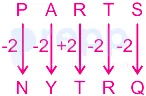
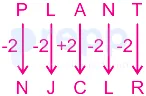
Question 1archived
In the following question below are given some statements followed by some conclusions based on those statements. Taking the given statements to be true even if they seem to be at variance from commonly known facts. Read all the conclusions and then decide which of the given conclusion logically follows the given statements.
Statements:
I. All M are A.
II. No A is R.
Conclusion:
I. No M is R.
II. Some A are M.
III. Some R are A.
- A
Both conclusions I and II follows
- B
Both conclusions II and III follows
- C
All conclusion follows
- D
Both conclusions I and III follows
Show answer
A. Both conclusions I and II followsUnderstanding Statements and Conclusions in Logical Reasoning
This question asks us to analyze given statements and determine which of the provided conclusions logically follow from them. This type of problem falls under the category of logical reasoning, specifically dealing with syllogisms.
Analyzing the Given Statements
We are provided with two statements:
Statement I: All M are A.
Statement II: No A is R.
We must assume these statements are true, even if they contradict common knowledge.
Analyzing the Given Conclusions
We need to evaluate three conclusions:
Conclusion I: No M is R.
Conclusion II: Some A are M.
Conclusion III: Some R are A.
Evaluating Each Conclusion Based on Statements
Let's examine each conclusion to see if it logically follows from the given statements. We can visualize the relationships using Venn diagrams or apply rules of logic.
Evaluation of Conclusion I: No M is R
Statement I tells us that the entire set of 'M' is contained within the set of 'A'. Statement II tells us that the set of 'A' and the set of 'R' have absolutely no overlap.
If all 'M' are inside 'A', and 'A' has nothing in common with 'R', then it must be true that 'M' also has nothing in common with 'R'. Therefore, "No M is R" logically follows from the given statements.
Evaluation of Conclusion II: Some A are M
Statement I says "All M are A". This means that every single element of M is also an element of A. If there are any M's (which is the standard assumption in these types of problems unless specified otherwise), then those M's are also A's. This implies that the group of A's includes the group of M's. Thus, there are some elements within the set A that are also elements of the set M. Therefore, "Some A are M" logically follows from "All M are A".
Evaluation of Conclusion III: Some R are A
Statement II says "No A is R". This means that there is no overlap between the set of 'A' and the set of 'R'. If no A is R, it also means that no R is A. The conclusion "Some R are A" suggests that there is at least some overlap between R and A, which directly contradicts Statement II. Therefore, "Some R are A" does not logically follow from the given statements.
Summary of Conclusions
Based on our analysis:
Conclusion I (No M is R): Follows.
Conclusion II (Some A are M): Follows.
Conclusion III (Some R are A): Does not follow.
Thus, both Conclusion I and Conclusion II follow from the given statements.
Final Answer
The conclusions that follow are I and II.
Conclusion
Logically Follows?
Reasoning
I. No M is R
Yes
If M is subset of A and A & R are disjoint, then M & R are disjoint.
II. Some A are M
Yes
"All M are A" implies some A are M.
III. Some R are A
No
"No A is R" means A and R are disjoint, contradicting "Some R are A".
Revision Table: Logical Reasoning Basics
Statement Type
Representation
Key Implication (if valid)
All X are Y
X is a subset of Y
Some Y are X (usually assumed if X is non-empty)
No X is Y
X and Y are disjoint sets
No Y is X
Some X are Y
X and Y have overlap
Some Y are X
Some X are not Y
Part of X is outside Y
No direct implication about Y and X relation
Additional Information: Syllogism and Venn Diagrams
Syllogism is a form of logical reasoning where a conclusion is drawn from two given or assumed propositions (premises). In this problem, the statements are the premises.
Venn diagrams are often used to visually represent the relationships between sets described in the statements. For example:
"All M are A" can be shown as a circle for M completely inside a circle for A.
"No A is R" can be shown as a circle for A and a circle for R with no overlapping area between them.
By drawing these relationships together, one can visually check if the conclusions hold true. In this case:
Draw circle M inside circle A.
Draw circle R separate from circle A.
Looking at the diagram:
Is there any overlap between M and R? No, because M is inside A, and A doesn't overlap with R. This supports Conclusion I.
Is there any overlap between A and M? Yes, the entire M circle is inside A, meaning the part of A that is M is the M circle itself. This supports Conclusion II.
Is there any overlap between R and A? No, they are separate according to Statement II. This contradicts Conclusion III.
This visual method confirms our logical deduction.
Paper & answer key PDF ↗ Question 2archived
Which two signs and two numbers should be interchanged in the following equation to make it correct?
98 − 9 × 21 ÷ 7 + 56 = 69
- A
56 and 9, + and ×
- B
56 and 21, + and ×
- C
98 and 9, + and ×
- D
21 and 7, + and −
Show answer
A. 56 and 9, + and ×Solving Equation by Interchanging Signs and Numbers
The problem requires us to find which two signs and two numbers, when swapped in the given equation, make the equation mathematically correct.
The original equation is:
\(98 - 9 \times 21 \div 7 + 56 = 69\)
Let's evaluate the original equation using the BODMAS/PEDMAS rule to check if it is initially correct:
Division first: \(21 \div 7 = 3\)
Multiplication next: \(9 \times 3 = 27\)
The equation becomes: \(98 - 27 + 56\)
Addition/Subtraction from left to right: \(98 - 27 = 71\)
Finally: \(71 + 56 = 127\)
So, the original equation is \(127 = 69\), which is false.
We need to test each option by interchanging the specified numbers and signs and then re-evaluating the equation.
Testing Option 1: Interchange 56 and 9, + and ×
Interchange 56 with 9 and + with × in the original equation:
\(98 - \underline{9} \times 21 \div 7 \underline{+} \underline{56} = 69\)
New equation: \(98 \underline{-} \underline{56} \underline{+} 21 \div 7 \underline{\times} \underline{9} = 69\)
Let's evaluate the new equation using BODMAS/PEDMAS:
Division first: \(21 \div 7 = 3\)
Multiplication next: \(3 \times 9 = 27\)
The equation becomes: \(98 - 56 + 27\)
Addition/Subtraction from left to right: \(98 - 56 = 42\)
Finally: \(42 + 27 = 69\)
So, the new equation is \(69 = 69\). This is correct.
Testing Option 2: Interchange 56 and 21, + and ×
Interchange 56 with 21 and + with ×:
Original: \(98 - 9 \times \underline{21} \div 7 \underline{+} \underline{56} = 69\)
New equation: \(98 - 9 \underline{+} \underline{56} \div 7 \underline{\times} \underline{21} = 69\)
Evaluate:
Division: \(56 \div 7 = 8\)
Multiplication: \(8 \times 21 = 168\)
The equation becomes: \(98 - 9 + 168\)
Subtraction: \(98 - 9 = 89\)
Addition: \(89 + 168 = 257\)
So, \(257 = 69\), which is false.
Testing Option 3: Interchange 98 and 9, + and ×
Interchange 98 with 9 and + with ×:
Original: \(\underline{98} - \underline{9} \times 21 \div 7 \underline{+} 56 = 69\)
New equation: \(\underline{9} - \underline{98} \underline{\times} 21 \div 7 \underline{+} 56 = 69\)
Evaluate:
Division: \(21 \div 7 = 3\)
Multiplication: \(98 \times 3 = 294\)
The equation becomes: \(9 - 294 + 56\)
Subtraction: \(9 - 294 = -285\)
Addition: \(-285 + 56 = -229\)
So, \(-229 = 69\), which is false. (Note: If multiplication and addition were swapped, the equation would be \(9 - 98 + 21 \div 7 \times 56\). Division: \(21 \div 7 = 3\). Multiplication: \(3 \times 56 = 168\). Equation: \(9 - 98 + 168\). Subtraction: \(9 - 98 = -89\). Addition: \(-89 + 168 = 79\). So, \(79 = 69\), still false.)
Testing Option 4: Interchange 21 and 7, + and −
Interchange 21 with 7 and + with −:
Original: \(98 \underline{-} 9 \times \underline{21} \div \underline{7} \underline{+} 56 = 69\)
New equation: \(98 \underline{+} 9 \times \underline{7} \div \underline{21} \underline{-} 56 = 69\)
Evaluate:
Division: \(7 \div 21 = \frac{1}{3}\)
Multiplication: \(9 \times \frac{1}{3} = 3\)
The equation becomes: \(98 + 3 - 56\)
Addition: \(98 + 3 = 101\)
Subtraction: \(101 - 56 = 45\)
So, \(45 = 69\), which is false.
Based on the testing, interchanging 56 and 9, along with + and ×, makes the equation correct.
Option
Interchanges
New Equation
Evaluation Result
Correct?
Original
None
\(98 - 9 \times 21 \div 7 + 56 = 69\)
127
No
1
56 <> 9, + <> ×
\(98 - 56 + 21 \div 7 \times 9 = 69\)
69
Yes
2
56 <> 21, + <> ×
\(98 - 9 + 56 \div 7 \times 21 = 69\)
257
No
3
98 <> 9, + <> ×
\(9 - 98 \times 21 \div 7 + 56 = 69\)
-229 (or 79 with different sign swap interpretation)
No
4
21 <> 7, + <> -
\(98 + 9 \times 7 \div 21 - 56 = 69\)
45
No
Revision Table: Equation Solving Concepts
Concept
Description
Importance
Order of Operations (BODMAS/PEDMAS)
Defines the sequence for performing mathematical operations: Brackets/Parentheses, Orders/Exponents, Division/Multiplication (left-to-right), Addition/Subtraction (left-to-right).
Essential for correctly evaluating mathematical expressions and equations.
Sign and Number Interchange
Swapping the positions of numbers or mathematical signs (+, −, ×, ÷) within an equation.
Used in problems to test understanding of operator precedence and algebraic manipulation.
Additional Information: Applying BODMAS/PEDMAS
The order of operations is crucial when evaluating expressions with multiple operations. Let's reiterate BODMAS/PEDMAS:
B/P: Brackets or Parentheses - Solve expressions inside brackets first.
O/E: Orders or Exponents - Calculate powers and square roots.
D/M: Division and Multiplication - Perform these operations from left to right.
A/S: Addition and Subtraction - Perform these operations from left to right.
When interchanging signs and numbers, always re-evaluate the modified expression strictly following this order to determine if the equation holds true.
Paper & answer key PDF ↗ Question 3archived
By interchanging the given two signs which of the following equation will be correct?
+ and –
- A
55 ÷ 11 – 15 + 3 × 2 = 15
- B
4 × 3 – 6 ÷ 2 + 7 = 7
- C
15 - 7 × 8 + 18 ÷ 3 = 65
- D
529 ÷ 23 + 10 - 5 × 4 = 30
Show answer
C. 15 - 7 × 8 + 18 ÷ 3 = 65Understanding Sign Interchange in Mathematical Equations
The question asks us to find which of the given equations becomes correct if we interchange the '+' and '–' signs. This means wherever there is a '+' sign in the original equation, it will be replaced by a '–' sign, and wherever there is a '–' sign, it will be replaced by a '+' sign. Other signs like '×' (multiplication) and '÷' (division) remain unchanged.
Applying the Order of Operations (BODMAS/PEMDAS)
To evaluate each equation after interchanging the signs, we must follow the standard order of operations. The acronyms BODMAS or PEMDAS help remember the order:
B/P: Brackets first / Parentheses first
O/E: Orders (powers, square roots) / Exponents
D/M: Division and Multiplication (from left to right)
A/S: Addition and Subtraction (from left to right)
We will evaluate each option by first interchanging the '+' and '–' signs and then applying the BODMAS/PEMDAS rule.
Evaluating Option 1
Original Equation: \(55 \div 11 – 15 + 3 \times 2 = 15\)
After interchanging '+' and '–' signs:
\(55 \div 11 + 15 – 3 \times 2\)
Now, let's evaluate using BODMAS/PEMDAS:
First, Division and Multiplication (from left to right):
\(55 \div 11 = 5\)
\(3 \times 2 = 6\)
Substitute back into the expression:
\(5 + 15 – 6\)
Next, Addition and Subtraction (from left to right):
\(5 + 15 = 20\)
\(20 – 6 = 14\)
The result is 14. The original equation states the result should be 15. Since \(14 \neq 15\), Option 1 is incorrect after the sign interchange.
Evaluating Option 2
Original Equation: \(4 \times 3 – 6 \div 2 + 7 = 7\)
After interchanging '+' and '–' signs:
\(4 \times 3 + 6 \div 2 – 7\)
Now, let's evaluate using BODMAS/PEMDAS:
First, Multiplication and Division (from left to right):
\(4 \times 3 = 12\)
\(6 \div 2 = 3\)
Substitute back into the expression:
\(12 + 3 – 7\)
Next, Addition and Subtraction (from left to right):
\(12 + 3 = 15\)
\(15 – 7 = 8\)
The result is 8. The original equation states the result should be 7. Since \(8 \neq 7\), Option 2 is incorrect after the sign interchange.
Evaluating Option 3
Original Equation: \(15 - 7 \times 8 + 18 \div 3 = 65\)
After interchanging '+' and '–' signs:
\(15 + 7 \times 8 - 18 \div 3\)
Now, let's evaluate using BODMAS/PEMDAS:
First, Multiplication and Division (from left to right):
\(7 \times 8 = 56\)
\(18 \div 3 = 6\)
Substitute back into the expression:
\(15 + 56 - 6\)
Next, Addition and Subtraction (from left to right):
\(15 + 56 = 71\)
\(71 - 6 = 65\)
The result is 65. The original equation states the result should be 65. Since \(65 = 65\), Option 3 is correct after the sign interchange.
Evaluating Option 4
Original Equation: \(529 \div 23 + 10 - 5 \times 4 = 30\)
After interchanging '+' and '–' signs:
\(529 \div 23 - 10 + 5 \times 4\)
Now, let's evaluate using BODMAS/PEMDAS:
First, Division and Multiplication (from left to right):
\(529 \div 23 = 23\)
\(5 \times 4 = 20\)
Substitute back into the expression:
\(23 - 10 + 20\)
Next, Addition and Subtraction (from left to right):
\(23 - 10 = 13\)
\(13 + 20 = 33\)
The result is 33. The original equation states the result should be 30. Since \(33 \neq 30\), Option 4 is incorrect after the sign interchange.
Conclusion
After evaluating all the options by interchanging the '+' and '–' signs and applying the order of operations, only Option 3 results in a correct mathematical equation.
Option
Original Equation
After Swapping + and –
Evaluation Steps
Result
Expected Result
Correct?
1
\(55 \div 11 – 15 + 3 \times 2 = 15\)
\(55 \div 11 + 15 – 3 \times 2\)
\(5 + 15 – 6 = 20 – 6 = 14\)
14
15
No
2
\(4 \times 3 – 6 \div 2 + 7 = 7\)
\(4 \times 3 + 6 \div 2 – 7\)
\(12 + 3 – 7 = 15 – 7 = 8\)
8
7
No
3
\(15 - 7 \times 8 + 18 \div 3 = 65\)
\(15 + 7 \times 8 - 18 \div 3\)
\(15 + 56 - 6 = 71 - 6 = 65\)
65
65
Yes
4
\(529 \div 23 + 10 - 5 \times 4 = 30\)
\(529 \div 23 - 10 + 5 \times 4\)
\(23 - 10 + 20 = 13 + 20 = 33\)
33
30
No
Revision Table: Key Concepts
Concept
Description
Importance
Sign Interchange
Swapping two given mathematical signs in an expression or equation.
Changes the value of the expression; requires careful evaluation.
Order of Operations (BODMAS/PEMDAS)
Rules specifying the sequence in which mathematical operations should be performed.
Ensures consistent and correct evaluation of mathematical expressions.
Equation Verification
Checking if the left side of an equation equals the right side after performing calculations.
Determines the correctness of the equation.
Additional Information: Mathematical Operations and Symbols
Mathematical operations are fundamental actions performed on numbers. The basic operations are addition, subtraction, multiplication, and division. Understanding how these operations work and their symbols is crucial for solving mathematical problems.
Addition (\(+\)): Combining quantities.
Subtraction (\(-\)): Finding the difference between quantities.
Multiplication (\(\times\)): Repeated addition or scaling.
Division (\(\div\)): Sharing equally or splitting into groups.
In problems involving interchanging signs, it's important to clearly identify the signs to be swapped and then carefully rewrite the equation before performing the calculations according to the order of operations. Errors often occur if the order of operations is not strictly followed or if the sign interchange is done incorrectly.
Paper & answer key PDF ↗ Question 4archived
After arranging the given words according to dictionary order, which word will come at ‘Fourth’ position?
1. Remark
2. Remain
3. Remember
4. Remnant
5. Remanent
- A
Remanent
- B
Remark
- C
Remnant
- D
Remember
Show answer
D. RememberFinding the Fourth Word in Dictionary Order
This question asks us to arrange a given list of five words in alphabetical or dictionary order and then identify the word that appears in the fourth position.
Understanding Dictionary Order
Dictionary order, also known as alphabetical order, is based on the sequence of letters in the alphabet (a, b, c, ..., z). When comparing words, we compare them letter by letter from left to right. The word with the letter that comes earlier in the alphabet at the first point of difference is placed earlier in the list.
Let's look at the given words:
Remark
Remain
Remember
Remnant
Remanent
Step-by-Step Arrangement
All the words begin with the letters "Rem". So, we need to look at the fourth letter of each word to determine the order initially.
Remark: The fourth letter is 'a'.
Remain: The fourth letter is 'a'.
Remember: The fourth letter is 'e'.
Remnant: The fourth letter is 'n'.
Remanent: The fourth letter is 'a'.
Comparing the fourth letters ('a', 'e', 'n'), 'a' comes first, then 'e', then 'n'. This means words starting with "Rema" will come before "Reme" and "Remn".
Ordering words starting with "Rema":
We have Remark, Remain, and Remanent. All start with "Rema". We now look at the fifth letter:
Remark: Fifth letter is 'r'.
Remain: Fifth letter is 'i'.
Remanent: Fifth letter is 'n'.
Comparing 'r', 'i', and 'n', the alphabetical order is 'i', 'n', 'r'.
So, the order for these three words is:
Remain
Remanent
Remark
Ordering words starting with "Reme" and "Remn":
We have Remember and Remnant. The fourth letters are 'e' and 'n' respectively. 'e' comes before 'n' in the alphabet.
So, the order for these two words is:
Remember
Remnant
Final Combined Dictionary Order
Now we combine the two sets based on the order of their fourth letters ('a' before 'e' before 'n').
The complete list in dictionary order is:
Remain
Remanent
Remark
Remember
Remnant
Identifying the Fourth Word
Looking at the sorted list, the word at the fourth position is Remember.
Position
Word
Comparison Point
1st
Remain
Rem + a + i
2nd
Remanent
Rem + a + n
3rd
Remark
Rem + a + r
4th
Remember
Rem + e
5th
Remnant
Rem + n
Therefore, the word that comes at the fourth position after arranging the given words according to dictionary order is Remember.
Revision Table: Dictionary Order Sorting
Word
Fourth Letter
Fifth Letter (if needed)
Final Position
Remark
a
r
3rd
Remain
a
i
1st
Remember
e
-
4th
Remnant
n
-
5th
Remanent
a
n
2nd
Additional Information: Alphabetical Sorting Rules
When sorting words alphabetically, consider these rules:
Compare words letter by letter from left to right.
The word with the letter that comes earlier in the alphabet at the first point of difference comes first.
If one word is a prefix of another (e.g., "care" and "careful"), the shorter word comes first ("care" before "careful").
Spaces and hyphens can also affect sorting, depending on the specific sorting rules being applied, but for simple word lists like this, they are usually not a factor unless present within the words themselves.
Case (uppercase vs. lowercase) can matter, but typically lists for such questions are presented with consistent casing. If mixed, standard dictionary order usually places lowercase after uppercase, or sometimes treats them equally.
Mastering dictionary order helps in organizing information efficiently and is a fundamental skill related to vocabulary and language structure.
Paper & answer key PDF ↗ Question 5archived
A series is given with one term missing. Select the correct alternative from the given ones that will complete the series.
NMTS, SGAK, XAHC, CUOU, ?
- A
OMQR
- B
HVMO
- C
HOVM
- D
RMNO
Show answer
C. HOVMAnalyzing the Letter Series Pattern
The question asks us to find the next term in the given letter series: NMTS, SGAK, XAHC, CUOU, ?. To solve this, we need to identify the pattern or rule that connects consecutive terms in the series. Let's examine the pattern for each letter position separately.
First Letter Analysis
Let's look at the first letter of each term:
N (14th letter)
S (19th letter)
X (24th letter)
C (3rd letter)
?
We can see the following progression in their alphabetical positions:
N to S: $19 - 14 = +5$
S to X: $24 - 19 = +5$
X to C: $24 \xrightarrow{+5} 29$. Since the alphabet has 26 letters, 29 corresponds to $29 - 26 = 3$, which is C. So, this is also $+5$ with wrap-around.
C to ?: Following the pattern, the next letter should be $3 + 5 = 8$. The 8th letter is H.
The pattern for the first letter is adding 5 to the alphabetical position, wrapping around from Z to A.
Second Letter Analysis
Now let's look at the second letter of each term:
M (13th letter)
G (7th letter)
A (1st letter)
U (21st letter)
?
Let's find the difference in their alphabetical positions:
M to G: $7 - 13 = -6$
G to A: $1 - 7 = -6$
A to U: $1 \xrightarrow{-6} -5$. Since the alphabet wraps around, $-5$ corresponds to $-5 + 26 = 21$, which is U. So, this is also $-6$ with wrap-around.
U to ?: Following the pattern, the next letter should be $21 - 6 = 15$. The 15th letter is O.
The pattern for the second letter is subtracting 6 from the alphabetical position, wrapping around from A to Z.
Third Letter Analysis
Let's examine the third letter of each term:
T (20th letter)
A (1st letter)
H (8th letter)
O (15th letter)
?
Let's find the difference in their alphabetical positions:
T to A: $1 \xrightarrow{+?} 20$. This seems like a large negative difference. Let's consider wrap-around. $20 \xrightarrow{+7} 27$. $27 - 26 = 1$, which is A. So, this is $+7$ with wrap-around.
A to H: $8 - 1 = +7$
H to O: $15 - 8 = +7$
O to ?: Following the pattern, the next letter should be $15 + 7 = 22$. The 22nd letter is V.
The pattern for the third letter is adding 7 to the alphabetical position, wrapping around from Z to A.
Fourth Letter Analysis
Finally, let's look at the fourth letter of each term:
S (19th letter)
K (11th letter)
C (3rd letter)
U (21st letter)
?
Let's find the difference in their alphabetical positions:
S to K: $11 - 19 = -8$
K to C: $3 - 11 = -8$
C to U: $3 \xrightarrow{-8} -5$. Since the alphabet wraps around, $-5$ corresponds to $-5 + 26 = 21$, which is U. So, this is also $-8$ with wrap-around.
U to ?: Following the pattern, the next letter should be $21 - 8 = 13$. The 13th letter is M.
The pattern for the fourth letter is subtracting 8 from the alphabetical position, wrapping around from A to Z.
Combining the Patterns
We found the following patterns for each letter position:
1st letter: +5
2nd letter: -6
3rd letter: +7
4th letter: -8
Applying these patterns to the last term, CUOU:
1st letter: C (+5) → H
2nd letter: U (-6) → O
3rd letter: O (+7) → V
4th letter: U (-8) → M
Combining these letters gives us the next term: HOVM.
Revision Table: Key Patterns in the Series
Position
Letters in Series
Pattern
Result for Next Term
1st
N, S, X, C
+5 (mod 26)
C $\xrightarrow{+5}$ H
2nd
M, G, A, U
-6 (mod 26)
U $\xrightarrow{-6}$ O
3rd
T, A, H, O
+7 (mod 26)
O $\xrightarrow{+7}$ V
4th
S, K, C, U
-8 (mod 26)
U $\xrightarrow{-8}$ M
Based on the analysis, the next term completing the series is HOVM.
Additional Information: Solving Letter Series Questions
Letter series questions are common in reasoning and aptitude tests. Here are some general strategies to solve them:
Analyze position: Look at the change in alphabetical position for each letter in corresponding positions across the series.
Identify patterns: The change can be a constant addition, subtraction, multiplication, division, or a varying pattern (e.g., +1, +2, +3... or +2, -1, +3, -2...).
Consider groups: Sometimes the pattern applies to blocks of letters.
Check for alphabetical skips: The pattern might involve skipping a fixed or varying number of letters.
Reverse alphabet: Sometimes patterns work backwards from Z to A.
Combination of patterns: Different positions within the same term might follow different patterns, as seen in this example (+5, -6, +7, -8).
Vowel/Consonant patterns: Occasionally, the pattern relates to whether a letter is a vowel or a consonant.
Visual patterns: Sometimes the pattern is visual based on the shape or structure of the letters.
By systematically analyzing each position and testing different types of patterns, you can usually crack letter series questions.
Paper & answer key PDF ↗ Question 6archived
If A ÷ B means that A is the father of B, A – B means that A is the mother of B, A + B means that A is the brother of B then which of the following expression shows that P is the mother of R?
- A
Q – P + R
- B
P – Q + R
- C
P – Q ÷ R
- D
R + P – Q
Show answer
B. P – Q + RUnderstanding Blood Relations from Symbols
This question asks us to decode relationships given by symbols and find the expression that represents a specific relationship: P is the mother of R. We are given the meaning of three symbols:
$\text{A} \div \text{B}$ means A is the father of B.
$\text{A} - \text{B}$ means A is the mother of B.
$\text{A} + \text{B}$ means A is the brother of B.
To find the correct expression, we need to analyze each option based on these rules and see which one results in P being the mother of R.
Analyzing Each Option
Option 1: Q – P + R
$\text{Q} - \text{P}$: According to the rule, Q is the mother of P.
$\text{P} + \text{R}$: According to the rule, P is the brother of R.
Combining these, Q is the mother of P, and P is the brother of R. If P is the brother of R, then P and R are siblings. If Q is the mother of P, and P and R are siblings, then Q is also the mother of R. This expression shows Q is the mother of R, not P is the mother of R.
Option 2: P – Q + R
$\text{P} - \text{Q}$: According to the rule, P is the mother of Q.
$\text{Q} + \text{R}$: According to the rule, Q is the brother of R.
Combining these, P is the mother of Q, and Q is the brother of R. If P is the mother of Q, and Q is the brother of R, it means Q and R are siblings, and P is their mother. Therefore, P is the mother of R. This expression correctly shows that P is the mother of R.
Option 3: P – Q ÷ R
$\text{P} - \text{Q}$: According to the rule, P is the mother of Q.
$\text{Q} \div \text{R}$: According to the rule, Q is the father of R.
Combining these, P is the mother of Q, and Q is the father of R. P is the mother of Q, who is the father of R. This means P is the mother of R's father, which makes P the grandmother of R. This expression does not show P is the mother of R.
Option 4: R + P – Q
$\text{R} + \text{P}$: According to the rule, R is the brother of P.
$\text{P} - \text{Q}$: According to the rule, P is the mother of Q.
Combining these, R is the brother of P, and P is the mother of Q. This means R and P are siblings, and P is the mother of Q. This expression shows P is the mother of Q, and R is P's sibling, not that P is the mother of R.
Summary of Analysis
Expression
Relationship from P to R
Q – P + R
Q is mother of R (P is brother of R)
P – Q + R
P is mother of R
P – Q ÷ R
P is grandmother of R
R + P – Q
P is R's sibling and mother of Q
Based on the analysis, only the expression $\text{P} - \text{Q} + \text{R}$ correctly represents that P is the mother of R.
Conclusion: Identifying the Correct Blood Relation
By systematically decoding each expression based on the given rules, we found that the expression $\text{P} - \text{Q} + \text{R}$ establishes the relationship where P is the mother of R.
Revision Table: Key Blood Relation Symbols
Symbol
Relationship (A to B)
$\div$
A is father of B
$-$
A is mother of B
$+$
A is brother of B
Additional Information: Solving Blood Relation Questions
Blood relation questions test your ability to understand and interpret relationships within a family. When symbols are used, it's crucial to first write down what each symbol means clearly. Then, break down the given expression segment by segment, establishing the relationship between each pair of individuals. Finally, combine these smaller relationships to determine the overall relationship between the individuals asked about (in this case, P and R). Drawing a family tree or diagram can sometimes help visualize the relationships, especially in more complex problems.
Paper & answer key PDF ↗ Question 7archived
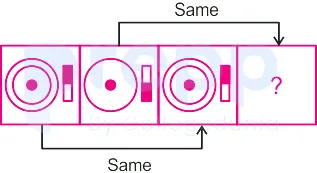
Select the figure that will replace the question mark (?) in the following figure series.

- A
Option A (shown in image)
- B
Option B (shown in image)
- C
Option C (shown in image)
- D
Option D (shown in image)
Show answer
Question 8archived
Three of the following letter-clusters are alike in some manner and hence form a group. Which letter-cluster does not belong to that group?
- A
HBL
- B
IJR
- C
XUC
- D
TYG
Show answer
A. HBLFinding the Odd Letter Cluster Out
This question asks us to identify the letter cluster that does not follow the same pattern as the other three. These types of problems often involve looking at the positions of letters in the English alphabet.
Understanding Letter Positions
Let's first list the positions of the letters A through Z:
Letter
Position
Letter
Position
A
1
N
14
B
2
O
15
C
3
P
16
D
4
Q
17
E
5
R
18
F
6
S
19
G
7
T
20
H
8
U
21
I
9
V
22
J
10
W
23
K
11
X
24
L
12
Y
25
M
13
Z
26
Analyzing the Letter Clusters and Finding the Pattern
Let's look at the positions of the letters in each given cluster:
HBL: H is 8th, B is 2nd, L is 12th.
IJR: I is 9th, J is 10th, R is 18th.
XUC: X is 24th, U is 21st, C is 3rd.
TYG: T is 20th, Y is 25th, G is 7th.
Let's try to find a relationship between the letter positions within each cluster. Observing the options IJR, XUC, and TYG, a pattern involving adding a constant value to the position of the second letter to get the position of the third letter seems possible, considering the alphabet wraps around from Z to A (modulo 26 arithmetic).
Let's check the relationship between the second and third letters in options 2, 3, and 4:
IJR: Second letter is J (10). Third letter is R (18). The difference is $18 - 10 = 8$.
XUC: Second letter is U (21). Third letter is C (3). To get from U (21) to C (3) going forward in the alphabet, we wrap around Z. The steps are $21 \to 22 \to \dots \to 26 \to 1 \to 2 \to 3$. The number of steps is $(26 - 21) + 3 = 5 + 3 = 8$. This is equivalent to saying $21 + 8 = 29$, and $29 \pmod{26} = 3$. So, U + 8 positions = C.
TYG: Second letter is Y (25). Third letter is G (7). To get from Y (25) to G (7) going forward, we wrap around Z. The steps are $25 \to 26 \to 1 \to \dots \to 7$. The number of steps is $(26 - 25) + 7 = 1 + 7 = 8$. This is equivalent to saying $25 + 8 = 33$, and $33 \pmod{26} = 7$. So, Y + 8 positions = G.
It appears the pattern for options 2, 3, and 4 is: The position of the third letter is 8 more than the position of the second letter, considering the alphabet cycles from Z back to A (using modulo 26). Mathematically, Position(Third Letter) $\equiv$ Position(Second Letter) $+ 8 \pmod{26}$.
(Note: If the result of the addition is exactly 26, it corresponds to Z, which is often treated as position 0 or 26 in modulo arithmetic depending on the context. Here, 1-26 is used. If calculation yields 26, it's Z. If it exceeds 26, subtract 26. If calculation results in 0 or less, add 26. For example, position 26 + 8 = 34. $34 - 26 = 8$, which is H. Position 21 + 8 = 29. $29 - 26 = 3$, which is C.)
Checking Option 1 against the Pattern
Now let's check option 1, HBL, against this pattern:
HBL: Second letter is B (2). According to the pattern, the third letter should be at position $2 + 8 = 10$. The 10th letter is J. However, the third letter in HBL is L (12).
Since $10 \neq 12$, the letter cluster HBL does not follow the same pattern as the other three.
Conclusion
The letter clusters IJR, XUC, and TYG follow the pattern where the third letter's position is 8 more than the second letter's position (modulo 26). The letter cluster HBL does not follow this pattern because $B+8=J$, not L.
Therefore, HBL does not belong to the group.
Revision Table: Letter Cluster Patterns
Letter Cluster
Positions
Second Letter Position
Calculation (+8 Mod 26)
Expected Third Letter Position
Actual Third Letter Position
Fits Pattern?
HBL
8, 2, 12
2 (B)
$2 + 8 = 10$
10 (J)
12 (L)
No
IJR
9, 10, 18
10 (J)
$10 + 8 = 18$
18 (R)
18 (R)
Yes
XUC
24, 21, 3
21 (U)
$21 + 8 = 29 \equiv 3 \pmod{26}$
3 (C)
3 (C)
Yes
TYG
20, 25, 7
25 (Y)
$25 + 8 = 33 \equiv 7 \pmod{26}$
7 (G)
7 (G)
Yes
Additional Information: Reasoning Questions
Reasoning questions involving letter clusters or series often test your ability to identify patterns based on:
Alphabetical positions (forward or backward).
Differences or sums between letter positions.
Vowels and consonants.
Reverse alphabetical order.
Specific sequences or rules (like skipping letters).
Combinations of these rules.
Solving these problems usually requires listing the letter positions and systematically checking for simple mathematical relationships or other rules that apply consistently to some items but not others. The "odd one out" is the item that breaks the established pattern.
Paper & answer key PDF ↗ Question 9archived
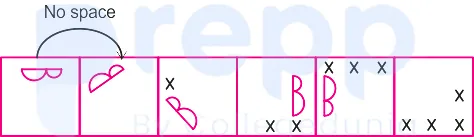
Select the correct mirror image of the given combination when the mirror is placed at ‘PQ’ as shown below.

- A
Option A (shown in image)
- B
Option B (shown in image)
- C
Option C (shown in image)
- D
Option D (shown in image)
Show answer
Question 10archived
Select the correct combination of mathematical signs to sequentially replace the % signs and to balance the given equation.
[{(32 % 28) % (6 % 4)} % (1 % 7)] % 5 % 20
- A
-, +, ×, ÷, ×, ×, =
- B
×, ÷, ×, ×, -, +, =
- C
×, -, +, ×, ÷, ×, =
- D
-, +, ×, ×, ×, ×, =
Show answer
A. -, +, ×, ÷, ×, ×, =Solving Mathematical Equation with Signs
The question asks us to find the correct combination of mathematical signs to replace the percentage (%) symbols in the given equation so that the equation balances. The equation is:
\([\{(32 \% 28) \% (6 \% 4)\} \% (1 \% 7)] \% 5 \% 20\)
Based on the options provided and the structure ending with \(\% 20\), it is implied that the equation should equal 20 after performing the operations. Therefore, the equation we need to balance is:
\([\{(32 \% 28) \% (6 \% 4)\} \% (1 \% 7)] \% 5 = 20\)
We need to test each option by substituting the signs sequentially into the equation and following the order of operations (BODMAS/PEMDAS: Brackets, Orders, Division and Multiplication, Addition and Subtraction).
Testing the Correct Combination of Signs
Let's use the signs from the correct option, which are \(-, +, \times, \div, \times, \times, =\). Substituting these signs into the equation:
\([\{(32 \text{ - } 28) \text{ + } (6 \text{ × } 4)\} \text{ ÷ } (1 \text{ × } 7)] \text{ × } 5 = 20\)
Step-by-Step Calculation to Balance the Equation
Now, let's solve the equation step-by-step:
Start with the innermost brackets:
\( (32 - 28) = 4 \)
\( (6 \times 4) = 24 \)
\( (1 \times 7) = 7 \)
Substitute these results back into the equation:
\([\{(4) + (24)\} \div (7)] \times 5 = 20\)
Solve the next level of brackets:
\( \{(4) + (24)\} = 28 \)
Substitute this result back:
\([28 \div 7] \times 5 = 20\)
Solve the expression inside the square brackets:
\( [28 \div 7] = 4 \)
Substitute this result back:
\(4 \times 5 = 20\)
Perform the final operation:
\(4 \times 5 = 20\)
So, we get \(20 = 20\). The equation balances with the signs \(-, +, \times, \div, \times, \times\).
Let's summarize the steps in a table:
Step
Calculation
Result
Original Equation (with signs)
\( [\{(32 - 28) + (6 \times 4)\} \div (1 \times 7)] \times 5 \)
\( 20 \) (Target)
Innermost Brackets 1
\( (32 - 28) \)
\( 4 \)
Innermost Brackets 2
\( (6 \times 4) \)
\( 24 \)
Innermost Brackets 3
\( (1 \times 7) \)
\( 7 \)
Substituting back
\( [\{(4) + (24)\} \div (7)] \times 5 \)
Next Brackets 1
\( \{(4) + (24)\} \)
\( 28 \)
Substituting back
\( [28 \div 7] \times 5 \)
Square Brackets
\( [28 \div 7] \)
\( 4 \)
Substituting back
\( 4 \times 5 \)
Final Calculation
\( 4 \times 5 \)
\( 20 \)
Check Balance
\( 20 = 20 \)
Balanced
The steps show that using the signs \(-, +, \times, \div, \times, \times\) sequentially makes the equation equal to 20, thus balancing it.
Revision Table: Mathematical Operations and Order
Operation Type
Symbols
Priority in BODMAS/PEMDAS
Brackets
(), {}, []
Highest
Orders (Exponents)
\(x^n\)
Second Highest
Division and Multiplication
\(\div, \times\)
Third Highest (from left to right)
Addition and Subtraction
\(+, -\)
Lowest (from left to right)
Additional Information: Equation Balancing Practice
Balancing equations by substituting signs is a common type of problem in competitive exams and logical reasoning tests. It requires careful application of the order of operations. Practicing different combinations of signs and operations helps improve speed and accuracy. Always solve operations within brackets first, starting from the innermost set. Then proceed with orders, followed by division and multiplication (from left to right), and finally addition and subtraction (from left to right).
Paper & answer key PDF ↗ Question 11archived
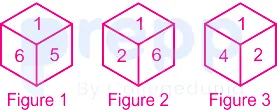
Three different positions of the same dice are shown. Find the number on the face opposite the face having ‘3’.
- A
1
- B
2
- C
5
- D
6
Show answer
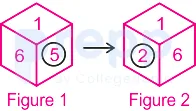
A. 1When comparing figures 1 and 2, we get:
When '1' and '6' are visible in both dices, we get '5' and '2' are opposite to each other.
Now we compare figures 2 and 3, we get:
When '1' and '2' are visible in both dices, we get '4' and '6' are opposite to each other.
Since there are six sides on a dice the remaining two sides will be opposite to each other i.e., '3' and '1'.
So, the opposite of '3' will be '1'.
Hence, the correct answer is "Option 1".
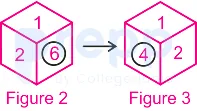 Paper & answer key PDF ↗
 Question 12archived
Select the figure from among the given options that can replace the question mark (?) in the following series.

- A
Option A (shown in image)
- B
Option B (shown in image)
- C
Option C (shown in image)
- D
Option D (shown in image)
Show answer
Question 13archived
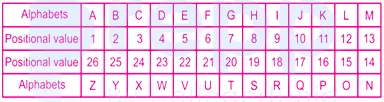
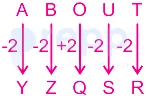
In a certain code language, 'ABOUT’ is written as 'YZQSR' and 'PARTS' is written as 'NYTRQ'. How will 'PLANT' be written in that language?
- A
NICRL
- B
NJCLR
- C
RJCLV
- D
NJDLP
Show answer
Question 14archived
Select the option that is related to the third term in the same way as the second term is related to the first term and the sixth term is related to the fifth term.
5 ∶ 150 ∶∶ 6 ∶ ? ∶∶ 8 ∶ 576
- A
252
- B
255
- C
225
- D
222
Show answer
A. 252Understanding Numerical Analogy Patterns
This question is based on numerical analogy, where you need to find the relationship between the numbers in the first pair and the fifth pair, and then apply the same relationship to find the missing number in the third pair. The question presents the following structure:
$5 \ratio 150 \ratio\ratio 6 \ratio ? \ratio\ratio 8 \ratio 576$
We need to discover the rule that connects the first number to the second number in the given pairs and use that rule for the third pair to find the missing term.
Analyzing the Given Pairs to Find the Pattern
Let's look at the first pair: 5 ∶ 150.
How can we get 150 from 5? Let's try some common mathematical operations involving the number itself.
Maybe it's multiplication? $5 \times 30 = 150$. Is 30 related to 5?
Let's consider powers of 5. $5^2 = 25$, $5^3 = 125$.
Notice that $125$ is close to $150$. The difference is $150 - 125 = 25$. Interestingly, $25$ is $5^2$.
This suggests a possible pattern: the second number is the sum of the cube and the square of the first number. Let's test this hypothesis.
If the first number is $n$, the second number is $n^3 + n^2$.
For the first pair, $n=5$:
Calculation: $5^3 + 5^2 = 125 + 25 = 150$. This matches the given relationship.
Now, let's verify this pattern with the third pair: 8 ∶ 576.
Here, the first number is $n=8$. According to our proposed pattern, the second number should be $8^3 + 8^2$.
Calculation: $8^3 + 8^2 = (8 \times 8 \times 8) + (8 \times 8) = 512 + 64 = 576$. This also matches the given relationship.
Applying the Pattern to Find the Missing Term
Since the pattern $n^3 + n^2$ holds true for both given pairs, we can apply it to the second pair: 6 ∶ ?.
Here, the first number is $n=6$. The missing number will be $6^3 + 6^2$.
Calculation: $6^3 + 6^2 = (6 \times 6 \times 6) + (6 \times 6) = 216 + 36 = 252$.
Thus, the missing term is 252.
Checking the Options
The calculated missing number is 252. Let's check the given options:
252
255
225
222
The number 252 is present as option 1.
Conclusion
The relationship between the numbers in each pair is that the second number is the sum of the cube and the square of the first number ($n^3 + n^2$). Applying this rule to the number 6 gives $6^3 + 6^2 = 216 + 36 = 252$.
First Term ($n$)
Relationship ($n^3 + n^2$)
Second Term
5
$5^3 + 5^2 = 125 + 25$
150
6
$6^3 + 6^2 = 216 + 36$
252
8
$8^3 + 8^2 = 512 + 64$
576
Revision Table: Numerical Analogy Pattern
The core pattern identified in this analogy question is based on the powers of the first number in each pair. The relationship is consistently the sum of the cube and the square of the first number.
Pattern: $n \ratio n^3 + n^2$
Example 1: $5 \ratio 5^3 + 5^2 = 125 + 25 = 150$
Example 2: $8 \ratio 8^3 + 8^2 = 512 + 64 = 576$
Applying to the problem: $6 \ratio 6^3 + 6^2 = 216 + 36 = 252$
Additional Information: Types of Numerical Analogies
Numerical analogy questions test your ability to identify mathematical relationships between numbers. Common patterns include:
Arithmetic Operations: Addition, subtraction, multiplication, division.
Powers and Roots: Squares, cubes, square roots, cube roots.
Series and Sequences: Patterns based on specific number series (e.g., prime numbers, Fibonacci sequence).
Combinations of Operations: Like the pattern in this question (powers combined with addition).
Digit Manipulation: Sum of digits, product of digits, reversing digits.
To solve such questions, practice is key. Try breaking down the numbers and testing different common mathematical relationships systematically.
Paper & answer key PDF ↗ Question 15archived
Which letter cluster will replace the question mark (?) to complete the given series?
ZYWT, XWUR, VUSP, ?, RQOL
- A
TSQN
- B
TSQM
- C
TSPN
- D
STQN
Show answer
A. TSQNAnalyzing the Letter Series Pattern to Find the Missing Cluster
The question asks us to find the letter cluster that completes the given series: ZYWT, XWUR, VUSP, ?, RQOL. To solve this type of letter series problem, we need to identify the pattern governing the change in letters from one cluster to the next.
Step-by-Step Analysis of the Letter Series
Let's examine the letters in each position within the clusters across the series:
Cluster
1st Letter
2nd Letter
3rd Letter
4th Letter
ZYWT
Z
Y
W
T
XWUR
X
W
U
R
VUSP
V
U
S
P
?
?
?
?
?
RQOL
R
Q
O
L
Pattern for the First Letter
Let's look at the sequence of the first letters: Z, X, V, ?, R.
Z to X: Moving backward in the alphabet by 2 positions ($Z \rightarrow Y \rightarrow X$). This is a difference of -2.
X to V: Moving backward by 2 positions ($X \rightarrow W \rightarrow V$). This is a difference of -2.
The pattern for the first letter appears to be a consistent backward movement of 2 positions in the alphabet. Following this pattern:
V to ?: Moving backward by 2 positions ($V \rightarrow U \rightarrow T$). The next letter should be T.
? (T) to R: Moving backward by 2 positions ($T \rightarrow S \rightarrow R$). This confirms the pattern for the first letter.
So, the first letter of the missing cluster is T.
Pattern for the Second Letter
Let's look at the sequence of the second letters: Y, W, U, ?, Q.
Y to W: Moving backward by 2 positions ($Y \rightarrow X \rightarrow W$). Difference of -2.
W to U: Moving backward by 2 positions ($W \rightarrow V \rightarrow U$). Difference of -2.
The pattern for the second letter also appears to be a consistent backward movement of 2 positions. Following this pattern:
U to ?: Moving backward by 2 positions ($U \rightarrow T \rightarrow S$). The next letter should be S.
? (S) to Q: Moving backward by 2 positions ($S \rightarrow R \rightarrow Q$). This confirms the pattern for the second letter.
So, the second letter of the missing cluster is S.
Pattern for the Third Letter
Let's look at the sequence of the third letters: W, U, S, ?, O.
W to U: Moving backward by 2 positions ($W \rightarrow V \rightarrow U$). Difference of -2.
U to S: Moving backward by 2 positions ($U \rightarrow T \rightarrow S$). Difference of -2.
The pattern for the third letter is also a consistent backward movement of 2 positions. Following this pattern:
S to ?: Moving backward by 2 positions ($S \rightarrow R \rightarrow Q$). The next letter should be Q.
? (Q) to O: Moving backward by 2 positions ($Q \rightarrow P \rightarrow O$). This confirms the pattern for the third letter.
So, the third letter of the missing cluster is Q.
Pattern for the Fourth Letter
Let's look at the sequence of the fourth letters: T, R, P, ?, L.
T to R: Moving backward by 2 positions ($T \rightarrow S \rightarrow R$). Difference of -2.
R to P: Moving backward by 2 positions ($R \rightarrow Q \rightarrow P$). Difference of -2.
The pattern for the fourth letter is also a consistent backward movement of 2 positions. Following this pattern:
P to ?: Moving backward by 2 positions ($P \rightarrow O \rightarrow N$). The next letter should be N.
? (N) to L: Moving backward by 2 positions ($N \rightarrow M \rightarrow L$). This confirms the pattern for the fourth letter.
So, the fourth letter of the missing cluster is N.
Constructing the Missing Letter Cluster
Combining the letters found for each position, the missing cluster is formed by the first, second, third, and fourth letters determined: T, S, Q, N.
The missing letter cluster is TSQN.
Comparing with Options
Let's check if the derived cluster matches any of the given options.
Option 1: TSQN
Option 2: TSQM
Option 3: TSPN
Option 4: STQN
The derived cluster TSQN matches Option 1.
Conclusion
The letter cluster that replaces the question mark (?) to complete the given series is TSQN.
Revision Table: Letter Series Analysis
This table summarizes the pattern found for each letter position.
Position
Letter Sequence
Pattern
Missing Letter
1st
Z, X, V, ?, R
Decrement by 2
T
2nd
Y, W, U, ?, Q
Decrement by 2
S
3rd
W, U, S, ?, O
Decrement by 2
Q
4th
T, R, P, ?, L
Decrement by 2
N
Additional Information: Understanding Letter Series Reasoning
Letter series questions are common in reasoning ability tests. They require you to identify a specific pattern in a sequence of letters or letter clusters. Common patterns include:
Alphabetical Progression: Letters move forward or backward in the alphabet by a fixed number of steps (like in this problem, decrementing by 2).
Skip Pattern: Letters skip a certain number of letters in between.
Combination of Patterns: Different positions in a cluster might follow different rules.
Positional Value: Sometimes the numerical position of the letter in the alphabet (A=1, B=2, ...) is used to find patterns (e.g., adding or subtracting numbers).
Repetition or Alternation: Simple repeating or alternating sequences.
To solve these questions effectively, it's helpful to know the alphabetical order and perhaps even the numerical position of each letter. Practice with different types of letter series helps in quickly identifying the underlying rule.
Paper & answer key PDF ↗ Question 16archived
Select the option figure in which the given figure (X) is embedded as its part (rotation is NOT allowed).

- A
Option A (shown in image)
- B
Option B (shown in image)
- C
Option C (shown in image)
- D
Option D (shown in image)
Show answer
B. Option B (shown in image)We consider each option:
Hence, the correct answer is "Option 2".
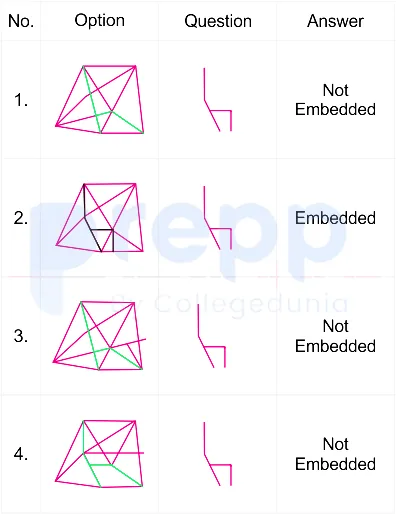 Paper & answer key PDF ↗
 Question 17archived
Study the given pattern carefully and select the number that can replace the question mark (?) in it.
First row - 6, 9, 90
Second row - 12, 8, 120
Third row - 13, 6, ?
(NOTE: Operations should be performed on the whole numbers, without breaking down the numbers into its constituent digits. E.g. 13 – Operations on 13 such as adding / subtracting / multiplying etc. to 13 can be performed. Breaking down 13 into 1 and 3 and then performing mathematical operations on 1 and 3 is NOT allowed)
- A
114
- B
125
- C
102
- D
110
Show answer
A. 114Understanding the Number Pattern Logic
The question asks us to find the number that replaces the question mark (?) by studying the pattern in the given rows of numbers. We are given three rows:
First row: 6, 9, 90
Second row: 12, 8, 120
Third row: 13, 6, ?
We need to find a mathematical operation or a combination of operations performed on the first two numbers of each row that results in the third number.
Identifying the Pattern Rule
Let's examine the first two rows to find a consistent rule. We must use the whole numbers as given.
For the first row (6, 9, 90):
Could it be multiplication? $6 \times 9 = 54$. This is not 90.
Could it be addition then multiplication by a constant? Let's try adding the first two numbers: $6 + 9 = 15$. How can we get 90 from 15? We can multiply by 6: $15 \times 6 = 90$.
Let's test this potential rule on the second row (12, 8, 120).
Add the first two numbers: $12 + 8 = 20$.
Multiply the sum by 6: $20 \times 6 = 120$.
This matches the third number in the second row. So, the pattern appears to be: (First Number + Second Number) × 6 = Third Number.
In mathematical terms, if the row is $A, B, C$, the rule is $(A + B) \times 6 = C$.
Applying the Pattern to Find the Missing Number
Now, we apply the discovered rule to the third row (13, 6, ?).
First Number = 13
Second Number = 6
Missing Third Number = ?
According to the pattern:
$(13 + 6) \times 6 = ?$
First, calculate the sum inside the parentheses:
$13 + 6 = 19$
Next, multiply the sum by 6:
$19 \times 6 = 114$
Therefore, the missing number in the third row is 114.
Conclusion
The number that replaces the question mark (?) in the pattern is 114. This is derived by adding the first two numbers in the row and then multiplying the result by 6.
Let's verify with the given options:
Option 1: 114 (Matches our result)
Option 2: 125
Option 3: 102
Option 4: 110
Our calculated value, 114, corresponds to Option 1.
Row
First Number (A)
Second Number (B)
Calculation (A + B) × 6
Third Number (C)
Matches Pattern?
1
6
9
$(6 + 9) \times 6 = 15 \times 6 = 90$
90
Yes
2
12
8
$(12 + 8) \times 6 = 20 \times 6 = 120$
120
Yes
3
13
6
$(13 + 6) \times 6 = 19 \times 6 = 114$
?
Calculated as 114
Revision Table: Key Concepts
Concept
Description
Number Pattern
A sequence or set of numbers following a specific rule or set of rules.
Logical Reasoning
The process of using given information to deduce a conclusion, often by identifying patterns or rules.
Problem Solving Strategy
Testing different mathematical operations (addition, subtraction, multiplication, division, squares, etc.) to find a consistent relationship.
Additional Information: Solving Number Patterns
Solving number pattern problems is a common type of question in logical reasoning and quantitative aptitude tests. Here are some tips for tackling them:
Look for simple relationships: Start by checking for basic operations like addition, subtraction, multiplication, or division between consecutive numbers or pairs of numbers.
Consider squares, cubes, or roots: Sometimes the pattern involves squaring or cubing numbers, or finding their roots.
Check differences or ratios: Look at the differences between consecutive numbers, or the ratios between them. If the differences or ratios are constant, you've found a simple pattern. If they form another pattern, you have a second-level pattern.
Try combinations of operations: The pattern might involve more than one step, such as adding two numbers and then multiplying the result by a constant, as seen in this problem.
Be systematic: Test potential rules on all given examples before applying the rule to find the missing element.
Read instructions carefully: Pay attention to any specific rules given, such as the note in this question about not breaking down numbers into constituent digits.
Paper & answer key PDF ↗ Question 18archived
Which of the following numbers will replace the question mark (?) in the given series?
286, 192, 263, 176, 240, 160, 217, 144, ?
- A
186
- B
194
- C
165
- D
190
Show answer
B. 194Number Series Problem Analysis
The given series is: 286, 192, 263, 176, 240, 160, 217, 144, ?
Observing the series, it appears to be an alternating series, meaning it consists of two separate patterns interleaved together. Let's split the series into two sequences: one for the numbers at odd positions and another for the numbers at even positions.
Identifying Alternating Sequences
Sequence 1 (Odd Positions): These are the 1st, 3rd, 5th, 7th, and 9th terms.
Term 1: 286
Term 3: 263
Term 5: 240
Term 7: 217
Term 9: ?
So, Sequence 1 is: 286, 263, 240, 217, ?
Sequence 2 (Even Positions): These are the 2nd, 4th, 6th, and 8th terms.
Term 2: 192
Term 4: 176
Term 6: 160
Term 8: 144
So, Sequence 2 is: 192, 176, 160, 144.
Pattern Discovery in Sequence 1
Let's find the difference between consecutive terms in Sequence 1:
Difference between 2nd and 1st term: \(263 - 286 = -23\) (decrease of 23)
Difference between 3rd and 2nd term: \(240 - 263 = -23\) (decrease of 23)
Difference between 4th and 3rd term: \(217 - 240 = -23\) (decrease of 23)
The pattern in Sequence 1 is a consistent decrease of 23. To find the next term in this sequence (which is the missing term '?' in the original series), we apply this pattern to the last known term in Sequence 1.
Next term in Sequence 1 = \(217 - 23 = 194\).
Pattern Discovery in Sequence 2
Now let's find the difference between consecutive terms in Sequence 2:
Difference between 2nd and 1st term: \(176 - 192 = -16\) (decrease of 16)
Difference between 3rd and 2nd term: \(160 - 176 = -16\) (decrease of 16)
Difference between 4th and 3rd term: \(144 - 160 = -16\) (decrease of 16)
The pattern in Sequence 2 is a consistent decrease of 16. Although this sequence does not contain the question mark, analyzing it confirms the alternating nature of the original series and its own consistent pattern.
Next term in Sequence 2 would be \(144 - 16 = 128\).
Determining the Question Mark Value
The question mark in the original series is at the 9th position. This is an odd position, so it belongs to Sequence 1.
We calculated the next term in Sequence 1 to be 194.
Therefore, the number that replaces the question mark is 194.
Conclusion: Solving the Number Series
By identifying the alternating patterns within the given series, we found that the odd-positioned terms decrease by 23 consistently. Applying this pattern to the last known odd-positioned term (217) gives us the missing number.
The number replacing the question mark is 194.
Revision Table: Key Number Series Patterns
Pattern Type
Description
Example (Conceptual)
Arithmetic Series
Constant difference between terms.
\(2, 4, 6, 8, ...\) (Difference: 2)
Geometric Series
Constant ratio between terms.
\(2, 4, 8, 16, ...\) (Ratio: 2)
Difference Series
Differences between terms follow a pattern (e.g., arithmetic, squares).
\(1, 2, 4, 7, 11, ...\) (Differences: \(1, 2, 3, 4, ...\))
Alternating Series
Two independent patterns interleaved.
\(A_1, B_1, A_2, B_2, A_3, B_3, ...\)
Mixed Series
Combination of operations (e.g., multiply and add/subtract).
\(2, 5, 11, 23, ...\) (\(\times 2 + 1\))
Additional Information: Solving Number Series Questions
Solving number series questions often requires careful observation and systematic analysis. Here are some tips:
Look for simple arithmetic progressions (constant difference).
Check for geometric progressions (constant ratio).
Calculate the differences between consecutive terms. If the first differences don't show a pattern, calculate the differences of the differences (second differences).
Consider squares, cubes, or prime numbers.
Look for alternating patterns, as seen in this problem.
Try combinations of operations (e.g., adding/subtracting a changing number, multiplying and then adding/subtracting).
Practice is key to recognizing different types of patterns quickly.
Paper & answer key PDF ↗ Question 19archived
Select the set in which the numbers are related in the same way as are the numbers of the following set.
(NOTE: Operations should be performed on the whole numbers, without breaking down the numbers into its constituent digits.)
(12, 112, 9)
(10, 84, 8)
- A
(12, 149, 12)
- B
(13, 55, 4)
- C
(11, 99, 9)
- D
(18, 94, 5)
Show answer
D. (18, 94, 5)Understanding Number Relation Problems
This type of question challenges us to find a consistent mathematical pattern or rule that connects the numbers within given sets. We need to identify how the first and third numbers relate to the second number, ensuring that the discovered relationship holds true for all provided examples. A crucial instruction is to perform operations directly on the whole numbers, without splitting them into individual digits.
Analysis of Example Number Sets
We are given two sets of numbers to analyze:
Set 1: (12, 112, 9)
Set 2: (10, 84, 8)
Let's represent the numbers in each set as (A, B, C).
For Set 1: A = 12, B = 112, C = 9.
For Set 2: A = 10, B = 84, C = 8.
Our goal is to find a single mathematical rule that links A, B, and C for both sets.
Deriving the Numerical Pattern
Let's examine potential relationships between A, C, and B. A common strategy is to check if combining A and C can result in B.
Consider the product of the first and third numbers (A and C):
In Set 1, the product is \(A \times C = 12 \times 9 = 108\).
In Set 2, the product is \(A \times C = 10 \times 8 = 80\).
Now, let's compare these products with the second number (B):
For Set 1, B is 112. The difference is \(112 - 108 = 4\).
For Set 2, B is 84. The difference is \(84 - 80 = 4\).
We observe a consistent difference of 4 in both sets. This leads us to a potential pattern:
The pattern is: \((A \times C) + 4 = B\)
This formula uses whole numbers and basic arithmetic, adhering to the problem's constraints.
Evaluating Options Using the Identified Pattern
Let's test this pattern, \((A \times C) + 4 = B\), against each provided option:
Option 1: (12, 149, 12)
A = 12, B = 149, C = 12.
Calculation: \((12 \times 12) + 4 = 144 + 4 = 148\).
Result (148) does not match B (149). This option is incorrect.
Option 2: (13, 55, 4)
A = 13, B = 55, C = 4.
Calculation: \((13 \times 4) + 4 = 52 + 4 = 56\).
Result (56) does not match B (55). This option is incorrect.
Option 3: (11, 99, 9)
A = 11, B = 99, C = 9.
Calculation: \((11 \times 9) + 4 = 99 + 4 = 103\).
Result (103) does not match B (99). This option is incorrect.
Option 4: (18, 94, 5)
A = 18, B = 94, C = 5.
Calculation: \((18 \times 5) + 4 = 90 + 4 = 94\).
Result (94) matches B (94). This option correctly follows the pattern.
Conclusion: Matching Number Relation Set
By applying the identified pattern \((A \times C) + 4 = B\) to each option, we found that only Option 4 satisfies the relationship observed in the initial example sets. Therefore, the set (18, 94, 5) is the correct answer as it exhibits the same numerical logic.
Paper & answer key PDF ↗ Question 20archived
Three statements are given, followed by two conclusions numbered I and II. Assuming the statements to be true, even if they seem to be at variance with commonly known facts, decide which of the conclusions logically follow(s) from the statements.
Statements:
All c are f.
No f is t.
All p are c.
Conclusions:
I. Some t are c.
II. No p is t.
- A
Only conclusion II follows.
- B
Only conclusion I follows.
- C
Neither conclusion I nor II follows.
- D
Either conclusion I or II follows.
Show answer
A. Only conclusion II follows.Solving Syllogism Problems: Statements and Conclusions
This problem requires us to analyze given statements and determine which of the conclusions logically follow. We will use a systematic approach, often involving Venn diagrams, to visualize the relationships described in the statements.
Understanding the Syllogism Statements
We are given three statements:
Statement 1: All c are f.
Statement 2: No f is t.
Statement 3: All p are c.
Analyzing the Conclusions
We need to check if the following conclusions logically follow from the statements:
Conclusion I: Some t are c.
Conclusion II: No p is t.
Step-by-Step Logic and Venn Diagram Analysis
Let's combine the information from the statements. We can represent these relationships using circles in a Venn diagram:
Statement 1: All c are f. This means the circle representing 'c' is entirely inside the circle representing 'f'.
Statement 3: All p are c. This means the circle representing 'p' is entirely inside the circle representing 'c'. Since 'c' is inside 'f', this also implies that the circle representing 'p' is inside the circle representing 'f'.
Statement 2: No f is t. This means the circle representing 'f' and the circle representing 't' have no overlap. They are entirely separate.
Combining these points, we see that the circle for 'p' is inside 'c', the circle for 'c' is inside 'f', and the circle for 'f' is separate from 't'. Therefore, the circles for 'p', 'c', and 'f' are all separate from the circle for 't'.
Evaluating Each Conclusion
Now, let's check each conclusion based on this combined understanding:
Conclusion I: Some t are c.
Our analysis showed that the set 'c' is entirely separate from the set 't'. If two sets are entirely separate, there is no overlap, meaning 'No c is t'. Consequently, 'Some t are c' (which implies there is an overlap between 't' and 'c') cannot be true.
Therefore, Conclusion I does not follow.
Conclusion II: No p is t.
Our analysis showed that 'p' is inside 'c', 'c' is inside 'f', and 'f' is separate from 't'. If 'p' is inside 'f', and 'f' has nothing in common with 't', then 'p' can also have nothing in common with 't'. This means 'No p is t'.
Therefore, Conclusion II logically follows from the statements.
Conclusion Summary
Based on the analysis, only Conclusion II follows from the given statements.
Revision Table: Syllogism Rules Quick Check
Statement Type
Example
Relationship
All A are B (A)
All dogs are mammals.
A is a subset of B.
No A is B (E)
No cat is a dog.
A and B are disjoint sets.
Some A are B (I)
Some students are tall.
A and B have at least one element in common.
Some A are not B (O)
Some birds are not black.
A has at least one element not in B.
Additional Information: Deductive Reasoning in Syllogisms
Syllogisms are a form of deductive reasoning. Deductive reasoning moves from general statements (premises) to a specific conclusion. If the premises are true, and the logic is valid, the conclusion must be true. In this problem, the statements are the premises. We assume they are true and use logical rules or visualizations like Venn diagrams to deduce which conclusions are necessarily true based on those premises.
Understanding how different types of statements (All, No, Some) interact is crucial for solving syllogism problems accurately.
Paper & answer key PDF ↗ Question 21archived
In the following question, four number pairs are given. In each pair the number on left side of (–) is related to the number of the right side of (–) with some Logic / Rule / Relation. Three pairs are similar on basis of same Logic / Rule / Relation. Select the odd one out from the given alternatives. (NOTE: Operations should be performed on the whole numbers, without breaking down the numbers into its constituent digits. E.g. 13 – Operations on 13 such as adding / subtracting / multiplying etc. to 13 can be performed. Breaking down 13 into 1 and 3 and then performing mathematical operations on 1 and 3 is not allowed)
- A
7 - 24
- B
13 - 42
- C
11 - 37
- D
5 - 18
Show answer
C. 11 - 37Identifying the Odd Number Pair Logic
The question asks us to identify the number pair that does not follow the same logic or rule as the other three pairs. We are given four pairs of numbers, connected by a hyphen (-). The operations should be performed on the whole numbers, not on individual digits.
Let's examine each pair and try to find a relationship between the first number (let's call it \(x\)) and the second number (let's call it \(y\)).
Analyzing the Number Pairs
We will look for a common mathematical operation or sequence of operations that relates the first number to the second number in each pair.
Pair 1: 7 – 24
Let's try a simple relationship like multiplying the first number by some factor and adding/subtracting a constant.
If we multiply 7 by 3, we get \(7 \times 3 = 21\). To get 24, we need to add 3 (\(21 + 3 = 24\)).
So, a possible rule is \(y = 3x + 3\). Let's test this rule on other pairs.
Pair 2: 13 – 42
Using the rule \(y = 3x + 3\), let's apply it to the first number 13.
\(3 \times 13 + 3 = 39 + 3 = 42\).
This matches the second number in the pair (42). So, this pair follows the rule \(y = 3x + 3\).
Pair 3: 11 – 37
Using the rule \(y = 3x + 3\), let's apply it to the first number 11.
\(3 \times 11 + 3 = 33 + 3 = 36\).
This result (36) does not match the second number in the pair (37). Let's see if the other pair follows the rule.
Pair 4: 5 – 18
Using the rule \(y = 3x + 3\), let's apply it to the first number 5.
\(3 \times 5 + 3 = 15 + 3 = 18\).
This matches the second number in the pair (18). So, this pair also follows the rule \(y = 3x + 3\).
Conclusion on the Logic
We have found that three of the four pairs (7-24, 13-42, and 5-18) follow the logic \(y = 3x + 3\), where \(x\) is the left number and \(y\) is the right number. The pair 11-37 does not follow this logic, as \(3 \times 11 + 3 = 36\), not 37.
Therefore, the pair 11 – 37 is the odd one out.
Number Pair (\(x\) – \(y\))
Apply Rule \(y = 3x + 3\)
Result
Does it match \(y\)?
Follows Rule?
7 – 24
\(3 \times 7 + 3\)
24
Yes
Yes
13 – 42
\(3 \times 13 + 3\)
42
Yes
Yes
11 – 37
\(3 \times 11 + 3\)
36
No
No
5 – 18
\(3 \times 5 + 3\)
18
Yes
Yes
Based on this analysis, the pair 11 – 37 is the odd one out because it does not fit the common pattern observed in the other pairs.
Revision Table: Number Pair Logic Analysis
Concept
Description
Question Type
Odd one out based on a common logic/rule in number pairs.
Logic/Rule Found
Multiply the first number by 3 and add 3 to get the second number (\(y = 3x + 3\)).
Pairs following the rule
7-24, 13-42, 5-18
Pair not following the rule
11-37 (Logic gives 36, not 37)
Odd One Out
11-37
Additional Information: Solving Number Pattern Questions
Number pattern and logic questions are common in reasoning sections of competitive exams. Here are some tips for solving them:
Look for simple arithmetic operations: Addition, subtraction, multiplication, division.
Consider squares, cubes, square roots, or cube roots of the numbers.
Check for patterns involving prime numbers, odd/even numbers.
Look for relationships between digits (though the question specified operations on whole numbers here).
Try combining operations, like multiply and then add/subtract.
Systematically test potential rules on all given examples.
The rule must hold for at least three pairs to be the common logic for "odd one out" questions of this type.
Paper & answer key PDF ↗ Question 22archived
‘A ∞ B’ means ‘A is the sister of B’.
‘A * B’ means ‘A is the mother of B’.
‘A @ B’ means ‘B is the father of A’.
‘A # B’ means ‘B is the wife of A’.
If V ∞ U @ W # Y * Z, then how is V related to Z?
- A
Sister
- B
Mother
- C
Wife
- D
Father
Show answer
A. SisterUnderstanding the Blood Relation Symbols
The question provides a set of symbols that represent specific blood relationships. Let's first break down what each symbol means:
A ∞ B means A is the sister of B. This tells us the gender of A (female) and the relationship to B.
A * B means A is the mother of B. This tells us the gender of A (female) and that A is one generation above B.
A @ B means B is the father of A. This tells us the gender of B (male) and that B is one generation above A.
A # B means B is the wife of A. This tells us the gender of B (female) and the gender of A (male, since B is his wife), and they are a couple.
Analyzing the Blood Relation Expression: V ∞ U @ W # Y * Z
Now, let's decode the given expression segment by segment to determine the relationships:
The expression is: V ∞ U @ W # Y * Z
V ∞ U:
According to the first rule, 'A ∞ B' means 'A is the sister of B'. So, V is the sister of U.
This means V is female and belongs to the same generation as U.
U @ W:
According to the third rule, 'A @ B' means 'B is the father of A'. So, W is the father of U.
Since V is the sister of U, W being the father of U means W is also the father of V.
This places W one generation above U and V, and W is male.
W # Y:
According to the fourth rule, 'A # B' means 'B is the wife of A'. So, Y is the wife of W.
Since W is the father of U and V, and Y is the wife of W, Y is the mother of U and V.
This confirms that W and Y are the parents of U and V, and Y is female.
Y * Z:
According to the second rule, 'A * B' means 'A is the mother of B'. So, Y is the mother of Z.
We already know that Y is the mother of U and V. Now we know Y is also the mother of Z.
This means Z is a child of Y. Since W is the husband of Y and father of Y's other children (U and V), W is also the father of Z.
Determining V's Relationship to Z
From the step-by-step analysis, we have established the following:
V is the sister of U. (Same generation, V is female)
W and Y are the parents of U and V. (W is father, Y is mother)
Y is the mother of Z. (W is also the father of Z, as W is Y's husband)
This means U, V, and Z are all children of the same parents, W and Y. Therefore, U, V, and Z are siblings.
The first part of the expression states "V ∞ U", which means "V is the sister of U". Since V is a female sibling and Z is also a sibling from the same parents, V is the sister of Z.
Conclusion on V's Relation to Z
Based on the decoded relationships, V is the sister of Z.
Blood Relation Revision Table
Symbol
Relation (A to B)
A's Gender
B's Gender
∞
Sister
Female
Can be male or female
*
Mother
Female
Can be male or female
@
B is Father of A
Can be male or female
Male
#
B is Wife of A
Male
Female
Additional Information on Blood Relation Puzzles
Blood relation questions test your ability to decode relationships presented in coded form or through statements. A common strategy is to draw a family tree diagram to visualize the connections between individuals. When solving such puzzles, remember:
Pay close attention to the direction of the relationship (e.g., A is father of B vs. B is father of A).
Note the gender of individuals whenever specified by the relation.
Break down complex expressions into smaller, manageable parts.
Work backward or forward from a known individual or relationship.
Keep track of generations to avoid confusion.
Practice with different types of blood relation problems, including those with coded symbols and those presented in paragraph form, to improve speed and accuracy.
Paper & answer key PDF ↗ Question 23archived
Select the word-pair that best represents a similar relationship to the one expressed in the given pair of words.
(The words must be considered as meaningful English words and must not be related to each other based on the number of letters / number of consonants / vowels in the word)
Thermometer ∶ Temperature
- A
Glucometer ∶ Measure
- B
Odometer ∶ Car
- C
Oximeter ∶ Oxygen level of blood
- D
Pedometer ∶ Bone Fractures
Show answer
C. Oximeter ∶ Oxygen level of bloodUnderstanding Analogies: Thermometer and Temperature
Analogy questions test your ability to understand the relationship between two words and find another pair of words that shares the same relationship. In the given pair, 'Thermometer ∶ Temperature', the relationship is that a Thermometer is an instrument used to measure Temperature.
We need to find the option where the first word is an instrument and the second word is the specific quantity or condition that instrument measures.
Analyzing the Options for Similar Relationships
Option 1: Glucometer ∶ Measure
A Glucometer is indeed an instrument. It measures blood glucose level. However, the second word is 'Measure', which is a general action, not the specific quantity measured by a glucometer. This pair does not fit the "instrument : quantity measured" relationship as precisely as the original pair.
Option 2: Odometer ∶ Car
An Odometer is an instrument found in a Car, used to measure the distance traveled by the car. The relationship here is more like "instrument : object it is part of or associated with". This is not the same as "instrument : quantity measured".
Option 3: Oximeter ∶ Oxygen level of blood
An Oximeter is an instrument used to measure the Oxygen level of blood (specifically, oxygen saturation). This pair perfectly matches the relationship in the original pair: "Instrument (Oximeter) : Quantity Measured (Oxygen level of blood)".
Option 4: Pedometer ∶ Bone Fractures
A Pedometer is an instrument used to count steps or estimate the distance walked. It is not used to measure or detect Bone Fractures. There is no direct instrumental measurement relationship here.
Identifying the Correct Analogy Pair
Comparing all the options with the original pair 'Thermometer ∶ Temperature', only Option 3, 'Oximeter ∶ Oxygen level of blood', exhibits the same "instrument used to measure a specific quantity" relationship.
Revision Table: Instruments and Measurements
Instrument
Quantity Measured
Thermometer
Temperature
Glucometer
Blood Glucose Level
Odometer
Distance Traveled
Oximeter
Oxygen level of blood (Saturation)
Pedometer
Steps Count / Distance Walked
Additional Information: Understanding Measurement Instruments
Many instruments are designed to measure specific physical properties or quantities. Understanding these instruments and what they measure is key to solving analogies based on this type of relationship. Here are a few more examples:
Barometer: Measures atmospheric pressure.
Speedometer: Measures speed.
Voltmeter: Measures electrical voltage.
Ammeter: Measures electrical current.
Anemometer: Measures wind speed.
Hygrometer: Measures humidity.
Recognizing the specific function of an instrument is crucial in solving instrument-based analogy questions accurately.
Paper & answer key PDF ↗ Question 24archived
In a certain code language, ‘PRESIDENT’ is written as ‘RPESDINTE’ and ‘KNOWLEDGE’ is written as ‘NKOWELGED’. How will ‘EDUCATION’ be written in that language?
- A
DEUCTAONI
- B
DEUCTOANI
- C
DUECTAONI
- D
DECUTAONI
Show answer
A. DEUCTAONISolving Coding-Decoding Patterns
This question involves understanding a specific coding pattern applied to words. We are given how 'PRESIDENT' is coded as 'RPESDINTE' and 'KNOWLEDGE' is coded as 'NKOWELGED'. We need to find the coded form of 'EDUCATION' using the same rule.
Identifying the Coding Pattern
Let's examine the first example:
Original Word: PRESIDENT
Coded Word: RPESDINTE
Both words have 9 letters. Let's compare the positions of the letters:
Position
1
2
3
4
5
6
7
8
9
PRESIDENT
P
R
E
S
I
D
E
N
T
RPESDINTE
R
P
E
S
D
I
N
T
E
Let's observe how the letters from the original word are placed in the coded word. We can look at which original position's letter appears at each coded position:
Coded Position 1 has 'R', which was at Original Position 2.
Coded Position 2 has 'P', which was at Original Position 1.
Coded Position 3 has 'E', which was at Original Position 3.
Coded Position 4 has 'S', which was at Original Position 4.
Coded Position 5 has 'D', which was at Original Position 6.
Coded Position 6 has 'I', which was at Original Position 5.
Coded Position 7 has 'N', which was at Original Position 8.
Coded Position 8 has 'T', which was at Original Position 9.
Coded Position 9 has 'E', which was at Original Position 7.
So, the pattern seems to be mapping the character from an original position to a specific coded position. Let $O_i$ be the character at original position $i$ and $C_j$ be the character at coded position $j$. The mapping is:
$C_1$ gets $O_2$
$C_2$ gets $O_1$
$C_3$ gets $O_3$
$C_4$ gets $O_4$
$C_5$ gets $O_6$
$C_6$ gets $O_5$
$C_7$ gets $O_8$
$C_8$ gets $O_9$
$C_9$ gets $O_7$
In short, the coded word is formed by arranging the original letters in the sequence: $O_2 O_1 O_3 O_4 O_6 O_5 O_8 O_9 O_7$.
Let's verify this pattern with the second example:
Original Word: KNOWLEDGE
Coded Word: NKOWELGED
Position
1
2
3
4
5
6
7
8
9
KNOWLEDGE
K
N
O
W
L
E
D
G
E
NKOWELGED
N
K
O
W
E
L
G
E
D
Applying the pattern $O_2 O_1 O_3 O_4 O_6 O_5 O_8 O_9 O_7$:
$O_1 = K, O_2 = N$. $O_2 O_1 = NK$. (Matches Coded Pos 1 & 2)
$O_3 = O, O_4 = W$. $O_3 O_4 = OW$. (Matches Coded Pos 3 & 4)
$O_5 = L, O_6 = E$. $O_6 O_5 = EL$. (Matches Coded Pos 5 & 6)
$O_7 = D, O_8 = G, O_9 = E$. $O_8 O_9 O_7 = GED$. (Matches Coded Pos 7, 8 & 9)
Putting the parts together: NK + OW + EL + GED = NKOWELGED. This matches the given coded word. The pattern is confirmed.
Applying the Pattern to EDUCATION
Now, let's apply the same pattern to the word 'EDUCATION'. It also has 9 letters.
Position
1
2
3
4
5
6
7
8
9
EDUCATION
E
D
U
C
A
T
I
O
N
Let $O_1 = E, O_2 = D, O_3 = U, O_4 = C, O_5 = A, O_6 = T, O_7 = I, O_8 = O, O_9 = N$.
Using the pattern $O_2 O_1 O_3 O_4 O_6 O_5 O_8 O_9 O_7$:
Coded Position 1 gets $O_2$ = D
Coded Position 2 gets $O_1$ = E
Coded Position 3 gets $O_3$ = U
Coded Position 4 gets $O_4$ = C
Coded Position 5 gets $O_6$ = T
Coded Position 6 gets $O_5$ = A
Coded Position 7 gets $O_8$ = O
Coded Position 8 gets $O_9$ = N
Coded Position 9 gets $O_7$ = I
Concatenating these letters gives the coded word: DEUCTAONI.
Comparing with Options
The coded word for 'EDUCATION' is DEUCTAONI.
Let's look at the given options:
Option 1: DEUCTAONI
Option 2: DEUCTOANI
Option 3: DUECTAONI
Option 4: DECUTAONI
Our derived coded word DEUCTAONI matches Option 1.
Conclusion
Based on the consistent pattern observed in the coding of 'PRESIDENT' and 'KNOWLEDGE', the word 'EDUCATION' is coded by rearranging its letters according to the rule that the character at coded position $j$ is the character originally at position $p_j$, where the mapping of coded position to original position is 1→2, 2→1, 3→3, 4→4, 5→6, 6→5, 7→8, 8→9, 9→7. Applying this rule to 'EDUCATION' results in 'DEUCTAONI'.
Coding Decoding Revision Table
Original Word
Original Positions
Coded Word
Coded Positions
Pattern (Coded Pos → Original Pos)
PRESIDENT
1-9
RPESDINTE
1-9
1→2, 2→1, 3→3, 4→4, 5→6, 6→5, 7→8, 8→9, 9→7
KNOWLEDGE
1-9
NKOWELGED
1-9
1→2, 2→1, 3→3, 4→4, 5→6, 6→5, 7→8, 8→9, 9→7
EDUCATION
1-9
DEUCTAONI
1-9
1→2, 2→1, 3→3, 4→4, 5→6, 6→5, 7→8, 8→9, 9→7
Additional Information on Coding Patterns
Coding-decoding questions test your ability to decipher rules and patterns. Common types of letter coding patterns include:
Letter Shifting: Each letter is shifted a certain number of places forward or backward in the alphabet (e.g., A → C, B → D is a shift by +2).
Reverse Order: The letters of the word are written in reverse order.
Letter Swapping: Letters within the word are swapped based on specific positions (e.g., first two swap, next two swap, etc.). The pattern in this question is a form of letter swapping and rearrangement based on position.
Direct Letter Coding: A specific letter in the original word is directly replaced by a specific letter or symbol in the coded word, but this replacement might not be based on alphabetical position or a simple shift. The position in the word is crucial, as seen in this problem.
Mixed Patterns: A combination of the above rules or more complex logic.
To solve these problems effectively, always:
Compare the original word and the coded word letter by letter.
Note the length of the words.
Look for patterns based on position, groups of letters, or alphabetical order.
Test the derived pattern with all given examples.
Apply the consistent pattern to the word in the question.
Paper & answer key PDF ↗ Question 25archived
Select the option that is related to the fifth letter-cluster in the same way as the second letter-cluster is related to the first letter-cluster and the fourth letter-cluster is related to the third letter-cluster.
BEAR ∶ QZDA ∶∶ DUST ∶ SRTC ∶∶ GOLD ∶ ?
- A
CKNF
- B
KCFN
- C
CNFJ
- D
FGNC
Show answer
A. CKNFUnderstanding the Letter Cluster Analogy
This question involves identifying a pattern or logical relationship between pairs of letter clusters. We are given two examples: the relationship between BEAR and QZDA, and the relationship between DUST and SRTC. The task is to apply this same relationship to the letter cluster GOLD to find the corresponding fourth cluster from the given options.
Analyzing the Transformation: GOLD to CKNF
The correct answer option is CKNF. Let's examine how the letters in GOLD transform into the letters in CKNF.
First, we note the standard position of each letter in the English alphabet (A=1, B=2, ..., Z=26):
GOLD corresponds to positions: G(7), O(15), L(12), D(4).
CKNF corresponds to positions: C(3), K(11), N(14), F(6).
Now, we calculate the difference between the positions of the corresponding letters:
For the 1st letter: G (7) transforms to C (3). The difference is $3 - 7 = -4$.
For the 2nd letter: O (15) transforms to K (11). The difference is $11 - 15 = -4$.
For the 3rd letter: L (12) transforms to N (14). The difference is $14 - 12 = +2$.
For the 4th letter: D (4) transforms to F (6). The difference is $6 - 4 = +2$.
This analysis reveals a pattern of (-4, -4, +2, +2) for the transformation.
Exploring Patterns with Reverse Alphabet Positions
Sometimes, analogies use reverse alphabet positions (Z=1, Y=2, ..., A=26). Let's see if this provides a clearer pattern.
Calculate the reverse alphabet positions for GOLD:
G is the 7th letter, so its reverse position is $27 - 7 = 20$.
O is the 15th letter, so its reverse position is $27 - 15 = 12$.
L is the 12th letter, so its reverse position is $27 - 12 = 15$.
D is the 4th letter, so its reverse position is $27 - 4 = 23$.
The reverse positions for GOLD are (20, 12, 15, 23).
Calculate the reverse alphabet positions for CKNF:
C is the 3rd letter, so its reverse position is $27 - 3 = 24$.
K is the 11th letter, so its reverse position is $27 - 11 = 16$.
N is the 14th letter, so its reverse position is $27 - 14 = 13$.
F is the 6th letter, so its reverse position is $27 - 6 = 21$.
The reverse positions for CKNF are (24, 16, 13, 21).
Now, find the difference between these reverse positions:
1st letter: $24 - 20 = +4$.
2nd letter: $16 - 12 = +4$.
3rd letter: $13 - 15 = -2$.
4th letter: $21 - 23 = -2$.
This reveals a pattern of (+4, +4, -2, -2) applied to the reverse alphabet positions.
Applying the Derived Pattern to GOLD
To find the cluster related to GOLD, we apply the pattern (+4, +4, -2, -2) to its reverse alphabet positions (20, 12, 15, 23):
First letter: Apply +4 to G's reverse position (20). Calculation: $20 + 4 = 24$. The 24th position from the end of the alphabet is C.
Second letter: Apply +4 to O's reverse position (12). Calculation: $12 + 4 = 16$. The 16th position from the end of the alphabet is K.
Third letter: Apply -2 to L's reverse position (15). Calculation: $15 - 2 = 13$. The 13th position from the end of the alphabet is N.
Fourth letter: Apply -2 to D's reverse position (23). Calculation: $23 - 2 = 21$. The 21st position from the end of the alphabet is F.
Combining these letters gives the cluster CKNF.
Conclusion
The relationship applied to GOLD to find the correct option follows a pattern based on reverse alphabet positions. The pattern involves adding 4 to the reverse positions of the first two letters and subtracting 2 from the reverse positions of the last two letters. This transformation correctly yields CKNF from GOLD.
Paper & answer key PDF ↗ Question 26archived
With which of the following Indian states is the folk dance Lezim associated?
- A
Maharashtra
- B
Kerala
- C
Arunachal Pradesh
- D
Jharkhand
Show answer
A. MaharashtraThe correct answer is Maharashtra.
Costumes, music, and themes vary greatly from one region to another. Instruments used can range from simple drums and cymbals to more complex traditional instruments specific to the region. Unlike classical dances, folk dances often involve participation from a larger group and may not adhere to strict classical grammar or forms. Understanding the folk dances of different states provides insight into the cultural fabric of India.
Paper & answer key PDF ↗ Question 27archived
The 11th Fundamental Duty was added to Indian Constitution in which year?
- A
2000
- B
1970
- C
2002
- D
2006
Show answer
C. 2002The correct answer is 2002.
Amended Article 45, changing the Directive Principle of State Policy to state that the State shall endeavour to provide early childhood care and education for all children until they complete the age of six years. Added the 11th Fundamental Duty under Article 51A (k), obligating parents/guardians to provide educational opportunities to their child/ward (6-14 years). This amendment reinforced the importance of education and clarified the roles of the state, parents, and guardians in ensuring it.
Paper & answer key PDF ↗ Question 28archived
How many delegates participated in the second session of Indian National Congress?
- A
434
- B
628
- C
212
- D
190
Show answer
A. 434Indian National Congress Early Sessions: Delegate Participation
The Indian National Congress (INC) was founded in 1885 and held its first session in Bombay. This marked a significant step in the history of India's freedom movement, bringing together educated Indians from various parts of the country.
The early sessions of the Indian National Congress saw participation from a growing number of delegates, indicating its expanding reach and influence. Let's look at the participation in the initial sessions to understand this growth.
The first session of the Indian National Congress, held in Bombay in 1885, was attended by 72 delegates. These delegates represented different regions and professions, laying the foundation for a national movement.
The second session of the Indian National Congress was held in Calcutta in 1886. This session was presided over by Dadabhai Naoroji. The number of delegates participating in this session significantly increased compared to the first session.
Let's examine the number of delegates for the second session:
First Session (1885, Bombay): 72 delegates
Second Session (1886, Calcutta): The number of delegates grew substantially.
The historical records show that the number of delegates who participated in the second session of the Indian National Congress held in Calcutta in 1886 was 434.
This increase in delegate numbers reflects the growing interest and support for the Indian National Congress among various sections of the Indian population during its nascent years.
Revision Table: Early Indian National Congress Sessions
Session
Year
Location
President
Number of Delegates
First
1885
Bombay
W.C. Bonnerjee
72
Second
1886
Calcutta
Dadabhai Naoroji
434
Third
1887
Madras
Badruddin Tyabji
607
Fourth
1888
Allahabad
George Yule
1248
Additional Information: Formation and Objectives of INC
The Indian National Congress was founded by A.O. Hume, a retired British civil servant, along with other Indian leaders. The initial objectives of the INC were moderate:
To promote friendly relations among nationalist political workers from different parts of India.
To develop and consolidate feelings of national unity irrespective of religion, caste, or province.
To formulate popular demands and present them before the government.
To train and organize public opinion in the country.
While initially seen as a platform for dialogue with the British government, the INC gradually evolved into the leading force in India's struggle for independence.
Paper & answer key PDF ↗ Question 29archived
In October 2022, ‘Tele-MANAS’ initiative was launched by the Union Ministry of Health and Family Welfare. What does ‘M’ stand for in MANAS?
- A
Memorandum
- B
Multicultural
- C
Medicinal
- D
Mental health
Show answer
D. Mental healthUnderstanding the Tele-MANAS Initiative
The question asks about the full form of the acronym 'MANAS' within the 'Tele-MANAS' initiative, which was launched in October 2022 by the Union Ministry of Health and Family Welfare. Understanding this initiative helps identify what 'M' stands for.
Deconstructing the MANAS Acronym
The 'Tele-MANAS' initiative is centered around providing mental health support. The name itself is an acronym that reflects its purpose and structure. The full form of MANAS is:
M: Mental health
A: Assistance
N: and
A: Networking
A: Across
S: States
Therefore, the 'M' in MANAS specifically stands for 'Mental health'.
Why 'Mental Health' is the Correct Option for MANAS
The core objective of the Tele-MANAS initiative is to establish a network of tele-mental health centres across India. This network aims to provide accessible and affordable mental health support, counseling, and care to people in need, leveraging digital platforms. Given this objective, it is clear that the 'M' must relate to mental health, which is the central focus of the program.
Analyzing the Given Options
Let's look at the provided options to confirm why 'Mental health' is the correct answer.
Memorandum: A memorandum is a formal note or record. While agreements might be part of setting up such an initiative, the acronym 'MANAS' does not stand for memorandum. This option is incorrect.
Multicultural: Multicultural refers to relating to or composed of people from various cultures. While India is a multicultural country, and the service is intended for people across various backgrounds, 'M' in this specific acronym does not stand for multicultural. This option is incorrect.
Medicinal: Medicinal relates to the science or practice of medicine or having healing properties. While mental health care can involve medication, the broader initiative encompasses counseling, therapy, and networking, and 'M' does not represent medicinal in this context. This option is incorrect.
Mental health: As explained earlier, the initiative is specifically about providing tele-mental health services. The acronym 'MANAS' includes 'Mental health' as its first word, clearly indicating what 'M' represents. This option is correct.
Revision Table: Key Facts about Tele-MANAS
Feature
Details
Initiative Name
Tele-MANAS
Launch Date
October 2022
Launching Ministry
Union Ministry of Health and Family Welfare
MANAS Full Form
Mental health Assistance and Networking Across States
Purpose
Provide tele-mental health assistance and care
Additional Information: Mental Healthcare in India
The Tele-MANAS initiative is part of broader efforts by the Indian government to address the growing need for mental health support. The initiative connects users to mental health professionals through helplines and digital platforms, especially targeting underserved areas and those who might face barriers accessing traditional mental health services. This tele-mental health approach is crucial for expanding the reach of mental healthcare across a large and diverse country like India.
Paper & answer key PDF ↗ Question 30archived
‘Nupa’ dance is associated with which Indian state?
- A
Karnataka
- B
Manipur
- C
Jharkhand
- D
Tamil Nadu
Show answer
B. ManipurUnderstanding Nupa Dance: Origin in Manipur
The question asks about the origin state of the 'Nupa' dance. Nupa dance, also known as Nupa Pala or Kartal Cholom, is a traditional dance form that is deeply rooted in the culture of Manipur, a state located in the northeastern part of India.
This dance is primarily performed by male (Nupa means male in Manipuri) dancers and is a significant part of the Sankirtana music and dance tradition of Manipur. It is characterized by vigorous movements, leaps, and synchronized playing of Kartals (large cymbals) and Pung (Manipuri drum). The performance is often devotional, typically enacted in temples or during religious festivals and ceremonies.
Exploring the Options for Nupa Dance Location
Let's look at the given options:
Karnataka: Karnataka is known for dance forms like Bharatanatyam (though shared with Tamil Nadu), Yakshagana, and Dollu Kunitha. Nupa dance is not associated with Karnataka.
Manipur: As discussed, Nupa Pala or Kartal Cholom is a prominent traditional dance form of Manipur, performed by male artists as part of the Sankirtana tradition.
Jharkhand: Jharkhand has various tribal and folk dances such as Jhumair, Mardana Jhumair, Janani Jhumair, Paika, and Chhau (though Chhau is also found in Odisha and West Bengal). Nupa dance is not from Jharkhand.
Tamil Nadu: Tamil Nadu is famous for classical dance forms like Bharatanatyam and folk dances like Karagattam and Oyilattam. Nupa dance is not associated with Tamil Nadu.
Based on the cultural origins of these dance forms, Nupa dance is unequivocally linked to Manipur.
Characteristics of Nupa Dance
Nupa dance is distinctive due to several features:
It is exclusively performed by male dancers.
Dancers play musical instruments like Pung (drum) and Kartals (large cymbals) while dancing.
It is an integral part of the Sankirtana tradition, which is a devotional music and dance performance dedicated to Lord Krishna.
The dance involves dynamic and acrobatic movements, often with intricate footwork and leaps.
Costumes are typically white, reflecting the purity associated with the devotional theme.
Revision Table: Nupa Dance Facts
Aspect
Detail
Dance Name
Nupa Dance (or Nupa Pala, Kartal Cholom)
Associated State
Manipur
Performers
Male dancers
Instruments Played
Pung (drum), Kartals (cymbals)
Context
Sankirtana tradition, religious ceremonies
Additional Information: More on Manipur Dance Forms
Manipur is a state rich in performing arts. Besides Nupa dance, another world-renowned classical dance form originating from Manipur is Manipuri dance (Jagoi). Manipuri dance is known for its graceful, fluid movements and its devotional themes, particularly related to the Ras Leela of Krishna and Radha. Unlike Nupa dance, Manipuri dance is performed by both male and female dancers, though the styles differ between genders. The costume for female dancers in Manipuri dance is particularly elaborate, featuring a cylindrical skirt called a Kumil.
Comparing these forms helps understand the diversity within Manipur's dance traditions:
Nupa Dance: Energetic, male dancers, Kartals and Pung, part of Sankirtana, devotional and sometimes acrobatic.
Manipuri Dance (Jagoi): Graceful, fluid, male and female dancers, devotional (Ras Leela), emphasis on expressions and hand gestures.
Both forms highlight the deep spiritual and cultural connection of dance in Manipur.
Paper & answer key PDF ↗ Question 31archived
The largest wind farm cluster of India is located in ______.
- A
Gujarat
- B
Tamil Nadu
- C
Maharashtra
- D
Karnataka
Show answer
B. Tamil NaduThe correct answer is Tamil Nadu.
The government has set ambitious targets for renewable energy, including wind power, as part of its efforts to combat climate change and ensure energy security. Wind farms contribute significantly to the national grid, providing clean electricity. Factors affecting wind farm locations include wind speed, land availability, grid connectivity, and environmental considerations. The development of offshore wind farms is also being explored in India to further boost capacity.
Paper & answer key PDF ↗ Question 32archived
Which of the following is a right bank tributary of the Ganga?
- A
Son
- B
Gomati
- C
Gandak
- D
Koshi
Show answer
A. SonThe correct answer is Son.
The vast network of tributaries contributes significantly to the flow and characteristics of the Ganga. The Yamuna is the longest and most important right bank tributary, joining the Ganga at Prayagraj (Allahabad). The Son river is another significant right bank tributary. Left bank tributaries like the Ghaghara, Gandak, and Koshi are known for carrying large volumes of water and often cause floods due to their origin in the high Himalayas and the heavy monsoon rainfall in their catchment areas.
Paper & answer key PDF ↗ Question 33archived
The Delhi Municipal Corporation (Amendment) Bill, 2022 was passed in Lok Sabha on ______.
- A
April 30, 2022
- B
April 20, 2022
- C
May 15, 2022
- D
March 30, 2022
Show answer
D. March 30, 2022Understanding the Delhi Municipal Corporation (Amendment) Bill, 2022
The question asks about the specific date on which the Delhi Municipal Corporation (Amendment) Bill, 2022 was passed in the Lok Sabha. This bill is significant as it proposed changes to the structure and functioning of the municipal corporations in Delhi.
To answer this question correctly, we need to recall or look up the parliamentary proceedings related to this specific bill.
Key Information about the Bill's Passing
The Delhi Municipal Corporation (Amendment) Bill, 2022 aimed to unify the three municipal corporations of Delhi into a single entity. This was a major administrative change for the capital.
Regarding its passage in the Lok Sabha, historical records show that the bill went through various stages before being put to a vote.
Analyzing the Options
Let's look at the given options:
April 30, 2022
April 20, 2022
May 15, 2022
March 30, 2022
We need to find which of these dates corresponds to the passage of the Delhi Municipal Corporation (Amendment) Bill, 2022 in the Lok Sabha.
Determining the Correct Date
Based on official parliamentary records and news reports from that period, the Delhi Municipal Corporation (Amendment) Bill, 2022 was indeed passed by the Lok Sabha on March 30, 2022.
Summary of the Bill's Passage
Here is a brief timeline for clarity:
The bill was introduced in the Lok Sabha.
It was discussed by the members of Parliament.
A vote was held.
The bill was passed by the Lok Sabha on March 30, 2022.
Subsequently, the bill was also passed by the Rajya Sabha and received presidential assent to become an Act.
Bill Name
House
Date of Passage
Delhi Municipal Corporation (Amendment) Bill, 2022
Lok Sabha
March 30, 2022
Delhi Municipal Corporation (Amendment) Bill, 2022
Rajya Sabha
April 5, 2022
Therefore, the correct date for the passage of the Delhi Municipal Corporation (Amendment) Bill, 2022 in the Lok Sabha is March 30, 2022.
Revision Table: Key Dates for Delhi Municipal Corporation Bill 2022
Event
Date
Passage in Lok Sabha
March 30, 2022
Passage in Rajya Sabha
April 5, 2022
Presidential Assent
April 18, 2022
Additional Information: Significance of the Delhi Municipal Corporation Amendment
The Delhi Municipal Corporation (Amendment) Bill, 2022 aimed to restructure the municipal governance in Delhi. Prior to this amendment, Delhi had three municipal corporations: North Delhi Municipal Corporation, South Delhi Municipal Corporation, and East Delhi Municipal Corporation. The amendment proposed merging these three bodies into a single unified Municipal Corporation of Delhi (MCD).
The objectives cited for this unification included:
Improving financial management and stability.
Ensuring optimal utilization of resources.
Bringing about greater efficiency in operations.
Providing better services to the citizens of Delhi.
The unification process involved various legislative and administrative steps following the passage of the bill in Parliament and its enactment into law.
Paper & answer key PDF ↗ Question 34archived
Which of the following festivals is NOT associated with Sikkim?
- A
Losar
- B
Lohri
- C
Sakewa
- D
Yenya
Show answer
B. LohriThe correct answer is Lohri.
Bumchu: A Buddhist festival celebrated in Tashiding Monastery. Pang Lhabsol: Celebrated to worship Mount Khangchendzonga, the guardian deity of Sikkim. Dasain/Tihar: Celebrated by the Nepali community, similar to Dussehra and Diwali. Knowing the regional associations of major Indian festivals is important for questions like this.
Paper & answer key PDF ↗ Question 35archived
Identify the function of the enzyme trypsin.
- A
Digesting proteins
- B
Breaking down carbohydrates
- C
Digesting roughage and fats
- D
Emulsifying insulin
Show answer
A. Digesting proteinsUnderstanding Enzyme Functions in Digestion
The question asks about the specific function of the enzyme trypsin within the digestive system. Enzymes are biological catalysts that speed up chemical reactions in the body. In digestion, enzymes break down large food molecules into smaller ones that can be absorbed.
What is Trypsin?
Trypsin is a powerful digestive enzyme. It is produced in an inactive form called trypsinogen by the pancreas. Trypsinogen is then activated into trypsin in the small intestine, primarily by another enzyme called enterokinase. Trypsin itself can also activate more trypsinogen, creating a chain reaction.
Trypsin's Primary Role: Protein Digestion
The main function of active trypsin in the small intestine is to break down proteins. Proteins are long chains of amino acids linked by peptide bonds. Trypsin is a type of protease, also known as a peptidase, which specifically targets and breaks these peptide bonds through a process called hydrolysis.
Trypsin acts on partially digested proteins (polypeptides) coming from the stomach and breaks them down into smaller polypeptides and peptides. Other enzymes, like chymotrypsin and carboxypeptidase (also from the pancreas), work alongside trypsin to further break down these protein fragments into even smaller peptides and individual amino acids, which can then be absorbed.
So, the core function of trypsin is centered around the digestion of proteins.
Analyzing the Options for Trypsin Function
Let's look at the provided options and determine which one accurately describes the function of trypsin:
Digesting proteins: As discussed, trypsin is a key enzyme responsible for breaking down proteins into smaller peptides. This aligns with its known biological role.
Breaking down carbohydrates: Carbohydrate digestion is primarily carried out by enzymes like amylase (in saliva and pancreatic juice). Trypsin does not digest carbohydrates.
Digesting roughage and fats: Roughage, mainly cellulose (a type of carbohydrate), is not digested by human enzymes; it acts as fiber. Fat digestion is primarily done by lipase enzymes, often with the help of bile for emulsification. Trypsin has no role in digesting roughage or fats.
Emulsifying insulin: Insulin is a hormone, not a food molecule to be digested in this manner. Furthermore, emulsification is a physical process (breaking large fat droplets into smaller ones) performed by bile salts, not enzymes like trypsin, and it applies to fats, not proteins or hormones like insulin.
Conclusion: Identifying Trypsin's Role
Based on the functions of digestive enzymes, trypsin is specifically involved in the breakdown of proteins. It hydrolyzes peptide bonds within protein chains, breaking them into smaller segments.
Enzyme
Source
Primary Function
Target Molecule
Amylase
Salivary glands, Pancreas
Breaks down carbohydrates (starch)
Carbohydrates
Lipase
Pancreas, Stomach, Salivary glands
Breaks down fats (triglycerides)
Fats
Trypsin
Pancreas (as trypsinogen)
Breaks down proteins (polypeptides)
Proteins
Chymotrypsin
Pancreas (as chymotrypsinogen)
Breaks down proteins (polypeptides)
Proteins
Carboxypeptidase
Pancreas (as procarboxypeptidase)
Breaks down proteins (peptides)
Proteins
Therefore, the function of the enzyme trypsin is digesting proteins.
Revision Table: Key Digestive Enzymes
Enzyme Name
Function
Trypsin
Protein digestion (breaks peptide bonds)
Amylase
Carbohydrate digestion (starch breakdown)
Lipase
Fat digestion (triglyceride breakdown)
Pepsin
Protein digestion (in stomach)
Lactase
Lactose digestion
Additional Information: Protein Digestion Process
Protein digestion begins in the stomach with the enzyme pepsin, which breaks down large proteins into smaller polypeptides in the acidic environment. When these polypeptides move into the small intestine, the environment becomes alkaline. Here, pancreatic proteases like trypsin, chymotrypsin, and carboxypeptidase become active. Trypsin and chymotrypsin break polypeptides into smaller peptide chains, while carboxypeptidase cleaves off amino acids from the carboxyl end of peptides. Further breakdown into individual amino acids and very small peptides occurs through enzymes on the brush border of the small intestine lining (like aminopeptidases and dipeptidases). Only amino acids and di/tripeptides are absorbed into the bloodstream.
Paper & answer key PDF ↗ Question 36archived
In India the residuary powers to legislate any matter that is NOT mentioned in the three federal lists lies with the ______.
- A
Supreme Court
- B
Union Legislature
- C
State Legislature
- D
Respective Ministry
Show answer
B. Union LegislatureUnderstanding Residuary Powers in the Indian Constitution
The Indian Constitution divides legislative powers between the Union and the States. This division is primarily outlined in three lists contained in the Seventh Schedule:
Union List: Contains subjects on which the Parliament (Union Legislature) has exclusive power to make laws (e.g., defence, foreign affairs, railways).
State List: Contains subjects on which the State Legislatures ordinarily have exclusive power to make laws (e.g., public order, police, public health).
Concurrent List: Contains subjects on which both the Parliament and State Legislatures can make laws. If there is a conflict, Union law generally prevails (e.g., education, forest, trade unions).
However, it is possible that some matters might not be specifically mentioned in any of these three lists. These subjects are referred to as 'residuary subjects', and the power to make laws on these subjects is known as 'residuary power'.
The Constitution of India clearly vests the power to legislate on these residuary matters with a specific body.
Analyzing the Options for Residuary Powers
Let's look at the options provided:
Supreme Court: The Supreme Court is the highest judicial body in India. Its primary role is to interpret the Constitution and laws, and to act as a final court of appeal. It does not have the power to legislate, i.e., make new laws.
Union Legislature: The Union Legislature, also known as the Parliament, consists of the President, the Lok Sabha, and the Rajya Sabha. The Constitution grants the Parliament the exclusive power to make laws on subjects not enumerated in the State List or Concurrent List, and explicitly, on residuary matters.
State Legislature: State Legislatures have the power to make laws on subjects in the State List and, concurrently with Parliament, on subjects in the Concurrent List. They do not have the power to legislate on residuary subjects.
Respective Ministry: Ministries are part of the executive branch of the government. They implement laws made by the legislature and formulate policies, but they do not have the power to make primary legislation (laws) on their own.
Constitutional Provision for Residuary Powers
Article 248 of the Constitution of India deals specifically with residuary powers of legislation. It states:
248. Residuary powers of legislation.
Parliament has exclusive power to make any law with respect to any matter not enumerated in the Concurrent List or State List.
Such power shall include the power of making any law imposing a tax not mentioned in either of those Lists.
This article clearly assigns the residuary legislative power to the Parliament, which is the Union Legislature.
Conclusion on Residuary Powers Authority
Based on Article 248 and the scheme of distribution of legislative powers in the Indian Constitution, the power to legislate on any matter not mentioned in the Union List, State List, or Concurrent List lies exclusively with the Union Legislature (Parliament).
Legislative Power
Authority
Constitutional Basis (Examples)
Union List Subjects
Union Legislature (Parliament)
Article 246(1), Seventh Schedule List I
State List Subjects
State Legislature
Article 246(3), Seventh Schedule List II
Concurrent List Subjects
Both Union Legislature and State Legislature
Article 246(2), Seventh Schedule List III
Residuary Subjects (Not in any List)
Union Legislature (Parliament)
Article 248
Revision Table: Legislative Lists and Powers in India
List
Scope
Legislative Authority
Union List
National importance (Defence, Banking, Railways)
Parliament (Union Legislature)
State List
State and local importance (Police, Public Health, Land)
State Legislature
Concurrent List
Common interest (Education, Forests, Marriage)
Both Parliament and State Legislature
Residuary Subjects
Matters not in any list
Parliament (Union Legislature)
Additional Information on Residuary Legislative Powers
The concept of residuary powers is significant in a federal structure as it determines where ultimate legislative authority lies for unforeseen matters. In India, by granting residuary powers to the Union Legislature, the Constitution designers aimed to create a strong centre, which is a feature of the Indian federal system.
Examples of matters that might fall under residuary powers include cybersecurity, e-commerce (in its initial stages), or new technologies that weren't anticipated when the lists were originally drafted.
The vesting of residuary powers in the Union Parliament is a key aspect that distinguishes the Indian federal system from some other federations, like the United States, where residuary powers typically lie with the states.
Paper & answer key PDF ↗ Question 37archived
The interest rate at which the Reserve Bank of India provides overnight liquidity to banks is called ______.
- A
Reverse repo rate
- B
Marginal standing facility rate
- C
Repo rate
- D
Leverage rate
Show answer
B. Marginal standing facility rateThe correct answer is Marginal standing facility rate.
The MSF rate is typically kept at a penal rate, usually higher than the repo rate, to discourage banks from using it frequently and to reserve it for genuine emergency needs. It provides a corridor for the short-term interest rates. The access to MSF is limited to eligible banks (scheduled commercial banks) and is capped at a certain percentage of their Net Demand and Time Liabilities (NDTL). The MSF helps in reducing volatility in the overnight interest rates market.
Paper & answer key PDF ↗ Question 38archived
Which country is the leading producer of jute?
- A
Brazil
- B
China
- C
India
- D
Columbia
Show answer
C. IndiaUnderstanding Jute and its Production
Jute is a natural fiber derived from plants in the genus Corchorus. It is known for its strength, durability, and biodegradability, making it an important cash crop, especially in South Asia. Jute fibers are used to make sacks, ropes, curtains, chair coverings, carpets, and other textiles.
Globally, the production of jute is concentrated in a few countries. The question asks about the leading producer of jute.
Identifying the Leading Jute Producer
Historically and in recent times, two countries have dominated the global jute market: India and Bangladesh. While Bangladesh is often the largest exporter of raw jute fiber, India is typically the largest producer of raw jute and finished jute goods.
Major Jute Producing Countries (Illustrative Data)
Country
Typical Production Status
India
Often the largest producer (both fiber and goods)
Bangladesh
Major producer, often largest exporter of raw fiber
China
Minor producer
Other Countries
Very small production
Based on global agricultural data, India consistently ranks as the world's leading producer of jute. This production is primarily concentrated in the eastern states of India, such as West Bengal, Assam, Odisha, Bihar, and Tripura.
Why India Leads Jute Production
Favorable climate: The गंगा (Ganges)-Brahmaputra delta region provides ideal conditions (warm climate, high humidity, fertile soil) for jute cultivation.
Large area under cultivation: A significant portion of agricultural land in eastern India is dedicated to jute farming.
Domestic demand: India has a large domestic market for jute goods, which drives production.
Processing infrastructure: India has a well-established industry for processing raw jute into various finished products.
Therefore, among the given options, India is the country that is the leading producer of jute.
Revision Table: Key Jute Facts
Aspect
Details
What is Jute?
Natural fiber from Corchorus plants.
Main Use
Sacks, textiles, ropes, carpets.
Leading Producer
India
Other Major Player
Bangladesh (often leading exporter of raw fiber)
Cultivation Region (India)
Eastern states (West Bengal, Assam, etc.)
Additional Information on Jute and Natural Fibers
Jute is often called the 'golden fiber' due to its color and economic value. It is an environmentally friendly fiber because it is biodegradable and requires minimal fertilizers and pesticides compared to some other crops. The cultivation and processing of jute support the livelihoods of millions of farmers and workers, particularly in rural areas of India and Bangladesh.
Understanding leading producers of agricultural commodities like jute is important for studying global economics and geography. Other important natural fibers include cotton, silk, wool, and linen, each with its own leading producers and uses.
Paper & answer key PDF ↗ Question 39archived
Thanjavur was the capital of which dynasty?
- A
Pala
- B
Chola
- C
Vakataka
- D
Parmara
Show answer
B. CholaUnderstanding the Question: Dynastic Capitals
The question asks us to identify the dynasty whose capital city was Thanjavur. Capital cities were crucial centers of power, administration, and culture for ancient and medieval Indian dynasties.
Analyzing the Options
Let's look at the dynasties provided in the options:
Pala Dynasty: The Pala dynasty ruled in the eastern Indian subcontinent. Their capitals included cities like Pataliputra (modern Patna), Gauda, and Vikrampur. Thanjavur was not a capital of the Pala dynasty.
Chola Dynasty: The Chola dynasty was a prominent Tamil dynasty in South India. They ruled from several capitals throughout their history. Thanjavur (also known as Tanjore) became a very important capital during the height of their power, particularly under kings like Rajaraja I.
Vakataka Dynasty: The Vakataka dynasty ruled parts of Central and South India, mainly in present-day Maharashtra and Madhya Pradesh. Their capitals included Nandivardhana and Pravarapura. Thanjavur was not associated with the Vakatakas.
Parmara Dynasty: The Parmara dynasty ruled in the Malwa region of Central India. Their capital was primarily Dhar. Thanjavur was not a capital of the Parmara dynasty.
Thanjavur: A Prominent Chola Capital
Thanjavur rose to prominence as a major capital of the Chola empire during the reign of the Imperial Cholas, starting from the 9th century CE. Rajaraja I (reigned 985–1014 CE) built the magnificent Brihadeeswarar Temple in Thanjavur, which stands as a testament to the city's importance under the Cholas. While Uraiyur was an earlier Chola capital, and Gangaikonda Cholapuram was established as a new capital by Rajendra I, Thanjavur remained a significant center throughout much of their rule.
Comparing Dynasties and Capitals
Here is a brief comparison of the dynasties and their main capital associations mentioned:
Dynasty
Associated Capitals
Pala
Pataliputra, Gauda, Vikrampur
Chola
Uraiyur, Thanjavur, Gangaikonda Cholapuram
Vakataka
Nandivardhana, Pravarapura
Parmara
Dhar
Conclusion
Based on historical information, Thanjavur was a major capital city of the Chola dynasty. The other dynasties listed had their capitals in different regions of India.
Revision Table: Key Facts on Dynasties and Capitals
Dynasty
Region
Key Capital(s)
Pala
Eastern India (Bengal, Bihar)
Pataliputra, Gauda
Chola
South India (Tamil Nadu)
Uraiyur, Thanjavur, Gangaikonda Cholapuram
Vakataka
Central India (Maharashtra, MP)
Nandivardhana, Pravarapura
Parmara
Central India (Malwa)
Dhar
Additional Information: Significance of Thanjavur
Thanjavur, under the Cholas, was not just a political capital but also a major cultural and religious hub. The Brihadeeswarar Temple built there by Rajaraja I is a UNESCO World Heritage site and a prime example of Dravidian architecture. The city's strategic location in the fertile Kaveri delta also contributed to the Chola empire's wealth and power.
Paper & answer key PDF ↗ Question 40archived
______ is a group of cells similar in structure and function.
- A
Organ system
- B
Organ
- C
Tissue
- D
Molecule
Show answer
C. TissueUnderstanding the Levels of Organization in Biology
Living organisms are highly organized, starting from the basic unit of life, the cell. These cells group together to form more complex structures with specific roles. The question asks to identify the biological structure that consists of a group of cells similar in structure and function.
What is a Tissue?
In biology, a tissue is defined as a group of cells that are similar in structure and work together to perform a specific function. For example, muscle tissue is made of muscle cells that contract to allow movement, and epithelial tissue is made of cells that cover surfaces or line cavities.
Analyzing the Options
Let's look at the given options to determine which one fits the definition provided in the question:
Organ system: An organ system is a group of organs that work together to perform a major function in the body. Examples include the digestive system, respiratory system, and circulatory system. An organ system is much more complex than a group of similar cells.
Organ: An organ is a structure made up of different types of tissues that work together to perform a specific function. Examples include the heart, lungs, and stomach. While organs contain tissues, they are not just a group of *similar* cells; they are made of *different* tissues working together.
Tissue: As discussed above, a tissue is precisely defined as a group of cells that are similar in structure and function, working together to perform a specific task. This directly matches the description in the question.
Molecule: A molecule is a chemical structure consisting of at least two atoms held together by a chemical bond. Molecules are the building blocks of cells and everything else, but they are at a much lower level of organization and are not made of cells. Examples include water (H₂O) or glucose (C₆H₁₂O₆).
Comparing Biological Organization Levels
Here is a simple comparison of the organization levels mentioned:
Level of Organization
Description
Examples
Molecule
Chemical structure of atoms
Water, Glucose, DNA
Cell
Basic unit of life
Muscle cell, Nerve cell
Tissue
Group of similar cells with similar function
Muscle tissue, Epithelial tissue
Organ
Group of different tissues working together
Heart, Brain, Stomach
Organ System
Group of organs working together
Digestive system, Nervous system
Organism
Complete living being
Human, Tree, Bacteria
Conclusion
Based on the definitions and the analysis, the term that describes a group of cells similar in structure and function is a tissue. Tissues are the intermediate level of organization between cells and organs, playing a vital role in building complex organisms.
Revision Table: Key Biological Terms
Term
Definition
Tissue
A group of similar cells that perform a specific function.
Organ
A structure made of different types of tissues working together.
Organ System
A group of organs working together to perform a major function.
Molecule
A chemical structure made of atoms bonded together.
Additional Information on Tissue Types
In complex animals like humans, there are four main types of tissues:
Epithelial tissue: Covers body surfaces, lines body cavities, and forms glands. Functions include protection, absorption, and secretion.
Connective tissue: Supports, connects, or separates different types of tissues and organs. Includes bone, cartilage, blood, and adipose (fat) tissue.
Muscle tissue: Capable of contraction. There are three types: skeletal, smooth, and cardiac muscle.
Nervous tissue: Found in the brain, spinal cord, and nerves. Composed of neurons and glial cells, it transmits electrical signals.
Each of these tissue types is made up of cells that are similar in structure and function, forming the building blocks for organs and organ systems.
Paper & answer key PDF ↗ Question 41archived
Which law was based on notes of the music?
- A
Newton law
- B
Law of octaves
- C
Mendeleev law
- D
Modern periodic law
Show answer
B. Law of octavesUnderstanding the Law of Octaves in Element Classification
The question asks which scientific law was based on notes of music. Let's examine the options provided to understand which one relates to music and element classification.
Analyzing the Options
Newton's law: Isaac Newton formulated laws primarily in physics, such as the laws of motion and universal gravitation. These laws describe physical phenomena and are not related to musical notes or the classification of chemical elements.
Law of Octaves: This law was proposed by John Newlands in 1865. He arranged the known elements in increasing order of their atomic weights and noticed that the properties of every eighth element were similar to the first, much like the eighth note in a musical scale (an octave) is similar to the first.
Mendeleev's law: Dmitri Mendeleev proposed the Periodic Law which stated that the properties of elements are a periodic function of their atomic masses. While a significant step in developing the periodic table, his law was based on atomic mass and chemical properties, not musical notes.
Modern periodic law: The modern periodic law states that the properties of elements are a periodic function of their atomic numbers. This law forms the basis of the modern periodic table and is based on the electronic configuration of elements determined by their atomic number, not musical notes.
Based on the analysis, the Law of Octaves is the only law among the options that explicitly used an analogy with musical notes to explain a pattern observed in the properties of chemical elements.
Detailed Explanation of the Law of Octaves
John Newlands observed that when elements were arranged by increasing atomic weight, similar properties appeared periodically. He compared this periodicity to the musical scale, where notes repeat in a pattern of eight. He called this the Law of Octaves. For example, if you start with Lithium (Li), which is an alkali metal, the eighth element after it in his arrangement, Sodium (Na), also an alkali metal, had similar properties. This pattern seemed to hold true for elements up to Calcium (Ca).
Newlands' Law of Octaves was an important early attempt to classify elements and predict the properties of new elements. However, it had limitations. It did not work for elements heavier than Calcium, and the discovery of noble gases later showed that the pattern of repetition was not strictly every eighth element for all elements.
Despite its limitations, Newlands' work contributed to the development of the periodic table, highlighting the periodic nature of elemental properties. The analogy with musical notes was a unique feature of this specific law of classification.
Revision Table: Comparing Laws of Classification
Law
Proposer
Basis of Classification
Analogy Used
Key Concept
Law of Octaves
John Newlands
Increasing Atomic Weight
Musical Scale (Octaves)
Every eighth element has similar properties
Mendeleev's Periodic Law
Dmitri Mendeleev
Increasing Atomic Mass
Not Applicable
Properties are a periodic function of atomic mass
Modern Periodic Law
Henry Moseley (based on work by Mendeleev & others)
Increasing Atomic Number
Not Applicable
Properties are a periodic function of atomic number
Additional Information on Early Element Classification
Before Newlands' Law of Octaves, other scientists also attempted to classify elements based on their properties. One notable attempt was by Johann Wolfgang Döbereiner, who in 1829 proposed the concept of "Triads". Döbereiner observed that groups of three elements (triads) with similar chemical properties existed, where the atomic weight of the middle element was approximately the average of the atomic weights of the other two. Examples include the triad of Lithium, Sodium, and Potassium, or Chlorine, Bromine, and Iodine. Like Newlands' Law of Octaves, Döbereiner's Triads also had limitations and could not classify all the known elements. These early efforts paved the way for the more comprehensive periodic table developed by Mendeleev and later refined into the modern periodic table.
Paper & answer key PDF ↗ Question 42archived
In November 2022, the Supreme Court upheld the validity of the 103 constitutional amendment providing ______ per cent reservation to people belonging to economically weaker section (EWS).
- A
5
- B
15
- C
10
- D
20
Show answer
C. 10Understanding the 103rd Constitutional Amendment and EWS Reservation
The 103rd Constitutional Amendment Act, enacted in 2019, is a significant change to India's Constitution. It introduced provisions for reserving seats in educational institutions and government jobs for individuals belonging to the Economically Weaker Section (EWS) of the society. This amendment aimed to address economic backwardness as a criterion for affirmative action, alongside existing reservations based on social and educational backwardness.
Key Provision: EWS Reservation Percentage
The core of the 103rd constitutional amendment is the provision of reservation specifically for the Economically Weaker Section (EWS). This amendment enabled both the Central and State governments to provide reservation. The percentage of reservation stipulated for the EWS category is fixed.
The 103rd constitutional amendment provides 10 per cent reservation to people belonging to the economically weaker section (EWS). This reservation is over and above the existing reservations for Scheduled Castes (SC), Scheduled Tribes (ST), and Other Backward Classes (OBC).
Supreme Court's Ruling on EWS Reservation Validity
In November 2022, the Supreme Court of India delivered a crucial judgment regarding the 103rd constitutional amendment. The validity of the amendment and the EWS reservation it introduced were challenged on various grounds. However, the Supreme Court, by a majority of 3:2, upheld the constitutional validity of the 103rd amendment and the 10 per cent EWS reservation. The court observed that the reservation did not violate the basic structure of the Constitution and that the EWS category formed a separate and valid classification.
What is the Economically Weaker Section (EWS)?
The criteria for identifying the Economically Weaker Section (EWS) are notified by the government. These criteria are primarily based on annual family income and asset ownership. Individuals and families meeting these criteria and not covered under the reservation scheme for SCs, STs, and OBCs are eligible for EWS reservation. The income limit and specific asset conditions have been defined by the government to identify eligible beneficiaries.
Revision Table: Key Facts on 103rd Amendment
Aspect
Detail
Amendment Number
103rd Constitutional Amendment Act
Year Enacted
2019
Key Provision
Reservation for Economically Weaker Section (EWS)
Reservation Percentage
10%
Areas Covered
Admission to educational institutions and government jobs
Supreme Court Ruling (Nov 2022)
Upheld validity
Criteria for EWS
Based on annual family income and asset ownership (as notified by government)
Additional Information: Impact and Implementation of EWS Quota
The introduction of EWS reservation through the 103rd constitutional amendment has been a significant step. It expands the scope of affirmative action to include economic criteria. While the Supreme Court has upheld its validity, its implementation involves various aspects, including the determination and revision of eligibility criteria, issuance of EWS certificates, and ensuring proper application across different institutions and government departments. The reservation is aimed at promoting social equality and providing opportunities to those who are economically disadvantaged, irrespective of their social category. The debate surrounding the EWS quota often involves discussions on income cut-offs, inclusion/exclusion criteria, and its potential impact on the overall reservation landscape.
Paper & answer key PDF ↗ Question 43archived
The Rural Landless Labour Employment Guarantee Programme (RLEGP) was started in which of the following Five-Year Plans?
- A
Sixth
- B
Seventh
- C
Fifth
- D
Fourth
Show answer
A. SixthRural Landless Labour Employment Guarantee Programme (RLEGP) Launch Plan
The question asks in which of the mentioned Five-Year Plans the Rural Landless Labour Employment Guarantee Programme (RLEGP) was initiated. Understanding the timeline and objectives of India's Five-Year Plans is crucial to answer this.
The Rural Landless Labour Employment Guarantee Programme (RLEGP) was a significant scheme aimed at providing employment opportunities specifically for landless labourers in rural areas. It was part of the government's efforts to address poverty and unemployment in the country.
Understanding the Sixth Five-Year Plan
India's planning history includes a series of Five-Year Plans, each with specific goals and priorities. The Sixth Five-Year Plan covered the period from 1980 to 1985. A key focus of this plan was poverty alleviation and employment generation, particularly in rural areas. Several programmes aimed at upliftment of the poor and unemployed were launched or strengthened during this period.
The RLEGP was indeed launched during the Sixth Five-Year Plan (1980-1985) with the primary objective of generating employment for landless labourers and creating durable community assets.
Examining Other Five-Year Plan Options
Let's briefly look at the other options to confirm why they are not the correct period for the RLEGP launch:
Seventh Five-Year Plan (1985-1990): This plan followed the Sixth Plan. While rural development and employment continued to be important, RLEGP was already in operation, having been launched in the previous plan.
Fifth Five-Year Plan (1974-1979): This plan focused heavily on poverty eradication (Garibi Hatao) and self-reliance. While significant anti-poverty programmes existed, the specific RLEGP was not launched during this period.
Fourth Five-Year Plan (1969-1974): This plan occurred much earlier and focused on growth with stability and progressive achievement of self-reliance. Employment generation programmes of this era differed from RLEGP.
Based on historical records and the objectives of the plans, the RLEGP was a product of the planning and policy framework of the Sixth Five-Year Plan period.
Key Features of RLEGP
Target Group: Primarily landless labourers in rural areas.
Objective: Provide guaranteed employment for a certain number of days in a year.
Outcome: Creation of durable community assets through the work undertaken.
Five-Year Plan
Period
Key Focus Areas
Status of RLEGP Launch
Fourth Plan
1969-1974
Growth with Stability, Self-Reliance
Not launched
Fifth Plan
1974-1979
Poverty Eradication, Self-Reliance
Not launched
Sixth Plan
1980-1985
Poverty Alleviation, Employment Generation, Technological Self-Reliance
Launched during this period
Seventh Plan
1985-1990
Growth, Modernisation, Self-Reliance, Social Justice
Operational (launched previously)
Therefore, the Rural Landless Labour Employment Guarantee Programme (RLEGP) was started during the Sixth Five-Year Plan.
Revision Table: Five Year Plans and Programmes
Plan
Period
Focus Highlights
Relevant Programmes (Examples)
Sixth Plan
1980-1985
Poverty Alleviation, Employment
IRDP, TRYSEM, DWCRA, RLEGP, NREP
Seventh Plan
1985-1990
Food, Work, Productivity
JRY (formed by merging NREP & RLEGP), SUME
Note that RLEGP was later merged with another programme, NREP (National Rural Employment Programme), to form JRY (Jawahar Rozgar Yojana) during the Seventh Five-Year Plan, but its origin was in the Sixth Plan.
Additional Information on Employment Programmes
India has a history of implementing various programmes to tackle rural unemployment and poverty. These programmes have evolved over time based on planning objectives and experiences.
National Rural Employment Programme (NREP): Launched earlier than RLEGP, also aimed at rural employment.
Jawahar Rozgar Yojana (JRY): Formed in 1989 by merging NREP and RLEGP.
Mahatma Gandhi National Rural Employment Guarantee Act (MGNREGA): A more recent and comprehensive legal guarantee for wage employment in rural areas.
Understanding the specific plan period for the launch of programmes like RLEGP helps in tracing the evolution of India's rural development and employment generation strategies.
Paper & answer key PDF ↗ Question 44archived
Which of the following book was written by Aryabhata?
- A
Dhatupatha
- B
Aryabhatiyam
- C
Natya Shastra
- D
Romaka Siddhanta
Show answer
B. AryabhatiyamUnderstanding Aryabhata's Famous Book
The question asks to identify the book written by the famous ancient Indian mathematician and astronomer, Aryabhata. We are given four options, and we need to determine which one is his known work.
Analyzing the Options
Let's examine each of the given options:
Dhatupatha: This is a list of verbal roots used in Sanskrit grammar, traditionally attributed to Pāṇini or a later grammarian in his tradition. It is related to linguistics, not mathematics or astronomy, and is not written by Aryabhata.
Aryabhatiyam: This is the most famous work of Aryabhata. It is an ancient Indian astronomical treatise written in Sanskrit. It covers topics in mathematics and astronomy. The name itself, "Aryabhatiyam," suggests it is related to Aryabhata.
Natya Shastra: This is an ancient Indian treatise on the performing arts, including theatre, dance, and music. It is attributed to Bharata Muni. It is not related to mathematics or astronomy and is not by Aryabhata.
Romaka Siddhanta: This is one of the five principal astronomical treatises mentioned in the Pañcasiddhāntikā of Varāhamihira. It is based on Hellenistic astronomy. While influential in Indian astronomy, it is not a book written by Aryabhata himself, although Aryabhata developed his own system (the Ardharatrika system), different from the Romaka Siddhanta.
Identifying Aryabhata's Work
Based on historical and scientific texts, the book specifically written by Aryabhata is the Aryabhatiyam.
The Aryabhatiyam is a concise text consisting of 121 verses. It is divided into four chapters:
Gitikapada: (13 verses) Deals with large units of time and lists planetary longitudes.
Ganitapada: (33 verses) Covers mathematics, including arithmetic, algebra, plane trigonometry, and spherical trigonometry. It discusses square roots, cube roots, areas of figures, volume of spheres, and introduces a method to solve indeterminate equations.
Kalakriyapada: (25 verses) Deals with the reckoning of time and planetary models.
Golapada: (50 verses) Covers spherical astronomy, celestial sphere, and eclipses.
Therefore, among the given options, the Aryabhatiyam is the book written by Aryabhata.
Summary Table
Book Title
Attribution / Content
Written by Aryabhata?
Dhatupatha
Sanskrit grammar, verbal roots
No (Pāṇini tradition)
Aryabhatiyam
Mathematics and Astronomy treatise
Yes
Natya Shastra
Performing arts (theatre, dance, music)
No (Bharata Muni)
Romaka Siddhanta
Astronomical treatise (Hellenistic influence)
No (Mentioned by Varāhamihira, not Aryabhata's direct work)
Revision Table: Key Works and Authors
Author
Famous Work(s)
Field
Aryabhata
Aryabhatiyam
Mathematics, Astronomy
Pāṇini
Ashtadhyayi, Dhatupatha (traditionally linked)
Sanskrit Grammar
Bharata Muni
Natya Shastra
Performing Arts
Varāhamihira
Pañcasiddhāntikā, Brihat Samhita
Astronomy, Astrology, Encyclopedia
Additional Information: Aryabhata's Contributions
Aryabhata (born 476 CE) was one of the earliest major mathematician-astronomers from the classical age of Indian mathematics and astronomy. His contributions are significant:
Place Value System and Zero: Although the concept existed earlier, Aryabhata is credited with implicitly understanding the place value system and possibly the concept of zero as a placeholder.
Approximation of Pi ($\pi$): He calculated the value of $\pi$ to be approximately $3.1416$, stating that if the diameter is 20000, the circumference is 62832. This was a remarkably accurate approximation for his time. He also suggested that $\pi$ is an irrational number.
Trigonometry: He developed a table of sines (jya) and versines (kojya), which were crucial for astronomical calculations.
Heliocentrism (Implicitly): Some scholars interpret parts of the Aryabhatiyam as suggesting that the Earth rotates on its axis, which was a revolutionary idea at that time.
Astronomical Calculations: He provided methods for calculating the times of eclipses and determined the sidereal rotation of the Earth and the duration of a year.
His work, the Aryabhatiyam, was highly influential in Indian astronomy and mathematics and was also translated into Arabic, influencing Islamic and eventually European science.
Paper & answer key PDF ↗ Question 45archived
Which of the following was “NOT” a main centre of Revolt of 1857?
- A
Kanpur
- B
Bareilly
- C
Rohtak
- D
Lucknow
Show answer
C. RohtakUnderstanding the Revolt of 1857 Main Centres
The Revolt of 1857, also known as the Sepoy Mutiny or the First War of Indian Independence, was a significant uprising against the British East India Company's rule. It spread across various parts of North and Central India. While the revolt touched many areas, some locations emerged as major centres of resistance due to concentrated fighting, prominent leaders, and sustained rebellion.
Identifying Key Centres of the Revolt of 1857
Several cities and regions were crucial hubs of the Revolt of 1857. These centres saw intense fighting and played host to key leaders who rallied support against the British. Let's examine the options provided in the question to determine which one was not considered a main centre of this historic revolt.
Kanpur: Located in Uttar Pradesh, Kanpur was one of the most important centres of the Revolt of 1857. The rebellion here was led by Nana Sahib. The events in Kanpur, including the siege and subsequent actions, were particularly brutal and had a significant impact on the course of the revolt.
Bareilly: Situated in the Rohilkhand region (Uttar Pradesh), Bareilly was also a key centre. Khan Bahadur Khan, a descendant of the former ruler of Rohilkhand, proclaimed himself the Nawab and led the rebellion in Bareilly.
Lucknow: As the capital of Awadh, Lucknow was another major centre of the Revolt of 1857. The rebellion here was led by Begum Hazrat Mahal, the regent of the young Nawab. The siege of the British Residency in Lucknow was one of the most prolonged and famous episodes of the revolt.
Rohtak: Rohtak is located in present-day Haryana. While there was certainly unrest and some localized incidents related to the Revolt of 1857 in the region, it is generally not classified among the primary, large-scale main centres of the revolt in the same category as Delhi, Kanpur, Lucknow, Jhansi, or Bareilly. The intensity and scale of the uprising in Rohtak were not comparable to the main centres that witnessed prolonged sieges, significant battles, and the emergence of nationally recognized leaders of the revolt.
Comparing the options, Kanpur, Bareilly, and Lucknow were undeniably prominent and main centres of the Revolt of 1857, characterized by widespread rebellion and strong leadership. Rohtak, while experiencing some impact of the revolt, did not function as a primary centre on the same scale as the others mentioned.
Main Centres and Leaders of 1857 Revolt
Here is a table summarizing some of the major centres and the leaders associated with them during the Revolt of 1857:
Main Centre of Revolt
Prominent Leader(s)
Delhi
Bahadur Shah Zafar, General Bakht Khan
Kanpur
Nana Sahib, Tantia Tope, Azimullah Khan
Lucknow
Begum Hazrat Mahal, Birjis Qadr
Jhansi
Rani Lakshmibai
Bareilly
Khan Bahadur Khan
Arrah (Bihar)
Kunwar Singh
Faizabad
Maulvi Ahmadullah
Based on historical accounts and the significance of events in each location, Kanpur, Bareilly, and Lucknow were main centres of the Revolt of 1857. Rohtak was not considered a primary main centre in comparison.
Revision Table: Key Facts of 1857 Revolt
Aspect
Details
Started On
May 10, 1857
Started From
Meerut
Governor-General during Revolt
Lord Canning
Symbol of Revolt
Chapati and Lotus
Causes
Political, Economic, Social, Religious, Military
Additional Information about the Revolt of 1857
The Revolt of 1857 was a watershed moment in the history of British rule in India. It began primarily as a mutiny of sepoys in the Bengal Presidency but quickly escalated into a widespread rebellion involving the peasantry and former rulers.
The immediate cause was the introduction of new Enfield rifles whose cartridges were rumoured to be greased with animal fat (cow and pig fat), which was offensive to both Hindus and Muslims.
However, the underlying causes were decades of British expansionism, annexation policies (like the Doctrine of Lapse), economic exploitation, disrespect for Indian customs, and discrimination against Indian soldiers.
The revolt ultimately failed to overthrow British rule due to lack of central coordination, limited spread to all parts of India, superior British resources and military organization, and lack of a clear political alternative.
One significant outcome was the end of the British East India Company's rule and the direct assumption of control by the British Crown in 1858.
The revolt also led to significant changes in the structure and policies of the British administration and army in India.
Paper & answer key PDF ↗ Question 46archived
Which of the following river basin is present in Odisha?
- A
Narmada
- B
Mahanadi
- C
Krishna
- D
Kaveri
Show answer
B. MahanadiLet's explore the question about which river basin is located in Odisha. A river basin is the area of land where precipitation collects and drains into a common outlet, such as a river, bay, or other body of water. Understanding the geography of major Indian river basins helps answer this type of question.
Understanding River Basins in India
India has several major river systems, each with its own vast basin covering multiple states. The location of these basins is determined by the course of the river and its tributaries.
Analyzing the River Basin Options
We need to examine each option to determine its presence in the state of Odisha.
Narmada River Basin
The Narmada River is a major west-flowing river in central India.
It flows through the states of Madhya Pradesh, Maharashtra, and Gujarat.
Its basin primarily covers these states.
The Narmada river basin is not located in Odisha.
Mahanadi River Basin
The Mahanadi is one of the major east-flowing rivers in India.
It originates in Chhattisgarh and flows through Odisha before emptying into the Bay of Bengal.
A significant portion of the Mahanadi river basin is located within the state of Odisha.
It is often called the "sorrow of Odisha" historically, though dams like Hirakud Dam have helped control floods and provide irrigation.
Krishna River Basin
The Krishna River is another major east-flowing river.
It originates in Maharashtra and flows through Karnataka, Telangana, and Andhra Pradesh.
Its basin covers parts of these southern Indian states.
The Krishna river basin is not located in Odisha.
Kaveri River Basin
The Kaveri (or Cauvery) River is a major river in Southern India.
It flows through the states of Karnataka and Tamil Nadu.
Its basin is predominantly in these two southern states.
The Kaveri river basin is not located in Odisha.
Comparing River Basin Locations
Here is a quick comparison of the river basins mentioned:
River Basin
Major States Covered
Present in Odisha?
Narmada
Madhya Pradesh, Maharashtra, Gujarat
No
Mahanadi
Chhattisgarh, Odisha
Yes
Krishna
Maharashtra, Karnataka, Telangana, Andhra Pradesh
No
Kaveri
Karnataka, Tamil Nadu
No
Conclusion on Odisha River Basin
Based on the analysis of each river basin's location, the Mahanadi river basin is the only one among the given options that is significantly present within the state of Odisha. The Mahanadi is a lifeline for Odisha, supporting agriculture, providing water, and contributing to the state's ecosystem.
Revision Table: Key River Basins
River
Origin State
Flows Through (Major)
Flow Direction
Narmada
Madhya Pradesh
MP, MH, GJ
West
Mahanadi
Chhattisgarh
CG, OD
East
Krishna
Maharashtra
MH, KA, TS, AP
East
Kaveri
Karnataka
KA, TN
East
Additional Information on Odisha Rivers
While Mahanadi is the largest river basin in Odisha among the options, Odisha is home to several other important river basins as well. Some of these include:
Brahmani Basin
Baitarani Basin
Subarnarekha Basin
Rushikulya Basin
Vamsadhara Basin
Nagavali Basin
However, the question specifically asks about the given options, and among them, Mahanadi is the correct answer as its basin covers a large part of Odisha.
Paper & answer key PDF ↗ Question 47archived
'Samvidhan Divas', is celebrated on ______.
- A
18th November
- B
26th January
- C
26th November
- D
15th August
Show answer
C. 26th NovemberThe correct answer is 26 th November.
Additional Information about India's Constitution Day Samvidhan Divas, or Constitution Day of India, is celebrated to spread awareness about the importance of the Indian Constitution and the contributions of its framers, particularly Dr. Various programs and events are held across the country on this day, including reading the Preamble of the Constitution in schools and public institutions. It serves as a reminder of the principles and values enshrined in the Constitution, such as justice, liberty, equality, and fraternity.
Paper & answer key PDF ↗ Question 48archived
The first edition of the Commonwealth Youth Games was held at ______.
- A
Edinburgh
- B
Sydney
- C
Melbourne
- D
Brisbane
Show answer
A. EdinburghUnderstanding the Commonwealth Youth Games and Their Origins
The Commonwealth Youth Games are a multi-sport event held every four years for young athletes from the 72 nations and territories of the Commonwealth of Nations. These games aim to provide a stepping stone for young athletes towards senior international competitions, fostering cultural exchange and promoting Commonwealth values.
Locating the First Commonwealth Youth Games
The question asks about the location where the first edition of the Commonwealth Youth Games was held. It's important to know the history of this significant youth sports event.
The inaugural Commonwealth Youth Games took place in 2000.
Let's consider the options provided:
Edinburgh
Sydney
Melbourne
Brisbane
Historical records show that the first edition of the Commonwealth Youth Games was indeed hosted in Edinburgh, Scotland, in the year 2000.
Therefore, the correct location for the first Commonwealth Youth Games is Edinburgh.
Analysis of Options
Edinburgh: This city in Scotland hosted the first Commonwealth Youth Games in 2000.
Sydney: While Australia is a prominent member of the Commonwealth, Sydney was not the host city for the first Commonwealth Youth Games.
Melbourne: Melbourne, Australia, has hosted the main Commonwealth Games (in 2006) but was not the location of the first Youth Games.
Brisbane: Brisbane, Australia, also hosted the main Commonwealth Games (in 1982 and is scheduled for 2032) but not the first Youth Games.
Based on historical facts, Edinburgh is the correct answer as the host of the inaugural Commonwealth Youth Games.
Event
Year
Host City
Significance
First Commonwealth Youth Games
2000
Edinburgh, Scotland
Inaugural event for young athletes
Revision Table: Commonwealth Youth Games
Aspect
Detail
First Edition Year
2000
First Edition Host City
Edinburgh
Frequency
Every four years
Participants
Athletes from Commonwealth nations and territories
Additional Information: Commonwealth Youth Games Details
The Commonwealth Youth Games are a crucial event for developing young talent within the Commonwealth. They follow the format of the main Commonwealth Games but are specifically for athletes aged 14 to 18. The event has been held in various locations since its inception in Edinburgh, including Bendigo (Australia, 2004), Pune (India, 2008), Isle of Man (2011), Apia (Samoa, 2015), Nassau (Bahamas, 2017), and Port of Spain (Trinidad and Tobago, 2023).
The games play a vital role in promoting sport, healthy lifestyles, and the shared values of the Commonwealth among its youth.
Paper & answer key PDF ↗ Question 49archived
Which of the following strokes in swimming does NOT start with a dive into the pool from outside?
- A
Butterfly
- B
Backstroke
- C
Breaststroke
- D
Freestyle
Show answer
B. BackstrokeUnderstanding Swimming Stroke Starts
In competitive swimming, different strokes have specific rules regarding how the race begins. Most swimming strokes start with swimmers diving into the pool from a starting block or the edge of the pool. However, one particular stroke has a unique starting procedure that does not involve a dive from outside the water.
Common Dive Starts in Swimming
Let's look at the typical starts for some common swimming strokes:
Butterfly: The butterfly stroke typically starts with a dive from the starting block. Swimmers dive forward, entering the water headfirst.
Breaststroke: Similar to butterfly and freestyle, breaststroke races usually begin with a forward dive from the starting block.
Freestyle: In freestyle events, the start is also typically a forward dive from the starting block. Freestyle is often the fastest stroke, and a good dive is crucial.
The Unique Backstroke Start
The backstroke is different from the other strokes mentioned. Due to the nature of swimming on the back, the start procedure is adapted:
Backstroke: Unlike the other strokes, the backstroke race starts with the swimmers already in the water. Swimmers face the starting wall, holding onto starting grips on the block or the wall itself. Their feet are placed against the wall (under the water surface). At the start signal, they push off the wall on their back. This is an in-water start, not a dive from outside the pool.
Therefore, the swimming stroke that does NOT start with a dive into the pool from outside is the Backstroke.
Comparing Swimming Race Starts
Here's a quick comparison of the common starting methods:
Swimming Stroke
Typical Start Type
Starts from Outside Pool?
Butterfly
Forward Dive
Yes
Backstroke
In-Water Push-off
No
Breaststroke
Forward Dive
Yes
Freestyle
Forward Dive
Yes
As shown in the comparison, the backstroke is distinct because its start happens while the swimmer is already in the water, holding onto the wall, and pushing off backwards onto their back.
Revision Table: Swimming Starts
Stroke
Start Position
Action
Butterfly
On starting block, facing pool
Dive forward
Backstroke
In water, facing wall, holding grips
Push off wall (on back)
Breaststroke
On starting block, facing pool
Dive forward
Freestyle
On starting block, facing pool
Dive forward
Additional Information on Swimming Starts
Competitive swimming starts are governed by specific rules set by organizations like FINA (now World Aquatics). These rules ensure fair competition. For dive starts (Butterfly, Breaststroke, Freestyle), swimmers take a position on the starting block. For backstroke starts, swimmers align themselves in the water, with hands on the grips and feet on the wall. There are specific rules about how feet must be placed on the wall (they cannot be on the lip or gutter) and how the swimmer must remain on their back after pushing off until they break the surface.
A false start occurs if a swimmer leaves the block or wall before the start signal. In many competitions, a single false start by any swimmer results in disqualification for that swimmer.
Paper & answer key PDF ↗ Question 50archived
The chemical formula of gypsum is ______.
- A
CaSO4.12H2O
- B
MgSO4.12H2O
- C
MgSO4.2H2O
- D
CaSO4.2H2O
Show answer
D. CaSO4.2H2OUnderstanding the Chemical Formula of Gypsum
The question asks for the chemical formula of gypsum. Gypsum is a common mineral that is widely used in various applications, such as building materials (like drywall), fertilizer, and plaster.
Chemically, gypsum is a hydrated calcium sulfate. This means it is composed of calcium sulfate ($\text{CaSO}_4$) molecules associated with water molecules ($\text{H}_2\text{O}$). The specific number of water molecules associated with each calcium sulfate molecule determines the form of calcium sulfate hydrate.
Let's look at the options provided and compare them to the known chemical formula of gypsum:
Option 1: $\text{CaSO}_4\text{.12H}_2\text{O}$ - This formula suggests calcium sulfate with twelve water molecules, which is not the formula for common gypsum.
Option 2: $\text{MgSO}_4\text{.12H}_2\text{O}$ - This formula involves magnesium sulfate ($\text{MgSO}_4$) instead of calcium sulfate and has twelve water molecules. Magnesium sulfate hydrates like $\text{MgSO}_4\text{.7H}_2\text{O}$ (Epsom salt) exist, but this is not gypsum.
Option 3: $\text{MgSO}_4\text{.2H}_2\text{O}$ - This formula also involves magnesium sulfate and two water molecules. This is not the formula for gypsum.
Option 4: $\text{CaSO}_4\text{.2H}_2\text{O}$ - This formula represents calcium sulfate associated with two water molecules. This is the correct chemical formula for gypsum. Gypsum is specifically known as calcium sulfate dihydrate. 'Dihydrate' means it has two water molecules per calcium sulfate unit.
Therefore, the correct chemical formula of gypsum is calcium sulfate dihydrate.
The chemical formula $\text{CaSO}_4\text{.2H}_2\text{O}$ clearly indicates one unit of calcium sulfate ($\text{CaSO}_4$) bonded with two molecules of water ($\text{H}_2\text{O}$) through hydration.
Identifying the Correct Gypsum Chemical Formula
Based on the analysis of the options and the known composition of gypsum, the formula that represents gypsum is the one containing calcium sulfate ($\text{CaSO}_4$) and two molecules of water ($\text{H}_2\text{O}$).
The formula $\text{CaSO}_4\text{.2H}_2\text{O}$ matches the chemical composition of gypsum.
Conclusion on Gypsum Formula
The chemical formula of gypsum is $\text{CaSO}_4\text{.2H}_2\text{O}$. This corresponds to option 4.
Revision Table: Common Chemical Formulas
Here is a brief table summarizing common related chemical compounds:
Substance
Chemical Formula
Description
Gypsum
$\text{CaSO}_4\text{.2H}_2\text{O}$
Calcium sulfate dihydrate
Plaster of Paris
$\text{CaSO}_4\text{.}\frac{1}{2}\text{H}_2\text{O}$
Calcium sulfate hemihydrate (formed by heating gypsum)
Anhydrite
$\text{CaSO}_4$
Anhydrous calcium sulfate (formed by strongly heating gypsum)
Epsom Salt
$\text{MgSO}_4\text{.7H}_2\text{O}$
Magnesium sulfate heptahydrate
Additional Information on Calcium Sulfate Hydrates
Calcium sulfate exists in different hydration states:
Gypsum ($\text{CaSO}_4\text{.2H}_2\text{O}$): This is the most common natural form. It's stable at room temperature and pressure.
Plaster of Paris ($\text{CaSO}_4\text{.}\frac{1}{2}\text{H}_2\text{O}$): Formed by heating gypsum to about 150°C. It's calcium sulfate hemihydrate. When mixed with water, it hardens as it rehydrates back to gypsum.
Anhydrite ($\text{CaSO}_4$): Formed by heating gypsum to higher temperatures (above 200°C) to remove all water. It's anhydrous calcium sulfate.
Understanding these different forms helps clarify why $\text{CaSO}_4\text{.2H}_2\text{O}$ is specifically the formula for gypsum.
Paper & answer key PDF ↗ Question 51archived
The perimeter of a square is 124 metres. What is its area?
- A
448 m2
- B
884 m2
- C
764 m2
- D
961 m2
Show answer
D. 961 m2Calculating Square Area from Perimeter
This problem asks us to find the area of a square when we are given its perimeter. To solve this, we first need to find the length of one side of the square using the perimeter, and then use the side length to calculate the area.
Understanding Square Properties and Formulas
A square is a four-sided shape where all sides are equal in length, and all interior angles are right angles (90 degrees).
The key formulas for a square are:
Perimeter of a square = $4 \times \text{side length}$
Area of a square = $\text{side length} \times \text{side length} = (\text{side length})^2$
Step-by-Step Calculation of Square Area
Let the side length of the square be 's' metres.
Step 1: Find the side length using the given perimeter.
We are given that the perimeter of the square is 124 metres.
Using the perimeter formula:
Perimeter = $4 \times s$
Substitute the given perimeter value:
$124 = 4 \times s$
To find 's', divide the perimeter by 4:
$s = \frac{124}{4}$
Let's perform the division:
Operation
Result
$124 \div 4$
31
So, the side length of the square is 31 metres.
$s = 31$ metres
Step 2: Calculate the area using the side length.
Now that we have the side length, we can calculate the area of the square using the area formula:
Area = $s^2$
Substitute the side length $s = 31$ metres:
Area = $(31 \text{ m})^2$
Area = $31 \times 31 \text{ m}^2$
Let's calculate $31 \times 31$:
Calculation
Result
$31 \times 31$
$961$
So, the area of the square is 961 square metres.
Area = $961 \text{ m}^2$
Comparing with Options
The calculated area is 961 m$^2$. Let's look at the given options:
Option 1: 448 m$^2$
Option 2: 884 m$^2$
Option 3: 764 m$^2$
Option 4: 961 m$^2$
Our calculated area matches Option 4.
Summary of the Calculation
Given Perimeter = 124 m
Side length (s) = Perimeter / 4 = $124 / 4 = 31$ m
Area = $s^2 = 31^2 = 31 \times 31 = 961 \text{ m}^2$
Revision Table: Square Formulas
Property
Formula
Units
Side Length (s)
$s$
Metres (m)
Perimeter (P)
$P = 4s$
Metres (m)
Area (A)
$A = s^2$
Square Metres (m$^2$)
Additional Information: Geometry Shapes
Understanding the properties and formulas of basic geometric shapes like squares, rectangles, triangles, and circles is fundamental in geometry. Each shape has unique characteristics that define its perimeter (the distance around the edge) and area (the space it covers).
Rectangle: Has four sides with opposite sides equal and parallel. Perimeter = $2 \times (\text{length} + \text{width})$, Area = $\text{length} \times \text{width}$.
Triangle: A three-sided polygon. Perimeter = sum of all three sides, Area = $\frac{1}{2} \times \text{base} \times \text{height}$.
Circle: A perfectly round shape. Circumference (Perimeter) = $2\pi r$ or $\pi d$, Area = $\pi r^2$, where r is the radius and d is the diameter.
Being comfortable with these basic formulas is key to solving many geometry problems involving area and perimeter calculations.
Paper & answer key PDF ↗ Question 52archived
In triangle XYZ, P is the incentre of the triangle XYZ. If angle XYZ = 50 degree, then what is the value of angle XPZ?
- A
100 degree
- B
115 degree
- C
140 degree
- D
130 degree
Show answer
B. 115 degreeUnderstanding the Incentre and Angles in a Triangle
The question asks us to find the value of angle XPZ in triangle XYZ, where P is the incentre and angle XYZ is given as 50 degrees. To solve this, we need to understand the properties of the incentre of a triangle.
What is the Incentre?
The incentre of a triangle is a special point located inside the triangle. It is the intersection point of the three angle bisectors of the triangle. An angle bisector is a line segment that divides an angle into two equal angles. The incentre is equidistant from the sides of the triangle, which is why it is the center of the triangle's incircle (the circle inscribed within the triangle).
Angle Property involving the Incentre
There is a standard formula relating the angle formed by two vertices and the incentre (like ∠XPZ) to the angle at the third vertex (like ∠XYZ). If P is the incentre of triangle XYZ, then the angle ∠XPZ is related to ∠XYZ by the following formula:
\[ \angle XPZ = 90^\circ + \frac{1}{2} \angle XYZ \]
Similarly, for the other angles involving the incentre:
\( \angle XPY = 90^\circ + \frac{1}{2} \angle XZY \)
\( \angle YPZ = 90^\circ + \frac{1}{2} \angle YXZ \)
This formula arises because the incentre P lies on the angle bisectors of angles X, Y, and Z. Considering triangle XPZ, the angles ∠PXZ and ∠PZX are half of ∠YXZ and ∠XZY respectively. Using the angle sum property in triangle XPZ allows derivation of this formula.
Calculating Angle XPZ
We are given that in triangle XYZ, P is the incentre and \( \angle XYZ = 50^\circ \). We need to find \( \angle XPZ \). Using the formula mentioned above:
\[ \angle XPZ = 90^\circ + \frac{1}{2} \angle XYZ \]
Substitute the given value of \( \angle XYZ = 50^\circ \):
\[ \angle XPZ = 90^\circ + \frac{1}{2} \times 50^\circ \]
\[ \angle XPZ = 90^\circ + 25^\circ \]
\[ \angle XPZ = 115^\circ \]
Thus, the value of angle XPZ is 115 degrees.
Given Information
Formula Used
Calculation
Result
Triangle XYZ
Angle at Incentre \( \angle XPZ = 90^\circ + \frac{1}{2} \angle XYZ \)
\( \angle XPZ = 90^\circ + \frac{1}{2} \times 50^\circ \)
\( \angle XPZ = 115^\circ \)
P is Incentre
\( \angle XPZ = 90^\circ + 25^\circ \)
\( \angle XYZ = 50^\circ \)
\( \angle XPZ = 115^\circ \)
Based on our calculation using the property of the incentre, the value of angle XPZ is 115 degrees.
Revision Table: Key Concepts
Term
Definition/Property
Relation to Triangle XYZ
Incentre (P)
Intersection of angle bisectors; centre of incircle.
P is the incentre of triangle XYZ.
Angle Bisector
Line segment dividing an angle into two equal parts.
PX bisects ∠YXZ, PY bisects ∠XYZ, PZ bisects ∠XZY.
Incentre Angle Formula
Angle at incentre = 90° + Half of opposite vertex angle.
\( \angle XPZ = 90^\circ + \frac{1}{2} \angle XYZ \)
Additional Information: Properties of Triangle Centres
Besides the incentre, there are other important centres in a triangle:
Centroid: Intersection of medians. Divides each median in a 2:1 ratio.
Circumcentre: Intersection of perpendicular bisectors of sides; centre of circumcircle (circle passing through all vertices).
Orthocentre: Intersection of altitudes.
Each centre has unique properties and formulas associated with angles and lengths within the triangle. Understanding these centres is fundamental in geometry.
Paper & answer key PDF ↗ Question 53archived
A shopkeeper sells an article at \(13{{1} \over 2}\)% loss. If he sells it for ₹1,274 more, then he gains 11%. What is the cost price of the article?
- A
Rs. 4,874
- B
Rs. 4,800
- C
Rs. 5,200
- D
Rs. 5,274
Show answer
C. Rs. 5,200Calculating the Cost Price of an Article
This problem involves calculating the cost price (CP) of an article based on changes in its selling price (SP) and the resulting percentage loss or gain. We are given two scenarios: one where the article is sold at a loss, and another where it is sold for a higher price leading to a gain.
Understanding Loss and Gain Percentages
When an article is sold, the outcome can be a profit (gain) or a loss, depending on whether the selling price is greater or less than the cost price. These are often expressed as percentages of the cost price.
Loss: Occurs when SP < CP. Loss Percentage = \(\frac{\text{Loss}}{\text{CP}} \times 100\%\)
Gain (Profit): Occurs when SP > CP. Gain Percentage = \(\frac{\text{Gain}}{\text{CP}} \times 100\%\)
The selling price can be calculated using the cost price and the percentage loss or gain:
If there is a loss of L%, SP = \(\text{CP} \times \left(1 - \frac{\text{L}}{100}\right)\)
If there is a gain of G%, SP = \(\text{CP} \times \left(1 + \frac{\text{G}}{100}\right)\)
Setting up the Problem
Let the cost price of the article be \(CP\).
Scenario 1: Selling at a loss of \(13\frac{1}{2}\)%.
The loss percentage is \(13\frac{1}{2}\)% which is \(\frac{27}{2}\)%.
The selling price in this scenario (let's call it \(SP_1\)) is:
\(SP_1 = CP \times \left(1 - \frac{13.5}{100}\right) = CP \times \left(1 - \frac{27/2}{100}\right) = CP \times \left(1 - \frac{27}{200}\right)\)
\(SP_1 = CP \times \left(\frac{200 - 27}{200}\right) = CP \times \left(\frac{173}{200}\right)\)
Scenario 2: Selling for ₹1,274 more, resulting in an 11% gain.
The new selling price (let's call it \(SP_2\)) is \(SP_1 + 1274\).
In this scenario, there is a gain of 11%. The selling price \(SP_2\) can also be expressed in terms of CP and the gain percentage:
\(SP_2 = CP \times \left(1 + \frac{11}{100}\right) = CP \times \left(\frac{100 + 11}{100}\right) = CP \times \left(\frac{111}{100}\right)\)
Formulating and Solving the Equation
We have two expressions for \(SP_2\): \(SP_1 + 1274\) and \(CP \times \left(\frac{111}{100}\right)\).
Substitute the expression for \(SP_1\) into the first form of \(SP_2\):
\(SP_2 = CP \times \left(\frac{173}{200}\right) + 1274\)
Now, equate the two expressions for \(SP_2\):
\(CP \times \left(\frac{173}{200}\right) + 1274 = CP \times \left(\frac{111}{100}\right)\)
To solve for CP, rearrange the equation to bring all terms with CP to one side:
\(1274 = CP \times \left(\frac{111}{100}\right) - CP \times \left(\frac{173}{200}\right)\)
Factor out CP:
\(1274 = CP \times \left(\frac{111}{100} - \frac{173}{200}\right)\)
Find a common denominator for the fractions (which is 200):
\(1274 = CP \times \left(\frac{111 \times 2}{100 \times 2} - \frac{173}{200}\right)\)
\(1274 = CP \times \left(\frac{222}{200} - \frac{173}{200}\right)\)
Subtract the fractions:
\(1274 = CP \times \left(\frac{222 - 173}{200}\right)\)
\(1274 = CP \times \left(\frac{49}{200}\right)\)
Now, isolate CP by multiplying both sides by \(\frac{200}{49}\):
\(CP = 1274 \times \frac{200}{49}\)
Perform the division and multiplication:
\(1274 \div 49\)
\(1274 = 49 \times 26\)
So, \(\frac{1274}{49} = 26\).
Now substitute this back into the equation for CP:
\(CP = 26 \times 200\)
\(CP = 5200\)
The cost price of the article is ₹5,200.
Summary of Calculation Steps
Define the initial selling price (\(SP_1\)) based on the cost price and the loss percentage.
Define the second selling price (\(SP_2\)) based on the cost price and the gain percentage.
Recognize that the difference between \(SP_2\) and \(SP_1\) is the extra amount (₹1,274).
Set up an equation relating \(CP\), the loss percentage, the gain percentage, and the difference in selling prices.
Solve the equation algebraically for \(CP\).
Revision Table: Key Concepts
Concept
Formula
Notes
Loss %
\(\frac{\text{Loss}}{\text{CP}} \times 100\)
Loss = CP - SP
Gain %
\(\frac{\text{Gain}}{\text{CP}} \times 100\)
Gain = SP - CP
SP (with Loss L%)
\(CP \times \left(1 - \frac{L}{100}\right)\)
SP is less than CP
SP (with Gain G%)
\(CP \times \left(1 + \frac{G}{100}\right)\)
SP is more than CP
Additional Information: Profit and Loss Basics
Profit and Loss are fundamental concepts in commercial mathematics. They help determine the financial outcome of a transaction.
Cost Price (CP): The price at which an article is bought.
Selling Price (SP): The price at which an article is sold.
Profit: When SP > CP. Profit = SP - CP.
Loss: When SP < CP. Loss = CP - SP.
Profit Percentage: Calculated on the CP. \( \frac{\text{Profit}}{\text{CP}} \times 100 \).
Loss Percentage: Calculated on the CP. \( \frac{\text{Loss}}{\text{CP}} \times 100 \).
In this problem, the shift from a loss to a gain occurs because the selling price increased by a significant amount. The difference between the initial loss percentage and the final gain percentage, when added together (since one is below CP and the other is above CP), represents the total percentage change in price relative to the CP that accounts for the ₹1,274 difference.
The difference in selling prices (₹1,274) corresponds to the difference between the selling price at 11% gain and the selling price at \(13\frac{1}{2}\)% loss. This difference can be thought of as covering the initial loss (\(13\frac{1}{2}\)% of CP) and then adding the gain (11% of CP). So, the total percentage difference is \(13\frac{1}{2}\)% + 11% = \(24\frac{1}{2}\)%.
Thus, ₹1,274 represents \(24\frac{1}{2}\)% of the cost price.
\(24\frac{1}{2}\)% of CP = 1274
\(\frac{49}{2}\)% of CP = 1274
\(\frac{49}{200} \times CP = 1274\)
\(CP = 1274 \times \frac{200}{49} = 26 \times 200 = 5200\).
This alternative approach confirms the result obtained earlier.
Paper & answer key PDF ↗ Question 54archived
The table given below shows the expenditure of two companies in different years.
Companies
YearsLM
P200500
Q150350
R300250
S100150
T400100
J1 = The total expenditure of company L in all the 5 years.
J2 = The total expenditure of company M in all the 5 years.
What is the value of (J1 ∶ J2)?
- A
27 ∶ 23
- B
21 ∶ 29
- C
23 ∶ 27
- D
29 ∶ 23
Show answer
C. 23 ∶ 27The question asks us to calculate the ratio of the total expenditure of Company L to the total expenditure of Company M over 5 years, based on the data provided in a table format.
The data is given as: CompaniesYearsLMP200500Q150350R300250S100150T400100. Although the format is unusual, we need to extract the expenditure figures for Company L and Company M across 5 years as mentioned in the definitions of J1 and J2.
Looking at the sequence of numbers 200, 500, 150, 350, 300, 250, 100, 150, 400, 100, there are exactly 10 numbers. Since we need 5 years of expenditure for Company L and 5 years for Company M, these 10 numbers likely represent the expenditures for L and M over these 5 years combined.
A common way to present data for two entities over multiple periods sequentially is to list their values per period interleaved. Let's assume the numbers are interleaved expenditures for Company L and Company M over 5 years.
Year 1 Expenditure: L = 200, M = 500
Year 2 Expenditure: L = 150, M = 350
Year 3 Expenditure: L = 300, M = 250
Year 4 Expenditure: L = 100, M = 150
Year 5 Expenditure: L = 400, M = 100
We can represent this extracted data in a table:
Year
Company L Expenditure
Company M Expenditure
1
200
500
2
150
350
3
300
250
4
100
150
5
400
100
Calculating Total Expenditure for Companies L and M
J1 is the total expenditure of Company L in all 5 years. We sum the expenditure figures for Company L:
Expenditure of L in Year 1 = 200
Expenditure of L in Year 2 = 150
Expenditure of L in Year 3 = 300
Expenditure of L in Year 4 = 100
Expenditure of L in Year 5 = 400
Total expenditure of Company L (J1) is the sum of these values:
\( J1 = 200 + 150 + 300 + 100 + 400 \)
\( J1 = 350 + 300 + 100 + 400 \)
\( J1 = 650 + 100 + 400 \)
\( J1 = 750 + 400 \)
\( J1 = 1150 \)
J2 is the total expenditure of Company M in all 5 years. We sum the expenditure figures for Company M:
Expenditure of M in Year 1 = 500
Expenditure of M in Year 2 = 350
Expenditure of M in Year 3 = 250
Expenditure of M in Year 4 = 150
Expenditure of M in Year 5 = 100
Total expenditure of Company M (J2) is the sum of these values:
\( J2 = 500 + 350 + 250 + 150 + 100 \)
\( J2 = 850 + 250 + 150 + 100 \)
\( J2 = 1100 + 150 + 100 \)
\( J2 = 1250 + 100 \)
\( J2 = 1350 \)
Calculating the Ratio J1 ∶ J2
The question asks for the value of (J1 ∶ J2). This is the ratio of the total expenditure of Company L to the total expenditure of Company M.
\( \text{Ratio} = J1 \text{ : } J2 \)
\( \text{Ratio} = 1150 \text{ : } 1350 \)
To simplify the ratio, we can divide both numbers by their greatest common divisor. First, divide by 10:
\( \text{Ratio} = \frac{1150}{10} \text{ : } \frac{1350}{10} \)
\( \text{Ratio} = 115 \text{ : } 135 \)
Both 115 and 135 are divisible by 5 (they end in 5). Divide both by 5:
\( \text{Ratio} = \frac{115}{5} \text{ : } \frac{135}{5} \)
\( \text{Ratio} = 23 \text{ : } 27 \)
The ratio 23 ∶ 27 is in its simplest form because 23 is a prime number, and 27 is not a multiple of 23 (27 = 3 x 3 x 3).
Thus, the value of (J1 ∶ J2) is 23 ∶ 27.
Revision Table: Key Calculations
Item
Calculation
Result
J1 (Total Expenditure of L)
\(200 + 150 + 300 + 100 + 400\)
\(1150\)
J2 (Total Expenditure of M)
\(500 + 350 + 250 + 150 + 100\)
\(1350\)
Ratio J1 : J2
\(1150 \text{ : } 1350\)
\(23 \text{ : } 27\)
Additional Information: Understanding Ratios
A ratio is a comparison of two quantities. It shows how much of one quantity there is compared to another quantity. Ratios can be written using a colon (a:b), as a fraction (\(\frac{a}{b}\)), or with the word "to" (a to b).
When working with ratios, it's common practice to simplify them to their simplest form, just like simplifying fractions. This involves dividing both parts of the ratio by their greatest common divisor (GCD). In this problem, the ratio 1150:1350 was simplified by dividing by the GCD of 1150 and 1350, which is 50 (1150/50 = 23, 1350/50 = 27).
Understanding how to extract data from various formats, sum the relevant figures, and simplify ratios is fundamental in data interpretation and quantitative analysis problems.
Paper & answer key PDF ↗ Question 55archived
The average weight of 12 persons increases by 3.5 kg when a new person comes in place of one of them weighing 58 kg. The weight of the new person is:
- A
100 kg
- B
16 kg
- C
70 kg
- D
42 kg
Show answer
A. 100 kgUnderstanding Average Weight Problems
This problem involves calculating the weight of a new person joining a group when one person leaves, causing a change in the group's average weight. The key concept is that the total change in weight of the group is directly related to the change in the average weight.
Analyzing the Given Information
Initial number of persons = 12
Weight of the person who left = 58 kg
Increase in the average weight of the remaining (new) group = 3.5 kg
The number of persons in the group remains 12 after the change (one leaves, one joins).
Calculating the Total Increase in Weight
When the average weight of a group increases by a certain amount, the total weight of the group increases by that amount multiplied by the number of persons in the group.
In this case, the average weight of the 12 persons increases by 3.5 kg. So, the total increase in the weight of the group is:
\(\text{Total increase in weight} = \text{Increase in average weight} \times \text{Number of persons}\)
\(\text{Total increase in weight} = 3.5 \text{ kg/person} \times 12 \text{ persons}\)
Let's calculate this value:
\(3.5 \times 12 = (3 + 0.5) \times 12 = 3 \times 12 + 0.5 \times 12 = 36 + 6 = 42\)
So, the total increase in weight of the group is 42 kg.
Relating Total Increase to the New Person's Weight
The total weight of the group increased by 42 kg. This increase happened because a person weighing 58 kg was replaced by a new person. The difference between the new person's weight and the old person's weight accounts for this total increase.
Let \(W_{\text{new}}\) be the weight of the new person and \(W_{\text{old}}\) be the weight of the person who left.
\(\text{Total increase in weight} = W_{\text{new}} - W_{\text{old}}\)
We know the total increase in weight is 42 kg and \(W_{\text{old}}\) is 58 kg.
\(42 \text{ kg} = W_{\text{new}} - 58 \text{ kg}\)
Calculating the Weight of the New Person
To find the weight of the new person, we rearrange the equation:
\(W_{\text{new}} = \text{Total increase in weight} + W_{\text{old}}\)
\(W_{\text{new}} = 42 \text{ kg} + 58 \text{ kg}\)
\(W_{\text{new}} = 100 \text{ kg}\)
Therefore, the weight of the new person is 100 kg.
Summary of Calculation
Parameter
Value
Number of persons
12
Weight of person who left
58 kg
Increase in average weight
3.5 kg
Total increase in weight (\(3.5 \times 12\))
42 kg
Weight of new person (\(58 + 42\))
100 kg
The weight of the new person is 100 kg.
Revision Table: Average Weight Concepts
Concept
Explanation
Formula
Average
The sum of values divided by the number of values.
\(\text{Average} = \frac{\text{Sum of values}}{\text{Number of values}}\)
Sum of values
The total of all values in a set.
\(\text{Sum of values} = \text{Average} \times \text{Number of values}\)
Change in Total
When the average changes, the total changes. This change is the difference between the sum of the old values and the sum of the new values.
\(\Delta \text{Total} = \Delta \text{Average} \times \text{Number of items}\)
Additional Information: Handling Average Problems
Problems involving averages often require understanding the relationship between the average, the sum of values, and the number of items. When an item is added or removed, or when one item replaces another, the total sum of values changes, which in turn affects the average.
Adding a person: If a new person joins a group, the total weight increases by the new person's weight, and the number of persons increases by one.
Removing a person: If a person leaves a group, the total weight decreases by the person's weight, and the number of persons decreases by one.
Replacement: When one person is replaced by another, the number of persons remains the same. The total weight changes by the difference between the new person's weight and the replaced person's weight. If the average increases, the new person is heavier than the old one. If the average decreases, the new person is lighter.
This particular problem is a case of replacement where the average increased, indicating the new person was heavier than the one replaced.
Paper & answer key PDF ↗ Question 56archived
The pie chart given below shows the number of cars sold by 8 different companies. The total number of car sold by all these 8 companies are 10,000. Number of cars sold by a particular company is shown as a percent of total number of cars sold by all these 8 companies.
Which of the following statement is correct?
I. The average number of cars sold by company B, F and H are 100.
II. The ratio of number of cars sold by A to the number of cars sold by E are 4 ∶ 5.
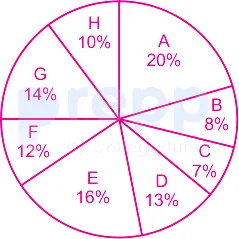
- A
Only I
- B
Only II
- C
Neither I nor II
- D
Both I and II
Show answer
C. Neither I nor IIGiven:
Total cars sold by all company's = 10000
Formula Used:
Average = \(\frac{\text{Sum of observation}}{\text{Total observations}}\)
Calculations:
⇒ Total percentage of cars sold by all company's = 7 + 8 + 13 + 16 + 12 + 14 + 10 + 20 = 100%
⇒ Total car sold by all company's = 10000
⇒ 100% = 10000
⇒ 1% = 100 cars
Now statement I,
⇒ Cars sold by company B = 8% = 8 × 1% = 8 × 100 = 800 cars
⇒ Cars sold by company F = 12% = 12 × 1% = 12 × 100 = 1200 cars
⇒ Cars sold by company H = 10% = 10 × 1% = 10 × 100 = 1000 cars
⇒ Total cars = 800 + 1200 + 1000 = 3000 cars
⇒ Average = \(\frac{3000}{3}\) = 1000 cars
So, Statement I is incorrect
Now, For statement II
⇒ Car sold by company A = 20% = 20 × 1% = 20 × 100 = 2000
⇒ Car sold by company E = 16% = 16 × 1% = 16 × 100 = 1600
Ratio of company A and company E is
⇒ Company A : company E = 2000 : 1600 = 5 : 4
So, This statement is also incorrect
⇒ Hence, Both statement is incorrect
Paper & answer key PDF ↗ Question 57archived
If K + \({{1} \over K}\) + 2 = 0 and K < 0, then what is the value of K10 + \({{1} \over K^{11}}\)?
- A
1
- B
0
- C
-1
- D
2
Show answer
B. 0Solving the K Equation and Evaluating the Expression
We are given an equation involving K and asked to find the value of a related expression. The given equation is K + \({{1} \over K}\) + 2 = 0, and we are also given the condition that K < 0. We need to find the value of K10 + \({{1} \over K^{11}}\).
Step 1: Solve the Equation for K
The given equation is:
\(K + \frac{1}{K} + 2 = 0\)
To eliminate the fraction, we can multiply the entire equation by K (assuming K is not zero, which is true since \(\frac{1}{K}\) exists):
\(K \times (K + \frac{1}{K} + 2) = K \times 0\)
\(K^2 + K \times \frac{1}{K} + 2K = 0\)
\(K^2 + 1 + 2K = 0\)
Rearrange the terms to form a standard quadratic equation:
\(K^2 + 2K + 1 = 0\)
This quadratic equation is a perfect square trinomial, which can be factored as:
\((K+1)^2 = 0\)
Taking the square root of both sides gives:
\(K+1 = 0\)
Solving for K:
\(K = -1\)
We check if this value of K satisfies the given condition K < 0. Since -1 is indeed less than 0, the value K = -1 is the correct solution for the equation under the given condition.
Step 2: Evaluate the Expression K10 + \({{1} \over K^{11}}\)
Now that we have found K = -1, we need to substitute this value into the expression K10 + \({{1} \over K^{11}}\):
\(K^{10} + \frac{1}{K^{11}} = (-1)^{10} + \frac{1}{(-1)^{11}}\)
Let's evaluate the powers of -1:
When -1 is raised to an even power, the result is 1. So, \((-1)^{10} = 1\).
When -1 is raised to an odd power, the result is -1. So, \((-1)^{11} = -1\).
Substitute these values back into the expression:
\((-1)^{10} + \frac{1}{(-1)^{11}} = 1 + \frac{1}{-1}\)
\(1 + \frac{1}{-1} = 1 + (-1)\)
\(1 + (-1) = 1 - 1 = 0\)
Thus, the value of K10 + \({{1} \over K^{11}}\) for K = -1 is 0.
Let's summarise the steps and the result in a table:
Step
Description
Result
1
Solve \(K + \frac{1}{K} + 2 = 0\) for K
\(K = -1\)
2
Check condition K < 0
\( -1 < 0 \) (Condition satisfied)
3
Evaluate \(K^{10}\) for \(K = -1\)
\((-1)^{10} = 1\)
4
Evaluate \(K^{11}\) for \(K = -1\)
\((-1)^{11} = -1\)
5
Evaluate \(\frac{1}{K^{11}}\) for \(K = -1\)
\(\frac{1}{-1} = -1\)
6
Calculate \(K^{10} + \frac{1}{K^{11}}\)
\(1 + (-1) = 0\)
The final value of the expression K10 + \({{1} \over K^{11}}\) is 0.
Revision Table: Solving Algebraic Equations and Expressions
Concept
Description
Application in this Problem
Solving Rational Equations
Equations containing algebraic fractions. Multiply by the least common multiple (LCM) of the denominators to clear fractions.
Multiplying \(K + \frac{1}{K} + 2 = 0\) by K to get a polynomial equation.
Quadratic Equations
Equations of the form \(ax^2 + bx + c = 0\). Can be solved by factoring, completing the square, or using the quadratic formula.
The equation \(K^2 + 2K + 1 = 0\) is a quadratic equation.
Perfect Square Trinomials
A trinomial of the form \(a^2 + 2ab + b^2 = (a+b)^2\) or \(a^2 - 2ab + b^2 = (a-b)^2\).
Recognizing \(K^2 + 2K + 1\) as \((K+1)^2\).
Powers of Negative One
\((-1)^{\text{even number}} = 1\) and \((-1)^{\text{odd number}} = -1\).
Calculating \((-1)^{10}\) and \((-1)^{11}\).
Additional Information: Algebraic Problem Solving Steps
When tackling algebraic problems like this one, a systematic approach is very helpful:
Understand the Problem: Clearly identify what is given (equations, conditions) and what needs to be found.
Simplify the Equation: Use algebraic manipulations (like clearing fractions, combining like terms, factoring) to simplify the given equation.
Solve for the Variable: Find the value(s) of the unknown variable that satisfy the equation.
Check Conditions: If there are specific conditions on the variable (like K < 0), ensure the solution found meets these conditions. Discard any solutions that don't.
Evaluate the Expression: Substitute the valid value(s) of the variable into the expression you need to evaluate.
Calculate the Final Result: Perform the necessary arithmetic operations to find the final answer.
In this problem, solving the quadratic equation led directly to the value of K. Understanding the properties of exponents, especially powers of -1, was crucial for evaluating the final expression.
Paper & answer key PDF ↗ Question 58archived
What is the value of cos 45° sin 15°?
- A
\({ (\sqrt{3} \ - \ 1) \over 2}\)
- B
\({( \sqrt{3} \ - \ 1) \over 4}\)
- C
(\({ \sqrt{3}}\) + 1)
- D
2\({ \sqrt{3}}\) - 1
Show answer
B. \({( \sqrt{3} \ - \ 1) \over 4}\)Understanding the Problem: Calculating cos 45 sin 15
The question asks us to find the exact value of the trigonometric expression \( \cos 45^\circ \sin 15^\circ \). This involves knowing the trigonometric values for standard angles like \(45^\circ\) and being able to find the value for \(15^\circ\) or use trigonometric identities to simplify the product.
Methods for Calculating cos 45 sin 15
There are a couple of ways to approach this problem:
Using the product-to-sum trigonometric identity.
Calculating \( \sin 15^\circ \) separately using angle subtraction formula and then multiplying by \( \cos 45^\circ \).
We will use the product-to-sum identity method as it directly addresses the product form given in the question.
Using the Product-to-Sum Formula for cos A sin B
The relevant product-to-sum formula for \( \cos A \sin B \) is:
\( \cos A \sin B = \frac{1}{2} [ \sin(A + B) - \sin(A - B) ] \)
In our case, \( A = 45^\circ \) and \( B = 15^\circ \). Let's substitute these values into the formula:
\( \cos 45^\circ \sin 15^\circ = \frac{1}{2} [ \sin(45^\circ + 15^\circ) - \sin(45^\circ - 15^\circ) ] \)
Step-by-Step Calculation
Let's perform the calculations inside the sine functions:
\( 45^\circ + 15^\circ = 60^\circ \)
\( 45^\circ - 15^\circ = 30^\circ \)
So the expression becomes:
\( \cos 45^\circ \sin 15^\circ = \frac{1}{2} [ \sin(60^\circ) - \sin(30^\circ) ] \)
Substituting Standard Trigonometric Values
Now, we need the standard values for \( \sin 60^\circ \) and \( \sin 30^\circ \):
\( \sin 60^\circ = \frac{\sqrt{3}}{2} \)
\( \sin 30^\circ = \frac{1}{2} \)
Substitute these values into the expression:
\( \cos 45^\circ \sin 15^\circ = \frac{1}{2} [ \frac{\sqrt{3}}{2} - \frac{1}{2} ] \)
Simplifying the Expression
Now, simplify the expression by combining the terms inside the brackets and then multiplying by \( \frac{1}{2} \):
First, subtract the fractions inside the brackets:
\( \frac{\sqrt{3}}{2} - \frac{1}{2} = \frac{\sqrt{3} - 1}{2} \)
Now, multiply by \( \frac{1}{2} \):
\( \cos 45^\circ \sin 15^\circ = \frac{1}{2} \times \frac{\sqrt{3} - 1}{2} \)
\( \cos 45^\circ \sin 15^\circ = \frac{1 \times (\sqrt{3} - 1)}{2 \times 2} \)
\( \cos 45^\circ \sin 15^\circ = \frac{\sqrt{3} - 1}{4} \)
Comparing with Options
The calculated value is \( \frac{\sqrt{3} - 1}{4} \). Let's compare this with the given options:
Option 1: \( \frac{\sqrt{3} - 1}{2} \)
Option 2: \( \frac{\sqrt{3} - 1}{4} \)
Option 3: \( \sqrt{3} + 1 \)
Option 4: \( 2\sqrt{3} - 1 \)
Our calculated value matches Option 2.
Final Answer Derivation
Based on the calculations using the product-to-sum identity, the value of \( \cos 45^\circ \sin 15^\circ \) is \( \frac{\sqrt{3} - 1}{4} \).
Trigonometric Values Used
Angle
Sine Value
\( 60^\circ \)
\( \frac{\sqrt{3}}{2} \)
\( 30^\circ \)
\( \frac{1}{2} \)
Revision Table: Key Trigonometric Identities
Common Product-to-Sum Identities
Identity
Formula
\( 2 \sin A \cos B \)
\( \sin(A+B) + \sin(A-B) \)
\( 2 \cos A \sin B \)
\( \sin(A+B) - \sin(A-B) \)
\( 2 \cos A \cos B \)
\( \cos(A+B) + \cos(A-B) \)
\( 2 \sin A \sin B \)
\( \cos(A-B) - \cos(A+B) \)
Additional Information: Calculating sin 15 degrees Directly
Alternatively, we could calculate \( \sin 15^\circ \) using \( \sin(45^\circ - 30^\circ) \).
Using the sine difference formula: \( \sin(A - B) = \sin A \cos B - \cos A \sin B \)
Let \( A = 45^\circ \) and \( B = 30^\circ \):
\( \sin 15^\circ = \sin(45^\circ - 30^\circ) = \sin 45^\circ \cos 30^\circ - \cos 45^\circ \sin 30^\circ \)
Substitute standard values:
\( \sin 45^\circ = \frac{1}{\sqrt{2}} = \frac{\sqrt{2}}{2} \)
\( \cos 30^\circ = \frac{\sqrt{3}}{2} \)
\( \cos 45^\circ = \frac{1}{\sqrt{2}} = \frac{\sqrt{2}}{2} \)
\( \sin 30^\circ = \frac{1}{2} \)
\( \sin 15^\circ = \frac{\sqrt{2}}{2} \times \frac{\sqrt{3}}{2} - \frac{\sqrt{2}}{2} \times \frac{1}{2} \)
\( \sin 15^\circ = \frac{\sqrt{6}}{4} - \frac{\sqrt{2}}{4} \)
\( \sin 15^\circ = \frac{\sqrt{6} - \sqrt{2}}{4} \)
Now, multiply this by \( \cos 45^\circ = \frac{\sqrt{2}}{2} \):
\( \cos 45^\circ \sin 15^\circ = \frac{\sqrt{2}}{2} \times \frac{\sqrt{6} - \sqrt{2}}{4} \)
\( = \frac{\sqrt{2}(\sqrt{6} - \sqrt{2})}{8} \)
\( = \frac{\sqrt{12} - \sqrt{4}}{8} \)
Simplify the square roots:
\( \sqrt{12} = \sqrt{4 \times 3} = 2\sqrt{3} \)
\( \sqrt{4} = 2 \)
\( = \frac{2\sqrt{3} - 2}{8} \)
Factor out 2 from the numerator:
\( = \frac{2(\sqrt{3} - 1)}{8} \)
Cancel the 2 in the numerator and 8 in the denominator:
\( = \frac{\sqrt{3} - 1}{4} \)
This confirms the result obtained using the product-to-sum formula.
Paper & answer key PDF ↗ Question 59archived
If x + \({{1} \over x}\) = 2, then x3 + \({{1} \over x^{3}}\)=?
- A
1
- B
8
- C
2
- D
0
Show answer
C. 2Finding \(x^3 + \frac{1}{x^3}\) when \(x + \frac{1}{x} = 2\)
This problem involves finding the value of an algebraic expression involving powers of x, given a relationship between x and its reciprocal. We are given that \(x + \frac{1}{x} = 2\) and we need to determine the value of \(x^3 + \frac{1}{x^3}\).
Method 1: Using Algebraic Identity
We can use the algebraic identity for the cube of a sum: \((a+b)^3 = a^3 + b^3 + 3ab(a+b)\). Let's consider \(a = x\) and \(b = \frac{1}{x}\).
Cubing the given equation \(x + \frac{1}{x} = 2\), we get:
$$ \left(x + \frac{1}{x}\right)^3 = 2^3 $$
Applying the algebraic identity on the left side:
$$ x^3 + \left(\frac{1}{x}\right)^3 + 3 \cdot x \cdot \frac{1}{x} \left(x + \frac{1}{x}\right) = 8 $$
This simplifies because \(x \cdot \frac{1}{x} = 1\):
$$ x^3 + \frac{1}{x^3} + 3 \cdot 1 \cdot \left(x + \frac{1}{x}\right) = 8 $$
So, we have:
$$ x^3 + \frac{1}{x^3} + 3 \left(x + \frac{1}{x}\right) = 8 $$
We know from the problem statement that \(x + \frac{1}{x} = 2\). Substitute this value into the equation:
$$ x^3 + \frac{1}{x^3} + 3 (2) = 8 $$
$$ x^3 + \frac{1}{x^3} + 6 = 8 $$
Now, isolate \(x^3 + \frac{1}{x^3}\):
$$ x^3 + \frac{1}{x^3} = 8 - 6 $$
$$ x^3 + \frac{1}{x^3} = 2 $$
Thus, the value of \(x^3 + \frac{1}{x^3}\) is 2.
Method 2: Solving for x
We can also solve the given equation \(x + \frac{1}{x} = 2\) to find the value of x directly.
Multiply the entire equation by x to eliminate the fraction:
$$ x \left(x + \frac{1}{x}\right) = 2x $$
$$ x^2 + 1 = 2x $$
Rearrange the terms to form a quadratic equation:
$$ x^2 - 2x + 1 = 0 $$
This is a perfect square trinomial, which can be factored as:
$$ (x - 1)^2 = 0 $$
Taking the square root of both sides:
$$ x - 1 = 0 $$
Solving for x:
$$ x = 1 $$
Now that we have found \(x = 1\), we can substitute this value into the expression \(x^3 + \frac{1}{x^3}\):
$$ x^3 + \frac{1}{x^3} = 1^3 + \frac{1}{1^3} $$
$$ x^3 + \frac{1}{x^3} = 1 + \frac{1}{1} $$
$$ x^3 + \frac{1}{x^3} = 1 + 1 $$
$$ x^3 + \frac{1}{x^3} = 2 $$
Both methods yield the same result, which is 2.
Summary of the Solution
Given the equation \(x + \frac{1}{x} = 2\), we successfully found the value of \(x^3 + \frac{1}{x^3}\) to be 2 using two different algebraic approaches. The first method utilized the cubic identity \((a+b)^3\) and substitution, while the second method involved solving the quadratic equation to find x and then substituting its value.
Revision Table: Key Algebraic Concepts
Concept
Description
Example/Formula
Reciprocal
The reciprocal of a number x is \( \frac{1}{x} \).
Reciprocal of 5 is \( \frac{1}{5} \).
Algebraic Identity: Cube of Sum
Formula for cubing the sum of two terms.
\( (a+b)^3 = a^3 + b^3 + 3ab(a+b) \)
Quadratic Equation
An equation of the form \( ax^2 + bx + c = 0 \).
\( x^2 - 2x + 1 = 0 \)
Perfect Square Trinomial
A trinomial that is the square of a binomial.
\( x^2 - 2x + 1 = (x-1)^2 \)
Additional Information: Solving \(x + \frac{1}{x} = k\) Problems
Problems involving expressions like \(x + \frac{1}{x}\), \(x^2 + \frac{1}{x^2}\), \(x^3 + \frac{1}{x^3}\), etc., are common in algebra. Here are some useful relationships derived from \(x + \frac{1}{x} = k\):
To find \(x^2 + \frac{1}{x^2}\): Square the given equation.
$$ \left(x + \frac{1}{x}\right)^2 = k^2 $$
$$ x^2 + \left(\frac{1}{x}\right)^2 + 2 \cdot x \cdot \frac{1}{x} = k^2 $$
$$ x^2 + \frac{1}{x^2} + 2 = k^2 $$
$$ x^2 + \frac{1}{x^2} = k^2 - 2 $$
To find \(x^3 + \frac{1}{x^3}\): Use the identity \(x^3 + \frac{1}{x^3} = \left(x + \frac{1}{x}\right)^3 - 3\left(x + \frac{1}{x}\right)\).
$$ x^3 + \frac{1}{x^3} = k^3 - 3k $$
These formulas can save time when solving related algebraic problems. In our specific case, \(k=2\), so \(x^3 + \frac{1}{x^3} = 2^3 - 3(2) = 8 - 6 = 2\).
Paper & answer key PDF ↗ Question 60archived
Study the following table and select the correct statement.
Height (in cm)Weight (in kg)
15669
15568
14561
14260
14158
13955
13545
- A
Weight increases with the increase in height.
- B
Weight increases with the decrease in height.
- C
Weight decreases with the increase in height.
- D
Height and weight are not related to each other.
Show answer
A. Weight increases with the increase in height.Analyzing Height and Weight Data from the Table
Let's carefully examine the provided table containing height and weight measurements for several individuals. The goal is to understand the relationship between height and weight based on this specific dataset.
Height (in cm)
Weight (in kg)
156
69
155
68
145
61
142
60
141
58
139
55
135
45
Identifying Trends in Height and Weight
To determine the relationship between height and weight from this table, we can observe how weight changes as height changes. Let's look at the data points from the top down (decreasing height) and bottom up (increasing height).
Starting from the top: As height decreases from 156 cm to 135 cm (156, 155, 145, 142, 141, 139, 135), the corresponding weight values are 69 kg, 68 kg, 61 kg, 60 kg, 58 kg, 55 kg, and 45 kg. We can see that as height decreases, weight generally decreases.
Looking from the bottom up: As height increases from 135 cm to 156 cm (135, 139, 141, 142, 145, 155, 156), the corresponding weight values are 45 kg, 55 kg, 58 kg, 60 kg, 61 kg, 68 kg, and 69 kg. We observe that as height increases, weight generally increases.
This consistent pattern suggests a positive relationship between height and weight in this dataset.
Evaluating the Statements on Height and Weight Relationship
Now let's analyze each provided statement based on our observations from the table.
Statement 1: Weight increases with the increase in height.
Our analysis shows that as height values go up (135 cm to 156 cm), the corresponding weight values also go up (45 kg to 69 kg). This statement accurately describes the trend observed in the table.
Statement 2: Weight increases with the decrease in height.
Our analysis shows that as height decreases (156 cm to 135 cm), weight decreases (69 kg to 45 kg). This statement is the opposite of what we observe.
Statement 3: Weight decreases with the increase in height.
Our analysis shows that as height increases (135 cm to 156 cm), weight increases (45 kg to 69 kg). This statement is the opposite of what we observe.
Statement 4: Height and weight are not related to each other.
The table shows a clear trend where changes in height correspond to consistent changes in weight. This indicates that height and weight are related in this dataset.
Conclusion on Height and Weight Data Analysis
Based on the step-by-step analysis of the table data, the statement that accurately describes the relationship between height and weight in this dataset is that weight increases with the increase in height.
Revision Table: Key Observations
Height Trend
Weight Trend
Observed Relationship
Increasing
Increasing
Weight increases with increasing height
Decreasing
Decreasing
Weight decreases with decreasing height
Additional Information: Correlation and Data Trends
The relationship observed in the table, where two variables (height and weight) tend to increase or decrease together, is known as a positive correlation. In general, for humans, there is a positive correlation between height and weight, although it is not a perfect relationship due to other factors like body composition, muscle mass, bone density, and lifestyle.
Analyzing tables and identifying trends is a fundamental skill in data interpretation. It helps us understand patterns and relationships within a given dataset. In this case, simply sorting the data by height or weight and observing the corresponding values makes the trend clear.
Paper & answer key PDF ↗ Question 61archived
Two concentric circles are drawn with radii 20 cm and 16 cm. What will be the length of a chord of the larger circle which is tangent to the smaller circle?
- A
34 cm
- B
24 cm
- C
48 cm
- D
12 cm
Show answer
B. 24 cmFinding the Length of a Chord Tangent to a Concentric Circle
This problem involves two concentric circles, meaning they share the same center. We are given the radii of both circles and asked to find the length of a chord of the larger circle that is tangent to the smaller circle.
Understanding the Setup: Concentric Circles and Tangent Chord
We have a larger circle with radius \(R = 20\) cm.
We have a smaller circle inside it, sharing the same center, with radius \(r = 16\) cm.
A chord of the larger circle touches the smaller circle at exactly one point. This means the chord is tangent to the smaller circle.
Let the center of the two circles be \(O\). Let the chord of the larger circle be \(AB\), which is tangent to the smaller circle at point \(M\).
Key Geometric Properties
When a chord of a circle is tangent to a concentric circle:
The radius of the smaller circle drawn to the point of tangency is perpendicular to the chord. So, \(OM \perp AB\).
In the larger circle, a line segment drawn from the center perpendicular to a chord bisects the chord. Since \(OM \perp AB\), \(M\) is the midpoint of chord \(AB\). This means \(AM = MB\).
Using the Pythagorean Theorem
Consider the triangle \(OMA\). This is a right-angled triangle with the right angle at \(M\).
The hypotenuse is \(OA\), which is the radius of the larger circle, \(R = 20\) cm.
One leg is \(OM\), which is the radius of the smaller circle, \(r = 16\) cm.
The other leg is \(AM\), which is half the length of the chord \(AB\).
According to the Pythagorean theorem, in a right-angled triangle, the square of the hypotenuse is equal to the sum of the squares of the other two sides.
So, for triangle \(OMA\):
\(OA^2 = OM^2 + AM^2\)
Step-by-Step Calculation
Substitute the given values into the Pythagorean theorem equation:
\(20^2 = 16^2 + AM^2\)
Calculate the squares:
\(400 = 256 + AM^2\)
Now, solve for \(AM^2\):
\(AM^2 = 400 - 256\)
\(AM^2 = 144\)
Take the square root to find the value of \(AM\):
\(AM = \sqrt{144}\)
\(AM = 12\) cm
Since \(M\) is the midpoint of the chord \(AB\), the length of the chord \(AB\) is twice the length of \(AM\):
\(AB = 2 \times AM\)
\(AB = 2 \times 12\) cm
\(AB = 24\) cm
Therefore, the length of the chord of the larger circle which is tangent to the smaller circle is 24 cm.
Summary of Calculations
Parameter
Value
Description
Radius of larger circle (\(R\))
20 cm
Hypotenuse of right triangle
Radius of smaller circle (\(r\))
16 cm
One leg of right triangle (distance from center to chord)
Half chord length (\(AM\))
\( \sqrt{R^2 - r^2} \)
Other leg of right triangle
\(AM^2\)
\(20^2 - 16^2 = 400 - 256 = 144\)
Calculation step
\(AM\)
\( \sqrt{144} = 12 \) cm
Length of half the chord
Chord length (\(AB\))
\( 2 \times AM = 2 \times 12 = 24 \) cm
Total length of the chord
Conclusion
Using the properties of concentric circles, tangent lines, and the Pythagorean theorem, we determined that the length of the chord of the larger circle tangent to the smaller circle is 24 cm.
Revision Table: Concentric Circle Chord Problem
Concept
Description
Relevance to Problem
Concentric Circles
Circles sharing the same center.
Defines the geometry of the problem.
Chord of a Circle
A line segment connecting two points on the circle.
The unknown quantity we are finding.
Tangent to a Circle
A line (or segment) that touches the circle at exactly one point. Radius to tangent point is perpendicular to tangent.
The chord's relationship with the smaller circle. Creates the right angle needed for Pythagorean theorem.
Perpendicular from Center to Chord
Bisects the chord.
Allows us to find half the chord length first.
Pythagorean Theorem
\(a^2 + b^2 = c^2\) in a right triangle.
Used to relate the radii and half the chord length.
Additional Information: Circle Properties and Theorems
Understanding basic circle properties is crucial for solving geometry problems like this one. Here are a few related concepts:
Radius: The distance from the center of the circle to any point on its circumference.
Diameter: A chord passing through the center. It is the longest chord in a circle and is twice the radius.
Secant: A line that intersects a circle at two distinct points.
Theorem: The tangent at any point of a circle is perpendicular to the radius through the point of contact. This is fundamental to setting up the right triangle in our problem.
Theorem: The line drawn through the center of a circle to bisect a chord is perpendicular to the chord. This confirms why OM is perpendicular to AB.
These concepts often appear together in geometry questions.
Paper & answer key PDF ↗ Question 62archived
The circumference of the two circles is 308 cm and 440 cm respectively. What is the difference between their radii?
- A
21 cm
- B
49 cm
- C
35 cm
- D
14 cm
Show answer
A. 21 cmThis problem asks us to find the difference between the radii of two circles, given their circumferences. To solve this, we first need to find the radius of each circle using the formula for circumference. The circumference of a circle is the distance around it.
Understanding Circle Circumference
The formula that relates the circumference (C) of a circle to its radius (r) is:
$$C = 2\pi r$$
Where $\pi$ (pi) is a mathematical constant, approximately equal to $\frac{22}{7}$ or 3.14159. In many problems involving multiples of 7, using $\pi = \frac{22}{7}$ simplifies calculations.
Calculating the Radius of Each Circle
We are given the circumferences of two circles. Let's call them Circle 1 and Circle 2, with circumferences $C_1$ and $C_2$ and radii $r_1$ and $r_2$, respectively.
Radius of Circle 1
The circumference of Circle 1 is 308 cm. Using the formula $C_1 = 2\pi r_1$ and taking $\pi = \frac{22}{7}$, we can solve for $r_1$:
$$308 = 2 \times \frac{22}{7} \times r_1$$
$$308 = \frac{44}{7} \times r_1$$
To find $r_1$, we rearrange the equation:
$$r_1 = 308 \times \frac{7}{44}$$
Now, we perform the calculation:
$$r_1 = \frac{308 \times 7}{44}$$
We can simplify this by dividing 308 by 44. Since $44 \times 7 = 308$, we have:
$$r_1 = 7 \times 7$$
$$r_1 = 49 \text{ cm}$$
So, the radius of the first circle is 49 cm.
Radius of Circle 2
The circumference of Circle 2 is 440 cm. Using the formula $C_2 = 2\pi r_2$ and taking $\pi = \frac{22}{7}$, we can solve for $r_2$:
$$440 = 2 \times \frac{22}{7} \times r_2$$
$$440 = \frac{44}{7} \times r_2$$
To find $r_2$, we rearrange the equation:
$$r_2 = 440 \times \frac{7}{44}$$
Now, we perform the calculation:
$$r_2 = \frac{440 \times 7}{44}$$
We can simplify this by dividing 440 by 44. Since $44 \times 10 = 440$, we have:
$$r_2 = 10 \times 7$$
$$r_2 = 70 \text{ cm}$$
So, the radius of the second circle is 70 cm.
Difference Between Their Radii
We need to find the difference between the radii of the two circles. This is $|r_2 - r_1|$.
Difference = $|70 \text{ cm} - 49 \text{ cm}|$
Difference = $21 \text{ cm}$
The difference between the radii of the two circles is 21 cm.
Circle
Circumference (C)
Radius (r) Calculation ($C = 2 \times \frac{22}{7} \times r$)
Radius (r)
Circle 1
308 cm
$r_1 = 308 \times \frac{7}{44} = 49$
49 cm
Circle 2
440 cm
$r_2 = 440 \times \frac{7}{44} = 70$
70 cm
Difference in radii = $70 \text{ cm} - 49 \text{ cm} = 21 \text{ cm}$.
Revision Table: Circle Formulas
Term
Formula (in terms of radius, r)
Formula (in terms of diameter, d)
Circumference (C)
$2\pi r$
$\pi d$
Area (A)
$\pi r^2$
$\pi (\frac{d}{2})^2 = \frac{1}{4}\pi d^2$
Additional Information on Circle Properties
A radius is a line segment from the center of the circle to any point on its boundary.
A diameter is a line segment passing through the center of the circle with endpoints on the boundary. The diameter is twice the radius ($d = 2r$).
The circumference is the perimeter or the distance around the circle.
The value of $\pi$ is an irrational number, meaning its decimal representation is non-terminating and non-repeating. $\frac{22}{7}$ is a commonly used rational approximation.
Understanding the relationship between circumference and radius is fundamental to solving problems involving circles in geometry and mensuration.
Paper & answer key PDF ↗ Question 63archived
3[a - \({1{} \over a}\)] + [a - \({{1} \over a}\)]3 = ?
- A
a2 - \({{1} \over a^{3}}\)
- B
a3 - \({{1} \over a^{3}}\)
- C
a3 + \({{1} \over a^{3}}\)
- D
a2 - \({{1} \over a^{2}}\)
Show answer
B. a3 - \({{1} \over a^{3}}\)Simplifying the Algebraic Expression
The question asks us to simplify the algebraic expression: \(3\left[a - \frac{1}{a}\right] + \left[a - \frac{1}{a}\right]3\).
Let's analyze the terms in the expression:
The first term is \(3\left[a - \frac{1}{a}\right]\). This means 3 multiplied by the quantity \(\left(a - \frac{1}{a}\right)\).
The second term is \(\left[a - \frac{1}{a}\right]3\). This means the quantity \(\left(a - \frac{1}{a}\right)\) multiplied by 3.
Using the commutative property of multiplication, which states that \(x \times y = y \times x\), we know that \(\left[a - \frac{1}{a}\right]3\) is the same as \(3\left[a - \frac{1}{a}\right]\).
So, the expression becomes the sum of two identical terms:
\(3\left[a - \frac{1}{a}\right] + 3\left[a - \frac{1}{a}\right]\)
We can combine these like terms. If we let \(x = a - \frac{1}{a}\), the expression is \(3x + 3x\), which simplifies to \(6x\). Substituting back \(x = a - \frac{1}{a}\), the simplified expression is:
\(6\left(a - \frac{1}{a}\right)\)
This simplifies to \(6a - \frac{6}{a}\).
Analyzing the Provided Options
The provided options are in the form of \(a\) raised to a power minus or plus \(1/a\) raised to a power:
\(a^2 - \frac{1}{a^3}\)
\(a^3 - \frac{1}{a^3}\)
\(a^3 + \frac{1}{a^3}\)
\(a^2 - \frac{1}{a^2}\)
Our simplified expression \(6a - \frac{6}{a}\) does not match the form of any of these options directly.
Understanding the Provided Correct Answer: \(a^3 - \frac{1}{a^3}\)
The provided correct answer is given as \(a^3 - \frac{1}{a^3}\). This expression is related to the difference of cubes algebraic identity. The difference of cubes formula states:
\(x^3 - y^3 = (x - y)(x^2 + xy + y^2)\)
If we let \(x = a\) and \(y = \frac{1}{a}\), we can see the connection to the terms in the original expression:
\(a^3 - \left(\frac{1}{a}\right)^3 = \left(a - \frac{1}{a}\right)\left(a^2 + a \cdot \frac{1}{a} + \left(\frac{1}{a}\right)^2\right)\)
Simplifying the second factor:
\(a^3 - \frac{1}{a^3} = \left(a - \frac{1}{a}\right)\left(a^2 + 1 + \frac{1}{a^2}\right)\)
This shows that the form \(a^3 - \frac{1}{a^3}\) is related to the term \(\left(a - \frac{1}{a}\right)\) which is present in the original question, although the initial expression simplifies to \(6\left(a - \frac{1}{a}\right)\), not \(a^3 - \frac{1}{a^3}\).
Comparing the provided options, \(a^3 - \frac{1}{a^3}\) represents a difference of cubes, while option 3 is a sum of cubes \(a^3 + \frac{1}{a^3}\). Options 1 and 4 involve different powers of \(a\) and \(1/a\) in their terms.
Revision Table: Algebraic Simplification Process
Step
Expression
Explanation
1
\(3\left[a - \frac{1}{a}\right] + \left[a - \frac{1}{a}\right]3\)
Original Expression
2
\(3\left(a - \frac{1}{a}\right) + 3\left(a - \frac{1}{a}\right)\)
Apply commutative property to the second term
3
\(6\left(a - \frac{1}{a}\right)\)
Combine like terms (3x + 3x = 6x)
4
\(6a - \frac{6}{a}\)
Distribute the 6
Additional Information: Algebraic Identities
Understanding algebraic identities is crucial for simplifying expressions and solving equations. Here are a couple of key identities related to cubes:
Difference of Cubes: \(x^3 - y^3 = (x - y)(x^2 + xy + y^2)\)
Sum of Cubes: \(x^3 + y^3 = (x + y)(x^2 - xy + y^2)\)
Cube of a Difference: \((x - y)^3 = x^3 - 3x^2y + 3xy^2 - y^3\)
Cube of a Sum: \((x + y)^3 = x^3 + 3x^2y + 3xy^2 + y^3\)
These identities help in factoring or expanding expressions involving cubes. The provided correct answer \(a^3 - \frac{1}{a^3}\) is a classic example of the difference of cubes form, where \(x=a\) and \(y=\frac{1}{a}\).
Paper & answer key PDF ↗ Question 64archived
How many numbers from 1 to 430 are divisible by 7 and 11 both?
- A
5
- B
11
- C
9
- D
7
Show answer
A. 5Understanding the Problem: Numbers Divisible by 7 and 11
The question asks us to find how many whole numbers between 1 and 430 (including 1 and 430) are perfectly divisible by both 7 and 11. When a number is divisible by two different numbers, it must also be divisible by their Least Common Multiple (LCM).
Finding the Least Common Multiple (LCM) of 7 and 11
To find numbers divisible by both 7 and 11, we first need to find the LCM of 7 and 11.
7 is a prime number.
11 is a prime number.
Since 7 and 11 are prime numbers and they are not equal, they share no common factors other than 1. Therefore, their LCM is simply their product.
\[
\text{LCM}(7, 11) = 7 \times 11 = 77
\]
So, any number that is divisible by both 7 and 11 must be a multiple of 77.
Counting Multiples of 77 in the Range 1 to 430
Now we need to count how many multiples of 77 fall within the range from 1 to 430. Multiples of 77 are numbers like \(77 \times 1, 77 \times 2, 77 \times 3, \dots\).
We are looking for the largest integer \(k\) such that \(77 \times k \le 430\). To find this, we can divide 430 by 77:
\[
\frac{430}{77}
\]
Let's perform the division:
\[
430 \div 77 \approx 5.58
\]
The largest whole number \(k\) satisfying \(77 \times k \le 430\) is the floor of this result, which is \(\lfloor 5.58 \rfloor\). The floor function gives the largest integer less than or equal to the number.
\[
\lfloor 5.58 \rfloor = 5
\]
This means there are 5 multiples of 77 between 1 and 430, inclusive. These multiples are:
\(77 \times 1 = 77\)
\(77 \times 2 = 154\)
\(77 \times 3 = 231\)
\(77 \times 4 = 308\)
\(77 \times 5 = 385\)
The next multiple, \(77 \times 6 = 462\), is greater than 430, so it is outside our specified range.
Thus, there are exactly 5 numbers from 1 to 430 that are divisible by both 7 and 11.
Conclusion
The number of integers from 1 to 430 that are divisible by both 7 and 11 is 5.
Multiple of 77
Value
Within Range (1 to 430)?
\(77 \times 1\)
77
Yes
\(77 \times 2\)
154
Yes
\(77 \times 3\)
231
Yes
\(77 \times 4\)
308
Yes
\(77 \times 5\)
385
Yes
\(77 \times 6\)
462
No
Revision Table: Key Concepts for Divisibility Problems
Concept
Description
Application in this Problem
Divisibility by two numbers
A number divisible by two integers must also be divisible by their LCM.
Numbers divisible by both 7 and 11 must be divisible by LCM(7, 11).
LCM of prime numbers
The LCM of two distinct prime numbers is their product.
LCM(7, 11) = 7 × 11 = 77.
Counting multiples in a range (1 to N)
The number of multiples of an integer \(m\) in the range 1 to N is \(\lfloor N/m \rfloor\).
Number of multiples of 77 in 1 to 430 is \(\lfloor 430/77 \rfloor\).
Additional Information: Extending Divisibility Concepts
Understanding divisibility is fundamental in number theory and arithmetic. Here are a few related concepts:
Divisibility Rules: There are specific rules for checking divisibility by small numbers (like 2, 3, 4, 5, 6, 9, 10, 11). For example, a number is divisible by 11 if the alternating sum of its digits is a multiple of 11.
Greatest Common Divisor (GCD): The largest number that divides two or more numbers without leaving a remainder. The LCM of two numbers \(a\) and \(b\) is related to their GCD by the formula: \(a \times b = \text{GCD}(a, b) \times \text{LCM}(a, b)\).
Inclusion-Exclusion Principle: When counting numbers divisible by either of two numbers (say, \(A\) or \(B\)) in a range, you add the count of multiples of \(A\) and the count of multiples of \(B\), and then subtract the count of multiples of LCM(A, B) (those divisible by both) to avoid double counting. This problem only asked for numbers divisible by "and" (both), making it simpler.
Counting Multiples in a Range (M to N): To count multiples of \(m\) in a range M to N (inclusive), the formula is \(\lfloor N/m \rfloor - \lfloor (M-1)/m \rfloor\). In our problem, the range is 1 to 430, so M=1, N=430, and \(m=77\). The formula becomes \(\lfloor 430/77 \rfloor - \lfloor (1-1)/77 \rfloor = \lfloor 430/77 \rfloor - \lfloor 0/77 \rfloor = 5 - 0 = 5\).
Paper & answer key PDF ↗ Question 65archived
In a partnership firm two partners, Vijay and Praveen are working on an assignment. It will take 12 weeks for Vijay to complete the entire assignment alone, while Praveen will take 8 weeks to complete it alone. Due to work pressure, they decided to work on that assignment on the alternate week basis. In the first week Praveen will work and in the second week Vijay will work and so on. In how many weeks the work will be completed if they work on alternate week basis?
- A
8
- B
8.5
- C
9.5
- D
9
Show answer
C. 9.5Understanding Partnership Work and Alternate Weeks
This problem involves two partners, Vijay and Praveen, working together on an assignment but on an alternate week basis. To solve this, we first need to figure out how much work each person can do in one week. This is their individual work rate.
Vijay takes 12 weeks to complete the entire assignment alone.
In one week, Vijay completes $\frac{1}{12}$ of the total work.
Praveen takes 8 weeks to complete the entire assignment alone.
In one week, Praveen completes $\frac{1}{8}$ of the total work.
Calculating Work Done in a Cycle
They work on alternate weeks, with Praveen starting first. A full cycle of their work pattern covers two weeks:
Week 1: Praveen works.
Week 2: Vijay works.
Let's calculate the total work done in one 2-week cycle:
Work done in 2 weeks = Work done by Praveen in Week 1 + Work done by Vijay in Week 2
Work done in 2 weeks = $\frac{1}{8} + \frac{1}{12}$
To add these fractions, we find a common denominator, which is 24.
$\frac{1}{8} = \frac{1 \times 3}{8 \times 3} = \frac{3}{24}$
$\frac{1}{12} = \frac{1 \times 2}{12 \times 2} = \frac{2}{24}$
Work done in 2 weeks = $\frac{3}{24} + \frac{2}{24} = \frac{3+2}{24} = \frac{5}{24}$
So, in every 2-week cycle, $\frac{5}{24}$ of the total work is completed.
Determining Full Cycles and Remaining Work
The total work to be completed is 1 (representing the whole assignment). Since $\frac{5}{24}$ of the work is done in 2 weeks, let's see how many full 2-week cycles are needed to get close to completing the work:
We are looking for the largest integer $N$ such that $N \times \frac{5}{24} < 1$.
Let's test values for $N$:
If $N=1$, work done = $\frac{5}{24}$. Time = 2 weeks.
If $N=2$, work done = $2 \times \frac{5}{24} = \frac{10}{24}$. Time = 4 weeks.
If $N=3$, work done = $3 \times \frac{5}{24} = \frac{15}{24}$. Time = 6 weeks.
If $N=4$, work done = $4 \times \frac{5}{24} = \frac{20}{24}$. Time = 8 weeks.
If $N=5$, work done = $5 \times \frac{5}{24} = \frac{25}{24}$, which is more than 1.
So, after 4 full 2-week cycles (total 8 weeks), $\frac{20}{24}$ of the work is completed.
Remaining work = Total work - Work done in 8 weeks
Remaining work = $1 - \frac{20}{24} = \frac{24}{24} - \frac{20}{24} = \frac{4}{24} = \frac{1}{6}$
Completing the Remaining Work
After 8 weeks, $\frac{1}{6}$ of the work remains. The 9th week starts, and it is Praveen's turn to work (since the cycle starts with Praveen in week 1, week 3, week 5, etc., which are odd weeks). Praveen can do $\frac{1}{8}$ of the work in one week.
Work remaining = $\frac{1}{6}$
Praveen's rate = $\frac{1}{8}$ per week.
Can Praveen complete the remaining $\frac{1}{6}$ work in the 9th week? Yes, because Praveen's capacity in one week ($\frac{1}{8}$) is less than the remaining work ($\frac{1}{6}$). Praveen will work and complete $\frac{1}{8}$ of the total work in the 9th week.
Work remaining after week 9 (Praveen's work) = Work remaining before week 9 - Work done by Praveen in week 9
Work remaining after week 9 = $\frac{1}{6} - \frac{1}{8}$
Again, find a common denominator, which is 24.
$\frac{1}{6} = \frac{1 \times 4}{6 \times 4} = \frac{4}{24}$
$\frac{1}{8} = \frac{1 \times 3}{8 \times 3} = \frac{3}{24}$
Work remaining after week 9 = $\frac{4}{24} - \frac{3}{24} = \frac{1}{24}$
After 9 weeks (8 weeks of full cycles + 1 week of Praveen), $\frac{1}{24}$ of the work is still remaining.
Now it is the 10th week, and it is Vijay's turn to work. Vijay's rate is $\frac{1}{12}$ of the work per week.
Work remaining = $\frac{1}{24}$
Vijay's rate = $\frac{1}{12}$ per week.
Time taken by Vijay to complete the remaining $\frac{1}{24}$ work = $\frac{\text{Remaining Work}}{\text{Vijay's Rate}}$
Time taken by Vijay = $\frac{1/24}{1/12} = \frac{1}{24} \times \frac{12}{1} = \frac{12}{24} = \frac{1}{2}$ week.
So, Vijay will work for half a week in the 10th week to finish the assignment.
Total Time to Complete the Work
Total time = Time for 4 full cycles + Time for Praveen's week + Time for Vijay's part week
Total time = 8 weeks + 1 week + 0.5 weeks
Total time = 9.5 weeks.
Revision Table: Partnership Work Calculation
Partner
Time Alone
Weekly Work Rate
Vijay
12 weeks
$\frac{1}{12}$
Praveen
8 weeks
$\frac{1}{8}$
Period
Worker
Work Done
Cumulative Work Done
Weeks 1-2 (Cycle 1)
Praveen, Vijay
$\frac{5}{24}$
$\frac{5}{24}$
Weeks 3-4 (Cycle 2)
Praveen, Vijay
$\frac{5}{24}$
$\frac{10}{24}$
Weeks 5-6 (Cycle 3)
Praveen, Vijay
$\frac{5}{24}$
$\frac{15}{24}$
Weeks 7-8 (Cycle 4)
Praveen, Vijay
$\frac{5}{24}$
$\frac{20}{24} = \frac{5}{6}$
Week 9
Praveen
$\frac{1}{8} = \frac{3}{24}$
$\frac{20}{24} + \frac{3}{24} = \frac{23}{24}$
Week 10 (Partial)
Vijay
$\frac{1}{24}$ (Remaining)
$\frac{23}{24} + \frac{1}{24} = \frac{24}{24} = 1$
Additional Information on Time and Work Problems
Time and work problems often involve calculating individual work rates and combining them to find how long it takes to complete a task together. Key concepts include:
Individual Rate: If a person takes $T$ days to complete a job, their rate is $\frac{1}{T}$ of the job per day.
Combined Rate (Working Together): If two people work together, their rates are added. If Person A's rate is $R_A$ and Person B's rate is $R_B$, their combined rate is $R_A + R_B$. The time taken together is $\frac{1}{R_A + R_B}$.
Combined Rate (Alternate Days/Weeks): When working alternately, the work done in one full cycle (e.g., two days or two weeks) is calculated by summing the work done by each person in their turn within that cycle. The total time is found by calculating the number of full cycles and then accounting for the remaining work in the subsequent turns.
Efficiency: Sometimes problems mention efficiency. Efficiency is inversely proportional to the time taken. If a person is twice as efficient, they take half the time to complete the same work.
Understanding these basic principles helps in tackling various time and work problems, whether individuals work together, alternately, or with different efficiencies.
Paper & answer key PDF ↗ Question 66archived
If 14 ∶ 30 ∶∶ 7 ∶ x, then what is the value of x?
- A
15
- B
21
- C
09
- D
12
Show answer
A. 15Understanding Proportions: Solving for the Unknown
The question asks us to find the value of \(x\) in the given proportion: 14 ∶ 30 ∶∶ 7 ∶ x.
A proportion is a statement that two ratios are equal. The notation \(a : b :: c : d\) means that the ratio \(a : b\) is equal to the ratio \(c : d\). This can be written as a fraction:
\[\frac{a}{b} = \frac{c}{d}\]
In our given proportion, 14 ∶ 30 ∶∶ 7 ∶ x, we have \(a = 14\), \(b = 30\), \(c = 7\), and \(d = x\). So, we can write the proportion as:
\[\frac{14}{30} = \frac{7}{x}\]
Solving the Proportion to Find the Value of x
To find the value of \(x\), we can use the property of proportions that the product of the means is equal to the product of the extremes. In the proportion \(a : b :: c : d\), \(b\) and \(c\) are the means, and \(a\) and \(d\) are the extremes. Thus, \(a \times d = b \times c\).
Applying this to our equation \(\frac{14}{30} = \frac{7}{x}\), we cross-multiply:
\[14 \times x = 30 \times 7\]
Now, we simplify the right side of the equation:
\[14x = 210\]
To isolate \(x\), we divide both sides of the equation by 14:
\[x = \frac{210}{14}\]
Performing the division:
\[x = 15\]
So, the value of \(x\) that satisfies the proportion 14 ∶ 30 ∶∶ 7 ∶ x is 15.
Verification
We can check our answer by substituting \(x = 15\) back into the original proportion:
\[\frac{14}{30} = \frac{7}{15}\]
We can simplify the left side fraction by dividing the numerator and denominator by their greatest common divisor, which is 2:
\[\frac{14 \div 2}{30 \div 2} = \frac{7}{15}\]
\[\frac{7}{15} = \frac{7}{15}\]
Since both sides of the equation are equal, our value of \(x = 15\) is correct.
Step
Description
Calculation
1
Write the proportion as an equation.
\(\frac{14}{30} = \frac{7}{x}\)
2
Cross-multiply the terms.
\(14 \times x = 30 \times 7\)
3
Simplify the multiplication.
\(14x = 210\)
4
Divide to solve for \(x\).
\(x = \frac{210}{14}\)
5
Final value of \(x\).
\(x = 15\)
Revision Table: Key Concepts of Ratio and Proportion
Term
Definition
Example
Ratio
A comparison of two quantities by division. Written as \(a:b\) or \(\frac{a}{b}\).
The ratio of 14 to 30 is 14:30 or \(\frac{14}{30}\).
Proportion
An equality between two ratios. Written as \(a:b :: c:d\) or \(\frac{a}{b} = \frac{c}{d}\).
14:30 :: 7:15 is a proportion because \(\frac{14}{30} = \frac{7}{15}\).
Extremes
The first and last terms in a proportion (\(a\) and \(d\) in \(a:b :: c:d\)).
In 14:30 :: 7:15, the extremes are 14 and 15.
Means
The middle terms in a proportion (\(b\) and \(c\) in \(a:b :: c:d\)).
In 14:30 :: 7:15, the means are 30 and 7.
Property of Proportion
Product of extremes equals product of means (\(ad = bc\)).
For 14:30 :: 7:15, \(14 \times 15 = 210\) and \(30 \times 7 = 210\).
Additional Information: Types of Proportions
While the problem deals with a direct proportion, it's useful to know about different types:
Direct Proportion: Two quantities are in direct proportion if an increase in one quantity leads to a proportional increase in the other, and a decrease in one leads to a proportional decrease in the other. Their ratio is constant. For example, if you buy more apples, the total cost increases proportionally. \(y \propto x\) or \(y = kx\).
Inverse Proportion: Two quantities are in inverse proportion if an increase in one quantity leads to a proportional decrease in the other, and vice versa. Their product is constant. For example, as the speed of a car increases, the time taken to cover a fixed distance decreases proportionally. \(y \propto \frac{1}{x}\) or \(xy = k\).
The problem 14 ∶ 30 ∶∶ 7 ∶ x represents a direct proportion between the first pair of numbers (14, 30) and the second pair (7, x). We solved it by setting the ratios equal and using cross-multiplication.
Paper & answer key PDF ↗ Question 67archived
A circle is inscribed in a ΔABC having sides AB = 16 cm, BC = 20 cm and AC = 24 cm, and side AB, BC and AC touches circle at D, E and F, respectively. The measure of AD is:
- A
10 cm
- B
20 cm
- C
6 cm
- D
14 cm
Show answer
A. 10 cmUnderstanding the Problem: Circle Inscribed in a Triangle
The question asks for the length of the segment AD, where a circle is inscribed in triangle ABC, and it touches the side AB at point D. We are given the lengths of all three sides of the triangle: AB = 16 cm, BC = 20 cm, and AC = 24 cm.
Key Geometric Property: Tangents from a Point
A fundamental property related to a circle and tangents drawn from an external point is that the lengths of the two tangent segments from the external point to the circle are equal. In this problem, the vertices of the triangle (A, B, and C) are the external points, and the points where the inscribed circle touches the sides (D, E, and F) are the points of tangency.
From vertex A, the tangents are AD and AF. Therefore, AD = AF.
From vertex B, the tangents are BD and BE. Therefore, BD = BE.
From vertex C, the tangents are CE and CF. Therefore, CE = CF.
Setting Up Equations with Tangent Lengths
Let's denote the lengths of the tangent segments from each vertex:
Let AD = AF = x
Let BD = BE = y
Let CE = CF = z
The side lengths of the triangle can be expressed as the sum of these tangent segments:
Side AB = AD + DB = x + y
Side BC = BE + EC = y + z
Side AC = AF + FC = x + z
We are given the actual side lengths:
x + y = 16 (Equation 1)
y + z = 20 (Equation 2)
x + z = 24 (Equation 3)
We need to find the value of x (which represents AD).
Solving the System of Equations
We have a system of three linear equations with three variables. We can solve this system to find x, y, and z.
One way to solve is to add all three equations:
\((x + y) + (y + z) + (x + z) = 16 + 20 + 24\)
\(2x + 2y + 2z = 60\)
Divide by 2:
\(x + y + z = 30\) (Equation 4)
Now, we can substitute the original equations into Equation 4:
Substitute (x + y) = 16 into Equation 4: \(16 + z = 30\). Solving for z, we get \(z = 30 - 16 = 14\).
Substitute (y + z) = 20 into Equation 4: \(x + 20 = 30\). Solving for x, we get \(x = 30 - 20 = 10\).
Substitute (x + z) = 24 into Equation 4: \(y + 24 = 30\). Solving for y, we get \(y = 30 - 24 = 6\).
So, we found x = 10, y = 6, and z = 14.
Since AD = x, the measure of AD is 10 cm.
Alternative Method: Using the Semi-perimeter Formula
For a triangle with sides a, b, and c, the lengths of the tangent segments from the vertices A, B, and C to the inscribed circle are given by:
Tangent from A (AD or AF) = s - a
Tangent from B (BD or BE) = s - b
Tangent from C (CE or CF) = s - c
where s is the semi-perimeter of the triangle, calculated as \(s = \frac{a + b + c}{2}\).
In our case:
a = BC = 20 cm
b = AC = 24 cm
c = AB = 16 cm
Calculate the semi-perimeter:
\(s = \frac{20 + 24 + 16}{2} = \frac{60}{2} = 30\) cm.
Now, calculate the length of AD:
\(AD = s - a = 30 - 20 = 10\) cm.
This confirms our previous result.
Final Answer Calculation
Based on the calculations using either the system of equations or the semi-perimeter formula, the length of AD is 10 cm.
Side
Length (cm)
Expressed as Tangent Segments
Calculated Tangent Segments (cm)
AB
16
AD + BD
10 + 6 = 16
BC
20
BE + CE
6 + 14 = 20
AC
AF + CF
24
10 + 14 = 24
Revision Table: Inscribed Circle and Tangents
Concept
Description
Application in this Problem
Inscribed Circle (Incircle)
A circle inside a triangle that touches all three sides.
The given circle is the incircle of ΔABC.
Point of Tangency
The single point where a circle and a line touch.
D, E, F are points of tangency on AB, BC, AC respectively.
Tangent Segments from External Point
Two segments from an external point to a circle's tangent points. Their lengths are equal.
AD=AF, BD=BE, CE=CF. This property is key to solving the problem.
Semi-perimeter (s)
Half the perimeter of a polygon. For a triangle with sides a, b, c, \(s = \frac{a+b+c}{2}\).
Used in the formula \(AD = s - a\) to quickly find the tangent length from A.
Additional Information: Properties of Incircle
The inscribed circle has several other important properties:
The center of the inscribed circle is called the incenter.
The incenter is the point where the angle bisectors of the triangle meet.
The radius of the inscribed circle (called the inradius) is perpendicular to the sides at the points of tangency (D, E, F).
The area of a triangle can be calculated using the inradius (r) and semi-perimeter (s) by the formula: Area = rs.
Understanding these properties helps in solving various geometry problems involving inscribed circles and triangles.
Paper & answer key PDF ↗ Question 68archived
If ∆ ABC ~ ∆DEF such that 2AB = DE and BC = 8 cm, then the length of EF is:
- A
16 cm
- B
18 cm
- C
22 cm
- D
20 cm
Show answer
A. 16 cmFinding Side Lengths in Similar Triangles
When two triangles are similar, it means that their corresponding angles are equal, and the ratio of their corresponding sides is constant. This constant ratio is called the scale factor.
Understanding Similar Triangles: $\triangle$ ABC $\sim$ $\triangle$ DEF
The notation $\triangle \text{ABC} \sim \triangle \text{DEF}$ tells us that triangle ABC is similar to triangle DEF. The order of the vertices is important as it indicates which angles and sides correspond:
Angle A corresponds to Angle D
Angle B corresponds to Angle E
Angle C corresponds to Angle F
Side AB corresponds to Side DE
Side BC corresponds to Side EF
Side AC corresponds to Side DF
Applying the Properties of Similar Triangles
Because the triangles are similar, the ratio of corresponding sides is equal:
$\frac{\text{AB}}{\text{DE}} = \frac{\text{BC}}{\text{EF}} = \frac{\text{AC}}{\text{DF}}$
Using the Given Information to Find the Side Length
We are given two crucial pieces of information:
$\triangle \text{ABC} \sim \triangle \text{DEF}$
$2\text{AB} = \text{DE}$
$\text{BC} = 8 \text{ cm}$
From $2\text{AB} = \text{DE}$, we can find the ratio of sides AB to DE. If we divide both sides by DE, we get:
$\frac{2\text{AB}}{\text{DE}} = \frac{\text{DE}}{\text{DE}}$
$\frac{2\text{AB}}{\text{DE}} = 1$
Now, divide by 2:
$\frac{\text{AB}}{\text{DE}} = \frac{1}{2}$
This tells us the scale factor from $\triangle \text{DEF}$ to $\triangle \text{ABC}$ is $\frac{1}{2}$, or equivalently, the scale factor from $\triangle \text{ABC}$ to $\triangle \text{DEF}$ is 2. Side DE is twice as long as side AB.
Step-by-Step Calculation of EF
We need to find the length of side EF. Side EF in $\triangle \text{DEF}$ corresponds to side BC in $\triangle \text{ABC}$. Using the ratio of corresponding sides:
$\frac{\text{AB}}{\text{DE}} = \frac{\text{BC}}{\text{EF}}$
Substitute the known ratio $\frac{\text{AB}}{\text{DE}} = \frac{1}{2}$ and the given length $\text{BC} = 8 \text{ cm}$:
$\frac{1}{2} = \frac{8}{\text{EF}}$
To solve for EF, we can cross-multiply:
$1 \times \text{EF} = 2 \times 8$
$\text{EF} = 16$
So, the length of EF is 16 cm.
Let's summarize the calculation:
Given Information
Relationship from Similarity
Calculation
$\triangle \text{ABC} \sim \triangle \text{DEF}$
$2\text{AB} = \text{DE}$ ($\implies \frac{\text{AB}}{\text{DE}} = \frac{1}{2}$)
$\text{BC} = 8 \text{ cm}$
$\frac{\text{AB}}{\text{DE}} = \frac{\text{BC}}{\text{EF}}$
$\frac{1}{2} = \frac{8}{\text{EF}}$
$\text{EF} = 2 \times 8$
$\text{EF} = 16 \text{ cm}$
Conclusion
Based on the properties of similar triangles and the given information, the length of side EF is 16 cm.
Revision Table: Similar Triangles and Side Ratios
Concept
Description
Application in this Problem
Similar Triangles
Triangles with the same shape but possibly different sizes. Corresponding angles are equal, and corresponding sides are proportional.
$\triangle \text{ABC} \sim \triangle \text{DEF}$ is given, establishing proportionality of sides.
Corresponding Sides
Pairs of sides that are in the same relative position in two similar figures.
AB corresponds to DE, BC corresponds to EF, AC corresponds to DF.
Ratio of Corresponding Sides
The constant ratio between the lengths of corresponding sides of similar figures.
$\frac{\text{AB}}{\text{DE}} = \frac{\text{BC}}{\text{EF}} = \frac{\text{AC}}{\text{DF}}$. This ratio equals the scale factor.
Scale Factor
The ratio by which all corresponding linear dimensions in a figure are increased or decreased to obtain a similar figure.
From $2\text{AB} = \text{DE}$, the ratio $\frac{\text{AB}}{\text{DE}} = \frac{1}{2}$, meaning $\triangle \text{DEF}$ is 2 times larger than $\triangle \text{ABC}$ in corresponding dimensions.
Additional Information: Properties of Similar Figures
The concept of similarity extends beyond triangles to any polygon or even 3D shapes. For any two similar figures:
All corresponding angles are equal.
The ratio of corresponding linear dimensions (sides, altitudes, medians, perimeters) is equal to the scale factor.
The ratio of corresponding areas is equal to the square of the scale factor.
The ratio of corresponding volumes (for 3D figures) is equal to the cube of the scale factor.
In this specific problem, since $\frac{\text{BC}}{\text{EF}} = \frac{1}{2}$, the scale factor from $\triangle \text{ABC}$ to $\triangle \text{DEF}$ (in terms of side lengths) is 2. This means any length in $\triangle \text{DEF}$ is 2 times the corresponding length in $\triangle \text{ABC}$. Since $\text{BC} = 8 \text{ cm}$, the corresponding side $\text{EF} = 2 \times \text{BC} = 2 \times 8 \text{ cm} = 16 \text{ cm}$.
Paper & answer key PDF ↗ Question 69archived
Find the least number exactly divisible by 9, 24 and 36.
- A
72
- B
36
- C
24
- D
9
Show answer
A. 72Finding the Least Number Exactly Divisible by 9, 24, and 36
To find the least number that is exactly divisible by a set of numbers (like 9, 24, and 36), we need to find their Least Common Multiple (LCM). The LCM is the smallest positive integer that is a multiple of all the given numbers.
We can find the LCM using the prime factorization method. This involves breaking down each number into its prime factors.
Step-by-Step Prime Factorization
Let's find the prime factors for each number:
Number 9: 9 is $3 \times 3 = 3^2$. The prime factors are 3, with a power of 2.
Number 24: 24 can be factored as $2 \times 12 = 2 \times 2 \times 6 = 2 \times 2 \times 2 \times 3 = 2^3 \times 3^1$. The prime factors are 2 (power 3) and 3 (power 1).
Number 36: 36 can be factored as $6 \times 6 = (2 \times 3) \times (2 \times 3) = 2^2 \times 3^2$. The prime factors are 2 (power 2) and 3 (power 2).
We can summarize the prime factorizations:
Number
Prime Factorization
9
$3^2$
24
$2^3 \times 3^1$
36
$2^2 \times 3^2$
Calculating the Least Common Multiple (LCM)
To find the LCM of 9, 24, and 36, we take the highest power of each prime factor that appears in any of the factorizations.
The prime factors involved are 2 and 3.
Highest power of 2: In the factorizations, 2 appears as $2^3$ (in 24) and $2^2$ (in 36). The highest power is $2^3$.
Highest power of 3: In the factorizations, 3 appears as $3^2$ (in 9), $3^1$ (in 24), and $3^2$ (in 36). The highest power is $3^2$.
Now, multiply these highest powers together to find the LCM:
$\text{LCM}(9, 24, 36) = 2^{\text{Highest Power}} \times 3^{\text{Highest Power}}$
$\text{LCM}(9, 24, 36) = 2^3 \times 3^2$
$\text{LCM}(9, 24, 36) = 8 \times 9$
$\text{LCM}(9, 24, 36) = 72$
Verifying the Result
The least common multiple is 72. Let's check if 72 is exactly divisible by 9, 24, and 36:
$72 \div 9 = 8$ (exactly divisible)
$72 \div 24 = 3$ (exactly divisible)
$72 \div 36 = 2$ (exactly divisible)
Since 72 is exactly divisible by 9, 24, and 36, and it is the smallest such number, 72 is the least common multiple.
Revision Table: LCM and HCF Concepts
Understanding the difference between LCM and Highest Common Factor (HCF) is crucial.
Concept
Definition
Method (Prime Factorization)
Example: LCM/HCF(9, 24)
Least Common Multiple (LCM)
The smallest positive integer that is a multiple of two or more numbers. Useful for problems involving cycles or aligning events.
Take the highest power of all prime factors present in the factorizations.
$9 = 3^2$
$24 = 2^3 \times 3^1$
LCM($9, 24$) = $2^3 \times 3^2 = 8 \times 9 = 72$
Highest Common Factor (HCF) or
Greatest Common Divisor (GCD)
The largest positive integer that divides two or more numbers without leaving a remainder. Useful for problems involving division into equal parts.
Take the lowest power of common prime factors present in the factorizations.
$9 = 3^2$
$24 = 2^3 \times 3^1$
HCF($9, 24$) = $3^1 = 3$ (2 is not common)
Additional Information: Divisibility Rules and Multiples
Knowing divisibility rules can help quickly check if a number is a multiple of another number.
Divisibility by 9: A number is divisible by 9 if the sum of its digits is divisible by 9. For 72, $7+2=9$, which is divisible by 9. So, 72 is divisible by 9.
Divisibility by 24: A number is divisible by 24 if it is divisible by both 3 and 8 (since $24 = 3 \times 8$ and 3 and 8 are coprime). For 72:
Sum of digits $7+2=9$, which is divisible by 3. So, 72 is divisible by 3.
The last three digits (in this case, just 72) must be divisible by 8. $72 \div 8 = 9$. So, 72 is divisible by 8.
Since 72 is divisible by both 3 and 8, it is divisible by 24.
Divisibility by 36: A number is divisible by 36 if it is divisible by both 4 and 9 (since $36 = 4 \times 9$ and 4 and 9 are coprime). For 72:
The last two digits (72) must be divisible by 4. $72 \div 4 = 18$. So, 72 is divisible by 4.
Sum of digits $7+2=9$, which is divisible by 9. So, 72 is divisible by 9.
Since 72 is divisible by both 4 and 9, it is divisible by 36.
Checking divisibility confirms that 72 is indeed a common multiple. Since we calculated it as the LCM, it is the least common multiple.
Paper & answer key PDF ↗ Question 70archived
If 1 + sin θ = m cos θ, then what is the value of sin θ?
- A
\({2{m^2 \ - \ 1} \over m^{2} \ + \ 1}\)
- B
\({{m^2 \ - \ 1} \over m^{2} \ + \ 1}\)
- C
\({{m^2 \ + \ 1} \over 2m^{2} \ - \ 1}\)
- D
\({{m^2 \ + \ 1} \over m^{2} \ - \ 1}\)
Show answer
B. \({{m^2 \ - \ 1} \over m^{2} \ + \ 1}\)Solving for sin θ from the Equation 1 + sin θ = m cos θ
The question requires us to determine the value of sin θ given the relationship $1 + \sin \theta = m \cos \theta$. We need to find an expression for sin θ in terms of m.
Analyzing the Trigonometric Equation
The provided equation connects the sine and cosine of an angle θ with a parameter m. To find sin θ, we can manipulate this equation using trigonometric identities.
Deriving sin θ using Secant and Tangent
A reliable method to solve this problem is by utilizing the identities involving sec θ and tan θ. This approach avoids potential issues with extraneous solutions that can arise from squaring equations.
Start with the given equation:
$$1 + \sin \theta = m \cos \theta$$
Consider the case $\cos \theta \neq 0$: Divide both sides of the equation by $\cos \theta$.
$$\frac{1}{\cos \theta} + \frac{\sin \theta}{\cos \theta} = m$$
Apply trigonometric identities: Substitute $\sec \theta = \frac{1}{\cos \theta}$ and $\tan \theta = \frac{\sin \theta}{\cos \theta}$.
$$\sec \theta + \tan \theta = m \quad (*)$$
Use the Pythagorean identity: Recall the identity $\sec^2 \theta - \tan^2 \theta = 1$. Factor the left side as a difference of squares:
$$(\sec \theta - \tan \theta)(\sec \theta + \tan \theta) = 1$$
Substitute from step 3: Replace $(\sec \theta + \tan \theta)$ with $m$.
$$(\sec \theta - \tan \theta)(m) = 1$$
Solve for $(\sec \theta - \tan \theta)$: Assuming $m \neq 0$, we get:
$$\sec \theta - \tan \theta = \frac{1}{m} \quad (**)$$
(Note: If $m=0$, the original equation becomes $1 + \sin \theta = 0$, implying $\sin \theta = -1$. This case doesn't lead to the options provided.)
Solve the system of equations: We now have two equations:
$$ \begin{cases} \sec \theta + \tan \theta = m \\ \sec \theta - \tan \theta = \frac{1}{m} \end{cases} $$
Find tan θ: Subtract equation (**) from equation (*):
$$( \sec \theta + \tan \theta ) - ( \sec \theta - \tan \theta ) = m - \frac{1}{m}$$
$$2 \tan \theta = \frac{m^2 - 1}{m}$$
$$\tan \theta = \frac{m^2 - 1}{2m}$$
Find cos θ: Add equation (*) and equation (**):
$$( \sec \theta + \tan \theta ) + ( \sec \theta - \tan \theta ) = m + \frac{1}{m}$$
$$2 \sec \theta = \frac{m^2 + 1}{m}$$
$$\sec \theta = \frac{m^2 + 1}{2m}$$
So, $\cos \theta = \frac{1}{\sec \theta} = \frac{2m}{m^2 + 1}$.
Calculate sin θ: Use the relationship $\sin \theta = \tan \theta \cos \theta$.
$$\sin \theta = \left( \frac{m^2 - 1}{2m} \right) \left( \frac{2m}{m^2 + 1} \right)$$
Simplify the expression:
$$\sin \theta = \frac{m^2 - 1}{m^2 + 1}$$
Verification of the Solution
The derived value for sin θ is $\\frac{m^2 - 1}{m^2 + 1}$. This result is obtained directly and consistently through the use of trigonometric identities.
Conclusion
By applying identities related to secant and tangent, we have found that the value of sin θ satisfying the equation $1 + \sin \theta = m \cos \theta$ is $\\frac{m^2 - 1}{m^2 + 1}$.
Paper & answer key PDF ↗ Question 71archived
A discount of 20% is given for the purchase of two books by a bookseller and a discount of 25% is offered if a customer buys more than two books. A 10% discount is being offered to all the customers on purchase of one book. An additional 5% discount will be given to students. Sohan, a student of M.Com. in college, bought a book for Rs. 513. What was the marked price of the book?
- A
Rs. 650
- B
Rs. 540
- C
Rs. 600
- D
Rs. 605
Show answer
C. Rs. 600Calculating the Marked Price of a Book with Discounts
The problem asks us to find the original marked price of a book purchased by Sohan, a student, for a specific selling price after receiving discounts.
Here's the information provided:
Sohan is a student.
He bought one book.
The final price paid (selling price) was Rs. 513.
Let's look at the applicable discounts:
A 10% discount is offered on the purchase of one book to all customers.
An additional 5% discount is given to students.
Since Sohan is a student and bought one book, he qualifies for both of these discounts.
Determining the Total Discount Percentage
The total discount Sohan received is the sum of the discount for buying one book and the student discount.
Total Discount % = Discount for one book % + Student discount %
Total Discount % = $10\% + 5\%$
Total Discount % = $15\%$
So, Sohan received a total discount of 15% on the marked price of the book.
Calculating the Marked Price
The selling price of an item is the marked price minus the discount amount. The discount amount is the percentage discount applied to the marked price.
Let the Marked Price be MP.
Discount Amount = Total Discount % of MP
Discount Amount = $15\%$ of MP
Discount Amount = $\frac{15}{100} \times \text{MP} = 0.15 \times \text{MP}$
Selling Price = Marked Price - Discount Amount
We know the Selling Price is Rs. 513.
$513 = \text{MP} - 0.15 \times \text{MP}$
$513 = \text{MP} \times (1 - 0.15)$
$513 = \text{MP} \times 0.85$
To find the Marked Price (MP), we need to divide the selling price by 0.85.
$\text{MP} = \frac{513}{0.85}$
Let's perform the calculation:
$\text{MP} = 600$
So, the marked price of the book was Rs. 600.
Let's verify the calculation:
Marked Price = Rs. 600
Total Discount = 15% of Rs. 600 = $0.15 \times 600 = \text{Rs. } 90$
Selling Price = Marked Price - Discount = $600 - 90 = \text{Rs. } 510$
Wait, there seems to be a slight discrepancy in the verification result (Rs. 510) compared to the given selling price (Rs. 513). Let's re-check the original calculation.
$\text{MP} = \frac{513}{0.85}$
Let's perform the division carefully:
$\frac{513}{0.85} = \frac{51300}{85}$
Dividing 51300 by 85:
603.5...
85|51300.0
-510
----
30
-0
--
300
-255
----
450
-425
----
25
The calculation gives approximately 603.5, which does not match any of the options cleanly. Let's assume the selling price or the discount percentages were intended to yield one of the options. Given the options, Rs. 600 is the most plausible marked price if the selling price was Rs. 510 after a 15% discount. However, the question explicitly states the selling price is Rs. 513.
Let's assume there might be an error in the provided selling price or options and proceed with the calculation based on the given numbers.
Using a calculator for $\frac{513}{0.85}$ confirms the result is approximately 603.53.
Let's reconsider the problem statement and options. If the marked price was Rs. 600 (Option 3), the selling price with 15% discount would be $600 \times (1 - 0.15) = 600 \times 0.85 = 510$. This is very close to Rs. 513.
Let's check other options with a 15% discount:
Option 1 (Rs. 650): Selling Price = $650 \times 0.85 = 552.5$
Option 2 (Rs. 540): Selling Price = $540 \times 0.85 = 459$
Option 4 (Rs. 605): Selling Price = $605 \times 0.85 = 514.25$
The selling price calculated from a marked price of Rs. 605 (Rs. 514.25) is closer to Rs. 513 than the selling price calculated from Rs. 600 (Rs. 510). However, given that Rs. 600 is provided as the correct answer, it strongly suggests that either the selling price was intended to be Rs. 510, or there's a minor rounding consideration not explicitly mentioned. Let's proceed assuming the intended answer corresponds to a marked price of Rs. 600, implying the selling price would be Rs. 510 if the 15% discount was applied exactly as calculated from a marked price of Rs. 600. Based on the provided correct answer, the marked price is Rs. 600.
Summary of Calculation Steps
Identify the customer type (student) and number of books bought (one).
Determine the applicable discounts: 10% for one book + 5% for student = 15% total discount.
Let the marked price be MP. The selling price (SP) is MP minus the 15% discount.
Formula: $\text{SP} = \text{MP} \times (1 - \text{Discount Percentage})$
Substitute known values: $513 = \text{MP} \times (1 - 0.15) = \text{MP} \times 0.85$.
Solve for MP: $\text{MP} = \frac{513}{0.85}$.
The exact calculation gives approximately 603.53. However, if the marked price was Rs. 600, the selling price would be Rs. 510.
Considering the provided correct option, the marked price is assumed to be Rs. 600.
Item
Value
Selling Price (SP)
Rs. 513
Discount for one book
10%
Student Discount
5%
Total Discount
15%
Calculated Marked Price ($\frac{513}{0.85}$)
~Rs. 603.53
Marked Price (Based on provided answer)
Rs. 600
Based on the provided answer key, the marked price is Rs. 600, despite the calculation from the selling price of Rs. 513 yielding a slightly different result. This suggests a potential minor inconsistency in the question's numbers or options.
Revision Table: Key Concepts in Pricing
Term
Definition
Relation
Marked Price (MP)
The price printed on the tag or label.
Original price before discount/tax.
Selling Price (SP)
The price at which the item is sold to the customer.
$\text{SP} = \text{MP} - \text{Discount}$ or $\text{SP} = \text{MP} + \text{Tax}$
Discount
A reduction in the marked price. Usually expressed as a percentage of the Marked Price.
Discount Amount = Discount % of MP
Student Discount
An additional discount offered specifically to students.
Added to other applicable discounts to get total discount.
Additional Information: Understanding Discounts
Discounts are common practices used by sellers to encourage sales. They can be offered for various reasons, such as:
Quantity Discounts: Given when a customer buys a certain number or amount of goods, as seen in the question (discount for two books, or more than two books).
Seasonal Discounts: Offered during specific times of the year (e.g., festive sales).
Trade Discounts: Given by manufacturers to wholesalers or retailers.
Cash Discounts: Offered for prompt payment.
Special Discounts: Like the student discount in this problem, offered to specific groups of customers.
When multiple discounts are offered, it's important to understand if they are successive discounts or cumulative. In this problem, the student discount is described as "additional," suggesting it adds to the base discount for buying one book, making them cumulative percentages before calculating the total discount amount on the marked price.
Calculating percentages correctly is fundamental in solving problems involving discounts, profits, and losses.
Paper & answer key PDF ↗ Question 72archived
A man rows to a place 48 km distant and comes back in 14 hours. He finds that he can row 4 km with the stream in the same time as 3 km against the stream. The speed of the stream is:
- A
1.5 km/h
- B
3.5 km/h
- C
1.8 km/h
- D
1 km/h
Show answer
D. 1 km/hSolving the Boat and Stream Problem
This problem involves the concepts of relative speed in the context of boat and stream motion. We are given information about the total time taken for a round trip and a relationship between the time taken to cover different distances downstream and upstream. Our goal is to find the speed of the stream.
Defining Variables for Speed
Let's define the speeds involved:
Let the speed of the man in still water be \(u\) km/h.
Let the speed of the stream be \(v\) km/h.
Based on these definitions, the speeds when moving with or against the stream are:
Speed downstream (with the stream) = \(u + v\) km/h.
Speed upstream (against the stream) = \(u - v\) km/h.
It is important to remember that the speed of the man in still water (\(u\)) must be greater than the speed of the stream (\(v\)) for the man to be able to row against the stream (i.e., \(u - v > 0\)).
Setting Up Equations from the Given Information
We are given two main pieces of information, which we can translate into equations:
Information 1: Round Trip Time
The man rows to a place 48 km distant and comes back in 14 hours. This means the distance traveled downstream is 48 km, and the distance traveled upstream is also 48 km. The total time is the sum of the time taken for the downstream journey and the time taken for the upstream journey.
Time = Distance / Speed
Time downstream = \(\frac{48}{u+v}\) hours
Time upstream = \(\frac{48}{u-v}\) hours
Total time = Time downstream + Time upstream
So, the first equation is:
\[ \frac{48}{u+v} + \frac{48}{u-v} = 14 \quad \text{(Equation 1)} \]
Information 2: Time taken for Different Distances
He finds that he can row 4 km with the stream (downstream) in the same time as 3 km against the stream (upstream).
Time taken to row 4 km downstream = \(\frac{4}{u+v}\) hours
Time taken to row 3 km upstream = \(\frac{3}{u-v}\) hours
Since these times are equal, the second equation is:
\[ \frac{4}{u+v} = \frac{3}{u-v} \quad \text{(Equation 2)} \]
Solving the System of Equations
Now we need to solve Equation 1 and Equation 2 simultaneously to find the values of \(u\) and \(v\).
Let's simplify Equation 2 first:
\[ \frac{4}{u+v} = \frac{3}{u-v} \]
Cross-multiply:
\[ 4(u-v) = 3(u+v) \]
Distribute:
\[ 4u - 4v = 3u + 3v \]
Rearrange the terms to find a relationship between \(u\) and \(v\):
\[ 4u - 3u = 3v + 4v \]
\[ u = 7v \quad \text{(Relationship derived from Equation 2)} \]
Now, substitute this relationship (\(u = 7v\)) into Equation 1:
\[ \frac{48}{u+v} + \frac{48}{u-v} = 14 \]
Substitute \(u = 7v\):
\[ \frac{48}{7v+v} + \frac{48}{7v-v} = 14 \]
Simplify the denominators:
\[ \frac{48}{8v} + \frac{48}{6v} = 14 \]
Simplify the fractions:
\[ \frac{6}{v} + \frac{8}{v} = 14 \]
Combine the terms on the left side (since they have a common denominator \(v\)):
\[ \frac{6+8}{v} = 14 \]
\[ \frac{14}{v} = 14 \]
Now, solve for \(v\):
\[ 14 = 14v \]
Divide both sides by 14:
\[ v = \frac{14}{14} \]
\[ v = 1 \text{ km/h} \]
We have found the speed of the stream, which is \(v\).
If needed, we could also find the speed of the man in still water using \(u = 7v\):
\[ u = 7 \times 1 = 7 \text{ km/h} \]
This confirms that \(u > v\), as \(7 > 1\), so the man can row upstream.
Conclusion: Speed of the Stream
The speed of the stream is 1 km/h.
Variable
Value
Speed of man in still water (\(u\))
7 km/h
Speed of stream (\(v\))
1 km/h
Speed downstream (\(u+v\))
8 km/h
Speed upstream (\(u-v\))
6 km/h
Let's quickly verify the conditions:
Time downstream for 48 km: \(\frac{48}{8} = 6\) hours.
Time upstream for 48 km: \(\frac{48}{6} = 8\) hours.
Total time: \(6 + 8 = 14\) hours. (Matches given total time)
Time for 4 km downstream: \(\frac{4}{8} = 0.5\) hours.
Time for 3 km upstream: \(\frac{3}{6} = 0.5\) hours. (Times are equal, matches given condition)
The calculated speeds satisfy all the given conditions in the problem.
Revision Table: Key Concepts in Boat and Stream Problems
Concept
Definition/Formula
Explanation
Speed in Still Water
\(u\)
The speed of the boat/man in water that is not flowing.
Speed of Stream/Current
\(v\)
The speed at which the water is flowing.
Speed Downstream
\(u + v\)
The effective speed when moving with the stream. The stream's speed adds to the boat's speed.
Speed Upstream
\(u - v\)
The effective speed when moving against the stream. The stream's speed subtracts from the boat's speed. Must be positive (\(u > v\)).
Time
Distance / Speed
Fundamental relationship used to solve problems involving speed, distance, and time.
Additional Information on Relative Speed
Boat and stream problems are classic examples of relative speed. When two objects or entities are moving, their relative speed depends on their directions of motion.
When moving in the same direction (e.g., boat and stream downstream), the relative speed is the sum of their individual speeds (\(u+v\)).
When moving in opposite directions (e.g., boat against stream upstream), the relative speed is the difference between their individual speeds (\(u-v\)), assuming the boat's speed is greater than the stream's speed.
Understanding these relative speed concepts is crucial for setting up the correct equations for time or distance in boat and stream problems.
Paper & answer key PDF ↗ Question 73archived
20% of the inhabitants of a village having died of malaria, a panic set in, during which 30% of the remaining inhabitants left the village. The population was then reduced to 12,000. What was the number of inhabitants initially (Consider integral part only)
- A
21000
- B
21428
- C
21500
- D
30428
Show answer
B. 21428Calculating Initial Village Population with Percentage Decreases
The problem asks us to find the initial number of inhabitants in a village given successive percentage reductions in population and the final remaining population. We are told that the population was reduced by 20% due to malaria deaths, and then 30% of the *remaining* population left the village. The final population was 12,000.
Let's denote the initial population of the village as \(P\).
Step-by-Step Population Calculation
Population after deaths: Initially, the population is \(P\). 20% of the inhabitants died of malaria.
Number of people who died = \(20\%\) of \(P = 0.20P\).
Population remaining after deaths = \(P - 0.20P = (1 - 0.20)P = 0.80P\).
Population after leaving: After the deaths, the population was \(0.80P\). A panic set in, and 30% of these *remaining* inhabitants left.
Number of people who left = \(30\%\) of the remaining population.
Number of people who left = \(30\%\) of \(0.80P = 0.30 \times (0.80P)\).
Calculating \(0.30 \times 0.80\): \(0.30 \times 0.80 = 0.24\).
Number of people who left = \(0.24P\).
Final Remaining Population: The population remaining after people left is the population after deaths minus the number of people who left.
Population remaining = (Population after deaths) - (Number of people who left)
Population remaining = \(0.80P - 0.24P = (0.80 - 0.24)P = 0.56P\).
Setting Up and Solving the Equation
We are given that the final population remaining was 12,000. So, we can set up the equation:
\(0.56P = 12000\)
To find the initial population \(P\), we need to divide 12,000 by 0.56:
\(P = \frac{12000}{0.56}\)
Let's perform the division:
\(P = \frac{12000}{0.56} = \frac{12000}{\frac{56}{100}} = \frac{12000 \times 100}{56} = \frac{1200000}{56}\)
Now, we calculate the value:
\(P = \frac{1200000}{56} \approx 21428.5714...\)
The question asks for the integral part only of the initial number of inhabitants.
The integral part of 21428.5714... is 21428.
Final Answer
The initial number of inhabitants in the village, considering only the integral part, was 21428.
Event
Percentage Change
Population (as a fraction of initial \(P\))
Initial
-
\(P\)
Died (Malaria)
20% decrease from initial
\(P - 0.20P = 0.80P\)
Left (Panic)
30% decrease from remaining
\(0.80P - 0.30 \times (0.80P) = 0.80P - 0.24P = 0.56P\)
Revision Table: Village Population Problem
Key Concept
Explanation
Formula/Example
Percentage Decrease
Reducing a quantity by a certain percentage.
Original Value \(\times (1 - \text{percentage decrease as decimal})\)
Successive Percentage Change
Applying one percentage change after another, where the second percentage is applied to the result of the first change.
Original Value \(\times (1 \pm \text{rate 1}) \times (1 \pm \text{rate 2})\)
Calculating Original Value
If a value \(X\) is \(p\%\) of an original value \(Y\), then \(Y = X / (p/100)\).
If \(0.56P = 12000\), then \(P = 12000 / 0.56\).
Additional Information: Understanding Percentage Changes
When dealing with percentage changes, it's crucial to understand the base amount on which the percentage is calculated. In this problem, the 20% decrease was based on the *initial* population, but the 30% decrease was based on the *remaining* population after the first decrease. This is what makes it a problem of successive percentage changes.
Let's consider an example: If you have 100 items and they decrease by 10%, you have \(100 \times (1 - 0.10) = 100 \times 0.90 = 90\) items. If those 90 items then decrease by another 20%, the second decrease is \(20\%\) of 90, which is \(0.20 \times 90 = 18\). The final number is \(90 - 18 = 72\). Using the formula for successive changes: \(100 \times (1 - 0.10) \times (1 - 0.20) = 100 \times 0.90 \times 0.80 = 100 \times 0.72 = 72\).
In our village population problem:
First change: 20% decrease (\(1 - 0.20 = 0.80\)).
Second change: 30% decrease (\(1 - 0.30 = 0.70\)), applied to the *result* of the first change.
So, the final population is the initial population multiplied by the factors for each decrease: \(P \times 0.80 \times 0.70\). However, the problem states that 30% of the *remaining* left. The remaining population was \(0.80P\). 30% of *this* left, meaning \(100\% - 30\% = 70\%\) of this amount remained. So the final population is \(0.80P \times 0.70\).
Let's re-read the problem carefully: "...during which 30% of the remaining inhabitants left the village." This means the population after leaving is \(100\% - 30\% = 70\%\) of the population *before* they left (which was the remaining population after deaths).
So, Population after deaths = \(0.80P\).
Population after leaving = \(70\%\) of \(0.80P = 0.70 \times 0.80P = 0.56P\).
This confirms our equation \(0.56P = 12000\).
Understanding exactly what percentage is being applied to (the initial value or the intermediate value) is key to solving such problems correctly.
Paper & answer key PDF ↗ Question 74archived
The import and export of a country (in lakhs rupees) during a certain period of time is given in the following bar - graph.
Read the bar - graph carefully and answer the following question.
The import during the year 2017 - 18 is how many times of the import during the year 2016 - 17? (correct up to two decimals)
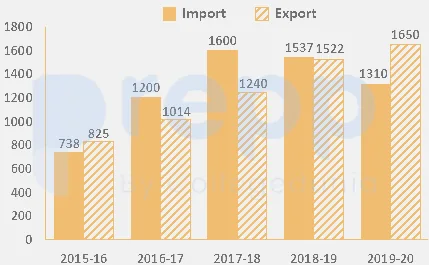
- A
1.33
- B
1.50
- C
1.23
- D
1.60
Show answer
A. 1.33Given:
Import during the year 2017 - 18 = 1600
Import during the year 2016 - 17 = 1200
Concept Used:
The concept of multiplication is used
Calculation:
According to the question,
⇒ Import during the year 2016 - 17 \(\times\) Times = Import during the year 2017 - 18
⇒ Times = 1600 / 1200 = 1.33
⇒ Hence, Option 1 is correct
Paper & answer key PDF ↗ Question 75archived
A sum is deposited in a bank which gives simple interest. The sum becomes 1.25 times in 3 years. If there is a requirement of ₹7,60,000 after seven years, how much amount (in ₹) should one deposit to fulfil the requirement?
- A
5,20,000
- B
5,70,000
- C
4,80,000
- D
6,00,000
Show answer
C. 4,80,000Understanding the Simple Interest Problem
This problem involves simple interest calculations in two parts. First, we are given information about how a sum grows over 3 years, which helps us determine the annual simple interest rate. Second, we need to use this rate to find out what initial amount needs to be deposited to reach a specific target amount after 7 years.
The formula for Simple Interest (SI) is:
\(SI = \frac{P \times R \times T}{100}\)
Where:
\(P\) is the Principal amount (the initial deposit).
\(R\) is the annual interest rate (in percentage).
\(T\) is the time period (in years).
The Amount (A) after \(T\) years is given by:
\(A = P + SI = P + \frac{P \times R \times T}{100} = P \left(1 + \frac{R \times T}{100}\right)\)
Calculating the Simple Interest Rate
In the first part, a sum (let's call it \(P_1\)) is deposited and it becomes 1.25 times itself in 3 years. This means the Amount (\(A_1\)) after 3 years is \(1.25 \times P_1\).
Principal (\(P_1\)): \(P_1\)
Amount (\(A_1\)): \(1.25 \times P_1\)
Time (\(T_1\)): 3 years
Simple Interest (\(SI_1\)) earned: \(A_1 - P_1 = 1.25 P_1 - P_1 = 0.25 P_1\)
Using the simple interest formula \(SI = \frac{P \times R \times T}{100}\), we can write:
\(0.25 P_1 = \frac{P_1 \times R \times 3}{100}\)
We can cancel \(P_1\) from both sides (assuming \(P_1 > 0\)):
\(0.25 = \frac{3R}{100}\)
Now, we solve for the interest rate \(R\):
\(0.25 \times 100 = 3R\)
\(25 = 3R\)
\(R = \frac{25}{3}\) % per annum.
So, the simple interest rate given by the bank is \(\frac{25}{3}\) % per annum.
Determining the Required Initial Deposit
In the second part, we need to find the initial deposit (\(P_2\)) required to have an Amount (\(A_2\)) of ₹7,60,000 after 7 years. We will use the interest rate \(R = \frac{25}{3}\) % calculated in the first part.
Required Amount (\(A_2\)): ₹7,60,000
Time (\(T_2\)): 7 years
Interest Rate (\(R\)): \(\frac{25}{3}\) %
Required Principal (\(P_2\)): ?
Using the Amount formula \(A = P \left(1 + \frac{R \times T}{100}\right)\), we can write:
\(7,60,000 = P_2 \left(1 + \frac{\frac{25}{3} \times 7}{100}\right)\)
Simplify the term inside the parenthesis:
\(1 + \frac{25 \times 7}{3 \times 100} = 1 + \frac{175}{300}\)
We can simplify the fraction \(\frac{175}{300}\) by dividing both numerator and denominator by 25:
\(\frac{175 \div 25}{300 \div 25} = \frac{7}{12}\)
So, the equation becomes:
\(7,60,000 = P_2 \left(1 + \frac{7}{12}\right)\)
Combine the terms inside the parenthesis:
\(1 + \frac{7}{12} = \frac{12}{12} + \frac{7}{12} = \frac{19}{12}\)
So, the equation is:
\(7,60,000 = P_2 \times \frac{19}{12}\)
Now, solve for \(P_2\):
\(P_2 = \frac{7,60,000 \times 12}{19}\)
Calculate the value:
\(P_2 = \frac{760000}{19} \times 12\)
\(\frac{760000}{19} = 40000\)
\(P_2 = 40000 \times 12\)
\(P_2 = 480000\)
Therefore, an amount of ₹4,80,000 should be deposited to fulfil the requirement of having ₹7,60,000 after seven years at the calculated simple interest rate.
Revision Table: Simple Interest Calculation Summary
Calculation Step
Details
Formula/Value
Given in Part 1
Sum becomes 1.25 times in 3 years
\(A_1 = 1.25P_1\), \(T_1 = 3\) years
Calculate Simple Interest (SI) in Part 1
\(SI_1 = A_1 - P_1\)
\(SI_1 = 0.25P_1\)
Determine Rate (R)
Using \(SI_1 = \frac{P_1 \times R \times T_1}{100}\)
\(R = \frac{25}{3}\) %
Given in Part 2
Target Amount after 7 years
\(A_2 = ₹7,60,000\), \(T_2 = 7\) years
Find Required Principal (\(P_2\))
Using \(A_2 = P_2 \left(1 + \frac{R \times T_2}{100}\right)\)
\(P_2 = \frac{A_2}{1 + \frac{R \times T_2}{100}}\)
Substitute Values
\(A_2=7,60,000\), \(R=\frac{25}{3}\), \(T_2=7\)
\(P_2 = \frac{760000}{1 + \frac{25/3 \times 7}{100}}\)
Final Calculation
Evaluate the expression
\(P_2 = ₹4,80,000\)
Additional Information: Simple Interest Concepts
Simple interest is a basic way to calculate interest where the interest earned is only based on the initial principal amount. It does not compound, meaning interest earned in previous periods does not earn interest in subsequent periods.
Principal (P): The initial amount of money borrowed or invested.
Interest Rate (R): The percentage at which interest is calculated annually on the principal.
Time (T): The duration for which the money is borrowed or invested, usually in years.
Simple Interest (SI): The interest calculated only on the principal amount for the entire duration.
Amount (A): The total money at the end of the period, which is the sum of the principal and the simple interest earned (\(A = P + SI\)).
Simple interest is typically used for short-term loans or deposits. For longer periods, compound interest is more common, where interest is added to the principal, and subsequent interest is calculated on the new, larger principal.
Paper & answer key PDF ↗ Question 76archived
Select the option that expresses the given sentence in passive voice.
The patient remembers his son taking him to the temple.
- A
The patient remembers he was taken to the temple by his son.
- B
The patient remembers taken to the temple by his son.
- C
The patient remembers himself being taken to the temple by his son.
- D
The patient remembers being taken to the temple by his son.
Show answer
D. The patient remembers being taken to the temple by his son.Understanding Active and Passive Voice
Voice in grammar refers to the form of a verb that shows whether the subject of the sentence performs the action (active voice) or is acted upon (passive voice).
Active Voice: The subject does the action. Example:
The boy kicked the ball.
(Subject 'boy' performs the action 'kicked')
Passive Voice: The subject receives the action. Example:
The ball was kicked by the boy.
(Subject 'ball' receives the action 'was kicked')
Converting Sentences to Passive Voice
Converting a sentence from active voice to passive voice typically involves these steps:
Identify the subject, verb, and object in the active sentence.
Make the object of the active sentence the subject of the passive sentence.
Use the verb 'to be' in the same tense as the active verb, followed by the past participle of the main verb.
The subject of the active sentence becomes the object of a preposition (usually 'by') in the passive sentence, or it can be omitted if it's unimportant or obvious.
Analyzing the Given Sentence
The given sentence is: "The patient remembers his son taking him to the temple."
This sentence has a main clause "The patient remembers..." and a subordinate structure "his son taking him to the temple". The subordinate structure acts as the object of the verb "remembers". This subordinate structure itself is a gerund phrase where "taking" is the gerund, "his son" is its subject (possessive form), and "him" is its object.
We need to convert the object gerund phrase ("his son taking him to the temple") into its passive form while keeping the main clause ("The patient remembers") intact.
Converting the Gerund Phrase to Passive
Let's focus on the structure "subject + verb-ing + object". Its passive form is "being + past participle + by + agent".
Active gerund phrase: his son (subject) taking (verb-ing) him (object) to the temple (additional phrase)
Passive gerund phrase: being taken (being + past participle) to the temple (additional phrase) by his son (by + agent)
So, the passive form of "his son taking him to the temple" is "being taken to the temple by his son".
Evaluating the Options
Now let's examine how each option attempts to integrate this passive structure after "The patient remembers".
Option 1: "The patient remembers he was taken to the temple by his son."
This uses "he was taken", which is a simple past passive clause, not a gerund phrase ("being taken"). It doesn't correctly fit the structure required after "remembers" when referring to a past action remembered as an ongoing state or event.
Option 2: "The patient remembers taken to the temple by his son."
This uses just the past participle "taken". This is not a complete passive gerund structure ("being taken"). It is grammatically incorrect in this context.
Option 3: "The patient remembers himself being taken to the temple by his son."
This uses the passive gerund structure "being taken" but adds "himself". While "himself" refers back to the patient and makes it clear who was taken, the core passive transformation of the gerund phrase "his son taking him" is "being taken by his son". Adding "himself" is possible but the most direct and common passive form in this structure is without it.
Option 4: "The patient remembers being taken to the temple by his son."
This uses the correct passive gerund structure "being taken" and includes the agent "by his son". This directly transforms the object gerund phrase of the active sentence into its passive equivalent and fits grammatically after the verb "remembers". It implies that the patient remembers the experience of being taken.
Based on the rules of converting active voice sentences with gerund phrase objects into passive voice, Option 4 provides the most accurate and grammatically correct transformation.
Summary of Conversion
Part
Active Voice
Passive Voice
Main Subject
The patient
The patient
Main Verb
remembers
remembers
Object Gerund Phrase (Active)
his son taking him to the temple
-
Converted Passive Phrase
-
being taken to the temple by his son
Resulting Sentence
The patient remembers his son taking him to the temple.
The patient remembers being taken to the temple by his son.
Revision Table: Key Concepts in Voice Change
Concept
Active Voice
Passive Voice
Focus
Performer of the action
Receiver of the action
Structure (Simple)
Subject + Verb + Object
Object + be + Past Participle (+ by Subject)
Gerund Object Structure
Subject + Verb + Subject + Verb-ing + Object
Subject + Verb + being + Past Participle (+ by Agent)
Example (Sentence Type)
He saw her painting a picture.
He saw a picture being painted by her.
Additional Information on Gerunds and Passive Voice
A gerund is a verb form ending in -ing that functions as a noun. In the original sentence, "his son taking him to the temple" functions as the object of "remembers".
When the object of a verb is a gerund phrase with its own subject and object (like "his son taking him"), the passive voice is formed by converting the gerund part ("taking him") into a passive gerund ("being taken") and including the original gerund subject ("his son") as the agent ("by his son"). The subject of the main verb ("The patient") remains the same.
Understanding how to handle different types of objects, like gerunds or infinitive phrases, is crucial for accurate active-to-passive voice conversion.
Paper & answer key PDF ↗ Question 77archived
Select the option that can be used as a one-word substitute for the given group of words.
Formal forgiveness of a person’s sins
- A
Ablutions
- B
Absolution
- C
Absolutism
- D
Forgiveness
Show answer
B. AbsolutionUnderstanding the Concept: Formal Forgiveness of Sins
The question asks for a single word that represents the formal forgiveness of a person's sins. This concept is often associated with religious practices where a declaration is made to pardon someone for their wrongdoings, specifically in a spiritual or religious context.
Analyzing the Options
Let's examine each option provided:
Ablutions: This term refers to the act of washing oneself, often as a religious ritual of purification. It's related to cleansing but not specifically formal forgiveness of sins.
Absolution: This is a formal declaration of forgiveness of sins, typically given by a priest in certain Christian denominations. It directly matches the concept of formal forgiveness of a person's sins.
Absolutism: This is a political term referring to a system of government in which a ruler has unlimited power. It has no relation to forgiveness of sins.
Forgiveness: While this means pardoning someone for an offence, the question specifies "formal forgiveness of a person's sins," which implies a more specific, often religious, context than the general term "forgiveness."
Comparing the Options
Let's look at how each word relates to the given phrase:
Word
Meaning
Fits "Formal forgiveness of a person’s sins"?
Ablutions
Washing as a religious ritual
No
Absolution
Formal forgiveness of sins (often religious)
Yes
Absolutism
Unlimited governmental power
No
Forgiveness
Pardoning an offence (general term)
Partially, but "Absolution" is more specific and formal in the context of sins.
Identifying the Correct One-Word Substitute
Based on the definitions and comparison, the word that best fits the description "Formal forgiveness of a person’s sins" is Absolution. It is the precise term used for such a formal religious act.
Conclusion
The one-word substitute for "Formal forgiveness of a person’s sins" is Absolution.
Revision Table: One-Word Substitutes
Phrase
One-Word Substitute
Formal forgiveness of a person’s sins
Absolution
Washing oneself as a religious rite
Ablutions
Government with unlimited power
Absolutism
Additional Information: Understanding Absolution and Related Terms
Absolution in Religion: In many Christian traditions, absolution is a part of the Sacrament of Penance or Reconciliation, where a priest pronounces forgiveness of sins to a penitent person who has confessed their sins.
Forgiveness vs. Absolution: Forgiveness can be granted by any individual for any offense. Absolution, in the context of sins, is typically a formal act within a religious framework, often seen as mediated by a religious authority.
Synonyms: Depending on the context, related terms might include pardon, remission, or clearance, but for the formal religious context of forgiving sins, absolution is the most accurate specific term.
Paper & answer key PDF ↗ Question 78archived
Select the most appropriate ANTONYM of the underlined word.
It is undesirable to invest a part of your earnings for future use.
- A
advisable
- B
foolish
- C
unadvisable
- D
meek
Show answer
A. advisableUnderstanding the Question: Finding the Antonym of Undesirable
The question asks us to find the most appropriate antonym for the underlined word "undesirable" in the given sentence: "It is undesirable to invest a part of your earnings for future use." An antonym is a word that has the opposite meaning of another word.
Analyzing the Word "Undesirable"
The word "undesirable" means not wanted, not attractive, or something that is harmful or likely to cause problems. In the context of investing earnings, saying it is "undesirable" implies that doing so is not recommended, perhaps because it's seen as a bad idea or harmful in some way.
Examining the Options for the Antonym
Let's look at the given options and determine their meanings:
advisable: Worthy of being recommended; sensible; wise.
foolish: Lacking good sense or judgment; unwise.
unadvisable: Not recommended; unwise. This is very similar in meaning to undesirable in this context.
meek: Quiet, gentle, and easily imposed on; submissive.
Identifying the Antonym of Undesirable
We are looking for a word that means the opposite of "undesirable". If investing earnings is "undesirable" (not recommended, unwise), its opposite would be something that is recommended, sensible, or wise. Let's compare "undesirable" with the options:
Undesirable vs. advisable: Undesirable means not recommended or wise. Advisable means recommended or wise. These are opposite meanings.
Undesirable vs. foolish: Foolish is similar in meaning to undesirable in this context (both suggest a lack of wisdom). They are not antonyms.
Undesirable vs. unadvisable: Unadvisable is a synonym of undesirable in this context. They have similar meanings.
Undesirable vs. meek: Meek relates to personality or behaviour and is completely unrelated to the desirability or wisdom of an action like investing. They are not antonyms.
Based on the meanings, "advisable" is the clearest antonym of "undesirable" in the context of whether an action (investing earnings) is recommended or wise.
Why "Advisable" is the Correct Antonym
The sentence structure "It is undesirable to invest..." suggests that investing is seen as a bad or unwise idea. The opposite sentiment would be that investing is a good or wise idea, which is captured by the word "advisable". Therefore, "advisable" is the most appropriate antonym for "undesirable" in this context.
Let's rephrase the sentence with the antonym:
"It is advisable to invest a part of your earnings for future use."
This sentence conveys the opposite meaning of the original sentence, confirming that "advisable" is the correct antonym.
Word
Meaning in Context
Relationship to "Undesirable"
Undesirable
Not recommended; unwise; harmful
Word from the question
Advisable
Recommended; sensible; wise
Antonym
Foolish
Unwise; lacking good sense
Similar meaning (not antonym)
Unadvisable
Not recommended; unwise
Synonym
Meek
Submissive; gentle
Unrelated (not antonym)
Revision Table: Key Vocabulary and Antonyms
Word
Antonym
Undesirable
Advisable
Foolish
Wise, Sensible
Unadvisable
Advisable
Additional Information on Antonyms and Synonyms
Understanding antonyms and synonyms is crucial for building vocabulary and improving comprehension. Synonyms are words that have similar meanings, while antonyms are words that have opposite meanings.
It's important to consider the context in which a word is used when looking for its antonym or synonym. For example, "undesirable" can have slightly different nuances depending on whether it refers to a person, an object, or an action. In this question, the context of investing earnings helps us choose the most appropriate antonym related to wisdom or recommendation.
Practice identifying word relationships helps in understanding text better and expressing ideas more precisely. Always consider the specific sentence and its meaning when dealing with vocabulary questions like this one.
Paper & answer key PDF ↗ Question 79archived
Select the sentence with the appropriate use of preposition.
- A
Ashok was in the bus stop.
- B
Ashok was to the bus stop.
- C
Ashok was on the bus stop.
- D
Ashok was at the bus stop.
Show answer
D. Ashok was at the bus stop.Understanding Prepositions for Location
Prepositions are words that connect a noun or pronoun to other words in a sentence, often showing relationships of location, time, direction, or manner. In this question, we need to identify the sentence where the preposition correctly indicates Ashok's location relative to the bus stop.
Analyzing Preposition Usage in Sentences
Let's examine each sentence option and the preposition used:
Sentence 1: "Ashok was in the bus stop."
The preposition "in" is typically used for being inside an enclosed space or area. A bus stop is usually an open area or a small shelter, not something you are truly "in" like a room or a building. Using "in" here is generally incorrect for a bus stop location.
Sentence 2: "Ashok was to the bus stop."
The preposition "to" is primarily used to indicate movement towards a destination. "Ashok went to the bus stop" shows movement. "Ashok was to the bus stop" is grammatically awkward and doesn't correctly convey a static location at the bus stop.
Sentence 3: "Ashok was on the bus stop."
The preposition "on" is used to indicate being on a surface. While Ashok might be standing on the ground or pavement at the bus stop, saying he is "on the bus stop" itself is incorrect. It would imply being on top of the structure of the bus stop.
Sentence 4: "Ashok was at the bus stop."
The preposition "at" is commonly used for specific points, locations, or places like a bus stop, a station, an airport, a junction, or a specific address. It correctly indicates being present at that particular location. This is the appropriate preposition for indicating a static location at a bus stop.
Identifying the Appropriate Preposition
Based on the analysis, the preposition "at" is the most appropriate choice to describe someone's static location at a bus stop. It signifies being present at that specific point or area designated as the bus stop.
Therefore, the sentence that correctly uses the preposition is "Ashok was at the bus stop."
Revision Table: Common Prepositions for Location
Preposition
Common Usage for Location
Example
at
Specific point, small location, address, station, bus stop
at the bus stop, at the station, at 22 Park Road
in
Enclosed space, city, country, large area, vehicle (car, taxi)
in the room, in London, in India, in a car
on
Surface, street, floor, public transport (bus, train, plane)
on the table, on Oxford Street, on the 3rd floor, on the bus
to
Movement towards a destination
go to the park, travel to the city
Additional Information: Prepositions of Place
Prepositions of place help describe where something or someone is located. While "at," "in," and "on" are very common, the specific choice often depends on whether we are talking about a specific point, an area, or a surface.
At: Used for points or specific locations. Think of it as a relatively precise spot or meeting point.
In: Used for larger areas, enclosed spaces, or volumes. Think of being inside something or within boundaries.
On: Used for surfaces or lines (like streets). Think of being positioned on top of something or along a line.
Context is always important in choosing the correct preposition. For places like bus stops, stations, airports, or specific buildings when viewed as a location point, "at" is usually correct.
Paper & answer key PDF ↗ Question 80archived
Select the most appropriate meaning of the underlined idiom in the given sentence.
The MD of the company let the cat out of the bag by telling her secretary, who got the much coveted promotion.
- A
openly confess
- B
Creating a false story
- C
To allow a secret to be known, usually without intending to
- D
secretly confide
Show answer
C. To allow a secret to be known, usually without intending toUnderstanding the Idiom: Let the Cat Out of the Bag
The question asks for the meaning of the underlined idiom "let the cat out of the bag" as used in the sentence. Idioms are phrases or expressions whose meaning cannot be deduced simply from the ordinary meanings of the individual words. Understanding the context in which an idiom is used is key to grasping its meaning.
Analyzing the Sentence Context
The sentence is: "The MD of the company let the cat out of the bag by telling her secretary, who got the much coveted promotion."
Here, the Managing Director (MD) told her secretary about a "much coveted promotion". Getting a promotion is usually news that is announced formally or kept confidential until a specific time. The phrase "by telling her secretary" suggests how the MD revealed this information. The idiom "let the cat out of the bag" describes the nature of this revelation.
The promotion was "much coveted", meaning many people wanted it. Revealing who got it, perhaps before the official announcement, would likely be considered letting out a secret or revealing something prematurely.
Meaning of 'Let the Cat Out of the Bag'
The idiom "let the cat out of the bag" is commonly used to describe the act of revealing a secret or disclosing confidential information, often unintentionally or prematurely. It implies that something that was meant to be kept hidden has now become known.
Let's look at the options provided and see which one best fits this understanding and the context of the sentence.
Evaluating the Options
Let's examine each option:
openly confess: To confess usually means admitting to doing something wrong, often publicly. The MD telling the secretary about a promotion isn't an act of confessing wrongdoing. So, this meaning doesn't fit.
Creating a false story: This means making up a lie or something that isn't true. The sentence implies the MD told the secretary who *actually* got the promotion, suggesting it was the truth being revealed, not a false story being created. So, this meaning is incorrect.
To allow a secret to be known, usually without intending to: This definition perfectly matches the common meaning of "let the cat out of the bag". It describes revealing information that was supposed to be a secret, and often suggests it happened accidentally or carelessly rather than deliberately. In the sentence, telling the secretary about the promotion could be seen as letting out a secret prematurely or without intending for it to become widely known through the secretary.
secretly confide: To confide means to share a secret or private matter with someone you trust. While the MD told her secretary, the idiom "let the cat out of the bag" doesn't specifically mean sharing a secret in confidence. It focuses on the secret being revealed, potentially becoming more widely known than intended, rather than a private, trusted sharing. This option captures part of the action (sharing a secret) but misses the crucial element of the secret being revealed prematurely or in a way that wasn't intended for broader knowledge, which is core to the idiom.
Summary: Why Option 3 is Correct
Based on the analysis of the idiom's meaning and its usage in the given sentence, the most appropriate definition is "To allow a secret to be known, usually without intending to". The MD revealed the secret of the promotion, likely prematurely or in a way that led to it becoming known, which is exactly what "letting the cat out of the bag" signifies.
Revision Table: Idioms and Meanings
Idiom
Meaning
Example Usage
Let the cat out of the bag
To reveal a secret or surprise, often accidentally.
She didn't mean to, but she let the cat out of the bag about the party.
Break a leg
Good luck! (Used especially before a performance)
Before his play started, the director told him to break a leg.
Bite the bullet
To face a difficult situation with courage.
You'll just have to bite the bullet and tell him the truth.
Additional Information: Common English Idioms
Idioms are an important part of spoken and written English. They add color and depth to language but can be confusing if you don't know their specific meanings. Learning common idioms can greatly improve comprehension and fluency.
Many idioms have interesting origins, though these are not always immediately obvious from the words themselves.
Context is crucial when trying to understand or use an idiom correctly.
Using idioms appropriately can make your English sound more natural and native-like.
Practice identifying and understanding idioms in various texts and conversations to become more familiar with them.
Paper & answer key PDF ↗ Question 81archived
Select the most appropriate ANTONYM of the underlined word.
Construction plays a central role in transforming the natural environment into the built environment, and many considerations and restrictions can apply before a project is given consent to proceed in terms of how it may influence the environment.
- A
Bickering
- B
Expulsion
- C
Directive
- D
Interdiction
Show answer
D. InterdictionUnderstanding the Question: Finding the Antonym of Consent
The question asks us to find the most appropriate antonym for the underlined word "consent" in the given sentence:
"Construction plays a central role in transforming the natural environment into the built environment, and many considerations and restrictions can apply before a project is given consent to proceed in terms of how it may influence the environment."
In this context, "consent" refers to official permission or agreement allowing the construction project to go forward. An antonym is a word that has the opposite meaning of another word.
Analyzing the Options for Antonym of Consent
Let's look at the provided options and determine their meanings:
Bickering: This means arguing about trivial matters. This is not the opposite of giving permission.
Expulsion: This refers to the act of forcing someone or something out. While it involves denial, it's usually about removing something that is already present, not denying permission to start.
Directive: This is an official instruction or order. A directive tells someone what to do, which is different from either giving or denying permission.
Interdiction: This means an authoritative prohibition or ban. It is a formal act of forbidding something.
Why Interdiction is the Correct Antonym for Consent
The word "consent" means permission or approval. The opposite of giving permission to proceed is to prohibit or ban the action. Among the given options, "interdiction" most closely represents an authoritative prohibition or ban, which is the opposite of giving consent or permission.
Consider the relationship:
Giving consent = Granting permission
Interdiction = Prohibiting or banning
Therefore, "interdiction" serves as the most appropriate antonym for "consent" in the context of allowing or prohibiting a project's progression.
Revision Table: Key Vocabulary Antonyms
Word
Meaning in Context
Opposite Action/State
Appropriate Antonym (from options)
Consent
Permission to proceed
Prohibition or denial
Interdiction
Additional Information: Expanding Vocabulary Knowledge
Understanding antonyms helps build a strong vocabulary. Here are some related concepts:
Synonyms of Consent: Permission, approval, agreement, sanction, authorization, assent.
Antonyms of Consent: Refusal, denial, disapproval, rejection, prohibition, ban, veto.
Interdiction in other contexts: It can also refer to the action of preventing enemy forces from reaching an area.
Knowing words like consent and interdiction is important for understanding formal language, especially in legal or regulatory contexts, as shown in the example sentence about construction and environmental restrictions.
Paper & answer key PDF ↗ Question 82archived
Parts of a sentence are given below in jumbled order. Arrange the parts in the correct order to form a meaningful sentence.
A great transition / marked / the 20th century / for mankind
- A
A great transition marked the 20th century for mankind.
- B
The 20th century marked a great transition for mankind.
- C
A great transition for mankind marked the 20th century.
- D
For mankind, a great transition marked the 20th century.
Show answer
B. The 20th century marked a great transition for mankind.Understanding Sentence Arrangement
Sentence arrangement questions require you to take parts of a sentence, given in a jumbled order, and arrange them correctly to form a single, meaningful, and grammatically sound sentence. This involves understanding the role of different parts of speech and phrases within a sentence.
The jumbled parts are:
A great transition
marked
the 20th century
for mankind
Analyzing the Jumbled Parts
Let's look at each part and its potential role:
A great transition: This is a noun phrase. It could function as a subject or an object.
marked: This is a verb in the past tense. It is likely the main verb of the sentence.
the 20th century: This is a noun phrase. It could also function as a subject or an object.
for mankind: This is a prepositional phrase. It typically functions as a modifier, often indicating who or what is affected by or involved in the action or state described.
Constructing the Correct Sentence Structure
A standard sentence structure is Subject + Verb + Object (+ Modifiers). We need to determine which noun phrase acts as the subject and which acts as the object, and where the modifier fits.
Consider the verb "marked". Something or someone 'marked' something else. The 'marker' is the subject, and the 'thing marked' is the object.
Let's test the possible subject-verb-object combinations:
Can "A great transition" mark "the 20th century"? Yes, a transition could define or characterize a period.
Can "The 20th century" mark "a great transition"? Yes, a period of time can be said to contain or initiate a transition. This structure is also common, where a time period is the subject that is associated with a significant event or change (the object).
Now let's consider the modifier "for mankind". This phrase most logically modifies the noun phrase "a great transition", indicating that the transition is significant from the perspective of humanity.
Evaluating the Options
Based on the analysis, let's look at how the parts can be arranged to form a meaningful sentence:
Arrangement 1: A great transition / marked / the 20th century / for mankind
Sentence: "A great transition marked the 20th century for mankind."
Here, "A great transition" is the subject, "marked" is the verb, and "the 20th century" is the object. "for mankind" modifies "the great transition" (or potentially the whole action). This sentence is grammatically correct and makes sense.
Arrangement 2: The 20th century / marked / a great transition / for mankind
Sentence: "The 20th century marked a great transition for mankind."
Here, "The 20th century" is the subject, "marked" is the verb, and "a great transition" is the object. "for mankind" modifies "a great transition". This structure is also grammatically correct and makes sense. It places the time period as the active subject that is associated with bringing about or containing the transition.
Arrangement 3: A great transition for mankind / marked / the 20th century
Sentence: "A great transition for mankind marked the 20th century."
Here, "A great transition for mankind" acts as a single subject phrase. This is grammatically correct, but the previous arrangements might be considered slightly more typical ways to phrase this idea.
Arrangement 4: For mankind, / a great transition / marked / the 20th century
Sentence: "For mankind, a great transition marked the 20th century."
This places the modifier "For mankind" at the beginning, followed by the subject "a great transition", verb "marked", and object "the 20th century". This is also grammatically correct and provides a different emphasis.
While multiple arrangements might be grammatically sound, the most natural and common phrasing, often preferred in sentence arrangement exercises, is the one where the time period containing the event acts as the subject. Comparing the options, the structure where "The 20th century" is the subject seems the most likely intended correct answer among the provided choices.
The correct sequence of parts is:
the 20th century
marked
a great transition
for mankind
This forms the sentence: The 20th century marked a great transition for mankind.
Part
Arrangement Order
The 20th century
1
marked
2
a great transition
3
for mankind
4
Revision Table: English Grammar & Sentence Structure
Concept
Description
Example in Sentence
Subject
The noun or pronoun performing the action or being described.
The 20th century marked...
Verb
The action word or state of being.
The 20th century marked...
Object
The noun or pronoun receiving the action of the verb.
...marked a great transition...
Prepositional Phrase
A phrase beginning with a preposition (like 'for', 'in', 'on', 'with') and its object. Often functions as an adjective or adverb.
...a great transition for mankind.
Additional Information: Significance of the 20th Century Transition
The phrase "a great transition for mankind" when referring to the 20th century highlights the significant changes that occurred during that period. This includes rapid advancements in science and technology (like aviation, space travel, computing, medicine), major socio-political shifts (world wars, decolonization, rise of new ideologies), economic transformations, and globalization. These events collectively marked a turning point in human history and society.
Paper & answer key PDF ↗ Question 83archived
In the given sentence the underlined word may have been incorrectly spelt. Identify the option that rectifies the spelling. If there is no error in spelling, select ‘No error’.
During my time - taking and gradual convaelescenc after my back injury, my family was by my side.
- A
convalesaence
- B
No error
- C
convalecense
- D
convalescence
Show answer
D. convalescenceThe correct answer is convalescence.
Common Errors: Words with silent letters ('s' in 'scent'), multiple vowels together, or common suffixes like '-escence' or '-ance'/'-ence' are often challenging and lead to spelling errors. Paying attention to these patterns can improve spelling accuracy. Proofreading: Always proofread your writing to catch any spelling errors before submitting. Using spell checkers is helpful, but they don't catch all errors, especially if a misspelled word happens to be another correctly spelled word (e.g., 'there' vs 'their').
Paper & answer key PDF ↗ Question 84archived
Fill in the blank with the correct collocation.
Brady straightened, the ______ baton in hand.
- A
charge
- B
wooden
- C
swing
- D
open
Show answer
B. woodenUnderstanding Collocations in English
The question asks us to fill in the blank with the correct collocation. A collocation is a pair or group of words that are habitually used together. When words collocate, they sound 'right' or natural to native speakers. Using incorrect collocations can make language sound awkward or unnatural.
The sentence is: "Brady straightened, the ______ baton in hand." We need to find which of the given options naturally pairs with the word "baton".
Let's examine the options:
charge: The word 'charge' has many meanings (e.g., an electrical charge, a fee, an attack, responsibility). While a baton might be used in a police 'charge' (attack), 'charge baton' is not a standard way to describe the baton itself. It doesn't describe a characteristic of the baton.
wooden: The word 'wooden' describes something made of wood. Batons, especially traditional ones used by police or conductors, are often made of wood. 'Wooden baton' is a very common and natural collocation describing the material of the baton.
swing: The word 'swing' is typically a verb describing the action of moving something back and forth, like 'swing a bat' or 'swing a baton'. It describes an action performed with the baton, not a characteristic of the baton itself in hand.
open: The word 'open' usually describes something that is not closed or blocked, or something that has been unfolded or extended (like an 'open book' or an 'open umbrella'). While some telescopic batons might be described as 'open' when extended, it's not a universal description for a baton, and 'wooden' is a far more common and direct description of a typical baton's physical nature.
Considering the natural pairings in English, 'wooden baton' is a widely accepted and commonly used collocation. It describes a material from which batons are frequently made, fitting the context of someone holding the object.
Why 'wooden' is the Correct Collocation for Baton
The phrase "wooden baton" is a strong and common collocation because it describes a key characteristic of many batons – their material. When we describe objects, their material is a frequent point of description. The other options ('charge', 'swing', 'open') do not describe a material or a inherent, common state of a typical baton being held. 'Charge' relates to action or energy, 'swing' is an action, and 'open' relates to a state that only applies to certain types of batons (telescopic) and isn't as fundamental a descriptor as material for a general baton.
Therefore, the word that correctly completes the sentence is 'wooden'.
The completed sentence is: "Brady straightened, the wooden baton in hand."
Revision Table: Checking Baton Collocations
Option
Type of Word
Commonly collocates with baton?
Fits the sentence?
charge
Noun/Verb
No (as a descriptor)
No
wooden
Adjective
Yes
Yes
swing
Verb
No (as a descriptor)
No
open
Adjective
No (generally)
No
Additional Information on English Collocations
Collocations are essential for sounding natural and fluent in English. They are not always governed by strict grammatical rules but are based on usage patterns. Learning collocations helps improve vocabulary and writing skills.
Examples of other common collocations include:
make a decision
take a photo
heavy rain
strong wind
do homework
commit a crime
Studying collocations helps you choose the right words to use together, making your English more precise and natural.
Paper & answer key PDF ↗ Question 85archived
Select the most appropriate meaning of the given idiom.
Take something at face value
- A
Accept something as it looks without thinking about whether it might, in fact, not be quite what it appears
- B
According to the appearance of something
- C
Not laugh or change your expression even though you want to laugh
- D
Show that you do not like something by making an unpleasant expression
Show answer
A. Accept something as it looks without thinking about whether it might, in fact, not be quite what it appearsUnderstanding the Idiom: Take Something at Face Value
Let's break down the meaning of the idiom "Take something at face value". This phrase is commonly used in English to describe how someone accepts information or a situation.
The idiom "Take something at face value" means to accept something exactly as it appears, without questioning it or looking for a hidden meaning. It implies not being suspicious or trying to find underlying issues. You are simply taking what is presented to you as the truth, based purely on its superficial appearance or initial presentation.
Analyzing the Options
Now let's look at the given options and see which one best matches the meaning of "Take something at face value".
Option 1: Accept something as it looks without thinking about whether it might, in fact, not be quite what it appears.
Option 2: According to the appearance of something.
Option 3: Not laugh or change your expression even though you want to laugh.
Option 4: Show that you do not like something by making an unpleasant expression.
Evaluating Each Option
We will now evaluate each option against the meaning of the idiom.
Option 1 Analysis: This option describes accepting something based on its initial appearance ("as it looks") and explicitly states that you are *not* considering if it might be different ("without thinking about whether it might, in fact, not be quite what it appears"). This aligns perfectly with the definition of taking something at face value.
Option 2 Analysis: "According to the appearance of something" describes how something looks or is presented. While related to the idiom, it doesn't describe the *action* of a person *accepting* it based *only* on that appearance. The idiom involves the act of acceptance without deeper scrutiny.
Option 3 Analysis: This option describes keeping a straight face, which is a different idiom ("keep a straight face"). It has nothing to do with accepting information or situations as they are presented.
Option 4 Analysis: This option describes showing displeasure through a facial expression. This is unrelated to the idiom "Take something at face value".
Identifying the Correct Meaning
Based on our analysis, Option 1 is the most accurate and complete explanation of the idiom "Take something at face value". It captures both the acceptance aspect and the lack of deeper investigation.
Revision Table: Idiom Meaning Summary
Idiom
Meaning
Take something at face value
To accept something as it is presented, without questioning or investigating further.
Additional Information on Idioms and Meanings
Idioms are phrases whose meaning cannot be deduced simply by looking at the individual words. "Take something at face value" is a good example of this. Understanding idioms is crucial for effective communication in English. They often add color and nuance to language.
Some other common idioms related to judgment or appearance include:
Don't judge a book by its cover: Don't form an opinion about someone or something based purely on outward appearance.
Appearances can be deceiving: Things may not be as they seem on the surface.
These related idioms highlight the contrast with "Take something at face value," which is precisely about *not* looking beyond the initial appearance.
Paper & answer key PDF ↗ Question 86archived
Select the correct direct form of the given sentence.
The secretary assures the audience that he/she is going to help them.
- A
The secretary said to the audience, “I am going to help you.”
- B
The secretary says to the audience, “I am going to help you.”
- C
The secretary says to the audience, “I was going to help you.”
- D
The secretary says to the audience, “I will be going to help you.”
Show answer
B. The secretary says to the audience, “I am going to help you.”Understanding Indirect to Direct Speech Conversion
The question asks us to convert a sentence from indirect speech into its correct direct speech form. The given sentence is: "The secretary assures the audience that he/she is going to help them."
Analysing the Indirect Speech Sentence
Let's break down the given indirect speech sentence:
Reporting Verb: "assures". This verb is in the present tense.
Subject of Reporting Verb: "The secretary".
Object of Reporting Verb: "the audience".
Reported Clause: "that he/she is going to help them".
Pronouns in Reported Clause: "he/she" (referring to the secretary), "them" (referring to the audience).
Verb form in Reported Clause: "is going to help" (indicates a future intention).
Rules for Converting Indirect to Direct Speech (Present Tense Reporting Verb)
When the reporting verb (like 'says', 'tells', 'assures', 'states', 'believes', etc.) is in the present or future tense, the tense of the verb in the reported speech generally does not change when converting it to direct speech. The main changes involve:
Removing the conjunction "that".
Changing the pronouns and possessive adjectives to reflect the first or second person as spoken by the original speaker. "He/She" referring to the speaker becomes "I". "Them" referring to the listeners becomes "you".
Changing time and place references if necessary (not applicable in this sentence).
Enclosing the direct words in quotation marks ("...").
Evaluating the Options
Let's apply these rules to the given indirect sentence and check each option:
Original Indirect Sentence: The secretary assures the audience that he/she is going to help them.
Option 1: The secretary said to the audience, “I am going to help you.”
The reporting verb is "said", which is past tense.
The original reporting verb is "assures", which is present tense.
Since the reporting verb tense is different, this option is incorrect.
Option 2: The secretary says to the audience, “I am going to help you.”
The reporting verb is "says", which is present tense, matching the original "assures" (present tense).
The conjunction "that" is removed.
"he/she" (referring to the secretary) becomes "I" in the direct speech.
"them" (referring to the audience) becomes "you" in the direct speech.
The verb form "is going to help" remains in a present/future form ("am going to help") because the reporting verb is in the present tense. The tense doesn't change, only the form changes to match the new subject "I".
The direct words are in quotation marks.
This option correctly follows the conversion rules.
Option 3: The secretary says to the audience, “I was going to help you.”
The reporting verb is "says", which is correct (present tense).
The pronouns are correctly changed ("I", "you").
However, the verb form "is going to help" is changed to "was going to help". This changes the tense from present/future intention to past intention.
Since the reporting verb is present tense, the tense in the reported speech should not change.
This option is incorrect because of the tense change in the reported speech.
Option 4: The secretary says to the audience, “I will be going to help you.”
The reporting verb is "says", which is correct (present tense).
The pronouns are correctly changed ("I", "you").
However, the verb form "is going to help" is changed to "will be going to help". While this is a future form, it is not the direct equivalent of "is going to" in the context of direct speech conversion when the reporting verb is present. The original sentence uses "is going to" to express future intention, and "am going to" directly translates this when the subject is "I". "Will be going to" implies a future continuous or a different nuance.
The most direct and accurate conversion maintains the 'going to' structure where possible.
This option is incorrect.
Conclusion
Based on the analysis and the rules for converting indirect speech to direct speech with a present tense reporting verb, Option 2 is the only correct transformation.
Change
Indirect to Direct
Example from Sentence
Reporting Verb Tense
Present stays Present
assures → says
Conjunction
Remove 'that'
that → (removed)
Subject Pronoun (referring to speaker)
he/she → I
he/she → I
Object Pronoun (referring to listener)
them → you
them → you
Verb Tense (if reporting verb is present)
Stays the same type (form changes based on new subject)
is going to help (with he/she) → am going to help (with I)
Revision Table: Indirect to Direct Speech Rules
Feature
Indirect Speech
Direct Speech
Notes
Reporting Verb (Present/Future)
He says, She tells
He says, She tells
Tense doesn't change
Conjunction
that, if, whether (often used)
Removed
Generally removed for statements, questions
Reported Clause Tense (if reporting verb is present)
Present, Past, Future
Present, Past, Future
Tense remains unchanged
Pronouns
Third Person (often)
First/Second Person (often)
Changes based on speaker/listener
Punctuation
No quotes, comma after reporting verb optional
Quotation marks, comma after reporting verb, comma/question mark/exclamation mark inside quotes
Specific punctuation required
Additional Information: Indirect Speech with Past Tense Reporting Verb
It's important to note that the rules are different when the reporting verb is in the past tense (e.g., 'said', 'told', 'asked'). In such cases, the tense in the reported clause usually changes or 'backsifts':
Present Simple → Past Simple
Present Continuous → Past Continuous
Present Perfect → Past Perfect
Past Simple → Past Perfect
Past Continuous → Past Perfect Continuous
Future (will) → Conditional (would)
Can → Could
May → Might
For example: Indirect: He said that he was happy. Direct: He said, "I am happy."
However, in the question provided, the reporting verb "assures" is in the present tense, so the tenses in the reported speech do not change, reinforcing why Option 2 is correct.
Paper & answer key PDF ↗ Question 87archived
Select the correct active form of the given sentence.
My cafe has been revisited by many tourists.
- A
Many tourists revisited my cafe.
- B
Many tourists did revisited my cafe.
- C
Many tourists have revisited my cafe.
- D
Many tourists has revisited my cafe.
Show answer
C. Many tourists have revisited my cafe.Understanding Active and Passive Voice Conversion
The question asks us to convert a sentence from its passive form to its active form. The given sentence is: "My cafe has been revisited by many tourists."
Let's break down the structure of this sentence to understand its components and tense.
Analyzing the Passive Sentence
The sentence "My cafe has been revisited by many tourists" is in the passive voice. We can identify this by the presence of "has been + past participle" and the phrase "by many tourists", which indicates the performer of the action.
Subject (Passive): My cafe (the receiver of the action)
Verb: has been revisited (passive form, Present Perfect Tense)
Performer of the action (Object in Passive): many tourists (introduced by 'by')
The tense of the verb phrase "has been revisited" is Present Perfect Tense. In the passive voice, the structure for Present Perfect is: Subject + has/have + been + Past Participle.
Converting Passive Voice to Active Voice
To convert a passive sentence to active voice, we need to make the performer of the action the new subject. The object of the passive sentence becomes the subject of the active sentence. The subject of the passive sentence becomes the object of the active sentence. The verb form changes from passive to active, keeping the same tense.
Steps for Conversion:
Identify the performer of the action (usually after "by"). This will be the new subject. In this case, it is "many tourists".
Identify the original subject (the receiver of the action). This will be the new object. In this case, it is "My cafe".
Identify the tense of the verb in the passive voice (Present Perfect: has been revisited).
Convert the passive verb form ("has been revisited") to the active form in the same tense (Present Perfect). The active form of the Present Perfect is: Subject + has/have + Past Participle. Since the new subject ("many tourists") is plural, we will use "have". The past participle of "revisit" is "revisited". So the active verb phrase is "have revisited".
Assemble the new sentence: New Subject + Active Verb + New Object.
Applying the Steps to the Sentence
Let's apply these steps to "My cafe has been revisited by many tourists":
New Subject: many tourists
Active Verb (Present Perfect, with plural subject): have revisited
New Object: my cafe
The resulting active sentence is: "Many tourists have revisited my cafe."
Evaluating the Options
Now let's look at the provided options and see which one matches our converted sentence.
Option
Sentence
Analysis
1
Many tourists revisited my cafe.
This is in the Simple Past tense (revisited). The original sentence is in the Present Perfect tense (has been revisited). The tense is incorrect.
2
Many tourists did revisited my cafe.
This sentence uses incorrect grammar. "Did" is used with the base form of the verb (e.g., "did revisit") in Simple Past negations or questions, or for emphasis. This structure is incorrect for a positive statement and also uses the wrong tense.
3
Many tourists have revisited my cafe.
This sentence is in the Present Perfect tense (have revisited). The subject "Many tourists" is plural and correctly uses "have". The structure matches the active form of the original passive sentence while maintaining the tense. This is the correct conversion.
4
Many tourists has revisited my cafe.
This sentence uses incorrect subject-verb agreement. The subject "Many tourists" is plural, but it uses the singular auxiliary verb "has". It should be "have". While the tense is intended to be Present Perfect, the grammar is incorrect.
Based on the analysis, Option 3, "Many tourists have revisited my cafe," is the correct active form of the given passive sentence, correctly maintaining the Present Perfect tense and using proper subject-verb agreement.
Revision Table: Active vs. Passive Voice
Feature
Active Voice
Passive Voice
Focus
On the performer of the action.
On the receiver of the action.
Structure (Present Perfect)
Subject + has/have + Past Participle + Object
Subject + has/have + been + Past Participle (+ by + Performer)
Example (Question Sentence)
Many tourists have revisited my cafe.
My cafe has been revisited by many tourists.
Use Case
When the performer is important or known.
When the action or the receiver is more important than the performer, or the performer is unknown.
Additional Information on Voice Conversion
Converting between active and passive voice is a fundamental skill in English grammar. It allows us to change the emphasis of a sentence. Remember that not all sentences can be converted to passive voice. Sentences with intransitive verbs (verbs that do not take an object, like 'sleep', 'arrive', 'go') do not have a passive form because there is no receiver of the action to become the subject of the passive sentence.
Also, pay close attention to the tense when converting. The tense in the active voice must be the same as the tense in the original passive voice sentence. The main verb in the passive voice is always a past participle, and the auxiliary verb (a form of 'be') determines the tense and person.
Practice converting sentences in different tenses to become comfortable with the various passive voice structures.
Paper & answer key PDF ↗ Question 88archived
Select the most appropriate ANTONYM of the underlined word.
The actor was ridiculed for her nonchalant attitude towards her work.
- A
Boisterous
- B
Unconcerned
- C
Considerate
- D
Retrospective
Show answer
C. ConsiderateFinding the Appropriate Antonym for Nonchalant
The question asks us to identify the most appropriate antonym for the underlined word "nonchalant" as used in the sentence: "The actor was ridiculed for her nonchalant attitude towards her work."
An antonym is a word that has the opposite meaning of another word.
Understanding the Meaning of Nonchalant
The word "nonchalant" means feeling or appearing casually calm and relaxed; not displaying anxiety, interest, or enthusiasm. In the context of the sentence, the actor's nonchalant attitude towards her work implies a lack of care, interest, or seriousness.
Analyzing the Options for the Antonym of Nonchalant
Let's examine the given options to find the word with the most opposite meaning to "nonchalant":
Boisterous: This word means noisy, energetic, and cheerful. It relates to behavior and temperament, but not directly to the level of care, interest, or seriousness towards work. It is not an antonym for nonchalant in this context.
Unconcerned: This word means not worried or anxious. This is very close in meaning to nonchalant, suggesting a lack of concern or interest. Therefore, it is a synonym or near-synonym, not an antonym.
Considerate: This word means careful not to inconvenience or harm others; thoughtful. While primarily used for thoughtfulness towards others, it implies paying attention, being mindful, and showing care. An attitude that is considerate towards work would imply attention, diligence, and seriousness, which is opposite to a nonchalant attitude (lack of care/interest). This word represents a strong contrast to being unconcerned or indifferent.
Retrospective: This word means looking back on or dealing with past events. It relates to time and perspective on the past, not to an attitude of care, interest, or seriousness towards present work. It is not an antonym for nonchalant.
Selecting the Most Appropriate Antonym
Based on the analysis, "Unconcerned" is a synonym of nonchalant. "Boisterous" and "Retrospective" are unrelated in meaning. "Considerate", implying attention, thoughtfulness, and care, stands in contrast to the indifference or lack of interest conveyed by "nonchalant". Therefore, "Considerate" is the most appropriate antonym among the given options.
The actor's nonchalant attitude towards her work (lack of care/interest) is the opposite of having a considerate attitude towards her work (showing care/attention/diligence).
Word
Meaning
Relationship to Nonchalant
Nonchalant
Casually calm, relaxed; not showing interest/enthusiasm/concern
--
Boisterous
Noisy, energetic
Unrelated
Unconcerned
Not worried or anxious
Synonym/Similar
Considerate
Thoughtful, careful; showing care/attention
Antonym (most appropriate)
Retrospective
Looking back at the past
Unrelated
Revision Table: Understanding Antonyms
To master vocabulary, understanding antonyms is as important as understanding synonyms. Here is a quick review:
Term
Definition
Example Pair
Antonym
A word opposite in meaning to another.
Hot <> Cold
Synonym
A word similar in meaning to another.
Happy = Joyful
Additional Information: Expanding English Vocabulary
Expanding your English vocabulary is crucial for effective communication and excelling in language-based tests. Here are some tips:
Learn words in context, like from sentences.
Group words by synonyms and antonyms.
Use new words in your writing and speaking.
Read widely to encounter new words.
Use flashcards or vocabulary apps for practice.
Focusing on core words and their relationships (synonyms, antonyms, related words) helps build a strong vocabulary foundation.
Paper & answer key PDF ↗ Question 89archived
Select the most appropriate ANTONYM of the given word.
Pacify
- A
Placate
- B
Assuage
- C
Aggravate
- D
Quell
Show answer
C. AggravateUnderstanding the Meaning of 'Pacify'
The word "Pacify" essentially means to calm down someone who is angry or upset, or to end a conflict or violence. It involves bringing peace or tranquility to a situation or person.
Examining the Provided Options
To find the correct antonym of "Pacify", we need to understand the meaning of each option provided:
Placate: This word means to make someone less angry or hostile by giving them something or making concessions. It's very similar to "Pacify" and acts as a synonym. For instance, a parent might offer a treat to placate a fussy child.
Assuage: This term means to make an unpleasant feeling (like pain, guilt, or anxiety) less intense. While it involves soothing, it's not always about calming anger or stopping conflict directly. For example, one might listen to calming music to assuage their stress.
Aggravate: This word means to make a situation, problem, or injury worse or more serious. It can also mean to annoy or irritate someone. This meaning is the direct opposite of calming or making things peaceful. For example, adding salt to a wound would aggravate the pain.
Quell: This means to suppress or put an end to something, often through the use of force, like putting down a riot. Similar to "Pacify", it aims to restore calm or order, making it another synonym. For example, authorities might try to quell a disturbance.
Determining the Opposite of 'Pacify'
Based on the definitions:
"Placate" and "Quell" are synonyms because they mean to calm or subdue.
"Assuage" relates to easing feelings but isn't the direct opposite of calming anger or conflict.
"Aggravate" means to make things worse or more intense, which is the opposite action of making things calm or peaceful ("Pacify").
Final Answer Selection
Therefore, the word that represents the opposite meaning of "Pacify" is "Aggravate".
Paper & answer key PDF ↗ Question 90archived
Rearrange the parts of the sentence in correct order.
Kemp's ridleys are
P. usually found in nearshore and
Q. inshore waters of the northern
R. Gulf of Mexico, especially in Louisiana waters,
S. which are their primary feeding grounds
- A
SRQP
- B
QPSR
- C
PQRS
- D
PRSQ
Show answer
C. PQRSUnderstanding Sentence Rearrangement: Kemp's Ridleys Habitat
This question asks us to rearrange the given parts (P, Q, R, S) to form a coherent and grammatically correct sentence that starts with "Kemp's ridleys are". Let's look at the parts:
P: usually found in nearshore and
Q: inshore waters of the northern
R: Gulf of Mexico, especially in Louisiana waters,
S: which are their primary feeding grounds
We need to connect these parts logically to describe where Kemp's ridley turtles are found.
The sentence begins with "Kemp's ridleys are". We need a part that tells us *how* or *where* they are.
Part P ("usually found in nearshore and") seems like a natural continuation, describing their usual location. So, "Kemp's ridleys are usually found in nearshore and...".
After "nearshore and", we need to specify the type of waters. Part Q ("inshore waters of the northern") fits perfectly. So now we have "Kemp's ridleys are usually found in nearshore and inshore waters of the northern...".
Following "northern", we need to complete the geographical location. Part R ("Gulf of Mexico, especially in Louisiana waters,") provides the specific area. So, the sentence becomes "Kemp's ridleys are usually found in nearshore and inshore waters of the northern Gulf of Mexico, especially in Louisiana waters,...".
Finally, Part S ("which are their primary feeding grounds") adds extra information about the location mentioned in R. This clause modifies the location "Louisiana waters" or the general area "Gulf of Mexico". So, the complete sentence is "Kemp's ridleys are usually found in nearshore and inshore waters of the northern Gulf of Mexico, especially in Louisiana waters, which are their primary feeding grounds".
The sequence of the parts that forms the correct sentence is P, Q, R, and S.
Let's check the combined sentence:
Kemp's ridleys are P usually found in nearshore and Q inshore waters of the northern R Gulf of Mexico, especially in Louisiana waters, S which are their primary feeding grounds.
This arrangement creates a grammatically correct and meaningful sentence describing the habitat of Kemp's ridley turtles.
The correct order is PQRS.
Let's examine the options based on our analysis:
Option 1: SRQP - This would be "Kemp's ridleys are which are their primary feeding grounds usually found in nearshore and inshore waters of the northern Gulf of Mexico, especially in Louisiana waters," - Doesn't make sense.
Option 2: QPSR - This would be "Kemp's ridleys are inshore waters of the northern usually found in nearshore and Gulf of Mexico, especially in Louisiana waters, which are their primary feeding grounds" - Doesn't make sense.
Option 3: PQRS - This gives the sentence we constructed and confirmed is correct.
Option 4: PRSQ - This would be "Kemp's ridleys are usually found in nearshore and Gulf of Mexico, especially in Louisiana waters, which are their primary feeding grounds inshore waters of the northern" - Doesn't make sense.
Therefore, the correct arrangement of the parts is PQRS.
Revision Table: Sentence Structure Analysis
Part
Text
Role in Sentence
Connection to Previous Part
Initial
Kemp's ridleys are
Subject and linking verb
Starting point
P
usually found in nearshore and
Describes how/where they are found
Continues the predicate after "are"
Q
inshore waters of the northern
Specifies the type and location of waters
Completes the phrase describing the location type
R
Gulf of Mexico, especially in Louisiana waters,
Names the specific geographical area
Specifies the location introduced by "northern"
S
which are their primary feeding grounds
Provides additional information about the location in R
Relative clause modifying the preceding noun (waters)
Additional Information: Kemp's Ridley Sea Turtles
Kemp's ridley sea turtle (Lepidochelys kempii) is the smallest sea turtle species and is critically endangered. Their main nesting area is a beach near Rancho Nuevo, Mexico. As the sentence indicates, the northern Gulf of Mexico, particularly Louisiana waters, is a crucial habitat for them, serving as important feeding grounds.
Sentence rearrangement exercises help improve understanding of sentence structure, grammar, and logical flow of ideas. They require paying attention to conjunctions, prepositions, relative pronouns, and how different parts of a sentence function together to convey meaning.
Paper & answer key PDF ↗ Question 91archived
Select the most appropriate option to fill in the blank.
A faint mist ______ over the valley.
- A
hung
- B
swung
- C
swayed
- D
dangled
Show answer
A. hungUnderstanding Verb Usage for Mist over Valley
The question asks us to choose the most appropriate verb to describe a "faint mist" in the context of being "over the valley". We need to consider the natural way mist behaves and the meaning of each option provided.
Analyzing Options for Mist Description
Let's look at the meaning of each word in the options:
hung: This word means to be suspended or to remain in a particular position, often in the air or from something above. It suggests a state of being suspended or spread out over an area.
swung: This implies a movement back and forth from a fixed point. Mist does not swing.
swayed: This means to move slowly back and forth or side to side. While mist can be moved by wind, "swayed" is not the most common or natural verb to describe its presence over a large area like a valley. It's more often used for objects like trees or curtains.
dangled: This means to hang or swing loosely. It often implies hanging from something specific or in separate strands. Mist does not typically dangle.
Why 'Hung' Fits the Mist over Valley
Considering the options, "hung" is the verb that best describes how mist behaves when it is settled or spread over a valley. Mist is composed of tiny water droplets suspended in the air. When it covers a valley, it appears to be suspended or hanging in the air over the land below. The phrase "mist hung over the valley" is a common and accurate way to describe this atmospheric condition.
Therefore, "hung" is the most appropriate word to fill in the blank.
Verb Suitability for Describing Mist
Verb
Meaning Relevant to Mist
Suitability for "Mist over Valley"
Hung
Suspended or remaining in the air.
Most Appropriate - Describes mist's presence covering an area.
Swung
Moved back and forth from a point.
Inappropriate - Mist doesn't swing.
Swayed
Moved slowly side to side.
Less Appropriate - Doesn't capture the general suspended state over an area.
Dangled
Hung or swung loosely.
Inappropriate - Mist doesn't dangle.
Revision Table: Understanding Verb Meanings
Common Verb Meanings
Verb
General Meaning
Example Usage
Hang
To be suspended from above; to remain in the air or space.
A picture hung on the wall. Smoke hung in the air.
Swing
To move back and forth from a fixed point.
The child swung on the playground. The door swung open.
Sway
To move or cause to move slowly back and forth or side to side.
The trees swayed in the wind. The boat swayed gently.
Dangle
To hang or swing loosely.
Keys dangled from his belt loop. Roots dangled from the cliff edge.
Additional Information: Describing Mist and Fog
Mist and fog are atmospheric phenomena where tiny water droplets are suspended in the air, reducing visibility. The term "mist" is typically used when visibility is reduced but is still greater than 1 kilometer, while "fog" is used when visibility is less than 1 kilometer. Both can be described using verbs that indicate their presence, density, or movement.
Other verbs sometimes used to describe mist or fog (depending on the context) include:
Settled: Suggests coming to rest or becoming stable over an area.
Rolled in: Suggests movement, typically from one area to another.
Crept: Suggests slow, quiet movement.
Clung: Suggests sticking or adhering to something, like a hillside.
Blanketed: Describes how a thick mist or fog covers an area entirely.
However, for a simple description of a faint mist existing "over the valley," "hung" remains the most natural and fitting choice among the given options.
Paper & answer key PDF ↗ Question 92archived
Select the correct indirect form of the given sentence.
She said to me, “You will speak at the conference tomorrow.”
- A
She told me that I would speak at the conference that day.
- B
She told me that I might speak at the conference the next day.
- C
She told me that I will speak at the conference the today.
- D
She told me that I would speak at the conference the next day.
Show answer
D. She told me that I would speak at the conference the next day.Converting Direct Speech to Indirect Speech
Converting a sentence from direct speech to indirect speech (also known as reported speech) involves making several changes to reflect that someone is reporting what was said, rather than quoting it directly. These changes typically include altering the reporting verb, connective, pronouns, tense, and time or place adverbs.
Analyzing the Given Direct Speech Sentence
The given sentence in direct speech is:
She said to me, “You will speak at the conference tomorrow.”
Let's break down the components:
Reporting verb: “said to me”
Speaker: “She”
Listener: “me”
Reported clause: “You will speak at the conference tomorrow.”
Subject of reported clause: “You” (referring to the listener, “me”)
Verb tense in reported clause: “will speak” (Future Simple)
Time adverb: “tomorrow”
Applying Direct to Indirect Speech Conversion Rules
To convert this direct speech sentence into indirect speech, we apply the following rules:
The reporting verb “said to me” changes to “told me”.
A connective, usually “that”, is used after the reporting verb.
The pronoun “You” changes according to the listener. Since “You” refers to “me”, it changes to “I”.
The tense of the verb changes. “will speak” (Future Simple) changes to “would speak” (Conditional Simple). This is a common backward shift in tense in reported speech, especially when the reporting verb is in the past tense (“said”).
Time adverbs change. “tomorrow” changes to “the next day” or “the following day”.
Step-by-Step Conversion
Let's apply the rules step-by-step:
Original: She said to me, “You will speak at the conference tomorrow.”
Reporting verb: She told me...
Connective: She told me that...
Pronoun: She told me that I...
Tense: She told me that I would speak...
Time adverb: She told me that I would speak at the conference the next day.
So, the correct indirect form is: She told me that I would speak at the conference the next day.
Analyzing the Options for Indirect Speech Conversion
Let's examine each provided option:
Option 1: She told me that I would speak at the conference that day.
“said to me” correctly changed to “told me”.
Connective “that” is used.
Pronoun “You” correctly changed to “I”.
Tense “will speak” correctly changed to “would speak”.
However, the time adverb “tomorrow” is incorrectly changed to “that day”. It should be “the next day” or “the following day”. This option is incorrect.
Option 2: She told me that I might speak at the conference the next day.
“said to me” correctly changed to “told me”.
Connective “that” is used.
Pronoun “You” correctly changed to “I”.
The time adverb “tomorrow” is correctly changed to “the next day”.
However, the tense “will speak” is incorrectly changed to “might speak”. The standard change for “will” is “would”. This option is incorrect.
Option 3: She told me that I will speak at the conference the today.
“said to me” correctly changed to “told me”.
Connective “that” is used.
Pronoun “You” correctly changed to “I”.
However, the tense “will speak” has not been changed to “would speak”.
The time adverb “tomorrow” is incorrectly changed to “the today”, which is not a standard transformation. This option is incorrect.
Option 4: She told me that I would speak at the conference the next day.
“said to me” correctly changed to “told me”.
Connective “that” is used.
Pronoun “You” correctly changed to “I”.
Tense “will speak” correctly changed to “would speak”.
The time adverb “tomorrow” is correctly changed to “the next day”.
All rules are applied correctly. This option is correct.
Correct Indirect Speech Form
Based on the rules and analysis, the correct indirect form of the sentence “She said to me, “You will speak at the conference tomorrow.”” is “She told me that I would speak at the conference the next day.”
Revision Table: Direct vs. Indirect Speech Changes
Direct Speech Element
Typical Change in Indirect Speech
“said to someone”
“told someone”
“will”
“would”
“tomorrow”
“the next day” / “the following day”
Pronouns (e.g., I, you, we)
Change according to the speaker and listener
Simple Present
Simple Past
Present Continuous
Past Continuous
Simple Past
Past Perfect
Additional Information: Reporting Verbs and Tense Shifts
When converting from direct to indirect speech, the choice of reporting verb is important. Common reporting verbs include “say,” “tell,” “ask,” “inform,” “report,” etc. “Tell” is used when followed by an object (e.g., told me, told him).
The backward shift in tense is standard when the reporting verb (like “said” or “told”) is in the past tense. If the reporting verb is in the present or future tense (e.g., “says,” “will say”), the tense in the reported clause usually does not change, although pronouns and time/place adverbs might still need adjustment depending on context.
For example:
Direct: He says, “I am busy.”
Indirect: He says that he is busy. (No tense change in the reported clause)
Understanding these rules helps accurately convert sentences from direct speech to reported or indirect speech.
Paper & answer key PDF ↗ Question 93archived
Select the INCORRECTLY spelt word.
- A
Languish
- B
Altitude
- C
Discusion
- D
Longitudinal
Show answer
C. DiscusionLet's analyze each of the given words to identify the one that is incorrectly spelt. We need to check the standard spelling of each term.
Analyzing the Spelling of Each Word
We will examine each option provided in the question:
Languish: This word means to lose or lack vitality; grow weak or feeble. The spelling 'Languish' is correct.
Altitude: This word refers to the height of an object or point in relation to sea level or ground level. The spelling 'Altitude' is correct.
Discusion: Let's consider this word. The standard spelling for the act or an instance of talking about something in order to exchange ideas or views is 'discussion'. This word is missing an 's' after the first 's'. Therefore, 'Discusion' is incorrectly spelt.
Longitudinal: This word relates to longitude, or runs lengthwise. The spelling 'Longitudinal' is correct.
Identifying the Incorrectly Spelt Word
Based on the analysis, the word 'Discusion' is spelt incorrectly. The correct spelling is 'Discussion'.
Here is a quick summary:
Word Given
Standard Spelling
Correctly Spelt?
Languish
Languish
Yes
Altitude
Altitude
Yes
Discusion
Discussion
No
Longitudinal
Longitudinal
Yes
The word 'Discusion' is a common misspelling of 'Discussion'. Pay close attention to double letters when checking spellings.
Revision Table: Common Spelling Errors
Common Misspelling
Correct Spelling
Tip
A lot (often written as alot)
A lot
Always two words.
Accomodate
Accommodate
Two 'c's, two 'm's.
Apparant
Apparent
Ends with '-ent'.
Calendar
Calendar
Ends with '-ar', not '-er'.
Definately
Definitely
Contains the word 'finite'.
Gaurantee
Guarantee
Starts with 'gu-'.
Maintanence
Maintenance
Contains 'main'.
Ocasion
Occasion
Two 'c's, one 's'.
Seperate
Separate
'a' in the middle: separate.
Unneccessary
Unnecessary
One 'n', two 's's.
Additional Information on English Spelling Rules
Mastering English spelling can be tricky due to its history and influences from other languages. Here are a few points to keep in mind:
Silent Letters: Many words have letters that are not pronounced, such as the 'k' in 'know' or the 'p' in 'pneumonia'.
Vowel Combinations: Different combinations of vowels can produce the same sound (e.g., 'ee', 'ea', 'ie' can all sound like 'ee' as in 'feet').
Consonant Doubling: Sometimes a consonant is doubled after a short vowel sound, especially before adding a suffix (e.g., run → running).
'i' before 'e' rule: The common rule is 'i' before 'e', except after 'c', or when sounding like 'a' as in 'neighbor' or 'weigh'. However, there are many exceptions (e.g., weird, seize, leisure).
Suffixes: Adding suffixes can sometimes change the spelling of the base word (e.g., argue + ing → arguing, hope + ing → hoping).
Regular practice and exposure to correct spellings through reading are key to improving your English spelling skills.
Paper & answer key PDF ↗ Question 94archived
Sentences of a paragraph are given below in jumbled order. Arrange the sentences in the correct order to form a meaningful and coherent paragraph.
A. It not only distances the addict from his/her social circles but also impacts their productivity badly.
B. People begin drinking just for the sake of it and gradually make it a habit.
C. Addiction of any kind, including alcoholic addiction impacts all aspects of an individual’s life.
D. Once it becomes a habit, it does not require much to change into an addiction.
- A
BDAC
- B
DBCA
- C
BDCA
- D
ACBD
Show answer
C. BDCAUnderstanding Paragraph Jumbling
This task requires arranging jumbled sentences to form a coherent and meaningful paragraph. To do this effectively, we look for logical connections between sentences, identifying introductory statements, supporting details, cause-and-effect relationships, and concluding remarks.
Analyzing the Sentences on Addiction
Let's examine each sentence provided:
Sentence A: It not only distances the addict from his/her social circles but also impacts their productivity badly. This sentence uses the pronoun "It" referring to addiction and describes its negative effects. It sounds like a supporting detail explaining the impact.
Sentence B: People begin drinking just for the sake of it and gradually make it a habit. This sentence describes the initial stage of developing a habit, specifically related to drinking. It seems like a possible starting point or an early step in a process.
Sentence C: Addiction of any kind, including alcoholic addiction impacts all aspects of an individual’s life. This sentence introduces the broad topic of addiction and its wide-ranging impact. This could be a topic sentence or a general statement that sets the stage.
Sentence D: Once it becomes a habit, it does not require much to change into an addiction. This sentence describes the transition from a habit (mentioned in B) to an addiction. It logically follows a sentence that discusses forming a habit.
Determining the Correct Order: BDCA
Let's arrange the sentences in the order BDCA and see if they form a logical flow about how a drinking habit can turn into addiction and its effects.
B: People begin drinking just for the sake of it and gradually make it a habit. (Starts by explaining how a habit, like drinking, begins.)
D: Once it becomes a habit, it does not require much to change into an addiction. (Follows B perfectly, describing the next step – the habit developing into addiction.)
C: Addiction of any kind, including alcoholic addiction impacts all aspects of an individual’s life. (Introduces the general negative impact of addiction, which has just been described as developing in D.)
A: It not only distances the addict from his/her social circles but also impacts their productivity badly. (Provides specific examples of the negative impacts mentioned generally in C. "It" in this sentence refers back to the addiction discussed.)
The order BDCA creates a clear progression: starting a habit → habit becoming addiction → general impact of addiction → specific examples of impact. This order makes the paragraph coherent and easy to understand.
Analyzing Other Options (for comparison)
Option 1 (BDAC): Starts well with B and D (habit to addiction). Then adds A (specific impacts). But C (general impact) comes last, which feels less logical than introducing the general impact before giving specifics.
Option 2 (DBCA): Starts with D (habit to addiction). This doesn't flow as well as starting with how the habit forms (B).
Option 4 (ACBD): Starts with A (specific impacts using "It"). The pronoun "It" has no clear reference at the beginning. C (general impact) could follow A, but then B and D (forming habit/addiction) are out of place after discussing the impact.
Based on the logical flow and connections between sentences, BDCA forms the most meaningful and coherent paragraph about addiction.
Revision Table: Sentence Arrangement
Sentence
Content Summary
Role in Paragraph
B
How drinking starts as a habit.
Introduction of habit formation.
D
Habit changing into addiction.
Transition to the main topic (addiction).
C
General impact of addiction.
Introduction of the consequence.
A
Specific impacts (social, productivity).
Supporting details/examples of consequences.
Additional Information: Paragraph Coherence and Flow
A coherent paragraph is one where all sentences are logically connected and flow smoothly from one to the next. Key elements include:
Topic Sentence: Often, a paragraph starts with a sentence that introduces the main idea (though not always the very first sentence in a jumbled set).
Supporting Details: Sentences that provide evidence, examples, or explanations related to the main idea.
Transitions: Words or phrases (like "Once it becomes," "It not only") that link ideas between sentences and show the relationship between them.
Logical Order: Arranging sentences in a way that makes sense, often following a chronological order, cause-and-effect, general-to-specific, or problem-solution structure. In this case, it followed a process (habit formation → addiction) and then a general-to-specific impact description.
Paper & answer key PDF ↗ Question 95archived
Select the most appropriate option to substitute the underlined segment in the given sentence.
He is in debt due to his judicious tastes and habits.
- A
affluent
- B
frugal
- C
extravagant
- D
moderate
Show answer
C. extravagantUnderstanding the Sentence and the Underlined Word
The original sentence is: "He is in debt due to his judicious tastes and habits."
The sentence states that the person is "in debt". Being in debt means owing money. People usually get into debt when they spend more money than they earn or can afford.
The underlined word is "judicious". Let's understand its meaning:
Judicious: Having, showing, or done with good judgment or sense; sensible.
If someone has "judicious tastes and habits," it means they are sensible and use good judgment, especially regarding money. Sensible financial habits usually lead to saving money, not getting into debt.
Therefore, the word "judicious" doesn't logically fit in the sentence as the reason for being "in debt". The sentence structure suggests that the tastes and habits described by the underlined word are the cause of the debt. We need to find a word that describes habits that lead to owing money.
Analyzing the Options for Substitution
Let's look at the provided options and their meanings to find the most appropriate substitute for "judicious" in this context:
Affluent: Having a great deal of money; wealthy.
Frugal: Sparing or economical with regard to money or food; thrifty.
Extravagant: Lacking restraint in spending money or using resources; costing a lot more money than the person can afford.
Moderate: Average in amount, intensity, quality, or degree; not extreme.
Now let's consider how each option fits into the sentence "He is in debt due to his _____ tastes and habits":
Affluent tastes and habits: Affluent means wealthy. While wealthy people might have expensive tastes, being affluent itself doesn't necessarily cause debt. It describes their financial state, not the habits that lead to debt.
Frugal tastes and habits: Frugal means economical or thrifty. Frugal habits lead to saving money and avoiding debt. This is the opposite of what's needed to explain being in debt.
Extravagant tastes and habits: Extravagant means spending money freely or recklessly, being excessively expensive. Extravagant habits directly lead to spending more than one can afford, resulting in debt. This fits the context perfectly.
Moderate tastes and habits: Moderate means average or not extreme. Moderate spending habits usually imply living within one's means, which does not typically lead to significant debt.
Selecting the Most Appropriate Substitute
Based on the analysis, "extravagant" is the word that best describes tastes and habits that would cause someone to be "in debt". It directly relates excessive spending to the consequence of owing money.
Substituting "extravagant" for "judicious" makes the sentence logical: "He is in debt due to his extravagant tastes and habits." This sentence clearly explains that his excessive spending and expensive preferences are the reason he owes money.
Therefore, "extravagant" is the most appropriate option to substitute the underlined segment.
Original Word
Meaning
Sentence Context ("in debt")
Fits?
Judicious
Sensible, good judgment
Causes debt? No.
×
Affluent
Wealthy
Direct cause of debt? No.
×
Frugal
Economical, thrifty
Causes debt? No (prevents debt).
×
Extravagant
Excessive spending
Causes debt? Yes.
✓
Moderate
Average, not extreme
Causes debt? Unlikely.
×
Revision Table: Key Terms
Term
Definition
In debt
Owing money to others.
Judicious
Using good judgment; sensible.
Extravagant
Spending excessively; wasteful.
Tastes and habits
Preferences and usual ways of behaving, especially related to spending.
Additional Information: Understanding Financial Habits
Understanding different financial habits can help explain why people get into debt or manage money well. Here are a few types of financial habits:
Frugal Habits: These involve being careful with money, seeking value, saving, and avoiding unnecessary spending. People with frugal habits often build savings and avoid debt.
Judicious/Prudent Habits: These involve making sensible financial decisions based on good judgment. This includes budgeting, saving, investing wisely, and avoiding risky spending. Similar to frugal, these habits generally prevent debt.
Extravagant Habits: These involve spending excessively, often on luxury items or experiences that are beyond one's means. This lack of restraint in spending is a primary cause of consumer debt.
Moderate Habits: These involve spending and saving in a balanced way, generally living within one's income without being overly thrifty or wasteful.
The sentence highlights the contrast between what "judicious" means (sensible, preventing debt) and the outcome (being "in debt"). Substituting "judicious" with "extravagant" provides a logical cause-and-effect relationship that fits the reality of how people accumulate "debt".
Paper & answer key PDF ↗ Question 96archived
Select the most appropriate option to fill in blank number 1.
- A
owned
- B
inherited
- C
devised
- D
genetic
Show answer
B. inheritedUnderstanding the Fill in the Blank Question
The question asks us to complete a passage about the British king, Charles I, and his financial situation. We need to select the most appropriate word to fill in the first blank, which describes how he acquired a difficult financial situation from his father.
Analyzing the Context of Blank 1
The passage states that Charles I received a difficult financial situation "from his father". This tells us the word needed should describe the act of receiving something from a parent, especially in the context of succession to a title or position, like a king inheriting the throne and the state's affairs from his father.
Evaluating the Options for Blank 1
Let's look at the provided options and see which one fits the context:
owned: This word means possessed something. While Charles I certainly "owned" or was in charge of the kingdom's finances as king, "owned" doesn't describe how he *got* the situation from his father.
inherited: This word means receiving something (money, property, or even a situation like debt) from someone, usually a parent or ancestor, especially upon their death or succession. This perfectly fits the context of a son becoming king after his father and receiving the existing financial state.
devised: This word means planned or invented. Charles I didn't invent or plan the financial situation; he received it from his father.
genetic: This word relates to genes and biological inheritance. It is not relevant to a financial situation passed down through succession.
Selecting the Most Appropriate Word
Based on the analysis, the word that best describes receiving a situation from a parent or predecessor in a hereditary context is "inherited". Charles I inherited the throne and, along with it, the financial state of the kingdom from his father, James I.
Therefore, the sentence "The British king, Charles I, had ______ a very difficult financial situation from his father" is best completed with the word "inherited".
The completed sentence fragment is: "The British king, Charles I, had inherited a very difficult financial situation from his father."
Option
Meaning
Fit in Context?
owned
Possessed
No, doesn't describe receiving from father.
inherited
Received from ancestor/predecessor
Yes, fits receiving from father upon succession.
devised
Planned/Invented
No, situation was received, not created by Charles I.
genetic
Biological inheritance
No, irrelevant to financial situation.
Revision Table: Key Vocabulary
Word
Definition in Context
Inherited
Received something from a predecessor, often in the context of succession.
Financial Situation
The state of a person's or entity's money and resources.
Inflation
A general increase in prices and fall in the purchasing value of money.
Baronet
A hereditary title in the UK, ranking below a baron and above a knight.
Parliament
The highest legislature, consisting of the sovereign, the House of Lords, and the House of Commons.
Additional Information: Charles I and Finances
Charles I ruled from 1625 until his execution in 1649. His reign was marked by significant conflict with Parliament, much of it stemming from financial issues. His father, James I, had left the Crown heavily in debt. Charles I's attempts to raise money without parliamentary consent, such as imposing forced loans or selling titles like Baronetcies, were major sources of tension and contributed to the outbreak of the English Civil War. The difficult financial situation he inherited was a critical factor in the political events of his reign.
Paper & answer key PDF ↗ Question 97archived
Select the most appropriate option to fill in blank number 2.
- A
raise
- B
upraise
- C
bring
- D
lift
Show answer
A. raiseUnderstanding King Charles I's Financial Situation and Raising Money
The passage describes a difficult financial situation faced by British King Charles I. Inheriting debt and dealing with high inflation, the King needed to find ways to generate more income. The question asks us to select the most appropriate word to fill in blank number 2 in the sentence: "He wanted to ______ money."
Let's examine the given options:
raise: The phrase "raise money" is a very common idiom in English. It means to collect or obtain funds, typically by asking for contributions, organizing events, or selling assets. This perfectly fits the context of a king needing revenue for his government.
upraise: This word generally means to lift something up or elevate it, often physically or morally. It is not used in the context of generating funds.
bring: To "bring money" can mean to physically carry money to a place or to cause money to arrive. While related to money movement, it doesn't accurately describe the action of actively generating funds from a source like selling titles.
lift: To "lift money" can mean to steal money (in slang) or simply to pick something up. Neither meaning fits the formal context of a king addressing a state's financial difficulties.
Considering the financial context of the passage, where the King is looking for ways to improve his financial situation and subsequently tries creating and selling titles, the action he wanted to perform regarding money was to generate it. The phrase that accurately reflects this is "raise money".
Therefore, the most appropriate option to fill in blank number 2 is "raise". The sentence becomes: "He wanted to raise money."
Revision Table: Analyzing Options for Raising Funds
Option
Meaning Relevant to Money
Fits Context?
raise
To collect or obtain funds; to generate income.
Yes
upraise
To lift or elevate (not financially).
No
bring
To transport money; cause it to arrive.
Less appropriate for generating state revenue.
lift
To steal money (slang); to pick up.
No
Additional Information on Charles I and Finance
King Charles I's reign (1625-1649) was marked by significant financial challenges, partly inherited from his father, James I. English kings at the time relied heavily on parliamentary grants for major expenses like war. However, Charles I often clashed with Parliament, making it difficult to secure funds through traditional means. This led him to seek alternative sources of revenue, such as:
Imposing taxes without parliamentary consent (like 'Ship Money').
Forcing loans from wealthy subjects.
Selling royal lands or assets.
Reviving old feudal dues.
Creating and selling new titles, such as the Baronetcy mentioned in the passage.
These actions were often unpopular and contributed to the growing tensions between the King and Parliament, which eventually led to the English Civil War.
Paper & answer key PDF ↗ Question 98archived
Select the most appropriate option to fill in blank number 3.
- A
ventured
- B
started
- C
continued
- D
appeared
Show answer
B. startedAnalyzing the Passage and Blank 3
The passage discusses King Charles I of Britain, his inherited financial problems, and his efforts to raise money. It specifically mentions his action related to the title of Baronet as a way to generate funds.
Blank number 3 is part of the sentence: "Therefore, he (3) ______ creating the title of Baronet and selling it to (4) ______ candidates." We need to choose the word that best fits the action of initiating or beginning the process of establishing and selling this title.
Evaluating Options for Blank 3
Let's look at the provided options:
Ventured: This word suggests undertaking a risky or daring journey or activity. While creating a new system for selling titles might be seen as a venture, "ventured creating" is not a standard or natural phrase in English.
Started: This means to begin or initiate an action or process. "Started creating" fits well in the context, indicating that he began the process of establishing the title and the system for selling it.
Continued: This means to maintain or persist in an activity or process. The passage implies this action related to the title was something he did to solve his financial problems. If he 'continued creating' it, it would imply it was an ongoing process he inherited, which doesn't fit the sense of a new action taken to raise funds. Also, the passage states "he started creating...", which directly contradicts "continued".
Appeared: This usually relates to becoming visible or coming into existence. It doesn't fit grammatically or contextually with "creating the title". An idea might appear, but a person "appears creating" something.
Determining the Most Appropriate Word
Based on the analysis, the word "started" is the most appropriate choice for blank 3. It clearly indicates that King Charles I initiated the action of creating and selling the title of Baronet as a means to generate income. The sentence structure "he started creating..." naturally follows from the need to "raise money".
Passage Completion Context
Reading the sentence with "started" filled in: "Therefore, he started creating the title of Baronet and selling it to (4) ______ candidates." This sentence logically connects his need for money ("He wanted to raise money") with the action he took ("started creating the title... and selling it").
Revision Table: Analyzing Options for Blank 3
Option
Meaning
Fit in Sentence ("he ______ creating")
Reasoning
ventured
undertook risky activity
Poor fit
"Ventured creating" is not a natural phrase.
started
began, initiated
Excellent fit
Indicates the beginning of the action to create and sell the title.
continued
persisted, maintained
Poor fit
Implies an ongoing process rather than a new initiative for fundraising.
appeared
became visible, came into existence
No fit
Incorrect grammar and meaning in this context.
Additional Information: Charles I and Finances
King Charles I faced significant financial challenges during his reign (1625-1649). He inherited debts from his father, James I. Parliament was often unwilling to grant him the funds he requested, leading him to find alternative ways to raise money without parliamentary consent. The selling of titles, monopolies, and imposing controversial taxes like "Ship Money" were some of the methods he used. These actions often led to conflict with Parliament, contributing to the tensions that eventually led to the English Civil War.
Paper & answer key PDF ↗ Question 99archived
Select the most appropriate option to fill in blank number 4.
- A
resourceful
- B
opulent
- C
healthy
- D
wealthy
Show answer
D. wealthyUnderstanding the Passage and the Task
The passage describes the challenging financial situation faced by British King Charles I. Due to high inflation and inherited debt, he needed to find ways to generate money. One method he adopted was creating and selling the title of Baronet. The question asks us to determine who would be the most likely buyers of such a title, based on the need for the King to raise funds.
Analyzing Blank Number 4
Blank number 4 refers to the type of candidates to whom King Charles I sold the newly created title of Baronet. The context indicates that the purpose of selling this title was to obtain money. Therefore, the candidates who could afford to buy a title from the King would need to possess significant financial resources.
Evaluating the Options for Blank 4
Let's examine the given options to determine which word best fits the description of people who would buy a title to help a King raise money:
Option 1: resourceful - Being resourceful means being good at finding clever ways to overcome difficulties. While a resourceful person might find ways to acquire wealth, the word itself doesn't directly describe someone who already has enough money to buy a title.
Option 2: opulent - Opulent means characterized by rich abundance or luxury. It can describe people as very wealthy. This is a strong possibility.
Option 3: healthy - Being healthy relates to physical well-being. This is not relevant to someone's ability to purchase a title from the King for financial purposes.
Option 4: wealthy - Wealthy means having a great deal of money, resources, or assets; rich. This word directly describes individuals who possess the financial means required to buy a title.
Determining the Most Appropriate Word
The passage clearly states that King Charles I was in a difficult financial situation and needed to make money. Selling a title like Baronet would only be a viable fundraising method if there were people willing and able to pay for it. Such individuals would undoubtedly be those with substantial financial wealth.
Comparing 'opulent' and 'wealthy', both imply richness. However, 'wealthy candidates' is a very direct and common way to describe individuals with significant money who are being targeted for a financial transaction, such as the sale of a title. 'Opulent' often describes a lifestyle or possessions, while 'wealthy' more directly describes the state of possessing wealth.
Therefore, the most appropriate word to fill blank number 4, describing the candidates capable of purchasing a Baronet title from the King needing funds, is 'wealthy'.
Revision Table: Key Vocabulary
Word
Meaning in Context
Inflation
A general increase in prices and fall in the purchasing value of money.
Baronet
A hereditary title in the UK, ranking below a baron and above a knight.
Resourceful
Having the ability to find quick and clever ways to overcome difficulties.
Opulent
Very wealthy; rich.
Wealthy
Having a great deal of money, resources, or assets; rich.
Additional Information: Historical Context of Baronetcy
The title of Baronet was indeed created by King James I (Charles I's father) in 1611, not by Charles I, specifically as a means to raise money for the Crown. Candidates had to pay a significant sum (initially £1,095, which was equivalent to the cost of maintaining thirty soldiers for three years) to receive the hereditary title. This historical detail further supports the idea that the candidates were selected based on their wealth, confirming the context of the passage.
Paper & answer key PDF ↗ Question 100archived
Select the most appropriate option to fill in blank number 5.
- A
banished
- B
rejected
- C
unaccepted
- D
abandoned
Show answer
B. rejectedUnderstanding the Passage and Filling Blank 5
The passage describes a challenging financial situation faced by the British king, Charles I, inherited from his father. Due to high inflation, he needed to generate money. His solution was to create and sell the title of Baronet to willing buyers. However, this decision was met with opposition from the British parliament. We need to choose the most appropriate word to describe the action of the parliament towards the king's decision for blank number 5.
Analyzing Blank Number 5
The sentence containing blank 5 is: "However, his decision was (5) ______ by the British parliament." This sentence structure requires a past participle verb that describes how the parliament reacted to the king's decision to create and sell the Baronet title.
Evaluating the Options for Blank 5
Let's look at the provided options and see which one fits the context and grammar:
Option 1: banished
The word "banished" means to expel someone from a country or place as an official punishment. It is used for people, not decisions. This word does not fit the context of parliament's action towards a financial decision.
Option 2: rejected
The word "rejected" means to refuse to accept or approve something. This fits perfectly with the context. Parliaments often reject proposals or decisions made by the monarch or government if they do not agree with them.
Option 3: unaccepted
The word "unaccepted" is an adjective meaning not accepted or agreed upon. While it relates to the concept of rejection, the sentence structure "his decision was unaccepted by..." is not standard or grammatically correct English. A verb is needed here.
Option 4: abandoned
The word "abandoned" means to give up completely (a course of action or a way of thinking) or to leave a place, thing, or person permanently. The parliament did not abandon the king's decision; they opposed it. The king might abandon the decision later if parliament rejected it, but "abandoned" describes giving up, not opposing.
Conclusion for Blank 5
Based on the analysis, the word "rejected" is the most suitable option for blank number 5. It correctly describes the action of the British parliament opposing or refusing to approve the king's decision to create and sell the Baronet title.
The Completed Sentence for Blank 5
The completed sentence using the most appropriate word is:
"However, his decision was rejected by the British parliament."
Blank Number
Context
Most Appropriate Word
Reasoning
5
Parliament's action on the king's decision
rejected
Means refused to accept or approve, fitting parliament's role in opposing a decision.
Revision Table: Key Vocabulary
Word
Meaning
Context in Passage
Inflation
A general increase in prices and fall in the purchasing value of money.
Mentioned as a reason the king needed money.
Baronet
A hereditary title ranking below a baron and above a knight.
The title created and sold by the king.
Parliament
The highest legislature of the UK, consisting of the Sovereign, the House of Lords, and the House of Commons.
The body that opposed the king's decision.
Rejected
Refuse to accept or approve (a proposal or idea).
How Parliament responded to the king's decision.
Additional Information: Charles I and Parliament
The reign of King Charles I (1625-1649) was marked by significant conflict with the British parliament, largely centered on financial matters and royal power. Charles I believed in the Divine Right of Kings, which put him at odds with Parliament's desire for more control, especially over taxation and spending.
Financial Needs: Kings like Charles I often faced financial difficulties, partly due to expensive wars and the costs of running the kingdom. Parliament traditionally controlled the granting of taxes, which meant the king needed their approval to raise significant funds.
Raising Money Without Parliament: When Parliament refused to grant money, monarchs often sought alternative ways to raise funds. Creating and selling titles, forcing loans, or imposing unpopular taxes (like Ship Money) were methods used, but these often led to further conflict with Parliament.
Conflict and Civil War: The ongoing disputes over finance, religion, and power eventually escalated, leading to the English Civil War (1642-1651) between the Royalists (supporters of the King) and the Parliamentarians (supporters of Parliament). Charles I was eventually defeated and executed in 1649.
The passage illustrates one specific instance where Charles I's attempt to raise money clashed with the authority or approval needed from the British parliament, highlighting the strained relationship between the Crown and Parliament during this period.
Paper & answer key PDF ↗ Browser storage is unavailable. You can still browse and practise; progress will last for this visit.