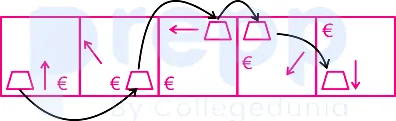
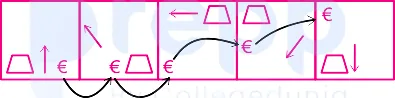
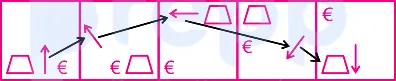
Question 1archived
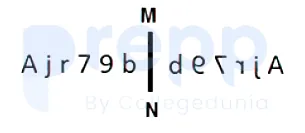
Select the correct mirror image of the given combination when the mirror is placed at line MN as shown.
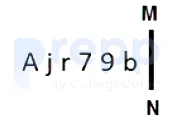
- A
Option A (shown in image)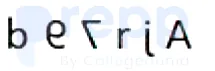
- B
Option B (shown in image)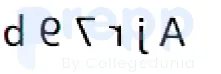
- C
Option C (shown in image)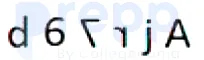
- D
Option D (shown in image)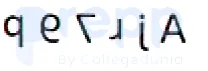
Show answer
B. Option B (shown in image)In a mirror image Left changes to right and the right changes to Left and vice - versa
The correct mirror image of the given figure with the mirror MN placed as :
Hence, the correct answer is "Option 2".
 Paper & answer key PDF ↗
 Question 2archived
Select the correct combination of mathematical signs to sequentially replace the * signs and to balance the given equation.
25 * 2 * 220 * 11 * 43
- A
+, -, ×, =
- B
+, -, ÷, =
- C
+, +, ÷, =
- D
-, +, ÷, =
Show answer
D. -, +, ÷, =Finding the Correct Mathematical Signs to Balance an Equation
The question asks us to find the correct sequence of mathematical signs (operators) that, when substituted into the place of the asterisks (*) in the expression 25 * 2 * 220 * 11 * 43, will make the equation balance. This means the value of the expression on the left side must equal the value on the right side (43 in this case).
We are given four options, each providing a sequence of four signs. Assuming the equation structure is number operator number operator number operator number = number, we will test each option by replacing the asterisks sequentially from left to right and checking if the resulting equation holds true. Remember to follow the order of operations (like BODMAS/PEMDAS) while calculating.
Testing Option 1: +, -, ×, =
Substituting these signs gives the equation:
\(25 + 2 - 220 \times 11 = 43\)
Let's evaluate the left side following the order of operations (multiplication first, then addition and subtraction from left to right):
Multiplication: \(220 \times 11 = 2420\)
Now the equation becomes: \(25 + 2 - 2420\)
Addition: \(25 + 2 = 27\)
Now the equation becomes: \(27 - 2420\)
Subtraction: \(27 - 2420 = -2393\)
So, the equation becomes \(-2393 = 43\). This is incorrect.
Testing Option 2: +, -, ÷, =
Substituting these signs gives the equation:
\(25 + 2 - 220 \div 11 = 43\)
Let's evaluate the left side following the order of operations (division first, then addition and subtraction from left to right):
Division: \(220 \div 11 = 20\)
Now the equation becomes: \(25 + 2 - 20\)
Addition: \(25 + 2 = 27\)
Now the equation becomes: \(27 - 20\)
Subtraction: \(27 - 20 = 7\)
So, the equation becomes \(7 = 43\). This is incorrect.
Testing Option 3: +, +, ÷, =
Substituting these signs gives the equation:
\(25 + 2 + 220 \div 11 = 43\)
Let's evaluate the left side following the order of operations (division first, then addition from left to right):
Division: \(220 \div 11 = 20\)
Now the equation becomes: \(25 + 2 + 20\)
Addition: \(25 + 2 = 27\)
Now the equation becomes: \(27 + 20\)
Addition: \(27 + 20 = 47\)
So, the equation becomes \(47 = 43\). This is incorrect.
Testing Option 4: -, +, ÷, =
Substituting these signs gives the equation:
\(25 - 2 + 220 \div 11 = 43\)
Let's evaluate the left side following the order of operations (division first, then subtraction and addition from left to right):
Division: \(220 \div 11 = 20\)
Now the equation becomes: \(25 - 2 + 20\)
Subtraction: \(25 - 2 = 23\)
Now the equation becomes: \(23 + 20\)
Addition: \(23 + 20 = 43\)
So, the equation becomes \(43 = 43\). This is correct. The equation is balanced with this sequence of signs.
Conclusion on Balancing the Equation
The combination of mathematical signs -, +, ÷, = correctly balances the given equation 25 * 2 * 220 * 11 * 43.
Revision Table: Order of Operations (BODMAS/PEMDAS)
Letter
Meaning (BODMAS)
Meaning (PEMDAS)
Order
B / P
Brackets
Parentheses
1st (Highest Priority)
O / E
Orders (Powers, Square Roots)
Exponents
2nd
D / M
Division
Multiplication
3rd (Equal Priority, Left to Right)
M / D
Multiplication
Division
3rd (Equal Priority, Left to Right)
A / A
Addition
Addition
4th (Equal Priority, Left to Right)
S / S
Subtraction
Subtraction
4th (Equal Priority, Left to Right)
Additional Information: Balancing Equations
Balancing equations involves ensuring that the expression on one side of the equals sign represents the same value as the expression on the other side. In problems like this, where we need to insert arithmetic operators, it's crucial to apply the correct order of operations to evaluate the expression accurately. If the question involved variables, balancing would involve isolating the variable while maintaining equality on both sides of the equation.
The order of operations is a fundamental concept in mathematics that ensures consistent results when evaluating expressions with multiple operations. Division and Multiplication have equal priority and are performed from left to right. Similarly, Addition and Subtraction have equal priority and are performed from left to right after Division and Multiplication.
Paper & answer key PDF ↗ Question 3archived
Select the option that is related to the fifth number in the same way as the second number is related to the first number and the fourth number is related to the third number.
7 : 13 :: 16 : 31 :: 46 : ?
- A
81
- B
83
- C
91
- D
97
Show answer
C. 91Reasoning: First number × 2 → A - 1 = Second number
7 : 13 → 7 × 2 ⇒ 14 - 1 = 13
16 : 31 → 16 × 2 ⇒ 32 - 1 = 31
In the same way,
46 : 91 → 46 × 2 ⇒ 92 - 1 = 91
Therefore, the correct answer is "Option 3".
Paper & answer key PDF ↗ Question 4archived
Select the figure that will come next in the following figure series.

- A
Option A (shown in image)
- B
Option B (shown in image)
- C
Option C (shown in image)
- D
Option D (shown in image)
Show answer
Question 5archived
Select the correct combination of mathematical signs to sequentially replace the # signs and to balance the given equation.
[{(44 # 38) # (2 # 5)} # (4 # 2)] # 5 # 10
- A
×, ÷, ×, ×, –, +, =
- B
×, –, +, ×, ÷, ×, =
- C
–, +, ×, ×, ÷, ×, =
- D
–, +, ×, ÷, ×, ×, =
Show answer
D. –, +, ×, ÷, ×, ×, =Finding the Correct Mathematical Signs to Balance an Equation
This problem requires us to identify the correct sequence of mathematical operators (+, -, ×, ÷) to substitute for the hash symbols (#) in the given expression, ultimately balancing the equation. The expression provided is:
[{(44 # 38) # (2 # 5)} # (4 # 2)] # 5 # 10
Our goal is to determine which combination of signs correctly fits into the '#' placeholders.
Step-by-Step Substitution and Evaluation
To solve this, we first substitute the operators suggested by the options into the expression. Then, we evaluate the resulting mathematical expression using the standard order of operations (PEMDAS/BODMAS: Parentheses/Brackets, Exponents/Orders, Multiplication/Division from left to right, Addition/Subtraction from left to right).
Based on the analysis of the options, the correct sequence of operators is: –, +, ×, ÷, ×, ×
Let's substitute these signs into the original expression:
[{(44 - 38) + (2 \times 5)} \div (4 \times 2)] \times 5 \times 10
Now, we proceed with the step-by-step evaluation:
Calculation Breakdown
Step 1: Evaluate the innermost parentheses/brackets first.
First, calculate the expression inside the innermost parentheses:
(44 - 38) evaluates to 6.
(2 \times 5) evaluates to 10.
(4 \times 2) evaluates to 8.
Substituting these results back into the expression, we get:
[{(6) + (10)} \div (8)] \times 5 \times 10
Step 2: Evaluate the next level of parentheses/brackets.
Next, we calculate the sum within the curly braces:
{6 + 10} evaluates to 16.
The expression simplifies to:
[16 \div 8] \times 5 \times 10
Step 3: Evaluate the expression within the square brackets.
Now, we perform the division within the square brackets:
16 \div 8 evaluates to 2.
The expression becomes:
2 \times 5 \times 10
Step 4: Perform the final multiplications.
Finally, we perform the multiplications from left to right:
2 \times 5 evaluates to 10.
10 \times 10 evaluates to 100.
The expression evaluates to 100. Therefore, the sequence of signs –, +, ×, ÷, ×, × successfully balances the equation.
Paper & answer key PDF ↗ Question 6archived
If L × M means that L is the mother of M, L + M means that L is the father of M, and L ÷ M means that L is the sister of M, then which of the following expression shows that P is the father of R?
- A
P + Q ÷ R
- B
P ÷ R + Q
- C
Q + P ÷ R
- D
P + Q × R
Show answer
A. P + Q ÷ RDecoding Relationships to Find the Father
This question asks us to interpret a set of symbolic relationships and find which expression correctly represents that P is the father of R. We are given three symbolic operations and their meanings:
L × M means L is the mother of M
L + M means L is the father of M
L ÷ M means L is the sister of M
We need to examine each given expression and decode the relationships described to see if P is the father of R.
Analyzing Each Expression for P being the Father of R
Let's break down each option step-by-step:
Option 1: P + Q ÷ R
The first part is P + Q. According to the rules, L + M means L is the father of M. So, P + Q means P is the father of Q.
The second part is Q ÷ R. According to the rules, L ÷ M means L is the sister of M. So, Q ÷ R means Q is the sister of R.
Combining these two statements: P is the father of Q, and Q is the sister of R. If P is the father of Q, and Q is R's sister, it means Q and R are siblings, and P is their father. Therefore, P is the father of R. This matches the condition we are looking for.
Option 2: P ÷ R + Q
The first part is P ÷ R. According to the rules, L ÷ M means L is the sister of M. So, P ÷ R means P is the sister of R.
The second part is R + Q. According to the rules, L + M means L is the father of M. So, R + Q means R is the father of Q.
Combining these two statements: P is the sister of R, and R is the father of Q. This means P is R's sister and R is Q's father. This makes P the aunt of Q. It does not show P as the father of R.
Option 3: Q + P ÷ R
The first part is Q + P. According to the rules, L + M means L is the father of M. So, Q + P means Q is the father of P.
The second part is P ÷ R. According to the rules, L ÷ M means L is the sister of M. So, P ÷ R means P is the sister of R.
Combining these two statements: Q is the father of P, and P is the sister of R. This means Q is P's father, and P is R's sister. P and R are siblings, and their father is Q. This shows Q is the father of R, not P.
Option 4: P + Q × R
The first part is P + Q. According to the rules, L + M means L is the father of M. So, P + Q means P is the father of Q.
The second part is Q × R. According to the rules, L × M means L is the mother of M. So, Q × R means Q is the mother of R.
Combining these two statements: P is the father of Q, and Q is the mother of R. If P is Q's father and Q is R's mother, then P is R's maternal grandfather. This does not show P as the father of R.
Summary of Relationship Analysis
Let's summarize the relationships derived from each option in a table:
Expression
Relationship 1
Relationship 2
Conclusion about P and R
Is P the father of R?
P + Q ÷ R
P is father of Q
Q is sister of R
P is father of R
Yes
P ÷ R + Q
P is sister of R
R is father of Q
P is aunt of Q
No
Q + P ÷ R
Q is father of P
P is sister of R
Q is father of R
No
P + Q × R
P is father of Q
Q is mother of R
P is maternal grandfather of R
No
Based on the analysis, only the expression P + Q ÷ R shows that P is the father of R.
Conclusion
The expression P + Q ÷ R correctly represents that P is the father of R because P + Q establishes P as the father of Q, and Q ÷ R establishes Q as the sister of R. If P is the father of Q and Q is the sister of R, then P must be the father of R as well.
Revision Table: Decoding Relationships
Symbol
Meaning
Example (L, M)
Relationship
×
L is the mother of M
L $\times$ M
Mother-Child
+
L is the father of M
L + M
Father-Child
÷
L is the sister of M
L ÷ M
Sibling (Sister-Sibling)
Additional Information: Solving Relationship Puzzles
Relationship puzzles often involve decoding given information about family connections and then applying that information to a new scenario or question. These types of problems test your ability to follow rules and infer relationships based on given links.
Key strategies for solving such puzzles:
Understand the meaning of each symbol or phrase provided.
Break down complex expressions into smaller parts.
Trace the relationship chain from one person to another.
Draw a family tree or diagram if it helps visualize the connections.
Carefully check the relationships derived from each option against the target relationship.
These questions require careful reading and logical deduction to correctly establish the links between individuals in the defined family structure.
Paper & answer key PDF ↗ Question 7archived
A – B means ‘A is the mother of B’
A * B means ‘A is the sister of B’
A % B means ‘A is the husband of B’
A \(B means ‘A is the son of B’
If P – Q – R * S\) T, then how is P related to T?
- A
Mother
- B
Mother-in-law
- C
Sister
- D
Sister-in-law
Show answer
B. Mother-in-lawSolving Blood Relation Puzzles: Finding the Relation Between P and T
Blood relation questions test your ability to understand and decipher the relationships between individuals based on given codes or information. To solve these, it's helpful to break down the given expression step-by-step and build a family tree or list the relationships.
Understanding the Symbols
Let's first understand the meaning of each symbol provided in the question:
A – B means ‘A is the mother of B’
A * B means ‘A is the sister of B’
A % B means ‘A is the husband of B’
A $ B means ‘A is the son of B’
Analyzing the Expression: P – Q – R * S $ T
We will break down the given expression part by part:
P – Q: According to the rule, P – Q means 'P is the mother of Q'. This tells us that P is female and is one generation above Q.
Q – R: This means 'Q is the mother of R'. This tells us that Q is female and is one generation above R. Since P is the mother of Q, and Q is the mother of R, P is the grandmother of R.
R * S: This means 'R is the sister of S'. This tells us that R is female. R and S are siblings. Since Q is the mother of R, and R is the sister of S, Q is also the mother of S.
S $ T: This means 'S is the son of T'. This tells us that S is male. T is the parent of S. We already know from the previous steps that Q is the mother of S. Since S is the son of T, and Q is his mother, T must be the other parent, which means T is the father of S. Therefore, T is the husband of Q.
Putting it Together and Finding the Relation of P to T
From our step-by-step analysis, we have established the following key relationships:
P is the mother of Q.
Q is the mother of S.
T is the father of S.
Therefore, Q and T are the parents of S.
This means Q and T are husband and wife, with T being the husband and Q being the wife.
The question asks how P is related to T. We know P is the mother of Q, and Q is the wife of T. So, P is the mother of T's wife.
The mother of one's wife is called the mother-in-law.
Relationship
Deduced
P – Q
P is mother of Q (P is Female)
Q – R
Q is mother of R (Q is Female). P is grandmother of R.
R * S
R is sister of S (R is Female). Q is also mother of S. P is grandmother of S.
S $ T
S is son of T (S is Male). Q is mother of S, so T must be father of S. T is married to Q.
P is the mother of Q, and T is married to Q. Thus, P is the mother-in-law of T.
Step-by-step Analysis
Decode each symbol to understand the relation it represents.
Apply the relations sequentially to the given expression P – Q – R * S $ T.
P is mother of Q.
Q is mother of R.
R is sister of S.
S is son of T.
Combine: P → Q (mother-daughter). Q → R (mother-daughter). R and S are siblings (R is sister, S is brother). Q is mother of R, so Q is also mother of S. S is son of T. So S has parents Q and T. Since Q is mother, T must be father. T is husband of Q.
Relation of P to T: P is mother of Q, and Q is wife of T. So P is mother of T's wife. This means P is T's mother-in-law.
Conclusion on Blood Relation
Based on the analysis, the relationship between P and T is Mother-in-law.
Revision Table: Blood Relation Symbols
Symbol
Meaning
–
Mother
*
Sister
%
Husband
$
Son
Additional Information on Blood Relation Puzzles
Blood relation problems are common in aptitude and reasoning tests. They require careful reading and logical deduction. There are generally three types of blood relation questions:
Based on Conversations: A person introducing another person.
Based on Puzzles: A set of relations between multiple members.
Based on Symbols/Codes: Relations represented by symbols, as in this question.
Solving these puzzles often involves drawing a family tree or using diagrams to visualize the relationships. Remember to pay attention to the gender of the individuals whenever specified by the relation.
Paper & answer key PDF ↗ Question 8archived
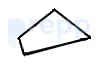
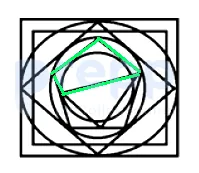
Select the option figure in which the given figure is embedded (rotation is NOT allowed).
- A
Option A (shown in image)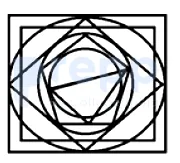
- B
Option B (shown in image)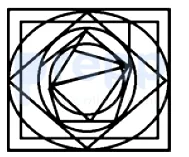
- C
Option C (shown in image)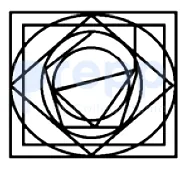
- D
Option D (shown in image)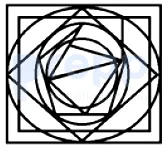
Show answer
A. Option A (shown in image)The option in which given figure is embedded when rotation is not allowed is shown below :
Hence, the correct answer is "Option 1".
 Paper & answer key PDF ↗
 Question 9archived
Select the option that is related to the third word in the same way as the second word is related to the first word. (The words must be considered as meaningful English words and must not be related to each other based on the number of letters/number of consonants/vowels in the word)
Plants : Botanist :: Animals : ?
- A
Chemists
- B
Geologists
- C
Archaeologists
- D
Zoologists
Show answer
D. ZoologistsUnderstanding the Analogy: Plants and Animals
The question asks us to find the word that completes an analogy. An analogy shows a relationship between two things, and we need to find a third thing that has the same relationship with a fourth thing. The given analogy is:
Plants : Botanist :: Animals : ?
This structure means "Plants is to Botanist as Animals is to what?". We need to identify the relationship between 'Plants' and 'Botanist' and then apply that same relationship to 'Animals' to find the missing word.
Analyzing the Relationship between Plants and Botanist
Let's think about what a Botanist does. A Botanist is a scientist who specializes in the study of Plants. Botany is the branch of biology that deals with plant life. So, the relationship is that the second word (Botanist) is the person who studies the first word (Plants).
Applying the Relationship to Animals
Now we need to find someone who studies Animals. We are looking for the specific type of scientist who specializes in the study of animal life. Let's look at the options provided.
Evaluating the Options
We have four options:
Chemists
Geologists
Archaeologists
Zoologists
Let's consider what each of these scientists studies:
Chemists: Study chemistry, which is the scientific study of the properties and behavior of matter. This is not directly related to studying animals.
Geologists: Study geology, which is the scientific study of Earth's solid features, rocks, and processes. This is not related to studying animals.
Archaeologists: Study archaeology, which is the study of human history and prehistory through the excavation of sites and the analysis of artifacts and other physical remains. This is related to humans and their history, not animals in general.
Zoologists: Study zoology, which is the scientific study of animals, including their classification, structure, behavior, and distribution. This directly matches the relationship we identified.
Determining the Correct Answer
Based on our analysis, the person who studies Animals is a Zoologist. This fits the same relationship as a Botanist studying Plants.
Therefore, the complete analogy is:
Plants : Botanist :: Animals : Zoologist
The word that correctly completes the analogy is Zoologists.
Revision Table: Key Terms and Definitions
Term
Field of Study
What is Studied
Botanist
Botany
Plants
Zoologist
Zoology
Animals
Chemist
Chemistry
Matter (properties and behavior)
Geologist
Geology
Earth's solid features, rocks
Archaeologist
Archaeology
Human history through remains
Additional Information on Biological Studies
The study of living organisms is called Biology. Biology is a vast field that is divided into many specialized areas. Botany and Zoology are two major branches of biology.
Botany: Focuses specifically on plant life, including algae, fungi, mosses, ferns, and flowering plants.
Zoology: Focuses specifically on animal life, ranging from microscopic organisms to large mammals. Zoologists study animal behavior, physiology, genetics, evolution, and classification.
Understanding these specific fields of study helps in solving analogies like this one, where the relationship is based on who studies what.
Paper & answer key PDF ↗ Question 10archived
Select the set in which the numbers are related in the same way as are the numbers of the following sets.
(NOTE : Operations should be performed on the whole numbers, without breaking down the numbers into its constituent digits. E.g. 13 – Operations on 13 such as adding / subtracting / multiplying etc. to 13 can be performed. Breaking down 13 into 1 and 3 and then performing mathematical operations on 1 and 3 is NOT allowed)
(7, 4, 56)
(8, 3, 48)
- A
(90, 3, 400)
- B
(87, 4, 128)
- C
(96, 42, 12)
- D
(9, 10, 180)
Show answer
D. (9, 10, 180)Understanding Number Relationships in Sets
The question asks us to identify a set of numbers from the given options that shares the same mathematical relationship as the provided sets: (7, 4, 56) and (8, 3, 48). We need to find a pattern or rule that connects the three numbers in these sets, using operations on the whole numbers.
Analyzing the Given Number Sets
Let's examine the relationship within the first set (7, 4, 56). Let the numbers be \(a=7\), \(b=4\), and \(c=56\).
Possible operations include addition, subtraction, multiplication, division, and combinations of these.
If we multiply the first two numbers: \(a \times b = 7 \times 4 = 28\).
The third number is 56. We can see that 56 is double the product of the first two numbers: \(28 \times 2 = 56\).
So, a potential relationship is \(c = (a \times b) \times 2\).
Now let's check if this rule holds for the second given set (8, 3, 48). Here, \(a=8\), \(b=3\), and \(c=48\).
Using the potential rule \(c = (a \times b) \times 2\): \( (8 \times 3) \times 2 = 24 \times 2 = 48 \).
This matches the third number in the set (48).
The rule that relates the numbers in the given sets is: the third number is equal to twice the product of the first two numbers, which can be written as $\boxed{c = 2 \times a \times b}$.
Testing the Options Based on the Relationship
We will now apply the rule \(c = 2 \times a \times b\) to each of the given options to find the set that follows the same relationship.
Option 1: (90, 3, 400)
Here, \(a=90\), \(b=3\), \(c=400\).
Applying the rule: \(2 \times a \times b = 2 \times 90 \times 3 = 180 \times 3 = 540\).
The calculated value (540) is not equal to the third number in the set (400). So, this set does not follow the rule.
Option 2: (87, 4, 128)
Here, \(a=87\), \(b=4\), \(c=128\).
Applying the rule: \(2 \times a \times b = 2 \times 87 \times 4 = 174 \times 4 = 696\).
The calculated value (696) is not equal to the third number in the set (128). So, this set does not follow the rule.
Option 3: (96, 42, 12)
Here, \(a=96\), \(b=42\), \(c=12\).
Applying the rule: \(2 \times a \times b = 2 \times 96 \times 42\). This product will be a very large number, much greater than 12.
The calculated value is not equal to the third number in the set (12). So, this set does not follow the rule.
Option 4: (9, 10, 180)
Here, \(a=9\), \(b=10\), \(c=180\).
Applying the rule: \(2 \times a \times b = 2 \times 9 \times 10 = 18 \times 10 = 180\).
The calculated value (180) is equal to the third number in the set (180). So, this set follows the rule.
Conclusion
The set (9, 10, 180) follows the same relationship as the given sets (7, 4, 56) and (8, 3, 48), where the third number is twice the product of the first two numbers.
Summary of Rule Application
Set
First Number (a)
Second Number (b)
Third Number (c)
Calculate $2 \times a \times b$
Match?
(7, 4, 56)
7
4
56
$2 \times 7 \times 4 = 56$
Yes
(8, 3, 48)
8
3
48
$2 \times 8 \times 3 = 48$
Yes
(90, 3, 400)
90
3
400
$2 \times 90 \times 3 = 540$
No
(87, 4, 128)
87
4
128
$2 \times 87 \times 4 = 696$
No
(96, 42, 12)
96
42
12
$2 \times 96 \times 42 = 8064$
No
(9, 10, 180)
9
10
180
$2 \times 9 \times 10 = 180$
Yes
Revision Table: Number Set Relationships
Understanding common patterns in number sets is crucial for logical reasoning questions. Here are some typical relationships you might encounter:
Sum or Difference: \(a+b=c\), \(a-b=c\), \(b-a=c\)
Product or Division: \(a \times b = c\), \(a / b = c\)
Squares or Cubes: \(a^2\), \(b^2\), \(a^3\), \(b^3\) related to \(c\)
Combinations: \(a \times b + k = c\), \(a \times b \times k = c\), \(a^2 + b^2 = c\), etc.
Differences between consecutive numbers: \(b-a\), \(c-b\) might follow a pattern.
Additional Information: Logical Reasoning with Numbers
Logical reasoning questions involving number sets test your ability to observe patterns and deduce rules. Key strategies include:
Systematic Analysis: Examine the first few examples carefully. Try simple operations first (addition, multiplication).
Check Consistency: Once a potential rule is found, test it on all provided examples to ensure it is consistent.
Apply to Options: Apply the confirmed rule to each option to find the one that fits.
Whole Numbers Rule: Always respect the constraint about using whole numbers versus individual digits, as specified in the question.
Practice with different types of number series and sets will improve your pattern recognition skills.
Paper & answer key PDF ↗ Question 11archived
Which letter cluster will replace the question mark (?) to complete the given series?
ACFD, CFHG, ?, GLLM, IONP
- A
EIJK
- B
EIJJ
- C
FIJJ
- D
EJJK
Show answer
B. EIJJCompleting the Letter Series Pattern
The task is to identify the missing letter cluster in the sequence: ACFD, CFHG, ?, GLLM, IONP. We need to find the underlying pattern that governs how the letters change from one cluster to the next.
Identifying the Progression Rule
To find the pattern, we'll look at the shift in alphabetical positions for each letter within the clusters. We assign numbers to letters: A=1, B=2, C=3, ..., Z=26.
Step 1: Analyzing Letter Changes
Let's compare the first two clusters (ACFD, CFHG) and the last two clusters (GLLM, IONP) to see the transformation rule.
First Letter: A (position $1$) in ACFD shifts to C (position $3$) in CFHG. The change is $3 - 1 = +2$. Then, G (position $7$) in GLLM shifts to I (position $9$) in IONP. The change is $9 - 7 = +2$. The pattern observed for the first letter is adding $2$ to its position ($+2$).
Second Letter: C (position $3$) in ACFD shifts to F (position $6$) in CFHG. The change is $6 - 3 = +3$. Then, L (position $12$) in GLLM shifts to O (position $15$) in IONP. The change is $15 - 12 = +3$. The pattern observed for the second letter is adding $3$ to its position ($+3$).
Third Letter: F (position $6$) in ACFD shifts to H (position $8$) in CFHG. The change is $8 - 6 = +2$. Then, L (position $12$) in GLLM shifts to N (position $14$) in IONP. The change is $14 - 12 = +2$. The pattern observed for the third letter is adding $2$ to its position ($+2$).
Fourth Letter: D (position $4$) in ACFD shifts to G (position $7$) in CFHG. The change is $7 - 4 = +3$. Then, M (position $13$) in GLLM shifts to P (position $16$) in IONP. The change is $16 - 13 = +3$. The pattern observed for the fourth letter is adding $3$ to its position ($+3$).
Therefore, the rule applied between consecutive clusters is consistently adding $2, +3, +2, +3$ to the respective letter positions.
Step 2: Deriving the Missing Cluster
We now apply the discovered pattern ($+2, +3, +2, +3$) to the cluster CFHG to determine the missing cluster:
1st Letter: The first letter of CFHG is C, which is the 3rd letter of the alphabet. Applying the pattern: $3 + 2 = 5$. The 5th letter is E.
2nd Letter: The second letter is F, the 6th letter. Applying the pattern: $6 + 3 = 9$. The 9th letter is I.
3rd Letter: The third letter is H, the 8th letter. Applying the pattern: $8 + 2 = 10$. The 10th letter is J.
4th Letter: The fourth letter is G, the 7th letter. Applying the pattern: $7 + 3 = 10$. The 10th letter is J.
Combining these letters, the missing cluster is determined to be EIJJ.
Step 3: Confirming the Sequence Continuation
To ensure our derived cluster EIJJ is correct, let's verify if applying the same pattern ($+2, +3, +2, +3$) to it results in the next cluster in the series, GLLM.
1st Letter: E is the 5th letter. $5 + 2 = 7$. The 7th letter is G. (This matches the first letter of GLLM).
2nd Letter: I is the 9th letter. $9 + 3 = 12$. The 12th letter is L. (This matches the second letter of GLLM).
3rd Letter: J is the 10th letter. $10 + 2 = 12$. The 12th letter is L. (This matches the third letter of GLLM).
4th Letter: J is the 10th letter. $10 + 3 = 13$. The 13th letter is M. (This matches the fourth letter of GLLM).
The results perfectly match the cluster GLLM, confirming that our derived cluster EIJJ follows the established pattern.
Final Answer
The letter cluster that completes the given series is EIJJ.
Paper & answer key PDF ↗ Question 12archived
After arranging the given words according to dictionary order, which word will come at ‘Third’ position?
1. Chocolate
2. Chocoholic
3. Chocolaty
4. Chocolatier
5. Chock
- A
Chocolate
- B
Chock
- C
Chocolatier
- D
Chocoholic
Show answer
A. ChocolateUnderstanding Dictionary Order for Words
To arrange words in dictionary order, also known as alphabetical order, we compare the words letter by letter from left to right. We look at the first letter of each word. If they are the same, we move to the second letter, and so on, until we find a letter that is different. The word with the letter that comes earlier in the alphabet will be placed earlier in the list. If one word is a prefix of another word (e.g., 'apple' and 'apply'), the shorter word comes first.
Step-by-Step Comparison
Let's compare the given words:
Chocolate
Chocoholic
Chocolaty
Chocolatier
Chock
All words begin with "Choc". Let's compare the fifth letter:
Chock
Chocolate
Chocoholic
Chocolaty
Chocolatier
The letter 'k' comes before 'o' in the alphabet. So, "Chock" will be the first word.
Now we compare the remaining words starting with "Choco": Chocolate, Chocoholic, Chocolaty, Chocolatier. Let's compare the sixth letter:
Chocolate
Chocoholic
Chocolaty
Chocolatier
The letter 'h' comes before 'l' in the alphabet. So, "Chocoholic" will be the second word.
Now we compare the remaining words starting with "Chocol": Chocolate, Chocolaty, Chocolatier. Let's compare the seventh letter:
Chocolate
Chocolaty
Chocolatier
All have 'a'. Let's compare the eighth letter:
Chocolate
Chocolaty
Chocolatier
All have 't'. Let's compare the ninth letter:
Chocolate
Chocolaty
Chocolatier
Comparing 'e', 'y', and 'i', the alphabetical order is 'e', 'i', 'y'.
'e' comes first: Chocolate
'i' comes next: Chocolatier
'y' comes last: Chocolaty
Final Dictionary Order
Based on the comparisons, the words arranged in dictionary order are:
Chock
Chocoholic
Chocolate
Chocolatier
Chocolaty
The word that comes at the 'Third' position is Chocolate.
Revision Table: Dictionary Order Practice
Original List Position
Word
Dictionary Order Position
1
Chocolate
3
2
Chocoholic
2
3
Chocolaty
5
4
Chocolatier
4
5
Chock
1
Additional Information: Alphabetical Sorting Rules
Alphabetical sorting is a fundamental skill often tested in various exams. Here are some key rules:
Letter by Letter: Compare words one letter at a time from the beginning.
Shorter Word First: If one word is the beginning of another (e.g., "cat" and "catalogue"), the shorter word comes first.
Case Sensitivity: Standard dictionary order usually ignores capitalization, treating 'A' and 'a' the same. However, sometimes specific instructions might require case-sensitive sorting.
Special Characters: Numbers, symbols, and spaces have specific sorting orders relative to letters, depending on the sorting system used. For general dictionary order questions like this, focus on letters.
Tie-breaking: Continue comparing letters until a difference is found. The word with the letter appearing earlier in the alphabet comes first.
Mastering dictionary order helps in organizing information efficiently and is useful in various contexts beyond exams.
Paper & answer key PDF ↗ Question 13archived
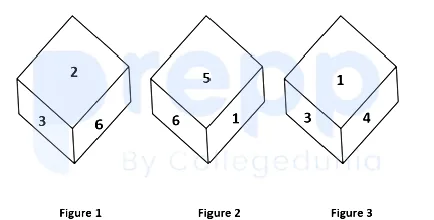
Three different positions of the same dice are shown. Find the number on the face opposite the face showing '3'.
- A
1
- B
2
- C
5
- D
4
Show answer
C. 5The logic followed here is :
Considering both the position of the dice, 1 is common in figure 2 and figure 3.
Moving in the clockwise direction in both the dice from 1 the corresponding faces will be opposite each other.
NumberOpposite
12
35
46
Thus the number opposite to '3' is '5'.
Hence, the correct answer is "Option 3".
Paper & answer key PDF ↗ Question 14archived
In the following question, select the missing number from the given series.
5103, 1701, 567, ?, 63, 21
- A
265
- B
169
- C
189
- D
170
Show answer
C. 189Finding the Missing Number in a Series
Let's analyze the given number series to find the missing term:
5103, 1701, 567, ?, 63, 21
Analyzing the Number Series Pattern
We need to identify the relationship between consecutive numbers in the series. Let's look at the terms provided:
From 5103 to 1701
From 1701 to 567
From 63 to 21
Let's perform some calculations to see how the numbers are related.
Is it subtraction? $5103 - 1701 = 3402$. $1701 - 567 = 1134$. The difference is not constant.
Is it division? Let's try dividing the first term by the second, and the second by the third.
$\frac{5103}{1701}$
$\frac{1701}{567}$
Let's calculate these values:
$\frac{5103}{1701} = 3$
$\frac{1701}{567} = 3$
This suggests that each term is obtained by dividing the previous term by 3. Let's verify this pattern with the last two terms:
$\frac{63}{21} = 3$
The pattern holds true for the known parts of the series. The rule for this series is that each term is the previous term divided by 3.
Calculating the Missing Number
Following the established pattern, the missing number is the term before 63 and after 567. To find the term after 567, we divide 567 by 3.
Missing number = $\frac{567}{3}$
Missing number = 189
Let's confirm this by checking if dividing the missing number (189) by 3 gives the next term in the series, which is 63.
$\frac{189}{3} = 63$
This confirms that our calculated missing number, 189, fits the pattern of the series.
Complete Series
The complete series with the missing number is:
5103, 1701, 567, 189, 63, 21
Step
Operation
Result
1
$5103 \div 3$
1701
2
$1701 \div 3$
567
3
$567 \div 3$
189 (Missing Number)
4
$189 \div 3$
63
5
$63 \div 3$
21
Conclusion
By analyzing the pattern of dividing each term by 3, we found that the missing number in the series 5103, 1701, 567, ?, 63, 21 is 189.
Revision Table: Number Series Patterns
Pattern Type
Description
Example
Arithmetic Series
Constant difference between terms (adding/subtracting a fixed number).
2, 5, 8, 11, ... (difference is 3)
Geometric Series
Constant ratio between terms (multiplying/dividing by a fixed number).
3, 6, 12, 24, ... (ratio is 2)
Mixed Series
Combination of arithmetic, geometric, or other operations.
1, 4, 9, 16, ... (squares of natural numbers)
Difference Series
Pattern in the differences between consecutive terms.
1, 2, 4, 7, 11, ... (differences are 1, 2, 3, 4)
Additional Information: Solving Number Series Questions
Solving number series questions requires careful observation and pattern identification. Here are some tips:
Look at the difference between consecutive terms. Is it constant? Increasing? Decreasing? Following another pattern?
Look at the ratio between consecutive terms. Is it constant?
Consider squares, cubes, prime numbers, or other mathematical sequences.
Look for alternating patterns or patterns involving more than two previous terms (like Fibonacci).
Test your identified pattern across the entire known series to ensure consistency.
Once you find a potential pattern, use it to calculate the missing term and check if it fits with the subsequent terms.
Paper & answer key PDF ↗ Question 15archived
Select the figure from among the given options that can replace the question mark (?) in the following series.

- A
Option A (shown in image)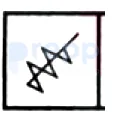
- B
Option B (shown in image)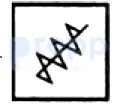
- C
Option C (shown in image)
- D
Option D (shown in image)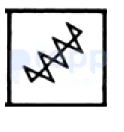
Show answer
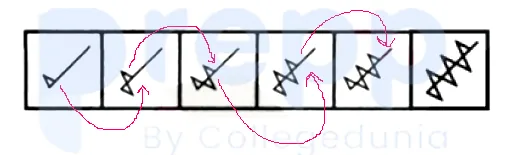
B. Option B (shown in image)The figure that will replace the question mark(?) in the following figure series is shown below :
Triangles are increasing one by one alternatively in the series.
Hence, the correct answer is "Option 2".

 Paper & answer key PDF ↗
 Question 16archived
Select the odd group of numbers. (NOTE: Operations should be performed on the whole numbers, without breaking down the numbers into its constituent digits. E.g.13– Operations on 13 such as adding /subtracting /multiplying etc. to 13 can be performed. Breaking down 13 into 1 and 3 and then performing mathematical operations on 1 and 3 is not allowed)
- A
14 – 193
- B
15 – 220
- C
16 – 251
- D
17 – 284
Show answer
A. 14 – 193This question asks us to find the group of numbers that is different from the others based on a specific pattern or rule. We are given four pairs of numbers, formatted as the first number followed by a dash and then the second number. The crucial instruction is that operations must be performed on the whole numbers themselves, not by breaking them down into their individual digits.
Analyzing Number Pairs for Hidden Patterns
We need to examine each pair to see if there's a consistent mathematical relationship between the first number and the second number. Let's denote the first number as \(X\) and the second number as \(Y\). We will try to find an equation relating \(X\) and \(Y\) that holds true for most of the pairs.
A common strategy in such questions is to check for relationships involving powers of the first number, like its square or cube, combined with addition, subtraction, or multiplication.
Group 1: 14 – 193
The first number is \(X = 14\). Let's calculate its square: \(14^2 = 14 \times 14 = 196\).
The second number is \(Y = 193\). Let's see the difference between the square of the first number and the second number: \(196 - 193 = 3\).
So, for this pair, the relationship seems to be \(Y = X^2 - 3\).
Group 2: 15 – 220
The first number is \(X = 15\). Let's calculate its square: \(15^2 = 15 \times 15 = 225\).
The second number is \(Y = 220\). Let's see the difference: \(225 - 220 = 5\).
So, for this pair, the relationship seems to be \(Y = X^2 - 5\).
Group 3: 16 – 251
The first number is \(X = 16\). Let's calculate its square: \(16^2 = 16 \times 16 = 256\).
The second number is \(Y = 251\). Let's see the difference: \(256 - 251 = 5\).
So, for this pair, the relationship seems to be \(Y = X^2 - 5\).
Group 4: 17 – 284
The first number is \(X = 17\). Let's calculate its square: \(17^2 = 17 \times 17 = 289\).
The second number is \(Y = 284\). Let's see the difference: \(289 - 284 = 5\).
So, for this pair, the relationship seems to be \(Y = X^2 - 5\).
Comparing Patterns to Find the Odd Group
Let's put the findings into a table to make the comparison clearer.
Group
First Number (\(X\))
Second Number (\(Y\))
Square of First Number (\(X^2\))
Difference (\(X^2 - Y\))
Identified Pattern
1
14
193
196
\(196 - 193 = 3\)
\(Y = X^2 - 3\)
2
15
220
225
\(225 - 220 = 5\)
\(Y = X^2 - 5\)
3
16
251
256
\(256 - 251 = 5\)
\(Y = X^2 - 5\)
4
17
284
289
\(289 - 284 = 5\)
\(Y = X^2 - 5\)
The table shows that Group 2, Group 3, and Group 4 all follow the same mathematical pattern: the second number is equal to the square of the first number minus 5 (\(Y = X^2 - 5\)).
However, Group 1 follows a different pattern: the second number is equal to the square of the first number minus 3 (\(Y = X^2 - 3\)).
Since Group 1 does not follow the pattern observed in the other three groups, it is the odd one out.
Conclusion on the Odd Group Identification
The analysis reveals a consistent pattern based on the square of the first number. Three groups adhere to the \(Y = X^2 - 5\) rule, while one group follows the \(Y = X^2 - 3\) rule. Therefore, the group 14 – 193 is the odd group among the given options.
Revision Table: Key Concepts for Odd Group Questions
Solving odd group number questions relies on:
Carefully reading the rules provided (like operating on whole numbers vs. digits).
Systematically testing potential mathematical relationships between the numbers in each group.
Looking for patterns involving basic arithmetic (+, -, ×, ÷), powers (squares, cubes), or combinations.
Comparing the identified relationships across all groups to find the inconsistent one.
Additional Information: Strategies for Number Pattern Problems
When tackling number pattern or series questions, consider these approaches:
Differences: Calculate the differences between consecutive numbers or elements in a group. Look for patterns in these differences (constant, arithmetic progression, geometric progression).
Ratios: If the numbers are growing or shrinking rapidly, check for multiplication or division relationships.
Squares, Cubes, and Roots: See if the numbers are perfect squares, cubes, or related to them.
Prime Numbers: Check if the numbers are prime or related to prime numbers.
Fibonacci Sequence: A sequence where each number is the sum of the two preceding ones (e.g., 1, 1, 2, 3, 5, 8...).
Combine Operations: The pattern might involve a mix of operations, e.g., multiply by a number and then add/subtract a constant, or square the number and then add/subtract a constant (as seen in this problem).
Testing different possibilities in a structured way, like we did with squaring the first number, is key to finding the pattern.
Paper & answer key PDF ↗ Question 17archived
Select the option that is related to the third word in the same way as the second word is related to the first word.
(The words must be considered as meaningful English words and must not be related to each other based on the number of letters/number of consonants/vowels in the word.)
School : Students :: Hospital : ?
- A
Doctors
- B
Nurses
- C
Patients
- D
Diseases
Show answer
C. PatientsUnderstanding Word Analogies: School and Hospital Relationship
This question asks us to find the relationship between the first pair of words, 'School' and 'Students', and then apply that same relationship to the third word, 'Hospital', to find the fourth word from the given options. This type of question tests our ability to understand word relationships and apply logical reasoning.
Let's analyze the relationship between 'School' and 'Students'.
A School is a place or institution.
Students are the people who go to a school to receive education.
Essentially, a School serves or educates Students. Students are the primary beneficiaries or attendees of a School.
Now, we need to find a word from the options that has a similar relationship with 'Hospital'. A Hospital is also a place or institution. We are looking for the people who are the primary attendees or beneficiaries of a Hospital's services.
Let's examine the options:
Doctors: Doctors work in a Hospital. They are service providers, not the primary people receiving the service.
Nurses: Nurses also work in a Hospital. They are service providers, not the primary people receiving the service.
Patients: Patients are people who go to a Hospital to receive medical care. They are the primary beneficiaries of the Hospital's services.
Diseases: Diseases are conditions that are treated in a Hospital, but they are not people. The Hospital serves people suffering from diseases.
Comparing the relationships:
School : Students (School serves Students)
Hospital : ?
Based on our analysis, a Hospital primarily serves Patients. The relationship is consistent with the first pair.
Therefore, the word that relates to 'Hospital' in the same way that 'Students' relate to 'School' is 'Patients'.
Analogy Relationship Breakdown
Institution
Primary Attendees/Beneficiaries
Relationship
School
Students
Institution serves Attendees/Beneficiaries
Hospital
Patients
Institution serves Attendees/Beneficiaries
Revision Table: Analogy Concepts
Understanding different types of analogies is key to solving such problems. Here are a few common types:
Common Analogy Types
Type of Relationship
Example
Part to Whole
Finger : Hand
Worker and Tool
Carpenter : Hammer
Cause and Effect
Rain : Flood
Synonyms
Happy : Joyful
Antonyms
Hot : Cold
Object and Function
Knife : Cut
Institution and Client/Attendee
School : Students, Hospital : Patients
Additional Information: Solving Analogy Questions
To effectively solve word analogy questions like the one involving School and Hospital, follow these steps:
Carefully read the first pair of words (e.g., School : Students).
Identify the exact relationship between these two words. Is it a part-whole relationship? A cause-effect? A user-tool relationship? In this case, it's an institution-attendee relationship.
Clearly define this relationship in simple terms. For School : Students, the relationship is that Students are the primary people who attend and are served by a School.
Look at the third word (e.g., Hospital).
Consider each option provided for the fourth word.
Apply the same relationship identified in step 3 to the third word and each option.
Choose the option that best fits the relationship. Which option represents the people who primarily attend and are served by a Hospital?
Eliminate options that do not fit the identified relationship (e.g., Doctors and Nurses are staff, not attendees/patients; Diseases are not people).
Confirm that the chosen option (Patients) fits the relationship identified (Hospital serves Patients).
Practicing with different types of word analogies will help you quickly identify relationships and improve your logical reasoning skills.
Paper & answer key PDF ↗ Question 18archived
In the following question below are given some statements followed by some conclusions based on those statements. Taking the given statements to be true even if they seem to be at variance from commonly known facts. Read all the conclusions and then decide which of the given conclusion logically follows the given statements.
Statements:
I. All R are P.
II. All R are Q.
Conclusions:
I. No P is Q.
II. No R is P.
- A
Neither conclusion follows
- B
Only conclusion II follows
- C
Both conclusions I and II follows
- D
Only conclusion I follows
Show answer
A. Neither conclusion followsLet's break down this logic question step by step. We are given two statements and two conclusions and need to determine which conclusions logically follow from the given statements, assuming the statements are true.
Understanding the Statements
We have the following statements:
Statement I: All R are P.
Statement II: All R are Q.
These statements tell us about the relationship between three categories: R, P, and Q. The first statement means that the category R is entirely contained within the category P. The second statement means that the category R is entirely contained within the category Q.
Analyzing the Conclusions
Now let's look at the conclusions we need to evaluate:
Conclusion I: No P is Q.
Conclusion II: No R is P.
Evaluating Conclusion I: No P is Q
Statement I says "All R are P" and Statement II says "All R are Q". Since all R's are both P's and Q's, this means that the group R is common to both P and Q. If there are any R's, then P and Q must have at least the group R in common. Therefore, P and Q must overlap. Conclusion I states that "No P is Q", which means P and Q have no overlap at all. This directly contradicts the fact that they share all of R. So, Conclusion I does not follow from the statements.
Evaluating Conclusion II: No R is P
Statement I explicitly says "All R are P". This means every single member of category R is also a member of category P. Conclusion II states that "No R is P", which means there is no member of R that is also a member of P. This is the opposite of what Statement I says. Therefore, Conclusion II does not follow from the statements; in fact, it is false if Statement I is true.
Determining Which Conclusions Follow
Based on our analysis, neither Conclusion I nor Conclusion II logically follows from the given statements.
Visualizing with Venn Diagrams
We can use Venn diagrams to visualize the relationships described in the statements:
Statement
Venn Diagram Representation
I. All R are P.
A circle representing R is completely inside a circle representing P.
II. All R are Q.
A circle representing R is completely inside a circle representing Q.
Putting both together, the circle for R is inside both the circle for P and the circle for Q. This forces the circles for P and Q to overlap where R is located. The overlap between P and Q contains all of R. The diagram would show R nestled within the intersection of P and Q.
Now, let's check the conclusions against this combined diagram:
Conclusion I: No P is Q. The diagram shows P and Q overlapping (at least where R is). So, this conclusion is false.
Conclusion II: No R is P. The diagram shows R completely inside P. So, this conclusion is false.
The Venn diagram method confirms that neither conclusion follows from the statements.
Final Decision
Since neither Conclusion I nor Conclusion II logically follows from the given statements, the correct option is that neither conclusion follows.
Revision Table: Statement and Conclusion Analysis
Item
Content
Analysis
Follows?
Statement I
All R are P.
R is a subset of P. Every R is a P.
Given as true.
Statement II
All R are Q.
R is a subset of Q. Every R is a Q.
Given as true.
Conclusion I
No P is Q.
P and Q have no overlap.
Contradicts statements; R is common to P and Q. Does not follow.
Conclusion II
No R is P.
No member of R is a member of P.
Contradicts Statement I (All R are P). Does not follow.
Additional Information on Syllogisms and Logic
This type of problem is based on categorical syllogisms, which are a form of deductive reasoning. They involve drawing a conclusion from two or more premises (statements). The key is to determine what absolutely *must* be true if the statements are true, not just what *might* be true.
Common types of statements in syllogisms include:
All A are B (Universal Affirmative)
No A is B (Universal Negative)
Some A are B (Particular Affirmative)
Some A are not B (Particular Negative)
In this problem, both statements are of the "All A are B" type. When analyzing syllogisms, especially with "All" and "No" statements, visualizing with Venn diagrams is a very helpful technique to check the validity of conclusions.
Remember, in logic problems like this, you must accept the statements as true, even if they seem factually incorrect in the real world. Your task is only to see what logically follows from the given premises.
Paper & answer key PDF ↗ Question 19archived
In a certain code language, ‘TECHNOLOGY’ is written as ‘NHCETOLOGY’, ‘GENERATION’ is written as ‘RENEGATION’. How will ‘APOCALYPSE’ be written in that language?
- A
AOCPALYPSE
- B
ACPOALYPSE
- C
ACOAPLYPSE
- D
ACOPALYPSE
Show answer
D. ACOPALYPSEDecoding the Word Transformation Rule
The question presents a coding puzzle where words are transformed based on a specific rule. We are given two examples: 'TECHNOLOGY' becomes 'NHCETOLOGY', and 'GENERATION' becomes 'RENEGATION'. We need to find how 'APOCALYPSE' is coded using the same rule.
The core task is to identify the pattern by analyzing the transformation of the given words, specifically 'TECHNOLOGY' and 'GENERATION'.
Analyzing the 'TECHNOLOGY' Coding
Let's break down the transformation of 'TECHNOLOGY' to 'NHCETOLOGY'.
Original Word: T E C H N O L O G Y
Coded Word: N H C E T O L O G Y
We can see the following:
The last 7 letters of 'TECHNOLOGY', which are 'OLOGY', remain unchanged in the coded word.
The first 5 letters, 'TECHN', appear to be transformed into 'NHCET'.
Let's test a hypothesis: What if the first 5 letters are reversed?
First 5 letters of 'TECHNOLOGY': T E C H N
Reversing these letters gives: N H C E T
This reversed sequence 'NHCET' exactly matches the first 5 letters of the coded word 'NHCETOLOGY'. This strongly suggests the pattern involves reversing the first 5 letters.
Validating the Pattern with 'GENERATION'
To confirm the pattern, let's apply the same logic (reversing the first 5 letters) to the second example, 'GENERATION'.
Original Word: G E N E R A T I O N
Coded Word: R E N E G A T I O N
Applying the pattern:
The word 'GENERATION' has 10 letters.
The first 5 letters are: G E N E R
The remaining letters (from the 6th position) are: A T I O N
Reversing the first 5 letters ('GENER'): R E N E G
Combining the reversed part with the remaining part: R E N E G + A T I O N = RENEGATION
The result 'RENEGATION' matches the given coded word for 'GENERATION'. This confirms our identified pattern: reverse the first 5 letters of the word.
Applying the Pattern to 'APOCALYPSE'
Now, we will apply the confirmed pattern to the word 'APOCALYPSE'.
Target Word: APOCALYPSE
Step 1: Identify the first 5 letters.
The first 5 letters of 'APOCALYPSE' are: A P O C A
Step 2: Identify the remaining letters.
The letters from the 6th position onwards are: L Y P S E
Step 3: Reverse the first 5 letters.
Reversing 'A P O C A' gives: A C O P A
Step 4: Combine the reversed first part with the remaining part.
Combined word: A C O P A + L Y P S E = ACOPALYPSE
Determining the Correct Option
The calculated coded word for 'APOCALYPSE' is 'ACOPALYPSE'. Let's compare this with the given options:
AOCPALYPSE
ACPOALYPSE
ACOAPLYPSE
ACOPALYPSE
Our result 'ACOPALYPSE' matches Option 4.
Therefore, the word 'APOCALYPSE' will be written as 'ACOPALYPSE' in this code language.
Paper & answer key PDF ↗ Question 20archived
By interchanging the given two signs and numbers which of the following equation will be correct?
+ and –, 7 and 6
- A
4 × 7 + 6 – 3 ÷ 1 = 20
- B
8 × 7 + 5 ÷ 1 – 6 = 17
- C
7 – 6 × 3 + 4 ÷ 1 = 8
- D
7 × 2 – 6 + 4 ÷ 2 = 13
Show answer
A. 4 × 7 + 6 – 3 ÷ 1 = 20Understanding the Question: Interchanging Signs and Numbers
The question asks us to find which of the given equations becomes correct after we apply a specific set of interchanges: replacing the addition sign (+) with the subtraction sign (–), replacing the subtraction sign (–) with the addition sign (+), replacing the number 7 with the number 6, and replacing the number 6 with the number 7. We need to check each option by performing these interchanges and then evaluating the resulting expression using the BODMAS/PEMDAS rule.
Applying the Interchange Rules
The rules for interchange are:
+ becomes –
– becomes +
7 becomes 6
6 becomes 7
Analyzing Each Option by Interchanging Signs and Numbers
Option 1: Evaluating 4 × 7 + 6 – 3 ÷ 1 = 20
Let's apply the interchange rules to the left side of the equation:
Original expression: $4 \times 7 + 6 - 3 \div 1$
Replace 7 with 6: $4 \times 6 + 6 - 3 \div 1$
Replace 6 with 7: $4 \times 6 + 7 - 3 \div 1$
Replace + with –: $4 \times 6 - 7 - 3 \div 1$
Replace – with +: $4 \times 6 - 7 + 3 \div 1$
The new expression after interchanging signs and numbers is $4 \times 6 - 7 + 3 \div 1$. Now let's evaluate this expression using BODMAS/PEMDAS (Brackets, Orders, Division and Multiplication (from left to right), Addition and Subtraction (from left to right)).
First, perform Division: $3 \div 1 = 3$. The expression becomes $4 \times 6 - 7 + 3$.
Next, perform Multiplication: $4 \times 6 = 24$. The expression becomes $24 - 7 + 3$.
Now, perform Addition and Subtraction from left to right: $24 - 7 = 17$. The expression becomes $17 + 3$.
Finally, perform Addition: $17 + 3 = 20$.
The result of the interchanged expression is 20, which matches the right side of the original equation (20). Thus, this equation becomes correct after the interchange.
Option 2: Evaluating 8 × 7 + 5 ÷ 1 – 6 = 17
Apply the interchange rules to the left side:
Original expression: $8 \times 7 + 5 \div 1 - 6$
Interchanged expression: $8 \times 6 - 5 \div 1 + 7$
Evaluate the new expression $8 \times 6 - 5 \div 1 + 7$ using BODMAS/PEMDAS:
Division: $5 \div 1 = 5$. Expression: $8 \times 6 - 5 + 7$.
Multiplication: $8 \times 6 = 48$. Expression: $48 - 5 + 7$.
Addition/Subtraction (left to right): $48 - 5 = 43$. Expression: $43 + 7$.
Addition: $43 + 7 = 50$.
The result (50) does not match the right side of the original equation (17). This option is incorrect.
Option 3: Evaluating 7 – 6 × 3 + 4 ÷ 1 = 8
Apply the interchange rules to the left side:
Original expression: $7 - 6 \times 3 + 4 \div 1$
Interchanged expression: $6 + 7 \times 3 - 4 \div 1$
Evaluate the new expression $6 + 7 \times 3 - 4 \div 1$ using BODMAS/PEMDAS:
Division: $4 \div 1 = 4$. Expression: $6 + 7 \times 3 - 4$.
Multiplication: $7 \times 3 = 21$. Expression: $6 + 21 - 4$.
Addition/Subtraction (left to right): $6 + 21 = 27$. Expression: $27 - 4$.
Subtraction: $27 - 4 = 23$.
The result (23) does not match the right side of the original equation (8). This option is incorrect.
Option 4: Evaluating 7 × 2 – 6 + 4 ÷ 2 = 13
Apply the interchange rules to the left side:
Original expression: $7 \times 2 - 6 + 4 \div 2$
Interchanged expression: $6 \times 2 + 7 - 4 \div 2$
Evaluate the new expression $6 \times 2 + 7 - 4 \div 2$ using BODMAS/PEMDAS:
Division: $4 \div 2 = 2$. Expression: $6 \times 2 + 7 - 2$.
Multiplication: $6 \times 2 = 12$. Expression: $12 + 7 - 2$.
Addition/Subtraction (left to right): $12 + 7 = 19$. Expression: $19 - 2$.
Subtraction: $19 - 2 = 17$.
The result (17) does not match the right side of the original equation (13). This option is incorrect.
Conclusion
After interchanging the signs (+ and –) and the numbers (7 and 6), only the first equation, $4 \times 7 + 6 - 3 \div 1 = 20$, becomes correct as its left side evaluates to 20.
Original Equation
Interchanged Equation
Evaluation
Result
Matches RHS?
$4 \times 7 + 6 - 3 \div 1 = 20$
$4 \times 6 - 7 + 3 \div 1 = 20$
$24 - 7 + 3 = 17 + 3 = 20$
20
Yes
$8 \times 7 + 5 \div 1 - 6 = 17$
$8 \times 6 - 5 \div 1 + 7 = 17$
$48 - 5 + 7 = 43 + 7 = 50$
50
No
$7 - 6 \times 3 + 4 \div 1 = 8$
$6 + 7 \times 3 - 4 \div 1 = 8$
$6 + 21 - 4 = 27 - 4 = 23$
23
No
$7 \times 2 - 6 + 4 \div 2 = 13$
$6 \times 2 + 7 - 4 \div 2 = 13$
$12 + 7 - 2 = 19 - 2 = 17$
17
No
Revision Table: Mathematical Operations & Interchange Rules
Concept
Description
Example
Interchange Rule (+ <> –)
Swap the addition and subtraction signs.
A + B becomes A – B; C – D becomes C + D
Interchange Rule (7 <> 6)
Swap the numbers 7 and 6 wherever they appear.
... 7 ... becomes ... 6 ...; ... 6 ... becomes ... 7 ...
BODMAS/PEMDAS
Order of operations: Brackets, Orders (powers/roots), Division/Multiplication (L to R), Addition/Subtraction (L to R).
$2 + 3 \times 4 = 2 + 12 = 14$ (Multiplication before Addition)
Equation Correctness
An equation is correct if the value of the left side equals the value of the right side.
$5 + 3 = 8$ (Correct); $5 + 3 = 10$ (Incorrect)
Additional Information: Solving Sign and Number Interchange Problems
Problems involving interchanging signs and numbers test your ability to follow instructions precisely and apply the correct order of mathematical operations. Here are some tips for solving such problems:
Read Carefully: Understand exactly which signs and numbers need to be swapped.
Apply Changes Consistently: Make sure every instance of the specified sign or number is replaced according to the rules.
Rewrite the Expression: Write down the new expression clearly after applying the interchanges. This helps avoid errors.
Use BODMAS/PEMDAS: Always follow the correct order of operations when evaluating the modified expression. Division and Multiplication have the same priority, as do Addition and Subtraction. In each pair, work from left to right.
Evaluate Step-by-Step: Break down the evaluation into smaller steps (e.g., first all divisions and multiplications, then all additions and subtractions). This makes the process less prone to errors.
Check Against RHS: Compare your final result for the left side of the equation with the number on the right side.
Test All Options: In a multiple-choice question, you might need to test all options unless you find the correct one early.
These types of questions are common in reasoning and aptitude tests and require careful attention to detail and accurate calculation.
Paper & answer key PDF ↗ Question 21archived
A series is given with one term missing. Select the correct alternative from the given ones that will complete the series.
ABCD, FVJV, KPQN, PJXF, ?
- A
UDQE
- B
RQTS
- C
UDEX
- D
EQRT
Show answer
C. UDEXUnderstanding Letter Series Reasoning
This question asks us to find the next term in a given letter series: ABCD, FVJV, KPQN, PJXF, ?. To solve this type of logical reasoning problem, we need to identify the pattern or rule that governs the transition from one term to the next within the letter series.
Analyzing the Letter Series Pattern
Let's break down the series and analyze the pattern by looking at the position of each letter in the English alphabet (A=1, B=2, ..., Z=26). We will examine how the letter at each position (first, second, third, and fourth) changes from one term to the next.
Step 1: Analyze the First Letter
The first letters of the terms are A, F, K, P. Let's look at their positions:
A is the 1st letter.
F is the 6th letter.
K is the 11th letter.
P is the 16th letter.
The differences in positions are:
F to A: $\left(6 - 1\right) = 5$
K to F: $\left(11 - 6\right) = 5$
P to K: $\left(16 - 11\right) = 5$
The pattern for the first letter is a consistent increase of 5 in the letter position. To find the first letter of the next term, we add 5 to the position of P (16).
Position of P + 5 = $16 + 5 = 21$. The 21st letter is U.
Step 2: Analyze the Second Letter
The second letters of the terms are B, V, P, J. Let's look at their positions:
B is the 2nd letter.
V is the 22nd letter.
P is the 16th letter.
J is the 10th letter.
Let's look at the differences, remembering that the alphabet wraps around (after Z comes A):
V to B: $2 \rightarrow 22$ (This is a jump of +20, or thinking cyclically, $2 - 22 = -20 \equiv 6 \pmod{26}$. Or, $2 \rightarrow 26 \rightarrow 25 \rightarrow ... \rightarrow 22$ is a decrease.) Let's check subsequent differences.
P to V: $22 \rightarrow 16$. Difference is $\left(16 - 22\right) = -6$.
J to P: $16 \rightarrow 10$. Difference is $\left(10 - 16\right) = -6$.
The pattern for the second letter is a decrease of 6 in the letter position (wrapping around). To find the second letter of the next term, we subtract 6 from the position of J (10).
Position of J - 6 = $10 - 6 = 4$. The 4th letter is D.
Step 3: Analyze the Third Letter
The third letters of the terms are C, J, Q, X. Let's look at their positions:
C is the 3rd letter.
J is the 10th letter.
Q is the 17th letter.
X is the 24th letter.
The differences in positions are:
J to C: $\left(10 - 3\right) = 7$
Q to J: $\left(17 - 10\right) = 7$
X to Q: $\left(24 - 17\right) = 7$
The pattern for the third letter is a consistent increase of 7 in the letter position. To find the third letter of the next term, we add 7 to the position of X (24).
Position of X + 7 = $24 + 7 = 31$. Since there are 26 letters, we wrap around. $31 - 26 = 5$. The 5th letter is E.
Step 4: Analyze the Fourth Letter
The fourth letters of the terms are D, V, N, F. Let's look at their positions:
D is the 4th letter.
V is the 22nd letter.
N is the 14th letter.
F is the 6th letter.
Let's look at the differences, remembering the alphabet wraps around:
V to D: $4 \rightarrow 22$. This is a jump of +18, or $4-22 = -18 \equiv 8 \pmod{26}$. Let's check subsequent differences.
N to V: $22 \rightarrow 14$. Difference is $\left(14 - 22\right) = -8$.
F to N: $14 \rightarrow 6$. Difference is $\left(6 - 14\right) = -8$.
The pattern for the fourth letter is a decrease of 8 in the letter position (wrapping around). To find the fourth letter of the next term, we subtract 8 from the position of F (6).
Position of F - 8 = $6 - 8 = -2$. Since this is negative, we wrap around by adding 26. $-2 + 26 = 24$. The 24th letter is X.
Combining the Patterns
Applying the discovered patterns to the last term PJXF:
First letter: P (+5) $\rightarrow$ U
Second letter: J (-6) $\rightarrow$ D
Third letter: X (+7) $\rightarrow$ E
Fourth letter: F (-8) $\rightarrow$ X
The next term in the series is UDEX.
Checking the Options
Let's compare our result UDEX with the given options:
Option
Term
1
UDQE
2
RQTS
3
UDEX
4
EQRT
Our calculated term, UDEX, matches Option 3.
Conclusion
Based on the analysis of the letter position patterns (first letter +5, second letter -6, third letter +7, fourth letter -8), the next term in the series ABCD, FVJV, KPQN, PJXF is UDEX.
Revision Table: Letter Series Pattern Summary
Letter Position
Letters in Series
Positions
Pattern/Difference
Next Letter Calculation
Next Letter
1st
A, F, K, P
1, 6, 11, 16
+5
$16 + 5 = 21$
U
2nd
B, V, P, J
2, 22, 16, 10
-6 (cyclic)
$10 - 6 = 4$
D
3rd
C, J, Q, X
3, 10, 17, 24
+7
$24 + 7 = 31 \equiv 5 \pmod{26}$
E
4th
D, V, N, F
4, 22, 14, 6
-8 (cyclic)
$6 - 8 = -2 \equiv 24 \pmod{26}$
X
Additional Information on Letter Series Questions
Letter series questions are a common type of verbal reasoning puzzle. They test your ability to recognize patterns in sequences of letters. These patterns can involve:
Arithmetic progression of letter positions (adding or subtracting a constant number).
Geometric progression of letter positions.
Alternating patterns (different rules for different terms or positions).
Skipping letters or a fixed number of letters.
Reversing the alphabet sequence.
Combinations of the above for different letter positions within a term.
Solving these questions often requires writing down the letter positions and calculating the differences or ratios between consecutive terms for each position. Pay close attention to how patterns might wrap around the alphabet (A follows Z).
Paper & answer key PDF ↗ Question 22archived
In a certain code language, 'ABROAD' is written as 'DFORDH' and ‘ACCESS’ is written as ‘DGECVW’. How will 'AGENCY' be written in that language?
- A
DKNEFC
- B
EKNEFC
- C
DJNEFB
- D
DKNEGC
Show answer
A. DKNEFCSolving the Coding Decoding Puzzle
This question involves a letter coding pattern. We are given two examples of words coded into different words: 'ABROAD' is coded as 'DFORDH', and 'ACCESS' is coded as 'DGECVW'. We need to find the code for the word 'AGENCY' using the same pattern.
Analyzing the Coding Pattern
Let's analyze the transformation from the original word to the coded word by looking at the alphabetical position of each letter. We can assign numerical values to letters, where A=1, B=2, ..., Z=26.
Example 1: ABROAD → DFORDH
Position
Original Letter
Value
Coded Letter
Value
Shift (Coded - Original)
1
A
1
D
4
\(4 - 1 = +3\)
2
B
2
F
6
\(6 - 2 = +4\)
3
R
18
O
15
\(15 - 18 = -3\)
4
O
15
R
18
\(18 - 15 = +3\)
5
A
1
D
4
\(4 - 1 = +3\)
6
D
4
H
8
\(8 - 4 = +4\)
The shifts for ABROAD are +3, +4, -3, +3, +3, +4.
Example 2: ACCESS → DGECVW
Position
Original Letter
Value
Coded Letter
Value
Shift (Coded - Original)
1
A
1
D
4
\(4 - 1 = +3\)
2
C
3
G
7
\(7 - 3 = +4\)
3
C
3
E
5
\(5 - 3 = +2\)
4
E
5
C
3
\(3 - 5 = -2\)
5
S
19
V
22
\(22 - 19 = +3\)
6
S
19
W
23
\(23 - 19 = +4\)
The shifts for ACCESS are +3, +4, +2, -2, +3, +4.
Identifying the Pattern Rules
Comparing the shifts from both examples, we notice the following:
Positions 1, 2, 5, and 6 have consistent shifts: +3, +4, +3, and +4, respectively.
Positions 3 and 4 have different shifts in the two examples.
For ABROAD (R, O): Shifts are -3, +3.
For ACCESS (C, E): Shifts are +2, -2.
Let's look closer at positions 3 and 4. The magnitude of the shifts is 3 for ABROAD and 2 for ACCESS. This magnitude seems related to the original letters at positions 3 and 4:
ABROAD: Letters R(18) and O(15). Absolute difference in values = \(|18 - 15| = 3\). The shifts are \(-\)3 and \(+\)3. Note R comes alphabetically after O.
ACCESS: Letters C(3) and E(5). Absolute difference in values = \(|3 - 5| = 2\). The shifts are \(+\)2 and \(-\)2. Note C comes alphabetically before E.
The pattern for positions 3 and 4 appears to be:
Calculate the absolute difference (\(d\)) between the alphabetical values of the original letters at positions 3 and 4.
If the letter at position 3 comes alphabetically before the letter at position 4, the shifts are \(+d\) for position 3 and \(-d\) for position 4.
If the letter at position 3 comes alphabetically after the letter at position 4, the shifts are \(-d\) for position 3 and \(+d\) for position 4.
Applying the Pattern to AGENCY
Now let's apply this pattern to the word 'AGENCY'.
Position
Original Letter
Value
Pattern Rule
Calculation
Coded Letter
Value
1
A
1
Shift +3
\(1 + 3 = 4\)
D
4
2
G
7
Shift +4
\(7 + 4 = 11\)
K
11
3
E
5
Variable Shift (d)
Letters at pos 3 & 4 are E(5) and N(14). E comes before N. Difference \(d = |5 - 14| = 9\). Shift is \(+d = +9\). \(5 + 9 = 14\)
N
14
4
N
14
Variable Shift (-d)
Letters at pos 3 & 4 are E(5) and N(14). E comes before N. Difference \(d = 9\). Shift is \(-d = -9\). \(14 - 9 = 5\)
E
5
5
C
3
Shift +3
\(3 + 3 = 6\)
F
6
6
Y
25
Shift +4
\(25 + 4 = 29\). Alphabet wraps around: \(29 - 26 = 3\)
C
3
Result
Following the pattern, the word 'AGENCY' is coded as 'DKNEFC'.
Comparison with Options
Let's compare our result 'DKNEFC' with the given options:
DKNEFC
EKNEFC
DJNEFB
DKNEGC
Our derived code 'DKNEFC' matches Option 1.
Revision Table: Key Coding Rules
Position
Rule
1
Original Letter Value + 3
2
Original Letter Value + 4
3
Calculate \(d = |\text{Value(Pos 3)} - \text{Value(Pos 4)}|\). If Letter(Pos 3) < Letter(Pos 4) alphabetically, shift is \(+d\). If Letter(Pos 3) > Letter(Pos 4) alphabetically, shift is \(-d\).
4
Calculate \(d = |\text{Value(Pos 3)} - \text{Value(Pos 4)}|\). If Letter(Pos 3) < Letter(Pos 4) alphabetically, shift is \(-d\). If Letter(Pos 3) > Letter(Pos 4) alphabetically, shift is \(+d\).
5
Original Letter Value + 3
6
Original Letter Value + 4 (wrap around alphabet if needed)
Additional Information on Letter Coding
Letter coding questions test your ability to identify patterns in how letters are transformed. These patterns can be based on various logics:
Positional Shifts: Adding or subtracting a fixed number to the alphabetical position of each letter (e.g., A+1=B, B+1=C). The shift can be constant for all positions or vary by position.
Reverse Order: The coded word might be the reverse of the original word, with or without shifts applied to individual letters.
Vowel/Consonant Based: Different rules might apply to vowels and consonants. For example, all vowels shift by +1, and all consonants shift by -1.
Grouping: Letters in the original word might be grouped, and the order or letters within the group are changed, sometimes with applied shifts.
Combination of Rules: Complex patterns, like the one in this problem, might combine positional shifts with rules based on the letters themselves or their relation to other letters in the word.
Solving these problems requires careful observation, systematic analysis of the given examples, and hypothesis testing to discover the underlying rule.
Paper & answer key PDF ↗ Question 23archived
Select the set in which the numbers are related in the same way as are the numbers of the following sets.
(NOTE : Operations should be performed on the whole numbers, without breaking down the numbers into its constituent digits. E.g. 13 – Operations on 13 such as adding /subtracting /multiplying etc. to 13 can be performed. Breaking down 13 into 1 and 3 and then performing mathematical operations on 1 and 3 is not allowed)
(9, 16, 5)
(7, 9, 4)
- A
(14, 64, 7)
- B
(14, 100, 5)
- C
(11, 36, 5)
- D
(12, 66, 4)
Show answer
C. (11, 36, 5)Finding the Numerical Pattern in Sets
The question asks us to identify a set of numbers that shares the same relationship as the given sets: (9, 16, 5) and (7, 9, 4). We need to find a rule or pattern that connects the three numbers within each set, performing operations only on the whole numbers themselves.
Analysing the Given Sets
Let's look closely at the two example sets:
Set 1: (9, 16, 5)
Set 2: (7, 9, 4)
Let's represent the numbers in a set as (A, B, C). We need to find a consistent relationship between A, B, and C that works for both (9, 16, 5) and (7, 9, 4).
Let's test some common mathematical relationships:
Addition/Subtraction: $9+16=25 \neq 5$, $16-9=7 \neq 5$, etc. Simple sums or differences don't seem to directly connect A, B, and C.
Multiplication/Division: $9 \times 16 = 144 \neq 5$, $16/9$, etc. These operations also don't appear to provide a direct link.
Squares/Square Roots: Notice that the second number in both sets is a perfect square (16 is $4^2$, 9 is $3^2$). This is a strong hint.
Identifying the Pattern
Let's explore the relationship involving the square root of the second number (B). The square root of 16 is 4, and the square root of 9 is 3.
For set (9, 16, 5): A=9, B=16, C=5. $\sqrt{B} = \sqrt{16} = 4$. Can we relate 9, 4, and 5? Notice that $9 - 4 = 5$. This suggests the relationship might be $\text{A} - \sqrt{\text{B}} = \text{C}$.
Let's test this pattern with the second set (7, 9, 4): A=7, B=9, C=4. $\sqrt{B} = \sqrt{9} = 3$. According to the pattern, $\text{A} - \sqrt{\text{B}}$ should equal C. Let's calculate: $7 - 3 = 4$. This equals C (which is 4). The pattern holds for both sets!
So, the pattern is:
The second number (B) is a perfect square.
The first number (A) minus the square root of the second number ($\sqrt{\text{B}}$) equals the third number (C). Mathematically: $\text{A} - \sqrt{\text{B}} = \text{C}$.
Checking the Options for the Matching Relationship
Now, we will examine each option set to see which one follows the identified pattern.
Option 1: (14, 64, 7)
Here, A=14, B=64, C=7.
Is B a perfect square? Yes, $64 = 8^2$. $\sqrt{64} = 8$.
Does $\text{A} - \sqrt{\text{B}} = \text{C}$ hold? Calculate: $14 - \sqrt{64} = 14 - 8 = 6$.
Since $6 \neq 7$, this set does not follow the pattern.
Option 2: (14, 100, 5)
Here, A=14, B=100, C=5.
Is B a perfect square? Yes, $100 = 10^2$. $\sqrt{100} = 10$.
Does $\text{A} - \sqrt{\text{B}} = \text{C}$ hold? Calculate: $14 - \sqrt{100} = 14 - 10 = 4$.
Since $4 \neq 5$, this set does not follow the pattern.
Option 3: (11, 36, 5)
Here, A=11, B=36, C=5.
Is B a perfect square? Yes, $36 = 6^2$. $\sqrt{36} = 6$.
Does $\text{A} - \sqrt{\text{B}} = \text{C}$ hold? Calculate: $11 - \sqrt{36} = 11 - 6 = 5$.
Since $5 = 5$, this set follows the pattern.
Option 4: (12, 66, 4)
Here, A=12, B=66, C=4.
Is B a perfect square? No, 66 is not a perfect square. $\sqrt{66}$ is not a whole number.
Since the pattern requires B to be a perfect square for $\sqrt{B}$ to be a whole number, this set does not fit the pattern.
Conclusion
Based on the analysis, only Option 3: (11, 36, 5) satisfies the identified relationship $\text{A} - \sqrt{\text{B}} = \text{C}$, where B is a perfect square.
Set (A, B, C)
Is B a Perfect Square?
$\sqrt{\text{B}}$
Calculate A - $\sqrt{\text{B}}$
Does $\text{A} - \sqrt{\text{B}} = \text{C}$?
Follows Pattern?
(9, 16, 5)
Yes ($4^2$)
4
$9 - 4 = 5$
$5 = 5$ (Yes)
Yes
(7, 9, 4)
Yes ($3^2$)
3
$7 - 3 = 4$
$4 = 4$ (Yes)
Yes
(14, 64, 7)
Yes ($8^2$)
8
$14 - 8 = 6$
$6 \neq 7$ (No)
No
(14, 100, 5)
Yes ($10^2$)
10
$14 - 10 = 4$
$4 \neq 5$ (No)
No
(11, 36, 5)
Yes ($6^2$)
6
$11 - 6 = 5$
$5 = 5$ (Yes)
Yes
(12, 66, 4)
No
$\sqrt{66}$
-
-
No
Revision Table: Key Concepts
Concept
Description
Relevance to Problem
Numerical Reasoning
Identifying logical relationships and patterns between numbers.
Essential for solving this type of number set pattern question.
Perfect Squares
A number that is the product of an integer multiplied by itself (e.g., 1, 4, 9, 16, 25, 36...).
Recognizing perfect squares was key to finding the $\sqrt{B}$ part of the pattern.
Whole Numbers
Positive integers including zero (0, 1, 2, 3...). The problem specifies operations must result in whole numbers where applicable (like $\sqrt{B}$).
Important constraint mentioned in the question; helps eliminate options where $\sqrt{B}$ is not a whole number.
Additional Information on Finding Number Patterns
Finding the relationship between numbers in sets often involves trying different combinations of basic arithmetic operations (addition, subtraction, multiplication, division) and sometimes powers or roots. Here are some strategies:
Look for simple sums, differences, products, or quotients between pairs of numbers.
Check if any number is the result of operations on the other two.
Consider squares, cubes, or square/cube roots.
Look for relationships between the first and last numbers that relate to the middle number, or vice versa.
Sometimes, the pattern involves the digits of the numbers, but the instruction here specifically disallowed breaking numbers into constituent digits.
Always test your hypothesized pattern on all given example sets to ensure consistency.
Once a pattern is found, apply it systematically to each option.
Practice with various types of number pattern problems helps in quickly recognizing common relationships.
Paper & answer key PDF ↗ Question 24archived
Three Statements are given followed by three conclusions numbered I, II and III. Assuming the statements to be true, even if they seem to be at variance with commonly known facts, decide which of the conclusions logically follow(s) from the statements.
Statements:
Some bottles are towels.
No towel is a pillow.
All bottles are coats.
Conclusions:
I. Some coats are towels.
II. No coat is a towel.
III. Some bottles are pillows.
- A
Only conclusion II follows.
- B
Both conclusions I and III follows.
- C
Only either conclusion I or II follows.
- D
Only conclusion I follows.
Show answer
D. Only conclusion I follows.Analyzing the Logic Statements and Conclusions
The question provides three statements and three conclusions based on these statements. We need to determine which conclusions logically follow from the given statements, assuming the statements are true.
Given Statements:
Some bottles are towels.
No towel is a pillow.
All bottles are coats.
Given Conclusions:
Some coats are towels.
No coat is a towel.
Some bottles are pillows.
Evaluating Each Conclusion
Let's analyze each conclusion based on the provided statements:
Conclusion I: Some coats are towels.
Consider Statements 1 and 3:
Statement 1: Some bottles are towels. This means there is an overlap between the group of bottles and the group of towels.
Statement 3: All bottles are coats. This means the entire group of bottles is included within the group of coats.
If some bottles are towels, and all bottles are coats, then the specific bottles that are towels must also be coats (because all bottles are coats). Therefore, the portion of bottles that are towels is also a portion of coats that are towels. This means there is an overlap between the group of coats and the group of towels.
Thus, the conclusion "Some coats are towels" logically follows from the statements.
Conclusion II: No coat is a towel.
From our analysis of Conclusion I, we found that "Some coats are towels" is a valid conclusion based on the statements. Conclusion II states the opposite: "No coat is a towel." Since we have established that some coats *are* towels, the conclusion that *no* coat is a towel directly contradicts this and cannot logically follow.
Thus, the conclusion "No coat is a towel" does not logically follow from the statements.
Conclusion III: Some bottles are pillows.
Consider Statements 1 and 2:
Statement 1: Some bottles are towels.
Statement 2: No towel is a pillow. This means there is absolutely no overlap between the group of towels and the group of pillows.
Statement 1 tells us about the relationship between bottles and towels. Statement 2 tells us about the relationship between towels and pillows. We know some bottles are towels, and none of these towels can be pillows. This tells us that the bottles which are towels cannot be pillows.
However, the statements do not provide any direct relationship between bottles and pillows, nor do they provide enough information to establish an indirect relationship that guarantees "Some bottles are pillows". It's possible that the bottles that are *not* towels are pillows, but the statements don't confirm this. It's also possible that no bottles are pillows. We cannot conclude with certainty that some bottles are pillows.
Thus, the conclusion "Some bottles are pillows" does not logically follow from the statements.
Summary of Conclusions:
Based on the analysis:
Conclusion I: Some coats are towels - Follows.
Conclusion II: No coat is a towel - Does not follow.
Conclusion III: Some bottles are pillows - Does not follow.
Only Conclusion I logically follows from the given statements.
Revision Table: Syllogism Analysis
Statement/Conclusion
Relationship
Logical Status
Statement 1: Some bottles are towels.
Bottles \(\cap\) Towels \(\neq \emptyset\)
Given as True
Statement 2: No towel is a pillow.
Towels \(\cap\) Pillows \(= \emptyset\)
Given as True
Statement 3: All bottles are coats.
Bottles \(\subseteq\) Coats
Given as True
Conclusion I: Some coats are towels.
Coats \(\cap\) Towels \(\neq \emptyset\)
Logically Follows
Conclusion II: No coat is a towel.
Coats \(\cap\) Towels \(= \emptyset\)
Does Not Follow (Contradicts I)
Conclusion III: Some bottles are pillows.
Bottles \(\cap\) Pillows \(\neq \emptyset\)
Does Not Follow (Cannot be concluded)
Additional Information: Understanding Syllogisms
Syllogisms are a form of logical reasoning where a conclusion is drawn from two or more statements (premises). To solve syllogism problems like this, you must strictly follow the given statements, even if they contradict real-world knowledge. The goal is to determine what *must* be true if the statements are true.
Key concepts in syllogisms include:
Universal Affirmative (All A are B): Represents that the entire group A is part of group B.
Universal Negative (No A is B): Represents that there is no overlap between group A and group B.
Particular Affirmative (Some A are B): Represents that there is at least one element common to both group A and group B.
Particular Negative (Some A are not B): Represents that there is at least one element in group A that is not in group B.
Visual aids like Venn diagrams can often help in understanding the relationships described by the statements and evaluating the validity of the conclusions.
Paper & answer key PDF ↗ Question 25archived
Three of the following letter-clusters are alike in some manner and hence form a group. Which letter-cluster does not belong to that group?
- A
PRKI
- B
JFOQ
- C
UWFD
- D
XZCA
Show answer
B. JFOQThis question asks us to identify the letter cluster that does not belong to a group formed by the other three, based on some shared pattern. To solve this type of problem, we need to look for a consistent rule or pattern within each letter cluster, often related to the alphabetical positions of the letters.
Analyzing Letter Clusters by Position
Let's examine each letter cluster and determine the alphabetical position of each letter:
PRKI: P is the 16th letter, R is the 18th, K is the 11th, I is the 9th.
JFOQ: J is the 10th letter, F is the 6th, O is the 15th, Q is the 17th.
UWFD: U is the 21st letter, W is the 23rd, F is the 6th, D is the 4th.
XZCA: X is the 24th letter, Z is the 26th, C is the 3rd, A is the 1st.
Identifying the Letter Pattern Rule
Now, let's look at the difference in positions between consecutive letters in each cluster:
PRKI:
P (16) to R (18): $18 - 16 = +2$
K (11) to I (9): $9 - 11 = -2$
The pattern is approximately $+2$, $-2$.
JFOQ:
J (10) to F (6): $6 - 10 = -4$
O (15) to Q (17): $17 - 15 = +2$
The pattern is approximately $-4$, $+2$.
UWFD:
U (21) to W (23): $23 - 21 = +2$
F (6) to D (4): $4 - 6 = -2$
The pattern is approximately $+2$, $-2$.
XZCA:
X (24) to Z (26): $26 - 24 = +2$
C (3) to A (1): $1 - 3 = -2$
(Note: When moving backward from C, B is 2, A is 1. $3 \rightarrow 1$ is a change of $-2$).
The pattern is approximately $+2$, $-2$.
Finding the Odd Letter Cluster Out
Comparing the patterns found:
PRKI follows the $+2$, $-2$ pattern.
JFOQ follows the $-4$, $+2$ pattern.
UWFD follows the $+2$, $-2$ pattern.
XZCA follows the $+2$, $-2$ pattern.
Three of the letter clusters (PRKI, UWFD, XZCA) follow the same pattern of adding 2 to the first letter's position to get the second, and subtracting 2 from the third letter's position to get the fourth. The letter cluster JFOQ follows a different pattern.
Letter Cluster
Letter Positions
Pattern
PRKI
P(16), R(18), K(11), I(9)
$16 \xrightarrow{+2} 18$, $11 \xrightarrow{-2} 9$
JFOQ
J(10), F(6), O(15), Q(17)
$10 \xrightarrow{-4} 6$, $15 \xrightarrow{+2} 17$
UWFD
U(21), W(23), F(6), D(4)
$21 \xrightarrow{+2} 23$, $6 \xrightarrow{-2} 4$
XZCA
X(24), Z(26), C(3), A(1)
$24 \xrightarrow{+2} 26$, $3 \xrightarrow{-2} 1$
Therefore, the letter cluster that does not belong to the group is JFOQ.
Revision Table: Letter Cluster Patterns
Letter Cluster
Pattern Type
Relationship
PRKI
Position Difference
First two: +2, Last two: -2
JFOQ
Position Difference
First two: -4, Last two: +2
UWFD
Position Difference
First two: +2, Last two: -2
XZCA
Position Difference
First two: +2, Last two: -2
Additional Information on Letter Series Patterns
Letter series and letter cluster questions in reasoning tests can follow various patterns. Some common types include:
Position-based patterns: As seen in this problem, using the alphabetical position of letters and finding differences or sums.
Alternating patterns: The pattern might alternate between different rules.
Skip letter patterns: The pattern might involve skipping a fixed number of letters.
Vowel/Consonant patterns: The grouping might be based on whether letters are vowels or consonants.
Reverse alphabetical order: The sequence might move backwards through the alphabet.
Combinations of rules: More complex patterns might combine several of the above methods.
Solving these questions often requires examining the relationship between adjacent letters, alternate letters, or dividing the series/cluster into groups and looking for patterns within or between the groups. Practice helps in quickly identifying the underlying rule.
Paper & answer key PDF ↗ Question 26archived
The Constitution of India is a sovereign socialist secular democratic republic with a _________ system of government.
- A
unitary
- B
parliamentary
- C
monarchical
- D
presidential
Show answer
B. parliamentaryUnderstanding India's System of Government
The question asks about the system of government adopted by the Constitution of India for the republic. India is described as a sovereign socialist secular democratic republic, which are characteristics defining the nature of the Indian state. The blank needs to be filled with the specific structure or system through which the government operates.
Analysing the Options for India's Government System
Unitary System: In a unitary system, all power is concentrated in a central government, and regional governments (if they exist) derive their authority from the centre. While India has strong centralizing tendencies, especially during emergencies, it is fundamentally structured with division of powers between the Union and State governments, characteristic of a federal (or quasi-federal) system. Therefore, 'unitary' doesn't describe the overall *system* of government structure in its entirety.
Parliamentary System: A parliamentary system is one where the executive branch (headed by the Prime Minister) is responsible to the legislative branch (the Parliament). The head of state (President in India) is usually separate from the head of government (Prime Minister). This system is characterised by the collective responsibility of the Council of Ministers to the lower house of the legislature (Lok Sabha in India).
Monarchical System: A monarchy is a form of government headed by a monarch, typically a king or queen, who rules for life and often by hereditary right. India is a republic, meaning the head of state (President) is elected, not a hereditary monarch.
Presidential System: In a presidential system, the head of government is usually the President, who is also the head of state and is elected independently of the legislature. The executive branch is generally not responsible to the legislature. India's system, while having a President as head of state, vests the real executive power in the Council of Ministers headed by the Prime Minister, who are responsible to the Parliament.
Why India Adopts a Parliamentary System
The Constitution of India establishes a parliamentary form of government, both at the Centre and in the States. This system is also known as the 'Westminster' model of government, largely borrowed from the United Kingdom.
Key features of the parliamentary system in India include:
Presence of nominal and real executives (President is nominal, Prime Minister is real).
Majority party rule (the party or coalition winning a majority in the Lok Sabha forms the government).
Collective responsibility of the executive (Council of Ministers) to the legislature (Lok Sabha).
Political homogeneity (members of the Council of Ministers usually belong to the same political party).
Dual membership (Ministers are members of both the executive and the legislature).
Leadership of the Prime Minister.
Dissolution of the lower house (Lok Sabha can be dissolved by the President on the recommendation of the Prime Minister).
This structure aligns with the option 'parliamentary'.
Conclusion on India's Government System
Based on the structure and functioning defined by the Constitution, India operates under a parliamentary system of government.
Feature
Indian System
Form of Government
Parliamentary
Head of State
President (Nominal Executive)
Head of Government
Prime Minister (Real Executive)
Executive Accountability
Collectively responsible to the Lok Sabha
Relationship between Legislature and Executive
Executive is part of and responsible to the Legislature
Revision Table: Systems of Government
System
Description
Example
Parliamentary
Executive responsible to the legislature; head of state different from head of government.
India, UK, Canada
Presidential
President is head of state and government, elected independently; executive not responsible to legislature.
USA, Brazil
Unitary
Power concentrated in central government.
UK, France, Japan
Monarchical
Headed by a monarch (King/Queen). Can be absolute or constitutional.
Saudi Arabia (Absolute), UK (Constitutional)
Additional Information on India's Constitution and Government
The Constitution of India, adopted on November 26, 1949, and coming into effect on January 26, 1950, establishes India as a sovereign, socialist, secular, democratic republic. These terms, added to the Preamble over time (socialist and secular by the 42nd Amendment), reflect the aspirations and guiding principles for the nation.
The choice of the parliamentary system by the Constituent Assembly was influenced by several factors, including familiarity with the system during British rule and the belief that it would ensure greater accountability of the executive to the legislature compared to a presidential system.
While primarily parliamentary, India also exhibits certain features of a federal system, such as a division of powers between the union and states, a written constitution, and an independent judiciary. However, the strong central government and the unitary bias during emergencies lead some to describe the Indian system as 'quasi-federal'. But concerning the structure of how the government functions at the executive-legislative level, it is definitively parliamentary.
Paper & answer key PDF ↗ Question 27archived
Ahmadnagar was finally annexed by the Mughals in _____.
- A
1627
- B
1637
- C
1630
- D
1635
Show answer
B. 1637Understanding the Mughal Annexation of Ahmadnagar
The question asks about the final year when the Mughal Empire annexed Ahmadnagar. Ahmadnagar was a significant Deccan Sultanate that posed a long-standing challenge to Mughal expansion in South India.
The Mughal attempts to conquer Ahmadnagar spanned several decades and involved various emperors, including Akbar and Shah Jahan. The Sultanate, particularly under the leadership of figures like Malik Ambar, offered strong resistance, employing guerrilla warfare tactics that frustrated the Mughals.
Initial Mughal incursions and partial control over parts of Ahmadnagar occurred earlier. For example, Ahmadnagar city itself was captured by Akbar's forces in 1600, and Bahadur Nizam Shah, the ruler, was imprisoned. However, the Sultanate continued to exist in a truncated form, resisting Mughal authority.
Shah Jahan, during his reign, intensified efforts to completely subjugate the remaining parts of the Ahmadnagar Sultanate. Various campaigns were launched. The final push came in the 1630s.
Let's examine the options provided:
1627: This year is associated with the death of Emperor Jahangir, which led to a war of succession. It was a period of transition rather than final annexation of Ahmadnagar.
1637: This year marks the definitive end of the Ahmadnagar Sultanate as an independent or semi-independent entity. Following sustained campaigns by Shah Jahan's forces, the Sultanate territory was formally annexed into the Mughal Empire.
1630: While significant events occurred around this time, including Mughal campaigns, it was not the year of final annexation.
1635: Mughal pressure continued in 1635, and treaties were made with other Deccan powers like Bijapur and Golconda acknowledging Mughal supremacy and defining boundaries, but the formal annexation of Ahmadnagar's core territory was completed slightly later.
Based on historical accounts, the final annexation of the Ahmadnagar Sultanate by the Mughals took place in 1637.
Key Events Leading to Ahmadnagar's Annexation
The path to Mughal control over Ahmadnagar was gradual and involved several phases:
Akbar's Era (late 16th - early 17th century): Initial conflicts, capture of Ahmadnagar city (1600), and the beginning of Mughal presence in the Deccan.
Jahangir's Era (early 17th century): Continued struggle, notable resistance by Malik Ambar, fluctuating control over territories.
Shah Jahan's Era (1627 onwards): Renewed aggressive policy towards the Deccan Sultanates, sustained campaigns against Ahmadnagar. The young ruler Murtaza Nizam Shah III was eventually captured, and the Sultanate was formally dissolved.
Significant Dates Related to Ahmadnagar and Mughals
Year
Event
1600
Mughal forces under Akbar capture Ahmadnagar city.
1600s-1620s
Period of resistance led by Malik Ambar against Mughal advances.
1633
Mughals capture Daulatabad Fort, symbolic capital of Ahmadnagar Sultanate.
1637
Final annexation of the Ahmadnagar Sultanate by the Mughal Empire.
Revision Table: Mughal Annexation Dates
Event
Approximate Year
Mughal Capture of Ahmadnagar City
1600
Final Annexation of Ahmadnagar Sultanate
1637
Additional Information: The Deccan Policy of Mughals
The annexation of Ahmadnagar was part of a broader Mughal policy towards the Deccan Sultanates (Bijapur, Golconda, and Ahmadnagar). The Mughals aimed to extend their control over the entire Indian subcontinent. Their Deccan campaigns were driven by economic resources, strategic control of trade routes, and political ambition.
The resistance from Ahmadnagar, particularly under figures like Malik Ambar, who organized the army and administration effectively, made the Mughal conquest a difficult and prolonged process. Malik Ambar is known for his land revenue reforms and his strong opposition to the Mughals, employing Deccan-specific warfare strategies.
After 1637, the former territories of Ahmadnagar became integrated provinces of the Mughal Empire, administered by Mughal officials. The focus of Mughal expansion in the Deccan then shifted towards Bijapur and Golconda in later years, culminating in their annexation during the reign of Aurangzeb.
Paper & answer key PDF ↗ Question 28archived
Which of the following major Indian crops requires high temperature (above 25°C) and high humidity?
- A
Gram
- B
Peas
- C
Rice
- D
Wheat
Show answer
C. RiceUnderstanding Crop Requirements in India
Different crops require specific climatic conditions to grow well, including temperature, rainfall, and humidity. This question asks us to identify a major Indian crop that needs high temperature (above 25°C) and high humidity. Let's look at the requirements of the crops listed in the options.
Analysis of Crop Requirements
Gram: Gram is a Rabi crop, typically sown in autumn and harvested in spring. It requires cool weather during its growing period and can tolerate frost. High temperatures are generally not suitable for Gram cultivation.
Peas: Peas, like Gram, are also a Rabi crop. They prefer cool weather for growth and are sensitive to high temperatures and humidity, especially during flowering and pod development.
Rice: Rice is a primary Kharif crop in India, grown during the monsoon season. It is a tropical plant and requires high temperature, usually above 25°C, and high humidity. Abundant rainfall or irrigation is also crucial for rice cultivation as it requires standing water in the fields for a significant period.
Wheat: Wheat is a major Rabi crop. It requires cool temperatures during its growing season (winter) and bright sunshine at the time of ripening (spring). While it needs moderate rainfall, it doesn't typically require the high humidity and very high temperatures that rice does.
Comparing the requirements, it is clear that Rice is the crop that needs high temperature (above 25°C) and high humidity among the given options.
Comparison of Crop Requirements
Crop
Type
Typical Growing Season
Temperature Requirement
Humidity Requirement
Gram
Rabi
Winter
Cool
Moderate
Peas
Rabi
Winter
Cool
Moderate
Rice
Kharif
Monsoon (Summer)
High (> 25°C)
High
Wheat
Rabi
Winter
Cool to Moderate
Moderate
Conclusion on High Temperature and High Humidity Crops
Based on the climatic needs of the crops listed, Rice is the crop that thrives under conditions of high temperature (specifically above $\text{25}^\circ\text{C}$) and high humidity. These conditions are typically met during the monsoon season in India, which is the primary growing season for rice in many regions.
Revision Table: Indian Crops and Climate Needs
Let's summarise the key climatic needs for these major Indian crops for quick revision:
Key Climatic Requirements for Major Indian Crops
Crop
Temperature
Rainfall/Water
Humidity
Rice (Kharif)
High (> $\text{25}^\circ\text{C}$)
High (Requires standing water)
High
Wheat (Rabi)
Cool growing, Bright sun ripening
Moderate
Moderate
Gram (Rabi)
Cool
Low to Moderate
Moderate
Peas (Rabi)
Cool
Moderate
Moderate
Additional Information: Kharif and Rabi Seasons
Understanding the two main cropping seasons in India helps in identifying the climate requirements of crops:
Kharif Season: Also known as the monsoon crop season, typically from June to October. Crops grown during this period require warm, wet conditions. Examples include Rice, Maize, Jowar, Bajra, Cotton, Jute, Sugarcane, Tur (Arhar), Moong, Urad, Groundnut, Soybean.
Rabi Season: Also known as the winter crop season, typically from October to March/April. Crops grown during this period require cool, dry conditions for growth and warm conditions for ripening. Examples include Wheat, Barley, Gram, Peas, Mustard, Rapeseed.
The requirements mentioned in the question (high temperature and high humidity) are characteristic of the Kharif season, and Rice is a prime example of a Kharif crop with these needs.
Paper & answer key PDF ↗ Question 29archived
______ time graph shows speed of an object.
- A
Velocity
- B
Distance
- C
Displacement
- D
Acceleration
Show answer
B. DistanceUnderstanding Speed and Motion Graphs
The question asks which type of time graph shows the speed of an object. To answer this, we need to understand what speed is and how different types of motion graphs represent physical quantities like distance, displacement, velocity, acceleration, and time.
What is Speed?
Speed is defined as the rate at which an object covers distance. Mathematically, speed is calculated as:
$$ \text{Speed} = \frac{\text{Distance travelled}}{\text{Time taken}} $$
It is a scalar quantity, meaning it only has magnitude and no direction.
Types of Motion Graphs and What They Show
Different graphs plot different quantities against time to represent the motion of an object. The slope of these graphs provides information about other related quantities.
Distance-Time Graph: This graph plots the total distance covered by an object against time. The slope of a distance-time graph at any point gives the speed of the object at that instant. A straight line on a distance-time graph indicates uniform speed, while a curved line indicates non-uniform speed.
Displacement-Time Graph: This graph plots the displacement of an object from a reference point against time. Displacement is a vector quantity (it has both magnitude and direction). The slope of a displacement-time graph gives the velocity of the object.
Velocity-Time Graph: This graph plots the velocity of an object against time. Velocity is also a vector quantity. The slope of a velocity-time graph gives the acceleration of the object. The area under the velocity-time graph gives the displacement of the object.
Acceleration-Time Graph: This graph plots the acceleration of an object against time. The area under the acceleration-time graph gives the change in velocity of the object.
Analyzing the Options
Let's consider what each option's time graph shows:
Velocity-Time Graph: As discussed, a velocity-time graph shows acceleration (from its slope) and displacement (from the area under the curve). It does NOT directly show speed for a moving object, although the magnitude of velocity is speed. However, the graph specifically plots velocity, which includes direction.
Distance-Time Graph: This graph plots distance against time. The rate of change of distance with respect to time is speed. Therefore, a distance-time graph directly represents how speed changes over time through its slope.
Displacement-Time Graph: A displacement-time graph shows velocity (from its slope). While the magnitude of velocity is speed, the graph itself represents displacement and velocity, not speed directly, especially in cases of non-straight-line motion where distance and displacement differ.
Acceleration-Time Graph: An acceleration-time graph shows the change in velocity (from the area under the curve). It does not directly show speed.
Conclusion on Time Graphs and Speed
Based on the definitions and properties of motion graphs, the graph that directly shows the speed of an object through the relationship between the quantities plotted is the distance-time graph. The slope of the distance-time graph is equal to the speed.
Graph Type
Y-axis Quantity
X-axis Quantity
Slope Represents
Area Under Curve Represents
Distance-Time
Distance
Time
Speed
Not commonly interpreted
Displacement-Time
Displacement
Time
Velocity
Not commonly interpreted
Velocity-Time
Velocity
Time
Acceleration
Displacement
Acceleration-Time
Acceleration
Time
Not commonly interpreted
Change in Velocity
Therefore, a distance time graph shows the speed of an object.
Revision Table: Key Motion Graph Concepts
Concept
Definition
Related Graph
Interpretation on Graph
Speed
Rate of change of distance
Distance-Time
Slope
Velocity
Rate of change of displacement
Displacement-Time, Velocity-Time
Slope (Displacement-Time), Y-axis value (Velocity-Time)
Acceleration
Rate of change of velocity
Velocity-Time, Acceleration-Time
Slope (Velocity-Time), Y-axis value (Acceleration-Time)
Displacement
Change in position (vector)
Displacement-Time, Velocity-Time
Y-axis value (Displacement-Time), Area under curve (Velocity-Time)
Distance
Total path length covered (scalar)
Distance-Time
Y-axis value
Additional Information: Uniform vs. Non-uniform Speed
The shape of the distance-time graph tells us about the nature of the speed:
Uniform Speed: If an object moves at a constant speed, its distance-time graph is a straight line with a positive slope. This means the object covers equal distances in equal intervals of time.
Non-uniform Speed: If an object's speed changes, its distance-time graph is a curved line. A curve that is getting steeper indicates increasing speed, while a curve that is becoming flatter indicates decreasing speed.
Understanding these graphs is fundamental to analyzing motion in physics.
Paper & answer key PDF ↗ Question 30archived
Which nutrient is chlorella rich in?
- A
Roughage
- B
Carbohydrates
- C
Fats
- D
Protein
Show answer
D. ProteinChlorella: A Nutrient-Rich Superfood Explained
Chlorella is a type of green algae that grows in fresh water. It is often considered a superfood due to its impressive nutritional profile. People consume chlorella in various forms, such as tablets, capsules, or powder, often adding it to smoothies or juices.
Understanding Chlorella's Nutritional Content
Chlorella contains a wide range of vitamins, minerals, antioxidants, and other beneficial compounds. However, it is particularly well-known for being an excellent source of a specific macronutrient.
Vitamins: Chlorella contains vitamins like Vitamin B12, Vitamin C, and Vitamin K.
Minerals: It provides minerals such as iron, magnesium, and zinc.
Antioxidants: Various antioxidants are present, which help protect cells from damage.
Fiber: It contains dietary fiber, which is good for digestion.
While it contains these nutrients, one specific nutrient stands out as being particularly abundant in chlorella compared to many other plant sources.
Chlorella is Rich in Protein
One of the most significant nutritional benefits of chlorella is its high protein content. It is considered a complete protein source, meaning it contains all nine essential amino acids that the human body cannot produce on its own. The protein content in chlorella can vary depending on the species and how it is processed, but it is generally very high, often ranging from 50% to 60% of its dry weight.
This makes chlorella a valuable food source, especially for vegetarians, vegans, or anyone looking to increase their protein intake from plant-based sources. The digestibility of chlorella protein is also important; raw chlorella has a tough cell wall, but processing (like cracking the cell wall) improves its digestibility and nutrient absorption.
Comparing Chlorella's Protein Content
To understand just how rich chlorella is in protein, it can be helpful to compare its protein percentage to other common protein sources.
Food Item (Dry Weight %)
Approximate Protein Content (%)
Chlorella
50 - 60
Soybeans
~40
Lentils
~25
Chicken Breast
~75 (when dried)
As you can see from the table, chlorella is exceptionally high in protein, rivalling or even exceeding the protein concentration of many other commonly consumed protein sources, particularly in the plant kingdom.
Conclusion on Chlorella Nutrients
Based on its nutrient composition, chlorella is particularly celebrated for its high concentration of protein. It provides a significant amount of this macronutrient, along with essential amino acids, making it a valuable addition to many diets focused on plant-based nutrition.
Revision Table: Key Chlorella Facts
Nutrient Highlight
Chlorella Content
Protein
Very High (Complete Protein)
Vitamins
B12, C, K, etc.
Minerals
Iron, Magnesium, Zinc, etc.
Other Benefits
Antioxidants, Fiber
Additional Information on Chlorella Benefits
Beyond its protein content, chlorella is researched for various potential health benefits, although more studies are needed to confirm these effects conclusively. Some areas of interest include:
Supporting the immune system.
Helping in detoxification processes (binding to heavy metals).
Supporting healthy cholesterol and blood sugar levels.
Acting as an antioxidant to protect cells.
It's important to consume chlorella from reputable sources and follow recommended dosages, as with any supplement.
Paper & answer key PDF ↗ Question 31archived
Who has become the first woman director general of the Council of Scientific and Industrial Research?
- A
Sanjay Verma
- B
Vinod Aggarwal
- C
Nallathamby Kalaiselvi
- D
Prakash Chand
Show answer
C. Nallathamby KalaiselviUnderstanding the Question: First Woman CSIR Director General
The question asks to identify the individual who holds the distinction of being the first woman appointed as the Director General of the Council of Scientific and Industrial Research (CSIR).
The Council of Scientific and Industrial Research (CSIR) is a premier national research and development organisation in India. The position of Director General is a significant leadership role within the scientific community of the country.
Analyzing the Options for CSIR Director General
Let's look at the provided options:
Sanjay Verma
Vinod Aggarwal
Nallathamby Kalaiselvi
Prakash Chand
We need to determine which of these individuals was appointed as the first woman Director General of CSIR.
Option
Individual Name
Relevant to CSIR DG?
1
Sanjay Verma
Not the first woman CSIR DG
2
Vinod Aggarwal
Not the first woman CSIR DG
3
Nallathamby Kalaiselvi
Holds the position of first woman CSIR DG
4
Prakash Chand
Not the first woman CSIR DG
Identifying the First Woman CSIR Director General
Historical records and news reports confirm the appointment of the first woman Director General of the Council of Scientific and Industrial Research. This historic appointment occurred recently.
Upon reviewing credible sources regarding leadership changes at CSIR, it is found that Dr. Nallathamby Kalaiselvi was appointed as the Director General of the Council of Scientific and Industrial Research. Her appointment marked the first time a woman held this top post at CSIR since its establishment.
The Correct Answer Explained: Nallathamby Kalaiselvi
Dr. Nallathamby Kalaiselvi is a distinguished scientist known for her work, particularly in the field of electrochemistry. Before becoming the Director General of CSIR, she was the Director of the CSIR-Central Electrochemical Research Institute (CSIR-CECRI) in Karaikudi, Tamil Nadu.
Her appointment as the Director General of the Council of Scientific and Industrial Research on August 6, 2022, was a landmark event, breaking the gender barrier for this prestigious role. Therefore, she is indeed the first woman to head the CSIR.
Considering the options provided, Nallathamby Kalaiselvi is the individual who became the first woman Director General of the Council of Scientific and Industrial Research.
Revision Table: Key Details on CSIR Leadership
Organisation
Council of Scientific and Industrial Research (CSIR)
Headquarters
New Delhi, India
Role of Director General
Chief Executive Officer of CSIR
First Woman Director General
Dr. Nallathamby Kalaiselvi
Date of Appointment (Dr. Kalaiselvi)
August 6, 2022
Additional Information on CSIR and its Director General Role
The Council of Scientific and Industrial Research (CSIR) is an autonomous body under the Ministry of Science and Technology, Government of India. It is known for its cutting-edge R&D knowledgebase in diverse science and technology areas.
The Director General is the administrative head of CSIR and is responsible for managing its vast network of laboratories and research institutes spread across India. The position requires significant scientific acumen and administrative capability.
Dr. Nallathamby Kalaiselvi's appointment is seen as a significant step towards greater representation of women in leadership roles in the scientific sector in India.
Paper & answer key PDF ↗ Question 32archived
McMahon line is a line which separates China and which Indian state?
- A
Sikkim
- B
Uttarakhand
- C
Arunachal Pradesh
- D
Jammu and Kashmir
Show answer
C. Arunachal PradeshThe correct answer is Arunachal Pradesh.
India considers the McMahon Line as its legal boundary, while China regards it as illegal and unacceptable. The area south of the McMahon Line, which is Arunachal Pradesh, is claimed by China as 'South Tibet'. The ongoing border dispute between India and China is largely centered around the Line of Actual Control (LAC), which in the eastern sector largely follows the McMahon Line, but includes differences in perception and claims.
Paper & answer key PDF ↗ Question 33archived
The Paris Indian Society was an Indian nationalist organisation founded in ______.
- A
1907
- B
1905
- C
1909
- D
1900
Show answer
B. 1905Understanding the Paris Indian Society
The question asks about the founding year of the Paris Indian Society, an important organisation in the history of the Indian nationalist movement operating outside of India. This society played a role in promoting the cause of Indian independence.
What was the Paris Indian Society?
The Paris Indian Society was an organisation established by Indian nationalists living in Paris, France. Its main objective was to garner support for the Indian independence movement, particularly among international communities and individuals sympathetic to the cause. It served as a platform for spreading awareness about the political situation in India under British rule and advocating for self-governance.
Key Figures and Activities
Prominent figures associated with the Paris Indian Society included:
Madam Bhikaji Cama
S. R. Rana
Virendranath Chattopadhyaya
These individuals were actively involved in publishing nationalist literature, organising meetings, and trying to influence public opinion in Europe regarding India's right to freedom. Madam Bhikaji Cama is particularly well-known for unfurling one of the early versions of the Indian national flag at the International Socialist Conference in Stuttgart, Germany, in 1907, a moment often linked to the activities of Indian revolutionaries abroad, including those associated with the Paris group.
Finding the Founding Year
Historical records indicate that the Paris Indian Society was founded in 1905. This was a period when several Indian nationalist groups were forming both within India and in key cities abroad like London and Paris, serving as centres for political activity and dissemination of nationalist ideas.
Let's look at the options provided:
1907
1905
1909
1900
Based on historical information, the founding year of the Paris Indian Society was 1905.
Summary of Founding Information
Organisation
Location
Founded By (Key Figures)
Founding Year
Paris Indian Society
Paris, France
Madam Bhikaji Cama, S. R. Rana, etc.
1905
Therefore, the year the Paris Indian Society was founded is 1905.
Revision Table: Key Indian Nationalist Organisations Abroad
Organisation
Location
Approximate Founding Year
Key Figures
Indian Home Rule Society
London, UK
1905
Shyamji Krishna Varma
Paris Indian Society
Paris, France
1905
Madam Bhikaji Cama, S. R. Rana
Ghadar Party
San Francisco, USA
1913
Lala Hardayal, Sohan Singh Bhakna
Additional Information: Indian Nationalism Abroad
The early 20th century saw significant Indian nationalist activity taking place outside India. These efforts were crucial for several reasons:
International Awareness: They aimed to educate people in other countries about British rule in India and gather international support for independence.
Safe Havens: Centres like London and Paris provided spaces for nationalist leaders to organise and publish materials that might be suppressed in India.
Fundraising and Support: These societies helped in collecting funds and support from Indians living abroad and sympathetic foreigners.
Coordination: They sometimes helped coordinate activities between different nationalist groups.
The Paris Indian Society was a notable example of such expatriate nationalist organisations, contributing to the broader struggle for India's freedom.
Paper & answer key PDF ↗ Question 34archived
Droupadi Murmu was elected the _______ President of India.
- A
18th
- B
17th
- C
15th
- D
16th
Show answer
C. 15thUnderstanding Droupadi Murmu's Presidential Role in India
The question asks to identify the specific ordinal number of Droupadi Murmu's presidency in India. The President of India is the head of state and the first citizen of India. The role is largely ceremonial, with real executive power vested in the Prime Minister and Council of Ministers.
Droupadi Murmu was elected to the office of the President of India in July 2022. She assumed office on 25 July 2022.
Let's consider the sequence of Presidents of India:
Dr. Rajendra Prasad (1st)
Dr. Sarvepalli Radhakrishnan (2nd)
Dr. Zakir Husain (3rd)
Varahagiri Venkata Giri (4th)
Fakhruddin Ali Ahmed (5th)
Neelam Sanjiva Reddy (6th)
Giani Zail Singh (7th)
Ramaswamy Venkataraman (8th)
Shankar Dayal Sharma (9th)
K. R. Narayanan (10th)
Dr. A. P. J. Abdul Kalam (11th)
Pratibha Patil (12th)
Pranab Mukherjee (13th)
Ram Nath Kovind (14th)
Droupadi Murmu (15th)
Based on this sequence, Droupadi Murmu is the 15th person to hold the office of the President of India.
Her election is also historically significant as she is the first person from the tribal community and the second woman, after Pratibha Patil, to become the President of India.
Therefore, Droupadi Murmu was elected as the 15th President of India.
Revision Table: Key Facts about Indian Presidents
Term
President
Key Note
1st
Dr. Rajendra Prasad
Longest-serving President
11th
Dr. A. P. J. Abdul Kalam
"People's President"
12th
Pratibha Patil
First female President
14th
Ram Nath Kovind
Prior to Droupadi Murmu
15th
Droupadi Murmu
Current President, first tribal President
Additional Information: The President of India
The President of India is the head of state and Supreme Commander of the Indian Armed Forces. The President is elected indirectly by an electoral college comprising the elected members of both Houses of Parliament, the elected members of the Legislative Assemblies of the states, and the elected members of the Legislative Assemblies of the Union Territories of Delhi and Puducherry.
Key aspects of the President's office:
Term: The President holds office for a term of five years.
Eligibility: Must be a citizen of India, at least 35 years old, and eligible to be a member of the Lok Sabha.
Powers: Executive powers, legislative powers, judicial powers, emergency powers, and military powers. These powers are generally exercised on the advice of the Council of Ministers headed by the Prime Minister.
The election procedure is based on the system of proportional representation by means of a single transferable vote, ensuring representation from different states based on their population.
Paper & answer key PDF ↗ Question 35archived
What is the commercial unit of electric energy?
- A
Watt-hour
- B
Watt per hour
- C
Kilowatt hour
- D
Kilowatt per hour
Show answer
C. Kilowatt hourUnderstanding Electric Energy Units
Electric energy is a fundamental concept in physics and everyday life, representing the capacity to do work. It is typically measured in units derived from power (rate of energy transfer) and time.
What is the Commercial Unit of Electric Energy?
While the standard SI unit of energy is the Joule (J), electrical energy consumed by households and businesses is typically measured and billed using a different, more convenient unit. This unit is the kilowatt-hour.
The kilowatt-hour (kWh) is the commercial unit of electric energy. It represents the amount of energy consumed by a device with a power rating of one kilowatt (kW) operating for one hour (h).
The relationship between energy, power, and time is given by:
\( \text{Energy} = \text{Power} \times \text{Time} \)
Therefore, 1 kilowatt-hour is calculated as:
\( 1 \text{ kWh} = 1 \text{ kW} \times 1 \text{ h} \)
Relating Kilowatt-hour to the Joule
To understand the magnitude of a kilowatt-hour in terms of the standard SI unit (Joule), we can convert kilowatts to watts and hours to seconds:
1 kilowatt (kW) = 1000 Watts (W)
1 hour (h) = 3600 seconds (s)
So, 1 kilowatt-hour is equivalent to:
\( 1 \text{ kWh} = (1000 \text{ W}) \times (3600 \text{ s}) \)
\( 1 \text{ kWh} = 3,600,000 \text{ Watt-seconds (Ws)} \)
Since 1 Watt-second is equal to 1 Joule (J):
\( 1 \text{ kWh} = 3.6 \times 10^6 \text{ J} \)
This shows that the kilowatt-hour is a much larger unit than the Joule, making it practical for measuring the large amounts of energy consumed in homes and industries.
Analyzing the Options
Let's look at why the other options are not the standard commercial unit of electric energy:
Watt-hour: This is also a unit of energy (1 Wh = 3600 J), representing the energy used by a 1-watt device for 1 hour. While it's a valid unit of energy, the kilowatt-hour is the one most commonly used commercially due to its larger magnitude, which simplifies billing numbers.
Watt per hour: This unit (W/h) represents a rate of change of power over time. It is not a unit of energy. Energy is power multiplied by time, not power divided by time.
Kilowatt per hour: Similar to Watt per hour, this unit (kW/h) represents a rate of change of power over time. It is not a unit of energy.
Therefore, the commercial unit specifically used for billing electric energy consumption is the kilowatt-hour.
Revision Table: Units of Electric Energy and Power
Quantity
Standard SI Unit
Commercial Unit / Common Unit
Relationship
Energy
Joule (J)
Kilowatt-hour (kWh)
Watt-hour (Wh)
\(1 \text{ kWh} = 3.6 \times 10^6 \text{ J}\)
\(1 \text{ Wh} = 3600 \text{ J}\)
Power
Watt (W)
Kilowatt (kW)
Megawatt (MW)
\(1 \text{ kW} = 1000 \text{ W}\)
\(1 \text{ MW} = 10^6 \text{ W}\)
Additional Information: Energy Meters and Billing
The device installed in homes and businesses to measure the consumption of electric energy is called an energy meter or electricity meter. This meter records the total electric energy consumed in kilowatt-hours over a billing period (typically a month). The electricity bill is then calculated based on the number of kilowatt-hours consumed multiplied by the rate per kWh set by the utility company.
Understanding the kilowatt-hour is crucial for interpreting electricity bills and managing energy consumption effectively.
Paper & answer key PDF ↗ Question 36archived
In early 1610, who discovered with his newly invented telescope that Jupiter has four moons?
- A
Simon Marius
- B
Tycho Brahe
- C
Galileo Galilei
- D
Johannes Kepler
Show answer
C. Galileo GalileiThe correct answer is Galileo Galilei.
Galileo's telescope allowed astronomers to see details and objects previously invisible, revealing a universe far more complex and dynamic than previously imagined. Discoveries like the phases of Venus (showing it orbits the Sun), the surface features of the Moon, and the moons of Jupiter provided compelling evidence that challenged the long-held Aristotelian and Ptolemaic view of an Earth-centered cosmos. These findings paved the way for wider acceptance of the Copernican model, fundamentally changing our understanding of Earth's place in the universe.
Paper & answer key PDF ↗ Question 37archived
By which name is the birthday of Lord Krishna famous?
- A
Mahashtami
- B
Mahanavmi
- C
Janmashtami
- D
Akshaya Tritiya
Show answer
C. JanmashtamiThe correct answer is Janmashtami.
These festivals often celebrate major events in the lives of deities, changes in seasons, or important historical events. Understanding these festivals helps in appreciating the cultural and religious diversity within Hinduism. Festivals like Janmashtami, Diwali, and Holi are celebrated with great enthusiasm and bring communities together. They involve various rituals, prayers, fasting, feasting, and cultural activities.
Paper & answer key PDF ↗ Question 38archived
Which of the following is NOT a goal for the Green Revolution?
- A
Rise in crop productivity
- B
Use of fertilisers
- C
Rise in production of food grains
- D
Expansion of irrigation
Show answer
D. Expansion of irrigationThe correct answer is Expansion of irrigation.
Drawbacks: Environmental degradation due to excessive use of chemicals, depletion of groundwater from intensive irrigation, loss of traditional crop varieties (biodiversity loss), increased inequality between farmers who could afford the new technology and those who could not. Second Green Revolution: Efforts continue to address the sustainability issues and broaden the success to other crops and regions, sometimes referred to as a "Second Green Revolution" focusing on ecological and equitable practices.
Paper & answer key PDF ↗ Question 39archived
Which of the following metals was used to make weapons and tools in Harappan cities?
- A
Silver
- B
Gold
- C
Copper
- D
Iron
Show answer
C. CopperUnderstanding Metal Usage in Harappan Cities
The Harappan civilization, also known as the Indus Valley Civilization, was a Bronze Age society that flourished in the northwestern parts of South Asia. During this period, various materials were used by the people for their daily needs, including metals. The question asks about the metal primarily used for making weapons and tools in these ancient cities.
Analyzing Metal Use in Harappan Civilization
Let's look at the options provided and consider the known archaeological evidence regarding metal usage in Harappan cities:
Silver: Silver was known and used by the Harappans, primarily for ornaments and sometimes for vessels. It was not a common material for making tools or weapons due to its relative softness and value.
Gold: Like silver, gold was highly valued and used extensively for jewellery, beads, and other decorative items. It is a soft metal and unsuitable for durable tools or weapons.
Copper: Copper was a crucial metal for the Harappan civilization. They sourced copper from areas like Rajasthan and Oman. Harappans were skilled metallurgists and used copper and its alloy, bronze (copper mixed with tin), to make a wide range of objects. These included tools like axes, saws, chisels, and utensils, as well as weapons like spears and daggers. The widespread use of copper and bronze is a defining characteristic of the Bronze Age.
Iron: Iron was not known or used by the Harappan civilization. The Iron Age in the Indian subcontinent began much later, perhaps around 1200-800 BCE, long after the decline of the mature Harappan civilization (roughly 2600-1900 BCE). Therefore, iron was not available to the Harappan people for making tools or weapons.
Conclusion: The Primary Metal for Tools and Weapons
Based on archaeological findings, copper and bronze were the metals predominantly used by the people of Harappan cities for manufacturing tools, implements, and weapons necessary for agriculture, crafts, construction, and defense.
Therefore, the metal used to make weapons and tools in Harappan cities was primarily Copper (often alloyed to make bronze).
Metal Usage in Harappan Cities
Metal
Primary Uses in Harappan Civilization
Used for Tools & Weapons?
Silver
Ornaments, vessels
No
Gold
Jewellery, ornaments
No
Copper (and Bronze)
Tools, weapons, utensils, vessels, statues
Yes
Iron
Not known during this period
No
Revision Table: Key Facts on Harappan Metals
Metals in Harappan Civilization
Metal
Significance
Copper
Crucial for tools, weapons, implements. Formed bronze when alloyed with tin.
Bronze
Stronger alloy of copper and tin, widely used for various objects.
Gold and Silver
Used mainly for ornaments and precious items, not tools/weapons.
Iron
Unknown to the Harappans.
Additional Information: Harappan Metal Technology and Other Materials
The Harappans were quite advanced in metalworking. They knew how to mine, smelt, and cast metals. They used techniques like lost-wax casting, particularly for making figurines like the famous 'Dancing Girl' statue from Mohenjo-daro, which is made of bronze.
Besides metals, the Harappans also used a variety of other materials for making tools, utensils, and objects:
Stone: Used for weights, tools (like flint blades), sculptures, and building.
Shell and Bone: Used for ornaments, tools, and inlays.
Faience: An artificially produced material, used for beads, bangles, and small vessels.
Clay/Terracotta: Widely used for pottery, figurines, toys, and seals.
Understanding the materials used provides insights into the technology, economy, and daily life of the people in Harappan cities.
Paper & answer key PDF ↗ Question 40archived
The executive power of the Union is vested in the_________.
- A
Council of Ministers headed by the Prime Minister
- B
Prime Minister
- C
Chief Justice of the Supreme Court
- D
President
Show answer
D. PresidentUnderstanding the Executive Power of the Union
The executive power of the Union government in India refers to the authority to enforce laws, administer the country, and make policy decisions. This power is crucial for the functioning of the central government. The question asks where this significant power is formally vested according to the Constitution of India.
Where is Union Executive Power Vested?
According to the Constitution of India, the executive power of the Union is formally vested in the President. This is explicitly stated in Article \(53(1)\) of the Constitution, which reads: "The executive power of the Union shall be vested in the President and shall be exercised by him either directly or through officers subordinate to him in accordance with this Constitution."
This means that the President is the constitutional head of the executive branch of the Union government. All executive actions of the Union government are taken in the name of the President.
Analyzing the Options
Let's examine why the other options, despite their important roles, are not where the executive power is *vested*.
Council of Ministers headed by the Prime Minister
While the Council of Ministers headed by the Prime Minister is the real executive authority that actually exercises the executive power, the power is not constitutionally *vested* in them. They operate based on the principle that they shall aid and advise the President, and the President shall act in accordance with such advice (except in certain limited circumstances). They are responsible for the day-to-day administration and policy implementation.
Prime Minister
The Prime Minister is the head of the government and the leader of the Council of Ministers. The Prime Minister plays a pivotal role as the chief advisor to the President and is the central figure in the exercise of executive power. However, the power is not constitutionally vested in the Prime Minister; it is vested in the President. The Prime Minister leads the team that exercises this power on behalf of the President.
Chief Justice of the Supreme Court
The Chief Justice of the Supreme Court is the head of the judiciary in India. The judiciary is an independent branch of the government responsible for interpreting laws and administering justice. The Chief Justice and the judiciary are not part of the executive branch, and therefore, the executive power of the Union is not vested in the Chief Justice.
The Role of the President
The President is the head of the Indian state and the first citizen of India. As the executive power is vested in the President, the President performs various functions, including:
Appointing the Prime Minister and other Ministers.
Making important appointments like Governors, Ambassadors, Judges of Supreme Court and High Courts, etc.
Commander-in-chief of the armed forces.
Summoning and proroguing sessions of Parliament.
Giving assent to Bills passed by Parliament for them to become law.
Exercising emergency powers.
It is important to understand the difference between the formal head (President) in whom the power is vested and the real head (Prime Minister and Council of Ministers) who exercise the power. India follows a parliamentary system where the real executive power is exercised by the Council of Ministers, collectively responsible to the Lok Sabha. However, constitutionally, the executive power remains vested in the President.
Comparison of Key Roles
Functionary
Role regarding Executive Power
Constitutional Position
President
Power is formally vested; acts on advice.
Head of State; Constitutional Head of Executive
Prime Minister & Council of Ministers
Actually exercise the power; aid and advise President.
Head of Government; Real Executive Authority
Chief Justice
Head of Judiciary; Not part of Executive.
Head of Judiciary
Revision Table: Key Aspects of Union Executive
Summary of Executive Vesting
Constitutional Article
Provision
Key Takeaway
Article \(53(1)\)
Executive power of Union vested in President.
Formal vesting of power.
Article \(74(1)\)
Council of Ministers to aid and advise the President.
Mechanism for exercise of power.
Additional Information on Union Executive Vesting
The vesting of executive power in the President and its exercise by the Council of Ministers reflects the parliamentary system adopted in India, inspired by the British model. The President is the titular or constitutional head, similar to the monarch in the UK, while the Prime Minister and the Council of Ministers constitute the political executive, responsible to the legislature. This structure ensures accountability of the executive to the elected representatives of the people. The President acts as a symbol of the nation and ensures continuity of the state.
While the President must generally act on the advice of the Council of Ministers, there are certain situations where the President exercises discretion, although the scope of this discretionary power is a subject of constitutional interpretation and debate. However, the fundamental principle established by Article \(53\) and \(74\) is that the executive power of the Union is formally vested in the President.
Paper & answer key PDF ↗ Question 41archived
Vempati Chinna Satyam was awarded the Padma Bhushan in 1998. He was a _______ dancer.
- A
Kuchipudi
- B
Kathak
- C
Manipuri
- D
Kathakali
Show answer
A. KuchipudiThe correct answer is Kuchipudi.
Revision Table: Vempati Chinna Satyam Facts Personality Associated Dance Form Major Award (relevant to question) Year of Award (relevant to question) Vempati Chinna Satyam Kuchipudi Padma Bhushan 1998 Additional Information on Indian Classical Dances India has a rich tradition of classical dance forms, each with its unique history, style, and repertoire. The Sangeet Natak Akademi recognizes eight classical dance forms: Bharatanatyam (Tamil Nadu) Kathak (Uttar Pradesh) Kathakali (Kerala) Kuchipudi (Andhra Pradesh) Odissi (Odisha) Sattriya (Assam) Manipuri (Manipur) Mohiniyattam (Kerala) Vempati Chinna Satyam played a pivotal role in bringing Kuchipudi to national and international prominence, adapting traditional elements while maintaining its core essence.
Paper & answer key PDF ↗ Question 42archived
‘Do or die’ slogan is given by which of the following freedom fighter?
- A
Bal Gangadhar Tilak
- B
Sardar vallabh bhai patel
- C
Mahatma Gandhi
- D
Motilal Nehru
Show answer
C. Mahatma GandhiUnderstanding the 'Do or Die' Slogan
The question asks to identify the freedom fighter who gave the famous slogan ‘Do or die’. This slogan is a significant part of India's struggle for independence and is associated with a pivotal movement.
The slogan ‘Do or die’ (Karo ya Maro) was a powerful call to action given to the Indian people during the Quit India Movement. This movement was launched by the Indian National Congress under the leadership of Mahatma Gandhi in August 1942. The slogan urged Indians to either fight for independence or die trying, signifying the urgency and determination required to achieve freedom from British rule.
Analyzing the Options for the 'Do or Die' Slogan
Let's examine the given options to determine which freedom fighter is credited with the ‘Do or die’ slogan:
Bal Gangadhar Tilak: A prominent leader, known for his slogan "Swaraj is my birthright and I shall have it!" He was active much earlier than the Quit India Movement.
Sardar Vallabh Bhai Patel: A key figure in the Indian National Congress and a leader of the independence movement, he was a close associate of Mahatma Gandhi. While crucial to the movement, the 'Do or die' slogan is not primarily attributed to him.
Mahatma Gandhi: Known as the Father of the Nation, he led the Quit India Movement and delivered the famous ‘Do or die’ speech on August 8, 1942, at the Gowalia Tank Maidan in Mumbai (then Bombay). This is where he implored the masses to make every effort to achieve complete independence or perish in the attempt.
Motilal Nehru: A prominent lawyer and leader, father of Jawaharlal Nehru. He was involved in earlier phases of the independence movement and founded the Swaraj Party. The 'Do or die' slogan is not associated with him.
Based on historical records, Mahatma Gandhi is the freedom fighter who gave the 'Do or die' slogan during the Quit India Movement.
Context of the Quit India Movement and 'Do or Die'
The Quit India Movement was launched during World War II, demanding an end to British rule in India immediately. It was a non-violent movement, but the ‘Do or die’ slogan reflected the intensity and the ultimate sacrifice people were ready to make for freedom. Gandhi's message was that they must act as if they were free and not obey British orders, effectively paralyzing the administration through mass civil disobedience.
Summary of Slogan Attribution
The table below summarizes the association of the ‘Do or die’ slogan:
Slogan
Freedom Fighter Attributed
Associated Movement/Event
‘Do or die’
Mahatma Gandhi
Quit India Movement (1942)
Therefore, the correct answer is Mahatma Gandhi.
Revision Table: Famous Slogans by Freedom Fighters
Slogan
Freedom Fighter
‘Do or die’
Mahatma Gandhi
"Swaraj is my birthright and I shall have it!"
Bal Gangadhar Tilak
"Give me blood, and I shall give you freedom!"
Subhas Chandra Bose
"Inquilab Zindabad"
Bhagat Singh
Additional Information: The Quit India Movement
The Quit India Movement was a significant turning point. It demonstrated the widespread desire for independence across India. Although many leaders, including Gandhi, were arrested shortly after the call for ‘Do or die’, the movement saw spontaneous protests and resistance across the country. It ultimately weakened the British administration's hold and paved the way for India's independence in 1947. The ‘Do or die’ slogan became an enduring symbol of national resolve.
Paper & answer key PDF ↗ Question 43archived
In June 2022, NIPUN scheme was launched for skill training of _________.
- A
farmers
- B
medical practitioners
- C
government teachers
- D
construction workers
Show answer
D. construction workersUnderstanding the NIPUN Scheme for Skill Development
The question asks about the target group for skill training under the NIPUN scheme launched in June 2022. To answer this, we need to know what the NIPUN scheme is and whom it aims to benefit.
What is the NIPUN Scheme?
NIPUN stands for National Initiative for Promoting Upskilling of Nirman workers. The name itself gives a strong hint about the target beneficiaries. The scheme was indeed launched in June 2022.
Objectives of the NIPUN Scheme
The primary objective of the NIPUN scheme is to provide skill training to individuals working in a specific sector, enabling them to improve their skills, get certified, and find better employment opportunities. This initiative is part of the larger Pradhan Mantri Kaushal Vikas Yojana (PMKVY).
Analyzing the Options
Let's look at the given options in the context of the NIPUN scheme's objective and its full form:
farmers: Farmers are involved in agriculture. While skill development schemes exist for agriculture, NIPUN's full form "National Initiative for Promoting Upskilling of Nirman workers" clearly points away from this group.
medical practitioners: Medical practitioners are healthcare professionals. Their training falls under medical education and health sector skill councils, not typically schemes named for 'Nirman workers'.
government teachers: Teachers' training is handled by educational bodies and specific teacher training programs. They are not 'Nirman workers'.
construction workers: The term 'Nirman workers' directly translates to construction workers. The NIPUN scheme explicitly targets construction workers to provide them with formal skill training, recognition, and certification. This aligns perfectly with the scheme's name and stated goals.
Based on the full form and the stated objectives of the scheme, the NIPUN scheme focuses on the skill training of construction workers.
Key Details of the NIPUN Scheme
Here are some important points about the NIPUN scheme:
Launch Date: June 2022
Launched by: Ministry of Housing and Urban Affairs (MoHUA)
Implemented by: National Skill Development Corporation (NSDC)
Objective: To train over 1 lakh construction workers through recognized prior learning and fresh skilling programs.
Benefit: Provides certification, improves employability, and promotes formalization of the construction sector workforce.
Conclusion
The NIPUN scheme, launched in June 2022, is specifically designed to offer skill training and certification to construction workers, often referred to as 'Nirman workers'. Therefore, the correct answer is construction workers.
Scheme
Launch Year
Target Group
NIPUN Scheme
2022 (June)
Construction Workers
Pradhan Mantri Kaushal Vikas Yojana (PMKVY)
2015
Various sectors, including construction
Revision Table: Important Skill Development Schemes
Scheme Name
Primary Focus
Target Beneficiaries
NIPUN
Skill training & certification for construction workers
Construction workers (Nirman workers)
PMKVY
Skilling India's youth
Unemployed youth, school/college dropouts, existing workers seeking to upskill
DDU-GKY (Deen Dayal Upadhyaya Grameen Kaushalya Yojana)
Skill training for rural youth
Rural youth from poor families
Additional Information: Construction Sector Skill Training
The construction sector is a major employer in India but often relies on informal labor with limited formal training. The NIPUN scheme addresses this gap by providing structured training pathways. This helps workers gain recognized skills, improving safety, productivity, and earning potential. Certification under schemes like NIPUN can also facilitate mobility and access to better jobs within and outside the sector.
Paper & answer key PDF ↗ Question 44archived
Which of the following folk dance forms is NOT associated with the state of Gujarat?
- A
Hojagiri
- B
Dandiya
- C
Bhavai
- D
Garba
Show answer
A. HojagiriUnderstanding Folk Dances of India
This question asks us to identify a folk dance form from the given options that is not traditionally associated with the state of Gujarat. Folk dances are an important part of the cultural heritage of different Indian states, often reflecting local traditions, festivals, and daily life.
Analyzing the Folk Dance Options and Their States
Let's examine each dance form provided in the options to determine its state of origin or primary association.
Hojagiri Dance
Hojagiri is a folk dance performed by the Reang community in the state of Tripura, located in Northeast India. It is typically performed by women and involves intricate movements, often balancing items on their heads while performing on top of earthen pots.
Dandiya Dance
Dandiya Raas, commonly known as Dandiya, is a vibrant folk dance form that originated in Gujarat. It is famously performed during the festival of Navratri, where dancers use decorated sticks (dandiyas) to strike each other in rhythm.
Bhavai Dance
Bhavai is a traditional folk theatre form of Gujarat, which also incorporates dance elements. It is known for its expressive performances, often dealing with social themes, and includes acrobatic dance sequences, particularly balancing pots on the head while performing stunts.
Garba Dance
Garba is another popular folk dance form originating from Gujarat. Like Dandiya, it is widely performed during Navratri. Garba involves circular dance movements performed by groups of men and women around a central lamp or an image of the Goddess Amba.
Identifying the Dance Not Associated with Gujarat
Based on the analysis of each dance form:
Hojagiri is associated with Tripura.
Dandiya is associated with Gujarat.
Bhavai is associated with Gujarat.
Garba is associated with Gujarat.
Therefore, Hojagiri is the folk dance form among the given options that is not associated with the state of Gujarat.
Folk Dance
Associated State
Hojagiri
Tripura
Dandiya
Gujarat
Bhavai
Gujarat
Garba
Gujarat
Revision Table: Folk Dances and States
Here is a quick reference table for the folk dances discussed:
Dance Name
Primary State
Key Features
Hojagiri
Tripura
Performed by Reang community, women dancers, balancing objects, slow hip-knee movements.
Dandiya
Gujarat
Performed with sticks (dandiyas), circular movements, popular during Navratri.
Bhavai
Gujarat
Folk theatre with dance, known for pot balancing and acrobatic moves.
Garba
Gujarat
Circular dance around a lamp/deity, performed during Navratri, devotional themes.
Additional Information on Indian Folk Dances
India is rich in diverse folk dance traditions. Understanding these forms helps appreciate the cultural variety across different regions.
Folk dances are usually performed during festivals, harvest seasons, weddings, and social gatherings.
They often involve simple, rhythmic steps and are performed by groups.
Costumes, music, and instruments vary greatly from one folk dance form to another, reflecting local customs.
Many folk dances have roots in ancient rituals and storytelling.
Paper & answer key PDF ↗ Question 45archived
Who was the first to accurately describe the rings of Saturn as a disc around the planet in 1655?
- A
Hideki Yukawa
- B
Galileo Galilei
- C
Christiaan Huygens
- D
Giovanni Cassini
Show answer
C. Christiaan HuygensThe correct answer is Christiaan Huygens.
They are not solid structures but are made up of billions of small pieces of ice, dust, and rock, ranging in size from tiny grains to boulders as large as houses. These particles orbit Saturn as a group. Modern space probes like the Voyager missions and the Cassini-Huygens mission (a joint NASA/ESA/ASI project, partly named after Christiaan Huygens) have provided incredible details about the structure, composition, and dynamics of Saturn's complex ring system, revealing many individual rings and gaps within the main ring structure first described by Huygens.
Paper & answer key PDF ↗ Question 46archived
October and November months in India comes under which among the following seasons?
- A
Winter
- B
Summer
- C
Rainy
- D
Autumn
Show answer
D. AutumnThe correct answer is Autumn.
The low-pressure area shifts to the south, eventually over the Bay of Bengal. This shifting low-pressure system can cause cyclonic storms, particularly affecting the coastal regions along the Bay of Bengal (like Tamil Nadu, Andhra Pradesh, Odisha). These cyclones bring significant rainfall to the eastern coast and parts of southern India during October and November. So, while it's generally called Autumn, this period is climatically significant due to the retreating monsoon and associated weather patterns.
Paper & answer key PDF ↗ Question 47archived
Which of the following countries hosted the first edition of the Summer Youth Olympic Games in 2010?
- A
China
- B
Singapore
- C
Argentina
- D
Senegal
Show answer
B. SingaporeUnderstanding the Summer Youth Olympic Games Host Countries
The question asks which country hosted the inaugural edition of the Summer Youth Olympic Games (YOG) in the year 2010. The Youth Olympic Games are an international multi-sport event organized by the International Olympic Committee (IOC). They are held every four years, with Summer and Winter editions complementing the main Olympic Games.
The First Summer Youth Olympic Games
The first Summer Youth Olympic Games were a significant event aimed at inspiring young people around the world to participate in sports. The process of selecting the host city involved several bids from interested nations.
After evaluating various bids, the International Olympic Committee chose the host city for this historic event.
Identifying the Host Country for 2010
Let's look at the options provided and determine which country hosted the first Summer Youth Olympic Games in 2010.
China: China has hosted major Olympic events, including the Summer Olympics in Beijing (2008) and the Winter Olympics in Beijing (2022). However, they hosted a later edition of the Summer Youth Olympic Games.
Singapore: Singapore was indeed selected as the host nation for the first-ever Summer Youth Olympic Games. The event took place in Singapore in 2010.
Argentina: Argentina hosted a later edition of the Summer Youth Olympic Games.
Senegal: Senegal is slated to host a future edition of the Youth Olympic Games, which would be the first time the event is held in Africa.
Based on historical records of the Youth Olympic Games, Singapore holds the distinction of being the host of the 2010 Summer Youth Olympic Games.
Detailed Information about the 2010 Games in Singapore
The first Summer Youth Olympic Games were held from August 14 to August 26, 2010, in Singapore. This event featured over 3,500 athletes aged 14 to 18 from 204 National Olympic Committees, competing in 26 sports. The games were not just about competition but also included a Culture and Education Programme (CEP) focusing on themes like Olympism, skills development, well-being, and social responsibility.
Conclusion on the Host Country
Therefore, the country that hosted the first edition of the Summer Youth Olympic Games in 2010 was Singapore.
Edition
Year
Host City
Host Country
1st Summer YOG
2010
Singapore
Singapore
2nd Summer YOG
2014
Nanjing
China
3rd Summer YOG
2018
Buenos Aires
Argentina
4th Summer YOG
2026 (Rescheduled)
Dakar
Senegal
Revision Table: Summer Youth Olympic Games Hosts
Reviewing the host countries for the Summer Youth Olympic Games helps solidify this knowledge:
2010: Singapore
2014: China (Nanjing)
2018: Argentina (Buenos Aires)
Upcoming: Senegal (Dakar)
Additional Information on Youth Olympic Games
The Youth Olympic Games concept was introduced by former IOC President Jacques Rogge. The games aim to provide young athletes with a global platform to compete and learn about the Olympic values. Alongside sports, the Culture and Education Programme is a core component, focusing on areas important for the holistic development of young athletes. The success of the first edition in Singapore paved the way for future editions in different parts of the world.
Paper & answer key PDF ↗ Question 48archived
The height of stumps in cricket is ______.
- A
28 inches
- B
20 inches
- C
25 inches
- D
22 inches
Show answer
A. 28 inchesUnderstanding Cricket Stumps Height
The question asks about the standard height of the stumps used in the game of cricket. The dimensions of the cricket pitch and equipment are strictly defined by the Laws of Cricket, governed by the Marylebone Cricket Club (MCC).
The wicket, which the bowler aims to hit, consists of three stumps. These stumps must be of a specific height and width, and two bails are placed on top of them.
Standard Dimensions of Cricket Stumps
According to the official Laws of Cricket, the top of the stumps must be a certain height above the ground. Let's look at the standard measurements:
Each stump is a wooden post.
There are three stumps in a set, placed in a line.
The stumps are 28 inches in height from the playing surface.
They are cylindrical, although Laws permit them to be slightly flattened on the side facing the bowler and batsman.
The total width of the wicket (including the gaps between the stumps) is 9 inches.
Based on these standard specifications, the height of the stumps in cricket is 28 inches.
Cricket Wicket Dimensions Summary
Component
Dimension
Height of Stumps above ground
28 inches
Total width of Wicket (three stumps plus gaps)
9 inches
Length of each Bail
4.375 inches
Length of Barrel (part of bail resting on stumps)
Variable, part of 4.375 inches total
Analysing the Options
Let's compare the given options with the standard height of cricket stumps:
28 inches: This matches the official height.
20 inches: This is shorter than the standard height.
25 inches: This is also shorter than the standard height.
22 inches: This is significantly shorter than the standard height.
Therefore, the correct height for cricket stumps is 28 inches.
Revision Table: Cricket Stumps and Wicket
Key Facts about Cricket Stumps
Element
Measurement
Purpose
Stump Height
28 inches
Part of the target (wicket) for the bowler.
Wicket Width
9 inches
Defines the horizontal target area.
Bails
4.375 inches (each)
Indicate if the wicket is 'down'.
Additional Information: Cricket Wicket and Bails
The cricket wicket is 'down' if a bail is completely removed from the top of the stumps, or if a stump is removed from the ground. This is crucial for determining dismissals like bowled, stumped, and run out. The bails themselves are small pieces of wood, typically 4.375 inches long, resting in grooves on top of the stumps. They are designed to be easily dislodged when the wicket is struck.
Understanding the precise dimensions like the cricket stumps height is important for players, umpires, and fans to ensure the game is played according to the established rules.
Paper & answer key PDF ↗ Question 49archived
Which of the following is a feature of Self-Help group?
- A
The group takes care of the debt recovery.
- B
There is a requirement of collateral.
- C
These groups are classified as commercial banks.
- D
The interest rates are generally high.
Show answer
A. The group takes care of the debt recovery.The correct answer is The group takes care of the debt recovery.
Classification as commercial banks Not Aligned - Fundamentally different structure and function. Generally high interest rates Not Aligned - Interest rates are usually moderate and member-determined. Summary of SHG Features vs. Options Therefore, the defining characteristic highlighted in the options is the group's role in managing debt recovery among its members.
Paper & answer key PDF ↗ Question 50archived
Rukmani Devi Arundale was a famous dancer of which Indian classical dance form?
- A
Bharatanatyam
- B
Kathak
- C
Mohiniyattam
- D
Kathakali
Show answer
A. BharatanatyamRukmani Devi Arundale's Dance Legacy
Rukmani Devi Arundale was a highly respected and influential figure in the world of Indian classical dance. She is celebrated for her significant contributions to reviving, refining, and popularizing one of the major classical dance traditions of India. Understanding her association with specific dance forms is key to recognizing her impact.
Exploring Indian Classical Dance Forms
India boasts a rich heritage of classical dance, with each form possessing unique origins, techniques, costumes, and themes. Let's explore the prominent forms mentioned in the context of Rukmani Devi Arundale's contributions:
Bharatanatyam: The Classical Dance of Tamil Nadu
Bharatanatyam is one of the oldest classical dance forms, originating in the temples of Tamil Nadu. It is characterized by its precise and rhythmic footwork, known as adavus, intricate hand gestures called hastas or mudras, and sculpturesque poses. The dance emphasizes abhinaya (expression) and storytelling, often drawing from mythology and spiritual themes.
Rukmani Devi Arundale played a pivotal role in shaping the modern presentation of Bharatanatyam. She founded the renowned Kalakshetra Foundation in Chennai, which became a major centre for training and promoting this dance form. Her efforts helped elevate Bharatanatyam from temple rituals to a respected stage art, making it accessible and appreciated globally. She is widely credited with refining its repertoire and presentation style.
Other Classical Dance Forms
Kathak: Originating from North India, particularly Uttar Pradesh, Kathak is known for its intricate footwork, fast-paced spins (chakkars), and graceful movements. It is primarily a narrative form focused on storytelling.
Mohiniyattam: This graceful dance form comes from Kerala. Its name translates to 'Dance of the Enchantress'. It features gentle, swaying movements, delicate footwork, and subtle facial expressions, often portraying themes of love and devotion in a lyrical style.
Kathakali: Also from Kerala, Kathakali is a highly stylized dance-drama known for its elaborate costumes, vibrant makeup, and dramatic storytelling. It predominantly narrates stories from Indian epics like the Mahabharata and Ramayana through expressive facial movements, hand gestures, and music.
While Rukmani Devi Arundale appreciated the diversity of Indian classical arts, her deep connection and lifelong dedication were primarily with Bharatanatyam, significantly influencing its evolution and international recognition.
Paper & answer key PDF ↗ Question 51archived
If \(\sec θ - 2\cos θ = \frac{7}{2}\), where θ is a positive acute angle, then the value of sec θ is:
- A
6
- B
8
- C
5
- D
4
Show answer
D. 4Finding Sec Theta from a Trigonometric Equation
The problem asks us to find the value of \(\sec \theta\) given the equation \(\sec \theta - 2\cos \theta = \frac{7}{2}\), where \(\theta\) is a positive acute angle.
We know the fundamental trigonometric identity relating secant and cosine: \(\sec \theta = \frac{1}{\cos \theta}\) or equivalently, \(\cos \theta = \frac{1}{\sec \theta}\).
Let's substitute \(\cos \theta = \frac{1}{\sec \theta}\) into the given equation:
\[\sec \theta - 2\left(\frac{1}{\sec \theta}\right) = \frac{7}{2}\]
To make this equation easier to solve, let's use a substitution. Let \(x = \sec \theta\). Since \(\theta\) is an acute angle (\(0 < \theta < 90^\circ\)), we know that \(\cos \theta\) is positive, and thus \(\sec \theta\) is also positive. Specifically, for an acute angle, \(\sec \theta > 1\).
The equation becomes:
\[x - \frac{2}{x} = \frac{7}{2}\]
To eliminate the denominators, we can multiply the entire equation by \(2x\). We assume \(x \neq 0\), which is true since \(\sec \theta\) for an acute angle is never zero.
\[2x \left(x - \frac{2}{x}\right) = 2x \left(\frac{7}{2}\right)\]
\[2x^2 - 2x \left(\frac{2}{x}\right) = 7x\]
\[2x^2 - 4 = 7x\]
Now, we rearrange this into a standard quadratic equation form, \(ax^2 + bx + c = 0\):
\[2x^2 - 7x - 4 = 0\]
We can solve this quadratic equation for \(x\) by factoring. We look for two numbers that multiply to \((2)(-4) = -8\) and add up to \(-7\). These numbers are \(-8\) and \(1\).
Rewrite the middle term \(-7x\) as \(-8x + x\):
\[2x^2 - 8x + x - 4 = 0\]
Factor by grouping the terms:
\[(2x^2 - 8x) + (x - 4) = 0\]
\[2x(x - 4) + 1(x - 4) = 0\]
Factor out the common term \((x - 4)\):
\[(x - 4)(2x + 1) = 0\]
This equation gives two possible solutions for \(x\):
\(x - 4 = 0 \implies x = 4\)
\(2x + 1 = 0 \implies 2x = -1 \implies x = -\frac{1}{2}\)
Remember that we defined \(x = \sec \theta\). Since \(\theta\) is a positive acute angle, \(\sec \theta\) must be positive and greater than 1. The solution \(x = -\frac{1}{2}\) is negative and thus not possible for \(\sec \theta\) when \(\theta\) is acute.
Therefore, the only valid solution is \(x = 4\).
So, the value of \(\sec \theta\) is 4.
Let's quickly verify this answer using the original equation:
If \(\sec \theta = 4\), then \(\cos \theta = \frac{1}{4}\).
Left side of the equation: \(\sec \theta - 2\cos \theta = 4 - 2\left(\frac{1}{4}\right) = 4 - \frac{2}{4} = 4 - \frac{1}{2} = \frac{8}{2} - \frac{1}{2} = \frac{7}{2}\).
This matches the right side of the given equation. Thus, the value \(\sec \theta = 4\) is correct.
Comparing this with the given options, the value 4 corresponds to one of the choices.
Revision Table: Key Concepts
Concept
Description
Relationship
Secant (\(\sec \theta\))
Reciprocal of cosine
\(\sec \theta = \frac{1}{\cos \theta}\)
Cosine (\(\cos \theta\))
Reciprocal of secant
\(\cos \theta = \frac{1}{\sec \theta}\)
Acute Angle
An angle \(\theta\) such that \(0^\circ < \theta < 90^\circ\) or \(0 < \theta < \frac{\pi}{2}\) radians.
For acute \(\theta\), \(\sin \theta > 0\), \(\cos \theta > 0\), \(\tan \theta > 0\). Consequently, \(\sec \theta > 1\), \(\csc \theta > 1\), \(\cot \theta > 0\).
Quadratic Equation
An equation of the form \(ax^2 + bx + c = 0\), where \(a \neq 0\).
Can be solved by factoring, completing the square, or using the quadratic formula.
Additional Information on Solving Trigonometric Equations
Solving trigonometric equations often involves using identities to express the equation in terms of a single trigonometric function. Here are some steps and tips:
Use Identities: Replace functions using identities like reciprocal identities (\(\sec \theta = 1/\cos \theta\)), quotient identities (\(\tan \theta = \sin \theta/\cos \theta\)), or Pythagorean identities (\(\sin^2 \theta + \cos^2 \theta = 1\)).
Rearrange and Simplify: Get all terms to one side to potentially form a quadratic equation or isolate a trigonometric function.
Solve for the Function: Solve the algebraic equation (linear, quadratic, etc.) for the trigonometric function (e.g., solve for \(\sin \theta\), \(\cos \theta\), or \(\sec \theta\)).
Consider the Domain/Range: Be mindful of the possible values a trigonometric function can take. For instance, \(\sin \theta\) and \(\cos \theta\) are always between -1 and 1, inclusive. \(\sec \theta\) and \(\csc \theta\) are outside the interval (-1, 1).
Find the Angle: Once you have the value of the trigonometric function, determine the possible angles \(\theta\) within the specified interval (e.g., acute angle, \(0 \le \theta < 2\pi\), or general solution). Use inverse trigonometric functions and consider the quadrant(s) where the function has the required sign.
Check Solutions: Always plug your potential angle values back into the original equation to ensure they satisfy it.
In this specific problem, the condition that \(\theta\) is an acute angle was crucial in selecting the correct value for \(\sec \theta\).
Paper & answer key PDF ↗ Question 52archived
The sum of two numbers is 18 and their HCF and LCM are 3 and 54 respectively. What will be the sum of their reciprocals?
- A
\(\frac{1}{7}\)
- B
\(\frac{1}{{11}}\)
- C
\(\frac{1}{6}\)
- D
\(\frac{1}{9}\)
Show answer
D. \(\frac{1}{9}\)Finding the Sum of Reciprocals Using Sum, HCF, and LCM
This problem asks us to find the sum of the reciprocals of two numbers, given their sum, Highest Common Factor (HCF), and Least Common Multiple (LCM).
Let the two numbers be \(a\) and \(b\).
We are given the following information:
Sum of the two numbers: \(a + b = 18\)
HCF of the two numbers: HCF\((a, b) = 3\)
LCM of the two numbers: LCM\((a, b) = 54\)
We need to find the sum of their reciprocals, which is \(\frac{1}{a} + \frac{1}{b}\).
Relationship Between Numbers, HCF, and LCM
A fundamental property of two positive integers is that the product of the numbers is equal to the product of their HCF and LCM.
Mathematically, this is expressed as:
\(a \times b = \text{HCF}(a, b) \times \text{LCM}(a, b)\)
Calculating the Product of the Numbers
Using the given values, we can calculate the product of the two numbers:
\(a \times b = 3 \times 54\)
\(a \times b = 162\)
Calculating the Sum of Reciprocals
The sum of the reciprocals of the two numbers \(a\) and \(b\) is \(\frac{1}{a} + \frac{1}{b}\). To add these fractions, we find a common denominator, which is the product \(a \times b\).
\(\frac{1}{a} + \frac{1}{b} = \frac{b}{a \times b} + \frac{a}{a \times b}\)
\(\frac{1}{a} + \frac{1}{b} = \frac{a + b}{a \times b}\)
Substituting Values and Finding the Result
We know the sum (\(a + b\)) is 18 and the product (\(a \times b\)) is 162. We can substitute these values into the expression for the sum of reciprocals:
Sum of reciprocals \(= \frac{18}{162}\)
Simplifying the Fraction
Now, we simplify the fraction \(\frac{18}{162}\). Both the numerator and the denominator are divisible by 18.
\(18 \div 18 = 1\)
\(162 \div 18 = 9\) (since \(18 \times 9 = 162\))
So, the simplified fraction is \(\frac{1}{9}\).
Therefore, the sum of the reciprocals of the two numbers is \(\frac{1}{9}\).
Revision Table: Key Concepts
Concept
Description
Formula/Property
HCF (Highest Common Factor)
The largest positive integer that divides two or more numbers without leaving a remainder.
-
LCM (Least Common Multiple)
The smallest positive integer that is a multiple of two or more numbers.
-
Relation between HCF, LCM, and numbers
For two positive integers \(a\) and \(b\), their product equals the product of their HCF and LCM.
\(a \times b = \text{HCF}(a, b) \times \text{LCM}(a, b)\)
Sum of Reciprocals
The sum of the inverses of the numbers.
\(\frac{1}{a} + \frac{1}{b} = \frac{a+b}{ab}\)
Additional Information: Understanding HCF and LCM Problems
Problems involving HCF and LCM often test your understanding of their definitions and the relationship \(a \times b = \text{HCF}(a, b) \times \text{LCM}(a, b)\). While this property holds for any two positive integers, finding the specific numbers \(a\) and \(b\) might require additional conditions, such as their sum or difference.
In this problem, even if finding the specific integer values of \(a\) and \(b\) that satisfy all three conditions (sum=18, HCF=3, LCM=54) was complex or impossible for positive integers (as 3x+3y=18 implies x+y=6, and 9xy=162 implies xy=18, but no integer pair (x,y) exists such that x+y=6 and xy=18, simultaneously coprime), the question about the sum of reciprocals relies only on the values of \(a+b\) and \(ab\). We were given \(a+b\) directly, and we could find \(ab\) using the HCF and LCM property. Therefore, we could calculate the sum of reciprocals \(\frac{a+b}{ab}\) without needing to find the individual numbers themselves.
This highlights that sometimes, to answer a question about numbers, you only need their sum and product, not the numbers individually.
Paper & answer key PDF ↗ Question 53archived
Rohan scored twice as many marks in English as he did in Science. His total marks in English, Science and Mathematics are 126. If the ratio of his marks in English and Mathematics is 2 : 3, his marks in English are:
- A
63
- B
20
- C
21
- D
42
Show answer
D. 42Understanding the Marks Problem
The question asks us to find Rohan's marks in English based on the relationships between his marks in three subjects: English, Science, and Mathematics. We are given three pieces of information:
Rohan scored twice as many marks in English as in Science.
His total marks in all three subjects (English, Science, Mathematics) are 126.
The ratio of his marks in English and Mathematics is 2 : 3.
We need to use these clues to set up equations and solve for the marks in English.
Setting Up Equations from Marks Relationships
Let's represent Rohan's marks in each subject with a variable:
Let \(E\) be the marks in English.
Let \(S\) be the marks in Science.
Let \(M\) be the marks in Mathematics.
Now, we can translate the given information into mathematical equations:
"Rohan scored twice as many marks in English as he did in Science":
\(E = 2S\)
"His total marks in English, Science and Mathematics are 126":
\(E + S + M = 126\)
"If the ratio of his marks in English and Mathematics is 2 : 3":
\(\frac{E}{M} = \frac{2}{3}\)
We now have a system of three equations with three variables (\(E\), \(S\), and \(M\)). Our goal is to find the value of \(E\).
Solving for Rohan's English Marks
We can use substitution to solve this system. Let's express \(S\) and \(M\) in terms of \(E\) using equations (1) and (3), and then substitute these into equation (2).
From equation (1):
\(E = 2S\)
Divide both sides by 2 to find \(S\):
\(S = \frac{E}{2}\)
From equation (3):
\(\frac{E}{M} = \frac{2}{3}\)
Cross-multiply:
\(3E = 2M\)
Divide both sides by 2 to find \(M\):
\(M = \frac{3E}{2}\)
Now, substitute the expressions for \(S\) and \(M\) into equation (2):
\(E + S + M = 126\)
\(E + \left(\frac{E}{2}\right) + \left(\frac{3E}{2}\right) = 126\)
Combine the terms involving \(E\). The terms with a denominator of 2 can be added first:
\(E + \frac{E + 3E}{2} = 126\)
\(E + \frac{4E}{2} = 126\)
Simplify the fraction:
\(E + 2E = 126\)
Combine the \(E\) terms:
\(3E = 126\)
Divide both sides by 3 to find the value of \(E\):
\(E = \frac{126}{3}\)
\(E = 42\)
So, Rohan's marks in English are 42.
Verifying the Marks
Let's check if the calculated marks satisfy all the given conditions:
English marks \(E = 42\).
Science marks \(S = \frac{E}{2} = \frac{42}{2} = 21\).
Mathematics marks \(M = \frac{3E}{2} = \frac{3 \times 42}{2} = \frac{126}{2} = 63\).
Now check the original conditions:
Is \(E = 2S\)? \(42 = 2 \times 21\). Yes, \(42 = 42\).
Is \(E + S + M = 126\)? \(42 + 21 + 63 = 63 + 63 = 126\). Yes, the total is 126.
Is \(E : M = 2 : 3\)? \(42 : 63\). Divide both numbers by their greatest common divisor, which is 21. \(42 \div 21 = 2\), \(63 \div 21 = 3\). So, the ratio is 2 : 3. Yes, the ratio is correct.
All conditions are satisfied, confirming that Rohan's marks in English are 42.
Subject
Marks
English
42
Science
21
Mathematics
63
Total
126
Revision Table: Key Concepts for Marks Problems
Concept
Explanation
How used here
Translating Words to Algebra
Represent unknown quantities with variables and relationships as equations.
Marks in English (\(E\)), Science (\(S\)), Mathematics (\(M\)) became variables. Relationships like "twice as many" and "ratio 2:3" became equations.
Solving System of Equations
Finding values for variables that satisfy multiple equations simultaneously.
We had three equations with three variables.
Substitution Method
Solving one equation for a variable and substituting that expression into another equation to reduce the number of variables.
We expressed \(S\) and \(M\) in terms of \(E\) and substituted them into the total marks equation.
Working with Ratios
A ratio \(a:b\) can be written as a fraction \(\frac{a}{b}\).
The ratio \(E:M = 2:3\) was written as \(\frac{E}{M} = \frac{2}{3}\).
Verifying the Solution
Plugging the calculated values back into the original conditions to ensure they hold true.
We checked if \(E=2S\), \(E+S+M=126\), and \(E:M=2:3\) were satisfied by the calculated marks.
Additional Information: Ratio and Proportion in Word Problems
Ratio problems like this are common in mathematics. A ratio is a comparison of two quantities. For example, a ratio of 2:3 means that for every 2 units of the first quantity, there are 3 units of the second quantity.
In this problem, the ratio of English to Mathematics marks is 2:3. This means that if Rohan's English marks were 20, his Mathematics marks would be 30 (because 20 is 10 times 2, so 3 times 10 is 30). If his English marks were 40, his Mathematics marks would be 60 (because 40 is 20 times 2, so 3 times 20 is 60). In our case, his English marks are 42. Since 42 is 21 times 2, his Mathematics marks must be 21 times 3, which is 63. This matches our calculation \(M = \frac{3}{2}E = \frac{3}{2} \times 42 = 3 \times 21 = 63\).
Understanding how to represent ratios as fractions and use them in equations is crucial for solving many word problems.
Paper & answer key PDF ↗ Question 54archived
The diagonal of the square is 8√2 cm. Find the diagonal of another square whose area is triple that of the first square.
- A
\(8\sqrt 5 \) cm
- B
\(8\sqrt 3 \) cm
- C
\(8\sqrt 2 \) cm
- D
\(8\sqrt 6 \) cm
Show answer
D. \(8\sqrt 6 \) cmSolving the Square Diagonal and Area Problem
This problem involves understanding the relationship between the diagonal and the area of a square. We are given the diagonal of the first square and need to find the diagonal of a second square whose area is three times that of the first.
Understanding the Formulas for a Square
Let \(s\) be the side length of a square and \(d\) be its diagonal. The key formulas for a square are:
Area \(A = s^2\)
Diagonal \(d = s\sqrt{2}\)
From these, we can also find the area in terms of the diagonal:
Since \(s = \frac{d}{\sqrt{2}}\), the Area \(A = s^2 = \left(\frac{d}{\sqrt{2}}\right)^2 = \frac{d^2}{(\sqrt{2})^2} = \frac{d^2}{2}\).
This last formula, \(A = \frac{d^2}{2}\), is very useful when working directly with the diagonal.
Calculating the Area of the First Square
We are given that the diagonal of the first square, \(d_1\), is \(8\sqrt{2}\) cm.
Using the formula \(A_1 = \frac{d_1^2}{2}\):
\(A_1 = \frac{(8\sqrt{2})^2}{2}\)
\(A_1 = \frac{8^2 \times (\sqrt{2})^2}{2}\)
\(A_1 = \frac{64 \times 2}{2}\)
\(A_1 = \frac{128}{2}\)
\(A_1 = 64\) cm².
The area of the first square is 64 cm².
Calculating the Area of the Second Square
The problem states that the area of the second square, \(A_2\), is triple that of the first square.
\(A_2 = 3 \times A_1\)
\(A_2 = 3 \times 64\) cm²
\(A_2 = 192\) cm².
The area of the second square is 192 cm².
Finding the Diagonal of the Second Square
Now we need to find the diagonal, \(d_2\), of the second square, given its area \(A_2 = 192\) cm².
We use the same formula, \(A_2 = \frac{d_2^2}{2}\), and solve for \(d_2\).
\(192 = \frac{d_2^2}{2}\)
Multiply both sides by 2:
\(d_2^2 = 192 \times 2\)
\(d_2^2 = 384\)
Take the square root of both sides to find \(d_2\):
\(d_2 = \sqrt{384}\)
Simplifying the Square Root
To match the options, we need to simplify \(\sqrt{384}\). We look for perfect square factors of 384.
Let's list factors or divide by small prime numbers:
\(384 \div 2 = 192\)
\(192 \div 2 = 96\)
\(96 \div 2 = 48\)
\(48 \div 2 = 24\)
\(24 \div 2 = 12\)
\(12 \div 2 = 6\)
So, \(384 = 2 \times 2 \times 2 \times 2 \times 2 \times 2 \times 6 = 2^6 \times 6\).
Alternatively, we can look for larger perfect squares:
\(384 = 4 \times 96\)
\(384 = 16 \times 24\)
\(384 = 64 \times 6\) (Since \(64 = 8^2\) is a perfect square)
Using \(384 = 64 \times 6\):
\(d_2 = \sqrt{64 \times 6}\)
\(d_2 = \sqrt{64} \times \sqrt{6}\)
\(d_2 = 8\sqrt{6}\) cm.
The diagonal of the second square is \(8\sqrt{6}\) cm.
Checking the Options
The calculated diagonal is \(8\sqrt{6}\) cm, which matches one of the provided options.
Description
Value
Diagonal of First Square (\(d_1\))
\(8\sqrt{2}\) cm
Area of First Square (\(A_1\))
64 cm²
Area of Second Square (\(A_2 = 3 \times A_1\))
192 cm²
Diagonal of Second Square (\(d_2\))
\(8\sqrt{6}\) cm
Revision Table: Square Formulas
Here's a quick summary of important formulas related to squares:
Property
Formula
Notes
Area (given side \(s\))
\(A = s^2\)
Basic area formula
Perimeter (given side \(s\))
\(P = 4s\)
Sum of all four sides
Diagonal (given side \(s\))
\(d = s\sqrt{2}\)
Derived from Pythagorean theorem
Side (given diagonal \(d\))
\(s = \frac{d}{\sqrt{2}}\)
Rearranging diagonal formula
Area (given diagonal \(d\))
\(A = \frac{d^2}{2}\)
Derived from \(A=s^2\) and \(s=\frac{d}{\sqrt{2}}\)
Additional Information on Square Geometry
Squares are fundamental geometric shapes with many unique properties. They are a special type of rectangle where all sides are equal, and a special type of rhombus where all angles are 90 degrees. The diagonals of a square are equal in length, bisect each other at a 90-degree angle, and also bisect the angles of the square (dividing the 90-degree angles into two 45-degree angles).
Understanding how the diagonal relates to the side using the Pythagorean theorem (\(s^2 + s^2 = d^2 \implies 2s^2 = d^2 \implies d = s\sqrt{2}\)) is key to deriving the area formula in terms of the diagonal (\(A = \frac{d^2}{2}\)). This problem directly applies these relationships.
Paper & answer key PDF ↗ Question 55archived
If \({\rm x} + \frac{1}{{\rm x}} = 2\), then the value of \({{\rm x}^{57}} + \frac{1}{{{{\rm x}^{57}}}}\) is:
- A
1
- B
-2
- C
0
- D
2
Show answer
D. 2Understanding the Problem: Finding the Value of \({\rm x}^{57}} + \frac{1}{{{\rm x}^{57}}}\)
The problem asks us to find the value of a specific algebraic expression, \({\rm x}^{57}} + \frac{1}{{{\rm x}^{57}}}\), given a condition about \({\rm x}\). The condition is \({\rm x} + \frac{1}{{\rm x}} = 2\).
Solving the Given Equation: \({\rm x} + \frac{1}{{\rm x}} = 2\)
We are given the equation \({\rm x} + \frac{1}{{\rm x}} = 2\). Let's solve this equation to find the value of \({\rm x}\). To do this, we can follow these steps:
Multiply the entire equation by \({\rm x}\) to remove the fraction. This assumes \({\rm x} \neq 0\). If \({\rm x} = 0\), \(\frac{1}{{\rm x}}\) is undefined, so \({\rm x}\) cannot be 0.
So, multiplying by \({\rm x}\), we get: \({\rm x} \cdot \left( {\rm x} + \frac{1}{{\rm x}} \right) = 2 \cdot {\rm x}\)
This simplifies to: \({\rm x}^2 + {\rm x} \cdot \frac{1}{{\rm x}} = 2{\rm x}\)
Which further simplifies to: \({\rm x}^2 + 1 = 2{\rm x}\)
Now, rearrange the terms to form a quadratic equation: \({\rm x}^2 - 2{\rm x} + 1 = 0\)
This quadratic equation is a perfect square trinomial. It can be factored as: \(({\rm x} - 1)^2 = 0\)
Taking the square root of both sides gives: \({\rm x} - 1 = 0\)
Solving for \({\rm x}\), we find: \({\rm x} = 1\)
So, the only value of \({\rm x}\) that satisfies the given condition \({\rm x} + \frac{1}{{\rm x}} = 2\) is \({\rm x} = 1\).
Evaluating the Expression: \({\rm x}^{57}} + \frac{1}{{{\rm x}^{57}}}\) for \({\rm x}=1\)
Now that we know \({\rm x} = 1\), we can substitute this value into the expression we need to evaluate, which is \({\rm x}^{57}} + \frac{1}{{{\rm x}^{57}}}\).
Substitute \({\rm x} = 1\) into the expression:
\({{\rm x}^{57}} + \frac{1}{{{\rm x}^{57}}} = {1}^{57} + \frac{1}{{1}^{57}}\)
We know that any positive integer power of 1 is 1. That is, \(1^n = 1\) for any positive integer \(n\). In this case, \(n=57\).
So, \(1^{57} = 1\) and \(\frac{1}{1^{57}} = \frac{1}{1} = 1\).
Therefore, the expression becomes:
\({1}^{57} + \frac{1}{{1}^{57}} = 1 + 1 = 2\)
Thus, the value of \({\rm x}^{57}} + \frac{1}{{{\rm x}^{57}}}\) when \({\rm x} + \frac{1}{{\rm x}} = 2\) is 2.
Summary of the Solution Steps
Step
Description
Mathematical Expression
1
Start with the given equation.
\({\rm x} + \frac{1}{{\rm x}} = 2\)
2
Multiply by \({\rm x}\) and rearrange to form a quadratic equation.
\({\rm x}^2 - 2{\rm x} + 1 = 0\)
3
Factor the quadratic equation.
\(({\rm x} - 1)^2 = 0\)
4
Solve for \({\rm x}\).
\({\rm x} = 1\)
5
Substitute the value of \({\rm x}\) into the expression to be evaluated.
\({1}^{57} + \frac{1}{{1}^{57}}\)
6
Simplify the expression using the property of powers of 1.
\(1 + 1 = 2\)
Revision Table: Key Concepts
Concept
Description
Relevance to Problem
Algebraic Equation
A mathematical statement that two expressions are equal.
The problem starts with the equation \({\rm x} + \frac{1}{{\rm x}} = 2\).
Solving Equations
Finding the value(s) of the variable(s) that make the equation true.
We solved the equation to find \({\rm x}=1\).
Quadratic Equation
An equation of the form \(ax^2 + bx + c = 0\) where \(a \neq 0\).
The equation \({\rm x}^2 - 2{\rm x} + 1 = 0\) is a quadratic equation.
Factoring
Expressing a polynomial as a product of simpler polynomials.
Factoring \(({\rm x}-1)^2\) helped us solve the quadratic equation.
Exponents/Powers
Indicates how many times a number (the base) is multiplied by itself.
The expression involves powers like \({\rm x}^{57}}\).
Substitution
Replacing a variable with its numerical value or another expression.
We substituted \({\rm x}=1\) into the expression \({\rm x}^{57}} + \frac{1}{{{\rm x}^{57}}}\).
Additional Information: Special Case \({\rm x} + \frac{1}{{\rm x}}\)
The equation \({\rm x} + \frac{1}{{\rm x}} = 2\) is a special case. Similarly, the equation \({\rm x} + \frac{1}{{\rm x}} = -2\) is another important special case.
If \({\rm x} + \frac{1}{{\rm x}} = 2\), as we saw, this implies \({\rm x}^2 - 2{\rm x} + 1 = 0\), which is \(({\rm x}-1)^2 = 0\), leading to \({\rm x} = 1\).
If \({\rm x} + \frac{1}{{\rm x}} = -2\), multiplying by \({\rm x}\) gives \({\rm x}^2 + 1 = -2{\rm x}\), which rearranges to \({\rm x}^2 + 2{\rm x} + 1 = 0\). This is also a perfect square: \(({\rm x}+1)^2 = 0\). Solving this gives \({\rm x} = -1\).
Knowing these two special cases can quickly solve problems involving powers of \({\rm x}\) when \({\rm x} + \frac{1}{{\rm x}}\) is given as 2 or -2.
For instance, if \({\rm x} + \frac{1}{{\rm x}} = -2\), then \({\rm x} = -1\). Let's evaluate \({\rm x}^{57}} + \frac{1}{{{\rm x}^{57}}}\) in this case:
\({{(-1)}^{57}} + \frac{1}{{{(-1)}^{57}}}\)
We know that \( (-1)^n = -1 \) if \(n\) is an odd integer, and \( (-1)^n = 1 \) if \(n\) is an even integer. Since 57 is an odd integer:
\({(-1)}^{57} = -1\) and \(\frac{1}{{(-1)}^{57}} = \frac{1}{-1} = -1\)
So, \({{(-1)}^{57}} + \frac{1}{{{(-1)}^{57}}} = -1 + (-1) = -2\).
This shows how the value of the expression \({\rm x}^n + \frac{1}{{{\rm x}^n}}\) depends directly on the value of \({\rm x}\) determined by the initial condition.
Paper & answer key PDF ↗ Question 56archived
Find the value of tan 3θ if sec 3θ = cosec (4θ - 15°).
- A
\(\frac{1}{{\sqrt 3 }}\)
- B
\(\sqrt 3 \)
- C
–1
- D
1
Show answer
D. 1Understanding the Trigonometric Problem
The problem asks us to find the value of $\tan 3\theta$ given a trigonometric equation relating secant and cosecant functions: $\sec 3\theta = \operatorname{cosec} (4\theta - 15^\circ)$.
To solve this, we need to use the relationship between secant and cosecant functions for complementary angles.
Using Complementary Angle Identities
We know the trigonometric identity that relates secant and cosecant functions for complementary angles. For acute angles $A$ and $B$, if $\sec A = \operatorname{cosec} B$, then $A$ and $B$ must be complementary. That means their sum is $90^\circ$.
The identity is:
$\sec A = \operatorname{cosec} B \implies A + B = 90^\circ$ (assuming $A, B$ are acute angles).
In our given equation, $\sec 3\theta = \operatorname{cosec} (4\theta - 15^\circ)$, we can consider $A = 3\theta$ and $B = 4\theta - 15^\circ$.
Applying the complementary angle identity, we get:
$3\theta + (4\theta - 15^\circ) = 90^\circ$
Solving for $\theta$
Now, we have a linear equation in terms of $\theta$. Let's solve for $\theta$ step-by-step:
Combine the $\theta$ terms: $3\theta + 4\theta = 7\theta$.
The equation becomes: $7\theta - 15^\circ = 90^\circ$.
Add $15^\circ$ to both sides of the equation: $7\theta = 90^\circ + 15^\circ$.
Simplify the right side: $7\theta = 105^\circ$.
Divide both sides by 7 to find $\theta$: $\theta = \frac{105^\circ}{7}$.
Calculate the value of $\theta$: $\theta = 15^\circ$.
Calculating the Value of $\tan 3\theta$
The problem asks for the value of $\tan 3\theta$. We have found that $\theta = 15^\circ$.
So, $3\theta = 3 \times 15^\circ = 45^\circ$.
Now, we need to find $\tan 45^\circ$.
The value of $\tan 45^\circ$ is a standard trigonometric value that is important to remember.
$\tan 45^\circ = 1$.
Final Answer
Thus, the value of $\tan 3\theta$ is 1.
Let's check which option matches this value.
Option 1: $\frac{1}{{\sqrt 3 }}$
Option 2: $\sqrt 3 $
Option 3: –1
Option 4: 1
Our calculated value, 1, matches Option 4.
Trigonometric Function
Angle
Value
sec
$3\theta$
cosec
$4\theta - 15^\circ$
tan
$3\theta$
?
Angle
$3\theta + (4\theta - 15^\circ)$
Result
Sum
$7\theta - 15^\circ$
$90^\circ$ (from identity)
Angle Calculation
Equation
Value
Solving for $\theta$
$7\theta = 105^\circ$
$\theta = 15^\circ$
Calculating $3\theta$
$3 \times 15^\circ$
$45^\circ$
Final Value
Function
Value
tan
$3\theta = 45^\circ$
$\tan 45^\circ = 1$
Revision Table: Trigonometric Identities
Here's a quick look at the complementary angle identities used:
Identity
Relationship
$\sin (90^\circ - A)$
$\cos A$
$\cos (90^\circ - A)$
$\sin A$
$\tan (90^\circ - A)$
$\cot A$
$\cot (90^\circ - A)$
$\tan A$
$\sec (90^\circ - A)$
$\operatorname{cosec} A$
$\operatorname{cosec} (90^\circ - A)$
$\sec A$
From the last identity, $\operatorname{cosec} (90^\circ - A) = \sec A$. If we have $\sec A = \operatorname{cosec} B$, it implies $\operatorname{cosec} (90^\circ - A) = \operatorname{cosec} B$. If $90^\circ - A = B$, then $A + B = 90^\circ$.
Additional Information: Solving Trigonometric Equations
Solving trigonometric equations often involves using identities to simplify the equation or to relate different trigonometric functions. In this case, recognizing the complementary angle identity for secant and cosecant was key.
Steps often involved in solving such problems:
Identify the given trigonometric equation.
Look for applicable trigonometric identities (like complementary angle identities, reciprocal identities, Pythagorean identities, etc.).
Use the identities to rewrite the equation in a simpler form or a form that allows you to solve for the unknown variable (in this case, $\theta$).
Solve the resulting algebraic equation.
Substitute the value of the variable back into the expression you need to evaluate ($\tan 3\theta$ in this case).
Calculate the final value.
Remembering standard angle values for trigonometric functions (like $0^\circ, 30^\circ, 45^\circ, 60^\circ, 90^\circ$) is also crucial for many problems.
Paper & answer key PDF ↗ Question 57archived
Three-fourth of a consignment was sold at a profit of 8% and the rest at a loss of 4%. If there was an overall profit of Rs. 600, then find the value of the consignment.
- A
Rs. 15,000
- B
Rs. 6,000
- C
Rs. 18,000
- D
Rs. 12,000
Show answer
D. Rs. 12,000Calculating Consignment Value with Profit and Loss
This problem involves calculating the total value of a consignment based on the profit and loss incurred on different portions of it and the resulting overall profit.
Let's denote the total value of the consignment as \(V\).
Breaking Down the Consignment Sale
The consignment was divided into two parts:
Part 1: Three-fourth of the consignment.
Part 2: The rest of the consignment.
Analyzing Part 1
Fraction of consignment: \(\frac{3}{4}\) of \(V\).
This part was sold at a profit of 8%.
The profit on this part is 8% of \(\frac{3}{4}V\).
Profit on Part 1 \( = 8\% \times \frac{3}{4}V = \frac{8}{100} \times \frac{3}{4}V\).
Calculating the profit on Part 1: \( = \frac{2}{25} \times \frac{3}{4}V = \frac{6}{100}V = 0.06V\).
Analyzing Part 2
The rest of the consignment is \(1 - \frac{3}{4} = \frac{1}{4}\) of \(V\).
This part was sold at a loss of 4%.
The loss on this part is 4% of \(\frac{1}{4}V\).
Loss on Part 2 \( = 4\% \times \frac{1}{4}V = \frac{4}{100} \times \frac{1}{4}V\).
Calculating the loss on Part 2: \( = \frac{1}{25} \times \frac{1}{4}V = \frac{1}{100}V = 0.01V\).
Calculating the Overall Profit
The overall profit is the difference between the profit from Part 1 and the loss from Part 2.
Overall Profit = Profit on Part 1 - Loss on Part 2.
We are given that the overall profit is Rs. 600.
So, we can set up the equation:
\(0.06V - 0.01V = 600\)
Solving for the Value of the Consignment
Combine the terms involving \(V\):
\((0.06 - 0.01)V = 600\)
\(0.05V = 600\)
To find \(V\), divide the overall profit by the combined percentage effect (which is 0.05):
\(V = \frac{600}{0.05}\)
\(V = \frac{600}{\frac{5}{100}}\)
\(V = 600 \times \frac{100}{5}\)
\(V = 600 \times 20\)
\(V = 12000\)
The value of the consignment is Rs. 12,000.
Verification
Let's check if a consignment value of Rs. 12,000 results in an overall profit of Rs. 600.
Part 1 value: \(\frac{3}{4} \times 12000 = 3 \times 3000 = 9000\).
Profit on Part 1 (8%): \(8\% \times 9000 = \frac{8}{100} \times 9000 = 8 \times 90 = 720\).
Part 2 value: \(\frac{1}{4} \times 12000 = 3000\).
Loss on Part 2 (4%): \(4\% \times 3000 = \frac{4}{100} \times 3000 = 4 \times 30 = 120\).
Overall Profit = Profit on Part 1 - Loss on Part 2 = \(720 - 120 = 600\).
The calculated overall profit matches the given Rs. 600. Thus, the value of the consignment is correct.
Consignment Part
Fraction
Value (if total is V)
Percentage Profit/Loss
Profit/Loss Amount
Part 1
\(\frac{3}{4}\)
\(\frac{3}{4}V\)
8% Profit
\(0.08 \times \frac{3}{4}V = 0.06V\)
Part 2
\(\frac{1}{4}\)
\(\frac{1}{4}V\)
4% Loss
\(0.04 \times \frac{1}{4}V = 0.01V\)
Revision Table: Consignment Profit Loss Calculation
Review the key concepts used in this problem:
Understanding how to calculate profit or loss amount based on a percentage of the cost price (or value in this case).
Setting up an equation that represents the overall financial outcome (overall profit = total profit from profitable parts - total loss from loss-making parts).
Solving linear equations to find the unknown variable (the consignment value).
Additional Information: Percentage Basics
A percentage is a fraction out of 100. For example, 8% means \(\frac{8}{100}\) or 0.08 in decimal form. When you calculate a percentage of a value, you multiply the decimal or fractional form of the percentage by the value. For example, 8% of Rs. 9000 is \(0.08 \times 9000\).
Profit is calculated as a percentage of the cost price (or consignment value here). Loss is also calculated as a percentage of the cost price.
Overall Profit/Loss is the net result of all individual profits and losses on different parts of an item or consignment.
Paper & answer key PDF ↗ Question 58archived
The number of parallel tangents of a circle with a given tangent is:
- A
1
- B
2
- C
3
- D
4
Show answer
A. 1Understanding Tangents and Parallel Lines for a Circle
The question asks about the number of parallel tangents a circle can have relative to a specific, given tangent. Let's break down the terms involved: a tangent and parallel lines in the context of a circle.
What is a Tangent to a Circle?
A tangent to a circle is a straight line that touches the circle at exactly one point. This point is called the point of tangency. The radius drawn to the point of tangency is always perpendicular to the tangent line.
What are Parallel Lines?
Parallel lines are two or more lines in the same plane that are always the same distance apart and never intersect.
Finding Parallel Tangents to a Circle
Consider a circle and a given tangent line, let's call it Line T1. Line T1 touches the circle at a single point, say Point P1.
Now, we are looking for other tangent lines to this circle that are parallel to Line T1. Let's consider a line, Line T2, that is parallel to Line T1. For Line T2 to also be a tangent, it must touch the circle at exactly one point, say Point P2.
If we draw a radius from the center of the circle to Point P1, this radius is perpendicular to Line T1. Since Line T2 is parallel to Line T1, any line perpendicular to Line T1 is also perpendicular to Line T2.
Therefore, for Line T2 to be a tangent, the radius drawn to its point of tangency (Point P2) must be perpendicular to Line T2. This means the radius from the center to Point P2 must be along the same line as the radius from the center to Point P1, but extending in the opposite direction through the center.
This line passes through the center and goes through Point P1 on one side. The other end of this diameter will be a point on the circle, let's call it Point P2. A line drawn perpendicular to this diameter at Point P2 will be parallel to the tangent at Point P1 and will also be a tangent to the circle.
There is only one such point P2 on the circle that is diametrically opposite to P1. Thus, there is only one other tangent line parallel to the given tangent.
Conclusion on Number of Parallel Tangents
For any given tangent line to a circle, there exists exactly one other tangent line that is parallel to it.
Therefore, the number of parallel tangents of a circle with a given tangent is 1.
Line Type
Relationship to Given Tangent
Number of such lines that are also Tangents
Tangent
Parallel
1
Tangent
Not Parallel
Infinitely many others
Revision Table: Circle Tangents and Parallelism
Concept
Description
Key Property related to Parallel Tangents
Tangent Line
A line touching the circle at one point.
Radius to point of tangency is perpendicular to the tangent.
Parallel Lines
Lines in a plane that never meet.
Have the same slope; lines perpendicular to one are perpendicular to the other.
Diameter
A chord passing through the center.
Connects diametrically opposite points, where parallel tangents touch the circle.
Additional Information on Tangent Properties
Here are some more facts about circle tangents:
A tangent line is always perpendicular to the radius at the point of tangency.
From an external point, exactly two tangents can be drawn to a circle. These tangents have equal length from the external point to the points of tangency.
The angle between a tangent and a chord through the point of contact is equal to the angle in the alternate segment.
Parallel tangents to a circle are separated by a distance equal to the diameter of the circle.
Paper & answer key PDF ↗ Question 59archived
A man loses 20% of his money and after spending 85% of the remainder, he is left with Rs. 120. How much did he have at first?
- A
रु. 1,200
- B
रु. 1,000
- C
रु. 800
- D
रु. 500
Show answer
B. रु. 1,000Calculating the Original Amount of Money
This problem involves working with percentages to find an initial value after successive reductions. A man loses a percentage of his money, then spends a percentage of the remaining amount, and we are given the final amount left. We need to determine how much money he started with.
Understanding the Money Problem
Let's break down the steps given in the problem:
The man loses 20% of his initial money.
He then spends 85% of the money that is left (the remainder).
After these steps, he has Rs. 120 remaining.
We want to find the amount he had at first.
Step-by-Step Solution to Find the Initial Money
We can solve this problem by working backward from the final amount he was left with.
Step 1: Find the Remainder Before the Second Spending
The man spent 85% of the remainder and was left with Rs. 120. This means the Rs. 120 represents the portion of the remainder that was not spent.
Percentage of remainder spent = 85%
Percentage of remainder left = 100% - 85% = 15%
So, 15% of the remainder is equal to Rs. 120.
Let R be the remainder amount before the second spending. We can write this as:
\( 15\% \text{ of } R = 120 \)
\( \frac{15}{100} \times R = 120 \)
To find R, we rearrange the equation:
\( R = 120 \times \frac{100}{15} \)
\( R = 8 \times 100 \)
\( R = 800 \)
So, the remainder amount before he spent 85% was Rs. 800.
Step 2: Find the Initial Amount
The remainder (Rs. 800) is what was left after the man lost 20% of his initial money.
Percentage of initial money lost = 20%
Percentage of initial money left = 100% - 20% = 80%
So, 80% of the initial money is equal to the remainder, which is Rs. 800.
Let I be the initial amount of money the man had. We can write this as:
\( 80\% \text{ of } I = 800 \)
\( \frac{80}{100} \times I = 800 \)
To find I, we rearrange the equation:
\( I = 800 \times \frac{100}{80} \)
\( I = 10 \times 100 \)
\( I = 1000 \)
The initial amount the man had was Rs. 1000.
Verification of the Initial Amount Calculation
Let's check if starting with Rs. 1000 results in Rs. 120 at the end.
Initial amount = Rs. 1000
Amount lost = 20% of 1000 = \( 0.20 \times 1000 = 200 \)
Remainder after loss = \( 1000 - 200 = 800 \)
Amount spent from remainder = 85% of 800 = \( 0.85 \times 800 \)
\( 0.85 \times 800 = \frac{85}{100} \times 800 = 85 \times 8 = 680 \)
Amount left after spending = Remainder - Amount spent = \( 800 - 680 = 120 \)
The final amount left is Rs. 120, which matches the information given in the problem. Our calculation is correct.
Therefore, the amount of money the man had at first was Rs. 1000.
Step
Calculation
Result
Percentage left after 85% spending
\( 100\% - 85\% \)
\( 15\% \)
Remainder (15% is 120)
\( 120 \times \frac{100}{15} \)
\( 800 \)
Percentage left after 20% loss
\( 100\% - 20\% \)
\( 80\% \)
Initial Amount (80% is 800)
\( 800 \times \frac{100}{80} \)
\( 1000 \)
Revision Table: Key Concepts
Here are some key concepts used in solving this percentage-based money problem:
Percentage Loss: Calculating a portion of an amount that is removed.
Remainder: The amount left after a deduction.
Percentage Spending: Calculating a portion of the remainder that is spent.
Working Backwards: Using the final value and known percentages to calculate the initial value.
Additional Information: Percentage Calculations
Understanding how to work with percentages is crucial for problems like this. A percentage is a fraction of 100. For example, 20% means \( \frac{20}{100} \) or 0.20. To find a percentage of a number, you can multiply the number by the percentage written as a decimal or a fraction.
If a certain percentage of an amount is known, you can find the total amount by dividing the known part by the percentage (as a decimal or fraction).
For example, if 15% of a number is 120, the number is \( \frac{120}{0.15} \) or \( 120 \div \frac{15}{100} \).
Paper & answer key PDF ↗ Question 60archived
If mxm – nxn = 0, then what is the value of \(\frac{1}{{{x^m} + {x^n}}} + \frac{1}{{{x^m} - {x^n}}}\) terms of xn is:
Where x, m, n are > 0
- A
2mn/(x(n2 + m2)
- B
2mn/(xn(m2 - n2)
- C
2mn/(xn(m2 + n2)
- D
2mn/(xn(n2 - m2)
Show answer
D. 2mn/(xn(n2 - m2)Finding the Value of an Expression Given an Exponential Relation
We are given the equation $mx^m - nx^n = 0$ and asked to find the value of the expression \(\frac{1}{{{x^m} + {x^n}}} + \frac{1}{{{x^m} - {x^n}}}\) in terms of \(x^n\), where \(x, m, n\) are greater than 0.
Analyzing the Given Equation: \(mx^m - nx^n = 0\)
The given equation relates \(x^m\) and \(x^n\). We can manipulate this equation to express \(x^m\) in terms of \(x^n\):
Start with the equation: \(mx^m - nx^n = 0\)
Add \(nx^n\) to both sides: \(mx^m = nx^n\)
Divide both sides by \(m\) (since \(m > 0\)): \(x^m = \frac{n}{m} x^n\)
This gives us a crucial relationship between \(x^m\) and \(x^n\): \(x^m = \left(\frac{n}{m}\right) x^n\).
Evaluating the Expression: \(\frac{1}{{{x^m} + {x^n}}} + \frac{1}{{{x^m} - {x^n}}}\)
Now, let's simplify the expression we need to evaluate. This involves adding two fractions. To add fractions, we need a common denominator.
The denominators are \((x^m + x^n)\) and \((x^m - x^n)\).
The common denominator is the product of the two denominators: \((x^m + x^n)(x^m - x^n)\).
Using the difference of squares formula, \((a+b)(a-b) = a^2 - b^2\), the common denominator is \((x^m)^2 - (x^n)^2 = x^{2m} - x^{2n}\).
Combine the fractions:
\[ \frac{1}{{{x^m} + {x^n}}} + \frac{1}{{{x^m} - {x^n}}} = \frac{(x^m - x^n) + (x^m + x^n)}{(x^m + x^n)(x^m - x^n)} \]
Simplify the numerator: \((x^m - x^n) + (x^m + x^n) = x^m - x^n + x^m + x^n = 2x^m\)
The simplified expression is:
\[ \frac{2x^m}{x^{2m} - x^{2n}} \]
Substituting and Simplifying the Expression
We found that \(x^m = \left(\frac{n}{m}\right) x^n\). Now we substitute this into the simplified expression \(\frac{2x^m}{x^{2m} - x^{2n}}\).
Substitute \(x^m\) in the numerator:
\[ 2x^m = 2 \left(\frac{n}{m} x^n\right) = \frac{2n}{m} x^n \]
Substitute \(x^m\) in the denominator. Remember that \(x^{2m} = (x^m)^2\):
\[ x^{2m} - x^{2n} = \left(\frac{n}{m} x^n\right)^2 - x^{2n} \]
\[ = \frac{n^2}{m^2} (x^n)^2 - x^{2n} \]
\[ = \frac{n^2}{m^2} x^{2n} - x^{2n} \]
Factor out \(x^{2n}\) from the denominator:
\[ x^{2n} \left(\frac{n^2}{m^2} - 1\right) = x^{2n} \left(\frac{n^2 - m^2}{m^2}\right) \]
Now, put the substituted numerator and denominator back into the expression:
\[ \frac{\text{Numerator}}{\text{Denominator}} = \frac{\frac{2n}{m} x^n}{x^{2n} \left(\frac{n^2 - m^2}{m^2}\right)} \]
To simplify this complex fraction, divide the numerator by the denominator:
\[ \frac{\frac{2n}{m} x^n}{x^{2n} \left(\frac{n^2 - m^2}{m^2}\right)} = \frac{2n x^n}{m} \div \frac{x^{2n} (n^2 - m^2)}{m^2} \]
\[ = \frac{2n x^n}{m} \times \frac{m^2}{x^{2n} (n^2 - m^2)} \]
Cancel out common terms. One \(x^n\) from the numerator cancels with one \(x^n\) from the denominator's \(x^{2n}\), leaving \(x^n\) in the denominator. One \(m\) from the denominator cancels with one \(m\) from the numerator's \(m^2\), leaving \(m\) in the numerator.
\[ = \frac{2n \cdot m}{x^n (n^2 - m^2)} \]
\[ = \frac{2mn}{x^n (n^2 - m^2)} \]
Thus, the value of the expression \(\frac{1}{{{x^m} + {x^n}}} + \frac{1}{{{x^m} - {x^n}}}\) in terms of \(x^n\) is \(\frac{2mn}{x^n (n^2 - m^2)}\).
Step
Description
Result
1
Relate \(x^m\) and \(x^n\) from \(mx^m - nx^n = 0\)
\(x^m = \frac{n}{m} x^n\)
2
Simplify the target expression \(\frac{1}{x^m + x^n} + \frac{1}{x^m - x^n}\)
\(\frac{2x^m}{x^{2m} - x^{2n}}\)
3
Substitute \(x^m\) into the simplified expression
\(\frac{2(\frac{n}{m} x^n)}{(\frac{n}{m} x^n)^2 - x^{2n}} = \frac{\frac{2n}{m} x^n}{x^{2n}(\frac{n^2}{m^2} - 1)}\)
4
Further simplify the expression
\(\frac{2mn}{x^n (n^2 - m^2)}\)
Revision Table: Key Concepts in Expression Simplification
Concept
Description
Example/Formula
Combining Fractions
To add or subtract fractions, find a common denominator.
\(\frac{a}{b} + \frac{c}{d} = \frac{ad + bc}{bd}\)
Difference of Squares
A common pattern for products of binomials.
\((a+b)(a-b) = a^2 - b^2\)
Exponent Rules
Rules for manipulating terms with exponents.
\((x^a)^b = x^{ab}\), \(x^a \cdot x^b = x^{a+b}\)
Simplifying Complex Fractions
Multiply the numerator by the reciprocal of the denominator.
\(\frac{a/b}{c/d} = \frac{a}{b} \times \frac{d}{c}\)
Additional Information: Working with Exponential Equations
Equations involving variables in the exponents or expressions with exponents often require isolating terms or using logarithmic properties. In this problem, we had a relationship of the form \(mx^m = nx^n\). We used algebraic manipulation to express one exponential term (\(x^m\)) in terms of the other (\(x^n\)). This substitution strategy is common in simplifying complex algebraic expressions or solving systems of equations involving exponential terms.
It's important to pay attention to the conditions given, such as \(x, m, n > 0\). These conditions ensure that terms like \(x^m\) and \(x^n\) are well-defined and avoid potential issues like division by zero or dealing with complex numbers, depending on the context.
Understanding how to manipulate algebraic fractions and apply exponent rules correctly is fundamental to solving such problems efficiently.
Paper & answer key PDF ↗ Question 61archived
What should be subtracted from 246837 to make it divisible by 13?
- A
4
- B
5
- C
3
- D
6
Show answer
D. 6Understanding Divisibility and Remainders
The question asks what number should be subtracted from 246837 so that the result is perfectly divisible by 13. When a number is not perfectly divisible by another number, there is a remainder. To make the first number perfectly divisible by the second number, we need to subtract this remainder.
In simpler terms, if a number $\text{N}$ is divided by another number $\text{D}$, we get a quotient $\text{Q}$ and a remainder $\text{R}$. This can be written using the division algorithm formula:
$\text{N} = \text{D} \times \text{Q} + \text{R}$
Here, $\text{R}$ is the remainder, and $0 \le \text{R} < \text{D}$.
To make $\text{N}$ divisible by $\text{D}$, we need the remainder $\text{R}$ to be 0. If we subtract the current remainder $\text{R}$ from $\text{N}$, the new number becomes:
$\text{N} - \text{R} = (\text{D} \times \text{Q} + \text{R}) - \text{R}$
$\text{N} - \text{R} = \text{D} \times \text{Q}$
This new number, $\text{N} - \text{R}$, is a multiple of $\text{D}$, meaning it is perfectly divisible by $\text{D}$.
So, the task is to find the remainder when 246837 is divided by 13.
Performing the Division of 246837 by 13
We will perform long division to divide 246837 by 13.
Let's perform the division step by step:
Divide 24 by 13. Quotient is 1, Remainder is $24 - (13 \times 1) = 11$. Bring down 6, making it 116.
Divide 116 by 13. We know $13 \times 8 = 104$ and $13 \times 9 = 117$. So, quotient is 8, Remainder is $116 - (13 \times 8) = 116 - 104 = 12$. Bring down 8, making it 128.
Divide 128 by 13. We know $13 \times 9 = 117$ and $13 \times 10 = 130$. So, quotient is 9, Remainder is $128 - (13 \times 9) = 128 - 117 = 11$. Bring down 3, making it 113.
Divide 113 by 13. We know $13 \times 8 = 104$ and $13 \times 9 = 117$. So, quotient is 8, Remainder is $113 - (13 \times 8) = 113 - 104 = 9$. Bring down 7, making it 97.
Divide 97 by 13. We know $13 \times 7 = 91$ and $13 \times 8 = 104$. So, quotient is 7, Remainder is $97 - (13 \times 7) = 97 - 91 = 6$.
The quotient is 18987 and the remainder is 6.
Identifying the Remainder
The division shows that:
$246837 = 13 \times 18987 + 6$
The remainder when 246837 is divided by 13 is 6.
Determining the Number to Subtract
As explained earlier, to make a number divisible by another number, we must subtract the remainder. In this case, the remainder is 6.
So, if we subtract 6 from 246837, the result will be $246837 - 6 = 246831$.
Let's check if 246831 is divisible by 13:
$246831 = 13 \times 18987$
Since $13 \times 18987 = 246831$, the number 246831 is perfectly divisible by 13.
Therefore, the number that should be subtracted from 246837 to make it divisible by 13 is 6.
Conclusion
To make 246837 divisible by 13, we must subtract the remainder obtained from the division. The remainder is 6. Subtracting 6 achieves the goal.
Revision Table: Key Concepts
Concept
Explanation
Relation to Problem
Divisibility
A number 'a' is divisible by 'b' if dividing 'a' by 'b' leaves no remainder (remainder = 0).
We want to make 246837 divisible by 13.
Remainder
The amount left over after a division that cannot be divided equally.
We found the remainder when 246837 is divided by 13.
Division Algorithm
$\text{N} = \text{D} \times \text{Q} + \text{R}$ (Number = Divisor $\times$ Quotient + Remainder)
Used to understand the relationship between the number, divisor, quotient, and remainder.
Making a Number Divisible
Subtract the remainder from the original number to make it divisible by the divisor.
We subtracted the remainder (6) from 246837.
Additional Information: Divisibility Rules
While there are specific divisibility rules for numbers like 2, 3, 5, 10, etc., the divisibility rule for 13 is a bit more complex and less commonly used than just performing the division for smaller numbers.
One rule for 13 is:
Take the last digit of the number, multiply it by 4, and add it to the number formed by the remaining digits. Repeat the process until you get a small number. If the final number is divisible by 13, the original number is divisible by 13.
Let's try this rule with 246837 to see if it helps find the remainder (it's primarily a divisibility check, not a remainder calculator, but can sometimes indicate divisibility):
24683 | 7 → $24683 + (7 \times 4) = 24683 + 28 = 24711$
2471 | 1 → $2471 + (1 \times 4) = 2471 + 4 = 2475$
247 | 5 → $247 + (5 \times 4) = 247 + 20 = 267$
26 | 7 → $26 + (7 \times 4) = 26 + 28 = 54$
54 is not divisible by 13 ($13 \times 4 = 52, 13 \times 5 = 65$). This confirms 246837 is not divisible by 13. However, this method doesn't directly give the remainder. The long division method is more straightforward for finding the exact remainder needed for subtraction.
Paper & answer key PDF ↗ Question 62archived
ΔPQR is an isosceles triangle and PQ = PR = 2a unit, QR = a unit. Draw PX ⊥ QR, and find the length of PX.
- A
\(\sqrt 5 a\)
- B
\(\frac{{\sqrt 5 a}}{2}\)
- C
\(\frac{{\sqrt {10} a}}{2}\)
- D
\(\frac{{\sqrt {15} a}}{2}\)
Show answer
D. \(\frac{{\sqrt {15} a}}{2}\)Understanding the Isosceles Triangle Altitude Problem
We are given an isosceles triangle ΔPQR, where two sides, PQ and PR, are equal in length (\(2a\) units), and the base QR has a length of \(a\) units. We need to draw a perpendicular line segment, PX, from vertex P to the base QR and find its length. PX is the altitude (or height) of the triangle from vertex P to base QR.
Properties of Isosceles Triangles and Altitudes
In an isosceles triangle, the altitude drawn from the vertex angle (the angle between the two equal sides) to the base has a special property:
It is perpendicular to the base.
It bisects the base (divides the base into two equal parts).
It bisects the vertex angle.
In our triangle ΔPQR, since PQ = PR, the altitude PX from P to QR will bisect the base QR at point X.
Calculating the Length of Segments on the Base
Since PX bisects QR, the point X is the midpoint of QR. Therefore, the length of QX (and XR) is half the length of QR.
Given QR = \(a\) units, we have:
\(QX = XR = \frac{QR}{2} = \frac{a}{2}\) units.
Applying the Pythagorean Theorem to Find PX
When we draw the altitude PX perpendicular to QR, we form two right-angled triangles: ΔPXQ and ΔPXR. Since ΔPQR is isosceles and PX is the altitude, these two right-angled triangles are congruent.
We can use the Pythagorean theorem in either ΔPXQ or ΔPXR to find the length of PX. Let's use ΔPXQ. In ΔPXQ, the hypotenuse is PQ, and the legs are PX and QX.
The Pythagorean theorem states: (Hypotenuse)\(^2\) = (Leg 1)\(^2\) + (Leg 2)\(^2\)
For ΔPXQ, this is:
\(PQ^2 = PX^2 + QX^2\)
Substituting Values and Solving for PX
We know the lengths of PQ and QX:
PQ = \(2a\)
QX = \(\frac{a}{2}\)
Substitute these values into the Pythagorean theorem equation:
\((2a)^2 = PX^2 + \left(\frac{a}{2}\right)^2\)
Now, let's simplify and solve for \(PX^2\):
\(4a^2 = PX^2 + \frac{a^2}{4}\)
Subtract \(\frac{a^2}{4}\) from both sides to isolate \(PX^2\):
\(PX^2 = 4a^2 - \frac{a^2}{4}\)
To subtract the terms on the right side, find a common denominator, which is 4:
\(PX^2 = \frac{4 \cdot 4a^2}{4} - \frac{a^2}{4}\)
\(PX^2 = \frac{16a^2}{4} - \frac{a^2}{4}\)
\(PX^2 = \frac{16a^2 - a^2}{4}\)
\(PX^2 = \frac{15a^2}{4}\)
Now, take the square root of both sides to find PX:
\(PX = \sqrt{\frac{15a^2}{4}}\)
Simplify the square root:
\(PX = \frac{\sqrt{15} \cdot \sqrt{a^2}}{\sqrt{4}}\)
Assuming \(a\) is a positive length, \(\sqrt{a^2} = a\), and \(\sqrt{4} = 2\):
\(PX = \frac{\sqrt{15} \cdot a}{2}\)
\(PX = \frac{\sqrt{15} a}{2}\)
Thus, the length of the altitude PX is \(\frac{{\sqrt {15} a}}{2}\) units.
Final Answer
The length of PX is \(\frac{{\sqrt {15} a}}{2}\) units.
Revision Table: Isosceles Triangle Altitude
Concept
Description
Application in Problem
Isosceles Triangle
A triangle with two equal sides.
ΔPQR with PQ = PR = \(2a\).
Altitude (Height)
A perpendicular line segment from a vertex to the opposite side.
PX ⊥ QR is the altitude from P.
Altitude Property in Isosceles Triangle
Altitude from the vertex angle bisects the base.
PX bisects QR, so QX = XR = QR/2.
Pythagorean Theorem
In a right-angled triangle, \(a^2 + b^2 = c^2\).
Used in ΔPXQ to find PX: \(PX^2 + QX^2 = PQ^2\).
Additional Information: Types of Triangles and Altitudes
Triangles can be classified based on their sides or angles. The position and properties of the altitude vary depending on the type of triangle.
Acute Triangle: All angles are less than 90 degrees. All three altitudes lie inside the triangle.
Right Triangle: One angle is exactly 90 degrees. The altitudes to the legs are the legs themselves. The altitude to the hypotenuse is inside the triangle.
Obtuse Triangle: One angle is greater than 90 degrees. The altitude from the obtuse angle vertex is inside the triangle. The altitudes from the acute angle vertices lie outside the triangle, requiring the extension of the opposite side.
Equilateral Triangle: A triangle with all sides equal. It is also an acute triangle. All altitudes are equal in length and also act as medians and angle bisectors.
Isosceles Triangle: A triangle with two equal sides. The altitude from the vertex angle to the base is also a median and an angle bisector. The altitudes from the base vertices to the equal sides are equal in length.
Understanding these properties helps in solving various geometry problems involving triangles and their heights.
Paper & answer key PDF ↗ Question 63archived
The following pie chart shows the number of workers of different categories A, B, C, D, E, F, G and H in a factory in 1995.
What is the central angle (angular value) for category B of the pie chart?
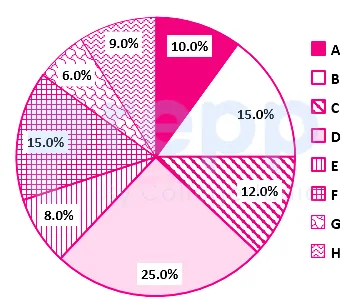
- A
55°
- B
54°
- C
57°
- D
56°
Show answer
B. 54°Given:
Calculations:
According to the question,
100% = 360°
1% = 3.6°
The value of B = 15%
Then,
⇒ 15%
⇒ 1% × 15
⇒ 3.6 × 15
⇒ 54°
⇒ Hence, The Required value is 54°.
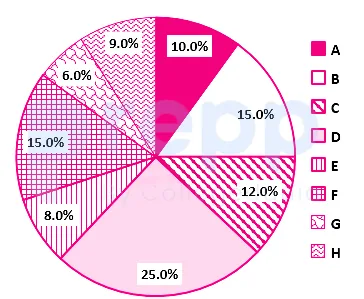 Paper & answer key PDF ↗
 Question 64archived
If, for a non-zero x, 5x2 + 7x + 5 = 0, then the value of \({x^3} + \frac{1}{{{x^3}}}\) is:
- A
\(\frac{{496}}{{125}}\)
- B
\(\frac{{532}}{{343}}\)
- C
\(\frac{{125}}{{532}}\)
- D
\(\frac{{182}}{{125}}\)
Show answer
D. \(\frac{{182}}{{125}}\)Understanding the Problem: Finding \(x^3 + \frac{1}{x^3}\) from a Quadratic Equation
The problem provides a quadratic equation, \(5x^2 + 7x + 5 = 0\), where \(x\) is a non-zero number. We are asked to find the value of the expression \(x^3 + \frac{1}{x^3}\).
To solve this, we need to manipulate the given equation to find a relationship involving \(x\) and \(\frac{1}{x}\). The expression we need to evaluate, \(x^3 + \frac{1}{x^3}\), can be related to powers of \(x + \frac{1}{x}\).
Step-by-Step Solution for \(x^3 + \frac{1}{x^3}\)
Let's start with the given quadratic equation:
$$5x^2 + 7x + 5 = 0$$
Since we are given that \(x\) is non-zero, we can divide the entire equation by \(x\). Dividing by \(x\) helps us introduce the term \(\frac{1}{x}\) into the equation:
$$\frac{5x^2}{x} + \frac{7x}{x} + \frac{5}{x} = \frac{0}{x}$$
This simplifies to:
$$5x + 7 + \frac{5}{x} = 0$$
Now, let's group the terms with \(x\) and \(\frac{1}{x}\) together:
$$5x + \frac{5}{x} + 7 = 0$$
Factor out the common factor, 5, from the first two terms:
$$5\left(x + \frac{1}{x}\right) + 7 = 0$$
Now, isolate the term \(\left(x + \frac{1}{x}\right)\):
$$5\left(x + \frac{1}{x}\right) = -7$$
Divide by 5 to find the value of \(x + \frac{1}{x}\):
$$x + \frac{1}{x} = -\frac{7}{5}$$
Next, we need to find the value of \(x^3 + \frac{1}{x^3}\). We can use the algebraic identity for the sum of cubes: \(a^3 + b^3 = (a+b)^3 - 3ab(a+b)\).
Let \(a = x\) and \(b = \frac{1}{x}\). Then \(ab = x \cdot \frac{1}{x} = 1\).
Substitute these into the identity:
$$x^3 + \left(\frac{1}{x}\right)^3 = \left(x + \frac{1}{x}\right)^3 - 3\left(x \cdot \frac{1}{x}\right)\left(x + \frac{1}{x}\right)$$
$$x^3 + \frac{1}{x^3} = \left(x + \frac{1}{x}\right)^3 - 3(1)\left(x + \frac{1}{x}\right)$$
$$x^3 + \frac{1}{x^3} = \left(x + \frac{1}{x}\right)^3 - 3\left(x + \frac{1}{x}\right)$$
Now, substitute the value we found for \(x + \frac{1}{x}\), which is \(-\frac{7}{5}\):
$$x^3 + \frac{1}{x^3} = \left(-\frac{7}{5}\right)^3 - 3\left(-\frac{7}{5}\right)$$
Calculate the cube of \(-\frac{7}{5}\):
$$\left(-\frac{7}{5}\right)^3 = \frac{(-7)^3}{5^3} = \frac{-343}{125}$$
Calculate the second term:
$$-3\left(-\frac{7}{5}\right) = +\frac{21}{5}$$
Now substitute these values back into the expression for \(x^3 + \frac{1}{x^3}\):
$$x^3 + \frac{1}{x^3} = -\frac{343}{125} + \frac{21}{5}$$
To add these fractions, we need a common denominator, which is 125. We convert \(\frac{21}{5}\) to have a denominator of 125 by multiplying the numerator and denominator by \(\frac{125}{5} = 25\):
$$\frac{21}{5} = \frac{21 \times 25}{5 \times 25} = \frac{525}{125}$$
Now, perform the addition:
$$x^3 + \frac{1}{x^3} = -\frac{343}{125} + \frac{525}{125}$$
$$x^3 + \frac{1}{x^3} = \frac{525 - 343}{125}$$
$$x^3 + \frac{1}{x^3} = \frac{182}{125}$$
Result and Conclusion
The value of \(x^3 + \frac{1}{x^3}\) is \(\frac{182}{125}\).
Revision Table: Key Steps in Solving
Step
Description
Mathematical Operation
1
Start with the given equation
\(5x^2 + 7x + 5 = 0\)
2
Divide by x (since x ≠ 0)
\(5x + 7 + \frac{5}{x} = 0\)
3
Rearrange terms
\(5(x + \frac{1}{x}) = -7\)
4
Find value of \(x + \frac{1}{x}\)
\(x + \frac{1}{x} = -\frac{7}{5}\)
5
Use identity for \(a^3 + b^3\)
\(x^3 + \frac{1}{x^3} = (x + \frac{1}{x})^3 - 3(x + \frac{1}{x})\)
6
Substitute value of \(x + \frac{1}{x}\)
\((-\frac{7}{5})^3 - 3(-\frac{7}{5})\)
7
Calculate and simplify
\(-\frac{343}{125} + \frac{21}{5} = \frac{-343 + 525}{125}\)
8
Final result
\(\frac{182}{125}\)
Additional Information: Relating Expressions
This problem demonstrates a common technique in algebra where a complex expression involving powers of \(x\) and \(\frac{1}{x}\) can be evaluated by first finding the value of the simpler expression \(x + \frac{1}{x}\) or \(x - \frac{1}{x}\).
Here are some useful identities for such problems:
\(\left(x + \frac{1}{x}\right)^2 = x^2 + 2 + \frac{1}{x^2}\), so \(x^2 + \frac{1}{x^2} = \left(x + \frac{1}{x}\right)^2 - 2\)
\(\left(x - \frac{1}{x}\right)^2 = x^2 - 2 + \frac{1}{x^2}\), so \(x^2 + \frac{1}{x^2} = \left(x - \frac{1}{x}\right)^2 + 2\)
\(\left(x + \frac{1}{x}\right)^3 = x^3 + 3x^2\left(\frac{1}{x}\right) + 3x\left(\frac{1}{x}\right)^2 + \left(\frac{1}{x}\right)^3 = x^3 + 3x + \frac{3}{x} + \frac{1}{x^3} = x^3 + \frac{1}{x^3} + 3\left(x + \frac{1}{x}\right)\), so \(x^3 + \frac{1}{x^3} = \left(x + \frac{1}{x}\right)^3 - 3\left(x + \frac{1}{x}\right)\)
\(\left(x - \frac{1}{x}\right)^3 = x^3 - 3x^2\left(\frac{1}{x}\right) + 3x\left(\frac{1}{x}\right)^2 - \left(\frac{1}{x}\right)^3 = x^3 - 3x + \frac{3}{x} - \frac{1}{x^3} = x^3 - \frac{1}{x^3} - 3\left(x - \frac{1}{x}\right)\), so \(x^3 - \frac{1}{x^3} = \left(x - \frac{1}{x}\right)^3 + 3\left(x - \frac{1}{x}\right)\)
These identities are crucial for solving problems that involve symmetrical expressions of \(x\) and \(\frac{1}{x}\) derived from polynomial equations, often quadratic or cubic.
Paper & answer key PDF ↗ Question 65archived
A person lent Rs. 23000 to B for 3 years and Rs. 19000 to C for 4 years on simple interest at the same rate of interest and received Rs. 3625 in all from both of them as interest. What is the annual rate of interest?
- A
1.5 percent
- B
3 percent
- C
2.5 percent
- D
4 percent
Show answer
C. 2.5 percentFinding the Annual Simple Interest Rate
This problem involves calculating the annual rate of simple interest when a principal amount is lent for different durations to different people, and the total interest received is known. We will use the formula for simple interest and set up an equation based on the total interest received.
Understanding Simple Interest
Simple Interest (SI) is calculated only on the principal amount. The formula for simple interest is:
$$SI = \frac{P \times R \times T}{100}$$
Where:
\(P\) is the Principal amount
\(R\) is the Rate of Interest per annum (in percent)
\(T\) is the Time period (in years)
Calculating Interest for Each Person
Let the annual rate of interest be \(R\) percent.
For person B:
Principal (\(P_B\)) = Rs. 23000
Time (\(T_B\)) = 3 years
Simple Interest for B (\(SI_B\)) = \(\frac{23000 \times R \times 3}{100}\)
\(SI_B = \frac{69000 \times R}{100} = 690R\)
For person C:
Principal (\(P_C\)) = Rs. 19000
Time (\(T_C\)) = 4 years
Simple Interest for C (\(SI_C\)) = \(\frac{19000 \times R \times 4}{100}\)
\(SI_C = \frac{76000 \times R}{100} = 760R\)
Setting up the Total Interest Equation
The total interest received from both B and C is Rs. 3625.
Total Interest = Simple Interest from B + Simple Interest from C
$$3625 = SI_B + SI_C$$
Substitute the expressions for \(SI_B\) and \(SI_C\) in terms of R:
$$3625 = 690R + 760R$$
Solving for the Rate of Interest (R)
Combine the terms on the right side of the equation:
$$3625 = (690 + 760)R$$
$$3625 = 1450R$$
Now, isolate R by dividing both sides by 1450:
$$R = \frac{3625}{1450}$$
To simplify the fraction, we can divide the numerator and denominator by common factors. Let's divide by 10:
$$R = \frac{362.5}{145}$$
We can perform the division:
$$362.5 \div 145$$
Let's try multiplying 145 by potential answers (like 2 or 3):
\(145 \times 2 = 290\)
\(145 \times 3 = 435\)
The value 362.5 is between 290 and 435, so R should be between 2 and 3. Let's try 2.5:
\(145 \times 2.5 = 145 \times (2 + 0.5) = (145 \times 2) + (145 \times 0.5) = 290 + 72.5 = 362.5\)
So, the division gives:
$$R = 2.5$$
The annual rate of interest is 2.5 percent.
Here's a summary of the values:
Person
Principal (P)
Time (T)
Rate (R)
Simple Interest (SI)
B
Rs. 23000
3 years
2.5%
\(\frac{23000 \times 2.5 \times 3}{100} = \frac{172500}{100} = 1725\)
C
Rs. 19000
4 years
2.5%
\(\frac{19000 \times 2.5 \times 4}{100} = \frac{190000}{100} = 1900\)
Total
-
-
-
\(1725 + 1900 = 3625\)
The calculated total interest matches the given total interest, confirming the rate of 2.5% is correct.
Revision Table: Simple Interest Concepts
Term
Definition
Formula (for SI)
Principal (P)
The initial amount of money borrowed or lent.
\(P = \frac{SI \times 100}{R \times T}\)
Rate (R)
The percentage at which interest is charged per year.
\(R = \frac{SI \times 100}{P \times T}\)
Time (T)
The duration for which the money is borrowed or lent.
\(T = \frac{SI \times 100}{P \times R}\)
Simple Interest (SI)
The interest calculated only on the principal amount.
\(SI = \frac{P \times R \times T}{100}\)
Amount (A)
The total sum including principal and interest.
\(A = P + SI\)
Additional Information: Simple Interest vs. Compound Interest
It's important to distinguish between simple interest and compound interest when dealing with financial calculations.
Simple Interest: Interest is calculated only on the initial principal amount. The interest earned does not get added back to the principal for calculating future interest. This is generally used for short-term loans or calculations.
Compound Interest: Interest is calculated on the principal amount and also on the accumulated interest of previous periods. The interest earned is added back to the principal, and the next period's interest is calculated on this new, larger principal. This leads to exponential growth and is more commonly used in banking (savings accounts, loans) and investments over longer periods.
The problem explicitly states "simple interest", so the formula \(SI = \frac{P \times R \times T}{100}\) is the correct one to use.
Paper & answer key PDF ↗ Question 66archived
The radius of a hemisphere is 6.3 cm. What will be its volume?
- A
572.80 cm3
- B
643.50 cm3
- C
523.90 cm3
- D
353.38 cm3
Show answer
C. 523.90 cm3Finding the Volume of a Hemisphere with a Given Radius
The question asks us to calculate the volume of a hemisphere. A hemisphere is essentially half of a sphere. We are given the radius of the hemisphere.
Understanding the Problem
We are given the radius (r) of a hemisphere, which is 6.3 cm.
We need to find the volume (V) of this hemisphere.
Formula for the Volume of a Hemisphere
The volume of a sphere with radius 'r' is given by the formula:
$$V_{sphere} = \frac{4}{3}\pi r^3$$
Since a hemisphere is half of a sphere, its volume is half the volume of a sphere with the same radius:
$$V_{hemisphere} = \frac{1}{2} \times V_{sphere}$$
$$V_{hemisphere} = \frac{1}{2} \times \frac{4}{3}\pi r^3$$
$$V_{hemisphere} = \frac{2}{3}\pi r^3$$
Here, π is a mathematical constant approximately equal to 3.14159.
Step-by-Step Calculation
Given radius, $r = 6.3 \text{ cm}$.
Substitute the value of the radius into the formula for the volume of a hemisphere:
$$V_{hemisphere} = \frac{2}{3}\pi (6.3)^3$$
First, calculate $6.3^3$:
$$6.3^3 = 6.3 \times 6.3 \times 6.3$$
$$6.3 \times 6.3 = 39.69$$
$$39.69 \times 6.3 = 250.047$$
So, $(6.3)^3 = 250.047 \text{ cm}^3$.
Now, substitute this value back into the volume formula:
$$V_{hemisphere} = \frac{2}{3}\pi (250.047)$$
$$V_{hemisphere} = \frac{2 \times 250.047}{3}\pi$$
$$V_{hemisphere} = \frac{500.094}{3}\pi$$
$$V_{hemisphere} = 166.698\pi$$
Using the approximate value of π ≈ 3.14159:
$$V_{hemisphere} \approx 166.698 \times 3.14159$$
$$V_{hemisphere} \approx 523.8982...$$
Rounding the result to two decimal places, we get 523.90 cm$^3$.
Comparing with Options
Let's compare our calculated volume with the given options:
Option 1: 572.80 cm<sup>3</sup>
Option 2: 643.50 cm<sup>3</sup>
Option 3: 523.90 cm<sup>3</sup>
Option 4: 353.38 cm<sup>3</sup>
Our calculated volume, 523.90 cm<sup>3</sup>, matches Option 3.
Result Summary
The volume of the hemisphere with a radius of 6.3 cm is approximately 523.90 cm<sup>3</sup>.
Revision Table: Hemisphere Volume Calculation
Concept
Formula
Given Value
Calculation Step
Result
Radius of Hemisphere
$r$
6.3 cm
-
6.3 cm
Formula for Hemisphere Volume
$V = \frac{2}{3}\pi r^3$
-
Substitution of r
-
Cube of Radius
$r^3$
-
$(6.3)^3 = 250.047$
250.047 cm<sup>3</sup>
Hemisphere Volume
$V = \frac{2}{3}\pi (6.3)^3$
-
$\frac{2}{3}\pi (250.047) \approx 523.90$
523.90 cm<sup>3</sup>
Additional Information: Geometry of 3D Shapes
Understanding the properties and formulas of 3D geometric shapes like spheres and hemispheres is crucial in geometry and mensuration. Here are a few related concepts:
Sphere: A perfectly round geometrical object in three-dimensional space that is the surface of a perfectly round ball. It has a constant radius from its center to any point on its surface.
Hemisphere: Half of a sphere, divided by a plane passing through its center.
Radius (r): The distance from the center of the sphere or hemisphere to any point on its surface.
Diameter (d): The distance across the sphere or hemisphere passing through the center. $d = 2r$.
Surface Area of Sphere: The total area of the surface of a sphere is $4\pi r^2$.
Total Surface Area of Hemisphere: This includes the curved surface area and the base area (which is a circle). Curved surface area is $2\pi r^2$, and base area is $\pi r^2$. So, total surface area is $2\pi r^2 + \pi r^2 = 3\pi r^2$.
Curved Surface Area of Hemisphere: The area of the curved part only, which is half the surface area of a sphere, $2\pi r^2$.
Remembering these formulas and definitions helps in solving various problems related to the volume and surface area of spheres and hemispheres.
Paper & answer key PDF ↗ Question 67archived
ΔABC ∼ ΔDEF such that AB = 9.1 cm and DE = 6.5 cm. If the perimeter of ΔDEF = 25 cm, then the perimeter of ΔABC is:
- A
40 cm
- B
30 cm
- C
35 cm
- D
45 cm
Show answer
C. 35 cmUnderstanding Similar Triangles and Perimeters
When two triangles are similar, it means their corresponding angles are equal, and their corresponding sides are in proportion. A key property of similar triangles is that the ratio of their perimeters is equal to the ratio of their corresponding sides.
In this problem, we are given that $\Delta$ABC is similar to $\Delta$DEF, denoted as $\Delta$ABC $\sim$ $\Delta$DEF. We are also given the lengths of one pair of corresponding sides, AB and DE, and the perimeter of $\Delta$DEF.
Using the Properties of Similar Triangles
Since $\Delta$ABC $\sim$ $\Delta$DEF, the ratio of corresponding sides is constant:
$$\frac{AB}{DE} = \frac{BC}{EF} = \frac{CA}{FD}$$
Also, the ratio of their perimeters is equal to the ratio of corresponding sides:
$$\frac{\text{Perimeter of } \Delta\text{ABC}}{\text{Perimeter of } \Delta\text{DEF}} = \frac{AB}{DE}$$
Calculating the Side Ratio
We are given AB = 9.1 cm and DE = 6.5 cm. The ratio of these corresponding sides is:
$$\frac{AB}{DE} = \frac{9.1 \text{ cm}}{6.5 \text{ cm}}$$
To simplify this ratio, we can multiply the numerator and denominator by 10 to remove the decimals:
$$\frac{9.1}{6.5} = \frac{91}{65}$$
Both 91 and 65 are divisible by 13 ($91 = 7 \times 13$, $65 = 5 \times 13$). So, the simplified ratio is:
$$\frac{91}{65} = \frac{7 \times 13}{5 \times 13} = \frac{7}{5}$$
The ratio of corresponding sides is $\frac{7}{5}$.
Finding the Perimeter of ΔABC
Using the property that the ratio of perimeters equals the ratio of corresponding sides:
$$\frac{\text{Perimeter of } \Delta\text{ABC}}{\text{Perimeter of } \Delta\text{DEF}} = \frac{7}{5}$$
We are given that the perimeter of $\Delta$DEF = 25 cm. Substitute this value into the equation:
$$\frac{\text{Perimeter of } \Delta\text{ABC}}{25 \text{ cm}} = \frac{7}{5}$$
Now, solve for the Perimeter of $\Delta$ABC:
$$\text{Perimeter of } \Delta\text{ABC} = \frac{7}{5} \times 25 \text{ cm}$$
$$\text{Perimeter of } \Delta\text{ABC} = 7 \times \frac{25}{5} \text{ cm}$$
$$\text{Perimeter of } \Delta\text{ABC} = 7 \times 5 \text{ cm}$$
$$\text{Perimeter of } \Delta\text{ABC} = 35 \text{ cm}$$
The perimeter of $\Delta$ABC is 35 cm.
Summary of Steps
Identify that the triangles are similar.
Recall the property that the ratio of perimeters of similar triangles is equal to the ratio of their corresponding sides.
Calculate the ratio of the given corresponding sides (AB and DE).
Set up the equation using the perimeter ratio and the side ratio.
Substitute the known perimeter and solve for the unknown perimeter.
Revision Table: Similar Triangle Properties
Property
Description
Ratio Relation (for ΔABC ∼ ΔDEF)
Angles
Corresponding angles are equal.
∠A = ∠D, ∠B = ∠E, ∠C = ∠F
Sides
Corresponding sides are proportional.
$$\frac{AB}{DE} = \frac{BC}{EF} = \frac{CA}{FD} = k$$ (where k is the scale factor)
Perimeter
Ratio of perimeters equals the scale factor (ratio of sides).
$$\frac{\text{Perimeter of } \Delta\text{ABC}}{\text{Perimeter of } \Delta\text{DEF}} = k$$
Area
Ratio of areas equals the square of the scale factor (ratio of sides squared).
$$\frac{\text{Area of } \Delta\text{ABC}}{\text{Area of } \Delta\text{DEF}} = k^2 = \left(\frac{AB}{DE}\right)^2$$
Additional Information: Scale Factor and Area Ratio
The ratio of corresponding sides, $\frac{7}{5}$, is also known as the scale factor from $\Delta$DEF to $\Delta$ABC. This means that every length in $\Delta$ABC is $\frac{7}{5}$ times the corresponding length in $\Delta$DEF.
While the ratio of perimeters is equal to the scale factor, the ratio of the areas of similar triangles is equal to the square of the scale factor. In this case, the ratio of the areas would be:
$$\frac{\text{Area of } \Delta\text{ABC}}{\text{Area of } \Delta\text{DEF}} = \left(\frac{7}{5}\right)^2 = \frac{49}{25}$$
Understanding these ratios is crucial for solving various problems involving similar figures.
Paper & answer key PDF ↗ Question 68archived
1 man and 4 women can complete a work in \(\frac{{65}}{4}\) days, while 3 men and 4 women can complete it in \(\frac{{13}}{2}\) days. In how many days will 13 women complete the same?
- A
20
- B
16
- C
14
- D
18
Show answer
A. 20Solving Work and Time Problems with Men and Women
This problem involves calculating the time taken by a group of women to complete a specific amount of work, given information about the work rates of different combinations of men and women. We need to determine the individual work rate of a woman based on the given scenarios.
Let's denote the work done by one man in one day as \( M \) and the work done by one woman in one day as \( W \). The total work to be completed is a fixed amount, which we can consider as 1 unit of work.
Setting Up Equations from Work and Time Information
The fundamental relationship between work, rate, and time is:
Work = Rate × Time
Which can be rearranged to:
Rate = \( \frac{\text{Work}}{\text{Time}} \)
From the first statement:
1 man and 4 women complete the work in \( \frac{65}{4} \) days.
Their combined daily work rate is \( 1 \times M + 4 \times W = M + 4W \).
The total work is 1 unit.
So, the daily work rate is \( \frac{1 \text{ (Work)}}{\frac{65}{4} \text{ (Time)}} = \frac{4}{65} \).
This gives us our first equation:
\( M + 4W = \frac{4}{65} \) (Equation 1)
From the second statement:
3 men and 4 women complete the same work in \( \frac{13}{2} \) days.
Their combined daily work rate is \( 3 \times M + 4 \times W = 3M + 4W \).
The total work is 1 unit.
So, the daily work rate is \( \frac{1 \text{ (Work)}}{\frac{13}{2} \text{ (Time)}} = \frac{2}{13} \).
This gives us our second equation:
\( 3M + 4W = \frac{2}{13} \) (Equation 2)
Solving for Individual Work Rates (M and W)
We now have a system of two linear equations:
1) \( M + 4W = \frac{4}{65} \)
2) \( 3M + 4W = \frac{2}{13} \)
We can solve this system using the elimination method. Notice that the coefficient of \( W \) is the same in both equations (4W). Subtract Equation 1 from Equation 2:
\( (3M + 4W) - (M + 4W) = \frac{2}{13} - \frac{4}{65} \)
\( 3M - M + 4W - 4W = \frac{2 \times 5}{13 \times 5} - \frac{4}{65} \)
\( 2M = \frac{10}{65} - \frac{4}{65} \)
\( 2M = \frac{10 - 4}{65} \)
\( 2M = \frac{6}{65} \)
Now, solve for \( M \):
\( M = \frac{6}{65 \times 2} \)
\( M = \frac{3}{65} \)
So, one man completes \( \frac{3}{65} \) of the total work per day.
Now substitute the value of \( M \) into Equation 1 to find \( W \):
\( M + 4W = \frac{4}{65} \)
\( \frac{3}{65} + 4W = \frac{4}{65} \)
\( 4W = \frac{4}{65} - \frac{3}{65} \)
\( 4W = \frac{1}{65} \)
Now, solve for \( W \):
\( W = \frac{1}{65 \times 4} \)
\( W = \frac{1}{260} \)
So, one woman completes \( \frac{1}{260} \) of the total work per day.
Calculating Time for 13 Women
We want to find the time taken by 13 women to complete the same work. First, let's find the combined daily work rate of 13 women:
Rate of 13 women = \( 13 \times W \)
Rate of 13 women = \( 13 \times \frac{1}{260} \)
Rate of 13 women = \( \frac{13}{260} \)
Since \( 260 \div 13 = 20 \), we can simplify the fraction:
Rate of 13 women = \( \frac{1}{20} \)
So, 13 women complete \( \frac{1}{20} \) of the total work per day.
The time taken to complete the total work (1 unit) is given by:
Time = \( \frac{\text{Total Work}}{\text{Rate}} \)
Time = \( \frac{1}{\frac{1}{20}} \)
Time = \( 1 \times 20 \)
Time = 20 days
Therefore, 13 women will complete the same work in 20 days.
Group
Time Taken (Days)
Combined Daily Work Rate
1 Man + 4 Women
\( \frac{65}{4} \)
\( \frac{4}{65} \)
3 Men + 4 Women
\( \frac{13}{2} \)
\( \frac{2}{13} \)
1 Man (calculated)
\( \frac{1}{\frac{3}{65}} = \frac{65}{3} \)
\( \frac{3}{65} \)
1 Woman (calculated)
\( \frac{1}{\frac{1}{260}} = 260 \)
\( \frac{1}{260} \)
13 Women (calculated)
20
\( \frac{1}{20} \)
Work and Time Problem Solution Summary
By setting up and solving simultaneous equations based on the given work and time information for different groups of men and women, we determined the individual daily work rates. Using the daily work rate of a single woman, we calculated the combined rate for 13 women and subsequently found the time required for them to complete the entire work.
Revision Table: Key Concepts in Work and Time
Concept
Explanation
Formula
Work Rate
Amount of work done per unit of time.
Rate = \( \frac{\text{Work}}{\text{Time}} \)
Total Work
The entire task to be completed, often represented as 1 unit.
Work = Rate × Time
Efficiency
Another term for work rate, representing how effectively a person or group works. Higher efficiency means a higher rate.
Efficiency \( \propto \) Rate
Time Taken
The duration required to complete the total work at a given rate.
Time = \( \frac{\text{Work}}{\text{Rate}} \)
Additional Information: Understanding Work-Rate Problems
Work and time problems are common in quantitative aptitude. The key idea is that the total amount of work is constant, regardless of who does it or how long it takes different groups. The rate at which work is done is inversely proportional to the time taken; meaning, if the rate increases, the time taken decreases, and vice versa, assuming the total work is constant.
When multiple people or entities work together, their individual work rates are added to find their combined work rate. For example, if person A does work at rate \( R_A \) and person B at rate \( R_B \), their combined rate is \( R_A + R_B \).
In problems involving different types of workers (like men and women here), we treat their individual daily work contributions as variables and use the given information to form a system of equations that can be solved to find the value of these variables. Once the individual rates are known, the time taken by any combination of these workers can be calculated.
Paper & answer key PDF ↗ Question 69archived
The table given below shows the number of calculator sold by five shopkeepers.
Shopkeepers
Calculator
S1
40
S2
60
S3
55
S4
35
S5
80
Number of calculator sold by S5 is what percent of the number of calculator sold by S1?
- A
100 percent
- B
150 percent
- C
200 percent
- D
50 percent
Show answer
C. 200 percentThe correct answer is 200 percent.
In this question, S5 sold more calculators (80) than S1 (40), so it's expected that S5's sales would be more than 100% of S1's sales. A percentage comparison helps us understand the relative performance or size of different quantities. Here, it shows that S5 sold exactly double the number of calculators that S1 sold, which corresponds to 200%. This type of calculation is common when comparing sales figures, growth rates, test scores, and many other types of data.
Paper & answer key PDF ↗ Question 70archived
What is the value of cos215°?
- A
\(\left( {2 + \sqrt 3 } \right)\)
- B
\(\frac{{\left( {2 + \sqrt 3 } \right)}}{4}\)
- C
\(\frac{{\left( {2 + \sqrt 3 } \right)}}{2}\)
- D
\(\frac{{\left( {1 + \sqrt 3 } \right)}}{2}\)
Show answer
B. \(\frac{{\left( {2 + \sqrt 3 } \right)}}{4}\)Calculating the Value of cos² 15°
The question asks for the value of $\cos^2 15^\circ$. We can find this value using trigonometric identities. One helpful identity relates $\cos^2 \theta$ to $\cos 2\theta$.
The double angle identity for cosine can be written as:
\(\cos 2\theta = 2\cos^2\theta - 1\)
We can rearrange this identity to solve for $\cos^2\theta$:
\(2\cos^2\theta = 1 + \cos 2\theta\)
\(\cos^2\theta = \frac{{1 + \cos 2\theta}}{2}\)
In this problem, we want to find the value of $\cos^2 15^\circ$. So, we can set $\theta = 15^\circ$. This means $2\theta = 2 \times 15^\circ = 30^\circ$.
Now, we can substitute $\theta = 15^\circ$ into the identity:
\(\cos^2 15^\circ = \frac{{1 + \cos (2 \times 15^\circ)}}{2}\)
\(\cos^2 15^\circ = \frac{{1 + \cos 30^\circ}}{2}\)
We know the exact value of $\cos 30^\circ$. It is $\frac{{\sqrt 3 }}{2}$.
Substitute this value into the equation:
\(\cos^2 15^\circ = \frac{{1 + \frac{{\sqrt 3 }}{2}}}{2}\)
Now, we need to simplify the expression. First, simplify the numerator by finding a common denominator:
\(1 + \frac{{\sqrt 3 }}{2} = \frac{2}{2} + \frac{{\sqrt 3 }}{2} = \frac{{2 + \sqrt 3 }}{2}\)
So, the expression becomes:
\(\cos^2 15^\circ = \frac{{\frac{{2 + \sqrt 3 }}{2}}}{2}\)
To divide by 2 in the denominator, we can multiply the numerator by $\frac{1}{2}$:
\(\cos^2 15^\circ = \frac{{2 + \sqrt 3 }}{2} \times \frac{1}{2}\)
\(\cos^2 15^\circ = \frac{{2 + \sqrt 3 }}{{2 \times 2}}\)
\(\cos^2 15^\circ = \frac{{2 + \sqrt 3 }}{4}\)
Thus, the value of $\cos^2 15^\circ$ is $\frac{{2 + \sqrt 3 }}{4}$.
Comparing this result with the given options, we find that this matches option 2.
Revision Table: Key Trigonometric Values
Angle ($\theta$)
$\sin \theta$
$\cos \theta$
$\tan \theta$
0°
0
1
0
30° ($\frac{\pi}{6}$)
$\frac{1}{2}$
$\frac{{\sqrt 3 }}{2}$
$\frac{1}{{\sqrt 3 }}$
45° ($\frac{\pi}{4}$)
$\frac{1}{{\sqrt 2 }}$
$\frac{1}{{\sqrt 2 }}$
1
60° ($\frac{\pi}{3}$)
$\frac{{\sqrt 3 }}{2}$
$\frac{1}{2}$
$\sqrt 3 $
90° ($\frac{\pi}{2}$)
1
0
Undefined
Additional Information on Trigonometric Identities
Trigonometric identities are equations that are true for all valid values of the variables. They are crucial for simplifying expressions and solving trigonometric equations. Some common identities include:
Pythagorean Identity: $\sin^2\theta + \cos^2\theta = 1$
Quotient Identity: $\tan\theta = \frac{{\sin\theta}}{{\cos\theta}}$
Reciprocal Identities:
$\csc\theta = \frac{1}{{\sin\theta}}$
$\sec\theta = \frac{1}{{\cos\theta}}$
$\cot\theta = \frac{1}{{\tan\theta}}$
Angle Sum and Difference Identities:
$\cos(A+B) = \cos A \cos B - \sin A \sin B$
$\cos(A-B) = \cos A \cos B + \sin A \sin B$
$\sin(A+B) = \sin A \cos B + \cos A \sin B$
$\sin(A-B) = \sin A \cos B - \cos A \sin B$
Double Angle Identities:
$\cos 2\theta = \cos^2\theta - \sin^2\theta = 2\cos^2\theta - 1 = 1 - 2\sin^2\theta$
$\sin 2\theta = 2\sin\theta\cos\theta$
The half-angle formula for $\cos^2 \theta$, which we used in this problem ($\cos^2\theta = \frac{{1 + \cos 2\theta}}{2}$), is directly derived from the double angle identity for cosine. These identities allow us to find exact trigonometric values for angles other than the standard 0°, 30°, 45°, 60°, and 90°, such as 15° or 75°, by expressing them as sums or differences of standard angles.
Paper & answer key PDF ↗ Question 71archived
From point H, at 6 : 30 pm, a train starts moving towards point K at the speed of 90 km/hr. Another train starts moving from point K at 7 : 30 p.m. towards point H at the speed of 72 km/hr. Both the train meet at 11 : 30 p.m. at point J. What is the ratio of the distance HJ and KJ?
- A
25 : 16
- B
5 : 16
- C
36 : 25
- D
31 : 19
Show answer
A. 25 : 16Understanding the Train Meeting Problem
This problem involves two trains traveling towards each other from different points, starting at different times, and meeting at a specific point. We are given their speeds, start times, and the meeting time. Our goal is to find the ratio of the distances covered by each train until they meet.
Let's denote:
Point H: Starting point of the first train.
Point K: Starting point of the second train.
Point J: Meeting point of the two trains.
Speed of the first train (from H): \(S_1 = 90 \text{ km/hr}\)
Start time of the first train: 6:30 p.m.
Speed of the second train (from K): \(S_2 = 72 \text{ km/hr}\)
Start time of the second train: 7:30 p.m.
Meeting time: 11:30 p.m.
We need to find the ratio of the distance HJ to KJ.
Calculating the Travel Time for Each Train
To find the distance each train travels, we first need to determine how long each train was moving until they met at point J.
Time Train 1 (from H) travelled: The first train started at 6:30 p.m. and met the second train at 11:30 p.m.
Time \(T_1\) = Meeting time - Start time of Train 1
\(T_1 = 11:30 \text{ p.m.} - 6:30 \text{ p.m.} = 5 \text{ hours}\)
Time Train 2 (from K) travelled: The second train started at 7:30 p.m. and met the first train at 11:30 p.m.
Time \(T_2\) = Meeting time - Start time of Train 2
\(T_2 = 11:30 \text{ p.m.} - 7:30 \text{ p.m.} = 4 \text{ hours}\)
Determining the Distance Covered by Each Train
The distance covered by an object is calculated using the formula: Distance = Speed × Time.
Distance covered by Train 1 (HJ): This train travelled for 5 hours at a speed of 90 km/hr.
Distance HJ = \(S_1 \times T_1\)
Distance HJ = \(90 \text{ km/hr} \times 5 \text{ hours}\)
Distance HJ = \(450 \text{ km}\)
Distance covered by Train 2 (KJ): This train travelled for 4 hours at a speed of 72 km/hr.
Distance KJ = \(S_2 \times T_2\)
Distance KJ = \(72 \text{ km/hr} \times 4 \text{ hours}\)
Distance KJ = \(288 \text{ km}\)
Calculating the Ratio of Distances HJ to KJ
We need to find the ratio of the distance HJ to the distance KJ.
Ratio = \(\frac{\text{Distance HJ}}{\text{Distance KJ}}\)
Ratio = \(\frac{450 \text{ km}}{288 \text{ km}}\)
Now, we simplify the ratio \(450 : 288\).
We can simplify this fraction by finding common factors.
Both numbers are divisible by 2: \(450 \div 2 = 225\), \(288 \div 2 = 144\). The ratio is \(225 : 144\).
Both 225 and 144 are divisible by 9 (sum of digits \(2+2+5=9\) and \(1+4+4=9\)).
\(225 \div 9 = 25\)
\(144 \div 9 = 16\)
The simplified ratio is \(25 : 16\).
So, the ratio of the distance HJ and KJ is \(25 : 16\).
Train
Starting Point
Start Time
Speed (km/hr)
Meeting Time
Travel Time (hours)
Distance Covered (km)
1
H
6:30 p.m.
90
11:30 p.m.
\(11.5 - 6.5 = 5\)
\(90 \times 5 = 450\) (Distance HJ)
2
K
7:30 p.m.
72
11:30 p.m.
\(11.5 - 7.5 = 4\)
\(72 \times 4 = 288\) (Distance KJ)
Ratio HJ : KJ = \(450 : 288 = 25 : 16\).
Revision Table: Key Concepts for Train Problems
Concept
Explanation
Formula
Speed
The rate at which an object moves.
\( \text{Speed} = \frac{\text{Distance}}{\text{Time}} \)
Distance
The total length covered by a moving object.
\( \text{Distance} = \text{Speed} \times \text{Time} \)
Time
The duration for which an object is moving.
\( \text{Time} = \frac{\text{Distance}}{\text{Speed}} \)
Meeting Time (Opposite Direction)
Time taken for two objects moving towards each other to meet. Requires considering relative speed.
\( \text{Relative Speed} = S_1 + S_2 \)
Distance Ratio
The ratio of distances covered by objects. If time is constant, distance ratio is speed ratio. If speed is constant, distance ratio is time ratio.
\( \frac{D_1}{D_2} = \frac{S_1 \times T_1}{S_2 \times T_2} \)
Additional Information: Relative Speed Concept
When two objects are moving towards each other, their speeds add up to determine how quickly the distance between them decreases. This combined speed is called relative speed.
In this specific problem, although the trains start at different times, they are moving towards each other. The concept of relative speed is useful for calculating the total distance between H and K, or the time it takes for them to meet after both have started moving. However, to find the ratio of distances covered by each train to the meeting point, calculating the individual time and distance for each train is a more direct approach.
If we were asked for the total distance HK, we could add the distances HJ and KJ: \(450 \text{ km} + 288 \text{ km} = 738 \text{ km}\).
Paper & answer key PDF ↗ Question 72archived
In a race, there are 4 members in a team. Each member has to cover 5 km one after another. If the total time taken is 30 minutes, then what would have been the average speed?
- A
50\(\frac{{km}}{{hr}}\)
- B
40\(\frac{{km}}{{hr}}\)
- C
50\(\frac{m}{{\sec }}\)
- D
40\(\frac{m}{{\sec }}\)
Show answer
B. 40\(\frac{{km}}{{hr}}\)Calculating Average Speed in a Race
This question asks us to find the average speed of a team in a race. To find the average speed, we need to know the total distance covered and the total time taken. The formula for average speed is:
$$ \text{Average Speed} = \frac{\text{Total Distance}}{\text{Total Time}} $$
Step 1: Determine the Total Distance
The race involves a team of 4 members. Each member has to cover a distance of 5 km. Since they cover the distance one after another, the total distance covered by the entire team is the sum of the distances covered by each member.
Number of members = 4
Distance covered by each member = 5 km
Total Distance = Number of members $\times$ Distance per member
Total Distance = $4 \times 5 \text{ km}$
Total Distance = $20 \text{ km}$
So, the total distance covered in the race is 20 km.
Step 2: Determine the Total Time
The question states that the total time taken for the race is 30 minutes.
Total Time = 30 minutes
Step 3: Convert Units for Calculation
The options for average speed are given in units of kilometers per hour ($km/hr$) and meters per second ($m/sec$). Our total distance is in kilometers ($km$), and total time is in minutes. We need to convert the units to match the options.
Converting Time to Hours
To get the speed in $km/hr$, we need to convert the total time from minutes to hours. There are 60 minutes in 1 hour.
$$ \text{Total Time in hours} = \frac{\text{Total Time in minutes}}{\text{Minutes per hour}} $$
$$ \text{Total Time in hours} = \frac{30 \text{ minutes}}{60 \text{ minutes/hour}} $$
$$ \text{Total Time in hours} = 0.5 \text{ hours} $$
Step 4: Calculate Average Speed in km/hr
Now we can calculate the average speed using the total distance in km and total time in hours.
$$ \text{Average Speed} = \frac{\text{Total Distance in km}}{\text{Total Time in hours}} $$
$$ \text{Average Speed} = \frac{20 \text{ km}}{0.5 \text{ hours}} $$
$$ \text{Average Speed} = \frac{20}{0.5} \frac{km}{hr} $$
$$ \text{Average Speed} = 40 \frac{km}{hr} $$
The calculated average speed is 40 km/hr. Let's check if this matches any of the options.
Option 1: 50 km/hr (Does not match)
Option 2: 40 km/hr (Matches!)
Although we have found a matching option, let's quickly calculate the speed in m/sec to see if it matches options 3 or 4.
Converting Distance to Meters and Time to Seconds
Total Distance = 20 km
Total Distance in meters = $20 \text{ km} \times 1000 \text{ m/km} = 20,000 \text{ m}$
Total Time = 30 minutes
Total Time in seconds = $30 \text{ minutes} \times 60 \text{ seconds/minute} = 1800 \text{ seconds}$
Step 5: Calculate Average Speed in m/sec
$$ \text{Average Speed} = \frac{\text{Total Distance in meters}}{\text{Total Time in seconds}} $$
$$ \text{Average Speed} = \frac{20000 \text{ m}}{1800 \text{ seconds}} $$
$$ \text{Average Speed} = \frac{200}{18} \frac{m}{sec} $$
$$ \text{Average Speed} = \frac{100}{9} \frac{m}{sec} $$
$$ \text{Average Speed} \approx 11.11 \frac{m}{sec} $$
Option 3: 50 m/sec (Does not match)
Option 4: 40 m/sec (Does not match)
Based on our calculations, the average speed is 40 km/hr.
Summary of Calculation Steps
Step
Description
Calculation
Result
1
Calculate Total Distance
$4 \text{ members} \times 5 \text{ km/member}$
20 km
2
Note Total Time
-
30 minutes
3
Convert Total Time to Hours
$\frac{30 \text{ minutes}}{60 \text{ minutes/hour}}$
0.5 hours
4
Calculate Average Speed in km/hr
$\frac{20 \text{ km}}{0.5 \text{ hours}}$
40 km/hr
Optional
Convert Total Distance to Meters
$20 \text{ km} \times 1000 \text{ m/km}$
20,000 m
Optional
Convert Total Time to Seconds
$30 \text{ minutes} \times 60 \text{ seconds/minute}$
1800 seconds
Optional
Calculate Average Speed in m/sec
$\frac{20000 \text{ m}}{1800 \text{ seconds}}$
$\frac{100}{9} \text{ m/sec} \approx 11.11 \text{ m/sec}$
Revision Table: Key Concepts
Concept
Definition/Formula
Units
Distance
Total length of the path covered.
meters (m), kilometers (km)
Time
Duration taken for an event.
seconds (s), minutes (min), hours (hr)
Speed
Rate at which an object covers distance.
m/s, km/hr
Average Speed
Total distance divided by total time taken.
Same as speed units (m/s, km/hr)
Additional Information: Understanding Speed and Units
Speed is a measure of how quickly something is moving. It tells us the distance covered per unit of time. The units for speed are derived from the units of distance and time. Common units include meters per second (m/s), kilometers per hour (km/hr), miles per hour (mph), etc.
When solving physics problems involving speed, distance, and time, it is crucial to ensure that the units are consistent. If distance is in kilometers and time is in hours, the speed will be in km/hr. If distance is in meters and time is in seconds, the speed will be in m/s.
Unit conversion is a key skill. Remember the basic conversion factors:
1 km = 1000 m
1 hour = 60 minutes
1 minute = 60 seconds
1 hour = 60 minutes $\times$ 60 seconds/minute = 3600 seconds
To convert km/hr to m/s, you can use the conversion factor: $1 \text{ km/hr} = \frac{1000 \text{ m}}{3600 \text{ s}} = \frac{5}{18} \text{ m/s}$.
Conversely, to convert m/s to km/hr, you can use the conversion factor: $1 \text{ m/s} = \frac{18}{5} \text{ km/hr}$.
In this problem, we converted the time to hours to match the km unit of distance, resulting in speed in km/hr, which was one of the required units in the options.
Paper & answer key PDF ↗ Question 73archived
The import and export of a country (in lakhs rupees) during a certain period of time is given in the following bar-graph.
Read the bar-graph carefully and answer the following question.
What is the percentage increment in import during the year 2016-17 as compared to the year 2015-16? (correct up to two decimals)
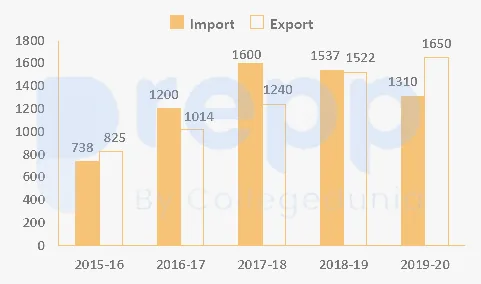
- A
60.62%
- B
62.60%
- C
38.50%
- D
65.32%
Show answer
B. 62.60%Given:
Import in 2016-17 = 1200
Import in 2015-16 = 738
Formula Used:
Percentage = \(\frac{Increament}{Previous}\times100\)
Calculations:
According to the formula,
⇒ Increment = 1200 - 738 = 462
⇒ Percentage = \(\frac{462}{738}\times100\) = 62.60%
⇒ Hence, The percentage increased is 62.60%
Paper & answer key PDF ↗ Question 74archived
Rohan sold goods to Ankith worth Rs.55,000 at 15% trade discount. How much money did Ankith pay to Rohan?
- A
Rs. 8,250
- B
Rs.12,550
- C
Rs. 22,550
- D
Rs. 46,750
Show answer
D. Rs. 46,750Understanding Trade Discount Calculation
The question asks us to determine the amount of money Ankith paid to Rohan after a trade discount was applied to the price of goods sold.
Let's break down the terms:
Original Value of Goods: This is the initial price of the goods before any discount. In this case, it is Rs. 55,000.
Trade Discount: This is a reduction in the list price or catalog price offered by a seller to a buyer. It is usually given when goods are sold in bulk or to specific categories of buyers (like retailers). Trade discount is generally not recorded in the books of accounts of either party; the goods are recorded at the net price (after deducting the trade discount).
Amount Paid: This is the final amount the buyer (Ankith) pays after deducting the trade discount from the original value.
We are given the original value of goods and the trade discount rate. We need to calculate the amount of trade discount first and then subtract it from the original value to find the amount paid by Ankith.
Calculating the Trade Discount Amount
The trade discount is 15% of the original value of Rs. 55,000.
Trade Discount Amount $$ = \text{Original Value} \times \text{Trade Discount Rate} $$
Trade Discount Amount $$ = \text{Rs. } 55,000 \times \frac{15}{100} $$
Calculation:
$$ \text{Trade Discount Amount} = 55,000 \times 0.15 $$
$$ \text{Trade Discount Amount} = 8,250 $$
So, the trade discount amount is Rs. 8,250.
Calculating the Amount Paid by Ankith
The amount Ankith needs to pay is the original value of the goods minus the trade discount.
Amount Paid $$ = \text{Original Value} - \text{Trade Discount Amount} $$
Amount Paid $$ = \text{Rs. } 55,000 - \text{Rs. } 8,250 $$
Calculation:
$$ \text{Amount Paid} = 55,000 - 8,250 $$
$$ \text{Amount Paid} = 46,750 $$
Therefore, Ankith paid Rs. 46,750 to Rohan.
Summary of Calculation
Item
Amount (Rs.)
Original Value of Goods
55,000
Less: Trade Discount (15% of 55,000)
8,250
Amount Paid by Ankith
46,750
Based on our calculation, the amount paid by Ankith to Rohan is Rs. 46,750.
Revision Table: Key Discount Concepts
Concept
Description
Accounting Treatment
Trade Discount
Reduction in list price offered to buyers (often for bulk or trade).
Not recorded in accounts; goods entered at net price.
Cash Discount
Reduction in invoice price offered for prompt payment.
Recorded in accounts (as discount allowed by seller, discount received by buyer).
Additional Information on Trade Discounts
Trade discounts are a common practice in business-to-business transactions. They help standardize pricing while allowing flexibility for different customer types or order sizes. Since the sale is effectively made at the net price (after trade discount), this net amount is considered the revenue for the seller and the cost of goods for the buyer (before considering other costs like freight).
It's important to distinguish between trade discount and cash discount. While trade discount reduces the list price before the sale is recorded, cash discount is offered on the invoice price to encourage early payment of the amount due after the sale.
Paper & answer key PDF ↗ Question 75archived
The table given below shows the marked price and value of discount of 7 articles.
Articles
Marked price
Discount
D
1100
500
E
700
200
F
900
500
G
600
400
H
400
300
I
500
200
J
1000
200
What is the average marked price of all the articles?
- A
824.12
- B
814.12
- C
742.85
- D
704.15
Show answer
C. 742.85Calculating the Average Marked Price of Articles
The question asks us to find the average marked price of all the articles listed in the provided table. The average is a measure of central tendency, calculated as the sum of all values divided by the number of values.
Understanding the Data Table
The table provides information about 7 articles (D1, E, F, G, H, I, J), including their marked price and the discount offered on each. To find the average marked price, we only need the 'Marked price' column.
Let's list the articles and their marked prices based on the table structure:
Article
Marked Price
Discount
D1
1100
500
E
700
200
F
900
500
G
600
400
H
400
300
I
500
200
J
1000
200
Steps to Calculate the Average Marked Price
To find the average marked price, we follow these steps:
Identify the marked price for each article from the table.
Sum up all the marked prices.
Count the total number of articles.
Divide the sum of marked prices by the total number of articles.
Step 1 & 2: Summing the Marked Prices
The marked prices are: 1100, 700, 900, 600, 400, 500, and 1000.
The sum of these marked prices is:
$$ \text{Sum} = 1100 + 700 + 900 + 600 + 400 + 500 + 1000 $$
$$ \text{Sum} = 5200 $$
Step 3: Counting the Articles
There are 7 articles listed in the table (D1, E, F, G, H, I, J).
Total number of articles = 7.
Step 4: Calculating the Average
Now, we apply the average formula:
$$ \text{Average Marked Price} = \frac{\text{Sum of Marked Prices}}{\text{Number of Articles}} $$
$$ \text{Average Marked Price} = \frac{5200}{7} $$
Let's perform the division:
$$ \frac{5200}{7} \approx 742.85714... $$
Rounding this value to two decimal places gives approximately 742.86. Looking at the options, the closest value is 742.85.
Conclusion
The calculated average marked price of all the articles is approximately 742.857. Based on the provided options, the average marked price is 742.85.
Revision Table: Average Calculation
Concept
Definition/Formula
Average (Arithmetic Mean)
$$ \text{Average} = \frac{\text{Sum of values}}{\text{Number of values}} $$
Sum of Marked Prices
$$ 1100 + 700 + 900 + 600 + 400 + 500 + 1000 = 5200 $$
Number of Articles
7
Average Marked Price
$$ \frac{5200}{7} \approx 742.85 $$
Additional Information: Concepts Related to Pricing
In retail and sales, several terms are used to describe prices and reductions:
Marked Price (MP): This is the price printed on the tag of an article. It's the initial price at which the article is offered for sale.
Discount: A reduction in the marked price offered by the seller to the customer. Discounts are often given as a percentage of the marked price or as a fixed amount.
Selling Price (SP): This is the actual price at which the article is sold to the customer after deducting the discount from the marked price. The formula is: $$ \text{Selling Price} = \text{Marked Price} - \text{Discount} $$
Cost Price (CP): This is the price at which the seller purchased the article. Profit or loss is calculated based on the cost price and the selling price.
In this specific problem, we only focused on the marked price to calculate its average across multiple articles.
Paper & answer key PDF ↗ Question 76archived
Parts of the following sentence have been given as options. Select the option that contains a grammatical error. If you don’t find any error, mark ‘No error’ as your answer.
I am having trouble / deciding in / a gift for them. / no error
- A
a gift for them.
- B
No error
- C
I am having trouble
- D
deciding in
Show answer
D. deciding inUnderstanding Grammatical Errors in Sentences
Identifying grammatical errors is a key skill in English language proficiency. The question asks us to find the part of the sentence "I am having trouble / deciding in / a gift for them." that contains a grammatical error.
Let's examine each part provided as an option:
I am having trouble
deciding in
a gift for them.
We need to check if any of these parts are grammatically incorrect in isolation or in the context of the full sentence.
Analyzing the Sentence Parts
Let's break down each potential part for errors:
"I am having trouble": This phrase is grammatically correct. It uses the present continuous tense ("am having"), which is acceptable here to describe a state of difficulty or a temporary situation. "I have trouble" is also correct and perhaps more common for a general statement, but "I am having trouble" is not incorrect in this context.
"deciding in": This phrase sounds incorrect. The verb "deciding" is typically followed by a preposition, but "in" is usually not the correct preposition when referring to the object being decided upon. Common prepositions used with "decide" when referring to the thing being chosen or determined are "on" or "about".
"a gift for them.": This part is grammatically correct. "a gift" is a noun phrase serving as the potential object of the decision, and "for them" is a prepositional phrase indicating the recipients.
Identifying the Error: "deciding in"
The error lies in the phrase "deciding in". The verb "decide" requires a specific preposition depending on the context. When you are choosing between options or determining something specific, you usually "decide on" or "decide about" it.
To decide on something means to make a choice from possible alternatives. Example: "I decided on the red dress."
To decide about something means to make a judgment or form an opinion about it, often leading to a choice. Example: "We need to decide about the project's future."
In the given sentence, the speaker is struggling to choose a specific gift. Therefore, the correct phrasing should use "deciding on" or "deciding about".
The corrected sentence would be: "I am having trouble deciding on a gift for them." or "I am having trouble deciding about a gift for them."
Thus, the part containing the grammatical error is "deciding in".
Conclusion
Based on our analysis, the phrase "deciding in" contains a grammatical error related to the incorrect use of a preposition with the verb "decide". The correct preposition should be "on" or "about".
Sentence Part
Grammatical Status
Reason
I am having trouble
Correct
Acceptable use of present continuous.
deciding in
Incorrect
Incorrect preposition; should be 'deciding on' or 'deciding about'.
a gift for them.
Correct
Proper noun phrase and prepositional phrase.
Revision Table: Common Preposition Errors
Verb/Adjective
Common Incorrect Preposition
Correct Preposition(s)
Example (Correct)
Decide
in
on, about
Decide on a plan.
Depend
of
on, upon
It depends on the weather.
Responsible
to (for something)
for
He is responsible for the mistake. (Responsible to a person is correct)
Listen
at
to
Listen to the music.
Additional Information: Prepositions and Verb Collocations
Prepositions are small words (like in, on, at, for, with, about, etc.) that link nouns, pronouns, or phrases to other words in a sentence. They often indicate relationships of place, time, direction, or manner.
Many verbs and adjectives in English are commonly followed by specific prepositions. These combinations are often called verb collocations or prepositional phrases associated with verbs/adjectives. Learning these fixed or common combinations is crucial for correct grammar.
For example:
Believe in something/someone
Talk about something
Agree with someone
Agree on something (a decision/plan)
Fond of something/someone
Afraid of something
Incorrectly using a preposition can change the meaning or make the sentence grammatically awkward or wrong, as seen with "deciding in". Paying attention to how verbs are used with prepositions is essential for accurate communication.
Paper & answer key PDF ↗ Question 77archived
Select the option that can be used as a one-word substitute for the given group of words.
A small island
- A
Islet
- B
Lagoon
- C
Closet
- D
Isthmus
Show answer
A. IsletUnderstanding One-Word Substitutes: "A Small Island"
One-word substitutes are single words that replace a phrase or a clause, making language more concise. We need to find the single word that correctly describes "A small island". Let's look at the options provided.
Analyzing the Options
We will examine each option to determine which one accurately represents the meaning of "A small island".
Islet: An islet is defined as a small island. This definition perfectly matches the phrase "A small island".
Lagoon: A lagoon is a shallow body of water separated from a larger body of water (like the sea) by a narrow landform, such as barrier islands or reefs. It is a body of water, not a small island itself.
Closet: A closet is a small room or a cupboard for storage, typically used for clothes or supplies. It has no connection to geographical landforms like islands.
Isthmus: An isthmus is a narrow strip of land connecting two larger landmasses across an expanse of water by which they are otherwise separated. It is a land bridge, not a small island.
Based on the definitions, the word that precisely means "A small island" is islet.
Comparing Definitions
Word
Definition
Matches "A Small Island"?
Islet
A small island.
Yes
Lagoon
A shallow body of water separated by a barrier.
No
Closet
A small room for storage.
No
Isthmus
A narrow strip of land connecting two larger landmasses.
No
Conclusion
The only option that serves as a one-word substitute for "A small island" is 'Islet', as its definition directly corresponds to the given phrase.
Revision Table: Key Geographical Terms
Term
Meaning
Example Usage
Island
A piece of land surrounded by water.
Australia is sometimes considered an island continent.
Islet
A very small island.
The boat sailed past tiny islets.
Lagoon
A shallow body of water separated from a larger sea by a barrier.
Many Pacific islands have coral reef lagoons.
Isthmus
A narrow strip of land connecting two larger landmasses.
The Isthmus of Panama connects North and South America.
Peninsula
A piece of land almost surrounded by water or projecting out into a body of water.
The Korean Peninsula.
Additional Information on Landforms
Geography uses specific terms to describe various land and water features. Understanding these terms is crucial for comprehension and vocabulary building. Islands come in various sizes, from vast landmasses like Greenland down to tiny rocky outcrops, which are often called islets.
Other related terms include:
Archipelago: A group of islands.
Bay: A broad inlet of the sea where the land curves inward.
Gulf: A deep inlet of the sea almost surrounded by land, with a narrow mouth.
Strait: A narrow passage of water connecting two seas or two large areas of water.
Distinguishing between terms like isthmus (land connecting two larger lands) and strait (water connecting two larger waters) or island (land surrounded by water) and lagoon (water body) helps in accurately describing geographical locations and features.
Paper & answer key PDF ↗ Question 78archived
Select the option that expresses the given sentence in passive voice.
The company sold the newly introduced car to the highest bidder.
- A
The newly introduced car was sold to the highest bidder by the company.
- B
The company sold the newly introduced car to the highest bidder.
- C
The newly introduced car has sold to the highest bidder by the company.
- D
The newly introduced car sold to the highest bidder by the company.
Show answer
A. The newly introduced car was sold to the highest bidder by the company.Active and Passive Voice Conversion Explained
Understanding how to convert sentences between active and passive voice is a key skill in English grammar. This question asks us to take an active voice sentence and express it in passive voice.
Analyzing the Active Voice Sentence
The given sentence in active voice is:
The company sold the newly introduced car to the highest bidder.
Let's break down its components:
Subject: The company (performs the action)
Verb: sold (Simple Past Tense)
Object: the newly introduced car (receives the action)
Indirect Object/Complement: to the highest bidder
In active voice, the subject performs the action denoted by the verb.
Converting to Passive Voice
In passive voice, the object of the active sentence becomes the subject. The structure typically follows: New Subject (old object) + 'be' verb (in the correct tense) + Past Participle of Main Verb + (optional) by + Old Subject.
Let's apply this to the sentence:
Identify the object: "the newly introduced car". This becomes the new subject of the passive sentence.
Identify the verb tense: The verb "sold" is in the Simple Past Tense. Therefore, the 'be' verb in the passive structure must also be in the Simple Past Tense. Since the new subject "the newly introduced car" is singular, the Simple Past form of 'be' is "was".
Use the past participle of the main verb: The past participle of "sell" is "sold".
Add the original subject preceded by "by": "by the company".
Include any remaining parts of the sentence: "to the highest bidder".
Putting it all together, the passive voice sentence is:
The newly introduced car was sold to the highest bidder by the company.
Evaluating the Options for Passive Voice
Let's look at the provided options and compare them to our derived passive sentence:
The newly introduced car was sold to the highest bidder by the company.
This option matches our derived passive sentence exactly. The object ("the newly introduced car") is the new subject, the 'be' verb ("was") is in the correct tense (Simple Past), the past participle ("sold") is used, and the original subject ("the company") is introduced with "by".
The company sold the newly introduced car to the highest bidder.
This is the original sentence in active voice, not passive voice.
The newly introduced car has sold to the highest bidder by the company.
This option uses "has sold", which is the Present Perfect Tense. The original sentence was in Simple Past Tense ("sold"). The tense has been incorrectly changed.
The newly introduced car sold to the highest bidder by the company.
This option uses the base form or past tense of "sold" without the necessary 'be' verb ("was"). A passive sentence requires a form of 'be' followed by the past participle.
Based on the conversion rules for active to passive voice in the Simple Past Tense, option 1 correctly expresses the given sentence in passive voice.
Revision Table: Active vs. Passive Voice
Feature
Active Voice
Passive Voice
Focus
Subject performing the action
Action or the recipient of the action
Structure (Simple Past)
Subject + Verb (Past Simple) + Object
Object + was/were + Past Participle + (by Subject)
Example Sentence
The company sold the car.
The car was sold by the company.
Additional Information: Uses of Passive Voice
While active voice is generally preferred for clarity and directness, passive voice is useful in certain situations:
When the doer of the action is unknown or unimportant: E.g., "The window was broken." (We don't know who broke it).
When you want to emphasize the action or the recipient of the action rather than the doer: E.g., "The newly introduced car was sold quickly." (Emphasis is on the sale of the car).
In formal or scientific writing, where objectivity is desired and the focus is on processes or results: E.g., "The experiment was conducted carefully."
Converting sentences from active to passive voice involves understanding the sentence structure and the correct tense of the 'be' verb.
Paper & answer key PDF ↗ Question 79archived
Select the most appropriate meaning of the underlined idiom that can be substituted in the following sentence.
The young boy was born with a silver spoon in his mouth.
- A
born with a spoon stuck in his mouth
- B
born to riches and luxury
- C
born with a spoon that was not of gold
- D
born to not so rich parents
Show answer
B. born to riches and luxuryUnderstanding the Idiom: Born with a Silver Spoon
The question asks for the most appropriate meaning of the underlined idiom "born with a silver spoon in his mouth" in the given sentence: "The young boy was born with a silver spoon in his mouth."
An idiom is a phrase or expression whose meaning cannot be deduced from the literal meaning of its individual words. The idiom "born with a silver spoon in one's mouth" is commonly used in English.
Meaning of the Idiom
The idiom "born with a silver spoon in one's mouth" refers to being born into a wealthy family that provides privileges and advantages from birth. It signifies that the person has never known hardship or poverty and has always had access to riches and luxury.
Analyzing the Options
Let's examine each option provided:
Option 1: born with a spoon stuck in his mouth
This is a literal interpretation of the phrase, which is incorrect for an idiom. Idioms have figurative meanings.
Option 2: born to riches and luxury
This option perfectly matches the figurative meaning of the idiom "born with a silver spoon in his mouth". It implies being born into a wealthy family with all the associated comforts and advantages.
Option 3: born with a spoon that was not of gold
This option compares silver to gold. While silver is less valuable than gold, the idiom is not about comparing levels of precious metals but about being born into wealth. This interpretation is not the standard meaning of the idiom.
Option 4: born to not so rich parents
This option suggests being born into a family that is not wealthy, which is the opposite of the meaning of "born with a silver spoon in his mouth".
Identifying the Correct Meaning
Based on the analysis of the idiom and the options, the most appropriate meaning of "born with a silver spoon in his mouth" is "born to riches and luxury".
Revision Table: Idioms of Wealth
Idiom
Meaning
Example Sentence
Born with a silver spoon in one's mouth
Born into a wealthy family
She never had to work; she was born with a silver spoon in her mouth.
In the lap of luxury
Living in great comfort and wealth
After winning the lottery, they lived in the lap of luxury.
Rolling in money
Having a lot of money
He must be rolling in money to afford a car like that.
Additional Information: Understanding Idioms in English
Idioms are an important part of the English language. They add color and expressiveness but can be confusing because their meaning is not literal. Learning idioms requires understanding the cultural context and common usage.
Idioms are fixed phrases; the words cannot usually be changed.
Their meaning is figurative, not literal.
Knowing common idioms helps improve comprehension and fluency in English.
Paper & answer key PDF ↗ Question 80archived
Select the most appropriate option to fill in the blank and complete the collocation.
Always be in ______ with your near and dear ones as life is uncertain and fragile.
- A
touch
- B
relation
- C
communication
- D
connection
Show answer
A. touchUnderstanding Collocations in English
This question tests your knowledge of collocations, which are words or phrases that are often used together in a way that sounds natural to native speakers. While several words might seem grammatically correct, only one typically forms a common and idiomatic phrase in a given context.
The sentence is: "Always be in ______ with your near and dear ones as life is uncertain and fragile." It talks about maintaining contact or communication with people you care about, especially given life's unpredictability.
Analyzing the Options
Let's look at the options provided:
touch
relation
communication
connection
We need to find which word correctly completes the phrase "be in ______ with someone" to mean maintaining contact or communication.
Examining the Collocation 'In Touch With'
The phrase "in touch with" is a very common and natural-sounding English collocation. It means to be in communication with someone, usually on a regular basis, or to maintain contact. For example, "I haven't been in touch with my old friends for years," or "Let's keep in touch." This phrase perfectly fits the context of maintaining contact with "near and dear ones" because life is uncertain.
Evaluating Other Options
relation: The phrase "in relation with" is not a standard collocation for maintaining personal contact. We usually talk about "having a relationship with someone" or "in relation to" (meaning concerning something).
communication: While "in communication with" is grammatically correct and means to be communicating, "be in touch with" is the more idiomatic and commonly used phrase specifically for maintaining personal contact with people you know and care about, especially in the context presented. "In communication with" might be used more formally or when referring to the act of communicating itself rather than the state of maintaining contact.
connection: The phrase "in connection with" means "related to" or "concerning" something (e.g., "He was questioned in connection with the case"). It is not used to describe maintaining contact with people. While you can "have a connection with someone" (meaning a bond or relationship), "be in connection with" is not the phrase for ongoing contact.
Identifying the Correct Option
Based on the analysis of common English collocations and the specific meaning required in the sentence (maintaining contact with loved ones), the most appropriate word to fill the blank is 'touch'. The phrase "be in touch with" perfectly conveys the intended meaning.
Therefore, the completed sentence reads: "Always be in touch with your near and dear ones as life is uncertain and fragile."
Revision Table: Common Collocations for Contact
Collocation
Meaning
Example
Be in touch with
To maintain contact or communication (usually personal)
Let's keep in touch.
Keep in touch with
To continue to communicate with someone
I try to keep in touch with my family.
Lose touch with
To stop communicating with someone
I lost touch with her after college.
Get in touch with
To contact someone
Can you get in touch with Sarah?
Additional Information on Collocations and Idiomatic Phrases
Collocations are important for sounding natural and fluent in English. They are not always logical and often need to be learned through exposure to the language. Using the correct collocation can significantly improve the clarity and effectiveness of your communication.
Phrases like "in touch with" are examples of idiomatic expressions where the meaning of the whole phrase is not always obvious from the individual words. Mastering these phrases is key to achieving a higher level of proficiency.
Other related phrases you might encounter include:
Stay in contact
Keep in contact
Maintain communication
While these phrases are also related to communication, "be in touch with" is the most common and natural fit for the context of the given sentence concerning personal relationships and life's fragility.
Paper & answer key PDF ↗ Question 81archived
Select the correct direct form of the given sentence.
Professor told me that I could not rescue myself from that bait.
- A
Professor says to me, “You cannot rescue yourself from this bait.”
- B
Professor said to me, “You have not rescued yourself from this bait.”
- C
Professor said to us, “You cannot rescue yourself from this bait.”
- D
Professor said to me, “You cannot rescue yourself from this bait.”
Show answer
D. Professor said to me, “You cannot rescue yourself from this bait.”Understanding Direct and Indirect Speech Conversion
Converting a sentence from indirect speech to direct speech involves reversing the changes made during the initial conversion from direct to indirect. The given sentence is: "Professor told me that I could not rescue myself from that bait."
Let's break down the indirect sentence to determine the original direct speech components:
Reporting Verb: "told me". This is the past tense of "tell". In direct speech, when the reporting verb is "said to", it changes to "told" in indirect speech (when followed by an object like "me"). So, the original reporting verb was likely "said to me".
Conjunction: "that". This is used to introduce the reported clause in indirect speech and is removed in direct speech.
Pronoun Changes: "I" was the subject in the reported clause. Since the professor was speaking to "me", the pronoun "I" in indirect speech corresponds to "You" in the original direct speech. Similarly, "myself" (reflexive pronoun referring to "I") corresponds to "yourself" when the speaker is addressing "You".
Modal Verb Change: "could not rescue". "could" is the past form of "can". In indirect speech, "can" usually changes to "could" if the reporting verb is in the past tense. Therefore, the original modal was likely "can" or "cannot".
Demonstrative Change: "that bait". Demonstratives like "this" or "these" in direct speech often change to "that" or "those" in indirect speech, especially if the context moves in time or place. So, "that bait" likely originated from "this bait".
Putting these pieces back together, the likely direct speech form is: Professor said to me, "You cannot rescue yourself from this bait."
Analyzing the Options for Direct Speech Conversion
Let's examine the provided options based on our analysis:
Professor says to me, “You cannot rescue yourself from this bait.”
This option uses the present tense reporting verb "says", which is incorrect as the original indirect speech used the past tense reporting verb "told".
Professor said to me, “You have not rescued yourself from this bait.”
This option uses the reporting verb "said to me" correctly. However, the reported clause uses the present perfect tense "have not rescued", while the original indirect speech "could not rescue" indicates a modal verb (can/could). This does not match the transformation.
Professor said to us, “You cannot rescue yourself from this bait.”
This option uses the correct tense for the reporting verb ("said"). However, the object of the reporting verb is "us", while the original indirect speech clearly states "told me". The subject pronoun "You" in the reported clause would then refer to "us", not "me". This is incorrect.
Professor said to me, “You cannot rescue yourself from this bait.”
This option uses the past tense reporting verb "said to me", which correctly transforms to "told me" in indirect speech. The reported clause “You cannot rescue yourself from this bait.” matches the transformation rules:
"You" corresponds to "I" when addressing "me".
"cannot rescue" corresponds to "could not rescue" when the reporting verb is in the past.
"yourself" corresponds to "myself" when addressing "you".
"this bait" corresponds to "that bait" in indirect speech.
This option correctly reverses all the necessary changes.
Conclusion on Direct Speech Form
Based on the detailed analysis of the rules for converting indirect speech back to direct speech, Option 4 accurately reflects the original statement made by the Professor to "me". The changes in reporting verb, pronouns, modal verb, and demonstrative are all correctly reversed in Option 4.
Revision Table: Direct and Indirect Speech Key Changes
Direct Speech Element
Typical Indirect Speech Change
'said to me'
'told me'
'I' (when speaking to 'me')
'I'
'You' (when speaking to 'me')
'I'
'myself' (when 'I' is the subject)
'myself'
'yourself' (when 'you' is the subject)
'myself' (if 'you' refers to the speaker) or 'yourself'/'himself'/'herself' etc. (if 'you' refers to the person spoken to)
'can'
'could' (if reporting verb is past)
'this'
'that' (often)
'that' (demonstrative)
'that' or 'the' (often)
(Quotation marks)
that (conjunction)
Additional Information on Speech Conversion Grammar
Converting between direct and indirect speech requires careful attention to several grammatical points, including the reporting verb, pronouns, tenses, time and place adverbs, and demonstratives.
Reporting Verbs: Verbs like 'said', 'told', 'asked', 'enquired', 'ordered', 'requested', etc., introduce reported speech. The choice of verb can change the structure of the reported clause (e.g., 'asked' is used for questions, 'ordered' for commands).
Tense Changes: If the reporting verb is in the past tense, the tense in the reported clause usually shifts to a corresponding past tense (e.g., present simple becomes past simple, present continuous becomes past continuous, present perfect becomes past perfect, past simple becomes past perfect). However, modals also change (can > could, will > would, may > might, must > had to).
Pronoun Changes: Pronouns change depending on who is speaking and who is being spoken to. First-person pronouns (I, we) change according to the subject of the reporting verb. Second-person pronouns (you) change according to the object of the reporting verb. Third-person pronouns (he, she, it, they) generally do not change.
Time and Place Adverbs: Words indicating closeness often change to words indicating distance (e.g., 'now' becomes 'then', 'here' becomes 'there', 'today' becomes 'that day', 'tomorrow' becomes 'the next day', 'yesterday' becomes 'the previous day').
Mastering these rules is crucial for accurate sentence transformation in English grammar.
Paper & answer key PDF ↗ Question 82archived
Select the most appropriate synonym of the given word.
Fatigue
- A
Tiredness
- B
Feebleness
- C
Loaf
- D
Effort
Show answer
A. TirednessUnderstanding Fatigue and Its Synonyms
The question asks us to find the most appropriate synonym for the word "Fatigue". A synonym is a word or phrase that means exactly or nearly the same as another word or phrase in the same language.
Defining Fatigue
Fatigue refers to extreme tiredness resulting from mental or physical exertion or illness. It's a feeling of weariness, exhaustion, or lack of energy.
Analyzing the Options
Let's look at the given options and determine which one best fits the meaning of "Fatigue":
Tiredness: This word means a state of needing sleep or rest; weary. This definition aligns very closely with the meaning of Fatigue.
Feebleness: This means lack of physical strength, especially as a result of age or illness. While fatigue can lead to feebleness, they are not exactly the same. Feebleness focuses more on weakness rather than the feeling of being weary or exhausted.
Loaf: This word has multiple meanings, none of which are related to tiredness. It can mean a mass of bread or to spend time idly.
Effort: This refers to physical or mental exertion; hard work. Effort can cause fatigue, but effort itself is the action, not the resulting state of tiredness.
Identifying the Correct Synonym
Comparing the meanings, "Tiredness" is the most direct and appropriate synonym for "Fatigue". Both words describe the state of being weary or exhausted from exertion or lack of rest.
Therefore, the most appropriate synonym of Fatigue is Tiredness.
Revision Table: Fatigue and Related Words
Word
Meaning
Relation to Fatigue
Fatigue
Extreme tiredness from exertion, illness, or lack of rest.
The main word being defined.
Tiredness
State of needing sleep or rest; weariness.
Direct synonym.
Feebleness
Lack of physical strength.
Can be a result of fatigue, but not a synonym.
Effort
Physical or mental exertion.
Can be a cause of fatigue, but not a synonym.
Additional Information: Synonyms and Vocabulary Building
Understanding synonyms is crucial for improving vocabulary and language skills. Synonyms allow us to express ideas with greater variety and precision.
When learning new words, try to find their synonyms and antonyms. This helps create a network of related words in your mind.
Context is important. While words might be synonyms, they might not be interchangeable in every sentence. For example, "exhaustion" is a strong synonym for fatigue, suggesting a greater degree of tiredness than simple "tiredness".
Using a thesaurus can be helpful, but always verify the meaning of the suggested synonyms in a dictionary to ensure they fit the specific context you need.
In this specific case, 'Tiredness' perfectly captures the core meaning of 'Fatigue', making it the best synonym among the given options.
Paper & answer key PDF ↗ Question 83archived
Select the most appropriate option that can substitute the underlined segment in the given sentence. If there is no need to substitute it, select ‘No substitution’.
I am working hard in order to earn a decent living.
- A
buying a decent living
- B
buy a reputed life
- C
purchase a reputed life
- D
No substitution
Show answer
D. No substitutionUnderstanding Phrase Substitution in English Grammar
The question asks us to find the most appropriate substitute for the underlined segment "in order to earn a decent living" in the sentence: "I am working hard in order to earn a decent living." We need to consider the meaning and common usage of the phrase.
Analyzing the Phrase "Earn a Decent Living"
The phrase "earn a decent living" is a common idiom in English. It means to work hard to make enough money to live comfortably, providing for one's basic needs and perhaps a little more. It implies achieving a satisfactory standard of living through one's own labor or effort.
Earn: To obtain something, typically money, in return for labor or services.
Decent: Of an acceptable standard; satisfactory.
Living: The means of earning a living; livelihood.
So, "earn a decent living" directly relates to working to obtain sufficient financial resources for a good standard of life.
Evaluating the Substitution Options
Let's look at the provided options and see if they fit the context and meaning of the original phrase.
Option 1: buying a decent living
This option uses the word "buying." The word "buy" means to acquire something by paying for it. A "living" in the sense of livelihood or income is earned through work, not typically bought as a commodity. You can buy goods and services that contribute to a decent living, but you earn the income that allows you to buy them. Therefore, "buying a decent living" does not make sense in this context.
Option 2: buy a reputed life
This option uses "buy" again, which is inappropriate for acquiring a livelihood. Furthermore, it uses the phrase "a reputed life." "Reputed" means generally considered to be something or to have particular characteristics, often positive ones like having a good reputation. While earning a decent living might lead to a respected position or a good reputation, the phrase "a reputed life" is not a standard English idiom and doesn't accurately capture the financial aspect implied by "earn a decent living."
Option 3: purchase a reputed life
"Purchase" is a synonym for "buy." Similar to Option 2, using "purchase" for acquiring a livelihood is incorrect. The phrase "a reputed life" also remains an inappropriate substitute for the financial goal of earning income for a livelihood.
Option 4: No substitution
This option suggests that the original phrase "in order to earn a decent living" is already correct and does not need to be changed. As discussed, "earn a decent living" is a standard and meaningful phrase that perfectly fits the context of working hard to secure a sufficient income for a satisfactory standard of life. The sentence "I am working hard in order to earn a decent living" is grammatically correct and semantically sound.
Conclusion
Comparing the original phrase with the suggested substitutions, it is clear that "earn a decent living" is the only correct and appropriate expression in this context. The other options use incorrect verbs ("buy," "purchase") for the concept of gaining income through work and inappropriate or non-idiomatic phrases ("a reputed life"). Therefore, no substitution is needed.
Phrase
Meaning/Suitability
earn a decent living
Work to obtain enough money for a satisfactory standard of life. Appropriate.
buying a decent living
Incorrect usage; livelihood is earned, not bought. Inappropriate.
buy a reputed life
Incorrect usage of 'buy'; 'reputed life' is not idiomatic for financial livelihood. Inappropriate.
purchase a reputed life
Incorrect usage of 'purchase'; 'reputed life' is not idiomatic for financial livelihood. Inappropriate.
Revision Table: Understanding English Idioms
Reviewing common English idioms and phrases related to work and finance can help in similar questions.
Making ends meet: Earning just enough money to cover basic expenses.
Bringing home the bacon: Earning money for your family.
Living from hand to mouth: Having just enough money to live on and nothing extra.
Additional Information: Correct Use of Verbs with 'Living'
When talking about how you support yourself financially, common verbs used with 'living' (meaning livelihood) include:
Earn a living
Make a living
Get a living (less common)
Live by (e.g., live by writing)
Verbs like 'buy' or 'purchase' are never used in this context.
Paper & answer key PDF ↗ Question 84archived
Select the most appropriate idiom that can substitute the italicised words in the given sentence.
The world needs a global leader who can hold out a gesture of peace.
- A
mother wit
- B
halcyon days
- C
a grass widow
- D
an olive branch
Show answer
D. an olive branchUnderstanding Idioms for Peace Gestures
The question asks us to select the most appropriate idiom that can replace the phrase "hold out a gesture of peace" in the given sentence: "The world needs a global leader who can hold out a gesture of peace." We need to examine the options provided and understand their meanings to find the idiom that signifies an act or symbol of peace or reconciliation.
Analyzing the Idiom Options
Let's look at the meanings of the idioms given in the options:
mother wit: This idiom refers to innate common sense or natural intelligence. It has nothing to do with peace or reconciliation.
halcyon days: This idiom describes a period of peace, calmness, and happiness, often in the past. While related to peace, it refers to a state or time, not a specific action or gesture made to achieve peace.
a grass widow: This idiom refers to a woman whose husband is temporarily away from home, often on business or vacation. This idiom is completely unrelated to peace or reconciliation.
an olive branch: This idiom refers to a symbol of peace or a peace offering. In history and mythology, the olive branch has been used to represent peace. Extending "an olive branch" is a gesture of seeking peace or reconciliation.
Identifying the Correct Idiom for a Gesture of Peace
Comparing the meanings of the idioms with the phrase "hold out a gesture of peace", it is clear that "an olive branch" is the idiom that most accurately represents this concept. Offering "an olive branch" is an action taken to show a desire for peace, exactly like making a "gesture of peace".
Therefore, the idiom "an olive branch" can effectively substitute the italicised words "hold out a gesture of peace" in the sentence.
Idiom
Meaning
Relevance to "Gesture of Peace"
mother wit
Natural intelligence/common sense
No direct relevance.
halcyon days
Period of peace and happiness
Refers to a time/state, not a gesture.
a grass widow
Woman whose husband is away
No relevance.
an olive branch
Symbol/offering of peace
Directly represents a peace gesture.
Conclusion: Choosing the Right Idiom
Based on the analysis of the idioms, "an olive branch" is the most appropriate choice to replace "hold out a gesture of peace" because it specifically refers to an act or symbol of peace or reconciliation.
Revision Table: Understanding Idioms
Idiom
Meaning in Simple Terms
mother wit
Smartness you are born with; common sense.
halcyon days
A time in the past that was very peaceful and happy.
a grass widow
A wife whose husband is away for some time.
an olive branch
Something offered to show you want peace.
Additional Information on Idioms and Peace
Idioms are phrases where the meaning is not obvious from the individual words. They are common in everyday language and add richness to expression.
Understanding idioms is crucial for language proficiency, especially in exams.
The olive branch as a symbol of peace dates back to ancient Greek mythology and was also used in ancient Rome and is mentioned in the Bible's story of Noah.
Using the correct idiom like "an olive branch" makes communication more precise and understandable when talking about actions aimed at achieving peace or reconciliation.
Paper & answer key PDF ↗ Question 85archived
Select the most appropriate ANTONYM of the word leisure from the given sentence:
After my working hours, I use my leisure time to take care of my flower garden, dig my restricted land, sow seeds and water the plants for proper growth and development.
- A
growth
- B
working
- C
restricted
- D
development
Show answer
B. workingUnderstanding the Question: Finding the Antonym of 'Leisure'
The question asks us to select the most appropriate antonym for the word "leisure" as used in the provided sentence: "After my working hours, I use my leisure time to take care of my flower garden, dig my restricted land, sow seeds and water the plants for proper growth and development." We need to identify the word from the given options that has the opposite meaning of "leisure" within this context.
What is an Antonym?
An antonym is a word that means the opposite of another word. For example, 'hot' is an antonym of 'cold', and 'up' is an antonym of 'down'.
Analyzing the Word 'Leisure' in the Sentence
In the sentence, "leisure time" is used to describe the time the person uses after their "working hours". This suggests that "leisure time" is time free from work or duties, used for relaxation, hobbies, or other activities one enjoys.
Evaluating the Options
Let's examine each option to see which one is the most appropriate antonym for "leisure" in the given context:
growth: This refers to the process of increasing in size, amount, or degree, or the development of a plant from a seed. It is not the opposite of free time.
working: This refers to the activity involving mental or physical effort done in order to achieve a purpose or result, especially as paid employment. The sentence explicitly contrasts "working hours" with "leisure time". Time spent "working" is the opposite of time spent in "leisure".
restricted: This means limited in extent, number, scope, or opportunity. While the land might be restricted, the word itself is not an antonym for leisure time.
development: This refers to the process of developing or being developed, which is similar in meaning to growth, especially when talking about plants. It is not the opposite of free time.
Determining the Correct Antonym
Based on the analysis, the word that best represents the opposite of "leisure" (time free from work) is "working" (time spent performing duties or labor). The sentence structure itself highlights this contrast ("After my working hours, I use my leisure time...").
Word Analysis
Word
Meaning in Context
Opposite of Leisure?
leisure
Time free from work/duties
N/A (the word itself)
growth
Increasing in size/development
No
working
Engaged in labor/duties
Yes
restricted
Limited
No
development
Process of growing/developing
No
Therefore, the most appropriate antonym for "leisure" from the given options is "working".
Revision Table: Key Vocabulary
Antonyms and Meanings
Word
Meaning
Antonym Example
Leisure
Time free from demands of work or duty
Work, Labor, Toil
Growth
The process of increasing in size or number
Decrease, Stagnation, Decline
Working
Engaged in physical or mental effort; employed
Idle, Unemployed, Resting
Restricted
Limited in extent, amount, or access
Unrestricted, Unlimited, Free
Development
The process of developing or being developed
Decline, Regression, Stagnation
Additional Information: Understanding Context in Antonyms
When finding antonyms, it's important to consider the context in which the word is used. While a word might have several possible antonyms, the specific meaning conveyed in the sentence helps determine the most appropriate opposite. In this sentence, "leisure" is contrasted with "working hours," making "working" the clear contextual antonym among the choices.
Understanding word relationships like antonyms is crucial for improving vocabulary and comprehension in English language studies.
Paper & answer key PDF ↗ Question 86archived
Select the INCORRECTLY spelt word in the following sentence.
Rather than being aggressive, you should be accomodative, magnanimous and benevolent in nature.
- A
accomodative
- B
magnanimous
- C
aggressive
- D
benevolent
Show answer
A. accomodativeFinding the Incorrectly Spelled Word
The question asks us to identify the word that is spelled incorrectly within the given sentence: "Rather than being aggressive, you should be accomodative, magnanimous and benevolent in nature." We need to examine the spelling of the specific words listed in the options based on their appearance in the sentence.
Analyzing Each Option's Spelling
Let's look at each word provided in the options and check its spelling as it appears in the sentence:
Option 1: accomodative
Option 2: magnanimous
Option 3: aggressive
Option 4: benevolent
Now, let's verify the correct spelling of each of these words:
Aggressive: This word means ready or likely to attack or confront. The spelling 'aggressive' with double 'g' and double 's' is the standard and correct spelling. The word in the sentence is spelled correctly.
Magnanimous: This word describes someone generous or forgiving, especially toward a rival or less powerful person. The spelling 'magnanimous' is correct. The word in the sentence is spelled correctly.
Benevolent: This word means well meaning and kindly. The spelling 'benevolent' is correct. The word in the sentence is spelled correctly.
Accomodative: This word is intended to be 'accommodative', which means willing to fit in with someone's wishes or needs. The correct spelling requires a double 'c' and a double 'm': 'accommodative'. The word in the sentence is spelled 'accomodative' with a single 'c' and a single 'm', which is an incorrect spelling.
Identifying the Incorrectly Spelled Word
Based on our analysis, the word 'accomodative' as written in the sentence is misspelled. The correct spelling is 'accommodative'. Therefore, 'accomodative' is the incorrectly spelt word in the sentence.
Conclusion
The sentence contains one word among the options that is not spelled correctly. By checking standard English spelling, we found that 'accomodative' is misspelled. The correct spelling is 'accommodative'.
The incorrectly spelt word is accomodative.
Revision Table: Correct vs. Incorrect Spelling
This table summarises the words from the sentence and their correct spellings:
Word from Sentence
Correct Spelling
Is it Incorrectly Spelt in Sentence?
aggressive
aggressive
No
accomodative
accommodative
Yes
magnanimous
magnanimous
No
benevolent
benevolent
No
Additional Information on Common Spelling Errors
Misspellings are common, especially with words that have double letters or silent letters. Focusing on common patterns can help improve spelling.
Double Consonants: Many words like 'accommodate', 'recommend', 'necessary', 'aggressive' feature double consonants. Often, errors occur when one of the double letters is missed.
Vowel Combinations: Words with 'ie' vs 'ei' (like 'receive', 'believe') or multiple vowels together can be tricky.
Homophones: Words that sound alike but have different spellings and meanings (e.g., 'their', 'there', 'they're') are frequent sources of error.
Adding Suffixes: Spelling rules change when adding suffixes (e.g., 'run' + 'ing' > 'running', but 'read' + 'ing' > 'reading').
Practicing spelling, proofreading carefully, and using a dictionary or spell-checker are effective ways to reduce spelling mistakes in sentences and writing.
Paper & answer key PDF ↗ Question 87archived
Select the option that can be used as a one-word substitute for the given group of words.
A group of stars having a particular shape
- A
Constellation
- B
Planet
- C
Orbit
- D
Galaxy
Show answer
A. ConstellationUnderstanding Groups of Stars
The question asks for a single word that describes a collection of stars forming a specific or recognizable pattern or shape in the night sky.
Let's look at the options provided:
Constellation: This term is used to describe a group of stars that appear close together in the sky and form a pattern that is traditionally imagined as representing a mythological creature, person, or inanimate object. These patterns are based on Earth's perspective and the relative positions of stars.
Planet: A planet is a large celestial body that orbits a star. It is fundamentally different from a star and does not form a shape or pattern with other stars.
Orbit: An orbit is the curved path of a celestial object or spacecraft around a star, planet, or moon. It is a path, not a group of stars.
Galaxy: A galaxy is a vast system of stars, star remnants, interstellar gas, dust, and dark matter bound together by gravity. While it contains many, many stars, the term refers to the entire system, not a specific group of stars forming a particular shape within that system.
Based on these definitions, the term that specifically refers to a group of stars that appear to have a particular shape or pattern is 'Constellation'. These shapes have been used for centuries for navigation and tracking the seasons.
Why Constellation is the Correct Word Substitute
The phrase "a group of stars having a particular shape" perfectly matches the definition of a constellation. Ancient civilizations identified these patterns in the stars and gave them names, creating the constellations we recognize today, such as Ursa Major (the Great Bear) or Orion (the Hunter).
Analyzing Incorrect Options
Planet: A single celestial body orbiting a star, not a group of stars forming a shape.
Orbit: The path of an object in space, not a group of stars.
Galaxy: A very large collection of stars, gas, and dust, but the term doesn't specifically describe a group of stars forming a recognizable shape within that larger system.
Revision Table: Astronomical Terms
Term
Definition
Related to "group of stars with a shape"?
Constellation
A group of stars forming a recognizable pattern or design in the sky.
Yes
Planet
A large celestial body orbiting a star.
No
Orbit
The path of one object around another in space.
No
Galaxy
A vast system of stars, gas, dust, etc., held together by gravity.
No (It's a whole system, not a specific patterned group within it)
Therefore, 'Constellation' is the accurate one-word substitute for "A group of stars having a particular shape".
Additional Information on Constellations and Astronomy
Constellations are not actual physical groupings of stars that are close together in space. The stars within a constellation are often vast distances apart from each other, but they appear to form a pattern when viewed from Earth because of our perspective.
Some key points about constellations:
There are 88 officially recognized constellations by the International Astronomical Union (IAU).
Constellations help astronomers divide the celestial sphere into regions, making it easier to locate stars, planets, and other celestial objects.
Some of the most famous constellations include Orion, Ursa Major (which contains the Big Dipper), Cassiopeia, and Leo.
Asterisms are recognizable patterns of stars that are not officially constellations themselves but are often part of one or more constellations (like the Big Dipper, which is part of Ursa Major).
Understanding terms like constellation, planet, orbit, and galaxy is fundamental to studying astronomy and understanding the universe around us.
Paper & answer key PDF ↗ Question 88archived
Select the option that can be used as a one-word substitute for the given group of words.
A huge building with a spacious area to house aircrafts.
- A
Airport
- B
Hanger
- C
Hangar
- D
House
Show answer
C. HangarUnderstanding the Term for Aircraft Storage Buildings
The question asks for a single word that describes "A huge building with a spacious area to house aircrafts." This refers to a specific type of structure found typically at airports or airfields, designed specifically for storing, maintaining, or housing aircraft.
Analyzing the Options for Aircraft Housing
Let's examine each option provided to determine which one accurately serves as a one-word substitute for the given description.
Option 1: Airport
An airport is a complex facility that includes runways, taxiways, air traffic control towers, terminals, and hangars, among other buildings. While it contains areas for aircraft, the term 'airport' refers to the entire complex, not just a single building used for housing aircraft.
Option 2: Hanger
'Hanger' is a word that typically refers to a device used for hanging clothes or other items. This spelling is incorrect in the context of a building for aircraft.
Option 3: Hangar
'Hangar' is a large building used for housing aircraft, typically at an airfield or airport. This building provides protection from the weather and space for maintenance or storage. This definition precisely matches the description given in the question.
Option 4: House
'House' is a building primarily used for human habitation. It is not designed or used for housing aircraft.
Comparing the Options
To further clarify, let's compare the meanings of the relevant terms:
Term
Meaning
Fits the Description?
Airport
A complex of runways and buildings for aircraft operations.
No (too broad)
Hanger
A device for hanging things (incorrect spelling for building).
No
Hangar
A large building for housing aircraft.
Yes
House
A building for human dwelling.
No
Based on the analysis, the word that correctly describes "A huge building with a spacious area to house aircrafts" is 'Hangar'.
Conclusion: The Correct One-Word Substitute
The one-word substitute for "A huge building with a spacious area to house aircrafts" is 'Hangar'. This term is specifically used in the aviation industry to denote a large building where aircraft are stored, maintained, or repaired.
Revision Table: Aircraft Housing Terms
Term
Definition
Hangar
A large building at an airfield or airport used to store or house aircraft.
Airport
A complex facility for take-off, landing, and housing of aircraft, including runways, terminals, and hangars.
Hanger
A support from which something is hung (e.g., clothes).
Additional Information: Types of Hangars
Hangars come in various types and sizes depending on the aircraft they accommodate and their purpose. Some common types include:
Maintenance Hangars: Designed for aircraft repair and maintenance work, often equipped with specialized tools and facilities.
Storage Hangars: Used primarily for parking aircraft when not in use, protecting them from weather and providing security.
Production Hangars: Large hangars used for manufacturing or assembling aircraft.
Temporary Hangars: Often fabric structures used for short-term storage or maintenance needs.
Understanding the term 'Hangar' is important vocabulary related to aviation and infrastructure.
Paper & answer key PDF ↗ Question 89archived
Select the option that expresses the given sentence in passive voice.
Did Rani call you?
- A
Did you called by Rani?
- B
Was you called by Rani?
- C
Were you called by Rani?
- D
Are you called by Rani?
Show answer
C. Were you called by Rani?Converting Simple Past Interrogative Sentences to Passive Voice
The given sentence is "Did Rani call you?" This is an interrogative sentence in the simple past tense, in active voice. To convert it into passive voice, we need to follow specific rules for this tense and sentence type.
Understanding the Active Sentence Structure
In the active voice sentence:
Subject: Rani
Verb: call (used with 'Did' to form a question in simple past)
Object: you
The structure for a simple past interrogative active sentence is typically: Did + Subject + Base Form of Verb + Object + ?
Rules for Converting to Passive Voice (Simple Past Interrogative)
To change an interrogative sentence in the simple past active voice to passive voice, we follow these steps:
Identify the object of the active sentence. This object will become the subject of the passive sentence.
Use the appropriate past tense form of the auxiliary verb 'be' ('was' or 'were') at the beginning of the sentence, depending on the new subject (the object from the active voice). Use 'was' for singular subjects (I, he, she, it, singular nouns) and 'were' for plural subjects (we, they, plural nouns) and for 'you'.
Use the past participle form of the main verb.
Introduce the original subject of the active voice using the preposition 'by' (optional, but common).
Add a question mark at the end.
The structure for a simple past interrogative passive sentence is typically: Was/Were + New Subject + Past Participle of Verb + (by + Original Subject) + ?
Applying the Rules to the Sentence "Did Rani call you?"
Let's apply the steps to our sentence:
The object of the active sentence is "you". This becomes the new subject in the passive voice.
The new subject is "you". For "you" in the simple past, the auxiliary verb 'be' is "were". So, the passive sentence starts with "Were".
The main verb is "call". Its past participle is "called".
The original subject is "Rani". This will be introduced with "by Rani".
Add a question mark.
Putting it together, the passive voice sentence is: Were you called by Rani?
Analyzing the Options
Let's examine each option based on the correct passive voice structure:
Did you called by Rani?
This option uses "Did" which is incorrect for passive voice. It also uses "called" after "Did"; if "Did" were correct (which it isn't for passive), the base form "call" would be used. This structure is incorrect for passive voice.
Was you called by Rani?
This option uses the past participle "called" and "by Rani", which are correct for passive voice. However, the auxiliary verb "Was" is incorrect for the subject "you". The correct auxiliary verb for "you" in the simple past is "were".
Were you called by Rani?
This option correctly uses the auxiliary verb "Were" which agrees with the subject "you" in the simple past. It correctly uses the past participle "called" and includes "by Rani". This follows the correct structure for a simple past interrogative sentence in passive voice.
Are you called by Rani?
This option uses the auxiliary verb "Are". "Are" is used for the present tense ('Are you called?'). The original sentence "Did Rani call you?" is in the simple past tense. Therefore, this option is incorrect as it changes the tense.
Based on the analysis, Option 3 correctly expresses the given sentence in passive voice.
Active Voice Sentence
Tense
Subject
Verb
Object
Did Rani call you?
Simple Past
Rani
call (implied simple past)
you
Passive Voice Sentence
Tense
Auxiliary Verb ('be')
Subject (Original Object)
Past Participle
(by + Original Subject)
Were you called by Rani?
Simple Past
Were
you
called
by Rani
Revision Table: Active vs. Passive Voice
Feature
Active Voice
Passive Voice
Focus
On the doer of the action (Subject)
On the action or receiver of the action (Object)
Structure (Simple Past)
Subject + V2 + Object
(For questions: Did + Subject + V1 + Object?)
Object + was/were + V3 + (by Subject)
(For questions: Was/Were + Object + V3 + (by Subject)?)
Example
Rani called you.
Did Rani call you?
You were called by Rani.
Were you called by Rani?
Additional Information: Auxiliary Verbs in Passive Voice
The correct choice of the auxiliary verb ('be' in its various forms like is, am, are, was, were, been, being) is crucial when converting to passive voice. The form of 'be' depends on the tense of the active sentence and the subject of the passive sentence.
Simple Present: am/is/are + Past Participle
Example: Is the letter written by him? (Active: Does he write the letter?)
Simple Past: was/were + Past Participle
Example: Were you called by Rani? (Active: Did Rani call you?)
Present Continuous: am/is/are + being + Past Participle
Example: Is the work being done by them? (Active: Are they doing the work?)
Past Continuous: was/were + being + Past Participle
Example: Was the song being sung by her? (Active: Was she singing the song?)
Present Perfect: has/have + been + Past Participle
Example: Has the task been completed by him? (Active: Has he completed the task?)
Past Perfect: had + been + Past Participle
Example: Had the game been won by them? (Active: Had they won the game?)
Understanding these forms helps ensure the tense remains consistent during the active-to-passive transformation.
Paper & answer key PDF ↗ Question 90archived
Rearrange the parts of the sentence in correct order.
The decision not
P. to include any kind of wealth or
Q. crisis, has proven controversial
R. income tax, which would be the fairer option
S. for solving the social care funding
- A
SQPR
- B
PRSQ
- C
RSPQ
- D
QPRS
Show answer
B. PRSQUnderstanding Sentence Rearrangement
Sentence rearrangement questions test your ability to understand the logical flow and grammatical structure of a sentence. You are given parts of a sentence that are jumbled, and you need to put them back into the correct order to form a meaningful and grammatically sound sentence.
Analyzing the Sentence Fragments
Let's look at the parts provided:
P: to include any kind of wealth or
Q: crisis, has proven controversial
R: income tax, which would be the fairer option
S: for solving the social care funding
The sentence starts with "The decision not". We need to find the part that logically follows this beginning phrase.
Step-by-Step Sentence Construction
Let's try arranging the parts in the sequence PRSQ and see if it forms a complete and coherent sentence:
Start with the given beginning: "The decision not"
Add part P: "...to include any kind of wealth or"
Add part R: "...income tax, which would be the fairer option"
Add part S: "...for solving the social care funding"
Add part Q: "...crisis, has proven controversial."
Combining these parts gives us:
The decision not to include any kind of wealth or income tax, which would be the fairer option for solving the social care funding crisis, has proven controversial.
Evaluating the Sentence Order (PRSQ)
Let's check if this arrangement makes sense:
"The decision not to include any kind of wealth or income tax": This clause introduces the subject of the sentence - the decision made regarding taxes. 'Wealth or income tax' fits naturally after 'to include any kind of'.
"which would be the fairer option": This phrase acts as a relative clause modifying "income tax". It provides context about this type of tax.
"for solving the social care funding": This phrase explains the purpose related to the 'fairer option', indicating what the tax option is meant to solve.
"crisis, has proven controversial": This concludes the sentence. The word "crisis" logically follows "social care funding", forming "social care funding crisis". The entire preceding phrase ("The decision not... crisis") acts as the subject for the main verb "has proven controversial".
The arrangement PRSQ creates a grammatically correct sentence that flows logically, describing a controversial decision related to tax and social care funding.
Revision Table: Sentence Parts Analysis
Part
Content
Potential Connections
P
to include any kind of wealth or
Likely follows a decision or intention regarding inclusion/exclusion. Needs a noun phrase after "or".
Q
crisis, has proven controversial
Appears to be the end of the subject phrase (ending with "crisis") and introduces the main predicate ("has proven controversial").
R
income tax, which would be the fairer option
Provides a type of tax ("income tax") and a description using a relative clause ("which... option"). Follows "wealth or" from P.
S
for solving the social care funding
A prepositional phrase indicating purpose. Likely modifies an 'option' or a plan. Precedes a noun like "crisis".
Additional Information on Rearrangement Strategies
When facing sentence rearrangement questions:
Read all parts carefully to grasp the overall topic.
Look for the introductory part, often stating the main subject or idea.
Identify concluding parts, which might contain the main verb or final outcome.
Find linking words or phrases that connect ideas between parts (e.g., pronouns, conjunctions, prepositions).
Test potential sequences by reading the complete sentence aloud to check for flow and grammar.
Paper & answer key PDF ↗ Question 91archived
Select the most appropriate synonym of the given word.
Belief
- A
Faith
- B
Promise
- C
System
- D
Religion
Show answer
A. FaithUnderstanding the Meaning of Belief
The word "Belief" refers to an acceptance that something exists or is true, especially without proof. It is a conviction or confidence in the truth of something not based on empirical evidence but on faith or trust. Understanding this core meaning is crucial to finding the most appropriate synonym.
Analyzing Options for the Synonym of Belief
Let's examine each provided option to see how well it fits the meaning of "Belief":
Faith: Faith is a strong belief or trust in someone or something, often without proof. It is very closely related to belief, particularly when belief involves conviction or confidence rather than just intellectual acceptance.
Promise: A promise is a declaration or assurance that one will do a particular thing or that a particular thing will happen. It is an act of commitment, not a synonym for belief.
System: A system is a set of principles or procedures according to which something is done; an organized scheme or method. It describes a structure or method, not a personal acceptance of truth.
Religion: Religion is a particular system of faith and worship, especially a recognized one. While religion is built upon beliefs and faith, the word "religion" itself refers to the organized system or practice, not the individual feeling of belief.
Identifying the Most Appropriate Synonym for Belief
Comparing the options, "Faith" stands out as the word most similar in meaning to "Belief". Both words imply a conviction or acceptance of truth, often in the absence of complete proof. While there can be subtle differences depending on context (e.g., 'belief' can sometimes be a simple opinion, whereas 'faith' often implies a deeper conviction or trust), in many contexts, especially those involving confidence or trust, they are used interchangeably or are very close in meaning.
Therefore, among the given options, "Faith" is the most appropriate synonym for "Belief".
Revision Table: Understanding Word Meanings
Word
Core Meaning
Relationship to Belief
Belief
Acceptance that something is true; conviction.
The word we are defining.
Faith
Strong belief or trust without proof.
Very close synonym; often interchangeable in contexts of conviction/trust.
Promise
Declaration of future action.
Unrelated meaning.
System
Organized structure or method.
Unrelated meaning.
Religion
Organized system of faith and worship.
Based on belief/faith, but not the same as the feeling itself.
Additional Information on Synonyms and Vocabulary
Synonyms are words that have similar meanings. However, it's important to remember that synonyms are not always perfect substitutes for each other in every sentence. The best synonym often depends heavily on the specific context in which the word is used. Building a strong vocabulary involves understanding the nuances between similar words and knowing which one is most appropriate in a given situation.
Paper & answer key PDF ↗ Question 92archived
Select the sentence which does NOT have a spelling error.
- A
The art and science of designing buildings is called architecchure.
- B
The art and science of designing buildings is called architecture.
- C
The art and science of designing buildings is called archtiecture.
- D
The art and science of designing buildings is called architectrue.
Show answer
B. The art and science of designing buildings is called architecture.Finding the Correct Spelling in Sentences
The question asks us to identify the sentence that is free from any spelling errors. All the given options present the same core sentence, but they differ in the spelling of the word "architecture". We need to examine each option and determine which one uses the correct spelling of this word.
Analyzing Each Sentence for Spelling Errors
Let's look closely at the target word in each option:
The art and science of designing buildings is called architecchure.
The art and science of designing buildings is called architecture.
The art and science of designing buildings is called archtiecture.
The art and science of designing buildings is called architectrue.
Now, let's analyze the spelling of the word in question in each sentence:
In option 1, the word is spelled "architecchure". This spelling is incorrect. The standard English spelling does not include "cch".
In option 2, the word is spelled "architecture". This is the standard and correct spelling of the word.
In option 3, the word is spelled "archtiecture". This spelling is incorrect. The letters 't' and 'i' are in the wrong order, and there should be a 'c' after 'e'.
In option 4, the word is spelled "architectrue". This spelling is incorrect. The letters 'r' and 'e' are in the wrong order towards the end.
Comparing the spellings, only option 2 uses the correct spelling of the word "architecture". Therefore, option 2 is the sentence that does NOT have a spelling error.
What is Architecture? Understanding the Term
The sentence itself defines "architecture" as "the art and science of designing buildings". This is a correct definition. Architecture involves the planning, design, and construction of buildings and other physical structures. It is both an artistic endeavor, focusing on aesthetics and form, and a scientific one, dealing with structural integrity, materials, and engineering principles.
Ensuring correct spelling is crucial for clear communication, especially when dealing with specific terms like "architecture". A spelling error can sometimes change the meaning of a word or make a text difficult to understand.
Revision Table: Common Spelling Mistakes
Here is a table highlighting common misspellings seen in the options compared to the correct spelling:
Incorrect Spelling
Correct Spelling
Type of Error
architecchure
architecture
Incorrect letter combination ("cch" instead of "c").
archtiecture
architecture
Letter transposition ("ti" instead of "it") and missing letter ("c" after "e").
architectrue
architecture
Letter transposition ("rue" instead of "ure").
This table helps visualize the specific errors present in the incorrect options.
Additional Information on English Spelling
English spelling can be tricky due to its history, borrowing words from many languages. Here are a few tips for improving spelling:
Read Widely: Reading exposes you to correct spellings.
Use a Dictionary: When in doubt, always check the spelling in a reliable dictionary. Online dictionaries are easily accessible.
Learn Common Patterns: Recognize common prefixes, suffixes, and root words.
Practice Regularly: Writing and reviewing your work helps reinforce correct spellings.
Break Down Words: For longer words like "architecture", try breaking it into syllables or parts (archi-tect-ure) to remember the sequence of letters.
Understanding the correct spelling of vocabulary words like "architecture" is an important part of language proficiency.
Paper & answer key PDF ↗ Question 93archived
Select the most appropriate collocation to substitute the underlined word in the given sentence.
We congratulated him at his new job. He was delighted.
- A
congratulate him up
- B
congratulated him on
- C
congratulate him with
- D
congratulate him along
Show answer
B. congratulated him onUnderstanding English Collocations: Congratulate On
This question asks us to identify the most appropriate collocation to replace the underlined phrase "congratulated him at" in the sentence, "We congratulated him at his new job. He was delighted."
A collocation is a pair or group of words that are often used together in a way that sounds natural to native speakers. Using the correct collocation is important for sounding fluent and accurate in English.
Analysing the Collocation with 'Congratulate'
The verb 'congratulate' is typically followed by the preposition 'on' when referring to the reason for congratulation, such as an achievement, success, or a happy event like getting a new job.
The structure is usually: congratulate someone on something.
For example:
We congratulated her on her success.
I congratulated him on passing his exam.
They congratulated the team on winning the match.
In the given sentence, the reason for congratulation is "his new job". Therefore, the correct preposition to follow 'congratulate' in this context is 'on'.
Evaluating the Options
Let's look at the given options:
congratulate him up
This is not a standard English collocation. 'Up' is not used with 'congratulate' in this manner.
congratulated him on
This option uses the past tense 'congratulated', matching the original sentence, and the correct preposition 'on'. This fits the structure "congratulate someone on something".
congratulate him with
While 'with' can follow 'congratulate' in phrases like "congratulate someone with a gift", it is not used to indicate the reason for congratulation. We don't congratulate someone *with* their new job.
congratulate him along
This is not a standard English collocation. 'Along' is not used with 'congratulate' in this manner.
Based on the analysis of the correct collocation, option 2, "congratulated him on", is the only appropriate choice to substitute the underlined phrase "congratulated him at".
The sentence with the correct collocation would be: "We congratulated him on his new job. He was delighted."
Conclusion
The verb 'congratulate' requires the preposition 'on' when specifying the event or achievement being celebrated.
Original Phrase
Incorrect Preposition
congratulated him at his new job
at
Correct Phrase
Correct Preposition
congratulated him on his new job
on
Revision Table: Common Prepositions with Verbs
Understanding which prepositions go with which verbs is key to using correct collocations.
Verb
Common Preposition(s)
Example
Congratulate
on
Congratulate someone on their success.
Depend
on
It depends on the weather.
Listen
to
Listen to music.
Talk
to (someone), about (something)
Talk to your friend about the problem.
Arrive
in (city/country), at (place)
Arrive in Paris, arrive at the station.
Additional Information: Mastering English Collocations
Learning collocations is an essential part of improving English fluency and accuracy. Instead of learning individual words, learning words in common pairs or groups helps you sound more natural.
Why Learn Collocations? They make your English sound more natural and fluent. Using incorrect collocations can sometimes make your meaning unclear or sound awkward.
Types of Collocations: Collocations can be formed in many ways, such as:
Adverb + Adjective (e.g., completely satisfied)
Adjective + Noun (e.g., heavy rain)
Noun + Noun (e.g., a sense of humour)
Verb + Noun (e.g., take a break)
Verb + Adverb (e.g., read widely)
Noun + Verb (e.g., the economy boomed)
Preposition + Noun (e.g., by accident)
Verb + Preposition (like 'congratulate on')
How to Learn Collocations: Pay attention to how words are used together when you read or listen to English. Note down common collocations in your vocabulary notebook. Use a good dictionary that includes collocation information. Practice using them in your own sentences.
Paper & answer key PDF ↗ Question 94archived
Select the most appropriate synonym of the given word.
Inherent
- A
Increase
- B
Superficial
- C
Inborn
- D
Conclusion
Show answer
C. InbornUnderstanding the Word Inherent
The question asks for the most appropriate synonym of the word Inherent. Understanding the meaning of Inherent is key to finding its synonym.
The word Inherent means existing in something as a permanent, essential, or characteristic attribute. It describes something that is a natural part of something else, something that is inborn or deeply ingrained.
Analyzing the Options
Let's look at the given options and see which one best matches the meaning of Inherent.
Increase: This word means to become greater in size, amount, or intensity. This is related to growth or becoming larger, which is very different from the meaning of Inherent.
Superficial: This word means existing or occurring at or on the surface. It describes something that is not deep or thorough. This is the opposite of something that is Inherent or deeply ingrained.
Inborn: This word means existing from birth. It describes a quality or characteristic that someone or something is born with, a natural part of them. This aligns closely with the meaning of Inherent, which describes an essential or characteristic quality.
Conclusion: This word means the end or finish of an event or process. It also refers to a judgment or decision reached by reasoning. This meaning is completely unrelated to the word Inherent.
Identifying the Synonym of Inherent
Comparing the meanings, the word Inborn is the closest in meaning to Inherent. Both words describe qualities or characteristics that are fundamental, natural, or existing from the beginning as a part of something.
For example:
An inherent risk in a certain activity means the risk is a natural, essential part of that activity.
An inborn talent means a talent someone is born with, a natural ability.
The concept of being a fundamental, essential, or natural part is shared by both Inherent and Inborn.
Conclusion
Based on the analysis of the options and the meaning of the word Inherent, the most appropriate synonym is Inborn.
Revision Table: Understanding Inherent Synonyms
Word
Meaning
Relationship to Inherent
Inherent
Existing as an essential part of something; inborn; intrinsic.
The base word.
Increase
To become larger in size or amount.
Not a synonym.
Superficial
On the surface; not deep.
Opposite of inherent.
Inborn
Existing from birth; natural.
A close synonym.
Conclusion
The end or finish.
Not a synonym.
Additional Information: Expanding on Inherent and Synonyms
Understanding synonyms helps improve vocabulary and comprehension. Synonyms are words that have similar meanings.
The word Inherent is often used to describe qualities, rights, or properties that are fundamental or deeply rooted. Other words that are sometimes used similarly, depending on the context, include:
Intrinsic: belonging naturally; essential.
Essential: absolutely necessary; extremely important.
Innate: inborn; natural.
Fundamental: forming a necessary base or core; of central importance.
While Inborn is a strong synonym among the options provided, words like 'intrinsic' and 'innate' are also very close synonyms for Inherent.
Remembering synonyms like Inborn for words like Inherent can be useful in exams and everyday communication.
Paper & answer key PDF ↗ Question 95archived
The following sentence has been split into four segments. Identify the segment that contains a grammatical error.
Both Reeta and Ronika / has won / the dance competition / this year.
- A
the dance competition
- B
this year.
- C
Both Reeta and Ronika
- D
has won
Show answer
D. has wonAnalyzing the Grammatical Error
The question asks us to identify the segment in the given sentence that contains a grammatical error. The sentence is divided into four parts:
Both Reeta and Ronika
has won
the dance competition
this year.
Identifying the Subject and Verb
To find a grammatical error, especially related to verbs, we need to look at the subject and the verb in the sentence and check if they agree in number (singular or plural).
The subject of the sentence is "Both Reeta and Ronika".
The verb is "has won".
Understanding Subject-Verb Agreement with Compound Subjects
When two subjects are joined by 'and', they typically form a compound subject which is considered plural. For example, "Reeta and Ronika" refers to two people, making the subject plural.
A plural subject requires a plural verb.
Checking for Agreement
Let's examine the subject and verb:
Subject: "Both Reeta and Ronika" - This is a compound subject joined by 'and', referring to two individuals. Therefore, the subject is plural.
Verb: "has won" - The verb 'has' is the third-person singular form of the auxiliary verb 'have' used in the present perfect tense. Therefore, the verb 'has won' is singular.
Since the subject ("Both Reeta and Ronika") is plural, the verb must also be plural. The singular verb "has won" does not agree with the plural subject.
Identifying the Error Segment
The segment containing the singular verb "has won" is "has won". This is where the grammatical error lies. The correct verb form for a plural subject in the present perfect tense is "have won".
The corrected sentence would be: "Both Reeta and Ronika have won the dance competition this year."
Analyzing Sentence Segments for Errors
Segment
Content
Analysis
Error?
1
Both Reeta and Ronika
Compound subject, plural. Grammatically correct as a subject phrase.
No
2
has won
Verb phrase, singular form 'has' used with a plural subject. Incorrect subject-verb agreement.
Yes
3
the dance competition
Object phrase. Grammatically correct.
No
4
this year.
Time phrase. Grammatically correct.
No
Based on the analysis, the segment "has won" contains the grammatical error related to subject-verb agreement.
Revision Table: Common Subject-Verb Agreement Rules
Subject Type
Rule
Example
Singular Subject
Uses a singular verb.
He runs. The dog barks.
Plural Subject
Uses a plural verb.
They run. The dogs bark.
Compound Subject (joined by 'and')
Generally considered plural. Uses a plural verb.
John and Mary are here. Books and pens are on the table.
Subjects joined by 'or', 'nor', 'either...or', 'neither...nor'
Verb agrees with the subject closest to it.
Neither he nor she is ready. Neither they nor he is ready. Neither he nor they are ready.
Additional Information on Grammatical Errors
Identifying grammatical errors is crucial for clear and correct writing. Common types of errors include:
Subject-Verb Agreement: Ensuring the verb matches the number of the subject.
Pronoun Agreement: Ensuring pronouns agree in number and gender with the nouns they replace.
Verb Tense Errors: Using the incorrect verb tense for the context.
Parallelism: Ensuring similar elements in a sentence are expressed in the same grammatical form.
Run-on Sentences/Comma Splices: Incorrectly joining independent clauses.
Sentence Fragments: Incomplete sentences presented as complete ones.
Misplaced Modifiers: Phrases or clauses positioned incorrectly, leading to confusion.
Practicing identifying these errors helps improve grammar skills significantly.
Paper & answer key PDF ↗ Question 96archived
Select the most appropriate option to fill in blank number 1.
- A
glimpse
- B
ahead
- C
dawn
- D
break
Show answer
C. dawnUnderstanding Human Migration and Time
The passage discusses human migration throughout history, exploring its origins and reasons. The first blank asks us to identify a word that completes the phrase describing the very beginning of this historical timeline.
Let's look at the sentence containing the first blank:
"Human migration may be traced all the way back to the (1)________ of time, and humans have been on the move ever since."
This sentence implies that human migration is an ancient phenomenon, going back to the earliest possible point in history or existence. We need a word that signifies the beginning of time itself in this context.
Analyzing Options for Blank 1
Let's examine each option provided for the first blank:
glimpse: A quick look or view. "Glimpse of time" is not a standard phrase to refer to the beginning of time.
ahead: In the future; in front of. "Ahead of time" means earlier than expected or scheduled, or relates to the future. This doesn't fit the context of tracing something back to its origin.
dawn: The first appearance of light in the morning; the beginning of something. "The dawn of time" is a widely recognized idiom meaning the very beginning of history or existence.
break: To separate into pieces; a pause. "Break of time" is not a standard phrase to refer to the beginning of time. While "break of day" exists, it refers to the start of a day, not the start of all time.
Determining the Most Appropriate Word
Considering the meaning of the sentence – tracing migration back to the absolute earliest point – the phrase "the dawn of time" is the most fitting and commonly used expression in English to convey this idea. It precisely means the beginning of history or time itself.
Let's see how the sentence reads with the most appropriate word:
"Human migration may be traced all the way back to the dawn of time, and humans have been on the move ever since."
This makes complete sense in the context of the passage, which discusses the long history of human movement.
Comparison of Options
Option
Meaning
Fit in Sentence
glimpse
Quick look
Poor fit; not an idiom for beginning of time.
ahead
In the future
Poor fit; refers to the future, not the beginning.
dawn
Beginning; first light
Excellent fit; "dawn of time" is a standard idiom for the beginning of history.
break
Separate; pause
Poor fit; not an idiom for beginning of time.
Based on the analysis, 'dawn' is the only option that correctly completes the idiomatic phrase "the dawn of time," which means the very beginning of history. Therefore, 'dawn' is the most appropriate option for blank number 1.
Revision Table: Idioms of Time
Idiom
Meaning
The dawn of time
The very beginning of history or existence.
Ahead of time
Earlier than expected or scheduled.
Break of dawn / Break of day
The time in the morning when light first appears; sunrise.
In the nick of time
Just in time, at the last possible moment.
Once upon a time
A phrase used to begin a traditional story.
Additional Information on Human Migration
Human migration is the movement of people from one place to another with the intention of settling in a new location. This movement can be within a country (internal migration) or across international borders (international migration). As the passage mentions, it's a process as old as humanity itself.
Key factors influencing human migration often include:
Environmental Factors: Climate change, natural disasters, search for better resources.
Economic Factors: Seeking employment, better economic opportunities, higher wages.
Social Factors: Family reunification, search for better living conditions, community ties.
Political Factors: War, conflict, persecution, political instability, search for safety and freedom.
Educational Factors: Seeking better educational institutions and opportunities.
Migration patterns are indeed diverse because they are driven by a complex interplay of these factors, which vary greatly for individuals and groups.
Paper & answer key PDF ↗ Question 97archived
Select the most appropriate option to fill in blank number 2.
- A
joins
- B
ties
- C
chains
- D
fights
Show answer
B. tiesUnderstanding Human Migration Reasons
The question asks us to fill in the second blank in the given passage about human migration. Let's look at the sentence containing blank number 2:
"Climate change, war and displacement, economic considerations, living conditions, family and clan (2)________, and, more recently, educational possibilities are all reasons for migration."
We need to find the most appropriate word from the options that fits the context of "family and clan" as a reason for migration.
Analyzing Options for Blank 2
Let's examine each option:
joins: This word usually refers to physically coming together or becoming a part of something. While people might migrate to join family, the phrase "family and clan joins" doesn't sound natural in this context as a general reason for migration.
ties: This word refers to connections, bonds, or relationships. "Family and clan ties" naturally describes the bonds and connections within a family or clan. People often migrate to maintain these ties, to be closer to relatives, or because of obligations related to family or clan relationships. This fits well as a reason for migration alongside economic or environmental factors.
chains: This word implies restriction or a series of connected things. "Family and clan chains" doesn't make sense as a reason for migration in this positive or neutral list of factors. While chain migration exists (where people follow family members), the word "chains" alone doesn't capture the reason effectively in this general list.
fights: This word refers to conflicts or arguments. While family or clan conflicts could lead to displacement or migration, the phrase "family and clan fights" as a standalone reason listed among others like climate change and economic considerations is less likely than a word describing the relational aspect. The passage lists positive or neutral reasons like educational possibilities, making "fights" seem out of place unless specified as conflict-driven displacement.
Determining the Best Fit
Considering the options and the context of the sentence, "family and clan ties" is the most suitable phrase. It accurately describes the bonds and connections within families and clans that serve as motivations or reasons for human migration.
Conclusion
The word that best fits blank number 2 is "ties". The complete phrase "family and clan ties" is a common way to describe the influence of relationships on migration decisions.
Revision Table: Key Concepts in Migration
Reason for Migration
Explanation
Climate Change
Environmental factors forcing movement (e.g., drought, rising sea levels).
War and Displacement
Conflict leading people to flee their homes.
Economic Considerations
Seeking better job opportunities or higher wages.
Living Conditions
Moving for better housing, safety, or quality of life.
Family and Clan Ties
Migrating to join family, stay connected, or fulfill family obligations.
Educational Possibilities
Moving to access better schools or higher education.
Additional Information: Factors Influencing Migration Patterns
Migration patterns are indeed complex and varied because they are influenced by a combination of push and pull factors. Push factors are reasons that make people want to leave a place, such as lack of jobs, conflict, or harsh climate. Pull factors are reasons that attract people to a new place, such as job opportunities, safety, or family connections (family ties).
The passage also mentions that potential migrants not only decide if to migrate but also where to go. This decision is influenced by information, costs, and the perceived benefits in potential destination areas. The phrase "Individuals with observed and unobserved features will make diverse decisions and self-select into specific areas" highlights how personal characteristics, skills, and even hidden factors play a role in who migrates and where they end up, contributing to the complex patterns of human migration throughout history.
Paper & answer key PDF ↗ Question 98archived
Select the most appropriate option to fill in blank number 3.
- A
assorted
- B
uniform
- C
diverse
- D
constant
Show answer
C. diverseUnderstanding Migration Patterns: Filling Blank 3
The passage discusses human migration and the various factors that influence it. We need to select the most appropriate word to fill blank number 3 based on the context provided.
Let's look at the sentence containing blank 3:
"Because there are several reasons for migration, migration patterns are (3)_________."
The sentence explicitly states that there are "several reasons for migration". The preceding sentence lists some of these reasons: climate change, war, economic factors, living conditions, family ties, and educational possibilities. These are clearly varied and distinct reasons.
The blank asks us to describe the "migration patterns" based on these "several reasons". If the reasons are varied, it is logical that the resulting patterns of movement (who moves, where they move, when, and why) would also be varied.
Analyzing the Options for Blank 3
Let's consider the meaning of each option:
assorted: Consisting of various kinds; mixed.
uniform: Remaining the same in all cases and at all times; without variety.
diverse: Showing a great deal of variety; very different.
constant: Occurring continuously over a period of time.
Evaluating the Options
If there are "several reasons" (meaning multiple, different reasons), it is unlikely that the migration patterns would be uniform (the same). This option contradicts the premise of the sentence.
The term constant refers to something that happens without interruption or is unchanging over time. While human migration has been constant throughout history, the sentence is describing the *patterns* based on the *reasons*. Diverse reasons lead to varied patterns, not necessarily patterns that are constant in their nature, though migration itself might be constant.
Both assorted and diverse mean varied. However, 'diverse' is commonly used to describe a wide range of different things or elements within a group or category, such as reasons, patterns, or populations. Given the context of "several reasons," 'diverse' is a strong fit to describe the resulting variety in migration patterns. 'Assorted' could potentially work but 'diverse' is a more standard and precise term in this context when describing patterns arising from varied factors.
Therefore, because the passage highlights "several reasons" for migration, the migration patterns resulting from these varied reasons are most appropriately described as diverse.
Blank Number
Most Appropriate Option
Reasoning
3
diverse
Given the "several reasons" for migration (climate, war, economy, etc.), the resulting migration patterns will naturally show a great deal of variety. 'Diverse' accurately captures this variety.
Conclusion for Blank 3
Based on the analysis of the context and the meanings of the options, the word 'diverse' is the most fitting choice for blank number 3, indicating the varied nature of migration patterns due to multiple influencing factors.
Revision Table: Human Migration Vocabulary
Term
Meaning in Context
Related Concepts
Migration
Movement of people from one place to another with intentions of settling, permanently or temporarily, in a new location.
Immigration, Emigration, Displacement, Mobility
Reasons for Migration
Factors prompting people to move, such as economic opportunity, conflict, environmental changes, family ties, education.
Push factors (reasons to leave), Pull factors (reasons to go)
Migration Patterns
The observable trends, routes, and characteristics of population movements over time and across space.
Flows, Corridors, Net migration
Diverse
Varied; showing a wide range of differences.
Variety, Heterogeneous, Assorted
Additional Information: Factors Influencing Migration
Migration is a complex phenomenon driven by a multitude of factors that interact in intricate ways. Understanding these factors helps explain the diverse nature of migration patterns.
Economic Factors: Seeking better job opportunities, higher wages, or improved economic conditions is a primary driver for many migrants.
Social and Cultural Factors: Moving to be with family, join a community, or escape discrimination are significant reasons. Family and clan ties are explicitly mentioned in the passage.
Political Factors: Conflict, persecution, political instability, or lack of freedom often force people to migrate, leading to displacement. War and displacement are mentioned.
Environmental Factors: Climate change impacts, natural disasters, or depletion of natural resources can make living conditions difficult or impossible, leading to migration. Climate change is mentioned.
Educational Factors: Seeking access to better educational institutions or specialized training can also be a reason for migration, as mentioned in the passage.
These varied reasons contribute to the complexity and diversity of migration patterns observed globally.
Paper & answer key PDF ↗ Question 99archived
Select the most appropriate option to fill in blank number 4.
- A
settle
- B
determine
- C
certify
- D
induce
Show answer
B. determineUnderstanding the Passage on Human Migration
The passage discusses the history and reasons behind human migration. It highlights various factors influencing why and where people move. We need to select the most suitable word to fill blank number 4, based on the context provided in the sentence:
"Potential migrants will not only (4)_________ whether or not to migrate, but also where they will go."
This sentence describes the decision-making process of individuals considering migration. They need to make a choice about two things: first, if they will migrate at all, and second, where they will migrate to.
Analyzing the Options for Blank 4
Let's examine each option to see which word best fits the context of making a decision or choice:
settle: This word means to establish a home or residence in a place. While migration often leads to settling, "settle" doesn't fit the act of deciding *whether or not* to migrate in the first place.
determine: This word means to decide or conclude something. When someone is considering migration, they are deciding or determining "whether or not to migrate" and "where they will go." This fits the context perfectly, as it implies a process of concluding or deciding upon a course of action.
certify: This word means to confirm or attest formally. It's usually related to verifying facts or qualifications, not making a personal decision about migration.
induce: This word means to persuade or influence someone to do something. While factors might induce migration, the word itself doesn't describe the migrant's own act of making the decision. The sentence is about what the *migrants* do ("Potential migrants will..."), not what happens to them.
Selecting the Most Appropriate Word
Based on the analysis, the word "determine" is the most appropriate choice for blank number 4. It accurately reflects the process of making a decision about whether to migrate and where to go.
Sentence with the Correct Word
Let's read the sentence with "determine" in the blank:
"Potential migrants will not only determine whether or not to migrate, but also where they will go."
This sentence makes complete sense and flows logically within the passage, describing the active decision-making role of potential migrants.
Option
Meaning
Fit in Context?
settle
Establish home
No (refers to outcome, not decision)
determine
Decide; conclude
Yes (refers to the decision process)
certify
Attest formally
No (incorrect meaning)
induce
Persuade; influence
No (refers to causing action, not the migrant's own decision)
Conclusion
The most appropriate option to fill blank number 4 is "determine".
Revision Table: Understanding Key Terms
Term
Simple Explanation
Relevance to Migration
Migration
Moving from one place to another to live.
The core subject of the passage.
Potential Migrants
People who are considering moving.
The individuals making the decision in the sentence.
Determine
To decide or figure out.
The action taken by potential migrants regarding their move.
Additional Information on Migration Factors
The passage mentions several factors influencing migration. Here are a few with brief explanations:
Climate Change: Environmental changes can make a place uninhabitable or difficult to live in, forcing people to move.
War and Displacement: Conflict and violence often lead to people being forced to leave their homes for safety.
Economic Considerations: People often migrate in search of better jobs, higher wages, or improved economic opportunities.
Living Conditions: Factors like access to resources, safety, healthcare, and quality of life can influence migration decisions.
Family and Clan Ties: People might move to be closer to relatives or follow community movements.
Educational Possibilities: Moving to access better schools or higher education is a significant reason for migration, especially for younger people.
These diverse reasons illustrate why migration patterns are complex and influenced by a combination of push factors (reasons to leave a place) and pull factors (reasons to go to a place).
Paper & answer key PDF ↗ Question 100archived
Select the most appropriate option to fill in blank number 5.
- A
considering
- B
varying
- C
convincing
- D
experiencing
Show answer
B. varyingUnderstanding Human Migration Patterns
The passage discusses the history and reasons behind human migration. It highlights that migration is an ancient phenomenon influenced by numerous factors, leading to complex and varied patterns. The question asks us to find the most appropriate word to fill in blank number 5.
Let's look at the sentence containing blank 5:
"Individuals with (5) ________ observed and unobserved features will make diverse decisions and self-select into specific areas."
This sentence explains why migration decisions differ among individuals. It states that individuals have "observed and unobserved features" and that these features lead to "diverse decisions" about where to migrate. The word in the blank must describe the nature of these features among different individuals.
Analyzing the Options for Blank 5
We need to choose the word that best describes the relationship between individual "features" and "diverse decisions".
Option 1: considering - If individuals had "considering" features, it doesn't make sense in the context of leading to diverse decisions. Features themselves don't 'consider'.
Option 2: varying - If individuals have "varying" observed and unobserved features, it means their features are different from person to person. Different features would logically lead to different decisions about migration and destination. This fits the idea of "diverse decisions".
Option 3: convincing - If individuals had "convincing" features, it doesn't clearly explain why they make diverse decisions. Features might be convincing for something, but the word doesn't describe the difference between individuals' features leading to different choices.
Option 4: experiencing - If individuals had "experiencing" features, it doesn't fit grammatically or contextually. Features are characteristics someone possesses, not something they are 'experiencing'.
Comparing the options, "varying" is the only word that logically describes how differences in individual characteristics (features) contribute to different migration decisions. If features "vary" among individuals, then their decisions based on those features will also be "diverse".
Therefore, the most appropriate word for blank 5 is "varying".
Final Answer Explanation
The sentence structure suggests that the differences in individual characteristics (observed and unobserved features) are the reason behind the diverse migration decisions. The word "varying" means differing or changing. When applied to features, it implies that individuals do not all have the same features; they have different or varying features. This difference in features naturally leads to diverse decisions regarding migration. Thus, "varying" perfectly completes the sentence and explains the cause of the "diverse decisions".
The completed sentence reads: "Individuals with varying observed and unobserved features will make diverse decisions and self-select into specific areas."
Revision Table: Key Concepts in Passage Completion
When tackling passage completion questions, remember these points:
Read the entire passage first to understand the overall topic and flow.
Read the sentence with the blank carefully and understand its context.
Look at the words immediately before and after the blank for clues.
Consider each option and see if it fits grammatically and contextually.
Think about the meaning of the word and how it connects ideas in the sentence and passage.
Eliminate options that are grammatically incorrect or don't make sense in the context.
Choose the word that makes the sentence logical and consistent with the rest of the passage.
Additional Information: Factors Influencing Human Migration
As the passage mentions, human migration is driven by many factors. These can broadly be categorized:
Economic Factors: Seeking better job opportunities, higher wages, or improved economic conditions.
Social and Political Factors: Escaping conflict, persecution, political instability, or seeking religious freedom, family reunification, or better living conditions.
Environmental Factors: Moving due to natural disasters, climate change effects (like drought or rising sea levels), or depletion of natural resources.
Educational Factors: Migrating to access better educational institutions or opportunities not available locally.
Personal Factors: Moving for marriage, adventure, or health reasons.
These diverse factors interact with an individual's unique "observed and unobserved features" (like skills, education level, risk tolerance, social network, personal aspirations, etc.) to influence their decision to migrate and where they choose to go, leading to complex and "varying" global migration patterns.
Paper & answer key PDF ↗ Browser storage is unavailable. You can still browse and practise; progress will last for this visit.