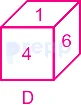
Question 1archived
A series is given with one term missing. Select the correct alternative from the given ones that will complete the series.
REV, UXD, XQL, AJT, ?
- A
DMR
- B
DRM
- C
RMQ
- D
DCB
Show answer
D. DCBSolving the Letter Series Question
The question asks us to find the next term in the given letter series: REV, UXD, XQL, AJT, ?.
To solve letter series problems like this, we need to identify the pattern or rule that relates consecutive terms. This usually involves looking at the position of each letter in the English alphabet (A=1, B=2, ..., Z=26) and finding a numerical relationship between the corresponding letters of each term.
Analyzing the Pattern in the Series
Let's write down the numerical position of each letter in the given terms:
Term
First Letter
Second Letter
Third Letter
REV
R (18)
E (5)
V (22)
UXD
U (21)
X (24)
D (4)
XQL
X (24)
Q (17)
L (12)
AJT
A (1)
J (10)
T (20)
Now, let's analyze the progression of letters at each position:
Pattern for the First Letter
R (18) to U (21): $21 - 18 = +3$
U (21) to X (24): $24 - 21 = +3$
X (24) to A (1): This involves wrapping around the alphabet. X is the 24th letter, Y is 25th, Z is 26th, and A is 1st. From 24 to 1 is a difference of $+3$ (24 $\rightarrow$ 25 $\rightarrow$ 26 $\rightarrow$ 1). We can think of this as $(24 + 3) \pmod{26}$. If the result is 0, it's 26. $27 \pmod{26} = 1$.
The pattern for the first letter is adding 3, with wrap-around from Z to A.
Applying this pattern to the last term's first letter (A, position 1): $1 + 3 = 4$. The 4th letter is D.
Pattern for the Second Letter
E (5) to X (24): This involves subtracting and wrapping around. From 5, we go backwards: 5 $\rightarrow$ 4 $\rightarrow$ 3 $\rightarrow$ 2 $\rightarrow$ 1 $\rightarrow$ 26 $\rightarrow$ 25 $\rightarrow$ 24. This is a decrease of 7. We can think of this as $(5 - 7) \pmod{26}$. A negative result can be made positive by adding 26: $-2 \pmod{26} = 24$.
X (24) to Q (17): $17 - 24 = -7$.
Q (17) to J (10): $10 - 17 = -7$.
The pattern for the second letter is subtracting 7, with wrap-around from A to Z.
Applying this pattern to the last term's second letter (J, position 10): $10 - 7 = 3$. The 3rd letter is C.
Pattern for the Third Letter
V (22) to D (4): This involves adding and wrapping around. From 22, we add 8: 22 $\rightarrow$ 23 $\rightarrow$ 24 $\rightarrow$ 25 $\rightarrow$ 26 $\rightarrow$ 1 $\rightarrow$ 2 $\rightarrow$ 3 $\rightarrow$ 4. This is an increase of 8. We can think of this as $(22 + 8) \pmod{26}$. $30 \pmod{26} = 4$.
D (4) to L (12): $12 - 4 = +8$.
L (12) to T (20): $20 - 12 = +8$.
The pattern for the third letter is adding 8, with wrap-around from Z to A.
Applying this pattern to the last term's third letter (T, position 20): $20 + 8 = 28$. Wrapping around: $28 - 26 = 2$. The 2nd letter is B.
Constructing the Next Term
Based on the patterns found:
The first letter of the next term is D (position 4).
The second letter of the next term is C (position 3).
The third letter of the next term is B (position 2).
Combining these letters, the next term in the series is DCB.
Comparing with Options
Let's check the given options:
DMR
DRM
RMQ
DCB
Our calculated next term, DCB, matches option 4.
Revision Table: Letter Series Patterns
Letter Position
Pattern
Calculation for Next Term
Resulting Letter
First Letter
+3 (with wrap-around)
Start from A (1): $1 + 3 = 4$
D
Second Letter
-7 (with wrap-around)
Start from J (10): $10 - 7 = 3$
C
Third Letter
+8 (with wrap-around)
Start from T (20): $20 + 8 = 28 \equiv 2 \pmod{26}$
B
Additional Information on Letter Series Reasoning
Letter series questions are common in reasoning tests. They check your ability to identify sequences and patterns.
Key strategies include:
Writing down the numerical position of each letter.
Finding the difference between corresponding letters of consecutive terms.
Checking if the difference is constant or follows a simple arithmetic progression (+n, -n, +n, -n, or increasing/decreasing differences).
Looking for patterns that involve skipping letters or using alphabetical order relationships.
Considering wrap-around effects when the sequence goes past Z or before A.
Sometimes, patterns might involve vowel/consonant sequences, or positions relative to the middle of the alphabet (M).
Practicing different types of series helps improve pattern recognition skills.
Paper & answer key PDF ↗ Question 2archived
Select the option in which the given figure is embedded (rotation is NOT allowed).

- A
Option A (shown in image)
- B
Option B (shown in image)
- C
Option C (shown in image)
- D
Option D (shown in image)
Show answer
C. Option C (shown in image)Given:
The image must not to be rotated
Hence, the correct answer is "Option - (3)".

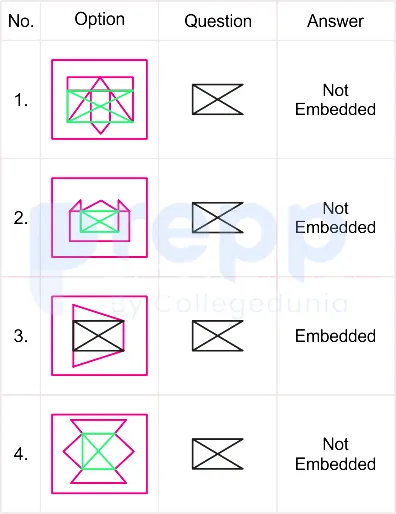 Paper & answer key PDF ↗
 Question 3archived
Select the option that is related to the fifth letter-cluster in the same way as the second letter-cluster is related to the first letter-cluster and the fourth letter-cluster is related to the third letter-cluster.
OILS: UNLS:: PAIN: PKDT:: QUIK:?
- A
MLXU
- B
MKXV
- C
MLYV
- D
MKXU
Show answer
D. MKXUUnderstanding Letter-Cluster Analogies
This question is a type of letter-cluster analogy where we need to find the relationship between pairs of letter-clusters. The same relationship that exists between the first and second cluster, and the third and fourth cluster, is expected to exist between the fifth cluster and the missing cluster.
The relationship is typically based on the positional changes (shifts) of letters in the alphabet. We assign a numerical position to each letter (A=1, B=2, ..., Z=26).
Analyzing the First Analogy: OILS to UNLS
Let's examine the transformation from OILS to UNLS by looking at the change in position for each letter:
O to U: O is the 15th letter, U is the 21st letter. The shift is \(21 - 15 = +6\).
I to N: I is the 9th letter, N is the 14th letter. The shift is \(14 - 9 = +5\).
L to L: L is the 12th letter, L is the 12th letter. The shift is \(12 - 12 = +0\).
S to S: S is the 19th letter, S is the 19th letter. The shift is \(19 - 19 = +0\).
So, the sequence of shifts for the first pair (OILS to UNLS) is (+6, +5, +0, +0).
Analyzing the Second Analogy: PAIN to PKDT
Now, let's look at the transformation from PAIN to PKDT:
P to P: P is the 16th letter, P is the 16th letter. The shift is \(16 - 16 = +0\).
A to K: A is the 1st letter, K is the 11th letter. The shift is \(11 - 1 = +10\).
I to D: I is the 9th letter, D is the 4th letter. The shift is \(4 - 9 = -5\).
N to T: N is the 14th letter, T is the 20th letter. The shift is \(20 - 14 = +6\).
The sequence of shifts for the second pair (PAIN to PKDT) is (+0, +10, -5, +6).
Identifying the Shift Patterns by Position
We now have a sequence of shifts for each position across the first two pairs:
Position 1 Shifts: +6, +0
Position 2 Shifts: +5, +10
Position 3 Shifts: +0, -5
Position 4 Shifts: +0, +6
The problem asks for the letter-cluster related to QUIK in the same way. This suggests that QUIK is the start of the third pair in this sequence of analogies (Pair 1: OILS-UNLS, Pair 2: PAIN-PKDT, Pair 3: QUIK-?). The transformation from QUIK to the answer will follow the third set of shifts in the patterns for each position.
Let's examine the shifts from QUIK to the given correct option, MKXU, to see the third set of shifts:
Q to M: Q is 17th, M is 13th. Shift is \(13 - 17 = -4\).
U to K: U is 21st, K is 11th. Shift is \(11 - 21 = -10\).
I to X: I is 9th, X is 24th. Shift is \(24 - 9 = +15\).
K to U: K is 11th, U is 21st. Shift is \(21 - 11 = +10\).
The shifts for the third pair (QUIK to MKXU) are (-4, -10, +15, +10).
Sequence of Shifts per Position
Let's list the shifts for each position across the three pairs:
Position
Pair 1 (OILS > UNLS)
Pair 2 (PAIN > PKDT)
Pair 3 (QUIK > MKXU)
1st Letter
+6
+0
-4
2nd Letter
+5
+10
-10
3rd Letter
+0
-5
+15
4th Letter
+0
+6
+10
These sequences (+6, +0, -4), (+5, +10, -10), (+0, -5, +15), and (+0, +6, +10) represent the patterns of transformation applied to the first, second, third, and fourth letters respectively, for the successive pairs in the analogy.
Applying the Transformation to QUIK
To find the letter-cluster related to QUIK, we apply the third set of shifts (-4, -10, +15, +10) to the letters of QUIK:
1st letter of QUIK is Q (17). Applying a shift of -4: \(17 + (-4) = 13\). The 13th letter is M.
2nd letter of QUIK is U (21). Applying a shift of -10: \(21 + (-10) = 11\). The 11th letter is K.
3rd letter of QUIK is I (9). Applying a shift of +15: \(9 + 15 = 24\). The 24th letter is X.
4th letter of QUIK is K (11). Applying a shift of +10: \(11 + 10 = 21\). The 21st letter is U.
Combining these letters, we get the cluster MKXU.
Conclusion
The letter-cluster related to QUIK following the established pattern is MKXU.
Revision Table: Letter Analogy Patterns
Pair
From
To
Shift Pattern
1
OILS
UNLS
(+6, +5, +0, +0)
2
PAIN
PKDT
(+0, +10, -5, +6)
3
QUIK
MKXU
(-4, -10, +15, +10)
Additional Information on Letter Reasoning
Letter reasoning questions often involve patterns related to:
Positional shifts in the alphabet (like in this problem).
Vowel/Consonant changes.
Reversal of letters.
Skipping letters in a sequence.
Alphabetical order or reverse alphabetical order.
Combination of numerical operations on letter positions.
Practicing different types of letter series and analogies helps in quickly identifying the underlying pattern.
Paper & answer key PDF ↗ Question 4archived
Three statements are given followed by three conclusions numbered I, II and III. Assuming the statements to be true, even if they seem to be at variance with commonly known facts, decide which of the conclusions logically follow(s) from the statements.
Statements:
All javascript are binary.
All binary are minecraft.
All roblox are minecraft.
Conclusions:
I. Some javascript are roblox.
II. Some javascript are minecraft.
III. All javascript are minecraft.
- A
Only conclusions I and III follow
- B
Only conclusions I and II follow
- C
All conclusions follow
- D
Only conclusions II and III follow
Show answer
D. Only conclusions II and III followAnalyzing Statements and Conclusions in Logical Reasoning
This problem requires us to analyze logical statements and determine which conclusions logically follow. We are given three statements relating four entities: javascript, binary, minecraft, and roblox. We must assume these statements are true, even if they contradict common knowledge.
Statements Analysis
Let's break down the given statements:
Statement 1: All javascript are binary. This means that every item belonging to the category 'javascript' is also included in the category 'binary'.
Statement 2: All binary are minecraft. This means that every item belonging to the category 'binary' is also included in the category 'minecraft'.
Statement 3: All roblox are minecraft. This means that every item belonging to the category 'roblox' is also included in the category 'minecraft'.
From Statement 1 and Statement 2, we can form a direct link using the concept of transitivity:
If All javascript are binary (J → B) and All binary are minecraft (B → M), then it logically follows that All javascript are minecraft (J → M).
Statement 3 tells us that Roblox is a subset of Minecraft, just like Javascript (via Binary) is a subset of Minecraft. However, there is no direct relationship established between Javascript and Roblox based purely on these statements.
Conclusion Analysis
Now, let's evaluate each conclusion based on our analysis of the statements:
Conclusion I: Some javascript are roblox.
We know All javascript are minecraft (from Statements 1 & 2) and All roblox are minecraft (from Statement 3). Both Javascript and Roblox are categories within Minecraft. However, the statements do not provide any information about whether the Javascript category overlaps with the Roblox category within Minecraft. They could overlap, or they could be entirely separate. Therefore, this conclusion does not necessarily follow.
Conclusion II: Some javascript are minecraft.
From Statements 1 and 2, we deduced that All javascript are minecraft. If it is true that 'All' members of one group are members of another, it is logically true that 'Some' members of the first group are members of the second. For example, if all apples are fruits, then it's also true that some apples are fruits. Thus, this conclusion logically follows from the statements.
Conclusion III: All javascript are minecraft.
As directly derived from combining Statement 1 (All javascript are binary) and Statement 2 (All binary are minecraft) through the rule of transitivity, this conclusion is logically true. If every javascript item is binary, and every binary item is minecraft, then every javascript item must be minecraft.
Summarizing Conclusions that Logically Follow
Based on the analysis:
Conclusion I (Some javascript are roblox) does not follow.
Conclusion II (Some javascript are minecraft) follows.
Conclusion III (All javascript are minecraft) follows.
Therefore, only conclusions II and III logically follow from the given statements.
Statements
Relationship
All javascript are binary.
Javascript ⊆ Binary
All binary are minecraft.
Binary ⊆ Minecraft
All roblox are minecraft.
Roblox ⊆ Minecraft
Conclusion
Logically Follows?
Reasoning
I. Some javascript are roblox.
No
No direct link between Javascript and Roblox is given. Both are subsets of Minecraft but may not overlap.
II. Some javascript are minecraft.
Yes
If All javascript are minecraft (from Statements 1 & 2), then Some javascript are minecraft must also be true.
III. All javascript are minecraft.
Yes
Directly follows from Statements 1 and 2 (Transitivity: J → B → M).
Revision Table: Key Concepts in Syllogism
Concept
Explanation
Example
All A are B
Every member of set A is a member of set B.
All cats are animals.
Some A are B
At least one member of set A is a member of set B (could be all).
Some students are tall.
No A are B
No member of set A is a member of set B.
No dogs are birds.
Transitivity
If A is related to B, and B is related to C, then A is related to C in a specific way (e.g., All A are B, All B are C → All A are C).
All dogs are mammals. All mammals are animals. → All dogs are animals.
Additional Information: Understanding Syllogistic Reasoning
Syllogistic reasoning is a type of logical argument where a conclusion is drawn from two or more premises (statements). These arguments are a fundamental part of deductive logic, where if the premises are true, the conclusion must also be true.
In competitive exams, questions on statements and conclusions test your ability to understand the relationships given in the statements and derive only those conclusions that are strictly implied by these relationships, without using any outside knowledge. It's crucial to stick only to the information provided in the statements.
Representing statements using Venn diagrams can often help visualize the relationships between the categories and verify whether a conclusion is valid. For instance, "All A are B" means the circle for A is entirely inside the circle for B. "Some A are B" means the circles for A and B overlap. "No A are B" means the circles for A and B do not overlap.
In this specific problem:
All javascript are binary: Javascript circle inside Binary circle.
All binary are minecraft: Binary circle inside Minecraft circle.
All roblox are minecraft: Roblox circle inside Minecraft circle.
This setup shows Javascript is inside Binary, which is inside Minecraft. Roblox is also inside Minecraft, but its position relative to Javascript is not fixed by the statements; it could overlap, be separate, or even contain Javascript (though the "All J are B" and "All B are M" structure makes the latter less likely based on standard interpretations, sticking to minimal assumptions is key). This visual confirms that "All javascript are minecraft" and thus "Some javascript are minecraft" are true, while "Some javascript are roblox" is not necessarily true.
Paper & answer key PDF ↗ Question 5archived
Select the figure that will come next in the following series.

- A
Option A (shown in image)
- B
Option B (shown in image)
- C
Option C (shown in image)
- D
Option D (shown in image)
Show answer
Question 6archived
Select the correct mirror image of the given figure when the mirror is placed at AB as shown.

- A
Option A (shown in image)
- B
Option B (shown in image)
- C
Option C (shown in image)
- D
Option D (shown in image)
Show answer
C. Option C (shown in image)The correct mirror image of the given combination when mirror is placed at AB is as shown below:
Hence, the correct answer is "Option - (3)".
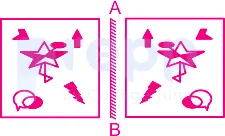 Paper & answer key PDF ↗
 Question 7archived
Which letter cluster will replace the question mark (?) to complete the given series?
ZUPK, YTOJ, ?, WRMH, VQLG
- A
XSNI
- B
XSMI
- C
XSNJ
- D
XTNI
Show answer
A. XSNIUnderstanding and Completing the Letter Series
This question asks us to identify the pattern in a given letter series and determine which letter cluster replaces the question mark to complete the sequence. The series is ZUPK, YTOJ, ?, WRMH, VQLG. Each element in the series is a cluster of four letters.
To solve this type of letter series problem, we need to examine how the letters change from one cluster to the next. We can look at the letters in each position (first, second, third, and fourth) independently to find a consistent pattern.
Analyzing the Pattern in Each Position
Let's analyze the change in letters for each position across the given clusters:
First Letter Pattern:
The first letters are Z, Y, ?, W, V.
Let's look at the alphabetical positions: Z is 26, Y is 25, W is 23, V is 22.
From Z (26) to Y (25), the change is \(25 - 26 = -1\).
From W (23) to V (22), the change is \(22 - 23 = -1\).
It appears the pattern for the first letter is a decrease of 1 in alphabetical position for each step in the series.
Following this pattern, the first letter of the missing cluster should be one step back from Y. The letter before Y is X (alphabetical position 24). \(24 - 25 = -1\).
Let's check if X fits with the next known letter W: X (24) to W (23) is \(23 - 24 = -1\). Yes, it fits.
So, the first letter is X.
Second Letter Pattern:
The second letters are U, T, ?, R, Q.
Alphabetical positions: U is 21, T is 20, R is 18, Q is 17.
From U (21) to T (20), the change is \(20 - 21 = -1\).
From R (18) to Q (17), the change is \(17 - 18 = -1\).
The pattern for the second letter is also a decrease of 1 in alphabetical position.
The second letter of the missing cluster should be one step back from T. The letter before T is S (alphabetical position 19). \(19 - 20 = -1\).
Let's check if S fits with the next known letter R: S (19) to R (18) is \(18 - 19 = -1\). Yes, it fits.
So, the second letter is S.
Third Letter Pattern:
The third letters are P, O, ?, M, L.
Alphabetical positions: P is 16, O is 15, M is 13, L is 12.
From P (16) to O (15), the change is \(15 - 16 = -1\).
From M (13) to L (12), the change is \(12 - 13 = -1\).
The pattern for the third letter is a decrease of 1 in alphabetical position.
The third letter of the missing cluster should be one step back from O. The letter before O is N (alphabetical position 14). \(14 - 15 = -1\).
Let's check if N fits with the next known letter M: N (14) to M (13) is \(13 - 14 = -1\). Yes, it fits.
So, the third letter is N.
Fourth Letter Pattern:
The fourth letters are K, J, ?, H, G.
Alphabetical positions: K is 11, J is 10, H is 8, G is 7.
From K (11) to J (10), the change is \(10 - 11 = -1\).
From H (8) to G (7), the change is \(7 - 8 = -1\).
The pattern for the fourth letter is also a decrease of 1 in alphabetical position.
The fourth letter of the missing cluster should be one step back from J. The letter before J is I (alphabetical position 9). \(9 - 10 = -1\).
Let's check if I fits with the next known letter H: I (9) to H (8) is \(8 - 9 = -1\). Yes, it fits.
So, the fourth letter is I.
Forming the Missing Letter Cluster
By combining the letters found for each position, the missing letter cluster is XSNI.
Verifying the Complete Series
The completed series is ZUPK, YTOJ, XSNI, WRMH, VQLG.
Let's check the transitions:
ZUPK \(\xrightarrow{-1}\) YTOJ
YTOJ \(\xrightarrow{-1}\) XSNI
XSNI \(\xrightarrow{-1}\) WRMH
WRMH \(\xrightarrow{-1}\) VQLG
The pattern holds true for all transitions.
Revision Table: Letter Series Pattern
Cluster
1st Letter
2nd Letter
3rd Letter
4th Letter
ZUPK
Z (26)
U (21)
P (16)
K (11)
YTOJ
Y (25)
T (20)
O (15)
J (10)
XSNI
X (24)
S (19)
N (14)
I (9)
WRMH
W (23)
R (18)
M (13)
H (8)
VQLG
V (22)
Q (17)
L (12)
G (7)
Each letter position shows a consistent decrease of 1 in its alphabetical value from one cluster to the next.
Conclusion
Based on the analysis of the pattern in each letter position, the letter cluster that replaces the question mark is XSNI.
Additional Information on Letter Series Questions
Letter series are common in reasoning and aptitude tests. They require identifying patterns in sequences of letters. The patterns can involve:
Adding or subtracting a fixed number from the alphabetical position (like this question).
Adding or subtracting numbers that change by a fixed amount (e.g., +1, +2, +3...).
Alternating patterns (e.g., +1, -1, +1, -1...).
Using vowel/consonant sequences.
Using the positions of letters in the alphabet (1st, 2nd, etc.).
Reverse alphabetical order.
Solving these questions effectively involves:
Writing down the alphabetical positions of the letters.
Looking for patterns in the differences between consecutive letters.
Analyzing each position within a letter cluster separately if applicable.
Considering if the pattern wraps around from A to Z or Z to A.
Paper & answer key PDF ↗ Question 8archived
Which of the following interchange of numbers and signs would make the given equation correct?
10 - 4 ÷ 20 + 16 × 8 = 16
- A
10 and 16, × and ÷
- B
4 and 8, × and -
- C
4 and 20, + and ÷
- D
10 and 20, + and ×
Show answer
B. 4 and 8, × and -Equation Solving by Interchange of Numbers and Signs
The problem asks us to find the correct interchange of two numbers and two mathematical signs that will make the given equation true. The original equation is:
\(10 - 4 \div 20 + 16 \times 8 = 16\)
We need to test each option provided by performing the specified interchanges and then evaluating the resulting equation using the order of operations (BODMAS/PEMDAS: Brackets, Orders, Division and Multiplication (from left to right), Addition and Subtraction (from left to right)).
Testing the Options
Option 1: Interchange 10 and 16, × and ÷
Swap 10 with 16, and swap the multiplication sign (\(\times\)) with the division sign (\(\div\)).
The new equation becomes:
\(16 - 4 \times 20 + 10 \div 8\)
Let's evaluate this equation:
First, perform Multiplication and Division from left to right:
\(16 - (4 \times 20) + (10 \div 8)\)
\(16 - 80 + 1.25\)
Next, perform Addition and Subtraction from left to right:
\((16 - 80) + 1.25\)
\(-64 + 1.25\)
\(-62.75\)
Since \(-62.75 \neq 16\), this interchange does not make the equation correct.
Option 2: Interchange 4 and 8, × and -
Swap 4 with 8, and swap the multiplication sign (\(\times\)) with the subtraction sign (-\().
The original equation is \(10 - 4 \div 20 + 16 \times 8 = 16\). Applying the swaps:
Swap 4 and 8: \(10 - 8 \div 20 + 16 \times 4 = 16\)
Swap - and \(\times\): The equation becomes \(10 \times 8 \div 20 + 16 - 4 = 16\)
Let's evaluate the new equation: \(10 \times 8 \div 20 + 16 - 4\)
First, perform Multiplication and Division from left to right:
\((10 \times 8) \div 20 + 16 - 4\)
\(80 \div 20 + 16 - 4\)
\((80 \div 20) + 16 - 4\)
\(4 + 16 - 4\)
Next, perform Addition and Subtraction from left to right:
\((4 + 16) - 4\)
\(20 - 4\)
\(16\)
Since the result is \(16\), this interchange makes the equation correct.
Option 3: Interchange 4 and 20, + and ÷
Swap 4 with 20, and swap the addition sign (\(+\)) with the division sign (\(\div\)).
The new equation becomes:
\(10 - 20 + 4 \times 16 \div 8\)
Let's evaluate this equation:
First, perform Multiplication and Division from left to right:
\(10 - 20 + (4 \times 16 \div 8)\)
\(10 - 20 + (64 \div 8)\)
\(10 - 20 + 8\)
Next, perform Addition and Subtraction from left to right:
\((10 - 20) + 8\)
\(-10 + 8\)
\(-2\)
Since \(-2 \neq 16\), this interchange does not make the equation correct.
Option 4: Interchange 10 and 20, + and ×
Swap 10 with 20, and swap the addition sign (\(+\)) with the multiplication sign (\(\times\)).
The new equation becomes:
\(20 - 4 \div 10 \times 16 + 8\)
Let's evaluate this equation:
First, perform Multiplication and Division from left to right:
\(20 - (4 \div 10) \times 16 + 8\)
\(20 - 0.4 \times 16 + 8\)
\(20 - (0.4 \times 16) + 8\)
\(20 - 6.4 + 8\)
Next, perform Addition and Subtraction from left to right:
\((20 - 6.4) + 8\)
\(13.6 + 8\)
\(21.6\)
Since \(21.6 \neq 16\), this interchange does not make the equation correct.
Conclusion
After testing all the options, the interchange of 4 and 8, and \(\times\) and - signs makes the given equation correct. This corresponds to Option 2.
Option
Interchange
New Equation
Evaluation
Result
1
10 <-> 16, × <-> ÷
\(16 - 4 \times 20 + 10 \div 8\)
\(16 - 80 + 1.25 = -62.75\)
Incorrect
2
4 <-> 8, × <-> -
\(10 \times 8 \div 20 + 16 - 4\)
\(80 \div 20 + 16 - 4 = 4 + 16 - 4 = 20 - 4 = 16\)
Correct
3
4 <-> 20, + <-> ÷
\(10 - 20 + 4 \times 16 \div 8\)
\(10 - 20 + 64 \div 8 = 10 - 20 + 8 = -10 + 8 = -2\)
Incorrect
4
10 <-> 20, + <-> ×
\(20 - 4 \div 10 \times 16 + 8\)
\(20 - 0.4 \times 16 + 8 = 20 - 6.4 + 8 = 13.6 + 8 = 21.6\)
Incorrect
Revision Table: Equation Interchange Summary
Original
Swapped (Numbers)
Swapped (Signs)
Equation after swaps
Result
\(10 - 4 \div 20 + 16 \times 8 = 16\)
4 <-> 8
× <-> -
\(10 \times 8 \div 20 + 16 - 4 = 16\)
True (\(16=16\))
Additional Information: Order of Operations (BODMAS/PEMDAS)
When evaluating mathematical expressions, especially after performing number and sign interchanges, it is crucial to follow the correct order of operations. This order is commonly remembered using acronyms like BODMAS or PEMDAS.
BODMAS:
B - Brackets (or Parentheses)
O - Orders (powers, square roots, etc.)
DM - Division and Multiplication (from left to right)
AS - Addition and Subtraction (from left to right)
PEMDAS:
P - Parentheses
E - Exponents (powers, roots, etc.)
MD - Multiplication and Division (from left to right)
AS - Addition and Subtraction (from left to right)
Following this order ensures that everyone gets the same result for a given expression. In this problem, we applied BODMAS/PEMDAS after each number and sign interchange to check if the equation held true.
Paper & answer key PDF ↗ Question 9archived
Select the option that is related to the fourth term in the same way as the first term is related to the second term and the fifth term is related to the sixth term.
47 : 9 :: ? : 14 :: 92 : 18
- A
72
- B
73
- C
37
- D
27
Show answer
A. 72Understanding the Number Analogy Reasoning
This question asks us to find a missing number based on a specific relationship or pattern observed between pairs of numbers. We are given three pairs where the first term is related to the second term in a consistent way. Our task is to identify this underlying pattern and apply it to the pair with the missing term.
Analyzing the Given Number Pairs to Find the Pattern
We are given the following pairs exhibiting a relationship:
Pair 1: 47 : 9
Pair 3: 92 : 18
Pair 2: ? : 14 (with a missing term)
We need to discover how the first number in each completed pair is related to the second number. Let's look closely at Pair 1 (47 and 9) and Pair 3 (92 and 18).
In 47 : 9, can we get 9 from 47? Or 47 from 9?
In 92 : 18, can we get 18 from 92? Or 92 from 18?
Let's try to find a mathematical operation or combination of operations that connects these numbers.
Identifying the Mathematical Relationship Pattern
Let's explore simple arithmetic operations. If we try to get the second number from the first number:
For 47 and 9: 47 divided by a number is close to 9. \(47 / 5 \approx 9.4\). Not an exact division.
For 92 and 18: 92 divided by a number is close to 18. \(92 / 5 \approx 18.4\). Again, not an exact division.
Let's try the reverse relationship - getting the first number from the second number:
For 47 and 9: How can we get 47 from 9? Maybe multiplication and addition/subtraction?
\(9 \times 5 = 45\). \(45 + 2 = 47\). This looks promising!
For 92 and 18: Let's test the same pattern.
\(18 \times 5 = 90\). \(90 + 2 = 92\). This pattern holds true for the second pair as well!
The identified pattern is: The first term is obtained by multiplying the second term by 5 and then adding 2.
We can write this relationship using variables. If the first term is \(A\) and the second term is \(B\), the pattern is:
\[A = (B \times 5) + 2\]
Alternatively, if we want to find \(B\) from \(A\), we can rearrange the formula:
\[A - 2 = B \times 5\]
\[B = \frac{A - 2}{5}\]
Let's verify this inverse relationship with the given pairs:
For 47 : 9, \(B = \frac{47 - 2}{5} = \frac{45}{5} = 9\). Correct.
For 92 : 18, \(B = \frac{92 - 2}{5} = \frac{90}{5} = 18\). Correct.
Applying the Pattern to Find the Missing Term
Now we apply this pattern to the pair with the missing term: ? : 14. Here, the missing term is the first term (let's call it \(X\)), and the second term \(B\) is 14.
Using the pattern \(A = (B \times 5) + 2\), we substitute \(A\) with \(X\) and \(B\) with 14:
\[X = (14 \times 5) + 2\]
First, calculate the multiplication:
\[14 \times 5 = 70\]
Next, perform the addition:
\[X = 70 + 2\]
\[X = 72\]
So, the missing term is 72.
Verifying the Solution with Options
The missing term we calculated is 72. Let's check the given options:
72
73
37
27
Our calculated value, 72, matches Option 1.
Thus, the completed analogy is 47 : 9 :: 72 : 14 :: 92 : 18.
Revision Table: Key Concepts in Number Analogy
Concept
Description
Example Pattern Types
Number Analogy
Finding a relationship between a pair of numbers and applying the same relationship to another pair.
Arithmetic operations (+, -, ×, ÷), squares, cubes, sum/product of digits, combinations of operations.
Pattern Identification
The process of observing given pairs to deduce the rule connecting them.
Look for simple relationships first, then more complex ones. Test the rule on all given complete pairs.
Applying the Rule
Using the identified pattern to find the missing number in the incomplete pair.
Substitute the known number into the rule and solve for the unknown number.
Additional Information on Reasoning Patterns
Number analogy questions are common in logical reasoning tests. They assess your ability to identify patterns and apply rules. Here are some common types of patterns you might encounter:
Basic Operations: The second number is obtained by adding, subtracting, multiplying, or dividing the first number by a constant.
Sequential Operations: A sequence of operations is performed (e.g., multiply by 2, then add 3).
Squares and Cubes: The numbers might be squares, cubes, or related to squares/cubes (\(n^2+1\), \(n^3-1\), etc.).
Digit Manipulation: Operations on the digits of the first number (sum of digits, product of digits, reversing digits, etc.) yield the second number.
Combinations: A mix of the above patterns.
To solve these problems effectively, practice analyzing pairs, forming hypotheses about the relationship, and testing these hypotheses rigorously on all available pairs. Sometimes, it helps to look at the relationship from the second number to the first number, as we did in this problem.
Paper & answer key PDF ↗ Question 10archived
If ‘+’ means ‘÷’, ‘-’ means ‘+’, ‘×’ means ‘-' and ‘÷’ means ‘×’, what will be the value of the following expression?
[{(32 × 20) - (2 ÷ 3)} + (2 - 4)] ÷ 3
- A
8
- B
10
- C
9
- D
6
Show answer
C. 9Solving Mathematical Expression with Symbol Changes
This question involves changing the usual meaning of mathematical symbols and then evaluating the given expression based on the new rules. We need to carefully substitute the symbols and then follow the order of operations (BODMAS/PEMDAS) to find the correct value.
Understanding the Symbol Transformations
The question provides the following rules for changing symbols:
‘+’ means ‘÷’
‘-’ means ‘+’
‘×’ means ‘-'
‘÷’ means ‘×’
Transforming the Expression
The original expression is:
\([\{(32 \times 20) - (2 \div 3)\} + (2 - 4)] \div 3\)
Now, we apply the given symbol transformation rules to this expression. Let's go through each operation:
The ‘×’ inside the first parenthesis \((32 \times 20)\) changes to ‘-’, becoming \((32 - 20)\).
The ‘÷’ inside the second parenthesis \((2 \div 3)\) changes to ‘×’, becoming \((2 \times 3)\).
The ‘-’ between the first two parentheses \((32 \times 20) - (2 \div 3)\) changes to ‘+’, becoming \((32 - 20) + (2 \times 3)\).
The ‘-’ inside the third parenthesis \((2 - 4)\) changes to ‘+’, becoming \((2 + 4)\).
The ‘+’ between the curly bracket part \(\{(32 - 20) + (2 \times 3)\}\) and the third parenthesis \((2 + 4)\) changes to ‘÷’, becoming \(\{(32 - 20) + (2 \times 3)\} \div (2 + 4)\).
The ‘÷’ at the end of the expression changes to ‘×’, becoming \([\ldots] \times 3\).
So, the transformed expression is:
\([\{(32 - 20) + (2 \times 3)\} \div (2 + 4)] \times 3\)
Evaluating the Transformed Expression
Now we evaluate the transformed expression following the BODMAS/PEMDAS rule (Brackets, Orders, Division/Multiplication, Addition/Subtraction):
\([\{(32 - 20) + (2 \times 3)\} \div (2 + 4)] \times 3\)
Step 1: Solve the innermost parentheses.
\((32 - 20) = 12\)
\((2 \times 3) = 6\)
\((2 + 4) = 6\)
Substitute these values back into the expression:
\([\{12 + 6\} \div 6] \times 3\)
Step 2: Solve the curly brackets.
\(\{12 + 6\} = 18\)
Substitute this value back:
\([18 \div 6] \times 3\)
Step 3: Solve the square brackets.
\([18 \div 6] = 3\)
Substitute this value back:
\(3 \times 3\)
Step 4: Perform the final multiplication.
\(3 \times 3 = 9\)
The value of the expression after symbol transformation is 9.
Summary of Evaluation Steps
Step
Expression
Calculation
Result
Original
\([\{(32 \times 20) - (2 \div 3)\} + (2 - 4)] \div 3\)
Apply rules
\([\{(32 - 20) + (2 \times 3)\} \div (2 + 4)] \times 3\)
1
\([\{(32 - 20) + (2 \times 3)\} \div (2 + 4)] \times 3\)
Innermost Brackets: \(32-20\), \(2 \times 3\), \(2+4\)
\([\{12 + 6\} \div 6] \times 3\)
2
\([\{12 + 6\} \div 6] \times 3\)
Curly Brackets: \(12 + 6\)
\([18 \div 6] \times 3\)
3
\([18 \div 6] \times 3\)
Square Brackets: \(18 \div 6\)
\(3 \times 3\)
4
\(3 \times 3\)
Final Operation: \(3 \times 3\)
\(9\)
The final value of the expression is 9.
Revision Table: Key Concepts for Symbol Substitution Problems
Concept
Description
Importance
Symbol Transformation
Changing the meaning of mathematical operators (+, -, ×, ÷).
Foundation of the problem; incorrect transformation leads to wrong answer.
Order of Operations (BODMAS/PEMDAS)
Rule specifying the sequence of operations (Brackets, Orders, Division/Multiplication, Addition/Subtraction).
Crucial for evaluating the transformed expression correctly.
Careful Substitution
Replacing each original symbol with its new meaning accurately throughout the expression.
Avoids errors in the initial step of the calculation.
Step-by-Step Evaluation
Solving the expression by performing one operation or one set of brackets at a time.
Minimizes calculation errors and helps track the process.
Additional Information: Symbol and Numerical Reasoning
Symbol substitution problems are common in logical reasoning and quantitative aptitude sections of various exams. They test your ability to follow instructions precisely and apply basic mathematical operations under altered rules.
Key aspects to remember:
The rules apply to the operators, not the numbers.
The structure of the expression (using brackets) dictates the order of operations even after symbol changes.
Always double-check the substituted expression before starting the calculation.
Practicing different variations of these problems helps in quickly adapting to new sets of rules.
Paper & answer key PDF ↗ Question 11archived
Select the figure that will come next in the following figure series.

- A
Option A (shown in image)
- B
Option B (shown in image)
- C
Option C (shown in image)
- D
Option D (shown in image)
Show answer
Question 12archived
Which number will replace the question mark (?) in the following series?
27, 29, ?, 182, 730, 3652
- A
58
- B
110
- C
122
- D
60
Show answer
D. 60Finding the Missing Number in the Series: 27, 29, ?, 182, 730, 3652
This question asks us to identify the number that should replace the question mark (?) in the given numerical series: 27, 29, ?, 182, 730, 3652. To solve this, we need to find the underlying pattern that relates the terms in the series.
Analyzing the Given Number Series
Let's examine the numbers provided:
The first term is 27.
The second term is 29.
The third term is unknown (?).
The fourth term is 182.
The fifth term is 730.
The sixth term is 3652.
We need to find a rule or pattern that connects these numbers sequentially.
Identifying the Pattern in the Number Series
Let's look at the differences or ratios between consecutive known terms to see if a simple arithmetic or geometric progression exists. It seems unlikely to be a simple difference or ratio.
Let's try combinations of operations. Notice the large jumps towards the end of the series (182 to 730, 730 to 3652). This suggests multiplication might be involved, possibly combined with addition or subtraction.
Consider the last few known terms:
From 730 to 3652: Let's see how many times 730 goes into 3652. $3652 / 730 \approx 5$. Let's check $730 \times 5$: $730 \times 5 = 3650$. The difference is $3652 - 3650 = 2$. So, $730 \times 5 + 2 = 3652$.
From 182 to 730: Let's see how many times 182 goes into 730. $730 / 182 \approx 4$. Let's check $182 \times 4$: $182 \times 4 = 728$. The difference is $730 - 728 = 2$. So, $182 \times 4 + 2 = 730$.
We can observe a pattern emerging for the later terms: multiply the previous term by a number and add 2. The multipliers are 4 and 5 for the transitions $a_4 \to a_5$ and $a_5 \to a_6$, respectively.
Let the series be denoted by $a_n$, where $n$ is the term number (starting from $n=1$). The pattern appears to be $a_{n+1} = a_n \times k_n + 2$, where $k_n$ is a multiplier that changes with $n$. For the terms we examined:
$a_5 = a_4 \times 4 + 2$ (here $k_4 = 4$)
$a_6 = a_5 \times 5 + 2$ (here $k_5 = 5$)
The multipliers $k_n$ seem to be increasing by 1 for each step: ..., 4, 5.
Let's test if this pattern holds for the earlier terms, assuming the multipliers continue to decrease by 1 as we go backwards: ..., $k_3=3$, $k_2=2$, $k_1=1$. The supposed pattern would be $a_{n+1} = a_n \times n + 2$. Let's verify this:
For $n=1$: $a_2 = a_1 \times 1 + 2$. Given $a_1 = 27$ and $a_2 = 29$. $29 = 27 \times 1 + 2 \Rightarrow 29 = 27 + 2 \Rightarrow 29 = 29$. This holds true.
For $n=2$: We need to find $a_3$. According to the pattern, $a_3 = a_2 \times 2 + 2$. Given $a_2 = 29$. $a_3 = 29 \times 2 + 2 = 58 + 2 = 60$.
For $n=3$: We need to check if this $a_3$ value leads to the next term, $a_4=182$. According to the pattern, $a_4 = a_3 \times 3 + 2$. Using $a_3 = 60$. $a_4 = 60 \times 3 + 2 = 180 + 2 = 182$. This matches the given fourth term.
For $n=4$: Check $a_5$. $a_5 = a_4 \times 4 + 2$. Using $a_4 = 182$. $a_5 = 182 \times 4 + 2 = 728 + 2 = 730$. This matches the given fifth term.
For $n=5$: Check $a_6$. $a_6 = a_5 \times 5 + 2$. Using $a_5 = 730$. $a_6 = 730 \times 5 + 2 = 3650 + 2 = 3652$. This matches the given sixth term.
The pattern $a_{n+1} = a_n \times n + 2$ fits the entire series.
Calculating the Missing Number
The missing number is the third term, $a_3$. Using the identified pattern $a_{n+1} = a_n \times n + 2$, we calculate $a_3$ using the second term $a_2$ and $n=2$:
$\text{a}_3 = \text{a}_2 \times 2 + 2$
Substitute the value of $a_2 = 29$:
$\text{a}_3 = 29 \times 2 + 2$
$\text{a}_3 = 58 + 2$
$\text{a}_3 = 60$
Therefore, the number that replaces the question mark is 60.
Summary of the Pattern and Calculation
Term (n)
Value ($\text{a}_\text{n}$)
Pattern ($\text{a}_{\text{n}+1} = \text{a}_\text{n} \times \text{n} + 2$)
1
27
$\text{a}_2 = 27 \times 1 + 2 = 29$
2
29
$\text{a}_3 = 29 \times 2 + 2 = 60$
3
60
$\text{a}_4 = 60 \times 3 + 2 = 182$
4
182
$\text{a}_5 = 182 \times 4 + 2 = 730$
5
730
$\text{a}_6 = 730 \times 5 + 2 = 3652$
The calculated missing number is 60.
Revision Table: Number Series Analysis
Concept
Description
Number Series
A sequence of numbers following a specific pattern or rule.
Pattern Recognition
The process of identifying the underlying rule that governs the sequence of numbers.
Missing Number
A common type of number series problem where one term is unknown and must be found using the pattern.
Common Patterns
Arithmetic progression, geometric progression, combinations of operations (like multiply and add/subtract), squares, cubes, prime numbers, alternating patterns.
Additional Information: Solving Number Series Problems
Solving number series problems requires observation, logical reasoning, and trial and error. Here are some strategies:
Look for simple patterns: Check for constant differences (arithmetic series) or constant ratios (geometric series).
Check for increasing/decreasing differences: If the differences between consecutive terms are not constant, check if the differences themselves form a pattern (e.g., increasing by a constant, multiplying by a constant).
Look for multiplicative patterns: See if terms are related by multiplication, possibly with an added or subtracted constant.
Consider squares, cubes, or prime numbers: The series might involve squares ($1^2, 2^2, 3^2, ...$), cubes ($1^3, 2^3, 3^3, ...$), or sequences of prime numbers.
Check for alternating patterns: Sometimes, the pattern alternates between two different rules applied to consecutive terms.
Combine operations: Many complex series involve a combination of arithmetic operations (e.g., multiply by a number and add/subtract another number, square the term and add/subtract a number).
Break down large differences: For large jumps in the series, consider multiplication or powers.
Test hypotheses: Once you think you've found a pattern, test it on the available numbers to see if it consistently generates the series.
Practice with different types of series helps in quickly recognizing patterns.
Paper & answer key PDF ↗ Question 13archived
Which of the following equation will be correct on interchanging the two given numbers?
1 and 7
- A
7 × 2 + 1 - 5 = 6
- B
1 × 2 - 7 + 8 ÷ 2 = 16
- C
7 + 1 × 2 - 6 ÷ 3 = 13
- D
7 + 6 ÷ 3 - 5 × 1 = - 10
Show answer
C. 7 + 1 × 2 - 6 ÷ 3 = 13Solving Equation by Interchanging Numbers
The question asks us to find which of the given equations becomes correct when we interchange the numbers 1 and 7. This means wherever we see '1' in the original equation, we replace it with '7', and wherever we see '7', we replace it with '1'. Then, we evaluate the new equation using the correct order of operations (BODMAS/PEDMAS) to see if it holds true.
Analyzing Each Equation by Interchanging 1 and 7
Option 1 Analysis: Interchanging 1 and 7
The original equation is: \(7 \times 2 + 1 - 5 = 6\)
After interchanging 1 and 7, the equation becomes: \(1 \times 2 + 7 - 5\)
Now, let's evaluate this new equation using BODMAS (Brackets, Orders, Division/Multiplication, Addition/Subtraction):
Perform Multiplication: \(1 \times 2 = 2\)
The equation is now: \(2 + 7 - 5\)
Perform Addition: \(2 + 7 = 9\)
The equation is now: \(9 - 5\)
Perform Subtraction: \(9 - 5 = 4\)
The result is 4. The original equation stated the result should be 6. Since \(4 \neq 6\), this option is incorrect after interchanging 1 and 7.
Option 2 Analysis: Interchanging 1 and 7
The original equation is: \(1 \times 2 - 7 + 8 \div 2 = 16\)
After interchanging 1 and 7, the equation becomes: \(7 \times 2 - 1 + 8 \div 2\)
Now, let's evaluate this new equation using BODMAS:
Perform Division: \(8 \div 2 = 4\)
Perform Multiplication: \(7 \times 2 = 14\)
The equation is now: \(14 - 1 + 4\)
Perform Subtraction/Addition from left to right: \(14 - 1 = 13\)
The equation is now: \(13 + 4\)
Perform Addition: \(13 + 4 = 17\)
The result is 17. The original equation stated the result should be 16. Since \(17 \neq 16\), this option is incorrect after interchanging 1 and 7.
Option 3 Analysis: Interchanging 1 and 7
The original equation is: \(7 + 1 \times 2 - 6 \div 3 = 13\)
After interchanging 1 and 7, the equation becomes: \(1 + 7 \times 2 - 6 \div 3\)
Now, let's evaluate this new equation using BODMAS:
Perform Division: \(6 \div 3 = 2\)
Perform Multiplication: \(7 \times 2 = 14\)
The equation is now: \(1 + 14 - 2\)
Perform Addition/Subtraction from left to right: \(1 + 14 = 15\)
The equation is now: \(15 - 2\)
Perform Subtraction: \(15 - 2 = 13\)
The result is 13. The original equation stated the result should be 13. Since \(13 = 13\), this option is correct after interchanging 1 and 7.
Option 4 Analysis: Interchanging 1 and 7
The original equation is: \(7 + 6 \div 3 - 5 \times 1 = -10\)
After interchanging 1 and 7, the equation becomes: \(1 + 6 \div 3 - 5 \times 7\)
Now, let's evaluate this new equation using BODMAS:
Perform Division: \(6 \div 3 = 2\)
Perform Multiplication: \(5 \times 7 = 35\)
The equation is now: \(1 + 2 - 35\)
Perform Addition/Subtraction from left to right: \(1 + 2 = 3\)
The equation is now: \(3 - 35\)
Perform Subtraction: \(3 - 35 = -32\)
The result is -32. The original equation stated the result should be -10. Since \(-32 \neq -10\), this option is incorrect after interchanging 1 and 7.
Summary of Results After Interchanging 1 and 7
Option
Original Equation
Equation After Interchanging 1 and 7
Evaluated Result
Original Result
Correct?
1
\(7 \times 2 + 1 - 5 = 6\)
\(1 \times 2 + 7 - 5\)
4
6
No
2
\(1 \times 2 - 7 + 8 \div 2 = 16\)
\(7 \times 2 - 1 + 8 \div 2\)
17
16
No
3
\(7 + 1 \times 2 - 6 \div 3 = 13\)
\(1 + 7 \times 2 - 6 \div 3\)
13
13
Yes
4
\(7 + 6 \div 3 - 5 \times 1 = -10\)
\(1 + 6 \div 3 - 5 \times 7\)
-32
-10
No
Based on the analysis, only the equation in Option 3 yields the correct result (13) after interchanging the numbers 1 and 7.
Revision Table: Interchanging Numbers in Equations
Concept
Description
Key takeaway
Interchanging Numbers
Swapping the positions of two specific numbers throughout a given expression or equation.
Every instance of one number must be replaced by the other, and vice versa.
Evaluating Equations
Calculating the value of an expression to check if it equals the stated result.
Always follow the correct order of operations (BODMAS/PEDMAS).
BODMAS/PEDMAS
An acronym for the order of operations: Brackets/Parentheses, Orders/Exponents, Division/Multiplication (left to right), Addition/Subtraction (left to right).
Crucial for arriving at the correct result in mathematical expressions.
Additional Information: Order of Operations
When evaluating mathematical expressions, the order in which operations are performed is critical. The acronym BODMAS or PEDMAS helps remember this order:
B/P: Brackets / Parentheses - Operations inside brackets are performed first.
O/E: Orders / Exponents - Powers and square roots are evaluated next.
D/M: Division / Multiplication - These are performed from left to right.
A/S: Addition / Subtraction - These are performed from left to right.
Understanding and correctly applying the order of operations is essential for solving problems involving arithmetic expressions, especially in competitive exams.
Paper & answer key PDF ↗ Question 14archived
Select the set in which the numbers are NOT related in the same way as are the numbers of the given set.
(NOTE: Operations should be performed on the whole numbers, without breaking down the numbers into its constituent digits. E.g. 13 - Operations on 13 such as adding/subtracting/multiplying etc. to 13 can be performed. Breaking down 13 into 1 and 3 and then performing mathematical operations on 1 and 3 is not allowed)
(16, 7, 112)
- A
(18, 3, 54)
- B
(14, 5, 70)
- C
(22, 7, 154)
- D
(26, 5, 132)
Show answer
D. (26, 5, 132)Understanding Number Set Relationships and Patterns
The problem asks us to identify the set of numbers among the given options that does not follow the same relationship or pattern as the provided set (16, 7, 112). We are instructed to perform operations only on the whole numbers themselves, not by breaking them down into individual digits.
Analyzing the Given Set (16, 7, 112)
Let's look for a mathematical relationship between the numbers in the set (16, 7, 112). A common pattern in such problems involves basic arithmetic operations like addition, subtraction, multiplication, or division.
Addition: $16 + 7 = 23$. This is not equal to 112.
Subtraction: $16 - 7 = 9$ or $7 - 16 = -9$. Neither is 112.
Multiplication: $16 \times 7$. Let's calculate this. $16 \times 7 = (10 + 6) \times 7 = 10 \times 7 + 6 \times 7 = 70 + 42 = 112$.
We can see that the third number in the given set is the product of the first two numbers. The relationship appears to be: First Number $\times$ Second Number = Third Number.
Checking the Options Against the Pattern
Now, we will test each option set to see if it follows the same relationship: First Number $\times$ Second Number = Third Number.
Option 1: (18, 3, 54)
Let's multiply the first two numbers: $18 \times 3$.
$18 \times 3 = 54$.
The result, 54, is equal to the third number in the set. So, this set follows the pattern.
Option 2: (14, 5, 70)
Let's multiply the first two numbers: $14 \times 5$.
$14 \times 5 = 70$.
The result, 70, is equal to the third number in the set. So, this set also follows the pattern.
Option 3: (22, 7, 154)
Let's multiply the first two numbers: $22 \times 7$.
$22 \times 7 = (20 + 2) \times 7 = 20 \times 7 + 2 \times 7 = 140 + 14 = 154$.
The result, 154, is equal to the third number in the set. So, this set also follows the pattern.
Option 4: (26, 5, 132)
Let's multiply the first two numbers: $26 \times 5$.
$26 \times 5 = (20 + 6) \times 5 = 20 \times 5 + 6 \times 5 = 100 + 30 = 130$.
The result is 130. The third number in the set is 132. Since $130 \neq 132$, this set does NOT follow the pattern.
Conclusion
We analyzed the given set (16, 7, 112) and found the relationship First Number $\times$ Second Number = Third Number ($16 \times 7 = 112$). We then tested each option:
(18, 3, 54): $18 \times 3 = 54$ (Follows the pattern)
(14, 5, 70): $14 \times 5 = 70$ (Follows the pattern)
(22, 7, 154): $22 \times 7 = 154$ (Follows the pattern)
(26, 5, 132): $26 \times 5 = 130$ (Does NOT follow the pattern)
Therefore, the set in which the numbers are NOT related in the same way as the given set is (26, 5, 132).
Revision Table: Number Set Patterns
Set
First Number
Second Number
Operation ($ \times $)
Calculated Result
Third Number in Set
Follows Pattern ($ \text{Result} = \text{Third Number} $)
(16, 7, 112)
16
7
$16 \times 7$
112
112
Yes ($112 = 112$)
(18, 3, 54)
18
3
$18 \times 3$
54
54
Yes ($54 = 54$)
(14, 5, 70)
14
5
$14 \times 5$
70
70
Yes ($70 = 70$)
(22, 7, 154)
22
7
$22 \times 7$
154
154
Yes ($154 = 154$)
(26, 5, 132)
26
5
$26 \times 5$
130
132
No ($130 \neq 132$)
Additional Information: Logical Reasoning with Number Sets
Number set or number analogy problems are common in logical reasoning sections of various exams. These questions test your ability to identify patterns and relationships between numbers. The relationships can involve:
Basic arithmetic operations (addition, subtraction, multiplication, division)
Squares, cubes, or roots
Prime numbers, composite numbers, odd/even numbers
Sequences (arithmetic progression, geometric progression)
Combinations of operations
When approaching these problems, it's helpful to:
Examine the given set carefully to spot potential relationships between the numbers.
Start with simple relationships (like multiplication or addition) and move to more complex ones if the simple ones don't fit.
Test your identified pattern against all the given options.
Remember the constraints given in the question (like operating on whole numbers).
Finding the pattern in the original set is the crucial first step to solving this type of logical reasoning problem.
Paper & answer key PDF ↗ Question 15archived
‘A @ B’ means ‘A is the husband of B’.
‘A & B’ means ‘A is the mother of B’.
‘A # B’ means ‘B is the daughter of A’.
If D # E # F & G @ H # I, then how is G related to E?
- A
Daughter
- B
Son
- C
Father
- D
Daughter’s son
Show answer
D. Daughter’s sonSolving Blood Relation Coding Puzzles
Blood relation questions involving codes require you to first decode the symbols or phrases given and then use that information to build a family tree or determine relationships within a given expression.
Decoding the Blood Relation Symbols
Let's understand the meaning of each symbol provided in the question:
‘A @ B’ means ‘A is the husband of B’. This implies B is the wife of A.
‘A & B’ means ‘A is the mother of B’. This implies B is the child of A.
‘A # B’ means ‘B is the daughter of A’. This implies A is the parent of B, and B is female.
Analyzing the Given Expression: D # E # F & G @ H # I
Now, let's break down the given expression segment by segment and deduce the relationships:
D # E: According to the code ‘A # B’ meaning ‘B is the daughter of A’, this means E is the daughter of D. (E is female, D is E's parent).
E # F: Applying the same code, ‘A # B’ meaning ‘B is the daughter of A’, this means F is the daughter of E. (F is female, E is F's parent).
F & G: According to the code ‘A & B’ meaning ‘A is the mother of B’, this means F is the mother of G. (F is female, G is F's child).
G @ H: According to the code ‘A @ B’ meaning ‘A is the husband of B’, this means G is the husband of H. (G is male, H is his wife).
H # I: Applying the code ‘A # B’ meaning ‘B is the daughter of A’, this means I is the daughter of H. (I is female, H is I's parent).
Determining the Relationship between G and E
We need to find out how G is related to E. Let's trace the connections based on our decoded relationships:
From E # F, we know E is the parent of F.
From F & G, we know F is the mother of G.
So, E is the parent of F, and F is the mother of G. This structure means E is the grandparent of G, and G is the grandchild of E.
To find the specific relationship of G to E, consider the path:
F is the daughter of E (from E # F).
G is the child of F (from F & G).
Thus, G is the child of E's daughter. We also know G is male from G @ H (G is the husband of H).
Therefore, G is the male child of E's daughter.
This means G is the daughter's son of E.
Summary of Relationships Leading to the Answer
Relationship
Deduction
Gender
D # E
E is daughter of D
E: Female
E # F
F is daughter of E
F: Female
F & G
F is mother of G
F: Female, G: Child
G @ H
G is husband of H
G: Male, H: Female
H # I
I is daughter of H
I: Female, H: Parent
From the deductions, E is the parent of F, and F is the mother of G. Since F is female (daughter of E and mother of G), E must be the mother or father of G's mother. This makes E a grandparent to G.
Specifically, F is the daughter of E, and G is the child of F. So, G is the child of E's daughter.
Also, we know G is male because G is the husband of H.
Putting it together: G is the male child of E's daughter. This is known as the daughter's son.
Final Relationship
Based on the analysis, G is the daughter’s son of E.
Revision Table: Key Concepts in Blood Relations
Term
Explanation
Example
Parent
Mother or Father
D is parent of E
Child
Son or Daughter
E is child of D
Sibling
Brother or Sister
A and B are siblings if they share the same parent(s)
Grandparent
Parent's parent (Grandmother or Grandfather)
D is grandparent of F
Grandchild
Child's child (Grandson or Granddaughter)
F is grandchild of D
Aunt/Uncle
Parent's sibling
If X is sibling of D, X is Aunt/Uncle of E
Niece/Nephew
Sibling's child
E is niece/nephew of X
Additional Information on Blood Relation Puzzles
Blood relation problems are common in reasoning sections of competitive exams. They test your ability to understand and interpret complex family relationships based on given information.
Types of Blood Relation Questions:
Dialogue/Conversation Based: A person introduces another person by describing their relationship to a third person or themselves.
Puzzle Based: A set of relationships between multiple people is given, and you have to deduce the relationship between two specific individuals.
Coding-Decoding Based: Relationships are represented by codes or symbols, as seen in this problem. You must decode the relationships first.
Tips for Solving:
Draw a family tree diagram to visualize the relationships. Use symbols for gender (e.g., + for male, - for female) and connections (e.g., double line for marriage, single line for sibling, vertical line for parent-child).
Break down complex expressions into smaller parts.
Pay close attention to the gender of individuals if specified or implied by the relationship (e.g., husband is male, mother is female, daughter is female).
Clearly identify whose relationship to whom is being asked (e.g., How is A related to B? vs. How is B related to A?).
Practicing different types of blood relation questions helps improve speed and accuracy in solving these puzzles.
Paper & answer key PDF ↗ Question 16archived
If A + B means that A is the father of B, A - B means that A is the mother of B, A × B means that A is the brother of B then which of the following expression shows that Q is the son of P?
- A
P - R × Q
- B
Q - P × R
- C
P - Q - R
- D
P - Q × R
Show answer
D. P - Q × RSolving Blood Relation Puzzles
This question asks us to determine which expression correctly represents the relationship "Q is the son of P" based on given symbolic relationships. We are given the following definitions:
A + B means A is the father of B
A - B means A is the mother of B
A × B means A is the brother of B
We need to examine each option and translate the expression into familial relationships to find the one where Q is the son of P. For Q to be the son of P, two conditions must be met:
P must be a parent of Q (either father or mother).
Q must be male.
Analyzing Each Option
Option 1: P - R × Q
Let's break down this expression:
P - R: Based on the definition, P is the mother of R.
R × Q: Based on the definition, R is the brother of Q.
Combining these relationships:
P is the mother of R, and R is the brother of Q. This implies that R and Q are siblings (or half-siblings with the same mother). Therefore, Q is also a child of P. The expression R × Q tells us R is male, but it does not specify the gender of Q. Q could be a brother or a sister of R. Thus, we cannot definitively say Q is the son of P from this expression, although P is the mother of Q.
Option 2: Q - P × R
Let's break down this expression:
Q - P: Based on the definition, Q is the mother of P.
P × R: Based on the definition, P is the brother of R.
Combining these relationships:
Q is the mother of P, and P is the brother of R. This means P is male. Q is the mother of P, and P is male. Therefore, P is the son of Q. This expression shows P is the son of Q, not Q is the son of P.
Option 3: P - Q - R
Let's break down this expression:
P - Q: Based on the definition, P is the mother of Q.
Q - R: Based on the definition, Q is the mother of R.
Combining these relationships:
P is the mother of Q, and Q is the mother of R. This means Q is female. P is the mother of Q, and Q is female. Therefore, Q is the daughter of P. This expression shows Q is the daughter of P, not the son of P.
Option 4: P - Q × R
Let's break down this expression:
P - Q: Based on the definition, P is the mother of Q.
Q × R: Based on the definition, Q is the brother of R.
Combining these relationships:
P is the mother of Q, and Q is the brother of R. This means Q is male. P is the mother of Q, and Q is male. Therefore, Q is the son of P. This expression correctly shows that Q is the son of P.
Conclusion
By analyzing each expression based on the given symbolic relationships, we found that the expression P - Q × R translates to "P is the mother of Q and Q is the brother of R". This establishes that P is a parent of Q (specifically, the mother) and that Q is male. Therefore, Q is the son of P in this expression.
Expression
Relationship Derivations
Conclusion about Q and P
P - R × Q
P is mother of R; R is brother of Q.
P is mother of Q. Q's gender not specified.
Q - P × R
Q is mother of P; P is brother of R.
P is son of Q.
P - Q - R
P is mother of Q; Q is mother of R.
Q is daughter of P.
P - Q × R
P is mother of Q; Q is brother of R.
Q is son of P.
Revision Table: Blood Relations Symbols
Symbol
Meaning
+
Father
-
Mother
×
Brother
Additional Information: Solving Blood Relations
Blood relation questions are common in reasoning sections of competitive exams. They test your ability to understand and deduce relationships based on given information. When solving such problems, especially those with symbols, it's helpful to:
Write down the meaning of each symbol clearly.
Break down the given expression step by step, from left to right (or right to left, depending on the definition).
Draw a family tree or diagram if the relationships become complex.
Pay close attention to the gender of individuals, as this is crucial for determining relationships like son/daughter, brother/sister, etc.
Remember that "A is brother of B" implies A is male, but B can be male or female unless stated otherwise in the expression.
Paper & answer key PDF ↗ Question 17archived
After arranging the given words according to dictionary order, which word will come at ‘Third’ position?
1. Oblivion
2. Oblique
3. Oblige
4. Oblate
5. Oblong
- A
Oblate
- B
Oblique
- C
Oblige
- D
Oblivion
Show answer
B. ObliqueUnderstanding Dictionary Order
To arrange words according to dictionary order, we compare them letter by letter from left to right. The word with the letter that comes first in the alphabet at the first point of difference will be placed earlier in the order.
Arranging the Given Words Alphabetically
We are given five words:
Oblivion
Oblique
Oblige
Oblate
Oblong
Let's compare these words letter by letter:
All words start with the letters 'O', 'b', 'l'. These are common to all words.
Let's look at the fourth letter:
Oblivion
Oblique
Oblige
Oblate
Oblong
Comparing the fourth letters (i, i, i, a, o), 'a' comes first in the alphabet, followed by 'i', and then 'o'.
So, the word starting with 'a' at the fourth position will come first, and the word starting with 'o' at the fourth position will come last.
Oblate (fourth letter 'a') → will be 1st
Oblong (fourth letter 'o') → will be 5th
Now we need to arrange the remaining words: Oblivion, Oblique, Oblige. Their fourth letter is 'i'. Let's look at the fifth letter:
Oblivion
Oblique
Oblige
Comparing the fifth letters (v, q, g), 'g' comes first in the alphabet, followed by 'q', and then 'v'.
So, the order for these three words is:
Oblige (fifth letter 'g') → will come after Oblate
Oblique (fifth letter 'q') → will come after Oblige
Oblivion (fifth letter 'v') → will come after Oblique
Combining the order, the words arranged according to dictionary order are:
Oblate
Oblige
Oblique
Oblivion
Oblong
Identifying the Third Word
Based on the dictionary order we determined:
First position: Oblate
Second position: Oblige
Third position: Oblique
Fourth position: Oblivion
Fifth position: Oblong
The word that comes at the third position is Oblique.
Revision Table: Dictionary Order Comparison
Word
Common Prefix
4th Letter
5th Letter
Dictionary Position
Oblate
Obl
a
-
1st
Oblige
Obl
i
g
2nd
Oblique
Obl
i
q
3rd
Oblivion
Obl
i
v
4th
Oblong
Obl
o
-
5th
Additional Information on Alphabetical Sorting
Alphabetical sorting, also known as lexicographical order, is the method used in dictionaries, encyclopedias, and indexes to organize words. It's based on the standard order of letters in the alphabet (a, b, c, ..., z). When comparing words, you proceed letter by letter until a difference is found. The word with the letter that appears earlier in the alphabet at the point of difference is placed first. If one word is a prefix of another (e.g., "apple" and "apples"), the shorter word comes first.
Paper & answer key PDF ↗ Question 18archived
Three of the following four letter-clusters are alike in a certain way and one is different.
Pick the odd one out.
- A
IJM
- B
ABE
- C
XYA
- D
EFI
Show answer
C. XYAFinding the Odd Letter Cluster Out
The question asks us to identify the letter cluster that is different from the other three based on a certain pattern. We are given four letter clusters: IJM, ABE, XYA, and EFI. To solve this type of problem, we usually look at the position of each letter in the English alphabet.
Analyzing the Letter Positions
Let's examine the position of the letters in each cluster:
Cluster
Letters
Position in Alphabet
IJM
I, J, M
9, 10, 13
ABE
A, B, E
1, 2, 5
XYA
X, Y, A
24, 25, 1 (or 27 considering loop)
EFI
E, F, I
5, 6, 9
Identifying the Pattern in Letter Positions
Now, let's look at the difference in position between consecutive letters in each cluster:
IJM:
Difference between J and I: $10 - 9 = 1$
Difference between M and J: $13 - 10 = 3$
Pattern: +1, +3
ABE:
Difference between B and A: $2 - 1 = 1$
Difference between E and B: $5 - 2 = 3$
Pattern: +1, +3
XYA:
Difference between Y and X: $25 - 24 = 1$
Difference between A and Y: If we consider A as 27 (looping after Z=26), then $27 - 25 = 2$. If we consider A as 1, this difference doesn't follow the other patterns easily. The loop is key here.
Pattern: +1, +2 (considering loop)
EFI:
Difference between F and E: $6 - 5 = 1$
Difference between I and F: $9 - 6 = 3$
Pattern: +1, +3
Conclusion: The Odd One Out
From the analysis above, we can see that three of the letter clusters (IJM, ABE, and EFI) follow the same pattern of differences in letter positions: the second letter is 1 position after the first, and the third letter is 3 positions after the second.
The letter cluster XYA follows a different pattern: the second letter is 1 position after the first, but the third letter is only 2 positions after the second (when considering the alphabet loop from Z back to A).
Therefore, XYA is the odd letter cluster out.
Revision Table: Letter Cluster Patterns
Cluster
Letter Positions
Pattern of Differences
Fits +1, +3 Pattern?
IJM
9, 10, 13
+1, +3
Yes
ABE
1, 2, 5
+1, +3
Yes
XYA
24, 25, 1 (27)
+1, +2
No
EFI
5, 6, 9
+1, +3
Yes
Additional Information: Reasoning with Letter Series
Problems involving letter clusters or letter series often require understanding the position of letters in the English alphabet. Patterns can be based on:
Position number of letters (as seen in this problem).
Differences or sums of position numbers.
Skipping a fixed number of letters.
Vowels or consonants.
Mirror images or reverse order.
When solving these problems, it's helpful to write down the alphabet and their corresponding position numbers, or to quickly recite the alphabet to find the positions and differences. The 'looping' concept (where the alphabet wraps around from Z back to A) is also common in such reasoning questions.
Paper & answer key PDF ↗ Question 19archived
Select the odd group of numbers. (NOTE: Operations should be performed on the whole numbers, without breaking down the numbers into its constituent digits. E.g. 13 - Operations on 13 such as adding/subtracting/multiplying etc. to 13 can be performed. Breaking down 13 into 1 and 3 and then performing mathematical operations on 1 and 3 is not allowed)
- A
20 - 406
- B
14 - 200
- C
10 - 106
- D
12 - 150
Show answer
B. 14 - 200Finding the Odd Group of Numbers
The question asks us to identify the group of numbers that doesn't fit a certain pattern, based on the given pairs in the options. We are instructed to treat the numbers as whole entities and not break them down into individual digits for operations. We need to look for a mathematical relationship between the first number and the second number in each pair.
Analyzing the Number Pairs
Let's examine each option, looking for a consistent relationship between the two numbers. We'll try to find a rule \(Y = f(X)\) where X is the first number and Y is the second number in the pair X - Y.
Option 1: 20 - 406
Let's explore possible relationships. If we square the first number (20), we get \(20^2 = 400\). The second number is 406. The difference is \(406 - 400 = 6\).
So, for this pair, the relationship seems to be \(406 = 20^2 + 6\).
Option 2: 14 - 200
Let's apply the same idea. Square the first number (14): \(14^2 = 196\). The second number is 200. The difference is \(200 - 196 = 4\).
For this pair, the relationship seems to be \(200 = 14^2 + 4\).
Option 3: 10 - 106
Square the first number (10): \(10^2 = 100\). The second number is 106. The difference is \(106 - 100 = 6\).
For this pair, the relationship seems to be \(106 = 10^2 + 6\).
Option 4: 12 - 150
Square the first number (12): \(12^2 = 144\). The second number is 150. The difference is \(150 - 144 = 6\).
For this pair, the relationship seems to be \(150 = 12^2 + 6\).
Identifying the Pattern and the Odd Group
Let's summarize the relationship found for each option:
Option
Pair (X - Y)
Relationship Found
1
20 - 406
\(406 = 20^2 + 6\)
2
14 - 200
\(200 = 14^2 + 4\)
3
10 - 106
\(106 = 10^2 + 6\)
4
12 - 150
\(150 = 12^2 + 6\)
From the table, it is clear that Options 1, 3, and 4 follow the pattern where the second number (Y) is obtained by squaring the first number (X) and adding 6 (\(Y = X^2 + 6\)).
Option 2, however, follows a different pattern, where the second number (Y) is obtained by squaring the first number (X) and adding 4 (\(Y = X^2 + 4\)).
Therefore, the group of numbers '14 - 200' is the odd one out as it does not follow the same pattern as the other three groups.
Conclusion
Based on the analysis of the pattern \(Y = X^2 + K\), the pair 14 - 200 is the odd group because the constant added to the square of the first number is 4, while for all other pairs, the constant is 6.
Revision Table: Odd Group of Numbers Reasoning
Let's recap the calculation for each option to be sure:
Option
First Number (X)
\(X^2\)
Second Number (Y)
Difference \(Y - X^2\)
Pattern (\(Y = X^2 + K\))
1
20
\(20^2 = 400\)
406
\(406 - 400 = 6\)
\(Y = X^2 + 6\)
2
14
\(14^2 = 196\)
200
\(200 - 196 = 4\)
\(Y = X^2 + 4\)
3
10
\(10^2 = 100\)
106
\(106 - 100 = 6\)
\(Y = X^2 + 6\)
4
12
\(12^2 = 144\)
150
\(150 - 144 = 6\)
\(Y = X^2 + 6\)
This table confirms that Option 2 is the odd one out.
Additional Information: Number Pattern Reasoning
Finding patterns in number series or groups is a common type of reasoning question. These questions test your ability to observe, analyze, and identify underlying mathematical relationships. Common patterns involve:
Arithmetic progression (constant difference)
Geometric progression (constant ratio)
Squares, cubes, or other powers
Operations like addition, subtraction, multiplication, division, or a combination of these
Differences between consecutive terms forming a pattern
Sum or product of digits (though this was explicitly excluded in this specific question's note)
Alternating patterns
To solve such problems, it's helpful to systematically test different common patterns. Start with simple arithmetic or geometric relationships, then move to squares, cubes, or combinations of operations. Always check if the found pattern holds true for most of the given options before concluding.
Paper & answer key PDF ↗ Question 20archived
Select the option that is related to the third word in the same way as the second word is related to the first word. (The words must be considered as meaningful English words and must not be related to each other based on the number of letters/number of consonants/vowels in the word)
Cricket : Pitch :: Badminton : ?
- A
Track
- B
Field
- C
Court
- D
Pool
Show answer
C. CourtUnderstanding the Sports Analogy Question
The question asks us to find the relationship between the first pair of words, "Cricket" and "Pitch", and then apply that same relationship to the third word, "Badminton", to find the fourth word from the given options.
The analogy is stated as: Cricket : Pitch :: Badminton : ?
Analyzing the Relationship between Cricket and Pitch
In the sport of Cricket, the "Pitch" is the central strip of the cricket field between the wickets where the bowler delivers the ball and the batsman hits it. It is the primary playing surface for the core action of the game.
Therefore, the relationship between Cricket and Pitch is that the Pitch is the specific playing surface or area where the game of Cricket is played.
Applying the Relationship to Badminton
Following the established relationship, we need to identify the specific playing surface or area where the game of Badminton is played.
Evaluating the Provided Options for Badminton's Playing Surface
Let's examine each option to see which one fits the relationship with Badminton:
Track: A track is typically a surface designed for running, racing, or cycling. Badminton is not played on a track.
Field: A field is a general term for an open area of land, often grass, used for various sports like football, rugby, or hockey. While a badminton court might be located in a larger area that could be called a field, "field" is not the specific name for the playing surface itself in the same way that "pitch" is for cricket or "court" is for badminton.
Court: A court is a rectangular area marked out for playing certain sports, including tennis, basketball, volleyball, and most notably, badminton. Badminton is played on a marked-out area called a badminton court. This fits the relationship perfectly: Badminton is played on a Court.
Pool: A pool is a contained body of water used for swimming and other water sports. Badminton is not played in a pool.
Identifying the Correct Answer for the Badminton Analogy
Based on our analysis, the word that describes the specific playing surface for Badminton is "Court". This maintains the same relationship as Cricket is to Pitch.
The complete analogy is: Cricket : Pitch :: Badminton : Court.
Conclusion: The Correct Playing Surface for Badminton
The option that correctly completes the analogy is "Court".
Revision Table: Common Sports and Their Playing Areas
Sport
Primary Playing Surface/Area
Cricket
Pitch
Badminton
Court
Tennis
Court
Basketball
Court
Football (Soccer)
Field / Pitch
Swimming
Pool
Running (Athletics)
Track
Golf
Course
Additional Information on Specific Sports Surfaces
The specific name for a sport's playing area is important because it often implies specific dimensions, surface materials, and markings required for the game's rules and gameplay. For example:
A Cricket Pitch has specific dimensions (usually 22 yards or 20.12 m long) and is prepared to influence the bounce and movement of the ball.
A Badminton Court has specific dimensions (13.4m by 6.1m for doubles) and is marked with lines for singles and doubles play, including service boxes.
A Tennis Court can have different surfaces (grass, clay, hard court) which affect the speed and bounce of the ball.
Recognizing these specific terms is key in understanding sports contexts and solving analogies based on sports.
Paper & answer key PDF ↗ Question 21archived
Select the option that is related to the fifth number in the same way as the second number is related to the first number and the fourth number is related to the third number.
12 : 120 :: 20 : 360 :: 3 : ?
- A
15
- B
32
- C
7
- D
3
Show answer
D. 3Solving Number Analogy Questions
Number analogy questions require you to find the relationship between a pair of numbers and apply that same relationship to another number to find its corresponding pair. Let's analyze the given pairs:
First pair: 12 : 120
Second pair: 20 : 360
Third pair: 3 : ?
Finding the Pattern in the Number Pairs
We need to discover the mathematical operation or pattern that connects the first number to the second number in the given pairs. Let's look at the first pair, 12 and 120.
We can see that $12 \times 10 = 120$. How can we get 10 from 12? Perhaps it's 12 minus 2?
Let's test this hypothesis: $12 \times (12 - 2) = 12 \times 10 = 120$. This works for the first pair.
Now, let's check if the same pattern applies to the second pair, 20 and 360.
Using the same pattern, the second number should be the first number multiplied by (the first number minus 2).
For the second pair (20 : 360), the pattern suggests: $20 \times (20 - 2) = 20 \times 18$.
Let's calculate: $20 \times 18 = 360$.
This matches the second pair! So the pattern seems to be established: if the first number is $n$, the second number is $n \times (n - 2)$, which can also be written as $n^2 - 2n$.
Applying the Pattern to the Third Pair
Now we apply the discovered pattern to the third pair (3 : ?). The first number is 3.
Using the pattern $n \times (n - 2)$, where $n = 3$, the missing number is $3 \times (3 - 2)$.
$3 \times (3 - 2) = 3 \times 1$.
$3 \times 1 = 3$.
Alternatively, using the pattern $n^2 - 2n$, where $n = 3$:
$3^2 - 2 \times 3 = 9 - 6 = 3$.
Both forms of the pattern give the same result: 3.
Comparing with Options
The calculated missing number is 3. Let's look at the provided options:
15
32
7
3
Our calculated value, 3, matches option 4.
Conclusion
The relationship between the numbers in each pair is that the second number is obtained by multiplying the first number by (the first number minus 2), or $n \times (n - 2)$ which is $n^2 - 2n$. Applying this pattern to the number 3 gives $3 \times (3 - 2) = 3 \times 1 = 3$.
Pair
First Number (n)
Relationship ($n \times (n - 2)$)
Second Number
1st
12
$12 \times (12 - 2) = 12 \times 10$
120
2nd
20
$20 \times (20 - 2) = 20 \times 18$
360
3rd
3
$3 \times (3 - 2) = 3 \times 1$
3
Reasoning Pattern Revision
Understanding number analogies is key for various reasoning tests. This type of problem tests your ability to observe numerical relationships and apply them consistently. Common patterns include arithmetic operations, squares, cubes, sequences, or combinations of these.
Additional Information on Number Series and Analogy
Number analogies are closely related to number series questions. While series involve finding the next term in a sequence, analogies require finding a corresponding term based on a pattern observed in a given pair. Practicing different types of patterns, including those involving multiplication, division, addition, subtraction, squares, cubes, prime numbers, etc., is crucial for improving your skills in number reasoning problems.
Paper & answer key PDF ↗ Question 22archived
In a certain code language, 'GLAND’ is written as 'GQDOJ' and 'MEANS' is written as 'VQDHP'. How will 'CYSTS' be written in that language?
- A
VWVCF
- B
FBVWV
- C
UVUAE
- D
VWVBF
Show answer
D. VWVBFThis question involves a coding-decoding problem where we need to find the rule used to transform words and apply it to a new word. We are given two examples:
'GLAND' is coded as 'GQDOJ'
'MEANS' is coded as 'VQDHP'
We need to find the code for 'CYSTS'.
Analyzing the Coding Examples
Let's determine the shift in alphabet position for each letter in the given examples. We'll use A=1, B=2, ..., Z=26.
Example 1: 'GLAND' -> 'GQDOJ'
Let's map the letters and find the shifts:
G (7) -> G (7): Shift = $7 - 7 = 0$
L (12) -> Q (17): Shift = $17 - 12 = +5$
A (1) -> D (4): Shift = $4 - 1 = +3$
N (14) -> O (15): Shift = $15 - 14 = +1$
D (4) -> J (10): Shift = $10 - 4 = +6$
The sequence of shifts for 'GLAND' is: $0, +5, +3, +1, +6$.
Example 2: 'MEANS' -> 'VQDHP'
Let's map the letters and find the shifts:
M (13) -> V (22): Shift = $22 - 13 = +9$
E (5) -> Q (17): Shift = $17 - 5 = +12$
A (1) -> D (4): Shift = $4 - 1 = +3$
N (14) -> H (8): Shift = $8 - 14 = -6$
S (19) -> P (16): Shift = $16 - 19 = -3$
The sequence of shifts for 'MEANS' is: $+9, +12, +3, -6, -3$.
Identifying the Coding Pattern
By comparing the shifts in the two examples, we look for a consistent pattern:
Middle Letter (3rd Position): In both 'GLAND' and 'MEANS', the 3rd letter is 'A', and the shift is $+3$ (A -> D). This suggests the middle letter is consistently shifted by $+3$.
2nd and 4th Positions: Let's examine the shifts for the 2nd and 4th letters.
GLAND: Shifts are $+5$ (2nd) and $+1$ (4th). Their sum is $5 + 1 = +6$.
MEANS: Shifts are $+12$ (2nd) and $-6$ (4th). Their sum is $12 + (-6) = +6$.
This indicates a pattern where the sum of the shifts for the 2nd and 4th letters is $+6$.
1st and 5th Positions: Let's examine the shifts for the 1st and 5th letters.
GLAND: Shifts are $0$ (1st) and $+6$ (5th).
MEANS: Shifts are $+9$ (1st) and $-3$ (5th).
The pattern for the first and fifth letters is less obvious and doesn't seem to follow a simple sum rule based on these two examples alone.
Applying the Pattern to 'CYSTS'
Now, let's apply the identified patterns to the word 'CYSTS'.
Word: CYSTS
Alphabet Positions: C(3), Y(25), S(19), T(20), S(19)
Let's find the coded letters based on the rules:
3rd Letter (S): According to the pattern, the shift is $+3$.
S (19) + 3 = 22. The 22nd letter is V.
2nd Letter (Y) and 4th Letter (T): The sum of their shifts must be $+6$. Let the shifts be $s_2$ and $s_4$, such that $s_2 + s_4 = +6$. Let's see if the proposed answer 'VWVBF' fits this.
Y (25) -> W (23): Shift $s_2 = 23 - 25 = -2$.
T (20) -> B (2): Shift $s_4 = 2 - 20 = -18$, or calculating forward with wrap-around: $20 + 8 = 28$, $28 \mod 26 = 2$. So, shift $s_4 = +8$.
Checking the sum: $s_2 + s_4 = -2 + 8 = +6$. This matches the pattern.
1st Letter (C) and 5th Letter (S): Let's find the shifts required to match the answer 'VWVBF'.
C (3) -> V (22): Shift $s_1 = 22 - 3 = +19$, or $-7$.
S (19) -> F (6): Shift $s_5 = 6 - 19 = -13$.
The shifts are $s_1 = -7$ and $s_5 = -13$.
Combining the results:
1st Letter: C shifted by $-7$ becomes V.
2nd Letter: Y shifted by $-2$ becomes W.
3rd Letter: S shifted by $+3$ becomes V.
4th Letter: T shifted by $+8$ becomes B.
5th Letter: S shifted by $-13$ becomes F.
The resulting code is VWVBF.
Paper & answer key PDF ↗ Question 23archived
Select the cube which can be formed by folding the given sheet along the lines.
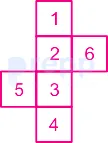
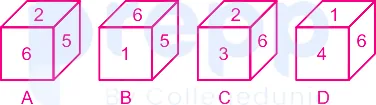
- A
only D
- B
A an d C only
- C
C and D only
- D
only B
Show answer
Question 24archived
In a certain code language, ‘birds are flying’ is coded as '536', ‘the nest is big’ is coded as '3423' and ‘close the door’ is coded as '534'. How will ‘complete your work’ be coded in that language?
- A
844
- B
484
- C
733
- D
955
Show answer
A. 844Understanding the Code Language Pattern
In this type of coding language question, we need to find a hidden pattern or rule that converts words or phrases into numbers or symbols. The given examples provide clues to uncover this rule. Let's look at the provided codes:
'birds are flying' is coded as '536'
'the nest is big' is coded as '3423'
'close the door' is coded as '534'
We need to figure out how 'complete your work' will be coded based on this pattern.
Analyzing the Given Code Examples
Let's examine the relationship between the words in each phrase and their corresponding numerical code. We can try to see if the numbers relate to the position of the words, the number of letters, or some other property.
Let's consider the number of letters in each word:
Phrase
Words
Number of Letters
Given Code
birds are flying
birds, are, flying
5, 3, 6
536
the nest is big
the, nest, is, big
3, 4, 2, 3
3423
close the door
close, the, door
5, 3, 4
534
Observing the table, we can see a clear pattern. The numerical code for each phrase is formed by concatenating the number of letters in each word of the phrase, in the order they appear.
For 'birds are flying': 'birds' has 5 letters, 'are' has 3 letters, 'flying' has 6 letters. Putting these numbers together gives 536.
For 'the nest is big': 'the' has 3 letters, 'nest' has 4 letters, 'is' has 2 letters, 'big' has 3 letters. Putting these numbers together gives 3423.
For 'close the door': 'close' has 5 letters, 'the' has 3 letters, 'door' has 4 letters. Putting these numbers together gives 534.
The pattern is consistent across all given examples: The code is the sequence of the number of letters in each word.
Applying the Pattern to 'complete your work'
Now, we will apply the same pattern to the phrase 'complete your work' to find its code. We need to count the number of letters in each word of this phrase:
'complete': Let's count the letters: c, o, m, p, l, e, t, e. There are 8 letters.
'your': Let's count the letters: y, o, u, r. There are 4 letters.
'work': Let's count the letters: w, o, r, k. There are 4 letters.
Following the discovered pattern, the code for 'complete your work' will be the sequence of these numbers of letters, in order.
Number of letters for 'complete' is 8.
Number of letters for 'your' is 4.
Number of letters for 'work' is 4.
Concatenating these numbers gives us 844.
Comparing with Options
The code we derived for 'complete your work' is 844. Let's compare this with the given options:
844
484
733
955
Our calculated code 844 matches option 1.
Revision Table: Code Language Patterns
Phrase
Word 1
Word 2
Word 3
Word 4
Letters (W1, W2, W3, W4)
Code
birds are flying
birds (5)
are (3)
flying (6)
-
5, 3, 6
536
the nest is big
the (3)
nest (4)
is (2)
big (3)
3, 4, 2, 3
3423
close the door
close (5)
the (3)
door (4)
-
5, 3, 4
534
complete your work
complete (8)
your (4)
work (4)
-
8, 4, 4
844
Additional Information: Types of Coding Language Problems
Coding and decoding questions are common in logical reasoning sections of various exams. They test your ability to identify patterns and apply rules. Some common types include:
Letter Coding: Letters are replaced by other letters based on a pattern (e.g., shifting positions in the alphabet).
Number Coding: Words or letters are represented by numbers. The pattern might involve letter positions (A=1, B=2), number of letters, sum/product of letter positions, etc.
Symbol Coding: Words or letters are replaced by symbols.
Mixed Coding: A combination of letter, number, and symbol coding. Multiple phrases with their codes are given, and you need to deduce the code for each word.
Word Substitution: Words are replaced by other words (e.g., 'red' is called 'blue', 'blue' is called 'green').
To solve these problems, always look for common elements in the given examples and try to find a consistent rule. This rule can then be applied to the word or phrase you need to code or decode.
Paper & answer key PDF ↗ Question 25archived
In the following question below are given some statements followed by some conclusions based on those statements. Taking the given statements to be true even if they seem to be at variance from commonly known facts. Read all the conclusions and then decide which of the given conclusion logically follows the given statements.
Statements:
I. No A is D.
II. All D are E.
Conclusions:
I. No D is A.
II. Some E are D.
- A
Neither conclusion follows
- B
Both conclusions I and II follows
- C
Only conclusion II follows
- D
Only conclusion I follows
Show answer
B. Both conclusions I and II followsThis question asks us to analyze given statements and determine which of the provided conclusions logically follow. We must assume the statements are true, even if they seem different from common knowledge.
Understanding Syllogism Statements
Let's break down the given statements:
Statement I: No A is D. This statement establishes a complete separation between the category 'A' and the category 'D'. There is no single element that belongs to both A and D.
Statement II: All D are E. This statement tells us that the entire category 'D' is included within the category 'E'. Anything that is a 'D' is also an 'E'.
Analyzing Syllogism Conclusions
Now, let's evaluate each conclusion based on the statements:
Conclusion I: No D is A.
This conclusion claims that there is no overlap between the category 'D' and the category 'A'. Looking back at Statement I, which says "No A is D", we see that this directly implies "No D is A". If A and D are mutually exclusive, the relationship holds true in both directions. Think of it like this: if no cats are dogs, then it must also be true that no dogs are cats.
Therefore, Conclusion I logically follows from Statement I.
Conclusion II: Some E are D.
This conclusion claims that there is at least one element that belongs to both the category 'E' and the category 'D'. Statement II says "All D are E". This means every single member of the set 'D' is also a member of the set 'E'. If the set 'D' is not empty (and in syllogisms, we typically assume the categories are not empty unless stated otherwise), then the members of 'D' are also members of 'E'. This constitutes 'some' members of E that are D.
For example, if all apples are fruits, then it must be true that some fruits are apples (specifically, all the apples). The statement "All D are E" guarantees that the portion of E consisting of D is not empty (assuming D exists), thus "Some E are D" is a valid conclusion.
Therefore, Conclusion II logically follows from Statement II.
Overall Syllogism Analysis
Based on our analysis, both Conclusion I ("No D is A") and Conclusion II ("Some E are D") logically follow from the given statements ("No A is D" and "All D are E").
Revision Table: Statements and Conclusions
Statement/Conclusion
Content
Logical Follow?
Reasoning
Statement I
No A is D
Given
Assumption for analysis
Statement II
All D are E
Given
Assumption for analysis
Conclusion I
No D is A
Yes
Direct inference from "No A is D" (Symmetry)
Conclusion II
Some E are D
Yes
Direct inference from "All D are E" (Subset implication)
Since both conclusions are determined to be logically valid based on the given statements, the correct option is the one stating that both conclusions I and II follow.
Additional Information on Syllogism Logic
Syllogisms are a form of logical reasoning where a conclusion is drawn from two given or assumed propositions (premises). The statements in this question are premises. The conclusions are deductions based on these premises.
'No' relationship: "No X is Y" means the sets X and Y are disjoint. This relationship is symmetrical, meaning if "No X is Y", then "No Y is X" is also true.
'All' and 'Some' relationship: "All X are Y" means the set X is a subset of the set Y. From "All X are Y", it is a valid inference that "Some Y are X" (provided X is not empty). This is because the elements that are X are also Y, and those X elements constitute 'some' of the Y elements.
Venn Diagrams: These are often used to visualize syllogisms. Circles represent categories, and overlaps or separations show the relationships described by the statements. For "No A is D", the circles for A and D do not overlap. For "All D are E", the circle for D is drawn completely inside the circle for E.
By understanding these basic rules of logic and how statements relate, you can determine which conclusions are valid in syllogism problems.
Paper & answer key PDF ↗ Question 26archived
What is the difference in the number of years between the summer and winter Olympic events?
- A
1
- B
2
- C
4
- D
3
Show answer
B. 2Understanding the Olympic Cycle: Summer vs. Winter Events
The question asks about the time difference in years between the Summer Olympic events and the Winter Olympic events.
Both the Summer Olympics and the Winter Olympics are major international multi-sport events that take place every four years. However, they are scheduled in a way that staggers them within this four-year cycle.
Frequency of Summer and Winter Olympics
The Summer Olympics occur every four years.
The Winter Olympics also occur every four years.
The Time Difference Between Summer and Winter Games
While both events are quadrennial (happening every four years), they do not take place in the same year. Since 1994, the Winter Olympics have been held two years after the Summer Olympics of the same Olympiad (the four-year period).
Let's look at recent examples:
Event
Year
Summer Olympics
2016 (Rio de Janeiro)
Winter Olympics
2018 (PyeongChang)
Summer Olympics
2020/2021 (Tokyo)
Winter Olympics
2022 (Beijing)
Summer Olympics
2024 (Paris)
Winter Olympics
2026 (Milan Cortina)
As you can see from the table, the Winter Olympics typically occur two years after the preceding Summer Olympics, and the Summer Olympics typically occur two years after the preceding Winter Olympics. This means the difference in the number of years between the Summer and Winter Olympic events is 2 years.
Conclusion on the Olympic Year Difference
The system implemented since 1994 ensures that there is a major Olympic event every two years, alternating between Summer and Winter Games. Therefore, the difference in the number of years between these two types of Olympic events is consistently 2 years.
Revision Table: Olympic Events
Olympic Event Type
Frequency
Scheduling Relative to Other Event
Summer Olympics
Every 4 years
2 years after the preceding Winter Olympics
Winter Olympics
Every 4 years
2 years after the preceding Summer Olympics
Additional Information: History of Olympic Scheduling
Historically, both the Summer and Winter Olympics were held in the same year, every four years. This practice continued until 1992.
Following the 1992 Winter Olympics in Albertville and the 1992 Summer Olympics in Barcelona, the International Olympic Committee (IOC) decided to separate the two events. The next Winter Olympics were held just two years later, in 1994 in Lillehammer, while the next Summer Olympics were held four years after Barcelona, in 1996 in Atlanta.
This change established the current pattern where the Summer and Winter Games alternate every two years within the four-year Olympiad cycle, maintaining a 2-year difference between the events.
Paper & answer key PDF ↗ Question 27archived
Battle of Plassey was fought between English company and Nawab of Bengal in which year?
- A
1750
- B
1757
- C
1850
- D
1857
Show answer
B. 1757Understanding the Battle of Plassey: Key Historical Event
The Battle of Plassey was a pivotal moment in the history of the Indian subcontinent. It marked the beginning of significant British political influence and control in India.
This crucial battle was fought between the forces of the British East India Company and the Nawab of Bengal, Siraj-ud-Daulah. The English company forces were led by Robert Clive.
When was the Battle of Plassey Fought?
Let's examine the time period of the Battle of Plassey. The question asks for the specific year this battle took place.
Historical records clearly indicate the year of this significant confrontation:
The battle took place near Plassey (Palashi) on the banks of the Bhagirathi River.
It was fought on June 23rd.
The year was 1757.
Analyzing the Options for the Battle of Plassey Year
The provided options are:
1750
1757
1850
1857
Based on historical facts, the Battle of Plassey occurred in the year 1757.
Option 1, 1750, is too early for this specific battle, although the English company was active in India around this time.
Option 3, 1850, and Option 4, 1857, are much later. 1857 is particularly notable for the Indian Mutiny or Sepoy Mutiny, which was a major uprising against British rule, occurring a century after Plassey.
Therefore, the only option that correctly identifies the year of the Battle of Plassey is 1757.
Historical Event
Key Players
Year
Battle of Plassey
English Company (Robert Clive) vs. Nawab of Bengal (Siraj-ud-Daulah)
1757
Indian Mutiny/Sepoy Mutiny
Indian sepoys, various rulers vs. British East India Company/British Crown
1857
Significance of the 1757 Battle of Plassey
The outcome of the Battle of Plassey had far-reaching consequences:
It led to the installation of Mir Jafar as the Nawab of Bengal, who was effectively a puppet ruler under the English company's control.
The company gained significant revenue rights in Bengal, which funded its expansion.
It boosted the political and military standing of the British East India Company in India, paving the way for further conquests and ultimately, British colonial rule.
Revision Table: Key Dates in English Company History
Event
Year
Establishment of British East India Company
1600
Battle of Plassey
1757
Battle of Buxar
1764
Indian Mutiny/First War of Independence
1857
Transfer of power to British Crown (End of Company Rule)
1858
Additional Information: The English Company and Nawabs of Bengal
The English East India Company initially came to India for trade. Over time, it became increasingly involved in local politics and conflicts, especially as the Mughal Empire weakened and regional powers like the Nawab of Bengal gained prominence.
The Nawab of Bengal was a powerful regional ruler. Siraj-ud-Daulah's conflict with the English company escalated due to various reasons, including trade disputes, fortification issues, and political interference by the company. The Battle of Plassey was a direct result of these tensions.
The battle itself was not a lengthy or hard-fought one, largely due to the betrayal of Mir Jafar and other key figures in the Nawab's army who had been bribed by Robert Clive.
Paper & answer key PDF ↗ Question 28archived
Which of the following countries hosted the 2022 Asian Wresting Championships where Ravi Dahiya became the first Indian freestyle wrestler to win a hat-trick of gold medals?
- A
Almaty, Kazakhstan
- B
New Delhi, India
- C
Ulaanbaatar, Mongolia
- D
Xi'an, China
Show answer
C. Ulaanbaatar, MongoliaThe question asks about the host country of the 2022 Asian Wrestling Championships, highlighting the achievement of Indian wrestler Ravi Dahiya who won a hat-trick gold medal at this event.
Understanding the 2022 Asian Wrestling Championships
The Asian Wrestling Championships is an annual amateur wrestling competition organized by the United World Wrestling (UWW) for Asian countries. The event features freestyle and Greco-Roman wrestling styles for both men and women. The 2022 edition was significant for several reasons, including the performance of prominent wrestlers like India's Ravi Dahiya.
Ravi Dahiya's Achievement
Ravi Dahiya is an acclaimed Indian freestyle wrestler. At the 2022 Asian Wrestling Championships, he secured a gold medal, making it his third consecutive gold medal win at this championship (2020, 2021, and 2022). This remarkable feat made him the first Indian freestyle wrestler to achieve a hat-trick of gold medals in the Asian Wrestling Championships.
Identifying the Host Country of 2022
To answer the question, we need to recall or find information about where the 2022 Asian Wrestling Championships took place. The location of major international sports events is usually well-documented.
Let's look at the options provided:
Almaty, Kazakhstan
New Delhi, India
Ulaanbaatar, Mongolia
Xi'an, China
Checking the historical records for the Asian Wrestling Championships:
The 2021 Asian Wrestling Championships were held in Almaty, Kazakhstan.
New Delhi, India has hosted the championships multiple times in the past, including in 2020.
Xi'an, China hosted the championships in 2019.
The 2022 Asian Wrestling Championships were held in Ulaanbaatar, Mongolia.
Therefore, the country that hosted the 2022 Asian Wrestling Championships was Mongolia, with the city being Ulaanbaatar.
Detailed Breakdown of the Options
Option
Location
Hosted 2022 Asian Wrestling Championships?
1
Almaty, Kazakhstan
No (Hosted in 2021)
2
New Delhi, India
No (Hosted in 2020 and other years)
3
Ulaanbaatar, Mongolia
Yes
4
Xi'an, China
No (Hosted in 2019)
Based on the locations and host years of the Asian Wrestling Championships, Ulaanbaatar, Mongolia was the host of the 2022 event where Ravi Dahiya won his historic third gold medal.
Conclusion on the Host Country
The country that hosted the 2022 Asian Wrestling Championships, notable for Ravi Dahiya's gold medal hat-trick, was Mongolia, specifically in its capital city, Ulaanbaatar.
Revision Table: Asian Wrestling Championships Recent Hosts
Year
Host City
Host Country
2019
Xi'an
China
2020
New Delhi
India
2021
Almaty
Kazakhstan
2022
Ulaanbaatar
Mongolia
2023
Astana
Kazakhstan
Additional Information on Ravi Dahiya and Wrestling Achievements
Ravi Dahiya is a prominent figure in Indian wrestling. Apart from his multiple gold medals at the Asian Wrestling Championships, he has also achieved success on the world stage. He won a silver medal at the Tokyo 2020 Olympics (held in 2021) in the 57 kg freestyle category, becoming the second Indian wrestler to win an Olympic silver. His consistent performance in major tournaments highlights his status as one of India's top wrestlers.
Freestyle wrestling is one of the two main styles of amateur wrestling practiced internationally, the other being Greco-Roman. In freestyle wrestling, wrestlers are allowed to use their legs for attacking and defending, and they can hold their opponent above or below the waist, which distinguishes it from Greco-Roman wrestling.
Paper & answer key PDF ↗ Question 29archived
In April 2022, ‘SVANidhi se Samriddhi’ program was launched in additional 126 cities. This program provides ________.
- A
insurance cover
- B
scholarships to students
- C
hospital facilities
- D
social security benefits
Show answer
D. social security benefitsUnderstanding the SVANidhi se Samriddhi Program
The question asks about the 'SVANidhi se Samriddhi' program, specifically what it provides, following its launch in additional 126 cities in April 2022. This program is an extension of the Pradhan Mantri Street Vendor's AtmaNirbhar Nidhi (PM SVANidhi) scheme.
What is SVANidhi se Samriddhi?
'SVANidhi se Samriddhi' translates to 'Prosperity through SVANidhi'. It is not just about providing credit (which PM SVANidhi does) but aims to provide holistic development and economic upliftment to street vendors and their families.
Benefits Provided by the Program
The primary objective of the 'SVANidhi se Samriddhi' program is to map the socio-economic profiles of the PM SVANidhi beneficiaries and their families. Based on this mapping, eligible vendors and their families are linked to various existing Central Government welfare schemes.
These welfare schemes offer access to various benefits, which fall under the umbrella of social security and financial inclusion. Examples of schemes they might be linked to include:
Pradhan Mantri Jan Dhan Yojana (PMJDY) for financial inclusion.
PM SVANidhi (for working capital loans).
PM Jyoti Jeevan Bima Yojana (PMJJBY) for life insurance.
PM Suraksha Bima Yojana (PMSBY) for accidental insurance.
Pradhan Mantri Shram Yogi Maan Dhan Yojana (PMSYMDY) for pension benefits.
One Nation One Ration Card (ONORC) scheme for ration portability.
Building and Other Construction Workers (BoCW) welfare boards for construction workers.
Janani Suraksha Yojana for pregnant women.
By linking beneficiaries to these schemes, the program aims to improve their social security, health, insurance coverage, and overall well-being.
Analyzing the Options
Let's examine the given options based on the program's objectives:
insurance cover: While the program *links* beneficiaries to schemes that provide insurance (like PMJJBY and PMSBY), insurance cover is a *part* of the social security benefits provided through these linked schemes, not the sole or complete provision of the SVANidhi se Samriddhi program itself.
scholarships to students: The program focuses on street vendors and their families. While accessing benefits *might* indirectly help a family support education, providing direct scholarships is not the primary stated benefit or focus of this program.
hospital facilities: The program links beneficiaries to health-related schemes, but it doesn't directly provide hospital facilities. Access to health benefits is part of overall social security.
social security benefits: This option best describes the comprehensive nature of the linkages provided by the 'SVANidhi se Samriddhi' program. It connects vendors and their families to multiple government schemes covering insurance, pension, financial inclusion, health support, and other welfare benefits, all of which constitute social security benefits.
Therefore, the 'SVANidhi se Samriddhi' program primarily provides access to social security benefits by linking eligible families to various government welfare schemes.
Conclusion
Based on the program's design and objectives, the SVANidhi se Samriddhi program provides social security benefits by integrating street vendor families into the existing ecosystem of government welfare schemes.
Aspect
SVANidhi se Samriddhi Program
Launch Date (Additional Cities)
April 2022
Number of Additional Cities
126
Parent Scheme
PM SVANidhi
Primary Objective
Socio-economic profiling and linking families to welfare schemes
Key Provision
Access to Social Security Benefits
Revision Table: SVANidhi se Samriddhi Key Facts
Additional Information: PM SVANidhi and Social Security
The PM SVANidhi scheme itself focuses on providing collateral-free working capital loans to street vendors. The 'SVANidhi se Samriddhi' program builds upon this by recognizing that financial support alone may not be sufficient for holistic development. By ensuring access to social security schemes, the government aims to provide a safety net and improve the overall quality of life for street vendor families. Social security encompasses measures providing access to health care and income security, particularly in cases of old age, unemployment, sickness, invalidity, work injury, maternity, or loss of a breadwinner.
Paper & answer key PDF ↗ Question 30archived
In which of the following state of India, coniferous trees are found?
- A
Uttarakhand
- B
Bihar
- C
Uttar Pradesh
- D
Madhya Pradesh
Show answer
A. UttarakhandFinding Coniferous Trees in India: State Analysis
Let's analyze where coniferous trees are typically found and examine the given states in India to determine the correct location.
Understanding Coniferous Trees
Coniferous trees are evergreen trees that bear cones and have needle-like or scale-like leaves. They are commonly found in regions with specific climatic conditions, primarily:
High altitudes in mountainous areas.
Regions with cold temperatures, often experiencing snowfall in winter.
Specific types of soil found in such environments.
These trees form a significant part of forests found in mountainous belts, such as the Himalayas.
Analyzing the States
Now, let's look at the geographical location and typical vegetation of the states provided in the options:
State
Typical Geography/Climate
Likelihood of Coniferous Trees
Uttarakhand
Himalayan state, mountainous terrain, varying altitudes from plains to high peaks. Experiences cold climate at higher altitudes.
High (Suitable altitude and climate exist)
Bihar
Primarily part of the Indo-Gangetic Plain, mostly flat terrain, subtropical climate.
Very Low (Lack of suitable altitude and climate)
Uttar Pradesh
Largely part of the Indo-Gangetic Plain, with some foothills in the north. Mostly subtropical climate.
Very Low (Lack of suitable altitude, except potentially very small areas in foothills)
Madhya Pradesh
Located in central India, plateau region. Primarily tropical dry deciduous or moist deciduous forest types.
Very Low (Lack of suitable altitude and climate)
Based on this analysis, Uttarakhand is a state located in the Himalayan region of India. It has significant mountainous areas with high altitudes, which provide the necessary cold climate and environmental conditions for coniferous trees to grow. States like Bihar, Uttar Pradesh (mostly), and Madhya Pradesh are primarily located in plains or plateau regions with tropical or subtropical climates that are not suitable for the natural growth of extensive coniferous forests.
Therefore, among the given options, coniferous trees are commonly found in Uttarakhand.
Revision Table: Forest Types in India
Forest Type
Typical Region in India
Key Characteristics
Tropical Evergreen
Western Ghats, North-Eastern India, Andaman & Nicobar Islands
Hot and wet climate, dense canopy, multiple layers of vegetation.
Tropical Deciduous
Most widespread (e.g., Central India, parts of Bihar, UP)
Shed leaves during dry season, less dense than evergreen.
Tropical Thorn
North-Western India (Rajasthan, parts of Gujarat)
Arid/semi-arid regions, thorny vegetation, scattered trees.
Montane (Mountain)
Himalayas, Nilgiris
Varies with altitude: includes wet temperate, temperate, and Alpine forests (including coniferous).
Mangrove (Tidal)
Coastal areas, river deltas (Sunderbans, Mahanadi delta)
Grow in saline water, specialized roots.
Additional Information: Altitude and Vegetation Zones
In mountainous regions like the Himalayas, vegetation changes with altitude. This change in vegetation zones is a classic ecological concept.
Lower Altitudes: Often have deciduous or wet temperate forests.
Mid Altitudes: Typically feature temperate forests, including pine and deodar (types of coniferous trees). This zone is where extensive coniferous forests are found.
Higher Altitudes: Transition to alpine meadows and then sparse vegetation or permanent snow.
Uttarakhand encompasses these varied altitude zones, providing ideal habitats for coniferous species at the appropriate elevations.
Paper & answer key PDF ↗ Question 31archived
Which of the following is natural acid-base indicator?
I. Litmus
II. Turmeric
- A
Only II
- B
Only I
- C
Neither I nor II
- D
Both I and II
Show answer
D. Both I and IIUnderstanding Natural Acid-Base Indicators
Acid-base indicators are substances that change color depending on whether they are in an acidic or a basic (alkaline) solution. This color change helps us identify the nature of the substance being tested.
Natural acid-base indicators are substances derived from natural sources, such as plants. They perform the same function as synthetic indicators but come directly from nature.
Analysing the Given Options
We are given two substances, Litmus and Turmeric, and asked if they are natural acid-base indicators.
I. Litmus
Litmus is a well-known acid-base indicator. It is obtained from lichens, which are composite organisms arising from algae or cyanobacteria living among filaments of multiple fungi. Since lichens are natural organisms, litmus derived from them is considered a natural acid-base indicator.
In acidic solutions, litmus turns red.
In basic solutions, litmus turns blue.
II. Turmeric
Turmeric is a spice derived from the roots of the plant Curcuma longa. It contains a compound called curcumin, which acts as a natural indicator.
In acidic solutions, turmeric remains yellow (or light orange-yellow).
In basic solutions, turmeric turns reddish-brown.
Since turmeric comes from a plant, it is also considered a natural acid-base indicator.
Conclusion on Natural Acid-Base Indicators
Both Litmus and Turmeric are derived from natural sources and exhibit characteristic color changes in acidic and basic mediums, serving as natural acid-base indicators.
Properties of Litmus and Turmeric as Indicators
Indicator
Source
Color in Acidic Solution
Color in Basic Solution
Is it Natural?
Litmus
Lichens
Red
Blue
Yes
Turmeric
Turmeric plant root
Yellow
Reddish-brown
Yes
Therefore, both I (Litmus) and II (Turmeric) are natural acid-base indicators.
Revision Table: Key Concepts in Acid-Base Chemistry
Summary of Acid-Base Concepts
Term
Definition
Example
Acid
Substance that donates H<sup>+</sup> ions in water (Arrhenius definition)
HCl, H<sub>2</sub>SO<sub>4</sub>
Base
Substance that donates OH<sup>-</sup> ions in water (Arrhenius definition)
NaOH, Ca(OH)<sub>2</sub>
Indicator
Substance that changes color in acidic vs. basic solutions
Litmus, Phenolphthalein
Natural Indicator
Indicator derived from natural sources
Turmeric, Red cabbage juice
pH Scale
Scale (0-14) measuring acidity or basicity; < 7 acidic, = 7 neutral, > 7 basic
Pure water has pH 7
Additional Information: More Natural Indicators
Apart from Litmus and Turmeric, several other natural substances can act as acid-base indicators. Exploring these can broaden your understanding of natural indicators.
Red Cabbage Juice: This juice shows a wide range of colors across the pH scale, from red in strong acids to green and yellow in strong bases.
Hydrangea Flowers: The color of hydrangea flowers can indicate the pH of the soil they are growing in. In acidic soil, they are blue; in alkaline soil, they are pink.
Grape Juice: Dark grape juice can appear reddish in acidic solutions and greenish-yellow in basic solutions.
Beetroot Juice: Beetroot juice can appear reddish in acidic solutions and turn yellowish or brownish in basic solutions.
These examples demonstrate the diversity of natural sources that provide acid-base indicating properties.
Paper & answer key PDF ↗ Question 32archived
Which of the following objectives of the NAMASTE scheme launched by the Centre in August 2022 is correct?
I. Zero fatalities in sanitation work in India
II. Sanitation workers are collectivized into SHGs and are empowered to run sanitation enterprises
- A
Both I and II
- B
Only II
- C
Only I
- D
Neither I nor II
Show answer
A. Both I and IIUnderstanding the NAMASTE Scheme Objectives
The National Action for Mechanised Sanitation Ecosystem (NAMASTE) scheme was launched by the Central Government in August 2022. This scheme is a joint initiative of the Ministry of Social Justice & Empowerment and the Ministry of Housing & Urban Affairs. Its primary focus is on the safety and dignity of sanitation workers in India.
Let's examine the stated objectives to determine their correctness regarding the NAMASTE scheme.
Analyzing NAMASTE Objective Statements
We will analyze each statement provided in the question:
Statement I: Zero fatalities in sanitation work in India
This statement highlights a crucial goal of the NAMASTE scheme.
The scheme aims to eliminate unsafe practices in sanitation work, such as manual scavenging and hazardous entry into sewers or septic tanks without proper safety gear and mechanization.
By promoting mechanization and providing training on safety protocols, the scheme directly targets reducing and eventually eliminating deaths related to sanitation work.
Therefore, achieving 'Zero fatalities' is indeed a core objective of the NAMASTE scheme.
Statement II: Sanitation workers are collectivized into SHGs and are empowered to run sanitation enterprises
This statement focuses on the economic empowerment and organization of sanitation workers.
The NAMASTE scheme includes provisions to identify sanitation workers and connect them to various welfare schemes.
A key aspect is facilitating their transition from hazardous manual work to mechanized operations or other alternative livelihoods.
Forming Self-Help Groups (SHGs) is a common strategy in government schemes for collectivization, skill development, and enabling group enterprises. The NAMASTE scheme supports this approach to empower workers economically and socially, enabling them to manage and operate mechanized cleaning units or related sanitation services as enterprises.
Thus, empowering workers through collectivization and enabling enterprises is also a stated objective of the NAMASTE scheme.
Conclusion on NAMASTE Objectives
Based on the analysis of both statements against the known objectives of the NAMASTE scheme, both Statement I (Zero fatalities) and Statement II (Collectivization into SHGs and running enterprises) align with the goals of the scheme.
Revision Table: Key Aspects of NAMASTE Scheme
Aspect
Detail
Launch Date
August 2022
Responsible Ministries
Ministry of Social Justice & Empowerment and Ministry of Housing & Urban Affairs
Primary Goal
Ensure safety and dignity of sanitation workers
Key Objectives
Eliminate fatalities, mechanize cleaning operations, empower workers (training, SHGs, enterprises), provide access to social security benefits
Focus Area
Urban Local Bodies (ULBs) initially
Additional Information on Sanitation Work and Government Efforts
Sanitation work, particularly manual scavenging and hazardous entry into sewers, has historically been associated with significant risks, including asphyxiation and exposure to toxic gases, leading to fatalities.
The Indian government has taken several steps over the years to address these issues:
The Prohibition of Employment as Manual Scavengers and their Rehabilitation Act, 2013, prohibits manual scavenging and mandates rehabilitation for those engaged in it.
The Swachh Bharat Abhiyan has focused on improving sanitation infrastructure, including toilets, which indirectly impacts the overall sanitation ecosystem.
Schemes like NAMASTE are specifically designed to shift from manual to mechanical cleaning methods and provide support, training, and economic alternatives to sanitation workers.
These initiatives aim to ensure that sanitation work is performed safely and with the respect and dignity that all workers deserve.
Paper & answer key PDF ↗ Question 33archived
Who among the following was the first Indian female musician to win the Grammy award?
- A
Neeti Mohan
- B
Tanvi Shah
- C
Shweta Pandit
- D
Shalmali Kholgade
Show answer
B. Tanvi ShahFinding the First Indian Female Grammy Winner
The question asks to identify the first Indian female musician who won a Grammy award. Understanding the history of Indian artists and international music awards like the Grammy is key to answering this type of question.
Let's look at the options provided and their relevance to the Grammy Awards:
Neeti Mohan
Tanvi Shah
Shweta Pandit
Shalmali Kholgade
The Grammy Awards are presented annually by the Recording Academy to recognize outstanding achievements in the music industry. Many Indian artists have been nominated and some have won over the years in various categories.
Among the listed options, one individual holds the distinction of being the first Indian female musician to win a Grammy Award. This historical achievement is attributed to Tanvi Shah.
Tanvi Shah is a singer-songwriter who won a Grammy Award in 2010 for her work on the song "Jai Ho". She contributed Spanish vocals to the version of the song from the movie Slumdog Millionaire. The soundtrack for this film, composed by A.R. Rahman, won the Grammy for Best Compilation Soundtrack Album for Motion Picture, Television or Other Visual Media. Tanvi Shah was credited as a lyricist and vocalist on the track, making her a recipient of the award as part of the winning team.
Let's briefly consider why the other options are not the first Indian female Grammy winners:
Neeti Mohan is a popular playback singer, but she is not credited with being the first Indian female Grammy winner.
Shweta Pandit is also a well-known playback singer, but she is not recognized as the first Indian female Grammy winner.
Shalmali Kholgade is another prominent playback singer, but she does not hold the record for being the first Indian female Grammy winner.
Therefore, based on historical records of Grammy winners, Tanvi Shah is the correct answer as the first Indian female musician to achieve this feat.
Musician
Known For
First Indian Female Grammy Winner?
Neeti Mohan
Playback singing
No
Tanvi Shah
Singer, Lyricist (Jai Ho)
Yes
Shweta Pandit
Playback singing
No
Shalmali Kholgade
Playback singing
No
Revision Table: Indian Female Grammy Winners
It's important to remember this historical milestone in Indian music history. Tanvi Shah's win paved the way for future Indian female artists at the Grammys.
Achievement
Artist
Year of Grammy Win
Winning Work
First Indian Female Grammy Winner
Tanvi Shah
2010
"Jai Ho" (part of Slumdog Millionaire soundtrack album win)
Additional Information: More About Indian Grammy Wins
While Tanvi Shah was the first Indian female musician to win, several other Indian artists, both male and female, have won Grammy Awards over the years for various contributions, including:
Ravi Shankar (Sitar virtuoso)
Zakir Hussain (Tabla maestro)
A.R. Rahman (Composer)
H. Sridhar (Audio Engineer - won for Slumdog Millionaire soundtrack along with Rahman and P.A. Deepak)
P.A. Deepak (Audio Engineer - won for Slumdog Millionaire soundtrack)
Ricky Kej (Music Composer/Environmentalist)
Falguni Shah (Singer)
Shankar Mahadevan (Singer - won as part of the band Shakti)
V. Selvaganesh (Percussionist - won as part of the band Shakti)
Ganesh Rajagopalan (Violinist - won as part of the band Shakti)
Ustad Zakir Hussain won multiple Grammys in 2024, including Global Music Album for 'This Moment' (with Shakti) and Best Global Music Performance for 'Pashto'.
These wins highlight the diverse talent from India being recognized on a global platform like the Grammy Awards.
Paper & answer key PDF ↗ Question 34archived
According to census 2011, number of literates in India is ________ million.
- A
767.5
- B
765.5
- C
769.5
- D
763.5
Show answer
D. 763.5Understanding India's Literacy According to Census 2011
The Census of India is a crucial source of information regarding the population, its characteristics, and various demographic and socio-economic indicators. The Census 2011 provides detailed data on the population's literacy status across the country.
Literacy is defined as the ability of a person aged 7 years and above to both read and write with understanding in any language. Data collected during the Census 2011 revealed significant statistics about the number of literate individuals in India.
Number of Literates in India (Census 2011)
According to the official data from the Census 2011, the total number of literates in India was a specific figure. This figure is often cited in millions for ease of understanding and reporting.
Based on the Census 2011 findings, the number of literates in India was approximately:
763.5 million
This number represents all individuals aged 7 and above who were recorded as literate during the nationwide enumeration process conducted in 2011.
Key Census 2011 Literacy Statistics
While the question specifically asks for the number of literates, it's helpful to understand this figure in the context of the total population and the overall literacy rate. The Census 2011 provided these related figures:
Total Population (2011): Approximately 1210.8 million
Total Number of Literates (2011): Approximately 763.5 million
Overall Literacy Rate (2011): Approximately 74.04%
The number of literates (763.5 million) includes both male and female literates across all states and union territories of India, as recorded by the Census 2011.
Census Year
Total Population (Approx. Million)
Number of Literates (Approx. Million)
Overall Literacy Rate (Approx. %)
2011
1210.8
763.5
74.04
Therefore, the number of literates in India according to the Census 2011 is 763.5 million.
Revision Table: Census 2011 Literacy Data
Reviewing the key figures from Census 2011 regarding literacy helps consolidate the information:
Definition of literacy in Census: Age >= 7, can read and write with understanding.
Total Literates (2011): 763.5 million.
This figure is crucial for understanding the educational progress and challenges in India.
Additional Information: Literacy in India
Understanding literacy statistics from Census 2011 involves more than just the total number. Further details include:
Rural vs. Urban Literacy: Literacy rates often differ significantly between rural and urban areas.
Male vs. Female Literacy: There is usually a gap between male and female literacy rates, although this gap has been narrowing over the years.
State-wise Literacy: Literacy rates vary considerably from one state to another, highlighting regional disparities in education. Kerala consistently shows high literacy rates, while some other states lag behind.
Importance of Literacy: Literacy is a fundamental indicator of human development and is essential for socio-economic progress.
The Census 2011 data on the number of literates (763.5 million) serves as a baseline for tracking progress in educational outcomes in subsequent years.
Paper & answer key PDF ↗ Question 35archived
Identify the function of plasmid DNA.
- A
None of the given options are correct
- B
To form blood cells
- C
To confer certain unique phenotypic characteristics to bacteria
- D
To help in the formation of rRNA
Show answer
C. To confer certain unique phenotypic characteristics to bacteriaTo confer certain unique phenotypic characteristics to bacteria
Therefore, the function of plasmid DNA is indeed to confer certain unique phenotypic characteristics to bacteria.
Paper & answer key PDF ↗ Question 36archived
When, for the first time, did the Election Commission of India become a multi-member body?
- A
1995
- B
1985
- C
1989
- D
1994
Show answer
C. 1989Understanding the Election Commission of India
The Election Commission of India (ECI) is a constitutional body responsible for administering election processes in India at the national and state levels. It is a vital institution for upholding democracy by ensuring free and fair elections.
Initial Structure of the Election Commission
Initially, the Election Commission of India was constituted as a single-member body. This meant that it consisted of only one Chief Election Commissioner (CEC).
The first Chief Election Commissioner was Sukumar Sen, appointed in 1950.
For many years, the ECI functioned with a single CEC.
Transition to a Multi-Member Body
The structure of the Election Commission underwent a significant change for the first time in 1989. Specifically, on 16th October 1989, two more Election Commissioners were appointed in addition to the Chief Election Commissioner.
This change was made in the backdrop of lowering the voting age from 21 to 18 years, which was expected to significantly increase the workload of the Commission.
The idea was to have a body with more members to share the responsibilities and decision-making.
Therefore, for the first time, the Election Commission of India became a multi-member body in the year 1989.
Subsequent Changes in ECI Structure
It is important to note that this multi-member structure introduced in 1989 was temporary. The posts of the two additional Election Commissioners were abolished shortly thereafter, on 1st January 1990, and the Commission reverted to its single-member status.
However, the multi-member structure was re-established in October 1993 and has continued since then. Since 1993, the Election Commission of India has consistently been a three-member body, comprising the Chief Election Commissioner and two Election Commissioners.
Period
Structure
Number of Members
1950 - Oct 1989
Single-member
1 (Chief Election Commissioner)
Oct 1989 - Jan 1990
Multi-member
3 (Chief Election Commissioner + 2 Election Commissioners)
Jan 1990 - Oct 1993
Single-member
1 (Chief Election Commissioner)
Oct 1993 - Present
Multi-member
3 (Chief Election Commissioner + 2 Election Commissioners)
Based on the historical timeline, the first instance of the Election Commission of India becoming a multi-member body was indeed in 1989.
Revision Table: Election Commission Structure
Reviewing the key information about the structure of the Election Commission of India.
Initial structure: Single-member.
First transition to multi-member: 1989.
Members in 1989: 1 Chief Election Commissioner + 2 Election Commissioners.
Return to single-member: 1990.
Re-establishment of multi-member status: 1993 onwards.
Additional Information about Election Commission of India
Here are some additional points regarding the Election Commission:
The members of the Election Commission are appointed by the President of India.
They have a tenure of six years, or up to the age of 65 years, whichever is earlier.
They enjoy the same status and receive salary and perks similar to a Supreme Court Judge.
The Chief Election Commissioner can be removed from office only through a process similar to the impeachment of a Supreme Court Judge.
Other Election Commissioners can be removed by the President on the recommendation of the Chief Election Commissioner.
Paper & answer key PDF ↗ Question 37archived
Krishna III of Manyakheta belonged to which dynasty?
- A
Chera
- B
Pala
- C
Rashtrakuta
- D
Gurjara-Pratihara
Show answer
C. RashtrakutaUnderstanding Krishna III and the Rashtrakuta Dynasty
The question asks about the dynasty to which Krishna III of Manyakheta belonged. Krishna III was a very significant ruler in the history of South India, particularly known for his military campaigns and the expansion of his empire.
Let's look at the options provided and the historical context:
Chera: The Chera dynasty primarily ruled in present-day Kerala and parts of Tamil Nadu in South India.
Pala: The Pala dynasty ruled in the Bengal and Bihar regions of Eastern India.
Rashtrakuta: The Rashtrakuta dynasty ruled large parts of the Indian subcontinent between the 6th and 10th centuries. Their capital was often Manyakheta (modern Malkhed) in Karnataka.
Gurjara-Pratihara: The Gurjara-Pratihara dynasty ruled much of Northern India from the 6th to 11th centuries.
Historical records clearly identify Krishna III as one of the most powerful emperors of the Rashtrakuta dynasty. He reigned from around 939 CE to 967 CE. His reign is notable for his campaigns against the Cholas, extending Rashtrakuta influence significantly southwards.
Therefore, Krishna III of Manyakheta was a ruler of the Rashtrakuta dynasty.
Analysing the Options
Based on historical facts about major South Indian and Indian dynasties, we can confirm the affiliation of Krishna III:
Dynasty
Primary Region
Notable Association with Krishna III
Chera
South India (Kerala/Tamil Nadu)
No direct association with Krishna III as a ruler of this dynasty.
Pala
Eastern India (Bengal/Bihar)
No direct association with Krishna III as a ruler of this dynasty.
Rashtrakuta
Deccan (Manyakheta)
Krishna III was a prominent emperor of this dynasty.
Gurjara-Pratihara
Northern India
The Rashtrakutas, including Krishna III, often had conflicts with the Gurjara-Pratiharas for control of Northern India.
This analysis confirms that Krishna III was indeed a ruler of the Rashtrakuta dynasty.
Revision Table: Key Indian Dynasties
Dynasty
Capital/Region
Approximate Period
Chera
Various (e.g., Vanchi) / Kerala, parts of Tamil Nadu
Ancient to Medieval periods
Pala
Various (e.g., Pataliputra, Gauda) / Bengal, Bihar
8th to 12th centuries
Rashtrakuta
Manyakheta / Deccan
6th to 10th centuries
Gurjara-Pratihara
Various (e.g., Kannauj) / Northern India
6th to 11th centuries
Additional Information on Krishna III and Rashtrakutas
Krishna III is considered one of the last great rulers of the Rashtrakuta empire. His reign saw the Rashtrakuta power reach its zenith in terms of territorial extent. He defeated the Chola king Parantaka I in the Battle of Takkolam (949 CE), which allowed the Rashtrakutas to capture territories deep in the Tamil country.
The Rashtrakuta dynasty played a crucial role in the history of the Deccan and significantly influenced the political and cultural landscape of South India and parts of North India through their interactions and conflicts with other major powers like the Cholas, Pallavas, Chalukyas, Palas, and Gurjara-Pratiharas. Manyakheta served as their capital for a considerable period and was an important political and cultural centre.
Paper & answer key PDF ↗ Question 38archived
Who among the following was the first recipient of the State annual award Nishagandhi Puraskaram from the Government of Kerala in 2013?
- A
Madhavi Mudgal
- B
Shobana C Pillai
- C
Uday Shankar
- D
Mrinalini Sarabhai
Show answer
D. Mrinalini SarabhaiUnderstanding the Nishagandhi Puraskaram Award
The Nishagandhi Puraskaram is a significant state annual award instituted by the Government of Kerala. This prestigious award is given to individuals who have made outstanding contributions to the field of classical dance.
First Recipient of Nishagandhi Puraskaram 2013
The question asks about the very first recipient of this award when it was established in 2013. The Government of Kerala decided to honour a legendary figure in Indian classical dance for their lifelong dedication and contribution to the art form.
Upon its inception in 2013, the first Nishagandhi Puraskaram was bestowed upon Mrinalini Sarabhai.
Mrinalini Sarabhai was a celebrated classical dancer, choreographer, and instructor. She was the founder of the Darpana Academy of Performing Arts in Ahmedabad. Her work spanned various classical dance forms, including Bharatanatyam and Kathakali, and she played a crucial role in promoting Indian dance globally.
Analyzing the Options for First Nishagandhi Puraskaram
Let's briefly look at the options provided:
Madhavi Mudgal: A renowned Odissi dancer. While a respected artist, she was not the first recipient of this specific award.
Shobana C Pillai: A popular film actress and Bharatanatyam dancer. While a talented dancer, she was not the first recipient of this award.
Uday Shankar: A pioneering dancer and choreographer known for fusing Indian classical and folk dance forms with Western theatrical techniques. He was a major figure in Indian dance history but is associated with an earlier era and was not the first recipient of this award which started in 2013.
Mrinalini Sarabhai: A legendary classical dancer and institution builder. She was indeed the very first person to receive the Nishagandhi Puraskaram in 2013.
Confirming the First Nishagandhi Puraskaram Winner
Based on the information about the award's history and its establishment in 2013, Mrinalini Sarabhai was the inaugural recipient, recognized for her immense contribution to classical dance.
Award
Instituted By
Focus Area
First Recipient (2013)
Nishagandhi Puraskaram
Government of Kerala
Classical Dance
Mrinalini Sarabhai
Revision Table: Key Details of Nishagandhi Puraskaram
Detail
Information
Award Name
Nishagandhi Puraskaram
Awarded By
Government of Kerala
Area of Contribution
Classical Dance
Year of Institution
2013
First Recipient
Mrinalini Sarabhai
Additional Information: Classical Dance Awards and Artists
Apart from the Nishagandhi Puraskaram, several other awards recognise excellence in Indian classical dance:
Sangeet Natak Akademi Award: A prestigious award given by India's national academy for music, dance, and drama.
Kalidas Samman: An arts award presented by the Government of Madhya Pradesh, recognising achievements in various fields including dance.
Padma Awards: India's highest civilian honours (Padma Shri, Padma Bhushan, Padma Vibhushan) are often awarded to distinguished personalities from the field of arts, including classical dancers.
Many legendary dancers have been honoured with such awards for their lifelong dedication to preserving and promoting India's rich dance heritage.
Paper & answer key PDF ↗ Question 39archived
Which of the following dance forms did NOT originate in South India?
- A
Kathakali
- B
Kuchipudi
- C
Sattriya
- D
Bharatanatyam
Show answer
C. SattriyaThe correct answer is Sattriya.
Odissi: From Odisha (East India), characterized by tribhanga (three-bend) posture. Manipuri: From Manipur (North-East India), known for its gentle, flowing movements and devotional themes. Mohiniyattam: From Kerala (South India), characterized by graceful, flowing movements and white costumes. Each dance form has its unique style, costumes, music, and thematic focus, reflecting the cultural heritage of its region of origin.
Paper & answer key PDF ↗ Question 40archived
Who among the following won a Padma Vibhushan award in year 1971?
- A
Rajee Narayan
- B
S Swaminathan
- C
Devjani Chaliha
- D
Uday Shankar
Show answer
D. Uday ShankarLet's analyze the question asking about who among the given options received the prestigious Padma Vibhushan award in the year 1971.
Understanding the Padma Vibhushan Award
The Padma Vibhushan is the second-highest civilian award of the Republic of India, following the Bharat Ratna. It is awarded for exceptional and distinguished service in any field. Understanding these national awards is important for general knowledge sections of many exams.
Analyzing Padma Vibhushan Awardees in 1971
To answer this question, we need to recall or identify the notable personalities who were conferred the Padma Vibhushan in the year 1971. Let's look at the options provided:
Rajee Narayan
S Swaminathan
Devjani Chaliha
Uday Shankar
Among the individuals listed, we need to determine which one was a recipient of the Padma Vibhushan in 1971.
Identifying the Correct Padma Vibhushan Recipient from Options
Historical records of the Padma Vibhushan awards reveal that several distinguished personalities were honored in 1971. One prominent name among the given options is Uday Shankar.
Uday Shankar (1900-1977) was a legendary Indian dancer and choreographer, best known for creating a fusion style of dance, adapting European theatrical techniques to Indian classical dance forms. His significant contributions to the field of arts were recognized with the Padma Vibhushan in 1971.
Let's consider the other options:
Information regarding Rajee Narayan receiving the Padma Vibhushan in 1971 is not readily available in official records for that specific year.
Similarly, S Swaminathan and Devjani Chaliha are not widely listed among the recipients of the Padma Vibhushan award in 1971 based on available public data on the awardees for that year.
Therefore, based on the available information about the Padma Vibhushan awardees for the year 1971, Uday Shankar is the individual who received this honour among the given options.
Option
Received Padma Vibhushan in 1971?
Rajee Narayan
No
S Swaminathan
No
Devjani Chaliha
No
Uday Shankar
Yes
Conclusion on the 1971 Padma Vibhushan Awardee
The analysis confirms that Uday Shankar was indeed a recipient of the Padma Vibhushan award in the year 1971 for his immense contribution to the field of art.
Revision Table: Padma Awards 1971
Understanding national awards like the Padma Vibhushan requires looking at the recipients over the years. Here's a brief look at the context of the Padma Vibhushan in 1971:
Award Category
Recipient Example (1971)
Field
Padma Vibhushan
Uday Shankar
Art (Dance)
Padma Vibhushan
Gaganvihari Lallubhai Mehta
Public Affairs
Padma Vibhushan
Aditya Nath Jha
Civil Service
Padma Vibhushan
Tribhuvandas Kishibhai Patel
Public Affairs
(Note: This table provides examples and is not exhaustive of all 1971 Padma Vibhushan awardees).
Additional Information: Uday Shankar's Legacy and Padma Awards
Uday Shankar's work was groundbreaking, blending Indian classical and folk dance elements with Western ballet and theatre techniques. He was a pioneer in bringing Indian dance to the world stage. His influence on modern Indian dance is profound. The Padma Vibhushan is a recognition of such monumental contributions to Indian arts and culture. The Padma Awards - Padma Vibhushan, Padma Bhushan, and Padma Shri - are announced annually on Republic Day and are among the highest civilian honours bestowed by the Government of India to recognize distinguished service in various fields.
Paper & answer key PDF ↗ Question 41archived
The fundamental duty of a parent or guardian to provide opportunities for education to his child or, as the case may be, ward between the age of 6 and ________.
- A
20
- B
14
- C
18
- D
16
Show answer
B. 14Understanding the Fundamental Duty for Child's Education
The question asks about a fundamental duty related to providing educational opportunities for a child or ward. Specifically, it seeks the upper age limit for this duty, which begins when the child is 6 years old.
In India, the duties of citizens are enshrined in the Constitution. There is a specific fundamental duty that addresses the education of children.
Constitutional Provision: Article 51A(k)
This fundamental duty was added to the Constitution of India by the 86th Amendment Act of 2002. It is listed under Article 51A, which enumerates the fundamental duties of every citizen of India. Clause (k) of Article 51A states:
"who is a parent or guardian to provide opportunities for education to his child or, as the case may be, ward between the age of six and fourteen years."
This clause explicitly defines the age range for this fundamental duty as between six and fourteen years.
Linking to the Right to Education (RTE) Act
The 86th Amendment Act also inserted Article 21A into the Constitution, which made the right to free and compulsory education for children between the ages of 6 and 14 years a fundamental right. Following this, the Right of Children to Free and Compulsory Education (RTE) Act, 2009, was enacted to provide the machinery for the implementation of this fundamental right.
Thus, the fundamental duty of parents/guardians (Article 51A(k)) aligns with the fundamental right of the child (Article 21A) and the provisions of the RTE Act, all focusing on the age group of 6 to 14 years for elementary education.
Analyzing the Options
The question asks for the upper limit of the age range, which starts at 6. Based on Article 51A(k), the age range is 6 to 14 years. Let's look at the options provided:
20
14
18
16
Comparing the constitutional provision with the options, the upper age limit specified is 14 years.
Conclusion
The fundamental duty of a parent or guardian to provide opportunities for education to his child or ward is applicable for children between the age of 6 and 14 years. This is a crucial aspect of ensuring basic education for all children in India.
Key Points on Fundamental Duty of Education
Feature
Description
Constitutional Article
Article 51A(k)
Added By
86th Amendment Act, 2002
Duty Holder
Parent or Guardian
Beneficiary
Child or Ward
Age Range
Between 6 and 14 years
Purpose
Provide opportunities for education
Revision Table: Fundamental Duties and Education
Summary of Fundamental Duties related to Education
Article/Act
Subject
Age Group
Article 21A (Fundamental Right)
Right to Free and Compulsory Education
6-14 years
Article 51A(k) (Fundamental Duty)
Duty of Parent/Guardian to provide education opportunities
6-14 years
RTE Act, 2009
Implementation of Right to Education
6-14 years
Additional Information on Fundamental Duties in India
Fundamental Duties were added to the Constitution of India by the 42nd Amendment Act in 1976, based on the recommendations of the Swaran Singh Committee. Initially, there were 10 fundamental duties. The 11th duty, which is the one concerning education for children between 6 and 14 years, was added by the 86th Amendment Act in 2002.
Fundamental duties are not legally enforceable in the same way as fundamental rights, but they serve as a reminder to citizens about their responsibilities towards the nation and society. They are intended to promote a sense of discipline and commitment among the citizens.
The inclusion of the duty related to providing educational opportunities highlights the importance placed on elementary education as a collective responsibility, involving not just the state but also parents and guardians.
Paper & answer key PDF ↗ Question 42archived
Which of the following is NOT associated with Aryabhata?
- A
Stated that day and night were caused by the rotation of the earth on its axis.
- B
Developed a scientific explanation for eclipses
- C
Found a way of calculating the circumference of a circle
- D
Spoke about elaborate surgical procedures
Show answer
D. Spoke about elaborate surgical proceduresUnderstanding Aryabhata's Contributions
Aryabhata was a brilliant ancient Indian mathematician and astronomer who lived in the Gupta era. He made significant contributions to mathematics and astronomy, which influenced future generations of scholars.
The question asks which of the given statements is NOT associated with Aryabhata. To answer this, we need to examine each option based on historical knowledge about Aryabhata's work.
Let's analyze each option:
Option 1: Stated that day and night were caused by the rotation of the earth on its axis. Aryabhata is known for presenting a heliocentric view of the solar system in his work, particularly mentioning that the Earth rotates on its axis, causing day and night. This statement IS associated with Aryabhata.
Option 2: Developed a scientific explanation for eclipses. Aryabhata provided scientific explanations for solar and lunar eclipses, debunking the prevailing mythological beliefs about them. He explained eclipses in terms of shadows. This statement IS associated with Aryabhata.
Option 3: Found a way of calculating the circumference of a circle. Aryabhata worked on approximating the value of $\pi$ (pi) and provided methods for calculating the circumference of a circle. He gave a value for $\pi$ close to $3.1416$. This statement IS associated with Aryabhata.
Option 4: Spoke about elaborate surgical procedures. Aryabhata's expertise was in mathematics and astronomy. Detailed and elaborate surgical procedures are primarily associated with ancient Indian medical texts and figures like Sushruta, known for the Sushruta Samhita, a foundational text on surgery. This statement is NOT associated with Aryabhata.
Based on the analysis, the statement that is NOT associated with Aryabhata is the one about elaborate surgical procedures.
Aryabhata's Contributions vs. Other Fields
Statement
Associated with Aryabhata?
Associated Field
Earth's rotation causes day/night
Yes
Astronomy
Scientific explanation for eclipses
Yes
Astronomy
Calculating circle circumference ($\pi$)
Yes
Mathematics
Elaborate surgical procedures
No
Medicine/Surgery
Conclusion on Aryabhata's Work
Aryabhata was a pivotal figure in ancient Indian science, renowned for his work in astronomy and mathematics, documented primarily in the 'Aryabhatiya'. His contributions include understanding planetary motion, developing trigonometric tables, determining the value of $\pi$, and providing methods for calculating areas and volumes. However, his works do not cover medical practices or surgical techniques.
Revision Table: Examining Statements about Aryabhata
Statement
Relevance to Aryabhata
Day and night by Earth's rotation
Directly associated with his astronomical theories.
Scientific eclipse explanation
A key part of his astronomical work challenging myths.
Method for circle circumference
Related to his mathematical work on $\pi$ and geometry.
Elaborate surgical procedures
Not related to his fields of mathematics or astronomy; belongs to medicine/surgery.
Additional Information: Famous Ancient Indian Scholars
Ancient India was home to many great scholars across various disciplines. While Aryabhata excelled in astronomy and mathematics, other scholars were renowned in different fields:
Sushruta: Famous surgeon and author of the Sushruta Samhita, a classical text on surgery.
Charaka: Physician considered one of the principal contributors to Ayurveda, author of the Charaka Samhita.
Varahamihira: Astronomer, astrologer, and mathematician, author of the Brihat Samhita.
Brahmagupta: Mathematician and astronomer, who defined zero as a placeholder and concept.
These examples show the diverse areas of knowledge cultivated in ancient India, with different scholars specializing in different fields like mathematics, astronomy, and medicine.
Paper & answer key PDF ↗ Question 43archived
The Sahara Desert is located in which of the following continent?
- A
South America
- B
North America
- C
Africa
- D
Australia
Show answer
C. AfricaUnderstanding the Location of the Sahara Desert
The question asks about the continent where the vast Sahara Desert is situated. Deserts are significant geographical features, and knowing their location helps us understand global geography and climate patterns.
Identifying the Sahara Desert's Continent
The Sahara is the largest hot desert in the world and the third largest desert overall, following Antarctica and the Arctic. It covers a massive area and dominates the landscape of Northern Africa.
Continent
Location of Sahara Desert
Relevance
Africa
Northern part of the continent
The Sahara Desert is a prominent geographical feature of Africa.
South America
Does not contain the Sahara Desert
South America has other deserts like the Atacama.
North America
Does not contain the Sahara Desert
North America has deserts like the Mojave and Sonoran.
Australia
Does not contain the Sahara Desert
Australia is home to deserts like the Great Victoria Desert.
Let's look at the options provided:
South America: This continent is located primarily in the Southern Hemisphere and does not host the Sahara Desert.
North America: This continent is located in the Northern Hemisphere and hosts different desert regions.
Africa: The Sahara Desert covers a significant portion of the northern part of Africa, making this the correct continent.
Australia: This continent is also known as the 'island continent' and contains several deserts, but not the Sahara.
Based on geographical knowledge, the Sahara Desert is famously located across a large part of North Africa.
The Sahara Desert: A Key Feature of Africa
The Sahara Desert spans across many North African countries, including Algeria, Chad, Egypt, Libya, Mali, Mauritania, Morocco, Niger, Sudan, and Tunisia. Its immense size and extreme climate define much of the region's geography and ecosystems.
Revision Table: Major Deserts and Their Continents
Desert Name
Continent
Sahara Desert
Africa
Gobi Desert
Asia
Atacama Desert
South America
Mojave Desert
North America
Great Victoria Desert
Australia
Arabian Desert
Asia
Additional Information on the Sahara Desert and Africa
The Sahara Desert covers approximately 9.2 million square kilometers (3.6 million square miles), which is nearly the size of China or the United States. Despite its harsh conditions, it is home to various plant and animal species adapted to desert life. Historically, it has played a significant role in trade routes across Africa. Understanding the geography of Africa, including the location of the Sahara, is fundamental to studying the continent's climate, history, and culture.
Deserts like the Sahara are characterized by low precipitation and extreme temperatures, often leading to unique geological formations and biodiversity.
Paper & answer key PDF ↗ Question 44archived
Which of the following is NOT a part of the institutional structure of rural banking?
- A
Moneylenders
- B
Regional rural banks
- C
Commercial banks
- D
Cooperative and land development banks
Show answer
A. MoneylendersThe correct answer is Moneylenders.
Institutions like NABARD (National Bank for Agriculture and Rural Development) play a crucial role in refinancing and developing the rural credit structure. Despite the growth of institutional credit, informal sources still exist and are accessed by some sections of the rural population, often due to accessibility issues or urgent needs. Efforts continue to strengthen the institutional structure of rural banking to ensure timely and adequate credit reaches all segments of the rural community at reasonable rates.
Paper & answer key PDF ↗ Question 45archived
Who among the following proposed the term ‘Ecosystem’?
- A
AG Tansely
- B
Grinnel
- C
Lindeman
- D
Turreson
Show answer
A. AG TanselyThe correct answer is AG Tansely.
They are dynamic systems that constantly change in response to various factors, including human activities. Components of an ecosystem are broadly classified into: Biotic Components: Living organisms like producers (plants), consumers (animals), and decomposers (bacteria, fungi). Abiotic Components: Non-living physical and chemical elements like sunlight, water, soil, air, temperature, and nutrients. The interactions between these biotic and abiotic components are crucial for the functioning of the ecosystem, including processes like energy flow and nutrient cycling.
Paper & answer key PDF ↗ Question 46archived
How many anions surround a sodium ion in a crystal lattice of sodium chloride?
- A
Six
- B
Eight
- C
Seven
- D
Nine
Show answer
A. SixSix
Thus, a sodium ion is surrounded by six anions (chloride ions).
Paper & answer key PDF ↗ Question 47archived
The Balance of Payment Account of an economy is related to the ________.
- A
agriculture sector
- B
external sector
- C
government sector
- D
private sector
Show answer
B. external sectorUnderstanding the Balance of Payment Account
The Balance of Payment (BOP) Account is a comprehensive record of all economic transactions between the residents of a country and the rest of the world during a specific period, usually a year. These transactions include those involving goods, services, income, transfers, and financial claims.
Let's consider the relationship of the Balance of Payment Account with the sectors provided in the options:
Agriculture Sector: This sector deals with farming and related activities within the domestic economy. While agricultural products might be traded internationally (exports/imports), the agriculture sector itself is a part of the domestic structure, not the account that records international transactions.
External Sector: This sector refers to the interaction of a country's economy with the economies of other countries. This includes international trade (exports and imports), international investment, foreign aid, and other cross-border flows. The Balance of Payment Account is specifically designed to track these interactions between domestic residents and non-residents.
Government Sector: This sector includes the activities of the national, state, and local governments within the country. The government can be involved in external transactions (like foreign borrowing or giving foreign aid), but the Balance of Payment Account records all types of external transactions, not just those involving the government.
Private Sector: This sector comprises individuals and privately owned businesses within the country. The private sector is heavily involved in external transactions (like exporting goods, importing services, or investing abroad), but the Balance of Payment Account aggregates transactions from both the private and public sectors with the rest of the world.
The core function of the Balance of Payment Account is to measure the flow of money and resources between one country and all other countries. These transactions collectively constitute the economic relationship with the 'rest of the world', which is also known as the external sector.
Therefore, the Balance of Payment Account is fundamentally related to the external sector of an economy because it records all economic dealings that cross international borders.
Components of the Balance of Payment Account
The Balance of Payment Account is typically divided into two main parts:
Current Account: Records transactions related to goods, services, investment income, and current transfers.
Capital Account: Records transactions related to capital transfers and the acquisition/disposal of non-produced, non-financial assets.
Financial Account: Records transactions related to direct investment, portfolio investment, other investment, and reserve assets. (Note: Sometimes Capital and Financial accounts are discussed together or slightly differently depending on the classification system, but they deal with financial flows with the external sector).
Each of these components tracks flows with the external sector, reinforcing the direct link between the Balance of Payment Account and a country's interaction with the rest of the world.
Conclusion on BOP and External Sector Link
In summary, the Balance of Payment Account serves as a statistical statement that summarizes all economic transactions between residents of an economy and non-residents. Non-residents are individuals or entities located in other countries. The sum of all these transactions represents the country's economic engagement with the world outside its borders, which is precisely what is covered by the term 'external sector'.
Sector
Relationship to BOP Account
Agriculture Sector
Part of domestic economy; participates in some external transactions (trade), but not the focus of the account itself.
External Sector
The Balance of Payment Account is specifically designed to record all transactions between residents and this sector (rest of the world).
Government Sector
Part of domestic economy; participates in some external transactions, but BOP covers all external transactions.
Private Sector
Part of domestic economy; participates in many external transactions, but BOP covers all external transactions (private & government).
Revision Table: Balance of Payment Key Concepts
Concept
Description
Balance of Payment (BOP)
Record of all economic transactions between residents and non-residents.
External Sector
Interaction of a country's economy with the economies of other countries.
Current Account
Part of BOP recording trade in goods/services, income, transfers.
Capital Account
Part of BOP recording capital transfers.
Financial Account
Part of BOP recording investments and financial flows.
Additional Information on External Sector
The external sector is crucial for understanding a country's economic health and its place in the global economy. It influences domestic prices, employment, interest rates, and economic growth. Policies related to trade, foreign investment, and exchange rates all fall under the purview of managing the external sector and are reflected in the Balance of Payment Account.
Analyzing the Balance of Payment Account helps economists and policymakers understand a country's international competitiveness, its ability to attract foreign investment, its level of foreign debt, and its overall financial stability concerning the rest of the world.
Paper & answer key PDF ↗ Question 48archived
Identify the step that is NOT a part of decomposition.
- A
Leaching
- B
Humification
- C
Catabolism
- D
Soil erosion
Show answer
D. Soil erosionDecomposition: Core Biological Processes
Decomposition is the essential natural process where dead organic matter (like dead plants and animals) is broken down into simpler inorganic substances. This breakdown is mainly driven by microorganisms such as bacteria and fungi, playing a crucial role in nutrient cycling within ecosystems. Understanding the different stages helps clarify what constitutes decomposition.
Leaching Explained in Decomposition
Leaching is a process that occurs during decomposition where water dissolves and carries away water-soluble compounds from the dead organic material. Components like simple sugars, amino acids, and minerals can be washed out. While it removes certain substances, it is considered a step in the overall breakdown process.
Humification as a Decomposition Stage
Humification refers to the transformation of partially decomposed organic matter into a more stable, complex substance known as humus. Humus is rich in organic compounds, improves soil structure, and is resistant to rapid decay. This stage is a key part of the natural decomposition pathway, contributing to soil formation.
Catabolism: The Biochemical Breakdown
Catabolism is the fundamental set of biochemical reactions performed by decomposers. In this process, microbes break down complex organic molecules (such as carbohydrates, proteins, and fats found in dead organisms) into simpler substances. This metabolic activity releases energy for the decomposers and generates simpler inorganic nutrients, forming the core of decomposition.
Soil Erosion: A Separate Physical Process
Soil erosion, on the other hand, is fundamentally different. It is the process by which topsoil is detached and transported from one location to another. The primary agents responsible for soil erosion are natural forces like water (rain, rivers), wind, and ice (glaciers). This is a physical process of displacement, not a biological or chemical breakdown of organic matter.
Why Soil Erosion Excludes Decomposition
Comparing the processes, leaching, humification, and catabolism all describe steps involved in the biological and chemical breakdown of dead organic material. Soil erosion, however, deals with the physical removal and transport of the soil itself. Since it does not involve the breakdown of organic matter by living organisms or their biochemical activities, soil erosion is NOT a part of the decomposition process.
Paper & answer key PDF ↗ Question 49archived
Who among the following has launched the US Startup SETU programme?
- A
Amit Shah
- B
Yogi Adityanath
- C
Nitin Gadkari
- D
Piyush Goyal
Show answer
D. Piyush GoyalUnderstanding the US Startup SETU Programme Launch
The question asks about the individual who launched the US Startup SETU programme. This initiative is significant for connecting the Indian startup ecosystem with opportunities in the United States.
The US Startup SETU (Supporting Entrepreneurs in Transformation and Upskilling) programme was launched to act as a bridge between Indian startups and US-based investors and mentors. The aim is to facilitate funding, knowledge sharing, and market access for Indian entrepreneurial ventures.
Who Launched the US Startup SETU Programme?
The US Startup SETU programme was launched by the Union Minister of Commerce & Industry, Consumer Affairs & Food & Public Distribution and Textiles during a visit to San Francisco, USA. This programme focuses on connecting Indian startups to the US market and capital.
Let's look at the options provided:
Amit Shah
Yogi Adityanath
Nitin Gadkari
Piyush Goyal
Based on official information regarding the launch of this specific programme aimed at linking Indian startups with the US ecosystem, the launch was performed by Shri Piyush Goyal.
Analyzing the Options
The launch of such an international programme related to commerce, industry, and startups typically falls under the purview of ministers handling these portfolios at the central government level. Let's consider the roles of the individuals mentioned:
Amit Shah: He holds the portfolio of Union Home Minister and Minister of Cooperation. While important, these roles are not directly linked to launching international startup ecosystem bridge programmes.
Yogi Adityanath: He is the Chief Minister of Uttar Pradesh. As a state-level leader, while he promotes startups within his state, launching a national-level programme connecting India with the US ecosystem would typically be done by a Union Minister.
Nitin Gadkari: He is the Union Minister for Road Transport and Highways. His portfolio is not directly related to startup ecosystem international linkages.
Piyush Goyal: He holds the portfolio of Union Minister of Commerce & Industry. This ministry is directly responsible for policies related to industry, trade, and promoting startups, making him the relevant minister for launching the US Startup SETU programme.
Therefore, Shri Piyush Goyal is the individual credited with launching the US Startup SETU programme.
The Significance of the US Startup SETU Programme
The SETU programme is designed to:
Connect Indian startups with potential investors in the US.
Provide mentorship from experienced entrepreneurs and experts in the US market.
Facilitate knowledge exchange and learning opportunities.
Help Indian startups scale and access global markets, particularly the US market.
This initiative is a part of India's broader efforts under schemes like 'Startup India' to strengthen the startup ecosystem and encourage innovation.
Programme
Focus Area
Launched By (Relevant Minister)
US Startup SETU
Connecting Indian Startups with US Investors & Mentors
Piyush Goyal
Startup India
Overall development of Indian Startup Ecosystem
Union Government (Initiative under DPIIT, Ministry of Commerce & Industry)
Revision Table: Key Details
Aspect
Detail
Programme Name
US Startup SETU (Supporting Entrepreneurs in Transformation and Upskilling)
Launched By
Piyush Goyal
Launch Location
San Francisco, USA
Primary Goal
Bridge between Indian Startups and US Investors/Mentors
Ministry
Ministry of Commerce & Industry (under which the programme falls)
Additional Information: Indian Startup Ecosystem Initiatives
The Indian government has launched several initiatives to bolster the startup ecosystem. These programmes aim to provide a conducive environment for innovation, funding, and growth. Some notable initiatives include:
Startup India: A flagship initiative aimed at building a strong ecosystem for nurturing innovation and startups in the country. It offers various benefits like simplified compliance, funding support, and tax exemptions.
Fund of Funds for Startups (FFS): This provides capital to SEBI-registered Alternate Investment Funds (AIFs), which in turn invest in startups.
Startup India Seed Fund Scheme: Provides financial assistance to startups for proof of concept, prototype development, product trials, market entry, and commercialization.
National Initiative for Developing and Harnessing Innovations (NIDHI): Focuses on supporting the entire innovation lifecycle, including idea to market.
Programmes like US Startup SETU complement these domestic efforts by facilitating international connections crucial for global scaling and investment.
Paper & answer key PDF ↗ Question 50archived
Nagabhata was the king of which of the following dynasty?
- A
Kakatiya
- B
Vardhana
- C
Pratihara
- D
Reddy
Show answer
C. PratiharaUnderstanding Nagabhata's Dynasty
The question asks about the dynasty to which King Nagabhata belonged. To answer this, we need to recall prominent rulers from different Indian dynasties and their associations.
Based on historical records, there were significant rulers named Nagabhata associated with a particular dynasty that played a key role in post-Gupta period India.
Analyzing the Options for Nagabhata's Dynasty
Let's look at the given options:
Kakatiya Dynasty: This dynasty ruled in the Andhra region of South India during the 12th to 14th centuries. Famous rulers include Ganapatideva and Prataparudra. Nagabhata is not associated with this dynasty.
Vardhana Dynasty: This dynasty rose to prominence in the 6th and 7th centuries in northern India, with Thanesar and Kannauj as important centers. The most famous ruler was Harshavardhana. Nagabhata is not associated with this dynasty.
Pratihara Dynasty: This dynasty, also known as Gurjara-Pratihara, ruled large parts of northern India from the 8th to the 11th centuries. They were significant in resisting Arab invasions. There were indeed prominent rulers named Nagabhata in this dynasty, such as Nagabhata I (founder or early ruler) and Nagabhata II (who conquered Kannauj).
Reddy Dynasty: The Reddy dynasty ruled parts of Andhra Pradesh in South India during the 14th to 15th centuries. They were successors to the Kakatiyas in some regions. Nagabhata is not associated with this dynasty.
Considering the options and historical facts, Nagabhata was a king of the Pratihara dynasty.
Specifically, Nagabhata I is considered an important early ruler of the Gurjara-Pratihara dynasty, reigning around the mid-8th century CE. Nagabhata II was another powerful Pratihara king who reigned in the early 9th century CE and significantly expanded the empire, notably by conquering Kannauj.
Conclusion on Nagabhata's Dynasty
Therefore, the king Nagabhata is associated with the Pratihara dynasty.
Dynasty
Associated Period (Approximate)
Key Region
Association with Nagabhata
Kakatiya
12th - 14th centuries
Andhra (South India)
No association
Vardhana
6th - 7th centuries
North India (Thanesar, Kannauj)
No association
Pratihara
8th - 11th centuries
North India
Prominent kings named Nagabhata I & II
Reddy
14th - 15th centuries
Andhra (South India)
No association
Revision Table: Important Indian Dynasties
Dynasty
Capital / Major Centre
Notable Ruler
Kakatiya
Warangal
Ganapatideva, Prataparudra
Vardhana
Thanesar, Kannauj
Harshavardhana
Pratihara (Gurjara-Pratihara)
Kannauj
Nagabhata I, Nagabhata II, Mihira Bhoja
Reddy
Kondaveedu, Rajahmundry
Producers, Anavota Reddy
Additional Information on the Pratihara Dynasty
The Pratihara dynasty was a major power in northern India, particularly strong from the 8th to the 10th centuries. They successfully defended their kingdom from invasions from the west (Arab invasions) for a significant period. They controlled a vast territory that included parts of Rajasthan, Uttar Pradesh, Madhya Pradesh, and even extended to Punjab and Bengal at its peak. Kannauj became their capital and a center of power and culture. The dynasty eventually declined in the 11th century due to internal conflicts and invasions by rulers like Mahmud of Ghazni.
Paper & answer key PDF ↗ Question 51archived
Calculate the area of a sector of a circle with radius 10 metres and angle of 90 degrees at the centre.
- A
79.3 m2
- B
79.5 m2
- C
78.5 m2
- D
75 m2
Show answer
C. 78.5 m2Calculating the Area of a Sector of a Circle
The question asks us to find the area of a sector of a circle. We are given the radius of the circle and the angle subtended by the sector at the centre.
Understanding a Circle Sector
A sector of a circle is like a slice of pizza or a piece of pie. It is the part of a circle enclosed by two radii and the arc connecting their endpoints. The area of the sector is a fraction of the total area of the circle.
Formula for the Area of a Sector
The area of a sector can be calculated using the following formula when the angle is given in degrees:
\text{Area of Sector} = \frac{\theta}{360^\circ} \times \pi r^2
Where:
$\theta$ is the central angle of the sector in degrees.
$r$ is the radius of the circle.
$\pi$ (pi) is a mathematical constant, approximately 3.14159.
Applying the Formula to Calculate Sector Area
We are given:
Radius, $r = 10$ metres
Central angle, $\theta = 90$ degrees
Now, let's substitute these values into the formula:
\text{Area} = \frac{90^\circ}{360^\circ} \times \pi \times (10 \text{ m})^2
Simplify the fraction $\frac{90}{360}$:
\frac{90}{360} = \frac{1}{4}
Calculate the square of the radius:
(10 \text{ m})^2 = 100 \text{ m}^2
Substitute these back into the area formula:
\text{Area} = \frac{1}{4} \times \pi \times 100 \text{ m}^2
\text{Area} = 25 \pi \text{ m}^2
To get a numerical value, we use an approximate value for $\pi$. Commonly, $\pi \approx 3.14$.
\text{Area} \approx 25 \times 3.14 \text{ m}^2
\text{Area} \approx 78.5 \text{ m}^2
Comparing with the Options
The calculated area is approximately 78.5 m². Let's look at the given options:
Option 1: 79.3 m²
Option 2: 79.5 m²
Option 3: 78.5 m²
Option 4: 75 m²
Our calculated area of 78.5 m² matches Option 3 exactly.
Conclusion on Sector Area Calculation
The area of the sector with a radius of 10 metres and a central angle of 90 degrees is 78.5 m².
Revision Table: Area of Sector Concepts
Concept
Description
Formula (Angle in Degrees)
Circle Sector
Part of a circle bounded by two radii and an arc.
-
Radius (r)
Distance from the circle's center to any point on its circumference.
-
Central Angle ($\theta$)
Angle formed by the two radii at the center of the circle.
-
Area of Sector
The space enclosed within the sector.
$\frac{\theta}{360^\circ} \times \pi r^2$
Additional Information on Circle Geometry
Understanding sectors is part of studying circle geometry. Here are some related concepts:
Area of a Circle: The total area of the circle is $\pi r^2$. The sector formula is essentially the area of the whole circle multiplied by the fraction of the circle the sector represents ($\theta/360^\circ$).
Circumference of a Circle: The distance around the circle, given by $2\pi r$.
Arc Length of a Sector: The length of the curved edge of the sector. The formula for arc length in degrees is $\frac{\theta}{360^\circ} \times 2\pi r$.
Segment of a Circle: The region of a circle which is "cut off" from the rest of the circle by a secant or a chord. Its area can be found by subtracting the area of the triangle formed by the radii and chord from the area of the corresponding sector.
These formulas are fundamental in geometry and are used in various applications, including engineering, architecture, and design.
Paper & answer key PDF ↗ Question 52archived
In the figure, O is the centre of the circle. Its two chords AB and CD intersect each other at the point P within the circle. If AB = 20 cm, PB = 12 cm and CP = 8 cm, then find the measure of PD.
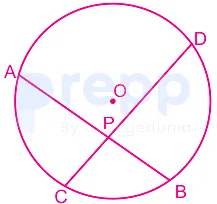
- A
12 cm
- B
11 cm
- C
22 cm
- D
14 cm
Show answer
A. 12 cmGiven:
AB = 20 cm, PB = 12 cm and CP = 8 cm
Concept used:
If two chords intersect in a circle, then the products of the measures of the segments of the chords are equal.
AE × EC = DE × EB
Calculation:
According to the concept,
AP × PB = CP × PD
⇒ (AB - PB) × 12 = 8 × PD
⇒ (20 - 12) × 12 = 8 × PD
⇒ 8× 12 = 8 × PD
⇒ PD = 12
∴ The measure of PD is 12 cm.
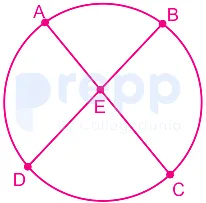
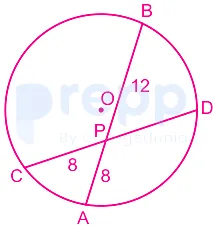 Paper & answer key PDF ↗
 Question 53archived
A dealer buys an article listed at Rs. 3,000 and gets successive discounts of 15% and 15%. He spends Rs. 250 on transportation and sells it at a profit of 20%. Find the selling price of the article.
- A
Rs. 3,300
- B
Rs. 2,901
- C
Rs. 3,250
- D
Rs. 3,200
Show answer
B. Rs. 2,901Calculating Selling Price After Discounts and Profit
The problem involves calculating the final selling price of an article for a dealer who purchases it at a discount, incurs transportation costs, and then sells it at a profit.
Understanding the Dealer's Purchase Price
The article is listed at Rs. 3,000. The dealer receives two successive discounts of 15%.
First, let's calculate the price after the first 15% discount:
Price after first discount = Listed Price - 15% of Listed Price
Price after first discount = $\text{Rs. } 3000 - 0.15 \times \text{Rs. } 3000$
Price after first discount = $\text{Rs. } 3000 - \text{Rs. } 450$
Price after first discount = $\text{Rs. } 2550$
Now, the second 15% discount is applied to the price after the first discount (Rs. 2550). This is the nature of successive discounts.
Price after second discount = Price after first discount - 15% of Price after first discount
Price after second discount = $\text{Rs. } 2550 - 0.15 \times \text{Rs. } 2550$
Price after second discount = $\text{Rs. } 2550 - \text{Rs. } 382.50$
Price after second discount = $\text{Rs. } 2167.50$
This price, Rs. 2167.50, is the price at which the dealer buys the article.
Calculating the Total Cost Price for the Dealer
The dealer also spends Rs. 250 on transportation. This transportation cost is added to the purchase price to find the total cost price for the dealer.
Total Cost Price = Purchase Price + Transportation Cost
Total Cost Price = $\text{Rs. } 2167.50 + \text{Rs. } 250$
Total Cost Price = $\text{Rs. } 2417.50$
This is the total amount the dealer has spent on the article before selling it.
Calculating the Profit and Selling Price
The dealer sells the article at a profit of 20%. The profit is calculated on the total cost price.
Profit Amount = 20% of Total Cost Price
Profit Amount = $0.20 \times \text{Rs. } 2417.50$
Profit Amount = $\text{Rs. } 483.50$
The selling price is the total cost price plus the profit amount.
Selling Price = Total Cost Price + Profit Amount
Selling Price = $\text{Rs. } 2417.50 + \text{Rs. } 483.50$
Selling Price = $\text{Rs. } 2901.00$
Thus, the selling price of the article is Rs. 2901.
Item
Amount (Rs.)
Listed Price
3000.00
Price after 1st 15% discount
2550.00
Price after 2nd 15% discount (Purchase Price)
2167.50
Transportation Cost
250.00
Total Cost Price
2417.50
Profit (20% of Total Cost Price)
483.50
Selling Price
2901.00
Summary of Calculations
Here is a summary of the steps taken to find the selling price:
Started with the listed price.
Applied the first successive discount.
Applied the second successive discount on the reduced price to find the purchase price.
Added transportation cost to find the total cost price.
Calculated the profit based on the total cost price.
Added the profit to the total cost price to find the final selling price.
Revision Table: Successive Discounts and Profit Calculation
Concept
Description
Formula Example
Successive Discounts
Applying discounts one after another on the reduced price.
Price after discounts = Listed Price $\times (1 - d_1) \times (1 - d_2)$
Total Cost Price
The total expenditure by the buyer (dealer), including purchase price and additional costs like transportation.
Total Cost Price = Purchase Price + Expenses
Profit
The gain made when selling price is more than cost price, usually calculated as a percentage of cost price.
Profit Amount = Profit % $\times$ Cost Price
Selling Price
The price at which the article is sold.
Selling Price = Cost Price + Profit Amount
Additional Information: Discounts and Profit Margin
Understanding discounts and profit is crucial in business mathematics. A discount reduces the price for the buyer, while profit is the gain for the seller.
Discounts: Discounts are often given on the marked price or list price. Successive discounts are not simply added together (e.g., two 15% discounts are not equal to one 30% discount). Each discount is applied to the price remaining after the previous discount.
Cost Price: This is the actual price paid by the seller for the goods, including any additional costs incurred to make the goods ready for sale (like transportation, packaging, etc.).
Selling Price: This is the price at which the seller sells the goods to the customer.
Profit/Loss: If the selling price is greater than the cost price, there is a profit. If the selling price is less than the cost price, there is a loss. Profit or loss is usually calculated as a percentage of the cost price.
Profit Percentage: $\text{Profit } \% = \left( \frac{\text{Profit Amount}}{\text{Cost Price}} \right) \times 100$
These concepts help determine the financial outcome of buying and selling transactions.
Paper & answer key PDF ↗ Question 54archived
In a linear race of 1000 m, A beats B by 50 m or 5 seconds. What is the difference between the speeds (in m/s) of A and B?
- A
\(1 {10 \over 19}\)
- B
\({10 \over 19}\)
- C
\({9 \over 19}\)
- D
\({9 \over 10}\)
Show answer
B. \({10 \over 19}\)Solving the Linear Race Speed Difference Problem
This problem involves understanding the relationship between distance, speed, and time in a linear race scenario where one participant beats another by both a distance and a time margin. We are given the total race distance, the distance difference, and the time difference between the two runners, A and B.
Understanding the Problem Statement
In a 1000 m linear race:
A covers 1000 m.
A beats B by 50 m. This means when A finishes the 1000 m, B is still 50 m away from the finish line, having covered \(1000 - 50 = 950\) m.
A beats B by 5 seconds. This means A finishes the race 5 seconds earlier than B. If \(T_A\) is the time taken by A and \(T_B\) is the time taken by B, then \(T_B - T_A = 5\) seconds.
We need to find the difference between the speeds of A and B in m/s, i.e., \(v_A - v_B\).
Relating Distance and Time Beats
When A finishes the race in time \(T_A\), B has covered 950 m. The remaining 50 m distance for B is covered in the time difference of 5 seconds. This is a crucial piece of information.
The speed of B (\(v_B\)) is the distance B covers divided by the time taken. The distance B failed to cover when A finished is 50 m, and B takes 5 seconds to cover this distance to complete the full 1000m.
So, the speed of B can be calculated directly:
$$v_B = \frac{\text{Distance B covers in the time difference}}{\text{Time difference}}$$
$$v_B = \frac{50 \text{ m}}{5 \text{ s}}$$
$$v_B = 10 \text{ m/s}$$
Calculating A's Speed
Now that we have B's speed, we can find A's speed using the distance relationship when A finishes the race.
In time \(T_A\), A covers 1000 m and B covers 950 m.
Let \(v_A\) be the speed of A. The time taken by A is \(T_A = \frac{1000}{v_A}\).
In this same time \(T_A\), B covers 950 m with speed \(v_B\). So, \(950 = v_B \times T_A\).
Substitute \(v_B = 10\) m/s into this equation:
$$950 = 10 \times T_A$$
$$T_A = \frac{950}{10} = 95 \text{ seconds}$$
Now use \(T_A\) to find \(v_A\) from A's distance:
$$1000 = v_A \times T_A$$
$$1000 = v_A \times 95$$
$$v_A = \frac{1000}{95} \text{ m/s}$$
Simplify the fraction for \(v_A\):
$$v_A = \frac{200 \times 5}{19 \times 5} = \frac{200}{19} \text{ m/s}$$
Calculating the Difference in Speeds
The difference between the speeds of A and B is \(v_A - v_B\).
$$v_A - v_B = \frac{200}{19} - 10$$
To subtract, find a common denominator, which is 19:
$$10 = \frac{10 \times 19}{19} = \frac{190}{19}$$
$$v_A - v_B = \frac{200}{19} - \frac{190}{19}$$
$$v_A - v_B = \frac{200 - 190}{19}$$
$$v_A - v_B = \frac{10}{19} \text{ m/s}$$
Verification
Let's verify the time difference:
\(T_A = 95\) seconds.
\(T_B = \frac{1000}{v_B} = \frac{1000}{10} = 100\) seconds.
\(T_B - T_A = 100 - 95 = 5\) seconds. This matches the problem statement.
Let's verify the distance difference:
In time \(T_A = 95\) seconds, A covers 1000 m.
In time \(T_A = 95\) seconds, B covers distance \(d_B = v_B \times T_A = 10 \times 95 = 950\) m.
The distance A beats B by is \(1000 - 950 = 50\) m. This also matches the problem statement.
The calculated speed difference is \(\frac{10}{19}\) m/s.
Metric
A
B
Distance covered
1000 m
950 m (when A finishes)
Time taken
95 s
100 s
Speed
\(\frac{1000}{95} = \frac{200}{19}\) m/s
\(\frac{1000}{100} = 10\) m/s
Speed Difference (\(v_A - v_B\))
\(\frac{200}{19} - 10 = \frac{200-190}{19} = \frac{10}{19}\) m/s
Conclusion on Speed Difference
The difference between the speeds of A and B is \(\frac{10}{19}\) m/s.
Revision Table: Linear Race Concepts
Concept
Formula
Notes
Speed
\(v = \frac{d}{t}\)
Distance per unit time
Time
\(t = \frac{d}{v}\)
Time taken to cover a distance
Distance
\(d = v \times t\)
Distance covered in a given time
A beats B by 'x' meters
When A runs D, B runs D-x
This implies they run for the same amount of time.
A beats B by 't' seconds
\(T_B - T_A = t\)
The difference in time taken to complete the race.
Additional Information: Relative Speed in Races
In linear races, the concept of relative speed can also be useful. When A beats B by a certain distance, it implies that in the time the winner takes to finish, the loser is still behind by that distance. The difference in distance covered in the same amount of time by A and B is a result of their relative speed.
The fact that B covers the trailing distance (50m) in the time difference (5s) gives us B's speed directly. This is a common shortcut in race problems where both distance and time beats are given.
Understanding how distance and time beats relate to each runner's speed is key to solving these types of quantitative aptitude problems.
Paper & answer key PDF ↗ Question 55archived
The table given below shows the cost price and selling price of 5 different articles.
Article
Cost price
Selling price
A1
350
450
A2
550
550
A3
450
650
A4
250
550
A5
150
650
What is the ratio of cost price of A1 to the selling price of A4?
- A
1 ∶ 2
- B
1 ∶ 3
- C
7 ∶ 5
- D
7 ∶ 11
Show answer
D. 7 ∶ 11Analysis of Article Prices and Ratios
The question asks us to find the ratio of the cost price of Article A1 to the selling price of Article A4 using the data provided in the table.
Understanding the Table Data
The table gives us the cost price and selling price for five different articles, labeled A1 through A5.
Article
Cost price
Selling price
A1
1350
450
A2
550
550
A3
450
650
A4
250
550
A5
150
650
Identifying the Required Values
From the question, we need two specific values from this table:
The cost price of Article A1.
The selling price of Article A4.
Looking at the table, we find:
Cost price of A1 = 1350
Selling price of A4 = 550
Calculating the Ratio
A ratio is a comparison of two quantities by division. The ratio of the cost price of A1 to the selling price of A4 is written as:
\text{Ratio} = \frac{\text{Cost price of A1}}{\text{Selling price of A4}}
Substituting the values we found:
\text{Ratio} = \frac{1350}{550}
To express this ratio in its simplest form, we need to divide both the numerator (1350) and the denominator (550) by their greatest common divisor. We can simplify this fraction step by step.
First, we can divide both numbers by 10 (since they both end in 0):
\frac{1350}{550} = \frac{1350 \div 10}{550 \div 10} = \frac{135}{55}
Next, we see that both 135 and 55 are divisible by 5:
\frac{135}{55} = \frac{135 \div 5}{55 \div 5} = \frac{27}{11}
So, the calculated ratio of the cost price of A1 to the selling price of A4 is 27:11.
Comparing with Options and Finding the Answer
The question asks for this ratio and provides multiple options.
Our calculation based on the table gives the ratio as 27:11.
We are given that the correct answer option text is <p>7<span> ∶ </span>11</p>, which represents the ratio 7:11.
Therefore, the answer corresponds to the option showing the ratio 7:11.
Revision Table: Key Terms in Pricing and Ratios
Term
Definition
Cost Price (CP)
The initial cost to acquire or produce an article.
Selling Price (SP)
The price at which an article is sold to customers.
Ratio
A comparison between two numbers indicating how many times the first number contains the second or how much of one quantity there is per unit of another quantity.
Additional Information: Ratio Concepts
A ratio is a way to compare two or more quantities. It tells us the relative sizes of the quantities being compared.
Ratios can be written as:
\(\text{a:b}\) (read as "a to b")
\(\frac{\text{a}}{\text{b}}\) (as a fraction)
It is common practice to simplify ratios to their lowest terms, just like simplifying fractions. This is done by dividing both numbers in the ratio by their greatest common divisor (GCD). For example, the ratio 10:15 can be simplified by dividing both numbers by their GCD, which is 5. So, 10 \(\div\) 5 = 2 and 15 \(\div\) 5 = 3, giving the simplified ratio 2:3.
Ratios are unitless if the quantities being compared have the same units (like cost price compared to selling price, both in currency units). They are very useful for scaling quantities proportionally.
Paper & answer key PDF ↗ Question 56archived
The selling price of 28 items is equal to the cost price of 17 items. What is the percentage of profit or loss?
- A
\(39{2 \over7}\)% loss
- B
\(39{2 \over7}\)% profit
- C
\(33{2 \over7}\)% profit
- D
\(33{2 \over7}\)% loss
Show answer
A. \(39{2 \over7}\)% lossUnderstanding the Profit and Loss Problem
This question asks us to determine the percentage of profit or loss when the selling price of a certain number of items is equal to the cost price of a different number of items. Specifically, we are given that the selling price (SP) of 28 items is equal to the cost price (CP) of 17 items. We need to calculate the resulting percentage profit or loss.
Setting up the Relationship between Selling Price and Cost Price
Let the selling price of one item be \(SP\) and the cost price of one item be \(CP\).
According to the problem statement, the total selling price of 28 items is equal to the total cost price of 17 items.
We can write this relationship as an equation:
\(28 \times SP = 17 \times CP\)
From this equation, we can find the ratio of the selling price of one item to the cost price of one item:
\(\frac{SP}{CP} = \frac{17}{28}\)
Determining if it's Profit or Loss
The ratio \(\frac{SP}{CP} = \frac{17}{28}\) tells us that the selling price of an item is \(\frac{17}{28}\) times its cost price. Since the numerator (17) is less than the denominator (28), the selling price (\(SP\)) is less than the cost price (\(CP\)).
When the selling price is less than the cost price, there is a loss.
Calculating the Loss Percentage
The formula for calculating the loss percentage is:
Loss Percentage = \(\frac{Loss}{Cost Price} \times 100\)
The loss on one item is given by \(Loss = CP - SP\).
So, the loss percentage is:
Loss Percentage = \(\frac{CP - SP}{CP} \times 100\)
We can rewrite \(\frac{CP - SP}{CP}\) as \(1 - \frac{SP}{CP}\).
Substitute the ratio \(\frac{SP}{CP} = \frac{17}{28}\) into the formula:
Loss Percentage = \(\left(1 - \frac{17}{28}\right) \times 100\)
Loss Percentage = \(\left(\frac{28 - 17}{28}\right) \times 100\)
Loss Percentage = \(\left(\frac{11}{28}\right) \times 100\)
Loss Percentage = \(\frac{1100}{28}\)
Now, we simplify the fraction:
\(\frac{1100}{28} = \frac{550}{14} = \frac{275}{7}\)
To express this as a mixed fraction, we divide 275 by 7:
\(275 \div 7\)
\(275 = 7 \times 39 + 2\)
So, \(\frac{275}{7} = 39 \frac{2}{7}\).
Therefore, the loss percentage is \(39 \frac{2}{7}\)%.
Since we determined that there is a loss, the result is a loss percentage.
Summary of Calculation Steps
Set up the equation based on the given information: \(28 \times SP = 17 \times CP\).
Find the ratio of SP to CP: \(\frac{SP}{CP} = \frac{17}{28}\).
Compare SP and CP. Since \(SP < CP\), conclude it is a loss.
Use the loss percentage formula: Loss Percentage = \(\frac{CP - SP}{CP} \times 100\) or \(\left(1 - \frac{SP}{CP}\right) \times 100\).
Substitute the ratio: Loss Percentage = \(\left(1 - \frac{17}{28}\right) \times 100\).
Calculate the percentage: \(\frac{11}{28} \times 100 = \frac{1100}{28} = \frac{275}{7}\).
Convert the fraction to a mixed number: \(\frac{275}{7} = 39 \frac{2}{7}\).
State the final answer with the correct type (profit or loss).
Calculation Summary
Concept
Value/Formula
Given Relation
\(28 \times SP = 17 \times CP\)
SP/CP Ratio
\(\frac{SP}{CP} = \frac{17}{28}\)
Outcome
Loss (since \(SP < CP\))
Loss Percentage Formula
\(\frac{CP - SP}{CP} \times 100\)
Calculation
\(\left(1 - \frac{17}{28}\right) \times 100 = \frac{11}{28} \times 100\)
Result
\(\frac{1100}{28} = \frac{275}{7} = 39\frac{2}{7}\)%
Revision Table: Key Concepts
Revision: Profit and Loss Basics
Term
Definition
Condition
Cost Price (CP)
The price at which an item is bought.
-
Selling Price (SP)
The price at which an item is sold.
-
Profit
The gain made from selling.
\(SP > CP\)
Loss
The amount lost from selling.
\(SP < CP\)
Profit %
\(\frac{Profit}{CP} \times 100\)
-
Loss %
\(\frac{Loss}{CP} \times 100\)
-
Additional Information on Profit and Loss Calculations
Profit and loss calculations are fundamental in business mathematics. They help determine the financial outcome of transactions.
Base for Percentage: Profit or loss percentage is almost always calculated on the Cost Price, unless specifically mentioned otherwise.
Formula Derivation:
If \(SP > CP\), Profit = \(SP - CP\). Profit % = \(\frac{SP-CP}{CP} \times 100\).
If \(SP < CP\), Loss = \(CP - SP\). Loss % = \(\frac{CP-SP}{CP} \times 100\).
Direct Ratio Method: As shown in the solution, comparing the ratio \(\frac{SP}{CP}\) directly indicates profit or loss. If \(\frac{SP}{CP} > 1\), it's a profit. If \(\frac{SP}{CP} < 1\), it's a loss. The percentage difference from 1 (multiplied by 100) gives the profit or loss percentage.
In problems where the SP of 'x' items equals the CP of 'y' items (i.e., \(x \times SP = y \times CP\)), the ratio \(\frac{SP}{CP} = \frac{y}{x}\).
If \(y > x\), then \(SP > CP\), resulting in a profit.
If \(y < x\), then \(SP < CP\), resulting in a loss.
The percentage is \(\left| \frac{y-x}{x} \right| \times 100\). In our case, \(y=17\) and \(x=28\), so \(\left| \frac{17-28}{28} \right| \times 100 = \left| \frac{-11}{28} \right| \times 100 = \frac{11}{28} \times 100\), which is a loss because \(y < x\).
Paper & answer key PDF ↗ Question 57archived
If the price of petrol is increased by 28%, by what percentage should the consumption be decreased by the consumer, if the expenditure on petrol remains unchanged?
(Correct to 2 decimal places)
- A
12.35%
- B
21.88%
- C
20.25%
- D
25.75%
Show answer
B. 21.88%Understanding the Problem: Petrol Price and Consumption
This problem involves calculating the required percentage decrease in petrol consumption when the price of petrol increases, such that the total expenditure on petrol remains constant. The relationship between expenditure, price, and consumption is fundamental:
\(\text{Expenditure} = \text{Price} \times \text{Consumption}\)
If the expenditure needs to stay the same despite a change in price, the consumption must change inversely. This means if the price goes up, consumption must come down proportionally to keep the product (expenditure) constant.
Step-by-Step Solution for Constant Expenditure
Let's denote the original price of petrol as \(P_1\) and the original consumption as \(C_1\). The original expenditure is \(E_1\).
\(E_1 = P_1 \times C_1\)
The price of petrol is increased by 28%. Let the new price be \(P_2\). The increase is 28% of \(P_1\), which is \(0.28 P_1\).
\(P_2 = P_1 + 0.28 P_1 = P_1 (1 + 0.28) = 1.28 P_1\)
Let the new consumption be \(C_2\). The new expenditure is \(E_2\).
\(E_2 = P_2 \times C_2\)
According to the question, the expenditure remains unchanged, meaning \(E_2 = E_1\).
So, we have:
\(P_2 \times C_2 = P_1 \times C_1\)
Substitute the expression for \(P_2\):
\((1.28 P_1) \times C_2 = P_1 \times C_1\)
Assuming \(P_1\) is not zero, we can divide both sides by \(P_1\):
\(1.28 \times C_2 = C_1\)
Now, we need to find the percentage decrease in consumption. First, let's express \(C_2\) in terms of \(C_1\):
\(C_2 = \frac{C_1}{1.28}\)
The decrease in consumption is the original consumption minus the new consumption:
\(\text{Decrease in consumption} = C_1 - C_2\)
Substitute the value of \(C_2\):
\(\text{Decrease in consumption} = C_1 - \frac{C_1}{1.28}\)
Factor out \(C_1\):
\(\text{Decrease in consumption} = C_1 \left(1 - \frac{1}{1.28}\right)\)
To find the percentage decrease, we divide the decrease in consumption by the original consumption and multiply by 100:
\(\text{Percentage decrease} = \frac{C_1 \left(1 - \frac{1}{1.28}\right)}{C_1} \times 100\)
Cancel out \(C_1\):
\(\text{Percentage decrease} = \left(1 - \frac{1}{1.28}\right) \times 100\)
Let's calculate the value inside the parenthesis:
\(1 - \frac{1}{1.28} = 1 - \frac{100}{128}\)
Simplify the fraction \(\frac{100}{128}\) by dividing the numerator and denominator by their greatest common divisor (which is 4):
\(\frac{100}{128} = \frac{100 \div 4}{128 \div 4} = \frac{25}{32}\)
So, the expression becomes:
\(\text{Percentage decrease} = \left(1 - \frac{25}{32}\right) \times 100\)
Combine the terms inside the parenthesis:
\(1 - \frac{25}{32} = \frac{32}{32} - \frac{25}{32} = \frac{32 - 25}{32} = \frac{7}{32}\)
Now, multiply by 100:
\(\text{Percentage decrease} = \frac{7}{32} \times 100\)
Perform the division:
\(\frac{7}{32} = 0.21875\)
Multiply by 100:
\(0.21875 \times 100 = 21.875\)
The question asks for the answer correct to 2 decimal places. Rounding 21.875 to two decimal places gives 21.88%.
Summary of Calculation
Initial Price: \(P_1\)
New Price: \(P_2 = P_1 \times (1 + 0.28) = 1.28 P_1\)
Initial Consumption: \(C_1\)
New Consumption: \(C_2\)
Expenditure is constant: \(P_2 \times C_2 = P_1 \times C_1\)
\(1.28 C_2 = C_1 \Rightarrow C_2 = \frac{C_1}{1.28}\)
Percentage Decrease in Consumption \( = \left(\frac{C_1 - C_2}{C_1}\right) \times 100 \)
\( = \left(\frac{C_1 - \frac{C_1}{1.28}}{C_1}\right) \times 100 \)
\( = \left(1 - \frac{1}{1.28}\right) \times 100 \)
\( = \left(\frac{1.28 - 1}{1.28}\right) \times 100 \)
\( = \left(\frac{0.28}{1.28}\right) \times 100 \)
\( = \frac{28}{128} \times 100 \)
\( = \frac{7}{32} \times 100 \)
\( = 0.21875 \times 100 = 21.875\)
Rounded to 2 decimal places, this is 21.88%.
Step
Description
Calculation
1
Original Relation
\(E = P_1 \times C_1\)
2
New Price after 28% Increase
\(P_2 = 1.28 P_1\)
3
New Relation with Constant Expenditure
\(P_2 \times C_2 = P_1 \times C_1\)
4
Substitute \(P_2\) and Solve for \(C_2\)
\(1.28 C_2 = C_1 \Rightarrow C_2 = \frac{C_1}{1.28}\)
5
Calculate Percentage Decrease
\(\left(\frac{C_1 - C_2}{C_1}\right) \times 100 = \left(\frac{C_1 - \frac{C_1}{1.28}}{C_1}\right) \times 100\)
6
Simplify and Calculate Value
\(\left(1 - \frac{1}{1.28}\right) \times 100 = \frac{0.28}{1.28} \times 100 = \frac{28}{128} \times 100 = 21.875\)
7
Rounding
21.88% (to 2 decimal places)
Revision Table: Key Concepts
Concept
Explanation
Formula
Expenditure
Total money spent on a commodity.
Price × Consumption
Percentage Increase
Increase relative to the original value, expressed as a percentage.
\(\frac{\text{New Value} - \text{Original Value}}{\text{Original Value}} \times 100\)
Percentage Decrease
Decrease relative to the original value, expressed as a percentage.
\(\frac{\text{Original Value} - \text{New Value}}{\text{Original Value}} \times 100\)
Constant Expenditure
Total spending remains the same despite changes in price or quantity.
\(P_1 C_1 = P_2 C_2\)
Inverse Proportionality
When two quantities' product is constant, they are inversely proportional (as one increases, the other decreases).
If \(XY = k\) (constant), then \(X \propto \frac{1}{Y}\)
Additional Information: Shortcut Formula for Constant Expenditure
When the price of a commodity increases by \(x\%\) and the expenditure is to remain constant, the consumption must be decreased by a certain percentage. A shortcut formula can be derived for this scenario.
Let the original price be \(P\) and consumption be \(C\). Original expenditure \(E = PC\).
New price \(P' = P \left(1 + \frac{x}{100}\right)\).
Let the new consumption be \(C'\). New expenditure \(E' = P'C'\).
For constant expenditure, \(E' = E\):
\(P'C' = PC\)
\(P \left(1 + \frac{x}{100}\right) C' = PC\)
\(\left(1 + \frac{x}{100}\right) C' = C\)
\(C' = \frac{C}{1 + \frac{x}{100}} = \frac{100C}{100 + x}\)
The percentage decrease in consumption is \(\left(\frac{C - C'}{C}\right) \times 100\):
\(\text{Percentage decrease} = \left(\frac{C - \frac{100C}{100 + x}}{C}\right) \times 100\)
\( = \left(1 - \frac{100}{100 + x}\right) \times 100 \)
\( = \left(\frac{100 + x - 100}{100 + x}\right) \times 100 \)
\( = \left(\frac{x}{100 + x}\right) \times 100\)
Using this formula for the given problem where \(x = 28\):
\(\text{Percentage decrease} = \left(\frac{28}{100 + 28}\right) \times 100\)
\( = \left(\frac{28}{128}\right) \times 100\)
\( = \frac{7}{32} \times 100\)
\( = 21.875\%\)
Rounded to two decimal places, this is 21.88%.
This formula is useful for quickly solving problems of this type.
Paper & answer key PDF ↗ Question 58archived
A sum of money amounts to Rs. 767 in 3 years, and to Rs. 806 in 4 years on simple interest at 6% annum. What is the sum?
- A
Rs. 600
- B
Rs. 560
- C
Rs. 675
- D
Rs. 650
Show answer
D. Rs. 650Understanding the Simple Interest Problem
This problem involves calculating the original sum of money (the principal) based on the amounts it grows to after different periods when earning simple interest at a fixed rate. Simple interest means that the interest earned each year is calculated only on the initial principal amount.
We are given two pieces of information:
The sum amounts to Rs. 767 in 3 years. This is the principal plus 3 years of simple interest.
The sum amounts to Rs. 806 in 4 years. This is the principal plus 4 years of simple interest.
The simple interest rate is 6% per annum.
Our goal is to find the initial sum of money, which is the principal amount.
Calculating the Annual Simple Interest
Since the interest is simple, the amount of interest earned each year is constant. The difference between the amount after 4 years and the amount after 3 years represents the simple interest earned during the 4th year (from the end of the 3rd year to the end of the 4th year).
Let \(A_3\) be the amount after 3 years and \(A_4\) be the amount after 4 years.
Simple Interest for 1 year = Amount after 4 years - Amount after 3 years
Simple Interest for 1 year \( = A_4 - A_3 \)
Given:
\(A_3 = \text{Rs. } 767\)
\(A_4 = \text{Rs. } 806\)
Calculating the simple interest for 1 year:
\( \text{Simple Interest for 1 year} = 806 - 767 = 39 \)
So, the simple interest earned each year is Rs. 39.
Finding the Total Simple Interest for 3 Years
Since the simple interest per year is Rs. 39, the total simple interest earned over 3 years is:
Total Simple Interest for 3 years = Simple Interest per year \(\times\) Number of years
Total Simple Interest for 3 years \( = 39 \times 3 = 117 \)
The total simple interest earned in 3 years is Rs. 117.
Determining the Principal Sum
The amount after 3 years is the sum of the original principal and the total simple interest earned over 3 years.
Amount after 3 years = Principal + Total Simple Interest for 3 years
\( A_3 = \text{Principal} + \text{Total Simple Interest for 3 years} \)
We know \(A_3 = 767\) and Total Simple Interest for 3 years \( = 117 \).
So, \( 767 = \text{Principal} + 117 \)
To find the Principal, we rearrange the equation:
\( \text{Principal} = 767 - 117 \)
\( \text{Principal} = 650 \)
The original sum of money (the principal) is Rs. 650.
Verification (Optional)
We can verify this using the amount after 4 years. The total simple interest for 4 years is \( 39 \times 4 = 156 \). The amount after 4 years would be Principal + Total Simple Interest for 4 years \( = 650 + 156 = 806 \), which matches the given information. We can also check if the simple interest rate matches. Simple Interest for 1 year is Rs. 39 on a principal of Rs. 650. Rate \( = \frac{\text{Simple Interest}}{\text{Principal}} \times 100 = \frac{39}{650} \times 100 = \frac{3900}{650} = \frac{390}{65} = 6 \% \). This also matches the given rate.
Calculation Breakdown
Amount after 4 years
Rs. 806
Amount after 3 years
Rs. 767
Simple Interest for 1 year (806 - 767)
Rs. 39
Total Simple Interest for 3 years (39 × 3)
Rs. 117
Principal (Amount after 3 years - SI for 3 years) (767 - 117)
Rs. 650
Revision Table: Key Concepts in Simple Interest
Term
Description
Formula Relationship
Principal (P)
The initial sum of money invested or borrowed.
\( \text{Amount} = P + \text{SI} \)
Amount (A)
The total sum after adding the simple interest to the principal.
\( A = P + \text{SI} \)
Simple Interest (SI)
Interest calculated only on the principal amount.
\( \text{SI} = \frac{P \times R \times T}{100} \)
Rate (R)
The annual rate of interest (as a percentage).
Used in SI calculation.
Time (T)
The duration for which the money is invested or borrowed (in years).
Used in SI calculation.
Additional Information on Simple Interest
Simple interest is a basic concept in finance. It is calculated based on the principal amount, the interest rate, and the time period. Unlike compound interest, simple interest does not add the earned interest back to the principal to calculate future interest. This makes simple interest calculations straightforward.
The formula for simple interest is \( \text{SI} = \frac{P \times R \times T}{100} \), where P is Principal, R is Rate per annum, and T is Time in years.
The Amount (A) after T years is \( A = P + \text{SI} \). Substituting the SI formula, we get \( A = P + \frac{P \times R \times T}{100} = P \left(1 + \frac{R \times T}{100}\right) \).
In problems like this, where amounts after consecutive years are given, the difference between the amounts is the simple interest for one year. This is a key property of simple interest that simplifies calculations significantly.
Simple interest is often used for short-term loans or for basic savings accounts.
By understanding these fundamental concepts and the relationship between principal, amount, and simple interest, you can solve various simple interest problems efficiently.
Paper & answer key PDF ↗ Question 59archived
Study the given pie-chart and answer the question that follows.
The pie-chart represents the spending of a state on various sports during a particular year.
How much percent more is spent on cricket than on tennis (correct up to 2 decimal places)?
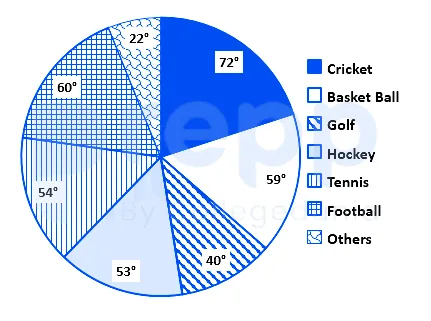
- A
33.33%
- B
32.75%
- C
30.35%
- D
28.25%
Show answer
A. 33.33%Calculation:
Amount spent for cricket in degree = 72°
Amount spent for tennis in degree = 54°
Difference = 72° - 54°
⇒ 18°
Required % = (18°/54°) × 100
⇒ 33.33%
∴ The required answer is 33.33%.
Paper & answer key PDF ↗ Question 60archived
Simplify the following.
cot 13° cot 27° cot 45° cot 63° cot 77° = ?
- A
1
- B
√3
- C
2
- D
√2
Show answer
A. 1Understanding the Trigonometry Problem
The question asks us to simplify a product of five cotangent terms: $\cot 13^\circ$, $\cot 27^\circ$, $\cot 45^\circ$, $\cot 63^\circ$, and $\cot 77^\circ$. To simplify this expression, we need to use fundamental trigonometric identities and properties of angles.
Key Trigonometric Concepts
We will utilize the following trigonometric identities:
Complementary Angle Identity: $\cot (90^\circ - \theta) = \tan \theta$
Reciprocal Identity: $\tan \theta = \frac{1}{\cot \theta}$ or $\cot \theta = \frac{1}{\tan \theta}$
Product Identity: $\tan \theta \cdot \cot \theta = 1$
Specific Value: $\cot 45^\circ = 1$
Step-by-Step Simplification Process
Let's analyze the given expression:
Expression = $\cot 13^\circ \cot 27^\circ \cot 45^\circ \cot 63^\circ \cot 77^\circ$
We can look for pairs of angles that are complementary (add up to $90^\circ$).
$13^\circ + 77^\circ = 90^\circ$
$27^\circ + 63^\circ = 90^\circ$
$45^\circ$ is a standard angle.
Using the complementary angle identity $\cot (90^\circ - \theta) = \tan \theta$, we can rewrite the terms involving $63^\circ$ and $77^\circ$:
$\cot 77^\circ = \cot (90^\circ - 13^\circ) = \tan 13^\circ$
$\cot 63^\circ = \cot (90^\circ - 27^\circ) = \tan 27^\circ$
Now, substitute these back into the original expression:
Expression = $\cot 13^\circ \cot 27^\circ \cot 45^\circ (\tan 27^\circ) (\tan 13^\circ)$
Rearrange the terms to group reciprocal pairs together:
Expression = $(\cot 13^\circ \tan 13^\circ) (\cot 27^\circ \tan 27^\circ) (\cot 45^\circ)$
Using the product identity $\tan \theta \cdot \cot \theta = 1$:
$\cot 13^\circ \tan 13^\circ = 1$
$\cot 27^\circ \tan 27^\circ = 1$
Substitute these values back into the expression:
Expression = $(1) \times (1) \times (\cot 45^\circ)$
Finally, substitute the known value of $\cot 45^\circ$:
$\cot 45^\circ = 1$
Expression = $1 \times 1 \times 1 = 1$
Thus, the simplified value of the given expression is 1.
Analyzing the Options
Let's compare our result with the given options:
1
$\sqrt{3}$
2
$\sqrt{2}$
Our simplified value is 1, which matches option 1.
Term
Value/Rewrite
Reason
$\cot 13^\circ$
$\cot 13^\circ$
Original term
$\cot 27^\circ$
$\cot 27^\circ$
Original term
$\cot 45^\circ$
$1$
Standard value
$\cot 63^\circ$
$\tan 27^\circ$
Complementary angle ($90^\circ - 27^\circ = 63^\circ$)
$\cot 77^\circ$
$\tan 13^\circ$
Complementary angle ($90^\circ - 13^\circ = 77^\circ$)
$(\cot 13^\circ)(\tan 13^\circ)$
$1$
$\cot \theta \tan \theta = 1$
$(\cot 27^\circ)(\tan 27^\circ)$
$1$
$\cot \theta \tan \theta = 1$
Final Product
$1 \times 1 \times 1 = 1$
Multiplying the simplified terms
Revision Table: Trigonometry Basics
Trigonometric Function
Definition (Right Triangle)
Reciprocal
Sine ($\sin \theta$)
Opposite / Hypotenuse
Cosecant ($\csc \theta$ or $\text{cosec } \theta$)
Cosine ($\cos \theta$)
Adjacent / Hypotenuse
Secant ($\sec \theta$)
Tangent ($\tan \theta$)
Opposite / Adjacent
Cotangent ($\cot \theta$)
Identity Type
Identity
Reciprocal Identities
$\sin \theta = \frac{1}{\csc \theta}$
$\cos \theta = \frac{1}{\sec \theta}$
$\tan \theta = \frac{1}{\cot \theta}$
Complementary Angle Identities
$\sin (90^\circ - \theta) = \cos \theta$
$\cos (90^\circ - \theta) = \sin \theta$
$\tan (90^\circ - \theta) = \cot \theta$
Additional Information on Complementary Angles
The concept of complementary angles is very useful in simplifying trigonometric expressions. Two angles are complementary if their sum is $90^\circ$. When we have trigonometric functions of complementary angles, there's a direct relationship between them.
For example, consider a right-angled triangle with angles $\theta$ and $90^\circ - \theta$. If one acute angle is $\theta$, the other acute angle must be $90^\circ - \theta$. The side opposite $\theta$ is adjacent to $90^\circ - \theta$, and the side adjacent to $\theta$ is opposite $90^\circ - \theta$. This relationship is what leads to identities like $\sin (90^\circ - \theta) = \cos \theta$ and $\cot (90^\circ - \theta) = \tan \theta$.
In this problem, pairing $\cot 13^\circ$ with $\cot 77^\circ$ and $\cot 27^\circ$ with $\cot 63^\circ$ was key because $13^\circ$ and $77^\circ$ are complementary, and $27^\circ$ and $63^\circ$ are complementary. This allowed us to use the $\cot (90^\circ - \theta) = \tan \theta$ identity to create reciprocal pairs ($\cot \theta \tan \theta$), which simplify to 1.
Paper & answer key PDF ↗ Question 61archived
The average of eight consecutive odd numbers is 48. Find the sum of the fifth and seventh numbers.
- A
102
- B
86
- C
89
- D
90
Show answer
A. 102Finding Consecutive Odd Numbers from Average
The problem asks us to find the sum of the fifth and seventh numbers in a sequence of eight consecutive odd numbers whose average is 48.
Understanding Consecutive Odd Numbers and Average
Consecutive odd numbers follow each other in order, with a difference of 2 between any two successive numbers (e.g., 1, 3, 5, 7...).
The average of a set of numbers is the sum of the numbers divided by the count of the numbers.
For an arithmetic progression like consecutive odd numbers, the average of an even number of terms is the average of the two middle terms.
Identifying the Middle Terms
We have eight consecutive odd numbers. Let's list them as \(n_1, n_2, n_3, n_4, n_5, n_6, n_7, n_8\).
The eight numbers have two middle terms: the 4th number (\(n_4\)) and the 5th number (\(n_5\)).
The average of these eight numbers is given as 48. Therefore, the average of the 4th and 5th numbers must be 48.
Mathematically, this can be written as:
$$ \frac{n_4 + n_5}{2} = 48 $$
Finding the Values of the Middle Terms
Since \(n_4\) and \(n_5\) are consecutive odd numbers, their difference is 2. So, we can write \(n_5 = n_4 + 2\).
Substitute this into the average equation:
$$ \frac{n_4 + (n_4 + 2)}{2} = 48 $$
$$ \frac{2n_4 + 2}{2} = 48 $$
$$ n_4 + 1 = 48 $$
$$ n_4 = 48 - 1 $$
$$ n_4 = 47 $$
Now, we can find \(n_5\):
$$ n_5 = n_4 + 2 $$
$$ n_5 = 47 + 2 $$
$$ n_5 = 49 $$
So, the 4th number is 47 and the 5th number is 49.
Finding the Fifth and Seventh Numbers
We already know the 5th number, \(n_5\), is 49.
To find the 7th number, \(n_7\), we can continue the sequence from \(n_5\):
The 6th number \(n_6\) is the consecutive odd number after \(n_5\): \(n_6 = n_5 + 2 = 49 + 2 = 51\).
The 7th number \(n_7\) is the consecutive odd number after \(n_6\): \(n_7 = n_6 + 2 = 51 + 2 = 53\).
Alternatively, since each term increases by 2, the 7th term is 2 positions after the 5th term:
$$ n_7 = n_5 + 2 \times (7-5) $$
$$ n_7 = 49 + 2 \times 2 $$
$$ n_7 = 49 + 4 $$
$$ n_7 = 53 $$
So, the 5th number is 49 and the 7th number is 53.
Calculating the Sum of the Fifth and Seventh Numbers
We need to find the sum of the 5th number (\(n_5 = 49\)) and the 7th number (\(n_7 = 53\)).
Sum = \(n_5 + n_7\)
Sum = \(49 + 53\)
Sum = \(102\)
The sum of the fifth and seventh numbers is 102.
Term Number
Value
1st (\(n_1\))
41
2nd (\(n_2\))
43
3rd (\(n_3\))
45
4th (\(n_4\))
47
5th (\(n_5\))
49
6th (\(n_6\))
51
7th (\(n_7\))
53
8th (\(n_8\))
55
Let's quickly verify the average of these numbers:
Sum = \(41+43+45+47+49+51+53+55\)
Sum = \(384\)
Average = \(\frac{384}{8} = 48\).
This matches the given average, confirming our numbers are correct.
Revision Table: Consecutive Odd Numbers and Average
Concept
Description
Consecutive Odd Numbers
Numbers in sequence that are odd and have a difference of 2 between them.
Average
Sum of terms divided by the number of terms.
Average of Even # of Consecutive Odd Numbers
The average of the two middle terms.
Additional Information: Arithmetic Progressions
A sequence of numbers where the difference between consecutive terms is constant is called an arithmetic progression (AP). Consecutive odd numbers form an AP with a common difference of 2.
If an AP has \(N\) terms and the common difference is \(d\), the average of the terms is given by:
If \(N\) is odd, the average is the middle term.
If \(N\) is even, the average is the average of the two middle terms.
In this problem, \(N=8\) (even) and \(d=2\).
Let the first term be \(a_1\). The terms are \(a_1, a_1+d, a_1+2d, ..., a_1+(N-1)d\).
The average of 8 terms is \(\frac{a_1 + (a_1+7d)}{2} = a_1 + 3.5d\).
Average = 48, \(d=2\).
\(48 = a_1 + 3.5 \times 2\)
\(48 = a_1 + 7\)
\(a_1 = 41\).
The first number is 41. The terms are \(41, 43, 45, 47, 49, 51, 53, 55\).
The 5th term is \(a_5 = a_1 + (5-1)d = 41 + 4 \times 2 = 41 + 8 = 49\).
The 7th term is \(a_7 = a_1 + (7-1)d = 41 + 6 \times 2 = 41 + 12 = 53\).
The sum of the 5th and 7th term is \(49 + 53 = 102\).
Paper & answer key PDF ↗ Question 62archived
The sides of a triangle are in the ratio \(1 \over3\) ∶ \(1 \over5\) ∶ \(1 \over6\). If the perimeter is 147 cm, then the length of the smallest side is ________.
- A
12 cm
- B
25 cm
- C
30 cm
- D
35 cm
Show answer
D. 35 cmUnderstanding the Triangle Sides Ratio Problem
The problem provides the ratio of the sides of a triangle and its total perimeter. We are asked to find the length of the smallest side of this triangle.
The sides are in the ratio \( \frac{1}{3} \ratio \frac{1}{5} \ratio \frac{1}{6} \).
The perimeter of the triangle is 147 cm.
Converting the Ratio to Integers
To work with the ratio easily, we first need to convert the fractional ratio into a ratio of whole numbers. We can do this by finding the Least Common Multiple (LCM) of the denominators (3, 5, and 6) and multiplying each part of the ratio by the LCM.
The denominators are 3, 5, and 6.
Prime factorization of 3 is 3.
Prime factorization of 5 is 5.
Prime factorization of 6 is 2 × 3.
The LCM of 3, 5, and 6 is 2 × 3 × 5 = 30.
Now, multiply each fraction in the ratio by 30:
\(\frac{1}{3} \times 30 = \frac{30}{3} = 10\)
\(\frac{1}{5} \times 30 = \frac{30}{5} = 6\)
\(\frac{1}{6} \times 30 = \frac{30}{6} = 5\)
So, the ratio of the sides of the triangle is \(10 \ratio 6 \ratio 5\).
Setting up the Sides with a Variable
Let the lengths of the sides of the triangle be \(10x\), \(6x\), and \(5x\), where \(x\) is a common multiplier.
Using the Perimeter to Find the Value of x
The perimeter of a triangle is the sum of the lengths of its three sides. We are given that the perimeter is 147 cm.
So, we can write the equation:
\(10x + 6x + 5x = 147\)
Combine the terms on the left side:
\(21x = 147\)
Now, solve for \(x\):
\(x = \frac{147}{21}\)
To find \( \frac{147}{21} \), we can perform the division. \(147 \div 21 = 7\).
So, \(x = 7\).
Calculating the Lengths of the Sides
Now that we have the value of \(x\), we can find the actual lengths of the sides:
Side 1: \(10x = 10 \times 7 = 70\) cm
Side 2: \(6x = 6 \times 7 = 42\) cm
Side 3: \(5x = 5 \times 7 = 35\) cm
The lengths of the sides are 70 cm, 42 cm, and 35 cm.
Identifying the Smallest Side
Comparing the lengths of the three sides (70 cm, 42 cm, and 35 cm), the smallest length is 35 cm.
Conclusion
The length of the smallest side of the triangle is 35 cm.
Revision Table: Triangle Sides and Perimeter
Concept
Explanation
Ratio of Sides
Defines the proportional relationship between side lengths. Can be fractional or integer.
Converting Fractional Ratio
Multiply each term by the LCM of the denominators to get an integer ratio.
Perimeter
The total distance around the triangle, calculated by summing the lengths of its three sides.
Using a Variable (x)
Represents the common multiplier for the ratio parts to find actual lengths.
Additional Information: Triangle Properties
A triangle is a polygon with three edges and three vertices.
The sum of the interior angles of any triangle is always 180 degrees.
The Triangle Inequality Theorem states that the sum of the lengths of any two sides of a triangle must be greater than the length of the third side. In our calculated side lengths (70, 42, 35):
\(70 + 42 = 112 > 35\) (True)
\(70 + 35 = 105 > 42\) (True)
\(42 + 35 = 77 > 70\) (True)
Since all inequalities hold true, a triangle with these side lengths can exist.
Types of triangles include equilateral, isosceles, scalene, right, acute, and obtuse triangles, classified based on side lengths and angles.
Paper & answer key PDF ↗ Question 63archived
Solve the following to find its value in terms of trigonometric ratios.
(sin A + cos A)(1 – sin A cos A)
- A
sin3 A + cos3 A
- B
sin2 A - cos2 A
- C
[cos A - sin A] [sin2 A + cos2 A]
- D
sin3 A - cos3 A
Show answer
A. sin3 A + cos3 ASimplifying Trigonometric Expressions: (sin A + cos A)(1 – sin A cos A)
Let's simplify the given trigonometric expression step-by-step using fundamental algebraic and trigonometric identities. The expression we need to simplify is:
\((\sin A + \cos A)(1 - \sin A \cos A)\)
We can see that this expression resembles the factored form of the sum of cubes formula from algebra. The sum of cubes formula is given by:
\(a^3 + b^3 = (a+b)(a^2 - ab + b^2)\)
Also, we know the fundamental trigonometric identity:
\(\sin^2 A + \cos^2 A = 1\)
Let's substitute the identity \(\sin^2 A + \cos^2 A = 1\) into the algebraic sum of cubes formula. If we let \(a = \sin A\) and \(b = \cos A\), the sum of cubes \(\sin^3 A + \cos^3 A\) can be expanded as follows:
\(\sin^3 A + \cos^3 A = (\sin A + \cos A)(\sin^2 A - \sin A \cos A + \cos^2 A)\)
Now, let's rearrange the terms inside the second bracket:
\(\sin^3 A + \cos^3 A = (\sin A + \cos A)(\sin^2 A + \cos^2 A - \sin A \cos A)\)
Using the trigonometric identity \(\sin^2 A + \cos^2 A = 1\), we can replace \(\sin^2 A + \cos^2 A\) with \(1\) in the second bracket:
\(\sin^3 A + \cos^3 A = (\sin A + \cos A)(1 - \sin A \cos A)\)
Comparing this result with the original expression we were asked to simplify, we see that the expression \((\sin A + \cos A)(1 - \sin A \cos A)\) is exactly the expansion of \(\sin^3 A + \cos^3 A\).
Therefore, the simplified value of the expression \((\sin A + \cos A)(1 - \sin A \cos A)\) is \(\sin^3 A + \cos^3 A\).
Revision Table: Key Identities for Trigonometry
Here are the key identities used in solving this problem:
Sum of Cubes: \(a^3 + b^3 = (a+b)(a^2 - ab + b^2)\)
Pythagorean Identity: \(\sin^2 A + \cos^2 A = 1\)
Additional Information on Trigonometric Simplification
Simplifying trigonometric expressions often involves using fundamental identities to rewrite expressions in a simpler form. Key identities include:
Reciprocal Identities (e.g., \(\csc A = \frac{1}{\sin A}\))
Quotient Identities (e.g., \(\tan A = \frac{\sin A}{\cos A}\))
Pythagorean Identities (e.g., \(\sin^2 A + \cos^2 A = 1\), \(\sec^2 A - \tan^2 A = 1\), \(\csc^2 A - \cot^2 A = 1\))
Sum and Difference Formulas (e.g., \(\sin(A+B) = \sin A \cos B + \cos A \sin B\))
Double Angle Formulas (e.g., \(\sin 2A = 2 \sin A \cos A\))
Algebraic identities like the difference of squares (\(a^2 - b^2 = (a-b)(a+b)\)), sum/difference of cubes, and perfect squares (\((a+b)^2 = a^2 + 2ab + b^2\)) are also frequently used in conjunction with trigonometric identities to simplify complex expressions.
Paper & answer key PDF ↗ Question 64archived
The ratio of the outer and the inner circumference of a circular path is 5 ∶ 4. If path is 50 metres wide, then what is the radius of the inner circle?
- A
250 metres
- B
300 metres
- C
200 metres
- D
210 metres
Show answer
C. 200 metresUnderstanding the Circular Path Problem
This question asks us to find the radius of the inner circle of a circular path, given the ratio of the outer circumference to the inner circumference and the width of the path. A circular path implies two concentric circles – an inner circle and an outer circle. The region between these two circles is the path.
Setting Up the Equations
Let's denote the radius of the inner circle as \(r\) and the radius of the outer circle as \(R\).
The circumference of the inner circle is given by the formula \(C_{inner} = 2 \pi r\).
The circumference of the outer circle is given by the formula \(C_{outer} = 2 \pi R\).
The question states that the ratio of the outer circumference to the inner circumference is 5 ∶ 4. We can write this as an equation:
$$ \frac{C_{outer}}{C_{inner}} = \frac{2 \pi R}{2 \pi r} = \frac{5}{4} $$
Notice that \(2\pi\) cancels out, simplifying the ratio of circumferences to the ratio of radii:
$$ \frac{R}{r} = \frac{5}{4} $$
This equation tells us that the outer radius \(R\) is related to the inner radius \(r\) by \(R = \frac{5}{4}r\).
The question also provides the width of the path. The width of the circular path is the difference between the outer radius and the inner radius.
$$ \text{Width} = R - r $$
We are given that the path is 50 metres wide. So, we have a second equation:
$$ R - r = 50 $$
Solving for the Inner Radius
Now we have a system of two equations with two variables, \(R\) and \(r\):
\( R = \frac{5}{4}r \)
\( R - r = 50 \)
We can substitute the expression for \(R\) from the first equation into the second equation:
$$ \left(\frac{5}{4}r\right) - r = 50 $$
To combine the terms involving \(r\), we can find a common denominator:
$$ \frac{5}{4}r - \frac{4}{4}r = 50 $$
Subtract the fractions:
$$ \left(\frac{5-4}{4}\right)r = 50 $$
$$ \frac{1}{4}r = 50 $$
Now, solve for \(r\) by multiplying both sides of the equation by 4:
$$ r = 50 \times 4 $$
$$ r = 200 $$
The radius of the inner circle is 200 metres.
Verifying the Solution
Let's check if our answer makes sense with the given information.
If \(r = 200\) metres, then \(R = \frac{5}{4} \times 200 = 5 \times 50 = 250\) metres.
The path width is \(R - r = 250 - 200 = 50\) metres, which matches the given width.
The ratio of circumferences is \(\frac{2 \pi R}{2 \pi r} = \frac{R}{r} = \frac{250}{200} = \frac{25}{20} = \frac{5}{4}\), which matches the given ratio.
The calculated inner radius of 200 metres satisfies all the conditions given in the problem.
Parameter
Value
Ratio of Outer to Inner Circumference (\(C_{outer}/C_{inner}\))
5/4
Path Width (\(R - r\))
50 metres
Calculated Inner Radius (\(r\))
200 metres
Calculated Outer Radius (\(R\))
250 metres
Revision Table: Circular Path Geometry
Concept
Formula
Description
Circumference of a Circle
\(C = 2 \pi r\) or \(C = \pi d\)
The distance around the circle, where \(r\) is the radius and \(d\) is the diameter.
Area of a Circle
\(A = \pi r^2\)
The space enclosed by the circle.
Circular Path Width
\(W = R - r\)
The distance between the outer and inner circles in a concentric circular path.
Area of Circular Path (Annulus)
\(A_{path} = \pi R^2 - \pi r^2 = \pi (R^2 - r^2)\)
The area of the region between the two concentric circles.
Additional Information: Properties of Concentric Circles
Concentric circles are circles that share the same center point. In problems involving circular paths, tracks, or rings, we often deal with concentric circles.
The distance from the center to any point on the inner circle's edge is the inner radius (\(r\)).
The distance from the center to any point on the outer circle's edge is the outer radius (\(R\)).
The width of the path is the constant distance between the inner and outer circles, which is \(R - r\).
The ratio of the circumferences of two concentric circles is equal to the ratio of their radii: \(\frac{C_{outer}}{C_{inner}} = \frac{2 \pi R}{2 \pi r} = \frac{R}{r}\).
Similarly, the ratio of the areas of two concentric circles is equal to the square of the ratio of their radii: \(\frac{A_{outer}}{A_{inner}} = \frac{\pi R^2}{\pi r^2} = \left(\frac{R}{r}\right)^2\).
These relationships are fundamental when solving geometry problems involving circular rings or paths.
Paper & answer key PDF ↗ Question 65archived
If 2a + 3b = 10 and ab = 3, then find the value of 4a2 + 9b2.
- A
60
- B
62
- C
64
- D
66
Show answer
C. 64Solving Algebraic Expressions: Finding the Value of 4a² + 9b²
We are given two equations involving variables 'a' and 'b':
Equation 1: \(2a + 3b = 10\)
Equation 2: \(ab = 3\)
We need to find the value of the expression \(4a^2 + 9b^2\).
Let's observe the expression we need to find: \(4a^2\) is the square of \(2a\), and \(9b^2\) is the square of \(3b\). This suggests we might be able to use the first equation by squaring it.
Using Algebraic Identities to Solve
Recall the algebraic identity for squaring a binomial:
\((x+y)^2 = x^2 + 2xy + y^2\)
In our case, if we consider \(x = 2a\) and \(y = 3b\), then \(x+y = 2a + 3b\). Squaring the first equation:
\((2a + 3b)^2 = 10^2\)
Applying the binomial identity to the left side:
\((2a)^2 + 2(2a)(3b) + (3b)^2 = 100\)
Simplify the terms:
\(4a^2 + 12ab + 9b^2 = 100\)
Now, notice that the expression we want to find, \(4a^2 + 9b^2\), is part of this expanded equation. We also know the value of \(ab\) from the second given equation.
Substitute the value of \(ab = 3\) into the equation:
\(4a^2 + 12(3) + 9b^2 = 100\)
\(4a^2 + 36 + 9b^2 = 100\)
Now, we can isolate the term \(4a^2 + 9b^2\) by subtracting 36 from both sides of the equation:
\(4a^2 + 9b^2 = 100 - 36\)
\(4a^2 + 9b^2 = 64\)
Conclusion of the Calculation
Thus, the value of \(4a^2 + 9b^2\) is 64.
Given Information
Target Expression
Algebraic Identity Used
\(2a + 3b = 10\)
\(4a^2 + 9b^2\)
\((x+y)^2 = x^2 + 2xy + y^2\)
\(ab = 3\)
Revision Table: Key Concepts in Solving Algebraic Problems
Concept
Description
Application in This Problem
Algebraic Equations
Statements showing two expressions are equal.
\(2a + 3b = 10\) and \(ab = 3\) are the given equations.
Algebraic Expression
A combination of variables, numbers, and arithmetic operations.
\(4a^2 + 9b^2\) is the expression whose value we need to find.
Binomial Expansion
The process of multiplying out binomials raised to a power.
\((2a + 3b)^2\) is expanded using the binomial identity.
Substitution
Replacing a variable or expression with its value.
Substituting the value of \(ab\) into the expanded equation.
Additional Information: Understanding Algebraic Identities
Algebraic identities are equations that are true for all possible values of the variables involved. They are very useful for simplifying expressions, factoring polynomials, and solving equations. The identity \((x+y)^2 = x^2 + 2xy + y^2\) is one of the fundamental identities. Others include:
\((x-y)^2 = x^2 - 2xy + y^2\)
\((x+y)(x-y) = x^2 - y^2\) (Difference of Squares)
\((x+y)^3 = x^3 + 3x^2y + 3xy^2 + y^3\)
\((x-y)^3 = x^3 - 3x^2y + 3xy^2 - y^3\)
Recognizing patterns like \(4a^2 = (2a)^2\) and \(9b^2 = (3b)^2\) is key to applying these identities effectively. This problem specifically utilized the identity for the square of a sum to relate the given linear equation to the required quadratic expression.
Paper & answer key PDF ↗ Question 66archived
Study the following table and answer the question that follows.
School Name
Total number of Student enrolled
Percentage of students who opted for statistics
A
450
20
B
200
18
C
500
12
D
400
15
What is the average number of students who opted for other than statistics subject in school A and D?
- A
7340
- B
360
- C
355
- D
350
Show answer
D. 350Analyzing School Enrollment Data and Statistics
The question asks us to find the average number of students who opted for subjects other than statistics in school A and school D, based on the provided table data.
School Name
Total number of Student enrolled
Percentage of students who opted for statistics
A
450
20
B
200
18
C
500
12
D
400
15
To answer this, we first need to calculate the number of students who opted for statistics in schools A and D. Then, we subtract this number from the total number of students in each school to find the number of students who opted for other subjects. Finally, we calculate the average for schools A and D.
Calculating Students Opting for Statistics
For school A:
Total students in school A = 450
Percentage of students who opted for statistics = 20%
Number of students who opted for statistics in school A = \(20\% \text{ of } 450\)
This is calculated as \(\frac{20}{100} \times 450 = \frac{1}{5} \times 450 = 90\)
So, 90 students opted for statistics in school A.
For school D:
Total students in school D = 400
Percentage of students who opted for statistics = 15%
Number of students who opted for statistics in school D = \(15\% \text{ of } 400\)
This is calculated as \(\frac{15}{100} \times 400 = \frac{3}{20} \times 400 = 3 \times 20 = 60\)
So, 60 students opted for statistics in school D.
Calculating Students Opting for Other Subjects
To find the number of students who opted for other subjects, we subtract the number of students who opted for statistics from the total number of students in each school.
For school A:
Total students = 450
Students opting for statistics = 90
Students opting for other subjects in school A = \(450 - 90 = 360\)
For school D:
Total students = 400
Students opting for statistics = 60
Students opting for other subjects in school D = \(400 - 60 = 340\)
So, 360 students in school A and 340 students in school D opted for subjects other than statistics.
Calculating the Average
The average number of students who opted for other subjects in school A and D is the sum of these numbers divided by 2.
Sum of students opting for other subjects in A and D = \(360 + 340 = 700\)
Average = \(\frac{700}{2} = 350\)
The average number of students who opted for other than statistics subject in school A and D is 350.
Step-by-Step Summary
Identify the total number of students and the percentage opting for statistics for schools A and D from the table.
Calculate the number of students opting for statistics in school A: \(20\%\) of \(450 = 90\).
Calculate the number of students opting for statistics in school D: \(15\%\) of \(400 = 60\).
Calculate the number of students opting for other subjects in school A: \(450 - 90 = 360\).
Calculate the number of students opting for other subjects in school D: \(400 - 60 = 340\).
Calculate the average of these two numbers: \((360 + 340) / 2 = 700 / 2 = 350\).
Therefore, the average number of students who opted for other than statistics subject in school A and D is 350.
Revision Table: Key Calculations
School
Total Students
% Statistics
Students Statistics
Students Other Subjects
A
450
20%
\(450 \times \frac{20}{100} = 90\)
\(450 - 90 = 360\)
D
400
15%
\(400 \times \frac{15}{100} = 60\)
\(400 - 60 = 340\)
Average (A & D Other Subjects)
-
-
-
\(\frac{360 + 340}{2} = \frac{700}{2} = 350\)
Additional Information: Understanding Percentages and Averages
Understanding percentages and averages is crucial for solving data interpretation questions like this one. Here's a quick review:
Percentage: A percentage is a number or ratio expressed as a fraction of 100. It's often denoted using the percent sign, '%', although the abbreviations 'pct.' and 'pc' are also used. For example, 20% means 20 out of 100, or \(\frac{20}{100}\). To find a percentage of a number, you convert the percentage to a decimal or fraction and multiply it by the number.
Average (Mean): The average, or arithmetic mean, of a set of numbers is the sum of the numbers divided by the count of the numbers. It represents a central value of a set. In this problem, we calculated the average of the number of students in two schools, so we summed the numbers and divided by 2.
Data interpretation questions often require calculating percentages, averages, ratios, and differences based on data presented in tables, charts, or graphs. Practice with different types of data representation helps improve speed and accuracy.
Paper & answer key PDF ↗ Question 67archived
If (4x - 7y) = 11 and xy = 8, what is the value of 16x2 + 49y2, given that x and y are positive numbers?
- A
596
- B
484
- C
569
- D
448
Show answer
C. 569Understanding the Algebraic Problem
The question asks us to find the value of a specific algebraic expression, ${16x^2 + 49y^2}$, given two equations involving the variables ${x}$ and ${y}$. We are told that ${4x - 7y = 11}$ and ${xy = 8}$. We are also given that ${x}$ and ${y}$ are positive numbers.
Breaking Down the Equations
We are given:
Equation 1: ${4x - 7y = 11}$
Equation 2: ${xy = 8}$
We need to find the value of ${16x^2 + 49y^2}$.
Notice that the expression we need to find, ${16x^2 + 49y^2}$, looks related to squaring the terms in Equation 1. The term ${16x^2}$ is ${ (4x)^2 }$ and ${49y^2}$ is ${ (7y)^2 }$. This suggests using an algebraic identity involving squaring a binomial.
Using Algebraic Identities to Solve
A useful algebraic identity for this problem is the formula for the square of a difference:
$${(a - b)^2 = a^2 - 2ab + b^2}$$
Let's apply this identity to Equation 1, where ${a = 4x}$ and ${b = 7y}$. Squaring both sides of Equation 1, ${4x - 7y = 11}$, we get:
$${(4x - 7y)^2 = 11^2}$$
Now, expand the left side using the identity:
$${(4x)^2 - 2(4x)(7y) + (7y)^2 = 11^2}$$
Simplify the terms:
$${16x^2 - 56xy + 49y^2 = 121}$$
This expanded equation contains the expression ${16x^2 + 49y^2}$ that we want to find, along with the term ${-56xy}$. We know the value of ${xy}$ from Equation 2.
Substituting Known Values
We know that ${xy = 8}$. Substitute this value into the expanded equation:
$${16x^2 - 56(8) + 49y^2 = 121}$$
Calculate the product ${56 \times 8}$:
$${56 \times 8 = 448}$$
Substitute this back into the equation:
$${16x^2 - 448 + 49y^2 = 121}$$
Solving for the Expression
We want to find the value of ${16x^2 + 49y^2}$. We can rearrange the equation to isolate this expression. Add ${448}$ to both sides of the equation:
$${16x^2 + 49y^2 = 121 + 448}$$
Perform the addition:
$${121 + 448 = 569}$$
So, the value of ${16x^2 + 49y^2}$ is ${569}$.
The condition that ${x}$ and ${y}$ are positive ensures that real values for ${x}$ and ${y}$ exist that satisfy the given equations, although the calculation itself only relies on the algebraic relationship derived from squaring the first equation and substituting the second.
Final Answer Determination
Based on our calculation, the value of ${16x^2 + 49y^2}$ is ${569}$.
Revision Table: Key Steps Summary
Step
Description
Mathematical Operation
1
Identify given equations and target expression.
${4x - 7y = 11}$, ${xy = 8}$, find ${16x^2 + 49y^2}$
2
Square the first equation.
${(4x - 7y)^2 = 11^2}$
3
Expand the squared term using identity ${ (a-b)^2 }$.
${16x^2 - 56xy + 49y^2 = 121}$
4
Substitute the value of ${xy}$ from the second equation.
${16x^2 - 56(8) + 49y^2 = 121}$
5
Simplify the substituted term.
${16x^2 - 448 + 49y^2 = 121}$
6
Isolate the target expression by adding 448 to both sides.
${16x^2 + 49y^2 = 121 + 448}$
7
Calculate the final value.
${16x^2 + 49y^2 = 569}$
Additional Information: Related Algebraic Identities
This problem utilized the identity for the square of a difference. Other useful identities include:
Square of a Sum: ${ (a + b)^2 = a^2 + 2ab + b^2 }$
Difference of Squares: ${ a^2 - b^2 = (a - b)(a + b) }$
Cube of a Sum: ${ (a + b)^3 = a^3 + 3a^2b + 3ab^2 + b^3 = a^3 + b^3 + 3ab(a+b) }$
Cube of a Difference: ${ (a - b)^3 = a^3 - 3a^2b + 3ab^2 - b^3 = a^3 - b^3 - 3ab(a-b) }$
Sum of Cubes: ${ a^3 + b^3 = (a + b)(a^2 - ab + b^2) }$
Difference of Cubes: ${ a^3 - b^3 = (a - b)(a^2 + ab + b^2) }$
Understanding and recognizing these identities is crucial for solving many problems in algebra efficiently.
Paper & answer key PDF ↗ Question 68archived
What is the smallest perfect square which is completely divisible by each of 16, 18 and 36?
- A
144
- B
81
- C
196
- D
169
Show answer
A. 144Finding the Smallest Perfect Square Divisible by 16, 18, and 36
The question asks for the smallest perfect square number that is completely divisible by each of 16, 18, and 36. To solve this, we first need to find the Least Common Multiple (LCM) of these three numbers. The LCM is the smallest positive integer that is a multiple of all the given numbers.
Once we have the LCM, we need to find the smallest multiple of the LCM that is also a perfect square. A perfect square is an integer that is the square of an integer (e.g., 4 is a perfect square because $2^2 = 4$, 9 is a perfect square because $3^2 = 9$). In terms of prime factorization, a number is a perfect square if and only if all the exponents in its prime factorization are even numbers.
Step 1: Prime Factorization of 16, 18, and 36
Let's find the prime factors of each number:
Prime factorization of 16: $16 = 2 \times 2 \times 2 \times 2 = 2^4$
Prime factorization of 18: $18 = 2 \times 3 \times 3 = 2^1 \times 3^2$
Prime factorization of 36: $36 = 6 \times 6 = (2 \times 3) \times (2 \times 3) = 2 \times 2 \times 3 \times 3 = 2^2 \times 3^2$
Step 2: Calculate the LCM of 16, 18, and 36
The LCM of a set of numbers is found by taking the highest power of all prime factors that appear in any of the factorizations.
The prime factors involved are 2 and 3.
Highest power of 2: $2^4$ (from 16)
Highest power of 3: $3^2$ (from 18 and 36)
So, the LCM of 16, 18, and 36 is:
$\text{LCM}(16, 18, 36) = 2^4 \times 3^2 = 16 \times 9 = 144$
The LCM, 144, is the smallest number that is divisible by 16, 18, and 36.
Step 3: Check if the LCM is a Perfect Square
The prime factorization of the LCM is $144 = 2^4 \times 3^2$.
For 144 to be a perfect square, the exponents in its prime factorization must be even.
The exponent of 2 is 4, which is an even number.
The exponent of 3 is 2, which is an even number.
Since all exponents (4 and 2) are even, 144 is a perfect square. Specifically, $144 = 12^2 = (2^2 \times 3^1)^2$.
Step 4: Determine the Smallest Perfect Square Multiple
Since the LCM (144) is already a perfect square, it is the smallest perfect square that is divisible by 16, 18, and 36. Any other perfect square divisible by these numbers would have to be a multiple of 144, and since 144 is itself a perfect square, it is the smallest such number.
Conclusion
The smallest perfect square that is completely divisible by 16, 18, and 36 is 144.
Let's quickly check the options:
144: Perfect square ($12^2$). Divisible by 16 ($144/16=9$), 18 ($144/18=8$), 36 ($144/36=4$).
81: Perfect square ($9^2$). Not divisible by 16 ($81/16$ is not an integer).
196: Perfect square ($14^2$). Not divisible by 18 ($196/18$ is not an integer).
169: Perfect square ($13^2$). Not divisible by 16, 18, or 36.
This confirms that 144 is the correct answer.
Number
Prime Factorization
16
$2^4$
18
$2^1 \times 3^2$
36
$2^2 \times 3^2$
Revision Table: Smallest Perfect Square Divisibility
Concept
Explanation
How it applies here
Perfect Square
An integer that is the square of another integer. Exponents in prime factorization are all even.
We need a number whose prime factors have even exponents.
Divisibility
A number 'a' is divisible by 'b' if $a/b$ is an integer.
The required number must be a multiple of 16, 18, and 36.
Least Common Multiple (LCM)
The smallest positive integer divisible by all given numbers. Found using highest powers of prime factors.
Finding LCM(16, 18, 36) gives the smallest number divisible by all three.
Smallest Perfect Square Multiple
The LCM multiplied by minimum factors needed to make all prime factor exponents even.
Since LCM (144) already had even exponents, it was the smallest perfect square multiple.
Additional Information: Perfect Squares and LCM
The relationship between LCM and finding perfect squares is important in number theory problems. When you need to find the smallest perfect square divisible by a set of numbers, you first find the LCM. The LCM is the base number that contains all the necessary prime factors with their required minimum powers for divisibility. To make this LCM a perfect square, you look at its prime factorization. For every prime factor with an odd exponent, you need to multiply by that prime factor at least once more to make its exponent even. You do this for all prime factors with odd exponents, and the product of the LCM and these additional factors will be the smallest perfect square that is a multiple of the LCM, and therefore, divisible by all the original numbers.
In this specific problem, the LCM itself happened to be a perfect square ($144 = 2^4 \times 3^2$). The exponents (4 and 2) were already even. Therefore, no additional factors were needed, and the LCM was the answer.
Paper & answer key PDF ↗ Question 69archived
If sin θ = \(1 \over 2\), then the value of (3cos θ - 4 cos3 θ) is:
- A
0
- B
1
- C
2
- D
-1
Show answer
A. 0The correct answer is 0.
Solving Equations: Use inverse trigonometric functions and identities to find the values of angles that satisfy a given equation. Remember that trigonometric equations often have multiple solutions due to the periodic nature of the functions. Considering Quadrants: Pay attention to the quadrant in which an angle lies, as this affects the sign of trigonometric functions. In this specific problem, recognizing the connection between the given expression and the $\cos(3\theta)$ identity was the key step.
Paper & answer key PDF ↗ Question 70archived
Find the mean proportion of \({a^3 + b^3} \over {a - b}\) and \(a^2 - b^2 \over{a^2-ab+b^2}\).
- A
1
- B
a + b
- C
\(a + b \over{a - b}\)
- D
\(\sqrt{a + b}\)
Show answer
B. a + bFinding the Mean Proportion of Algebraic Expressions
The question asks us to find the mean proportion of two given algebraic expressions: \(\frac{a^3 + b^3}{a - b}\) and \(\frac{a^2 - b^2}{a^2 - ab + b^2}\).
Understanding Mean Proportion
The mean proportion of two numbers or expressions, say \(x\) and \(y\), is defined as the square root of their product. Mathematically, the mean proportion is given by \(\sqrt{xy}\).
Step-by-Step Calculation
To find the mean proportion, we first need to multiply the two given expressions:
Expression 1: \(\frac{a^3 + b^3}{a - b}\)
Expression 2: \(\frac{a^2 - b^2}{a^2 - ab + b^2}\)
Let's multiply these two expressions:
\[
\text{Product} = \left(\frac{a^3 + b^3}{a - b}\right) \times \left(\frac{a^2 - b^2}{a^2 - ab + b^2}\right)
\]
Now, we can use algebraic identities to simplify the expressions before multiplying. Recall the following identities:
Sum of Cubes: \(a^3 + b^3 = (a + b)(a^2 - ab + b^2)\)
Difference of Squares: \(a^2 - b^2 = (a - b)(a + b)\)
Substitute these identities into the product expression:
\[
\text{Product} = \left(\frac{(a + b)(a^2 - ab + b^2)}{a - b}\right) \times \left(\frac{(a - b)(a + b)}{a^2 - ab + b^2}\right)
\]
Now, we can cancel out common terms in the numerator and the denominator:
The term \((a^2 - ab + b^2)\) is present in the numerator of the first fraction and the denominator of the second fraction.
The term \((a - b)\) is present in the denominator of the first fraction and the numerator of the second fraction.
Cancelling these terms, we get:
\[
\text{Product} = (a + b) \times (a + b)
\]
\[
\text{Product} = (a + b)^2
\]
Finally, to find the mean proportion, we take the square root of the product:
\[
\text{Mean Proportion} = \sqrt{\text{Product}} = \sqrt{(a + b)^2}
\]
\[
\text{Mean Proportion} = a + b
\]
Assuming that \(a+b\) represents a non-negative value in the context of mean proportion for real numbers, the square root yields \(a+b\).
Thus, the mean proportion of the given expressions is \(a + b\).
Summary of Solution Steps
Identify the two expressions for which the mean proportion is needed.
Recall the definition of mean proportion: \(\sqrt{xy}\).
Multiply the two expressions.
Simplify the product using algebraic identities (\(a^3+b^3\), \(a^2-b^2\)).
Cancel out common terms in the numerator and denominator.
Take the square root of the simplified product to find the mean proportion.
Expression 1
Expression 2
Product (Simplified)
Mean Proportion
\(\frac{a^3 + b^3}{a - b}\)
\(\frac{a^2 - b^2}{a^2 - ab + b^2}\)
\((a + b)^2\)
\(a + b\)
The calculated mean proportion, \(a + b\), matches one of the provided options.
Revision Table: Key Algebraic Concepts
Concept
Definition/Formula
Example
Mean Proportion
For \(x\) and \(y\), mean proportion is \(\sqrt{xy}\)
Mean proportion of 4 and 9 is \(\sqrt{4 \times 9} = \sqrt{36} = 6\)
Sum of Cubes Identity
\(a^3 + b^3 = (a + b)(a^2 - ab + b^2)\)
\(x^3 + 8 = (x + 2)(x^2 - 2x + 4)\)
Difference of Squares Identity
\(a^2 - b^2 = (a - b)(a + b)\)
\(y^2 - 25 = (y - 5)(y + 5)\)
Additional Information: Proportions and Mean Proportion
In mathematics, a proportion is a statement that two ratios are equal. For example, \(\frac{a}{b} = \frac{c}{d}\) is a proportion.
If three numbers \(a\), \(b\), and \(c\) are in continued proportion, it means that the ratio of the first to the second is equal to the ratio of the second to the third. This is written as \(\frac{a}{b} = \frac{b}{c}\).
From this equation, we get \(b^2 = ac\), and taking the square root gives \(b = \sqrt{ac}\). In this case, \(b\) is called the mean proportion (or geometric mean) between \(a\) and \(c\).
Our problem involves finding the mean proportion between two algebraic expressions, which is a direct application of this concept where the expressions are treated as the 'a' and 'c' terms in the continued proportion.
Simplifying algebraic expressions using identities is a fundamental skill in algebra and is crucial for solving such problems efficiently.
Paper & answer key PDF ↗ Question 71archived
Numbers divisible by 9 between 43 and 481 are:
- A
51
- B
49
- C
48
- D
50
Show answer
B. 49Finding Numbers Divisible by 9 Between 43 and 481
The question asks us to find the count of integers that are perfectly divisible by 9 and fall strictly between the numbers 43 and 481. This means we need to find how many multiples of 9 are greater than 43 and less than 481.
Identifying the Range for Multiples of 9
We are looking for numbers $n$ such that $43 < n < 481$, and $n$ is a multiple of 9. Numbers divisible by 9 can be represented as $9k$ for some integer $k$. So we need to find the integers $k$ such that $43 < 9k < 481$.
Finding the First Multiple of 9
The first multiple of 9 greater than 43 needs to be found. We can divide 43 by 9:
\( \frac{43}{9} = 4 \) with a remainder of \( 7 \)
This means 43 is between \( 9 \times 4 = 36 \) and \( 9 \times 5 = 45 \). The smallest multiple of 9 that is greater than 43 is \( 9 \times 5 = 45 \).
So, the first number in our range divisible by 9 is 45.
Finding the Last Multiple of 9
The last multiple of 9 less than 481 needs to be found. We can divide 481 by 9:
\( \frac{481}{9} = 53 \) with a remainder of \( 4 \)
This means 481 is between \( 9 \times 53 = 477 \) and \( 9 \times 54 = 486 \). The largest multiple of 9 that is less than 481 is \( 9 \times 53 = 477 \).
So, the last number in our range divisible by 9 is 477.
Using Arithmetic Progression to Count
The numbers divisible by 9 between 43 and 481 form an arithmetic progression (AP) because the difference between consecutive terms is constant (which is 9). The sequence starts with 45 and ends with 477.
First term (a) = 45
Common difference (d) = 9
Last term (l) = 477
We can use the formula for the n-th term of an arithmetic progression: \( l = a + (n-1)d \), where \( n \) is the number of terms.
Substitute the values into the formula:
\( 477 = 45 + (n-1)9 \)
Solving for n (the Count of Numbers)
Now, let's solve the equation for \( n \):
\( 477 - 45 = (n-1)9 \)
\( 432 = (n-1)9 \)
Divide both sides by 9:
\( \frac{432}{9} = n-1 \)
\( 48 = n-1 \)
Add 1 to both sides:
\( n = 48 + 1 \)
\( n = 49 \)
Therefore, there are 49 numbers divisible by 9 between 43 and 481.
Step
Description
Calculation/Result
1
Identify the range
Between 43 and 481 (exclusive)
2
Find first multiple of 9 > 43
\(9 \times 5 = 45\)
3
Find last multiple of 9 < 481
\(9 \times 53 = 477\)
4
Form the AP
45, 54, ..., 477
5
Use AP formula \(l = a + (n-1)d\)
\(477 = 45 + (n-1)9\)
6
Solve for n
\(n = 49\)
Conclusion
The count of numbers divisible by 9 that lie between 43 and 481 is 49.
Revision Table: Key Concepts for Divisibility and AP
Concept
Definition/Formula
Relevance to Problem
Divisibility by 9
A number is divisible by 9 if the sum of its digits is divisible by 9. (Alternative: Number = 9k)
We are looking for numbers of the form 9k within a range.
Arithmetic Progression (AP)
A sequence where the difference between consecutive terms is constant (common difference, d). Form: a, a+d, a+2d, ...
The numbers divisible by 9 form an AP (common difference = 9).
n-th term of AP
\( l = a + (n-1)d \), where l = last term, a = first term, n = number of terms, d = common difference.
Used to find the total count (n) of numbers in the AP.
Finding Multiples in a Range
Divide the start and end of the range by the divisor to find the boundaries for the multiple index (k).
Used to find the first (45) and last (477) multiples of 9 in the given range (43, 481).
Additional Information: Understanding Multiples and Ranges
When dealing with questions about counting numbers with specific properties (like divisibility) within a given range, it's crucial to be clear about whether the range includes the endpoints or not. The phrase "between 43 and 481" usually implies that 43 and 481 themselves are not included in the count. If the question said "from 43 to 481 inclusive", the method would be slightly different for finding the first and last terms.
For example, if the range was [43, 481] inclusive:
First multiple of 9 \( \ge \) 43 is 45.
Last multiple of 9 \( \le \) 481 is 477.
In this specific case, the first and last multiples remain the same whether the range is exclusive (between) or inclusive (from...to), because 43 is not a multiple of 9 and 481 is not a multiple of 9. However, if the range endpoints were multiples, this distinction would matter.
The method of using arithmetic progression is very efficient for these types of counting problems when the numbers form a regular sequence like multiples of a number.
Paper & answer key PDF ↗ Question 72archived
A and B can complete a piece of work in 10 and 16 days respectively. A begins to do the work and they work alternatively one at a time for one day each. The whole work will be completed in:
- A
\(12{1 \over4}\) days
- B
\(13{1 \over4}\) days
- C
\(15{1 \over4}\) days
- D
\(14{1 \over4}\) days
Show answer
A. \(12{1 \over4}\) daysSolving the Work and Time Problem with Alternate Working Days
This problem involves two individuals, A and B, working on a task on alternate days, starting with A. To find the total time taken to complete the work, we need to calculate their individual work rates and then determine the progress made over cycles of alternate working days.
Understanding Individual Work Rates
The work rate of a person is the amount of work they can complete in one day. It is the reciprocal of the number of days they take to complete the whole work.
A completes the work in 10 days.
A's daily work rate = \( \frac{1}{\text{Number of days A takes}} = \frac{1}{10} \) of the work per day.
B completes the work in 16 days.
B's daily work rate = \( \frac{1}{\text{Number of days B takes}} = \frac{1}{16} \) of the work per day.
Work Done in One Cycle of Alternate Days
Since A and B work on alternate days, one cycle of work involves A working on the first day of the cycle and B working on the second day of the cycle. A cycle lasts for 2 days.
Work done in one cycle (2 days) = Work done by A on Day 1 + Work done by B on Day 2
Work done in one cycle = \( \frac{1}{10} + \frac{1}{16} \)
To add these fractions, we find a common denominator, which is the Least Common Multiple (LCM) of 10 and 16.
Factors of 10: 2, 5
Factors of 16: \( 2^4 \)
LCM(10, 16) = \( 2^4 \times 5 = 16 \times 5 = 80 \)
Now, we express the fractions with the common denominator:
\( \frac{1}{10} = \frac{1 \times 8}{10 \times 8} = \frac{8}{80} \)
\( \frac{1}{16} = \frac{1 \times 5}{16 \times 5} = \frac{5}{80} \)
Work done in one cycle = \( \frac{8}{80} + \frac{5}{80} = \frac{8+5}{80} = \frac{13}{80} \)
So, in every 2-day cycle, \( \frac{13}{80} \) of the total work is completed.
Calculating Full Cycles and Remaining Work
The total work is represented as 1. We need to find how many full 2-day cycles can occur before the work is nearly finished. We divide the total work (1) by the work done in one cycle (\( \frac{13}{80} \)):
Number of cycles = \( \frac{1}{\frac{13}{80}} = \frac{80}{13} \)
\( 80 \div 13 \approx 6.15 \). This means 6 full cycles can be completed.
Number of full cycles = 6
Days taken for 6 full cycles = 6 cycles \( \times \) 2 days/cycle = 12 days.
Work done in 12 days = 6 cycles \( \times \frac{13}{80} \) per cycle = \( \frac{78}{80} \).
Now, calculate the remaining work after 12 days:
Remaining work = Total work - Work done in 12 days
Remaining work = \( 1 - \frac{78}{80} = \frac{80}{80} - \frac{78}{80} = \frac{2}{80} = \frac{1}{40} \)
Finishing the Remaining Work
After 12 days (6 full cycles), the 13th day begins. Since A started the work and also starts each new cycle, A will work on the 13th day.
A's daily work rate = \( \frac{1}{10} \).
Remaining work = \( \frac{1}{40} \).
Time taken by A to complete the remaining work = \( \frac{\text{Remaining Work}}{\text{A's Daily Work Rate}} \)
Time taken by A = \( \frac{\frac{1}{40}}{\frac{1}{10}} = \frac{1}{40} \times \frac{10}{1} = \frac{10}{40} = \frac{1}{4} \) day.
Total Time Calculation
Total time to complete the work = Days for full cycles + Time for remaining work
Total time = 12 days + \( \frac{1}{4} \) day = \( 12\frac{1}{4} \) days.
Conclusion on Alternate Day Work Completion
Following the alternate day work pattern starting with A, the total time required to complete the entire work is \( 12\frac{1}{4} \) days.
Revision Table: Work and Time Details
Person
Days to Complete Work
Daily Work Rate
A
10 days
\( \frac{1}{10} \)
B
16 days
\( \frac{1}{16} \)
Additional Information on Work and Time Concepts
Work and time problems often involve calculating individual efficiencies and combining them for group work or alternate work scenarios. Here are some key points:
Work Rate: The amount of work done per unit of time (usually per day or per hour).
Total Work: Usually considered as 1 unit or the LCM of the individual days taken.
Efficiency: Directly proportional to the work rate. More efficient workers have higher work rates and take less time.
Alternate Days Work: When people work on alternate days, calculate the work done in a cycle comprising one day for each person involved. The total time will be a multiple of the cycle duration plus any fraction of a cycle needed to finish the remaining work. Pay attention to who starts the work, as they will be the one working at the beginning of any partial cycle at the end.
Understanding these basic concepts helps in solving a variety of work and time problems efficiently.
Paper & answer key PDF ↗ Question 73archived
What is the value of
\(({k - {1 \over k}})({k^2 + {1 \over k^2}})({k^4 + {1 \over k^4}})({k^8 + {1 \over k^8}})({k^{16} + {1 \over k^{16}}})({k^{32} + {1 \over k^{32}}})\)?
- A
\({k^{64} - {1 \over k^{64}}} \over {k + {1 \over k}}\)
- B
\({k^{32} - {1 \over k^{32}}} \over {k - {1 \over k}}\)
- C
\({k^{32} - {1 \over k^{32}}} \over {k + {1 \over k}}\)
- D
\({k^{32} + {1 \over k^{32}}} \over {k + {1 \over k}}\)
Show answer
A. \({k^{64} - {1 \over k^{64}}} \over {k + {1 \over k}}\)Evaluating Algebraic Product Expressions
The question asks us to find the value of a given algebraic expression which is a product of several terms involving \(k\) and \(1/k\). The expression is:
\[\left({k - {1 \over k}}\right)\left({k^2 + {1 \over k^2}}\right)\left({k^4 + {1 \over k^4}}\right)\left({k^8 + {1 \over k^8}}\right)\left({k^{16} + {1 \over k^{16}}}\right)\left({k^{32} + {1 \over k^{32}}}\right)\]
Let the given expression be \(E\). We can observe a pattern related to the difference of squares formula, which is \(a^2 - b^2 = (a - b)(a + b)\). If we had a term \((k + {1 \over k})\) multiplied by the first term \((k - {1 \over k})\), we would get \(k^2 - {1 \over k^2}\). This result matches the structure needed to combine with the second term \((k^2 + {1 \over k^2})\).
Let's multiply the entire expression \(E\) by \(\left(k + {1 \over k}\right)\). Note that we will need to divide by this term later to get the value of \(E\), assuming \(\left(k + {1 \over k}\right) \neq 0\).
So, consider the product:
\[E \cdot \left(k + {1 \over k}\right) = \left(k + {1 \over k}\right)\left({k - {1 \over k}}\right)\left({k^2 + {1 \over k^2}}\right)\left({k^4 + {1 \over k^4}}\right)\left({k^8 + {1 \over k^8}}\right)\left({k^{16} + {1 \over k^{16}}}\right)\left({k^{32} + {1 \over k^{32}}}\right)\]
We can group the terms and apply the difference of squares formula repeatedly:
Step 1: Combine the first two terms
\[\left(k + {1 \over k}\right)\left(k - {1 \over k}\right) = k^2 - \left({1 \over k}\right)^2 = k^2 - {1 \over k^2}\]
So, the expression becomes:
\[\left(k^2 - {1 \over k^2}\right)\left({k^2 + {1 \over k^2}}\right)\left({k^4 + {1 \over k^4}}\right)\left({k^8 + {1 \over k^8}}\right)\left({k^{16} + {1 \over k^{16}}}\right)\left({k^{32} + {1 \over k^{32}}}\right)\]
Step 2: Combine the next pair of terms
\[\left(k^2 - {1 \over k^2}\right)\left({k^2 + {1 \over k^2}}\right) = (k^2)^2 - \left({1 \over k^2}\right)^2 = k^4 - {1 \over k^4}\]
The expression becomes:
\[\left(k^4 - {1 \over k^4}\right)\left({k^4 + {1 \over k^4}}\right)\left({k^8 + {1 \over k^8}}\right)\left({k^{16} + {1 \over k^{16}}}\right)\left({k^{32} + {1 \over k^{32}}}\right)\]
Step 3: Continue the pattern
Applying the difference of squares formula repeatedly:
\(\left(k^4 - {1 \over k^4}\right)\left({k^4 + {1 \over k^4}}\right) = k^8 - {1 \over k^8}\)
\(\left(k^8 - {1 \over k^8}\right)\left({k^8 + {1 \over k^8}}\right) = k^{16} - {1 \over k^{16}}\)
\(\left(k^{16} - {1 \over k^{16}}\right)\left({k^{16} + {1 \over k^{16}}}\right) = k^{32} - {1 \over k^{32}}\)
\(\left(k^{32} - {1 \over k^{32}}\right)\left({k^{32} + {1 \over k^{32}}}\right) = k^{64} - {1 \over k^{64}}\)
So, the entire product \(E \cdot \left(k + {1 \over k}\right)\) simplifies to:
\[E \cdot \left(k + {1 \over k}\right) = k^{64} - {1 \over k^{64}}\]
Step 4: Solve for E
To find the value of \(E\), we divide both sides by \(\left(k + {1 \over k}\right)\) (assuming \(\left(k + {1 \over k}\right) \neq 0\)):
\[E = {k^{64} - {1 \over k^{64}}} \over {k + {1 \over k}}\]
Let's compare this result with the given options:
Option
Expression
1
\({k^{64} - {1 \over k^{64}}} \over {k + {1 \over k}}\)
2
\({k^{32} - {1 \over k^{32}}} \over {k - {1 \over k}}\)
3
\({k^{32} - {1 \over k^{32}}} \over {k + {1 \over k}}\)
4
\({k^{32} + {1 \over k^{32}}} \over {k + {1 \over k}}\)
Our derived expression matches option 1.
Revision Table: Key Algebraic Identities
Identity
Formula
Use in this problem
Difference of Squares
\(a^2 - b^2 = (a - b)(a + b)\)
Core formula used repeatedly to simplify the product.
Product of Powers
\((a^m)^n = a^{m \cdot n}\)
Used when squaring terms like \(k^n\), e.g., \((k^2)^2 = k^4\).
Additional Information: Telescoping Products
The method used here is an example of a telescoping product. A telescoping product is one where intermediate terms cancel out. In this case, when we multiplied by \(\left(k + {1 \over k}\right)\), each application of the difference of squares formula produced a term that, when paired with the next factor in the original expression, continued the simplification process.
For example, starting with \(\left(k + {1 \over k}\right)\left({k - {1 \over k}}\right)\left({k^2 + {1 \over k^2}}\right)\)...
\(\left(k + {1 \over k}\right)\left(k - {1 \over k}\right)\) becomes \(\left(k^2 - {1 \over k^2}\right)\).
This \(\left(k^2 - {1 \over k^2}\right)\) then combines with the next term \(\left({k^2 + {1 \over k^2}}\right)\) to become \(\left(k^4 - {1 \over k^4}\right)\).
This pattern continues, with the 'difference' form from one step combining with the 'sum' form from the original expression in the next step, until the last term is processed, leaving only the initial missing factor and the final result of the multiplications.
This technique is very useful for simplifying products that have this specific structure involving sums and differences of terms with progressively doubling exponents.
Paper & answer key PDF ↗ Question 74archived
The following pie charts show the number of start-ups started in various sectors since 2016 and the number of successful start-ups in those sectors respectively.
Out of all the start-ups that started since 2016, what percentage (approx. up to two decimal places)of startups started in travel sector?
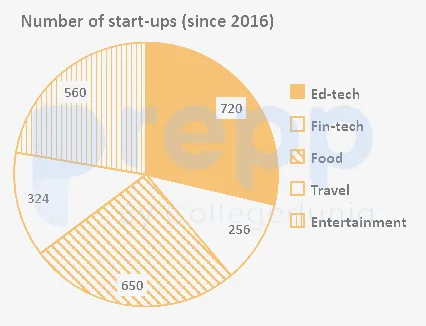
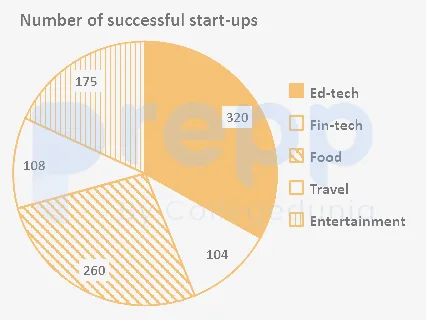
- A
13.12%
- B
12.19%
- C
12.91%
- D
13.21%
Show answer
C. 12.91%Calculation:
Total start-up started = 720 + 256 + 650 + 324 + 560
⇒ 2510
Start-up in the travel sector = 324
Required % = (324/2510) × 100
⇒ 12.90.8 ≈ 12.91%
∴ The required answer is 12.91%.
Paper & answer key PDF ↗ Question 75archived
If the volume of a sphere is \(179 {2 \over3}\) m3, what is its surface area?
- A
221 m2
- B
154 m2
- C
144 m2
- D
151 m2
Show answer
B. 154 m2Calculating Sphere Surface Area from Volume
The problem asks us to find the surface area of a sphere given its volume. To do this, we first need to find the radius of the sphere using the volume formula, and then use the radius to calculate the surface area.
Key Formulas for Sphere Calculations
We will use the standard formulas for the volume and surface area of a sphere:
Volume of a sphere \(V = {4 \over 3} \pi r^3\), where \(r\) is the radius.
Surface area of a sphere \(A = 4 \pi r^2\), where \(r\) is the radius.
Step-by-Step Solution to Find Surface Area
Step 1: Convert the given volume to an improper fraction
The volume is given as a mixed number: \(179 {2 \over3}\) m³. Let's convert this to an improper fraction:
\(V = 179 {2 \over3} = {179 \times 3 + 2 \over 3} = {537 + 2 \over 3} = {539 \over 3}\) m³.
Step 2: Use the volume to find the radius (r)
We know the volume formula is \(V = {4 \over 3} \pi r^3\). We can substitute the calculated volume and solve for \(r\).
We will use the approximation \(\pi \approx {22 \over 7}\) for this calculation.
\({539 \over 3} = {4 \over 3} \pi r^3\)
Multiply both sides by 3 to clear the denominator:
\(539 = 4 \pi r^3\)
Now, substitute \(\pi \approx {22 \over 7}\):
\(539 = 4 \times {22 \over 7} \times r^3\)
\(539 = {88 \over 7} r^3\)
To isolate \(r^3\), multiply both sides by \({7 \over 88}\):
\(r^3 = 539 \times {7 \over 88}\)
We can simplify 539 and 88. Note that \(539 = 7 \times 77 = 7 \times 7 \times 11\) and \(88 = 8 \times 11\).
\(r^3 = {7 \times 7 \times 11 \times 7 \over 8 \times 11}\)
Cancel out the common factor 11:
\(r^3 = {7 \times 7 \times 7 \over 8} = {343 \over 8}\)
To find \(r\), take the cube root of both sides:
\(r = \sqrt[3]{{343 \over 8}} = {\sqrt[3]{343} \over \sqrt[3]{8}}\)
Since \(7 \times 7 \times 7 = 343\) and \(2 \times 2 \times 2 = 8\):
\(r = {7 \over 2} = 3.5\) m.
Step 3: Use the radius to find the surface area (A)
Now that we have the radius \(r = {7 \over 2}\) m, we can use the surface area formula \(A = 4 \pi r^2\).
Again, using \(\pi \approx {22 \over 7}\):
\(A = 4 \times {22 \over 7} \times ({7 \over 2})^2\)
\(A = 4 \times {22 \over 7} \times {49 \over 4}\)
We can cancel out the factor of 4 from the numerator and the denominator:
\(A = {22 \over 7} \times 49\)
Now, simplify by dividing 49 by 7:
\(A = 22 \times 7\)
\(A = 154\)
The surface area of the sphere is 154 m².
Final Answer for Sphere Surface Area
Based on our calculations, the surface area of the sphere with a volume of \(179 {2 \over3}\) m³ is 154 m².
Comparing Calculated Surface Area with Options
Let's look at the given options:
221 m²
154 m²
144 m²
151 m²
Our calculated surface area of 154 m² matches the second option.
Quantity
Formula
Calculated Value
Volume (V)
Known
\(179 {2 \over 3}\) m³ or \({539 \over 3}\) m³
Radius (r)
Derived from V
\({7 \over 2}\) m or 3.5 m
Surface Area (A)
\(4 \pi r^2\)
154 m²
Additional Information on Sphere Geometry
Understanding the properties of a sphere is fundamental in geometry and various scientific fields. Here are some related points:
A sphere is a perfectly round geometrical object in three-dimensional space that is the surface of a completely round ball.
All points on the surface of a sphere are equidistant from its center. This distance is the radius (\(r\)).
The diameter (\(d\)) of a sphere is twice its radius (\(d = 2r\)).
The formulas for volume and surface area involve \(\pi\), the ratio of a circle's circumference to its diameter, which is approximately 3.14159 or \({22 \over 7}\). Using \({22 \over 7}\) often helps in problems where other numbers are multiples of 7, as seen in this example.
These formulas are crucial for problems involving spheres, such as calculating the capacity of spherical tanks or the surface area of celestial bodies.
Paper & answer key PDF ↗ Question 76archived
The following sentence has been split into four segments. Identify the segment that contains a grammatical error.
When the train pulled in/at the station, it take/Joseph some time/to get off.
- A
When the train pulled in
- B
at the station, it take
- C
Joseph some time
- D
to get off
Show answer
B. at the station, it takeFinding Grammatical Errors in Sentences
The question asks us to identify the segment of a sentence that contains a grammatical error. Let's examine the sentence and its parts carefully.
The sentence is: "When the train pulled in/at the station, it take/Joseph some time/to get off."
It is divided into four segments:
When the train pulled in
at the station, it take
Joseph some time
to get off
We need to check each segment for any issues with grammar, such as subject-verb agreement, tense, punctuation, or word choice.
Analyzing Each Sentence Segment
Segment 1: "When the train pulled in"
This segment seems grammatically correct. "When" introduces a dependent clause. "the train" is the subject, and "pulled in" is the verb phrase in the past tense. This tense is appropriate for describing an action that happened.
Segment 2: "at the station, it take"
Let's look closely at this part. "at the station" is a prepositional phrase indicating location. Following the comma, we have "it take". Here, "it" is the subject (referring implicitly to the situation or arrival), and "take" is the verb. However, the subject "it" is a third-person singular pronoun. In the present tense, the verb following a third-person singular subject needs an "-s" ending (e.g., "it takes"). Since the first part of the sentence ("pulled in") uses the past tense, it is more likely that the action of taking time also happened in the past. The past tense of "take" is "took". Therefore, "it take" is grammatically incorrect. It should be either "it takes" (present) or "it took" (past). Given the context of the first clause, "it took" is the most appropriate form.
Segment 3: "Joseph some time"
This segment seems grammatically sound in isolation, functioning as the object and part of the predicate (e.g., "It took Joseph some time").
Segment 4: "to get off"
This segment is an infinitive phrase ("to" + base verb) which is grammatically correct here, explaining what Joseph took time to do.
Identifying the Grammatical Error
Based on the analysis, the grammatical error is located in segment 2, specifically the phrase "it take". The verb "take" does not agree with the third-person singular subject "it" in the present tense, nor is it in the correct past tense form consistent with the preceding clause.
The correct segment would be "at the station, it took".
Therefore, the segment containing the error is "at the station, it take".
Revision Table: Common Verb Errors
Error Type
Incorrect Example
Correct Example
Explanation
Subject-Verb Agreement (Present)
She walk to the park.
She walks to the park.
Third-person singular subject ('She') requires verb with '-s'.
Incorrect Verb Tense
Yesterday, he go to the store.
Yesterday, he went to the store.
Past action requires past tense verb ('went').
Irregular Verb Form
They eated dinner.
They ate dinner.
'Eat' is irregular; past tense is 'ate'.
Additional Information: Subject-Verb Agreement and Tense Consistency
Understanding subject-verb agreement and tense consistency is crucial for correct sentence structure. Subject-verb agreement means the verb must match its subject in number (singular or plural) and person (first, second, or third). For example, "I walk" (first person singular), "You walk" (second person), "He/She/It walks" (third person singular), "We walk" (first person plural), "They walk" (third person plural).
Tense consistency means using the same verb tense when describing actions that happen at the same time or in a sequence, unless there is a specific reason to change tense (like indicating a shift in time). In the original sentence, "pulled in" is past tense, so the subsequent action ("it take/took Joseph some time") should also logically be in the past tense ("took").
Paying attention to these rules helps in identifying and correcting grammatical errors effectively.
Paper & answer key PDF ↗ Question 77archived
Select the INCORRECTLY spelt word.
- A
Thyriod
- B
Disaster
- C
System
- D
Distance
Show answer
A. ThyriodFinding the Incorrectly Spelled Word
We need to identify the word among the given options that is spelt incorrectly. Let's examine each option carefully.
Thyriod: Let's check the spelling of this word. The word refers to a gland in the neck. The standard and correct spelling is 'Thyroid', with the 'o' coming before the 'i'. Therefore, 'Thyriod' is an incorrect spelling.
Disaster: This word means a sudden event that causes great damage or loss of life. The spelling 'Disaster' is correct.
System: This word refers to a set of principles or procedures according to which something is done; an organized scheme or method. The spelling 'System' is correct.
Distance: This word refers to the extent of space between two objects or points. The spelling 'Distance' is correct.
Comparing the spellings, we see that 'Thyriod' is the only word spelt incorrectly. The correct spelling is 'Thyroid'. Common spelling errors often involve transposing letters or using the wrong vowels/consonants.
Thus, the word with the incorrect spelling is 'Thyriod'.
Given Word
Correct/Incorrect
Correct Spelling (if applicable)
Thyriod
Incorrect
Thyroid
Disaster
Correct
Disaster
System
Correct
System
Distance
Correct
Distance
Revision Table: Common Spelling Errors
Reviewing commonly misspelled words can help improve accuracy. Here are a few examples of words often misspelled due to swapped letters or incorrect vowel order, similar to the error found in 'Thyriod'.
Incorrect: recieve, acheive > Correct: receive, achieve (ei vs ie rule)
Incorrect: independant > Correct: independent (a vs e)
Incorrect: occassion > Correct: occasion (double c, single s)
Additional Information: Strategies for Improving Spelling
Improving spelling requires practice and attention to detail. Here are some helpful strategies:
Read Widely: Exposure to correctly spelled words in books, articles, etc., helps reinforce correct spellings.
Learn Common Patterns: Understand rules like "i before e except after c" (though note the exceptions!).
Break Down Words: For longer words, break them into syllables or smaller parts.
Use Mnemonics: Create memory aids (e.g., 'a lot' is two words, think 'a lot of space').
Practice Regularly: Use flashcards or spelling quizzes.
Proofread Carefully: Always read through your writing specifically looking for potential spelling mistakes.
Paper & answer key PDF ↗ Question 78archived
Select the correct passive form of the given sentence.
The government will build an amphitheatre.
- A
An amphitheatre will be build by the government.
- B
An amphitheatre will be built by the government.
- C
An amphitheatre would be built by the government.
- D
An amphitheatre be build by the government.
Show answer
B. An amphitheatre will be built by the government.Understanding Active and Passive Voice Transformation
The question asks us to convert a sentence from active voice to its passive form. The given sentence is: "The government will build an amphitheatre."
In this sentence:
Subject: The government
Verb: will build
Object: an amphitheatre
The sentence is in the Future Simple tense and is in the active voice because the subject ("The government") is performing the action ("will build").
Converting Future Simple Active to Passive Voice
To change a sentence from Future Simple active voice to passive voice, we follow a specific structure. The general formula for Future Simple passive voice is:
\(\text{Object} + \text{will be} + \text{Past Participle of Verb} + (\text{by} + \text{Subject})\)
Let's apply this formula to the given sentence:
Identify the object of the active sentence: "an amphitheatre". This becomes the new subject in the passive sentence.
Use the auxiliary verbs "will be".
Find the past participle of the main verb "build". The forms are build (base) > built (past simple) > built (past participle). So, the past participle is "built".
Include the original subject introduced by "by": "by the government".
Putting it all together, the passive form is: "An amphitheatre will be built by the government."
Analyzing the Given Options for Passive Voice
Let's examine each option provided:
Option 1: An amphitheatre will be build by the government.
This option uses the base form of the verb "build" instead of the past participle "built". This is incorrect for passive voice construction.
Option 2: An amphitheatre will be built by the government.
This option correctly uses the structure: Object ("An amphitheatre") + will be + Past Participle ("built") + by + Subject ("the government"). This matches the rule for Future Simple passive voice.
Option 3: An amphitheatre would be built by the government.
This option uses "would be" instead of "will be". While "would" can be used in certain contexts (like conditional sentences or reported speech), "will be" is the standard auxiliary for transforming Future Simple active to passive voice when the original sentence uses "will". This is incorrect for a direct transformation of "will build".
Option 4: An amphitheatre be build by the government.
This option is grammatically incorrect. It omits the auxiliary verb "will" and uses the base form "build" instead of the past participle "built".
Based on the analysis, Option 2 correctly follows the rules for converting the sentence to the passive voice in the Future Simple tense.
Active Voice Element
Passive Voice Element
Example from Sentence
Subject
Becomes part of a 'by' phrase (optional)
The government
Verb (will + base form)
Changes to will be + past participle
will build → will be built
Object
Becomes the new subject
an amphitheatre
Revision Table: Active vs. Passive Voice
Voice
Structure (Future Simple)
Example
Active
Subject + will + Verb (base form) + Object
The government will build an amphitheatre.
Passive
Object + will be + Verb (past participle) + (by + Subject)
An amphitheatre will be built by the government.
Additional Information on Active and Passive Voice
Understanding active and passive voice is key to mastering English sentence structure. Here's a little more detail:
Active Voice: In active voice, the subject performs the action. It is generally more direct, clear, and concise. Example: "She wrote the letter." (Subject 'She' performs the action 'wrote').
Passive Voice: In passive voice, the subject receives the action. The focus is on the action and the object rather than the performer of the action. The performer can be included in a "by" phrase but is often omitted if unimportant or unknown. Example: "The letter was written by her." (The subject 'The letter' receives the action 'was written').
When to Use Passive Voice:
When the doer of the action is unknown or unimportant.
When you want to emphasize the action or the recipient of the action.
In scientific or technical writing, where the process or result is more important than the person who performed the action.
Converting between active and passive voice helps in varying sentence structure and focusing on different parts of the information.
Paper & answer key PDF ↗ Question 79archived
Select the most appropriate option that can substitute the underlined segment in the given sentence.
She acted as if she is the one who was hurt.
- A
as if she has been
- B
as if she will be
- C
as if she would
- D
as if she was
Show answer
D. as if she wasUnderstanding 'As If' Clauses in Grammar
The question asks us to find the most appropriate substitution for the underlined segment in the sentence: "She acted as if she is the one who was hurt." The phrase "as if" introduces a clause that describes a hypothetical or unreal situation. The verb tense used after "as if" depends on the tense of the main verb and whether the situation described is real or unreal, present or past.
In the given sentence, the main verb is "acted," which is in the simple past tense. The 'as if' clause "she is the one who was hurt" describes a situation. When the main verb is in the past tense ("acted"), and the 'as if' clause describes a hypothetical or unreal situation happening at the same time or before the action of the main verb, we typically use a past tense or the past perfect tense in the 'as if' clause. The subjunctive mood (using "were") is also common, especially for contrary-to-fact situations, but the simple past is frequently used and accepted, particularly in informal contexts.
The original phrase "is the one who was hurt" is grammatically inconsistent with the main verb "acted." "Is" is present tense, while "acted" is past. This mismatch needs to be corrected.
Analyzing the Substitution Options
Let's examine each option to see which one provides the best substitute for "is the one who was hurt" to make the sentence grammatically correct and sensible after the past tense main verb "acted". We are essentially looking for the best way to complete the sentence "She acted as if she ______".
as if she has been
If we substitute, the sentence becomes "She acted as if she has been hurt." Using the present perfect "has been" after the past tense main verb "acted" in an 'as if' clause is generally incorrect for describing a hypothetical state concurrent with or prior to the past action.
as if she will be
Substituting would give "She acted as if she will be hurt." Using the future tense "will be" after a past tense main verb like "acted" in an 'as if' clause is grammatically incorrect. It doesn't reflect a hypothetical past or present state related to the past action.
as if she would
Substituting would give "She acted as if she would hurt." This phrase is incomplete ("would hurt" needs an object or further context) and changes the meaning significantly from the original idea of her being hurt.
as if she was
If we substitute, the sentence becomes "She acted as if she was hurt." Using the simple past tense "was" after "as if" following a past tense main verb ("acted") is a common and accepted way to express a hypothetical or unreal situation that pertains to the time of the past action. While the subjunctive "were" is traditionally preferred for clearly contrary-to-fact situations (e.g., "If I were you..."), "was" is widely used and considered acceptable in many contexts, especially when describing a hypothetical state. Compared to the other options, this is the most grammatically sound and natural choice to complete the sentence in a way that aligns with the likely intended meaning (she wasn't actually hurt, but she pretended she was).
The Correct Usage with 'As If'
When the main verb is in the past tense (like "acted"), the verb in the 'as if' clause often takes the past tense or past perfect tense to describe the hypothetical situation.
For a hypothetical situation happening at the same time as the past main verb, use simple past or subjunctive "were". Example: "She acted as if she was tired." or "She acted as if she were tired."
For a hypothetical situation that happened before the past main verb, use past perfect. Example: "He talked as if he had seen the future."
In our sentence, "She acted as if she is the one who was hurt," the phrase "who was hurt" indicates a past state of being hurt. The underlined segment "is the one who was hurt" attempts to link this past state to her present identity, but uses the present verb "is" with the past verb "acted". Substituting with "was" implies "She acted as if she was hurt," using the simple past tense to describe a hypothetical state related to the past action ("acted"). This fits the common usage patterns.
Therefore, the most appropriate substitution is "as if she was".
Original Segment
Substitution Option
Resulting Sentence Fragment
Grammatical Correctness (with "acted")
is the one who was hurt
as if she has been
acted as if she has been hurt
Incorrect tense agreement
is the one who was hurt
as if she will be
acted as if she will be hurt
Incorrect tense agreement
is the one who was hurt
as if she would
acted as if she would hurt
Changes meaning, incomplete phrase
is the one who was hurt
as if she was
acted as if she was hurt
Correct usage for hypothetical past state (simple past)
Revision Table: Key Grammar Points
Grammar Concept
Rule for 'As If' (after past main verb)
Example
Hypothetical/Unreal (Concurrent/Same Time)
Use simple past or subjunctive 'were'
She acted as if she was tired. / She acted as if she were tired.
Hypothetical/Unreal (Prior Time)
Use past perfect
He talked as if he had seen a ghost.
Real/Likely Situation
Use appropriate tense (often aligns with reality)
It looks as if it is going to rain.
Additional Information on Subjunctive vs. Indicative after 'As If'
Traditionally, when the clause introduced by "as if" expresses a condition that is contrary to fact or highly unlikely, the subjunctive mood is preferred. For a past main verb and a hypothetical concurrent situation, this means using "were" for all subjects (e.g., "She acted as if she were queen"). However, in modern English, especially in less formal contexts, the indicative past tense ("was") is very commonly used instead of the subjunctive "were" after "as if" or "as though" when the verb is "to be".
For verbs other than "to be", the simple past tense is used for hypothetical concurrent situations after a past main verb (e.g., "He ran as if a dog chased him"). The past perfect is used for hypothetical prior situations (e.g., "She spoke as if she had never heard the news").
In this question, the most appropriate choice among the given options, considering common usage and grammatical consistency with the main verb "acted", is "as if she was". This leads to the sentence "She acted as if she was hurt," which is widely accepted.
Paper & answer key PDF ↗ Question 80archived
Select the most appropriate meaning of the given idiom.
A rolling stone gathers no moss
- A
A person who settles for a short time and runs from place to place, enjoying his freedom
- B
A person who does not settle anywhere for a short time, and is always searching for gold
- C
A person who settles for a long time and leads a boring and useless life
- D
A person who does not settle in one place for a long time, does not gain wealth, name or fame
Show answer
D. A person who does not settle in one place for a long time, does not gain wealth, name or fameUnderstanding the Idiom: A Rolling Stone Gathers No Moss
The idiom "A rolling stone gathers no moss" is a well-known saying in English. It uses the imagery of a stone that is constantly rolling, never staying in one place, and compares it to a person who is always moving or changing jobs or lifestyles.
The 'moss' in the idiom symbolizes things that accumulate over time when someone stays in one place or maintains stability. This can include things like:
Wealth or savings
Possessions
Deep relationships or a strong community connection
Reputation or fame
Stability and security
Therefore, a "rolling stone" is someone who doesn't stay put. Because they don't stay put, they don't accumulate these things that 'moss' represents.
Analyzing the Options for "A Rolling Stone Gathers No Moss"
Let's look at the given options and see which one best fits the meaning of the idiom:
Option 1: "A person who settles for a short time and runs from place to place, enjoying his freedom". This captures the 'rolling' aspect (moving around, not settling for long) but focuses only on the positive outcome of "enjoying his freedom". The idiom traditionally focuses on the *lack* of accumulation, which can be seen as a negative consequence rather than freedom.
Option 2: "A person who does not settle anywhere for a short time, and is always searching for gold". This mentions not settling (the 'rolling' stone) and hints at seeking wealth ('searching for gold'). While it touches on not accumulating wealth (the 'no moss' part), the specific motivation of "searching for gold" isn't inherent in the idiom itself.
Option 3: "A person who settles for a long time and leads a boring and useless life". This describes the exact opposite of a "rolling stone." A rolling stone does *not* settle for a long time.
Option 4: "A person who does not settle in one place for a long time, does not gain wealth, name or fame". This option accurately describes the 'rolling stone' (does not settle for long) and the 'gathers no moss' consequence (does not gain wealth, name, or fame – all things that accumulate with stability). This aligns with the traditional interpretation of the idiom focusing on the lack of material or reputational gain due to constant change.
Conclusion on Idiom Meaning
Based on the traditional and most common understanding of the idiom, option 4 provides the most appropriate meaning. The "rolling stone" is the person who doesn't stay put, and the "gathers no moss" signifies the lack of accumulation of wealth, reputation, or stability that often results from such a lifestyle.
Revision Table: Key Idiom Concepts
Part of Idiom
Meaning in Idiom
A Rolling Stone
A person who constantly moves, changes jobs, or doesn't settle down.
Gathers No Moss
Does not accumulate wealth, reputation, stability, or deep connections.
Additional Information on Idioms and Meanings
Idioms are phrases or expressions whose meaning cannot be deduced simply from the ordinary meanings of their individual words. "A rolling stone gathers no moss" is a classic example.
Sometimes, idioms can have slightly varying interpretations or nuances depending on context or regional usage.
Understanding idioms is important for comprehending native English speakers and texts.
This specific idiom often carries a slightly negative connotation, highlighting the potential downsides of a restless life, such as lack of security or lasting success. However, some modern interpretations might view the 'no moss' as freedom from burdens or responsibilities. The options provided here lean towards the traditional interpretation.
Paper & answer key PDF ↗ Question 81archived
Choose the most appropriate meaning of the underlined word in the given sentence.
The students have decided to conspire to steal the test papers.
- A
Enact
- B
Moderate
- C
Plot
- D
Assist
Show answer
C. PlotUnderstanding the Meaning of Conspire
The question asks us to find the most appropriate meaning of the underlined word 'conspire' in the sentence: "The students have decided to conspire to steal the test papers." To answer this, we need to understand what 'conspire' means, especially in the context of students planning to steal.
Defining 'Conspire'
The word 'conspire' generally means to make secret plans jointly to commit an unlawful or harmful act. It implies a secretive agreement or plan between two or more people to do something wrong or illegal.
Analyzing the Sentence Context
In the given sentence, the students are deciding to 'conspire' with the goal of stealing test papers. Stealing test papers is an unlawful and harmful act within an academic setting. Therefore, 'conspire' here refers to the act of secretly planning or plotting together to carry out this theft.
Evaluating the Options
Let's examine each of the provided options to see which one best matches the meaning of 'conspire' in this context:
Enact: To enact means to make something into law or to perform a role in a play. This does not fit the meaning of secretly planning a theft.
Moderate: To moderate means to make something less extreme or intense, or to preside over a discussion. This meaning is unrelated to planning or theft.
Plot: To plot means to plan secretly, especially something illegal or harmful. This meaning aligns directly with the act of secretly planning to steal test papers.
Assist: To assist means to help someone. While people who conspire might assist each other, 'assist' itself doesn't capture the core meaning of making a secret plan to do something illegal.
Based on the definition and the context, 'Plot' is the most appropriate meaning for 'conspire'.
Detailed Comparison
Let's look at how 'conspire' and 'plot' are similar:
Word
Common Meaning
Relevance to Sentence
Conspire
To make secret plans jointly, especially to commit an unlawful or harmful act.
Matches the act of students secretly planning to steal test papers.
Plot
To plan secretly, especially something illegal or harmful.
Matches the act of students secretly planning to steal test papers.
The table clearly shows the strong overlap in meaning between 'conspire' and 'plot' when referring to planning something illegal or harmful in secret.
Conclusion on Conspire Meaning
Considering the sentence "The students have decided to conspire to steal the test papers" and the definitions of the options, 'Plot' is the word that most accurately describes the action of secretly planning a harmful or unlawful act like stealing test papers.
Revision Table: Understanding Vocabulary
Word
Meaning
Example Sentence
Conspire
To make secret plans jointly to commit an unlawful or harmful act.
They began to conspire against the king.
Enact
To make (a bill or other proposal) law; to act out (a role on stage).
The parliament will enact new legislation.
Moderate
Average in amount, intensity, quality, or degree; to preside over a discussion.
He took a moderate amount of exercise.
Plot
A plan made in secret by a group of people to do something illegal or harmful; to plan secretly.
The government uncovered a plot to overthrow the leader.
Assist
To help someone, typically by doing a share of the work.
The student was asked to assist the teacher.
Additional Information on Synonyms and Context
When choosing the best word meaning, context is crucial. While words might have multiple meanings or near synonyms, the specific way a word is used in a sentence helps determine its intended meaning. In this case, the phrase "to steal the test papers" provides the necessary context to understand that 'conspire' is used in the sense of planning a criminal or illicit act. Other synonyms for 'conspire' might include scheme, collude, or intrigue, depending on the specific context and nuance required.
Paper & answer key PDF ↗ Question 82archived
Select the option that can be used as a one-word substitute for the given group of words.
An eccentric manner of living
- A
Bohemian
- B
Numismatist
- C
Gourmet
- D
Misanthrope
Show answer
A. BohemianFinding the One-Word Substitute for an Eccentric Manner of Living
The question asks us to find a single word that can replace the phrase "An eccentric manner of living". Let's analyze the given options to determine which one best fits this description.
Understanding the Phrase: An Eccentric Manner of Living
An "eccentric manner of living" refers to a lifestyle that is unconventional, slightly strange, or deviates from established norms or conventions. It suggests a person who lives in a way that is different from most people, often due to their unique personality, beliefs, or artistic inclinations.
Analyzing the Options
Let's examine the meaning of each provided option:
Bohemian: This term describes a person, typically an artist or writer, who leads an unconventional lifestyle. This lifestyle often involves living in a free, creative, and informal way, often disregarding conventional standards of behavior or dress. This definition closely aligns with the idea of an "eccentric manner of living".
Numismatist: A numismatist is a person who studies or collects coins, paper money, and medals. This term describes a hobby or profession, not a general lifestyle or manner of living, eccentric or otherwise.
Gourmet: A gourmet is a connoisseur of good food and drink. This term relates to a person's interest in culinary matters and does not describe their overall manner of living, especially not in an eccentric way.
Misanthrope: A misanthrope is a person who dislikes humankind and avoids human society. While this might lead to an unconventional lifestyle (avoiding others), the primary definition focuses on the dislike of people, not necessarily a creative or free-spirited "eccentric manner of living".
Identifying the Correct Substitute
Based on the analysis, the word "Bohemian" is the most appropriate one-word substitute for "An eccentric manner of living". It specifically refers to a lifestyle that is unconventional and often associated with artistic or creative individuals living outside societal norms.
Conclusion
The option that best serves as a one-word substitute for "An eccentric manner of living" is Bohemian.
Word
Meaning
Fits "Eccentric Manner of Living"?
Bohemian
Unconventional artistic/literary lifestyle
Yes
Numismatist
Coin collector/student
No
Gourmet
Food connoisseur
No
Misanthrope
Person who dislikes people
Less direct fit
Revision Table: One-Word Substitutes
Phrase
One-Word Substitute
Explanation
An eccentric manner of living
Bohemian
Describes an unconventional, often artistic, lifestyle outside typical norms.
One who collects coins
Numismatist
Specific term for a coin hobbyist/expert.
A person who enjoys good food
Gourmet
Refers to someone with refined taste in food.
One who hates mankind
Misanthrope
Describes someone with a strong dislike for people.
Additional Information on Lifestyle Descriptions
Understanding terms that describe different lifestyles and personalities is crucial for vocabulary building and one-word substitutions. Here are a few related concepts:
Conventional: Living in a way that follows accepted customs and standards. This is the opposite of eccentric or bohemian.
Hedonist: A person who believes that the pursuit of pleasure is the most important thing in life.
Ascetic: A person who practices severe self-discipline and abstention for religious or philosophical reasons, often living a simple life.
Nomad: A member of a people having no permanent abode, and who travel from place to place to find fresh pasture for their livestock. Can also refer to someone who travels frequently without a fixed home.
Each of these words describes a distinct way of living or a philosophy guiding a person's life choices. While some might be considered unconventional by societal standards, "Bohemian" specifically captures the sense of an artistic, free-spirited, and deliberately non-conformist lifestyle.
Paper & answer key PDF ↗ Question 83archived
Select the most appropriate ANTONYM of the underlined word.
One must aim to develop intrinsic motivation within learners for better retention of knowledge.
- A
Elemental
- B
Introjected
- C
Extrinsic
- D
Inherent
Show answer
C. ExtrinsicUnderstanding Antonyms and 'Intrinsic'
The question asks us to find the most appropriate antonym for the word 'intrinsic'. An antonym is a word that has the opposite meaning of another word. To find the antonym, we first need to understand the meaning of the word 'intrinsic'.
The word 'intrinsic' generally refers to something that is essential or inherent to the nature of someone or something. When we talk about 'intrinsic motivation', it means being driven by internal factors, such as personal satisfaction, interest, or enjoyment in the activity itself, rather than by external rewards or pressure.
Analysing the Options
Let's examine the meaning of each given option:
Elemental: Refers to something basic, fundamental, or essential. While it relates to core parts, it's not the opposite of originating from within.
Introjected: In the context of motivation (specifically Self-Determination Theory), introjected regulation is a type of external motivation that has been partially internalized. It involves doing something to avoid guilt or anxiety, or to maintain self-esteem. It's related to external pressures being taken inside, but it's not a direct opposite of intrinsic motivation in the general sense.
Extrinsic: Means originating from outside; external. 'Extrinsic motivation' refers to being driven by external factors, such as rewards, punishments, pressure from others, or the desire for recognition.
Inherent: Means existing in something as a permanent, essential, or characteristic attribute; intrinsic. This word is essentially a synonym for 'intrinsic'.
Finding the Antonym of Intrinsic
We are looking for the word with the opposite meaning of 'intrinsic'.
'Intrinsic' relates to internal factors, being part of the core nature, originating from within.
'Extrinsic' relates to external factors, originating from outside.
Comparing the meanings, 'extrinsic' is the direct opposite of 'intrinsic', particularly in contexts like motivation, where intrinsic motivation comes from within the person, and extrinsic motivation comes from outside the person.
The other options, 'elemental' and 'inherent', are closer in meaning to 'intrinsic' than they are to its opposite. 'Introjected' is a specific term related to motivation that involves internalizing external pressures, making it different from both purely intrinsic and purely extrinsic motivation, and not a general antonym of intrinsic.
Conclusion
Based on the definitions, the most appropriate antonym for 'intrinsic' is 'extrinsic'.
Revision Table: Key Terms
Term
Meaning
Relationship to 'Intrinsic'
Intrinsic
Essential, inherent, originating from within
Main term
Extrinsic
Originating from outside; external
Antonym
Inherent
Existing as an essential part; intrinsic
Synonym
Elemental
Basic, fundamental
Related to core parts, but not antonym
Introjected
Internalized external motivation (e.g., acting to avoid guilt)
Different type of motivation, not general antonym
Additional Information: Types of Motivation
Understanding intrinsic and extrinsic motivation is key in education and psychology. Here's a little more detail:
Intrinsic Motivation: You do an activity because you genuinely enjoy it or find it interesting. The reward is the activity itself. Examples: Reading a book for pleasure, learning a new skill out of curiosity, playing a sport because it's fun.
Extrinsic Motivation: You do an activity to receive a reward or avoid punishment from an external source. The reward is separate from the activity. Examples: Studying for a good grade, working for a salary, cleaning your room to avoid being grounded.
While intrinsic motivation is often seen as more sustainable for long-term learning and engagement, extrinsic motivation can also be effective in certain situations, especially to get started on tasks that are not inherently interesting.
Paper & answer key PDF ↗ Question 84archived
Select the option that expresses the given sentence in passive voice.
Don’t pluck the flowers.
- A
The flowers should not be pluck.
- B
You are requested not to plucked the flowers.
- C
I am requesting you to pluck the flowers.
- D
Let the flowers not be plucked.
Show answer
D. Let the flowers not be plucked.Converting Imperative Sentences to Passive Voice
The given sentence, "Don’t pluck the flowers," is an imperative sentence. Specifically, it is a negative imperative, which gives a command or instruction not to do something. Converting imperative sentences from active voice to passive voice requires specific rules.
Passive Voice for Negative Imperatives
For negative imperative sentences (prohibitions), the passive voice can often be formed using the structure:
Let + object + not + be + past participle of the verb
Let's apply this rule to the sentence "Don’t pluck the flowers."
The object of the sentence is "the flowers".
The verb is "pluck". The past participle of "pluck" is "plucked".
Using the structure:
Let + the flowers + not + be + plucked.
This gives us: Let the flowers not be plucked.
Analyzing the Given Options
Let's examine each provided option based on the rules for converting imperative sentences to passive voice:
Option
Sentence
Analysis
Status
1
The flowers should not be pluck.
This option uses "should not be" which can sometimes be used for advice/suggestion imperatives, but the verb form "pluck" is incorrect. It should be the past participle "plucked".
Incorrect
2
You are requested not to plucked the flowers.
This structure "You are requested not to..." is a valid way to convert some negative imperatives into passive voice, especially those implying a request. However, the verb form "plucked" after "to" is incorrect. It should be the base form "pluck".
Incorrect
3
I am requesting you to pluck the flowers.
This sentence is in the active voice ("I am requesting") and completely changes the meaning of the original sentence, which was a prohibition ("Don't pluck").
Incorrect (Wrong meaning & Voice)
4
Let the flowers not be plucked.
This option correctly follows the structure "Let + object + not + be + past participle" for converting a negative imperative (prohibition) into the passive voice. The verb form "plucked" is the correct past participle.
Correct
Based on the analysis, the option that correctly expresses the given sentence in passive voice is "Let the flowers not be plucked."
Revision Table: Active vs. Passive Imperatives
Type of Imperative
Active Voice Structure Example
Passive Voice Structure Example
Simple Positive Command
Do it.
Let it be done. / You are ordered to do it.
Simple Negative Command (Prohibition)
Don't do it.
Let it not be done. / You are ordered not to do it.
Positive Request
Please help me.
You are requested to help me.
Negative Request
Please don't disturb me.
You are requested not to disturb me.
Additional Information: Understanding Passive Voice
The passive voice is used when the focus is on the action and the object of the action, rather than the performer of the action (the subject). In the sentence "Don’t pluck the flowers," the subject is the implied "you" (who is being told not to pluck), the verb is "pluck," and the object is "the flowers." In the passive voice "Let the flowers not be plucked," the focus shifts to "the flowers" and the action being performed upon them (being plucked), with the original subject ("you") becoming less important or omitted.
Key points about passive voice:
Uses a form of the verb 'to be' (is, am, are, was, were, be, being, been) + the past participle of the main verb.
The object of the active sentence becomes the subject of the passive sentence.
The subject of the active sentence becomes the agent (often introduced by 'by') or is omitted if unimportant or unknown.
For imperative sentences, special structures like 'Let...' or 'You are ordered/requested...' are used for conversion.
Paper & answer key PDF ↗ Question 85archived
The question below consists of a set of labeled sentences. Out of the four options given, select the most logical order of the sentences to form a coherent paragraph.
P. The demand for fish has increased.
Q. However, adequate fish is not available in the lake.
R. This is mainly because the migratory fish from Chindwin-Irrawaddy river system to Manipur river system have declined steadily after the barrage came up.
S. At least two lakh people are directly dependent on the lake for fishing.
- A
SPQR
- B
RPSQ
- C
QRPS
- D
RQSP
Show answer
A. SPQRUnderstanding Sentence Rearrangement and Logical Order
Sentence rearrangement questions test your ability to identify the logical flow and coherence of a paragraph. To solve these questions, you need to read all the given sentences carefully and understand the central theme or topic. Look for connections between sentences, such as cause and effect, general to specific ideas, or time sequence. Identifying introductory and concluding sentences can also be helpful.
Analyzing the Sentences
Let's look at the provided sentences:
P: The demand for fish has increased.
Q: However, adequate fish is not available in the lake.
R: This is mainly because the migratory fish from Chindwin-Irrawaddy river system to Manipur river system have declined steadily after the barrage came up.
S: At least two lakh people are directly dependent on the lake for fishing.
Finding the Logical Flow
We need to arrange these sentences (P, Q, R, S) into a coherent paragraph. Let's analyze the potential links:
Sentence S talks about people depending on the lake for fishing. This seems like a good starting point, introducing the context of human reliance on the lake's fish resources.
Sentence P talks about the increased demand for fish. This logically follows from a large number of people depending on the lake (as mentioned in S). Dependence often leads to demand.
Sentence Q introduces a problem: despite the demand/dependence, there isn't enough fish available. The word "However" indicates a contrast with the preceding idea (demand/dependence). This sentence logically follows P.
Sentence R explains the reason for the problem mentioned in Q ("This is mainly because..."). It tells us *why* adequate fish is not available. Therefore, R must follow Q.
Evaluating the Options based on Logical Flow
Based on our analysis, the logical sequence appears to be S → P → Q → R, which corresponds to the order SPQR.
Let's check how the paragraph reads in the SPQR order:
At least two lakh people are directly dependent on the lake for fishing. The demand for fish has increased. However, adequate fish is not available in the lake. This is mainly because the migratory fish from Chindwin-Irrawaddy river system to Manipur river system have declined steadily after the barrage came up.
This arrangement creates a smooth and logical paragraph. It starts by establishing the dependence, moves to the resulting demand, then introduces the problem of scarcity, and finally explains the cause of the scarcity.
Step-by-Step Derivation of the Correct Order
Identify sentence S as a suitable opening statement, introducing the subject (people dependent on the lake for fishing).
Identify sentence P as following S, explaining a consequence of the dependence (increased demand).
Identify sentence Q as introducing a problem that contrasts with the demand/dependence (inadequate fish), making it follow P.
Identify sentence R as providing the reason for the problem stated in Q, making it follow Q.
This leads to the sequence S-P-Q-R.
Sentence
Content
Logical Function in Paragraph
S
People dependent on lake for fishing
Introduction/Context Setting
P
Demand for fish increased
Consequence of dependence
Q
Adequate fish not available
Problem/Contrast to Demand
R
Reason for fish decline (barrage effect)
Explanation for the Problem in Q
The order SPQR matches the logical progression from context to problem and its cause.
Revision Table: Sentence Rearrangement
Skill
Key Strategy
Example from Question
Identify Topic
Read all sentences to grasp the main subject.
The subject is fishing dependency, demand, and fish availability in a lake.
Find Starting Sentence
Look for a sentence that introduces the topic or context.
Sentence S (dependence on the lake) serves as a good introduction.
Identify Connections
Look for transition words (However, This is mainly because) or cause-effect relationships.
"However" in Q connects to the previous idea (demand/dependence); "This is mainly because" in R refers back to the scarcity mentioned in Q.
Build the Sequence
Arrange sentences based on logical links.
S introduces context, P follows with a related consequence (demand), Q presents a problem, and R explains the cause of the problem.
Verify Flow
Read the arranged paragraph to ensure it makes sense.
Reading SPQR confirms a coherent narrative.
Additional Information: Cohesion and Coherence
Creating a coherent paragraph involves more than just putting sentences in order; it requires ensuring both cohesion and coherence.
Cohesion: This refers to the grammatical and lexical links between sentences. It's about how the words and phrases are connected. Examples include using pronouns (like "This" in R referring to the situation in Q), transition words (like "However" in Q), or repeating keywords.
Coherence: This refers to the underlying logical connection between ideas in a paragraph. It's about the meaning and how the ideas flow logically from one to the next, making the paragraph easy to understand. A paragraph is coherent if the ideas are arranged in a sensible order (e.g., chronological, spatial, cause-effect, general-specific).
In this question, sentence R's phrase "This is mainly because..." provides a strong cohesive link back to the problem stated in sentence Q. The overall arrangement SPQR achieves coherence by presenting ideas in a logical cause-and-effect structure related to fishing and the lake's resources.
Paper & answer key PDF ↗ Question 86archived
Select the most appropriate ANTONYM of the word "identify" from the given sentence:
My pet dog can classify and identify our family friends easily and doesn’t overlook anonymous and unknown ones
- A
anonymous
- B
spot
- C
classify
- D
overlook
Show answer
D. overlookFinding the Antonym of Identify
The question asks us to select the most appropriate antonym for the word "identify" as used in the given sentence: "My pet dog can classify and identify our family friends easily and doesn’t overlook anonymous and unknown ones."
In this sentence, "identify" means to recognize, distinguish, or make known someone or something.
Let's examine the options provided:
anonymous: This is an adjective meaning unknown or not identified. While related to the concept of not being identified, it is not an action verb that is the opposite of "identify."
spot: This is a verb meaning to see or notice someone or something, often quickly. This word is closer in meaning or a synonym to "identify" in the sense of recognizing, not an antonym.
classify: This is a verb meaning to arrange or order people or things into groups or categories based on shared qualities or characteristics. While classification often involves identifying individual items first, "classify" itself is not the opposite of recognizing a specific person or thing. It's a different type of action.
overlook: This is a verb meaning to fail to notice, see, or consider something. If you "identify" someone, you recognize and notice them. If you "overlook" someone, you fail to notice or recognize them. This directly contrasts the action of identifying someone.
Comparing the meanings, "overlook" is the action that is the opposite of "identify" when "identify" means to recognize or notice. The sentence structure also supports this; the dog can "identify" friends and doesn't "overlook" unknowns, showing contrasting actions related to recognition.
Therefore, the most appropriate antonym of "identify" in this context is "overlook."
Revision Table
Word
Meaning in Context
Option
Relation to "identify"
Identify
Recognize, distinguish
-
The target word
-
-
anonymous
Related concept (not identified), but not an antonym verb
-
-
spot
Similar meaning (synonym or related)
-
-
classify
Different action (grouping), not antonym
-
-
overlook
Opposite meaning (fail to notice/recognize)
Additional Information on Antonyms and Synonyms
Understanding antonyms and synonyms is crucial for vocabulary building and language comprehension. Antonyms are words that have opposite meanings, while synonyms are words that have similar meanings.
Context is Key: The meaning of a word, and thus its antonym or synonym, can change depending on how it is used in a sentence. For example, "fast" can mean quick (antonym: slow) or stuck firmly (antonym: loose).
Types of Antonyms: Antonyms can sometimes be categorized. For instance, gradable antonyms (like hot/cold, which exist on a spectrum) and non-gradable or complementary antonyms (like alive/dead, which are either one or the other). "Identify" and "overlook" in the sense used here function as a form of complementary or relational opposite.
Expanding Vocabulary: Learning antonyms and synonyms together can help you remember word meanings and improve your ability to express yourself more precisely.
Always consider the specific sentence or phrase when determining the best antonym or synonym for a word.
Paper & answer key PDF ↗ Question 87archived
Rearrange the parts of the sentence in correct order.
One element that
P. is timing, in particular ensuring that
Q. is essential to navigating deep space
R. the time on board spacecraft is synchronised
S. with the time on the ground
- A
PRQS
- B
PSQR
- C
RSPQ
- D
QPRS
Show answer
D. QPRSUnderstanding Sentence Rearrangement for Deep Space Concepts
The question asks us to rearrange the given parts of a sentence to form a grammatically correct and coherent statement. The sentence begins with the phrase "One element that". We need to find the correct sequence of the parts P, Q, R, and S that logically completes this sentence.
P: is timing, in particular ensuring that
Q: is essential to navigating deep space
R: the time on board spacecraft is synchronised
S: with the time on the ground
Analyzing the Sentence Structure
The initial phrase "One element that..." suggests a subject ("One element") followed by a relative clause beginning with "that". The relative clause will describe or identify the element. The main clause will then provide the predicate for the subject "One element".
Let's consider the possible connections:
The relative clause "that..." needs a verb or a phrase describing the element. Q starts with "is essential...", which could potentially be part of the relative clause modifying "element". "One element that is essential to navigating deep space..."
The main clause predicate for "One element" needs to say what that element *is*. P starts with "is timing...", which could identify the element. "One element is timing..."
Evaluating the Options - Step-by-Step
Let's test the sequence QPRS, based on its plausibility identified during analysis:
Starting phrase: "One element that"
Add Q: "One element that is essential to navigating deep space..."
Add P: "...is essential to navigating deep space is timing, in particular ensuring that..."
This sequence "One element that Q P" forms the structure: Subject ("One element") + Relative Clause ("that Q") + Predicate ("P"). Specifically, "One element that is essential to navigating deep space" acts as the subject phrase, and "is timing, in particular ensuring that..." is the predicate. This structure is grammatically sound.
Now, let's see how R and S fit after "ensuring that":
The phrase "ensuring that" introduces a subordinate clause stating what is being ensured. R and S describe the synchronisation of time.
Add R: "...in particular ensuring that the time on board spacecraft is synchronised..."
Add S: "...is synchronised with the time on the ground."
Combining R and S: "...ensuring that the time on board spacecraft is synchronised with the time on the ground." This forms a complete and meaningful subordinate clause.
Putting it all together:
One element that is essential to navigating deep space is timing, in particular ensuring that the time on board spacecraft is synchronised with the time on the ground.
This sentence is grammatically correct and logically flows, explaining the importance of timing, specifically time synchronisation, for deep space navigation.
Why Other Options Are Less Suitable
PRQS: "One element that is timing, in particular ensuring that is essential to navigating deep space the time on board spacecraft is synchronised with the time on the ground." - The sequence "ensuring that is essential" is grammatically awkward and nonsensical in this context.
PSQR: "One element that is timing, in particular ensuring that with the time on the ground is essential to navigating deep space the time on board spacecraft is synchronised." - The connection "ensuring that with" is incorrect.
RSPQ: "One element that the time on board spacecraft is synchronised with the time on the ground is timing, in particular ensuring that is essential to navigating deep space." - While "One element that R S is timing" is a possible structure ("An element which is the synchronised time is timing"), the continuation "in particular ensuring that is essential to navigating deep space" is grammatically incorrect and breaks the flow.
Therefore, the sequence QPRS forms the most coherent and grammatically sound sentence.
Revision Table: Analyzing Sentence Parts
Part
Begins With
Potential Role
Notes
Starting Phrase
One element that
Subject Introduction
Needs a relative clause and a predicate.
P
is timing...
Predicate / Identification of Element
Also introduces a subordinate clause with "ensuring that".
Q
is essential...
Relative Clause Predicate / Description
Describes the quality of the element.
R
the time on board...
Start of Subordinate Clause
Focuses on spacecraft time.
S
with the time...
Completion of Subordinate Clause
Completes the synchronisation idea.
Additional Information on Timing in Deep Space Navigation
Accurate timing is absolutely crucial for deep space navigation. Here's why:
Distance Measurement: Distances to spacecraft are measured by sending radio signals and timing how long they take to return (the round-trip light time). This requires extremely precise clocks both on Earth and potentially on the spacecraft.
Tracking and Orbit Determination: By precisely timing signals sent to and received from a spacecraft, ground stations can determine its exact position and velocity, which is vital for plotting and maintaining its trajectory.
Communication Synchronization: For successful data transmission, both the sender and receiver need to agree on when signals start and end. Synchronised clocks ensure reliable communication across vast distances.
Onboard Operations: Many spacecraft operations, such as executing commands, taking scientific measurements, or performing maneuvers, are timed precisely. These operations often rely on the spacecraft's onboard clock being synchronised with ground control.
Autonomous Navigation: Future deep space missions may use more autonomous navigation systems that rely on precise onboard timing and potentially inter-spacecraft synchronisation.
Small errors in timing can lead to significant errors in distance measurement and navigation over the vast scales of deep space, potentially causing a mission to fail. Therefore, ensuring that the time on board spacecraft is synchronised with the time on the ground is a fundamental aspect of deep space mission operations.
Paper & answer key PDF ↗ Question 88archived
Select the most appropriate collocation to fill in the blank.
We came to ________ as we were passing through.
- A
give a hand
- B
say hello
- C
slow in
- D
take a look
Show answer
B. say helloUnderstanding Collocations for English Language Questions
The question asks us to find the most appropriate collocation to complete the sentence: "We came to ________ as we were passing through." A collocation is a group of words that often go together, creating a natural-sounding phrase in English. Choosing the right collocation is important for speaking and writing English fluently and correctly.
Let's examine the options provided and see which one fits the context of the sentence.
Analyzing the Options
Option 1: give a hand
The phrase "give a hand" means to help someone. For example, "Can you give me a hand with this box?" While it's a valid collocation, it doesn't fit the context of simply passing through. The sentence implies a brief stop, not necessarily to offer help.
Option 2: say hello
The phrase "say hello" is often used to describe a brief visit to greet someone or to make contact briefly while in the area. For example, "We were in town, so we decided to pop in and say hello." This meaning perfectly matches the context of the sentence, where the person or people were "passing through" and made a stop for a short visit.
Option 3: slow in
"Slow in" is not a standard English collocation or phrase. We might say "slow down" to reduce speed, or perhaps "slow to" followed by something, but "slow in" does not convey the idea of visiting someone while passing through.
Option 4: take a look
The phrase "take a look" means to examine something visually. For example, "Let me take a look at that report." This is used for looking at objects or situations, not for visiting people. It does not fit the context of the sentence.
Determining the Best Collocation
Based on the analysis, the phrase that naturally fits the idea of making a brief stop to visit someone while "passing through" is "say hello". This collocation describes the purpose of the stop in a way that the other options do not.
Therefore, the completed sentence is: "We came to say hello as we were passing through."
Revision Table: Collocations and Meanings
Collocation
Common Meaning
Fits the Sentence?
give a hand
To help someone
No
say hello
To greet someone briefly (often implies a short visit)
Yes
slow in
Not a standard collocation
No
take a look
To examine something
No
Additional Information about English Collocations
Learning collocations is crucial for improving English fluency and accuracy. Instead of just learning individual words, try to learn words in common combinations. This will make your English sound more natural to native speakers.
Examples of other common collocations:
make a decision
take a shower
have a break
pay attention
do the washing up
There are many different types of collocations, such as adjective + noun, noun + noun, verb + noun, adverb + adjective, etc. Paying attention to how words are used together in reading and listening will help you learn more collocations naturally.
Paper & answer key PDF ↗ Question 89archived
Select the INCORRECTLY spelt word in the following sentence.
Apparently, he seems to be an amature person, but I know that he is a disciplined and committed person when it comes to doing something seriously.
- A
amature
- B
apparently
- C
committed
- D
disciplined
Show answer
A. amatureAnalyzing the Sentence for Spelling Errors
The question asks us to identify the word that is spelled incorrectly within the given sentence: "Apparently, he seems to be an amature person, but I know that he is a disciplined and committed person when it comes to doing something seriously." We need to examine each word, especially those provided in the options, to find the spelling mistake.
Identifying the Incorrect Spelling
Let's look at the options provided and check their spelling in the context of standard English vocabulary.
Option 1: amature
Option 2: apparently
Option 3: committed
Option 4: disciplined
We will now analyze each of these words based on common spelling rules and dictionary definitions.
Checking Option 1: amature
The word "amature" appears in the sentence. Let's consider its common spelling. The word meaning someone who pursues a study, sport, or other activity for pleasure rather than for financial gain or professional reasons is typically spelled "amateur". Comparing "amature" and "amateur", we see a difference in the ending.
The correct spelling is amateur.
Therefore, "amature" as written in the sentence is misspelled.
Checking Option 2: apparently
The word "apparently" is an adverb meaning as far as one knows or can see, or seemingly. The spelling "apparently" is correct.
Checking Option 3: committed
The word "committed" is the past tense or past participle of the verb "commit". It also functions as an adjective meaning feeling dedication and loyalty to a cause, activity, or job. The spelling "committed" (with a double 't') is correct.
Checking Option 4: disciplined
The word "disciplined" is the past tense or past participle of the verb "discipline". It also functions as an adjective meaning showing a controlled form of behavior or way of working. The spelling "disciplined" is correct.
Based on our analysis, the only incorrectly spelled word among the options is "amature".
Correcting the Spelling Mistake
The word "amature" should be spelled "amateur". The sentence with the correct spelling would be: "Apparently, he seems to be an amateur person, but I know that he is a disciplined and committed person when it comes to doing something seriously."
Thus, the word that is INCORRECTLY spelled in the given sentence is "amature".
Revision Table: Common Spelling Errors
Here is a table summarizing the analysis of the words from the sentence:
Word in Sentence
Spelling Correct?
Correct Spelling (if applicable)
amature
No
amateur
apparently
Yes
apparently
disciplined
Yes
disciplined
committed
Yes
committed
Additional Information: Tips for Identifying Spelling Errors
Identifying incorrectly spelled words is an important skill for improving writing accuracy. Here are a few tips:
Read carefully: Sometimes reading the sentence slowly helps you spot errors.
Break down words: Look at prefixes, suffixes, and root words.
Sound it out: While not always reliable, sounding out words can sometimes help, especially with common patterns.
Know common pitfalls: Many English words have tricky spellings, often involving double letters (like 'committed'), silent letters, or unusual vowel combinations (like 'amateur').
Use a dictionary or spell checker: If you are unsure about a word's spelling, always verify it using a reliable source.
In this specific case, the error was a common misspelling of the word "amateur", where the "-eur" ending is often confused with "-ure".
Paper & answer key PDF ↗ Question 90archived
Select the most appropriate ANTONYM of the underlined word in the given sentence.
The money she offered him was insufficient to persuade him to sell.
- A
Clade
- B
Propagandize
- C
Discourage
- D
Influence
Show answer
C. DiscourageFinding the Antonym of Persuade
The question asks us to find the most appropriate antonym for the underlined word "persuade" in the sentence: "The money she offered him was insufficient to persuade him to sell."
First, let's understand the meaning of the word "persuade".
Persuade: To convince someone to do something through reasoning or argument. It means influencing someone's thoughts or actions so that they agree to do something.
An antonym is a word that has the opposite meaning of another word.
Now, let's look at the given options and determine which one is the opposite of "persuade".
Option
Meaning
Is it an Antonym of Persuade?
Clade
A group of organisms believed to have evolved from a common ancestor.
No, this is a biological term and has no relation to "persuade".
Propagandize
To spread ideas or information, often biased or misleading, to promote a cause or point of view.
No, while related to influencing, it's about spreading ideas, not directly convincing someone to take a specific action by argument. It's not a direct opposite.
Discourage
To cause someone to lose confidence or enthusiasm; deter someone from doing something.
Yes, "discourage" is the opposite of "persuade". If you persuade someone, you encourage them to do something. If you discourage them, you deter them from doing it.
Influence
The capacity to have an effect on the character, development, or behaviour of someone or something.
No, "influence" is a broader term that can include persuasion. It is closer in meaning than being an antonym.
Based on the analysis, the word that is most opposite in meaning to "persuade" is "discourage". Persuading someone means convincing them to do something, whereas discouraging someone means deterring them from doing something.
In the context of the sentence, "The money was insufficient to persuade him to sell," the opposite would be that the money (or lack thereof, or perhaps other factors) was sufficient to "discourage" him from selling.
Therefore, "discourage" is the most appropriate antonym for "persuade".
The final answer is Discourage.
Revision Table: Understanding Antonyms
Word
Meaning
Antonym
Example Context
Persuade
Convince someone to do something
Discourage
Persuade someone to buy vs. Discourage someone from buying
Encourage
Give support, confidence, or hope
Discourage
Encourage effort vs. Discourage effort
Influence (Verb)
Have an effect on
Does not have a single direct antonym like persuade/discourage pair. Could be "leave unaffected".
Influence a decision vs. Leave a decision unaffected
Additional Information on Vocabulary and Antonyms
Understanding antonyms is a key part of building vocabulary. Antonyms help us grasp the nuances of word meanings by showing what a word is *not*. Here are some points to remember:
Antonyms can sometimes depend on the context. For example, "hot" and "cold" are antonyms for temperature, but "hot" and "mild" might be antonyms in the context of spicy food.
Not all words have a perfect antonym. Some words might have several words with opposite aspects of their meaning.
Recognizing root words, prefixes, and suffixes can often help determine the meaning of a word and its potential antonyms (e.g., "courage" vs. "dis-courage").
Regularly learning new words and their opposites can significantly improve reading comprehension and writing skills.
In competitive exams, questions about antonyms test your vocabulary depth and your ability to understand words in context.
Paper & answer key PDF ↗ Question 91archived
Select the sentence with the appropriate use of preposition.
- A
Children are fond to sweets.
- B
Children are fond off sweets.
- C
Children are fond with sweets.
- D
Children are fond of sweets.
Show answer
D. Children are fond of sweets.Understanding Correct Preposition Usage
The question asks us to identify the sentence that uses a preposition correctly. Prepositions are words that link a noun or pronoun to other words in a sentence. They often indicate relationships of location, time, direction, or in this case, a relationship between an adjective and its object.
Certain adjectives are typically followed by specific prepositions to complete their meaning. The adjective 'fond' is one such word. 'Fond' means having a liking for or affection for someone or something.
Analyzing the Provided Sentences
Let's examine each sentence option to determine the correct use of the preposition with the adjective 'fond'.
Sentence 1: Children are fond to sweets.
The preposition 'to' is generally used to indicate direction, destination, or relationship in other contexts. It is not the standard preposition used after the adjective 'fond'. Saying 'fond to' sounds grammatically incorrect in English.
Sentence 2: Children are fond off sweets.
'Off' is a preposition or adverb often indicating separation or distance. It is not used with 'fond' to express liking. 'Fond off' is grammatically incorrect.
Sentence 3: Children are fond with sweets.
'With' can indicate accompaniment, use, or possession. While you might eat something with sweets, you are not typically 'fond with' them. 'With' is not the correct preposition to follow 'fond' when expressing a liking for something. 'Fond with' is grammatically incorrect.
Sentence 4: Children are fond of sweets.
The phrase "fond of" is a common and correct idiomatic expression in English. It means having a strong liking for someone or something. This structure, fond + of + noun/gerund, is the standard way to express what someone likes.
The Correct Preposition for 'Fond'
The correct preposition to use after the adjective 'fond' when expressing a liking for something is 'of'. The phrase "fond of" is a fixed expression.
Examples:
She is fond of reading books.
He became fond of his new pet.
They are fond of hiking in the mountains.
Conclusion
Based on the analysis of each option and the correct usage of the adjective 'fond', the sentence that appropriately uses the preposition is the one employing 'of'.
Sentence
Preposition Used
Correctness
Reason
Children are fond to sweets.
to
Incorrect
'fond to' is not standard usage.
Children are fond off sweets.
off
Incorrect
'fond off' is not standard usage.
Children are fond with sweets.
with
Incorrect
'fond with' is not standard usage.
Children are fond of sweets.
of
Correct
'fond of' is the standard phrase meaning 'having a liking for'.
Revision Table: Checking Prepositions with 'Fond'
Let's summarize the correct usage.
The standard structure is fond of + noun or gerund (-ing form of a verb).
This structure means having affection for or a liking for someone or something.
Additional Information: Adjective + Preposition Combinations
Many adjectives in English are followed by specific prepositions. Learning these combinations is important for accurate grammar.
Here are a few other common examples:
Afraid of: frightened by (e.g., afraid of spiders)
Good at: skilled or proficient in (e.g., good at drawing)
Interested in: wanting to learn about or do something (e.g., interested in science)
Responsible for: having a duty to deal with something (e.g., responsible for the project)
Different from/than: not the same as (e.g., different from his brother)
Memorizing these common combinations can help improve grammatical accuracy in English.
Paper & answer key PDF ↗ Question 92archived
Select the most appropriate option to fill in the blank.
The great director Satyajit Ray after receiving the Honorary Academic Award from Audrey Hepburn, ________ in his Kolkata home.
- A
breathed his last
- B
nipped in the bud
- C
kept the ball rolling
- D
dug the grave
Show answer
A. breathed his lastUnderstanding the Question: Satyajit Ray and Idioms
The question asks us to choose the most appropriate idiom to complete a sentence about the renowned film director, Satyajit Ray. The sentence describes him receiving an Honorary Academic Award from Audrey Hepburn and then something happening in his Kolkata home. We need to select the idiom that logically follows the context of a person's life events, especially considering the options provided relate to endings, beginnings, or continuation.
Analyzing the Options and the Blank
Let's look at the meaning of each idiom provided in the options:
breathed his last: This idiom means 'died'. It is a polite or literary way of saying that someone passed away.
nipped in the bud: This idiom means to stop something when it is at a very early stage. It is usually used for preventing something undesirable from developing.
kept the ball rolling: This idiom means to continue an activity or process that has already started. It implies maintaining momentum.
dug the grave: This idiom can literally mean preparing a place for burial. Figuratively, it often means to cause one's own ruin or downfall.
The sentence states that Satyajit Ray received a prestigious award and then [idiom] in his Kolkata home. The options suggest something final happened. Receiving an award is typically a late-career achievement. The correct idiom should describe an event that concludes a person's life journey.
Evaluating Each Option in Context
Let's substitute each idiom into the sentence:
The great director Satyajit Ray after receiving the Honorary Academic Award from Audrey Hepburn, breathed his last in his Kolkata home.
The great director Satyajit Ray after receiving the Honorary Academic Award from Audrey Hepburn, nipped in the bud in his Kolkata home.
The great director Satyajit Ray after receiving the Honorary Academic Award from Audrey Hepburn, kept the ball rolling in his Kolkata home.
The great director Satyajit Ray after receiving the Honorary Academic Award from Audrey Hepburn, dug the grave in his Kolkata home.
Considering the meanings:
Option 1 ("breathed his last") means died. This fits the context of a person reaching a significant life event (receiving an award) and later passing away in their home. Satyajit Ray did indeed pass away in Kolkata after receiving this award.
Option 2 ("nipped in the bud") means stopped something early. This doesn't make sense in the context of his life ending after receiving a major award.
Option 3 ("kept the ball rolling") means continued something. This contradicts the idea of someone's life ending.
Option 4 ("dug the grave") is inappropriate and doesn't fit the context of someone passing away naturally after a significant achievement. It implies self-destruction, which is not relevant here.
Conclusion: Selecting the Appropriate Idiom
Based on the meaning of the idioms and the context of the sentence describing an event in Satyajit Ray's life leading to his death in his home, the most fitting idiom is "breathed his last." This idiom accurately conveys the idea of someone passing away.
Idiom
Meaning
Fits the Sentence?
breathed his last
Died
Yes, contextually appropriate for describing the end of life.
nipped in the bud
Stopped early
No, doesn't fit the idea of passing away after a long career.
kept the ball rolling
Continued process
No, contradicts the idea of life ending.
dug the grave
Caused own downfall/Literally buried
No, inappropriate and doesn't describe a natural death.
Therefore, the sentence correctly completed is: The great director Satyajit Ray after receiving the Honorary Academic Award from Audrey Hepburn, breathed his last in his Kolkata home.
Revision Table: Key Concepts
Concept
Explanation
Relevance to Question
Idiom
A phrase whose meaning cannot be deduced from the literal meanings of the words.
The question tests understanding of common English idioms.
"Breathed his last"
Idiom meaning "died".
This is the correct idiom based on the context of Satyajit Ray's passing.
Contextual Clues
Information in the sentence that helps determine meaning (e.g., "Satyajit Ray", "Award", "Kolkata home").
These clues guide the selection of the appropriate idiom.
Additional Information: Common Idioms Related to Life and Death
English has many idioms related to different stages and events in life. Understanding these can greatly improve comprehension and communication.
Kick the bucket: (Informal) To die.
Pass away: (Polite) To die.
Meet one's maker: (Often used humorously or formally) To die.
Croak: (Informal, sometimes rude) To die.
Bite the dust: (Informal) To die (often after a struggle or defeat).
Come into the world: To be born.
Start life: To begin living or begin an independent life.
The idiom "breathed his last" is a more formal or literary way to describe death, fitting the context of discussing a renowned figure like Satyajit Ray.
Paper & answer key PDF ↗ Question 93archived
Fill in the blank by selecting the appropriate word from the given options that would complete the collocation.
The judge directed the advocate general to ________ an enquiry on the case.
- A
make
- B
produce
- C
hold
- D
get
Show answer
C. holdUnderstanding Collocations in English
The question asks us to fill in the blank to complete a common English phrase, also known as a collocation. A collocation is a pair or group of words that are often used together, creating a natural-sounding expression.
In this specific case, the blank needs a word that naturally fits with "an enquiry" in the context of a judge directing an action regarding a case. We need to consider which of the given options forms a standard collocation with "an enquiry" in this formal, legal context.
Analyzing the Options for 'an Enquiry'
Let's look at the options provided and how they might or might not collocate with "an enquiry":
Make an enquiry: This is a valid collocation, but it typically means to ask for information about something. For example, "I made an enquiry about the train schedule." This doesn't fit the context of a judge initiating or conducting an investigation into a case.
Produce an enquiry: This is not a standard collocation in English. 'Produce' usually means to create or manufacture something, or to show something (like evidence). You wouldn't 'produce' an enquiry.
Hold an enquiry: This is a very common and appropriate collocation, especially in formal or legal contexts. To "hold an enquiry" means to conduct an official investigation or hearing into something, like a case or an incident. This perfectly matches the scenario where a judge directs such an action.
Get an enquiry: This phrase could mean to receive an enquiry (e.g., "We got an enquiry from a customer"), but it doesn't mean to conduct one. It doesn't fit the judge's role in directing the investigation.
Why 'Hold an Enquiry' is the Correct Collocation
Based on the analysis, the phrase "hold an enquiry" is the standard and correct collocation used to describe the action of conducting an official investigation or hearing into a matter, such as a legal case. The judge, in their capacity, directs that this formal process of investigation should be carried out.
Therefore, "hold" is the word that correctly completes the collocation in the given sentence:
The judge directed the advocate general to hold an enquiry on the case.
Collocations and Their Importance
Understanding collocations is crucial for sounding natural in English. Instead of just knowing individual word meanings, knowing which words pair together helps you use language more accurately and fluently. Collocations are like word partners that prefer to be together.
Revision Table: Verb + Enquiry Collocations
Verb
Typical Meaning with 'Enquiry'
Fits Sentence Context?
Make
Ask for information
No
Produce
Not a standard collocation
No
Hold
Conduct an official investigation/hearing
Yes
Get
Receive an enquiry
No
Additional Information on Formal Collocations
In formal and legal contexts, specific collocations are very common. For example:
Conduct an investigation: Similar to 'hold an enquiry'.
Launch an investigation: To start an investigation.
Hear a case: For a judge to listen to the arguments and evidence in a case.
Pass a judgment: To make a formal decision in a legal case.
Learning these fixed or semi-fixed phrases improves comprehension and usage of legal and formal English.
Paper & answer key PDF ↗ Question 94archived
Select the correct indirect form of the given sentence.
“We had opened the lock.” they told me.
- A
They said that we had opened the lock.
- B
They said to me that they have opened the lock.
- C
They told me that they had opened the lock.
- D
They says that we had opened the lock.
Show answer
C. They told me that they had opened the lock.Understanding Direct and Indirect Speech Conversion
Converting a sentence from direct speech to indirect speech involves reporting what someone said without using their exact words. This typically requires changes in pronouns, verb tenses, and sometimes time and place adverbs. The given sentence in direct speech is: “We had opened the lock.” The reporting clause is “they told me.”
Key Rules for Converting This Sentence
Let's break down the conversion process based on the specific sentence:
Reporting Verb: The reporting clause is “they told me.” Since ‘told’ is used and followed by an object (‘me’), this form is appropriate for the indirect speech. If it were “they said,” and an object was introduced, it would become “they told me.”
Connective: For declarative sentences (statements), we use the connective “that.”
Pronoun Change: The pronoun “We” in the direct speech refers to the people speaking (“they”). So, “We” changes to “they” in indirect speech to reflect who performed the action.
Tense Change: The verb tense in the direct speech is Past Perfect (“had opened”). According to the rules of tense change, if the direct speech is in the Past Perfect tense, it remains unchanged in the indirect speech, provided the reporting verb is in the past tense. Here, the reporting verb “told” is in the past tense, so “had opened” remains “had opened.”
Applying the Rules and Analyzing Options
Following these rules, the direct speech “We had opened the lock.” reported by “they told me” becomes:
“They told me” + “that” + changing “We” to “they” + keeping “had opened” as “had opened” + “the lock.”
This gives us: “They told me that they had opened the lock.”
Now let's look at the options provided:
Option 1: “They said that we had opened the lock.” - Incorrect reporting verb (“said” instead of “told me” with object) and incorrect pronoun (“we” instead of “they”).
Option 2: “They said to me that they have opened the lock.” - While “said to me” is possible, “told me” is more direct. The main error is the tense change from Past Perfect (“had opened”) to Present Perfect (“have opened”), which is incorrect.
Option 3: “They told me that they had opened the lock.” - Correct reporting verb with object (“told me”), correct connective (“that”), correct pronoun change (“they”), and correct tense (Past Perfect “had opened” remains “had opened”). This option correctly applies all the conversion rules.
Option 4: “They says that we had opened the lock.” - Incorrect tense of the reporting verb (“says” is present tense, should be past tense “told” because the original reporting verb was “told me”) and incorrect pronoun (“we” instead of “they”).
Based on the analysis, Option 3 is the correct indirect form of the given sentence.
Revision Table: Direct vs. Indirect Speech Changes
Direct Speech Element
Indirect Speech Change
Example (Our Sentence)
Reporting Verb (said to me)
told me
"they told me" remains "they told me"
Connective (for statements)
that
"that" is added
Pronoun (We)
Changes based on speaker/listener
"We" changes to "they"
Tense (Past Perfect: had + V3)
Remains Past Perfect
"had opened" remains "had opened"
Additional Information on Tense Changes in Indirect Speech
When the reporting verb is in the past tense (like "told"), the tense in the reported clause usually changes according to specific rules. However, certain tenses, like the Past Perfect and Past Perfect Continuous, do not change.
Present Simple changes to Past Simple.
Present Continuous changes to Past Continuous.
Present Perfect changes to Past Perfect.
Present Perfect Continuous changes to Past Perfect Continuous.
Past Simple changes to Past Perfect.
Past Continuous changes to Past Perfect Continuous.
Past Perfect remains Past Perfect.
Past Perfect Continuous remains Past Perfect Continuous.
'Will' changes to 'would'.
'Can' changes to 'could'.
'May' changes to 'might'.
Understanding these tense transformations is crucial for accurate indirect speech conversion. In our specific case, the Past Perfect tense “had opened” correctly remained “had opened” in the indirect form.
Paper & answer key PDF ↗ Question 95archived
Select the option that can be used as a one-word substitute for the given group of words.
The property left to someone by a will
- A
Ledger
- B
Legacy
- C
Legend
- D
Lexical
Show answer
B. LegacyUnderstanding the Question: Property Left by a Will
The question asks us to find a single word that describes "The property left to someone by a will". This is a common type of question that tests vocabulary, specifically finding a precise term for a given definition.
Analyzing the Options for Property Left by Will
Let's look at each option and its meaning to see which one fits the description of property left to someone by a will:
Ledger: A ledger is a book or collection of accounts. It's used in accounting to record financial transactions. This is not property left by a will.
Legacy: A legacy is a gift of property, especially money, by will. It can also mean something transmitted by or received from an ancestor or predecessor. This definition closely matches "The property left to someone by a will".
Legend: A legend is a traditional story, sometimes popularly regarded as historical but not authenticated, or an extremely famous person. This has nothing to do with property left by a will.
Lexical: Lexical relates to the words or vocabulary of a language. This term is used in linguistics and vocabulary studies, not for property left by a will.
Comparing Vocabulary Options for Property Left by Will
Let's compare the options in a table to clearly see their meanings:
Option
Meaning
Fits "Property left by a will"?
Ledger
A book of accounts.
No
Legacy
Money or property left by will; something from the past.
Yes
Legend
A traditional story or famous person.
No
Lexical
Relating to words or vocabulary.
No
Based on the analysis, the word that correctly describes "The property left to someone by a will" is Legacy.
Step-by-Step Reasoning
To arrive at the correct one-word substitute, we evaluate each option against the definition provided: "The property left to someone by a will."
Option 1 (Ledger) is a financial record book. Incorrect.
Option 2 (Legacy) is explicitly defined as property, especially money, left to someone by a will. Correct.
Option 3 (Legend) is a story or famous person. Incorrect.
Option 4 (Lexical) relates to language vocabulary. Incorrect.
Therefore, Legacy is the accurate one-word substitute.
Revision Table: One-Word Substitutes Practice
Phrase
One-Word Substitute
A person who writes dictionaries
Lexicographer
A list of items to be considered at a meeting
Agenda
A place for keeping birds
Aviary
The study of ancient societies
Archaeology
Additional Information: Understanding Legacy
The term "legacy" is commonly used in legal and everyday contexts. While its primary meaning in this context is property left in a will, it can also refer to anything handed down from the past, such as traditions, problems, or achievements. For example, "They inherited a legacy of debt" or "The artist left behind a remarkable legacy of work." In the context of a will, a legacy is often a specific item of property or sum of money, distinct from the residue of the estate.
Paper & answer key PDF ↗ Question 96archived
Select the most appropriate option to fill in blank number 1.
- A
consume
- B
drink
- C
gobble
- D
take
Show answer
A. consumeUnderstanding the Passage Context
The passage discusses a new research study about the French diet, specifically their consumption of cheese and butter, and its correlation with low levels of heart disease. The first blank introduces the action related to the French and "large amounts of cheese and butter." We need a verb that describes how people typically interact with food items like cheese and butter.
Analyzing the Options for Blank 1
Let's look at the given options for filling blank number 1:
consume: This verb means to eat, drink, or ingest something. It is a general term for taking food or drink into the body.
drink: This verb specifically refers to taking liquid into the mouth and swallowing. Cheese and butter are not typically consumed as liquids.
gobble: This verb means to eat something quickly and often noisily. While it relates to eating, it describes the manner of eating, not the general act or amount of eating. The passage focuses on the quantity ("large amounts") rather than the speed or sound of eating.
take: This is a very general verb. While one can "take" food, in the context of dietary habits and amounts, "consume" is a more precise and appropriate term for eating or ingesting food as part of one's diet.
Why 'Consume' is the Best Fit
Considering the context of the passage, which talks about the French diet and the amounts of cheese and butter eaten, the verb that best describes the action of eating or ingesting these food items is 'consume'. The phrase "consume large amounts" is a standard way to describe dietary habits related to quantity.
Let's review why the other options are less suitable:
'drink' is incorrect because cheese and butter are solid or semi-solid foods.
'gobble' describes a specific, rapid manner of eating, which is not the focus here; the focus is on the quantity.
'take' is too general; 'consume' is the more specific and commonly used term in the context of dietary intake and nutrition studies.
Therefore, 'consume' is the most appropriate word to complete the sentence and convey that the French eat large quantities of cheese and butter.
Step-by-Step Reasoning
Read the sentence containing the blank: "A new world research shows that the French (1) ________ large amounts of cheese and butter."
Identify the part of speech needed: A verb is required to describe the action the French perform with cheese and butter.
Analyze the options and their meanings: consume (eat/ingest), drink (ingest liquid), gobble (eat quickly/noisily), take (general action).
Evaluate which verb best fits the context of eating "large amounts of cheese and butter."
Conclude that 'consume' is the most accurate and suitable verb for describing the regular intake of food items like cheese and butter as part of a diet.
Option
Meaning
Fit in Context?
Reason
consume
Eat, drink, or ingest
Yes
Appropriate for eating cheese/butter in large amounts.
drink
Ingest liquid
No
Cheese/butter are not liquids.
gobble
Eat quickly/noisily
No
Describes manner, not general act or amount.
take
General action
Less appropriate
'Consume' is more specific for dietary intake.
Based on this analysis, 'consume' is the clear choice for blank number 1.
Revision Table: Key Concepts
Term
Relevance to Passage
Explanation
Passage Completion
Overall task
Filling in missing words in a text to restore its original meaning and flow.
Vocabulary
Word choice
Understanding the precise meanings and connotations of words to select the most appropriate one for a given context.
Context Clues
Sentence structure & topic
Using surrounding words and the overall theme (French diet, research) to infer the meaning of the blank.
Consume
Correct answer for Blank 1
The verb meaning to eat or ingest, fitting for dietary habits involving cheese and butter.
Additional Information: Understanding Cloze Tests
This type of question is often called a 'cloze test' or 'fill in the blanks'. Cloze tests assess reading comprehension and vocabulary. To succeed, you need to read the entire passage first to understand the main idea and context. Then, analyze each sentence with a blank, considering the grammar (what part of speech is needed?) and the meaning (which word makes the most sense in this specific situation?). Looking at the options provided helps narrow down the possibilities and evaluate which word fits best semantically and grammatically.
For instance, in this passage, understanding that it's about dietary habits helps confirm that verbs related to eating or ingesting are needed for blanks like the first one.
Paper & answer key PDF ↗ Question 97archived
Select the most appropriate option to fill in blank number 2.
- A
accepts
- B
credits
- C
trusts
- D
believes
Show answer
D. believesUnderstanding Fill in the Blanks in English Passages
This question requires us to read a short passage and select the most appropriate word from the given options to fill in a specific blank. The passage describes a research study about the French diet and heart disease.
Analyzing Blank Number 2
Let's look at the sentence containing blank number 2:
"The research (2) ________ that animal fat is good for human body and helps in reducing the risks of heart attack."
We need a verb that describes what the research concludes or indicates based on its findings. The options provided are:
accepts
credits
trusts
believes
Evaluating the Options
Let's consider each option in the context of what research does:
Accepts: This means receiving or agreeing with something. While research findings might be accepted by the scientific community, the research itself doesn't typically "accept" its own findings in this way. This word doesn't fit the structure "research accepts that...".
Credits: This means attributing something to someone or something. For example, "The scientist credits the new method for the breakthrough." The research isn't attributing the goodness of animal fat to something; it's stating a conclusion about it.
Trusts: This implies belief or reliance. Research relies on data and evidence, but it doesn't "trust" a finding in the way a person trusts someone. This word is not typically used to describe a research conclusion.
Believes: While "believes" is often used for personal conviction, it can also be used in a formal context, especially in research reports or summaries, to indicate that the findings strongly support a particular conclusion. It's similar to saying "the research suggests" or "the research indicates." Among the given options, "believes" is the most suitable word to convey that the research's evidence leads to the conclusion stated.
Based on the analysis, "believes" is the most appropriate word to fill in blank number 2 because it signifies that the research study's results lead to the stated conclusion about animal fat.
Let's read the sentence with "believes" filled in:
"The research believes that animal fat is good for human body and helps in reducing the risks of heart attack."
This sentence flows correctly and makes sense in the context of describing the outcome of a research study.
Completed Sentence
The most appropriate word for blank number 2 is "believes".
Revision Table: Understanding Research Verbs
Verb
Typical Usage in Research Context
Fit for Blank 2?
Accepts
Used when research receives something (e.g., funding) or when findings are accepted by others.
No
Credits
Used to attribute a result or finding to a source or factor.
No
Trusts
Implies reliance on data, but not typically used for the research stating a conclusion about a finding.
No
Believes
Can indicate that research findings strongly support a conclusion (similar to "suggests" or "indicates").
Yes (Best fit among options)
Additional Information: Vocabulary for Research Summaries
When summarizing research findings, various verbs can be used to describe what the study indicates or concludes. Understanding these verbs helps in comprehending research passages.
Some common verbs include:
Suggests
Indicates
Finds
Shows
Demonstrates
Concludes
Reveals
Proposes
In the context of the given options, "believes" functions similarly to "suggests" or "indicates," conveying the research's interpretation of its results regarding animal fat.
Mastering vocabulary related to research and reporting helps improve reading comprehension skills for academic and scientific texts.
Paper & answer key PDF ↗ Question 98archived
Select the most appropriate option to fill in blank number 3.
- A
directed
- B
managed
- C
supervised
- D
conducted
Show answer
D. conductedUnderstanding Context for Blank 3 in the Passage
The question asks us to find the most appropriate word to fill in blank number 3 in the given passage. Let's look at the sentence containing blank 3:
"This study was (3) ________ in 2018 in 21 low and middle income countries."
We need a verb that describes what was done with the study. The options provided are:
directed
managed
supervised
conducted
Analyzing the Options for Study Blank
Let's consider how each word is typically used in the context of research or a study:
Directed: To direct something often means to guide or lead it, or to give instructions. While someone might direct the overall process, a study itself isn't typically "directed" in this way; rather, it's the people or activities within the study that are directed.
Managed: To manage something means to be in charge of or control it. One might manage a project or the resources for a study, but the study itself isn't usually "managed" as the primary verb describing its execution.
Supervised: To supervise means to observe and direct the execution of a task, project, or activity. Someone might supervise the people carrying out the study, but the study itself is not supervised.
Conducted: To conduct means to organize and carry out something. This verb is very commonly used to describe the performance of research, experiments, surveys, or studies. For example, one conducts a survey, conducts an experiment, or conducts a study.
Selecting the Best Fit for the Study Blank
Based on the analysis, the word that most appropriately describes the action of carrying out or performing a study is "conducted". The phrase "a study was conducted" is standard terminology in research and academic contexts.
Let's insert "conducted" into the sentence:
"This study was conducted in 2018 in 21 low and middle income countries."
This sentence makes perfect sense and follows typical English usage for describing research activities.
Therefore, 'conducted' is the most appropriate option for blank number 3.
Complete Sentence and Context
With the blank filled, the sentence reads: "This study was conducted in 2018 in 21 low and middle income countries." This fits seamlessly into the overall passage discussing a research study about diet and heart disease levels.
Revision Table: Key Concepts Review
Term
Meaning in Research Context
Suitability for "Study was ___"
Directed
Guided or led (often people/activities)
Less suitable for the study itself
Managed
Organized or controlled (often resources/project)
Less suitable for the study itself
Supervised
Observed and overseen (often people)
Less suitable for the study itself
Conducted
Organized and carried out
Most suitable for performing a study
Additional Information: Verbs Used in Research
Understanding common verbs used in academic and research writing is crucial for filling blanks in passages like this. Here are a few other verbs frequently associated with research and studies:
Designed: Refers to planning the structure and methodology of the study.
Implemented: Refers to putting the study design into action.
Analyzed: Refers to examining the data collected during the study.
Published: Refers to making the findings of the study available to others.
Undertaken: Similar in meaning to conducted, meaning to start or perform a task or project.
In the context of a study being performed over a period of time, 'conducted' or 'undertaken' are the most common and fitting verbs.
Paper & answer key PDF ↗ Question 99archived
Select the most appropriate option to fill in blank number 4.
- A
closed
- B
concluded
- C
finished
- D
stopped
Show answer
B. concludedUnderstanding the Passage and Blank 4
The passage discusses a new world research study about the French diet, specifically their consumption of cheese and butter, and its potential link to low levels of heart disease. It mentions that the research suggests animal fat might be beneficial. The study was conducted in 2018 in 21 countries. The sentence containing blank number 4 is: "However, it (4) ________ that eating moderately is the (5) ________ key in this regard."
We need to select the most appropriate word for blank number 4 from the given options. This word should describe what the research determined or found, especially regarding the importance of moderate eating.
Analyzing Options for Blank 4
Let's look at each option provided for blank number 4:
closed: This word means to shut or terminate something. It doesn't make sense in the context of what research finds or states. Research doesn't "close" something like a fact or a finding.
concluded: This word means to arrive at a judgment or opinion by reasoning, or to state as a result of research. It fits perfectly in the context of research stating a finding or result, such as the importance of moderate eating.
finished: This word means to complete or bring to an end. While a study can be finished, the passage is talking about what the study states as a result, not the completion of the study process itself. "It finished that..." is grammatically incorrect and doesn't convey a finding.
stopped: This word means to cease from doing something or happening. Like "finished," it relates to the process of the study, not its findings or conclusions. "It stopped that..." is also grammatically incorrect in this context.
Determining the Correct Word for Blank 4
The sentence states, "However, it ________ that eating moderately is the key..." The pronoun "it" refers to the research mentioned earlier. We need a verb that shows what the research determined or reported. The word that best fits this meaning and context is "concluded". Research studies conclude findings or state conclusions based on their data.
Therefore, the most appropriate option to fill in blank number 4 is concluded.
Detailed breakdown of the sentence with the correct word:
"However, it concluded that eating moderately is the key in this regard."
This sentence now clearly states that the research study, despite potentially highlighting the benefits of animal fat, also reached the conclusion that eating in moderation is the crucial factor regarding the findings or implications of the study.
Option
Meaning
Fit in Context?
Reason
closed
To shut; terminate
No
Does not describe a research finding.
concluded
To state as a result; determine
Yes
Describes what research finds or determines.
finished
To complete
No
Refers to the study's completion, not its finding. Grammatically incorrect here.
stopped
To cease
No
Refers to the study's cessation, not its finding. Grammatically incorrect here.
Revision Table: Key Concepts
Term
Explanation
Research Study
A detailed investigation or examination to discover or establish facts or principles.
Conclude
To bring something to an end; to arrive at a judgment or opinion by reasoning; state as a result.
Passage Analysis
Reading and understanding a text to determine meaning and context for answering questions.
Context Clues
Hints found within a sentence, paragraph, or passage that a reader can use to understand the meanings of new or unfamiliar words.
Additional Information: Understanding Vocabulary in Context
When filling blanks in a passage, understanding the context is crucial. The words around the blank, the overall topic of the passage, and the grammatical structure of the sentence all provide clues. For blank 4, the phrase "it ________ that..." strongly suggests a verb that indicates a finding, statement, or determination by the subject "it" (which is the research). Words like "concluded," "found," "stated," or "indicated" would fit grammatically and contextually, whereas words related to physical actions or completion of a task generally would not fit when the subject is "research" and the object is a finding.
Paper & answer key PDF ↗ Question 100archived
Select the most appropriate option to fill in blank number 5.
- A
crucial
- B
diligent
- C
principle
- D
eminent
Show answer
A. crucialUnderstanding the Passage and Filling the Blanks
The passage discusses a research study related to the diet of French people, particularly their consumption of cheese and butter, and its perceived link to low heart disease levels. It suggests that animal fat might be beneficial, but the concluding sentence emphasizes moderation as the key factor.
We need to select the most appropriate word for blank number 5 based on the context provided.
Analyzing Blank 5
The sentence containing blank 5 is: "However, it (4) ________ that eating moderately is the (5) ________ key in this regard."
The blank requires an adjective that describes the word "key". The phrase "the _____ key" implies that eating moderately is an important or essential factor.
Evaluating the Options for Blank 5
Let's look at the meaning of each option:
crucial: Means extremely important, vital, or essential.
diligent: Means having or showing care and conscientiousness in one's work or duties. This describes a person's effort, not a characteristic of a "key".
principle: A noun meaning a fundamental truth or proposition that serves as the foundation for a system of belief or behaviour, or for a chain of reasoning. It is not an adjective.
eminent: Means famous and respected within a particular sphere or profession. This describes a person, not a characteristic of a "key".
Based on the meanings, "crucial" is the only adjective that appropriately describes a "key" in the context of being a vital factor for health (in this case, regarding eating habits).
Selecting the Most Appropriate Word
The phrase "the crucial key" makes sense in the context, meaning that moderation is the vital or essential factor. The other options do not fit grammatically or contextually.
Therefore, the most appropriate option for blank number 5 is "crucial".
Completed Passage (with the correct word for blank 5)
A new world research shows that the French (1) ________ large amounts of cheese and butter. Therefore, they have low levels of heart disease. The research (2) ________ that animal fat is good for human body and helps in reducing the risks of heart attack. This study was (3) ________ in 2018 in 21 low and middle income countries. However, it (4) ________ that eating moderately is the crucial key in this regard.
Revision Table: Filling Blanks in Passages
Skill
Description
Why it's Important
Contextual Understanding
Reading the passage carefully to grasp its overall meaning and the flow of ideas.
Helps in identifying the type of word needed (noun, verb, adjective, etc.) and its meaning relative to the surrounding text.
Vocabulary Knowledge
Understanding the meanings of the given options.
Essential for choosing the word that fits both the meaning and the grammar of the sentence.
Grammar Awareness
Knowing how words function in a sentence (e.g., identifying if an adjective or a noun is needed).
Ensures the selected word makes the sentence grammatically correct.
Additional Information: Word Choice in Context
When filling blanks in a passage, especially in reading comprehension or vocabulary exercises, the best approach involves:
Reading the sentence with the blank multiple times.
Considering the words immediately before and after the blank.
Trying each option in the blank to see which one makes the most sense in terms of meaning and grammar.
Looking at the overall theme of the passage to ensure the word fits the broader message.
In this specific blank (blank 5), the structure "the ______ key" clearly indicated that an adjective was needed to modify "key", and the context about healthy eating pointed towards an adjective signifying importance.
Paper & answer key PDF ↗ Browser storage is unavailable. You can still browse and practise; progress will last for this visit.