Question 1archived
After interchanging the given two numbers and two signs what will be the values of equation (I) and (II) respectively?
× and ÷, 7 and 9
I. 8 × 3 ÷ 6 + 9 – 7
II. 9 – 7 × 1 + 6 ÷ 3
- A
0, 8
- B
14, 16
- C
6, 9
- D
10, 11
Show answer
B. 14, 16Solving Equations by Interchanging Numbers and Signs
The question asks us to evaluate two equations after interchanging specific numbers and signs. We need to swap the number 7 with the number 9, and the multiplication sign (×) with the division sign (÷).
Let's apply these interchanges to each equation one by one and then calculate the resulting value using the order of operations (BODMAS/PEMDAS).
Applying Interchanges to Equation I
The original Equation I is: 8 × 3 ÷ 6 + 9 – 7
Applying the interchanges:
Replace × with ÷: 8 ÷ 3
Replace ÷ with ×: 8 ÷ 3 × 6
The + and – signs remain the same.
Replace 9 with 7: ... + 7
Replace 7 with 9: ... – 9
The modified Equation I is: 8 ÷ 3 × 6 + 7 – 9
Calculating Equation I
Now, we calculate the value of the modified equation using the order of operations (BODMAS/PEMDAS - Brackets, Orders (powers/roots), Division/Multiplication (left-to-right), Addition/Subtraction (left-to-right)).
Division/Multiplication (left to right):
First, $8 \div 3$: This gives $\frac{8}{3}$.
Next, $\frac{8}{3} \times 6$: $\frac{8}{3} \times 6 = \frac{8 \times 6}{3} = \frac{48}{3} = 16$.
The equation becomes: 16 + 7 – 9
Addition/Subtraction (left to right):
First, $16 + 7 = 23$.
Next, $23 – 9 = 14$.
The value of Equation I after interchanges is 14.
Applying Interchanges to Equation II
The original Equation II is: 9 – 7 × 1 + 6 ÷ 3
Applying the interchanges:
Replace 9 with 7: 7 – ...
Replace 7 with 9: ... 9 × ...
The – and + signs remain the same.
Replace × with ÷: ... – 9 ÷ 1 ...
Replace ÷ with ×: ... + 6 × 3
The modified Equation II is: 7 – 9 ÷ 1 + 6 × 3
Calculating Equation II
Again, we use the order of operations (BODMAS/PEMDAS).
Division/Multiplication (left to right):
First, $9 \div 1 = 9$.
Next, $6 \times 3 = 18$.
The equation becomes: 7 – 9 + 18
Addition/Subtraction (left to right):
First, $7 – 9 = -2$.
Next, $-2 + 18 = 16$.
The value of Equation II after interchanges is 16.
So, after interchanging the numbers and signs as specified, the value of equation (I) is 14 and the value of equation (II) is 16. The values respectively are 14, 16.
Revision Table: Key Concepts
Concept
Description
Importance
Interchange
Swapping the positions or values of two items (in this case, numbers and signs).
Crucial first step in solving this specific problem type.
Order of Operations (BODMAS/PEMDAS)
Rules defining the sequence in which mathematical operations should be performed (Brackets, Orders, Division/Multiplication, Addition/Subtraction).
Ensures consistent and correct calculation of expression values.
Equation
A mathematical statement that asserts the equality of two expressions.
The structure we are evaluating after modifying.
Additional Information: BODMAS/PEMDAS
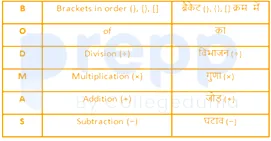
Understanding the correct order of operations is fundamental for evaluating mathematical expressions accurately. Let's break down BODMAS/PEMDAS:
B/P: Brackets / Parentheses - Evaluate expressions inside brackets first.
O/E: Orders / Exponents - Calculate powers, roots, or other orders next.
DM: Division and Multiplication - Perform division and multiplication from left to right as they appear in the expression. They have equal priority.
AS: Addition and Subtraction - Perform addition and subtraction from left to right as they appear in the expression. They have equal priority.
In the examples above, once we performed the division and multiplication from left to right, we then proceeded with addition and subtraction from left to right to get the final values.
Paper & answer key PDF ↗ Question 2archived
In the following question, four number pairs are given. In each pair the number on left side of (–) is related to the number of the right side of (–) with some Logic/Rule/Relation. Three pairs are similar on basis of same Logic/Rule/Relation. Select the odd one out from the given alternatives. (NOTE: Operations should be performed on the whole numbers, without breaking down the numbers into its constituent digits. E.g.13 – Operations on 13 such as adding /subtracting /multiplying etc. to 13 can be performed. Breaking down 13 into 1 and 3 and then performing mathematical operations on 1 and 3 is not allowed)
- A
12 – 145
- B
16 – 257
- C
14 – 193
- D
10 –101
Show answer
C. 14 – 193The pattern followed in the given options is:
Logic: (First term) 2 + 1 = Second term
Now we consider the given options:
Option 1) 12 – 145
⇒ (12) 2+ 1 = 145
⇒ 144 + 1= 145
⇒ 145 = 145
Option 2) 16 – 257
⇒ (16) 2 + 1 = 257
⇒ 256 + 1 = 257
⇒ 257 = 257
Option 3) 14 – 193
⇒ (14) 2 + 1 = 193
⇒ 196 + 1 = 193
⇒ 197 ≠ 193
Option 4) 10 –101
⇒ (10) 2 + 1 = 101
⇒ 100 + 1 = 101
⇒ 101 = 101
We can see that 14 - 193 does not follow the pattern so it is the odd one.
Hence, the correct answer is "Option 3".
Paper & answer key PDF ↗ Question 3archived
A series is given with one term missing. Select the correct alternative from the given ones that will complete the series.
QML, PRC, OWT, NBK, ?
- A
GMR
- B
MGB
- C
MBG
- D
GQR
Show answer
B. MGBFinding the Pattern in the Letter Series
The question asks us to identify the missing term in the given letter series: QML, PRC, OWT, NBK, ?
To solve letter series questions, we need to look for patterns in the position of the letters within the alphabet. Let's analyze each position of the letters in the terms provided.
Analyzing the First Letter
The first letters of the terms are Q, P, O, N.
Q is the 17th letter.
P is the 16th letter.
O is the 15th letter.
N is the 14th letter.
The pattern for the first letter is a decrease of 1 position in the alphabet each time.
Q $\xrightarrow{-1}$ P $\xrightarrow{-1}$ O $\xrightarrow{-1}$ N $\xrightarrow{-1}$ ?
Following this pattern, the next first letter should be the letter 1 position before N, which is M (the 13th letter).
Analyzing the Second Letter
The second letters of the terms are M, R, W, B.
M is the 13th letter.
R is the 18th letter.
W is the 23rd letter.
B is the 2nd letter.
Let's look at the difference in their positions:
M to R: $18 - 13 = 5$ (+5)
R to W: $23 - 18 = 5$ (+5)
W to B: $23 \xrightarrow{+3}$ Z (26), $26 \xrightarrow{+2}$ B (2). The total shift is $3 + 2 = 5$. This represents adding 5 positions with a wrap-around from Z to A.
The pattern for the second letter is an increase of 5 positions in the alphabet each time, wrapping around from Z to A.
M $\xrightarrow{+5}$ R $\xrightarrow{+5}$ W $\xrightarrow{+5}$ B $\xrightarrow{+5}$ ?
Following this pattern, the next second letter should be B + 5 positions. Starting from B (2), adding 5 positions gives the 7th letter, which is G.
Analyzing the Third Letter
The third letters of the terms are L, C, T, K.
L is the 12th letter.
C is the 3rd letter.
T is the 20th letter.
K is the 11th letter.
Let's look at the difference in their positions:
L to C: $3 - 12 = -9$. This represents decreasing by 9 positions. $12 \xrightarrow{-9}$ C (3).
C to T: $20 - 3 = 17$. This looks like $+17$, but let's consider decreasing by 9 with wrap-around. Starting from C (3), decreasing by 3 goes to Z (26). We still need to decrease by $9 - 3 = 6$. Decreasing by 6 from Z gives T ($26 \xrightarrow{-6}$ T (20)). So, this is also -9.
T to K: $11 - 20 = -9$. This represents decreasing by 9 positions.
The pattern for the third letter is a decrease of 9 positions in the alphabet each time, wrapping around from A to Z.
L $\xrightarrow{-9}$ C $\xrightarrow{-9}$ T $\xrightarrow{-9}$ K $\xrightarrow{-9}$ ?
Following this pattern, the next third letter should be K - 9 positions. Starting from K (11), decreasing by 9 positions gives the 2nd letter, which is B.
Combining the Patterns
Based on the analysis of each letter position, the next term in the series is formed by the next letters from each pattern:
First letter: M
Second letter: G
Third letter: B
Combining these gives the term MGB.
Here is a summary table of the patterns:
Term
1st Letter (Position)
2nd Letter (Position)
3rd Letter (Position)
QML
Q (17)
M (13)
L (12)
PRC
P (16)
R (18)
C (3)
OWT
O (15)
W (23)
T (20)
NBK
N (14)
B (2)
K (11)
?
M (13) (-1 pattern)
G (7) (+5 pattern)
B (2) (-9 pattern)
Thus, the missing term in the series is MGB.
Revision Table: Letter Series Patterns
Understanding common patterns helps in solving letter series questions quickly. Here are some types of patterns you might encounter:
Consecutive Letters: Letters follow each other in alphabetical order (e.g., A, B, C).
Skipping Letters: Letters are skipped based on a fixed rule (e.g., A, C, E, G - skipping one letter).
Constant Addition/Subtraction: Each letter's position increases or decreases by a constant number (like +3, -2).
Increasing/Decreasing Addition/Subtraction: The number added or subtracted changes in a pattern (e.g., +1, +2, +3).
Alphabetical Wrap-around: The pattern continues by cycling from Z back to A or A to Z.
Combination of Patterns: Different positions in the term follow different patterns (as seen in this problem).
Additional Information on Reasoning Series
Reasoning series problems, including letter series, number series, and alpha-numeric series, are designed to test logical thinking and pattern recognition skills. These questions often appear in competitive exams and aptitude tests.
Key strategies for solving series problems:
Write down the terms and identify the elements (letters, numbers, or both).
For letter series, write down the position number of each letter (A=1, B=2, ..., Z=26).
Look for patterns: constant difference, increasing/decreasing difference, multiplication/division, squares, cubes, prime numbers, alternating patterns, or combinations.
Check for patterns across different positions within multi-letter terms.
If a pattern isn't obvious, try calculating the difference between consecutive terms/elements.
Be mindful of alphabetical or numerical wrap-around.
Test your predicted next term against the pattern to ensure it fits logically.
Practicing different types of series helps in quickly recognizing the underlying pattern.
Paper & answer key PDF ↗ Question 4archived
By interchanging the given two signs which of the following equation will be correct?
× and +
- A
7 × 8 ÷ 9 + 18 – 11 = 16
- B
24 – 8 – 5 × 5 + 3 = 14
- C
5 × 10 – 15 + 20 ÷ 25 = 8
- D
24 × 8 + 6 ÷ 3 – 18 = 22
Show answer
D. 24 × 8 + 6 ÷ 3 – 18 = 22BODMAS rule:
Option 1) 7 × 8 ÷ 9 + 18 – 11 = 16.
After interchanging '× and +'.
⇒ 7 +8 ÷ 9× 18 – 11 = 16
⇒ 7 + 0.8 × 18– 11 = 16
⇒ 7 +14.4 – 11 = 16
⇒ 21.4 – 11= 16
⇒ 10.4 ≠ 16
Option 2) 24 – 8 – 5 × 5 + 3 = 14.
After interchanging ' × and +'.
⇒ 24 – 8 – 5 + 5 × 3= 14
⇒ 24– 8 – 5+15 = 14
⇒ 39 – 8 – 5 = 14
⇒ 26 ≠ 14
Option 3) 5 × 10 – 15 + 20 ÷ 25 = 8.
After interchanging ' × and +'.
⇒ 5 + 10 – 15 × 20 ÷ 25= 8
⇒ 5 + 10 –15 × 0.8 = 8
⇒ 5 + 10– 12 = 8
⇒ 15 – 12 = 8
⇒ 3 ≠ 8
Option 4) 24 × 8 + 6 ÷ 3 – 18 = 22.
After interchanging ' × and +'.
⇒ 24 + 8 × 6 ÷ 3– 18 = 22
⇒ 24 + 8 × 2 – 18 = 22
⇒ 24 + 16– 18 = 22
⇒ 40 – 18= 22
⇒ 22 = 22
Hence, the correct answer is "Option 4".
 Paper & answer key PDF ↗
 Question 5archived
Select the figure form among the given options that can replace the question mark (?) in the following series.
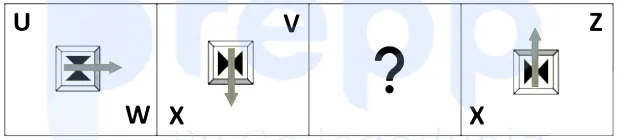
- A
Option A (shown in image)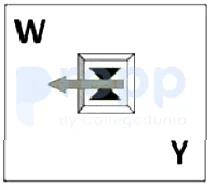
- B
Option B (shown in image)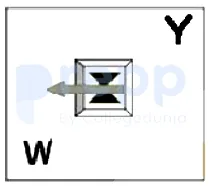
- C
Option C (shown in image)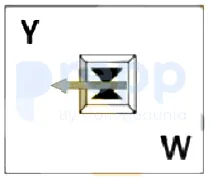
- D
Option D (shown in image)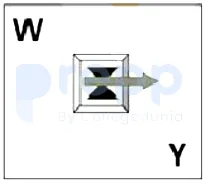
Show answer
Question 6archived
After arranging the given words according to dictionary order, which word will come at ‘Third’ position?
1. Theory
2. Theorem
3. Theology
4. Theologue
5. Theogonic
- A
Theologue
- B
theorem
- C
theology
- D
Theogonic
Show answer
C. theologyArranging Words by Dictionary Order: Finding the Third Word
To arrange words in dictionary order, we compare them letter by letter from left to right. When comparing a list of words that start with the same letters, we look at the first letter where they differ. The word with the letter that comes earlier in the alphabet is placed first.
Step-by-Step Dictionary Order Comparison
Here are the given words:
Theory
Theorem
Theology
Theologue
Theogonic
All the words begin with the letters 'T', 'h', 'e'. Let's compare the letters that follow 'The':
Theory
Theorem
Theology
Theologue
Theogonic
All words continue with 'o'. Let's compare the next letters:
Theory
Theorem
Theology
Theologue
Theogonic
The letters following 'Theo' are 'r', 'r', 'l', 'l', 'g'. Arranging these letters ('r', 'l', 'g') alphabetically: 'g', 'l', 'r'.
So, the words starting with 'Theog' will come first, then 'Theol', and finally 'Theor'.
Comparing Words Starting with 'Theog'
Theogonic
There is only one word starting with 'Theog'. So, Theogonic is the first word.
Comparing Words Starting with 'Theol'
Theology
Theologue
Both words start with 'Theol'. Let's look at the next letter:
Theology
Theologue
Both have 'g'. Let's look at the next letter:
Theology
Theologue
The letters are 'y' and 'u'. In the alphabet, 'u' comes before 'y'.
Theologue
Theology
So, Theologue is the second word, and Theology is the third word.
Comparing Words Starting with 'Theor'
Theory
Theorem
Both words start with 'Theor'. Let's look at the next letters:
Theory
Theorem
Comparing 'y' and 'e'. In the alphabet, 'e' comes before 'y'.
Theorem
Theory
So, Theorem is the fourth word, and Theory is the fifth word.
Final Dictionary Order
Arranging all the words in dictionary order:
Theogonic
Theologue
Theology
Theorem
Theory
The word that comes at the third position is Theology.
Summary of Dictionary Order
Position
Word
1st
Theogonic
2nd
Theologue
3rd
Theology
4th
Theorem
5th
Theory
Revision Table: Dictionary Order Rules
Understanding how to compare words is key to dictionary order.
Key Rules for Dictionary Order
Rule
Explanation
Letter by Letter
Compare words starting from the first letter.
Alphabetical Order
The word with the letter that comes earlier in the alphabet comes first.
Common Prefix
If words share a common beginning (prefix), compare the letters immediately following the prefix.
Shorter Word Rule
If one word is a prefix of another (e.g., "cat" and "catalog"), the shorter word comes first. (Not applicable in this specific question).
Additional Information: Lexicographical Order
Dictionary order is also known as lexicographical order. This concept is used not just for words but also for sorting sequences of elements, such as strings of characters, numbers, or other items, based on the order of their components. It's a fundamental concept in computer science and mathematics for sorting and comparing data.
Paper & answer key PDF ↗ Question 7archived
Read the given statement(s) and conclusions carefully. Assuming that the information given in the statements is true, even if it appears to be at variance with commonly known facts, decide which of the given conclusions logically follow(s) from the statement(s).
Statements:
Some coats are tables.
No table is a mirror.
All golds are tables.
Conclusions:
I. Some coats being golds is a possibility.
II. No gold is a mirror.
III. All tables are golds.
IV. No coat is a mirror.
- A
Only Conclusion I follows
- B
Only Conclusions II and III follow
- C
Only Conclusions I and II follow
- D
Only Conclusions I, II and IV follow
Show answer
C. Only Conclusions I and II followUnderstanding Logic Statements and Conclusions
This question requires us to analyze given statements and determine which conclusions logically follow from them. In logic problems like this, we must strictly adhere to the information provided in the statements, even if it contradicts real-world knowledge. We can use methods like Venn diagrams or logical rules to represent the relationships and test the validity of the conclusions.
Analyzing the Given Statements
Let's break down the statements:
Statement 1: Some coats are tables. (Represents an overlap between the set of Coats and the set of Tables)
Statement 2: No table is a mirror. (Represents no overlap between the set of Tables and the set of Mirrors)
Statement 3: All golds are tables. (Represents the set of Golds being entirely contained within the set of Tables)
Evaluating Each Conclusion Based on the Statements
Now, let's examine each conclusion one by one to see if it is logically derived from the statements.
Conclusion I: Some coats being golds is a possibility.
From Statement 1, we know there is an overlap between Coats and Tables (Some Coats are Tables). From Statement 3, we know that the entire set of Golds is inside the set of Tables (All Golds are Tables). Since some part of Coats is within Tables, it is possible that this overlapping part of Coats and Tables also overlaps with the part of Tables that represents Golds. There is no statement that prohibits this overlap between Coats and Golds within the domain of Tables. Therefore, it is a possible scenario.
Conclusion I logically follows as a possibility.
Conclusion II: No gold is a mirror.
From Statement 3, we know that all Golds are Tables (Golds ⊂ Tables). From Statement 2, we know that no Table is a Mirror (Tables ∩ Mirrors = ∅). If the entire set of Golds is inside the set of Tables, and the set of Tables has no overlap with the set of Mirrors, then it must be true that the set of Golds also has no overlap with the set of Mirrors. Therefore, no gold is a mirror is a definite conclusion.
Conclusion II logically follows definitely.
Conclusion III: All tables are golds.
Statement 3 says, "All golds are tables" (Golds ⊂ Tables). This means that every element in the set of Golds is also in the set of Tables. However, this does not mean that every element in the set of Tables is also in the set of Golds. There could be tables that are not golds. The statement establishes a relationship from Golds to Tables, not the other way around for "all".
Conclusion III does not logically follow.
Conclusion IV: No coat is a mirror.
From Statement 1, some coats are tables (Coats ∩ Tables ≠ ∅). From Statement 2, no table is a mirror (Tables ∩ Mirrors = ∅). This tells us that the portion of coats that *are* tables cannot be mirrors. However, the statements do not provide any information about the coats that are *not* tables. These non-table coats could potentially be mirrors, or they could not be. We cannot make a definite conclusion about all coats based only on the relationship of tables to mirrors and the partial overlap of coats with tables.
Conclusion IV does not logically follow definitely.
Summary of Conclusions
Based on the analysis:
Conclusion I: Some coats being golds is a possibility. (Follows)
Conclusion II: No gold is a mirror. (Follows)
Conclusion III: All tables are golds. (Does not follow)
Conclusion IV: No coat is a mirror. (Does not follow)
Therefore, only Conclusions I and II logically follow from the given statements.
Revision Table: Statements and Conclusions
Statement/Conclusion
Relationship
Analysis
Follows?
Statement 1
Some Coats are Tables
Partial overlap (Coats & Tables)
Given
Statement 2
No Table is a Mirror
No overlap (Tables & Mirrors)
Given
Statement 3
All Golds are Tables
Golds ⊂ Tables
Given
Conclusion I
Some coats being golds is a possibility.
Overlap of C & T could be in G (which is in T). Possible.
Yes (as a possibility)
Conclusion II
No gold is a mirror.
If G ⊂ T and T ∩ M = ∅, then G ∩ M = ∅. Definite.
Yes (definitely)
Conclusion III
All tables are golds.
Statements only say G ⊂ T, not T ⊂ G. Not definite.
No
Conclusion IV
No coat is a mirror.
Overlap of C & T not in M. But coats outside the overlap? Not definite.
No
Additional Information: Types of Conclusions in Logic
In logic and syllogism problems, conclusions can follow in different ways:
Definitely Follows: The conclusion must be true if the statements are true. There is no scenario based on the statements where the conclusion could be false. (e.g., Conclusion II)
Follows as a Possibility: The conclusion is not necessarily true, but it is not contradicted by the statements. There is at least one possible scenario based on the statements where the conclusion could be true. (e.g., Conclusion I)
Does Not Follow: The conclusion is either contradicted by the statements or cannot be confirmed as true (either definitely or as a possibility) based solely on the statements. (e.g., Conclusions III and IV as definite conclusions)
It's crucial to distinguish between what is definitely true and what is merely possible based on the given information.
Paper & answer key PDF ↗ Question 8archived
In a certain code language, 'PLAYGROUND' is written as ‘OKZXFQNTMC’ and ‘SCIENCE’ is written as ‘RBHDMBD, how will 'TYPEWRITER' be written in that language?
- A
RVNCUQHSDQ
- B
SXODVPGRCP
- C
RVNCUPGRCP
- D
SXODVQHSDQ
Show answer
D. SXODVQHSDQDecoding the Code Language Pattern
This question asks us to decode a word based on a pattern observed in two given examples of coded words. We need to analyze the relationship between the original words and their coded forms to find the rule.
Analyzing the Given Code Examples
Let's look at the first example:
Original Word: PLAYGROUND
Coded Word: OKZXFQNTMC
Let's compare each letter:
P comes after O (O is the previous letter)
L comes after K (K is the previous letter)
A comes after Z (Z is the previous letter, wrapping around from A)
Y comes after X (X is the previous letter)
G comes after F (F is the previous letter)
R comes after Q (Q is the previous letter)
O comes after N (N is the previous letter)
U comes after T (T is the previous letter)
N comes after M (M is the previous letter)
D comes after C (C is the previous letter)
It appears that each letter in the original word is replaced by the letter immediately preceding it in the English alphabet.
Let's check the second example to confirm this pattern:
Original Word: SCIENCE
Coded Word: RBHDMBD
Comparing each letter:
S comes after R (R is the previous letter)
C comes after B (B is the previous letter)
I comes after H (H is the previous letter)
E comes after D (D is the previous letter)
N comes after M (M is the previous letter)
C comes after B (B is the previous letter)
E comes after D (D is the previous letter)
The pattern holds true for the second example as well. The rule is consistently replacing each letter with its preceding letter in the alphabet (with A wrapping around to Z).
Applying the Coding Pattern to TYPEWRITER
Now we will apply this established pattern to the word 'TYPEWRITER' to find its code.
T will be replaced by its previous letter, which is S.
Y will be replaced by its previous letter, which is X.
P will be replaced by its previous letter, which is O.
E will be replaced by its previous letter, which is D.
W will be replaced by its previous letter, which is V.
R will be replaced by its previous letter, which is Q.
I will be replaced by its previous letter, which is H.
T will be replaced by its previous letter, which is S.
E will be replaced by its previous letter, which is D.
R will be replaced by its previous letter, which is Q.
So, the coded word for TYPEWRITER is SXODVQHSDQ.
Comparing with Options
Let's compare our result with the given options:
Option
Coded Word
Matches our result?
1
RVNCUQHSDQ
No
2
SXODVPGRCP
No
3
RVNCUPGRCP
No
4
SXODVQHSDQ
Yes
Our derived code SXODVQHSDQ matches Option 4.
Revision Table: Coding Decoding Logic
Original Letter
Coding Rule
Coded Letter
A
Previous letter (wraps around)
Z
B
Previous letter
A
C
Previous letter
B
...
...
...
E
Previous letter
D
I
Previous letter
H
N
Previous letter
M
O
Previous letter
N
P
Previous letter
O
R
Previous letter
Q
S
Previous letter
R
T
Previous letter
S
U
Previous letter
T
W
Previous letter
V
Y
Previous letter
X
Z
Previous letter
Y
Additional Information on Coding and Decoding
Coding and decoding questions are common in reasoning sections of competitive exams. They test your ability to identify patterns and rules in coded messages. Common patterns include:
Letter Shifting: Each letter is shifted a fixed number of positions forward or backward in the alphabet. Our current problem uses a backward shift of 1 position.
Reverse Order: The letters of the word are reversed.
Substitution: Each letter is directly substituted with another specific letter or symbol.
Position-based Coding: The code depends on the position of the letter in the word or its position in the alphabet.
Mixed Patterns: A combination of the above rules might be used, potentially differing for odd/even positions, first/second half of the word, etc.
To solve these problems, practice is key. Carefully compare the given examples, look for consistent changes in letters, positions, or substitutions, and apply the identified rule to the target word.
Paper & answer key PDF ↗ Question 9archived
Select the option that is related to the fifth number in the same way as the second number is related to the first number and the fourth number is related to the third number.
6 ∶ 125 ∶ ∶ 2 ∶ 1 ∶ ∶ 5 ∶ ?
- A
81
- B
64
- C
68
- D
72
Show answer
B. 64Solving Number Analogy Questions
Number analogy questions test your ability to find the relationship between pairs of numbers and apply that same relationship to a new number to find a missing term. The goal is to identify the pattern connecting the first number to the second number and the third number to the fourth number. Once the pattern is found, apply it to the fifth number to determine the sixth number.
The given analogy is:
6 ∶ 125 ∶ ∶ 2 ∶ 1 ∶ ∶ 5 ∶ ?
This can be broken down into two pairs:
6 is related to 125
2 is related to 1
We need to find the number that 5 is related to, following the same pattern.
Analyzing the First Number Pair: 6 and 125
Let's look for a mathematical relationship between 6 and 125.
Is it addition or subtraction? $6 + X = 125 \Rightarrow X = 119$. $6 \times X = 125 \Rightarrow X = 125/6$ (not an integer).
Let's consider powers. 125 is a perfect cube: $125 = 5 \times 5 \times 5 = 5^3$.
How can 6 relate to 5? 5 is one less than 6 ($6-1 = 5$).
So, the relationship could be: take the first number, subtract 1, and then cube the result. Let's test this pattern: $(6-1)^3 = 5^3 = 125$. This matches the first pair.
Verifying the Pattern with the Second Number Pair: 2 and 1
Let's apply the same pattern to the second pair of numbers, 2 and 1, to see if it holds true.
The pattern is: (First Number - 1)$^{\text{3}}$.
Applying this to the pair (2, 1): $(2-1)^3 = 1^3 = 1 \times 1 \times 1 = 1$.
This also matches the second pair (2 is related to 1). The pattern appears to be consistent.
Applying the Pattern to the Third Number: 5
Now that we have identified and verified the pattern, we can apply it to the third number, 5, to find the missing number.
The pattern is: (Number - 1)$^{\text{3}}$.
Applying this to the number 5: $(5-1)^3 = 4^3$.
Let's calculate $4^3$: $4^3 = 4 \times 4 \times 4 = 16 \times 4 = 64$.
So, the number related to 5 in the same way is 64.
Checking the Options
The calculated missing number is 64. Let's look at the given options:
81
64
68
72
The calculated number 64 matches option 2.
Based on the established pattern $(n-1)^3$, where $n$ is the first number in the pair, the missing number related to 5 is 64.
Revision Table: Number Analogy Pattern
Pair
First Number (n)
Pattern Applied ($(n-1)^3$)
Second Number
First
6
$(6-1)^3 = 5^3 = 125$
125
Second
2
$(2-1)^3 = 1^3 = 1$
1
Third
5
$(5-1)^3 = 4^3 = 64$
? (Missing Number)
Additional Information: Common Number Analogy Patterns
Number analogy problems can involve various mathematical patterns. Some common patterns include:
Arithmetic Operations: Addition, subtraction, multiplication, division.
Squares and Cubes: The second number might be the square or cube of the first number, or related to the square/cube of a number derived from the first number (like $n+1$, $n-1$, $n/2$).
Combinations of Operations: For example, multiply by a number and then add/subtract a constant ($2n+3$).
Digit Operations: Sum of digits, product of digits, reversing digits.
Sequential Patterns: Applying a sequence of operations based on the position of the pair in the analogy.
Prime Numbers, Composite Numbers: The relationship might involve properties of numbers like primality.
To solve number analogy questions effectively, it's helpful to be familiar with squares, cubes, and common arithmetic relationships, and practice analyzing pairs to find consistent patterns.
Paper & answer key PDF ↗ Question 10archived
Select the correct mirror image of the given figure when the mirror is placed at MN as shown below.
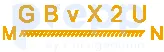
- A
Option A (shown in image)
- B
Option B (shown in image)
- C
Option C (shown in image)
- D
Option D (shown in image)
Show answer
Question 11archived
In the following question below are given some statements followed by some conclusions based on those statements. Taking the given statements to be true even if they seem to be at variance from commonly known facts. Read all the conclusions and then decide which of the given conclusion logically follows the given statements.
Statements:
I. All P are W.
II. No O is W.
Conclusion:
I. Some O are not P.
II. All W are O.
- A
Neither conclusion follows
- B
Only conclusion I follows
- C
Only conclusion II follows
- D
Both conclusions I and II follows
Show answer
B. Only conclusion I followsThis question is a classic example of logical reasoning, specifically dealing with syllogisms. We are given two statements and two conclusions, and we need to determine which conclusion(s) logically follow from the given statements, assuming the statements are true.
Understanding the Statements
Let's break down the given statements:
Statement I: All P are W. This means that every single item that is classified as 'P' is also classified as 'W'. There are no P's outside of the group 'W'.
Statement II: No O is W. This means that there is absolutely no overlap between the group 'O' and the group 'W'. If something is 'O', it cannot be 'W', and vice versa.
Visualizing with Venn Diagrams (Conceptual)
While we don't draw diagrams here, we can think about the relationships:
Statement I: A circle representing 'P' is completely inside a larger circle representing 'W'.
Statement II: A circle representing 'O' is entirely separate from the circle representing 'W'.
Combining these: Since the 'P' circle is inside the 'W' circle, and the 'W' circle is completely separate from the 'O' circle, the 'P' circle must also be completely separate from the 'O' circle. This means no P is O, and no O is P.
Analyzing the Conclusions
Now let's evaluate each conclusion based on the statements:
Conclusion I: Some O are not P.
From our analysis, we deduced that based on the statements, the group 'O' and the group 'P' are entirely separate. This means that all O's are not P's. If it is true that 'All O are not P', then it must also be true that 'Some O are not P'. The statement 'Some O are not P' implies that there is at least one O that is not a P. Since every single O is not a P (because O and P groups are separate), it is definitely true that some O's are not P's.
Therefore, Conclusion I logically follows from the given statements.
Conclusion II: All W are O.
Statement II explicitly says "No O is W". This directly implies that "No W is O". The conclusion "All W are O" contradicts Statement II. If no W is O, it is impossible for all W to be O.
Therefore, Conclusion II does not logically follow from the given statements.
Summary of Analysis
Statement/Conclusion
Analysis
Follows?
Statement I: All P are W.
P is a subset of W.
Given
Statement II: No O is W.
O and W have no overlap.
Given
Conclusion I: Some O are not P.
Since O and W are separate, and P is inside W, O and P are also separate. All O are not P. If all O are not P, then Some O are not P is true.
Yes
Conclusion II: All W are O.
Directly contradicts Statement II (No O is W).
No
Based on the analysis, only Conclusion I logically follows from the given statements.
Revision Table: Key Syllogism Concepts
Type of Statement
Relationship
Example
All A are B
Every A is also a B. A is a subset of B.
All dogs are mammals.
No A is B
There is no overlap between A and B.
No cat is a dog.
Some A are B
At least one A is a B. There is some overlap between A and B.
Some students are athletes.
Some A are not B
At least one A is not a B.
Some birds are not sparrows.
Additional Information: Deductive Logic in Syllogisms
Syllogisms are part of deductive logic. In deductive logic, if the premises (statements) are true, the conclusion must also be true. We are not concerned with whether the statements are true in the real world, only whether the conclusion necessarily follows *from* the statements provided. If a conclusion can be false when the statements are true, it does not logically follow. In this problem, Conclusion I cannot be false if the statements are true, while Conclusion II *must* be false if the statements are true. This confirms our finding that only Conclusion I follows.
Paper & answer key PDF ↗ Question 12archived
Three different positions of the same dice are shown. Find the number on the face opposite the face showing '2'.
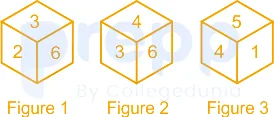
- A
4
- B
5
- C
6
- D
1
Show answer
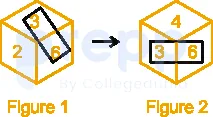
A. 4When we compare the figures 1 and 2, we get:
When dice is rotated such that '3' and '6' are visible in both the cases, we get '2' on the left and '4' on the right which means '2' and '4' are opposite to each other.
So, the face opposite to '2' is '4' .
Hence, the correct answer is " option 1".
 Paper & answer key PDF ↗
 Question 13archived
Select the correct mirror image of the given combination when the mirror is placed at 'PQ' as shown below.

- A
Option A (shown in image)
- B
Option B (shown in image)
- C
Option C (shown in image)
- D
Option D (shown in image)
Show answer
Question 14archived
Which two numbers from amongst the given options should be interchanged to make the given equation correct?
248 ÷ 4 + 184 ÷ ( 4 × 6 – 2 × 8) = 77
- A
8 and 4
- B
184 and 77
- C
184 and 248
- D
4 and 6
Show answer
C. 184 and 248Understanding the Equation and the Goal
The question asks us to find two numbers from the given options that, when swapped in the original equation, make the equation true. The original equation is:
\begin{equation*} 248 \div 4 + 184 \div ( 4 \times 6 – 2 \times 8) = 77 \end{equation*}
Our goal is to test the pairs of numbers provided in the options by swapping them in the equation and checking if the left side equals the right side (77).
Testing the Options by Interchanging Numbers
Let's evaluate the original equation first to see if it's already correct (it should not be, based on the question asking for a swap). We follow the order of operations (BODMAS/PEMDAS):
Inside the parentheses: $( 4 \times 6 – 2 \times 8)$
Multiplication first: $4 \times 6 = 24$ and $2 \times 8 = 16$
Subtraction: $24 - 16 = 8$
So the equation becomes: $248 \div 4 + 184 \div 8 = 77$
Now perform the divisions:
$248 \div 4 = 62$
$184 \div 8 = 23$
The equation becomes: $62 + 23 = 77$
Adding the numbers: $62 + 23 = 85$
So, $85 = 77$. This is false, meaning the original equation is incorrect and needs a swap.
Checking Option 1: Swap 8 and 4
Swapping 8 and 4 in the original equation:
\begin{equation*} 248 \div 8 + 184 \div ( 8 \times 6 – 2 \times 4) = 77 \end{equation*}
Evaluate the expression:
Inside parentheses: $( 8 \times 6 – 2 \times 4)$
$8 \times 6 = 48$
$2 \times 4 = 8$
$48 - 8 = 40$
Equation becomes: $248 \div 8 + 184 \div 40 = 77$
Division: $248 \div 8 = 31$. $184 \div 40 = 4.6$.
Equation becomes: $31 + 4.6 = 77$
$35.6 = 77$. This is false.
Checking Option 2: Swap 184 and 77
Swapping 184 and 77. The number 77 is on the right side of the equation. We only swap numbers within the expression on the left side. Swapping 184 with 77 means the equation becomes:
\begin{equation*} 248 \div 4 + 77 \div ( 4 \times 6 – 2 \times 8) = 184 \end{equation*}
From our initial calculation, we know $( 4 \times 6 – 2 \times 8) = 8$.
Equation becomes: $248 \div 4 + 77 \div 8 = 184$
Division: $248 \div 4 = 62$. $77 \div 8 = 9.625$.
Equation becomes: $62 + 9.625 = 184$
$71.625 = 184$. This is false.
Checking Option 3: Swap 184 and 248
Swapping 184 and 248 in the original equation:
\begin{equation*} 184 \div 4 + 248 \div ( 4 \times 6 – 2 \times 8) = 77 \end{equation*}
Evaluate the expression step-by-step:
Inside parentheses: $( 4 \times 6 – 2 \times 8)$
Multiplication first: $4 \times 6 = 24$ and $2 \times 8 = 16$
Subtraction: $24 - 16 = 8$
The equation becomes: $184 \div 4 + 248 \div 8 = 77$
Now perform the divisions:
$184 \div 4 = 46$
$248 \div 8 = 31$
The equation becomes: $46 + 31 = 77$
Adding the numbers: $46 + 31 = 77$
So, $77 = 77$. This is true. Swapping 184 and 248 makes the equation correct.
Checking Option 4: Swap 4 and 6
Swapping 4 and 6 in the original equation:
\begin{equation*} 248 \div 6 + 184 \div ( 6 \times 4 – 2 \times 8) = 77 \end{equation*}
Evaluate the expression:
Inside parentheses: $( 6 \times 4 – 2 \times 8)$
$6 \times 4 = 24$
$2 \times 8 = 16$
$24 - 16 = 8$
Equation becomes: $248 \div 6 + 184 \div 8 = 77$
Division: $248 \div 6 \approx 41.33$. $184 \div 8 = 23$.
Equation becomes: $41.33 + 23 \approx 77$
$64.33 \approx 77$. This is false.
Conclusion on Number Interchange
Based on our testing, interchanging the numbers 184 and 248 is the only swap that makes the given equation correct. The final equation becomes $77 = 77$, which is a true statement.
Option (Swap)
Equation after Swap
Resulting Equation
Correct?
8 and 4
$248 \div 8 + 184 \div ( 8 \times 6 – 2 \times 4) = 77$
$31 + 4.6 = 77 \implies 35.6 = 77$
No
184 and 77
$248 \div 4 + 77 \div ( 4 \times 6 – 2 \times 8) = 184$
$62 + 9.625 = 184 \implies 71.625 = 184$
No
184 and 248
$184 \div 4 + 248 \div ( 4 \times 6 – 2 \times 8) = 77$
$46 + 31 = 77 \implies 77 = 77$
Yes
4 and 6
$248 \div 6 + 184 \div ( 6 \times 4 – 2 \times 8) = 77$
$41.33 + 23 = 77 \implies 64.33 \approx 77$
No
Revision Table: Key Concepts
Concept
Explanation
Importance
Order of Operations (BODMAS/PEMDAS)
Rules for solving expressions: Brackets/Parentheses, Orders/Exponents, Division/Multiplication, Addition/Subtraction. Solved from left to right within each level.
Ensures consistent and correct evaluation of mathematical expressions. Essential for solving equations accurately.
Interchanging Numbers
Swapping the positions of two specific numbers within an equation or expression.
Used in this type of problem to test which swap satisfies the given condition (making the equation correct).
Equation Verification
Checking if the left side of an equation equals the right side after performing all calculations.
The final step to determine if a number interchange was successful in making the equation true.
Additional Information: Solving Number Swap Problems
Problems involving interchanging numbers in an equation are common in competitive exams. Here are some tips:
Always start by evaluating the original equation to understand why it's incorrect.
Systematically test each option provided. Do not guess.
Follow the order of operations strictly for every evaluation. Even a small error can lead to the wrong conclusion.
For complex expressions, break down the calculation into smaller steps, especially operations within brackets.
Keep track of the numbers being swapped for each option to avoid confusion.
This type of question tests your ability to perform calculations accurately and apply the order of operations under different conditions (after swapping numbers).
Paper & answer key PDF ↗ Question 15archived
A # B means ‘A is the sister of B’.
A @ B means ‘A is the son of B’.
A & B means ‘A is the father of B’.
A % B means ‘A is the mother of B’.
If W & Q # T & Y @ M % K, then how is W related to K?
- A
Mother’s father
- B
Brother
- C
Father’s father
- D
Father
Show answer
C. Father’s fatherUnderstanding Blood Relations in the Expression
This question asks us to find the relationship between W and K based on a coded expression involving blood relations. We need to decode each part of the expression "W & Q # T & Y @ M % K" using the given codes and then trace the relationships step-by-step.
Decoding the Relationships
Let's break down the given expression and the meaning of each symbol:
A # B means ‘A is the sister of B’.
A @ B means ‘A is the son of B’.
A & B means ‘A is the father of B’.
A % B means ‘A is the mother of B’.
Now, let's apply these codes to the expression W & Q # T & Y @ M % K:
W & Q: According to the code '&', W is the father of Q.
Q # T: According to the code '#', Q is the sister of T. Since W is the father of Q, W is also the father of T. Q and T are siblings.
T & Y: According to the code '&', T is the father of Y. We already know W is the father of T, so W is the father of T, who is the father of Y. This makes W the grandfather of Y.
Y @ M: According to the code '@', Y is the son of M. We know T is the father of Y. If Y is the son of T and also the son of M, this implies that T and M are married, and Y is their child. M is the mother of Y.
M % K: According to the code '%', M is the mother of K. We know M is married to T and is the mother of Y. Now we know M is also the mother of K. This means K is also a child of M. Since M is married to T, T is likely the father of K as well (unless specified otherwise, siblings usually share both parents in such problems). So, Y and K are siblings (or possibly half-siblings if they only share M as a parent, but the structure suggests full siblings).
Tracing the Relationship from W to K
Let's summarize the relationships we've deduced:
W is the father of T.
T is married to M.
T is the father of Y.
M is the mother of Y.
M is the mother of K.
Based on these points:
W is the father of T.
T is the father of K (since T is married to M, and M is the mother of K).
So, W is the father of K's father (T).
Therefore, W is the grandfather of K.
Determining the Relation of W to K
The question asks: How is W related to K?
We found that W is the father of K's father.
This relationship is "Father's father".
Step-by-Step Derivation
Expression Part
Relation Decoded
Relationship Chain
W & Q
W is father of Q
W (Father) → Q
Q # T
Q is sister of T
W (Father) → Q (Sister) ↔ T
T & Y
T is father of Y
W (Father) → T (Father) → Y
Y @ M
Y is son of M
T (Father of Y), M (Mother of Y). T ↔ M (Married)
M % K
M is mother of K
M (Mother of K). Since M is married to T, T is likely father of K.
From the table and deductions, we have:
W is the father of T.
T is the father of K (as T is married to M and M is the mother of K).
Thus, W is the father of the father of K.
The relation of W to K is "Father's father".
Revision Table: Blood Relation Codes
Code
Meaning
A # B
A is the sister of B
A @ B
A is the son of B
A & B
A is the father of B
A % B
A is the mother of B
Additional Information: Solving Blood Relation Puzzles
Blood relation problems often require careful decoding of symbols and building a family tree or relationship chain. Here are some tips:
Read the definitions of the symbols or codes carefully.
Break down the given expression into smaller segments.
Identify the relationship in each segment.
Combine the relationships to build a complete chain or tree.
Pay attention to the gender implied by the relations (e.g., father, mother, son, daughter, sister, brother).
Finally, determine the relationship between the two individuals asked in the question.
Sometimes, drawing a diagram can help visualize the relationships.
In this specific problem, understanding that if two people are parents of the same child (like T being father of Y and M being mother of Y), they are likely a married couple, is crucial. Then, if one of them (M) is the parent of another person (K), the other spouse (T) is also likely the parent of that person (K), making Y and K siblings.
Paper & answer key PDF ↗ Question 16archived
In a certain code language, 'BOSS’ is coded as '21967' and 'DEAL' is coded as '19192414'. How will 'GAIN' be coded in that language?
- A
16231512
- B
16241612
- C
16231612
- D
16231611
Show answer
C. 16231612Understanding the Coding-Decoding Pattern
This question involves a coding-decoding puzzle where words are converted into numerical codes based on a specific pattern or rule. We are given two examples:
'BOSS' is coded as '21967'
'DEAL' is coded as '19192414'
Our goal is to determine the code for the word 'GAIN' using the same logic.
Analyzing the Given Codes
Let's look at the letters and their positions in the standard English alphabet (A=1, B=2, ..., Z=26).
BOSS: B(2), O(15), S(19), S(19) -> Code: 21967 (5 digits)
DEAL: D(4), E(5), A(1), L(12) -> Code: 19192414 (8 digits)
The number of digits in the codes is different for words of the same length (4 letters). This suggests the coding isn't a simple concatenation of standard alphabetical positions.
Let's examine the second example, 'DEAL', more closely as its code '19192414' seems to split nicely into four two-digit numbers: 19, 19, 24, 14. If each letter is coded as a two-digit number:
D -> 19
E -> 19
A -> 24
L -> 14
Comparing this with the standard positions (D=4, E=5, A=1, L=12) or their reverse positions (D=23, E=22, A=26, L=15) doesn't reveal a simple arithmetic operation.
Discovering the Coding Logic
Let's look at the reverse alphabetical positions. The reverse position of a letter is calculated as $\text{Reverse Position} = 27 - \text{Alphabetical Position}$.
DEAL:
D: Standard 4, Reverse 27-4 = 23. Code 19. Difference: 23 - 19 = 4.
E: Standard 5, Reverse 27-5 = 22. Code 19. Difference: 22 - 19 = 3.
A: Standard 1, Reverse 27-1 = 26. Code 24. Difference: 26 - 24 = 2.
L: Standard 12, Reverse 27-12 = 15. Code 14. Difference: 15 - 14 = 1.
A pattern emerges: for a 4-letter word, the code for each letter is its reverse alphabetical position minus a decreasing sequence of numbers (4, 3, 2, 1).
Let's test this logic with 'BOSS'. It's also a 4-letter word (N=4), so the subtraction sequence should be 4, 3, 2, 1.
BOSS:
B: Standard 2, Reverse 27-2 = 25. Subtract 4: 25 - 4 = 21.
O: Standard 15, Reverse 27-15 = 12. Subtract 3: 12 - 3 = 9.
S: Standard 19, Reverse 27-19 = 8. Subtract 2: 8 - 2 = 6.
S: Standard 19, Reverse 27-19 = 8. Subtract 1: 8 - 1 = 7.
Concatenating these results (21, 9, 6, 7) gives '21967', which matches the code for 'BOSS'. The logic holds true for both examples.
Coding the Word 'GAIN'
'GAIN' is a 4-letter word (N=4), so we will use the same pattern: find the reverse alphabetical position of each letter and subtract 4, 3, 2, and 1 respectively.
G: Standard 7, Reverse 27-7 = 20. Subtract 4: 20 - 4 = 16.
A: Standard 1, Reverse 27-1 = 26. Subtract 3: 26 - 3 = 23.
I: Standard 9, Reverse 27-9 = 18. Subtract 2: 18 - 2 = 16.
N: Standard 14, Reverse 27-14 = 13. Subtract 1: 13 - 1 = 12.
Concatenating the resulting numbers gives the code for 'GAIN': 16231612.
Comparing with Options
Let's compare our calculated code with the given options:
16231512
16241612
16231612
16231611
Our calculated code '16231612' matches Option 3.
Revision Table: Coding Logic Summary
Word
Letters
Alphabetical Positions
Reverse Alphabetical Positions
Subtraction Sequence (N=4)
Calculation (Reverse Pos - Subtraction)
Result
Code
BOSS
B, O, S, S
2, 15, 19, 19
25, 12, 8, 8
4, 3, 2, 1
25-4=21, 12-3=9, 8-2=6, 8-1=7
21, 9, 6, 7
21967
DEAL
D, E, A, L
4, 5, 1, 12
23, 22, 26, 15
4, 3, 2, 1
23-4=19, 22-3=19, 26-2=24, 15-1=14
19, 19, 24, 14
19192414
GAIN
G, A, I, N
7, 1, 9, 14
20, 26, 18, 13
4, 3, 2, 1
20-4=16, 26-3=23, 18-2=16, 13-1=12
16, 23, 16, 12
16231612
Additional Information: Types of Coding-Decoding
Coding-decoding questions are common in logical reasoning tests. They assess your ability to identify patterns and rules. Common types include:
Letter Coding: Letters are substituted by other letters based on a pattern (e.g., shifting position in the alphabet).
Number Coding: Words are coded into numbers. This can be based on alphabetical position, reverse position, number of letters, vowel/consonant counts, or complex arithmetic operations as seen in this problem.
Symbol Coding: Letters or words are coded using symbols.
Mixed Coding: Words, numbers, and symbols are all used in the coding.
Substitution: One word is substituted for another (e.g., 'red' is called 'blue', 'blue' is called 'green').
Solving these questions requires careful observation, pattern identification, and systematic application of the logic derived from the examples.
Paper & answer key PDF ↗ Question 17archived
Study the given pattern carefully and select the number that can replace the question mark (?) in it.
First row - 15, 11, 43
Second row - 13, 8, 48
Third row - 9, 7, ?
(NOTE : Operations should be performed on the whole numbers, without breaking down the numbers into its constituent digits. E.g. 13 – Operations on 13 such as adding / subtracting / multiplying etc. to 13 can be performed. Breaking down 13 into 1 and 3 and then performing mathematical operations on 1 and 3 is NOT allowed)
- A
23
- B
30
- C
27
- D
28
Show answer
A. 23Solving the Number Pattern Puzzle
Let's carefully examine the given number pattern to find the relationship between the numbers in each row. The pattern is provided in three rows:
Row
First Number (A)
Second Number (B)
Third Number (C)
1
15
11
43
2
13
8
48
3
9
7
?
We need to find a rule or operation that connects the first two numbers (A and B) to get the third number (C) in each row. Let's try different combinations of operations on the whole numbers.
Identifying the Pattern Logic
After analyzing the numbers, we can test potential relationships. Let's assume the pattern involves multiplying the first number by a constant and the second number by another constant, and then combining them (either adding or subtracting) to get the third number.
Let the pattern be given by the formula $\text{A} \times x + \text{B} \times y = \text{C}$.
Using the first two rows, we get a system of linear equations:
From Row 1: $15x + 11y = 43$
From Row 2: $13x + 8y = 48$
Now, we solve this system for $x$ and $y$.
Multiply the first equation by 8 and the second by 11 to eliminate $y$:
$(15x + 11y) \times 8 \implies 120x + 88y = 344$
$(13x + 8y) \times 11 \implies 143x + 88y = 528$
Subtract the first new equation from the second new equation:
$(143x + 88y) - (120x + 88y) = 528 - 344$
$143x - 120x = 184$
$23x = 184$
$x = \frac{184}{23} = 8$
Now substitute the value of $x=8$ into the second original equation ($13x + 8y = 48$):
$13(8) + 8y = 48$
$104 + 8y = 48$
$8y = 48 - 104$
$8y = -56$
$y = \frac{-56}{8} = -7$
So, the pattern is $\text{A} \times 8 + \text{B} \times (-7) = \text{C}$, which simplifies to $\text{A} \times 8 - \text{B} \times 7 = \text{C}$.
Applying the Pattern to the Third Row
Now we apply this identified pattern to the third row: 9, 7, ? Here, A = 9 and B = 7.
Missing Number (C) = $9 \times 8 - 7 \times 7$
C = $72 - 49$
C = $23$
The number that replaces the question mark is 23.
Verification of the Logic Pattern
Let's quickly verify the pattern with the first two rows using the formula $\text{A} \times 8 - \text{B} \times 7 = \text{C}$:
Row 1: $15 \times 8 - 11 \times 7 = 120 - 77 = 43$ (Correct)
Row 2: $13 \times 8 - 8 \times 7 = 104 - 56 = 48$ (Correct)
The pattern holds true for the first two rows.
Conclusion
Based on the identified pattern $\text{A} \times 8 - \text{B} \times 7 = \text{C}$, the missing number in the third row (9, 7, ?) is 23.
Revision Table: Number Pattern Solution
Row
Numbers (A, B, C)
Pattern Application ($\text{A} \times 8 - \text{B} \times 7$)
Result (C)
1
15, 11, 43
$15 \times 8 - 11 \times 7 = 120 - 77$
43
2
13, 8, 48
$13 \times 8 - 8 \times 7 = 104 - 56$
48
3
9, 7, ?
$9 \times 8 - 7 \times 7 = 72 - 49$
23
Additional Information: Solving Logic Puzzles
Logic puzzles involving number patterns require careful observation and systematic testing of possible relationships between the given numbers. Common strategies include:
Looking for arithmetic progressions (addition/subtraction).
Looking for geometric progressions (multiplication/division).
Checking for squares, cubes, or other powers.
Testing combinations of operations on multiple numbers in a sequence or row/column.
Looking for relationships between numbers based on their position.
In matrix or row/column based puzzles, the pattern can apply row-wise, column-wise, or even diagonally. It's important to adhere to any specific rules mentioned, such as the note about not breaking down numbers into constituent digits.
Paper & answer key PDF ↗ Question 18archived
Select the figure form among the given options that can replace the question mark (?) in the following series.

- A
Option A (shown in image)
- B
Option B (shown in image)
- C
Option C (shown in image)
- D
Option D (shown in image)
Show answer
A. Option A (shown in image)The figure that will replace the question mark(?) in the following figure series is shown below :
The numbers in the middle of the box are multiplied by 2.
The arrows change alternatively up and down.
lines are increasing one by one and making new figures in new series. as shown below
Hence, the correct answer is "Option 1".

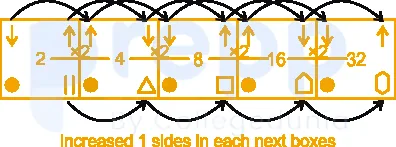 Paper & answer key PDF ↗
 Question 19archived
Select the set in which the numbers are related in the same way as are the numbers of the following set.
(NOTE: Operations should be performed on the whole numbers, without breaking down the numbers into its constituent digits.)
(5, 41, 4)
(2, 68, 8)
- A
(6, 100, 8)
- B
(5, 18, 4)
- C
(5, 100, 4)
- D
(4, 49, 3)
Show answer
A. (6, 100, 8)Understanding Number Analogy Problems
Number analogy questions ask us to find the relationship between numbers in a given set and then identify another set from the options that shares the same relationship. The key is to analyze the initial sets carefully to discover the underlying pattern or rule.
We are given two sets: (5, 41, 4) and (2, 68, 8).
Analyzing the First Set: (5, 41, 4)
Let's look at the numbers 5, 41, and 4. We need to find a mathematical operation or combination of operations involving the first and third numbers (5 and 4) that results in the second number (41). The question states we must use whole numbers and not break them down into digits.
Possible relationships could involve addition, subtraction, multiplication, division, squares, cubes, etc.
Could it be a simple sum or product? $5 + 4 = 9$ (not 41), $5 \times 4 = 20$ (not 41).
What about squares? Let's consider the squares of the first and third numbers:
Square of the first number (5): $5^2 = 25$
Square of the third number (4): $4^2 = 16$
If we add these squares: $25 + 16 = 41$.
This looks promising! The relationship appears to be: The second number is the sum of the square of the first number and the square of the third number. Let the set be $(a, b, c)$. The relation is $b = a^2 + c^2$.
Verifying the Relationship with the Second Set: (2, 68, 8)
Let's check if the same rule applies to the second given set: (2, 68, 8). Here, the first number is 2, the second is 68, and the third is 8.
Square of the first number (2): $2^2 = 4$
Square of the third number (8): $8^2 = 64$
Sum of the squares: $4 + 64 = 68$.
The result, 68, matches the second number in the set. The relationship $b = a^2 + c^2$ is confirmed by both given sets.
Applying the Relation to the Options
Now we need to examine each option set and see which one follows the same rule $b = a^2 + c^2$.
Option 1: (6, 100, 8)
Here, $a=6$, $b=100$, $c=8$. Let's calculate $a^2 + c^2$:
$\text{First number}^2 + \text{Third number}^2 = 6^2 + 8^2 = 36 + 64 = 100$.
This result (100) matches the second number in the set. So, this option follows the relationship.
Option 2: (5, 18, 4)
Here, $a=5$, $b=18$, $c=4$. Let's calculate $a^2 + c^2$:
$\text{First number}^2 + \text{Third number}^2 = 5^2 + 4^2 = 25 + 16 = 41$.
This result (41) does not match the second number (18). This option does not follow the relationship.
Option 3: (5, 100, 4)
Here, $a=5$, $b=100$, $c=4$. Let's calculate $a^2 + c^2$:
$\text{First number}^2 + \text{Third number}^2 = 5^2 + 4^2 = 25 + 16 = 41$.
This result (41) does not match the second number (100). This option does not follow the relationship.
Option 4: (4, 49, 3)
Here, $a=4$, $b=49$, $c=3$. Let's calculate $a^2 + c^2$:
$\text{First number}^2 + \text{Third number}^2 = 4^2 + 3^2 = 16 + 9 = 25$.
This result (25) does not match the second number (49). This option does not follow the relationship.
Conclusion
Only Option 1, the set (6, 100, 8), follows the same relationship ($b = a^2 + c^2$) as the given sets (5, 41, 4) and (2, 68, 8).
Let's summarise the checks in a table:
Set
First Number (a)
Third Number (c)
Second Number (b)
$a^2 + c^2$ Calculation
Does it match b?
(5, 41, 4)
5
4
41
$5^2 + 4^2 = 25 + 16 = 41$
Yes
(2, 68, 8)
2
8
68
$2^2 + 8^2 = 4 + 64 = 68$
Yes
Option 1: (6, 100, 8)
6
8
100
$6^2 + 8^2 = 36 + 64 = 100$
Yes
Option 2: (5, 18, 4)
5
4
18
$5^2 + 4^2 = 25 + 16 = 41$
No
Option 3: (5, 100, 4)
5
4
100
$5^2 + 4^2 = 25 + 16 = 41$
No
Option 4: (4, 49, 3)
4
3
49
$4^2 + 3^2 = 16 + 9 = 25$
No
Revision Table: Key Concepts in Number Analogy
Concept
Description
Example Relationship Type
Number Analogy
Finding a relationship or rule governing a set of numbers and applying it to find a matching set.
Arithmetic operations (+, -, ×, ÷)
Whole Number Operations
Using numbers as they are, without breaking them into individual digits (e.g., using 41 as 41, not 4 and 1).
Squaring, Cubing, Square Roots
Pattern Identification
The process of discovering the specific mathematical relationship between the numbers in the given sets.
Sum/Difference/Product of numbers or their powers
Verification
Checking if the identified pattern holds true for all provided example sets.
Applying the rule to the second given set (2, 68, 8)
Additional Information: Strategies for Solving Number Relation Problems
When tackling number relation or number analogy questions, consider these strategies to identify the pattern:
Basic Operations: Look for simple addition, subtraction, multiplication, or division between the numbers.
Squares and Cubes: Check for relationships involving the squares or cubes of the numbers. Often, the second number might be the sum or difference of the squares/cubes of the first and third.
Combinations: The pattern might involve a combination of operations, such as multiplying two numbers and then adding or subtracting a constant, or involving the sum/difference of numbers multiplied by a constant.
Position-based rules: Sometimes the rule specifically applies to the first, second, or third number based on its position in the set.
Test with Examples: Once you think you've found a rule using the first example set, always test it with any other example sets provided before checking the options.
Systematic Checking: Go through the options one by one, applying the confirmed rule to see which one fits.
Practicing different types of number relation problems helps you quickly spot common patterns involving squares, cubes, or simple arithmetic combinations.
Paper & answer key PDF ↗ Question 20archived
Select the option that is related to the third word in the same way as the second word is related to the first word. (The words must be considered as meaningful English words and must not be related to each other based on the number of letters/number of consonants/vowels in the word.)
Ant ∶ Antling ∶ ∶ Deer ∶ ?
- A
Pup
- B
Fawn
- C
Cub
- D
Foal
Show answer
B. FawnUnderstanding the Word Analogy: Ant and Deer
The question asks us to find the word that completes the analogy: Ant : Antling :: Deer : ?. This type of question tests our understanding of relationships between words. The colon (:) means "is to" and the double colon (::) means "as". So, the analogy reads: "Ant is to Antling as Deer is to what?".
First, let's analyze the relationship between the first pair of words: Ant and Antling.
Ant: This is a common insect.
Antling: This term refers to a young ant.
The relationship between Ant and Antling is that of an adult animal to its young.
Applying the Relationship to the Third Word: Deer
Now, we need to apply the same relationship to the third word, Deer. A Deer is a mammal known for its antlers (in males) and its ability to run. We are looking for the word among the options that means a young deer.
Analyzing the Options for Young Deer
Let's look at the provided options:
Pup: A pup is the term used for the young of several animals, commonly dogs, but also wolves, seals, and other canids or pinnipeds.
Fawn: A fawn is specifically the term used for a young deer.
Cub: A cub is the term used for the young of various large mammals, such as bears, lions, tigers, and foxes.
Foal: A foal is the term used for a young horse or donkey.
Based on the definitions, the word that means a young deer is Fawn.
Conclusion: Completing the Analogy
The analogy Ant : Antling establishes the relationship of an adult animal to its young. Applying this relationship to Deer, we need the term for a young deer. From the options, Fawn is the correct term for a young deer.
Therefore, the completed analogy is Ant : Antling :: Deer : Fawn.
Revision Table: Names of Young Animals
Understanding the terms for young animals is helpful for solving such analogies. Here is a table of some common animal young names:
Adult Animal
Young Animal Name
Ant
Antling
Deer
Fawn
Dog
Pup
Cat
Kitten
Cow
Calf
Sheep
Lamb
Horse
Foal
Bear
Cub
Lion
Cub
Eagle
Eaglet
Additional Information: Animal Group Names
Besides the names for young animals, another common type of analogy involves the names for groups of animals. For example, a group of lions is called a pride, and a group of wolves is called a pack. Knowing these collective nouns can also be useful for word analogy questions.
Examples:
Lion : Pride :: Wolf : Pack
Bird : Flock :: Fish : School
Practicing different types of word relationships like adult/young, individual/group, part/whole, cause/effect, and synonym/antonym will improve your ability to solve word analogies.
Paper & answer key PDF ↗ Question 21archived
Which of the following numbers will replace the question mark (?) in the given series?
97, 131, 165, 199, 233, ?
- A
260
- B
273
- C
251
- D
267
Show answer
D. 267Finding the Next Number in the Series
We are given a number series: 97, 131, 165, 199, 233, ?. We need to find the number that replaces the question mark, which is the next term in the sequence. To do this, we should look for a pattern or rule that connects the numbers in the series.
Analysing the Number Series Pattern
Let's examine the differences between consecutive terms in the given series. This often reveals the pattern in arithmetic series or other sequences based on addition or subtraction.
Difference between the second and first term: ${131 - 97 = 34}$
Difference between the third and second term: ${165 - 131 = 34}$
Difference between the fourth and third term: ${199 - 165 = 34}$
Difference between the fifth and fourth term: ${233 - 199 = 34}$
We observe that the difference between each consecutive pair of numbers is a constant value, 34. This indicates that the given series is an arithmetic progression with a common difference of 34.
Calculating the Missing Number
Since the pattern is to add 34 to the previous term to get the next term, we can find the missing number by adding 34 to the last known term in the series, which is 233.
Missing Number = Last term + Common Difference
Missing Number = ${233 + 34}$
Missing Number = ${267}$
So, the next number in the series is 267.
Comparing with the Options
Let's compare our calculated number (267) with the given options:
Option 1: 260
Option 2: 273
Option 3: 251
Option 4: 267
Our calculated value, 267, matches Option 4.
Conclusion: The Next Number is Found
The series 97, 131, 165, 199, 233 follows a pattern where each term is obtained by adding 34 to the previous term. Applying this pattern, the next number after 233 is 267. Therefore, 267 is the correct number to replace the question mark in the given series.
Revision Table: Number Series Pattern Analysis
Term Number
Term Value
Difference from Previous Term
1
97
-
2
131
${131 - 97 = 34}$
3
165
${165 - 131 = 34}$
4
199
${199 - 165 = 34}$
5
233
${233 - 199 = 34}$
6
?
Expected difference = 34
Additional Information: Types of Number Series Patterns
Number series questions often involve identifying different types of patterns. Here are some common ones:
Arithmetic Series: Each term is obtained by adding a constant value (common difference) to the previous term, as seen in this problem.
Geometric Series: Each term is obtained by multiplying the previous term by a constant value (common ratio).
Square or Cube Series: The terms are related to the squares or cubes of natural numbers.
Difference Series: The differences between consecutive terms themselves form a pattern (e.g., an arithmetic or geometric series).
Alternating Series: The pattern involves two different sequences interleaved or alternating operations.
Fibonacci Series: Each term is the sum of the two preceding terms (e.g., 1, 1, 2, 3, 5, 8...).
Analysing the differences or ratios between terms is a key strategy to solve number series problems.
Paper & answer key PDF ↗ Question 22archived
If K ÷ L means that K is the mother of L, K – L means that K is the father of L, K × L means that K is the sister of L, then which of the following expression shows that P is the paternal grandmother of R?
- A
P ÷ Q × R
- B
R – Q ÷ P
- C
P ÷ Q – R
- D
Q ÷ P – R
Show answer
C. P ÷ Q – RUnderstanding Blood Relations and Symbols
This question tests your ability to interpret symbolic representations of blood relations. You are given a set of rules where specific symbols represent specific relationships between two individuals. Your task is to find the expression that correctly translates to a particular relationship: P is the paternal grandmother of R.
Decoding the Given Relationships
Let's break down the meaning of each symbol as provided in the question:
K ÷ L means K is the mother of L. This establishes a parent-child relationship where K is female.
K – L means K is the father of L. This establishes a parent-child relationship where K is male.
K × L means K is the sister of L. This establishes a sibling relationship where K is female.
Defining Paternal Grandmother
The term "paternal grandmother" refers to the mother of one's father. So, for P to be the paternal grandmother of R, P must be the mother of R's father. Let's say R's father is some person, let's call them Q. Then, P must be the mother of Q, and Q must be the father of R. We need to find an expression that represents this chain of relationships.
Analyzing the Options to Find Paternal Grandmother
We will now examine each option based on the given symbolic rules to see which one results in P being the paternal grandmother of R.
Option 1: P ÷ Q × R
P ÷ Q means P is the mother of Q.
Q × R means Q is the sister of R.
Combining these: P is the mother of Q, and Q is the sister of R. This means P is the mother of Q, who is R's sister. Therefore, P is the mother of R, making P the maternal grandmother (if R is Q's sibling) or simply the mother (if Q and R are the same person, which is unlikely in these puzzles). This does not show P as the paternal grandmother of R.
Option 2: R – Q ÷ P
R – Q means R is the father of Q.
Q ÷ P means Q is the mother of P.
Combining these: R is the father of Q, and Q is the mother of P. This means R is the father of Q, who is P's mother. Therefore, R is the paternal grandfather of P. This is not the required relationship.
Option 3: P ÷ Q – R
P ÷ Q means P is the mother of Q.
Q – R means Q is the father of R.
Combining these: P is the mother of Q, and Q is the father of R. If Q is the father of R, and P is the mother of Q (R's father), then P is the mother of R's father. This exactly matches the definition of P being the paternal grandmother of R.
Option 4: Q ÷ P – R
Q ÷ P means Q is the mother of P.
P – R means P is the father of R.
Combining these: Q is the mother of P, and P is the father of R. If P is the father of R, and Q is the mother of P (R's father), then Q is the mother of R's father. This means Q is the paternal grandmother of R. This is not the required relationship (P is the paternal grandmother of R).
Based on the analysis of each option, the expression P ÷ Q – R correctly shows that P is the paternal grandmother of R.
Summary of Relation Analysis
Expression
Breakdown of Relations
Final Relationship (P to R)
P ÷ Q × R
P is mother of Q; Q is sister of R
P is mother of R (Maternal Grandmother)
R – Q ÷ P
R is father of Q; Q is mother of P
R is paternal grandfather of P
P ÷ Q – R
P is mother of Q; Q is father of R
P is paternal grandmother of R
Q ÷ P – R
Q is mother of P; P is father of R
Q is paternal grandmother of R
Conclusion on Paternal Grandmother Relation
The option that correctly depicts P as the paternal grandmother of R is P ÷ Q – R. This is because P is the mother of Q (P ÷ Q), and Q is the father of R (Q – R). Thus, P is the mother of R's father, fulfilling the condition for paternal grandmother.
Revision Table: Blood Relations Symbols
Symbol
Relation
÷
Mother
–
Father
×
Sister
Additional Information: Solving Blood Relation Puzzles
Blood relation puzzles often involve decoding relationships represented by symbols, codes, or direct statements. To solve these effectively:
Understand the Relations: Be clear about standard family relations (parent, child, sibling, grandparent, aunt, uncle, cousin, in-laws, etc.).
Decode Symbols/Codes: Carefully note down what each symbol or code represents. Pay attention to the order of individuals (e.g., K – L vs L – K).
Draw a Family Tree: For complex problems, drawing a simple family tree can be very helpful. Use symbols for gender (e.g., + for male, - for female) and relationships (e.g., vertical line for parent-child, horizontal line for siblings, double horizontal line for spouse).
Break Down the Expression: Analyze the given expression segment by segment, starting from one end and building the relations step-by-step.
Identify the Target Relationship: Clearly understand what relationship you need to find between the specified individuals.
Check All Options (if MCQs): Evaluate each option systematically to see which one satisfies the target relationship.
These puzzles are common in reasoning sections of competitive exams and help improve logical deduction skills.
Paper & answer key PDF ↗ Question 23archived
Which of the following letter-clusters will replace the question mark (?) in the given series?
HFK, KHM, ?, QLQ, TNS
- A
NJO
- B
OKN
- C
MJN
- D
MKP
Show answer
A. NJOUnderstanding the Letter Series Pattern
The question asks us to find the letter cluster that completes the given series: HFK, KHM, ?, QLQ, TNS. To solve this, we need to analyze the pattern in the letters at each position within the clusters. We will look at the first letters, the second letters, and the third letters separately.
Analyzing the First Letters
Let's look at the first letters of each cluster:
H
K
?
Q
T
Let's find the difference in their alphabetical positions:
H is the 8th letter.
K is the 11th letter. (11 - 8 = +3)
Q is the 17th letter.
T is the 20th letter. (20 - 17 = +3)
The pattern for the first letter seems to be adding 3 to the alphabetical position of the previous first letter. So, the missing first letter should be 3 positions after K (11th letter). The 11 + 3 = 14th letter is N.
Let's check if N fits the next step: N is the 14th letter. 14 + 3 = 17th letter, which is Q. This matches the series. So, the first letter of the missing cluster is N.
Analyzing the Second Letters
Now, let's look at the second letters of each cluster:
F
H
?
L
N
Let's find the difference in their alphabetical positions:
F is the 6th letter.
H is the 8th letter. (8 - 6 = +2)
L is the 12th letter.
N is the 14th letter. (14 - 12 = +2)
The pattern for the second letter seems to be adding 2 to the alphabetical position of the previous second letter. So, the missing second letter should be 2 positions after H (8th letter). The 8 + 2 = 10th letter is J.
Let's check if J fits the next step: J is the 10th letter. 10 + 2 = 12th letter, which is L. This matches the series. So, the second letter of the missing cluster is J.
Analyzing the Third Letters
Finally, let's look at the third letters of each cluster:
K
M
?
Q
S
Let's find the difference in their alphabetical positions:
K is the 11th letter.
M is the 13th letter. (13 - 11 = +2)
Q is the 17th letter.
S is the 19th letter. (19 - 17 = +2)
The pattern for the third letter seems to be adding 2 to the alphabetical position of the previous third letter. So, the missing third letter should be 2 positions after M (13th letter). The 13 + 2 = 15th letter is O.
Let's check if O fits the next step: O is the 15th letter. 15 + 2 = 17th letter, which is Q. This matches the series. So, the third letter of the missing cluster is O.
Combining the Letters
The missing letter cluster is formed by combining the letters we found for each position:
First letter: N
Second letter: J
Third letter: O
The missing letter cluster is NJO.
Summary of the Pattern
We can summarize the pattern as follows:
Position
Pattern (Add to alphabetical position)
First Letter
+3
Second Letter
+2
Third Letter
+2
Applying this pattern to KHM:
K (11) → 11 + 3 = 14 → N
H (8) → 8 + 2 = 10 → J
M (13) → 13 + 2 = 15 → O
This gives us NJO, which is the missing cluster.
Let's verify with the next step from NJO to QLQ:
N (14) → 14 + 3 = 17 → Q (Correct)
J (10) → 10 + 2 = 12 → L (Correct)
O (15) → 15 + 2 = 17 → Q (Correct)
The pattern holds true throughout the series.
Conclusion
Based on the analysis of the pattern for each letter's position in the series HFK, KHM, ?, QLQ, TNS, the letter cluster that replaces the question mark is NJO.
Revision Table: Letter Series Analysis
Cluster
1st Letter (Position)
2nd Letter (Position)
3rd Letter (Position)
HFK
H (8)
F (6)
K (11)
KHM
K (11) (+3)
H (8) (+2)
M (13) (+2)
NJO
N (14) (+3)
J (10) (+2)
O (15) (+2)
QLQ
Q (17) (+3)
L (12) (+2)
Q (17) (+2)
TNS
T (20) (+3)
N (14) (+2)
S (19) (+2)
Additional Information: Solving Letter Series Problems
Letter series problems are a common type of question in logical reasoning and aptitude tests. To solve them effectively, consider the following approaches:
Alphabetical Position: Convert letters to their corresponding numbers (A=1, B=2, ..., Z=26). This often reveals arithmetic patterns like addition, subtraction, multiplication, or division.
Pattern in Positions: Look for patterns within each position of the letter clusters (first letters, second letters, etc.), as demonstrated in this problem.
Skipping Letters: Sometimes the pattern involves skipping a fixed number of letters in the alphabet.
Vowels and Consonants: The pattern might be based on the sequence of vowels or consonants.
Reversal or Symmetry: Some series might show patterns when read backward or exhibit symmetry.
Combination of Patterns: More complex series might combine multiple patterns across different positions or within the sequence itself.
Practicing with various types of letter series helps in quickly identifying the underlying logic.
Paper & answer key PDF ↗ Question 24archived
Three of the following letter-clusters are alike in some manner and hence form a group. Which letter-cluster does not belong to that group?
- A
YNUF
- B
CRYB
- C
ATRE
- D
DSZA
Show answer
C. ATREFinding the Odd Letter-Cluster Out
This question asks us to identify the letter cluster that is different from the other three based on a specific pattern or rule. We are given four letter clusters: YNUF, CRYB, ATRE, and DSZA. We need to examine the relationship between the letters in each cluster to find the underlying logic that connects three of them.
Analyzing Letter Patterns
Let's assign a numerical value to each letter based on its position in the English alphabet (A=1, B=2, ..., Z=26). We can then look for patterns in the differences between consecutive letters within each cluster, considering that the alphabet wraps around (A follows Z).
Cluster
Letters & Positions
Difference (1st to 2nd)
Difference (2nd to 3rd)
Difference (3rd to 4th)
Difference (4th to 1st)
YNUF
Y(25), N(14), U(21), F(6)
\(N - Y = 14 - 25 = -11 \equiv +15 \pmod{26}\)
\(U - N = 21 - 14 = +7\)
\(F - U = 6 - 21 = -15 \equiv +11 \pmod{26}\)
\(Y - F = 25 - 6 = +19\)
CRYB
C(3), R(18), Y(25), B(2)
\(R - C = 18 - 3 = +15\)
\(Y - R = 25 - 18 = +7\)
\(B - Y = 2 - 25 = -23 \equiv +3 \pmod{26}\)
\(C - B = 3 - 2 = +1\)
ATRE
A(1), T(20), R(18), E(5)
\(T - A = 20 - 1 = +19\)
\(R - T = 18 - 20 = -2 \equiv +24 \pmod{26}\)
\(E - R = 5 - 18 = -13 \equiv +13 \pmod{26}\)
\(A - E = 1 - 5 = -4 \equiv +22 \pmod{26}\)
DSZA
D(4), S(19), Z(26), A(1)
\(S - D = 19 - 4 = +15\)
\(Z - S = 26 - 19 = +7\)
\(A - Z = 1 - 26 = -25 \equiv +1 \pmod{26}\)
\(D - A = 4 - 1 = +3\)
Comparing the Differences
Let's look closely at the sequence of differences between consecutive letters (wrapping around from the last to the first letter):
YNUF: (+15, +7, +11, +19)
CRYB: (+15, +7, +3, +1)
ATRE: (+19, +24, +13, +22)
DSZA: (+15, +7, +1, +3)
Observe the first two differences in each sequence:
YNUF: +15, +7
CRYB: +15, +7
ATRE: +19, +24
DSZA: +15, +7
We can see that in three of the letter clusters (YNUF, CRYB, and DSZA), the difference between the first and second letter is +15 (modulo 26), and the difference between the second and third letter is +7 (modulo 26). The cluster ATRE does not follow this pattern, as its first difference is +19 and its second difference is +24.
Conclusion
The letter clusters YNUF, CRYB, and DSZA are alike because the differences between their first two pairs of consecutive letters (1st to 2nd, and 2nd to 3rd), considering wrap-around, are consistently +15 and +7, respectively. The letter cluster ATRE does not follow this specific sequence of differences. Therefore, ATRE does not belong to the group.
The cluster that does not belong to the group is ATRE.
Revision Table: Understanding Letter Cluster Patterns
Concept
Explanation
Application in this Problem
Alphabetical Position
Assigning a number (1-26) to each letter based on its order in the alphabet.
Used to calculate numerical differences between letters.
Wrap-around (Modulo 26)
Treating the alphabet as a circle, where A follows Z. Differences are calculated modulo 26. \(e.g., Z \to B = +2\).
Essential for correctly calculating differences like Y to B or A to D.
Consecutive Differences
Calculating the numerical difference between adjacent letters in a sequence (\(L_2 - L_1, L_3 - L_2\), etc.).
The primary method used to identify the pattern in the given letter clusters.
Identifying the Odd One Out
Finding which item in a group does not share the common pattern exhibited by the others.
ATRE was identified as the cluster not following the +15, +7 difference sequence.
Additional Information: Types of Letter Reasoning Questions
Letter reasoning questions are common in competitive exams and test logical thinking and pattern recognition skills. Here are some common types:
Letter Series: A sequence of letters follows a specific pattern (e.g., adding a fixed number, alternate letters, skipping letters).
Letter Analogy: Finding a relationship between two letter pairs and applying it to find a missing pair.
Coding-Decoding: Letters are substituted with other letters or symbols based on a rule or pattern.
Letter Grouping/Classification: Identifying the letter group that is different from others based on a shared characteristic (like the question above). The shared characteristic can be based on:
Position in alphabet
Differences between letters
Vowel/Consonant count
Symmetrical letters
Patterns in letter shapes
Practicing different types of letter-based puzzles helps improve logical reasoning and problem-solving abilities.
Paper & answer key PDF ↗ Question 25archived
Select the option that is related to the third word in the same way as the second word is related to the first word. (The words must be considered as meaningful English words and must not be related to each other based on the number of letters/number of consonants/vowels in the word.)
Rice ∶ Grain ∶ ∶ Lentils ∶ ?
- A
Pulses
- B
Sprouts
- C
Cereal
- D
Starch
Show answer
A. PulsesUnderstanding Analogies: Rice, Grain, Lentils
This question is a verbal analogy, where we need to find the relationship between the first pair of words (Rice and Grain) and apply the same relationship to the third word (Lentils) to find the fourth word from the given options.
Let's analyze the relationship between the first two words: Rice and Grain.
Rice is a widely consumed staple food.
Grain is a small, hard seed of a cereal or other plant, especially a food crop such as wheat, corn, rye, oats, barley, and rice.
The relationship here is that Rice is a specific type of Grain. Grain is a broader category, and Rice falls under that category.
Now we need to find a word from the options that has the same relationship with Lentils as Grain has with Rice. In other words, we are looking for a category that Lentils belong to, just as Rice belongs to the category of Grain.
Let's examine the options:
Pulses: Pulses are the edible seeds of plants in the legume family. This family includes lentils, beans, peas, and chickpeas. Therefore, Lentils are a type of Pulse. This relationship matches the "type of" relationship we identified between Rice and Grain.
Sprouts: Sprouts are germinated seeds or beans. While lentils can be sprouted, 'Sprouts' is not the fundamental category that defines what a lentil is.
Cereal: Cereals are typically grasses cultivated for their edible grains, such as wheat, rice, corn, oats, etc. Lentils are legumes, not cereals.
Starch: Starch is a carbohydrate compound found in various foods, including lentils. However, 'Starch' is a component of lentils, not the category of food type that lentils belong to.
Based on the analysis, the relationship "is a type of" holds true for the pair Rice : Grain (Rice is a type of Grain) and the pair Lentils : Pulses (Lentils are a type of Pulse).
The analogy is:
Rice → Grain (Rice is a type of Grain)
Lentils → ?
Following the same relationship, Lentils are a type of Pulse.
Word 1
Word 2
Relationship
Rice
Grain
Word 1 is a type of Word 2
Lentils
Pulses
Lentils are a type of Pulses
Therefore, the word that completes the analogy is Pulses.
Revision Table: Analogy Concepts
Concept
Description
Example
Analogy
A comparison between two things for the purpose of explanation or clarification. In verbal reasoning, it's finding the relationship between a pair of words and applying it to another.
Hot : Cold :: Up : Down (Antonyms)
Type of Relationship
One word is a specific instance or member of the category represented by the other word.
Carrot : Vegetable (Carrot is a type of Vegetable)
Part to Whole Relationship
One word is a component of the other word.
Finger : Hand (Finger is a part of a Hand)
Cause and Effect Relationship
One word is the cause of the other word.
Rain : Flood (Rain can cause a Flood)
Additional Information: Grains, Lentils, and Pulses
Understanding the classification of food types helps in solving such analogies. Here's a bit more information:
Grains: These are staple foods derived from cereal crops. Examples include wheat, rice, corn, barley, oats, and rye. They are primarily carbohydrates and are often a major source of calories in diets worldwide.
Lentils: Lentils are part of the legume family (Fabaceae). They grow in pods and are dried seeds. They are known for being a good source of protein, fiber, and various nutrients.
Pulses: Pulses are a subgroup of the legume family. The term "pulse" refers specifically to the dried edible seed of a legume plant harvested solely for dry grain. This excludes legumes harvested green (like green beans, green peas) or those primarily grown for oil (like soybeans, peanuts). Common pulses include lentils, dry beans, chickpeas, and split peas.
So, all pulses are legumes, but not all legumes are pulses. Lentils are definitely classified as pulses.
Paper & answer key PDF ↗ Question 26archived
As per the Hindu calendar, Ugadi festival in southern states of India is celebrated in which of the following months?
- A
Margashirsha
- B
Vaishaka
- C
Chaitra
- D
Shravan
Show answer
C. ChaitraUgadi Festival Month in the Hindu Calendar
The Ugadi festival is a significant celebration primarily observed in the southern states of India, including Andhra Pradesh, Telangana, Karnataka, and Maharashtra (where it is called Gudi Padwa). This festival marks the beginning of a new year according to the Hindu lunisolar calendar.
According to the traditional Hindu calendar, the year begins with a specific month. Let's examine the options provided in the question about the month when Ugadi is celebrated:
Margashirsha
Vaishaka
Chaitra
Shravan
The Ugadi festival is celebrated on the first day of the bright half (Shukla Paksha) of the Hindu month known as Chaitra. This month typically falls in March or April of the Gregorian calendar. The calculation of the date is based on specific astronomical positions, defining the start of the new lunar year.
Let's look at why the other options are not correct months for celebrating Ugadi:
Margashirsha: This month falls roughly in November/December and is associated with other festivals like Gita Jayanti.
Vaishaka: This month follows Chaitra and falls roughly in April/May. Important festivals in Vaishaka include Buddha Purnima and Narasimha Jayanti.
Shravan: This month falls roughly in July/August and is known for festivals like Raksha Bandhan and Janmashtami.
Therefore, the Ugadi festival, marking the New Year in several southern states, is celebrated in the month of Chaitra as per the Hindu calendar.
Understanding the Hindu Calendar and Ugadi
The Hindu calendar is a lunisolar calendar, meaning it uses both the lunar cycle and the solar cycle to define dates. A lunar month is based on the time it takes for the Moon to orbit the Earth, while the solar year is based on the Earth's orbit around the Sun. The months are named based on astronomical constellations.
Chaitra is considered the first month of the year in many Hindu traditions, particularly those following the lunisolar system widely used in central and southern India. Ugadi signifies the beginning of the Chaitra month.
Key Hindu Calendar Months and Associated Festivals
Hindu Month
Approx. Gregorian Months
Associated Festivals (Examples)
Chaitra
March/April
Ugadi, Gudi Padwa, Chaitra Navratri, Ram Navami
Vaishaka
April/May
Akshaya Tritiya, Buddha Purnima
Shravan
July/August
Raksha Bandhan, Janmashtami
Margashirsha
November/December
Gita Jayanti
Revision Table: Ugadi and Hindu Calendar Months
Ugadi Festival Details
Festival
Region
Hindu Calendar Month
Significance
Ugadi
Andhra Pradesh, Telangana, Karnataka
Chaitra (First day of Shukla Paksha)
New Year according to Hindu lunisolar calendar
Gudi Padwa
Maharashtra
Chaitra (First day of Shukla Paksha)
New Year according to Hindu lunisolar calendar
Additional Information on Ugadi and New Year Festivals
While Ugadi and Gudi Padwa mark the New Year in Chaitra in some regions, other parts of India celebrate the New Year at different times or using different calendar systems. For example:
Tamil New Year (Puthandu) and Malayalam New Year (Vishu) are often celebrated around mid-April, based on a solar calendar.
Baisakhi (Vaisakhi) in Punjab and Haryana, and Pohela Boishakh in Bengal are also solar New Year festivals celebrated around the same time.
Diwali is considered the start of the financial year and is also celebrated as New Year (Bestu Varas) in some Gujarati traditions.
Ugadi is celebrated with various rituals, including taking a ritual bath, decorating homes with mango leaves (torana), drawing rangoli, and preparing special dishes like Ugadi Pachadi (a mix of six tastes representing different emotions of life).
Paper & answer key PDF ↗ Question 27archived
Who among the following was the winner of the National Film Award in 2002 for his choreography in the Hindi movie ‘Lagaan’?
- A
Ahmed Khan
- B
Raju Khan
- C
Dinesh Kumar
- D
Shiamak Davar
Show answer
B. Raju KhanUnderstanding the 2002 National Film Award for Lagaan Choreography
The National Film Awards in India are highly prestigious awards presented by the Directorate of Film Festivals, an organization set up by the Ministry of Information and Broadcasting. These awards recognise excellence in cinematic achievements across various categories, including technical aspects like choreography.
The question asks about the winner of the National Film Award specifically for choreography for the Hindi movie 'Lagaan' in the year 2002. The movie 'Lagaan' is well-known for its compelling story and memorable songs.
Let's look at the options provided to identify the choreographer who received this significant award:
Ahmed Khan
Raju Khan
Dinesh Kumar
Shiamak Davar
The National Film Award for Best Choreography in 2002 was indeed awarded for the movie 'Lagaan'. The choreographer recognised for his work on the film's songs was Raju Khan.
Raju Khan's choreography significantly contributed to the visual appeal and storytelling of 'Lagaan', particularly in the film's popular musical sequences.
Therefore, Raju Khan was the winner of the National Film Award in 2002 for his choreography in the Hindi movie 'Lagaan'.
Award
Year
Movie
Category
Winner
National Film Award
2002
Lagaan (Hindi)
Best Choreography
Raju Khan
Revision Table: National Film Award Details
This table summarizes the key information related to the specific award mentioned in the question.
Detail
Information
Award
National Film Award
Year
2002
Movie
Lagaan
Award Category
Best Choreography
Winner
Raju Khan
Additional Information: Understanding the National Film Awards
The National Film Awards are among the most prestigious film awards in India. They were established in 1954. The awards are presented by the President of India during a ceremony held in New Delhi. A national panel appointed by the government selects the winning entries. The awards aim to encourage the production of films of aesthetic and technical excellence and social relevance, contributing to the understanding and appreciation of cultures of different regions of the country in cinematic form.
The Best Choreography award is given to recognize outstanding work in choreographing songs or dance sequences in films, highlighting the skill and creativity involved in visually interpreting music through movement.
Paper & answer key PDF ↗ Question 28archived
Which of the following is a feature of public goods?
- A
These goods are more competitive.
- B
These goods are limited in supply.
- C
Consumption of one person does not affect the consumption of another person.
- D
Only tax payers can get the benefit of public goods.
Show answer
C. Consumption of one person does not affect the consumption of another person.Understanding Public Goods Features in Economics
Public goods are a special type of good in economics that have distinct characteristics. Unlike private goods, which are typically bought and consumed by individuals, public goods are available for everyone. To understand which option correctly describes a feature of public goods, let's look at their defining properties.
The two main features that distinguish public goods are:
Non-excludability: It is difficult, or costly, to prevent people who have not paid from consuming the good.
Non-rivalry: The consumption of the good by one person does not reduce the availability of the good for others, or affect the ability of others to consume it at the same time.
Let's analyze the given options based on these features:
These goods are more competitive.
This statement is incorrect. Public goods are characterized by non-rivalry, which means consumption is *not* competitive. Multiple people can consume the good simultaneously without diminishing its availability for others.
These goods are limited in supply.
While resources are generally scarce, the *defining feature* of a public good isn't its limited supply in the traditional sense of private goods. The key is how consumption occurs (non-rivalry) and who can access it (non-excludability), rather than simply being scarce or limited. Many public goods, like national defense or clean air, are 'consumed' by everyone within an area, regardless of population size, up to a certain point.
Consumption of one person does not affect the consumption of another person.
This statement accurately describes the concept of non-rivalry. If one person enjoys a public park or the benefits of street lighting, it does not reduce the ability of others to enjoy the same park or lighting. This is a core feature of public goods.
Only tax payers can get the benefit of public goods.
This statement is incorrect due to the feature of non-excludability. It is difficult or impossible to exclude non-taxpayers from benefiting from public goods like national defense or public roads (though access to specific services might be tied to taxes, the fundamental public goods often benefit all residents). The benefits are typically available to everyone within the relevant area or community.
Based on the analysis, the statement that accurately describes a feature of public goods is that the consumption by one person does not affect the consumption of another person, which is the definition of non-rivalry.
Key Features Comparison: Public vs. Private Goods
Feature
Public Good
Private Good
Rivalry
Non-rivalrous (Consumption by one person does not diminish availability for others)
Rivalrous (Consumption by one person prevents consumption by another)
Excludability
Non-excludable (Difficult to prevent non-payers from consuming)
Excludable (Possible to prevent non-payers from consuming)
Revision Table: Public Goods Features
Defining Characteristics of Public Goods
Feature
Explanation
Relevance to Options
Non-rivalry
One person's use does not stop others from using it. The marginal cost of additional user is zero.
Directly supports Option 3. Contradicts Option 1 (competitive).
Non-excludability
Hard to prevent people who haven't paid from using it.
Contradicts Option 4 (only taxpayers benefit).
Additional Information on Public Goods
Understanding public goods is important because they often lead to market failures. Since they are non-excludable and non-rivalrous, it is difficult for private firms to charge for them, leading to the free-rider problem. A free-rider is someone who benefits from a public good without contributing to its cost (e.g., paying taxes for national defense). Because people can benefit without paying, there is little incentive for individuals to pay voluntarily, leading to under-provision of the good by the market.
Examples of public goods include:
National Defense
Street Lighting
Clean Air
Lighthouses
Public Parks (sometimes debated, but often considered public goods)
Governments often provide public goods because the market fails to do so efficiently due to the free-rider problem and the difficulty in charging for usage.
Paper & answer key PDF ↗ Question 29archived
Which of the following is a right under Article 300A?
- A
Right to freedom
- B
Right to life
- C
Right to property
- D
Right to education
Show answer
C. Right to propertyUnderstanding Article 300A and Constitutional Rights
The question asks about a specific right guaranteed under Article 300A of the Indian Constitution. Understanding the different types of rights enshrined in the Constitution is crucial for answering this question.
Analyzing the Options
Let's look at the options provided:
Right to freedom: This is a fundamental right guaranteed by Article 19 of the Constitution.
Right to life: This is a fundamental right guaranteed by Article 21 of the Constitution.
Right to property: This right has a unique history in the Indian Constitution. Originally a fundamental right, it was later moved to a different part of the Constitution.
Right to education: This is a fundamental right guaranteed by Article 21A of the Constitution.
Article 300A: Right to Property
Article 300A of the Indian Constitution states: "No person shall be deprived of his property save by authority of law."
This article was inserted into the Constitution by the 44th Amendment Act, 1978. Before this amendment, the right to property was a fundamental right under Article 19(1)(f) and Article 31. The amendment repealed these articles and introduced Article 300A in Part XII of the Constitution, under the chapter titled 'Finance, Property, Contracts and Suits'.
By moving the right to property from Part III (Fundamental Rights) to Part XII, its status was changed from a fundamental right to a constitutional or legal right. This means that while the state cannot arbitrarily deprive a person of their property, it can do so through a valid law. Violation of Article 300A can be challenged in High Courts through Article 226 or in the Supreme Court under certain circumstances, but it cannot be directly challenged as a violation of a fundamental right under Article 32.
Comparing Rights Status
Let's summarize the status of the rights mentioned in the options:
Right
Constitutional Provision
Status
Right to freedom
Article 19
Fundamental Right
Right to life
Article 21
Fundamental Right
Right to property
Article 300A
Constitutional/Legal Right
Right to education
Article 21A
Fundamental Right
Based on the constitutional provisions, Article 300A specifically deals with the Right to property.
Conclusion on Article 300A
Therefore, the right under Article 300A is the Right to property. It serves as a protection against arbitrary deprivation of property by the state, requiring that any such deprivation must be backed by legal authority.
Revision Table: Key Constitutional Rights
Right
Relevant Article
Status
Key Feature
Right to Freedom
Article 19
Fundamental
Includes freedoms like speech, assembly, association, movement, residence, profession
Right to Life and Personal Liberty
Article 21
Fundamental
Protection of life and personal liberty
Right to Property
Article 300A
Constitutional/Legal
No deprivation of property except by authority of law
Right to Education
Article 21A
Fundamental
Free and compulsory education for children aged 6 to 14 years
Additional Information on Article 300A and Rights
The shift of the Right to property from a fundamental right to a legal right under Article 300A was a significant constitutional change. It was done primarily to facilitate land reforms and other legislative measures aimed at socio-economic changes, which were often challenged in courts based on the fundamental right to property. While it is no longer a fundamental right enforceable under Article 32, it remains a valuable constitutional safeguard, ensuring that the state acts within the bounds of law when dealing with private property.
The other rights listed – Right to freedom, Right to life, and Right to education – continue to be fundamental rights guaranteed by Part III of the Constitution, enforceable directly through Article 32 by approaching the Supreme Court.
Paper & answer key PDF ↗ Question 30archived
Which of the following is known as the world’s wettest place?
- A
Waialeal
- B
Mumbai
- C
Mawsynram
- D
Singapore
Show answer
C. MawsynramUnderstanding the World's Wettest Place
The question asks to identify the place known as the world’s wettest place. This refers to the location that receives the highest average annual rainfall.
Let's examine the options provided:
Waialeale: Mount Waialeale in Kauai, Hawaii, is known for significant rainfall and is often cited as one of the wettest spots on Earth.
Mumbai: Mumbai is a major city in India and experiences monsoon seasons with heavy rainfall, but it is not considered the wettest place globally.
Mawsynram: Mawsynram is a village in the state of Meghalaya in northeastern India. It is renowned for its exceptionally high average annual rainfall.
Singapore: Singapore is a city-state in Southeast Asia with a tropical rainforest climate, experiencing substantial rainfall throughout the year, but not the highest in the world.
Based on meteorological data and records, Mawsynram in Meghalaya, India, holds the distinction of being the wettest inhabited place on Earth, receiving an average annual rainfall of around 11,872 millimeters. This high rainfall is due to its location in the subtropical highland climate zone and the influence of the summer monsoon.
Comparing Rainfall Data
While other places like Mount Waialeale also receive very high rainfall, Mawsynram consistently ranks as the wettest inhabited place with recorded data. Cherrapunji, also in Meghalaya and close to Mawsynram, was previously considered the wettest place.
Place
Approximate Average Annual Rainfall (mm)
Notes
Mawsynram, India
11,872
Widely recognized as the wettest inhabited place.
Cherrapunji, India
11,716
Historically considered the wettest place, close to Mawsynram.
Mount Waialeale, USA
~9,763
One of the wettest spots on Earth, but often lower than Mawsynram.
Mumbai, India
~2,400
Experiences heavy monsoon rainfall, but significantly less than Mawsynram.
Singapore
~2,300
High annual rainfall due to tropical climate.
Therefore, among the given options, Mawsynram is correctly identified as the world's wettest place.
Revision Table: World's Wettest Places
Concept
Description
World's Wettest Place
Location with the highest average annual rainfall.
Mawsynram
Village in Meghalaya, India, holding the current record for the highest average annual rainfall for an inhabited place.
Meghalaya
Indian state where Mawsynram and Cherrapunji are located, known as the "abode of the clouds".
Additional Information on High Rainfall Locations
The extremely high rainfall in places like Mawsynram is influenced by geographical factors:
Monsoon Winds: The Bay of Bengal branch of the Indian monsoon current brings vast amounts of moisture from the Bay of Bengal.
Topography: Mawsynram is located in the Khasi Hills. The moist winds from the south are forced to rise quickly upon hitting these hills. As the air rises, it cools and condenses, leading to heavy precipitation on the windward side of the hills where Mawsynram is situated.
Cloud Formation: The unique funnel shape of the hills also helps in concentrating the moisture-laden clouds over the region.
Understanding the geography and climate patterns helps explain why Mawsynram receives such an exceptional amount of rain, making it the world’s wettest place.
Paper & answer key PDF ↗ Question 31archived
In September 2022, which legislative assembly withdrew a bill aimed at prohibiting the movement of stray cattle on roads and public places in urban areas of the state, months after it was passed?
- A
Andhra Pradesh
- B
Gujarat
- C
Uttar Pradesh
- D
Assam
Show answer
B. GujaratGujarat Assembly Withdraws Stray Cattle Bill
The question asks about a specific event in September 2022 concerning the withdrawal of a bill related to stray cattle. Let's analyze the options and the event described.
In September 2022, news reports confirmed that the legislative assembly of a particular Indian state withdrew a bill that had been passed months earlier. This bill was specifically aimed at addressing the issue of stray cattle moving on roads and public places within urban areas of the state.
The bill in question was the Gujarat Local Authorities Laws (Amendment) Bill, 2022. It was passed by the Gujarat Legislative Assembly in March 2022. However, facing significant opposition, particularly from cattle-rearing communities (Maldharis), the state government decided to withdraw the bill. This withdrawal took place during a legislative session in September 2022.
Therefore, the legislative assembly that withdrew a bill aimed at prohibiting the movement of stray cattle on roads and public places in urban areas in September 2022 was the Gujarat Legislative Assembly.
Let's look at the options provided:
Andhra Pradesh
Gujarat
Uttar Pradesh
Assam
Based on the information about the Gujarat Local Authorities Laws (Amendment) Bill, 2022, and its withdrawal in September 2022 by the state's legislative assembly, the correct option is Gujarat.
Understanding the Stray Cattle Bill in Gujarat
The Gujarat Local Authorities Laws (Amendment) Bill, 2022, sought to amend existing laws governing local bodies. Its primary objective was to prohibit the movement of stray cattle in urban areas and ensure better management of livestock within city limits to prevent accidents and maintain public hygiene. The bill included provisions for registration of cattle, penalties for owners, and establishment of pounds or shelters. However, widespread protests led to its eventual withdrawal.
Key Event Timeline
Month/Year
Event
March 2022
Gujarat Local Authorities Laws (Amendment) Bill, 2022 passed by the Gujarat Legislative Assembly.
March - September 2022
Opposition and protests against the bill.
September 2022
Gujarat Legislative Assembly withdraws the bill.
Revision Table: Gujarat Stray Cattle Bill
Aspect
Detail
State
Gujarat
Legislative Assembly
Gujarat Legislative Assembly
Bill Name (Proposed)
Gujarat Local Authorities Laws (Amendment) Bill, 2022
Bill Objective
Prohibit movement of stray cattle in urban areas
Month/Year Passed
March 2022
Month/Year Withdrawn
September 2022
Additional Information: Legislative Process and Bill Withdrawal
In a democratic system, the legislative assembly passes bills which, after receiving assent from the Governor or President (depending on the nature of the bill), become laws. However, a bill or even an enacted law can be withdrawn or repealed.
Bill Withdrawal: A bill that has been introduced but not yet become law can be withdrawn by the government for various reasons, such as opposition, the need for significant amendments, or a change in policy. This usually requires the approval of the legislative assembly.
Repealing a Law: A law that has already been enacted can be repealed by passing a new bill specifically for that purpose.
Why Withdraw? Governments might withdraw bills if they face strong public or political opposition, if practical implementation issues are identified, or if the government decides to rethink the approach to the issue. The withdrawal of the Gujarat stray cattle bill is an example of a legislative action taken in response to public dissent.
Paper & answer key PDF ↗ Question 32archived
Who became the Nawab of Bengal in 1756 after the death of Alivardi Khan?
- A
Siraj Ud Daulah
- B
Nigam Shaan
- C
Shaan Nawab
- D
Murshid Quli Khan
Show answer
A. Siraj Ud DaulahUnderstanding the Succession of the Nawab of Bengal
The question asks about the individual who succeeded Alivardi Khan as the Nawab of Bengal in the year 1756. Understanding the line of succession is crucial for comprehending the political landscape of Bengal in the mid-18th century, which was a period of significant change and growing European influence.
Analyzing the Candidates for Nawab of Bengal
Alivardi Khan was a powerful ruler of Bengal, Bihar, and Odisha. After his death, a struggle for power ensued among potential successors. Let's look at the options provided:
Siraj Ud Daulah: He was Alivardi Khan's grandson and nominated successor.
Nigam Shaan: This name does not correspond to a significant historical figure related to the Bengal Nawabate succession after Alivardi Khan.
Shaan Nawab: Similar to Nigam Shaan, this name is not historically recognized as a claimant or successor to Alivardi Khan.
Murshid Quli Khan: He was the first Nawab of Bengal, establishing the independent Nawabate much earlier, in the early 18th century, long before Alivardi Khan.
Identifying Alivardi Khan's Successor in 1756
Historically, upon the death of Alivardi Khan on April 9, 1756, his nominated successor, his grandson Siraj Ud Daulah, ascended the throne and became the new Nawab of Bengal. This succession was challenged, leading to conflicts that had major historical implications.
Detailed Analysis of the Correct Succession
Let's confirm the historical facts regarding the succession:
Ruler
Period of Rule (Approximate)
Key Event
Murshid Quli Khan
1717–1727
Established independent Bengal Nawabate
Alivardi Khan
1740–1756
Ruled before Siraj Ud Daulah
Siraj Ud Daulah
1756–1757
Succeeded Alivardi Khan
Based on historical records, Siraj Ud Daulah was indeed the individual who became the Nawab of Bengal immediately following Alivardi Khan's death in 1756.
Conclusion
Considering the historical information and the analysis of the options, the person who became the Nawab of Bengal in 1756 after the death of Alivardi Khan was Siraj Ud Daulah.
Revision Table: Bengal Nawabs Succession
Nawab
Year of Succession
Succeeded By
Alivardi Khan
1740
Siraj Ud Daulah
Siraj Ud Daulah
1756
Mir Jafar
Additional Information: The Significance of 1756 in Bengal
The year 1756 and the succession of Siraj Ud Daulah are historically significant because his short reign was marked by increased conflict with the British East India Company. This conflict culminated in the Battle of Plassey in 1757, a pivotal event that marked the beginning of British dominance in Bengal and eventually, across India. Siraj Ud Daulah's confrontational stance with the British, unlike his predecessor Alivardi Khan who managed relations carefully, played a major role in the events that unfolded.
Paper & answer key PDF ↗ Question 33archived
An early temple at Bhitargaon, Uttar Pradesh was built about 1500 years ago was made of _______.
- A
wood
- B
mud brick
- C
clay and thatch
- D
baked brick
Show answer
D. baked brickUnderstanding the Bhitargaon Temple Construction
The question asks about the primary material used in building an early temple located at Bhitargaon in Uttar Pradesh, dating back approximately 1500 years.
The Bhitargaon temple is a significant historical structure from the Gupta period of ancient Indian history. It is renowned for being one of the earliest surviving temples built entirely of brick, specifically baked brick, and for its unique architectural style, including a tall shikhara (spire) and terracotta panels.
Materials Used in Ancient Temple Building
Ancient builders used various materials depending on availability, technology, and the desired durability and scale of the structure.
Wood: Often used in very early structures, but highly susceptible to decay and fire. Not suitable for very large or long-lasting monumental buildings like large temples.
Mud Brick: Sun-dried bricks. Relatively easy to make but not durable in wet conditions and less strong than baked brick. Often used for houses and non-monumental buildings.
Clay and Thatch: Basic materials primarily used for simple dwellings, not typically for grand or durable temple structures.
Baked Brick: Clay bricks that have been fired in a kiln. This process makes them much harder, stronger, and resistant to water compared to mud bricks. Baked brick allows for the construction of more substantial and long-lasting buildings.
Bhitargaon Temple: An Example of Baked Brick Architecture
Historical and archaeological evidence confirms that the temple at Bhitargaon is one of the earliest and finest examples of temple architecture in India constructed predominantly using baked bricks. The use of baked brick allowed for the construction of its distinctive features, including the corbelled arch and the elaborate exterior decoration using terracotta plaques.
About 1500 years ago aligns with the Gupta period, a time when temple architecture saw significant developments, including the increased use of durable materials like stone and baked brick.
Comparison of Building Materials
Material
Durability
Common Use (Ancient India)
Wood
Low
Early structures, temporary buildings
Mud Brick
Medium (low in wet conditions)
Houses, walls
Clay and Thatch
Very Low
Simple dwellings
Baked Brick
High
Fortifications, monumental buildings, temples
The Bhitargaon temple's survival for about 1500 years is a testament to the durability of baked brick as a building material compared to less resilient options like wood, mud brick, or clay and thatch.
Conclusion on Bhitargaon Temple Material
Based on historical and archaeological findings regarding the Bhitargaon temple, it was constructed using baked brick.
Revision Table: Key Facts about Bhitargaon Temple
Feature
Description
Location
Bhitargaon, Uttar Pradesh
Age
About 1500 years ago (Gupta period)
Primary Material
Baked brick
Significance
Early brick temple with shikhara and terracotta art
Additional Information: Gupta Period Temple Architecture
The Gupta period (roughly 4th to 6th centuries CE) is considered a golden age for art and architecture in ancient India. Temple construction evolved significantly during this time:
Shift towards more permanent materials like stone and baked brick.
Development of distinct architectural styles, including the addition of a shikhara (tower) over the sanctum.
Use of decorative elements like sculptures and terracotta panels.
Temples started featuring a garbhagriha (sanctum), mandapa (hall), and sometimes a pradakshina patha (circumambulatory passage).
Examples like the Dashavatara Temple at Deogarh (stone) and the Bhitargaon temple (baked brick) showcase the diversity and advancement of temple building during this era.
The Bhitargaon temple stands as a crucial example demonstrating the skilled use of baked brick technology for constructing monumental religious architecture in this period.
Paper & answer key PDF ↗ Question 34archived
Which of the following is a famous folk dance of Odisha?
- A
Birha
- B
Ghoomar
- C
Kalbelia
- D
Rangabati
Show answer
D. RangabatiUnderstanding Folk Dances of India
Folk dances are an integral part of India's rich cultural heritage. Each state and region has its unique dance forms that reflect its traditions, lifestyle, and festivals. The question asks to identify a famous folk dance belonging to the state of Odisha from the given options.
Analyzing the Options for Odisha Folk Dance
Let's examine each option provided to determine which one is a famous folk dance from Odisha.
Birha: Birha is primarily known as a folk song genre popular in parts of Uttar Pradesh and Bihar. While performance can involve movement, it is not typically classified as a prominent folk dance form of Odisha.
Ghoomar: Ghoomar is a traditional folk dance of Rajasthan. It is performed by women, often during festive occasions. It is definitely not associated with Odisha.
Kalbelia: Kalbelia is another famous folk dance from Rajasthan, performed by the Kalbelia community, who were traditionally snake charmers. This dance is recognized by UNESCO as Intangible Cultural Heritage. It is not from Odisha.
Rangabati: Rangabati is a very popular folk song from Western Odisha. The song itself has become synonymous with Odia folk culture and is often performed with associated dance steps and styles native to Odisha, especially in the Sambalpuri genre. While primarily a song, the performance style and associated movements make it representational of Odia folk dance forms.
Identifying the Correct Odisha Dance
Based on the analysis of the options, Rangabati, while famous as a song, is deeply intertwined with the folk dance and cultural expressions of Odisha, particularly Western Odisha. The other options, Birha, Ghoomar, and Kalbelia, are associated with different states.
Folk Dances and Associated Regions
Folk Dance / Form
Associated State / Region
Birha
Uttar Pradesh, Bihar
Ghoomar
Rajasthan
Kalbelia
Rajasthan
Rangabati
Odisha (especially Western Odisha)
Therefore, among the choices given, Rangabati is the one most famously associated with Odisha's folk culture, encompassing both song and dance elements.
Revision Table: Important Folk Dances
Here is a table summarizing some important folk dances from different parts of India for quick revision:
Dance
State
Bhangra
Punjab
Garba
Gujarat
Kathakali
Kerala
Bihu
Assam
Lavani
Maharashtra
Chhau
Odisha, Jharkhand, West Bengal
Ghumura
Odisha
Additional Information on Indian Folk Arts
India has a vast diversity of folk arts, including dance, music, theater, and visual arts. Folk dances often have social or religious significance and are performed during festivals, weddings, and other community gatherings. They are usually performed by common people, reflecting the local traditions and customs rather than having strict classical rules.
Some key characteristics of folk dances include:
They are often spontaneous and energetic.
Costumes are usually traditional and colorful.
Music is provided by local instruments.
Themes often relate to daily life, nature, mythology, or historical events.
They are passed down through generations informally.
Understanding the folk dances of different states is important for appreciating India's cultural mosaic and is a common topic in general knowledge sections of exams.
Paper & answer key PDF ↗ Question 35archived
Which theory discusses the relationship between ligand bonding and degradation of d orbitals in metal complexes and the geometry of metal complexes and the splitting of d orbitals?
- A
Crystal field theory (CFT)
- B
Ligand field theory (LFT)
- C
Valence bond theory (VBT)
- D
Molecular orbital theory (MOT)
Show answer
A. Crystal field theory (CFT)Understanding Theories of Bonding in Metal Complexes
Metal complexes involve a central metal atom or ion bonded to a surrounding group of molecules or ions called ligands. Several theories attempt to explain the nature of this interaction, the structure of the resulting complex, and its properties. The question asks about a specific theory that relates ligand interaction (described as bonding), the fate of the metal's d orbitals, the geometry of the complex, and the splitting of those d orbitals.
Crystal Field Theory (CFT): Explaining d Orbital Splitting
Crystal Field Theory (CFT) is a model that describes the bonding in transition metal complexes. It focuses on the electrostatic interaction between the positively charged metal ion and the negatively charged ligands (or the negative end of polar neutral ligands). CFT is a purely electrostatic model; it treats ligands as point charges or point dipoles.
According to CFT, when ligands approach a central metal ion, the electrostatic field created by the ligands affects the energy levels of the metal's d orbitals. In a free metal ion, the five d orbitals ($\text{d}_{xy}, \text{d}_{yz}, \text{d}_{xz}, \text{d}_{x^2-y^2}, \text{d}_{z^2}$) are degenerate, meaning they all have the same energy. However, the ligands' electric field repels the electrons in the metal's d orbitals, raising their energy. Crucially, this repulsion is not uniform across all five d orbitals because the d orbitals are oriented differently in space.
The pattern of d orbital splitting depends directly on the geometry of the metal complex, which determines how the ligands are arranged around the central metal ion. For example:
Octahedral Complexes: Six ligands are located along the x, y, and z axes. The $\text{d}_{x^2-y^2}$ and $\text{d}_{z^2}$ orbitals have lobes pointing directly along these axes towards the ligands, experiencing greater repulsion and thus higher energy. The $\text{d}_{xy}$, $\text{d}_{yz}$, and $\text{d}_{xz}$ orbitals have lobes pointing between the axes, experiencing less repulsion and thus lower energy. This results in a splitting of the five d orbitals into two sets: a lower energy set of three orbitals ($\text{t}_{2g}$) and a higher energy set of two orbitals ($\text{e}_g$). The energy difference between these two sets is called the crystal field splitting energy ($\Delta_o$).
Tetrahedral Complexes: Four ligands are located at the corners of a tetrahedron. In this geometry, none of the d orbitals point directly at the ligands, but the $\text{d}_{xy}$, $\text{d}_{yz}$, and $\text{d}_{xz}$ orbitals are directed closer to the ligand positions than the $\text{d}_{x^2-y^2}$ and $\text{d}_{z^2}$ orbitals. This leads to a splitting pattern where the $\text{d}_{xy}$, $\text{d}_{yz}$, and $\text{d}_{xz}$ orbitals are raised in energy, and the $\text{d}_{x^2-y^2}$ and $\text{d}_{z^2}$ orbitals are lowered in energy. The splitting is inverted compared to octahedral, and the splitting energy ($\Delta_t$) is generally smaller than in octahedral complexes ($\Delta_t \approx \frac{4}{9}\Delta_o$).
This splitting of d orbitals is a central concept in CFT and directly influences properties of the complex such as its color (due to electronic transitions between the split d orbitals) and magnetic properties (due to the number of unpaired electrons in the split d orbitals).
While CFT simplifies the ligand-metal interaction to pure electrostatics, it successfully explains the observed d orbital splitting patterns and how they relate to complex geometry and lead to observable properties. The phrase "degradation of d orbitals" in the question likely refers to this process of the degeneracy of d orbitals being lifted, resulting in different energy levels or "splitting".
Analyzing Other Theories
Let's briefly look at the other options:
Ligand Field Theory (LFT): LFT is a more comprehensive theory that combines CFT with Molecular Orbital Theory. It considers both the electrostatic interaction (like CFT) and the covalent interaction (bonding) between metal and ligand orbitals to form molecular orbitals. LFT also explains the energy levels derived from the metal d orbitals (which correspond to the split d orbitals in CFT) and how they are affected by geometry and bonding. While LFT provides a more complete picture, CFT is the foundational theory that introduced the concept of d orbital splitting based on ligand arrangement and electrostatic interactions.
Valence Bond Theory (VBT): VBT explains bonding in terms of the overlap of atomic orbitals to form covalent bonds and focuses on hybridization to predict geometry and magnetism. It does not, however, specifically detail the splitting of d orbitals due to the ligand field in the same manner as CFT or LFT.
Molecular Orbital Theory (MOT): MOT describes bonding in terms of the formation of molecular orbitals from atomic orbitals. While it can be applied to metal complexes (leading to LFT), a general MOT approach doesn't specifically focus on the "splitting of d orbitals" as a primary concept in the same way CFT does; rather, it describes the formation of new molecular orbital energy levels.
Conclusion
Based on the description that links the effect of ligands (described as bonding/interaction), the geometry of metal complexes, and the splitting of d orbitals, Crystal Field Theory (CFT) is the theory that most directly addresses the concept of d orbital splitting driven by the electrostatic field of ligands arranged in a specific geometry. Although CFT is a purely electrostatic model and doesn't describe covalent "bonding" in the VBT or MOT sense, it is the theory fundamentally focused on explaining how the arrangement and nature of ligands cause the d orbital splitting and how this relates to geometry.
Theory
Primary Interaction Model
Explains d Orbital Splitting?
Relates to Geometry?
Crystal Field Theory (CFT)
Electrostatic repulsion (Ligands as point charges/dipoles)
Yes, central concept
Yes, geometry dictates splitting pattern
Ligand Field Theory (LFT)
Electrostatic + Covalent (MO approach)
Yes, via molecular orbitals derived from d orbitals
Yes, affects MO formation and energy levels
Valence Bond Theory (VBT)
Covalent bond formation (Orbital overlap, hybridization)
Indirectly, focuses on hybridization and bond formation, not splitting
Yes, hybridization relates to geometry
Molecular Orbital Theory (MOT)
Formation of molecular orbitals from atomic orbitals
Yes, provides energy levels including those derived from d orbitals
Yes, MOs form based on geometry
Revision Table: Key Concepts in Metal Complex Theories
Concept
CFT
LFT
VBT
MOT
Ligand-Metal Interaction
Purely electrostatic
Electrostatic + Covalent
Covalent (overlap, hybridization)
Formation of Molecular Orbitals
d Orbital Energy Levels
Splitting based on ligand field
Part of MO energy levels
Involved in hybridization (sometimes)
Contribute to MOs
Geometry Explanation
Determines splitting pattern
Affects MO formation and energy
Predicted by hybridization
Determined by MOs (though less explicit focus on simple geometries than VBT)
Magnetic Properties
Explained by filling split d orbitals
Explained by filling MOs
Explained by hybridization and presence of unpaired electrons
Explained by filling MOs
Color of Complexes
Explained by d-d transitions
Explained by electronic transitions between MOs
Not a primary focus
Explained by electronic transitions between MOs
Additional Information on Crystal Field Theory and d Orbital Splitting
Crystal Field Theory provides a framework to understand many properties of transition metal complexes based on how ligands perturb the metal d orbitals. The magnitude of the crystal field splitting energy ($\Delta$) is influenced by the nature of the ligand (strong field vs. weak field) and the charge of the metal ion. The spectrochemical series is an experimentally determined list of ligands ranked by their ability to cause d orbital splitting.
Weak field ligands: Cause small $\Delta$ (e.g., $\text{I}^-$, $\text{Br}^-$, $\text{Cl}^-$, $\text{F}^-$, $\text{OH}^-$, $\text{H}_2\text{O}$)
Strong field ligands: Cause large $\Delta$ (e.g., $\text{CN}^-$, CO, $\text{NO}_2^-$, $\text{NH}_3$)
The electron configuration of the metal ion in the split d orbitals (determined by the number of d electrons and whether the splitting energy $\Delta$ is larger or smaller than the pairing energy) dictates the magnetic properties (paramagnetic or diamagnetic) and often the color of the complex.
While LFT is a more accurate and comprehensive theory as it incorporates covalent bonding aspects, CFT remains valuable for its simplicity and its ability to explain fundamental trends in the properties of transition metal complexes, particularly the concept of d orbital splitting as a consequence of ligand arrangement (geometry).
Paper & answer key PDF ↗ Question 36archived
The West Bengal government has launched 'Paray Shikshalaya’ programme. This initiative supports _______.
- A
open air classroom
- B
financial assistance for girl child
- C
blackboard distribution in every school
- D
higher education for class 10th students
Show answer
A. open air classroomParay Shikshalaya Initiative by West Bengal Government
The question asks about the specific initiative launched by the West Bengal government known as 'Paray Shikshalaya' and what it supports. Understanding the purpose of this program is key to identifying the correct option.
Understanding Paray Shikshalaya
'Paray Shikshalaya' translates to 'Education in the Neighbourhood' or 'Neighbourhood School'. This initiative was specifically designed by the West Bengal government to integrate primary school students back into the learning process after disruptions, particularly those caused by the pandemic.
The core concept behind the 'Paray Shikshalaya' programme is to conduct classes in open spaces like parks or grounds, or in community centers, close to the students' homes. This approach aims to:
Reduce the hesitation of children, especially from primary classes, to return to regular school buildings after a long break.
Ensure continuity of education for younger students.
Utilize open spaces for teaching, potentially offering better ventilation and maintaining some level of physical distancing if needed.
Therefore, the primary focus of the 'Paray Shikshalaya' program is facilitating education in localized, often open, settings.
Analyzing the Options for Paray Shikshalaya
Let's examine the provided options in the context of the 'Paray Shikshalaya' initiative:
open air classroom: As discussed, the fundamental idea of 'Paray Shikshalaya' is to conduct classes in open or community spaces near homes. This directly aligns with the concept of an 'open air classroom'.
financial assistance for girl child: While various government programs offer financial assistance for girl children, this is not the stated purpose or primary function of the 'Paray Shikshalaya' program. This initiative is focused on the mode and location of teaching for primary students.
blackboard distribution in every school: Distribution of teaching materials like blackboards is a general activity related to school infrastructure, but it is not the specific focus of 'Paray Shikshalaya', which is more about *where* and *how* teaching happens for certain age groups.
higher education for class 10th students: The 'Paray Shikshalaya' program primarily targets primary school students (usually classes 1 to 5). It is not aimed at supporting higher education or specifically class 10th students.
Based on the understanding of the 'Paray Shikshalaya' program's objectives and implementation, the initiative directly supports the concept and practice of using 'open air classroom' or nearby community spaces for teaching primary students.
Conclusion on Paray Shikshalaya
The West Bengal government's 'Paray Shikshalaya' program is an effort to bring education back to young students by holding classes in accessible, often open or community-based, locations within their neighborhoods. This directly corresponds to the idea of an open-air classroom setting.
Revision Table: Paray Shikshalaya
Aspect
Details about Paray Shikshalaya
Launched By
West Bengal Government
Purpose
Bring primary students back to school, facilitate learning near home
Mode
Classes in open spaces (parks, grounds), community centers
Concept Supported
Open air classroom / Neighbourhood education
Target Group
Primary school students (e.g., classes 1-5)
Additional Information: Education Initiatives
Governments often launch various initiatives to improve the education system and ensure wider access to learning. These can include:
Programs focused on infrastructure development (building schools, providing facilities).
Schemes for teacher training and development.
Financial aid or scholarships for students, especially from disadvantaged backgrounds or specific groups like girl children.
Curriculum reform and development.
Initiatives using technology for education (online learning platforms, smart classrooms).
Specific programs like 'Paray Shikshalaya' addressing unique challenges such as ensuring continuity during or after crises like pandemics. These programs often adapt traditional learning methods to new circumstances, like utilizing open spaces as classrooms.
The 'Paray Shikshalaya' program is an example of a targeted initiative designed to overcome specific barriers to primary education attendance and engagement.
Paper & answer key PDF ↗ Question 37archived
Which Indian musician performed ‘Raga For Peace’ at the 2014 Nobel Peace Prize Concert in Oslo?
- A
Bahadur Khan
- B
Amjad Ali Khan
- C
Buddhadev Das Gupta
- D
Satyaki Banerjee
Show answer
B. Amjad Ali KhanUnderstanding the 2014 Nobel Peace Prize Concert Performance
The question asks about the specific Indian musician who presented a performance titled ‘Raga For Peace’ at the 2014 Nobel Peace Prize Concert held in Oslo.
The Nobel Peace Prize Concert is an annual event held to honor the recipient(s) of the Nobel Peace Prize. It features performances by artists from various musical backgrounds.
Identifying the Musician: ‘Raga For Peace’
The performance ‘Raga For Peace’ was indeed a notable part of the 2014 concert. Research confirms that a celebrated Indian classical musician performed this piece.
Let's consider the options provided:
Bahadur Khan
Amjad Ali Khan
Buddhadev Das Gupta
Satyaki Banerjee
Analyzing the Options and the Correct Musician
Among the given options, the musician known for performing ‘Raga For Peace’ at the 2014 Nobel Peace Prize Concert is Ustad Amjad Ali Khan.
Ustad Amjad Ali Khan is a renowned Indian classical sarod player. He performed with his sons, Amaan Ali Khan and Ayaan Ali Khan, who are also accomplished sarod players, at the 2014 event in Oslo.
This performance titled ‘Raga For Peace’ was specifically composed for the occasion, reflecting the theme of peace and harmony, which is central to the Nobel Peace Prize.
Key Details of the 2014 Performance
The performance by Ustad Amjad Ali Khan and his sons at the 2014 Nobel Peace Prize Concert highlighted Indian classical music on a global stage. It was a significant moment that connected musical artistry with the cause of peace.
Therefore, the Indian musician who performed ‘Raga For Peace’ at this specific event was Amjad Ali Khan.
Revision Table: Important Details
Event
Year
Location
Indian Musician
Performance Title
Nobel Peace Prize Concert
2014
Oslo, Norway
Amjad Ali Khan (with sons)
‘Raga For Peace’
Additional Information on Amjad Ali Khan and Nobel Peace Prize Concert
Ustad Amjad Ali Khan is a maestro of the sarod and belongs to the Bangash Gharana tradition. He has received numerous awards and accolades for his contribution to Indian classical music.
The Nobel Peace Prize Concert is a high-profile event broadcast internationally, featuring various artists celebrating the efforts of the Nobel Peace Prize laureates. Performing at this concert is considered a great honor.
The performance ‘Raga For Peace’ was a unique composition designed to resonate with the message of peace and harmony celebrated by the Nobel Committee.
Paper & answer key PDF ↗ Question 38archived
Who has been appointed as the chairman of Defence Research and Development Organisation and in August 2022?
- A
Rajiv bahl
- B
Anil Chouhan
- C
Samir V Kamat
- D
Ranjit Rath
Show answer
C. Samir V KamatUnderstanding the DRDO Chairman Appointment in August 2022
The question asks about the individual appointed as the chairman of the Defence Research and Development Organisation (DRDO) in August 2022. This is an important appointment within India's defence sector.
The Defence Research and Development Organisation (DRDO) is the premier agency under the Department of Defence Research and Development in the Ministry of Defence of the Government of India, responsible for the research and development of state-of-the-art defence technologies and systems.
Analysis of the Appointment
In August 2022, a significant change took place at the helm of DRDO. The government made a new appointment for the position of chairman, succeeding the previous head.
Examining the Options
Let's look at the provided options for the chairman appointed in August 2022:
Option
Name
1
Rajiv Bahl
2
Anil Chouhan
3
Samir V Kamat
4
Ranjit Rath
We need to identify which of these individuals was appointed as the DRDO chairman specifically in August 2022.
Determining the Correct Chairman
According to official announcements and records regarding government appointments, the individual who took charge as the Chairman of the Defence Research and Development Organisation (DRDO) in August 2022 was Samir V Kamat. He succeeded Dr G. Satheesh Reddy.
Conclusion on the DRDO Chairman Appointment
Based on the information about the appointment made in August 2022, the correct person appointed as the chairman of the Defence Research and Development Organisation is Samir V Kamat.
Revision Table: Key Defence Appointments & Terms
Term/Position
Description
Notes (Contextual)
DRDO
Defence Research and Development Organisation
Premier R&D agency for India's defence
Chairman, DRDO
Head of the Defence Research and Development Organisation
Responsible for leading defence technology development
Appointment
Formal selection for a position
Government appointments are key for administrative roles
Additional Information on DRDO and its Leadership
The Defence Research and Development Organisation (DRDO) plays a crucial role in enhancing India's defence capabilities through indigenous technology development. The Chairman of DRDO also serves as the Secretary of the Department of Defence Research and Development.
Key responsibilities of the DRDO Chairman include:
Setting the direction for defence research and development programs.
Managing the network of DRDO laboratories and establishments.
Advising the government on scientific and technical matters related to defence.
Overseeing the development and testing of new weapons systems and technologies.
Appointments to such high-level positions like the DRDO Chairman are significant as they influence the strategic direction of the country's defence preparedness and technological self-reliance.
Paper & answer key PDF ↗ Question 39archived
An undifferentiated layer, ______, is present in between the ectoderm and the endoderm.
- A
Coeliac
- B
Acoelomata
- C
Ectinoglea
- D
Mesoglea
Show answer
D. MesogleaThe correct answer is Mesoglea.
Mesoglea is the widely accepted term. Therefore, the undifferentiated layer present in between the ectoderm and the endoderm is the Mesoglea. Diploblastic animals, with their ectoderm, endoderm, and intervening mesoglea, have simpler body plans. Triploblastic animals, which develop a third germ layer called the mesoderm between the ectoderm and endoderm, exhibit more complex body organization, allowing for the development of true muscles, organs, and body cavities like the coelom.
Paper & answer key PDF ↗ Question 40archived
Developing place of settlement is called _________ .
- A
Home
- B
Site
- C
Plain
- D
Shelter
Show answer
B. SiteUnderstanding the Development of Settlements
The question asks for the term used to describe the place where a settlement is being developed. A settlement is a place where people live and build their homes. The process of developing a settlement involves choosing a location based on various factors that make it suitable for habitation.
Identifying the Appropriate Term: Site
In geography, the term used to describe the physical location or the specific area chosen for the development of a settlement is the site. The site refers to the actual piece of ground on which a settlement is built. It considers the physical characteristics of the location, such as the type of land (e.g., hilltop, river bank, coastal area), the availability of water, the nature of the soil, climate conditions, and other natural features.
Choosing a suitable site is crucial for the success and sustainability of a settlement. Factors influencing the choice of a settlement site can include:
Availability of water
Fertile land for agriculture
Suitable climate
Access to building materials
Defense capabilities (e.g., elevated land)
Presence of natural resources
Therefore, the developing place of settlement, focusing on its physical attributes and location, is called its site.
Analyzing the Other Options
Let's look at why the other options are not the correct term for the developing place of settlement:
Home: A home is a building where someone lives. It is a dwelling unit within a settlement, not the overall location where the settlement develops.
Plain: A plain is a large area of flat land. While a settlement might be built on a plain, 'plain' describes a type of landform, not specifically the chosen location for developing a settlement.
Shelter: A shelter is a place that provides protection from weather or danger. It can be a temporary structure or a basic dwelling. While homes provide shelter, 'shelter' itself does not describe the geographical location where a settlement is built.
Based on the definitions, 'Site' accurately refers to the location being developed for a settlement, considering its physical characteristics.
Revision Table: Key Terms
Term
Definition in Settlement Geography Context
Settlement
A place where people live and build homes.
Site
The actual physical location or ground on which a settlement is built, considering natural features.
Situation
The location of a settlement in relation to its surroundings (e.g., transport routes, other settlements, resources).
Home
An individual dwelling within a settlement.
Plain
A large area of flat land (a type of landform).
Shelter
A place providing protection; can be a temporary dwelling.
Additional Information: Site vs. Situation
It is important to distinguish between the site and the situation of a settlement.
The site is the specific physical characteristics of the place where the settlement is located (e.g., on a hill, by a river, on fertile soil).
The situation is the location of the settlement relative to other features, such as other settlements, communication lines, resources, or markets. The situation helps explain why a settlement grew or became important (e.g., located at a crossroads, near a port, or close to a mining area).
While both are important in settlement geography, the question specifically asks about the "developing place of settlement," which refers to the physical location being chosen and built upon – the site.
Paper & answer key PDF ↗ Question 41archived
Which of the following is caused by exagenic force?
- A
Crosion
- B
Landslide
- C
Earthquake
- D
Volcano
Show answer
A. CrosionUnderstanding Exogenic Forces and Earth's Surface Processes
The Earth's surface is constantly being shaped by various forces. These forces can be broadly categorized into two types: endogenic forces and exogenic forces. Endogenic forces originate inside the Earth and are responsible for processes like mountain building, earthquakes, and volcanic activity. Exogenic forces, on the other hand, operate on the Earth's surface and are driven primarily by solar energy and gravity. They involve processes that break down and move material.
What are Exogenic Forces?
Exogenic forces are external forces that act upon the Earth's crust. They include:
Weathering: The breaking down of rocks and minerals into smaller pieces.
Erosion: The transportation of weathered material by agents like wind, water, ice, and gravity.
Deposition: The settling down of eroded material in new locations.
These processes work together to wear down the land surface and create various landforms.
Analyzing the Options
Let's examine each option to determine whether it is caused by exogenic or endogenic forces.
Crosion: Assuming this refers to the process of erosion, this involves the wearing away and transportation of rock and soil by external agents like water, wind, or ice. This process is directly driven by exogenic forces.
Landslide: A landslide is the sudden movement of rock, soil, and vegetation down a slope. While gravity is the primary force causing the movement, landslides can be triggered by various factors, including heavy rainfall (exogenic trigger) or earthquakes (endogenic trigger). However, the underlying processes of weathering and the movement of material downslope are related to surface processes influenced by gravity, which is considered an exogenic force in the context of mass wasting, though often discussed separately from erosion by fluid agents. Compared to erosion by wind or water, the immediate cause of the mass movement is distinct.
Earthquake: An earthquake is a sudden shaking of the ground caused by the movement of tectonic plates beneath the Earth's surface. This is a result of internal Earth processes, making it an endogenic phenomenon.
Volcano: A volcano is a vent in the Earth's crust through which molten rock (magma), ash, and gases erupt. Volcanic activity is driven by processes deep within the Earth, making it an endogenic phenomenon.
Conclusion
Based on the analysis, 'Crosion' (interpreting it as erosion) is the process directly caused by exogenic forces acting on the Earth's surface. Earthquakes and volcanoes are results of endogenic forces from within the Earth. While landslides involve movement on the surface, their primary driving force is gravity acting on unstable slopes, often triggered by external or internal events, but the process of erosion (wearing away by external agents) is a more direct and classical example of a phenomenon caused by exogenic forces like wind, water, and ice.
Therefore, 'Crosion', representing erosion, is caused by exogenic forces.
Phenomenon
Caused By
Type of Force
Crosion (Erosion)
Wind, Water, Ice, Gravity (transport)
Exogenic
Landslide
Gravity (primary force), Triggered by rainfall or earthquakes
Primarily Gravity (exogenic context), often triggered by other forces
Earthquake
Tectonic Plate Movement
Endogenic
Volcano
Magma movement and eruption
Endogenic
Revision Table: Forces Shaping the Earth
Force Type
Origin
Key Processes
Examples of Phenomena/Landforms
Endogenic Forces
Inside the Earth
Plate Tectonics, Volcanism, Folding, Faulting
Mountains, Rift Valleys, Earthquakes, Volcanoes
Exogenic Forces
On the Earth's Surface
Weathering, Erosion, Deposition, Mass Wasting (Landslides)
River Valleys, Canyons, Sand Dunes, Glacial Features, Deltas
Additional Information on Exogenic and Endogenic Processes
Understanding exogenic and endogenic processes is fundamental to geology and physical geography. These forces constantly interact and modify the Earth's surface.
Endogenic Processes: These processes build up the Earth's surface. They are powered by the Earth's internal heat. Examples include orogeny (mountain building), seismicity (earthquakes), and volcanism. These processes create relief and elevation differences on the Earth's crust.
Exogenic Processes: These processes wear down the Earth's surface and fill in depressions. They are powered by solar energy (driving weather and climate) and gravity. Weathering breaks down rocks in place, and erosion transports the weathered material. Deposition occurs when the transporting agent (like a river or wind) loses energy. Mass wasting, like landslides, involves the movement of material downslope primarily under the influence of gravity. Exogenic processes constantly work to level the land surface created by endogenic forces.
The interplay between these forces creates the diverse landscapes we see around the world, from towering mountains to flat plains and deep valleys.
Paper & answer key PDF ↗ Question 42archived
How many times has India hosted the ICC Men’s Cricket World Cup (One Day)?
- A
2
- B
1
- C
4
- D
3
Show answer
D. 3Understanding India's Hosting of the ICC Men's Cricket World Cup
The question asks about the number of times India has hosted the ICC Men's Cricket World Cup, specifically the One Day International (ODI) format. Hosting can involve being the sole host nation or co-hosting with other countries in the region.
Let's look at the history of the ICC Men's Cricket World Cup and identify the instances where India was a host nation or co-host:
1987 World Cup: This was the first time the tournament was held outside England. India, along with Pakistan, co-hosted this edition.
1996 World Cup: India again co-hosted this World Cup, this time alongside Pakistan and Sri Lanka.
2011 World Cup: India was a primary host nation for the 2011 tournament, sharing hosting duties with Sri Lanka and Bangladesh.
Based on these historical instances, India has hosted or co-hosted the ICC Men's Cricket World Cup on these three occasions.
Counting these instances:
1987: 1st time hosting
1996: 2nd time hosting
2011: 3rd time hosting
Thus, India has hosted the ICC Men's Cricket World Cup a total of 3 times considering these editions.
Summary of India's Cricket World Cup Hosting
Year
Hosting Status
Co-Host(s)
1987
Co-Host
Pakistan
1996
Co-Host
Pakistan, Sri Lanka
2011
Co-Host
Sri Lanka, Bangladesh
From the analysis of the years India has hosted the tournament, the count is 3 times.
Revision Table: India's ODI World Cup Hosting History
World Cup Year
India's Role
Notes
1987
Co-Host
First time hosted outside England
1996
Co-Host
Part of sub-continental hosting
2011
Co-Host (Primary)
India won the tournament hosted at home
Additional Information on Cricket World Cup Hosting
The ICC Men's Cricket World Cup is the pinnacle tournament for One Day International (ODI) cricket. It is held every four years. Hosting the tournament is a significant event for any nation, involving substantial infrastructure, logistics, and public interest.
Hosting rights are awarded by the International Cricket Council (ICC).
Hosting can be done by a single nation or jointly by multiple nations, often in the same geographical region (like the Indian subcontinent).
Host nations automatically qualify for the tournament.
The first Cricket World Cup was held in England in 1975.
India's history with the Cricket World Cup includes not just hosting but also significant performance, including winning the trophy in 1983 and 2011.
Paper & answer key PDF ↗ Question 43archived
The first match of IPL 2022 was played in_______.
- A
Bengaluru
- B
Mumbai
- C
Kolkata
- D
Lucknow
Show answer
B. MumbaiUnderstanding the IPL 2022 First Match Venue
The question asks about the location where the very first match of the Indian Premier League (IPL) 2022 season was played. Identifying the venue of the inaugural match of a major tournament like the IPL is often a key detail for sports enthusiasts and general knowledge questions.
Analysing the Options for IPL 2022 Venue
We are given four potential locations for the first IPL 2022 match:
Bengaluru
Mumbai
Kolkata
Lucknow
To find the correct answer, we need to recall or look up the specific details regarding the commencement of the IPL 2022 season.
Determining the First Match Location of IPL 2022
The Indian Premier League (IPL) 2022 season began on March 26, 2022. The opening match was played between the Chennai Super Kings (CSK) and the Kolkata Knight Riders (KKR). This highly anticipated encounter took place at a specific stadium in India.
Historical records and sports news archives confirm that the venue for this inaugural match of IPL 2022 was the Wankhede Stadium.
The Wankhede Stadium is located in the city of Mumbai.
Therefore, the first match of IPL 2022 was played in Mumbai.
Conclusion on IPL 2022 Opening Venue
Based on the historical facts about the IPL 2022 schedule, the opening game was held in Mumbai. This confirms that the correct option among the choices provided is Mumbai.
IPL 2022 First Match Details
Event
Details
Tournament
IPL 2022
Date
March 26, 2022
Match
Chennai Super Kings vs Kolkata Knight Riders
Venue
Wankhede Stadium
City
Mumbai
Revision Table: Key IPL 2022 Facts
Important Information about IPL 2022
Aspect
Information
Start Date
March 26, 2022
First Match Venue
Wankhede Stadium, Mumbai
Opening Teams
CSK vs KKR
Number of Teams
10 (Two new teams added)
Additional Information: IPL 2022 Venues and Format
The IPL 2022 season was notable because, unlike the previous season which was split between India and the UAE due to the pandemic, the league stage matches were primarily held in India. The matches were concentrated in a few venues across Mumbai and Pune to ensure a controlled environment for the players and staff.
Mumbai Venues: Wankhede Stadium, Brabourne Stadium (CCI), DY Patil Stadium.
Pune Venue: MCA Stadium.
The playoff matches were then held in Kolkata and Ahmedabad.
Understanding the distribution of matches across different cities helps in comprehending the logistical and operational aspects of organizing a large-scale tournament like the IPL.
Paper & answer key PDF ↗ Question 44archived
In India initially, HYVP was implemented in about how much area?
- A
5 million hectares
- B
3 million hectares
- C
4 million hectares
- D
2 million hectares
Show answer
D. 2 million hectaresUnderstanding the High Yielding Varieties Programme (HYVP)
The High Yielding Varieties Programme (HYVP) was a major initiative launched in India during the mid-1960s. It was a key component of the Green Revolution, aimed at drastically increasing food grain production to address persistent food shortages.
The core idea behind the HYVP was to introduce and promote the cultivation of High Yielding Varieties (HYVs) of crops, particularly wheat, rice, jowar, bajra, and maize. These new seeds, often developed through intensive research, had the potential to produce significantly higher yields compared to traditional seeds, provided they were used along with a package of practices including irrigation, fertilizers, and pesticides.
Initial Implementation Area of HYVP in India
The question asks about the initial area in India where the HYVP was implemented. The programme was not rolled out across the entire country or all crop areas at once. It was introduced strategically in select regions that had assured irrigation facilities, as the HYVs require reliable water supply to achieve their full potential. This initial focus on specific areas helped in demonstrating the effectiveness of the new technology package.
Historical data indicates that when the HYVP was first launched in 1966-67, it covered a specific acreage dedicated to these new high-yielding seeds.
Analyzing the Options
Let's look at the given options regarding the initial area coverage:
5 million hectares
3 million hectares
4 million hectares
2 million hectares
Based on records of the initial phase of the Green Revolution in India, the HYVP started with a modest but significant area under cultivation with the new seeds.
The programme began in 1966-67, targeting specific irrigated areas for crops like wheat and rice. The total area brought under HYV seeds in the very first year was approximately 2 million hectares.
Conclusion on HYVP Initial Area
Therefore, the initial area in India where the High Yielding Varieties Programme (HYVP) was implemented was approximately 2 million hectares. This initial phase was crucial for testing and propagating the new agricultural technology that would eventually transform Indian agriculture.
Aspect of HYVP
Details
Launch Year
1966-67
Main Crops Covered Initially
Wheat, Rice, Jowar, Bajra, Maize
Key Strategy
Introduction of High Yielding Variety (HYV) seeds
Supporting Factors Required
Irrigation, Fertilizers, Pesticides
Initial Area Implemented
Approx. 2 million hectares
Revision Table: Key Facts about India's HYVP
Feature
Description
Programme Name
High Yielding Varieties Programme (HYVP)
Part of
Green Revolution in India
Objective
Increase food grain production significantly
Core Component
Using HYV seeds
Initial Implementation Area
2 million hectares (approx.)
Period of Focus
Mid-1960s onwards
Additional Information: Context of Agricultural Revolution in India
The HYVP was a cornerstone of what is widely known as the Green Revolution in India. This period marked a significant shift from traditional, low-productivity farming methods to more modern, high-input agriculture. Key aspects of the Green Revolution included:
Development and adoption of HYV seeds for staple crops.
Increased use of chemical fertilizers to nourish the nutrient-hungry HYVs.
Expansion of irrigation facilities to ensure adequate water supply for HYVs.
Greater use of pesticides and herbicides to protect crops from pests and diseases.
Improved farming techniques and machinery.
The Green Revolution, starting with initiatives like HYVP, led to a substantial increase in cereal production, especially wheat and rice, helping India achieve self-sufficiency in food grains and move away from reliance on imports.
Paper & answer key PDF ↗ Question 45archived
Which of the following greenhouse gases is most abundant in the atmosphere?
- A
Nitrous Oxide
- B
Water Vapour
- C
Methane
- D
Carbon Oxide
Show answer
B. Water VapourThe correct answer is Water Vapour.
While water vapour has a short atmospheric lifetime (days to weeks) and its concentration fluctuates regionally, its overall abundance and strong absorption properties make it the largest contributor to the natural greenhouse effect. Human activities have significantly increased the concentrations of ${CO_2}$, ${CH_4}$, ${N_2}O$, and other greenhouse gases, perturbing the Earth's climate system. Understanding the roles and abundances of different greenhouse gases is crucial for studying climate change.
Paper & answer key PDF ↗ Question 46archived
Who among the following was the best-known Chahamana ruler?
- A
Prithviraja III
- B
Vigraharaja II
- C
Prithviraja I
- D
Vasudeva
Show answer
A. Prithviraja IIIIdentifying the Best-Known Chahamana Ruler
The question asks us to identify the most famous or best-known ruler from the Chahamana dynasty among the given options. The Chahamanas, also known as the Chauhan dynasty, were a powerful ruling family in North India during the medieval period, primarily centered around the region of Shakambhari (modern Sambhar Lake area in Rajasthan).
Analysis of the Options
Let's look at each ruler listed in the options:
Prithviraja III: He was a prominent Chahamana king. His reign is notable for his conflicts with the Ghurid ruler Muhammad Ghori. The First Battle of Tarain (1191) and the Second Battle of Tarain (1192) are significant events associated with him. His bravery and clashes against invasions made him a legendary figure in Indian history and literature.
Vigraharaja II: A significant early ruler of the Chahamana dynasty, Vigraharaja II expanded the kingdom and defeated the Solankis of Gujarat. He was an important ruler but less widely known than Prithviraja III.
Prithviraja I: He was an earlier ruler in the Chahamana lineage, known for repelling Turkic invasions. While important, he is not as historically famous or documented as Prithviraja III.
Vasudeva: Considered the founder of the Chahamana dynasty of Shakambhari, according to inscriptions and historical texts. While foundational, he is not the 'best-known' ruler in the popular historical narrative compared to later, more prominent kings.
Why Prithviraja III is the Best-Known Chahamana Ruler
Among the rulers listed, Prithviraja III stands out as the most widely recognized and best-known Chahamana ruler. His fame primarily stems from his confrontations with Muhammad Ghori, which had a significant impact on the political landscape of Northern India. The legends and ballads surrounding his life, such as the Prithviraj Raso (though its historical accuracy is debated), further contributed to his enduring fame.
Therefore, based on historical prominence and recognition, Prithviraja III is considered the best-known Chahamana ruler.
Conclusion
Comparing the historical significance and popular recognition of the rulers listed, Prithviraja III is undoubtedly the best-known Chahamana ruler.
Ruler
Significance
Historical Fame
Prithviraja III
Conflicts with Muhammad Ghori, Battles of Tarain
Best-known
Vigraharaja II
Early expansion, defeated Solankis
Significant, but less known than Prithviraja III
Prithviraja I
Repelled invasions
Less known than Prithviraja III
Vasudeva
Founder of the dynasty
Founder, but less known than Prithviraja III
Revision Table: Famous Chahamana Rulers
Chahamana Ruler
Period (Approx.)
Key Contributions/Events
Vasudeva
6th Century CE
Founder of the Shakambhari Chahamana dynasty.
Vigraharaja II
Late 10th Century CE
Expanded kingdom, defeated Mularaja I of Gujarat.
Ajayaraja
Early 12th Century CE
Founded the city of Ajmer.
Vigraharaja IV (Visaladeva)
Mid 12th Century CE
Powerful ruler, expanded empire, patron of arts and literature (composed 'Harikeli Nataka').
Prithviraja III
Late 12th Century CE
Last independent ruler of the dynasty, famous for battles against Muhammad Ghori.
Additional Information on Chahamana History
The Chahamana dynasty played a crucial role in the history of Rajasthan and North India. They ruled over regions including parts of present-day Rajasthan, Haryana, and Delhi. Their capital shifted over time, including places like Shakambhari, Ajmer, and Delhi.
The dynasty's power grew significantly, and they were prominent during the period leading up to the establishment of the Delhi Sultanate. Their resistance against the early Turkic invasions is a notable aspect of their history.
Prithviraja III's defeat in the Second Battle of Tarain (1192 CE) marked a turning point, leading to the decline of the Chahamana power and paving the way for the Ghurid conquest of Northern India.
Paper & answer key PDF ↗ Question 47archived
In which year was the Indian Parliamentary Group established?
- A
1950
- B
1949
- C
1948
- D
1951
Show answer
B. 1949Understanding the Indian Parliamentary Group
The question asks about the specific year when the Indian Parliamentary Group was established. This group plays a significant role in connecting the Indian Parliament with parliaments of other countries and international parliamentary bodies.
Let's look at the options provided:
1950
1949
1948
1951
The Indian Parliamentary Group is an autonomous body formed to promote personal contacts between members of Parliament of India and members of Parliaments of other countries. It serves as a link between the Parliament of India and the world's Parliaments.
It is the National Group of the Inter-Parliamentary Union (IPU) and the Main Branch of the Commonwealth Parliamentary Association (CPA) in India. Its activities are centered around these affiliations, participating in conferences and initiatives of the IPU and CPA.
Records show that the Indian Parliamentary Group was established shortly after India gained independence, specifically in the year 1949.
Detailed Analysis of the Establishment Year
The establishment of the Indian Parliamentary Group in 1949 was a crucial step in integrating India's newly independent Parliament into the global parliamentary community. Becoming a member of international parliamentary organizations like the IPU and CPA facilitates dialogue, exchange of ideas, and cooperation on matters of international importance among parliamentarians worldwide.
Considering the historical context and documented facts about the Indian Parliamentary Group, the year of its establishment is firmly placed as 1949.
Comparing the Options
Let's briefly consider why the other options are not correct based on the established history of the Indian Parliamentary Group:
1950: While significant events occurred in 1950, such as the adoption of the Constitution and becoming a Republic, it is not the year the Indian Parliamentary Group was founded.
1948: This year precedes the actual establishment year of the group. The group's formation happened in the subsequent year.
1951: This year is after the Indian Parliamentary Group was already established and functioning.
Therefore, based on historical records, the correct year for the establishment of the Indian Parliamentary Group is 1949.
The final answer is 1949.
Revision Table: Key Facts about Indian Parliamentary Group
Aspect
Detail
Name
Indian Parliamentary Group (IPG)
Established In
1949
Purpose
Promote contacts between Indian and foreign parliamentarians
Affiliations
Inter-Parliamentary Union (IPU), Commonwealth Parliamentary Association (CPA)
Additional Information on Parliamentary Connections
The Indian Parliamentary Group plays a vital role in parliamentary diplomacy. By being part of global networks like the IPU (founded in 1889) and the CPA (founded in 1911), the Indian Parliament contributes to international discussions on democracy, peace, and development. Membership in these bodies allows Indian parliamentarians to share India's perspective on various global issues and learn from the experiences of other parliamentary democracies. The group is administered by the Lok Sabha Secretariat.
Paper & answer key PDF ↗ Question 48archived
The government of India initiated the comprehensive family planning programme in the year ______.
- A
1960
- B
1991
- C
1972
- D
1982
Show answer
C. 1972Understanding India's Family Planning Programme Initiation Year
The question asks about the year when the comprehensive family planning programme was initiated by the government of India. Family planning initiatives have been a crucial part of India's public health policies aimed at managing population growth and improving maternal and child health.
Identifying the Correct Year for the Comprehensive Programme
India was one of the first countries globally to recognize the importance of family planning at a national level. While the initial National Family Planning Programme was launched earlier, the question specifically refers to the "comprehensive" programme. Based on the provided information, the comprehensive family planning programme in India was initiated in the year 1972.
This period in the early 1970s marked significant developments and perhaps a more intensified and wide-reaching approach to family planning efforts across the country, leading to it being termed 'comprehensive'.
Analyzing the Options
Let's look at the given options:
1960: While family planning efforts were ongoing, 1960 is not cited as the year for the initiation of the comprehensive programme.
1991: This year is much later than the period when the foundational comprehensive programme was established.
1972: This year aligns with the information provided as the initiation year for the comprehensive family planning programme.
1982: Similar to 1991, this year falls after the period of the comprehensive programme's initiation.
Therefore, the year 1972 is the correct answer based on the question asking for the comprehensive family planning programme's initiation.
Importance of Family Planning in India
The family planning programme in India has several key objectives:
To stabilize population growth.
To improve the health of mothers and children.
To promote informed choices regarding family size and spacing of children.
To provide access to a wide range of contraceptive methods and related services.
The programme has evolved significantly since its inception, incorporating various strategies to reach different sections of the population and address diverse needs.
Revision Table: Key Facts on Family Planning in India
Aspect
Detail
Focus of Question
Initiation year of comprehensive family planning programme
Initiation Year (as per question)
1972
Primary Goal
Population stabilization, improving health
Key Components
Contraceptive services, awareness campaigns, reproductive health services
Additional Information on India's Family Planning Efforts
India's family planning programme has undergone various phases, adapting its strategies based on demographic trends, health indicators, and social factors. Initially focused on a clinical approach, it later shifted towards an extension education approach and then to a more community-based and rights-based approach.
Key features over the years have included:
Integration with maternal and child health services.
Emphasis on spacing methods alongside terminal methods.
Involvement of various stakeholders, including NGOs and local communities.
Targeting specific populations based on their needs and accessibility.
Understanding the timeline and evolution of this programme is important for comprehending India's public health and demographic history.
Paper & answer key PDF ↗ Question 49archived
Which of the following revolts was led by Kanhu and Sidhu?
- A
Bheel Revolt
- B
Khasi Revolt
- C
Munda Revolt
- D
Santhal Revolt
Show answer
D. Santhal RevoltUnderstanding the Revolt Led by Kanhu and Sidhu
The question asks to identify the revolt that was led by Kanhu and Sidhu. Let's examine the options provided and determine which historical event is associated with these leaders.
Identifying the Leaders of the Revolt
Historical records indicate that Kanhu and Sidhu were prominent leaders of a significant tribal uprising against oppression during the mid-19th century.
Kanhu Murmu and Sidhu Murmu: These two brothers, along with their sisters Chand and Bhairav, are widely recognized as the principal leaders who mobilized their community against exploitation.
Analyzing the Options
Let's look at each option to see which revolt aligns with the leadership of Kanhu and Sidhu.
Revolt
Key Leaders
Period (Approx.)
Region
Bheel Revolt
Various local leaders (e.g., Sewaram)
Early to mid-19th Century
Western India (Rajasthan, Gujarat, Maharashtra)
Khasi Revolt
Tirot Sing Syiem
1829-1833
Meghalaya
Munda Revolt
Birsa Munda
1899-1900
Chota Nagpur region (Jharkhand)
Santhal Revolt
Kanhu Murmu, Sidhu Murmu, Chand, Bhairav
1855-1856
Santhal Parganas (Jharkhand, West Bengal)
Based on the table and historical facts, the Santhal Revolt was famously led by the brothers Kanhu and Sidhu Murmu, along with their sisters.
The Santhal Revolt (Hul) of 1855-1856
The Santhal Revolt, also known as the Santhal Hul, was a major rebellion in present-day Jharkhand and West Bengal. It was a protest against the oppression by zamindars (landlords), moneylenders, and the British East India Company officials who were enforcing harsh economic policies, exploiting the Santhals, and interfering with their traditional land and customs.
The Santhal leaders, Kanhu and Sidhu, declared themselves prophets and claimed divine instructions to rebel.
Thousands of Santhals mobilized under their leadership, resorting to armed resistance against the exploiters and the colonial administration.
The revolt was eventually suppressed by the British using considerable force.
Conclusion
The revolt led by Kanhu and Sidhu was the Santhal Revolt.
Revision Table: Important Tribal Revolts and Leaders
Revolt
Prominent Leaders
Year(s)
Bheel Revolt
Sewaram and others
Early 19th C.
Khasi Revolt
Tirot Sing Syiem
1829-1833
Munda Revolt (Ulgulan)
Birsa Munda
1899-1900
Santhal Revolt (Hul)
Kanhu, Sidhu, Chand, Bhairav
1855-1856
Additional Information on Santhal Hul
The Santhal Hul was a significant event in the history of tribal resistance against colonial rule and exploitation in India. It highlighted the deep-seated grievances of the tribal communities against external interference in their lives, land alienation, and economic hardship imposed by outsiders (referred to as 'dikus'). The rebellion served as a precursor to several later movements and influenced the policies related to tribal areas, leading to the eventual creation of the Santhal Parganas district and specific land laws to protect tribal rights, though the implementation was often slow and imperfect.
The Santhals were primarily agriculturalists and forest dwellers.
The influx of moneylenders and zamindars led to massive debt and loss of land for the Santhals.
The revolt began with a large assembly of Santhals led by Kanhu and Sidhu.
The British response was brutal, leading to heavy casualties among the Santhal rebels.
Paper & answer key PDF ↗ Question 50archived
Identify an example of diploblastic animals.
- A
Platyhelminthes
- B
Arachnids
- C
Chordates
- D
Coelenterates
Show answer
D. CoelenteratesUnderstanding the classification of animals based on their embryonic germ layers is fundamental in zoology. Animals can be broadly categorized as diploblastic or triploblastic based on the number of primary germ layers present during embryonic development.
What are Diploblastic Animals?
During early embryonic development, layers of cells called germ layers are formed. These layers give rise to different tissues, organs, and organ systems in the developed animal body. Diploblastic animals are those in which the embryo develops only two primary germ layers:
Ectoderm: The outermost germ layer, which gives rise to the epidermis (outer covering) and nervous tissue.
Endoderm: The innermost germ layer, which lines the digestive tract.
Between the ectoderm and the endoderm, diploblastic animals have a non-cellular, jelly-like layer called the mesoglea, rather than a true mesoderm.
Understanding Triploblastic Animals
In contrast, triploblastic animals develop three primary germ layers:
Ectoderm
Endoderm
Mesoderm: A middle germ layer that develops between the ectoderm and endoderm. The mesoderm gives rise to muscles, bones, circulatory system, reproductive organs, and other internal structures.
Most animal phyla, including annelids, arthropods, molluscs, echinoderms, and chordates, are triploblastic.
Analyzing the Options for Diploblastic Examples
Let's examine the provided options to identify an example of a diploblastic animal:
Platyhelminthes: This phylum includes flatworms. Platyhelminthes are the first group of animals to exhibit bilateral symmetry and are triploblastic, possessing ectoderm, endoderm, and mesoderm.
Arachnids: Arachnids belong to the phylum Arthropoda, which is a large group of invertebrates. All arthropods, including arachnids (spiders, scorpions, mites, ticks), are triploblastic animals with a well-developed mesoderm.
Chordates: The phylum Chordata includes vertebrates (fish, amphibians, reptiles, birds, mammals) and some invertebrates (like tunicates and lancelets). Chordates are characterized by the presence of a notochord, dorsal hollow nerve cord, pharyngeal slits, and a post-anal tail at some stage of their life cycle. Chordates are also triploblastic, showing complex organ systems derived from all three germ layers.
Coelenterates: This is an older term often used synonymously with Cnidaria. The phylum Cnidaria includes animals like jellyfish, sea anemones, corals, and hydra. Cnidarians are characterized by radial symmetry and are diploblastic. They have an outer epidermis (derived from ectoderm) and an inner gastrodermis (derived from endoderm), with a mesoglea layer in between. They lack a true mesoderm and therefore complex organ systems derived from it.
Conclusion: Identifying Diploblastic Animals
Based on the analysis of embryonic germ layers, Coelenterates (Cnidarians) fit the definition of diploblastic animals, as they develop from only two germ layers (ectoderm and endoderm) and possess a mesoglea instead of a true mesoderm.
Animal Group
Number of Germ Layers
Classification
Platyhelminthes
3 (Ectoderm, Endoderm, Mesoderm)
Triploblastic
Arachnids (Arthropods)
3 (Ectoderm, Endoderm, Mesoderm)
Triploblastic
Chordates
3 (Ectoderm, Endoderm, Mesoderm)
Triploblastic
Coelenterates (Cnidarians)
2 (Ectoderm, Endoderm)
Diploblastic
Revision Table: Key Animal Classifications
Feature
Diploblastic Animals
Triploblastic Animals
Germ Layers Present
Ectoderm, Endoderm
Ectoderm, Endoderm, Mesoderm
Middle Layer
Mesoglea (non-cellular)
Mesoderm (cellular)
Symmetry (typically)
Radial Symmetry
Bilateral Symmetry (mostly)
Body Cavity
Absent
Coelom, Pseudocoelom, or Acoelomate
Examples
Cnidarians (Coelenterates), Ctenophores
Platyhelminthes, Annelids, Arthropods, Molluscs, Echinoderms, Chordates, etc.
Additional Information on Germ Layers in Animal Biology
The development of germ layers is a critical step in the embryogenesis of most animals, excluding only the simplest forms like sponges (Porifera), which lack true tissues and germ layers. The evolution from diploblastic to triploblastic organization represents a significant leap in animal complexity, allowing for the development of more sophisticated organs and body structures. The mesoderm's appearance enabled the evolution of true muscle tissues, coelom (body cavity), and complex internal organs, leading to greater diversity in body forms and functions observed in triploblastic animals compared to diploblastic ones.
Paper & answer key PDF ↗ Question 51archived
Study the given graph and answer the following question.
The number of lecturers recruited in state A in the year 2017 was what percentage of the number of lecturers recruited in state B in the year 2019 ? (Correct to 2 decimal places)
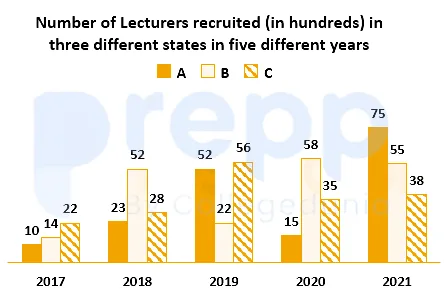
- A
42.50%
- B
36.25%
- C
45.45%
- D
56.23%
Show answer
C. 45.45%Given:
No. of lecturers in state A in 2017 = 10
No. of lecturers in state B in 2019 = 22
Formula used:
Percentage = \(\frac{\text{Lecturer in state A}}{\text{Lecturer in state B}}\times 100\)
Calculations:
According to the formula,
⇒ Percentage = \(\frac{10}{22}\times100\) = 45.45%
⇒ Hence, No. of lecturers in state A in 2017 is 45.45% of state B in 2019
Paper & answer key PDF ↗ Question 52archived
If x 2+ y 2+ z 2= xy + yz + zx and x = 1, then find the value of \(\rm \frac{10x^4+5y^4+7z^4}{13x^2y^2+6y^2z^2+3z^2x^2}\)
- A
2
- B
0
- C
-1
- D
1
Show answer
D. 1Analyzing the Algebraic Problem
The problem provides an equation relating three variables, \(x\), \(y\), and \(z\): \(x^2 + y^2 + z^2 = xy + yz + zx\). We are also given that \(x = 1\). The goal is to evaluate a specific algebraic expression involving \(x\), \(y\), and \(z\).
Understanding the Key Condition: \(x^2 + y^2 + z^2 = xy + yz + zx\)
The given equation \(x^2 + y^2 + z^2 = xy + yz + zx\) is a standard mathematical identity in disguise. Let's rearrange and manipulate this equation to understand what it implies about the relationship between \(x\), \(y\), and \(z\).
We can multiply the entire equation by 2:
\(2(x^2 + y^2 + z^2) = 2(xy + yz + zx)\)
\(2x^2 + 2y^2 + 2z^2 = 2xy + 2yz + 2zx\)
Now, move all terms to one side of the equation:
\(2x^2 + 2y^2 + 2z^2 - 2xy - 2yz - 2zx = 0\)
We can group the terms to form perfect squares:
\((x^2 - 2xy + y^2) + (y^2 - 2yz + z^2) + (z^2 - 2zx + x^2) = 0\)
This simplifies to:
\((x-y)^2 + (y-z)^2 + (z-x)^2 = 0\)
Since the square of any real number is non-negative (greater than or equal to zero), the only way the sum of three squares can be zero is if each individual square term is zero. This means:
\((x-y)^2 = 0 \implies x - y = 0 \implies x = y\)
\((y-z)^2 = 0 \implies y - z = 0 \implies y = z\)
\((z-x)^2 = 0 \implies z - x = 0 \implies z = x\)
Therefore, the condition \(x^2 + y^2 + z^2 = xy + yz + zx\) is true if and only if \(x = y = z\).
Solving the Expression with \(x = y = z\) and \(x = 1\)
We are given that \(x = 1\) and we have deduced that \(x = y = z\). Combining these, we get \(x = y = z = 1\).
Now we need to substitute \(x = 1\), \(y = 1\), and \(z = 1\) into the given expression:
\(\rm \frac{10x^4+5y^4+7z^4}{13x^2y^2+6y^2z^2+3z^2x^2}\)
Step-by-Step Calculation
Substitute the values \(x=1\), \(y=1\), and \(z=1\) into the numerator and the denominator separately.
Numerator:
\(10x^4 + 5y^4 + 7z^4\)
\(= 10(1)^4 + 5(1)^4 + 7(1)^4\)
\(= 10(1) + 5(1) + 7(1)\)
\(= 10 + 5 + 7\)
\(= 22\)
Denominator:
\(13x^2y^2 + 6y^2z^2 + 3z^2x^2\)
\(= 13(1)^2(1)^2 + 6(1)^2(1)^2 + 3(1)^2(1)^2\)
\(= 13(1)(1) + 6(1)(1) + 3(1)(1)\)
\(= 13 + 6 + 3\)
\(= 22\)
Now, divide the numerator by the denominator:
\(\rm \frac{22}{22} = 1\)
Final Result
The value of the expression \(\rm \frac{10x^4+5y^4+7z^4}{13x^2y^2+6y^2z^2+3z^2x^2}\) under the given conditions \(x^2 + y^2 + z^2 = xy + yz + zx\) and \(x = 1\) is 1.
Revision Table: Key Concepts
Concept
Description
Relevance to Problem
Algebraic Identity
An equation that is true for all possible values of its variables.
\(x^2 + y^2 + z^2 = xy + yz + zx\) is equivalent to \((x-y)^2 + (y-z)^2 + (z-x)^2 = 0\).
Condition \(x^2 + y^2 + z^2 = xy + yz + zx\)
This specific condition holds true if and only if \(x = y = z\).
Crucial for determining the values of \(y\) and \(z\) given \(x\).
Evaluating Expressions
Substituting known values for variables into an expression and calculating the result.
The final step after finding the values of \(x\), \(y\), and \(z\).
Additional Information: Variations of the Condition
The condition \(x^2 + y^2 + z^2 = xy + yz + zx\) is a classic result. It often appears in different forms. For example:
If \(x\), \(y\), and \(z\) are sides of a triangle, and \(x^2 + y^2 + z^2 = xy + yz + zx\), then the triangle must be equilateral (since \(x=y=z\)).
The expression \(x^2 + y^2 + z^2 - xy - yz - zx\) is always non-negative for real numbers \(x\), \(y\), and \(z\). It is equal to \(\frac{1}{2}[(x-y)^2 + (y-z)^2 + (z-x)^2]\).
Paper & answer key PDF ↗ Question 53archived
A cap having marked price ₹90 is sold for ₹68. What is the percent rate of discount (correct up to two decimal places)?
- A
24.44%
- B
25.37%
- C
22.00%
- D
23.22%
Show answer
A. 24.44%Understanding Discount Calculation
This question asks us to find the percent rate of discount applied to a cap. We are given the marked price and the selling price of the cap.
Defining Key Terms
Marked Price (MP): This is the price printed on the tag of the cap. It is also sometimes called the list price. In this case, the marked price of the cap is ₹90.
Selling Price (SP): This is the price at which the cap is actually sold. In this case, the selling price of the cap is ₹68.
Discount: This is the reduction in price given on the marked price. It is the difference between the marked price and the selling price.
Discount Percentage: This is the discount expressed as a percentage of the marked price.
Calculating the Discount Amount
The discount is the difference between the marked price and the selling price.
Discount = Marked Price - Selling Price
Discount = $\text{₹}90 - \text{₹}68$
Discount = $\text{₹}22$
So, the discount offered on the cap is ₹22.
Calculating the Percent Rate of Discount
The discount percentage is calculated with respect to the marked price. The formula for the percent rate of discount is:
Percent Discount $= \left( \frac{\text{Discount}}{\text{Marked Price}} \right) \times 100\%$
Using the values we have:
Percent Discount $= \left( \frac{\text{₹}22}{\text{₹}90} \right) \times 100\%$
Percent Discount $= \left( \frac{22}{90} \right) \times 100\%$
Now, let's perform the calculation:
$\frac{22}{90} \approx 0.24444...$
Percent Discount $\approx 0.24444... \times 100\%$
Percent Discount $\approx 24.444...\%$
Rounding to Two Decimal Places
The question asks for the percent rate of discount correct up to two decimal places. The third decimal place is 4, which is less than 5, so we round down.
Percent Discount $\approx 24.44\%$
Thus, the percent rate of discount on the cap is approximately 24.44%.
Summary Table
Item
Value
Marked Price (MP)
₹90
Selling Price (SP)
₹68
Discount Amount
₹22
Percent Discount
$\approx 24.44\%$
Revision Table: Key Formulas in Discounts
Concept
Formula
Discount Amount
Marked Price - Selling Price
Percent Discount
$\left( \frac{\text{Discount}}{\text{Marked Price}} \right) \times 100\%$
Selling Price (given MP and Discount %)
Marked Price $\times \left(1 - \frac{\text{Discount \%}}{100}\right)$
Marked Price (given SP and Discount %)
$\frac{\text{Selling Price}}{1 - \frac{\text{Discount \%}}{100}}$
Additional Information: Applications of Discounts
Discounts are common in retail and business. They are used to:
Attract customers and increase sales volume.
Clear old stock or seasonal items.
Promote new products.
Maintain competitiveness in the market.
Understanding how to calculate discount percentage is important for both consumers (to know how much they save) and businesses (to set pricing strategies).
Paper & answer key PDF ↗ Question 54archived
If Δ ABC ~ ΔQRP, \(\rm \frac{ar(ΔABC)}{ar(ΔQRP)}\) = \(\frac{9}{4}\) , AB = 18 cm, BC = 15 cm, then the length of PR is:
- A
16 cm
- B
14 cm
- C
10 cm
- D
12 cm
Show answer
C. 10 cmUnderstanding Similar Triangles and Area Ratio
The problem involves two similar triangles, Δ ABC and Δ QRP. We are given that they are similar (Δ ABC ~ Δ QRP). This is a key piece of information because similar triangles have specific properties regarding their sides and areas.
We are also given the ratio of the areas of these two similar triangles: \(\rm \frac{ar(ΔABC)}{ar(ΔQRP)}\) = \(\frac{9}{4}\).
Additionally, we know the lengths of two sides of Δ ABC: AB = 18 cm and BC = 15 cm. We need to find the length of the side PR in Δ QRP.
Property of Areas of Similar Triangles
A fundamental property of similar triangles states that the ratio of the areas of two similar triangles is equal to the square of the ratio of their corresponding sides.
Since Δ ABC ~ Δ QRP, the corresponding vertices are A <--> Q, B <--> R, and C <--> P.
Therefore, the corresponding sides are AB and QR, BC and RP, and AC and QP.
According to the property:
$$ \frac{ar(ΔABC)}{ar(ΔQRP)} = \left(\frac{AB}{QR}\right)^2 = \left(\frac{BC}{RP}\right)^2 = \left(\frac{AC}{QP}\right)^2 $$
Calculating the Length of PR using Area Ratio
We are given \(\frac{ar(ΔABC)}{ar(ΔQRP)}\) = \(\frac{9}{4}\) and BC = 15 cm. We want to find the length of PR.
Using the property that relates the area ratio to the square of the ratio of corresponding sides (BC and RP):
$$ \frac{ar(ΔABC)}{ar(ΔQRP)} = \left(\frac{BC}{RP}\right)^2 $$
Substitute the given values into the equation:
$$ \frac{9}{4} = \left(\frac{15}{RP}\right)^2 $$
To find RP, we first take the square root of both sides of the equation:
$$ \sqrt{\frac{9}{4}} = \sqrt{\left(\frac{15}{RP}\right)^2} $$
$$ \frac{\sqrt{9}}{\sqrt{4}} = \frac{15}{RP} $$
$$ \frac{3}{2} = \frac{15}{RP} $$
Now, we can solve for RP by cross-multiplying:
$$ 3 \times RP = 2 \times 15 $$
$$ 3 \times RP = 30 $$
Divide both sides by 3:
$$ RP = \frac{30}{3} $$
$$ RP = 10 $$
So, the length of PR is 10 cm.
Step-by-Step Solution Summary
Identify the given information: Δ ABC ~ Δ QRP, \(\frac{ar(ΔABC)}{ar(ΔQRP)}\) = \(\frac{9}{4}\), BC = 15 cm.
Recall the property that the ratio of areas of similar triangles is the square of the ratio of corresponding sides.
Set up the equation using the given area ratio and the corresponding sides BC and RP: \(\frac{9}{4} = \left(\frac{15}{RP}\right)^2\).
Take the square root of both sides: \(\sqrt{\frac{9}{4}} = \sqrt{\left(\frac{15}{RP}\right)^2} \implies \frac{3}{2} = \frac{15}{RP}\).
Solve for RP: \(3 \times RP = 2 \times 15 \implies 3 \times RP = 30 \implies RP = 10\).
The length of PR is 10 cm.
Revision Table: Similar Triangles and Area
Concept
Description
Formula (for ΔABC ~ ΔQRP)
Similar Triangles
Triangles with the same shape but possibly different sizes. Corresponding angles are equal, and corresponding sides are proportional.
Ratio of Corresponding Sides
The ratio of the lengths of any pair of corresponding sides is constant.
\(\frac{AB}{QR} = \frac{BC}{RP} = \frac{AC}{QP} = k\) (constant ratio)
Ratio of Areas
The ratio of the areas of two similar triangles is the square of the ratio of their corresponding sides.
\(\frac{ar(ΔABC)}{ar(ΔQRP)} = \left(\frac{AB}{QR}\right)^2 = \left(\frac{BC}{RP}\right)^2 = \left(\frac{AC}{QP}\right)^2 = k^2\)
Additional Information on Similar Triangle Properties
Understanding the properties of similar triangles is crucial in geometry. Beyond the area ratio, here are a few other key properties:
Corresponding Angles: All pairs of corresponding angles in similar triangles are equal. If Δ ABC ~ Δ QRP, then ∠A = ∠Q, ∠B = ∠R, and ∠C = ∠P.
Ratio of Altitudes: The ratio of corresponding altitudes is equal to the ratio of corresponding sides.
Ratio of Medians: The ratio of corresponding medians is equal to the ratio of corresponding sides.
Ratio of Perimeters: The ratio of the perimeters of two similar triangles is equal to the ratio of their corresponding sides. This is a linear relationship, just like the sides, altitudes, and medians.
These properties allow us to find unknown side lengths, altitudes, medians, or perimeters if we know the similarity and at least one ratio of corresponding lengths or the area ratio.
Paper & answer key PDF ↗ Question 55archived
If x + \(\frac{1}{2x}\) = 3, then evaluate 8x 3+ \(\rm \frac{1}{x^3}\) .
- A
212
- B
216
- C
180
- D
196
Show answer
C. 180Understanding the Problem and Goal
The question asks us to evaluate the value of a specific cubic expression, \(8x^3 + \frac{1}{x^3}\), given a conditional equation involving \(x\), which is \(x + \frac{1}{2x} = 3\). To solve this, we need to manipulate the given equation to relate it to the expression we need to evaluate, likely using algebraic identities.
Step-by-Step Solution
We are given the equation: \(x + \frac{1}{2x} = 3\)
And we need to find the value of the expression: \(8x^3 + \frac{1}{x^3}\)
Notice that the expression \(8x^3 + \frac{1}{x^3}\) can be written as \((2x)^3 + (\frac{1}{x})^3\). This looks like the sum of two cubes.
Let's examine the given equation. If we multiply the entire equation by 2, we might get a term involving \(2x\):
\(2 \times (x + \frac{1}{2x}) = 2 \times 3\)
Distributing the 2 on the left side gives:
\(2x + 2 \times \frac{1}{2x} = 6\)
\(2x + \frac{2}{2x} = 6\)
\(2x + \frac{1}{x} = 6\)
This result, \(2x + \frac{1}{x} = 6\), is very useful because it relates directly to the terms in the cubic expression \((2x)^3 + (\frac{1}{x})^3\). Let's use an algebraic identity for the sum of cubes.
We know the identity: \((a+b)^3 = a^3 + 3a^2b + 3ab^2 + b^3\)
Rearranging this identity to solve for \(a^3 + b^3\):
\(a^3 + b^3 = (a+b)^3 - 3a^2b - 3ab^2\)
\(a^3 + b^3 = (a+b)^3 - 3ab(a+b)\)
In our case, we want to evaluate \((2x)^3 + (\frac{1}{x})^3\). Let's set \(a = 2x\) and \(b = \frac{1}{x}\).
Using the identity \(a^3 + b^3 = (a+b)^3 - 3ab(a+b)\):
\((2x)^3 + (\frac{1}{x})^3 = (2x + \frac{1}{x})^3 - 3(2x)(\frac{1}{x})(2x + \frac{1}{x})\)
From our manipulation of the given equation, we found that \(2x + \frac{1}{x} = 6\).
Let's find the product \(ab\):
\(ab = (2x)(\frac{1}{x}) = 2 \times \frac{x}{x} = 2 \times 1 = 2\)
Now, substitute the values \(2x + \frac{1}{x} = 6\) and \(ab = 2\) into the expanded identity:
\((2x)^3 + (\frac{1}{x})^3 = (6)^3 - 3(2)(6)\)
Calculate the terms:
\((6)^3 = 6 \times 6 \times 6 = 36 \times 6 = 216\)
\(3(2)(6) = 6 \times 6 = 36\)
So, the expression becomes:
\(8x^3 + \frac{1}{x^3} = 216 - 36\)
\(8x^3 + \frac{1}{x^3} = 180\)
Therefore, the value of the expression \(8x^3 + \frac{1}{x^3}\) is 180.
Summary of Calculation Steps
Start with the given equation \(x + \frac{1}{2x} = 3\).
Identify the expression to evaluate: \(8x^3 + \frac{1}{x^3}\).
Multiply the given equation by 2 to get \(2x + \frac{1}{x} = 6\).
Recognize the expression as a sum of cubes: \((2x)^3 + (\frac{1}{x})^3\).
Use the algebraic identity \(a^3 + b^3 = (a+b)^3 - 3ab(a+b)\) with \(a = 2x\) and \(b = \frac{1}{x}\).
Substitute \(a+b = 2x + \frac{1}{x} = 6\) and \(ab = (2x)(\frac{1}{x}) = 2\) into the identity.
Calculate \((6)^3 - 3(2)(6) = 216 - 36 = 180\).
Key Values and Identities Used
Given
\(x + \frac{1}{2x} = 3\)
Derived
\(2x + \frac{1}{x} = 6\)
To Evaluate
\(8x^3 + \frac{1}{x^3} = (2x)^3 + (\frac{1}{x})^3\)
Identity
\(a^3 + b^3 = (a+b)^3 - 3ab(a+b)\)
Substitution
\(a=2x, b=\frac{1}{x}\)
Calculations
\(a+b = 6\), \(ab = 2\)
Revision Table: Key Concepts for Evaluating Expressions
Concept
Description
Relevance to Problem
Algebraic Manipulation
Changing the form of an equation or expression while maintaining its value.
Multiplying the given equation \(x + \frac{1}{2x} = 3\) by 2 to get \(2x + \frac{1}{x} = 6\).
Cubic Expressions
Expressions involving a variable raised to the power of 3 (e.g., \(x^3\), \(8x^3\)).
The expression to evaluate, \(8x^3 + \frac{1}{x^3}\), is a sum of cubic terms.
Algebraic Identities
Equations that are true for all values of the variables involved (e.g., \((a+b)^3 = a^3 + 3a^2b + 3ab^2 + b^3\)).
Used the identity for \(a^3 + b^3\) to relate it to \((a+b)\) and \(ab\).
Sum of Cubes Identity
Specifically, \(a^3 + b^3 = (a+b)(a^2 - ab + b^2)\) or \(a^3 + b^3 = (a+b)^3 - 3ab(a+b)\).
The identity \(a^3 + b^3 = (a+b)^3 - 3ab(a+b)\) was crucial for the solution.
Additional Information: Exploring Related Algebraic Identities
Problems like this often rely on recognizing patterns and applying the correct algebraic identities. Here are a few other common identities that might be useful in similar problems:
\((a-b)^3 = a^3 - 3a^2b + 3ab^2 - b^3 = a^3 - b^3 - 3ab(a-b)\)
Difference of Cubes: \(a^3 - b^3 = (a-b)(a^2 + ab + b^2)\)
Square of a Sum: \((a+b)^2 = a^2 + 2ab + b^2\)
Square of a Difference: \((a-b)^2 = a^2 - 2ab + b^2\)
Being familiar with these identities and how to rearrange them can simplify complex algebraic expressions and equations. In this problem, rewriting \(8x^3 + \frac{1}{x^3}\) as \((2x)^3 + (\frac{1}{x})^3\) was key to identifying the correct identity to use based on the derived term \(2x + \frac{1}{x}\).
Paper & answer key PDF ↗ Question 56archived
\(\rm \sqrt{\frac{1+sinA}{1-sinA}} =\) ________.
- A
coescA - cotA
- B
secA - tanA
- C
secA + tanA
- D
secA
Show answer
C. secA + tanASimplifying Trigonometric Expressions: \(\rm \sqrt{\frac{1+sinA}{1-sinA}}\)
Let's simplify the given trigonometric expression: \( \rm \sqrt{\frac{1+\sin A}{1-\sin A}} \). To simplify this expression, we can use a common technique involving rationalizing the denominator within the square root.
Step-by-Step Simplification
We start with the expression:
\[ \rm \sqrt{\frac{1+\sin A}{1-\sin A}} \]
Multiply the numerator and the denominator inside the square root by the conjugate of the denominator, which is \( \rm (1+\sin A) \):
\[ \rm \sqrt{\frac{(1+\sin A)(1+\sin A)}{(1-\sin A)(1+\sin A)}} \]
Simplify the numerator and the denominator:
Numerator: \( \rm (1+\sin A)(1+\sin A) = (1+\sin A)^2 \)
Denominator: Use the difference of squares formula, \( \rm (a-b)(a+b) = a^2 - b^2 \). Here, \( \rm a=1 \) and \( \rm b=\sin A \). So, \( \rm (1-\sin A)(1+\sin A) = 1^2 - \sin^2 A = 1 - \sin^2 A \)
Now, the expression becomes:
\[ \rm \sqrt{\frac{(1+\sin A)^2}{1 - \sin^2 A}} \]
Recall the fundamental trigonometric identity: \( \rm \sin^2 A + \cos^2 A = 1 \). Rearranging this, we get \( \rm 1 - \sin^2 A = \cos^2 A \).
Substitute this into the expression:
\[ \rm \sqrt{\frac{(1+\sin A)^2}{\cos^2 A}} \]
Now, take the square root of the numerator and the denominator separately:
\[ \rm \frac{\sqrt{(1+\sin A)^2}}{\sqrt{\cos^2 A}} = \frac{|1+\sin A|}{|\cos A|} \]
For most common values of A where the expression is defined, \( \rm 1+\sin A \) is positive since \( \rm -1 \le \sin A \le 1 \). Also, if we consider the principal values or quadrants where \( \rm \cos A \) is positive (like the first or fourth quadrant), we can remove the absolute value signs.
Assuming \( \rm 1+\sin A \ge 0 \) and \( \rm \cos A > 0 \):
\[ \rm \frac{1+\sin A}{\cos A} \]
Now, separate the terms in the numerator:
\[ \rm \frac{1}{\cos A} + \frac{\sin A}{\cos A} \]
Using the reciprocal identity \( \rm \sec A = \frac{1}{\cos A} \) and the ratio identity \( \rm \tan A = \frac{\sin A}{\cos A} \), we get:
\[ \rm \sec A + \tan A \]
Thus, the simplified form of the expression \( \rm \sqrt{\frac{1+\sin A}{1-\sin A}} \) is \( \rm \sec A + \tan A \).
Key Trigonometric Identities Used
The solution relies on the following important trigonometric identities:
Pythagorean Identity: \( \rm \sin^2 A + \cos^2 A = 1 \) (which leads to \( \rm 1 - \sin^2 A = \cos^2 A \))
Reciprocal Identity: \( \rm \sec A = \frac{1}{\cos A} \)
Ratio Identity: \( \rm \tan A = \frac{\sin A}{\cos A} \)
Understanding and applying these identities is crucial for simplifying trigonometric expressions.
Identity Type
Identity
Pythagorean
\( \rm \sin^2 \theta + \cos^2 \theta = 1 \)
Reciprocal
\( \rm \sec \theta = \frac{1}{\cos \theta} \)
Ratio
\( \rm \tan \theta = \frac{\sin \theta}{\cos \theta} \)
Revision Table: Essential Identities
Identity
Notes
\( \rm \sin^2 \theta + \cos^2 \theta = 1 \)
Used for converting between \( \rm \sin^2 \theta \) and \( \rm \cos^2 \theta \).
\( \rm 1 + \tan^2 \theta = \sec^2 \theta \)
Another Pythagorean identity.
\( \rm 1 + \cot^2 \theta = \csc^2 \theta \)
Third Pythagorean identity.
\( \rm \sec \theta = \frac{1}{\cos \theta} \)
Reciprocal of cosine.
\( \rm \csc \theta = \frac{1}{\sin \theta} \)
Reciprocal of sine.
\( \rm \cot \theta = \frac{1}{\tan \theta} = \frac{\cos \theta}{\sin \theta} \)
Reciprocal of tangent; ratio of cosine to sine.
\( \rm \tan \theta = \frac{\sin \theta}{\cos \theta} \)
Ratio of sine to cosine.
Additional Information on Simplifying Trigonometric Expressions
Simplifying trigonometric expressions often involves algebraic manipulation along with the application of fundamental identities. Common techniques include:
Converting all terms to sine and cosine.
Factoring expressions.
Finding a common denominator.
Using conjugate pairs for rationalization (as done in this problem).
Applying Pythagorean, reciprocal, and ratio identities.
Using sum, difference, double angle, or half-angle formulas if necessary (though not needed for this specific problem).
Practicing various types of problems helps build intuition for which techniques to apply in different situations involving trigonometric expressions.
Paper & answer key PDF ↗ Question 57archived
Two tourist buses start from the same point and move along two roads at right angles at speeds of 48 km/h and 36 km/h, respectively. The distance between the buses after 15 seconds is ________.
- A
175m
- B
350m
- C
250m
- D
150m
Show answer
C. 250mCalculating Distance Between Tourist Buses at Right Angles
This problem involves two tourist buses starting from the same point and traveling along paths that are perpendicular to each other. This setup forms a right-angled triangle, where the distances traveled by each bus are the two legs, and the distance between the buses is the hypotenuse. To find the distance between the buses after a specific time, we first need to calculate how far each bus has traveled in that time period.
The speeds are given in kilometers per hour (km/h), and the time is given in seconds. We need to convert the speeds to meters per second (m/s) to work with the time in seconds and get the distance in meters.
Step 1: Convert Speeds to Meters per Second
To convert km/h to m/s, we use the conversion factor $\frac{1000 \text{ m}}{1 \text{ km}}$ and $\frac{1 \text{ hour}}{3600 \text{ s}}$. So, $1 \text{ km/h} = \frac{1000}{3600} \text{ m/s} = \frac{5}{18} \text{ m/s}$.
Speed of Bus 1 ($v_1$): 48 km/h
$v_1 = 48 \times \frac{5}{18} \text{ m/s} = \frac{240}{18} \text{ m/s} = \frac{40}{3} \text{ m/s}$
Speed of Bus 2 ($v_2$): 36 km/h
$v_2 = 36 \times \frac{5}{18} \text{ m/s} = 2 \times 5 \text{ m/s} = 10 \text{ m/s}$
Step 2: Calculate Distance Traveled by Each Bus
The distance traveled by an object is calculated using the formula: Distance = Speed × Time.
The time given is 15 seconds.
Distance traveled by Bus 1 ($d_1$):
$d_1 = v_1 \times \text{Time} = \frac{40}{3} \text{ m/s} \times 15 \text{ s} = 40 \times 5 \text{ m} = 200 \text{ m}$
Distance traveled by Bus 2 ($d_2$):
$d_2 = v_2 \times \text{Time} = 10 \text{ m/s} \times 15 \text{ s} = 150 \text{ m}$
Step 3: Apply the Pythagorean Theorem
Since the two buses move along roads at right angles, their paths form the two perpendicular sides of a right-angled triangle. The distance between the buses after 15 seconds is the hypotenuse of this triangle. Let $D$ be the distance between the buses.
According to the Pythagorean theorem, for a right-angled triangle, the square of the hypotenuse is equal to the sum of the squares of the other two sides.
$D^2 = d_1^2 + d_2^2$
Substitute the distances traveled by each bus:
$D^2 = (200 \text{ m})^2 + (150 \text{ m})^2$
$D^2 = 40000 \text{ m}^2 + 22500 \text{ m}^2$
$D^2 = 62500 \text{ m}^2$
To find $D$, take the square root of both sides:
$D = \sqrt{62500} \text{ m}$
$D = \sqrt{625 \times 100} \text{ m}$
$D = \sqrt{625} \times \sqrt{100} \text{ m}$
$D = 25 \times 10 \text{ m}$
$D = 250 \text{ m}$
The distance between the buses after 15 seconds is 250 meters.
Summary of Calculations
Quantity
Value
Conversion/Calculation
Bus 1 Speed ($v_1$)
48 km/h
$48 \times \frac{5}{18} = \frac{40}{3}$ m/s
Bus 2 Speed ($v_2$)
36 km/h
$36 \times \frac{5}{18} = 10$ m/s
Time (t)
15 s
Given
Bus 1 Distance ($d_1$)
200 m
$\frac{40}{3} \times 15 = 200$ m
Bus 2 Distance ($d_2$)
150 m
$10 \times 15 = 150$ m
Distance Between Buses (D)
250 m
$\sqrt{200^2 + 150^2} = \sqrt{62500} = 250$ m
The distance between the two tourist buses after 15 seconds is 250 m.
Revision Table: Speed, Distance, Time, and Pythagorean Theorem
Concept
Formula/Principle
Application in this Problem
Speed, Distance, Time
Distance = Speed × Time
Used to find distance traveled by each bus ($d = v \times t$)
Unit Conversion (km/h to m/s)
Multiply by $\frac{5}{18}$
Converting bus speeds from km/h to m/s for consistent units
Motion at Right Angles
Forms a right-angled triangle
The paths of the buses and the line connecting them form a right triangle
Pythagorean Theorem
$a^2 + b^2 = c^2$ (where c is the hypotenuse)
Used to find the distance between buses ($D = \sqrt{d_1^2 + d_2^2}$)
Additional Information: Relative Velocity and Vector Addition
This problem can also be thought of in terms of relative velocity, though the geometric (Pythagorean) approach is more straightforward here because the velocities are perpendicular. The velocity of Bus 2 relative to Bus 1 has components from both velocities. Since they are at right angles, the magnitude of their relative speed can be considered as the hypotenuse of a right triangle formed by their individual speeds.
Relative speed squared = (Speed of Bus 1)$^2$ + (Speed of Bus 2)$^2$
Relative Speed = $\sqrt{(\frac{40}{3} \text{ m/s})^2 + (10 \text{ m/s})^2} = \sqrt{\frac{1600}{9} + 100} = \sqrt{\frac{1600 + 900}{9}} = \sqrt{\frac{2500}{9}} = \frac{50}{3}$ m/s
The distance between the buses would then be this relative speed multiplied by the time:
Distance = Relative Speed × Time
Distance = $\frac{50}{3} \text{ m/s} \times 15 \text{ s} = 50 \times 5 \text{ m} = 250 \text{ m}$
This method gives the same result and highlights the vector nature of velocity. When velocities are perpendicular, their resultant magnitude (which relates to the rate at which the distance between the objects changes) can be found using Pythagoras.
Paper & answer key PDF ↗ Question 58archived
The table given below shows the earnings of two persons on five different days.
Earnings
Days PQ
Monday105150
Tuesday96110
Wednesday65122
Thursday115106
Friday13068
What is the ratio of total earnings of P to the total earnings of Q?
- A
511 ∶ 556
- B
531 ∶ 331
- C
556 ∶ 511
- D
331 ∶ 441
Show answer
A. 511 ∶ 556Calculating Total Earnings Ratio from Table Data
The problem requires us to calculate the total earnings for two persons, P and Q, over five different days and then find the ratio of P's total earnings to Q's total earnings.
Understanding the Given Data Table
The data is presented in a table showing the daily earnings for both P and Q for Monday through Friday.
Days
Earnings P
Earnings Q
Monday
105
150
Tuesday
96
110
Wednesday
65
122
Thursday
115
106
Friday
130
68
Calculating Total Earnings for Person P
To find the total earnings of P, we sum up P's earnings for each of the five days:
Total Earnings of P = Earnings on Monday + Tuesday + Wednesday + Thursday + Friday
Total Earnings of P $= 105 + 96 + 65 + 115 + 130$
Total Earnings of P $= 201 + 65 + 115 + 130$
Total Earnings of P $= 266 + 115 + 130$
Total Earnings of P $= 381 + 130$
Total Earnings of P $= 511$
So, the total earnings of person P over the five days is 511.
Calculating Total Earnings for Person Q
Similarly, to find the total earnings of Q, we sum up Q's earnings for each of the five days:
Total Earnings of Q = Earnings on Monday + Tuesday + Wednesday + Thursday + Friday
Total Earnings of Q $= 150 + 110 + 122 + 106 + 68$
Total Earnings of Q $= 260 + 122 + 106 + 68$
Total Earnings of Q $= 382 + 106 + 68$
Total Earnings of Q $= 488 + 68$
Total Earnings of Q $= 556$
So, the total earnings of person Q over the five days is 556.
Finding the Ratio of Total Earnings of P to Q
The ratio of the total earnings of P to the total earnings of Q is given by:
Ratio $= \frac{\text{Total Earnings of P}}{\text{Total Earnings of Q}}$
Ratio $= \frac{511}{556}$
This can be written as the ratio $511 : 556$. We check if this ratio can be simplified by finding a common factor for 511 and 556. 511 is not divisible by 2, 3, 5. We can try prime numbers. Let's check 7 (511/7 = 73), 11, 13, 17, 19 (511/19=26.8), 23 (511/23=22.2), etc. 511 = $7 \times 73$. Now check if 556 is divisible by 7 or 73. $556 \div 7 \approx 79.4$, $556 \div 73 \approx 7.6$. So, 511 and 556 do not have common factors other than 1. Thus, the ratio $511 : 556$ is in its simplest form.
Therefore, the ratio of the total earnings of P to the total earnings of Q is $511 : 556$.
Revision Table: Earnings Ratio Calculation
Identify the data needed: Daily earnings for P and Q.
Calculate the sum of daily earnings for P.
Calculate the sum of daily earnings for Q.
Form the ratio of P's total earnings to Q's total earnings.
Simplify the ratio if possible.
Additional Information: Understanding Ratios and Tables
A ratio is a comparison of two quantities by division. It shows how many times one quantity is contained within another. Ratios are often used to compare different values derived from data, such as total earnings or performance metrics.
Tables are a structured way to organize and display data. Each row and column represents specific information, making it easier to read and analyze data points like daily earnings for multiple individuals over a period.
To calculate a ratio from a table:
Identify the specific values you need to compare (e.g., total earnings of P and Q).
Perform any necessary calculations (e.g., sum up daily earnings to get total earnings).
Write the ratio in the form of A:B or A/B, where A is the first quantity and B is the second quantity in the comparison.
Simplify the ratio by dividing both parts by their greatest common divisor if required.
Paper & answer key PDF ↗ Question 59archived
Five different companies, A, B, C, D and E. make robotic toys. The total number of robotic toys produced by these five companies is 8,00,000. The cost of production of each robotic toy is ₹5,000. The distribution of the total production is given by the following pie chart.
What is the total cost of production of the given item by companies A and E together?
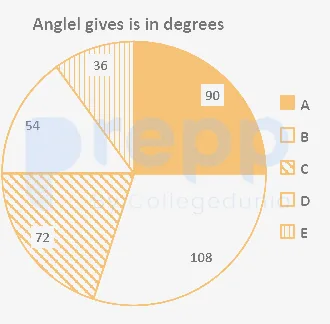
- A
₹190 crores
- B
₹85 crores
- C
₹96 crores
- D
₹140 crores
Show answer
D. ₹140 croresGiven:
Calculations:
Cost of production by company A= 90
Cost of production by company E = 36
Total cost of production by A and E together = 90 + 36 = 126
So, Total cost required= 126 × 5,000 × 8,00,000/360 = 1,400,000,000 or 140 crores
Hence, The Required value is 140 crores.
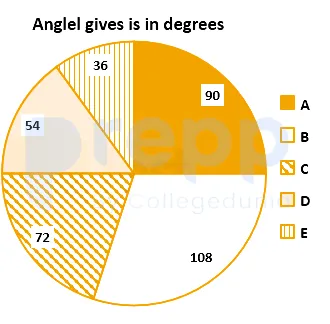 Paper & answer key PDF ↗
 Question 60archived
If ∆ABC ~ ∆DEF, and BC = 4 cm, EF = 5 cm and the area of triangle ABC = 80 cm 2, then the area of the triangle DEF is:
- A
169 cm2
- B
80 cm2
- C
144 cm2
- D
125 cm2
Show answer
D. 125 cm2Finding the Area of a Similar Triangle
This problem involves similar triangles, $\triangle \text{ABC}$ and $\triangle \text{DEF}$. We are given the lengths of corresponding sides and the area of one triangle, and we need to find the area of the other similar triangle.
Understanding Similar Triangles and Area Ratio
When two triangles are similar, the ratio of their corresponding sides is constant. A very important property related to similar triangles is that the ratio of their areas is equal to the square of the ratio of their corresponding sides.
Mathematically, if $\triangle \text{ABC} \sim \triangle \text{DEF}$, then:
$\frac{\text{AB}}{\text{DE}} = \frac{\text{BC}}{\text{EF}} = \frac{\text{AC}}{\text{DF}}$ (Ratio of corresponding sides is equal)
$\frac{\text{Area}(\triangle \text{ABC})}{\text{Area}(\triangle \text{DEF})} = \left(\frac{\text{AB}}{\text{DE}}\right)^2 = \left(\frac{\text{BC}}{\text{EF}}\right)^2 = \left(\frac{\text{AC}}{\text{DF}}\right)^2$ (Ratio of areas is the square of the ratio of corresponding sides)
Applying the Area Ratio Property
We are given the following information:
$\triangle \text{ABC} \sim \triangle \text{DEF}$
Corresponding sides BC = 4 cm and EF = 5 cm
Area of $\triangle \text{ABC}$ = 80 cm$^2$
We need to find the Area of $\triangle \text{DEF}$.
Using the area ratio property, we can write the relationship between the areas and the given corresponding sides:
$$ \frac{\text{Area}(\triangle \text{ABC})}{\text{Area}(\triangle \text{DEF})} = \left(\frac{\text{BC}}{\text{EF}}\right)^2 $$
Step-by-Step Calculation
Substitute the given values into the formula:
$$ \frac{80 \text{ cm}^2}{\text{Area}(\triangle \text{DEF})} = \left(\frac{4 \text{ cm}}{5 \text{ cm}}\right)^2 $$
Calculate the square of the ratio of the sides:
$$ \left(\frac{4}{5}\right)^2 = \frac{4^2}{5^2} = \frac{16}{25} $$
So, the equation becomes:
$$ \frac{80}{\text{Area}(\triangle \text{DEF})} = \frac{16}{25} $$
To find Area($\triangle \text{DEF}$), we can rearrange the equation. Multiply both sides by Area($\triangle \text{DEF}$) and by 25, and divide both sides by 16:
$$ \text{Area}(\triangle \text{DEF}) = \frac{80 \times 25}{16} $$
Now, perform the calculation:
We can simplify the expression by noticing that 80 is a multiple of 16 (80 = 16 × 5):
$$ \text{Area}(\triangle \text{DEF}) = \frac{(16 \times 5) \times 25}{16} $$
Cancel out the 16 from the numerator and the denominator:
$$ \text{Area}(\triangle \text{DEF}) = 5 \times 25 $$
$$ \text{Area}(\triangle \text{DEF}) = 125 $$
Since the area of $\triangle \text{ABC}$ was in cm$^2$, the area of $\triangle \text{DEF}$ will also be in cm$^2$.
Therefore, the area of triangle DEF is 125 cm$^2$.
Final Answer Determination
Based on our calculation, the area of $\triangle \text{DEF}$ is 125 cm$^2$. Let's check the given options:
169 cm$^2$
80 cm$^2$
144 cm$^2$
125 cm$^2$
Our calculated area matches the fourth option.
Revision Table: Similar Triangles Properties
Property
Description
Angles
Corresponding angles are equal.
Sides
Ratio of corresponding sides is constant (scale factor).
Perimeter Ratio
Ratio of perimeters equals the ratio of corresponding sides.
Area Ratio
Ratio of areas equals the square of the ratio of corresponding sides.
Altitude/Median Ratio
Ratio of corresponding altitudes or medians equals the ratio of corresponding sides.
Additional Information: Solving Geometry Problems
When solving geometry problems involving similar figures, it's helpful to:
Identify the similar figures and their corresponding vertices and sides.
Write down the given information clearly.
Recall the relevant properties of similar figures (sides, angles, perimeter, area).
Set up an equation based on the property that connects the given and unknown quantities.
Solve the equation step-by-step.
Include the correct units in the final answer.
Understanding the relationship between side lengths and areas in similar shapes is crucial for many geometry problems.
Paper & answer key PDF ↗ Question 61archived
A certain sum amounts to ₹3,640 in 2 years and ₹4,060 in 8 years at simple interest. Find the approximate rate percentage per annum?
- A
4%
- B
2%
- C
1%
- D
3%
Show answer
B. 2%Understanding Simple Interest Calculations
In simple interest, the interest earned each year is calculated only on the initial principal amount. This means the interest earned in a specific period is directly proportional to the time period, assuming the principal and rate remain constant.
The formula for Simple Interest (SI) is:
\( \text{SI} = \frac{\text{Principal} \times \text{Rate} \times \text{Time}}{100} \)
The Amount (A) after a certain time is the sum of the Principal (P) and the Simple Interest (SI) earned over that time:
\( \text{A} = \text{P} + \text{SI} \)
Combining these, we get:
\( \text{A} = \text{P} + \frac{\text{P} \times \text{R} \times \text{T}}{100} = \text{P} \left(1 + \frac{\text{R} \times \text{T}}{100}\right) \)
Analyzing the Given Information
We are given the amount a certain sum grows to at two different time points under simple interest:
Amount after 2 years = ₹3,640
Amount after 8 years = ₹4,060
Let the principal amount be \( P \) and the rate of simple interest per annum be \( R \% \).
Using the amount formula:
For 2 years: \( 3640 = P + \frac{P \times R \times 2}{100} \) (Equation 1)
For 8 years: \( 4060 = P + \frac{P \times R \times 8}{100} \) (Equation 2)
Calculating the Simple Interest Earned
The difference in the amounts between 8 years and 2 years is the simple interest earned during that 6-year period (from year 2 to year 8).
Time difference = 8 years - 2 years = 6 years
Difference in amount = Amount after 8 years - Amount after 2 years
Difference in amount = ₹4,060 - ₹3,640 = ₹420
This ₹420 is the simple interest earned over 6 years.
Since simple interest is constant per year for the same principal and rate, the simple interest for 1 year can be found by dividing the interest for 6 years by 6.
Simple Interest for 6 years = ₹420
Simple Interest for 1 year \( = \frac{420}{6} = \text{₹}70 \)
Finding the Principal Amount
We know the amount after 2 years (₹3,640) and the simple interest earned in 1 year (₹70). The simple interest for 2 years is:
Simple Interest for 2 years = Simple Interest for 1 year \( \times \) 2
Simple Interest for 2 years \( = 70 \times 2 = \text{₹}140 \)
Now, using the amount formula for 2 years:
Amount after 2 years = Principal + Simple Interest for 2 years
\( 3640 = P + 140 \)
To find the principal \( P \), subtract the interest for 2 years from the amount after 2 years:
\( P = 3640 - 140 \)
\( P = \text{₹}3500 \)
So, the initial principal amount is ₹3,500.
Determining the Approximate Rate Percentage
We now have the principal (P = ₹3,500) and the simple interest for 1 year (SI per year = ₹70). We can use the simple interest formula for 1 year to find the rate \( R \).
SI for 1 year \( = \frac{P \times R \times 1}{100} \)
\( 70 = \frac{3500 \times R \times 1}{100} \)
\( 70 = 35 \times R \)
To find \( R \), divide 70 by 35:
\( R = \frac{70}{35} \)
\( R = 2 \)
The rate of simple interest per annum is 2%. The question asks for the approximate rate percentage, and since our calculation resulted in exactly 2%, the approximate rate is also 2%.
Let's verify this rate with the amount after 8 years:
SI for 8 years \( = \frac{3500 \times 2 \times 8}{100} = \frac{35 \times 2 \times 8}{1} = 70 \times 8 = \text{₹}560 \)
Amount after 8 years = Principal + SI for 8 years \( = 3500 + 560 = \text{₹}4060 \)
This matches the given information, confirming our calculated rate is correct.
Item
Value
Amount after 2 years
₹3,640
Amount after 8 years
₹4,060
Time difference
6 years
Interest for 6 years
₹420
Interest for 1 year
₹70
Interest for 2 years
₹140
Principal
₹3,500
Rate per annum
2%
Conclusion
The simple interest rate per annum is approximately 2%.
Revision Table: Simple Interest Concepts
Concept
Description
Formula
Principal (P)
The initial sum of money borrowed or invested.
-
Rate (R)
The percentage at which interest is charged or earned per period (usually per annum).
-
Time (T)
The duration for which the money is borrowed or invested.
-
Simple Interest (SI)
Interest calculated only on the principal amount.
\( \text{SI} = \frac{\text{P} \times \text{R} \times \text{T}}{100} \)
Amount (A)
The total sum of money at the end of the time period (Principal + Interest).
\( \text{A} = \text{P} + \text{SI} \)
SI difference
The difference in SI over two different time periods is directly proportional to the time difference.
\( \text{SI}_2 - \text{SI}_1 = \frac{\text{P} \times \text{R} \times (\text{T}_2 - \text{T}_1)}{100} \)
Amount difference
The difference in Amounts over two different time periods is equal to the difference in Simple Interests.
\( \text{A}_2 - \text{A}_1 = \text{SI}_2 - \text{SI}_1 \)
Additional Information on Simple Interest Rate
Simple interest is the most basic form of interest calculation. It is commonly used for short-term loans. One key characteristic is that the interest earned does not get added back to the principal for the calculation of subsequent interest; the principal remains the same throughout the loan period. This makes calculating simple interest straightforward compared to compound interest, where interest is added to the principal, and future interest is calculated on the new, larger principal.
When dealing with questions like this, where amounts at different times are given, the difference in amounts represents the total simple interest earned during the difference in the time periods. This fact is crucial because simple interest grows linearly with time.
Paper & answer key PDF ↗ Question 62archived
If 8 cot θ = 6, then the value of \(\rm \frac{sin\theta + cos θ }{sin\theta - cos θ}\) is:
- A
12
- B
7
- C
2
- D
5
Show answer
B. 7Given:
8 cot θ = 6
Calculation:
cot θ = 6/8 = 3/4
Now, evaluate the expression:
\(\rm \frac{sin\theta + cos θ }{sin\theta - cos θ}\)
= \(\rm \frac{sin\theta(1 + cos θ/ sinθ) }{sin\theta (1 - cos θ/sinθ)}\)
= \(\rm \frac{1 + cot θ }{1 - cot θ}\)
= {1 + (3/4)} / {1 - (3/4)}
= 7
Paper & answer key PDF ↗ Question 63archived
The following chart shows the scores of employees is a company's annual performance.
What is the percentage of Kartik's score out of the score of all the employees?
- A
23.14%
- B
30%
- C
22%
- D
20%
Show answer
D. 20%Given:
The following chart shows the scores of employees is a company's annual performance.
Calculations:
Kartik's marks = 80
Total marks = 80 + 90 + 75 + 70 + 85 = 400
Percentage required
= 80 × 100/400
= 20%
Hence, The Required value 20%.
 Paper & answer key PDF ↗
 Question 64archived
Three cubes of equal volume are joined end to end. Find the surface area of the resulting cuboid if the diagonal of the cube is 6√3 cm.
- A
509 cm2
- B
504 cm2
- C
516 cm2
- D
512 cm2
Show answer
B. 504 cm2Understanding the Problem: Surface Area of Joined Cubes
The question asks us to find the surface area of a new shape formed by joining three identical cubes end-to-end. We are given the diagonal length of a single cube. First, we need to use the diagonal length to find the side length of the cube. Once we have the side length, we can determine the dimensions of the resulting cuboid and then calculate its surface area.
Step 1: Find the Side Length of the Cube
The diagonal of a cube is related to its side length by a specific formula. Let 'a' be the side length of the cube. The formula for the diagonal (d) of a cube is:
$$d = a\sqrt{3}$$
We are given that the diagonal of the cube is $6\sqrt{3}$ cm.
So, we have:
$$a\sqrt{3} = 6\sqrt{3} \text{ cm}$$
To find 'a', we can divide both sides by $\sqrt{3}$:
$$a = \frac{6\sqrt{3}}{\sqrt{3}} \text{ cm}$$
$$a = 6 \text{ cm}$$
Thus, the side length of each of the three equal volume cubes is 6 cm.
Step 2: Determine the Dimensions of the Resulting Cuboid
When three identical cubes of side length 'a' are joined end-to-end, they form a cuboid. Let's determine the length (L), width (W), and height (H) of this new cuboid.
The length (L) will be the sum of the side lengths of the three cubes along the direction they are joined. So, $L = a + a + a = 3a$.
The width (W) remains the side length of a single cube, as they are joined along one dimension. So, $W = a$.
The height (H) also remains the side length of a single cube. So, $H = a$.
Using the side length $a = 6$ cm, the dimensions of the cuboid are:
Length (L) = $3 \times 6 = 18$ cm
Width (W) = 6 cm
Height (H) = 6 cm
We can summarize the dimensions in a table:
Dimension
Value (cm)
Length (L)
18
Width (W)
6
Height (H)
6
Step 3: Calculate the Surface Area of the Cuboid
The formula for the total surface area (SA) of a cuboid with length L, width W, and height H is:
$$SA = 2(LW + LH + WH)$$
Now, we substitute the dimensions of our cuboid (L=18 cm, W=6 cm, H=6 cm) into the formula:
$$SA = 2 \times ( (18 \times 6) + (18 \times 6) + (6 \times 6) ) \text{ cm}^2$$
Let's calculate the products inside the parentheses:
$LW = 18 \times 6 = 108$
$LH = 18 \times 6 = 108$
$WH = 6 \times 6 = 36$
Now substitute these values back into the surface area formula:
$$SA = 2 \times (108 + 108 + 36) \text{ cm}^2$$
Add the numbers inside the parentheses:
$$108 + 108 + 36 = 216 + 36 = 252$$
Finally, multiply by 2:
$$SA = 2 \times 252 \text{ cm}^2$$
$$SA = 504 \text{ cm}^2$$
The surface area of the resulting cuboid is 504 cm$^2$.
Summary of Calculations
We started with the diagonal of a cube, found the side length, used the side length to get the cuboid dimensions, and finally calculated the surface area of the cuboid. Each step is crucial in solving this geometry problem involving the surface area of joined cubes.
Revision Table: Key Formulas
Concept
Formula
Variables
Diagonal of a Cube
$d = a\sqrt{3}$
d = diagonal, a = side length
Surface Area of a Cuboid
$SA = 2(LW + LH + WH)$
SA = surface area, L = length, W = width, H = height
Additional Information: Solids and Surface Area
This problem combines concepts of cubes and cuboids, which are types of polyhedra. Understanding how shapes transform when joined is important in geometry. The surface area calculation is key in many practical applications, such as determining the amount of material needed to cover an object. When cubes are joined, some faces become internal and are no longer part of the total surface area, which is why the surface area of the resulting cuboid is not simply the sum of the surface areas of the three individual cubes (which would be $3 \times 6a^2 = 18a^2 = 18 \times 6^2 = 18 \times 36 = 648$ cm$^2$). The reduction in surface area is due to the faces that are glued together.
Paper & answer key PDF ↗ Question 65archived
If tan A = \(\rm \frac {5}{12}\) , then the value of cosA = ________.
- A
\(\rm \frac {12}{5}\)
- B
\(\rm \frac {13}{5}\)
- C
\(\rm \frac {5}{13}\)
- D
\(\rm \frac {12}{13}\)
Show answer
D. \(\rm \frac {12}{13}\)Understanding the Trigonometry Problem
The question provides the value of the tangent of an angle A, given as \(\tan A = \frac{5}{12}\). We are asked to find the value of the cosine of the same angle, \(\cos A\).
We can solve this trigonometry problem using different methods, such as using trigonometric identities or by constructing a right-angled triangle.
Method 1: Using Trigonometric Identities
We know the fundamental trigonometric identity relating tangent and secant:
\[ \sec^2 A - \tan^2 A = 1 \]
We can rearrange this identity to find \(\sec^2 A\):
\[ \sec^2 A = 1 + \tan^2 A \]
Substitute the given value of \(\tan A = \frac{5}{12}\) into the identity:
\[ \sec^2 A = 1 + \left(\frac{5}{12}\right)^2 \]
\[ \sec^2 A = 1 + \frac{25}{144} \]
To add the numbers, find a common denominator:
\[ \sec^2 A = \frac{144}{144} + \frac{25}{144} = \frac{144 + 25}{144} = \frac{169}{144} \]
Now, take the square root of both sides to find \(\sec A\):
\[ \sec A = \pm \sqrt{\frac{169}{144}} = \pm \frac{13}{12} \]
The cosine is the reciprocal of the secant (\(\cos A = \frac{1}{\sec A}\)). Therefore:
\[ \cos A = \frac{1}{\pm \frac{13}{12}} = \pm \frac{12}{13} \]
Since the options provided are positive values, we assume angle A is in a quadrant where cosine is positive (like the first quadrant). Thus, we take the positive value for \(\cos A\).
\[ \cos A = \frac{12}{13} \]
Method 2: Using a Right-Angled Triangle
Consider a right-angled triangle with angle A. The tangent of an angle in a right-angled triangle is defined as the ratio of the length of the side opposite the angle to the length of the side adjacent to the angle.
\[ \tan A = \frac{\text{Opposite}}{\text{Adjacent}} \]
Given \(\tan A = \frac{5}{12}\), we can consider the side opposite angle A to have a length of 5 units and the side adjacent to angle A to have a length of 12 units. Let the triangle sides be 5k and 12k for some positive constant k.
Using the Pythagorean theorem, the square of the hypotenuse (H) is equal to the sum of the squares of the other two sides (Opposite = O, Adjacent = A):
\[ \text{H}^2 = \text{O}^2 + \text{A}^2 \]
Substitute the values:
\[ \text{H}^2 = (5k)^2 + (12k)^2 \]
\[ \text{H}^2 = 25k^2 + 144k^2 \]
\[ \text{H}^2 = 169k^2 \]
Take the square root to find the length of the hypotenuse:
\[ \text{H} = \sqrt{169k^2} = 13k \]
Now, the cosine of angle A is defined as the ratio of the length of the side adjacent to the angle to the length of the hypotenuse:
\[ \cos A = \frac{\text{Adjacent}}{\text{Hypotenuse}} \]
Substitute the side lengths we found:
\[ \cos A = \frac{12k}{13k} \]
The constant k cancels out, leaving:
\[ \cos A = \frac{12}{13} \]
Conclusion
Both methods yield the same result. The value of \(\cos A\) when \(\tan A = \frac{5}{12}\) is \(\frac{12}{13}\).
Trigonometric Ratio
Definition (Right Triangle)
Sine (sin A)
Opposite / Hypotenuse
Cosine (cos A)
Adjacent / Hypotenuse
Tangent (tan A)
Opposite / Adjacent
Cosecant (csc A)
Hypotenuse / Opposite (1/sin A)
Secant (sec A)
Hypotenuse / Adjacent (1/cos A)
Cotangent (cot A)
Adjacent / Opposite (1/tan A)
Revision Table: Key Trigonometry Concepts
Concept
Description
Relevant Identity/Formula
Trigonometric Ratios
Ratios of sides of a right-angled triangle for a specific angle.
sin, cos, tan, csc, sec, cot
Pythagorean Theorem
Relates the sides of a right-angled triangle.
\(a^2 + b^2 = c^2\)
Fundamental Identity 1
Relates sine and cosine.
\(\sin^2 \theta + \cos^2 \theta = 1\)
Fundamental Identity 2
Relates tangent and secant.
\(\sec^2 \theta - \tan^2 \theta = 1\)
Fundamental Identity 3
Relates cotangent and cosecant.
\(\csc^2 \theta - \cot^2 \theta = 1\)
Reciprocal Identities
Relationships between reciprocal trigonometric ratios.
\(\sec \theta = \frac{1}{\cos \theta}\), etc.
Additional Information: Understanding Angles and Quadrants
The value of trigonometric ratios depends on the angle's quadrant. While the question gives a positive value for \(\tan A\), which occurs in the first and third quadrants, the provided options for \(\cos A\) are all positive. This suggests that the angle A is considered to be in the first quadrant, where all trigonometric ratios are positive, or in the fourth quadrant where cosine is positive (though tangent would be negative in the fourth quadrant). Given the options, the assumption is typically an acute angle in a right triangle context or an angle in the first quadrant.
In Quadrant I (0° to 90°): sin, cos, tan are all positive.
In Quadrant II (90° to 180°): sin is positive, cos and tan are negative.
In Quadrant III (180° to 270°): tan is positive, sin and cos are negative.
In Quadrant IV (270° to 360°): cos is positive, sin and tan are negative.
In this specific problem, assuming an acute angle A makes the use of a right-angled triangle straightforward and justifies the positive value for \(\cos A\).
Paper & answer key PDF ↗ Question 66archived
The LCM of the two numbers is 4104 and the HCF is 9. If one of the numbers is 171, find the other.
- A
218
- B
215
- C
220
- D
216
Show answer
D. 216Finding the Other Number Using LCM and HCF
This problem involves the relationship between two positive integers, their Least Common Multiple (LCM), and their Highest Common Factor (HCF). There is a fundamental property that connects these four values.
The property states that for any two positive integers, the product of the two numbers is equal to the product of their LCM and HCF.
Mathematically, this can be written as:
$\text{Number}_1 \times \text{Number}_2 = \text{LCM} \times \text{HCF}$
Applying the LCM and HCF Property
We are given the following information:
LCM of the two numbers = 4104
HCF of the two numbers = 9
One of the numbers = 171
We need to find the other number.
Let the other number be represented by 'x'.
Using the property mentioned above, we can set up the equation:
$171 \times x = 4104 \times 9$
Solving for the Unknown Number
Now, we need to solve this equation for 'x'. To isolate 'x', we can divide both sides of the equation by 171:
$x = \frac{4104 \times 9}{171}$
We can simplify this calculation. Notice that 171 is a multiple of 9 ($171 = 9 \times 19$). We can substitute this into the equation:
$x = \frac{4104 \times 9}{19 \times 9}$
We can cancel out the 9 from the numerator and the denominator:
$x = \frac{4104}{19}$
Now, we perform the division:
$4104 \div 19$
Let's perform the long division:
19 goes into 41 two times ($19 \times 2 = 38$). $41 - 38 = 3$. Bring down the 0, making it 30.
19 goes into 30 one time ($19 \times 1 = 19$). $30 - 19 = 11$. Bring down the 4, making it 114.
19 goes into 114 six times ($19 \times 6 = 114$). $114 - 114 = 0$.
So, $4104 \div 19 = 216$.
Therefore, the value of x is 216.
Conclusion: The Other Number
The other number is 216.
Given Value
Value
LCM
4104
HCF
9
One Number
171
Other Number (Calculated)
216
Revision Table: LCM and HCF Concepts
Term
Definition
LCM (Least Common Multiple)
The smallest positive integer that is a multiple of both numbers.
HCF (Highest Common Factor)
The largest positive integer that divides both numbers without leaving a remainder. Also known as GCD (Greatest Common Divisor).
Fundamental Property
Product of two numbers = Product of their LCM and HCF
Additional Information: Understanding the Property
The property $\text{Number}_1 \times \text{Number}_2 = \text{LCM} \times \text{HCF}$ is a crucial relationship for solving problems involving LCM and HCF. It holds true for any pair of positive integers. This property arises from the prime factorization of the numbers. If we express two numbers, say 'a' and 'b', in terms of their prime factors, their HCF will include the lowest power of each common prime factor, while the LCM will include the highest power of each prime factor present in either number. When you multiply the HCF and LCM, the powers of each prime factor add up, resulting in the same powers as when you multiply the two original numbers. This fundamental property is widely used in number theory and related problems.
Paper & answer key PDF ↗ Question 67archived
If x 2− 2xy = 84 and x − y = −10, then the value of y is:
- A
2
- B
1
- C
4
- D
3
Show answer
C. 4Given:
x 2 − 2xy = 84
x = y - 10
Calculations:
According to question,
x 2 − 2xy = 84 ------------(1)
And x = y - 10
now, put x = y - 10 in eq(1)
(y - 10)² - 2y(y - 10) = 84
⇒y² - 20y + 100 - 2y² + 20y = 84
⇒- y² = 84 - 100
⇒ y² = 16
⇒ y = 4
Hence, The Required value is 4.
Paper & answer key PDF ↗ Question 68archived
There are 3 taps A, B, and C in a tank. These can fill the tank in 10 hours, 20 hours and 25 hours, respectively. At first, all three taps are opened simultaneously. After 2 hours, tap C is closed and A and B keep running. After 4 hours from the beginning, tap B is also closed. The remaining tank is filled by tap A alone. Find the percentage of work done by tap A itself.
- A
32%
- B
75%
- C
52%
- D
72%
Show answer
D. 72%Understanding the Tank Filling Problem
This problem involves calculating the amount of work done by different taps filling a tank over specific time periods. We are given the time each tap takes to fill the tank individually and how the taps are opened and closed at different stages. The goal is to find the percentage of the total work (filling the tank) that was done by tap A alone.
Calculating Individual Tap Work Rates
The work rate of a tap is the reciprocal of the time it takes to fill the tank. If a tap fills the tank in \(t\) hours, its rate is \(1/t\) of the tank per hour.
Tap A fills the tank in 10 hours.
Tap B fills the tank in 20 hours.
Tap C fills the tank in 25 hours.
Their individual work rates per hour are:
Rate of A = \(\frac{1}{10}\) tank/hour
Rate of B = \(\frac{1}{20}\) tank/hour
Rate of C = \(\frac{1}{25}\) tank/hour
Analyzing the Stages of Tank Filling
The filling process occurs in three distinct stages:
Stage 1: Taps A, B, and C are open simultaneously for the first 2 hours.
Stage 2: Tap C is closed, and taps A and B remain open from hour 2 to hour 4 (for 2 hours).
Stage 3: Tap B is also closed, and tap A fills the remaining tank from hour 4 onwards.
Calculating Work Done in Each Stage
Let's calculate the fraction of the tank filled in each stage.
Stage 1: Taps A, B, and C open (0 to 2 hours)
Combined rate of A, B, and C = Rate of A + Rate of B + Rate of C
Combined rate = \(\frac{1}{10} + \frac{1}{20} + \frac{1}{25}\)
To add these fractions, find a common denominator, which is 100.
Combined rate = \(\frac{1 \times 10}{10 \times 10} + \frac{1 \times 5}{20 \times 5} + \frac{1 \times 4}{25 \times 4} = \frac{10}{100} + \frac{5}{100} + \frac{4}{100} = \frac{10 + 5 + 4}{100} = \frac{19}{100}\) tank/hour.
Work done in Stage 1 (2 hours) = Combined rate \(\times\) Time = \(\frac{19}{100} \times 2 = \frac{38}{100} = \frac{19}{50}\) of the tank.
Stage 2: Taps A and B open (2 to 4 hours)
This stage lasts for \(4 - 2 = 2\) hours.
Combined rate of A and B = Rate of A + Rate of B
Combined rate = \(\frac{1}{10} + \frac{1}{20}\)
Common denominator is 20.
Combined rate = \(\frac{1 \times 2}{10 \times 2} + \frac{1}{20} = \frac{2}{20} + \frac{1}{20} = \frac{2 + 1}{20} = \frac{3}{20}\) tank/hour.
Work done in Stage 2 (2 hours) = Combined rate \(\times\) Time = \(\frac{3}{20} \times 2 = \frac{6}{20} = \frac{3}{10}\) of the tank.
Total Work Done in the first 4 hours
Total work done after Stage 1 and Stage 2 = Work in Stage 1 + Work in Stage 2
Total work = \(\frac{19}{50} + \frac{3}{10}\)
Common denominator is 50.
Total work = \(\frac{19}{50} + \frac{3 \times 5}{10 \times 5} = \frac{19}{50} + \frac{15}{50} = \frac{19 + 15}{50} = \frac{34}{50} = \frac{17}{25}\) of the tank.
Stage 3: Tap A open alone (from 4 hours onwards)
The remaining fraction of the tank to be filled is \(1 - \text{Total work done in first 4 hours}\).
Remaining work = \(1 - \frac{17}{25} = \frac{25}{25} - \frac{17}{25} = \frac{25 - 17}{25} = \frac{8}{25}\) of the tank.
Tap A fills the remaining tank alone at its rate of \(\frac{1}{10}\) tank/hour.
Time taken by A to fill the remaining work = \(\frac{\text{Remaining work}}{\text{Rate of A}}\) = \(\frac{8/25}{1/10} = \frac{8}{25} \times \frac{10}{1} = \frac{8 \times 10}{25} = \frac{80}{25}\) hours.
This time can be simplified: \(\frac{80}{25} = \frac{16 \times 5}{5 \times 5} = \frac{16}{5}\) hours.
Calculating Total Work Done by Tap A
Tap A was open during all three stages:
Stage 1 (0 to 2 hours): A worked for 2 hours.
Stage 2 (2 to 4 hours): A worked for 2 hours.
Stage 3 (from 4 hours onwards): A worked for \(\frac{16}{5}\) hours.
Total work done by A = (Rate of A \(\times\) Time in Stage 1) + (Rate of A \(\times\) Time in Stage 2) + (Rate of A \(\times\) Time in Stage 3)
Work by A in Stage 1 = \(\frac{1}{10} \times 2 = \frac{2}{10} = \frac{1}{5}\) of the tank.
Work by A in Stage 2 = \(\frac{1}{10} \times 2 = \frac{2}{10} = \frac{1}{5}\) of the tank.
Work by A in Stage 3 = \(\frac{1}{10} \times \frac{16}{5} = \frac{16}{50} = \frac{8}{25}\) of the tank.
Total work done by A = \(\frac{1}{5} + \frac{1}{5} + \frac{8}{25}\)
To add these fractions, find a common denominator, which is 25.
Total work by A = \(\frac{1 \times 5}{5 \times 5} + \frac{1 \times 5}{5 \times 5} + \frac{8}{25} = \frac{5}{25} + \frac{5}{25} + \frac{8}{25} = \frac{5 + 5 + 8}{25} = \frac{18}{25}\) of the tank.
Finding the Percentage of Work Done by Tap A
To express the fraction of work done by A as a percentage, multiply the fraction by 100%.
Percentage of work by A = \(\left(\frac{18}{25}\right) \times 100\%\)
Percentage of work by A = \(18 \times \frac{100}{25}\%\)
Percentage of work by A = \(18 \times 4\%\)
Percentage of work by A = \(72\%\)
Therefore, tap A itself did 72% of the total work to fill the tank.
Summary of Work Done by Tap A
Stage
Duration (hours)
Taps Open
Rate of A (tank/hour)
Work Done by A (fraction)
1
2
A, B, C
\(\frac{1}{10}\)
\(\frac{1}{10} \times 2 = \frac{1}{5}\)
2
2
A, B
\(\frac{1}{10}\)
\(\frac{1}{10} \times 2 = \frac{1}{5}\)
3
\(\frac{16}{5}\)
A
\(\frac{1}{10}\)
\(\frac{1}{10} \times \frac{16}{5} = \frac{8}{25}\)
Total Work Done by A
\(\frac{1}{5} + \frac{1}{5} + \frac{8}{25} = \frac{5}{25} + \frac{5}{25} + \frac{8}{25} = \frac{18}{25}\)
Revision Table: Key Concepts for Tank and Tap Problems
Key Concepts for Tank and Tap Problems
Concept
Description
Formula/Idea
Work Rate
The amount of work done per unit of time.
If a job is done in \(T\) time, rate = \(1/T\) per unit time.
Combined Rate (Filling)
When multiple taps fill together, their rates add up.
Rate\(_\text{total}\) = Rate\(_1\) + Rate\(_2\) + ...
Work Done
The fraction or amount of the job completed.
Work = Rate \(\times\) Time
Remaining Work
The part of the job that is not yet completed.
Remaining Work = Total Work - Work Done (Total Work is usually 1 for filling one tank)
Time to Complete Remaining Work
How long it takes a tap or set of taps to finish the rest of the job.
Time = \(\frac{\text{Remaining Work}}{\text{Rate}}\)
Percentage of Work
Expressing the work done as a fraction of 100%.
Percentage = \(\frac{\text{Work Done}}{\text{Total Work}} \times 100\%\)
Additional Information: Time and Work Principles
Tank and tap problems are a type of time and work problem. The basic principle is that the amount of work done is directly proportional to the rate of work and the time spent working (Work = Rate × Time). In these problems:
The 'work' is filling (or emptying) the tank, often represented as 1 unit.
'Rate' is how much of the tank is filled (or emptied) per hour or minute.
Filling is considered positive work, and emptying (by a leak or outlet tap) is considered negative work.
When taps work together, their rates are combined. Filling rates are added, and emptying rates are subtracted from filling rates.
Understanding these fundamental principles helps break down complex problems with multiple taps and changing conditions into manageable steps, calculating the work done in each phase and then summing it up or finding the remaining work.
Paper & answer key PDF ↗ Question 69archived
Prasad goes 96 kilometres on a bike at a speed of 16 km/h, 124 kilometres at 31 km/h in a car, and 105 kilometres at 7 km/h in a horse cart. Find his average speed for the entire distance travelled.
- A
16 km/h
- B
13 km/h
- C
17 km/h
- D
11 km/h
Show answer
B. 13 km/hThe correct answer is 13 km/h.
Average speed is the total distance divided by total time. Average velocity is the total displacement divided by total time. Displacement is the straight-line distance between the initial and final points, along with direction. In this problem, since we are only concerned with the total distance travelled and the duration of the journey, we calculate the average speed.
Paper & answer key PDF ↗ Question 70archived
Apples were purchased at 100 for Rs.350 and sold at Rs.48 a dozen. What is the profit or loss percentage?
- A
Profit 14\(\frac{2}{7}\)%
- B
loss 18\(\frac{3}{5}\)%
- C
loss 10%
- D
Profit 12%
Show answer
A. Profit 14\(\frac{2}{7}\)%Calculate Profit or Loss Percentage on Apples
This question asks us to determine the profit or loss percentage when apples are bought at a certain price per quantity and sold at a different price per different quantity. To find the profit or loss percentage, we first need to calculate the cost price (CP) and the selling price (SP) for the same quantity of apples. Let's find the CP and SP per apple.
Step 1: Calculate the Cost Price (CP) per Apple
The apples were purchased at 100 for Rs. 350.
Cost of 100 apples = Rs. 350
To find the cost of one apple, we divide the total cost by the number of apples:
\[ \text{CP per apple} = \frac{\text{Total Cost}}{\text{Number of apples}} = \frac{350}{100} \text{ Rs.} \]
\[ \text{CP per apple} = 3.50 \text{ Rs.} \]
So, the cost price of one apple is Rs. 3.50.
Step 2: Calculate the Selling Price (SP) per Apple
The apples were sold at Rs. 48 a dozen.
Note that a dozen means 12 items.
Selling Price of 12 apples = Rs. 48
To find the selling price of one apple, we divide the total selling price by the number of apples:
\[ \text{SP per apple} = \frac{\text{Total Selling Price}}{\text{Number of apples}} = \frac{48}{12} \text{ Rs.} \]
\[ \text{SP per apple} = 4 \text{ Rs.} \]
So, the selling price of one apple is Rs. 4.
Step 3: Determine if it is a Profit or Loss
We compare the selling price (SP) and the cost price (CP) per apple.
If SP > CP, there is a profit.
If SP < CP, there is a loss.
If SP = CP, there is neither profit nor loss.
In this case, SP per apple is Rs. 4 and CP per apple is Rs. 3.50.
\[ 4 \text{ Rs.} > 3.50 \text{ Rs.} \]
Since SP > CP, there is a profit.
Step 4: Calculate the Profit Amount
The profit per apple is the difference between the SP and the CP per apple:
\[ \text{Profit per apple} = \text{SP per apple} - \text{CP per apple} \]
\[ \text{Profit per apple} = 4.00 \text{ Rs.} - 3.50 \text{ Rs.} = 0.50 \text{ Rs.} \]
The profit per apple is Rs. 0.50.
Step 5: Calculate the Profit Percentage
The profit percentage is calculated with respect to the cost price using the formula:
\[ \text{Profit Percentage} = \frac{\text{Profit}}{\text{CP}} \times 100 \]
Using the values per apple:
\[ \text{Profit Percentage} = \frac{0.50}{3.50} \times 100 \]
We can simplify the fraction:
\[ \frac{0.50}{3.50} = \frac{0.5}{3.5} = \frac{5}{35} = \frac{1}{7} \]
Now substitute this simplified fraction back into the formula:
\[ \text{Profit Percentage} = \frac{1}{7} \times 100 = \frac{100}{7} \% \]
To express this as a mixed fraction, we divide 100 by 7:
\(100 \div 7 = 14\) with a remainder of \(2\).
So, \( \frac{100}{7} = 14 \frac{2}{7} \)
Therefore, the profit percentage is \(14 \frac{2}{7}\) %.
Conclusion: Profit or Loss Percentage
Based on our calculations, the selling price is higher than the cost price, resulting in a profit. The calculated profit percentage is \(14 \frac{2}{7}\) %.
Summary of Calculations
Item
Cost Price (CP)
Selling Price (SP)
Result
100 Apples
Rs. 350
-
Profit since SP > CP
1 Apple
Rs. 3.50
Rs. 4.00
Profit per Apple
Rs. 4.00 - Rs. 3.50 = Rs. 0.50
Profit \(14 \frac{2}{7}\)%
Revision Table: Key Concepts in Profit and Loss Percentage
Term
Definition
Formula
Cost Price (CP)
The price at which an article is purchased.
-
Selling Price (SP)
The price at which an article is sold.
-
Profit
Occurs when SP > CP.
Profit = SP - CP
Loss
Occurs when SP < CP.
Loss = CP - SP
Profit Percentage
Profit expressed as a percentage of CP.
\( \frac{\text{Profit}}{\text{CP}} \times 100 \)
Loss Percentage
Loss expressed as a percentage of CP.
\( \frac{\text{Loss}}{\text{CP}} \times 100 \)
Additional Information: Understanding Profit and Loss Percentage
Understanding profit and loss percentage is fundamental in commercial arithmetic and everyday financial calculations. The profit or loss percentage is always calculated on the cost price unless otherwise stated. This is because the cost price represents the initial investment made to acquire the item.
Key points to remember:
Ensure that CP and SP are for the same quantity before calculating profit or loss percentage. Converting to a per-unit price or finding the price for a common multiple of quantities is a good strategy.
A profit means you sold something for more than you bought it for.
A loss means you sold something for less than you bought it for.
The percentage figure gives a relative measure of the profit or loss compared to the initial cost.
Practice with different quantities and prices helps solidify the understanding of these concepts, which are crucial for various competitive exams and business scenarios involving purchase and sale transactions.
Paper & answer key PDF ↗ Question 71archived
In a ∆ABC, AB = BC, and P, Q and R are the mid points of the sides AB, BC and AC, respectively. If PR = 5 cm, then find the length of QR.
- A
5 cm
- B
2 cm
- C
7 cm
- D
4 cm
Show answer
A. 5 cmSolving the Triangle Midpoint Problem
The question asks us to find the length of the line segment QR in a triangle ABC. We are given that $\triangle ABC$ is an isosceles triangle with AB = BC. We are also told that P, Q, and R are the midpoints of the sides AB, BC, and AC, respectively. The length of PR is given as 5 cm.
Understanding Midpoints and the Midpoint Theorem
P, Q, and R being midpoints means they divide the sides exactly in half. The Midpoint Theorem is a crucial concept here. It states that the line segment connecting the midpoints of two sides of a triangle is parallel to the third side and is half the length of the third side.
Applying the Midpoint Theorem in $\triangle ABC$
Let's apply the Midpoint Theorem to the given information:
P is the midpoint of AB, and R is the midpoint of AC. According to the Midpoint Theorem, the line segment PR is parallel to the side BC, and its length is half the length of BC.
$PR = \frac{1}{2} BC$
Q is the midpoint of BC, and R is the midpoint of AC. According to the Midpoint Theorem, the line segment QR is parallel to the side AB, and its length is half the length of AB.
$QR = \frac{1}{2} AB$
P is the midpoint of AB, and Q is the midpoint of BC. According to the Midpoint Theorem, the line segment PQ is parallel to the side AC, and its length is half the length of AC.
$PQ = \frac{1}{2} AC$
Using the Given Information (AB = BC and PR = 5 cm)
We are given that AB = BC. This is a key property of the triangle.
From the Midpoint Theorem, we have:
$PR = \frac{1}{2} BC$
$QR = \frac{1}{2} AB$
Since AB = BC, we can substitute BC with AB in the first equation, or AB with BC in the second equation. Let's use the equality AB = BC directly.
Comparing the expressions for PR and QR:
$PR = \frac{1}{2} BC$
$QR = \frac{1}{2} AB$
Since AB = BC, it logically follows that $\frac{1}{2} AB = \frac{1}{2} BC$.
Therefore, we can conclude that $QR = PR$.
Calculating the Length of QR
We are given that PR = 5 cm.
Since we established that $QR = PR$, we can substitute the value of PR into this equation.
$QR = 5$ cm.
So, the length of QR is 5 cm.
Summary of Midpoint Relationships
Midpoints Connected
Side Parallel To
Length Relationship
P (on AB) and R (on AC)
BC
$PR = \frac{1}{2} BC$
Q (on BC) and R (on AC)
AB
$QR = \frac{1}{2} AB$
P (on AB) and Q (on BC)
AC
$PQ = \frac{1}{2} AC$
Final Answer Derivation
Given $\triangle ABC$ with AB = BC.
P, Q, R are midpoints of AB, BC, AC respectively.
By Midpoint Theorem, $PR = \frac{1}{2} BC$ and $QR = \frac{1}{2} AB$.
Since AB = BC, $\frac{1}{2} AB = \frac{1}{2} BC$.
This implies $QR = PR$.
Given PR = 5 cm.
Therefore, QR = 5 cm.
Revision Table: Key Concepts
Concept
Description
Relevance to Problem
Isosceles Triangle
A triangle with two sides of equal length. In $\triangle ABC$, AB = BC.
This property allows us to equate the lengths derived from the Midpoint Theorem.
Midpoint
A point that divides a line segment into two equal parts. P, Q, R are midpoints.
The definition of midpoints is the basis for applying the Midpoint Theorem.
Midpoint Theorem
The segment connecting midpoints of two sides is parallel to the third side and half its length.
This theorem provides the mathematical relationships ($PR = \frac{1}{2} BC$, $QR = \frac{1}{2} AB$) needed to solve the problem.
Additional Information: Properties of Midpoint Triangle
The triangle formed by joining the midpoints of the sides of a triangle (like $\triangle PQR$ in this case) has interesting properties:
Each side of the midpoint triangle is parallel to one side of the original triangle. ($PQ \parallel AC$, $QR \parallel AB$, $PR \parallel BC$)
Each side of the midpoint triangle is half the length of the corresponding parallel side of the original triangle. ($PQ = \frac{1}{2} AC$, $QR = \frac{1}{2} AB$, $PR = \frac{1}{2} BC$)
The midpoint triangle divides the original triangle into four smaller triangles that are congruent to each other and similar to the original triangle.
If the original triangle is isosceles (AB = BC), then the midpoint triangle formed by joining the midpoints of the sides will also be isosceles (QR = PR because QR corresponds to AB and PR corresponds to BC).
This problem demonstrates one of these properties: in an isosceles triangle ABC (AB=BC), the sides QR and PR of the midpoint triangle PQR are equal.
Paper & answer key PDF ↗ Question 72archived
Two numbers are in the ratio of 5 ∶ 7. If 6 be added to each, the ratio becomes 3 ∶ 4. Find the numbers.
- A
30, 42
- B
55, 88
- C
10, 16
- D
25, 40
Show answer
A. 30, 42Finding Numbers from Ratio Changes
This problem involves finding two unknown numbers based on how their ratio changes when a constant value is added to each. We start by representing the numbers using a variable based on their initial ratio.
Setting up the Ratio Problem
The two numbers are initially in the ratio 5 ∶ 7. This means we can represent the numbers as $5x$ and $7x$, where $x$ is a common multiplier.
According to the problem, if 6 is added to each number, the new ratio becomes 3 ∶ 4.
The new numbers will be:
First number: $5x + 6$
Second number: $7x + 6$
The ratio of these new numbers is $\frac{5x + 6}{7x + 6}$. We are told this new ratio is 3 ∶ 4, which can be written as $\frac{3}{4}$.
Formulating and Solving the Equation
We can set up an equation based on the new ratio:
\(\frac{5x + 6}{7x + 6} = \frac{3}{4}\)
To solve for $x$, we use cross-multiplication:
\(4 \times (5x + 6) = 3 \times (7x + 6)\)
Distribute the numbers on both sides of the equation:
\(20x + 24 = 21x + 18\)
Now, we need to isolate $x$. Subtract $20x$ from both sides:
\(24 = 21x - 20x + 18\)
\(24 = x + 18\)
Subtract 18 from both sides to find the value of $x$:
\(24 - 18 = x\)
\(6 = x\)
So, the common multiplier $x$ is 6.
Calculating the Original Numbers
The original numbers were represented as $5x$ and $7x$. Now that we know $x = 6$, we can find the numbers:
First number: $5x = 5 \times 6 = 30$
Second number: $7x = 7 \times 6 = 42$
The original numbers are 30 and 42.
Verifying the Solution
Let's check if these numbers satisfy the second condition. If we add 6 to each number:
New first number: $30 + 6 = 36$
New second number: $42 + 6 = 48$
The new ratio is $\frac{36}{48}$. We can simplify this fraction:
\(\frac{36}{48} = \frac{12 \times 3}{12 \times 4} = \frac{3}{4}\)
The new ratio is indeed 3 ∶ 4, which matches the problem statement. Therefore, the numbers 30 and 42 are the correct solution.
Reviewing the Options
Let's quickly look at the given options:
Option
Numbers
Initial Ratio
Add 6
New Numbers
New Ratio
1
30, 42
$30/42 = 5/7$
+6 to each
36, 48
$36/48 = 3/4$
2
55, 88
$55/88 = 5/8$ (Not 5/7)
-
-
-
3
10, 16
$10/16 = 5/8$ (Not 5/7)
-
-
-
4
25, 40
$25/40 = 5/8$ (Not 5/7)
-
-
-
Only the numbers 30 and 42 satisfy both conditions stated in the problem.
Revision Table: Ratio Problems
Concept
Description
Example
Ratio
Comparison of two quantities. Can be written as a:b or a/b.
If apples and oranges are in ratio 2:3, for every 2 apples there are 3 oranges.
Representing Numbers in Ratio
If numbers are in ratio a:b, they can be written as ax and bx, where x is a common positive multiplier.
Numbers in ratio 5:7 can be 5x and 7x.
Solving Ratio Equations
If two ratios are equal, cross-multiplication can be used to solve for an unknown variable.
If a/b = c/d, then ad = bc.
Additional Information: Working with Ratios and Equations
Ratio and proportion problems are common in mathematics. They often require setting up an algebraic equation based on the given information.
When a quantity is added or subtracted from numbers in a ratio, the ratio changes.
Representing the numbers as $ax$ and $bx$ is a key step in solving these types of problems, as it maintains the initial ratio while allowing for changes.
Cross-multiplication is a fundamental technique for solving equations where a fraction is equal to another fraction. Ensure you distribute any multiplied terms correctly.
Always verify your final answer by plugging the found numbers back into the original problem statement to ensure all conditions are met.
Understanding how to translate word problems about ratios into algebraic equations is crucial for success in this topic.
Paper & answer key PDF ↗ Question 73archived
During the first year, the population of a town increased by 12%. The next year, due to some contagious disease, it decreased by 8%. At the end of the second year, the population was 64,400. Find the population of the town at beginning of the first year.
- A
50,000
- B
54,750
- C
62,500
- D
50,500
Show answer
C. 62,500The correct answer is 62,500.
If you start with 100: Increase by 10%: 100 \times (1 + 0.10) = 100 \times 1.10 = 110 Decrease by 10%: 110 \times (1 - 0.10) = 110 \times 0.90 = 99 The final amount is 99, which is less than the original 100. This demonstrates the importance of multiplying the factors (1 \pm \text{decimal change}) when dealing with sequential percentage changes. In our problem, the overall change was 1.0304 , indicating a net increase of 3.04% over the two years relative to the initial population.
Paper & answer key PDF ↗ Question 74archived
If the 9-digit number 83P93678Q is divisible by 72, then what is the value of \(\sqrt {P^2+Q^2+12}\) ?
- A
6
- B
7
- C
8
- D
9
Show answer
C. 8Finding Unknown Digits in a Number Divisible by 72
The problem asks us to find the value of an expression involving the digits P and Q from a 9-digit number 83P93678Q, given that this number is divisible by 72.
A number is divisible by 72 if and only if it is divisible by both 8 and 9, since 72 = 8 × 9, and 8 and 9 are coprime numbers.
Step 1: Apply Divisibility Rule for 8
The divisibility rule for 8 states that a number is divisible by 8 if the number formed by its last three digits is divisible by 8. In the given number 83P93678Q, the last three digits form the number 78Q.
So, 78Q must be divisible by 8. We can write 78Q as \(780 + Q\).
Let's test values for Q from 0 to 9 to see which one makes \(780 + Q\) divisible by 8:
If Q=0, 780 is divisible by 4 but not 8 (780 = 8 × 97 + 4).
If Q=1, 781 leaves remainder when divided by 8.
If Q=2, 782 leaves remainder when divided by 8.
If Q=3, 783 leaves remainder when divided by 8.
If Q=4, \(780 + 4 = 784\). \(784 \div 8 = 98\). So, 784 is divisible by 8.
If Q=5, 785 leaves remainder when divided by 8.
If Q=6, 786 leaves remainder when divided by 8.
If Q=7, 787 leaves remainder when divided by 8.
If Q=8, 788 leaves remainder when divided by 8.
If Q=9, 789 leaves remainder when divided by 8.
Alternatively, we know that \(780 = 8 \times 97 + 4\). So, \(780 + Q = (8 \times 97 + 4) + Q\). For this to be divisible by 8, \(4 + Q\) must be divisible by 8. The possible values for Q (0-9) that make \(4+Q\) divisible by 8 are when \(4+Q\) is 8 (which gives Q=4) or 16 (which would give Q=12, not a single digit) etc. The only single digit value for Q is 4.
Thus, from the divisibility rule for 8, we find that Q must be 4.
Step 2: Apply Divisibility Rule for 9
The divisibility rule for 9 states that a number is divisible by 9 if the sum of its digits is divisible by 9.
The sum of the digits of the number 83P93678Q is:
\(8 + 3 + P + 9 + 3 + 6 + 7 + 8 + Q\)
Substitute the value Q=4 that we found:
\(8 + 3 + P + 9 + 3 + 6 + 7 + 8 + 4\)
Adding the known digits: \(8+3+9+3+6+7+8+4 = 48\).
So, the sum of digits is \(48 + P\).
For the number to be divisible by 9, the sum of digits \(48 + P\) must be divisible by 9. We need to find a single digit value for P (0-9) that satisfies this condition.
Let's check values for P from 0 to 9:
If P=0, \(48 + 0 = 48\) (not divisible by 9).
If P=1, \(48 + 1 = 49\) (not divisible by 9).
If P=2, \(48 + 2 = 50\) (not divisible by 9).
If P=3, \(48 + 3 = 51\) (not divisible by 9).
If P=4, \(48 + 4 = 52\) (not divisible by 9).
If P=5, \(48 + 5 = 53\) (not divisible by 9).
If P=6, \(48 + 6 = 54\). \(54 \div 9 = 6\). So, 54 is divisible by 9.
If P=7, \(48 + 7 = 55\) (not divisible by 9).
If P=8, \(48 + 8 = 56\) (not divisible by 9).
If P=9, \(48 + 9 = 57\) (not divisible by 9).
The only single digit value for P that makes \(48 + P\) divisible by 9 is P=6.
Thus, from the divisibility rule for 9, we find that P must be 6.
Step 3: Calculate the Expression Value
We have found that P=6 and Q=4. The question asks for the value of \(\sqrt {P^2+Q^2+12}\).
Substitute the values of P and Q into the expression:
\(\sqrt {6^2 + 4^2 + 12}\)
Calculate the squares:
\(\sqrt {36 + 16 + 12}\)
Add the numbers inside the square root:
\(\sqrt {52 + 12}\)
\(\sqrt {64}\)
Calculate the square root:
\(\sqrt {64} = 8\)
Therefore, the value of \(\sqrt {P^2+Q^2+12}\) is 8.
The final answer is 8.
Revision Table: Key Divisibility Rules
Divisible byRule
8The number formed by the last three digits is divisible by 8.
9The sum of the digits is divisible by 9.
72The number is divisible by both 8 and 9.
Additional Information: Number Properties and Calculations
This problem combines number theory concepts (divisibility rules) with basic algebraic calculation (evaluating an expression with square roots).
Understanding prime factorization is key to composite number divisibility rules. Since 72 = \(2^3 \times 3^2\), divisibility by 72 implies divisibility by \(2^3=8\) and \(3^2=9\). Because 8 and 9 are coprime (their greatest common divisor is 1), we can apply their divisibility rules independently.
The sum of digits rule for divisibility by 9 (or 3) is based on modular arithmetic. Any number N can be written as \(N = a_n 10^n + ... + a_1 10^1 + a_0 10^0\). Since \(10 \equiv 1 \pmod 9\), \(10^k \equiv 1^k \equiv 1 \pmod 9\) for any k >= 0. Thus, \(N \equiv a_n (1) + ... + a_1 (1) + a_0 (1) \pmod 9\), which means \(N \equiv (a_n + ... + a_1 + a_0) \pmod 9\). Therefore, a number is divisible by 9 if and only if the sum of its digits is divisible by 9.
The divisibility rule for 8 is related to \(1000\). Since \(1000 = 8 \times 125\), any number can be written as \(1000k + last\_three\_digits\). For the number to be divisible by 8, the last three digits must be divisible by 8.
Calculating square roots involves finding a number that, when multiplied by itself, equals the number under the radical sign. \(\sqrt{64} = 8\) because \(8 \times 8 = 64\).
Paper & answer key PDF ↗ Question 75archived
Three circles of radius 4 cm are kept touching each other. The string is tightly tied around these three circles. What is the length of the string?
- A
24 + 8p cm
- B
24p + 16 cm
- C
32 + 16p cm
- D
24 + 18p cm
Show answer
A. 24 + 8p cmUnderstanding the Geometry of Touching Circles
The problem asks for the length of a string tied tightly around three circles, each with a radius of 4 cm, that are touching each other. To solve this, we need to visualize the arrangement of the circles and how the string wraps around them.
When three circles of the same radius touch each other, their centers form an equilateral triangle. The distance between the centers of any two touching circles is equal to the sum of their radii. Since each circle has a radius of 4 cm, the distance between the centers of any two touching circles is $4 \text{ cm} + 4 \text{ cm} = 8 \text{ cm}$. Thus, the centers of the three circles form an equilateral triangle with side length 8 cm.
Breaking Down the String Length Calculation
The string tied tightly around the three touching circles consists of two types of segments:
Straight segments that are tangent to two circles.
Curved segments that follow the circumference of each circle.
Calculating the Length of the Straight Segments
Imagine the straight parts of the string. These parts are tangent to two adjacent circles. If you draw lines connecting the centers of the circles, you form an equilateral triangle with side length 8 cm. The straight parts of the string are parallel to the sides of this triangle and are located outside the circles. The length of each straight segment is equal to the side length of the equilateral triangle formed by the centers, which is 8 cm.
There are three such straight segments, one for each pair of touching circles.
Total length of straight segments = $3 \times 8 \text{ cm} = 24 \text{ cm}$.
Calculating the Length of the Curved Segments
Now let's consider the curved parts of the string around each circle. At the points where the straight segments touch a circle, they are tangent to the circle. A radius drawn to a tangent point is perpendicular to the tangent line (the string).
Consider one circle. The string touches this circle at two points. These points define a curved arc. To find the length of this arc, we need to determine the angle of the sector at the center of the circle corresponding to this arc.
At the center of each circle, we can form a shape involving the two tangent points and the angle from the equilateral triangle of centers. Consider one vertex of the equilateral triangle (a circle center). The internal angle of an equilateral triangle is $60^\circ$. At the tangent points, the radii form a $90^\circ$ angle with the straight string segment. The shape formed by the two tangent points, the circle center, and the corresponding vertex of the equilateral triangle outside the circle is a quadrilateral. The sum of angles in a quadrilateral is $360^\circ$. The angles are $90^\circ$ (tangent point 1), $90^\circ$ (tangent point 2), $60^\circ$ (angle from equilateral triangle), and the angle at the circle's center (let's call it $\theta$).
So, $90^\circ + 90^\circ + 60^\circ + \theta = 360^\circ$.
This gives $240^\circ + \theta = 360^\circ$, so $\theta = 360^\circ - 240^\circ = 120^\circ$.
This angle $\theta = 120^\circ$ is the angle *outside* the curved segment. The angle corresponding to the curved segment of the string around the circle is the remaining angle at the center, which is $360^\circ - 120^\circ = 240^\circ$? No, this reasoning is incorrect. The string wraps around the circle *between* the two tangent points on the outside. The angle at the center subtended by the curved part of the string is the angle of the sector that the string follows.
Let's reconsider the angles. At each center of the circles, the string forms a curved path. The straight segments are tangent. The angle formed by the two radii at the center of a circle, drawn to the points where the straight segments meet the circle, corresponds to the curved part of the string.
Consider the point where three tangent lines meet. The string changes direction. The angle between the straight sections of the string is $120^\circ$ (since it's related to the $60^\circ$ internal angle of the equilateral triangle). This $120^\circ$ bend happens outside the circle. The string wraps around the circle for the remaining angle.
Alternatively, the total turning of the string as it goes around the entire shape is $360^\circ$. This total turning is distributed equally among the three circles. So, the total angle of arc segments is $360^\circ$.
Each curved segment corresponds to an angle of $120^\circ$ at the center ($360^\circ / 3 = 120^\circ$).
The length of an arc with angle $\alpha$ (in degrees) on a circle of radius $r$ is given by $\frac{\alpha}{360^\circ} \times 2 \pi r$.
For one curved segment, the angle is $120^\circ$ and the radius is 4 cm.
Length of one curved segment = $\frac{120^\circ}{360^\circ} \times 2 \pi (4) = \frac{1}{3} \times 8 \pi = \frac{8\pi}{3}$ cm.
There are three such curved segments, one on each circle.
Total length of curved segments = $3 \times \frac{8\pi}{3} \text{ cm} = 8\pi \text{ cm}$.
Notice that the total angle of the curved parts is $3 \times 120^\circ = 360^\circ$, which is the circumference of a full circle with radius 4 cm. $2\pi(4) = 8\pi$. This confirms the calculation.
Total Length of the String
The total length of the string is the sum of the total length of the straight segments and the total length of the curved segments.
Total string length = (Total straight length) + (Total curved length)
Total string length = $24 \text{ cm} + 8\pi \text{ cm}$.
So, the length of the string is $24 + 8\pi$ cm.
Summary of Calculation
Radius of each circle: $r = 4$ cm
Centers form equilateral triangle of side length $2r = 8$ cm.
Straight segments length: $3 \times 8 \text{ cm} = 24 \text{ cm}$.
Curved segments total angle: $360^\circ$ (or $3 \times 120^\circ$).
Curved segments total length: Circumference of one circle with radius 4 cm = $2\pi(4) = 8\pi$ cm.
Total string length: $24 \text{ cm} + 8\pi \text{ cm}$.
Component
Length Calculation
Length (cm)
Straight Segments
3 segments × 8 cm/segment
24
Curved Segments
Total angle $360^\circ$ on circle of radius 4 cm
$2\pi(4) = 8\pi$
Total String Length
Sum of Straight and Curved
$24 + 8\pi$
Final Answer
The length of the string tightly tied around the three touching circles is $24 + 8\pi$ cm.
Revision Table: String Length Around Touching Circles
Concept
Key Idea
Application in Problem
Circles Touching
Distance between centers = sum of radii
Centers form equilateral triangle with side 8 cm.
String Segments
Straight parts + Curved parts
Identify these parts in the diagram.
Tangent Property
Radius to tangent is perpendicular
Helps determine angles for curved parts.
Straight Part Length
Parallel to center-connecting lines
Length equals distance between centers (8 cm).
Curved Part Angle
Total turning is $360^\circ$
Sum of angles of curved segments is $360^\circ$.
Arc Length
Portion of circumference
Length = $(\text{angle}/360^\circ) \times 2\pi r$.
Additional Information: String Around Multiple Circles
This type of problem can be generalized to any number of identical circles arranged in a regular polygon shape and a string tied around them.
String around N identical circles in a line: If $N$ circles of radius $r$ are placed in a line touching each other, the length of the string around them is $2 \times (N-1) \times 2r + 2 \times \pi r = 4(N-1)r + 2\pi r$. This formula accounts for straight segments of length $2r$ between centers and semi-circular ends.
String around N identical circles forming a regular N-gon: If $N$ circles of radius $r$ are arranged such that their centers form a regular N-gon with side length $2r$ (each circle touches two neighbors), the length of the string is $N \times 2r + 2\pi r$. The $N \times 2r$ comes from the straight segments, each parallel to a side of the N-gon. The $2\pi r$ comes from the curved segments, which together form a full circle (total angle $360^\circ$). In our problem, $N=3$, so length is $3 \times (2 \times 4) + 2\pi(4) = 24 + 8\pi$, matching our result.
These problems illustrate how to break down complex shapes into simpler geometric components (straight lines and arcs) to calculate lengths or areas.
Paper & answer key PDF ↗ Question 76archived
Select the correct passive form of the given sentence.
The department conferred a scholarship to Kailash.
- A
A scholarship had been conferred to Kailash by the department.
- B
A scholarship is being conferred to Kailash by the department.
- C
A scholarship was conferred to Kailash by the department.
- D
A scholarship has been conferred in Kailash by the department.
Show answer
C. A scholarship was conferred to Kailash by the department.Understanding Passive Voice Transformation
The question asks us to convert an active voice sentence into its correct passive voice form. The given sentence is "The department conferred a scholarship to Kailash." To do this, we need to identify the subject, verb, and object(s) in the active sentence and understand the tense used.
Analyzing the Active Sentence
Subject: The department
Verb: conferred
Object 1 (Direct): a scholarship
Object 2 (Indirect): to Kailash
The verb "conferred" is the past tense of "confer". This means the sentence is in the Simple Past tense.
Converting Simple Past Active to Passive Voice
The general structure for converting an active sentence in the Simple Past tense to passive voice is:
Active: Subject + Verb (Simple Past) + Object
Passive: Object (from active) + was/were + Past Participle of Verb + (by + Subject from active)
When a sentence has two objects (a direct object and an indirect object), either object can become the subject of the passive sentence. In this case, the objects are "a scholarship" and "Kailash".
Passive Form with "a scholarship" as Subject:
Object (a scholarship) + was/were + Past Participle (conferred) + (Indirect Object) + (by + Subject)
Since "a scholarship" is singular, we use "was". The past participle of "confer" is "conferred".
Result: A scholarship was conferred to Kailash by the department.
Passive Form with "Kailash" as Subject:
Object (Kailash) + was/were + Past Participle (conferred) + (Direct Object) + (by + Subject)
Since "Kailash" is a single person, we use "was".
Result: Kailash was conferred a scholarship by the department.
Both passive forms are grammatically possible, but the options provided use "a scholarship" as the subject of the passive sentence.
Evaluating the Passive Voice Options
Let's examine each option based on the correct passive structure for the Simple Past tense.
Option 1: A scholarship had been conferred to Kailash by the department.
This option uses "had been conferred", which is the structure for the Past Perfect passive voice. The original sentence is in the Simple Past, not Past Perfect. Therefore, this option is incorrect.
Option 2: A scholarship is being conferred to Kailash by the department.
This option uses "is being conferred", which is the structure for the Present Continuous passive voice. The original sentence is in the Simple Past, not Present Continuous. Therefore, this option is incorrect.
Option 3: A scholarship was conferred to Kailash by the department.
This option uses "was conferred". This matches the structure for the Simple Past passive voice (was/were + Past Participle). The object "a scholarship" has become the subject, and the original subject "the department" is the agent ("by the department"). This option correctly transforms the sentence into the Simple Past passive voice.
Option 4: A scholarship has been conferred in Kailash by the department.
This option uses "has been conferred", which is the structure for the Present Perfect passive voice. The original sentence is in the Simple Past. Also, it uses the incorrect preposition "in" instead of "to" before "Kailash". Therefore, this option is incorrect.
Conclusion on Correct Passive Form
Based on the analysis, Option 3 correctly transforms the Simple Past active sentence "The department conferred a scholarship to Kailash" into the Simple Past passive voice, with "a scholarship" as the subject.
Tense (Active)
Active Structure
Passive Structure
Simple Present
Subject + Verb (s/es) + Object
Object + is/am/are + Past Participle + (by Subject)
Simple Past
Subject + Verb (ed/past form) + Object
Object + was/were + Past Participle + (by Subject)
Simple Future
Subject + will + Verb + Object
Object + will be + Past Participle + (by Subject)
Present Continuous
Subject + is/am/are + Verb-ing + Object
Object + is/am/are + being + Past Participle + (by Subject)
Past Continuous
Subject + was/were + Verb-ing + Object
Object + was/were + being + Past Participle + (by Subject)
Present Perfect
Subject + has/have + Past Participle + Object
Object + has/have + been + Past Participle + (by Subject)
Past Perfect
Subject + had + Past Participle + Object
Object + had + been + Past Participle + (by Subject)
Future Perfect
Subject + will have + Past Participle + Object
Object + will have been + Past Participle + (by Subject)
Revision Table: Active vs. Passive Voice Tense Changes
Additional Information on Passive Voice
Passive voice is often used when the action is more important than the doer of the action, or when the doer is unknown, unimportant, or obvious from the context. In the sentence "A scholarship was conferred to Kailash by the department," the focus is on the scholarship being conferred to Kailash, rather than emphasizing that the department did the conferring.
When a verb has two objects, like "confer" in this case (confer something to someone), both objects can often serve as the subject of the passive sentence. However, the passive construction starting with the direct object is more common, especially when the indirect object is introduced by a preposition like "to" or "for".
Paper & answer key PDF ↗ Question 77archived
Select the correct indirect form of the given sentence.
Madhurima explained, “I am planning to quit my graduation.”
- A
Madhurima explained that she were planning to quit her graduation.
- B
Madhurima explained that she planned to quit her graduation.
- C
Madhurima explained that she was planning to quit her graduation.
- D
Madhurima explained that she had been planning to quit her graduation.
Show answer
C. Madhurima explained that she was planning to quit her graduation.Understanding Direct and Indirect Speech Transformation
The question asks us to convert a sentence from direct speech to its correct indirect speech form. Direct speech reports the exact words spoken, usually enclosed in quotation marks. Indirect speech (also called reported speech) reports what was said but does not use the exact words. When converting direct speech to indirect speech, several changes are often necessary, including changes in tense, pronouns, and time/place expressions.
Analyzing the Original Sentence
The original sentence is:
“Madhurima explained, “I am planning to quit my graduation.””
The reporting verb is “explained”, which is in the past tense.
The reported speech is “I am planning to quit my graduation.”
The tense in the reported speech is present continuous (“am planning”).
Rules for Converting to Indirect Speech
When the reporting verb is in the past tense, the tense of the verb in the reported speech usually changes. The present continuous tense typically changes to the past continuous tense.
Present Continuous (am/is/are + -ing) changes to Past Continuous (was/were + -ing).
Pronouns also change according to the speaker and listener. The pronoun “I” refers to Madhurima, so it will change to “she” in indirect speech.
Possessive adjectives like “my” also change. “my graduation” refers to Madhurima’s graduation, so it changes to “her graduation”.
The conjunction “that” is often used to introduce the reported clause.
Step-by-Step Transformation
Identify the reporting verb: “explained” (past tense).
Identify the reported speech: “I am planning to quit my graduation.”
Change the pronoun “I” to “she” (referring to Madhurima).
Change the tense: “am planning” (present continuous) changes to “was planning” (past continuous) because the subject “she” takes “was”.
Change the possessive adjective “my” to “her”.
Join the reporting clause and the reported clause with “that”.
Putting it together: Madhurima explained + that + she + was planning + to quit + her graduation.
The indirect form is: Madhurima explained that she was planning to quit her graduation.
Evaluating the Options
Let's examine each option based on the rules:
Option 1: Madhurima explained that she were planning to quit her graduation.
Incorrect. The pronoun “she” requires the verb “was” in the past continuous tense, not “were”.
Option 2: Madhurima explained that she planned to quit her graduation.
Incorrect. The original tense is present continuous (“am planning”). This should change to past continuous (“was planning”), not simple past (“planned”).
Option 3: Madhurima explained that she was planning to quit her graduation.
Correct. This option correctly changes the pronoun “I” to “she”, the possessive adjective “my” to “her”, and the tense from present continuous (“am planning”) to past continuous (“was planning”), using the correct form of the verb “to be” for “she”.
Option 4: Madhurima explained that she had been planning to quit her graduation.
Incorrect. “had been planning” is the past perfect continuous tense. The present continuous “am planning” changes to past continuous “was planning”, not past perfect continuous.
Based on the rules of indirect speech, Option 3 is the correct transformation of the given sentence.
Revision Table: Direct vs. Indirect Speech Changes
Direct Speech Element
Indirect Speech Change (Reporting Verb in Past Tense)
Example from Sentence
Pronoun "I"
Changes based on speaker (he/she/it/they)
"I" becomes "she" (referring to Madhurima)
Possessive Adjective "my"
Changes based on speaker (his/her/its/their)
"my" becomes "her"
Present Continuous (am/is/are + -ing)
Past Continuous (was/were + -ing)
"am planning" becomes "was planning"
Quotation Marks
Removed
Removed
Comma before reported speech
Removed, often replaced by "that"
Comma removed, "that" added
Additional Information on Reported Speech Grammar
Understanding the rules for changing tenses is crucial for converting direct speech to indirect speech when the reporting verb is in the past tense. Here are some common tense changes:
Simple Present becomes Simple Past.
Present Perfect becomes Past Perfect.
Simple Past often becomes Past Perfect (though sometimes remains Simple Past if the context is clear).
Present Perfect Continuous becomes Past Perfect Continuous.
Past Continuous becomes Past Perfect Continuous.
'Will' becomes 'would'.
'Can' becomes 'could'.
'May' becomes 'might'.
Changes to time and place expressions (like 'now' to 'then', 'here' to 'there', 'today' to 'that day', 'tomorrow' to 'the next day') are also necessary but were not relevant in this specific sentence.
The sentence "Madhurima explained, “I am planning to quit my graduation.”" is a statement, so “that” is an appropriate connector. For questions or commands, different structures and reporting verbs are used.
Paper & answer key PDF ↗ Question 78archived
Select the INCORRECTLY spelt word.
- A
Dimolish
- B
Conduct
- C
Biopic
- D
Handful
Show answer
A. DimolishIdentifying the Incorrectly Spelled Word
The question asks us to find the word that is spelled incorrectly among the given options. Let's examine each word:
Dimolish
Conduct
Biopic
Handful
Analyzing Each Word's Spelling
We need to check the standard spelling of each word provided in the options.
Conduct: This word is correctly spelled. It means to lead or guide, or the manner in which a person behaves.
Biopic: This word is correctly spelled. It is a film about the life of a particular person.
Handful: This word is correctly spelled. It means a small number or amount, or the amount that can be held in one hand.
Dimolish: This word is not the standard English spelling. The correct spelling is Demolish, which means to completely destroy a building or other structure, or to thoroughly defeat.
Based on the analysis, the word Dimolish is the only one that is incorrectly spelled.
Correct Spelling Identification
The correct spelling for 'Dimolish' is 'Demolish'.
Therefore, the incorrectly spelled word is Dimolish.
Word Given
Standard Spelling
Correct/Incorrect
Dimolish
Demolish
Incorrect
Conduct
Conduct
Correct
Biopic
Biopic
Correct
Handful
Handful
Correct
Conclusion on Incorrect Spelling
By comparing the provided words with their standard English spellings, we found that 'Dimolish' deviates from the correct form. The other words, 'Conduct', 'Biopic', and 'Handful', are spelled correctly.
Revision Table: Common Spelling Errors
Improving spelling involves recognizing common errors and practicing the correct forms. Here are a few examples of words often misspelled:
Common Incorrect Spelling
Correct Spelling
Recieve
Receive
Achieve
Achieve
Seperate
Separate
Definate
Definite
Occured
Occurred
Additional Information: Importance of Correct Spelling
Correct spelling is crucial for clear and effective communication in writing. Misspellings can change the meaning of a word, make text difficult to read, and negatively impact credibility. Understanding common spelling rules and frequently practicing word recognition helps in avoiding these errors.
Using a dictionary or spell checker can help verify spellings.
Learning common prefixes and suffixes can aid in understanding word structure and spelling.
Reading regularly exposes you to correctly spelled words.
Practicing writing improves recall of correct spellings.
Paper & answer key PDF ↗ Question 79archived
Select the most appropriate ANTONYM of the underlined word.
The Government ruthlessly decided to force its citizens to pay taxes even during famine.
- A
Leniently
- B
Indifferently
- C
Unscrupulously
- D
Tyrannically
Show answer
A. LenientlyUnderstanding the Antonym of Ruthlessly
The question asks us to find the most appropriate antonym for the underlined word 'ruthlessly' in the sentence: "The Government ruthlessly decided to force its citizens to pay taxes even during famine."
An antonym is a word that has the opposite meaning of another word.
First, let's understand the meaning of 'ruthlessly' in this context. When an action is done 'ruthlessly', it means it is done without pity or compassion, often in a cruel or harsh manner. The government forcing citizens to pay taxes during a famine shows a complete lack of mercy and consideration for their suffering.
Now, let's examine the given options:
Leniently: This word means in a way that is more permissive, merciful, or tolerant; not strictly or harshly.
Indifferently: This word means without interest or concern; apathetically.
Unscrupulously: This word means in a way that shows no moral principles; dishonestly or unfairly.
Tyrannically: This word means in an unjustly cruel or oppressive manner, typical of a tyrant.
We are looking for the opposite of acting 'ruthlessly' (without pity, harshly). Let's compare 'ruthlessly' with each option:
'Ruthlessly' is harsh and without pity. 'Leniently' is merciful and not harsh. These are opposite meanings.
'Ruthlessly' is actively cruel or harsh. 'Indifferently' is about a lack of concern, which is different from actively being merciful or not harsh.
'Ruthlessly' implies a lack of compassion, often for gain or control. 'Unscrupulously' implies a lack of morals, focusing on dishonesty or unfairness. While there might be overlap in negative actions, they are not direct opposites.
'Ruthlessly' describes cruel execution of an action. 'Tyrannically' describes acting like a tyrant, which often includes ruthlessness, so it's closer to a synonym or related concept, not an antonym.
Comparing the options, 'Leniently' is the most direct opposite of 'ruthlessly'. Acting leniently involves showing mercy and avoiding harshness, which is the contrary of acting without pity or compassion.
Therefore, the most appropriate antonym of 'ruthlessly' is 'Leniently'.
Revision Table: Understanding Word Meanings
Word
Meaning
Relation to 'Ruthlessly'
Ruthlessly
Without pity or compassion; cruelly; harshly.
The base word to find the antonym for.
Leniently
Mercifully; tolerantly; not harshly.
Opposite meaning.
Indifferently
Without interest or concern.
Different meaning.
Unscrupulously
Without moral principles; dishonestly.
Different meaning.
Tyrannically
Cruelly or oppressively, like a tyrant.
Similar or related meaning.
Additional Information: Exploring Antonyms and Synonyms
Understanding antonyms and synonyms helps improve vocabulary. While 'Leniently' is a strong antonym for 'ruthlessly', other antonyms can exist depending on the specific nuance required, such as:
Mercifully
Compassionately
Kindly
Gently
Some synonyms for 'ruthlessly' include:
Cruelly
Harshly
Mercilessly
Brutally
Callously
Always consider the context of the sentence when choosing the best antonym or synonym.
Paper & answer key PDF ↗ Question 80archived
Select the most appropriate option that can substitute the underlined segment in the given sentence.
Mother ordered John to switch on the light as it was time to sleep.
- A
to switch of the light
- B
to switch in the light
- C
to switch off the light
- D
to switch out the light
Show answer
C. to switch off the lightUnderstanding the Question: Phrasal Verbs and Context
The question asks us to find the most appropriate substitute for the underlined segment "to switch on the light" in the sentence: "Mother ordered John to switch on the light as it was time to sleep." This involves understanding the correct usage of phrasal verbs and how context influences their meaning in a sentence.
The sentence states that "it was time to sleep". When it is time to sleep, people usually turn off the lights, not turn them on. Therefore, the action described by the underlined segment should logically be the opposite of switching on.
Analyzing the Options
Let's look at the options provided and evaluate each one:
to switch of the light
to switch in the light
to switch off the light
to switch out the light
Evaluation of Each Option
Option 1: to switch of the light
This option uses "of" instead of "off". "Switch of" is not a standard phrasal verb in English meaning to turn off a device. Therefore, this option is grammatically incorrect.
Option 2: to switch in the light
This option uses the preposition "in". "Switch in" is not a standard phrasal verb related to turning lights on or off. This option does not fit the context or standard English usage.
Option 3: to switch off the light
This option uses the phrasal verb "switch off", which means to turn off an electrical device, such as a light. This action is consistent with the context of going to sleep. This seems like the correct option.
Option 4: to switch out the light
This option uses the phrasal verb "switch out". "Switch out" typically means to replace something with another thing (e.g., "switch out a component"). It does not mean to turn off a light. Therefore, this option is incorrect.
Identifying the Correct Substitute for "Switch On"
Based on the analysis and the context of the sentence ("it was time to sleep"), the action should be to turn off the light. The phrasal verb that means to turn off an electrical device is "switch off".
The correct phrasal verb to contrast with "switch on" when dealing with lights or electrical devices is typically "switch off" or "turn off". In this case, "switch off" is provided as an option.
Option
Phrasal Verb/Phrase
Meaning/Usage
Correct?
1
switch of
Incorrect grammar
No
2
switch in
Not standard phrasal verb for lights
No
3
switch off
Turn off (an electrical device)
Yes
4
switch out
Replace something
No
Step-by-Step Solution
Read the original sentence carefully: "Mother ordered John to switch on the light as it was time to sleep."
Identify the underlined segment to be substituted: "to switch on the light".
Analyze the context of the sentence, specifically the phrase "as it was time to sleep".
Determine the logical action required for a light when it is time to sleep (usually turning it off).
Examine the options provided and check which one represents turning off the light using a correct phrasal verb.
Option 3, "to switch off the light", correctly uses the phrasal verb "switch off", which means to turn off a light and fits the context of going to sleep.
Confirm that the other options are incorrect based on grammar or meaning.
Thus, the most appropriate substitute is "to switch off the light".
Revision Table: Key Phrasal Verbs with 'Switch'
Understanding common phrasal verbs can help in solving such questions.
Phrasal Verb
Meaning
Example Sentence
Switch on
To start or activate an electrical device.
Please switch on the fan.
Switch off
To stop or deactivate an electrical device.
Remember to switch off the TV before you leave.
Switch over (to)
To change from one system, topic, or activity to another.
Let's switch over to the next topic.
Switch around
To change the positions of things or people.
They decided to switch around the furniture in the room.
Additional Information: Phrasal Verbs in English Grammar
Phrasal verbs are a crucial part of English grammar. They are combinations of a verb and an adverb or a preposition (or sometimes both). The meaning of a phrasal verb is often different from the individual words combined.
Understanding the context of a sentence is key to choosing the correct phrasal verb.
Many phrasal verbs have multiple meanings.
Learning common phrasal verbs and their usage in different contexts improves fluency and comprehension.
Practice with sentence completion and substitution exercises is helpful.
Paper & answer key PDF ↗ Question 81archived
Select the word that is OPPOSITE in meaning to the given word.
Cease
- A
Origin
- B
Halt
- C
Produce
- D
Begin
Show answer
D. BeginFinding the Opposite Word for Cease
The question asks us to select the word that has the opposite meaning to the word Cease.
To find the opposite, we first need to understand what Cease means.
Meaning of Cease
The word Cease means to stop happening or existing, or to bring something to an end. For example, if a company ceases trading, it stops its business activities.
Analyzing the Options for the Opposite of Cease
Let's look at the given options and see how their meanings relate to Cease:
Origin: This word means the point or place where something begins, arises, or is derived. While it relates to starting, it's not the direct opposite of the action of stopping. It often refers to a source or beginning point rather than the action itself.
Halt: This word means to stop, either temporarily or permanently. It is a synonym of Cease, meaning it has a similar meaning, not an opposite meaning.
Produce: This word means to make or manufacture from components or raw materials, or to cause a particular result or situation to happen. It is not related in meaning to stopping or starting.
Begin: This word means to start doing something; to start happening. This is the direct opposite action of stopping. If something ceases, it stops; if it begins, it starts.
Identifying the Correct Opposite Word
Comparing the meanings, the word that is directly opposite in meaning to Cease (to stop) is Begin (to start).
Word
Meaning
Relationship to Cease
Cease
To stop
Given word
Origin
Source or beginning point
Related to starting, but not direct opposite action
Halt
To stop
Synonym
Produce
To make or create
Unrelated
Begin
To start
Opposite (Antonym)
Thus, Begin is the opposite of Cease.
Revision Table: Exploring Cease and its Opposites
Word
Meaning
Example Usage
Antonyms (Opposites)
Synonyms (Similar)
Cease
To stop; to bring to an end
The fighting ceased.
Begin, Start, Commence
Stop, Halt, End, Terminate
Begin
To start; to commence
Let the games begin!
Cease, Stop, End, Finish
Start, Commence, Initiate
Additional Information: Antonyms in Vocabulary
Antonyms are crucial for building a rich vocabulary and understanding the nuances of language. They are words with meanings that are contrary to each other. For example, "hot" and "cold" are antonyms.
Identifying antonyms often involves understanding the core concept of a word and finding a word that represents the idea of doing the opposite action or being in the opposite state.
In the context of verbs like Cease and Begin, the antonym pair represents the opposite actions of stopping and starting a process or activity.
Paper & answer key PDF ↗ Question 82archived
Select the option that contains a grammatical error in the underlined portion.
There are no tables at the classroom.
- A
There are no tables at the classroom.
- B
There are no tables at the classroom.
- C
There are no tables at the classroom.
- D
There are no tables at the classroom.
Show answer
D. There are no tables at the classroom.Understanding Grammatical Errors in Prepositions
The question asks us to identify the option that contains a grammatical error in the underlined portion of the sentence: "There are no tables at the classroom." We need to carefully examine each underlined part to see if it makes the sentence grammatically incorrect.
Analyzing the Sentence and Identifying the Error
Let's look at the sentence: "There are no tables at the classroom."
The sentence structure "There are..." is correct for introducing the existence of something (or the lack thereof, as indicated by "no tables"). "No tables" is a correct phrase to indicate the absence of tables. The issue lies in the prepositional phrase indicating location.
When referring to being inside a room, the standard preposition is usually "in". For example, "in the room," "in the house," "in the classroom." The preposition "at" is typically used for a specific point, a general location, or an event (e.g., "at the park," "at the door," "at the party").
Using "at the classroom" is grammatically incorrect in this context, as it should be "in the classroom" to indicate being inside the room.
Examining the Options
Now let's look at the options and their underlined parts:
<p>There are no tables at the <u>classroom</u>. </p>
The underlined part is "classroom". This word itself is correctly spelled and used as a noun referring to the room. The error is not in the word "classroom".
<u>There are</u> no tables at the classroom.
The underlined part is "There are". This is a standard and correct phrase for stating the existence of plural nouns (like "tables"). There is no grammatical error here.
<p>There are <u>no tables</u> at the classroom. </p>
The underlined part is "no tables". This phrase correctly indicates the absence of multiple tables. There is no grammatical error here.
<p>There are no tables <u>at the</u> classroom. </p>
The underlined part is "at the". As discussed above, "at the classroom" is grammatically incorrect in this context. The preposition should be "in". Therefore, this underlined portion contains the grammatical error.
Conclusion
Based on the analysis, the grammatical error in the sentence "There are no tables at the classroom" is in the prepositional phrase "at the classroom", specifically the use of "at the". Option 4 underlines this incorrect phrase.
Option
Underlined Part
Analysis
Grammatical Error?
1
classroom
Correct noun usage.
No
2
There are
Correct existential construction.
No
3
no tables
Correct phrase for absence of plural noun.
No
4
at the
Incorrect preposition usage (should be "in the").
Yes
Revision Table: Prepositions of Place
Preposition
Typical Usage (Location)
Examples
In
Inside a 3D space (room, building, container, area)
in the classroom, in the box, in the city, in the garden
On
On a surface
on the table, on the wall, on the floor
At
A specific point, a general location, an address, an event
at the door, at the bus stop, at 10 King Street, at the party
Additional Information: Common Grammatical Errors
Understanding prepositions is crucial for correct grammar. Errors often occur when choosing between similar prepositions like 'in', 'on', and 'at'. Pay attention to the context and the specific meaning you want to convey (inside a space, on a surface, or at a point/general location).
Other common grammatical errors include:
Subject-verb agreement (e.g., "He walk" instead of "He walks").
Incorrect verb tense or form (e.g., "I seen it" instead of "I saw it").
Misplaced modifiers (phrases that modify the wrong word).
Pronoun agreement errors (e.g., "Each student must bring their book" - 'Each student' is singular, 'their' is plural; better: "his or her book" or rephrase).
Using adjectives instead of adverbs or vice versa (e.g., "He talks quick" instead of "He talks quickly").
Practicing with different sentence structures and focusing on preposition usage will help improve grammatical accuracy.
Paper & answer key PDF ↗ Question 83archived
Select the most appropriate meaning of the given idiom.
In hot waters
- A
To be in trouble
- B
To dip in hot water
- C
To be in a hot climate
- D
To feel relaxed
Show answer
A. To be in troubleUnderstanding the Idiom: In Hot Waters Meaning
The question asks for the most appropriate meaning of the idiom "In hot waters". Idioms are phrases where the meaning is not obvious from the individual words. They have a figurative meaning that is commonly understood by native speakers.
Analyzing the Idiom 'In Hot Waters'
The idiom "In hot waters" is a common expression in English. It is very similar to the more frequently used idiom "In hot water". Both idioms carry the same meaning.
Evaluating the Options for 'In Hot Waters'
Let's look at the options provided and determine which one best fits the meaning of "In hot waters".
To be in trouble: This option suggests a state of difficulty, problems, or facing consequences for something done. This aligns well with the common understanding of being "in hot water" or "in hot waters".
To dip in hot water: This option describes a literal action of putting something into hot water. This is a literal interpretation and not the figurative meaning of the idiom. Idioms usually do not mean exactly what the words say.
To be in a hot climate: This option refers to being in a place with high temperatures. This is another literal interpretation and has nothing to do with the figurative meaning of the idiom "In hot waters".
To feel relaxed: This option suggests a state of ease and comfort, which is the opposite of being in trouble or difficulty. Therefore, it is not the correct meaning of the idiom "In hot waters".
Conclusion on the Meaning of 'In Hot Waters'
Based on the analysis of the options and the common usage of the idiom "In hot waters" (or "In hot water"), the meaning is related to facing difficulties or being in a difficult situation, often due to having done something wrong.
Therefore, the most appropriate meaning of "In hot waters" is "To be in trouble".
Meaning of 'In Hot Waters' Idiom
Idiom
Meaning
In hot waters
To be in a difficult situation or trouble, typically as a result of one's actions.
Revision Table: Key Idioms and Meanings
Common English Idioms
Idiom
Meaning
Example Sentence
In hot water
In trouble or difficulty
He's in hot water with his boss after missing the deadline.
Break a leg
Good luck (used before a performance)
"Break a leg!" the director told the actors.
Bite the bullet
To face a difficult or unpleasant situation with courage
I had to bite the bullet and pay the expensive repair bill.
Speak of the devil
Said when the person you were just talking about unexpectedly appears
Speak of the devil, here's Tom now!
Additional Information on English Idioms
Idioms are a crucial part of mastering any language, including English. They add color and nuance to communication. Understanding common idioms can significantly improve comprehension and fluency.
Idioms are figurative: Their meaning is not literal. You cannot figure out an idiom's meaning just by knowing the definitions of the individual words.
Context is key: The meaning of an idiom often becomes clearer in the context of a sentence or conversation.
Learning idioms takes time: There are many English idioms, and learning them requires exposure and practice. Using flashcards, reading widely, and listening to native speakers can help.
Usage varies: Some idioms are more common than others, and their usage might vary slightly depending on region or formality.
Understanding "In hot waters" or "In hot water" as meaning "to be in trouble" is fundamental for interpreting English conversations and texts correctly.
Paper & answer key PDF ↗ Question 84archived
Select the most appropriate collocation to substitute the underlined word in the given sentence.
The intern should take a right choice in choosing the right job for her.
- A
rake a right choice
- B
make a right choice
- C
fix a right choice
- D
take the right choice
Show answer
B. make a right choiceUnderstanding Collocations: Making the Right Choice
Collocations are words that are often used together by native speakers. They sound 'right' together. When words are used together that don't typically go with each other, it can sound unnatural or even incorrect.
The sentence provided is: "The intern should take a right choice in choosing the right job for her."
The underlined phrase is "take a right choice". We need to find the most appropriate collocation to replace this phrase from the given options.
Analyzing the Phrase "take a right choice"
The phrase "take a choice" is not a standard English collocation. While you can "take a decision," the common verb used with "choice" when you are making one is "make".
Evaluating the Options for Substituting "take a right choice"
Let's look at the options provided:
rake a right choice
make a right choice
fix a right choice
take the right choice
We will analyze each option:
Option 1: rake a right choice
The verb "rake" is usually associated with gathering things (like leaves) or perhaps searching intensely, but it is not used with "choice" to mean selecting or deciding. This is not a standard English collocation.
Option 2: make a right choice
The verb "make" is the most common verb used with "choice" when you are deciding between options. Phrases like "make a choice," "make a difficult choice," "make a right choice," or "make the wrong choice" are all standard collocations. This option fits grammatically and semantically.
Option 3: fix a right choice
The verb "fix" usually means to repair something, arrange something, or perhaps establish something firmly. It is not used with "choice" in the sense of selecting or deciding. This is not a standard English collocation.
Option 4: take the right choice
While "take" can be used with some decision-related nouns (like "take a decision"), it is not the standard or most appropriate verb used with "choice" when indicating the act of selecting one option from several. "Make a choice" is significantly more common and natural-sounding. Also, the original sentence used "a right choice", and this option uses "the right choice", which slightly changes the specificity, although the primary issue is the verb "take". However, even "make the right choice" is a valid and common collocation. The verb "make" is key here.
Based on standard English collocations, "make a choice" or "make the right choice" are the correct and natural ways to express the act of deciding or selecting an option.
Identifying the Correct Collocation
Comparing the options, "make a right choice" uses the correct verb "make" which collocates strongly with "choice". This makes it the most appropriate substitution for the incorrect phrase "take a right choice".
Rewritten Sentence
Using the correct collocation, the sentence would be:
The intern should make a right choice in choosing the right job for her.
Alternatively, the more common phrasing would likely be "make the right choice", but given the options, "make a right choice" is the intended correct collocation based on the original sentence structure using "a".
Verb
Noun
Common Collocation?
take
choice
No (or very uncommon/unnatural)
make
choice
Yes (very common)
rake
choice
No
fix
choice
No
Revision Table: Key Collocations with Choice
Common Collocation
Meaning
make a choice
to select one thing from several possibilities
make the right choice
to choose the best option
make a difficult choice
to choose between options that are both undesirable or require much thought
have no choice
to be forced to do something
face a choice
to be presented with options to choose from
Additional Information: Learning Collocations
Learning collocations is an important part of mastering English vocabulary. Instead of just learning individual words, learning which words naturally go together helps you sound more fluent and natural. Here are some tips:
Notice collocations when you read or listen to English.
Group vocabulary by topic (e.g., collocations related to money, decisions, feelings).
Use a collocation dictionary or online tools to check which words collocate.
Practice using collocations in your own speaking and writing.
Be aware that some words might have different collocations depending on their meaning or the context.
Understanding collocations like "make a choice" is crucial for accurate and natural English communication.
Paper & answer key PDF ↗ Question 85archived
Select the option that is similar in meaning to the underlined word.
No plausible explanation could be found for her disappearance.
- A
Just
- B
Legal
- C
Credible
- D
Useless
Show answer
C. CredibleUnderstanding the Meaning of "Plausible"
The question asks us to find a word that is similar in meaning to the underlined word, which is "plausible". The sentence is: "No plausible explanation could be found for her disappearance."
To answer this, we need to understand what "plausible" means in this context and then compare it to the meanings of the given options.
Let's break down the meaning of "plausible":
Plausible: (adjective) Seeming reasonable or probable; believable. If something is plausible, it sounds like it could be true or could happen.
So, in the sentence, it means that no explanation that seemed reasonable or believable could be found for her disappearance.
Analyzing the Options
Now, let's look at the meanings of the given options:
1. Just: (adjective) Based on or behaving according to what is morally right and fair; fair. (adverb) Exactly; merely; a short time ago. This does not match the meaning of believable or reasonable.
2. Legal: (adjective) Permitted by law; relating to the law. This relates to rules and regulations, not whether something seems true or likely.
3. Credible: (adjective) Able to be believed; convincing. If something is credible, it is trustworthy and likely to be true.
4. Useless: (adjective) Not fulfilling a purpose or function; worthless. This is the opposite of something that could be a reasonable or believable explanation.
Comparing "Plausible" and "Credible"
When we compare the meaning of "plausible" (seeming reasonable or probable; believable) with the meaning of "credible" (able to be believed; convincing), we see a strong similarity. Both words relate to the idea of being believable or appearing to be true.
In the context of an "explanation", an explanation that is "plausible" is one that seems reasonable and could potentially be true. An explanation that is "credible" is one that is believable and convincing, perhaps because it is well-supported or trustworthy.
While there can be subtle differences in usage, "credible" is the closest synonym among the given options for "plausible" in the sense of an explanation being believable or convincing.
Conclusion
Based on the analysis of the meanings, "Credible" is the word most similar in meaning to "Plausible". Therefore, if no "plausible" explanation was found, it means no "credible" explanation was found.
Revision Table: Vocabulary Comparison
Word
Meaning
Similarity to "Plausible"
Plausible
Seeming reasonable or probable; believable
Base word for comparison
Just
Fair; right; exactly
Not similar
Legal
Permitted by law
Not similar
Credible
Able to be believed; convincing
Most similar
Useless
Worthless; not functional
Opposite meaning
Additional Information: Synonyms for Plausible
Understanding synonyms helps build a strong vocabulary. Here are a few other words that are similar in meaning to "plausible":
Believable
Likely
Probable
Convincing
Feasible (though often implies possibility and practicality)
Knowing these related words can help you understand and use "plausible" effectively in different contexts.
Paper & answer key PDF ↗ Question 86archived
Select the idiom from the given options that gives the most appropriate meaning of the highlighted text in the following sentence.
The announcement of the new tourism policy of the government has made some peopleexcited or interested.
- A
Pull out all the stops
- B
Run around in circles
- C
Quicken the pulse
- D
Reach for the moon
Show answer
C. Quicken the pulseUnderstanding the Meaning of Idioms in English
The question asks us to find an idiom that best represents the phrase "made some people excited or interested" from the given sentence: "The announcement of the new tourism policy of the government has made some people excited or interested." An idiom is a phrase or expression whose meaning cannot be understood from the ordinary meanings of its individual words.
Analyzing the Highlighted Phrase: "excited or interested"
The highlighted text describes a feeling or reaction where people become enthusiastic, eager, or keen about something. They are no longer indifferent and show a positive response, showing excitement or interest in the new tourism policy.
Evaluating the Given Idiom Options
Let's examine each idiom provided in the options to determine which one matches the meaning of "excited or interested".
Pull out all the stops: This idiom means to use all available resources or make the greatest possible effort to achieve something. For example, "They pulled out all the stops to finish the project on time." This meaning is related to effort, not excitement or interest.
Run around in circles: This idiom means to be very active but without achieving anything or making progress. For example, "We've been running around in circles trying to get this problem fixed." This refers to ineffective activity, not excitement or interest.
Quicken the pulse: This idiom means to make someone feel more excited, enthusiastic, or alive. When something quickens your pulse, it makes you feel a surge of emotion, often related to excitement or anticipation. This meaning directly relates to becoming excited or interested.
Reach for the moon: This idiom means to try for something that is very difficult or almost impossible to achieve; to be extremely ambitious. For example, "He's always told his students to reach for the moon." This is about ambition and difficulty, not excitement or interest.
Identifying the Most Appropriate Idiom
Comparing the meaning of the highlighted phrase "made some people excited or interested" with the meanings of the idioms:
"Pull out all the stops" is about maximum effort.
"Run around in circles" is about ineffective activity.
"Quicken the pulse" is about causing excitement or enthusiasm.
"Reach for the moon" is about ambition and difficulty.
The idiom that most accurately reflects the idea of making someone feel excited or interested is "Quicken the pulse".
Conclusion
Based on the analysis of each idiom's meaning, "Quicken the pulse" is the idiom that means to make someone excited or interested, which is the meaning of the highlighted text in the sentence.
Idiom
Meaning
Matches "excited or interested"?
Pull out all the stops
Use maximum effort/resources
No
Run around in circles
Active but ineffective
No
Quicken the pulse
Make excited or interested
Yes
Reach for the moon
Be extremely ambitious/try for the impossible
No
Revision Table: Common English Idioms and Meanings
Idiom
Meaning
Break a leg
Good luck
Hit the books
Study hard
Stab someone in the back
Betray someone
Let the cat out of the bag
Reveal a secret
Bite the bullet
Face a difficult situation with courage
Get something off your chest
Talk about something that has been worrying you
Additional Information on English Idioms
Idioms are an important part of the English language. They add colour and depth to communication. Understanding idioms can be challenging because their meaning isn't literal. You often need to learn them as single units.
Idioms are fixed expressions; you usually cannot change the words or their order.
Learning idioms helps improve fluency and comprehension in English.
They are used in both spoken and written English, in informal and sometimes formal contexts.
Context is key to understanding which idiom is being used and what it means.
Paper & answer key PDF ↗ Question 87archived
Select the option that can be used as a one-word substitute for the given group of words.
An excessively intense desire for returning to past or lost conditions
- A
Affection
- B
Glitterati
- C
Nostalgia
- D
Paranoia
Show answer
C. NostalgiaUnderstanding the One-Word Substitute Question
The question asks us to find a single word that accurately describes "An excessively intense desire for returning to past or lost conditions". This phrase refers to a feeling of longing or wistfulness for something from the past that is no longer present.
Let's examine the given options to determine which one best fits this description.
Analyzing the Options for Past Conditions Desire
We need to evaluate each option's meaning to see if it matches the phrase describing a desire for returning to past or lost conditions.
Affection: This word means a gentle feeling of fondness or liking. It describes a current emotional state towards someone or something present, not a desire to return to past conditions. Therefore, it is not the correct substitute.
Glitterati: This term refers to fashionable people engaged in show business or the arts. It describes a group of people, not an emotional state or a desire for the past. This option is clearly incorrect.
Nostalgia: This word is defined as a sentimental longing or wistful affection for the past, typically for a period or place with happy personal associations. This definition perfectly matches the description "An excessively intense desire for returning to past or lost conditions".
Paranoia: This is a mental condition characterized by delusions of persecution, unwarranted jealousy, or exaggerated notions of self-importance. It is related to psychological states involving suspicion and distrust, not a desire for the past. This option is incorrect.
Comparing Option Definitions
Here's a quick comparison of the definitions:
Word
Definition
Matches "Desire for Past Conditions"?
Affection
Fondness or liking
No
Glitterati
Fashionable people in show business/arts
No
Nostalgia
Sentimental longing for the past
Yes
Paranoia
Delusional distrust and suspicion
No
Identifying the Correct One-Word Substitute
Based on the analysis of the options and their definitions, the word that serves as a one-word substitute for "An excessively intense desire for returning to past or lost conditions" is Nostalgia.
The term Nostalgia precisely captures the feeling of yearning for past conditions or things that are no longer available or accessible.
Revision Table: Remembering One-Word Substitutes
Phrase
One-Word Substitute
An excessively intense desire for returning to past or lost conditions
Nostalgia
A feeling of fondness or liking
Affection
Fashionable people in show business or arts
Glitterati
Delusional distrust and suspicion
Paranoia
Additional Information: Exploring Nostalgia and Related Concepts
Nostalgia is a complex emotion that can involve both positive feelings, like happy memories, and negative feelings, like sadness about loss. While often associated with a personal past, people can also feel nostalgia for historical periods they didn't personally live through, sometimes called collective or cultural nostalgia.
Understanding such one-word substitutes is crucial for vocabulary building and improving comprehension in English language exams. They test your ability to concisely capture the meaning of a descriptive phrase.
Paper & answer key PDF ↗ Question 88archived
Select the option that can be used as a one-word substitute for the given group of words.
The act of killing one’s mother
- A
Regicide
- B
Homicide
- C
Uxoricide
- D
Matricide
Show answer
D. MatricideUnderstanding One-Word Substitutes for Killing Acts
The question asks us to find a single word that replaces the phrase "The act of killing one’s mother". This is a common type of vocabulary question that tests knowledge of specific terms for different types of killings or acts.
Let’s look at the given options and understand their meanings:
Regicide: The act of killing a king.
Homicide: The killing of one person by another. This is a very general term for any killing of a human being.
Uxoricide: The act of killing one’s wife.
Matricide: The act of killing one’s mother.
Comparing the phrase "The act of killing one’s mother" with the definitions above, we can clearly see that Matricide is the exact one-word substitute for this specific act.
Word
Meaning
Regicide
Killing a king
Homicide
Killing a human being
Uxoricide
Killing one’s wife
Matricide
Killing one’s mother
Therefore, based on the definitions, the word that means the act of killing one’s mother is Matricide.
Revision Table: Common '-cide' Words
Term
Meaning (Act of killing...)
Genocide
a large group of people, especially those of a particular nation or ethnic group
Fratricide
one's brother or sister
Patricide
one's father
Infanticide
an infant
Suicide
oneself
Femicide
a woman, especially by a man and on account of gender
Additional Information on Word Origins
Many words ending in "-cide" come from Latin. The suffix "-cide" is derived from the Latin word "caedere", meaning "to kill". The first part of the word often indicates the person or thing being killed.
Matri- comes from Latin "mater" meaning "mother".
Pater- comes from Latin "pater" meaning "father".
Regi- comes from Latin "rex" or "regis" meaning "king".
Usor- (from uxoricice) comes from Latin "uxor" meaning "wife".
Homo- comes from Latin "homo" meaning "man" or "human being".
Understanding these roots can help you figure out the meaning of similar words.
Paper & answer key PDF ↗ Question 89archived
Select the correct active form of the given sentence.
This game will not be played by you.
- A
You will not play this game.
- B
You will not be playing this game.
- C
You could not play this game.
- D
You had not play this game.
Show answer
A. You will not play this game.Understanding Active and Passive Voice
Voice in grammar indicates whether the subject of a sentence performs the action (active voice) or is acted upon (passive voice). Converting sentences between active and passive voice is a common exercise in English grammar.
Analysing the Given Passive Sentence
The given sentence is: "This game will not be played by you."
Let's break down its components:
Subject (Passive): "This game"
Verb Phrase (Passive): "will not be played" (This includes the future auxiliary 'will', the negative 'not', the passive form of 'be', and the past participle 'played').
Agent (by-phrase): "by you" (This indicates who is performing the action).
The structure clearly indicates a passive voice sentence in the future simple tense.
Converting to Active Voice
To convert a passive sentence to active voice, follow these steps:
Identify the agent in the passive sentence (the phrase starting with "by"). This agent will become the subject in the active sentence. In this case, the agent is "you".
Identify the verb tense used in the passive sentence. "will not be played" is future simple passive. The active verb should be in the future simple tense. The base verb is "play". The negative form is "will not play".
Identify the subject of the passive sentence ("This game"). This will become the direct object in the active sentence.
Construct the active sentence using the active subject, the correct active verb form, and the active object.
Active Subject: You
Active Verb: will not play (future simple, negative)
Active Object: this game
Combining these gives the active sentence: "You will not play this game."
Evaluating the Options
Let's look at the provided options and see which one matches our converted sentence:
Option 1: You will not play this game.
This sentence uses "You" as the subject, "will not play" as the future simple negative verb, and "this game" as the object. The subject "You" performs the action "play" on "this game". This matches our expected active voice structure and tense.
Option 2: You will not be playing this game.
This sentence uses the verb "will not be playing", which is in the future continuous tense (negative). This is not the correct tense for converting a future simple passive sentence.
Option 3: You could not play this game.
This sentence uses the modal verb "could not". While grammatically correct, it changes the meaning from a simple future negative statement ("will not") to express possibility or ability ("could not"). It is not a direct conversion of the original passive sentence.
Option 4: You had not play this game.
The verb structure "had not play" is grammatically incorrect. The correct past perfect structure would be "You had not played this game". Even with the correct structure, past perfect is not the correct tense for converting a future simple passive sentence.
Based on the analysis, Option 1 is the only sentence that correctly converts the given passive sentence ("This game will not be played by you") into its active voice form while maintaining the original meaning and tense.
Correct Active Voice Sentence
The correct active form of "This game will not be played by you" is "You will not play this game."
Feature
Passive Sentence
Active Sentence
Subject
This game (receiving action)
You (performing action)
Verb Tense/Structure
will not be played (Future Simple Passive)
will not play (Future Simple Active)
Object
Implicit (the agent becomes the active subject)
This game (receiving action)
Agent
by you (performing action)
Implicit (the subject performs the action)
Revision Table: Active and Passive Voice Rules
Tense
Active Voice Structure (Example with "play")
Passive Voice Structure (Example with "play")
Simple Present
Subject + play(s) + Object (e.g., He plays the game.)
Subject + is/am/are + played + by Agent (e.g., The game is played by him.)
Present Continuous
Subject + is/am/are + playing + Object (e.g., He is playing the game.)
Subject + is/am/are + being + played + by Agent (e.g., The game is being played by him.)
Present Perfect
Subject + has/have + played + Object (e.g., He has played the game.)
Subject + has/have + been + played + by Agent (e.g., The game has been played by him.)
Simple Past
Subject + played + Object (e.g., He played the game.)
Subject + was/were + played + by Agent (e.g., The game was played by him.)
Past Continuous
Subject + was/were + playing + Object (e.g., He was playing the game.)
Subject + was/were + being + played + by Agent (e.g., The game was being played by him.)
Past Perfect
Subject + had + played + Object (e.g., He had played the game.)
Subject + had + been + played + by Agent (e.g., The game had been played by him.)
Simple Future
Subject + will + play + Object (e.g., He will play the game.)
Subject + will + be + played + by Agent (e.g., The game will be played by him.)
Future Perfect
Subject + will have + played + Object (e.g., He will have played the game.)
Subject + will have + been + played + by Agent (e.g., The game will have been played by him.)
Additional Information: Uses of Active and Passive Voice
Both active and passive voices are useful and have their place in writing. The choice depends on what you want to emphasize.
Active Voice: Generally preferred because it is direct, clear, and concise. It emphasizes the doer of the action. Example: "The student wrote the essay." (Emphasis on the student).
Passive Voice: Used when the action or the recipient of the action is more important than the doer, or when the doer is unknown or unimportant. Example: "The essay was written." (Emphasis on the essay; the doer is unknown or not mentioned). "The building was damaged during the storm." (Emphasis on the building and the damage, not necessarily who damaged it).
In the given question, we were asked to find the active form, which brings the focus back to the doer ("you") of the action ("playing the game").
Paper & answer key PDF ↗ Question 90archived
Rearrange the parts of the sentence in correct order.
We are encouraged
P. help accelerate their return to
Q. by how women are embracing online
R. work and promote economic mobility
S. learning to develop new skills that can
- A
QSPR
- B
PSQR
- C
PRQS
- D
SPRQ
Show answer
A. QSPRThis question asks us to rearrange the given parts of a sentence (P, Q, R, and S) to form a grammatically correct and meaningful sentence, starting with the phrase "We are encouraged". Let's analyze each part and see how they connect logically.
Analyzing Sentence Parts for Rearrangement
The given parts are:
P: help accelerate their return to
Q: by how women are embracing online
R: work and promote economic mobility
S: learning to develop new skills that can
The sentence starts with "We are encouraged". We need to find the part that follows this introductory phrase naturally.
Starting Phrase
Connecting Part
Resulting Fragment
Logical Fit?
We are encouraged
P: help accelerate...
We are encouraged help accelerate...
No, grammatically incorrect.
We are encouraged
Q: by how women are embracing online...
We are encouraged by how women are embracing online...
Yes, this fits well. It explains what is causing the encouragement.
We are encouraged
R: work and promote...
We are encouraged work and promote...
No, grammatically incorrect.
We are encouraged
S: learning to develop...
We are encouraged learning to develop...
No, grammatically incorrect.
From the analysis, part Q ("by how women are embracing online") is the only logical continuation after "We are encouraged". So, the sentence starts with Q.
Now let's see which part follows Q: "...by how women are embracing online". What are they embracing online?
Fragment So Far
Connecting Part
Resulting Fragment
Logical Fit?
...embracing online
P: help accelerate...
...embracing online help accelerate...
No.
...embracing online
R: work and promote...
...embracing online work and promote...
Possible, but "online learning" is a more common concept.
...embracing online
S: learning to develop...
...embracing online learning to develop...
Yes, this is a very strong fit. "Embracing online learning" is a coherent phrase.
Part S ("learning to develop new skills that can") follows Q most logically, forming "embracing online learning to develop new skills that can". The sequence so far is QS.
Next, let's see what follows S: "...new skills that can". What can these skills do?
Fragment So Far
Connecting Part
Resulting Fragment
Logical Fit?
...skills that can
P: help accelerate...
...skills that can help accelerate...
Yes, this fits perfectly. Skills can help do something.
...skills that can
R: work and promote...
...skills that can work and promote...
No, grammatically incorrect.
Part P ("help accelerate their return to") follows S logically, forming "...skills that can help accelerate their return to". The sequence so far is QSP.
Finally, we only have part R left ("work and promote economic mobility"). Let's see if it fits after P: "...accelerate their return to".
Fragment So Far
Connecting Part
Resulting Fragment
Logical Fit?
...their return to
R: work and promote economic mobility
...their return to work and promote economic mobility.
Yes, this completes the sentence logically. "Return to work" is a common phrase.
Part R follows P, completing the sentence. The full sequence is QSPR.
Constructing the Complete Sentence
Putting the parts together with the introductory phrase "We are encouraged":
We are encouraged
Q: by how women are embracing online
S: learning to develop new skills that can
P: help accelerate their return to
R: work and promote economic mobility
The complete sentence is: "We are encouraged by how women are embracing online learning to develop new skills that can help accelerate their return to work and promote economic mobility."
This sentence is grammatically correct and makes sense. Therefore, the correct order is QSPR.
Verifying the Order QSPR
Let's re-read the sentence formed by the order QSPR:
"We are encouraged by how women are embracing online (Q) learning to develop new skills that can (S) help accelerate their return to (P) work and promote economic mobility (R)."
This forms a cohesive and logical sentence about the positive impact of women using online learning to re-enter the workforce and improve their economic status. This order confirms our step-by-step analysis.
Revision Table: Sentence Rearrangement Skills
Skill
Description
Importance
Identifying the Starting Part
Look for the part that logically follows the given introductory phrase or sets up the main subject/idea.
Crucial for beginning the correct sequence.
Finding Connections
Analyze the ending of one part and the beginning of others to find grammatical and logical links (e.g., noun followed by verb, preposition followed by noun/gerund, phrase completion).
Essential for building the sequence step-by-step.
Checking for Flow and Meaning
Once a sequence is proposed, read the resulting sentence fragment or full sentence to ensure it makes sense and flows naturally.
Helps in verifying the chosen order.
Eliminating Options
Rule out sequences that start incorrectly or create illogical connections between parts.
A useful strategy for reducing possibilities.
Additional Information: Strategies for Sentence Rearrangement Questions
Sentence rearrangement, also known as paragraph jumbles or jumbled sentences, is a common question type in English language tests. Here are some strategies to tackle them effectively:
Read the full sentence/parts first: Get a general understanding of the topic or theme.
Identify the opening sentence/phrase: Look for introductory phrases, independent clauses, or sentences that introduce a topic without referring to something previous. In this case, the opening phrase "We are encouraged" was given.
Look for connecting words: Pay attention to transition words (like 'therefore', 'however', 'also', 'similarly'), pronouns (referring to nouns mentioned earlier), conjunctions (like 'and', 'but', 'because'), and articles ('a', 'an', 'the' can sometimes indicate order).
Find noun-pronoun relationships: A sentence introducing a noun usually comes before a sentence referring to it with a pronoun (he, she, it, they, this, that).
Identify cause-and-effect relationships: Look for phrases indicating a cause followed by its effect.
Establish chronological order: If the sentence describes a process or sequence of events, look for time indicators or logical steps.
Form pairs: Sometimes two parts clearly belong together. Identifying such pairs can simplify the rearrangement.
Check the options: Once you have a potential sequence or a starting part, check the given options. This can help you verify your steps or guide your next connection.
Read the final sequence: Always read the complete sentence formed by your chosen order to ensure it is grammatically correct and makes logical sense.
Mastering sentence rearrangement improves reading comprehension and understanding of sentence structure and logical flow.
Paper & answer key PDF ↗ Question 91archived
Select the most appropriate synonym of the given word.
Wrathful
- A
Pleased
- B
Amiable
- C
Furious
- D
Cordial
Show answer
C. FuriousUnderstanding the Word 'Wrathful' and Finding its Synonym
The question asks us to identify the most appropriate synonym for the word 'Wrathful'. A synonym is a word or phrase that means exactly or nearly the same as another word or phrase in the same language.
Let's first understand the meaning of the word 'Wrathful'.
Meaning of Wrathful
The word 'Wrathful' is an adjective. It comes from the noun 'wrath', which means extreme anger. Therefore, 'Wrathful' means full of intense anger; extremely angry.
Analyzing the Options for a Synonym of Wrathful
Now, let's look at the given options and their meanings:
Option
Meaning
Relation to 'Wrathful'
Pleased
Feeling or showing pleasure and satisfaction; happy or contented.
Opposite in meaning (Antonym).
Amiable
Having or displaying a friendly and pleasant manner.
Opposite in meaning (Antonym).
Furious
Extremely angry.
Similar in meaning (Synonym).
Cordial
Warm and friendly.
Opposite in meaning (Antonym).
Identifying the Most Appropriate Synonym
Comparing the meanings, we can see that 'Furious' means extremely angry, which is very close in meaning to 'Wrathful', meaning full of intense anger. The other options, 'Pleased', 'Amiable', and 'Cordial', all describe positive or friendly states, which are the opposite of being wrathful or angry.
Therefore, the most appropriate synonym for 'Wrathful' among the given options is 'Furious'.
Revision Table: Key Vocabulary
Word
Meaning
Type
Related Concepts
Wrathful
Full of intense anger; extremely angry
Adjective
Anger, Fury, Indignant
Furious
Extremely angry
Adjective
Anger, Rage, Incensed
Synonym
A word or phrase that means exactly or nearly the same as another
Noun
Vocabulary, Lexis
Antonym
A word opposite in meaning to another
Noun
Vocabulary, Lexis
Additional Information: Exploring Synonyms and Antonyms
Understanding synonyms and antonyms is crucial for building a strong vocabulary and improving communication skills. Synonyms help us to vary our language and express nuances in meaning, while antonyms help us define words by contrast.
Synonyms for 'Wrathful' can also include: enraged, indignant, irate, livid, furious.
Antonyms for 'Wrathful' can include: calm, happy, pleased, amiable, cordial, serene.
When choosing the best synonym, always consider the context in which the word is used. However, in a direct vocabulary question like this, we look for the word with the closest general meaning.
Paper & answer key PDF ↗ Question 92archived
Select the INCORRECTLY spelt word in the following sentence.
Ratan is such an efficient sergeant that he doesn’t need to imbibe any artillery craftmanship.
- A
artillery
- B
efficient
- C
craftmanship
- D
sergeant
Show answer
C. craftmanshipIdentifying the Incorrectly Spelt Word
The question asks us to find the word that is spelt incorrectly in the given sentence: "Ratan is such an efficient sergeant that he doesn’t need to imbibe any artillery craftmanship."
Let's examine the spelling of each word provided in the options within the context of the sentence.
Analyzing the Spelling of Each Option
artillery: This word refers to large-caliber guns used in warfare. The spelling "artillery" is correct.
efficient: This word describes someone who is able to accomplish a task with minimum waste of time and effort. The spelling "efficient" is correct.
craftmanship: This word is used to refer to the skill in a particular craft or the quality of design and work shown in something made by hand; artistry. Let's check its standard spelling.
sergeant: This word refers to a non-commissioned officer in the armed forces. The spelling "sergeant" is correct.
Detailed Check of 'craftmanship'
The word provided is "craftmanship". A common word related to skill in crafting is "craftsmanship". Let's compare the two.
Looking up standard English dictionaries, the correct and widely accepted spelling is "craftsmanship". The ending is "-smanship", not "-ship". Examples include horsemanship, sportsmanship, statesmanship, and craftsmanship.
Therefore, the word "craftmanship" is incorrectly spelt.
Identifying the Incorrect Word
Based on our analysis, the word "craftmanship" in the sentence is spelt incorrectly. The correct spelling should be "craftsmanship".
Revision Table: Correct vs. Incorrect Spelling
Word from Sentence/Options
Provided Spelling
Correct Spelling
Status
artillery
artillery
artillery
Correct
efficient
efficient
efficient
Correct
craftmanship
craftmanship
craftsmanship
Incorrect
sergeant
sergeant
sergeant
Correct
The incorrectly spelt word in the sentence is "craftmanship".
Additional Information: Common Spelling Errors
Many spelling errors occur due to similar-sounding words, tricky letter combinations, or common suffixes. Here are some tips to avoid common spelling mistakes:
Read extensively to see words used in context.
Use a dictionary (physical or online) when unsure.
Learn common prefixes and suffixes (like -ship vs -smanship).
Break down long words into smaller parts.
Practice spelling frequently misspelled words.
Words like "sergeant", "efficient", and "artillery" are relatively common but can sometimes be tricky. "Craftsmanship" is another word where the suffix spelling is important to remember.
Paper & answer key PDF ↗ Question 93archived
Select the most appropriate option to substitute the underlined segment in the given sentence.
Biden write a letter to the Russian President to restrain from war.
- A
writes a letter
- B
wrote a letter
- C
write a good letter
- D
writing a surprise letter
Show answer
B. wrote a letterAnalyzing the Sentence and Identifying the Grammatical Error
The original sentence is: "Biden write a letter to the Russian President to restrain from war."
We need to look at the underlined segment "write a letter" and determine the most appropriate way to substitute it to make the sentence grammatically correct and meaningful in context.
The subject of the sentence is "Biden". "Biden" is a singular third-person subject. In English grammar, the verb must agree with its subject in number and person. This is known as subject-verb agreement.
In the simple present tense, for a singular third-person subject, the verb usually ends in "-s" or "-es". For example, "He writes", "She sings", "It rains".
The base form of the verb is "write". So, in the simple present tense, the correct form for "Biden" would be "writes".
However, the sentence talks about a specific action related to the war, which implies a past event. Therefore, the simple past tense form of the verb "write" might be more appropriate.
Evaluating the Substitution Options
Let's examine each option provided:
Option 1: writes a letter
This is the correct simple present tense form for a singular third-person subject ("Biden writes a letter"). This would be correct if the sentence described a habitual action or a general truth. However, the context about the war suggests a specific action taken at a particular time, making the simple past tense likely more fitting.
Option 2: wrote a letter
This is the simple past tense form of the verb "write". "Biden wrote a letter" describes a specific action that happened in the past. Given the context related to a past or ongoing situation involving war, it is highly probable that the sentence refers to an action taken in the past. This form respects both subject-verb agreement (though less strict in past tense) and fits the likely temporal context of the event.
Option 3: write a good letter
This option uses the base form "write". As discussed, the base form is incorrect with the singular third-person subject "Biden" in a simple sentence like this. The sentence should use "writes" for present tense or "wrote" for past tense. Also, adding "good" changes the meaning slightly from the original underlined segment.
Option 4: writing a surprise letter
This option uses the present participle "writing". A present participle needs a helping verb (like 'is', 'am', 'are', 'was', 'were') to form a complete verb phrase in a sentence (e.g., "Biden is writing..."). "Biden writing a surprise letter" alone is not a grammatically complete sentence in standard structure. Also, adding "surprise" changes the meaning.
Determining the Most Appropriate Substitution
Considering the context of a letter written to restrain from war, it points towards a specific action taken in the past. Therefore, the simple past tense verb form is the most suitable choice to substitute the underlined segment "write a letter".
The most appropriate substitution is "wrote a letter".
Revision Table: Understanding Verb Forms
Verb Form
Used With Subject (Simple Present)
Example (Simple Present)
Used With Subject (Simple Past)
Example (Simple Past)
Base Form (write)
I, You, We, They, Plural Nouns
I write
All Subjects
I wrote
-s/-es Form (writes)
He, She, It, Singular Nouns
He writes
N/A
N/A
Past Participle (written)
Used with helping verbs (has, have, had)
He has written
N/A
N/A
Present Participle (writing)
Used with helping verbs (is, am, are, was, were)
He is writing
N/A
N/A
Additional Information: Subject-Verb Agreement and Tense
Subject-Verb Agreement: This rule states that the verb in a sentence must match the number (singular or plural) and person (first, second, or third) of its subject. For example:
Singular subject (He) → Singular verb (writes)
Plural subject (They) → Plural verb (write)
This agreement is most noticeable in the simple present tense.
Verb Tense: Verb tense indicates when an action happens. The original sentence, with "write," attempts to use the simple present tense but gets the agreement wrong. The context, however, strongly suggests a past action, requiring the simple past tense.
Simple Present Tense: Describes habitual actions, facts, or scheduled events. (e.g., The sun rises in the east. He writes every day.)
Simple Past Tense: Describes completed actions that happened at a specific time in the past. (e.g., He wrote a letter yesterday. They visited Paris last year.)
In the sentence "Biden write a letter...", the error is either subject-verb agreement (if intended as present tense) or tense (if intended as past tense). Option 2, "wrote a letter", correctly uses the simple past tense, which is the most likely intended meaning based on the context, and the past tense form does not require the "-s" ending for third-person singular subjects.
Paper & answer key PDF ↗ Question 94archived
Select the sentence with the appropriate use of preposition.
- A
We have been playing for 4 o’clock.
- B
We have been playing from 4 o’clock.
- C
We have been playing to 4 o’clock.
- D
We have been playing since 4 o’clock.
Show answer
D. We have been playing since 4 o’clock.Understanding Prepositions of Time: 'Since' and 'For'
Prepositions are words that link a noun, pronoun, or phrase to other words in a sentence. They often indicate relationships of location, direction, time, or manner. In this question, we need to identify the sentence that correctly uses a preposition to indicate a point in time with the present perfect continuous tense ("We have been playing...").
Analyzing Preposition Usage in Sentences
Let's look at each sentence and evaluate the appropriateness of the preposition used with the time expression "4 o'clock" in the context of "We have been playing...". The present perfect continuous tense is used for an action that started in the past and continues up to the present moment or has just stopped, often emphasizing the duration or continuity.
Option 1: "We have been playing for 4 o’clock."
The preposition 'for' is typically used to indicate a duration of time (e.g., for two hours, for a week, for a long time). It specifies how long an action has lasted. Using 'for' with a specific point in time like "4 o'clock" is incorrect. You would say "for four hours" if that was the duration, but not "for 4 o'clock".
Option 2: "We have been playing from 4 o’clock."
The preposition 'from' indicates a starting point. While 'from' can be used with a time (e.g., "The shop is open from 9 am"), it is less commonly and appropriately used with the present perfect continuous tense to indicate the start of an action that continues up to the present. 'Since' is the standard and more natural choice in this grammatical construction when specifying the starting point in the past.
Option 3: "We have been playing to 4 o’clock."
The preposition 'to' usually indicates an ending point (e.g., from 9 am to 5 pm). In the context of "We have been playing...", saying "to 4 o'clock" would imply that the playing stopped at 4 o'clock, which doesn't fit the typical usage of the present perfect continuous tense which describes an action continuing up to the present or recently completed. If the intention was that the action continued until 4, "until" would be more appropriate, but "to" is generally incorrect here.
Option 4: "We have been playing since 4 o’clock."
The preposition 'since' is used to indicate a specific point in time in the past when an action or state began, and it has continued up to the present. This is exactly the function required when using the present perfect or present perfect continuous tense with a specific past time reference. "Since 4 o'clock" correctly indicates that the playing started at 4 o'clock and has continued until now.
Conclusion on Correct Preposition Use
Based on the analysis, the sentence that uses the preposition appropriately with the present perfect continuous tense and a specific point in time is the one using 'since'. The structure "present perfect continuous + since + specific point in time" is a standard way to express an action that started at that point in the past and continues.
Revision Table: Prepositions of Time with Present Perfect/Continuous
Preposition
Usage with Time
Example with Present Perfect/Continuous
Since
Indicates a specific starting point in the past (e.g., 2010, Monday, 3 pm).
We have been playing since 4 o'clock.
For
Indicates a duration of time (e.g., two hours, three days, a year).
We have been playing for two hours.
Additional Information on Time Prepositions
While 'since' and 'for' are commonly used with perfect tenses, other prepositions of time like 'at', 'in', and 'on' are used differently:
At: Used for specific times (at 3 pm, at noon), holidays (at Christmas), and weekends (at the weekend - UK English).
In: Used for longer periods (in the morning, in the afternoon, in the evening), months (in July), seasons (in winter), years (in 2023), decades (in the 1990s), centuries (in the 21st century), and future times (in five minutes).
On: Used for specific days of the week (on Monday), specific dates (on July 15th), and specific parts of a day when a date is mentioned (on Sunday morning).
Understanding these different uses helps clarify which preposition is appropriate for various time expressions and sentence structures.
Paper & answer key PDF ↗ Question 95archived
Select the most appropriate option to fill in the blank.
I looked at her face and found she was getting disturbed. I decided to drop that ________.
- A
product
- B
chance
- C
subject
- D
pride
Show answer
C. subjectUnderstanding Context and Word Choice
The question asks us to find the most appropriate word to fill the blank in the sentence: "I looked at her face and found she was getting disturbed. I decided to drop that ________." The sentence describes a situation where someone noticed the other person was becoming upset or uncomfortable. Based on this observation, the speaker decided to stop whatever was causing the disturbance. We need to choose the word that best fits the idea of stopping something that is causing discomfort in a conversation or interaction.
Analyzing the Options for "Drop That..."
Let's examine each option to see which one makes sense in the context of disturbing someone and deciding to stop:
product: This word refers to something made or produced. You wouldn't typically "drop a product" because someone is disturbed in a conversation. This doesn't fit the context.
chance: This refers to an opportunity. While you might "drop a chance," doing so is usually related to losing or giving up an opportunity, not directly related to stopping something that is disturbing someone in a conversation.
subject: This word refers to the topic being discussed. If someone is getting disturbed, it's very likely that the subject of the conversation is upsetting them. To "drop that subject" means to stop talking about that particular topic. This fits the context perfectly.
pride: Pride refers to a feeling of satisfaction or self-respect. You might "swallow your pride" or "take pride," but "drop that pride" isn't a standard phrase that fits the situation of someone getting disturbed by a conversation topic.
Identifying the Most Appropriate Word
Based on the analysis, the word "subject" is the only option that logically completes the sentence. When someone is disturbed by what you are saying, you stop talking about that particular subject to alleviate their discomfort.
The completed sentence is: "I looked at her face and found she was getting disturbed. I decided to drop that subject."
Revision Table: Checking Word Fit
Here's a quick look at how each word fits:
Option
Fits Context?
Reason
product
No
Not related to conversation topic.
chance
No
Not directly related to stopping a disturbing topic.
subject
Yes
Stopping a disturbing conversation topic.
pride
No
Not a common phrase for stopping a disturbing topic.
Additional Information on Vocabulary and Context
Understanding idioms and phrases can help in questions like these. "To drop a subject" is a common English idiom meaning to stop talking about a particular topic. This phrase is used when the conversation topic is sensitive, causing discomfort, or simply needs to end.
Other phrases related to conversation topics include:
To change the subject: To start talking about something different.
To bring up a subject: To start talking about a particular topic.
To avoid a subject: To deliberately not talk about something.
In this specific sentence, the speaker noticed the other person's emotional state ("getting disturbed") and made a decision ("decided to drop that..."). The word chosen must represent the thing that can be stopped or discontinued because it is causing disturbance. The "subject" of the conversation is the clear answer.
Paper & answer key PDF ↗ Question 96archived
Select the most appropriate option to fill in blank number 1.
- A
included
- B
chased
- C
guided
- D
challenged
Show answer
C. guidedUnderstanding the Role of Robots: Filling the Blank
The question asks us to choose the most appropriate word to fill in blank number 1 in the provided passage about robots. Let's look at the sentence containing the blank:
"A robot is a mechanical or virtual artificial agent, usually an electromechanical machine that is (1)______ by a computer programme or electronic circuitry."
This sentence describes how a robot operates. It mentions that a robot is a machine and its actions are linked to a computer programme or electronic circuitry. We need a word that describes the relationship between the machine and the program/circuitry.
Analyzing the Options for Blank 1
Let's examine each option provided:
included: This word means to be part of a group or whole. A machine is not "included" by a computer program in the sense of operation. This doesn't fit the context.
chased: This word means to pursue someone or something. A computer program does not "chase" a machine. This option is completely irrelevant to how robots function.
guided: This word means to direct or lead someone or something along a course. A computer program or electronic circuitry provides instructions that direct the actions of a robot. This fits perfectly with the idea of how a machine's behaviour is controlled by a program.
challenged: This word means to dispute or test someone or something, often in a competitive way. A computer program does not "challenge" the machine it controls. This doesn't make sense in this context.
Selecting the Most Appropriate Word
Based on the analysis, the word that best describes how a robot's actions are determined by a computer program or electronic circuitry is "guided". The program directs the robot's movements and tasks, effectively guiding its operation.
Therefore, the completed part of the sentence should be: "A robot is a mechanical or virtual artificial agent, usually an electromechanical machine that is guided by a computer programme or electronic circuitry."
Revision Table: Key Vocabulary
Word
Meaning in Context
Why it fits/doesn't fit
Included
Part of a whole
Doesn't describe control or operation
Chased
Pursued
Irrelevant to machine operation by program
Guided
Directed, led
Describes how a program controls a robot's actions
Challenged
Disputed, tested
Doesn't describe the relationship between program and machine
Additional Information: How Robots Work
Robots are complex systems. They typically consist of:
A mechanical structure: This is the physical body of the robot, which might include motors, gears, and sensors.
Actuators: These are like the robot's "muscles" (e.g., motors) that move the mechanical parts.
Sensors: These are like the robot's "senses" (e.g., cameras, touch sensors) that allow it to gather information about its environment.
A controller: This is the "brain" of the robot, usually a computer or micro-controller, which processes information from sensors and sends commands to actuators.
Software/Programming: This is the set of instructions that tells the controller what to do, how to interpret sensor data, and how to control the actuators. This programming guides the robot's behaviour.
The passage correctly states that the robot is "guided" by the computer programme or electronic circuitry, highlighting the crucial role of programming in determining the robot's actions and capabilities.
Paper & answer key PDF ↗ Question 97archived
Select the most appropriate option to fill in blank number 2.
- A
machines
- B
humans
- C
agents
- D
toys
Show answer
B. humansUnderstanding the Passage and the Question
The passage discusses robots, defining them as mechanical or virtual agents controlled by computer programmes. It highlights their increasing use in various fields, particularly for tasks that are repetitive, dangerous, or difficult for humans.
The question asks us to find the most appropriate word to fill in the second blank (2) in the sentence:
"They have replaced (2)_______ in performing repetitive and dangerous tasks which humans prefer not to do, or are unable to do because of size limitations, or which take place in extreme (3)________ such as outer space or the bottom of the sea."
The sentence talks about what robots have replaced when performing certain types of tasks. Let's look at the options provided for blank (2).
Analyzing Options for Blank (2)
Here are the options given for blank number 2:
machines
humans
agents
toys
We need to determine which of these words best fits the context of the sentence, specifically identifying who or what robots are replacing in performing repetitive and dangerous tasks.
Evaluating Each Option
Option 1: machines
Robots are themselves electromechanical machines. The sentence states "A robot is a mechanical or virtual artificial agent, usually an electromechanical machine...". It wouldn't make sense for machines to replace machines in this context; robots (a type of machine) are performing the tasks themselves. This option is not suitable.
Option 2: humans
The sentence continues by describing the tasks: "...tasks which humans prefer not to do, or are unable to do...". This directly links the tasks performed by robots to tasks previously done or avoided by humans. The idea that robots replace humans in performing these tasks aligns perfectly with the context and common understanding of automation.
Option 3: agents
The passage defines a robot as an "artificial agent". While robots are agents, saying they replace "agents" is vague and doesn't fit the specific context that follows, which describes tasks related to human capabilities and preferences ("humans prefer not to do", "unable to do"). Replacing humans is a much more specific and relevant idea in this sentence.
Option 4: toys
Toys are objects for play. The passage discusses robots used in industry (car manufacturing) or for chores at home, and even medical tools. Replacing "toys" in repetitive and dangerous tasks in these fields is completely out of context. This option is incorrect.
Determining the Most Appropriate Word
Based on the analysis, the sentence clearly implies that robots are taking over tasks that were previously done by or were suitable for humans but were difficult, dangerous, or undesirable for them. The phrase "tasks which humans prefer not to do, or are unable to do" is a strong indicator that the replacement is happening at the human level.
Therefore, the most appropriate word to fill in blank number 2 is "humans".
The completed sentence fragment would be: "They have replaced humans in performing repetitive and dangerous tasks which humans prefer not to do, or are unable to do..."
Revision Table: Filling Blank 2
Blank Number
Context in Passage
Options
Most Appropriate Word
Reasoning
2
"They have replaced (2)______ in performing repetitive and dangerous tasks..."
machines, humans, agents, toys
humans
The subsequent clause describes tasks humans prefer to avoid or cannot do, strongly suggesting humans are being replaced.
Additional Information: Robots and Automation
The passage touches upon the impact of robots, including concerns about rising unemployment. This is a significant aspect of the discussion around automation and artificial intelligence.
Automation: The use of technology to perform tasks previously done by humans, often involving machines or computer systems like robots.
Impact on Employment: Robots are increasingly used in industries like manufacturing, logistics, and even services, leading to increased efficiency but also concerns about job displacement for human workers.
Types of Tasks: Robots excel at tasks that are repetitive, require high precision, are dangerous (e.g., handling hazardous materials, working in extreme environments), or are physically demanding. Humans are better suited for tasks requiring creativity, complex problem-solving, emotional intelligence, and adaptability to unpredictable situations.
Future Role of Robots: Debates continue regarding how society can adapt to the increasing role of robots, including potential needs for retraining workers, changes in education, and discussions about social safety nets.
Paper & answer key PDF ↗ Question 98archived
Select the most appropriate option to fill in blank number 3.
- A
beauty
- B
pattern
- C
enjoyment
- D
environments
Show answer
D. environmentsUnderstanding the Robot Passage Context
The passage describes robots as artificial agents controlled by computer programs. It explains that robots are used in various fields and often replace humans in tasks that are repetitive, dangerous, or performed in challenging locations.
The specific sentence we need to complete is: "or which take place in extreme (3)________ such as outer space or the bottom of the sea." This sentence gives examples of places where robots are used because humans find them difficult or impossible to access safely.
Analyzing Options for Blank 3
Let's look at the provided options and see which word logically fits into the blank, especially considering the examples given: "outer space or the bottom of the sea".
Option 1: beauty - The phrase "extreme beauty" doesn't make sense in the context of places like outer space or the bottom of the sea where robots are used due to difficult or dangerous conditions, not because of their aesthetic appeal.
Option 2: pattern - The phrase "extreme pattern" is not grammatically or contextually appropriate here. A pattern is a sequence or design, not a place or condition where a task takes place.
Option 3: enjoyment - The phrase "extreme enjoyment" is completely irrelevant. Robots are used in these locations for tasks that are dangerous or difficult for humans, not for enjoyment.
Option 4: environments - The word "environments" refers to the surroundings or conditions in which something exists or operates. "Extreme environments" accurately describes places like outer space and the bottom of the sea, which have harsh conditions (pressure, temperature, radiation) that make them hazardous for humans but suitable for robots.
Choosing the Most Appropriate Word
Based on the examples "outer space or the bottom of the sea", the term that best describes these locations in the context of being difficult or dangerous for humans is "environments". Robots are vital for operations in such "extreme environments".
Therefore, the most appropriate word to fill blank number 3 is "environments".
Revision Table: Filling Blank 3 with Contextual Words
Let's see how each option sounds in the sentence:
OptionWordSentence FragmentFits Context?
1beauty...take place in extreme beauty...No
2pattern...take place in extreme pattern...No
3enjoyment...take place in extreme enjoyment...No
4environments...take place in extreme environments...Yes
As the table shows, only "environments" makes the sentence logically correct and consistent with the examples provided.
Additional Information on Robots and Extreme Conditions
The use of robots in extreme environments is a key application area. These environments can include:
High temperatures (e.g., inside furnaces, volcanoes)
Very low temperatures (e.g., polar regions, outer space)
High pressure (e.g., deep underwater)
Radiation (e.g., nuclear facilities, space)
Toxic or hazardous atmospheres (e.g., chemical spills)
Lack of oxygen or breathable air
Robots designed for these conditions often have specialized materials, sensors, and power sources to withstand the harsh surroundings and perform tasks that would be impossible or deadly for humans. This capability is crucial for exploration, maintenance, and safety operations in challenging areas.
Paper & answer key PDF ↗ Question 99archived
Select the most appropriate option to fill in blank number 4.
- A
network
- B
housework
- C
software
- D
handwork
Show answer
B. houseworkUnderstanding Robot Applications: Filling the Passage Blank
The question asks us to select the most appropriate word to fill in blank number 4 in the provided passage about robots. The passage discusses what robots are, how they are controlled, and their increasing use in various fields, including industry and homes.
Let's look at the sentence containing blank number 4:
"For instance, robots can now be used in industry, as in car manufacturing, or they can be used in homes to do the (4)_______."
This sentence provides examples of where robots are used. It contrasts industrial use (like car manufacturing) with use in homes. We need to think about tasks that robots perform in a domestic setting.
Analyzing the Options for Blank 4
Let's examine each option to see which one best fits the context of robots being used in homes:
network
housework
software
handwork
Option 1: Network
A network is a group of interconnected computers or systems. While robots might connect to a network (like Wi-Fi) to receive instructions or updates, 'network' is not a task that a robot performs in a home in the same way it performs a physical action. Robots don't "do the network". So, this option doesn't fit the context of tasks performed by robots in homes.
Option 2: Housework
Housework refers to the routine tasks performed to maintain a house, such as cleaning, cooking, washing dishes, etc. Robots are increasingly being developed and used to automate these tasks. Examples include robotic vacuum cleaners, robotic mops, and even robotic lawnmowers. Therefore, robots being used in homes to "do the housework" makes perfect sense in this context.
Option 3: Software
Software is the programs and other operating information used by a computer or robot. Software is what controls a robot or allows it to perform tasks. A robot runs on or uses software, but it doesn't "do the software" as a task in a home. This option is incorrect.
Option 4: Handwork
Handwork generally refers to tasks performed manually using one's hands, often skilled crafts. While robots can perform tasks that involve manipulation (using robotic arms or grippers), the term 'handwork' is not the standard way to describe the general chores performed by robots in homes. 'Housework' is the more common and appropriate term for domestic tasks.
Conclusion for Blank 4
Based on the analysis of the options and the context of the sentence, the most appropriate word to fill in blank number 4 is 'housework'. Robots are used in homes to perform domestic tasks, which are collectively referred to as housework.
The completed sentence reads: "For instance, robots can now be used in industry, as in car manufacturing, or they can be used in homes to do the housework."
Revision Table: Robot Usage in Different Fields
Field
Examples of Robot Use
Typical Tasks
Industry (e.g., car manufacturing)
Robotic arms, automated assembly lines
Welding, painting, assembly, material handling
Homes
Robotic vacuum cleaners, robotic lawnmowers
Cleaning floors, mowing lawns, potentially cooking or other chores in the future
Extreme Environments (outer space, deep sea)
Space probes, deep-sea exploration vehicles
Exploration, data collection, maintenance, repair
Healthcare
Surgical robots, pharmacy automation
Assisting surgeons, dispensing medications
Logistics
Warehouse robots, delivery drones
Picking and packing items, transporting goods
Additional Information: Types of Robots and Automation
Robots are mechanical or virtual agents designed to perform tasks. They can be classified in various ways:
By Control: Autonomous (make decisions independently) or Semi-autonomous (require human oversight or input).
By Mobility: Mobile (can move around) or Stationary (fixed in place).
By Application: Industrial robots, domestic robots, medical robots, research robots, etc.
The passage highlights the role of robots in automation, which is the use of technology to perform tasks with minimal human intervention. Automation can lead to increased efficiency and safety, especially in dangerous or repetitive tasks, but also raises concerns about job displacement, as mentioned in the passage regarding rising unemployment.
Understanding the context in which words are used, especially in passages about technology and society, is crucial for reading comprehension and vocabulary building.
Paper & answer key PDF ↗ Question 100archived
Select the most appropriate option to fill in blank number 5.
- A
unemployment
- B
peace
- C
social issues
- D
corruption
Show answer
A. unemploymentUnderstanding the Passage and Blank 5
The passage discusses robots, defining what they are and describing their increasing use in various fields, replacing humans in tasks that are repetitive, dangerous, or difficult due to size constraints or extreme environments. The final sentence introduces a concern about the impact of robots on society, specifically mentioning that they are blamed for a rising issue as they replace workers.
We need to choose the most appropriate word to fill blank number 5, which fits the context of robots replacing workers and leading to a negative societal outcome.
Analyzing Options for Blank 5
Let's look at the provided options for blank 5:
unemployment
peace
social issues
corruption
We need to select the word that best completes the sentence: "Robots are blamed for the rising (5)________ as they replace workers in increasing numbers of functions."
Evaluating Each Option
Option 1: unemployment
If robots replace workers, it means that people lose their jobs. The loss of jobs for a significant number of people leads to a rise in unemployment. This option directly relates to the consequence of robots replacing workers mentioned in the sentence.
Option 2: peace
Replacing workers with robots does not directly lead to a rise in peace. Peace refers to freedom from disturbance; tranquility or a state or period in which there is no war or armed conflict. This word does not fit the context of job replacement.
Option 3: social issues
Unemployment can be considered a social issue. However, the blank asks for the specific rising problem caused by robots replacing workers. While "social issues" is a broad category that might include unemployment, "unemployment" is a more precise and direct consequence of job replacement.
Option 4: corruption
Corruption refers to dishonest or fraudulent conduct by those in power. Robots replacing workers has no direct connection to a rise in corruption.
Determining the Most Appropriate Word
Based on the analysis, the sentence states that robots replacing workers causes a rising problem. The direct and most significant problem arising from job replacement on a large scale is unemployment. Therefore, "unemployment" is the most appropriate word to fill blank number 5.
The completed sentence reads: "Robots are blamed for the rising unemployment as they replace workers in increasing numbers of functions." This sentence makes logical sense within the context of the passage about the impact of increasing automation and robot use.
Option
Relevance to "Robots replacing workers"
Fit in Sentence "rising ______"
unemployment
Direct consequence of replacing workers
Fits well ("rising unemployment")
peace
No direct connection
Does not fit ("rising peace" is unusual in this context)
social issues
Too general, unemployment is a specific social issue
Less precise than "unemployment"
corruption
No direct connection
Does not fit ("rising corruption")
Conclusion
The most appropriate option to fill blank number 5 is "unemployment" because the replacement of workers by robots directly leads to job losses, resulting in rising unemployment.
Revision Table: Key Concepts in Passage
Term
Description as per Passage
Robot
Mechanical or virtual artificial agent, usually electromechanical, controlled by computer programme or electronic circuitry.
Autonomous Robot
Can operate independently.
Semi-autonomous Robot
Requires some human input or supervision.
Tasks Replaced
Repetitive, dangerous, size-limited, extreme environments (outer space, sea bottom).
Concerns about Robots
Role in society, blamed for rising unemployment by replacing workers.
Additional Information: Impact of Automation and Robots
The increasing use of robots and automation is a significant topic in economics and sociology. While automation can increase efficiency and productivity, it also raises concerns about its impact on the job market. Here are some related points:
Job Displacement: Automation can lead to job losses in sectors where tasks are easily automated, particularly for low-skilled and routine jobs.
Job Creation: Automation can also create new jobs, such as those related to designing, building, maintaining, and managing robotic systems. However, these new jobs often require different skills.
Skills Gap: The shift towards automation highlights the need for workers to acquire new skills, often in STEM (Science, Technology, Engineering, and Mathematics) fields, to remain competitive in the job market.
Economic Inequality: Some studies suggest that automation may exacerbate economic inequality, benefiting those who own technology or have high-skill jobs while displacing low-skill workers.
Policy Responses: Governments and societies are exploring various policy responses to address the challenges of automation, including education reform, retraining programs, and discussions around social safety nets like universal basic income.
Understanding the relationship between technological advancements like robotics and societal issues such as unemployment is crucial for comprehending modern economic and social trends.
Paper & answer key PDF ↗ Browser storage is unavailable. You can still browse and practise; progress will last for this visit.